Javascript Quiz
Technical questions to ask when recruiting developers.

Alberto Naranjo
Jan. 2014
OOP
What’s prototyping?
Javascript does’nt use classical ‘inheritance’ model. It uses
prototypal inheritance. We will want to declare methods on the
prototype class, not in the constructor, mainly because when the
use new the object would create each time a new copy of the
methods instead of using the common one from the prototype.
//Guitar function constructor
function Guitar(color, strings) {
this.color = color;
this.strings = strings;
}
//Guitar prototype method
Guitar.prototype.play = function(chord){
return chord;
}
var myguitar = new Guitar(‘blue’,[‘A’,’F’,’G’]);
--------Guitar.prototype = {
play : function(chord){ return chord; },
getColor : function(){ return this.color; }
};
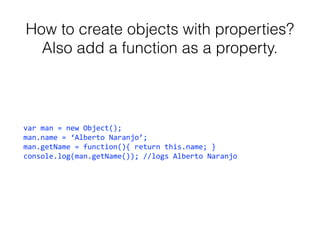
How to create objects with properties?
Also add a function as a property.

var man = new Object();
man.name = ‘Alberto Naranjo’;
man.getName = function(){ return this.name; }
console.log(man.getName()); //logs Alberto Naranjo
Implement dot and literals object
notation. What’s the difference?

There is no practical difference.
var man = new Object();
man.name = “Albert”; // man[‘name’] = “Albert”;
man.age = 29; // man[‘age’] = 29;
---------var man = { ‘name’ : “Andrew”, ‘age’ : 27 };
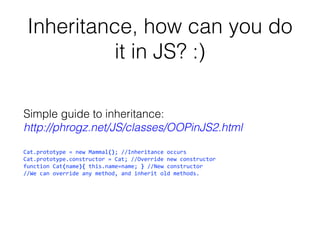
Inheritance, how can you do
it in JS? :)
Simple guide to inheritance:
http://phrogz.net/JS/classes/OOPinJS2.html
Cat.prototype = new Mammal(); //Inheritance occurs
Cat.prototype.constructor = Cat; //Override new constructor
function Cat(name){ this.name=name; } //New constructor
//We can override any method, and inherit old methods.
General Syntax
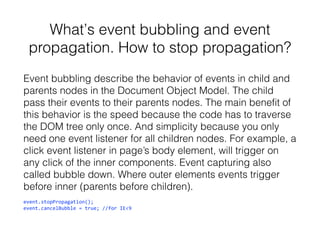
What’s event bubbling and event
propagation. How to stop propagation?
Event bubbling describe the behavior of events in child and
parents nodes in the Document Object Model. The child
pass their events to their parents nodes. The main benefit of
this behavior is the speed because the code has to traverse
the DOM tree only once. And simplicity because you only
need one event listener for all children nodes. For example, a
click event listener in page’s body element, will trigger on
any click of the inner components. Event capturing also
called bubble down. Where outer elements events trigger
before inner (parents before children).
event.stopPropagation();
event.cancelBubble = true; //for IE<9
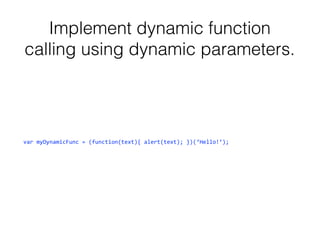
Implement dynamic function
calling using dynamic parameters.

var myDynamicFunc = (function(text){ alert(text); })(‘Hello!’);
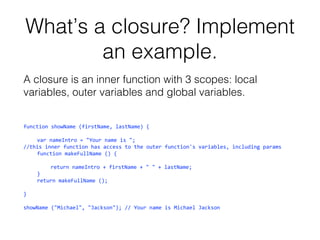
What’s a closure? Implement
an example.
A closure is an inner function with 3 scopes: local
variables, outer variables and global variables.
function showName (firstName, lastName) {
var nameIntro = "Your name is ";
//this inner function has access to the outer function's variables, including params
function makeFullName () {
return nameIntro + firstName + " " + lastName;
}
return makeFullName ();
}
showName ("Michael", "Jackson"); // Your name is Michael Jackson
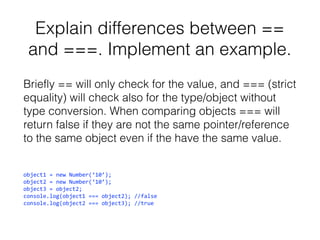
Explain differences between ==
and ===. Implement an example.
Briefly == will only check for the value, and === (strict
equality) will check also for the type/object without
type conversion. When comparing objects === will
return false if they are not the same pointer/reference
to the same object even if the have the same value.
object1 = new Number(‘10’);
object2 = new Number(‘10’);
object3 = object2;
console.log(object1 === object2); //false
console.log(object2 === object3); //true
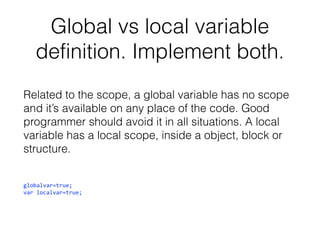
Global vs local variable
definition. Implement both.
Related to the scope, a global variable has no scope
and it’s available on any place of the code. Good
programmer should avoid it in all situations. A local
variable has a local scope, inside a object, block or
structure.
globalvar=true;
var localvar=true;
How the this keyword works?

In Javascript the this keyword usually references the
object who owns the method. But depending on the
scope. Sometimes you use this in reference to the
Window object. When working with event handlers
this references the object who created the event.
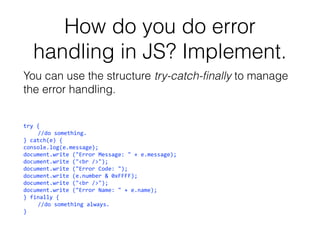
How do you do error
handling in JS? Implement.
You can use the structure try-catch-finally to manage
the error handling.
try {
//do something.
} catch(e) {
console.log(e.message);
document.write ("Error Message: " + e.message);
document.write ("<br />");
document.write ("Error Code: ");
document.write (e.number & 0xFFFF);
document.write ("<br />");
document.write ("Error Name: " + e.name);
} finally {
//do something always.
}
Enumerate all Javascript
types.
1. Number
2. Boolean
3. String
4. Object
5. function
6. null
7. undefined
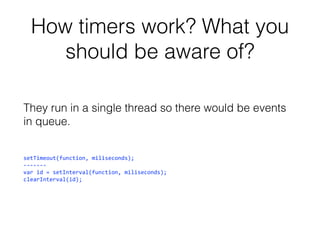
How timers work? What you
should be aware of?
They run in a single thread so there would be events
in queue.
setTimeout(function, miliseconds);
------var id = setInterval(function, miliseconds);
clearInterval(id);
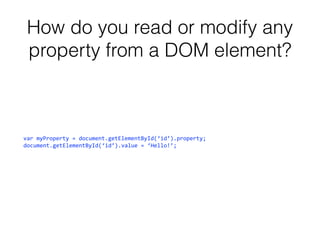
How do you read or modify any
property from a DOM element?

var myProperty = document.getElementById(‘id’).property;
document.getElementById(‘id’).value = ‘Hello!’;
Arrays
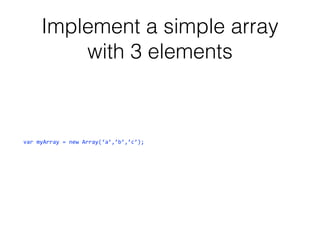
Implement a simple array
with 3 elements

var myArray = new Array(‘a’,’b’,’c’);
Implement an associative
array.
I will use a literal object notation to create one.

var myArray={key1: 'value1', key2:'value2' };
alert(myArray[‘key1’]); // Also myArray.key1
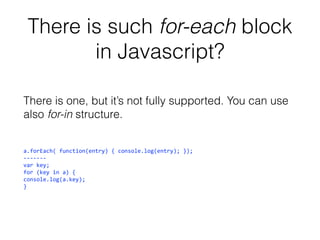
There is such for-each block
in Javascript?
There is one, but it’s not fully supported. You can use
also for-in structure.
a.forEach( function(entry) { console.log(entry); });
------var key;
for (key in a) {
console.log(a.key);
}
Suggest more
questions ;)

Javascript quiz. Questions to ask when recruiting developers.

  • 1.
    Javascript Quiz Technical questionsto ask when recruiting developers. Alberto Naranjo Jan. 2014
  • 2.
  • 3.
    What’s prototyping? Javascript does’ntuse classical ‘inheritance’ model. It uses prototypal inheritance. We will want to declare methods on the prototype class, not in the constructor, mainly because when the use new the object would create each time a new copy of the methods instead of using the common one from the prototype. //Guitar function constructor function Guitar(color, strings) { this.color = color; this.strings = strings; } //Guitar prototype method Guitar.prototype.play = function(chord){ return chord; } var myguitar = new Guitar(‘blue’,[‘A’,’F’,’G’]); --------Guitar.prototype = { play : function(chord){ return chord; }, getColor : function(){ return this.color; } };
  • 4.
    How to createobjects with properties? Also add a function as a property. var man = new Object(); man.name = ‘Alberto Naranjo’; man.getName = function(){ return this.name; } console.log(man.getName()); //logs Alberto Naranjo
  • 5.
    Implement dot andliterals object notation. What’s the difference? There is no practical difference. var man = new Object(); man.name = “Albert”; // man[‘name’] = “Albert”; man.age = 29; // man[‘age’] = 29; ---------var man = { ‘name’ : “Andrew”, ‘age’ : 27 };
  • 6.
    Inheritance, how canyou do it in JS? :) Simple guide to inheritance: http://phrogz.net/JS/classes/OOPinJS2.html Cat.prototype = new Mammal(); //Inheritance occurs Cat.prototype.constructor = Cat; //Override new constructor function Cat(name){ this.name=name; } //New constructor //We can override any method, and inherit old methods.
  • 7.
  • 8.
    What’s event bubblingand event propagation. How to stop propagation? Event bubbling describe the behavior of events in child and parents nodes in the Document Object Model. The child pass their events to their parents nodes. The main benefit of this behavior is the speed because the code has to traverse the DOM tree only once. And simplicity because you only need one event listener for all children nodes. For example, a click event listener in page’s body element, will trigger on any click of the inner components. Event capturing also called bubble down. Where outer elements events trigger before inner (parents before children). event.stopPropagation(); event.cancelBubble = true; //for IE<9
  • 9.
    Implement dynamic function callingusing dynamic parameters. var myDynamicFunc = (function(text){ alert(text); })(‘Hello!’);
  • 10.
    What’s a closure?Implement an example. A closure is an inner function with 3 scopes: local variables, outer variables and global variables. function showName (firstName, lastName) { var nameIntro = "Your name is "; //this inner function has access to the outer function's variables, including params function makeFullName () { return nameIntro + firstName + " " + lastName; } return makeFullName (); } showName ("Michael", "Jackson"); // Your name is Michael Jackson
  • 11.
    Explain differences between== and ===. Implement an example. Briefly == will only check for the value, and === (strict equality) will check also for the type/object without type conversion. When comparing objects === will return false if they are not the same pointer/reference to the same object even if the have the same value. object1 = new Number(‘10’); object2 = new Number(‘10’); object3 = object2; console.log(object1 === object2); //false console.log(object2 === object3); //true
  • 12.
    Global vs localvariable definition. Implement both. Related to the scope, a global variable has no scope and it’s available on any place of the code. Good programmer should avoid it in all situations. A local variable has a local scope, inside a object, block or structure. globalvar=true; var localvar=true;
  • 13.
    How the thiskeyword works? In Javascript the this keyword usually references the object who owns the method. But depending on the scope. Sometimes you use this in reference to the Window object. When working with event handlers this references the object who created the event.
  • 14.
    How do youdo error handling in JS? Implement. You can use the structure try-catch-finally to manage the error handling. try { //do something. } catch(e) { console.log(e.message); document.write ("Error Message: " + e.message); document.write ("<br />"); document.write ("Error Code: "); document.write (e.number & 0xFFFF); document.write ("<br />"); document.write ("Error Name: " + e.name); } finally { //do something always. }
  • 15.
    Enumerate all Javascript types. 1.Number 2. Boolean 3. String 4. Object 5. function 6. null 7. undefined
  • 16.
    How timers work?What you should be aware of? They run in a single thread so there would be events in queue. setTimeout(function, miliseconds); ------var id = setInterval(function, miliseconds); clearInterval(id);
  • 17.
    How do youread or modify any property from a DOM element? var myProperty = document.getElementById(‘id’).property; document.getElementById(‘id’).value = ‘Hello!’;
  • 18.
  • 19.
    Implement a simplearray with 3 elements var myArray = new Array(‘a’,’b’,’c’);
  • 20.
    Implement an associative array. Iwill use a literal object notation to create one. var myArray={key1: 'value1', key2:'value2' }; alert(myArray[‘key1’]); // Also myArray.key1
  • 21.
    There is suchfor-each block in Javascript? There is one, but it’s not fully supported. You can use also for-in structure. a.forEach( function(entry) { console.log(entry); }); ------var key; for (key in a) { console.log(a.key); }
  • 22.