Numbers
Integer values
and floating-point values
Numbers
• JavaScript does not make a distinction
between integer values and floating-
pointvalues.
Numbers
• All numbers in JavaScript are represented as
floating-point values.
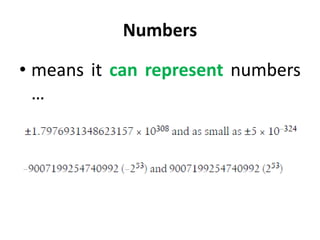
• JavaScript represents numbers using the 64-
bitfloating-point
Numbers
• means it can represent numbers
…
Numeric literal
• When a number appears directly in a
JavaScript program, it’s called a numeric
literal.
• JavaScript supports numeric literals in
several formats.
Numeric literal
• Any numeric literal can be preceded by a
minus sign (-) to make the number
negative.
• Technically, however, - is the unary negation
operator.
Integer Literals
• In a JavaScript program, a base-10 integer is
written as a sequence of digits. For
example:
• 1
• 10
• 1000
• 10200 ...
Integer Literals
• In a JavaScript program, a base-10 integer is
written as a sequence of digits. For
example:
• 1
• 10
• 1000
• 10200 ...
Integer Literals
• JavaScript recognizes hexadecimal (base-
16) values.
• A hexadecimal literal begins with “0x” or
“0X”, followed by a string of hexadecimal
digits.
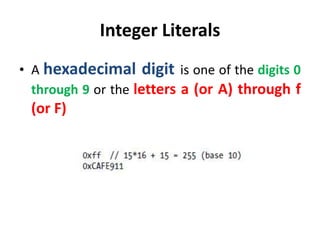
Integer Literals
• A hexadecimal digit is one of the digits 0
through 9 or the letters a (or A) through f
(or F)
Floating-point literals
• Can have a decimal point; they use
the traditional syntax for real
numbers.
Floating-point literals
• A real value is represented as the
integral part of the number, followed
by a decimal point and the
fractional part of the number.
Floating-point literals
• Floating-point literals may also be
represented using exponential
notation:
• A real number followed by the letter e
(or E),
Floating-point literals
• Followed by an optional plus or minus
sign,
• Followed by an integer exponent.
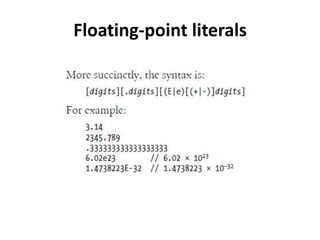
Floating-point literals

Javascript - Numbers