Looping Statements
Prepared by:
Jean Michael Castor
5-1
Repetition Statements
• Repetition statements allow us to execute a
statement multiple times
• Often they are referred to as loops
• Like conditional statements, they are controlled
by boolean expressions
• Java has three kinds of repetition statements:
– the while loop
– the do loop
– the for loop
5-2
The while Statement
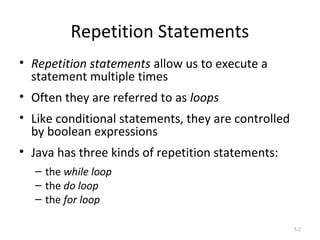
• A while statement has the following syntax:
5-3
while ( condition ){
statement;
}
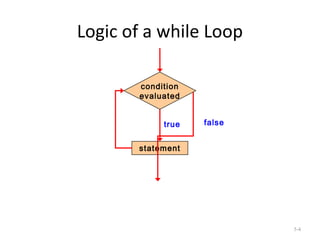
• If the condition is true, the statement is
executed
• Then the condition is evaluated again, and if it is
still true, the statement is executed again
• The statement is executed repeatedly until the
condition becomes false
Logic of a while Loop
5-4
statement
true false
condition
evaluated
The while Statement
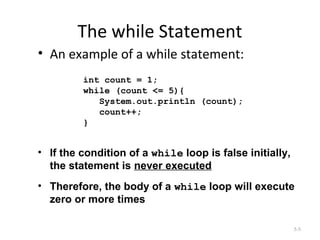
• An example of a while statement:
5-5
int count = 1;
while (count <= 5){
System.out.println (count);
count++;
}
• If the condition of a while loop is false initially,
the statement is never executed
• Therefore, the body of a while loop will execute
zero or more times
The while Statement
• Let's look at some examples of loop
processing
• A loop can be used to maintain a running sum
• A sentinel value is a special input value that
represents the end of input
• A loop can also be used for input validation,
making a program more robust
5-6
Infinite Loops
• The body of a while loop eventually must make
the condition false
• If not, it is called an infinite loop, which will
execute until the user interrupts the program
• This is a common logical (semantic) error
• You should always double check the logic of a
program to ensure that your loops will terminate
normally
5-7
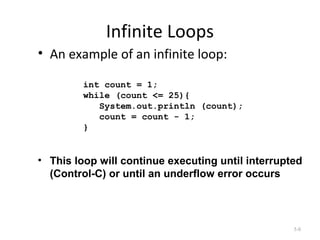
Infinite Loops
• An example of an infinite loop:
5-8
int count = 1;
while (count <= 25){
System.out.println (count);
count = count - 1;
}
• This loop will continue executing until interrupted
(Control-C) or until an underflow error occurs
Nested Loops
• Similar to nested if statements, loops can be
nested as well
• That is, the body of a loop can contain another
loop
• For each iteration of the outer loop, the inner
loop iterates completely
• Your second course project involves a while
loop nested inside of a for loop
5-9
Nested Loops
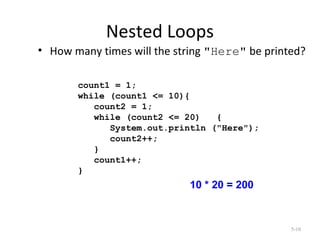
• How many times will the string "Here" be printed?
5-10
count1 = 1;
while (count1 <= 10){
count2 = 1;
while (count2 <= 20) {
System.out.println ("Here");
count2++;
}
count1++;
}
10 * 20 = 200
Outline
5-11
The while Statement
Other Repetition Statements
The do-while Statement
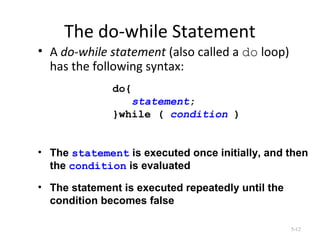
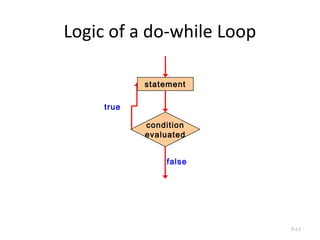
• A do-while statement (also called a do loop)
has the following syntax:
5-12
do{
statement;
}while ( condition )
• The statement is executed once initially, and then
the condition is evaluated
• The statement is executed repeatedly until the
condition becomes false
Logic of a do-while Loop
5-13
true
condition
evaluated
statement
false
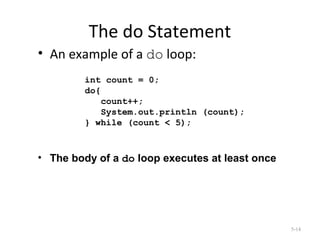
The do Statement
• An example of a do loop:
5-14
• The body of a do loop executes at least once
int count = 0;
do{
count++;
System.out.println (count);
} while (count < 5);
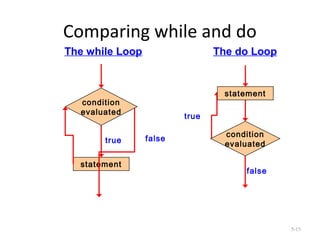
Comparing while and do
5-15
statement
true false
condition
evaluated
The while Loop
true
condition
evaluated
statement
false
The do Loop
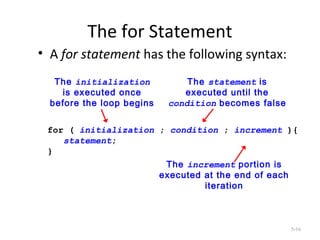
The for Statement
• A for statement has the following syntax:
5-16
for ( initialization ; condition ; increment ){
statement;
}
The initialization
is executed once
before the loop begins
The statement is
executed until the
condition becomes false
The increment portion is
executed at the end of each
iteration
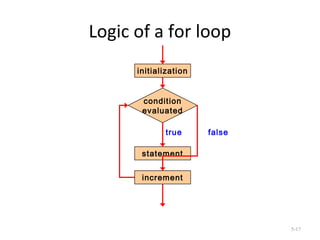
Logic of a for loop
5-17
statement
true
condition
evaluated
false
increment
initialization
The for Statement
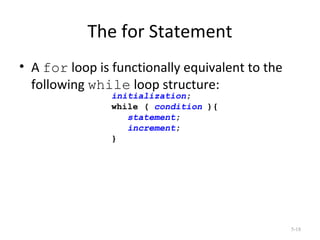
• A for loop is functionally equivalent to the
following while loop structure:
5-18
initialization;
while ( condition ){
statement;
increment;
}
The for Statement
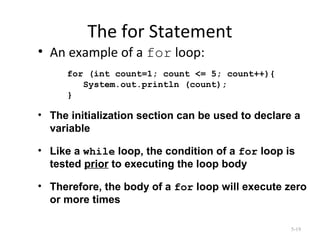
• An example of a for loop:
5-19
for (int count=1; count <= 5; count++){
System.out.println (count);
}
• The initialization section can be used to declare a
variable
• Like a while loop, the condition of a for loop is
tested prior to executing the loop body
• Therefore, the body of a for loop will execute zero
or more times
The for Statement
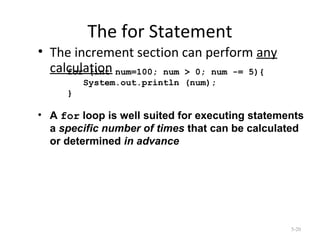
• The increment section can perform any
calculation
5-20
• A for loop is well suited for executing statements
a specific number of times that can be calculated
or determined in advance
for (int num=100; num > 0; num -= 5){
System.out.println (num);
}
The for Statement
• Each expression in the header of a for loop is optional
• If the initialization is left out, no initialization is
performed
• If the condition is left out, it is always considered to be
true, and therefore creates an infinite loop
– We usually call this a “forever loop”
• If the increment is left out, no increment operation is
performed
5-21

Looping statements in Java

  • 1.
  • 2.
    Repetition Statements • Repetitionstatements allow us to execute a statement multiple times • Often they are referred to as loops • Like conditional statements, they are controlled by boolean expressions • Java has three kinds of repetition statements: – the while loop – the do loop – the for loop 5-2
  • 3.
    The while Statement •A while statement has the following syntax: 5-3 while ( condition ){ statement; } • If the condition is true, the statement is executed • Then the condition is evaluated again, and if it is still true, the statement is executed again • The statement is executed repeatedly until the condition becomes false
  • 4.
    Logic of awhile Loop 5-4 statement true false condition evaluated
  • 5.
    The while Statement •An example of a while statement: 5-5 int count = 1; while (count <= 5){ System.out.println (count); count++; } • If the condition of a while loop is false initially, the statement is never executed • Therefore, the body of a while loop will execute zero or more times
  • 6.
    The while Statement •Let's look at some examples of loop processing • A loop can be used to maintain a running sum • A sentinel value is a special input value that represents the end of input • A loop can also be used for input validation, making a program more robust 5-6
  • 7.
    Infinite Loops • Thebody of a while loop eventually must make the condition false • If not, it is called an infinite loop, which will execute until the user interrupts the program • This is a common logical (semantic) error • You should always double check the logic of a program to ensure that your loops will terminate normally 5-7
  • 8.
    Infinite Loops • Anexample of an infinite loop: 5-8 int count = 1; while (count <= 25){ System.out.println (count); count = count - 1; } • This loop will continue executing until interrupted (Control-C) or until an underflow error occurs
  • 9.
    Nested Loops • Similarto nested if statements, loops can be nested as well • That is, the body of a loop can contain another loop • For each iteration of the outer loop, the inner loop iterates completely • Your second course project involves a while loop nested inside of a for loop 5-9
  • 10.
    Nested Loops • Howmany times will the string "Here" be printed? 5-10 count1 = 1; while (count1 <= 10){ count2 = 1; while (count2 <= 20) { System.out.println ("Here"); count2++; } count1++; } 10 * 20 = 200
  • 11.
  • 12.
    The do-while Statement •A do-while statement (also called a do loop) has the following syntax: 5-12 do{ statement; }while ( condition ) • The statement is executed once initially, and then the condition is evaluated • The statement is executed repeatedly until the condition becomes false
  • 13.
    Logic of ado-while Loop 5-13 true condition evaluated statement false
  • 14.
    The do Statement •An example of a do loop: 5-14 • The body of a do loop executes at least once int count = 0; do{ count++; System.out.println (count); } while (count < 5);
  • 15.
    Comparing while anddo 5-15 statement true false condition evaluated The while Loop true condition evaluated statement false The do Loop
  • 16.
    The for Statement •A for statement has the following syntax: 5-16 for ( initialization ; condition ; increment ){ statement; } The initialization is executed once before the loop begins The statement is executed until the condition becomes false The increment portion is executed at the end of each iteration
  • 17.
    Logic of afor loop 5-17 statement true condition evaluated false increment initialization
  • 18.
    The for Statement •A for loop is functionally equivalent to the following while loop structure: 5-18 initialization; while ( condition ){ statement; increment; }
  • 19.
    The for Statement •An example of a for loop: 5-19 for (int count=1; count <= 5; count++){ System.out.println (count); } • The initialization section can be used to declare a variable • Like a while loop, the condition of a for loop is tested prior to executing the loop body • Therefore, the body of a for loop will execute zero or more times
  • 20.
    The for Statement •The increment section can perform any calculation 5-20 • A for loop is well suited for executing statements a specific number of times that can be calculated or determined in advance for (int num=100; num > 0; num -= 5){ System.out.println (num); }
  • 21.
    The for Statement •Each expression in the header of a for loop is optional • If the initialization is left out, no initialization is performed • If the condition is left out, it is always considered to be true, and therefore creates an infinite loop – We usually call this a “forever loop” • If the increment is left out, no increment operation is performed 5-21