Java SE 8 :Streams
Streams Part 1
1. Overview of Streams
2. Standard Data Structures Into and Out of Streams
3. Core Stream Methods:
3.1 forEach(), map(), filter(), findFirst()
3.2 reduce(), collect(), min(), max(), sorted(), distinct(), limit(), skip(),
noneMatch(), allMatch(), anyMatch(), count()
4. Lazy Evaluation
5. Wrap Up
1Lars Lemos, MCA, OCPJP SE 6
Streams Overview
Stream Idea
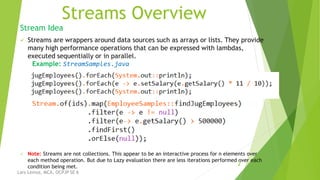
 Streams are wrappers around data sources such as arrays or lists. They provide
many high performance operations that can be expressed with lambdas,
executed sequentially or in parallel.
Example: StreamSamples.java
 Note: Streams are not collections. This appear to be an interactive process for n elements over
each method operation. But due to Lazy evaluation there are less iterations performed over each
condition being met.
2
Lars Lemos, MCA, OCPJP SE 6
Streams Overview
Stream Idea
 Streams are “Not data structures”, they have no storage. They carry values
from a source through a pipeline of operations.
 Streams are “Designed for Lambdas”, streams operations take lambdas as
arguments.
 Streams don’t have “Indexed access”, you can access the first element, but
not the second or third.
 Streams output “Arrays or Lists” easily with simple syntax.
 Streams are “Lazy”, the operations are postponed until it is known how much
data is eventually needed.
Example: A operation that takes 10 s/item on a 100 element Stream, selecting the 1st
element takes 10s not 10000s
 Streams are “Parallelizable”, once a stream is designated as parallel, then
operations will automatically be done in parallel without having to write
explicit multi-threading code.
 Streams can “Ubounded”, once a generator function is designated, clients
can consume entries as long as they want, with values being generated on the
fly.
3
Lars Lemos, MCA, OCPJP SE 6
Streams Overview
Creating Stream
 It’s known that streams are not collections: they do not manage their own
data (wrappers around data structures).
 Thus a stream does not copy the underlying data, only builds a pipeline of
operations. And it can be invoked when desired.
Syntax:
• Individual values - Stream.of(val1, val2, …);
• Array - Stream.of(objectArray);
• Lists - someList.stream();
• StreamBuilder – someBuilder.build();
• String - Stream.of(somestring.split());
4
Lars Lemos, MCA, OCPJP SE 6
Streams Overview
Stream from Primitives
– Alternatives
• int[] nums = { 1, 2, 3, 4 };
• Arrays.stream(nums)… // IntStream
• Integer[] nums = { 1, 2, 3, 4 };
• Arrays.stream(nums)… or Stream.of(nums)… // Stream<Integer>
• Making 1-item stream by accident
– Mistake
• int[] nums = { 1, 2, 3, 4 };
• Stream.of(nums)… // 1-item Stream containing array
– Correct
• Integer[] nums = { 1, 2, 3, 4 };
• Stream.of(nums)… // 4-item Stream containing Integers 5
Lars Lemos, MCA, OCPJP SE 6
Streams Overview
Streams to Pre-Java 8 Data Structures
 Array
– strm.toArray(EntryType[]::new)
Examples: employeeStream.toArray(Employee[]::new)
– The argument to toArray is normally EntryType[]::new, but in general is a
Supplier that takes an int (size) as an argument and returns an empty array that
can be filled in.
 List
– strm.collect(Collectors.toList())
• Common to do “import static java.util.stream.Collectors.*;”
then to do strm.collect(toList())
 Other collections
– strm.collect(Collectors.toSet()), – strm.collect(Collectors.groupingBy(…)),
etc.
 String
– strm.collect(Collectors.toStringJoiner(delim)).toString()
6
Lars Lemos, MCA, OCPJP SE 6
Streams Overview
Core Streams Methods
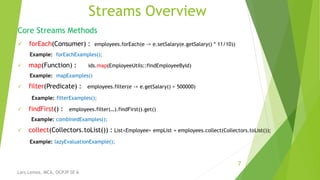
 forEach(Consumer) : employees.forEach(e -> e.setSalary(e.getSalary() * 11/10))
Example: forEachExamples();
 map(Function) : ids.map(EmployeeUtils::findEmployeeById)
Example: mapExamples()
 filter(Predicate) : employees.filter(e -> e.getSalary() > 500000)
Example: filterExamples();
 findFirst() : employees.filter(…).findFirst().get()
Example: combinedExamples();
 collect(Collectors.toList()) : List<Employee> empList = employees.collect(Collectors.toList());
Example: lazyEvaluationExample();
7
Lars Lemos, MCA, OCPJP SE 6
Streams Overview
8
Lars Lemos, MCA, OCPJP SE 6
End of part II
Part III – JavaScript in JVM, Nashorn
…………
larslemos@gmail.com
Lars Lemos
toplars

Java se 8 streams pt1

  • 1.
    Java SE 8:Streams Streams Part 1 1. Overview of Streams 2. Standard Data Structures Into and Out of Streams 3. Core Stream Methods: 3.1 forEach(), map(), filter(), findFirst() 3.2 reduce(), collect(), min(), max(), sorted(), distinct(), limit(), skip(), noneMatch(), allMatch(), anyMatch(), count() 4. Lazy Evaluation 5. Wrap Up 1Lars Lemos, MCA, OCPJP SE 6
  • 2.
    Streams Overview Stream Idea Streams are wrappers around data sources such as arrays or lists. They provide many high performance operations that can be expressed with lambdas, executed sequentially or in parallel. Example: StreamSamples.java  Note: Streams are not collections. This appear to be an interactive process for n elements over each method operation. But due to Lazy evaluation there are less iterations performed over each condition being met. 2 Lars Lemos, MCA, OCPJP SE 6
  • 3.
    Streams Overview Stream Idea Streams are “Not data structures”, they have no storage. They carry values from a source through a pipeline of operations.  Streams are “Designed for Lambdas”, streams operations take lambdas as arguments.  Streams don’t have “Indexed access”, you can access the first element, but not the second or third.  Streams output “Arrays or Lists” easily with simple syntax.  Streams are “Lazy”, the operations are postponed until it is known how much data is eventually needed. Example: A operation that takes 10 s/item on a 100 element Stream, selecting the 1st element takes 10s not 10000s  Streams are “Parallelizable”, once a stream is designated as parallel, then operations will automatically be done in parallel without having to write explicit multi-threading code.  Streams can “Ubounded”, once a generator function is designated, clients can consume entries as long as they want, with values being generated on the fly. 3 Lars Lemos, MCA, OCPJP SE 6
  • 4.
    Streams Overview Creating Stream It’s known that streams are not collections: they do not manage their own data (wrappers around data structures).  Thus a stream does not copy the underlying data, only builds a pipeline of operations. And it can be invoked when desired. Syntax: • Individual values - Stream.of(val1, val2, …); • Array - Stream.of(objectArray); • Lists - someList.stream(); • StreamBuilder – someBuilder.build(); • String - Stream.of(somestring.split()); 4 Lars Lemos, MCA, OCPJP SE 6
  • 5.
    Streams Overview Stream fromPrimitives – Alternatives • int[] nums = { 1, 2, 3, 4 }; • Arrays.stream(nums)… // IntStream • Integer[] nums = { 1, 2, 3, 4 }; • Arrays.stream(nums)… or Stream.of(nums)… // Stream<Integer> • Making 1-item stream by accident – Mistake • int[] nums = { 1, 2, 3, 4 }; • Stream.of(nums)… // 1-item Stream containing array – Correct • Integer[] nums = { 1, 2, 3, 4 }; • Stream.of(nums)… // 4-item Stream containing Integers 5 Lars Lemos, MCA, OCPJP SE 6
  • 6.
    Streams Overview Streams toPre-Java 8 Data Structures  Array – strm.toArray(EntryType[]::new) Examples: employeeStream.toArray(Employee[]::new) – The argument to toArray is normally EntryType[]::new, but in general is a Supplier that takes an int (size) as an argument and returns an empty array that can be filled in.  List – strm.collect(Collectors.toList()) • Common to do “import static java.util.stream.Collectors.*;” then to do strm.collect(toList())  Other collections – strm.collect(Collectors.toSet()), – strm.collect(Collectors.groupingBy(…)), etc.  String – strm.collect(Collectors.toStringJoiner(delim)).toString() 6 Lars Lemos, MCA, OCPJP SE 6
  • 7.
    Streams Overview Core StreamsMethods  forEach(Consumer) : employees.forEach(e -> e.setSalary(e.getSalary() * 11/10)) Example: forEachExamples();  map(Function) : ids.map(EmployeeUtils::findEmployeeById) Example: mapExamples()  filter(Predicate) : employees.filter(e -> e.getSalary() > 500000) Example: filterExamples();  findFirst() : employees.filter(…).findFirst().get() Example: combinedExamples();  collect(Collectors.toList()) : List<Employee> empList = employees.collect(Collectors.toList()); Example: lazyEvaluationExample(); 7 Lars Lemos, MCA, OCPJP SE 6
  • 8.
    Streams Overview 8 Lars Lemos,MCA, OCPJP SE 6 End of part II Part III – JavaScript in JVM, Nashorn ………… larslemos@gmail.com Lars Lemos toplars