JAVA PRESENTATION 
PRESENTED BY: 
RAHUL SINGH
About us: 
JAVA IS SIMPLE. THAT SIMPLICITY 
ORIGINATES FROM FORMAT SIMILAR TO 
C/C++ AND THE OMISSION OF COMPLEX 
C/C++ FUNCTIONS SUCH AS MULTIPLE 
EXECUTION BEQUEST, SUGGESTIONS, AND 
OWNER OVER FILLING.
What is Java ? 
Java is a general-purpose computer programming language that is concurrent, class-based, 
object-oriented, and specifically designed to have as few implementation dependencies as 
possible. It is intended to let application developers "write once, run anywhere" (WORA), 
meaning that code that runs on one platform does not need to be recompiled to run on 
another. Java applications are typically compiled to bytecode that can run on any Java virtual 
machine (JVM) regardless of computer architecture. Java is, as of 2014, one of the most popular 
programming languages in use, particularly for client-server web applications, with a reported 
9 million developers. Java was originally developed by James Gosling at Sun Microsystems 
(which has since merged into Oracle Corporation) and released in 1995 as a core component of 
Sun Microsystems' Java platform. The language derives much of its syntax from C and C++, but 
it has fewer low-level facilities than either of them
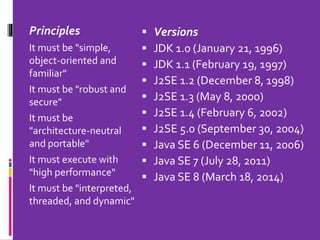
Principles 
It must be "simple, 
object-oriented and 
familiar" 
It must be "robust and 
secure" 
It must be 
"architecture-neutral 
and portable" 
It must execute with 
"high performance" 
It must be "interpreted, 
threaded, and dynamic" 
 Versions 
 JDK 1.0 (January 21, 1996) 
 JDK 1.1 (February 19, 1997) 
 J2SE 1.2 (December 8, 1998) 
 J2SE 1.3 (May 8, 2000) 
 J2SE 1.4 (February 6, 2002) 
 J2SE 5.0 (September 30, 2004) 
 Java SE 6 (December 11, 2006) 
 Java SE 7 (July 28, 2011) 
 Java SE 8 (March 18, 2014)
Java platform 
One design goal of Java is portability, which means that 
programs written for the Java platform must run similarly on 
any combination of hardware and operating system with 
adequate runtime support. This is achieved by compiling the 
Java language code to an intermediate representation called 
Java bytecode, instead of directly to architecture-specific 
machine code. Java bytecode instructions are analogous to 
machine code, but they are intended to be executed by a 
virtual machine (VM) written specifically for the host 
hardware. End users commonly use a Java Runtime 
Environment (JRE) installed on their own machine for 
standalone Java applications, or in a web browser for Java 
applets
Why you should learn Java Programming 
Language 
1) Java is Easy to learn 
2) Java is an Object Oriented Programming Language 
3) Java has Rich API 
4) Great collection of Open Source libraries 
5) Wonderful community support 
6) Java is FREE 
7) Excellent documentation support - Javadocs 
8) Java is Platform Independent
We provide java training in Delhi at 
affordable price, if you want to join 
Us. 
Please Contact us: 
mail: Contact@iteducenter.com 
phone: +91-7053313944, +91-9716321806,

Java presentation

  • 1.
  • 2.
    About us: JAVAIS SIMPLE. THAT SIMPLICITY ORIGINATES FROM FORMAT SIMILAR TO C/C++ AND THE OMISSION OF COMPLEX C/C++ FUNCTIONS SUCH AS MULTIPLE EXECUTION BEQUEST, SUGGESTIONS, AND OWNER OVER FILLING.
  • 3.
    What is Java? Java is a general-purpose computer programming language that is concurrent, class-based, object-oriented, and specifically designed to have as few implementation dependencies as possible. It is intended to let application developers "write once, run anywhere" (WORA), meaning that code that runs on one platform does not need to be recompiled to run on another. Java applications are typically compiled to bytecode that can run on any Java virtual machine (JVM) regardless of computer architecture. Java is, as of 2014, one of the most popular programming languages in use, particularly for client-server web applications, with a reported 9 million developers. Java was originally developed by James Gosling at Sun Microsystems (which has since merged into Oracle Corporation) and released in 1995 as a core component of Sun Microsystems' Java platform. The language derives much of its syntax from C and C++, but it has fewer low-level facilities than either of them
  • 4.
    Principles It mustbe "simple, object-oriented and familiar" It must be "robust and secure" It must be "architecture-neutral and portable" It must execute with "high performance" It must be "interpreted, threaded, and dynamic"  Versions  JDK 1.0 (January 21, 1996)  JDK 1.1 (February 19, 1997)  J2SE 1.2 (December 8, 1998)  J2SE 1.3 (May 8, 2000)  J2SE 1.4 (February 6, 2002)  J2SE 5.0 (September 30, 2004)  Java SE 6 (December 11, 2006)  Java SE 7 (July 28, 2011)  Java SE 8 (March 18, 2014)
  • 5.
    Java platform Onedesign goal of Java is portability, which means that programs written for the Java platform must run similarly on any combination of hardware and operating system with adequate runtime support. This is achieved by compiling the Java language code to an intermediate representation called Java bytecode, instead of directly to architecture-specific machine code. Java bytecode instructions are analogous to machine code, but they are intended to be executed by a virtual machine (VM) written specifically for the host hardware. End users commonly use a Java Runtime Environment (JRE) installed on their own machine for standalone Java applications, or in a web browser for Java applets
  • 6.
    Why you shouldlearn Java Programming Language 1) Java is Easy to learn 2) Java is an Object Oriented Programming Language 3) Java has Rich API 4) Great collection of Open Source libraries 5) Wonderful community support 6) Java is FREE 7) Excellent documentation support - Javadocs 8) Java is Platform Independent
  • 7.
    We provide javatraining in Delhi at affordable price, if you want to join Us. Please Contact us: mail: Contact@iteducenter.com phone: +91-7053313944, +91-9716321806,