Java 6 Months Internship Curriculum Tech Mentro
learn better, earn better..
Core Java 100 Hrs
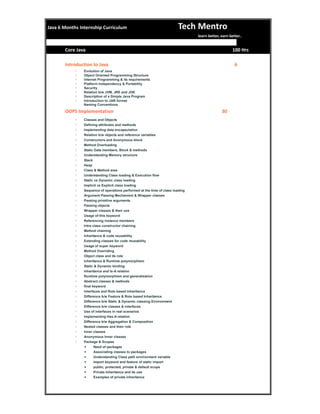
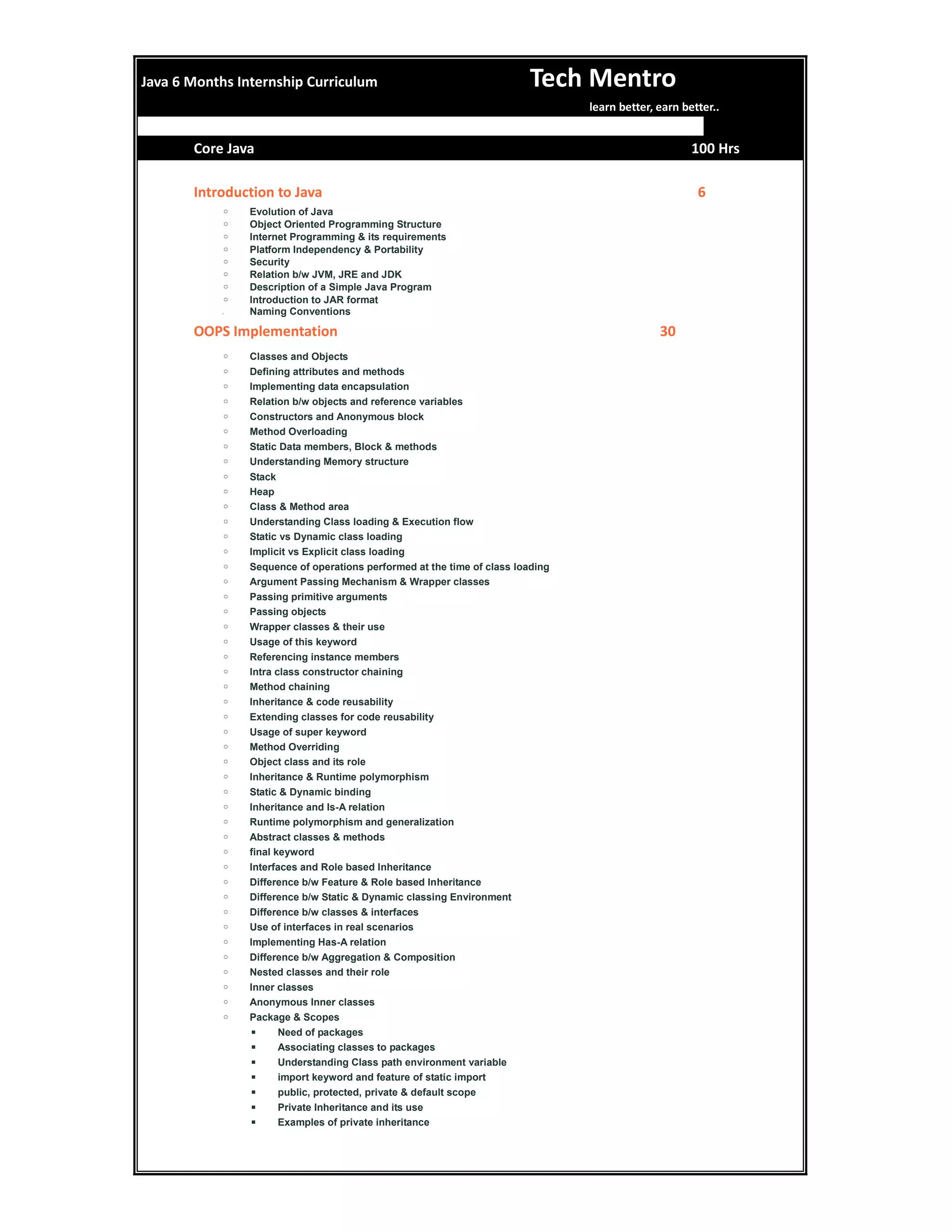
Introduction to Java 6
◦ Evolution of Java
◦ Object Oriented Programming Structure
◦ Internet Programming & its requirements
◦ Platform Independency & Portability
◦ Security
◦ Relation b/w JVM, JRE and JDK
◦ Description of a Simple Java Program
◦ Introduction to JAR format
◦ Naming Conventions
OOPS Implementation 30
◦ Classes and Objects
◦ Defining attributes and methods
◦ Implementing data encapsulation
◦ Relation b/w objects and reference variables
◦ Constructors and Anonymous block
◦ Method Overloading
◦ Static Data members, Block & methods
◦ Understanding Memory structure
◦ Stack
◦ Heap
◦ Class & Method area
◦ Understanding Class loading & Execution flow
◦ Static vs Dynamic class loading
◦ Implicit vs Explicit class loading
◦ Sequence of operations performed at the time of class loading
◦ Argument Passing Mechanism & Wrapper classes
◦ Passing primitive arguments
◦ Passing objects
◦ Wrapper classes & their use
◦ Usage of this keyword
◦ Referencing instance members
◦ Intra class constructor chaining
◦ Method chaining
◦ Inheritance & code reusability
◦ Extending classes for code reusability
◦ Usage of super keyword
◦ Method Overriding
◦ Object class and its role
◦ Inheritance & Runtime polymorphism
◦ Static & Dynamic binding
◦ Inheritance and Is-A relation
◦ Runtime polymorphism and generalization
◦ Abstract classes & methods
◦ final keyword
◦ Interfaces and Role based Inheritance
◦ Difference b/w Feature & Role based Inheritance
◦ Difference b/w Static & Dynamic classing Environment
◦ Difference b/w classes & interfaces
◦ Use of interfaces in real scenarios
◦ Implementing Has-A relation
◦ Difference b/w Aggregation & Composition
◦ Nested classes and their role
◦ Inner classes
◦ Anonymous Inner classes
◦ Package & Scopes
▪ Need of packages
▪ Associating classes to packages
▪ Understanding Class path environment variable
▪ import keyword and feature of static import
▪ public, protected, private & default scope
▪ Private Inheritance and its use
▪ Examples of private inheritance
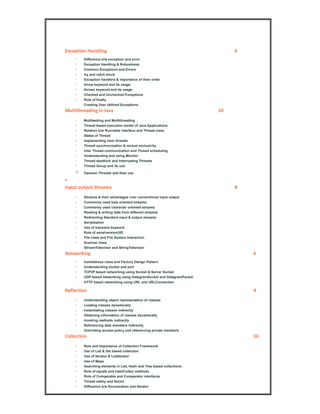
Exception Handling 6
◦ Difference b/w exception and error
◦ Exception Handling & Robustness
◦ Common Exceptions and Errors
◦ try and catch block
◦ Exception handlers & importance of their order
◦ throw keyword and its usage
◦ throws keyword and its usage
◦ Checked and Unchecked Exceptions
◦ Role of finally
◦ Creating User defined Exceptions
Multithreading in Java 10
◦ Multitasking and Multithreading
◦ Thread based execution model of Java Applications
◦ Relation b/w Runnable interface and Thread class
◦ States of Thread
◦ Implementing User threads
◦ Thread synchronization & mutual exclusivity
◦ Inter Thread communication and Thread scheduling
◦ Understanding and using Monitor
◦ Thread deadlock and Interrupting Threads
◦ Thread Group and its use
◦ Daemon Threads and their use

Input output Streams 8
◦ Streams & their advantages over conventional input output
◦ Commonly used byte oriented streams
◦ Commonly used character oriented streams
◦ Reading & writing data from different streams
◦ Redirecting Standard input & output streams
◦ Serialization
◦ Use of transient keyword
◦ Role of serialversionUID
◦ File class and File System Interaction
◦ Scanner class
◦ StreamTokenizer and StringTokenizer
Networking 6
◦ InetAddress class and Factory Design Pattern
◦ Understanding socket and port
◦ TCP/IP based networking using Socket & Server Socket
◦ UDP based networking using DatagramSocket and DatagramPacket
◦ HTTP based networking using URL and URLConnection
Reflection 4
◦ Understanding object representation of classes
◦ Loading classes dynamically
◦ Instantiating classes indirectly
◦ Obtaining information of classes dynamically
◦ Invoking methods indirectly
◦ Referencing data members indirectly
◦ Overriding access policy and referencing private members
Collection 16
◦ Role and Importance of Collection Framework
◦ Use of List & Set based collection
◦ Use of Iterator & ListIterator
◦ Use of Maps
◦ Searching elements in List, Hash and Tree based collections
◦ Role of equals and hashCode() methods
◦ Role of Comparable and Comparator interfaces
◦ Thread safety and Vector
◦ Difference b/w Enumeration and Iterator
◦ Type safety and Generics
◦ Common algorithms and Collections class
◦ Using Properties class for managing properties files
I18N or Internationalization 4
 Role of Locale class in i18n
 Using Number Format class for applying number & currency formatting
 Using Date Format class for applying date & time formatting
 Using ResourceBundle and properties files for internationalizing textual contents.
Database Connectivity using JDBC 4.X 10
◦ Overview of native and ODBC Drivers
◦ Introduction to JDBC
◦ Type of JDBC drivers
◦ Using different type of drivers
◦ Defining properties based Connection Factory
◦ Performing basic database operations
◦ Insert
◦ Delete
◦ Update
◦ select
◦ Prepared Statement
◦ Difference b/w Statement & Prepared Statement
◦ Setting Query parameters
◦ Executing Queries
◦ CallabeStatement
◦ Creating PL/SQL Stored procedures and functions
◦ Creating Callable statements
◦ Executing procedures & functions
◦ Misc
▪ Batch Updation
▪ Transacting queries
▪ Programmatic initialization of database
▪ Scrollabe & Updatable Resultset
▪ ResultSetMetaData
▪ DatabaseMetaData
▪ Connection Pooling and DataSource
▪ Implementation of DAO design pattern
Advance Java 100 Hrs
Servlet API 3.X 28
◦ Introduction to JEE
◦ Overview of Dynamic web applications
◦ Introduction to Servlet
◦ Servlet life cycle
◦ Annotations and their use in Servlet development
◦ Difference b/w web server & application server
◦ Installing and configuring web & application server
◦ Web Application formats
◦ Deployment modes supported by servers
◦ Creating and deploying a simple web application
◦ Understanding the role of ServletRequest & ServletResponse
◦ Differene b/w parameters and attributes
◦ Using different content type for response
◦ Using RequestDispatcher for Include & Forward
◦ Initialization Parameters and their use
◦ ServletConfig & ServletContext
◦ Inter application collaboration
◦ State Management and use of HttpSession & Cookies
◦ Hidden Form fields and URL Rewriting
◦ Using Http only Cookies
◦ Listeners and web application events
◦ Applying Filters to servlets
◦ Asynchronous request processing
◦ File Uploading & downloading
◦ Security
Java Server Pages (JSP) 16
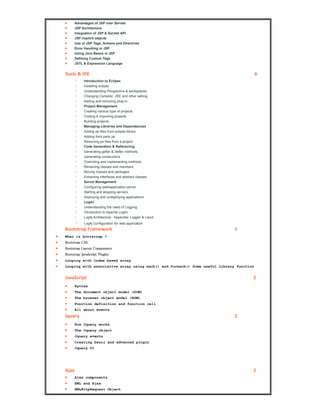
 Advantages of JSP over Servlet
 JSP Architecture
 Integration of JSP & Servlet API.
 JSP implicit objects
 Use of JSP Tags, Actions and Directives
 Error Handling in JSP
 Using Java Beans in JSP
 Defining Custom Tags
 JSTL & Expression Language
Tools & IDE 6
◦ Introduction to Eclipse
◦ Installing eclipse
◦ Understanding Perspective & workspaces
◦ Changing Compiler, JRE and other setting
◦ Adding and removing plug-in
◦ Project Management
◦ Creating various type of projects
◦ Closing & Importing projects
◦ Building projects
◦ Managing Libraries and Dependencies
◦ Adding jar files from eclipse library
◦ Adding third party jar
◦ Removing jar files from a project
◦ Code Generation & Refactoring
◦ Generating getter & Setter methods
◦ Generating constructors
◦ Overriding and implementing methods
◦ Renaming classes and members
◦ Moving classes and packages
◦ Extracting interfaces and abstract classes
◦ Server Management
◦ Configuring web/application server
◦ Starting and stopping servers
◦ Deploying and undeploying applications
◦ Log4J
◦ Understanding the need of Logging
◦ Introduction to Apache Log4J
◦ Log4j Architecture : Appender, Logger & Laout
◦ Log4j Configuration for web application
Bootstrap Framework 4
 What is bootstrap ?
 Bootstrap CSS.
 Bootstrap Layout Components
 Bootstrap JavaScript Plugins
 Looping with Index based array
 Looping with associative array using each() and foreach() Some useful Library function
JavaScript 2
 Syntax
 The document object model (DOM)
 The browser object model (BOM)
 Function definition and function call
 All about events
Jquery 2
 How Jquery works
 The Jquery object
 Jquery events
 Creating basic and advanced plugin
 Jquery UI
Ajax 2
 Ajax components
 XML and Ajax
 XMLHttpRequest Object
Major Project 40
 Project Description
 Project Architecture
 Project Conventions and Deliverables
 Data sources, Work flows and Modules
 Project Interface Design
 Creating project prototype
 Testing, Modification & Acceptance
Tech Mentro , C-43 , Sec-2 , Noida, Ph:0120.4549462 , www.techmentro.com

Java Internship in Noida For B.Tech, MCA

  • 1.
    Java 6 MonthsInternship Curriculum Tech Mentro learn better, earn better.. Core Java 100 Hrs Introduction to Java 6 ◦ Evolution of Java ◦ Object Oriented Programming Structure ◦ Internet Programming & its requirements ◦ Platform Independency & Portability ◦ Security ◦ Relation b/w JVM, JRE and JDK ◦ Description of a Simple Java Program ◦ Introduction to JAR format ◦ Naming Conventions OOPS Implementation 30 ◦ Classes and Objects ◦ Defining attributes and methods ◦ Implementing data encapsulation ◦ Relation b/w objects and reference variables ◦ Constructors and Anonymous block ◦ Method Overloading ◦ Static Data members, Block & methods ◦ Understanding Memory structure ◦ Stack ◦ Heap ◦ Class & Method area ◦ Understanding Class loading & Execution flow ◦ Static vs Dynamic class loading ◦ Implicit vs Explicit class loading ◦ Sequence of operations performed at the time of class loading ◦ Argument Passing Mechanism & Wrapper classes ◦ Passing primitive arguments ◦ Passing objects ◦ Wrapper classes & their use ◦ Usage of this keyword ◦ Referencing instance members ◦ Intra class constructor chaining ◦ Method chaining ◦ Inheritance & code reusability ◦ Extending classes for code reusability ◦ Usage of super keyword ◦ Method Overriding ◦ Object class and its role ◦ Inheritance & Runtime polymorphism ◦ Static & Dynamic binding ◦ Inheritance and Is-A relation ◦ Runtime polymorphism and generalization ◦ Abstract classes & methods ◦ final keyword ◦ Interfaces and Role based Inheritance ◦ Difference b/w Feature & Role based Inheritance ◦ Difference b/w Static & Dynamic classing Environment ◦ Difference b/w classes & interfaces ◦ Use of interfaces in real scenarios ◦ Implementing Has-A relation ◦ Difference b/w Aggregation & Composition ◦ Nested classes and their role ◦ Inner classes ◦ Anonymous Inner classes ◦ Package & Scopes ▪ Need of packages ▪ Associating classes to packages ▪ Understanding Class path environment variable ▪ import keyword and feature of static import ▪ public, protected, private & default scope ▪ Private Inheritance and its use ▪ Examples of private inheritance
  • 2.
    Exception Handling 6 ◦Difference b/w exception and error ◦ Exception Handling & Robustness ◦ Common Exceptions and Errors ◦ try and catch block ◦ Exception handlers & importance of their order ◦ throw keyword and its usage ◦ throws keyword and its usage ◦ Checked and Unchecked Exceptions ◦ Role of finally ◦ Creating User defined Exceptions Multithreading in Java 10 ◦ Multitasking and Multithreading ◦ Thread based execution model of Java Applications ◦ Relation b/w Runnable interface and Thread class ◦ States of Thread ◦ Implementing User threads ◦ Thread synchronization & mutual exclusivity ◦ Inter Thread communication and Thread scheduling ◦ Understanding and using Monitor ◦ Thread deadlock and Interrupting Threads ◦ Thread Group and its use ◦ Daemon Threads and their use  Input output Streams 8 ◦ Streams & their advantages over conventional input output ◦ Commonly used byte oriented streams ◦ Commonly used character oriented streams ◦ Reading & writing data from different streams ◦ Redirecting Standard input & output streams ◦ Serialization ◦ Use of transient keyword ◦ Role of serialversionUID ◦ File class and File System Interaction ◦ Scanner class ◦ StreamTokenizer and StringTokenizer Networking 6 ◦ InetAddress class and Factory Design Pattern ◦ Understanding socket and port ◦ TCP/IP based networking using Socket & Server Socket ◦ UDP based networking using DatagramSocket and DatagramPacket ◦ HTTP based networking using URL and URLConnection Reflection 4 ◦ Understanding object representation of classes ◦ Loading classes dynamically ◦ Instantiating classes indirectly ◦ Obtaining information of classes dynamically ◦ Invoking methods indirectly ◦ Referencing data members indirectly ◦ Overriding access policy and referencing private members Collection 16 ◦ Role and Importance of Collection Framework ◦ Use of List & Set based collection ◦ Use of Iterator & ListIterator ◦ Use of Maps ◦ Searching elements in List, Hash and Tree based collections ◦ Role of equals and hashCode() methods ◦ Role of Comparable and Comparator interfaces ◦ Thread safety and Vector ◦ Difference b/w Enumeration and Iterator
  • 3.
    ◦ Type safetyand Generics ◦ Common algorithms and Collections class ◦ Using Properties class for managing properties files I18N or Internationalization 4  Role of Locale class in i18n  Using Number Format class for applying number & currency formatting  Using Date Format class for applying date & time formatting  Using ResourceBundle and properties files for internationalizing textual contents. Database Connectivity using JDBC 4.X 10 ◦ Overview of native and ODBC Drivers ◦ Introduction to JDBC ◦ Type of JDBC drivers ◦ Using different type of drivers ◦ Defining properties based Connection Factory ◦ Performing basic database operations ◦ Insert ◦ Delete ◦ Update ◦ select ◦ Prepared Statement ◦ Difference b/w Statement & Prepared Statement ◦ Setting Query parameters ◦ Executing Queries ◦ CallabeStatement ◦ Creating PL/SQL Stored procedures and functions ◦ Creating Callable statements ◦ Executing procedures & functions ◦ Misc ▪ Batch Updation ▪ Transacting queries ▪ Programmatic initialization of database ▪ Scrollabe & Updatable Resultset ▪ ResultSetMetaData ▪ DatabaseMetaData ▪ Connection Pooling and DataSource ▪ Implementation of DAO design pattern Advance Java 100 Hrs Servlet API 3.X 28 ◦ Introduction to JEE ◦ Overview of Dynamic web applications ◦ Introduction to Servlet ◦ Servlet life cycle ◦ Annotations and their use in Servlet development ◦ Difference b/w web server & application server ◦ Installing and configuring web & application server ◦ Web Application formats ◦ Deployment modes supported by servers ◦ Creating and deploying a simple web application ◦ Understanding the role of ServletRequest & ServletResponse ◦ Differene b/w parameters and attributes ◦ Using different content type for response ◦ Using RequestDispatcher for Include & Forward ◦ Initialization Parameters and their use ◦ ServletConfig & ServletContext ◦ Inter application collaboration ◦ State Management and use of HttpSession & Cookies ◦ Hidden Form fields and URL Rewriting ◦ Using Http only Cookies ◦ Listeners and web application events ◦ Applying Filters to servlets ◦ Asynchronous request processing ◦ File Uploading & downloading ◦ Security Java Server Pages (JSP) 16
  • 4.
     Advantages ofJSP over Servlet  JSP Architecture  Integration of JSP & Servlet API.  JSP implicit objects  Use of JSP Tags, Actions and Directives  Error Handling in JSP  Using Java Beans in JSP  Defining Custom Tags  JSTL & Expression Language Tools & IDE 6 ◦ Introduction to Eclipse ◦ Installing eclipse ◦ Understanding Perspective & workspaces ◦ Changing Compiler, JRE and other setting ◦ Adding and removing plug-in ◦ Project Management ◦ Creating various type of projects ◦ Closing & Importing projects ◦ Building projects ◦ Managing Libraries and Dependencies ◦ Adding jar files from eclipse library ◦ Adding third party jar ◦ Removing jar files from a project ◦ Code Generation & Refactoring ◦ Generating getter & Setter methods ◦ Generating constructors ◦ Overriding and implementing methods ◦ Renaming classes and members ◦ Moving classes and packages ◦ Extracting interfaces and abstract classes ◦ Server Management ◦ Configuring web/application server ◦ Starting and stopping servers ◦ Deploying and undeploying applications ◦ Log4J ◦ Understanding the need of Logging ◦ Introduction to Apache Log4J ◦ Log4j Architecture : Appender, Logger & Laout ◦ Log4j Configuration for web application Bootstrap Framework 4  What is bootstrap ?  Bootstrap CSS.  Bootstrap Layout Components  Bootstrap JavaScript Plugins  Looping with Index based array  Looping with associative array using each() and foreach() Some useful Library function JavaScript 2  Syntax  The document object model (DOM)  The browser object model (BOM)  Function definition and function call  All about events Jquery 2  How Jquery works  The Jquery object  Jquery events  Creating basic and advanced plugin  Jquery UI Ajax 2  Ajax components  XML and Ajax  XMLHttpRequest Object
  • 5.
    Major Project 40 Project Description  Project Architecture  Project Conventions and Deliverables  Data sources, Work flows and Modules  Project Interface Design  Creating project prototype  Testing, Modification & Acceptance Tech Mentro , C-43 , Sec-2 , Noida, Ph:0120.4549462 , www.techmentro.com