JAVA J2EE COURSE CONTENT 
Introduction 
 1.Programming language Types and Paradigms. 
 2.Computer Programming Hierarchy. 
 3.How Computer Architecture Affects a Language ? 
 4.Why Java ? 
 5.Flavors of Java. 
 6.Java Designing Goal. 
 7.Role of Java Programmer in Industry. 
 8.Features of Java Language. 
 9.JVM –The heart of Java 
 10.Java’s Magic Bytecode 
 11.Language Fundamentals 
The Java Environment: 
 1.Installing Java. 
 2.Java Program Development 
 3.Java Source File Structure 
 4.Compilation 
 5.Executions. 
Basic Language Elements: 
 1.Lexical Tokens, Identifiers 
 2.Keywords, Literals, Comments 
 3.Primitive Datatypes,Operators 
 4.Assignments. 
 5.Object Oriented Programming 
 6.Class Fundamentals. 
 7.Object & Object reference. 
 8.Object Life time & Garbage Collection. 
 9.Creating and Operating Objects. 
 10.Constructor & initialization code block. 
 11.Access Control, Modifiers, methods 
 12.Nested , Inner Class &Anonymous Classes 
 13.Abstract Class & Interfaces 
 14.Defining Methods, Argument Passing Mechanism 
----------------------------------------------------------------------------------------------------------------------------------------------------------------------------------------------- 
INDIA Trainingicon USA 
Phone: +91-966-690-0051 Email: info@trainingicon.com | www.trainingicon.com Phone: +1-408-791-8864
 15.Method Overloading, Recursion. 
 16.Dealing with Static Members. Finalize() Method. 
 17.Native Method. Use of “this “ reference. 
 18.Use of Modifiers with Classes & Methods. 
 19.Design of Accessors and Mutator Methods 
 20.Cloning Objects, shallow and deep cloning 
 21.Generic Class Types 
 22.Syllabus 
 23. Extending Classes and Inheritance 
 24.Use and Benefits of Inheritance in OOP 
 25.Types of Inheritance in Java 
 26.Inheriting Data Members and Methods 
 27.Role of Constructors in inheritance 
 28.Overriding Super Class Methods. 
 29.Use of “super”. 
 30.Polymorphism in inheritance. 
 31.Type Compatibility and Conversion 
 32.Implementing interfaces. 
 33.Package 
 34.Organizing Classes and Interfaces in Packages. 
 35.Package as Access Protection 
 36.Defining Package. 
 37.CLASSPATH Setting for Packages. 
 38.Making JAR Files for Library Packages 
 39.Import and Static Import 
 40.Naming Convention For Packages 
Exception Handling: 
 1.The Idea behind Exception 
 2.Exceptions & Errors 
 3.Types of Exception 
 4.Control Flow In Exceptions 
 5.JVM reaction to Exceptions 
 6.Use of try, catch, finally, throw, throws in Exception Handling. 
 7.In-built and User Defined Exceptions 
 8.Checked and Un-Checked Exceptions 
Arrays & Strings : 
 1.Defining an Array 
----------------------------------------------------------------------------------------------------------------------------------------------------------------------------------------------- 
INDIA Trainingicon USA 
Phone: +91-966-690-0051 Email: info@trainingicon.com | www.trainingicon.com Phone: +1-408-791-8864
 2.Initializing & Accessing Array 
 3.Multi –Dimensional Array 
 4.Operation on String 
 5.Mutable & Immutable String 
 6.Using Collection BasesLoopfor String 
 7.Tokenizing a String 
 8.Creating Strings using StringBuffer 
Threads: 
 1.Understanding Threads 
 2.Needs of Multi-Threaded Programming. 
 3.Thread Life-Cycle 
 4.Thread Priorities 
 5.Synchronizing Threads 
 6.Inter Communication of Threads 
 7.Critical Factor in Thread -DeadLock 
 8. Applet 
 9.Applet & Application 
 10.Applet Architecture. 
 11.Parameters to Applet 
 12.Embedding Applets in Web page. 
 13.Applet Security Policies 
 14.A Collection of Useful Classes 
 15.Utility Methods for Arrays 
 16.Observable and Observer Objects 
 17.Date & Times 
 18.Using Scanner 
 19.Regular Expression 
 20.Input/Output Operation in Java(java.io Package) 
 21.Streams and the new I/O Capabilities 
 22.Understanding Streams 
 23.The Classes for Input and Output 
 24.The Standard Streams 
 25.Working with File Object 
 26.File I/O Basics 
 27.Readingand Writing to Files 
 28.Buffer and Buffer Management 
 29.Read/Write Operations with File Channel 
 30.Serializing Objects 
 31.GUI Programming 
----------------------------------------------------------------------------------------------------------------------------------------------------------------------------------------------- 
INDIA Trainingicon USA 
Phone: +91-966-690-0051 Email: info@trainingicon.com | www.trainingicon.com Phone: +1-408-791-8864
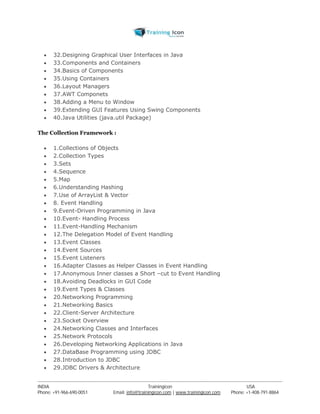
 32.Designing Graphical User Interfaces in Java 
 33.Components and Containers 
 34.Basics of Components 
 35.Using Containers 
 36.Layout Managers 
 37.AWT Componets 
 38.Adding a Menu to Window 
 39.Extending GUI Features Using Swing Components 
 40.Java Utilities (java.util Package) 
The Collection Framework : 
 1.Collections of Objects 
 2.Collection Types 
 3.Sets 
 4.Sequence 
 5.Map 
 6.Understanding Hashing 
 7.Use of ArrayList & Vector 
 8. Event Handling 
 9.Event-Driven Programming in Java 
 10.Event- Handling Process 
 11.Event-Handling Mechanism 
 12.The Delegation Model of Event Handling 
 13.Event Classes 
 14.Event Sources 
 15.Event Listeners 
 16.Adapter Classes as Helper Classes in Event Handling 
 17.Anonymous Inner classes a Short –cut to Event Handling 
 18.Avoiding Deadlocks in GUI Code 
 19.Event Types & Classes 
 20.Networking Programming 
 21.Networking Basics 
 22.Client-Server Architecture 
 23.Socket Overview 
 24.Networking Classes and Interfaces 
 25.Network Protocols 
 26.Developing Networking Applications in Java 
 27.DataBase Programming using JDBC 
 28.Introduction to JDBC 
 29.JDBC Drivers & Architecture 
----------------------------------------------------------------------------------------------------------------------------------------------------------------------------------------------- 
INDIA Trainingicon USA 
Phone: +91-966-690-0051 Email: info@trainingicon.com | www.trainingicon.com Phone: +1-408-791-8864
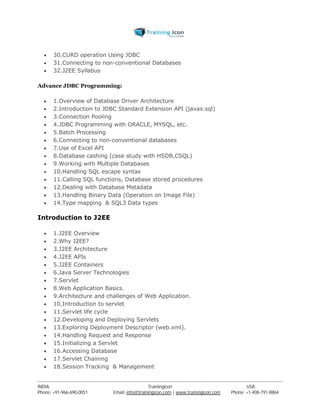
 30.CURD operation Using JDBC 
 31.Connecting to non-conventional Databases 
 32.J2EE Syllabus 
Advance JDBC Programming: 
 1.Overview of Database Driver Architecture 
 2.Introduction to JDBC Standard Extension API (javax.sql) 
 3.Connection Pooling 
 4.JDBC Programming with ORACLE, MYSQL, etc. 
 5.Batch Processing 
 6.Connecting to non-conventional databases 
 7.Use of Excel API 
 8.Database cashing (case study with HSDB,CSQL) 
 9.Working with Multiple Databases 
 10.Handling SQL escape syntax 
 11.Calling SQL functions, Database stored procedures 
 12.Dealing with Database Metadata 
 13.Handling Binary Data (Operation on Image File) 
 14.Type mapping & SQL3 Data types 
Introduction to J2EE 
 1.J2EE Overview 
 2.Why J2EE? 
 3.J2EE Architecture 
 4.J2EE APIs 
 5.J2EE Containers 
 6.Java Server Technologies 
 7.Servlet 
 8.Web Application Basics. 
 9.Architecture and challenges of Web Application. 
 10.Introduction to servlet 
 11.Servlet life cycle 
 12.Developing and Deploying Servlets 
 13.Exploring Deployment Descriptor (web.xml). 
 14.Handling Request and Response 
 15.Initializing a Servlet 
 16.Accessing Database 
 17.Servlet Chaining 
 18.Session Tracking & Management 
----------------------------------------------------------------------------------------------------------------------------------------------------------------------------------------------- 
INDIA Trainingicon USA 
Phone: +91-966-690-0051 Email: info@trainingicon.com | www.trainingicon.com Phone: +1-408-791-8864
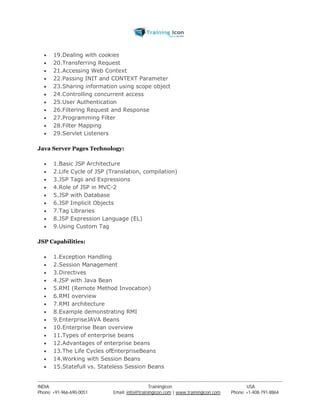
 19.Dealing with cookies 
 20.Transferring Request 
 21.Accessing Web Context 
 22.Passing INIT and CONTEXT Parameter 
 23.Sharing information using scope object 
 24.Controlling concurrent access 
 25.User Authentication 
 26.Filtering Request and Response 
 27.Programming Filter 
 28.Filter Mapping 
 29.Servlet Listeners 
Java Server Pages Technology: 
 1.Basic JSP Architecture 
 2.Life Cycle of JSP (Translation, compilation) 
 3.JSP Tags and Expressions 
 4.Role of JSP in MVC-2 
 5.JSP with Database 
 6.JSP Implicit Objects 
 7.Tag Libraries 
 8.JSP Expression Language (EL) 
 9.Using Custom Tag 
JSP Capabilities: 
 1.Exception Handling 
 2.Session Management 
 3.Directives 
 4.JSP with Java Bean 
 5.RMI (Remote Method Invocation) 
 6.RMI overview 
 7.RMI architecture 
 8.Example demonstrating RMI 
 9.EnterpriseJAVA Beans 
 10.Enterprise Bean overview 
 11.Types of enterprise beans 
 12.Advantages of enterprise beans 
 13.The Life Cycles ofEnterpriseBeans 
 14.Working with Session Beans 
 15.Statefull vs. Stateless Session Beans 
----------------------------------------------------------------------------------------------------------------------------------------------------------------------------------------------- 
INDIA Trainingicon USA 
Phone: +91-966-690-0051 Email: info@trainingicon.com | www.trainingicon.com Phone: +1-408-791-8864
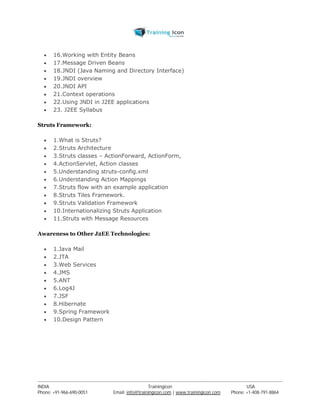
 16.Working with Entity Beans 
 17.Message Driven Beans 
 18.JNDI (Java Naming and Directory Interface) 
 19.JNDI overview 
 20.JNDI API 
 21.Context operations 
 22.Using JNDI in J2EE applications 
 23. J2EE Syllabus 
Struts Framework: 
 1.What is Struts? 
 2.Struts Architecture 
 3.Struts classes – ActionForward, ActionForm, 
 4.ActionServlet, Action classes 
 5.Understanding struts-config.xml 
 6.Understanding Action Mappings 
 7.Struts flow with an example application 
 8.Struts Tiles Framework. 
 9.Struts Validation Framework 
 10.Internationalizing Struts Application 
 11.Struts with Message Resources 
Awareness to Other J2EE Technologies: 
 1.Java Mail 
 2.JTA 
 3.Web Services 
 4.JMS 
 5.ANT 
 6.Log4J 
 7.JSF 
 8.Hibernate 
 9.Spring Framework 
 10.Design Pattern 
----------------------------------------------------------------------------------------------------------------------------------------------------------------------------------------------- 
INDIA Trainingicon USA 
Phone: +91-966-690-0051 Email: info@trainingicon.com | www.trainingicon.com Phone: +1-408-791-8864

JAVA J2 EE ONLINE TRAINING

  • 1.
    JAVA J2EE COURSECONTENT Introduction  1.Programming language Types and Paradigms.  2.Computer Programming Hierarchy.  3.How Computer Architecture Affects a Language ?  4.Why Java ?  5.Flavors of Java.  6.Java Designing Goal.  7.Role of Java Programmer in Industry.  8.Features of Java Language.  9.JVM –The heart of Java  10.Java’s Magic Bytecode  11.Language Fundamentals The Java Environment:  1.Installing Java.  2.Java Program Development  3.Java Source File Structure  4.Compilation  5.Executions. Basic Language Elements:  1.Lexical Tokens, Identifiers  2.Keywords, Literals, Comments  3.Primitive Datatypes,Operators  4.Assignments.  5.Object Oriented Programming  6.Class Fundamentals.  7.Object & Object reference.  8.Object Life time & Garbage Collection.  9.Creating and Operating Objects.  10.Constructor & initialization code block.  11.Access Control, Modifiers, methods  12.Nested , Inner Class &Anonymous Classes  13.Abstract Class & Interfaces  14.Defining Methods, Argument Passing Mechanism ----------------------------------------------------------------------------------------------------------------------------------------------------------------------------------------------- INDIA Trainingicon USA Phone: +91-966-690-0051 Email: info@trainingicon.com | www.trainingicon.com Phone: +1-408-791-8864
  • 2.
     15.Method Overloading,Recursion.  16.Dealing with Static Members. Finalize() Method.  17.Native Method. Use of “this “ reference.  18.Use of Modifiers with Classes & Methods.  19.Design of Accessors and Mutator Methods  20.Cloning Objects, shallow and deep cloning  21.Generic Class Types  22.Syllabus  23. Extending Classes and Inheritance  24.Use and Benefits of Inheritance in OOP  25.Types of Inheritance in Java  26.Inheriting Data Members and Methods  27.Role of Constructors in inheritance  28.Overriding Super Class Methods.  29.Use of “super”.  30.Polymorphism in inheritance.  31.Type Compatibility and Conversion  32.Implementing interfaces.  33.Package  34.Organizing Classes and Interfaces in Packages.  35.Package as Access Protection  36.Defining Package.  37.CLASSPATH Setting for Packages.  38.Making JAR Files for Library Packages  39.Import and Static Import  40.Naming Convention For Packages Exception Handling:  1.The Idea behind Exception  2.Exceptions & Errors  3.Types of Exception  4.Control Flow In Exceptions  5.JVM reaction to Exceptions  6.Use of try, catch, finally, throw, throws in Exception Handling.  7.In-built and User Defined Exceptions  8.Checked and Un-Checked Exceptions Arrays & Strings :  1.Defining an Array ----------------------------------------------------------------------------------------------------------------------------------------------------------------------------------------------- INDIA Trainingicon USA Phone: +91-966-690-0051 Email: info@trainingicon.com | www.trainingicon.com Phone: +1-408-791-8864
  • 3.
     2.Initializing &Accessing Array  3.Multi –Dimensional Array  4.Operation on String  5.Mutable & Immutable String  6.Using Collection BasesLoopfor String  7.Tokenizing a String  8.Creating Strings using StringBuffer Threads:  1.Understanding Threads  2.Needs of Multi-Threaded Programming.  3.Thread Life-Cycle  4.Thread Priorities  5.Synchronizing Threads  6.Inter Communication of Threads  7.Critical Factor in Thread -DeadLock  8. Applet  9.Applet & Application  10.Applet Architecture.  11.Parameters to Applet  12.Embedding Applets in Web page.  13.Applet Security Policies  14.A Collection of Useful Classes  15.Utility Methods for Arrays  16.Observable and Observer Objects  17.Date & Times  18.Using Scanner  19.Regular Expression  20.Input/Output Operation in Java(java.io Package)  21.Streams and the new I/O Capabilities  22.Understanding Streams  23.The Classes for Input and Output  24.The Standard Streams  25.Working with File Object  26.File I/O Basics  27.Readingand Writing to Files  28.Buffer and Buffer Management  29.Read/Write Operations with File Channel  30.Serializing Objects  31.GUI Programming ----------------------------------------------------------------------------------------------------------------------------------------------------------------------------------------------- INDIA Trainingicon USA Phone: +91-966-690-0051 Email: info@trainingicon.com | www.trainingicon.com Phone: +1-408-791-8864
  • 4.
     32.Designing GraphicalUser Interfaces in Java  33.Components and Containers  34.Basics of Components  35.Using Containers  36.Layout Managers  37.AWT Componets  38.Adding a Menu to Window  39.Extending GUI Features Using Swing Components  40.Java Utilities (java.util Package) The Collection Framework :  1.Collections of Objects  2.Collection Types  3.Sets  4.Sequence  5.Map  6.Understanding Hashing  7.Use of ArrayList & Vector  8. Event Handling  9.Event-Driven Programming in Java  10.Event- Handling Process  11.Event-Handling Mechanism  12.The Delegation Model of Event Handling  13.Event Classes  14.Event Sources  15.Event Listeners  16.Adapter Classes as Helper Classes in Event Handling  17.Anonymous Inner classes a Short –cut to Event Handling  18.Avoiding Deadlocks in GUI Code  19.Event Types & Classes  20.Networking Programming  21.Networking Basics  22.Client-Server Architecture  23.Socket Overview  24.Networking Classes and Interfaces  25.Network Protocols  26.Developing Networking Applications in Java  27.DataBase Programming using JDBC  28.Introduction to JDBC  29.JDBC Drivers & Architecture ----------------------------------------------------------------------------------------------------------------------------------------------------------------------------------------------- INDIA Trainingicon USA Phone: +91-966-690-0051 Email: info@trainingicon.com | www.trainingicon.com Phone: +1-408-791-8864
  • 5.
     30.CURD operationUsing JDBC  31.Connecting to non-conventional Databases  32.J2EE Syllabus Advance JDBC Programming:  1.Overview of Database Driver Architecture  2.Introduction to JDBC Standard Extension API (javax.sql)  3.Connection Pooling  4.JDBC Programming with ORACLE, MYSQL, etc.  5.Batch Processing  6.Connecting to non-conventional databases  7.Use of Excel API  8.Database cashing (case study with HSDB,CSQL)  9.Working with Multiple Databases  10.Handling SQL escape syntax  11.Calling SQL functions, Database stored procedures  12.Dealing with Database Metadata  13.Handling Binary Data (Operation on Image File)  14.Type mapping & SQL3 Data types Introduction to J2EE  1.J2EE Overview  2.Why J2EE?  3.J2EE Architecture  4.J2EE APIs  5.J2EE Containers  6.Java Server Technologies  7.Servlet  8.Web Application Basics.  9.Architecture and challenges of Web Application.  10.Introduction to servlet  11.Servlet life cycle  12.Developing and Deploying Servlets  13.Exploring Deployment Descriptor (web.xml).  14.Handling Request and Response  15.Initializing a Servlet  16.Accessing Database  17.Servlet Chaining  18.Session Tracking & Management ----------------------------------------------------------------------------------------------------------------------------------------------------------------------------------------------- INDIA Trainingicon USA Phone: +91-966-690-0051 Email: info@trainingicon.com | www.trainingicon.com Phone: +1-408-791-8864
  • 6.
     19.Dealing withcookies  20.Transferring Request  21.Accessing Web Context  22.Passing INIT and CONTEXT Parameter  23.Sharing information using scope object  24.Controlling concurrent access  25.User Authentication  26.Filtering Request and Response  27.Programming Filter  28.Filter Mapping  29.Servlet Listeners Java Server Pages Technology:  1.Basic JSP Architecture  2.Life Cycle of JSP (Translation, compilation)  3.JSP Tags and Expressions  4.Role of JSP in MVC-2  5.JSP with Database  6.JSP Implicit Objects  7.Tag Libraries  8.JSP Expression Language (EL)  9.Using Custom Tag JSP Capabilities:  1.Exception Handling  2.Session Management  3.Directives  4.JSP with Java Bean  5.RMI (Remote Method Invocation)  6.RMI overview  7.RMI architecture  8.Example demonstrating RMI  9.EnterpriseJAVA Beans  10.Enterprise Bean overview  11.Types of enterprise beans  12.Advantages of enterprise beans  13.The Life Cycles ofEnterpriseBeans  14.Working with Session Beans  15.Statefull vs. Stateless Session Beans ----------------------------------------------------------------------------------------------------------------------------------------------------------------------------------------------- INDIA Trainingicon USA Phone: +91-966-690-0051 Email: info@trainingicon.com | www.trainingicon.com Phone: +1-408-791-8864
  • 7.
     16.Working withEntity Beans  17.Message Driven Beans  18.JNDI (Java Naming and Directory Interface)  19.JNDI overview  20.JNDI API  21.Context operations  22.Using JNDI in J2EE applications  23. J2EE Syllabus Struts Framework:  1.What is Struts?  2.Struts Architecture  3.Struts classes – ActionForward, ActionForm,  4.ActionServlet, Action classes  5.Understanding struts-config.xml  6.Understanding Action Mappings  7.Struts flow with an example application  8.Struts Tiles Framework.  9.Struts Validation Framework  10.Internationalizing Struts Application  11.Struts with Message Resources Awareness to Other J2EE Technologies:  1.Java Mail  2.JTA  3.Web Services  4.JMS  5.ANT  6.Log4J  7.JSF  8.Hibernate  9.Spring Framework  10.Design Pattern ----------------------------------------------------------------------------------------------------------------------------------------------------------------------------------------------- INDIA Trainingicon USA Phone: +91-966-690-0051 Email: info@trainingicon.com | www.trainingicon.com Phone: +1-408-791-8864