Ulster Bank Northern Ireland
Purchasing Managers Index (PMI)
Includes analysis of Global, Eurozone, UK, UK Regions, NI &
Republic of Ireland economic performance by sector
January 2020 Survey Update
Issued 10th February 2020
Richard Ramsey
Chief Economist Northern Ireland
www.ulstereconomix.com
richard.ramsey@ulsterbankcm.com
Twitter @UB_Economics
PMI Surveys
Purchasing Managers’ Indexes (PMIs) are monthly surveys of private sector companies
which provide an advance indication of what is happening in the private sector economy
by tracking variables such as output, new orders, employment and prices across different
sectors.
Index numbers are calculated from the percentages of respondents reporting an
improvement, no change or decline on the previous month. These indices vary from 0 to
100 with readings of 50.0 signalling no change on the previous month. Readings above
50.0 signal an increase or improvement; readings below 50.0 signal a decline or
deterioration. The greater the divergence from 50.0 the greater the rate of change
(expansion or contraction). The indices are seasonally adjusted to take into consideration
expected variations for the time of year, such as summer shutdowns or holidays.
< 50.0 = Contraction 50.0 = No Change > 50.0 = Expansion
Data at a sector level are more volatile and 3-month moving averages have been used to
more accurately identify the broad trends.
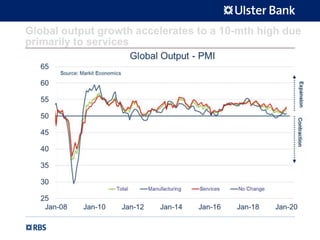
• Global output growth quickens to a 10-mth high (52.2) due largely to
services activity (52.7) but manufacturing eased up to 50.8
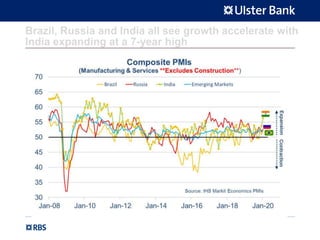
• Growth accelerates in US, EZ, UK, Brazil, Russia & Republic of Ireland
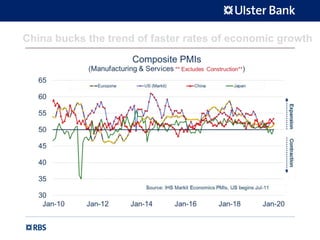
• US composite PMI rises to a 10-mth high of 53.3
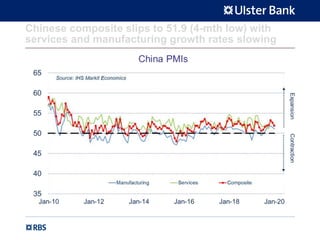
• Chinese composite slips to a 4-mth low of 51.9
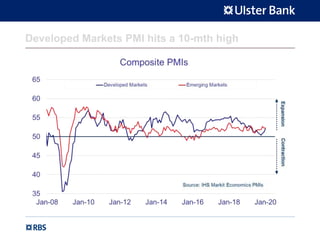
• Developed Markets’ PMI quickens to a 10-mth high (52.1)
• Developed Markets’ export orders fall for 13th successive month
• Global manufacturing export orders fall for 17th month in a row
• EZ composite improves to a 5-mth high of 51.3
• German manufacturing decline continues for 13th month running (45.3)
• Ireland’s composite PMI accelerates to an 11-mth high of 54.6
• UK composite PMI returns to growth & a 16-mth high of 52.8
• UK services accelerates to a 16-mth high (53.9) while manufacturing
activity was flat and construction’s contraction continues (48.4)
January 2020 Global PMIs – highlights
• Output falls for 11th mth in a row but pace of decline eases 46.8
• New orders stabilise (49.8) with a pick-up in domestic orders
• All four sectors saw output fall for the 8th month out of the last 9
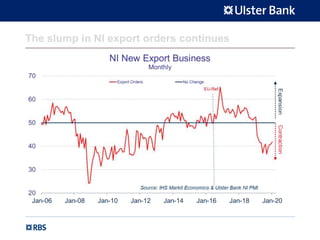
• Export orders slump continues for 12th month running (41.9)
• Manufacturing’s rate of decline in output accelerates to 42.8
• Services orders rise for the 1st time in 11 months (51.3)
• Staffing levels rise for the 2nd month running (51.0)
• Services firms hired at their fastest pace in 20 months (53.3)
• All sectors expect growth over the next 12 months
• NI firms still experiencing the highest input cost inflation in the UK
• NI saw the sharpest falls in output and orders of all UK regions
• NI firms are the most optimistic about year ahead in 21 months
• After Scotland, NI firms are the least optimistic for 12-mths ahead
January 2020 Northern Ireland PMI – Key highlights
Global output growth accelerates to a 10-mth high due
primarily to services
China bucks the trend of faster rates of economic growth
Developed Markets PMI hits a 10-mth high
Brazil, Russia and India all see growth accelerate with
India expanding at a 7-year high
Chinese composite slips to 51.9 (4-mth low) with
services and manufacturing growth rates slowing
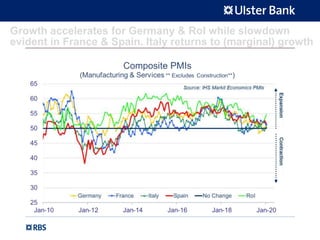
Growth accelerates for Germany & RoI while slowdown
evident in France & Spain. Italy returns to (marginal) growth
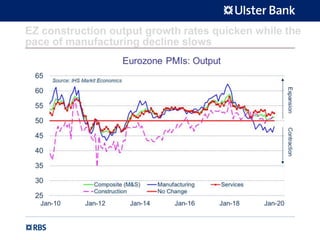
EZ construction output growth rates quicken while the
pace of manufacturing decline slows
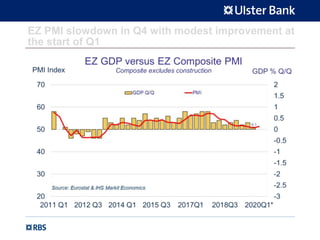
EZ PMI slowdown in Q4 with modest improvement at
the start of Q1
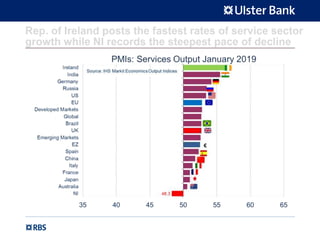
Rep. of Ireland posts the fastest rates of service sector
growth while NI records the steepest pace of decline
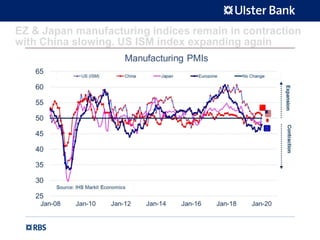
EZ & Japan manufacturing indices remain in contraction
with China slowing. US ISM index expanding again
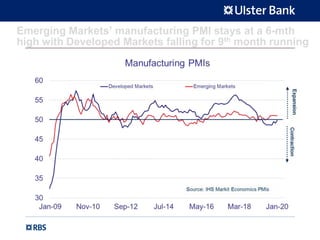
Emerging Markets’ manufacturing PMI stays at a 6-mth
high with Developed Markets falling for 9th month running
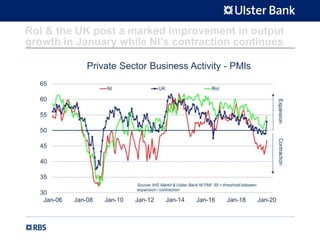
RoI & the UK post a marked improvement in output
growth in January while NI’s contraction continues
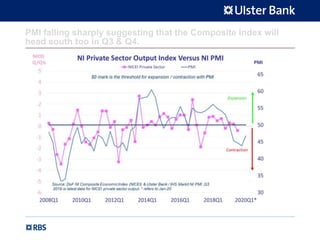
PMI falling sharply suggesting that the Composite Index will
head south too in Q3 & Q4.
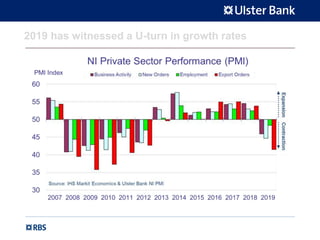
2019 has witnessed a U-turn in growth rates
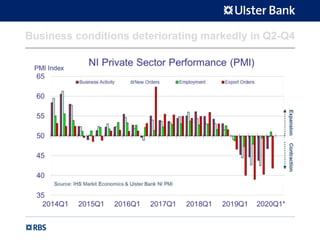
Business conditions deteriorating markedly in Q2-Q4
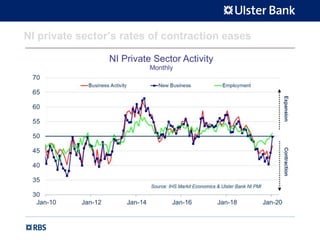
NI private sector’s rates of contraction eases
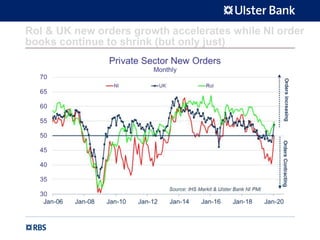
RoI & UK new orders growth accelerates while NI order
books continue to shrink (but only just)
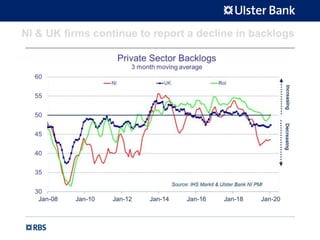
NI & UK firms continue to report a decline in backlogs
The slump in NI export orders continues
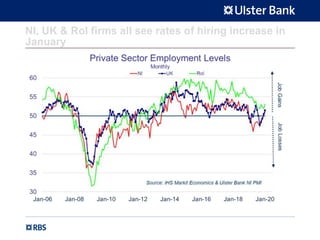
NI, UK & RoI firms all see rates of hiring increase in
January
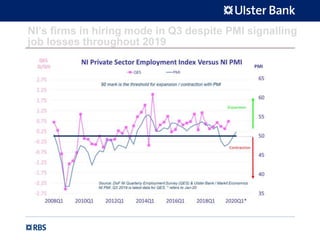
NI’s firms in hiring mode in Q3 despite PMI signalling
job losses throughout 2019
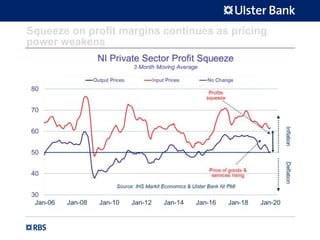
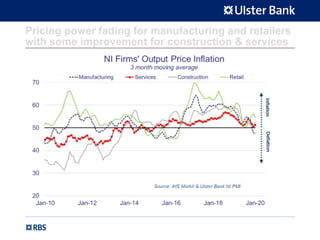
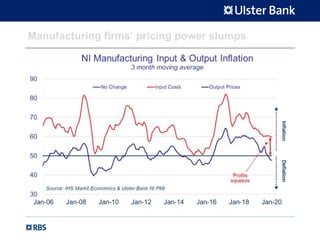
Squeeze on profit margins continues as pricing
power weakens
Regional
Comparisons
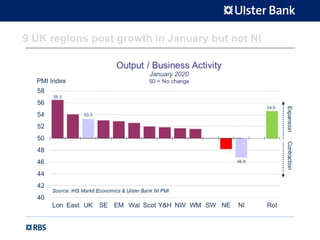
9 UK regions post growth in January but not NI
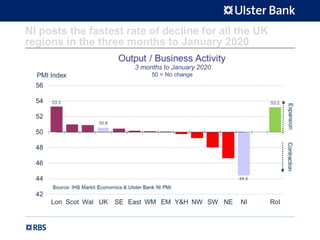
NI posts the fastest rate of decline for all the UK
regions in the three months to January 2020
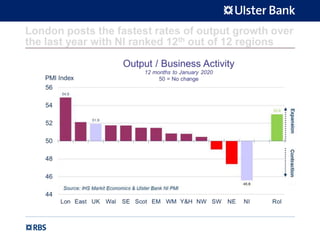
London posts the fastest rates of output growth over
the last year with NI ranked 12th out of 12 regions
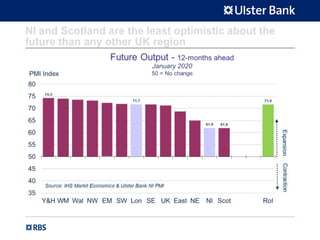
NI and Scotland are the least optimistic about the
future than any other UK region
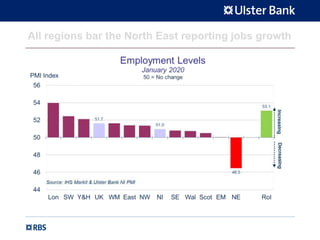
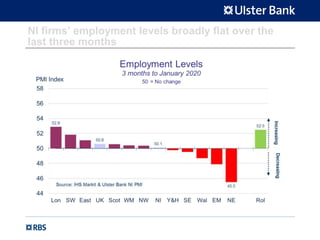
All regions bar the North East reporting jobs growth
NI firms’ employment levels broadly flat over the
last three months
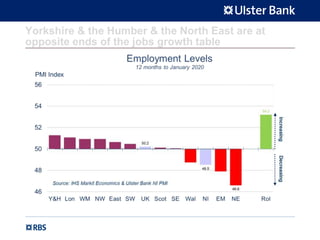
Yorkshire & the Humber & the North East are at
opposite ends of the jobs growth table
Sectoral
Comparisons
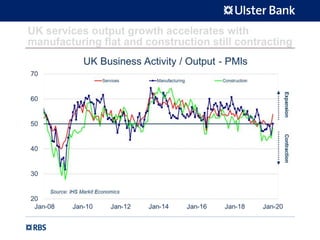
UK services output growth accelerates with
manufacturing flat and construction still contracting
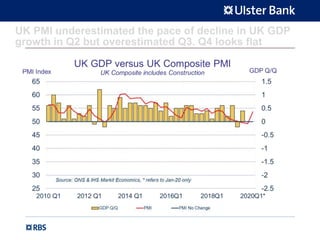
UK PMI underestimated the pace of decline in UK GDP
growth in Q2 but overestimated Q3. Q4 looks flat
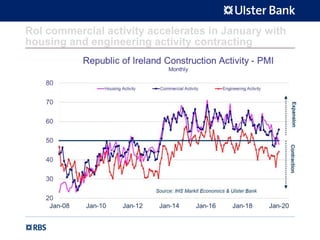
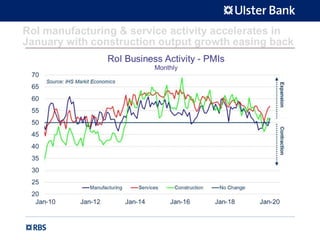
RoI manufacturing & service activity accelerates in
January with construction output growth easing back
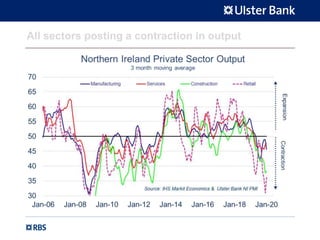
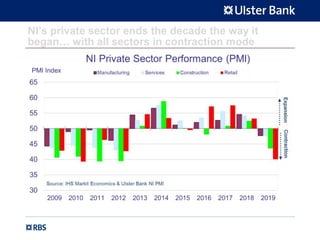
NI’s private sector ends the decade the way it
began… with all sectors in contraction mode
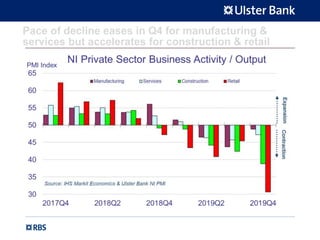
Pace of decline eases in Q4 for manufacturing &
services but accelerates for construction & retail
All sectors posting a contraction in output
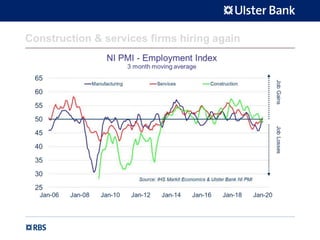
Construction & services firms hiring again
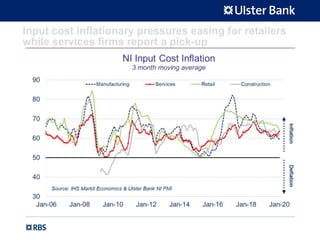
Input cost inflationary pressures easing for retailers
while services firms report a pick-up
Pricing power fading for manufacturing and retailers
with some improvement for construction & services
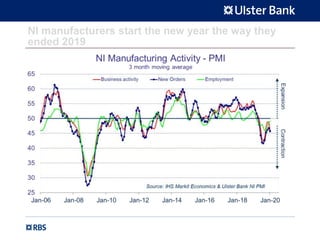
NI manufacturers start the new year the way they
ended 2019
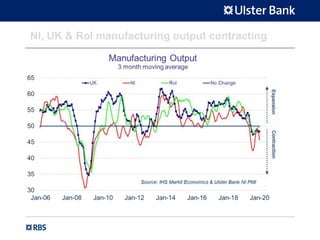
NI, UK & RoI manufacturing output contracting
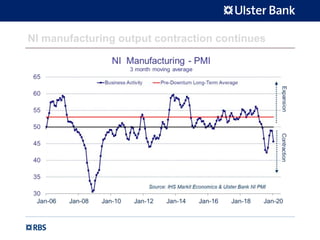
NI manufacturing output contraction continues
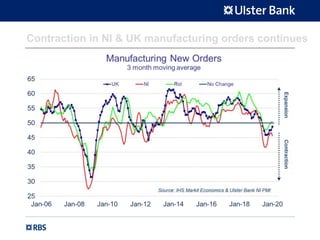
Contraction in NI & UK manufacturing orders continues
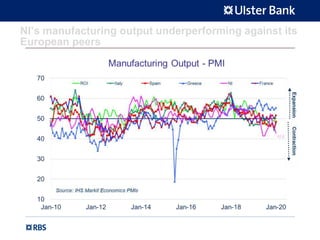
NI’s manufacturing output underperforming against its
European peers
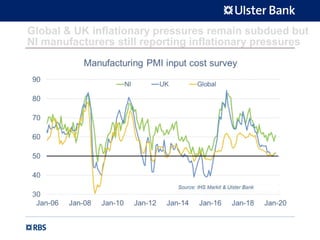
Global & UK inflationary pressures remain subdued but
NI manufacturers still reporting inflationary pressures
Manufacturing firms’ pricing power slumps
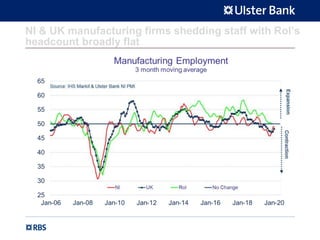
NI & UK manufacturing firms shedding staff with RoI’s
headcount broadly flat
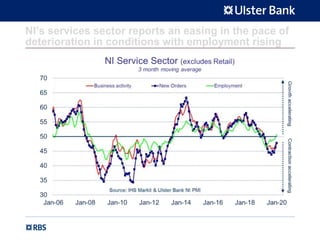
NI’s services sector reports an easing in the pace of
deterioration in conditions with employment rising
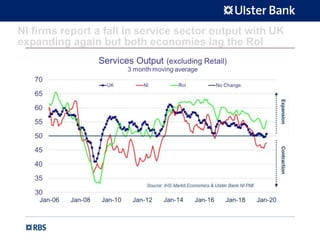
NI firms report a fall in service sector output with UK
expanding again but both economies lag the RoI
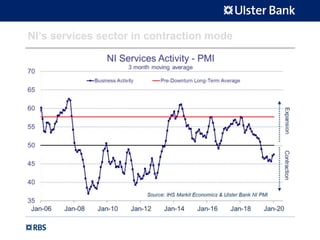
NI’s services sector in contraction mode
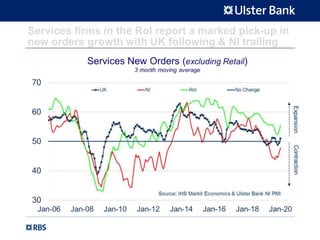
Services firms in the RoI report a marked pick-up in
new orders growth with UK following & NI trailing
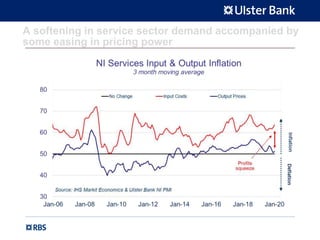
A softening in service sector demand accompanied by
some easing in pricing power
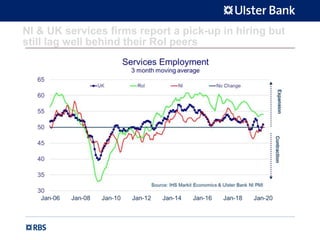
NI & UK services firms report a pick-up in hiring but
still lag well behind their RoI peers
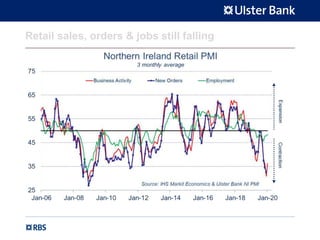
Retail sales, orders & jobs still falling
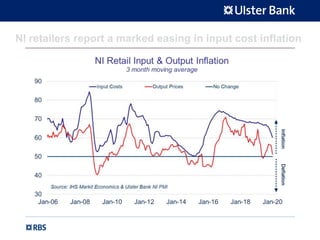
NI retailers report a marked easing in input cost inflation
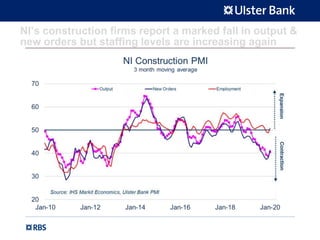
NI’s construction firms report a marked fall in output &
new orders but staffing levels are increasing again
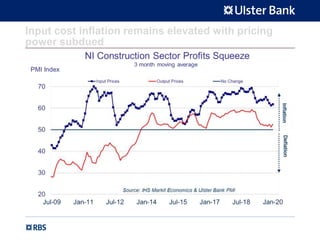
Input cost inflation remains elevated with pricing
power subdued
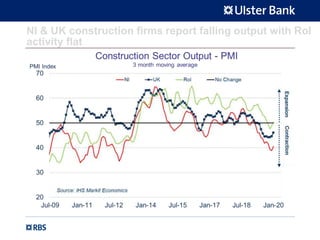
NI & UK construction firms report falling output with RoI
activity flat
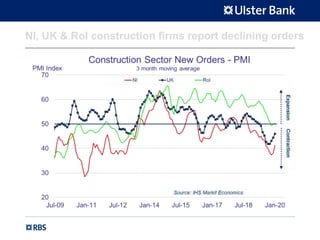
NI, UK & RoI construction firms report declining orders
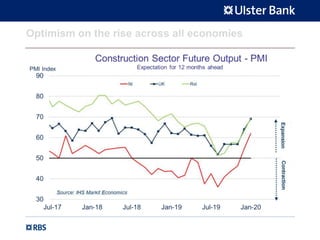
Optimism on the rise across all economies
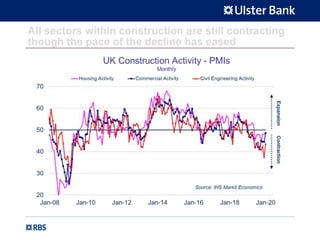
All sectors within construction are still contracting
though the pace of the decline has eased
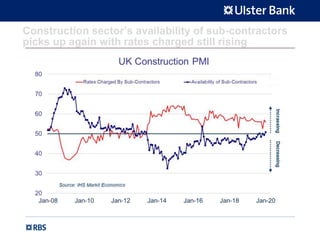
Construction sector’s availability of sub-contractors
picks up again with rates charged still rising
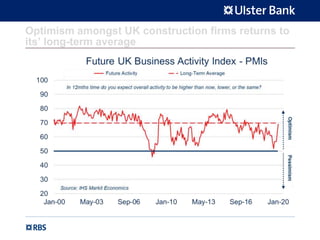
Optimism amongst UK construction firms returns to
its’ long-term average
RoI commercial activity accelerates in January with
housing and engineering activity contracting
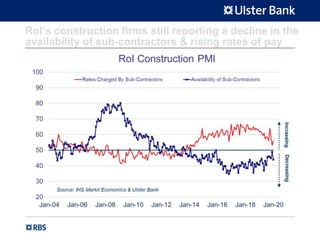
RoI’s construction firms still reporting a decline in the
availability of sub-contractors & rising rates of pay
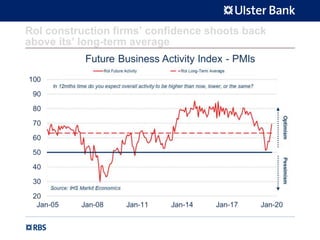
RoI construction firms’ confidence shoots back
above its’ long-term average
Slide 72
Disclaimer
This document is intended for clients of Ulster Bank Limited and Ulster Bank Ireland Limited (together and separately, "Ulster Bank") and is
not intended for any other person. It does not constitute an offer or invitation to purchase or sell any instrument or to provide any service in
any jurisdiction where the required authorisation is not held. Ulster Bank and/or its associates and/or its employees may have a position or
engage in transactions in any of the instruments mentioned.
The information including any opinions expressed and the pricing given, is indicative, and constitute our judgement at time of publication
and are subject to change without notice. The information contained herein should not be construed as advice, and is not intended to be
construed as such.
This publication provides only a brief review of the complex issues discussed and recipients should not rely on information contained here
without seeking specific advice on matters that concern them. Ulster Bank make no representations or warranties with respect to the
information and disclaim all liability for use the recipient or their advisors make of the information.
Over-the-counter (OTC) derivatives can involve a number of significant and complex risks which are dependent on the terms of the particular
transaction and your circumstances. In the event the market has moved against the transaction you have undertaken, you may incur
substantial costs if you wish to close out your position.
Calls may be recorded.

January 2020 PMI Chart Pack

  • 1.
    Ulster Bank NorthernIreland Purchasing Managers Index (PMI) Includes analysis of Global, Eurozone, UK, UK Regions, NI & Republic of Ireland economic performance by sector January 2020 Survey Update Issued 10th February 2020 Richard Ramsey Chief Economist Northern Ireland www.ulstereconomix.com richard.ramsey@ulsterbankcm.com Twitter @UB_Economics
  • 2.
    PMI Surveys Purchasing Managers’Indexes (PMIs) are monthly surveys of private sector companies which provide an advance indication of what is happening in the private sector economy by tracking variables such as output, new orders, employment and prices across different sectors. Index numbers are calculated from the percentages of respondents reporting an improvement, no change or decline on the previous month. These indices vary from 0 to 100 with readings of 50.0 signalling no change on the previous month. Readings above 50.0 signal an increase or improvement; readings below 50.0 signal a decline or deterioration. The greater the divergence from 50.0 the greater the rate of change (expansion or contraction). The indices are seasonally adjusted to take into consideration expected variations for the time of year, such as summer shutdowns or holidays. < 50.0 = Contraction 50.0 = No Change > 50.0 = Expansion Data at a sector level are more volatile and 3-month moving averages have been used to more accurately identify the broad trends.
  • 3.
    • Global outputgrowth quickens to a 10-mth high (52.2) due largely to services activity (52.7) but manufacturing eased up to 50.8 • Growth accelerates in US, EZ, UK, Brazil, Russia & Republic of Ireland • US composite PMI rises to a 10-mth high of 53.3 • Chinese composite slips to a 4-mth low of 51.9 • Developed Markets’ PMI quickens to a 10-mth high (52.1) • Developed Markets’ export orders fall for 13th successive month • Global manufacturing export orders fall for 17th month in a row • EZ composite improves to a 5-mth high of 51.3 • German manufacturing decline continues for 13th month running (45.3) • Ireland’s composite PMI accelerates to an 11-mth high of 54.6 • UK composite PMI returns to growth & a 16-mth high of 52.8 • UK services accelerates to a 16-mth high (53.9) while manufacturing activity was flat and construction’s contraction continues (48.4) January 2020 Global PMIs – highlights
  • 4.
    • Output fallsfor 11th mth in a row but pace of decline eases 46.8 • New orders stabilise (49.8) with a pick-up in domestic orders • All four sectors saw output fall for the 8th month out of the last 9 • Export orders slump continues for 12th month running (41.9) • Manufacturing’s rate of decline in output accelerates to 42.8 • Services orders rise for the 1st time in 11 months (51.3) • Staffing levels rise for the 2nd month running (51.0) • Services firms hired at their fastest pace in 20 months (53.3) • All sectors expect growth over the next 12 months • NI firms still experiencing the highest input cost inflation in the UK • NI saw the sharpest falls in output and orders of all UK regions • NI firms are the most optimistic about year ahead in 21 months • After Scotland, NI firms are the least optimistic for 12-mths ahead January 2020 Northern Ireland PMI – Key highlights
  • 5.
    Global output growthaccelerates to a 10-mth high due primarily to services
  • 6.
    China bucks thetrend of faster rates of economic growth
  • 7.
    Developed Markets PMIhits a 10-mth high
  • 8.
    Brazil, Russia andIndia all see growth accelerate with India expanding at a 7-year high
  • 9.
    Chinese composite slipsto 51.9 (4-mth low) with services and manufacturing growth rates slowing
  • 10.
    Growth accelerates forGermany & RoI while slowdown evident in France & Spain. Italy returns to (marginal) growth
  • 11.
    EZ construction outputgrowth rates quicken while the pace of manufacturing decline slows
  • 12.
    EZ PMI slowdownin Q4 with modest improvement at the start of Q1
  • 13.
    Rep. of Irelandposts the fastest rates of service sector growth while NI records the steepest pace of decline
  • 14.
    EZ & Japanmanufacturing indices remain in contraction with China slowing. US ISM index expanding again
  • 15.
    Emerging Markets’ manufacturingPMI stays at a 6-mth high with Developed Markets falling for 9th month running
  • 16.
    RoI & theUK post a marked improvement in output growth in January while NI’s contraction continues
  • 17.
    PMI falling sharplysuggesting that the Composite Index will head south too in Q3 & Q4.
  • 18.
    2019 has witnesseda U-turn in growth rates
  • 19.
  • 20.
    NI private sector’srates of contraction eases
  • 21.
    RoI & UKnew orders growth accelerates while NI order books continue to shrink (but only just)
  • 22.
    NI & UKfirms continue to report a decline in backlogs
  • 23.
    The slump inNI export orders continues
  • 24.
    NI, UK &RoI firms all see rates of hiring increase in January
  • 25.
    NI’s firms inhiring mode in Q3 despite PMI signalling job losses throughout 2019
  • 26.
    Squeeze on profitmargins continues as pricing power weakens
  • 27.
  • 28.
    9 UK regionspost growth in January but not NI
  • 29.
    NI posts thefastest rate of decline for all the UK regions in the three months to January 2020
  • 30.
    London posts thefastest rates of output growth over the last year with NI ranked 12th out of 12 regions
  • 31.
    NI and Scotlandare the least optimistic about the future than any other UK region
  • 32.
    All regions barthe North East reporting jobs growth
  • 33.
    NI firms’ employmentlevels broadly flat over the last three months
  • 34.
    Yorkshire & theHumber & the North East are at opposite ends of the jobs growth table
  • 35.
  • 36.
    UK services outputgrowth accelerates with manufacturing flat and construction still contracting
  • 37.
    UK PMI underestimatedthe pace of decline in UK GDP growth in Q2 but overestimated Q3. Q4 looks flat
  • 38.
    RoI manufacturing &service activity accelerates in January with construction output growth easing back
  • 39.
    NI’s private sectorends the decade the way it began… with all sectors in contraction mode
  • 40.
    Pace of declineeases in Q4 for manufacturing & services but accelerates for construction & retail
  • 41.
    All sectors postinga contraction in output
  • 42.
    Construction & servicesfirms hiring again
  • 43.
    Input cost inflationarypressures easing for retailers while services firms report a pick-up
  • 44.
    Pricing power fadingfor manufacturing and retailers with some improvement for construction & services
  • 45.
    NI manufacturers startthe new year the way they ended 2019
  • 46.
    NI, UK &RoI manufacturing output contracting
  • 47.
    NI manufacturing outputcontraction continues
  • 48.
    Contraction in NI& UK manufacturing orders continues
  • 49.
    NI’s manufacturing outputunderperforming against its European peers
  • 50.
    Global & UKinflationary pressures remain subdued but NI manufacturers still reporting inflationary pressures
  • 51.
  • 52.
    NI & UKmanufacturing firms shedding staff with RoI’s headcount broadly flat
  • 53.
    NI’s services sectorreports an easing in the pace of deterioration in conditions with employment rising
  • 54.
    NI firms reporta fall in service sector output with UK expanding again but both economies lag the RoI
  • 55.
    NI’s services sectorin contraction mode
  • 56.
    Services firms inthe RoI report a marked pick-up in new orders growth with UK following & NI trailing
  • 57.
    A softening inservice sector demand accompanied by some easing in pricing power
  • 58.
    NI & UKservices firms report a pick-up in hiring but still lag well behind their RoI peers
  • 59.
    Retail sales, orders& jobs still falling
  • 60.
    NI retailers reporta marked easing in input cost inflation
  • 61.
    NI’s construction firmsreport a marked fall in output & new orders but staffing levels are increasing again
  • 62.
    Input cost inflationremains elevated with pricing power subdued
  • 63.
    NI & UKconstruction firms report falling output with RoI activity flat
  • 64.
    NI, UK &RoI construction firms report declining orders
  • 65.
    Optimism on therise across all economies
  • 66.
    All sectors withinconstruction are still contracting though the pace of the decline has eased
  • 67.
    Construction sector’s availabilityof sub-contractors picks up again with rates charged still rising
  • 68.
    Optimism amongst UKconstruction firms returns to its’ long-term average
  • 69.
    RoI commercial activityaccelerates in January with housing and engineering activity contracting
  • 70.
    RoI’s construction firmsstill reporting a decline in the availability of sub-contractors & rising rates of pay
  • 71.
    RoI construction firms’confidence shoots back above its’ long-term average
  • 72.
    Slide 72 Disclaimer This documentis intended for clients of Ulster Bank Limited and Ulster Bank Ireland Limited (together and separately, "Ulster Bank") and is not intended for any other person. It does not constitute an offer or invitation to purchase or sell any instrument or to provide any service in any jurisdiction where the required authorisation is not held. Ulster Bank and/or its associates and/or its employees may have a position or engage in transactions in any of the instruments mentioned. The information including any opinions expressed and the pricing given, is indicative, and constitute our judgement at time of publication and are subject to change without notice. The information contained herein should not be construed as advice, and is not intended to be construed as such. This publication provides only a brief review of the complex issues discussed and recipients should not rely on information contained here without seeking specific advice on matters that concern them. Ulster Bank make no representations or warranties with respect to the information and disclaim all liability for use the recipient or their advisors make of the information. Over-the-counter (OTC) derivatives can involve a number of significant and complex risks which are dependent on the terms of the particular transaction and your circumstances. In the event the market has moved against the transaction you have undertaken, you may incur substantial costs if you wish to close out your position. Calls may be recorded.