JAMES 2 COMME TARY
EDITED BY GLE PEASE
1
My brothers, as believers in our glorious Lord Jesus Christ,
don't show favoritism.
BAR ES, "James, a servant of God - On the meaning of the word “servant” in
this connection, see the note at Rom_1:1. Compare the note at Phm_1:16. It is
remarkable that James does not call himself an apostle; but this does not prove that the
writer of the Epistle was not an apostle, for the same omission occurs in the Epistle of
John, and in the Epistle of Paul to the Philippians, the Thessalonians, and to Philemon.
It is remarkable, also, considering the relation which James is supposed to have borne to
the Lord Jesus as his “brother” (Gal_1:19; Introduction, 1). That he did not refer to that
as constituting a ground of claim to his right to address others; but this is only one
instance out of many, in the New Testament, in which it is regarded as a higher honor to
be the “servant of God,” and to belong to his family, than to sustain any relations of
blood or kindred. Compare Mat_11:50. It may be observed also (Compare the
introduction, Section 1), that this term is one which was especially appropriate to James,
as a man eminent for his integrity. His claim to respect and deference was not primarily
founded on any relationship which he sustained; any honor of birth or blood; or even
any external office, but on the fact that he was a “servant of God.”
And of the Lord Jesus Christ - The “servant of the Lord Jesus,” is an appellation
which is often given to Christians, and particularly to the ministers of religion. They are
his servants, not in the sense that they are slaves, but in the sense that they voluntarily
obey his will, and labor for him, and not for themselves.
To the twelve tribes which are scattered abroad - Greek “The twelve tribes
which are in the dispersion,” or of the dispersion (ᅚν τሀ διασπορᇱ en tē diaspora). This
word occurs only here and in 1Pe_1:1, and Joh_7:35. It refers properly to those who
lived out of Palestine, or who were scattered among the Gentiles. There were two great
“dispersions;” the Eastern and the Western. The first had its origin about the time when
the ten tribes were carried away to Assyria, and in the time of the Babylonian captivity.
In consequence of these events, and of the fact that large numbers of the Jews went to
Babylon, and other Eastern countries, for purposes of travel, commerce, etc., there were
many Jews in the East in the times of the apostles. The other was the Western
“dispersion,” which commenced about the time of Alexander the Great, and which was
promoted by various causes, until there were large numbers of Jews in Egypt and along
Northern Africa, in Asia Minor, in Greece proper, and even in Rome. To which of these
classes this Epistle was directed is not known; but most probably the writer had
particular reference to those in the East. See the introduction, Section 2. The phrase “the
twelve tribes,” was the common term by which the Jewish people were designated, and
was in use long after the ten tribes were carried away, leaving, in fact, only two of the
twelve in Palestine. Compare the notes at Act_26:7. Many have supposed that James
here addressed them as Jews, and that the Epistle was sent to them as such. But this
opinion has no probability; because:
(1) If this had been the case, he would not have been likely to begin his Epistle by
saying that he was “a servant of Jesus Christ,” a name so odious to the Jews.
(2) And, if he had spoken of himself as a Christian, and had addressed his countrymen
as himself a believer in Jesus as the Messiah, though regarding them as Jews, it is
incredible that he did not make a more distinct reference to the principles of the
Christian religion; that he used no arguments to convince them that Jesus was the
Messiah; that he did not attempt to convert them to the Christian faith.
It should be added, that at first most converts were made from those who had been
trained in the Jewish faith, and it is not improbable that one in Jerusalem, addressing
those who were Christians out of Palestine, would naturally think of them as of Jewish
origin, and would be likely to address them as appertaining to the “twelve tribes.” The
phrase “the twelve tribes” became also a sort of technical expression to denote the
people of God - the church.
Greeting - A customary form of salutation, meaning, in Greek, to joy, to rejoice; and
implying that he wished their welfare. Compare Act_15:23.
CLARKE, "James, a servant of God - For an account of this person, or rather for
the conjectures concerning him, see the preface. He neither calls himself an apostle, nor
does he say that he was the brother of Christ, or bishop of Jerusalem; whether he was
James the elder, son of Zebedee, or James the less, called our Lord’s brother, or some
other person of the same name, we know not. The assertions of writers concerning these
points are worthy of no regard. The Church has always received him as an apostle of
Christ.
To the twelve tribes - scattered abroad - To the Jews, whether converted to
Christianity or not, who lived out of Judea, and sojourned among the Gentiles for the
purpose of trade or commerce. At this time there were Jews partly traveling, partly
sojourning, and partly resident in most parts of the civilized world; particularly in Asia,
Greece, Egypt, and Italy. I see no reason for restricting it to Jewish believers only; it was
sent to all whom it might concern, but particularly to those who had received the faith of
our Lord Jesus Christ; much less must we confine it to those who were scattered abroad
at the persecution raised concerning Stephen, Act_8:1, etc.; Act_11:19, etc. That the
twelve tribes were in actual existence when James wrote this epistle, Dr. Macknight
thinks evident from the following facts:
“1. Notwithstanding Cyrus allowed all the Jews in his dominions to return to their
own land, many of them did not return. This happened agreeably to God’s
purpose, in permitting them to be carried captive into Assyria and Babylonia; for
he intended to make himself known among the heathens, by means of the
knowledge of his being and perfections, which the Jews, in their dispersion, would
communicate to them. This also was the reason that God determined that the ten
tribes should never return to their own land, Hos_1:6; Hos_8:8; Hos_9:3, Hos_
9:15-17.
2. That, comparatively speaking, few of the twelve tribes returned in consequence of
Cyrus’s decree, but continued to live among the Gentiles, appears from this: that in
the days of Ahasuerus, one of the successors of Cyrus, who reigned from India to
Ethiopia, over one hundred and twenty-seven provinces, Est_3:8, The Jews were
dispersed among the people in all the provinces of his kingdom, and their laws
were diverse from the laws of all other people, and they did not keep the king’s
laws; so that, by adhering to their own usages, they kept themselves distinct from
all the nations among whom they lived.
3. On the day of pentecost, which happened next after our Lord’s ascension, Act_2:5,
Act_2:9, There were dwelling at Jerusalem Jews, devout men, out of every nation
under heaven; Parthians, Medes, and Elamites, etc.; so numerous were the Jews,
and so widely dispersed through all the countries of the world.
4. When Paul traveled through Asia and Europe, he found the Jews so numerous,
that in all the noted cities of the Gentiles they had synagogues in which they
assembled for the worship of God, and were joined by multitudes of proselytes
from among the heathens, to whom likewise he preached the Gospel.
5. The same apostle, in his speech to King Agrippa, affirmed that the twelve tribes
were then existing, and that they served God day and night, in expectation of the
promise made to the fathers, Act_26:6.
6. Josephus, Ant. i. 14, cap. 12, tells us that one region could not contain the Jews,
but they dwelt in most of the flourishing cities of Asia and Europe, in the islands
and continent, not much less in number than the heathen inhabitants. From all
this it is evident that the Jews of the dispersion were more numerous than even
the Jews in Judea, and that James very properly inscribed this letter to the twelve
tribes which were in the dispersion, seeing the twelve tribes really existed then,
and do still exist, although not distinguished by separate habitations, as they were
anciently in their own land.
Greeting - Χαιρειν· Health; a mere expression of benevolence, a wish for their
prosperity; a common form of salutation; see Act_15:23; Act_23:26; 2Jo_1:11.
GILL, "James, a servant of God - For an account of this person, or rather for the
conjectures concerning him, see the preface. He neither calls himself an apostle, nor
does he say that he was the brother of Christ, or bishop of Jerusalem; whether he was
James the elder, son of Zebedee, or James the less, called our Lord’s brother, or some
other person of the same name, we know not. The assertions of writers concerning these
points are worthy of no regard. The Church has always received him as an apostle of
Christ.
To the twelve tribes - scattered abroad - To the Jews, whether converted to
Christianity or not, who lived out of Judea, and sojourned among the Gentiles for the
purpose of trade or commerce. At this time there were Jews partly traveling, partly
sojourning, and partly resident in most parts of the civilized world; particularly in Asia,
Greece, Egypt, and Italy. I see no reason for restricting it to Jewish believers only; it was
sent to all whom it might concern, but particularly to those who had received the faith of
our Lord Jesus Christ; much less must we confine it to those who were scattered abroad
at the persecution raised concerning Stephen, Act_8:1, etc.; Act_11:19, etc. That the
twelve tribes were in actual existence when James wrote this epistle, Dr. Macknight
thinks evident from the following facts:
“1. Notwithstanding Cyrus allowed all the Jews in his dominions to return to their
own land, many of them did not return. This happened agreeably to God’s
purpose, in permitting them to be carried captive into Assyria and Babylonia; for
he intended to make himself known among the heathens, by means of the
knowledge of his being and perfections, which the Jews, in their dispersion, would
communicate to them. This also was the reason that God determined that the ten
tribes should never return to their own land, Hos_1:6; Hos_8:8; Hos_9:3, Hos_
9:15-17.
2. That, comparatively speaking, few of the twelve tribes returned in consequence of
Cyrus’s decree, but continued to live among the Gentiles, appears from this: that in
the days of Ahasuerus, one of the successors of Cyrus, who reigned from India to
Ethiopia, over one hundred and twenty-seven provinces, Est_3:8, The Jews were
dispersed among the people in all the provinces of his kingdom, and their laws
were diverse from the laws of all other people, and they did not keep the king’s
laws; so that, by adhering to their own usages, they kept themselves distinct from
all the nations among whom they lived.
3. On the day of pentecost, which happened next after our Lord’s ascension, Act_2:5,
Act_2:9, There were dwelling at Jerusalem Jews, devout men, out of every nation
under heaven; Parthians, Medes, and Elamites, etc.; so numerous were the Jews,
and so widely dispersed through all the countries of the world.
4. When Paul traveled through Asia and Europe, he found the Jews so numerous,
that in all the noted cities of the Gentiles they had synagogues in which they
assembled for the worship of God, and were joined by multitudes of proselytes
from among the heathens, to whom likewise he preached the Gospel.
5. The same apostle, in his speech to King Agrippa, affirmed that the twelve tribes
were then existing, and that they served God day and night, in expectation of the
promise made to the fathers, Act_26:6.
6. Josephus, Ant. i. 14, cap. 12, tells us that one region could not contain the Jews,
but they dwelt in most of the flourishing cities of Asia and Europe, in the islands
and continent, not much less in number than the heathen inhabitants. From all
this it is evident that the Jews of the dispersion were more numerous than even
the Jews in Judea, and that James very properly inscribed this letter to the twelve
tribes which were in the dispersion, seeing the twelve tribes really existed then,
and do still exist, although not distinguished by separate habitations, as they were
anciently in their own land.
Greeting - Χαιρειν· Health; a mere expression of benevolence, a wish for their
prosperity; a common form of salutation; see Act_15:23; Act_23:26; 2Jo_1:11.
HE RY, "We have here the inscription of this epistle, which consists of three
principal parts.
I. The character by which our author desires to be known: James, a servant of God,
and of the Lord Jesus Christ. Though he was a prime-minister in Christ's kingdom, yet
he styles himself only a servant. Note hence, Those who are highest in office or
attainments in the church of Christ are but servants. They should not therefore act as
masters, but as ministers. Further, Though James is called by the evangelist the brother
of our Lord, yet it was his glory to serve Christ in the spirit, rather than to boast of his
being akin according to the flesh. Hence let us learn to prize this title above all others in
the world - the servants of God and of Christ. Again, it is to be observed that James
professes himself a servant of God and of the Lord Jesus Christ; to teach us that in all
services we should have an eye to the Son as well as the Father. We cannot acceptably
serve the Father, unless we are also servants of the Son. God will have all men to honour
the Son as they honour the Father (Joh_5:23), looking for acceptance in Christ and
assistance from him, and yielding all obedience to him, thus confessing that Jesus Christ
is Lord, to the glory of God the Father.
II. The apostle here mentions the condition of those to whom he writes: The twelve
tribes which are scattered abroad. Some understand this of the dispersion upon the
persecution of Stephen, Acts 8. But that only reached to Judea and Samaria. Others by
the Jews of the dispersion understand those who were in Assyria, Babylon, Egypt, and
other kingdoms into which their wars had driven them. The greatest part indeed of ten
of the twelve tribes were lost in captivity; but yet some of every tribe were preserved and
they are still honoured with the ancient style of twelve tribes. These however were
scattered and dispersed. 1. They were dispersed in mercy. Having the scriptures of the
Old Testament, the providence of God so ordered it that they were scattered in several
countries for the diffusing of the light of divine revelation. 2. They began now to be
scattered in wrath. The Jewish nation was crumbling into parties and factions, and many
were forced to leave their own country, as having now grown too hot for them. Even
good people among them shared in the common calamity. 3. These Jews of the
dispersion were those who had embraced the Christian faith. They were persecuted and
forced to seek for shelter in other countries, the Gentiles being kinder to Christians than
the Jews were. Note here, It is often the lot even of God's own tribes to be scattered
abroad. The gathering day is reserved for the end of time; when all the dispersed
children of God shall be gathered together to Christ their head. In the mean time, while
God's tribes are scattered abroad, he will send to look after them. Here is an apostle
writing to the scattered; an epistle from God to them, when driven away from his temple,
and seemingly neglected by him. Apply here that of the prophet Ezekiel, Thus saith the
Lord God, Although I have cast them far off among the heathen, and although I have
scattered them among the countries, yet will I be to them as a little sanctuary in the
countries where they shall come, Eze_11:16. God has a particular care of his outcasts.
Let my outcasts dwell with thee, Moab, Isa_16:3, Isa_16:4. God's tribes may be
scattered; therefore we should not value ourselves too much on outward privileges. And,
on the other hand, we should not despond and think ourselves rejected, under outward
calamities, because God remembers and sends comfort to his scattered people.
III. James here shows the respect he had even for the dispersed: greeting, saluting
them, wishing peace and salvation to them. True Christians should not be the less valued
for their hardships. It was the desire of this apostle's heart that those who were scattered
might be comforted - that they might do well and fare well, and be enabled to rejoice
even in their distresses. God's people have reason to rejoice in all places, and at all times;
as will abundantly appear from what follows.
JAMISO , "Jam_1:1-27. Inscription: Exhortation on hearing, speaking, and wrath.
The last subject is discussed in James 3:13-4:17.
James — an apostle of the circumcision, with Peter and John, James in Jerusalem,
Palestine, and Syria; Peter in Babylon and the East; John in Ephesus and Asia Minor.
Peter addresses the dispersed Jews of Pontus, Galatia, and Cappadocia; James, the
Israelites of the twelve tribes scattered abroad.
servant of God — not that he was not an apostle; for Paul, an apostle, also calls
himself so; but as addressing the Israelites generally, including even indirectly the
unbelieving, he in humility omits the title “apostle”; so Paul in writing to the Hebrews;
similarly Jude, an apostle, in his General Epistle.
Jesus Christ — not mentioned again save in Jam_2:1; not at all in his speeches (Act_
15:14, Act_15:15; Act_21:20, Act_21:21), lest his introducing the name of Jesus oftener
should seem to arise from vanity, as being “the Lord’s brother” [Bengel]. His teaching
being practical, rather than doctrinal, required less frequent mention of Christ’s name.
scattered abroad — literally “which are in the dispersion.” The dispersion of the
Israelites, and their connection with Jerusalem as a center of religion, was a divinely
ordered means of propagating Christianity. The pilgrim troops of the law became
caravans of the Gospel [Wordsworth].
greeting — found in no other Christian letter, but in James and the Jerusalem
Synod’s Epistle to the Gentile churches; an undesigned coincidence and mark or
genuineness. In the original Greek (chairein) for “greeting,” there is a connection with the
“joy” to which they are exhorted amidst their existing distresses from poverty and
consequent oppression. Compare Rom_15:26, which alludes to their poverty.
CALVI , "This reproof seems at first sight to be hard and unreasonable; for it is
one of the duties of courtesy, not to be neglected, to honor those who are elevated in
the world. Further, if respect of persons be vicious, servants are to be freed from all
subjection; for freedom and servitude are deemed by Paul as conditions of life. The
same must be thought of magistrates. But the solution of these questions is not
difficult, if what James writes is not separated. For he does not simply disapprove of
honor being paid to the rich, but that this should not be done in a way so as to
despise or reproach the poor; and this will appear more clearly, when he
PROCEEDS to speak of the rule of love.
Let us therefore remember that the respect of persons here condemned is that by
which the rich is so extolled, wrong is done to the poor, which also he shews clearly
by the context and surely ambitions is that honor, and full of vanity, which is shewn
to the rich to the contempt of the poor. or is there a doubt but that ambition reigns
and vanity also, when the masks of this world are alone in high esteem. We must
remember this truth, that he is to be counted among the heirs of God’s kingdom,
who disregards the reprobate and honors those who fear God. (Psalms 15:4.)
Here then is the contrary vice condemned, that is, when from respect alone to riches,
anyone honors the wicked, and as it has been said, dishonors the good. If then thou
shouldest read thus, “He sins who respects the rich,” the sentence would be absurd;
but if as follows, “He sins who honors the rich alone and despises the poor, and
treats him with contempt,” it would be a pious and true doctrine.
1Have not the faith, etc. , with respect of persons. He means that the respect of
persons is inconsistent with the faith of Christ, so that they cannot be united
together, and rightly so; for we are by faith united into one body, in which Christ
holds the primacy. When therefore the pomps of the world become preeminent so as
to cover over what Christ is, it is evident that faith hath but little vigor.
In rendering τὢς δόξης, “on ACCOU T of esteem,” (ex opinione ,) I have followed
Erasmus; though the old interpreter cannot be blamed, who has rendered it “glory,”
for the word means both; and it may be fitly applied to Christ, and that according to
the drift of the passage. For so great is the brightness of Christ, that it easily
extinguishes all the glories of the world, if I DEED it irradiates our eyes. It hence
follows, that Christ is little esteemed by us, when the admiration of worldly glory
lays hold on us. But the other exposition is also very suitable, for when the esteem or
value of riches or of honors dazzles our eyes, the truth is suppressed, which ought
alone to prevail. To sit becomingly means to sit honorably.
BARCLAY, "RESPECT OF PERSO S (James 2:1)
2:1 My brothers, you cannot really believe that you have faith in our glorious Lord
Jesus Christ, and yet CO TI UE to have respect of persons.
Respect of persons is the ew Testament phrase for undue and unfair partiality; it
means pandering to someone, because he is rich or influential or popular. It is a
fault which the ew Testament consistently condemns. It is a fault of which the
orthodox Jewish leaders completely acquitted Jesus. Even they were bound to admit
that there was no respect of persons with him (Luke 20:21; Mark 12:14; Matthew
22:16). After his vision of the sheet with the clean and unclean animals upon it, the
lesson that Peter learned was that with God there is no respect of persons (Acts
10:34). It was Paul's conviction that Gentile and Jew stand under a like judgment in
the sight of God, for with God there is no favouritism (Romans 2:11). This is a truth
which Paul urges on his people again and again (Ephesians 6:9; Colossians 3:25).
The word itself is curious--prosopolempsia (Greek #4382). The noun comes from the
expression prosopon (Greek #4383) lambanein (Greek #2983). Prosopon (Greek #
4383) is the "face"; and lambanein (Greek #2983) here means "to lift up." The
expression in Greek is a literal TRA SLATIO of a Hebrew phrase. To lift up a
person's countenance was to regard him with favour, in contradistinction perhaps
to casting down his countenance.
Originally it was not a bad word at all; it simply meant to accept a person with
favour. Malachi asks if the governor will be pleased with the people and will accept
their persons, if they bring him blemished offerings (Malachi 1:8-9). But the word
rapidly acquired a bad sense. It SOO began to mean, not so much to favour a
person, as to show favouritism, to allow oneself to be unduly influenced by a
person's social status or prestige or power or wealth. Malachi goes on to condemn
that very sin when God accuses the people of not keeping his ways and of being
partial in their judgments (Malachi 2:9). The great characteristic of God is his
complete impartiality. In the Law it was written, "You shall do no injustice in
judgment; you shall not be partial to the poor or defer to the great, but in
righteousness shall you judge YOUR neighbour" (Leviticus 19:15). There is a
necessary emphasis here. A person may be unjust because of the snobbery which
truckles to the rich; and may be equally unjust because of the inverted snobbery
which glorifies the poor. "The Lord," said Ben Sirach, "is judge and with him is no
respect of persons" (Sirach 35:12).
The Old and ew Testaments unite in condemning that partiality of judgment and
favouritism of treatment which comes of giving undue weight to a man's social
standing, wealth or worldly influence. And it is a fault to which every one is more or
less liable. "The rich and the poor meet together," says Proverbs, "the Lord is the
maker of them all" (Proverbs 22:2). "It is not meet," says Ben Sirach, "to despise
the poor man that hath understanding; neither is it fitting to magnify a sinful man
that is rich" (Sirach 10:23). We do well to remember that it is just as much respect
of persons to truckle to the mob as it is to pander to a tyrant.
ELLICOTT, "(1) My brethren.—The second chapter OPE S with some stern
rebukes for those unworthy Christians who had “men’s persons in admiration,”
and, doubtless, that “because of advantage” to themselves. (Comp. Jude 1:16.) The
lesson is distinctly ADDRESSED to believers, and its severity appears to be caused
by the Apostle’s unhappy consciousness of its need. What were endurable in a
heathen, or an alien, or even a Jew, ceased to be so in a professed follower of the
lowly Jesus. And this seems to be a further reason for the indignant expostulation
and condemnation of James 2:14. Thus the whole chapter may really be considered
as dealing with Faith; and it flows naturally from the foregoing thoughts upon
Religion—or, as we interpreted their subject-matter, Religious Service.
Have (or, hold) not the faith of our Lord Jesus Christ, the Lord of glory, with (or,
in) respect of persons.—“Ye know the grace of our Lord Jesus Christ,” wrote St.
Paul to the proud and wealthy men of Corinth (2 Corinthians 8:9), “that, though He
was rich, yet for YOUR sakes He became poor, that ye through His poverty might
be rich;” and, with more cogent an appeal, to the Philippians (James 2:4-7), “In
lowliness of mind let each esteem other better than themselves: look not every man
on his own things, but every man also on the things of others. Let this mind be in
you, which was also in Christ Jesus: Who, being in the form of God”—i.e., Very
God, and not appearance merely—nevertheless “thought not His equality with God
a thing to be always grasped at,” as it were some booty or prize, “but emptied
Himself” of His glory, “and took upon Him the shape of a slave.” Were these
central, nay initial, facts of the faith believed then; or are they now? If they were in
truth, how could there be such folly and shame as “acceptance of persons”
ACCORDI G to the dictates of fashionable society and the world? “Honour,”
indeed, “to whom honour” is due (Romans 13:7). The Christian religion allows not
that contempt for even earthly dignities—affected by some of her followers, but
springing more from envy and unruliness than aught besides. True reverence and
submission are in no way condemned by this scripture: but their excess and gross
extreme, the preference for vulgar wealth, the adulation of success, the worship, in
short, of some new golden calf.
BURKITT, "For the better understanding of these words, let us consider. 1. What
the apostle doth not; 2. What he doth condemn. 3. What is here not condemned,
namely,
1. The paying of civil respect to all persons, ACCORDI G to their character, and a
different respect to persons, according to their different qualities: honour is to be
given to whom honour is due, and the rich are entitled to respect; and that they
receive it from us, is no ways displeasing unto God.
2. Much less does our apostle here speak against honouring magistrates, or paying
respect to our ecclesiastical or civil rulers and governors in their courts or
judicature: civility, yea, Christianity, calls for outward respect and reverence to
them that are above us, especially if in authority over us.
But POSITIVELY, that which is here condemned, 1. In general, is partiality in our
respect to persons in religious matters, for in the things of God all are equal: the
rich and the poor stand upon the same terms of advantage; external relations and
differences bear no weight at the gospel-beam; therefore, to disesteem any of the
poor members of Christ, as such, is to disesteem and undervalue Christ himself.
Holiness in not less lovely to him because clothed with rags, nor unholiness less
loathsome because it goes in a gay coat with a gold ring. Wickedness is abominable
to Christ, and ought to be so to us, though it sits upon a throne, and holiness shines
in his eye, (and may it in ours also,) though it lies upon a dunghill.
2. That which seems here to be condemned in particular, is the accepting of persons
in judgment, upon the ACCOU T of outward advantages, proceeding not
according to the merits of the cause, in their ecclesiastical and civil judicatures, but
according to external respects. Our apostle would by no means have them pay a
deference to a rich man in judgment because of his riches, or gay attire; nor to pass
over the poor saints in their assemblies, for want of the gold ring, and goodly
apparel, seeing their faith clothed them with a greater and a more valuable glory,
which renders them more honourable than any riches or gay clothing could do.
And mark the apostle's vehement expostulation, which carries with it the force of a
severe reprehension; Are you not partial, and become judges of evil thoughts? As if
he had said, "Are ye not condemned in yourselves, and convinced in YOUR own
consciences that you do evil? Are ye not become judges of evil thoughts; that is, do
you not pass judgment from your evil thoughts, in thinking the rich worthy of
respect in judgment for his gorgeous attire, and outward greatness, and the poor fit
to be despised for his outward meanness? Is not this an evil, a very evil thought in
you, to think him the best man that weareth the best clothes, and him a vile person
that is in vile apparel?
From the whole learn, 1. That men are very prone to honour worldly greatness in
general, yea, to give too great a preference to it, even in matters of judgment. Man is
very often swayed in judgment by the power, pomp, and splendour of men; we are
apt to think that they that are worth most are most worthy: thus men, good men,
may mis-judge of men; but thus to accept the persons of men, either in spiritual or
civil judgment, is a provoking sin.
DAVID ROPER, "James’ mentioning of Christ as the Lord of glory is significant.
The very fact that God Himself was willing to forsake His glory to save a sinful and
unloving people as us reveals His impartiality (Phil 2:5-8). There is no respect of
persons with God (2 Chron 19:7, Rom 2:11, Eph 6:9, Col 3:25) .
When James mentioned the glory of the Lord Jesus Christ, he must be referring to
the privileged opportunity he had along with Peter and John in seeing the Lord
transfigured before their very eyes. For a moment, they saw the shekinah glory of
the living God. John spoke of that marvellous experience in his gospel in John 1:14,
"And the Word was made flesh, and dwelt among us, (and we beheld his glory, the
glory as of the only begotten of the father,) full of grace and truth." Peter gave his
testimony concerning the transfiguration in 2 Pet 1:16-17, "For we have not
followed cunningly devised fables, when we made known unto you the power and
coming of our Lord Jesus Christ, but were eyewitnesses of his majesty. For he
received from God the Father honour and glory, when there came such a voice to
him from the excellent glory, This is my beloved Son, in whom I am well pleased."
I have a friend back in Texas who told me an unforgettable Texas story about ten
years ago and I've never been able to get the thing out of my mind because it is so
true. There was a young attorney with a law firm in Dallas, a bachelor about
twenty-eight or twenty-nine-years-old who lived alone in an apartment. It was
customary every Thanksgiving for this particular law firm to distribute turkeys
among the employees and this man could never figure out what to do with his. Being
single he really didn't want to cook the thing and he could never consume all of it
anyway. So every Thanksgiving it was a problem to know how to dispose of this
bird. The distribution of the turkeys was always with a great deal of pomp and
ceremony. The president of the firm would line them all up on a table, and each
person would have to file by and get his turkey.
One particular Thanksgiving some of this young man's friends decided they would
do him in. So they stole his turkey and replaced it with a bogus one made of paper-
mache. They wrapped it with brown paper and had just the neck and tail of the real
turkey showing. It looked for all the world like the others. The time came to
distribute them and when the president gave him his he took it home on the
streetcar.
He was sitting there with this thing in his lap when a man came down the aisle and
sat down with him. He was obviously down an his luck, a little shabby and run
down at the heels. They struck up a conversation and the man told what had
happened to him. He had been hunting for a job all day but had had no luck
whatever. He had only a dollar or two in his pocket with which to buy something for
a Thanksgiving meal for his family. He was quite concerned because he knew his
children would be disappointed.
So the light came on in this young attorney's mind. He thought, "Here's where I can
do my new friend a service and can also get rid of this bird." His first thought was
to give him the turkey but then he thought, " o, that might offend him. I'll sell him
the turkey." So he asked the man how much money he had with him. The man said,
"Two dollars." He said, "I'll sell you the turkey for two dollars." So they made the
transaction and both were very satisfied. The man got off the street car with his
turkey and the attorney went home with his money.
Well, you can imagine the scene when this man arrived at his home. The children
gathered around the table, all excited, and they unwrapped the turkey and there
was this phony bird. You know what he must have thought. "Of all the dirty, low-
down, no-good blankety-blanks, that guy takes the cake!" To make a long story
short, the young attorney went back to the office the day after Thanksgiving and
discovered what had happened. He was appalled, and he and his friends rode the
streetcar for a whole week trying to find this man again. They walked the streets
and knocked on doors. They would have done anything to set this matter right but
they never found him.
That story keeps coming back to me because it depicts so vividly the impossibility of
judging the motives of other people. We simply do not know their hearts. Our
tendency so often is to cast judgment on a person because of something that he does,
or because of some outward appearance, or some other external factor, when we
simply don't know what is going on inside. James addresses a word to us in this
regard in the first thirteen verses of his second chapter where he deals with the
problem of prejudice, or the making of superficial judgments.
The word translated "show . . . partiality" is a Greek word that means "to receive
by face," i.e., to judge on the basis of some external or superficial factor--to judge a
man by the color of his skin, or the length of his hair, or the kind of clothes he
wears, or the sort of academic credentials he carries, or his economic status. This is
what James is talking about when he says, "Do not show partiality." "Do not
receive a man by face." We cannot judge on the basis of externals. This word is used
a number of other times in the ew Testament. But in every other case God is the
subject of the sentence and it is expressed negatively. "God does not show
partiality." "God is not a respecter of persons." "God does not receive people by
face." God doesn't judge by externals; he judges the heart.
There is a vivid illustration of this in I Samuel 16. There was a time in the history of
Israel when God rejected Saul as king and commissioned Samuel to anoint his
successor. Samuel was led by the Lord to the family of Jesse. As he was looking at
Jesse's sons, his eyes alighted upon Eliab, the eldest. Eliab must have been a very
big, impressive, handsome young man, and Samuel thought, "Surely this must be
the Lord's choice. He has all the marks of kingship about him." He should have
learned from Saul that such was not necessarily the case, for Saul certainly had a
stature befitting a king. But the Lord said to Samuel, "Don't judge this man on the
basis of his appearance and stature, because I have rejected him." God does not see
as man does; man looks on the outward appearance, but God looks on the heart.
You see, the people whom God draws to himself are not necessarily the tall, dark,
and handsome. Many of them are the short, shot, and shapeless. He is not impressed
by external features or factors but by the condition of a man's heart. That is why
James says it is inconsistent to hold the faith of our Lord Jesus Christ and, at the
same time, to judge a man on the basis of some external. We just can't do it. God
does not judge that way, and if Jesus Christ is Lord in our life then we cannot judge
that way either.
COFFMA , "The first section of this chapter (James 2:1-13) carries a warning
against courting the favor of middle-upper income people or the wealthy, against
showing special courtesies and solicitude. There are no doubt many congregations
which are tempted to do this very thing. After all, there are budgets to be
subscribed, programs to be FI A CED and all kinds of good works which require
constant scrambling on the part of the church elders and deacons in their efforts to
finance such things. Therefore, the tendency is to do a little bowing and scraping
when some well-to-do person condescends to visit the assembly of the church. It was
no different in that generation to which James addressed these remarkable words.
The warning is clear enough: "Don't do it!"
The second section will be introduced separately at the end of James 2:13.
It will be remembered that "Perfection" is the overall theme of this epistle, and this
first portion of James 2 relates to the general subject by guarding against partiality
and false judgments of men upon the basis of external conditions.
My brethren, hold not the faith of our Lord Jesus Christ, the Lord of glory, with
respect of persons. (James 2:1)
My brethren ... Significantly, this entire epistle is ADDRESSED to Christians, true
believers in the Lord Jesus Christ; for only such persons could truthfully be
addressed as "brethren." As Lenski said, "This is preeminently a ew Testament
writing and by no means a legal one."[1] To read James as if it were addressed to
Jews is to miss the meaning altogether.
The faith of our Lord Jesus Christ ... As usual, the scholars cannot AGREE on
whether "faith" is here subjective or objective. Zerr made it objective, "referring to
the Christian religion."[2] Roberts said that "It is subjective and does not refer to
the doctrine or teaching."[3] As Gibson said, "Here it may be either (1) objective as
in Jude 1:1:3,20, or (2) subjective, as in Mark 11:22."[4] Despite such views, we
accept Zerr's understanding of the passage which sees it as a clear reference to "the
Christian religion."
Our Lord Jesus Christ ... This exact title of the Master is found in that letter
addressed by James and the apostles and elders in Jerusalem to the Syrian churches
(Acts 15:26), and this is considered by some to support the proposition that this
epistle was written by the same James.
The Lord of glory ... The first two words of this are italicized, showing that they are
not in the Greek, leading some to translate this place, "Our Lord Jesus Christ the
glory," much in the same manner that Christ is called the way, the truth or the light.
Tasker favored this construction,[5] as also did Wessel: "Jesus is here called simply,
the glory."[6]
With respect of persons ... The meaning of this will be sharpened by James' further
words in this paragraph. What is condemned here is not the VALID and proper
respect which belongs to the noble and the great of this world, but the condemnation
is against "the preference for vulgar wealth, the adulation of success, the worship, in
short, of some new golden calf."[7] Furthermore, it is not the appreciation for such
persons merely, but the partiality exhibited in the treatment of them, the toadying in
their presence.
[1] R. C. H. Lenski, Interpretation of ... the Epistle of James (Minneapolis:
Augsburg Publishing House, 1938), p. 564.
[2] E. M. Zerr, Bible Commentary, James (Marion, Indiana: Cogdill Foundation,
1954), p. 244.
[3] J. W. Roberts, The Letter of James (Austin, Texas: Sweet Publishing Company,
1977), p. 69.
[4] E. C. S. Gibson, The Pulpit Commentary, James (Grand Rapids, Michigan: Wm.
B. Eerdmans Publishing Company, 1950), Vol. 21, p. 27.
[5] R. V. G. Tasker, The General Epistle of James (Grand Rapids, Michigan: Wm.
B. Eerdmans Publishing Company, 1977), p. 56.
[6] Walter W. Wessel, Wycliffe ew Testament Commentary (Chicago: Moody
Press, 1971), p. 950.
[7] E. G. Punchard, Ellicott's Commentary on the Holy Bible, Vol. VIII (Grand
Rapids, Michigan: Zondervan Publishing House, 1959), p. 363.
COKE, "It is not agreeable to Christ's profession, to regard the rich partially, and
despise the poor brethren: rather we are to be loving and merciful; and not to boast
of faith, where no deeds are; which is but a dead faith, the faith of devils, and not
that of Abraham and Rahab.
Anno Domini 60.
THE manners and customs of the Hebrews being different from those of all other
nations, the jurisprudence of the Heathens could not be APPLIEDfor determining
the controversies which arose among the Jews in the provinces. 'The Romans
therefore allowed them, not only in Judea, but in all the countries of the empire, to
determine their controversies about matters of property by their own law and
practice. So Josephus informs us; and gives us copies of several decrees of the
emperors to that effect. See 1 Corinthians 6:2. Hence the apostle, in mentioning the
right practice which the Jewish converts, who thought themselves religious, were to
maintain, insisted, particularlyin the first part of this chapter, on their observing
justice and impartiality in judging such causes, as by the Roman law, or by the
consent of parties, they were allowed to determine. And this he did the rather,
because the unbelieving Jews were now become very partial and unjust in their
decisions as judges. or were the believing part of the nation altogether blameless in
that respect. But partiality in judgment being directly contrary to the gospel, the
apostle severely reproved both the one and the other, for shewing any disposition to
favour rich litigants, though it were only by giving them a better or more
honourable seat in their synagogue, than that allotted to their poor opponents,
James 2:1-4.—This partiality to the rich and contempt of the poor, he told them,
was extremely improper in the disciples of Christ, especiallyas they knew that in all
countries the poor had shewn a greater disposition to receive the gospel than the
rich, James 2:5.—and that the rich unbelieving Jews were great persecutors of the
Christians, and dragged them to the Heathen tribunals to get them punished, James
2:6.—Wherefore, to prevent partiality in judgment for the future, the apostle
enforced upon them that unfeigned benevolence towards all men, which Christ has
enjoined as his commandment, and which, on that ACCOU T, may be called the
royal law, James 2:8-13.—This passage of the epistle, so far as it related to the
Christians, was intended for the instruction of the rulers and other GIFTED
persons in the church, whose office it was to determine those controversies about
worldly matters which arose among the brethren. See 1 Corinthians 12:28.
Many of the Jews, influenced by the prejudices of their EDUCATIO , attempted to
excuse their unjust judgments and other evil actions, by the care with which they
performed some one or other of the precepts of the law, which they considered as of
more importance than the rest. Hence the question of the lawyer, Matthew 22:36.
Master, which is the great commandment in the law? Wherefore, to set them right
in this matter, the apostle assured them, that though they kept all the other precepts
of the law, if they offended in any one of them, they became guilty of all, James
2:10.—because the precepts of the law being all enjoined by one and the same
authority, he who wilfully transgresses one precept, disregards the authority of the
Lawgiver, and shews himself ready to transgress any other precept, in the like
circumstances, James 2:11-13.
Another great ERROR into which the Jewish Christians had fallen in the first age,
and which had made them negligent of good works, was this: They fancied that the
speculative belief of the doctrines of the gospel, to which they gave the name of faith,
was sufficient to save them, however deficient they might be in good works,—a fatal
error, which has too much prevailed in modern times likewise. Wherefore, to shew
that one's assenting with his understanding to the truths of the gospel, will not save
him, unless it leads him to holiness, and every good word and work, the apostle
compared the faith of such a believer, to the benevolence of a man who in words
expresses abundance of kindness to the naked and the hungry poor, yet gives them
none of the things necessary to the body, James 2:14-18.—For the same purpose he
remarked, that even the devils believe speculatively the truths of the gospel, but will
not be saved by their faith; on the contrary, they tremble when they recollect God's
justice and power, James 2:19.—Farther, more fully to prove that good works are
necessary to our final justification, or in other words, to obtain the approbation of
the great Judge on the dayof judgment, the apostle appealed to Moses himself, who
has declared that Abraham and Rahab were, in this sense, justified, on ACCOU T
of the good works which their faith prompted them to perform, James 2:20-25.
St. James concludes this subject with a saying, which must impress every intelligent
reader with the strongest conviction of the necessity of good works,—As the body
without the spirit is dead, so faith without works is dead also, James 2:26.
Verse 1
James 2:1. With respect of persons.— The word Προσωποληψια signifies the
respect of persons in judgment, not purely according to the merits of the cause, but
according to external respects which relate not to it. As for instance, 1st, The dread
of any man's power, or the fear of what he may do to us if we judge against him. See
Leviticus 19:15. Deuteronomy 1:17. Or, 2nd, The poverty of any man, which
renders him less able to suffer punishment or loss. See Exodus 3:3 rdly, It is
respecting persons in judgment, if we favour a cause by reason of any GIFT or hope
of gain. See Deuteronomy 16:19. Or, 4thly, By reason of relation, affinity,
friendship, or affection. In spiritual or evangelical matters, it is to have respect to
men, in reference to things which render them neither better nor worse, neither
more nor less acceptable in the sight of God. As for instance, To respect them, 1st, in
regard to their nation or their offspring. See Acts 10:34-35 for God will have no
respect to nations, or external professions, in his future recompences. See Romans
6:9-10. Or, 2nd, With respect to their condition, as being masters or servants. See
Ephesians 6:9. Colossians 3:25. 1 Peter 1:17. Or, 3rdly, To their quality. This is the
thing here censured,—not as it respects the due subordination of ranks, which is
necessary to the EXISTE CE of society, but merely as it regards judicial matters;
and in this latter and only true sense, the rule may be carried in its essence and
spirit into every department of religious, civil, social, and domestic life.
AUTHOR UNKNOWN, "When we are in the midst of trials we often feel tempted to
believe we are powerless and without hope. We do not want to stay where we are, in
the midst of the difficulty. We want to find a way out if we can, and we want to
associate ourselves with those that we think can help. We look for people whom we
think have some glory, some prestige that will rub off when we are with them. Or
maybe we are hoping that they will share some of their prestige with us and that we
will be lifted out of our difficulties because of our association with them. Our lives,
in the middle of these trials seem without glory, without anything good in them.
It is tempting to deal with difficult circumstances by comparing ourselves with
others and by using the world's standards to decide who is worth giving honor to
and who is not. I might even feel some shame associated with my struggles in life. I
may look at someone who seems to have it all together and to be blessed and wonder
what is wrong with me. What did I do to deserve this? Am I not as good as these
people who are so well off in their lives? Why does my life have to be so hard?
Or I may look at those who don't have much in the world and are obviously
struggling and think, well at least I am not as bad as them? What is their problem?
Why did they allow themselves to get into such a mess?
It is interesting how easy it is to judge others and size up their worth compared to
us. We are tempted to do it all the time and when life is hard, the temptation is even
stronger. James is warning his readers against doing just this. You could almost title
this section, "Looking for Love in All the Wrong Places." The people in this
congregation are honoring the rich who come to their worship services. The rich
have power and authority in our world. In Biblical times people often thought that
riches was a special sign of God's blessings. James' readers hope in their
preferential treatment of these rich people that they will receive some blessing as
well. It seems that they believe these people have to some important degree the
ability to tell them who they are and to provide them with real life.
But James reminds them of the sad truth about these very people they are so eager
to please. They are the ones who, in general, oppress them, drag them into court,
and even "blaspheme the honorable name which was invoked over (them)." These
are not people primarily interested in what is best for those James is writing to.
They are not attempting to reflect to others the good truth about our heavenly
Father and our real identities as His beloved children. In fact they view others in
terms only of what benefits themselves. They are unable to see the truth about
others because they do not know the truth about God and themselves. Why, James
is asking his readers, are you seeking to honor these rich and so receive some glory
or blessing from them for yourselves?
There are some among you, James tells them, that can bless you, can remind you of
the wonderful reality that we know only by faith. These are the poor among you!
Unfortunately, they have not yet seen the richness of these people. They are missing
the blessings these people have to offer because they see them only as the world sees
them. They are assuming because the poor have no earthy prestige, power, or
authority, that they have nothing helpful to offer. otice the irony: James'
congregation is treating the poor in a similar way to how the rich treat them, with
contempt.
How did it happen that in this congregation people were seeking for blessing from
those least interested in blessing them and missing the blessing that others could
give them because they didn't see any good in them? Because they forgot in their
troubles that Jesus is "the Lord of glory." We struggle and so we wonder, where is
the glory in this? What blessing can be had here? And then we look around us at
those who seem to be blessed compared to us, who seem to "have it all together" or
just have it better than we do and we are tempted to look to them to tell us who we
are, to give us a share in the more glorious life they seem to have.
But Jesus is the one and only "Lord of glory." Why does James give Jesus this title
here, in this passage? Because his readers need to be brought back to the right place
to look for help in their times of trouble. Jesus is the one who is truly glorious,
honorable, all-powerful and prestigious. And He is intimately interested in sharing
His glory with us. He is making us His very own sisters and brothers. He is the God
who "gives to all generously and without reproach,"(1:5) and He is the One who
gives "every good endowment and every perfect gift."(1:17)
Before Jesus, we are all the same. We at best share in and reflect His glory. There is
no need for distinctions when we see He is our one true source of glorious life. We
can stop running after others for affirmation, stop honoring only those we think
might be able to benefit us, and be open to receive blessings from God from the
surprising places He desires to give them. What a freedom and a joy when we truly
allow God to tell us who we are, when we allow Him to show us His presence and
work in our lives right now. We often miss out on receiving fully and enjoying what
He is doing in our lives, how He is sharing His glory with us, because we are looking
for it--in all the wrong places, that is, any place outside of our relationship with
Jesus Christ.
BIBLICAL ILLUSTRATOR, "James, a servant of God
St.
James and his Epistle
This Epistle, although Luther stigmatised it as “an epistle of straw,” has many claims on
our regard. It is the first Christian document that was given to the world, the earliest of
all the New Testament Scriptures: It is more like the writings of the Old Testament than
any other contained, in the New, and forms a natural transition from the one to the
other. To St. James the gospel of Christ was simply the true Judaism, Judaism fulfilled
and transfigured. It was the law of Moses, which St. Paul called “the law of bondage,”
transformed into “the law of liberty.” it was the beautiful consummate flower of which
the old economy was the bud, the perfect day of which that was the dawn. The first
special claim of the Epistle is, then, that it presents us with the earliest view of the truth
as it is in Jesus which obtained in the Christian Church; and the second is, that it was
written by that “brother of the Lord” who was the first bishop, i.e., the first chief pastor,
of the first Christian Church, viz., the Church of Jerusalem. And this “James the brother
of the Lord” had much, not of the mind only, but of the very manner of the Lord. The
style of St. James is precisely that of his Divine “Brother” plain, simple, direct, pungent,
and yet instinct with poetic imagination. The Epistle opens, as most of the apostolic
letters open, by announcing the names of the writer and of the persons to whom it was
addressed: “James … to the Dispersion.” This was the ancient epistolary style in private
as well as in public correspondence. We have many instances of it in the New Testament,
as, for instance, in Act_23:26, “Claudius Lysias to the most excellent governor Felix.”
“James” had a history, and so had “the Dispersion”; and by his history he was marked
out as the very man to write to the Jews who were scattered abroad. James was a Jew at
heart to the day of his death, though he was also a Christian apostle. Who, then, so
suitable as he to instruct men who, though Jews by birth and training and habit, had
nevertheless embraced the Christian faith? After the death and resurrection of Christ he
became the bishop and pillar of the Church in Jerusalem—a Church which was as much
Hebrew as Christian; a Church which shook its head doubtfully when it heard that
Gentiles also were being baptized; a Church from which there went forth the Judaisers
who dogged St. Paul’s steps wherever he went, hindered his work, and kindled a tumult
of grief and indignation in his heart. And these Judaisers carried with them” letters of
commendation” from St. James, and were for ever citing the authority of “the Lord’s
brethren” against that of St. Paul. It may be doubted whether he ever really approved the
generous course St. Paul took. It is quite certain that, to the end of his life, he was as
sincerely a Jew as he was a Christian. Till he was put to death by them, the Jews, the very
Pharisees of Jerusalem respected and honoured him, although they hunted many of the
Christians, and especially their leaders, to prison and the grave. Writing soon after
James had passed away, an ecclesiastical historian tells us that he was holy from his
mother’s womb. He drank no wine nor strong drink, and no razor ever came on his head.
He alone was allowed to go into the holy place of the temple, the shrine sacred to the
priests, he was so long and often on his knees that they grew hard like a camel’s. When a
religious crisis arose, and the Pharisees heard that many were going astray after Jesus,
they came to James of all men—the brother of Jesus and the bishop of the Church!—to
beg that he would recall the people from their errors, so entirely did they regard him as
one of themselves. On the feast-day they placed him on the front of the temple, and
adjured him to tell the multitude, since many had gone astray after Jesus, what the true
way of salvation was. They were thunderstruck when he gave testimony to the Son of
Man as the Lord and Christ foretold by the prophets; but, as soon as they could believe
for wonder, they rushed upon him, crying, “Woe! woe! Even the Just One is deceived!”
They cast him down from the temple, and beat out his brains with a club. His testimony
to Jesus as the Christ can hardly have been very zealous if the Pharisees regarded him as
one of themselves, and put him forward to speak against the Son of Man. The fact seems
to be that he never regarded Jesus as more than the Jewish Messiah, or the gospel as
more than the fulfilling of the law. He did not see that, when a law is fulfilled, it gives
place to a higher law. But whatever the defects we may discover in St. James, it is
obvious that these very defects adapted him to be an apostle to the Jews. He may have
quietly won many to the faith whom a man of a more catholic spirit would have
alienated. At least he could help to make the men of Jerusalem better Jews; and that,
after all, was the most likely way to make them Christians. But what sort of Jews were
those to whom this letter was addressed—the Jews of “the Dispersion”?—and wherein
did they differ from the Jews of Jerusalem? When the Jews returned from their captivity
in Babylon they left behind them the great bulk of their race. Only a few poor thousands
returned; hundreds of thousands preferred to remain in the lands in which they had
been settled by their conquerors. As they multiplied and prospered they spread, until
they were found in most of the great centres of commerce and learning in the ancient
world. So, too, the Jews who had returned to Judaea also multiplied and grew, till the
land became too strait for them. Their fathers had been farmers and wine-growers, each
tilling his own acres or dressing his own vines. But the sons were compelled by their
growing numbers to build cities and to embark in manufacture and traffic. Meanwhile
the great heathen empires—Persian, Syrian, Egyptian, Greek, Roman—had thrown the
whole world open to them; and of this opening they were quick to avail themselves. It
was inevitable that travel and intercourse with many men of many races should widen
their thoughts. They could not encounter so many new influences without being affected
by them. The influence they most commonly met, and to which they yielded most, was
that of Greek thought and culture. Though they retained the faith and the Scriptures of
Moses, they read them in a more philosophical and cosmopolitan spirit. Now, if we
picture these foreign Jews to ourselves—these “twelve tribes in the Dispersion,” as St.
James calls them, just as we might speak of “the greater Britain beyond the sea”—if we
picture to ourselves these men, far from the land of their fathers,dwelling in busy,
populous cities, where they were compelled to hold daily intercourse with men of other
creeds and customs than their own, where, so to speak, a larger, freer current of air
tended to disperse the mists of local or racial prejudice, we shall readily understand that
they were more accessible to new ideas, and especially to any new ideas which came to
them from the land of their fathers, than their brethren who remained at home
breathing the loaded atmosphere of their ancient city, into which the movements of the
outside world could seldom penetrate. The Christian ideas, the good news that He was
come for whom their fathers had looked, would be more impartially weighed by these
Hellenised and foreign Jews than by the priests and Pharisees who dwelt under the
shadow of the temple, and felt that, if Jesus should increase, they must decrease. Nor
would the catholicity of the Christian faith, its appeal to men of every race, be so
offensive to the tribes of the Dispersion as to the Jews of Judaea. (S. Cox, D. D.)
The ministry of James
I. A MINISTRY CONSCIOUSLY AUTHORISED BY GOD. The pledge of our soldiership,
the credentials of our ambassage, are to be found chiefly within us, not without and
around,
II. MINISTRY AFFECTIONATELY ADDRESSED TO ALL. The true ministry never seeks
to limit its love to one Church, or to square its sympathies to one sect. No scattering,
either of denomination or distance, hinders the desire that all may be taught, comforted,
sanctified, saved.
III. A MINISTRY OCCASIONALLY WROUGHT BY WRITING. Some things are
noticeable about the ministry of writing as compared with that of speech.
1. It is wider in its scope.
2. It is more permanent in its form.
3. It is frequently more easily discharged. Parents, friends, all who write to dear and
most distant ones, can discharge a ministry thus. (U. R. Thomas.)
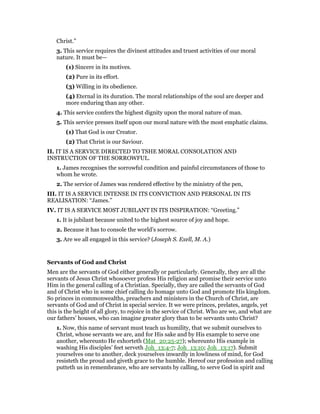
Service the true idea of a Christian life
The world is full of servants of one kind and another.
1. Many are servants through the force of their worldly position.
2. Through the weakness of their intellectual and moral natures.
3. Through the dominant force of an evil passion.
4. Through their effort to pursue a Christly method of life.
By striving to bring our daily life into conformity with the Saviour’s, by endeavouring to
become pure in our nature, spiritual in our ideas, reverent in our dispositions, and
unselfish in our activities, we enter upon the highest service of which a human soul is
capable.
I. IT IS SERVICE DEDICATED TO THE SUPREME BEING OF THE UNIVERSE:
“James, a servant of God.”
1. It is a service dedicated to God.
2. It is a service dedicated to the only Saviour of mankind: “And of the Lord Jesus
Christ.”
3. This service requires the divinest attitudes and truest activities of our moral
nature. It must be—
(1) Sincere in its motives.
(2) Pure in its effort.
(3) Willing in its obedience.
(4) Eternal in its duration. The moral relationships of the soul are deeper and
more enduring than any other.
4. This service confers the highest dignity upon the moral nature of man.
5. This service presses itself upon our moral nature with the most emphatic claims.
(1) That God is our Creator.
(2) That Christ is our Saviour.
II. IT IS A SERVICE DIRECTED TO TSHE MORAL CONSOLATION AND
INSTRUCTION OF THE SORROWFUL.
1. James recognises the sorrowful condition and painful circumstances of those to
whom he wrote.
2. The service of James was rendered effective by the ministry of the pen,
III. IT IS A SERVICE INTENSE IN ITS CONVICTION AND PERSONAL IN ITS
REALISATION: “James.”
IV. IT IS A SERVICE MOST JUBILANT IN ITS INSPIRATION: “Greeting.”
1. It is jubilant because united to the highest source of joy and hope.
2. Because it has to console the world’s sorrow.
3. Are we all engaged in this service? (Joseph S. Exell, M. A.)
Servants of God and Christ
Men are the servants of God either generally or particularly. Generally, they are all the
servants of Jesus Christ whosoever profess His religion and promise their service unto
Him in the general calling of a Christian. Specially, they are called the servants of God
and of Christ who in some chief calling do homage unto God and promote His kingdom.
So princes in commonwealths, preachers and ministers in the Church of Christ, are
servants of God and of Christ in special service. It we were princes, prelates, angels, yet
this is the height of all glory, to rejoice in the service of Christ. Who are we, and what are
our fathers’ houses, who can imagine greater glory than to be servants unto Christ?
1. Now, this name of servant must teach us humility, that we submit ourselves to
Christ, whose servants we are, and for His sake and by His example to serve one
another, whereunto He exhorteth (Mat_20:25-27); whereunto His example in
washing His disciples’ feet serveth Joh_13:4-7; Joh_13:10; Joh_13:17). Submit
yourselves one to another, deck yourselves inwardly in lowliness of mind, for God
resisteth the proud and giveth grace to the humble. Hereof our profession and calling
putteth us in remembrance, who are servants by calling, to serve God in spirit and
truth, and to serve one another in the fear of God.
2. By our service we are furthermore taught what we owe unto Christ Jesus our
Lord, even all service, which is the end of our redemption and cleansing by Christ
from our sins (Luk_1:74-75). Let us, then, in the fear of God, confess Him with our
mouths, praise Him with our tongues, believe Him with our hearts, glorify Him in
our works, and in all things serve Him as it becometh us; for—
(1) He hath made us, and not we ourselves;
(2) He hath redeemed us, not with corruptible things, as silver and gold, but by
His own blood;
(3) He sayeth us from death and delivereth us from peril and trouble;
(4) He advanceth us to glory.
3. Servants ought to imitate such virtues as they find to shine in their masters. We
are the servants of Christ; we are bound, therefore, to imitate His meekness,
patience, humility, love, long-sufferance, liberality, kindness, forgiveness of offences,
and the like virtues, which shone in the whole life of Jesus Christ.
4. Servants must attend upon their masters’ will, wait their leisures, rely upon their
care for them, seek all necessaries at their hands; so we, the servants of Christ, must
do His will in all things, wait His leisure patiently for our deliverance, depend upon
His provided care, and in all our necessities have recourse to Him by prayer.
5. That St. James entitleth himself the “servant of Christ,” he doth not only intimate
that he was the servant, the minister and ambassador of Jesus Christ, the Prince of
all the princes of the earth, but also giveth us to understand how carefully he had
executed that office unto him committed; and if we diligent]y peruse the writings of
the apostles we shall find them no less, in consideration of their faithfulness, in
performing their duties, than in regard of their high callings, to have termed
themselves the servants of Christ.
6. In that he calleth himself the “servant of Christ” he teacheth us that as many as
will be the true servants of Christ must addict themselves wholly unto His service,
because no man can serve two masters, God and Mammon, Christ and Belial.
7. That he professeth in open writing that he was the servant of Jesus Christ, and
that in those dangerous days when wickedness flourished and Christian religion was
persecuted: it teacheth God’s saints that they must never be ashamed to confess
Jesus Christ. (R. Turnbull.)
A servant of God and of Christ
James is not only God’s servant by the right of creation and providence, but Christ’s
servant by the right of redemption; yea, especially deputed by Christ as Lord, that is, as
mediator and head of the Church, to do Him service in the way of an apostle; and I
suppose there is some special reason for this disjunction, “a servant of God and of
Christ,” to show his countrymen that in serving Christ he served the God of his fathers,
as Paul pleaded (Act_26:6-7), that in standing for Christ he did but stand for “the hope
of the promise made unto the fathers, unto which promise the twelve tribes, serving God
day and night, hope to come.” (T. Manton.)
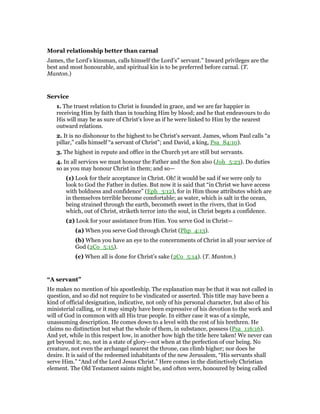
Moral relationship better than carnal
James, the Lord’s kinsman, calls himself the Lord’s” servant.” Inward privileges are the
best and most honourable, and spiritual kin is to be preferred before carnal. (T.
Manton.)
Service
1. The truest relation to Christ is founded in grace, and we are far happier in
receiving Him by faith than in touching Him by blood; and he that endeavours to do
His will may be as sure of Christ’s love as if he were linked to Him by the nearest
outward relations.
2. It is no dishonour to the highest to be Christ’s servant. James, whom Paul calls “a
pillar,” calls himself “a servant of Christ”; and David, a king, Psa_84:10).
3. The highest in repute and office in the Church yet are still but servants.
4. In all services we must honour the Father and the Son also (Joh_5:23). Do duties
so as you may honour Christ in them; and so—
(1) Look for their acceptance in Christ. Oh! it would be sad if we were only to
look to God the Father in duties. But now it is said that “in Christ we have access
with boldness and confidence” (Eph_3:12), for in Him those attributes which are
in themselves terrible become comfortable; as water, which is salt in the ocean,
being strained through the earth, becometh sweet in the rivers, that in God
which, out of Christ, striketh terror into the soul, in Christ begets a confidence.
(2) Look for your assistance from Him. You serve God in Christ—
(a) When you serve God through Christ (Php_4:13).
(b) When you have an eye to the concernments of Christ in all your service of
God (2Co_5:15).
(c) When all is done for Christ’s sake (2Co_5:14). (T. Manton.)
“A servant”
He makes no mention of his apostleship. The explanation may be that it was not called in
question, and so did not require to be vindicated or asserted. This title may have been a
kind of official designation, indicative, not only of his personal character, but also of his
ministerial calling, or it may simply have been expressive of his devotion to the work and
will of God in common with all His true people. In either case it was of a simple,
unassuming description. He comes down to a level with the rest of his brethren. He
claims no distinction but what the whole of them, in substance, possess (Psa_116:16).
And yet, while in this respect low, in another how high the title here taken! We never can
get beyond it; no, not in a state of glory—not when at the perfection of our being. No
creature, not even the archangel nearest the throne, can climb higher; nor does he
desire. It is said of the redeemed inhabitants of the new Jerusalem, “His servants shall
serve Him.” “And of the Lord Jesus Christ.” Here comes in the distinctively Christian
element. The Old Testament saints might be, and often were, honoured by being called
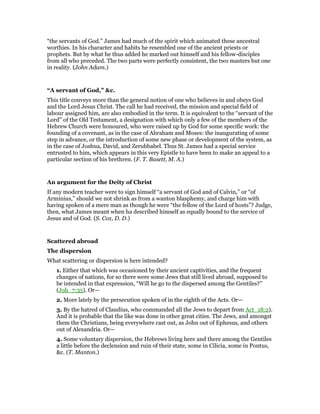
“the servants of God.” James had much of the spirit which animated these ancestral
worthies. In his character and habits he resembled one of the ancient priests or
prophets. But by what he thus added he marked out himself and his fellow-disciples
from all who preceded. The two parts were perfectly consistent, the two masters but one
in reality. (John Adam.)
“A servant of God,” &c.
This title conveys more than the general notion of one who believes in and obeys God
and the Lord Jesus Christ. The call he had received, the mission and special field of
labour assigned him, are also embodied in the term. It is equivalent to the “servant of the
Lord” of the Old Testament, a designation with which only a few of the members of the
Hebrew Church were honoured, who were raised up by God for some specific work: the
founding of a covenant, as in the case of Abraham and Moses: the inaugurating of some
step in advance, or the introduction of some new phase or development of the system, as
in the case of Joshua, David, and Zerubbabel. Thus St. James had a special service
entrusted to him, which appears in this very Epistle to have been to make an appeal to a
particular section of his brethren. (F. T. Basett, M. A.)
An argument for the Deity of Christ
If any modern teacher were to sign himself “a servant of God and of Calvin,” or “of
Arminius,” should we not shrink as from a wanton blasphemy, and charge him with
having spoken of a mere man as though he were “the fellow of the Lord of hosts”? Judge,
then, what James meant when ha described himself as equally bound to the service of
Jesus and of God. (S. Cox, D. D.)
Scattered abroad
The dispersion
What scattering or dispersion is here intended?
1. Either that which was occasioned by their ancient captivities, and the frequent
changes of nations, for so there were some Jews that still lived abroad, supposed to
be intended in that expression, “Will he go to the dispersed among the Gentiles?”
(Joh_7:35). Or—
2. More lately by the persecution spoken of in the eighth of the Acts. Or—
3. By the hatred of Claudius, who commanded all the Jews to depart from Act_18:2).
And it is probable that the like was done in other great cities. The Jews, and amongst
them the Christians, being everywhere cast out, as John out of Ephesus, and others
out of Alexandria. Or—
4. Some voluntary dispersion, the Hebrews living here and there among the Gentiles
a little before the declension and ruin of their state, some in Cilicia, some in Pontus,
&c. (T. Manton.)
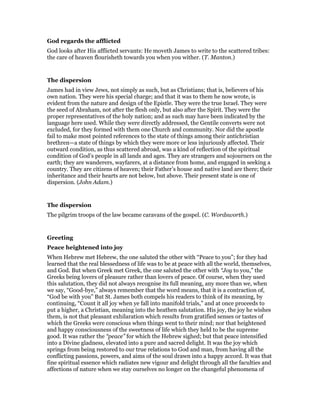
God regards the afflicted
God looks after His afflicted servants: He moveth James to write to the scattered tribes:
the care of heaven flourisheth towards you when you wither. (T. Manton.)
The dispersion
James had in view Jews, not simply as such, but as Christians; that is, believers of his
own nation. They were his special charge; and that it was to them he now wrote, is
evident from the nature and design of the Epistle. They were the true Israel. They were
the seed of Abraham, not after the flesh only, but also after the Spirit. They were the
proper representatives of the holy nation; and as such may have been indicated by the
language here used. While they were directly addressed, the Gentile converts were not
excluded, for they formed with them one Church and community. Nor did the apostle
fail to make most pointed references to the state of things among their antichristian
brethren—a state of things by which they were more or less injuriously affected. Their
outward condition, as thus scattered abroad, was a kind of reflection of the spiritual
condition of God’s people in all lands and ages. They are strangers and sojourners on the
earth; they are wanderers, wayfarers, at a distance from home, and engaged in seeking a
country. They are citizens of heaven; their Father’s house and native land are there; their
inheritance and their hearts are not below, but above. Their present state is one of
dispersion. (John Adam.)
The dispersion
The pilgrim troops of the law became caravans of the gospel. (C. Wordsworth.)
Greeting
Peace heightened into joy
When Hebrew met Hebrew, the one saluted the other with “Peace to you”; for they had
learned that the real blessedness of life was to be at peace with all the world, themselves,
and God. But when Greek met Greek, the one saluted the other with “Joy to you,” the
Greeks being lovers of pleasure rather than lovers of peace. Of course, when they used
this salutation, they did not always recognise its full meaning, any more than we, when
we say, “Good-bye,” always remember that the word means, that it is a contraction of,
“God be with you” But St. James both compels his readers to think of its meaning, by
continuing, “Count it all joy when ye fall into manifold trials,” and at once proceeds to
put a higher, a Christian, meaning into the heathen salutation. His joy, the joy he wishes
them, is not that pleasant exhilaration which results from gratified senses or tastes of
which the Greeks were conscious when things went to their mind; nor that heightened
and happy consciousness of the sweetness of life which they held to be the supreme
good. It was rather the “peace” for which the Hebrew sighed; but that peace intensified
into a Divine gladness, elevated into a pure and sacred delight. It was the joy which
springs from being restored to our true relations to God and man, from having all the
conflicting passions, powers, and aims of the soul drawn into a happy accord. It was that
fine spiritual essence which radiates new vigour and delight through all the faculties and
affections of nature when we stay ourselves no longer on the changeful phenomena of
time, but on the sacred and august realities of eternity. A peace all shot through and
through with the rich exhilarating hues of gladness, this was the “joy” which St. James
invoked on the twelve tribes of the Dispersion. (S. Cox, D. D.)
EBC, "THE PERSONS ADDRESSED IN THE EPISTLE: THE JEWS OF THE
DISPERSION.
"James, a servant of God and of the Lord Jesus Christ, to the twelve tribes which are of
the Dispersion, greeting." - Jas_1:2
THESE words appear to be both simple and plain. At first sight there would seem to be
not much room for any serious difference of opinion as to their meaning. The writer of
the letter writes as "a servant of God and of the Lord Jesus Christ," i.e., as a Christian,
"to the twelve tribes which are of the Dispersion," i.e., to the Jews who are living away
from Palestine. Almost the only point which seems to be open to doubt is whether he
addresses himself to all Jews, believing and unbelieving, or, as one might presume from
his proclaiming himself at the outset to be a Christian, only to those of his fellow-
countrymen who, like himself, have become "servants of the Lord Jesus Christ." And this
is a question which cannot be determined without a careful examination of the contents
of the Epistle.
And yet there has been very great difference of opinion as to the persons whom St.
James had in his mind when he wrote these words. There is not only the triplet of
opinions which easily grow out of the question just indicated, viz., that the letter is
addressed to believing Jews only, to unbelieving Jews only, and to both: there are also
the views of those who hold that it is addressed to Jewish and Gentile Christians
regarded separately, or to the same regarded as one body, or to Jewish Christians
primarily, with references to Gentile Christians and unconverted Jews, or finally to
Gentile Christians primarily, seeing that they, since the rejection of Jesus by the Jews,
are the true sons of Abraham and the rightful inheritors of the privileges of the twelve
tribes.
In such a Babel of interpretations it will clear the ground somewhat if we adopt once
more as a guiding principle the common-sense canon of interpretation laid down by
Hooker ("Eccles. Pol.," 5. 59:2), that where a literal construction will stand, the farthest
from the letter is commonly the worst. A literal construction of the expression "the
twelve tribes of the Dispersion" will not only stand, but make excellent sense. Had St.
James meant to address all Christians, regarded in their position as exiles from their
heavenly home, he would have found some much plainer way of expressing himself.
There is nothing improbable, but something quite the reverse, in the supposition that
the first overseer of the Church of Jerusalem, who, as we have seen, was "a Hebrew of
Hebrews," wrote a letter to those of His fellow-countrymen who were far removed from
personal intercourse with him. So devoted a Jew, so devout a Christian, as we know him
to have been, could not but take the most intense interest in all who were of Jewish
blood, wherever they might dwell, especially such as had learned to believe in Christ,
above all when he knew that they were suffering from habitual oppression and ill-
treatment. We may without hesitation decide that when St. James says "the twelve tribes
which are of the Dispersion" he means Jews away from their home in Palestine, and not
Christians away from their home in heaven. For what possible point would the
Dispersion (η διασπορα) have in such a metaphor? Separation from the heavenly home
might be spoken of as banishment, or exile, or homelessness, but not as "dispersion."
Even if we confined ourselves to the opening words we might safely adopt this
conclusion, but we shall find that there are numerous features in the letter itself which
abundantly confirm it.
It is quite out of place to quote such passages as the sealing of "the hundred and forty
and four thousand out of every tribe of the children of Israel," (Rev_7:4-8) or the city
with "twelve gates, and names written thereon, which are the names of the twelve tribes
of the children of Israel". (Rev_21:12) These occur in a book which is symbolical from
the first chapter to the last, and therefore we know that the literal construction cannot
stand. The question throughout is not whether a given passage is to be taken literally or
symbolically, but what the passage in question symbolizes. Nor, again, can St. Peter’s
declaration that "ye are an elect race, a royal priesthood, a holy nation, a people for
God’s own possession," (1Pe_2:9) be considered as at all parallel. There the combination
of expressions plainly shows that the language is figurative; and there is no real analogy
between an impassioned exhortation, modeled on the addresses of the Hebrew prophets,
and the matter-of-fact opening words of a letter. The words have the clear ring of
nationality, and there is nothing whatever added to them. to turn the simple note into
the complex sound of a doubtful metaphor. As Davidson justly remarks, "The use of the
phrase twelve tribes is inexplicable if the writer intended all believers without
distinction. The author makes no allusion to Gentile converts, nor to the relation
between Jew and Gentile incorporated into one spiritual body."
Let us look at some of the features which characterize the Epistle itself, and see whether
they bear out the view which is here advocated, that the persons addressed are Israelites
in the national sense, and not as having been admitted into the spiritual "Israel of God".
(Gal_6:16)
(1) The writer speaks of Abraham as "our father," without a hint that this is to be
understood in any but the literal sense. "Was not Abraham. our father justified by works,
in that he offered up Isaac his son upon the altar?" (Jas_2:21) St. Paul, when he speaks
of Abraham as "the father of all them that believe," clearly indicates this. (Rom_4:11)
(2) The writer speaks of his readers as worshipping in a "synagogue," (Jas_2:2) which
may possibly mean that, just as St. James and the Apostles continued to attend the
Temple services after the Ascension, so their readers are supposed to attend the
synagogue services after their conversion. But at least it shows that the writer, in
speaking of the public worship of those whom he addresses, naturally uses a word
(συναγωγη) which had then, and continues to have, specially Jewish associations, rather
than one (εκκλησια) which from the first beginnings of Christianity was promoted from
its old political sphere to indicate the congregations, and even the very being, of the
Christian Church.
(3) He assumes that his writers are familiar not only with the life of Abraham, (Jas_2:21;
Jas_2:23) but of Rahab, (Jas_2:25) the prophets, (Jas_5:10) Job, (Jas_5:11) and Elijah.
(Jas_5:17) These frequent appeals to the details of the Old Testament would be quite out
of place in a letter addressed to Gentile’ converts.
(4) God is spoken of under the specially Hebrew title of "the lord of Sabaoth"; (Jas_5:4)
and the frequent recurrence of "the Lord" throughout the Epistle (Jas_1:7; Jas_3:9;
Jas_4:10; Jas_4:15; Jas_5:10; Jas_5:11; Jas_5:15) looks like the language of one who
wished to recall the name Jehovah to his readers.
(5) In discountenancing swearing (Jas_5:12) Jewish forms of oaths are taken as
illustrations.
(6) The vices which are condemned are such as were as common among the Jews as
among the Gentiles - reckless language, rash swearing, oppression of the poor,
covetousness. There is little or nothing said about the gross immorality which was rare
among the Jews, but was almost a matter of course among the Gentiles. St. James
denounces faults into which Jewish converts would be likely enough to lapse; he says
nothing about the vices respecting which heathen converts, such as those at Corinth, are
constantly warned by St. Paul.
(7) But what is perhaps the most decisive feature of all is that he assumes throughout
that for those whom he addresses the Mosaic Law is a binding and final authority. "If ye
have respect of persons, ye commit sin, being convicted by the law as transgressors. If
thou dost not commit adultery, but killest, thou art become a transgressor of the law".
(Jas_2:9-11) "He that speaketh against a brother, or judgeth his brother, speaketh
against the law and judgeth the law". (Jas_4:11)
Scarcely any of these seven points, taken singly, would be at all decisive; but when we
sum them up together, remembering in how short a letter they occur, and when we add
them to the very plain and simple language of the address, we have an argument which
will carry conviction to most persons who have no preconceived theory of their own to
defend. And to this positive evidence derived from the presence of so much material that
indicates Jewish circles as the destined recipients of the letter, we must add the strongly
confirmatory negative evidence derived from the absence of anything which specially
points either to Gentile converts or unconverted heathen. We may therefore read the
letter as having been written by one who had been born and educated in a thoroughly
Jewish atmosphere, who had accepted the Gospel, not as canceling the Law, but as
raising it to a higher power; and we may read it also as addressed to men who, like the
writer, are by birth and education Jews, and, like him, have acknowledged Jesus as their
Lord and the Christ. The difference between writer and readers lies in this, that he is in
Palestine, and they not; that he appears to be in a position of authority, whereas they
seem for the most part to be a humble and suffering folk. All which fits in admirably with
the hypothesis that we have before us an Epistle written by the austere and Judaic-
minded James the Just, written from Jerusalem, to comfort and warn those Jewish
Christians who lay remote from his personal influence.
That it is Jewish Christians, and not unbelieving Jews, or Jews whether believing or not,
who are addressed, is not open to serious doubt. There is not only the fact that St. James
at the outset proclaims himself to be a Christian, (Jas_1:1) but also the statement that
the wealthy oppressors of his poor readers "blaspheme the honorable Name by which ye
are called," or more literally "which was called upon you," viz., the Name of Christ.
Again, the famous paragraph about faith and works assumes that the faith of the readers
and the faith of the writer is identical. (Jas_2:7; Jas_2:14-20) Once more, he expressly
claims them as believers when he writes, "My brethren, hold not the faith of our Lord
Jesus Christ, the Lord of glory, with respect of persons." (Jas_2:1) And if more be
required, we have it in the concluding exhortations: "Be patient, therefore, brethren,
until the coming of the Lord…Stablish your hearts: for the coming of the Lord is at
hand." (Jas_5:7-8)
Whether or no there are passages which glance aside at unbelieving Jews, and perhaps
even some which are directly addressed to them, cannot be decided with so much
certainty; but the balance of probability appears to be. on the affirmative side in both
cases. There probably are places in which St. James is thinking of unbelieving Israelites,
and one or more passages in which he turns aside and sternly rebukes them, much in the
same way as the Old Testament prophets sometimes turn aside to upbraid Tyre and
Sidon and the heathen generally. "Do not the rich oppress you, and themselves drag you
before the judgment-seats?," (Jas_2:6) seems to refer to rich unconverted Jews
prosecuting their poor Christian brethren before the synagogue courts, just as St. Paul
did when he was Saul the persecutor. (Act_9:2) And "Do not they blaspheme the
honorable Name by which ye are called?" can scarcely be said of Christians. If the
blasphemers were Christians they would be said rather to blaspheme the honorable
Name by which they themselves were called. There would lie the enormity-that the name
of Jesus Christ had been "called upon them," and yet they blasphemed it. And when we
come to look at the matter in detail we shall find reason for believing that the stern
words at the beginning of chap. 5. are addressed to unbelieving Jews. There is not one
word of Christian, or even moral, exhortation in it; it consists entirely of accusation and
threatening, and in this respect is in marked contrast to the equally stern words at the
beginning of chap. 4, which are addressed to worldly and godless Christians.
To suppose that the rich oppressors so often alluded to in the Epistle are heathen, as
Hilgenfeld does, confuses the whole picture, and brings no compensating advantage. The
heathen among whom the Jews of the Dispersion dwelt in Syria, Egypt,’ Rome, and
elsewhere, were of course, some of them rich, and some of them poor. But wealthy
Pagans were not more apt to persecute Jews, whether Christians or not, than the needy
Pagan populace. If there was any difference between heathen rich and poor in this
matter, it was the fanatical and plunder-seeking mob, rather than the contemptuous and
easy-going rich, who were likely to begin a persecution of the Jews, just as in Russia or
Germany at the present time. And St. James would not be likely to talk of "the Lord of
Sabaot" in (Jas_5:4) addressing wealthy Pagans. But the social antagonism so often
alluded to in the Epistle, when interpreted to mean an antagonism between Jew and
Jew, corresponds to a state of society which is known to have existed in Palestine and the
neighboring countries during the half-century which preceded the Jewish war of A.D.
66-70. (Comp. Mat_11:5; Mat_19:23; Luk_1:53; Luk_6:20; Luk_6:24; Luk_16:19-20)
During that period the wealthy Jews allied themselves with the Romans, in order more
securely to oppress their poorer fellow-countrymen. And seeing that the Gospel in the
first instance spread chiefly among the poor, this social antagonism between rich and
poor Jews frequently became an antagonism between unbelieving and believing Jews.
St. James, well aware of this state of things, from personal experience in Judea, and
hearing similar things of the Jews of the Dispersion in Syria, reasonably supposes that
this unnatural tyranny of Jew over Jew prevails elsewhere also, and addresses all "the
twelve tribes which are of the Diaspora" on the subject. In any case his opportunities of
knowing a very great deal respecting Jews in various parts of the world were large. Jews
from all regions were constantly visiting Jerusalem. But the knowledge which he must
have had respecting the condition of things in Palestine and Syria would be quite
sufficient to explain what is said in this Epistle respecting the tyranny of the rich over
the poor.
The Diaspora, or Dispersion of the Jews throughout the inhabited world, had been
brought about in various ways, and had continued through many centuries. The two
chief causes were forcible deportation and voluntary emigration. It was a common policy
of Oriental conquerors to transport whole populations, in order more completely to
subjugate them; and hence the Assyrian and Babylonian conquerors of Israel carried
away great multitudes of Jews to the East, sending Eastern populations to take their
place. Pompey on a much smaller scale transported Jewish captives to the West,
carrying hundreds of Jews to Rome. But disturbances in Palestine, and opportunities of
trade elsewhere, induced large multitudes of Jews to emigrate of their own accord,
especially to the neighboring countries of Egypt and Syria: and the great commercial
centers in Asia Minor, Alexandria, Antioch, Ephesus, Miletus, Pergamus, Cyprus, and
Rhodes contained large numbers of Jews. While Palestine was the battle-field of foreign
armies, and while newly founded towns were trying to attract population by offering
privileges to settlers, thousands of Jews preferred the advantages of a secure home in
exile to the risks which attended residence in their native country.
At the time when this Epistle was written three chief divisions of the Dispersion were
recognized the Babylonian, which ranked as the first, the Syrian, and the Egyptian. But
the Diaspora was by no means confined to these three centers. About two hundred years
before this time the composer of one of the so-called Sibylline Oracles could address the
Jewish nation, and say, "But every land is full of thee, -aye and every ocean." And there is
abundance of evidence, both in the Bible and outside it, especially in Josephus and
Philo, that such language does not go beyond the limits of justifiable hyperbole. The list
of peoples represented at Jerusalem on the Day of Pentecost, "from every nation under
heaven," tells one a great deal. (Act_2:5-11. Comp. Act_15:21, and 1Ma_15:15-24) Many
passages from Josephus might be quoted ("Ant.," 11. 5:2; 14. 7:2; "Bell. Jud," 2 16:4 7
3:3), as stating in general terms the same fact. But perhaps no original authority gives us
more information than Philo, in his famous treatise "On the Embassy to the Emperor
Caius," which went to Rome (cir. A.D. 40) to obtain the revocation of a decree requiring
the Jews to pay divine homage to the Emperor’s statue. In that treatise we read that
"Jerusalem is the metropolis, not of the single country of Judea, but of most countries,
because of the colonies which she has sent out, as opportunity offered, into the
neighboring lands of Egypt, Phoenicia, Syria, and Coelesyria, and the more distant lands
of Pamphylia and Cilicia, most of Asia, as far as Bithynia and the utmost corners of
Pontus; likewise unto Europe, Thessaly, Boeotia, Macedonia, Aetolia, Attica, Argos,
Corinth, with the most parts and best parts of Greece. And not only are the continents
full of Jewish colonies, but also the most notable of the islands - Euboea, Cyprus, Crete-
to say nothing of the lands beyond the Euphrates. For all, excepting a small part of
Babylon and those satrapies which contain the excellent land around it, contain Jewish
inhabitants. So that if my country were to obtain a share in thy clemency it would not be
one city that would be benefited, but ten thousand others, situated in every part of the
inhabited world-Europe, Asia, Libya, continental and insular, maritime and inland" ("De
Legat. ad Caium," 36., Gelen., pp. 1031-32). It was therefore an enormous circle of
readers that St. James addressed when he wrote "to the twelve tribes which are of the
Dispersion," although it seems to have been a long time before his letter became known
to the most important of the divisions of the Diaspora, viz., the Jewish settlement in
Egypt, which had its chief center in Alexandria. We may reasonably suppose that it was
the Syrian division which he had chiefly in view in writing, and it was to them, no doubt,
that the letter in the first instance was sent. It is of this division that Josephus writes
that, widely dispersed as the Jewish race is over the whole of the inhabited world, it is
most largely mingled with Syria on account of its proximity, and especially in Antioch,
where the kings since Antiochus had afforded them undisturbed tranquility and equal
privileges with the heathen; so that they multiplied exceedingly, and made many
proselytes. ("Belt. Jud," 7:3:3)
The enormous significance of the Dispersion as a preparation for Christianity must not
be overlooked. It showed to both Jew and Gentile alike that the barriers which had
hedged in and isolated the hermit nation had broken down, and that what had ceased to
be thus isolated had changed its character. A kingdom had become a religion. What
henceforth distinguished the Jews in the eyes of all the world was not their country or
their government, but their creed, and through this they exercised upon those among
whom they were scattered an influence which had been impossible under the old
conditions of exclusiveness. They themselves also were forced to understand their own
religion better. When the keeping of the letter of the Law became an impossibility, they
were compelled to penetrate into its spirit; and what they exhibited to the heathen was
not a mere code of burdensome rites and ceremonies, but a moral life and a worship in
spirit and truth. The universality of the services of the synagogue taught the Jew that
God’s worship was not confined to Jerusalem, and their simplicity attracted proselytes
who might have turned away from the complex and bloody liturgies of the Temple. Even
in matters of detail the services in the synagogue prepared the way for the services of the
Christian Church. The regular lessons-read from two divisions of Scripture, the
antiphonal singing, the turning towards the east, the general Amen of the whole
congregation, the observance of the third, sixth, and ninth hours as hours of prayer, and
of one day in seven as specially holy-all these things, together with some others which
have since become obsolete, meet us in the synagogue worship, as St. James knew it, and
in the liturgies of the Christian Church, which he and the Apostles and their successors
helped to frame. Thus justice once more became mercy, and a punishment was turned
into a blessing. The captivity of the Jew became the freedom of both Jew and Gentile,
and the scattering of Israel was the gathering in of all nations unto God. "He hath
scattered abroad; He hath given to the poor: His righteousness abideth forever". (Psa_
112:9; 2Co_9:9)
HAWKER, "James, a servant of God and of the Lord Jesus Christ, to the twelve tribes
which are scattered abroad, greeting.
I detain the Reader, at the entrance, on this blessed portion of the word of God, to
observe to him, how different; from others, the Apostle enters on, this service, to which
the Lord the Holy Ghost called him. He salutes the Church with greeting, but not as the
other Apostles, in the sweet words of grace, mercy, and peace. And it is further
remarkable, that James neither begins nor ends his Epistle in the usual terms of
benediction. But it should be noticed at the same time, that greeting is a comprehensive
word, to the same amount; and fully expressive, in whose holy and blessed Name, all the
greetings of the Lord’s people are made. And I beg the Reader not to overlook, that it is
to the Church, and not to the world, the Epistle is sent. The twelve tribes can mean no
other, than the Church, though scattered. Christ’s people, are in all nations, Jer_32:37-
41. And hence, Christ is the desire of all nations; that is, the desire of his people in all
nations, Hag_2:7. And I beg the Reader to observe with me, from this diversity of
writing in James, from that of the other Apostles, what a beautiful variety, is given
thereby, in setting forth the word of God. All the inspired Penmen, set forth one and the
same truth; and all their labors are directed to one and the same object, in the divine
glory; and all are under the guidance, and teaching, of one and the same Lord the Holy
Ghost; but while different gifts and talents, mark the different servants of our God; all
these are gifted by one and the self same Spirit, dividing to every man severally as he
will, 1Co_12:11. If the Reader will indulge me, to offer a short observation more, upon
this verse, it shall be to remark, that the salutation of James to the Church, scattered
abroad with greeting; teacheth the Lord’s people, how best to follow up Christ’s precept,
to the same amount, either in person, or when writing by letter. Ignorant at times, as we
are, who are, or who are not of the household of faith, we salute in general terms with
mercy, grace, and peace, the faithful, as Paul did, Aquila and Priscilla, with the Church
that is in their house, 1Co_16:19. And saith our dear Lord; if the son of peace be there,
that is a child of God in Christ, your peace shall rest upon it; if not, it shall turn to you
again. Your salutation is in Christ; and this sanctifies it to you, though not to them, Luk_
10:5-6.
2
Suppose a man comes into your meeting wearing a gold ring
and fine clothes, and a poor man in shabby clothes also
comes in.
BAR ES, "My brethren - Not brethren as Jews, but as Christians. Compare Jam_
2:1.
Count it all joy - Regard it as a thing to rejoice in; a matter which should afford you
happiness. You are not to consider it as a punishment, a curse, or a calamity, but as a fit
subject of felicitation. Compare the notes at Mat_5:12.
When ye fall into divers temptations - Oh the meaning of the word
“temptations,” see the notes at Mat_4:1. It is now commonly used in the sense of placing
allurements before others to induce them to sin, and in this sense the word seems to be
used in Jam_1:13-14 of this chapter. Here, however, the word is used in the sense of
trials, to wit, by persecution, poverty, calamity of any kind. These cannot be said to be
direct inducements or allurements to sin, but they try the faith, and they show whether
he who is tried is disposed to adhere to his faith in God, or whether he will apostatize.
They so far coincide with temptations, properly so called, as to test the religion of men.
They differ from temptations, properly so called, in that they are not brought before the
mind for the express purpose of inducing people to sin. In this sense it is true that God
never tempts men, Jam_1:13-14. On the sentiment in the passage before us, see the
notes at 1Pe_1:6-7. The word “divers” here refers to the various kinds of trials which they
might experience - sickness, poverty, bereavement, persecution, etc. They were to count
it a matter of joy that their religion was subjected to anything that tried it. It is well for
us to have the reality of our religion tested, in whatever way it may be done.
CLARKE, "Count it all joy - The word πειρασµος, which we translate temptation,
signifies affliction, persecution, or trial of any kind; and in this sense it is used here, not
intending diabolic suggestion, or what is generally understood by the word temptation.
GILL, "My brethren,.... Not only according to the flesh, he being a Jew as they were;
but in a spiritual sense, they being born again of the same grace, belonging to the same
family and household of faith, and having the same Father, and being all the children of
God, by faith in Christ Jesus:
count it all joy when ye fall into divers temptations; not the temptations of
Satan, or temptations to sin; for these cannot be matter of joy, but grief; these are fiery
darts, and give a great deal of uneasiness and trouble; but afflictions and persecutions
for the sake of the Gospel, which are so called here and elsewhere, because they are trials
of the faith of God's people, and of other graces of the Spirit of God. God by these tempts
his people, as he did Abraham, when he called him to sacrifice his son; he thereby tried
his faith, fear, love, and obedience; so by afflictions, God tries the graces of his people;
not that he might know them, for he is not ignorant of them, but that they might be
made manifest to others; and these are "divers": many are the afflictions of the
righteous; through much tribulation they must enter the kingdom; it is a great fight of
afflictions which they endure, as these believers did; their trials came from different
quarters; they were persecuted by their countrymen the Jews, and were distressed by the
Gentiles, among whom they lived; and their indignities and reproaches were many; and
their sufferings of different sorts, as confiscation of goods, imprisonment of body,
banishment, scourgings, and death in various shapes: and these they "fall" into; not by
chance, nor altogether at an unawares, or unexpectedly; but they fell into them through
the wickedness and malice of their enemies, and did not bring them upon themselves
through any crime or enormity they were guilty of: and when this was their case, the
apostle exhorts them to count it all joy, or matter of joy, of exceeding great joy, even of
the greatest joy; not that these afflictions were joyous in themselves, but in their
circumstances, effects, and consequences; as they tried, and exercised, and improved the
graces of the Spirit, and worked for their good, spiritual and eternal, and produced in
them the peaceable fruit of righteousness; and as they were attended with the presence
and Spirit of God, and of glory; and as they made for, and issued in the glory of God; and
because of that great reward in heaven which would follow them; see Mat_5:11. The
Jews have a saying (g),
"whoever rejoices in afflictions that come upon him, brings salvation to the world.''
HE RY, "We now come to consider the matter of this epistle. In this paragraph we
have the following things to be observed: -
I. The suffering state of Christians in this world is represented, and that in a very
instructive manner, if we attend to what is plainly and necessarily implied, together with
what is fully expressed. 1. It is implied that troubles and afflictions may be the lot of the
best Christians, even of those who have the most reason to think and hope well of
themselves. Such as have a title to the greatest joy may yet endure very grievous
afflictions. As good people are liable to be scattered, they must not think it strange if
they meet with troubles. 2. These outward afflictions and troubles are temptations to
them. The devil endeavours by sufferings and crosses to draw men to sin and to deter
them from duty, or unfit them for it; but, as our afflictions are in God's hand, they are
intended for the trial and improvement of our graces. The gold is put into the furnace,
that it may be purified. 3. These temptations may be numerous and various: Divers
temptations, as the apostle speaks. Our trials may be of many and different kinds, and
therefore we have need to put on the whole armour of God. We must be armed on every
side, because temptations lie on all sides. 4. The trials of a good man are such as he does
not create to himself, nor sinfully pull upon himself; but they are such as he is said to fall
into. And for this reason they are the better borne by him.
II. The graces and duties of a state of trial and affliction are here pointed out to us.
Could we attend to these things, and grow in them as we should do, how good would it
be for us to be afflicted!
1. One Christian grace to be exercised is joy: Count it all joy, Jam_1:2. We must not sink
into a sad and disconsolate frame of mind, which would make us faint under our trials;
but must endeavour to keep our spirits dilated and enlarged, the better to take in a true
sense of our case, and with greater advantage to set ourselves to make the best of it.
Philosophy may instruct men to be calm under their troubles; but Christianity teaches
them to be joyful, because such exercises proceed from love and not fury in God. In them
we are conformable to Christ our head, and they become marks of our adoption. By
suffering in the ways of righteousness, we are serving the interests of our Lord's
kingdom among men, and edifying the body of Christ; and our trials will brighten our
graces now and our crown at last. Therefore there is reason to count it all joy when trials
and difficulties become our lot in the way of our duty. And this is not purely a New
Testament paradox, but even in Job's time it was said, Behold, happy is the man whom
God correcteth. There is the more reason for joy in afflictions if we consider the other
graces that are promoted by them.
JAMISO , "My brethren — a phrase often found in James, marking community of
nation and of faith.
all joy — cause for the highest joy [Grotius]. Nothing but joy [Piscator]. Count all
“divers temptations” to be each matter of joy [Bengel].
fall into — unexpectedly, so as to be encompassed by them (so the original Greek).
temptations — not in the limited sense of allurements to sin, but trials or distresses
of any kind which test and purify the Christian character. Compare “tempt,” that is, try,
Gen_22:1. Some of those to whom James writes were “sick,” or otherwise “afflicted”
(Jam_5:13). Every possible trial to the child of God is a masterpiece of strategy of the
Captain of his salvation for his good.
BARCLAY, "THE PERIL OF S OBBERY WITHI THE CHURCH (James 2:2-
4)
2:2-4 For, if a man comes into your assembly with his fingers covered with gold
rings and dressed in elegant clothes and a poor man comes in dressed in shabby
clothes, and you pay SPECIAL attention to the man who is dressed in elegant
clothes and you say to him: "Will you sit here, please?" and you say to the poor
man, "You stand there!" or, "Squat on the floor beside my footstool!" have you not
drawn distinctions within your minds, and have you not become judges whose
thoughts are evil?
It is James' fear that snobbery may invade the Church. He draws a picture of two
men E TERI G the Christian assembly. The one is well-dressed and his fingers are
covered with gold rings. The more ostentatious of the ancients wore rings on every
finger except the middle one, and wore far more than one on each finger. They even
hired rings to wear when they wished to give an impression of special wealth. "We
adorn our fingers with rings," said Seneca, "and we distribute gems over every
joint." Clement of Alexandria recommends that a Christian should wear only one
ring, and that he should wear it on his little finger. It ought to have on it a religious
emblem, such as a dove, a fish or an anchor; and the justification for wearing it is
that it might be used as a seal.
So, then, into the Christian assembly comes an elegantly dressed and much beringed
man. The other is a poor man, dressed in poor clothes because he has no others to
wear and unadorned by any jewels. The rich man is ushered to a special seat with
all ceremony and respect; while the poor man is bidden to stand, or to squat on the
floor, beside the footstool of the well-to-do.
That the picture is not overdrawn is seen from certain instructions in some early
service order books. Ropes QUOTES a typical passage from the Ethiopia Statutes of
the Apostles: "If any other man or woman enters in fine clothes, either a man of the
district or from other districts, being brethren, thou, presbyter, while thou speakest
the word which is concerning God, or while thou hearest or readest, thou shalt not
respect persons, nor leave thy ministering to command places for them, but remain
quiet, for the brethren shall receive them, and if they have no place for them, the
lover of brothers and sisters, will rise, and leave a place for them ... And if a poor
man or woman of the district or of other districts should come in and there is no
place for them, thou, presbyter, make place for such with all thy heart, even if thou
wilt sit on the ground, that there should not be the respecting of the person of man
but of God." Here is the same picture. It is even suggested that the leader of the
service might be liable, when a rich man entered, to stop the service and to conduct
him to a special seat.
There is no doubt that there must have been social problems in the early church.
The Church was the only place in the ancient world where social distinctions did not
EXIST. There must have been a certain initial awkwardness when a master found
himself sitting next his slave or when a master arrived at a service in which his slave
was actually the leader and the dispenser of the Sacrament. The gap between the
slave, who in law was nothing more than a living tool, and the master was so wide as
to cause problems of approach on either side. Further, in its early days the Church
was predominantly poor and humble; and therefore if a rich man was converted
and came to the Christian fellowship, there must have been a very real temptation to
make a fuss of him and treat him as a special trophy for Christ.
The Church must be the one place where all distinctions are wiped out. There can
be no distinctions of rank and prestige when men meet in the presence of the King of
glory. There can be no distinctions of merit when men meet in the presence of the
supreme holiness of God. In his presence all earthly distinctions are less than the
dust and all earthly righteousness is as filthy rags. In the presence of God all men
are one.
In James 2:4 there is a problem of TRA SLATIO . The word diekrithete (Greek #
1252) can have two meanings: (i) It can mean, "You are wavering in your
judgments, if you act like that." That is to say, "If you pay special honour to the
rich, you are torn between the standards of the world and the standards of God and
you can't make up your mind which you are going to APPLY." (ii) It may mean,
"You are guilty of making class distinctions which in the Christian fellowship
should not exist." We prefer the second meaning, because James goes on to say, "If
you do that, you are judges whose thoughts are evil." That is to say, "You are
breaking the commandment of him who said, 'Judge not that you be not judged'"
(Matthew 7:1).
COFFMA , "For if there come into YOUR synagogue a man with a gold ring, in
fine clothing, and there come in also a poor man in vile clothing;
What a marvelous insight this gives into the early Christian assemblies. They were
open meetings, in which men of all classes and conditions might E TER.
Synagogue ... This is the only place in the ew Testament where this name is given
for a Christian meeting place; but as Roberts said, "The literal meaning of the word
had no religious connotation, being used in GE ESIS1:9 for the gatherings of
water."[8] In time, however, the word came to have very definite religious
overtones, John referring to "the synagogue of Satan" (Revelation 2:9). It appears
from the usage of the word here that in Jerusalem, from which James presumably
wrote, the Jewish name of the meeting house was currently used by Christians of
their own meeting houses, a usage which, at that time, had no doubt ALREADY
disappeared in most other places.
Gold ring ... fine clothing... Lenski paraphrased James' thought here thus: "Are you
Christians still impressed by a gold ring and a bright rag?"[9] Deriving his
information from Seneca, Barclay wrote:
The more ostentatious of the ancients wore rings on every finger except the middle
one, and wore far more than one on each finger. They even hired rings to wear
when they wished to give an impression of SPECIAL wealth[10]SIZE>
Clement of Alexandria justified the wearing of one ring by Christians that it might
be used as a seal, but said that it ought to have a religious emblem on it, such as a
dove, fish or anchor.
It is a very vivid picture which James brings to our minds in this passage. The
Christians have assembled for worship; and suddenly there walks in this
distinguished looking man with a gold ring and obviously expensive clothes. He
creates quite a stir. Someone, one of the ushers perhaps, bows him into a good place;
and then, when a working man, still wearing his work clothes, comes in, he is told to
sit on the floor or stand! Such conduct, either then or now, is disgraceful. But does it
still happen? Who can DE Y that it does?
[8] J. W. Roberts, op. cit., p. 70.
[9] R. C. H. Lenski, op. cit., p. 564.
[10] William Barclay, The Letters of James and Peter (Philadelphia: The
Westminster Press, 1976), p. 64.
COKE, "James 2:2. Unto YOUR assembly— That here the apostle speaks of
consistories for civil judicatures, is argued, 1st, From the accepting of persons,
James 2:1 which in the Old Testament and the ew, as often as it is APPLIED to
men, respects human judicatures. 2nd, From the footstool mentioned, James 2:3
which obtained in their judicial consistories, and which was proper to princes on
their thrones, and judges on their tribunals. 3rdly, From the judges mentioned,
James 2:4 and the judgment-seats mentioned, James 2:6. And lastly, from the canon
of the Jews, by which it is provided, that, "When the rich and poor have a suit
together in their consistories, either both must sit, or both stand, to avoid all marks
of partiality." See R. Levi Barcinon, 50: 142. Juris Hebraici.
PEASE, "James’ point is that if you defer to a person who enters your service solely
because of their appearance of wealth, you may be honoring one of these oppressors
without knowing it, and dishonoring the poor who are being oppressed. I don’t
believe that James is advocating that the rich should be treated with contempt.
Rather, he is saying we need to treat all people with the same impartiality.
ELLICOTT, "(2) For if there come unto YOUR assembly (literally, synagogue).—
This is the only place in the ew Testament where the Jewish word is used for a
Christian congregation.
A man with a gold ring, in goodly apparel.—Better, a man golden-ringed, in bright
apparel. Roman satirists had much to say upon the fops and dandies of their time,
with “all their fingers laden with rings”; some, if we may trust the sneer of Martial,
having six on each; and others with heavy gold or light, ACCORDI G to the
oppressiveness of the season; no doubt, the fashions set in Rome extended to
Jerusalem. “Goodly apparel” is, rather, gorgeous—splendid in colour or ornament;
the same two words are translated “gay clothing” in the following verse.
And there come in also a poor man in vile raiment.—Squalid, even dirty, as from
work and wear—the exact opposite of the idle over-dressed exquisite.
BIBLICAL ILLUSTRATOR, "Count it all Joy when ye fall Into divers temptations
The Christian’s duty in times of trial
This positive injunction of the Christian ethics may seem too difficult, if not impossible
to be obeyed.
And even if the natural repugnance to suffering can be vanquished, the moral sense still
shrinks from what is here commanded, to rejoice in temptation. The paradox is not to be
removed by violently changing the established meaning of the word, which never means
affliction simply, but in every case conveys the idea of a moral trial, or a test of character.
A temptation, to which patience is the proper antidote, must be specifically a temptation
to impatience, a rebellious temper, to which we are tempted by a state of suffering. We
must, therefore, understand the words as having reference to those providential trials of
men’s faith and patience in which they are rather passive than active, and under which
their appropriate duty is not so much resistance as submission. But even these trials and
temptations are not to be sought for or solicited. It is not the mere name, or pretence, or
some infinitesimal degree of joy, that believers under trial are to exercise, but “all joy” as
opposed to none, and to too little, and to every kind of counterfeit. So far from repining
when you fall into divers trials, “count it all joy.” But as we know, both from Scripture
and experience, that no “chastening for the present seemeth to be joyous, but grievous,
and that afterward (ᆖστερον) it yieldeth the peaceable fruit of righteousness to them
which are exercised thereby” (Heb_12:11). This is perfectly consistent with the form of
expression (ᆉταν περιπέσητε) which might even be translated to mean “when” or “after,”
“ye have fallen into divers trials.” This precise determination of the time at which the joy
is to be exercised, as not the time of actual endurance, much less that of previous
expectation, but rather that of subsequent reflection—I mean subsequent, if not to the
whole trial, yet at least to its inception—this may throw some light on two points. The
first is the paradoxical aspect of the exhortation to rejoice in that which necessarily
involves pain and suffering. The paradox, to say the least, may seem less startling if we
understand the text as calling upon men to rejoice, not that they are suffering, or while
they suffer, although even this does not transcend the limits of experience, as we know
from the triumphant joy of martyrs at the stake, and of many a lowlier believer on his
death-bed, but that they have suffered, that it has pleased God, without their own
concurrence, to afford them the occasion of attesting their fidelity, and submission to
His will. The other point on which the same consideration may throw some light, is the
choice of an expression which, although it primarily signifies no more than moral trial or
a test of character, in general usage does undoubtedly denote a positive solicitation to do
wrong. For even in this worst sense of temptation, it may be a subject of rejoicing, not
beforehand, no, nor in the very crisis of the spiritual conflict; but when that is past,
looking back upon the fearful risk which has been escaped, not merely with gratitude for
its deliverance, but with unaffected joy that there was such a risk to be delivered from,
because it has now, served to magnify God’s grace, and at the same time to attest its own
fidelity. Just as the soldier, who would have been guilty of the grossest rashness, if he
had deliberately thrown himself into the way of a superior enemy, may—when
unexpectedly surrounded and attacked, he has heroically cut his way through—rejoice,
not only in his safety, but in the very danger which compelled him to achieve it. But the
joy experienced in the case before us is not merely retrospective, but prospective also. It
is not an ignorant or blind joy, but is founded in knowledge, not only of the principles on
which men ought to act, but of the consequences which may be expected from a certain
course of action or of suffering. The trials or temptations of the Christian are the test of
his faith, both in the strict and comprehensive sense. They put to the proof his trust in
God, his belief of a hat God says, of what He promises. But in so doing, they afford the
surest test of his whole religious character. Specific trust in God’s veracity and
faithfulness cannot be an insulated act, or habit. It must have its causes and effects
homogeneous to itself in the man’s creed, in his heart, in his life. But it does not merely
furnish present evidence of faith. It produces a permanent effect upon the character. It
generates a habit of patient endurance in the way of God’s commandments, For of
patience, as of faith, it may be said that it cannot stand alone, independently of other
graces of Christian character. The principle of active and passive obedience is the same.
He who will not do God’s will cannot endure it in a Christian spirit. He can only endure
it in the way of punishment. Evangelical patience carries with it evangelical obedience or
activity. It therefore comprehends a very large part of practical religion, and to say that it
is matured by trial is to say that trial or temptation, in the sense here put upon the term,
is an important means of grace, of spiritual growth, and instead of being angrily
complained of as a hardship, ought not indeed to be desired any more than medicines,
especially when composed of poisons, should be used as ordinary food; but when
administered, without our agency or even option, by the Great Physician, should be
thankfully submitted to, and afterwards rejoiced in, as a potent agency of God’s
appointment which produces great effects, not by a sudden change, but, as the original
expression seems to mean, by a gradual and long-continued process; for the trial of our
faith “worketh out,” elaborates, and as it were laboriously cultivates a habit of persistent
obedience and submission to the will of God, both in the way of doing and suffering.
That the patience thus commended is not a sluggish principle, much less a mere
condition of repose, but something active in itself and tending to activity in others, is
evident enough from the apostle’s exhortation not to hinder it in its operation, but to let
it have its perfect work or full effect. Could tills be said of mere inertia, or even patient
nonresistance? All this affords abundant room for wise discrimination. It is evidently not
a matter which can be conducted to a safe issue by mere audacity or force of will, by
cutting knots which ought to be untied, which can neither solve themselves nor be
solved by any intellectual force short of wisdom in the highest sense. This wisdom, the
idea of which was familiar to the wisest of the heathen, has been realised only in the
school of revelation. And woe to him who undertakes, without it, to solve the intricate
and fearful problem of man’s character and destiny! (J. A. Alexander, D. D.)
Christ’s school of suffering
Luther has somewhere made that fine confession, that there were chiefly three things
which had introduced him into the depths of true divinity, and which he was, therefore,
accustomed to recommend to every one as proved—viz., silent meditation on the Word
of God; persevering and ardent prayer, together with the Word of God; and inward and
outward attacks on account of the Word of God. It is trial which must arouse the spirit
plunged into earthly concerns, and benumbed by the influence of the world out of the
sleep of security, and point him to that Word which leads the foolish to wisdom, the
sinner to righteousness, Besides, in many cases, especially in the days of carnal ease, the
flame of prayer, even on the altar of the regenerated man’s heart, would burn out, if
trials, returning from time to time, did not carry fresh wood to stir anew the fire of
devotion. It is only by struggling that the inward life can become strong: it is only in the
storm that the stem of life and godliness can take deeper and firmer roots.
I. In Germany it is one of the requisites of civil law, that he who wants to become a
citizen SHALL PASS THROUGH THE POPULAR SCHOOL. They, therefore, speak of a
legal school-duty which no one is permitted to shun.
There is, also, such a duty in the kingdom of God. He who wants to become a citizen of
that kingdom must not refuse to enter the school of suffering which the Lord Himself
has instituted on earth, and sanctified by His example. Already, as the natural
descendant of Adam, the first sinner, every one has to carry his share of the common
misery which weighs on humanity, and cannot avoid it. But what for the natural man is
only a constraint laid upon him from without, is, in the case of the Christian,
spiritualised and glorified into a deed of voluntary obedience. “The disciple is not above
his Master, nor the servant above his Lord. If any man will come after Me, let him deny
himself, and take up his cross and follow Me.” “We must, through much tribulation,
enter into the kingdom of God.” They declare the duty of suffering to be a general law of
the Christian life. If, therefore, we look into the roll of the citizens of the heavenly
kingdom, we do not find there a single one who had not, in the school of suffering, to
resolve heavier or easier tasks, and been obliged to stop longer or shorter there. You
have, therefore, no right to complain, if the Lord takes you into the school of suffering,
and there assigns you your task. You thereby only fulfil an obligation incumbent upon
you as a citizen of the kingdom of God. You will not wish to be exempt from what is the
lot of every one. Yea, it is an honour for you to belong to a school through which have
passed the prophets and the apostles themselves, and out of which are come the first-
fruits of the creatures of God.
II. The peculiarity of each school arises out of THE FIXED AIM TRIED TO BE
ATTAINED WITH THE PUPILS, AND FOR WHICH, THEREFORE, ALL SCHOOL
ARRANGEMENTS ARE CALCULATED. Thus, the burgher-school wants to form able
burghers; the practical school, clever tradesmen; the military school, gallant soldiers; the
college, intelligent servants of the sate and of the Church. In a similar manner, Christ’s
school of suffering pursues a fixed aim. He wants to form His pupils into thoroughly-
qualified men; in short, He wants to make nothing less of them than princes and priests
in the kingdom of the immortal God. His patience and His obedience, His meekness and
His humility, His firm faith and His persevering hope, His victorious fight and His
glorious perfection, are to be reflected in the trial of their sufferings, so that He may be
able to behold in them the true followers of His spirit, and sharers of His glorious life.
From this point of view the apostles considered their sufferings, and by this the sharpest
sting of them was broken, and the bitterest cup was wonderfully sweetened. “We always
bear about in the body the dying of the Lord Jesus.” We are sorry to perceive that this
apostolical apprehension of sufferings has become so rare among us. If faith can only lay
hold on that thought, the burden of suffering is thereby diminished, and we are able to
say, with St. Paul, “Our light affliction, which is but for a moment, worketh for us a far
more exceeding and eternal weight of glory.”
III. But, besides the aim of the school, there must, in each well-regulated establishment,
also exist A FIXED PLAN AFTER WHICH TO PROCEED. If there is to be progress in the
studies of the pupils, a well-pondered plan must not be wanting, by which is determined
in what gradation the various branches are to be imparted, and what method of teaching
must be observed. For Christ’s school of suffering, too, there is a fixed plan according to
which the pupils are treated. It is in good hands, for it has been made by Him who gives
term and measure to each thing, and always remembers that we are dust and ashes. As
soon as the height fixed by Him is reached, the waters will fall again, the storm will
abate, thou wilt again perceive the dry land, and thy soul will be permitted to thank the
Lord on her harp, that He has been the help of thy countenance and thy God. (W.
Hofacker.)
Trials
I. TRIALS ARE A COMMON CHRISTIAN EXPERIENCE.
1. Numerous. They come one after another in quick succession, attack us at every
point, and, by reiterated importunity, wear out resistance. A continual dropping
wears the stone, and blow after blow shatters the fortress.
2. Diversified. The trials are addressed to the different elements of our nature, and
are brought to bear on the ever-varying conditions of our life.
3. Combined. They conspire to encompass and overthrow, with such close and
serried ranks that there seems no way of escape, and the sorely beset sufferer says,
“All these things are against me.”
4. Intensified. Often, in the case of Christians of every age, the trials which befall
them are more grievous from the time, place, and manner of their occurrence—
sufferings inflicted through those that are dear, or when weakened by age or
infirmity, and removed from the sympathy and succour of friends.
II. TRIALS ARE A NECESSARY CHRISTIAN DISCIPLINE. They are designed to reveal
to us our own sinfulness and weakness, to discover the graces of the Spirit, to prove the
strength of our faith, the ardour of our love, the constancy of our devotion. Like the tree
which becomes the more firmly Tooted by the blasts which toss and twist its branches,
the believer only clings more tenaciously to his Lord when his soul is tried by affliction.
III. TRIALS ARE A COMPLETION OF CHRISTIAN CHARACTER. What but lives thus
perfected by the chastening hand of God can bow cheerfully beneath poverty, feeble
health, and dark days of discouragement, or bear up under calumny and vexatious
opposition, or wait and work even though the promise tarry and the blessing seems
withheld? In proportion as we endure, we obtain grace in fullest measure, and adequate
to every demand or emergency.
IV. TRIALS ARE A SOURCE OF CHRISTIAN GLADNESS. The conscious joy of trials
springs from the results which follow them.
1. The honour conferred. Suffering for Christ is a gift of favour.
2. The comfort imparted. A stronger sense of assurance is wrought in the soul, and
when trials are peculiarly severe, often a foretaste of future felicity is obtained, and
martyrs are more than conquerors.
3. The usefulness achieved. The silent heroism and calm endurance of the sufferer
are often more effective in maintaining and spreading the truth than the logical
reasoning and persuasive eloquence of the preacher. (W. Ormiston, D. D.)
God’s school of trial for the good
I. THE DISCIPLINE OF THIS SCHOOL SHOULD BE CHEERFULLY MET.
1. Because trials test our faith.
2. The working of faith develops patience.
3. Patience tends to completeness of character.
II. THE ADVANTAGES OF THIS SCHOOL ARE OBTAINED BY PRAYER.
1. Spiritual excellence is the chief subject of prayer.
2. The great God is the only object of prayer.
3. Unwavering confidence is the power of prayer. (U. R. Thomas.)
The function of trial
“Count it all joy” means, “Count it nothing but joy,” “Count it pure joy,” “Count it the
highest joy,” when trials of many different kinds surround you. They had trouble
enough, and therefore they might have joy enough, if they could but learn the secret of
extracting joy from trouble. And why should they not learn it? It is simple enough. A
paradox to the thoughtless, it is an axiom with the wise. For “trial” means “test.” And it
is as we are tested that we learn our own weakness, learn what and where it is, and are
set on correcting it. The gospel affirms that we are infected with a moral weakness, or
disease, of which our sorrows are the natural result, and of which they may become a
sovereign remedy. For the sorrows bred by sin dispose us to hate and renounce the sin
which produces them. The sorrows that disclose unsuspected weakness set us on seeking
a strength that shall be made perfect in weakness. Nay, even the sorrows which involve
shame and remorse have a cleansing virtue, if only our sorrow be of a godly sort. “But
the Jews of the Dispersion,” it may be said, “were not suffering for their sins, but for
their virtues, for their faith in Christ and their obedience to His law!” True; but in
suffering for our faith, may we not also be suffering for our faults—for the weakness of
our faith, for instance? The faith of these Jews must have been weak and immature. It
may be that, but for the “many trials” which the hostility of the world and the synagogue
brought upon them, they would have remained very imperfectly Christian to the end of
their lives, even if they had remained Christian at all. Their trials put them on their
mettle. When nothing was open to them but publicly renouncing Christ, or cleaving to
Him, their choice was clear, their duty plain. They must cleave to Him; and, cleaving to
Him, they would be driven closer and closer to Him by the very opposition designed to
detach them from Him. On one point, happily for us, St. James is quite clear: viz., that
tribulation is discipline; that by the divers trials which befall us God is making, or
seeking to make, us perfect and complete. And where can we find a more inspiriting view
of tribulation than this? It is God, our reconciled God and Father, who appoints these
tests, God who applies them. And therefore we may be sure that they come for good
ends. “The proving of your faith worketh patience, i.e., it results in a firm and steadfast
constancy, in a fidelity which can face all allurements and fears. “Tried” and “faithful”
are all but synonyms in our common speech, so close is the connection between trials
and fidelity, But if our trials are to produce this constant and faithful temper in us, we
must “let patience have a perfect work.” Since chastening is grievous to us, the danger is
that we should seek to escape it as soon as we can, forgetting that only “he that endureth
to the end will be saved.” The acid that tries the gold bites the gold, or rather, it bites the
alloy in the gold. Tests are painful; and they make unwelcome calls on our fortitude. We
must therefore let patience have her perfect work, we must suffer our constancy, our
fidelity to God, to be exposed to many and searching trials, if we would reap the full
benefit of our trials. And what is this full benefit? “That ye may be perfect and entire,
lacking nothing,” or lacking in nothing. The fall benefit of trial is, that, if we endure it
with a patient fidelity, we become mature men in Christ Jesus, nay, complete men,
lacking nothing that a Christian man should have and enjoy. And what higher reward
could possibly be set before a reasonable and religious being? What we want, what we
know we want, most of all, is to have our character fully and happily developed, its
various and often hostile affections and aims absorbed and harmonized, by having them
all brought under law to Christ. To become such men as He was, and to walk even as also
He walked, is not this the supreme end of all who call and profess themselves Christians?
is it not our chief good, our highest blessedness? (S. Cox, D. D.)
Joy in serious trial
In “Count it all joy,” i.e., “Consider it as nothing but matter for rejoicing,” we miss a
linguistic touch which is evident in the Greek, but cannot well be preserved in English.
In saying “joy” (χάραν) St. James is apparently carrying on the idea just started in the
address, “greeting” (χαίρειν), i.e., “wishing joy.” “I wish you joy; and you must account as
pure joy all the troubles into which you may fall.” It is just possible that “all joy” (πᇰσαν
χάραν) is meant exactly to balance “manifold temptations” (πειρασµοሏς ποικίλοις). Great
diversity of troubles is to be considered as in reality every kind of joy. Nevertheless, the
troubles are not to be of our own making or seeking. It is not when we inflict suffering on
ourselves, but when we “fall into” it, and therefore may regard it as placed in our way by
God, that we are to look upon it as a source of joy rather than of sorrow. The word for
“fall into” (περιπίπτειν) implies not only that what one falls into is unwelcome, but also
that it is unsought and unexpected. Moreover, it implies that this unforeseen misfortune
is large enough to encircle or overwhelm one. It indicates a serious calamity. What St.
James has principally in his mind are external trials, such as poverty of intellect (verse
5), or of substance (verse 9), or persecution (Jas_2:6-7), and the like; those worldly
troubleswhich test our faith, loyalty, and obedience, and tempt us to abandon our trust
in God, and to cease to strive to please Him. The trials by which Satan was allowed to
tempt Job are the kind of temptations to be understood here. They are material for
spiritual joy, because—
1. They are opportunities for practising virtue, which cannot be learned without
practice, nor practised without opportunities.
2. They teach us that we have here no abiding city, for a world in which such things
are possible cannot be a lasting home,
3. They make us more Christlike.
4. We have the assurance of Divine support, and that no more will ever be laid upon
us than we, relying upon that support, can bear.
5. We have the assurance of abundant compensation here and hereafter. St. James
here is only echoing the teaching of his Brother (Mat_5:11-12). In the first days after
Pentecost he had seen the apostles acting in the very spirit which he here enjoins,
and he had himself very probably taken part in doing so (Act_5:41; cf. Act_4:23-30).
St. Peter (1Pe_1:6) and St. Paul (Rom_5:3) teach the same doctrine of rejoicing in
tribulation. There is no inconsistency in teaching such doctrine, and yet praying,
“Lead us not into temptation.” Not only is there no sin in shrinking from both
external trials and internal temptations; but such is the weakness of the human will,
that it is only reasonable humility to pray to God not to allow us to be subjected to
severe trials. Nevertheless, when God in His wisdom has permitted such things to
come upon us, the right course is, not to be sorrowful, as though something quite
intolerable had overtaken us, but to rejoice that God has thought us capable of
enduring something for His sake, and has given us the opportunity of strengthening
our patience and our trust in Him. This doctrine of joy in suffering, which at first
sight seems to be almost superhuman, is shown by experience to be less hard than
the apparently more human doctrine of resignation and fortitude. And here it may be
noticed that St. James is no cynic or stoic. He does not tell us that we are to
anticipate misfortune, and cut ourselves off from all those things the loss of which
might involve suffering; or that we are to trample on” our feelings, and act as if we
had none, treating sufferings as if they were non-existent, or as if they in no way
affected us. He points out to us that temptations, and especially external trials, are
really blessings, if we use them aright; and he teaches us to meet them in that
conviction. And it is manifest that the spirit in which to welcome a blessing is the
spirit of joy and thankfulness. St. James does not bid us accept this doctrine of joy in
tribulation upon his personal authority. It is no philosopher’s ipse dixit. He appeals
to his readers’ own experience: “Knowing that the proof of your faith worketh
patience.” “Knowing,” i.e., “in that ye are continually finding out and getting to
know.” The verb and the tense indicate progressive and continuous knowledge, as by
the experience of daily life; and this teaches us that proving and testing not only
brings to light, but brings into existence, patience. This patience (ᆓποµονή), this
abiding firm under attack or pressure, must be allowed full scope to regulate all our
conduct; and then we shall see why trials are a matter for joy rather than sorrow,
when we find ourselves moving onwards towards, not the barrenness of stoical “self-
sufficiency” (αᆒτάρκεια), but the fulness of Divine perfection. “That ye may be perfect
and entire, lacking in nothing,” is perhaps one of the many reminiscences of Christ’s
words which we shall find in this letter of the Lord’s brother (Mat_5:48). (A.
Plummer, D. D.)
The power of trial
It is absolutely essential that a teacher of moral ethics should be—
(1) Of joyful disposition;
(2) Competent to lead men into the depths of Christian character.
I. THE POWER OF TRIAL TO OCCASION CHRISTIAN JOY.
1. The trials to which these Jewish Christians were exposed. Though Christian
people are not; now called to endure persecution, yet they are not without their
individual trials; though they hear not the shouts and clamour of an invading foe,
they are subject to the ravages of death; though they are not exposed to the intrigue
of the political marauder, yet they are liable to the crash of commercial panic; though
they are not exposed to the invective of aa enraged countryman, yet they are liable to
the calumny of the idle gossip.
2. There was in the trials of these Jewish Christians an element of temptation.
(1) These temptations were numerous—“divers.” They were persecuted; their
homes were plundered; their property was pillaged; they were exposed to
poverty; they were liable to assassination.
(2) Variegated—“divers.” There was a blending in them of hope and promise;
there was the fortune of war, and the promise of their countrymen to lure them.
(3) Precipitous and all-surrounding—“when ye fall into.” Grief comes
unexpectedly.
3. These trials were to be made the occasion of joy. The Christian life is a grand
paradox. In temptation it is in hope; in pain it is in gladness; in sorrow it is in joy; in
old age it verges on immortal youth.
4. These Jewish Christians were addressed in the language of deep sympathy. St.
James knew that they were in trial, and felt it his duty to write to console and guide
them. Some men object to letter-writing; they cannot write even to sorrowing
friends. Where are their brotherly instincts? We are near to Christ when trying to aid
the sorrowful.
II. THE POWER OF TRAIL TO TEST CHRISTIAN FAITH.
1. Trial tests the reality of Christian faith. If under it we manifest the nobler moral
qualities of the Christian character; if we are calm in thought, resigned in temper,
prayerful in spirit, and patient in disposition, our faith must be genuine, as such
graces are only the outcome of a veritable heart-trust in the Saviour.
2. A tried faith is a potential influence within the soul. No one can estimate the
power of a faith that has survived the ordeal of temptation to give energy to a soul,
beauty to a character, charm to a life, and influence with the world at large.
III. THE POWER OF TRIAL TO DEVELOP CHRISTIAN PATIENCE.
1. Patience consists in a calm waiting for the unfolding of the Divine will and
providence.
2. Patience should be constant and progressive in its exercise—coordinate with every
trial, superior to every distress, gathering new energy from its continued exercise.
IV. THE POWER OF TRIAL TO ENHANCE THE PERFECTION OF MORAL
CHARACTER. St. James is not writing of the perfection of unrenewed human nature,
but of the sublime possibility of Christian manhood. He is writing of a life that is
animated by faith, that is cultured by deep sorrow, and that is capable of holy patience.
(Joseph S. Exell, M. A.)
All joy in all trials
James calls the converted among the twelve tribes his brethren. Christianity has a great
uniting power: it both discovers and creates relationships among the sons of men. It
reminds us of the ties of nature, and binds us with the bonds of grace. Whatever
brotherhood may be a sham, let the brotherhood of believers be the most real thing
beneath the stars. Beginning with this word “brethren,” James shows a true brotherly
sympathy with believers in their trials, and this is a main part of Christian fellowship. If
we are not tempted ourselves at this moment, others are: let us remember them in our
prayers; for in due time our turn will come, and we shall be put trite the crucible,
Remembering the trials of his brethren, James tries to cheer them, and therefore he
says, “My brethren, count it all joy when ye fall into divers trials.” It is a part of our high
calling to rise ourselves into confidence; and it is also our duty to see that none of our
brethren despond, much less despair. The whole tendency of our holy faith is to elevate
and to encourage. The message of the gospel is one of gladness, and were it universally
received this world would be no longer a wilderness, but would rejoice and blossom as
the rose.
I. THE ESSENTIAL POINT WHICH IS ASSAILED by temptation or trial.
1. It is your faith which is tried. It is supposed that you have that faith. You are not
the people of God, you are not truly brethren unless you are believers. It is this faith
of yours which is peculiarly obnoxious to Satan and to the world which lieth in the
wicked one. The hand of faith is against all evil, and all evil is against faith. Faith is
that blessed grace which is most pleasing to God, and hence it is most displeasing to
the devil. He rages at faith because he sees therein his own defeat and the victory of
grace. Because the trial of your faith brings honour to the Lord, therefore the Lord
Himself is sure to try it that out of its trial praise may come to His grace by which
faith is sustained. It is by our faith that we are saved, justified, and brought near to
God, and therefore it is no marvel that it is attacked. Faith is the standard bearer,
and the object of the enemy is to strike him down that the battle may be gained. It is
by our faith that we live; we began to live by it, and we continue to live by it, for “the
just shall live by faith.” Hold fast, therefore, this your choice treasure. It is by faith,
too, that Christians perform exploits. Faith is the conquering principle: therefore it is
Satan’s policy to slay it even as Pharaoh sought to kill the male children when Israel
dwelt in Egypt.
2. Now, think of how faith is tried. According to the text we are said to fail into
“manifold temptations “or into “divers temptations”—that is to say, we may expect
very many and very different troubles. In any case these trials will be most real. Our
temptations are no inventions of nervousness nor hobgoblins of dreamy fear. Ay, and
note too, that the trials of Christians are such as would in themselves lead us into sin.
A man is very apt to become unbelieving under affliction: that is a sin. He is apt to
murmur against God under it. He is apt to put forth his hand to some ill way of
escaping from his difficulty: and that would be a sin. Hence we are taught to pray,
“Lead us not into temptation”; because trial has in itself a measure of temptation,
and if it were not neutralised by abundant grace it would bear us towards sin. I
suppose that every test must have in it a measure of temptation. Did ever a flower of
grace blossom in this wretched clime without being tried with frost or blight? Our
way is up the river; we have to stem the current, and struggle against a flood which
would readily bear us to destruction. Thus, not only trials, but black temptations
assail the Christian’s faith. As to what shape they take, we may say this much: the
trial or temptation of each man is distinct from that of every other, That which would
most severely test me would perhaps be no trial to you; and that which tries you
might be no temptation to me. This is one reason why we often judge one another so
severely, because feeling ourselves to be strong in that particular point we argue that
the fallen one must have been strong in that point too, and therefore must have
wilfully determined to do wrong. This may be a cruel supposition. “Divers trials,”
says the apostle, and he knew what he said. And sometimes these divers trials derive
great force from their seemingly surrounding us, and cutting off escape. James says,
“Ye fall into divers temptations”: like men who fall into a pit, and do not know how to
get out; or like soldiers who fall into an ambuscade.
II. THE INVALUABLE BLESSING WHICH IS GAINED BY THE TRIAL OF OUR
FAITH. The blessing gained is this, that our faith is tried and proved. The effectual proof
is by trials of God’s sending. The way of trying whether you are a good soldier is to go
down to the battle: the way to try whether a ship is well built is not merely to order the
surveyor to examine her, but to send her to sea: a storm will be the best test of her
staunchness. They have built a new lighthouse upon the Eddystone: how do we know
that it will stand? We judge by certain laws and principles, and feel tolerably safe about
the structure; but, after all, we shall know best in after-years when a thousand tempests
have beaten upon the lighthouse in vain. We need trials as a test as much as we need
Divine truth as our food. Admire the ancient types placed in the ark of the covenant of
old: two things were laid close together—the pot of manna and the rod. See how
heavenly food and heavenly rule go together: how our sustenance and our chastening are
equally provided for! A Christian cannot live without the manna nor without the rod.
The two must go together. Sanctified tribulations work the proof of our faith, and this is
more precious than that of gold which perisheth, though it be tried by fire.
1. Now, when we are able to bear it without starting aside, the trial proves our
sincerity.
2. Next, it proves the truthfulness of our doctrinal belief.
3. Next, your own faith in God is proved when you can cling to Him under
temptation. Not only your sincerity, but the divinity of your faith is proved; for a
faith that is never tried, how can you depend upon it?
4. I find it specially sweet to learn the great strength of the Lord in my own
weakness. The Lord suits the help to the hindrance, and puts the plaster on the
wound. In the very hour when it is needed the needed grace is given. Does not this
tend to breed assurance of faith?
5. It is a splendid thing to be able to prove even to Satan the purity of your motives.
That was the great gain of Job. I reckon that the endurance of every imaginable
suffering would be a small price to pay for a settled assurance, which would for ever
prevent the possibility of doubt. Therefore, when you are tempted, “Count it all joy”
that you are tried, because you will thus receive a proof of your love, a proof of your
faith, a proof of your being the true-born children of God. James says, “Count it.” A
man requires to be trained to be a good accountant; it is an art which needs to be
learned.
III. THE PRICELESS VIRTUE WHICH IS PRODUCED BY TRIAL, namely, patience; for
the proof of your “faith worketh patience.” The man who truly possesses patience is the
man that has been tried. What kind of patience does he get by the grace of God?
1. First, he obtains a patience that accepts the trial as from God without a murmur.
2. The next kind of patience is when experience enables a man to bear ill-treatment,
slander, and injury without resentment. He feels it keenly, but he bears it meekly.
3. The patience which God works in us by tribulation also takes another form,
namely, that of acting without undue haste. In proportion as we grow like the Lord
Jesus we shall cast aside disturbance of mind and fury of spirit.
4. That is a grand kind of patience, too, when we can wait without unbelief. Two little
words are good for every Christian to learn and to practise—pray and stay. Waiting
on the Lord implies both praying and staying.
5. This patience also takes the shape of believing without wavering, in the very teeth
of strange providences and singular statements, and perhaps inward misgivings. If,
in a word, we learn endurance we have taken a high degree. You look at the weather-
beaten sailor, the man who is at home on the sea: he has a bronzed face and
mahogany-coloured flesh, he looks as tough as heart of oak, and as hardy as if he
were made of iron. How different from us poor landsmen. How did the man become
so inured to hardships, so able to breast the storm, so that he does not care whether
the wind blows south-west or north-west? He can go out to sea in any kind of
weather; he has his sea legs on. How did he come to this strength? By doing business
in great waters. He could not have become a hardy seaman by tarrying on shore.
Now, trial works in the saints that spiritual hardihood which cannot be learned in
ease.
IV. THE SPIRITUAL COMPLETENESS PROMOTED. “That ye may be perfect and
entire, wanting nothing.” Afflictions by God’s grace make us all-round men, developing
every spiritual faculty, and therefore they are our friends, our helpers, and should be
welcomed with “all joy.” Afflictions find out our weak points, and this makes us attend to
them. Being tried, we discover our failures, and then going to God about those failures
we are helped to be perfect and entire, wanting nothing. Moreover, our trials, when
blessed of God to make us patient, ripen us. A certain measure of sunlight is wanted to
bring out the real flavour of fruits, and when a fruit has felt its measure of burning sun it
developes a lusciousness which we all delight in. So it is in men and women: a certain
amount of trouble appears to be needful to create a certain sugar of graciousness in
them, so that they may contain the rich, ripe juice of a gracious character. Sanctified
trials produce a chastened spirit. Some of us by nature are untender; but after awhile
friends notice that the roughness is depart-ins, and they are quite glad to be more gently
handled. Ah, that sick chamber did the polishing; under God’s grace, that depression of
spirit, that loss, that cross, that bereavement—these softened the natural ruggedness,
and made the man meek and lowly, like his Lord. Sanctified trouble has a great tendency
to breed sympathy, and sympathy is to the Church as oil to machinery. A man that has
never suffered feels very awkward when he tries to sympathise with a tried child of God.
He kindly does his best, but he does not know how to go to work at it; but those repeated
blows from the rod make us feel for others who are smarting, and by degrees we are
recognised as being the Lord’s anointed comforters, made meet by temptation to
succour those who are tempted. (C. H. Spurgeon.)
Trial a blessing
I. How THEY WERE TO REGARD THEIR TRIALS (Jas_1:2). “My brethren,” he says—
my brethren both by nature and grace, alike as Jews and Christians, as children of
Abraham and children of a better father, the God of Abraham—“count it”—that is,
reckon, think it—“all joy”—joy of the highestkind, and, indeed, of every kind—joy not in
some small measure, but in the very largest, not in certain but the whole of its elements
and aspects. “When ye fall into divers temptations.” The language points to our being
unexpectedly surrounded by temptations. It does not apply to the case of those who
recklessly rush into them, who by their own presumption or folly bring them upon
themselves. No happy effects can be looked for then, and the feelings suited to such
circumstances are the reverse of joyful. He speaks not simply of temptations, but of
“divers,” that is, manifold, various temptations. He exhorts us to be affected in this way,
not merely under one or two of them, but under any number, succession, combination of
them—under them not only when they are of this or that kind, but whatever kind they
happen to be of—under them not only when they come singly and go speedily, but even
when they rush upon us from every side, and seem as if they would never take their
departure. James here but reiterates the teaching of the Great Master (Mat_5:12). Many
in early times found it possible to obey the injunction (Act_5:41; 2Co Rom_5:3; Heb_
10:34). Trials of any kind, such as earthly losses, bodily afflictions, domestic sorrows,
spiritual assaults, are painful in their nature. Not only so, there is an element of danger
in every one of them, there is the risk of failure, of dishonouring God in the fires, and
losing the benefit of the visitation. But when we are providentially brought into such
circumstances, then we should feel not only calmly submissive, but even gratefully glad.
We are in a Father’s hand, His purposes are all wise and gracious, and, in the very midst
of our heaviness, we should greatly rejoice.
II. WHY THEY WERE THUS TO REGARD THEIR TRIALS (verse 3). If we remember
how apt we are to deceive ourselves—how ready to rest in mere appearances, when all is
prosperous and pleasant—how we need to be shaken and sifted to know what in reality
and at bottom we are—we shall hail whatever searches us through and through, even
though it may pierce like a sword, or scorch like a furnace. But how is the result brought
about? “Knowing this,” he says, knowing it as you do, both by the testimony of God’s
Word and the experience of God’s people—knowing it as a thing often evidenced and
indubitably certain—“that the trying of your faith worketh patience.” Faith is the
primary, radical grace of the Christian character. From it, as a root, all the others spring;
on it, as a foundation, all the others are built. It is the grand principle of the new life,
which grows as it grows, and declines as it declines. “It worketh patience”—endurance,
perseverance, which is more than calm submission to theDivine will, even resolute,
energetic constancy in the doing of that will, a standing out, a holding on, and pressing
forward in spite of the sufferings undergone. Hence it is said elsewhere, “Knowing that
tribulation”—which corresponds to the trying or proving in the present case, for it is
effected by means of tribulation—“worketh patience, and patience experience” Rom_
5:3-4). This is the result brought about, the effect produced. Such dealings not only
evince the reality of faith, but promote its growth, for they stir it into more conscious
and vigorous exercise. The most tried Christians are the strongest. The proving of faith
issues in endurance, and at every step this endurance grows less difficult and less
precarious. Past evidences of the Divine love, wisdom, and faithfulness in the time of
need, stablish the heart and banish fears in prospect of impending and under the
pressure of present trials. Thus there is a going from strength to strength in the path of
suffering. But here the apostle pauses, as it were, and turns aside for a moment to exhort
those whom he addresses regarding this patience (verse 4). Let this endurance not stop
short in its course; let it produce its full effect, work out its complete result. How needful
the counsel! We grow weary, grasp at premature deliverances, have recourse to
questionable expedients. *We are net willing to wait God’s time and way of extrication.
In order to have its perfect work it must act, not partially, but fully; and, I add, it must
act not temporarily, but permanently. The purpose of the whole, and the effect, when
realised, is, “that ye may be perfect and entire, wanting nothing.” Let it be perfect, and
we are perfect; so wide is the influence, so precious are the fruits of the grace of patience.
The language here may be expressive of Christian completeness or maturity—of the new
life in its full development, its well-balanced, vigorous exercise. He who is not only
sound but strong, no longer a babe but now a man, is so far perfect. “Entire”—that is,
having every requisite element and feature, and each in its proper place, all that enters
into stability and consistency of character, to the exclusion of whatever is of an opposite
tendency, and might have the effect of marring or weakening. As if that were not enough,
he adds, “wanting nothing”—nothing essential to spiritual manhood, to the
thoroughness of our personal Christianity. In proportion as we have this endurance at
work, we possess grace in all its varied forms and ripest fruits—grace adequate to every
duty and emergency.
1. See here the mark to which we should ever be pressing forward. Christians, you
are not to be satisfied with holiness that is partial either in its extent, its compass, or
in its degree. You are to seek that it may fully pervade every power and relation of
your being.
2. See the discipline by which alone this mark can be reached. There must be
endurance to the end; and that comes only in the way, and as the fruit of trial. The
gold cannot be tested and refined without the furnace. It is the lashing-waves, the
roaring breakers, which round and polish the smooth pebbles of the beach. It is only
by being burned or bruised that certain spices reveal their fragrance. (John Adam.)
Benefit of temptations
Of what temptations, think you, was the apostle speaking? Did he mean, think you, that
we were to “count it all joy,” when we were tempted to the things which are pleasurable
to our fleshly appetites, our senses, our pride, but which displease God? Even these
temptations may be turned to good by the overpowering grace of God, because every
trial in which, by His grace, we stand does bring us larger grace and greater favour of
God. But out of such temptations it is a joy to have passed. But there is no joy to fall into
them; because even apart from the issue, whether we conquer or are conquered, there is
the separate peril whether, by a momentary consent, we displease God. What were, then,
the temptations into which the early Christians were chiefly exposed to fall, into which
the apostle bids them “count it all joy” to fall? St. Paul recounts them where he speaks of
these things which, by the grace of Christ, shall not separate from the love of Christ
(Rom_8:35-37; Rom_5:3). But why, then, are we to count such temptations as these
joy? Why is it to be a joy to have to forego what flesh and blood desire, to do what flesh
and blood shrink from?
1. First (which contains all), it is a token of the love of God. It is a badge of our
sonship, an earnest of our future inheritance. To be without trial would be to be
neglected by God. To have trial is a proof that God is thinking of us, caring for us,
giving us something which may approve us to Him. It is not the happy lot to have few
troubles. The greatest friends of God had most and the heaviest. The happiest lot is
to receive in peace, whether more or fewer, what God permits, and by His grace to
endure, and to be more than conquerors through Christ that loved us; strengthened
by our very conflicts, proofs against temptations through temptations; abounding in
grace through the victories of grace, cleaving close to God by overcoming that which
would separate us from Him.
2. Then, suffering likens us to Christ; it is a portion of the Cross of Christ.
3. Then, trouble bursts the bonds of this life and shows us the nothingness of all
created things. Trouble drives the soul into itself, teaches it to know itself and its own
weakness, rouses it when torpid, humbles it when it lifts itself up, strengthens the
inner man, softens the heart, cuts off offences, guards virtues. Yet not only are those
severer troubles channels of God’s grace to the soul, but even temptation itself, when
the soul hates it, purifies it. Then only is temptation dangerous when it is pleasant.
Then flee it, as worse than a serpent, for it threatens thy soul’s life. The apostle
speaks not of temptations which we run into, temptations which we seek out for
ourselves or make for ourselves, temptations which we tamper with; but temptations
into which, by God’s providence, we fall. The least, if thou court it, may destroy thy
life; out of the greatest, God, if thou seek Him, will make a way of escape; not a mere
escape, but out of it, aloft from it, over it. For this the very faith and truth of God are
pledged to us that, if we will, we shall prevail. In this way, too, David’s words come
true, “It is better to fail into the hands of the Lord than into the hands of man” (2Sa_
24:14). The trials which God sends, as sorrow, losses, bereavement, sickness, are
always directly to our profit if we do not waste them. In strife with temptation only
canst thou know thyself. “The unrest of temptation sifts whether a man, when in rest,
truly loves God.” Temptation shows us how weak we are to resist the very slightest
assaults. We see in our weakness how any good in us (if there be good) is not of us
but of God. And so temptation, if we are wise, makes us more watchful. Slighter
temptation is either the way into or the way out of greater. Slighter temptations, if
yielded to, prove a broad and high way which leads to greater, and, but for God’s
mercy, to destruction and death: slighter temptations, if resisted, open the eyes to
the peril of greater. Or, again, a great sudden temptation has revealed to the soul the
danger of tampering with less. And so temptation drives us to Him who hath said,
“Call upon Me in the time of trouble, so will I deliver thee, and thou shalt praise Me.”
“I will be with him in trouble,” saith God. “I will be unto him a wall of fire round
about.” “My strength is made perfect in weakness.” The depth of trouble calls deeply.
The deep earnest cry is answered. The longing of the soul is the presence of Christ.
He who gives the grace to cry to Him wills to hear. And with the nearer presence of
God to the soul come larger gifts of grace and more joyous hope of pleasing God.
Experience has made it a Christian proverb, “God gives no grace to man except upon
trouble.” In victory over temptation God gives a holy fervour. He makes the soul to
taste and see that it is far sweeter for His sake to forego what the soul desireth than
against His will to have it. Then, after or in temptation, God will give thee
consolation. As when on earth our Lord called His disciples to rest awhile, He will,
after a while, if thou hold out, give thee rest, or else by the very trial He shields thee
from some greater trial. And what will the end be? “Be thou faithful unto death, and I
will give thee the crown of life.” Every temptation resisted by the grace of God is a
jewel in the heavenly crown. (E. B. Pusey, D. D.)
The use of trial
The use and ordination of persecution to the people of God is trial. God maketh use of
the worst instruments, as fine gold is cast into the fire, the most devouring element.
Innocency is best tried by iniquity. But why doth God try us? Not for His own sake, for
He is omniscient; but either—
1. For our sakes, that we may know ourselves. In trials we discern the sincerity of
grace, and the weakness and liveliness of it; and so are less strangers to our own
hearts. Sincerity is discovered. A gilded potsherd may shine till it cometh to
scouring. In trying times God heateth the furnace so hot that dross is quite wasted;
every interest is crossed, and then hirelings become changelings. Sometimes we
discover our own weakness (Mat_13:1-58.); we find that faith weak in danger which
we thought to be strong out of danger. In pinching weather weak persons feels the
aches and bruises of their joints. Sometimes we discern the liveliness of grace. Stars
shine in the night that he hid in the day. Spices are most fragrant when burnt and
bruised, so have saving graces their chiefest flagrancy in hard times.
2. Or for the world’s sake. And so—
(1) For the present to convince them by our constancy, that they may be
confirmed in the faith if weak, or converted if altogether un-called. It was a
notable saying of Luther, The Church converted the whole world by blood and
prayer. We are proved, and religion is proved, when we are called to sufferings.
Paul’s bonds made for the furtherance of the gospel Php_1:12-13). Justin Martyr
was converted by the constancy of the Christians. When he saw the Christians so
willingly choose death, he reasoned thus within himself: Surely these men must
be honest, and there is somewhat eminent in their principles. So I remember the
author of the Council of Trent said concerning Anne de Burg, a senator of Paris,
who was burnt for Protestantism, that the death and constancy of a man so
conspicuous did make many curious to know what religion that was for which he
bad courageously endured punishment, and so the number was much increased.
(2) We are tried with respect to the day of judgment (1Pe_1:7). Use: It teaches us
to bear afflictions with constancy and patience.
1. God’s aim in your affliction is not destruction, but trial Dan_11:35).
2. The time of trial is appointed (Dan_11:35).
3. God sits by the furnace looking after His metal (Mal_3:3).
4. This trial is not only to approve, but to improve (1Pe_1:7; Job_23:10). (T.
Manton.)
The benefit of trial
There are two general grounds on which believers may well do what is here required of
them.
1. In spite of their trials they have precious privileges and exalted prospects—such
privileges as peace with God and hearts renewed to righteousness.Psa_73:24).
2. Their trials themselves are fraught with good. They are part of God’s paternal
discipline. They are fitted to give them many salutary lessons respecting the evil of
sin and the value of salvation.
3. And, finally, the “trial of their faith,” as the apostle goes on to say, “worketh
patience.” (A. S. Patterson, D. D.)
Trial and joy
The first thing he taken notice of is their sufferings—the troubles to which they are
exposed on account of their faith in Christ. By and by he will have plenty to say of their
sins, of conduct unbecoming Christian believers, conduct he will be sure to rebuke. If
you see it to be your duty to point out a man’s sins to him, do not do it till you are quite
sure you have let him see that you feel for him with all your heart, and that you have no
other wish than to do him good.
1. It verified the faith. Without the trial there might have been suspicion about the
reality or the strength of it. The trial came and the faith endured. If you suffer
because you are a Christian, this tries you whether you are a Christian. If you suffer
in what we call the course of Providence, this tries you whether you have faith in Him
who guides and governs all things. And so in every event of life that seems
antagonistic to your welfare, it is a test of the reality of your faith, and, therefore, a
ground of joy.
2. Trial not only verifies faith, it strengthens it as well, strengthens it so that it is
stronger through the trial than it was before. The reason is plain. Whatever exercises
faith strengthens faith; whatever compels it to come forth from disuse, whatever
rouses it to assert its existence, increases its strength. “Our antagonist is our friend.”
Trials provoke faith, and the best thing that can happen to it is just to be provoked.
You wrap up a child’s limbs, you give them no free play, you compress the very
channels in which the life-blood flows, and you wonder there is no increase of
strength.
(1) The purpose of all trial is the trying of faith. Life is the very sphere of trial,
and everything that crosses us is a cross in the way we travel to a purer and a
stronger faith.
(2) Every kind of a trial which the Christian experiences has its special joy. There
is a drop of pleasure in every bitter cup which is peculiar to that cup.
(3) The beneficence of the trial-character of life; of the demand for verification of
faith. Would you go to sea in a ship whose engines had not been tested? What
about the journey to the eternal would?
(4) How does a man come out from his trials? On a higher plane of spiritual life
or on a lower one? He may see here the test.
(5) There are trials before us that may be too strong for us. Let us see to it that
our faith now be so confirmed that it will be more than conqueror over whatever
the future may contain. (Peter Rutherford.)
Rules whereby to estimate trials
That your judgments may be rectified in point of afflictions, take these rules.
1. Do not judge by sense (Heb_12:11).
2. Judge by a supernatural light. Christ’s eye-salve must clear your sight, or else you
cannot make a right judgment: there is no fit apprehension of things till you get
within the veil, and see by the light of a sanctuary lamp 1Co_2:11). So David, “In Thy
light we shall see light” Psa_36:9); that is, by His Spirit we come to discern the
brightness of glory or grace, and the nothingness of the world.
3. Judge by supernatural grounds. Many times common grounds may help us to
discern the lightness of our grief, yea, carnal grounds; your counting must be an holy
counting. God’s corrections are sharp, but we have strong corruptions to be
mortified; we are called to great trials, but we may reckon upon great hopes, &c.
From that “all joy”; afflictions to God’s people do not only minister occasion of
patience, but great joy. The world hath no reason to think religion a black and
gloomy way. A Christian is a bird that can sing in winter as well as in spring; he can
live in the fire like Moses’s bush; burn and not be consumed; nay, leap in the fire. But
you will say, Doth not the Scripture allow us a sense of our condition? How can we
rejoice in that which is evil?
(1) Not barely in the evil of them; that is so far from being a fruit of grace that it
is against nature; there is a natural abhorrency of that which is painful, as we see
in Christ Himself (Joh_12:27).
(2) Their joy is from the happy effects, or consequences, or comforts, occasioned
by their sufferings. I will name some.
(a) The honour done to us; that we are singled out to bear witness to the
truths of Christ: “To you it is given to suffer” (Php_1:29).
(b) The benefit the Church receiveth. Resolute defences gain upon the world.
The Church is like an oak, which liveth by its own wounds, and the more
limbs are cut off the more new sprouts.
(c) Their own private and particular comforts. God hath consolations proper
for martyrs and His children under trials.
The sun shineth many times when it raineth; and they have sweet glimpses of God’s
favour when their outward condition is most gloomy and sad. There is a holy greatness
of mind, and a joy that becometh the saddest providences. Faith should be above all that
befalleth us; it is its proper work to make a believer triumph over every temporary
accident. Again, another ground of joy in ordinary crosses is, because in them we may
have much experience of grace, of the love of God, and our own sincerity and patience;
and that is ground of rejoicing (Rom_5:3). Lastly, all evils are alike to faith; and it would
as much misbecome a Christian hope to be dejected with losses as with violence or
persecution. You should walk so that the world may know you can live above every
condition, and that all the evils are much beneath your hopes.
4. From that “when ye fall,” observe that evils are the better borne when they are
undeserved and involuntary; that is, when we fall into them rather than draw them
upon ourselves.
5. From that “divers,” God hath several ways wherewith to exercise His people.
Crosses seldom come single. When God beginneth once to try He useth divers ways
of trial; and, indeed, there is great reason. Divers diseases must have divers
remedies. Pride, envy, covetousness, worldliness, wantonness, ambition, are not all
cured by the same physic. And learn, too, from hence, that God hath several methods
of trial—confiscation, banishment, poverty, infamy, reproach; some trials search us
more than others. We must leave it to His wisdom to make choice. Will-suffering is
as bad as will-worship.
6. From that word “temptations,” observe, the afflictions of God’s people are but
trials. Well, then, behave thyself as one under trial. Let nothing be discovered in thee
but what is good and gracious. Men will do their best at their trial; oh, watch over
yourselves with the more care that no impatience, vanity, murmuring, or worldliness
of spirit may appear in you. (T. Mounters.)
Joy in temptation
1. Of the nature of temptation.
2. Of the joyful result to the true Christian.
3. Of his duty under it.
I. THE NATURE OF TEMPTATION.
II. THE JOYFUL RESULT TO THE TRUE CHRISTIAN.
1. We must here remember, first, the account which St. Paul has given us of God’s
dealings: “Whom the Lord loveth He chasteneth, and scourgeth every son whom He
receiveth.” So that, in the suffering of trial, the believer has one especial mark of
God’s favour.
2. But though all God’s people are partakers of chastisement, yet, as mere suffering
is not a sufficient test of grace, there is another particular to be noticed, namely, the
awakening tendency of trials. I have alluded to the extreme danger of the state of
quiet and prosperity when the world smiles upon men; when Satan seems to have
departed from them; and when their natural propensities to ease are furthered by all
surrounding circumstances Jer_48:11).
3. This is another useful tendency of trial—it humbles men. Who is so likely to boast
as he who has just put on his armour, and has never yet seen the battle?
4. I think we may now easily see that the results of trial to the believer are joyful.
Every branch in the living vine that beareth fruit the heavenly Husbandman
“purgeth, that it may bring forth more fruit.”
III. But it is time, in the third place, to speak more particularly of THE CHRISTIAN’S
DUTY UNDER TEMPTATION.
1. And here, I would say, first, he must meet it in faith. And surely there are enough
of precious promises whereon we may stay ourselves.
2. I would make another observation; and that is, you must under trial show
submission to the Lord’s hand. Persons are very often ready, like Cain, to cry out,
“My punishment is greater than I can bear.”
3. The next point that I would press on you is the exercise of patience. This is
especially dwelt on by the apostle in my text, when he says, “Let patience have her
perfect work; that ye may be perfect and entire, wanting nothing.” Abraham, for
instance, was long, very long, kept childless, till he was forced to hope even “against
hope.” It is by slow degrees that the proud heart is humbled, and the self-sufficient
spirit moulded into childlike submission to the will of God. If the gold be taken from
the furnace before it be thoroughly purified and refined, why surely it had better
never have been cast into the fire.
4. I make but one more closing observation. How anxious ought we to be to reap the
benefit God intends from trial! When we contend with the enemies of our salvation,
there can be no such thing as a drawn battle; if victory be not for us, we shall be
worsted. And there is no state of more fearful augury than that of the man whom
trial, chastisement, temptation, hardens. It is only sanctified trial that is profitable;
and in order that trial may be so sanctified, we must earnestly implore the blessing of
the Divine Spirit. (J. Ayre, M. A.)
Trials the law of life
Life is not always easy to any, of whatever condition or fortune. And men increase the
painfulness of living by undertaking life on a wrong theory, viz., the conception of the
possibility of making life free from trouble. They dream of this; they toil for this; they are
all disappointed. It is impracticable, man might just as well seek to live without eating or
without breathing. All human beings are born to trouble as the birds fly upward. Why,
then, should we increase the difficulties of human life by adding to its natural limitations
the attempt to reach the unattainable? They live the less difficult lives who early adjust
themselves to the natural fact that trouble is to be the normal condition of life. They
prepare themselves for it. They fortify themselves by philosophy and religion to endure
the inevitable. Then every hour free from trouble is so much cleat” gain. But to him who
adopts the other theory—and who does not?—every trouble is so much clear loss. The
man in trouble, the fish in water, the bird in air: that is the law; why not accept it? That
fact need not discourage us. It does not take from our dignity, nor from our growth, nor
from our final happiness. The painter cannot have his picture glowing on the canvas by
merely designing it, nor the sculptor transmute his ideal into marble by a wish. The one
must take all the trouble of drawing and colouring, and the other that of chiselling and
polishing. It is no necessary discouragement to a boy that he must be under tutors, and
must go through the trouble and discipline of school-day, even if he be a prince. It is the
law. That answers all. It need scarcely be added, that for any success we must conform to
the law. (C. F. Deems, D. D.)
The afflictions of the saints diverse
1. These afflictions are manifold in respect of the diversity of instruments which God
useth in afflicting them upon the saints. For sometimes He useth the devil,
sometimes men, sometimes His other creatures as instruments.
2. As in respect of the divers instruments thereunto by God used, “the temptations of
men are manifold; so if we look into the nature of temptations they are no less
diverse. Some are afflicted by exile and banishment, some by captivity and
imprisonment, some by famine and nakedness, some by peril and persecution, some
by slander and reproachful contumely, some by rackings and tearings in pieces, some
by fire and faggot, some by sores of body and sundry diseases, some suffer in
themselves, some are afflicted in their friends, in their wives, in their children, some
in their goods, some in their bodies, some in their credits, some by sea, some by land,
some at home, some abroad, some by open enemies, some by counterfeit friends,
some by cruel oppression, some by manifest injuries, some by force, some by fraud.
3. Finally, the ends wherefore they are afflicted are diverse; therefore in flint respect
also they may not amiss be counted diverse. Sometimes we are afflicted to the end we
should be humbled, tried, sometimes that in the nature of God’s blessings we may
better be instructed; sometimes we are afflicted that God may be glorified,
sometimes that our sins may be remitted, sometimes that the pride of our hearts
may be repressed and sinful desires mortified; sometimes we are afflicted that God’s
love towards us may the more lively be expressed, sometimes that thereby the world
may be hated of us, sometimes that we may be more zealous in prayer for
deliverance, sometimes that we may be made conformable and like the image of the
Son of God, together with Him may be partakers of His glory. Finally, to make us
forsake all trust in other, and to bring us home to God. As Isaiah teacheth us, at that
day shall the remnant of Israel, and such as are escaped of the house of Jacob, stay
no more upon him that smote him, but shall stay upon the Lord, the Holy One of
Israel, in truth. (R. Turnbull.)
A deep spring of joy
Their spring of joy did not flow from the mere surface of life. It bubbled up from the
deep underlying strata, and still ran on whatever changes vexed the surface. (S. Cox, D.
D.)
Joy in tribulation
Mr. John Philpot was shut up with some Protestant companions in the Bishop of
London’s coal-cellar, but they were so merry that they were fetched out to be
reprimanded for their unseasonable mirth. “The world wonders,” wrote the good man to
a friend, “we can be merry under such extreme miseries, but our God is omnipotent, who
turns our misery into joy. I have so much joy that, though I be in a place of darkness and
mourning, yet I cannot lament, but both day and night am full of joy. I never was so
merry before; the Lord’s name be praised for ever. Oh, pray instantly that this joy may
never be taken from us, for it passeth all the delights in this world.” (Sunday at Home.)
Joy commendable in trouble
Every bird can sing in a clear heaven in temperate spring; that one is most commended
that sings many notes in the midst of a shower or in the dead of winter. (Bp. Hall.)
Temptations need not discourage
In all temptations be not discouraged. These surges may be, not to break thee, but to
heave thee off thyself on the Rock Christ. (T. Wilcocks.)
Temptation a benefaction
Temptation is a necessity, and not only a necessity, but a benefaction. If you were to
construct a man, you would have to put into him a certain percentage of temptation that
he might become fully developed. (Prof. Hy. Drummond.)
The joyous end of trial
The quartz gold might bitterly complain when the hammer comes down on it—“Ah! I
shall never be good for anything again. I am crushed to atoms.” And when the rushing
water came along it might cry out, “Here I am drowned. I am lost. I shall never come to
the light any more.” And when put into the furnace it might say, “Now I am for ever
undone.” But by and by, see that ring that clases the brow of the king. It is that same
gold that understood not, through much tribulation it must enter upon honour. It is
even thus with us. We need not complain if the terrible temptation comes along. It will
give us an opportunity of using the grace which God has bestowed; it will show what
metal we are of; it will bring out our character if we have any; and we may thus “count it
all joy.” (W. G. Pascoe.)
Trial a boon
Every possible trial to the child of God is a masterpiece of strategy of the Captain of his
salvation for his good. (A. R. Fausset, M. A.)
Advantage of adversity
Tough trees grow in exposed situations, where the mightiest winds of heaven sweep and
whirl from year to year. An experienced shipbuilder would not think of using for the
mainmast of a ship a tree that had grown in a hot-house, where the whirlwind had never
come. (R. V. Lawrence.)
Shaped by sorrow
The best steel is subjected to the alternatives of extreme heat and extreme cold. Were
you ever in a cutlery? If you were, you noticed that the knife-blades were heated, and
beaten, and then heated again, and plunged into the coldest water, in order to give them
the right shape and temper. And perhaps you also noticed that there was a large heap of
rejected blades—rejected because they would not bear the tempering process. They
cracked and warped; when put upon the grindstone, little flaws appeared in some that,
up to that point, had seemed fair and perfect. Hence they were thrown aside as unfit for
market. So souls, in order to ensure the right temper, are heated in the furnace of
affliction, plunged into the cold waters of tribulation, and ground between the upper and
nether stones of adversity and disaster. Some come out of the trial pure, elastic, and
bright, ready for the highest service; others come out brittle, with ill-temper, full of flaws
and spots of rust, and are thrown into the rubbish-room of the Church as unfit for any
but the lowest uses. Now if you would be of any account among the forces that are
working out the salvation of this world, be still in the hands of God until He tempers
you. Listen to that knife-blade in the hands of the cutler. “Stop, now! I have been in the
fire often enough. Would you burn the life out of me?” But in it goes again into the
glowing furnace, and is heated to a white heat. “Stop hammering me! I have been
pounded enough now.” But down comes the sledge. “Keep me out of this cold water. One
moment in the fiery furnace and the next in ice-cold water. It is enough to kill one! “But
in it goes. “Keep me off the grindstone. You’ll chafe the life out of me.” But it is made to
kiss the stone until the cutler is satisfied. But now see! When all the heating and cooling
and pounding and grinding is done you may bend it double, and yet it springs back
straight as an arrow; it is as bright as polished silver, hard as a diamond, and will cut like
a Damascus blade. It has been shaped, tempered, and polished, and is worth something.
(R. V. Lawrence.)
Mercies travel along dark way.
Right back of Hackensack is a long railroad cut. In the dim twilight, when evening is far
advanced, the cut is dark and gloomy. I was thinking of that one evening and I stopped
to look into the entrance. I said to myself, “No one would ever imagine, just to glance in
there without knowledge, that anything good could come by a way so forbidding.” While
I was still talking thus to myself, I felt the ground tremble, I saw the darkness light up
with a sudden crimson ray, I heard a roar of ever-increasing loudness, and the black
entrance of the cut was filled with a shower of sparks and a mixed plume of black and
white; a ball of round fire blinded my eyes, a sound of thunder startled my ears, the
earth shook up and down as though set upon springs, and then it was gone—the train
had rushed by—nothing to be seen in the gloom but the littlered lamp on the rear of the
cars that rapidly diminished its lustre, blinked once or twice, and went out. Long after it
was out of sight I heard the sound of the distant gong; and I realised that this unsightly
cut had let some human happiness safely through. Some of our choicest mercies come in
by way of some frowning trouble. The station where we receive them is a little further
on, to be sure; but it is well to remember that if the dark way had not been traversed
nothing so rich and good would have arrived. (J. W. Dally.)
Manifold temptations needed
The more varied are the moral difficulties of life, the more complete is the discipline. The
strain must come upon one muscle after another, if there is to be a perfect development
of moral vigour—if, as James puts it, we are to be “lacking in nothing.” The strength of
every separate element of Christian righteousness must be tried, and tried by various
tests. The courage which is unmoved by one form of danger maybe daunted by another.
The patience which submits without a murmur to familiar suffering may be changed by a
new sorrow into angry resentment. The Christian charity which has kept its sweetness
through many cruel persecutions may at last be suddenly embittered by some fresh
outrage. (R. W. Dale, LL. D.)
Life a perpetual discipline
Life, from first to last, is a perpetual “trial,” and the “trial” is perpetually varied. In the
school of God there are no vacations. (R. W. Dale, LL. D.)
The record of a dark day
We go to rest sometimes with an impression of guilt on our minds, because all day long
we have been under trial, so that we feel as if evil had been with us continually. At other
times night finds us calm and serene. All has gone smoothly, and we are pleased with
ourselves and our neighbours. And yet there may be a better record for the dark day than
for the bright one, in God’s book of remembrance. For temptation is not sin, nor its
absence goodness.
Temptation may be a sign of grace
A brother in a religious meeting was suffering from severe temptation, and after a full
account of his experience was advised to take courage, “For,” said Father Taylor, “the
devil was never known to chase a bag of chaff! You may be sure that there is the pure
wheat in your heart, or he would not be after you so hard.”
Joy amidst sorrow
Joy lives in the midst of the sorrow; the sorrow springs from the same root as the
gladness. The two do not clash against each other, or reduce the emotion to a neutral
indifference, but they blend into one another; just as, in the Arctic regions, deep down
beneath the cold snow, with its white desolation and its barren death, you shall find the
budding of the early spring flowers and the fresh green grass; just as some kinds of fire
burn below the water; just as, in the midst of the barren and undrinkable sea, there may
be welling up some little fountain of fresh water that comes from a deeper depth than
the great ocean around it, and pours its sweet streams along the surface of the salt waste.
(A. Maclaren, D. D.)
Joy in trial
When Richard Williams, of the Patagonian Mission, with his few companions, was
stranded on the beach by a high tide, and at the beginning of the terrible privations
which terminated his life, he wrote in his diary: “I bless and praise God that this day has
been, I think, the happiest of my life. The fire of Divine love has been burning on the
mean altar of my breast, and the torch light of faith has been in full trim, so that I have
only had to wave it to the right hand or left, in order to discern spiritual things in
heavenly places.” Later, when severe illness was added to circumstantial distress, he
could say, “Not a moment sits wearily upon me. Sweet is the presence of Jesus; and oh, I
am happy in His love.” Again, though held fast by fatal disease, he wrote: “Ah, I am
happy day and night, hour by hour. Asleep or awake, I am happy beyond the poor
compass of language to tell. My joys are with Him whose delights have always been with
the sons of men; and my heart and spirit are in heaven with the blessed.”
The trying of your faith worketh patience—
Trial of faith works patience
1. The chief grace which is tried in persecution is faith. Partly because it is the radical
grace in the life of a Christian (Heb_2:4); we work by love, but live by faith; partly
because this is the grace most exercised, sometimes in keeping the soul from using ill
means and unlawful courses Isa_28:16); sometimes in bringing the soul to live under
gospel-comforts in the absence or want of worldly, and to make a Christian fetch
water out of the rock when there is none in the fountain.
Use 1. You that have faith, or pretend to have it, must look for trials. Graces are not
crowned till they are exercised; never any yet went to heaven without conflicts.
Use 2. You that are under trials, look to your faith (Luk_22:32).
(1) Hold fast your assurance in the midst of the saddest trials.
(2) Keep your hopes fresh and lively.
2. Many trials cause patience, that is, by the blessing of God upon them. Habits are
strengthened by frequent acts; the more you act grace, the stronger; and often trial
puts us upon frequent exercise (Heb_12:11).
(1) It showeth how careful you should be to exercise yourselves under every
cross; by that means you come to get habits of grace and patience: neglect
causeth decay, and God withdraweth His hand from such as are idle: in
spirituals, as well as temporals, “diligence maketh rich” Pro_10:4).
(2) It showeth that if we murmur or miscarry in any providence, the fault is in
our own hearts, not in our condition.
3. It is an excellent exchange to part with outward comforts for inward graces. Fiery
trials are nothing, if yon gain patience; sickness, with patience, is better than health;
loss, with patience, is better than gain.
4. Patience is a grace of excellent use and value. We cannot be Christians without it;
we cannot be men without it: not Christians, for it is not only the ornament, but the
conservatory of other graces. How else should we persist in well-doing when we meet
with grievous crosses? You see we cannot be Christians without it; so, also, not men.
Christ saith, “In patience possess your souls” (Luk_21:19). A man is a man, and doth
enjoy himself and his life by patience: otherwise we shall but create needless troubles
and disquiets to ourselves, and so be, as it were, dispessessed of our own lives and
souls—that is, lose the comfort and the quiet of them. (T. Manton.)
Incentives to patience
I. The sufferer should look at THE HAND which sends the affliction. Patience springs
out of faith.
II. The sufferer should look at THE PRESENT BENEFIT of affliction, which to a believer
is unspeakably great.
III. The sufferer should look to THE END of his afflictions. God may perhaps see good
not to bless us in this life, as He did His servant Job; but, oh, what glory will it be to hear
it said of us at the last day, “These are they which came out of great tribulation,” &c. (W.
Jowett, M. A.)
The advantage of temptation
An iron railway-bridge is no stronger after its strength has been tried by running a dozen
heavy trains over it than it was before. A gunbarrel is no stronger when it comes from
the proof-house, and has had its strength tried by being fired with four or five times its
proper charge, than it was before. But according to James, the “trials” which test our
faith strengthen it; the “temptations” which assault our integrity confirm it. (R. W. Dale,
LL. D.)
Patience and fortitude
People are always talking of perseverance and courage and fortitude, but patience is the
finest and worthiest part of fortitude and the rarest too. (John Ruskin.)
Christian pefection
A perfect machine fulfils the object for which it is made, and a perfect Christian is one of
such a character that he fulfils the object for which he has been made a Christian.
“Entire, lacking in nothing,” conveys the idea of being properly adjusted and arranged so
that our avenues of temptation are properly guarded. A builder never thinks of putting a
window in the floor or a door in the ceiling, and God would have our moral nature so
adjusted that we may have everything in its place, and consequently “Entire, lacking in
nothing.” (F. Montague Miller.)
Patience Godlike
It would be far easier, I apprehend, for nine men out of ten to join a storming party than
to lie on a rack or to hang on a cross without repining. Yes, patience is a strength; and
patience is not merely a strength, it is wisdom in exercising it. We, the creatures of a day,
make one of the nearest approaches that is posssible for us to the life of God. Of God, St.
Augustine has finely said, “Patiens quia aeternus” “Because He lives for ever, He can
afford to wait.” (Canon Liddon.)
Patience waiting upon providence
Let your hope be patient, without tediousness of spirit, or hastiness of prefixing time.
Make no limits or prescriptions to God, but let your prayers and endeavours go on still
with a constant attendance on the periods of God’s providence. The men of Bethulia
resolved to wait upon God but five days longer; but deliverance stayed seven days, and
yet came at last. (Jeremy Taylor, D. D.)
The sphere of patience
It is said that the immortal astronomer, whose genius discovered the laws which govern
the movement of the planets, saw his great labours despised by his contemporaries.
Reduced to extreme misery, he was on his death-bed, when a friend asked him if he did
not suffer intensely in dying thus without seeing his discoveries appreciated. “My
friend,” replied Kepler, “God waited five thousand years for one of His creatures to
discover the admirable laws which He has given to the stars, and cannot I wait, also,
until justice is done me?” Take heed to these words you who are doing God’s work.
Labour, if necessary, without result; speak, although not listened to; love, without being
understood; cast your bread upon the waters; and to subdue the world to the truth, walk
by faith and not by sight. (E. Bersier, D. D.)
Patience makes the burden lighter
Two little German girls, Brigitte and Wallburg, were on their way to the town, and each
carried a heavy basket of fruit on her head. Brigitte murmured and sighed constantly;
Wallbarg only laughed and joked. Brigitte said, “What makes you laugh so? Your basket
is quite as heavy as mine, and you are no stronger than I am.” Wallburg said, “I have a
precious little herb on my load, which makes me hardly feel it at all. Put some of it on
your load as well.” “Oh,” cried Brigitte, “it must indeed be a precious little herb! I should
like to lighten my load with it; so tell me at once what it is called.” Wallburg replied, “The
precious little herb that makes all burdens.light is called patience.”
EBC, "THE RELATION OF THIS EPISTLE TO THE WRITINGS OF ST. PAUL
AND OF ST. PETER - THE DATE OF THE EPISTLE - THE DOCTRINE OF JOY
IN TEMPTATION.
THIS passage at once raises the question of the relation of this Epistle to other writings
in the New Testament. Did the writer of it know any of the writings of St. Paul or of St.
Peter? It is contended in some quarters that the similarity of thought and expression in
several passages is so great as to prove such knowledge, and it is argued that such
knowledge tells against the genuineness of the Epistle. In any case the question of the
date of the Epistle is involved in its relation to these other documents; it was written
after them, if it can be established that the author of it was acquainted with them.
With Dr. Salmon we may dismiss the coincidences which have been pointed out by
Davidson and others between expressions m this Epistle and the Epistles to the
Thessalonians, Corinthians, and Philippians. Some critics seem to forget that a large
number of words and phrases were part of the common language, not merely of Jews
and early. Christians, but of those who were in the habit of mixing much with such
persons. We can no more argue from such phrases as "be not deceived," (1Co_6:9, Gal_
6:7, and Jas_1:16) "but some one will say," (1Co_15:35, and Jas_2:18) "a transgressor of
the law," (Rom_2:25; Rom_2:27, and Jas_2:11) "fruit of righteousness," (Php_1:11, and
Jas_3:18) or from such words as "entire," (1Th_5:23, and Jas_1:4) "transgressor" used
absolutely, (Gal_2:18, and Jas_2:9) and the like, that when they occur in two writings
the author of one must have read the other, than we can argue from such phrases as
"natural selection," "survival of the fittest," and the like that the writer who uses them
has read the works of Darwin. A certain amount of stereotyped phraseology is part of the
intellectual atmosphere of each generation, and the writers in each generation make
common use of it. In such cases even striking identity of expressions may prove nothing
as to the dependence of one author upon another. The obligation is not of one writer to
another, but of both to a common and indefinite source. In other words, both writers
quite naturally make use of language which is current in the circles in which they live.
Some of the coincidences between the Epistle of James and the Epistle to the Romans
are of a character to raise the question whether they can satisfactorily be explained by
considerations of this kind, and one of these more remarkable coincidences occurs in the
passage before us. St. James writes, "Knowing that the proof of your faith worketh
patience." St. Paul writes, "Knowing that tribulation worketh patience; and patience,
probation". (Rom_5:3) In this same chapter we have another instance. St. James says,
"Be ye doers of the word, and not hearers only." (Jas_1:22) St. Paul says, "Not the
hearers of a law are just before God, but the doers of a law shall be justified". (Rom_
2:13) There is yet a third such parallel. St. James asks, "Whence come fightings? Come
they not hence, even of your pleasures which war in your members?" (Jas_4:1) St. Paul
laments, "I see a different law in my members, warring against the law of my mind".
(Rom_7:23)
The effect of this evidence will be different upon different minds. But it may reasonably
be doubted whether these passages, even when summed up together, are stronger than
many other strange coincidences in literature, which are known to be accidental. The
second instance, taken by itself, is of little weight; for the contrast between hearers and
doers is one of the most hackneyed commonplaces of rhetoric. But assuming that a
prima facie case has been established, and that one of the two writers has seen the
Epistle of the other, no difficulty is created, whichever we assume to have written first.
The Epistle to the Romans was written in A.D. 58, and might easily have become known
to St. James before A.D. 62. On the other hand, the Epistle of St. James may be placed
anywhere between A.D. 45 and 62, and in that case might easily have become known to
St. Paul before A.D. 58. And of the two alternatives, this latter is perhaps the more
probable. We shall find other reasons for placing the Epistle of St. James earlier than
A.D. 58; and we may reasonably suppose that had he read the Epistle to the Romans, he
would have expressed his meaning respecting justification somewhat differently. Had he
wished (as some erroneously suppose) to oppose and correct the teaching of St. Paul, he
would have done so much more unmistakably. And as he is really quite in harmony with
St. Paul on the question, he would, if he had read him, have avoided words which look
like a contradiction of St. Paul’s words.
It remains to examine the relations between our Epistle and the First Epistle of St. Peter.
Here, again, one of the coincidences occurs in the passage before us. St. James writes,
"Count it all joy, when ye enter into manifold temptations; knowing that the proof of
your faith worketh patience"; and St. Peter writes, "Ye greatly rejoice, though now for a
little while, if need be, ye have been put to grief in manifold temptations, that the proof
of your faith might be found". (1Pe_1:6-7) Here there is the thought of rejoicing in trials
common to both passages, and the expressions for "manifold temptations" and "proof of
your patience" are identical in the two places. This is remarkable, especially when taken
with other coincidences. On the other hand, the fact that some of the language is
common to all three Epistles (James, Peter, and Romans) suggests the possibility that
we have here one of the "faithful sayings" of primitive Christianity, rather than one or
two writers remembering the writings of a predecessor.
In three places St. James and St. Peter both quote the same passages from the Old
Testament. In Jas_1:10-11, St. James has, "As the flower of the grass he shall pass away.
For the sun ariseth with the scorching wind, and withereth the grass; and the flower
thereof falleth," where the words in italics are from Isa_40:6-8. St. Peter (1Pe_1:24)
quotes the words of Isaiah much more completely and consecutively, and in their
original sense; he does not merely make a free use of portions of them. Again, in Jas_4:6
St. James quotes from Pro_3:34, "God resisteth the proud, but giveth grace to the
humble." In 1Pe_5:5, St. Peter quotes exactly the same words. Lastly, in Jas_5:20 St.
James quotes from Pro_10:12 the expression "covereth sins." In 1Pe_4:8, St. Peter
quotes a word more of the original, "love covereth sins." And it will be observed that
both St. James and St. Peter change "covereth all sins" into "covereth a multitude of
sins."
Once more we must be content to give a verdict of "Not proven." There is a certain
amount of probability, but nothing that amounts to proof, that one of these writers had
seen the other’s Epistle. Let us, however, assume that echoes of one Epistle are found in
the other; then, whichever letter we put first, we have no chronological difficulty. The
probable dates of death are, for St. James A.D. 62, for St. Peter A.D. 64-68. Either
Epistle may be placed in the six or seven years immediately preceding A.D. 62, and one
of the most recent critics places 1 Peter in the middle of the year A.D. 50, and the Epistle
of James any time after that date. But there are good reasons for believing that 1 Peter
contains references to the persecution under Nero, that "fiery trial" (1Pe_4:12) in which
the mere being a Christian would lead to penal consequences, (1Pe_4:16) and in which,
for conscience’ sake, men would have to "endure griefs, suffering wrongfully," (1Pe_
2:19) thereby being "partakers of Christ’s sufferings". (1Pe_4:13) In which case 1 Peter
cannot be placed earlier than A.D. 64, and the Epistle of James must be the earlier of the
two. And it seems to be chiefly those who would make our Epistle a forgery of the second
century (Bruckner, Holtzmann) who consider that it is James that echoes 1 Peter, rather
than 1 Peter that reproduces James. There is a powerful consensus of opinion that if
there is any influence of one writer upon the other, it is St. James who influences St.
Peter, and not the other way.
We must not place the Epistle of St. James in or close after A.D. 50. The crisis respecting
the treatment of Gentile converts was then at its height; (Act_15:1-41) and it would be
extraordinary if a letter written in the midst of the crisis, and by the person who took the
leading part in dealing with it, should contain no allusion to it. The Epistle must be
placed either before (A.D. 45-49) or some time after (A.D. 53-62) the so-called Council
of Jerusalem. There is reason for believing that the controversy about compelling
Gentiles to observe the Mosaic Law, although sharp and critical, was not very lasting.
The modus vivendi decreed by the Apostles was on the whole, loyally accepted, and
therefore a letter written a few years after it was promulgated would not of necessity take
any notice of it. Indeed, to have revived the question again might have been impolitic, as
implying either that there was still some doubt on the point, or that the Apostolic
decision had proved futile.
In deciding between the two periods (A.D. 45-49 and 53-62) for the date of the Epistle of
St. James, we have not much to guide us if we adopt the view that it is independent of
the writings of St. Peter and of St. Paul. There is plenty in the letter to lead us to suppose
that it was written before the war (A.D. 66-70) which put an end to the tyranny of the
wealthy Sadducees over their poorer brethren, before controversies between Jewish and
Gentile Christians such as we find at Corinth had arisen or become chronic, and before
doctrinal controversies had sprung up in the Church; also that it was written at a time
when the coming of Christ to judgment was still regarded as near at hand, (Jas_5:8) and
by some one who could recollect the words of Christ independently of the Gospels, and
who therefore must have stood in close relationship to Him. All this points to its having
been written within the lifetime of James the Lord’s brother, and by such a person as he
was; but it does not seem to be decisive as to the difference between cir. A.D. 49 and cir.
A.D. 59. We must be content to leave this undecided. But it is worth while pointing out
that if we place it earlier than A.D. 52 we make it the earliest book in the New Testament.
The First Epistle to the Thessalonians was written late in A.D. 52 or early in 53; and
excepting our Epistle, and perhaps 1 Peter, there is no other writing in the New
Testament that can reasonably be placed at so early a date as 52.
"Count it all joy, my brethren, when ye fall into manifold temptations." "My brethren,"
with or without the epithet "beloved," is the regular form of address throughout the
Epistle, (Jas_1:16; Jas_1:19; Jas_2:1; Jas_2:5; Jas_2:14; Jas_3:1; Jas_3:10; Jas_3:12;
Jas_5:12) in one or two places the "my" being omitted. (Jas_4:11; Jas_5:7; Jas_5:9;
Jas_5:19) The frequency of this brotherly address seems to indicate how strongly the
writer feels, and wishes his readers to feel, the ties of race and of faith which bind them
together.
In "Count it all joy," i.e., Consider it as nothing but matter for rejoicing," we miss a
linguistic touch which is evident in the Greek, but cannot well be preserved in English.
In saying "joy" (χαραν) St. James is apparently carrying on the idea just started in the
address, "greeting" (χαιρειν), i.e., "wishing joy." "I wish you joy; and you must account as
pure joy all the troubles into which you may fall." This carrying on a word or thought
from one sentence into the next is characteristic of St. James, and reminds us somewhat
of the style of St. John. Thus "The proof of your faith worketh patience. And let patience
have its perfect work". (Jas_1:3-4) "Lacking in nothing. But if any of you lacketh
wisdom" (Jas_1:4-5). "Nothing doubting: for he that doubteth is like the surge of the
sea" (Jas_1:6). "The lust, when it hath conceived, beareth sin; and the sin, when it is full
grown, bringeth forth death" (Jas_1:15). "Slow to wrath: for the wrath of man worketh
not the righteousness of God" (Jas_1:19-20). "This man’s religion is vain. Pure religion
and undefiled before our God and Father is this" (Jas_1:26-27). "In many things we all
stumble. If any man stumbleth not in word." (Jas_3:2) "Behold, how much wood is
kindled by how small a fire, And the tongue is a fire". (Jas_3:5-6) "Ye have not, because
ye ask not. Ye ask, and receive not". (Jas_4:2-3) "Your gold and your silver are rusted;
and their rust shall be for a testimony against you". (Jas_5:3) "We call them blessed
which endured: ye have heard of the endurance of Jas_5:11.
It is just possible that "all joy" (πασαν χαραν) is meant exactly to balance "manifold
temptations" (πειρασµοις ποικιλοις). Great diversity of troubles is to be considered as in
reality every kind of joy. Nevertheless, the troubles are not to be of our own making or
seeking. It is not when we inflict suffering on ourselves, but when we "fall into" it, and
therefore may regard it as placed in our way by God, that we are to look upon it as a
source of joy rather than of sorrow. The word for "fall into" (περιπιπτειν) implies not only
that what one falls into is unwelcome, but also that it is unsought and unexpected.
Moreover, it implies that this unforeseen misfortune is large enough to encircle or
overwhelm one. It indicates a serious calamity. The word for "temptations" in this
passage is the same as is used in the sixth petition of the Lord’s Prayer; but the word is
not used in the same sense in both places. In the Lord’s Prayer all kinds of temptation
are included, and especially the internal solicitations of the devil, as is shown by the next
petition: "Lead us not into temptation, but deliver us from the tempter." In the passage
before us internal temptations, if not actually excluded, are certainly quite in the
background. What St. James has principally in his mind are external trials, such as
poverty of intellect (Jas_1:5), or of substance (Jas_1:9), or persecution, (Jas_2:6-7) and
the like; those worldly troubles which test our faith, loyalty, and obedience, and tempt us
to abandon our trust in God, and to cease to strive to please Him. The trials by which
Satan was allowed to tempt Job are the kind of temptations to be understood here. They
are material for spiritual joy, because
(1) they are opportunities for practicing virtue, which cannot be learned without
practice, nor practiced without opportunities;
(2) they teach us that we have here no abiding city, for a world in which such things are
possible cannot be a lasting home;
(3) they make us more Christlike;
(4) we have the assurance of Divine support, and that no more will ever be laid upon us
than we, relying upon that support, can bear;
(5) we have the assurance of abundant compensation here and hereafter.
St. James here is only echoing the teaching of his Brother: "Blessed are ye when men
shall reproach you, and persecute you, and say all manner of evil against you falsely, for
My sake. Rejoice, and be exceeding glad; for great is your reward in heaven". (Mat_5:11-
12) In the first days after Pentecost he had seen the Apostles acting in the very spirit
which he here enjoins, and he had himself very probably taken part in doing so,
"rejoicing that they were counted worthy to suffer dishonor for the Name." (Act_5:41.
Comp. Act_4:23-30) And as we have already seen in comparing the parallel passages, St.
Peter (1Pe_1:6) and St. Paul (Rom_5:3) teach the same doctrine of rejoicing in
tribulation.
As St. Augustine long ago pointed out, in his letter to Anastasius ("Ep.," 145:7, 8), and
Hooker also ("Eccl. Pol.," 5. 48:13), there is no inconsistency in teaching such doctrine,
and yet praying, "Lead us not into temptation." Not only is there no sin in shrinking
from both external trials and internal temptations, or in desiring to be freed from such
things; but such is the weakness of the human will, that it is only reasonable humility to
pray to God not to allow us to be subjected to severe trials. Nevertheless, when God, in
His wisdom, has permitted such things to come upon us, the right course is, not to be
cast down and sorrowful, as though something quite intolerable had overtaken us, but to
rejoice that God has thought us capable of enduring something, for His sake, and has
given us the opportunity of strengthening our patience and our trust in Him.
This doctrine of joy in suffering, which at first sight seems to be almost superhuman, is
shown by experience to be less hard than the apparently more human doctrine of
resignation and fortitude. The effort to be resigned, and to suffer without complaining, is
not a very inspiriting effort. Its tendency is towards depression. It does not lift us out of
ourselves or above our tribulations. On the contrary, it leads rather to self-
contemplation and a brooding over miseries. Between mere resignation and thankful joy
there is all the difference that there is between mere obedience and affectionate trust.
The one is submission; the other is love. It is in the long run easier to rejoice in
tribulation, and be thankful for it, than to be merely resigned and submit patiently. And
therefore this "hard saying" is really a merciful one, for it teaches us to endure trials in
the spirit that will make us feel them least. It is not only "a good thing to sing praises
unto our God"; it is also "a joyful and pleasant thing to be thankful". (Psa_147:1)
And here it may be noticed that St. James is no Cynic or Stoic. He does not tell us that
we are to anticipate misfortune, and cut ourselves off from all those things the loss of
which might involve suffering; or that we are to trample on our feelings, and act as if we
had none, treating sufferings as if they were non-existent, or as if they in no way affected
us. He does not teach us that as Christians we live in an atmosphere in which
excruciating pain, whether of body or mind, is a matter of pure indifference, and that
such emotions as fear or grief under the influence of adversity, and hope or joy under the
influence of prosperity, are utterly unworthy and contemptible. There is not a hint of
anything of the kind. He points out to us that temptations, and especially external trials,
are really blessings, if we use them aright; and he teaches us to meet them in that
conviction. And it is manifest that the spirit in which to welcome a blessing is the spirit
of joy and thankfulness.
St. James does not bid us accept this doctrine of joy in tribulation upon his personal
authority. It is no philosopher’s ipse dixit. He appeals to his readers’ own experience:
"Knowing that the proof of your faith worketh patience." "Knowing" (γινωσκοντες) i.e.,
"in that ye are continually finding out and getting to know." The verb and the tense
indicate progressive and continuous knowledge, as by the experience of daily life; and
this teaches us that proving and testing not only bring to light, but bring into existence,
patience. This patience (υποµονη) this abiding firm under attack or pressure, must be
allowed full scope to regulate all our conduct; and then we shall see why trials are a
matter for joy rather than sorrow, when we find ourselves moving onwards towards, not
the barrenness of stoical "self-sufficiency" (αυταρκεια), but the fullness of Divine
perfection. "That ye may be perfect and entire, lacking in nothing," is perhaps one of the
many reminiscences of Christ’s words which we shall find in this letter of the Lord’s
brother. "Ye therefore shall be perfect, as your heavenly Father is perfect". (Mat_5:48)
HAWKER, "My brethren, count it all joy when ye fall into divers temptations; (3)
Knowing this, that the trying of your faith worketh patience. (4) But let patience have
her perfect work, that ye may be perfect and entire, wanting nothing.
Observe, that it is the brethren to whom the Apostle speaks, That is, brethren in Christ,
partakers of the heavenly calling. Carnal men can never rejoice in temptations, or trials;
for the sorrow of the world, worketh death. But there is great cause for joy, when the
faithful child of God, is called to the fellowship of God’s dear Son. The Apostle Paul
declares, that this is a testimony of God’s faithfulness, 1Co_1:9. See Rom_5:1-5 and
Commentary; Rom_8:29-30. So that when a child of God falls into temptations,
observe, the Apostle doth not say, falls by the temptations, but falls into divers
temptations, there is cause of joy. For it becomes an honor, to be conformed to Christ’s
image. It is a mark of sonship, And it is intended, for the believer’s good, and the Lord’s
glory, Paul, called a messenger of Satan, a gift. There was given to me, (saith he,) a thorn
in the flesh, the messenger of Satan to buffet me. And by the sequel it proved so. Paul’s
triumph over Satan in Christ; and the Lord’s glory were the more manifested in Paul’s
creature-weakness, 2Co_12:7-10. And the same must be the issue, in all the exercises of
the faithful. For there is nothing doubtful in this war. God’s promises in Covenant with
Christ, the intercession of Jesus, as in the instance of Peter; and the ultimate ruin of
Satan, are all in the appointment. Hence, these are sufficient motives for joy; since
however painful to flesh and blood, grace is sure to triumph. See verse 12 (Jas_1:12) and
Commentary.
RWP, "Count it (hēgēsasthe). First aorist middle imperative of hēgeomai, old verb to
consider. Do it now and once for all.
All joy (pāsan charan). “Whole joy,” “unmixed joy,” as in Phi_2:29. Not just “some
joy” along with much grief.
When (hotan). “Whenever,” indefinite temporal conjunction.
Ye fall into (peripesēte). Second aorist active subjunctive (with the indefinite hotan)
from peripiptō, literally to fall around (into the midst of), to fall among as in Luk_10:30
lēistais periepesen (he fell among robbers). Only other N.T. example of this old compound
is in Act_27:41. Thucydides uses it of falling into affliction. It is the picture of being
surrounded (peri) by trials.
Manifold temptations (peirasmois poikilois). Associative instrumental case. The
English word temptation is Latin and originally meant trials whether good or bad, but
the evil sense has monopolized the word in our modern English, though we still say
“attempt.” The word peirasmos (from peirazō, late form for the old peiraō as in Act_26:21,
both in good sense as in Joh_6:6, and in bad sense as in Mat_16:1) does not occur
outside of the lxx and the N.T. except in Dioscorides (a.d. 100?) of experiments on
diseases. “Trials” is clearly the meaning here, but the evil sense appears in Jam_1:12
(clearly in peirazō in Jam_1:13) and so in Heb_3:8. Trials rightly faced are harmless, but
wrongly met become temptations to evil. The adjective poikilos (manifold) is as old as
Homer and means variegated, many coloured as in Mat_4:24; 2Ti_3:6; Heb_2:4. In
1Pe_1:6 we have this same phrase. It is a bold demand that James here makes.
3
If you show special attention to the man wearing fine clothes
and say, "Here's a good seat for you," but say to the poor
man, "You stand there" or "Sit on the floor by my feet,"
BAR ES, "Knowing this, that the trying of your faith worketh patience -
Patience is one of the fruits of such a trial, and the grace of patience is worth the trial
which it may cost to procure it. This is one of the passages which show that James was
acquainted with the writings of Paul. See the Introduction, Section 5. The sentiment
expressed here is found in Rom_5:3. See the notes at that verse. Paul has carried the
sentiment out farther, and shows that tribulation produces other effects than patience.
James only asks that patience may have its perfect work, supposing that every Christian
grace is implied in this.
CLARKE, "The trying of your faith - Trials put religion, and all the graces of
which it is composed to proof; the man that stands in such trials gives proof that his
religion is sound, and the evidence afforded to his own mind induces him to take
courage, bear patiently, and persevere.
GILL, "Knowing this,.... By experience; as everyone that is trained up in the school of
affliction does: the apostle appeals to the saints, to whom he writes, for the truth of what
he was about to say; and which he gives as a reason why they should rejoice in
afflictions, because it is a known fact,
that the trying of your faith worketh patience: two things afflictions do when
sanctified; one is, they try faith, the truth of it, and make it appear to be true, genuine,
and precious, like gold tried in the fire; see 1Pe_1:6 and the other is, that they produce
patience: saints being inured to afflictions, become by degrees more patient under them;
whence it is good for a man to bear the yoke in his youth: this phrase may be
understood, both of faith, which being tried by afflictions, produces patience; for where
the one is in exercise, the other is also, and both are necessary under afflictive
providences; and also of afflictions, which try faith, and being sanctified by the Spirit of
God, work patience, which is a fruit of the Spirit; for otherwise the effect of them is
impatience; and this agrees with the Apostle Paul in Rom_5:3.
HE RY, "2. Faith is a grace that one expression supposes and another expressly
requires: Knowing this, that the trial of your faith, Jam_1:3; and then in Jam_1:6, Let
him ask in faith. There must be a sound believing of the great truths of Christianity, and
a resolute cleaving to them, in times of trial. That faith which is spoken of here as tried
by afflictions consists in a belief of the power, and word, and promise of God, and in
fidelity and constancy to the Lord Jesus.
3. There must be patience: The trial of faith worketh patience. The trying of one grace
produces another; and the more the suffering graces of a Christian are exercised the
stronger they grow. Tribulation worketh patience, Rom_5:3. Now, to exercise Christian
patience aright, we must, (1.) Let it work. It is not a stupid, but an active thing. Stoical
apathy and Christian patience are very different: by the one men become, in some
measure, insensible of their afflictions; but by the other they become triumphant in and
over them. Let us take care, in times of trial, that patience and not passion, be set at
work in us; whatever is said or done, let patience have the saying and doing of it: let us
not allow the indulging of our passions to hinder the operation and noble effects of
patience; let us give it leave to work, and it will work wonders in a time of trouble. (2.)
We must let it have its perfect work. Do nothing to limit it nor to weaken it; but let it
have its full scope: if one affliction come upon the heels of another, and a train of them
are drawn upon us, yet let patience go on till its work is perfected. When we bear all that
God appoints, and as long as he appoints, and with a humble obedient eye to him, and
when we not only bear troubles, but rejoice in them, then patience hath its perfect work.
(3.) When the work of patience is complete, then the Christian is entire, and nothing will
be wanting: it will furnish us with all that is necessary for our Christian race and warfare,
and will enable us to persevere to the end, and then its work will be ended, and crowned
with glory. After we have abounded in other graces, we have need of patience, Heb_
10:36. But let patience have its perfect work, and we shall be perfect and entire,
wanting nothing.
JAMISO , "4. Prayer is a duty recommended also to suffering Christians; and here the
apostle shows, (1.) What we ought more especially to pray for - wisdom: If any lack
wisdom, let him ask of God. We should not pray so much for the removal of an affliction
as for wisdom to make a right use of it. And who is there that does not want wisdom
under any great trials or exercises to guide him in his judging of things, in the
government of his own spirit and temper, and in the management of his affairs? To be
wise in trying times is a special gift of God, and to him we must seek for it. (2.) In what
way this is to be obtained - upon our petitioning or asking for it. Let the foolish become
beggars at the throne of grace, and they are in a fair way to be wise. It is not said, “Let
such ask of man,” no, not of any man, but, “Let him ask of God,” who made him, and
gave him his understanding and reasonable powers at first, of him in whom are all the
treasures of wisdom and knowledge. Let us confess our want of wisdom to God and daily
ask it of him. (3.) We have the greatest encouragement to do this: he giveth to all men
liberally, and upbraideth not. Yea, it is expressly promised that it shall be given, Jam_
1:5. Here is something in answer to every discouraging turn of the mind, when we go to
God, under a sense of our own weakness and folly, to ask for wisdom. He to whom we
are sent, we are sure, has it to give: and he is of a giving disposition, inclined to bestow
this upon those who ask. Nor is there any fear of his favours being limited to some in
this case, so as to exclude others, or any humble petitioning soul; for he gives to all men.
If you should say you want a great deal of wisdom, a small portion will not serve your
turn, the apostle affirms, he gives liberally; and lest you should be afraid of going to him
unseasonably, or being put to shame for your folly, it is added, he upbraideth not. Ask
when you will, and as often as you will, you will meet with no upbraidings. And if, after
all, any should say, “This may be the case with some, but I fear I shall not succeed so well
in my seeking for wisdom as some others may,” let such consider how particular and
express the promise is: It shall be given him. Justly then must fools perish in their
foolishness, if wisdom may be had for asking, and they will not pray to God for it. But,
(4.) There is one thing necessary to be observed in our asking,
AUTHOR U K OW , "James now provides an illustration of the principle he has
just stated. He sets the scene in church.18 Two men enter the church at the same
time. One of the two is wealthy. He is wearing a gold ring and “fine clothing.”
Literally, he is wearing “shining” or “bright”19 clothing. The rich man is dressed in
a way that is intended to display his wealth. He wants others, including the usher, to
know that he is a man of wealth? Why? Because he desires to be treated with
partiality.20
The other man (who arrives at the same time as the rich man) is poor. His clothes
give him away. The difference is that the rich man is purposely wearing clothing
that signals his wealth to others. The poor man has nothing else to wear. His
clothing sends a signal that he does not really desire. The poor man’s clothing is not
just old, and it is not just ragged. Literally, the poor man’s clothing is filthy. This
same word “filthy” is used only one other time in the ew Testament, in Revelation
22:11, where it describes those who are morally filthy, and who will not enter into
the kingdom of God. In the early 1970’s, when the “Jesus” people began to attend
churches with their bare feet and less than clean clothes, there was some real
consternation because these folks literally did dirty up the church.
The usher (“you”) immediately responds. He does not disappoint the rich man. The
brightly attired guest is given a warm welcome and ushered to one of the finest
seats; the poor man is barely tolerated and told to stand off out of the way, or to sit
at the usher’s feet. ( otice that this man is not only given the poorest seating, but he
is not allowed to sit on anything that he might soil with his filthy garments.) In
responding to wealth and poverty in this way, the usher (or, in reality, the church) is
guilty of sin. James will press this point home with several powerful arguments in
verses 5-13.
COFFMA , "A UMBER of totally false assumptions on the part of Christians
acting in such a manner are discernible in this situation condemned by James. By
such conduct, the perpetrators of this injustice revealed that they considered fine
clothing a mark of good character and shabby clothes a mark of bad character. It
showed that they considered wealth to be a guide to the worth of persons, that
financial ability should procure a more favorable acceptance in the church, and that
social and economic caste systems are allowed in the religion of Christ. All men
should be thankful that James came down very hard against such false values.
ELLICOTT, "(3) And ye have respect to him that weareth the gay clothing (or,
bright apparel).—Look on him, that is, because of his fine appearance, with undue
respect and consideration. And say unto him, Sit thou here in a good place (or, as
margin, well); and say to the poor, Stand thou there, or sit here under my
footstool.—The sidesman or elder in charge of the church finds a stall for the person
of substantial presence, while anything does for the poor one; but—most
considerate OFFER—he can stand; or, if he prefer it, sit under the great man’s
footstool, lower down, that is, on the floor beneath. We know Christ’s words for
those who loved of old “the chief seats in the synagogues” (Matthew 23:6), nor can
there be doubt as to their full application now. What is to be urged in excuse for the
special pews in churches and chapels, hired and appropriated, furnished
luxuriously, and SECURED by bolt and lock? If in the high places sit the men and
women in goodly raiment still, while the poorly clad are crowded into side benches
and corners, or beneficently told to stand and wait till room be found somewhere
beneath the daintier feet,—how can there be escape from condemnation on the
charge which follows?—namely this—
4
have you not discriminated among yourselves and become
judges with evil thoughts?
BAR ES, "But let patience have her perfect work - Let it be fairly developed;
let it produce its appropriate effects without being hindered. Let it not be obstructed in
its fair influence on the soul by murmurings, complaining, or rebellion. Patience under
trials is fitted to produce important effects on the soul, and we are not to hinder them in
any manner by a perverse spirit, or by opposition to the will of God. Every one who is
afflicted should desire that the fair effects of affliction should be produced on his mind,
or that there should be produced in his soul precisely the results which his trials are
adapted to accomplish.
That ye may be perfect and entire - The meaning of this is explained in the
following phrase - “wanting nothing;” that is, that there may be nothing lacking to
complete your character. There may be the elements of a good character; there may be
sound principles, but those principles may not be fully carried out so as to show what
they are. Afflictions, perhaps more than anything else, will do this, and we should
therefore allow them to do all that they are adapted to do in developing what is good in
us. The idea here is, that it is desirable not only to have the elements or principles of
piety in the soul, but to have them fairly carried out, so as to show what is their real
tendency and value. Compare the notes at 1Pe_1:7. On the word “perfect,” as used in the
Scriptures, see the notes at Job_1:1. The word rendered “entire” (ᆇλόκληροι holoklēroi)
means, whole in every part. Compare the notes at 1Th_5:23. The word occurs only in
these two places. The corresponding noun (ᆇλοκληρία holoklēria) occurs in Act_3:16,
rendered “perfect soundness.”
Wanting nothing - “Being left in nothing;” that is, everything being complete, or
fully carried out.
CLARKE, "Let patience have her perfect work - That is, Continue faithful, and
your patience will be crowned with its full reward; for in this sense is εργον, which we
translate work, to be understood. It is any effect produced by a cause, as interest from
money, fruit from tillage, gain from labor, a reward for services performed; the perfect
work is the full reward. See many examples in Kypke.
That ye may be perfect and entire - Τελειοι, Fully instructed, in every part of the
doctrine of God, and in his whole will concerning you. ᆍλοκληροι, having all your parts,
members, and portions; that ye may have every grace which constitutes the mind that
was in Christ, so that your knowledge and holiness may be complete, and bear a proper
proportion to each other. These expressions in their present application are by some
thought to be borrowed from the Grecian games: the man was τελειος, perfect, who in
any of the athletic exercises had got the victory; he was ᆇλοκληρος, entire, having every
thing complete, who had the victory in the pentathlon, in each of the five exercises. Of
this use in the last term I do not recollect an example, and therefore think the
expressions are borrowed from the sacrifices under the law. A victim was τελειος,
perfect, that was perfectly sound, having no disease; it was ᆇλοκληρος, entire, if it had all
its members, having nothing redundant, nothing deficient. Be then to the Lord what he
required his sacrifices to be; let your whole heart, your body, soul, and spirit, be
sanctified to the Lord of hosts, that he may fill you with all his fullness.
GILL, "But let patience have her perfect work,.... Or effect; or be brought unto
perfection; which may denote both the sincerity and continuance of it unto the end, with
constancy: patience may be said to be perfect, when it appears to be real and sincere, and
not dissembled; for as there may be a feigned faith, a dissembled love, and an
hypocritical hope, so likewise a mere show of patience: and certain it is, that as there is a
patience which is commendable, there is one that is not, 1Pe_2:20. And this phrase may
also design the constant exercise of this grace to the end; for he that endures, or is
patient, and continues so unto the end, shall be saved, and enjoy that perfection of glory
and happiness expressed in the next clause:
that ye may be perfect and entire, wanting nothing; which cannot be understood of
the saints in this present life; only as they are in Christ, and in a comparative sense; or as
perfection may denote sincerity, and uprightness; or of a perfection of parts, but not of
degrees; for the saints are very imperfect in themselves, and are very far from being
complete in soul, body, and spirit; and want many things, and are wanting in many
things, both in the exercise of grace, and in the discharge of duty; but when patience has
had its perfect work, and has been tried to the uttermost, and is found right, and has
held out to the end; then shall the saints be perfect in holiness and happiness, and be
entire, whole, and complete; as they will be in the resurrection morn, both in soul and
body, and will want no good thing, and will be free from every sorrow, nor will they be
deficient in any service; and to this sense agrees Jam_1:12.
JAMISO , "But let patience have her perfect work,.... Or effect; or be brought
unto perfection; which may denote both the sincerity and continuance of it unto the end,
with constancy: patience may be said to be perfect, when it appears to be real and
sincere, and not dissembled; for as there may be a feigned faith, a dissembled love, and
an hypocritical hope, so likewise a mere show of patience: and certain it is, that as there
is a patience which is commendable, there is one that is not, 1Pe_2:20. And this phrase
may also design the constant exercise of this grace to the end; for he that endures, or is
patient, and continues so unto the end, shall be saved, and enjoy that perfection of glory
and happiness expressed in the next clause:
that ye may be perfect and entire, wanting nothing; which cannot be understood of
the saints in this present life; only as they are in Christ, and in a comparative sense; or as
perfection may denote sincerity, and uprightness; or of a perfection of parts, but not of
degrees; for the saints are very imperfect in themselves, and are very far from being
complete in soul, body, and spirit; and want many things, and are wanting in many
things, both in the exercise of grace, and in the discharge of duty; but when patience has
had its perfect work, and has been tried to the uttermost, and is found right, and has
held out to the end; then shall the saints be perfect in holiness and happiness, and be
entire, whole, and complete; as they will be in the resurrection morn, both in soul and
body, and will want no good thing, and will be free from every sorrow, nor will they be
deficient in any service; and to this sense agrees Jam_1:12.
SBC, "The Perfect Work of Patience.
I. We can all attain to a certain amount of proficiency at most things we attempt; but
there are few who have patience to go on to perfection. In the lives of almost every one
there has been at some time an attempt at welldoing. It may have been as the morning
cloud, and as the dew that goeth early away, but there was at least a desire to do right,
and good resolutions were formed. What was wanted? Staying power. "The gift of
continuance," that is what so many of us want. If genius may be described as long
patience or the art of taking pains, even so those who have done for a time the will of
God have need of patience that they may receive the blessings promised to them who
know how to wait. Saints are those who let patience have its perfect work, who by patient
continuance in welldoing seek eternal life.
II. As a rule, the time required for the production of an effect measures the value of that
effect. The things that can be developed quickly are of less value than those which
require longer time. You can weed a garden or build a house in a much shorter time than
you can educate a mind or build up a soul. The training of our reasoning faculties
requires a much longer time than the training of our hands. And moral qualities, being
higher than intellectual, make an even greater demand upon the patience of their
cultivator.
III. Let us remember where it is that we are to get patience in the presence of
temptations and sorrows. We must go in prayer, as our Master did in the garden of
Gethsemane, to the source of all strength. If He would not go to His trial unprepared, it
certainly is not safe for us to do so. By a stroke from the sword the warrior was knighted,
small matter if the monarch’s hand was heavy. Even so God gives His servants blows of
trial when He desires to advance them to a higher stage of spiritual life. Jacobs become
prevailing princes, but not until they have wrestled with temptations and prevailed.
E. J. Hardy, Faint yet Pursuing, p. 47.
I. Her perfect work patience ever has. Have you ever thought how this is exemplified
both in the Divine guidance of the world and in the Divine care under which we all pass
in the earliest years of our life? Our young life was hid with God. Our earliest years were
Divinely guided. The Lord’s protecting care encircled us. He watched over the
throbbings of that new life which were the commencement of an immortality of
existence. He in every way encircles the young life with Divine care, with a care which is
inexpressibly loving and inexpressibly patient. And when the years of infancy have
passed by, it may be said of the prattling, observant, eager-eyed, quick-eared little one
that patience has done her perfect work.
II. All through the Christian centuries has patience been slowly doing her perfect work.
Humanity has been slowly advancing under Divine guidance. Our attitude towards the
past should be one of deepest reverence. We should look upon the whole field of past
history as the sacred ground of humanity. God’s dealings with our forefathers ought to
have an undying interest for us. In our inquiries into past history, we should be
animated by a desire to discern the traces of God’s patience doing her perfect work. We
find in reading the life of St. Bernard that he, though ofttimes passing through the midst
of the grandest scenery of Europe, though he often passed by the side of that glorious
water the lake of Geneva, has left no record of being at all influenced by what strikes the
traveller now as being a succession of scenes of marvellous beauty. The Divine Inspirer
of humanity with all that is good and noble was revealing to His servant Bernard truths
upon which his thought-laden mind pondered as he moved through the heavenly beauty
with which the earth is radiant to us. This beauty is discerned by us because God has
opened our eyes to see it. This surely is an exemplification in the Divine education of the
world of patience having her perfect work.
H. N. Grimley, Tremadoc Sermons, p. 254.
CALVI , "4Are ye not then partial in yourselves ? or, are ye not condemned in
yourselves. This may be read affirmatively as well as interrogatively, but the sense
would be the same, for he amplifies the fault by this, that they took delight and
indulged themselves in so great a wickedness. If it be read interrogatively, the
meaning is, “Does not YOUR own conscience hold you convicted, so that you need
no other judge?” If the affirmative be preferred, it is the same as though he had
said, “This evil also happens, that ye think not that ye sin, nor know that your
thoughts are so wicked as they are.” (112)
It is said by Beza and others, that διακρίνοµαι never means to be judged or
condemned, but to distinguish, to discriminate, to make a difference, and also to
contend and to doubt. The difference made here was the respect of persons that was
shewn, and they made this difference in themselves, in their own minds, through the
perverse or false thoughts or reasonings which they entertained. But it appears that
these preferences were shewn, not to the members of the Church, but to such
strangers as might happen to come to their assemblies.
COFFMA , "An alternative reading for the first clause is given in the ASV margin
thus, "Are ye not divided?" The same word is TRA SLATED "doubt"; and as
Ward said:
The distinctions (doubt) consist in the fact that faith is manifested by attendance of
the assembly and worldliness by contempt of the poor. The inconsistency is
analogous to that of the doubter.[11]SIZE>
Judges with evil thoughts ... The persons guilty of the type of behavior in view here
betrayed, by their conduct, the essential worldliness within them, and this proved
that they were still acting in the evil spirit of the unregenerated world.
E D OTE:
[11] Ronald A. Ward, The ew Bible Commentary, Revised (Grand Rapids,
Michigan: Wm. B. Eerdmans Publishing Company, 1970), p. 1227.
COKE, "James 2:4. Are ye not then partial in yourselves,— Do you not put a
difference, or discrimination among yourselves on those ACCOU TS which are
foreign to the cause? That this is the frequent sense of the words διακρινοµενοι and
διακρινεσθαι, see Acts 15:9 where the words ουδεν διεκρινε are rendered, He put no
difference betwixt us and them: and, Jude 1:22 where we read, Of some have
compassion, διακρινοµενοι, making a difference.
An are become judges of evil thoughts?— That is, Who pass judgment from your
own evil thoughts, as considering the rich worthy of respect in judgment, for his
gorgeous attire and outward appearance, and the poor fit to be despised for his
outward meanness.
ELLICOTT, "(4) Are ye not then partial in yourselves, and are become judges of
evil thoughts?—Or, as the sense, fully expressed, would be: “My brethren, if you
acted thus, did you not doubt in yourselves, and become by such false and unfaithful
discrimination judges of and in your own evil thoughts? Did you not lose the idea of
brotherhood, and become contentious as to supremacy of self and place—serving
yourselves while prepared for the service of Christ? The Lord Jesus thought not His
equality with God a thing ever to be grasped at, if work for man could be done by
self-humiliation. Therefore, although being ‘equal to the Father, as touching His
Godhead,’ He became ‘inferior . . . as touching His Manhood.’ And none may turn
unmoved from that picture of sublime condescension to the petty strifes of quality
and position which profane the Christian sanctuary. Most sadly true is it that in
making distinctions such as these between rich and poor, we ‘become of the
UMBER of those who doubt respecting their faith;’ for, while it abolishes such
altogether in the presence of God, we set them up of our own arrogance and pride.
‘We draw nigh unto Him with our mouth, and honour Him with our lips, but our
heart is far from Him; and our worship therefore vain.’” (Comp. Isaiah 29:13;
Ezekiel 33:31; Matthew 15:8-9.)
SPIROS ZODHIATES, "" ow just for a moment (James is saying in effect), you
who have acted in such a way, do you know what you are really guilty of? Are you
not distinguishing or dividing in yourselves and become judges of wicked thoughts?
That is indeed a great indictment. James returns to the idea of Christians being
double minded or two-souled. As a friend remarked who read the exposition of
James 1:6, where the same verb, diakrinomai, is used, this is ‘Christian
schizophrenia.’ You classify people in your mind, not according to their real
spiritual worth, but according to their outward physical appearance. If you are a
spiritual being, as you ought to be, you had better go all the way. The faith of Jesus
Christ cannot possibly have one standard for the rich and another for the poor. All
are saved the same way and all occupy the same position before God. Furthermore,
with this indictment James clearly indicates that this outward behavior...has its
roots inside, in the heart, in the mind, and it tends to rob one of his blessedness and
happiness in Christ. A man should not profess to be a Christian and have worldly
standards of judgment at the same time. Let us remember to look at the inner man,
first in ourselves and then in others.
"If we act in such a way, James declares, we have become judges of wicked
thoughts. What does this. mean? In our mind when we ushered the rich and
luxuriously dressed worshiper to the best seat in the assembly, we did so for the sake
of expediency. Perhaps one day we might need this rich man for a personal favor.
Our favoritism stems from selfishness when we come down to it. That is one of those
sins which creeps into our hearts, often quite unconsciously. We are so saturated
with self that even our preferential treatment of others has self in the background.
Who cares about the poor? We can never expect anything of him. But the rich—we
never know when we are going to need him" (Spiros Zodhiates, The Work of Faith,
158).
MACLARE , "PATIENCE AND HER WORK
IT does not appear from the rest of this letter that the persons to whom it was addressed
were under the pressure of any particular trouble or affliction. Seeing that they are ‘the
twelve tribes which are scattered abroad,’ the width of that superscription makes it
improbable that the recipients were undergoing any common experience. It is the more
noteworthy, therefore, that at the very outset James gives this exhortation hearing upon
trials and troubles. Clearly it is hot, as we often take it to be, a counsel only for the
sorrowful, or an address only to a certain class of persons, hut it is a general exhortation
applicable to all sorts of people in all conditions of life, and indispensable, as he goes on
to say, for any progress in Christian character.
‘Let patience have her perfect work’ is an advice not only for sad hearts, or for those who
may be bowed down under any special present trouble, but for us all. And it is the
condition on which it is possible, and without which it is impossible, that any Christian
man should be ‘perfect and entire, wanting nothing.’ So I want you to look with me, first
at what is the scope of this counsel; and then at how it can be obtained; and then why it
is so important: what - how - why.
I. First, then, what is the meaning of the counsel to ‘let patience have its
perfect work’?
Notice that the very language of the text puts aside the common notion that patience is a
passive grace. The ‘patience’ of my text does ‘work.’ It is an active thing, whether that
work be the virtues that it produces, or, as is more probable, its own preservation, in
unbroken activity. In any case, the patience that James would have us all cultivate is an
intensely active energy, and not a mere passive endurance. Of course I know that it takes
a great deal of active energy to endure passively. There is a terrible strain upon the
nerves in lying still on the operating-table without wincing, and letting the surgeon’s
knife cut deep without shrinking or screaming. There is much force that goes to standing
motionless when the wind is blowing. But, for all that, the mere bearing of trouble by no
means covers the whole ground of this royal and supreme virtue to which my text is here
exhorting us. For, as I have often had occasion to say, the conception of ‘patience’ in the
New Testament includes, indeed, that which is generally supposed to be its sole
signification - viz., bearing unresistingly and unmurmuring, and with the full consent of
a yielding will, whatever pains, sorrows, losses, troubles, or disappointments may come
into our lives, but it includes more than that. It is the fixed determination to ‘bate not
one jot of heart or hope, but still bear up, and steer right onwards,’ in spite of all
hindrances and antagonisms which may storm against us. It is perseverance in the teeth
of the wind, and not merely keeping our place in spite of it, that James exhorts us to
here. The ship that lies at anchor, with a strong cable and a firm grip of the flukes in a
good holding-ground, and rides out any storm without stirring one fathom’s length from
its place, exhibits one form of this perseverance, that is patience. The ship with sails
wisely set, and a firm hand at the tiller, and a keen eye on the compass, that uses the
utmost blast to hear it nearer its desired haven, and never yaws one hairbreadth from
the course that is marked out for it, exhibits the other and the higher form. And that is
the kind of thing that the Apostle is here recommending to us - not merely passive
endurance, but a brave, active perseverance in spite of antagonisms, in the course that
conscience, illuminated by God, has bidden us to run.
And if you want instances of it I will give you two ‘He steadfastly set His face to go to
Jerusalem.’ All through Christ’s life the shadow of the Cross closed His view; and,
unfaltering, unswerving, unresting, unreluctant, He measured every step of the path,
and was turned aside by nothing; because ‘for that hour He came into the world,’ and
could not blench because He loved.
I will give you another, lower, and yet like, caught from and kindled by, the supreme
example of persistence in duty. ‘None of these things move me, neither count I my life
dear to myself, that I might finish my course with joy.’ The Apostle, who was warned on
all sides by voices of prophets, and by tears and by supplications of friends, had his path
clearly marked out for him, by his own conscience responsive to the will of God. And
that path, whatsoever happened, he was resolved to tread. And that is the temper that
my text commands us all to cultivate.
Beautiful and hard as bearing sorrows rightly may be, that is only a little corner o£ the
grace that my text enjoins.
And so, dear friends, will you let me put the two or three words more that I have to say
about this matter into the shape of counsel, not for the sake of dictating, but for the sake
of giving point to my words? I would say, then, to every man, bear unmurmuring the
burdens and sorrows that each of you have to bear. There are some of us, no doubt, who
have some special grief lying at our hearts. There are many of us, I doubt not, who know
what it is to have for all the rest of our lives a wound that never can be healed, to carry a
weight that never can be lessened, and to walk in a darkness that never can be lightened.
Irremediable losses and sorrows are the portion of some of my hearers. Let, patience
have her ‘perfect work’; and bow, bow to that supreme and loving will.
But, beyond that, do not let all your effort and energy be swallowed up in rightly
enduring what you may have to endure. There are many of us who make some
disappointment, some loss, some grief, the excuse for shirking plain duty. There is
nothing more selfish than sorrow, and there is nothing more absorbing, unless we guard
against its tendency to monopolise.
Work! Work for others, work for God is our best comforter next to the presence of God’s
Divine Spirit. There is nothing that so lightens the weight of a lifelong sorrow as to make
it the stimulus to a lifelong devotion; and if our patience has its perfect work it will not
make us sit with folded hands, weeping for the days that are no more, but it will drive us
into heroic and energetic service, in the midst of which there will come some shadow of
consolation or, at least, some blessed oblivion of sorrow.
Again, I weald say, on the wider view of the meaning of this great exhortation, let no
antagonism or opposition of any sort come between us and the plain path of Christian
service and duty. And remember that the patience of my text has to be applied, not only
in reference to the unswerving prosecution of the course which God and our own
consciences dictate to us in the face of dificulties, sorrows, and losses, but also to the
unswerving prosecution of that same path in the face of the opposite things - earthly
delights and pleasures, and the seductions of the world, as well as the darknesses and
sorrows of the world. He that lets hie endurance have its perfect work will scorn delights
as well as subdue sorrows. The clouds darken, but the sun dazzles. It is not only the
rocks that threaten Ulysses and his crew, the sirens sit upon their island home, with
their harps of gold, and trill their sweet songs, and no man understands what Christian
endurance is who has not learned that he has to ‘endure’ in the face of joys as well as in
the face of sorrows, and that persistence in the Christian course means that we shall
spurn the one and turn our backs upon the other when either of them threaten to draw
us aside from the path.
I might gather all that I have to say about this great queenly virtue of perseverance in the
face of antagonisms into the one word of the Apostle, ‘I count them but dung that I may
win Christ.’ ‘Forgetting the things that are behind, and reaching forth unto those that are
before, I press toward the mark.’ ‘Let patience have her perfect work.’
II. And now, secondly, a word as to how this preset may best be carried out.
It is a precept.
The perfecting of Christian endurance is not a thing that comes without effort. And so
the Apostle puts it into the shape of an exhortation or an injunction. He does not specify
methods, but I may venture to do so, in a few sentences.
And I put first and foremost here, as in all regions of Christian excellence and effort, the
one specific which makes men like the Master - keeping near Him. As the Epistle to the
Hebrews puts it, ‘consider’ (by way of comparison) Him that endured, lest ye be wearied
and faint in your minds. ‘Ye have not yet resisted unto blood, striving against sin.’
Oh, brethren! there is nothing that sucks the brightness out of earthly joys when they
threaten to interrupt our course, and dazzle our eyes, like turning our attention to
Christ, and looking at Him. And there is nothing that takes the poison-sting, and the
irritation consequent on it, out of earthly sorrows like remembering the’ Man of sorrows
and acquainted with grief.’ Am I to grumble when I think of Him? Shall I make a moan
and a mourning for my sorrows when I remember His? Am I to say, ‘O Lord! Thou hast
given me as much as I can manage in bearing this terrible blow which Thou hast aimed
at me, without repining against Thee. I cannot do any work because I have got so much
to bear’? Are we to say that when we remember how He counted not His life dear to
Himself, and bore all, and did all, that He might accomplish the Father’s will? Do not let
us magnify our griefs, but measure them by the side of Christ’s. Do not let us yield to our
impatience, but rather let us think of Him. Consider Him, and patience will have her
perfect work.
Again, let me say, if we would possess in its highest degree this indispensable grace of
persistent determination to pursue the Christian course in spite of all antagonisms, we
must cultivate the habit of thinking of life, in all its vicissitudes, as mainly meant to
make character. That is what the Apostle is saying in the context. He says, ‘Brethren,
count it all joy when you fall into divers temptations.’ That is a paradox. It bids a man to
be glad because he has trouble and is sad. It seems ridiculous, but the next verse solves
the paradox: ‘Knowing this, that the trial of your faith worketh patience.’ That is to say -
if I rightly understand the meaning of this world in its bearing on myself, the intention of
my whole life to make me what God would have me to be, then I shall not measure
things by their capacity to delight and please taste, ambitions, desires, or sense, but only
by their power to mould me into His likeness. If I understand that the meanings of
sorrow and joy are one, that God intends the same when He gives and when He
withdraws, that the fervid suns of autumn and the biting blasts of November equally
tend to the production of the harvest, that day and night come from the same cause - the
revolution of the earth; if I understand that life is but the scaffolding for building
character, and that, if I take out of this world, with all its fading sweets and its fleeting
sadnesses, a soul enlarged, ennobled by difficulties and by gladnesses, then I shall
welcome them both when they come, and neither the one nor the other will be able to
deflect me from my course.
And so, lastly, about this matter, I would say bring the future into immediate connection
with the present, and that will illuminate the dark places, will minimise the sorrows, will
make the crooked things straight and the rough places plain, will prevent joy from being
absorbing, and anxiety from being corroding, and sorrow from being monopolising, and
will enable us to understand how all that is here is but preparatory and disciplinary for
that great and serene future. And so the light affliction, which is but for a moment, will
not be so very hard to bear; and the efforts at likeness to Jesus Christ, the consequences
of which will last through eternity, will not be so very difficult to keep up; and patience,
fed by contemplation of the suffering Christ, and nurtured further by consideration of
the purpose of life, and stimulated by the vision of the future to which life here is but the
vestibule, will have ‘her perfect work.’
III. And, lastly, Why is this grace so important? James says, with his
favourite repetition of the same word, ‘Let her work be perfect, that ye may
be perfect.’
Such endurance is indispensable to growth in Christian character.
I do not need to enter, at this stage of my sermon, on the differences between ‘perfect’
and ‘entire.’ The one describes the measure of the individual graces belonging to the
man; the other describes the completeness of the assemblage of such graces. In each he
is ‘perfect,’ and, having all that belongs to complete humanity, he is ‘entire.’ That is the
ideal to which we have to press.
That is an ideal to which we may indefinitely approximate. There are people now - as
there always have been - who are apt to substitute emotion and passivity for effort in the
path of Christian perfection. I would take James’s teaching. Let your perseverance have
her perfect work, and by toil and by protracted effort, and by setting your teeth against
all seductions,and by curbing and ruling your sorrows, you will reach the goal. God
makes no man perfect without that man’s diligent and continuous struggle and toil, toil,
indeed, based upon faith; toil, indeed, which receives the blessing, but toil all the same.
Nor need I remind you, I suppose, how, in both the narrower and the wider sense of this
word, the perseverance of my text is indispensable to Christian character.
I dare say we all of us know some chronic invalid say, on whose worn face there rests a
gleam like that of the Lawgiver when He came down from the mount, caused by sorrow
rightly borne. If your troubles, be they great or small, do not do you good they do you
harm. There is such a thing as being made obstinate, hard, more clinging to earth than
before by reason of griefs. And there is such a thing as a sorrow rightly borne being the
very strength of a life, and delivering it from many a sin. The alabaster sheet which is
intended to be fitted into the lamp is pared very thin that the light may shine through.
And God pares away much of our lives in order that through what is left there may gleam
more clearly and lambently the light of an indwelling God.
There is nothing to be won in the perfecting of Christian character without our setting
ourselves to it persistently, doggedly, continuously all through our lives. Brethren, be
sure of this, you will never grow like Christ by mere wishing, by mere emotion, but only
by continual faith, rigid self-control, and by continual struggle. And be as sure of this,
you will never miss the mark if, ‘forgetting the things that are behind, and reaching forth
to those that are before,’ you ‘let patience have her perfect work,’ and press towards Him
who is Himself the Author and Finisher of our patience and of our faith.
5
Listen, my dear brothers: Has not God chosen those who are
poor in the eyes of the world to be rich in faith and to inherit
the kingdom he promised those who love him?
BAR ES, "If any of you lack wisdom - Probably this refers particularly to the
kind of wisdom which they would need in their trials, to enable them to bear them in a
proper manner, for there is nothing in which Christians more feel the need of heavenly
wisdom than in regard to the manner in which they should bear trials, and what they
should do in the perplexities, and disappointments, and bereavements that come upon
them; but the language employed is so general, that what is here said may be applied to
the need of wisdom in all respects. The particular kind of wisdom which we need in trials
is to enable us to understand their design and tendency; to perform our duty under
them, or the new duties which may grow out of them; to learn the lessons which God
designs to teach, for he always designs to teach us some valuable lessons by affliction;
and to cultivate such views and feelings as are appropriate under the peculiar forms of
trial which are brought upon us; to find out the sins for which we have been afflicted,
and to learn how we may avoid them in time to come. We are in great danger of going
wrong when we are afflicted; of complaining and murmuring; of evincing a spirit of
rebellion, and of losing the benefits which we might have obtained if we had submitted
to the trial in a proper manner. So in all things we “lack wisdom.” We are short-sighted;
we have hearts prone to sin; and there are great and important matters pertaining to
duty and salvation on which we cannot but feel that we need heavenly guidance.
Let him ask of God - That is, for the specific wisdom which he needs; the very
wisdom which is necessary for him in the particular case. It is proper to bear the very
case before God; to make mention of the specific want; to ask of God to guide us in the
very matter where we feel so much embarrassment. It is one of the privileges of
Christians, that they may not only go to God and ask him for that general wisdom which
is needful for them in life, but that whenever a particular emergency arises, a case of
perplexity and difficulty in regard to duty, they may bring that particular thing before his
throne, with the assurance that he will guide them. Compare Psa_25:9; Isa_37:14; Joe_
2:17.
That giveth to all men liberally - The word men here is supplied by the
translators, but not improperly, though the promise should be regarded as restricted to
those who ask. The object of the writer was to encourage those who felt their need of
wisdom, to go and ask it of God; and it would not contribute anything to furnish such a
specific encouragement to say of God that he gives to all men liberally whether they ask
or not. In the Scriptures, the promise of divine aid is always limited to the desire. No
blessing is promised to man that is not sought; no man can feel that he has a right to
hope for the favor of God, who does not value it enough to pray for it; no one ought to
obtain it, who does not prize it enough to ask for it. Compare Mat_7:7-8. The word
rendered “liberally” haploos - means, properly, “simply;” that is, in simplicity,
sincerity, reality. It occurs nowhere else in the New Testament, though the
corresponding noun occurs in Rom_12:8; 2Co_1:12; 2Co_11:3, rendered simplicity; in
2Co_8:2; 2Co_9:13, rendered “liberality,” and “liberal;” 2Co_9:11, rendered
“bountifulness;” and Eph_6:5; Col_3:22, rendered “singleness,” of the heart. The idea
seems to be that of openness, frankness, generosity; the absence of all that is sordid and
contracted; where there is the manifestation of generous feeling, and liberal conduct. In
a higher sense than in the case of any man, all that is excellent in these things is to be
found in God; and we may therefore come to him feeling that in his heart there is more
that is noble and generous in bestowing favors than in any other being. There is nothing
that is stinted and close; there is no partiality; there is no withholding of his favor
because we are poor, and unlettered, and unknown.
And upbraideth not - Does not reproach, rebuke, or treat harshly. He does not
coldly repel us, if we come and ask what we need, though we do it often and with
importunity. Compare Luk_18:1-7. The proper meaning of the Greek word is to rail at,
reproach, revile, chide; and the object here is probably to place the manner in which God
bestows his favors in contrast with what sometimes occurs among men. He does not
reproach or chide us for our past conduct; for our foolishness; for our importunity in
asking. He permits us to come in the most free manner, and meets us with a Spirit of
entire kindness, and with promptness in granting our requests. We are not always sure,
when we ask a favor of a man, that we shall not encounter something that will be
repulsive, or that will mortify us; we are certain, however, when we ask a favor of God,
that we shall never be reproached in an unfeeling manner, or meet with a harsh
response.
And it shall be given him - Compare Jer_29:12-13; “Then shall ye call upon me,
and go and pray unto me, and I will hearken unto you. And ye shall seek me, and find
me, when ye shall search for me with your whole heart.” See also Mat_7:7-8; Mat_21:22;
Mar_11:24; 1Jo_3:22; 1Jo_5:14. This promise in regard to the wisdom that may be
necessary for us, is absolute; and we may be sure that if it be asked in a proper manner it
will be granted us. There can be no doubt that it is one of the things which God is able to
impart; which will be for our own good; and which, therefore, he is ever ready to bestow.
About many things there might be doubt whether, if they were granted, they would be
for our real welfare, and therefore there may be a doubt whether it would be consistent
for God to bestow them; but there can be no such doubt about wisdom. That is always
for our good; and we may be sure, therefore, that we shall obtain that, if the request be
made with a right spirit. If it be asked in what way we may expect he will bestow it on us,
it may be replied:
(1) That it is through his word - by enabling us to see clearly the meaning of the sacred
volume, and to understand the directions which he has there given to guide us;
(2) By the secret influences of his Spirit.
(a) Suggesting to us the way in which we should go, and,
(b) Inclining us to do that which is prudent and wise; and,
(3) By the events of His Providence making plain to us the path of duty, and removing
the obstructions which may be in our path. It is easy for God to guide his people;
and they who “watch daily at the gates, and wait at the posts of the doors” of
wisdom Pro_8:34, will not be in danger of going astray. Psa_25:9.
CLARKE, "If any of you lack wisdom - Wisdom signifies in general knowledge of
the best end, and the best means of attaining it; but in Scripture it signifies the same as
true religion, the thorough practical knowledge of God, of one’s self, and of a Savior.
Let him ask of God - Because God is the only teacher of this wisdom.
That giveth to all men liberally - Who has all good, and gives all necessary good to
every one that asks fervently. He who does not ask thus does not feel his need of Divine
teaching. The ancient Greek maxim appears at first view strange, but it is literally true: -
Αρχη γνωσεως της αγνοιας ᅧ γνωσις.
“The knowledge of ignorance is the beginning of knowledge.”
In knowledge we may distinguish these four things: -
1. Intelligence, the object of which is intuitive truths.
2. Wisdom, which is employed in finding out the best end.
3. Prudence, which regulates the whole conduct through life.
4. Art, which provides infallible rules to reason by.
GILL, "If any of you lack wisdom,.... This shows that the perfection before spoken
of is not to be understood as in this life, since the apostle immediately supposes lack of
wisdom in them; for this is not said in a form of doubting, whether they wanted it or not,
but rather as supposing, and taking it for granted that they did; and in the first, and
primary sense of the words, it intends wisdom to behave aright under temptations or
afflictions. Saints often want wisdom to consider God as the author of them, and not
look upon them as matters of chance, or impute them merely to second causes; but to
regard them as coming from the hand of God, and as his hand upon them, as Job did;
who does not ascribe his calamities to the thieving Chaldeans and Sabeans, to the
boisterous wind, and to the malice of Satan, but to God: they want wisdom to observe
the sovereignty of God in them, and bow unto it, and be still, and know that he is God,
who does all things well and wisely; and likewise to see and know that all are in love, and
in very faithfulness, and for good; as well as to see his name, to hear his rod, and him
that has appointed it, his voice in it, his mind and meaning, and what he designs by it; as
likewise to learn the useful lessons under it, and particularly to take the cross well, to
bear it patiently, and even to count it all joy, and reckon it to be right, necessary, and
useful: it requires much wisdom to learn all this, and act up to it. Moreover, this may be
applied to all other cases, in which wisdom is wanted; men want wisdom to conduct
them in the common affairs of life, and especially the people of God; for the children of
the world are wiser in their generation, for themselves and posterity, and in the
management of worldly affairs, than the children of light; and also to observe the
providences of God, and the footsteps of Providence, and to follow them; and likewise to
make a right use of providences, and behave suitably under them, and not be lifted up
too much in prosperity, nor be cast down, and too much distressed in adversity; but to
consider, that the one is set against the other, and both work together for good. Saints
have need of wisdom in things spiritual; they want more grace, which is the truest
wisdom, and a larger knowledge of the Gospel, which is the wisdom of God, the hidden
wisdom of God; and they lack wisdom to know how to walk towards them that are
without, and towards them that are within, so as becomes the Gospel of Christ: and as
this is more or less the case of everyone
let him ask of God wisdom; of God the Father, who is the only wise God, who has
abounded in creation, in providence, and, above all, in redemption and grace, in all
wisdom and prudence; and of his Son Jesus Christ, who is the wisdom of God, and has
all the treasures of wisdom and knowledge in him; and of the Spirit of God, who is a
Spirit of wisdom and revelation in the knowledge of Christ, and all divine things:
that giveth to all men liberally; God is the giver of all good things, in nature,
providence, and grace; every good and perfect gift comes from him, and therefore he,
and he only, should be applied unto: and he gives to "all men" the bounties of his
providence; and to all that ask, and call upon him in sincerity, the riches of his grace;
even to Jews and Gentiles, high and low, rich and poor, greater or lesser sinners; all
which he gives "liberally", readily, and at once, freely and cheerfully, and largely and
abundantly; not grudgingly, sparingly, and with a strait hand, but with an open one, and
in a very extensive manner.
And upbraideth not; with former sins and transgressions, with former miscarriages
and misconduct; or with former kindnesses, suggesting that he had given largely already,
and his favours had been despised or abused; or he had been treated with ingratitude
and neglect; in which manner sometimes men put off those that apply unto them, but so
does not God; wherefore every word here used is encouraging to go to God for wisdom:
yea, it follows,
and it shall be given him; God has said it, Christ has promised it, and the apostle
might, with certainty, say it after them, and all experience confirms the truths of it; See
Mat_7:7.
HE RY, "4. Prayer is a duty recommended also to suffering Christians; and here the
apostle shows, (1.) What we ought more especially to pray for - wisdom: If any lack
wisdom, let him ask of God. We should not pray so much for the removal of an affliction
as for wisdom to make a right use of it. And who is there that does not want wisdom
under any great trials or exercises to guide him in his judging of things, in the
government of his own spirit and temper, and in the management of his affairs? To be
wise in trying times is a special gift of God, and to him we must seek for it. (2.) In what
way this is to be obtained - upon our petitioning or asking for it. Let the foolish become
beggars at the throne of grace, and they are in a fair way to be wise. It is not said, “Let
such ask of man,” no, not of any man, but, “Let him ask of God,” who made him, and
gave him his understanding and reasonable powers at first, of him in whom are all the
treasures of wisdom and knowledge. Let us confess our want of wisdom to God and daily
ask it of him. (3.) We have the greatest encouragement to do this: he giveth to all men
liberally, and upbraideth not. Yea, it is expressly promised that it shall be given, Jam_
1:5. Here is something in answer to every discouraging turn of the mind, when we go to
God, under a sense of our own weakness and folly, to ask for wisdom. He to whom we
are sent, we are sure, has it to give: and he is of a giving disposition, inclined to bestow
this upon those who ask. Nor is there any fear of his favours being limited to some in
this case, so as to exclude others, or any humble petitioning soul; for he gives to all men.
If you should say you want a great deal of wisdom, a small portion will not serve your
turn, the apostle affirms, he gives liberally; and lest you should be afraid of going to him
unseasonably, or being put to shame for your folly, it is added, he upbraideth not. Ask
when you will, and as often as you will, you will meet with no upbraidings. And if, after
all, any should say, “This may be the case with some, but I fear I shall not succeed so well
in my seeking for wisdom as some others may,” let such consider how particular and
express the promise is: It shall be given him. Justly then must fools perish in their
foolishness, if wisdom may be had for asking, and they will not pray to God for it. But,
(4.) There is one thing necessary to be observed in our asking, namely, that we do it with
a believing, steady mind: Let him ask in faith, nothing wavering, Jam_1:6. The promise
above is very sure, taking this proviso along with us; wisdom shall be given to those who
ask it of God, provided they believe that God is able to make the simple wise, and is
faithful to make good his word to those who apply to him. This was the condition Christ
insisted on, in treating with those who came to him for healing: Believest thou that I am
able to do this? There must be no wavering, no staggering at the promise of God
through unbelief, or through a sense of any disadvantages that lie on our own part. Here
therefore we see,
JAMISO , "English Version omits “But,” which the Greek has, and which is
important. “But (as this perfect entireness wanting nothing is no easy attainment) if
any,” etc.
lack — rather, as the Greek word is repeated after James’s manner, from Jam_1:4,
“wanting nothing,” translate, “If any of you want wisdom,” namely, the wisdom
whereby ye may “count it all joy when ye fall into divers temptations,” and “let patience
have her perfect work.” This “wisdom” is shown in its effects in detail, Jam_3:7. The
highest wisdom, which governs patience alike in poverty and riches, is described in
Jam_1:9, Jam_1:10.
ask — (Jam_4:2).
liberally — So the Greek is rendered by English Version. It is rendered with
simplicity, Rom_12:8. God gives without adding aught which may take off from the
graciousness of the gift [Alford]. God requires the same “simplicity” in His children (“eye
... single,” Mat_6:22, literally, “simple”).
upbraideth not — an illustration of God’s giving simply. He gives to the humble
suppliant without upbraiding him with his past sin and ingratitude, or his future abuse
of God’s goodness. The Jews pray, “Let me not have need of the gifts of men, whose gifts
are few, but their upbraidings manifold; but give me out of Thy large and full hand.”
Compare Solomon’s prayer for “wisdom,” and God’s gift above what he asked, though
God foresaw his future abuse of His goodness would deserve very differently. James has
before his eye the Sermon on the Mount (see my Introduction). God hears every true
prayer and grants either the thing asked, or else something better than it; as a good
physician consults for his patient’s good better by denying something which the latter
asks not for his good, than by conceding a temporary gratification to his hurt.
CALVI , "5Hearken, my beloved brethren. He proves now by a two-fold argument,
that they acted preposterously, when for the sake of the rich they despised the poor:
The first is, that it is unbecoming and disgraceful to cast down those whom God
exalts, and to treat reproachfully those whom he honors. As God honors the poor,
then every one who repudiates them, reverses the order of God. The other argument
is taken from common experience; for since the rich are for the most part vexatious
to the good and innocent, it is very unreasonable to render such a REWARD for the
wrongs they do, so that they should be more approved by us than the poor, who aid
us more than they wrong us. We shall now see how he proceeds with these two
points.
Hath not God chosen the poor of this world? ot indeed alone, but he wished TO
BEGI with them, that he might beat down the pride of the rich. This is also what
Paul says, that God hath chosen, not many noble, not many mighty in the world, but
those who are weak, that he might make ashamed such as are strong (1 Corinthians
1:25.) In short, though God pours forth his grace on the rich in common with the
poor, yet his will is to prefer these to those, that the mighty might learn not to flatter
themselves, and that the ignoble and the obscure might ascribe in what they are to
the mercy of God, and that both might be trained up to meekness and humility.
The rich in faith are not those who abound in the greatness of faith, but such as God
has enriched with the various gifts of his Spirit, which we receive by faith. For,
doubtless, since the Lord deals bountifully with all, every one becomes partaker of
his gifts according to the measure of his own faith. If, then, we are empty or needy,
that proves the deficiency of our faith; for if we only E LARGE the bosom of faith,
God is always ready to fill it.
He says, that a kingdom is promised to those who love God: not that the promise
depends on love; but he reminds us that we are called by God unto the hope of
eternal life, on this condition and to this end, that we may love him. Then the end,
and not the BEGI I G, is here pointed out.
BARCLAY, "THE RICHES OF POVERTY A D THE POVERTY OF RICHES
(James 2:5-7)
2:5-7 Listen, my dear brothers. Did God not choose those who are poor by the
world's valuation to be rich because of their faith and to be heirs of the Kingdom
which he has promised to those who love him? But you dishonour the poor man. Do
not the rich oppress you, and is it not they who drag you to the law-courts? And is it
not they who abuse the fair name by which you have been called?
"God," said Abraham Lincoln, "must love the common people because he made so
many of them." Christianity has always had a special message for the poor. In
Jesus' first sermon in the synagogue at azareth his claim was: "He has anointed
me to preach good news to the poor" (Luke 4:18). His answer to John's puzzled
inquiries as to whether or not he was God's Chosen One culminated in the claim:
"The poor have good news preached to them" (Matthew 11:5). The first of the
Beatitudes was "Blessed are the poor in spirit, for theirs is the Kingdom of Heaven"
(Matthew 5:3). And Luke is even more definite: "Blessed are you poor; for YOURS
is the Kingdom of God (Luke 6:20). During the ministry of Jesus, when he was
banished from the synagogues and took to the open road and the hillside and the
seaside, it was the crowds of common men and women to whom his message came.
In the days of the early church it was to the crowds that the street preachers
preached. In fact the message of Christianity was that those who mattered to no one
else mattered intensely to God. "For consider your call, brethren," wrote Paul to the
Corinthians, "not many of you were wise ACCORDI G to worldly standards, not
many were powerful, not many were of noble birth" (1 Corinthians 1:26).
It is not that Christ and the Church do not want the great and the rich and the wise
and the mighty; we must beware of an inverted snobbery, as we have ALREADY
seen. But it was the simple fact that the gospel offered so much to the poor and
demanded so much from the rich, that it was the poor who were swept into the
Church. It was, in fact, the common people who heard Jesus gladly and the rich
young ruler who went sorrowfully away because he had great possessions. James is
not shutting the door on the rich--far from that. He is saying that the gospel of
Christ is specially dear to the poor and that in it there is a welcome for the man who
has none to welcome him, and that through it there is a value set on the man whom
the world regards as valueless.
In the society which James inhabited the rich oppressed the poor. They dragged
them to the law-courts. o doubt this was for debt. At the bottom end of the social
scale men were so poor that they could hardly live and MO EYLE DERS were
plentiful and extortionate. In the ancient world there was a custom of summary
arrest. If a creditor met a debtor on the street, he could seize him by the neck of his
robe, nearly throttling him, and literally drag him to the law-courts. That is what
the rich did to the poor. They had no sympathy; all they wanted was the uttermost
farthing. It is not riches that James is condemning; it is the conduct of riches
without sympathy.
It is the rich who abuse the name by which the Christians are called. It may be the
name Christian by which the heathen first called the followers of Christ at Antioch
and which was given at first as a jest. It may be the name of Christ, which was
pronounced over a Christian on the day of his baptism. The word James uses for
called (epikaleisthai, Greek #1941) is the word used for a wife taking her husband's
name in marriage or for a child being called after his father. The Christian takes the
name of Christ; he is called after Christ. It is as if he was married to Christ, or born
and christened into the family of Christ.
The rich and the masters would have many a reason for insulting the name
Christian. A slave who became a Christian would have a new independence; he
would no longer cringe at his master's power, punishment would cease to terrorize
him and he would meet his master clad in a new manhood. He would have a new
honesty. That would make him a better slave, but it would also mean he could no
longer be his master's instrument in sharp practice and petty dishonesty as once he
might have been. He would have a new sense of worship; and on the Lord's Day he
would insist on leaving work aside in order that he might worship with the people of
God. There would be ample opportunity for a master to find reasons for insulting
the name of Christian and cursing the name of Christ.
COFFMA , ""Blessed are ye poor, for yours is the kingdom of God" (Luke 6:20),
thus said Jesus; and there can hardly be any doubt that James had such words in
view here. Christ did not teach that the poor are saved because of their poverty, nor
that the rich are condemned because of their wealth; and yet the singular fact may
not be DE IED that in the journey required of all that they leave everything for the
Master, the poor having less distance to go, in greater numbers find the Lord of
glory. It is true in every age, as in that of Paul, that not many mighty, not many
noble are called.
Again, we have this blunt paraphrase from Lenski:
You acted as if this were what YOUR Christian faith had taught you, whereas it
taught you the very opposite. Look at your own numbers! How many of you would
be heirs of the kingdom if God would act as you do?[12]SIZE>
There is also the counter-productivity of such conspicuous partiality. As a matter of
fact, the poor visitor at church is a hundred times more likely to become a Christian
than the wealthy visitor; and it is a sin against the growth of the church to exhibit
the kind of partiality that would tend to discourage the poor.
As Russell pointed out, God's choice of the poor is not based upon their poverty
alone:
The phrase means more than the mere accident of temporal poverty. It relates
rather to indifference to worldly possessions and is qualified by the final words of
the verse, "to them that love him."[13]SIZE>
[12] R. C. H. Lenski, op. cit., p. 568.
[13] John William Russell, Compact Commentary on the ew Testament (Grand
Rapids, Michigan: Baker Book House, 1964), p. 573.
COKE, "James 2:5. Hath not God chosen the poor, &c.— Christianity was not
spread by the power or contrivance of courtiers and great men, or to advance a
secular interest; but the God and Father of all chose this method in his
infinitewisdom for the reformation and renovation of all who will yield to be saved
by grace: but such as set their hearts upon the riches and grandeur of thisworld, are
not of that UMBER. o ellipsis is more common than that of the verb to be: we
have an instance here,—chosen the poor of this world to be rich in faith.
ELLICOTT, "(4) Are ye not then partial in yourselves, and are become judges of
evil thoughts?—Or, as the sense, fully expressed, would be: “My brethren, if you
acted thus, did you not doubt in yourselves, and become by such false and unfaithful
discrimination judges of and in your own evil thoughts? Did you not lose the idea of
brotherhood, and become contentious as to supremacy of self and place—serving
yourselves while prepared for the service of Christ? The Lord Jesus thought not His
equality with God a thing ever to be grasped at, if work for man could be done by
self-humiliation. Therefore, although being ‘equal to the Father, as touching His
Godhead,’ He became ‘inferior . . . as touching His Manhood.’ And none may turn
unmoved from that picture of sublime condescension to the petty strifes of quality
and position which profane the Christian sanctuary. Most sadly true is it that in
making distinctions such as these between rich and poor, we ‘become of the
UMBER of those who doubt respecting their faith;’ for, while it abolishes such
altogether in the presence of God, we set them up of our own arrogance and pride.
‘We draw nigh unto Him with our mouth, and honour Him with our lips, but our
heart is far from Him; and our worship therefore vain.’” (Comp. Isaiah 29:13;
Ezekiel 33:31; Matthew 15:8-9.)
BURKITT, "To prevent the growing evil condemned in the foregoing verse, of
undervaluing those that are rich in grace, because poor in estate, the apostle in this
verse declares how God himself gives countenance to the contrary practice; he
confers a threefold dignity upon them; they are chosen by him, they are rich in
faith, and heirs of the kingdom of heaven now as if the apostle said, "Are they fit to
be despised by you, that are thus highly dignified and enriched by God?" And to
stir up their attention to what he speaks, he ushers in his interrogation with this,
Hearken, my beloved brethren, hath not God chosen the poor of this world? &c.
Learn hence, that such as are poor in this world, and disesteemed of men, may yet
be chosen of God, rich in grace, and heirs of glory. This he does, to demonstrate the
sovereignty and freeness of his grace, and the glory of his wisdom. The first choice
that Christ made of persons to be his followers were poor men; and ever since,
generally speaking, they are the poor that receive the gospel: God has more rent,
and better paid him, from a smokey cottage than from many stately palaces, where
men wallow in wealth, and forget God.
BIBLICAL ILLUSTRATOR, "If any of you lack wisdom
Wisdom to be obtained from God alone
I.
THE CASE SUPPOSED. “If any of you lack wisdom.” Although the case, is stated
hypothetically, it contains an exact description of the real situation of every human
being.
1. There are those who are familiar with the history of nations, who can speak many
languages, who can expatiate on the sublimest sciences, who can philosophise on the
causes of natural appearances and on the principles of the human mind, who are
versed in almost every department of human knowledge; and yet are strangers to
those simple truths, an acquaintance with which is necessary to their final happiness.
Hear how Augustine expresses himself when addressing God, in reference to his
applauded acquisitions, but real blindness in early life. “I was fond of learning, not
indeed the first rudiments, but such as classical masters teach.” But “I attended to
the wanderings of AEneas, while I forgot my own. Of what use was it to deplore the
self-murdering Dido, while yet I could bear unmoved the death of my own soul,
alienated from Thee during the course of these pursuits—from Thee, my God, my
life? I loved Thee not, and (such the spirit of the world) I was applauded with, ‘Well
done,’ on all sides. Alas! the torrent of human custom! who shall resist thee? How
long will it be ere thou be dried up? “Let it not be supposed that this is to undervalue
a learned education. Augustine had no such intention, as is clear from what he
subjoins, “That literature which they wished me to acquire, with whatever intention,
was yet capable of being applied to a good use. O my King, and my God, may
whatever useful thing I acquired serve Thee. Still, O Lord, in my youth I have much
to praise Thee for. Many, many were Thy gifts; the sin was mine that I sought
pleasure, truth and happiness, not in Thee, but in the creature.” But let us not
overlook the far greater number who can make no pretension to a learned education,
and yet fancy they have no lack of wisdom.
2. There are your men of prudence, who escape the difficulties which perplex others,
and whose well-laid schemes for worldly prosperity succeed to their most sanguine
expectation. Every such person is commonly reckoned wise; but surely his wisdom, if
thus limited, will not stand the test.
3. There are, again, in every class of society, men of ability, good sense and natural
shrewdness, who are often in danger of forgetting the necessity of a higher species of
wisdom. Nay, who at all acquainted with the scriptural view of human nature, does
not perceive that fallen as we are, darkened as is our reason, and corrupted as are our
affections, mere natural ability, if left to its own unrestrained influence, will certainly
lead men astray from the path of truth?
4. Again, there are your minute reasoners, who either profess themselves to be
already wise, or, if they allow their ignorance, expect light only from their own
minds: these form another class who with many pass for wise men, but who are
altogether destitute of the wisdom of salvation. Far be it from our intention to
express any disrespect for the right use of reason; we speak of those who expect more
from it than it can give. Pride is one very general cause of the rejection of salvation.
This works in a variety of ways; but the two most striking are the pride of self-
righteousness, and the pride of intellect. Alas! for those, who, thus walking in the
light of their own fire, and compassing themselves about with sparks of their own
kindling, carefully shut out the beams of the Sun of Righteousness! All these
descriptions of persons, then, lack wisdom; but they are not all sensible of it. A great
point is gained when men are brought to a knowledge of their own blindness, for
those who know this are already in part taught of God.
5. But, are those who truly know, love, and serve the Lord, to be exempted from the
list of those who lack wisdom? The more enlightened any man is, the more humble
he invariably becomes. We are all included, then, in this description, either as being
entirely destitute of any true wisdom, or as having still much to learn.
II. THE DIRECTION GIVEN, “Let him ask of God.” Man’s natural ignorance of all true
religion being ascertained, the inquiry suggests itself, To whom shall he apply for
instruction? Have there been no uncommonly able and enlightened men whose
discoveries suffice to lead to safety and true goodness? In vain has it ever been to apply
to philosophers, or to the priests of heathen temples. They did not so much as know the
true God; how then could they lead others to His knowledge? “The world by wisdom
knew not God.” As to any way of restoration to the Divine favour, they were totally in the
dark. As to any change of heart, they knew not their need of it. And would there be more
success in applying to sceptical writers of modern date? Not the least. Whom can the
sick cure? whom can the blind direct? Hither, then, let all of us who regard wisdom
betake ourselves. Shall we wait till Socrates know something, or Anaxagoras find out
light in darkness, or Democritus draw up truth from the bottom of his well? Lo! a voice
from heaven teaching the truth, and showing us a light brighter than the very sun. Why
are we so unjust to ourselves as to hesitate to adopt this wisdom?—a wisdom which
learned men have wasted their lives in seeking, but never could discover. If we lack
wisdom, we must apply to God Himself; how then are we to know that His will is? He
speaks to us in His Word. Yet this is not to be understood as if the mere perusal of
Scripture would of itself bring to true practical wisdom, or even necessarily lead to the
formation of correct theoretical opinions. Human teaching and the reading of the
Scriptures in a spirit of self-dependence, may lead to orthodox notions; but they may
lead far astray from them. Divine teaching is the only certain way of leading even to a
correct line of thinking. This revelation is not a miraculous discovery of new truths, for
in that sense they are all already revealed in Scripture; but it is the enabling of humbled
persons to understand, to believe, to love, to obey, and to take a personal and lively
interest in these truths. It is a work on the mind itself. “The natural man receiveth not
the things of the Spirit of God; they are foolishness unto him, neither can he know them
because they are spiritually discerned.” If, then, we allow the necessity of this teaching,
we ought next to inquire how it is to be obtained. To this inquiry the answer is direct—
“Ask of God.” Prayer is the grand means of attaining this wisdom.
1. Comply with this direction in order to obtain just views of doctrine.
2. This suggests the use of this method to ascertain your religious state. You are
enjoined to examine yourselves. But your hearts are deceitful. Ask, then, of God that
He would be pleased to guide you to the right conclusion.
3. Ask wisdom of God to know and to avoid whatever is wrong.
4. Attend to this direction, too, that you may be led to the practical knowledge of
positive duties.
5. In a state of uncertainty, as to the steps you should take in the important pursuits
and changes of life, implore providential direction. “I will instruct thee.” saith the
Lord, “and teach thee in the way that thou shouldest go; I will guide thee with Mine
eye.”
6. If blessed with prosperity and affluence, you have the utmost need to pray that
you may not forget God, but may attain wisdom to render your salvation certain,
which would otherwise be impossible.
7. If pressed with severe afflictions, it is only when they are accompanied with Divine
teaching, that you can so bear and so improve them as to reap any benefit from
them. Nay, the direction itself cannot be properly complied with, unless we obtain, in
the very attempt, wisdom to comply with it; for we cannot pray aright of ourselves.
Let us, therefore, say with the disciples, “Lord, teach us to pray.”
III. The encouraging PROMISE held forth to every one who will comply with the
direction, God “giveth to all men liberally, and upbraideth not; and it shall be given
him.” God is here represented as “the hearer of prayer”; yet with a particular reference to
His answering of prayers for saving wisdom. In short, there is an express promise that
whoever applies to God in cases of doctrine, or duty, shall be guided aright. But some
will be disposed to say, “Is not this to set aside common sense and rational argument,
and to open up the floodgates of fanaticism? or, if it must be so, how can these things
be? Tell us precisely in what way this overruling influence is exerted.” This promise
disclaims all regard to extraordinary voices, visions, impressions, and, in short,
everything apart from the written Word. It calls on men to be found in the use of the
ordinary means, and, sensible of their own liability to error, to implore that God would
guide them. Now, how God’s directing the mind should be considered as impossible, or
involving any absurdity, we are at a loss to conceive. We pretend not, indeed, to explain
the precise manner of His operations; nay, we readily confess our inability to do so; but
we ask whether this difficulty be not common to almost every inquiry of a similar nature.
It meets, with equal force, all who allow a Providence, but who are obliged to confess
that they cannot unravel its mysteries. What more irrational than to exclude the eternal
Spirit Himself from all access to those spirits which owe their very being to His will?
1. That God has made this promise, should of itself convince us of its certainty; yet,
perhaps, the best illustration of it which can be given is to show its fulfilment in fact.
And here it may be remarked, that many of the most celebrated characters in
Scripture have left evidence of its being fulfilled in their cases. “O God, Thou hast
taught me from my youth.” “I have not departed from Thy judgments, for Thou hast
taught me” Psa_71:17; Psa_119:102). A most striking instance is furnished in the
history of Solomon
(1Ki_3:1-28.). When the Apostle Peter uttered the believing declaration, “Thou art the
Christ, the Son of the living God,” our Lord answered and said unto him, “Blessed art
thou, Simon Barjona, for flesh and blood hath not revealed is unto thee, but My Father
who is in heaven” (Mat_16:17). “Ye have an unction from the Holy One, and ye know all
things” (1Jn_2:20). Nor has this teaching, in so far as it relates to a personal
apprehension of Divine truth, been confined to the ages of inspiration.
2. Another proof of the fulfilment of this promise is exhibited in the
uniformity of sentiment, of practice, and of heart, among truly humble,
praying persons of every name. It is evident that those scholars who
follow any one master who understands the science he professes to
teach, will resemble each other in their ideas of that science, But, let it be
observed, that we do not say that this promise extends to those who
continue merely nominal Christians; nor ought any one to expect that it
will be fulfilled in those who neglect the distinctly marked and the
absolutely necessary prerequisites. It requires humility, a disposition of
implicit submission to the dictates of Scripture, and dependence on
Divine instruction. I have said there is a remarkable harmony of views
among truly humble, praying persons. Do not oppose to this the
differences of various denominations. As in the scholars of the same
master we expect only a general agreement, and not a complete identity
of sentiment; as in the children of the same family we expect to see only a
general likeness, and not an absolute sameness of features; so is is
among the disciples of the Lord Jesus—among the children of God. But
there are some peculiarities of expression in this promise well deserving
of attention, as directly calculated to remove every sentiment which
would discourage you from applying to God. One may be ready to say, “It is
true that the Lord thus instructs those who serve and honour Him; but it would be
vain presumption, in so unworthy and sinful a creature as I am, to make
application.” In reply to this, none are excluded but those who think themselves too
wise to need His aid; but you are sensible of your need, therefore you are by no
means excluded, for God “giveth to all men”—or all who ask. A second may be ready
to say, “Were there only a few things in which I needed guidance, I could expect to be
heard; but I am so very ignorant, there are so many questions which I need to ask,
that I fear God would be offended with my importunity.” Hear, however, the
encouraging declaration: God giveth “liberally.” All His communications are on a
scale of liberality worthy of Himself, David testified that the Lord had “dealt
bountifully” with his soul. And, finally, there are some who, if they do not speak out
their minds, yet feel in this way; conscious of their ignorance, they are kept back
from availing themselves of instruction by a fear that, in the very application, their
ignorance will be detected, and that they themselves will be exposed to ridicule and
contempt. There may be reason to apprehend such treatment from some of their
fellow-creatures; but there is no reason to fear such treatment from their heavenly
Teacher, for God “up-braideth not.”
To sum up the whole in a few practical exhortations.
1. See that you all use the external means of acquiring saving wisdom. It is a general
rule that blessings are promised only when you are in the way of corresponding
exertions. Let, then, the Word of God be your daily study. Attend on the preaching of
the Gospel, because it is enjoined, and because experience proves it to be one great
means of enlightening the mind.
2. Let me expostulate with you who have not followed the direction in the text. It is
to be feared there are some of you who have never been brought to humble
dependence on Divine teaching, but are under the lamentable deception of trust in
your own minds.
3. Improve whatever light you already possess. But, more particularly, this subject
speaks in encouraging language to those pious persons who are not possessed of
human learning. Look up, then, thou taught of God, to Him who guides thee, lift up
thy voice aloud and stag. The range of thy idea is limited, extending, perhaps, but a
short way beyond the spot which gave thee birth; but, in much human wisdom there
is often much sorrow; while the light that shall bless thee in heavenly mansions,
already irradiates thy humble dwelling. Nor would it be the part of gratitude, or of
benevolence, to keep all this precious wisdom to yourselves. Endeavour to diffuse it
in your more immediate circle, on every side. And, to say no more, sensible of your
remaining ignorance, continue in the same humble supplication for farther teaching,
and abide all your lifetime in the school of Christ; so shall you, undoubtedly, obtain a
clearer light—a light which will cheer you in the darkest night of sorrow, and turn
even the shadow of death into the morning. (J. Foote, M. A.)
Asking wisdom in trial
I. WHO IS TO ASK? “If any of you lack ‘—evidently the lacking man. A man who is full
does not feel the need of asking: he has no necessity for seeking. Now, we know as a
matter of fact and of experience, that as long as we are living an even, prosperous life,
even though we may be Christians, there is great danger lest we should fancy that we
lack not. There is great danger lest we should be satisfied with our faith, with our
Christian standing, with our conduct in the world, and with our general deportment.
“Thou sayest, I am rich, and increased with goods, and have need of nothing.” But
presently trial comes, and we know that trial very soon searches us out, and makes us
feel that there is that in our faith which is lacking, that in our love which is lacking, that
in our obedience which is lacking, that in our separation from the world which is lacking,
that in many parts and phases of our Christian character and conduct, which comes far
short of that to which it ought to have attained.
II. FOR WHAT? “If any of you lack”—now what are we to ask for? The case supposed is
that of a Christian under trial. You will observe that the apostle does not direct us to pray
for deliverance from the trial; he does not direct us to ask that the trial may be
removed—this is a very common prayer; but it is rarely a wise or a safe prayer; and it is
not often a successful prayer. St. Paul, when the thorn in the flesh was sent to him,
sought the Lord thrice, that it might be taken from him; but it was not taken from him;
his prayer was not answered as he had offered it. Neither, you will see, does the apostle
direct us to pray for patience, for a stronger faith, for an entire submission; all that is
most important. But what we want when the trial comes is, first and foremost, Divine
wisdom, that we may be able first rightly to understand the true meaning of God in the
discipline that we may be able to see what His purpose is in thus dealing with us. Then,
having that wisdom, we shall receive the trial submissively and with resignation. I
believe that one of the causes why men murmur so much against God’s discipline is
because they do not understand it. And thus we shall use it rightly; we shall make use of
it for our sanctification, and the perfecting of the work of God in the soul.
III. OF WHOM IS this wisdom to be sought? Obviously of God; and very emphatically is
the giving character of God brought out in this verse, “If any of you lack wisdom, let him
ask”—literally it is,” of the giving God”; “of the giver God, who giveth to all men.” Our
Lord has taught us that it is “more blessed to give than to receive,” and it is one of the
attributes of the Divine character that He delights in giving—He is God, the Giver. But
the Christian under trial, feeling the impenitence and the hardness of his own heart,
feeling how he has rebelled against God, feeling how little he deserves any blessing from
God, may ask, “Is this for me? Have I any right to look for it?” Observe how large are the
terms of the promise—“that giveth to all men”—there is no exception there. God gives,
and He gives “simply.” There is no complexity in His giving. When man gives, he gives
from a variety of motives, and he very often makes the person who receives feel that he is
receiving a favour, and to receive that which is given to him with very unpleasant
feelings; but there is nothing of this kind in God’s gifts. When He gives, He gives simply;
as the word is further explained in what follows, “And upbraideth not.” There are things
for which God does upbraid us. He rebukes us for our sins and our shortcomings, that
we do not come and ask simply, as He is willing to give simply; but God never upbraids
us for asking for wisdom; He never finds fault with us for seeking this great blessing and
gift at His hands.
IV. THE MANNER HOW are we to ask? The apostle does not say, “Let him ask with
humility”—that is implied, I think. Every man who really feels his need will come to God
in a humble spirit. Neither does he say, “Let him ask with reverence”; that, I think, is
implied. Every man who feels his need and lifts up his thoughts to the great God must
come before Him with more or less of reverence and abasement of self. That which is
placed before us as the essential qualification of the prayer which is to receive air
answer, is simply this,” Let him ask in faith,” with a full and certain persuasion that God
can and that God will answer such petition. And it is this spirit of doubting which is
condemned by the apostle, as that which absolutely disqualifies the person who prays for
the reception of the promised grace. There are, I think, three reasons which are adduced
in the verses which follow.
1. In the first place, the doubting man offers no firm heart, and no firm mind, for the
reception of the Divine gift, and, therefore, God cannot deposit that gift, so to speak,
upon that heart and mind. “He that wavereth, he that doubteth, is like a wave of the
sea, driven with the wind and tossed.”
2. But secondly, the doubting man dishonours God. If God makes a distinct promise,
God declares that if we come before Him and ask for the fulfilment of that promise,
He will grant it, and we come before Him doubting whether He wilt fulfil the promise
and carry out His Word or not, do we not dis-honour Him?
3. But then there is another and a third reason given, namely, that the doubting man
is unable to retain and to profit by the gift even if it were granted. “A double-minded
man is unstable in all his ways.” We know that double-mindedness is of the very
essence of weakness. (E. Bayley, B.D.)
Religious wisdom
1. This wisdom may be said to consist in a knowledge of the truth of religion, at least
of the principal and common proofs of it.
2. It consists in a knowledge of the things which a Christian ought to believe and to
do.
3. And because to know our duty avails nothing, unless we practise it, religious
wisdom consists in a lively sense of the possibility, reasonableness, obligation, and
advantage of performing what God requires, which will excite us to persevere in the
observation of it.
I. To WANT WISDOM, if we consider the words by themselves, MAY MEAN, EITHER
TO HAVE NONE AT ALL, OR NOT TO HAVE A SUFFICIENT MEASURE OF IT. And
here, if we consider the many frailties and defects which stick close to the best of men,
and the violent assaults of some temptations, and the great faults into which the most
religious have sometimes fallen, we may reasonably conclude that few, if any Christians,
during this their state of probation, are so accomplished in this true wisdom as to need
no further improvement.
II. If any of you lack wisdom, LET HIM ASK OF GOD. This must have seemed strange
advice to those who ascribed too much to their own reason and relied too much on their
own understanding. Men are often slow to give, and glad of any plausible excuse for
witholding their hand: they often accompany their acts of kindness, when they
condescend to perform them, with reluctance, haughtiness, and insolence, and upbraid
at the same time that they relieve; they set too high a value upon the good offices which
they have done: they expect most unreasonable submissions and compliances; and upon
any failure this way, they make loud complaints of the ingratitude of the obliged person:
they often bestow their favours, not according to the wants or to the deserts of those
whom they assist, but either with a view to some return, or as mere unthinking
capricious fancy directs. They will give to those who humour and flatter them, to the
bold and importunate, against their inclination, purely to purchase repose, and with
slights and forbidding coldness they will receive the person who hath everything that
ought to recommend him to their esteem. A state of dependence upon God is liable to
none of these inconveniences. If we lay open our wants to men, perhaps they will not
believe us, or will charge them to our own fault; but the things of which we stand in need
are known to God before we ask Him. Such encouragement we have to ask wisdom of
God. One condition indeed there is, from which we cannot be excused, and that is a
belief that we shall obtain our requests. Let him ask of God, and it shall be given him;
but let him ask in faith, nothing wavering. It ought to be observed that, in the gospel, a
firm persuasion of God’s good will towards us is perpetually represented as absolutely
necessary to make us capable of obtaining any favours from Him. In the case of miracles,
faith, that is a belief that the miracle should be performed, was often required both of
the person who wrought the miracle, and of the person on whom it was wrought. When
any came to our Saviour to be cured by Him, and declared their belief of His power, He
always healed them, and usually added these words, “As thou hast believed, so be it done
unto thee”; “Thy faith hath made thee whole”; “According to your faith be it unto you”;
“Thy faith hath saved thee.” In prayer, also, the same condition is required, and without
it we must not expect to obtain our petitions. Upon which it is natural to make these two
inquiries: Why doth God so strictly require this faith? and, Why is it so acceptable to
Him, that He rewards it with conferring upon us all that we ask?
1. God requires of us a belief that we shall obtain our petitions, because He hath
given us abundant reason to believe it.
2. Another reason why God demands such faith is, because upon a belief of His
paternal care and kindness all religion is founded.
The other question is, Why is this faith so acceptable to God that He rewards it with
granting our petitions? If it be asked, Why so? the answer is, because it produceth many
good moral effects; because it is the greatest honour which we can pay to God; and
because it is one of the best proofs of a well-disposed mind.
1. A firm faith in God is the guardian of all other virtues, and suffers us not to be
seduced by worldly hopes, or deterred by worldly fears from the performance of our
duty; and as it is stronger or weaker, such will be its influence on our practice.
2. We cannot honour any man more than by placing an entire confidence in him.
3. A steady faith is also a victory over many doubts which the world and the flesh
usually raise in vicious minds. (J. Jortin, D. D.)
Wisdom—how to be obtained
I. THE WANT SUPPOSED. Wisdom is far more than knowledge or understanding. We
may have vast stores of information, we may even have high powers of mind, and after
all be little if any better than the merest simpletons. It is a peculiar combination of the
intellectual and the moral. It dictates the choice of worthy ends, and the employment of
the most suitable means for the accomplishment of these ends. As a gracious thing, a
spiritual gift, it is an enlarged acquaintance with the Divine revelations and
dispensations, an insight into the meaning of the Word and the plan of Providence,
especially as they bear on character and conduct, with a state of feeling and a course of
action in harmony with their teaching. It consists in seeing what is the mind of God,
what He would have us believe and do, and in yielding ourselves up to His will as thus
ascertained, in the face of all opposition from without and from within, in defiance alike
of frowns and flatteries fitted to turn us aside. He says here, “If any of you lack wisdom.”
The present exhortation is closely connected with what precedes, and is to be viewed
accordingly. Believers are to count it all joy when they fall into divers temptations; but
how is that possible? Under these trials they are to let patience have its perfect work;
they are to endure without fretting or fainting, without grasping at questionable
expedients or premature deliverances, seeking through all and above all the attainment
of a spiritual maturity, a Christian completeness, in which nothing shall be wanting. We
can well imagine them saying, “Who is sufficient for these things?” How are we to pierce
the darkness of the Divine dispensations and get at the meaning of His dealings? How
can we thread our way through the perplexities of these manifold temptations? Wisdom,
what wisdom, is needed for every part of it—for the regulation alike of our views,
feelings, words, and actions in seasons of trial! “Well,” says the apostle, “if any of you
realise this in your own cases, if you are sensible of your want of wisdom, if you feel
unable to cope with these divers temptations, to solve such problems, escape from such
snares, then here is the remedy—go and have your lack supplied, go and be Divinely
fitted for the fiery ordeal.”
II. THE REMEDY PRESCRIBED.
1. It is asking of God (Jas_1:5). It is not let him study, let him speculate, let him
search human systems, let him ransack the recesses of his own being, let him
cultivate and strain his intellectual powers to the utmost. It is thus men left to
themselves have engaged in the pursuit of wisdom. Far simpler and more effective is
the Scriptural method—“Let him ask”; that is all, only ask. But of whom? Is it of
philosophers and sages so called, of the Aristotles and Platos of antiquity, or of their
applauded successors in modern times, whether home or foreign? No; however
wonderful the attainments of some of these have been—and we are far from
depreciating them in their own place—they cannot bestow this gift, for they have not
had it in any high and holy sense themselves. Is it of priests and prophets, of those
holding sacred offices and possessing special spiritual speculations? No; they cannot
effectually impart it, however much of it they may have received and manifested in
their teaching. It is “of God”—the omniscient, all-wise, “only wise God.” He has it as
one of Hisinfinite perfections; it is an essential attribute of His nature. He can
communicate it to creatures truly, efficaciously, savingly, by His inspired Word and
His Holy Spirit; and He is not less willing than able to do it, as His promises testify
and His dealings demonstrate. “God that giveth.” It is literally “the giving God”—that
God of whom this is characteristic, to whom giving specially, distinctively belongs.
He is infinitely full, all-sufficient of and for Himself. He neither needs nor can receive
anything, properly speaking. With Him there is only imparting, constant, unwearied
communicating; and where there is a rendering back to Him, it can only be of what
He has previously bestowed, both as regards the disposition and the offering. He
“giveth to all men.” The term “men” is supplied by the translators. The statement,
wide as it is in this form, admits of extension. His goodness reaches far beyond
human beings (Psa_145:15-16). But while we are not the only, we are the chief
objects of His care and recipients of His bounty. How manifold the blessings which
are showered down on men of every country, condition, and character—men without
any distinction or exception whatever! But while thus true in the largest, most
absolute sense of the expression, still we are most probably to regard the statement
as limited to genuine suppliants, the giving in question being conditioned by the
asking. His ear and hand are open to all who come in the manner here set forth. His
grace is dispensed without partiality or distinction. He listens not merely to favoured
classes or particular individuals, but to as many as call on His name in spirit and in
truth. The one requisite is asking. Where there is that, the giving is never wanting.
No real seeker is sent empty away. And now mark His mode or style of giving. He
does it “liberally”; more literally and exactly, He does it “simply.” God confers
blessing really and purely, without stint and without condition. There is nothing
partial or hesitating about it, as there often is when performed by men. Theirs is
generally a mixed and modified giving, a giving and a withholding—the one with the
hand, the other with the heart—a giving and a taking; that is, doing it from a regard
to certain returns tobe made, certain benefits to be received in consequence—a giving
accompanied by terms that detract from the graciousness of the act and impose no
light burden on those who accept the favour. God does it not thus; no, it is a free,
single, simple thing in His case: it is giving, and that without mixture, that entire and
alone—giving from the pure native love of giving. He says, “Open thy mouth wide,
and I will fill it.” Nor does He confine Himself to what is asked. Often He far exceeds
His people s requests (1Ki_3:11-18). And upbraideth not. He indulges in no
reproaches. He connects His bestowal of gifts with no recriminations. He might
point to the past, and ask, “How much have I given you already, and what use have
you made of these My former favours?” or, keeping to the present, He might say,
“Think of your weakness and unworthiness—how unfit you are to appear before Me,
how ill-prepared to receive any such blessing”; or, directing the view forward, He
might chill our hearts and shut our mouths by declaring, “I know the miserable
improvement you are sure to make of whatever I bestow—how you will break all
these promises, falsify all these professions.” He does indeed seem at times thus to
chide suppliants, as witness our Lord’s language to and His treatment of the Syro-
Phoenician woman; but He does it only to stir up desire, try faith, and prepare the
soul for appreciating more highly and receiving more gratefully what for the moment
He appears to withhold. He does it to furnish new arguments, which the heaven-
taught petitioner takes up and urges with irresistible effect. The apostle adds, “And it
shall be given him.” There is here no peradventure, no mere chance or probability of
success. There is absolute certainty. Many dig for treasure, and never find it; but in
this field there is no possibility of failure. James may have had before his mind, when
thus writing, that most precious passage (Mat_7:7-11).
What encouragement is there here for those who lack wisdom, or indeed any blessing, to
have recourse to this quarter for the needed supply I
2. It is asking in faith. Not only go to the right quarter, but also go in the
right manner. Faith is absolutely essential in all our religious exercises
Heb_11:6). It is specially insisted on as requisite to the success of our
approaches to the mercy-seat (Mat_21:22; Jas_5:15). We must draw
near, confiding in the ability and willingness of God to grant our
requests, resting in the truth of His Word, the certainty of His promises,
and pleading for all through the infinite merits of the adorable
Redeemer, having respect to His finished work, and it alone, as the
ground of our acceptance and our expectations. “Nothing wavering.” We
are to ask without doubting, fluctuating, vacillating—not carried hither
and thither by conflicting influences. It refers first and chiefly to prayer.
It is not to be irregular, inconstant, fitful—urgent to-day, formal,
perhaps neglected altogether, to-morrow, it is not to be for this and the
other thing by turns—now for one blessing, then for a different, as if we
knew not what we lacked or desired, as if neither our wants nor wishes
had any fixed, definite character, had any real and deep hold of our
spirits. Above all, we are not to oscillate, like a pendulum, between faith
and unbelief, distrust and confidence, at one time pleading with
boldness, filling our mouths with arguments, bringing forth our strong
reasons, and anon, it may be, saying or thinking there is no use of asking;
we are too unworthy to be heard—we have been, and still will be sent
empty away. “For he that wavereth is like a wave of the sea, driven with
the wind and tossed.” What more unstable, restless, changeable! Such a
wave is now carried toward the shore, then hurled back from it; now it
mounts to heaven, then it goes down into the depths. It is in ceaseless
motion, and yet, with all its rising and falling, there is in reality no
progress. So it is with many persons. Borne along by strong feelings at
certain seasons, you would think them decidedly, even ardently,
religious. But while their emotions have been deeply stirred, their
principles have not been thoroughly changed. The world retains its old
hold of their hearts, and soon you may find them as eagerly devoted to its
interests and as entirely conformed to its ways as those who made little
or no profession. Believers have their fluctuations also. They have many
ups and downs in their condition and their experience. Often are they in
the midst of tumult; and the confusion around may be little in
comparison with the confusion within. But still faith is the ruling,
predominant power in them; it guides them through these tempestuous
tossings, and under its influence the storm is changed into a calm.
Having told us what wavering is like, the apostle now explains and
enforces the warning against it by declaring that it must be fatal to success in
prayer—“For let not that man think that he shall receive anything of the Lord” (verse
7). In point of fact he does receive from Him many a thing. He is constantly cared for
and supported by that Lord whom he distrusts, He is fed, clothed, protected, blessed
with countless temporal and not less with high spiritual privileges. But he need
expect nothing in answer to prayer, as the fruit of his asking. He has no good reason
to look for the least portion or any kind of favour by coming to the footstool of
mercy. Why? His wavering hinders God from giving. Such a suppliant dishonours,
insults God to His face, by doubting the truth of His Word, by treating Him as
unworthy of confidence, by not drawing near in the way He has prescribed as that in
which alone access can be had and benefits obtained. It unfits us for receiving, as
well as hinders the Lord from giving. What use could we make of the blessing sought
if it were granted? The unsteady hand cannot hold the full cup, but spills its contents.
Those who have no stability, no fixed principles and plans, are little the better for
anything they obtain. We often see this in temporal matters. Some persons are so
changeable, irresolute, unreliable, that any help you give them is of little service. It is
practically very much the same whether they have or want, for whatever they may get
soon disappears. This feature of the ease is brought out strongly in what is added—
“A double-minded man is unstable in all his ways” (verse 8); or, continuing the
account of the waverer who is to receive nothing, James says of him, “He is a double-
minded man, unstable in all his ways.” Double-minded—that is, he has a divided
spirit; he is drawn in two opposite directions—now heavenward, then earthward;
now he goes forward, then backward; now to the one side, then to the other. It is not
only in prayer that his divided mind appears; that is but a manifestation of what
comes out in every department of his conduct. It is only an index of his character
generally. He is unsteady, uncertain, not to be depended on in his whole course of
action. He wants the resolute will, the fixed purpose; he wants strength of mind and
deep religious principle.
1. Let us realise our need of wisdom. Without it we will not discern the hand or the
purpose of God in our divers temptations. Without it we will not see either the
source of support under them or the door of deliverance from them. Without it we
will flee to false refuges, and perhaps adopt means of cure worse a great deal than the
disease itself. And we need it not only for the bearing and improvement of trial, but
for the whole of our Christian work and warfare. We require the wisdom of the
serpent amidst the snares and perils by which at every step we are surrounded. Not
restrained and regulated by it, zeal often defeats its own ends, and injures the cause
which it seeks to advance.
2. Let us see how this and every want is to be supplied. We must go out of ourselves,
and rise far above all creatures. We must repair to the only good, the only wise God.
Ask of Him—ask largely. We please not Him by coming with narrow and poor
requests. Ask boldly. Not in a presumptuous or self-sufficient, but in a hopeful,
confiding, filial manner. Be humble, but not timid; be lowly, but not fearful,
desponding in spirit. Lay hold of the exceeding great and precious promises which
are all yea and amen in Christ Jesus. (John Adam.)
Loving advice for anxious seekers
This verse has a special reference to persons in trouble. Much tempted and severely tried
saints are frequently at their wits’ end, and though they may be persuaded that in the
end good will come out of their afflictions, yet for the present they may be so distracted
as not to know what to do. How seasonable is this word! However, the promise is not to
be limited to any one particular application, for the word, “If any of you,” is so wide that
whatever may be our necessity, whatever the dilemma, this text consoles us. This text
might be peculiarly comforting to some of you who are working for God. You cannot
work long for your heavenly Lord without perceiving that you need a greater wisdom
than your own. To every honest Christian worker this text speaks with all the soft melody
of an angel’s whisper. Thy lips shall overflow with knowledge, and thy tongue shall drop
with words of wisdom, if thou wilt but wait on God and hear Him before thou speakest
to thy fellow-men. Thou shalt be made wise to win souls if thou wilt learn to sit at the
Master’s feet, that He may teach thee the art which He followed when on earth and
follows still. But the class of persons who just now win my heart’s warmest sympathies
are those who are seeking the Saviour; and, as the text says, “If any of you,” I thought I
should be quite right in giving seekers a share of it.
I. THE GREAT LACK OF MANY SEEKERS, NAMELY, WISDOM. This lack occurs from
divers reasons.
1. Sometimes it is their pride which makes them fools. Like Naaman, they would do
some great thing if the prophet had bidden them, but they will not wash and be
clean. If this be thy difficulty—and I believe in nine cases out of ten a proud heart is
at the root of all difficulty about the sinner’s coming to Christ—then go to God about
it, and seek wisdom from Him. He will show you the folly of this pride of yours, and
teach you that simply to trust in Jesus is at once the safest and most suitable way of
salvation.
2. Many persons also are made foolish, so that they lack wisdom through their
despair. Probably nothing makes a man seem so much like a maniac as the loss of
hope. When the mariner feels that the vessel is sinking, that the proud waves must
soon overwhelm her, then he reels to and fro, and staggers like a drunken man,
because he is at his wits’ end. Ah! poor heart, when thou seest the blackness of sin, I
do not wonder that thou art driven to despair! You lack wisdom because you are in
such a worry and turmoil. As John Bunyan used to say, you are much troubled up
and down in your thoughts. I pray you, then, ask wisdom of God, and even out of the
depths, if you cry unto Him, He will be pleased to instruct you and bring you out into
a safe way.
3. No doubt many other persons lack wisdom because they are not instructed in
gospel doctrine. The window of the understanding is blocked up with ignorance; if
we could but clean away the cobwebs and filth, then might the light of the knowledge
of Christ come streaming in, and they might rejoice in His salvation. Well, if you are
be-mired and be-puzzled with difficult doctrine, the text comes to you and says, “If
any man lack wisdom, let him ask of God.”
4. Ignorance also of Christian experience is another cause for the lack of wisdom.
The way of life is a new road to you, poor seeking soul, and therefore you lack
wisdom in it and make many mistakes about it. The text lovingly advises, “Ask of
God”; “Ask of God.”
5. Very likely, in addition to all this which may well enough make you lack wisdom,
there are certain singularities in the action of Providence towards you which fill you
with dismay. It is not at all an uncommon thing for the Lord to add to the inward
scourgings of conscience the outward lashings of affliction. These double scourgings
are meant for proud, stubborn hearts, that they may be humbly brought to Jesus’s
feet. Then it is that eternal mercy will take advantage of your dire extremity, and
your deep distress shall bring you to Christ, who never would have been brought by
any other means.
6. Many lack wisdom because, in addition to all their fears and their ignorance, they
are fiercely attacked by Satan. He it is who digs that Slough of Despond right in front
of the wicket-gate and keeps the big dog to howl before the door so that poor
trembling Mercy may go into a fainting fit and find herself too weak to knock at the
door. Now, in such a plight as that, with your foolish heart, and the wicked world,
and the evil one, and your sins in dreadful alliance to destroy you, what could such a
poor timid one as you do if it were not for this precious word? “If any of you”—that
must mean you—“If any of you lack wisdom, let him ask of God, that giveth to all
men liberally, and upbraideth not.”
II. THE PROPER PLACE OF A SEEKER’S RESORT—“Let him ask of God.” Now you
perceive that the man is directed at once to God without any intermediate object or
ceremony or person. Above all, do not let the seeker ask of himself and follow his own
imaginings and feelings. All human guides are bad, but you yourself will be your own
worst guide. “Let him ask of God.” When a man can honestly say, “I have bowed the knee
unto the Lord God of Israel, and asked Him, for Jesus’s sake, to guide me by His Spirit,
and then I turned to the Book of God, asking God to be my guide into the book,” I cannot
believe but what such a man will soon obtain saving wisdom.
III. THE RIGHT MODE IN WHICH TO GO TO GOD.
1. The text says, “Let him ask,” which is a method implying that ignorance is
confessed. No man will ask wisdom till he knows that he is ignorant. Make a full
confession, and this shall be a good beginning for prayer.
2. Asking has also in it the fact that God is believed in. We cannot ask of a person of
whose existence we have any doubt, and we will not ask of a person of whose hearing
us we have serious suspicions.
3. There is in this method of approaching God by asking also a clear sight that
salvation is by grace. It does not say, “Let him buy of God, let him demand of God, let
him earn from God.” Oh, no!—“let him ask of God.” It is the beggar’s word.
4. Observe here what an acknowledgment of dependence there is. The man sees that
he cannot find wisdom anywhere else, but that it must come from God. He turns his
eye to the only fountain, and leaves the broken cisterns.
IV. The text has in it ABUNDANT ENCOURAGEMENT for such a seeker. There are four
encouragements here.
1. “Let him ask of God, who giveth to all men.” What a wide statement—who “giveth
to all men”! I will take it in its broadest extent. In natural things God does give to all
men life, health, food, raiment. Now, if God hath gifts for all men, how much more
will He have gifts for that man who earnestly turns his tearful eye to heaven and
cries, “My Father, give me wisdom, that I may be reconciled to Thee through the
death of Thy Son”!
Why, the grass, as Herbert says, never asked for the dew, and yet every blade has its own
drop; and shall you daily cry for the dew of grace and there be no drop of Heaven’s grace
for you? Impossible. Fancy your own child saying, “My father, my father, I want to be
obedient, I want to be holy”; and suppose that you have power to make your child so,
could you find it in your heart to refuse? No; it would be a greater joy to you to give than
it could be to the child to accept. But it has been said the text ought not to be understood
in that broad sense. I conceive that there is implied the limitation that God giveth to all
who seek. There are some men who live and die without the liberal favours of grace,
because they wickedly refuse them; but He gives to all true seekers liberally.
2. The next comfort is, He gives to all men liberally. God does not give as we do, a
mere trifle to the beggar, but He bestows His wealth by handfuls.
3. It is added as a third comfort, “and upbraideth not.” That is a sweet word.
4. Then comes the last encouragement: “It shall be given him.” Looking through my
text, I asked the question, “Is that last sentence wanted?” “Let him ask of God, which
giveth to all men liberally, and upbraideth not.” Now, if the Lord gives to all men, He
will certainly give to the seeker. Is that last promise wanted? And I came to this
conclusion, that it would not have been there if it was not required. There are some
sinners who cannot be contented to draw obvious inferences; they must have it in
black and white. Such is the fearfulness of their nature, they must have the promise
in so many express words. Here they have it—“it shall be given him.” But to whom
shall it be given? “If any of you lack wisdom.” “Well,” says one, “I am quite out of all
catalogues; I am one by myself.” Well, but you are surely contained in this “any of
you.” “Ah!” says one, “but I have a private fault, a sin, an offence which I would not
dare to mention, which I believe has damned me for ever.” Yet the text says, “If any
of you.” “Let him ask of God, and it shall be given him.” “But,” says one, “suppose my
sins should prove to be too great!” I cannot, will not, suppose anything which can
come in conflict with the positive Word of God. (C. H. Spurgeon.)
Wisdom to be sought from God
1. What this wisdom is. It is the doctrine of the Cross here specified,
namely, to endure patiently whatsoever God layeth upon us, and to know
that God in singular love correcteth all those with the rod of affliction
whom He purposeth to make heirs of His eternal glory. This to know is
wisdom far greater than the wisdom of men. This wisdom standeth in two things—
(1) In knowledge, that we wisely understand the causes for which we are thus
afflicted of God as that partly for the punishment of our sins, partly for the more
manifestation and plain trial of our faith, partly for the advancement of God’s
greater glory, that thereby in the deliverance of men from their calamities He
might be more glorified; finally, that hereby we being touched might repent, lest
we perish with the world. Hereof to have true understanding is a great point of
wisdom.
(2) As the wisdom how to bear the cross consisteth in knowledge of the ends
wherefore it is inflicted, so also it consisteth in an inward feeling and judgment
when in our hearts and consciences we have sense of the comfort of the Spirit
which in afflictions of this life supporteth us and with assured hope of safe
deliverance in due season under-proppeth us.
2. This wisdom is not a quality in nature, but a grace and an excellent girt of God;
therefore of Him only is this wisdom to be sought, which the apostle to intimate
willeth that if any man lack this wisdom he should ask it of God. To bear the cross
patiently, to know the use of afflictions truly, to feel the comfort of the Spirit
inwardly—this is wisdom not of man, but of God, not of ourselves, but from His
heavenly goodness, from whom all wisdom floweth as from a fountain.
3. Patiently to bear the cross, wisely and well to behave ourselves in our afflictions,
being a gift from God, what hope have we to obtain it by asking of Him? Three ways
are we here to conceive hope of obtaining this wisdom from God.
(1) From the promise we have from God that He will hear when we call, open
when we knock, give when we ask it of Him. Almighty God assureth us of this
hope by His prophet, by whom He willeth us in the days of tribulation to call
upon Him, with promise that He will hear us. In fine, He protesteth that He is
more ready to hear us than we to call upon Him, and more willing to supply our
need than we desirous to ask it at His hands.
(2) As from the promise that is made us that we shall obtain, so from the
liberality of God we must conceive hope of obtaining the thing we pray for. God
giveth to every man liberally. Shall He not give us wisdom who is liberal to all
men? Shall we distrust His goodness who is rich to all that call upon Him? Shall
we suspect His bountifulness which poureth out plentifully His blessings upon all
flesh?
(3) We have hope to obtain this wisdom at the hands of God from the goodness
of His nature. He giveth His gifts liberally to all men, and He upbraideth none,
neither casteth any man in the teeth either with His benefits so plentifully poured
upon us or with our beggarliness and miserable want whereunto we are subject;
therefore is there great hope of obtaining the wisdom we pray for.
4. But how shall we ask this wisdom? How shall we pray for the gift of patience that
we may obtain it? Ask it in faith, and waver not! Faith in all the prayers of God’s
saints is necessary, neither is there anything which more hindereth the grants of God
towards man than when they doubt or waver in their prayers, distrusting either the
power of God, as not able, or His goodness, as not willing to hear us in the days of
our necessities, which distrustfulness is no small evil in the sight of God; neither is it
a light matter to doubt of obtaining that thou desirest, whereby thy double heart and
wavering mind is descried. Who in asking pretendest hope, in wavering distrustest
either the power or promptness or readiness of God to give thee the desire of thy
heart and to doubt either of His power or promptness and readiness of mind is great
impiety, disloyalty, and ungodliness. (R. Turnbull.)
The discipline of need
1. All men are concluded under an estate of lacking. Dependence begetteth
observance. If we were not forced to hang upon Heaven, and live upon the continued
supplies of God, we would not care for Him.
2. Want and indigence put us upon prayer, and our addresses to Heaven begin at the
sense of our own needs.
3. There is need of great wisdom for the right managing of afflictions.
(1) To discern of God’s end in it, to pick out the language and meaning of the
dispensation (Mic_6:9). Our spirits are most satisfied when we discern God’s
aim in everything.
(2) To know the nature of the affliction, whether it be to fan or to destroy; how it
is intended for our good; and what uses and benefits we may make Psa_94:12).
The rod is a blessing when instruction goeth along with it.
(3) To find out your own duty; to know the things of obedience in the day of
them (Luk_19:41). There are seasonable duties which become every providence;
it is wisdom to find them out—to know what to do in every circumstance.
(4) To moderate the violences of our own passions. He that liveth by sense, will,
and passion is not wise. Skill is required of us to apply apt counsels and comforts,
that our hearts may be above the misery that our flesh is under. The Lord “giveth
counsel in the reins,” and that calmeth the heart. Well, then—
(a) Get wisdom if you would get patience. Men of understanding have the
greatest command of their affections.
(b) To confute the world’s censure; they count patience simplicity and
meekness under injuries to be but blockishness and folly. No; it is a calmness
of mind upon holy and wise grounds; but it is no new thing with the world to
call good evil and to baptize graces with a name of their own fancying. As the
astronomers call the glorious stars bulls, snakes, dragons, &c., so they miscall
the most shining and glorious graces. Zeal is fury; strictness, nicety; and
patience, folly! And yet James saith, “If any lack wisdom”—meaning patience.
(c) Would ye be accounted wise? Show it by the patience and calmness of
your spirits. We naturally desire to be thought sinful rather than weak. “Are
we blind also?” (Joh_9:40).
4. In all our wants we must immediately repair to God.
5. More particularly observe, wisdom must be sought of God. He is wise, the
fountain of wisdom, an unexhausted fountain. His stock is not spent by misgiving
(Job_32:8). Men have the faculty, but God gives the light, as the dial is capable of
showing the time of day when the sun shines on it.
6. God will have everything fetched out by prayer (Eze_36:37). Prayer coming
between our desires and the bounty of God is a means to beget a due respect between
Him and us; every audience increaseth love, thanks, and trust (Psa_116:1-2). We
usually wear with thanks what we win by prayer; and those comforts are best
improved which we receive upon our knees.
7. Asking yieldeth a remedy for the greatest wants. Men sit down groaning under
their discouragements because they do not look further than themselves. Oh! you do
not know how you may speed in asking. God humbleth us with much weakness that
He may put us upon prayer. That is easy to the Spirit which is hard to nature.
8. God’s dispensations to the creatures are carried in the way of a gift. Usually God
bestoweth most upon those who, in the eye of the world, are of least desert and least
able to requite Him. Both not He invite the worst freely? (Isa_55:1).
9. “To all men.” The proposals of God’s grace are very general and universal. It is a
great encouragement that in the offer none are excluded. Why should we, then,
exclude ourselves? (Mat_11:28).
10. God’s gifts are free and liberal. Many times He giveth more than we ask, and our
prayers come far short of what grace doth for us.
(1) Do not straiten God in your thoughts (Psa_81:10). When God’s bounty is not
only ever-flowing, but overflowing, we should make our thoughts and hopes as
large and comprehensive as possibly they can be.
(2) Let us imitate our heavenly Father, and give liberally—with a free and a
native bounty; give simply, not with a double mind.
11. Men are apt to upbraid, but not God.
(1) God gives quite in another manner than man doth. It is our fault to measure
infiniteness by our last, and to muse of God according as we use ourselves. Let us
learn not to do so. Whatever God doth He will do as a God, above the measure of
the creatures, something befitting the infiniteness and eternity of His own
essence.
(2) God does not reproach His people with the frequency of their addresses to
Him for mercy, and is never weary doing them good.
13. One asking will prevail with God. (T. Manton.)
Needed wisdom
I. FOR WHAT THE WISDOM IS NEEDED. TO achieve Christian perfection. Materials
for building a house are nothing without the requisite constructive ability. Recollect
what abundant material the willing-hearted people brought for the making of the
tabernacle; they had even to be stayed at last; but all the willing-heartedness would have
done nothing without Bezaleel and Aholiab to make use of the materials.
II. THE WISDOM TO BE SOUGHT OF GOD. Thus there is relief from all need to
attempt definitions of wisdom. The Father of Jesus knows what is needed toward
perfection.
III. We are helped in asking by recollecting THE DISTINCTION BETWEEN GOD AND
MEN IN RESPECT OF GIVING.
1. God is the giving God. That can be set forth as an element in His character. He is
not part of the energy of life, which has to receive before it can give.
2. He is the God giving liberally. His giving is pure giving, giving for the need, giving
uncomplicated by considerations of whether it will pay to give.
3. The God giving without reproach. God’s giving is ever gladsome giving. The more
we ask for, of the right sort, the more He has to give and the better He is pleased. (D.
Young, B. A.)
Wisdom to be asked of God
In one of Cicero’s moral books, in speaking of the things which we could properly ask of
the gods, he enumerates such things as wealth, honour, and health of body, but he adds,
it would be absurd to ask wisdom of any god, for it would be totally out of his power to
give such a thing to his worshippers; whereas we Christians, and even the sincere and
faithful Jews in the old times, believed that it was the first thing we have to ask of the
true God. Of course we may not ask it under the name of wisdom, but it is the same
practically if we ask for repentance, or for faith, or for obedience; for all these are a part
of true wisdom, which may be described as the godly, the spiritual, the Christian mind.
(M. F. Sadler, M. A.)
Religion the highest wisdom
It is evident that if the chief end of man is to glorify God and to enjoy Him for ever, then
wisdom in the highest sense is simply another name for religion; and indeed that,
looking at the matter from the point of view which an immortal creature ought to take,
there is no real wisdom at all where religion is wanting. Suppose the owner of a factory
for the making of some delicate and expensive fabric were to bestow great attention on
certain departments of the manufacture, and exhibit much ingenuity in devising
improvements on the machinery and processes connected with these departments, but
neglected other branches, and, above all, gave little heed to the grand purpose of the
whole, so that he produced unsatisfactory and unsaleable material, none of us would say
that this was a wise man of business. An actual case of the kind is not very common, for
the interests of this world keep men from such outrageous folly; but, alas! it is by no
means rare to see a man of much worldly sagacity, heedless of the great ends of his
being—diligent in the twisting of a certain thread, or the preparation of a certain dye, for
the web of life, whilst yet the web itself, looked at in the light of the Lord, is worthless.
True wisdom lies in the subjection of all our capacities and energies and affections to the
control of high moral principles, and the consequent faithful application of them all to
noble moral uses; and the fear of God is the beginning—the foundation—of this wisdom.
(R. Johnstone, LL. B.)
Right judgment
This heaven-sent wisdom, discretion, right judgment, is that of which the Psalmist
speaks (Psa_32:9; Psa_48:13). This is a part of the endowment of Pentecost. This is that
gift of right estimate and practical wisdom which we need so much, and seek so little;
and for the want of which all our lives through we make most lamentable and hurtful
mistakes. Surely it was not Joshua only who erred when he made peace with the
Gibeonites without seeking counsel from God. It was not David only who erred, when
following his own opinion against the remonstrances of such a man as Joab, he
numbered the people; but Christians who have received the Spirit, and who may always
have larger and larger gifts of wisdom only for the asking; and amongst those foolish
Christians, ourselves also, are continually falling into grievous errors for want of a right
judgment. How happy would that country be, how peaceful and prosperous, if the
citizens used a right judgment in all things. Far more would this possession be to them
than rich mines, or fertile fields—a much greater endowment. Would parents indulge
their children, to those children’s future misery, if they exercised a sound judgment?
Now, they spoil their children, and too late use that most sad lament, “The more
abundantly I love you, the less I am loved.” Would parents place their children in places
of temptation, in which, whilst their bodies perhaps grow, their souls shrink up and die,
if by an exercise of right judgment they perceived that this world is not their children’s
best prospect, nay, that it is their worst, if by misuse it mars the everlasting future? How
about the parents’ own souls? Would it be possible for Christians with any real
judgment, any show of wisdom and understanding, to value things temporal more than
the unseen and the eternal? Knowing what they do of the value of education, of
practising the powers of the mind and the body, could they dream that their present
scanty devotions, stinted worship in the sanctuary, communions, if any, rare and ill-
prepared for; few and hurried readings of Scripture, could they dream, I say, that their
souls can thus be prepared for the presence of God? There is such a thing as a natural
judgment, part of that endowment of reason which remains to us after the Fall, although
often clouded and overpowered by passions. And even this we are often not at the
trouble to use. We speak upon impulse, and act upon impulse; speak unadvisedly with
our lips, and act hastily and unwisely. How few go to God, and ask for His guidance in
their difficulties, and in every perplexing turn of their lives! How few pray earnestly for
“right judgment in all things.” Few, few indeed. Oh what a privilege it is, what a
happiness, to be able to commit our way to the Lord! What a comfort to be able to repair
to Him and lay our burden down at His feet! When we cannot decide for ourselves, and
when we cannot trust any man to decide for us, we can resort to the Ear which is ever
open to our cry, the Eye ever watchful to guide us. And observe that the answer to our
prayers is not simply good advice, or good influence. It is nothing less than the gift of the
Holy Sprat Himself, which God bestows upon those that ask Him; nothing less than God
the Holy Ghost, the Third Person in the ever-blessed Trinity, living wisdom, light, truth,
holiness; disposing as well as directing, enabling as well as suggesting. (W. E.Heygate
M. A.)
What is wisdom?
The wisdom we are to seek may be that wisdom which will enable us to turn every
trouble to a good account. He is a great merchant who can make a great commercial
disaster the foundation of a fortune. He is a great general who can wrench victory from
defeat. He is a wise man who grows stronger in the midst of troubles which break weaker
men. Or it may be that exalted nobility of spirit which James describes Jas_3:17) as
produced by the wisdom which cometh down from above. Or it may be that same
religiousness which is named in Scripture as “the fear of the Lord,” which fear the
Psalmist (Psa_111:10) calls “the beginning of wisdom,” and (Psa_112:1) describes as
great delight in the commandments of the Lord (see also Job_18:28). (C. F. Deems, D.
D.)
God will give wisdom
If you honestly crave wisdom to make His will your will, to aim at that maturity and
perfection of character which He knows to be your supreme good, He will as surely give
you that wisdom as the sweet, pure, sun-warmed air will flow into your room when you
throw open your window to the day. (S. Cox, D. D.)
Prayer for wisdom
Before he went into the school-life each day, Dr. Arnold prayed for himself this prayer,
“O Lord, I have a busy world around me. Eye, and ear, and thought will be needed for
the work to-day done amidst that busy world. Now I enter upon it, I would commit eye,
ear, thought, and wish to Thee. Do Thou bless them, and keep their work Thine, that, as
through Thy natural law my heart beats, and my blood flows, without any thought of
mine for them, so my spiritual life may hold on its course at those times when my mind
cannot consciously turn from my absorbing work to Thee. I commit each particular
thought to Thy service. Hear my prayer, for my dear Redeemer’s sake.”
Asking wisdom from God
On assuming the governorship of the Soudan, a province half as large again as France,
desolated by the slave-traders, whom it was to be his work to put down, Gordon wrote,
“No man ever had a harder task than I, unaided, have before me, but it sits as a feather
on me. As Solomon asked, I ask wisdom to govern this great people; and not only will He
give it, but all else besides.” (J. F. B. Tinling, B. A.)
In search of the highest wisdom
Justin Martyr wanders in search of the highest wisdom, the knowledge of God.” He tries
a Stoic, who tells him his Search is in vain. He turns to a second philosopher, whose
mercenary tone quenches any hope of assistance from him. He appeals to a third, who
requires the preliminary knowledge of music, astronomy, and geometry. Just think of a
soul thirsting after God and pardon and peace being told, You cannot enter the palace
and have access to the fountain until you have mastered music, astronomy, and
geometry. What a weary climb for most I what a sheer inaccessible precipice for many of
us! In his helplessness he applies to a follower of Plato, under whose guidance he does
begin to cherish some hope that the road leading to the desired summit may some day
be struck. But in a memorable hour, when earnestly groping after the path, he is met by
a nameless old man, who discourses to him about Jesus the Christ. Without any more
ado, he is at the end of his quest. “Straightway,” says Justin, “a flame was kindled in my
soul,” and if not in the actual words, yet in spirit he sang—
“Thou, O Christ, art all I want, More than all in Thee I find.”
Wisdom and prayer
Bengel having observed, respecting the ways of Providence, how much often depends
upon a single minute circumstance; look, for instance, he said, “how frequently all the
events relating to a young clergyman’s marriage and future condition in life, and perhaps
the destinies of many hundreds of souls, may be traced up to the apparent accident of a
vacancy in some pastoral charge.” Here a friend replied, “This is what renders it so
serious a matter to decide for one’s self; that one is perplexed to know whether one
ought to proceed according to one’s best judgment immediately, or take more time to
wait.” “This,” said Bengel, “is the very thing which makes it so desirable to pray without
ceasing.” (Bengel’s Life.)
The characteristic of real wisdom
It belongs to true wisdom to meditate, hit upon, and mind whatever is to the purpose at
the right time. (Bengel’s Life.)
Humility of wisdom
I have heard of a young man who went to college; and, when he had been there one year,
his parent said to him, “What do you know? Do you know more than when you went?”
“Oh, yes!” said he; “I do.” Then he went the second year, and was asked the same
question. “Do you know more than when you went?” “Oh, no!” said he; “I know a great
deal less.” “Well,” said the father, “you are getting on.” Then he went the third year, and
was asked the same question, “What do you know now?” “Oh!” said he, “I don’t think I
know anything.” “That is right,” said the father; “you have now learned to profit, since
you say you know nothing.” He who is convinced that he knows nothing of himself, as he
ought to know, gives up steering his ship, and lets God put His hand on the rudder. He
lays aside his own wisdom, and cries, “O God! my little wisdom is cast at Thy feet: my
little judgment is given to Thee.” (C. H. Spurgeon.)
Giveth to all men liberally
The amazing kindness of God
I. IN HIS BESTOWMENT OF THE HIGHEST SPIRITUAL GIFT. “Wisdom “consists in
choosing those ends which are Worthy of our nature, which are the highest within the
reach of our faculties, and in the employment of the best means in the best way for the
attainment of those ends. It stands, in one word, for moral excellence or religion—the
chief good.
II. In His bestowment of the highest spiritual gift ON THE SIMPLEST CONDITION.
“Let him ask.” This means soul-asking, an earnest, importunate, persistent yearning.
1. The man who does not intensely desire this “wisdom,” or religion, will never have
it.
2. The man who does intensely desire it is sure to have it.
III. In His bestowment of the highest spiritual gift, on the simplest condition, IN A
SPIRIT OF SUBLIME GENEROSITY. He gives in a spirit of—
1. Impartiality;
2. Genuine liberality;
3. Unreproaching affection. (Homilist.)
The giving God
The writer seems to hear some of his readers say, “But it requires much wisdom to live
thus in the midst of trials.” Very true I But the supply is at hand, “Ask of God.” “If any of
you come short of wisdom, let him ask of the giving God.” What an encouraging epithet,
“the giving God”—the God who is accustomed to give, who is known amongst men and
ages as “The Giver”! And that there may be the utmost encouragement, James gives
three characteristics of His giving: It is universal, abundant, unselfish. One may say, “I
am so insignificant”; another, “I am so sinful”; another, “I have so little faith”; another,
“I am so hard.” But you are a human being, and He gives to all. “But I am so fearfully
lacking, my need of wisdom is so great. If I had any sense whatever, I might apply to
Him.” But He “giveth liberally.” He longs to have great things asked of Him. Go to little
men for little things. It is as easy for a great man to do a great thing, as for a small man
to do a small thing. God, the Father, King of the world, may be asked for the largest gifts,
since no giving can possibly render Him poorer. A humane monarch once said, “The
greatest advantage of being a king is, that the king has the power to make so many
happy.” The advantage which God has over all His children—even earthly monarchs—is
that He has more power to make mere people happy. The unselfishness of the Divine
Giver is seen in that He never “upbraids.” Human givers are so interested in their part of
any giving transaction that a much-solicited person is apt to do or say something which
shall remind the receiver of his obligation, and to make former gifts a reason for
withholding that which is now sought; and, more especially, if good use has not been
made of former benefactions, to upbraid the ungrateful or thriftless receivers. Even
human parents sometimes do this. It requires the greatest nobility to rise above such
inclinations. Our Father never upbraids. He never prints to the misuse we have made of
any former gifts. He never tires of giving. He is so delighted to have us ask, that He
Would have us more ashamed of not coming to Him for needed wisdom than for any
other fault or sin. (C. F. Deems, D. D.)
God’s manner of giving
To all sincere petitioners He “giveth liberally”—with unstinted hand, with glorious
munificence. Jacob asked for “bread to eat and raiment to put on,” and God makes him
“two bands.” Solomon prayed for an “understanding heart,” and God said (1Ki_3:11-14).
The prodigal thinks of the position of “an hired servant,” and his father Luk_15:22-24).
Sweet and beautiful, however, as this word “liberally” is, the apostle’s own word is
something even more comprehensive and encouraging. It is the adverbial form of the
term employed in Rom_12:8, and Eph_6:5. The exact meaning here is, that God gives
“with simplicity,” “with singleness of spirit”: He does not as men often do, give and yet in
effect not give; He does not give, and yet by an unkind manner, or by subsequent
ungenerous exactions, neutralise the benefit of His giving; His kindness in giving does
not, as so often with men, fold in upon another motive of a selfish nature; His giving is
without any duplicity, with singleness of aim to bless the recipient, to reveal the love of
His own nature for the happiness of His creatures. “And upbraideth not” is pretty nearly
an expansion, in a negative form, for the sake of clearness and emphasis, of the thought
already giver in “liberally,” “with simplicity.” We may easily weary human benefactors.
Those who have often shown no kindness are apt to feel continuing it a burden; and even
if they do continue it, there is much chance of our hearing painful references to the
frequency and largeness of our applications. Under these circumstances a suppliant may
well enter the house even of one whom he has good cause to acknowledge as friend with
hesitation and fear. But God, in His giving, “upbraideth not.” He makes no mention of
our past folly and abuse of His kindness. He always employs His past kindness as an
argument to induce us, through trust in His love, to ask for more and greater blessings
(Psa_81:10). (R. Johnstone, LL. B.)
Every trite prayer answered
How positive is the assurance of an answer to this prayer for wisdom! You may pray for a
change of circumstances, for more land or money, or for success in some undertaking, or
for deliverance from some trouble; and the Father may see that it is better to leave you
just as you are, and answer your prayer in some other way. In some way for good every
true prayer is answer, d. There could not possibly be an unanswered prayer without
something greater than a miracle—without a revolution of the whole system of the
universe. Until attraction repels, and heat makes cool, and effects produce their own
causes, there cannot be an unanswered prayer, because God has ordained the connection
between the real prayer, intellectually meant and heartily felt prayer, with the
production of some spiritual good. The law of gravity is not more sure in its existence, or
more unerring in its action, than the law of spiritual prayer. But, as in physical, so in
spiritual operations, the result does not always come in the anticipated mode; but it
comes somehow. The law of equivalents is unfailing. But there is one prayer which we
know the Father will answer. There is no “perchance” here.
There are no conditions in asking God for wisdom. He that seeks it shall find. The
petitioner may present his prayer as a claim, and demand the answer of this special
prayer as the fulfilment of God’s special promise. All the more may he do so, because
this wisdom is something no man can have by inheritance, and no man can acquire by
any study under the best teachers and amidst the best circumstances, and no man can
impart to his fellowman. For this wisdom we must “ask of God.” (C. F. Deems, D. D.)
The liberality of God
What abundant testimony we have to the liberality of God! The very winds proclaim it,
as they sweep with tumultuous haste from shore to, shore all round the world. The
sunshine utters it, as in silent majesty it ascends the heavens, and fills immensity with its
glorious presence. The dew whispers it, as it steals softly down, until not a blade, or leaf,
or flower but glitters with its vivifying beauty. The stars announce it, as they, the
unnumbered host of God, come forth to shine in the inmeasurable depths of heaven.
This is the testimony that He” giveth to all men liberally.” And yet there is testimony yet
more conclusive still, although it would be strange to meet such signs of liberality even
to lavishness here, and to meet with parsimony in a realm which encircles a life more
precious and more permanent. The winds may cease, the sun may be obscured, the stars
may fall, and the earth with all its works may be burnt up, but His Word shall not fail,
and this His assurance and appeal—“He that spared not,” &c. (T. Stephenson.)
Divine liberality
Alexander the Great said to one overwhelmed with his generosity, “I give as a king.”
Jehovah gives as the Infinite God.
Liberal gifts
A pasha once made one of his councillors open his mouth, and he filled it with diamonds
and jewels. We may be sure he opened his mouth as wide as he could. So let us “open our
mouths wide that they may be filled.” (C. H. Spurgeon.)
God’s giving
His giving is not the cover of any unavowed purposes; it conceals no secret policy; it is
frank, open, genuine. He gives for the sake of giving, and because He delights in it. (R.
W. Dale, LL. D.)
Liberal answers to prayer
When poor men make requests to us, we usually answer them as the echo does the voice:
the answer cuts off half the petition. We shall seldom find among men Jael’s courtesy,
giving milk to those that ask water, except it be as this was, an entangling benefit, the
better to introduce a mischief. There are not many Naamans among us, that, when you
beg of them one talent, will force you to take two; but God’s answer to our prayers is like
a multiplying glass, which renders the request much greater in the answer than it was in
the prayer. (Bp. Reynolds.)
God gives without upbraiding
This is a very interesting feature in the character of the Divine Being as a Giver. Not a
little of the value of a gift—I mean, of course, not the intrinsic value, but the pleasure
imparted bythe reception of it—arises from the manner of its bestowal. We feel this, in
receiving from a fellow creature. Even a poor man, of any sensibility, would many a time
rather be without the alms he seeks, than have it with the ill-natured or the
contemptuous scowl with which it is given—thrown to him, it may be, to send him about
his business and get rid of his troublesome importunity. How wide the difference of his
emotions, when the same or even a less a his is bestowed with open-handed
cheerfulness, or the tear of tender pity! Even in higher cases than that of the mere
beggar, a gift is often bestowed with what we calf a bad grace; with a manifest grudge;
with some reflection against the petitioner for his folly, or for the trouble he causes. This
is not God’s way. He “upbraideth not.” In the first place, He upbraids not the petitioner
who comes to Him for wisdom, with his want of it—with his stupidity and folly. On the
contrary, He is pleased with that sense of deficiency—that humble consciousness of
proneness to err which brings the suppliant to His footstool. In the second place, He
does not “upbraid” the petitioner for his importunity; for it is by making importunity
necessary that He tries faith—tests its reality and its strength. He is never wearied with
the frequency, or displeased with the pressing earnestness of the petitions presented. He
receives all graciously. He rejects none. When they embrace His very feet in the
earnestness of desire, He spurns them not from Him. Nor does He “send them away
empty.” (R. Wardlaw, D. D.)
EBC, "THE RELATION OF THIS EPISTLE TO THE BOOKS OF
ECCLESIASTICUS AND OF THE WISDOM OF SOLOMON - THE VALUE OF
THE APOCRYPHA, AND THE MISCHIEF OF NEGLECTING IT.
THE previous section led us to the question as to the relation of this Epistle to certain
Christian writings, and in particular to the Epistle of St. Paul to the Romans, and to the
First Epistle of St. Peter. The present section, combined with the preceding one, raises a
similar question-the relation of our Epistle to certain Jewish writings, and especially the
Books of Ecclesiasticus and the Wisdom of Solomon.
The two sets of questions are not parallel. In the former case, even if we could determine
that the writer of one Epistle had certainly seen the Epistle of the other, we should still
be uncertain as to which had written first. Here, if the similarity is found to be too great
to be accounted for by common influences acting upon both writers, and we are
compelled to suppose that one has made use of the writing of the other, there cannot be
any doubt as to the side on which the obligation lies. The Book of Ecclesiasticus
certainly, and the Book of Wisdom possibly, had come into circulation long before St.
James was born. And if, with some of the latest writers on the subject, we place the Book
of Wisdom as late as A.D. 40, it nevertheless was written in plenty of time for St. James
to have become acquainted with it before he wrote his Epistle. Although some doubts
have been expressed on the subject, the number of similarities, both of thought and
expression, between the Epistle of St. James and Ecclesiasticus is too great to be
reasonably accounted for without the supposition that St. James was not only
acquainted with the book, but fond of its contents. And it is to be remembered, in
forming an opinion on the subject, that there is nothing intrinsically improbable in the
supposition that St. James had read Ecclesiasticus. Indeed, the improbability would
rather be the other way. Even if there were no coincidences of ideas and language
between our Epistle and Ecclesiasticus, we know enough about St. James and about the
circulation of Ecclesiasticus to say that he was likely to become acquainted with it. As Dr.
Salmon remarks on the use of the Apocrypha generally, "The books we know as
Apocrypha are nearly all earlier than the New Testament writers, who could not well
have been ignorant of them; and therefore coincidences between the former and the
latter are not likely to have been the result of mere accident."
But it will be worth while to quote a decided expression of opinion, on each side of the
question immediately before us, from the writings of scholars who are certainly well
qualified to give a decided opinion. On the one hand, Bernhard Weiss says, "It has been
incorrectly held by most that the author adheres very closely to Jesus Sirach…But it
must be distinctly denied that there is anywhere an echo of the Book of Wisdom." On the
other hand, Dr. Edersheim, after pointing out the parallel between Sir_12:10-11, and
Jas_5:3, concludes, "In view of all this it cannot be doubted that both the simile and the
expression of it in the Epistle of St. James were derived from Ecclesiasticus." And then
he gives some more coincidences between the two writings, and sums up thus: "But if
the result is to prove beyond doubt the familiarity of St. James with a book which at the
time was evidently in wide circulation, it exhibits with even greater dearness the
immense spiritual difference between the standpoint occupied in Ecclesiasticus and that
in the Epistle of St. James." And Archdeacon Farrar quotes with approval an estimate
that St. James "alludes more or less directly to the Book of the Wisdom of Solomon at
least five times, but to the Book of Ecclesiasticus more than fifteen times…The fact is the
more striking because in other respects St. James shows no sympathy with Alexandrian
speculations. There is not in him the faintest tinge of Philonian philosophy; on the
contrary, he belongs in a marked degree to the school of Jerusalem. He is a thorough
Hebraiser, a typical Judaist. All his thoughts and phrases move normally in the
Palestinian sphere. This is a curious and almost unnoticed phenomenon. The "sapiential
literature" of the Old Testament was the least specifically Israelite. It was the direct
precursor of Alexandrian morals. It deals with mankind, and not with the Jew. Yet St.
James, who shows so much partiality for this literature, is of all the writers of the New
Testament the least Alexandrian and the most Judaic."
Let us endeavor to form an opinion for ourselves; and the only way in which to do this
with thoroughness is to place side by side, in the original Greek, the passages in which
there seems to be coincidence between the two writers. Want of space prevents this from
being done here. But some of the most striking coincidences shall be placed in parallel
columns, and where the coincidence is inadequately represented by the English Version
the Greek shall be given also. Other coincidences, which are not drawn out in full, will be
added, to enable students who care to examine the evidence more in detail to do so
without much trouble. Two Bibles, or, still better, a Septuagint and a Greek Testament,
will serve the purpose of parallel columns.
It will be found that by far the greater number of coincidences occur in the first chapter,
a fact which suggests the conjecture that St. James had been reading Ecclesiasticus
shortly before he began to write. In the middle of the Epistle there is very little that
strongly recalls the son of Sirach. In the last chapter there are one or two striking
parallels; but by far the larger proportion is in the first chapter.
ECCLESIASTICUS. ST. James.
1. A patient man will bear for a time, and
afterward joy shall spring up unto him
(i. 23). My son, if thou come to serve the
Lord, prepare thy soul for temptation
(πειρασµον). Set thy heart aright, and
constantly endure. . . . Whatsoever is
brought upon thee take cheerfully, and
be patient when thou art changed to a
low estate. For gold is tried (δοκιµαζεται)
in the fire, and acceptable men in the
furnace of adversity (ii. 1-5).
Count it all joy, my brethren, when ye
fall into manifold temptations
(πειρασµοις), knowing that the proof
(τοµιον) of your faith worketh patience.
And let patience have her perfect work,
that ye may be perfect and entire,
lacking in nothing (Jam_1:2-4). Blessed
is the man that endureth temptation
(πειρασµον); for when he hath been
approved (δοκιµος γενοµενος), he shall
receive the crown of life (Jam_1:12).
2. If thou desire wisdom (σοφιαν), keep
the commandments, and the Lord shall
give her unto thee (i. 26). I desired
wisdom (σοφιαν) openly in my prayer. . .
. The Lord hath given me a tongue for
my reward (li. 13, 22). Thy desire for
wisdom (σοφιας) shall be given thee (vi.
37. Comp. xliii. 33). [A fool] will give
little, and will upbraid (ονειδισει) much
(xx. 15). After thou hast given, upbraid
(ονειδιζε) not (xli. 22. Comp. xviii. 18).
But if any of you lacketh wisdom
(σοφιαν), let him ask of God, who giveth
to all men liberally, and upbraideth not
(µηζοντος) ; and it shall be given him
(Jam_1:5)
HAWKER 5-11, "If any of you lack wisdom, let him ask of God, that giveth to all men
liberally, and upbraideth not; and it shall be given him. (6) But let him ask in faith,
nothing wavering. For he that wavereth is like a wave of the sea driven with the wind and
tossed. (7) For let not that man think that he shall receive anything of the Lord. (8) A
double minded man is unstable in all his ways. (9) Let the brother of low degree rejoice
in that he is exalted: (10) But the rich, in that he is made low: because as the flower of
the grass he shall pass away. (11) For the sun is no sooner risen with a burning heat, but
it withereth the grass, and the flower thereof falleth, and the grace of the fashion of it
perisheth: so also shall the rich man fade away in his ways.
I humbly conceive, that the wisdom here spoken of means Christ, and his graces. For
Christ is the wisdom of God, as well as the power of God, for salvation to everyone that
believeth, 1Co_1:24. And Christ is made of God to all his people, wisdom as well as
righteousness; and sanctification as well as redemption, 1Co_1:30. And as this verse
follows immediately after what the Apostle had said, of taking joy in the exercises of
temptation, the direction here of asking God for Christ and his strength seems to be with
an express eye, to those seasons of temptation, And in this sense, this precept, blended,
as it is, with so sweet and sure a promise, is uncommonly beautiful and striking. Let him
ask Christ, for Christ is God’s gift, and God is both engaged by his Covenant promises,
and Christ by his oneness and interest with his people, to be the strength of his people,
and their portion forever. Reader! pause a moment over this view, for it is blessed; yea,
very blessed. God’s faithfulness, in his Covenant promises, is engaged to all this. We are
commanded, to count it all joy, when we fall into divers temptations. A plain, and
positive assurance therefore, that the end of all trials must be blessed. Well, then, it
follows, that if a child of God is to rejoice in the trial, it must be from the love of God that
he is brought into it. God manifests his love, in bringing his dear ones to the trial. God
manifests his love, in carrying them through it, Christ, the wisdom of God, is sure to be
with them, in every part of it. And God’s glory and his child’s happiness must be the final
result to bring out of it. So that God is glorified; Christ is honored; Satan subdued; and
the child of God brought into a conformity to Christ’s image; and made more than
conqueror through Him, whose strength is perfected, in his people’s weakness. Reader!
behold, where wisdom and strength is, and conscious of a daily need of Christ, as we
need our daily bread; let us seek grace to seek Christ, and we shall then be able, with the
Apostle, upon every occasion of trial, to sing the same song; Now thanks be unto God,
who always causeth us to triumph in Christ! 2Co_2:14.
But let him ask in faith. Yes! it is a blessed thing, when from the grace of faith from the
Lord, we are enabled to go boldly to the Lord. And surely, every regenerated child, of
God may find confidence in that grace, to seek grace. Could we always keep in
remembrance past mercies, they would never fail to beget the desire for new ones. Even
among men, old friends, and long proved friends, furnish confidence. And shall a child
of God go to Jesus in bondage-frames, doubting, fearing, and questioning, whether he
shall succeed? A double minded man! what a foolish character, to say no worse of it. Not
so, the Patriarchs, and holy men of old, They staggered not at the promise of God
through unbelief, but were strong in faith, giving glory to God. And there have been
champions of faith in later times, in this our own nation. One of them used to say, that
"God’s A men, and Christ’s verily, with God the Spirit’s seal; were more sure, than all the
oaths of all the great men of the earth. Reader! do not forget; however, faith is God’s gift,
not man’s merit, Php_1:29.
I do not think it necessary to dwell on these verses, concerning the brother, either of
high, or low degree. The doctrine is too plain to need a comment. Whether considered in
a temporal, or spiritual sense, the Lord’s appointments to the Lord’s people, both in
providence, and grace, are all blessed, when the renewed heart is enabled to discern
things spiritually. The humble circumstances of the poor, gracious man, in the common
wants of nature, are all sweetened, when the Lord’s hand is seen in the appointment. The
Lord cannot err, cannot be mistaken, in his ordinations. And there are numberless
promises in the word of God, which would have no scope for exercise, if the Lord’s
people were not. Sometimes shut up, and straitened, in poverty of pocket, as well as
mind. See a few: Job_5:19; Psa_107:19; Isa_33:16; Rom_8:28. And, in relation to
spiritual concerns; if there were no dark and cloudy days, but a perpetual sunshine, all
those rich clusters of promises, in which thee Lord engageth to be with his people in
darkness, would be done away; neither would the child of God be able to gather them, if
seasons peculiarly suited to time of gathering never came. Yea, a child of God hath
found, to his great joy, when the afflicting dispensation hath passed, the blessedness
even of the Lord’s withdrawing, in the after returns of increased manifestations, that, as
the Lord hath said himself: For a small moment have I forsaken thee; but with great
mercies will I gather thee. In a little wrath I hid my face from thee for a moment: but
with everlasting kindness will I have mercy on thee, saith the Lord thy Redeemer. Let the
Reader turn to the sweet portion, and read it himself, Isa_54:4 to the end.
RWP, "Lacketh wisdom (leipetai sophias). Condition of first class, assumed as
true, ei and present passive indicative of leipō to be destitute of, with ablative case
sophias. “If any one falls short of wisdom.” A banking figure, to have a shortage of
wisdom (not just knowledge, gnōseōs, but wisdom sophias, the practical use of
knowledge) .
Let him ask (aiteitō). Present active imperative of aiteō, “let him keep on asking.”
Of God (para tou theou). “From (from beside) God,” ablative case with para. Liberally
(haplōs). This old adverb occurs here only in the N.T. (from haplous, single-fold, Mat_
6:22, and haplotēs, simplicity, generosity, is common - 2Co_8:2; Rom_12:8). But the
adverb is common in the papyri by way of emphasis as simply or at all (Moulton and
Milligan’s Vocabulary). Mayor argues for the sense of “unconditionally” (the logical
moral sense) while Hort and Ropes agree and suggest “graciously.” The other sense of
“abundantly” or “liberally” suits the idea in haplotēs in 2Co_8:2; Rom_12:8, but no
example of the adverb in this sense has been found unless this is one here. See Isa_55:1
for the idea of God’s gracious giving and the case of Solomon (1Ki_3:9-12; Pro_2:3).
Upbraideth not (mē oneidizontos). Present active participle of oneidizō (old verb to
reproach, to cast in one’s teeth, Mat_5:11) in the ablative case like didontos agreeing with
theou and with the usual negative of the participle (me). This is the negative statement of
didontos haplōs (giving graciously). The evil habit of giving stinging words along with the
money is illustrated in Sirach 41:22 and Plutarch (Deut adulat., p. 64A). ] Cf. Heb_4:16.
And it shall be given him (kai dothēsetai autōi). First future passive of didōmi, a
blessed promise in accord with the words of Jesus (Mat_7:7, Mat_7:11; Luk_11:13),
meaning here not only “wisdom,” but all good gifts, including the Holy Spirit. There are
frequent reminiscences of the words of Jesus in this Epistle.
MACLARE , "DIVINE WISDOM, AND HOW TO GET IT
‘IF any of you lack.’ James has just used the same word in the previous verse, and it is to
be regretted that the principle upon which our authorised translators went of varying the
rendering of identical expressions, masks the repetition here. James has just been telling
his brethren that their aim should be to be ‘perfect and entire, lacking nothing.’ And that
thought naturally suggests the other one of how great the contrast is between that
possible completeness and the actual condition of Christians in general. So he gently and
courteously puts, as a hypothesis, what is only too certain a fact in those to whom he is
speaking; and says, not as he might have done, ‘since you all lack,’ but, with gracious
forbearance, ‘if any of you lack wisdom, let him ask of God.’
Now, it seems to me that, in this hypothetical exhortation there are three points to be
noted, two of them being somewhat unlike what we should have looked for. One is the
great deficiency in the average Christian character - wisdom; another is the great means
of supplying it - ask; and the third is the great guarantee of the supply - the giving God,
whose gifts are bestowed on all liberally and without upbraiding.
I. The great deficiency in the average Christian character - wisdom.
Now, that is not exactly what we should have expected to be named as the main thing
lacking in the average Christian. If we had been asked to specify the chief defect we
should probably have thought of something else than wisdom. But, if we remember who
is speaking, we shall understand better what he means by this word. James is a Jew,
steeped through and through in the Old Testament. We have only to recall the Book of
Proverbs, and what it has to say about ‘wisdom’ and ‘folly,’ by which it means something
a great deal deeper and more living than knowledge and ignorance or intellectual
strength and feebleness, or practical sagacity and its opposite. That deeper conception of
wisdom which bases it all on ‘the fear of the Lord,’ and regards it as moral and spiritual
and not as merely or chiefly intellectual, pervades the whole New Testament. This
Epistle is more of an echo of the earlier revelation than any other part of the New
Testament, and we may be quite sure that James uses this venerable word with all the
associations of its use there, and in all the solemn depth of meaning which he had
learned to attach to it, on the lips of psalmists, prophets, and teachers of the true
wisdom. If that were at all doubtful, it is made certain by his own subsequent description
of ‘wisdom.’ He says that it is ‘from above,’ and then goes on to ascribe all manner of
moral and spiritual good to its presence and working on a man. It is ‘pure, peaceable,
gentle, easy to be entreated, full of mercy and good fruits.’ You cannot say such glowing
things about the wisdom which has its seat in the understanding only, can you? These
characteristics must apply to something a great deal more august and more powerful in
shaping and refining character.
What, then, does James mean by ‘wisdom’? He means the sum of practical religion. With
him, as with the psalmist, sin and folly are two names for the same thing, and so are
religion and wisdom. He, and only he, has wisdom who knows God with a living heart-
knowledge which gives a just insight into the facts of life and the bounds of right and
wrong, and which regulates conduct and shapes the whole man with power far beyond
that of knowledge however wide and deep, illuminating intellect however powerful.
‘Knowledge’ is poor and superficial in comparison with this wisdom, which may roughly
be said to be equivalent to practical religion.
The use of this expression to indicate the greatest deficiency in the average Christian
character, just suggests this thought, that if we had a clear, constant, certain, God-
regarding insight into things as they are, we should lack little. Because, if a man
habitually kept vividly before him the thought of God, and with it the true nature and
obligation and blessedness of righteous, loving obedience, and the true foulness and
fatalness of sin - if he saw these with the clearness and the continuity with which we may
all see the things that are unseen and eternal, if he ‘saw life steadily, and saw it whole,’ if
he saw the rottenness and the shallowness of earthly things and temptations, and if he
saw the blessed issue of every God-pleasing act - why! the perfecting of conduct would be
secured.
It would be an impossibility for him, with all that illumination blazing in upon him, not
to walk in the paths of righteousness with a glad and serene heart. I do not believe that
all sin is a consequence of ignorance, but I do believe that our average Christian life
would be revolutionised if we each carried clear before us, and continually subjected our
lives to the influence of, the certain verities of God’s word.
And, brethren, I think that there is a practical direction of no small importance here, in
the suggestion that the thing that we want most is clearer and more vivid conceptions of
the realities of the Christian revelation, and of the facts of human life. These will act as
tests, and up will start in his own shape the fiend that is whispering at our ears, when
touched by the spear of this divine wisdom. So, brethren, here is our root-deficiency;
therefore instead of confining ourselves to trying to cure isolated and specific faults, or
to attain isolated and specific virtues, let us go deeper down, and realise that the more
our whole natures are submitted to the power of God’s truth, and of the realities of the
future and of the present, of Time and Eternity, the nearer shall we come to being
‘perfect and entire,’ lacking nothing.
II. We have next to note the great means of supplying that great deficiency -
‘let him ask.’
Thai direction might at first sight strike one as being, like the specification of the thing
lacking, scarcely what we should have expected. Does James say, If any of you lack
‘wisdom,’ let him sit down and think? No! ‘If any of you lack wisdom,’ let him take a
course of reading? No! ‘If any of you lack wisdom,’ let him go to pundits and rabbis, and
get it from them? No! ‘If any of you lack wisdom, let him ask.’ A strange apparent
disconnection between the issue and the means suggested! Very strange, if wisdom lives
only up in the head! not so strange if it has its seat in the depths of the human spirit. If
you want to learn theology you have to study. If you seek to master any science you have
to betake yourself to the appropriate discipline. It is. of no use to pray to God to make
you a good geologist, or botantist, or lawyer, or doctor, unless you also take the
necessary means to become one. But if a man wants the divine wisdom, let him get down
on his knees. That is the best place to secure it. ‘Let him ask’; because that insight, so
clear, so vivid, so constant, and so perfectly adequate for the regulation of the life, is of
God. It comes to us from the Spirit of God that dwells in men’s hearts.
I believe that in nothing is the ordinary type of Christian opinion amongst us, in this
generation, so defective as in the obscurity into which it has pushed that truth, of the
Spirit of God as actually dwelling in men’s hearts. And that, I believe, is to a large extent
the reason why the other truths of Christianity have so little power upon people. It is of
little use to hold a Christianity which begins and ends with the fact of Christ’s death on
the Cross. It is of less use, no doubt, to hold a Christianity which does not begin with
that death. But if it ends there, it is imperfect because, as the Apostle put it, our Christ,
the Christ who sends wisdom to those who ask it, is the ‘Christ that died, yea rather, that
is risen again, who is even at the right hand of God, who also maketh intercession for us,’
and sends down His Spirit on us.
And to receive that spirit of wisdom, the one thing necessary is that we should want it.
That is all. Nothing more, but nothing less. I doubt very much whether hosts of the
average Christian people of this generation do want it, or would know what to do with it
if they had it; or whether the gift of a heart purged from delusions, and of eyes made
clear always to behold the God who is ever with us, and the real importance of the things
around us, is the gift that most of us pray for most. ‘If any man lack wisdom, let him ask.’
It is a gift, and it is to he obtained from that Holy Spirit who dwells and works in all
believers. The measure of their desire is the measure of their possession. That wisdom
can be had for the asking, and is not to be won by proudly self-reliant effort.
But let us not think that any kind of ‘asking’ suffices to put that great gift into our hearts.
The petition that avails must be sincere, intense, constant, and accompanied by
corresponding conduct.
It is not dropping down on your knees for two minutes in a morning, before you hurry
out to business, and scrambling over a formal petition; or praying after you have gone to
bed at night, and perhaps falling asleep before you get to ‘Amen.’ It is not asking, and
then not waiting long enough to get the answer. It is not faint and feeble desire, but one
presented with continuity which is not shameless importunity, but patient persistence. It
must breathe intense desire and perfect confidence in the willingness of the Giver and in
the power of prayer.
If our vessels are empty or nearly so, while the stream is rolling its broad, flashing flood
past our doors, if we sit shivering beside dying embers while the fire blazes high on the
hearth, let us awake to recognise the tragic difference between what we might be and
what we are, and let us listen to James’s other word, ‘Ye have not because ye ask not.’ ‘If
any of you lack wisdom’ - and, alas! how many of us do, and that how sorely! - ‘let him
ask of God.’
III. The great guarantee that such petitions shall be answered.
James has an arrangement of words in the original which can scarcely be reproduced in
an English translation, but which may be partially represented thus: ‘Let him ask of the
giving God.’ That represents not so much the divine giving as an act, but, if I may so say,
as a divine habit. It is just what the Prayer-book says, ‘His nature and property is to have
mercy.’ He is the giving God, because He is the loving God; for love is essentially the
impulse to impart itself to the beloved, and thereby to win the beloved for itself. That is
the very life-breath of love, and such is the love of God. There is a must even for that
heavenly nature. He must bestow. He is the ‘giving’; and He is the blessed God because
He is the loving and the giving God. Just as the sun cannot but pour out his rays, so the
very activity of the divine nature is beneficence and self-impartation; and His joy is to
grant Himself to His creature, whom He has made empty for the very purpose of giving
all of Himself that the creature is capable of receiving.
But not only does James give us this great guarantee in the character of God, but he goes
on to say, ‘ He giveth to all men. ‘I suppose that all’ must be limited by what follows -
viz., ‘He gives to all who ask.’
‘He gives to all men liberally. ‘ That is a beautiful thought, but it is not the whole beauty
of the writer’s idea. The word translated ‘liberally,’ as many of you know, literally means
‘simply, without any by-ends,’ or any underlying thought of what is to be gained in
return. That is the way in which God gives. People have sometimes objected to the
doctrine of which the Scripture is full from beginning to end, that God is His own
motive, and that His reason in all His acts is His own glory, that it teaches a kind of
almighty and divine selfishness. But it is perfectly consistent with this thought of my
text, that He gives simply for the benefit of the recipient, and without a thought of what
may accrue to the bestower. For why does God desire His glory to be advanced in the
world? For any good that it is to Him, that you and I should praise Him? Yes! good to
Him in so far as love delights to be recognised. But, beyond that, none. The reason why
He seeks that men should know and recognise His glory, and should praise and magnify
it, is because it is their life and their blessedness to do so. He desires that all men should
know Him for what He is, because to do so is to come to be what we ought to be, and
what He has made us to try to be; and therein to enjoy Him for ever. So ‘liberally,’
‘simply,’ for the sake of the poor men that He pours Himself upon, He gives.
And ‘without upbraiding.’ If it were not so, who of us dare ask? But He does not say
when we come to Him, ‘ What did you do with that last gift I gave you? Were you ever
thankful enough for those other benefits that you have had? What is become of all those?
Go away and make a better use of what you have had before you come and ask Me for
any more.’ That is how we often talk to one another; and rightly enough. That is not how
God talks to us. Time enough for upbraiding after the child has the gift in his hand!
Then, as Christ did to Peter, He says, having rescued him first, ‘Oh! thou of little faith;
wherefore didst thou doubt?’ The truest rebuke of our misuse of His benefits, of our
faithlessness to His character, and of the poverty of our askings, is the largeness of His
gifts. He gives us these, and then He bids us go away, and profit by them, and, in the
light of His bestowments, preach rebukes to ourselves for the poverty of our askings and
our squandering of His gift.
Oh, brethren! if we only believed that He is not an austere man, gathering where He did
not straw, and reaping where He did not sow, but a ‘giving God!’ If we only believed that
He gives simply because He loves us and that we need never fear our unworthiness will
limit or restrain His bestowments, what mountains of misconception of the divine
character would he rolled away from many hearts! What thick obscuration of clouds
would he swept clean from between us and the sun! We do not half enough realise that
He is the ‘giving God.’ Therefore, our prayers are poor, and our askings troubled and
faint, and our gifts to Him are grudging and few, and our wisdom woefully lacking.
AUTHOR UNKNOWN, "The prime example for our respect towards others comes
from the working of God in the plan of redeption. The Apostle Paul tells us:
Brothers, think of what you were when you were called. ot many of you werewise
by human standards; not many were influential; not many were of noble birth. But
God chose the foolish things of the world to shame the wise; God chose the weak
things of the world to shame the strong. He chose the lowly things things of this
world and the despised things - and the things that are not - to nullify the things that
are, so that no one may boast before him (1 Corin. 1:26-29).
If man had been asked to choose those who should be the recipients of salvation, he
would have chosen those who were successful, who were rich, and who held high
rank in society. He would have chosen based upon externals. Why? Because it is the
nature of man to measure worth and value according to what he sees. This is why
the Lord Jesus Christ was so rejected. He came from a family of low estate. He came
from azareth (Ò Can anything good come from azareth?Ó). His father was a
carpenter not a statesman. He himself was trained in the seminary of the wilderness
not in the prominent theological schools of the day. He dressed simply, and ate and
associated with thieves, prostitutes and tax-collectors. By human judgement he was
very unsuccessful and had no material wealth whatsoever. Therefore, on that basis,
he surely had nothing to offer. What the leaders of that day failed to realize was
that Jesus did indeed have rank and place. He was very God of very God, and from
eternity past had an equal ranking with God. He not only owned all the wealth of
the universe, but was the very one who had created it. When we as Christians show
favoritism in our churches we are very simply saying that we have forgotten how
God works, and that we ourselves have taken it upon ourselves to be Pharisaical
judges who have the best ability to determine whether or not a certain person is of
any value to the kingdom of God. It is quite natural for us to develop our little
cliques. There are some people that we feel more comfortable with and have more
things in common with and30so we tend to associate with them more than others. In
and of itself, this is not wrong. But unless we are careful, it become a snare and a
trap which makes us think less of others in the assembly. We must guard against
showing favoritism. The other thing that this passage teaches us, is that by showing
favoritism, we are breaking the law of God. We have been told to love our neighbor
as we love ourselves. How many of us like to visit a church where no one speaks to
us, or where we feel like we are being looked down upon because we are not dressed
as fancy as others, or whatever? If this is true, then should not we be sure to treat all
people with respect and kindness when they come into our midst? When we play
favorites in the kingdom, we are just as guilty of sinning against God as those who
commit murder or adultery. James says, ÒFor whoever keepsthe whole law and yet
stumbles at just one point is guilty of breaking all of it.Ó Too often, we are guilty of
applying the command to love our neighbor only to those who are in our clique, or
to those who are our close friends. I think this is best illustrated by the way in which
many churches have faced the problem of racial relationships. Many churches will
love their neighbor as themselves, as long as that neighbor is white, or on the other
hand, as long as that neig1hbor is black. Many churches will love their neighbor as
themselves as long istheir neighbor is a Baptist, a Presbyterian, a Catholic or
whatever. The great truth contained here in this passage is that Christian men and
women cannot pick and choose when they are confronted with the moral law of
God. As believers, we cannot excuse our failure to observe some parts of the
Scripture by pointing to the parts that we do observe. We are not permitted to
subtract from God's commandments the ones we do not like or the ones that we
think are of lesser importance than others.
6
But you have insulted the poor. Is it not the rich who are
exploiting you? Are they not the ones who are dragging you
into court?
BAR ES, "But let him ask in faith - See the passages referred to in Jam_1:5.
Compare the Mat_7:7 note, and Heb_11:6 note. We cannot hope to obtain any favor
from God if there is not faith; and where, as in regard to the wisdom necessary to guide
us, we are sure that it is in accordance with his will to grant it to us, we may come to him
with the utmost confidence, the most entire assurance, that it will be granted. In this
case, we should come to God without a doubt that, if we ask with a proper spirit, the very
thing that we ask will be bestowed on us. We cannot in all other cases be so sure that
what we ask will be for our good, or that it will be in accordance with his will to bestow
it; and hence, we cannot in such cases come with the same kind of faith. We can then
only come with unwavering confidence in God, that he will do what is right and best; and
that if he sees that what we ask will be for our good, he will bestow it upon us. Here,
however, nothing prevents our coming with the assurance that the very thing which we
ask will be conferred on us.
Nothing wavering - (µηδᆯν διακρινόµενος mēden diakrinomenos.) “Doubting or
hesitating as to nothing, or in no respect.” See Act_20:20; Act_11:12. In regard to the
matter under consideration, there is to be no hesitancy, no doubting, no vacillation of
the mind. We are to come to God with the utmost confidence and assurance.
For he that wavereth, is like a wave of the sea ... - The propriety and beauty of
this comparison will be seen at once. The wave of the sea has no stability. It is at the
mercy of every wind, and seems to be driven and tossed every way. So he that comes to
God with unsettled convictions and hopes, is liable to be driven about by every new
feeling that may spring up in the mind. At one moment, hope and faith impel him to
come to God; then the mind is at once filled with uncertainty and doubt, and the soul is
agitated and restless as the ocean. Compare Isa_57:20. Hope on the one hand, and the
fear of not obtaining the favor which is desired on the other, keep the mind restless and
discomposed.
CLARKE, "Let him ask in faith - Believing that God IS; that he has all good; and
that he is ever ready to impart to his creatures whatever they need.
Nothing wavering - Μηδεν διακρινοµενος· Not judging otherwise; having no doubt
concerning the truth of these grand and fundamental principles, never supposing that
God will permit him to ask in vain, when he asks sincerely and fervently. Let him not
hesitate, let him not be irresolute; no man can believe too much good of God.
Is like a wave of the sea - The man who is not thoroughly persuaded that if he ask
of God he shall receive, resembles a wave of the sea; he is in a state of continual
agitation; driven by the wind, and tossed: now rising by hope, then sinking by despair.
GILL, "But let him ask in faith,.... Not only in the faith of the divine Being that God
is; but in the faith of the promises he has made; and in the faith of his power and
faithfulness to perform them; and in the faith of this, that whatever is asked, according
to the will of God, and is for his glory, and his people's good, shall be given.
Nothing wavering; about the thing asked for, whether it is right or no to ask for it; for
that should be settled before it is asked for; nor about the power of God to do it; nor
about his will, in things he has declared he will do; nor about his faithfulness to his
promises; nor at all questioning but what is proper, suitable, and convenient, will be
given in God's own time and way.
For he that wavereth is like a wave of the sea driven with the wind and
tossed; he is troubled, restless, unquiet, and impatient; and he is fickle, inconstant,
unstable, and unsettled; and is easily carried away with every wind of doctrine,
temptation, and lust.
HE RY, "There is one thing necessary to be observed in our asking, namely, that we
do it with a believing, steady mind: Let him ask in faith, nothing wavering, Jam_1:6.
The promise above is very sure, taking this proviso along with us; wisdom shall be given
to those who ask it of God, provided they believe that God is able to make the simple
wise, and is faithful to make good his word to those who apply to him. This was the
condition Christ insisted on, in treating with those who came to him for healing:
Believest thou that I am able to do this? There must be no wavering, no staggering at
the promise of God through unbelief, or through a sense of any disadvantages that lie on
our own part. Here therefore we see,
JAMISO , "ask in faith — that is, the persuasion that God can and will give. James
begins and ends with faith. In the middle of the Epistle he removes the hindrances to
faith and shows its true character [Bengel].
wavering — between belief and unbelief. Compare the case of the Israelites, who
seemed to partly believe in God’s power, but leaned more to unbelief by “limiting” it. On
the other hand, compare Act_10:20; Rom_4:20 (“staggered not ... through unbelief,”
literally, as here, “wavered not”); 1Ti_2:8.
like a wave of the sea — Isa_57:20; Eph_4:14, where the same Greek word occurs
for “tossed to and fro,” as is here translated, “driven with the wind.”
driven with the wind — from without.
tossed — from within, by its own instability [Bengel]. At one time cast on the shore of
faith and hope, at another rolled back into the abyss of unbelief; at one time raised to the
height of worldly pride, at another tossed in the sands of despair and affliction
[Wiesinger].
CALVI , "6Do not the rich. He seems to instigate them to vengeance by bringing
forward the unjust rule of the rich, in order that they who were unjustly treated,
might render like for like: and yet we are everywhere bid to do good to those who
injure us. But the object of James was another; for he only wished to shew that they
were without reason or judgment who through ambition honored their executioners,
and in the meantime injured their own friends, at least those from whom they never
suffered any wrong. For hence appeared more fully their vanity, that they were
induced by no acts of kindness: they only admired the rich, because they were rich;
nay, they servilely flattered those whom they found, to their own loss, to be unjust
and cruel.
There are, I DEED, some of the rich who are just, and meek, and hate all
unrighteousness; but few of such men are to be found. James, then, mentions what
for the most part usually happens, and what daily experience proves true. For as
men commonly exercise their power in doing what is wrong, it hence happens, that
the more power any one has, the worse he is, and the more unjust towards his
neighbors. The more careful then ought the rich to be, lest they should contract any
of the contagion which everywhere prevails among those of their own rank.
COFFMA , "It simply does not make sense for the church to dishonor the poor and
to fawn upon the wealthy and powerful. As Calvin put it, "Why should a man honor
his executioners and at the same time injure his friends?"[14]
Do not the rich oppress you ...? There had been countless examples of this right
there in Jerusalem, where the Sadducees, the rich party of their day, were notorious
oppressors of the poor.
Drag ... "This implies force and is actually mentioned in cases of arrest in Acts 9:1;
Acts 16:19, etc." [15] Christians were widely hated, and this would have made it
easier for prosecutors to seek them out and harass them.
Judgment seats ... These were both Jewish and Roman courts.
"Josephus speaks of the cruelty of the rich Sadducees to the poor in Jerusalem";[16]
and besides this, both Isaiah (Isaiah 3:15) and Amos (Amos 4:1) speak of the same
thing.
[14] QUOTED by A. F. Harper, Beacon Bible Commentary, Vol. X (Kansas City:
Beacon Hill Press, 1967), p. 211.
[15] J. W. Roberts, op. cit., p. 76.
[16] QUOTED by J. R. Dummelow, Commentary on the Holy Bible ( ew York: The
Macmillan Company, 1937), p. 1035.
ELLICOTT, "(6) But ye have despised the poor.—Better, ye dishonoured the poor
man—i.e., when, as ALREADYmentioned (James 2:2-3), you exalted the rich unto
the “good place” of YOUR synagogue. Thus whom God had called and chosen, you
refused. “It is unworthy,” observes Calvin on this passage, “to cast down those
whom God lifts up, and to treat them shamefully whom He vouchsafes to honour.
But God honoureth the poor; therefore whoever he is that rejects them perverts the
ordinance of God.”
Do not rich men oppress you?—Or, lord it over you as a class; not assuredly that
this can be said of each wealthy individual. It is the rich man, of the earth earthy,
trusting in his riches (comp. Matthew 10:24), who makes them a power for evil and
not for good. Here is presented the other side of the argument, used on behalf of the
poor, viz., observe first how God regards them (James 2:5), and next, judge their
adversaries by their own behaviour.
Draw you before the judgment seats?—Better, Do they not drag you into courts of
justice? “Hale” you, as the old English word has it. Summum jus summa injuria—
extreme of right is extreme of wrong—a legal maxim oft exemplified. The purse-
proud litigious man is the hardest to deal with, and the one who SPECIALLY will
grind the faces of the poor. o body of laws could on the whole be more equitable
than the Roman, but their administration in the provinces was frequently in venal
hands; and besides, the large fees demanded by the juris-consulti—“the learned in
the law”—quite barred the way of the poorer suitors, such as, for the most part,
were the Christians to whom this Letter was written.
BURKITT, "Our apostle here charges them downright with that sin which he had
been before condemning, namely, an undue respect of persons, despising the poor
whom God himself had chosen and honoured: But ye have despised the poor.
Despising the poor is a sin not only against the word, but against the works of God;
it is against his word and express command, backed with a severe threatening,
E TERnot into the vineyard of the poor; that is, oppress them not, for his avenger
is mighty, and God will plead his cause for him. It is also against his works and his
end in creation: for God never made any creature for contempt; he then that
despiseth the poor reproacheth his Maker, that is, condemneth the wisdom of God;
which is as much seen in making poor, as in making rich; in making valleys, as in
making hills.
Observe farther, the apostle shews them what little reason and cause they had as to
vilify the poor, so to idolize and adore the rich; do not rich men oppress you by
tyranny, and draw you before the judgment seat, like the vilest malefactors? Do not
they blaspheme the name of Christ? that worthy name from which you are called
Christians, and spit in the very face of YOUR holy religion?
Learn, 1. That wicked rich men are oft-times oppressors, sometimes persecutors;
they have frequently both will and power, both disposition and occasion to do both.
2. That oppressors and persecutors are generally blasphemers; they blaspheme the
name of Christ, that worthy name which whosoever nameth ought to depart from
all iniquity, 2 Timothy 2:19.
7
Are they not the ones who are slandering the noble name of
him to whom you belong?
BAR ES, "Do they not blaspheme that worthy name? - This is another
argument to show that the rich had no special claim to the honor which they were
disposed to show them. The “worthy name” here referred to is, doubtless, the name of
the Saviour. The thing here affirmed would, of course, accompany persecution. They
who persecuted Christians, would revile the name which they bore. This has always
occurred. But besides this, it is no improbable supposition that many of those who were
not disposed to engage in open persecution, would revile the name of Christ, by speaking
contemptuously of him and his religion. This has been sufficiently common in every age
of the world, to make the description here not improper. And yet nothing has been more
remarkable than the very thing adverted to here by James, that notwithstanding this,
many who profess to be Christians have been more disposed to treat even such persons
with respect and attention than they have their own brethren, if they were poor; that
they have cultivated the favor, sought the friendship, desired the smiles, aped the
manners, and coveted the society of such persons, rather than the friendship and the
favor of their poorer Christian brethren. Even though they are known to despise religion
in their hearts, and not to be sparing of their words of reproach and scorn towards
Christianity; though they are known to be blasphemers, and to have the most thorough
contempt for serious, spiritual religion, yet there is many a professing Christian who
would prefer to be at a party given by such persons than at a prayer-meeting where their
poorer brethren are assembled; who would rather be known by the world to be the
associates and friends of such persons, than of those humble believers who can make no
boast of rank or wealth, and who are looked down upon with contempt by the great and
the gay.
CLARKE, "Blaspheme that worthy name - They took every occasion to asperse
the Christian name and the Christian faith, and have been, from the beginning to the
present day, famous for their blasphemies against Christ and his religion. It is evident
that these were Jews of whom St. James speaks; no Christians in these early times could
have acted the part here mentioned.
GILL, "by the which ye are called? and which, as before, may design either
unbelieving rich men, whether among Jews, or Gentiles, who blasphemed and cursed
the name of Christ, and compelled others to do so likewise; or such who professed the
Christian religion, who by their supercilious and disdainful treatment of their poor
brethren, and by their dragging of them to the tribunals of the Heathens, and distressing
them with vexatious law suits there, caused the name of Christ, after which they were
called Christians, to be blasphemed and evil spoken of, among the Gentiles.
HE RY, " Respecting persons, in the sense of this place, on account of their riches or
outward figure, is shown to be a very great sin, because of the mischiefs which are owing
to worldly wealth and greatness, and the folly which there is in Christians' paying undue
regards to those who had so little regard either to their God or them: “Do not rich men
oppress you, and draw you before the judgment-seat? Do not they blaspheme that
worthy name by which you are called? Jam_2:7. Consider how commonly riches are
the incentives of vice and mischief, of blasphemy and persecution: consider how many
calamities you yourselves sustain, and how great reproaches are thrown upon your
religion and your God by men of wealth, and power, and worldly greatness; and this will
make your sin appear exceedingly sinful and foolish, in setting up that which tends to
pull you down, and to destroy all that you are building up, and to dishonour that worthy
name by which you are called.” The name of Christ is a worthy name; it reflects honour,
and gives worth to those who wear it.
JAMISO , "“Is it not they that blaspheme?” etc. as in Jam_2:6 [Alford]. Rich
heathen must here chiefly be meant; for none others would directly blaspheme the name
of Christ. Only indirectly rich Christians can be meant, who, by their inconsistency,
caused His name to be blasphemed; so Eze_36:21, Eze_36:22; Rom_2:24. Besides,
there were few rich Jewish Christians at Jerusalem (Rom_15:26). They who dishonor
God’s name by willful and habitual sin, “take (or bear) the Lord’s name in vain”
(compare Pro_30:9, with Exo_20:7).
that worthy name — which is “good before the Lord’s saints” (Psa_52:9; Psa_54:6);
which ye pray may be “hallowed” (Mat_6:9), and “by which ye are called,” literally,
“which was invoked” or, “called upon by you” (compare Gen_48:16; Isa_4:1, Margin;
Act_15:17), so that at your baptism “into the name” (so the Greek, Mat_28:19) of Christ,
ye became Christ’s people (1Co_3:23).
CALVI , "7Worthy, or good name. I doubt not but that he refers here to the name
of God and of Christ. And he says, by, or, on, the which ye are called; not in prayer,
as Scripture is wont sometimes to speak, but by profession; as the name of a father,
in Genesis 48:16, is said to be called on his offspring, and in Isaiah 4:1, the name of
a husband is called on the wife. It is, then, the same as though he had said, “The
good name in which ye glory, or which ye deem it an honor to be called by; but if
they proudly calumniate the glory of God, how unworthy are they of being honored
by Christians!”
COFFMA , "The obvious reference here is to the name of Jesus Christ, in the name
of whom all Christians were baptized (Acts 2:38), and upon whom the name was
formally declared as in the baptismal formula given in Matthew 28:18-20. Some
have marveled that James did not spell out the name of Christ in this passage; but
as Oesterley said, "This was due to the Jewish heritage of James."[17] "A feeling of
reverence led the Jews as far as possible to avoid mentioning the name of God."[18]
This also, in all probability, accounts for the few references to Jesus Christ
throughout this epistle. A. Plummer commented that "The last clause literally
means `which was called upon you,' and we need not doubt that the reference is to
the name of Christ, which was invoked upon them at their baptism." [19]
By which ye are called ... The fact of the epistle's being addressed to baptized
believers in Christ is evident in this.
[17] W. E. Oesterley, Expositor's Greek ew Testament, Vol. IX (Grand Rapids,
Michigan: Wm. B. Eerdmans Publishing Company, 1967), p. 440.
[18] Ibid.
[19] A. Plummer, Biblical Illustrator, James (Grand Rapids, Michigan: Baker Book
House, 1954), p. 227.
ELLICOTT, "(7) Do not they blaspheme . . .—To “blaspheme” is to hurt with the
tongue, and includes all manner of evil speech; but a more exclusive use of the word
is with regard to things divine, and particularly the unpardonable sin against the
Holy Ghost (Matthew 12:31). A moment’s reflection will show, unhappily, that this
is alluded to in the text.
That worthy name by the which ye are called?—Better, that good, that glorious
ame which was invoiced (or, called) over you—viz., at baptism. “Into the ame of
the Father, and of the Son, and of the Holy Ghost” (Matthew 28:19) had all been
baptised who were thus ADDRESSED; but most probably the Second Person of the
Trinity is referred to here. And it was the scorn and contempt visited upon His
ame, which changed the mere abuse and ribaldry into a perilous likeness to the
deadliest sin. Most commentators thus restrict the ame here to that of Christ. If
their view be correct, the blasphemy would probably be linked with that epithet of
“Christian”—then so dishonourable—coined, we are told, first in Antioch (Acts
11:26). But there were far more insulting terms found for the poor and struggling
believer—“ azarene,” “Atheist,” and even worse.
8
If you really keep the royal law found in Scripture, "Love
your neighbor as yourself," [1] you are doing right.
BAR ES, "If ye fulfil the royal law - That is, the law which he immediately
mentions requiring us to love our neighbor as ourselves. It is called a “royal law,” or
kingly law, on account of its excellence or nobleness; not because it is ordained by God
as a king, but because it has some such prominence and importance among other laws as
a king has among other men; that is, it is majestic, noble, worthy of veneration. It is a
law which ought to govern and direct us in all our intercourse with men - as a king rules
his subjects.
According to the Scripture, Thou shalt love thy neighbor as thyself - Lev_
19:18. Compare Mat_19:19. See it explained by the Saviour, in the parable of the good
Samaritan, Luk_10:25-37. In regard to its meaning, see the notes at Mat_19:19.
Ye do well - That is, “if you fairly comply with the spirit of this law, you do all that is
required of you in regulating your intercourse with others. You are to regard all persons
as your “neighbors,” and are to treat them according to their real worth; you are not to
be influenced in judging of them, or in your treatment of them, by their apparel, or their
complexion, or the circumstances of their birth, but by the fact that they are fellow-
beings.” This is another reason why they should not show partiality in their treatment of
others, for if, in the true sense, they regarded all others as “neighbors,” they would treat
no one with neglect or contempt.
CLARKE, "The royal law - Νοµον βασιλικον. This epithet, of all the New Testament
writers, is peculiar to James; but it is frequent among the Greek writers in the sense in
which it appears St. James uses it. Βασιλικος, royal, is used to signify any thing that is of
general concern, is suitable to all, and necessary for all, as brotherly love is. This
commandment; Thou shalt love thy neighbor as thyself, is a royal law, not only because
it is ordained of God, and proceeds from his kingly authority over men, but because it is
so useful, suitable, and necessary to the present state of man; and as it was given us
particularly by Christ himself, Joh_13:34; Joh_15:12, who is our King, as well as Prophet
and Priest, it should ever put us in mind of his authority over us, and our subjection to
him. As the regal state is the most excellent for secular dignity and civil utility that exists
among men, hence we give the epithet royal to whatever is excellent, noble, grand, or
useful.
GILL, "If ye fulfil the royal law,.... Which is the law of love to men, without
distinction of rich and poor, high and low, bond and free; and is so called, because it is
the law of the King of kings; hence the Syriac version renders it, "the law of God", it is
the law of Christ, who is King of saints; and because it is a principal law, the chief of
laws; as love to God is the sum of the first and great commandment in the law, and may
be called the king of laws; so love to the neighbour is the second and next unto it, and
may very well bear the name of the queen of laws, and so has royalty in it; and indeed
this last is said to be the fulfilling of the law, Rom_13:8 and it is also submitted to, and
obeyed by such who are made kings and priests to God; and that in a royal manner, with
a princely spirit, willingly, and with all readiness: the same word, in the Hebrew
language, ‫,נדיבים‬ signifies "princes", and to be willing. The Jews frequently ascribe
royalty to the law, and often speak of ‫תורה‬ ‫,כתר‬ "the crown of the law" (w); and they
suppose the Israelites had crowns upon their heads, when the law was given them on
Mount Sinai, in which were engraven the name of God, and which they were stripped of
when they made the golden calf (x): now this royal law is fulfilled, when it is regarded
without respect of persons,
according to the Scripture, in Lev_19:18
thou shall love thy neighbour as thyself; and which is to be understood of every
nation, without distinction of Jews and Gentiles, and of persons of every state and
condition, rich and poor, without any difference: and when this law is so observed, it is
commendable:
ye do well: that which is right, and which is a man's duty to do; this, when done from
right principles, and to a right end, is a good work, and is doing a good work well.
HE RY, "The apostle, having condemned the sin of those who had an undue respect
of persons, and having urged what was sufficient to convict them of the greatness of this
evil, now proceeds to show how the matter may be mended; it is the work of a gospel
ministry, not only to reprove and warn, but to teach and direct. Col_1:28, Warning
every man, and teaching every man. And here,
I. We have the law that is to guide us in all our regards to men set down in general. If you
fulfil the royal law, according to the scripture, Thou shalt love thy neighbour as thyself,
you do well, Jam_2:8. Lest any should think James had been pleading for the poor so as
to throw contempt on the rich, he now lets them know that he did not design to
encourage improper conduct towards any; they must not hate nor be rude to the rich,
any more than despise the poor; but as the scripture teaches us to love all our
neighbours, be they rich or poor, as ourselves, so, in our having a steady regard to this
rule, we shall do well. Observe hence, 1. The rule for Christians to walk by is settled in
the scriptures: If according to the scriptures, etc. It is not great men, nor worldly wealth,
nor corrupt practices among professors themselves, that must guide us, but the
scriptures of truth. 2. The scripture gives us this as a law, to love our neighbour as
ourselves; it is what still remains in full force, and is rather carried higher and further by
Christ than made less important to us. 3. This law is a royal law, it comes from the King
of kings. Its own worth and dignity deserve it should be thus honoured; and the state in
which all Christians now are, as it is a state of liberty, and not of bondage or oppression,
makes this law, by which they are to regulate all their actions to one another, a royal law.
4. A pretence of observing this royal law, when it is interpreted with partiality, will not
excuse men in any unjust proceedings. In is implied here that some were ready to flatter
rich men, and be partial to them, because, if they were in the like circumstances, they
should expect such regards to themselves; or they might plead that to show a
distinguished respect to those whom God in his providence had distinguished by their
rank and degree in the world was but doing right; therefore the apostle allows that, so
far as they were concerned to observe the duties of the second table, they did well in
giving honour to whom honour was due; but this fair pretence would not cover their sin
in that undue respect of persons which they stood chargeable with; for,
JAMISO , "The Greek may be translated, “If, however, ye fulfill,” etc., that is, as
Alford, after Estius, explains, “Still I do not say, hate the rich (for their oppressions) and
drive them from your assemblies; if you choose to observe the royal law ... well and
good; but respect of persons is a breach of that law.” I think the translation is, “If in very
deed (or ‘indeed on the one hand’) ye fulfill the royal law ... ye do well, but if (on the
other hand) ye respect persons, ye practice sin.” The Jewish Christians boasted of, and
rested in, the “law” (Act_15:1; Act_21:18-24; Rom_2:17; Gal_2:12). To this the “indeed”
alludes. “(Ye rest in the law): If indeed (then) ye fulfill it, ye do well; but if,” etc.
royal — the law that is king of all laws, being the sum and essence of the ten
commandments. The great King, God, is love; His law is the royal law of love, and that
law, like Himself, reigns supreme. He “is no respecter of persons”; therefore to respect
persons is at variance with Him and His royal law, which is at once a law of love and of
liberty (Jam_2:12). The law is the “whole”; “the (particular) Scripture” (Lev_19:18)
quoted is a part. To break a part is to break the whole (Jam_2:10).
ye do well — being “blessed in your deed” (“doing,” Margin) as a doer, not a forgetful
hearer of the law (Jam_1:25).
CALVI , " ow follows a plainer declaration; for he expressly points out the cause
of the last reproof, for they were officiously attentive to the rich, not from love, but
on the contrary, from a vain desire of attaining their favor: And it is in anticipation,
by which he obviated an excuse on the other side; for they might have objected and
said, that he ought not to be blamed, who humbly submiteth himself to the
unworthy. James, indeed, concedes that this is true, but he shews that it was falsely
pretended by them, because they shewed this submission of homage, not from love
to their neighbors, but from respect of persons.
In the first clause, then, he acknowledges as right and praiseworthy, as the duties of
love which we perform towards our neighbors. In the second, he DE IES that the
ambitious respect of persons ought to be deemed as of this kind, for it widely differs
from what the law prescribes. And the hinge of this answer turns on the words
“neighbor” and “respect of persons,” as though he had said, “If you pretend that
there is a sort of love in what you do, this may be easily disproved; for God bids us
to love our neighbors, and not to shew respect of persons.” Besides, this word
“neighbor” includes all mankind: he, then, who says, that a very few, according to
his own fancy, ought to be honored, and others passed by, does not keep the law of
God, but yields to the depraved desires of his own heart. God expressly commends
to us strangers and enemies, and all, even the most contemptible. To this doctrine
the respect of persons is wholly contrary. Hence, rightly does James assert, that
respect of persons is inconsistent with love.
8If ye fulfill the ROYAL law. The law here I take simply as the rule of life; and to
fulfill, or perform it, is to keep it with real integrity of heart, and as they say,
roundly, (rotunde ;) and he sets such a keeping in opposition to a partial observance
of it. It is said, indeed, to be a ROYALlaw, as it is the ROYALway, or road; that is,
plain, straight, and level, which, by implication, is set in opposition to sinuous by-
paths and windings.
Allusion however is made, as I think, to servile obedience which they rendered to the
rich, when they might, by serving in sincerity their neighbors, be not only free men,
but live as kings.
BARCLAY, "THE ROYAL LAW (James 2:8-11)
2:8-11 If you perfectly keep the ROYAL law, as the Scripture has it: "You must love
your neighbour as yourself," you do well. But if you treat people with respect of
persons, such conduct is sin and you stand convicted by the law as transgressors.
For, if a man keeps the whole law and yet fails to keep it in one point, he becomes
guilty of transgressing the law as a whole. For he who said, "Do not commit
adultery," also said, "Do not kill." If you do not commit adultery but kill, you
become a transgressor of the law.
The connection of thought with the previous passage is this. James has been
condemning those who pay special attention to the rich man who E TERS the
Church. "But," they might answer, "the law tells me to love my neighbour as
myself. Therefore we are under duty to welcome the man when he comes to
Church." "Very well," answers James, "If you are really welcoming the man
because you love him as you do yourself, and you wish to give him the welcome you
yourself would wish to receive, that is fine. But, if you are giving him this special
welcome because he is a rich man, that is respect of persons and that is wrong--and
so far from keeping the law, you are in fact breaking it. You don't love your
neighbour, or you would not neglect the poor man. What you love is wealth--and
that is not what the law commands."
James calls the great injunction to love our neighbour as ourselves the ROYAL law.
There can be various meanings of the phrase. It may mean the law which is of
supreme excellence; it may mean the law which is given by the King of the kings; it
may mean the king of all laws; it may mean the law that makes men kings and is fit
for kings. To keep that greatest law is to become king of oneself and a king among
men. It is a law fit for those who are royal, and able to make men royal.
James goes on to lay down a great principle about the law of God. To break any
part of it is to become a transgressor. The Jew was very apt to regard the law as a
series of detached injunctions. To keep one was to gain credit; to break one was to
incur debt. A man could add up the ones he kept and subtract the ones he broke and
so emerge with a credit or a debit BALA CE. There was a Rabbinic saying,
"Whoever fulfils only one law, good is appointed to him; his days are prolonged and
he will inherit the land." Again many of the Rabbis held that "the Sabbath weighs
against all precepts," and to keep it was to keep the law.
As James saw it, the whole law was the will of God; to break any part of it was to
infringe that will and therefore to be guilty of sin. That is perfectly true. To break
any part of the law is to become a transgressor in principle. Even under human
justice a man becomes a criminal when he has broken one law. So James argues:
" o matter how good you may be in other directions, if you treat people with
respect of persons, you have acted against the will of God and you are a
transgressor."
There is a great truth here which is both relevant and practical. We may put it
much more simply. A man may be in nearly all respects a good man; and yet he may
spoil himself by one fault. He may be moral in his action, pure in his speech,
meticulous in his devotion. But he may be hard and self-righteous; rigid and
unsympathetic; and, if so, his goodness is spoiled.
We do well to remember that, though we may claim to have done many a good thing
and to have resisted many an evil thing, there may be something in us by which
everything is spoiled.
COFFMA , "The royal law ... It is impossible to view ROYAL law" as a reference
to the Law of Moses, because Moses was never a king. Furthermore, James
mentioned the "law of liberty" a moment later (James 2:12); and he is presenting
not two laws but one. In addition, the reference to the "kingdom" (James 2:5) leads
naturally to the conclusion that it is the law of that kingdom to which reference is
made here. Throughout James, there are dozens of references to the teachings of
Jesus Christ (see introduction), and it is illogical to consider this as referring to
anything else.
Thou shalt love thy neighbor as thyself ... To be sure this was in the Law of Moses
(Leviticus 19:18); but it is the reaffirmation of it by Christ (Mark 12:31) of which
James spoke here. As Harper put it: "God has chosen the poor to be heirs of the
kingdom (James 2:5), therefore, the ROYAL law is for those of God's
kingdom."[20] Christ the King in his kingdom sanctioned and made binding this
law upon all who would follow him; therefore, it is the ROYAL law.
E D OTE:
[20] A. F. Harper, op. cit., p. 212.
COKE, "James 2:8-11. If ye fulfil the royal law— The whole of the apostle's
argument depends upon that sacred maxim so frequently introduced in a direct or
indirect manner by the infallibly inspired writers of the ew Testament, That love is
the fulfilling of the law. St. James considers the whole duty of man to man as
contained in one law, namely, Thou shalt love thy neighbour as thyself: and then of
course he argues rightly, James 2:10. He who offends in one point, is guilty of the
whole law: for whether it be theft, or murder, or adultery, that you commit,—any of
these crimes is inconsistent with the law, which contains, and is, the whole, Thou
shalt love thy neighbour, &c. But read the apostle's own words. In James 2:8 he
observes, If ye fulfil the royal law according to the scripture, &c. Where first you
are to observe, that he calls this the royal law, not because given by Christ the King,
for all laws are, in that sense, royal; but because it is the first supreme law, from
which all others PROCEED, as distinct branches, and by which they must all be
governed. Secondly, you must take notice what stress the apostle lays upon their
fulfilling this royal law: If ye fulfil the royal law,—ye do well: that is, "if you attend
to it in all instances, so as not to offend against it in any case, ye then will do well."
The apostle proceeds, James 2:9. But if ye have respect to persons, ye commit sin,
&c. The law mentioned in this verse, is the same law which was mentioned before;
that is, the royal law. "If (says he,) you have any partial regards, you will not then
fulfil the law of love, but will be found transgressors of that law; for as it follows,
James 2:10 whosoever shall keep the whole law, &c." In this verse he considers the
royal law, Thou shalt love thy neighbour as thyself, as the whole law; and all
particular commandments, as points of that law. And what he says amounts to this:
"Whatever regard you may have to the law of loving your neighbours, which all
profess to walk by, yet assure yourselves you cannot keep that law, if you offend
against any one rule of charity; for every such single offence is a breach of that
whole law, Thou shalt love thy neighbour, &c." In James 2:11 he gives the reason of
his assertion, For he that said, do not commit, &c. "For it is certain, that he
disregards the authority of the Lawgiver which has established every precept; as it
is evident, He that says, Thou shalt not commit adultery, hath also said, &c. Hence it
appears, that it is not by a regard of the Divine authority that thou abstainest from
the former crime, since that would equally have preserved thee from the latter."
And if you go on to the latter part of the verse, you will find it exactly suited to the
whole thread of the discourse which went before: for thus it follows, ow if thou
commit no adultery, yet if thou kill, thou art become a transgressor of the law; that
is, of that general law of loving thy neighbour, which said as well to thee, Thou shalt
not kill, as Thou shalt not commit adultery. How this royal law speaks to us in the
language of all particular laws and precepts, is easily understood, and is distinctly
explained by St. Paul, Romans 13:9. In SHORT, what the apostle teaches, is plainly
this: One great and fundamental law of the gospel is; Thou shalt love thy neighbour
as thyself. The force of this all see, and all acknowledge; and while they pretend to
be Christians, all must pretend at least to obey it. But, says he, whoever in any
manner offends, injures, or oppresses his brother, it matters not in what way,
whether it be by undue and partial preference of one to another, by contempt or
slander, by theft, adultery, or murder; whoever, I say, in any of these instances sins
against his brother, will be found to be a transgressor against this great, this vital
principle of religion, Thou shalt love thy neighbour, &c. For this reason he tells
them, the way to do well was to fulfil the royal law, that is, to observe all points of it;
because no point could be transgressed, but the transgressor must be found guilty of
the law, which is a general law of love, extending to all points. There is nothing hard
in this sense, nothing but what any man may see the reason of: for certainly, to
injure our neighbour in any way, makes us guilty of a breach of the law, which
commands us to love our neighbour; for one injurious action is as inconsistent with
love as another; and, in this respect, injurious actions have no difference; for they
are all equally, inconsistent with the great law of love.
ELLICOTT, "(8) If ye fulfil the royal law.—Better paraphrased thus, If, however,
ye are fulfilling the Law, as ye imagine and profess ye are doing, the royal law,
according to the Scripture, “Thou shalt love thy neighbour as thyself, ye are doing
well; but . . . . Mark the touch of irony in the defence which St. James puts into the
mouths of his hearers. It were certainly a sweet proof of neighbourly affection, that
exemplified in James 2:3. The “royal,” or “kingly law,” is, of course, God’s, in its
highest utterance; and may be taken as an illustration of what a law really consists:
viz., a command from a superior, a duty from an inferior, and a sanction or
vindication of its authority. There is much confusion of thought, both scientific and
theological, with regard to this; were it not so we should hear less of the “laws of
nature,” and divers other imaginary codes which the greatest legist of modern times
has called “fustian.” The sovereign law of love, thus expressed by the Apostle, is one
so plain that the simplest mind may be made its interpreter; and the violation of it is
at once clear to the offender.
BURKITT, "Observe here, 1. The honourable title put upon the law of God a royal
law: Royal in its author, Jesus Christ, Hebrews 12:25. Christ's voice shook Mount
Sinai: Royal in its precepts, the duty it requires of us is noble and excellent, nothing
but what is our interest as men, our honour and happiness as Christians, and what
tends to the perfecting and ennobling of our natures: Royal in its rewards: true, our
work can deserve no wages; however, our royal Master will not let us work for
nothing. Satan, as a master, is bad, his work much worse; but his wages worst of all.
Christ is a royal Master, obedience to his law is royal service: and how royal is his
REWARD, in making us kings and priests unto God on earth, and crowned kings
and princes with God in heaven!
Observe, 2. Our duty declared, with relation to this royal law, namely, to fulfil it: If
ye fulfil the royal law, according to the Scriptures, that is, if ye pay a sincere respect
to the whole duty of the law, if you come up in your obedience to that universal love
of God and your neighbour which the law requires, ye do well; where by neighbour,
we are to understand every one to whom we may be helpful; the command to love
him as ourselves shews the manner, not the measure, of our love; the kind, not the
DEGREE; the parity and likeness, not the equality of proportion; we must mind the
good of our neighbour as really and truly, though not so vehemently and earnestly,
as our own.
Observe, 3. How the apostle convicts them for walking contrary to this law, in
honouring the rich and despising the poor, and in judging according to men's
outward quality and condition: If ye have respect to persons in this manner, ye
commit sin, and are convinced of the law as transgressors. How does the law
convince? ot only by reproving, but by proving: it shews us a rule, and faith,
"There ye have departed from it; here is a line, and there ye have transgressed it;
either gone over it, or gone beside it."
Learn hence, that the rule of the word discovers wickedness fully to the conscience
of the sinner who winks hard, and is loth to lie under the convictions of it.
BIBLICAL ILLUSTRATOR, "Thou shalt love thy neighbour as thyself
My neighbour
The good old word “neighbour” means one who, because he lives in a near dwelling or
home, is specially related to us; and upon the relation which it signifies there have been
builded more than one of the institutions of Anglo-Saxon civil society.
From its earliest times among that people the bond between neighbours was so definite
and intimate, that in the eye of the law one neighbour was held to be responsible for the
security and well-being of another. If a man was murdered, the neighbours were in the
first instance accounted responsible; and it was only when they had purged themselves
by finding and convicting the real murderer, that they were held to be acquitted. So also
in case of dispute or disagreement between any two neighbours, twelve or more of the
other neighbours were summoned as an assize to determine the matter. There is no
doubt that it was upon this ancient custom that our great institution of trial by jury was
founded; and it is upon the same custom, the same ancient and sacred bond of
neighbourhood, that what may be called the very corner-stone of our public liberty
rests—that is, the right and the duty of local self-government in all matters not expressly
delegated to the national power. Now, if we go back to first principles, we find that the
enactment on which all human society rests is, the royal law given by God Himself and
re-enacted by His Son. You will observe that love to one’s neighbour is likened to love to
God. Let us try, then, to get at the principle on which love to God must rest, and this will
be the principle of love to our neighbour. Why, then, should we love God with heart,
mind, soul, strength? It is because in God man finds the ideals which are the prototypes
of all that is noble in himself, and which therefore he must love if he would be true to his
own better nature and higher destiny. And the obligation of man to love his neighbour as
himself lies in the fact that it is in his neighbour that man gets his clearest revelation of
God—more clear than any revelation in words or works. It is in the soul of man when
looked at with the eyes of neighbourliness that man gets his best vision of the majesty
and beauty of God. Now in the light of these considerations, think first of the dignity and
discipline that belong to society. If we take society now as we know it, the social
intercourse of Christian men and women under well-known rules of politeness and good
manners, we find that it has a dignity of its own that entitles it to be considered one of
the loftiest results of Christian civilisation. It was not till comparatively recent times that
this great commonwealth of men and women was organised in the civilised world; and
even now it is only among the English-speaking peoples and their congeners that it has
attained a free development. This great commonwealth has its own gentle and gracious
laws; its silent tribunals which noiselessly but unerringly enforce them; its dignities, its
honours, its joys, its labours, its duties, its delight’s, the movements of which constitute
the characteristic economy of modern civilised life. Now, the discipline of it will be
apparent, when it is considered that the one principle which regulates it throughout is
self-sacrifice. It is a great truth that the principle of the Cross underlies all good
manners. Self-denial, self-control, self-sacrifice, the very essence of Christianity, are
actually put into practice in the behaviour of good society. Men must restrain their baser
impulses and instincts. Selfishness, if it exist at all, must at least be dissembled or
concealed. Self-assertion must be abandoned. No man can even seem to be a gentleman
who does not put into practice those principles of the Cross of Christ which the gospel
commends to us; and no man can really be a gentleman unless be have those principles
in his heart. The discipline of polite society, therefore, is of much importance in the
culture of the Christian life, since it is the actual putting into practice of its principles,
which, like all principles, cannot be fully appropriated until we use them. Little need be
said of the educational influence of society. To see Christian men and women at their
best; to turn toward them the best, side of our nature; to abjure pride; to banish self-
seeking and selfishness; to follow, if only for an hour, lofty ideals; to enjoy the bright
flashes of wit, the sustained delight of high converse; to think not of self but of others,
and to lose one’s self in gracious ministry to others—this of itself ought to be aa
educating, ennobling employment, which would train men for ideal pursuits, both here
and hereafter. And this brings me to my next topic—the dangers which beset society.
First, there is selfishness—the selfishness which is always seeking its own good, its own
advancement, its own advantage, in, through, or by means of society. This it is which so
often makes society a mere vulgar competition, hospitality a mere sham and bargain,
like the publicans giving merely to receive as much again. Akin to this danger, and no
less base, is the frivolous or calculating worldliness which makes society a mere means of
vulgar and pretentious display—a display which excludes the poor, which alienates
classes, which works ruin to many a household, and which, like a dry-rot, soon makes
the society where it prevails a mere sham. The last danger I shall mention is unreality.
In society it is so easy to be unreal; to pretend to feel more than one does feel; to seem
glad when one is not glad, and sorry when one is not sorry; to say smooth and false
things, because smooth and false things are so easy to be said. What is the remedy? A
return to the great first principle on which society is founded—love to one’s neighbour
because he is a neighbour, and because he is a man. (Bp. S. S. Harris.)
The royal law
1. The law which is here called royal is the law of love and righteousness, prescribing
what duty to every one pertaineth, and it containeth that part of the law which in the
second table is delivered, teaching us to love without contemning, to prefer one
without disdain of another, to regard the rich without neglect of the poor brethren.
2. This law of love is therefore called the royal law—
(1) Because it is from a king, not mortal but immortal: even the
King of kings and Lord of lords, even from God.
3. This law, furthermore, is called royal because it is like the king’s highway. So the
law of God, which is the law of love, is open, plain, without turnings, of all men to be
done.
4. The law of love being this royal law, and for these causes so called, it enjoineth
men to love their neighbours as themselves.
(1) That God’s law requireth love, who readeth the Scriptures and seeth not?
(2) The persons whom we must love are our neighbours, “Thou shalt love thy
neighbour as thyself.”
(3) The manner how we must love is, as ourselves. And every man unfeignedly,
fervently, continually loveth himself, so must we also love our neighbours. (R.
Turnbull.)
Love to the neighbour
The word “neighbour” in this royal law had, through the lapse of ages, acquired a narrow
meaning, mainly because men’s thoughts and sympathies were less comprehensive than
the Divine purpose. But Christ gave new applications to it, and a more expansive
spiritual interpretation. The neighbour with Him was no longer confined to the same
tribe, or to the dwellers in the same valley or nation, but became co-extensive with
human suffering and misfortune throughout the vast family of mankind. “Love thy
neighbour as thyself.” It is easy for most persons to love themselves, and to accept what
appears to be for their own advantage. It is quite right, too, for a man to love himself.
But his love to himself is not to be supreme and all-absorbing. He has to love other
persons. The neighbour, you will observe, is put on the same level as self. Look at the
question in this way. Suppose you loved others as well as you love yourself. That might
be an agreeable thing to them to possess the confidence of your love; and suppose you in
return were loved by them as much as they loved themselves, that ought to be a source of
comfort to you. Put in this light the royal law does not seem a hard one, does it? And if it
operated universally in society, and through all circles, the effect would be very
beneficent and delightful, would it not? “Yea, doubtless,” say you, “but that is not where
the shoe pinches. It is when we have to love others, or the neighbour who does not love
us, where the gist of the difficulty lies.” Men ask, “Am I to love a man who does not love
me, nay, who may be utterly indifferent to me or even hate me?” In a question of this
nature no arguments we might urge would dislodge the man of carnal mind from his
stronghold of indifference. But to a man who accepts the teaching of Christ we must
affirm His Divine testimony (Mat_5:44-48). This interpretation of the royal law by the
Master Himself settles at once, for those who acknowledge His authority, the degree and
manner in which we are to love our neighbours, whether friends or enemies. Our love to
our neighbour is to exhibit the same qualities, sincerity, constancy, activity, as the love
which we cherish for ourselves. Attempts have been made to exclude the element of
degree from the meaning of the words “as thyself,” on the ground that, from the
constitution of human nature, obedience to such a command is impossible. But it would
need much weightier reasons to prove that this thought of degree was not intended in
the terms of the royal law. What is it in our neighbour we have to love as ourselves? And
this suggests another question—What is it in “thyself” that thou hast to love? In what
sense and to what extent is a man to love himself? Many persons love to pamper
themselves, to indulge themselves, to amuse themselves; but these are as far from loving
themselves truly, as the night from the day. For a man to love himself, as the Scriptures
teach, means that he loves the best that is in him. I cannot love myself as I ought unless I
keep my body, with all its powers and passions, under; unless I keep conscience and
Christ enthroned in my heart. All that is false, cruel, deceptive, oppressive, slanderous,
and dishonourable, I must repudiate, if I would love myself as the royal law teaches. We
are not required by this royal law to love the sinful, the offensive, the evil characteristics
and dispositions in our neighbour, any more than we are required to love these things in
ourselves. But I am to love my neighbour in regard to things affecting his moral and
spiritual well-being, and concerning his character and destiny for eternity. I am to help
my neighbour to attain these higher, and holier, and better ends of his being, as certainly
as I desire to help myself in the acquisition of these aims. Now briefly glance at the
similarity of manner which love to self and love to the neighbour should exhibit. I ought
to love myself with a sincere, active, and constant love. In like manner I am to display
these same qualities in the love of my neighbour. Observe the wisdom and beauty of this
saying, and how it is employed as a guide to a higher moral life. Self-love is ever present
with us; inordinate self-love is the cause of most of the excesses and sins of our life.
Christ takes hold of this very self-love and makes it the occasion and means of rising into
a juster love of others. He appeals to the solicitude that we have regarding our own
health, business reputation, and the desire to avoid self-injury, to cherish similar
feelings toward others. The same motives that influence us in these things with respect
to ourselves are to operate on behalf of our neighbour. If we are eagerly solicitous for our
own spiritual welfare—our growth in peace, holiness, and righteousness of living, this,
then, is to be the guide as to the manner and extent of our love for the spiritual good of
our fellow-men. Love them in these ways as thou lovest thyself. (D. Jackson.)
Love of neighbour
Every man, so far as he is a man at all, is to be loved. But you will say, “That rule, ‘Thou
shalt love thy neighbour as thyself,’ is in any case an impractical and an impossible rule.”
It is true that” as thyself” does not define the degree, it indicates the manner. Nor does it,
of course, exclude differences. “Blood is thicker than water.” We must love best our
nearest and dearest, our brethren and companions, our fellow countrymen, the good, the
worthy, the large-hearted, the household of faith. Still even with these limitations to
minds tainted by selfishness and vulgarised by custom, the commandment still appears
doubtless an Utopian rule. God’s saints have felt it to be the most natural thing in the
world. “I could have wished myself to be anathema from Christ,” says St. Paul, “on
behalf of my brethren.” Smaller natures have been quite shocked by the expression, yet
Moses had cried long before: “Yet now, if Thou wilt forgive their sin; and if not blot me, I
pray Thee, out of Thy book which Thou hast written.” Danton in the French revolution
was no Christian, yet even Danton could exclaim: “Be my name branded if only France
be freed”; and the mission preacher who revived religious life in England exclaimed, “Let
George Whitefield perish if God be glorified.” Surely even we must often enough have
had the feeling that we care more for those whom we love than for ourselves. Surely for
our children we must have prayed with Enoch Arden, “Save them from this, whatever
comes to me.” In truth this care for others more than ourselves is the one distinguishing
mark which separates the ignoble from the noble life. What is it which makes the life of
frivolous, godless women, and debauched sottish men so inherently contemptible? It is
their selfishness: they have shifted the centre of gravity from mankind to their own
paltry greedy egotism; to whom applies the stern question of Carlyle, “Art thou a vulture,
then, and only carest to get for thyself so much carrion?” Love to our neighbour has been
the illumination of the world: it has kindled the scholar’s lamp, and nerved the
reformer’s courage, and supported the statesman’s strength, and enabled the truth-
seeker to live on in the oppression of a perpetual sitting amidst corrupt Churches and an
evil world. It is love to our neighbour which has over and over again purged the slum
and built the orphanage and gathered little children into schools; it has bad compassion
on the poor, it has given bread to the hungry, and covered the naked with a garment; it
has held forth the Bible to the nations, it has launched the lifeboat, it has taken the
prodigal by the right hand and opened the door of repentance to the harlot and the thief.
It was love to our neighbour which burned like the fire of God upon the altar of their
hearts, in a Carey, and a Livingstone, a Romilly, a Howard, a Clarkson; sent missionaries
to the heathen, modified the ferocities of penal law, purified the prison, set free the
slaves. It was love to our neighbour which, energising even an age of torpor and of
mammon worship, sent Wesley to fan the flame amidst the dying embers of religion, and
Gordon to toil among his ragged boys, and Coleridge Pattison to die by the poisoned
arrows of savages, and Father Damien to waste away at loathly Molokai, a leper among
the lepers. It is a dim reflection of the love of Him who lived and died to redeem a guilty
world. It differentiates the worldly life and its low aims from the noble and Christian life
as ready to do good even to them which despitefully use it and persecute it. Every true
life comes nearest to the life of Christ by love to its neighbour, and this love which has
next to nothing to do with any form of external religiosity is the essence and epitome of
all pure religion; it is the end of the commandments; it is the fulfilling of the law.
(Archdeacon Farrar.)
Love the law of the kingdom
The doctrine which bases all the relations of employer and employed upon self-interest
is a doctrine of the pit; it has been bringing hell to earth in large installments for a great
many years. You can have hell in your factory, or you can have heaven there, just as you
please. If it is hell that you want, build your business on the law of hell, which is—Every
man for himself and the devil take the hindmost. Out of that will come fightings
perennial and unrelenting. If it is heaven that you want, then build your business on the
law of the kingdom of heaven, which is, “Thou shalt love thy neighbour as thyself.” That
will put you in the path of peace.
I am as good as you v. You are as good as I
James Russell Lowell touched a chord, with a master hand, when, some little time ago,
he said: “The Republic has gone on far too long on the principle ‘I am as good as you,’
and she must now begin on the other principle, ‘You are as good as I.’” These two
principles illustrate, most forcibly, the respective principles of superstition and religion,
of selfishness and sacrifice. Going on the principle of superstition and selfishness, the
old world sickened and died, slain by its own hand. “I am as good as you,” filled the earth
with “demons and chimeras dire,” whose chief employment it was to prey upon their
authors. Christianity struck the note of fraternity, and pride gave place to humility, when
the apostles went forth to declare to all men, “You are as good as I.”
Love of our neighbour
No one loves a person whom he does not wish should be better. (St. Gregory.)
Love of our neighbour not to be limited by desert
If you fancy that your love of your neighbour is to go no further than desert, consider
what your condition is like to be if God shall so deal with you; that is, according to your
desert. (Bishop Wilson.)
The royal law
The law may be called “royal” or “kingly,” either—
1. In the sense in which Plato speaks (Minos 2:566), of a just law as kingly or
sovereign, using the same adjective as St. James, or—
2. As coming from God or Christ as the true king, and forming part of the
fundamental code of the kingdom. In a Greek writer the first would probably be the
thought intended. In one like St. James, living in the thought of a Divine kingdom,
and believing in Jesus as the King, the latter is more likely to have been prominent.
(Dean Plumptre.)
The suffering of injustice
When Athens was governed by the thirty tyrants, Socrates the philosopher was
summoned to the senate house, and ordered to go with some other persons they named,
to seize one Leon, a man of rank and fortune, whom they determined to put out of the
way, that they might enjoy his estate. This commission Socrates flatly refused, and, not
satisfied therewith, added his reasons for such refusal: “I will never willingly assist an
unjust act.” Chericles sharply replied, “Dost thou think, Socrates, to talk always in this
high style, and not to suffer?” “Far from it,” added he; “I expect to suffer a thousand ills,
but none so great as to do unjustly.” (K. Arvine.)
Neighbourly consideration
We may think that great workers must be so absorbed as to forget others. Not so with
Turner. A painter had sent in a picture to the Academy. In opposition to the rest of the
hanging committee, Turner insisted, “We must find a good place for this young man’s
picture.” “Impossible I impossible! No room!” was the decision. Turner said no more,
but quietly removed one of his own pictures and hung up the other in its place. On
another occasion, when his picture of Cologne was hung between two portraits, their
painter complained that Turner’s bright sky had thrown his pictures into the shade. At
the private view, an acquaintance of Turner’s, who had seen the “Cologne” in all its
splendour, led some friends to see the picture. He started back in amazement. The
golden sky had become dim, and the glory was gone. He ran up to the artist,” Turner,
Turner! what have you been doing?” “Oh,” whispered Turner, “poor Lawrence was so
unhappy! It’s only lampblack, it will all wash off after the exhibition.” It was only a wash
of lampblack over his sky; but in the doing of this deed his character was lit up with a
glory all his own.
RWP, "Howbeit (mentoi). Probably not adversative here, but simply confirmatory,
“if now,” “if indeed,” “if really.” Common in Xenophon in this sense. See the contrast
(de) in Jam_2:9.
If ye fulfil (ei teleite). Condition of first class, assumed as true with ei and present
active indicative of teleō, old verb, to bring to completion, occurring in Rom_2:27 also
with nomos (law). Jesus used plēroō in Mat_4:17. James has tēreō in Jam_2:10.
The royal law (nomon basilikon). Old adjective for royal, regal (from basileus king),
as of an officer (Joh_4:46). But why applied to nomos? The Romans had a phrase, lex
regia, which came from the king when they had kings. The absence of the article is
common with nomos (Jam_4:11). It can mean a law fit to guide a king, or such as a king
would choose, or even the king of laws. Jesus had said that on the law of love hang all the
law and the prophets (Mat_22:40), and he had given the Golden Rule as the substance
of the Law and the prophets (Mat_7:12). This is probably the royal law which is violated
by partiality (Jam_2:3). It is in accord with the Scripture quoted here (Lev_19:18) and
ratified by Jesus (Luk_10:28).
It must be understood that "James was not denouncing wealth per se as evil.
either was he advocating reverse discrimination, whereby the poor are to be
favored at the expense of the rich. He was arguing against favoritism of any kind"
(Kent, 82). As God is impartial, so must we be (Gal 3:26-29).
AUTHOR U K OW "Why is this law of love called the royal law? It is called
royal because it is a divine law. It is issued by the King of kings and Lord of lords.
Love is such a comprehensive commandment that it fulfills all other laws. The Lord
Jesus when asked which is the foremost commandment of the law replied, "Thou
shalt love the Lord thy God with all thy heart, and with all thy soul, and with all thy
mind. This is the first and great commandment. And the second is like unto it, Thou
shalt love thy neighbour as thyself. On these two commandments hang all the law and
the prophets" (Matt 22:36-40, italics supplied). The ten commandments (Exod 20)
can be summarized by the two-fold commandment of love. The first 5
commandments: (1) Thou shalt have no other gods before me, (2) Thou shalt not
make unto thee any graven image, (3) Thou shalt not take the name of the LORD
thy God in vain, (4) Remember the sabbath day, to keep it holy, and (5) Honour thy
father and thy mother (divine representatives on earth), address our love for God;
and the second set of 5: (1) Thou shalt not kill, (2) Thou shalt not commit adultery,
(3) Thou shalt not steal, (4) Thou shalt not bear false witness against thy neighbour,
and (5) Thou shalt not covet, speaks of love towards man. That is why Paul said,
"love is the fulfilling of the law" (Rom 13:10). And if anyone were to ask, "Who is
my neighbour?" We have Jesus’ parable of the good Samaritan for an answer. My
neighbour is not just the rich, but also the poor.
Let me be a little kinder;
Let me be a little blinder
To the faults of those about me;
Let me praise a little more.
Let me be, when I am weary,
Just a little bit more cheery;
Let me serve a little better
Those whom I am caring for.
Let me be a little braver
When temptation bids me waver;
Let me strive a little harder
To be all that I should be.
Let me be a little meeker,
With the brother who is weaker,
Let me think more of my neighbor
And a little less of me.
9
But if you show favoritism, you sin and are convicted by the
law as lawbreakers.
BAR ES, "But if ye have respect to persons, ye commit sin - You transgress
the plain law of God, and do wrong. See the references on Jam_2:1.
And are convinced of the law as transgressors - Greek “By the law.” The word
convinced is now used in a somewhat different sense from what it was formerly. It now
commonly refers to the impression made on a man’s mind by showing him the truth of a
thing which before was doubted, or in respect to which the evidence was not clear. A
man who doubted the truth of a report or a proposition may be convinced or satisfied of
its truth; a man who has done wrong, though he supposed he was doing what was
proper, may be convinced of his error. So a man may be convinced that he is a sinner,
though before he had no belief of it, and no concern about it; and this may produce in
his mind the feeling which is technically known as conviction, producing deep distress
and anguish. See the notes at Joh_16:8. Here, however, the word does not refer so much
to the effect produced on the mind itself, as to the fact that the law would hold such an
one to be guilty; that is, the law pronounces what is done to be wrong. Whether they
would be personally convinced of it, and troubled about it as convicted sinners, would be
a different question, and one to which the apostle does not refer; for his object is not to
show that they would be troubled about it, but to show that the law of God condemned
this course, and would hold them to be guilty. The argument here is not from the
personal distress which this course would produce in their own minds, but from the fact
that the law of God condemned it.
CLARKE, "But if ye have respect to persons - In judgment, or in any other way;
ye commit sin against God, and against your brethren, and are convinced, ελεγχοµενοι,
and are convicted, by the law; by this royal law, Thou shalt love thy neighbor as thyself;
as transgressors, having shown this sinful acceptance of persons, which has led you to
refuse justice to the poor man, and uphold the rich in his oppressive conduct.
GILL, "But if ye have respect to persons, ye commit sin, &c. This is not doing
well, but is a transgression of the law, as every sin is; hence it follows,
and are convinced of the law as transgressors; which carries on a formal process
against such persons; it accuses them of sin, and charges them with it; it proves it upon
them, and convicts them of it; it pronounces them guilty, and curses them for it; and
passes the sentence of condemnation and death upon them; wherefore care should be
taken not to commit this sin, and so fall under the convictions and reproofs of the law.
HE RY, "II. This general law is to be considered together with a particular law: “If you
have respect to persons, you commit sin, and are convinced of the law as transgressors,
Jam_2:9. Notwithstanding the law of laws, to love your neighbour as yourselves, and to
show that respect to them which you would be apt to look for yourselves if in their
circumstances, yet this will not excuse your distributing either the favours or the
censures of the church according to men's outward condition; but here you must look to
a particular law, which God, who gave the other, has given you together with it, and by
this you will stand fully convicted of the sin I have charged you with.” This law is in Lev_
19:15, Thou shalt do no unrighteousness in judgment; thou shalt not respect the person
of the poor nor the person of the mighty; but in righteousness shalt though judge thy
neighbour. Yea, the very royal law itself, rightly explained, would serve to convict them,
because it teaches them to put themselves as much in the places of the poor as in those
of the rich, and so to act equitably towards one as well as the other. Hence he proceeds,
JAMISO , "Respect of persons violates the command to love all alike “as thyself.”
ye commit sin — literally, “ye work sin,” Mat_7:23, to which the reference here is
probably, as in Jam_1:22. Your works are sin, whatever boast of the law ye make in
words (see on Jam_2:8).
convinced — Old English for “convicted.”
as transgressors — not merely of this or that particular command, but of the whole
absolutely.
RWP, "But if ye have respect of persons (ei de prosōpolēmpteite). Condition of
first class by contrast with that in Jam_2:8. For this verb (present active indicative),
formed from prosōpon lambanō, here alone in the N.T., see in Jam_2:1. A direct reference
to the partiality there pictured.
Ye commit sin (hamartian ergazesthe). “Ye work a sin.” A serious charge,
apparently, for what was regarded as a trifling fault. See Mat_7:23, hoi ergazomenoi tēn
anomian (ye that work iniquity), an apparent reminiscence of the words of Jesus there
(from Psa_6:8).
Being convicted (elegchomenoi). Present passive participle of elegchō, to convict by
proof of guilt (Joh_3:20; Joh_8:9, Joh_8:46; 1Co_14:24).
As transgressors (hōs parabatai). For this word from parabainō, to step across, to
transgress, see Gal_2:18; Rom_2:25, Rom_2:27. See this very sin of partiality
condemned in Lev_19:15; Deu_1:17; Deu_16:19. To the law and to the testimony.
CALVI , "When, in the second place, he says, that those who had respect of
persons were convinced, or reproved by the law, the law is taken according to its
proper meaning. For since we are bidden by God’s command to embrace all
mortals, every one who, with a few exceptions, rejects all the rest, breaks the bond
of God, and inverts also his order, and is, therefore, rightly called a transgressor of
the law.
COFFMA , "Even Christians who willfully violate the commandments of Christ
are transgressors, being breakers of his law. It is a gross error to refer this to
keeping the Law of Moses; but of course the same principle held with reference to it.
People like those showing partiality to the rich and powerful, through their value
judgments based upon external conditions, were violating the law of love, as taught
by Jesus and his apostles. As Wessel said, "The law here is not the Old Testament
law as such, but the whole spirit (of Christ) which is contrary to partiality." [21]
E D OTE:
[21] Walter W. Wessel, op. cit., p. 952.
Even though one has been a model citizen, but at some point in time violates the law,
he is considered a criminal; his good record in the past notwithstanding. The
readers cannot say that they love God if they love only the rich and not the poor.
When they ill-treat the poor, they ill-treat God.
To show partiality to the rich and to discriminate against the poor is to break God’s
law. And to break God’s law in this one matter is to become a violator of the whole
law. These Jews to whom James wrote were no doubt scrupulous in keeping other
parts of the law, but James says that this is of no value if the law is broken in the
matter of dealing equally with our neighbors. Thus, we may not be guilty of
breaking the law by committing adultery, but if we murder, then we are
lawbreakers anyway. To break the law at one point is to break the whole law. Those
who show partiality to others are law-breakers.
“Favoritism is not compatible with the Christian faith.”
This principle is rooted in the character of God, who does not show partiality, and
who commands His people not to do so, either:
17 For the LORD your God is God of gods and Lord of lords, the great God
and awesome warrior who is unbiased and takes no bribe, 18 who acts justly
toward orphan and widow, and who loves resident foreigners, giving them
food and clothing (Deuteronomy 10:17-18).
6 He [Jehoshaphat] told the judges, “Be careful what you do, for you are not
judging for men, but for the LORD, who will be with you when you make judicial
decisions. 7 Respect the LORD and make careful decisions, for the LORD our God
disapproves of injustice, partiality, and bribery” (2 Chronicles 19:6-7; see also Job
34:19; Acts 10:34; Romans 2:11; Galatians 2:6; Ephesians 6:9).
God is always just, and His judgments are always without partiality. God’s Word
declares that each and every person without exception is a sinner, deserving of
eternal judgment (Romans 3:9-19, 23). Men are not saved on the basis of race
(contrary to Jewish thought), nor on the basis of wealth or position, nor on the basis
of their good works. Men are saved on the basis of God’s sovereign choice, which
has nothing to do with man’s merit. Men are saved on the basis of the sacrificial
death of Jesus Christ on the cross of Calvary, in the sinner’s place. That is grace,
and grace is unmerited. Since God shows no partiality, He insists that we be like
Him in this regard. Favoritism, then, is incompatible with faith in Jesus Christ.
An interesting thought came to mind as I was preparing this study. James is very
strong on equality among believers, and he takes a firm stand against partiality,
when it comes to the rich and the poor. But I fear that James was not as strong in his
stand against partiality when race was the issue. I remind you of this text in
Galatians:
11 But when Cephas came to Antioch, I opposed him to his face, because he
had clearly done wrong. 12 Until certain people came from James, he had
been eating with the Gentiles. But when they arrived, he stopped doing this
and separated himself because he was afraid of those who were pro-
circumcision. 13 And the rest of the Jews also joined with him in this
hypocrisy, so that even Barnabas was led astray with them by their
hypocrisy. 14 But when I saw that they were not behaving consistently with
the truth of the gospel, I said to Cephas in front of them all, “If you, although
you are a Jew, live like a Gentile and not like a Jew, how can you try to force
the Gentiles to live like Jews?” (Galatians 2:11-14 emphasis mine).
The Jerusalem Jewish leaders, including the apostles, had a difficult time
reconciling themselves to the fact that our Lord had come to save Gentiles as well as
Jews. And when this happened, there was no first and second-class status. Both
Jews and Gentiles were made one with Christ and one in Christ:
11 Therefore remember that formerly you, the Gentiles in the flesh—who are
called “uncircumcision” by the so-called “circumcision” that is performed in
the body by hands—12 that you were at that time without the Messiah,
alienated from the citizenship of Israel and strangers to the covenants of
promise, having no hope and without God in the world. 13 But now in Christ
Jesus you who used to be far away have been brought near by the blood of
Christ. 14 For he is our peace, the one who turned both groups into one and
who destroyed the middle wall of partition, the hostility, in his flesh, 15 when
he nullified the law of commandments in decrees. He did this to create in
himself one new man out of two, thus making peace, 16 and to reconcile them
both in one body to God through the cross, by which the hostility has been
killed. 17 And he came and preached peace to you who were far off and
peace to those who were near, 18 so that through him we both have access in
one Spirit to the Father. 19 So then you are no longer foreigners and non-
citizens, but you are fellow citizens with the saints and members of God’s
household, 20 because you have been built on the foundation of the apostles
and prophets, with Christ Jesus himself as the cornerstone. 21 In him the
whole building, being joined together, grows into a holy temple in the Lord,
22 in whom you also are being built together into a dwelling place of God in
the Spirit (Ephesians 2:11-22).
Coming to terms with full equality between Jews and Gentiles was a difficult
transition for the apostles and the Jewish church, as we can see in the Book of Acts.
When Peter went to the home of Cornelius, a Gentile, and preached the gospel to
those gathered, his fellow-apostles and other leaders called him on the carpet (Acts
10-11). And even when it became apparent that God was saving Gentiles as well as
Jews, the Jewish believers were not quick to act on this truth:
12 The Spirit told me to accompany them without hesitation. These six
brothers also went with me, and we entered the man’s house. 13 He informed
us how he had seen an angel standing in his house and saying, ‘Send to Joppa
and summon Simon, who is called Peter, 14 who will speak a message to you
by which you and your entire household will be saved.’ 15 Then as I began to
speak, the Holy Spirit came on them just as he did on us at the beginning. 16
And I remembered the word of the Lord, as he used to say, ‘John baptized
with water, but you will be baptized with the Holy Spirit.’ 17 Therefore if
God gave them the same gift as he also gave us after believing in the Lord
Jesus Christ, who was I to hinder God?” 18 When they heard this, they
ceased their objections and praised God, saying, “So then, God has granted
the repentance that leads to life even to the Gentiles.” 19 ow those who had
been scattered because of the persecution that took place over Stephen went
as far as Phoenicia, Cyprus, and Antioch, speaking the message to no one but
Jews (Acts 11:12-19, emphasis mine).
I take it that James, the author of our text, was one of those who was slow to adjust
to the new equality of Gentile believers. It was Peter and the others who came to
Antioch “from James” who influenced the Jewish saints there to stop eating with the
Gentiles, and to eat separately. This was clearly racial discrimination, and Paul
strongly rebuked Peter and Barnabas, along with others, for doing so. My point is
not to diminish the force of James’ instruction in our text, but to remind ourselves
how easily we may be blindsided by the sin of partiality. In principle, we may be
strongly opposed to partiality, and we may see the evils of favoritism in some areas,
while we are completely blind to its evils in other areas. I think this is true of many
of us in relation to racial discrimination, and so James is not alone. Let us learn
from James, both from his strengths, and from his weaknesses. His words are the
inspired Word of God; his works, like ours, fall short of God’s standard.
10
For whoever keeps the whole law and yet stumbles at just
one point is guilty of breaking all of it.
BAR ES, "For whosoever shall keep the whole law - All except the single
point referred to. The apostle does not say that this in fact ever did occur, but he says
that if it should, and yet a man should have failed in only one particular, he must be
judged to be guilty. The case supposed seems to be that of one who claimed that he had
kept the whole law. The apostle says that even if this should be admitted for the time to
be true in all other respects, yet, if he had failed in any one particular - in showing
respect to persons, or in anything else - he could not but be held to be a transgressor,
The design of this is to show the importance of yielding universal obedience, and to
impress upon the mind a sense of the enormity of sin from the fact that the violation of
any one precept is in fact an offence against the whole law of God. The whole law here
means all the law of God; all that he has required; all that he has given to regulate us in
our lives.
And yet offend in one point - In one respect; or shall violate any one of the
commands included in the general word law. The word offend here means, properly, to
stumble, to fall; then to err, or fail in duty. See the notes at Mat_5:29; Mat_26:31.
He is guilty of all - He is guilty of violating the law as a whole, or of violating the law
of God as such; he has rendered it impossible that he should be justified and saved by
the law. This does not affirm that he is as guilty as if he had violated every law of God; or
that all sinners are of equal grade because all have violated some one or more of the laws
of God; but the meaning is, that he is guilty of violating the law of God as such; he shows
that be has not the true spirit of obedience; he has exposed himself to the penalty of the
law, and made it impossible now to be saved by it. His acts of obedience in other
respects, no matter how many, will not screen him from the charge of being a violator of
the law, or from its penalty. He must be held and treated as a transgressor for that
offence, however upright he may be in other respects, and must meet the penalty of the
law as certainly as though he had violated every commandment.
One portion of the law is as much binding as another, and if a man violates any one
plain commandment, he sets at nought the authority of God. This is a simple principle
which is everywhere recognised, and the apostle means no more by it than occurs every
day. A man who has stolen a horse is held to be a violator of the law, no matter in how
many other respects he has kept it, and the law condemns him for it. He cannot plead his
obedience to the law in other things as a reason why he should not be punished for this
sin; but however upright he may have been in general, even though it may have been
through a long life, the law holds him to be a transgressor, and condemns him. He is as
really condemned, and as much thrown from the protection of law, as though he had
violated every command. So of murder, arson, treason, or any other crime. The law
judges a man for what he has done in this specific case, and he cannot plead in
justification of it that he has been obedient in other things.
It follows, therefore, that if a man has been guilty of violating the law of God in any
one instance, or is not perfectly holy, he cannot be justified and saved by it, though he
should have obeyed it in every other respect, any more than a man who has been guilty
of murder can be saved from the gallows because he has, in other respects, been a good
citizen, a kind father, an honest neighbor, or has been compassionate to the poor and the
needy. He cannot plead his act of truth in one case as an offset to the sin of falsehood in
another; he cannot defend himself from the charge of dishonesty in one instance by the
plea that he has been honest in another; he cannot urge the fact that he has done a good
thing as a reason why he should not be punished for a bad one. He must answer for the
specific charge against him, and none of these other things can be an offset against this
one act of wrong. Let it be remarked, also, in respect to our being justified by obedience
to the law, that no man can plead before God that he has kept all his law except in one
point. Who is there that has not, in spirit at least, broken each one of the ten
commandments? The sentiment here expressed by James was not new with him. It was
often expressed by the Jewish writers, and seems to have been an admitted principle
among the Jews. See Wetstein, in loc., for examples.
CLARKE, "For whosoever shall keep the whole law, etc. - This is a rabbinical
form of speech. In the tract Shabbath, fol. 70, where they dispute concerning the thirty-
nine works commanded by Moses, Rabbi Yochanan says: But if a man do the whole, with
the omission of one, he is guilty of the whole, and of every one. In Bammidar rabba, sec.
9, fol. 200, and in Tanchum, fol. 60, there is a copious example given, how an adulteress,
by that one crime, breaks all the ten commandments, and by the same mode of proof any
one sin may be shown to be a breach of the whole decalogue. The truth is, any sin is
against the Divine authority; and he who has committed one transgression is guilty of
death; and by his one deliberate act dissolves, as far as he can, the sacred connection
that subsists between all the Divine precepts and the obligation which he is under to
obey, and thus casts off in effect his allegiance to God. For, if God should be obeyed in
any one instance, he should be obeyed in all, as the authority and reason of obedience
are the same in every case; he therefore who breaks one of these laws is, in effect, if not
in fact, guilty of the whole. But there is scarcely a more common form of speech among
the rabbins than this, for they consider that any one sin has the seeds of all others in it.
See a multitude of examples in Schoettgen.
GILL, "For whosoever shall keep the whole law,.... Or the greatest part of it,
excepting only in one point, as follows: Adam, in a state of innocence, was able to keep
the whole law, but by sin he lost that power, nor can any of his posterity now keep it
perfectly: they are all transgressors of it, and liable to its penalty; unregenerate men are
not obedient to it, and have an aversion to it, and despise it, and cast it behind their
backs; regenerate persons, who love it, and delight in it, after the inner man, do not keep
it perfectly; the several parts of the law may be indeed kept by a believer, and that
sincerely, but not to a perfect degree, for in many things they all offend; Christ only has
perfectly kept it, and is the fulfilling end of it for righteousness; men of a pharisaical
disposition may fancy they have kept it wholly, as the young man in the Gospel, and
Saul, before his conversion; but this is but a fancy, and a sad mistake: the case in the text
is only a supposed one, and, as it is here put, implies perfection; for it follows,
and yet offend in one point; sin, which is a transgression of the law, is an offense to
God the Father, who is of purer eyes than to behold it; to Jesus Christ, who loves
righteousness, and hates iniquity; and to the blessed Spirit who is grieved and vexed by
it; and to the justice of God, which being injured by it, demands satisfaction; and to the
law of God, which accuses, convinces, reproves, and condemns for it. The word used
signifies to "fall", and designs more than stumbling, even an open breach and violation
of the law; and which being made, by any, in a single instance,
he is guilty of all: this seems to agree with some common sayings of the Jews, that he
that is suspected in one thing, is suspected in the whole law (y); and he that keeps this or
the other command, keeps the whole law; and he that breaks this, or the other
command, breaks the whole law; as whether it respects the sabbath, or adultery, or that
command. Thou shall not covet, or any other (z): and this must be understood, not of
every particular command in the law, as if he that is guilty of murder is in that instance
also guilty of adultery; or he that is guilty of adultery is in that instance guilty of murder;
but the sense is, that he is guilty of the breach of the whole law, though not of the whole
of the law; as he that breaks anyone condition of a covenant, which may consist of many,
though he does not violate every condition, yet breaks the whole covenant; so he that
transgresses in anyone point of the law, breaks the whole, commits sin, and is deserving
of death, and is treated by the law as a transgressor of it, let it be in what instance it will.
But it does not follow from hence, that all sins are equal, as the Stoics say (a), for there
are greater and lesser sins, Joh_19:11 though not some venial, and others mortal, for the
wages of every sin is death; nor that the punishment of sin will be alike, as all sins were
punishable alike by Draco's laws, but not by the law of God, Mat_11:22 but this may be
fairly concluded from hence, that there can be no justification in the sight of God, by an
imperfect obedience to, the law, or by a partial righteousness: the law requires perfect
obedience, and in failure of that, though but in one point, curses and condemns; and
likewise it may be inferred from hence, that a man is not at liberty to obey and neglect
what commandments of the law he pleases, but should have respect to them all; which
seems greatly the design of the apostle, as appears by what follows.
HE RY, "III. To show the extent of the law, and how far obedience must be paid to it.
They must fulfil the royal law, have a regard to one part as well as another, otherwise it
would not stand them in stead, when they pretended to urge it as a reason for any
particular actions: For whosoever shall keep the whole law, and yet offend in one point,
is guilty of all, Jam_2:10. This may be considered, 1. With reference to the case James
has been upon: Do you plead for your respect to the rich, because you are to love your
neighbour as yourselves? Why then show also an equitable and due regard to the poor,
because you are to love your neighbour as yourself: or else your offending in one point
will spoil your pretence of observing that law at all. Whosoever shall keep the whole law,
if he offend in one point, wilfully, avowedly, and with continuance, and so as to think he
shall be excused in some matters because of his obedience in others, he is guilty of all;
that is, he incurs the same penalty, and is liable to the same punishment, by the sentence
of the law, as if he had broken it in other points as well as that he stands chargeable with.
Not that all sins are equal, but that all carry the same contempt of the authority of the
Lawgiver, and so bind over to such punishment as is threatened on the breach of that
law. This shows us what a vanity it is to think that our good deeds will atone for our bad
deeds, and plainly puts us upon looking for some other atonement
JAMISO , "The best manuscripts read, “Whosoever shall have kept the whole law,
and yet shall have offended (literally, ‘stumbled’; not so strong as ‘fall,’ Rom_11:11) in
one (point; here, the respecting of persons), is (hereby) become guilty of all.” The law is
one seamless garment which is rent if you but rend a part; or a musical harmony which
is spoiled if there be one discordant note [Tirinus]; or a golden chain whose
completeness is broken if you break one link [Gataker]. You thus break the whole law,
though not the whole of the law, because you offend against love, which is the fulfilling
of the law. If any part of a man be leprous, the whole man is judged to be a leper. God
requires perfect, not partial, obedience. We are not to choose out parts of the law to
keep, which suit our whim, while we neglect others.
CALVI , "10For whosoever shall keep the whole law. What alone he means is, that
God will not be honored with exceptions, nor will he allow us to cut off from his law
what is less pleasing to us. At the first view, this sentence seems hard to some, as
though the apostle countenanced the paradox of the Stoics, which makes all sins
equal, and as though he asserted that he who offends in one thing ought to be
punished equally with him whose whole life has been sinful and wicked. But it is
evident from the context that no such thing E TERED into his mind.
For we must always observe the reason anything is said. He DE IES that our
neighbors are loved when a part only of them is through ambition chosen, and the
rest neglected. This he proves, because it is no obedience to God, when it is not
rendered equally according to his command. Then as the rule of God is plain and
complete or perfect, so we ought to regard completeness; so that none of us should
presumptuously separate what he has joined together. Let there be, therefore, a
uniformity, if we desire rightly to obey God. As, for instance, were a judge to punish
ten thefts, and leave one man unpunished, he would betray the obliquity of his
mind, for he would thus shew himself indignant against men rather than against
crimes; because what he condemns in one he absolves in another.
We now, then, understand the design of James, that is, that if we cut off from God’s
law what is less agreeable to us, though in other parts we may be obedient, yet we be
come guilty of all, because in one particular thing we violate the whole law. And
though he accommodates what is said to the subject in hand, it is yet taken from a
general principle, — that God has prescribed to us a rule of life, which it is not
lawful for us to mutilate. For it is not said of a part of the law, “This is the way,
walk ye in it;” nor does the law promise a REWARD except to universal obedience.
Foolish, then, are the schoolmen, who deem partial righteousness, as they call it, to
be meritorious; for this passage and many others, clearly shew that there is no
righteousness except in a perfect obedience to the law.
COFFMA , "As Dummelow put it: "It might be said that even if a man
transgressed the Law of Christ in the matter or respect of persons, he was only
breaking a small part of that Law. ot so. The Law, like the Lawgiver, is one." [22]
This is another instance of James' reiterating a principle laid down by Jesus Christ
(Matthew 5:19). "Transgression of one precept of the Christian rule of faith is a
breach of the whole, because it breaks fellowship with the object of faith."[23] All of
this is part and parcel of the "perfection" theme which dominates the epistle, having
the great value of showing that even Christians who earnestly strive to do the will of
Christ are nevertheless not able to attain any acceptable DEGREE of perfection in
their own right. The proper respect for this truth will have the practical effect of
driving every man to Jesus Christ, in whom alone the perfection required by
Almighty God (Matthew 5:48; Colossians 1:28) may be received through God's
grace.
Regarding this principle that breaking Christ's commandments in one particular is
the same as breaking all of them, commentators have given many illustrations. If
one strikes a great mirror in only one place, the whole is broken; if one breaks over
a fence at only one place, he has violated all of it; if a chain of a thousand links is
broken in only one, the chain is broken, etc., etc. The thing in view here, of course, is
the law of love; but there are many other commandments of Christ which are today
violated by men with impunity; and not the least of these regards baptism and the
Lord's supper, the command to assemble in worship, etc.
[22] J. R. Dummelow, op. cit., p. 1035.
[23] Walter W. Wessel, op. cit., p. 952.
BURKITT, "Here the apostle doth suppose a case which ought to make every
person very conscientious in his obedience to the whole law of God, namely, that in
case a man were careful to observe all the laws of God, except one, his living in the
breach of that one shall be so far from being connived at upon the ACCOU T of his
obedience to all the rest, that he shall be liable to the punishment which is due to the
transgression of the whole law; to the same punishment for kind, I say, not for
degree; because the more and greater sins men are guilty of, the greater and severer
shall be their punishment, which consists in being for ever banished from the
presence of God, and in being imprisoned with devils and damned spirits, which is
called eternal death.
Learn hence, that whoever allows himself in any one sin, be it either of omission or
commission, willingly, constantly, and with allowance from conscience, and doth not
convert and turn from it unto God, he is certainly in a state of damnation, because
he affronts the sovereignty, and condemns the authority of that God that made and
enacted the whole law, and also stands in a prepared readiness and disposition to
break any other, yea, all other laws, in the grossest manner, whensoever any forcible
temptation may assault him. Add to this, that living in the breach of any one law,
will make a person unmeet for the enjoyment of God, as well as living in the breach
of all.
BIBLICAL ILLUSTRATOR, "Whosoever shall keep the whole law, and yet offend in
one point
The necessity of universal obedience
I.
THE BREACH OF ONE PRECEPT NECESSARILY IMPLIES, AND THEREFORE IS
FAIRLY TO BE ADJUDGED, A BREACH OF THE WHOLE LAW.
1. By offence we are to understand a knowing and voluntary transgression of the law.
2. By offending in one point is meant an habitual neglect of one duty, founded on a
disbelief of the necessity of our performing it: and not any single act of transgression.
3. The proposition, then, is this, that whoever knows the law, and yet denies his
obedience to any one precept of it, is guilty of disobedience to the whole law. And the
reason is because he subverts the authority of the whole.
4. To illustrate this farther, consider that the only principles that preserve men’s
reverence of God, and engage their obedience to His laws, are either fear and
apprehension of His justice in their punishment, or love and the expectation of those
rewards He proposes to obedience. Now all the restraint men are under from these
motives is by the violation of one law broken through; and the principle which
influenced their obedience has lost its efficacy on them.
5. Consider, farther, that the right our Creator has to our obedience is of so high and
transcendent a nature that it can suffer no competition; His commands must have
the first and governing influence on all our actions. Whoever, therefore, in any one
avowed instance of sin, gives any temporal motive or principle a direction over his
actions, dethrones the Deity, while he denies the Divine law that sovereign authority
it ought to have over him.
II. NEITHER CAN OUR OBSERVANCE OF OTHER PARTS OF OUR DUTY BE ANY
ATONEMENT FOR OUR GUILT IN OFFENDING IN ONE POINT, OR ENTITLE US TO
THE REWARDS OF OBEDIENCE. For it is not our performing any particular action, but
our performing it in obedience to the Divine law, that renders it acceptable to God. Now
whoever performs some duties required by the law, while he neglects others, cannot act
from any conviction that he ought to obey, or from any regard to the authority of the
legislator, which being the same in all, would equally influence his obedience to all; but
the virtuous actions he performs are either—
1. Purely a compliance with natural appetite; and consequently are not to be looked
on as instances of obedience to a Divine law.
2. Supposing him not to be insensible of an obedience due to God Almighty, and to
act with some regard to it, yet since this regard is so small, that in some instances it
is manifestly inferior to a temptation, were the same temptation applied to other
parts of his duty, it would by the same regular influence engage him to transgress
them too.
3. It may appear not only consistent with the pursuits he is engaged in, but the
profit, the reputation, or the convenience of the virtue, may recommend it, from the
same inducements of pleasure and advantage by which he has been determined in
the choice of his favourite vices; and so he may obey the law in one instance, from
the motives that prevail on him to break it in another. But this is not serving God,
but our own lusts.
III. WHAT ARE THE PLEAS WHICH DELUDE SO GREAT A PART OF MANKIND,
AND INDUCE THEE TO BELIEVE THAT GOD WILL BE SATISFIED WITH A
PARTIAL OBEDIENCE.
1. It is urged that God Almighty is a wise and merciful Father, who knows the powers
and weaknesses of our nature, and the number and difficulty of those temptations we
are exposed to. And since an entire observance of the whole law is manifestly beyond
our abilities, God cannot without the imputation of cruelty be supposed to require
more than a partial obedience from us. But in answer to this we may observe, first,
that since God has by positive precept required our obedience to every command of
the law, it is a much fairer inference from His knowledge of our abilities, and His
inseparable attributes of goodness and justice, to conclude that such a Being would
not require impossibilities, and insult the weakness of His creatures with a delusive
proposal of happiness, which He knew they could never attain. But to give a more
direct answer to this plea, it must be observed that this objection proceeds upon a
mistaken sense of the doctrine we assert; which is not that God requires a perfect
unsinning obedience, free from particular acts of transgression: thus we
acknowledge it impossible for us to obey any one law: but that every law of God is
equally to be obeyed.
2. Examine whether any plea can be drawn from Scripture to excuse or to justify a
partial obedience. Now it is not pretended that the Scriptures in express terms
dispense with any one Divine law. (J. Rogers, D. D.)
Real obedience in all things
This is undoubtedly a “hard saying”—not one “hard to be understood,” but because it is
very easy to be understood. It is very plain and simple; it tells us clearly that if any one
should keep the whole law of God, except one point, he would just as much be an
offender against the law, as if he had broken the whole. The saying is hard, only because
it is contrary to our notions. We cannot bear that so much responsibility should attach to
our single actions. We are wont naturally to measure ourselves by an easy, pliant rule,
making large allowances for ourselves; looking on ourselves, as what we think we on the
whole are: we shrink from looking into our actions, one by one, which might undeceive
us. Against this loose, careless way, the stern peremptory voice of the text is directly
opposed. It tells us that God looks upon us and our actions one by one; that we cannot
be two sorts of selves, one a transgressor, the other a doer of the law; that He does not
give His commandments to be dealt with in a trifling way; that He seeks at our hands a
full unswerving obedience. Hard, however, as the saying may to any seem to be, the
occasion upon which it was spoken makes it yet harder. For St. James is not speaking of
what most would regard as being exclusively grievous sins, but of what many would
think a slight instance of a slight sin. He is speaking only of an undone respect towards
the rich in God’s house, and a want of kindly regard to the feelings of the poor. St. James
goes on to explain, in reference to the ten commandments, the ground of this truth. “For
He that said, Do not commit adultery, said also, Do not kill,” &c. “If we love God,” our
Blessed Lord says, we should “keep His commandments.” It matters not then thus far
which commandment we break; all breaking of His commandments is a preference of
our own will to His, of the creature to the Creator, of His gifts to Himself, of things
earthly to heavenly. Over and above the offensiveness of any sin in itself, all sin has, in
common, one offensiveness, in that it is a disregard of His authority, who forbade it.
Free-will, of which men boast, is, in our corrupted nature, a perilous gift. And well may
we shrink from it. Having been made members of His Son, and so entitled to have His
life, through the life-giving Spirit, flow into us, and having been conformed to Him, well
may we pray not to be left to our own choice, but that He by His Holy Spirit will master
our spirit, direct, control, guide, impel, constrain it, that it should not be able to choose
for itself, but choose or leave, as He guides it. This then is the task we have to learn
through life, to prefer God and His will to everything besides Him, not to serve Him with
a divided and half service. We have our choice given between the two. There can be no
choice without preference. Whenever there is a choice to be made, if we choose the
creature against the will of God, no matter how small it seem, we are rejecting the
Creator. Nay in one way, its very smallness makes the act more grievous, in that, for a
small matter, we go against the will of God. Consider, again, how God has in the good
chastised, in the evil how He has punished single sins; doubtless, meaning in part to
impress upon us the awfulness of single transgressions, of breaking the law in one point.
One transgression of one man made the whole human race sinners, brought death into
the world, and placed us all under God’s wrath. One act of filial disobedience brought a
curse on the whole race of Ham. One contempt of his birthright caused Esau to forfeit it
altogether. One act of disobedience took away the kingdom from the house of Saul. Or,
to turn to God’s servants whom He chastised. One unadvised speech lost Moses the
entrance into Canaan. One act of deceit made Jacob an outcast and a wanderer. For one
act of disobedience was the prophet slain who had fearlessly borne faithful testimony
against Jeroboam and all Israel in the very day of their rebellion. For one grievous sin
did the sword never depart from the house of David, though, in all besides, “he did that
which was right in the eyes of the Lord.” Such is the awful way in which Holy Scripture
itself explains the text; such in God’s sight, is the character of single acts of sin, of which
men think so lightly. Yet consider, also, how seldom sins are single! “a little leaven,”
Scripture saith, “leaventh the whole lump”; a single sin will taint the whole man. Even
the heathen acknowledged that virtues were bound together with a golden band, so that
no one could have one virtue perfectly who had not all. Sins too are interwoven together
in a sad chain, so that one sin opens the door for others. Look how sins apparently the
most opposite are by a subtle band joined together; vanity, or the love of man’s praise,
and lying which even man despises; extravagance and covetousness; or what seem to
have nothing to do with each other, as St. Paul says, idolatry was the root of lust and all
that frightful list of sins, to which, he tells us, human nature was once abandoned; or,
our own experience shows, how sabbath-breakers go on to drunkenness and working ill
to their neighbours; or proverbs tell us in a practical way that “idleness is the parent of
all sins.” How often do we remark, “How excellent a person such an one would be, but
for that one thing in them! “This one leprous spot of vanity, or anger, or ambition,
infects all; this one seed of corruption cankers what was otherwise blossoming so fairly
and with so much promise. The chain round one little limb keeps the whole man a
prisoner. The failure to decide aright in one point mars all other service or puts a person
altogether in a wrong course. Thus does conscience itself, thus does our own implanted
sense of right bear witness to the text; and not less our daily judgment in the things of
this life. We count him a madman who, though in his senses on all points but one, is on
that one point insane. We count him a bad servant who, though on other points good,
has one incurable fault to which he is continually yielding. We count him a disobedient
son, who on one point ever disobeys. And are we then good servants, if we, in one thing,
ever neglect the commands of our Gracious Master? Yea, a man’s own conscience, till it
be seared, will bear witness in another way. The consciousness of one indulged sin will
not allow him rest. Then also Satan, in a fearful way, bears witness to the truth. There is
no more common temptation by which the accursed one would plunge man into more
hopeless sin than this. He persuades them to commit the first sin by telling them it is
slight; and then he perverts the apostle’s truth, and tells them its heinousness, and that
they may as well go in sin, and breaking other commands of God, because breaking one
is enough to condemn them. There is a common proverb by which men express that if
they have gone any way in what is wrong, they may as well take their fill both of the
enjoyment and of the sin. They feel themselves shut out from heaven by their one sin”
they have no hope beyond the grave, and so they may as well have the miserable
consolation of “the pleasures of sin for a season”; if therein they may forget themselves
and their doom. Yet in one more way we may see that we must strive to obey in all
things, or we do not obey at all. Our trials, for the most part, consist but in a few things.
If we fail continually in one or two sorts of trials, it may be that we are failing just in
what forms our probation, and in what we are to be judged by. What service or what trial
is it, if a person fails not when he is not tempted? if the covetous be not a waster? if the
slothful be not worldly, or the worldly not slothful? if the easy-natured be not soon
angry, or the passionate be not malicious? Yet thus is it that people continually deceive
themselves. Must we then indeed fulfil the whole law, break no one command, or shall
we at the Day of Judgment be found guilty of all? Is there no hope except in unsinning
obedience through the grace given unto us? God forbid! for so should none of us have
any hope. The text would stir us up to increased diligence, to examine ourselves, “to look
well if there be any way of wickedness in us,” and to break off what we find amiss, to
dread lest even one accursed thing cleave unto us, to beware how we tamper with any
one of God’s enemies. Ye with whom, as yet, no one sin is habitual, see that ye let not one
sin creep over you; or if any one is entangled in any sin, see that then he continue not in
it. (E. B. Pusey, D. D.)
The defectiveness of human righteousness
The great obstacle to the acceptance of the gospel message is the want of a deep and
permanent conviction of the enormity of sin and of our actual transgression before God.
I. In the words before us THE HIGHEST AND BEST POSSIBLE SUPPOSITION IS
MADE WITH REFERENCE TO HUMAN OBEDIENCE. It is supposed that the
individual here presented before us has kept the whole law with but one solitary
exception. Dress yourself out in your best plumes, put on your most courtly array; deck
yourself in your most unspotted garments; suppose the best opinion to be true, that with
any degree of self-examination you can entertain of your condition, yet surely you are
guilty of one sin, you have broken one commandment—then thou art guilty of the whole,
“thou art weighed in the balance,” and by thine own weights and measures thou art
“found wanting.”
II. THE SLIGHTEST POSSIBLE FLAW SUPPOSED that could be supposed to exist.
Now, can we make a stronger supposition in favour of human righteousness than that
which he makes?—and can we refuse to admit a possible flaw to the extent he supposes it
to exist, after the plain declaration of the Word of God?
III. From the strongest possible supposition of human righteousness, and from the
slightest possible flaw that can be supposed to exist in that righteousness, THE MOST
FEARFUL CONCLUSION IS DEDUCED AS TO ITS BEARING ON US in these words,
“He that shall keep the whole law, and yet offend in one point is guilty of all.”
1. Because all the commandments of the law are inseparably connected.
2. This conclusion of the apostle rests on the unity of the commandments
themselves, on the oneness of the principle on which they are founded. God reveals
Himself as our Creator and Preserver, a Being to whelm we are under infinite
obligations; in revealing Himself in this character, all He asks of us is love. From that
one feeling, He deduces the various duties we owe to Him—they are all but so many
proofs of the existence of the principle of love—and on the same ground of obligation
to Him, He enforces the duties we owe to our fellow-men.
3. “He who offends in one point is guilty of all,” because the keeping of some
commandments will not, by any means, atone for the violation of others.
4. The law, as law, cannot permit the slightest deviation, and here we see the folly of
looking to the law for justification in the sight of God. (W. H. Cooper.)
Guilty of all
I. OFFER A FEW EXPLANATORY REMARKS.
1. By “the law” here is not meant! he ceremonial, but the moral law, or the law of ten
commandments.
2. It is affirmed that the most perfect obedience to the law which could possibly be
found amongst sinful and erring creatures would still fall short of its requirements.
3. The conclusion in the text is, that the least defect in our obedience contains in it a
virtual violation of the whole law. As the least segment of a true circle is circular, so
the smallest act of sin is in the sight of God exceeding sinful.
II. ESTABLISH THE LEADING SENTIMENT—that he who offends in one point is
guilty of the whole law.
1. All the Divine commands make but one compact, one uniform rule of duty. As all
the curtains of the tabernacle, joined together by taches and loops, made but one
covering for the ark, and if any part was disjoined it became unfit for the purpose, so
if one command be violated, the whole law is broken, and the compact is made void.
2. The will and authority of the Lawgiver is as much resisted and despised by
transgressing any one command as by breaking the whole law.
3. That authority which is not sufficient to deter us from sin in any one particular
instance would not be sufficient in any other, if suitable temptations offered.
4. The whole law is summed up in love, which is called the fulfilling of the law. Every
action therefore that carries in it the want of love to God or our neighbour is a breach
of the whole law; and this is the case with every sin that we commit.
5. The consequence of one sin unrepented of and unpardoned is the same as if we
lived in the wilful and continued commission of all sin; it is followed with the curse.
Improvement:
1. We are hereby taught the extent, purity, and spirituality of the Divine law. It
forbids, reproves, and punishes all sin; the first risings of it in the heart, as well as its
breakings forth in the life, sinful imaginations as well as sinful actions.
2. The folly and danger of building any hope of salvation on the ground of our own
obedience, or works of righteousness that we have done. This can only arise from
pride of heart, or the most culpable ignorance; ignorance both of the law and of the
gospel, of God and ourselves.
3. The necessity there is for the best of men to humble themselves before God under
a sense of their innumerable defects, and to be ever watchful against the commission
of sin. (B. Beddome, M. A.)
Every command to be observed
1. It showeth how tender we should be of every command: wilful violation
amounteth to a total neglect. The least dust offendeth the eye; and so the law is a
tender thing, and soon wronged.
2. Partial obedience is an argument of insincerity.
3. It is a vain deceit to excuse defects of one duty by care of another.
4. Upon any particular failing we ought to renew our peace with God. I have done
that now which will make me guilty of the whole law; therefore, soul, run to thy
Advocate (1Jn_2:1).
5. We must not only regard the work of duty, but all the circumstances of it; and so
proportionably, not only the acts of sin, but the vicious inclinations of it.
6. Former profession will do no good in case there be a total revolt afterward. A little
poison in a cup, and one leak in a ship, may ruin all. A man may ride right for a long
lime, but one turn in the end of the journey may bring him quite out of the way.
7. The smallness of sin is a poor excuse: it is an aggravation rather than an excuse: it
is the more sad, that we should stand with God for a trifle. (T. Manton.)
Universal obedience
I. To EXPLAIN IT. We cannot deny that there are different degrees of offence against
the commands of God. It does not often happen, perhaps, that any person habitually and
wilfully violates one commandment only. It is the nature of sin to bring men along from
one transgression to another. We may suppose, however, a man who shall reserve to
himself one sin, which he allows, and to keep the law very strictly in every other point.
Surely such a man is less guilty than another, who is altogether careless about the
commands of God. We feel it so; and if less guilty, his punishment will be less in
proportion. Having seen what St. James does not mean, we will inquire what he does
mean. He is censuring the Christians, to whom he writes, for a particular fault which
they seem to be allowing themselves in—that of paying court to the rich, to the prejudice
of those in humbler station; respecting persons, despising the poor. You will say,
perhaps, “Is not this to condemn all? For who is without sin?” “In many things we all
offend”; and “if we say that we have no sin, the truth is not in us.” True, none are without
sin; but without deadly sin we trust that many are. True, we all offend; but we do not all
offend wilfully: we do not allow ourselves in sin. We must not if we have any well-
grounded hope. The true Christian will never feel that he has loved God with all his
heart, and soul, and mind, and strength; but still he will never be satisfied with anything
short of this, much less will he say, “I cannot love God so far as to part with this or that
besetting sin.” A man who should act thus would be guilty of all—so far guilty of all that
he would be as much unforgiven of God as if he had been guilty of a breach of all the
commandments. His punishment might be less severe than that of a greater and more
universal profligate; but it would be no less sure. His exclusion from heaven would be as
certain. Such is the explanation of the text.
II. I proceed now to VINDICATE IT. You see the ease. It is that of a man who is brought
under some sense of the duty owed to God. He is not without the knowledge of Him or
the fear of Him, but he allows himself in some practice which is contrary to his duty.
While this remains so he has not altogether surrendered himself up to God; he has not
given Him his heart. Some service he will not grudge; complete service he refuses to pay.
In short, he reserves to himself the right of disobeying God when it would be difficult or
painful to obey Him. Now, consider whether this deserves to be called obedience. How
would it be among men? A parent expects to be obeyed by his child whilst under age.
Has not such disobedience on one point caused many a child to be disinherited? A
master expects to be obeyed by his servants. Suppose a servant to have many excellent
qualities, to be very diligent, very careful, very honest, but still to offend in one point. A
general expects to be obeyed by his soldiers. Suppose a man to be very brave, very sober,
very punctual, but still to offend in one point. Is he not treated exactly as if he had
broken all the commands of his general? Many excellent soldiers suffer death on this
account alone in every campaign against an enemy. The people of every land are
expected to obey the law of that land. He who offends the law in one point is as surely
condemned as if he had committed many offences. These examples, I think, must prove
to you that there is nothing unreasonable or hard to understand in this sentence of
Scripture.
III. I come now to APPLY what has been said. There are two classes of sinners in the
world. There are those who acknowledge no restraint from the law of God at all, and if
they do not offend in every possible way, are not hindered from offending by anything
like godly fear. The thought that God has commanded this, God has forbidden that,
never comes into their minds; at least, it never governs their actions, Now, the text is not
addressed to them. I would only inquire, If he who keeps the whole law, and yet offends
in one point, is guilty of all, what must become of those who offend in every point, who
take no heed to keep even any part of the law because it is the law of God? But there are
other and different persons with which this sentence of St. James has to do—those who
know the law of God, and confess that it ought to be obeyed, but still allow themselves
some habit of sin which they do not resolve against, or watch against, or pray against.
Perhaps it is a sin of natural temper, as lust, uncharitableness, peevishness. They indulge
this sin, and silence the voice of conscience by thinking within themselves, “This is my
natural constitution; my disposition leads me to it. I wish it were otherwise; but nature
will break out.” Now, this very circumstance, that it is the natural disposition, is the
reason why they should set their minds to conquer this habit. Here their probation lay.
Few persons are tempted equally to all vices. This sin, then, it is their especial business
to overcome; and they would make it their business if they were truly faithful. Suppose a
child knew that there was one piece of duty which his father particularly required of him,
would not this be the very duty which he would take especial pains to perform? I have
spoken of sins which belong particularly to the temper. There are others which belong to
the way of life, or bad habits to which a person has addicted himself, and which he
cannot be persuaded to abandon. One of these is taking the name of God in vain.
Another is excess of liquor on occasions of temptation. There are also sins of the tongue,
which persons sometimes indulge without being aware of their danger. Now these which
I have mentioned are all matters to which you must apply the assurance in the text. This
is one test of your state. This is a serious text. Nay, we may think it awful; but I am sure
we earner deny its justice. We cannot deny that God has a right to our service, and that it
is not service to disobey Him when we please. We cannot think that God will be put off
with half a heart. Try and examine yourselves, then, by this text before you sleep Ibis
night. See whether you have permitted yourself in any habit of sin—if there is any such
unforsaken sin, any such evil habit still allowed, that is the barrier between you and God;
nay, between you and heaven. Lastly, I trust there are those who can affirm with
sincerity and truth that they have forsworn all known sin, that they hold no parley, no
measures, with any, but strive against every evil thought and word and deed which Satan
inclines their nature to. This must be your evidence that you are in the faith of Christ.
“For this purpose the Son of God was manifested, that He might destroy the works of the
devil. (J. B. Sumner, D. D.)
Offending in one point
The justice, the necessity of what James here asserts, will appear from the following
considerations:
1. Look at the law itself. It is characterised by essential, all-pervading unity. It has
manifold relations. It deals with the heart and life, the thoughts, words, and actions;
with men of all ages and conditions, as bound up with and owing duties to each other
as members of families, of communities, of churches. But, in perfect harmony with
this, it consists of one great, all-comprehensive principle. The whole obedience it
demands can be expressed in a single monosyllable. “Love worketh no ill to his
neighbour; therefore love is the fulfilling of the law.” The matter standing thus, to
break it in one respect is to break it in every respect—in its entirety, its unity. You
cannot trample on a single jot or tittle of it without thereby treading on the principle
of which it is the expression.
2. Look at the subjects of the law. There must be a unity in them exactly
corresponding to the unity in the law. Its great comprehensive demand is love, as we
have seen, and by this affection or principle alone can it be fulfilled. There cannot be
a failure in any respect but by a failure of this, the spring of all true submission and
service. That within us, apart from which none of the Divine statutes can be
honoured, is found so far lacking; and the deficiency is to be viewed, not simply in
relation to the particular enactment disregarded, but to the entire code with which it
is connected. The root of the tree is shown to be affected, and that tells on the stem
and all the branches.
3. Look at the Author of the law. It has been given by God, and bears throughout His
impress. His authority is stamped equally on every part of the statute-book. But does
not this view of the matter lie open to grave objections? Does it not make all sin
equal? By offending in one point we do not become guilty of all, but we may be so in
varying degrees. Violations of human law, even when they are most complete, differ
widely, and so there is a scale of punishments ranging from a trifling or a short
imprisonment to death itself. It is not otherwise with the supreme rule of duty. Some
sins in themselves, and by reason of several aggravations, are more heinous in the
sight of God than others. To trample on even the least commandment is, in effect, to
trample on the whole law; but we may do that more or less wilfully, recklessly,
impiously. Again, does it not involve men equally in sin they do and do not commit?
If I am held as violating the entire law, then am I not held as violating equally the
part I have broken and the part I have not broken? Acts of disobedience have this
universal character; but it is one thing constructively, and another thing actually, to
trample on all the commandments. Offences of every kind are deadly in their nature;
but we are answerable only for those we commit, and the degree of our guilt and
misery depends on their number and magnitude. (John Adam.)
The prejudices of professing Christians
There are few men who would turn themselves to the commission of every crime; and if
once it is imagined that the observance of one class of duties can make up for the neglect
of another, there are scarcely any who will not delude themselves into the idea that they
may find acceptance with God. There are two classes into which all who act with this
delusion may be divided. The first consists of those who conceive that the discharge of
the social and relative duties, makes up for the neglect of those higher duties we owe to
the Author of existence; while the second is composed of those who satisfy themselves
with the warmth of their zeal and the scrupulousness of their religious services, while
they are without meekness, humility and charity.
1. The first of the prejudices to which we shall direct your attention, is that of those
who conceive that if our good deeds overbalance our evil deeds, the Almighty will, in
consideration of what is excellent in our conduct, overlook what is defective. The
man who conceives that his sins are outnumbered by his virtues, overrates his own
merits. But even admitting that any could aver that his virtues outnumbered his
vices, it were erroneous to suppose that his sins must, therefore, be cancelled. His
virtues are certainly deserving of the approbation of men, but never can atone for the
habitual violation of any command of God. This is agreeable to those principles upon
which we form our judgments of those around us. How completely our confidence in
any person is destroyed, if a single dishonourable action is detected!
2. The next prejudice is nearly akin to what we have been considering, and indeed
takes its rise from it. There are who maintain that their lives are chargeable with as
few faults as the lives of those who make a profession of religion, and thence infer
that their prospects must be equally favourable. They look at the outward act and see
imperfection cleaving to the very best, from which they themselves may happen to be
free; but they see nothing at all that takes place in the tuner man—nothing of the
struggles between principle and passion, between grace and nature, and still less of
the force of contrition, of fixed purposes of amendment. Here, then, is the difference
between the two. The one sins, and hardens his heart to continue in sin; the other,
when he sins, humbles himself in the dust before his God, and resolves, through His
grace, to go no more astray. We see, then, the danger of satisfying ourselves with the
idea that our lives are as irreproachable as those of others. The habit of measuring
ourselves by others is, indeed, pernicious in another respect. It fosters a sensorious
disposition, a tendency to underrate the good qualities of others. It creates a
suspicion of the purity of their motives. Who art thou that judgest another man’s
servant? In examining yourselves, look to the law by which you are to be tried. There
are other prejudices to be found, to which we can only make a general illusion.
3. Some have imagined that what is revealed in Scripture does not apply to their
peculiar case, and that the punishment will therefore not be inflicted.
They judge of sin by its perceived consequences, and not by its own nature. One man
violates the truth, but then this injures no one. Another indulges in sinful pleasure, but
his excesses are hurtful to none but himself. But we are not thus to judge of sin.
Independently of these consequences, God has declared from on high against all
unrighteousness.
4. We now proceed to consider some of the prejudices which prevail among the class
of individuals formerly referred to, those who, by the outward observance of the first
table of the law, quiet their consciences for the violation of the second, and who,
dashing the one table against the other, break the whole. The other mistake is that of
those who conceive that the law is altogether superseded by the gospel, and that faith
in Christ exempts from the performance of good works. We only remark that the
believers are exempted from the curse of the law—they are not free from the
obligation to obey God, as the rule of life. Nay, by the new motives Christ has given
to obedience, the obligations to obedience are increased instead of diminished. There
are one or two snares into which even sincere believers are in danger of falling, which
I merely mention. One is, that the readiness they have experienced on the part of the
Almighty to pardon them, is employed by Satan as an encouragement to sin, in the
prospect of certain forgiveness. Another is, that the power of indwelling sin is never
wholly overcome in the world, from which indolence takes occasion to flatter itself,
as to the folly of its endeavours, as to the hopelessness of success, and the mercy of
God, which is passively relied on, is made thus to increase our willingness to offend.
(D. Welsh, D. D.)
The law of philanthropy
I. IT IS THE SUBSTANCE OF ALL LAW.
II. IT IS INCONSISTENT WITH ALL SOCIAL WRONGS.
III. IT IS THE SPIRIT OF TRUE LIBERTY. Where there is selfishness, there may be
license; where there is love, there is liberty.
IV. IT IS THE DETERMINER OF OUR CONDITION. By our loyalty to this law, our
possession of this love, we prove that we are in the kingdom of mercy. (U. R. Thomas.)
On keeping God’s law
1. Consider how wonderfully you are obliged to your infinitely good God, in that He
hath, through Christ, declared Himself so exceedingly willing to pardon all sins not
allowed and lived in. Can you be so foolish and ill-natured as thus to requite the
Lord?
2. Consider how gracious God hath been to you in continuing His restraining grace,
whereby you have been kept from scandalous sins; whereas He hath had most just
provocations to leave you to yourselves, in regard of your allowance of secret ones.
3. Let the partially obedient consider what unaccountable folly and madness it is to
disobey God in anything. What can you say for yourselves, why you should obey Him
but just so far?
4. Consider what a glorious reward is assured to us to encourage us to obey.
5. Let it be likewise considered that, as vastly great as the reward of obedience shall
be, there is no more required of us under the gospel dispensation than, all things
considered, needs must.
6. Consider also that the laws which are given us, as they are most necessary, so they
are not so many as that we need to be scared at them.
7. Consider that there is so close a connection between them all, that obedience to
one law will enable us to obey another, and so on. And the performance of one duty
will prepare us for another, and make it easy to us. And on the other hand, the
breach of one law will cause carelessness in keeping other laws; and no sin goes
alone.
8. I may add that there is no necessity of being very solicitous about any more than
one thing, in order to our keeping God’s laws; and that is the vigorously possessing
our souls with the love of God.
9. What a sad thing and miserable disappointment must it needs be to come near to
the kingdom of heaven, and yet at last fall short of it for want of going a little further?
(Edward Fowler, D. D.)
The necessity of universal obedience
I. LET US FIX THE SENSE OF OUR APOSTLE’S PROPOSITION.
1. What kind of sin had St. James in view when he said this? It should seem at first,
from the connection of the text with the preceding verses, theft when St. James says,
“Whosoever shall keep the whole law, and yet offend in one point, he is guilty of all,”
he means by this one point benevolence. However, I cannot think the meaning ought
to be thus restricted. I rather suppose that he took occasion from a particular subject
to establish a general maxim, that includes all sins which come under the same
description with that of which he was speaking. We acquit the apostle of the charge
of preaching a melancholy, cruel morality, and we affirm, for the comfort of timorous
minds, that we ought not to place among the sins here intended either momentary
faults, daily frailties, or involuntary passions.
(1) By daily frailties I mean those imperfections of piety which are inseparable
from the conditions of inhabitants of this world, which mix themselves with tire
virtues of the most eminent saints. These are rather an imperfection essential to
nature than a direct violation of the law.
(2) We ought not to number momentary faults among the offences of which it is
said, “Whosoever committeth one is guilty of a violation of the whole law.” A
believer falls into such sins only in those sad moments in which he is surprised
unawares, and in which he loses in a manner the power of reflecting and
thinking.
(3) We affirm their gusts of involuntary passions ought not to be included in the
number of sins of which St. James saith, “Whosoever offendeth in one point, he
is guilty of all.” The sins of which the apostle speaks are preceded by the
judgment of the mind, accompanied with mature deliberation, and approved by
conscience.
2. But in what sense may it be affirmed of any sin that he who offendeth in one point
is guilty of all? It is plain St. James neither meant to establish an equality of sins nor
an equality of punishments. He probably had two views—a particular and a general
view. The particular design might regard thetheological system of some Jews, and
the general design might regard the moral system of too many Christians. Some
Jews, soon after the apostle’s time, and very likely in his days, affirmed that God gave
a great many precepts to men, not that He intended to oblige them to the observance
of all, but that they might have an opportunity of obtaining salvation by observing
any one of them; and it was one of their maxims that he who diligently kept one
command, was thereby freed from the necessity of observing the rest. What is still
more remarkable, when the Jews choose a precept they usually choose one that gives
the least check to their favourite passions, and one that is least essential to religion,
as some ceremonial precept. This, perhaps, is what Jesus Christ reproves in the
Pharisees and Scribes of His time (Mat_23:23). Perhaps these words of our Saviour
may be parallel to those of St. James. The apostle had been recommending love, and
at length he tells the Jews who, in the style of Jesus Christ, “omitted mercy,” that
whosoever should keep the whole law, and yet offend in this one point, would be
guilty of all. But St. James did not intend to restrain what he said to love. If he had a
particular view to the theological system of some Jews, he had also a general view to
the morality of many Christians whose ideas of devotion are too contracted. He
informs them that a virtue incomplete in its parts cannot be a true virtue. He affirms
that he who resolves in his own mind to sin, and who forces his conscience to
approve vice while he commits it, cannot in this manner violate one single article of
the law without enervating the whole of it.
II. HE WHO VIOLATES ONE PRECEPT OF THE LAW IN THE MANNER JUST NOW
DESCRIBED, VIOLATES ALL.
1. He subverts, as far as in him lies, the very foundation of the law. When God gives
us laws, He may be considered under either of three relations, or under all the three
together, as a Sovereign, a Legislator, a Father. He saps the foundation of that
obedience which is due to God considered as a Master, if he imagine he may make
any reserve in his obedience; if he say, I will submit to God if He command me to be
humble, but not if He command me to be chaste, and so on. He saps the foundation
of that obedience which is due to God considered as a Lawgiver, if he imagine God is
just in giving such and such a law, but not in prescribing such and such other laws.
He subverts the foundation of obedience to God as a Father, if he suppose that God
hath our happiness in view in requiring us to renounce some passions; but that He
goes contrary to our interests by requiring us to sacrifice some other passions, which
he may suppose can never be sacrificed without his sacrificing at the same time his
pleasure and felicity.
2. The man who offends in the manner that we have described, he who in his mind
resolves to sin and endeavours to force his conscience to approve vice while he
commits “it, breaks all the precepts of the law, because, whether he do actually break
them or not, he breaks them virtually and intentionally.
III. St. James pronounces in our text A SENTENCE OF CONDEMNATION AGAINST
THREE SORTS OF SINNERS.
1. They who are engaged in a way of life sinful of itself are guilty of a violation of the
whole law, while they seem to offend only in one point. We every day hear merchants
and traders ingenuously confess that their business cannot succeed unless they
defraud the Government.
2. In the same class we put sinners who cherish a darling passion. A jealous God will
accept of none of our homage while we refuse Him that of our chief love.
3. Finally, intractable minds are condemned in our text. Docility is a touchstone, by
which a doubtful piety may be known to be real or apparent. (J. Saurin.)
The condemning power of God’s law
It is one strong presumptive evidence in favour of the truth of that system of religion
which the Bible propounds to our acceptance, that its doctrines are not calculated to
attract human favour or approbation. There is no traceable indication in them of an
attempt at adaptation to human prepossessions. They do not bend to human frailty: they
concern themselves not with human antipathies or predilections. They present a stern
and unmovable aspect.
I. CONSIDER WHAT THE DECLARATION IS, AND HOW MUCH IT IMPLIES. A case
is put. God has revealed in His holy Word a law for the regulation of His creatures. This
law, the index of His Will, is the transcript of His own mind and character. It is therefore
holy, just, and good: it is pure, perfect, and spiritual. Nothing else could proceed from
Him. Has the law been transgressed (it matters not how much)? If it has been
transgressed, it is to no purpose to plead in what a slight particular the transgression
was committed. But the excuse is heard, that no other fault can be found, that perfect
obedience has been rendered in every other particular. But why was it not fulfilled in
this? justice promptly, but confoundingly demands. The offender is speechless; for the
stern reply crushes in pieces his vain allegation, and shivers it to the winds. There was a
young man, whose reply, when Christ rehearsed to him his duties, was, “All these have I
kept from my youth.” One thing he lacked, and that was deadness to the world.
In one point of that law he offended, and that point was covetousness: he was living in
the continual breach of the tenth commandment. Now, this is an invisible sin: it is not of
a palpable and outward character like the rest; and the young man had never broken the
other nine literally, or at least flagrantly; yet the text pronounces this verdict upon him,
“He is guilty of all.”
II. BUT LET US SEE UPON WHAT PRINCIPLE THIS IS DECLARED. The principle is
simply this, that the law is one and indivisible. It is true its requirements are ten in
number; but the law itself is one. If you can set at naught God’s authority in one
particular, you can in another: no distinction can be drawn here. If one link of the chain
is broken, the chain is broken. The blow that splits a mirror into two might as well shiver
it into a thousand pieces. The invasion of one law of his country deprives the culprit of
his liberty or his life; and justice is deaf to any such plea as that he has kept every other
law.
III. CONSIDER THE APPLICATION OF THIS PRINCIPLE TO OURSELVES.
1. It shuts every mouth: it stops boasting; hereby the seemingly innocent are brought
in guilty. It hence appears that there are no little sins, that the slightest delinquencies
are noticed; and the tendency is to open men’s eyes to their guilt. The law, as thus
explained, admits of no escape.
2. One other result which proceeds from this principle in its application, is the
arousing men out of their careless security. This the law does by discovering to them
the enormity of their guilt, because it shows to them the infinite turpitude of one
transgression. It is virtually equal in magnitude with many; for “whosoever
offendeth in one point is guilty of all.” Thus, each sin is a boundless evil its guilt
transcends all calculation.
IV. NOTICE THE MEANS OF ESCAPE FROM CONDEMNATION.
1. If there is any poor sinner, halting from his iniquities now, under the fear of
conscquences to which before he has been blind, I would bid such a one not despair.
Look to Jesus: He has died for you. Repent truly of your sin, and apply to Him for
mercy. He will not cast you out: you may be saved by believing in His name.
2. But let me address a few words to the Lord’s people before I conclude.
(1) In reference to your privileges. Although you have offended in one, and in
more than one point of the law, yet you are no longer held to be guilty of all, or
indeed of any. Your answer to all charges is this: “Who is He that condemneth? it
is Christ that died; yea, rather that is risen again; who also makes intercession for
us.” Yes yell know that if any of you sin you have an advocate with the Father,
who pleads for you His own all-availing propitiation. Therefore you are free.
(2) I would only add one word of a caution. I have said you have liberty. Yet use
not this liberty as a license to transgress. See that you abuse not your privileges;
neither requite God’s mercies with base ingratitude. (H. Smith, M. A.)
Guilty of all
1. It cannot possibly be the apostle’s meaning, that he who commits one sin does by
that single fact contract the guilt of all other: sins. That he who pilfers, for example,
is guilty of murder and adultery; so absurd is this notion, that it may at any time be
reduced to a contradiction in itself; for one and the same person may, according to
this explication, at one and the same time be guilty of contraries.
2. Can the apostle be supposed to mean to destroy all difference between one sin and
another; and to teach that the guilt of all sins is the same, and their malignity equal;
that tattling is as execrable as blasphemy?
3. But the doctrine conveyed by the text is this. That a universal obedience to all the
laws of God, without reserve, and without exception, is required from us, and cannot
be supplied by a partial observance; that is by a strict observance of some, and an
absolute neglect of other duties.
4. And the reasonableness of this doctrine will appear from many considerations.
(1) That he who offends only in one point of the law, offends however against the
Author of the whole body of laws; against that Authority upon which all other
points depend, and from which they derive their force and obligation.
(2) Again, he who offends in any one point of the law with presumption of
toleration in that single offence, though he strictly observes the other points,
does by that absurd notion of partial obedience destroy the very attributes of
God.
(3) Nor let the offender in one point plead his obedience in all others till he has
considered of what force such a plea would be before a human tribunal.
5. But let us now consider the insecurity of partial obedience. What man can pretend
to say he will continue to keep the whole law, save one point? There is self-deceit at
the bottom of such a thought. The whole tribe of vices is so closely connected they
unite imperceptibly with each other, nay, sometimes seem to require one another. If
we complain of the difficulty of observing some laws more than others, we may be
assured the fault is in ourselves; through habits wilfully contracted, want of
observation and continual control of the more powerful affections, and therefore
tend to aggravate our guilt from the unchecked reiteration of our offences. (H.
Usher, D. D.)
The duty of an uniform and unreserved obedience
I. THE REASONABLENESS OF AN UNRESERVED AND UNIFORM OBEDIENCE TO
GOD.
1. Suppose a servant should only execute his master’s orders when they fell in with
his own humour, but should continually disobey him when they did not suit his fancy
or convenience, could such a man be said to obey his master, or only to gratify
himself?
2. People are not aware what they are doing when they indulge any one vice. For any
one habitual bad quality will, in process of time, as effectually destroy everything
morally good in us, as even many bad qualities. When it has thoroughly got
possession of your heart it will soon draw the head after it.
II. THE FOLLY OF A PARTIAL OBEDIENCE. It is universally agreed that in works of
art—architecture, for instance, painting and statuary—it is not one detached
independent part, however ornamental, which we call beauty; it is a full result and well-
proportioned union of all the several parts, which must have a noble and agreeable effect
upon the whole. Thus in life it is not one single accomplishment, how excellent soever,
that constitutes the beauty of a Christian life: it is the assemblage of all the moral virtues,
as far as in us lies. What avails one glaring action or two, one shining quality or more,
which is not of a piece with the rest of our conduct? It is but a purple patch sown upon a
garment everywhere else despicably poor, and only serveth to upbraid, by its ridiculous
splendour, the coarseness of all the rest.
III. ANSWERS TO OBJECTIONS. Some think themselves excusable for the commission
of any fault, however notorious, because nobody is free from faults. That is, because the
best of men are sometimes liable to little inadvertencies, therefore they may indulge
themselves in drunkenness, malice, dishonesty, etc. Nay, they have recourse to Scripture
to patronise a wicked life. To as little purpose is it to allege the examples of several great
men in the Old Testament in favour of vice. For either they were known sins, of which
those men were guilty, or they were not. If the former, then the severity of their
repentance bore proportion to the enormity of their guilt. And who would choose to
catch a dangerous distemper because some of a strong constitution, after they have
undergone very severe discipline, have, with much ado, recovered their former health?
But if they were not known sins, such as perhaps were polygamy, concubinage, &c., what
is that to us who have no title to the same plea in behalf of the favourite vice which we
retain? One objection more remains to be obviated, viz., that it is inconsistent with the
Divine goodness to consign any man who stands clear of all other vices to future misery
for one habitual crime. To which, first, I answer that future misery is the necessary
consequence of one habit of sin, since one habit of sin disqualifies us for the enjoyment
of heaven. I answer further, that it is so far from being inconsistent with God’s goodness
to punish habitual sinners, that from this very attribute we may infer the doctrine of
future punishments. For, if He be a Being of infinite goodness, lie must support the
cause of virtue, which cannot be done without discouraging vice as well as honouring
virtue.
IV. SOME PRACTICAL INFERENCES.
1. HOW necessary it is we should study the Scriptures and there inform ourselves
what the will of our Maker is; otherwise we shall dignify with the name of reason
whatever our craving inclination warmly pleads for.
2. A lame partial obedience, instead of an entire universal righteousness, is what we
ought most to guard against. (J. Seed, M. A.)
The necessity of unreserved obedience
Suppose one of your neighbours to be punctual in obeying all the laws of the land with
one exception, but to be obstinate in the transgression of that particular statute. He pays
his taxes, in general, with honesty. But there is one particular tax which he cannot be
persuaded to discharge. Suppose a soldier, regular in his general obedience to the orders
of his superiors, to refuse to march upon a particular service to which he is appointed.
W-ill you say that, because he has obeyed his officer in every other point, he is at liberty
not to obey in this? Will you say that he does not deserve signal punishment? (T.
Gisborne, M. A.)
The inviolability of the whole law
1. It is not merely the violation of God’s law we are to regard, but the temper which
leads thereto. Sinfulness is to the sinner a greater evil than the sin. The sin is
something outside of bin, self; the sinfulness inside. He has projected the sin out of
himself, to be a black tact in God’s universe; the sinfulness remains in him to be the
black parent of other sinful acts. If all his past sins were suddenly annihilated and
still his sinfulness remained, he would be a sinner.
2. James urges the fact that each law has been enacted by the authority which makes
every other law obligatory. And it may be well to note that this great principle sets
every law enacted by our heavenly Father in the light of sacredness, so that it seems a
solecism to speak of any sins as “little sins,” and any lies as “white lies.” Much less
would little sins be excusable, if there were little sins. They require less resistance,
while, like the little speck on the skin of the fluff, they may eat in and destroy all.
3. There is no middle ground between this principle and the surrender of all
government. If a thing is permissible, a wise Ruler should not forbid it. If a thing is
hurtful, a wise Father should not allow it. If, in all the whole category of laws, any
one may be set aside, or the violation of any be indulged with impunity, then either
God must select the law from which the Divine sanction is to be lifted, or the man
who desires to sin must make the selection. If God be supposed to select, we have the
extraordinary suggestion of the Father cherishing disobedience in the child, the
monarch affording aid to the rebel, the only perfectly holy person in the universe
sanctioning sin. But if each man is to select his pet sin to be indulged with impunity,
he must do this either with or without the approbation of God. It cannot be the
former, as that would be a case of God sanctioning sin, which cannot be entertained
for a moment. And how are we to conceive of a man selecting a single sin for his
indulgence without the permission of God? But, suppose we could take in that idea,
then the following would result
Each man would reason from the liberty of the others to a larger liberty for himself, and
so the area of rebellion would be perpetually enlarging. If all selected the same sin, the
terrific state of society may be imagined. Suppose, for instance, all men kept every other
commandment, but all felt at liberty to violate the eighth. The absolute worthlessness of
all property would immediately ensue, and the progress of civilisation come to a dead
halt. Suppose all carefully obeyed every precept of the law but the sixth, and every man
felt at liberty to commit homicide at any time. It is plain that all the wit and energy of
each man would be concentrated on the preservation of a life which would be worthless,
because it would be reduced to a mere existence, denied of every pleasure which comes
from human intercourse. In this case, as well as in the case of one man selecting lying,
and another adultery, and another theft, and another murder, it is plain that human
society would dissolve and the moral government of the universe would collapse. This is
so plainly a necessary principle of all government, that it is acknowledged in all known
codes of human jurisprudence. That a man has paid every debt but one would not
discharge the obligation to pay that debt. Many a man has been hanged for a solitary act
of malicious homicide. To the defence of the accused might be brought proof of a general
course of even exemplary conduct. (G. F. Deems, D. D.)
One transgression of the law
One wheel broken in the machinery will render the whole inefficient; one breakage of a
stave in the ladder may make it unfit for safe and full use; one piece of rail displaced on
the railway may result in fearful disaster; one inch of wire cut out of the telegraph would
prevent the use of all the rest, whatever its extent; one failure in any law of Nature may
go on producing other failures ad infinitum. So the transgression of but one law of God:
it is ruinous to the soul; it leads on to innumerable transgressions; it violates the whole
code.
One omission injurious
A wealthy gentleman employed a workman to erect upon a lot in the cemetery a costly
monument. After the stone had been erected, and the finishing touches put on the
carving, the proud workman sent for the owner to come and inspect the work. With a
smile of satisfaction the artist pointed to the monument. The owner glanced at it a
moment, and turned away, saying, “You have left out one letter, which renders all the
labour and anxiety you have spent on it worthless to me, and I cannot accept your work.”
And so in carving the monument of our Christian characters: one pet sin may render the
whole structure worthless, and cause it to crumble to dust.
No little sins
It is as supreme a folly to talk of a little sin as it would be to talk of a small decalogue that
forbids it, or a dimunitive God that hates it, or a shallow hell that will punish it. Sin is
registered according to heavenly measurements of holiness and majesty. (C. S.
Robinson, D. D.)
The entirety of God’s law
The strength of a chain is only equal to its weakest part. Snap one link, and what avails
the strength of all the rest until that broken or loose link be welded again? The question
of small sins is as clear as a problem of Euclid—a question of a drop of prussic acid and a
vial full or a sea full. (A. B. Grosart, LL. D.)
Rejected for one flaw
A famous ruby was offered to this country. The report of the crown jeweller was that it
was the finest he had ever seen or heard of, but that one of its facets was slightly
fractured. The result was, that almost invisible flaw reduced its value by thousands of
pounds, and it was rejected from the regalia of England. (A. B. Grosart, LL. D.)
Convicted as transgressors
God’s law condemneth small faults; as the sunshine showeth us atoms, moths. (J.
Trapp.)
All sin has one root
Like some of those creeping weeds that lie underground and put up a little leaf here and
another one there; and you dig down, fancying that their roots are short, but you find
that they go creeping and tortuous below the surface, and the whole soil is full of them—
so all sin holds on by one root. (A. Maclaren, D. D.)
Offending in one point
The law is one seamless garment, which is rent if you but rend a part; or a musical
harmony, spoiled if there be one discordant note. (Tirinus.)
“Not worse than others”
This is cold comfort and false logic. Does the judge acquit a criminal because he has only
defrauded £50, while another has £5,000? Are not both guilty in the eye of the law?
Potential transgression
Actual transgression in one case involves potential transgression in all. (E. H. Plumptre,
D. D.)
The broken bridge
Hossein said to his aged grandfather Abbas, “Oh I grandfather, why are you reading the
Gospel?” Abbas made answer, “I read it, oh! my son, to find the way to heaven.” Hossein,
who had received some instruction in an English school, smiling, said, “The way is plain
enough; worship but the one true God, and keep the commandments.” The man, whose
hair was silver with age, replied, “Hossein, the commandments of God are as a bridge of
ten arches, by means of which the soul might once have passed to heaven. But, alas I the
bridge has been broken. There is not one among us who has not broken the commands
again and again.” “My conscience is clear,” cried Hossein, proudly, “I have kept all the
commandments; at least, almost all,” he added, for he felt that he had said too much.
“And if one arch of the bridge give way under the traveller, doth he not surely perish in
the flood, though the other nine arches be firm and strong?”
Merciful severity
A traveller relates that, when passing through an Austrian town, his attention was
directed to a forest on a slope near the road, and he was told that death was the penalty
of cutting down one of those trees. He was incredulous until he was further informed
that they were the protection of the city, breaking the force of the descending avalanche
which, without this natural barrier, would sweep over the homes of thousands. To
transgress once is to lay the axe at the root of the tree which represents the security and
peace of every loyal soul in the wide dominion of the Almighty. (Family Treasury.)
Danger of a single sin
Some time ago a party of workmen were employed in building a very tall shot-tower. In
laying a corner one brick, either by accident or carelessness, was set a little out of line.
The work went on without its being noticed, but as each course of bricks was kept in line
with those already laid, the tower was not put up exactly straight, and the higher they
built the more insecure it became. One day, when the tower had been carried up about
fifty feet, there was a tremendous crash. The building had fallen, burying the men in its
ruins. All the previous work was lost, the materials wasted, and, worse still, valuable
lives were sacrificed, and all this from one brick laid wrong at the start. How little the
workman who laid that one brick wrong thought of the mischief he was making for the
future! That one faulty brick, which the workman did not see, caused all this trouble and
death.
RWP, "Whosoever shall keep (hostis tērēsēi). Indefinite relative clause with hostis
and aorist active subjunctive of tēreō, old verb, to guard (from tēros guarding), as in
Mat_27:36, without an (though often used, but only one example of modal ean=an in
James, viz., Jam_4:4). This modal an (ean) merely interprets the sentence as either more
indefinite or more definite (Robertson, Grammar, p. 957f.).
And yet stumble in one point (ptaisēi de en heni). First aorist active subjunctive
also of ptaiō, old verb, to trip, as in Jam_3:2; Rom_11:11. “It is incipient falling” (Hort).
He is become (gegonen). Second perfect indicative of ginomai, “he has become” by
that one stumble.
Guilty of all (pantōn enochos). Genitive of the crime with enochos, old adjective from
enechō (to hold on or in), held in, as in Mar_3:29. This is law. To be a lawbreaker one
does not have to violate all the laws, but he must keep all the law (holon ton nomon) to be
a law-abiding citizen, even laws that one does not like. See Mat_5:18. for this same
principle. There is Talmudic parallel: “If a man do all, but omit one, he is guilty for all
and each.” This is a pertinent principle also for those who try to save themselves. But
James is urging obedience to all God’s laws.
James is brutally honest to his readers. He simply tells them if they show partiality,
they are committing sin. He is actually referring to Deuteronomy 1:17 which says,
"You shall not be partial in judgment; you shall hear the small and the great alike;
you shall not be afraid of the face of man, for the judgment is God's; and the case
that is too hard for you, you shall bring to me, and I will hear it."
God wants us to be impartial to all people. Let us learn to be that way especially in
the house of God. Whoever enters these doors of the sanctuary, no matter what their
race, or ethnic background, no matter what their economic condition or their social
position, no matter what their intellect or their ignorance, no matter what their
beauty or their ugliness, and no matter what kind of clothes they are wearing or car
they are driving or house they are living in, let us welcome all equally into God’s
house.
Let us love them all the same. Let us treat them all impartially and non-
judgementally. Let us allow the love that God has placed in our heart flow out from
us to everyone who comes to our church. Most people want to experience God’s love
because they first saw that love in someone else. Let us be that someone else, and let
our church be the one to teach and practice Christ’s love.
11
For he who said, "Do not commit adultery," [2] also said,
"Do not murder." [3] If you do not commit adultery but do
commit murder, you have become a lawbreaker.
BAR ES, "For he that said, Do not commit adultery, said also, Do not kill -
That is, these are parts of the same law of God, and one is as obligatory as the other. If,
therefore, you violate either of these precepts, you transgress the law of God as such, and
must be held to be guilty of violating it as a whole. The penalty of the law will be
incurred, whatever precept you violate.
CLARKE, "For he that said - That is, the authority that gave one commandment
gave also the rest; and he who breaks one resists this authority; so that the breach of any
one commandment may be justly considered a breach of the whole law. It was a maxim
also among the Jewish doctors that, if a man kept any one commandment carefully,
though he broke all the rest, he might assure himself of the favor of God; for while they
taught that “He who transgresses all the precepts of the law has broken the yoke,
dissolved the covenant, and exposed the law to contempt, and so has he done who has
broken even one precept,” (Mechilta, fol. 5, Yalcut Simeoni, part 1, fol. 59), they also
taught, “that he who observed any principal command was equal to him who kept the
whole law;” (Kiddushin, fol. 39); and they give for example, “If a man abandon idolatry,
it is the same as if he had fulfilled the whole law,” (Ibid., fol. 40.) To correct this false
doctrine James lays down that in the 11th verse. Thus they did and undid.
GILL, "For he that said, Do not commit adultery,.... That same lawgiver, who is
but one, and is God, that gave out the seventh command, and forbids adultery,
said also, Do not kill; delivered the sixth command, which forbids murder.
Now if thou commit no adultery; do not break the seventh command;
yet if thou kill, break the sixth command,
thou art become a transgressor of the law; not of that particular precept of the
law, the seventh command, for the contrary is supposed before, but of the sixth only;
and yet by so doing, a man becomes a violator of the whole law; for the law is but one,
though it consists of various precepts; and the breach of one precept, as well as of
another, is the breach of the law: and besides, there is but one lawgiver, who has
enjoined one command, as well as another, and whose legislative power and authority is
despised and trampled upon by the violation of one command, as of another. This is the
apostle's argument, and way of reasoning, proving the above assertion, that he that
breaks the law in one particular instance, is guilty of the breach of the whole law.
HE RY, "This is further illustrated by putting a case different from that before
mentioned (Jam_2:11): For he that said, Do not commit adultery, said also, Do not kill.
Now, if thou commit no adultery, yet, if thou kill, thou art become a transgressor of the
law. One, perhaps, is very severe in the case of adultery, or what tends to such pollutions
of the flesh; but less ready to condemn murder, or what tends to ruin the health, break
the hearts, and destroy the lives, of others: another has a prodigious dread of murder,
but has more easy thoughts of adultery; whereas one who looks at the authority of the
Lawgiver more than the matter of the command will see the same reason for
condemning the one as the other. Obedience is then acceptable when all is done with an
eye to the will of God; and disobedience is to be condemned, in whatever instance it be,
as it is a contempt of the authority of God; and, for that reason, if we offend in one point,
we contemn the authority of him who gave the whole law, and so far are guilty of all.
Thus, if you look to the law of the old, you stand condemned; for cursed is every that
continueth not in all things that are written in the book of the law to do them, Gal_3:10.
JAMISO , "He is One who gave the whole law; therefore, they who violate His will in
one point, violate it all [Bengel]. The law and its Author alike have a complete unity.
adultery ... kill — selected as being the most glaring cases of violation of duty
towards one’s neighbor.
RWP, "He that said (ho eipōn) - said also (eipen kai). The unity of the law lies in
the Lawgiver who spoke both prohibitions (mē and the aorist active subjunctive in each
one, moicheusēis, phoneusēis). The order here is that of B in Exod 20 (Luk_18:20; Rom_
13:9), but not in Mat_5:21, Mat_5:27 (with ou and future indicative).
Now if thou dost not commit adultery, but killest (ei de ou moicheueis,
phoneueis de). Condition of first class with ou (not mē) because of the contrast with de,
whereas ei mē would mean “unless,” a different idea. So ou in Jam_1:23.
A transgressor of the law (parabatēs nomou) as in Jam_2:9. Murder springs out
of anger (Mat_5:21-26). People free from fleshly sins have often “made their
condemnation of fleshly sins an excuse for indulgence towards spiritual sins” (Hort).
CALVI , "11For he that said, or he who hath said. This is a proof of the former
verse; because the Lawgiver is to be considered rather than each particular precept
APART. The righteousness of God, as an indivisible body, is contained in the law.
Whosoever, then, transgresses one article of the Law, destroys, as far as he can, the
righteousness of God. Besides, as in one part, so in every part, God’s will is to try
our obedience. Hence a transgressor of the law is every one who offends as to any
one of its commandments according to this saying,
“Cursed is he who fulfills not all things.”
(Deuteronomy 27:26.)
We further see, that the transgressor of the law, and the guilty of all, mean the same
according to James.
COFFMA , "This verse is the reason, to be sure, why some insist on construing
James' words in this section as a reference to the Law of Moses; but there are some
considerations that forbid this. In this verse, James was clearly rebuking those who
were dishonoring the poor man, equating their conduct with murder, based upon
Jesus' elaboration of that command in Matthew 5:21,22. He even reversed the order
of the commandments to achieve more readily this APPLICATIO . Therefore, it is
still the Law of Christ which James is holding before his readers. Harper agreed
that James here reflects Jesus' explanation of the commandment on killing."[24]
Thus, it is no small breach which those who showed the partiality were guilty of.
Their unfeeling snobbery toward the poor was exactly the same kind of personality
destruction which Jesus equated with murder.
E D OTE:
[24] A. F. Harper, op. cit., p. 213.
ELLICOTT, "(11) For he that said . . .—All men have favourite vices and
indulgences; and most
“Compound for sins they have a mind to
By damning those they’re not inclined to;”
forgetful that the same Lawgiver has laid His restrictions upon every sort and kind.
ot that we can believe all sins are the same in their deadening effect upon the soul,
or, further, in their punishment. The point which St. James urges is that sin, as sin,
involves the curse of the law; and that “respect of persons,” with its unloving and
unlovely results, must bring its deceived possessor into condemnation before God.
Just as our Lord referred the Sixth and Seventh Commandments (Matthew 5:21-32)
to the first issues of the angry or lustful heart, and by no means confined them as
did the Rabbinical TEACHERS to the very act, so now in like manner the Apostle
takes his stand upon the guiltiness of any breach whatever of the Law. Love is its
complete fulfilment, we are well informed (Romans 13:10), but in that startling
briefness lies comprehended all the decalogue, with its utmost ramifications; and
men of the world would find a rule of the most minute and rigid ceremony easier to
be followed than this simple all-embracing one. “The fulfilling of the Law” is very
different from the substitution of a SI GLE plain command for a difficult code; this
would seem to be the mistake of many, noisily asserting their freedom from the
older obligations, who do not so evidently live under the mild bondage of the new.
A curious question may be raised upon the inverted ORDER of the Sixth and
Seventh Commandments in this passage, as well as in Mark 10:19; Luke 18:20;
Romans 13:9. ( ot so however, observe, in the sermon on the Mount, Matthew 5:21-
27.) Professor Plumptre says they are thus placed because “standing first in the
second table, the Fifth being classed by most Jewish writers as belonging to the
first,” and “there was, probably, a traditional order of the Tenth, varying from that
at present found in the Hebrew Pentateuch.” The Greek version, known as the
Septuagint, supports this theory, placing “Thou shalt not commit adultery” in
James 2:13 of Exodus 20, and “Thou shalt not kill” in James 2:15.
BURKITT, "As if the apostle had said, "He that threatened adultery with death,
threatened also murder with death; it is the same lawgiver that forbids both, and his
authority is as truly contemned in transgressing one as both these laws.
Disobedience to God, in any one law, is a virtual DE YI G of his authority to
prescribe any law to us, and lays a foundation for universal disobedience; for if
Almighty God's sovereignty be disowned in any one instance, it may as well be so in
all other; the same reason that leads to the observation or violation of one law, doth
oblige us to keep or break all the rest, and that is the authority of the lawgiver. The
whole law hath an equal obligation upon the conscience." From hence the apostle
draws this inference, that persons should so speak and so do, so order their speeches
and their actions, as they that shall be judged by the law of liberty.
ote here, 1. That all we say and do, all our actions and expressions, do fall under
the judgment and sentence of the law of God.
2. That the law of God, in the hand of Christ, is the law of liberty; we are freed from
it as a covenant, freed from its condemnatory curse, freed from its rigorous
exactions, bondage, and terrors. The law to a believer is a law of liberty, and to
others a law of bondage and death.
3. That it will be a great help to us in our Christian course, to think often that all
our words and actions must come into judgment; it is agreeable to the liberty of the
gospel to believe and remember, that all we say and do must be judged by the law of
liberty.
12
Speak and act as those who are going to be judged by the
law that gives freedom,
BAR ES, "So speak ye, and so do, as they that shall be judged by the law of
liberty - On the phrase, “the law of liberty,” see the notes at Jam_1:25. Compare the
notes at Jam_4:11. The meaning is, that in all our conduct we are to act under the
constant impression of the truth that we are soon to be brought into judgment, and that
the law by which we are to be judged is that by which it is contemplated that we shall be
set free from the dominion of sin. In the rule which God has laid down in his word,
called “the law of liberty,” or the rule by which true freedom is to be secured, a system of
religion is revealed by which it is designed that man shall be emancipated not only from
one sin, but from all. Now, it is with reference to such a law that we are to be judged;
that is, we shall not be able to plead on our trial that we were under a necessity of
sinning, but we shall be judged under that law by which the arrangement was made that
we might be free from sin. If we might be free from sin; if an arrangement was made by
which we could have led holy lives, then it will be proper that we shall be judged and
condemned if we are not righteous. The sense is, “In all your conduct, whatever you do
or say, remember that you are to be judged, or that you are to give an impartial account;
and remember also that the rule by which you are to be judged is that by which provision
is made for being delivered from the dominion of sin, and brought into the freedom of
the gospel.” The argument here seems to be, that he who habitually feels that he is soon
to be judged by a law under which it was contemplated that he might be, and should be,
free from the bondage of sin, has one of the strongest of all inducements to lead a holy
life.
CLARKE, "So speak ye, and so do - Have respect to every commandment of God,
for this the law of liberty - the Gospel of Jesus Christ, particularly requires; and this is
the law by which all mankind, who have had the opportunity of knowing it, shall be
judged. But all along St. James particularly refers to the precept, Thou shalt love thy
neighbor as thyself.
GILL, "So speak ye, and so do,.... Both words and actions should be taken care of; it
becomes men to observe what they say, and what they do; for both sinful words and
works are transgressions of the law, and will be brought to judgment; every idle word, as
well as every evil work, both open and secret, men must give an account of in the day of
judgment: wherefore it is incumbent on them so to behave,
as they that shall be judged by the law of liberty: See Gill on Jam_1:25 with
which compare Rom_2:12. Heathens will be judged by the law of nature, Jews by the law
of Moses, and those who live under the Gospel dispensation, according to the Gospel of
Christ.
HE RY, "IV. James directs Christians to govern and conduct themselves more
especially by the law of Christ. So speak and so do as those that shall be judged by the
law of liberty, Jam_2:12. This will teach us, not only to be just and impartial, but very
compassionate and merciful to the poor; and it will set us perfectly free from all sordid
and undue regards to the rich. Observe here, 1. The gospel is called a law. It has all the
requisites of a law: precepts with rewards and punishments annexed; it prescribes duty,
as well as administers comfort; and Christ is a king to rule us as well as a prophet to
teach us, and a priest to sacrifice and intercede for us. We are under the law to Christ. 2.
It is a law of liberty, and one that we have no reason to complain of as a yoke or burden;
for the service of God, according to the gospel, is perfect freedom; it sets us at liberty
from all slavish regards, either to the persons or the things of this world. 3. We must all
be judged by this law of liberty. Men's eternal condition will be determined according to
the gospel; this is the book that will be opened, when we shall stand before the
judgment-seat; there will be no relief to those whom the gospel condemns, nor will any
accusation lie against those whom the gospel justifies. 4. It concerns us therefore so to
speak and act now as become those who must shortly be judged by this law of liberty;
that is, that we come up to gospel terms, that we make conscience of gospel duties, that e
be of a gospel temper, and that our conversation be a gospel conversation, because by
this rule we must be judged
JAMISO , "Summing up of the previous reasonings.
speak — referring back to Jam_1:19, Jam_1:26; the fuller discussion of the topic is
given Jam_3:5-12.
judged by the law of liberty — (Jam_1:25); that is, the Gospel law of love, which is
not a law of external constraint, but of internal, free, instinctive inclination. The law of
liberty, through God’s mercy, frees us from the curse of the law, that henceforth we
should be free to love and obey willingly. If we will not in turn practice the law of love to
our neighbor, that law of grace condemns us still more heavily than the old law, which
spake nothing but wrath to him who offended in the least particular (Jam_2:13).
Compare Mat_18:32-35; Joh_12:48; Rev_6:16, “Wrath of the (merciful) Lamb.”
CALVI , "12So speak ye. Some give this explanation, that as they flattered
themselves too much, they are summoned to the right tribunal; for men absolve
themselves according to their own notions, because they WITHDRAW themselves
from the judgment of the divine law. He then reminds them that all deeds and words
are there to be accounted for, because God will judge the world according to his
law. As, however, such a declaration might have smitten them with immoderate
terror, to correct or mitigate what they might have thought severe, he adds, the law
of liberty. For we know what Paul says,
“Whosoever are under the law are under a curse.”
(Galatians 3:10.)
Hence the judgment of the law in itself is condemnation to eternal death; but he
means by the word liberty, that we are freed from the rigor of the law.
This meaning is not altogether unsuitable, though if one examines more minutely
what immediately follows, he will see that James meant another thing; the sense is as
though he had said, “Except ye wish to undergo the rigor of the law, ye must be less
rigid towards YOUR neighbors; for the law of liberty is the same as the mercy of
God, which delivers us from the curse of the law” And so this verse ought to be read
with what follows, where he speaks of the duty of bearing with infirmities. And
doubtless the whole passage thus reads well: “Since none of us can stand before
God, except we be delivered and freed from the strict rigor of the law, we ought so
to act, that we may not through too much severity exclude the indulgence or mercy
of God, of which we all have need to the last.”
BARCLAY, "THE LAW OF LIBERTY A D THE LIFE OF MERCY (James 2:12-
13)
2:12-13 So speak and so act as those who are going to be judged under the law of
liberty. For he who acts without mercy will have judgment without mercy. Mercy
triumphs over judgment.
As he comes to the end of a section, James reminds his readers of two great facts of
the Christian life.
(i) The Christian lives under the law of liberty, and it is by the law of liberty he will
be judged. What he means is this. Unlike the Pharisee and the orthodox Jew, the
Christian is not a man whose life is governed by the external pressure of a whole
series of rules and regulations imposed on him from without. He is governed by the
inner compulsion of love. He follows the right way, the way of love to God and love
to men, not because any external law compels him to do so nor because any threat of
punishment frightens him into doing so, but because the love of Christ within his
heart makes him desire to do so.
(ii) The Christian must ever remember that only he who shows mercy will find
mercy. This is a principle which runs through all Scripture. Ben Sirach wrote,
"Forgive thy neighbour the hurt that he hath done thee, so shall thy sins also be
forgiven. One man beareth hatred against another, and doth he seek pardon from
the Lord? He showeth no mercy to a man who is like himself; and doth he ask
forgiveness for his own sins?" (Sirach 28:2-5). Jesus said, "Blessed are the merciful
for they shall obtain mercy" (Matthew 5:7). "If you forgive men their trespasses,
YOUR heavenly Father also will forgive you; but if you do not forgive men their
trespasses, neither will your Father forgive your trespasses" (Matthew 6:14-15).
"Judge not that you be not judged, for with the judgment you pronounce you will be
judged" (Matthew 7:1-2). He tells of the condemnation which fell upon the
unforgiving servant and ends the parable by saving, "So, also, my heavenly Father
will do to every one of you, if you do not forgive your brother from your heart"
(Matthew 18:22-35).
Scripture teaching is AGREED that he who would find mercy must himself be
merciful. And James goes even further, for in the end he says that mercy triumphs
over judgment; by which he means that in the day of judgment the man who has
shown mercy will find that his mercy has even blotted out his own sin.
COFFMA , "Very few deny that "law of liberty" is here a further reference to the
teaching and doctrine of Jesus Christ; and why is it called a law of liberty? As
contrasted with the Law of Moses, called by the apostles "a yoke of bondage," the
teachings of the Son of God are characterized by marvelous freedom. For example,
there are only two great ceremonial ordinances in Christianity, baptism and the
Lord's supper; and one of those (baptism) needs to be observed only once in a
lifetime, and the other may be observed anywhere on earth. How different is this
from that Law of Moses which required all worshipers to go up to Jerusalem to
worship? Another contrast is in the countless sacrifices of Moses' law and the one
true and only atonement of Jesus Christ for the sins of the whole world. Then again,
the Law of Christ is the law of liberty because men assume its obligations of their
own free will. All are invited, but none are compelled. James' admonition here is
that Christians who have voluntarily taken upon themselves to live as Christ
directed should not revert to the unholy value-judgments of the unregenerated. It is
true of every Christian that he is received by Christ, even though his life is flawed
by many sins; he is received despite his lowliness in the world. Therefore, how
incongruous it is that he should ignore these graces he has received by denying them
to others.
ELLICOTT, "(12) So speak ye, and so do.—The writer has shown how unsuspected
sins lead quickly to a violation of the Law, and in concluding this part of his Epistle
he returns to the warning against an unguarded tongue, with which he commenced
in chap .
The law of liberty.—The term is only found here and in James 1:25, and seems one
of which James the Wise was peculiarly fond. What, however, did he precisely
mean? either the ceremonial, nor the moral, most certainly; but the spiritual law
of One greater than Moses. The idea, however, is in most of the ew Testament
writings, and particularly St. Paul’s. (Comp. John 8:32; Romans 8:21; 1
Corinthians 10:29; 2 Corinthians 3:17; Galatians 2:4; Galatians 5:1; Galatians 5:13;
and 1 Peter 2:16.)
SBC, "The Law of Liberty.
Take these two words, "the law of liberty"—liberty and law. They stand over against one
another. Our first conception of them is as contradictory. The history of human life, we
say, is a history of their struggle. They are foes. Law is the restraint of liberty. Liberty is
the abrogation, the getting rid, of law. Each, so far as it is absolute, implies the absence
of the other. But the expression of the text suggests another thought, that by the highest
standards there is no contradiction, but rather a harmony and unity between the two;
that there is some high point in which they unite; that really the highest law is liberty,
the highest liberty is law; that there is such a thing as a law of liberty.
I. First, what do we mean by liberty, the oldest, dearest, vaguest, of the words of man? I
hold it to mean simply the genuine ability of a living creature to manifest its whole
nature, to do and be itself most unrestrainedly. Now between this idea and our ordinary
thought of law there must, of course, be an inherent contradiction. The ordinary laws of
social and national life are special provisions made for the very purpose of restricting the
very natures and characters of their subjects. National law does not aim at the
development of individual character, but at the preservation of great general interests by
the repression of the characteristic tendencies of individuals. We hear the word "law,"
and it has this repressive sound. We hear the noise of grating prison doors, of heavy keys
groaning in their locks. We see the lines of chains or the lines of soldiers that bind the
individual’s freedom for some other individual’s or for society’s advantage. Law is
constraint as yet, and is the foe of liberty.
II. The law of constraint is that which grows out of man’s outward relations with God;
the law of liberty is that which issues from the tendencies of a man’s own nature
inwardly filled with God. That is the difference. Just so soon as a man gets into such a
condition that every freedom sets towards duty, then evidently he will need no law
except that freedom, and all duty will be reached and done. You see then what a
fundamental and thorough thing the law of liberty must be. All laws of constraint are
useless unless they are preparatory to, and can pass into, laws of liberty. This doctrine of
the law of liberty makes clear the whole order and process of Christian conversion. Laws
of constraint begin conversion at the outside, and work in; laws of liberty begin their
conversion at the inside, and work out.
III. The whole truth of the law of liberty starts with the truth that goodness is just as
controlling and supreme a power as badness. Virtue is as despotic over the life she really
sways as vice can be over her miserable subjects. Here is where we make our mistake.
We see the great dark form of viciousness holding her slaves down at their work, wearing
their life away with the unceasing labour of iniquity; but I should not know how to
believe in anything if I did not think that there was a force in liberty to make men work
as they can never work in slavery. There is one large presentation of the fact of sin which
always speaks of it as a bondage, a constraint, and consequently of holiness as freedom
or liberation; but I believe there is no more splendidly despotic power anywhere than
that with which the new life in a man sets him inevitably to do righteous and godly
things. If there is one thing on earth which is certain, which is past all doubt, past all the
power of mortal hindrance or perversion, it is the assurance with which the good man
goes into goodness and does good things, ruled by the liberty of his higher life. Oh for
such a liberty in us! Look at Christ, and see it in perfection. His was the freest life man
ever lived. Nothing could ever bind Him. He walked across old Jewish traditions, and
they snapped like cobwebs; He acted out the Divinity that was in Him up to the noblest
ideal of liberty. But was there no compulsion in His working? Hear Him: "I must be
about My Father’s business." Was it no compulsion that drove Him those endless
journeys, foot-sore and heart-sore, through His ungrateful land? "I must work today."
What slave of sin was ever driven to his wickedness as Christ was to His holiness? What
force ever drove a selfish man into his indulgence with half the irresistibility that drove
the Saviour to the cross? Who does not dream for himself of a freedom as complete and
as inspiring as the Lord’s? Who does not pray that he too may be ruled by such a sweet
despotic law of liberty?
Phillips Brooks, The Candle of the Lord, p. 183.
"So speak and so do as those who are about to be judged by the law of freedom"
(v.12). The words "speak," and "do" are written in the imperative mood. This is not
something that the readers can choose to do or not to do. As Christians, they ought
to live according to the duties laid down in the perfect law of liberty. The present
tense of both commands indicate the need for a daily, habitual regulation of speech
and deed. The word houtos is attached to both "speak" and "do." It is not enough
just to speak good; it is equally important to do good. Profession of faith must be
accompanied by the performance of it. Christians should live in the light of the
coming judgment. This is not the judgment of the Great White Throne (Rev 20:11),
but the Judgment Seat (Bema) of Christ (2 Cor 5:10). It is not the judgment of
sinners, but of saints who have been released from the bondage of sin to obey the
law of liberty (cf 1:25).
Perseverance James 1:12
1. Here James makes clear God's goal in ALL trials and tests allowed in our
lives.
a. ot only do we gain for the present, but we also gain for the future!
b. otice too the emphasis on those who "persevere"...there is a responsibility
on our part in how we handle such times!
2. The fruit of joy and maturity is OT automatic...we must persevere in such
trials and tests or that fruit will never come!
a. God's promise is to turn those events into character building times...but our
part is to persevere through them!
b. God is ABLE to keep us from falling, but we must persevere through these
trials and tests!
c. This is really the essence of faith...faith that God will make us stronger
and better when we have come through these events of our lives!
ILLUS: A diamond is a chunk of coal that made good under pressure and a
diamond
is valuable tho' it lie on a dunghill. -- As quoted in Bob Phillips, Phillips'
Book of Great Thoughts & Funny Sayings, (Wheaton, IL: Tyndale House
Publishers,
Inc, 1993), p. 92.
3. We all want the fruit, but without the frustration!!! Yet, the one doesn't
come without the other!
ILLUS: The gem cannot be polished without friction, nor man perfected without
trials. Chinese proverb --James S. Hewett, Illustrations Unlimited (Wheaton:
Tyndale House Publishers, Inc, 1988) p. 18.
4. Would you say your life is BITTER or BETTER from your tests and trials?
a. If it is bitter than you have failed to trust in God!
b. If it is better than you already know the joy of trusting in God.
13
because judgment without mercy will be shown to anyone
who has not been merciful. Mercy triumphs over judgment!
BAR ES, "For he shall have judgment without mercy, that hath showed
no mercy - This is obviously an equitable principle, and is one which is everywhere
found in the Bible. Pro_21:13. “Whoso stoppeth his ears at the cry of the poor, he also
shall cry himself but will not be heard.” 2Sa_22:26-27, “with the merciful thou wilt show
thyself merciful, and with the froward thou wilt show thyself unsavory.” Compare Psa_
18:25-26; Mat_6:15; Mat_7:1-2. The idea which the apostle seems to design to convey
here is, that there will certainly be a judgment, and that we must expect that it will be
conducted on equitable principles; that no mercy is to be shown when the character is
not such that it will be proper that it should be; and that we should habitually feel in our
conduct that God will be impartial, and should frame our lives accordingly.
And mercy rejoiceth against judgment - Margin, “glorieth.” Greek Boasts,
glories, or exults. The idea is that of glorying over, as where one is superior to another,
or has gained a victory over another. The reference all along here is to the judgment, the
trial of the great day; and the apostle is stating the principles on which the trial at that
day will be conducted - on which one class shall be condemned, and the other acquitted
and saved. In reference to one class, the wicked, he says that where there has been no
mercy shown to others - referring to this as one evidence of piety - that is, where there is
no true piety, there will be judgment without mercy; in the other case there will be, as it
were, a triumph of mercy, or mercy will appear to have gained a victory over judgment.
Strict justice would indeed plead for their condemnation, but the attribute of mercy will
triumph, and they will be acquitted.
The attributes of mercy and justice would seem to come in conflict, but mercy would
prevail. This is a true statement of the plan of salvation, and of what actually occurs in
the redemption of a sinner. Justice demands, as what is her due, that the sinner should
be condemned; mercy pleads that he may be saved - and mercy prevails. It is not
uncommon that there seems to be a conflict between the two. In the dispensations of
justice before human tribunals, this often occurs. Strict justice demands the punishment
of the offender; and yet there are cases when mercy pleads, and when every man feels
that it would be desirable that pardon should be extended to the guilty, and when we
always rejoice if mercy triumphs. In such a case, for example, as that of Major Andre,
this is strikingly seen. On the one hand, there was the undoubted proof that he was
guilty; that he had been taken as a spy; that by the laws of war he ought to be put to
death; that as what he had done had tended to the ruin of the American cause, and as
such an act, if unpunished, would always expose an army to surprise and destruction, he
ought, in accordance with the law of nations, to die.
On the other hand, there were his youth, his high attainments, his honorable
connections, his brilliant hopes, all pleading that he might live, and that he might be
pardoned. In the bosom of Washington, the promptings of justice and mercy thus came
into collision. Both could not be gratified, and there seemed to be but one course to be
pursued. His sense of justice was shown in the act by which he signed the death-warrant;
his feelings of compassion in the fact that when he did it his eyes poured forth a flood of
tears. How every generous feeling of our nature would have been gratified if mercy could
have triumphed, and the youthful and accomplished officer could have been spared! In
the plan of salvation, this does occur. Respect is done to justice, but mercy triumphs.
Justice indeed pleaded for the condemnation of the sinner, but mercy interposed, and he
is saved. Justice is not disregarded, for the great Redeemer of mankind has done all that
is needful to uphold it; but there is the most free and full exercise of mercy, and, while
the justice of God is maintained, every benevolent feeling in the breasts of all holy beings
can be gratified in the salvation of countless thousands.
CLARKE, "For he shall have judgment - He who shows no mercy to man, or, in
other words, he who does not exercise himself in works of charity and mercy to his needy
fellow creatures, shall receive no mercy at the hand of God; for he hath said, Blessed are
the merciful, for they shall obtain mercy. The unmerciful therefore are cursed, and they
shall obtain no mercy.
Mercy rejoiceth against judgment - These words are variously understood.
1. Mercy, the merciful man, the abstract for the concrete, exults over judgment, that
is, he is not afraid of it, having acted according to the law of liberty, Thou shalt love
thy neighbor as thyself.
2. Ye shall be exalted by mercy above judgment.
3. For he (God) exalts mercy above judgment.
4. A merciful man rejoices rather in opportunities of showing mercy, than in acting
according to strict justice.
5. In the great day, though justice might condemn every man according to the rigour
of the law, yet God will cause mercy to triumph over justice in bringing those into
his glory who, for his sake, had fed the hungry, clothed the naked, ministered to
the sick, and visited the prisoners. See what our Lord says, Matthew 25:31-46.
In the MSS. and versions there is a considerable variety of readings on this verse, and
some of the senses given above are derived from those readings. The spirit of the saying
may be found in another scripture, I will have mercy and not sacrifice - I prefer works of
charity and mercy to every thing else, and especially to all acts of worship. The Royal
Law, Thou shalt love thy neighbor as thyself, should particularly prevail among men,
because of the miserable state to which all are reduced by sin, so that each particularly
needs the help of his brother.
GILL, "For he shall have judgment without mercy,.... Strict justice, and no
mercy shown him:
that hath showed no mercy; to the poor brethren, and distressed members of Christ,
but has shown respect of persons to the hurt of the poor, and has despised and
oppressed them, instead of relieving and comforting them; so the rich man, that
neglected Lazarus at his gates, is refused a drop of water to cool his tongue; and the
servant that cruelly insisted on his fellow servant's paying him all he owed, justly
incurred the displeasure of his Lord, and was by him delivered to the tormentors; and
that servant that beats his fellow servants will be cut asunder, and, have his portion with
hypocrites; and such who have seen any of the brethren of Christ hungry, thirsty, naked,
sick, and in prison, and have showed no regard for them, will hear, "Go, ye cursed, into
everlasting fire":
and mercy rejoiceth against judgment; that is merciful men, who have shown
mercy to the poor saints, will not be afraid of the awful judgment, but rather rejoice or
glory, as the word signifies, in the view of it, since they will obtain mercy at that day, and
hear, Come, ye blessed of my Father, &c. Mat_25:34 so the Ethiopic version renders it,
he only shall glory in the day of judgment, who hath showed mercy; the Alexandrian
copy reads in the imperative, "let mercy glory", &c. and the Syriac version, "be ye exalted
by mercy over judgment".
HE RY, "The consideration of our being judged by the gospel should engage us
more especially to be merciful in our regards to the poor (Jam_2:13): For he shall have
judgment without mercy that hath shown no mercy; and mercy rejoiceth against
judgment. Take notice here, (1.) The doom which will be passed upon impenitent sinners
at last will be judgment without mercy; there will be no mixtures or allays in the cup of
wrath and of trembling, the dregs of which they must drink. (2.) Such as show no mercy
now shall find no mercy in the great day. But we may note, on the other hand, (3.) That
there will be such as shall become instances of the triumph of mercy, in whom mercy
rejoices against judgment: all the children of men, in the last day, will be either vessels of
wrath or vessels of mercy. It concerns all to consider among which they shall be found;
and let us remember that blessed are the merciful, for they shall obtain mercy.
JAMISO , "The converse of, “Blessed are the merciful, for they shall obtain mercy”
(Mat_5:7). Translate, “The judgment (which is coming on all of us) shall be without
mercy to him who hath showed no mercy.” It shall be such toward every one as every one
shall have been [Bengel]. “Mercy” here corresponds to “love,” Jam_2:8.
mercy rejoiceth against judgment — Mercy, so far from fearing judgment in the
case of its followers, actually glorifieth against it, knowing that it cannot condemn them.
Not that their mercy is the ground of their acquittal, but the mercy of God in Christ
towards them, producing mercy on their part towards their fellow men, makes them to
triumph over judgment, which all in themselves otherwise deserve.
CALVI , "13For he shall have judgment. This is an APPLICATIO of the last
verse to the subject in hand, which confirms altogether the second explanation
which I have mentioned: for he shews, that since we stand through God’s mercy
alone, we ought to shew that to those whom the Lord himself commends to us. It is,
I DEED, a singular commendation of kindness and benevolence, that God promises
that he will be merciful to us, if we be so to our brethren: not that our mercy, how
ever great it may be, shewn towards men, merits the mercy of God; but that God
would have those whom he has adopted, as he is to them a kind and an indulgent
Father, to bear and exhibit his image on the earth, according to the saying of Christ,
“Be ye merciful, as YOUR heavenly Father is merciful.”
(Matthew 5:7.)
We must notice, on the other hand, that he could denounce nothing on them more
severe or more dreadful than the judgment of God. It hence follows, that all they are
miserable and lost who flee not to the asylum of pardon.
And mercy rejoiceth. As though he had said, “God’s mercy alone is that which
delivers us from the dread and terror of judgment.” he takes rejoicing or glorying in
the sense of being victorious or triumphant; for the judgment of condemnation is
suspended over the whole world, and nothing but mercy can bring relief.
Hard and forced is the explanation of those who regard mercy as put here for the
person, for men cannot properly be said to rejoice or glory against the judgment of
God; but mercy itself in a manner triumphs, and alone reigns when the severity of
judgment gives way; though I do not DE Y but that hence arises confidence in
rejoicing, that is, when the faithful know that the wrath of God in a manner yields
to mercy, so that being relieved by the latter, they are not overwhelmed by the
former.
COFFMA , "This is not a harsh judgment, for the sterner side of the judgment of
God was enunciated by our Lord himself (Matthew 6:14), where it is stated that "If
ye forgive not men their trespasses, neither will YOURFather forgive your
trespasses." evertheless, it remains true that "mercy glorieth against judgment."
The most wonderful truth revealed in all of the word of God is that mercy stands
higher than the law as the guiding principle of God's relationship with men. This
was symbolized in the Old Testament by the Mercy Seat which was placed above
and on top of the Ark of the Covenant. See discussion of this in my Commentary on
Hebrews, pp. 189-191. However, it is in the ew Testament that the full impact of
God's mercy comes to its glorious climax in the crucifixion of the Son of God that
men through him might have eternal life.
On James 2:14-26: This paragraph is perhaps the most disputed and misunderstood
passage in the ew Testament; but the interpretation presented here flows out of
deep convictions: (1) that here I DEED we have the inspired word of God; (2) that
this portion of the ew Testament is as easily understood as any other; (3) that the
simple answers are the true ones; (4) that there is not the slightest contradiction
between Paul and James; (5) that Paul's affirmation that we are justified "by faith"
and James' declaration that we are justified "by works" mean simply that we are
indeed justified "by both," and that it is a sin to assert that men are justified either
(a) "by faith alone," or (b) "by works alone"; (6) that all of the alleged
contradiction between the sacred writers James and Paul derives not from what
either of them said, but from the false allegations of theologians concerning what
they meant; (7) and that Luther did not misunderstand James (as frequently urged),
but that he misunderstood Paul. The interpretation advocated here is oriented in the
ew Testament and not to theological speculations which have so largely supplanted
the sacred text.
What is the subject matter of this paragraph? Gibson's quotation from Lightfoot
emphasizes the view which is advocated here, thus:
So long as our view is confined to the apostolic writings, it seems scarcely possible to
resist the impression that St. James is attacking the teaching, if not of St. Paul
himself, at least of those who exaggerated and perverted it.[25]SIZE>
Further, it is the conviction of this writer that the paragraph should most certainly
be interpreted exactly in view of the apostolic writings, and that conclusions
established from this viewpoint are a thousand times more dependable than
conclusions grounded in non-apostolic literature. Thus, no hesitation is felt in
naming the antinomian perversion of Paul's teaching regarding justification "by
faith" as the specific error James refuted in these verses. And what is that
perversion? It is the proposition that men are justified "by faith only." The modern
outcropping of that delusive error has its roots in the teachings of Martin Luther;
and it aids understanding of it to remember that Luther clearly understood James
as a contradiction of his false theory, which he mistakenly attributed to the apostle
Paul, I CORRECTLY believing that he had discovered it in Paul's writings.
Many commentators have AGREED with this identification of James' subject
matter. For example, "Some believe that James is attacking an antinomian
perversion of Paul's teaching";[26] "James was not attacking Paul's doctrine of
justification by faith but rather a perversion of it." [27] The perversion is
justification "by faith only."
[25] E. C. S. Gibson, op. cit., p. 30.
[26] T. Carson, A ew Testament Commentary (Grand Rapids, Michigan:
Zondervan Publishing House, 1969), p. 575.
[27] Walter W. Wessel, op. cit., p. 952.
COKE, "James 2:13. For he shall have judgment without mercy, &c.— "For he
whose faith does not work by love, according to the grace and obligation of the
gospel, so as to shew compassion to his poor brethren, shall pass under a severe
sentence of condemnation and wrath, to be executed upon him in the day of
judgment, without any mixture of that mercy, which is held forth in the doctrine of
Christ: and, on the contrary, he who, as the fruit of his faith, exercises tenderness
and loving-kindness toward them, shall rejoice in his deliverance from
condemnation and wrath, and the fear of being cast in judgment: and divine mercy,
according to the gospel, shall triumph in his favour, and glory over strict justice
according to the law, in the final day of ACCOU T, agreeably to our Lord's own
representation of it, Matthew 25:34-46."
AUTHOR U K OW , "Those who show no mercy to their fellow-men will receive
no mercy from God. This is exactly what Jesus taught, "Blessed are the merciful:
for they shall obtain mercy" (Matt 5:7). "For if ye forgive men their trespasses, your
heavenly Father will also forgive you: But if ye forgive not men their trespasses,
neither will your Father forgive your trespasses" (Matt 6:14-15). "Judge not that ye
be not judged. For with what judgment ye judge, ye shall be judged: and with what
measure ye mete, it shall be measured to you again" (Matt 7:1-2). Jesus’ parable of
the compassionate king and the merciless servant (Matt 18:21-35) illustrates this
wonderful truth admirably.
A true believer who has received the grace of God would and should show himself
gracious to others. Those who show no mercy to others reveal a Christless heart.
Unless they repent of their sins, and allow the grace of God to come into their lives,
they will receive no mercy in the coming judgment. And that judgment is the
judgment of the Great White Throne where God will condemn sinners to hell. But if
a person manifests the fruits of regeneration (being merciful is one of them), there is
no need to fear the judgment to come.
Those who show partiality make judgments about others based upon mere
appearances (the bright and shining clothing of the rich man as opposed to the filthy
clothing of the poor man). Those who discriminate become judges with impure
motives (verse 4). Those who judge are also those who will be judged. There is a day
of judgment coming for all men. There is a judgment for unbelievers (John 5:22-29;
Acts 17:30-31; Hebrews 9:27), just as there is a different day of judgment for the
saints (1 Corinthians 3:10-15). If men have not shown mercy to those in need, then
they should not expect God to be merciful to them in their day of judgment:
BURKITT, "That is, he that whilst he lived shewed no mercy, but had
OPPORTU ITY and ability to shew it, shall have judgment without mercy; that is,
shall be very severely handled by God in the great day, and the sentence that shall
pass upon him will be insupportable: but mercy rejoiceth against judgment, or
triumpheth over judgment; that is, mercy in some degree of exaltation; such a
mercy as has covetousness, hard-heartedness, and penuriousness, with all its
enemies, under its feet: such mercy qualifies, strengthens, and enables the person in
whom it is found, to be confidently SECURE that he shall receive no prejudice or
hurt, by that judgment God shall pass upon the world at the great day.
Learn, from hence, that merciful men, whose hearts and hands are much exercised
in doing good, and shewing mercy, by means of the consciousness of these God-like
dispositions in themsleves, are, or may be, full of a joyful and blessed SECURITY,
that they shall stand in the great judgment of the world, and find favour and
acceptance in the eyes of the judge; when all unmerciful, covetous, and hard-hearted
persons, shall fall under the sentence, and be ground to powder by it; He shall have
judgment without mercy, that sheweth no mercy; but mercy rejoiceth against
judgment.
14
What good is it, my brothers, if a man claims to have faith
but has no deeds? Can such faith save him?
BAR ES, "What doth it profit, my brethren, though a man say he hath
faith? - The apostle here returns to the subject adverted to in Jam_1:22-27, the
importance of a practical attention to the duties of religion, and the assurance that men
cannot be saved by a mere speculative opinion, or merely by holding correct sentiments.
He doubtless had in his eye those who abused the doctrine of justification by faith, by
holding that good works are unnecessary to salvation, provided they maintain an
orthodox belief. As this abuse probably existed in the time of the apostles, and as the
Holy Ghost saw that there would be danger that in later times the great and glorious
doctrine of justification by faith would be thus abused, it was important that the error
should be rebuked, and that the doctrine should be distinctly laid down that good works
are necessary to salvation. The apostle, therefore, in the question before us, implicitly
asserts that faith would not “profit” at all unless accompanied with a holy life, and this
doctrine he proceeds to illustrate in the following verses, See the analysis of this chapter;
and Introduction, Section 5, (2). In order to a proper interpretation of this passage, it
should be observed that the stand-point from which the apostle views this subject is not
before a man is converted, inquiring in what way he may be justified before God, or on
what ground his sins may be forgiven; but it is after a man is converted, showing that
that faith can have no value which is not followed by good works; that is, that it is not
real faith, and that good works are necessary if a man would have evidence that he is
justified. Thus understood, all that James says is in entire accordance with what is
taught elsewhere in the New Testament.
Can faith save him? - It is implied in this question that faith cannot save him, for
very often the most emphatic way of making an affirmation is by asking a question. The
meaning here is, that that faith which does not produce good works, or which would not
produce holy living if fairly acted out, will save no man, for it is not genuine faith.
CLARKE, "What doth it profit - though a man say he hath faith - We now
come to a part of this epistle which has appeared to some eminent men to contradict
other portions of the Divine records. In short, it has been thought that James teaches the
doctrine of justification by the merit of good works, while Paul asserts this to be
insufficient, and that man is justified by faith. Luther, supposing that James did actually
teach the doctrine of justification by works, which his good sense showed him to be
absolutely insufficient for salvation, was led to condemn the epistle in toto, as a
production unauthenticated by the Holy Spirit, and consequently worthy of no regard;
he therefore termed it epistola straminea, a chaffy epistle, an epistle of straw, fit only to
be burnt. Learned men have spent much time in striving to reconcile these two writers,
and to show that St. Paul and St. James perfectly accord; one teaching the pure doctrine,
the other guarding men against the abuse of it. Mr. Wesley sums the whole up in the
following words, with his usual accuracy and precision: “From Jam_1:22 the apostle has
been enforcing Christian practice. He now applies to those who neglect this under the
pretense of faith. St. Paul had taught that a man is justified by faith without the works of
the law. This some already began to wrest to their own destruction. Wherefore St.
James, purposely repeating, Jam_1:21, Jam_1:23, Jam_1:25, the same phrases,
testimonies, and examples which St. Paul had used, Rom_4:3; Heb_11:17, Heb_11:31,
refutes not the doctrine of St. Paul, but the error of those who abused it. There is
therefore no contradiction between the apostles; they both delivered the truth of God,
but in a different manner, as having to do with different kinds of men. This verse is a
summary of what follows: What profiteth it, is enlarged on, Jam_2:15-17; though a man
say, Jam_2:18, Jam_2:19; can that faith save him? Jam_2:20. It is not though he have
faith, but though he say, I have faith. Here therefore true living faith is meant. But in
other parts of the argument the apostle speaks of a dead imaginary faith. He does not
therefore teach that true faith can, but that it cannot, subsist without works. Nor does he
oppose faith to works, but that empty name of faith to real faith working by love. Can
that faith which is without works save him? No more than it can profit his neighbor.” -
Explanatory notes.
That St James quotes the same scriptures, and uses the same phrases, testimonies,
and examples which St. Paul has done, is fully evident; but it does not follow that he
wrote after St. Paul. It is possible that one had seen the epistle of the other; but if so, it is
strange that neither of them should quote the other. That St. Paul might write to correct
the abuses of St. James’ doctrine is as possible as that James wrote to prevent St. Paul’s
doctrine from being abused; for there were Antinomians in the Church in the time of St.
James, as there were Pharisaic persons in it at the time of St. Paul. I am inclined to think
that James is the elder writer, and rather suppose that neither of them had ever seen the
other’s epistle. Allowing them both to be inspired, God could teach each what was
necessary for the benefit of the Church, without their having any knowledge of each
other. See the preface to this epistle.
As the Jews in general were very strenuous in maintaining the necessity of good works
or righteousness in order to justification, wholly neglecting the doctrine of faith, it is not
to be wondered at that those who were converted, and saw the absolute necessity of faith
in order to their justification, should have gone into the contrary extreme.
Can faith save him? - That is, his profession of faith; for it is not said that he has
faith, but that he says, I have faith. St. James probably refers to that faith which simply
took in the being and unity of God. See on Jam_2:19, Jam_2:24, Jam_2:25.
GILL, "What doth it profit, my brethren,.... The apostle having finished his
discourse on respect of persons, and the arguments he used to dissuade from it, by an
easy transition passes to treat upon faith and works, showing that faith without works,
particularly without works of mercy, is of no profit and advantage:
though a man say he hath faith, and have not works? it is clear that the apostle is
not speaking of true faith, for that, in persons capable of performing them, is not without
works; it is an operative grace; it works by love and kindness, both to Christ, and to his
members; but of a profession of faith, a mere historical one, by which a man, at most,
assents to the truth of things, as even devils do, Jam_2:19 and only says he has faith, but
has it not; as Simon Magus, who said he believed, but did not.
Can faith save him? such a faith as this, a faith without works, an historical one, a
mere profession of faith, which lies only in words, and has no deeds, to show the truth
and genuineness of it. True faith indeed has no causal influence on salvation, or has any
virtue and efficacy in itself to save; Christ, object of faith, is the only cause and author of
salvation; faith is only that grace which receives a justifying righteousness, the pardon of
sin, adoption, and a right to the heavenly inheritance; but it does not justify, nor pardon,
nor adopt, nor give the right to the inheritance, but lays hold on, and claims these, by
virtue of the gift of grace; and it has spiritual and eternal salvation inseparably
connected with it; but as for the other faith, a man may have it, and be in the gall of
bitterness, and bond of iniquity; he may have all faith in that sense, and be nothing; it is
no other than the devils themselves have; and so he may have it, and be damned.
HE RY, "In this latter part of the chapter, the apostle shows the error of those who
rested in a bare profession of the Christian faith, as if that would save them, while the
temper of their minds and the tenour of their lives were altogether disagreeable to that
holy religion which they professed. To let them see, therefore, what a wretched
foundation they built their hopes upon, it is here proved at large that a man is justified,
not by faith only, but by works. Now,
I. Upon this arises a very great question, namely, how to reconcile Paul and James.
Paul, in his epistles to the Romans and Galatians, seems to assert the directly contrary
thing to what James here lays down, saying if often, and with a great deal of emphasis,
that we are justified by faith only and not by the works of the law. Amicae
scripturarum lites, utinam et nostrae - There is a very happy agreement between one
part of scripture and another, notwithstanding seeming differences: it were well if the
differences among Christians were as easily reconciled. “Nothing,” says Mr. Baxter,
“but men's misunderstanding the plain drift and sense of Paul's epistles, could make so
many take it for a matter of great difficulty to reconcile Paul and James.” A general view
of those things which are insisted on by the Antinomians may be seen in Mr. Baxter's
Paraphrase: and many ways might be mentioned which have been invented among
learned men to make the apostles agree; but it may be sufficient only to observe these
few things following: - 1. When Paul says that a man is justified by faith, without the
deeds of the law (Rom_3:28), he plainly speaks of another sort of work than James
does, but not of another sort of faith. Paul speaks of works wrought in obedience to the
law of Moses, and before men's embracing the faith of the gospel; and he had to deal
with those who valued themselves so highly upon those works that they rejected the
gospel (as Rom. 10, at the beginning most expressly declares); but James speaks of
works done in obedience to the gospel, and as the proper and necessary effects and fruits
of sound believing in Christ Jesus. Both are concerned to magnify the faith of the gospel,
as that which alone could save us and justify us; but Paul magnifies it by showing the
insufficiency of any works of the law before faith, or in opposition to the doctrine of
justification by Jesus Christ; James magnifies the same faith, by showing what are the
genuine and necessary products and operations of it. 2. Paul not only speaks of different
works from those insisted on by James, but he speaks of a quite different use that was
made of good works from what is here urged and intended. Paul had to do with those
who depended on the merit of their works in the sight of God, and thus he might well
make them of no manner of account. James had to do with those who cried up faith, but
would not allow works to be used even as evidence; they depended upon a bare
profession, as sufficient to justify them; and with these he might well urge the necessity
and vast importance of good works. As we must not break one table of the law, by
dashing it against the other, so neither must we break in pieces the law and the gospel,
by making them clash with one another: those who cry up the gospel so as to set aside
the law, and those who cry up the law so as to set aside the gospel, are both in the wrong;
for we must take our work before us; there must be both faith in Jesus Christ and good
works the fruit of faith. 3. The justification of which Paul speaks is different from that
spoken of by James; the one speaks of our persons being justified before God, the other
speaks of our faith being justified before men: “Show me thy faith by thy works,” says
James, “let thy faith be justified in the eyes of those that behold thee by thy works;” but
Paul speaks of justification in the sight of God, who justifies those only that believe in
Jesus, and purely on account of the redemption that is in him. Thus we see that our
persons are justified before God by faith, but our faith is justified before men by works.
This is so plainly the scope and design of the apostle James that he is but confirming
what Paul, in other places, says of his faith, that it is a laborious faith, and a faith
working by love, Gal_5:6; 1Th_1:3; Tit_3:8; and many other places. 4. Paul may be
understood as speaking of that justification which is inchoate, James of that which is
complete; it is by faith only that we are put into a justified state, but then good works
come in for the completing of our justification at the last great day; then, Come you
children of my Father - for I was hungry, and you gave me meat, etc.
II. Having thus cleared this part of scripture from every thing of a contradiction to
other parts of it, let us see what is more particularly to be learnt from this excellent
passage of James; we are taught,
1. That faith without works will not profit, and cannot save us. What doth it profit, my
brethren, if a man say he hath faith, and have not works? Can faith save him? Observe
here, (1.) That faith which does not save will not really profit us; a bare profession may
sometimes seem to be profitable, to gain the good opinion of those who are truly good,
and it may procure in some cases worldly good things; but what profit will this be, for
any to gain the world and to lose their souls? What doth it profit? - Can faith save him?
All things should be accounted profitable or unprofitable to us as they tend to forward or
hinder the salvation of our souls. And, above all other things, we should take care thus to
make account of faith, as that which does not profit, if it do not save, but will aggravate
our condemnation and destruction at last. (2.) For a man to have faith, and to say he has
faith, are two different things; the apostle does not say, If a man have faith without
works, for that is not a supposable case; the drift of this place of scripture is plainly to
show that an opinion, or speculation, or assent, without works, is not faith; but the case
is put thus, If a man say he hath faith, etc. Men may boast of that to others, and be
conceited of that in themselves, of which they are really destitute.
JAMISO , "James here, passing from the particular case of “mercy” or “love”
violated by “respect of persons,” notwithstanding profession of the “faith of our Lord
Jesus” (Jam_2:1), combats the Jewish tendency (transplanted into their Christianity) to
substitute a lifeless, inoperative acquaintance with the letter of the law, for change of
heart to practical holiness, as if justification could be thereby attained (Rom_2:3, Rom_
2:13, Rom_2:23). It seems hardly likely but that James had seen Paul’s Epistles,
considering that he uses the same phrases and examples (compare Jam_2:21, Jam_
2:23, Jam_2:25, with Rom_4:3; Heb_11:17, Heb_11:31; and Jam_2:14, Jam_2:24, with
Rom_3:28; Gal_2:16). Whether James individually designed it or not, the Holy Spirit by
him combats not Paul, but those who abuse Paul’s doctrine. The teaching of both alike is
inspired, and is therefore to be received without wresting of words; but each has a
different class to deal with; Paul, self-justiciaries; James, Antinomian advocates of a
mere notional faith. Paul urged as strongly as James the need of works as evidences of
faith, especially in the later Epistles, when many were abusing the doctrine of faith (Tit_
2:14; Tit_3:8). “Believing and doing are blood relatives” [Rutherford].
What doth it profit — literally, “What is the profit?”
though a man say — James’ expression is not, “If a man have faith,” but “if a man
say he hath faith”; referring to a mere profession of faith, such as was usually made at
baptism. Simon Magus so “believed and was baptized,” and yet had “neither part nor lot
in this matter,” for his “heart,” as his words and works evinced, was not right in the sight
of God. Alford wrongly denies that “say” is emphatic. The illustration, Jam_2:16, proves
it is: “If one of you say” to a naked brother, “Be ye warmed, notwithstanding ye give not
those things needful.” The inoperative profession of sympathy answering to the
inoperative profession of faith.
can faith save him — rather, “can such a faith (literally, ‘the faith’) save him?” - the
faith you pretend to: the empty name of boasted faith, contrasted with true fruit-
producing faith. So that which self-deceivers claim is called “wisdom,” though not true
wisdom, Jam_3:15. The “him” also in the Greek is emphatic; the particular man who
professes faith without having the works which evidence its vitality.
CALVI , "14What doth it profit. He PROCEEDS to commend mercy. And as he
had threatened that God would be a severe Judge to us, and at the same time very
dreadful, except we be kind and merciful towards our neighbors, and as on the
other hand hypocrites objected and said, that faith is sufficient to us, in which the
salvation of men consists, he now condemns this vain boasting. The sum, then, of
what is said is, that faith without love avails nothing, and that it is therefore wholly
dead.
But here a question arises, Can faith be separated from love? It is indeed true that
the exposition of this passage has produced that common distinction of the Sophists,
between unformed and formed faith; but of such a thing James knew nothing, for it
appears from the first words, that he speaks of false profession of faith: for he does
not begin thus, “If any one has faith;” but, “If any says that he has faith;” by which
he certainly intimates that hypocrites boast of the empty name of faith, which really
does not belong to them.
That he calls it then faith, is a concession, as the Rhetoricians say; for when we
discuss a point, it does no harm, nay, it is sometimes expedient, to concede to an
adversary what he demands, for as soon as the thing itself is known, what is
conceded may be easily taken away from him. James then, as he was satisfied that it
was a false pretext by which hypocrites covered themselves, was not disposed to
raise a dispute about a word or an expression. Let us, however, remember that he
does not speak according to the impression of his own mind when he mentions faith,
but that on the contrary he disputes against those who made a false pretense as to
faith, of which they were wholly destitute.
Can faith save him? This is the same as though he had said, that we do not attain
salvation by a frigid and bare knowledge of God, which all confess to be most true;
for salvation comes to us by faith for this reason, because it joins us to God. And this
comes not in any other way than by being united to the body of Christ, so that,
living through his Spirit, we are also governed by him. There is no such thing as this
in the dead image of faith. There is then no wonder that James denies that salvation
is CO ECTED with it. (113)
BARCLAY, "FAITH A D WORKS (James 2:14-26)
2:14-26 My brothers, what use is it if a man claims to have faith and has no deeds to
show? Are you going to claim that his faith is able to save him? If a brother or sister
has nothing to wear, and if they have not enough for their daily food, and if one of
you says to them, "Go in peace! Be warmed and fed!" and yet does not give them
the essentials of bodily EXISTE CE, what use is that? So, if faith too has no deeds
to show, by itself it is dead.
But someone may well say, "Have you faith?" My answer is, "I have deeds. Show
me your faith APART from your deeds, and I will show you my faith by means of
my deeds." You say that you believe that there is one God. Excellent! The demons
also believe the same thing--and shudder in terror.
Do you wish for proof, you empty creature, that faith without deeds is ineffective?
Was not our father Abraham proved righteous in virtue of deeds when he was ready
to OFFER Isaac his own son upon the altar? You see how his faith co-operated with
his deeds and how his faith was completed by his deeds, and so there was fulfilled
the passage of Scripture which says, "Abraham believed in God, and it was
reckoned to him for righteousness, for he was the friend of God." You see that it is
by deeds that a man is proved righteous, and not only by faith.
In the same way was Rahab the harlot not also proved righteous by deeds, when she
received the messengers and sent them away by another way? For just as the body
without breath is dead, so faith without works is dead.
This is a passage which we must take as a whole before we look at it in parts, for it is
so often used in an attempt to show that James and Paul were completely at
variance. It is apparently Paul's emphasis that a man is saved by faith alone and
that deeds do not come into the PROCESS at all. "For we hold that a man is
justified by faith apart from works of law" (Romans 3:28). "A man is not justified
by works of the law, but through faith in Jesus Christ...because by works of the law
shall no one be justified" (Galatians 2:16). It is often argued that James is not
simply differing from Paul but is flatly contradicting him. This is a matter we must
investigate.
(i) We begin by noting that James' emphasis is in fact a universal ew Testament
emphasis. It was the preaching of John the Baptist that men should prove the reality
of their repentance by the excellence of their deeds (Matthew 3:8; Luke 3:8). It was
Jesus' preaching that men should so live that the world might see their good works
and give the glory to God (Matthew 5:16). He insisted that it was by their fruits that
men must be known and that a faith which expressed itself in words only could
never take the place of one which expressed itself in the doing of the will of God
(Matthew 7:15-21).
or is this emphasis missing from Paul himself. Apart from anything else, there can
be few teachers who have ever stressed the ethical effect of Christianity as Paul
does. However doctrinal and theological his letters may be, they never fail to end
with a section in which the expression of Christianity in deeds is insisted upon.
Apart from that general custom Paul repeatedly makes clear the importance he
ATTACHES to deeds as part of the Christian life. He speaks of God who will render
to every man according to his works (Romans 2:6). He insists that every one of us
shall give ACCOU T of himself to God (Romans 14:12). He urges men to put off
the works of darkness and put on the armour of light (Romans 13:12). Every man
shall receive his own REWARD according to his labour (1 Corinthians 3:8). We
must all appear before the judgment seat of Christ so that every one may receive
good or evil, according to what he has done in the body (2 Corinthians 5:10). The
Christian has to put off the old nature and all its deeds (Colossians 3:9).
The fact that Christianity must be ethically demonstrated is an essential part of the
Christian faith throughout the ew Testament.
(ii) The fact remains that James reads as if he were at variance with Paul; for in
spite of all that we have said Paul's main emphasis is upon grace and faith and
James' upon action and works. But this must be said--what James is condemning is
not Paulinism but a perversion of it. The essential Pauline position in one sentence
was: "Believe in the Lord Jesus and you will be saved" (Acts 16:31). But clearly the
significance we ATTACH to this demand will entirely depend on the meaning we
attach to believe. There are two kinds of belief.
There is belief which is purely intellectual. For instance, I believe that the square on
the hypotenuse of a right-angled triangle equals the sum of the squares on the other
two sides; and if I had to, I could prove it--but it makes no difference to my life and
living. I accept it, but it has no effect upon me.
There is another kind of belief. I believe that five and five make ten, and, therefore,
I will resolutely refuse to pay more than ten pence for two fivepenny bars of
chocolate. I take that fact, not only into my mind, but into my life and action.
What James is arguing against is the first kind of belief, the acceptance of a fact
without allowing it to have any influence upon life. The devils are intellectually
convinced of the existence of God; they, in fact, tremble before him; but their belief
does not alter them in the slightest. What Paul held was the second kind of belief
For him to believe in Jesus meant to take that belief into every section of life and to
live by it.
It is easy to pervert Paulinism and to emasculate believe of all effective meaning;
and it is not really Paulinism but a misunderstood form of it that James condemns.
He is condemning profession without practice and with that condemnation Paul
would have entirely AGREED.
(iii) Even allowing for that, there is still a difference between James and Paul--they
begin at different times in the Christian life. Paul BEGI S at the very beginning. He
insists that no man can ever EAR the forgiveness of God. The initial step must
come from the free grace of God; a man can only accept the forgiveness which God
offers him in Jesus Christ.
James begins much later with the professing Christian, the man who claims to be
already forgiven and in a new relationship with God. Such a man, James rightly
says, must live a new life for he is a new creature. He has been justified; he must
now show that he is sanctified With that Paul would have entirely AGREED.
The fact is that no man can be saved by works; but equally no man can be saved
without producing works. By far the best analogy is that of a great human love. He
who is loved is certain that he does not deserve to be loved; but he is also certain
that he must spend his life trying to be worthy of that love.
The difference between James and Paul is a difference of starting-point. Paul starts
with the great basic fact of the forgiveness of God which no man can earn or
deserve; James starts with the professing Christian and insists that a man must
prove his Christianity by his deeds. We are not saved by deeds; we are saved for
deeds; these are the twin truths of the Christian life. Paul's emphasis is on the first
and James' is on the second. In fact they do not contradict but complement each
other; and the message of both is essential to the Christian faith in its fullest form.
As the paraphrase has it:
Let all who hold this faith and hope
In holy deeds abound;
Thus faith approves itself sincere,
By ACTIVE virtue crown'd.
Profession And Practice (James 2:14-17)
2:14-17 My brothers, what use is it, if a man claims to have faith and has no deeds to
show? Are you going to claim that his faith is able to save him? If a brother or sister
has nothing to wear and if they have not enough for their daily food, and if one of
you says to them, "Go in peace! Be warmed and fed!" and yet does not give them
the essentials of bodily existence, what use is that? So, if faith too has no deeds to
show, by itself it is dead.
The one thing that James cannot stand is profession without practice, words without
deeds. He chooses a vivid illustration of what he means. Suppose a man to have
neither clothes to PROTECT him nor food to feed him; and suppose his so-called
friend to express the sincerest sympathy for his sad plight; and suppose that
sympathy stops with words and no effort is made to alleviate the plight of the
unfortunate man, what use is that? What use is sympathy without some attempt to
turn that sympathy into practical effect? Faith without deeds is dead. This is a
passage which would appeal specially to a Jew.
(i) To a Jew almsgiving was of paramount importance. So much so that
righteousness and almsgiving mean one and the same thing. Almsgiving was
considered to be a man's one defence when he was judged by God. "Water will
quench a flaming fire," writes Ben Sirach, "and alms maketh an atonement for sin"
(Sirach 3:30). In Tobit it is written, "Everyone who occupieth himself in alms shall
behold the face of God, as it is written, I will behold thy face by almsgiving" (Tobit
4:8-10). When the leaders of the Jerusalem Church agreed that Paul should go to
the Gentiles the one injunction laid upon him was not to forget the poor (Galatians
2:10). This stress on practical help was one of the great and lovely marks of Jewish
piety.
(ii) There was a strain of Greek religion to which this stress on sympathy and
almsgiving was quite alien. The Stoics aimed at apatheia, the complete absence of
feeling. The aim of life was serenity. Emotion disturbs serenity. The way to perfect
calm was to annihilate all emotion. Pity was a mere disturbance of the detached
philosophic calm in which a man should aim to live. So Epictetus lays it down that
only he who disobeys the divine command will ever feel grief or pity (Discourses 3:
24, 43). When Virgil in the Georgics (2: 498) draws the picture of the perfectly
happy man, he has no pity for the poor and no grief for the sorrowing, for such
emotions would only upset his own serenity. This is the very opposite of the Jewish
point of view. For the Stoic blessedness meant being wrapped up in his own
philosophic detachment and calm; for the Jew it meant ACTIVELY sharing in the
misfortunes of others.
(iii) In his approach to this subject James is profoundly right. There is nothing more
dangerous than the repeated experiencing of a fine emotion with no attempt to put it
into action. It is a fact that every time a man feels a noble impulse without taking
action, he becomes less likely ever to take action. In a sense it is true to say that a
man has no right to feel sympathy unless he at least tries to put that sympathy into
action. An emotion is not something in which to luxuriate; it is something which at
the cost of effort and of toil and of discipline and of sacrifice must be turned into the
stuff of life.
COFFMA , "If a man say he hath faith ... Here, at last, is that subjective trust/faith
which is so frequently imported into ew Testament passages. The word for "faith"
here is exactly the one used in Romans 5:1; Ephesians 2:8, etc.; and the allegation
that here is a pretended faith, or some inferior brand of faith, is absolutely illogical,
there being no word in the apostolic writings regarding "kinds" of faith. The usual
approach to this is grounded in the notion that James used "faith" in a different
sense from that in which Paul used it; but, as Maier warned, "There is a frequent
misuse of multiple meaning in Scripture."[28] The introductory phrase, "if a man
say," is alleged as a denial that the man really had faith; but, on the other hand, it
indicates the absence of works. What he had was "faith only"; and the only possible
way of identifying the existence of "faith only" is from what "they say" who profess
to have it. Thus, this is exactly the type of identification of "faith only" that should
have been expected; in fact the only one possible. That the professor did I DEED
have faith appears in James' tacit ADMISSIO of it in "can that faith save him?"
Can that faith save him ... ? So stated as to require a negative answer, this is a
refutation of the heresy that men are saved by "faith only." OTE that James did
not allege any deficiency in the man's faith, thus assuming that his claim was honest,
but making his denial of the man's salvation to rest on the absence of works. It is
clear enough that James did not here teach that the man was not justified "by
faith," but that he could not be justified by "faith only."
E D OTE:
[28] Gerhard Maier, The End of the Historical-Critical Method (St. Louis:
Concordia Publishing House, 1977), p. 74.
COKE, "James 2:14.— The Jews retained the highest reverence for their law, and
would adhere to it as the method of justification or acceptance with God, even after
the coming of the gospel of Christ. Whereas the apostles assured them, that faith, or
the gospel method, was the only way in which they could hope for acceptance. Some
of the JewishChristians,hearingfaithextolledso much above the law, seem to have
wilfully misrepresented the design of the apostles, as if by faith they had meant no
more than a bare assent to the word of God; and that if men believed the doctrines,
there was no necessity for obeying the commands of Christ; but that they were freed
from all moral and religious works whatever, as well as from the works of the
ceremonial or Jewish law; and that such a faith or mere assent to the word of God,
was sufficient to justify and save them. To prevent the spreading of such a dreadful
doctrine, and the manyunhappy consequences which it would have drawn after it,
St. James had, in the preceding chapter, insisted upon their being doers of the word,
as well as hearers of it;upontheirbridlingtheir tongues, and upon their relieving the
fatherless and widows in their distresses, unless they would render all their
pretences to religion vain. In the BEGI I G of the present chapter he condemns
respect of persons; and in James 2:13 points out the necessity of mercy towards
men, in all such as hope for mercy with God. But now he PROCEEDS to insist more
particularly upon the necessity ofa holy life; and in the most express manner assures
them, that as charity to the poor does not consist in giving them good words only,
without affording them some relief, so faith in the Christian doctrine, without a holy
life, ought not to be looked upon as the true Christian faith;—that the saying, "we
have faith," and actually believing or assenting to the truth, is doing no more than
the wicked demons, who not only believe but tremble;—that the only way of
manifesting that we have true faith, is to shew it by our pious and holy lives: that, by
such a faith, or in such a way, the great patriarch Abraham was justified; for he not
only assented to the truths which he had received from God, but manifested his faith
in God, by performing such works as he commanded him; by which means he
obtained that honourable title of The Friend of God. In like manner Rahab, not only
believed that God would bestow the land of Canaan upon the Israelites, but she
manifested that faith by her kindness to the spies whom they sent to view the
country; and thereupon she was delivered from the common destruction, and taken
into the UMBER of the people of God. From all which the apostle concludes, that
as a lifeless carcase is not a man, so the faith which does not produce good works, is
only the dead carcase of faith, and not the genuine Christian faith, James 2:14-26.
What doth it profit, my brethren,— In the preceding verses the apostle had enjoined
them so to speak and act, as they who were to be judged by the gospel, or the law of
liberty: intimating that they should be condemned if they did not. He now further
enforces that injunction by asking them, "What can it signify for a man to pretend
to hold the Christian faith in the greatest soundness and purity, and yet neglect the
practice of good works? Is it possible that such a fruitless faith can be the means of
salvation?"—I am surprised, says Dr. Doddridge, at the immense pains which
commentators have taken to reconcile St. Paul and St. James, and the many
hypotheses they have formed for that purpose; whereas to me nothing is more
evident, than that the ideas which they affix to the word faith and works are entirely
different. St. James, by the word faith, means simply an assent to the truth of the
gospel, or of religious principles, without determining whether that assent be or be
not effectual; and then declares, that in case this assent does not produce good
works, that is, the solid virtues of the heart and life, it cannot be accepted by God:
whereas St. Paul, by the word faith, means a cordial and vital assent to divine truth,
which influences the heart to an holy temper; and, according to the gracious terms
of the gospel, entitles a man to divine acceptance, without any regard at all to the
Mosaic law, and previous to the production of any of those good works which will
naturally be the fruit of it.
ELLICOTT, "(14) What doth it (or, is the) profit, my brethren, though a man say
he hath faith, and have not works?—Some allusion here is made most probably to
the Shema, the Jewish creed, “Hear, O Israel, the Lord our God is one Lord”
(Deuteronomy 6:4). It was the daily protest of the devout Israelite in the midst of
idolaters, and the words of his morning and evening of life, as well as of the
ordinary day. A similar utterance of faith is held to be the test of the true believer in
Islam, when the two inquiring angels put their awful questions to the departed soul.
But the idea is much more ancient, for a similar confession was required of the just
before Osiris, the Lord of the Egyptian Heaven.
Can faith save him?—The stern inquiry comes like a prophecy of woe upon the
wretched man—saved, as he fancied, by covenant with God, and holding a bare
assent and not a loving faith in Him.
Verses 14-26
(14-26) FAITH A D WORKS.—We now enter on the most debatable ground of the
Epistle; a battle-field strewn with the bones and weapons of countless adversaries. It
is an easy thing to shoot “arrows, even bitter words”; and without doubt, for what
seemed to be the vindication of the right, many a hard blow has been dealt on either
side—so many, I DEED, that quiet Christian folk have no desire to hear of more.
The plain assertions of holy Scripture on this matter are enough for them; and they
experience of themselves no difficulty in their interpretation.
The old story of the Knights who smote each other to the death upon the question of
the gold and silver shield, each looking at it only from his own point of view, may
well APPLY to combatants who cried so lustily for “Paul” or “James.” But, now the
dust of conflict has somewhat blown aside, it would be hard to prove that the
Apostles themselves were ever at variance, or needed such doughty champions at all.
Truth is, they regarded the same object with a different motive, and aimed at a
dissimilar result: just as in medicine, very opposite treatments are required by
various sicknesses, and in the several stages of disease. The besetting ERROR of the
Jewish Christians to whom St. James appealed was that which we have traced (see
Introduction, p. 353) to a foreign source; and, as it wandered but slowly from the
furthest East, it had not yet reached the churches of Europe, at least sufficiently to
constitute a danger in the mind of St. Paul. o better tonic for the enervating effect
of this perverted doctrine of Faith could be found than a consideration of the nobler
life of Abraham; and what example could be upheld more likely to win back the
hearts of his proud descendants? And, if to point his lesson, the Apostle urged a
great and stainless name, even that of the Friend of God, so with it would he join the
lowly and, perhaps, aforetime dishonoured one of Rahab, that he might, as it were,
plead well with all men of every degree or kind.
Dean Alford, QUOTI G with entire approbation the opinion of the German
commentator De Wette, found it “impossible to say” that the ideas of Faith, Works,
and Justification in the two Apostles were the same. The summary of his remarks is
fairly this:—According to St. James, Faith was moral conviction, trust, and truth;
and yet such a theoretical belief only that it might be held by devils. Works are not
those of the Law, but an active life of practical morality and well-doing;
Justification is used in a proper or moral sense, but not the higher or “forensic,” as
we now call it. On the other hand, St. Paul’s idea of Faith presupposes self-
abasement, and “consists in trust on the grace of God, revealed in the atoning death
of Christ”; Works with him referred chiefly to a dependence on legal observances;
Justification assumed a far wider significance, especially in his view “of the
inadequacy of a good conscience to give peace and blessedness to men” (1
Corinthians 4:4), such being only to be found by faith in God, who justifies of His
FREE grace, and looks on the accepted penitent as if he were righteous. But even
this divergence, small as it is compared with that discerned by some divines, is really
overstrained; for in the present Epistle the Church of every age is warned “against
the delusive notion that it is enough for men to have religious emotions, to talk
religious language, to have religious knowledge, and to profess religious belief,
without the habitual practice of religious duties and the daily devotion of a religious
life”: while the letters of St. Paul do not, in this way, combat hypocrisy so much as
heterodoxy. There is always the double danger, dwelt upon by Augustine somewhat
after this manner:—One man will say, “I believe in God, and it will be counted to
me for righteousness, therefore I will live as I like.” St. James answers him by
showing that “Abraham was justified by Works” (James 2:21). Another says, “I will
lead a good life, and keep the commandments; how can it matter precisely what I
believe!” St. Paul replies that “Abraham was justified by faith” (Romans 4). But, if
the Apostle of the Gentiles be inquired of further, he will say that, although works
go not before faith, they certainly come after. (Witness his discourse on Charity, 1
Corinthians 13) And, therefore, concludes Bishop Wordsworth, “the faith described
by St. Paul is not any sort of faith by which we believe in God; but it is that
healthful evangelical faith whose works spring from love.”
Thus the divine lesson stands forth, clearly written; and he who runs may read.
Faith must be embodied in acts: “faith, without acts of faith, is but a dream.” “The
two cannot be separated, for they are given in one by God to man, and from him GO
BACK in one to God. As by faith we behold the greatness of God, and of His eternal
grace, His ineffable holiness, majesty, glory, goodness, love; so we shall know and
feel the nothingness of all in ourselves—whether faith or works—save as they are
the gift of God. As we probe ourselves, we learn the depth of our own evil; but, as
we confess our own evil and God’s good, He will take away from us the evil, and
crown us with His goodness: as we own ourselves to be, of ourselves, unprofitable
servants, He, owning us in His works, will say, ‘Well done, good and faithful
servant, enter thou into the joy of thy Lord’” (Matthew 25:21).
A deeply learned and interesting excursus on Faith, in its ACTIVE and passive
meanings, and on its Hebrew, Greek, and Latin synonyms, may be read in Bishop
Lightfoot’s otes on the Galatians, pp. 152-162. Admitting that “so long as our
range of view is confined to the apostolic writings, it seems scarcely possible to resist
the impression that St. James is attacking the teaching, if not of St. Paul himself, at
least of those who exaggerated and perverted it,” our profoundest theologian
assures us that the passage in GE ESIS (Genesis 15:6) was a common thesis in the
Rabbinical schools, the meaning of faith being variously explained by the
disputants, and diverse lessons drawn from it. The supremacy of faith, as the means
of salvation, might be maintained by Gentile Apostle and Pharisaic Rabbi: but faith
with the former was a very different thing from faith with the latter. With one its
prominent idea was a spiritual life, with the other an orthodox creed; with the one
the guiding principle was the individual conscience, with the other an external rule
of ordinances; with the one faith was allied to liberty, with the other to bondage.
“Thus,” he says in conclusion, “it becomes a question whether St. James’s protest
against reliance on faith alone has any reference, direct or indirect, to St. Paul’s
language and teaching; whether, in fact, it is not aimed against an entirely different
type of religious feeling, against the Pharisaic spirit which rested satisfied with a
barren orthodoxy, fruitless in works of charity.”
BURKITT, "Our apostle here E TERS upon the second part of his discourse
contained in this chapter, namely, to shew the vanity of a fruitless faith; that such a
faith as is not the parent and principle of obedience, and productive of good works,
is altogether ineffectual and unprofitable. Faith of no kind, when it is alone, is
justifying; as there can be no good works without faith; so where true faith is, it will
be fruitful in good works, otherwise faith is no more faith; no believing without
obedience will avail us; therefore St. Paul and St. James both agree to render to
faith the things that are faith's, and not to take away from works the things that are
works.
What doth it profit a man to say he hath faith? &c. As if our apostle had said, "Let
not any person think his faith sufficient to justify and save him without the works of
charity and mercy." Alas! a mere worldly profession is a poor unprofitable thing!
What will professing Christianity, and saying we believe, avail to salvation, if we
obey not Christ, and live not ACCORDI G to the gospel? Will good works feed the
hungry, or clothe the naked? Is it not like a mocking of them? Even so a notional
knowledge, and a bare profession of faith, if it brings not forth the fruits of holiness
and obedience towards God, of justice and rightousness, of love and mercy towards
our neighbour, it is an effectual dead thing; like a dead corpse, without a quickening
and enlivening soul; it is altogether dead as to our justification and salvation.
Learn hence, 1. That a fruitless faith is certainly a dead faith. It is dead, because it
does not unite us to Christ; it is lifeless, because there is no liveliness in such a
person's performances; for though faith be not always alike lively, yet if sincere, it is
always living, and enables the Christian to live unto Christ, and to bear much fruit.
He that abideth (that is, believeth) in me, and I in him, the same bringeth forth
much fruit John 15:1.
Observe, 2. The comparison which St. James here makes between faith and charity;
from whence he draws this conclusion, If charity towards the poor, professed in
words, but without works, be counterfeit, then faith in Christ, professed in like
manner, without obedience, is also counterfeit and false: but charity towards the
poor in words, and not in deeds, is a counterfeit charity; accordingly faith in Christ,
without obedience to his commands, is a false faith; a dead faith, in regard to the
effect; because it will never bring them, in whom it is, to life and salvation."
BIBLICAL ILLUSTRATOR 14-26, "Though a man say he hath faith, and have not
works
Faith
The popular notion of faith is, that what a man does net deny, he believes; and that
if he will maintain a doctrine in argument, he thereby proves that he believes it.
ow this may not be faith in the true sense at all. The true notion of faith is,
conviction in action, principles operating in the life, sentiments embodied in
conduct. Faith is practically nothing so long as it is merely in the head. Head faith
can save no man. This is exactly so in daffy life. There is no witchery or mystery in
this doctrine at all. Faith cannot save you in commerce, any more than it can save
you in religion. Faith cannot save the body, any more than it can save the soul. So let
us save Christianity from the supposed mistake of setting up a fanciful scheme of
salvation; let us be simply just to the Son of God, by showing that He requires only
the very same common-sense conditions of salvation that are required by ourselves
in the common relations of our daily life. A man believes that if he puts his money
into certain funds he will get back good interest with the most assured security. Yet
at the end of the year he gets literally nothing. How was that? Because, though he
believed it, he did not put any money into the funds. Can faith pay him? A man
thoroughly believes that if he takes a certain mixture, prescribed for him by good
medical authority, he will be recovered from his disease; but he gets no better;
because, though he believed in the mixture, he did not take it. Can faith save him?
Yet this is the very thing which people want to do with religion! They get a certain
set of notions into their heads; they call those notions orthodox, and they expect that
those notions will save them! It is an insult to common sense. The question is not
whether those notions are in our head, but, what effect have they upon our life? Do
they find their way from the head to the heart, from the heart to the hand? Fine
geographical knowledge will never make a traveller. An exact knowledge of the
chemical properties of water will never make a swimmer. You must bring your faith
to a practical application. If I really and truly, with understanding and heart,
receive the truths of the Christian religion, is there anything in them, as such, likely
to move my life in a practical direction? Are they too subtle and speculative for
time? As a mere matter of fact, the truths of Christianity are infinitely practical.
They touch life at every point. In the morning, they are a loud call to duty; in the
evening, they are a solemn judgment upon the day: when we go to business, they
say, “Do unto others as ye would that others should do unto you.” Here, a peculiar
danger discovers itself. The man who wishes to avoid all that is most spiritual and
holy in the Christian religion, inquires whether he cannot do all these duties as a
mere moralist, without being what is distinctively known as a saint. He says he loves
justice and mercy, benevolence and sympathy, and asks whether he cannot exercise
or display them apart from what is called “saving faith in Christ.” Let us consider
that question. There is a conduct that is philosophical, and there is a conduct that is
spiritual; that is to say, there is a conduct that is based on logic, on the so-called
fitness of things, on self-protection; and there is a conduct based upon a spiritual
conception of sin, upon a realisation of Divine oversight and Divine judgment; and it
is undoubtedly open to us to Consider the respective merits of each theory of life. I
accept the spiritual, because I believe it to be fundamental; it is not a clever theory,
it is a living reality; it is not a self-pleasing speculation, it is a law, a judgment, an
eternal quantity. I must have a moral standard which I did not set up, and which I
cannot pull down; a moral law which will harmonise with my nature, and yet for
ever be above it; a law that will judge me; a law acting through all time, applying in
all lands, overriding all circumstances and accidents; far above me as the sun, round
about me as the light; not a guess on the part of man, but a distinct and solemn and
final revelation from God. This I have in Christ Jesus; and if I accept it by a living
faith, it will come out in a holy, tender, wise, and useful life, and thus I shall be
saved by faith. (J. Parker, D. D.)
Faith and works
There is no analogy between mind and matter more remarkable than the reaction to
which both are liable. Draw a pendulum, for example, over on one side; let go;
obeying the law of gravitation, it seeks its centre. It does more, swings over to the
other side. Twist a cord that has a weight attached to it, and loosen: revolving
rapidly on its axis, it untwines itself; does more, passes by malay turns in an
opposite direction. Or follow the billow, that, driven by the tempest, launches itself
on an iron shore. Thundering it bursts into snowy foam; but more, like men
retreating from a desperate charge, it recoils back into the deep. Even so of change
of manners or opinion; how prone are men to pass from one to an opposite extreme,
borne by the recoil beyond the line of truth! A danger this, that reformers, whether
of Church or State, public morals or private manners, need to guard against. In this
way we account for the very remarkable judgment that Luther pronounced on this
Epistle of the Apostle James. He denied its Divine authority, he said it was not
inspiration; and, not content with refusing it Divine authority, he spoke of it most
contemptuously, calling it a “chaffing epistle.” Luther fancied that he saw in the
Epistle of James a discrepancy between what James taught and what Paul taught, in
regard to justification by the righteousness of Jesus Christ; and believing that he
saw that, he rashly rejected this Epistle, scared by a phantom, by the mere
appearance of discrepancy. There is no real discrepancy. Explanation of the
appearance of it lies in this, that the Epistle of James was written after the Epistles
of Paul had been perverted, grossly abused, turned to the basest purposes. Men had
risen up, who held that if a man had knowledge, that was enough; if he gave a cold
and intellectual assent to certain doctrines, though his heart was impious and his life
impure, he might be saved. It was against this pestilent heresy that honoured Christ
in word, but dishonoured Him in work; it was against those that held the doctrine of
a spurious faith, against these that James took pen in hand, and asked, “What doth
it profit, my brethren, though a man say he hath faith, and have not works? can
faith save him? Faith, if it hath not works, is dead.”
I. ow let me remark by way of caution that I may not be misunderstood, that
notwithstanding what the apostle appears to say, and does say, that nevertheless we
are saved by faith, we are saved by faith in the merits of Jesus Christ alone. James
says, “Can faith save him?” I say it can—undoubtedly it can. ot the spurious faith,
the false and spurious faith that is without works, and is dead, but such a faith as
bringeth forth works; and how? ot by any merit of its own, for it is the gift of God,
and it is the work of the Holy Spirit, and it is no more than the rope which the
drowning man clutches, and by which another pulls him living to the shore. God its
Author, the heart its seat, good works its fruits, Christ its object, and it saves the
sinner by bringing him to the Saviour. “Believe on the Lord Jesus Christ, and thou
shalt be saved.” Saved if my faith is weak? Ay, however weak your faith is, if it is a
true and living faith, it is enough. Our blessed Lord drew lessons from singing birds
and gay flowers; and I have seen in the conservatory a plant from which such saints
as John Bunyan’s Mr. Feeble-mind might gather strength, and draw something
more fragrant than its odours, and something more beautiful than its purple
flowers. Climbing the trellis that it interwove with greenest verdure and flowery
beauty, it sprang from the soil by a mere filament of a stem, unlike the pine of
yonder mountains, unlike the sturdy oaks that are built to carry their heads, and
bear the storms they have to encounter. You require to trace this upwards and
downwards to believe that that living shred, that filament of a stem, could be the
living sustaining, channel that carried the sap from the root to all these flower’s and
verdant branches. And when I looked on it I thought how like it looks to the feeble
faith of some living saint; but there the likeness ceases. Roughly handled one day,
that filament of a stem was broken and separated from the living root; branches and
flowers withered away.
II. Let me now remark, in the second place, that whale it is by faith that unites us to
Jesus Christ that we are saved, good works are the certain fruit of this living, saving
faith. One of France’s bravest marshals had in a civil war for his opponent the
Prince of Conde, and in Conde he had a foeman worthy of his steel, the only man
that could rival Turenne in handling troops, in moving armies, in sudden and
successful attacks. Well, one night when Conde was supposed to be many leagues
away, Turenne was sleeping soundly in his tent. He was suddenly aroused by shouts,
and the roar of cannon an d of musketry, that were to him the certain signs of a
midnight assault, He hastened from his tent, he cast his eyes around him, and at
once discovering by the burning houses, by the quarters of the attack, by the skill
with which it was planned, by the energy with which it was executed, the genius of
his only rival, he turned to his staff and said, “Conde is come.” Certain men
announce themselves; certain causes announce themselves: and especially in cases of
sudden conversion you can almost as surely say, “Conversion is come, salvation is
come, Christ is come.” It is nothing but faith that can unite us thus to Christ. Faith
announces itself, but in another way. The Apostle Paul, while he says that salvation
“is of faith and not of works, lest any man should boast,” speaks as distinctly of
works. This his subject, his trumpet utters no uncertain sound. On the contrary,
while he says that salvation is not of works but of faith, “lest any man should
boast”; while he says that we are cleansed through Christ from sin, in the very same
passage he adds that “we are created in Christ Jesus unto good works, which God
hath before ordained that we should walk in them.” You talk of predestination and
foreordination. I say predestination and foreordination have as much to do with
good works as they have to do with salvation; and good works, according to that
passage of Paul, are in all cases as sure as foreordination can keep them, the natural
fruit of faith. And how can it be otherwise? In every other region where it works, is
not faith the grand worker in this world? In the character of God, in the Person,
love, and work of Jesus Christ, in an eternal world, in the Bible with its gracious
promises and its glowing prospects, faith has to do with the noblest truths, and, if
any man here, not devout in heart, not holy in life, says that he has faith, he
deceiveth himself. But God says, “Be not deceived, neither whoremongers, nor
unclean persons, nor covetous persons, that are idolaters, have any inheritance in
the kingdom of God.”
III. Let me now, in the third place, turn your attention briefly to this remark which
follows from the former, that the hopes of salvation through faith, which are
founded on a faith without works, are of necessity therefore false, and being false
are therefore fatal. Last century, in my country, whatever it may have been in this
or elsewhere, and I believe it is true of most—last century faith was out of fashion,
unless at a communion season. The peculiar doctrines of the gospel, at least in
Scotland, were in many places, and in most indeed, seldom presented before the
people. “Christ and Him crucified” were thrust into a corner. Such was the state of
matters then and there. Virtue and vice—the beauties of virtue and the ugliness of
vice, these were the favourite topics of the ministers, and the people had so little
taste that they did not fall in love with Virtue, and even some of those that were
accustomed to paint her in the pulpit, had very little regard for her themselves. And
strange to say, the more the people had virtue preached to them, the less they
practised it. And Jesus shut out of the pulpit, the Cross taken from the preacher, the
love of Jesus never heard or carried to people’s hearts, there was nothing to produce
good works; there was no pith in preaching, there was no straw to make bricks with,
there was no seed to yield up a harvest, there was, so to speak, no backbone to
support the soft parts and keep the form erect. The religion that we want is the
religion that has Christ for its root, and good works in everything for its fruits. And
any other religion is dead, James says. James says, “Faith if it have not works, is
dead.” ot dead like a stone, which, in the flashing diamond, and in the sculptured
marble, may be beautiful—but dead like that lifeless body, putrid, foul, horrible in
its decay. Let me now turn your attention to this—that believers are called by
Christ’s Word to be workers. You are called to be believers; believe. And then when
you believe, you are called to be workers. “Hold to the faith, be steadfast, steady,
unmovable”; But He adds now, as He added then by the voice of Paul, “Always
abounding in the work of the Lord.” (T. Guthrie, D D.)
Productive faith
I. THE APOSTLE’S ARGUME T. The apostle was thoroughly well aware how
easy it is for the mind of man to slide into a notional possession of faith, which in
itself possesses no power, and is altogether unprofitable. Persons of sanguine
temperament have often wrought themselves up into a notion that they possessed
faith, and they have seemed to exercise that faith towards Christ as its legitimate
object; but it has been rather the sentiment of faith than faith itself, with its vitality
and energy. It is possible that this delusion may be practised for a considerable time
and to a great extent. And what would be amongst its immediate effects?
Unsteadiness, inconsistency, want of spiritual progress, and, at length, decline from
all profession. The person who is under the sentiment rather than the power of a
real faith may be like the branch of a tree, cut off and planted without a root; it may
be fresh and green to all appearance for a time, but there is no life in it, it is a dead
branch, it is a powerless thing, it will never blossom, it will yield no fruit.
II. THE ILLUSTRATIO . The mind of man may be acted on by the distresses of
others: there may be a kind and a degree of commiseration felt for human
wretchedness; nay, there are those who will weep with emotion over a tale of fiction,
and almost by the power of human sympathy realise it as if it were true, and seem
ready to give up the heart at once to the deepest impression that can be made. We
delight in the manifestation of human sympathy—we begin to anticipate that it will
become very profitable in its results; but still there may be the power of selfishness
within, that shall at length obliterate the impressions that have been made on the
sensitive nature: the emotion passes, and the step has not been taken, it may be, to
alleviate that distress which is known to exist. And there is a disposition in the mind
of man—a complex disposition—first to cherish images and pictures of distress that
excite the emotion, and then to escape from the emotion when it has been excited.
The apostle, then, puts this case, and says—“What does all this profit?” There is the
naked object—he is unclothed; there is the hungry—he is unfed. Where is all this
emotion, all this expressed sympathy? It has passed away like a vapour. Human
sympathy, like faith, if it is to work anything, must bring out its direct results, or it
is altogether an unprofitable thing.
III. THE CO CLUSIO of the apostle’s argument. “Even so,” saith he, “faith, if it
hath not works, is dead, being alone”—or, as the margin says, “being by itself.” The
conclusion is inevitable. The true faith which justifies does invest the possessor of it
with a power of working works acceptable to God. If there be no works acceptable
to God—if there be, for instance, no power of holiness manifested in the ordinary
details of the Christian professor’s life—it profits nothing, it leaves the sinner as it
found him; it is but a cremation of his own mind, it is not that faith which brings the
soul by the Spirit into union with Christ, and gives it both power and activity. “Even
so, faith, if it hath not works, is a dead thing.” And we ask, therefore, of the
Christian professor, when he tells us he has faith, the production of his works—not
simply and on the whole ground of the evidence of his faith, but in order that the
works may give consistency to his profession, and proof that he has possessed the
death and the life of the Lord Jesus Christ by direct investiture from God Himself.
(G. Fisk, LL. B.)
Two kinds of faith—the spurious and the genuine
I. THE SPURIOUS FAITH WHICH THE TEXT CO DEM S. “What doth it
profit, though a man say he hath faith.” The first point to be observed is that this
faith is a faith of outward profession. We know how easily men are often persuaded
to say what they do not feel, and to profess what they do not steadfastly believe and
heartily embrace. This radical evil runs through the whole description given by the
apostle of the kind of faith which he reprobates. It is something more talked about
than felt, more boasted of than experienced, more used for self-confident display
than applied to the business and practice of life. We observe, further, that there is a
false faith which presumes without warrant upon its title to the favour of God and
the happiness of heaven. The freeness with which the blessings of redemption are
promised in the gospel has ever been the occasion—though most unjustly—with
men of corrupt and insincere minds for turning the grace of God into licentiousness.
This was the signal abuse which St. James found it necessary to combat, and he
leaves it neither root nor branch. He first asks, with a keen sense of holy contempt
for such an empty faith, “What doth it profit?” Does it make him who boasts in the
possession of it a whit the better? Does it impress the slightest lineament of the
Saviour’s image on his mind? Or will it produce any salutary effect upon his future
and eternal condition? Can this faith—this notional faith, this faith of mere
profession, this faith which produces no fruit—can this faith save him? It may
delude him with many hopes, it may raise him to temporary excitement and
exultation, it may urge him even to meet death without fear; but can it save him?
This is the only important question; and it can have no other answer than a fearful
negative! Again, the apostle presses a powerful argument from analogy. He
compares faith with charity or love. For any one to say he has faith without its
proper fruit is the same thing as to say that he has love without its appropriate fruit.
Your sympathy goes no further than words or sentimental feelings; it stops at the
very point which would give evidence of its vitality, and therefore it is not true
Christian love, it profiteth nothing. Apply the same reasoning to faith. If yours is a
faith which produces no fruit, “if it hath not works, it is dead, being alone.” A
further step which the apostle takes for the detection of a spurious faith is the direct
demand of evidence respecting its existence. Thou bossiest of an impalpable
something which thou canst not prove to have any existence whatever. Here are no
signs of life, no proof that the whole of thy profession is not either hypocritical or
delusive. Say what you will, there is no faith where there are no works. Is it replied,
Yes, I certainly do believe in the existence of God? That may be, and yet you may be
destitute of the faith which saves the soul; for even “devils believe and tremble,” yet
they remain devils still, and are for ever excluded from salvation! Once more, look
at the examples of Scripture, the very examples quoted by St. Paul for the purpose
of proving that a man is justified by faith only. Do not the cases of Abraham and of
Rahab show that this justifying faith was also a working faith? A profession of faith,
accompanied though it be by the clearest convictions of the judgment, is nothing but
a lifeless carcass, unless it breathes and acts in holy thoughts and holy conduct,
showing forth the praises of Him who is its great Author, and who has promised
eternal salvation to every one that believeth.
II. THE ATURE OF THAT FAITH WHICH BY IMPLICATIO IS
COMME DED I THE TEXT. Of this faith God is the Author. It is His gift, and
the most precious of all the spiritual gifts which He bestows upon man. Hence faith
is not a notion, not an opinion, not a mere product of the understanding; it is a vital,
efficacious principle inwrought into the soul by Divine grace. It is the very life by
which we live; the might of Divine omnipotence, strengthening the weakness of a
dying worm, and kindling all holy affections within the human breast. This faith
accepts, without hesitation, the Divine testimony, resting with implicit confidence on
the Word of God, and desiring no other and no higher authority than this for the
most perfect and unlimited trust, and for the most sincere and universal obedience.
Hence follows the cordial acceptance of Christ crucified as the object of our faith. It
must be with a faith which unites the soul to Christ in holy bonds, which makes us
one with Him and Him with us, which causes us daily to feed on Him in our hearts,
and to hold sacred fellowship with Him as our Guide, Redeemer, and Friend.
Finally, it must be by a faith which, while it puts away from itself all merit of works,
yet brings forth abundantly those works of holy obedience which are the proper
fruits of the Spirit, and which flow as legitimate effects from the holy principles
which grace has implanted in the breast.
III. MAKE PRACTICAL USE OF THIS DOCTRI E. “If ye know these things,
happy are ye if ye do them.” It is adduced as an evidence of the irresistible power of
Demosthenes over the minds of his hearers that, when he had finished his speech
against Philip of Macedon, the assembly instantly exclaimed, “Come, let us fight
against Philip!” Their resolution, however, though ardently and sincerely expressed
while under the excitement produced by most thrilling eloquence, was but ill-
sustained or vindicated by their future conduct. ow, the faith of Christ not only
prompts to holy and energetic resolves, but ensures a practice corresponding with
such resolves. It is a living faith, and the proof of its life is in its effects. And it is not
bare life, but life in action—life in the discharge of holy service—life in spiritual
power, which faith exhibits. The Christian is not only a living, but a fruitful, branch
in the True Vine. The sap which flows from the root does not expend itself wholly in
leaves—there is the bud, the blossom, and the ripened cluster. The Christian is not a
paralysed member of the mystical body of Christ, but moves and acts as the Head
directs, not only possessing life, but feelings its power, and consciously and
cheerfully yielding to the influence of its Guide. (John King, M. A.)
The test of faith
There are two main errors in religion which it is the duty of Christ’s ministers
frequently and fully to point out. the one, that we can be righteous by our own
deservings; the other, that whereas works are not meritorious, they may be
neglected.
I. THAT FAITH MUST BE PROVED BY SOME TEST; and—
II. THAT THE TEST ESPECIALLY PROPOU DED OF IT IS SCRIPTURE IS
THAT OF HOLY WORKS.
I. That a mere profession of belief is useless must appear very evident to any one
who chooses to give the matter the slightest consideration. For there are numerous
examples in Scripture of those who rightly professed, but whose heart nevertheless
was not right with God. The fact is that there are various kinds of faith spoken of in
Scripture, which have each its appropriate fruit, but of which one kind only leads to
close union with Christ, and consequently to eternal life.
1. There is an historical faith. We read the Scripture narrative, and we credit it.
As well might it be imagined that the belief in the existence of water would
quench our thirst, the knowledge of a remedy would cure a disease. o: to
believe in Christ in this way has no more saving virtue than to believe the record
given of any other being.
2. There is another faith of which the Scripture speaks. Our Lord told His
disciples that if they had faith as a grain of mustard seed, they might bid a
ponderous mountain be removed, and it should move at their word Mat_17:20).
And it cannot be doubted that, in the earlier days of Christianity, there were
those who cast out devils in the Saviour’s name, and in His name did many
mighty works, who yet were not His friends, or savingly converted to Him. The
faith whereby miracles are wrought has its appropriate effect. And what is this?
Why, the benefit (supposing it to he cure of diseases) is to those on whom the
cure is performed. It benefits not the soul of the man who works the wonder,
unless you would imagine that, by the administering of a medicine to the patient
the physician therein cures also himself.
3. There is a third kind of faith which the Scriptures describe. Perhaps I should
not err in calling it the faith of the passions. It is the belief which is grounded
upon fear or admiration—any passing emotion of the mind. Hence it produces
effects wholesome it would appear for the time, but of a most limited character.
Such was the faith of Lot’s wife. She believed the coming ruin of Sodom. She
quitted the devoted city. But the lingering love of her ancient home returned: her
faith faltered. Such a faith was that of Herod. He believed the plain truths which
the prophet of the desert proclaimed to him. He began a reformation. But his
faith lasted not long. As soon as lust was attacked, it summoned all its powers,
quenched in the monarch’s breast his feeble belief of the Baptizer’s mission. And
so you see there are kinds and degrees of faith which save not the soul. Is not the
inference inevitable, that we must try and prove our faith and bring it to the
touchstone? that we must ascertain if ours be the genuine faith of God’s elect?
II. Whether that which is proposed in Scripture is not the evidence of holy works.
Our Lord’s declaration seems precise enough: “By their fruits ye shall know them.
Do men gather grapes of thorns, or figs of thistles?” Mat_7:16; Mat_7:20). This test,
then, we must adopt. It must be carefully observed that by good fruits, good works,
I do not mean merely moral conduct. For, though where this exists not there can be
no genuine faith or real religion, yet the life may be to the eye unblamable, and yet
there be in the heart none of that spiritual principle or influence which God
requires. Each part of Christian doctrine, if I may so speak, will be exhibited by its
appropriate proof. Genuine faith, receiving the sad truth of man’s corruption, will
be evidenced by a real, not a merely professed, humiliation before God. ow,
though certainly love may exist when it is but professed, yet surely the best proof of
its existence is the actual exhibition of it. Desire is in the same way best shown by
men’s really making exertions to obtain that which they say they long for. Fear is
most clearly exhibited when we actually shrink from that which we say we dread. If,
then, the best proof of the existence of all these passions or principles be the really
doing that which they, if actually felt, would naturally prompt to, so we may
conclude it is in spiritual things: the best proof of repentance is an earnest
endeavour to be freed from the power and punishment of that sin which we say we
mourn for. And, further, genuine faith receiving the record which God has given of
His Son will be manifested in an actual resorting to Christ for forgiveness and a
cordial affection to His person, work, and offices. Practice is the proper fruit of
every gracious affection: it is the proper proof of the true knowledge of God:
“Hereby,” says the apostle, “we do know that we know Him, if we keep His
commandments” 1Jn_2:3). Practice is the proper fruit of real repentance. Hence
John the Baptist required the Jews to “bring forth fruits meet for repentance.”
Practice is the proper evidence of genuine faith. It was by actually complying with
God’s command to offer up his son that Abraham showed his real belief in the
Lord’s word. Practice is the proper evidence of a true closing with Christ for
salvation. This is evident from the different reception, as we read in the Gospels,
Christ’s calls met with. By some they were declined or deferred: “Suffer me first to
go and bury my father.” Practice is the proper evidence of real thankfulness to God.
And that this test is the true one is proved by what we see to be the dealings of God
with men. We find that He tries, or, as it is sometimes called in Scripture, He
“tempts” men, i.e., He brings them into situations where natural principles and
affections run counter to the requirements of His Word. Thus Abraham was tried to
see whether paternal affection would prevail over his trust in God’s declarations.
Thus Hezekiah was tried to see whether natural vainglory would overcome humble
gratitude for God’s mercy. Thus Peter was tried to see whether the fear of man were
stronger than love to Jesus Christ. This test, let me further observe, is needed for the
individual himself. Some mistakenly deny this. They allow that, to others, the
proper proof of a man’s profession is his actually walking in the fear and good ways
of the Lord; but they say that he, for himself, as if by intuition, knows whether he
has really laid hold on Christ, whether he really loves God. Do not these men
understand that the human heart is “deceitful above all things”? Do they not
remember that there is such a thing as self-deception, a persuasion of the mind that
we desire, love, fear that which, on proof, we desire not, love not, fear not? David,
sensible of this, entreated the Lord to examine and prove him, and to try his reins
and his heart (Psa_26:2). And so every humble believer will desire. He will not be
content with notions: he must have things. He is not satisfied with a religion of the
lips or of the thoughts: he must see it influencing the whole man. He relies not on
any conduct as the ground of acceptance in God’s sight: he does look at it for
evidence whether or no he has laid hold upon the things which make for his eternal
peace, whether or no he has truly come to Christ for salvation. And now, seeing
these things are so, let me seriously, in concluding the subject, ask you what proof
you are giving of the reality of your profession? (J. Eyre, M. A.)
St. James and St. Paul
It seems likely that St. James had seen St. Paul’s epistles, for he uses the same
phrases and examples (cf. verses 21, 23, 25, with Rom_4:3; Heb_11:17; Heb_11:31,
and verses 14, 24 with Rom_3:28; Gal_2:16)
. At all events, the Holy Spirit by St. James combats, not St. Paul, but those who
abuse St. Paul’s doctrine. (A. R.Fausset, M. A.)
St. Paul and St. James on faith
St. Paul meets the legalist; St. James the Antinomian. (W. H. M. Aitken, M. A.)
Opposite foes
They do not stand face to face fighting against each other, but back to back fighting
opposite foes. (W. Arnot, D. D.)
Faith in germ and manifested
Plainly St. James means by works the same thing as St. Paul means by faith; only he
speaks of faith in its manifested development; St. Paul speaks of it in its germ. (A.
R.Fausset, M. A.)
Believing and doing
are blood relatives. (S. Rutherford.)
What doth it profit?
Plutarch, who was a young man at the time when this Epistle was written, has the
following story of Alexander the Great, in his “Apothegms of Kings and Generals”:
The young Alexander was not at all pleased with the successes of his father, Philip of
Macedon. “My father will leave me nothing,” he said. The young nobles who were
brought up with him replied, “He is gaining all this for you.” Almost in the words of
St. James, though with a very different meaning, he answered, “What does it profit
[ὄφελος], if I possess much and do nothing?” The future conqueror scorned to have
everything done for him. In quite another spirit the Christian must remember that
if he is to conquer he must not suppose that his Heavenly Father, who has done so
much for him, has left him nothing to do. There is the fate of the barren fig-tree as a
perpetual warning to those who are royal in their professions of faith, and paupers
in good works. (A. Plummer, D. D.)
Religion more than intellectual assent
Are you any more a Christian because of all that intellectual assent to these solemn
verities? Is not your lifelike some secularised monastic chamber, with holy texts
carved on the walls, and saintly images looking down from glowing windows on
revellers and hucksters who defile its floors? Your faith, not your creed, determines
your religion. Many a “true believer” is a real infidel. (A. Maclaren, D. D.)
Words and deeds
God is too wise to be put off with words; He turns up our leaves, and looks what
fruit: whereof if He will, He lays down His basket and takes up His axe (Luk_13:7).
(J. Trapp.)
Faith and works
Two gentlemen were one day crossing the river in a ferry-boat. A dispute about
faith and works arose; one saying that good works were of small importance, and
that faith was everything; the other asserting the contrary. ot being able to
convince each other, the ferryman, an enlightened Christian, asked permission to
give his opinion. Consent being granted, He said, “I hold in my hands two oars.
That in my right hand I call ‘faith’; the other, in my left, ‘works.’ ow, gentlemen,
please to observe, I pull the oar of faith, and pull that alone. See! the boat goes
round and round, and the boat makes no progress. I do the same with the oar of
works, and with a precisely similar result—no advance. Mar_1:1-45 I pull both
together, we go on apace, and in a very few minutes we shall be at our landing-place.
So, in my humble opinion,” he added, “faith without works, or works without faith,
will not suffice. Let there be both, and the haven of eternal rest is sure to be
reached.” As the flower is before the fruit, so is faith before good works. Faith is the
parent of works, and the children will bear a resemblance to the parent. It is not
enough that the inward works of a clock are well constructed, and also the dial-plate
and hands; the one must act on the other, the works must regulate the movement of
the hands. (Archbishop Whately.)
Doing better than talking
Two rival architects were once consulted for the building of a certain temple at
Athens. The first harangued the crowd very learnedly upon the different orders of
architecture, and showed them in what manner the temple should be built; the
other, who got up after him, only observed that what his brother had spoken he
could do—and thus he gained the cause.
Can faith save him?—
Faith more than creed
Men dwelling, as those Jews dwelt, in the midst of a heathen population, were
tempted to trust for their salvation to their descent from Abraham, and to their
maintaining the unity of the Godhead as against the Polytheism and idolatry of the
nations. They repeated their creed, “Hear, O Israel, the Lord our God is one Lord”
(Deu_6:4). It entered, as our creed does, into the morning and evening services of
the synagogue, It was uttered by the dying as a passport to the gates of Paradise. It
was to this that they referred the words of Habakkuk that the just should live by
faith (Hab_2:4). St. James saw, as the Baptist had seen before him; how destructive
all this was of the reality of the spiritual life, and accordingly takes this as the next
topic of his letter. (Dean Plumptre.)
Saving faith
It is not every faith that saves the soul. There may be a faith in a falsehood which
leads only to delusion and ends in destruction. When the Eddystone lighthouse was
to be rebuilt, Winstanley, the noted engineer, contracted to rear a structure which
should withstand the assaults of time and tempests. So confident was his faith in the
showy structure of his own skill, that he offered to lodge in it, with the keeper,
through the autumnal gales. He was true to his word. But the first tremendous
tempest which caught the flimsy lighthouse in the hollow of its hand hurled both
building and builder into the foaming sea. We fear that too many souls are rearing
their hopes for eternity upon the sands of error; when the testing floods come and
the winds beat upon their house, it will fall, and sad will be the fall thereof. There is
a faith that saves; it puts us into immediate and vital union with the Son of God.
Because He lives, we shall live also. When a human soul lets go of every other
reliance in the wide universe, and hangs entirely upon what Jesus has done, and can
do for him, then that soul “believes on Christ.” To Him the believer entrusts himself
for guidance, for pardon, for strength, and for ultimate admission into the exceeding
and eternal weight of glory.
1. Faith is a very simple process. Thanks be unto God that the most vital of all
acts is as easily comprehended as a baby comprehends the idea of drawing
nourishment from a mother’s breast and of falling asleep in a mother’s arms.
Jesus propounds no riddle when He invites you and me to come to Him just as
the blind beggar and the penitent harlot came.
2. Faith is not only a simple, it is a sensible act. Do you consider it a sensible
thing to purchase a United States Bond? Yes; because it gives you a lien on all
the resources of the great Republic. So the highest exercise of the reason is to
trust what the Almighty God has said and to rely on what He has promised.
Infidelity plays the idiot when it rejects God, and pays the penalty. Faith is wise
unto its own salvation.
3. Faith is a stooping grace. That heart-broken, self-despising woman weeping
on the feet of her Lord is a beautiful picture of its lowliness and submission. Self
must go down first, before we can be lifted up into Christ’s favour and likeness.
On the low grounds falls the fertilising rain of heaven; the bleak mountain tops
are barren. God resisteth the proud and giveth His grace unto the lowly.
4. Faith is the strengthening grace. Through this channel flows in the power
from on high. The impotent man had laid many a weary year by the pool of
Bethesda. When Jesus inquired, “Wilt thou be made whole?” and his faith
assented, the command came instantly, “Rise, take up flay bed and walk.” At
once the man leaps up, and a helpless bundle of nerves and muscles receives
strength sufficient to walk and to carry his couch. Faith links us to Omnipotence.
5. Finally, it is the grace which completely satisfies. When a hungry soul has
found this food, the aching void is filled; “Lord, evermore give me this bread.”
When the sting of guilt is taken away, and the load of condemnation is lifted off,
then comes relief, rest, hope, joy, fellowship with the Divine. Thy faith hath
saved thee; go in peace. Without this faith it is impossible to please God: when it
is exercised and we come, and ally ourselves with our blessed, pardoning, life-
giving Saviour, He, too, beholds the happy result of His work and is satisfied. (T.
L. Cuyler, D. D.)
Be ye warmed and filled
Pretence of liberality
For a man to say to him, that hath purse penniless, body clotheless, scrip meatless,
remaining harbourless,” Go get thee meat, go clothe thy back, go fill thy bag, go
lodge thyself,” maketh show only of false liberality. If a surgeon say to the wounded
person, “Get thee salve, and heal thyself,” yet giveth him neither salve nor plaster,
nor anything whereby his sore may be healed, comforteth but slenderly. A physician
bidding his cure and patient to wax strong, to recover health, to walk abroad, and
yet applieth nothing, neither prescribeth anything whereby strength may be gotten,
health recovered, former state restored, by bare words profiteth nothing, he that
meeteth wayfaring man, far from all path or highway, wandering, and saith,” Go
aright,” yet teacheth not which hand he must turn on, which way he must take,
which path ha must follow, helpeth the strayer nothing towards his proposed
journey. So to bid the hungry go fill his belly, and yet to give him nothing, is no
charity; for the surgeon to persuade the wounded man to cure himself, teaching him
whereby he may do it, is no pity; for the physician to exhort his patient to recover
help and health, and prescribe not whereby the sickness may be repelled, and
former state restored, is no remedy; to bid a man keep the right way, when he is
altogether out, and not to set him in the path he must follow, is no courtesy. So-to
say to the cold, “Go warm thee,” to the hungry, “Go feed yourselves,” is no
compassion or mercy. Thus by this similitude the apostle showeth that that is no
faith which is in words only, and not accompanied with works of charity. (R.
Turnbull.)
Cheap benevolence
Dr. Guthrie, in his autobiography, describes an odd character among his Scotch
country parishioners at Arbirlot “who died as he lived, a curious mixture of
benevolence and folly.” The lawyer who drew his will, after writing down several
legacies of five hundred pounds to one person, a thousand to another, and so on, at
last said, “But, Mr.
, I don’t believe you have all that money to leave.” “Oh!” was the reply, “I ken that
as well as you; but I just want to show them my goodwill.”
Mouth mercy
This age aboundeth with mouth-mercy, which is good cheap. But a little handful
were better than a great many such mouthfuls. (J. Trapp.)
Words useless
“Be ye warmed.” But what with? With a fire of word. “Be filled.” But what with?
With a mess of words. (J. Trapp.)
Faith, if it hath not works, is dead, being alone
Works the true test of faith
It is a very important matter that we recognise right principles in relation to God
and in relation to human life and duty; but it is still more important that the
principles we recognise intellectually be embodied in actual conduct. However
comprehensive the range of a man’s faith or credence, if he is no better in his life for
it, then plainly it is of no saving value. As far as the practical issues of his faith go,
he might as well be without it. “The devils believe”; yes, and remain devils. Here is a
man who professes to believe in patriotism, who can discourse ably of the nobleness
of living for one’s country and echo the loyal sentiments of patriot worthies; and yet
he never studies one national question, and in time of national panic, suffering, or
peril, he is the very last man to do one act of real patriotism. What is the value of his
fine sentiments about devotion to Fatherland? Even so faith, if it hath no works, is
dead, being alone. As food and light and air and warmth, and other elements of the
material world, are assimilated with our physical organisation, promoting physical
growth and strength and beauty, so the truth of God, relative to man’s character
and life, is to be assimilated with our moral and spiritual being, producing in us
moral and spiritual vigour and health and symmetry. If it is not so apprehended—if
it does net dwell in us as a fashioning nutritive force and inspiration, coming out in
our daily life, then we have not vitally apprehended it. Look at this a little in detail.
The life and teachings of Christ are the true model and standard for human life.
That is a truth to which general assent is given. And what are the moral qualities
which He manifested? He was meek and lowly at heart; He was painstaking with the
feeble and prejudiced; He had sympathy; He had heroism; He saw the good there
was in human nature, and sought to expand it. His was a Spirit of holy zeal; His was
a Spirit of self-sacrifice. And His teachings harmonise with Himself. They bear the
same heavenly stamp upon them. “Whatsoever ye would that men should do to you,
do ye even so to them.” “Lay not up for yourselves treasures on earth: but lay up for
yourselves treasures in heaven.” “Love your enemies”: “Blessed are the pure in
heart, for they shall see God.” ow look out upon every-day life. Are Christ and His
teachings copied and obeyed with loving and willing obedience by those who profess
to recognise and revere them? That is the vital point. If, after the duties of the day,
you who admit Christ to be your example, were to be asked, “Have you taken Him
as your model to-day in the practical concerns of life? Have you dealt with your
fellow-men as He would deal with them? Have you bought and sold as you can
suppose He would buy and sell? Have you kept your motives pure, as you know He
would keep His motives pure? Have you regulated your thoughts and feelings as He
would regulate His?” It is very possible to have Christ in our creed—to believe in
Him as an historic personage; to believe that He came forth from the Father; to give
earnest thought to the mastery of His unparalleled teachings, and yet be sadly
wanting in heart-homage and devotedness to Him. One little living act of obedience
outweighs in value all a man’s mere philosophising and intellectual credence. Christ
demands actual doing (Mat_7:21). The future life is another truth to which general
assent is given. This life is not all. It is, in relation to the magnitude and scope of our
existence, but as the portal to the edifice. The life we live here is chequered and
transitory, but that which is to come is everlasting. ow, the true life in relation to
that great future is one of anticipation and earnest spiritual preparation. If we truly
realised our citizenship to be yonder, we could not but be aliens here. Can the
swallow love the frost and snow and leaden skies of our winter? Can the home-sick
emigrant; forget the mother-country whence he came out? Can the man of refined
taste and cultured mind be content amidst squalor and ignorance? Can the
truehearted mother be at rest while the wail of her babe in distress summons her to
its cot? And if we have souls that know that their true mother-country is in a
summer clime: that have been breathed into by the quickening Spirit of God, there
will instinctively be a sense of alienship here; a patient waiting there may be, still a
waiting for the redemption which draweth nigh. ow, what does a man’s faith in the
future do for him? What fruit does faith in immortality bear upon its branches? or,
like the fig-tree which Christ cursed, has it nothing but leaves? The moral
accountability of man to God is another generally accepted truth. ow what kind of
life does a man’s faith in tills truth develop? That is the great question. Is it society,
or is it God that he has chiefly before him, in what he is and does? Consider this in
reference to the motives. Are they pure? In our intercourse with each other, very
often only the actions are seen; the motives are hidden away in the secret chamber
of a man’s own breast. But the Lord looketh on the heart. ow, does the faith which
we have in God as the Judge, who looketh down into the springs of action, make us
careful to purify and rightly regulate the secret and interior life? What does faith
do? ow, the faith that leads to works is just what men often lack. There are several
things that are secondary, which are commonly elevated into substitutes and
equivalents for obedience. Men are losing sight of the real end of life—right doing
and being—and resting in these lower and intermediate stages. Some rest in a
correct theology. They have true and lofty principles in their creed; but—but they
keep them in that form. They are not expounded into living blossom and fruit.
There is another class whose aim it is to be happy. The end of a Christian life is
gained, they imagine, when they are able to glow with gladsome emotions. But your
emotions are only worth anything as they inspire to right action. That is their
purpose—to make us strong for obedience. Another class rest in the observance of
ordinances and religious ceremonies. Churches and ordinances and Sabbath-days
are intended simply to be helps. And as means of grace they are indispensable. But
the means are often elevated into an end of themselves, and many a man reckons he
has been religious when he has only been gathering inspiration for religion. In such
externalisms do men rest, and the solemn, noble path of obedience lies before them
untrodden. Can a faith that does not carry them beyond these things, that does not
stir them up to any self-denials, any active form of goodness, any culture of a right
manhood, save them? What the better is any one for believing in God if in his life he
is practically atheistic? What does it matter that a man believes in the love of God in
Christ, if there is no response of love in his own heart? What is the profit of a man
every day reading his Bible, with faith in its inspiration, if he goes forth into the
world forgetting all its teachings? What is the moral worth of any sort of intellectual
credence that leaves the life barren of good works? Can such faith save? (T.
Hammond.)
A living faith
Believing that Jesus is the Son of God, yet not to imitate His character, not to follow
His precepts, not to conform to His commands, is no more acceptable faith than to
speak kind words to a neighbour, and not assist his wants is acceptable and
satisfactory love. Suppose, therefore, a person to profess dependence on Christ
Jesus—to profess, that is, that he knows the corruption of his heart, the infirmity of
his faith, and consequently, that he trusts not to his own righteousness, but to the
atonement made on the Cross for the unrighteous; supposing this, we say, these are
excellent words, they represent the state of the Christian’s mind; But still St. James
is aware how prone a man’s heart is to deceive him; and knowing this, he requires a
proof of this dread of God’s wrath, this hatred of sin, this love of Christ in
delivering us from sin. “Thou hast faith”; thou professest to believe in Christ; I
would not doubt your profession, or deny that your belief; but examine yourself,
prove your own soul; let me witness a proof of your faith in your life and practice;
how else can it be known?” Show me thy faith without thy worlds.” Thou canst not;
it is impossible. Thou canst not show it except by works, for faith is hidden in the
heart; it cannot be seen of itself—it can be only judged of by its effects. It is like the
life which animates the body; we cannot see it, we cannot tell what it depends on;
but this we know, if the principle of life be sound and healthy, the man will breathe
with freedom and move with ease. So, if there be sound and acceptable faith, though
it lie deep in the recesses of the heart, its existence there will be evident; it will freely
breathe in piety towards God—it will actively work in charity towards men. Here,
then, is the reason why St. James requires us to show our faith by our works;
because there can be no other proof of our having that faith at all, which will avail
us in the sight of God. There may be a belief in Christ which the mind cannot resist,
because the evidence of the Christian revelation is too strong to be set aside; there
may be a belief in Christ which grows out of our birth and education, which we
receive, like our language, from the country in which we are born; more than this,
there may be a belief in Christ strong enough to disturb our conscience, and yet, it is
to be feared, “a savour of death “rather than life, because it is a body without a
spirit. It is not strong enough to quicken the soul with a new and vital principle—
not powerful enough to “crucify the flesh with its affections and lusts”—not
powerful enough to raise the heart from things below to things above, so that it shall
“seek first the kingdom of God and His righteousness,” and “have its treasure in
heaven.” And all this is done, and must be done, by that faith which does justify a
man in the sight of God. Such faith rests, indeed, upon historical truth; but it is
much more than the belief of an historical fact: such faith is much more than
national, though it rejoices in knowing that God hath chosen the country to which
we belong as one to which His saving truth should be made known; such faith is not
intellectual only, though it approves itself to the judgment of the renewed mind;
such faith is not dead or inactive, but lively and energetic; it inspires laborious
exertion; it breathes in love to God and man; it breaks forth in spiritual desires; it
refreshes itself by spiritual meditation; it dreads what God’s Word condemns—it
approves what God’s Word approves; it contends against the indwelling principle of
sin—it aspires after the perfection of holiness, complete participation of the Divine
nature. (Abp. Sumner.)
Faith shown by works
I had the privilege of opening a beautiful country church some years since in a
neighbourhood surrounded almost entirely with infidels. The preacher directed my
attention to a tall, vigorous man in the congregation, and said be would give me his
history when the service was over. He was, it seems, a violent, passionate, close-
fisted man. ot a farthing could anybody get out of him for the salvation of souls or
for the elevation of humanity. “A few months ago,” said the minister, “he gave his
heart to Jesus. The infidels in the community said, ‘Wait a little while; touch his
pocket, and you will see where his religion is.’ Presently,” continued my friend, “I
came to him with a subscription paper, and spoke of the difficulties and
embarrassments under which we laboured in the neighbourhood, for want of a
church. ‘Well,’ said the man, ‘let us build a church.’ ‘What will you give us?’
inquired the preacher. ‘ Fifty pounds,’ was the prompt reply; and the minister
passed through the community with the subscription paper, at the head of which
was this amount, written in the gentleman’s own handwriting, which surprised
everybody. A few days afterwards the most trying circumstance of his life occurred,
His dear wife trembled for him. ‘Oh, my husband!’ she exclaimed, ‘don’t go.’ His
reply way, ‘I must go; my duty calls me there. I am perfectly cool and collected, I
shall become excited, but I will not say a word, or do a thing out of the way.’ He
passed through the fiery ordeal without the least taint of anger upon him. The
community then said, ‘Surely there is something in this. You have reached his
pocket, you have conquered his anger, and you have subtitled the man. There is
power in the gospel of Christ.’ “A few weeks after my visit there I received the sad
intelligence that that gentleman had been buried. He had gone out into the forest,
and, unfortunately, a tree fell on him and crushed him to the earth, and yet did not
entirely destroy him. They carried him to the house, and sent for a physician and
the minister. He calmly asked for the Bible, and read in a clear voice a chapter in St.
John’s Gospel. After shutting the Bible he closed his hands upon his breast; “and
such a prayer,” said my ministerial brother, “I never heard from mortal lip” for his
wife, for his children, for his pastor, for the Church, and for his infidel friends. In a
moment or two, after saying ‘Amen,’ he closed his eyes and sweetly fell asleep in
Jesus. The infidels said, ‘There is something in religion.’ “A few weeks since I met
with that good pastor again. I inquired about his infidel neighbours, and he replied,
“All of them but one are happily converted to God.” (The Church.)
I will show thee my faith by my works
Scriptural evidence of saving faith
The mode of instruction here proposed is the philosophical method of Scripture. It
is to develop the character of faith by the test of experiment. It gives us the most
vivid impressions of a genuine faith; it shows us what it is by its works.
I. SOME OF THE OPERATIO S OF FAITH I VARIOUS SITUATIO S
FITTED TO BRI G OUT ITS ATURE.
II. SOME OF ITS LEADI G CHARACTERISTICS.
1. It is a belief in Divine testimony respecting unseen things, with corresponding
affections, purposes, and actions.
2. Faith is a reasonable thing. It is the perfection of reason to believe, not this
false world, not the father of lies, but God; and especially to believe Him on
subjects of too large grasp for our puny minds, and quite beyond the range of
our senses, not excepting His declarations on the high mysteries of the Trinity
and the atonement of His well-beloved Son.
3. Faith is bold and unbending. It gives inflexibility of purpose and action—not
from obstinacy, ambition, or other unworthy motive—but simplybecause it rests
on immutable truth.
4. Faith is very powerful. We have seen the proof, not in abstract reasoning, but
in facts—in its actual works, exhibited by sundry devoted servants of God. Here
is not theory, but experiment. “This is the victory that overcometh the world,
even our faith.”
5. Another attribute of faith is sublimity. The scene spread out before its e) e,
how vast! how boundless! even the whole circle of revealed truth.
6. Another obvious characteristic of faith is its moral excellence. Learn—
1. Its Divine origin.
2. Saving faith is the same in every age and nation.
3. Some of the victories which faith is called to achieve at the present day, and in
the future. (C. Yale.)
The connection between faith and works
I. TRUE FAITH IS VISIBLE. The objects of faith indeed are invisible; an unseen
God, an unseen Saviour, and an unseen world; but faith itself is not so; it is
something that may be seen. It may not be so at all times, or in an equal degree; for
as clouds are about the Divine throne, so they sometimes encompass the Christian,
and hide his graces from himself and the view of others. Yet it is at all times visible
to Him Whose eyes are as a flame of fire, and knows them that are His and them
that are not so. He can see it, though the rank weed of unbelief growing by which
overshadows it, spoils its beauty, and hinders its growth. Genuine faith produces
such a change in the disposition and conduct that it may be seen.
II. TRUE FAITH IS MADE VISIBLE BY ITS FRUITS. Those who partake of the
benefits of Christ’s death will imitate the virtues of His life: and as they hope to be
with Him in heaven, so they will endeavour to be like Him on earth. This only will
prove the truth of our own religion, and recommend it to others; for it is not by
thinking right, but doing well, that we are to put to silence the ignorance of foolish
men. either the amiableness of our disposition, nor discernment into the mysteries
of the gospel, nor flaming zeal, nor strict regard to modes of worship, though of
Divine institution, will prove the reality of our religion without a sanctified heart
and a holy 1Co_13:1-3).
1. We may observe, though works are distinct from faith, so distinct that they
are frequently opposed to it, yet they always accompany it as the proper fruit
and effect of saving faith, like water from the fountain, or light from the sun.
2. As good works are the concomitants, so also the touchstone of faith, and the
rule by which we are to judge of its being genuine.
3. The truth of these propositions is confirmed by the examples which the apostle
adduces.
III. THOSE WHO PRETE D TO FAITH, A D YET ARE DESTITUTE OF
GOOD WORKS, ARE AWFULLY DECEIVED. Such will one day be the scorn of
men and angels, and even of God Himself. If the heart be unhumbled and the life
unholy, duties neglected and corruptions unsubdued, our faith is a mere pretence,
and our hope is all a delusion. That faith which leaves a man where it finds him, as
much attached to the world and under the power of sin and Satan as before, is no
faith at all. Hence we may learn—
1. It is as impious to deny the utility and necessity of good works as it is to
ascribe merit to them. They are the way to the kingdom, as one said, though not
the cause of reigning.
2. All works performed before faith, or while in a state of unbelief, are no better
than dead works, and cannot be acceptable with God. Works do not give value
to faith, but it is faith that makes works acceptable; it is the tree that makes the
fruit good, and not the fruit that makes the tree good. (B. Beddome, M. A.)
A working faith necessary
If a man would have an evidence that the sun hath just risen within our hemisphere,
though it be not within his view as yet, he will see it better by looking west than by
looking east; for, before he can see the body of the sun, he may see the light of it
shining upon some high tower or mountain; and so by looking west he will see the
sun has risen, or is rising in the east. So, when the world would have an evidence of
your being a believer, they will not look to your faith, but to your works, and the
rays and beams that flow from faith. And to look towards your works is to look
away quite contrary to your faith; for as faith and works are contrary in the matter
of justification, so faith renounces all works in point of dependence, though it
produces them in point of performance. Therefore, seeing the world will not look to
your heart, which they cannot see, but to your life, and will not look to your faith,
which God only sees, but to your works which the world may see; Oh, take care that
it be a working faith: “Show me thy faith by thy works.” (R. Erskine.)
Good works
If a man offer me the root of a tree to taste, I cannot say, this is such a pear, or
apple, or plum; but if I see the fruit I can. If a man pretend faith to me, I must say to
him, with St. James, can his faith save him? such a faith as that the apostle declares
himself to mean—a dead faith—as all faith is that is inoperative and works not. But
if I see his works I proceed the right way in judicature—I judge according to my
evidence, and if any man will say, those works may be hypocritical, I may say of my
witness, he may be perjured; but as long as I have no particular cause to think so, it
is good evidence to me as to hear that man’s oath, so to see this man’s works. (J.
Donne.)
Doctrine and practice
A prelate, since deceased, was present whose views were not favourable to the
doctrine of Election. “My lord,” said he, addressing the archbishop, “it appears to
me that the young clergy of the present day are more anxious to teach the people
high doctrine than to enforce those practical duties which are so much required.” “I
have no objection,” said His Grace, “to high doctrine if high practice be also insisted
upon; otherwise it must, of course, be injurious.” (Life of Archbishop Whately.)
Faith and works
St. James’ sign is the best: “Show me thy faith by thy works.” Faith makes the
merchant diligent and venturous, and that makes him rich. Ferdinando of Arragon
believed the story told him by Columbus, and therefore he furnished him with ships,
and got the West Indies by his faith in the undertaker. But Henry VII. of England
believed him not, and therefore trusted him not with shipping, and lost all the
purchase of that faith. (Jeremy Taylor, D. D.)
Faith a nerve-centre
Saving faith is the nodus or ganglion, or nerve-centre, so to speak, where the most
vital lines of force converge; the point whence radiate, as from the golden milestone
in the Roman Forum, roads of influence and command to the utmost extremities of
the empire of the soul. (Robt. Whyte, D. D.)
Luther’s view of faith
Justifying faith according to Luther was not human assent, but a powerful, vivifying
thing, which immediately works a change in the man, and makes him a new
creature, and leads him to an entirely new and altered mode of life and conduct.
(Proctor’s Gems of Thought.)
Faith and works
It appeared by the fruits it was a good land um_13:23). It appeared that Dorcas
was a true believer by the coats she had made. (J. Trapp.)
Believing and working
A bishop of the Episcopal Church says, “When
I was about entering the ministry, I was one day in conversation with an old
Christian friend, who said, “You are to be ordained; when you are ordained, preach
to sinners as you find them; tell them to believe in the
Lord Jesus Christ, and they shall be as safe as if they were in heaven; and then tell
them to work like horses.”
Faith and its manifestation
We are surely not despising fruits and flowers when we insist open the root from
which they shall come. A. man may take separate acts of partial goodness, as you see
children in the spring-time sticking daisies on the spikes of a thorn-twig picked from
the hedges. But these will die. The basis of all righteousness is faith, and the
manifestation of faith is practical righteousness. “Show Me thy faith by thy works”
is Christ’s teaching, quite as much as it is the teaching of His sturdy servant, James.
And so we are going the shortest way to enrich lives with all the beauties of possible
human perfection when we say, Begin at the beginning. The longest way round is
the shortest way home; trust Him with all your heart first, and that will effloresce
into whatsoever things are lovely and of good report. (A. Maclaren, D. D.)
On the existence of a Deity
The fundamental article of Christian belief is the existence of the one only living and
true God. Unless this fundamental principle be admitted, there can be no such thing
as personal accountableness—no such thing as either religion or morality in the
world.
I. First, then, we call your attention to the infallible proofs by which we evince THE
EXISTE CE OF GOD.
1. And first, we appeal to the works of God, in creation and in Providence.
2. I refer you, secondly, for proof to the Word of God, or that inspired testimony
which He has granted of His mind and will.
3. This truth may be further evinced by a distinct consideration of the human
structure, both in body and in mind.
4. We evince the existence of God from the consent of all nations, from the
earliest period of time, in all habitable parts of the universe, down to the present
hour.
5. I have only one more evidence to produce, which is this: that even Satan
himself, who is the father of lies, never yet ventured to impugn the great truth
for which I am contending.
II. ow, secondly, let me inquire WHAT WE BELIEVE CO CER I G THIS
GOD, whose being is indubitably certain.
1. First we believe that God is one.
2. Secondly, we are taught to believe that God exists in a mode altogether
unsearchable and incomprehensible; so that in the simple and undivided essence
there are three distinguishable subsistences—the Father, the Son, and the Holy
Ghost.
3. Again, we believe that this God is a Being of all possible excellence, and of
infinite glory and blessedness; infinitely good and infinitely great; of
unsearchable wisdom, of inviolable truth, of immaculate purity, of exhaustless
patience, of unbending equity, of incomparable benignity, and of boundless love.
4. We believe in the relations which this high and holy God sustains towards the
human family. I must believe not only what God is, but what God is to me; and
therefore say, “I believe in God the Father Almighty.” I believe in Him as the
creating Father; as the preserving Father, whose “tender mercies are over all His
works.” As the redeeming Father, as the governing Father.
III. THE CHARACTER A D I FLUE CE OF THAT BELIEF in the being of a
God whenever it is sincere.
1. This belief must be personal.
2. This faith must be the result of knowledge, discernment, and conviction.
3. This faith must be fiducial and filial. It must be associated with complacency,
love, trust—yes, and appropriation too.
4. Once more, this faith must be practical. It must issue in devotion, worship,
communion, fellowship, holy fear of God, a cautious avoidance of all that will
displease Him, and a conscientious performance of all that will be acceptable in
His sight. It must be discovered by patient submission, and by an earnest desire
after the present and everlasting enjoyment of Him as the supreme and all-
satisfying Good.
Conclusion:
1. I infer from this subject the folly and criminality of doubting and denying the
existence of a God.
2. In the next place, we may infer the paramount duty of extending the
knowledge of God, and promoting faith in His being, and government, and laws.
3. Finally, we infer the happiness of those who have the prospect of seeing God
face to face, and enjoying Him as the supreme Good through eternal ages; to
have the mind fixed upon Him, absorbed in Him, for ever serving and enjoying
Him as the ultimate happiness! (G. Clayton, M. A.)
The devils also believe, and tremble
The faith of Christians contrasted in its results with the faith of fallen spirits
I. THEY ARE E GAGED I A COMMO WORK. Both are believers, either
Christians nor devils are sceptics. The Christian believes in an unseen Saviour.
Devils believe in that which is the foundation of all truth, that there is “one God.”
The Bible also teaches that they believe in many other things common to our creed;
such as the Divinity of Christ and the approaching of a terrible retribution.
II. THEIR COMMO WORK PRODUCES OPPOSITE PERSO AL RESULTS.
1. The faith of Christians produces great mental happiness.
(1) Gratitude.
(2) Admiration.
(3) Benevolence.
(4) Hope.
2. The faith of devils produces great mental misery.
(1) Remorse for the past.
(2) Apprehension for the future.
III. THE CAUSE OF THIS GREAT DIFFERE CE I THE PERSO AL
RESULTS OF FAITH. The two classes occupy different standpoints in relation to
truth. Lessons:
1. Both the happiness and misery of spiritual existences are independent of
material circumstances.
2. Faith in moral truth, in all worlds, must always have an influence on the
emotions.
3. The faith in Divine truth which is to save must be exercised now.
4. Spiritual happiness here is the great evidence of personal Christianity.
5. Heaven and hell are mental realities. (D. Thomas.)
Faith and emotion
(1Pe_1:8)
Why believing should in one case produce “joy unspeakable,” and in another
convulse the spirit with paroxysms of agony.
I. THE OBJECT OF FAITH IS THE SAME I BOTH CASES. That Object is
God—God as the Creator, Sustainer, and Saviour. Christians, while contemplating
God, grow glad in His presence; their faith rises into rapture, “joy unspeakable and
full of glory.” But what of the devils? They gaze on the same object, but no cheering
light flashes on their woe-worn countenance.
II. I BOTH CASES THERE IS A K OWLEDGE OF HISTORICAL FACTS.
There is one marked difference, however, in this historic knowledge—viz., the
Christian has read the history, but the devil has lived it! Startling is the reflection
that Satan has been the contemporary of all ages! What, then, is the result of the
Satanic knowledge? Does knowledge inspire joy? ay! As Satan stands in the
solemn temple of history, he trembles under the remorseless tyranny of self-
condemnation!
III. I BOTH CASES THERE IS A BELIEF I DIVI E FAITHFUL ESS. Satan
never knew an instance in which the Divine faithfulness had failed! The Divine
unchangeableness is a cause of terror to lost spirits. Hath God spoken, and shall He
not perform? Can any suggest to Omniscience an idea which might reverse His
purposes? The Divine immutability is, on the contrary, the source of the Christian’s
most rapturous joy! The Christian knows nothing of the suspense which fickleness
would have occasioned, and which is so fatal to calmness and rapture; he rests his
head on the assurances of the eternal.
IV. It still remains to be known why “believing” should be attended with results so
diverse. We submit that the secret is this, viz., I THE CASE OF THE CHRISTIA
FAITH IS ACCOMPA IED BY HOPE, WHEREAS I THE CASE OF SATA IT
IS ASSOCIATED WITH UTTER HOPELESS ESS. Having cleared our way thus
far, we are in a position to do two things, viz
1. To remove certain practical errors, and—
2. To explain the nature of the faith which produces “joy unspeakable and full of
glory.”
1. We now see that faith is not a mere intellectual exercise.
2. That faith is not a mere credence of Divine facts.
3. That faith is not a mere belief in Divine predictions. What, then, is the true
faith? The faith which produces joy is the trust and confidence of the heart in
the atonement and righteousness of the Lord Jesus Christ! It is easy to see the
bearing of this argument on all efforts for the evangelisation of humanity.
Let me remind you of three facts:
1. That on earth alone can joy-producing faith be exercised.
2. That the propagation of this faith is entrusted to human instrumentality.
3. That we are responsible for the propagation of this faith up to the extent of
our capability. (J. Parker, D. D.)
Conviction not conversion
Faith begins in conviction, and there are many who halt at this stage. They have
heard the evidence, examined it, and are clearly, fully persuaded of its truth. But
they never get beyond that. They are like a neap-tide as you have seen it rolling in
from the sea. It comes with a demonstrative rush as though it would carry
everything before it, but when it reaches a certain point there it stops, and with all
the ocean at its back it does not exceed the mark where it is accustomed to pause. It
is possible to reach the half-way point of conviction and not be saved. Sir oel Paton
received a chrysalis as a specimen to paint in a picture. It served the purpose, was
wrapped in cotton, placed in a small tin box, put by in a cabinet, and forgotten. The
spring time came, summer and autumn followed with more than wonted splendour,
and again it was winter, when, while Sir oel was looking for something else, his
eyes fell upon the small tin box. He opened it and found, not the chrysalis, but a
dead butterfly—one beautiful wing outstretched against the polished metal, the
other partially developed and still entangled among the cotton. The chrysalis had
burst into a half-formed butterfly and perished. So a soul may arrive at the half-way
point of a full surrender, and yet perish short of it. “If ye believe not that I am He,
ye shall die in your sins.”
Will; thou know, O vain man
Inconsideration and ignorance
1. From that “Wilt thou know?” Presumers are either ignorant or inconsiderate.
False and mistaken faith is usually a brat of darkness: either men do not
understand what faith is, or do not consider what they do.
2. From that “O vain or empty man.” Temporaries are but vain men; like empty
vessels, full of wind, and make the greatest sound; they are full of windy
presumptions and boasting professions.
(1) Full of wind, they have a little airy knowledge, such as puffeth 2Pe_1:8).
(2) Of a great sound and noise; can talk of grace, boast of knowledge, glory
in their faith. A vain faith and a vain man are oft suited and matched.
3. Hypocrites must be roused with some asperity and sharpness. So the apostle,
“O vain man”; so Christ, “O ye foolish and blind”; so John the Baptist, “O ye
generation of vipers.” Hypocrites are usually inconsiderate, and of a sleepy
conscience, so that we must not whisper, but cry aloud.
4. An empty barren faith is a dead faith.
(1) Because it may stand with a natural state, in which we are “dead in
trespasses and sins.”
(2) Because it receiveth not the quickening influences of the Spirit.
(3) Because it wanteth the effect of life, which is operation; all life is the
beginning of operation, tendeth to operation, and is increased by operation;
so faith is dead, like a root of a tree in the ground, when it cannot produce
the ordinary effects and fruits of faith.
(4) Because unavailable to eternal life, of no more use and service to you than
a dead thing. Oh! pluck it off; who would suffer a dead plant in his garden?
“Why cumbereth it the ground?” (Luk_13:7). (T. Manton.)
“Vain man”
The Greek adjective is almost literally the equivalent of our “empty-headed” as a
term of contempt. It answers clearly to the “Raca” of Mat_5:22. (Dean Plumptre.)
Empty-headed,
empty-handed, and empty-hearted. Empty-headed, in being so deluded as to
suppose that a dead faith can save; empty-handed, in being devoid of true spiritual
riches; emptyhearted, in having no real love either for God or man. (A. Plummer, D.
D.)
Faith and works
If I see fruit growing upon a tree, I know what tree it is upon which such fruit
grows. And so if I see how a man lives, I know how he believes. (Bp. Beveridge.)
A barren faith
(see R. V.)
Faith is the mother who gives birth to the virtues as her children. (M. Luther.)
Abraham … Justified by works
Abraham’s faith and privileges
I. THOSE WHO WOULD HAVE ABRAHAM’S PRIVILEGES JUST LOOK TO
IT THAT THEY HAVE ABRAHAM’S FAITH. He—
1. Received the promises with all humility.
2. Improved them with much fidelity.
II. BELIEVERS MUST SEE THAT THEY HO OUR A D JUSTIFY THEIR
FAITH BY WORKS. They must—
1. Be loyal to Christ.
2. Work with a spirit suiting the gospel.
3. Be prudent.
4. Be thankful.
III. SERIOUS PURPOSES OF OBEDIE CE ARE ACCEPTED FOR
OBEDIE CE.
IV. FAITH IS OT GE UI E U LESS IT PRODUCES SUCH ACTIO S AS
ABRAHAM’S. (T. Manton, D. D.)
Faith perfected by works
Our natural disposition with regard to spiritual exercises is a compound of
indolence, coldness, and faintheartedness; therefore we need continually to be
stirred up, chafed, and animated by the Word of God and by prayer. As water,
though naturally cold, admits of a high degree of heat, but if removed from the fire
will gradually become cold again, so our religious affections, to whatever fervour,
liveliness, and vigour they may have been raised, will, if not kept awake and
recruited by fresh matter, insensibly abate into lukewarmness and even coldness.
Though there still be latent spiritual life, its glow is only kept up by active stirring.
Hence St. James says, that “through works is faith made perfect,” that is, through
the perpetual activity and stir of practical devotion. (J. A. Bengel.)
The Friend of God
The friendship of God
I. THE FRIE DSHIP OF GOD IS CO ECTED WITH THE RICHEST
COMMU ICATIO S OF PEACE A D SPIRITUAL COMFORT.
1. The consciousness that we are reconciled to the Most High, and have in Him a
Father and a Friend, sheds over the mind a tranquillity which excels the
excitement of worldly joy.
2. The knowledge of God supplies to the devout mind topics on which it loves to
dwell, and which call forth into active exercise its purest and best emotions.
3. The imitation of the Divine character gives to the mind the lofty pleasures of
benevolent feeling and action.
II. THE FRIE DSHIP OF GOD I VOLVES THE ASSURA CE OF SUCCOUR
I SEASO S OF PERPLEXITY A D DA GER. His power, knowledge, wisdom,
are without limit, and His ever-wakeful eye marks the interests of all who trust in
Him.
III. THE FRIE DSHIP OF GOD ASSURES US THAT ALL THE
OCCURRE CES OF LIFE, HOWEVER VARIED A D PERPLEXI G, SHALL
CO TRIBUTE TO A
ULTIMATE WELFARE. Afflictions themselves are part of God’s wise and gracious
discipline—evidences, not of anger, but of love.
IV. THE FRIE DSHIP OF GOD WILL BE THE PORTIO OF THE HUMA
SPIRIT, WHE THE SCE ES OF MORTALITY ARE OVER. (Homilist.)
The highest friendship
The only true friendship is that spoken of here. In order to attain it, there must be—
I. PERSO AL K OWLEDGE.
1. Spiritual.
2. Progressive.
3. Difficult to acquire.
II. TRUST.
1. Mutual.
2. Complete.
3. Founded on faith.
III. U I TERRUPTED I TERCOURSE.
1. Sameness of interests.
2. Personal communication.
3. Loving devotion. (Homilist.)
The Friend of God
I. How GOD MA IFESTED HIS FRIE DSHIP TO ABRAHAM.
1. By His love.
2. By His sympathy.
3. By His care.
II. How ABRAHAM MA IFESTED HIS FRIE DSHIP TO GOD.
1. By confidence.
2. By communion.
3. By zeal and obedience. (G. Brooks.)
The Friend of God
Abraham was called the Friend of God because he was so. The title only declares a
fact. The Father of the faithful was beyond all men “the Friend of God,” and the
head of that chosen race of believers whom Jesus calls His friends. James says not
only that this was Abraham’s name, but that he was called by it. Among the Jewish
people Abraham was frequently spoken of as “the Friend of Goal.” At this present
moment, among the Arabs and other Mahommedans, the name of Abraham is not
often mentioned, but they speak of him as Khalil Allah, or the “Friend of God,” or
more briefly as of Khalil, “the Friend.” It is a noble title, not to be equalled by all the
names of greatness which have been bestowed by princes, even if they should all
meet in one. Patents of nobility are mere vanity when laid side by side with this
transcendent honour. I think I hear you say, “Yes, it was indeed a high degree to
which Abraham reached: so high that we cannot attain unto it.” We also may be
called friends of God. Jesus Himself invites us to live and act, and be His friends.
Surely, none of us will neglect any gracious attainment which lies within the region
of the possible. one of us will be content with a scanty measure of grace, when we
may have life more abundantly. The other day there lauded on the shores of France
a boatful of people sodden with rain and salt-water; they had lost all their luggage,
and had nothing but what they stood upright in: they were glad, indeed, to have
been saved from a wreck. It was well that they landed at all; but when it is my lot
again to cross to France, I trust I shall put my foot on shore in a better plight than
that. I would prefer to cross the Channel in comfort, and land with pleasure. There
is all this difference between being “saved so as by fire,” and having “an abundant
entrance ministered unto us “into the kingdom. Let us enjoy heaven on the road to
heaven. Why not? Aspire after the best gifts. Grow in grace. Increase in love to God,
and in nearness of access to Him, that the Lord may at this good hour stoop down to
us as our great Friend, and then lift us up to be known as His friends.
I. Look at the name, “Friend of God,” and regard it as A TITLE TO BE
WO DERED AT.
1. Admire and adore the condescending God who thus speaks of a man like
ourselves, and calls him His friend. The heavens are not pure in His sight, and
He charged His angels with folly, and yet He takes a man and sets him apart to
be His friend. In this case the august Friend displays His pure love, since He has
nothing to gain. You and I need friendship: we cannot always lead a self-
contained and solitary life; we are refreshed by the companionship, sympathy,
and advice of a like-minded comrade. o such necessity can be supposed of the
All-sufficient God. We know how sweet it is to mingle the current of our life with
that of some choice bosom friend.
Can God have a friend? It cannot be that He is solitary: He is within Himself a
whole, not only of unity, but of tri-personality—Father, Son, and Holy Spirit—and
herein is fellowship enough. Yet, behold, in infinite condescension the Lord deigns
to seek the acquaintance of His own creature, the love of man, the friendship of
Abraham. Friendship cannot be all on one side. In this particular instance it is
intended that we should know that while God was Abraham’s Friend, this was not
all; but Abraham was God’s friend. He received and returned the friendship of
God. Friendship creates a measure of equality between the persons concerned.
When we say of two men that they are friends, we put them down in the same list;
but what condescension on the Lord’s part to be on terms of friendship with a man!
Again, I say, no nobility is comparable to this. Parmenio was a great general, but all
his fame in that direction is forgotten in the fact that he was known as the friend of
Alexander. He had a great love for Alexander as a man, whereas others only cared
for him as a conqueror and a monarch; and Alexander, perceiving this, placed great
reliance upon Parmenio. Abraham loved God for God’s sake, and followed Him
fully, and so the Lord made him His confidant, and found pleasure in manifesting
Himself to him, and in trusting to him His sacred oracles. O Lord, how excellent is
Thy lovingkindness, that Thou shouldest make a man Thy friend!
2. I want you also to note the singular excellence of Abraham. How could he
have been God’s friend had not grace wrought wonderfully in him? A man is
known through his friends: you cannot help judging a person by his
companions. Was it not a great venture for God to call any man His friend? for
we are led to judge the character of God by the character of the man whom He
selects to be His friend. Yes; and, though a man with like passions with us, and
subject to weaknesses which the Holy Spirit has not hesitated to record, yet
Abraham was a singularly admirable character. The Spirit of God produced in
him a deep sincerity, a firm principle, and a noble bearing.
3. Follow me while I note some of the points in which this Divine friendship
showed itself.
(1) The Lord often visited Abraham (Gen_15:11; Gen_17:1; Gen_18:1, etc.).
(2) In consequence of these visits of friendship paid to Abraham, secrets were
disclosed (Gen_15:13-16; Gen_17:16-21; Gen_18:17-19). Abraham, on his
part, had no secrets, but laid bare his heart to the inspection of his
Divine Friend. Visits were received, and secrets were made known, and thus
friendship grew.
(3) More than that, compacts were entered into. On certain grand occasions
we read: “The Lord made a covenant with Abram.” Once with solemn
sacrifice a light passed between the divided portions of the victims. At
another time it is written that God sware by Himself, saying, “Surely,
blessing I will bless thee, and multiplying I will multiply thee.” The two
friends grasped hands, and pledged their troth.
(4) This friendship resulted in the bestowal of innumerable benefits. The life
of Abraham was rich with mercies. He was singularly favoured in all things
to which he set his hand. The Lord is a Friend who can never know a limit in
blessing His friends. Having loved His own He loves them to the end. To
Abraham through-the grace of his Divine Friend difficulties were blessings,
trials were blessings, and the sharpest test of all was the most ennobling
blessing.
(5) Since Abraham was God’s friend, God accepted his pleadings, and was
moved by his influence. Friends ever have an ear for friends. When Abraham
pleaded with God for Sodom, the Lord patiently hearkened to his renewed
pleadings. Lot was rescued, and Zoar was spared, in answer to that prayer;
just as Ishmael had been endowed with earthly blessings in response to the
pleading, “O that Ishmael might live before Thee!” and just as the household
of Abimelech had been healed in answer to Abraham’s supplication.
(6) There was also between these friends a mutual love and delight. Abraham
rejoiced in Jehovah! He was his shield, and his exceeding great reward, and
the Lord Himself delighted to commune with Abraham.
(7) Observe, too, that this friendship was maintained with great constancy.
The Lord never forsook Abraham: even when the patriarch erred, the Lord
remembered and rescued him. He did not cast him off in old age. Constancy
is also seen on the human side of this renowned friendship: Abraham did not
turn aside to worship any false God.
(8) More than that, the Lord kept His friendship to Abraham by favouring
his posterity. The Lord styled Israel, even rebellious Israel, “The seed of
Abraham My friend” (Isa_41:8).
II. ow notice THE TITLE VI DICATED. Abraham was the Friend of God in a
truthful sense. There was great propriety and fulness of meaning in the name as
applied to him.
1. Abraham’s trust in God was implicit. Bathing his forehead in the sunlight of
Jehovah’s love he dwelt beyond all questions and mistrusts. Oh, happy man, to
know no scepticisms, but heroically to believe! He was a perfect child towards
God, and therefore a complete man.
2. ext, there was joined to this implicit trust a practical confidence as to the
accomplishment of everything that God had promised. Faith is to credit
contradictions, and to believe impossibilities, when Jehovah’s word is to the
front. If you and I can do this, then we can enter into friendship with God, but
not else; for distrust is the death of friendship.
3. ext to this, Abraham’s obedience to God was unquestioning. Whatever God
bade him do, he did it promptly and thoroughly. He was God’s servant and yet
His friend; therefore he obeyed as seeing Him that is invisible, and trusting Him
whom he could not understand.
4. Abraham’s desire for God’s glory was uppermost at all times. He did not what
others would have done, because he feared the Lord. He did not want that a
petty princeling, or indeed anybody, should boast of enriching Abraham: he
trusted solely in his God, and though he had a perfect right to have taken the
spoils of war which were his by capture, yet he would not touch them lest the
name of his God should be in the least dishonoured Gen_14:22-24).
5. Abraham’s communion with God was constant. Oh, happy man, that dwelt on
high while men were grovelling at his feet! Oh, that you and I may be cleansed to
such a pure, holy, and noble life that we, too, may be rightly called the Friends of
God!
III. Regard this name as THE TITLE TO BE SOUGHT AFTER. Oh, that we may
get to ourselves this good degree, this diploma, as “Friend of God”! Do you wish to
be a friend of God?
1. Well, then, you must be fully reconciled to Him. Love must be created in your
heart; gratitude must beget attachment, and attachment must cause delight. You
must rejoice in the Lord, and maintain close intercourse with Him.
2. To be friends, we must exercise a mutual choice: the God who has chosen you
must be chosen by you. Most deliberately, heartily, resolutely, undividedly, you
must choose God to be your God and your Friend. But you have not gone far
enough yet.
3. If we are to be the friends of God, there must be a conformity of heart, and
will, and design, and character to God. Can two walk together except they be
agreed? Our lives must, in the main, run in parallel lines with the life of the
gracious, holy, and loving God, or else we shall be walking contrary to Him, and
He will walk contrary to us.
4. If we have got as far as that, then the next thing will surely follow—there must
be a continual intercourse. The friend of God must not spend a day without God,
and he must undertake no work apart from his God.
5. If we are to be the friends of God we must be co-partners with Him. He gives
over to us all that He has; and friendship with God will necessitate that we give
to Him all that we have.
6. Friendship, if it exists, will breed mutual delight. The Lord taketh pleasure in
them that fear Him. I am sure if we are God’s friends our greatest joy is to draw
near to God, even to God our exceeding joy.
IV. THE TITLE TO BE UTILISED for practical purposes.
1. Here is a great encouragement to the people of God. See the possibility that
lies within your reach—make it a reality at once.
2. ext, here is solemn thought for those who would be friends of God. A man’s
friend must show himself friendly, and behave with tender care for his friend. A
little word from a friend will pain you much more than a fierce slander from an
enemy. (C. H. Spurgeon.)
Friendship with God
I. THE ATURE OF THAT FRIE DSHIP WHICH SUBSISTS BETWEE GOD
A D HIS PEOPLE.
1. This friendship is not such as subsists between two equals, but between
persons widely different in rank and dignity—the friendship that there
sometimes is between a mighty prince and one of his subjects, in the former of
whom it is mere condescension and kindness, and in the latter honour and
preferment.
2. This friendship with God is in consequence of a reconciliation which has taken
place (Rom_5:1). A mere act of grace on God’s part, through a Mediator; and,
on their part, repentance.
3. This friendship includes—
(1) Knowledge.
(2) Likeness or agreement.
(3) Cordial esteem and strong affection.
(4) Free and delightful intercourse.
(5) Mutual confidence.
(6) A disposition to please, honour, and serve.
II. REFLECTIO S A D I FERE CES.
1. We are hence led to form the most pleasing ideas of the great and blessed God.
2. How thankful should we be for Jesus Christ; and how ought we to love Him
and rejoice in Him, through whom we can view the offended Sovereign of the
universe with such complacency, and entertain the hope of His friendship.
3. The excellence and dignity of true religion—it introduces all who are
possessed of it to the most exalted state of honour and happiness.
4. What ought to be the temper and conduct of those who are advanced to this
high and honourable state?
(1) They are bound to all the expressions of gratitude and love.
(2) Let the friends of God cultivate a more lively faith and habitual
confidence in Him.
(3) The friends of God should consider themselves as bound to exercise love
and friendship towards others.
5. The relation in which good men stand to God, highly recommends them to the
esteem of all who know them.
6. We may hence judge concerning our state, whether we are interested in the
Divine friendship or not.
7. We learn what we are to judge of the real character, condition, and duty of
those to whom the honourable appellation in the text does not belong.
Their character is, that they are the enemies of God: their condition is, that they are
the objects of His displeasure; and their duty is that they instantly seek His
friendship, and become reconciled to Him through Jesus Christ. (S. Palmer.)
Abraham the Friend of God
Friendship is a theme calculated to make a deep impression upon the mind. Even
philosophers, with all their austerity of disposition and stoical apathy, could
expatiate on its sterling value. And Christianity, so far from discountenancing the
cultivation of friendship between man and man, happily tends to promote it.
I. THE GLORIOUS PRIVILEGE. Friendship with God includes—
1. Freedom of access.
2. The exercise of a charitable and sympathetic disposition.
3. Confidential communications.
4. The due administration of counsel and reproof.
5. The bestowment of suitable blessings.
II. THE HAPPY I DIVIDUAL UPO WHOM IT WAS CO FERRED. Abraham
was called the Friend of God. If you would be numbered with the friends of God, ye
must be the possessors of Abraham’s faith. There is a threefold view in which this
faith should be contemplated.
1. It justifies from sin.
2. It purifies the heart.
3. It regulates the life. (Essex Remembrancer.)
Abraham the Friend of God
There are two passages in the Old Testament to which the apostle may here refer,
viz., 2Ch_20:7; Isa_41:8. That any of the fallen children of Adam should be
admittedto bear this title, a” Friend of God,” is at once a display of the greatest
condescension on the part of the glorious Jehovah, and of the efficacy of His grace in
its influence on the heart.
I. ABRAHAM E TERS I TO THIS STATE OF FRIE DSHIP WITH GOD BY
THE CALL OF DIVI E GRACE, A D AS A BELIEVER I THE DIVI E
WORD. This method of entering into friendship with God is graciously appointed
as suited to our fallen state, and as bringing honour to God in our salvation. It
shows that on no ground of our own can we claim acceptance with the Majesty of
heaven. We have fallen from Him, and have forfeited His love.
If we are received by Him, it must be in some way devised by His wisdom and grace,
and which He discovers to us; and we must be brought to receive it as He freely and
graciously presents it unto us in the testimony of His own Word, so that by the
exercise of faith in that Word, and resting on what it reveals as coming from God,
we are to be accepted, justified, and saved.
II. AS THE FRIE D OF GOD, ABRAHAM WAS FAVOURED WITH DIVI E
DIRECTIO , A D IMPLICITLY FOLLOWED THAT DIVI E GUIDA CE.
This has ever been the privilege and the spirit of those who have been heirs of the
faith and piety of Abraham. Called out from the course of an evil world, they have
become travellers towards the heavenly Canaan, have been taken under the care of
their God, as the friend of their souls; and they have yielded themselves to the
guidance of infinite wisdom and mercy as to all the way which they should pursue
through this world. God, as their gracious Friend, has said that “the meek He will
guide in judgment, and the meek He will teach His way”; by the counsels of His
Word He will lead them in right paths, by the events of His providence open their
path; making His way straight before their face—the way in which He would have
them to go; giving to them the wisdom profitable to direct them, and inclining their
hearts to walk in the path He points out.
III. AS THE FRIE D OF GOD, ABRAHAM HAD I TIMATE COMMU IO
WITH GOD. “The secret of the Lord is with them that fear Him, and He will show
them His covenant”—He will make them the men of His counsel, acquainted with
His will, and receiving the tokens of His love. He invites them to come near, He
promises to commune with them off the mercy-seat; there is the gracious Intercessor
to introduce them, and the Divine Spirit to aid them. Their “fellowship truly is to be
with the Father, and with His Son Jesus Christ.” They are to find that it is good for
them to draw nigh unto God. Through Christ they have an access by one Spirit unto
the Father.” They are to realise a Friend in heaven who is ready to attend to their
eases—who can understand all their feelings, observe all their wants—who can
sympathise with them under all their sorrows—who is ready at all times to hear
their pleadings, and who “is able to do for them exceeding abundantly above all that
they ask or think, according to the power that worketh in them.”
IV. AS THE FRIE D OF GOD, THERE WAS, I THE CASE OF ABRAHAM,
SUBMISSIO A D OBEDIE CE TO THE DIVI E WILL, COMBI ED WITH
TRUST
I THE DIVI E PROMISES. The same word that gives the command presents the
promise; we are to Obey the one, and leave it with God to fulfil the other. His
command must be right, His promise must be true and good; the dispensations of
His providence must be wise and right, and the word of His promise must be firm as
the pillars of heaven!
V. As THE FRIE D OF GOD ABRAHAM WAS LOOKI G FOR HIS FULL A D
FI AL HAPPI ESS I GOD. This is the case with all those who partake of the
faith and piety of Abraham. Thus it was with his believing descendants. This was
their language, “As for me, I shall behold Thy faith in righteousness; I shall be
satisfied when I awake in Thy likeness.” “This God is our God for ever and ever, He
will be our guide even unto death.” “Thou shalt guide me with Thy counsel, and
afterwards receive me to glory.” They felt their spirits rising to God, longing to get
nearer to Him. “My soul followeth hard after Thee,” anticipating the complete
enjoyment of His presence and love, and conformity to His image in a future state.
This is to be “the inheritance of the saints in light,” for which God is meetening
them by the friendship they have with Him here. By way of conclusion, let us
observe—
1. How great the privilege, how high the honour, how enduring the happiness, to
be a friend of God!
2. Then the great point of inquiry is, Are we possessors of the faith and piety by
which Abraham was distinguished as “the friend of God”? (Thos. Coleman.)
Abraham the Friend of God
I. THE DISPOSITIO A D CO DUCT OF GOD TOWARDS ABRAHAM. He
distinguished him as His friend by—
1. His large munificence.
2. His intimate communion with Abraham.
3. His affectionate confidence in Abraham.
4. His sacred fidelity to Abraham.
II. ABRAHAM’S DISPOSITIO A D CO DUCT TOWARDS GOD.
1. Abraham’s steady faith in God.
2. Abraham’s holy fellowship with God.
3. Abraham’s cheerful obedience to God.
III. IMPROVEME T.
1. Learn from the subject, the true dignity of man. It is not worldly distinction,
not earthly possession, not alliance with the gay and the great; but it is to be
“blessed with faithful Abraham”—it is to have fellowship with heaven, and
friendship with God. But do all sustain this true dignity? Are all the friends of
God? Certainly not. If men were His friends, it would be evinced in their
disposition and conduct; but no such evidence is universally given. The fact is
too plain, that many are living the very opposite of a life of faith, of prayer, and
of obedience.
2. Be thankful for the grace which you have found. Praise Him, oh, praise Him,
for all His inestimable benefits.
3. Confide more implicitly and affectionately in Him who hath done so much for
you.
4. Enjoy your comforts with grateful satisfaction.
5. Learn to endure trials with calm submission.
6. Beware not to offend your Friend. (T. Kidd.)
Friendship with God
I. THE U PARALLELED MERCY OF GOD. It is a friendship which the Highest
Sovereign in the universe originates—
1. With the meanest of His subjects.
2. With His meanest rebellious subjects.
3. At a most tremendous sacrifice.
4. Pressed on them after repeated rejections.
II. THE I COMPARABLE PRIVILEGES OF THE SAI T,
III. THE DEMO STRATIO OF PIETY. We cannot be friends of God without
developing certain salient, palpable, and evidential results.
1. We shall be humble in spirit.
2. We shall resemble Him in character.
3. We shall have zeal for His honour.
4. We shall have confidence in His administration.
5. We shall love the society of His friends.
6. We shall delight to think of Him. (D. Thomas.)
Friendship with God
I. The friendship, of which the apostle speaks, like that which existed between these
two noble characters to whom I have referred, was marked by MUTUAL
CO FIDE CE. There must be between friends a sure, unquestioning, repose of
heart upon heart—a repose, the result of mutual confidence, and knowledge of mind
and character. There must be trust so simple, so full, that it cares to have no
reserves and secrets; dependence so real, so implicit, as will not be shaken by a
semblance of suspicion, even when there are actions on the one side or the other,
which, for the time, cannot be understood, and which must wait to be explained.
II. MUTUAL COMMU IO , as in the case of the sons of Saul and Jesse,
strengthens friendship; it longs for it, lives by it. And with what intimate
communion, indeed, did the Lord distinguish his friend Abraham, by special and
direct address, besides other divers means, and at sundry times 1 From the day of
his call from the eastern side of the river, to the day of his death at a good old age,
did He converse with him, and direct him at critical seasons of his history. The
communion was intimate and friendly in an unusual degree: and as God drew near
to him, he, to take the impressive description which the apostle gives of the
fellowship which the Christian heart has consciously with God, he drew near to
God; worship was the habit of his soul. Oh! how blessed a privilege, within the
reach of the meanest, the feeblest child in spirit of his Father—of God’s faithful
ones! You all have secrets which you cannot tell to man—secrets which you must
conceal even from your dearest friend—there are feelings so sacred, or so delicate in
their nature, that they must not be spoken even to him. But there is no grief, no care
of the heart, which we may not, cannot, ought not to open before our Heavenly
Father. The very sigh of contrition He hears and understands—the very flow of
feeling of desire towards Himself, which never passed into utterance—each silent
affection of the heart is a prayer before Him. There are Seasons, too, when distance
forbids that access to earthly friends for which our burdened hearts do intensely
yearn; but there are no seasons of separation from our Heavenly Father—no wants,
no cries will ever be intrusive upon His patient audience.
III. MUTUAL FIDELITY is a characteristic of friendship—fidelity which, when
tried, can bear the test, and is strengthened by it. ow mark, on the one hand, the
fidelity of God to His friend. It was sorely tried, but it was never shaken by the
infirmity of the patriarch. It was independent of the patriarch’s worthiness or
unworthiness; shown, not because of merit, but because of grace; and so it varied
not with the varying disposition of its object; it lived through Abraham’s infirmity.
Its exercise was pity, pardon, restoration; the promise failed not, though the
creature thought it in his injustice. I say, this is the secret of the Divine faithfulness
which never wearies, never weakens, never exhausts; this is the secret—“I have
loved thee with an everlasting love, and therefore with lovingkindness trove I drawn
thee”! Then, I observe the faithfulness of the patriarch. As on a cloudy day, the sun
shines through the misty curtain which hides it, so, notwithstanding sad failures of
fidelity, the friend responded to the faithfulness of God, and as eminent was his
faith, so necessarily cheerful was the obedience of Abrabam. (C. P. Eyre, M. A.)
Abraham the Friend of God
The following story is given by Mahometan Commentators on the passage,” God
took Abraham for His friend,” which occurs in the fourth chapter of the Koran,
entitled “ essa” or “Women”; Abraham was the father of the poor, and in a famine
he emptied his granaries to feed them. Then he sent to one of his friends, who was a
great lord in Egypt, for corn. But the friend said, “We also are in danger of famine.
The corn is not wanted for Abraham, but for his poor. I must keep it for our own
poor.” And the messengers returned with empty sacks. As they neared home they
feared being mocked for their failure; so they filled their sacks with sand, and came
in well laden. In private they told Abraham of his friend’s refusal, and Abraham at
once retired to pray. Meanwhile Sarah opened one of the sacks, and found excellent
flour in it, and with this began to bake bread for the poor. When Abraham returned
from prayer he asked Sarah whence she obtained the flour. “From that which
your:friend in Egypt has sent,” she replied. “Say rather from that which the true
Friend has sent, that is God; for it is He who never fails us in our need.” At the
moment when Abraham called God his Friend, God took Abraham also to be His
friend.
By works a man is justified
Justification by works, and not by faith only
I. Without holiness of heart and life, we cannot be in a justified state, because
holiness of heart and life, with its remote consequences here and hereafter, is the
very end and design of our justification.
II. Without holiness of heart and life we cannot be in a justified state, because the
principles implied in justification infallibly produce holiness of heart and life.
III. Holiness of heart and life is the only evidence which we can give of our
justification to our fellowmen and to the Church of Christ.
IV. Holiness of heart and life is the only evidence of our justification that will be
received at the judgment-seat of God. (James Stark.)
Creed and conduct
(with Rom_3:28)
It should be remembered that these two apostles, although writing upon the same
subject, regard it from different points of view. Paul, with his metaphysical mind,
had been working out the doctrine of the sinner’s justification. He had shown that
Jew and Gentile are alike guilty before God, for all have sinned.” Where then, he
asks, is man’s hope? It is in the unmerited mercy of God. Salvation is the gift of
grace, and not the reward of works. By this method of gratuitous justification
human boasting is excluded, and Divine love is manifested. James looks at the same
subject more on its practical side. He is not so much concerned with the ground of
justification as with its evidence. He asks, What is the test of personal religion? Is it
enough for a man to say “I believe”? Assuredly not. Words without deeds are of
little worth. They are like professions of charity without charitable acts. othing is
easier than for a man to say “I believe”; but unless the soul actually accepts Christ
as its Saviour and Lord, such words are empty and delusive. If they express a
reality, it is a reality which involves nothing less than a complete transformation of
the life. The man puts himself under the authority of Christ; accepts His teaching as
the rule of his life. He is conscious of new motives, new aims, new joys. ew spiritual
forces have sprung into being in his soul. He is justified by his works, in the sense
that his works prove the reality and power of his faith. We thus see that there is no
real disagreement between the apostles Paul and James. One makes prominent the
side of truth which the other passes over. The truths they teach make a complete
gospel; a gospel of deliverance from sin itself, as well as from its punishment. From
Paul we learn to renounce all self-righteous grounds of confidence, and to look for
salvation through faith in Christ. From James we learn that the faith required is a
faith that will manifest itself in obedience to the law of Christ and that if this
obedience be lacking it proves the absence of real living faith. The Church must still
cleave to this gospel of the necessary union of faith and works. Christian belief and
Christian morality have no separate and independent life. They are closely and
vitally connected. They stand to each other in the relation of cause and effect. They
are the necessary parts of one whole. It is possible to attach too much importance to
the holding of a sound creed. A correct theology is no infallible criterion of spiritual
life. Christianity is much more than a set of logical propositions. A man may have a
full system of divinity in his head, and no divine light and love in his heart. On the
other hand there can be no true obedience without faith. There must be the grasp of
the soul upon truth, or it will not operate upon the conduct. Conventional morality
is often a hollow, selfish thing; an appearance only; a painted fire, in which there is
neither light nor heat. The morality that springs from Christian faith must of
necessity be sincere. It is the outward expression of an inward life of goodness. The
faith in which it has its root need not be formulated into a creed; but it must be none
the less real and powerful. So long as it is a vital force in the soul, it matters not
whether it is expressed in logical definition and syllogistic form. It is a living
conviction that is required, not a lifeless dogma. o morality is so lofty, so far-
reaching, and so binding as that of the ew Testament. Christianity offers itself as
our guide in the round of everyday life, as much as in the work and worship of the
Sabbath. It seeks to make every home a sanctuary, and every man and every day
holy unto the Lord. It seeks to banish from the earth all such things as lying and
stealing, self-seeking and niggardliness, unfair dealing, short weights, small
measures, bad tempers, and cross words. It seeks to promote justice and liberty,
uprightness, consideration for others, love between man and man. If the power of
this truth were duly felt, would the members of our churches content themselves
with the present low standard of Christian conduct? Is there not some room for the
taunt that Christianity is a failure, when its professors are sometimes found to be no
purer in character, no more noble nor unselfish in life than other men? Our age is
said to be sceptical. Able writers are engaged in defending by argument the citadel
of truth against the assaults of error. But the mightiest argument the Church can
advance is the practical embodiment of the truth she believes. Let her show her faith
by her works. Let her feed the hungry and clothe the naked, teach the ignorant,
rescue the fallen, devote herself, like her Divine Lord, to the removal of human
suffering and human sin, showing in all things a heavenly purity and self sacrificing
love. This shall be more convincing than the reasoning of all the Paleys and the
Butlers the world has seen. The power of practical piety shall accomplish that which
argumentative theology has failed to achieve. The same power will be found mighty
in the evangelisation of the world. The world is weary of cant and dogma. It wants
reality. It looks for life. It asks contemptuously, “What do ye more than others?”
Let Christian workmen be as diligent in their master’s absence as in his presence.
Let Christian employers be fair and just to their workmen. Let Christian tradesmen
and Christian customers act according to the precepts of the ew Testament. Let
Christian principles prevail in the market, the shop, and the field. Men will learn
the mighty power of Christ’s doctrine when they see it thus exhibited in Christ-like
life. (T. Bagley.)
Justification
Faith is the fountain-head, whence works proceed, and the justification of man
ensues in course. Let me illustrate this by a familiar example: suppose a man to have
a mill worked by a stream which ran out of one of our lakes; now it is quite clear
that he owes all his water, and therefore all his prosperity on that matter, to the
lake. And as the stream has no water of its own, but draws all from the lake, the
truth, broadly and nakedly set forth, will be, that he is dependent on the lake only,
without any water that the stream of itself supplies. ow with this statement we may
compare the statement of St. Paul, that “a man is justified by faith, without the
deeds of the law,” which in themselves can avail him nothing; and it would be
particularly contradictory to the assertion of all such as maintained that the man
was supplied by the stream, without any reference to the lake; give the lake, and you
have the stream from its overflow: so faith supposes works. But make a channel
ever so broad and deep for the stream, you will have no water if there be no water in
the lake: so works are nothing without faith. And so St. Paul’s assertion was
especially, contrary to the doctrine of the Jews, who would have the Gentiles
justified by works. But suppose now the owner of the mill to say, I entirely depend
upon the lake, and so presuming, entirely neglected the stream, never cleaning out
its channel, nor repairing its embankments, would he not shortly find out that he
must look to the stream too, and that he depended both upon the lake and the
stream, and not on the lake only? Such was the mistake of those with whom St.
James argues, who said that they had enough in their faith, and neglected works:
and accordingly St. James tells them that they must be justified by works, and not
by faith only. (R. W.Evans, B. D.)
Good works
As a fruit-tree, to be worth anything, brings forth fruit, so faith, to be real, brings
forth works: good acts, holy deeds, right conduct, pious living. Faith without works
is as dead as a skeleton; works without faith, as lifeless as a belted tree. What God
hath joined, let no one put asunder. I fear, however, that sometimes our idea of what
good works are, is erroneous. We are prone to regard only something religious, or
something very great or conspicuous, as a good work. If some of us could only build
a church, or endow a college or a theological seminary or a great hospital, or head a
popular subscription list, we might think that we were doing a good work. And so
we should be; if an object is good and the motive pure, and the love of man and of
Christ pervade it, the act is a good work. But it does not require the condition of size
to cause a deed to be holy. Dimension is not an essential property of things spiritual.
Let us take the family. We have a way of speaking of our “sacred duties,” and, by
these, we generally mean our religious ones; but are no duties sacred except those of
the closet, or the chapel? All duty is sacred. You cannot lay the finger on a duty, or a
class of duties which is not. It is just as truly a “sacred duty” that a father provide
for his family, as that he contribute to the support of the external and public acts of
religion. Prayer is a sacred duty, but just as truly is industry. And, in this realm of
sacred duty, this field for the exercise of godly works which spring of godly faith
and a love for both man and his Maker, what, pray, shall we call a gentle tone, a soft
answer, a look of compassion, a touch of sympathy; what, the forethought which
anticipates the wishes of others; the spirit of self-sacrifice which prefers personal
inconvenience rather than to give unnecessary trouble; what, all those little things
which adorn and glorify the domestic life? Are they not all in the nature of holy
deeds? An act needs not to be heralded in order to be noble. The smallest good work
is large. And take the social life. Any act which spares the feelings of some sensitive
person; any act which shields the blunders of ignorance; anything—small or large,
which recognises the brotherhood of humanity—are not these, if they come of love
of God and men, in the nature of good works? In one sense they cannot be little;
nothing is small that is done for God and in His ame. (R. W.Lowrie.)
Good works
The Bible, from first to last, insists upon personal righteousness. Common life, or
society, teaches us also that a salvation that did not insist upon virtue would be the
destruction of society in all its temporal interests. If heaven could be sustained and
peopled by faith without good works, earth at least could not; it would be compelled
to resort to moral lives. The doctrine of salvation by faith must therefore be so
stated and held as to leave society its friend, trusting faith rather than fearing it, and
must be so stated and held as to leave the other doctrines of Christianity some
reason of existence. In their joy over the newly-discovered idea of salvation by the
mediation of Christ, some of the divines around Luther, with Luther himself,
declared that no amount of sin would imperil the soul that should possess this
marvellous faith. Thus at one stroke the doctrines of regeneration, and repentance,
and sanctification, and love to man, are cut-down as cumberers of the ground. The
Bible is reduced to one sentence; its grateful music is silenced into one note, to be
sounded evermore upon a single string. This discussion may now prepare us to hear
the words of St. James, which so conflict with the Solitidian, words of our creeds.
Faith, indeed, will save a soul, but faith then is not rigidly a belief; it is more, it is a
friendship, for the word “belief” is often wholly omitted, and for whole pages the
love for Christ reigns in its stead. In St. John the word “love” quite excludes the
word “faith.” Faith, therefore, being a devotion to a leader, a mere belief is nothing.
A man is justified by his active affections, and not by his acquiescence in some
principle. Thus faith, in the biblical sense, is not a simple belief, but a mystical union
with Christ, such that the works of the Master are the joy of the disciple. Works,
that is, results—a new life—are the destiny of faith, the reason of its wonderful play
of light upon the religious horizon. If the ew Testament is to be a place where
“belief ‘“is a substitute for a moral life, then the uprightness of Job was not a
shadow of our better era; but the spectacle is reversed, and we are the waning
evening of a day whose purer sunlight fell thousands of years ago in the land of Uz.
But we believe in no such retrograde of doctrine. We believe the righteousness of the
Old Testament only a shadow of the great unfolding of the human heart, destined to
issue out in the Sermon of the Mount. If the old law said, “Thou shalt not kill,” it
sounded only the first note in the music of a love which would do to others what it
would theft others should do unto it.
Indeed, the gospel is a perfect overflow of justice, of honour, of kindness, of active
love. Its prayer is that men may be perfect, as the Father in heaven is perfect. But
this spiritual condition will not become universal or even common, if the word
“belief” is so magnified that the Church cannot see the human” righteousness” in its
supreme beauty. (D. Swing.)
Rahab the harlot
Rahab
I. She possessed SI GULAR FAITH.
1. She received no instruction from her parents. Here we see a lone palm in the
desert, a solitary life among the tombs. When in seeing inquirers I have to talk to
young persons who are the only ones of the family attending the house of God at
all, the only ones who make any pretensions to godliness, I feel great sympathy
with them because I know they will have much to put up with, and a heavy cross
to carry. Such converts are not plants in the conservatory, but flowers exposed
to the winter’s cold; yet it is right to add that I have often observed that these
have become amongst the strongest and most decided Christians that I have ever
met with. Even as Rahab, though her faith was solitary and was like a lily among
thorns, yet was her faith none the less strong, but perhaps all the more
unwavering.
2. She was not in a believing country. If we could have taken a bird’s-eye view of
the city of Jericho, and had been informed that there was one believer there, I
warrant you we should not have looked to Rahab’s house. She would have been
about the last person that we should have supposed had been a possesser of faith
in the true God. God has a people where we little dream of it, and He has chosen
ones among a sort of people whom we dare not hope for.
3. Her means of knowledge were very slender; and, therefore, the food of her
faith was comparatively scant. She had no book inspired of God to read; she had
been instructed by no prophet; no Elias had spoken to her in the name of God:
no Jonah had gone through the streets of her city warning men to repent. What
information she had obtained she had gathered by odds and ends. Take heed lest
in the day of judgment she should rise up against you. She believed with far less
testimony, how will you be able to excuse your own persistent unbelief?
4. Perhaps the most wonderful thing about her faith was that she should be a
woman of such a character. She was apparently the most unlikely.person to
become a believer in Jehovah. She was a harlot, a woman that was a sinner, and
universally known to be such.
5. Rahab’s faith was singular because the subject of it was difficult. What was it
she had to believe? Was it not this? That Israel would destroy Jericho. ow,
between Jericho and the tribes flowed the Jordan, and the Israelites had no
means of crossing it. Only a miracle could divide that overflowing river. Did
Rahab’s faith expect a miracle? If so, it was remarkably strong. Around Jericho
stood a gigantic wall. There was no likelihood of the assailants scaling it or
making a breach in it. Did Rahab think that those walls would fall flat to the
ground? Or did she leave the way of the capture with God, but firmly believe
that it would be conquered? If so, she was a woman of no small faith.
II. RAHAB’S FAITH WAS ACTIVE. It was not a sleeping faith, or a dead faith; it
was an operative faith.
1. It was active, first, mentally. When she believed she began to think. Some
persons get converted at revivals and wild excitements, and seem to me as if they
either have no brains or else their heads were never entered by grace.” May we
have a faith which thrills our entire manhood, moves our judgment, enlightens
our understanding, and makes us decided for truth and righteousness in
whatever company we may be thrown.
2. Her faith was active in her own sphere. She did not set up to be a heroine, and
say, “ ow I am a follower of Jehovah, I must be doing something
extraordinary.” She did not pack up her clothes and start off to some distant
place where she could find more glittering service for Jehovah; but she stopped
where she was and served God there. She minded her own guests and kept her
own house. I believe that home duties are one of the very best forms of the
activity of faith, especially in Christian women. Our business is not to do what
we fancy, but what the Lord appoints for us.
3. And let me say that she did all this to the best of her ability, and she used her
common sense. I never could see why true religion should be so often associated
with stupidity, and yet I have remarked that some gracious people either affect a
babyish simplicity, or else the Lord has indeed chosen the foolish things of this
world. If you have faith, surely you are not therefore to act as if you had lost
your reason.
4. Rahab was also active at great risk. She gladly staked all upon the truth of
God, and ran all risks to save the servants of the Lord. In this being far superior
to those who will not risk their employment, their situation, their good name, or
even the love of a single relative for Jesus Christ’s sake.
III. RAHAB’S FAITH WAS MARRED WITH GROSS WEAK ESS. She lied unto
the men who came to the door to seize the spies. But at the same time, please to
recollect that she did not know it was wrong to lie. There were, no doubt, in her
conscience indistinct glimmerings of an idea that to lie was an evil thing, but,
nevertheless, her surroundings prevented her clearly knowing it as we know it. To
this very day among many Orientals it is far more usual to lie than to speak the
truth; in fact, a thorough-bred aboriginal eastern never does speak the truth unless
by mistake, and he would be very sorry for it if he knew he had done so, even by
accident. Among the Hindoos men cannot readily be believed upon their oaths in
courts of justice. You must judge individuals from their own standpoint, and
consider their circumstances, or you may do them an injustice. I do not want to say
a word of apology for the falsehood, far from it. It is wrong, wrong, wrong, wrong,
wrong, altogether wrong; but, for all that, before you condemn Rahab, be quite sure
that you do not condemn yourself, and ask yourself first what you would have said,
or what you would have done under the circumstances. To tell the truth is always
right. Consequences are not so much to be thought of as the claims of the God of
truth.
IV. Rahab’s was A FAITH THAT WAS OT ABOVE THE USE OF OUTWARD
SIG S A D SEALS. She was not superstitious; she did not believe that anything
mystical was in the red cord, but she put it there, because she had been told to do so.
ow, the highest faith in Christ is perfectly consistent with the obedient use of
Christian ordinances.
V. HER FAITH WAS SAVI G FAITH. I have shown how it was grievously
marred, but it was effectual notwithstanding. She was saved when all the city wall
went down. So true faith in Christ, despite its weakness, will save us, separate us
from world, join us unto God’s Israel, marry us to the true Prince of Judah, give us
kinship with the Lord Jesus Christ; and what higher dignity is it possible to receive?
VI. HER FAITH BECAME WITH GOD ACCEPTABLE, SO THAT SHE WAS
THE MEA S OF THE SALVATIO OF OTHERS. She thought of her father, and
her mother, and her brothers, and her sisters. ow, wherever there is a real child of
God there will be anxiety for his family. If you do not want to have your children
saved, you are not saved yourself. Rahab, with all that was wrong about her, had an
intense love for her kindred. But notice that, love them as she might, she could not
save them unless she got them under the red flag. It will be of no use when you die to
say, “Spare me, O avenging angel, my mother prayed for me, my sister agonised for
my conversion.” o, you must personally get into Christ yourself, and have a real
faith in Him, or no prayers of others can be of any avail for you. But the mercy was
that somehow Rahab was helped by God to bring all her family in. (C. H.Spurgeon.)
The faith of Rahab
1. Many times God may choose the worst of sinners. Faith in a harlot is
acceptable: “The last shall be first”; that is, those that set out late for heaven do
often make more way than an early professor. The most odious and despised
sinners, when they turn to God by repentance, find grace and place in Christ’s
heart.
2. The meanest faith must justify itself by works and gracious effects. Rahab, a
Gentile convert, doth not only profess, but preserve the spies. The smallest faith,
though it be but like a grain of mustard-seed, will have some branches.
3. Believers, though they justify their profession, are still monuments of free
grace. It is “Rahab, the harlot,” though justified by works. The scars and marks
of old sins remain, not to our dishonour, but God’s glory.
4. Ordinary acts are gracious when they flow from faith and are done in
obedience; as Rahab’s receiving the messengers: entertainment in such a case is
not civility, but religion. A carnal man performeth his religious duties for civil
ends, and a godly man his civil duties for religious ends, and in offices natural
and human he is spiritual. Certainly there is no chemistry like to that of grace;
there brass is turned into gold, and actions of commerce made worship. A
Christian is always doing his great work, whether in the shop or in the closet,
obeying God and glorifying God in his respects to men.
5. The great trial of faith is in acts of self-denial. Such was Rahab’s, to prefer the
will of God before the safety of her own country; and such was Abraham’s in the
former instance. Self-denial is the first thing that must be resolved upon in
Christianity (Mat_16:24). o trial like that when we can part with some
conveniency in sense, upon the proper and sole encouragement of faith.
6. The actions and duties of God’s children are usually blemished with some
notable defect; as Rahab’s entertainment with Rahab’s lie. “Moses smote the
rock twice” ( um_20:11); there was anger mixed with faith.
7. God hideth His-eyes from the evil that is in our good actions. Here is mention
made of receiving the messengers, but no mention of the lie. He that drew
Alexander, whilst he had a scar upon his face, drew him with his finger upon the
scar. God putteth the finger of mercy upon our scars. (T. Manton.)
One faithful
If there be those among you who are ever disposed to complain that temptation is
too strong for you, that the world around you is evil, and that your own hearts
prompt to forbidden gratification, oh! think of Bahab, her conduct and its reward.
There is no brighter example set before you in affirmation of the sacred truth, that
where sin aboundeth, grace doth much more abound. It was but report that reached
her. She listened, and was guided aright. Direct teaching is offered you. Do not
suppose it enough to express your belief only, that belief must be proved sincere by
your consequent conduct. She hazarded her life in the cause of God’s people. Act on
your convictions. Ye too, out of weakness, shall be made strong. Ye too, being made
free from sin, and become servants to God, shall have your fruit unto holiness, and
the end everlasting life. But are you fearful? Do you dread to suffer present loss on
casting in your lot with the people of God? Then are you put to shame by her who
risked the loss of all things, who had been brought up with heathens, and had lived
in sin, and who yet resisted unto death, and was saved with the remnant of the true
Israel. Through the same faith, working by love, ye shall be accounted righteous,
and in that more fearful overthrow, when the sun shall be black as sackcloth of hair,
and the stars shall fall from heaven, ye shall in nowise be forgotten, but shall inherit
the kingdom prepared for the blessed, even from the foundation of the world. (F.
Jackson.)
Faith without works is dead
The vital efficacy of faith
I. THE ECESSITY OF ITS POSSESSIO .
1. It is Divinely required.
2. It is the only way of salvation.
3. It is an essential property of religion.
II. THE EXCELLE CE OF ITS CHARACTER.
1. It is Divine in its author.
2. It is vigorous in its operations.
3. It is consoling in its prospects.
III. THE EFFICACY OF ITS PRI CIPLE. When faith is genuine, it always
promotes—
1. Works of purity and holiness.
2. Works of conquest and triumph.
3. Works of love and benevolence.
4. Works of zeal and perseverance.
Lessons:
1. The necessary union between faith and works.
2. The duty and importance of self-examination.
3. The peace and felicity of holding fast faith and a good conscience. (Theological
Sketch-book.)
Living faith a working faith
With a view to the exposition and application of this text, we shall endeavour to
exhibit—
I. THE ERRORS WHICH IT OPPOSES. The covenant of mercy, although framed
before the fall, was revealed after it. The Bible is not so old as sin. Error came first,
and truth followed it. A daring rebel rose in a portion of the sovereign’s dominions,
and a force was sent to discover and destroy him; the position, magnitude, and
character of the insurrection, determine the dispositions of the royal army which
has been commissioned to put it down. Thus, error that sprung up on earth has
determined the form of the truth that invades it from heaven. Emerging from the
strife victorious, salvation appeared in the form which it got in those fires. The truth
which the Bible contains was, in its essence, prior to all error and sin, for error is
originally a deviation from eternal truth; but the Bible, which brings the truth to us,
has been shaped upon falsehood its foe. The same rule holds good when you descend
to the specific features of revelation. Even the sayings of Jesus often took their shape
from the cavils of devils or wicked men. The operation and effect of this principle
may be seen in the teaching of the two apostles, James and Paul, regarding faith.
Had the errors of those days been of another cast, the truth on that subject would
have descended to us in a different form. More particularly the two main features of
faith, as represented in the Scriptures—the two feet on which it stands secure—have
been moulded in two deep pits which Satan had prepared for the destruction of
men. The two errors regarding faith were contrary to each other, and yet both alike
were contrary to truth. Both put asunder the two whom God has joined, and the
severance is death to the severed; as well might you expect the right and left sides of
a human being to live and act after they are separated by a sword. The works of the
legalist are dead for want of faith; the faith of the antinomian dead for want of
works. These two deep pits, so situated, give form and position to the two main
pillars of the truth. As the errors are opposite, the same enunciation of truth is not
fitted to subvert both. The truths that will meet and match these lies are in an
important sense the opposite of each other. The errors, though opposite, are both
errors, and the truths, though in a subordinate sense opposite, are both truths. Two
separate witnesses have been chosen and called to give evidence against these two
errors, and enunciate the corresponding counteracting truths. Paul deals with one of
the adversaries, and James with the other. Paul insisting on faith only, and James on
works also, stand not face to face fighting against each other, but back to back
fighting opposite foes: they are both on the same side, although for the time they
look and strike in opposite directions. Paul divides the whole world into two: those
who seek to be justified before God through faith in Christ; and those who trust in
other appliances. He then tells off as on the right side those who cling to faith, and
sets aside all the rest as errorists. Observe, now, it is the division whom Paul has
pronounced right, and that division only, with whom James deals. He addresses not
those who denied Paul’s doctrine of faith, but those who accepted and professed it.
Paul’s test decided the soundness of the profession: James throws in among the
sound another solvent which precipitates a quantity of dark and fetid grounds. His
question is: Assuming that you all acknowledge faith, is your faith living or dead?
II. THE DOCTRI ES WHICH IT TEACHES. Here we must, in the first place,
endeavour to ascertain the meaning of the remarkable figure which is employed in
the text. A handle is borrowed from nature, that by its help we may more firmly
grasp this spiritual and unseen thing. In the structure of the analogy body
corresponds to faith, and spirit to works. The question here lies not between faith
and obedience, but between a true and spurious faith; works are put forward, not as
a substitute for faith, but as a test of its genuineness. It is an application to this
particular case of the Lord’s own rule, By their fruits ye shall known them.
1. Verse. 1: James as well as Paul starts with faith in Jesus as the first and chief;
but he proceeds to explain what fruits it ought to bear. He proposes certain
lovely virtues, such as humility, self-sacrifice, and brotherly love, not as
substitutes, but as companions for faith.
2. Verse 14: Here he does not say that faith is profitless; but that it is profitless
for a man to “say” he has faith, while his conduct shows that his profession is
false.
3. Verse 20: It is here neither expressed nor implied that works will justify the
doer, while faith will not justify the believer; he only reiterates the former
assertion that barren faith is dead, and dead faith is worthless.
4. Verse 24: A faith that stands alone does not justify, for it is a dead faith.
III. PRACTICAL LESSO S. Both in its doctrinal and its practical aspect the text is
obviously and emphatically one sided: it does not give all the doctrines and all the
precepts which bear a relation to the subject. It is not a treatise on theology, but a
vigorous stroke for actual holiness. It is the sudden, self-forgetting rush of a good
soldier of Jesus Christ, not directly against the opposing ranks of the enemy to drive
them in, but against the diverging columns of his own friends, to direct their line of
march into the path of safety. The main lesson is, An orthodox profession will not
save an unconverted, unsanctified man. A correct opinion will not waft to heaven a
carnal mind. When a breeze blows on a bed of growing willows, all heads bend
gracefully; not one resists. But it costs the willows nothing to yield; and when the
wind changes, you may see them all pointing the other way. Behold the picture of
smooth, hollow, unreal faith! We learn regarding a certain ancient Church, from
the testimony of the “true Witness,” that they had a name that they lived while they
were dead; and the same species of Christianity abounds in the present day. The
outward frame of faith, although correct and complete, is a body dead, if it have not
love within, and break not forth in righteousness. In nature, the higher animal
organisations are, as a general rule, more noisome in death than the lower. The
more perfect the body is while living, the more vile it becomes when it is dead.
Faith—the system of revealed truth taken from the Bible, and lying accepted in a
human understanding—is a glorious body; but this body dead is in God’s sight most
loathsome. There is no sight on this world so displeasing to the Holy One as the
profession of trust in Christ without a panting and straining after conformity to His
image. (W. Arnot.)
Faith without works is dead
The use of the body, we all know, is to communicate between the soul and the
external world—it interposes between the spirit of man and the objects of nature,
and is a means of communication between both—conveying to the mind images and
impressions, and being again the instrument by which the mind acts upon matter.
The eye, the bodily organ, is nothing more than a medium by which the ideas of
form and colour are derived from objects of nature. So long as it effects this
purpose, it partakes of life—it is a means of linking soul to soul, and man to the
world; but when it has ceased to perform such an office, when the spirit has
withdrawn from the body to which it belongs, then, although the organ still remains
with all the beauty of its admirable mechanism, it no longer partakes of life, for
there is no living principle with which it is connected, and for which it serves as a
medium of communication. Consider faith as a new principle, or a new sense in the
soul, having for its office to give notice of the things belonging to the other world,
and you will see that there is great propriety in pronouncing it to be dead, if it be
not accompanied by works. You have all, perhaps, had opportunities of witnessing
what is termed a dead hand or arm; and what is it to which you apply such a name?
It is to a member upon which impressions hurtful to the body may be made, and yet
no such intimation conveyed to the mind as would cause the danger to be avoided.
And if a man say that he has faith, and yet do not refrain from things that may hurt
the soul—if he present himself thoughtlessly in the way of spiritual dangers, and do
not manifest by watchfulness and prayer a sense of the temptations to which he is
exposed, how can we suppose that the faith which is so inoperative in producing that
salutary fear and trembling, in which salvation is to be worked out, can have more
life in it than the withered hand from which power and sensation have withdrawn,
and which is, in consequence, no longer an agent between the soul of man and the
external world. This doctrine that faith may be dead is a very important truth to
have communicated, because it has a directly practical tendency. If faith as well as
other qualities may decay, it, as well as others, requires exercise to keep its influence
alive. We know perfectly well that everything human languishes and decays if
suffered to remain in a state of inaction; we know that strength of body and strength
of mind both require exercise for their continuance; we know that every sense we
possess, by judicious exercise acquires increased power, and that when unexercised
its power invariably declines—the doctrine of my text informs us that it is thus with
faith also. Let us suppose that there is lodged in the heart of a man a true faith in
Christ—the natural result would be that his works should correspond with his
belief, and that he will deny his appetites, and moderate his desires, and regulate all
his affections in such a manner as to make his life an illustration of his principles.
ow, it is evident, that the power of his faith will be increasing, according as it is
thus successfully exercised. Every victory it gains over some darling affection, or
some tempting sin—every triumph it wins over any sordid or narrow interest, will
add to its power—it will be gaining over gradually to its own interest and its own
views all those forces in the heart of man which he had lately given as auxiliaries to
the passions within him, and the temptations which continually surround him. Ask
yourselves, then, are your works such as to strengthen your faith, or is your faith
weak, because your works are few? Your hopes of heaven must rest upon your faith,
but faith requires works for its support. What is the reason why our faith in the
world where we live is so strong? Because we are continually exercised in the works
of it—because our senses are impressed by its appearances, and our passions
agitated by its excitements, and our minds engaged by its interests. Learn wisdom
from the children of this world. Let the powers in us which belong to God derive
instruction from our inferior nature, and then we shall have faith in God established
within us, firm as is our faith in the world. And what are those means appointed by
God to keep our faith alive, the neglect of which will cause its decay? They are the
duties which devolve upon us from the relations in which we stand towards God and
towards our brethren—the duties which originate in our hopes of heaven and our
station upon earth. (M. O’Sullivan, M. A.)
Works through faith
The hardest battle which Christianity has to fight in the world is not the battle
against heathenism or against ignorance or against atheism. These are hard battles
enough, as all who have fought them know; but the hardest of all is the battle
against unreality. A missionary may convert a village, a town, a tribe, to the faith of
Christ; a Christian worker may make himself a centre of Divine light and
knowledge in some city den of thieves and outcasts where God was unknown before:
there are Christian champions in plenty to repel the assaults of those who attack,
from this side or that, the premises or the conclusions of the Christian faith. But
how few are those who, not being the heralds of a new religion, lacking the stimulus
of the novel or the strange, without the excitement of a controversial straggle, have
Caught men to be Christians inwardly; who, brought face to face with professing
believers, have persuaded them not to be content with a religion of formulas and
congregations and a conventional morality, but have brought it home to them that
that is not all of Christianity; that Christianity is not simply a system of belief or of
moral practice, but that in its highest embodiment it is the holiness which is born,
and born necessarily, not of an assent to a creed, not of obedience to a law, but of
faith in a Person. ow this battle against unreality was, in the very essence of it, the
battle which Christ had to fight and did fight in His life in the world. All religious
faith must have a moral as well as an intellectual element in it; and (let me insist
upon it for a moment) in attacking the Judaism of His day, Christ was attacking it
upon its moral rather than its intellectual side. There wore three different
developments of national pride in the Jews which combined to make their religion
the barren tree it was. One was their pride in their descent: “We have Abraham to
our father.” Another pride was in their law; in their own knowledge of its
requirements, and the exhaustive fashion in which some of them, at any rate, strove
to fulfil them. The third kind of pride was a pride in their belief—their belief in the
one God, Jehovah the God of Israel. It was to all this unmeaning belief, to this
religion which was only self-satisfaction, to this faith which enlisted only the lower
and more mechanical powers of the mind, and hardly touched the heart at all; it was
to this that Christ came and opposed His religion. And there is nothing, perhaps,
more remarkable in His teaching than the absence of any attempt to formulate a
creed, or to set forth a precise statement of doctrine. But if this comparative absence
of doctrine pure and simple in Christ’s teaching is remarkable, no less remarkable
is its appearance, and the transcendent importance given to it, directly He is gone
from the scene. What is the reason of the change? If Christ had not thought this
necessary, why should His apostles introduce it? The answer is not far to seek.
Christ had done His work: He had laid the foundations of the faith—laid them
strong and immovable in the personal love of His followers to a personal Leader and
Saviour. But something more was requisite. If His work was to have, under human
conditions, a permanent influence upon generations yet unborn, it must have an
abiding centre from which this influence could radiate. This centre was the
Christian Church. But it would have been in vain for the Church to content herself
with precepts of holiness, and to leave the truth about the Author of holiness and the
way of attaining it to take care of themselves. Men will not rally round a standard
the motto of which is simply goodness. They must have something more definite:
something which appeals directly to the mind, upon which the reason can fasten.
And so the Christian creed, which in Christ’s own lifetime had remained in the
background, not because it was unimportant but because it was rather taken for
granted, came into a prominence that it has never lost. If we look at the history of
the Christian Church since the days of its Founder, we shall see that the great crises
in its career have been crises when doctrines rather than morality have been at
stake. Truth can count a thousand martyrs for every one that goodness has. And if
you turn to modern religious circles, the same holds good there. You know how
much readier people of the professedly religious type are to condone a moral
peccadillo here and there than to forgive an error in doctrine: how much easier it is
to collect a multitude that will rob a church where the service offends their beliefs or
their prejudices, than one that will pull down a gin-shop where souls for which
Christ has died are sold daily and nightly over the counter. The enthusiasm of
opinion is far commoner, far more readily roused, than the enthusiasm of right-
doing. But is this precedence given to truth over goodness entirely wrong? Are we to
depose faith once for all, and enthrone morality in its place? Assuredly not. Bat for
all that, there are two things which are of paramount importance for us to settle
before we attach a supreme value to faith in a creed. One is what we include in a
creed; the other is what we mean by faith. There are at the present time two
opposite tendencies about creeds between which it is not wholly easy to steer. One is
to regard all of them alike, as the same or nearly the same in value and authority: to
“sit as God, holding no form of creed, but contemplating all.” Assuredly, I do not
envy the man who cannot see in the higher religions of the non-Christian world a
thousand elements of what is noble and godlike. But it is one thing to allow that, and
wholly another to say that the difference between Christ and these other founders,
between the faith of Christ and their faiths, is only one of degree. If there is no
Christian revelation, Christianity ceases to be a religion and becomes only a moral
system: and if in Christ there has been a revelation, however incomplete, however
limited, it is an essential part of it, as we have it—that it is the one authoritative
revelation which God has made of Himself to the world. The other tendency is to go
on enlarging indefinitely the area of what is held to be vital and essential in the
Christian creed, to go on including in it point after point of debatable belief, until it
covers almost the whole field of theology. There is nothing more dangerous than this
tendency to multiply the vital elements in the Christian creed. In human belief there
are three things, one of which will always vary in inverse ratio to the other two. One
is the amount which men are asked to believe; the second is the number of those
who will believe it; the third is the thoroughness, and by that I mean both the
honesty and completeness, of their belief. If a creed is too minute in his details and
too wide in its area, either people will not believe it, or they will accept it
superficially or hypocritically. If we would have a universal Church, either its creed
must be a simple one or there will be this half-and-half acceptance of it. If we would
have a thorough and complete belief, either the creed must not be a complicated one,
or we shall shut out from the Church the great mass of reasoning men. And if God
has given us a revelation which confessedly leaves much unrevealed, if the
utterances of the Church supplementing that revelation are on certain points but
tentative and hesitating, is it a false inference to make that God meant the mind of
man to exercise itself upon the great questions which concern the Divine nature and
counsels, as well as upon those which concern only man and the world—to find a
field, not only in all earthly knowledge, but in the science of sciences, the science of
the nature of God as revealed in the history of His dealings with man? If so, the
creed of a true Church will be one which has indeed a heart of rock, immovable and
fast, in the great central truths of the faith, for without that it would be a mere
floating island, disappearing and reappearing in a sea of doubt; and yet one which is
content to leave unfixed much about which Christians will think differently as long
as human reason is imperfect and the light from above but partial. And when we
pass from creeds to our belief in them, from the matter of faith to faith itself, how
narrow and mistaken is the common view of ill “Faith and works,” cries the
superficial student of God’s Word, “at what opposite poles these stand!” Will men
never see what the apostles saw plainly enough, that faith and works only differ as
cause and effect, as the courage which moves to heroic deeds differs from the heroic
deeds to which it moves us? that, to put it in another way, faith is a work of the
mind and heart, works but the expression in outward act of some faith or other
within? Will men never remember that deeds have no moral value in themselves
apart from the motive which inspires them? When man slays man, is it the feet that
are swift to shed blood, or the hands that are red with the stains of it, that are to
blame? Does charity lie in the fingers that drop the coin into the alms-box, or that
put the cup to the mouth of the dying? Does self-restraint reside only in the lips that
close upon the angry word? ay, there is no virtue in an act by itself—it is the
motive in the heart that makes it good or bad. And it is so with the beliefs of the
mind. There is no spiritual value in mere belief, even of religious truths; it is the
heart with which men go to meet the truth, the honesty, the reverence, the fear with
which they desire to look into it, that Rives it its worth. Faith and works alike are on
one side, the outcome of what is best in man towards God; on the other, they are
alike His gifts, as every good gift and every perfect gift is from above. (H. A. James,
B. D.)
Faith and works
Religion may be described in general terms as consisting of knowledge and practice,
the first of which is no farther useful than as it tends to produce and encourage the
second. The Almighty has not revealed to us the knowledge of Himself and His will
merely for the improvement of our understanding, but for the amendment of our
lives; not to entertain our minds with abstract speculations, but to govern our
actions and to form our souls to virtue. Faith, indeed, is not, like the moral virtues,
destroyed by a simple omission of its proper acts; yet, by continued negligence, it
will imperceptibly die away, and give place to infidelity; not perhaps to open and
declared infidelity, but to a secret kind, which seems to be the most prevailing sin of
this age. The progress of this decay is easily traced through all its steps and degrees.
By intermitting the practice of those religious duties which faith binds us to we lose
all taste and affection for them; soon after they become the objects of weariness and
disgust, feelings which excite us powerfully to throw them off entirely by secretly
renouncing that faith which imposeth so heavy a load. The substance of faith being
corrupted, there remains no more than an empty shadow, worse in the sight of God
than pagan infidelity, because it is infidelity raised upon the rocks and ruins of
Divine faith. It must be confessed that a habit of faith may exist in the soul without
acting, but still no wise man will depend on such a faith for his justification. A
thousand enemies wage eternal war against it; and when it lays aside good works,
which are its only weapons of defence, it must of necessity be vanquished. Besides, if
we consider faith in another view, as a supernatural grace bestowed by God, its
connection with good works will still appear more evident. For, faith being given us
only for action, all its virtue is reduced to this—that it is proper for raising in the
soul a desire for those good things which it reveals: its only employment being to
support man in the execution of his Christian duties; when it produceth nothing of
this kind, the Almighty is concerned even for His own glory to withdraw it. It is thus
that we may sometimes see the most sublime geniuses, the most penetrating and
soaring spirits, fall into the grossest errors, and wander in utter darkness,
acknowledging neither God, nor faith, nor law. Thus the neglect of good works, we
see, brings on the extinction of faith; and so far, therefore, they appear absolutely
necessary. But we may farther observe that good works, sincerely and fervently
practised, are the only means to arrive at the perfection of faith, or to strengthen a
faith that is weak and languishing; and this second truth is capable of illustration,
both from reason and authority. I give a remarkable example of it, in the person of
the centurion Cornelius, who, from an obscure and confused belief which he had of
the mysteries of God, arrived at the clear, distinct, and perfect faith of a Christian.
God had regard to the works of piety and mercy which Cornelius continually
performed, and sent an apostle to instruct him, and prepare him for baptism. Let
us, like him, be pious, zealous, honest, and charitable; and we shall see whether that
God, who is ever faithful in His promises, will not by His Holy Spirit increase and
strengthen our faith. We cannot, perhaps, at present serve God, nor fulfil His law,
with that vivacity and assurance of faith which all His saints have shown; but we
can interest the Almighty in our favour. By regulating our family; by doing justice
to all the world; by inspiring the love of virtue among our friends; by employing
other and more powerful intercessors, which are the poor and the needy; we may
incline God to restore us that spirit of religion which is well-nigh lost. Every
charitable action we perform, every assistance we bring to the ruined or afflicted,
every prayer we breathe to Heaven, will serve to rekindle our wavering faith. We
have always sufficient faith to enable us to begin this work, and sufficient to
condemn us, indeed, if we begin it not. What was it inspired Cornelius with so much
fervour in his prayers and his charities? He believed in a God, the rewarder of
virtue and avenger of vice; and this made him conclude that, being rich, he was
obliged to be charitable; that, being a father, he was obliged to teach his children the
duties of religion; that, being a master, he was obliged to give good example to his
domestics; that, being a man and a sinner, he was obliged to pray and to perform
works of penitence. Do we not, like him, believe in a God? and, in the profoundest
abysses of libertinism, do we not still preserve that ray of light which nature herself
affords to point out the existence of a Deity? We have then sufficient faith for a
beginning, and sufficient to engage us in the duties of piety and charity, in the
accomplishment of which our faith shall be infallibly perfected. Let us then address
our prayers to God, to beg His assistance in our works of faith; and, aided by Him,
let us go on with increasing ardour and activity. Moved by our filial confidence, He
will hearken to our prayers; our weak and cold faith shall revive within us, and we
shall revive with it. By superior diligence our former losses shall be repaired, and
our light grow clear in proportion to our good works. In the end we shall be found
worthy of this sentence from our Judge—“As thou hast believed, so be it unto thee.”
Thou hast improved the talent which was intrusted to thy care; thou hast “shown
thy faith by thy works”: come and receive thy reward. Thou hast trod with firm
perseverance the path which thy faith traced out, and still had an eye to the
recompense which it discovered to thee: come, take possession of the heavenly
kingdom, and enjoy eternal felicity. (A. Macdonald.)
Justification, according to St. Paul and St. James
In the fourteenth verse we find the apostle putting a question, and asking, “What
doth it profit, my brethren, though a man say he hath faith, and have not works:
can faith save him?” Here the important word in the question is the word “say”
though a man say he hath faith. The apostle does not write it thus—“What does it
profit if a man have faith?” That indeed would be a direct contradiction to the
whole of Scripture; for, wherever our acceptance before God is spoken of, “faith” is
spoken of as the instrumental cause of that acceptance. But he asks, What good will
it do a man to say he has faith, while he shows no proof that he has it in his works?
Will such a faith as that (for that is the exact force of the Greek article in the
original)—will such a faith as that save him? He then illustrates and explains this in
the following verses, by another question, which our common sense at once answers,
and by a case, of which a very child can see the force. We remark, then, that the
drift of St. James’s reasoning, as we have seen it hitherto, is not to affirm that our
works are the ground of our acceptance and the instrumented cause of our
justification, but simply that they are the evidences and fruits of that faith which
justifieth. So that, while the principle of faith, being seated in the heart (for “with
the heart man believeth unto righteousness”) is not seen or discerned by any, but is
hidden within the heart, as the living sap is hidden within the tee; yet the good
works, which are the inseparable fruits of faith, and follow after justification, are
evident, as the apples, leaves, and blossoms prove, though we cannot see it, that the
sap of life is at work within the tree. We see that, so far from St. James being at
variance with St. Paul, the two inspired apostles perfectly agree. St. James here
brings forward the same passage Gen_15:6, as St. Paul quotes in Rom_4:5; and
therefore both the apostles must mean the same things, as both bring forward the
same passage of the Word of God. The object o! the apostle St. Paul, in that passage
of his Epistle to the Romans, is to show the way in which we are accepted before
God; of St. James, in this passage, to show what is the proof of our acceptance
before men. St. James, however, seeing that many laid claim to this faith who had it
not, saw it necessary to show that saving faith must be justified, i.e., proved to be
saving faith before men by works of righteousness, that, where no works of
righteousness were to be seen in the life, there then could be no saving faith in the
heart; and that those who talked of faith, and said they had faith when they gave no
evidence of it before men in their lives, had not that faith of Abraham, who, because
he trusted and believed God’s word, was able to give up his son, his only son; or
Rahab, who, because she believed, risked her life to receive the spies, and so found
it. We see, then, that the one apostle, St. Paul, shows us that we are justified by faith
alone, the other, St. James, that the faith on account of which we are justified is
never alone or without works; and that, if it is alone, it is not saving faith, but the
faith (if it may be called such) of devils and hypocrites. Let us remember that,
though good works are not the ground of our acceptance—for that rests entirely on
Christ’s finished work; “and we ever look to be found in Him, not having our own
righteousness, but the righteousness which is of God by faith”—still they are sweet
evidences of our acceptance, as they show that our “faith is the faith of God’s elect”;
because it is “not barren nor unfruitful”: they prove that we are “trees of
righteousness, which the Lord hath planted”; because they are full of sap; because
they bring forth their fruit in its season; because, having been planted in the house
of the Lord, they flourish in the courts of the house of our God; because they bring
forth more fruit in their age; and because they have faith for their fixed, unswerving
root, fastened unto Christ; drinking life and nourishment from His grace and
fulness; therefore their boughs are clad with the fair fruit of “virtue, knowledge,
temperance, patience, loving-kindness, godliness, and charity.” (W.
Weldon.Champneys, M. A.)
A dead faith
1. A dead faith is that which dwells only on the tongue, not in the heart; which
produces no good works, but is alone, and without holy fruits. It does not work
by love, and so resembles the faith of the devils; it leads to no self-denying
sacrifice; it produces no esteem for the people of God, and no willingness to cast
in one’s lot with them. Such are some of the marks of a dead faith, which the
apostle compares to a body without the spirit. What a striking comparison this!
The body may be perfectly formed, but if there be no spirit within, no breath to
animate the form, it is but a lump of clay; it wants its best part. So with faith, if
without energy, love, and holiness; it may be perfect in its outward form, correct
in all its lineaments, yet it evidently has no breath of the Spirit of God within; it
is a dull, cold, heavy, lifeless thing.
2. Again, the body without the spirit is incapable of performing its proper
functions. Speak to it, it hears you not; touch it, it feels not; weep over it, it sheds
no tear of sympathy in return; rejoice over it, but its eyes sparkle not, its tongue
makes no respond of joy. Then you have work to do, the work of the Christians
life; it works not with you, it is motionless, insensible, dead. So with the faith
which is not quickened and penetrated by the Holy Spirit: it is incapable of
performing the proper functions of faith; it hears not aright the Word of God; it
feels not the love of Christ; it weeps not with them that weep for sin; it cannot
rejoice in spiritual joys; it works not for God; it moves not towards Him in
grateful love; it is insensible as to His grace; it is a dead thing.
3. Yet, again, the body without the spirit is an offensive object. So it is with the
faith, which has no spiritual life within it; it is an offensive object with God; it
arrogates so high a name, it pretends to so much, it takes the place of such a
better thing; and then it produces nothing but dead works and corrupt fruits,
and is a loathsome thing in the sight of a holy living God.
4. And yet, once more, the body without the spirit is dead, and none but God can
give it life. So with the man whose faith is a dead faith; he must be quickened by
God, raised from the death of sin, experience the power and grace of a risen
Saviour, or he will never see life. (J. H. Hambleton.)
Justification
We are justified freely, by grace (Rom_3:24); meritoriously, by Christ (Rom_5:19);
instrumentally, by faith
139 Rom_5:1); evidentially, by good works (Jas_2:26). (William Marsh, D. D.)
A child of God cannot live an ungodly life
Rev. J. A. Methuen once asked a labouring man what he thought of antinomianism,
and whether he conceived it possible for a child of God to live an ungodly life? He
received this answer: “Mr. Methuen, if I pour boiling water into a cup, it makes the
outside hot as well as the inside. So, sir, when the gospel once gets into a man’s
heart, the life will soon show it’s there.” (Sword and Trowel.)
EBC 14-26, "FAITH A D WORKS: THREE VIEWS OF THE RELATIO , OF
THE TEACHI G OF ST. JAMES TO THE TEACHI G OF ST. PAUL - THE
RELATIO OF LUTHER TO BOTH.
"What doth it profit, my brethren, if a man say he hath faith, but have not works?
Can that faith save him? If a brother or sister be naked, and in lack of daily food,
and one of you say unto them, Go in peace, be ye warmed and filled; and yet ye give
them not the things needful to the body; what doth it profit? Even so faith, if it have
not works, is dead in itself. Yea, a man will say, Thou hast faith, and I have works;
show me thy faith apart from thy works, and I by my works will show thee my faith.
Thou believest that God is One; thou doest well: the devils also believe, and
shudder. But wilt thou know, O vain man, that faith apart from works is barren?
Was not Abraham our father justified by works, in that he offered up Isaac his son
upon the altar? Thou seest that faith wrought with his works, and by works was
faith made perfect; and the Scripture was fulfilled which saith, And Abraham
believed God, and it was reckoned unto him for righteousness; and he was called the
friend of God. Ye see that by works a man is justified, and not only by faith. And in
like manner was not also Rahab the harlot justified by works, in that she received
the messengers, and sent them out another way? For as the body apart from the
spirit is dead, even so faith apart from works is dead."- Jas_2:14-26
THIS famous passage has been quoted in full, because one needs to have the whole
of it before one in order to appreciate the value of the arguments used on this side
and on that as to its relation to the teaching of St. Paul on the connection between
faith and works; for which purpose mere extracts will not do; and also because
considerable changes, some of them important, have been made throughout the
passage by the Revisers, and these will influence the impression derived from
reading the passage’ as a whole.
It might be thought that here, at any rate, we have got, in this singularly practical
and undogmatic Epistle, a paragraph which is, both in intention and in effect,
distinctly doctrinal. It seems at first sight to be a careful exposition of St. James’s
views as to the nature and value of faith and its relation to conduct. But a little
attention will prove to us that throughout the passage St. James is as practical in his
aim as in any part of the letter, and that whatever doctrinal teaching there may be
in the passage is there because the practical purpose of the writer could not be
fulfilled without involving doctrine, and not at all because the writer’s object is to
expound or defend an article of the Christian faith. He has agenda rather than
credenda in his mind. An orthodox creed is assumed throughout. What needs to be
produced is not right belief, but right action.
In this affectionate pastoral St. James passes in review the defects which he knows
to exist in his readers. They have their good points, but these are sadly marred by
corresponding deficiencies. They are swift to hear, but also swift to speak and slow
to act. They believe in Jesus Christ; but they dishonor Him by dishonoring His poor,
while they profess to keep the law of charity by honoring the rich. They are
Orthodox in a Monotheistic creed; but they rest content with that, and their
orthodoxy is as barren as a dead tree. It is with this last defect that St. James is
dealing in the passage before us. And as so often, (Jas_1:12; Jas_1:19; Jas_2:1; Jas_
3:1; Jas_3:13; Jas_4:1; Jas_4:13; Jas_5:1; Jas_5:7; Jas_5:13) he clearly states his
main point first, and then proceeds to enforce and elucidate it.
"What doth it profit, my brethren, if a man say he hath faith, but have not works?
Can that faith save Him? That faith" is literally "the faith," or "his faith"; viz.,
such faith as he professes, a faith that produces nothing. There is no emphasis on
"say." St. James is not insinuating that the man says he has faith, when he really
has none. If that were the case, it would be needless to ask, "Can his faith save
him?" The question then would be, "Can his profession of faith save him?" But St.
James nowhere throws doubt on the truth of the unprofitable believer’s professions,
or on the possibility of believing much and doing nothing. Why, then, does he put in
the "say"? Why not write, "If a man have faith"? Perhaps in order to indicate that
in such cases the man’s own statement is all the evidence there is that he has faith.
In the case of other Christians their works prove them to be believers; but where
there are no works you can only have the man’s word for it that he believes. The
case is parallel to that sketched by our blessed Lord, which St. James may have in
his mind. " ot every one that saith unto Me, Lord, Lord, shall enter into the
kingdom of heaven; but he that doeth the will of My Father which is in heaven.
Many will say to me in that day, Lord, Lord, did we not prophesy by Thy ame,
and by Thy ame cast out devils, and by Thy ame do many mighty works? And
then will I profess unto them, I never knew you; depart from Me, ye that work
iniquity". (Mat_7:21-23) In this case it is manifest that the profession of faith is not
mere empty hypocrisy; it is not a saying of "Lord, Lord," to one who is not believed
to be the Lord. It is a faith that can remove mountains, but divorced from the love
which makes it acceptable. The two, which God hath joined together, have by man’s
self-will been put asunder.
The relation, therefore, of the teaching of St. James to that of His Divine Brother is
clear: the two are in perfect harmony. What is its relation to the teaching of St.
Paul? Omitting minor differences, there are in the main three answers to this
question:
(1) The writer of this Epistle is deliberately contradicting and correcting the
teaching of St. Paul
(2) St. James is correcting prevalent misunderstandings, or is anticipating probable
misunderstandings, of the teaching of St. Paul.
(3) St. James writes without reference to, and possibly without knowledge of, the
precise teaching of the Apostle of the Gentiles respecting the relation between faith
and works.
(1) Those who hold the first of these three views naturally maintain that the Epistle
is not genuine, but the production of some one of a later age than St. James, who
wished to have the great authority of his name to cover an attack upon the teaching
of St. Paul. Thus F. C. Baur maintains that the doctrine of this Epistle must be
considered as intended to correct that of Paul. This, which is taken from the second
edition of his work on the "Life and Work of St. Paul," published after his death in
1860, by his pupil Zeller, may be taken as his matured opinion. In his history of the
"Christian Church of the First Three Centuries," published in 1853, he expresses
himself a little less positively: "It is impossible to deny that the Epistle of James
presupposes the Pauline doctrine of justification. And if this be so, its tendency is
distinctly anti-Pauline, though it may not be aimed directly against the Apostle
himself. The Epistle contends against a one-sided conception of the Pauline doctrine,
which was dangerous to practical Christianity." In both works alike Baur contends
that the Epistle of James cannot be genuine, but is the product of some unknown
writer in the second century. The opinions that our Epistle is directed against the
teachings of St. Paul, and that it is not genuine, naturally go together. It is against
all probability that St. James, who had supported St. Paul in the crisis at Jerusalem
in A.D. 50, (Act_15:1-41) and who had given to him and Barnabas the right hand of
fellowship, (Gal_2:9) should attack St. Paul’s own teaching. But to deny the
authenticity of the Epistle, and place it in a later age, does not really avoid the
difficulty of the supposed attack on St. Paul, and it brings with it other difficulties of
a no less serious character. In any case the letter is addressed to Jewish Christians;
(Jas_1:1) and what need was there to put them on their guard against the teaching
of a man whom they regarded with profound distrust, and whose claim to be an
Apostle they denied? It would be as reasonable to warn Presbyterians against the
doctrine of the Infallibility of the Pope. Besides all which, as Renan has shown, the
letter sketches a state of things which would be inconceivable after the outbreak of
the war which ended in the destruction of Jerusalem; i.e., it cannot be placed later
than A.D. 66.
Dr. Salmon justly observes, "To a disciple of Baur there is no more disappointing
document than this Epistle of James. Here, if anywhere in the ew Testament, he
might expect to find evidence of anti-Pauline rancor. There is what looks like flat
contradiction between this Epistle and the teaching of St. Paul But that opposition
to Paul which, on a superficial glance, we are disposed to ascribe to the Epistle of
James, disappears on a closer examination. I postpone for the moment the question
whether we can suppose that James intended to contradict Paul; but whether he
intended it or not, he has not really done so; he has denied nothing that Paul has
asserted, and asserted nothing that a disciple of Paul would care to deny. On
comparing the language of James with that of Paul, all the distinctive expressions of
the latter are found to be absent from the former. St. Paul’s thesis is that a man is
justified not by works of the law, but by the faith of Jesus Christ. James speaks only
of works without any mention of the law, and of faith without any mention of Jesus
Christ, the example of faith which he considers being merely the belief that there is
one God. In other words, James is writing not in the interests of Judaism, but of
morality. Paul taught that faith in Jesus Christ was able to justify a man
uncircumcised and unobservant of the Mosaic ordinances. For this Pauline teaching
James not only has no word of contradiction, but he gives no sign of ever having
heard of the controversy which, according to Baur, formed the most striking feature
in the early history of the Church…Whatever embarrassment the apparent
disagreement between the Apostles has caused to orthodox theologians is as nothing
in comparison with the embarrassment caused to a disciple of Baur by their
fundamental agreement."
We may, therefore, safely abandon a theory which involves three such difficulties. It
assigns a date to the Epistle utterly incompatible with its contents. It makes the
writer warn Jewish Christians against teaching which they, of all Christians, were
least likely to find attractive. And after all, the warning is futile; for the writer’s
own teaching is fundamentally the same as that which it is supposed to oppose and
correct. Besides all which, we may say with Reuss that this Tubingen criticism is
merely baseless ingenuity. It "overlooks the unique originality of the Epistle"; and
to ascribe to the writer of it "any ulterior motives at all is simply a useless display of
acuteness."
(2) This last remark will not predispose us to regard with favor the second
hypothesis mentioned above-that in this passage St. James is correcting prevalent
misunderstandings, or is anticipating probable misunderstandings, of the teaching
of St. Paul. There is no trace of any such intention, or of any anxiety on the subject.
The purpose of the passage is not doctrinal at all, but, like the rest of the Epistle,
eminently practical. The writer’s object throughout is to inculcate the necessity of
right conduct. Readiness in hearing the Word of God is all very well, and
correctness of belief in God is all very well; but without readiness to do what pleases
Him it is as useless as a dead vine. Whether St. James remembered the words, "We
reckon that a man is justified by faith apart from the works of the law," (Rom_3:28)
must remain doubtful; for, as has been pointed out in a previous exposition, there is
some reason for believing that he had seen the Epistle to the Romans. But there is no
reason for believing that he was acquainted with the parallel statement in the
Epistle to the Galatians, "We being Jews by nature, and not sinners of the Gentiles,
yet knowing that a man is not justified by the works of the law, save through faith in
Jesus Christ, even we believe on Jesus Christ, that we might be justified by faith in
Christ, and not by the works of the law; because by the works of the law shall no
flesh be justified". (Jas_2:15-16) Of one thing, however, we may feel confident, that,
had St. James been intending to give the true meaning of either or both of these
statements by St. Paul, in order to correct or obviate misunderstanding, he would
not have worded his exposition in such a way that it would be possible for a hasty
reader to suppose that he was contradicting the Apostle of the Gentiles instead of
merely explaining him. He takes no pains to show that while St. Paul speaks of
works of the law, i.e., ceremonial observances, he himself is speaking of good works
generally, which St. Paul no less than himself regarded as a necessary
accompaniment and outcome of living faith.
Moreover, was there any likelihood that the Jewish Christians would thus
misinterpret St. Paul? Among Gentile Christians there was danger of this, because
they misunderstood the meaning of the Christian liberty which he so
enthusiastically preached. But with Jewish converts the danger was that they would
refuse to listen to St. Paul in anything, not that they would be in such a hurry to
accept his teaching that they would go away with a wrong impression as to what he
really meant. And precisely that doctrine of St. Paul which was so liable to be
misunderstood St. James proclaims as clearly as St. Paul does in this very Epistle.
He also declares, more than once, that the Gospel is the "law of liberty". (Jas_1:25;
Jas_2:12) Had St. James been writing to Gentiles, there might have been some
reason for his putting his readers on their guard against misinterpreting St. Paul’s
manner of preaching the Gospel: in writing "to the twelve tribes which are of the
Dispersion" there was little or no reason for so doing.
(3) We fall back, therefore, upon the far more probable view that in this passage St.
James is merely following the course of his own argument, without thinking of St.
Paul’s teaching respecting the relation between faith and works.
How much of St. Paul’s teaching he knew depends upon the date assigned to this
Epistle, whether before A.D. 50 or after A.D. 60. At the later date St. James must
have known a good deal, both from St. Paul himself, and also from many Jews of the
Dispersion, who had heard the preaching of the Apostle in his missionary journeys,
had seen some of his letters and brought both good and evil reports of his work to
the Church at Jerusalem. Each year, at the Passover and other festivals, James
would receive multitudes of such visitors. But it does not follow that because he
knew a good deal about St. Paul’s favorite topics, and his manner of presenting the
faith to his hearers, therefore he has his teaching in his mind in writing to Jewish
converts. The passage before us is thoroughly intelligible, if it is treated on its own
merits without any reference to Pauline doctrine; and not only so, but we may say
that it becomes more intelligible when so treated.
At the opening of the Epistle St. James insists on the necessity of faith: "knowing
that the proof of your faith worketh patience" (Jas_1:3); and "Let him ask in faith,
nothing doubting" (Jas_1:6). Then he passes on to insist upon the necessity of
practice: "Be ye doers of the Word, and not hearers only, deluding your own selves"
(Jas_1:22); and "Being not a hearer that forgetteth, but a doer that worketh" (Jas_
1:25). At the beginning of the second chapter he does exactly the same. He first
assumes that as a matter of course his hearers have faith (Jas_2:1), and then goes on
to show how this must be accompanied by the practice of charity and mercy towards
all, and especially towards the poor (Jas_2:2-13). The passage before us is precisely
on the same lines.
It is assumed that his readers profess to have faith (Jas_2:14; Jas_2:19); and St.
James does not dispute the truth of this profession. But he maintains that unless this
faith is productive of a corresponding practice, its existence is not proved, and its
utility is disproved. It is as barren as a withered tree, and as lifeless as a corpse.
Three times over he asserts, with simple emphasis, that faith apart from practice is
dead (Jas_2:17; Jas_2:20; Jas_2:26). All which tends to show that the present
paragraph comes quite naturally in the course of the exhortation, without any
ulterior motive being assumed to explain it. It is in close harmony with what
precedes, and thoroughly in keeping with the practical aim of the whole letter. We
see how easily it might have been written by any one who was in earnest about
religion and morality, without having heard a word about St. Paul’s teaching
respecting faith in Christ and works of the law.
It has been already pointed out that a letter addressed by a Jewish Christian to
Jewish Christians would not be very likely to take account of St. Paul’s doctrine,
whether rightly or wrongly understood. It has also been shown that St. James, as is
natural in such a letter, makes frequent appeals to the Old Testament, and also has
numerous coincidences with portions of that now much-neglected Jewish literature
which forms a connecting-link between the Old and the ew, especially with the
Books of Wisdom and Ecclesiasticus. It was in the period in which that literature
was produced that discussions as to the value of faith in God, as distinct from the
fear of God, and in particular as to the faith of Abraham, the friend of God, began
to be common among the Jews, especially in the Rabbinical schools. We find
evidence of this in the Apocrypha itself. "Abraham was a great father of many
people…and when he was proved he was found faithful" (Sir_44:19-20). "Was not
Abraham found faithful in temptation, and it was imputed unto him for
righteousness," (1Ma_2:52) where the interrogative form of sentence may have
suggested the interrogation of St. James. It will be observed that in these passages
we have the adjective "faithful" (πιστος); not. yet the substantive "faith" (πιστος).
But in the composite and later work which in our Bibles bears the name of the
Second Book of Esdras we have faith frequently spoken of. "The way of truth shall
be hidden, and the land shall be barren of faith" (5:1). "As for faith, it shall
flourish, corruption shall be overcome, and the truth, which hath been so long
without fruit, shall be declared" (6:28) "Truth shall stand, and faith shall wax
strong" (7:34). And in two remarkable passages faith is spoken of in connection
with works. "And every one that shall be saved, and shall be able to escape by his
works, and by faith, whereby ye have believed, shall be preserved from the said
perils, and shall see My salvation" (9:7, 8). "These are they that have works and
faith towards the Most Mighty" (13:23). With Philo faith and the faith of Abraham
are common topics. He calls it "the queen of the virtues," and the possessor of it
"will bring a faultless and most fair sacrifice to God." Abraham’s faith is not easy
to imitate, so hard is it to trust in the unseen God rather than in the visible creation;
whereas he without wavering believed that the things which were not present were
already present, because of his most sure faith in Him Who promised. Other
instances might be quoted from Jewish literature; but these suffice to show that the
nature of faith, and the special merit of Abraham’s faith, were subjects often
discussed among Jews, and were likely to be familiar to those whom St. James
addresses. This being so, it becomes probable that what he has in his mind is not
Pauline doctrine, or any perversion of it, but some Pharisaic tenet respecting these
things. The view that faith is formal orthodoxy-the belief in one God-and that
correctness of belief suffices for the salvation of a son of Abraham, seems to be the
kind of error against which St. James is contending. About faith in Christ or in His
Resurrection there is not a word. It is the cold Monotheism which the self-satisfied
Pharisee has brought with him into the Christian Church, and which he supposes
will render charity and good works superfluous, that St. James is condemning. So
far from this being a contradiction to St. Paul, it is the very doctrine which he
taught, and almost in the same form of words. "What doth it profit (τι δφελος), my
brethren," asks St. James, "if a man say he hath faith, but have not works? If I have
all faith, so as to remove mountains, but have not love, I am nothing," says St. Paul.
"And if I bestow all my goods to feed the poor, and if I give my body to be burned,
but have not love, it profiteth me nothing." (ουδεν ωφελουµαι).
St. Paul and St. James are thus found to be agreed. It remains to be shown that in
spite of his own statements to the contrary, Luther was as fully agreed with the
latter as with the former. When he writes about St. James, Luther’s prejudices lead
him to disparage a form of teaching which he has not been at the pains to
comprehend. But when he expounds St. Paul he does so in words which would serve
excellently as an exposition of the teaching of St. James. In his preface to the Epistle
to the Romans he writes thus: "But faith is a Divine work in us, that changes us and
begets us anew of God"; (Joh_1:13) and kills the old man, and makes of us quite
other men in heart, courage, mind, and strength, and brings the Holy Spirit with it.
Oh, it is a living, active, energetic, mighty thing, this faith, so that it is impossible
that it should not work what is good without intermission. It does not even ask
whether good works are to be done, but before one asks it has done them, and is
ever doing. But he who does not do such works is a man without faith, is fumbling
and looking about him for faith and good works, and knows neither the one nor the
other, yet chatters and babbles many words about both.
"Faith is a living deliberate confidence in the grace of God, so sure that it would die
a thousand times for its trust. And such confidence and experience of Divine grace
make a man merry, bold, and joyful towards God and all creatures; all which the
Holy Spirit does in faith. Hence the man without compulsion becomes willing and
joyful to do good to every one, to serve every one, to endure everything for the love
and praise of God, who has shown him such grace. Therefore it is impossible to
sever works from faith; yea, as impossible as to sever burning and shining from
fire."
HAWKER 14-26K, "What doth it profit, my brethren, though a man say he hath
faith, and have not works? can faith save him? (15) If a brother or sister be naked,
and destitute of daily food, (16) And one of you say unto them, Depart in peace, be
ye warmed and filled; notwithstanding ye give them not those things which are
needful to the body; what doth it profit? (17) Even so faith, if it hath not works, is
dead, being alone. (18) Yea, a man may say, Thou hast faith, and I have works:
show me thy faith without thy works, and I will show thee my faith by my works.
(19) Thou believest that there is one God; thou doest well: the devils also believe,
and tremble. (20) But wilt thou know, O vain man, that faith without works is dead?
(21) Was not Abraham our father justified by works, when he had offered Isaac his
son upon the altar? (22) Seest thou how faith wrought with his works, and by works
was faith made perfect? (23) And the Scripture was fulfilled which saith, Abraham
believed God, and it was imputed unto him for righteousness: and he was called the
Friend of God. (24) Ye see then how that by works a man is justified, and not by
faith only. (25) Likewise also was not Rahab the harlot justified by works, when she
had received the messengers, and had sent them out another way? (26) For as the
body without the spirit is dead, so faith without works is dead also.
I include all these verses, under one reading, as willing to bring the doctrine
contained in them, into one view. Perhaps, no part of the word of God, hath been so
little attended to, with an eye to the divine teaching, as this short but interesting
passage of the Apostle; and conclusions have been drawn from it by the carnal; yea,
and (for want of asking wisdom from God upon the occasion) by not a few of the
Lord’s people also, who have been much exercised in mind, unable to enter into a
clear apprehension of the meaning. I beg the Reader to grant me a few moments
indulgence. And I venture to hope, under the Lord the Spirit’s enlightening grace,
we shall find that nothing can be more clear than the Apostle’s intention, in what is
here said.
And, first, in order to give the fullest scope to the supposed misunderstanding,
between Paul and James, on the subject of faith, I shall beg to bring before the
Reader the words of each. The first of these great Apostles speaks so decidedly of
justification only by faith, and without the deeds of the law; that no form of
language can possibly be stronger, in confirmation of the doctrine. By the deeds of
the law, there shall no flesh be justified in his sight. Being justified freely by his
grace, through the redemption that is in Christ Jesus, Rom_3:20; Rom_3:24. But to
him that worketh not; but believeth on him that justifieth the ungodly, his faith is
counted for righteousness. For the promise that he should be the heir of the world,
was not to Abraham, or to his seed through the law; but through the righteousness
of faith. For if they which are of the law be heirs, faith is made void, and the
promise made of none effect, Rom_4:5; Rom_4:13-14. Christ is become of no effect
to you, whosoever of you are justified by the law; ye are fallen from grace, Gal_5:4.
ot of works, lest any man should boast, Eph_2:9. or if righteousness come by the
law, then Christ is dead in vain, Gal_2:21. So much for Paul on the subject of faith.
I need not go over what the second of those great Apostles James, hath said on the
subject: it is now before us. And nothing can be more plain, or express, in his
statement on the subject of works. His concluding sentence, sums up all he had said
before. For as the body without the spirit is dead; so faith without works is dead
also. ow on the supposition, that both those holy men, taught, and inspired, as both
were by the Holy Ghost, were speaking of one and the same thing; there would be
indeed much cause for suspension, which to regard. Sentiments in that case, so very
opposite, would raise fears and doubts, and distresses in the awakened and
regenerated mind. But blessed be God, there is not the smallest cause for exciting
any apprehension; The Apostles are in perfect harmony with each other. And
James, so far from militating against what Paul hath said on the subject, doth very
blessedly confirm the whole, and his observations, when rightly considered,
strengthen the precious arguments of Paul, on the great subject of justification alone
by faith. And this under the Lord’s grace, will fully appear by the few following
considerations.
First. Let us enquire what works those were, which James so much dwells upon?
We may safely answer at once; not works of godliness or morality. For the two
persons James brings forward in proof, when speaking of their being justified by
works, very plainly manifests to the contrary. Was not Abraham our father justified
by works? Abraham, when called of God, was an idolater. And Paul speaking of
Abraham’s good works; declared that he had not whereof to glory before God,
Rom_4:2. An idolater indeed, could have nothing to glory of before God. The Lord
had declared before, concerning man, that all flesh had corrupted itself, and that
every imagination of the thoughts of his heart, was only evil continually, Gen_6:5.
And was Abraham an exception? And with respect to Rahab the harlot, could she
be justified by the works of religion, or by works of virtue or morality; who, though
faithful to God, was certainly unfaithful to man? Can anything upon earth be more
plain and self-evident, from the history of these very persons, the Apostle brings
forward in proof, that whatever works James had in view when he declared faith
without works was dead being alone, it was impossible he could mean works of
godliness, or virtue, or morality.
Secondly. Upon the supposition, that the good works James insisted upon as
evidences of faith, and without which he saith faith itself is dead, being alone, had
respect to the holiness and purity of a man’s own heart; this would be directly
contrary to the whole system of the Gospel; which, through all the word of God, is
declared to be a faithful saying, and worthy of all acceptation, that Christ came into
the world to save sinners, 1Ti_1:15. And in this sense, neither Abraham nor Rahab,
nor all the Patriarchs, Apostles, or Prophets, could find justification in themselves
before God. The doctrine of grace, is wholly founded in the reverse of good works.
For if it be of works, then is it no more of grace; otherwise grace is no more grace.
And the first and last, and ultimate design of the Gospel is, that in the Lord, shall all
the seed of Israel be justified, and shall glory, Isa_45:25.
Thirdly, There is a striking difference in the manner of expression; between those
great Apostles. In all the writings of Paul, in relation to justification, he is uniformly
speaking of the method of a sinner’s justification before God. James, on the
contrary, is solely considering the subject, in respect to our being justified in the
sight of men. Paul, never loseth sight of the cause of justification, which is Christ.
James is speaking of the effect. Hence we hear the former, observing, concerning
Abraham, that if he had been justified by works, whereby he had to glory! yet still
not before God, Rom_4:2. Whereas James puts the case of a brother or sister, being
destitute of food; and one say, depart in peace, be ye warmed or filled;
notwithstanding ye gave them not those things that are needful; what doth it profit?
Even so saith he, faith is dead, being alone, that is alone in justification before men.
The world can form no judgment whatever, by what a man professeth; but by what
he practiseth. And therefore (saith James) what doth it profit the world, that a man
have faith, if that faith be unaccompanied with deeds?
Hence then it appears, that on the supposition of this last statement, Paul is
speaking of the method of a sinner’s justification before God; and James of our
being justified in the view of men; those great Apostles differ altogether in the
subject they are upon, and not in sentiment, upon the one momentous doctrine, of
the method of salvation by Jesus Christ.
Fourthly, and lastly, therefore, I venture from all that hath been before offered, to
observe, that God the Holy Ghost the Almighty Author by inspiration of all Paul’s
writings and those of James no less, hath himself explained the whole, and settled
the point, by placing the great doctrine of faith on its own proper basis; and in so
clear, and circumstantial a manner, as, under his divine instruction cannot be
mistaken.
In proof of this, I beg the Reader once more, and somewhat more particularly to
notice James’s words. Was not Abraham our father justified by works, when he had
offered Isaac his son upon the Altar? Seest thou how faith wrought with his works,
and by works was made perfect. ow, not to notice again what hath been before
observed that the works which made perfect Abraham’s faith, hath no respect
whatever to works of morality, or virtue; it must strike every man’s mind with full
conviction, that James hath no other meaning whatever, by what is here said of
works, than works of faith. The faith of Abraham was proved to be real, by his
proceeding to act upon it. And God the Holy Ghost explains this in another part of
his sacred writings, when he saith: by faith Abraham when he was tried offered up
Isaac. And he that had received the promises offered up his only begotten son. Of
whom it was said, that in Isaac shall thy seed be called. Accounting that God was
able to raise him even from the dead, from whence also he received him in a figure,
Heb_11:17-19. ow let the Reader pause over this statement, which, let him
remember, is God the Holy Ghost’s own. And then let him say, is not this whole
transaction of the Patriarch’s faith, and faith only, in the deeds of faith acting upon
faith? What is the plain sense of it but this? God promised Abraham a son. God
declared with this son that the promised seed, meaning Christ after the flesh,
should, in process of time, come from him. Abraham believed what God had said;
and took God at his word. Soon after, Abraham receives a command to offer up this
son, as a burnt-offering. Being strong in faith and concluding that God was able to
raise his son again from the dead, he proceeded to obey God. Here then was faith
carried into practice. ow, saith James, was not Abraham our father justified by
works? Yes! most assuredly: for his faith was hereby proved, not to be a dead faith,
but a living faith, and acted upon by the works or faith. But what hath this to do
with works of morality, or good deeds among men? This was a transaction wholly
between God and the Patriarch, in the concern of his own soul, and had no
reference whatever to the transactions of common life between man and man. It
must be prejudice indeed, and of no ordinary kind, that would here from draw
conclusions, that morality, and good deeds, among men, were the works James had
in view when he said, and by works was Abraham’s faith made perfect; when it is
plain, the Apostle is, wholly discoursing upon this subject, in reference to the solemn
transaction between God and the Patriarch.
In like manner, as a further proof, in the instance of Rahab. o one for a moment
can suppose, that the Apostle, when speaking of this woman being justified by
works, alluded to works of goodness or morality. A woman of ill-fame could not be
thought exemplary for any of these. And, with respect to her conduct towards her
country, blessed as her faith, and works on that faith, were in the sight of God; yet,
in the world’s dictionary, she was treacherous towards man. When, therefore, we
hear the Apostle demanding, was Yes! Her receiving the spies in peace, was a work
of faith indeed, which proved how true, and genuine her faith was; and became the
precious effect of that sure cause. And God the Holy Ghost elsewhere bears
testimony to this act of her’s, upon the faith the Lord had given her, when he saith:
by faith the harlot Rahab perished not, with them that believed not, Heb_11:31. But
how totally foreign are both these instances to the doctrine some have raised from
this Chapter; which, while the Apostle is directly producing instances to shew, that a
lively faith (as in those cases) must, and will everlastingly be acted upon, in proof
that it is not a dead, unprofitable faith they draw conclusions, as if faith without
morality was dead, being alone, and cannot justify before God.
From the whole, therefore, I cannot hesitate to conclude, that the Apostles Paul and
James, were both taught of God; both inspired by the Holy Ghost when writing
their Epistles; both had the same views of that faith, which is of the operation of
God; and both knew, that the Church hath justification before God in Christ alone,
without the deeds of the law, and solely in the blood and righteousness of our Lord
Jesus Christ. James, therefore, is only strengthening his brother Paul’s statement of
faith, in shewing, and in two such memorable instances as he produceth, how real
living faith is always acted upon by real living principles; and thereby becoming
subject of joy in the faithful soul, when such blessed effects spring out of so blessed a
cause.
I must not suffer the Reader to pass on from this Chapter before that he hath first
paused, and considered with me, the blessedness of what is here said concerning the
Patriarch Abraham, in that he was called the friend of God. What title among all
the sons of men can come up to this? James, no doubt, gathered it from these
passages, 2Ch_20:7 and Isa_41:8, for otherwise, we do not find the very phrase, as
James hath here worded it, in all the Bible. everything proves it, indeed, in the
whole of Abraham’s history; and that’s enough. And Jesus so called his disciples,
Joh_15:15. But what I particularly beg the Reader to remark in it, is the foundation
of this friendship. It is all in God. Abraham’s friendship to God, which God
condescends to accept, is the effect of God’s friendship to him. But it is God’s
friendship which is the sole cause. And let the Reader further remark, how sweetly
the Lord proved Abraham’s faith, by the trial of demanding his son. True faith hath
true properties.
Reader! do not overlook the design of the Holy Ghost, in this precious record of the
Patriarch. These things are our examples. Every son and daughter of faith is, in like
manner, the friend of God; and proved to be so by the same effects. Am I speaking
to a truly regenerated child of God, who, like Abraham, hath been brought to
believe the record God hath given of his dear Son. Then doth he know, as Abraham
knew, God’s friendship to him. My Brother! What was it but the ancient,
everlasting, unchanging love and friendship of God in Christ, which gave his Son to
you, and for you, and chose you in him, before the foundation of the world? And
what was it but from the everflowing streams of the same unalterable friendship,
which gave Christ to the cross, and the Holy Spirit to the regeneration of your soul,
when you neither knew that friendship, or your need of it, and was altogether
unconscious of either, and was living without God, and without Christ in the world?
Do you not thereby prove God’s friendship to you?
ow, then, see for the effects arising from such a cause, which, like Abraham, may
testify, that you are also the friend of God. ay, start not back, nor shrink at the
comparison, though your faith is not so illustrious as this great father of the faithful.
Have you made no sacrifice to the Lord? Have you no Isaacs, no offerings to give
up, on which nature would wish to lean? Doth not every regenerated child of God,
indeed, and in truth, sacrifice his Isaacs, and all that nature would fain cherish,
when laying low in the dust before God, desiring to be stripped of everything, so
that Christ be glorified in his salvation? Surely, however small the grace of faith,
though but like a grain of mustard-seed it be, in the heart of every child of God; yet
is it of the same source, which the Lord gave to Abraham, when, in the exercise of it,
he manifested himself as the friend of God. It is not the greatness of our
attainments; but the Lord’s love, in taking it so kindly of his redeemed ones, when
at any time they are enabled to bear testimony to the word of his grace. And, what
the Lord said to David, he in effect saith to all the seed of our Almighty Spiritual
David; whereas it was in thine heart to build an house to my name; thou didst well,
that it was in thine heart, 1Ki_8:18. It were well if God’s children would live more
upon the Lord’s love to them, than form conclusions of their interest in the Lord’s
friendship from their love to him. The faithful in Christ Jesus, will at length sit
down with Abraham, and Isaac, and Jacob, in the Kingdom. And it will then be
discovered, that the Lord’s friendship, and not our deservings, hath been, and
everlastingly must be, the source of all our blessedness. If we love him, it is because
he first loved us, 1Jn_4:19.
MACLAREN, "FAITH WITHOUT WORKS
Jas_2:14-23.
JAMES thrice reiterates his point in this passage, and each repetition closes a
branch of his argument. In verse 17 he draws the inference from his illustration of a
worthy sympathy which does nothing; in verse 20 he deduces the same conclusion
from the speech put into the mouth of an imaginary speaker; in verse 24 he draws it
from the life of Abraham. We shall best get hold of the scope of these verse, by
taking them three parts separately.
I. ow, most misconceptions of a writer’s meaning are due to imperfect definition of
terms.
James was no metaphysician, and he does not stop to put precisely what he means
by’ faith.’ Clearly he meant by it the full evangelical meaning of trust when he used
it in the earlier part of the letter (Jas_1:3; Jas_1:6; Jas_2:1-5). As clearly he here
means a mere intellectual belief of religious truth, a barren orthodoxy. If that
undeniable explanation of his terminology is kept steadily in view, much of the
difficulty which has been found in bringing his teaching into harmony with Paul’s
melts away at once. There is a distinct difference of tone and point of view between
the two, but they entirely agree in the worthlessness of such a ‘faith,’ if faith it can
be called. Probably Paul would not have called it so, but James accepts the ‘saying’
of the man whom he is confuting, and consents to call his purely intellectual-belief
faith. And then he crushes it to atoms as hollow and worthless, in which process
Paul would gladly have lent a hand.
We may observe that verse 14 begins with supposing the case of a mere lip ‘faith,’
while verse 17 widens its conclusion to include not only that, but any ‘faith,’
however real, which does not lead to works. The logic of the passage would,
perhaps, hang better together if verse 14 had run ‘if a man have faith’; but there is
keen irony as well as truth in the suggestion that a faith which has no deeds often
has abundant talk. The people who least live their creeds are not seldom the people
who shout loudest about them. The parslysis which affects the arms does not, in
these cases, interfere with the tongue. James had seen plenty of that kind of faith,
both among Pharisees and Jewish Christians, and he had a holy horror of loose
tongues (Jas_3:2-12). That kind of faith is not extinct yet, and we need to urge
James’s question quite as much as he did: ‘Can that faith save?’ Observe the
emphasis on ‘ that’ which the Revised Version rightly gives.
The homely illustration of the very tender sympathy which gushes inwards, and
does nothing to clothe naked backs or fill empty stomachs, perhaps has a sting in it,
Possibly the very orthodox Jewish Christians with whom James is contending were
less willing to help poor brethren than were the Gentile Christians.
But, in any case, there is no denying the force of the parallel. Sympathy, like every
other emotion, is meant to influence action. If it does not, what is the use of it? What
is the good of getting up fire in the furnace, and making a mighty roaring of steam,
if it all escapes at the waste-pipe, and drives no wheels? And what is the good of a
‘faith’ which only rushes out at the escape-pipe of talk? It is ‘dead in itself.’ Rom_
2:17-29 shows Paul’s way of putting the same truth. Emotion and beliefs which do
not shape conduct are worthless Faith, if it have not works, is dead.
II. The same conclusion is arrived at by another road in verses 18-20.
James introduces an imaginary speaker, who replies to the man who says that he
has faith. This new interlocutor ‘says’ his say too. But he is not objecting, as has
been sometimes thought, to James, but to the first speaker, and he is expressing
James’s own thought, which the Apostle does not utter in his own person, perhaps
because he would avoid the appearance of boasting of his own deeds. To take this
speaker as opposing James brings hopeless confusion, What does the new speaker
say? He takes up the first one’s assertion of having ‘faith’; he will not say that he
himself has it, but he challenges the other man to show his, if he can, by any other
way than by exhibiting the fruits of faith, while he himself is prepared and content
to be tested by the same test. That is to say, talk does not prove the possession of
faith; the only possible demonstration that one has it is deeds, which are its fruits. If
a man has (true) faith, it will mould his conduct. If he has nothing to produce but
his bare assertion, then he cannot show it at all; and if no evidence of its existence is
forthcoming, it does not exist.
Motion is the test of life. A ‘faith’ which does nothing, which moves no limb, is a
corpse. On the other hand, if grapes grow ruddy and sweet in their clusters, there
must be a vine on which they grow, though its stem and root may be unseen. ‘What
is bred in the bone will come out in the flesh.’ True faith will be fruitful. Is not this
Paul’s doctrine too? Does not he speak of ‘faith that worketh by love?’ Is it not his
principle, too, that faith is the source of conduct, the active principle of the
Christian life, and that if there are no results of it in the life, there is none of it in the
heart?
But the second speaker has a sharp dart of irony in his quiver (verse 13). ‘You
plume yourself on your monotheistic creed, do you, and you think that that is
enough to make you a child of God’s? Well, that is good, as far as it goes, but it does
not go very far. You have companions in it, for the demons believe it still more
thoroughly than you do; and, what is more, it produces more effect on them than on
you. You do nothing in consequence of your belief; they shudder, at any rate - a
grim result, but one showing that their belief goes deeper than yours. The arrow
gains in point and keenness if we observe that James quotes the very words which
are contained in the great profession of monotheism which was recited morning and
evening by every Jew (Deu_6:4, etc.). James seems, in verse 20, to speak again in his
own name, and to reassert his main thought as enforced by this second argument.
III. He has been arguing from the very nature of faith, and the relation between it
and conduct.
ow he turns to history and appeals to Abraham’s case. In these verses he goes over
the same ground as Paul does in Romans 5., and there is a distinct verbal
contradiction between verse 24 here and Rom_3:28; but it is only verbal. Are the
two apostles writing in ignorance of each other’s words, or does the one refer to the
other, and, if so, which is the earlier? These are interesting questions, to deal with
which satisfactorily would more than exhaust our space.
o doubt the case of Abraham was a commonplace in rabbinical teaching, and both
Paul and James had been accustomed to hear his history commented upon and
tortured in all sorts of connections. The mere reference to the patriarch is no proof
of either writer having known of the other; but the manner of it raises a
presumption in that direction, and if either is referring to the other, it is easier to
understand Paul if he is alluding to James, than James as alluding to Paul.
Their apparent disagreement is only apparent. For what are the’ works’ to which
James ascribes justifying power? Verse 22 distinctly answers the question. They are
acts which spring from faith, and which in turn, as being its fruits, ‘perfect’ it, as a
tree is perfect when it has manifested its maturity by bearing. Surely Paul’s doctrine
is absolutely identical with this He too held that, on the one hand, faith creates
work, and on the other, works perfect faith. The works which Paul declares are
valueless, and which he calls ‘the works of the law,’ are not those which James
asserts ‘justify.’ The faith which James brands as worthless is not that which Paul
proclaims as the condition of justifying; the one is a mere assent to a creed, the other
is a living trust in a living Person.
James points to the sacrifice of Isaac as ‘justifying’ Abraham, and has in mind the
divine eulogium, ‘ ow I know that thou fearest God, seeing thou hast not withheld
thy son, thine only son, from Me,’ but he distinctly traces that transcendent act of an
unquestioning devotion to the ‘faith’ which wrought with it, and was perfected by it.
He quotes the earlier divine declaration (Gen_15:6) as ‘fulfilled’ at that later time,
By which very expression is implied, not only that the root of the sacrifice was faith,
but that the words were true in a yet higher sense and completer degree, when that
sacrifice had ‘perfected’ the patriarch’s faith.
The ultimate conclusion in verse 24 has to be read in the light of these
considerations, and then it appears plainly that there is no contradiction in fact
between the two apostles. ‘The argument.., has no bearing on St. Paul’s doctrine, its
purport being, in the words of John Bunyan, to insist that "at the day of doom men
shall be judged according to their fruit." It will not be said then, Did you believe?
but, Were you doers or talkers only?’ (Mayor, Epistle of St.. James, LXXXVIII).
o doubt, the two men look at the truth from a somewhat different standpoint. The
one is intensely practical, the other goes deeper. The one fixes his eye on the fruits,
the other digs down to the root. To the one the flow of the river is the more
prominent; to the other, the fountain from which it rises, But they supplement, and
do not contradict, each other. A shrewd old Scotsman once criticised an elaborate
‘Harmony’ of the Gospels, by the remark that the author had ‘spent a heap of pains
in making four men agree that had never cast [fallen] out.’ We may say the same of
many laborious reconciliations of James, the urgent preacher of Christian
righteousness, and Paul, the earnest proclaimer that ‘a man is justified by faith
without the deeds of the law.’
Wesley, “From James 1:22, the apostle has been enforcing Christian practice. He
now applies to those who neglect this, under the pretence of faith. St. Paul had
taught that "a man is justified by faith without the works of the law." This some
began already to wrest to their own destruction. Wherefore St. James, purposely
repeating (Jas 2:21,23,25) the same phrases, testimonies, and examples, which St.
Paul had used, Rom 4:3, Heb 11:17,31, refutes not the doctrine of St. Paul, but the
error of those who abused it. There is, therefore, no contradiction between the
apostles: they both delivered the truth of God, but in a different manner, as having
to do with different kinds of men. On another occasion St. James himself pleaded
the cause of faith, Acts 15:13 - 21; and St. Paul himself strenuously pleads for works,
particularly in his latter epistles. This verse is a summary of what follows. What
profiteth it? is enlarged on,
Jas 2:15 - 17; though a man say, Jas 2:18,19 can that faith save him? Jas 2:20.
It is not, though he have faith; but, though he say he have faith. Here, therefore,
true, living faith is meant: but in other parts of the argument the apostle speaks of a
dead, imaginary faith. He does not, therefore, teach that true faith can, but that it
cannot, subsist without works: nor does he oppose faith to works; but that empty
name of faith, to real faith working by love. Can that faith "which is without
works" save him? o more than it can profit his neighbour.”
AUTHOR U K OW , "Justification by Faith
The major theme of Paul's letters is that salvation is a totally free gift -- not earned
by good works, rituals, or obeying laws. Eternal life is by grace through faith.
In Romans chapters three and four alone, Paul states this principle no fewer than
fifteen times. A few examples are:
"Therefore by the deeds of the law there shall no flesh be justified in his sight...."
(Rom. 3:19).
"But now the righteousness of God without the law is manifested...." (3:20).
"Being justified freely by his grace...." (3:24).
"...Abraham believed God, and it was counted unto him for righteousness" (4:3).
"But to him that worketh not, but believeth on him that justified the ungodly, his
faith is counted for righteousness." (4:5).
"...God imputeth righteousness without works" (4:6).
Therefore it is of faith that it might by grace...." (4:15).
Justification by Works?
However, when turning to James one finds what appears at first to be a direct
contradiction. James states:
"...though a man say he hath faith, and have not works? can faith save him?"
(James 2:14).
"Even so faith, if it hath not works, is dead, being alone...." (2:17).
"But wilt thou know, O vain man, that faith without works is dead?" (2:20).
"Ye see then how that by works a man is justified, and not by faith only." (2:24).
This apparent conflict between the two epistles has caused confusion on the part of
many Christians when cult members point to James as "proof" that one must earn
salvation.
As one commentator, Dr. D. Edmond Hiebert, observes, "This paragraph [James
2:14-26] is one of the most difficult, and certainly the most misunderstood, sections
in the epistle.
"It has been a theological battle ground; James often has been understood as
contradicting Paul's teaching that salvation is by faith alone apart from works"
(The Epistle of James, D. Edmond Hiebert, p. 174).
Reformer Martin Luther, the champion of salvation through faith alone sola fide,
once even called the book of James "a right strawy epistle" because of this difficult
passage (ibid).
While some critics may even point to this as an example of the Bible contradicting
itself, a close examination shows no contradiction between Romans and James --
both Paul and James were teaching the same Gospel.
What Kind of Faith?
In different contexts, the words belief or faith can mean a number of various things.
Someone may say, "I believe we will have rain tomorrow." This kind of belief is
simply expressing an opinion or fact.
This type of belief, even when applied to religious truths, is not the kind of faith that
saves. The devils believe that there is one God (a true Biblical fact) but this is not
saving faith (James 2:19).
It is only agreeing with a fact such as someone who believes two plus two equals
four.
As James Adamson points out the word faith (pisteuo) "...is used sometimes to mean
mere intellectual belief in God's existence, a faith which even the devils share. (The
Epistle of James, The ew International Commentary on the ew Testament p. 125.
It is this type of faith that James is attacking.
He rightly points out that one can distinguish between this type of "dead" faith and
saving faith.
Saving faith will produce a changed life. A person who is saved is trusting Christ
alone for their salvation, not their works (ie Romans).
However, once saved by grace alone, a true Christian will want to practice good
works such as feeding the poor (ie James). ot to earn salvation -- which they
already have -- but because they are saved. (see Ephesians 2:8-10).
John Calvin reduce this principle to a sentence: "Faith alone justifies, but the faith
which justifies is not alone" (The Principles of Theology, p. 61).
James is warning of a belief in facts -- a type of faith that never results in a changed
life.
Saving faith comes when someone stops trusting their own goodness or work (Phil.
2:8) and puts all their trust in Christ for salvation. And this type of faith will
naturally exhibit good works.
Two Deadly Kinds of Faith
Paul and James were defending two different errors.
As one author explains, "They are not antagonists facing each other with crossed
swords; they stand back to back, confronting different foes of the Gospel"
(Alexander Ross, The Epistles of James and John, p. 53).
James was warning of the wrong kind of faith -- that is mere intellectual assent or
belief in facts. Even if these facts are true, this type of faith can not save.
Paul's concern is over a different error. Faith with the wrong object. Paul was
addressing those who were trusting in their own works or obedience rather than
trusting Christ alone for salvation.
This kind of faith -- faith in works -- does produce a changed life. Like the
Pharisees, people who believe that works are necessary for salvation are zealous to
perform these works.
But neither faith in facts nor faith in works saves.
For both Paul and James, true salvation is found in believing, trusting, and having
faith in the finished work of Christ on the cross alone for salvation.
This type of faith, true faith, will result in two things: eternal life and a desire to do
good works.
George Swinnock, the old Puritan, has said, ÒThe course of your life will speak
more for you, than the discourse of your lips.Ó Thomas Manton, another of the old
divines, has written, ÒA naked professionof faith is no better than a verbal
charity.Ó Thomas Adams has said, Ò aked faith is no faith.Ó What these
Puritan men have written, and what James sets forth before us, is simply that the
person who professes to have a hope of salvation through Jesus Christ, will be a
person who shows that hope through accompanying actions.
WHICH WORKS SAVE?
The list of works necessary for salvation varies from cult to cult. A cult member will
often feel that their eternal life is based on all or some of the following:
Donating money or tithes
Participation in secret rituals
Abstaining from certain foods or beverages
Spending hours each month fund-raising
(through literature distribution, or
the selling of trinkets or flowers)
Recruitment of new members
Observing certain holy days
ot observing certain holy days or holidays
Obeying the Ten Commandments and/or other laws
Baptism by the organization
Maintaining membership in the group
Abstaining from medical treatments
Purchasing the programs or literature needed for enlightenment
Loyalty and obedience to superiors
Limiting contact with former members or others outside the group
Although some of the items on this list are worthy goals that Christians should be
involved in, none of these help gain eternal life. Salvation is a free gift (Titus 3:5). If
someone is trusting any of these good deeds to help them earn salvation, they are not
fully trusting Jesus as their Savior.
How do faith and works relate? "James insists that a living faith will authenticate
itself in the production of works. There is no antagonism between faith and works.
They are not two totally distinct concepts, but rather two inseparable elements in
salvation" (Hiebert, James, 173-4).
Although this relationship between faith and works—faith is the root of salvation,
and works is the fruit of salvation—is clear enough, not everyone agrees that it
should be seen in that light. On the one hand, we have those who advocate that the
root of salvation involves faith and works (faith + works salvation). On the other
hand, there are the Antinomians who say that it is only faith that counts, and thus
quite alright for one to live as one pleases after salvation (faith = salvation à no
works). In between the above heretical views is the orthodox view that genuine faith
which brings about salvation will result in a changed life (faith = salvation à good
works).
In the time of the Apostles, there were (1) the Judaizers who taught a faith-plus-
works salvation, and (2) the Gnostics who taught a salvation that requires faith, but
not a changed life. The former was ably refuted by Paul who called it "another
gospel" (Gal 1:8), and the latter by James who contended that "faith without works
is dead" (Jas 2:20,26).
In the time of the Reformers, there were (1) the Roman Catholic Priests who insisted
that works are required for salvation and (2) the Libertines who offered the gospel
as a free ticket for sinful living. Martin Luther fought the Roman Catholic Church
proclaiming, "the just shall live by faith" (Rom 1:17). John Calvin not only fought
the Papacy but also the Libertines when he preached against licentious living, and
refused to administer the Holy Communion to those who abandoned a sanctified
life.
Today, the same issues on grace versus law, and faith versus works are being
debated. Although the lines between orthodoxy and heresy, Roman Catholicism and
Protestantism, have been clearly drawn, the debate still continues within evangelical
circles along finer points of controversy. The battle is now fought between (1)
dispensationalists who say that the ten commandments have been abrogated since
the time of Christ and need not be observed by the T Church today, and (2)
covenant theologians who insist that the demands of the moral law, being a
reflection of God’s holy character, applies for all time. FEBC takes the view that the
decalogue or ten commandments continues to be effective today. All Christians are
obliged to keep them. For a critique of the dispensational view of the moral law,
read Timothy Tow, The Law of Moses and of Jesus (Singapore: Christian Life
Publishers, 1986). The following are important works that the student might want to
refer to if he wants to probe further into the intricacies of the dispensational and
covenantal systems of theology: (1) For a general overview, see Charles C. Ryrie,
Dispensationalism Today (Chicago: Moody Press, 1965), and Vern S. Poythress,
Understanding Dispensationalists (Grand Rapids: Academie Books, 1987). (2) For
detailed treatment on each area of the debate, read John S. Feinberg, ed. Continuity
and Discontinuity (Westchester: Crossway Books, 1988) especially chapter IV,
"Salvation and the Testaments," and chapter V, "The Law and the Testaments";
and Craig A. Blaising, and Darrel L. Bock, eds., Dispensationalism, Israel and the
Church (Grand Rapids: Zondervan Publishing House, 1992), in particular, "Christ,
the End of the Law in Romans 10:4," by David K. Lowery (chapter 7), and "Christ
the Fulfillment of the Law in the Sermon on the Mount," by John A. Martin
(chapter 8).
To make the controversy of law and grace even more complicated, there arose in the
last two decades a movement called "Christian Reconstruction" or "Theonomy"
(literally meaning "the law of God") within the reformed camp. What is theonomy?
Theonomy advocates the necessity of implementing OT law in T life. It stresses
"the continued normativity not only of the moral law but also the judicial law of
Old Testament Israel, including its penal sanctions; and belief that the Old
Testament judicial law applies not only to Israel, but also to Gentile nations,...so
that it is the duty of the civil government to enforce that law and execute its
penalties" (William S. Barker, and W. Robert Godfrey, eds., Theonomy: A Reformed
Critique [Grand Rapids: Zondervan Publishing Gouse, 1990], 9-10). Gentry defines
theonomy as "the application of God’s Law to modern society and government,
while holding at the same time to the postmillennial hope that promises that
Christianity will win the world to Christ through the gospel, which is ‘the power of
God unto salvation’" (Kenneth L. Gentry, God’s Law in the Modern World
[Phillipsburg: Presbyterian and Reformed Publishing Co., 1993], 11). However, to
what extent the OT law is to be applied in modern society is not agreed by all
theonomists. Is the Mosaic Law, involving its judicial, ceremonial, and moral parts,
applicable only to the theocratic nation of Israel, or does it apply to the Gentile
nations as well? If it does, how much of it, and to what degree? Rousas J.
Rushdoony, the father of Christian Reconstructionism, says that it is not the
purpose of the Christian Reconstruction movement to impose forcibly Old
Testament laws onto today’s society. He says that it would be a disaster and very
wrong to do so. He clarifies, "the only way God’s law is going to be enforceable in
this world is as converted men, regenerate men, women and children, say ‘God’s
word is binding upon me, and as for me and my house, we will serve the Lord.’ As
they do so they will bring their lives under the dominion of Christ and little by little
extend it" ("An Interview with R.J. Rushdoony," by Stephen C. Perks, Calvinism
Today 2 [1992]: 13). This lecturer sees the continuing validity of the law for godly
living in this present age, but does not agree to a postmillennial eschatology. A
man’s perfect obedience to the law, and Christ’s complete dominion over the earth
will be realised only after Christ’s personal return to destroy this present evil world
system, and set up His perfect kingdom on earth.
Lately, the battle between law and grace is fought among dispensationalists
concerning the Lordship of Christ in salvation. John MacArthur in his book, The
Gospel According to Jesus (Panorama City: Word of Grace, 1988), strongly
propounded that salvation involves receiving Jesus not only as Saviour, but also as
Lord. In his book, MacArthur attacked the views of Zane Hodges, and Charles
Ryrie who were professors of Dallas Theological Seminary. A year later, Hodges
published Absolutely Free (Grand Rapids: Academie Books, 1989) in reply to
MacArthur’s Gospel. Ryrie also had something to say. In the same year, he
published So Great Salvation (Wheaton: Victor Books, 1989). These 3 books are
representative of the debate. MacArthur represents the Pro-Lordship view, Hodges
the Radical on-Lordship view, and Ryrie the on-Lordship view. Edward Gross
has written an excellent defense of Lordship Salvation in Christianity Without a King
(Columbus: Brentwood Christian Press, 1992). See also Kenneth L. Gentry, Jr.,
Lord of the Saved: Getting to the Heart of the Lordship Debate (Phillipsburg:
Presbyterian and Reformed Publishing Co., 1992). Hodges’ radical non-lordship
view ought to be rejected. However, Ryrie’s presentation of the non-lordship
position should be taken into consideration. As it is in the case of the Epistles of
Romans and James, James was not opposing, but complementing Paul. Paul was
focusing on the cause of salvation, while James the effect of salvation. It was Paul’s
intention to present the gospel to lost sinners so that they may obtain salvation in
Christ, while it was James’ intention to rebuke professing believers who claim to be
Christian but showed no repentance in their lives.
"What is the use, my brothers, if a certain man confesses to have faith but does not
have works? Is faith able to save him?" (v.14). Apparently, there are those in the
Church who profess to believe in Christ, and confidently claim to be saved, but in
their lives Christlikeness is not evident. Can this kind of faith save him? The answer,
of course, is in the negative. James is not denying that faith does indeed save. What
James is questioning is not genuine faith, for true faith will bring forth good works,
but false faith which is only in word but not in deed. The word "faith" in the second
interrogative clause has the definite article. The article points back to the faith of
the first interrogative sentence—the faith that "does not have works." James is not
saying that faith in general does not save. He is trying to say that that kind of faith
(i.e. an empty faith) does not save.
Having noted this, it should be pointed out that "James was not arguing for two
salvation requirements: faith plus works. He was not saying that some people have
only arrived at the halfway point and now must add appropriate works to their
faith. either was he contradicting Paul, as though Paul taught salvation by faith,
and James taught salvation by works.
"What James was contrasting was true faith, which inevitably produces action
because it is alive, versus a mere claim to faith, which is profession only and has no
life-changing power. Such a claim is spiritually dead; it is powerless to produce any
works. It is not a faith that entrusts the soul to God’s provision of grace in Christ"
(Homer A. Kent, Jr., Faith that Works [Winona Lake: BMH Books, 1986],90).
21A word should be said about John Calvin’s own treatment of James 2:14-26. To
the surprise of some, perhaps, we do not find in Calvin anything that reflects the
theological tangle into which Reformed theology has fallen, In two critical points,
Calvin agrees with the present writer against Reformed theology. The two points are
these: (1) justification by works does not refer to our justification before God, but
rather before men; (2) our good works are not the basis of our assurance of
salvation.
Calvin says these things plainly: “So when the sophists set James against Paul, they
are deceived by the double meaning of the term ‘justification’. When Paul says we
are justified by faith, he means precisely that we have won a verdict of righteousness
in the sight of God. James has quite another intention, that the man who professes
himself to be faithful should demonstrate the truth of his fidelity by works. James did
not mean to teach us where the confidence of our salvation should rest - which is the
very point on which Paul does insist. So let us avoid the false reasoning which has
trapped the sophists, by taking note of the double meaning: To Paul, the word
denotes our free imputation of righteousness before the judgment seat of God, to
James, the demonstration of righteousness from its effects, before men; which we may
deduce from the preceding words, Shew me thy faith, etc. [italics in the text]. In the
latter sense, we may admit without controversy that man is justified by works, just
as you might say a man is enriched by the purchase of a large and costly estate, since
his wealth, which beforehand he kept out of sight in a strongbox, has become well-
known” (italics added except in the case specified). Calvin, Comm. James 2.21.
either does Calvin fall into the hopeless quagmire of talking about a “spurious”
faith which simulates the real thing so that true faith can only be recognized by
works (see quotation from Dabney in chapter 2 n. 1.) Calvin will not give the name
of faith to those whom he considers James to be attacking. He writes, for example:
“He [James] is speaking of false profession, and his words make this certain. He
does not start, ‘If a man has faith’, but ‘If a man says he has faith . . . ’ Plainly he
implies that there are hypocrites who make an empty boast of the word, when they
have no real claim on it.” A few sentences later, he says. “Just remember, he is not
speaking out of his own understanding of the word when he calls it ‘faith’, but is
disputing with those who pretend insincerely to faith, but are entirely without it” (on
2:14; italics added).
Although I might quarrel with Calvin’s exegesis here, at least he is consistent with
the fundamental premises of his own theology. Since, for Calvin, assurance was of
the essence of saving faith, he does not ascribe this “false profession” to any who
have found that assurance, but describes those without works as insincere
pretenders who make a false claim to faith. Thus he will also ascribe to such people
only “an indifferent and formal understanding of God” (on 2:14) or “a certain
uninformed opinion of God” (on 2:19) or “a bare and empty awareness of God” (on
2:23). This is a far cry from his own definition of faith as “a steady and certain
knowledge of the divine benevolence toward us” which is “founded on the truth of
the gratuitous promise in Christ” (Institutes III.ii.7; quoted in full in chapter 2 n.5).
Calvin does not hold that faith must be subjectively verified to ourselves by works,
but objectively verified before men.
To be sure, Calvin expected good works to be produced in the life of the justified,
but so do I.
Faith and Works - An Examination of James 2 & Romans 4
By: Christopher Ryan Jenkins
I. Statement of the Issue
Does James 2:14-26 (esp. 2:24) contradict Romans 4 (esp. 4:5), or
complement it with regard to justification by faith without works? There
certainly has been no dearth of material published from all quarters
addressing this apparent difficulty. Many throughout the centuries have
proposed a variety of solutions (especially following the soteriological debates
that were naturally concomitant to the volatile atmosphere of the
Reformation), while others expressed great perplexity at their reconciliation
(most notably Luther, whose notorious description of the Epistle of James as
an "Epistle of Straw" has seemed to have since become an ubiquitous and
smug refrain on Romanist lips). The purpose of this essay is to study the
pericope from James (2:14-26), examining the more significant of the
proposed solutions in order to judge their probability in light of seven
principles of Biblical hermeneutics. Since there are a variety of proposed
solutions, and since the matter is one of such extreme importance, great care
and precision must be devoted to testing the ultimate tenability of each
solution, especially when examining them in light of the demanding
exegetical method, guided of course by Biblical hermeneutics. The scope and
brevity of this essay will not permit an interaction with the text as broadly as
some of the more significant exegetical commentaries have treated the text
(and it will focus specifically on the text from James rather than the text
from Romans), and therefore the reader is strongly encouraged to consult the
cited commentaries for a more extensive exegetical treatment.
II. Proposed Solutions
The following 4 proposed solutions represent the different approaches to this
question in contemporary theology:
A. James 2 proves that works are instrumental in a sinner's justification before
God. James is arguing that a sinner's acceptance with God is conditional upon faith
and works. When Paul speaks of a justification apart from works in Romans 4, he is
only speaking of works of the law (i.e. the law of the Old Testament, and specifically,
the civil and ceremonial works of the Torah), and trying to refute Judaizers by
demonstrating that works of the Old Testament are not sufficient to justify a sinner.
James, however, is dealing with the works required of all Christians, and is
addressing justification in a fuller sense than Paul. James affirms (no less than Paul
does in Romans 2:13) that our acceptance with God is indeed conditional upon faith
and works of merit (Ludwig Ott, Fundamentals of Catholic Dogma, p. 354; E. H.
Plumptre, The General Epistle of St. James in The Cambridge Bible for Schools and
Colleges, p. 75).
B. Paul is concerned with eternal salvation in Romans 4, while James is dealing with
physical salvation. A life of sin has destructive consequences (cf. Acts 5:1-11; 1 Cor.
10:28-30), which might very likely lead to death. Therefore, James is only referring
to a justification before men, and not dealing with a believer's salvation (Zane
Hodges, The Epistle of James: Proven Character Through Testing, pp. 41-42, 60-
72).
C. James and Paul are polemicizing against each other or each other's theology.
James believes that our justification before God is dependent not on faith alone, but
by faith and works, and is directly refuting Pauline theology (i.e. Romans 4 and
Galatians 2-3) in James 2. Paul, in contrast, firmly believes in justification before
God by faith alone. They stand in sharp contrast with regard to their respective
views on justification. This view is not committed to the inerrancy of Scripture
(James Hardy Ropes, A Critical and Exegetical Commentary on the Epistle of St.
James in The International Critical Commentary series, pp. 34-35; E. C. Blackman,
The Epistle of James in the Torch Bible Commentaries, p. 93; J. T. Sanders, Ethics
in the ew Testament, pp. 115-118).
D. Paul and James have different purposes and are using the same terminology in
different contexts and with different meanings. Paul's concern is the sinner's basis
for justification with God while James' concern is refuting antinomianism. Paul is
writing of a forensic declaration of righteousness that a sinner achieves only through
faith. James, however, is writing of a demonstration of righteousness that is
accomplished by works that are the product of faith. James seeks to show that a
person who truly possesses a true saving faith will be justified (i.e. vindicated as a
true Christian) by works, and that a mere claim to a profession of faith that is not
justified by works is a dead and false faith that is not indicative of genuine salvation
(James B. Adamson, The Epistle of James in The ew International Commentary
on the ew Testament series, pp. 34-38, 128-137; J. B. Mayor, The Epistle of St.
James, pp. lxxxix-xciv; John Calvin, Calvin's Commentaries, Vol. XXII, pp. 309-
317; C. Leslie Mitton, The Epistle of James, pp. 98-117; Colin Brown,
"Righteousness, Justification" in The ew International Dictionary of ew
Testament Theology, Vol. 3, pp. 362-370; John MacArthur Jr., The MacArthur ew
Testament Commentary: James, pp. 119-142; R. C. Sproul, Faith Alone, pp. 160-
171; D. Edmond Hiebert, James, pp.157-179).
III. Preferred View
Although each of the proposed solutions may have aspects that would
commend them as the correct solution, this author prefers proposed solution
"D" as the most probable and possessing the strongest hermeneutical weight.
The following principles of hermeneutics most clearly suggest this
conclusion:
A. The Principle of Historical Background. Absolutely foundational to the
grammatical-historical hermeneutic is an accurate understanding of the Sitz im
Leben in which the letter was composed. What was the historical setting and
circumstance that prompted the author to write? It is utterly impossible to divorce a
text from its historical and contextual setting if one hopes to arrive at a credible
interpretation. The evidence gathered from the historical background is most
consistent with proposed solution "D." The author addresses the letter to the
Diaspora Jewish Christian Church, and although Gentiles have been identified in a
dispersion in the T (1 Peter 1:1), the reference to the 12 tribes (1:1) almost
certainly identifies the intended audience as Jewish-Christians. It seems most likely
that the letter was composed before the Council of Jerusalem described in Acts 15
(ca. A.D. 49) since James would most probably have referred to that historic and
important council that also addressed the matter of the law and the Gospel, had it
already convened. This would make James the earliest of books in the Christian
Canon (MacArthur, p. 5; Mayor, p. cl). The circumstances that prompted James'
composition of the letter appear to involve a strain of antinomianism that had
infected the church. In light of the liberating nature of the Gospel, many Jews would
have gladly welcomed the freedom from the oppressive requirements of the law.
Apparently there were those among the Jewish-Christians who thought that freedom
from the law gave them a freedom to sin (a proposition that Paul equally condemned
in Romans 6), which resulted in libertine excess. Especially prevalent was an
apparent attitude of apathy toward the care and provision of the poor (2:15-16), in
addition to blatant partiality being shown with regard to social status (vv. 1-4).
There was also much critical and unprofitable speech (3:3-12; 4:11-12; 5:9), an
infatuation with worldly wisdom (3:13), and a spirit of bitterness and self-service (v.
14). It was apparent that there were those who misunderstood the law of liberty
(2:12), and had lives that would not validate a true profession of faith. Therefore
James' remarks are best understood in light of the historical situation that he was
addressing, i.e. a pervasive antinomianism that took advantage of the law of liberty
in the Christian Gospel. In response to this, James sought to demonstrate that true
religion before God (1:27) involved a validation of one's profession of faith by a
demonstration of fruits of the Spirit (2:14-26).
B. The Principle of Historical Appropriateness. Central to a methodical
hermeneutic is an understanding of how the original recipients would have
understood and received the letter. As the previous argument demonstrates, James'
intended audience consisted of Jewish-Christians who were struggling with the
relationship between the law and grace (a situation not uncommon even today).
"Characteristic of James' treatment of the subject is his campaign against a dead
orthodoxy which speaks of faith but does not take works seriously" (Gottfried Quell
and Gottlob Schrenk, "dikaiosunh in the non-Pauline Writings of the ew
Testament," in The Theological Dictionary of the ew Testament, ed. G. Kittel
(1954), II, p. 201). James was concerned that there were those who had professed
faith in Christ, and yet had lives that would not justify such a profession. Reading
James' epistle, the Jewish-Christian would be forced to recall the great patriarch
Abraham and the righteous life that he lived. He would be forced to concur with
James that the fulfillment of Abraham's forensic justification by faith (2:23), was
the fruit of a regenerated life that culminated in his willingness to offer Isaac as a
sacrifice. In light of the Gospel's annulment of the law as a way to righteousness
(Rom. 10:4) and the Jewish struggle between libertine excess and rigorous legalism,
it is entirely appropriate to understand James' letter as attempting to walk the fine
line between both legalism and antinomianism by demonstrating that a true living
faith will prove and demonstrate itself by its works (2:18, 21, 24). Therefore this
principle is most consistent with proposed solution "D." The historic situation
would also seem to militate against proposed solution "C," since in light of the date
that we concluded above, it would be historically inappropriate for James to be
polemicizing against Paul's doctrine articulated in Romans 4 since it had not even
been composed yet. Additionally, the Book of Acts portrays James as the mediating
personality (Acts 15 & 21) who tried to keep the peace between Jewish legalism and
the supporters of the Pauline mission, quite different from one supposedly
polemicizing against Paul here (Peter Davids, Commentary on James in The ew
International Greek Testament Commentary series, p. 19).
C. The Principle of Word Study. Since there is, strictly speaking, a verbal conflict
between James 2:24 and Romans 4:5, any view that proposes them to be
complementary must posit different uses of the same terms by the authors. It is
important to recognize that words simply are not invariable or wooden constants,
but in fact are entities capable of semantic ranges that are dependent upon
contextual, lexical, and other grammatical features to derive precision in meaning.
The key words that must be examined are "faith" (pistis), "works" (erga), and most
critically "justify" (dikaiow). Paul uses faith in Romans, inherently assuming a true
living faith, to stress that it is the instrument of a sinner's acceptance with God. Paul
implicitly assumes an active faith in his argument for justification that produces an
objective righteousness through works. Elsewhere Paul makes explicit the type of
faith he advocates, i.e., a faith that produces works (1 Thess. 1:3; 2 Thess. 1:11).
James, however, is contrasting a dead faith (that is nothing more than an
intellectual assent) with a living faith that produces works and thus vindicates a
profession of faith (cf. the distinction BAGD makes between the faith of Romans
4:5-20 and James 2; Walter Bauer, A Greek-English Lexicon of the ew Testament
and Other Early Christian Literature, 2nd rev. edition, eds. William Arndt, F.
Wilbur Gingrich, and Frederick W. Danker, pp. 663-4). Works (erga), can either
broadly refer to any deeds, or it may have a narrower sense as a reference to the
specific works that the law commands (Bauer, et al, p. 308). The most critical term
however, is the verb commonly translated as "justify" (dikaiow). Its most common
use is by Paul, who employs it as a theological term to indicate a declaration of
righteousness by God conferred upon men, and the means by which sinners are
made just based on God's imputation of righteousness to them (Bauer, et al, p. 197).
It is used in this sense in Rom. 3:26, 30; 4:5; 8:30; and Gal. 2:16-17; 3:8. The word
may also mean to justify or vindicate (i.e. to prove or demonstrate to be true or just)
as it is used in Gen. 44:16; Ps. 51:4; Matt. 11:19; Luke. 7:35; 10:29; 16:15 (a
justification before men); Rom. 3:4; and 1Tim. 3:16 (Bauer, et al, p. 197). In this
sense it is being used to demonstrate the truth or rightness of a claim, and thus
dikaiow in James 2:24 may be translated: "You see that a person is shown to be
righteous on the basis of deeds and not on the basis of faith only" (Luke Timothy
Johnson, The Letter of James: A ew Translation with Introduction and
Commentary in The Anchor Bible Series, p. 237). Since both senses of dikaiow are
legitimate uses (a forensic justification and a vindication of a claim), the exegete
must rely on context to determine which meaning the author intended.
D. The Principle of Context. Context is often the final determinative ground upon
which many exegetes base their interpretation. This author contends that context
not only firmly supports proposed solution "D," but eliminates all other proposed
solutions as viable options.
1. ear Context. The near context of James almost surely indicates
that the justification that he is referring to is a demonstration of the
validity of one's profession of faith. James is convinced (as is Paul)
that a true saving faith will result in a changed life that will produce
works. There were those among his readers who had a profession of
faith that was not "justified" by righteous conduct. He begins by
describing a dead faith, which is a mere claim to faith (2:14-20) and
proceeds to contrast that with a living faith (vv. 21-26). ote
specifically James' particular emphasis of a claim of faith in verse 14
("...if someone claims to have faith...", Gr. 'legh tis echein'). His
contrast begins by describing an individual who merely says he has
faith, but whose mere profession (as James labors to demonstrate in
the succeeding verses) is not validated by the presence of works. The
Greek of v. 14 indicates that the expected answer to the rhetorical
question is "no." Therefore the verse should properly be translated:
"What is the profit my brothers, if someone says he has faith but does
not have works? That faith cannot save him can it?" (translation
mine; see A.T. Robertson, Word Pictures In The ew Testament, Vol.
VI, p. 34 for support for the translation of the article here as a
demonstrative). James then continues to demonstrate that a
profession of faith that does not result in good deeds is just as useless
as one who extends blessings on the destitute without providing for
their needs. This type of faith (i.e. one that does not produce works) is
a dead faith. He then proceeds to debate an imaginary interlocutor
whom he facetiously asks to show (i.e. demonstrate) his faith without
works (v. 18). Such a request is impossible of course (to show faith
without works), since the only way one can see faith is by inference
from the fruit of that faith. This question (and James' response)
presents the reader with the interpretive key for James 2:14-26. James
knows that the only way to demonstrate or prove one's faith is
through works, and thus he responds that he will show his faith to be
a true faith by his works (v. 18). After demonstrating that even the
demons possess a certain orthodoxy (v. 19), and repeating the charge
that a mere intellectual assent is dead, he then proceeds to give an
example of Abraham showing his faith to be a true faith by his works
(hence the 'you see' language of vv. 22 & 24). Thus, James Adamson
translates verse 21 as: "Was not our father, Abraham, shown to be in
the right by works, when he offered his son Isaac on the altar?"
(James B. Adamson, p. 128). In a similar fashion, Hugh Schonberg
translates verse 21: "Was not our Father Abraham vindicated by his
deeds?" (Hugh Schonberg, The Authentic ew Testament, p. 375).
The immediate context of James' argument, which is that authentic
faith must be demonstrated by deeds (v. 18), is entirely consistent with
his use of Abraham as an example of one who also proved his faith by
his deeds. In v. 22 he then states (using the 2nd person singular 'you
see,' blepeis, still replying to the interlocutor, and still focused on his
argument that faith must be shown), "You see that his faith was
working with his deeds, and by works faith was made perfect"
(translation mine). This recalls v. 18: As one could see James' faith by
his works, here one can also "see" Abraham's faith. His point in v. 22
is that faith and works are inseparable, and that works are the
necessary corollary to an active faith. In verse 22 where he states, "by
works faith was made perfect," he means that his culminating act of
Gen. 22 was the work, par excellence, that was the natural fulfillment
(v. 23), completion, and perfection of his faith since it most naturally
proved it to be true. In v. 23 he states that Abraham's act of obedience
was the "fulfillment" of Gen. 15:6, which is the same verse Paul
quotes in Romans 4:3 and which both authors use as a demonstration
that Abraham's basis for righteousness was his faith. Finally (and in
the succeeding verses) James leaves the interlocutor and returns to his
audience (using the 2nd person plural for 'you see,' orate, and again
an explicit reference to the "proving" context of demonstration):
"You see that a man is vindicated by works and not by faith only"
(translation mine). Since the immediate context strongly suggests that
James is using dikaiow to mean to vindicate, or to demonstrate
Abraham's faith, as the previous argument has labored to
demonstrate, it removes the probability that James is polemicizing
against Pauline theology (proposed solution "C"). It also exempts
proposed solution "A," which requires James to be referring to a
sinner's conditional acceptance with God (which lacks any contextual
support), not a demonstration of true faith.
2. Wider Context. The wider context of the epistle as a whole also favors proposed
solution "D" and is against the other proposed solutions. Proposed solution "C"
necessitates that James was referring to a justification only before men, and James
plainly states his intention that "pure undefiled religion before God" (1:27),
demands works of righteousness. Additionally, the epistle frankly states that "the
implanted Word is able to save your souls" (1:21) which is in the context of the new
birth (v. 18), and which eliminates proposed solution "C," which asserted that
James was only dealing with physical salvation (not eternal). The wider context also
argues persuasively against proposed solution "A," which posited that James was
giving a fuller formula for justification than Paul. Paul goes to great lengths in
Romans to establish the basis for a sinner's justification, devoting fully 6 chapters
(1-6) to virtually nothing else. James, in contrast, never mentions justification again
outside of these 12 verses. Throughout the epistle James never mentions the cross, or
even the term "Gospel." Christ is only mentioned twice in James (compared to more
than 60 times in Romans). o mention is made of Christ's incarnation, sufferings,
death and resurrection throughout the epistle (Hiebert, p. 38). The wider context of
the epistle, especially when compared to Romans, makes it highly unlikely that
James is presenting a "fuller" or more practical scheme of justification. However,
the rest of the epistle is filled with exhortations directed to inveigh against any
antinomian tendencies, which would support proposed solution "D" which asserts
that James is giving objective criteria by which the audience can live and can
measure the ultimate veracity of their profession.
E. The Principle of the Clarity of Scripture. The clearest, most natural sense
of James 2:14-26, especially when read in context, and with an informed
understanding of lexical nuances of the words, is that James' concern was
with regard to people who had made a profession of faith, yet failed to
exhibit fruits of regeneration. This situation is also addressed by other T
authors (such as Paul in 1 Corinthians and John in 1 John for example), as
the apostolic writers attempted to walk the fine line between legalism and
antinomianism. In fact, the situation then was not altogether different than it
is today. In light of the clear setting, it is best to let the plain sense of the
passage (derived from context and grammatical and syntactical
considerations) guide our exegetical conclusion that James is contrasting a
dead faith that is barren of works, with an active faith that is validated by
the presence of works. In this sense he is not contradicting Paul in Romans 4,
but rather he is qualifying the type of faith that is implicit in Paul's
argument, a living vibrant faith. The plain sense also recommends against
proposed solutions "A," "B," and "C." It seems foreign to the context to
suppose that James is outlining a scheme for the basis for a sinner's
acceptance with God (proposed solution "A"), particularly since he spends
such a short time dealing with the subject of justification (a mere 12 verses,
contrasted especially with Paul's extensive treatment in Romans).
Additionally he spends a terribly inadequate amount of time mentioning any
other aspects of the gospel (again in stark contrast to Paul's significantly
fuller treatment in Romans) to seriously consider this as a viable proposition.
In objection to "B," it seems wholly unnatural and synthetic to assume that
1:21 and 2:14 are referring to a "physical" salvation rather than an eternal
one, especially since the text uses the word "soul," and not "life" in 1:21.
Finally, it seems equally unnatural to assume that James is polemicizing
against Pauline theology. Apart from the fact that he never mentions or
alludes to such a concept, we would judge him to be utterly incompetent if
these 12 verses were all he managed in his defense against the formidable
argumentation presented by Paul in Romans. We would expect a much more
detailed defense (particularly from such a lucid author as James), if
polemicizing against Pauline theology was his intent.
F. The Principle of Cross-Reference. Utilizing the principle that Scripture interprets
Scripture is often helpful in understanding the intent of a Biblical text. Other verses
that address the same issue can provide clarity with regard to the preferred
interpretation. This principle supports proposed solution "D." Paul also addresses
the antinomian tendency that would be naturally attracted to his bold proclamation
of free grace salvation in Romans 6. He rhetorically asked if the law of liberty gave
the believer the right to sin, since he was no long under law but grace (Rom. 6:15).
His answer is a forceful rejection of such a concept by proclaiming that freedom
from the law was not a freedom to sin. Paul penned thoughts that sound startlingly
similar to the concept articulated by James when he wrote: "But now having been
set free from sin, and having become slaves of God, you have your fruit to holiness,
and the end, everlasting life" (Romans 6:22, KJV). Paul, no less than James
himself, was concerned that a profession of faith be vindicated by righteous living.
G. The Analogy of Faith Principle. The conclusions from this principle strongly
argue in support of proposed solution "D." Scripture is a unified and composite
whole that is inerrant and harmonious in all its parts (Ps. 19:7-11; John 17:17). The
uniform report of the ew Testament is that God justifies a sinner through faith
alone (Gen. 15:6; Luke 18: 9-14; John 1:12-13; 3:15-18, 36; 5:24; 6:28-29, 35, 47; 20:
31; Acts 10:43; 16:30-31; Rom. 3:21, 24, 28; 4:5; 5:1-2; 10:4, 9-10; 11:6; Gal. 2:16,
19; 3:11, 22; Eph. 2:8-9; Phil: 3:9; 2 Tim. 1:12; 1 Pet. 1:8-9). ot only are works of
the Torah useless before a holy and perfect God, but even works of righteousness
fail (Titus 3:5). Although we are justified by faith alone, a truly justified person will
never lack for works that validate his faith. The ew Testament rejects
antinomianism just as strongly as it does a works-righteousness (Rom. 6; 1 John 1:6;
2:3-6; 3:6; Jude 4). In light of the plethora of Scriptures that confirm that faith
alone justifies, but that a true saving faith will not be barren of the fruit of works, it
is entirely understandable why James (no less than any of the other T writers)
would be concerned about those who professed to be saved, yet lacked fruits of
regeneration. James is ultimately calling his readers to do exactly what Peter
exhorted his readers to do: "Therefore brethren, be even more diligent to make
your calling and election sure, for if you do these things you will never stumble."
(2Pet. 1:10, KJV). How could Peter's audience make their calling and election
sure? Peter's audience could make their calling and election sure the same way that
James' audience could, by examining the fruit of their lives that would either
vindicate them as true believers or condemn them as professing hypocrites.
Process James 1:14-18
1. If we choose to "water" the seeds of temptation in our lives we shouldn't be
surprised at what grows from it!
a. "Falling" starts with desire...a desire that appeals to our fallen sinful
nature.
b. At this stage we can shut it down by not dwelling on that initial desire,
...if we fail to do this however we will find ourselves in trouble!
c. The statement in verse 14 "he is dragged away" has a fishing concept behind
it, like the fish that is dragged to the bait....which leads it to its
imprisonment and death!
2. If we flirt with a temptation we will be in trouble!
ILLUS: Focus on the Family's James Dobson says that in his thirty years of
marriage to Shirley, he has never considered cheating on her. But early on Satan
did lay a trap. He recalls: "Shirley and I had been married just a few years
when we had a minor fuss. It was no big deal, but we both were pretty agitated
at the time. I got in the car and drove around for about an hour to cool off. On
the way home, an attractive girl drove up beside me in her car and smiled,
obviously flirting. Then she turned onto a side street. I knew she was inviting
me to follow her. I didn't take the bait. I just went home and made up with
Shirley. But I thought how vicious the devil had been to take advantage of the
momentary conflict between us. That's why Scripture refers to him as 'a roaring
lion looking for someone to devour.'" -- Focus on the Family
3. Almost all sin starts off small and not so threatening...but yielding to
small sins makes it easier to yield to larger ones later.
a. Most Christians don't go out and commit gross sin first, they start by
rationalizing the smaller sins first.
b. This process takes us from "standing" to "falling" in time!
ILLUS: In writing about America's problems with our own national security, Jim
Banford, author of The Puzzle Palace, said, "Once you've sold one secret you're
usually hooked. They don't start by asking to get a top secret document. They
usually ask for something innocuous, like a telephone directory. Once a person
starts, they're hooked at that point." Isn't that the way Satan operates? He
tempts us to make little compromises that seem so insignificant and end up
ensnaring us in sin.
4. We must learn how to stop the process if we are to avoid the sin!
5. It is clear from the remaining verses (16-18) that God's gifts are good, not
evil...so temptation is an issue of our fallen nature and sin, not God teasing
us!
C. Power Matt. 4:1-11
1. Since Jesus did not have a fallen nature, his temptation came from Satan
directly...which makes it just as real and just as possibly damaging.
a. The same resources for standing against temptation that Jesus uses are
available to us!
b. We can stand firm if we follow Christ's example.
2. otice the 3 areas of temptation:
a. Temptation for Security (Physical stuff) 4:2-4
b. Temptation for Spectacular (Gimmicks and signs alone) 4:5-7
c. Temptation for Shortcuts (bypass God's will, ends justify means) 4:8- 11
3. In each case Jesus had victory:
a. first, because His life was prayed up (He had prayed before temptation).
b. second, because He made decisions based on the Word of God rather than the
desire that might have pulled Him.
c. He looked at the long term results, not just he short-term benefit.
4. This is where the power to stand comes from when we face temptation.
5. Even these temptations however can be used by God to strengthen us if we
respond right...in order for us to be useful to help others we must learn to
face temptation and stand against it successfully.
ILLUS: Sometimes your medicine bottle has on it, "Shake well before using." That
is what God has to do with some of His people. He has to shake them well before
they are ever usable. -- Vance Havner by George Sweeting, Who Said That?
(Moody,
1995), p. 22.
III. STA DI G WITH TRUST! Jude 24-25
A. Provider! 24
1. The source of our strength to keep STA DI G obviously cannot come from
within
us, it must come from the Lord...and HE IS ABLE to keep us from falling!
2. God's goal is to make us strong...a goal that will be accomplished if we draw
our strength from Him.
3. It is not God who trips us up, He is able and willing to pick us up.
4. Since God is able...we can trust Him!
B. Preeminent 25
1. There is only one way to overcome...it is through Christ!
a. all other ways will fail
b. all other ways are inadequate
2. It might seem narrow...but there is only one who is able to keep us from
falling, only God, the "only God"!
ILLUS: Truth is narrow. If we were hiking and came to a wide river, and we
learned that there was one bridge, down the river a mile or two, we wouldn't
stomp in disgust and moan about how that was such a narrow way to think and that
the bridge should be right there, where we were. Instead, thankful that there
was a bridge, we would go to it and cross over. Or consider the following. When
we go to the doctor, we want a prescription for exactly what we will need to get
well. We would be quite startled if the doctor said, "These pills ought to cure
you if you're sincere. After all, we believe in health, don't we?" Or would you
trust yourself to a surgeon who had received no specialized training but was
simply a really good person who meant well? Of course not! You know that truth
is narrow. And you will trust your life only to someone who knows exactly what
he or she is doing. --James S. Hewett, Illustrations Unlimited (Wheaton: Tyndale
House Publishers, Inc, 1988), p. 484.
3. How have you been doing with trials and temptations? Do you find yourself
TRUSTI G God or scorning Him in bitterness. If you trust in Him HE IS ABLE
TO
KEEP YOU FROM FALLI G!
CO CLUSIO : In antiquity the winners were the ones left standing after a battle.
This is still true! God promises that He is able to keep us from falling....He
alone can give the power to stand! Are you drawing strength to keep standing by
exercising your trust in God's power to save?
15
Suppose a brother or sister is without clothes and daily food.
BAR ES, "If a brother or sister be naked ... - The comparison in these verses is
very obvious and striking. The sense is, that faith in itself, without the acts that
correspond to it, and to which it would prompt, is as cold, and heartless, and
unmeaning, and useless, as it would be to say to one who was destitute of the necessaries
of life, depart in peace.” In itself considered, it might seem to have something that was
good; but it would answer none of the purposes of faith unless it should prompt to
action. In the case of one who was hungry or naked, what he wanted was not good
wishes or kind words merely, but the acts to which good wishes and kind words prompt.
And so in religion, what is wanted is not merely the abstract state of mind which would
be indicated by faith, but the life of goodness to which it ought to lead. Good wishes and
kind words, in order to make them what they should be for the welfare of the world,
should be accompanied with corresponding action. So it is with faith. It is not enough
for salvation without the benevolent and holy acts to which it would prompt, any more
than the good wishes and kind words of the benevolent are enough to satisfy the wants
of the hungry, and to clothe the naked, without correspondent action. Faith is not and
cannot be shown to be genuine, unless it is accompanied with corresponding acts; as our
good wishes for the poor and needy can be shown to be genuine, when we have the
means of aiding them, only by actually ministering to their necessities. In the one case,
our wishes would be shown to be unmeaning and heartless; in the other, our faith would
be equally so. In regard to this passage, therefore, it may be observed:
(1) That in fact faith is of no more value, and has no more evidence of genuineness
when it is unaccompanied with good works, than such empty wishes for the welfare of
the poor would be when unaccompanied with the means of relieving their wants. Faith is
designed to lead to good works. It is intended to produce a holy life; a life of activity in
the service of the Saviour. This is its very essence; it is what it always produces when it is
genuine. Religion is not designed to be a cold abstraction; it is to be a living and vivifying
principle.
(2) There is a great deal of that kindness and charity in the world which is expressed
by mere good wishes. If we really have not the means of relieving the poor and the
needy, then the expression of a kind wish may be in itself an alleviation to their sorrows,
for even sympathy in such a case is of value, and it is much to us to know that others feel
for us; but if we have the means, and the object is a worthy one, then such expressions
are mere mockery, and aggravate rather than soothe the feelings of the sufferer. Such
wishes will neither clothe nor feed them; and they will only make deeper the sorrows
which we ought to heal. But how much of this is there in the world, when the sufferer
cannot but feel that all these wishes, however kindly expressed, are hollow and false, and
when he cannot but feel that relief would be easy!
(3) In like manner there is much of this same kind of worthless faith in the world -
faith that is dead; faith that produces no good works; faith that exerts no practical
influence whatever on the life. The individual professes indeed to believe the truths of
the gospel; he may be in the church of Christ; he would esteem it a gross calumny to be
spoken of as an infidel; but as to any influence which his faith exerts over him, his life
would be the same if he had never heard of the gospel. There is not one of the truths of
religion which is bodied forth in his life; not a deed to which he is prompted by religion;
not an act which could not be accounted for on the supposition that he has no true piety.
In such a case, faith may with propriety be said to be dead.
Being alone - Margin, “by itself.” The sense is, “being by itself:” that is, destitute of
any accompanying fruits or results, it shows that it is dead. That which is alive bodies
itself forth, produces effects, makes itself visible; that which is dead produces no effect,
and is as if it were not.
CLARKE, "If a brother or sister be naked - That is, ill-clothed; for γυµνος,
naked, has this meaning in several parts of the New Testament, signifying bad clothing,
or the want of some particular article of dress. See Mat_25:36, Mat_25:38, Mat_25:43,
Mat_25:44, and Joh_21:7. It has the same comparative signification in most languages.
GILL, "If a brother or sister,.... A Christian man or woman, a fellow member of a
church of Christ; for this relation is to be understood in a spiritual sense, though it does
not exclude such who are in this relation in a natural sense:
be naked; or clothed in rags, or in very mean and sordid apparel, such as will neither
keep them warm, nor clean and decent; for they must not be supposed to be entirely
naked, but to be in a very uncomfortable and indecent garb:
and destitute of daily food; have not food sufficient for the day; or aught to support
nature with, and yield them proper refreshment and nourishment.
HE RY, "2. We are taught that, as love or charity is an operative principle, so is
faith, and that neither of them would otherwise be good for any thing; and, by trying
how it looks for a person to pretend he is very charitable who yet never does any works
of charity, you may judge what sense there is in pretending to have faith without the
proper and necessary fruits of it: “If a brother or a sister be naked, and destitute of daily
food, and one of you say unto them, Depart in peace, be you warmed and filled,
notwithstanding you give them not those things which are needful to the body, what
doth it profit? Jam_2:15-17. What will such a charity as this, that consists in bare words,
avail either you or the poor? Will you come before God with such empty shows of charity
as these? You might as well pretend that your love and charity will stand the test without
acts of mercy as think that a profession of faith will bear you out before God without
works of piety and obedience. Even so faith, if it hath not works, is dead, being along,”
Jam_2:17. We are too apt to rest in a bare profession of faith, and to think that this will
save us; it is a cheap and easy religion to say, “We believe the articles of the Christian
faith;” but it is a great delusion to imagine that this is enough to bring us to heaven.
Those who argue thus wrong God, and put a cheat upon their own souls; a mock-faith is
as hateful as mock-charity, and both show a heart dead to all real godliness. You may as
soon take pleasure in a dead body, void of soul, or sense, or action, as God take pleasure
in a dead faith, where there are no works.
JAMISO , "The Greek is, “But if,” etc.: the “But” taking up the argument against
such a one as “said he had faith, and yet had not works,” which are its fruits.
a brother, etc. — a fellow Christian, to whom we are specially bound to give help,
independent of our general obligation to help all our fellow creatures.
be — The Greek implies, “be found, on your access to them.”
CALVI , "15If a brother, or, For if a brother. He takes an example from what was
CO ECTED with his subject; for he had been exhorting them to exercise the
duties of love. If any one, on the contrary, boasted that he was satisfied with faith
without works, he compares this shadowy faith to the saying of one who bids a
famished man to be filled without supplying him with the food of which he is
destitute. As, then, he who sends away a poor man with words, and offers him no
help, treats him with mockery, so they who devise for themselves faith without
works, and without any of the duties of religion, trifle with God. (114)
COFFMA , "If a brother or sister be naked and in lack of daily food, and one of
you say unto them, Go in peace, be ye warmed and filled; and yet ye give them not
the things needful to the body; what doth it profit?
If a brother or sister ... one of you ... These words tied in with "my beloved
brethren" in James 2:14, make it impossible to suppose that James was addressing
some external theory. o, the problem addressed was exactly the one that exists
today, namely, Christians supposing that "faith only" saves them and that there is
no need for works. "One cannot save himself, anyway; saving faith is all that
matters, etc." So men say; but James shows how worthless faith is without works.
This is so plainly the teaching of this place that it is admitted for solifidians, who
then allow good works as being indeed necessary for a Christian's justification but
affirm that this ultimate justification is totally dissociated from the primary and
initial justification at the time of conversion. Although incorrect, this rationalism is,
in fact, destructive of the "faith only" theory. Roberts pointed out that "It really
makes little difference whether the passage is taken one way or the other."[29] To
use James' words out of context, what could be the profit of an initial justification
(at conversion) "by faith only," if the Christian's CO TI UED fellowship with
Christ and his ultimate conversion, in the last analysis, still depended upon his being
justified "by works"?
Since that ultimate justification surely depends upon works, as almost universally
admitted, why should it be thought unreasonable that the initial justification (in
conversion) also depended upon the convert's repenting of his sins, confessing
Christ, and being baptized? Did not the Christ himself DE Y salvation to those who
would not confess him, even though they "believed on" him? (John 12:42). Did he
not also teach that those who will not repent cannot be saved? (Luke 13:3,5). Did he
not also declare that unless one is baptized (born of the water and of the spirit) he
cannot E TER the kingdom of God? (John 3:5). But it is replied that "saving faith"
always does these things anyway. This will be more thoroughly explored in the
Excursus on Solifidianism at the end of this chapter; but here it should be noted
that such things as confession, repentance and baptism are a "work of faith" only in
the sense that "the faith" commands them. Subjective faith does not baptize sinners;
they must themselves have this done. Subjective faith does not repent; the sinner
must himself do the repenting.
E D OTE:
29] J. W. Roberts, op. cit., p. 85.
16
If one of you says to him, "Go, I wish you well; keep warm
and well fed," but does nothing about his physical needs,
what good is it?
CLARKE, "Be ye warmed and filled - Your saying so to them, while you give
them nothing, will just profit them as much as your professed faith, without those works
which are the genuine fruits of true faith, will profit you in the day when God comes to
sit in judgment upon your soul.
GILL, "And one of you say unto them,.... That is, one of the same faith, and in the
same communion and church fellowship.
Depart in peace; wishing them all prosperity and happiness, inward and outward:
be ye warmed and filled; clothed and fed; signifying, that they wished them all the
accommodations of life:
notwithstanding ye give them not those things which are needful for the
body; neither clothes to wear, nor food to eat; nothing to warm their bodies, or fill their
bellies:
what doth it profit? the Ethiopic version reads, "what doth it profit them?" either the
poor brother, or sister, to whom these good words are given, and nothing else; for these
will neither warm them, nor fill them; or the persons themselves, that say these tidings
to them: and the apostle, by this instance, shows, that as that charity which lies only in
words, and in tongue, and not in deed, and in truth, is unprofitable, and good for
nothing, even to them that profess it; so that faith, which a man says he has, and yet is
without works, is alike unprofitable unto him.
JAMISO , "The habit of receiving passively sentimental impressions from sights of
woe without carrying them out into active habits only hardens the heart.
one of you — James brings home the case to his hearers individually.
Depart in peace — as if all their wants were satisfied by the mere words addressed
to them. The same words in the mouth of Christ, whose faith they said they had, were
accompanied by efficient deeds of love.
be ... warmed — with clothing, instead of being as heretofore “naked” (Jam_2:15;
Job_31:20).
filled — instead of being “destitute of food” (Mat_15:37).
what doth it profit — concluding with the same question as at the beginning, Jam_
2:14. Just retribution: kind professions unaccompanied with corresponding acts, as they
are of no “profit” to the needy object of them, so are of no profit to the professor himself.
So faith consisting in mere profession is unacceptable to God, the object of faith, and
profitless to the possessor.
ELLICOTT, "(16) And one of you say unto them, Depart in peace, be ye warmed
and filled.—Is it unlikely, knowing as we do the style of the rugged Apostle, that he
was drawing other than from the life? Perhaps it was a scene in his own experience
during that very famine foretold by Agabus (Acts 11:28-30).
There would, however, seem to be a worse interpretation of the words,
BEGI I G so softly with the Eastern benediction: namely, “Ye are warming and
filling yourselves.” It is the rebuke of cool prosperity to importunate adversity:
“Why such impatience? God is one, and our Father: He will provide.” o amount of
faith could clothe the shivering limbs and still the hunger pangs; what greater
mockery than to be taunted with texts and godly precepts, the usual outcome of a
spurious and cheap benevolence.
otwithstanding ye give them not.—The “one of you” in the beginning of the verse,
then, was representative of the WHOLE BODY addressed by St. James; and now by
his use of the plural “ye,” we see that no individual was singled out for
condemnation: the offence was wider and worse.
A beggar walked up to a well-dressed woman who was shopping at a local
supermarket and said, "I haven't eaten anything in four days." She looked at him
and said, "Wow, I wish I had your will power."
In James 1, James defined “true religion” in terms of one’s response to their own
adversity. ow, in chapter 2, James is defining “true religion” in terms of one’s
response to adversity in the life of a neighbor. In verses 1-13, James has described
willful and blatant discrimination, which occurs even within the church. ow, in
verses 14-26, James speaks of a much more subtle form of the sin of partiality. Our
Lord simply called it hypocrisy (see Matthew 23). Hypocrisy is saying one thing, but
doing another (see Matthew 23:1-3, 14, etc.). This is precisely what James speaks of
in verses 14-26 of chapter 2.
The principle is stated in verse 14 and might be paraphrased this way: “Faith that is
professed, but not practiced, is of no practical value to us or to others. It does not
serve, and it does not save.24 Unused faith is useless faith.”
James gives us an example of what he means in verses 15-16. otice that James has
set the rich man aside and has returned to the poor fellow, who is in need. We come
upon a brother or a sister who is in great need. He does not have proper clothing,
and he is hungry. Instead of providing this individual with the things he needs, we
speak words which appear to be compassionate and caring, but which are not
accompanied by any truly helpful actions. We send the needy person away, wishing
them well. We even mention their very needs: “Keep warm and eat well.” It’s almost
like sending them out with the words, “Don’t forget your lunch, and wear a warm
sweater.” That’s what a mother would say to her child. But she would also hand
them their lunch and their sweater. In this case, the one living “from hand to
mouth” finds that we bless with our mouth but have nothing in our hand. This is
especially cruel and deeply hypocritical. In some ways it is even more wicked than
the blatant discrimination of verses 2 and 3. The wickedness of verses 15-17 is
couched in caring terms. I don’t know whether or not the lack of action and the
hypocrisy was willful. From the vantage point of the one in need, it matters little.
When these empty words have been spoken, he still lacks both food and clothing.
The words do not warm his body nor do they fill his stomach. These pious-sounding
words are worthless.
17
In the same way, faith by itself, if it is not accompanied by
action, is dead.
CLARKE, "If it hath not works, is dead - The faith that does not produce works
of charity and mercy is without the living principle which animates all true faith, that is,
love to God and love to man. They had faith, such as a man has who credits a well-
circumstanced relation because it has all the appearance of truth; but they had nothing
of that faith that a sinner, convinced of his sinfulness, God’s purity, and the strictness of
the Divine laws, is obliged to exert in the Lord Jesus, in order to be saved from his sins.
GILL, "Even so faith, if it hath not works, is dead, being alone. It is like a
lifeless carcass, a body without a soul, Jam_2:26 for as works, without faith, are dead
works, so faith, without works, is a dead faith, and not like the lively hope and faith of
regenerated persons: and indeed, such who have no other faith than this are dead in
trespasses and sins; not that works are the life of faith, or that the life of faith lies in, and
flows from works; but, as Dr. Ames observes (b), good works are second acts, necessarily
flowing from the life of faith; to which may be added, and by these faith appears to be
living, lively and active, or such who perform them appear to be true and living believers.
JAMISO , "faith ... being alone — Alford joins “is dead in itself.” So Bengel, “If
the works which living faith produces have no existence, it is a proof that faith itself
(literally, ‘in respect to itself’) has no existence; that is, that what one boasts of as faith, is
dead.” “Faith” is said to be “dead in itself,” because when it has works it is alive, and it is
discerned to be so, not in respect to its works, but in respect to itself. English Version, if
retained, must not be understood to mean that faith can exist “alone” (that is, severed
from works), but thus: Even so presumed faith, if it have not works, is dead, being by
itself “alone,” that is, severed from works of charity; just as the body would be “dead” if
alone, that is, severed from the spirit (Jam_2:26). So Estius.
CALVI , "17Is dead, being alone. He says that faith is dead, being by itself, that is,
when destitute of good works. We hence conclude that it is I DEED no faith, for
when dead, it does not properly retain the name. The Sophists plead this expression
and say, that some sort of faith is found by itself; but this frivolous caviling is easily
refuted; for it is sufficiently evident that the Apostle reasons from what is
impossible, as Paul calls an angel anathema, if he attempted to subvert the gospel.
(Galatians 1:8.)
COFFMA , "Even so faith, if it have not works, is dead in itself. As Ward said,
"Faith alone in James 2:24 and faith without works in James 2:26 correspond with
what is said here."[30]
Is dead in itself ... The dead do not do anything, the same being analogous with
trust/faith without works. But is this not equivalent to the proposition that faith
without works is not "real faith"? I DEED no. Is a dead body no longer a body? Is
a dead body not real? Is a dead body different in nature from a living body? Is a
single characteristic of a body lost by the mere fact of death? Thus, a faith that is
genuine enough in itself, when dead, is not essentially different. Thus, there is no
reason to make this place an excuse for affirming that those "without works" had
the wrong kind of faith. The most marvelous body that ever lived may be compared
with the most marvelous faith that ever existed; but if that marvelous faith is
without works, it then has the same status as a dead corpse.
Before leaving this verse, it should be OTED that the KJV has a better rendition of
it, "Even so faith, if it have not works, is dead, being alone." Gibson affirmed that
"The KJV rendition appears to be justified."[31]
[30] Ronald A. Ward, op. cit., p. 1228.
[31] E. C. S. Gibson, op. cit., p. 31.
COKE, "James 2:17. Even so faith, if it hath not works, &c.— See the preceding
OTE. St. Paul (says Dr. Heylin,) had used the term faith as it was understood in
the Jewish schools; (and still in our own schools, where it is said, "Objectum
formale fidei, est veritas prima;") and as our Lord often used it, particularly when
he condemned the Pharisees for their neglect of it, though a PRI CIPAL point of
their own law: but some Christian professors soon let go the primitive sense of the
word, and meant by it only an historical belief of the gospel. St. James, judiciously
avoiding to dispute about words, uses the term in the signification which theygave
it;—and this perhaps is the reason why here, when he proposes the subject, he says
not "what advantage is it for a man to have faith, if he has not works;" but "what
advantage is it for a man to say that he has faith, &c.?"—And then, to shew the
absurdity of supposing that there could be a salutary faith without good works, he
puts a parallel case in the duty of charity; James 2:15-16,
We may, and we sometimes do, call a dead corpse a man; but very improperly: and
as the carcase differs from a living man, so the nominal faith differs from that which
is real and salutary.
ELLICOTT, "(17) Even so faith, if it hath not works, is dead, being alone.—Better,
like the margin, is dead in its own self. If to be childless among women were a curse
in Israel, so to be barren among God’s graces is the condemnation of faith in
Christendom. And St. Paul, in substantial harmony with this assertion of his
brother Apostle, declares (Romans 2:13) “ ot the hearers of the Law are just before
God, but the doers of the Law shall be justified.” There had been no lack of charity
under the earlier Jewish teaching; in fact, “righteousness” in many passages of Holy
Writ, and in the paraphrases for the unlearned, called the Targums, was explained
to be “almsgiving.” But the whole system of Rabbinism seems gradually to have
destroyed the spiritual life of its scholars; and amongst them now was fast spreading
the doctrine of a sterile faith. In the revival of Monotheism under the sword of the
prophet of Mecca, the faith of Abraham once more shone in the creed of his
descendants; though, alas! the sons of Ishmael, and not Isaac the chosen: and the
Muhammedans tell us still that if fasting and prayer bring the believer to the gates
of Paradise, alms will let him in.
The phrase kath heauten translated "being alone" in the KJV may be rendered in
either of these 3 ways: (1) By itself. This may be taken to mean that faith per se is
not enough for salvation. Good works must be added to faith if one desires to be
saved. Of course, this was not what James was trying to bring across. James was not
trying to say that faith is not enough for salvation. He was merely trying to point out
what kind of faith saves. The faith that saves is a productive faith. (2) In itself, or (3)
according to itself. "In itself" would give the idea of the inward disposition, or
essence of faith. "The point would be that such a faith is not only outwardly
unproductive but is also inwardly dead. It is not a matter of adding works to such a
faith. It is rather the wrong kind of faith" (Kent, Faith that Works, 94). Lenski
prefers the translation "according to itself." In other words, this faith is dead
"according to its own showing." "Having a special and an easy opportunity to show
its life, it shows the very opposite. A dead tree, a dead branch fails to show life by
not bearing fruit. ... It cannot be more than a mere notitia and assensus, matter that
was in the head, that dried up there and did not enter and vivify the heart" (R.C.H.
Lenski, The Interpretation of the Epistle to the Hebrews and the Epistle of James
[Minneapolis: Augsburg Publishing House, 1966], 579-80). There is no fiducia.
Saving faith (fides salvifica) consists of these 3 elements: "(1) noticia, knowledge, the
actual content of the gospel and the promises of God; (2) assensus, assent, by which
the intellect acknowledges the truth of notitia, apart from any personal trust or
saving appropriation of that knowledge; (3) fiducia, trust, or apprehensio fiducialis,
faithful apprehension, which appropriates savingly, by an act of the will, the true
knowledge of the promises of God in Christ. Saving faith, therefore cannot be
merely intellectual; it must also be volitional" (Richard A. Muller, Dictionary of
Latin and Greek Theological Terms [Grand Rapids: Baker Book House, 1985], 115-
6).
In verse 17, James escalates this matter to a much more serious and troubling level.
We would probably like to think of the sin of verses 15 and 16 as a kind of
misdemeanor offense, one that might merit a mere “slap on the wrist.” ot so with
James. He upgrades the offense to a felony. He says that worthless words are a most
serious matter, and with this Jesus agrees:
33 “Make a tree good and its fruit will be good, or make a tree bad and its
fruit will be bad, for a tree is known by its fruit. 34 Offspring of vipers! How
are you able to say anything good, since you are evil? For the mouth speaks
from what fills the heart. 35 The good person brings good things out of a
good treasure, and the evil person brings evil things out of an evil treasure.
36 I tell you that on the day of judgment, people will give an account for
every worthless word they speak. 37 For by your words you will be justified
and by your words you will be condemned” (Matthew 12:33-37).
What we say with our mouths is a sampling of what is in our hearts. If our words
are empty, so is our faith, James says. Are we inclined to minimize vain words and
empty promises? James will not allow us to do so. He tells us that a false promise is
akin to a false profession of faith. If our profession is merely empty words, without
any corresponding works, our profession can hardly carry any weight.
As mentioned earlier, I am well aware of the fact that some think that the word
“save” (verse 14; also 1:21) does not refer to one’s eternal salvation, but to the
saving of one’s life. The Greek word certainly does cover a broad spectrum of
meanings, including spiritual salvation. Whether or not this argument can be
successfully made, no one I know of within evangelical circles would claim that
James is arguing that faith plus works is required for salvation. All would agree
that a man is saved by faith alone, apart from works (Romans 3:28; 4:6). Paul and
James do not disagree on this, and I don’t believe that Christians should spend a lot
of time arguing this matter when we all agree that it is faith alone that saves, not
faith plus works. The real issue is this: is our faith genuine? A mere profession of
faith does not guarantee possession of faith.
Larry Ross
A person who professes Christ but who does not live a Christ-honoring, Christ-
obeying life is a fraud. In chapter 2, James twice describes such faith as being dead
(2:17-26). A person with dead faith does not and cannot produce works that are
truly good and righteous, and the absence of such works is evidence of the absence
of saving faith.
The ew Testament is replete with examples of such dead faith. When John the
Baptist "saw many of the Pharisees and Sadducees coming for baptism, he said to
them, "You brood of vipers, who warned you to flee from the wrath to come?
Therefore bear fruit in keeping with repentance; and do not suppose that you can
say to yourselves, "We have Abraham for our father"; for I say to you that from
these stones God is able to raise up children to Abraham'" (Matt 3:7-9). "You
cannot count on your heritage for salvation, no matter how great it may be," he was
saying. "If you truly trust in God and belong to Him, you will give evidence of it by
repenting of you sins and living righteously." His calling them vipers made it clear
that their lives were anything but righteous and that their professed faith was
therefore dead.
In the Sermon on the Mount, Jesus said "Let you light shine before men in such a
way that they may see your good works, and glorify your Father who is in heaven"
(Matt. 5:16). The inner light that the Lord gives His people will always shine
outwardly in the form of good deeds. Later in the message, Jesus expanded on that
truth, explaining that "not everyone who says to Me, 'Lord, Lord,' will enter the
kingdom of heaven, but he who does the will of My Father who is in heaven will
enter"(7:21).
Jesus began encountering superficial believers early in His ministry. "When He was
in Jerusalem at the Passover, during the feast, many believed in his name, observing
His signs which He was doing. But Jesus, on His part, was not entrusting Himself to
them, for He knew all men, and because He did not need anyone to testify
concerning man, for He Himself knew what was in man" (John 2:23-23). He did not
entrust Himself to them because they did not belong to Him. Their belief amounted
to the acknowledgment of certain truths about Jesus, but they did not trust in Him
as Savior or surrender to Him as Lord.
icodemus, a leading Pharisee, "came to Jesus by night and said to Him, 'Rabbi, we
know that You have come from God as a teacher; for no one can do these signs that
You do unless God is with him.'" What icodemus said was completely true, but
"Jesus answered and said to him, 'Truly, Truly, I say to you, unless one is born
again he cannot see the kingdom of God'" (John 3:2-3). icodemus believed Jesus
was a prophet from God, that He spoke the truth, and that He performed miracles
by divine power; and perhaps he even believed that He was the Messiah. But again,
the Lord made clear that , no matter how sincere it may be, mere acknowledgment
of truths about Him does not constitute spiritual rebirth.
After Jesus plainly declared, "'Unless you believe that I am He, you will die in your
sins'…many came to believe in Him" (John 8:24, 30). Still again however, the
professed belief was not saving, and He told "those Jews who had believed Him, 'If
you continue in My word, then you are truly disciples of Mine; and you will know
the truth, and the truth will make you free'" (vv. 31-32). A true disciple of Christ
will obey His Word. A continually disobedient life is proof of false discipleship and
dead faith (cf. John 14:21, 23: 15:16).
Jesus repeatedly emphasized the basic gospel truth that mere intellectual acceptance
of divine truth does not bring salvation. "Grapes are not gathered from thorn
bushes nor figs from thistles, are they?" He asked rhetorically. "So every good tree
bears good fruit, but the bad tree bears bad fruit. A good tree cannot produce bad
fruit, nor can a bad tree produce good fruit. Every tree that does not bear good fruit
is cut down and thrown into the fire. So then, you will know them by their fruits"
(Matt 7:16-20). Using a similar figure, He said,
I am the vine, you are the branches; he who abides in Me, and I in him, he bears
much fruit; for apart from Me you can do nothing. If anyone does not abide in Me,
he is thrown away as a branch, and dries up; and they gather them, and cast them
into the fire, and they are burned… By this is My Father glorified, that you bear
much fruit, and so prove to be My disciples. (John 15:5-6,8)
He concluded the parable of the soils by saying, "The one on whom seed was sown
on the good soil, this is the man who hears the word and understands it; who indeed
bears fruit and brings forth, some a hundredfold, some sixty, and some thirty"
(Matt. 13:23).
Through the writer of Hebrews, God commands, "Pursue peace with all men, and
the sanctification without which no one will see the Lord" (Heb 12:14). A profession
of faith that produces no sanctification is dead faith. True believers not only are
themselves God's workmanship, Paul says, but are in fact, "created in Christ Jesus
for good works, which God prepared beforehand so that we would walk in them"
(Eph. 2:10, emphasis added).
John wrote of this same truth:
Little children, let no one deceive you; the one who practices righteousness is
righteous, just as He is righteous; the one who practices sin is of the devil; for the
devil has sinned from the beginning. The Son of God appeared for this purpose, that
He might destroy the works of the devil. o one who is born of God practices sin,
because His seed abides in him; and he cannot sin, because he is born of God. By
this the children of God and the children of the devil are obvious: anyone who does
not practice righteousness is not of God, nor the one who does not love his brother.
(1 John 3:7-10)
As in many other times in its history, the church today desperately needs to
recognize and deal with the soul-damning idea that mere acknowledgment of the
gospel facts as being true is sufficient for salvation. We must clearly and forcefully
counter the deception and delusion that knowing and accepting the truth about
Jesus Christ is equivalent to having saving faith in Him. In some church circles, it
even seems to be held that merely not denying God is tantamount to trusting in Him.
James will not permit such falsehood to go unchallenged. As noted numerous times
in previous chapters of this commentary, the epistle of James presents a series of
tests by which professed Christians can evaluate the genuineness of their faith. All
of the tests are based on the foundational truth that people who make no irrevocable
commitment to renounce sin and obey and serve the Lord Jesus Christ have not
claim on Him and should be confronted with the reality of their lostness. How we
live proves who we are--or are not--in God's sight. As James declared in the
previous chapter, genuine believers are "doers of the word, and not merely hearers
who delude themselves" (1:22)
It cannot be stressed too often that no one can be saved by works. Salvation is
entirely "by grace…through faith; and that not of yourselves, it is the gift of God;
not as a result of works, so that no one may boast" (Eph 2:8-9). If works could have
any part of salvation, it would no longer be God's grace. But neither can it be
stressed too often that, as James declares in the present passage, "faith, if it has no
works, is dead, being by itself" (James 2:17). Genuine, transforming faith not only
should, but will, produce genuine good works, notably repentance and obedient
submission to Christ's lordship. This is the expression of the new nature, created in
the new birth (2 Cor. 5:17). It will not be perfect obedience and repentance, but
good works will be present
The seventeenth-century English preacher Thomas Brooks wrote:
Christ hath freed you from all your enemies, from the curse of the law, the
predominant damnatory power of sin, the wrath of God, the sting of death, and the
torments of hell; but what is the end and design of Christ in doing these great and
marvelous things for his people? It is not that we should throw off duties of
righteousness and holiness, but that their hearts may be the more free and sweet in
all holy duties and heavenly services….Ah, souls! I know no such arguments to
work you to a lively and constant performance of all heavenly services, like those
that are drawn from the consideration of the great and glorious things that Christ
hath done for you. (Precious Remedies Against Satan's Devices [Edinburgh: Banner
of Truth Trust], 123-24)
Some Jews had gone from an extreme legalistic Judaism to the opposite extreme of
an antinomian Christianity. They replaced a works-righteousness system with one
that required no works at all. Those Jews who were honest had long since realized
that they could not possibly keep the commandments of God or meet His standards
of righteousness. The Law was a hopelessly demanding burden they could not
possibly carry. Over the previous centuries, rabbis had added still more burdens in
the form of traditions, which they laid "on men's shoulders" (Matt. 23:4).
Consequently, when they heard the gospel of salvation through grace alone and
faith alone, many Jews were immediately attracted. Some assumed this new religion
gave everything and demanded nothing. Such people would make a profession of
believing about Christ, but with the mistaken notion that, because works are not
efficacious for salvation, they are, therefore, not necessary for anything. The
inevitable result was nonsaving faith and a type of living that differed little, if at all,
from the way they had formerly lived. It may even have led to worse conduct.
18
But someone will say, "You have faith; I have deeds." Show
me your faith without deeds, and I will show you my faith by
what I do.
BAR ES, "Yea, a man may say ... - The word which is rendered “yea” (ᅊλλᆭ alla)
would be better rendered by “but.” The apostle designs to introduce an objection, not to
make an affirmation. The sense is, “some one might say,” or, “to this it might be urged in
reply.” That is, it might perhaps be said that religion is not always manifested in the
same way, or we should not suppose that, because it is not always exhibited in the same
form, it does not exist. One man may manifest it in one way, and another in another, and
still both have true piety. One may be distinguished for his faith, and another for his
works, and both may have real religion. This objection would certainly have some
plausibility, and it was important to meet it. It would seem that all religion was not to be
manifested in the same way, as all virtue is not; and that it might occur that one man
might be particularly eminent for one form of religion, and another for another; as one
man may be distinguished for zeal, and another for meekness, and another for integrity,
and another for truth, and another for his gifts in prayer, and another for his large-
hearted benevolence. To this the apostle replies, that the two things referred to, faith and
works, were not independent things, which could exist separately, without the one
materially influencing another - as, for example, charity and chastity, zeal and meekness;
but that the one was the germ or source of the other, and that the existence of the one
was to be known only by its developing itself in the form of the other. A man could not
show that he possessed the one unless it developed itself in the form of the other. In
proof of this, he could boldly appeal to anyone to show a case where faith existed without
works. He was himself willing to submit to this just trial in regard to this point, and to
demonstrate the existence of his own faith by his works.
Thou hast faith, and I have works - You have one form or manifestation of
religion in an eminent or prominent degree, and I have another. You are characterized
particularly for one of the virtues of religion, and I am for another; as one man may be
particularly eminent for meekness, and another for zeal, and another for benevolence,
and each be a virtuous man. The expression here is equivalent to saying, “One may have
faith, and another works.”
Show me thy faith without thy works - That is, you who maintain that faith is
enough to prove the existence of religion; that a man may be justified and saved by that
alone, or where it does not develop itself in holy living; or that all that is necessary in
order to be saved is merely to believe. Let the reality of any such faith as that be shown, if
it can be; let any real faith be shown to exist without a life of good works, and the point
will be settled. I, says the apostle, will undertake to exhibit the evidence of my faith in a
different way - in a way about which there can be no doubt, and which is the appropriate
method. It is clear, if the common reading here is correct, that the apostle meant to deny
that true faith could be evinced without appropriate works. It should be said, however,
that there is a difference of reading here of considerable importance. Many manuscripts
and printed editions of the New Testament, instead of “without” (works - χωρίς chōris),
read “from” or “by” (ᅚκ ek), as in the other part of the verse, “show me thy faith by thy
works, and I will show thee my faith by my works.”
This reading is found in Walton, Wetstein, Mill, and in the received text generally; the
other (without) is found in many manuscripts, and in the Vulgate, Syriac, Coptic,
English, and Armenian versions; and is adopted by Beza, Castalio, Grotius, Bengel,
Hammond, Whitby, Drusius, Griesbach, Tittman, and Hahn, and is now commonly
received as the correct reading. It may be added that this reading seems to be demanded
by the similar reading in Jam_2:20, “But wilt thou know that faith “without works”
(χωρᆳς τᆹν ᅞργων chōris tōn ergōn) is dead,” evidently implying that something had been
said before about “faith without works.” This reading also is so natural, and makes so
good sense in the connection, that it would seem to be demanded. Doddridge felt the
difficulty in the other reading, and has given a version of the passage which showed his
great perplexity, and which is one of the most unhappy that he ever made.
And I will show thee my faith by my works - I will furnish in this way the best
and most certain proof of the existence of faith. It is implied here that true faith is
adapted to lead to a holy life, and that such a life would be the appropriate evidence of
the existence of faith. By their fruits the principles held by men are known. See the notes
at Mat_7:16.
CLARKE, "Show me thy faith without thy works - Your pretending to have
faith, while you have no works of charity or mercy, is utterly vain: for as faith, which is a
principle in the mind, cannot be discerned but by the effects, that is, good works; he who
has no good works has, presumptively, no faith.
I will show thee my faith by my works - My works of charity and mercy will show
that I have faith; and that it is the living tree, whose root is love to God and man, and
whose fruit is the good works here contended for.
GILL, "Yea, a man may say, thou hast faith, and I have works,.... That is, a true
believer in Christ may very justly call upon a vain boaster of his faith, who has no works,
to give proof and evidence of it, and address him after this manner; you say you have
faith, be it so that you have; I have works, you see I have, I say nothing about my faith at
present; now,
shew me thy faith without thy works, if thou canst; see what ways, means, and
methods thou canst make use of, to make it appear to me, or any other, that you have the
faith you talk of: the words are a sort of sarcasm and jeer upon the man, and yet very
just, calling upon him to do that which is impossible to be done, and thereby exposing
his vain boast; for faith is an inward principle in the heart; an hidden thing, and cannot
be seen and known but by external acts; and where it is right, it is operative, and shows
itself by works, which is not practicable in those who have none:
and I will show thee my faith by my works; there may be indeed an appearance of
good works, where there is no faith, as in the Heathens, in the Scribes and Pharisees,
and in the Papists, and others; and on the other hand, there may be the principle of faith
implanted, where there is not an opportunity of showing it by a series of good works, or
a course of godly living, as in elect infants dying in infancy, and in those who are
converted in their last moments, as the thief upon the cross; wherefore works are not
infallible proofs and evidences of faith, yet they are the best we are capable of giving of it
to men, or they of receiving. In short, works may deceive, and do not infallibly prove
truth of faith, yet it is certain, that where they are not, but persons live in a continued
course of sinning, there cannot be true faith.
HE RY, "3. We are taught to compare a faith boasting of itself without works and a
faith evidenced by works, by looking on both together, to try how this comparison will
work upon our minds. Yea, a man may say, Thou hast faith, and I have works. Show
me thy faith without thy works, and I will show thee my faith by my works, Jam_2:18.
Suppose a true believer thus pleading with a boasting hypocrite, “Thou makest a
profession, and sayest thou hast faith; I make no such boasts, but leave my works to
speak for me. Now give any evidence of having the faith thou professest without works if
thou canst, and I will soon let thee see how my works flow from faith and are the
undoubted evidences of its existence.” This is the evidence by which the scriptures all
along teach men to judge both of themselves and others. And this is the evidence
according to which Christ will proceed at the day of judgment. The dead were judged
according to their works, Rev_20:12. How will those be exposed then who boast of that
which they cannot evidence, or who go about to evidence their faith by any thing but
works of piety and mercy!
JAMISO , "“But some one will say”: so the Greek. This verse continues the
argument from Jam_2:14, Jam_2:16. One may say he has faith though he have not
works. Suppose one were to say to a naked brother, “Be warmed,” without giving him
needful clothing. “But someone (entertaining views of the need of faith having works
joined to it) will say (in opposition to the ‘say’ of the professor).”
show me thy faith without thy works — if thou canst; but thou canst not SHOW,
that is, manifest or evidence thy alleged (Jam_2:14, “say”) faith without works. “Show”
does not mean here to prove to me, but exhibit to me. Faith is unseen save by God. To
show faith to man, works in some form or other are needed: we are justified judicially by
God (Rom_8:33); meritoriously, by Christ (Isa_53:11); mediately, by faith (Rom_5:1);
evidentially, by works. The question here is not as to the ground on which believers are
justified, but about the demonstration of their faith: so in the case of Abraham. In Gen_
22:1 it is written, God did tempt Abraham, that is, put to the test of demonstration the
reality of his faith, not for the satisfaction of God, who already knew it well, but to
demonstrate it before men. The offering of Isaac at that time, quoted here, Jam_2:21,
formed no part of the ground of his justification, for he was justified previously on his
simply believing in the promise of spiritual heirs, that is, believers, numerous as the
stars. He was then justified: that justification was showed or manifested by his offering
Isaac forty years after. That work of faith demonstrated, but did not contribute to his
justification. The tree shows its life by its fruits, but it was alive before either fruits or
even leaves appeared.
SBC, "I. Nothing is more evident than that the whole passage now before us is directed
against the language in the Epistle to the Romans, as that language was misinterpreted
by the wickedness of fanaticism; and that it does not in the slightest degree interfere
with it as taken according to the meaning of the writer. The words, "Show me thy faith
without thy works," are intended to allude to St. Paul’s words that "a man is justified by
faith without the deeds of the law." Taking faith in the sense in which it has often been
used since—that is, "correct opinion"—and taking the words, "without the deeds of the
law," with nothing further to explain them, and we have at once that most wicked
doctrine which St. James condemns, namely, that if a man’s opinions about God be
right, he need care nothing for his affections and conduct, whereas St Paul was not
speaking of any such belief as was no more than opinion. He did not say that "He who
believes in one God is justified," but "He who believes in Jesus Christ is justified," nor,
again, did he mean by believing in Jesus Christ believing in such facts about Him as the
heathens believed—namely, that there had been such a man crucified in Judaea under
Pontius Pilate—but he meant "whosoever believed that Jesus Christ died for his sins "—a
thing that never was believed really by any one who did not care for his sins beforehand,
and can be really believed by no man without its making him care for his sins a great
deal more than he ever cared before.
II. All, then, that St. James says in this passage is that correct opinions will save no man,
or, to use the term "faith," not in St. Paul’s sense of it, but in the unhappy sense which
others have too often attached to it, that a sound faith in religious matters will alone save
no man. From the language of two great Apostles, we may surely derive an important
lesson, not to make one another offenders for a word. We should not condemn our
brother for using words which an apostle has used before him, as he, like the Apostle,
may mean no more by them than this, that Christ’s people are those only in whom the
Spirit of Christ abides.
T. Arnold, Sermons, vol. vi., p. 269.
CALVI , "18Yea, a man may say. Erasmus introduces here two persons as
speakers; one of whom boasts of faith without works, and the other of works
without faith; and he thinks that both are at length confuted by the Apostle. But this
view seems to me too forced. He thinks it strange, that this should be said by James,
Thou hast faith, who acknowledges no faith without works. But in this he is much
mistaken, that he does not acknowledge an irony in these words. Then ἀλλὰ I take
for “nay rather;” and τὶς for “any one;” for the design of James was to expose the
foolish boasting of those who imagined that they had faith when by their life they
shewed that they were unbelievers; for he intimates that it would be easy for all the
godly who led a holy life to strip hypocrites of that boasting with which they were
inflated. (115)
Shew me. Though the more received reading is, “by works,” yet the old Latin is
more suitable, and the reading is also found in some Greek copies. I therefore
hesitated not to adopt it. Then he bids to shew faith without works, and thus reasons
from what is impossible, to prove what does not exist. So he speaks ironically. But if
any one prefers the other reading, it comes to the same thing, “Shew me by works
thy faith;” for since it is not an idle thing, it must necessarily be proved by works.
The meaning then is, “Unless thy faith brings forth fruits, I DE Y that thou hast
any faith.” (116)
But it may be asked, whether the outward uprightness of life is a sure evidence of
faith? For James says, “I will shew thee my faith by my works. ” To this I reply, that
the unbelieving sometimes excel in specious virtues, and lead an honorable life free
from every crime; and hence works apparently excellent may exist APART from
faith. or indeed does James maintain that every one who seems good possesses
faith. This only he means, that faith, without the evidence of good works, is vainly
pretended, because fruit ever comes from the living root of a good tree.
“But one may say, Thou hast faith, I also have works; shew me thy faith that is
without works, and I will shew thee my faith by my works.”
It is the same as though he had said, “Thou hast faith only, I have also works in
addition to my faith; now, prove to me that you have true faith without having
works connected with it, (which was impossible, hence he is called a ‘vain man,’ or
empty-headed, in James 2:20,) and I will prove my faith by its fruits, even good
works.
This verse is a key to the meaning of James: faith is to be proved by works; then
faith properly justifies and saves, and works prove its genuineness. When he says
that a man is justified by works, the meaning according to this verse is, that a man is
proved by his works to be justified, his faith thereby being shewn to be a living and
not a dead faith. We may well be surprised, as Doddridge was, that any, taking a
view of this whole passage, should ever think that there is any contrariety in what is
here said to be the teaching of Paul. The doctrine of Paul, that man is justified by
faith and not by works, that is, by a living faith, which works by love, is perfectly
consistent with what James says, that is, that a man is not justified by a dead faith
but by that faith which proves its living power by producing good works, or by
rendering obedience to God. The sum of what James says is, that a dead faith
cannot save, but a living faith, and that a living faith is a working faith — a doctrine
taught by Paul as well as by James.
BARCLAY, " ot "either Or", But "both And" (James 2:18-19)
2:18-19 But some one may well say, "Have you faith?" My answer is, "I have deeds.
Show me YOUR faith APART from your deeds and I will show you my faith by
means of my deeds." You say that you believe there is one God. Excellent! The
demons also believe the same thing--and shudder in terror.
James is thinking of a possible objector who says, "Faith is a fine thing; and works
are fine things. They are both perfectly genuine manifestations of real religion. But
the one man does not necessarily possess both. One man will have faith and another
will have works. Well, then, you carry on with your works and I will carry on with
my faith; and we are both being truly religious in our own way." The objector's
view is that faith and works are alternative expressions of the Christian religion.
James will have none of it. It is not a case of either faith or works; it is necessarily a
case of both faith and works.
In many ways Christianity is falsely represented as an "either or" when it must
properly be a "both and".
(i) In the well-proportioned life there must be thought and action. It is tempting and
it is common to think that one may be either a man of thought or a man of action.
The man of thought will sit in his STUDYthinking great thoughts; the man of action
will be out in the world doing great deeds. But that is wrong. The thinker is only
half a man unless he turns his thoughts into deeds. He will scarcely even inspire men
to action unless he comes down into the battle and shares the arena with them. As
Kipling had it:
O England is a garden and such gardens are not made
By saying, "O how beautiful," and sitting in the shade;
While better men than we began their working lives
By digging weeds from garden paths with broken dinner knives.
or can anyone be a real man of action unless he has thought out the great
principles on which his deeds are founded.
(ii) In the well-proportioned life there must be prayer and effort. Again it is
tempting to divide men into two classes--the saints who spend life secluded on their
knees in constant devotion and the toilers who labour in the dust and the heat of the
day. But it will not do. It is said that Martin Luther was close friends with another
monk. The other was as fully persuaded of the necessity of the Reformation as
Luther was. So they made an arrangement. Luther would go down into the world
and fight the battle there; the other would remain in his cell praying for the success
of Luther's labours. But one night the monk had a dream. In it he saw a single
reaper engaged on the impossible task of reaping an immense field by himself The
lonely reaper turned his head and the monk saw his face was the face of Martin
Luther; and he knew that he must leave his cell and his prayers and go to help. It is,
of course, true that there are some who, because of age or bodily weakness, can do
nothing other than pray; and their prayers are I DEED a strength and a support.
But if any normal person thinks that prayer can be a substitute for effort, his
prayers are merely a way of escape. Prayer and effort must go hand in hand.
(iii) In any well-proportioned life there must be faith and deeds. It is only through
deeds that faith can prove and demonstrate itself; and it is only through faith that
deeds will be attempted and done. Faith is bound to overflow into action; and action
BEGI S only when a man has faith in some great cause or principle which God has
presented to him.
ELLICOTT, "(18) Yea, a man may say . . .—The bearing of this verse is commonly
misunderstood; its words are those of scorn, uttered probably by some enemy of the
faith—Jewish or Pagan—and are another instance, like that of the unruly tongue,
by which those outside the pale of Christianity may and will judge us within. James
2:18-22 are all the speech of this practical opponent of first century solifidianism.
The English version, “Show me thy faith without thy works” is CORRECT, though
according to some editors (see marginal variation) it should be by or from.
The sense is obvious; and whether the speaker be Christian or no, he lays claim to
faith in God, the Father of all, as the efficient cause of his good deeds.
COFFMA , "Yea, a man will say, Thou hast faith, and I have works: show me thy
faith APART from thy works, and I by my works shall show thee my faith.
These words, together with the argumentative form of the verses that follow, imply
that a well-known subject of controversy is being dealt with.[32]SIZE>
Thou hast faith ... I have works ... As Tasker noted, "The pronouns do not refer to
James and the objector, but are the equivalent of `one' and `another,' and are
merely a more picturesque way of indicating two imaginary persons."[33] What
James is really saying is that some people do in fact claim to be saved "by faith
only," while others are diligent to maintain good works which alone are the proof of
faith.
Show me thy faith APART from works ... This is an impossibility, of course; and
here is the reason why James introduced this entire discussion by the remark, "If a
man say." The grounding of justification upon anything so unprovable as "faith
only" has the inherent flaw of being predicated upon something which is not only
undemonstrable to others, but which also is incapable of being certainly known by
the claimant. Of all the ephemeral, uncertain, untrustworthy and utterly fallible
assurances of salvation ever advocated, that of the trust/faith of sinners has to be
declared the most unreliable of all. A faith without works, unproved by any act of
obedience, cannot ever be known certainly to exist by anyone supposing that he has
such faith. This phenomenal uncertainty ACCOU TS for the necessity of constant
stress of the false doctrine from the pulpits of those communions misled by it.
On this verse, Roberts pointed out that:
There is a semantic sense in which some would argue that real faith must act, and
that unless faith acts, it is not genuine. This is probably not James' point.[34]SIZE>
The notion that "real faith must act" cannot be true, as proved by statements in
John 12:42. See full comments in my Commentary on John, pp. 305-307.
Our Lord spoke of justification (Luke 18:14), and of being justified by words
(Matthew 12:37), and of faith saving (Luke 7:50).[35]SIZE>
Despite the truth of the above, no one ever accused Jesus of teaching that salvation
is by "faith only," or of contradicting himself when he said one shall be justified by
"his words." However, Ward turned to the thief on the cross for confirmation of the
"faith only" concept, thus: "The penitent thief had no time left for works; and faith
had no time in which to die."[36] Ward overlooked the most remarkable "works" of
the thief in that he confessed Jesus Christ as Lord under the most unfavorable
circumstances and prayed for his remembrance in the kingdom. Certainly, this was
something more than faith only.
Punchard said, "The bearing of this verse is commonly misunderstood. The words
are those of scorn."[37] The scorn was of course directed against first-century
Solifidianism.
[32] W. E. Oesterley, op. cit., p. 445.
[33] R. V. G. Tasker, op. cit., p. 66.
[34] J. W. Roberts, op. cit., p. 89.
[35] T. Carson, op. cit., p. 576.
[36] Ronald A. Ward, op. cit., p. 1228.
[37] E. G. Punchard, op. cit., p. 367.
BURKITT, "St. James brings in these words by way of dialogue, between a sincere
believer that has true faith, and a falsehearted hypocrite that only pretends to it;
thus, "Thou sayest thou hast true faith, though thou hast no works to evidence its
truth; I say, I have true faith, because I have good works, which are the genuine
effects and fruits of it. Come we now to the trial and let it appear who saith truth,
thou or I if thou that hast no works sayest true, prove thy faith to be true some other
way. Works thou hast none, shew thy faith then be something else; but that is
impossible, therefore thou vainly boastest of that which thou hast not; but, on the
other side, says the sincere believer, I can make good what I say, proving the truth
of my faith by the fruits of it is my works; this is a real demonstration that my faith
is no vain ostentation as YOUR'S is." This way of arguing is very convincing; it
grips the conscience of the hypocrite, and covers him with shame and confusion of
face.
Learn hence, that good works are the evidences by which Christ will judge of our
faith now, and according to which Christ will judge of us, and our faith at the great
day. These two, faith and good works, ought to be as inseparable as light and the
sun, as fire and heat. Obedience is the daughter of faith, and faith the parent and
principle of obedience.
Verse 18 conveys the words of an objector, who points out the folly of thinking that
mere profession of faith is sufficient evidence of the possession of a saving faith. I
believe the argument goes something like this. The hypocrite insists that he is saved,
based solely on his profession of belief. This is like me insisting that I am the
President of the United States simply because I say so. The objector comes along and
says, “That’s easy for you to say, but mere words are not compelling proof of
anything, especially faith.”
I understand what the objector says in the light of what our Lord said in Mark 2:
3 Some people came bringing to him a paralytic, carried by four of them. 4
When they were not able to bring him in because of the crowd, they removed
the roof above Jesus. Then, after tearing it out, they lowered the stretcher the
paralytic was lying on. 5 When Jesus saw their faith, he said to the paralytic,
“Son, your sins are forgiven.” 6 ow some of the experts in the law were
sitting there, turning these things over in their minds: 7 “Why does this man
speak this way? He is blaspheming! Who can forgive sins but God alone?” 8
ow immediately, when Jesus realized in his spirit that they were
contemplating such thoughts, he said to them, “Why are you thinking such
things in your hearts? 9 Which is easier, to say to the paralytic, ‘Your sins
are forgiven,’ or to say, ‘Stand up, take your stretcher, and walk’? 10 But so
that you may know that the Son of Man has authority on earth to forgive
sins,”—he said to the paralytic— 11 “I tell you, stand up, take your stretcher,
and go home.” 12 And immediately the man stood up, took his stretcher, and
went out in front of them all. They were all amazed and glorified God,
saying, “We have never seen anything like this!” (Mark 2:3-12)
There was such a great crowd gathered to see and hear Jesus that the friends of the
paralyzed man could not even get into the house where Jesus was speaking. They
managed to lower their friend through the roof to where Jesus was. When Jesus saw
their faith, He told the paralytic that his sins were forgiven. It didn’t take a Harvard
graduate to know what these words implied: Only God can forgive sins; therefore
Jesus was claiming to be God. Jesus was God, and as such, He knew the thoughts of
His opponents. They were thinking to themselves, “He is not God; His words are
empty words.” Jesus puts the challenge to Himself by saying to His critics, “Is it
easier for me to say, ‘Your sins are forgiven,’ or to say, ‘Arise, take up your
mattress and walk’”? It was hardly possible to verify the words, “Your sins are
forgiven,” but one could readily validate the authority of Jesus when He spoke the
words, “Arise, take up your mattress and walk.” And so Jesus told this man to get
up and walk, and he did. By curing this man’s malady, Jesus proved that He had
the power to heal. This certainly gave some credence to our Lord’s claim to have the
authority to forgive sins. Jesus’ words were not empty words. His works
accompanied his words. This is what set Jesus apart from the Pharisees. o wonder
Matthew can tell us,
28 When Jesus finished saying these things, the crowds were amazed by his
teaching, 29 because he taught them like one who had authority, not like
their experts in the law (Matthew 7:28-29).
I believe the objector is employing the same kind of logic. He says, “Sure, you claim
to have faith, but you have no accompanying deeds to verify that you really possess
true faith. I, on the other hand, have works. Is it not right to assume that my
profession of faith carries much more weight if works accompany it?” The objector
then drives home his point with a powerful example. “You profess to believe that
there is one God. That’s good. That’s orthodox. But it doesn’t prove you have saving
faith. Why even the demons believe what you believe, and you would have to admit
that they certainly do not possess genuine faith.” Faith and works are something
like love and marriage (at least, something like love and marriage used to be). In the
words of the songwriter of a bygone day, “You can’t have one without the other.”
19
You believe that there is one God. Good! Even the demons
believe that--and shudder.
BAR ES, "Thou believest that there is one God - One of the great and cardinal
doctrines of religion is here selected as an illustration of all. The design of the apostle
seems to have been to select one of the doctrines of religion, the belief of which would - if
mere belief in any doctrine could - save the soul; and to show that even this might be
held as an article of faith by those who could be supposed by no one to have any claim to
the name of Christian. He selects, therefore, the great fundamental doctrine of all
religion, - the doctrine of the existence of one Supreme Being, - and shows that if even
this were held in such a way as it might be, and as it was held by devils, it could not save
men. The apostle here is not to be supposed to be addressing such an one as Paul, who
held to the doctrine that we are justified by faith; nor is he to be supposed to be
combating the doctrine of Paul, as some have maintained, (see the Introduction); but he
is to be regarded as addressing one who held, in the broadest and most unqualified
sense, that provided there was faith, a man would be saved. To this he replies, that even
the devils might have faith of a certain sort, and faith that would produce sensible effects
on them of a certain kind, and still it could not be supposed that they had true religion,
or that they would be saved. Why might not the same thing occur in regard to man?
Thou doest well - So far as this is concerned, or so far as it goes. It is a doctrine
which ought to be held, for it is one of the great fundamental truths of religion.
The devils - The “demons,” - (τα δαιµόνια ta daimonia). There is, properly, but one
being spoken of in the New Testament as “the devil” - ᆇ διάβολος ho diabolos, and ᆇ Σατᇰν
ho Satan - though “demons” are frequently spoken of in the plural number. They are
represented as evil spirits, subject to Satan, or under his control, and engaged with him
in carrying out his plans of wickedness. These spirits or demons were supposed to
wander in desert and desolate places, Mat_12:43, or to dwell in the atmosphere, (Notes,
Eph_2:2); they were thought to have the power of working miracles, but not for good,
(Rev_16:14; compare Joh_10:21); to be hostile to mankind, Joh_8:44; to utter the
pagan oracles, Act_16:17; to lurk in the idols of the heathen, 1Co_10:20; and to take up
their abodes in the bodies of men, afflicting them with various kinds of diseases, Mat_
7:22; Mat_9:34; Mat_10:8; Mat_17:18; Mar_7:29-30; Luk_4:33; Luk_8:27, Luk_8:30,
et soepe. It is of these evil spirits that the apostle speaks when he says that they believe.
Also believe - That is, particularly, they believe in the existence of the one God. How
far their knowledge may extend respecting God, we cannot know; but they are never
represented in the Scriptures as denying his existence, or as doubting the great truths of
religion. They are never described as atheists. That is a sin of this world only. They are
not represented as sceptics. That, too, is a peculiar sin of the earth; and probably, in all
the universe besides, there are no beings but those who dwell on this globe, who doubt
or deny the existence of God, or the other great truths of religion.
And tremble - The word here used (φρίσσουσιν phrissousin) occurs nowhere else in
the New Testament. It means, properly, to be rough, uneven, jaggy, sc., with bristling
hair; to bristle, to stand on end, as the hair does in a fright; and then to shudder or
quake with fear, etc. Here the meaning is, that there was much more in the case referred
to than mere speculative faith. There was a faith that produced some effect, and an effect
of a very decided character. It did not, indeed, produce good works, or a holy life, but it
made it manifest that there was faith; and, consequently, it followed that the existence of
mere faith was not all that was necessary to save men, or to make it certain that they
would be secure, unless it were held that the devils would be justified and saved by it. If
they might hold such faith, and still remain in perdition, men might hold it, and go to
perdition. A man should not infer, therefore, because he has faith, even that faith in God
which will fill him with alarm, that therefore he is safe. He must have a faith which will
produce another effect altogether - that which will lead to a holy life.
CLARKE, "Thou believest that there is one God - This is the faith in which
these persons put their hope of pleasing God, and of obtaining eternal life. Believing in
the being and unity of God distinguished them from all the nations of the world; and
having been circumcised, and thus brought into the covenant, they thought themselves
secure of salvation. The insufficiency of this St. James immediately shows.
The devils also believe, and tremble - It is well to believe there is one only true
God; this truth universal nature proclaims. Even the devils believe it; but far from
justifying or saving them, it leaves them in their damned state, and every act of it only
increases their torment; φρισσουσι, they shudder with horror, they believe and tremble,
are increasingly tormented; but they can neither love nor obey.
GILL, "Thou believest that there is one God,.... These words are a continuation of
the address of the man that has works, to him that boasts of his faith without them,
observing to him, that one, and a main article of his faith, is, that there is one God;
which is to be understood in the Christian sense, since both the person speaking, and the
person spoken to, were such as professed themselves Christians; so that to believe there
is one God, is not merely to give into this article, in opposition to the polytheism of the
Gentiles, or barely to confess the God of Israel, as believed on by the Jews, but to believe
that there are three persons, Father, Son, and Spirit, and that these three are the one
God; wherefore this article of faith includes everything relating to God; as to God the
Father, his being and perfections, so to Christ, as God, and the Son of God, and the
Messiah, &c. and to the Holy Spirit; and to believe all this is right:
thou doest well; for that there is but one God, is to be proved by the light of nature,
and from the works of creation and providence, and has been owned by the wisest of the
Heathens themselves; and is established, by divine revelation, in the books both of the
Old and of the New Testament; what has been received by the Jews, and is well known
by Christians, to whom it is set in the clearest light, and who are assured of the truth of
it: but then
the devils also believe; the Arabic version reads, "the devils likewise so believe"; they
believe the same truth; they know and believe there is but one God, and not many; and
they know that the God of Israel is he; and that the Father, Son, and Spirit, are the one
God; they know and believe him to be the most high God, whose servants the ministers
of the Gospel are; and they know and believe that Jesus is the Holy One of God, the Son
of God, and the Messiah, Act_16:17.
And tremble; at the wrath of God, which they now feel, and at the thought of future
torments, which they expect, Mar_5:7 and which is more than some men do; and yet
these shall not be saved, their damnation is certain and inevitable, 2Pe_2:4 wherefore it
follows, that a bare historical faith will not profit, and cannot save any; a man may have
all faith of this kind, and be damned; and therefore it is not to be boasted of, nor trusted
to.
HE RY, "4. We are taught to look upon a faith of bare speculation and knowledge as
the faith of devils: Thou believest that there is one God; thou doest well; the devils also
believe, and tremble, Jam_2:19. That instance of faith which the apostle here chooses to
mention is the first principle of all religion. “Thou believest that there is a God, against
the atheists; and that there is but one God, against the idolaters; thou doest well: so far
all is right. But to rest here, and take up a good opinion of thyself, or of thy state towards
God, merely on account of thy believing in him, this will render thee miserable: The
devils also believe, and tremble. If thou contentest thyself with a bare assent to articles
of faith, and some speculations upon them, thus far the devils go. And as their faith and
knowledge only serve to excite horror, so in a little time will thine.” The word tremble is
commonly looked upon as denoting a good effect of faith; but here it may rather be taken
as a bad effect, when applied to the faith of devils. They tremble, not out of reverence,
but hatred and opposition to that one God on whom they believe. To rehearse that
article of our creed, therefore, I believe in God the Father Almighty, will not distinguish
us from devils at last, unless we now give up ourselves to God as the gospel directs, and
love him, and delight ourselves in him, and serve him, which the devils do not, cannot
do.
JAMISO , "Thou — emphatic. Thou self-deceiving claimant to faith without works.
that there is one God — rather, “that God is one”: God’s existence, however, is also
asserted. The fundamental article of the creed of Jews and Christians alike, and the point
of faith on which especially the former boasted themselves, as distinguishing them from
the Gentiles, and hence adduced by James here.
thou doest well — so far good. But unless thy faith goes farther than an assent to
this truth, “the evil spirits (literally, ‘demons’: ‘devil’ is the term restricted to Satan, their
head) believe” so far in common with thee, “and (so far from being saved by such a faith)
shudder (so the Greek),” Mat_8:29; Luk_4:34; 2Pe_2:4; Jud_1:6; Rev_20:10. Their
faith only adds to their torment at the thought of having to meet Him who is to consign
them to their just doom: so thine (Heb_10:26, Heb_10:27, it is not the faith of love, but
of fear, that hath torment, 1Jo_4:18).
SBC, "Atheism.
I. For the vast majority of mankind, two phenomena have been in all ages, and I believe
will be to the end of time, the all-sufficient proof that there is one God. One is the
universe; the other is the conscience: one is the starry heaven above; the other is the
moral law within. To every good man a true conscience not only tells of a God above us,
but is a god within us. It is the categoric imperative which says to a man direct from
heaven, "ought" and "must."
II. For nations there can be no morality if they know not God. In a brief tormented
existence, ungoverned by any laws save their own appetites, the character of a world
deprived of a holy ideal may be summed up in two words: heartless cruelty;
unfathomable corruption. I say that any nation which denies God becomes by an
invariable law a degraded nation at last, and any age which denies God sinks in great
measure into an abominable age. If atheism continues for a time to kindle its dim
torches at the fount of life, those torches soon die out in smouldering flames. A nation
may walk for a short time in the dubious twilight left on the western hill-tops when the
sun is set; but the twilight soon rushes down into the deep, dark night when God is
denied, when faith is quenched, when prayer has ceased. It is never long in a nation
before the holy warfare of ideas is abandoned for the base conflict of interest, never long
before hatred and envy usurp the place of charity, and lust takes the place of honourable
love. When once Christianity is dead, the world will be twice dead, a wandering star for
which is reserved the blackness of darkness for ever.
F. W. Farrar, Christian World Pulpit, vol. xxi., p. 177.
CALVI , "19Thou believest that there is one God. From this one sentence it
appears evident that the whole dispute is not about faith, but of the common
knowledge of God, which can no more connect man with God, than the sight of the
sun carry him up to heaven; but it is certain that by faith we come nigh to God.
Besides, it would be ridiculous were any one to say, that the devils have faith; and
James prefers them in this respect to hypocrites. The devil trembles, he says, at the
mention of God’s name, because when he acknowledges his own judge he is filled
with the fear of him. He then who despises an acknowledged God is much worse.
Thou doest well, is put down for the purpose of extenuating, as though he had said,
“It is, forsooth! a great thing to sink down below the devils.” (117)
In the former verse the boaster of mere faith is challenged to prove that his faith is
right and therefore saving; the challenger would prove by his works. Then, in this
verse, a test is APPLIED — the very first article of faith is mentioned: “Be it that
you believe this, yet this faith will not save you: the devils have this faith, and
instead of being saved they tremble.
COFFMA , "Thou believest that God is one; thou doest well: the demons also
believe and shudder.
An examination of the demonic faith to which James referred here reveals it is
nothing different in any particular whatever from the faith of all Christians, except
in that one fatal flaw of being "faith only." The allegation commonly made upon the
basis of what is written in this verse, to the effect that those James sought to correct
were possessors of monotheistic faith in God but that they were not believers in
Jesus Christ our Lord, is wrong for two reasons: (1) The ones being corrected were
Christians. See under James 2:15,16. (2) The demons referred to fully believed Jesus
Christ to be the Son of God Most High, the promised Messiah, and the ultimate
Judge who would torment the wicked (see Mark 1:34 and Luke 8:28). Thus the
point of James here is that a person having "faith only" is not better than a demon,
nor has he any better hope of salvation. In all fairness, it should be pointed out that
the great majority of those preaching "faith only" are not practitioners of it,
indicating that they themselves do not dare trust it. In the matter of baptism, for
example, preachers of salvation by "faith only" are more diligent to baptize people
than some who hold the ordinance to be a divinely imposed precondition of primary
justification.
Demons also believe ... In this series of commentaries there have been included many
essays on the subject of demons and demonic possession; but it is appropriate here
to include the vital comment of J. W. Roberts:
It is no more difficult to believe in demons than to believe in God, Christ, and the
Holy Spirit, in angels, or in the devil. The Bible hints (though it does not state
plainly) that demons were to be consigned to the abyss.[38]SIZE>
It has been noted that the demonic faith in view here had all the elements of the
distinctive faith of Christians. As Lenski put it, "James is not listing all that such a
faith accepts, for quantity is not the point."[39] The point is that "all faith," even
the faith strong enough to move mountains, if "alone" is worthless; and who said
that? Paul! See 1 Corinthians 13:2. Regarding the possible reason why James did
not spell out the fact of demons believing in the Lord Jesus Christ, see under James
2:7.
[38] J. W. Roberts, op. cit., p. 91.
[39] R. . H. Lenski, op. cit., p. 585.
ELLICOTT, "(19) Thou believest that there is one God; thou doest well.—Better
thus, Thou believest that God is One; thou doest well. He is the formal object of
faith derived from knowledge, whether by sense, intuition, or demonstration; you
are theologically correct, and may even declare YOUR internal faith by external
confession—well, I DEED.
The devils also believe, and tremble.—They shudder in the belief which only assures
them of their utter misery; literally, their hair stands on end with terror of the God
they own. Assent, opinion, knowledge—all are thus shared by demons of the pit; call
not your joint possession by the holier name of Faith. “I believe in God,” “I believe
in one God”—such is the voice of the Christian; and this is said in the full sense
“only by those who love God, and who are not only Christians in name, but in deed
and in life.”
BURKITT, "As if the apostle had said, "Be thou either Jew of Christian, thou
believest that there is a God, and assentest to the articles of religion: herein thou
doest well, but this is no more than what the devils do: for they also believe and
tremble; and if thou hast no better faith, and no better fruits of thy faith than they,
thou hast the same reason to tremble which they have."
Observe here, 1. That a bare and naked assent to the truths of the gospel, yea, to the
fundamental truths and articles of religion, is not faith that will justify and save.
The devils have it, yet have no hopes of salvation with it; they believe that there is a
God, and a Christ that died for others, though not for them; so that an atheist that
does not believe a God, is worse than a devil; for he believes that there is a God,
whose being the Atheist DE IES.
Observe, 2. That horror is the fruit and effect of the devil's faith; the more they
know of God, the more they dread him; the more they think of him, the more they
tremble at him. O God! All knowledge of thee out of Christ is uncomfortable; thine
attributes, which are in themselves dreadful and terrible, being beheld by us in thy
Son, do yield comfort and sweetness to us; The devils believe, but tremble.
Wesley, “Thou believest there is one God - I allow this: but this proves only that
thou hast the same faith with the devils. ay, they not only believe, but tremble - At
the dreadful expectation of eternal torments. So far is that faith from either
justifying or saving them that have it.”
"You are believing that God is one, you are doing well; even the demons are
believing and are shuddering" (v.19). True faith is not credal faith, but obedient
faith. The Jew may be able to recite the great OT Shema, "Hear, O Israel: The
LORD our God is one LORD" (Deut 6:4), but mere mental acknowledgement of the
Shema is no guarantee of salvation. For even the rebellious angels know of, agree to,
and tremble over this fact, but are not saved. It is saying ‘yes’ but at the same time
shaking instead of nodding one’s head. That the demons have no doubts that Jesus
is God and that there is but one God is clearly seen in the Lord’s encounter with the
Gerasene demoniac (Mark 5:1-10, Luke 8:26-33). The evil spirits readily confessed
God’s existence and omnipotence. But their confesson had nothing to do with their
rebellious inward disposition. As a matter of fact, the "faith" of the demons was
more alive than that of so-called Christians who professed faith, for the devils
believe and tremble. The word "tremble" is phrissousin which literally means "to
bristle." It conveys the picture of horror that causes the hair to stand on end. Those
who professed faith say that they believe but in their lives they show no fear of the
Lord, and persist in a sinful lifestyle. Such faith—being dead—can never save.
Credal faith involves the (1) notitia, and (2) assensus only. Saving faith consists of
not only the #l and #2 but also fiducia (see above 1c).
20
You foolish man, do you want evidence that faith without
deeds is useless [4] ?
BAR ES, "But wilt thou know - Will you have a full demonstration of it; will you
have the clearest proof in the case. The apostle evidently felt that the instances to which
he was about to refer, those of Abraham and Rahab, were decisive.
O vain man - The reference by this language is to a man who held an opinion that
could not be defended. The word “vain” here used (κενε kene) means properly “empty,”
as opposed to “full” - as empty hands, having nothing in them; then fruitless, or without
utility or success; then false, fallacious. The meaning here, properly, would be “empty,”
in the sense of being void of understanding; and this would be a mild and gentle way of
saying of one that he was foolish, or that he maintained an argument that was without
sense. James means, doubtless, to represent it as a perfectly plain matter, a matter about
which no man of sense could have any reasonable doubt. If we must call a man foolish,
as is sometimes necessary, let us use as mild and inoffensive a term as possible - a term
which, while it will convey our meaning, will not unnecessarily wound and irritate.
That faith without works is dead - That the faith which does not produce good
works is useless in the matter of salvation. He does not mean to say that it would
produce no effect, for in the case of the demons it did produce trembling and alarm; but
that it would be valueless in the matter of salvation. The faith of Abraham and of Rahab
was entirely different from this.
CLARKE, "But wilt thou know - Art thou willing to be instructed in the nature of
true saving faith? Then attend to the following examples.
GILL, "But wilt thou know, O vain man,.... These are the words of the apostle
reassuming the argument, that faith without works is dead, useless, and unprofitable;
and the man that boasts of his faith, and has no works to show it, he calls a "vain man",
an empty one, sounding brass, and a tinkling cymbal; empty vessels make the greatest
sound; such are proud boasters, vainly puffed up by their fleshly mind; but are empty of
the true knowledge of God, and of the faith of Christ, and of the grace of the Spirit: the
Syriac version renders it, "O weak", or "feeble man", as he must needs be, whose faith is
dead, and boasts of such a lifeless thing; and the Ethiopic version renders it, "O foolish
man", for such an one betrays his ignorance in spiritual things, whatever conceit he has
of his knowledge and understanding: the character seems levelled against the Gnostics,
who were swelled with a vain opinion of their knowledge, to whom the apostle addresses
himself thus. The phrase, "vain man", is a proper interpretation of the word ‫,ריקא‬ "Raca",
or Reka, used in Mat_5:22; see Gill on Mat_5:22, which though not to be said to a man
in an angry way, yet may be applied to men of such a character as here described; who
were empty of solid good, and yet boasted of their knowledge. "Wilt thou know?" dost
thou require proofs,
that faith, without works, is dead? as in Jam_2:17 and that true faith has always
works accompanying it, and is shown and known by it? then take the following
instances.
HE RY, "We are taught that he who boasts of faith without works is to be looked upon
at present as a foolish condemned person. But wilt thou know, O vain man, that faith
without works is dead? Jam_2:20. The words translated vain man - anthrōpe kene, are
observed to have the same signification with the word Raca, which must never be used
to private persons, or as an effect of anger (Mat_5:22), but may be used as here, to
denote a just detestation of such a sort of men as are empty of good works, and yet
boasters of their faith. And it plainly declares them fools and abjects in the sight of God.
Faith without works is said to be dead, not only as void of all those operations which are
the proofs of spiritual life, but as unavailable to eternal life: such believers as rest in a
bare profession of faith are dead while they live.
JAMISO , "wilt thou know — “Vain” men are not willing to know, since they have
no wish to “do” the will of God. James beseeches such a one to lay aside his perverse
unwillingness to know what is palpable to all who are willing to do.
vain — who deceivest thyself with a delusive hope, resting on an unreal faith.
without works — The Greek, implies separate from the works [Alford] which ought
to flow from it if it were real.
is dead — Some of the best manuscripts read, “is idle,” that is, unavailing to effect
what you hope, namely, to save you.
CALVI , "20But wilt thou know. We must understand the state of the question, for
the dispute here is not respecting the cause of justification, but only what AVAILS a
profession of faith without works, and what opinion we are to form of it. Absurdly
then do they act who strive to prove by this passage that man is justified by works,
because James meant no such thing, for the proofs which he subjoins refer to this
declaration, that no faith, or only a dead faith, is without works. o one will ever
understand what is said, nor judge wisely of words, except he who keeps in view the
design of the writer.
BARCLAY, "The Proof Of Faith (James 2:20-26)
2:20-26 Do you wish for proof, you empty creature, that faith without deeds is
ineffective? Our father Abraham was proved righteous in consequence of deeds,
when he was ready to OFFER Isaac his son upon the altar. You see how his faith co-
operated with his deeds and how his faith was completed by his deeds, and so there
was fulfilled the passage of Scripture which says, "Abraham believed in God, and it
was reckoned to him for righteousness and he was called the friend of God." You
see that it is by deeds that a man is proved righteous and not only by faith. In the
same way was Rahab the harlot not also proved righteous by deeds, when she
received the messengers and sent them away by another way? For just as the body
without the breath is dead, so faith without deeds is dead.
James offers two illustrations of the point of view on which he is insisting. Abraham
is the great example of faith; but Abraham's faith was proved by his willingness to
sacrifice Isaac at the apparent demand of God. Rahab was a famous figure in
Jewish legend. She had sheltered the spies sent to spy out the Promised Land
(Joshua 2:1-21). Later legend said that she became a proselyte to the Jewish faith,
that she married Joshua and that she was a direct ancestress of many priests and
prophets, including Ezekiel and Jeremiah. It was her treatment of the spies which
proved that she had faith.
Paul and James are both right here. Unless Abraham had had faith he would never
have answered the summons of God. Unless Rahab had had faith, she would never
have taken the risk of identifying her future with the fortunes of Israel. And yet,
unless Abraham had been prepared to obey God to the uttermost, his faith would
have been unreal; and unless Rahab had been prepared to risk all to help the spies,
her faith would have been useless.
These two examples show that faith and deeds are not opposites; they are, in fact,
inseparables. o man will ever be moved to action without faith; and no man's faith
is genuine unless it moves him to action. Faith and deeds are opposite sides of a
man's experience of God.
ELLICOTT, "(20) But wilt thou know, O vain man, that faith without works is
dead?—“Vain,” i.e., empty and useless. Some copies have a word which means idle,
fruitless, workless, in place of that TRA SLATED “dead”; but the sense is the same
either way. “If,” says Bishop Beveridge, “I see fruit growing upon a tree, I know
what tree it is upon which such fruit grows. And so, if I saw how a man lives, I know
how he believes. If his faith be good, his works cannot but be good too; and if his
works be bad, his faith cannot but be bad too: for, wheresoever there is a justifying
faith, there are also good works; and wheresoever there are no good works, there is
no justifying faith.” Works are the natural fruit of faith; and without them it is
evident the tree is dead, perhaps at the very roots, ready to be cut down and cast
into the fire.
COFFMA , "But wilt thou know, O vain man, that faith apart from works is
barren?
On this verse, Barclay noted that "The fact that Christianity must be ethically
demonstrated is an essential part of the Christian faith throughout the ew
Testament."[40] Barclay's affirmation, however, does not go far enough. It is
precisely in restricting James' teaching on works to the ethical field that
Solifidianism stumbles. The importance of the great Christian ordinances of
baptism and the Lord's supper, along with the absolute necessity of the church and
a consistent fellowship in "the body of Christ" are also most certainly included. See
Excursis on Solifidianism at end of chapter.
O vain man ... As Tasker said, "The vain man addressed is anyone who is so devoid
of spiritual understanding that he does not see that faith which never results in
works is merely a sham."[41] As Roberts puts it:
The language of James 2:20 calls upon the believer in "faith only" to be willing to
recognize or acknowledge the truth. James is so confident of the truth of his position
and of the force of his reasoning that he calls upon the errorists to concede.[42]
SIZE>
The man who will still uphold "faith only" in James' mind is shallow in his mind;
nevertheless he will proceed to present arguments from the sacred Scriptures of the
Old Testament.
[40] William Barclay, op. cit., p. 73.
[41] R. V. G. Tasker, op. cit., p. 67.
[42] J. W. Roberts, op. cit., p. 91.
BURKITT, "Our apostle here goes on to prove, that a person is justified by works,
that is, by a working faith, from the example of Abraham; and the argument lies
thus: "If Abraham of old was justified by a working faith then we cannot be
justified without it at this day; but Abraham, the father of the faithful, and the
friend of God, was justified by a working faith, therefore faith without works will
justify no man. As Abraham was justified, so must we and all others be justified;
because the means and method of justification were ever one and the same, and ever
will be uniform and alike. But Abraham was justified by a working faith, his faith
was full of like, efficacy, and power, in bringing forth obedience unto God; witness
his ready compliance with that hard and difficult command, the OFFERI G up his
son Isaac. Seest thou how faith wrought with his works? that is, how his faith did
both direct and ASSIST him in that work. By faith Abraham offered up Isaac, and
by works was his faith made perfect Hebrews 11:17, that is, declared to be perfect;
for Abraham was justified five and twenty years before he offered up his son, but
his conquering the difficulties of that work, shewed the perfection of this faith: as
the goodness of the fruit declares the excellency of the tree, so the furit of obedience
evidenced the sincerity of Abraham's faith."
From hence then it may and must be concluded, that a barren and empty faith is a
dead faith;
dead because it may be found in and with a person dead in trespasses and sins;
dead, because it receives not the quickening influences of the Spirit of God;
dead, because it wants operation, which is the effect of like;
dead, because U AVAILABLE to eternal life.
Observe farther, the honourable character and noble testimony here given of
Abraham, for and upon the ACCOU T of this faith and obedience; He was called
the friend of God. All true believers are God's friends, as friends they are reconciled
to him; as friends they enjoy communion with him, and communications from him;
as friends there is a conformity of wills and affections between them, they like and
love, they will and chuse the same things; as friends they desire and long for the
complete fruition and enjoyment of each other.
Observe lastly, the inference which St. James draws from this instance of Abraham,
Ye see then how that by works a man is justified, and not by faith. By faith only, he
means faith that is alone, solitary, and by itself, without works.
Quest. But does not St. James, by affirming, that By works a man is justified, and
not by faith only, contradict St. Paul, who says, By the deeds of the law shall no flesh
be justified in God's sight? Romans 3:20
Ans. ot at all,
1. Because they do not speak, ad idem, to the same thing; St. Paul speaks of
justification before God, St. James of justification before men: St. Paul speaks of the
justification of our person, St. James of the justification of our faith.
2. They do not speak iisdem to the same persons: St. Paul had to do with
hypocritical professors, who abused St. Paul's doctrine of FREE grace, and took
encouragement to sin, affirming, that if they believed, it was sufficient, no matter
how they lived; therefore St. James urges the necessity of good works, as evidences
of the sincerity of our faith.
The sum of the matter is this, what God has joined none must divide, and what God
has divided none must join; he has separated faith and works in the business of
justification, ACCORDI G to St Paul, and none must join them in it; and he has
joined them in the lives of justified persons, as St. James spake, and there we must
not separate them. St. Paul assures us, that works have not a co-efficiency in
justification itself; but St. James assures us, that they may and ought to have a co-
existency in them that are justified.
21
Was not our ancestor Abraham considered righteous for
what he did when he offered his son Isaac on the altar?
BAR ES, "Was not Abraham our father - Our progenitor, our ancestor; using
the word “father,” as frequently occurs in the Bible, to denote a remote ancestor.
Compare the notes at Mat_1:1. A reference to his case would have great weight with
those who were Jews by birth, and probably most of those to whom this Epistle was
addressed were of this character. See the Introduction.
Justified by works - That is, in the sense in which James is maintaining that a man
professing religion is to be justified by his works. He does not affirm that the ground of
acceptance with God is that we keep the law, or are perfect; or that our good works make
an atonement for our sins, and that it is on their account that we are pardoned; nor does
he deny that it is necessary that a man should believe in order to be saved. In this sense
he does not deny that men are justified by faith; and thus he does not contradict the
doctrine of the apostle Paul. But he does teach that where there are no good works, or
where there is not a holy life, there is no true religion; that that faith which is not
productive of good works is of no value; that if a man has that faith only, it would be
impossible that he could be regarded as justified, or could be saved and that
consequently, in that large sense, a man is justified by his works that is, they are the
evidence that he is a justified man, or is regarded and treated as righteous by his Maker.
The point on which the apostle has his eye is the nature of saving faith; and his design is
to show that a mere faith which would produce no more effect than that of the demons
did, could not save.
In this he states no doctrine which contradicts that of Paul. The evidence to which he
appeals in regard to faith, is good works and a holy life; and where that exists it shows
that the faith is genuine. The case of Abraham is one directly in point. He showed that he
had that kind of faith which was not dead. He gave the most affecting evidence that his
faith was of such a kind as to lead him to implicit obedience, and to painful sacrifices.
Such an act as that referred to - the act of offering up his son - demonstrated, if anything
could, that his faith was genuine, and that his religion was deep and pure. In the sight of
heaven and earth it would justify him as a righteous man, or would prove that he was a
righteous man. In regard to the strength of his faith, and the nature of his obedience in
this sacrifice, see the notes at Heb_11:19. That the apostle here cannot refer to the act of
justification as the term is commonly understood, referring by that to the moment when
he was accepted of God as a righteous man, is clear from the fact that in a passage of the
Scriptures which he himself quotes, that is declared to be consequent on his believing:
“Abraham believed God, and it was imputed unto him for righteousness.”
The act here referred to occurred long subsequent to that, and was thus a fulfillment
or confirmation of the declaration of Scripture, which says that “he believed God.” It
showed that his faith was not merely speculative, but was an active principle, leading to
holy living. See the notes at Jam_2:23. This demonstrates that what the apostle refers to
here is the evidence by which it is shown that a man’s faith is genuine, and that he does
not refer to the question whether the act of justification, where a sinner is converted, is
solely in consequence of believing. Thus the case proves what James purposes to prove,
that the faith which justifies is only that which leads to good works.
When he had offered Isaac his son upon the altar - This was long after he
believed, and was an act which, if any could, would show that his faith was genuine and
sincere. On the meaning of this passage, see the notes at Heb_11:17.
CLARKE, "Was not Abraham our father - Did not the conduct of Abraham, in
offering up his son Isaac on the altar, sufficiently prove that he believed in God, and that
it was his faith in him that led him to this extraordinary act of obedience?
GILL, "Was not Abraham our father justified by works,.... Not as the causes of
his justification, that is denied, Rom_4:2 but as effects of it, showing the truth of his
faith, and the reality of his justification: he had both faith and works, and the former
were known by the latter; and even the faith which he had expressed years ago was
manifested, demonstrated, and confirmed to be true and genuine, by the instance of his
obedience to God, here produced; by which it appeared he was a true believer, a justified
person, approved of God, and loved by him. Now if this was the case of Abraham, the
father of the Jewish nation, yea, the father of the faithful, of all that believe, he is, and
must be a vain man, that talks of faith without works; and his faith must be a dead one,
and he be very unlike the father of them that believe: the good work instanced in is the
offering up of Isaac;
when he had offered Isaac his son upon the altar: for when he was bid to take his
son, his only and beloved son, Isaac, and offer him up on one of the mountains, that
should be shown him, he made haste to do it; he provided everything for it; he split the
wood, and carried it with him, and fire in his hand; he built an altar, laid the wood on it,
bound his son, laid the wood on the altar, and his son on the wood, and stretched out his
hand, with his knife in it, to slay him; so that it was all one, with respect to his intention
and will, as if he had actually offered him, and was a full trial and proof of his obedience
to God. This was not the only act of obedience, or good work, which he performed; but
this being a very eminent one, the apostle instances in it, as a very considerable evidence
of his faith in God, and love to him; and which showed him to be a justified person, as he
was long before he performed this action, even before Isaac was born; see Gen_15:6 and
therefore it can never be the apostle's meaning, that he was justified before God by this,
or any other good work or works, as cause or causes of it; but only that he was declared
to be so; or, in other words, that his faith was attended with good works, and evidenced
by them.
HE RY 21-24, " We are taught that a justifying faith cannot be without works, from
two examples, Abraham and Rahab.
(1.) The first instance is that of Abraham, the father of the faithful, and the prime
example of justification, to whom the Jews had a special regard (Jam_2:21): Was not
Abraham our father justified by works, when he had offered Isaac his son upon the
altar? Paul, on the other hand, says (in ch. 4 of the epistle to the Romans) that Abraham
believed, and it was counted to him for righteousness. But these are well reconciled, by
observing what is said in Heb. 11, which shows that the faith both of Abraham and
Rahab was such as to produce those good works of which James speaks, and which are
not to be separated from faith as justifying and saving. By what Abraham did, it
appeared that he truly believed. Upon this footing, the words of God himself plainly put
this matter. Gen_22:16, Gen_22:17, Because thou hast done this thing, and hast not
withheld thy son, thine only son; therefore in blessing I will bless thee. Thus the faith of
Abraham was a working faith (Jam_2:22), it wrought with his works, and by works
was made perfect. And by this means you come to the true sense of that scripture which
saith, Abraham believed God, and it was imputed unto him for righteousness, Jam_
2:23. And thus he became the friend of God. Faith, producing such works, endeared him
to the divine Being, and advanced him to very peculiar favours and intimacies with God.
It is a great honour done to Abraham that he is called and counted the friend of God.
You see then (Jam_2:24) how that by works a man is justified (comes into such a state
of favour and friendship with God), and not by faith only; not by a bare opinion, or
profession, or believing without obeying, but by having such a faith as is productive of
good works. Now besides the explication of this passage and example, as thus
illustrating and supporting the argument James is upon, many other useful lessons may
James 2 commentary
James 2 commentary
James 2 commentary
James 2 commentary
James 2 commentary
James 2 commentary
James 2 commentary
James 2 commentary
James 2 commentary
James 2 commentary
James 2 commentary
James 2 commentary
James 2 commentary
James 2 commentary
James 2 commentary
James 2 commentary
James 2 commentary
James 2 commentary
James 2 commentary
James 2 commentary
James 2 commentary
James 2 commentary
James 2 commentary
James 2 commentary
James 2 commentary
James 2 commentary
James 2 commentary
James 2 commentary
James 2 commentary
James 2 commentary
James 2 commentary
James 2 commentary
James 2 commentary
James 2 commentary
James 2 commentary
James 2 commentary
James 2 commentary
James 2 commentary
James 2 commentary
James 2 commentary
James 2 commentary
James 2 commentary
James 2 commentary

James 2 commentary

  • 1.
    JAMES 2 COMMETARY EDITED BY GLE PEASE 1 My brothers, as believers in our glorious Lord Jesus Christ, don't show favoritism. BAR ES, "James, a servant of God - On the meaning of the word “servant” in this connection, see the note at Rom_1:1. Compare the note at Phm_1:16. It is remarkable that James does not call himself an apostle; but this does not prove that the writer of the Epistle was not an apostle, for the same omission occurs in the Epistle of John, and in the Epistle of Paul to the Philippians, the Thessalonians, and to Philemon. It is remarkable, also, considering the relation which James is supposed to have borne to the Lord Jesus as his “brother” (Gal_1:19; Introduction, 1). That he did not refer to that as constituting a ground of claim to his right to address others; but this is only one instance out of many, in the New Testament, in which it is regarded as a higher honor to be the “servant of God,” and to belong to his family, than to sustain any relations of blood or kindred. Compare Mat_11:50. It may be observed also (Compare the introduction, Section 1), that this term is one which was especially appropriate to James, as a man eminent for his integrity. His claim to respect and deference was not primarily founded on any relationship which he sustained; any honor of birth or blood; or even any external office, but on the fact that he was a “servant of God.” And of the Lord Jesus Christ - The “servant of the Lord Jesus,” is an appellation which is often given to Christians, and particularly to the ministers of religion. They are his servants, not in the sense that they are slaves, but in the sense that they voluntarily obey his will, and labor for him, and not for themselves. To the twelve tribes which are scattered abroad - Greek “The twelve tribes which are in the dispersion,” or of the dispersion (ᅚν τሀ διασπορᇱ en tē diaspora). This word occurs only here and in 1Pe_1:1, and Joh_7:35. It refers properly to those who lived out of Palestine, or who were scattered among the Gentiles. There were two great “dispersions;” the Eastern and the Western. The first had its origin about the time when the ten tribes were carried away to Assyria, and in the time of the Babylonian captivity. In consequence of these events, and of the fact that large numbers of the Jews went to Babylon, and other Eastern countries, for purposes of travel, commerce, etc., there were many Jews in the East in the times of the apostles. The other was the Western “dispersion,” which commenced about the time of Alexander the Great, and which was promoted by various causes, until there were large numbers of Jews in Egypt and along Northern Africa, in Asia Minor, in Greece proper, and even in Rome. To which of these classes this Epistle was directed is not known; but most probably the writer had particular reference to those in the East. See the introduction, Section 2. The phrase “the twelve tribes,” was the common term by which the Jewish people were designated, and was in use long after the ten tribes were carried away, leaving, in fact, only two of the twelve in Palestine. Compare the notes at Act_26:7. Many have supposed that James
  • 2.
    here addressed themas Jews, and that the Epistle was sent to them as such. But this opinion has no probability; because: (1) If this had been the case, he would not have been likely to begin his Epistle by saying that he was “a servant of Jesus Christ,” a name so odious to the Jews. (2) And, if he had spoken of himself as a Christian, and had addressed his countrymen as himself a believer in Jesus as the Messiah, though regarding them as Jews, it is incredible that he did not make a more distinct reference to the principles of the Christian religion; that he used no arguments to convince them that Jesus was the Messiah; that he did not attempt to convert them to the Christian faith. It should be added, that at first most converts were made from those who had been trained in the Jewish faith, and it is not improbable that one in Jerusalem, addressing those who were Christians out of Palestine, would naturally think of them as of Jewish origin, and would be likely to address them as appertaining to the “twelve tribes.” The phrase “the twelve tribes” became also a sort of technical expression to denote the people of God - the church. Greeting - A customary form of salutation, meaning, in Greek, to joy, to rejoice; and implying that he wished their welfare. Compare Act_15:23. CLARKE, "James, a servant of God - For an account of this person, or rather for the conjectures concerning him, see the preface. He neither calls himself an apostle, nor does he say that he was the brother of Christ, or bishop of Jerusalem; whether he was James the elder, son of Zebedee, or James the less, called our Lord’s brother, or some other person of the same name, we know not. The assertions of writers concerning these points are worthy of no regard. The Church has always received him as an apostle of Christ. To the twelve tribes - scattered abroad - To the Jews, whether converted to Christianity or not, who lived out of Judea, and sojourned among the Gentiles for the purpose of trade or commerce. At this time there were Jews partly traveling, partly sojourning, and partly resident in most parts of the civilized world; particularly in Asia, Greece, Egypt, and Italy. I see no reason for restricting it to Jewish believers only; it was sent to all whom it might concern, but particularly to those who had received the faith of our Lord Jesus Christ; much less must we confine it to those who were scattered abroad at the persecution raised concerning Stephen, Act_8:1, etc.; Act_11:19, etc. That the twelve tribes were in actual existence when James wrote this epistle, Dr. Macknight thinks evident from the following facts: “1. Notwithstanding Cyrus allowed all the Jews in his dominions to return to their own land, many of them did not return. This happened agreeably to God’s purpose, in permitting them to be carried captive into Assyria and Babylonia; for he intended to make himself known among the heathens, by means of the knowledge of his being and perfections, which the Jews, in their dispersion, would communicate to them. This also was the reason that God determined that the ten tribes should never return to their own land, Hos_1:6; Hos_8:8; Hos_9:3, Hos_ 9:15-17. 2. That, comparatively speaking, few of the twelve tribes returned in consequence of Cyrus’s decree, but continued to live among the Gentiles, appears from this: that in the days of Ahasuerus, one of the successors of Cyrus, who reigned from India to
  • 3.
    Ethiopia, over onehundred and twenty-seven provinces, Est_3:8, The Jews were dispersed among the people in all the provinces of his kingdom, and their laws were diverse from the laws of all other people, and they did not keep the king’s laws; so that, by adhering to their own usages, they kept themselves distinct from all the nations among whom they lived. 3. On the day of pentecost, which happened next after our Lord’s ascension, Act_2:5, Act_2:9, There were dwelling at Jerusalem Jews, devout men, out of every nation under heaven; Parthians, Medes, and Elamites, etc.; so numerous were the Jews, and so widely dispersed through all the countries of the world. 4. When Paul traveled through Asia and Europe, he found the Jews so numerous, that in all the noted cities of the Gentiles they had synagogues in which they assembled for the worship of God, and were joined by multitudes of proselytes from among the heathens, to whom likewise he preached the Gospel. 5. The same apostle, in his speech to King Agrippa, affirmed that the twelve tribes were then existing, and that they served God day and night, in expectation of the promise made to the fathers, Act_26:6. 6. Josephus, Ant. i. 14, cap. 12, tells us that one region could not contain the Jews, but they dwelt in most of the flourishing cities of Asia and Europe, in the islands and continent, not much less in number than the heathen inhabitants. From all this it is evident that the Jews of the dispersion were more numerous than even the Jews in Judea, and that James very properly inscribed this letter to the twelve tribes which were in the dispersion, seeing the twelve tribes really existed then, and do still exist, although not distinguished by separate habitations, as they were anciently in their own land. Greeting - Χαιρειν· Health; a mere expression of benevolence, a wish for their prosperity; a common form of salutation; see Act_15:23; Act_23:26; 2Jo_1:11. GILL, "James, a servant of God - For an account of this person, or rather for the conjectures concerning him, see the preface. He neither calls himself an apostle, nor does he say that he was the brother of Christ, or bishop of Jerusalem; whether he was James the elder, son of Zebedee, or James the less, called our Lord’s brother, or some other person of the same name, we know not. The assertions of writers concerning these points are worthy of no regard. The Church has always received him as an apostle of Christ. To the twelve tribes - scattered abroad - To the Jews, whether converted to Christianity or not, who lived out of Judea, and sojourned among the Gentiles for the purpose of trade or commerce. At this time there were Jews partly traveling, partly sojourning, and partly resident in most parts of the civilized world; particularly in Asia, Greece, Egypt, and Italy. I see no reason for restricting it to Jewish believers only; it was sent to all whom it might concern, but particularly to those who had received the faith of our Lord Jesus Christ; much less must we confine it to those who were scattered abroad at the persecution raised concerning Stephen, Act_8:1, etc.; Act_11:19, etc. That the twelve tribes were in actual existence when James wrote this epistle, Dr. Macknight thinks evident from the following facts: “1. Notwithstanding Cyrus allowed all the Jews in his dominions to return to their
  • 4.
    own land, manyof them did not return. This happened agreeably to God’s purpose, in permitting them to be carried captive into Assyria and Babylonia; for he intended to make himself known among the heathens, by means of the knowledge of his being and perfections, which the Jews, in their dispersion, would communicate to them. This also was the reason that God determined that the ten tribes should never return to their own land, Hos_1:6; Hos_8:8; Hos_9:3, Hos_ 9:15-17. 2. That, comparatively speaking, few of the twelve tribes returned in consequence of Cyrus’s decree, but continued to live among the Gentiles, appears from this: that in the days of Ahasuerus, one of the successors of Cyrus, who reigned from India to Ethiopia, over one hundred and twenty-seven provinces, Est_3:8, The Jews were dispersed among the people in all the provinces of his kingdom, and their laws were diverse from the laws of all other people, and they did not keep the king’s laws; so that, by adhering to their own usages, they kept themselves distinct from all the nations among whom they lived. 3. On the day of pentecost, which happened next after our Lord’s ascension, Act_2:5, Act_2:9, There were dwelling at Jerusalem Jews, devout men, out of every nation under heaven; Parthians, Medes, and Elamites, etc.; so numerous were the Jews, and so widely dispersed through all the countries of the world. 4. When Paul traveled through Asia and Europe, he found the Jews so numerous, that in all the noted cities of the Gentiles they had synagogues in which they assembled for the worship of God, and were joined by multitudes of proselytes from among the heathens, to whom likewise he preached the Gospel. 5. The same apostle, in his speech to King Agrippa, affirmed that the twelve tribes were then existing, and that they served God day and night, in expectation of the promise made to the fathers, Act_26:6. 6. Josephus, Ant. i. 14, cap. 12, tells us that one region could not contain the Jews, but they dwelt in most of the flourishing cities of Asia and Europe, in the islands and continent, not much less in number than the heathen inhabitants. From all this it is evident that the Jews of the dispersion were more numerous than even the Jews in Judea, and that James very properly inscribed this letter to the twelve tribes which were in the dispersion, seeing the twelve tribes really existed then, and do still exist, although not distinguished by separate habitations, as they were anciently in their own land. Greeting - Χαιρειν· Health; a mere expression of benevolence, a wish for their prosperity; a common form of salutation; see Act_15:23; Act_23:26; 2Jo_1:11. HE RY, "We have here the inscription of this epistle, which consists of three principal parts. I. The character by which our author desires to be known: James, a servant of God, and of the Lord Jesus Christ. Though he was a prime-minister in Christ's kingdom, yet he styles himself only a servant. Note hence, Those who are highest in office or attainments in the church of Christ are but servants. They should not therefore act as masters, but as ministers. Further, Though James is called by the evangelist the brother of our Lord, yet it was his glory to serve Christ in the spirit, rather than to boast of his being akin according to the flesh. Hence let us learn to prize this title above all others in
  • 5.
    the world -the servants of God and of Christ. Again, it is to be observed that James professes himself a servant of God and of the Lord Jesus Christ; to teach us that in all services we should have an eye to the Son as well as the Father. We cannot acceptably serve the Father, unless we are also servants of the Son. God will have all men to honour the Son as they honour the Father (Joh_5:23), looking for acceptance in Christ and assistance from him, and yielding all obedience to him, thus confessing that Jesus Christ is Lord, to the glory of God the Father. II. The apostle here mentions the condition of those to whom he writes: The twelve tribes which are scattered abroad. Some understand this of the dispersion upon the persecution of Stephen, Acts 8. But that only reached to Judea and Samaria. Others by the Jews of the dispersion understand those who were in Assyria, Babylon, Egypt, and other kingdoms into which their wars had driven them. The greatest part indeed of ten of the twelve tribes were lost in captivity; but yet some of every tribe were preserved and they are still honoured with the ancient style of twelve tribes. These however were scattered and dispersed. 1. They were dispersed in mercy. Having the scriptures of the Old Testament, the providence of God so ordered it that they were scattered in several countries for the diffusing of the light of divine revelation. 2. They began now to be scattered in wrath. The Jewish nation was crumbling into parties and factions, and many were forced to leave their own country, as having now grown too hot for them. Even good people among them shared in the common calamity. 3. These Jews of the dispersion were those who had embraced the Christian faith. They were persecuted and forced to seek for shelter in other countries, the Gentiles being kinder to Christians than the Jews were. Note here, It is often the lot even of God's own tribes to be scattered abroad. The gathering day is reserved for the end of time; when all the dispersed children of God shall be gathered together to Christ their head. In the mean time, while God's tribes are scattered abroad, he will send to look after them. Here is an apostle writing to the scattered; an epistle from God to them, when driven away from his temple, and seemingly neglected by him. Apply here that of the prophet Ezekiel, Thus saith the Lord God, Although I have cast them far off among the heathen, and although I have scattered them among the countries, yet will I be to them as a little sanctuary in the countries where they shall come, Eze_11:16. God has a particular care of his outcasts. Let my outcasts dwell with thee, Moab, Isa_16:3, Isa_16:4. God's tribes may be scattered; therefore we should not value ourselves too much on outward privileges. And, on the other hand, we should not despond and think ourselves rejected, under outward calamities, because God remembers and sends comfort to his scattered people. III. James here shows the respect he had even for the dispersed: greeting, saluting them, wishing peace and salvation to them. True Christians should not be the less valued for their hardships. It was the desire of this apostle's heart that those who were scattered might be comforted - that they might do well and fare well, and be enabled to rejoice even in their distresses. God's people have reason to rejoice in all places, and at all times; as will abundantly appear from what follows. JAMISO , "Jam_1:1-27. Inscription: Exhortation on hearing, speaking, and wrath. The last subject is discussed in James 3:13-4:17. James — an apostle of the circumcision, with Peter and John, James in Jerusalem, Palestine, and Syria; Peter in Babylon and the East; John in Ephesus and Asia Minor. Peter addresses the dispersed Jews of Pontus, Galatia, and Cappadocia; James, the
  • 6.
    Israelites of thetwelve tribes scattered abroad. servant of God — not that he was not an apostle; for Paul, an apostle, also calls himself so; but as addressing the Israelites generally, including even indirectly the unbelieving, he in humility omits the title “apostle”; so Paul in writing to the Hebrews; similarly Jude, an apostle, in his General Epistle. Jesus Christ — not mentioned again save in Jam_2:1; not at all in his speeches (Act_ 15:14, Act_15:15; Act_21:20, Act_21:21), lest his introducing the name of Jesus oftener should seem to arise from vanity, as being “the Lord’s brother” [Bengel]. His teaching being practical, rather than doctrinal, required less frequent mention of Christ’s name. scattered abroad — literally “which are in the dispersion.” The dispersion of the Israelites, and their connection with Jerusalem as a center of religion, was a divinely ordered means of propagating Christianity. The pilgrim troops of the law became caravans of the Gospel [Wordsworth]. greeting — found in no other Christian letter, but in James and the Jerusalem Synod’s Epistle to the Gentile churches; an undesigned coincidence and mark or genuineness. In the original Greek (chairein) for “greeting,” there is a connection with the “joy” to which they are exhorted amidst their existing distresses from poverty and consequent oppression. Compare Rom_15:26, which alludes to their poverty. CALVI , "This reproof seems at first sight to be hard and unreasonable; for it is one of the duties of courtesy, not to be neglected, to honor those who are elevated in the world. Further, if respect of persons be vicious, servants are to be freed from all subjection; for freedom and servitude are deemed by Paul as conditions of life. The same must be thought of magistrates. But the solution of these questions is not difficult, if what James writes is not separated. For he does not simply disapprove of honor being paid to the rich, but that this should not be done in a way so as to despise or reproach the poor; and this will appear more clearly, when he PROCEEDS to speak of the rule of love. Let us therefore remember that the respect of persons here condemned is that by which the rich is so extolled, wrong is done to the poor, which also he shews clearly by the context and surely ambitions is that honor, and full of vanity, which is shewn to the rich to the contempt of the poor. or is there a doubt but that ambition reigns and vanity also, when the masks of this world are alone in high esteem. We must remember this truth, that he is to be counted among the heirs of God’s kingdom, who disregards the reprobate and honors those who fear God. (Psalms 15:4.) Here then is the contrary vice condemned, that is, when from respect alone to riches, anyone honors the wicked, and as it has been said, dishonors the good. If then thou shouldest read thus, “He sins who respects the rich,” the sentence would be absurd; but if as follows, “He sins who honors the rich alone and despises the poor, and treats him with contempt,” it would be a pious and true doctrine. 1Have not the faith, etc. , with respect of persons. He means that the respect of persons is inconsistent with the faith of Christ, so that they cannot be united
  • 7.
    together, and rightlyso; for we are by faith united into one body, in which Christ holds the primacy. When therefore the pomps of the world become preeminent so as to cover over what Christ is, it is evident that faith hath but little vigor. In rendering τὢς δόξης, “on ACCOU T of esteem,” (ex opinione ,) I have followed Erasmus; though the old interpreter cannot be blamed, who has rendered it “glory,” for the word means both; and it may be fitly applied to Christ, and that according to the drift of the passage. For so great is the brightness of Christ, that it easily extinguishes all the glories of the world, if I DEED it irradiates our eyes. It hence follows, that Christ is little esteemed by us, when the admiration of worldly glory lays hold on us. But the other exposition is also very suitable, for when the esteem or value of riches or of honors dazzles our eyes, the truth is suppressed, which ought alone to prevail. To sit becomingly means to sit honorably. BARCLAY, "RESPECT OF PERSO S (James 2:1) 2:1 My brothers, you cannot really believe that you have faith in our glorious Lord Jesus Christ, and yet CO TI UE to have respect of persons. Respect of persons is the ew Testament phrase for undue and unfair partiality; it means pandering to someone, because he is rich or influential or popular. It is a fault which the ew Testament consistently condemns. It is a fault of which the orthodox Jewish leaders completely acquitted Jesus. Even they were bound to admit that there was no respect of persons with him (Luke 20:21; Mark 12:14; Matthew 22:16). After his vision of the sheet with the clean and unclean animals upon it, the lesson that Peter learned was that with God there is no respect of persons (Acts 10:34). It was Paul's conviction that Gentile and Jew stand under a like judgment in the sight of God, for with God there is no favouritism (Romans 2:11). This is a truth which Paul urges on his people again and again (Ephesians 6:9; Colossians 3:25). The word itself is curious--prosopolempsia (Greek #4382). The noun comes from the expression prosopon (Greek #4383) lambanein (Greek #2983). Prosopon (Greek # 4383) is the "face"; and lambanein (Greek #2983) here means "to lift up." The expression in Greek is a literal TRA SLATIO of a Hebrew phrase. To lift up a person's countenance was to regard him with favour, in contradistinction perhaps to casting down his countenance. Originally it was not a bad word at all; it simply meant to accept a person with favour. Malachi asks if the governor will be pleased with the people and will accept their persons, if they bring him blemished offerings (Malachi 1:8-9). But the word rapidly acquired a bad sense. It SOO began to mean, not so much to favour a person, as to show favouritism, to allow oneself to be unduly influenced by a person's social status or prestige or power or wealth. Malachi goes on to condemn that very sin when God accuses the people of not keeping his ways and of being partial in their judgments (Malachi 2:9). The great characteristic of God is his complete impartiality. In the Law it was written, "You shall do no injustice in judgment; you shall not be partial to the poor or defer to the great, but in
  • 8.
    righteousness shall youjudge YOUR neighbour" (Leviticus 19:15). There is a necessary emphasis here. A person may be unjust because of the snobbery which truckles to the rich; and may be equally unjust because of the inverted snobbery which glorifies the poor. "The Lord," said Ben Sirach, "is judge and with him is no respect of persons" (Sirach 35:12). The Old and ew Testaments unite in condemning that partiality of judgment and favouritism of treatment which comes of giving undue weight to a man's social standing, wealth or worldly influence. And it is a fault to which every one is more or less liable. "The rich and the poor meet together," says Proverbs, "the Lord is the maker of them all" (Proverbs 22:2). "It is not meet," says Ben Sirach, "to despise the poor man that hath understanding; neither is it fitting to magnify a sinful man that is rich" (Sirach 10:23). We do well to remember that it is just as much respect of persons to truckle to the mob as it is to pander to a tyrant. ELLICOTT, "(1) My brethren.—The second chapter OPE S with some stern rebukes for those unworthy Christians who had “men’s persons in admiration,” and, doubtless, that “because of advantage” to themselves. (Comp. Jude 1:16.) The lesson is distinctly ADDRESSED to believers, and its severity appears to be caused by the Apostle’s unhappy consciousness of its need. What were endurable in a heathen, or an alien, or even a Jew, ceased to be so in a professed follower of the lowly Jesus. And this seems to be a further reason for the indignant expostulation and condemnation of James 2:14. Thus the whole chapter may really be considered as dealing with Faith; and it flows naturally from the foregoing thoughts upon Religion—or, as we interpreted their subject-matter, Religious Service. Have (or, hold) not the faith of our Lord Jesus Christ, the Lord of glory, with (or, in) respect of persons.—“Ye know the grace of our Lord Jesus Christ,” wrote St. Paul to the proud and wealthy men of Corinth (2 Corinthians 8:9), “that, though He was rich, yet for YOUR sakes He became poor, that ye through His poverty might be rich;” and, with more cogent an appeal, to the Philippians (James 2:4-7), “In lowliness of mind let each esteem other better than themselves: look not every man on his own things, but every man also on the things of others. Let this mind be in you, which was also in Christ Jesus: Who, being in the form of God”—i.e., Very God, and not appearance merely—nevertheless “thought not His equality with God a thing to be always grasped at,” as it were some booty or prize, “but emptied Himself” of His glory, “and took upon Him the shape of a slave.” Were these central, nay initial, facts of the faith believed then; or are they now? If they were in truth, how could there be such folly and shame as “acceptance of persons” ACCORDI G to the dictates of fashionable society and the world? “Honour,” indeed, “to whom honour” is due (Romans 13:7). The Christian religion allows not that contempt for even earthly dignities—affected by some of her followers, but springing more from envy and unruliness than aught besides. True reverence and submission are in no way condemned by this scripture: but their excess and gross extreme, the preference for vulgar wealth, the adulation of success, the worship, in short, of some new golden calf. BURKITT, "For the better understanding of these words, let us consider. 1. What
  • 9.
    the apostle dothnot; 2. What he doth condemn. 3. What is here not condemned, namely, 1. The paying of civil respect to all persons, ACCORDI G to their character, and a different respect to persons, according to their different qualities: honour is to be given to whom honour is due, and the rich are entitled to respect; and that they receive it from us, is no ways displeasing unto God. 2. Much less does our apostle here speak against honouring magistrates, or paying respect to our ecclesiastical or civil rulers and governors in their courts or judicature: civility, yea, Christianity, calls for outward respect and reverence to them that are above us, especially if in authority over us. But POSITIVELY, that which is here condemned, 1. In general, is partiality in our respect to persons in religious matters, for in the things of God all are equal: the rich and the poor stand upon the same terms of advantage; external relations and differences bear no weight at the gospel-beam; therefore, to disesteem any of the poor members of Christ, as such, is to disesteem and undervalue Christ himself. Holiness in not less lovely to him because clothed with rags, nor unholiness less loathsome because it goes in a gay coat with a gold ring. Wickedness is abominable to Christ, and ought to be so to us, though it sits upon a throne, and holiness shines in his eye, (and may it in ours also,) though it lies upon a dunghill. 2. That which seems here to be condemned in particular, is the accepting of persons in judgment, upon the ACCOU T of outward advantages, proceeding not according to the merits of the cause, in their ecclesiastical and civil judicatures, but according to external respects. Our apostle would by no means have them pay a deference to a rich man in judgment because of his riches, or gay attire; nor to pass over the poor saints in their assemblies, for want of the gold ring, and goodly apparel, seeing their faith clothed them with a greater and a more valuable glory, which renders them more honourable than any riches or gay clothing could do. And mark the apostle's vehement expostulation, which carries with it the force of a severe reprehension; Are you not partial, and become judges of evil thoughts? As if he had said, "Are ye not condemned in yourselves, and convinced in YOUR own consciences that you do evil? Are ye not become judges of evil thoughts; that is, do you not pass judgment from your evil thoughts, in thinking the rich worthy of respect in judgment for his gorgeous attire, and outward greatness, and the poor fit to be despised for his outward meanness? Is not this an evil, a very evil thought in you, to think him the best man that weareth the best clothes, and him a vile person that is in vile apparel? From the whole learn, 1. That men are very prone to honour worldly greatness in general, yea, to give too great a preference to it, even in matters of judgment. Man is very often swayed in judgment by the power, pomp, and splendour of men; we are apt to think that they that are worth most are most worthy: thus men, good men, may mis-judge of men; but thus to accept the persons of men, either in spiritual or civil judgment, is a provoking sin.
  • 10.
    DAVID ROPER, "James’mentioning of Christ as the Lord of glory is significant. The very fact that God Himself was willing to forsake His glory to save a sinful and unloving people as us reveals His impartiality (Phil 2:5-8). There is no respect of persons with God (2 Chron 19:7, Rom 2:11, Eph 6:9, Col 3:25) . When James mentioned the glory of the Lord Jesus Christ, he must be referring to the privileged opportunity he had along with Peter and John in seeing the Lord transfigured before their very eyes. For a moment, they saw the shekinah glory of the living God. John spoke of that marvellous experience in his gospel in John 1:14, "And the Word was made flesh, and dwelt among us, (and we beheld his glory, the glory as of the only begotten of the father,) full of grace and truth." Peter gave his testimony concerning the transfiguration in 2 Pet 1:16-17, "For we have not followed cunningly devised fables, when we made known unto you the power and coming of our Lord Jesus Christ, but were eyewitnesses of his majesty. For he received from God the Father honour and glory, when there came such a voice to him from the excellent glory, This is my beloved Son, in whom I am well pleased." I have a friend back in Texas who told me an unforgettable Texas story about ten years ago and I've never been able to get the thing out of my mind because it is so true. There was a young attorney with a law firm in Dallas, a bachelor about twenty-eight or twenty-nine-years-old who lived alone in an apartment. It was customary every Thanksgiving for this particular law firm to distribute turkeys among the employees and this man could never figure out what to do with his. Being single he really didn't want to cook the thing and he could never consume all of it anyway. So every Thanksgiving it was a problem to know how to dispose of this bird. The distribution of the turkeys was always with a great deal of pomp and ceremony. The president of the firm would line them all up on a table, and each person would have to file by and get his turkey. One particular Thanksgiving some of this young man's friends decided they would do him in. So they stole his turkey and replaced it with a bogus one made of paper- mache. They wrapped it with brown paper and had just the neck and tail of the real turkey showing. It looked for all the world like the others. The time came to distribute them and when the president gave him his he took it home on the streetcar. He was sitting there with this thing in his lap when a man came down the aisle and sat down with him. He was obviously down an his luck, a little shabby and run down at the heels. They struck up a conversation and the man told what had happened to him. He had been hunting for a job all day but had had no luck whatever. He had only a dollar or two in his pocket with which to buy something for a Thanksgiving meal for his family. He was quite concerned because he knew his children would be disappointed. So the light came on in this young attorney's mind. He thought, "Here's where I can
  • 11.
    do my newfriend a service and can also get rid of this bird." His first thought was to give him the turkey but then he thought, " o, that might offend him. I'll sell him the turkey." So he asked the man how much money he had with him. The man said, "Two dollars." He said, "I'll sell you the turkey for two dollars." So they made the transaction and both were very satisfied. The man got off the street car with his turkey and the attorney went home with his money. Well, you can imagine the scene when this man arrived at his home. The children gathered around the table, all excited, and they unwrapped the turkey and there was this phony bird. You know what he must have thought. "Of all the dirty, low- down, no-good blankety-blanks, that guy takes the cake!" To make a long story short, the young attorney went back to the office the day after Thanksgiving and discovered what had happened. He was appalled, and he and his friends rode the streetcar for a whole week trying to find this man again. They walked the streets and knocked on doors. They would have done anything to set this matter right but they never found him. That story keeps coming back to me because it depicts so vividly the impossibility of judging the motives of other people. We simply do not know their hearts. Our tendency so often is to cast judgment on a person because of something that he does, or because of some outward appearance, or some other external factor, when we simply don't know what is going on inside. James addresses a word to us in this regard in the first thirteen verses of his second chapter where he deals with the problem of prejudice, or the making of superficial judgments. The word translated "show . . . partiality" is a Greek word that means "to receive by face," i.e., to judge on the basis of some external or superficial factor--to judge a man by the color of his skin, or the length of his hair, or the kind of clothes he wears, or the sort of academic credentials he carries, or his economic status. This is what James is talking about when he says, "Do not show partiality." "Do not receive a man by face." We cannot judge on the basis of externals. This word is used a number of other times in the ew Testament. But in every other case God is the subject of the sentence and it is expressed negatively. "God does not show partiality." "God is not a respecter of persons." "God does not receive people by face." God doesn't judge by externals; he judges the heart. There is a vivid illustration of this in I Samuel 16. There was a time in the history of Israel when God rejected Saul as king and commissioned Samuel to anoint his successor. Samuel was led by the Lord to the family of Jesse. As he was looking at Jesse's sons, his eyes alighted upon Eliab, the eldest. Eliab must have been a very big, impressive, handsome young man, and Samuel thought, "Surely this must be the Lord's choice. He has all the marks of kingship about him." He should have learned from Saul that such was not necessarily the case, for Saul certainly had a stature befitting a king. But the Lord said to Samuel, "Don't judge this man on the basis of his appearance and stature, because I have rejected him." God does not see as man does; man looks on the outward appearance, but God looks on the heart. You see, the people whom God draws to himself are not necessarily the tall, dark,
  • 12.
    and handsome. Manyof them are the short, shot, and shapeless. He is not impressed by external features or factors but by the condition of a man's heart. That is why James says it is inconsistent to hold the faith of our Lord Jesus Christ and, at the same time, to judge a man on the basis of some external. We just can't do it. God does not judge that way, and if Jesus Christ is Lord in our life then we cannot judge that way either. COFFMA , "The first section of this chapter (James 2:1-13) carries a warning against courting the favor of middle-upper income people or the wealthy, against showing special courtesies and solicitude. There are no doubt many congregations which are tempted to do this very thing. After all, there are budgets to be subscribed, programs to be FI A CED and all kinds of good works which require constant scrambling on the part of the church elders and deacons in their efforts to finance such things. Therefore, the tendency is to do a little bowing and scraping when some well-to-do person condescends to visit the assembly of the church. It was no different in that generation to which James addressed these remarkable words. The warning is clear enough: "Don't do it!" The second section will be introduced separately at the end of James 2:13. It will be remembered that "Perfection" is the overall theme of this epistle, and this first portion of James 2 relates to the general subject by guarding against partiality and false judgments of men upon the basis of external conditions. My brethren, hold not the faith of our Lord Jesus Christ, the Lord of glory, with respect of persons. (James 2:1) My brethren ... Significantly, this entire epistle is ADDRESSED to Christians, true believers in the Lord Jesus Christ; for only such persons could truthfully be addressed as "brethren." As Lenski said, "This is preeminently a ew Testament writing and by no means a legal one."[1] To read James as if it were addressed to Jews is to miss the meaning altogether. The faith of our Lord Jesus Christ ... As usual, the scholars cannot AGREE on whether "faith" is here subjective or objective. Zerr made it objective, "referring to the Christian religion."[2] Roberts said that "It is subjective and does not refer to the doctrine or teaching."[3] As Gibson said, "Here it may be either (1) objective as in Jude 1:1:3,20, or (2) subjective, as in Mark 11:22."[4] Despite such views, we accept Zerr's understanding of the passage which sees it as a clear reference to "the Christian religion." Our Lord Jesus Christ ... This exact title of the Master is found in that letter addressed by James and the apostles and elders in Jerusalem to the Syrian churches (Acts 15:26), and this is considered by some to support the proposition that this epistle was written by the same James. The Lord of glory ... The first two words of this are italicized, showing that they are
  • 13.
    not in theGreek, leading some to translate this place, "Our Lord Jesus Christ the glory," much in the same manner that Christ is called the way, the truth or the light. Tasker favored this construction,[5] as also did Wessel: "Jesus is here called simply, the glory."[6] With respect of persons ... The meaning of this will be sharpened by James' further words in this paragraph. What is condemned here is not the VALID and proper respect which belongs to the noble and the great of this world, but the condemnation is against "the preference for vulgar wealth, the adulation of success, the worship, in short, of some new golden calf."[7] Furthermore, it is not the appreciation for such persons merely, but the partiality exhibited in the treatment of them, the toadying in their presence. [1] R. C. H. Lenski, Interpretation of ... the Epistle of James (Minneapolis: Augsburg Publishing House, 1938), p. 564. [2] E. M. Zerr, Bible Commentary, James (Marion, Indiana: Cogdill Foundation, 1954), p. 244. [3] J. W. Roberts, The Letter of James (Austin, Texas: Sweet Publishing Company, 1977), p. 69. [4] E. C. S. Gibson, The Pulpit Commentary, James (Grand Rapids, Michigan: Wm. B. Eerdmans Publishing Company, 1950), Vol. 21, p. 27. [5] R. V. G. Tasker, The General Epistle of James (Grand Rapids, Michigan: Wm. B. Eerdmans Publishing Company, 1977), p. 56. [6] Walter W. Wessel, Wycliffe ew Testament Commentary (Chicago: Moody Press, 1971), p. 950. [7] E. G. Punchard, Ellicott's Commentary on the Holy Bible, Vol. VIII (Grand Rapids, Michigan: Zondervan Publishing House, 1959), p. 363. COKE, "It is not agreeable to Christ's profession, to regard the rich partially, and despise the poor brethren: rather we are to be loving and merciful; and not to boast of faith, where no deeds are; which is but a dead faith, the faith of devils, and not that of Abraham and Rahab. Anno Domini 60. THE manners and customs of the Hebrews being different from those of all other nations, the jurisprudence of the Heathens could not be APPLIEDfor determining the controversies which arose among the Jews in the provinces. 'The Romans therefore allowed them, not only in Judea, but in all the countries of the empire, to determine their controversies about matters of property by their own law and practice. So Josephus informs us; and gives us copies of several decrees of the
  • 14.
    emperors to thateffect. See 1 Corinthians 6:2. Hence the apostle, in mentioning the right practice which the Jewish converts, who thought themselves religious, were to maintain, insisted, particularlyin the first part of this chapter, on their observing justice and impartiality in judging such causes, as by the Roman law, or by the consent of parties, they were allowed to determine. And this he did the rather, because the unbelieving Jews were now become very partial and unjust in their decisions as judges. or were the believing part of the nation altogether blameless in that respect. But partiality in judgment being directly contrary to the gospel, the apostle severely reproved both the one and the other, for shewing any disposition to favour rich litigants, though it were only by giving them a better or more honourable seat in their synagogue, than that allotted to their poor opponents, James 2:1-4.—This partiality to the rich and contempt of the poor, he told them, was extremely improper in the disciples of Christ, especiallyas they knew that in all countries the poor had shewn a greater disposition to receive the gospel than the rich, James 2:5.—and that the rich unbelieving Jews were great persecutors of the Christians, and dragged them to the Heathen tribunals to get them punished, James 2:6.—Wherefore, to prevent partiality in judgment for the future, the apostle enforced upon them that unfeigned benevolence towards all men, which Christ has enjoined as his commandment, and which, on that ACCOU T, may be called the royal law, James 2:8-13.—This passage of the epistle, so far as it related to the Christians, was intended for the instruction of the rulers and other GIFTED persons in the church, whose office it was to determine those controversies about worldly matters which arose among the brethren. See 1 Corinthians 12:28. Many of the Jews, influenced by the prejudices of their EDUCATIO , attempted to excuse their unjust judgments and other evil actions, by the care with which they performed some one or other of the precepts of the law, which they considered as of more importance than the rest. Hence the question of the lawyer, Matthew 22:36. Master, which is the great commandment in the law? Wherefore, to set them right in this matter, the apostle assured them, that though they kept all the other precepts of the law, if they offended in any one of them, they became guilty of all, James 2:10.—because the precepts of the law being all enjoined by one and the same authority, he who wilfully transgresses one precept, disregards the authority of the Lawgiver, and shews himself ready to transgress any other precept, in the like circumstances, James 2:11-13. Another great ERROR into which the Jewish Christians had fallen in the first age, and which had made them negligent of good works, was this: They fancied that the speculative belief of the doctrines of the gospel, to which they gave the name of faith, was sufficient to save them, however deficient they might be in good works,—a fatal error, which has too much prevailed in modern times likewise. Wherefore, to shew that one's assenting with his understanding to the truths of the gospel, will not save him, unless it leads him to holiness, and every good word and work, the apostle compared the faith of such a believer, to the benevolence of a man who in words expresses abundance of kindness to the naked and the hungry poor, yet gives them none of the things necessary to the body, James 2:14-18.—For the same purpose he remarked, that even the devils believe speculatively the truths of the gospel, but will
  • 15.
    not be savedby their faith; on the contrary, they tremble when they recollect God's justice and power, James 2:19.—Farther, more fully to prove that good works are necessary to our final justification, or in other words, to obtain the approbation of the great Judge on the dayof judgment, the apostle appealed to Moses himself, who has declared that Abraham and Rahab were, in this sense, justified, on ACCOU T of the good works which their faith prompted them to perform, James 2:20-25. St. James concludes this subject with a saying, which must impress every intelligent reader with the strongest conviction of the necessity of good works,—As the body without the spirit is dead, so faith without works is dead also, James 2:26. Verse 1 James 2:1. With respect of persons.— The word Προσωποληψια signifies the respect of persons in judgment, not purely according to the merits of the cause, but according to external respects which relate not to it. As for instance, 1st, The dread of any man's power, or the fear of what he may do to us if we judge against him. See Leviticus 19:15. Deuteronomy 1:17. Or, 2nd, The poverty of any man, which renders him less able to suffer punishment or loss. See Exodus 3:3 rdly, It is respecting persons in judgment, if we favour a cause by reason of any GIFT or hope of gain. See Deuteronomy 16:19. Or, 4thly, By reason of relation, affinity, friendship, or affection. In spiritual or evangelical matters, it is to have respect to men, in reference to things which render them neither better nor worse, neither more nor less acceptable in the sight of God. As for instance, To respect them, 1st, in regard to their nation or their offspring. See Acts 10:34-35 for God will have no respect to nations, or external professions, in his future recompences. See Romans 6:9-10. Or, 2nd, With respect to their condition, as being masters or servants. See Ephesians 6:9. Colossians 3:25. 1 Peter 1:17. Or, 3rdly, To their quality. This is the thing here censured,—not as it respects the due subordination of ranks, which is necessary to the EXISTE CE of society, but merely as it regards judicial matters; and in this latter and only true sense, the rule may be carried in its essence and spirit into every department of religious, civil, social, and domestic life. AUTHOR UNKNOWN, "When we are in the midst of trials we often feel tempted to believe we are powerless and without hope. We do not want to stay where we are, in the midst of the difficulty. We want to find a way out if we can, and we want to associate ourselves with those that we think can help. We look for people whom we think have some glory, some prestige that will rub off when we are with them. Or maybe we are hoping that they will share some of their prestige with us and that we will be lifted out of our difficulties because of our association with them. Our lives, in the middle of these trials seem without glory, without anything good in them. It is tempting to deal with difficult circumstances by comparing ourselves with others and by using the world's standards to decide who is worth giving honor to and who is not. I might even feel some shame associated with my struggles in life. I may look at someone who seems to have it all together and to be blessed and wonder what is wrong with me. What did I do to deserve this? Am I not as good as these
  • 16.
    people who areso well off in their lives? Why does my life have to be so hard? Or I may look at those who don't have much in the world and are obviously struggling and think, well at least I am not as bad as them? What is their problem? Why did they allow themselves to get into such a mess? It is interesting how easy it is to judge others and size up their worth compared to us. We are tempted to do it all the time and when life is hard, the temptation is even stronger. James is warning his readers against doing just this. You could almost title this section, "Looking for Love in All the Wrong Places." The people in this congregation are honoring the rich who come to their worship services. The rich have power and authority in our world. In Biblical times people often thought that riches was a special sign of God's blessings. James' readers hope in their preferential treatment of these rich people that they will receive some blessing as well. It seems that they believe these people have to some important degree the ability to tell them who they are and to provide them with real life. But James reminds them of the sad truth about these very people they are so eager to please. They are the ones who, in general, oppress them, drag them into court, and even "blaspheme the honorable name which was invoked over (them)." These are not people primarily interested in what is best for those James is writing to. They are not attempting to reflect to others the good truth about our heavenly Father and our real identities as His beloved children. In fact they view others in terms only of what benefits themselves. They are unable to see the truth about others because they do not know the truth about God and themselves. Why, James is asking his readers, are you seeking to honor these rich and so receive some glory or blessing from them for yourselves? There are some among you, James tells them, that can bless you, can remind you of the wonderful reality that we know only by faith. These are the poor among you! Unfortunately, they have not yet seen the richness of these people. They are missing the blessings these people have to offer because they see them only as the world sees them. They are assuming because the poor have no earthy prestige, power, or authority, that they have nothing helpful to offer. otice the irony: James' congregation is treating the poor in a similar way to how the rich treat them, with contempt. How did it happen that in this congregation people were seeking for blessing from those least interested in blessing them and missing the blessing that others could give them because they didn't see any good in them? Because they forgot in their troubles that Jesus is "the Lord of glory." We struggle and so we wonder, where is the glory in this? What blessing can be had here? And then we look around us at those who seem to be blessed compared to us, who seem to "have it all together" or just have it better than we do and we are tempted to look to them to tell us who we are, to give us a share in the more glorious life they seem to have. But Jesus is the one and only "Lord of glory." Why does James give Jesus this title
  • 17.
    here, in thispassage? Because his readers need to be brought back to the right place to look for help in their times of trouble. Jesus is the one who is truly glorious, honorable, all-powerful and prestigious. And He is intimately interested in sharing His glory with us. He is making us His very own sisters and brothers. He is the God who "gives to all generously and without reproach,"(1:5) and He is the One who gives "every good endowment and every perfect gift."(1:17) Before Jesus, we are all the same. We at best share in and reflect His glory. There is no need for distinctions when we see He is our one true source of glorious life. We can stop running after others for affirmation, stop honoring only those we think might be able to benefit us, and be open to receive blessings from God from the surprising places He desires to give them. What a freedom and a joy when we truly allow God to tell us who we are, when we allow Him to show us His presence and work in our lives right now. We often miss out on receiving fully and enjoying what He is doing in our lives, how He is sharing His glory with us, because we are looking for it--in all the wrong places, that is, any place outside of our relationship with Jesus Christ. BIBLICAL ILLUSTRATOR, "James, a servant of God St. James and his Epistle This Epistle, although Luther stigmatised it as “an epistle of straw,” has many claims on our regard. It is the first Christian document that was given to the world, the earliest of all the New Testament Scriptures: It is more like the writings of the Old Testament than any other contained, in the New, and forms a natural transition from the one to the other. To St. James the gospel of Christ was simply the true Judaism, Judaism fulfilled and transfigured. It was the law of Moses, which St. Paul called “the law of bondage,” transformed into “the law of liberty.” it was the beautiful consummate flower of which the old economy was the bud, the perfect day of which that was the dawn. The first special claim of the Epistle is, then, that it presents us with the earliest view of the truth as it is in Jesus which obtained in the Christian Church; and the second is, that it was written by that “brother of the Lord” who was the first bishop, i.e., the first chief pastor, of the first Christian Church, viz., the Church of Jerusalem. And this “James the brother of the Lord” had much, not of the mind only, but of the very manner of the Lord. The style of St. James is precisely that of his Divine “Brother” plain, simple, direct, pungent, and yet instinct with poetic imagination. The Epistle opens, as most of the apostolic letters open, by announcing the names of the writer and of the persons to whom it was addressed: “James … to the Dispersion.” This was the ancient epistolary style in private as well as in public correspondence. We have many instances of it in the New Testament, as, for instance, in Act_23:26, “Claudius Lysias to the most excellent governor Felix.” “James” had a history, and so had “the Dispersion”; and by his history he was marked out as the very man to write to the Jews who were scattered abroad. James was a Jew at heart to the day of his death, though he was also a Christian apostle. Who, then, so suitable as he to instruct men who, though Jews by birth and training and habit, had nevertheless embraced the Christian faith? After the death and resurrection of Christ he became the bishop and pillar of the Church in Jerusalem—a Church which was as much Hebrew as Christian; a Church which shook its head doubtfully when it heard that Gentiles also were being baptized; a Church from which there went forth the Judaisers
  • 18.
    who dogged St.Paul’s steps wherever he went, hindered his work, and kindled a tumult of grief and indignation in his heart. And these Judaisers carried with them” letters of commendation” from St. James, and were for ever citing the authority of “the Lord’s brethren” against that of St. Paul. It may be doubted whether he ever really approved the generous course St. Paul took. It is quite certain that, to the end of his life, he was as sincerely a Jew as he was a Christian. Till he was put to death by them, the Jews, the very Pharisees of Jerusalem respected and honoured him, although they hunted many of the Christians, and especially their leaders, to prison and the grave. Writing soon after James had passed away, an ecclesiastical historian tells us that he was holy from his mother’s womb. He drank no wine nor strong drink, and no razor ever came on his head. He alone was allowed to go into the holy place of the temple, the shrine sacred to the priests, he was so long and often on his knees that they grew hard like a camel’s. When a religious crisis arose, and the Pharisees heard that many were going astray after Jesus, they came to James of all men—the brother of Jesus and the bishop of the Church!—to beg that he would recall the people from their errors, so entirely did they regard him as one of themselves. On the feast-day they placed him on the front of the temple, and adjured him to tell the multitude, since many had gone astray after Jesus, what the true way of salvation was. They were thunderstruck when he gave testimony to the Son of Man as the Lord and Christ foretold by the prophets; but, as soon as they could believe for wonder, they rushed upon him, crying, “Woe! woe! Even the Just One is deceived!” They cast him down from the temple, and beat out his brains with a club. His testimony to Jesus as the Christ can hardly have been very zealous if the Pharisees regarded him as one of themselves, and put him forward to speak against the Son of Man. The fact seems to be that he never regarded Jesus as more than the Jewish Messiah, or the gospel as more than the fulfilling of the law. He did not see that, when a law is fulfilled, it gives place to a higher law. But whatever the defects we may discover in St. James, it is obvious that these very defects adapted him to be an apostle to the Jews. He may have quietly won many to the faith whom a man of a more catholic spirit would have alienated. At least he could help to make the men of Jerusalem better Jews; and that, after all, was the most likely way to make them Christians. But what sort of Jews were those to whom this letter was addressed—the Jews of “the Dispersion”?—and wherein did they differ from the Jews of Jerusalem? When the Jews returned from their captivity in Babylon they left behind them the great bulk of their race. Only a few poor thousands returned; hundreds of thousands preferred to remain in the lands in which they had been settled by their conquerors. As they multiplied and prospered they spread, until they were found in most of the great centres of commerce and learning in the ancient world. So, too, the Jews who had returned to Judaea also multiplied and grew, till the land became too strait for them. Their fathers had been farmers and wine-growers, each tilling his own acres or dressing his own vines. But the sons were compelled by their growing numbers to build cities and to embark in manufacture and traffic. Meanwhile the great heathen empires—Persian, Syrian, Egyptian, Greek, Roman—had thrown the whole world open to them; and of this opening they were quick to avail themselves. It was inevitable that travel and intercourse with many men of many races should widen their thoughts. They could not encounter so many new influences without being affected by them. The influence they most commonly met, and to which they yielded most, was that of Greek thought and culture. Though they retained the faith and the Scriptures of Moses, they read them in a more philosophical and cosmopolitan spirit. Now, if we picture these foreign Jews to ourselves—these “twelve tribes in the Dispersion,” as St. James calls them, just as we might speak of “the greater Britain beyond the sea”—if we picture to ourselves these men, far from the land of their fathers,dwelling in busy, populous cities, where they were compelled to hold daily intercourse with men of other
  • 19.
    creeds and customsthan their own, where, so to speak, a larger, freer current of air tended to disperse the mists of local or racial prejudice, we shall readily understand that they were more accessible to new ideas, and especially to any new ideas which came to them from the land of their fathers, than their brethren who remained at home breathing the loaded atmosphere of their ancient city, into which the movements of the outside world could seldom penetrate. The Christian ideas, the good news that He was come for whom their fathers had looked, would be more impartially weighed by these Hellenised and foreign Jews than by the priests and Pharisees who dwelt under the shadow of the temple, and felt that, if Jesus should increase, they must decrease. Nor would the catholicity of the Christian faith, its appeal to men of every race, be so offensive to the tribes of the Dispersion as to the Jews of Judaea. (S. Cox, D. D.) The ministry of James I. A MINISTRY CONSCIOUSLY AUTHORISED BY GOD. The pledge of our soldiership, the credentials of our ambassage, are to be found chiefly within us, not without and around, II. MINISTRY AFFECTIONATELY ADDRESSED TO ALL. The true ministry never seeks to limit its love to one Church, or to square its sympathies to one sect. No scattering, either of denomination or distance, hinders the desire that all may be taught, comforted, sanctified, saved. III. A MINISTRY OCCASIONALLY WROUGHT BY WRITING. Some things are noticeable about the ministry of writing as compared with that of speech. 1. It is wider in its scope. 2. It is more permanent in its form. 3. It is frequently more easily discharged. Parents, friends, all who write to dear and most distant ones, can discharge a ministry thus. (U. R. Thomas.) Service the true idea of a Christian life The world is full of servants of one kind and another. 1. Many are servants through the force of their worldly position. 2. Through the weakness of their intellectual and moral natures. 3. Through the dominant force of an evil passion. 4. Through their effort to pursue a Christly method of life. By striving to bring our daily life into conformity with the Saviour’s, by endeavouring to become pure in our nature, spiritual in our ideas, reverent in our dispositions, and unselfish in our activities, we enter upon the highest service of which a human soul is capable. I. IT IS SERVICE DEDICATED TO THE SUPREME BEING OF THE UNIVERSE: “James, a servant of God.” 1. It is a service dedicated to God. 2. It is a service dedicated to the only Saviour of mankind: “And of the Lord Jesus
  • 20.
    Christ.” 3. This servicerequires the divinest attitudes and truest activities of our moral nature. It must be— (1) Sincere in its motives. (2) Pure in its effort. (3) Willing in its obedience. (4) Eternal in its duration. The moral relationships of the soul are deeper and more enduring than any other. 4. This service confers the highest dignity upon the moral nature of man. 5. This service presses itself upon our moral nature with the most emphatic claims. (1) That God is our Creator. (2) That Christ is our Saviour. II. IT IS A SERVICE DIRECTED TO TSHE MORAL CONSOLATION AND INSTRUCTION OF THE SORROWFUL. 1. James recognises the sorrowful condition and painful circumstances of those to whom he wrote. 2. The service of James was rendered effective by the ministry of the pen, III. IT IS A SERVICE INTENSE IN ITS CONVICTION AND PERSONAL IN ITS REALISATION: “James.” IV. IT IS A SERVICE MOST JUBILANT IN ITS INSPIRATION: “Greeting.” 1. It is jubilant because united to the highest source of joy and hope. 2. Because it has to console the world’s sorrow. 3. Are we all engaged in this service? (Joseph S. Exell, M. A.) Servants of God and Christ Men are the servants of God either generally or particularly. Generally, they are all the servants of Jesus Christ whosoever profess His religion and promise their service unto Him in the general calling of a Christian. Specially, they are called the servants of God and of Christ who in some chief calling do homage unto God and promote His kingdom. So princes in commonwealths, preachers and ministers in the Church of Christ, are servants of God and of Christ in special service. It we were princes, prelates, angels, yet this is the height of all glory, to rejoice in the service of Christ. Who are we, and what are our fathers’ houses, who can imagine greater glory than to be servants unto Christ? 1. Now, this name of servant must teach us humility, that we submit ourselves to Christ, whose servants we are, and for His sake and by His example to serve one another, whereunto He exhorteth (Mat_20:25-27); whereunto His example in washing His disciples’ feet serveth Joh_13:4-7; Joh_13:10; Joh_13:17). Submit yourselves one to another, deck yourselves inwardly in lowliness of mind, for God resisteth the proud and giveth grace to the humble. Hereof our profession and calling putteth us in remembrance, who are servants by calling, to serve God in spirit and
  • 21.
    truth, and toserve one another in the fear of God. 2. By our service we are furthermore taught what we owe unto Christ Jesus our Lord, even all service, which is the end of our redemption and cleansing by Christ from our sins (Luk_1:74-75). Let us, then, in the fear of God, confess Him with our mouths, praise Him with our tongues, believe Him with our hearts, glorify Him in our works, and in all things serve Him as it becometh us; for— (1) He hath made us, and not we ourselves; (2) He hath redeemed us, not with corruptible things, as silver and gold, but by His own blood; (3) He sayeth us from death and delivereth us from peril and trouble; (4) He advanceth us to glory. 3. Servants ought to imitate such virtues as they find to shine in their masters. We are the servants of Christ; we are bound, therefore, to imitate His meekness, patience, humility, love, long-sufferance, liberality, kindness, forgiveness of offences, and the like virtues, which shone in the whole life of Jesus Christ. 4. Servants must attend upon their masters’ will, wait their leisures, rely upon their care for them, seek all necessaries at their hands; so we, the servants of Christ, must do His will in all things, wait His leisure patiently for our deliverance, depend upon His provided care, and in all our necessities have recourse to Him by prayer. 5. That St. James entitleth himself the “servant of Christ,” he doth not only intimate that he was the servant, the minister and ambassador of Jesus Christ, the Prince of all the princes of the earth, but also giveth us to understand how carefully he had executed that office unto him committed; and if we diligent]y peruse the writings of the apostles we shall find them no less, in consideration of their faithfulness, in performing their duties, than in regard of their high callings, to have termed themselves the servants of Christ. 6. In that he calleth himself the “servant of Christ” he teacheth us that as many as will be the true servants of Christ must addict themselves wholly unto His service, because no man can serve two masters, God and Mammon, Christ and Belial. 7. That he professeth in open writing that he was the servant of Jesus Christ, and that in those dangerous days when wickedness flourished and Christian religion was persecuted: it teacheth God’s saints that they must never be ashamed to confess Jesus Christ. (R. Turnbull.) A servant of God and of Christ James is not only God’s servant by the right of creation and providence, but Christ’s servant by the right of redemption; yea, especially deputed by Christ as Lord, that is, as mediator and head of the Church, to do Him service in the way of an apostle; and I suppose there is some special reason for this disjunction, “a servant of God and of Christ,” to show his countrymen that in serving Christ he served the God of his fathers, as Paul pleaded (Act_26:6-7), that in standing for Christ he did but stand for “the hope of the promise made unto the fathers, unto which promise the twelve tribes, serving God day and night, hope to come.” (T. Manton.)
  • 22.
    Moral relationship betterthan carnal James, the Lord’s kinsman, calls himself the Lord’s” servant.” Inward privileges are the best and most honourable, and spiritual kin is to be preferred before carnal. (T. Manton.) Service 1. The truest relation to Christ is founded in grace, and we are far happier in receiving Him by faith than in touching Him by blood; and he that endeavours to do His will may be as sure of Christ’s love as if he were linked to Him by the nearest outward relations. 2. It is no dishonour to the highest to be Christ’s servant. James, whom Paul calls “a pillar,” calls himself “a servant of Christ”; and David, a king, Psa_84:10). 3. The highest in repute and office in the Church yet are still but servants. 4. In all services we must honour the Father and the Son also (Joh_5:23). Do duties so as you may honour Christ in them; and so— (1) Look for their acceptance in Christ. Oh! it would be sad if we were only to look to God the Father in duties. But now it is said that “in Christ we have access with boldness and confidence” (Eph_3:12), for in Him those attributes which are in themselves terrible become comfortable; as water, which is salt in the ocean, being strained through the earth, becometh sweet in the rivers, that in God which, out of Christ, striketh terror into the soul, in Christ begets a confidence. (2) Look for your assistance from Him. You serve God in Christ— (a) When you serve God through Christ (Php_4:13). (b) When you have an eye to the concernments of Christ in all your service of God (2Co_5:15). (c) When all is done for Christ’s sake (2Co_5:14). (T. Manton.) “A servant” He makes no mention of his apostleship. The explanation may be that it was not called in question, and so did not require to be vindicated or asserted. This title may have been a kind of official designation, indicative, not only of his personal character, but also of his ministerial calling, or it may simply have been expressive of his devotion to the work and will of God in common with all His true people. In either case it was of a simple, unassuming description. He comes down to a level with the rest of his brethren. He claims no distinction but what the whole of them, in substance, possess (Psa_116:16). And yet, while in this respect low, in another how high the title here taken! We never can get beyond it; no, not in a state of glory—not when at the perfection of our being. No creature, not even the archangel nearest the throne, can climb higher; nor does he desire. It is said of the redeemed inhabitants of the new Jerusalem, “His servants shall serve Him.” “And of the Lord Jesus Christ.” Here comes in the distinctively Christian element. The Old Testament saints might be, and often were, honoured by being called
  • 23.
    “the servants ofGod.” James had much of the spirit which animated these ancestral worthies. In his character and habits he resembled one of the ancient priests or prophets. But by what he thus added he marked out himself and his fellow-disciples from all who preceded. The two parts were perfectly consistent, the two masters but one in reality. (John Adam.) “A servant of God,” &c. This title conveys more than the general notion of one who believes in and obeys God and the Lord Jesus Christ. The call he had received, the mission and special field of labour assigned him, are also embodied in the term. It is equivalent to the “servant of the Lord” of the Old Testament, a designation with which only a few of the members of the Hebrew Church were honoured, who were raised up by God for some specific work: the founding of a covenant, as in the case of Abraham and Moses: the inaugurating of some step in advance, or the introduction of some new phase or development of the system, as in the case of Joshua, David, and Zerubbabel. Thus St. James had a special service entrusted to him, which appears in this very Epistle to have been to make an appeal to a particular section of his brethren. (F. T. Basett, M. A.) An argument for the Deity of Christ If any modern teacher were to sign himself “a servant of God and of Calvin,” or “of Arminius,” should we not shrink as from a wanton blasphemy, and charge him with having spoken of a mere man as though he were “the fellow of the Lord of hosts”? Judge, then, what James meant when ha described himself as equally bound to the service of Jesus and of God. (S. Cox, D. D.) Scattered abroad The dispersion What scattering or dispersion is here intended? 1. Either that which was occasioned by their ancient captivities, and the frequent changes of nations, for so there were some Jews that still lived abroad, supposed to be intended in that expression, “Will he go to the dispersed among the Gentiles?” (Joh_7:35). Or— 2. More lately by the persecution spoken of in the eighth of the Acts. Or— 3. By the hatred of Claudius, who commanded all the Jews to depart from Act_18:2). And it is probable that the like was done in other great cities. The Jews, and amongst them the Christians, being everywhere cast out, as John out of Ephesus, and others out of Alexandria. Or— 4. Some voluntary dispersion, the Hebrews living here and there among the Gentiles a little before the declension and ruin of their state, some in Cilicia, some in Pontus, &c. (T. Manton.)
  • 24.
    God regards theafflicted God looks after His afflicted servants: He moveth James to write to the scattered tribes: the care of heaven flourisheth towards you when you wither. (T. Manton.) The dispersion James had in view Jews, not simply as such, but as Christians; that is, believers of his own nation. They were his special charge; and that it was to them he now wrote, is evident from the nature and design of the Epistle. They were the true Israel. They were the seed of Abraham, not after the flesh only, but also after the Spirit. They were the proper representatives of the holy nation; and as such may have been indicated by the language here used. While they were directly addressed, the Gentile converts were not excluded, for they formed with them one Church and community. Nor did the apostle fail to make most pointed references to the state of things among their antichristian brethren—a state of things by which they were more or less injuriously affected. Their outward condition, as thus scattered abroad, was a kind of reflection of the spiritual condition of God’s people in all lands and ages. They are strangers and sojourners on the earth; they are wanderers, wayfarers, at a distance from home, and engaged in seeking a country. They are citizens of heaven; their Father’s house and native land are there; their inheritance and their hearts are not below, but above. Their present state is one of dispersion. (John Adam.) The dispersion The pilgrim troops of the law became caravans of the gospel. (C. Wordsworth.) Greeting Peace heightened into joy When Hebrew met Hebrew, the one saluted the other with “Peace to you”; for they had learned that the real blessedness of life was to be at peace with all the world, themselves, and God. But when Greek met Greek, the one saluted the other with “Joy to you,” the Greeks being lovers of pleasure rather than lovers of peace. Of course, when they used this salutation, they did not always recognise its full meaning, any more than we, when we say, “Good-bye,” always remember that the word means, that it is a contraction of, “God be with you” But St. James both compels his readers to think of its meaning, by continuing, “Count it all joy when ye fall into manifold trials,” and at once proceeds to put a higher, a Christian, meaning into the heathen salutation. His joy, the joy he wishes them, is not that pleasant exhilaration which results from gratified senses or tastes of which the Greeks were conscious when things went to their mind; nor that heightened and happy consciousness of the sweetness of life which they held to be the supreme good. It was rather the “peace” for which the Hebrew sighed; but that peace intensified into a Divine gladness, elevated into a pure and sacred delight. It was the joy which springs from being restored to our true relations to God and man, from having all the conflicting passions, powers, and aims of the soul drawn into a happy accord. It was that fine spiritual essence which radiates new vigour and delight through all the faculties and affections of nature when we stay ourselves no longer on the changeful phenomena of
  • 25.
    time, but onthe sacred and august realities of eternity. A peace all shot through and through with the rich exhilarating hues of gladness, this was the “joy” which St. James invoked on the twelve tribes of the Dispersion. (S. Cox, D. D.) EBC, "THE PERSONS ADDRESSED IN THE EPISTLE: THE JEWS OF THE DISPERSION. "James, a servant of God and of the Lord Jesus Christ, to the twelve tribes which are of the Dispersion, greeting." - Jas_1:2 THESE words appear to be both simple and plain. At first sight there would seem to be not much room for any serious difference of opinion as to their meaning. The writer of the letter writes as "a servant of God and of the Lord Jesus Christ," i.e., as a Christian, "to the twelve tribes which are of the Dispersion," i.e., to the Jews who are living away from Palestine. Almost the only point which seems to be open to doubt is whether he addresses himself to all Jews, believing and unbelieving, or, as one might presume from his proclaiming himself at the outset to be a Christian, only to those of his fellow- countrymen who, like himself, have become "servants of the Lord Jesus Christ." And this is a question which cannot be determined without a careful examination of the contents of the Epistle. And yet there has been very great difference of opinion as to the persons whom St. James had in his mind when he wrote these words. There is not only the triplet of opinions which easily grow out of the question just indicated, viz., that the letter is addressed to believing Jews only, to unbelieving Jews only, and to both: there are also the views of those who hold that it is addressed to Jewish and Gentile Christians regarded separately, or to the same regarded as one body, or to Jewish Christians primarily, with references to Gentile Christians and unconverted Jews, or finally to Gentile Christians primarily, seeing that they, since the rejection of Jesus by the Jews, are the true sons of Abraham and the rightful inheritors of the privileges of the twelve tribes. In such a Babel of interpretations it will clear the ground somewhat if we adopt once more as a guiding principle the common-sense canon of interpretation laid down by Hooker ("Eccles. Pol.," 5. 59:2), that where a literal construction will stand, the farthest from the letter is commonly the worst. A literal construction of the expression "the twelve tribes of the Dispersion" will not only stand, but make excellent sense. Had St. James meant to address all Christians, regarded in their position as exiles from their heavenly home, he would have found some much plainer way of expressing himself. There is nothing improbable, but something quite the reverse, in the supposition that the first overseer of the Church of Jerusalem, who, as we have seen, was "a Hebrew of Hebrews," wrote a letter to those of His fellow-countrymen who were far removed from personal intercourse with him. So devoted a Jew, so devout a Christian, as we know him to have been, could not but take the most intense interest in all who were of Jewish blood, wherever they might dwell, especially such as had learned to believe in Christ, above all when he knew that they were suffering from habitual oppression and ill- treatment. We may without hesitation decide that when St. James says "the twelve tribes which are of the Dispersion" he means Jews away from their home in Palestine, and not Christians away from their home in heaven. For what possible point would the Dispersion (η διασπορα) have in such a metaphor? Separation from the heavenly home might be spoken of as banishment, or exile, or homelessness, but not as "dispersion."
  • 26.
    Even if weconfined ourselves to the opening words we might safely adopt this conclusion, but we shall find that there are numerous features in the letter itself which abundantly confirm it. It is quite out of place to quote such passages as the sealing of "the hundred and forty and four thousand out of every tribe of the children of Israel," (Rev_7:4-8) or the city with "twelve gates, and names written thereon, which are the names of the twelve tribes of the children of Israel". (Rev_21:12) These occur in a book which is symbolical from the first chapter to the last, and therefore we know that the literal construction cannot stand. The question throughout is not whether a given passage is to be taken literally or symbolically, but what the passage in question symbolizes. Nor, again, can St. Peter’s declaration that "ye are an elect race, a royal priesthood, a holy nation, a people for God’s own possession," (1Pe_2:9) be considered as at all parallel. There the combination of expressions plainly shows that the language is figurative; and there is no real analogy between an impassioned exhortation, modeled on the addresses of the Hebrew prophets, and the matter-of-fact opening words of a letter. The words have the clear ring of nationality, and there is nothing whatever added to them. to turn the simple note into the complex sound of a doubtful metaphor. As Davidson justly remarks, "The use of the phrase twelve tribes is inexplicable if the writer intended all believers without distinction. The author makes no allusion to Gentile converts, nor to the relation between Jew and Gentile incorporated into one spiritual body." Let us look at some of the features which characterize the Epistle itself, and see whether they bear out the view which is here advocated, that the persons addressed are Israelites in the national sense, and not as having been admitted into the spiritual "Israel of God". (Gal_6:16) (1) The writer speaks of Abraham as "our father," without a hint that this is to be understood in any but the literal sense. "Was not Abraham. our father justified by works, in that he offered up Isaac his son upon the altar?" (Jas_2:21) St. Paul, when he speaks of Abraham as "the father of all them that believe," clearly indicates this. (Rom_4:11) (2) The writer speaks of his readers as worshipping in a "synagogue," (Jas_2:2) which may possibly mean that, just as St. James and the Apostles continued to attend the Temple services after the Ascension, so their readers are supposed to attend the synagogue services after their conversion. But at least it shows that the writer, in speaking of the public worship of those whom he addresses, naturally uses a word (συναγωγη) which had then, and continues to have, specially Jewish associations, rather than one (εκκλησια) which from the first beginnings of Christianity was promoted from its old political sphere to indicate the congregations, and even the very being, of the Christian Church. (3) He assumes that his writers are familiar not only with the life of Abraham, (Jas_2:21; Jas_2:23) but of Rahab, (Jas_2:25) the prophets, (Jas_5:10) Job, (Jas_5:11) and Elijah. (Jas_5:17) These frequent appeals to the details of the Old Testament would be quite out of place in a letter addressed to Gentile’ converts. (4) God is spoken of under the specially Hebrew title of "the lord of Sabaoth"; (Jas_5:4) and the frequent recurrence of "the Lord" throughout the Epistle (Jas_1:7; Jas_3:9; Jas_4:10; Jas_4:15; Jas_5:10; Jas_5:11; Jas_5:15) looks like the language of one who wished to recall the name Jehovah to his readers. (5) In discountenancing swearing (Jas_5:12) Jewish forms of oaths are taken as
  • 27.
    illustrations. (6) The viceswhich are condemned are such as were as common among the Jews as among the Gentiles - reckless language, rash swearing, oppression of the poor, covetousness. There is little or nothing said about the gross immorality which was rare among the Jews, but was almost a matter of course among the Gentiles. St. James denounces faults into which Jewish converts would be likely enough to lapse; he says nothing about the vices respecting which heathen converts, such as those at Corinth, are constantly warned by St. Paul. (7) But what is perhaps the most decisive feature of all is that he assumes throughout that for those whom he addresses the Mosaic Law is a binding and final authority. "If ye have respect of persons, ye commit sin, being convicted by the law as transgressors. If thou dost not commit adultery, but killest, thou art become a transgressor of the law". (Jas_2:9-11) "He that speaketh against a brother, or judgeth his brother, speaketh against the law and judgeth the law". (Jas_4:11) Scarcely any of these seven points, taken singly, would be at all decisive; but when we sum them up together, remembering in how short a letter they occur, and when we add them to the very plain and simple language of the address, we have an argument which will carry conviction to most persons who have no preconceived theory of their own to defend. And to this positive evidence derived from the presence of so much material that indicates Jewish circles as the destined recipients of the letter, we must add the strongly confirmatory negative evidence derived from the absence of anything which specially points either to Gentile converts or unconverted heathen. We may therefore read the letter as having been written by one who had been born and educated in a thoroughly Jewish atmosphere, who had accepted the Gospel, not as canceling the Law, but as raising it to a higher power; and we may read it also as addressed to men who, like the writer, are by birth and education Jews, and, like him, have acknowledged Jesus as their Lord and the Christ. The difference between writer and readers lies in this, that he is in Palestine, and they not; that he appears to be in a position of authority, whereas they seem for the most part to be a humble and suffering folk. All which fits in admirably with the hypothesis that we have before us an Epistle written by the austere and Judaic- minded James the Just, written from Jerusalem, to comfort and warn those Jewish Christians who lay remote from his personal influence. That it is Jewish Christians, and not unbelieving Jews, or Jews whether believing or not, who are addressed, is not open to serious doubt. There is not only the fact that St. James at the outset proclaims himself to be a Christian, (Jas_1:1) but also the statement that the wealthy oppressors of his poor readers "blaspheme the honorable Name by which ye are called," or more literally "which was called upon you," viz., the Name of Christ. Again, the famous paragraph about faith and works assumes that the faith of the readers and the faith of the writer is identical. (Jas_2:7; Jas_2:14-20) Once more, he expressly claims them as believers when he writes, "My brethren, hold not the faith of our Lord Jesus Christ, the Lord of glory, with respect of persons." (Jas_2:1) And if more be required, we have it in the concluding exhortations: "Be patient, therefore, brethren, until the coming of the Lord…Stablish your hearts: for the coming of the Lord is at hand." (Jas_5:7-8) Whether or no there are passages which glance aside at unbelieving Jews, and perhaps even some which are directly addressed to them, cannot be decided with so much certainty; but the balance of probability appears to be. on the affirmative side in both cases. There probably are places in which St. James is thinking of unbelieving Israelites, and one or more passages in which he turns aside and sternly rebukes them, much in the
  • 28.
    same way asthe Old Testament prophets sometimes turn aside to upbraid Tyre and Sidon and the heathen generally. "Do not the rich oppress you, and themselves drag you before the judgment-seats?," (Jas_2:6) seems to refer to rich unconverted Jews prosecuting their poor Christian brethren before the synagogue courts, just as St. Paul did when he was Saul the persecutor. (Act_9:2) And "Do not they blaspheme the honorable Name by which ye are called?" can scarcely be said of Christians. If the blasphemers were Christians they would be said rather to blaspheme the honorable Name by which they themselves were called. There would lie the enormity-that the name of Jesus Christ had been "called upon them," and yet they blasphemed it. And when we come to look at the matter in detail we shall find reason for believing that the stern words at the beginning of chap. 5. are addressed to unbelieving Jews. There is not one word of Christian, or even moral, exhortation in it; it consists entirely of accusation and threatening, and in this respect is in marked contrast to the equally stern words at the beginning of chap. 4, which are addressed to worldly and godless Christians. To suppose that the rich oppressors so often alluded to in the Epistle are heathen, as Hilgenfeld does, confuses the whole picture, and brings no compensating advantage. The heathen among whom the Jews of the Dispersion dwelt in Syria, Egypt,’ Rome, and elsewhere, were of course, some of them rich, and some of them poor. But wealthy Pagans were not more apt to persecute Jews, whether Christians or not, than the needy Pagan populace. If there was any difference between heathen rich and poor in this matter, it was the fanatical and plunder-seeking mob, rather than the contemptuous and easy-going rich, who were likely to begin a persecution of the Jews, just as in Russia or Germany at the present time. And St. James would not be likely to talk of "the Lord of Sabaot" in (Jas_5:4) addressing wealthy Pagans. But the social antagonism so often alluded to in the Epistle, when interpreted to mean an antagonism between Jew and Jew, corresponds to a state of society which is known to have existed in Palestine and the neighboring countries during the half-century which preceded the Jewish war of A.D. 66-70. (Comp. Mat_11:5; Mat_19:23; Luk_1:53; Luk_6:20; Luk_6:24; Luk_16:19-20) During that period the wealthy Jews allied themselves with the Romans, in order more securely to oppress their poorer fellow-countrymen. And seeing that the Gospel in the first instance spread chiefly among the poor, this social antagonism between rich and poor Jews frequently became an antagonism between unbelieving and believing Jews. St. James, well aware of this state of things, from personal experience in Judea, and hearing similar things of the Jews of the Dispersion in Syria, reasonably supposes that this unnatural tyranny of Jew over Jew prevails elsewhere also, and addresses all "the twelve tribes which are of the Diaspora" on the subject. In any case his opportunities of knowing a very great deal respecting Jews in various parts of the world were large. Jews from all regions were constantly visiting Jerusalem. But the knowledge which he must have had respecting the condition of things in Palestine and Syria would be quite sufficient to explain what is said in this Epistle respecting the tyranny of the rich over the poor. The Diaspora, or Dispersion of the Jews throughout the inhabited world, had been brought about in various ways, and had continued through many centuries. The two chief causes were forcible deportation and voluntary emigration. It was a common policy of Oriental conquerors to transport whole populations, in order more completely to subjugate them; and hence the Assyrian and Babylonian conquerors of Israel carried away great multitudes of Jews to the East, sending Eastern populations to take their place. Pompey on a much smaller scale transported Jewish captives to the West, carrying hundreds of Jews to Rome. But disturbances in Palestine, and opportunities of trade elsewhere, induced large multitudes of Jews to emigrate of their own accord,
  • 29.
    especially to theneighboring countries of Egypt and Syria: and the great commercial centers in Asia Minor, Alexandria, Antioch, Ephesus, Miletus, Pergamus, Cyprus, and Rhodes contained large numbers of Jews. While Palestine was the battle-field of foreign armies, and while newly founded towns were trying to attract population by offering privileges to settlers, thousands of Jews preferred the advantages of a secure home in exile to the risks which attended residence in their native country. At the time when this Epistle was written three chief divisions of the Dispersion were recognized the Babylonian, which ranked as the first, the Syrian, and the Egyptian. But the Diaspora was by no means confined to these three centers. About two hundred years before this time the composer of one of the so-called Sibylline Oracles could address the Jewish nation, and say, "But every land is full of thee, -aye and every ocean." And there is abundance of evidence, both in the Bible and outside it, especially in Josephus and Philo, that such language does not go beyond the limits of justifiable hyperbole. The list of peoples represented at Jerusalem on the Day of Pentecost, "from every nation under heaven," tells one a great deal. (Act_2:5-11. Comp. Act_15:21, and 1Ma_15:15-24) Many passages from Josephus might be quoted ("Ant.," 11. 5:2; 14. 7:2; "Bell. Jud," 2 16:4 7 3:3), as stating in general terms the same fact. But perhaps no original authority gives us more information than Philo, in his famous treatise "On the Embassy to the Emperor Caius," which went to Rome (cir. A.D. 40) to obtain the revocation of a decree requiring the Jews to pay divine homage to the Emperor’s statue. In that treatise we read that "Jerusalem is the metropolis, not of the single country of Judea, but of most countries, because of the colonies which she has sent out, as opportunity offered, into the neighboring lands of Egypt, Phoenicia, Syria, and Coelesyria, and the more distant lands of Pamphylia and Cilicia, most of Asia, as far as Bithynia and the utmost corners of Pontus; likewise unto Europe, Thessaly, Boeotia, Macedonia, Aetolia, Attica, Argos, Corinth, with the most parts and best parts of Greece. And not only are the continents full of Jewish colonies, but also the most notable of the islands - Euboea, Cyprus, Crete- to say nothing of the lands beyond the Euphrates. For all, excepting a small part of Babylon and those satrapies which contain the excellent land around it, contain Jewish inhabitants. So that if my country were to obtain a share in thy clemency it would not be one city that would be benefited, but ten thousand others, situated in every part of the inhabited world-Europe, Asia, Libya, continental and insular, maritime and inland" ("De Legat. ad Caium," 36., Gelen., pp. 1031-32). It was therefore an enormous circle of readers that St. James addressed when he wrote "to the twelve tribes which are of the Dispersion," although it seems to have been a long time before his letter became known to the most important of the divisions of the Diaspora, viz., the Jewish settlement in Egypt, which had its chief center in Alexandria. We may reasonably suppose that it was the Syrian division which he had chiefly in view in writing, and it was to them, no doubt, that the letter in the first instance was sent. It is of this division that Josephus writes that, widely dispersed as the Jewish race is over the whole of the inhabited world, it is most largely mingled with Syria on account of its proximity, and especially in Antioch, where the kings since Antiochus had afforded them undisturbed tranquility and equal privileges with the heathen; so that they multiplied exceedingly, and made many proselytes. ("Belt. Jud," 7:3:3) The enormous significance of the Dispersion as a preparation for Christianity must not be overlooked. It showed to both Jew and Gentile alike that the barriers which had hedged in and isolated the hermit nation had broken down, and that what had ceased to be thus isolated had changed its character. A kingdom had become a religion. What henceforth distinguished the Jews in the eyes of all the world was not their country or their government, but their creed, and through this they exercised upon those among
  • 30.
    whom they werescattered an influence which had been impossible under the old conditions of exclusiveness. They themselves also were forced to understand their own religion better. When the keeping of the letter of the Law became an impossibility, they were compelled to penetrate into its spirit; and what they exhibited to the heathen was not a mere code of burdensome rites and ceremonies, but a moral life and a worship in spirit and truth. The universality of the services of the synagogue taught the Jew that God’s worship was not confined to Jerusalem, and their simplicity attracted proselytes who might have turned away from the complex and bloody liturgies of the Temple. Even in matters of detail the services in the synagogue prepared the way for the services of the Christian Church. The regular lessons-read from two divisions of Scripture, the antiphonal singing, the turning towards the east, the general Amen of the whole congregation, the observance of the third, sixth, and ninth hours as hours of prayer, and of one day in seven as specially holy-all these things, together with some others which have since become obsolete, meet us in the synagogue worship, as St. James knew it, and in the liturgies of the Christian Church, which he and the Apostles and their successors helped to frame. Thus justice once more became mercy, and a punishment was turned into a blessing. The captivity of the Jew became the freedom of both Jew and Gentile, and the scattering of Israel was the gathering in of all nations unto God. "He hath scattered abroad; He hath given to the poor: His righteousness abideth forever". (Psa_ 112:9; 2Co_9:9) HAWKER, "James, a servant of God and of the Lord Jesus Christ, to the twelve tribes which are scattered abroad, greeting. I detain the Reader, at the entrance, on this blessed portion of the word of God, to observe to him, how different; from others, the Apostle enters on, this service, to which the Lord the Holy Ghost called him. He salutes the Church with greeting, but not as the other Apostles, in the sweet words of grace, mercy, and peace. And it is further remarkable, that James neither begins nor ends his Epistle in the usual terms of benediction. But it should be noticed at the same time, that greeting is a comprehensive word, to the same amount; and fully expressive, in whose holy and blessed Name, all the greetings of the Lord’s people are made. And I beg the Reader not to overlook, that it is to the Church, and not to the world, the Epistle is sent. The twelve tribes can mean no other, than the Church, though scattered. Christ’s people, are in all nations, Jer_32:37- 41. And hence, Christ is the desire of all nations; that is, the desire of his people in all nations, Hag_2:7. And I beg the Reader to observe with me, from this diversity of writing in James, from that of the other Apostles, what a beautiful variety, is given thereby, in setting forth the word of God. All the inspired Penmen, set forth one and the same truth; and all their labors are directed to one and the same object, in the divine glory; and all are under the guidance, and teaching, of one and the same Lord the Holy Ghost; but while different gifts and talents, mark the different servants of our God; all these are gifted by one and the self same Spirit, dividing to every man severally as he will, 1Co_12:11. If the Reader will indulge me, to offer a short observation more, upon this verse, it shall be to remark, that the salutation of James to the Church, scattered abroad with greeting; teacheth the Lord’s people, how best to follow up Christ’s precept, to the same amount, either in person, or when writing by letter. Ignorant at times, as we are, who are, or who are not of the household of faith, we salute in general terms with mercy, grace, and peace, the faithful, as Paul did, Aquila and Priscilla, with the Church that is in their house, 1Co_16:19. And saith our dear Lord; if the son of peace be there, that is a child of God in Christ, your peace shall rest upon it; if not, it shall turn to you
  • 31.
    again. Your salutationis in Christ; and this sanctifies it to you, though not to them, Luk_ 10:5-6. 2 Suppose a man comes into your meeting wearing a gold ring and fine clothes, and a poor man in shabby clothes also comes in. BAR ES, "My brethren - Not brethren as Jews, but as Christians. Compare Jam_ 2:1. Count it all joy - Regard it as a thing to rejoice in; a matter which should afford you happiness. You are not to consider it as a punishment, a curse, or a calamity, but as a fit subject of felicitation. Compare the notes at Mat_5:12. When ye fall into divers temptations - Oh the meaning of the word “temptations,” see the notes at Mat_4:1. It is now commonly used in the sense of placing allurements before others to induce them to sin, and in this sense the word seems to be used in Jam_1:13-14 of this chapter. Here, however, the word is used in the sense of trials, to wit, by persecution, poverty, calamity of any kind. These cannot be said to be direct inducements or allurements to sin, but they try the faith, and they show whether he who is tried is disposed to adhere to his faith in God, or whether he will apostatize. They so far coincide with temptations, properly so called, as to test the religion of men. They differ from temptations, properly so called, in that they are not brought before the mind for the express purpose of inducing people to sin. In this sense it is true that God never tempts men, Jam_1:13-14. On the sentiment in the passage before us, see the notes at 1Pe_1:6-7. The word “divers” here refers to the various kinds of trials which they might experience - sickness, poverty, bereavement, persecution, etc. They were to count it a matter of joy that their religion was subjected to anything that tried it. It is well for us to have the reality of our religion tested, in whatever way it may be done. CLARKE, "Count it all joy - The word πειρασµος, which we translate temptation, signifies affliction, persecution, or trial of any kind; and in this sense it is used here, not intending diabolic suggestion, or what is generally understood by the word temptation. GILL, "My brethren,.... Not only according to the flesh, he being a Jew as they were; but in a spiritual sense, they being born again of the same grace, belonging to the same family and household of faith, and having the same Father, and being all the children of
  • 32.
    God, by faithin Christ Jesus: count it all joy when ye fall into divers temptations; not the temptations of Satan, or temptations to sin; for these cannot be matter of joy, but grief; these are fiery darts, and give a great deal of uneasiness and trouble; but afflictions and persecutions for the sake of the Gospel, which are so called here and elsewhere, because they are trials of the faith of God's people, and of other graces of the Spirit of God. God by these tempts his people, as he did Abraham, when he called him to sacrifice his son; he thereby tried his faith, fear, love, and obedience; so by afflictions, God tries the graces of his people; not that he might know them, for he is not ignorant of them, but that they might be made manifest to others; and these are "divers": many are the afflictions of the righteous; through much tribulation they must enter the kingdom; it is a great fight of afflictions which they endure, as these believers did; their trials came from different quarters; they were persecuted by their countrymen the Jews, and were distressed by the Gentiles, among whom they lived; and their indignities and reproaches were many; and their sufferings of different sorts, as confiscation of goods, imprisonment of body, banishment, scourgings, and death in various shapes: and these they "fall" into; not by chance, nor altogether at an unawares, or unexpectedly; but they fell into them through the wickedness and malice of their enemies, and did not bring them upon themselves through any crime or enormity they were guilty of: and when this was their case, the apostle exhorts them to count it all joy, or matter of joy, of exceeding great joy, even of the greatest joy; not that these afflictions were joyous in themselves, but in their circumstances, effects, and consequences; as they tried, and exercised, and improved the graces of the Spirit, and worked for their good, spiritual and eternal, and produced in them the peaceable fruit of righteousness; and as they were attended with the presence and Spirit of God, and of glory; and as they made for, and issued in the glory of God; and because of that great reward in heaven which would follow them; see Mat_5:11. The Jews have a saying (g), "whoever rejoices in afflictions that come upon him, brings salvation to the world.'' HE RY, "We now come to consider the matter of this epistle. In this paragraph we have the following things to be observed: - I. The suffering state of Christians in this world is represented, and that in a very instructive manner, if we attend to what is plainly and necessarily implied, together with what is fully expressed. 1. It is implied that troubles and afflictions may be the lot of the best Christians, even of those who have the most reason to think and hope well of themselves. Such as have a title to the greatest joy may yet endure very grievous afflictions. As good people are liable to be scattered, they must not think it strange if they meet with troubles. 2. These outward afflictions and troubles are temptations to them. The devil endeavours by sufferings and crosses to draw men to sin and to deter them from duty, or unfit them for it; but, as our afflictions are in God's hand, they are intended for the trial and improvement of our graces. The gold is put into the furnace, that it may be purified. 3. These temptations may be numerous and various: Divers temptations, as the apostle speaks. Our trials may be of many and different kinds, and therefore we have need to put on the whole armour of God. We must be armed on every side, because temptations lie on all sides. 4. The trials of a good man are such as he does not create to himself, nor sinfully pull upon himself; but they are such as he is said to fall into. And for this reason they are the better borne by him.
  • 33.
    II. The gracesand duties of a state of trial and affliction are here pointed out to us. Could we attend to these things, and grow in them as we should do, how good would it be for us to be afflicted! 1. One Christian grace to be exercised is joy: Count it all joy, Jam_1:2. We must not sink into a sad and disconsolate frame of mind, which would make us faint under our trials; but must endeavour to keep our spirits dilated and enlarged, the better to take in a true sense of our case, and with greater advantage to set ourselves to make the best of it. Philosophy may instruct men to be calm under their troubles; but Christianity teaches them to be joyful, because such exercises proceed from love and not fury in God. In them we are conformable to Christ our head, and they become marks of our adoption. By suffering in the ways of righteousness, we are serving the interests of our Lord's kingdom among men, and edifying the body of Christ; and our trials will brighten our graces now and our crown at last. Therefore there is reason to count it all joy when trials and difficulties become our lot in the way of our duty. And this is not purely a New Testament paradox, but even in Job's time it was said, Behold, happy is the man whom God correcteth. There is the more reason for joy in afflictions if we consider the other graces that are promoted by them. JAMISO , "My brethren — a phrase often found in James, marking community of nation and of faith. all joy — cause for the highest joy [Grotius]. Nothing but joy [Piscator]. Count all “divers temptations” to be each matter of joy [Bengel]. fall into — unexpectedly, so as to be encompassed by them (so the original Greek). temptations — not in the limited sense of allurements to sin, but trials or distresses of any kind which test and purify the Christian character. Compare “tempt,” that is, try, Gen_22:1. Some of those to whom James writes were “sick,” or otherwise “afflicted” (Jam_5:13). Every possible trial to the child of God is a masterpiece of strategy of the Captain of his salvation for his good. BARCLAY, "THE PERIL OF S OBBERY WITHI THE CHURCH (James 2:2- 4) 2:2-4 For, if a man comes into your assembly with his fingers covered with gold rings and dressed in elegant clothes and a poor man comes in dressed in shabby clothes, and you pay SPECIAL attention to the man who is dressed in elegant clothes and you say to him: "Will you sit here, please?" and you say to the poor man, "You stand there!" or, "Squat on the floor beside my footstool!" have you not drawn distinctions within your minds, and have you not become judges whose thoughts are evil? It is James' fear that snobbery may invade the Church. He draws a picture of two men E TERI G the Christian assembly. The one is well-dressed and his fingers are covered with gold rings. The more ostentatious of the ancients wore rings on every finger except the middle one, and wore far more than one on each finger. They even hired rings to wear when they wished to give an impression of special wealth. "We adorn our fingers with rings," said Seneca, "and we distribute gems over every
  • 34.
    joint." Clement ofAlexandria recommends that a Christian should wear only one ring, and that he should wear it on his little finger. It ought to have on it a religious emblem, such as a dove, a fish or an anchor; and the justification for wearing it is that it might be used as a seal. So, then, into the Christian assembly comes an elegantly dressed and much beringed man. The other is a poor man, dressed in poor clothes because he has no others to wear and unadorned by any jewels. The rich man is ushered to a special seat with all ceremony and respect; while the poor man is bidden to stand, or to squat on the floor, beside the footstool of the well-to-do. That the picture is not overdrawn is seen from certain instructions in some early service order books. Ropes QUOTES a typical passage from the Ethiopia Statutes of the Apostles: "If any other man or woman enters in fine clothes, either a man of the district or from other districts, being brethren, thou, presbyter, while thou speakest the word which is concerning God, or while thou hearest or readest, thou shalt not respect persons, nor leave thy ministering to command places for them, but remain quiet, for the brethren shall receive them, and if they have no place for them, the lover of brothers and sisters, will rise, and leave a place for them ... And if a poor man or woman of the district or of other districts should come in and there is no place for them, thou, presbyter, make place for such with all thy heart, even if thou wilt sit on the ground, that there should not be the respecting of the person of man but of God." Here is the same picture. It is even suggested that the leader of the service might be liable, when a rich man entered, to stop the service and to conduct him to a special seat. There is no doubt that there must have been social problems in the early church. The Church was the only place in the ancient world where social distinctions did not EXIST. There must have been a certain initial awkwardness when a master found himself sitting next his slave or when a master arrived at a service in which his slave was actually the leader and the dispenser of the Sacrament. The gap between the slave, who in law was nothing more than a living tool, and the master was so wide as to cause problems of approach on either side. Further, in its early days the Church was predominantly poor and humble; and therefore if a rich man was converted and came to the Christian fellowship, there must have been a very real temptation to make a fuss of him and treat him as a special trophy for Christ. The Church must be the one place where all distinctions are wiped out. There can be no distinctions of rank and prestige when men meet in the presence of the King of glory. There can be no distinctions of merit when men meet in the presence of the supreme holiness of God. In his presence all earthly distinctions are less than the dust and all earthly righteousness is as filthy rags. In the presence of God all men are one. In James 2:4 there is a problem of TRA SLATIO . The word diekrithete (Greek # 1252) can have two meanings: (i) It can mean, "You are wavering in your judgments, if you act like that." That is to say, "If you pay special honour to the rich, you are torn between the standards of the world and the standards of God and
  • 35.
    you can't makeup your mind which you are going to APPLY." (ii) It may mean, "You are guilty of making class distinctions which in the Christian fellowship should not exist." We prefer the second meaning, because James goes on to say, "If you do that, you are judges whose thoughts are evil." That is to say, "You are breaking the commandment of him who said, 'Judge not that you be not judged'" (Matthew 7:1). COFFMA , "For if there come into YOUR synagogue a man with a gold ring, in fine clothing, and there come in also a poor man in vile clothing; What a marvelous insight this gives into the early Christian assemblies. They were open meetings, in which men of all classes and conditions might E TER. Synagogue ... This is the only place in the ew Testament where this name is given for a Christian meeting place; but as Roberts said, "The literal meaning of the word had no religious connotation, being used in GE ESIS1:9 for the gatherings of water."[8] In time, however, the word came to have very definite religious overtones, John referring to "the synagogue of Satan" (Revelation 2:9). It appears from the usage of the word here that in Jerusalem, from which James presumably wrote, the Jewish name of the meeting house was currently used by Christians of their own meeting houses, a usage which, at that time, had no doubt ALREADY disappeared in most other places. Gold ring ... fine clothing... Lenski paraphrased James' thought here thus: "Are you Christians still impressed by a gold ring and a bright rag?"[9] Deriving his information from Seneca, Barclay wrote: The more ostentatious of the ancients wore rings on every finger except the middle one, and wore far more than one on each finger. They even hired rings to wear when they wished to give an impression of SPECIAL wealth[10]SIZE> Clement of Alexandria justified the wearing of one ring by Christians that it might be used as a seal, but said that it ought to have a religious emblem on it, such as a dove, fish or anchor. It is a very vivid picture which James brings to our minds in this passage. The Christians have assembled for worship; and suddenly there walks in this distinguished looking man with a gold ring and obviously expensive clothes. He creates quite a stir. Someone, one of the ushers perhaps, bows him into a good place; and then, when a working man, still wearing his work clothes, comes in, he is told to sit on the floor or stand! Such conduct, either then or now, is disgraceful. But does it still happen? Who can DE Y that it does? [8] J. W. Roberts, op. cit., p. 70. [9] R. C. H. Lenski, op. cit., p. 564. [10] William Barclay, The Letters of James and Peter (Philadelphia: The Westminster Press, 1976), p. 64.
  • 36.
    COKE, "James 2:2.Unto YOUR assembly— That here the apostle speaks of consistories for civil judicatures, is argued, 1st, From the accepting of persons, James 2:1 which in the Old Testament and the ew, as often as it is APPLIED to men, respects human judicatures. 2nd, From the footstool mentioned, James 2:3 which obtained in their judicial consistories, and which was proper to princes on their thrones, and judges on their tribunals. 3rdly, From the judges mentioned, James 2:4 and the judgment-seats mentioned, James 2:6. And lastly, from the canon of the Jews, by which it is provided, that, "When the rich and poor have a suit together in their consistories, either both must sit, or both stand, to avoid all marks of partiality." See R. Levi Barcinon, 50: 142. Juris Hebraici. PEASE, "James’ point is that if you defer to a person who enters your service solely because of their appearance of wealth, you may be honoring one of these oppressors without knowing it, and dishonoring the poor who are being oppressed. I don’t believe that James is advocating that the rich should be treated with contempt. Rather, he is saying we need to treat all people with the same impartiality. ELLICOTT, "(2) For if there come unto YOUR assembly (literally, synagogue).— This is the only place in the ew Testament where the Jewish word is used for a Christian congregation. A man with a gold ring, in goodly apparel.—Better, a man golden-ringed, in bright apparel. Roman satirists had much to say upon the fops and dandies of their time, with “all their fingers laden with rings”; some, if we may trust the sneer of Martial, having six on each; and others with heavy gold or light, ACCORDI G to the oppressiveness of the season; no doubt, the fashions set in Rome extended to Jerusalem. “Goodly apparel” is, rather, gorgeous—splendid in colour or ornament; the same two words are translated “gay clothing” in the following verse. And there come in also a poor man in vile raiment.—Squalid, even dirty, as from work and wear—the exact opposite of the idle over-dressed exquisite. BIBLICAL ILLUSTRATOR, "Count it all Joy when ye fall Into divers temptations The Christian’s duty in times of trial This positive injunction of the Christian ethics may seem too difficult, if not impossible to be obeyed. And even if the natural repugnance to suffering can be vanquished, the moral sense still shrinks from what is here commanded, to rejoice in temptation. The paradox is not to be removed by violently changing the established meaning of the word, which never means affliction simply, but in every case conveys the idea of a moral trial, or a test of character. A temptation, to which patience is the proper antidote, must be specifically a temptation to impatience, a rebellious temper, to which we are tempted by a state of suffering. We must, therefore, understand the words as having reference to those providential trials of men’s faith and patience in which they are rather passive than active, and under which their appropriate duty is not so much resistance as submission. But even these trials and temptations are not to be sought for or solicited. It is not the mere name, or pretence, or some infinitesimal degree of joy, that believers under trial are to exercise, but “all joy” as
  • 37.
    opposed to none,and to too little, and to every kind of counterfeit. So far from repining when you fall into divers trials, “count it all joy.” But as we know, both from Scripture and experience, that no “chastening for the present seemeth to be joyous, but grievous, and that afterward (ᆖστερον) it yieldeth the peaceable fruit of righteousness to them which are exercised thereby” (Heb_12:11). This is perfectly consistent with the form of expression (ᆉταν περιπέσητε) which might even be translated to mean “when” or “after,” “ye have fallen into divers trials.” This precise determination of the time at which the joy is to be exercised, as not the time of actual endurance, much less that of previous expectation, but rather that of subsequent reflection—I mean subsequent, if not to the whole trial, yet at least to its inception—this may throw some light on two points. The first is the paradoxical aspect of the exhortation to rejoice in that which necessarily involves pain and suffering. The paradox, to say the least, may seem less startling if we understand the text as calling upon men to rejoice, not that they are suffering, or while they suffer, although even this does not transcend the limits of experience, as we know from the triumphant joy of martyrs at the stake, and of many a lowlier believer on his death-bed, but that they have suffered, that it has pleased God, without their own concurrence, to afford them the occasion of attesting their fidelity, and submission to His will. The other point on which the same consideration may throw some light, is the choice of an expression which, although it primarily signifies no more than moral trial or a test of character, in general usage does undoubtedly denote a positive solicitation to do wrong. For even in this worst sense of temptation, it may be a subject of rejoicing, not beforehand, no, nor in the very crisis of the spiritual conflict; but when that is past, looking back upon the fearful risk which has been escaped, not merely with gratitude for its deliverance, but with unaffected joy that there was such a risk to be delivered from, because it has now, served to magnify God’s grace, and at the same time to attest its own fidelity. Just as the soldier, who would have been guilty of the grossest rashness, if he had deliberately thrown himself into the way of a superior enemy, may—when unexpectedly surrounded and attacked, he has heroically cut his way through—rejoice, not only in his safety, but in the very danger which compelled him to achieve it. But the joy experienced in the case before us is not merely retrospective, but prospective also. It is not an ignorant or blind joy, but is founded in knowledge, not only of the principles on which men ought to act, but of the consequences which may be expected from a certain course of action or of suffering. The trials or temptations of the Christian are the test of his faith, both in the strict and comprehensive sense. They put to the proof his trust in God, his belief of a hat God says, of what He promises. But in so doing, they afford the surest test of his whole religious character. Specific trust in God’s veracity and faithfulness cannot be an insulated act, or habit. It must have its causes and effects homogeneous to itself in the man’s creed, in his heart, in his life. But it does not merely furnish present evidence of faith. It produces a permanent effect upon the character. It generates a habit of patient endurance in the way of God’s commandments, For of patience, as of faith, it may be said that it cannot stand alone, independently of other graces of Christian character. The principle of active and passive obedience is the same. He who will not do God’s will cannot endure it in a Christian spirit. He can only endure it in the way of punishment. Evangelical patience carries with it evangelical obedience or activity. It therefore comprehends a very large part of practical religion, and to say that it is matured by trial is to say that trial or temptation, in the sense here put upon the term, is an important means of grace, of spiritual growth, and instead of being angrily complained of as a hardship, ought not indeed to be desired any more than medicines, especially when composed of poisons, should be used as ordinary food; but when administered, without our agency or even option, by the Great Physician, should be
  • 38.
    thankfully submitted to,and afterwards rejoiced in, as a potent agency of God’s appointment which produces great effects, not by a sudden change, but, as the original expression seems to mean, by a gradual and long-continued process; for the trial of our faith “worketh out,” elaborates, and as it were laboriously cultivates a habit of persistent obedience and submission to the will of God, both in the way of doing and suffering. That the patience thus commended is not a sluggish principle, much less a mere condition of repose, but something active in itself and tending to activity in others, is evident enough from the apostle’s exhortation not to hinder it in its operation, but to let it have its perfect work or full effect. Could tills be said of mere inertia, or even patient nonresistance? All this affords abundant room for wise discrimination. It is evidently not a matter which can be conducted to a safe issue by mere audacity or force of will, by cutting knots which ought to be untied, which can neither solve themselves nor be solved by any intellectual force short of wisdom in the highest sense. This wisdom, the idea of which was familiar to the wisest of the heathen, has been realised only in the school of revelation. And woe to him who undertakes, without it, to solve the intricate and fearful problem of man’s character and destiny! (J. A. Alexander, D. D.) Christ’s school of suffering Luther has somewhere made that fine confession, that there were chiefly three things which had introduced him into the depths of true divinity, and which he was, therefore, accustomed to recommend to every one as proved—viz., silent meditation on the Word of God; persevering and ardent prayer, together with the Word of God; and inward and outward attacks on account of the Word of God. It is trial which must arouse the spirit plunged into earthly concerns, and benumbed by the influence of the world out of the sleep of security, and point him to that Word which leads the foolish to wisdom, the sinner to righteousness, Besides, in many cases, especially in the days of carnal ease, the flame of prayer, even on the altar of the regenerated man’s heart, would burn out, if trials, returning from time to time, did not carry fresh wood to stir anew the fire of devotion. It is only by struggling that the inward life can become strong: it is only in the storm that the stem of life and godliness can take deeper and firmer roots. I. In Germany it is one of the requisites of civil law, that he who wants to become a citizen SHALL PASS THROUGH THE POPULAR SCHOOL. They, therefore, speak of a legal school-duty which no one is permitted to shun. There is, also, such a duty in the kingdom of God. He who wants to become a citizen of that kingdom must not refuse to enter the school of suffering which the Lord Himself has instituted on earth, and sanctified by His example. Already, as the natural descendant of Adam, the first sinner, every one has to carry his share of the common misery which weighs on humanity, and cannot avoid it. But what for the natural man is only a constraint laid upon him from without, is, in the case of the Christian, spiritualised and glorified into a deed of voluntary obedience. “The disciple is not above his Master, nor the servant above his Lord. If any man will come after Me, let him deny himself, and take up his cross and follow Me.” “We must, through much tribulation, enter into the kingdom of God.” They declare the duty of suffering to be a general law of the Christian life. If, therefore, we look into the roll of the citizens of the heavenly kingdom, we do not find there a single one who had not, in the school of suffering, to resolve heavier or easier tasks, and been obliged to stop longer or shorter there. You have, therefore, no right to complain, if the Lord takes you into the school of suffering, and there assigns you your task. You thereby only fulfil an obligation incumbent upon
  • 39.
    you as acitizen of the kingdom of God. You will not wish to be exempt from what is the lot of every one. Yea, it is an honour for you to belong to a school through which have passed the prophets and the apostles themselves, and out of which are come the first- fruits of the creatures of God. II. The peculiarity of each school arises out of THE FIXED AIM TRIED TO BE ATTAINED WITH THE PUPILS, AND FOR WHICH, THEREFORE, ALL SCHOOL ARRANGEMENTS ARE CALCULATED. Thus, the burgher-school wants to form able burghers; the practical school, clever tradesmen; the military school, gallant soldiers; the college, intelligent servants of the sate and of the Church. In a similar manner, Christ’s school of suffering pursues a fixed aim. He wants to form His pupils into thoroughly- qualified men; in short, He wants to make nothing less of them than princes and priests in the kingdom of the immortal God. His patience and His obedience, His meekness and His humility, His firm faith and His persevering hope, His victorious fight and His glorious perfection, are to be reflected in the trial of their sufferings, so that He may be able to behold in them the true followers of His spirit, and sharers of His glorious life. From this point of view the apostles considered their sufferings, and by this the sharpest sting of them was broken, and the bitterest cup was wonderfully sweetened. “We always bear about in the body the dying of the Lord Jesus.” We are sorry to perceive that this apostolical apprehension of sufferings has become so rare among us. If faith can only lay hold on that thought, the burden of suffering is thereby diminished, and we are able to say, with St. Paul, “Our light affliction, which is but for a moment, worketh for us a far more exceeding and eternal weight of glory.” III. But, besides the aim of the school, there must, in each well-regulated establishment, also exist A FIXED PLAN AFTER WHICH TO PROCEED. If there is to be progress in the studies of the pupils, a well-pondered plan must not be wanting, by which is determined in what gradation the various branches are to be imparted, and what method of teaching must be observed. For Christ’s school of suffering, too, there is a fixed plan according to which the pupils are treated. It is in good hands, for it has been made by Him who gives term and measure to each thing, and always remembers that we are dust and ashes. As soon as the height fixed by Him is reached, the waters will fall again, the storm will abate, thou wilt again perceive the dry land, and thy soul will be permitted to thank the Lord on her harp, that He has been the help of thy countenance and thy God. (W. Hofacker.) Trials I. TRIALS ARE A COMMON CHRISTIAN EXPERIENCE. 1. Numerous. They come one after another in quick succession, attack us at every point, and, by reiterated importunity, wear out resistance. A continual dropping wears the stone, and blow after blow shatters the fortress. 2. Diversified. The trials are addressed to the different elements of our nature, and are brought to bear on the ever-varying conditions of our life. 3. Combined. They conspire to encompass and overthrow, with such close and serried ranks that there seems no way of escape, and the sorely beset sufferer says, “All these things are against me.” 4. Intensified. Often, in the case of Christians of every age, the trials which befall them are more grievous from the time, place, and manner of their occurrence—
  • 40.
    sufferings inflicted throughthose that are dear, or when weakened by age or infirmity, and removed from the sympathy and succour of friends. II. TRIALS ARE A NECESSARY CHRISTIAN DISCIPLINE. They are designed to reveal to us our own sinfulness and weakness, to discover the graces of the Spirit, to prove the strength of our faith, the ardour of our love, the constancy of our devotion. Like the tree which becomes the more firmly Tooted by the blasts which toss and twist its branches, the believer only clings more tenaciously to his Lord when his soul is tried by affliction. III. TRIALS ARE A COMPLETION OF CHRISTIAN CHARACTER. What but lives thus perfected by the chastening hand of God can bow cheerfully beneath poverty, feeble health, and dark days of discouragement, or bear up under calumny and vexatious opposition, or wait and work even though the promise tarry and the blessing seems withheld? In proportion as we endure, we obtain grace in fullest measure, and adequate to every demand or emergency. IV. TRIALS ARE A SOURCE OF CHRISTIAN GLADNESS. The conscious joy of trials springs from the results which follow them. 1. The honour conferred. Suffering for Christ is a gift of favour. 2. The comfort imparted. A stronger sense of assurance is wrought in the soul, and when trials are peculiarly severe, often a foretaste of future felicity is obtained, and martyrs are more than conquerors. 3. The usefulness achieved. The silent heroism and calm endurance of the sufferer are often more effective in maintaining and spreading the truth than the logical reasoning and persuasive eloquence of the preacher. (W. Ormiston, D. D.) God’s school of trial for the good I. THE DISCIPLINE OF THIS SCHOOL SHOULD BE CHEERFULLY MET. 1. Because trials test our faith. 2. The working of faith develops patience. 3. Patience tends to completeness of character. II. THE ADVANTAGES OF THIS SCHOOL ARE OBTAINED BY PRAYER. 1. Spiritual excellence is the chief subject of prayer. 2. The great God is the only object of prayer. 3. Unwavering confidence is the power of prayer. (U. R. Thomas.) The function of trial “Count it all joy” means, “Count it nothing but joy,” “Count it pure joy,” “Count it the highest joy,” when trials of many different kinds surround you. They had trouble enough, and therefore they might have joy enough, if they could but learn the secret of extracting joy from trouble. And why should they not learn it? It is simple enough. A paradox to the thoughtless, it is an axiom with the wise. For “trial” means “test.” And it is as we are tested that we learn our own weakness, learn what and where it is, and are set on correcting it. The gospel affirms that we are infected with a moral weakness, or
  • 41.
    disease, of whichour sorrows are the natural result, and of which they may become a sovereign remedy. For the sorrows bred by sin dispose us to hate and renounce the sin which produces them. The sorrows that disclose unsuspected weakness set us on seeking a strength that shall be made perfect in weakness. Nay, even the sorrows which involve shame and remorse have a cleansing virtue, if only our sorrow be of a godly sort. “But the Jews of the Dispersion,” it may be said, “were not suffering for their sins, but for their virtues, for their faith in Christ and their obedience to His law!” True; but in suffering for our faith, may we not also be suffering for our faults—for the weakness of our faith, for instance? The faith of these Jews must have been weak and immature. It may be that, but for the “many trials” which the hostility of the world and the synagogue brought upon them, they would have remained very imperfectly Christian to the end of their lives, even if they had remained Christian at all. Their trials put them on their mettle. When nothing was open to them but publicly renouncing Christ, or cleaving to Him, their choice was clear, their duty plain. They must cleave to Him; and, cleaving to Him, they would be driven closer and closer to Him by the very opposition designed to detach them from Him. On one point, happily for us, St. James is quite clear: viz., that tribulation is discipline; that by the divers trials which befall us God is making, or seeking to make, us perfect and complete. And where can we find a more inspiriting view of tribulation than this? It is God, our reconciled God and Father, who appoints these tests, God who applies them. And therefore we may be sure that they come for good ends. “The proving of your faith worketh patience, i.e., it results in a firm and steadfast constancy, in a fidelity which can face all allurements and fears. “Tried” and “faithful” are all but synonyms in our common speech, so close is the connection between trials and fidelity, But if our trials are to produce this constant and faithful temper in us, we must “let patience have a perfect work.” Since chastening is grievous to us, the danger is that we should seek to escape it as soon as we can, forgetting that only “he that endureth to the end will be saved.” The acid that tries the gold bites the gold, or rather, it bites the alloy in the gold. Tests are painful; and they make unwelcome calls on our fortitude. We must therefore let patience have her perfect work, we must suffer our constancy, our fidelity to God, to be exposed to many and searching trials, if we would reap the full benefit of our trials. And what is this full benefit? “That ye may be perfect and entire, lacking nothing,” or lacking in nothing. The fall benefit of trial is, that, if we endure it with a patient fidelity, we become mature men in Christ Jesus, nay, complete men, lacking nothing that a Christian man should have and enjoy. And what higher reward could possibly be set before a reasonable and religious being? What we want, what we know we want, most of all, is to have our character fully and happily developed, its various and often hostile affections and aims absorbed and harmonized, by having them all brought under law to Christ. To become such men as He was, and to walk even as also He walked, is not this the supreme end of all who call and profess themselves Christians? is it not our chief good, our highest blessedness? (S. Cox, D. D.) Joy in serious trial In “Count it all joy,” i.e., “Consider it as nothing but matter for rejoicing,” we miss a linguistic touch which is evident in the Greek, but cannot well be preserved in English. In saying “joy” (χάραν) St. James is apparently carrying on the idea just started in the address, “greeting” (χαίρειν), i.e., “wishing joy.” “I wish you joy; and you must account as pure joy all the troubles into which you may fall.” It is just possible that “all joy” (πᇰσαν
  • 42.
    χάραν) is meantexactly to balance “manifold temptations” (πειρασµοሏς ποικίλοις). Great diversity of troubles is to be considered as in reality every kind of joy. Nevertheless, the troubles are not to be of our own making or seeking. It is not when we inflict suffering on ourselves, but when we “fall into” it, and therefore may regard it as placed in our way by God, that we are to look upon it as a source of joy rather than of sorrow. The word for “fall into” (περιπίπτειν) implies not only that what one falls into is unwelcome, but also that it is unsought and unexpected. Moreover, it implies that this unforeseen misfortune is large enough to encircle or overwhelm one. It indicates a serious calamity. What St. James has principally in his mind are external trials, such as poverty of intellect (verse 5), or of substance (verse 9), or persecution (Jas_2:6-7), and the like; those worldly troubleswhich test our faith, loyalty, and obedience, and tempt us to abandon our trust in God, and to cease to strive to please Him. The trials by which Satan was allowed to tempt Job are the kind of temptations to be understood here. They are material for spiritual joy, because— 1. They are opportunities for practising virtue, which cannot be learned without practice, nor practised without opportunities. 2. They teach us that we have here no abiding city, for a world in which such things are possible cannot be a lasting home, 3. They make us more Christlike. 4. We have the assurance of Divine support, and that no more will ever be laid upon us than we, relying upon that support, can bear. 5. We have the assurance of abundant compensation here and hereafter. St. James here is only echoing the teaching of his Brother (Mat_5:11-12). In the first days after Pentecost he had seen the apostles acting in the very spirit which he here enjoins, and he had himself very probably taken part in doing so (Act_5:41; cf. Act_4:23-30). St. Peter (1Pe_1:6) and St. Paul (Rom_5:3) teach the same doctrine of rejoicing in tribulation. There is no inconsistency in teaching such doctrine, and yet praying, “Lead us not into temptation.” Not only is there no sin in shrinking from both external trials and internal temptations; but such is the weakness of the human will, that it is only reasonable humility to pray to God not to allow us to be subjected to severe trials. Nevertheless, when God in His wisdom has permitted such things to come upon us, the right course is, not to be sorrowful, as though something quite intolerable had overtaken us, but to rejoice that God has thought us capable of enduring something for His sake, and has given us the opportunity of strengthening our patience and our trust in Him. This doctrine of joy in suffering, which at first sight seems to be almost superhuman, is shown by experience to be less hard than the apparently more human doctrine of resignation and fortitude. And here it may be noticed that St. James is no cynic or stoic. He does not tell us that we are to anticipate misfortune, and cut ourselves off from all those things the loss of which might involve suffering; or that we are to trample on” our feelings, and act as if we had none, treating sufferings as if they were non-existent, or as if they in no way affected us. He points out to us that temptations, and especially external trials, are really blessings, if we use them aright; and he teaches us to meet them in that conviction. And it is manifest that the spirit in which to welcome a blessing is the spirit of joy and thankfulness. St. James does not bid us accept this doctrine of joy in tribulation upon his personal authority. It is no philosopher’s ipse dixit. He appeals to his readers’ own experience: “Knowing that the proof of your faith worketh patience.” “Knowing,” i.e., “in that ye are continually finding out and getting to
  • 43.
    know.” The verband the tense indicate progressive and continuous knowledge, as by the experience of daily life; and this teaches us that proving and testing not only brings to light, but brings into existence, patience. This patience (ᆓποµονή), this abiding firm under attack or pressure, must be allowed full scope to regulate all our conduct; and then we shall see why trials are a matter for joy rather than sorrow, when we find ourselves moving onwards towards, not the barrenness of stoical “self- sufficiency” (αᆒτάρκεια), but the fulness of Divine perfection. “That ye may be perfect and entire, lacking in nothing,” is perhaps one of the many reminiscences of Christ’s words which we shall find in this letter of the Lord’s brother (Mat_5:48). (A. Plummer, D. D.) The power of trial It is absolutely essential that a teacher of moral ethics should be— (1) Of joyful disposition; (2) Competent to lead men into the depths of Christian character. I. THE POWER OF TRIAL TO OCCASION CHRISTIAN JOY. 1. The trials to which these Jewish Christians were exposed. Though Christian people are not; now called to endure persecution, yet they are not without their individual trials; though they hear not the shouts and clamour of an invading foe, they are subject to the ravages of death; though they are not exposed to the intrigue of the political marauder, yet they are liable to the crash of commercial panic; though they are not exposed to the invective of aa enraged countryman, yet they are liable to the calumny of the idle gossip. 2. There was in the trials of these Jewish Christians an element of temptation. (1) These temptations were numerous—“divers.” They were persecuted; their homes were plundered; their property was pillaged; they were exposed to poverty; they were liable to assassination. (2) Variegated—“divers.” There was a blending in them of hope and promise; there was the fortune of war, and the promise of their countrymen to lure them. (3) Precipitous and all-surrounding—“when ye fall into.” Grief comes unexpectedly. 3. These trials were to be made the occasion of joy. The Christian life is a grand paradox. In temptation it is in hope; in pain it is in gladness; in sorrow it is in joy; in old age it verges on immortal youth. 4. These Jewish Christians were addressed in the language of deep sympathy. St. James knew that they were in trial, and felt it his duty to write to console and guide them. Some men object to letter-writing; they cannot write even to sorrowing friends. Where are their brotherly instincts? We are near to Christ when trying to aid the sorrowful. II. THE POWER OF TRAIL TO TEST CHRISTIAN FAITH. 1. Trial tests the reality of Christian faith. If under it we manifest the nobler moral qualities of the Christian character; if we are calm in thought, resigned in temper,
  • 44.
    prayerful in spirit,and patient in disposition, our faith must be genuine, as such graces are only the outcome of a veritable heart-trust in the Saviour. 2. A tried faith is a potential influence within the soul. No one can estimate the power of a faith that has survived the ordeal of temptation to give energy to a soul, beauty to a character, charm to a life, and influence with the world at large. III. THE POWER OF TRIAL TO DEVELOP CHRISTIAN PATIENCE. 1. Patience consists in a calm waiting for the unfolding of the Divine will and providence. 2. Patience should be constant and progressive in its exercise—coordinate with every trial, superior to every distress, gathering new energy from its continued exercise. IV. THE POWER OF TRIAL TO ENHANCE THE PERFECTION OF MORAL CHARACTER. St. James is not writing of the perfection of unrenewed human nature, but of the sublime possibility of Christian manhood. He is writing of a life that is animated by faith, that is cultured by deep sorrow, and that is capable of holy patience. (Joseph S. Exell, M. A.) All joy in all trials James calls the converted among the twelve tribes his brethren. Christianity has a great uniting power: it both discovers and creates relationships among the sons of men. It reminds us of the ties of nature, and binds us with the bonds of grace. Whatever brotherhood may be a sham, let the brotherhood of believers be the most real thing beneath the stars. Beginning with this word “brethren,” James shows a true brotherly sympathy with believers in their trials, and this is a main part of Christian fellowship. If we are not tempted ourselves at this moment, others are: let us remember them in our prayers; for in due time our turn will come, and we shall be put trite the crucible, Remembering the trials of his brethren, James tries to cheer them, and therefore he says, “My brethren, count it all joy when ye fall into divers trials.” It is a part of our high calling to rise ourselves into confidence; and it is also our duty to see that none of our brethren despond, much less despair. The whole tendency of our holy faith is to elevate and to encourage. The message of the gospel is one of gladness, and were it universally received this world would be no longer a wilderness, but would rejoice and blossom as the rose. I. THE ESSENTIAL POINT WHICH IS ASSAILED by temptation or trial. 1. It is your faith which is tried. It is supposed that you have that faith. You are not the people of God, you are not truly brethren unless you are believers. It is this faith of yours which is peculiarly obnoxious to Satan and to the world which lieth in the wicked one. The hand of faith is against all evil, and all evil is against faith. Faith is that blessed grace which is most pleasing to God, and hence it is most displeasing to the devil. He rages at faith because he sees therein his own defeat and the victory of grace. Because the trial of your faith brings honour to the Lord, therefore the Lord Himself is sure to try it that out of its trial praise may come to His grace by which faith is sustained. It is by our faith that we are saved, justified, and brought near to God, and therefore it is no marvel that it is attacked. Faith is the standard bearer, and the object of the enemy is to strike him down that the battle may be gained. It is by our faith that we live; we began to live by it, and we continue to live by it, for “the just shall live by faith.” Hold fast, therefore, this your choice treasure. It is by faith,
  • 45.
    too, that Christiansperform exploits. Faith is the conquering principle: therefore it is Satan’s policy to slay it even as Pharaoh sought to kill the male children when Israel dwelt in Egypt. 2. Now, think of how faith is tried. According to the text we are said to fail into “manifold temptations “or into “divers temptations”—that is to say, we may expect very many and very different troubles. In any case these trials will be most real. Our temptations are no inventions of nervousness nor hobgoblins of dreamy fear. Ay, and note too, that the trials of Christians are such as would in themselves lead us into sin. A man is very apt to become unbelieving under affliction: that is a sin. He is apt to murmur against God under it. He is apt to put forth his hand to some ill way of escaping from his difficulty: and that would be a sin. Hence we are taught to pray, “Lead us not into temptation”; because trial has in itself a measure of temptation, and if it were not neutralised by abundant grace it would bear us towards sin. I suppose that every test must have in it a measure of temptation. Did ever a flower of grace blossom in this wretched clime without being tried with frost or blight? Our way is up the river; we have to stem the current, and struggle against a flood which would readily bear us to destruction. Thus, not only trials, but black temptations assail the Christian’s faith. As to what shape they take, we may say this much: the trial or temptation of each man is distinct from that of every other, That which would most severely test me would perhaps be no trial to you; and that which tries you might be no temptation to me. This is one reason why we often judge one another so severely, because feeling ourselves to be strong in that particular point we argue that the fallen one must have been strong in that point too, and therefore must have wilfully determined to do wrong. This may be a cruel supposition. “Divers trials,” says the apostle, and he knew what he said. And sometimes these divers trials derive great force from their seemingly surrounding us, and cutting off escape. James says, “Ye fall into divers temptations”: like men who fall into a pit, and do not know how to get out; or like soldiers who fall into an ambuscade. II. THE INVALUABLE BLESSING WHICH IS GAINED BY THE TRIAL OF OUR FAITH. The blessing gained is this, that our faith is tried and proved. The effectual proof is by trials of God’s sending. The way of trying whether you are a good soldier is to go down to the battle: the way to try whether a ship is well built is not merely to order the surveyor to examine her, but to send her to sea: a storm will be the best test of her staunchness. They have built a new lighthouse upon the Eddystone: how do we know that it will stand? We judge by certain laws and principles, and feel tolerably safe about the structure; but, after all, we shall know best in after-years when a thousand tempests have beaten upon the lighthouse in vain. We need trials as a test as much as we need Divine truth as our food. Admire the ancient types placed in the ark of the covenant of old: two things were laid close together—the pot of manna and the rod. See how heavenly food and heavenly rule go together: how our sustenance and our chastening are equally provided for! A Christian cannot live without the manna nor without the rod. The two must go together. Sanctified tribulations work the proof of our faith, and this is more precious than that of gold which perisheth, though it be tried by fire. 1. Now, when we are able to bear it without starting aside, the trial proves our sincerity. 2. Next, it proves the truthfulness of our doctrinal belief. 3. Next, your own faith in God is proved when you can cling to Him under temptation. Not only your sincerity, but the divinity of your faith is proved; for a
  • 46.
    faith that isnever tried, how can you depend upon it? 4. I find it specially sweet to learn the great strength of the Lord in my own weakness. The Lord suits the help to the hindrance, and puts the plaster on the wound. In the very hour when it is needed the needed grace is given. Does not this tend to breed assurance of faith? 5. It is a splendid thing to be able to prove even to Satan the purity of your motives. That was the great gain of Job. I reckon that the endurance of every imaginable suffering would be a small price to pay for a settled assurance, which would for ever prevent the possibility of doubt. Therefore, when you are tempted, “Count it all joy” that you are tried, because you will thus receive a proof of your love, a proof of your faith, a proof of your being the true-born children of God. James says, “Count it.” A man requires to be trained to be a good accountant; it is an art which needs to be learned. III. THE PRICELESS VIRTUE WHICH IS PRODUCED BY TRIAL, namely, patience; for the proof of your “faith worketh patience.” The man who truly possesses patience is the man that has been tried. What kind of patience does he get by the grace of God? 1. First, he obtains a patience that accepts the trial as from God without a murmur. 2. The next kind of patience is when experience enables a man to bear ill-treatment, slander, and injury without resentment. He feels it keenly, but he bears it meekly. 3. The patience which God works in us by tribulation also takes another form, namely, that of acting without undue haste. In proportion as we grow like the Lord Jesus we shall cast aside disturbance of mind and fury of spirit. 4. That is a grand kind of patience, too, when we can wait without unbelief. Two little words are good for every Christian to learn and to practise—pray and stay. Waiting on the Lord implies both praying and staying. 5. This patience also takes the shape of believing without wavering, in the very teeth of strange providences and singular statements, and perhaps inward misgivings. If, in a word, we learn endurance we have taken a high degree. You look at the weather- beaten sailor, the man who is at home on the sea: he has a bronzed face and mahogany-coloured flesh, he looks as tough as heart of oak, and as hardy as if he were made of iron. How different from us poor landsmen. How did the man become so inured to hardships, so able to breast the storm, so that he does not care whether the wind blows south-west or north-west? He can go out to sea in any kind of weather; he has his sea legs on. How did he come to this strength? By doing business in great waters. He could not have become a hardy seaman by tarrying on shore. Now, trial works in the saints that spiritual hardihood which cannot be learned in ease. IV. THE SPIRITUAL COMPLETENESS PROMOTED. “That ye may be perfect and entire, wanting nothing.” Afflictions by God’s grace make us all-round men, developing every spiritual faculty, and therefore they are our friends, our helpers, and should be welcomed with “all joy.” Afflictions find out our weak points, and this makes us attend to them. Being tried, we discover our failures, and then going to God about those failures we are helped to be perfect and entire, wanting nothing. Moreover, our trials, when blessed of God to make us patient, ripen us. A certain measure of sunlight is wanted to bring out the real flavour of fruits, and when a fruit has felt its measure of burning sun it developes a lusciousness which we all delight in. So it is in men and women: a certain amount of trouble appears to be needful to create a certain sugar of graciousness in
  • 47.
    them, so thatthey may contain the rich, ripe juice of a gracious character. Sanctified trials produce a chastened spirit. Some of us by nature are untender; but after awhile friends notice that the roughness is depart-ins, and they are quite glad to be more gently handled. Ah, that sick chamber did the polishing; under God’s grace, that depression of spirit, that loss, that cross, that bereavement—these softened the natural ruggedness, and made the man meek and lowly, like his Lord. Sanctified trouble has a great tendency to breed sympathy, and sympathy is to the Church as oil to machinery. A man that has never suffered feels very awkward when he tries to sympathise with a tried child of God. He kindly does his best, but he does not know how to go to work at it; but those repeated blows from the rod make us feel for others who are smarting, and by degrees we are recognised as being the Lord’s anointed comforters, made meet by temptation to succour those who are tempted. (C. H. Spurgeon.) Trial a blessing I. How THEY WERE TO REGARD THEIR TRIALS (Jas_1:2). “My brethren,” he says— my brethren both by nature and grace, alike as Jews and Christians, as children of Abraham and children of a better father, the God of Abraham—“count it”—that is, reckon, think it—“all joy”—joy of the highestkind, and, indeed, of every kind—joy not in some small measure, but in the very largest, not in certain but the whole of its elements and aspects. “When ye fall into divers temptations.” The language points to our being unexpectedly surrounded by temptations. It does not apply to the case of those who recklessly rush into them, who by their own presumption or folly bring them upon themselves. No happy effects can be looked for then, and the feelings suited to such circumstances are the reverse of joyful. He speaks not simply of temptations, but of “divers,” that is, manifold, various temptations. He exhorts us to be affected in this way, not merely under one or two of them, but under any number, succession, combination of them—under them not only when they are of this or that kind, but whatever kind they happen to be of—under them not only when they come singly and go speedily, but even when they rush upon us from every side, and seem as if they would never take their departure. James here but reiterates the teaching of the Great Master (Mat_5:12). Many in early times found it possible to obey the injunction (Act_5:41; 2Co Rom_5:3; Heb_ 10:34). Trials of any kind, such as earthly losses, bodily afflictions, domestic sorrows, spiritual assaults, are painful in their nature. Not only so, there is an element of danger in every one of them, there is the risk of failure, of dishonouring God in the fires, and losing the benefit of the visitation. But when we are providentially brought into such circumstances, then we should feel not only calmly submissive, but even gratefully glad. We are in a Father’s hand, His purposes are all wise and gracious, and, in the very midst of our heaviness, we should greatly rejoice. II. WHY THEY WERE THUS TO REGARD THEIR TRIALS (verse 3). If we remember how apt we are to deceive ourselves—how ready to rest in mere appearances, when all is prosperous and pleasant—how we need to be shaken and sifted to know what in reality and at bottom we are—we shall hail whatever searches us through and through, even though it may pierce like a sword, or scorch like a furnace. But how is the result brought about? “Knowing this,” he says, knowing it as you do, both by the testimony of God’s Word and the experience of God’s people—knowing it as a thing often evidenced and indubitably certain—“that the trying of your faith worketh patience.” Faith is the primary, radical grace of the Christian character. From it, as a root, all the others spring; on it, as a foundation, all the others are built. It is the grand principle of the new life, which grows as it grows, and declines as it declines. “It worketh patience”—endurance,
  • 48.
    perseverance, which ismore than calm submission to theDivine will, even resolute, energetic constancy in the doing of that will, a standing out, a holding on, and pressing forward in spite of the sufferings undergone. Hence it is said elsewhere, “Knowing that tribulation”—which corresponds to the trying or proving in the present case, for it is effected by means of tribulation—“worketh patience, and patience experience” Rom_ 5:3-4). This is the result brought about, the effect produced. Such dealings not only evince the reality of faith, but promote its growth, for they stir it into more conscious and vigorous exercise. The most tried Christians are the strongest. The proving of faith issues in endurance, and at every step this endurance grows less difficult and less precarious. Past evidences of the Divine love, wisdom, and faithfulness in the time of need, stablish the heart and banish fears in prospect of impending and under the pressure of present trials. Thus there is a going from strength to strength in the path of suffering. But here the apostle pauses, as it were, and turns aside for a moment to exhort those whom he addresses regarding this patience (verse 4). Let this endurance not stop short in its course; let it produce its full effect, work out its complete result. How needful the counsel! We grow weary, grasp at premature deliverances, have recourse to questionable expedients. *We are net willing to wait God’s time and way of extrication. In order to have its perfect work it must act, not partially, but fully; and, I add, it must act not temporarily, but permanently. The purpose of the whole, and the effect, when realised, is, “that ye may be perfect and entire, wanting nothing.” Let it be perfect, and we are perfect; so wide is the influence, so precious are the fruits of the grace of patience. The language here may be expressive of Christian completeness or maturity—of the new life in its full development, its well-balanced, vigorous exercise. He who is not only sound but strong, no longer a babe but now a man, is so far perfect. “Entire”—that is, having every requisite element and feature, and each in its proper place, all that enters into stability and consistency of character, to the exclusion of whatever is of an opposite tendency, and might have the effect of marring or weakening. As if that were not enough, he adds, “wanting nothing”—nothing essential to spiritual manhood, to the thoroughness of our personal Christianity. In proportion as we have this endurance at work, we possess grace in all its varied forms and ripest fruits—grace adequate to every duty and emergency. 1. See here the mark to which we should ever be pressing forward. Christians, you are not to be satisfied with holiness that is partial either in its extent, its compass, or in its degree. You are to seek that it may fully pervade every power and relation of your being. 2. See the discipline by which alone this mark can be reached. There must be endurance to the end; and that comes only in the way, and as the fruit of trial. The gold cannot be tested and refined without the furnace. It is the lashing-waves, the roaring breakers, which round and polish the smooth pebbles of the beach. It is only by being burned or bruised that certain spices reveal their fragrance. (John Adam.) Benefit of temptations Of what temptations, think you, was the apostle speaking? Did he mean, think you, that we were to “count it all joy,” when we were tempted to the things which are pleasurable to our fleshly appetites, our senses, our pride, but which displease God? Even these temptations may be turned to good by the overpowering grace of God, because every trial in which, by His grace, we stand does bring us larger grace and greater favour of God. But out of such temptations it is a joy to have passed. But there is no joy to fall into
  • 49.
    them; because evenapart from the issue, whether we conquer or are conquered, there is the separate peril whether, by a momentary consent, we displease God. What were, then, the temptations into which the early Christians were chiefly exposed to fall, into which the apostle bids them “count it all joy” to fall? St. Paul recounts them where he speaks of these things which, by the grace of Christ, shall not separate from the love of Christ (Rom_8:35-37; Rom_5:3). But why, then, are we to count such temptations as these joy? Why is it to be a joy to have to forego what flesh and blood desire, to do what flesh and blood shrink from? 1. First (which contains all), it is a token of the love of God. It is a badge of our sonship, an earnest of our future inheritance. To be without trial would be to be neglected by God. To have trial is a proof that God is thinking of us, caring for us, giving us something which may approve us to Him. It is not the happy lot to have few troubles. The greatest friends of God had most and the heaviest. The happiest lot is to receive in peace, whether more or fewer, what God permits, and by His grace to endure, and to be more than conquerors through Christ that loved us; strengthened by our very conflicts, proofs against temptations through temptations; abounding in grace through the victories of grace, cleaving close to God by overcoming that which would separate us from Him. 2. Then, suffering likens us to Christ; it is a portion of the Cross of Christ. 3. Then, trouble bursts the bonds of this life and shows us the nothingness of all created things. Trouble drives the soul into itself, teaches it to know itself and its own weakness, rouses it when torpid, humbles it when it lifts itself up, strengthens the inner man, softens the heart, cuts off offences, guards virtues. Yet not only are those severer troubles channels of God’s grace to the soul, but even temptation itself, when the soul hates it, purifies it. Then only is temptation dangerous when it is pleasant. Then flee it, as worse than a serpent, for it threatens thy soul’s life. The apostle speaks not of temptations which we run into, temptations which we seek out for ourselves or make for ourselves, temptations which we tamper with; but temptations into which, by God’s providence, we fall. The least, if thou court it, may destroy thy life; out of the greatest, God, if thou seek Him, will make a way of escape; not a mere escape, but out of it, aloft from it, over it. For this the very faith and truth of God are pledged to us that, if we will, we shall prevail. In this way, too, David’s words come true, “It is better to fail into the hands of the Lord than into the hands of man” (2Sa_ 24:14). The trials which God sends, as sorrow, losses, bereavement, sickness, are always directly to our profit if we do not waste them. In strife with temptation only canst thou know thyself. “The unrest of temptation sifts whether a man, when in rest, truly loves God.” Temptation shows us how weak we are to resist the very slightest assaults. We see in our weakness how any good in us (if there be good) is not of us but of God. And so temptation, if we are wise, makes us more watchful. Slighter temptation is either the way into or the way out of greater. Slighter temptations, if yielded to, prove a broad and high way which leads to greater, and, but for God’s mercy, to destruction and death: slighter temptations, if resisted, open the eyes to the peril of greater. Or, again, a great sudden temptation has revealed to the soul the danger of tampering with less. And so temptation drives us to Him who hath said, “Call upon Me in the time of trouble, so will I deliver thee, and thou shalt praise Me.” “I will be with him in trouble,” saith God. “I will be unto him a wall of fire round about.” “My strength is made perfect in weakness.” The depth of trouble calls deeply. The deep earnest cry is answered. The longing of the soul is the presence of Christ. He who gives the grace to cry to Him wills to hear. And with the nearer presence of God to the soul come larger gifts of grace and more joyous hope of pleasing God.
  • 50.
    Experience has madeit a Christian proverb, “God gives no grace to man except upon trouble.” In victory over temptation God gives a holy fervour. He makes the soul to taste and see that it is far sweeter for His sake to forego what the soul desireth than against His will to have it. Then, after or in temptation, God will give thee consolation. As when on earth our Lord called His disciples to rest awhile, He will, after a while, if thou hold out, give thee rest, or else by the very trial He shields thee from some greater trial. And what will the end be? “Be thou faithful unto death, and I will give thee the crown of life.” Every temptation resisted by the grace of God is a jewel in the heavenly crown. (E. B. Pusey, D. D.) The use of trial The use and ordination of persecution to the people of God is trial. God maketh use of the worst instruments, as fine gold is cast into the fire, the most devouring element. Innocency is best tried by iniquity. But why doth God try us? Not for His own sake, for He is omniscient; but either— 1. For our sakes, that we may know ourselves. In trials we discern the sincerity of grace, and the weakness and liveliness of it; and so are less strangers to our own hearts. Sincerity is discovered. A gilded potsherd may shine till it cometh to scouring. In trying times God heateth the furnace so hot that dross is quite wasted; every interest is crossed, and then hirelings become changelings. Sometimes we discover our own weakness (Mat_13:1-58.); we find that faith weak in danger which we thought to be strong out of danger. In pinching weather weak persons feels the aches and bruises of their joints. Sometimes we discern the liveliness of grace. Stars shine in the night that he hid in the day. Spices are most fragrant when burnt and bruised, so have saving graces their chiefest flagrancy in hard times. 2. Or for the world’s sake. And so— (1) For the present to convince them by our constancy, that they may be confirmed in the faith if weak, or converted if altogether un-called. It was a notable saying of Luther, The Church converted the whole world by blood and prayer. We are proved, and religion is proved, when we are called to sufferings. Paul’s bonds made for the furtherance of the gospel Php_1:12-13). Justin Martyr was converted by the constancy of the Christians. When he saw the Christians so willingly choose death, he reasoned thus within himself: Surely these men must be honest, and there is somewhat eminent in their principles. So I remember the author of the Council of Trent said concerning Anne de Burg, a senator of Paris, who was burnt for Protestantism, that the death and constancy of a man so conspicuous did make many curious to know what religion that was for which he bad courageously endured punishment, and so the number was much increased. (2) We are tried with respect to the day of judgment (1Pe_1:7). Use: It teaches us to bear afflictions with constancy and patience. 1. God’s aim in your affliction is not destruction, but trial Dan_11:35). 2. The time of trial is appointed (Dan_11:35). 3. God sits by the furnace looking after His metal (Mal_3:3). 4. This trial is not only to approve, but to improve (1Pe_1:7; Job_23:10). (T. Manton.)
  • 51.
    The benefit oftrial There are two general grounds on which believers may well do what is here required of them. 1. In spite of their trials they have precious privileges and exalted prospects—such privileges as peace with God and hearts renewed to righteousness.Psa_73:24). 2. Their trials themselves are fraught with good. They are part of God’s paternal discipline. They are fitted to give them many salutary lessons respecting the evil of sin and the value of salvation. 3. And, finally, the “trial of their faith,” as the apostle goes on to say, “worketh patience.” (A. S. Patterson, D. D.) Trial and joy The first thing he taken notice of is their sufferings—the troubles to which they are exposed on account of their faith in Christ. By and by he will have plenty to say of their sins, of conduct unbecoming Christian believers, conduct he will be sure to rebuke. If you see it to be your duty to point out a man’s sins to him, do not do it till you are quite sure you have let him see that you feel for him with all your heart, and that you have no other wish than to do him good. 1. It verified the faith. Without the trial there might have been suspicion about the reality or the strength of it. The trial came and the faith endured. If you suffer because you are a Christian, this tries you whether you are a Christian. If you suffer in what we call the course of Providence, this tries you whether you have faith in Him who guides and governs all things. And so in every event of life that seems antagonistic to your welfare, it is a test of the reality of your faith, and, therefore, a ground of joy. 2. Trial not only verifies faith, it strengthens it as well, strengthens it so that it is stronger through the trial than it was before. The reason is plain. Whatever exercises faith strengthens faith; whatever compels it to come forth from disuse, whatever rouses it to assert its existence, increases its strength. “Our antagonist is our friend.” Trials provoke faith, and the best thing that can happen to it is just to be provoked. You wrap up a child’s limbs, you give them no free play, you compress the very channels in which the life-blood flows, and you wonder there is no increase of strength. (1) The purpose of all trial is the trying of faith. Life is the very sphere of trial, and everything that crosses us is a cross in the way we travel to a purer and a stronger faith. (2) Every kind of a trial which the Christian experiences has its special joy. There is a drop of pleasure in every bitter cup which is peculiar to that cup. (3) The beneficence of the trial-character of life; of the demand for verification of faith. Would you go to sea in a ship whose engines had not been tested? What about the journey to the eternal would? (4) How does a man come out from his trials? On a higher plane of spiritual life
  • 52.
    or on alower one? He may see here the test. (5) There are trials before us that may be too strong for us. Let us see to it that our faith now be so confirmed that it will be more than conqueror over whatever the future may contain. (Peter Rutherford.) Rules whereby to estimate trials That your judgments may be rectified in point of afflictions, take these rules. 1. Do not judge by sense (Heb_12:11). 2. Judge by a supernatural light. Christ’s eye-salve must clear your sight, or else you cannot make a right judgment: there is no fit apprehension of things till you get within the veil, and see by the light of a sanctuary lamp 1Co_2:11). So David, “In Thy light we shall see light” Psa_36:9); that is, by His Spirit we come to discern the brightness of glory or grace, and the nothingness of the world. 3. Judge by supernatural grounds. Many times common grounds may help us to discern the lightness of our grief, yea, carnal grounds; your counting must be an holy counting. God’s corrections are sharp, but we have strong corruptions to be mortified; we are called to great trials, but we may reckon upon great hopes, &c. From that “all joy”; afflictions to God’s people do not only minister occasion of patience, but great joy. The world hath no reason to think religion a black and gloomy way. A Christian is a bird that can sing in winter as well as in spring; he can live in the fire like Moses’s bush; burn and not be consumed; nay, leap in the fire. But you will say, Doth not the Scripture allow us a sense of our condition? How can we rejoice in that which is evil? (1) Not barely in the evil of them; that is so far from being a fruit of grace that it is against nature; there is a natural abhorrency of that which is painful, as we see in Christ Himself (Joh_12:27). (2) Their joy is from the happy effects, or consequences, or comforts, occasioned by their sufferings. I will name some. (a) The honour done to us; that we are singled out to bear witness to the truths of Christ: “To you it is given to suffer” (Php_1:29). (b) The benefit the Church receiveth. Resolute defences gain upon the world. The Church is like an oak, which liveth by its own wounds, and the more limbs are cut off the more new sprouts. (c) Their own private and particular comforts. God hath consolations proper for martyrs and His children under trials. The sun shineth many times when it raineth; and they have sweet glimpses of God’s favour when their outward condition is most gloomy and sad. There is a holy greatness of mind, and a joy that becometh the saddest providences. Faith should be above all that befalleth us; it is its proper work to make a believer triumph over every temporary accident. Again, another ground of joy in ordinary crosses is, because in them we may have much experience of grace, of the love of God, and our own sincerity and patience; and that is ground of rejoicing (Rom_5:3). Lastly, all evils are alike to faith; and it would as much misbecome a Christian hope to be dejected with losses as with violence or persecution. You should walk so that the world may know you can live above every
  • 53.
    condition, and thatall the evils are much beneath your hopes. 4. From that “when ye fall,” observe that evils are the better borne when they are undeserved and involuntary; that is, when we fall into them rather than draw them upon ourselves. 5. From that “divers,” God hath several ways wherewith to exercise His people. Crosses seldom come single. When God beginneth once to try He useth divers ways of trial; and, indeed, there is great reason. Divers diseases must have divers remedies. Pride, envy, covetousness, worldliness, wantonness, ambition, are not all cured by the same physic. And learn, too, from hence, that God hath several methods of trial—confiscation, banishment, poverty, infamy, reproach; some trials search us more than others. We must leave it to His wisdom to make choice. Will-suffering is as bad as will-worship. 6. From that word “temptations,” observe, the afflictions of God’s people are but trials. Well, then, behave thyself as one under trial. Let nothing be discovered in thee but what is good and gracious. Men will do their best at their trial; oh, watch over yourselves with the more care that no impatience, vanity, murmuring, or worldliness of spirit may appear in you. (T. Mounters.) Joy in temptation 1. Of the nature of temptation. 2. Of the joyful result to the true Christian. 3. Of his duty under it. I. THE NATURE OF TEMPTATION. II. THE JOYFUL RESULT TO THE TRUE CHRISTIAN. 1. We must here remember, first, the account which St. Paul has given us of God’s dealings: “Whom the Lord loveth He chasteneth, and scourgeth every son whom He receiveth.” So that, in the suffering of trial, the believer has one especial mark of God’s favour. 2. But though all God’s people are partakers of chastisement, yet, as mere suffering is not a sufficient test of grace, there is another particular to be noticed, namely, the awakening tendency of trials. I have alluded to the extreme danger of the state of quiet and prosperity when the world smiles upon men; when Satan seems to have departed from them; and when their natural propensities to ease are furthered by all surrounding circumstances Jer_48:11). 3. This is another useful tendency of trial—it humbles men. Who is so likely to boast as he who has just put on his armour, and has never yet seen the battle? 4. I think we may now easily see that the results of trial to the believer are joyful. Every branch in the living vine that beareth fruit the heavenly Husbandman “purgeth, that it may bring forth more fruit.” III. But it is time, in the third place, to speak more particularly of THE CHRISTIAN’S DUTY UNDER TEMPTATION. 1. And here, I would say, first, he must meet it in faith. And surely there are enough
  • 54.
    of precious promiseswhereon we may stay ourselves. 2. I would make another observation; and that is, you must under trial show submission to the Lord’s hand. Persons are very often ready, like Cain, to cry out, “My punishment is greater than I can bear.” 3. The next point that I would press on you is the exercise of patience. This is especially dwelt on by the apostle in my text, when he says, “Let patience have her perfect work; that ye may be perfect and entire, wanting nothing.” Abraham, for instance, was long, very long, kept childless, till he was forced to hope even “against hope.” It is by slow degrees that the proud heart is humbled, and the self-sufficient spirit moulded into childlike submission to the will of God. If the gold be taken from the furnace before it be thoroughly purified and refined, why surely it had better never have been cast into the fire. 4. I make but one more closing observation. How anxious ought we to be to reap the benefit God intends from trial! When we contend with the enemies of our salvation, there can be no such thing as a drawn battle; if victory be not for us, we shall be worsted. And there is no state of more fearful augury than that of the man whom trial, chastisement, temptation, hardens. It is only sanctified trial that is profitable; and in order that trial may be so sanctified, we must earnestly implore the blessing of the Divine Spirit. (J. Ayre, M. A.) Trials the law of life Life is not always easy to any, of whatever condition or fortune. And men increase the painfulness of living by undertaking life on a wrong theory, viz., the conception of the possibility of making life free from trouble. They dream of this; they toil for this; they are all disappointed. It is impracticable, man might just as well seek to live without eating or without breathing. All human beings are born to trouble as the birds fly upward. Why, then, should we increase the difficulties of human life by adding to its natural limitations the attempt to reach the unattainable? They live the less difficult lives who early adjust themselves to the natural fact that trouble is to be the normal condition of life. They prepare themselves for it. They fortify themselves by philosophy and religion to endure the inevitable. Then every hour free from trouble is so much cleat” gain. But to him who adopts the other theory—and who does not?—every trouble is so much clear loss. The man in trouble, the fish in water, the bird in air: that is the law; why not accept it? That fact need not discourage us. It does not take from our dignity, nor from our growth, nor from our final happiness. The painter cannot have his picture glowing on the canvas by merely designing it, nor the sculptor transmute his ideal into marble by a wish. The one must take all the trouble of drawing and colouring, and the other that of chiselling and polishing. It is no necessary discouragement to a boy that he must be under tutors, and must go through the trouble and discipline of school-day, even if he be a prince. It is the law. That answers all. It need scarcely be added, that for any success we must conform to the law. (C. F. Deems, D. D.) The afflictions of the saints diverse 1. These afflictions are manifold in respect of the diversity of instruments which God useth in afflicting them upon the saints. For sometimes He useth the devil,
  • 55.
    sometimes men, sometimesHis other creatures as instruments. 2. As in respect of the divers instruments thereunto by God used, “the temptations of men are manifold; so if we look into the nature of temptations they are no less diverse. Some are afflicted by exile and banishment, some by captivity and imprisonment, some by famine and nakedness, some by peril and persecution, some by slander and reproachful contumely, some by rackings and tearings in pieces, some by fire and faggot, some by sores of body and sundry diseases, some suffer in themselves, some are afflicted in their friends, in their wives, in their children, some in their goods, some in their bodies, some in their credits, some by sea, some by land, some at home, some abroad, some by open enemies, some by counterfeit friends, some by cruel oppression, some by manifest injuries, some by force, some by fraud. 3. Finally, the ends wherefore they are afflicted are diverse; therefore in flint respect also they may not amiss be counted diverse. Sometimes we are afflicted to the end we should be humbled, tried, sometimes that in the nature of God’s blessings we may better be instructed; sometimes we are afflicted that God may be glorified, sometimes that our sins may be remitted, sometimes that the pride of our hearts may be repressed and sinful desires mortified; sometimes we are afflicted that God’s love towards us may the more lively be expressed, sometimes that thereby the world may be hated of us, sometimes that we may be more zealous in prayer for deliverance, sometimes that we may be made conformable and like the image of the Son of God, together with Him may be partakers of His glory. Finally, to make us forsake all trust in other, and to bring us home to God. As Isaiah teacheth us, at that day shall the remnant of Israel, and such as are escaped of the house of Jacob, stay no more upon him that smote him, but shall stay upon the Lord, the Holy One of Israel, in truth. (R. Turnbull.) A deep spring of joy Their spring of joy did not flow from the mere surface of life. It bubbled up from the deep underlying strata, and still ran on whatever changes vexed the surface. (S. Cox, D. D.) Joy in tribulation Mr. John Philpot was shut up with some Protestant companions in the Bishop of London’s coal-cellar, but they were so merry that they were fetched out to be reprimanded for their unseasonable mirth. “The world wonders,” wrote the good man to a friend, “we can be merry under such extreme miseries, but our God is omnipotent, who turns our misery into joy. I have so much joy that, though I be in a place of darkness and mourning, yet I cannot lament, but both day and night am full of joy. I never was so merry before; the Lord’s name be praised for ever. Oh, pray instantly that this joy may never be taken from us, for it passeth all the delights in this world.” (Sunday at Home.) Joy commendable in trouble Every bird can sing in a clear heaven in temperate spring; that one is most commended that sings many notes in the midst of a shower or in the dead of winter. (Bp. Hall.)
  • 56.
    Temptations need notdiscourage In all temptations be not discouraged. These surges may be, not to break thee, but to heave thee off thyself on the Rock Christ. (T. Wilcocks.) Temptation a benefaction Temptation is a necessity, and not only a necessity, but a benefaction. If you were to construct a man, you would have to put into him a certain percentage of temptation that he might become fully developed. (Prof. Hy. Drummond.) The joyous end of trial The quartz gold might bitterly complain when the hammer comes down on it—“Ah! I shall never be good for anything again. I am crushed to atoms.” And when the rushing water came along it might cry out, “Here I am drowned. I am lost. I shall never come to the light any more.” And when put into the furnace it might say, “Now I am for ever undone.” But by and by, see that ring that clases the brow of the king. It is that same gold that understood not, through much tribulation it must enter upon honour. It is even thus with us. We need not complain if the terrible temptation comes along. It will give us an opportunity of using the grace which God has bestowed; it will show what metal we are of; it will bring out our character if we have any; and we may thus “count it all joy.” (W. G. Pascoe.) Trial a boon Every possible trial to the child of God is a masterpiece of strategy of the Captain of his salvation for his good. (A. R. Fausset, M. A.) Advantage of adversity Tough trees grow in exposed situations, where the mightiest winds of heaven sweep and whirl from year to year. An experienced shipbuilder would not think of using for the mainmast of a ship a tree that had grown in a hot-house, where the whirlwind had never come. (R. V. Lawrence.) Shaped by sorrow The best steel is subjected to the alternatives of extreme heat and extreme cold. Were you ever in a cutlery? If you were, you noticed that the knife-blades were heated, and beaten, and then heated again, and plunged into the coldest water, in order to give them the right shape and temper. And perhaps you also noticed that there was a large heap of rejected blades—rejected because they would not bear the tempering process. They cracked and warped; when put upon the grindstone, little flaws appeared in some that,
  • 57.
    up to thatpoint, had seemed fair and perfect. Hence they were thrown aside as unfit for market. So souls, in order to ensure the right temper, are heated in the furnace of affliction, plunged into the cold waters of tribulation, and ground between the upper and nether stones of adversity and disaster. Some come out of the trial pure, elastic, and bright, ready for the highest service; others come out brittle, with ill-temper, full of flaws and spots of rust, and are thrown into the rubbish-room of the Church as unfit for any but the lowest uses. Now if you would be of any account among the forces that are working out the salvation of this world, be still in the hands of God until He tempers you. Listen to that knife-blade in the hands of the cutler. “Stop, now! I have been in the fire often enough. Would you burn the life out of me?” But in it goes again into the glowing furnace, and is heated to a white heat. “Stop hammering me! I have been pounded enough now.” But down comes the sledge. “Keep me out of this cold water. One moment in the fiery furnace and the next in ice-cold water. It is enough to kill one! “But in it goes. “Keep me off the grindstone. You’ll chafe the life out of me.” But it is made to kiss the stone until the cutler is satisfied. But now see! When all the heating and cooling and pounding and grinding is done you may bend it double, and yet it springs back straight as an arrow; it is as bright as polished silver, hard as a diamond, and will cut like a Damascus blade. It has been shaped, tempered, and polished, and is worth something. (R. V. Lawrence.) Mercies travel along dark way. Right back of Hackensack is a long railroad cut. In the dim twilight, when evening is far advanced, the cut is dark and gloomy. I was thinking of that one evening and I stopped to look into the entrance. I said to myself, “No one would ever imagine, just to glance in there without knowledge, that anything good could come by a way so forbidding.” While I was still talking thus to myself, I felt the ground tremble, I saw the darkness light up with a sudden crimson ray, I heard a roar of ever-increasing loudness, and the black entrance of the cut was filled with a shower of sparks and a mixed plume of black and white; a ball of round fire blinded my eyes, a sound of thunder startled my ears, the earth shook up and down as though set upon springs, and then it was gone—the train had rushed by—nothing to be seen in the gloom but the littlered lamp on the rear of the cars that rapidly diminished its lustre, blinked once or twice, and went out. Long after it was out of sight I heard the sound of the distant gong; and I realised that this unsightly cut had let some human happiness safely through. Some of our choicest mercies come in by way of some frowning trouble. The station where we receive them is a little further on, to be sure; but it is well to remember that if the dark way had not been traversed nothing so rich and good would have arrived. (J. W. Dally.) Manifold temptations needed The more varied are the moral difficulties of life, the more complete is the discipline. The strain must come upon one muscle after another, if there is to be a perfect development of moral vigour—if, as James puts it, we are to be “lacking in nothing.” The strength of every separate element of Christian righteousness must be tried, and tried by various tests. The courage which is unmoved by one form of danger maybe daunted by another. The patience which submits without a murmur to familiar suffering may be changed by a new sorrow into angry resentment. The Christian charity which has kept its sweetness through many cruel persecutions may at last be suddenly embittered by some fresh
  • 58.
    outrage. (R. W.Dale, LL. D.) Life a perpetual discipline Life, from first to last, is a perpetual “trial,” and the “trial” is perpetually varied. In the school of God there are no vacations. (R. W. Dale, LL. D.) The record of a dark day We go to rest sometimes with an impression of guilt on our minds, because all day long we have been under trial, so that we feel as if evil had been with us continually. At other times night finds us calm and serene. All has gone smoothly, and we are pleased with ourselves and our neighbours. And yet there may be a better record for the dark day than for the bright one, in God’s book of remembrance. For temptation is not sin, nor its absence goodness. Temptation may be a sign of grace A brother in a religious meeting was suffering from severe temptation, and after a full account of his experience was advised to take courage, “For,” said Father Taylor, “the devil was never known to chase a bag of chaff! You may be sure that there is the pure wheat in your heart, or he would not be after you so hard.” Joy amidst sorrow Joy lives in the midst of the sorrow; the sorrow springs from the same root as the gladness. The two do not clash against each other, or reduce the emotion to a neutral indifference, but they blend into one another; just as, in the Arctic regions, deep down beneath the cold snow, with its white desolation and its barren death, you shall find the budding of the early spring flowers and the fresh green grass; just as some kinds of fire burn below the water; just as, in the midst of the barren and undrinkable sea, there may be welling up some little fountain of fresh water that comes from a deeper depth than the great ocean around it, and pours its sweet streams along the surface of the salt waste. (A. Maclaren, D. D.) Joy in trial When Richard Williams, of the Patagonian Mission, with his few companions, was stranded on the beach by a high tide, and at the beginning of the terrible privations which terminated his life, he wrote in his diary: “I bless and praise God that this day has been, I think, the happiest of my life. The fire of Divine love has been burning on the mean altar of my breast, and the torch light of faith has been in full trim, so that I have only had to wave it to the right hand or left, in order to discern spiritual things in heavenly places.” Later, when severe illness was added to circumstantial distress, he could say, “Not a moment sits wearily upon me. Sweet is the presence of Jesus; and oh, I am happy in His love.” Again, though held fast by fatal disease, he wrote: “Ah, I am happy day and night, hour by hour. Asleep or awake, I am happy beyond the poor compass of language to tell. My joys are with Him whose delights have always been with the sons of men; and my heart and spirit are in heaven with the blessed.”
  • 59.
    The trying ofyour faith worketh patience— Trial of faith works patience 1. The chief grace which is tried in persecution is faith. Partly because it is the radical grace in the life of a Christian (Heb_2:4); we work by love, but live by faith; partly because this is the grace most exercised, sometimes in keeping the soul from using ill means and unlawful courses Isa_28:16); sometimes in bringing the soul to live under gospel-comforts in the absence or want of worldly, and to make a Christian fetch water out of the rock when there is none in the fountain. Use 1. You that have faith, or pretend to have it, must look for trials. Graces are not crowned till they are exercised; never any yet went to heaven without conflicts. Use 2. You that are under trials, look to your faith (Luk_22:32). (1) Hold fast your assurance in the midst of the saddest trials. (2) Keep your hopes fresh and lively. 2. Many trials cause patience, that is, by the blessing of God upon them. Habits are strengthened by frequent acts; the more you act grace, the stronger; and often trial puts us upon frequent exercise (Heb_12:11). (1) It showeth how careful you should be to exercise yourselves under every cross; by that means you come to get habits of grace and patience: neglect causeth decay, and God withdraweth His hand from such as are idle: in spirituals, as well as temporals, “diligence maketh rich” Pro_10:4). (2) It showeth that if we murmur or miscarry in any providence, the fault is in our own hearts, not in our condition. 3. It is an excellent exchange to part with outward comforts for inward graces. Fiery trials are nothing, if yon gain patience; sickness, with patience, is better than health; loss, with patience, is better than gain. 4. Patience is a grace of excellent use and value. We cannot be Christians without it; we cannot be men without it: not Christians, for it is not only the ornament, but the conservatory of other graces. How else should we persist in well-doing when we meet with grievous crosses? You see we cannot be Christians without it; so, also, not men. Christ saith, “In patience possess your souls” (Luk_21:19). A man is a man, and doth enjoy himself and his life by patience: otherwise we shall but create needless troubles and disquiets to ourselves, and so be, as it were, dispessessed of our own lives and souls—that is, lose the comfort and the quiet of them. (T. Manton.) Incentives to patience I. The sufferer should look at THE HAND which sends the affliction. Patience springs out of faith. II. The sufferer should look at THE PRESENT BENEFIT of affliction, which to a believer is unspeakably great. III. The sufferer should look to THE END of his afflictions. God may perhaps see good not to bless us in this life, as He did His servant Job; but, oh, what glory will it be to hear it said of us at the last day, “These are they which came out of great tribulation,” &c. (W. Jowett, M. A.)
  • 60.
    The advantage oftemptation An iron railway-bridge is no stronger after its strength has been tried by running a dozen heavy trains over it than it was before. A gunbarrel is no stronger when it comes from the proof-house, and has had its strength tried by being fired with four or five times its proper charge, than it was before. But according to James, the “trials” which test our faith strengthen it; the “temptations” which assault our integrity confirm it. (R. W. Dale, LL. D.) Patience and fortitude People are always talking of perseverance and courage and fortitude, but patience is the finest and worthiest part of fortitude and the rarest too. (John Ruskin.) Christian pefection A perfect machine fulfils the object for which it is made, and a perfect Christian is one of such a character that he fulfils the object for which he has been made a Christian. “Entire, lacking in nothing,” conveys the idea of being properly adjusted and arranged so that our avenues of temptation are properly guarded. A builder never thinks of putting a window in the floor or a door in the ceiling, and God would have our moral nature so adjusted that we may have everything in its place, and consequently “Entire, lacking in nothing.” (F. Montague Miller.) Patience Godlike It would be far easier, I apprehend, for nine men out of ten to join a storming party than to lie on a rack or to hang on a cross without repining. Yes, patience is a strength; and patience is not merely a strength, it is wisdom in exercising it. We, the creatures of a day, make one of the nearest approaches that is posssible for us to the life of God. Of God, St. Augustine has finely said, “Patiens quia aeternus” “Because He lives for ever, He can afford to wait.” (Canon Liddon.) Patience waiting upon providence Let your hope be patient, without tediousness of spirit, or hastiness of prefixing time. Make no limits or prescriptions to God, but let your prayers and endeavours go on still with a constant attendance on the periods of God’s providence. The men of Bethulia resolved to wait upon God but five days longer; but deliverance stayed seven days, and yet came at last. (Jeremy Taylor, D. D.) The sphere of patience It is said that the immortal astronomer, whose genius discovered the laws which govern
  • 61.
    the movement ofthe planets, saw his great labours despised by his contemporaries. Reduced to extreme misery, he was on his death-bed, when a friend asked him if he did not suffer intensely in dying thus without seeing his discoveries appreciated. “My friend,” replied Kepler, “God waited five thousand years for one of His creatures to discover the admirable laws which He has given to the stars, and cannot I wait, also, until justice is done me?” Take heed to these words you who are doing God’s work. Labour, if necessary, without result; speak, although not listened to; love, without being understood; cast your bread upon the waters; and to subdue the world to the truth, walk by faith and not by sight. (E. Bersier, D. D.) Patience makes the burden lighter Two little German girls, Brigitte and Wallburg, were on their way to the town, and each carried a heavy basket of fruit on her head. Brigitte murmured and sighed constantly; Wallbarg only laughed and joked. Brigitte said, “What makes you laugh so? Your basket is quite as heavy as mine, and you are no stronger than I am.” Wallburg said, “I have a precious little herb on my load, which makes me hardly feel it at all. Put some of it on your load as well.” “Oh,” cried Brigitte, “it must indeed be a precious little herb! I should like to lighten my load with it; so tell me at once what it is called.” Wallburg replied, “The precious little herb that makes all burdens.light is called patience.” EBC, "THE RELATION OF THIS EPISTLE TO THE WRITINGS OF ST. PAUL AND OF ST. PETER - THE DATE OF THE EPISTLE - THE DOCTRINE OF JOY IN TEMPTATION. THIS passage at once raises the question of the relation of this Epistle to other writings in the New Testament. Did the writer of it know any of the writings of St. Paul or of St. Peter? It is contended in some quarters that the similarity of thought and expression in several passages is so great as to prove such knowledge, and it is argued that such knowledge tells against the genuineness of the Epistle. In any case the question of the date of the Epistle is involved in its relation to these other documents; it was written after them, if it can be established that the author of it was acquainted with them. With Dr. Salmon we may dismiss the coincidences which have been pointed out by Davidson and others between expressions m this Epistle and the Epistles to the Thessalonians, Corinthians, and Philippians. Some critics seem to forget that a large number of words and phrases were part of the common language, not merely of Jews and early. Christians, but of those who were in the habit of mixing much with such persons. We can no more argue from such phrases as "be not deceived," (1Co_6:9, Gal_ 6:7, and Jas_1:16) "but some one will say," (1Co_15:35, and Jas_2:18) "a transgressor of the law," (Rom_2:25; Rom_2:27, and Jas_2:11) "fruit of righteousness," (Php_1:11, and Jas_3:18) or from such words as "entire," (1Th_5:23, and Jas_1:4) "transgressor" used absolutely, (Gal_2:18, and Jas_2:9) and the like, that when they occur in two writings the author of one must have read the other, than we can argue from such phrases as "natural selection," "survival of the fittest," and the like that the writer who uses them has read the works of Darwin. A certain amount of stereotyped phraseology is part of the intellectual atmosphere of each generation, and the writers in each generation make common use of it. In such cases even striking identity of expressions may prove nothing as to the dependence of one author upon another. The obligation is not of one writer to another, but of both to a common and indefinite source. In other words, both writers
  • 62.
    quite naturally makeuse of language which is current in the circles in which they live. Some of the coincidences between the Epistle of James and the Epistle to the Romans are of a character to raise the question whether they can satisfactorily be explained by considerations of this kind, and one of these more remarkable coincidences occurs in the passage before us. St. James writes, "Knowing that the proof of your faith worketh patience." St. Paul writes, "Knowing that tribulation worketh patience; and patience, probation". (Rom_5:3) In this same chapter we have another instance. St. James says, "Be ye doers of the word, and not hearers only." (Jas_1:22) St. Paul says, "Not the hearers of a law are just before God, but the doers of a law shall be justified". (Rom_ 2:13) There is yet a third such parallel. St. James asks, "Whence come fightings? Come they not hence, even of your pleasures which war in your members?" (Jas_4:1) St. Paul laments, "I see a different law in my members, warring against the law of my mind". (Rom_7:23) The effect of this evidence will be different upon different minds. But it may reasonably be doubted whether these passages, even when summed up together, are stronger than many other strange coincidences in literature, which are known to be accidental. The second instance, taken by itself, is of little weight; for the contrast between hearers and doers is one of the most hackneyed commonplaces of rhetoric. But assuming that a prima facie case has been established, and that one of the two writers has seen the Epistle of the other, no difficulty is created, whichever we assume to have written first. The Epistle to the Romans was written in A.D. 58, and might easily have become known to St. James before A.D. 62. On the other hand, the Epistle of St. James may be placed anywhere between A.D. 45 and 62, and in that case might easily have become known to St. Paul before A.D. 58. And of the two alternatives, this latter is perhaps the more probable. We shall find other reasons for placing the Epistle of St. James earlier than A.D. 58; and we may reasonably suppose that had he read the Epistle to the Romans, he would have expressed his meaning respecting justification somewhat differently. Had he wished (as some erroneously suppose) to oppose and correct the teaching of St. Paul, he would have done so much more unmistakably. And as he is really quite in harmony with St. Paul on the question, he would, if he had read him, have avoided words which look like a contradiction of St. Paul’s words. It remains to examine the relations between our Epistle and the First Epistle of St. Peter. Here, again, one of the coincidences occurs in the passage before us. St. James writes, "Count it all joy, when ye enter into manifold temptations; knowing that the proof of your faith worketh patience"; and St. Peter writes, "Ye greatly rejoice, though now for a little while, if need be, ye have been put to grief in manifold temptations, that the proof of your faith might be found". (1Pe_1:6-7) Here there is the thought of rejoicing in trials common to both passages, and the expressions for "manifold temptations" and "proof of your patience" are identical in the two places. This is remarkable, especially when taken with other coincidences. On the other hand, the fact that some of the language is common to all three Epistles (James, Peter, and Romans) suggests the possibility that we have here one of the "faithful sayings" of primitive Christianity, rather than one or two writers remembering the writings of a predecessor. In three places St. James and St. Peter both quote the same passages from the Old Testament. In Jas_1:10-11, St. James has, "As the flower of the grass he shall pass away. For the sun ariseth with the scorching wind, and withereth the grass; and the flower thereof falleth," where the words in italics are from Isa_40:6-8. St. Peter (1Pe_1:24) quotes the words of Isaiah much more completely and consecutively, and in their original sense; he does not merely make a free use of portions of them. Again, in Jas_4:6
  • 63.
    St. James quotesfrom Pro_3:34, "God resisteth the proud, but giveth grace to the humble." In 1Pe_5:5, St. Peter quotes exactly the same words. Lastly, in Jas_5:20 St. James quotes from Pro_10:12 the expression "covereth sins." In 1Pe_4:8, St. Peter quotes a word more of the original, "love covereth sins." And it will be observed that both St. James and St. Peter change "covereth all sins" into "covereth a multitude of sins." Once more we must be content to give a verdict of "Not proven." There is a certain amount of probability, but nothing that amounts to proof, that one of these writers had seen the other’s Epistle. Let us, however, assume that echoes of one Epistle are found in the other; then, whichever letter we put first, we have no chronological difficulty. The probable dates of death are, for St. James A.D. 62, for St. Peter A.D. 64-68. Either Epistle may be placed in the six or seven years immediately preceding A.D. 62, and one of the most recent critics places 1 Peter in the middle of the year A.D. 50, and the Epistle of James any time after that date. But there are good reasons for believing that 1 Peter contains references to the persecution under Nero, that "fiery trial" (1Pe_4:12) in which the mere being a Christian would lead to penal consequences, (1Pe_4:16) and in which, for conscience’ sake, men would have to "endure griefs, suffering wrongfully," (1Pe_ 2:19) thereby being "partakers of Christ’s sufferings". (1Pe_4:13) In which case 1 Peter cannot be placed earlier than A.D. 64, and the Epistle of James must be the earlier of the two. And it seems to be chiefly those who would make our Epistle a forgery of the second century (Bruckner, Holtzmann) who consider that it is James that echoes 1 Peter, rather than 1 Peter that reproduces James. There is a powerful consensus of opinion that if there is any influence of one writer upon the other, it is St. James who influences St. Peter, and not the other way. We must not place the Epistle of St. James in or close after A.D. 50. The crisis respecting the treatment of Gentile converts was then at its height; (Act_15:1-41) and it would be extraordinary if a letter written in the midst of the crisis, and by the person who took the leading part in dealing with it, should contain no allusion to it. The Epistle must be placed either before (A.D. 45-49) or some time after (A.D. 53-62) the so-called Council of Jerusalem. There is reason for believing that the controversy about compelling Gentiles to observe the Mosaic Law, although sharp and critical, was not very lasting. The modus vivendi decreed by the Apostles was on the whole, loyally accepted, and therefore a letter written a few years after it was promulgated would not of necessity take any notice of it. Indeed, to have revived the question again might have been impolitic, as implying either that there was still some doubt on the point, or that the Apostolic decision had proved futile. In deciding between the two periods (A.D. 45-49 and 53-62) for the date of the Epistle of St. James, we have not much to guide us if we adopt the view that it is independent of the writings of St. Peter and of St. Paul. There is plenty in the letter to lead us to suppose that it was written before the war (A.D. 66-70) which put an end to the tyranny of the wealthy Sadducees over their poorer brethren, before controversies between Jewish and Gentile Christians such as we find at Corinth had arisen or become chronic, and before doctrinal controversies had sprung up in the Church; also that it was written at a time when the coming of Christ to judgment was still regarded as near at hand, (Jas_5:8) and by some one who could recollect the words of Christ independently of the Gospels, and who therefore must have stood in close relationship to Him. All this points to its having been written within the lifetime of James the Lord’s brother, and by such a person as he was; but it does not seem to be decisive as to the difference between cir. A.D. 49 and cir. A.D. 59. We must be content to leave this undecided. But it is worth while pointing out that if we place it earlier than A.D. 52 we make it the earliest book in the New Testament.
  • 64.
    The First Epistleto the Thessalonians was written late in A.D. 52 or early in 53; and excepting our Epistle, and perhaps 1 Peter, there is no other writing in the New Testament that can reasonably be placed at so early a date as 52. "Count it all joy, my brethren, when ye fall into manifold temptations." "My brethren," with or without the epithet "beloved," is the regular form of address throughout the Epistle, (Jas_1:16; Jas_1:19; Jas_2:1; Jas_2:5; Jas_2:14; Jas_3:1; Jas_3:10; Jas_3:12; Jas_5:12) in one or two places the "my" being omitted. (Jas_4:11; Jas_5:7; Jas_5:9; Jas_5:19) The frequency of this brotherly address seems to indicate how strongly the writer feels, and wishes his readers to feel, the ties of race and of faith which bind them together. In "Count it all joy," i.e., Consider it as nothing but matter for rejoicing," we miss a linguistic touch which is evident in the Greek, but cannot well be preserved in English. In saying "joy" (χαραν) St. James is apparently carrying on the idea just started in the address, "greeting" (χαιρειν), i.e., "wishing joy." "I wish you joy; and you must account as pure joy all the troubles into which you may fall." This carrying on a word or thought from one sentence into the next is characteristic of St. James, and reminds us somewhat of the style of St. John. Thus "The proof of your faith worketh patience. And let patience have its perfect work". (Jas_1:3-4) "Lacking in nothing. But if any of you lacketh wisdom" (Jas_1:4-5). "Nothing doubting: for he that doubteth is like the surge of the sea" (Jas_1:6). "The lust, when it hath conceived, beareth sin; and the sin, when it is full grown, bringeth forth death" (Jas_1:15). "Slow to wrath: for the wrath of man worketh not the righteousness of God" (Jas_1:19-20). "This man’s religion is vain. Pure religion and undefiled before our God and Father is this" (Jas_1:26-27). "In many things we all stumble. If any man stumbleth not in word." (Jas_3:2) "Behold, how much wood is kindled by how small a fire, And the tongue is a fire". (Jas_3:5-6) "Ye have not, because ye ask not. Ye ask, and receive not". (Jas_4:2-3) "Your gold and your silver are rusted; and their rust shall be for a testimony against you". (Jas_5:3) "We call them blessed which endured: ye have heard of the endurance of Jas_5:11. It is just possible that "all joy" (πασαν χαραν) is meant exactly to balance "manifold temptations" (πειρασµοις ποικιλοις). Great diversity of troubles is to be considered as in reality every kind of joy. Nevertheless, the troubles are not to be of our own making or seeking. It is not when we inflict suffering on ourselves, but when we "fall into" it, and therefore may regard it as placed in our way by God, that we are to look upon it as a source of joy rather than of sorrow. The word for "fall into" (περιπιπτειν) implies not only that what one falls into is unwelcome, but also that it is unsought and unexpected. Moreover, it implies that this unforeseen misfortune is large enough to encircle or overwhelm one. It indicates a serious calamity. The word for "temptations" in this passage is the same as is used in the sixth petition of the Lord’s Prayer; but the word is not used in the same sense in both places. In the Lord’s Prayer all kinds of temptation are included, and especially the internal solicitations of the devil, as is shown by the next petition: "Lead us not into temptation, but deliver us from the tempter." In the passage before us internal temptations, if not actually excluded, are certainly quite in the background. What St. James has principally in his mind are external trials, such as poverty of intellect (Jas_1:5), or of substance (Jas_1:9), or persecution, (Jas_2:6-7) and the like; those worldly troubles which test our faith, loyalty, and obedience, and tempt us to abandon our trust in God, and to cease to strive to please Him. The trials by which Satan was allowed to tempt Job are the kind of temptations to be understood here. They
  • 65.
    are material forspiritual joy, because (1) they are opportunities for practicing virtue, which cannot be learned without practice, nor practiced without opportunities; (2) they teach us that we have here no abiding city, for a world in which such things are possible cannot be a lasting home; (3) they make us more Christlike; (4) we have the assurance of Divine support, and that no more will ever be laid upon us than we, relying upon that support, can bear; (5) we have the assurance of abundant compensation here and hereafter. St. James here is only echoing the teaching of his Brother: "Blessed are ye when men shall reproach you, and persecute you, and say all manner of evil against you falsely, for My sake. Rejoice, and be exceeding glad; for great is your reward in heaven". (Mat_5:11- 12) In the first days after Pentecost he had seen the Apostles acting in the very spirit which he here enjoins, and he had himself very probably taken part in doing so, "rejoicing that they were counted worthy to suffer dishonor for the Name." (Act_5:41. Comp. Act_4:23-30) And as we have already seen in comparing the parallel passages, St. Peter (1Pe_1:6) and St. Paul (Rom_5:3) teach the same doctrine of rejoicing in tribulation. As St. Augustine long ago pointed out, in his letter to Anastasius ("Ep.," 145:7, 8), and Hooker also ("Eccl. Pol.," 5. 48:13), there is no inconsistency in teaching such doctrine, and yet praying, "Lead us not into temptation." Not only is there no sin in shrinking from both external trials and internal temptations, or in desiring to be freed from such things; but such is the weakness of the human will, that it is only reasonable humility to pray to God not to allow us to be subjected to severe trials. Nevertheless, when God, in His wisdom, has permitted such things to come upon us, the right course is, not to be cast down and sorrowful, as though something quite intolerable had overtaken us, but to rejoice that God has thought us capable of enduring something, for His sake, and has given us the opportunity of strengthening our patience and our trust in Him. This doctrine of joy in suffering, which at first sight seems to be almost superhuman, is shown by experience to be less hard than the apparently more human doctrine of resignation and fortitude. The effort to be resigned, and to suffer without complaining, is not a very inspiriting effort. Its tendency is towards depression. It does not lift us out of ourselves or above our tribulations. On the contrary, it leads rather to self- contemplation and a brooding over miseries. Between mere resignation and thankful joy there is all the difference that there is between mere obedience and affectionate trust. The one is submission; the other is love. It is in the long run easier to rejoice in tribulation, and be thankful for it, than to be merely resigned and submit patiently. And therefore this "hard saying" is really a merciful one, for it teaches us to endure trials in the spirit that will make us feel them least. It is not only "a good thing to sing praises unto our God"; it is also "a joyful and pleasant thing to be thankful". (Psa_147:1) And here it may be noticed that St. James is no Cynic or Stoic. He does not tell us that we are to anticipate misfortune, and cut ourselves off from all those things the loss of which might involve suffering; or that we are to trample on our feelings, and act as if we had none, treating sufferings as if they were non-existent, or as if they in no way affected us. He does not teach us that as Christians we live in an atmosphere in which excruciating pain, whether of body or mind, is a matter of pure indifference, and that
  • 66.
    such emotions asfear or grief under the influence of adversity, and hope or joy under the influence of prosperity, are utterly unworthy and contemptible. There is not a hint of anything of the kind. He points out to us that temptations, and especially external trials, are really blessings, if we use them aright; and he teaches us to meet them in that conviction. And it is manifest that the spirit in which to welcome a blessing is the spirit of joy and thankfulness. St. James does not bid us accept this doctrine of joy in tribulation upon his personal authority. It is no philosopher’s ipse dixit. He appeals to his readers’ own experience: "Knowing that the proof of your faith worketh patience." "Knowing" (γινωσκοντες) i.e., "in that ye are continually finding out and getting to know." The verb and the tense indicate progressive and continuous knowledge, as by the experience of daily life; and this teaches us that proving and testing not only bring to light, but bring into existence, patience. This patience (υποµονη) this abiding firm under attack or pressure, must be allowed full scope to regulate all our conduct; and then we shall see why trials are a matter for joy rather than sorrow, when we find ourselves moving onwards towards, not the barrenness of stoical "self-sufficiency" (αυταρκεια), but the fullness of Divine perfection. "That ye may be perfect and entire, lacking in nothing," is perhaps one of the many reminiscences of Christ’s words which we shall find in this letter of the Lord’s brother. "Ye therefore shall be perfect, as your heavenly Father is perfect". (Mat_5:48) HAWKER, "My brethren, count it all joy when ye fall into divers temptations; (3) Knowing this, that the trying of your faith worketh patience. (4) But let patience have her perfect work, that ye may be perfect and entire, wanting nothing. Observe, that it is the brethren to whom the Apostle speaks, That is, brethren in Christ, partakers of the heavenly calling. Carnal men can never rejoice in temptations, or trials; for the sorrow of the world, worketh death. But there is great cause for joy, when the faithful child of God, is called to the fellowship of God’s dear Son. The Apostle Paul declares, that this is a testimony of God’s faithfulness, 1Co_1:9. See Rom_5:1-5 and Commentary; Rom_8:29-30. So that when a child of God falls into temptations, observe, the Apostle doth not say, falls by the temptations, but falls into divers temptations, there is cause of joy. For it becomes an honor, to be conformed to Christ’s image. It is a mark of sonship, And it is intended, for the believer’s good, and the Lord’s glory, Paul, called a messenger of Satan, a gift. There was given to me, (saith he,) a thorn in the flesh, the messenger of Satan to buffet me. And by the sequel it proved so. Paul’s triumph over Satan in Christ; and the Lord’s glory were the more manifested in Paul’s creature-weakness, 2Co_12:7-10. And the same must be the issue, in all the exercises of the faithful. For there is nothing doubtful in this war. God’s promises in Covenant with Christ, the intercession of Jesus, as in the instance of Peter; and the ultimate ruin of Satan, are all in the appointment. Hence, these are sufficient motives for joy; since however painful to flesh and blood, grace is sure to triumph. See verse 12 (Jas_1:12) and Commentary. RWP, "Count it (hēgēsasthe). First aorist middle imperative of hēgeomai, old verb to consider. Do it now and once for all. All joy (pāsan charan). “Whole joy,” “unmixed joy,” as in Phi_2:29. Not just “some joy” along with much grief.
  • 67.
    When (hotan). “Whenever,”indefinite temporal conjunction. Ye fall into (peripesēte). Second aorist active subjunctive (with the indefinite hotan) from peripiptō, literally to fall around (into the midst of), to fall among as in Luk_10:30 lēistais periepesen (he fell among robbers). Only other N.T. example of this old compound is in Act_27:41. Thucydides uses it of falling into affliction. It is the picture of being surrounded (peri) by trials. Manifold temptations (peirasmois poikilois). Associative instrumental case. The English word temptation is Latin and originally meant trials whether good or bad, but the evil sense has monopolized the word in our modern English, though we still say “attempt.” The word peirasmos (from peirazō, late form for the old peiraō as in Act_26:21, both in good sense as in Joh_6:6, and in bad sense as in Mat_16:1) does not occur outside of the lxx and the N.T. except in Dioscorides (a.d. 100?) of experiments on diseases. “Trials” is clearly the meaning here, but the evil sense appears in Jam_1:12 (clearly in peirazō in Jam_1:13) and so in Heb_3:8. Trials rightly faced are harmless, but wrongly met become temptations to evil. The adjective poikilos (manifold) is as old as Homer and means variegated, many coloured as in Mat_4:24; 2Ti_3:6; Heb_2:4. In 1Pe_1:6 we have this same phrase. It is a bold demand that James here makes. 3 If you show special attention to the man wearing fine clothes and say, "Here's a good seat for you," but say to the poor man, "You stand there" or "Sit on the floor by my feet," BAR ES, "Knowing this, that the trying of your faith worketh patience - Patience is one of the fruits of such a trial, and the grace of patience is worth the trial which it may cost to procure it. This is one of the passages which show that James was acquainted with the writings of Paul. See the Introduction, Section 5. The sentiment expressed here is found in Rom_5:3. See the notes at that verse. Paul has carried the sentiment out farther, and shows that tribulation produces other effects than patience. James only asks that patience may have its perfect work, supposing that every Christian grace is implied in this. CLARKE, "The trying of your faith - Trials put religion, and all the graces of which it is composed to proof; the man that stands in such trials gives proof that his religion is sound, and the evidence afforded to his own mind induces him to take courage, bear patiently, and persevere.
  • 68.
    GILL, "Knowing this,....By experience; as everyone that is trained up in the school of affliction does: the apostle appeals to the saints, to whom he writes, for the truth of what he was about to say; and which he gives as a reason why they should rejoice in afflictions, because it is a known fact, that the trying of your faith worketh patience: two things afflictions do when sanctified; one is, they try faith, the truth of it, and make it appear to be true, genuine, and precious, like gold tried in the fire; see 1Pe_1:6 and the other is, that they produce patience: saints being inured to afflictions, become by degrees more patient under them; whence it is good for a man to bear the yoke in his youth: this phrase may be understood, both of faith, which being tried by afflictions, produces patience; for where the one is in exercise, the other is also, and both are necessary under afflictive providences; and also of afflictions, which try faith, and being sanctified by the Spirit of God, work patience, which is a fruit of the Spirit; for otherwise the effect of them is impatience; and this agrees with the Apostle Paul in Rom_5:3. HE RY, "2. Faith is a grace that one expression supposes and another expressly requires: Knowing this, that the trial of your faith, Jam_1:3; and then in Jam_1:6, Let him ask in faith. There must be a sound believing of the great truths of Christianity, and a resolute cleaving to them, in times of trial. That faith which is spoken of here as tried by afflictions consists in a belief of the power, and word, and promise of God, and in fidelity and constancy to the Lord Jesus. 3. There must be patience: The trial of faith worketh patience. The trying of one grace produces another; and the more the suffering graces of a Christian are exercised the stronger they grow. Tribulation worketh patience, Rom_5:3. Now, to exercise Christian patience aright, we must, (1.) Let it work. It is not a stupid, but an active thing. Stoical apathy and Christian patience are very different: by the one men become, in some measure, insensible of their afflictions; but by the other they become triumphant in and over them. Let us take care, in times of trial, that patience and not passion, be set at work in us; whatever is said or done, let patience have the saying and doing of it: let us not allow the indulging of our passions to hinder the operation and noble effects of patience; let us give it leave to work, and it will work wonders in a time of trouble. (2.) We must let it have its perfect work. Do nothing to limit it nor to weaken it; but let it have its full scope: if one affliction come upon the heels of another, and a train of them are drawn upon us, yet let patience go on till its work is perfected. When we bear all that God appoints, and as long as he appoints, and with a humble obedient eye to him, and when we not only bear troubles, but rejoice in them, then patience hath its perfect work. (3.) When the work of patience is complete, then the Christian is entire, and nothing will be wanting: it will furnish us with all that is necessary for our Christian race and warfare, and will enable us to persevere to the end, and then its work will be ended, and crowned with glory. After we have abounded in other graces, we have need of patience, Heb_ 10:36. But let patience have its perfect work, and we shall be perfect and entire, wanting nothing. JAMISO , "4. Prayer is a duty recommended also to suffering Christians; and here the
  • 69.
    apostle shows, (1.)What we ought more especially to pray for - wisdom: If any lack wisdom, let him ask of God. We should not pray so much for the removal of an affliction as for wisdom to make a right use of it. And who is there that does not want wisdom under any great trials or exercises to guide him in his judging of things, in the government of his own spirit and temper, and in the management of his affairs? To be wise in trying times is a special gift of God, and to him we must seek for it. (2.) In what way this is to be obtained - upon our petitioning or asking for it. Let the foolish become beggars at the throne of grace, and they are in a fair way to be wise. It is not said, “Let such ask of man,” no, not of any man, but, “Let him ask of God,” who made him, and gave him his understanding and reasonable powers at first, of him in whom are all the treasures of wisdom and knowledge. Let us confess our want of wisdom to God and daily ask it of him. (3.) We have the greatest encouragement to do this: he giveth to all men liberally, and upbraideth not. Yea, it is expressly promised that it shall be given, Jam_ 1:5. Here is something in answer to every discouraging turn of the mind, when we go to God, under a sense of our own weakness and folly, to ask for wisdom. He to whom we are sent, we are sure, has it to give: and he is of a giving disposition, inclined to bestow this upon those who ask. Nor is there any fear of his favours being limited to some in this case, so as to exclude others, or any humble petitioning soul; for he gives to all men. If you should say you want a great deal of wisdom, a small portion will not serve your turn, the apostle affirms, he gives liberally; and lest you should be afraid of going to him unseasonably, or being put to shame for your folly, it is added, he upbraideth not. Ask when you will, and as often as you will, you will meet with no upbraidings. And if, after all, any should say, “This may be the case with some, but I fear I shall not succeed so well in my seeking for wisdom as some others may,” let such consider how particular and express the promise is: It shall be given him. Justly then must fools perish in their foolishness, if wisdom may be had for asking, and they will not pray to God for it. But, (4.) There is one thing necessary to be observed in our asking, AUTHOR U K OW , "James now provides an illustration of the principle he has just stated. He sets the scene in church.18 Two men enter the church at the same time. One of the two is wealthy. He is wearing a gold ring and “fine clothing.” Literally, he is wearing “shining” or “bright”19 clothing. The rich man is dressed in a way that is intended to display his wealth. He wants others, including the usher, to know that he is a man of wealth? Why? Because he desires to be treated with partiality.20 The other man (who arrives at the same time as the rich man) is poor. His clothes give him away. The difference is that the rich man is purposely wearing clothing that signals his wealth to others. The poor man has nothing else to wear. His clothing sends a signal that he does not really desire. The poor man’s clothing is not just old, and it is not just ragged. Literally, the poor man’s clothing is filthy. This same word “filthy” is used only one other time in the ew Testament, in Revelation 22:11, where it describes those who are morally filthy, and who will not enter into the kingdom of God. In the early 1970’s, when the “Jesus” people began to attend churches with their bare feet and less than clean clothes, there was some real consternation because these folks literally did dirty up the church. The usher (“you”) immediately responds. He does not disappoint the rich man. The
  • 70.
    brightly attired guestis given a warm welcome and ushered to one of the finest seats; the poor man is barely tolerated and told to stand off out of the way, or to sit at the usher’s feet. ( otice that this man is not only given the poorest seating, but he is not allowed to sit on anything that he might soil with his filthy garments.) In responding to wealth and poverty in this way, the usher (or, in reality, the church) is guilty of sin. James will press this point home with several powerful arguments in verses 5-13. COFFMA , "A UMBER of totally false assumptions on the part of Christians acting in such a manner are discernible in this situation condemned by James. By such conduct, the perpetrators of this injustice revealed that they considered fine clothing a mark of good character and shabby clothes a mark of bad character. It showed that they considered wealth to be a guide to the worth of persons, that financial ability should procure a more favorable acceptance in the church, and that social and economic caste systems are allowed in the religion of Christ. All men should be thankful that James came down very hard against such false values. ELLICOTT, "(3) And ye have respect to him that weareth the gay clothing (or, bright apparel).—Look on him, that is, because of his fine appearance, with undue respect and consideration. And say unto him, Sit thou here in a good place (or, as margin, well); and say to the poor, Stand thou there, or sit here under my footstool.—The sidesman or elder in charge of the church finds a stall for the person of substantial presence, while anything does for the poor one; but—most considerate OFFER—he can stand; or, if he prefer it, sit under the great man’s footstool, lower down, that is, on the floor beneath. We know Christ’s words for those who loved of old “the chief seats in the synagogues” (Matthew 23:6), nor can there be doubt as to their full application now. What is to be urged in excuse for the special pews in churches and chapels, hired and appropriated, furnished luxuriously, and SECURED by bolt and lock? If in the high places sit the men and women in goodly raiment still, while the poorly clad are crowded into side benches and corners, or beneficently told to stand and wait till room be found somewhere beneath the daintier feet,—how can there be escape from condemnation on the charge which follows?—namely this— 4 have you not discriminated among yourselves and become judges with evil thoughts? BAR ES, "But let patience have her perfect work - Let it be fairly developed; let it produce its appropriate effects without being hindered. Let it not be obstructed in its fair influence on the soul by murmurings, complaining, or rebellion. Patience under trials is fitted to produce important effects on the soul, and we are not to hinder them in any manner by a perverse spirit, or by opposition to the will of God. Every one who is afflicted should desire that the fair effects of affliction should be produced on his mind,
  • 71.
    or that thereshould be produced in his soul precisely the results which his trials are adapted to accomplish. That ye may be perfect and entire - The meaning of this is explained in the following phrase - “wanting nothing;” that is, that there may be nothing lacking to complete your character. There may be the elements of a good character; there may be sound principles, but those principles may not be fully carried out so as to show what they are. Afflictions, perhaps more than anything else, will do this, and we should therefore allow them to do all that they are adapted to do in developing what is good in us. The idea here is, that it is desirable not only to have the elements or principles of piety in the soul, but to have them fairly carried out, so as to show what is their real tendency and value. Compare the notes at 1Pe_1:7. On the word “perfect,” as used in the Scriptures, see the notes at Job_1:1. The word rendered “entire” (ᆇλόκληροι holoklēroi) means, whole in every part. Compare the notes at 1Th_5:23. The word occurs only in these two places. The corresponding noun (ᆇλοκληρία holoklēria) occurs in Act_3:16, rendered “perfect soundness.” Wanting nothing - “Being left in nothing;” that is, everything being complete, or fully carried out. CLARKE, "Let patience have her perfect work - That is, Continue faithful, and your patience will be crowned with its full reward; for in this sense is εργον, which we translate work, to be understood. It is any effect produced by a cause, as interest from money, fruit from tillage, gain from labor, a reward for services performed; the perfect work is the full reward. See many examples in Kypke. That ye may be perfect and entire - Τελειοι, Fully instructed, in every part of the doctrine of God, and in his whole will concerning you. ᆍλοκληροι, having all your parts, members, and portions; that ye may have every grace which constitutes the mind that was in Christ, so that your knowledge and holiness may be complete, and bear a proper proportion to each other. These expressions in their present application are by some thought to be borrowed from the Grecian games: the man was τελειος, perfect, who in any of the athletic exercises had got the victory; he was ᆇλοκληρος, entire, having every thing complete, who had the victory in the pentathlon, in each of the five exercises. Of this use in the last term I do not recollect an example, and therefore think the expressions are borrowed from the sacrifices under the law. A victim was τελειος, perfect, that was perfectly sound, having no disease; it was ᆇλοκληρος, entire, if it had all its members, having nothing redundant, nothing deficient. Be then to the Lord what he required his sacrifices to be; let your whole heart, your body, soul, and spirit, be sanctified to the Lord of hosts, that he may fill you with all his fullness. GILL, "But let patience have her perfect work,.... Or effect; or be brought unto perfection; which may denote both the sincerity and continuance of it unto the end, with constancy: patience may be said to be perfect, when it appears to be real and sincere, and
  • 72.
    not dissembled; foras there may be a feigned faith, a dissembled love, and an hypocritical hope, so likewise a mere show of patience: and certain it is, that as there is a patience which is commendable, there is one that is not, 1Pe_2:20. And this phrase may also design the constant exercise of this grace to the end; for he that endures, or is patient, and continues so unto the end, shall be saved, and enjoy that perfection of glory and happiness expressed in the next clause: that ye may be perfect and entire, wanting nothing; which cannot be understood of the saints in this present life; only as they are in Christ, and in a comparative sense; or as perfection may denote sincerity, and uprightness; or of a perfection of parts, but not of degrees; for the saints are very imperfect in themselves, and are very far from being complete in soul, body, and spirit; and want many things, and are wanting in many things, both in the exercise of grace, and in the discharge of duty; but when patience has had its perfect work, and has been tried to the uttermost, and is found right, and has held out to the end; then shall the saints be perfect in holiness and happiness, and be entire, whole, and complete; as they will be in the resurrection morn, both in soul and body, and will want no good thing, and will be free from every sorrow, nor will they be deficient in any service; and to this sense agrees Jam_1:12. JAMISO , "But let patience have her perfect work,.... Or effect; or be brought unto perfection; which may denote both the sincerity and continuance of it unto the end, with constancy: patience may be said to be perfect, when it appears to be real and sincere, and not dissembled; for as there may be a feigned faith, a dissembled love, and an hypocritical hope, so likewise a mere show of patience: and certain it is, that as there is a patience which is commendable, there is one that is not, 1Pe_2:20. And this phrase may also design the constant exercise of this grace to the end; for he that endures, or is patient, and continues so unto the end, shall be saved, and enjoy that perfection of glory and happiness expressed in the next clause: that ye may be perfect and entire, wanting nothing; which cannot be understood of the saints in this present life; only as they are in Christ, and in a comparative sense; or as perfection may denote sincerity, and uprightness; or of a perfection of parts, but not of degrees; for the saints are very imperfect in themselves, and are very far from being complete in soul, body, and spirit; and want many things, and are wanting in many things, both in the exercise of grace, and in the discharge of duty; but when patience has had its perfect work, and has been tried to the uttermost, and is found right, and has held out to the end; then shall the saints be perfect in holiness and happiness, and be entire, whole, and complete; as they will be in the resurrection morn, both in soul and body, and will want no good thing, and will be free from every sorrow, nor will they be deficient in any service; and to this sense agrees Jam_1:12. SBC, "The Perfect Work of Patience. I. We can all attain to a certain amount of proficiency at most things we attempt; but there are few who have patience to go on to perfection. In the lives of almost every one there has been at some time an attempt at welldoing. It may have been as the morning cloud, and as the dew that goeth early away, but there was at least a desire to do right, and good resolutions were formed. What was wanted? Staying power. "The gift of continuance," that is what so many of us want. If genius may be described as long patience or the art of taking pains, even so those who have done for a time the will of God have need of patience that they may receive the blessings promised to them who know how to wait. Saints are those who let patience have its perfect work, who by patient
  • 73.
    continuance in welldoingseek eternal life. II. As a rule, the time required for the production of an effect measures the value of that effect. The things that can be developed quickly are of less value than those which require longer time. You can weed a garden or build a house in a much shorter time than you can educate a mind or build up a soul. The training of our reasoning faculties requires a much longer time than the training of our hands. And moral qualities, being higher than intellectual, make an even greater demand upon the patience of their cultivator. III. Let us remember where it is that we are to get patience in the presence of temptations and sorrows. We must go in prayer, as our Master did in the garden of Gethsemane, to the source of all strength. If He would not go to His trial unprepared, it certainly is not safe for us to do so. By a stroke from the sword the warrior was knighted, small matter if the monarch’s hand was heavy. Even so God gives His servants blows of trial when He desires to advance them to a higher stage of spiritual life. Jacobs become prevailing princes, but not until they have wrestled with temptations and prevailed. E. J. Hardy, Faint yet Pursuing, p. 47. I. Her perfect work patience ever has. Have you ever thought how this is exemplified both in the Divine guidance of the world and in the Divine care under which we all pass in the earliest years of our life? Our young life was hid with God. Our earliest years were Divinely guided. The Lord’s protecting care encircled us. He watched over the throbbings of that new life which were the commencement of an immortality of existence. He in every way encircles the young life with Divine care, with a care which is inexpressibly loving and inexpressibly patient. And when the years of infancy have passed by, it may be said of the prattling, observant, eager-eyed, quick-eared little one that patience has done her perfect work. II. All through the Christian centuries has patience been slowly doing her perfect work. Humanity has been slowly advancing under Divine guidance. Our attitude towards the past should be one of deepest reverence. We should look upon the whole field of past history as the sacred ground of humanity. God’s dealings with our forefathers ought to have an undying interest for us. In our inquiries into past history, we should be animated by a desire to discern the traces of God’s patience doing her perfect work. We find in reading the life of St. Bernard that he, though ofttimes passing through the midst of the grandest scenery of Europe, though he often passed by the side of that glorious water the lake of Geneva, has left no record of being at all influenced by what strikes the traveller now as being a succession of scenes of marvellous beauty. The Divine Inspirer of humanity with all that is good and noble was revealing to His servant Bernard truths upon which his thought-laden mind pondered as he moved through the heavenly beauty with which the earth is radiant to us. This beauty is discerned by us because God has opened our eyes to see it. This surely is an exemplification in the Divine education of the world of patience having her perfect work. H. N. Grimley, Tremadoc Sermons, p. 254. CALVI , "4Are ye not then partial in yourselves ? or, are ye not condemned in yourselves. This may be read affirmatively as well as interrogatively, but the sense would be the same, for he amplifies the fault by this, that they took delight and indulged themselves in so great a wickedness. If it be read interrogatively, the
  • 74.
    meaning is, “Doesnot YOUR own conscience hold you convicted, so that you need no other judge?” If the affirmative be preferred, it is the same as though he had said, “This evil also happens, that ye think not that ye sin, nor know that your thoughts are so wicked as they are.” (112) It is said by Beza and others, that διακρίνοµαι never means to be judged or condemned, but to distinguish, to discriminate, to make a difference, and also to contend and to doubt. The difference made here was the respect of persons that was shewn, and they made this difference in themselves, in their own minds, through the perverse or false thoughts or reasonings which they entertained. But it appears that these preferences were shewn, not to the members of the Church, but to such strangers as might happen to come to their assemblies. COFFMA , "An alternative reading for the first clause is given in the ASV margin thus, "Are ye not divided?" The same word is TRA SLATED "doubt"; and as Ward said: The distinctions (doubt) consist in the fact that faith is manifested by attendance of the assembly and worldliness by contempt of the poor. The inconsistency is analogous to that of the doubter.[11]SIZE> Judges with evil thoughts ... The persons guilty of the type of behavior in view here betrayed, by their conduct, the essential worldliness within them, and this proved that they were still acting in the evil spirit of the unregenerated world. E D OTE: [11] Ronald A. Ward, The ew Bible Commentary, Revised (Grand Rapids, Michigan: Wm. B. Eerdmans Publishing Company, 1970), p. 1227. COKE, "James 2:4. Are ye not then partial in yourselves,— Do you not put a difference, or discrimination among yourselves on those ACCOU TS which are foreign to the cause? That this is the frequent sense of the words διακρινοµενοι and διακρινεσθαι, see Acts 15:9 where the words ουδεν διεκρινε are rendered, He put no difference betwixt us and them: and, Jude 1:22 where we read, Of some have compassion, διακρινοµενοι, making a difference. An are become judges of evil thoughts?— That is, Who pass judgment from your own evil thoughts, as considering the rich worthy of respect in judgment, for his gorgeous attire and outward appearance, and the poor fit to be despised for his outward meanness. ELLICOTT, "(4) Are ye not then partial in yourselves, and are become judges of evil thoughts?—Or, as the sense, fully expressed, would be: “My brethren, if you acted thus, did you not doubt in yourselves, and become by such false and unfaithful discrimination judges of and in your own evil thoughts? Did you not lose the idea of brotherhood, and become contentious as to supremacy of self and place—serving yourselves while prepared for the service of Christ? The Lord Jesus thought not His
  • 75.
    equality with Goda thing ever to be grasped at, if work for man could be done by self-humiliation. Therefore, although being ‘equal to the Father, as touching His Godhead,’ He became ‘inferior . . . as touching His Manhood.’ And none may turn unmoved from that picture of sublime condescension to the petty strifes of quality and position which profane the Christian sanctuary. Most sadly true is it that in making distinctions such as these between rich and poor, we ‘become of the UMBER of those who doubt respecting their faith;’ for, while it abolishes such altogether in the presence of God, we set them up of our own arrogance and pride. ‘We draw nigh unto Him with our mouth, and honour Him with our lips, but our heart is far from Him; and our worship therefore vain.’” (Comp. Isaiah 29:13; Ezekiel 33:31; Matthew 15:8-9.) SPIROS ZODHIATES, "" ow just for a moment (James is saying in effect), you who have acted in such a way, do you know what you are really guilty of? Are you not distinguishing or dividing in yourselves and become judges of wicked thoughts? That is indeed a great indictment. James returns to the idea of Christians being double minded or two-souled. As a friend remarked who read the exposition of James 1:6, where the same verb, diakrinomai, is used, this is ‘Christian schizophrenia.’ You classify people in your mind, not according to their real spiritual worth, but according to their outward physical appearance. If you are a spiritual being, as you ought to be, you had better go all the way. The faith of Jesus Christ cannot possibly have one standard for the rich and another for the poor. All are saved the same way and all occupy the same position before God. Furthermore, with this indictment James clearly indicates that this outward behavior...has its roots inside, in the heart, in the mind, and it tends to rob one of his blessedness and happiness in Christ. A man should not profess to be a Christian and have worldly standards of judgment at the same time. Let us remember to look at the inner man, first in ourselves and then in others. "If we act in such a way, James declares, we have become judges of wicked thoughts. What does this. mean? In our mind when we ushered the rich and luxuriously dressed worshiper to the best seat in the assembly, we did so for the sake of expediency. Perhaps one day we might need this rich man for a personal favor. Our favoritism stems from selfishness when we come down to it. That is one of those sins which creeps into our hearts, often quite unconsciously. We are so saturated with self that even our preferential treatment of others has self in the background. Who cares about the poor? We can never expect anything of him. But the rich—we never know when we are going to need him" (Spiros Zodhiates, The Work of Faith, 158). MACLARE , "PATIENCE AND HER WORK IT does not appear from the rest of this letter that the persons to whom it was addressed were under the pressure of any particular trouble or affliction. Seeing that they are ‘the twelve tribes which are scattered abroad,’ the width of that superscription makes it improbable that the recipients were undergoing any common experience. It is the more noteworthy, therefore, that at the very outset James gives this exhortation hearing upon
  • 76.
    trials and troubles.Clearly it is hot, as we often take it to be, a counsel only for the sorrowful, or an address only to a certain class of persons, hut it is a general exhortation applicable to all sorts of people in all conditions of life, and indispensable, as he goes on to say, for any progress in Christian character. ‘Let patience have her perfect work’ is an advice not only for sad hearts, or for those who may be bowed down under any special present trouble, but for us all. And it is the condition on which it is possible, and without which it is impossible, that any Christian man should be ‘perfect and entire, wanting nothing.’ So I want you to look with me, first at what is the scope of this counsel; and then at how it can be obtained; and then why it is so important: what - how - why. I. First, then, what is the meaning of the counsel to ‘let patience have its perfect work’? Notice that the very language of the text puts aside the common notion that patience is a passive grace. The ‘patience’ of my text does ‘work.’ It is an active thing, whether that work be the virtues that it produces, or, as is more probable, its own preservation, in unbroken activity. In any case, the patience that James would have us all cultivate is an intensely active energy, and not a mere passive endurance. Of course I know that it takes a great deal of active energy to endure passively. There is a terrible strain upon the nerves in lying still on the operating-table without wincing, and letting the surgeon’s knife cut deep without shrinking or screaming. There is much force that goes to standing motionless when the wind is blowing. But, for all that, the mere bearing of trouble by no means covers the whole ground of this royal and supreme virtue to which my text is here exhorting us. For, as I have often had occasion to say, the conception of ‘patience’ in the New Testament includes, indeed, that which is generally supposed to be its sole signification - viz., bearing unresistingly and unmurmuring, and with the full consent of a yielding will, whatever pains, sorrows, losses, troubles, or disappointments may come into our lives, but it includes more than that. It is the fixed determination to ‘bate not one jot of heart or hope, but still bear up, and steer right onwards,’ in spite of all hindrances and antagonisms which may storm against us. It is perseverance in the teeth of the wind, and not merely keeping our place in spite of it, that James exhorts us to here. The ship that lies at anchor, with a strong cable and a firm grip of the flukes in a good holding-ground, and rides out any storm without stirring one fathom’s length from its place, exhibits one form of this perseverance, that is patience. The ship with sails wisely set, and a firm hand at the tiller, and a keen eye on the compass, that uses the utmost blast to hear it nearer its desired haven, and never yaws one hairbreadth from the course that is marked out for it, exhibits the other and the higher form. And that is the kind of thing that the Apostle is here recommending to us - not merely passive endurance, but a brave, active perseverance in spite of antagonisms, in the course that conscience, illuminated by God, has bidden us to run. And if you want instances of it I will give you two ‘He steadfastly set His face to go to Jerusalem.’ All through Christ’s life the shadow of the Cross closed His view; and, unfaltering, unswerving, unresting, unreluctant, He measured every step of the path, and was turned aside by nothing; because ‘for that hour He came into the world,’ and could not blench because He loved. I will give you another, lower, and yet like, caught from and kindled by, the supreme example of persistence in duty. ‘None of these things move me, neither count I my life dear to myself, that I might finish my course with joy.’ The Apostle, who was warned on all sides by voices of prophets, and by tears and by supplications of friends, had his path clearly marked out for him, by his own conscience responsive to the will of God. And
  • 77.
    that path, whatsoeverhappened, he was resolved to tread. And that is the temper that my text commands us all to cultivate. Beautiful and hard as bearing sorrows rightly may be, that is only a little corner o£ the grace that my text enjoins. And so, dear friends, will you let me put the two or three words more that I have to say about this matter into the shape of counsel, not for the sake of dictating, but for the sake of giving point to my words? I would say, then, to every man, bear unmurmuring the burdens and sorrows that each of you have to bear. There are some of us, no doubt, who have some special grief lying at our hearts. There are many of us, I doubt not, who know what it is to have for all the rest of our lives a wound that never can be healed, to carry a weight that never can be lessened, and to walk in a darkness that never can be lightened. Irremediable losses and sorrows are the portion of some of my hearers. Let, patience have her ‘perfect work’; and bow, bow to that supreme and loving will. But, beyond that, do not let all your effort and energy be swallowed up in rightly enduring what you may have to endure. There are many of us who make some disappointment, some loss, some grief, the excuse for shirking plain duty. There is nothing more selfish than sorrow, and there is nothing more absorbing, unless we guard against its tendency to monopolise. Work! Work for others, work for God is our best comforter next to the presence of God’s Divine Spirit. There is nothing that so lightens the weight of a lifelong sorrow as to make it the stimulus to a lifelong devotion; and if our patience has its perfect work it will not make us sit with folded hands, weeping for the days that are no more, but it will drive us into heroic and energetic service, in the midst of which there will come some shadow of consolation or, at least, some blessed oblivion of sorrow. Again, I weald say, on the wider view of the meaning of this great exhortation, let no antagonism or opposition of any sort come between us and the plain path of Christian service and duty. And remember that the patience of my text has to be applied, not only in reference to the unswerving prosecution of the course which God and our own consciences dictate to us in the face of dificulties, sorrows, and losses, but also to the unswerving prosecution of that same path in the face of the opposite things - earthly delights and pleasures, and the seductions of the world, as well as the darknesses and sorrows of the world. He that lets hie endurance have its perfect work will scorn delights as well as subdue sorrows. The clouds darken, but the sun dazzles. It is not only the rocks that threaten Ulysses and his crew, the sirens sit upon their island home, with their harps of gold, and trill their sweet songs, and no man understands what Christian endurance is who has not learned that he has to ‘endure’ in the face of joys as well as in the face of sorrows, and that persistence in the Christian course means that we shall spurn the one and turn our backs upon the other when either of them threaten to draw us aside from the path. I might gather all that I have to say about this great queenly virtue of perseverance in the face of antagonisms into the one word of the Apostle, ‘I count them but dung that I may win Christ.’ ‘Forgetting the things that are behind, and reaching forth unto those that are before, I press toward the mark.’ ‘Let patience have her perfect work.’ II. And now, secondly, a word as to how this preset may best be carried out. It is a precept. The perfecting of Christian endurance is not a thing that comes without effort. And so the Apostle puts it into the shape of an exhortation or an injunction. He does not specify
  • 78.
    methods, but Imay venture to do so, in a few sentences. And I put first and foremost here, as in all regions of Christian excellence and effort, the one specific which makes men like the Master - keeping near Him. As the Epistle to the Hebrews puts it, ‘consider’ (by way of comparison) Him that endured, lest ye be wearied and faint in your minds. ‘Ye have not yet resisted unto blood, striving against sin.’ Oh, brethren! there is nothing that sucks the brightness out of earthly joys when they threaten to interrupt our course, and dazzle our eyes, like turning our attention to Christ, and looking at Him. And there is nothing that takes the poison-sting, and the irritation consequent on it, out of earthly sorrows like remembering the’ Man of sorrows and acquainted with grief.’ Am I to grumble when I think of Him? Shall I make a moan and a mourning for my sorrows when I remember His? Am I to say, ‘O Lord! Thou hast given me as much as I can manage in bearing this terrible blow which Thou hast aimed at me, without repining against Thee. I cannot do any work because I have got so much to bear’? Are we to say that when we remember how He counted not His life dear to Himself, and bore all, and did all, that He might accomplish the Father’s will? Do not let us magnify our griefs, but measure them by the side of Christ’s. Do not let us yield to our impatience, but rather let us think of Him. Consider Him, and patience will have her perfect work. Again, let me say, if we would possess in its highest degree this indispensable grace of persistent determination to pursue the Christian course in spite of all antagonisms, we must cultivate the habit of thinking of life, in all its vicissitudes, as mainly meant to make character. That is what the Apostle is saying in the context. He says, ‘Brethren, count it all joy when you fall into divers temptations.’ That is a paradox. It bids a man to be glad because he has trouble and is sad. It seems ridiculous, but the next verse solves the paradox: ‘Knowing this, that the trial of your faith worketh patience.’ That is to say - if I rightly understand the meaning of this world in its bearing on myself, the intention of my whole life to make me what God would have me to be, then I shall not measure things by their capacity to delight and please taste, ambitions, desires, or sense, but only by their power to mould me into His likeness. If I understand that the meanings of sorrow and joy are one, that God intends the same when He gives and when He withdraws, that the fervid suns of autumn and the biting blasts of November equally tend to the production of the harvest, that day and night come from the same cause - the revolution of the earth; if I understand that life is but the scaffolding for building character, and that, if I take out of this world, with all its fading sweets and its fleeting sadnesses, a soul enlarged, ennobled by difficulties and by gladnesses, then I shall welcome them both when they come, and neither the one nor the other will be able to deflect me from my course. And so, lastly, about this matter, I would say bring the future into immediate connection with the present, and that will illuminate the dark places, will minimise the sorrows, will make the crooked things straight and the rough places plain, will prevent joy from being absorbing, and anxiety from being corroding, and sorrow from being monopolising, and will enable us to understand how all that is here is but preparatory and disciplinary for that great and serene future. And so the light affliction, which is but for a moment, will not be so very hard to bear; and the efforts at likeness to Jesus Christ, the consequences of which will last through eternity, will not be so very difficult to keep up; and patience, fed by contemplation of the suffering Christ, and nurtured further by consideration of the purpose of life, and stimulated by the vision of the future to which life here is but the vestibule, will have ‘her perfect work.’ III. And, lastly, Why is this grace so important? James says, with his
  • 79.
    favourite repetition ofthe same word, ‘Let her work be perfect, that ye may be perfect.’ Such endurance is indispensable to growth in Christian character. I do not need to enter, at this stage of my sermon, on the differences between ‘perfect’ and ‘entire.’ The one describes the measure of the individual graces belonging to the man; the other describes the completeness of the assemblage of such graces. In each he is ‘perfect,’ and, having all that belongs to complete humanity, he is ‘entire.’ That is the ideal to which we have to press. That is an ideal to which we may indefinitely approximate. There are people now - as there always have been - who are apt to substitute emotion and passivity for effort in the path of Christian perfection. I would take James’s teaching. Let your perseverance have her perfect work, and by toil and by protracted effort, and by setting your teeth against all seductions,and by curbing and ruling your sorrows, you will reach the goal. God makes no man perfect without that man’s diligent and continuous struggle and toil, toil, indeed, based upon faith; toil, indeed, which receives the blessing, but toil all the same. Nor need I remind you, I suppose, how, in both the narrower and the wider sense of this word, the perseverance of my text is indispensable to Christian character. I dare say we all of us know some chronic invalid say, on whose worn face there rests a gleam like that of the Lawgiver when He came down from the mount, caused by sorrow rightly borne. If your troubles, be they great or small, do not do you good they do you harm. There is such a thing as being made obstinate, hard, more clinging to earth than before by reason of griefs. And there is such a thing as a sorrow rightly borne being the very strength of a life, and delivering it from many a sin. The alabaster sheet which is intended to be fitted into the lamp is pared very thin that the light may shine through. And God pares away much of our lives in order that through what is left there may gleam more clearly and lambently the light of an indwelling God. There is nothing to be won in the perfecting of Christian character without our setting ourselves to it persistently, doggedly, continuously all through our lives. Brethren, be sure of this, you will never grow like Christ by mere wishing, by mere emotion, but only by continual faith, rigid self-control, and by continual struggle. And be as sure of this, you will never miss the mark if, ‘forgetting the things that are behind, and reaching forth to those that are before,’ you ‘let patience have her perfect work,’ and press towards Him who is Himself the Author and Finisher of our patience and of our faith. 5 Listen, my dear brothers: Has not God chosen those who are poor in the eyes of the world to be rich in faith and to inherit the kingdom he promised those who love him? BAR ES, "If any of you lack wisdom - Probably this refers particularly to the
  • 80.
    kind of wisdomwhich they would need in their trials, to enable them to bear them in a proper manner, for there is nothing in which Christians more feel the need of heavenly wisdom than in regard to the manner in which they should bear trials, and what they should do in the perplexities, and disappointments, and bereavements that come upon them; but the language employed is so general, that what is here said may be applied to the need of wisdom in all respects. The particular kind of wisdom which we need in trials is to enable us to understand their design and tendency; to perform our duty under them, or the new duties which may grow out of them; to learn the lessons which God designs to teach, for he always designs to teach us some valuable lessons by affliction; and to cultivate such views and feelings as are appropriate under the peculiar forms of trial which are brought upon us; to find out the sins for which we have been afflicted, and to learn how we may avoid them in time to come. We are in great danger of going wrong when we are afflicted; of complaining and murmuring; of evincing a spirit of rebellion, and of losing the benefits which we might have obtained if we had submitted to the trial in a proper manner. So in all things we “lack wisdom.” We are short-sighted; we have hearts prone to sin; and there are great and important matters pertaining to duty and salvation on which we cannot but feel that we need heavenly guidance. Let him ask of God - That is, for the specific wisdom which he needs; the very wisdom which is necessary for him in the particular case. It is proper to bear the very case before God; to make mention of the specific want; to ask of God to guide us in the very matter where we feel so much embarrassment. It is one of the privileges of Christians, that they may not only go to God and ask him for that general wisdom which is needful for them in life, but that whenever a particular emergency arises, a case of perplexity and difficulty in regard to duty, they may bring that particular thing before his throne, with the assurance that he will guide them. Compare Psa_25:9; Isa_37:14; Joe_ 2:17. That giveth to all men liberally - The word men here is supplied by the translators, but not improperly, though the promise should be regarded as restricted to those who ask. The object of the writer was to encourage those who felt their need of wisdom, to go and ask it of God; and it would not contribute anything to furnish such a specific encouragement to say of God that he gives to all men liberally whether they ask or not. In the Scriptures, the promise of divine aid is always limited to the desire. No blessing is promised to man that is not sought; no man can feel that he has a right to hope for the favor of God, who does not value it enough to pray for it; no one ought to obtain it, who does not prize it enough to ask for it. Compare Mat_7:7-8. The word rendered “liberally” haploos - means, properly, “simply;” that is, in simplicity, sincerity, reality. It occurs nowhere else in the New Testament, though the corresponding noun occurs in Rom_12:8; 2Co_1:12; 2Co_11:3, rendered simplicity; in 2Co_8:2; 2Co_9:13, rendered “liberality,” and “liberal;” 2Co_9:11, rendered “bountifulness;” and Eph_6:5; Col_3:22, rendered “singleness,” of the heart. The idea seems to be that of openness, frankness, generosity; the absence of all that is sordid and contracted; where there is the manifestation of generous feeling, and liberal conduct. In a higher sense than in the case of any man, all that is excellent in these things is to be found in God; and we may therefore come to him feeling that in his heart there is more that is noble and generous in bestowing favors than in any other being. There is nothing that is stinted and close; there is no partiality; there is no withholding of his favor because we are poor, and unlettered, and unknown. And upbraideth not - Does not reproach, rebuke, or treat harshly. He does not coldly repel us, if we come and ask what we need, though we do it often and with importunity. Compare Luk_18:1-7. The proper meaning of the Greek word is to rail at,
  • 81.
    reproach, revile, chide;and the object here is probably to place the manner in which God bestows his favors in contrast with what sometimes occurs among men. He does not reproach or chide us for our past conduct; for our foolishness; for our importunity in asking. He permits us to come in the most free manner, and meets us with a Spirit of entire kindness, and with promptness in granting our requests. We are not always sure, when we ask a favor of a man, that we shall not encounter something that will be repulsive, or that will mortify us; we are certain, however, when we ask a favor of God, that we shall never be reproached in an unfeeling manner, or meet with a harsh response. And it shall be given him - Compare Jer_29:12-13; “Then shall ye call upon me, and go and pray unto me, and I will hearken unto you. And ye shall seek me, and find me, when ye shall search for me with your whole heart.” See also Mat_7:7-8; Mat_21:22; Mar_11:24; 1Jo_3:22; 1Jo_5:14. This promise in regard to the wisdom that may be necessary for us, is absolute; and we may be sure that if it be asked in a proper manner it will be granted us. There can be no doubt that it is one of the things which God is able to impart; which will be for our own good; and which, therefore, he is ever ready to bestow. About many things there might be doubt whether, if they were granted, they would be for our real welfare, and therefore there may be a doubt whether it would be consistent for God to bestow them; but there can be no such doubt about wisdom. That is always for our good; and we may be sure, therefore, that we shall obtain that, if the request be made with a right spirit. If it be asked in what way we may expect he will bestow it on us, it may be replied: (1) That it is through his word - by enabling us to see clearly the meaning of the sacred volume, and to understand the directions which he has there given to guide us; (2) By the secret influences of his Spirit. (a) Suggesting to us the way in which we should go, and, (b) Inclining us to do that which is prudent and wise; and, (3) By the events of His Providence making plain to us the path of duty, and removing the obstructions which may be in our path. It is easy for God to guide his people; and they who “watch daily at the gates, and wait at the posts of the doors” of wisdom Pro_8:34, will not be in danger of going astray. Psa_25:9. CLARKE, "If any of you lack wisdom - Wisdom signifies in general knowledge of the best end, and the best means of attaining it; but in Scripture it signifies the same as true religion, the thorough practical knowledge of God, of one’s self, and of a Savior. Let him ask of God - Because God is the only teacher of this wisdom. That giveth to all men liberally - Who has all good, and gives all necessary good to every one that asks fervently. He who does not ask thus does not feel his need of Divine teaching. The ancient Greek maxim appears at first view strange, but it is literally true: - Αρχη γνωσεως της αγνοιας ᅧ γνωσις. “The knowledge of ignorance is the beginning of knowledge.” In knowledge we may distinguish these four things: -
  • 82.
    1. Intelligence, theobject of which is intuitive truths. 2. Wisdom, which is employed in finding out the best end. 3. Prudence, which regulates the whole conduct through life. 4. Art, which provides infallible rules to reason by. GILL, "If any of you lack wisdom,.... This shows that the perfection before spoken of is not to be understood as in this life, since the apostle immediately supposes lack of wisdom in them; for this is not said in a form of doubting, whether they wanted it or not, but rather as supposing, and taking it for granted that they did; and in the first, and primary sense of the words, it intends wisdom to behave aright under temptations or afflictions. Saints often want wisdom to consider God as the author of them, and not look upon them as matters of chance, or impute them merely to second causes; but to regard them as coming from the hand of God, and as his hand upon them, as Job did; who does not ascribe his calamities to the thieving Chaldeans and Sabeans, to the boisterous wind, and to the malice of Satan, but to God: they want wisdom to observe the sovereignty of God in them, and bow unto it, and be still, and know that he is God, who does all things well and wisely; and likewise to see and know that all are in love, and in very faithfulness, and for good; as well as to see his name, to hear his rod, and him that has appointed it, his voice in it, his mind and meaning, and what he designs by it; as likewise to learn the useful lessons under it, and particularly to take the cross well, to bear it patiently, and even to count it all joy, and reckon it to be right, necessary, and useful: it requires much wisdom to learn all this, and act up to it. Moreover, this may be applied to all other cases, in which wisdom is wanted; men want wisdom to conduct them in the common affairs of life, and especially the people of God; for the children of the world are wiser in their generation, for themselves and posterity, and in the management of worldly affairs, than the children of light; and also to observe the providences of God, and the footsteps of Providence, and to follow them; and likewise to make a right use of providences, and behave suitably under them, and not be lifted up too much in prosperity, nor be cast down, and too much distressed in adversity; but to consider, that the one is set against the other, and both work together for good. Saints have need of wisdom in things spiritual; they want more grace, which is the truest wisdom, and a larger knowledge of the Gospel, which is the wisdom of God, the hidden wisdom of God; and they lack wisdom to know how to walk towards them that are without, and towards them that are within, so as becomes the Gospel of Christ: and as this is more or less the case of everyone let him ask of God wisdom; of God the Father, who is the only wise God, who has abounded in creation, in providence, and, above all, in redemption and grace, in all wisdom and prudence; and of his Son Jesus Christ, who is the wisdom of God, and has all the treasures of wisdom and knowledge in him; and of the Spirit of God, who is a Spirit of wisdom and revelation in the knowledge of Christ, and all divine things: that giveth to all men liberally; God is the giver of all good things, in nature, providence, and grace; every good and perfect gift comes from him, and therefore he, and he only, should be applied unto: and he gives to "all men" the bounties of his providence; and to all that ask, and call upon him in sincerity, the riches of his grace;
  • 83.
    even to Jewsand Gentiles, high and low, rich and poor, greater or lesser sinners; all which he gives "liberally", readily, and at once, freely and cheerfully, and largely and abundantly; not grudgingly, sparingly, and with a strait hand, but with an open one, and in a very extensive manner. And upbraideth not; with former sins and transgressions, with former miscarriages and misconduct; or with former kindnesses, suggesting that he had given largely already, and his favours had been despised or abused; or he had been treated with ingratitude and neglect; in which manner sometimes men put off those that apply unto them, but so does not God; wherefore every word here used is encouraging to go to God for wisdom: yea, it follows, and it shall be given him; God has said it, Christ has promised it, and the apostle might, with certainty, say it after them, and all experience confirms the truths of it; See Mat_7:7. HE RY, "4. Prayer is a duty recommended also to suffering Christians; and here the apostle shows, (1.) What we ought more especially to pray for - wisdom: If any lack wisdom, let him ask of God. We should not pray so much for the removal of an affliction as for wisdom to make a right use of it. And who is there that does not want wisdom under any great trials or exercises to guide him in his judging of things, in the government of his own spirit and temper, and in the management of his affairs? To be wise in trying times is a special gift of God, and to him we must seek for it. (2.) In what way this is to be obtained - upon our petitioning or asking for it. Let the foolish become beggars at the throne of grace, and they are in a fair way to be wise. It is not said, “Let such ask of man,” no, not of any man, but, “Let him ask of God,” who made him, and gave him his understanding and reasonable powers at first, of him in whom are all the treasures of wisdom and knowledge. Let us confess our want of wisdom to God and daily ask it of him. (3.) We have the greatest encouragement to do this: he giveth to all men liberally, and upbraideth not. Yea, it is expressly promised that it shall be given, Jam_ 1:5. Here is something in answer to every discouraging turn of the mind, when we go to God, under a sense of our own weakness and folly, to ask for wisdom. He to whom we are sent, we are sure, has it to give: and he is of a giving disposition, inclined to bestow this upon those who ask. Nor is there any fear of his favours being limited to some in this case, so as to exclude others, or any humble petitioning soul; for he gives to all men. If you should say you want a great deal of wisdom, a small portion will not serve your turn, the apostle affirms, he gives liberally; and lest you should be afraid of going to him unseasonably, or being put to shame for your folly, it is added, he upbraideth not. Ask when you will, and as often as you will, you will meet with no upbraidings. And if, after all, any should say, “This may be the case with some, but I fear I shall not succeed so well in my seeking for wisdom as some others may,” let such consider how particular and express the promise is: It shall be given him. Justly then must fools perish in their foolishness, if wisdom may be had for asking, and they will not pray to God for it. But, (4.) There is one thing necessary to be observed in our asking, namely, that we do it with a believing, steady mind: Let him ask in faith, nothing wavering, Jam_1:6. The promise above is very sure, taking this proviso along with us; wisdom shall be given to those who ask it of God, provided they believe that God is able to make the simple wise, and is faithful to make good his word to those who apply to him. This was the condition Christ insisted on, in treating with those who came to him for healing: Believest thou that I am able to do this? There must be no wavering, no staggering at the promise of God
  • 84.
    through unbelief, orthrough a sense of any disadvantages that lie on our own part. Here therefore we see, JAMISO , "English Version omits “But,” which the Greek has, and which is important. “But (as this perfect entireness wanting nothing is no easy attainment) if any,” etc. lack — rather, as the Greek word is repeated after James’s manner, from Jam_1:4, “wanting nothing,” translate, “If any of you want wisdom,” namely, the wisdom whereby ye may “count it all joy when ye fall into divers temptations,” and “let patience have her perfect work.” This “wisdom” is shown in its effects in detail, Jam_3:7. The highest wisdom, which governs patience alike in poverty and riches, is described in Jam_1:9, Jam_1:10. ask — (Jam_4:2). liberally — So the Greek is rendered by English Version. It is rendered with simplicity, Rom_12:8. God gives without adding aught which may take off from the graciousness of the gift [Alford]. God requires the same “simplicity” in His children (“eye ... single,” Mat_6:22, literally, “simple”). upbraideth not — an illustration of God’s giving simply. He gives to the humble suppliant without upbraiding him with his past sin and ingratitude, or his future abuse of God’s goodness. The Jews pray, “Let me not have need of the gifts of men, whose gifts are few, but their upbraidings manifold; but give me out of Thy large and full hand.” Compare Solomon’s prayer for “wisdom,” and God’s gift above what he asked, though God foresaw his future abuse of His goodness would deserve very differently. James has before his eye the Sermon on the Mount (see my Introduction). God hears every true prayer and grants either the thing asked, or else something better than it; as a good physician consults for his patient’s good better by denying something which the latter asks not for his good, than by conceding a temporary gratification to his hurt. CALVI , "5Hearken, my beloved brethren. He proves now by a two-fold argument, that they acted preposterously, when for the sake of the rich they despised the poor: The first is, that it is unbecoming and disgraceful to cast down those whom God exalts, and to treat reproachfully those whom he honors. As God honors the poor, then every one who repudiates them, reverses the order of God. The other argument is taken from common experience; for since the rich are for the most part vexatious to the good and innocent, it is very unreasonable to render such a REWARD for the wrongs they do, so that they should be more approved by us than the poor, who aid us more than they wrong us. We shall now see how he proceeds with these two points. Hath not God chosen the poor of this world? ot indeed alone, but he wished TO BEGI with them, that he might beat down the pride of the rich. This is also what Paul says, that God hath chosen, not many noble, not many mighty in the world, but those who are weak, that he might make ashamed such as are strong (1 Corinthians 1:25.) In short, though God pours forth his grace on the rich in common with the poor, yet his will is to prefer these to those, that the mighty might learn not to flatter
  • 85.
    themselves, and thatthe ignoble and the obscure might ascribe in what they are to the mercy of God, and that both might be trained up to meekness and humility. The rich in faith are not those who abound in the greatness of faith, but such as God has enriched with the various gifts of his Spirit, which we receive by faith. For, doubtless, since the Lord deals bountifully with all, every one becomes partaker of his gifts according to the measure of his own faith. If, then, we are empty or needy, that proves the deficiency of our faith; for if we only E LARGE the bosom of faith, God is always ready to fill it. He says, that a kingdom is promised to those who love God: not that the promise depends on love; but he reminds us that we are called by God unto the hope of eternal life, on this condition and to this end, that we may love him. Then the end, and not the BEGI I G, is here pointed out. BARCLAY, "THE RICHES OF POVERTY A D THE POVERTY OF RICHES (James 2:5-7) 2:5-7 Listen, my dear brothers. Did God not choose those who are poor by the world's valuation to be rich because of their faith and to be heirs of the Kingdom which he has promised to those who love him? But you dishonour the poor man. Do not the rich oppress you, and is it not they who drag you to the law-courts? And is it not they who abuse the fair name by which you have been called? "God," said Abraham Lincoln, "must love the common people because he made so many of them." Christianity has always had a special message for the poor. In Jesus' first sermon in the synagogue at azareth his claim was: "He has anointed me to preach good news to the poor" (Luke 4:18). His answer to John's puzzled inquiries as to whether or not he was God's Chosen One culminated in the claim: "The poor have good news preached to them" (Matthew 11:5). The first of the Beatitudes was "Blessed are the poor in spirit, for theirs is the Kingdom of Heaven" (Matthew 5:3). And Luke is even more definite: "Blessed are you poor; for YOURS is the Kingdom of God (Luke 6:20). During the ministry of Jesus, when he was banished from the synagogues and took to the open road and the hillside and the seaside, it was the crowds of common men and women to whom his message came. In the days of the early church it was to the crowds that the street preachers preached. In fact the message of Christianity was that those who mattered to no one else mattered intensely to God. "For consider your call, brethren," wrote Paul to the Corinthians, "not many of you were wise ACCORDI G to worldly standards, not many were powerful, not many were of noble birth" (1 Corinthians 1:26). It is not that Christ and the Church do not want the great and the rich and the wise and the mighty; we must beware of an inverted snobbery, as we have ALREADY seen. But it was the simple fact that the gospel offered so much to the poor and demanded so much from the rich, that it was the poor who were swept into the Church. It was, in fact, the common people who heard Jesus gladly and the rich young ruler who went sorrowfully away because he had great possessions. James is
  • 86.
    not shutting thedoor on the rich--far from that. He is saying that the gospel of Christ is specially dear to the poor and that in it there is a welcome for the man who has none to welcome him, and that through it there is a value set on the man whom the world regards as valueless. In the society which James inhabited the rich oppressed the poor. They dragged them to the law-courts. o doubt this was for debt. At the bottom end of the social scale men were so poor that they could hardly live and MO EYLE DERS were plentiful and extortionate. In the ancient world there was a custom of summary arrest. If a creditor met a debtor on the street, he could seize him by the neck of his robe, nearly throttling him, and literally drag him to the law-courts. That is what the rich did to the poor. They had no sympathy; all they wanted was the uttermost farthing. It is not riches that James is condemning; it is the conduct of riches without sympathy. It is the rich who abuse the name by which the Christians are called. It may be the name Christian by which the heathen first called the followers of Christ at Antioch and which was given at first as a jest. It may be the name of Christ, which was pronounced over a Christian on the day of his baptism. The word James uses for called (epikaleisthai, Greek #1941) is the word used for a wife taking her husband's name in marriage or for a child being called after his father. The Christian takes the name of Christ; he is called after Christ. It is as if he was married to Christ, or born and christened into the family of Christ. The rich and the masters would have many a reason for insulting the name Christian. A slave who became a Christian would have a new independence; he would no longer cringe at his master's power, punishment would cease to terrorize him and he would meet his master clad in a new manhood. He would have a new honesty. That would make him a better slave, but it would also mean he could no longer be his master's instrument in sharp practice and petty dishonesty as once he might have been. He would have a new sense of worship; and on the Lord's Day he would insist on leaving work aside in order that he might worship with the people of God. There would be ample opportunity for a master to find reasons for insulting the name of Christian and cursing the name of Christ. COFFMA , ""Blessed are ye poor, for yours is the kingdom of God" (Luke 6:20), thus said Jesus; and there can hardly be any doubt that James had such words in view here. Christ did not teach that the poor are saved because of their poverty, nor that the rich are condemned because of their wealth; and yet the singular fact may not be DE IED that in the journey required of all that they leave everything for the Master, the poor having less distance to go, in greater numbers find the Lord of glory. It is true in every age, as in that of Paul, that not many mighty, not many noble are called. Again, we have this blunt paraphrase from Lenski: You acted as if this were what YOUR Christian faith had taught you, whereas it taught you the very opposite. Look at your own numbers! How many of you would
  • 87.
    be heirs ofthe kingdom if God would act as you do?[12]SIZE> There is also the counter-productivity of such conspicuous partiality. As a matter of fact, the poor visitor at church is a hundred times more likely to become a Christian than the wealthy visitor; and it is a sin against the growth of the church to exhibit the kind of partiality that would tend to discourage the poor. As Russell pointed out, God's choice of the poor is not based upon their poverty alone: The phrase means more than the mere accident of temporal poverty. It relates rather to indifference to worldly possessions and is qualified by the final words of the verse, "to them that love him."[13]SIZE> [12] R. C. H. Lenski, op. cit., p. 568. [13] John William Russell, Compact Commentary on the ew Testament (Grand Rapids, Michigan: Baker Book House, 1964), p. 573. COKE, "James 2:5. Hath not God chosen the poor, &c.— Christianity was not spread by the power or contrivance of courtiers and great men, or to advance a secular interest; but the God and Father of all chose this method in his infinitewisdom for the reformation and renovation of all who will yield to be saved by grace: but such as set their hearts upon the riches and grandeur of thisworld, are not of that UMBER. o ellipsis is more common than that of the verb to be: we have an instance here,—chosen the poor of this world to be rich in faith. ELLICOTT, "(4) Are ye not then partial in yourselves, and are become judges of evil thoughts?—Or, as the sense, fully expressed, would be: “My brethren, if you acted thus, did you not doubt in yourselves, and become by such false and unfaithful discrimination judges of and in your own evil thoughts? Did you not lose the idea of brotherhood, and become contentious as to supremacy of self and place—serving yourselves while prepared for the service of Christ? The Lord Jesus thought not His equality with God a thing ever to be grasped at, if work for man could be done by self-humiliation. Therefore, although being ‘equal to the Father, as touching His Godhead,’ He became ‘inferior . . . as touching His Manhood.’ And none may turn unmoved from that picture of sublime condescension to the petty strifes of quality and position which profane the Christian sanctuary. Most sadly true is it that in making distinctions such as these between rich and poor, we ‘become of the UMBER of those who doubt respecting their faith;’ for, while it abolishes such altogether in the presence of God, we set them up of our own arrogance and pride. ‘We draw nigh unto Him with our mouth, and honour Him with our lips, but our heart is far from Him; and our worship therefore vain.’” (Comp. Isaiah 29:13; Ezekiel 33:31; Matthew 15:8-9.) BURKITT, "To prevent the growing evil condemned in the foregoing verse, of undervaluing those that are rich in grace, because poor in estate, the apostle in this verse declares how God himself gives countenance to the contrary practice; he confers a threefold dignity upon them; they are chosen by him, they are rich in
  • 88.
    faith, and heirsof the kingdom of heaven now as if the apostle said, "Are they fit to be despised by you, that are thus highly dignified and enriched by God?" And to stir up their attention to what he speaks, he ushers in his interrogation with this, Hearken, my beloved brethren, hath not God chosen the poor of this world? &c. Learn hence, that such as are poor in this world, and disesteemed of men, may yet be chosen of God, rich in grace, and heirs of glory. This he does, to demonstrate the sovereignty and freeness of his grace, and the glory of his wisdom. The first choice that Christ made of persons to be his followers were poor men; and ever since, generally speaking, they are the poor that receive the gospel: God has more rent, and better paid him, from a smokey cottage than from many stately palaces, where men wallow in wealth, and forget God. BIBLICAL ILLUSTRATOR, "If any of you lack wisdom Wisdom to be obtained from God alone I. THE CASE SUPPOSED. “If any of you lack wisdom.” Although the case, is stated hypothetically, it contains an exact description of the real situation of every human being. 1. There are those who are familiar with the history of nations, who can speak many languages, who can expatiate on the sublimest sciences, who can philosophise on the causes of natural appearances and on the principles of the human mind, who are versed in almost every department of human knowledge; and yet are strangers to those simple truths, an acquaintance with which is necessary to their final happiness. Hear how Augustine expresses himself when addressing God, in reference to his applauded acquisitions, but real blindness in early life. “I was fond of learning, not indeed the first rudiments, but such as classical masters teach.” But “I attended to the wanderings of AEneas, while I forgot my own. Of what use was it to deplore the self-murdering Dido, while yet I could bear unmoved the death of my own soul, alienated from Thee during the course of these pursuits—from Thee, my God, my life? I loved Thee not, and (such the spirit of the world) I was applauded with, ‘Well done,’ on all sides. Alas! the torrent of human custom! who shall resist thee? How long will it be ere thou be dried up? “Let it not be supposed that this is to undervalue a learned education. Augustine had no such intention, as is clear from what he subjoins, “That literature which they wished me to acquire, with whatever intention, was yet capable of being applied to a good use. O my King, and my God, may whatever useful thing I acquired serve Thee. Still, O Lord, in my youth I have much to praise Thee for. Many, many were Thy gifts; the sin was mine that I sought pleasure, truth and happiness, not in Thee, but in the creature.” But let us not overlook the far greater number who can make no pretension to a learned education, and yet fancy they have no lack of wisdom. 2. There are your men of prudence, who escape the difficulties which perplex others, and whose well-laid schemes for worldly prosperity succeed to their most sanguine expectation. Every such person is commonly reckoned wise; but surely his wisdom, if thus limited, will not stand the test. 3. There are, again, in every class of society, men of ability, good sense and natural
  • 89.
    shrewdness, who areoften in danger of forgetting the necessity of a higher species of wisdom. Nay, who at all acquainted with the scriptural view of human nature, does not perceive that fallen as we are, darkened as is our reason, and corrupted as are our affections, mere natural ability, if left to its own unrestrained influence, will certainly lead men astray from the path of truth? 4. Again, there are your minute reasoners, who either profess themselves to be already wise, or, if they allow their ignorance, expect light only from their own minds: these form another class who with many pass for wise men, but who are altogether destitute of the wisdom of salvation. Far be it from our intention to express any disrespect for the right use of reason; we speak of those who expect more from it than it can give. Pride is one very general cause of the rejection of salvation. This works in a variety of ways; but the two most striking are the pride of self- righteousness, and the pride of intellect. Alas! for those, who, thus walking in the light of their own fire, and compassing themselves about with sparks of their own kindling, carefully shut out the beams of the Sun of Righteousness! All these descriptions of persons, then, lack wisdom; but they are not all sensible of it. A great point is gained when men are brought to a knowledge of their own blindness, for those who know this are already in part taught of God. 5. But, are those who truly know, love, and serve the Lord, to be exempted from the list of those who lack wisdom? The more enlightened any man is, the more humble he invariably becomes. We are all included, then, in this description, either as being entirely destitute of any true wisdom, or as having still much to learn. II. THE DIRECTION GIVEN, “Let him ask of God.” Man’s natural ignorance of all true religion being ascertained, the inquiry suggests itself, To whom shall he apply for instruction? Have there been no uncommonly able and enlightened men whose discoveries suffice to lead to safety and true goodness? In vain has it ever been to apply to philosophers, or to the priests of heathen temples. They did not so much as know the true God; how then could they lead others to His knowledge? “The world by wisdom knew not God.” As to any way of restoration to the Divine favour, they were totally in the dark. As to any change of heart, they knew not their need of it. And would there be more success in applying to sceptical writers of modern date? Not the least. Whom can the sick cure? whom can the blind direct? Hither, then, let all of us who regard wisdom betake ourselves. Shall we wait till Socrates know something, or Anaxagoras find out light in darkness, or Democritus draw up truth from the bottom of his well? Lo! a voice from heaven teaching the truth, and showing us a light brighter than the very sun. Why are we so unjust to ourselves as to hesitate to adopt this wisdom?—a wisdom which learned men have wasted their lives in seeking, but never could discover. If we lack wisdom, we must apply to God Himself; how then are we to know that His will is? He speaks to us in His Word. Yet this is not to be understood as if the mere perusal of Scripture would of itself bring to true practical wisdom, or even necessarily lead to the formation of correct theoretical opinions. Human teaching and the reading of the Scriptures in a spirit of self-dependence, may lead to orthodox notions; but they may lead far astray from them. Divine teaching is the only certain way of leading even to a correct line of thinking. This revelation is not a miraculous discovery of new truths, for in that sense they are all already revealed in Scripture; but it is the enabling of humbled persons to understand, to believe, to love, to obey, and to take a personal and lively interest in these truths. It is a work on the mind itself. “The natural man receiveth not the things of the Spirit of God; they are foolishness unto him, neither can he know them because they are spiritually discerned.” If, then, we allow the necessity of this teaching, we ought next to inquire how it is to be obtained. To this inquiry the answer is direct—
  • 90.
    “Ask of God.”Prayer is the grand means of attaining this wisdom. 1. Comply with this direction in order to obtain just views of doctrine. 2. This suggests the use of this method to ascertain your religious state. You are enjoined to examine yourselves. But your hearts are deceitful. Ask, then, of God that He would be pleased to guide you to the right conclusion. 3. Ask wisdom of God to know and to avoid whatever is wrong. 4. Attend to this direction, too, that you may be led to the practical knowledge of positive duties. 5. In a state of uncertainty, as to the steps you should take in the important pursuits and changes of life, implore providential direction. “I will instruct thee.” saith the Lord, “and teach thee in the way that thou shouldest go; I will guide thee with Mine eye.” 6. If blessed with prosperity and affluence, you have the utmost need to pray that you may not forget God, but may attain wisdom to render your salvation certain, which would otherwise be impossible. 7. If pressed with severe afflictions, it is only when they are accompanied with Divine teaching, that you can so bear and so improve them as to reap any benefit from them. Nay, the direction itself cannot be properly complied with, unless we obtain, in the very attempt, wisdom to comply with it; for we cannot pray aright of ourselves. Let us, therefore, say with the disciples, “Lord, teach us to pray.” III. The encouraging PROMISE held forth to every one who will comply with the direction, God “giveth to all men liberally, and upbraideth not; and it shall be given him.” God is here represented as “the hearer of prayer”; yet with a particular reference to His answering of prayers for saving wisdom. In short, there is an express promise that whoever applies to God in cases of doctrine, or duty, shall be guided aright. But some will be disposed to say, “Is not this to set aside common sense and rational argument, and to open up the floodgates of fanaticism? or, if it must be so, how can these things be? Tell us precisely in what way this overruling influence is exerted.” This promise disclaims all regard to extraordinary voices, visions, impressions, and, in short, everything apart from the written Word. It calls on men to be found in the use of the ordinary means, and, sensible of their own liability to error, to implore that God would guide them. Now, how God’s directing the mind should be considered as impossible, or involving any absurdity, we are at a loss to conceive. We pretend not, indeed, to explain the precise manner of His operations; nay, we readily confess our inability to do so; but we ask whether this difficulty be not common to almost every inquiry of a similar nature. It meets, with equal force, all who allow a Providence, but who are obliged to confess that they cannot unravel its mysteries. What more irrational than to exclude the eternal Spirit Himself from all access to those spirits which owe their very being to His will? 1. That God has made this promise, should of itself convince us of its certainty; yet, perhaps, the best illustration of it which can be given is to show its fulfilment in fact. And here it may be remarked, that many of the most celebrated characters in Scripture have left evidence of its being fulfilled in their cases. “O God, Thou hast taught me from my youth.” “I have not departed from Thy judgments, for Thou hast taught me” Psa_71:17; Psa_119:102). A most striking instance is furnished in the history of Solomon (1Ki_3:1-28.). When the Apostle Peter uttered the believing declaration, “Thou art the
  • 91.
    Christ, the Sonof the living God,” our Lord answered and said unto him, “Blessed art thou, Simon Barjona, for flesh and blood hath not revealed is unto thee, but My Father who is in heaven” (Mat_16:17). “Ye have an unction from the Holy One, and ye know all things” (1Jn_2:20). Nor has this teaching, in so far as it relates to a personal apprehension of Divine truth, been confined to the ages of inspiration. 2. Another proof of the fulfilment of this promise is exhibited in the uniformity of sentiment, of practice, and of heart, among truly humble, praying persons of every name. It is evident that those scholars who follow any one master who understands the science he professes to teach, will resemble each other in their ideas of that science, But, let it be observed, that we do not say that this promise extends to those who continue merely nominal Christians; nor ought any one to expect that it will be fulfilled in those who neglect the distinctly marked and the absolutely necessary prerequisites. It requires humility, a disposition of implicit submission to the dictates of Scripture, and dependence on Divine instruction. I have said there is a remarkable harmony of views among truly humble, praying persons. Do not oppose to this the differences of various denominations. As in the scholars of the same master we expect only a general agreement, and not a complete identity of sentiment; as in the children of the same family we expect to see only a general likeness, and not an absolute sameness of features; so is is among the disciples of the Lord Jesus—among the children of God. But there are some peculiarities of expression in this promise well deserving of attention, as directly calculated to remove every sentiment which would discourage you from applying to God. One may be ready to say, “It is true that the Lord thus instructs those who serve and honour Him; but it would be vain presumption, in so unworthy and sinful a creature as I am, to make application.” In reply to this, none are excluded but those who think themselves too wise to need His aid; but you are sensible of your need, therefore you are by no means excluded, for God “giveth to all men”—or all who ask. A second may be ready to say, “Were there only a few things in which I needed guidance, I could expect to be heard; but I am so very ignorant, there are so many questions which I need to ask, that I fear God would be offended with my importunity.” Hear, however, the encouraging declaration: God giveth “liberally.” All His communications are on a scale of liberality worthy of Himself, David testified that the Lord had “dealt bountifully” with his soul. And, finally, there are some who, if they do not speak out their minds, yet feel in this way; conscious of their ignorance, they are kept back from availing themselves of instruction by a fear that, in the very application, their ignorance will be detected, and that they themselves will be exposed to ridicule and contempt. There may be reason to apprehend such treatment from some of their fellow-creatures; but there is no reason to fear such treatment from their heavenly Teacher, for God “up-braideth not.” To sum up the whole in a few practical exhortations. 1. See that you all use the external means of acquiring saving wisdom. It is a general rule that blessings are promised only when you are in the way of corresponding exertions. Let, then, the Word of God be your daily study. Attend on the preaching of the Gospel, because it is enjoined, and because experience proves it to be one great means of enlightening the mind. 2. Let me expostulate with you who have not followed the direction in the text. It is
  • 92.
    to be fearedthere are some of you who have never been brought to humble dependence on Divine teaching, but are under the lamentable deception of trust in your own minds. 3. Improve whatever light you already possess. But, more particularly, this subject speaks in encouraging language to those pious persons who are not possessed of human learning. Look up, then, thou taught of God, to Him who guides thee, lift up thy voice aloud and stag. The range of thy idea is limited, extending, perhaps, but a short way beyond the spot which gave thee birth; but, in much human wisdom there is often much sorrow; while the light that shall bless thee in heavenly mansions, already irradiates thy humble dwelling. Nor would it be the part of gratitude, or of benevolence, to keep all this precious wisdom to yourselves. Endeavour to diffuse it in your more immediate circle, on every side. And, to say no more, sensible of your remaining ignorance, continue in the same humble supplication for farther teaching, and abide all your lifetime in the school of Christ; so shall you, undoubtedly, obtain a clearer light—a light which will cheer you in the darkest night of sorrow, and turn even the shadow of death into the morning. (J. Foote, M. A.) Asking wisdom in trial I. WHO IS TO ASK? “If any of you lack ‘—evidently the lacking man. A man who is full does not feel the need of asking: he has no necessity for seeking. Now, we know as a matter of fact and of experience, that as long as we are living an even, prosperous life, even though we may be Christians, there is great danger lest we should fancy that we lack not. There is great danger lest we should be satisfied with our faith, with our Christian standing, with our conduct in the world, and with our general deportment. “Thou sayest, I am rich, and increased with goods, and have need of nothing.” But presently trial comes, and we know that trial very soon searches us out, and makes us feel that there is that in our faith which is lacking, that in our love which is lacking, that in our obedience which is lacking, that in our separation from the world which is lacking, that in many parts and phases of our Christian character and conduct, which comes far short of that to which it ought to have attained. II. FOR WHAT? “If any of you lack”—now what are we to ask for? The case supposed is that of a Christian under trial. You will observe that the apostle does not direct us to pray for deliverance from the trial; he does not direct us to ask that the trial may be removed—this is a very common prayer; but it is rarely a wise or a safe prayer; and it is not often a successful prayer. St. Paul, when the thorn in the flesh was sent to him, sought the Lord thrice, that it might be taken from him; but it was not taken from him; his prayer was not answered as he had offered it. Neither, you will see, does the apostle direct us to pray for patience, for a stronger faith, for an entire submission; all that is most important. But what we want when the trial comes is, first and foremost, Divine wisdom, that we may be able first rightly to understand the true meaning of God in the discipline that we may be able to see what His purpose is in thus dealing with us. Then, having that wisdom, we shall receive the trial submissively and with resignation. I believe that one of the causes why men murmur so much against God’s discipline is because they do not understand it. And thus we shall use it rightly; we shall make use of it for our sanctification, and the perfecting of the work of God in the soul. III. OF WHOM IS this wisdom to be sought? Obviously of God; and very emphatically is the giving character of God brought out in this verse, “If any of you lack wisdom, let him ask”—literally it is,” of the giving God”; “of the giver God, who giveth to all men.” Our
  • 93.
    Lord has taughtus that it is “more blessed to give than to receive,” and it is one of the attributes of the Divine character that He delights in giving—He is God, the Giver. But the Christian under trial, feeling the impenitence and the hardness of his own heart, feeling how he has rebelled against God, feeling how little he deserves any blessing from God, may ask, “Is this for me? Have I any right to look for it?” Observe how large are the terms of the promise—“that giveth to all men”—there is no exception there. God gives, and He gives “simply.” There is no complexity in His giving. When man gives, he gives from a variety of motives, and he very often makes the person who receives feel that he is receiving a favour, and to receive that which is given to him with very unpleasant feelings; but there is nothing of this kind in God’s gifts. When He gives, He gives simply; as the word is further explained in what follows, “And upbraideth not.” There are things for which God does upbraid us. He rebukes us for our sins and our shortcomings, that we do not come and ask simply, as He is willing to give simply; but God never upbraids us for asking for wisdom; He never finds fault with us for seeking this great blessing and gift at His hands. IV. THE MANNER HOW are we to ask? The apostle does not say, “Let him ask with humility”—that is implied, I think. Every man who really feels his need will come to God in a humble spirit. Neither does he say, “Let him ask with reverence”; that, I think, is implied. Every man who feels his need and lifts up his thoughts to the great God must come before Him with more or less of reverence and abasement of self. That which is placed before us as the essential qualification of the prayer which is to receive air answer, is simply this,” Let him ask in faith,” with a full and certain persuasion that God can and that God will answer such petition. And it is this spirit of doubting which is condemned by the apostle, as that which absolutely disqualifies the person who prays for the reception of the promised grace. There are, I think, three reasons which are adduced in the verses which follow. 1. In the first place, the doubting man offers no firm heart, and no firm mind, for the reception of the Divine gift, and, therefore, God cannot deposit that gift, so to speak, upon that heart and mind. “He that wavereth, he that doubteth, is like a wave of the sea, driven with the wind and tossed.” 2. But secondly, the doubting man dishonours God. If God makes a distinct promise, God declares that if we come before Him and ask for the fulfilment of that promise, He will grant it, and we come before Him doubting whether He wilt fulfil the promise and carry out His Word or not, do we not dis-honour Him? 3. But then there is another and a third reason given, namely, that the doubting man is unable to retain and to profit by the gift even if it were granted. “A double-minded man is unstable in all his ways.” We know that double-mindedness is of the very essence of weakness. (E. Bayley, B.D.) Religious wisdom 1. This wisdom may be said to consist in a knowledge of the truth of religion, at least of the principal and common proofs of it. 2. It consists in a knowledge of the things which a Christian ought to believe and to do. 3. And because to know our duty avails nothing, unless we practise it, religious wisdom consists in a lively sense of the possibility, reasonableness, obligation, and
  • 94.
    advantage of performingwhat God requires, which will excite us to persevere in the observation of it. I. To WANT WISDOM, if we consider the words by themselves, MAY MEAN, EITHER TO HAVE NONE AT ALL, OR NOT TO HAVE A SUFFICIENT MEASURE OF IT. And here, if we consider the many frailties and defects which stick close to the best of men, and the violent assaults of some temptations, and the great faults into which the most religious have sometimes fallen, we may reasonably conclude that few, if any Christians, during this their state of probation, are so accomplished in this true wisdom as to need no further improvement. II. If any of you lack wisdom, LET HIM ASK OF GOD. This must have seemed strange advice to those who ascribed too much to their own reason and relied too much on their own understanding. Men are often slow to give, and glad of any plausible excuse for witholding their hand: they often accompany their acts of kindness, when they condescend to perform them, with reluctance, haughtiness, and insolence, and upbraid at the same time that they relieve; they set too high a value upon the good offices which they have done: they expect most unreasonable submissions and compliances; and upon any failure this way, they make loud complaints of the ingratitude of the obliged person: they often bestow their favours, not according to the wants or to the deserts of those whom they assist, but either with a view to some return, or as mere unthinking capricious fancy directs. They will give to those who humour and flatter them, to the bold and importunate, against their inclination, purely to purchase repose, and with slights and forbidding coldness they will receive the person who hath everything that ought to recommend him to their esteem. A state of dependence upon God is liable to none of these inconveniences. If we lay open our wants to men, perhaps they will not believe us, or will charge them to our own fault; but the things of which we stand in need are known to God before we ask Him. Such encouragement we have to ask wisdom of God. One condition indeed there is, from which we cannot be excused, and that is a belief that we shall obtain our requests. Let him ask of God, and it shall be given him; but let him ask in faith, nothing wavering. It ought to be observed that, in the gospel, a firm persuasion of God’s good will towards us is perpetually represented as absolutely necessary to make us capable of obtaining any favours from Him. In the case of miracles, faith, that is a belief that the miracle should be performed, was often required both of the person who wrought the miracle, and of the person on whom it was wrought. When any came to our Saviour to be cured by Him, and declared their belief of His power, He always healed them, and usually added these words, “As thou hast believed, so be it done unto thee”; “Thy faith hath made thee whole”; “According to your faith be it unto you”; “Thy faith hath saved thee.” In prayer, also, the same condition is required, and without it we must not expect to obtain our petitions. Upon which it is natural to make these two inquiries: Why doth God so strictly require this faith? and, Why is it so acceptable to Him, that He rewards it with conferring upon us all that we ask? 1. God requires of us a belief that we shall obtain our petitions, because He hath given us abundant reason to believe it. 2. Another reason why God demands such faith is, because upon a belief of His paternal care and kindness all religion is founded. The other question is, Why is this faith so acceptable to God that He rewards it with granting our petitions? If it be asked, Why so? the answer is, because it produceth many good moral effects; because it is the greatest honour which we can pay to God; and because it is one of the best proofs of a well-disposed mind.
  • 95.
    1. A firmfaith in God is the guardian of all other virtues, and suffers us not to be seduced by worldly hopes, or deterred by worldly fears from the performance of our duty; and as it is stronger or weaker, such will be its influence on our practice. 2. We cannot honour any man more than by placing an entire confidence in him. 3. A steady faith is also a victory over many doubts which the world and the flesh usually raise in vicious minds. (J. Jortin, D. D.) Wisdom—how to be obtained I. THE WANT SUPPOSED. Wisdom is far more than knowledge or understanding. We may have vast stores of information, we may even have high powers of mind, and after all be little if any better than the merest simpletons. It is a peculiar combination of the intellectual and the moral. It dictates the choice of worthy ends, and the employment of the most suitable means for the accomplishment of these ends. As a gracious thing, a spiritual gift, it is an enlarged acquaintance with the Divine revelations and dispensations, an insight into the meaning of the Word and the plan of Providence, especially as they bear on character and conduct, with a state of feeling and a course of action in harmony with their teaching. It consists in seeing what is the mind of God, what He would have us believe and do, and in yielding ourselves up to His will as thus ascertained, in the face of all opposition from without and from within, in defiance alike of frowns and flatteries fitted to turn us aside. He says here, “If any of you lack wisdom.” The present exhortation is closely connected with what precedes, and is to be viewed accordingly. Believers are to count it all joy when they fall into divers temptations; but how is that possible? Under these trials they are to let patience have its perfect work; they are to endure without fretting or fainting, without grasping at questionable expedients or premature deliverances, seeking through all and above all the attainment of a spiritual maturity, a Christian completeness, in which nothing shall be wanting. We can well imagine them saying, “Who is sufficient for these things?” How are we to pierce the darkness of the Divine dispensations and get at the meaning of His dealings? How can we thread our way through the perplexities of these manifold temptations? Wisdom, what wisdom, is needed for every part of it—for the regulation alike of our views, feelings, words, and actions in seasons of trial! “Well,” says the apostle, “if any of you realise this in your own cases, if you are sensible of your want of wisdom, if you feel unable to cope with these divers temptations, to solve such problems, escape from such snares, then here is the remedy—go and have your lack supplied, go and be Divinely fitted for the fiery ordeal.” II. THE REMEDY PRESCRIBED. 1. It is asking of God (Jas_1:5). It is not let him study, let him speculate, let him search human systems, let him ransack the recesses of his own being, let him cultivate and strain his intellectual powers to the utmost. It is thus men left to themselves have engaged in the pursuit of wisdom. Far simpler and more effective is the Scriptural method—“Let him ask”; that is all, only ask. But of whom? Is it of philosophers and sages so called, of the Aristotles and Platos of antiquity, or of their applauded successors in modern times, whether home or foreign? No; however wonderful the attainments of some of these have been—and we are far from depreciating them in their own place—they cannot bestow this gift, for they have not had it in any high and holy sense themselves. Is it of priests and prophets, of those holding sacred offices and possessing special spiritual speculations? No; they cannot
  • 96.
    effectually impart it,however much of it they may have received and manifested in their teaching. It is “of God”—the omniscient, all-wise, “only wise God.” He has it as one of Hisinfinite perfections; it is an essential attribute of His nature. He can communicate it to creatures truly, efficaciously, savingly, by His inspired Word and His Holy Spirit; and He is not less willing than able to do it, as His promises testify and His dealings demonstrate. “God that giveth.” It is literally “the giving God”—that God of whom this is characteristic, to whom giving specially, distinctively belongs. He is infinitely full, all-sufficient of and for Himself. He neither needs nor can receive anything, properly speaking. With Him there is only imparting, constant, unwearied communicating; and where there is a rendering back to Him, it can only be of what He has previously bestowed, both as regards the disposition and the offering. He “giveth to all men.” The term “men” is supplied by the translators. The statement, wide as it is in this form, admits of extension. His goodness reaches far beyond human beings (Psa_145:15-16). But while we are not the only, we are the chief objects of His care and recipients of His bounty. How manifold the blessings which are showered down on men of every country, condition, and character—men without any distinction or exception whatever! But while thus true in the largest, most absolute sense of the expression, still we are most probably to regard the statement as limited to genuine suppliants, the giving in question being conditioned by the asking. His ear and hand are open to all who come in the manner here set forth. His grace is dispensed without partiality or distinction. He listens not merely to favoured classes or particular individuals, but to as many as call on His name in spirit and in truth. The one requisite is asking. Where there is that, the giving is never wanting. No real seeker is sent empty away. And now mark His mode or style of giving. He does it “liberally”; more literally and exactly, He does it “simply.” God confers blessing really and purely, without stint and without condition. There is nothing partial or hesitating about it, as there often is when performed by men. Theirs is generally a mixed and modified giving, a giving and a withholding—the one with the hand, the other with the heart—a giving and a taking; that is, doing it from a regard to certain returns tobe made, certain benefits to be received in consequence—a giving accompanied by terms that detract from the graciousness of the act and impose no light burden on those who accept the favour. God does it not thus; no, it is a free, single, simple thing in His case: it is giving, and that without mixture, that entire and alone—giving from the pure native love of giving. He says, “Open thy mouth wide, and I will fill it.” Nor does He confine Himself to what is asked. Often He far exceeds His people s requests (1Ki_3:11-18). And upbraideth not. He indulges in no reproaches. He connects His bestowal of gifts with no recriminations. He might point to the past, and ask, “How much have I given you already, and what use have you made of these My former favours?” or, keeping to the present, He might say, “Think of your weakness and unworthiness—how unfit you are to appear before Me, how ill-prepared to receive any such blessing”; or, directing the view forward, He might chill our hearts and shut our mouths by declaring, “I know the miserable improvement you are sure to make of whatever I bestow—how you will break all these promises, falsify all these professions.” He does indeed seem at times thus to chide suppliants, as witness our Lord’s language to and His treatment of the Syro- Phoenician woman; but He does it only to stir up desire, try faith, and prepare the soul for appreciating more highly and receiving more gratefully what for the moment He appears to withhold. He does it to furnish new arguments, which the heaven- taught petitioner takes up and urges with irresistible effect. The apostle adds, “And it shall be given him.” There is here no peradventure, no mere chance or probability of success. There is absolute certainty. Many dig for treasure, and never find it; but in
  • 97.
    this field thereis no possibility of failure. James may have had before his mind, when thus writing, that most precious passage (Mat_7:7-11). What encouragement is there here for those who lack wisdom, or indeed any blessing, to have recourse to this quarter for the needed supply I 2. It is asking in faith. Not only go to the right quarter, but also go in the right manner. Faith is absolutely essential in all our religious exercises Heb_11:6). It is specially insisted on as requisite to the success of our approaches to the mercy-seat (Mat_21:22; Jas_5:15). We must draw near, confiding in the ability and willingness of God to grant our requests, resting in the truth of His Word, the certainty of His promises, and pleading for all through the infinite merits of the adorable Redeemer, having respect to His finished work, and it alone, as the ground of our acceptance and our expectations. “Nothing wavering.” We are to ask without doubting, fluctuating, vacillating—not carried hither and thither by conflicting influences. It refers first and chiefly to prayer. It is not to be irregular, inconstant, fitful—urgent to-day, formal, perhaps neglected altogether, to-morrow, it is not to be for this and the other thing by turns—now for one blessing, then for a different, as if we knew not what we lacked or desired, as if neither our wants nor wishes had any fixed, definite character, had any real and deep hold of our spirits. Above all, we are not to oscillate, like a pendulum, between faith and unbelief, distrust and confidence, at one time pleading with boldness, filling our mouths with arguments, bringing forth our strong reasons, and anon, it may be, saying or thinking there is no use of asking; we are too unworthy to be heard—we have been, and still will be sent empty away. “For he that wavereth is like a wave of the sea, driven with the wind and tossed.” What more unstable, restless, changeable! Such a wave is now carried toward the shore, then hurled back from it; now it mounts to heaven, then it goes down into the depths. It is in ceaseless motion, and yet, with all its rising and falling, there is in reality no progress. So it is with many persons. Borne along by strong feelings at certain seasons, you would think them decidedly, even ardently, religious. But while their emotions have been deeply stirred, their principles have not been thoroughly changed. The world retains its old hold of their hearts, and soon you may find them as eagerly devoted to its interests and as entirely conformed to its ways as those who made little or no profession. Believers have their fluctuations also. They have many ups and downs in their condition and their experience. Often are they in the midst of tumult; and the confusion around may be little in comparison with the confusion within. But still faith is the ruling, predominant power in them; it guides them through these tempestuous tossings, and under its influence the storm is changed into a calm. Having told us what wavering is like, the apostle now explains and enforces the warning against it by declaring that it must be fatal to success in prayer—“For let not that man think that he shall receive anything of the Lord” (verse 7). In point of fact he does receive from Him many a thing. He is constantly cared for and supported by that Lord whom he distrusts, He is fed, clothed, protected, blessed with countless temporal and not less with high spiritual privileges. But he need expect nothing in answer to prayer, as the fruit of his asking. He has no good reason to look for the least portion or any kind of favour by coming to the footstool of
  • 98.
    mercy. Why? Hiswavering hinders God from giving. Such a suppliant dishonours, insults God to His face, by doubting the truth of His Word, by treating Him as unworthy of confidence, by not drawing near in the way He has prescribed as that in which alone access can be had and benefits obtained. It unfits us for receiving, as well as hinders the Lord from giving. What use could we make of the blessing sought if it were granted? The unsteady hand cannot hold the full cup, but spills its contents. Those who have no stability, no fixed principles and plans, are little the better for anything they obtain. We often see this in temporal matters. Some persons are so changeable, irresolute, unreliable, that any help you give them is of little service. It is practically very much the same whether they have or want, for whatever they may get soon disappears. This feature of the ease is brought out strongly in what is added— “A double-minded man is unstable in all his ways” (verse 8); or, continuing the account of the waverer who is to receive nothing, James says of him, “He is a double- minded man, unstable in all his ways.” Double-minded—that is, he has a divided spirit; he is drawn in two opposite directions—now heavenward, then earthward; now he goes forward, then backward; now to the one side, then to the other. It is not only in prayer that his divided mind appears; that is but a manifestation of what comes out in every department of his conduct. It is only an index of his character generally. He is unsteady, uncertain, not to be depended on in his whole course of action. He wants the resolute will, the fixed purpose; he wants strength of mind and deep religious principle. 1. Let us realise our need of wisdom. Without it we will not discern the hand or the purpose of God in our divers temptations. Without it we will not see either the source of support under them or the door of deliverance from them. Without it we will flee to false refuges, and perhaps adopt means of cure worse a great deal than the disease itself. And we need it not only for the bearing and improvement of trial, but for the whole of our Christian work and warfare. We require the wisdom of the serpent amidst the snares and perils by which at every step we are surrounded. Not restrained and regulated by it, zeal often defeats its own ends, and injures the cause which it seeks to advance. 2. Let us see how this and every want is to be supplied. We must go out of ourselves, and rise far above all creatures. We must repair to the only good, the only wise God. Ask of Him—ask largely. We please not Him by coming with narrow and poor requests. Ask boldly. Not in a presumptuous or self-sufficient, but in a hopeful, confiding, filial manner. Be humble, but not timid; be lowly, but not fearful, desponding in spirit. Lay hold of the exceeding great and precious promises which are all yea and amen in Christ Jesus. (John Adam.) Loving advice for anxious seekers This verse has a special reference to persons in trouble. Much tempted and severely tried saints are frequently at their wits’ end, and though they may be persuaded that in the end good will come out of their afflictions, yet for the present they may be so distracted as not to know what to do. How seasonable is this word! However, the promise is not to be limited to any one particular application, for the word, “If any of you,” is so wide that whatever may be our necessity, whatever the dilemma, this text consoles us. This text might be peculiarly comforting to some of you who are working for God. You cannot work long for your heavenly Lord without perceiving that you need a greater wisdom than your own. To every honest Christian worker this text speaks with all the soft melody
  • 99.
    of an angel’swhisper. Thy lips shall overflow with knowledge, and thy tongue shall drop with words of wisdom, if thou wilt but wait on God and hear Him before thou speakest to thy fellow-men. Thou shalt be made wise to win souls if thou wilt learn to sit at the Master’s feet, that He may teach thee the art which He followed when on earth and follows still. But the class of persons who just now win my heart’s warmest sympathies are those who are seeking the Saviour; and, as the text says, “If any of you,” I thought I should be quite right in giving seekers a share of it. I. THE GREAT LACK OF MANY SEEKERS, NAMELY, WISDOM. This lack occurs from divers reasons. 1. Sometimes it is their pride which makes them fools. Like Naaman, they would do some great thing if the prophet had bidden them, but they will not wash and be clean. If this be thy difficulty—and I believe in nine cases out of ten a proud heart is at the root of all difficulty about the sinner’s coming to Christ—then go to God about it, and seek wisdom from Him. He will show you the folly of this pride of yours, and teach you that simply to trust in Jesus is at once the safest and most suitable way of salvation. 2. Many persons also are made foolish, so that they lack wisdom through their despair. Probably nothing makes a man seem so much like a maniac as the loss of hope. When the mariner feels that the vessel is sinking, that the proud waves must soon overwhelm her, then he reels to and fro, and staggers like a drunken man, because he is at his wits’ end. Ah! poor heart, when thou seest the blackness of sin, I do not wonder that thou art driven to despair! You lack wisdom because you are in such a worry and turmoil. As John Bunyan used to say, you are much troubled up and down in your thoughts. I pray you, then, ask wisdom of God, and even out of the depths, if you cry unto Him, He will be pleased to instruct you and bring you out into a safe way. 3. No doubt many other persons lack wisdom because they are not instructed in gospel doctrine. The window of the understanding is blocked up with ignorance; if we could but clean away the cobwebs and filth, then might the light of the knowledge of Christ come streaming in, and they might rejoice in His salvation. Well, if you are be-mired and be-puzzled with difficult doctrine, the text comes to you and says, “If any man lack wisdom, let him ask of God.” 4. Ignorance also of Christian experience is another cause for the lack of wisdom. The way of life is a new road to you, poor seeking soul, and therefore you lack wisdom in it and make many mistakes about it. The text lovingly advises, “Ask of God”; “Ask of God.” 5. Very likely, in addition to all this which may well enough make you lack wisdom, there are certain singularities in the action of Providence towards you which fill you with dismay. It is not at all an uncommon thing for the Lord to add to the inward scourgings of conscience the outward lashings of affliction. These double scourgings are meant for proud, stubborn hearts, that they may be humbly brought to Jesus’s feet. Then it is that eternal mercy will take advantage of your dire extremity, and your deep distress shall bring you to Christ, who never would have been brought by any other means. 6. Many lack wisdom because, in addition to all their fears and their ignorance, they are fiercely attacked by Satan. He it is who digs that Slough of Despond right in front of the wicket-gate and keeps the big dog to howl before the door so that poor trembling Mercy may go into a fainting fit and find herself too weak to knock at the
  • 100.
    door. Now, insuch a plight as that, with your foolish heart, and the wicked world, and the evil one, and your sins in dreadful alliance to destroy you, what could such a poor timid one as you do if it were not for this precious word? “If any of you”—that must mean you—“If any of you lack wisdom, let him ask of God, that giveth to all men liberally, and upbraideth not.” II. THE PROPER PLACE OF A SEEKER’S RESORT—“Let him ask of God.” Now you perceive that the man is directed at once to God without any intermediate object or ceremony or person. Above all, do not let the seeker ask of himself and follow his own imaginings and feelings. All human guides are bad, but you yourself will be your own worst guide. “Let him ask of God.” When a man can honestly say, “I have bowed the knee unto the Lord God of Israel, and asked Him, for Jesus’s sake, to guide me by His Spirit, and then I turned to the Book of God, asking God to be my guide into the book,” I cannot believe but what such a man will soon obtain saving wisdom. III. THE RIGHT MODE IN WHICH TO GO TO GOD. 1. The text says, “Let him ask,” which is a method implying that ignorance is confessed. No man will ask wisdom till he knows that he is ignorant. Make a full confession, and this shall be a good beginning for prayer. 2. Asking has also in it the fact that God is believed in. We cannot ask of a person of whose existence we have any doubt, and we will not ask of a person of whose hearing us we have serious suspicions. 3. There is in this method of approaching God by asking also a clear sight that salvation is by grace. It does not say, “Let him buy of God, let him demand of God, let him earn from God.” Oh, no!—“let him ask of God.” It is the beggar’s word. 4. Observe here what an acknowledgment of dependence there is. The man sees that he cannot find wisdom anywhere else, but that it must come from God. He turns his eye to the only fountain, and leaves the broken cisterns. IV. The text has in it ABUNDANT ENCOURAGEMENT for such a seeker. There are four encouragements here. 1. “Let him ask of God, who giveth to all men.” What a wide statement—who “giveth to all men”! I will take it in its broadest extent. In natural things God does give to all men life, health, food, raiment. Now, if God hath gifts for all men, how much more will He have gifts for that man who earnestly turns his tearful eye to heaven and cries, “My Father, give me wisdom, that I may be reconciled to Thee through the death of Thy Son”! Why, the grass, as Herbert says, never asked for the dew, and yet every blade has its own drop; and shall you daily cry for the dew of grace and there be no drop of Heaven’s grace for you? Impossible. Fancy your own child saying, “My father, my father, I want to be obedient, I want to be holy”; and suppose that you have power to make your child so, could you find it in your heart to refuse? No; it would be a greater joy to you to give than it could be to the child to accept. But it has been said the text ought not to be understood in that broad sense. I conceive that there is implied the limitation that God giveth to all who seek. There are some men who live and die without the liberal favours of grace, because they wickedly refuse them; but He gives to all true seekers liberally. 2. The next comfort is, He gives to all men liberally. God does not give as we do, a mere trifle to the beggar, but He bestows His wealth by handfuls.
  • 101.
    3. It isadded as a third comfort, “and upbraideth not.” That is a sweet word. 4. Then comes the last encouragement: “It shall be given him.” Looking through my text, I asked the question, “Is that last sentence wanted?” “Let him ask of God, which giveth to all men liberally, and upbraideth not.” Now, if the Lord gives to all men, He will certainly give to the seeker. Is that last promise wanted? And I came to this conclusion, that it would not have been there if it was not required. There are some sinners who cannot be contented to draw obvious inferences; they must have it in black and white. Such is the fearfulness of their nature, they must have the promise in so many express words. Here they have it—“it shall be given him.” But to whom shall it be given? “If any of you lack wisdom.” “Well,” says one, “I am quite out of all catalogues; I am one by myself.” Well, but you are surely contained in this “any of you.” “Ah!” says one, “but I have a private fault, a sin, an offence which I would not dare to mention, which I believe has damned me for ever.” Yet the text says, “If any of you.” “Let him ask of God, and it shall be given him.” “But,” says one, “suppose my sins should prove to be too great!” I cannot, will not, suppose anything which can come in conflict with the positive Word of God. (C. H. Spurgeon.) Wisdom to be sought from God 1. What this wisdom is. It is the doctrine of the Cross here specified, namely, to endure patiently whatsoever God layeth upon us, and to know that God in singular love correcteth all those with the rod of affliction whom He purposeth to make heirs of His eternal glory. This to know is wisdom far greater than the wisdom of men. This wisdom standeth in two things— (1) In knowledge, that we wisely understand the causes for which we are thus afflicted of God as that partly for the punishment of our sins, partly for the more manifestation and plain trial of our faith, partly for the advancement of God’s greater glory, that thereby in the deliverance of men from their calamities He might be more glorified; finally, that hereby we being touched might repent, lest we perish with the world. Hereof to have true understanding is a great point of wisdom. (2) As the wisdom how to bear the cross consisteth in knowledge of the ends wherefore it is inflicted, so also it consisteth in an inward feeling and judgment when in our hearts and consciences we have sense of the comfort of the Spirit which in afflictions of this life supporteth us and with assured hope of safe deliverance in due season under-proppeth us. 2. This wisdom is not a quality in nature, but a grace and an excellent girt of God; therefore of Him only is this wisdom to be sought, which the apostle to intimate willeth that if any man lack this wisdom he should ask it of God. To bear the cross patiently, to know the use of afflictions truly, to feel the comfort of the Spirit inwardly—this is wisdom not of man, but of God, not of ourselves, but from His heavenly goodness, from whom all wisdom floweth as from a fountain. 3. Patiently to bear the cross, wisely and well to behave ourselves in our afflictions, being a gift from God, what hope have we to obtain it by asking of Him? Three ways are we here to conceive hope of obtaining this wisdom from God. (1) From the promise we have from God that He will hear when we call, open when we knock, give when we ask it of Him. Almighty God assureth us of this
  • 102.
    hope by Hisprophet, by whom He willeth us in the days of tribulation to call upon Him, with promise that He will hear us. In fine, He protesteth that He is more ready to hear us than we to call upon Him, and more willing to supply our need than we desirous to ask it at His hands. (2) As from the promise that is made us that we shall obtain, so from the liberality of God we must conceive hope of obtaining the thing we pray for. God giveth to every man liberally. Shall He not give us wisdom who is liberal to all men? Shall we distrust His goodness who is rich to all that call upon Him? Shall we suspect His bountifulness which poureth out plentifully His blessings upon all flesh? (3) We have hope to obtain this wisdom at the hands of God from the goodness of His nature. He giveth His gifts liberally to all men, and He upbraideth none, neither casteth any man in the teeth either with His benefits so plentifully poured upon us or with our beggarliness and miserable want whereunto we are subject; therefore is there great hope of obtaining the wisdom we pray for. 4. But how shall we ask this wisdom? How shall we pray for the gift of patience that we may obtain it? Ask it in faith, and waver not! Faith in all the prayers of God’s saints is necessary, neither is there anything which more hindereth the grants of God towards man than when they doubt or waver in their prayers, distrusting either the power of God, as not able, or His goodness, as not willing to hear us in the days of our necessities, which distrustfulness is no small evil in the sight of God; neither is it a light matter to doubt of obtaining that thou desirest, whereby thy double heart and wavering mind is descried. Who in asking pretendest hope, in wavering distrustest either the power or promptness or readiness of God to give thee the desire of thy heart and to doubt either of His power or promptness and readiness of mind is great impiety, disloyalty, and ungodliness. (R. Turnbull.) The discipline of need 1. All men are concluded under an estate of lacking. Dependence begetteth observance. If we were not forced to hang upon Heaven, and live upon the continued supplies of God, we would not care for Him. 2. Want and indigence put us upon prayer, and our addresses to Heaven begin at the sense of our own needs. 3. There is need of great wisdom for the right managing of afflictions. (1) To discern of God’s end in it, to pick out the language and meaning of the dispensation (Mic_6:9). Our spirits are most satisfied when we discern God’s aim in everything. (2) To know the nature of the affliction, whether it be to fan or to destroy; how it is intended for our good; and what uses and benefits we may make Psa_94:12). The rod is a blessing when instruction goeth along with it. (3) To find out your own duty; to know the things of obedience in the day of them (Luk_19:41). There are seasonable duties which become every providence; it is wisdom to find them out—to know what to do in every circumstance. (4) To moderate the violences of our own passions. He that liveth by sense, will, and passion is not wise. Skill is required of us to apply apt counsels and comforts,
  • 103.
    that our heartsmay be above the misery that our flesh is under. The Lord “giveth counsel in the reins,” and that calmeth the heart. Well, then— (a) Get wisdom if you would get patience. Men of understanding have the greatest command of their affections. (b) To confute the world’s censure; they count patience simplicity and meekness under injuries to be but blockishness and folly. No; it is a calmness of mind upon holy and wise grounds; but it is no new thing with the world to call good evil and to baptize graces with a name of their own fancying. As the astronomers call the glorious stars bulls, snakes, dragons, &c., so they miscall the most shining and glorious graces. Zeal is fury; strictness, nicety; and patience, folly! And yet James saith, “If any lack wisdom”—meaning patience. (c) Would ye be accounted wise? Show it by the patience and calmness of your spirits. We naturally desire to be thought sinful rather than weak. “Are we blind also?” (Joh_9:40). 4. In all our wants we must immediately repair to God. 5. More particularly observe, wisdom must be sought of God. He is wise, the fountain of wisdom, an unexhausted fountain. His stock is not spent by misgiving (Job_32:8). Men have the faculty, but God gives the light, as the dial is capable of showing the time of day when the sun shines on it. 6. God will have everything fetched out by prayer (Eze_36:37). Prayer coming between our desires and the bounty of God is a means to beget a due respect between Him and us; every audience increaseth love, thanks, and trust (Psa_116:1-2). We usually wear with thanks what we win by prayer; and those comforts are best improved which we receive upon our knees. 7. Asking yieldeth a remedy for the greatest wants. Men sit down groaning under their discouragements because they do not look further than themselves. Oh! you do not know how you may speed in asking. God humbleth us with much weakness that He may put us upon prayer. That is easy to the Spirit which is hard to nature. 8. God’s dispensations to the creatures are carried in the way of a gift. Usually God bestoweth most upon those who, in the eye of the world, are of least desert and least able to requite Him. Both not He invite the worst freely? (Isa_55:1). 9. “To all men.” The proposals of God’s grace are very general and universal. It is a great encouragement that in the offer none are excluded. Why should we, then, exclude ourselves? (Mat_11:28). 10. God’s gifts are free and liberal. Many times He giveth more than we ask, and our prayers come far short of what grace doth for us. (1) Do not straiten God in your thoughts (Psa_81:10). When God’s bounty is not only ever-flowing, but overflowing, we should make our thoughts and hopes as large and comprehensive as possibly they can be. (2) Let us imitate our heavenly Father, and give liberally—with a free and a native bounty; give simply, not with a double mind. 11. Men are apt to upbraid, but not God. (1) God gives quite in another manner than man doth. It is our fault to measure infiniteness by our last, and to muse of God according as we use ourselves. Let us
  • 104.
    learn not todo so. Whatever God doth He will do as a God, above the measure of the creatures, something befitting the infiniteness and eternity of His own essence. (2) God does not reproach His people with the frequency of their addresses to Him for mercy, and is never weary doing them good. 13. One asking will prevail with God. (T. Manton.) Needed wisdom I. FOR WHAT THE WISDOM IS NEEDED. TO achieve Christian perfection. Materials for building a house are nothing without the requisite constructive ability. Recollect what abundant material the willing-hearted people brought for the making of the tabernacle; they had even to be stayed at last; but all the willing-heartedness would have done nothing without Bezaleel and Aholiab to make use of the materials. II. THE WISDOM TO BE SOUGHT OF GOD. Thus there is relief from all need to attempt definitions of wisdom. The Father of Jesus knows what is needed toward perfection. III. We are helped in asking by recollecting THE DISTINCTION BETWEEN GOD AND MEN IN RESPECT OF GIVING. 1. God is the giving God. That can be set forth as an element in His character. He is not part of the energy of life, which has to receive before it can give. 2. He is the God giving liberally. His giving is pure giving, giving for the need, giving uncomplicated by considerations of whether it will pay to give. 3. The God giving without reproach. God’s giving is ever gladsome giving. The more we ask for, of the right sort, the more He has to give and the better He is pleased. (D. Young, B. A.) Wisdom to be asked of God In one of Cicero’s moral books, in speaking of the things which we could properly ask of the gods, he enumerates such things as wealth, honour, and health of body, but he adds, it would be absurd to ask wisdom of any god, for it would be totally out of his power to give such a thing to his worshippers; whereas we Christians, and even the sincere and faithful Jews in the old times, believed that it was the first thing we have to ask of the true God. Of course we may not ask it under the name of wisdom, but it is the same practically if we ask for repentance, or for faith, or for obedience; for all these are a part of true wisdom, which may be described as the godly, the spiritual, the Christian mind. (M. F. Sadler, M. A.) Religion the highest wisdom It is evident that if the chief end of man is to glorify God and to enjoy Him for ever, then wisdom in the highest sense is simply another name for religion; and indeed that, looking at the matter from the point of view which an immortal creature ought to take, there is no real wisdom at all where religion is wanting. Suppose the owner of a factory
  • 105.
    for the makingof some delicate and expensive fabric were to bestow great attention on certain departments of the manufacture, and exhibit much ingenuity in devising improvements on the machinery and processes connected with these departments, but neglected other branches, and, above all, gave little heed to the grand purpose of the whole, so that he produced unsatisfactory and unsaleable material, none of us would say that this was a wise man of business. An actual case of the kind is not very common, for the interests of this world keep men from such outrageous folly; but, alas! it is by no means rare to see a man of much worldly sagacity, heedless of the great ends of his being—diligent in the twisting of a certain thread, or the preparation of a certain dye, for the web of life, whilst yet the web itself, looked at in the light of the Lord, is worthless. True wisdom lies in the subjection of all our capacities and energies and affections to the control of high moral principles, and the consequent faithful application of them all to noble moral uses; and the fear of God is the beginning—the foundation—of this wisdom. (R. Johnstone, LL. B.) Right judgment This heaven-sent wisdom, discretion, right judgment, is that of which the Psalmist speaks (Psa_32:9; Psa_48:13). This is a part of the endowment of Pentecost. This is that gift of right estimate and practical wisdom which we need so much, and seek so little; and for the want of which all our lives through we make most lamentable and hurtful mistakes. Surely it was not Joshua only who erred when he made peace with the Gibeonites without seeking counsel from God. It was not David only who erred, when following his own opinion against the remonstrances of such a man as Joab, he numbered the people; but Christians who have received the Spirit, and who may always have larger and larger gifts of wisdom only for the asking; and amongst those foolish Christians, ourselves also, are continually falling into grievous errors for want of a right judgment. How happy would that country be, how peaceful and prosperous, if the citizens used a right judgment in all things. Far more would this possession be to them than rich mines, or fertile fields—a much greater endowment. Would parents indulge their children, to those children’s future misery, if they exercised a sound judgment? Now, they spoil their children, and too late use that most sad lament, “The more abundantly I love you, the less I am loved.” Would parents place their children in places of temptation, in which, whilst their bodies perhaps grow, their souls shrink up and die, if by an exercise of right judgment they perceived that this world is not their children’s best prospect, nay, that it is their worst, if by misuse it mars the everlasting future? How about the parents’ own souls? Would it be possible for Christians with any real judgment, any show of wisdom and understanding, to value things temporal more than the unseen and the eternal? Knowing what they do of the value of education, of practising the powers of the mind and the body, could they dream that their present scanty devotions, stinted worship in the sanctuary, communions, if any, rare and ill- prepared for; few and hurried readings of Scripture, could they dream, I say, that their souls can thus be prepared for the presence of God? There is such a thing as a natural judgment, part of that endowment of reason which remains to us after the Fall, although often clouded and overpowered by passions. And even this we are often not at the trouble to use. We speak upon impulse, and act upon impulse; speak unadvisedly with our lips, and act hastily and unwisely. How few go to God, and ask for His guidance in their difficulties, and in every perplexing turn of their lives! How few pray earnestly for “right judgment in all things.” Few, few indeed. Oh what a privilege it is, what a happiness, to be able to commit our way to the Lord! What a comfort to be able to repair
  • 106.
    to Him andlay our burden down at His feet! When we cannot decide for ourselves, and when we cannot trust any man to decide for us, we can resort to the Ear which is ever open to our cry, the Eye ever watchful to guide us. And observe that the answer to our prayers is not simply good advice, or good influence. It is nothing less than the gift of the Holy Sprat Himself, which God bestows upon those that ask Him; nothing less than God the Holy Ghost, the Third Person in the ever-blessed Trinity, living wisdom, light, truth, holiness; disposing as well as directing, enabling as well as suggesting. (W. E.Heygate M. A.) What is wisdom? The wisdom we are to seek may be that wisdom which will enable us to turn every trouble to a good account. He is a great merchant who can make a great commercial disaster the foundation of a fortune. He is a great general who can wrench victory from defeat. He is a wise man who grows stronger in the midst of troubles which break weaker men. Or it may be that exalted nobility of spirit which James describes Jas_3:17) as produced by the wisdom which cometh down from above. Or it may be that same religiousness which is named in Scripture as “the fear of the Lord,” which fear the Psalmist (Psa_111:10) calls “the beginning of wisdom,” and (Psa_112:1) describes as great delight in the commandments of the Lord (see also Job_18:28). (C. F. Deems, D. D.) God will give wisdom If you honestly crave wisdom to make His will your will, to aim at that maturity and perfection of character which He knows to be your supreme good, He will as surely give you that wisdom as the sweet, pure, sun-warmed air will flow into your room when you throw open your window to the day. (S. Cox, D. D.) Prayer for wisdom Before he went into the school-life each day, Dr. Arnold prayed for himself this prayer, “O Lord, I have a busy world around me. Eye, and ear, and thought will be needed for the work to-day done amidst that busy world. Now I enter upon it, I would commit eye, ear, thought, and wish to Thee. Do Thou bless them, and keep their work Thine, that, as through Thy natural law my heart beats, and my blood flows, without any thought of mine for them, so my spiritual life may hold on its course at those times when my mind cannot consciously turn from my absorbing work to Thee. I commit each particular thought to Thy service. Hear my prayer, for my dear Redeemer’s sake.” Asking wisdom from God On assuming the governorship of the Soudan, a province half as large again as France, desolated by the slave-traders, whom it was to be his work to put down, Gordon wrote, “No man ever had a harder task than I, unaided, have before me, but it sits as a feather on me. As Solomon asked, I ask wisdom to govern this great people; and not only will He give it, but all else besides.” (J. F. B. Tinling, B. A.)
  • 107.
    In search ofthe highest wisdom Justin Martyr wanders in search of the highest wisdom, the knowledge of God.” He tries a Stoic, who tells him his Search is in vain. He turns to a second philosopher, whose mercenary tone quenches any hope of assistance from him. He appeals to a third, who requires the preliminary knowledge of music, astronomy, and geometry. Just think of a soul thirsting after God and pardon and peace being told, You cannot enter the palace and have access to the fountain until you have mastered music, astronomy, and geometry. What a weary climb for most I what a sheer inaccessible precipice for many of us! In his helplessness he applies to a follower of Plato, under whose guidance he does begin to cherish some hope that the road leading to the desired summit may some day be struck. But in a memorable hour, when earnestly groping after the path, he is met by a nameless old man, who discourses to him about Jesus the Christ. Without any more ado, he is at the end of his quest. “Straightway,” says Justin, “a flame was kindled in my soul,” and if not in the actual words, yet in spirit he sang— “Thou, O Christ, art all I want, More than all in Thee I find.” Wisdom and prayer Bengel having observed, respecting the ways of Providence, how much often depends upon a single minute circumstance; look, for instance, he said, “how frequently all the events relating to a young clergyman’s marriage and future condition in life, and perhaps the destinies of many hundreds of souls, may be traced up to the apparent accident of a vacancy in some pastoral charge.” Here a friend replied, “This is what renders it so serious a matter to decide for one’s self; that one is perplexed to know whether one ought to proceed according to one’s best judgment immediately, or take more time to wait.” “This,” said Bengel, “is the very thing which makes it so desirable to pray without ceasing.” (Bengel’s Life.) The characteristic of real wisdom It belongs to true wisdom to meditate, hit upon, and mind whatever is to the purpose at the right time. (Bengel’s Life.) Humility of wisdom I have heard of a young man who went to college; and, when he had been there one year, his parent said to him, “What do you know? Do you know more than when you went?” “Oh, yes!” said he; “I do.” Then he went the second year, and was asked the same question. “Do you know more than when you went?” “Oh, no!” said he; “I know a great deal less.” “Well,” said the father, “you are getting on.” Then he went the third year, and was asked the same question, “What do you know now?” “Oh!” said he, “I don’t think I know anything.” “That is right,” said the father; “you have now learned to profit, since you say you know nothing.” He who is convinced that he knows nothing of himself, as he ought to know, gives up steering his ship, and lets God put His hand on the rudder. He lays aside his own wisdom, and cries, “O God! my little wisdom is cast at Thy feet: my little judgment is given to Thee.” (C. H. Spurgeon.)
  • 108.
    Giveth to allmen liberally The amazing kindness of God I. IN HIS BESTOWMENT OF THE HIGHEST SPIRITUAL GIFT. “Wisdom “consists in choosing those ends which are Worthy of our nature, which are the highest within the reach of our faculties, and in the employment of the best means in the best way for the attainment of those ends. It stands, in one word, for moral excellence or religion—the chief good. II. In His bestowment of the highest spiritual gift ON THE SIMPLEST CONDITION. “Let him ask.” This means soul-asking, an earnest, importunate, persistent yearning. 1. The man who does not intensely desire this “wisdom,” or religion, will never have it. 2. The man who does intensely desire it is sure to have it. III. In His bestowment of the highest spiritual gift, on the simplest condition, IN A SPIRIT OF SUBLIME GENEROSITY. He gives in a spirit of— 1. Impartiality; 2. Genuine liberality; 3. Unreproaching affection. (Homilist.) The giving God The writer seems to hear some of his readers say, “But it requires much wisdom to live thus in the midst of trials.” Very true I But the supply is at hand, “Ask of God.” “If any of you come short of wisdom, let him ask of the giving God.” What an encouraging epithet, “the giving God”—the God who is accustomed to give, who is known amongst men and ages as “The Giver”! And that there may be the utmost encouragement, James gives three characteristics of His giving: It is universal, abundant, unselfish. One may say, “I am so insignificant”; another, “I am so sinful”; another, “I have so little faith”; another, “I am so hard.” But you are a human being, and He gives to all. “But I am so fearfully lacking, my need of wisdom is so great. If I had any sense whatever, I might apply to Him.” But He “giveth liberally.” He longs to have great things asked of Him. Go to little men for little things. It is as easy for a great man to do a great thing, as for a small man to do a small thing. God, the Father, King of the world, may be asked for the largest gifts, since no giving can possibly render Him poorer. A humane monarch once said, “The greatest advantage of being a king is, that the king has the power to make so many happy.” The advantage which God has over all His children—even earthly monarchs—is that He has more power to make mere people happy. The unselfishness of the Divine Giver is seen in that He never “upbraids.” Human givers are so interested in their part of any giving transaction that a much-solicited person is apt to do or say something which shall remind the receiver of his obligation, and to make former gifts a reason for withholding that which is now sought; and, more especially, if good use has not been made of former benefactions, to upbraid the ungrateful or thriftless receivers. Even human parents sometimes do this. It requires the greatest nobility to rise above such inclinations. Our Father never upbraids. He never prints to the misuse we have made of any former gifts. He never tires of giving. He is so delighted to have us ask, that He Would have us more ashamed of not coming to Him for needed wisdom than for any other fault or sin. (C. F. Deems, D. D.)
  • 109.
    God’s manner ofgiving To all sincere petitioners He “giveth liberally”—with unstinted hand, with glorious munificence. Jacob asked for “bread to eat and raiment to put on,” and God makes him “two bands.” Solomon prayed for an “understanding heart,” and God said (1Ki_3:11-14). The prodigal thinks of the position of “an hired servant,” and his father Luk_15:22-24). Sweet and beautiful, however, as this word “liberally” is, the apostle’s own word is something even more comprehensive and encouraging. It is the adverbial form of the term employed in Rom_12:8, and Eph_6:5. The exact meaning here is, that God gives “with simplicity,” “with singleness of spirit”: He does not as men often do, give and yet in effect not give; He does not give, and yet by an unkind manner, or by subsequent ungenerous exactions, neutralise the benefit of His giving; His kindness in giving does not, as so often with men, fold in upon another motive of a selfish nature; His giving is without any duplicity, with singleness of aim to bless the recipient, to reveal the love of His own nature for the happiness of His creatures. “And upbraideth not” is pretty nearly an expansion, in a negative form, for the sake of clearness and emphasis, of the thought already giver in “liberally,” “with simplicity.” We may easily weary human benefactors. Those who have often shown no kindness are apt to feel continuing it a burden; and even if they do continue it, there is much chance of our hearing painful references to the frequency and largeness of our applications. Under these circumstances a suppliant may well enter the house even of one whom he has good cause to acknowledge as friend with hesitation and fear. But God, in His giving, “upbraideth not.” He makes no mention of our past folly and abuse of His kindness. He always employs His past kindness as an argument to induce us, through trust in His love, to ask for more and greater blessings (Psa_81:10). (R. Johnstone, LL. B.) Every trite prayer answered How positive is the assurance of an answer to this prayer for wisdom! You may pray for a change of circumstances, for more land or money, or for success in some undertaking, or for deliverance from some trouble; and the Father may see that it is better to leave you just as you are, and answer your prayer in some other way. In some way for good every true prayer is answer, d. There could not possibly be an unanswered prayer without something greater than a miracle—without a revolution of the whole system of the universe. Until attraction repels, and heat makes cool, and effects produce their own causes, there cannot be an unanswered prayer, because God has ordained the connection between the real prayer, intellectually meant and heartily felt prayer, with the production of some spiritual good. The law of gravity is not more sure in its existence, or more unerring in its action, than the law of spiritual prayer. But, as in physical, so in spiritual operations, the result does not always come in the anticipated mode; but it comes somehow. The law of equivalents is unfailing. But there is one prayer which we know the Father will answer. There is no “perchance” here. There are no conditions in asking God for wisdom. He that seeks it shall find. The petitioner may present his prayer as a claim, and demand the answer of this special prayer as the fulfilment of God’s special promise. All the more may he do so, because this wisdom is something no man can have by inheritance, and no man can acquire by any study under the best teachers and amidst the best circumstances, and no man can impart to his fellowman. For this wisdom we must “ask of God.” (C. F. Deems, D. D.)
  • 110.
    The liberality ofGod What abundant testimony we have to the liberality of God! The very winds proclaim it, as they sweep with tumultuous haste from shore to, shore all round the world. The sunshine utters it, as in silent majesty it ascends the heavens, and fills immensity with its glorious presence. The dew whispers it, as it steals softly down, until not a blade, or leaf, or flower but glitters with its vivifying beauty. The stars announce it, as they, the unnumbered host of God, come forth to shine in the inmeasurable depths of heaven. This is the testimony that He” giveth to all men liberally.” And yet there is testimony yet more conclusive still, although it would be strange to meet such signs of liberality even to lavishness here, and to meet with parsimony in a realm which encircles a life more precious and more permanent. The winds may cease, the sun may be obscured, the stars may fall, and the earth with all its works may be burnt up, but His Word shall not fail, and this His assurance and appeal—“He that spared not,” &c. (T. Stephenson.) Divine liberality Alexander the Great said to one overwhelmed with his generosity, “I give as a king.” Jehovah gives as the Infinite God. Liberal gifts A pasha once made one of his councillors open his mouth, and he filled it with diamonds and jewels. We may be sure he opened his mouth as wide as he could. So let us “open our mouths wide that they may be filled.” (C. H. Spurgeon.) God’s giving His giving is not the cover of any unavowed purposes; it conceals no secret policy; it is frank, open, genuine. He gives for the sake of giving, and because He delights in it. (R. W. Dale, LL. D.) Liberal answers to prayer When poor men make requests to us, we usually answer them as the echo does the voice: the answer cuts off half the petition. We shall seldom find among men Jael’s courtesy, giving milk to those that ask water, except it be as this was, an entangling benefit, the better to introduce a mischief. There are not many Naamans among us, that, when you beg of them one talent, will force you to take two; but God’s answer to our prayers is like a multiplying glass, which renders the request much greater in the answer than it was in the prayer. (Bp. Reynolds.) God gives without upbraiding This is a very interesting feature in the character of the Divine Being as a Giver. Not a little of the value of a gift—I mean, of course, not the intrinsic value, but the pleasure
  • 111.
    imparted bythe receptionof it—arises from the manner of its bestowal. We feel this, in receiving from a fellow creature. Even a poor man, of any sensibility, would many a time rather be without the alms he seeks, than have it with the ill-natured or the contemptuous scowl with which it is given—thrown to him, it may be, to send him about his business and get rid of his troublesome importunity. How wide the difference of his emotions, when the same or even a less a his is bestowed with open-handed cheerfulness, or the tear of tender pity! Even in higher cases than that of the mere beggar, a gift is often bestowed with what we calf a bad grace; with a manifest grudge; with some reflection against the petitioner for his folly, or for the trouble he causes. This is not God’s way. He “upbraideth not.” In the first place, He upbraids not the petitioner who comes to Him for wisdom, with his want of it—with his stupidity and folly. On the contrary, He is pleased with that sense of deficiency—that humble consciousness of proneness to err which brings the suppliant to His footstool. In the second place, He does not “upbraid” the petitioner for his importunity; for it is by making importunity necessary that He tries faith—tests its reality and its strength. He is never wearied with the frequency, or displeased with the pressing earnestness of the petitions presented. He receives all graciously. He rejects none. When they embrace His very feet in the earnestness of desire, He spurns them not from Him. Nor does He “send them away empty.” (R. Wardlaw, D. D.) EBC, "THE RELATION OF THIS EPISTLE TO THE BOOKS OF ECCLESIASTICUS AND OF THE WISDOM OF SOLOMON - THE VALUE OF THE APOCRYPHA, AND THE MISCHIEF OF NEGLECTING IT. THE previous section led us to the question as to the relation of this Epistle to certain Christian writings, and in particular to the Epistle of St. Paul to the Romans, and to the First Epistle of St. Peter. The present section, combined with the preceding one, raises a similar question-the relation of our Epistle to certain Jewish writings, and especially the Books of Ecclesiasticus and the Wisdom of Solomon. The two sets of questions are not parallel. In the former case, even if we could determine that the writer of one Epistle had certainly seen the Epistle of the other, we should still be uncertain as to which had written first. Here, if the similarity is found to be too great to be accounted for by common influences acting upon both writers, and we are compelled to suppose that one has made use of the writing of the other, there cannot be any doubt as to the side on which the obligation lies. The Book of Ecclesiasticus certainly, and the Book of Wisdom possibly, had come into circulation long before St. James was born. And if, with some of the latest writers on the subject, we place the Book of Wisdom as late as A.D. 40, it nevertheless was written in plenty of time for St. James to have become acquainted with it before he wrote his Epistle. Although some doubts have been expressed on the subject, the number of similarities, both of thought and expression, between the Epistle of St. James and Ecclesiasticus is too great to be reasonably accounted for without the supposition that St. James was not only acquainted with the book, but fond of its contents. And it is to be remembered, in forming an opinion on the subject, that there is nothing intrinsically improbable in the supposition that St. James had read Ecclesiasticus. Indeed, the improbability would rather be the other way. Even if there were no coincidences of ideas and language between our Epistle and Ecclesiasticus, we know enough about St. James and about the circulation of Ecclesiasticus to say that he was likely to become acquainted with it. As Dr. Salmon remarks on the use of the Apocrypha generally, "The books we know as Apocrypha are nearly all earlier than the New Testament writers, who could not well
  • 112.
    have been ignorantof them; and therefore coincidences between the former and the latter are not likely to have been the result of mere accident." But it will be worth while to quote a decided expression of opinion, on each side of the question immediately before us, from the writings of scholars who are certainly well qualified to give a decided opinion. On the one hand, Bernhard Weiss says, "It has been incorrectly held by most that the author adheres very closely to Jesus Sirach…But it must be distinctly denied that there is anywhere an echo of the Book of Wisdom." On the other hand, Dr. Edersheim, after pointing out the parallel between Sir_12:10-11, and Jas_5:3, concludes, "In view of all this it cannot be doubted that both the simile and the expression of it in the Epistle of St. James were derived from Ecclesiasticus." And then he gives some more coincidences between the two writings, and sums up thus: "But if the result is to prove beyond doubt the familiarity of St. James with a book which at the time was evidently in wide circulation, it exhibits with even greater dearness the immense spiritual difference between the standpoint occupied in Ecclesiasticus and that in the Epistle of St. James." And Archdeacon Farrar quotes with approval an estimate that St. James "alludes more or less directly to the Book of the Wisdom of Solomon at least five times, but to the Book of Ecclesiasticus more than fifteen times…The fact is the more striking because in other respects St. James shows no sympathy with Alexandrian speculations. There is not in him the faintest tinge of Philonian philosophy; on the contrary, he belongs in a marked degree to the school of Jerusalem. He is a thorough Hebraiser, a typical Judaist. All his thoughts and phrases move normally in the Palestinian sphere. This is a curious and almost unnoticed phenomenon. The "sapiential literature" of the Old Testament was the least specifically Israelite. It was the direct precursor of Alexandrian morals. It deals with mankind, and not with the Jew. Yet St. James, who shows so much partiality for this literature, is of all the writers of the New Testament the least Alexandrian and the most Judaic." Let us endeavor to form an opinion for ourselves; and the only way in which to do this with thoroughness is to place side by side, in the original Greek, the passages in which there seems to be coincidence between the two writers. Want of space prevents this from being done here. But some of the most striking coincidences shall be placed in parallel columns, and where the coincidence is inadequately represented by the English Version the Greek shall be given also. Other coincidences, which are not drawn out in full, will be added, to enable students who care to examine the evidence more in detail to do so without much trouble. Two Bibles, or, still better, a Septuagint and a Greek Testament, will serve the purpose of parallel columns. It will be found that by far the greater number of coincidences occur in the first chapter, a fact which suggests the conjecture that St. James had been reading Ecclesiasticus shortly before he began to write. In the middle of the Epistle there is very little that strongly recalls the son of Sirach. In the last chapter there are one or two striking parallels; but by far the larger proportion is in the first chapter. ECCLESIASTICUS. ST. James.
  • 113.
    1. A patientman will bear for a time, and afterward joy shall spring up unto him (i. 23). My son, if thou come to serve the Lord, prepare thy soul for temptation (πειρασµον). Set thy heart aright, and constantly endure. . . . Whatsoever is brought upon thee take cheerfully, and be patient when thou art changed to a low estate. For gold is tried (δοκιµαζεται) in the fire, and acceptable men in the furnace of adversity (ii. 1-5). Count it all joy, my brethren, when ye fall into manifold temptations (πειρασµοις), knowing that the proof (τοµιον) of your faith worketh patience. And let patience have her perfect work, that ye may be perfect and entire, lacking in nothing (Jam_1:2-4). Blessed is the man that endureth temptation (πειρασµον); for when he hath been approved (δοκιµος γενοµενος), he shall receive the crown of life (Jam_1:12). 2. If thou desire wisdom (σοφιαν), keep the commandments, and the Lord shall give her unto thee (i. 26). I desired wisdom (σοφιαν) openly in my prayer. . . . The Lord hath given me a tongue for my reward (li. 13, 22). Thy desire for wisdom (σοφιας) shall be given thee (vi. 37. Comp. xliii. 33). [A fool] will give little, and will upbraid (ονειδισει) much (xx. 15). After thou hast given, upbraid (ονειδιζε) not (xli. 22. Comp. xviii. 18). But if any of you lacketh wisdom (σοφιαν), let him ask of God, who giveth to all men liberally, and upbraideth not (µηζοντος) ; and it shall be given him (Jam_1:5) HAWKER 5-11, "If any of you lack wisdom, let him ask of God, that giveth to all men liberally, and upbraideth not; and it shall be given him. (6) But let him ask in faith, nothing wavering. For he that wavereth is like a wave of the sea driven with the wind and tossed. (7) For let not that man think that he shall receive anything of the Lord. (8) A double minded man is unstable in all his ways. (9) Let the brother of low degree rejoice in that he is exalted: (10) But the rich, in that he is made low: because as the flower of the grass he shall pass away. (11) For the sun is no sooner risen with a burning heat, but it withereth the grass, and the flower thereof falleth, and the grace of the fashion of it perisheth: so also shall the rich man fade away in his ways. I humbly conceive, that the wisdom here spoken of means Christ, and his graces. For Christ is the wisdom of God, as well as the power of God, for salvation to everyone that believeth, 1Co_1:24. And Christ is made of God to all his people, wisdom as well as righteousness; and sanctification as well as redemption, 1Co_1:30. And as this verse follows immediately after what the Apostle had said, of taking joy in the exercises of temptation, the direction here of asking God for Christ and his strength seems to be with an express eye, to those seasons of temptation, And in this sense, this precept, blended, as it is, with so sweet and sure a promise, is uncommonly beautiful and striking. Let him ask Christ, for Christ is God’s gift, and God is both engaged by his Covenant promises,
  • 114.
    and Christ byhis oneness and interest with his people, to be the strength of his people, and their portion forever. Reader! pause a moment over this view, for it is blessed; yea, very blessed. God’s faithfulness, in his Covenant promises, is engaged to all this. We are commanded, to count it all joy, when we fall into divers temptations. A plain, and positive assurance therefore, that the end of all trials must be blessed. Well, then, it follows, that if a child of God is to rejoice in the trial, it must be from the love of God that he is brought into it. God manifests his love, in bringing his dear ones to the trial. God manifests his love, in carrying them through it, Christ, the wisdom of God, is sure to be with them, in every part of it. And God’s glory and his child’s happiness must be the final result to bring out of it. So that God is glorified; Christ is honored; Satan subdued; and the child of God brought into a conformity to Christ’s image; and made more than conqueror through Him, whose strength is perfected, in his people’s weakness. Reader! behold, where wisdom and strength is, and conscious of a daily need of Christ, as we need our daily bread; let us seek grace to seek Christ, and we shall then be able, with the Apostle, upon every occasion of trial, to sing the same song; Now thanks be unto God, who always causeth us to triumph in Christ! 2Co_2:14. But let him ask in faith. Yes! it is a blessed thing, when from the grace of faith from the Lord, we are enabled to go boldly to the Lord. And surely, every regenerated child, of God may find confidence in that grace, to seek grace. Could we always keep in remembrance past mercies, they would never fail to beget the desire for new ones. Even among men, old friends, and long proved friends, furnish confidence. And shall a child of God go to Jesus in bondage-frames, doubting, fearing, and questioning, whether he shall succeed? A double minded man! what a foolish character, to say no worse of it. Not so, the Patriarchs, and holy men of old, They staggered not at the promise of God through unbelief, but were strong in faith, giving glory to God. And there have been champions of faith in later times, in this our own nation. One of them used to say, that "God’s A men, and Christ’s verily, with God the Spirit’s seal; were more sure, than all the oaths of all the great men of the earth. Reader! do not forget; however, faith is God’s gift, not man’s merit, Php_1:29. I do not think it necessary to dwell on these verses, concerning the brother, either of high, or low degree. The doctrine is too plain to need a comment. Whether considered in a temporal, or spiritual sense, the Lord’s appointments to the Lord’s people, both in providence, and grace, are all blessed, when the renewed heart is enabled to discern things spiritually. The humble circumstances of the poor, gracious man, in the common wants of nature, are all sweetened, when the Lord’s hand is seen in the appointment. The Lord cannot err, cannot be mistaken, in his ordinations. And there are numberless promises in the word of God, which would have no scope for exercise, if the Lord’s people were not. Sometimes shut up, and straitened, in poverty of pocket, as well as mind. See a few: Job_5:19; Psa_107:19; Isa_33:16; Rom_8:28. And, in relation to spiritual concerns; if there were no dark and cloudy days, but a perpetual sunshine, all those rich clusters of promises, in which thee Lord engageth to be with his people in darkness, would be done away; neither would the child of God be able to gather them, if seasons peculiarly suited to time of gathering never came. Yea, a child of God hath found, to his great joy, when the afflicting dispensation hath passed, the blessedness even of the Lord’s withdrawing, in the after returns of increased manifestations, that, as the Lord hath said himself: For a small moment have I forsaken thee; but with great mercies will I gather thee. In a little wrath I hid my face from thee for a moment: but with everlasting kindness will I have mercy on thee, saith the Lord thy Redeemer. Let the Reader turn to the sweet portion, and read it himself, Isa_54:4 to the end.
  • 115.
    RWP, "Lacketh wisdom(leipetai sophias). Condition of first class, assumed as true, ei and present passive indicative of leipō to be destitute of, with ablative case sophias. “If any one falls short of wisdom.” A banking figure, to have a shortage of wisdom (not just knowledge, gnōseōs, but wisdom sophias, the practical use of knowledge) . Let him ask (aiteitō). Present active imperative of aiteō, “let him keep on asking.” Of God (para tou theou). “From (from beside) God,” ablative case with para. Liberally (haplōs). This old adverb occurs here only in the N.T. (from haplous, single-fold, Mat_ 6:22, and haplotēs, simplicity, generosity, is common - 2Co_8:2; Rom_12:8). But the adverb is common in the papyri by way of emphasis as simply or at all (Moulton and Milligan’s Vocabulary). Mayor argues for the sense of “unconditionally” (the logical moral sense) while Hort and Ropes agree and suggest “graciously.” The other sense of “abundantly” or “liberally” suits the idea in haplotēs in 2Co_8:2; Rom_12:8, but no example of the adverb in this sense has been found unless this is one here. See Isa_55:1 for the idea of God’s gracious giving and the case of Solomon (1Ki_3:9-12; Pro_2:3). Upbraideth not (mē oneidizontos). Present active participle of oneidizō (old verb to reproach, to cast in one’s teeth, Mat_5:11) in the ablative case like didontos agreeing with theou and with the usual negative of the participle (me). This is the negative statement of didontos haplōs (giving graciously). The evil habit of giving stinging words along with the money is illustrated in Sirach 41:22 and Plutarch (Deut adulat., p. 64A). ] Cf. Heb_4:16. And it shall be given him (kai dothēsetai autōi). First future passive of didōmi, a blessed promise in accord with the words of Jesus (Mat_7:7, Mat_7:11; Luk_11:13), meaning here not only “wisdom,” but all good gifts, including the Holy Spirit. There are frequent reminiscences of the words of Jesus in this Epistle. MACLARE , "DIVINE WISDOM, AND HOW TO GET IT ‘IF any of you lack.’ James has just used the same word in the previous verse, and it is to be regretted that the principle upon which our authorised translators went of varying the rendering of identical expressions, masks the repetition here. James has just been telling his brethren that their aim should be to be ‘perfect and entire, lacking nothing.’ And that thought naturally suggests the other one of how great the contrast is between that possible completeness and the actual condition of Christians in general. So he gently and courteously puts, as a hypothesis, what is only too certain a fact in those to whom he is speaking; and says, not as he might have done, ‘since you all lack,’ but, with gracious forbearance, ‘if any of you lack wisdom, let him ask of God.’ Now, it seems to me that, in this hypothetical exhortation there are three points to be noted, two of them being somewhat unlike what we should have looked for. One is the great deficiency in the average Christian character - wisdom; another is the great means of supplying it - ask; and the third is the great guarantee of the supply - the giving God,
  • 116.
    whose gifts arebestowed on all liberally and without upbraiding. I. The great deficiency in the average Christian character - wisdom. Now, that is not exactly what we should have expected to be named as the main thing lacking in the average Christian. If we had been asked to specify the chief defect we should probably have thought of something else than wisdom. But, if we remember who is speaking, we shall understand better what he means by this word. James is a Jew, steeped through and through in the Old Testament. We have only to recall the Book of Proverbs, and what it has to say about ‘wisdom’ and ‘folly,’ by which it means something a great deal deeper and more living than knowledge and ignorance or intellectual strength and feebleness, or practical sagacity and its opposite. That deeper conception of wisdom which bases it all on ‘the fear of the Lord,’ and regards it as moral and spiritual and not as merely or chiefly intellectual, pervades the whole New Testament. This Epistle is more of an echo of the earlier revelation than any other part of the New Testament, and we may be quite sure that James uses this venerable word with all the associations of its use there, and in all the solemn depth of meaning which he had learned to attach to it, on the lips of psalmists, prophets, and teachers of the true wisdom. If that were at all doubtful, it is made certain by his own subsequent description of ‘wisdom.’ He says that it is ‘from above,’ and then goes on to ascribe all manner of moral and spiritual good to its presence and working on a man. It is ‘pure, peaceable, gentle, easy to be entreated, full of mercy and good fruits.’ You cannot say such glowing things about the wisdom which has its seat in the understanding only, can you? These characteristics must apply to something a great deal more august and more powerful in shaping and refining character. What, then, does James mean by ‘wisdom’? He means the sum of practical religion. With him, as with the psalmist, sin and folly are two names for the same thing, and so are religion and wisdom. He, and only he, has wisdom who knows God with a living heart- knowledge which gives a just insight into the facts of life and the bounds of right and wrong, and which regulates conduct and shapes the whole man with power far beyond that of knowledge however wide and deep, illuminating intellect however powerful. ‘Knowledge’ is poor and superficial in comparison with this wisdom, which may roughly be said to be equivalent to practical religion. The use of this expression to indicate the greatest deficiency in the average Christian character, just suggests this thought, that if we had a clear, constant, certain, God- regarding insight into things as they are, we should lack little. Because, if a man habitually kept vividly before him the thought of God, and with it the true nature and obligation and blessedness of righteous, loving obedience, and the true foulness and fatalness of sin - if he saw these with the clearness and the continuity with which we may all see the things that are unseen and eternal, if he ‘saw life steadily, and saw it whole,’ if he saw the rottenness and the shallowness of earthly things and temptations, and if he saw the blessed issue of every God-pleasing act - why! the perfecting of conduct would be secured. It would be an impossibility for him, with all that illumination blazing in upon him, not to walk in the paths of righteousness with a glad and serene heart. I do not believe that all sin is a consequence of ignorance, but I do believe that our average Christian life would be revolutionised if we each carried clear before us, and continually subjected our lives to the influence of, the certain verities of God’s word. And, brethren, I think that there is a practical direction of no small importance here, in the suggestion that the thing that we want most is clearer and more vivid conceptions of
  • 117.
    the realities ofthe Christian revelation, and of the facts of human life. These will act as tests, and up will start in his own shape the fiend that is whispering at our ears, when touched by the spear of this divine wisdom. So, brethren, here is our root-deficiency; therefore instead of confining ourselves to trying to cure isolated and specific faults, or to attain isolated and specific virtues, let us go deeper down, and realise that the more our whole natures are submitted to the power of God’s truth, and of the realities of the future and of the present, of Time and Eternity, the nearer shall we come to being ‘perfect and entire,’ lacking nothing. II. We have next to note the great means of supplying that great deficiency - ‘let him ask.’ Thai direction might at first sight strike one as being, like the specification of the thing lacking, scarcely what we should have expected. Does James say, If any of you lack ‘wisdom,’ let him sit down and think? No! ‘If any of you lack wisdom,’ let him take a course of reading? No! ‘If any of you lack wisdom,’ let him go to pundits and rabbis, and get it from them? No! ‘If any of you lack wisdom, let him ask.’ A strange apparent disconnection between the issue and the means suggested! Very strange, if wisdom lives only up in the head! not so strange if it has its seat in the depths of the human spirit. If you want to learn theology you have to study. If you seek to master any science you have to betake yourself to the appropriate discipline. It is. of no use to pray to God to make you a good geologist, or botantist, or lawyer, or doctor, unless you also take the necessary means to become one. But if a man wants the divine wisdom, let him get down on his knees. That is the best place to secure it. ‘Let him ask’; because that insight, so clear, so vivid, so constant, and so perfectly adequate for the regulation of the life, is of God. It comes to us from the Spirit of God that dwells in men’s hearts. I believe that in nothing is the ordinary type of Christian opinion amongst us, in this generation, so defective as in the obscurity into which it has pushed that truth, of the Spirit of God as actually dwelling in men’s hearts. And that, I believe, is to a large extent the reason why the other truths of Christianity have so little power upon people. It is of little use to hold a Christianity which begins and ends with the fact of Christ’s death on the Cross. It is of less use, no doubt, to hold a Christianity which does not begin with that death. But if it ends there, it is imperfect because, as the Apostle put it, our Christ, the Christ who sends wisdom to those who ask it, is the ‘Christ that died, yea rather, that is risen again, who is even at the right hand of God, who also maketh intercession for us,’ and sends down His Spirit on us. And to receive that spirit of wisdom, the one thing necessary is that we should want it. That is all. Nothing more, but nothing less. I doubt very much whether hosts of the average Christian people of this generation do want it, or would know what to do with it if they had it; or whether the gift of a heart purged from delusions, and of eyes made clear always to behold the God who is ever with us, and the real importance of the things around us, is the gift that most of us pray for most. ‘If any man lack wisdom, let him ask.’ It is a gift, and it is to he obtained from that Holy Spirit who dwells and works in all believers. The measure of their desire is the measure of their possession. That wisdom can be had for the asking, and is not to be won by proudly self-reliant effort. But let us not think that any kind of ‘asking’ suffices to put that great gift into our hearts. The petition that avails must be sincere, intense, constant, and accompanied by corresponding conduct. It is not dropping down on your knees for two minutes in a morning, before you hurry out to business, and scrambling over a formal petition; or praying after you have gone to
  • 118.
    bed at night,and perhaps falling asleep before you get to ‘Amen.’ It is not asking, and then not waiting long enough to get the answer. It is not faint and feeble desire, but one presented with continuity which is not shameless importunity, but patient persistence. It must breathe intense desire and perfect confidence in the willingness of the Giver and in the power of prayer. If our vessels are empty or nearly so, while the stream is rolling its broad, flashing flood past our doors, if we sit shivering beside dying embers while the fire blazes high on the hearth, let us awake to recognise the tragic difference between what we might be and what we are, and let us listen to James’s other word, ‘Ye have not because ye ask not.’ ‘If any of you lack wisdom’ - and, alas! how many of us do, and that how sorely! - ‘let him ask of God.’ III. The great guarantee that such petitions shall be answered. James has an arrangement of words in the original which can scarcely be reproduced in an English translation, but which may be partially represented thus: ‘Let him ask of the giving God.’ That represents not so much the divine giving as an act, but, if I may so say, as a divine habit. It is just what the Prayer-book says, ‘His nature and property is to have mercy.’ He is the giving God, because He is the loving God; for love is essentially the impulse to impart itself to the beloved, and thereby to win the beloved for itself. That is the very life-breath of love, and such is the love of God. There is a must even for that heavenly nature. He must bestow. He is the ‘giving’; and He is the blessed God because He is the loving and the giving God. Just as the sun cannot but pour out his rays, so the very activity of the divine nature is beneficence and self-impartation; and His joy is to grant Himself to His creature, whom He has made empty for the very purpose of giving all of Himself that the creature is capable of receiving. But not only does James give us this great guarantee in the character of God, but he goes on to say, ‘ He giveth to all men. ‘I suppose that all’ must be limited by what follows - viz., ‘He gives to all who ask.’ ‘He gives to all men liberally. ‘ That is a beautiful thought, but it is not the whole beauty of the writer’s idea. The word translated ‘liberally,’ as many of you know, literally means ‘simply, without any by-ends,’ or any underlying thought of what is to be gained in return. That is the way in which God gives. People have sometimes objected to the doctrine of which the Scripture is full from beginning to end, that God is His own motive, and that His reason in all His acts is His own glory, that it teaches a kind of almighty and divine selfishness. But it is perfectly consistent with this thought of my text, that He gives simply for the benefit of the recipient, and without a thought of what may accrue to the bestower. For why does God desire His glory to be advanced in the world? For any good that it is to Him, that you and I should praise Him? Yes! good to Him in so far as love delights to be recognised. But, beyond that, none. The reason why He seeks that men should know and recognise His glory, and should praise and magnify it, is because it is their life and their blessedness to do so. He desires that all men should know Him for what He is, because to do so is to come to be what we ought to be, and what He has made us to try to be; and therein to enjoy Him for ever. So ‘liberally,’ ‘simply,’ for the sake of the poor men that He pours Himself upon, He gives. And ‘without upbraiding.’ If it were not so, who of us dare ask? But He does not say when we come to Him, ‘ What did you do with that last gift I gave you? Were you ever thankful enough for those other benefits that you have had? What is become of all those? Go away and make a better use of what you have had before you come and ask Me for
  • 119.
    any more.’ Thatis how we often talk to one another; and rightly enough. That is not how God talks to us. Time enough for upbraiding after the child has the gift in his hand! Then, as Christ did to Peter, He says, having rescued him first, ‘Oh! thou of little faith; wherefore didst thou doubt?’ The truest rebuke of our misuse of His benefits, of our faithlessness to His character, and of the poverty of our askings, is the largeness of His gifts. He gives us these, and then He bids us go away, and profit by them, and, in the light of His bestowments, preach rebukes to ourselves for the poverty of our askings and our squandering of His gift. Oh, brethren! if we only believed that He is not an austere man, gathering where He did not straw, and reaping where He did not sow, but a ‘giving God!’ If we only believed that He gives simply because He loves us and that we need never fear our unworthiness will limit or restrain His bestowments, what mountains of misconception of the divine character would he rolled away from many hearts! What thick obscuration of clouds would he swept clean from between us and the sun! We do not half enough realise that He is the ‘giving God.’ Therefore, our prayers are poor, and our askings troubled and faint, and our gifts to Him are grudging and few, and our wisdom woefully lacking. AUTHOR UNKNOWN, "The prime example for our respect towards others comes from the working of God in the plan of redeption. The Apostle Paul tells us: Brothers, think of what you were when you were called. ot many of you werewise by human standards; not many were influential; not many were of noble birth. But God chose the foolish things of the world to shame the wise; God chose the weak things of the world to shame the strong. He chose the lowly things things of this world and the despised things - and the things that are not - to nullify the things that are, so that no one may boast before him (1 Corin. 1:26-29). If man had been asked to choose those who should be the recipients of salvation, he would have chosen those who were successful, who were rich, and who held high rank in society. He would have chosen based upon externals. Why? Because it is the nature of man to measure worth and value according to what he sees. This is why the Lord Jesus Christ was so rejected. He came from a family of low estate. He came from azareth (Ò Can anything good come from azareth?Ó). His father was a carpenter not a statesman. He himself was trained in the seminary of the wilderness not in the prominent theological schools of the day. He dressed simply, and ate and associated with thieves, prostitutes and tax-collectors. By human judgement he was very unsuccessful and had no material wealth whatsoever. Therefore, on that basis, he surely had nothing to offer. What the leaders of that day failed to realize was that Jesus did indeed have rank and place. He was very God of very God, and from eternity past had an equal ranking with God. He not only owned all the wealth of the universe, but was the very one who had created it. When we as Christians show favoritism in our churches we are very simply saying that we have forgotten how God works, and that we ourselves have taken it upon ourselves to be Pharisaical judges who have the best ability to determine whether or not a certain person is of any value to the kingdom of God. It is quite natural for us to develop our little cliques. There are some people that we feel more comfortable with and have more things in common with and30so we tend to associate with them more than others. In
  • 120.
    and of itself,this is not wrong. But unless we are careful, it become a snare and a trap which makes us think less of others in the assembly. We must guard against showing favoritism. The other thing that this passage teaches us, is that by showing favoritism, we are breaking the law of God. We have been told to love our neighbor as we love ourselves. How many of us like to visit a church where no one speaks to us, or where we feel like we are being looked down upon because we are not dressed as fancy as others, or whatever? If this is true, then should not we be sure to treat all people with respect and kindness when they come into our midst? When we play favorites in the kingdom, we are just as guilty of sinning against God as those who commit murder or adultery. James says, ÒFor whoever keepsthe whole law and yet stumbles at just one point is guilty of breaking all of it.Ó Too often, we are guilty of applying the command to love our neighbor only to those who are in our clique, or to those who are our close friends. I think this is best illustrated by the way in which many churches have faced the problem of racial relationships. Many churches will love their neighbor as themselves, as long as that neighbor is white, or on the other hand, as long as that neig1hbor is black. Many churches will love their neighbor as themselves as long istheir neighbor is a Baptist, a Presbyterian, a Catholic or whatever. The great truth contained here in this passage is that Christian men and women cannot pick and choose when they are confronted with the moral law of God. As believers, we cannot excuse our failure to observe some parts of the Scripture by pointing to the parts that we do observe. We are not permitted to subtract from God's commandments the ones we do not like or the ones that we think are of lesser importance than others. 6 But you have insulted the poor. Is it not the rich who are exploiting you? Are they not the ones who are dragging you into court? BAR ES, "But let him ask in faith - See the passages referred to in Jam_1:5. Compare the Mat_7:7 note, and Heb_11:6 note. We cannot hope to obtain any favor from God if there is not faith; and where, as in regard to the wisdom necessary to guide us, we are sure that it is in accordance with his will to grant it to us, we may come to him with the utmost confidence, the most entire assurance, that it will be granted. In this case, we should come to God without a doubt that, if we ask with a proper spirit, the very thing that we ask will be bestowed on us. We cannot in all other cases be so sure that what we ask will be for our good, or that it will be in accordance with his will to bestow it; and hence, we cannot in such cases come with the same kind of faith. We can then only come with unwavering confidence in God, that he will do what is right and best; and that if he sees that what we ask will be for our good, he will bestow it upon us. Here, however, nothing prevents our coming with the assurance that the very thing which we
  • 121.
    ask will beconferred on us. Nothing wavering - (µηδᆯν διακρινόµενος mēden diakrinomenos.) “Doubting or hesitating as to nothing, or in no respect.” See Act_20:20; Act_11:12. In regard to the matter under consideration, there is to be no hesitancy, no doubting, no vacillation of the mind. We are to come to God with the utmost confidence and assurance. For he that wavereth, is like a wave of the sea ... - The propriety and beauty of this comparison will be seen at once. The wave of the sea has no stability. It is at the mercy of every wind, and seems to be driven and tossed every way. So he that comes to God with unsettled convictions and hopes, is liable to be driven about by every new feeling that may spring up in the mind. At one moment, hope and faith impel him to come to God; then the mind is at once filled with uncertainty and doubt, and the soul is agitated and restless as the ocean. Compare Isa_57:20. Hope on the one hand, and the fear of not obtaining the favor which is desired on the other, keep the mind restless and discomposed. CLARKE, "Let him ask in faith - Believing that God IS; that he has all good; and that he is ever ready to impart to his creatures whatever they need. Nothing wavering - Μηδεν διακρινοµενος· Not judging otherwise; having no doubt concerning the truth of these grand and fundamental principles, never supposing that God will permit him to ask in vain, when he asks sincerely and fervently. Let him not hesitate, let him not be irresolute; no man can believe too much good of God. Is like a wave of the sea - The man who is not thoroughly persuaded that if he ask of God he shall receive, resembles a wave of the sea; he is in a state of continual agitation; driven by the wind, and tossed: now rising by hope, then sinking by despair. GILL, "But let him ask in faith,.... Not only in the faith of the divine Being that God is; but in the faith of the promises he has made; and in the faith of his power and faithfulness to perform them; and in the faith of this, that whatever is asked, according to the will of God, and is for his glory, and his people's good, shall be given. Nothing wavering; about the thing asked for, whether it is right or no to ask for it; for that should be settled before it is asked for; nor about the power of God to do it; nor about his will, in things he has declared he will do; nor about his faithfulness to his promises; nor at all questioning but what is proper, suitable, and convenient, will be given in God's own time and way. For he that wavereth is like a wave of the sea driven with the wind and tossed; he is troubled, restless, unquiet, and impatient; and he is fickle, inconstant, unstable, and unsettled; and is easily carried away with every wind of doctrine, temptation, and lust. HE RY, "There is one thing necessary to be observed in our asking, namely, that we do it with a believing, steady mind: Let him ask in faith, nothing wavering, Jam_1:6. The promise above is very sure, taking this proviso along with us; wisdom shall be given
  • 122.
    to those whoask it of God, provided they believe that God is able to make the simple wise, and is faithful to make good his word to those who apply to him. This was the condition Christ insisted on, in treating with those who came to him for healing: Believest thou that I am able to do this? There must be no wavering, no staggering at the promise of God through unbelief, or through a sense of any disadvantages that lie on our own part. Here therefore we see, JAMISO , "ask in faith — that is, the persuasion that God can and will give. James begins and ends with faith. In the middle of the Epistle he removes the hindrances to faith and shows its true character [Bengel]. wavering — between belief and unbelief. Compare the case of the Israelites, who seemed to partly believe in God’s power, but leaned more to unbelief by “limiting” it. On the other hand, compare Act_10:20; Rom_4:20 (“staggered not ... through unbelief,” literally, as here, “wavered not”); 1Ti_2:8. like a wave of the sea — Isa_57:20; Eph_4:14, where the same Greek word occurs for “tossed to and fro,” as is here translated, “driven with the wind.” driven with the wind — from without. tossed — from within, by its own instability [Bengel]. At one time cast on the shore of faith and hope, at another rolled back into the abyss of unbelief; at one time raised to the height of worldly pride, at another tossed in the sands of despair and affliction [Wiesinger]. CALVI , "6Do not the rich. He seems to instigate them to vengeance by bringing forward the unjust rule of the rich, in order that they who were unjustly treated, might render like for like: and yet we are everywhere bid to do good to those who injure us. But the object of James was another; for he only wished to shew that they were without reason or judgment who through ambition honored their executioners, and in the meantime injured their own friends, at least those from whom they never suffered any wrong. For hence appeared more fully their vanity, that they were induced by no acts of kindness: they only admired the rich, because they were rich; nay, they servilely flattered those whom they found, to their own loss, to be unjust and cruel. There are, I DEED, some of the rich who are just, and meek, and hate all unrighteousness; but few of such men are to be found. James, then, mentions what for the most part usually happens, and what daily experience proves true. For as men commonly exercise their power in doing what is wrong, it hence happens, that the more power any one has, the worse he is, and the more unjust towards his neighbors. The more careful then ought the rich to be, lest they should contract any of the contagion which everywhere prevails among those of their own rank. COFFMA , "It simply does not make sense for the church to dishonor the poor and to fawn upon the wealthy and powerful. As Calvin put it, "Why should a man honor his executioners and at the same time injure his friends?"[14]
  • 123.
    Do not therich oppress you ...? There had been countless examples of this right there in Jerusalem, where the Sadducees, the rich party of their day, were notorious oppressors of the poor. Drag ... "This implies force and is actually mentioned in cases of arrest in Acts 9:1; Acts 16:19, etc." [15] Christians were widely hated, and this would have made it easier for prosecutors to seek them out and harass them. Judgment seats ... These were both Jewish and Roman courts. "Josephus speaks of the cruelty of the rich Sadducees to the poor in Jerusalem";[16] and besides this, both Isaiah (Isaiah 3:15) and Amos (Amos 4:1) speak of the same thing. [14] QUOTED by A. F. Harper, Beacon Bible Commentary, Vol. X (Kansas City: Beacon Hill Press, 1967), p. 211. [15] J. W. Roberts, op. cit., p. 76. [16] QUOTED by J. R. Dummelow, Commentary on the Holy Bible ( ew York: The Macmillan Company, 1937), p. 1035. ELLICOTT, "(6) But ye have despised the poor.—Better, ye dishonoured the poor man—i.e., when, as ALREADYmentioned (James 2:2-3), you exalted the rich unto the “good place” of YOUR synagogue. Thus whom God had called and chosen, you refused. “It is unworthy,” observes Calvin on this passage, “to cast down those whom God lifts up, and to treat them shamefully whom He vouchsafes to honour. But God honoureth the poor; therefore whoever he is that rejects them perverts the ordinance of God.” Do not rich men oppress you?—Or, lord it over you as a class; not assuredly that this can be said of each wealthy individual. It is the rich man, of the earth earthy, trusting in his riches (comp. Matthew 10:24), who makes them a power for evil and not for good. Here is presented the other side of the argument, used on behalf of the poor, viz., observe first how God regards them (James 2:5), and next, judge their adversaries by their own behaviour. Draw you before the judgment seats?—Better, Do they not drag you into courts of justice? “Hale” you, as the old English word has it. Summum jus summa injuria— extreme of right is extreme of wrong—a legal maxim oft exemplified. The purse- proud litigious man is the hardest to deal with, and the one who SPECIALLY will grind the faces of the poor. o body of laws could on the whole be more equitable than the Roman, but their administration in the provinces was frequently in venal hands; and besides, the large fees demanded by the juris-consulti—“the learned in the law”—quite barred the way of the poorer suitors, such as, for the most part, were the Christians to whom this Letter was written. BURKITT, "Our apostle here charges them downright with that sin which he had been before condemning, namely, an undue respect of persons, despising the poor
  • 124.
    whom God himselfhad chosen and honoured: But ye have despised the poor. Despising the poor is a sin not only against the word, but against the works of God; it is against his word and express command, backed with a severe threatening, E TERnot into the vineyard of the poor; that is, oppress them not, for his avenger is mighty, and God will plead his cause for him. It is also against his works and his end in creation: for God never made any creature for contempt; he then that despiseth the poor reproacheth his Maker, that is, condemneth the wisdom of God; which is as much seen in making poor, as in making rich; in making valleys, as in making hills. Observe farther, the apostle shews them what little reason and cause they had as to vilify the poor, so to idolize and adore the rich; do not rich men oppress you by tyranny, and draw you before the judgment seat, like the vilest malefactors? Do not they blaspheme the name of Christ? that worthy name from which you are called Christians, and spit in the very face of YOUR holy religion? Learn, 1. That wicked rich men are oft-times oppressors, sometimes persecutors; they have frequently both will and power, both disposition and occasion to do both. 2. That oppressors and persecutors are generally blasphemers; they blaspheme the name of Christ, that worthy name which whosoever nameth ought to depart from all iniquity, 2 Timothy 2:19. 7 Are they not the ones who are slandering the noble name of him to whom you belong? BAR ES, "Do they not blaspheme that worthy name? - This is another argument to show that the rich had no special claim to the honor which they were disposed to show them. The “worthy name” here referred to is, doubtless, the name of the Saviour. The thing here affirmed would, of course, accompany persecution. They who persecuted Christians, would revile the name which they bore. This has always occurred. But besides this, it is no improbable supposition that many of those who were not disposed to engage in open persecution, would revile the name of Christ, by speaking contemptuously of him and his religion. This has been sufficiently common in every age of the world, to make the description here not improper. And yet nothing has been more remarkable than the very thing adverted to here by James, that notwithstanding this, many who profess to be Christians have been more disposed to treat even such persons with respect and attention than they have their own brethren, if they were poor; that they have cultivated the favor, sought the friendship, desired the smiles, aped the manners, and coveted the society of such persons, rather than the friendship and the favor of their poorer Christian brethren. Even though they are known to despise religion
  • 125.
    in their hearts,and not to be sparing of their words of reproach and scorn towards Christianity; though they are known to be blasphemers, and to have the most thorough contempt for serious, spiritual religion, yet there is many a professing Christian who would prefer to be at a party given by such persons than at a prayer-meeting where their poorer brethren are assembled; who would rather be known by the world to be the associates and friends of such persons, than of those humble believers who can make no boast of rank or wealth, and who are looked down upon with contempt by the great and the gay. CLARKE, "Blaspheme that worthy name - They took every occasion to asperse the Christian name and the Christian faith, and have been, from the beginning to the present day, famous for their blasphemies against Christ and his religion. It is evident that these were Jews of whom St. James speaks; no Christians in these early times could have acted the part here mentioned. GILL, "by the which ye are called? and which, as before, may design either unbelieving rich men, whether among Jews, or Gentiles, who blasphemed and cursed the name of Christ, and compelled others to do so likewise; or such who professed the Christian religion, who by their supercilious and disdainful treatment of their poor brethren, and by their dragging of them to the tribunals of the Heathens, and distressing them with vexatious law suits there, caused the name of Christ, after which they were called Christians, to be blasphemed and evil spoken of, among the Gentiles. HE RY, " Respecting persons, in the sense of this place, on account of their riches or outward figure, is shown to be a very great sin, because of the mischiefs which are owing to worldly wealth and greatness, and the folly which there is in Christians' paying undue regards to those who had so little regard either to their God or them: “Do not rich men oppress you, and draw you before the judgment-seat? Do not they blaspheme that worthy name by which you are called? Jam_2:7. Consider how commonly riches are the incentives of vice and mischief, of blasphemy and persecution: consider how many calamities you yourselves sustain, and how great reproaches are thrown upon your religion and your God by men of wealth, and power, and worldly greatness; and this will make your sin appear exceedingly sinful and foolish, in setting up that which tends to pull you down, and to destroy all that you are building up, and to dishonour that worthy name by which you are called.” The name of Christ is a worthy name; it reflects honour, and gives worth to those who wear it. JAMISO , "“Is it not they that blaspheme?” etc. as in Jam_2:6 [Alford]. Rich heathen must here chiefly be meant; for none others would directly blaspheme the name of Christ. Only indirectly rich Christians can be meant, who, by their inconsistency, caused His name to be blasphemed; so Eze_36:21, Eze_36:22; Rom_2:24. Besides, there were few rich Jewish Christians at Jerusalem (Rom_15:26). They who dishonor God’s name by willful and habitual sin, “take (or bear) the Lord’s name in vain” (compare Pro_30:9, with Exo_20:7). that worthy name — which is “good before the Lord’s saints” (Psa_52:9; Psa_54:6); which ye pray may be “hallowed” (Mat_6:9), and “by which ye are called,” literally,
  • 126.
    “which was invoked”or, “called upon by you” (compare Gen_48:16; Isa_4:1, Margin; Act_15:17), so that at your baptism “into the name” (so the Greek, Mat_28:19) of Christ, ye became Christ’s people (1Co_3:23). CALVI , "7Worthy, or good name. I doubt not but that he refers here to the name of God and of Christ. And he says, by, or, on, the which ye are called; not in prayer, as Scripture is wont sometimes to speak, but by profession; as the name of a father, in Genesis 48:16, is said to be called on his offspring, and in Isaiah 4:1, the name of a husband is called on the wife. It is, then, the same as though he had said, “The good name in which ye glory, or which ye deem it an honor to be called by; but if they proudly calumniate the glory of God, how unworthy are they of being honored by Christians!” COFFMA , "The obvious reference here is to the name of Jesus Christ, in the name of whom all Christians were baptized (Acts 2:38), and upon whom the name was formally declared as in the baptismal formula given in Matthew 28:18-20. Some have marveled that James did not spell out the name of Christ in this passage; but as Oesterley said, "This was due to the Jewish heritage of James."[17] "A feeling of reverence led the Jews as far as possible to avoid mentioning the name of God."[18] This also, in all probability, accounts for the few references to Jesus Christ throughout this epistle. A. Plummer commented that "The last clause literally means `which was called upon you,' and we need not doubt that the reference is to the name of Christ, which was invoked upon them at their baptism." [19] By which ye are called ... The fact of the epistle's being addressed to baptized believers in Christ is evident in this. [17] W. E. Oesterley, Expositor's Greek ew Testament, Vol. IX (Grand Rapids, Michigan: Wm. B. Eerdmans Publishing Company, 1967), p. 440. [18] Ibid. [19] A. Plummer, Biblical Illustrator, James (Grand Rapids, Michigan: Baker Book House, 1954), p. 227. ELLICOTT, "(7) Do not they blaspheme . . .—To “blaspheme” is to hurt with the tongue, and includes all manner of evil speech; but a more exclusive use of the word is with regard to things divine, and particularly the unpardonable sin against the Holy Ghost (Matthew 12:31). A moment’s reflection will show, unhappily, that this is alluded to in the text. That worthy name by the which ye are called?—Better, that good, that glorious ame which was invoiced (or, called) over you—viz., at baptism. “Into the ame of the Father, and of the Son, and of the Holy Ghost” (Matthew 28:19) had all been baptised who were thus ADDRESSED; but most probably the Second Person of the Trinity is referred to here. And it was the scorn and contempt visited upon His
  • 127.
    ame, which changedthe mere abuse and ribaldry into a perilous likeness to the deadliest sin. Most commentators thus restrict the ame here to that of Christ. If their view be correct, the blasphemy would probably be linked with that epithet of “Christian”—then so dishonourable—coined, we are told, first in Antioch (Acts 11:26). But there were far more insulting terms found for the poor and struggling believer—“ azarene,” “Atheist,” and even worse. 8 If you really keep the royal law found in Scripture, "Love your neighbor as yourself," [1] you are doing right. BAR ES, "If ye fulfil the royal law - That is, the law which he immediately mentions requiring us to love our neighbor as ourselves. It is called a “royal law,” or kingly law, on account of its excellence or nobleness; not because it is ordained by God as a king, but because it has some such prominence and importance among other laws as a king has among other men; that is, it is majestic, noble, worthy of veneration. It is a law which ought to govern and direct us in all our intercourse with men - as a king rules his subjects. According to the Scripture, Thou shalt love thy neighbor as thyself - Lev_ 19:18. Compare Mat_19:19. See it explained by the Saviour, in the parable of the good Samaritan, Luk_10:25-37. In regard to its meaning, see the notes at Mat_19:19. Ye do well - That is, “if you fairly comply with the spirit of this law, you do all that is required of you in regulating your intercourse with others. You are to regard all persons as your “neighbors,” and are to treat them according to their real worth; you are not to be influenced in judging of them, or in your treatment of them, by their apparel, or their complexion, or the circumstances of their birth, but by the fact that they are fellow- beings.” This is another reason why they should not show partiality in their treatment of others, for if, in the true sense, they regarded all others as “neighbors,” they would treat no one with neglect or contempt. CLARKE, "The royal law - Νοµον βασιλικον. This epithet, of all the New Testament writers, is peculiar to James; but it is frequent among the Greek writers in the sense in which it appears St. James uses it. Βασιλικος, royal, is used to signify any thing that is of general concern, is suitable to all, and necessary for all, as brotherly love is. This commandment; Thou shalt love thy neighbor as thyself, is a royal law, not only because it is ordained of God, and proceeds from his kingly authority over men, but because it is so useful, suitable, and necessary to the present state of man; and as it was given us particularly by Christ himself, Joh_13:34; Joh_15:12, who is our King, as well as Prophet and Priest, it should ever put us in mind of his authority over us, and our subjection to
  • 128.
    him. As theregal state is the most excellent for secular dignity and civil utility that exists among men, hence we give the epithet royal to whatever is excellent, noble, grand, or useful. GILL, "If ye fulfil the royal law,.... Which is the law of love to men, without distinction of rich and poor, high and low, bond and free; and is so called, because it is the law of the King of kings; hence the Syriac version renders it, "the law of God", it is the law of Christ, who is King of saints; and because it is a principal law, the chief of laws; as love to God is the sum of the first and great commandment in the law, and may be called the king of laws; so love to the neighbour is the second and next unto it, and may very well bear the name of the queen of laws, and so has royalty in it; and indeed this last is said to be the fulfilling of the law, Rom_13:8 and it is also submitted to, and obeyed by such who are made kings and priests to God; and that in a royal manner, with a princely spirit, willingly, and with all readiness: the same word, in the Hebrew language, ‫,נדיבים‬ signifies "princes", and to be willing. The Jews frequently ascribe royalty to the law, and often speak of ‫תורה‬ ‫,כתר‬ "the crown of the law" (w); and they suppose the Israelites had crowns upon their heads, when the law was given them on Mount Sinai, in which were engraven the name of God, and which they were stripped of when they made the golden calf (x): now this royal law is fulfilled, when it is regarded without respect of persons, according to the Scripture, in Lev_19:18 thou shall love thy neighbour as thyself; and which is to be understood of every nation, without distinction of Jews and Gentiles, and of persons of every state and condition, rich and poor, without any difference: and when this law is so observed, it is commendable: ye do well: that which is right, and which is a man's duty to do; this, when done from right principles, and to a right end, is a good work, and is doing a good work well. HE RY, "The apostle, having condemned the sin of those who had an undue respect of persons, and having urged what was sufficient to convict them of the greatness of this evil, now proceeds to show how the matter may be mended; it is the work of a gospel ministry, not only to reprove and warn, but to teach and direct. Col_1:28, Warning every man, and teaching every man. And here, I. We have the law that is to guide us in all our regards to men set down in general. If you fulfil the royal law, according to the scripture, Thou shalt love thy neighbour as thyself, you do well, Jam_2:8. Lest any should think James had been pleading for the poor so as to throw contempt on the rich, he now lets them know that he did not design to encourage improper conduct towards any; they must not hate nor be rude to the rich, any more than despise the poor; but as the scripture teaches us to love all our neighbours, be they rich or poor, as ourselves, so, in our having a steady regard to this rule, we shall do well. Observe hence, 1. The rule for Christians to walk by is settled in the scriptures: If according to the scriptures, etc. It is not great men, nor worldly wealth, nor corrupt practices among professors themselves, that must guide us, but the
  • 129.
    scriptures of truth.2. The scripture gives us this as a law, to love our neighbour as ourselves; it is what still remains in full force, and is rather carried higher and further by Christ than made less important to us. 3. This law is a royal law, it comes from the King of kings. Its own worth and dignity deserve it should be thus honoured; and the state in which all Christians now are, as it is a state of liberty, and not of bondage or oppression, makes this law, by which they are to regulate all their actions to one another, a royal law. 4. A pretence of observing this royal law, when it is interpreted with partiality, will not excuse men in any unjust proceedings. In is implied here that some were ready to flatter rich men, and be partial to them, because, if they were in the like circumstances, they should expect such regards to themselves; or they might plead that to show a distinguished respect to those whom God in his providence had distinguished by their rank and degree in the world was but doing right; therefore the apostle allows that, so far as they were concerned to observe the duties of the second table, they did well in giving honour to whom honour was due; but this fair pretence would not cover their sin in that undue respect of persons which they stood chargeable with; for, JAMISO , "The Greek may be translated, “If, however, ye fulfill,” etc., that is, as Alford, after Estius, explains, “Still I do not say, hate the rich (for their oppressions) and drive them from your assemblies; if you choose to observe the royal law ... well and good; but respect of persons is a breach of that law.” I think the translation is, “If in very deed (or ‘indeed on the one hand’) ye fulfill the royal law ... ye do well, but if (on the other hand) ye respect persons, ye practice sin.” The Jewish Christians boasted of, and rested in, the “law” (Act_15:1; Act_21:18-24; Rom_2:17; Gal_2:12). To this the “indeed” alludes. “(Ye rest in the law): If indeed (then) ye fulfill it, ye do well; but if,” etc. royal — the law that is king of all laws, being the sum and essence of the ten commandments. The great King, God, is love; His law is the royal law of love, and that law, like Himself, reigns supreme. He “is no respecter of persons”; therefore to respect persons is at variance with Him and His royal law, which is at once a law of love and of liberty (Jam_2:12). The law is the “whole”; “the (particular) Scripture” (Lev_19:18) quoted is a part. To break a part is to break the whole (Jam_2:10). ye do well — being “blessed in your deed” (“doing,” Margin) as a doer, not a forgetful hearer of the law (Jam_1:25). CALVI , " ow follows a plainer declaration; for he expressly points out the cause of the last reproof, for they were officiously attentive to the rich, not from love, but on the contrary, from a vain desire of attaining their favor: And it is in anticipation, by which he obviated an excuse on the other side; for they might have objected and said, that he ought not to be blamed, who humbly submiteth himself to the unworthy. James, indeed, concedes that this is true, but he shews that it was falsely pretended by them, because they shewed this submission of homage, not from love to their neighbors, but from respect of persons. In the first clause, then, he acknowledges as right and praiseworthy, as the duties of love which we perform towards our neighbors. In the second, he DE IES that the ambitious respect of persons ought to be deemed as of this kind, for it widely differs from what the law prescribes. And the hinge of this answer turns on the words “neighbor” and “respect of persons,” as though he had said, “If you pretend that there is a sort of love in what you do, this may be easily disproved; for God bids us
  • 130.
    to love ourneighbors, and not to shew respect of persons.” Besides, this word “neighbor” includes all mankind: he, then, who says, that a very few, according to his own fancy, ought to be honored, and others passed by, does not keep the law of God, but yields to the depraved desires of his own heart. God expressly commends to us strangers and enemies, and all, even the most contemptible. To this doctrine the respect of persons is wholly contrary. Hence, rightly does James assert, that respect of persons is inconsistent with love. 8If ye fulfill the ROYAL law. The law here I take simply as the rule of life; and to fulfill, or perform it, is to keep it with real integrity of heart, and as they say, roundly, (rotunde ;) and he sets such a keeping in opposition to a partial observance of it. It is said, indeed, to be a ROYALlaw, as it is the ROYALway, or road; that is, plain, straight, and level, which, by implication, is set in opposition to sinuous by- paths and windings. Allusion however is made, as I think, to servile obedience which they rendered to the rich, when they might, by serving in sincerity their neighbors, be not only free men, but live as kings. BARCLAY, "THE ROYAL LAW (James 2:8-11) 2:8-11 If you perfectly keep the ROYAL law, as the Scripture has it: "You must love your neighbour as yourself," you do well. But if you treat people with respect of persons, such conduct is sin and you stand convicted by the law as transgressors. For, if a man keeps the whole law and yet fails to keep it in one point, he becomes guilty of transgressing the law as a whole. For he who said, "Do not commit adultery," also said, "Do not kill." If you do not commit adultery but kill, you become a transgressor of the law. The connection of thought with the previous passage is this. James has been condemning those who pay special attention to the rich man who E TERS the Church. "But," they might answer, "the law tells me to love my neighbour as myself. Therefore we are under duty to welcome the man when he comes to Church." "Very well," answers James, "If you are really welcoming the man because you love him as you do yourself, and you wish to give him the welcome you yourself would wish to receive, that is fine. But, if you are giving him this special welcome because he is a rich man, that is respect of persons and that is wrong--and so far from keeping the law, you are in fact breaking it. You don't love your neighbour, or you would not neglect the poor man. What you love is wealth--and that is not what the law commands." James calls the great injunction to love our neighbour as ourselves the ROYAL law. There can be various meanings of the phrase. It may mean the law which is of supreme excellence; it may mean the law which is given by the King of the kings; it may mean the king of all laws; it may mean the law that makes men kings and is fit for kings. To keep that greatest law is to become king of oneself and a king among
  • 131.
    men. It isa law fit for those who are royal, and able to make men royal. James goes on to lay down a great principle about the law of God. To break any part of it is to become a transgressor. The Jew was very apt to regard the law as a series of detached injunctions. To keep one was to gain credit; to break one was to incur debt. A man could add up the ones he kept and subtract the ones he broke and so emerge with a credit or a debit BALA CE. There was a Rabbinic saying, "Whoever fulfils only one law, good is appointed to him; his days are prolonged and he will inherit the land." Again many of the Rabbis held that "the Sabbath weighs against all precepts," and to keep it was to keep the law. As James saw it, the whole law was the will of God; to break any part of it was to infringe that will and therefore to be guilty of sin. That is perfectly true. To break any part of the law is to become a transgressor in principle. Even under human justice a man becomes a criminal when he has broken one law. So James argues: " o matter how good you may be in other directions, if you treat people with respect of persons, you have acted against the will of God and you are a transgressor." There is a great truth here which is both relevant and practical. We may put it much more simply. A man may be in nearly all respects a good man; and yet he may spoil himself by one fault. He may be moral in his action, pure in his speech, meticulous in his devotion. But he may be hard and self-righteous; rigid and unsympathetic; and, if so, his goodness is spoiled. We do well to remember that, though we may claim to have done many a good thing and to have resisted many an evil thing, there may be something in us by which everything is spoiled. COFFMA , "The royal law ... It is impossible to view ROYAL law" as a reference to the Law of Moses, because Moses was never a king. Furthermore, James mentioned the "law of liberty" a moment later (James 2:12); and he is presenting not two laws but one. In addition, the reference to the "kingdom" (James 2:5) leads naturally to the conclusion that it is the law of that kingdom to which reference is made here. Throughout James, there are dozens of references to the teachings of Jesus Christ (see introduction), and it is illogical to consider this as referring to anything else. Thou shalt love thy neighbor as thyself ... To be sure this was in the Law of Moses (Leviticus 19:18); but it is the reaffirmation of it by Christ (Mark 12:31) of which James spoke here. As Harper put it: "God has chosen the poor to be heirs of the kingdom (James 2:5), therefore, the ROYAL law is for those of God's kingdom."[20] Christ the King in his kingdom sanctioned and made binding this law upon all who would follow him; therefore, it is the ROYAL law. E D OTE: [20] A. F. Harper, op. cit., p. 212.
  • 132.
    COKE, "James 2:8-11.If ye fulfil the royal law— The whole of the apostle's argument depends upon that sacred maxim so frequently introduced in a direct or indirect manner by the infallibly inspired writers of the ew Testament, That love is the fulfilling of the law. St. James considers the whole duty of man to man as contained in one law, namely, Thou shalt love thy neighbour as thyself: and then of course he argues rightly, James 2:10. He who offends in one point, is guilty of the whole law: for whether it be theft, or murder, or adultery, that you commit,—any of these crimes is inconsistent with the law, which contains, and is, the whole, Thou shalt love thy neighbour, &c. But read the apostle's own words. In James 2:8 he observes, If ye fulfil the royal law according to the scripture, &c. Where first you are to observe, that he calls this the royal law, not because given by Christ the King, for all laws are, in that sense, royal; but because it is the first supreme law, from which all others PROCEED, as distinct branches, and by which they must all be governed. Secondly, you must take notice what stress the apostle lays upon their fulfilling this royal law: If ye fulfil the royal law,—ye do well: that is, "if you attend to it in all instances, so as not to offend against it in any case, ye then will do well." The apostle proceeds, James 2:9. But if ye have respect to persons, ye commit sin, &c. The law mentioned in this verse, is the same law which was mentioned before; that is, the royal law. "If (says he,) you have any partial regards, you will not then fulfil the law of love, but will be found transgressors of that law; for as it follows, James 2:10 whosoever shall keep the whole law, &c." In this verse he considers the royal law, Thou shalt love thy neighbour as thyself, as the whole law; and all particular commandments, as points of that law. And what he says amounts to this: "Whatever regard you may have to the law of loving your neighbours, which all profess to walk by, yet assure yourselves you cannot keep that law, if you offend against any one rule of charity; for every such single offence is a breach of that whole law, Thou shalt love thy neighbour, &c." In James 2:11 he gives the reason of his assertion, For he that said, do not commit, &c. "For it is certain, that he disregards the authority of the Lawgiver which has established every precept; as it is evident, He that says, Thou shalt not commit adultery, hath also said, &c. Hence it appears, that it is not by a regard of the Divine authority that thou abstainest from the former crime, since that would equally have preserved thee from the latter." And if you go on to the latter part of the verse, you will find it exactly suited to the whole thread of the discourse which went before: for thus it follows, ow if thou commit no adultery, yet if thou kill, thou art become a transgressor of the law; that is, of that general law of loving thy neighbour, which said as well to thee, Thou shalt not kill, as Thou shalt not commit adultery. How this royal law speaks to us in the language of all particular laws and precepts, is easily understood, and is distinctly explained by St. Paul, Romans 13:9. In SHORT, what the apostle teaches, is plainly this: One great and fundamental law of the gospel is; Thou shalt love thy neighbour as thyself. The force of this all see, and all acknowledge; and while they pretend to be Christians, all must pretend at least to obey it. But, says he, whoever in any manner offends, injures, or oppresses his brother, it matters not in what way, whether it be by undue and partial preference of one to another, by contempt or slander, by theft, adultery, or murder; whoever, I say, in any of these instances sins against his brother, will be found to be a transgressor against this great, this vital principle of religion, Thou shalt love thy neighbour, &c. For this reason he tells
  • 133.
    them, the wayto do well was to fulfil the royal law, that is, to observe all points of it; because no point could be transgressed, but the transgressor must be found guilty of the law, which is a general law of love, extending to all points. There is nothing hard in this sense, nothing but what any man may see the reason of: for certainly, to injure our neighbour in any way, makes us guilty of a breach of the law, which commands us to love our neighbour; for one injurious action is as inconsistent with love as another; and, in this respect, injurious actions have no difference; for they are all equally, inconsistent with the great law of love. ELLICOTT, "(8) If ye fulfil the royal law.—Better paraphrased thus, If, however, ye are fulfilling the Law, as ye imagine and profess ye are doing, the royal law, according to the Scripture, “Thou shalt love thy neighbour as thyself, ye are doing well; but . . . . Mark the touch of irony in the defence which St. James puts into the mouths of his hearers. It were certainly a sweet proof of neighbourly affection, that exemplified in James 2:3. The “royal,” or “kingly law,” is, of course, God’s, in its highest utterance; and may be taken as an illustration of what a law really consists: viz., a command from a superior, a duty from an inferior, and a sanction or vindication of its authority. There is much confusion of thought, both scientific and theological, with regard to this; were it not so we should hear less of the “laws of nature,” and divers other imaginary codes which the greatest legist of modern times has called “fustian.” The sovereign law of love, thus expressed by the Apostle, is one so plain that the simplest mind may be made its interpreter; and the violation of it is at once clear to the offender. BURKITT, "Observe here, 1. The honourable title put upon the law of God a royal law: Royal in its author, Jesus Christ, Hebrews 12:25. Christ's voice shook Mount Sinai: Royal in its precepts, the duty it requires of us is noble and excellent, nothing but what is our interest as men, our honour and happiness as Christians, and what tends to the perfecting and ennobling of our natures: Royal in its rewards: true, our work can deserve no wages; however, our royal Master will not let us work for nothing. Satan, as a master, is bad, his work much worse; but his wages worst of all. Christ is a royal Master, obedience to his law is royal service: and how royal is his REWARD, in making us kings and priests unto God on earth, and crowned kings and princes with God in heaven! Observe, 2. Our duty declared, with relation to this royal law, namely, to fulfil it: If ye fulfil the royal law, according to the Scriptures, that is, if ye pay a sincere respect to the whole duty of the law, if you come up in your obedience to that universal love of God and your neighbour which the law requires, ye do well; where by neighbour, we are to understand every one to whom we may be helpful; the command to love him as ourselves shews the manner, not the measure, of our love; the kind, not the DEGREE; the parity and likeness, not the equality of proportion; we must mind the good of our neighbour as really and truly, though not so vehemently and earnestly, as our own. Observe, 3. How the apostle convicts them for walking contrary to this law, in honouring the rich and despising the poor, and in judging according to men's outward quality and condition: If ye have respect to persons in this manner, ye
  • 134.
    commit sin, andare convinced of the law as transgressors. How does the law convince? ot only by reproving, but by proving: it shews us a rule, and faith, "There ye have departed from it; here is a line, and there ye have transgressed it; either gone over it, or gone beside it." Learn hence, that the rule of the word discovers wickedness fully to the conscience of the sinner who winks hard, and is loth to lie under the convictions of it. BIBLICAL ILLUSTRATOR, "Thou shalt love thy neighbour as thyself My neighbour The good old word “neighbour” means one who, because he lives in a near dwelling or home, is specially related to us; and upon the relation which it signifies there have been builded more than one of the institutions of Anglo-Saxon civil society. From its earliest times among that people the bond between neighbours was so definite and intimate, that in the eye of the law one neighbour was held to be responsible for the security and well-being of another. If a man was murdered, the neighbours were in the first instance accounted responsible; and it was only when they had purged themselves by finding and convicting the real murderer, that they were held to be acquitted. So also in case of dispute or disagreement between any two neighbours, twelve or more of the other neighbours were summoned as an assize to determine the matter. There is no doubt that it was upon this ancient custom that our great institution of trial by jury was founded; and it is upon the same custom, the same ancient and sacred bond of neighbourhood, that what may be called the very corner-stone of our public liberty rests—that is, the right and the duty of local self-government in all matters not expressly delegated to the national power. Now, if we go back to first principles, we find that the enactment on which all human society rests is, the royal law given by God Himself and re-enacted by His Son. You will observe that love to one’s neighbour is likened to love to God. Let us try, then, to get at the principle on which love to God must rest, and this will be the principle of love to our neighbour. Why, then, should we love God with heart, mind, soul, strength? It is because in God man finds the ideals which are the prototypes of all that is noble in himself, and which therefore he must love if he would be true to his own better nature and higher destiny. And the obligation of man to love his neighbour as himself lies in the fact that it is in his neighbour that man gets his clearest revelation of God—more clear than any revelation in words or works. It is in the soul of man when looked at with the eyes of neighbourliness that man gets his best vision of the majesty and beauty of God. Now in the light of these considerations, think first of the dignity and discipline that belong to society. If we take society now as we know it, the social intercourse of Christian men and women under well-known rules of politeness and good manners, we find that it has a dignity of its own that entitles it to be considered one of the loftiest results of Christian civilisation. It was not till comparatively recent times that this great commonwealth of men and women was organised in the civilised world; and even now it is only among the English-speaking peoples and their congeners that it has attained a free development. This great commonwealth has its own gentle and gracious laws; its silent tribunals which noiselessly but unerringly enforce them; its dignities, its honours, its joys, its labours, its duties, its delight’s, the movements of which constitute the characteristic economy of modern civilised life. Now, the discipline of it will be apparent, when it is considered that the one principle which regulates it throughout is self-sacrifice. It is a great truth that the principle of the Cross underlies all good
  • 135.
    manners. Self-denial, self-control,self-sacrifice, the very essence of Christianity, are actually put into practice in the behaviour of good society. Men must restrain their baser impulses and instincts. Selfishness, if it exist at all, must at least be dissembled or concealed. Self-assertion must be abandoned. No man can even seem to be a gentleman who does not put into practice those principles of the Cross of Christ which the gospel commends to us; and no man can really be a gentleman unless be have those principles in his heart. The discipline of polite society, therefore, is of much importance in the culture of the Christian life, since it is the actual putting into practice of its principles, which, like all principles, cannot be fully appropriated until we use them. Little need be said of the educational influence of society. To see Christian men and women at their best; to turn toward them the best, side of our nature; to abjure pride; to banish self- seeking and selfishness; to follow, if only for an hour, lofty ideals; to enjoy the bright flashes of wit, the sustained delight of high converse; to think not of self but of others, and to lose one’s self in gracious ministry to others—this of itself ought to be aa educating, ennobling employment, which would train men for ideal pursuits, both here and hereafter. And this brings me to my next topic—the dangers which beset society. First, there is selfishness—the selfishness which is always seeking its own good, its own advancement, its own advantage, in, through, or by means of society. This it is which so often makes society a mere vulgar competition, hospitality a mere sham and bargain, like the publicans giving merely to receive as much again. Akin to this danger, and no less base, is the frivolous or calculating worldliness which makes society a mere means of vulgar and pretentious display—a display which excludes the poor, which alienates classes, which works ruin to many a household, and which, like a dry-rot, soon makes the society where it prevails a mere sham. The last danger I shall mention is unreality. In society it is so easy to be unreal; to pretend to feel more than one does feel; to seem glad when one is not glad, and sorry when one is not sorry; to say smooth and false things, because smooth and false things are so easy to be said. What is the remedy? A return to the great first principle on which society is founded—love to one’s neighbour because he is a neighbour, and because he is a man. (Bp. S. S. Harris.) The royal law 1. The law which is here called royal is the law of love and righteousness, prescribing what duty to every one pertaineth, and it containeth that part of the law which in the second table is delivered, teaching us to love without contemning, to prefer one without disdain of another, to regard the rich without neglect of the poor brethren. 2. This law of love is therefore called the royal law— (1) Because it is from a king, not mortal but immortal: even the King of kings and Lord of lords, even from God. 3. This law, furthermore, is called royal because it is like the king’s highway. So the law of God, which is the law of love, is open, plain, without turnings, of all men to be done. 4. The law of love being this royal law, and for these causes so called, it enjoineth men to love their neighbours as themselves. (1) That God’s law requireth love, who readeth the Scriptures and seeth not? (2) The persons whom we must love are our neighbours, “Thou shalt love thy
  • 136.
    neighbour as thyself.” (3)The manner how we must love is, as ourselves. And every man unfeignedly, fervently, continually loveth himself, so must we also love our neighbours. (R. Turnbull.) Love to the neighbour The word “neighbour” in this royal law had, through the lapse of ages, acquired a narrow meaning, mainly because men’s thoughts and sympathies were less comprehensive than the Divine purpose. But Christ gave new applications to it, and a more expansive spiritual interpretation. The neighbour with Him was no longer confined to the same tribe, or to the dwellers in the same valley or nation, but became co-extensive with human suffering and misfortune throughout the vast family of mankind. “Love thy neighbour as thyself.” It is easy for most persons to love themselves, and to accept what appears to be for their own advantage. It is quite right, too, for a man to love himself. But his love to himself is not to be supreme and all-absorbing. He has to love other persons. The neighbour, you will observe, is put on the same level as self. Look at the question in this way. Suppose you loved others as well as you love yourself. That might be an agreeable thing to them to possess the confidence of your love; and suppose you in return were loved by them as much as they loved themselves, that ought to be a source of comfort to you. Put in this light the royal law does not seem a hard one, does it? And if it operated universally in society, and through all circles, the effect would be very beneficent and delightful, would it not? “Yea, doubtless,” say you, “but that is not where the shoe pinches. It is when we have to love others, or the neighbour who does not love us, where the gist of the difficulty lies.” Men ask, “Am I to love a man who does not love me, nay, who may be utterly indifferent to me or even hate me?” In a question of this nature no arguments we might urge would dislodge the man of carnal mind from his stronghold of indifference. But to a man who accepts the teaching of Christ we must affirm His Divine testimony (Mat_5:44-48). This interpretation of the royal law by the Master Himself settles at once, for those who acknowledge His authority, the degree and manner in which we are to love our neighbours, whether friends or enemies. Our love to our neighbour is to exhibit the same qualities, sincerity, constancy, activity, as the love which we cherish for ourselves. Attempts have been made to exclude the element of degree from the meaning of the words “as thyself,” on the ground that, from the constitution of human nature, obedience to such a command is impossible. But it would need much weightier reasons to prove that this thought of degree was not intended in the terms of the royal law. What is it in our neighbour we have to love as ourselves? And this suggests another question—What is it in “thyself” that thou hast to love? In what sense and to what extent is a man to love himself? Many persons love to pamper themselves, to indulge themselves, to amuse themselves; but these are as far from loving themselves truly, as the night from the day. For a man to love himself, as the Scriptures teach, means that he loves the best that is in him. I cannot love myself as I ought unless I keep my body, with all its powers and passions, under; unless I keep conscience and Christ enthroned in my heart. All that is false, cruel, deceptive, oppressive, slanderous, and dishonourable, I must repudiate, if I would love myself as the royal law teaches. We are not required by this royal law to love the sinful, the offensive, the evil characteristics and dispositions in our neighbour, any more than we are required to love these things in ourselves. But I am to love my neighbour in regard to things affecting his moral and spiritual well-being, and concerning his character and destiny for eternity. I am to help my neighbour to attain these higher, and holier, and better ends of his being, as certainly
  • 137.
    as I desireto help myself in the acquisition of these aims. Now briefly glance at the similarity of manner which love to self and love to the neighbour should exhibit. I ought to love myself with a sincere, active, and constant love. In like manner I am to display these same qualities in the love of my neighbour. Observe the wisdom and beauty of this saying, and how it is employed as a guide to a higher moral life. Self-love is ever present with us; inordinate self-love is the cause of most of the excesses and sins of our life. Christ takes hold of this very self-love and makes it the occasion and means of rising into a juster love of others. He appeals to the solicitude that we have regarding our own health, business reputation, and the desire to avoid self-injury, to cherish similar feelings toward others. The same motives that influence us in these things with respect to ourselves are to operate on behalf of our neighbour. If we are eagerly solicitous for our own spiritual welfare—our growth in peace, holiness, and righteousness of living, this, then, is to be the guide as to the manner and extent of our love for the spiritual good of our fellow-men. Love them in these ways as thou lovest thyself. (D. Jackson.) Love of neighbour Every man, so far as he is a man at all, is to be loved. But you will say, “That rule, ‘Thou shalt love thy neighbour as thyself,’ is in any case an impractical and an impossible rule.” It is true that” as thyself” does not define the degree, it indicates the manner. Nor does it, of course, exclude differences. “Blood is thicker than water.” We must love best our nearest and dearest, our brethren and companions, our fellow countrymen, the good, the worthy, the large-hearted, the household of faith. Still even with these limitations to minds tainted by selfishness and vulgarised by custom, the commandment still appears doubtless an Utopian rule. God’s saints have felt it to be the most natural thing in the world. “I could have wished myself to be anathema from Christ,” says St. Paul, “on behalf of my brethren.” Smaller natures have been quite shocked by the expression, yet Moses had cried long before: “Yet now, if Thou wilt forgive their sin; and if not blot me, I pray Thee, out of Thy book which Thou hast written.” Danton in the French revolution was no Christian, yet even Danton could exclaim: “Be my name branded if only France be freed”; and the mission preacher who revived religious life in England exclaimed, “Let George Whitefield perish if God be glorified.” Surely even we must often enough have had the feeling that we care more for those whom we love than for ourselves. Surely for our children we must have prayed with Enoch Arden, “Save them from this, whatever comes to me.” In truth this care for others more than ourselves is the one distinguishing mark which separates the ignoble from the noble life. What is it which makes the life of frivolous, godless women, and debauched sottish men so inherently contemptible? It is their selfishness: they have shifted the centre of gravity from mankind to their own paltry greedy egotism; to whom applies the stern question of Carlyle, “Art thou a vulture, then, and only carest to get for thyself so much carrion?” Love to our neighbour has been the illumination of the world: it has kindled the scholar’s lamp, and nerved the reformer’s courage, and supported the statesman’s strength, and enabled the truth- seeker to live on in the oppression of a perpetual sitting amidst corrupt Churches and an evil world. It is love to our neighbour which has over and over again purged the slum and built the orphanage and gathered little children into schools; it has bad compassion on the poor, it has given bread to the hungry, and covered the naked with a garment; it has held forth the Bible to the nations, it has launched the lifeboat, it has taken the prodigal by the right hand and opened the door of repentance to the harlot and the thief. It was love to our neighbour which burned like the fire of God upon the altar of their hearts, in a Carey, and a Livingstone, a Romilly, a Howard, a Clarkson; sent missionaries
  • 138.
    to the heathen,modified the ferocities of penal law, purified the prison, set free the slaves. It was love to our neighbour which, energising even an age of torpor and of mammon worship, sent Wesley to fan the flame amidst the dying embers of religion, and Gordon to toil among his ragged boys, and Coleridge Pattison to die by the poisoned arrows of savages, and Father Damien to waste away at loathly Molokai, a leper among the lepers. It is a dim reflection of the love of Him who lived and died to redeem a guilty world. It differentiates the worldly life and its low aims from the noble and Christian life as ready to do good even to them which despitefully use it and persecute it. Every true life comes nearest to the life of Christ by love to its neighbour, and this love which has next to nothing to do with any form of external religiosity is the essence and epitome of all pure religion; it is the end of the commandments; it is the fulfilling of the law. (Archdeacon Farrar.) Love the law of the kingdom The doctrine which bases all the relations of employer and employed upon self-interest is a doctrine of the pit; it has been bringing hell to earth in large installments for a great many years. You can have hell in your factory, or you can have heaven there, just as you please. If it is hell that you want, build your business on the law of hell, which is—Every man for himself and the devil take the hindmost. Out of that will come fightings perennial and unrelenting. If it is heaven that you want, then build your business on the law of the kingdom of heaven, which is, “Thou shalt love thy neighbour as thyself.” That will put you in the path of peace. I am as good as you v. You are as good as I James Russell Lowell touched a chord, with a master hand, when, some little time ago, he said: “The Republic has gone on far too long on the principle ‘I am as good as you,’ and she must now begin on the other principle, ‘You are as good as I.’” These two principles illustrate, most forcibly, the respective principles of superstition and religion, of selfishness and sacrifice. Going on the principle of superstition and selfishness, the old world sickened and died, slain by its own hand. “I am as good as you,” filled the earth with “demons and chimeras dire,” whose chief employment it was to prey upon their authors. Christianity struck the note of fraternity, and pride gave place to humility, when the apostles went forth to declare to all men, “You are as good as I.” Love of our neighbour No one loves a person whom he does not wish should be better. (St. Gregory.) Love of our neighbour not to be limited by desert If you fancy that your love of your neighbour is to go no further than desert, consider what your condition is like to be if God shall so deal with you; that is, according to your desert. (Bishop Wilson.) The royal law The law may be called “royal” or “kingly,” either— 1. In the sense in which Plato speaks (Minos 2:566), of a just law as kingly or
  • 139.
    sovereign, using thesame adjective as St. James, or— 2. As coming from God or Christ as the true king, and forming part of the fundamental code of the kingdom. In a Greek writer the first would probably be the thought intended. In one like St. James, living in the thought of a Divine kingdom, and believing in Jesus as the King, the latter is more likely to have been prominent. (Dean Plumptre.) The suffering of injustice When Athens was governed by the thirty tyrants, Socrates the philosopher was summoned to the senate house, and ordered to go with some other persons they named, to seize one Leon, a man of rank and fortune, whom they determined to put out of the way, that they might enjoy his estate. This commission Socrates flatly refused, and, not satisfied therewith, added his reasons for such refusal: “I will never willingly assist an unjust act.” Chericles sharply replied, “Dost thou think, Socrates, to talk always in this high style, and not to suffer?” “Far from it,” added he; “I expect to suffer a thousand ills, but none so great as to do unjustly.” (K. Arvine.) Neighbourly consideration We may think that great workers must be so absorbed as to forget others. Not so with Turner. A painter had sent in a picture to the Academy. In opposition to the rest of the hanging committee, Turner insisted, “We must find a good place for this young man’s picture.” “Impossible I impossible! No room!” was the decision. Turner said no more, but quietly removed one of his own pictures and hung up the other in its place. On another occasion, when his picture of Cologne was hung between two portraits, their painter complained that Turner’s bright sky had thrown his pictures into the shade. At the private view, an acquaintance of Turner’s, who had seen the “Cologne” in all its splendour, led some friends to see the picture. He started back in amazement. The golden sky had become dim, and the glory was gone. He ran up to the artist,” Turner, Turner! what have you been doing?” “Oh,” whispered Turner, “poor Lawrence was so unhappy! It’s only lampblack, it will all wash off after the exhibition.” It was only a wash of lampblack over his sky; but in the doing of this deed his character was lit up with a glory all his own. RWP, "Howbeit (mentoi). Probably not adversative here, but simply confirmatory, “if now,” “if indeed,” “if really.” Common in Xenophon in this sense. See the contrast (de) in Jam_2:9. If ye fulfil (ei teleite). Condition of first class, assumed as true with ei and present active indicative of teleō, old verb, to bring to completion, occurring in Rom_2:27 also with nomos (law). Jesus used plēroō in Mat_4:17. James has tēreō in Jam_2:10. The royal law (nomon basilikon). Old adjective for royal, regal (from basileus king), as of an officer (Joh_4:46). But why applied to nomos? The Romans had a phrase, lex regia, which came from the king when they had kings. The absence of the article is
  • 140.
    common with nomos(Jam_4:11). It can mean a law fit to guide a king, or such as a king would choose, or even the king of laws. Jesus had said that on the law of love hang all the law and the prophets (Mat_22:40), and he had given the Golden Rule as the substance of the Law and the prophets (Mat_7:12). This is probably the royal law which is violated by partiality (Jam_2:3). It is in accord with the Scripture quoted here (Lev_19:18) and ratified by Jesus (Luk_10:28). It must be understood that "James was not denouncing wealth per se as evil. either was he advocating reverse discrimination, whereby the poor are to be favored at the expense of the rich. He was arguing against favoritism of any kind" (Kent, 82). As God is impartial, so must we be (Gal 3:26-29). AUTHOR U K OW "Why is this law of love called the royal law? It is called royal because it is a divine law. It is issued by the King of kings and Lord of lords. Love is such a comprehensive commandment that it fulfills all other laws. The Lord Jesus when asked which is the foremost commandment of the law replied, "Thou shalt love the Lord thy God with all thy heart, and with all thy soul, and with all thy mind. This is the first and great commandment. And the second is like unto it, Thou shalt love thy neighbour as thyself. On these two commandments hang all the law and the prophets" (Matt 22:36-40, italics supplied). The ten commandments (Exod 20) can be summarized by the two-fold commandment of love. The first 5 commandments: (1) Thou shalt have no other gods before me, (2) Thou shalt not make unto thee any graven image, (3) Thou shalt not take the name of the LORD thy God in vain, (4) Remember the sabbath day, to keep it holy, and (5) Honour thy father and thy mother (divine representatives on earth), address our love for God; and the second set of 5: (1) Thou shalt not kill, (2) Thou shalt not commit adultery, (3) Thou shalt not steal, (4) Thou shalt not bear false witness against thy neighbour, and (5) Thou shalt not covet, speaks of love towards man. That is why Paul said, "love is the fulfilling of the law" (Rom 13:10). And if anyone were to ask, "Who is my neighbour?" We have Jesus’ parable of the good Samaritan for an answer. My neighbour is not just the rich, but also the poor. Let me be a little kinder; Let me be a little blinder To the faults of those about me; Let me praise a little more. Let me be, when I am weary, Just a little bit more cheery; Let me serve a little better Those whom I am caring for. Let me be a little braver When temptation bids me waver; Let me strive a little harder To be all that I should be. Let me be a little meeker, With the brother who is weaker,
  • 141.
    Let me thinkmore of my neighbor And a little less of me. 9 But if you show favoritism, you sin and are convicted by the law as lawbreakers. BAR ES, "But if ye have respect to persons, ye commit sin - You transgress the plain law of God, and do wrong. See the references on Jam_2:1. And are convinced of the law as transgressors - Greek “By the law.” The word convinced is now used in a somewhat different sense from what it was formerly. It now commonly refers to the impression made on a man’s mind by showing him the truth of a thing which before was doubted, or in respect to which the evidence was not clear. A man who doubted the truth of a report or a proposition may be convinced or satisfied of its truth; a man who has done wrong, though he supposed he was doing what was proper, may be convinced of his error. So a man may be convinced that he is a sinner, though before he had no belief of it, and no concern about it; and this may produce in his mind the feeling which is technically known as conviction, producing deep distress and anguish. See the notes at Joh_16:8. Here, however, the word does not refer so much to the effect produced on the mind itself, as to the fact that the law would hold such an one to be guilty; that is, the law pronounces what is done to be wrong. Whether they would be personally convinced of it, and troubled about it as convicted sinners, would be a different question, and one to which the apostle does not refer; for his object is not to show that they would be troubled about it, but to show that the law of God condemned this course, and would hold them to be guilty. The argument here is not from the personal distress which this course would produce in their own minds, but from the fact that the law of God condemned it. CLARKE, "But if ye have respect to persons - In judgment, or in any other way; ye commit sin against God, and against your brethren, and are convinced, ελεγχοµενοι, and are convicted, by the law; by this royal law, Thou shalt love thy neighbor as thyself; as transgressors, having shown this sinful acceptance of persons, which has led you to refuse justice to the poor man, and uphold the rich in his oppressive conduct. GILL, "But if ye have respect to persons, ye commit sin, &c. This is not doing well, but is a transgression of the law, as every sin is; hence it follows, and are convinced of the law as transgressors; which carries on a formal process against such persons; it accuses them of sin, and charges them with it; it proves it upon them, and convicts them of it; it pronounces them guilty, and curses them for it; and passes the sentence of condemnation and death upon them; wherefore care should be
  • 142.
    taken not tocommit this sin, and so fall under the convictions and reproofs of the law. HE RY, "II. This general law is to be considered together with a particular law: “If you have respect to persons, you commit sin, and are convinced of the law as transgressors, Jam_2:9. Notwithstanding the law of laws, to love your neighbour as yourselves, and to show that respect to them which you would be apt to look for yourselves if in their circumstances, yet this will not excuse your distributing either the favours or the censures of the church according to men's outward condition; but here you must look to a particular law, which God, who gave the other, has given you together with it, and by this you will stand fully convicted of the sin I have charged you with.” This law is in Lev_ 19:15, Thou shalt do no unrighteousness in judgment; thou shalt not respect the person of the poor nor the person of the mighty; but in righteousness shalt though judge thy neighbour. Yea, the very royal law itself, rightly explained, would serve to convict them, because it teaches them to put themselves as much in the places of the poor as in those of the rich, and so to act equitably towards one as well as the other. Hence he proceeds, JAMISO , "Respect of persons violates the command to love all alike “as thyself.” ye commit sin — literally, “ye work sin,” Mat_7:23, to which the reference here is probably, as in Jam_1:22. Your works are sin, whatever boast of the law ye make in words (see on Jam_2:8). convinced — Old English for “convicted.” as transgressors — not merely of this or that particular command, but of the whole absolutely. RWP, "But if ye have respect of persons (ei de prosōpolēmpteite). Condition of first class by contrast with that in Jam_2:8. For this verb (present active indicative), formed from prosōpon lambanō, here alone in the N.T., see in Jam_2:1. A direct reference to the partiality there pictured. Ye commit sin (hamartian ergazesthe). “Ye work a sin.” A serious charge, apparently, for what was regarded as a trifling fault. See Mat_7:23, hoi ergazomenoi tēn anomian (ye that work iniquity), an apparent reminiscence of the words of Jesus there (from Psa_6:8). Being convicted (elegchomenoi). Present passive participle of elegchō, to convict by proof of guilt (Joh_3:20; Joh_8:9, Joh_8:46; 1Co_14:24). As transgressors (hōs parabatai). For this word from parabainō, to step across, to transgress, see Gal_2:18; Rom_2:25, Rom_2:27. See this very sin of partiality condemned in Lev_19:15; Deu_1:17; Deu_16:19. To the law and to the testimony. CALVI , "When, in the second place, he says, that those who had respect of persons were convinced, or reproved by the law, the law is taken according to its proper meaning. For since we are bidden by God’s command to embrace all mortals, every one who, with a few exceptions, rejects all the rest, breaks the bond of God, and inverts also his order, and is, therefore, rightly called a transgressor of the law.
  • 143.
    COFFMA , "EvenChristians who willfully violate the commandments of Christ are transgressors, being breakers of his law. It is a gross error to refer this to keeping the Law of Moses; but of course the same principle held with reference to it. People like those showing partiality to the rich and powerful, through their value judgments based upon external conditions, were violating the law of love, as taught by Jesus and his apostles. As Wessel said, "The law here is not the Old Testament law as such, but the whole spirit (of Christ) which is contrary to partiality." [21] E D OTE: [21] Walter W. Wessel, op. cit., p. 952. Even though one has been a model citizen, but at some point in time violates the law, he is considered a criminal; his good record in the past notwithstanding. The readers cannot say that they love God if they love only the rich and not the poor. When they ill-treat the poor, they ill-treat God. To show partiality to the rich and to discriminate against the poor is to break God’s law. And to break God’s law in this one matter is to become a violator of the whole law. These Jews to whom James wrote were no doubt scrupulous in keeping other parts of the law, but James says that this is of no value if the law is broken in the matter of dealing equally with our neighbors. Thus, we may not be guilty of breaking the law by committing adultery, but if we murder, then we are lawbreakers anyway. To break the law at one point is to break the whole law. Those who show partiality to others are law-breakers. “Favoritism is not compatible with the Christian faith.” This principle is rooted in the character of God, who does not show partiality, and who commands His people not to do so, either: 17 For the LORD your God is God of gods and Lord of lords, the great God and awesome warrior who is unbiased and takes no bribe, 18 who acts justly toward orphan and widow, and who loves resident foreigners, giving them food and clothing (Deuteronomy 10:17-18). 6 He [Jehoshaphat] told the judges, “Be careful what you do, for you are not judging for men, but for the LORD, who will be with you when you make judicial decisions. 7 Respect the LORD and make careful decisions, for the LORD our God disapproves of injustice, partiality, and bribery” (2 Chronicles 19:6-7; see also Job 34:19; Acts 10:34; Romans 2:11; Galatians 2:6; Ephesians 6:9). God is always just, and His judgments are always without partiality. God’s Word declares that each and every person without exception is a sinner, deserving of eternal judgment (Romans 3:9-19, 23). Men are not saved on the basis of race (contrary to Jewish thought), nor on the basis of wealth or position, nor on the basis of their good works. Men are saved on the basis of God’s sovereign choice, which has nothing to do with man’s merit. Men are saved on the basis of the sacrificial
  • 144.
    death of JesusChrist on the cross of Calvary, in the sinner’s place. That is grace, and grace is unmerited. Since God shows no partiality, He insists that we be like Him in this regard. Favoritism, then, is incompatible with faith in Jesus Christ. An interesting thought came to mind as I was preparing this study. James is very strong on equality among believers, and he takes a firm stand against partiality, when it comes to the rich and the poor. But I fear that James was not as strong in his stand against partiality when race was the issue. I remind you of this text in Galatians: 11 But when Cephas came to Antioch, I opposed him to his face, because he had clearly done wrong. 12 Until certain people came from James, he had been eating with the Gentiles. But when they arrived, he stopped doing this and separated himself because he was afraid of those who were pro- circumcision. 13 And the rest of the Jews also joined with him in this hypocrisy, so that even Barnabas was led astray with them by their hypocrisy. 14 But when I saw that they were not behaving consistently with the truth of the gospel, I said to Cephas in front of them all, “If you, although you are a Jew, live like a Gentile and not like a Jew, how can you try to force the Gentiles to live like Jews?” (Galatians 2:11-14 emphasis mine). The Jerusalem Jewish leaders, including the apostles, had a difficult time reconciling themselves to the fact that our Lord had come to save Gentiles as well as Jews. And when this happened, there was no first and second-class status. Both Jews and Gentiles were made one with Christ and one in Christ: 11 Therefore remember that formerly you, the Gentiles in the flesh—who are called “uncircumcision” by the so-called “circumcision” that is performed in the body by hands—12 that you were at that time without the Messiah, alienated from the citizenship of Israel and strangers to the covenants of promise, having no hope and without God in the world. 13 But now in Christ Jesus you who used to be far away have been brought near by the blood of Christ. 14 For he is our peace, the one who turned both groups into one and who destroyed the middle wall of partition, the hostility, in his flesh, 15 when he nullified the law of commandments in decrees. He did this to create in himself one new man out of two, thus making peace, 16 and to reconcile them both in one body to God through the cross, by which the hostility has been killed. 17 And he came and preached peace to you who were far off and peace to those who were near, 18 so that through him we both have access in one Spirit to the Father. 19 So then you are no longer foreigners and non- citizens, but you are fellow citizens with the saints and members of God’s household, 20 because you have been built on the foundation of the apostles and prophets, with Christ Jesus himself as the cornerstone. 21 In him the whole building, being joined together, grows into a holy temple in the Lord, 22 in whom you also are being built together into a dwelling place of God in the Spirit (Ephesians 2:11-22).
  • 145.
    Coming to termswith full equality between Jews and Gentiles was a difficult transition for the apostles and the Jewish church, as we can see in the Book of Acts. When Peter went to the home of Cornelius, a Gentile, and preached the gospel to those gathered, his fellow-apostles and other leaders called him on the carpet (Acts 10-11). And even when it became apparent that God was saving Gentiles as well as Jews, the Jewish believers were not quick to act on this truth: 12 The Spirit told me to accompany them without hesitation. These six brothers also went with me, and we entered the man’s house. 13 He informed us how he had seen an angel standing in his house and saying, ‘Send to Joppa and summon Simon, who is called Peter, 14 who will speak a message to you by which you and your entire household will be saved.’ 15 Then as I began to speak, the Holy Spirit came on them just as he did on us at the beginning. 16 And I remembered the word of the Lord, as he used to say, ‘John baptized with water, but you will be baptized with the Holy Spirit.’ 17 Therefore if God gave them the same gift as he also gave us after believing in the Lord Jesus Christ, who was I to hinder God?” 18 When they heard this, they ceased their objections and praised God, saying, “So then, God has granted the repentance that leads to life even to the Gentiles.” 19 ow those who had been scattered because of the persecution that took place over Stephen went as far as Phoenicia, Cyprus, and Antioch, speaking the message to no one but Jews (Acts 11:12-19, emphasis mine). I take it that James, the author of our text, was one of those who was slow to adjust to the new equality of Gentile believers. It was Peter and the others who came to Antioch “from James” who influenced the Jewish saints there to stop eating with the Gentiles, and to eat separately. This was clearly racial discrimination, and Paul strongly rebuked Peter and Barnabas, along with others, for doing so. My point is not to diminish the force of James’ instruction in our text, but to remind ourselves how easily we may be blindsided by the sin of partiality. In principle, we may be strongly opposed to partiality, and we may see the evils of favoritism in some areas, while we are completely blind to its evils in other areas. I think this is true of many of us in relation to racial discrimination, and so James is not alone. Let us learn from James, both from his strengths, and from his weaknesses. His words are the inspired Word of God; his works, like ours, fall short of God’s standard. 10 For whoever keeps the whole law and yet stumbles at just one point is guilty of breaking all of it. BAR ES, "For whosoever shall keep the whole law - All except the single point referred to. The apostle does not say that this in fact ever did occur, but he says that if it should, and yet a man should have failed in only one particular, he must be
  • 146.
    judged to beguilty. The case supposed seems to be that of one who claimed that he had kept the whole law. The apostle says that even if this should be admitted for the time to be true in all other respects, yet, if he had failed in any one particular - in showing respect to persons, or in anything else - he could not but be held to be a transgressor, The design of this is to show the importance of yielding universal obedience, and to impress upon the mind a sense of the enormity of sin from the fact that the violation of any one precept is in fact an offence against the whole law of God. The whole law here means all the law of God; all that he has required; all that he has given to regulate us in our lives. And yet offend in one point - In one respect; or shall violate any one of the commands included in the general word law. The word offend here means, properly, to stumble, to fall; then to err, or fail in duty. See the notes at Mat_5:29; Mat_26:31. He is guilty of all - He is guilty of violating the law as a whole, or of violating the law of God as such; he has rendered it impossible that he should be justified and saved by the law. This does not affirm that he is as guilty as if he had violated every law of God; or that all sinners are of equal grade because all have violated some one or more of the laws of God; but the meaning is, that he is guilty of violating the law of God as such; he shows that be has not the true spirit of obedience; he has exposed himself to the penalty of the law, and made it impossible now to be saved by it. His acts of obedience in other respects, no matter how many, will not screen him from the charge of being a violator of the law, or from its penalty. He must be held and treated as a transgressor for that offence, however upright he may be in other respects, and must meet the penalty of the law as certainly as though he had violated every commandment. One portion of the law is as much binding as another, and if a man violates any one plain commandment, he sets at nought the authority of God. This is a simple principle which is everywhere recognised, and the apostle means no more by it than occurs every day. A man who has stolen a horse is held to be a violator of the law, no matter in how many other respects he has kept it, and the law condemns him for it. He cannot plead his obedience to the law in other things as a reason why he should not be punished for this sin; but however upright he may have been in general, even though it may have been through a long life, the law holds him to be a transgressor, and condemns him. He is as really condemned, and as much thrown from the protection of law, as though he had violated every command. So of murder, arson, treason, or any other crime. The law judges a man for what he has done in this specific case, and he cannot plead in justification of it that he has been obedient in other things. It follows, therefore, that if a man has been guilty of violating the law of God in any one instance, or is not perfectly holy, he cannot be justified and saved by it, though he should have obeyed it in every other respect, any more than a man who has been guilty of murder can be saved from the gallows because he has, in other respects, been a good citizen, a kind father, an honest neighbor, or has been compassionate to the poor and the needy. He cannot plead his act of truth in one case as an offset to the sin of falsehood in another; he cannot defend himself from the charge of dishonesty in one instance by the plea that he has been honest in another; he cannot urge the fact that he has done a good thing as a reason why he should not be punished for a bad one. He must answer for the specific charge against him, and none of these other things can be an offset against this one act of wrong. Let it be remarked, also, in respect to our being justified by obedience to the law, that no man can plead before God that he has kept all his law except in one point. Who is there that has not, in spirit at least, broken each one of the ten commandments? The sentiment here expressed by James was not new with him. It was often expressed by the Jewish writers, and seems to have been an admitted principle
  • 147.
    among the Jews.See Wetstein, in loc., for examples. CLARKE, "For whosoever shall keep the whole law, etc. - This is a rabbinical form of speech. In the tract Shabbath, fol. 70, where they dispute concerning the thirty- nine works commanded by Moses, Rabbi Yochanan says: But if a man do the whole, with the omission of one, he is guilty of the whole, and of every one. In Bammidar rabba, sec. 9, fol. 200, and in Tanchum, fol. 60, there is a copious example given, how an adulteress, by that one crime, breaks all the ten commandments, and by the same mode of proof any one sin may be shown to be a breach of the whole decalogue. The truth is, any sin is against the Divine authority; and he who has committed one transgression is guilty of death; and by his one deliberate act dissolves, as far as he can, the sacred connection that subsists between all the Divine precepts and the obligation which he is under to obey, and thus casts off in effect his allegiance to God. For, if God should be obeyed in any one instance, he should be obeyed in all, as the authority and reason of obedience are the same in every case; he therefore who breaks one of these laws is, in effect, if not in fact, guilty of the whole. But there is scarcely a more common form of speech among the rabbins than this, for they consider that any one sin has the seeds of all others in it. See a multitude of examples in Schoettgen. GILL, "For whosoever shall keep the whole law,.... Or the greatest part of it, excepting only in one point, as follows: Adam, in a state of innocence, was able to keep the whole law, but by sin he lost that power, nor can any of his posterity now keep it perfectly: they are all transgressors of it, and liable to its penalty; unregenerate men are not obedient to it, and have an aversion to it, and despise it, and cast it behind their backs; regenerate persons, who love it, and delight in it, after the inner man, do not keep it perfectly; the several parts of the law may be indeed kept by a believer, and that sincerely, but not to a perfect degree, for in many things they all offend; Christ only has perfectly kept it, and is the fulfilling end of it for righteousness; men of a pharisaical disposition may fancy they have kept it wholly, as the young man in the Gospel, and Saul, before his conversion; but this is but a fancy, and a sad mistake: the case in the text is only a supposed one, and, as it is here put, implies perfection; for it follows, and yet offend in one point; sin, which is a transgression of the law, is an offense to God the Father, who is of purer eyes than to behold it; to Jesus Christ, who loves righteousness, and hates iniquity; and to the blessed Spirit who is grieved and vexed by it; and to the justice of God, which being injured by it, demands satisfaction; and to the law of God, which accuses, convinces, reproves, and condemns for it. The word used signifies to "fall", and designs more than stumbling, even an open breach and violation of the law; and which being made, by any, in a single instance, he is guilty of all: this seems to agree with some common sayings of the Jews, that he that is suspected in one thing, is suspected in the whole law (y); and he that keeps this or the other command, keeps the whole law; and he that breaks this, or the other command, breaks the whole law; as whether it respects the sabbath, or adultery, or that command. Thou shall not covet, or any other (z): and this must be understood, not of every particular command in the law, as if he that is guilty of murder is in that instance
  • 148.
    also guilty ofadultery; or he that is guilty of adultery is in that instance guilty of murder; but the sense is, that he is guilty of the breach of the whole law, though not of the whole of the law; as he that breaks anyone condition of a covenant, which may consist of many, though he does not violate every condition, yet breaks the whole covenant; so he that transgresses in anyone point of the law, breaks the whole, commits sin, and is deserving of death, and is treated by the law as a transgressor of it, let it be in what instance it will. But it does not follow from hence, that all sins are equal, as the Stoics say (a), for there are greater and lesser sins, Joh_19:11 though not some venial, and others mortal, for the wages of every sin is death; nor that the punishment of sin will be alike, as all sins were punishable alike by Draco's laws, but not by the law of God, Mat_11:22 but this may be fairly concluded from hence, that there can be no justification in the sight of God, by an imperfect obedience to, the law, or by a partial righteousness: the law requires perfect obedience, and in failure of that, though but in one point, curses and condemns; and likewise it may be inferred from hence, that a man is not at liberty to obey and neglect what commandments of the law he pleases, but should have respect to them all; which seems greatly the design of the apostle, as appears by what follows. HE RY, "III. To show the extent of the law, and how far obedience must be paid to it. They must fulfil the royal law, have a regard to one part as well as another, otherwise it would not stand them in stead, when they pretended to urge it as a reason for any particular actions: For whosoever shall keep the whole law, and yet offend in one point, is guilty of all, Jam_2:10. This may be considered, 1. With reference to the case James has been upon: Do you plead for your respect to the rich, because you are to love your neighbour as yourselves? Why then show also an equitable and due regard to the poor, because you are to love your neighbour as yourself: or else your offending in one point will spoil your pretence of observing that law at all. Whosoever shall keep the whole law, if he offend in one point, wilfully, avowedly, and with continuance, and so as to think he shall be excused in some matters because of his obedience in others, he is guilty of all; that is, he incurs the same penalty, and is liable to the same punishment, by the sentence of the law, as if he had broken it in other points as well as that he stands chargeable with. Not that all sins are equal, but that all carry the same contempt of the authority of the Lawgiver, and so bind over to such punishment as is threatened on the breach of that law. This shows us what a vanity it is to think that our good deeds will atone for our bad deeds, and plainly puts us upon looking for some other atonement JAMISO , "The best manuscripts read, “Whosoever shall have kept the whole law, and yet shall have offended (literally, ‘stumbled’; not so strong as ‘fall,’ Rom_11:11) in one (point; here, the respecting of persons), is (hereby) become guilty of all.” The law is one seamless garment which is rent if you but rend a part; or a musical harmony which is spoiled if there be one discordant note [Tirinus]; or a golden chain whose completeness is broken if you break one link [Gataker]. You thus break the whole law, though not the whole of the law, because you offend against love, which is the fulfilling of the law. If any part of a man be leprous, the whole man is judged to be a leper. God requires perfect, not partial, obedience. We are not to choose out parts of the law to keep, which suit our whim, while we neglect others. CALVI , "10For whosoever shall keep the whole law. What alone he means is, that
  • 149.
    God will notbe honored with exceptions, nor will he allow us to cut off from his law what is less pleasing to us. At the first view, this sentence seems hard to some, as though the apostle countenanced the paradox of the Stoics, which makes all sins equal, and as though he asserted that he who offends in one thing ought to be punished equally with him whose whole life has been sinful and wicked. But it is evident from the context that no such thing E TERED into his mind. For we must always observe the reason anything is said. He DE IES that our neighbors are loved when a part only of them is through ambition chosen, and the rest neglected. This he proves, because it is no obedience to God, when it is not rendered equally according to his command. Then as the rule of God is plain and complete or perfect, so we ought to regard completeness; so that none of us should presumptuously separate what he has joined together. Let there be, therefore, a uniformity, if we desire rightly to obey God. As, for instance, were a judge to punish ten thefts, and leave one man unpunished, he would betray the obliquity of his mind, for he would thus shew himself indignant against men rather than against crimes; because what he condemns in one he absolves in another. We now, then, understand the design of James, that is, that if we cut off from God’s law what is less agreeable to us, though in other parts we may be obedient, yet we be come guilty of all, because in one particular thing we violate the whole law. And though he accommodates what is said to the subject in hand, it is yet taken from a general principle, — that God has prescribed to us a rule of life, which it is not lawful for us to mutilate. For it is not said of a part of the law, “This is the way, walk ye in it;” nor does the law promise a REWARD except to universal obedience. Foolish, then, are the schoolmen, who deem partial righteousness, as they call it, to be meritorious; for this passage and many others, clearly shew that there is no righteousness except in a perfect obedience to the law. COFFMA , "As Dummelow put it: "It might be said that even if a man transgressed the Law of Christ in the matter or respect of persons, he was only breaking a small part of that Law. ot so. The Law, like the Lawgiver, is one." [22] This is another instance of James' reiterating a principle laid down by Jesus Christ (Matthew 5:19). "Transgression of one precept of the Christian rule of faith is a breach of the whole, because it breaks fellowship with the object of faith."[23] All of this is part and parcel of the "perfection" theme which dominates the epistle, having the great value of showing that even Christians who earnestly strive to do the will of Christ are nevertheless not able to attain any acceptable DEGREE of perfection in their own right. The proper respect for this truth will have the practical effect of driving every man to Jesus Christ, in whom alone the perfection required by Almighty God (Matthew 5:48; Colossians 1:28) may be received through God's grace. Regarding this principle that breaking Christ's commandments in one particular is the same as breaking all of them, commentators have given many illustrations. If one strikes a great mirror in only one place, the whole is broken; if one breaks over a fence at only one place, he has violated all of it; if a chain of a thousand links is
  • 150.
    broken in onlyone, the chain is broken, etc., etc. The thing in view here, of course, is the law of love; but there are many other commandments of Christ which are today violated by men with impunity; and not the least of these regards baptism and the Lord's supper, the command to assemble in worship, etc. [22] J. R. Dummelow, op. cit., p. 1035. [23] Walter W. Wessel, op. cit., p. 952. BURKITT, "Here the apostle doth suppose a case which ought to make every person very conscientious in his obedience to the whole law of God, namely, that in case a man were careful to observe all the laws of God, except one, his living in the breach of that one shall be so far from being connived at upon the ACCOU T of his obedience to all the rest, that he shall be liable to the punishment which is due to the transgression of the whole law; to the same punishment for kind, I say, not for degree; because the more and greater sins men are guilty of, the greater and severer shall be their punishment, which consists in being for ever banished from the presence of God, and in being imprisoned with devils and damned spirits, which is called eternal death. Learn hence, that whoever allows himself in any one sin, be it either of omission or commission, willingly, constantly, and with allowance from conscience, and doth not convert and turn from it unto God, he is certainly in a state of damnation, because he affronts the sovereignty, and condemns the authority of that God that made and enacted the whole law, and also stands in a prepared readiness and disposition to break any other, yea, all other laws, in the grossest manner, whensoever any forcible temptation may assault him. Add to this, that living in the breach of any one law, will make a person unmeet for the enjoyment of God, as well as living in the breach of all. BIBLICAL ILLUSTRATOR, "Whosoever shall keep the whole law, and yet offend in one point The necessity of universal obedience I. THE BREACH OF ONE PRECEPT NECESSARILY IMPLIES, AND THEREFORE IS FAIRLY TO BE ADJUDGED, A BREACH OF THE WHOLE LAW. 1. By offence we are to understand a knowing and voluntary transgression of the law. 2. By offending in one point is meant an habitual neglect of one duty, founded on a disbelief of the necessity of our performing it: and not any single act of transgression. 3. The proposition, then, is this, that whoever knows the law, and yet denies his obedience to any one precept of it, is guilty of disobedience to the whole law. And the reason is because he subverts the authority of the whole. 4. To illustrate this farther, consider that the only principles that preserve men’s reverence of God, and engage their obedience to His laws, are either fear and apprehension of His justice in their punishment, or love and the expectation of those
  • 151.
    rewards He proposesto obedience. Now all the restraint men are under from these motives is by the violation of one law broken through; and the principle which influenced their obedience has lost its efficacy on them. 5. Consider, farther, that the right our Creator has to our obedience is of so high and transcendent a nature that it can suffer no competition; His commands must have the first and governing influence on all our actions. Whoever, therefore, in any one avowed instance of sin, gives any temporal motive or principle a direction over his actions, dethrones the Deity, while he denies the Divine law that sovereign authority it ought to have over him. II. NEITHER CAN OUR OBSERVANCE OF OTHER PARTS OF OUR DUTY BE ANY ATONEMENT FOR OUR GUILT IN OFFENDING IN ONE POINT, OR ENTITLE US TO THE REWARDS OF OBEDIENCE. For it is not our performing any particular action, but our performing it in obedience to the Divine law, that renders it acceptable to God. Now whoever performs some duties required by the law, while he neglects others, cannot act from any conviction that he ought to obey, or from any regard to the authority of the legislator, which being the same in all, would equally influence his obedience to all; but the virtuous actions he performs are either— 1. Purely a compliance with natural appetite; and consequently are not to be looked on as instances of obedience to a Divine law. 2. Supposing him not to be insensible of an obedience due to God Almighty, and to act with some regard to it, yet since this regard is so small, that in some instances it is manifestly inferior to a temptation, were the same temptation applied to other parts of his duty, it would by the same regular influence engage him to transgress them too. 3. It may appear not only consistent with the pursuits he is engaged in, but the profit, the reputation, or the convenience of the virtue, may recommend it, from the same inducements of pleasure and advantage by which he has been determined in the choice of his favourite vices; and so he may obey the law in one instance, from the motives that prevail on him to break it in another. But this is not serving God, but our own lusts. III. WHAT ARE THE PLEAS WHICH DELUDE SO GREAT A PART OF MANKIND, AND INDUCE THEE TO BELIEVE THAT GOD WILL BE SATISFIED WITH A PARTIAL OBEDIENCE. 1. It is urged that God Almighty is a wise and merciful Father, who knows the powers and weaknesses of our nature, and the number and difficulty of those temptations we are exposed to. And since an entire observance of the whole law is manifestly beyond our abilities, God cannot without the imputation of cruelty be supposed to require more than a partial obedience from us. But in answer to this we may observe, first, that since God has by positive precept required our obedience to every command of the law, it is a much fairer inference from His knowledge of our abilities, and His inseparable attributes of goodness and justice, to conclude that such a Being would not require impossibilities, and insult the weakness of His creatures with a delusive proposal of happiness, which He knew they could never attain. But to give a more direct answer to this plea, it must be observed that this objection proceeds upon a mistaken sense of the doctrine we assert; which is not that God requires a perfect unsinning obedience, free from particular acts of transgression: thus we acknowledge it impossible for us to obey any one law: but that every law of God is
  • 152.
    equally to beobeyed. 2. Examine whether any plea can be drawn from Scripture to excuse or to justify a partial obedience. Now it is not pretended that the Scriptures in express terms dispense with any one Divine law. (J. Rogers, D. D.) Real obedience in all things This is undoubtedly a “hard saying”—not one “hard to be understood,” but because it is very easy to be understood. It is very plain and simple; it tells us clearly that if any one should keep the whole law of God, except one point, he would just as much be an offender against the law, as if he had broken the whole. The saying is hard, only because it is contrary to our notions. We cannot bear that so much responsibility should attach to our single actions. We are wont naturally to measure ourselves by an easy, pliant rule, making large allowances for ourselves; looking on ourselves, as what we think we on the whole are: we shrink from looking into our actions, one by one, which might undeceive us. Against this loose, careless way, the stern peremptory voice of the text is directly opposed. It tells us that God looks upon us and our actions one by one; that we cannot be two sorts of selves, one a transgressor, the other a doer of the law; that He does not give His commandments to be dealt with in a trifling way; that He seeks at our hands a full unswerving obedience. Hard, however, as the saying may to any seem to be, the occasion upon which it was spoken makes it yet harder. For St. James is not speaking of what most would regard as being exclusively grievous sins, but of what many would think a slight instance of a slight sin. He is speaking only of an undone respect towards the rich in God’s house, and a want of kindly regard to the feelings of the poor. St. James goes on to explain, in reference to the ten commandments, the ground of this truth. “For He that said, Do not commit adultery, said also, Do not kill,” &c. “If we love God,” our Blessed Lord says, we should “keep His commandments.” It matters not then thus far which commandment we break; all breaking of His commandments is a preference of our own will to His, of the creature to the Creator, of His gifts to Himself, of things earthly to heavenly. Over and above the offensiveness of any sin in itself, all sin has, in common, one offensiveness, in that it is a disregard of His authority, who forbade it. Free-will, of which men boast, is, in our corrupted nature, a perilous gift. And well may we shrink from it. Having been made members of His Son, and so entitled to have His life, through the life-giving Spirit, flow into us, and having been conformed to Him, well may we pray not to be left to our own choice, but that He by His Holy Spirit will master our spirit, direct, control, guide, impel, constrain it, that it should not be able to choose for itself, but choose or leave, as He guides it. This then is the task we have to learn through life, to prefer God and His will to everything besides Him, not to serve Him with a divided and half service. We have our choice given between the two. There can be no choice without preference. Whenever there is a choice to be made, if we choose the creature against the will of God, no matter how small it seem, we are rejecting the Creator. Nay in one way, its very smallness makes the act more grievous, in that, for a small matter, we go against the will of God. Consider, again, how God has in the good chastised, in the evil how He has punished single sins; doubtless, meaning in part to impress upon us the awfulness of single transgressions, of breaking the law in one point. One transgression of one man made the whole human race sinners, brought death into the world, and placed us all under God’s wrath. One act of filial disobedience brought a curse on the whole race of Ham. One contempt of his birthright caused Esau to forfeit it altogether. One act of disobedience took away the kingdom from the house of Saul. Or, to turn to God’s servants whom He chastised. One unadvised speech lost Moses the
  • 153.
    entrance into Canaan.One act of deceit made Jacob an outcast and a wanderer. For one act of disobedience was the prophet slain who had fearlessly borne faithful testimony against Jeroboam and all Israel in the very day of their rebellion. For one grievous sin did the sword never depart from the house of David, though, in all besides, “he did that which was right in the eyes of the Lord.” Such is the awful way in which Holy Scripture itself explains the text; such in God’s sight, is the character of single acts of sin, of which men think so lightly. Yet consider, also, how seldom sins are single! “a little leaven,” Scripture saith, “leaventh the whole lump”; a single sin will taint the whole man. Even the heathen acknowledged that virtues were bound together with a golden band, so that no one could have one virtue perfectly who had not all. Sins too are interwoven together in a sad chain, so that one sin opens the door for others. Look how sins apparently the most opposite are by a subtle band joined together; vanity, or the love of man’s praise, and lying which even man despises; extravagance and covetousness; or what seem to have nothing to do with each other, as St. Paul says, idolatry was the root of lust and all that frightful list of sins, to which, he tells us, human nature was once abandoned; or, our own experience shows, how sabbath-breakers go on to drunkenness and working ill to their neighbours; or proverbs tell us in a practical way that “idleness is the parent of all sins.” How often do we remark, “How excellent a person such an one would be, but for that one thing in them! “This one leprous spot of vanity, or anger, or ambition, infects all; this one seed of corruption cankers what was otherwise blossoming so fairly and with so much promise. The chain round one little limb keeps the whole man a prisoner. The failure to decide aright in one point mars all other service or puts a person altogether in a wrong course. Thus does conscience itself, thus does our own implanted sense of right bear witness to the text; and not less our daily judgment in the things of this life. We count him a madman who, though in his senses on all points but one, is on that one point insane. We count him a bad servant who, though on other points good, has one incurable fault to which he is continually yielding. We count him a disobedient son, who on one point ever disobeys. And are we then good servants, if we, in one thing, ever neglect the commands of our Gracious Master? Yea, a man’s own conscience, till it be seared, will bear witness in another way. The consciousness of one indulged sin will not allow him rest. Then also Satan, in a fearful way, bears witness to the truth. There is no more common temptation by which the accursed one would plunge man into more hopeless sin than this. He persuades them to commit the first sin by telling them it is slight; and then he perverts the apostle’s truth, and tells them its heinousness, and that they may as well go in sin, and breaking other commands of God, because breaking one is enough to condemn them. There is a common proverb by which men express that if they have gone any way in what is wrong, they may as well take their fill both of the enjoyment and of the sin. They feel themselves shut out from heaven by their one sin” they have no hope beyond the grave, and so they may as well have the miserable consolation of “the pleasures of sin for a season”; if therein they may forget themselves and their doom. Yet in one more way we may see that we must strive to obey in all things, or we do not obey at all. Our trials, for the most part, consist but in a few things. If we fail continually in one or two sorts of trials, it may be that we are failing just in what forms our probation, and in what we are to be judged by. What service or what trial is it, if a person fails not when he is not tempted? if the covetous be not a waster? if the slothful be not worldly, or the worldly not slothful? if the easy-natured be not soon angry, or the passionate be not malicious? Yet thus is it that people continually deceive themselves. Must we then indeed fulfil the whole law, break no one command, or shall we at the Day of Judgment be found guilty of all? Is there no hope except in unsinning obedience through the grace given unto us? God forbid! for so should none of us have any hope. The text would stir us up to increased diligence, to examine ourselves, “to look
  • 154.
    well if therebe any way of wickedness in us,” and to break off what we find amiss, to dread lest even one accursed thing cleave unto us, to beware how we tamper with any one of God’s enemies. Ye with whom, as yet, no one sin is habitual, see that ye let not one sin creep over you; or if any one is entangled in any sin, see that then he continue not in it. (E. B. Pusey, D. D.) The defectiveness of human righteousness The great obstacle to the acceptance of the gospel message is the want of a deep and permanent conviction of the enormity of sin and of our actual transgression before God. I. In the words before us THE HIGHEST AND BEST POSSIBLE SUPPOSITION IS MADE WITH REFERENCE TO HUMAN OBEDIENCE. It is supposed that the individual here presented before us has kept the whole law with but one solitary exception. Dress yourself out in your best plumes, put on your most courtly array; deck yourself in your most unspotted garments; suppose the best opinion to be true, that with any degree of self-examination you can entertain of your condition, yet surely you are guilty of one sin, you have broken one commandment—then thou art guilty of the whole, “thou art weighed in the balance,” and by thine own weights and measures thou art “found wanting.” II. THE SLIGHTEST POSSIBLE FLAW SUPPOSED that could be supposed to exist. Now, can we make a stronger supposition in favour of human righteousness than that which he makes?—and can we refuse to admit a possible flaw to the extent he supposes it to exist, after the plain declaration of the Word of God? III. From the strongest possible supposition of human righteousness, and from the slightest possible flaw that can be supposed to exist in that righteousness, THE MOST FEARFUL CONCLUSION IS DEDUCED AS TO ITS BEARING ON US in these words, “He that shall keep the whole law, and yet offend in one point is guilty of all.” 1. Because all the commandments of the law are inseparably connected. 2. This conclusion of the apostle rests on the unity of the commandments themselves, on the oneness of the principle on which they are founded. God reveals Himself as our Creator and Preserver, a Being to whelm we are under infinite obligations; in revealing Himself in this character, all He asks of us is love. From that one feeling, He deduces the various duties we owe to Him—they are all but so many proofs of the existence of the principle of love—and on the same ground of obligation to Him, He enforces the duties we owe to our fellow-men. 3. “He who offends in one point is guilty of all,” because the keeping of some commandments will not, by any means, atone for the violation of others. 4. The law, as law, cannot permit the slightest deviation, and here we see the folly of looking to the law for justification in the sight of God. (W. H. Cooper.) Guilty of all I. OFFER A FEW EXPLANATORY REMARKS. 1. By “the law” here is not meant! he ceremonial, but the moral law, or the law of ten commandments.
  • 155.
    2. It isaffirmed that the most perfect obedience to the law which could possibly be found amongst sinful and erring creatures would still fall short of its requirements. 3. The conclusion in the text is, that the least defect in our obedience contains in it a virtual violation of the whole law. As the least segment of a true circle is circular, so the smallest act of sin is in the sight of God exceeding sinful. II. ESTABLISH THE LEADING SENTIMENT—that he who offends in one point is guilty of the whole law. 1. All the Divine commands make but one compact, one uniform rule of duty. As all the curtains of the tabernacle, joined together by taches and loops, made but one covering for the ark, and if any part was disjoined it became unfit for the purpose, so if one command be violated, the whole law is broken, and the compact is made void. 2. The will and authority of the Lawgiver is as much resisted and despised by transgressing any one command as by breaking the whole law. 3. That authority which is not sufficient to deter us from sin in any one particular instance would not be sufficient in any other, if suitable temptations offered. 4. The whole law is summed up in love, which is called the fulfilling of the law. Every action therefore that carries in it the want of love to God or our neighbour is a breach of the whole law; and this is the case with every sin that we commit. 5. The consequence of one sin unrepented of and unpardoned is the same as if we lived in the wilful and continued commission of all sin; it is followed with the curse. Improvement: 1. We are hereby taught the extent, purity, and spirituality of the Divine law. It forbids, reproves, and punishes all sin; the first risings of it in the heart, as well as its breakings forth in the life, sinful imaginations as well as sinful actions. 2. The folly and danger of building any hope of salvation on the ground of our own obedience, or works of righteousness that we have done. This can only arise from pride of heart, or the most culpable ignorance; ignorance both of the law and of the gospel, of God and ourselves. 3. The necessity there is for the best of men to humble themselves before God under a sense of their innumerable defects, and to be ever watchful against the commission of sin. (B. Beddome, M. A.) Every command to be observed 1. It showeth how tender we should be of every command: wilful violation amounteth to a total neglect. The least dust offendeth the eye; and so the law is a tender thing, and soon wronged. 2. Partial obedience is an argument of insincerity. 3. It is a vain deceit to excuse defects of one duty by care of another. 4. Upon any particular failing we ought to renew our peace with God. I have done that now which will make me guilty of the whole law; therefore, soul, run to thy Advocate (1Jn_2:1). 5. We must not only regard the work of duty, but all the circumstances of it; and so
  • 156.
    proportionably, not onlythe acts of sin, but the vicious inclinations of it. 6. Former profession will do no good in case there be a total revolt afterward. A little poison in a cup, and one leak in a ship, may ruin all. A man may ride right for a long lime, but one turn in the end of the journey may bring him quite out of the way. 7. The smallness of sin is a poor excuse: it is an aggravation rather than an excuse: it is the more sad, that we should stand with God for a trifle. (T. Manton.) Universal obedience I. To EXPLAIN IT. We cannot deny that there are different degrees of offence against the commands of God. It does not often happen, perhaps, that any person habitually and wilfully violates one commandment only. It is the nature of sin to bring men along from one transgression to another. We may suppose, however, a man who shall reserve to himself one sin, which he allows, and to keep the law very strictly in every other point. Surely such a man is less guilty than another, who is altogether careless about the commands of God. We feel it so; and if less guilty, his punishment will be less in proportion. Having seen what St. James does not mean, we will inquire what he does mean. He is censuring the Christians, to whom he writes, for a particular fault which they seem to be allowing themselves in—that of paying court to the rich, to the prejudice of those in humbler station; respecting persons, despising the poor. You will say, perhaps, “Is not this to condemn all? For who is without sin?” “In many things we all offend”; and “if we say that we have no sin, the truth is not in us.” True, none are without sin; but without deadly sin we trust that many are. True, we all offend; but we do not all offend wilfully: we do not allow ourselves in sin. We must not if we have any well- grounded hope. The true Christian will never feel that he has loved God with all his heart, and soul, and mind, and strength; but still he will never be satisfied with anything short of this, much less will he say, “I cannot love God so far as to part with this or that besetting sin.” A man who should act thus would be guilty of all—so far guilty of all that he would be as much unforgiven of God as if he had been guilty of a breach of all the commandments. His punishment might be less severe than that of a greater and more universal profligate; but it would be no less sure. His exclusion from heaven would be as certain. Such is the explanation of the text. II. I proceed now to VINDICATE IT. You see the ease. It is that of a man who is brought under some sense of the duty owed to God. He is not without the knowledge of Him or the fear of Him, but he allows himself in some practice which is contrary to his duty. While this remains so he has not altogether surrendered himself up to God; he has not given Him his heart. Some service he will not grudge; complete service he refuses to pay. In short, he reserves to himself the right of disobeying God when it would be difficult or painful to obey Him. Now, consider whether this deserves to be called obedience. How would it be among men? A parent expects to be obeyed by his child whilst under age. Has not such disobedience on one point caused many a child to be disinherited? A master expects to be obeyed by his servants. Suppose a servant to have many excellent qualities, to be very diligent, very careful, very honest, but still to offend in one point. A general expects to be obeyed by his soldiers. Suppose a man to be very brave, very sober, very punctual, but still to offend in one point. Is he not treated exactly as if he had broken all the commands of his general? Many excellent soldiers suffer death on this account alone in every campaign against an enemy. The people of every land are expected to obey the law of that land. He who offends the law in one point is as surely
  • 157.
    condemned as ifhe had committed many offences. These examples, I think, must prove to you that there is nothing unreasonable or hard to understand in this sentence of Scripture. III. I come now to APPLY what has been said. There are two classes of sinners in the world. There are those who acknowledge no restraint from the law of God at all, and if they do not offend in every possible way, are not hindered from offending by anything like godly fear. The thought that God has commanded this, God has forbidden that, never comes into their minds; at least, it never governs their actions, Now, the text is not addressed to them. I would only inquire, If he who keeps the whole law, and yet offends in one point, is guilty of all, what must become of those who offend in every point, who take no heed to keep even any part of the law because it is the law of God? But there are other and different persons with which this sentence of St. James has to do—those who know the law of God, and confess that it ought to be obeyed, but still allow themselves some habit of sin which they do not resolve against, or watch against, or pray against. Perhaps it is a sin of natural temper, as lust, uncharitableness, peevishness. They indulge this sin, and silence the voice of conscience by thinking within themselves, “This is my natural constitution; my disposition leads me to it. I wish it were otherwise; but nature will break out.” Now, this very circumstance, that it is the natural disposition, is the reason why they should set their minds to conquer this habit. Here their probation lay. Few persons are tempted equally to all vices. This sin, then, it is their especial business to overcome; and they would make it their business if they were truly faithful. Suppose a child knew that there was one piece of duty which his father particularly required of him, would not this be the very duty which he would take especial pains to perform? I have spoken of sins which belong particularly to the temper. There are others which belong to the way of life, or bad habits to which a person has addicted himself, and which he cannot be persuaded to abandon. One of these is taking the name of God in vain. Another is excess of liquor on occasions of temptation. There are also sins of the tongue, which persons sometimes indulge without being aware of their danger. Now these which I have mentioned are all matters to which you must apply the assurance in the text. This is one test of your state. This is a serious text. Nay, we may think it awful; but I am sure we earner deny its justice. We cannot deny that God has a right to our service, and that it is not service to disobey Him when we please. We cannot think that God will be put off with half a heart. Try and examine yourselves, then, by this text before you sleep Ibis night. See whether you have permitted yourself in any habit of sin—if there is any such unforsaken sin, any such evil habit still allowed, that is the barrier between you and God; nay, between you and heaven. Lastly, I trust there are those who can affirm with sincerity and truth that they have forsworn all known sin, that they hold no parley, no measures, with any, but strive against every evil thought and word and deed which Satan inclines their nature to. This must be your evidence that you are in the faith of Christ. “For this purpose the Son of God was manifested, that He might destroy the works of the devil. (J. B. Sumner, D. D.) Offending in one point The justice, the necessity of what James here asserts, will appear from the following considerations: 1. Look at the law itself. It is characterised by essential, all-pervading unity. It has manifold relations. It deals with the heart and life, the thoughts, words, and actions; with men of all ages and conditions, as bound up with and owing duties to each other
  • 158.
    as members offamilies, of communities, of churches. But, in perfect harmony with this, it consists of one great, all-comprehensive principle. The whole obedience it demands can be expressed in a single monosyllable. “Love worketh no ill to his neighbour; therefore love is the fulfilling of the law.” The matter standing thus, to break it in one respect is to break it in every respect—in its entirety, its unity. You cannot trample on a single jot or tittle of it without thereby treading on the principle of which it is the expression. 2. Look at the subjects of the law. There must be a unity in them exactly corresponding to the unity in the law. Its great comprehensive demand is love, as we have seen, and by this affection or principle alone can it be fulfilled. There cannot be a failure in any respect but by a failure of this, the spring of all true submission and service. That within us, apart from which none of the Divine statutes can be honoured, is found so far lacking; and the deficiency is to be viewed, not simply in relation to the particular enactment disregarded, but to the entire code with which it is connected. The root of the tree is shown to be affected, and that tells on the stem and all the branches. 3. Look at the Author of the law. It has been given by God, and bears throughout His impress. His authority is stamped equally on every part of the statute-book. But does not this view of the matter lie open to grave objections? Does it not make all sin equal? By offending in one point we do not become guilty of all, but we may be so in varying degrees. Violations of human law, even when they are most complete, differ widely, and so there is a scale of punishments ranging from a trifling or a short imprisonment to death itself. It is not otherwise with the supreme rule of duty. Some sins in themselves, and by reason of several aggravations, are more heinous in the sight of God than others. To trample on even the least commandment is, in effect, to trample on the whole law; but we may do that more or less wilfully, recklessly, impiously. Again, does it not involve men equally in sin they do and do not commit? If I am held as violating the entire law, then am I not held as violating equally the part I have broken and the part I have not broken? Acts of disobedience have this universal character; but it is one thing constructively, and another thing actually, to trample on all the commandments. Offences of every kind are deadly in their nature; but we are answerable only for those we commit, and the degree of our guilt and misery depends on their number and magnitude. (John Adam.) The prejudices of professing Christians There are few men who would turn themselves to the commission of every crime; and if once it is imagined that the observance of one class of duties can make up for the neglect of another, there are scarcely any who will not delude themselves into the idea that they may find acceptance with God. There are two classes into which all who act with this delusion may be divided. The first consists of those who conceive that the discharge of the social and relative duties, makes up for the neglect of those higher duties we owe to the Author of existence; while the second is composed of those who satisfy themselves with the warmth of their zeal and the scrupulousness of their religious services, while they are without meekness, humility and charity. 1. The first of the prejudices to which we shall direct your attention, is that of those who conceive that if our good deeds overbalance our evil deeds, the Almighty will, in consideration of what is excellent in our conduct, overlook what is defective. The man who conceives that his sins are outnumbered by his virtues, overrates his own
  • 159.
    merits. But evenadmitting that any could aver that his virtues outnumbered his vices, it were erroneous to suppose that his sins must, therefore, be cancelled. His virtues are certainly deserving of the approbation of men, but never can atone for the habitual violation of any command of God. This is agreeable to those principles upon which we form our judgments of those around us. How completely our confidence in any person is destroyed, if a single dishonourable action is detected! 2. The next prejudice is nearly akin to what we have been considering, and indeed takes its rise from it. There are who maintain that their lives are chargeable with as few faults as the lives of those who make a profession of religion, and thence infer that their prospects must be equally favourable. They look at the outward act and see imperfection cleaving to the very best, from which they themselves may happen to be free; but they see nothing at all that takes place in the tuner man—nothing of the struggles between principle and passion, between grace and nature, and still less of the force of contrition, of fixed purposes of amendment. Here, then, is the difference between the two. The one sins, and hardens his heart to continue in sin; the other, when he sins, humbles himself in the dust before his God, and resolves, through His grace, to go no more astray. We see, then, the danger of satisfying ourselves with the idea that our lives are as irreproachable as those of others. The habit of measuring ourselves by others is, indeed, pernicious in another respect. It fosters a sensorious disposition, a tendency to underrate the good qualities of others. It creates a suspicion of the purity of their motives. Who art thou that judgest another man’s servant? In examining yourselves, look to the law by which you are to be tried. There are other prejudices to be found, to which we can only make a general illusion. 3. Some have imagined that what is revealed in Scripture does not apply to their peculiar case, and that the punishment will therefore not be inflicted. They judge of sin by its perceived consequences, and not by its own nature. One man violates the truth, but then this injures no one. Another indulges in sinful pleasure, but his excesses are hurtful to none but himself. But we are not thus to judge of sin. Independently of these consequences, God has declared from on high against all unrighteousness. 4. We now proceed to consider some of the prejudices which prevail among the class of individuals formerly referred to, those who, by the outward observance of the first table of the law, quiet their consciences for the violation of the second, and who, dashing the one table against the other, break the whole. The other mistake is that of those who conceive that the law is altogether superseded by the gospel, and that faith in Christ exempts from the performance of good works. We only remark that the believers are exempted from the curse of the law—they are not free from the obligation to obey God, as the rule of life. Nay, by the new motives Christ has given to obedience, the obligations to obedience are increased instead of diminished. There are one or two snares into which even sincere believers are in danger of falling, which I merely mention. One is, that the readiness they have experienced on the part of the Almighty to pardon them, is employed by Satan as an encouragement to sin, in the prospect of certain forgiveness. Another is, that the power of indwelling sin is never wholly overcome in the world, from which indolence takes occasion to flatter itself, as to the folly of its endeavours, as to the hopelessness of success, and the mercy of God, which is passively relied on, is made thus to increase our willingness to offend. (D. Welsh, D. D.)
  • 160.
    The law ofphilanthropy I. IT IS THE SUBSTANCE OF ALL LAW. II. IT IS INCONSISTENT WITH ALL SOCIAL WRONGS. III. IT IS THE SPIRIT OF TRUE LIBERTY. Where there is selfishness, there may be license; where there is love, there is liberty. IV. IT IS THE DETERMINER OF OUR CONDITION. By our loyalty to this law, our possession of this love, we prove that we are in the kingdom of mercy. (U. R. Thomas.) On keeping God’s law 1. Consider how wonderfully you are obliged to your infinitely good God, in that He hath, through Christ, declared Himself so exceedingly willing to pardon all sins not allowed and lived in. Can you be so foolish and ill-natured as thus to requite the Lord? 2. Consider how gracious God hath been to you in continuing His restraining grace, whereby you have been kept from scandalous sins; whereas He hath had most just provocations to leave you to yourselves, in regard of your allowance of secret ones. 3. Let the partially obedient consider what unaccountable folly and madness it is to disobey God in anything. What can you say for yourselves, why you should obey Him but just so far? 4. Consider what a glorious reward is assured to us to encourage us to obey. 5. Let it be likewise considered that, as vastly great as the reward of obedience shall be, there is no more required of us under the gospel dispensation than, all things considered, needs must. 6. Consider also that the laws which are given us, as they are most necessary, so they are not so many as that we need to be scared at them. 7. Consider that there is so close a connection between them all, that obedience to one law will enable us to obey another, and so on. And the performance of one duty will prepare us for another, and make it easy to us. And on the other hand, the breach of one law will cause carelessness in keeping other laws; and no sin goes alone. 8. I may add that there is no necessity of being very solicitous about any more than one thing, in order to our keeping God’s laws; and that is the vigorously possessing our souls with the love of God. 9. What a sad thing and miserable disappointment must it needs be to come near to the kingdom of heaven, and yet at last fall short of it for want of going a little further? (Edward Fowler, D. D.) The necessity of universal obedience I. LET US FIX THE SENSE OF OUR APOSTLE’S PROPOSITION. 1. What kind of sin had St. James in view when he said this? It should seem at first, from the connection of the text with the preceding verses, theft when St. James says,
  • 161.
    “Whosoever shall keepthe whole law, and yet offend in one point, he is guilty of all,” he means by this one point benevolence. However, I cannot think the meaning ought to be thus restricted. I rather suppose that he took occasion from a particular subject to establish a general maxim, that includes all sins which come under the same description with that of which he was speaking. We acquit the apostle of the charge of preaching a melancholy, cruel morality, and we affirm, for the comfort of timorous minds, that we ought not to place among the sins here intended either momentary faults, daily frailties, or involuntary passions. (1) By daily frailties I mean those imperfections of piety which are inseparable from the conditions of inhabitants of this world, which mix themselves with tire virtues of the most eminent saints. These are rather an imperfection essential to nature than a direct violation of the law. (2) We ought not to number momentary faults among the offences of which it is said, “Whosoever committeth one is guilty of a violation of the whole law.” A believer falls into such sins only in those sad moments in which he is surprised unawares, and in which he loses in a manner the power of reflecting and thinking. (3) We affirm their gusts of involuntary passions ought not to be included in the number of sins of which St. James saith, “Whosoever offendeth in one point, he is guilty of all.” The sins of which the apostle speaks are preceded by the judgment of the mind, accompanied with mature deliberation, and approved by conscience. 2. But in what sense may it be affirmed of any sin that he who offendeth in one point is guilty of all? It is plain St. James neither meant to establish an equality of sins nor an equality of punishments. He probably had two views—a particular and a general view. The particular design might regard thetheological system of some Jews, and the general design might regard the moral system of too many Christians. Some Jews, soon after the apostle’s time, and very likely in his days, affirmed that God gave a great many precepts to men, not that He intended to oblige them to the observance of all, but that they might have an opportunity of obtaining salvation by observing any one of them; and it was one of their maxims that he who diligently kept one command, was thereby freed from the necessity of observing the rest. What is still more remarkable, when the Jews choose a precept they usually choose one that gives the least check to their favourite passions, and one that is least essential to religion, as some ceremonial precept. This, perhaps, is what Jesus Christ reproves in the Pharisees and Scribes of His time (Mat_23:23). Perhaps these words of our Saviour may be parallel to those of St. James. The apostle had been recommending love, and at length he tells the Jews who, in the style of Jesus Christ, “omitted mercy,” that whosoever should keep the whole law, and yet offend in this one point, would be guilty of all. But St. James did not intend to restrain what he said to love. If he had a particular view to the theological system of some Jews, he had also a general view to the morality of many Christians whose ideas of devotion are too contracted. He informs them that a virtue incomplete in its parts cannot be a true virtue. He affirms that he who resolves in his own mind to sin, and who forces his conscience to approve vice while he commits it, cannot in this manner violate one single article of the law without enervating the whole of it. II. HE WHO VIOLATES ONE PRECEPT OF THE LAW IN THE MANNER JUST NOW DESCRIBED, VIOLATES ALL.
  • 162.
    1. He subverts,as far as in him lies, the very foundation of the law. When God gives us laws, He may be considered under either of three relations, or under all the three together, as a Sovereign, a Legislator, a Father. He saps the foundation of that obedience which is due to God considered as a Master, if he imagine he may make any reserve in his obedience; if he say, I will submit to God if He command me to be humble, but not if He command me to be chaste, and so on. He saps the foundation of that obedience which is due to God considered as a Lawgiver, if he imagine God is just in giving such and such a law, but not in prescribing such and such other laws. He subverts the foundation of obedience to God as a Father, if he suppose that God hath our happiness in view in requiring us to renounce some passions; but that He goes contrary to our interests by requiring us to sacrifice some other passions, which he may suppose can never be sacrificed without his sacrificing at the same time his pleasure and felicity. 2. The man who offends in the manner that we have described, he who in his mind resolves to sin and endeavours to force his conscience to approve vice while he commits “it, breaks all the precepts of the law, because, whether he do actually break them or not, he breaks them virtually and intentionally. III. St. James pronounces in our text A SENTENCE OF CONDEMNATION AGAINST THREE SORTS OF SINNERS. 1. They who are engaged in a way of life sinful of itself are guilty of a violation of the whole law, while they seem to offend only in one point. We every day hear merchants and traders ingenuously confess that their business cannot succeed unless they defraud the Government. 2. In the same class we put sinners who cherish a darling passion. A jealous God will accept of none of our homage while we refuse Him that of our chief love. 3. Finally, intractable minds are condemned in our text. Docility is a touchstone, by which a doubtful piety may be known to be real or apparent. (J. Saurin.) The condemning power of God’s law It is one strong presumptive evidence in favour of the truth of that system of religion which the Bible propounds to our acceptance, that its doctrines are not calculated to attract human favour or approbation. There is no traceable indication in them of an attempt at adaptation to human prepossessions. They do not bend to human frailty: they concern themselves not with human antipathies or predilections. They present a stern and unmovable aspect. I. CONSIDER WHAT THE DECLARATION IS, AND HOW MUCH IT IMPLIES. A case is put. God has revealed in His holy Word a law for the regulation of His creatures. This law, the index of His Will, is the transcript of His own mind and character. It is therefore holy, just, and good: it is pure, perfect, and spiritual. Nothing else could proceed from Him. Has the law been transgressed (it matters not how much)? If it has been transgressed, it is to no purpose to plead in what a slight particular the transgression was committed. But the excuse is heard, that no other fault can be found, that perfect obedience has been rendered in every other particular. But why was it not fulfilled in this? justice promptly, but confoundingly demands. The offender is speechless; for the stern reply crushes in pieces his vain allegation, and shivers it to the winds. There was a young man, whose reply, when Christ rehearsed to him his duties, was, “All these have I
  • 163.
    kept from myyouth.” One thing he lacked, and that was deadness to the world. In one point of that law he offended, and that point was covetousness: he was living in the continual breach of the tenth commandment. Now, this is an invisible sin: it is not of a palpable and outward character like the rest; and the young man had never broken the other nine literally, or at least flagrantly; yet the text pronounces this verdict upon him, “He is guilty of all.” II. BUT LET US SEE UPON WHAT PRINCIPLE THIS IS DECLARED. The principle is simply this, that the law is one and indivisible. It is true its requirements are ten in number; but the law itself is one. If you can set at naught God’s authority in one particular, you can in another: no distinction can be drawn here. If one link of the chain is broken, the chain is broken. The blow that splits a mirror into two might as well shiver it into a thousand pieces. The invasion of one law of his country deprives the culprit of his liberty or his life; and justice is deaf to any such plea as that he has kept every other law. III. CONSIDER THE APPLICATION OF THIS PRINCIPLE TO OURSELVES. 1. It shuts every mouth: it stops boasting; hereby the seemingly innocent are brought in guilty. It hence appears that there are no little sins, that the slightest delinquencies are noticed; and the tendency is to open men’s eyes to their guilt. The law, as thus explained, admits of no escape. 2. One other result which proceeds from this principle in its application, is the arousing men out of their careless security. This the law does by discovering to them the enormity of their guilt, because it shows to them the infinite turpitude of one transgression. It is virtually equal in magnitude with many; for “whosoever offendeth in one point is guilty of all.” Thus, each sin is a boundless evil its guilt transcends all calculation. IV. NOTICE THE MEANS OF ESCAPE FROM CONDEMNATION. 1. If there is any poor sinner, halting from his iniquities now, under the fear of conscquences to which before he has been blind, I would bid such a one not despair. Look to Jesus: He has died for you. Repent truly of your sin, and apply to Him for mercy. He will not cast you out: you may be saved by believing in His name. 2. But let me address a few words to the Lord’s people before I conclude. (1) In reference to your privileges. Although you have offended in one, and in more than one point of the law, yet you are no longer held to be guilty of all, or indeed of any. Your answer to all charges is this: “Who is He that condemneth? it is Christ that died; yea, rather that is risen again; who also makes intercession for us.” Yes yell know that if any of you sin you have an advocate with the Father, who pleads for you His own all-availing propitiation. Therefore you are free. (2) I would only add one word of a caution. I have said you have liberty. Yet use not this liberty as a license to transgress. See that you abuse not your privileges; neither requite God’s mercies with base ingratitude. (H. Smith, M. A.) Guilty of all 1. It cannot possibly be the apostle’s meaning, that he who commits one sin does by that single fact contract the guilt of all other: sins. That he who pilfers, for example,
  • 164.
    is guilty ofmurder and adultery; so absurd is this notion, that it may at any time be reduced to a contradiction in itself; for one and the same person may, according to this explication, at one and the same time be guilty of contraries. 2. Can the apostle be supposed to mean to destroy all difference between one sin and another; and to teach that the guilt of all sins is the same, and their malignity equal; that tattling is as execrable as blasphemy? 3. But the doctrine conveyed by the text is this. That a universal obedience to all the laws of God, without reserve, and without exception, is required from us, and cannot be supplied by a partial observance; that is by a strict observance of some, and an absolute neglect of other duties. 4. And the reasonableness of this doctrine will appear from many considerations. (1) That he who offends only in one point of the law, offends however against the Author of the whole body of laws; against that Authority upon which all other points depend, and from which they derive their force and obligation. (2) Again, he who offends in any one point of the law with presumption of toleration in that single offence, though he strictly observes the other points, does by that absurd notion of partial obedience destroy the very attributes of God. (3) Nor let the offender in one point plead his obedience in all others till he has considered of what force such a plea would be before a human tribunal. 5. But let us now consider the insecurity of partial obedience. What man can pretend to say he will continue to keep the whole law, save one point? There is self-deceit at the bottom of such a thought. The whole tribe of vices is so closely connected they unite imperceptibly with each other, nay, sometimes seem to require one another. If we complain of the difficulty of observing some laws more than others, we may be assured the fault is in ourselves; through habits wilfully contracted, want of observation and continual control of the more powerful affections, and therefore tend to aggravate our guilt from the unchecked reiteration of our offences. (H. Usher, D. D.) The duty of an uniform and unreserved obedience I. THE REASONABLENESS OF AN UNRESERVED AND UNIFORM OBEDIENCE TO GOD. 1. Suppose a servant should only execute his master’s orders when they fell in with his own humour, but should continually disobey him when they did not suit his fancy or convenience, could such a man be said to obey his master, or only to gratify himself? 2. People are not aware what they are doing when they indulge any one vice. For any one habitual bad quality will, in process of time, as effectually destroy everything morally good in us, as even many bad qualities. When it has thoroughly got possession of your heart it will soon draw the head after it. II. THE FOLLY OF A PARTIAL OBEDIENCE. It is universally agreed that in works of art—architecture, for instance, painting and statuary—it is not one detached independent part, however ornamental, which we call beauty; it is a full result and well-
  • 165.
    proportioned union ofall the several parts, which must have a noble and agreeable effect upon the whole. Thus in life it is not one single accomplishment, how excellent soever, that constitutes the beauty of a Christian life: it is the assemblage of all the moral virtues, as far as in us lies. What avails one glaring action or two, one shining quality or more, which is not of a piece with the rest of our conduct? It is but a purple patch sown upon a garment everywhere else despicably poor, and only serveth to upbraid, by its ridiculous splendour, the coarseness of all the rest. III. ANSWERS TO OBJECTIONS. Some think themselves excusable for the commission of any fault, however notorious, because nobody is free from faults. That is, because the best of men are sometimes liable to little inadvertencies, therefore they may indulge themselves in drunkenness, malice, dishonesty, etc. Nay, they have recourse to Scripture to patronise a wicked life. To as little purpose is it to allege the examples of several great men in the Old Testament in favour of vice. For either they were known sins, of which those men were guilty, or they were not. If the former, then the severity of their repentance bore proportion to the enormity of their guilt. And who would choose to catch a dangerous distemper because some of a strong constitution, after they have undergone very severe discipline, have, with much ado, recovered their former health? But if they were not known sins, such as perhaps were polygamy, concubinage, &c., what is that to us who have no title to the same plea in behalf of the favourite vice which we retain? One objection more remains to be obviated, viz., that it is inconsistent with the Divine goodness to consign any man who stands clear of all other vices to future misery for one habitual crime. To which, first, I answer that future misery is the necessary consequence of one habit of sin, since one habit of sin disqualifies us for the enjoyment of heaven. I answer further, that it is so far from being inconsistent with God’s goodness to punish habitual sinners, that from this very attribute we may infer the doctrine of future punishments. For, if He be a Being of infinite goodness, lie must support the cause of virtue, which cannot be done without discouraging vice as well as honouring virtue. IV. SOME PRACTICAL INFERENCES. 1. HOW necessary it is we should study the Scriptures and there inform ourselves what the will of our Maker is; otherwise we shall dignify with the name of reason whatever our craving inclination warmly pleads for. 2. A lame partial obedience, instead of an entire universal righteousness, is what we ought most to guard against. (J. Seed, M. A.) The necessity of unreserved obedience Suppose one of your neighbours to be punctual in obeying all the laws of the land with one exception, but to be obstinate in the transgression of that particular statute. He pays his taxes, in general, with honesty. But there is one particular tax which he cannot be persuaded to discharge. Suppose a soldier, regular in his general obedience to the orders of his superiors, to refuse to march upon a particular service to which he is appointed. W-ill you say that, because he has obeyed his officer in every other point, he is at liberty not to obey in this? Will you say that he does not deserve signal punishment? (T. Gisborne, M. A.)
  • 166.
    The inviolability ofthe whole law 1. It is not merely the violation of God’s law we are to regard, but the temper which leads thereto. Sinfulness is to the sinner a greater evil than the sin. The sin is something outside of bin, self; the sinfulness inside. He has projected the sin out of himself, to be a black tact in God’s universe; the sinfulness remains in him to be the black parent of other sinful acts. If all his past sins were suddenly annihilated and still his sinfulness remained, he would be a sinner. 2. James urges the fact that each law has been enacted by the authority which makes every other law obligatory. And it may be well to note that this great principle sets every law enacted by our heavenly Father in the light of sacredness, so that it seems a solecism to speak of any sins as “little sins,” and any lies as “white lies.” Much less would little sins be excusable, if there were little sins. They require less resistance, while, like the little speck on the skin of the fluff, they may eat in and destroy all. 3. There is no middle ground between this principle and the surrender of all government. If a thing is permissible, a wise Ruler should not forbid it. If a thing is hurtful, a wise Father should not allow it. If, in all the whole category of laws, any one may be set aside, or the violation of any be indulged with impunity, then either God must select the law from which the Divine sanction is to be lifted, or the man who desires to sin must make the selection. If God be supposed to select, we have the extraordinary suggestion of the Father cherishing disobedience in the child, the monarch affording aid to the rebel, the only perfectly holy person in the universe sanctioning sin. But if each man is to select his pet sin to be indulged with impunity, he must do this either with or without the approbation of God. It cannot be the former, as that would be a case of God sanctioning sin, which cannot be entertained for a moment. And how are we to conceive of a man selecting a single sin for his indulgence without the permission of God? But, suppose we could take in that idea, then the following would result Each man would reason from the liberty of the others to a larger liberty for himself, and so the area of rebellion would be perpetually enlarging. If all selected the same sin, the terrific state of society may be imagined. Suppose, for instance, all men kept every other commandment, but all felt at liberty to violate the eighth. The absolute worthlessness of all property would immediately ensue, and the progress of civilisation come to a dead halt. Suppose all carefully obeyed every precept of the law but the sixth, and every man felt at liberty to commit homicide at any time. It is plain that all the wit and energy of each man would be concentrated on the preservation of a life which would be worthless, because it would be reduced to a mere existence, denied of every pleasure which comes from human intercourse. In this case, as well as in the case of one man selecting lying, and another adultery, and another theft, and another murder, it is plain that human society would dissolve and the moral government of the universe would collapse. This is so plainly a necessary principle of all government, that it is acknowledged in all known codes of human jurisprudence. That a man has paid every debt but one would not discharge the obligation to pay that debt. Many a man has been hanged for a solitary act of malicious homicide. To the defence of the accused might be brought proof of a general course of even exemplary conduct. (G. F. Deems, D. D.) One transgression of the law One wheel broken in the machinery will render the whole inefficient; one breakage of a
  • 167.
    stave in theladder may make it unfit for safe and full use; one piece of rail displaced on the railway may result in fearful disaster; one inch of wire cut out of the telegraph would prevent the use of all the rest, whatever its extent; one failure in any law of Nature may go on producing other failures ad infinitum. So the transgression of but one law of God: it is ruinous to the soul; it leads on to innumerable transgressions; it violates the whole code. One omission injurious A wealthy gentleman employed a workman to erect upon a lot in the cemetery a costly monument. After the stone had been erected, and the finishing touches put on the carving, the proud workman sent for the owner to come and inspect the work. With a smile of satisfaction the artist pointed to the monument. The owner glanced at it a moment, and turned away, saying, “You have left out one letter, which renders all the labour and anxiety you have spent on it worthless to me, and I cannot accept your work.” And so in carving the monument of our Christian characters: one pet sin may render the whole structure worthless, and cause it to crumble to dust. No little sins It is as supreme a folly to talk of a little sin as it would be to talk of a small decalogue that forbids it, or a dimunitive God that hates it, or a shallow hell that will punish it. Sin is registered according to heavenly measurements of holiness and majesty. (C. S. Robinson, D. D.) The entirety of God’s law The strength of a chain is only equal to its weakest part. Snap one link, and what avails the strength of all the rest until that broken or loose link be welded again? The question of small sins is as clear as a problem of Euclid—a question of a drop of prussic acid and a vial full or a sea full. (A. B. Grosart, LL. D.) Rejected for one flaw A famous ruby was offered to this country. The report of the crown jeweller was that it was the finest he had ever seen or heard of, but that one of its facets was slightly fractured. The result was, that almost invisible flaw reduced its value by thousands of pounds, and it was rejected from the regalia of England. (A. B. Grosart, LL. D.) Convicted as transgressors God’s law condemneth small faults; as the sunshine showeth us atoms, moths. (J. Trapp.) All sin has one root Like some of those creeping weeds that lie underground and put up a little leaf here and another one there; and you dig down, fancying that their roots are short, but you find that they go creeping and tortuous below the surface, and the whole soil is full of them—
  • 168.
    so all sinholds on by one root. (A. Maclaren, D. D.) Offending in one point The law is one seamless garment, which is rent if you but rend a part; or a musical harmony, spoiled if there be one discordant note. (Tirinus.) “Not worse than others” This is cold comfort and false logic. Does the judge acquit a criminal because he has only defrauded £50, while another has £5,000? Are not both guilty in the eye of the law? Potential transgression Actual transgression in one case involves potential transgression in all. (E. H. Plumptre, D. D.) The broken bridge Hossein said to his aged grandfather Abbas, “Oh I grandfather, why are you reading the Gospel?” Abbas made answer, “I read it, oh! my son, to find the way to heaven.” Hossein, who had received some instruction in an English school, smiling, said, “The way is plain enough; worship but the one true God, and keep the commandments.” The man, whose hair was silver with age, replied, “Hossein, the commandments of God are as a bridge of ten arches, by means of which the soul might once have passed to heaven. But, alas I the bridge has been broken. There is not one among us who has not broken the commands again and again.” “My conscience is clear,” cried Hossein, proudly, “I have kept all the commandments; at least, almost all,” he added, for he felt that he had said too much. “And if one arch of the bridge give way under the traveller, doth he not surely perish in the flood, though the other nine arches be firm and strong?” Merciful severity A traveller relates that, when passing through an Austrian town, his attention was directed to a forest on a slope near the road, and he was told that death was the penalty of cutting down one of those trees. He was incredulous until he was further informed that they were the protection of the city, breaking the force of the descending avalanche which, without this natural barrier, would sweep over the homes of thousands. To transgress once is to lay the axe at the root of the tree which represents the security and peace of every loyal soul in the wide dominion of the Almighty. (Family Treasury.) Danger of a single sin Some time ago a party of workmen were employed in building a very tall shot-tower. In laying a corner one brick, either by accident or carelessness, was set a little out of line. The work went on without its being noticed, but as each course of bricks was kept in line with those already laid, the tower was not put up exactly straight, and the higher they built the more insecure it became. One day, when the tower had been carried up about fifty feet, there was a tremendous crash. The building had fallen, burying the men in its
  • 169.
    ruins. All theprevious work was lost, the materials wasted, and, worse still, valuable lives were sacrificed, and all this from one brick laid wrong at the start. How little the workman who laid that one brick wrong thought of the mischief he was making for the future! That one faulty brick, which the workman did not see, caused all this trouble and death. RWP, "Whosoever shall keep (hostis tērēsēi). Indefinite relative clause with hostis and aorist active subjunctive of tēreō, old verb, to guard (from tēros guarding), as in Mat_27:36, without an (though often used, but only one example of modal ean=an in James, viz., Jam_4:4). This modal an (ean) merely interprets the sentence as either more indefinite or more definite (Robertson, Grammar, p. 957f.). And yet stumble in one point (ptaisēi de en heni). First aorist active subjunctive also of ptaiō, old verb, to trip, as in Jam_3:2; Rom_11:11. “It is incipient falling” (Hort). He is become (gegonen). Second perfect indicative of ginomai, “he has become” by that one stumble. Guilty of all (pantōn enochos). Genitive of the crime with enochos, old adjective from enechō (to hold on or in), held in, as in Mar_3:29. This is law. To be a lawbreaker one does not have to violate all the laws, but he must keep all the law (holon ton nomon) to be a law-abiding citizen, even laws that one does not like. See Mat_5:18. for this same principle. There is Talmudic parallel: “If a man do all, but omit one, he is guilty for all and each.” This is a pertinent principle also for those who try to save themselves. But James is urging obedience to all God’s laws. James is brutally honest to his readers. He simply tells them if they show partiality, they are committing sin. He is actually referring to Deuteronomy 1:17 which says, "You shall not be partial in judgment; you shall hear the small and the great alike; you shall not be afraid of the face of man, for the judgment is God's; and the case that is too hard for you, you shall bring to me, and I will hear it." God wants us to be impartial to all people. Let us learn to be that way especially in the house of God. Whoever enters these doors of the sanctuary, no matter what their race, or ethnic background, no matter what their economic condition or their social position, no matter what their intellect or their ignorance, no matter what their beauty or their ugliness, and no matter what kind of clothes they are wearing or car they are driving or house they are living in, let us welcome all equally into God’s house. Let us love them all the same. Let us treat them all impartially and non- judgementally. Let us allow the love that God has placed in our heart flow out from us to everyone who comes to our church. Most people want to experience God’s love because they first saw that love in someone else. Let us be that someone else, and let our church be the one to teach and practice Christ’s love.
  • 170.
    11 For he whosaid, "Do not commit adultery," [2] also said, "Do not murder." [3] If you do not commit adultery but do commit murder, you have become a lawbreaker. BAR ES, "For he that said, Do not commit adultery, said also, Do not kill - That is, these are parts of the same law of God, and one is as obligatory as the other. If, therefore, you violate either of these precepts, you transgress the law of God as such, and must be held to be guilty of violating it as a whole. The penalty of the law will be incurred, whatever precept you violate. CLARKE, "For he that said - That is, the authority that gave one commandment gave also the rest; and he who breaks one resists this authority; so that the breach of any one commandment may be justly considered a breach of the whole law. It was a maxim also among the Jewish doctors that, if a man kept any one commandment carefully, though he broke all the rest, he might assure himself of the favor of God; for while they taught that “He who transgresses all the precepts of the law has broken the yoke, dissolved the covenant, and exposed the law to contempt, and so has he done who has broken even one precept,” (Mechilta, fol. 5, Yalcut Simeoni, part 1, fol. 59), they also taught, “that he who observed any principal command was equal to him who kept the whole law;” (Kiddushin, fol. 39); and they give for example, “If a man abandon idolatry, it is the same as if he had fulfilled the whole law,” (Ibid., fol. 40.) To correct this false doctrine James lays down that in the 11th verse. Thus they did and undid. GILL, "For he that said, Do not commit adultery,.... That same lawgiver, who is but one, and is God, that gave out the seventh command, and forbids adultery, said also, Do not kill; delivered the sixth command, which forbids murder. Now if thou commit no adultery; do not break the seventh command; yet if thou kill, break the sixth command, thou art become a transgressor of the law; not of that particular precept of the law, the seventh command, for the contrary is supposed before, but of the sixth only; and yet by so doing, a man becomes a violator of the whole law; for the law is but one, though it consists of various precepts; and the breach of one precept, as well as of another, is the breach of the law: and besides, there is but one lawgiver, who has enjoined one command, as well as another, and whose legislative power and authority is despised and trampled upon by the violation of one command, as of another. This is the
  • 171.
    apostle's argument, andway of reasoning, proving the above assertion, that he that breaks the law in one particular instance, is guilty of the breach of the whole law. HE RY, "This is further illustrated by putting a case different from that before mentioned (Jam_2:11): For he that said, Do not commit adultery, said also, Do not kill. Now, if thou commit no adultery, yet, if thou kill, thou art become a transgressor of the law. One, perhaps, is very severe in the case of adultery, or what tends to such pollutions of the flesh; but less ready to condemn murder, or what tends to ruin the health, break the hearts, and destroy the lives, of others: another has a prodigious dread of murder, but has more easy thoughts of adultery; whereas one who looks at the authority of the Lawgiver more than the matter of the command will see the same reason for condemning the one as the other. Obedience is then acceptable when all is done with an eye to the will of God; and disobedience is to be condemned, in whatever instance it be, as it is a contempt of the authority of God; and, for that reason, if we offend in one point, we contemn the authority of him who gave the whole law, and so far are guilty of all. Thus, if you look to the law of the old, you stand condemned; for cursed is every that continueth not in all things that are written in the book of the law to do them, Gal_3:10. JAMISO , "He is One who gave the whole law; therefore, they who violate His will in one point, violate it all [Bengel]. The law and its Author alike have a complete unity. adultery ... kill — selected as being the most glaring cases of violation of duty towards one’s neighbor. RWP, "He that said (ho eipōn) - said also (eipen kai). The unity of the law lies in the Lawgiver who spoke both prohibitions (mē and the aorist active subjunctive in each one, moicheusēis, phoneusēis). The order here is that of B in Exod 20 (Luk_18:20; Rom_ 13:9), but not in Mat_5:21, Mat_5:27 (with ou and future indicative). Now if thou dost not commit adultery, but killest (ei de ou moicheueis, phoneueis de). Condition of first class with ou (not mē) because of the contrast with de, whereas ei mē would mean “unless,” a different idea. So ou in Jam_1:23. A transgressor of the law (parabatēs nomou) as in Jam_2:9. Murder springs out of anger (Mat_5:21-26). People free from fleshly sins have often “made their condemnation of fleshly sins an excuse for indulgence towards spiritual sins” (Hort). CALVI , "11For he that said, or he who hath said. This is a proof of the former verse; because the Lawgiver is to be considered rather than each particular precept APART. The righteousness of God, as an indivisible body, is contained in the law. Whosoever, then, transgresses one article of the Law, destroys, as far as he can, the righteousness of God. Besides, as in one part, so in every part, God’s will is to try our obedience. Hence a transgressor of the law is every one who offends as to any one of its commandments according to this saying,
  • 172.
    “Cursed is hewho fulfills not all things.” (Deuteronomy 27:26.) We further see, that the transgressor of the law, and the guilty of all, mean the same according to James. COFFMA , "This verse is the reason, to be sure, why some insist on construing James' words in this section as a reference to the Law of Moses; but there are some considerations that forbid this. In this verse, James was clearly rebuking those who were dishonoring the poor man, equating their conduct with murder, based upon Jesus' elaboration of that command in Matthew 5:21,22. He even reversed the order of the commandments to achieve more readily this APPLICATIO . Therefore, it is still the Law of Christ which James is holding before his readers. Harper agreed that James here reflects Jesus' explanation of the commandment on killing."[24] Thus, it is no small breach which those who showed the partiality were guilty of. Their unfeeling snobbery toward the poor was exactly the same kind of personality destruction which Jesus equated with murder. E D OTE: [24] A. F. Harper, op. cit., p. 213. ELLICOTT, "(11) For he that said . . .—All men have favourite vices and indulgences; and most “Compound for sins they have a mind to By damning those they’re not inclined to;” forgetful that the same Lawgiver has laid His restrictions upon every sort and kind. ot that we can believe all sins are the same in their deadening effect upon the soul, or, further, in their punishment. The point which St. James urges is that sin, as sin, involves the curse of the law; and that “respect of persons,” with its unloving and unlovely results, must bring its deceived possessor into condemnation before God. Just as our Lord referred the Sixth and Seventh Commandments (Matthew 5:21-32) to the first issues of the angry or lustful heart, and by no means confined them as did the Rabbinical TEACHERS to the very act, so now in like manner the Apostle takes his stand upon the guiltiness of any breach whatever of the Law. Love is its complete fulfilment, we are well informed (Romans 13:10), but in that startling briefness lies comprehended all the decalogue, with its utmost ramifications; and men of the world would find a rule of the most minute and rigid ceremony easier to be followed than this simple all-embracing one. “The fulfilling of the Law” is very different from the substitution of a SI GLE plain command for a difficult code; this would seem to be the mistake of many, noisily asserting their freedom from the older obligations, who do not so evidently live under the mild bondage of the new. A curious question may be raised upon the inverted ORDER of the Sixth and Seventh Commandments in this passage, as well as in Mark 10:19; Luke 18:20;
  • 173.
    Romans 13:9. (ot so however, observe, in the sermon on the Mount, Matthew 5:21- 27.) Professor Plumptre says they are thus placed because “standing first in the second table, the Fifth being classed by most Jewish writers as belonging to the first,” and “there was, probably, a traditional order of the Tenth, varying from that at present found in the Hebrew Pentateuch.” The Greek version, known as the Septuagint, supports this theory, placing “Thou shalt not commit adultery” in James 2:13 of Exodus 20, and “Thou shalt not kill” in James 2:15. BURKITT, "As if the apostle had said, "He that threatened adultery with death, threatened also murder with death; it is the same lawgiver that forbids both, and his authority is as truly contemned in transgressing one as both these laws. Disobedience to God, in any one law, is a virtual DE YI G of his authority to prescribe any law to us, and lays a foundation for universal disobedience; for if Almighty God's sovereignty be disowned in any one instance, it may as well be so in all other; the same reason that leads to the observation or violation of one law, doth oblige us to keep or break all the rest, and that is the authority of the lawgiver. The whole law hath an equal obligation upon the conscience." From hence the apostle draws this inference, that persons should so speak and so do, so order their speeches and their actions, as they that shall be judged by the law of liberty. ote here, 1. That all we say and do, all our actions and expressions, do fall under the judgment and sentence of the law of God. 2. That the law of God, in the hand of Christ, is the law of liberty; we are freed from it as a covenant, freed from its condemnatory curse, freed from its rigorous exactions, bondage, and terrors. The law to a believer is a law of liberty, and to others a law of bondage and death. 3. That it will be a great help to us in our Christian course, to think often that all our words and actions must come into judgment; it is agreeable to the liberty of the gospel to believe and remember, that all we say and do must be judged by the law of liberty. 12 Speak and act as those who are going to be judged by the law that gives freedom, BAR ES, "So speak ye, and so do, as they that shall be judged by the law of liberty - On the phrase, “the law of liberty,” see the notes at Jam_1:25. Compare the notes at Jam_4:11. The meaning is, that in all our conduct we are to act under the constant impression of the truth that we are soon to be brought into judgment, and that the law by which we are to be judged is that by which it is contemplated that we shall be
  • 174.
    set free fromthe dominion of sin. In the rule which God has laid down in his word, called “the law of liberty,” or the rule by which true freedom is to be secured, a system of religion is revealed by which it is designed that man shall be emancipated not only from one sin, but from all. Now, it is with reference to such a law that we are to be judged; that is, we shall not be able to plead on our trial that we were under a necessity of sinning, but we shall be judged under that law by which the arrangement was made that we might be free from sin. If we might be free from sin; if an arrangement was made by which we could have led holy lives, then it will be proper that we shall be judged and condemned if we are not righteous. The sense is, “In all your conduct, whatever you do or say, remember that you are to be judged, or that you are to give an impartial account; and remember also that the rule by which you are to be judged is that by which provision is made for being delivered from the dominion of sin, and brought into the freedom of the gospel.” The argument here seems to be, that he who habitually feels that he is soon to be judged by a law under which it was contemplated that he might be, and should be, free from the bondage of sin, has one of the strongest of all inducements to lead a holy life. CLARKE, "So speak ye, and so do - Have respect to every commandment of God, for this the law of liberty - the Gospel of Jesus Christ, particularly requires; and this is the law by which all mankind, who have had the opportunity of knowing it, shall be judged. But all along St. James particularly refers to the precept, Thou shalt love thy neighbor as thyself. GILL, "So speak ye, and so do,.... Both words and actions should be taken care of; it becomes men to observe what they say, and what they do; for both sinful words and works are transgressions of the law, and will be brought to judgment; every idle word, as well as every evil work, both open and secret, men must give an account of in the day of judgment: wherefore it is incumbent on them so to behave, as they that shall be judged by the law of liberty: See Gill on Jam_1:25 with which compare Rom_2:12. Heathens will be judged by the law of nature, Jews by the law of Moses, and those who live under the Gospel dispensation, according to the Gospel of Christ. HE RY, "IV. James directs Christians to govern and conduct themselves more especially by the law of Christ. So speak and so do as those that shall be judged by the law of liberty, Jam_2:12. This will teach us, not only to be just and impartial, but very compassionate and merciful to the poor; and it will set us perfectly free from all sordid and undue regards to the rich. Observe here, 1. The gospel is called a law. It has all the requisites of a law: precepts with rewards and punishments annexed; it prescribes duty, as well as administers comfort; and Christ is a king to rule us as well as a prophet to teach us, and a priest to sacrifice and intercede for us. We are under the law to Christ. 2. It is a law of liberty, and one that we have no reason to complain of as a yoke or burden; for the service of God, according to the gospel, is perfect freedom; it sets us at liberty from all slavish regards, either to the persons or the things of this world. 3. We must all
  • 175.
    be judged bythis law of liberty. Men's eternal condition will be determined according to the gospel; this is the book that will be opened, when we shall stand before the judgment-seat; there will be no relief to those whom the gospel condemns, nor will any accusation lie against those whom the gospel justifies. 4. It concerns us therefore so to speak and act now as become those who must shortly be judged by this law of liberty; that is, that we come up to gospel terms, that we make conscience of gospel duties, that e be of a gospel temper, and that our conversation be a gospel conversation, because by this rule we must be judged JAMISO , "Summing up of the previous reasonings. speak — referring back to Jam_1:19, Jam_1:26; the fuller discussion of the topic is given Jam_3:5-12. judged by the law of liberty — (Jam_1:25); that is, the Gospel law of love, which is not a law of external constraint, but of internal, free, instinctive inclination. The law of liberty, through God’s mercy, frees us from the curse of the law, that henceforth we should be free to love and obey willingly. If we will not in turn practice the law of love to our neighbor, that law of grace condemns us still more heavily than the old law, which spake nothing but wrath to him who offended in the least particular (Jam_2:13). Compare Mat_18:32-35; Joh_12:48; Rev_6:16, “Wrath of the (merciful) Lamb.” CALVI , "12So speak ye. Some give this explanation, that as they flattered themselves too much, they are summoned to the right tribunal; for men absolve themselves according to their own notions, because they WITHDRAW themselves from the judgment of the divine law. He then reminds them that all deeds and words are there to be accounted for, because God will judge the world according to his law. As, however, such a declaration might have smitten them with immoderate terror, to correct or mitigate what they might have thought severe, he adds, the law of liberty. For we know what Paul says, “Whosoever are under the law are under a curse.” (Galatians 3:10.) Hence the judgment of the law in itself is condemnation to eternal death; but he means by the word liberty, that we are freed from the rigor of the law. This meaning is not altogether unsuitable, though if one examines more minutely what immediately follows, he will see that James meant another thing; the sense is as though he had said, “Except ye wish to undergo the rigor of the law, ye must be less rigid towards YOUR neighbors; for the law of liberty is the same as the mercy of God, which delivers us from the curse of the law” And so this verse ought to be read with what follows, where he speaks of the duty of bearing with infirmities. And doubtless the whole passage thus reads well: “Since none of us can stand before God, except we be delivered and freed from the strict rigor of the law, we ought so to act, that we may not through too much severity exclude the indulgence or mercy of God, of which we all have need to the last.”
  • 176.
    BARCLAY, "THE LAWOF LIBERTY A D THE LIFE OF MERCY (James 2:12- 13) 2:12-13 So speak and so act as those who are going to be judged under the law of liberty. For he who acts without mercy will have judgment without mercy. Mercy triumphs over judgment. As he comes to the end of a section, James reminds his readers of two great facts of the Christian life. (i) The Christian lives under the law of liberty, and it is by the law of liberty he will be judged. What he means is this. Unlike the Pharisee and the orthodox Jew, the Christian is not a man whose life is governed by the external pressure of a whole series of rules and regulations imposed on him from without. He is governed by the inner compulsion of love. He follows the right way, the way of love to God and love to men, not because any external law compels him to do so nor because any threat of punishment frightens him into doing so, but because the love of Christ within his heart makes him desire to do so. (ii) The Christian must ever remember that only he who shows mercy will find mercy. This is a principle which runs through all Scripture. Ben Sirach wrote, "Forgive thy neighbour the hurt that he hath done thee, so shall thy sins also be forgiven. One man beareth hatred against another, and doth he seek pardon from the Lord? He showeth no mercy to a man who is like himself; and doth he ask forgiveness for his own sins?" (Sirach 28:2-5). Jesus said, "Blessed are the merciful for they shall obtain mercy" (Matthew 5:7). "If you forgive men their trespasses, YOUR heavenly Father also will forgive you; but if you do not forgive men their trespasses, neither will your Father forgive your trespasses" (Matthew 6:14-15). "Judge not that you be not judged, for with the judgment you pronounce you will be judged" (Matthew 7:1-2). He tells of the condemnation which fell upon the unforgiving servant and ends the parable by saving, "So, also, my heavenly Father will do to every one of you, if you do not forgive your brother from your heart" (Matthew 18:22-35). Scripture teaching is AGREED that he who would find mercy must himself be merciful. And James goes even further, for in the end he says that mercy triumphs over judgment; by which he means that in the day of judgment the man who has shown mercy will find that his mercy has even blotted out his own sin. COFFMA , "Very few deny that "law of liberty" is here a further reference to the teaching and doctrine of Jesus Christ; and why is it called a law of liberty? As contrasted with the Law of Moses, called by the apostles "a yoke of bondage," the teachings of the Son of God are characterized by marvelous freedom. For example, there are only two great ceremonial ordinances in Christianity, baptism and the Lord's supper; and one of those (baptism) needs to be observed only once in a lifetime, and the other may be observed anywhere on earth. How different is this
  • 177.
    from that Lawof Moses which required all worshipers to go up to Jerusalem to worship? Another contrast is in the countless sacrifices of Moses' law and the one true and only atonement of Jesus Christ for the sins of the whole world. Then again, the Law of Christ is the law of liberty because men assume its obligations of their own free will. All are invited, but none are compelled. James' admonition here is that Christians who have voluntarily taken upon themselves to live as Christ directed should not revert to the unholy value-judgments of the unregenerated. It is true of every Christian that he is received by Christ, even though his life is flawed by many sins; he is received despite his lowliness in the world. Therefore, how incongruous it is that he should ignore these graces he has received by denying them to others. ELLICOTT, "(12) So speak ye, and so do.—The writer has shown how unsuspected sins lead quickly to a violation of the Law, and in concluding this part of his Epistle he returns to the warning against an unguarded tongue, with which he commenced in chap . The law of liberty.—The term is only found here and in James 1:25, and seems one of which James the Wise was peculiarly fond. What, however, did he precisely mean? either the ceremonial, nor the moral, most certainly; but the spiritual law of One greater than Moses. The idea, however, is in most of the ew Testament writings, and particularly St. Paul’s. (Comp. John 8:32; Romans 8:21; 1 Corinthians 10:29; 2 Corinthians 3:17; Galatians 2:4; Galatians 5:1; Galatians 5:13; and 1 Peter 2:16.) SBC, "The Law of Liberty. Take these two words, "the law of liberty"—liberty and law. They stand over against one another. Our first conception of them is as contradictory. The history of human life, we say, is a history of their struggle. They are foes. Law is the restraint of liberty. Liberty is the abrogation, the getting rid, of law. Each, so far as it is absolute, implies the absence of the other. But the expression of the text suggests another thought, that by the highest standards there is no contradiction, but rather a harmony and unity between the two; that there is some high point in which they unite; that really the highest law is liberty, the highest liberty is law; that there is such a thing as a law of liberty. I. First, what do we mean by liberty, the oldest, dearest, vaguest, of the words of man? I hold it to mean simply the genuine ability of a living creature to manifest its whole nature, to do and be itself most unrestrainedly. Now between this idea and our ordinary thought of law there must, of course, be an inherent contradiction. The ordinary laws of social and national life are special provisions made for the very purpose of restricting the very natures and characters of their subjects. National law does not aim at the development of individual character, but at the preservation of great general interests by the repression of the characteristic tendencies of individuals. We hear the word "law," and it has this repressive sound. We hear the noise of grating prison doors, of heavy keys groaning in their locks. We see the lines of chains or the lines of soldiers that bind the individual’s freedom for some other individual’s or for society’s advantage. Law is constraint as yet, and is the foe of liberty. II. The law of constraint is that which grows out of man’s outward relations with God; the law of liberty is that which issues from the tendencies of a man’s own nature inwardly filled with God. That is the difference. Just so soon as a man gets into such a
  • 178.
    condition that everyfreedom sets towards duty, then evidently he will need no law except that freedom, and all duty will be reached and done. You see then what a fundamental and thorough thing the law of liberty must be. All laws of constraint are useless unless they are preparatory to, and can pass into, laws of liberty. This doctrine of the law of liberty makes clear the whole order and process of Christian conversion. Laws of constraint begin conversion at the outside, and work in; laws of liberty begin their conversion at the inside, and work out. III. The whole truth of the law of liberty starts with the truth that goodness is just as controlling and supreme a power as badness. Virtue is as despotic over the life she really sways as vice can be over her miserable subjects. Here is where we make our mistake. We see the great dark form of viciousness holding her slaves down at their work, wearing their life away with the unceasing labour of iniquity; but I should not know how to believe in anything if I did not think that there was a force in liberty to make men work as they can never work in slavery. There is one large presentation of the fact of sin which always speaks of it as a bondage, a constraint, and consequently of holiness as freedom or liberation; but I believe there is no more splendidly despotic power anywhere than that with which the new life in a man sets him inevitably to do righteous and godly things. If there is one thing on earth which is certain, which is past all doubt, past all the power of mortal hindrance or perversion, it is the assurance with which the good man goes into goodness and does good things, ruled by the liberty of his higher life. Oh for such a liberty in us! Look at Christ, and see it in perfection. His was the freest life man ever lived. Nothing could ever bind Him. He walked across old Jewish traditions, and they snapped like cobwebs; He acted out the Divinity that was in Him up to the noblest ideal of liberty. But was there no compulsion in His working? Hear Him: "I must be about My Father’s business." Was it no compulsion that drove Him those endless journeys, foot-sore and heart-sore, through His ungrateful land? "I must work today." What slave of sin was ever driven to his wickedness as Christ was to His holiness? What force ever drove a selfish man into his indulgence with half the irresistibility that drove the Saviour to the cross? Who does not dream for himself of a freedom as complete and as inspiring as the Lord’s? Who does not pray that he too may be ruled by such a sweet despotic law of liberty? Phillips Brooks, The Candle of the Lord, p. 183. "So speak and so do as those who are about to be judged by the law of freedom" (v.12). The words "speak," and "do" are written in the imperative mood. This is not something that the readers can choose to do or not to do. As Christians, they ought to live according to the duties laid down in the perfect law of liberty. The present tense of both commands indicate the need for a daily, habitual regulation of speech and deed. The word houtos is attached to both "speak" and "do." It is not enough just to speak good; it is equally important to do good. Profession of faith must be accompanied by the performance of it. Christians should live in the light of the coming judgment. This is not the judgment of the Great White Throne (Rev 20:11), but the Judgment Seat (Bema) of Christ (2 Cor 5:10). It is not the judgment of sinners, but of saints who have been released from the bondage of sin to obey the law of liberty (cf 1:25).
  • 179.
    Perseverance James 1:12 1.Here James makes clear God's goal in ALL trials and tests allowed in our lives. a. ot only do we gain for the present, but we also gain for the future! b. otice too the emphasis on those who "persevere"...there is a responsibility on our part in how we handle such times! 2. The fruit of joy and maturity is OT automatic...we must persevere in such trials and tests or that fruit will never come! a. God's promise is to turn those events into character building times...but our part is to persevere through them! b. God is ABLE to keep us from falling, but we must persevere through these trials and tests! c. This is really the essence of faith...faith that God will make us stronger and better when we have come through these events of our lives! ILLUS: A diamond is a chunk of coal that made good under pressure and a diamond is valuable tho' it lie on a dunghill. -- As quoted in Bob Phillips, Phillips' Book of Great Thoughts & Funny Sayings, (Wheaton, IL: Tyndale House Publishers, Inc, 1993), p. 92. 3. We all want the fruit, but without the frustration!!! Yet, the one doesn't come without the other! ILLUS: The gem cannot be polished without friction, nor man perfected without trials. Chinese proverb --James S. Hewett, Illustrations Unlimited (Wheaton: Tyndale House Publishers, Inc, 1988) p. 18. 4. Would you say your life is BITTER or BETTER from your tests and trials? a. If it is bitter than you have failed to trust in God! b. If it is better than you already know the joy of trusting in God. 13 because judgment without mercy will be shown to anyone who has not been merciful. Mercy triumphs over judgment! BAR ES, "For he shall have judgment without mercy, that hath showed no mercy - This is obviously an equitable principle, and is one which is everywhere found in the Bible. Pro_21:13. “Whoso stoppeth his ears at the cry of the poor, he also shall cry himself but will not be heard.” 2Sa_22:26-27, “with the merciful thou wilt show thyself merciful, and with the froward thou wilt show thyself unsavory.” Compare Psa_
  • 180.
    18:25-26; Mat_6:15; Mat_7:1-2.The idea which the apostle seems to design to convey here is, that there will certainly be a judgment, and that we must expect that it will be conducted on equitable principles; that no mercy is to be shown when the character is not such that it will be proper that it should be; and that we should habitually feel in our conduct that God will be impartial, and should frame our lives accordingly. And mercy rejoiceth against judgment - Margin, “glorieth.” Greek Boasts, glories, or exults. The idea is that of glorying over, as where one is superior to another, or has gained a victory over another. The reference all along here is to the judgment, the trial of the great day; and the apostle is stating the principles on which the trial at that day will be conducted - on which one class shall be condemned, and the other acquitted and saved. In reference to one class, the wicked, he says that where there has been no mercy shown to others - referring to this as one evidence of piety - that is, where there is no true piety, there will be judgment without mercy; in the other case there will be, as it were, a triumph of mercy, or mercy will appear to have gained a victory over judgment. Strict justice would indeed plead for their condemnation, but the attribute of mercy will triumph, and they will be acquitted. The attributes of mercy and justice would seem to come in conflict, but mercy would prevail. This is a true statement of the plan of salvation, and of what actually occurs in the redemption of a sinner. Justice demands, as what is her due, that the sinner should be condemned; mercy pleads that he may be saved - and mercy prevails. It is not uncommon that there seems to be a conflict between the two. In the dispensations of justice before human tribunals, this often occurs. Strict justice demands the punishment of the offender; and yet there are cases when mercy pleads, and when every man feels that it would be desirable that pardon should be extended to the guilty, and when we always rejoice if mercy triumphs. In such a case, for example, as that of Major Andre, this is strikingly seen. On the one hand, there was the undoubted proof that he was guilty; that he had been taken as a spy; that by the laws of war he ought to be put to death; that as what he had done had tended to the ruin of the American cause, and as such an act, if unpunished, would always expose an army to surprise and destruction, he ought, in accordance with the law of nations, to die. On the other hand, there were his youth, his high attainments, his honorable connections, his brilliant hopes, all pleading that he might live, and that he might be pardoned. In the bosom of Washington, the promptings of justice and mercy thus came into collision. Both could not be gratified, and there seemed to be but one course to be pursued. His sense of justice was shown in the act by which he signed the death-warrant; his feelings of compassion in the fact that when he did it his eyes poured forth a flood of tears. How every generous feeling of our nature would have been gratified if mercy could have triumphed, and the youthful and accomplished officer could have been spared! In the plan of salvation, this does occur. Respect is done to justice, but mercy triumphs. Justice indeed pleaded for the condemnation of the sinner, but mercy interposed, and he is saved. Justice is not disregarded, for the great Redeemer of mankind has done all that is needful to uphold it; but there is the most free and full exercise of mercy, and, while the justice of God is maintained, every benevolent feeling in the breasts of all holy beings can be gratified in the salvation of countless thousands. CLARKE, "For he shall have judgment - He who shows no mercy to man, or, in other words, he who does not exercise himself in works of charity and mercy to his needy fellow creatures, shall receive no mercy at the hand of God; for he hath said, Blessed are
  • 181.
    the merciful, forthey shall obtain mercy. The unmerciful therefore are cursed, and they shall obtain no mercy. Mercy rejoiceth against judgment - These words are variously understood. 1. Mercy, the merciful man, the abstract for the concrete, exults over judgment, that is, he is not afraid of it, having acted according to the law of liberty, Thou shalt love thy neighbor as thyself. 2. Ye shall be exalted by mercy above judgment. 3. For he (God) exalts mercy above judgment. 4. A merciful man rejoices rather in opportunities of showing mercy, than in acting according to strict justice. 5. In the great day, though justice might condemn every man according to the rigour of the law, yet God will cause mercy to triumph over justice in bringing those into his glory who, for his sake, had fed the hungry, clothed the naked, ministered to the sick, and visited the prisoners. See what our Lord says, Matthew 25:31-46. In the MSS. and versions there is a considerable variety of readings on this verse, and some of the senses given above are derived from those readings. The spirit of the saying may be found in another scripture, I will have mercy and not sacrifice - I prefer works of charity and mercy to every thing else, and especially to all acts of worship. The Royal Law, Thou shalt love thy neighbor as thyself, should particularly prevail among men, because of the miserable state to which all are reduced by sin, so that each particularly needs the help of his brother. GILL, "For he shall have judgment without mercy,.... Strict justice, and no mercy shown him: that hath showed no mercy; to the poor brethren, and distressed members of Christ, but has shown respect of persons to the hurt of the poor, and has despised and oppressed them, instead of relieving and comforting them; so the rich man, that neglected Lazarus at his gates, is refused a drop of water to cool his tongue; and the servant that cruelly insisted on his fellow servant's paying him all he owed, justly incurred the displeasure of his Lord, and was by him delivered to the tormentors; and that servant that beats his fellow servants will be cut asunder, and, have his portion with hypocrites; and such who have seen any of the brethren of Christ hungry, thirsty, naked, sick, and in prison, and have showed no regard for them, will hear, "Go, ye cursed, into everlasting fire": and mercy rejoiceth against judgment; that is merciful men, who have shown mercy to the poor saints, will not be afraid of the awful judgment, but rather rejoice or glory, as the word signifies, in the view of it, since they will obtain mercy at that day, and hear, Come, ye blessed of my Father, &c. Mat_25:34 so the Ethiopic version renders it, he only shall glory in the day of judgment, who hath showed mercy; the Alexandrian copy reads in the imperative, "let mercy glory", &c. and the Syriac version, "be ye exalted by mercy over judgment".
  • 182.
    HE RY, "Theconsideration of our being judged by the gospel should engage us more especially to be merciful in our regards to the poor (Jam_2:13): For he shall have judgment without mercy that hath shown no mercy; and mercy rejoiceth against judgment. Take notice here, (1.) The doom which will be passed upon impenitent sinners at last will be judgment without mercy; there will be no mixtures or allays in the cup of wrath and of trembling, the dregs of which they must drink. (2.) Such as show no mercy now shall find no mercy in the great day. But we may note, on the other hand, (3.) That there will be such as shall become instances of the triumph of mercy, in whom mercy rejoices against judgment: all the children of men, in the last day, will be either vessels of wrath or vessels of mercy. It concerns all to consider among which they shall be found; and let us remember that blessed are the merciful, for they shall obtain mercy. JAMISO , "The converse of, “Blessed are the merciful, for they shall obtain mercy” (Mat_5:7). Translate, “The judgment (which is coming on all of us) shall be without mercy to him who hath showed no mercy.” It shall be such toward every one as every one shall have been [Bengel]. “Mercy” here corresponds to “love,” Jam_2:8. mercy rejoiceth against judgment — Mercy, so far from fearing judgment in the case of its followers, actually glorifieth against it, knowing that it cannot condemn them. Not that their mercy is the ground of their acquittal, but the mercy of God in Christ towards them, producing mercy on their part towards their fellow men, makes them to triumph over judgment, which all in themselves otherwise deserve. CALVI , "13For he shall have judgment. This is an APPLICATIO of the last verse to the subject in hand, which confirms altogether the second explanation which I have mentioned: for he shews, that since we stand through God’s mercy alone, we ought to shew that to those whom the Lord himself commends to us. It is, I DEED, a singular commendation of kindness and benevolence, that God promises that he will be merciful to us, if we be so to our brethren: not that our mercy, how ever great it may be, shewn towards men, merits the mercy of God; but that God would have those whom he has adopted, as he is to them a kind and an indulgent Father, to bear and exhibit his image on the earth, according to the saying of Christ, “Be ye merciful, as YOUR heavenly Father is merciful.” (Matthew 5:7.) We must notice, on the other hand, that he could denounce nothing on them more severe or more dreadful than the judgment of God. It hence follows, that all they are miserable and lost who flee not to the asylum of pardon. And mercy rejoiceth. As though he had said, “God’s mercy alone is that which delivers us from the dread and terror of judgment.” he takes rejoicing or glorying in the sense of being victorious or triumphant; for the judgment of condemnation is suspended over the whole world, and nothing but mercy can bring relief.
  • 183.
    Hard and forcedis the explanation of those who regard mercy as put here for the person, for men cannot properly be said to rejoice or glory against the judgment of God; but mercy itself in a manner triumphs, and alone reigns when the severity of judgment gives way; though I do not DE Y but that hence arises confidence in rejoicing, that is, when the faithful know that the wrath of God in a manner yields to mercy, so that being relieved by the latter, they are not overwhelmed by the former. COFFMA , "This is not a harsh judgment, for the sterner side of the judgment of God was enunciated by our Lord himself (Matthew 6:14), where it is stated that "If ye forgive not men their trespasses, neither will YOURFather forgive your trespasses." evertheless, it remains true that "mercy glorieth against judgment." The most wonderful truth revealed in all of the word of God is that mercy stands higher than the law as the guiding principle of God's relationship with men. This was symbolized in the Old Testament by the Mercy Seat which was placed above and on top of the Ark of the Covenant. See discussion of this in my Commentary on Hebrews, pp. 189-191. However, it is in the ew Testament that the full impact of God's mercy comes to its glorious climax in the crucifixion of the Son of God that men through him might have eternal life. On James 2:14-26: This paragraph is perhaps the most disputed and misunderstood passage in the ew Testament; but the interpretation presented here flows out of deep convictions: (1) that here I DEED we have the inspired word of God; (2) that this portion of the ew Testament is as easily understood as any other; (3) that the simple answers are the true ones; (4) that there is not the slightest contradiction between Paul and James; (5) that Paul's affirmation that we are justified "by faith" and James' declaration that we are justified "by works" mean simply that we are indeed justified "by both," and that it is a sin to assert that men are justified either (a) "by faith alone," or (b) "by works alone"; (6) that all of the alleged contradiction between the sacred writers James and Paul derives not from what either of them said, but from the false allegations of theologians concerning what they meant; (7) and that Luther did not misunderstand James (as frequently urged), but that he misunderstood Paul. The interpretation advocated here is oriented in the ew Testament and not to theological speculations which have so largely supplanted the sacred text. What is the subject matter of this paragraph? Gibson's quotation from Lightfoot emphasizes the view which is advocated here, thus: So long as our view is confined to the apostolic writings, it seems scarcely possible to resist the impression that St. James is attacking the teaching, if not of St. Paul himself, at least of those who exaggerated and perverted it.[25]SIZE> Further, it is the conviction of this writer that the paragraph should most certainly be interpreted exactly in view of the apostolic writings, and that conclusions established from this viewpoint are a thousand times more dependable than conclusions grounded in non-apostolic literature. Thus, no hesitation is felt in naming the antinomian perversion of Paul's teaching regarding justification "by
  • 184.
    faith" as thespecific error James refuted in these verses. And what is that perversion? It is the proposition that men are justified "by faith only." The modern outcropping of that delusive error has its roots in the teachings of Martin Luther; and it aids understanding of it to remember that Luther clearly understood James as a contradiction of his false theory, which he mistakenly attributed to the apostle Paul, I CORRECTLY believing that he had discovered it in Paul's writings. Many commentators have AGREED with this identification of James' subject matter. For example, "Some believe that James is attacking an antinomian perversion of Paul's teaching";[26] "James was not attacking Paul's doctrine of justification by faith but rather a perversion of it." [27] The perversion is justification "by faith only." [25] E. C. S. Gibson, op. cit., p. 30. [26] T. Carson, A ew Testament Commentary (Grand Rapids, Michigan: Zondervan Publishing House, 1969), p. 575. [27] Walter W. Wessel, op. cit., p. 952. COKE, "James 2:13. For he shall have judgment without mercy, &c.— "For he whose faith does not work by love, according to the grace and obligation of the gospel, so as to shew compassion to his poor brethren, shall pass under a severe sentence of condemnation and wrath, to be executed upon him in the day of judgment, without any mixture of that mercy, which is held forth in the doctrine of Christ: and, on the contrary, he who, as the fruit of his faith, exercises tenderness and loving-kindness toward them, shall rejoice in his deliverance from condemnation and wrath, and the fear of being cast in judgment: and divine mercy, according to the gospel, shall triumph in his favour, and glory over strict justice according to the law, in the final day of ACCOU T, agreeably to our Lord's own representation of it, Matthew 25:34-46." AUTHOR U K OW , "Those who show no mercy to their fellow-men will receive no mercy from God. This is exactly what Jesus taught, "Blessed are the merciful: for they shall obtain mercy" (Matt 5:7). "For if ye forgive men their trespasses, your heavenly Father will also forgive you: But if ye forgive not men their trespasses, neither will your Father forgive your trespasses" (Matt 6:14-15). "Judge not that ye be not judged. For with what judgment ye judge, ye shall be judged: and with what measure ye mete, it shall be measured to you again" (Matt 7:1-2). Jesus’ parable of the compassionate king and the merciless servant (Matt 18:21-35) illustrates this wonderful truth admirably. A true believer who has received the grace of God would and should show himself gracious to others. Those who show no mercy to others reveal a Christless heart. Unless they repent of their sins, and allow the grace of God to come into their lives, they will receive no mercy in the coming judgment. And that judgment is the judgment of the Great White Throne where God will condemn sinners to hell. But if a person manifests the fruits of regeneration (being merciful is one of them), there is
  • 185.
    no need tofear the judgment to come. Those who show partiality make judgments about others based upon mere appearances (the bright and shining clothing of the rich man as opposed to the filthy clothing of the poor man). Those who discriminate become judges with impure motives (verse 4). Those who judge are also those who will be judged. There is a day of judgment coming for all men. There is a judgment for unbelievers (John 5:22-29; Acts 17:30-31; Hebrews 9:27), just as there is a different day of judgment for the saints (1 Corinthians 3:10-15). If men have not shown mercy to those in need, then they should not expect God to be merciful to them in their day of judgment: BURKITT, "That is, he that whilst he lived shewed no mercy, but had OPPORTU ITY and ability to shew it, shall have judgment without mercy; that is, shall be very severely handled by God in the great day, and the sentence that shall pass upon him will be insupportable: but mercy rejoiceth against judgment, or triumpheth over judgment; that is, mercy in some degree of exaltation; such a mercy as has covetousness, hard-heartedness, and penuriousness, with all its enemies, under its feet: such mercy qualifies, strengthens, and enables the person in whom it is found, to be confidently SECURE that he shall receive no prejudice or hurt, by that judgment God shall pass upon the world at the great day. Learn, from hence, that merciful men, whose hearts and hands are much exercised in doing good, and shewing mercy, by means of the consciousness of these God-like dispositions in themsleves, are, or may be, full of a joyful and blessed SECURITY, that they shall stand in the great judgment of the world, and find favour and acceptance in the eyes of the judge; when all unmerciful, covetous, and hard-hearted persons, shall fall under the sentence, and be ground to powder by it; He shall have judgment without mercy, that sheweth no mercy; but mercy rejoiceth against judgment. 14 What good is it, my brothers, if a man claims to have faith but has no deeds? Can such faith save him? BAR ES, "What doth it profit, my brethren, though a man say he hath faith? - The apostle here returns to the subject adverted to in Jam_1:22-27, the importance of a practical attention to the duties of religion, and the assurance that men cannot be saved by a mere speculative opinion, or merely by holding correct sentiments. He doubtless had in his eye those who abused the doctrine of justification by faith, by holding that good works are unnecessary to salvation, provided they maintain an orthodox belief. As this abuse probably existed in the time of the apostles, and as the Holy Ghost saw that there would be danger that in later times the great and glorious
  • 186.
    doctrine of justificationby faith would be thus abused, it was important that the error should be rebuked, and that the doctrine should be distinctly laid down that good works are necessary to salvation. The apostle, therefore, in the question before us, implicitly asserts that faith would not “profit” at all unless accompanied with a holy life, and this doctrine he proceeds to illustrate in the following verses, See the analysis of this chapter; and Introduction, Section 5, (2). In order to a proper interpretation of this passage, it should be observed that the stand-point from which the apostle views this subject is not before a man is converted, inquiring in what way he may be justified before God, or on what ground his sins may be forgiven; but it is after a man is converted, showing that that faith can have no value which is not followed by good works; that is, that it is not real faith, and that good works are necessary if a man would have evidence that he is justified. Thus understood, all that James says is in entire accordance with what is taught elsewhere in the New Testament. Can faith save him? - It is implied in this question that faith cannot save him, for very often the most emphatic way of making an affirmation is by asking a question. The meaning here is, that that faith which does not produce good works, or which would not produce holy living if fairly acted out, will save no man, for it is not genuine faith. CLARKE, "What doth it profit - though a man say he hath faith - We now come to a part of this epistle which has appeared to some eminent men to contradict other portions of the Divine records. In short, it has been thought that James teaches the doctrine of justification by the merit of good works, while Paul asserts this to be insufficient, and that man is justified by faith. Luther, supposing that James did actually teach the doctrine of justification by works, which his good sense showed him to be absolutely insufficient for salvation, was led to condemn the epistle in toto, as a production unauthenticated by the Holy Spirit, and consequently worthy of no regard; he therefore termed it epistola straminea, a chaffy epistle, an epistle of straw, fit only to be burnt. Learned men have spent much time in striving to reconcile these two writers, and to show that St. Paul and St. James perfectly accord; one teaching the pure doctrine, the other guarding men against the abuse of it. Mr. Wesley sums the whole up in the following words, with his usual accuracy and precision: “From Jam_1:22 the apostle has been enforcing Christian practice. He now applies to those who neglect this under the pretense of faith. St. Paul had taught that a man is justified by faith without the works of the law. This some already began to wrest to their own destruction. Wherefore St. James, purposely repeating, Jam_1:21, Jam_1:23, Jam_1:25, the same phrases, testimonies, and examples which St. Paul had used, Rom_4:3; Heb_11:17, Heb_11:31, refutes not the doctrine of St. Paul, but the error of those who abused it. There is therefore no contradiction between the apostles; they both delivered the truth of God, but in a different manner, as having to do with different kinds of men. This verse is a summary of what follows: What profiteth it, is enlarged on, Jam_2:15-17; though a man say, Jam_2:18, Jam_2:19; can that faith save him? Jam_2:20. It is not though he have faith, but though he say, I have faith. Here therefore true living faith is meant. But in other parts of the argument the apostle speaks of a dead imaginary faith. He does not therefore teach that true faith can, but that it cannot, subsist without works. Nor does he oppose faith to works, but that empty name of faith to real faith working by love. Can that faith which is without works save him? No more than it can profit his neighbor.” - Explanatory notes. That St James quotes the same scriptures, and uses the same phrases, testimonies,
  • 187.
    and examples whichSt. Paul has done, is fully evident; but it does not follow that he wrote after St. Paul. It is possible that one had seen the epistle of the other; but if so, it is strange that neither of them should quote the other. That St. Paul might write to correct the abuses of St. James’ doctrine is as possible as that James wrote to prevent St. Paul’s doctrine from being abused; for there were Antinomians in the Church in the time of St. James, as there were Pharisaic persons in it at the time of St. Paul. I am inclined to think that James is the elder writer, and rather suppose that neither of them had ever seen the other’s epistle. Allowing them both to be inspired, God could teach each what was necessary for the benefit of the Church, without their having any knowledge of each other. See the preface to this epistle. As the Jews in general were very strenuous in maintaining the necessity of good works or righteousness in order to justification, wholly neglecting the doctrine of faith, it is not to be wondered at that those who were converted, and saw the absolute necessity of faith in order to their justification, should have gone into the contrary extreme. Can faith save him? - That is, his profession of faith; for it is not said that he has faith, but that he says, I have faith. St. James probably refers to that faith which simply took in the being and unity of God. See on Jam_2:19, Jam_2:24, Jam_2:25. GILL, "What doth it profit, my brethren,.... The apostle having finished his discourse on respect of persons, and the arguments he used to dissuade from it, by an easy transition passes to treat upon faith and works, showing that faith without works, particularly without works of mercy, is of no profit and advantage: though a man say he hath faith, and have not works? it is clear that the apostle is not speaking of true faith, for that, in persons capable of performing them, is not without works; it is an operative grace; it works by love and kindness, both to Christ, and to his members; but of a profession of faith, a mere historical one, by which a man, at most, assents to the truth of things, as even devils do, Jam_2:19 and only says he has faith, but has it not; as Simon Magus, who said he believed, but did not. Can faith save him? such a faith as this, a faith without works, an historical one, a mere profession of faith, which lies only in words, and has no deeds, to show the truth and genuineness of it. True faith indeed has no causal influence on salvation, or has any virtue and efficacy in itself to save; Christ, object of faith, is the only cause and author of salvation; faith is only that grace which receives a justifying righteousness, the pardon of sin, adoption, and a right to the heavenly inheritance; but it does not justify, nor pardon, nor adopt, nor give the right to the inheritance, but lays hold on, and claims these, by virtue of the gift of grace; and it has spiritual and eternal salvation inseparably connected with it; but as for the other faith, a man may have it, and be in the gall of bitterness, and bond of iniquity; he may have all faith in that sense, and be nothing; it is no other than the devils themselves have; and so he may have it, and be damned. HE RY, "In this latter part of the chapter, the apostle shows the error of those who rested in a bare profession of the Christian faith, as if that would save them, while the temper of their minds and the tenour of their lives were altogether disagreeable to that holy religion which they professed. To let them see, therefore, what a wretched foundation they built their hopes upon, it is here proved at large that a man is justified,
  • 188.
    not by faithonly, but by works. Now, I. Upon this arises a very great question, namely, how to reconcile Paul and James. Paul, in his epistles to the Romans and Galatians, seems to assert the directly contrary thing to what James here lays down, saying if often, and with a great deal of emphasis, that we are justified by faith only and not by the works of the law. Amicae scripturarum lites, utinam et nostrae - There is a very happy agreement between one part of scripture and another, notwithstanding seeming differences: it were well if the differences among Christians were as easily reconciled. “Nothing,” says Mr. Baxter, “but men's misunderstanding the plain drift and sense of Paul's epistles, could make so many take it for a matter of great difficulty to reconcile Paul and James.” A general view of those things which are insisted on by the Antinomians may be seen in Mr. Baxter's Paraphrase: and many ways might be mentioned which have been invented among learned men to make the apostles agree; but it may be sufficient only to observe these few things following: - 1. When Paul says that a man is justified by faith, without the deeds of the law (Rom_3:28), he plainly speaks of another sort of work than James does, but not of another sort of faith. Paul speaks of works wrought in obedience to the law of Moses, and before men's embracing the faith of the gospel; and he had to deal with those who valued themselves so highly upon those works that they rejected the gospel (as Rom. 10, at the beginning most expressly declares); but James speaks of works done in obedience to the gospel, and as the proper and necessary effects and fruits of sound believing in Christ Jesus. Both are concerned to magnify the faith of the gospel, as that which alone could save us and justify us; but Paul magnifies it by showing the insufficiency of any works of the law before faith, or in opposition to the doctrine of justification by Jesus Christ; James magnifies the same faith, by showing what are the genuine and necessary products and operations of it. 2. Paul not only speaks of different works from those insisted on by James, but he speaks of a quite different use that was made of good works from what is here urged and intended. Paul had to do with those who depended on the merit of their works in the sight of God, and thus he might well make them of no manner of account. James had to do with those who cried up faith, but would not allow works to be used even as evidence; they depended upon a bare profession, as sufficient to justify them; and with these he might well urge the necessity and vast importance of good works. As we must not break one table of the law, by dashing it against the other, so neither must we break in pieces the law and the gospel, by making them clash with one another: those who cry up the gospel so as to set aside the law, and those who cry up the law so as to set aside the gospel, are both in the wrong; for we must take our work before us; there must be both faith in Jesus Christ and good works the fruit of faith. 3. The justification of which Paul speaks is different from that spoken of by James; the one speaks of our persons being justified before God, the other speaks of our faith being justified before men: “Show me thy faith by thy works,” says James, “let thy faith be justified in the eyes of those that behold thee by thy works;” but Paul speaks of justification in the sight of God, who justifies those only that believe in Jesus, and purely on account of the redemption that is in him. Thus we see that our persons are justified before God by faith, but our faith is justified before men by works. This is so plainly the scope and design of the apostle James that he is but confirming what Paul, in other places, says of his faith, that it is a laborious faith, and a faith working by love, Gal_5:6; 1Th_1:3; Tit_3:8; and many other places. 4. Paul may be understood as speaking of that justification which is inchoate, James of that which is complete; it is by faith only that we are put into a justified state, but then good works come in for the completing of our justification at the last great day; then, Come you children of my Father - for I was hungry, and you gave me meat, etc.
  • 189.
    II. Having thuscleared this part of scripture from every thing of a contradiction to other parts of it, let us see what is more particularly to be learnt from this excellent passage of James; we are taught, 1. That faith without works will not profit, and cannot save us. What doth it profit, my brethren, if a man say he hath faith, and have not works? Can faith save him? Observe here, (1.) That faith which does not save will not really profit us; a bare profession may sometimes seem to be profitable, to gain the good opinion of those who are truly good, and it may procure in some cases worldly good things; but what profit will this be, for any to gain the world and to lose their souls? What doth it profit? - Can faith save him? All things should be accounted profitable or unprofitable to us as they tend to forward or hinder the salvation of our souls. And, above all other things, we should take care thus to make account of faith, as that which does not profit, if it do not save, but will aggravate our condemnation and destruction at last. (2.) For a man to have faith, and to say he has faith, are two different things; the apostle does not say, If a man have faith without works, for that is not a supposable case; the drift of this place of scripture is plainly to show that an opinion, or speculation, or assent, without works, is not faith; but the case is put thus, If a man say he hath faith, etc. Men may boast of that to others, and be conceited of that in themselves, of which they are really destitute. JAMISO , "James here, passing from the particular case of “mercy” or “love” violated by “respect of persons,” notwithstanding profession of the “faith of our Lord Jesus” (Jam_2:1), combats the Jewish tendency (transplanted into their Christianity) to substitute a lifeless, inoperative acquaintance with the letter of the law, for change of heart to practical holiness, as if justification could be thereby attained (Rom_2:3, Rom_ 2:13, Rom_2:23). It seems hardly likely but that James had seen Paul’s Epistles, considering that he uses the same phrases and examples (compare Jam_2:21, Jam_ 2:23, Jam_2:25, with Rom_4:3; Heb_11:17, Heb_11:31; and Jam_2:14, Jam_2:24, with Rom_3:28; Gal_2:16). Whether James individually designed it or not, the Holy Spirit by him combats not Paul, but those who abuse Paul’s doctrine. The teaching of both alike is inspired, and is therefore to be received without wresting of words; but each has a different class to deal with; Paul, self-justiciaries; James, Antinomian advocates of a mere notional faith. Paul urged as strongly as James the need of works as evidences of faith, especially in the later Epistles, when many were abusing the doctrine of faith (Tit_ 2:14; Tit_3:8). “Believing and doing are blood relatives” [Rutherford]. What doth it profit — literally, “What is the profit?” though a man say — James’ expression is not, “If a man have faith,” but “if a man say he hath faith”; referring to a mere profession of faith, such as was usually made at baptism. Simon Magus so “believed and was baptized,” and yet had “neither part nor lot in this matter,” for his “heart,” as his words and works evinced, was not right in the sight of God. Alford wrongly denies that “say” is emphatic. The illustration, Jam_2:16, proves it is: “If one of you say” to a naked brother, “Be ye warmed, notwithstanding ye give not those things needful.” The inoperative profession of sympathy answering to the inoperative profession of faith. can faith save him — rather, “can such a faith (literally, ‘the faith’) save him?” - the faith you pretend to: the empty name of boasted faith, contrasted with true fruit- producing faith. So that which self-deceivers claim is called “wisdom,” though not true wisdom, Jam_3:15. The “him” also in the Greek is emphatic; the particular man who professes faith without having the works which evidence its vitality.
  • 190.
    CALVI , "14Whatdoth it profit. He PROCEEDS to commend mercy. And as he had threatened that God would be a severe Judge to us, and at the same time very dreadful, except we be kind and merciful towards our neighbors, and as on the other hand hypocrites objected and said, that faith is sufficient to us, in which the salvation of men consists, he now condemns this vain boasting. The sum, then, of what is said is, that faith without love avails nothing, and that it is therefore wholly dead. But here a question arises, Can faith be separated from love? It is indeed true that the exposition of this passage has produced that common distinction of the Sophists, between unformed and formed faith; but of such a thing James knew nothing, for it appears from the first words, that he speaks of false profession of faith: for he does not begin thus, “If any one has faith;” but, “If any says that he has faith;” by which he certainly intimates that hypocrites boast of the empty name of faith, which really does not belong to them. That he calls it then faith, is a concession, as the Rhetoricians say; for when we discuss a point, it does no harm, nay, it is sometimes expedient, to concede to an adversary what he demands, for as soon as the thing itself is known, what is conceded may be easily taken away from him. James then, as he was satisfied that it was a false pretext by which hypocrites covered themselves, was not disposed to raise a dispute about a word or an expression. Let us, however, remember that he does not speak according to the impression of his own mind when he mentions faith, but that on the contrary he disputes against those who made a false pretense as to faith, of which they were wholly destitute. Can faith save him? This is the same as though he had said, that we do not attain salvation by a frigid and bare knowledge of God, which all confess to be most true; for salvation comes to us by faith for this reason, because it joins us to God. And this comes not in any other way than by being united to the body of Christ, so that, living through his Spirit, we are also governed by him. There is no such thing as this in the dead image of faith. There is then no wonder that James denies that salvation is CO ECTED with it. (113) BARCLAY, "FAITH A D WORKS (James 2:14-26) 2:14-26 My brothers, what use is it if a man claims to have faith and has no deeds to show? Are you going to claim that his faith is able to save him? If a brother or sister has nothing to wear, and if they have not enough for their daily food, and if one of you says to them, "Go in peace! Be warmed and fed!" and yet does not give them the essentials of bodily EXISTE CE, what use is that? So, if faith too has no deeds to show, by itself it is dead. But someone may well say, "Have you faith?" My answer is, "I have deeds. Show me your faith APART from your deeds, and I will show you my faith by means of my deeds." You say that you believe that there is one God. Excellent! The demons
  • 191.
    also believe thesame thing--and shudder in terror. Do you wish for proof, you empty creature, that faith without deeds is ineffective? Was not our father Abraham proved righteous in virtue of deeds when he was ready to OFFER Isaac his own son upon the altar? You see how his faith co-operated with his deeds and how his faith was completed by his deeds, and so there was fulfilled the passage of Scripture which says, "Abraham believed in God, and it was reckoned to him for righteousness, for he was the friend of God." You see that it is by deeds that a man is proved righteous, and not only by faith. In the same way was Rahab the harlot not also proved righteous by deeds, when she received the messengers and sent them away by another way? For just as the body without breath is dead, so faith without works is dead. This is a passage which we must take as a whole before we look at it in parts, for it is so often used in an attempt to show that James and Paul were completely at variance. It is apparently Paul's emphasis that a man is saved by faith alone and that deeds do not come into the PROCESS at all. "For we hold that a man is justified by faith apart from works of law" (Romans 3:28). "A man is not justified by works of the law, but through faith in Jesus Christ...because by works of the law shall no one be justified" (Galatians 2:16). It is often argued that James is not simply differing from Paul but is flatly contradicting him. This is a matter we must investigate. (i) We begin by noting that James' emphasis is in fact a universal ew Testament emphasis. It was the preaching of John the Baptist that men should prove the reality of their repentance by the excellence of their deeds (Matthew 3:8; Luke 3:8). It was Jesus' preaching that men should so live that the world might see their good works and give the glory to God (Matthew 5:16). He insisted that it was by their fruits that men must be known and that a faith which expressed itself in words only could never take the place of one which expressed itself in the doing of the will of God (Matthew 7:15-21). or is this emphasis missing from Paul himself. Apart from anything else, there can be few teachers who have ever stressed the ethical effect of Christianity as Paul does. However doctrinal and theological his letters may be, they never fail to end with a section in which the expression of Christianity in deeds is insisted upon. Apart from that general custom Paul repeatedly makes clear the importance he ATTACHES to deeds as part of the Christian life. He speaks of God who will render to every man according to his works (Romans 2:6). He insists that every one of us shall give ACCOU T of himself to God (Romans 14:12). He urges men to put off the works of darkness and put on the armour of light (Romans 13:12). Every man shall receive his own REWARD according to his labour (1 Corinthians 3:8). We must all appear before the judgment seat of Christ so that every one may receive good or evil, according to what he has done in the body (2 Corinthians 5:10). The Christian has to put off the old nature and all its deeds (Colossians 3:9).
  • 192.
    The fact thatChristianity must be ethically demonstrated is an essential part of the Christian faith throughout the ew Testament. (ii) The fact remains that James reads as if he were at variance with Paul; for in spite of all that we have said Paul's main emphasis is upon grace and faith and James' upon action and works. But this must be said--what James is condemning is not Paulinism but a perversion of it. The essential Pauline position in one sentence was: "Believe in the Lord Jesus and you will be saved" (Acts 16:31). But clearly the significance we ATTACH to this demand will entirely depend on the meaning we attach to believe. There are two kinds of belief. There is belief which is purely intellectual. For instance, I believe that the square on the hypotenuse of a right-angled triangle equals the sum of the squares on the other two sides; and if I had to, I could prove it--but it makes no difference to my life and living. I accept it, but it has no effect upon me. There is another kind of belief. I believe that five and five make ten, and, therefore, I will resolutely refuse to pay more than ten pence for two fivepenny bars of chocolate. I take that fact, not only into my mind, but into my life and action. What James is arguing against is the first kind of belief, the acceptance of a fact without allowing it to have any influence upon life. The devils are intellectually convinced of the existence of God; they, in fact, tremble before him; but their belief does not alter them in the slightest. What Paul held was the second kind of belief For him to believe in Jesus meant to take that belief into every section of life and to live by it. It is easy to pervert Paulinism and to emasculate believe of all effective meaning; and it is not really Paulinism but a misunderstood form of it that James condemns. He is condemning profession without practice and with that condemnation Paul would have entirely AGREED. (iii) Even allowing for that, there is still a difference between James and Paul--they begin at different times in the Christian life. Paul BEGI S at the very beginning. He insists that no man can ever EAR the forgiveness of God. The initial step must come from the free grace of God; a man can only accept the forgiveness which God offers him in Jesus Christ. James begins much later with the professing Christian, the man who claims to be already forgiven and in a new relationship with God. Such a man, James rightly says, must live a new life for he is a new creature. He has been justified; he must now show that he is sanctified With that Paul would have entirely AGREED. The fact is that no man can be saved by works; but equally no man can be saved without producing works. By far the best analogy is that of a great human love. He who is loved is certain that he does not deserve to be loved; but he is also certain that he must spend his life trying to be worthy of that love. The difference between James and Paul is a difference of starting-point. Paul starts
  • 193.
    with the greatbasic fact of the forgiveness of God which no man can earn or deserve; James starts with the professing Christian and insists that a man must prove his Christianity by his deeds. We are not saved by deeds; we are saved for deeds; these are the twin truths of the Christian life. Paul's emphasis is on the first and James' is on the second. In fact they do not contradict but complement each other; and the message of both is essential to the Christian faith in its fullest form. As the paraphrase has it: Let all who hold this faith and hope In holy deeds abound; Thus faith approves itself sincere, By ACTIVE virtue crown'd. Profession And Practice (James 2:14-17) 2:14-17 My brothers, what use is it, if a man claims to have faith and has no deeds to show? Are you going to claim that his faith is able to save him? If a brother or sister has nothing to wear and if they have not enough for their daily food, and if one of you says to them, "Go in peace! Be warmed and fed!" and yet does not give them the essentials of bodily existence, what use is that? So, if faith too has no deeds to show, by itself it is dead. The one thing that James cannot stand is profession without practice, words without deeds. He chooses a vivid illustration of what he means. Suppose a man to have neither clothes to PROTECT him nor food to feed him; and suppose his so-called friend to express the sincerest sympathy for his sad plight; and suppose that sympathy stops with words and no effort is made to alleviate the plight of the unfortunate man, what use is that? What use is sympathy without some attempt to turn that sympathy into practical effect? Faith without deeds is dead. This is a passage which would appeal specially to a Jew. (i) To a Jew almsgiving was of paramount importance. So much so that righteousness and almsgiving mean one and the same thing. Almsgiving was considered to be a man's one defence when he was judged by God. "Water will quench a flaming fire," writes Ben Sirach, "and alms maketh an atonement for sin" (Sirach 3:30). In Tobit it is written, "Everyone who occupieth himself in alms shall behold the face of God, as it is written, I will behold thy face by almsgiving" (Tobit 4:8-10). When the leaders of the Jerusalem Church agreed that Paul should go to the Gentiles the one injunction laid upon him was not to forget the poor (Galatians 2:10). This stress on practical help was one of the great and lovely marks of Jewish piety. (ii) There was a strain of Greek religion to which this stress on sympathy and almsgiving was quite alien. The Stoics aimed at apatheia, the complete absence of feeling. The aim of life was serenity. Emotion disturbs serenity. The way to perfect calm was to annihilate all emotion. Pity was a mere disturbance of the detached
  • 194.
    philosophic calm inwhich a man should aim to live. So Epictetus lays it down that only he who disobeys the divine command will ever feel grief or pity (Discourses 3: 24, 43). When Virgil in the Georgics (2: 498) draws the picture of the perfectly happy man, he has no pity for the poor and no grief for the sorrowing, for such emotions would only upset his own serenity. This is the very opposite of the Jewish point of view. For the Stoic blessedness meant being wrapped up in his own philosophic detachment and calm; for the Jew it meant ACTIVELY sharing in the misfortunes of others. (iii) In his approach to this subject James is profoundly right. There is nothing more dangerous than the repeated experiencing of a fine emotion with no attempt to put it into action. It is a fact that every time a man feels a noble impulse without taking action, he becomes less likely ever to take action. In a sense it is true to say that a man has no right to feel sympathy unless he at least tries to put that sympathy into action. An emotion is not something in which to luxuriate; it is something which at the cost of effort and of toil and of discipline and of sacrifice must be turned into the stuff of life. COFFMA , "If a man say he hath faith ... Here, at last, is that subjective trust/faith which is so frequently imported into ew Testament passages. The word for "faith" here is exactly the one used in Romans 5:1; Ephesians 2:8, etc.; and the allegation that here is a pretended faith, or some inferior brand of faith, is absolutely illogical, there being no word in the apostolic writings regarding "kinds" of faith. The usual approach to this is grounded in the notion that James used "faith" in a different sense from that in which Paul used it; but, as Maier warned, "There is a frequent misuse of multiple meaning in Scripture."[28] The introductory phrase, "if a man say," is alleged as a denial that the man really had faith; but, on the other hand, it indicates the absence of works. What he had was "faith only"; and the only possible way of identifying the existence of "faith only" is from what "they say" who profess to have it. Thus, this is exactly the type of identification of "faith only" that should have been expected; in fact the only one possible. That the professor did I DEED have faith appears in James' tacit ADMISSIO of it in "can that faith save him?" Can that faith save him ... ? So stated as to require a negative answer, this is a refutation of the heresy that men are saved by "faith only." OTE that James did not allege any deficiency in the man's faith, thus assuming that his claim was honest, but making his denial of the man's salvation to rest on the absence of works. It is clear enough that James did not here teach that the man was not justified "by faith," but that he could not be justified by "faith only." E D OTE: [28] Gerhard Maier, The End of the Historical-Critical Method (St. Louis: Concordia Publishing House, 1977), p. 74. COKE, "James 2:14.— The Jews retained the highest reverence for their law, and would adhere to it as the method of justification or acceptance with God, even after the coming of the gospel of Christ. Whereas the apostles assured them, that faith, or
  • 195.
    the gospel method,was the only way in which they could hope for acceptance. Some of the JewishChristians,hearingfaithextolledso much above the law, seem to have wilfully misrepresented the design of the apostles, as if by faith they had meant no more than a bare assent to the word of God; and that if men believed the doctrines, there was no necessity for obeying the commands of Christ; but that they were freed from all moral and religious works whatever, as well as from the works of the ceremonial or Jewish law; and that such a faith or mere assent to the word of God, was sufficient to justify and save them. To prevent the spreading of such a dreadful doctrine, and the manyunhappy consequences which it would have drawn after it, St. James had, in the preceding chapter, insisted upon their being doers of the word, as well as hearers of it;upontheirbridlingtheir tongues, and upon their relieving the fatherless and widows in their distresses, unless they would render all their pretences to religion vain. In the BEGI I G of the present chapter he condemns respect of persons; and in James 2:13 points out the necessity of mercy towards men, in all such as hope for mercy with God. But now he PROCEEDS to insist more particularly upon the necessity ofa holy life; and in the most express manner assures them, that as charity to the poor does not consist in giving them good words only, without affording them some relief, so faith in the Christian doctrine, without a holy life, ought not to be looked upon as the true Christian faith;—that the saying, "we have faith," and actually believing or assenting to the truth, is doing no more than the wicked demons, who not only believe but tremble;—that the only way of manifesting that we have true faith, is to shew it by our pious and holy lives: that, by such a faith, or in such a way, the great patriarch Abraham was justified; for he not only assented to the truths which he had received from God, but manifested his faith in God, by performing such works as he commanded him; by which means he obtained that honourable title of The Friend of God. In like manner Rahab, not only believed that God would bestow the land of Canaan upon the Israelites, but she manifested that faith by her kindness to the spies whom they sent to view the country; and thereupon she was delivered from the common destruction, and taken into the UMBER of the people of God. From all which the apostle concludes, that as a lifeless carcase is not a man, so the faith which does not produce good works, is only the dead carcase of faith, and not the genuine Christian faith, James 2:14-26. What doth it profit, my brethren,— In the preceding verses the apostle had enjoined them so to speak and act, as they who were to be judged by the gospel, or the law of liberty: intimating that they should be condemned if they did not. He now further enforces that injunction by asking them, "What can it signify for a man to pretend to hold the Christian faith in the greatest soundness and purity, and yet neglect the practice of good works? Is it possible that such a fruitless faith can be the means of salvation?"—I am surprised, says Dr. Doddridge, at the immense pains which commentators have taken to reconcile St. Paul and St. James, and the many hypotheses they have formed for that purpose; whereas to me nothing is more evident, than that the ideas which they affix to the word faith and works are entirely different. St. James, by the word faith, means simply an assent to the truth of the gospel, or of religious principles, without determining whether that assent be or be not effectual; and then declares, that in case this assent does not produce good works, that is, the solid virtues of the heart and life, it cannot be accepted by God:
  • 196.
    whereas St. Paul,by the word faith, means a cordial and vital assent to divine truth, which influences the heart to an holy temper; and, according to the gracious terms of the gospel, entitles a man to divine acceptance, without any regard at all to the Mosaic law, and previous to the production of any of those good works which will naturally be the fruit of it. ELLICOTT, "(14) What doth it (or, is the) profit, my brethren, though a man say he hath faith, and have not works?—Some allusion here is made most probably to the Shema, the Jewish creed, “Hear, O Israel, the Lord our God is one Lord” (Deuteronomy 6:4). It was the daily protest of the devout Israelite in the midst of idolaters, and the words of his morning and evening of life, as well as of the ordinary day. A similar utterance of faith is held to be the test of the true believer in Islam, when the two inquiring angels put their awful questions to the departed soul. But the idea is much more ancient, for a similar confession was required of the just before Osiris, the Lord of the Egyptian Heaven. Can faith save him?—The stern inquiry comes like a prophecy of woe upon the wretched man—saved, as he fancied, by covenant with God, and holding a bare assent and not a loving faith in Him. Verses 14-26 (14-26) FAITH A D WORKS.—We now enter on the most debatable ground of the Epistle; a battle-field strewn with the bones and weapons of countless adversaries. It is an easy thing to shoot “arrows, even bitter words”; and without doubt, for what seemed to be the vindication of the right, many a hard blow has been dealt on either side—so many, I DEED, that quiet Christian folk have no desire to hear of more. The plain assertions of holy Scripture on this matter are enough for them; and they experience of themselves no difficulty in their interpretation. The old story of the Knights who smote each other to the death upon the question of the gold and silver shield, each looking at it only from his own point of view, may well APPLY to combatants who cried so lustily for “Paul” or “James.” But, now the dust of conflict has somewhat blown aside, it would be hard to prove that the Apostles themselves were ever at variance, or needed such doughty champions at all. Truth is, they regarded the same object with a different motive, and aimed at a dissimilar result: just as in medicine, very opposite treatments are required by various sicknesses, and in the several stages of disease. The besetting ERROR of the Jewish Christians to whom St. James appealed was that which we have traced (see Introduction, p. 353) to a foreign source; and, as it wandered but slowly from the furthest East, it had not yet reached the churches of Europe, at least sufficiently to constitute a danger in the mind of St. Paul. o better tonic for the enervating effect of this perverted doctrine of Faith could be found than a consideration of the nobler life of Abraham; and what example could be upheld more likely to win back the hearts of his proud descendants? And, if to point his lesson, the Apostle urged a great and stainless name, even that of the Friend of God, so with it would he join the lowly and, perhaps, aforetime dishonoured one of Rahab, that he might, as it were,
  • 197.
    plead well withall men of every degree or kind. Dean Alford, QUOTI G with entire approbation the opinion of the German commentator De Wette, found it “impossible to say” that the ideas of Faith, Works, and Justification in the two Apostles were the same. The summary of his remarks is fairly this:—According to St. James, Faith was moral conviction, trust, and truth; and yet such a theoretical belief only that it might be held by devils. Works are not those of the Law, but an active life of practical morality and well-doing; Justification is used in a proper or moral sense, but not the higher or “forensic,” as we now call it. On the other hand, St. Paul’s idea of Faith presupposes self- abasement, and “consists in trust on the grace of God, revealed in the atoning death of Christ”; Works with him referred chiefly to a dependence on legal observances; Justification assumed a far wider significance, especially in his view “of the inadequacy of a good conscience to give peace and blessedness to men” (1 Corinthians 4:4), such being only to be found by faith in God, who justifies of His FREE grace, and looks on the accepted penitent as if he were righteous. But even this divergence, small as it is compared with that discerned by some divines, is really overstrained; for in the present Epistle the Church of every age is warned “against the delusive notion that it is enough for men to have religious emotions, to talk religious language, to have religious knowledge, and to profess religious belief, without the habitual practice of religious duties and the daily devotion of a religious life”: while the letters of St. Paul do not, in this way, combat hypocrisy so much as heterodoxy. There is always the double danger, dwelt upon by Augustine somewhat after this manner:—One man will say, “I believe in God, and it will be counted to me for righteousness, therefore I will live as I like.” St. James answers him by showing that “Abraham was justified by Works” (James 2:21). Another says, “I will lead a good life, and keep the commandments; how can it matter precisely what I believe!” St. Paul replies that “Abraham was justified by faith” (Romans 4). But, if the Apostle of the Gentiles be inquired of further, he will say that, although works go not before faith, they certainly come after. (Witness his discourse on Charity, 1 Corinthians 13) And, therefore, concludes Bishop Wordsworth, “the faith described by St. Paul is not any sort of faith by which we believe in God; but it is that healthful evangelical faith whose works spring from love.” Thus the divine lesson stands forth, clearly written; and he who runs may read. Faith must be embodied in acts: “faith, without acts of faith, is but a dream.” “The two cannot be separated, for they are given in one by God to man, and from him GO BACK in one to God. As by faith we behold the greatness of God, and of His eternal grace, His ineffable holiness, majesty, glory, goodness, love; so we shall know and feel the nothingness of all in ourselves—whether faith or works—save as they are the gift of God. As we probe ourselves, we learn the depth of our own evil; but, as we confess our own evil and God’s good, He will take away from us the evil, and crown us with His goodness: as we own ourselves to be, of ourselves, unprofitable servants, He, owning us in His works, will say, ‘Well done, good and faithful servant, enter thou into the joy of thy Lord’” (Matthew 25:21). A deeply learned and interesting excursus on Faith, in its ACTIVE and passive meanings, and on its Hebrew, Greek, and Latin synonyms, may be read in Bishop
  • 198.
    Lightfoot’s otes onthe Galatians, pp. 152-162. Admitting that “so long as our range of view is confined to the apostolic writings, it seems scarcely possible to resist the impression that St. James is attacking the teaching, if not of St. Paul himself, at least of those who exaggerated and perverted it,” our profoundest theologian assures us that the passage in GE ESIS (Genesis 15:6) was a common thesis in the Rabbinical schools, the meaning of faith being variously explained by the disputants, and diverse lessons drawn from it. The supremacy of faith, as the means of salvation, might be maintained by Gentile Apostle and Pharisaic Rabbi: but faith with the former was a very different thing from faith with the latter. With one its prominent idea was a spiritual life, with the other an orthodox creed; with the one the guiding principle was the individual conscience, with the other an external rule of ordinances; with the one faith was allied to liberty, with the other to bondage. “Thus,” he says in conclusion, “it becomes a question whether St. James’s protest against reliance on faith alone has any reference, direct or indirect, to St. Paul’s language and teaching; whether, in fact, it is not aimed against an entirely different type of religious feeling, against the Pharisaic spirit which rested satisfied with a barren orthodoxy, fruitless in works of charity.” BURKITT, "Our apostle here E TERS upon the second part of his discourse contained in this chapter, namely, to shew the vanity of a fruitless faith; that such a faith as is not the parent and principle of obedience, and productive of good works, is altogether ineffectual and unprofitable. Faith of no kind, when it is alone, is justifying; as there can be no good works without faith; so where true faith is, it will be fruitful in good works, otherwise faith is no more faith; no believing without obedience will avail us; therefore St. Paul and St. James both agree to render to faith the things that are faith's, and not to take away from works the things that are works. What doth it profit a man to say he hath faith? &c. As if our apostle had said, "Let not any person think his faith sufficient to justify and save him without the works of charity and mercy." Alas! a mere worldly profession is a poor unprofitable thing! What will professing Christianity, and saying we believe, avail to salvation, if we obey not Christ, and live not ACCORDI G to the gospel? Will good works feed the hungry, or clothe the naked? Is it not like a mocking of them? Even so a notional knowledge, and a bare profession of faith, if it brings not forth the fruits of holiness and obedience towards God, of justice and rightousness, of love and mercy towards our neighbour, it is an effectual dead thing; like a dead corpse, without a quickening and enlivening soul; it is altogether dead as to our justification and salvation. Learn hence, 1. That a fruitless faith is certainly a dead faith. It is dead, because it does not unite us to Christ; it is lifeless, because there is no liveliness in such a person's performances; for though faith be not always alike lively, yet if sincere, it is always living, and enables the Christian to live unto Christ, and to bear much fruit. He that abideth (that is, believeth) in me, and I in him, the same bringeth forth much fruit John 15:1. Observe, 2. The comparison which St. James here makes between faith and charity; from whence he draws this conclusion, If charity towards the poor, professed in
  • 199.
    words, but withoutworks, be counterfeit, then faith in Christ, professed in like manner, without obedience, is also counterfeit and false: but charity towards the poor in words, and not in deeds, is a counterfeit charity; accordingly faith in Christ, without obedience to his commands, is a false faith; a dead faith, in regard to the effect; because it will never bring them, in whom it is, to life and salvation." BIBLICAL ILLUSTRATOR 14-26, "Though a man say he hath faith, and have not works Faith The popular notion of faith is, that what a man does net deny, he believes; and that if he will maintain a doctrine in argument, he thereby proves that he believes it. ow this may not be faith in the true sense at all. The true notion of faith is, conviction in action, principles operating in the life, sentiments embodied in conduct. Faith is practically nothing so long as it is merely in the head. Head faith can save no man. This is exactly so in daffy life. There is no witchery or mystery in this doctrine at all. Faith cannot save you in commerce, any more than it can save you in religion. Faith cannot save the body, any more than it can save the soul. So let us save Christianity from the supposed mistake of setting up a fanciful scheme of salvation; let us be simply just to the Son of God, by showing that He requires only the very same common-sense conditions of salvation that are required by ourselves in the common relations of our daily life. A man believes that if he puts his money into certain funds he will get back good interest with the most assured security. Yet at the end of the year he gets literally nothing. How was that? Because, though he believed it, he did not put any money into the funds. Can faith pay him? A man thoroughly believes that if he takes a certain mixture, prescribed for him by good medical authority, he will be recovered from his disease; but he gets no better; because, though he believed in the mixture, he did not take it. Can faith save him? Yet this is the very thing which people want to do with religion! They get a certain set of notions into their heads; they call those notions orthodox, and they expect that those notions will save them! It is an insult to common sense. The question is not whether those notions are in our head, but, what effect have they upon our life? Do they find their way from the head to the heart, from the heart to the hand? Fine geographical knowledge will never make a traveller. An exact knowledge of the chemical properties of water will never make a swimmer. You must bring your faith to a practical application. If I really and truly, with understanding and heart, receive the truths of the Christian religion, is there anything in them, as such, likely to move my life in a practical direction? Are they too subtle and speculative for time? As a mere matter of fact, the truths of Christianity are infinitely practical. They touch life at every point. In the morning, they are a loud call to duty; in the evening, they are a solemn judgment upon the day: when we go to business, they say, “Do unto others as ye would that others should do unto you.” Here, a peculiar danger discovers itself. The man who wishes to avoid all that is most spiritual and holy in the Christian religion, inquires whether he cannot do all these duties as a mere moralist, without being what is distinctively known as a saint. He says he loves justice and mercy, benevolence and sympathy, and asks whether he cannot exercise
  • 200.
    or display themapart from what is called “saving faith in Christ.” Let us consider that question. There is a conduct that is philosophical, and there is a conduct that is spiritual; that is to say, there is a conduct that is based on logic, on the so-called fitness of things, on self-protection; and there is a conduct based upon a spiritual conception of sin, upon a realisation of Divine oversight and Divine judgment; and it is undoubtedly open to us to Consider the respective merits of each theory of life. I accept the spiritual, because I believe it to be fundamental; it is not a clever theory, it is a living reality; it is not a self-pleasing speculation, it is a law, a judgment, an eternal quantity. I must have a moral standard which I did not set up, and which I cannot pull down; a moral law which will harmonise with my nature, and yet for ever be above it; a law that will judge me; a law acting through all time, applying in all lands, overriding all circumstances and accidents; far above me as the sun, round about me as the light; not a guess on the part of man, but a distinct and solemn and final revelation from God. This I have in Christ Jesus; and if I accept it by a living faith, it will come out in a holy, tender, wise, and useful life, and thus I shall be saved by faith. (J. Parker, D. D.) Faith and works There is no analogy between mind and matter more remarkable than the reaction to which both are liable. Draw a pendulum, for example, over on one side; let go; obeying the law of gravitation, it seeks its centre. It does more, swings over to the other side. Twist a cord that has a weight attached to it, and loosen: revolving rapidly on its axis, it untwines itself; does more, passes by malay turns in an opposite direction. Or follow the billow, that, driven by the tempest, launches itself on an iron shore. Thundering it bursts into snowy foam; but more, like men retreating from a desperate charge, it recoils back into the deep. Even so of change of manners or opinion; how prone are men to pass from one to an opposite extreme, borne by the recoil beyond the line of truth! A danger this, that reformers, whether of Church or State, public morals or private manners, need to guard against. In this way we account for the very remarkable judgment that Luther pronounced on this Epistle of the Apostle James. He denied its Divine authority, he said it was not inspiration; and, not content with refusing it Divine authority, he spoke of it most contemptuously, calling it a “chaffing epistle.” Luther fancied that he saw in the Epistle of James a discrepancy between what James taught and what Paul taught, in regard to justification by the righteousness of Jesus Christ; and believing that he saw that, he rashly rejected this Epistle, scared by a phantom, by the mere appearance of discrepancy. There is no real discrepancy. Explanation of the appearance of it lies in this, that the Epistle of James was written after the Epistles of Paul had been perverted, grossly abused, turned to the basest purposes. Men had risen up, who held that if a man had knowledge, that was enough; if he gave a cold and intellectual assent to certain doctrines, though his heart was impious and his life impure, he might be saved. It was against this pestilent heresy that honoured Christ in word, but dishonoured Him in work; it was against those that held the doctrine of a spurious faith, against these that James took pen in hand, and asked, “What doth it profit, my brethren, though a man say he hath faith, and have not works? can
  • 201.
    faith save him?Faith, if it hath not works, is dead.” I. ow let me remark by way of caution that I may not be misunderstood, that notwithstanding what the apostle appears to say, and does say, that nevertheless we are saved by faith, we are saved by faith in the merits of Jesus Christ alone. James says, “Can faith save him?” I say it can—undoubtedly it can. ot the spurious faith, the false and spurious faith that is without works, and is dead, but such a faith as bringeth forth works; and how? ot by any merit of its own, for it is the gift of God, and it is the work of the Holy Spirit, and it is no more than the rope which the drowning man clutches, and by which another pulls him living to the shore. God its Author, the heart its seat, good works its fruits, Christ its object, and it saves the sinner by bringing him to the Saviour. “Believe on the Lord Jesus Christ, and thou shalt be saved.” Saved if my faith is weak? Ay, however weak your faith is, if it is a true and living faith, it is enough. Our blessed Lord drew lessons from singing birds and gay flowers; and I have seen in the conservatory a plant from which such saints as John Bunyan’s Mr. Feeble-mind might gather strength, and draw something more fragrant than its odours, and something more beautiful than its purple flowers. Climbing the trellis that it interwove with greenest verdure and flowery beauty, it sprang from the soil by a mere filament of a stem, unlike the pine of yonder mountains, unlike the sturdy oaks that are built to carry their heads, and bear the storms they have to encounter. You require to trace this upwards and downwards to believe that that living shred, that filament of a stem, could be the living sustaining, channel that carried the sap from the root to all these flower’s and verdant branches. And when I looked on it I thought how like it looks to the feeble faith of some living saint; but there the likeness ceases. Roughly handled one day, that filament of a stem was broken and separated from the living root; branches and flowers withered away. II. Let me now remark, in the second place, that whale it is by faith that unites us to Jesus Christ that we are saved, good works are the certain fruit of this living, saving faith. One of France’s bravest marshals had in a civil war for his opponent the Prince of Conde, and in Conde he had a foeman worthy of his steel, the only man that could rival Turenne in handling troops, in moving armies, in sudden and successful attacks. Well, one night when Conde was supposed to be many leagues away, Turenne was sleeping soundly in his tent. He was suddenly aroused by shouts, and the roar of cannon an d of musketry, that were to him the certain signs of a midnight assault, He hastened from his tent, he cast his eyes around him, and at once discovering by the burning houses, by the quarters of the attack, by the skill with which it was planned, by the energy with which it was executed, the genius of his only rival, he turned to his staff and said, “Conde is come.” Certain men announce themselves; certain causes announce themselves: and especially in cases of sudden conversion you can almost as surely say, “Conversion is come, salvation is come, Christ is come.” It is nothing but faith that can unite us thus to Christ. Faith announces itself, but in another way. The Apostle Paul, while he says that salvation “is of faith and not of works, lest any man should boast,” speaks as distinctly of works. This his subject, his trumpet utters no uncertain sound. On the contrary, while he says that salvation is not of works but of faith, “lest any man should boast”; while he says that we are cleansed through Christ from sin, in the very same
  • 202.
    passage he addsthat “we are created in Christ Jesus unto good works, which God hath before ordained that we should walk in them.” You talk of predestination and foreordination. I say predestination and foreordination have as much to do with good works as they have to do with salvation; and good works, according to that passage of Paul, are in all cases as sure as foreordination can keep them, the natural fruit of faith. And how can it be otherwise? In every other region where it works, is not faith the grand worker in this world? In the character of God, in the Person, love, and work of Jesus Christ, in an eternal world, in the Bible with its gracious promises and its glowing prospects, faith has to do with the noblest truths, and, if any man here, not devout in heart, not holy in life, says that he has faith, he deceiveth himself. But God says, “Be not deceived, neither whoremongers, nor unclean persons, nor covetous persons, that are idolaters, have any inheritance in the kingdom of God.” III. Let me now, in the third place, turn your attention briefly to this remark which follows from the former, that the hopes of salvation through faith, which are founded on a faith without works, are of necessity therefore false, and being false are therefore fatal. Last century, in my country, whatever it may have been in this or elsewhere, and I believe it is true of most—last century faith was out of fashion, unless at a communion season. The peculiar doctrines of the gospel, at least in Scotland, were in many places, and in most indeed, seldom presented before the people. “Christ and Him crucified” were thrust into a corner. Such was the state of matters then and there. Virtue and vice—the beauties of virtue and the ugliness of vice, these were the favourite topics of the ministers, and the people had so little taste that they did not fall in love with Virtue, and even some of those that were accustomed to paint her in the pulpit, had very little regard for her themselves. And strange to say, the more the people had virtue preached to them, the less they practised it. And Jesus shut out of the pulpit, the Cross taken from the preacher, the love of Jesus never heard or carried to people’s hearts, there was nothing to produce good works; there was no pith in preaching, there was no straw to make bricks with, there was no seed to yield up a harvest, there was, so to speak, no backbone to support the soft parts and keep the form erect. The religion that we want is the religion that has Christ for its root, and good works in everything for its fruits. And any other religion is dead, James says. James says, “Faith if it have not works, is dead.” ot dead like a stone, which, in the flashing diamond, and in the sculptured marble, may be beautiful—but dead like that lifeless body, putrid, foul, horrible in its decay. Let me now turn your attention to this—that believers are called by Christ’s Word to be workers. You are called to be believers; believe. And then when you believe, you are called to be workers. “Hold to the faith, be steadfast, steady, unmovable”; But He adds now, as He added then by the voice of Paul, “Always abounding in the work of the Lord.” (T. Guthrie, D D.) Productive faith I. THE APOSTLE’S ARGUME T. The apostle was thoroughly well aware how easy it is for the mind of man to slide into a notional possession of faith, which in itself possesses no power, and is altogether unprofitable. Persons of sanguine
  • 203.
    temperament have oftenwrought themselves up into a notion that they possessed faith, and they have seemed to exercise that faith towards Christ as its legitimate object; but it has been rather the sentiment of faith than faith itself, with its vitality and energy. It is possible that this delusion may be practised for a considerable time and to a great extent. And what would be amongst its immediate effects? Unsteadiness, inconsistency, want of spiritual progress, and, at length, decline from all profession. The person who is under the sentiment rather than the power of a real faith may be like the branch of a tree, cut off and planted without a root; it may be fresh and green to all appearance for a time, but there is no life in it, it is a dead branch, it is a powerless thing, it will never blossom, it will yield no fruit. II. THE ILLUSTRATIO . The mind of man may be acted on by the distresses of others: there may be a kind and a degree of commiseration felt for human wretchedness; nay, there are those who will weep with emotion over a tale of fiction, and almost by the power of human sympathy realise it as if it were true, and seem ready to give up the heart at once to the deepest impression that can be made. We delight in the manifestation of human sympathy—we begin to anticipate that it will become very profitable in its results; but still there may be the power of selfishness within, that shall at length obliterate the impressions that have been made on the sensitive nature: the emotion passes, and the step has not been taken, it may be, to alleviate that distress which is known to exist. And there is a disposition in the mind of man—a complex disposition—first to cherish images and pictures of distress that excite the emotion, and then to escape from the emotion when it has been excited. The apostle, then, puts this case, and says—“What does all this profit?” There is the naked object—he is unclothed; there is the hungry—he is unfed. Where is all this emotion, all this expressed sympathy? It has passed away like a vapour. Human sympathy, like faith, if it is to work anything, must bring out its direct results, or it is altogether an unprofitable thing. III. THE CO CLUSIO of the apostle’s argument. “Even so,” saith he, “faith, if it hath not works, is dead, being alone”—or, as the margin says, “being by itself.” The conclusion is inevitable. The true faith which justifies does invest the possessor of it with a power of working works acceptable to God. If there be no works acceptable to God—if there be, for instance, no power of holiness manifested in the ordinary details of the Christian professor’s life—it profits nothing, it leaves the sinner as it found him; it is but a cremation of his own mind, it is not that faith which brings the soul by the Spirit into union with Christ, and gives it both power and activity. “Even so, faith, if it hath not works, is a dead thing.” And we ask, therefore, of the Christian professor, when he tells us he has faith, the production of his works—not simply and on the whole ground of the evidence of his faith, but in order that the works may give consistency to his profession, and proof that he has possessed the death and the life of the Lord Jesus Christ by direct investiture from God Himself. (G. Fisk, LL. B.) Two kinds of faith—the spurious and the genuine I. THE SPURIOUS FAITH WHICH THE TEXT CO DEM S. “What doth it
  • 204.
    profit, though aman say he hath faith.” The first point to be observed is that this faith is a faith of outward profession. We know how easily men are often persuaded to say what they do not feel, and to profess what they do not steadfastly believe and heartily embrace. This radical evil runs through the whole description given by the apostle of the kind of faith which he reprobates. It is something more talked about than felt, more boasted of than experienced, more used for self-confident display than applied to the business and practice of life. We observe, further, that there is a false faith which presumes without warrant upon its title to the favour of God and the happiness of heaven. The freeness with which the blessings of redemption are promised in the gospel has ever been the occasion—though most unjustly—with men of corrupt and insincere minds for turning the grace of God into licentiousness. This was the signal abuse which St. James found it necessary to combat, and he leaves it neither root nor branch. He first asks, with a keen sense of holy contempt for such an empty faith, “What doth it profit?” Does it make him who boasts in the possession of it a whit the better? Does it impress the slightest lineament of the Saviour’s image on his mind? Or will it produce any salutary effect upon his future and eternal condition? Can this faith—this notional faith, this faith of mere profession, this faith which produces no fruit—can this faith save him? It may delude him with many hopes, it may raise him to temporary excitement and exultation, it may urge him even to meet death without fear; but can it save him? This is the only important question; and it can have no other answer than a fearful negative! Again, the apostle presses a powerful argument from analogy. He compares faith with charity or love. For any one to say he has faith without its proper fruit is the same thing as to say that he has love without its appropriate fruit. Your sympathy goes no further than words or sentimental feelings; it stops at the very point which would give evidence of its vitality, and therefore it is not true Christian love, it profiteth nothing. Apply the same reasoning to faith. If yours is a faith which produces no fruit, “if it hath not works, it is dead, being alone.” A further step which the apostle takes for the detection of a spurious faith is the direct demand of evidence respecting its existence. Thou bossiest of an impalpable something which thou canst not prove to have any existence whatever. Here are no signs of life, no proof that the whole of thy profession is not either hypocritical or delusive. Say what you will, there is no faith where there are no works. Is it replied, Yes, I certainly do believe in the existence of God? That may be, and yet you may be destitute of the faith which saves the soul; for even “devils believe and tremble,” yet they remain devils still, and are for ever excluded from salvation! Once more, look at the examples of Scripture, the very examples quoted by St. Paul for the purpose of proving that a man is justified by faith only. Do not the cases of Abraham and of Rahab show that this justifying faith was also a working faith? A profession of faith, accompanied though it be by the clearest convictions of the judgment, is nothing but a lifeless carcass, unless it breathes and acts in holy thoughts and holy conduct, showing forth the praises of Him who is its great Author, and who has promised eternal salvation to every one that believeth. II. THE ATURE OF THAT FAITH WHICH BY IMPLICATIO IS COMME DED I THE TEXT. Of this faith God is the Author. It is His gift, and the most precious of all the spiritual gifts which He bestows upon man. Hence faith
  • 205.
    is not anotion, not an opinion, not a mere product of the understanding; it is a vital, efficacious principle inwrought into the soul by Divine grace. It is the very life by which we live; the might of Divine omnipotence, strengthening the weakness of a dying worm, and kindling all holy affections within the human breast. This faith accepts, without hesitation, the Divine testimony, resting with implicit confidence on the Word of God, and desiring no other and no higher authority than this for the most perfect and unlimited trust, and for the most sincere and universal obedience. Hence follows the cordial acceptance of Christ crucified as the object of our faith. It must be with a faith which unites the soul to Christ in holy bonds, which makes us one with Him and Him with us, which causes us daily to feed on Him in our hearts, and to hold sacred fellowship with Him as our Guide, Redeemer, and Friend. Finally, it must be by a faith which, while it puts away from itself all merit of works, yet brings forth abundantly those works of holy obedience which are the proper fruits of the Spirit, and which flow as legitimate effects from the holy principles which grace has implanted in the breast. III. MAKE PRACTICAL USE OF THIS DOCTRI E. “If ye know these things, happy are ye if ye do them.” It is adduced as an evidence of the irresistible power of Demosthenes over the minds of his hearers that, when he had finished his speech against Philip of Macedon, the assembly instantly exclaimed, “Come, let us fight against Philip!” Their resolution, however, though ardently and sincerely expressed while under the excitement produced by most thrilling eloquence, was but ill- sustained or vindicated by their future conduct. ow, the faith of Christ not only prompts to holy and energetic resolves, but ensures a practice corresponding with such resolves. It is a living faith, and the proof of its life is in its effects. And it is not bare life, but life in action—life in the discharge of holy service—life in spiritual power, which faith exhibits. The Christian is not only a living, but a fruitful, branch in the True Vine. The sap which flows from the root does not expend itself wholly in leaves—there is the bud, the blossom, and the ripened cluster. The Christian is not a paralysed member of the mystical body of Christ, but moves and acts as the Head directs, not only possessing life, but feelings its power, and consciously and cheerfully yielding to the influence of its Guide. (John King, M. A.) The test of faith There are two main errors in religion which it is the duty of Christ’s ministers frequently and fully to point out. the one, that we can be righteous by our own deservings; the other, that whereas works are not meritorious, they may be neglected. I. THAT FAITH MUST BE PROVED BY SOME TEST; and— II. THAT THE TEST ESPECIALLY PROPOU DED OF IT IS SCRIPTURE IS THAT OF HOLY WORKS. I. That a mere profession of belief is useless must appear very evident to any one who chooses to give the matter the slightest consideration. For there are numerous examples in Scripture of those who rightly professed, but whose heart nevertheless
  • 206.
    was not rightwith God. The fact is that there are various kinds of faith spoken of in Scripture, which have each its appropriate fruit, but of which one kind only leads to close union with Christ, and consequently to eternal life. 1. There is an historical faith. We read the Scripture narrative, and we credit it. As well might it be imagined that the belief in the existence of water would quench our thirst, the knowledge of a remedy would cure a disease. o: to believe in Christ in this way has no more saving virtue than to believe the record given of any other being. 2. There is another faith of which the Scripture speaks. Our Lord told His disciples that if they had faith as a grain of mustard seed, they might bid a ponderous mountain be removed, and it should move at their word Mat_17:20). And it cannot be doubted that, in the earlier days of Christianity, there were those who cast out devils in the Saviour’s name, and in His name did many mighty works, who yet were not His friends, or savingly converted to Him. The faith whereby miracles are wrought has its appropriate effect. And what is this? Why, the benefit (supposing it to he cure of diseases) is to those on whom the cure is performed. It benefits not the soul of the man who works the wonder, unless you would imagine that, by the administering of a medicine to the patient the physician therein cures also himself. 3. There is a third kind of faith which the Scriptures describe. Perhaps I should not err in calling it the faith of the passions. It is the belief which is grounded upon fear or admiration—any passing emotion of the mind. Hence it produces effects wholesome it would appear for the time, but of a most limited character. Such was the faith of Lot’s wife. She believed the coming ruin of Sodom. She quitted the devoted city. But the lingering love of her ancient home returned: her faith faltered. Such a faith was that of Herod. He believed the plain truths which the prophet of the desert proclaimed to him. He began a reformation. But his faith lasted not long. As soon as lust was attacked, it summoned all its powers, quenched in the monarch’s breast his feeble belief of the Baptizer’s mission. And so you see there are kinds and degrees of faith which save not the soul. Is not the inference inevitable, that we must try and prove our faith and bring it to the touchstone? that we must ascertain if ours be the genuine faith of God’s elect? II. Whether that which is proposed in Scripture is not the evidence of holy works. Our Lord’s declaration seems precise enough: “By their fruits ye shall know them. Do men gather grapes of thorns, or figs of thistles?” Mat_7:16; Mat_7:20). This test, then, we must adopt. It must be carefully observed that by good fruits, good works, I do not mean merely moral conduct. For, though where this exists not there can be no genuine faith or real religion, yet the life may be to the eye unblamable, and yet there be in the heart none of that spiritual principle or influence which God requires. Each part of Christian doctrine, if I may so speak, will be exhibited by its appropriate proof. Genuine faith, receiving the sad truth of man’s corruption, will be evidenced by a real, not a merely professed, humiliation before God. ow, though certainly love may exist when it is but professed, yet surely the best proof of its existence is the actual exhibition of it. Desire is in the same way best shown by men’s really making exertions to obtain that which they say they long for. Fear is
  • 207.
    most clearly exhibitedwhen we actually shrink from that which we say we dread. If, then, the best proof of the existence of all these passions or principles be the really doing that which they, if actually felt, would naturally prompt to, so we may conclude it is in spiritual things: the best proof of repentance is an earnest endeavour to be freed from the power and punishment of that sin which we say we mourn for. And, further, genuine faith receiving the record which God has given of His Son will be manifested in an actual resorting to Christ for forgiveness and a cordial affection to His person, work, and offices. Practice is the proper fruit of every gracious affection: it is the proper proof of the true knowledge of God: “Hereby,” says the apostle, “we do know that we know Him, if we keep His commandments” 1Jn_2:3). Practice is the proper fruit of real repentance. Hence John the Baptist required the Jews to “bring forth fruits meet for repentance.” Practice is the proper evidence of genuine faith. It was by actually complying with God’s command to offer up his son that Abraham showed his real belief in the Lord’s word. Practice is the proper evidence of a true closing with Christ for salvation. This is evident from the different reception, as we read in the Gospels, Christ’s calls met with. By some they were declined or deferred: “Suffer me first to go and bury my father.” Practice is the proper evidence of real thankfulness to God. And that this test is the true one is proved by what we see to be the dealings of God with men. We find that He tries, or, as it is sometimes called in Scripture, He “tempts” men, i.e., He brings them into situations where natural principles and affections run counter to the requirements of His Word. Thus Abraham was tried to see whether paternal affection would prevail over his trust in God’s declarations. Thus Hezekiah was tried to see whether natural vainglory would overcome humble gratitude for God’s mercy. Thus Peter was tried to see whether the fear of man were stronger than love to Jesus Christ. This test, let me further observe, is needed for the individual himself. Some mistakenly deny this. They allow that, to others, the proper proof of a man’s profession is his actually walking in the fear and good ways of the Lord; but they say that he, for himself, as if by intuition, knows whether he has really laid hold on Christ, whether he really loves God. Do not these men understand that the human heart is “deceitful above all things”? Do they not remember that there is such a thing as self-deception, a persuasion of the mind that we desire, love, fear that which, on proof, we desire not, love not, fear not? David, sensible of this, entreated the Lord to examine and prove him, and to try his reins and his heart (Psa_26:2). And so every humble believer will desire. He will not be content with notions: he must have things. He is not satisfied with a religion of the lips or of the thoughts: he must see it influencing the whole man. He relies not on any conduct as the ground of acceptance in God’s sight: he does look at it for evidence whether or no he has laid hold upon the things which make for his eternal peace, whether or no he has truly come to Christ for salvation. And now, seeing these things are so, let me seriously, in concluding the subject, ask you what proof you are giving of the reality of your profession? (J. Eyre, M. A.) St. James and St. Paul It seems likely that St. James had seen St. Paul’s epistles, for he uses the same
  • 208.
    phrases and examples(cf. verses 21, 23, 25, with Rom_4:3; Heb_11:17; Heb_11:31, and verses 14, 24 with Rom_3:28; Gal_2:16) . At all events, the Holy Spirit by St. James combats, not St. Paul, but those who abuse St. Paul’s doctrine. (A. R.Fausset, M. A.) St. Paul and St. James on faith St. Paul meets the legalist; St. James the Antinomian. (W. H. M. Aitken, M. A.) Opposite foes They do not stand face to face fighting against each other, but back to back fighting opposite foes. (W. Arnot, D. D.) Faith in germ and manifested Plainly St. James means by works the same thing as St. Paul means by faith; only he speaks of faith in its manifested development; St. Paul speaks of it in its germ. (A. R.Fausset, M. A.) Believing and doing are blood relatives. (S. Rutherford.) What doth it profit? Plutarch, who was a young man at the time when this Epistle was written, has the following story of Alexander the Great, in his “Apothegms of Kings and Generals”: The young Alexander was not at all pleased with the successes of his father, Philip of Macedon. “My father will leave me nothing,” he said. The young nobles who were brought up with him replied, “He is gaining all this for you.” Almost in the words of St. James, though with a very different meaning, he answered, “What does it profit [ὄφελος], if I possess much and do nothing?” The future conqueror scorned to have everything done for him. In quite another spirit the Christian must remember that if he is to conquer he must not suppose that his Heavenly Father, who has done so much for him, has left him nothing to do. There is the fate of the barren fig-tree as a perpetual warning to those who are royal in their professions of faith, and paupers in good works. (A. Plummer, D. D.) Religion more than intellectual assent Are you any more a Christian because of all that intellectual assent to these solemn
  • 209.
    verities? Is notyour lifelike some secularised monastic chamber, with holy texts carved on the walls, and saintly images looking down from glowing windows on revellers and hucksters who defile its floors? Your faith, not your creed, determines your religion. Many a “true believer” is a real infidel. (A. Maclaren, D. D.) Words and deeds God is too wise to be put off with words; He turns up our leaves, and looks what fruit: whereof if He will, He lays down His basket and takes up His axe (Luk_13:7). (J. Trapp.) Faith and works Two gentlemen were one day crossing the river in a ferry-boat. A dispute about faith and works arose; one saying that good works were of small importance, and that faith was everything; the other asserting the contrary. ot being able to convince each other, the ferryman, an enlightened Christian, asked permission to give his opinion. Consent being granted, He said, “I hold in my hands two oars. That in my right hand I call ‘faith’; the other, in my left, ‘works.’ ow, gentlemen, please to observe, I pull the oar of faith, and pull that alone. See! the boat goes round and round, and the boat makes no progress. I do the same with the oar of works, and with a precisely similar result—no advance. Mar_1:1-45 I pull both together, we go on apace, and in a very few minutes we shall be at our landing-place. So, in my humble opinion,” he added, “faith without works, or works without faith, will not suffice. Let there be both, and the haven of eternal rest is sure to be reached.” As the flower is before the fruit, so is faith before good works. Faith is the parent of works, and the children will bear a resemblance to the parent. It is not enough that the inward works of a clock are well constructed, and also the dial-plate and hands; the one must act on the other, the works must regulate the movement of the hands. (Archbishop Whately.) Doing better than talking Two rival architects were once consulted for the building of a certain temple at Athens. The first harangued the crowd very learnedly upon the different orders of architecture, and showed them in what manner the temple should be built; the other, who got up after him, only observed that what his brother had spoken he could do—and thus he gained the cause. Can faith save him?— Faith more than creed Men dwelling, as those Jews dwelt, in the midst of a heathen population, were tempted to trust for their salvation to their descent from Abraham, and to their maintaining the unity of the Godhead as against the Polytheism and idolatry of the
  • 210.
    nations. They repeatedtheir creed, “Hear, O Israel, the Lord our God is one Lord” (Deu_6:4). It entered, as our creed does, into the morning and evening services of the synagogue, It was uttered by the dying as a passport to the gates of Paradise. It was to this that they referred the words of Habakkuk that the just should live by faith (Hab_2:4). St. James saw, as the Baptist had seen before him; how destructive all this was of the reality of the spiritual life, and accordingly takes this as the next topic of his letter. (Dean Plumptre.) Saving faith It is not every faith that saves the soul. There may be a faith in a falsehood which leads only to delusion and ends in destruction. When the Eddystone lighthouse was to be rebuilt, Winstanley, the noted engineer, contracted to rear a structure which should withstand the assaults of time and tempests. So confident was his faith in the showy structure of his own skill, that he offered to lodge in it, with the keeper, through the autumnal gales. He was true to his word. But the first tremendous tempest which caught the flimsy lighthouse in the hollow of its hand hurled both building and builder into the foaming sea. We fear that too many souls are rearing their hopes for eternity upon the sands of error; when the testing floods come and the winds beat upon their house, it will fall, and sad will be the fall thereof. There is a faith that saves; it puts us into immediate and vital union with the Son of God. Because He lives, we shall live also. When a human soul lets go of every other reliance in the wide universe, and hangs entirely upon what Jesus has done, and can do for him, then that soul “believes on Christ.” To Him the believer entrusts himself for guidance, for pardon, for strength, and for ultimate admission into the exceeding and eternal weight of glory. 1. Faith is a very simple process. Thanks be unto God that the most vital of all acts is as easily comprehended as a baby comprehends the idea of drawing nourishment from a mother’s breast and of falling asleep in a mother’s arms. Jesus propounds no riddle when He invites you and me to come to Him just as the blind beggar and the penitent harlot came. 2. Faith is not only a simple, it is a sensible act. Do you consider it a sensible thing to purchase a United States Bond? Yes; because it gives you a lien on all the resources of the great Republic. So the highest exercise of the reason is to trust what the Almighty God has said and to rely on what He has promised. Infidelity plays the idiot when it rejects God, and pays the penalty. Faith is wise unto its own salvation. 3. Faith is a stooping grace. That heart-broken, self-despising woman weeping on the feet of her Lord is a beautiful picture of its lowliness and submission. Self must go down first, before we can be lifted up into Christ’s favour and likeness. On the low grounds falls the fertilising rain of heaven; the bleak mountain tops are barren. God resisteth the proud and giveth His grace unto the lowly. 4. Faith is the strengthening grace. Through this channel flows in the power from on high. The impotent man had laid many a weary year by the pool of
  • 211.
    Bethesda. When Jesusinquired, “Wilt thou be made whole?” and his faith assented, the command came instantly, “Rise, take up flay bed and walk.” At once the man leaps up, and a helpless bundle of nerves and muscles receives strength sufficient to walk and to carry his couch. Faith links us to Omnipotence. 5. Finally, it is the grace which completely satisfies. When a hungry soul has found this food, the aching void is filled; “Lord, evermore give me this bread.” When the sting of guilt is taken away, and the load of condemnation is lifted off, then comes relief, rest, hope, joy, fellowship with the Divine. Thy faith hath saved thee; go in peace. Without this faith it is impossible to please God: when it is exercised and we come, and ally ourselves with our blessed, pardoning, life- giving Saviour, He, too, beholds the happy result of His work and is satisfied. (T. L. Cuyler, D. D.) Be ye warmed and filled Pretence of liberality For a man to say to him, that hath purse penniless, body clotheless, scrip meatless, remaining harbourless,” Go get thee meat, go clothe thy back, go fill thy bag, go lodge thyself,” maketh show only of false liberality. If a surgeon say to the wounded person, “Get thee salve, and heal thyself,” yet giveth him neither salve nor plaster, nor anything whereby his sore may be healed, comforteth but slenderly. A physician bidding his cure and patient to wax strong, to recover health, to walk abroad, and yet applieth nothing, neither prescribeth anything whereby strength may be gotten, health recovered, former state restored, by bare words profiteth nothing, he that meeteth wayfaring man, far from all path or highway, wandering, and saith,” Go aright,” yet teacheth not which hand he must turn on, which way he must take, which path ha must follow, helpeth the strayer nothing towards his proposed journey. So to bid the hungry go fill his belly, and yet to give him nothing, is no charity; for the surgeon to persuade the wounded man to cure himself, teaching him whereby he may do it, is no pity; for the physician to exhort his patient to recover help and health, and prescribe not whereby the sickness may be repelled, and former state restored, is no remedy; to bid a man keep the right way, when he is altogether out, and not to set him in the path he must follow, is no courtesy. So-to say to the cold, “Go warm thee,” to the hungry, “Go feed yourselves,” is no compassion or mercy. Thus by this similitude the apostle showeth that that is no faith which is in words only, and not accompanied with works of charity. (R. Turnbull.) Cheap benevolence Dr. Guthrie, in his autobiography, describes an odd character among his Scotch country parishioners at Arbirlot “who died as he lived, a curious mixture of benevolence and folly.” The lawyer who drew his will, after writing down several legacies of five hundred pounds to one person, a thousand to another, and so on, at
  • 212.
    last said, “But,Mr. , I don’t believe you have all that money to leave.” “Oh!” was the reply, “I ken that as well as you; but I just want to show them my goodwill.” Mouth mercy This age aboundeth with mouth-mercy, which is good cheap. But a little handful were better than a great many such mouthfuls. (J. Trapp.) Words useless “Be ye warmed.” But what with? With a fire of word. “Be filled.” But what with? With a mess of words. (J. Trapp.) Faith, if it hath not works, is dead, being alone Works the true test of faith It is a very important matter that we recognise right principles in relation to God and in relation to human life and duty; but it is still more important that the principles we recognise intellectually be embodied in actual conduct. However comprehensive the range of a man’s faith or credence, if he is no better in his life for it, then plainly it is of no saving value. As far as the practical issues of his faith go, he might as well be without it. “The devils believe”; yes, and remain devils. Here is a man who professes to believe in patriotism, who can discourse ably of the nobleness of living for one’s country and echo the loyal sentiments of patriot worthies; and yet he never studies one national question, and in time of national panic, suffering, or peril, he is the very last man to do one act of real patriotism. What is the value of his fine sentiments about devotion to Fatherland? Even so faith, if it hath no works, is dead, being alone. As food and light and air and warmth, and other elements of the material world, are assimilated with our physical organisation, promoting physical growth and strength and beauty, so the truth of God, relative to man’s character and life, is to be assimilated with our moral and spiritual being, producing in us moral and spiritual vigour and health and symmetry. If it is not so apprehended—if it does net dwell in us as a fashioning nutritive force and inspiration, coming out in our daily life, then we have not vitally apprehended it. Look at this a little in detail. The life and teachings of Christ are the true model and standard for human life. That is a truth to which general assent is given. And what are the moral qualities which He manifested? He was meek and lowly at heart; He was painstaking with the feeble and prejudiced; He had sympathy; He had heroism; He saw the good there was in human nature, and sought to expand it. His was a Spirit of holy zeal; His was a Spirit of self-sacrifice. And His teachings harmonise with Himself. They bear the same heavenly stamp upon them. “Whatsoever ye would that men should do to you, do ye even so to them.” “Lay not up for yourselves treasures on earth: but lay up for yourselves treasures in heaven.” “Love your enemies”: “Blessed are the pure in heart, for they shall see God.” ow look out upon every-day life. Are Christ and His
  • 213.
    teachings copied andobeyed with loving and willing obedience by those who profess to recognise and revere them? That is the vital point. If, after the duties of the day, you who admit Christ to be your example, were to be asked, “Have you taken Him as your model to-day in the practical concerns of life? Have you dealt with your fellow-men as He would deal with them? Have you bought and sold as you can suppose He would buy and sell? Have you kept your motives pure, as you know He would keep His motives pure? Have you regulated your thoughts and feelings as He would regulate His?” It is very possible to have Christ in our creed—to believe in Him as an historic personage; to believe that He came forth from the Father; to give earnest thought to the mastery of His unparalleled teachings, and yet be sadly wanting in heart-homage and devotedness to Him. One little living act of obedience outweighs in value all a man’s mere philosophising and intellectual credence. Christ demands actual doing (Mat_7:21). The future life is another truth to which general assent is given. This life is not all. It is, in relation to the magnitude and scope of our existence, but as the portal to the edifice. The life we live here is chequered and transitory, but that which is to come is everlasting. ow, the true life in relation to that great future is one of anticipation and earnest spiritual preparation. If we truly realised our citizenship to be yonder, we could not but be aliens here. Can the swallow love the frost and snow and leaden skies of our winter? Can the home-sick emigrant; forget the mother-country whence he came out? Can the man of refined taste and cultured mind be content amidst squalor and ignorance? Can the truehearted mother be at rest while the wail of her babe in distress summons her to its cot? And if we have souls that know that their true mother-country is in a summer clime: that have been breathed into by the quickening Spirit of God, there will instinctively be a sense of alienship here; a patient waiting there may be, still a waiting for the redemption which draweth nigh. ow, what does a man’s faith in the future do for him? What fruit does faith in immortality bear upon its branches? or, like the fig-tree which Christ cursed, has it nothing but leaves? The moral accountability of man to God is another generally accepted truth. ow what kind of life does a man’s faith in tills truth develop? That is the great question. Is it society, or is it God that he has chiefly before him, in what he is and does? Consider this in reference to the motives. Are they pure? In our intercourse with each other, very often only the actions are seen; the motives are hidden away in the secret chamber of a man’s own breast. But the Lord looketh on the heart. ow, does the faith which we have in God as the Judge, who looketh down into the springs of action, make us careful to purify and rightly regulate the secret and interior life? What does faith do? ow, the faith that leads to works is just what men often lack. There are several things that are secondary, which are commonly elevated into substitutes and equivalents for obedience. Men are losing sight of the real end of life—right doing and being—and resting in these lower and intermediate stages. Some rest in a correct theology. They have true and lofty principles in their creed; but—but they keep them in that form. They are not expounded into living blossom and fruit. There is another class whose aim it is to be happy. The end of a Christian life is gained, they imagine, when they are able to glow with gladsome emotions. But your emotions are only worth anything as they inspire to right action. That is their purpose—to make us strong for obedience. Another class rest in the observance of ordinances and religious ceremonies. Churches and ordinances and Sabbath-days
  • 214.
    are intended simplyto be helps. And as means of grace they are indispensable. But the means are often elevated into an end of themselves, and many a man reckons he has been religious when he has only been gathering inspiration for religion. In such externalisms do men rest, and the solemn, noble path of obedience lies before them untrodden. Can a faith that does not carry them beyond these things, that does not stir them up to any self-denials, any active form of goodness, any culture of a right manhood, save them? What the better is any one for believing in God if in his life he is practically atheistic? What does it matter that a man believes in the love of God in Christ, if there is no response of love in his own heart? What is the profit of a man every day reading his Bible, with faith in its inspiration, if he goes forth into the world forgetting all its teachings? What is the moral worth of any sort of intellectual credence that leaves the life barren of good works? Can such faith save? (T. Hammond.) A living faith Believing that Jesus is the Son of God, yet not to imitate His character, not to follow His precepts, not to conform to His commands, is no more acceptable faith than to speak kind words to a neighbour, and not assist his wants is acceptable and satisfactory love. Suppose, therefore, a person to profess dependence on Christ Jesus—to profess, that is, that he knows the corruption of his heart, the infirmity of his faith, and consequently, that he trusts not to his own righteousness, but to the atonement made on the Cross for the unrighteous; supposing this, we say, these are excellent words, they represent the state of the Christian’s mind; But still St. James is aware how prone a man’s heart is to deceive him; and knowing this, he requires a proof of this dread of God’s wrath, this hatred of sin, this love of Christ in delivering us from sin. “Thou hast faith”; thou professest to believe in Christ; I would not doubt your profession, or deny that your belief; but examine yourself, prove your own soul; let me witness a proof of your faith in your life and practice; how else can it be known?” Show me thy faith without thy worlds.” Thou canst not; it is impossible. Thou canst not show it except by works, for faith is hidden in the heart; it cannot be seen of itself—it can be only judged of by its effects. It is like the life which animates the body; we cannot see it, we cannot tell what it depends on; but this we know, if the principle of life be sound and healthy, the man will breathe with freedom and move with ease. So, if there be sound and acceptable faith, though it lie deep in the recesses of the heart, its existence there will be evident; it will freely breathe in piety towards God—it will actively work in charity towards men. Here, then, is the reason why St. James requires us to show our faith by our works; because there can be no other proof of our having that faith at all, which will avail us in the sight of God. There may be a belief in Christ which the mind cannot resist, because the evidence of the Christian revelation is too strong to be set aside; there may be a belief in Christ which grows out of our birth and education, which we receive, like our language, from the country in which we are born; more than this, there may be a belief in Christ strong enough to disturb our conscience, and yet, it is to be feared, “a savour of death “rather than life, because it is a body without a spirit. It is not strong enough to quicken the soul with a new and vital principle—
  • 215.
    not powerful enoughto “crucify the flesh with its affections and lusts”—not powerful enough to raise the heart from things below to things above, so that it shall “seek first the kingdom of God and His righteousness,” and “have its treasure in heaven.” And all this is done, and must be done, by that faith which does justify a man in the sight of God. Such faith rests, indeed, upon historical truth; but it is much more than the belief of an historical fact: such faith is much more than national, though it rejoices in knowing that God hath chosen the country to which we belong as one to which His saving truth should be made known; such faith is not intellectual only, though it approves itself to the judgment of the renewed mind; such faith is not dead or inactive, but lively and energetic; it inspires laborious exertion; it breathes in love to God and man; it breaks forth in spiritual desires; it refreshes itself by spiritual meditation; it dreads what God’s Word condemns—it approves what God’s Word approves; it contends against the indwelling principle of sin—it aspires after the perfection of holiness, complete participation of the Divine nature. (Abp. Sumner.) Faith shown by works I had the privilege of opening a beautiful country church some years since in a neighbourhood surrounded almost entirely with infidels. The preacher directed my attention to a tall, vigorous man in the congregation, and said be would give me his history when the service was over. He was, it seems, a violent, passionate, close- fisted man. ot a farthing could anybody get out of him for the salvation of souls or for the elevation of humanity. “A few months ago,” said the minister, “he gave his heart to Jesus. The infidels in the community said, ‘Wait a little while; touch his pocket, and you will see where his religion is.’ Presently,” continued my friend, “I came to him with a subscription paper, and spoke of the difficulties and embarrassments under which we laboured in the neighbourhood, for want of a church. ‘Well,’ said the man, ‘let us build a church.’ ‘What will you give us?’ inquired the preacher. ‘ Fifty pounds,’ was the prompt reply; and the minister passed through the community with the subscription paper, at the head of which was this amount, written in the gentleman’s own handwriting, which surprised everybody. A few days afterwards the most trying circumstance of his life occurred, His dear wife trembled for him. ‘Oh, my husband!’ she exclaimed, ‘don’t go.’ His reply way, ‘I must go; my duty calls me there. I am perfectly cool and collected, I shall become excited, but I will not say a word, or do a thing out of the way.’ He passed through the fiery ordeal without the least taint of anger upon him. The community then said, ‘Surely there is something in this. You have reached his pocket, you have conquered his anger, and you have subtitled the man. There is power in the gospel of Christ.’ “A few weeks after my visit there I received the sad intelligence that that gentleman had been buried. He had gone out into the forest, and, unfortunately, a tree fell on him and crushed him to the earth, and yet did not entirely destroy him. They carried him to the house, and sent for a physician and the minister. He calmly asked for the Bible, and read in a clear voice a chapter in St. John’s Gospel. After shutting the Bible he closed his hands upon his breast; “and such a prayer,” said my ministerial brother, “I never heard from mortal lip” for his
  • 216.
    wife, for hischildren, for his pastor, for the Church, and for his infidel friends. In a moment or two, after saying ‘Amen,’ he closed his eyes and sweetly fell asleep in Jesus. The infidels said, ‘There is something in religion.’ “A few weeks since I met with that good pastor again. I inquired about his infidel neighbours, and he replied, “All of them but one are happily converted to God.” (The Church.) I will show thee my faith by my works Scriptural evidence of saving faith The mode of instruction here proposed is the philosophical method of Scripture. It is to develop the character of faith by the test of experiment. It gives us the most vivid impressions of a genuine faith; it shows us what it is by its works. I. SOME OF THE OPERATIO S OF FAITH I VARIOUS SITUATIO S FITTED TO BRI G OUT ITS ATURE. II. SOME OF ITS LEADI G CHARACTERISTICS. 1. It is a belief in Divine testimony respecting unseen things, with corresponding affections, purposes, and actions. 2. Faith is a reasonable thing. It is the perfection of reason to believe, not this false world, not the father of lies, but God; and especially to believe Him on subjects of too large grasp for our puny minds, and quite beyond the range of our senses, not excepting His declarations on the high mysteries of the Trinity and the atonement of His well-beloved Son. 3. Faith is bold and unbending. It gives inflexibility of purpose and action—not from obstinacy, ambition, or other unworthy motive—but simplybecause it rests on immutable truth. 4. Faith is very powerful. We have seen the proof, not in abstract reasoning, but in facts—in its actual works, exhibited by sundry devoted servants of God. Here is not theory, but experiment. “This is the victory that overcometh the world, even our faith.” 5. Another attribute of faith is sublimity. The scene spread out before its e) e, how vast! how boundless! even the whole circle of revealed truth. 6. Another obvious characteristic of faith is its moral excellence. Learn— 1. Its Divine origin. 2. Saving faith is the same in every age and nation. 3. Some of the victories which faith is called to achieve at the present day, and in the future. (C. Yale.) The connection between faith and works I. TRUE FAITH IS VISIBLE. The objects of faith indeed are invisible; an unseen
  • 217.
    God, an unseenSaviour, and an unseen world; but faith itself is not so; it is something that may be seen. It may not be so at all times, or in an equal degree; for as clouds are about the Divine throne, so they sometimes encompass the Christian, and hide his graces from himself and the view of others. Yet it is at all times visible to Him Whose eyes are as a flame of fire, and knows them that are His and them that are not so. He can see it, though the rank weed of unbelief growing by which overshadows it, spoils its beauty, and hinders its growth. Genuine faith produces such a change in the disposition and conduct that it may be seen. II. TRUE FAITH IS MADE VISIBLE BY ITS FRUITS. Those who partake of the benefits of Christ’s death will imitate the virtues of His life: and as they hope to be with Him in heaven, so they will endeavour to be like Him on earth. This only will prove the truth of our own religion, and recommend it to others; for it is not by thinking right, but doing well, that we are to put to silence the ignorance of foolish men. either the amiableness of our disposition, nor discernment into the mysteries of the gospel, nor flaming zeal, nor strict regard to modes of worship, though of Divine institution, will prove the reality of our religion without a sanctified heart and a holy 1Co_13:1-3). 1. We may observe, though works are distinct from faith, so distinct that they are frequently opposed to it, yet they always accompany it as the proper fruit and effect of saving faith, like water from the fountain, or light from the sun. 2. As good works are the concomitants, so also the touchstone of faith, and the rule by which we are to judge of its being genuine. 3. The truth of these propositions is confirmed by the examples which the apostle adduces. III. THOSE WHO PRETE D TO FAITH, A D YET ARE DESTITUTE OF GOOD WORKS, ARE AWFULLY DECEIVED. Such will one day be the scorn of men and angels, and even of God Himself. If the heart be unhumbled and the life unholy, duties neglected and corruptions unsubdued, our faith is a mere pretence, and our hope is all a delusion. That faith which leaves a man where it finds him, as much attached to the world and under the power of sin and Satan as before, is no faith at all. Hence we may learn— 1. It is as impious to deny the utility and necessity of good works as it is to ascribe merit to them. They are the way to the kingdom, as one said, though not the cause of reigning. 2. All works performed before faith, or while in a state of unbelief, are no better than dead works, and cannot be acceptable with God. Works do not give value to faith, but it is faith that makes works acceptable; it is the tree that makes the fruit good, and not the fruit that makes the tree good. (B. Beddome, M. A.) A working faith necessary If a man would have an evidence that the sun hath just risen within our hemisphere, though it be not within his view as yet, he will see it better by looking west than by
  • 218.
    looking east; for,before he can see the body of the sun, he may see the light of it shining upon some high tower or mountain; and so by looking west he will see the sun has risen, or is rising in the east. So, when the world would have an evidence of your being a believer, they will not look to your faith, but to your works, and the rays and beams that flow from faith. And to look towards your works is to look away quite contrary to your faith; for as faith and works are contrary in the matter of justification, so faith renounces all works in point of dependence, though it produces them in point of performance. Therefore, seeing the world will not look to your heart, which they cannot see, but to your life, and will not look to your faith, which God only sees, but to your works which the world may see; Oh, take care that it be a working faith: “Show me thy faith by thy works.” (R. Erskine.) Good works If a man offer me the root of a tree to taste, I cannot say, this is such a pear, or apple, or plum; but if I see the fruit I can. If a man pretend faith to me, I must say to him, with St. James, can his faith save him? such a faith as that the apostle declares himself to mean—a dead faith—as all faith is that is inoperative and works not. But if I see his works I proceed the right way in judicature—I judge according to my evidence, and if any man will say, those works may be hypocritical, I may say of my witness, he may be perjured; but as long as I have no particular cause to think so, it is good evidence to me as to hear that man’s oath, so to see this man’s works. (J. Donne.) Doctrine and practice A prelate, since deceased, was present whose views were not favourable to the doctrine of Election. “My lord,” said he, addressing the archbishop, “it appears to me that the young clergy of the present day are more anxious to teach the people high doctrine than to enforce those practical duties which are so much required.” “I have no objection,” said His Grace, “to high doctrine if high practice be also insisted upon; otherwise it must, of course, be injurious.” (Life of Archbishop Whately.) Faith and works St. James’ sign is the best: “Show me thy faith by thy works.” Faith makes the merchant diligent and venturous, and that makes him rich. Ferdinando of Arragon believed the story told him by Columbus, and therefore he furnished him with ships, and got the West Indies by his faith in the undertaker. But Henry VII. of England believed him not, and therefore trusted him not with shipping, and lost all the purchase of that faith. (Jeremy Taylor, D. D.)
  • 219.
    Faith a nerve-centre Savingfaith is the nodus or ganglion, or nerve-centre, so to speak, where the most vital lines of force converge; the point whence radiate, as from the golden milestone in the Roman Forum, roads of influence and command to the utmost extremities of the empire of the soul. (Robt. Whyte, D. D.) Luther’s view of faith Justifying faith according to Luther was not human assent, but a powerful, vivifying thing, which immediately works a change in the man, and makes him a new creature, and leads him to an entirely new and altered mode of life and conduct. (Proctor’s Gems of Thought.) Faith and works It appeared by the fruits it was a good land um_13:23). It appeared that Dorcas was a true believer by the coats she had made. (J. Trapp.) Believing and working A bishop of the Episcopal Church says, “When I was about entering the ministry, I was one day in conversation with an old Christian friend, who said, “You are to be ordained; when you are ordained, preach to sinners as you find them; tell them to believe in the Lord Jesus Christ, and they shall be as safe as if they were in heaven; and then tell them to work like horses.” Faith and its manifestation We are surely not despising fruits and flowers when we insist open the root from which they shall come. A. man may take separate acts of partial goodness, as you see children in the spring-time sticking daisies on the spikes of a thorn-twig picked from the hedges. But these will die. The basis of all righteousness is faith, and the manifestation of faith is practical righteousness. “Show Me thy faith by thy works” is Christ’s teaching, quite as much as it is the teaching of His sturdy servant, James. And so we are going the shortest way to enrich lives with all the beauties of possible human perfection when we say, Begin at the beginning. The longest way round is the shortest way home; trust Him with all your heart first, and that will effloresce into whatsoever things are lovely and of good report. (A. Maclaren, D. D.) On the existence of a Deity The fundamental article of Christian belief is the existence of the one only living and
  • 220.
    true God. Unlessthis fundamental principle be admitted, there can be no such thing as personal accountableness—no such thing as either religion or morality in the world. I. First, then, we call your attention to the infallible proofs by which we evince THE EXISTE CE OF GOD. 1. And first, we appeal to the works of God, in creation and in Providence. 2. I refer you, secondly, for proof to the Word of God, or that inspired testimony which He has granted of His mind and will. 3. This truth may be further evinced by a distinct consideration of the human structure, both in body and in mind. 4. We evince the existence of God from the consent of all nations, from the earliest period of time, in all habitable parts of the universe, down to the present hour. 5. I have only one more evidence to produce, which is this: that even Satan himself, who is the father of lies, never yet ventured to impugn the great truth for which I am contending. II. ow, secondly, let me inquire WHAT WE BELIEVE CO CER I G THIS GOD, whose being is indubitably certain. 1. First we believe that God is one. 2. Secondly, we are taught to believe that God exists in a mode altogether unsearchable and incomprehensible; so that in the simple and undivided essence there are three distinguishable subsistences—the Father, the Son, and the Holy Ghost. 3. Again, we believe that this God is a Being of all possible excellence, and of infinite glory and blessedness; infinitely good and infinitely great; of unsearchable wisdom, of inviolable truth, of immaculate purity, of exhaustless patience, of unbending equity, of incomparable benignity, and of boundless love. 4. We believe in the relations which this high and holy God sustains towards the human family. I must believe not only what God is, but what God is to me; and therefore say, “I believe in God the Father Almighty.” I believe in Him as the creating Father; as the preserving Father, whose “tender mercies are over all His works.” As the redeeming Father, as the governing Father. III. THE CHARACTER A D I FLUE CE OF THAT BELIEF in the being of a God whenever it is sincere. 1. This belief must be personal. 2. This faith must be the result of knowledge, discernment, and conviction. 3. This faith must be fiducial and filial. It must be associated with complacency, love, trust—yes, and appropriation too. 4. Once more, this faith must be practical. It must issue in devotion, worship, communion, fellowship, holy fear of God, a cautious avoidance of all that will
  • 221.
    displease Him, anda conscientious performance of all that will be acceptable in His sight. It must be discovered by patient submission, and by an earnest desire after the present and everlasting enjoyment of Him as the supreme and all- satisfying Good. Conclusion: 1. I infer from this subject the folly and criminality of doubting and denying the existence of a God. 2. In the next place, we may infer the paramount duty of extending the knowledge of God, and promoting faith in His being, and government, and laws. 3. Finally, we infer the happiness of those who have the prospect of seeing God face to face, and enjoying Him as the supreme Good through eternal ages; to have the mind fixed upon Him, absorbed in Him, for ever serving and enjoying Him as the ultimate happiness! (G. Clayton, M. A.) The devils also believe, and tremble The faith of Christians contrasted in its results with the faith of fallen spirits I. THEY ARE E GAGED I A COMMO WORK. Both are believers, either Christians nor devils are sceptics. The Christian believes in an unseen Saviour. Devils believe in that which is the foundation of all truth, that there is “one God.” The Bible also teaches that they believe in many other things common to our creed; such as the Divinity of Christ and the approaching of a terrible retribution. II. THEIR COMMO WORK PRODUCES OPPOSITE PERSO AL RESULTS. 1. The faith of Christians produces great mental happiness. (1) Gratitude. (2) Admiration. (3) Benevolence. (4) Hope. 2. The faith of devils produces great mental misery. (1) Remorse for the past. (2) Apprehension for the future. III. THE CAUSE OF THIS GREAT DIFFERE CE I THE PERSO AL RESULTS OF FAITH. The two classes occupy different standpoints in relation to truth. Lessons: 1. Both the happiness and misery of spiritual existences are independent of material circumstances. 2. Faith in moral truth, in all worlds, must always have an influence on the emotions.
  • 222.
    3. The faithin Divine truth which is to save must be exercised now. 4. Spiritual happiness here is the great evidence of personal Christianity. 5. Heaven and hell are mental realities. (D. Thomas.) Faith and emotion (1Pe_1:8) Why believing should in one case produce “joy unspeakable,” and in another convulse the spirit with paroxysms of agony. I. THE OBJECT OF FAITH IS THE SAME I BOTH CASES. That Object is God—God as the Creator, Sustainer, and Saviour. Christians, while contemplating God, grow glad in His presence; their faith rises into rapture, “joy unspeakable and full of glory.” But what of the devils? They gaze on the same object, but no cheering light flashes on their woe-worn countenance. II. I BOTH CASES THERE IS A K OWLEDGE OF HISTORICAL FACTS. There is one marked difference, however, in this historic knowledge—viz., the Christian has read the history, but the devil has lived it! Startling is the reflection that Satan has been the contemporary of all ages! What, then, is the result of the Satanic knowledge? Does knowledge inspire joy? ay! As Satan stands in the solemn temple of history, he trembles under the remorseless tyranny of self- condemnation! III. I BOTH CASES THERE IS A BELIEF I DIVI E FAITHFUL ESS. Satan never knew an instance in which the Divine faithfulness had failed! The Divine unchangeableness is a cause of terror to lost spirits. Hath God spoken, and shall He not perform? Can any suggest to Omniscience an idea which might reverse His purposes? The Divine immutability is, on the contrary, the source of the Christian’s most rapturous joy! The Christian knows nothing of the suspense which fickleness would have occasioned, and which is so fatal to calmness and rapture; he rests his head on the assurances of the eternal. IV. It still remains to be known why “believing” should be attended with results so diverse. We submit that the secret is this, viz., I THE CASE OF THE CHRISTIA FAITH IS ACCOMPA IED BY HOPE, WHEREAS I THE CASE OF SATA IT IS ASSOCIATED WITH UTTER HOPELESS ESS. Having cleared our way thus far, we are in a position to do two things, viz 1. To remove certain practical errors, and— 2. To explain the nature of the faith which produces “joy unspeakable and full of glory.” 1. We now see that faith is not a mere intellectual exercise. 2. That faith is not a mere credence of Divine facts. 3. That faith is not a mere belief in Divine predictions. What, then, is the true faith? The faith which produces joy is the trust and confidence of the heart in
  • 223.
    the atonement andrighteousness of the Lord Jesus Christ! It is easy to see the bearing of this argument on all efforts for the evangelisation of humanity. Let me remind you of three facts: 1. That on earth alone can joy-producing faith be exercised. 2. That the propagation of this faith is entrusted to human instrumentality. 3. That we are responsible for the propagation of this faith up to the extent of our capability. (J. Parker, D. D.) Conviction not conversion Faith begins in conviction, and there are many who halt at this stage. They have heard the evidence, examined it, and are clearly, fully persuaded of its truth. But they never get beyond that. They are like a neap-tide as you have seen it rolling in from the sea. It comes with a demonstrative rush as though it would carry everything before it, but when it reaches a certain point there it stops, and with all the ocean at its back it does not exceed the mark where it is accustomed to pause. It is possible to reach the half-way point of conviction and not be saved. Sir oel Paton received a chrysalis as a specimen to paint in a picture. It served the purpose, was wrapped in cotton, placed in a small tin box, put by in a cabinet, and forgotten. The spring time came, summer and autumn followed with more than wonted splendour, and again it was winter, when, while Sir oel was looking for something else, his eyes fell upon the small tin box. He opened it and found, not the chrysalis, but a dead butterfly—one beautiful wing outstretched against the polished metal, the other partially developed and still entangled among the cotton. The chrysalis had burst into a half-formed butterfly and perished. So a soul may arrive at the half-way point of a full surrender, and yet perish short of it. “If ye believe not that I am He, ye shall die in your sins.” Will; thou know, O vain man Inconsideration and ignorance 1. From that “Wilt thou know?” Presumers are either ignorant or inconsiderate. False and mistaken faith is usually a brat of darkness: either men do not understand what faith is, or do not consider what they do. 2. From that “O vain or empty man.” Temporaries are but vain men; like empty vessels, full of wind, and make the greatest sound; they are full of windy presumptions and boasting professions. (1) Full of wind, they have a little airy knowledge, such as puffeth 2Pe_1:8). (2) Of a great sound and noise; can talk of grace, boast of knowledge, glory in their faith. A vain faith and a vain man are oft suited and matched. 3. Hypocrites must be roused with some asperity and sharpness. So the apostle, “O vain man”; so Christ, “O ye foolish and blind”; so John the Baptist, “O ye generation of vipers.” Hypocrites are usually inconsiderate, and of a sleepy
  • 224.
    conscience, so thatwe must not whisper, but cry aloud. 4. An empty barren faith is a dead faith. (1) Because it may stand with a natural state, in which we are “dead in trespasses and sins.” (2) Because it receiveth not the quickening influences of the Spirit. (3) Because it wanteth the effect of life, which is operation; all life is the beginning of operation, tendeth to operation, and is increased by operation; so faith is dead, like a root of a tree in the ground, when it cannot produce the ordinary effects and fruits of faith. (4) Because unavailable to eternal life, of no more use and service to you than a dead thing. Oh! pluck it off; who would suffer a dead plant in his garden? “Why cumbereth it the ground?” (Luk_13:7). (T. Manton.) “Vain man” The Greek adjective is almost literally the equivalent of our “empty-headed” as a term of contempt. It answers clearly to the “Raca” of Mat_5:22. (Dean Plumptre.) Empty-headed, empty-handed, and empty-hearted. Empty-headed, in being so deluded as to suppose that a dead faith can save; empty-handed, in being devoid of true spiritual riches; emptyhearted, in having no real love either for God or man. (A. Plummer, D. D.) Faith and works If I see fruit growing upon a tree, I know what tree it is upon which such fruit grows. And so if I see how a man lives, I know how he believes. (Bp. Beveridge.) A barren faith (see R. V.) Faith is the mother who gives birth to the virtues as her children. (M. Luther.) Abraham … Justified by works Abraham’s faith and privileges I. THOSE WHO WOULD HAVE ABRAHAM’S PRIVILEGES JUST LOOK TO
  • 225.
    IT THAT THEYHAVE ABRAHAM’S FAITH. He— 1. Received the promises with all humility. 2. Improved them with much fidelity. II. BELIEVERS MUST SEE THAT THEY HO OUR A D JUSTIFY THEIR FAITH BY WORKS. They must— 1. Be loyal to Christ. 2. Work with a spirit suiting the gospel. 3. Be prudent. 4. Be thankful. III. SERIOUS PURPOSES OF OBEDIE CE ARE ACCEPTED FOR OBEDIE CE. IV. FAITH IS OT GE UI E U LESS IT PRODUCES SUCH ACTIO S AS ABRAHAM’S. (T. Manton, D. D.) Faith perfected by works Our natural disposition with regard to spiritual exercises is a compound of indolence, coldness, and faintheartedness; therefore we need continually to be stirred up, chafed, and animated by the Word of God and by prayer. As water, though naturally cold, admits of a high degree of heat, but if removed from the fire will gradually become cold again, so our religious affections, to whatever fervour, liveliness, and vigour they may have been raised, will, if not kept awake and recruited by fresh matter, insensibly abate into lukewarmness and even coldness. Though there still be latent spiritual life, its glow is only kept up by active stirring. Hence St. James says, that “through works is faith made perfect,” that is, through the perpetual activity and stir of practical devotion. (J. A. Bengel.) The Friend of God The friendship of God I. THE FRIE DSHIP OF GOD IS CO ECTED WITH THE RICHEST COMMU ICATIO S OF PEACE A D SPIRITUAL COMFORT. 1. The consciousness that we are reconciled to the Most High, and have in Him a Father and a Friend, sheds over the mind a tranquillity which excels the excitement of worldly joy. 2. The knowledge of God supplies to the devout mind topics on which it loves to dwell, and which call forth into active exercise its purest and best emotions. 3. The imitation of the Divine character gives to the mind the lofty pleasures of benevolent feeling and action.
  • 226.
    II. THE FRIEDSHIP OF GOD I VOLVES THE ASSURA CE OF SUCCOUR I SEASO S OF PERPLEXITY A D DA GER. His power, knowledge, wisdom, are without limit, and His ever-wakeful eye marks the interests of all who trust in Him. III. THE FRIE DSHIP OF GOD ASSURES US THAT ALL THE OCCURRE CES OF LIFE, HOWEVER VARIED A D PERPLEXI G, SHALL CO TRIBUTE TO A ULTIMATE WELFARE. Afflictions themselves are part of God’s wise and gracious discipline—evidences, not of anger, but of love. IV. THE FRIE DSHIP OF GOD WILL BE THE PORTIO OF THE HUMA SPIRIT, WHE THE SCE ES OF MORTALITY ARE OVER. (Homilist.) The highest friendship The only true friendship is that spoken of here. In order to attain it, there must be— I. PERSO AL K OWLEDGE. 1. Spiritual. 2. Progressive. 3. Difficult to acquire. II. TRUST. 1. Mutual. 2. Complete. 3. Founded on faith. III. U I TERRUPTED I TERCOURSE. 1. Sameness of interests. 2. Personal communication. 3. Loving devotion. (Homilist.) The Friend of God I. How GOD MA IFESTED HIS FRIE DSHIP TO ABRAHAM. 1. By His love. 2. By His sympathy. 3. By His care. II. How ABRAHAM MA IFESTED HIS FRIE DSHIP TO GOD. 1. By confidence.
  • 227.
    2. By communion. 3.By zeal and obedience. (G. Brooks.) The Friend of God Abraham was called the Friend of God because he was so. The title only declares a fact. The Father of the faithful was beyond all men “the Friend of God,” and the head of that chosen race of believers whom Jesus calls His friends. James says not only that this was Abraham’s name, but that he was called by it. Among the Jewish people Abraham was frequently spoken of as “the Friend of Goal.” At this present moment, among the Arabs and other Mahommedans, the name of Abraham is not often mentioned, but they speak of him as Khalil Allah, or the “Friend of God,” or more briefly as of Khalil, “the Friend.” It is a noble title, not to be equalled by all the names of greatness which have been bestowed by princes, even if they should all meet in one. Patents of nobility are mere vanity when laid side by side with this transcendent honour. I think I hear you say, “Yes, it was indeed a high degree to which Abraham reached: so high that we cannot attain unto it.” We also may be called friends of God. Jesus Himself invites us to live and act, and be His friends. Surely, none of us will neglect any gracious attainment which lies within the region of the possible. one of us will be content with a scanty measure of grace, when we may have life more abundantly. The other day there lauded on the shores of France a boatful of people sodden with rain and salt-water; they had lost all their luggage, and had nothing but what they stood upright in: they were glad, indeed, to have been saved from a wreck. It was well that they landed at all; but when it is my lot again to cross to France, I trust I shall put my foot on shore in a better plight than that. I would prefer to cross the Channel in comfort, and land with pleasure. There is all this difference between being “saved so as by fire,” and having “an abundant entrance ministered unto us “into the kingdom. Let us enjoy heaven on the road to heaven. Why not? Aspire after the best gifts. Grow in grace. Increase in love to God, and in nearness of access to Him, that the Lord may at this good hour stoop down to us as our great Friend, and then lift us up to be known as His friends. I. Look at the name, “Friend of God,” and regard it as A TITLE TO BE WO DERED AT. 1. Admire and adore the condescending God who thus speaks of a man like ourselves, and calls him His friend. The heavens are not pure in His sight, and He charged His angels with folly, and yet He takes a man and sets him apart to be His friend. In this case the august Friend displays His pure love, since He has nothing to gain. You and I need friendship: we cannot always lead a self- contained and solitary life; we are refreshed by the companionship, sympathy, and advice of a like-minded comrade. o such necessity can be supposed of the All-sufficient God. We know how sweet it is to mingle the current of our life with that of some choice bosom friend. Can God have a friend? It cannot be that He is solitary: He is within Himself a whole, not only of unity, but of tri-personality—Father, Son, and Holy Spirit—and
  • 228.
    herein is fellowshipenough. Yet, behold, in infinite condescension the Lord deigns to seek the acquaintance of His own creature, the love of man, the friendship of Abraham. Friendship cannot be all on one side. In this particular instance it is intended that we should know that while God was Abraham’s Friend, this was not all; but Abraham was God’s friend. He received and returned the friendship of God. Friendship creates a measure of equality between the persons concerned. When we say of two men that they are friends, we put them down in the same list; but what condescension on the Lord’s part to be on terms of friendship with a man! Again, I say, no nobility is comparable to this. Parmenio was a great general, but all his fame in that direction is forgotten in the fact that he was known as the friend of Alexander. He had a great love for Alexander as a man, whereas others only cared for him as a conqueror and a monarch; and Alexander, perceiving this, placed great reliance upon Parmenio. Abraham loved God for God’s sake, and followed Him fully, and so the Lord made him His confidant, and found pleasure in manifesting Himself to him, and in trusting to him His sacred oracles. O Lord, how excellent is Thy lovingkindness, that Thou shouldest make a man Thy friend! 2. I want you also to note the singular excellence of Abraham. How could he have been God’s friend had not grace wrought wonderfully in him? A man is known through his friends: you cannot help judging a person by his companions. Was it not a great venture for God to call any man His friend? for we are led to judge the character of God by the character of the man whom He selects to be His friend. Yes; and, though a man with like passions with us, and subject to weaknesses which the Holy Spirit has not hesitated to record, yet Abraham was a singularly admirable character. The Spirit of God produced in him a deep sincerity, a firm principle, and a noble bearing. 3. Follow me while I note some of the points in which this Divine friendship showed itself. (1) The Lord often visited Abraham (Gen_15:11; Gen_17:1; Gen_18:1, etc.). (2) In consequence of these visits of friendship paid to Abraham, secrets were disclosed (Gen_15:13-16; Gen_17:16-21; Gen_18:17-19). Abraham, on his part, had no secrets, but laid bare his heart to the inspection of his Divine Friend. Visits were received, and secrets were made known, and thus friendship grew. (3) More than that, compacts were entered into. On certain grand occasions we read: “The Lord made a covenant with Abram.” Once with solemn sacrifice a light passed between the divided portions of the victims. At another time it is written that God sware by Himself, saying, “Surely, blessing I will bless thee, and multiplying I will multiply thee.” The two friends grasped hands, and pledged their troth. (4) This friendship resulted in the bestowal of innumerable benefits. The life of Abraham was rich with mercies. He was singularly favoured in all things to which he set his hand. The Lord is a Friend who can never know a limit in blessing His friends. Having loved His own He loves them to the end. To Abraham through-the grace of his Divine Friend difficulties were blessings,
  • 229.
    trials were blessings,and the sharpest test of all was the most ennobling blessing. (5) Since Abraham was God’s friend, God accepted his pleadings, and was moved by his influence. Friends ever have an ear for friends. When Abraham pleaded with God for Sodom, the Lord patiently hearkened to his renewed pleadings. Lot was rescued, and Zoar was spared, in answer to that prayer; just as Ishmael had been endowed with earthly blessings in response to the pleading, “O that Ishmael might live before Thee!” and just as the household of Abimelech had been healed in answer to Abraham’s supplication. (6) There was also between these friends a mutual love and delight. Abraham rejoiced in Jehovah! He was his shield, and his exceeding great reward, and the Lord Himself delighted to commune with Abraham. (7) Observe, too, that this friendship was maintained with great constancy. The Lord never forsook Abraham: even when the patriarch erred, the Lord remembered and rescued him. He did not cast him off in old age. Constancy is also seen on the human side of this renowned friendship: Abraham did not turn aside to worship any false God. (8) More than that, the Lord kept His friendship to Abraham by favouring his posterity. The Lord styled Israel, even rebellious Israel, “The seed of Abraham My friend” (Isa_41:8). II. ow notice THE TITLE VI DICATED. Abraham was the Friend of God in a truthful sense. There was great propriety and fulness of meaning in the name as applied to him. 1. Abraham’s trust in God was implicit. Bathing his forehead in the sunlight of Jehovah’s love he dwelt beyond all questions and mistrusts. Oh, happy man, to know no scepticisms, but heroically to believe! He was a perfect child towards God, and therefore a complete man. 2. ext, there was joined to this implicit trust a practical confidence as to the accomplishment of everything that God had promised. Faith is to credit contradictions, and to believe impossibilities, when Jehovah’s word is to the front. If you and I can do this, then we can enter into friendship with God, but not else; for distrust is the death of friendship. 3. ext to this, Abraham’s obedience to God was unquestioning. Whatever God bade him do, he did it promptly and thoroughly. He was God’s servant and yet His friend; therefore he obeyed as seeing Him that is invisible, and trusting Him whom he could not understand. 4. Abraham’s desire for God’s glory was uppermost at all times. He did not what others would have done, because he feared the Lord. He did not want that a petty princeling, or indeed anybody, should boast of enriching Abraham: he trusted solely in his God, and though he had a perfect right to have taken the spoils of war which were his by capture, yet he would not touch them lest the name of his God should be in the least dishonoured Gen_14:22-24).
  • 230.
    5. Abraham’s communionwith God was constant. Oh, happy man, that dwelt on high while men were grovelling at his feet! Oh, that you and I may be cleansed to such a pure, holy, and noble life that we, too, may be rightly called the Friends of God! III. Regard this name as THE TITLE TO BE SOUGHT AFTER. Oh, that we may get to ourselves this good degree, this diploma, as “Friend of God”! Do you wish to be a friend of God? 1. Well, then, you must be fully reconciled to Him. Love must be created in your heart; gratitude must beget attachment, and attachment must cause delight. You must rejoice in the Lord, and maintain close intercourse with Him. 2. To be friends, we must exercise a mutual choice: the God who has chosen you must be chosen by you. Most deliberately, heartily, resolutely, undividedly, you must choose God to be your God and your Friend. But you have not gone far enough yet. 3. If we are to be the friends of God, there must be a conformity of heart, and will, and design, and character to God. Can two walk together except they be agreed? Our lives must, in the main, run in parallel lines with the life of the gracious, holy, and loving God, or else we shall be walking contrary to Him, and He will walk contrary to us. 4. If we have got as far as that, then the next thing will surely follow—there must be a continual intercourse. The friend of God must not spend a day without God, and he must undertake no work apart from his God. 5. If we are to be the friends of God we must be co-partners with Him. He gives over to us all that He has; and friendship with God will necessitate that we give to Him all that we have. 6. Friendship, if it exists, will breed mutual delight. The Lord taketh pleasure in them that fear Him. I am sure if we are God’s friends our greatest joy is to draw near to God, even to God our exceeding joy. IV. THE TITLE TO BE UTILISED for practical purposes. 1. Here is a great encouragement to the people of God. See the possibility that lies within your reach—make it a reality at once. 2. ext, here is solemn thought for those who would be friends of God. A man’s friend must show himself friendly, and behave with tender care for his friend. A little word from a friend will pain you much more than a fierce slander from an enemy. (C. H. Spurgeon.) Friendship with God I. THE ATURE OF THAT FRIE DSHIP WHICH SUBSISTS BETWEE GOD A D HIS PEOPLE. 1. This friendship is not such as subsists between two equals, but between
  • 231.
    persons widely differentin rank and dignity—the friendship that there sometimes is between a mighty prince and one of his subjects, in the former of whom it is mere condescension and kindness, and in the latter honour and preferment. 2. This friendship with God is in consequence of a reconciliation which has taken place (Rom_5:1). A mere act of grace on God’s part, through a Mediator; and, on their part, repentance. 3. This friendship includes— (1) Knowledge. (2) Likeness or agreement. (3) Cordial esteem and strong affection. (4) Free and delightful intercourse. (5) Mutual confidence. (6) A disposition to please, honour, and serve. II. REFLECTIO S A D I FERE CES. 1. We are hence led to form the most pleasing ideas of the great and blessed God. 2. How thankful should we be for Jesus Christ; and how ought we to love Him and rejoice in Him, through whom we can view the offended Sovereign of the universe with such complacency, and entertain the hope of His friendship. 3. The excellence and dignity of true religion—it introduces all who are possessed of it to the most exalted state of honour and happiness. 4. What ought to be the temper and conduct of those who are advanced to this high and honourable state? (1) They are bound to all the expressions of gratitude and love. (2) Let the friends of God cultivate a more lively faith and habitual confidence in Him. (3) The friends of God should consider themselves as bound to exercise love and friendship towards others. 5. The relation in which good men stand to God, highly recommends them to the esteem of all who know them. 6. We may hence judge concerning our state, whether we are interested in the Divine friendship or not. 7. We learn what we are to judge of the real character, condition, and duty of those to whom the honourable appellation in the text does not belong. Their character is, that they are the enemies of God: their condition is, that they are the objects of His displeasure; and their duty is that they instantly seek His friendship, and become reconciled to Him through Jesus Christ. (S. Palmer.)
  • 232.
    Abraham the Friendof God Friendship is a theme calculated to make a deep impression upon the mind. Even philosophers, with all their austerity of disposition and stoical apathy, could expatiate on its sterling value. And Christianity, so far from discountenancing the cultivation of friendship between man and man, happily tends to promote it. I. THE GLORIOUS PRIVILEGE. Friendship with God includes— 1. Freedom of access. 2. The exercise of a charitable and sympathetic disposition. 3. Confidential communications. 4. The due administration of counsel and reproof. 5. The bestowment of suitable blessings. II. THE HAPPY I DIVIDUAL UPO WHOM IT WAS CO FERRED. Abraham was called the Friend of God. If you would be numbered with the friends of God, ye must be the possessors of Abraham’s faith. There is a threefold view in which this faith should be contemplated. 1. It justifies from sin. 2. It purifies the heart. 3. It regulates the life. (Essex Remembrancer.) Abraham the Friend of God There are two passages in the Old Testament to which the apostle may here refer, viz., 2Ch_20:7; Isa_41:8. That any of the fallen children of Adam should be admittedto bear this title, a” Friend of God,” is at once a display of the greatest condescension on the part of the glorious Jehovah, and of the efficacy of His grace in its influence on the heart. I. ABRAHAM E TERS I TO THIS STATE OF FRIE DSHIP WITH GOD BY THE CALL OF DIVI E GRACE, A D AS A BELIEVER I THE DIVI E WORD. This method of entering into friendship with God is graciously appointed as suited to our fallen state, and as bringing honour to God in our salvation. It shows that on no ground of our own can we claim acceptance with the Majesty of heaven. We have fallen from Him, and have forfeited His love. If we are received by Him, it must be in some way devised by His wisdom and grace, and which He discovers to us; and we must be brought to receive it as He freely and graciously presents it unto us in the testimony of His own Word, so that by the exercise of faith in that Word, and resting on what it reveals as coming from God, we are to be accepted, justified, and saved. II. AS THE FRIE D OF GOD, ABRAHAM WAS FAVOURED WITH DIVI E
  • 233.
    DIRECTIO , AD IMPLICITLY FOLLOWED THAT DIVI E GUIDA CE. This has ever been the privilege and the spirit of those who have been heirs of the faith and piety of Abraham. Called out from the course of an evil world, they have become travellers towards the heavenly Canaan, have been taken under the care of their God, as the friend of their souls; and they have yielded themselves to the guidance of infinite wisdom and mercy as to all the way which they should pursue through this world. God, as their gracious Friend, has said that “the meek He will guide in judgment, and the meek He will teach His way”; by the counsels of His Word He will lead them in right paths, by the events of His providence open their path; making His way straight before their face—the way in which He would have them to go; giving to them the wisdom profitable to direct them, and inclining their hearts to walk in the path He points out. III. AS THE FRIE D OF GOD, ABRAHAM HAD I TIMATE COMMU IO WITH GOD. “The secret of the Lord is with them that fear Him, and He will show them His covenant”—He will make them the men of His counsel, acquainted with His will, and receiving the tokens of His love. He invites them to come near, He promises to commune with them off the mercy-seat; there is the gracious Intercessor to introduce them, and the Divine Spirit to aid them. Their “fellowship truly is to be with the Father, and with His Son Jesus Christ.” They are to find that it is good for them to draw nigh unto God. Through Christ they have an access by one Spirit unto the Father.” They are to realise a Friend in heaven who is ready to attend to their eases—who can understand all their feelings, observe all their wants—who can sympathise with them under all their sorrows—who is ready at all times to hear their pleadings, and who “is able to do for them exceeding abundantly above all that they ask or think, according to the power that worketh in them.” IV. AS THE FRIE D OF GOD, THERE WAS, I THE CASE OF ABRAHAM, SUBMISSIO A D OBEDIE CE TO THE DIVI E WILL, COMBI ED WITH TRUST I THE DIVI E PROMISES. The same word that gives the command presents the promise; we are to Obey the one, and leave it with God to fulfil the other. His command must be right, His promise must be true and good; the dispensations of His providence must be wise and right, and the word of His promise must be firm as the pillars of heaven! V. As THE FRIE D OF GOD ABRAHAM WAS LOOKI G FOR HIS FULL A D FI AL HAPPI ESS I GOD. This is the case with all those who partake of the faith and piety of Abraham. Thus it was with his believing descendants. This was their language, “As for me, I shall behold Thy faith in righteousness; I shall be satisfied when I awake in Thy likeness.” “This God is our God for ever and ever, He will be our guide even unto death.” “Thou shalt guide me with Thy counsel, and afterwards receive me to glory.” They felt their spirits rising to God, longing to get nearer to Him. “My soul followeth hard after Thee,” anticipating the complete enjoyment of His presence and love, and conformity to His image in a future state. This is to be “the inheritance of the saints in light,” for which God is meetening them by the friendship they have with Him here. By way of conclusion, let us observe—
  • 234.
    1. How greatthe privilege, how high the honour, how enduring the happiness, to be a friend of God! 2. Then the great point of inquiry is, Are we possessors of the faith and piety by which Abraham was distinguished as “the friend of God”? (Thos. Coleman.) Abraham the Friend of God I. THE DISPOSITIO A D CO DUCT OF GOD TOWARDS ABRAHAM. He distinguished him as His friend by— 1. His large munificence. 2. His intimate communion with Abraham. 3. His affectionate confidence in Abraham. 4. His sacred fidelity to Abraham. II. ABRAHAM’S DISPOSITIO A D CO DUCT TOWARDS GOD. 1. Abraham’s steady faith in God. 2. Abraham’s holy fellowship with God. 3. Abraham’s cheerful obedience to God. III. IMPROVEME T. 1. Learn from the subject, the true dignity of man. It is not worldly distinction, not earthly possession, not alliance with the gay and the great; but it is to be “blessed with faithful Abraham”—it is to have fellowship with heaven, and friendship with God. But do all sustain this true dignity? Are all the friends of God? Certainly not. If men were His friends, it would be evinced in their disposition and conduct; but no such evidence is universally given. The fact is too plain, that many are living the very opposite of a life of faith, of prayer, and of obedience. 2. Be thankful for the grace which you have found. Praise Him, oh, praise Him, for all His inestimable benefits. 3. Confide more implicitly and affectionately in Him who hath done so much for you. 4. Enjoy your comforts with grateful satisfaction. 5. Learn to endure trials with calm submission. 6. Beware not to offend your Friend. (T. Kidd.) Friendship with God I. THE U PARALLELED MERCY OF GOD. It is a friendship which the Highest Sovereign in the universe originates—
  • 235.
    1. With themeanest of His subjects. 2. With His meanest rebellious subjects. 3. At a most tremendous sacrifice. 4. Pressed on them after repeated rejections. II. THE I COMPARABLE PRIVILEGES OF THE SAI T, III. THE DEMO STRATIO OF PIETY. We cannot be friends of God without developing certain salient, palpable, and evidential results. 1. We shall be humble in spirit. 2. We shall resemble Him in character. 3. We shall have zeal for His honour. 4. We shall have confidence in His administration. 5. We shall love the society of His friends. 6. We shall delight to think of Him. (D. Thomas.) Friendship with God I. The friendship, of which the apostle speaks, like that which existed between these two noble characters to whom I have referred, was marked by MUTUAL CO FIDE CE. There must be between friends a sure, unquestioning, repose of heart upon heart—a repose, the result of mutual confidence, and knowledge of mind and character. There must be trust so simple, so full, that it cares to have no reserves and secrets; dependence so real, so implicit, as will not be shaken by a semblance of suspicion, even when there are actions on the one side or the other, which, for the time, cannot be understood, and which must wait to be explained. II. MUTUAL COMMU IO , as in the case of the sons of Saul and Jesse, strengthens friendship; it longs for it, lives by it. And with what intimate communion, indeed, did the Lord distinguish his friend Abraham, by special and direct address, besides other divers means, and at sundry times 1 From the day of his call from the eastern side of the river, to the day of his death at a good old age, did He converse with him, and direct him at critical seasons of his history. The communion was intimate and friendly in an unusual degree: and as God drew near to him, he, to take the impressive description which the apostle gives of the fellowship which the Christian heart has consciously with God, he drew near to God; worship was the habit of his soul. Oh! how blessed a privilege, within the reach of the meanest, the feeblest child in spirit of his Father—of God’s faithful ones! You all have secrets which you cannot tell to man—secrets which you must conceal even from your dearest friend—there are feelings so sacred, or so delicate in their nature, that they must not be spoken even to him. But there is no grief, no care of the heart, which we may not, cannot, ought not to open before our Heavenly Father. The very sigh of contrition He hears and understands—the very flow of feeling of desire towards Himself, which never passed into utterance—each silent
  • 236.
    affection of theheart is a prayer before Him. There are Seasons, too, when distance forbids that access to earthly friends for which our burdened hearts do intensely yearn; but there are no seasons of separation from our Heavenly Father—no wants, no cries will ever be intrusive upon His patient audience. III. MUTUAL FIDELITY is a characteristic of friendship—fidelity which, when tried, can bear the test, and is strengthened by it. ow mark, on the one hand, the fidelity of God to His friend. It was sorely tried, but it was never shaken by the infirmity of the patriarch. It was independent of the patriarch’s worthiness or unworthiness; shown, not because of merit, but because of grace; and so it varied not with the varying disposition of its object; it lived through Abraham’s infirmity. Its exercise was pity, pardon, restoration; the promise failed not, though the creature thought it in his injustice. I say, this is the secret of the Divine faithfulness which never wearies, never weakens, never exhausts; this is the secret—“I have loved thee with an everlasting love, and therefore with lovingkindness trove I drawn thee”! Then, I observe the faithfulness of the patriarch. As on a cloudy day, the sun shines through the misty curtain which hides it, so, notwithstanding sad failures of fidelity, the friend responded to the faithfulness of God, and as eminent was his faith, so necessarily cheerful was the obedience of Abrabam. (C. P. Eyre, M. A.) Abraham the Friend of God The following story is given by Mahometan Commentators on the passage,” God took Abraham for His friend,” which occurs in the fourth chapter of the Koran, entitled “ essa” or “Women”; Abraham was the father of the poor, and in a famine he emptied his granaries to feed them. Then he sent to one of his friends, who was a great lord in Egypt, for corn. But the friend said, “We also are in danger of famine. The corn is not wanted for Abraham, but for his poor. I must keep it for our own poor.” And the messengers returned with empty sacks. As they neared home they feared being mocked for their failure; so they filled their sacks with sand, and came in well laden. In private they told Abraham of his friend’s refusal, and Abraham at once retired to pray. Meanwhile Sarah opened one of the sacks, and found excellent flour in it, and with this began to bake bread for the poor. When Abraham returned from prayer he asked Sarah whence she obtained the flour. “From that which your:friend in Egypt has sent,” she replied. “Say rather from that which the true Friend has sent, that is God; for it is He who never fails us in our need.” At the moment when Abraham called God his Friend, God took Abraham also to be His friend. By works a man is justified Justification by works, and not by faith only I. Without holiness of heart and life, we cannot be in a justified state, because holiness of heart and life, with its remote consequences here and hereafter, is the very end and design of our justification. II. Without holiness of heart and life we cannot be in a justified state, because the
  • 237.
    principles implied injustification infallibly produce holiness of heart and life. III. Holiness of heart and life is the only evidence which we can give of our justification to our fellowmen and to the Church of Christ. IV. Holiness of heart and life is the only evidence of our justification that will be received at the judgment-seat of God. (James Stark.) Creed and conduct (with Rom_3:28) It should be remembered that these two apostles, although writing upon the same subject, regard it from different points of view. Paul, with his metaphysical mind, had been working out the doctrine of the sinner’s justification. He had shown that Jew and Gentile are alike guilty before God, for all have sinned.” Where then, he asks, is man’s hope? It is in the unmerited mercy of God. Salvation is the gift of grace, and not the reward of works. By this method of gratuitous justification human boasting is excluded, and Divine love is manifested. James looks at the same subject more on its practical side. He is not so much concerned with the ground of justification as with its evidence. He asks, What is the test of personal religion? Is it enough for a man to say “I believe”? Assuredly not. Words without deeds are of little worth. They are like professions of charity without charitable acts. othing is easier than for a man to say “I believe”; but unless the soul actually accepts Christ as its Saviour and Lord, such words are empty and delusive. If they express a reality, it is a reality which involves nothing less than a complete transformation of the life. The man puts himself under the authority of Christ; accepts His teaching as the rule of his life. He is conscious of new motives, new aims, new joys. ew spiritual forces have sprung into being in his soul. He is justified by his works, in the sense that his works prove the reality and power of his faith. We thus see that there is no real disagreement between the apostles Paul and James. One makes prominent the side of truth which the other passes over. The truths they teach make a complete gospel; a gospel of deliverance from sin itself, as well as from its punishment. From Paul we learn to renounce all self-righteous grounds of confidence, and to look for salvation through faith in Christ. From James we learn that the faith required is a faith that will manifest itself in obedience to the law of Christ and that if this obedience be lacking it proves the absence of real living faith. The Church must still cleave to this gospel of the necessary union of faith and works. Christian belief and Christian morality have no separate and independent life. They are closely and vitally connected. They stand to each other in the relation of cause and effect. They are the necessary parts of one whole. It is possible to attach too much importance to the holding of a sound creed. A correct theology is no infallible criterion of spiritual life. Christianity is much more than a set of logical propositions. A man may have a full system of divinity in his head, and no divine light and love in his heart. On the other hand there can be no true obedience without faith. There must be the grasp of the soul upon truth, or it will not operate upon the conduct. Conventional morality is often a hollow, selfish thing; an appearance only; a painted fire, in which there is neither light nor heat. The morality that springs from Christian faith must of
  • 238.
    necessity be sincere.It is the outward expression of an inward life of goodness. The faith in which it has its root need not be formulated into a creed; but it must be none the less real and powerful. So long as it is a vital force in the soul, it matters not whether it is expressed in logical definition and syllogistic form. It is a living conviction that is required, not a lifeless dogma. o morality is so lofty, so far- reaching, and so binding as that of the ew Testament. Christianity offers itself as our guide in the round of everyday life, as much as in the work and worship of the Sabbath. It seeks to make every home a sanctuary, and every man and every day holy unto the Lord. It seeks to banish from the earth all such things as lying and stealing, self-seeking and niggardliness, unfair dealing, short weights, small measures, bad tempers, and cross words. It seeks to promote justice and liberty, uprightness, consideration for others, love between man and man. If the power of this truth were duly felt, would the members of our churches content themselves with the present low standard of Christian conduct? Is there not some room for the taunt that Christianity is a failure, when its professors are sometimes found to be no purer in character, no more noble nor unselfish in life than other men? Our age is said to be sceptical. Able writers are engaged in defending by argument the citadel of truth against the assaults of error. But the mightiest argument the Church can advance is the practical embodiment of the truth she believes. Let her show her faith by her works. Let her feed the hungry and clothe the naked, teach the ignorant, rescue the fallen, devote herself, like her Divine Lord, to the removal of human suffering and human sin, showing in all things a heavenly purity and self sacrificing love. This shall be more convincing than the reasoning of all the Paleys and the Butlers the world has seen. The power of practical piety shall accomplish that which argumentative theology has failed to achieve. The same power will be found mighty in the evangelisation of the world. The world is weary of cant and dogma. It wants reality. It looks for life. It asks contemptuously, “What do ye more than others?” Let Christian workmen be as diligent in their master’s absence as in his presence. Let Christian employers be fair and just to their workmen. Let Christian tradesmen and Christian customers act according to the precepts of the ew Testament. Let Christian principles prevail in the market, the shop, and the field. Men will learn the mighty power of Christ’s doctrine when they see it thus exhibited in Christ-like life. (T. Bagley.) Justification Faith is the fountain-head, whence works proceed, and the justification of man ensues in course. Let me illustrate this by a familiar example: suppose a man to have a mill worked by a stream which ran out of one of our lakes; now it is quite clear that he owes all his water, and therefore all his prosperity on that matter, to the lake. And as the stream has no water of its own, but draws all from the lake, the truth, broadly and nakedly set forth, will be, that he is dependent on the lake only, without any water that the stream of itself supplies. ow with this statement we may compare the statement of St. Paul, that “a man is justified by faith, without the deeds of the law,” which in themselves can avail him nothing; and it would be particularly contradictory to the assertion of all such as maintained that the man
  • 239.
    was supplied bythe stream, without any reference to the lake; give the lake, and you have the stream from its overflow: so faith supposes works. But make a channel ever so broad and deep for the stream, you will have no water if there be no water in the lake: so works are nothing without faith. And so St. Paul’s assertion was especially, contrary to the doctrine of the Jews, who would have the Gentiles justified by works. But suppose now the owner of the mill to say, I entirely depend upon the lake, and so presuming, entirely neglected the stream, never cleaning out its channel, nor repairing its embankments, would he not shortly find out that he must look to the stream too, and that he depended both upon the lake and the stream, and not on the lake only? Such was the mistake of those with whom St. James argues, who said that they had enough in their faith, and neglected works: and accordingly St. James tells them that they must be justified by works, and not by faith only. (R. W.Evans, B. D.) Good works As a fruit-tree, to be worth anything, brings forth fruit, so faith, to be real, brings forth works: good acts, holy deeds, right conduct, pious living. Faith without works is as dead as a skeleton; works without faith, as lifeless as a belted tree. What God hath joined, let no one put asunder. I fear, however, that sometimes our idea of what good works are, is erroneous. We are prone to regard only something religious, or something very great or conspicuous, as a good work. If some of us could only build a church, or endow a college or a theological seminary or a great hospital, or head a popular subscription list, we might think that we were doing a good work. And so we should be; if an object is good and the motive pure, and the love of man and of Christ pervade it, the act is a good work. But it does not require the condition of size to cause a deed to be holy. Dimension is not an essential property of things spiritual. Let us take the family. We have a way of speaking of our “sacred duties,” and, by these, we generally mean our religious ones; but are no duties sacred except those of the closet, or the chapel? All duty is sacred. You cannot lay the finger on a duty, or a class of duties which is not. It is just as truly a “sacred duty” that a father provide for his family, as that he contribute to the support of the external and public acts of religion. Prayer is a sacred duty, but just as truly is industry. And, in this realm of sacred duty, this field for the exercise of godly works which spring of godly faith and a love for both man and his Maker, what, pray, shall we call a gentle tone, a soft answer, a look of compassion, a touch of sympathy; what, the forethought which anticipates the wishes of others; the spirit of self-sacrifice which prefers personal inconvenience rather than to give unnecessary trouble; what, all those little things which adorn and glorify the domestic life? Are they not all in the nature of holy deeds? An act needs not to be heralded in order to be noble. The smallest good work is large. And take the social life. Any act which spares the feelings of some sensitive person; any act which shields the blunders of ignorance; anything—small or large, which recognises the brotherhood of humanity—are not these, if they come of love of God and men, in the nature of good works? In one sense they cannot be little; nothing is small that is done for God and in His ame. (R. W.Lowrie.)
  • 240.
    Good works The Bible,from first to last, insists upon personal righteousness. Common life, or society, teaches us also that a salvation that did not insist upon virtue would be the destruction of society in all its temporal interests. If heaven could be sustained and peopled by faith without good works, earth at least could not; it would be compelled to resort to moral lives. The doctrine of salvation by faith must therefore be so stated and held as to leave society its friend, trusting faith rather than fearing it, and must be so stated and held as to leave the other doctrines of Christianity some reason of existence. In their joy over the newly-discovered idea of salvation by the mediation of Christ, some of the divines around Luther, with Luther himself, declared that no amount of sin would imperil the soul that should possess this marvellous faith. Thus at one stroke the doctrines of regeneration, and repentance, and sanctification, and love to man, are cut-down as cumberers of the ground. The Bible is reduced to one sentence; its grateful music is silenced into one note, to be sounded evermore upon a single string. This discussion may now prepare us to hear the words of St. James, which so conflict with the Solitidian, words of our creeds. Faith, indeed, will save a soul, but faith then is not rigidly a belief; it is more, it is a friendship, for the word “belief” is often wholly omitted, and for whole pages the love for Christ reigns in its stead. In St. John the word “love” quite excludes the word “faith.” Faith, therefore, being a devotion to a leader, a mere belief is nothing. A man is justified by his active affections, and not by his acquiescence in some principle. Thus faith, in the biblical sense, is not a simple belief, but a mystical union with Christ, such that the works of the Master are the joy of the disciple. Works, that is, results—a new life—are the destiny of faith, the reason of its wonderful play of light upon the religious horizon. If the ew Testament is to be a place where “belief ‘“is a substitute for a moral life, then the uprightness of Job was not a shadow of our better era; but the spectacle is reversed, and we are the waning evening of a day whose purer sunlight fell thousands of years ago in the land of Uz. But we believe in no such retrograde of doctrine. We believe the righteousness of the Old Testament only a shadow of the great unfolding of the human heart, destined to issue out in the Sermon of the Mount. If the old law said, “Thou shalt not kill,” it sounded only the first note in the music of a love which would do to others what it would theft others should do unto it. Indeed, the gospel is a perfect overflow of justice, of honour, of kindness, of active love. Its prayer is that men may be perfect, as the Father in heaven is perfect. But this spiritual condition will not become universal or even common, if the word “belief” is so magnified that the Church cannot see the human” righteousness” in its supreme beauty. (D. Swing.) Rahab the harlot Rahab I. She possessed SI GULAR FAITH.
  • 241.
    1. She receivedno instruction from her parents. Here we see a lone palm in the desert, a solitary life among the tombs. When in seeing inquirers I have to talk to young persons who are the only ones of the family attending the house of God at all, the only ones who make any pretensions to godliness, I feel great sympathy with them because I know they will have much to put up with, and a heavy cross to carry. Such converts are not plants in the conservatory, but flowers exposed to the winter’s cold; yet it is right to add that I have often observed that these have become amongst the strongest and most decided Christians that I have ever met with. Even as Rahab, though her faith was solitary and was like a lily among thorns, yet was her faith none the less strong, but perhaps all the more unwavering. 2. She was not in a believing country. If we could have taken a bird’s-eye view of the city of Jericho, and had been informed that there was one believer there, I warrant you we should not have looked to Rahab’s house. She would have been about the last person that we should have supposed had been a possesser of faith in the true God. God has a people where we little dream of it, and He has chosen ones among a sort of people whom we dare not hope for. 3. Her means of knowledge were very slender; and, therefore, the food of her faith was comparatively scant. She had no book inspired of God to read; she had been instructed by no prophet; no Elias had spoken to her in the name of God: no Jonah had gone through the streets of her city warning men to repent. What information she had obtained she had gathered by odds and ends. Take heed lest in the day of judgment she should rise up against you. She believed with far less testimony, how will you be able to excuse your own persistent unbelief? 4. Perhaps the most wonderful thing about her faith was that she should be a woman of such a character. She was apparently the most unlikely.person to become a believer in Jehovah. She was a harlot, a woman that was a sinner, and universally known to be such. 5. Rahab’s faith was singular because the subject of it was difficult. What was it she had to believe? Was it not this? That Israel would destroy Jericho. ow, between Jericho and the tribes flowed the Jordan, and the Israelites had no means of crossing it. Only a miracle could divide that overflowing river. Did Rahab’s faith expect a miracle? If so, it was remarkably strong. Around Jericho stood a gigantic wall. There was no likelihood of the assailants scaling it or making a breach in it. Did Rahab think that those walls would fall flat to the ground? Or did she leave the way of the capture with God, but firmly believe that it would be conquered? If so, she was a woman of no small faith. II. RAHAB’S FAITH WAS ACTIVE. It was not a sleeping faith, or a dead faith; it was an operative faith. 1. It was active, first, mentally. When she believed she began to think. Some persons get converted at revivals and wild excitements, and seem to me as if they either have no brains or else their heads were never entered by grace.” May we have a faith which thrills our entire manhood, moves our judgment, enlightens our understanding, and makes us decided for truth and righteousness in
  • 242.
    whatever company wemay be thrown. 2. Her faith was active in her own sphere. She did not set up to be a heroine, and say, “ ow I am a follower of Jehovah, I must be doing something extraordinary.” She did not pack up her clothes and start off to some distant place where she could find more glittering service for Jehovah; but she stopped where she was and served God there. She minded her own guests and kept her own house. I believe that home duties are one of the very best forms of the activity of faith, especially in Christian women. Our business is not to do what we fancy, but what the Lord appoints for us. 3. And let me say that she did all this to the best of her ability, and she used her common sense. I never could see why true religion should be so often associated with stupidity, and yet I have remarked that some gracious people either affect a babyish simplicity, or else the Lord has indeed chosen the foolish things of this world. If you have faith, surely you are not therefore to act as if you had lost your reason. 4. Rahab was also active at great risk. She gladly staked all upon the truth of God, and ran all risks to save the servants of the Lord. In this being far superior to those who will not risk their employment, their situation, their good name, or even the love of a single relative for Jesus Christ’s sake. III. RAHAB’S FAITH WAS MARRED WITH GROSS WEAK ESS. She lied unto the men who came to the door to seize the spies. But at the same time, please to recollect that she did not know it was wrong to lie. There were, no doubt, in her conscience indistinct glimmerings of an idea that to lie was an evil thing, but, nevertheless, her surroundings prevented her clearly knowing it as we know it. To this very day among many Orientals it is far more usual to lie than to speak the truth; in fact, a thorough-bred aboriginal eastern never does speak the truth unless by mistake, and he would be very sorry for it if he knew he had done so, even by accident. Among the Hindoos men cannot readily be believed upon their oaths in courts of justice. You must judge individuals from their own standpoint, and consider their circumstances, or you may do them an injustice. I do not want to say a word of apology for the falsehood, far from it. It is wrong, wrong, wrong, wrong, wrong, altogether wrong; but, for all that, before you condemn Rahab, be quite sure that you do not condemn yourself, and ask yourself first what you would have said, or what you would have done under the circumstances. To tell the truth is always right. Consequences are not so much to be thought of as the claims of the God of truth. IV. Rahab’s was A FAITH THAT WAS OT ABOVE THE USE OF OUTWARD SIG S A D SEALS. She was not superstitious; she did not believe that anything mystical was in the red cord, but she put it there, because she had been told to do so. ow, the highest faith in Christ is perfectly consistent with the obedient use of Christian ordinances. V. HER FAITH WAS SAVI G FAITH. I have shown how it was grievously marred, but it was effectual notwithstanding. She was saved when all the city wall went down. So true faith in Christ, despite its weakness, will save us, separate us
  • 243.
    from world, joinus unto God’s Israel, marry us to the true Prince of Judah, give us kinship with the Lord Jesus Christ; and what higher dignity is it possible to receive? VI. HER FAITH BECAME WITH GOD ACCEPTABLE, SO THAT SHE WAS THE MEA S OF THE SALVATIO OF OTHERS. She thought of her father, and her mother, and her brothers, and her sisters. ow, wherever there is a real child of God there will be anxiety for his family. If you do not want to have your children saved, you are not saved yourself. Rahab, with all that was wrong about her, had an intense love for her kindred. But notice that, love them as she might, she could not save them unless she got them under the red flag. It will be of no use when you die to say, “Spare me, O avenging angel, my mother prayed for me, my sister agonised for my conversion.” o, you must personally get into Christ yourself, and have a real faith in Him, or no prayers of others can be of any avail for you. But the mercy was that somehow Rahab was helped by God to bring all her family in. (C. H.Spurgeon.) The faith of Rahab 1. Many times God may choose the worst of sinners. Faith in a harlot is acceptable: “The last shall be first”; that is, those that set out late for heaven do often make more way than an early professor. The most odious and despised sinners, when they turn to God by repentance, find grace and place in Christ’s heart. 2. The meanest faith must justify itself by works and gracious effects. Rahab, a Gentile convert, doth not only profess, but preserve the spies. The smallest faith, though it be but like a grain of mustard-seed, will have some branches. 3. Believers, though they justify their profession, are still monuments of free grace. It is “Rahab, the harlot,” though justified by works. The scars and marks of old sins remain, not to our dishonour, but God’s glory. 4. Ordinary acts are gracious when they flow from faith and are done in obedience; as Rahab’s receiving the messengers: entertainment in such a case is not civility, but religion. A carnal man performeth his religious duties for civil ends, and a godly man his civil duties for religious ends, and in offices natural and human he is spiritual. Certainly there is no chemistry like to that of grace; there brass is turned into gold, and actions of commerce made worship. A Christian is always doing his great work, whether in the shop or in the closet, obeying God and glorifying God in his respects to men. 5. The great trial of faith is in acts of self-denial. Such was Rahab’s, to prefer the will of God before the safety of her own country; and such was Abraham’s in the former instance. Self-denial is the first thing that must be resolved upon in Christianity (Mat_16:24). o trial like that when we can part with some conveniency in sense, upon the proper and sole encouragement of faith. 6. The actions and duties of God’s children are usually blemished with some notable defect; as Rahab’s entertainment with Rahab’s lie. “Moses smote the rock twice” ( um_20:11); there was anger mixed with faith.
  • 244.
    7. God hidethHis-eyes from the evil that is in our good actions. Here is mention made of receiving the messengers, but no mention of the lie. He that drew Alexander, whilst he had a scar upon his face, drew him with his finger upon the scar. God putteth the finger of mercy upon our scars. (T. Manton.) One faithful If there be those among you who are ever disposed to complain that temptation is too strong for you, that the world around you is evil, and that your own hearts prompt to forbidden gratification, oh! think of Bahab, her conduct and its reward. There is no brighter example set before you in affirmation of the sacred truth, that where sin aboundeth, grace doth much more abound. It was but report that reached her. She listened, and was guided aright. Direct teaching is offered you. Do not suppose it enough to express your belief only, that belief must be proved sincere by your consequent conduct. She hazarded her life in the cause of God’s people. Act on your convictions. Ye too, out of weakness, shall be made strong. Ye too, being made free from sin, and become servants to God, shall have your fruit unto holiness, and the end everlasting life. But are you fearful? Do you dread to suffer present loss on casting in your lot with the people of God? Then are you put to shame by her who risked the loss of all things, who had been brought up with heathens, and had lived in sin, and who yet resisted unto death, and was saved with the remnant of the true Israel. Through the same faith, working by love, ye shall be accounted righteous, and in that more fearful overthrow, when the sun shall be black as sackcloth of hair, and the stars shall fall from heaven, ye shall in nowise be forgotten, but shall inherit the kingdom prepared for the blessed, even from the foundation of the world. (F. Jackson.) Faith without works is dead The vital efficacy of faith I. THE ECESSITY OF ITS POSSESSIO . 1. It is Divinely required. 2. It is the only way of salvation. 3. It is an essential property of religion. II. THE EXCELLE CE OF ITS CHARACTER. 1. It is Divine in its author. 2. It is vigorous in its operations. 3. It is consoling in its prospects. III. THE EFFICACY OF ITS PRI CIPLE. When faith is genuine, it always promotes—
  • 245.
    1. Works ofpurity and holiness. 2. Works of conquest and triumph. 3. Works of love and benevolence. 4. Works of zeal and perseverance. Lessons: 1. The necessary union between faith and works. 2. The duty and importance of self-examination. 3. The peace and felicity of holding fast faith and a good conscience. (Theological Sketch-book.) Living faith a working faith With a view to the exposition and application of this text, we shall endeavour to exhibit— I. THE ERRORS WHICH IT OPPOSES. The covenant of mercy, although framed before the fall, was revealed after it. The Bible is not so old as sin. Error came first, and truth followed it. A daring rebel rose in a portion of the sovereign’s dominions, and a force was sent to discover and destroy him; the position, magnitude, and character of the insurrection, determine the dispositions of the royal army which has been commissioned to put it down. Thus, error that sprung up on earth has determined the form of the truth that invades it from heaven. Emerging from the strife victorious, salvation appeared in the form which it got in those fires. The truth which the Bible contains was, in its essence, prior to all error and sin, for error is originally a deviation from eternal truth; but the Bible, which brings the truth to us, has been shaped upon falsehood its foe. The same rule holds good when you descend to the specific features of revelation. Even the sayings of Jesus often took their shape from the cavils of devils or wicked men. The operation and effect of this principle may be seen in the teaching of the two apostles, James and Paul, regarding faith. Had the errors of those days been of another cast, the truth on that subject would have descended to us in a different form. More particularly the two main features of faith, as represented in the Scriptures—the two feet on which it stands secure—have been moulded in two deep pits which Satan had prepared for the destruction of men. The two errors regarding faith were contrary to each other, and yet both alike were contrary to truth. Both put asunder the two whom God has joined, and the severance is death to the severed; as well might you expect the right and left sides of a human being to live and act after they are separated by a sword. The works of the legalist are dead for want of faith; the faith of the antinomian dead for want of works. These two deep pits, so situated, give form and position to the two main pillars of the truth. As the errors are opposite, the same enunciation of truth is not fitted to subvert both. The truths that will meet and match these lies are in an important sense the opposite of each other. The errors, though opposite, are both errors, and the truths, though in a subordinate sense opposite, are both truths. Two
  • 246.
    separate witnesses havebeen chosen and called to give evidence against these two errors, and enunciate the corresponding counteracting truths. Paul deals with one of the adversaries, and James with the other. Paul insisting on faith only, and James on works also, stand not face to face fighting against each other, but back to back fighting opposite foes: they are both on the same side, although for the time they look and strike in opposite directions. Paul divides the whole world into two: those who seek to be justified before God through faith in Christ; and those who trust in other appliances. He then tells off as on the right side those who cling to faith, and sets aside all the rest as errorists. Observe, now, it is the division whom Paul has pronounced right, and that division only, with whom James deals. He addresses not those who denied Paul’s doctrine of faith, but those who accepted and professed it. Paul’s test decided the soundness of the profession: James throws in among the sound another solvent which precipitates a quantity of dark and fetid grounds. His question is: Assuming that you all acknowledge faith, is your faith living or dead? II. THE DOCTRI ES WHICH IT TEACHES. Here we must, in the first place, endeavour to ascertain the meaning of the remarkable figure which is employed in the text. A handle is borrowed from nature, that by its help we may more firmly grasp this spiritual and unseen thing. In the structure of the analogy body corresponds to faith, and spirit to works. The question here lies not between faith and obedience, but between a true and spurious faith; works are put forward, not as a substitute for faith, but as a test of its genuineness. It is an application to this particular case of the Lord’s own rule, By their fruits ye shall known them. 1. Verse. 1: James as well as Paul starts with faith in Jesus as the first and chief; but he proceeds to explain what fruits it ought to bear. He proposes certain lovely virtues, such as humility, self-sacrifice, and brotherly love, not as substitutes, but as companions for faith. 2. Verse 14: Here he does not say that faith is profitless; but that it is profitless for a man to “say” he has faith, while his conduct shows that his profession is false. 3. Verse 20: It is here neither expressed nor implied that works will justify the doer, while faith will not justify the believer; he only reiterates the former assertion that barren faith is dead, and dead faith is worthless. 4. Verse 24: A faith that stands alone does not justify, for it is a dead faith. III. PRACTICAL LESSO S. Both in its doctrinal and its practical aspect the text is obviously and emphatically one sided: it does not give all the doctrines and all the precepts which bear a relation to the subject. It is not a treatise on theology, but a vigorous stroke for actual holiness. It is the sudden, self-forgetting rush of a good soldier of Jesus Christ, not directly against the opposing ranks of the enemy to drive them in, but against the diverging columns of his own friends, to direct their line of march into the path of safety. The main lesson is, An orthodox profession will not save an unconverted, unsanctified man. A correct opinion will not waft to heaven a carnal mind. When a breeze blows on a bed of growing willows, all heads bend gracefully; not one resists. But it costs the willows nothing to yield; and when the wind changes, you may see them all pointing the other way. Behold the picture of
  • 247.
    smooth, hollow, unrealfaith! We learn regarding a certain ancient Church, from the testimony of the “true Witness,” that they had a name that they lived while they were dead; and the same species of Christianity abounds in the present day. The outward frame of faith, although correct and complete, is a body dead, if it have not love within, and break not forth in righteousness. In nature, the higher animal organisations are, as a general rule, more noisome in death than the lower. The more perfect the body is while living, the more vile it becomes when it is dead. Faith—the system of revealed truth taken from the Bible, and lying accepted in a human understanding—is a glorious body; but this body dead is in God’s sight most loathsome. There is no sight on this world so displeasing to the Holy One as the profession of trust in Christ without a panting and straining after conformity to His image. (W. Arnot.) Faith without works is dead The use of the body, we all know, is to communicate between the soul and the external world—it interposes between the spirit of man and the objects of nature, and is a means of communication between both—conveying to the mind images and impressions, and being again the instrument by which the mind acts upon matter. The eye, the bodily organ, is nothing more than a medium by which the ideas of form and colour are derived from objects of nature. So long as it effects this purpose, it partakes of life—it is a means of linking soul to soul, and man to the world; but when it has ceased to perform such an office, when the spirit has withdrawn from the body to which it belongs, then, although the organ still remains with all the beauty of its admirable mechanism, it no longer partakes of life, for there is no living principle with which it is connected, and for which it serves as a medium of communication. Consider faith as a new principle, or a new sense in the soul, having for its office to give notice of the things belonging to the other world, and you will see that there is great propriety in pronouncing it to be dead, if it be not accompanied by works. You have all, perhaps, had opportunities of witnessing what is termed a dead hand or arm; and what is it to which you apply such a name? It is to a member upon which impressions hurtful to the body may be made, and yet no such intimation conveyed to the mind as would cause the danger to be avoided. And if a man say that he has faith, and yet do not refrain from things that may hurt the soul—if he present himself thoughtlessly in the way of spiritual dangers, and do not manifest by watchfulness and prayer a sense of the temptations to which he is exposed, how can we suppose that the faith which is so inoperative in producing that salutary fear and trembling, in which salvation is to be worked out, can have more life in it than the withered hand from which power and sensation have withdrawn, and which is, in consequence, no longer an agent between the soul of man and the external world. This doctrine that faith may be dead is a very important truth to have communicated, because it has a directly practical tendency. If faith as well as other qualities may decay, it, as well as others, requires exercise to keep its influence alive. We know perfectly well that everything human languishes and decays if suffered to remain in a state of inaction; we know that strength of body and strength of mind both require exercise for their continuance; we know that every sense we
  • 248.
    possess, by judiciousexercise acquires increased power, and that when unexercised its power invariably declines—the doctrine of my text informs us that it is thus with faith also. Let us suppose that there is lodged in the heart of a man a true faith in Christ—the natural result would be that his works should correspond with his belief, and that he will deny his appetites, and moderate his desires, and regulate all his affections in such a manner as to make his life an illustration of his principles. ow, it is evident, that the power of his faith will be increasing, according as it is thus successfully exercised. Every victory it gains over some darling affection, or some tempting sin—every triumph it wins over any sordid or narrow interest, will add to its power—it will be gaining over gradually to its own interest and its own views all those forces in the heart of man which he had lately given as auxiliaries to the passions within him, and the temptations which continually surround him. Ask yourselves, then, are your works such as to strengthen your faith, or is your faith weak, because your works are few? Your hopes of heaven must rest upon your faith, but faith requires works for its support. What is the reason why our faith in the world where we live is so strong? Because we are continually exercised in the works of it—because our senses are impressed by its appearances, and our passions agitated by its excitements, and our minds engaged by its interests. Learn wisdom from the children of this world. Let the powers in us which belong to God derive instruction from our inferior nature, and then we shall have faith in God established within us, firm as is our faith in the world. And what are those means appointed by God to keep our faith alive, the neglect of which will cause its decay? They are the duties which devolve upon us from the relations in which we stand towards God and towards our brethren—the duties which originate in our hopes of heaven and our station upon earth. (M. O’Sullivan, M. A.) Works through faith The hardest battle which Christianity has to fight in the world is not the battle against heathenism or against ignorance or against atheism. These are hard battles enough, as all who have fought them know; but the hardest of all is the battle against unreality. A missionary may convert a village, a town, a tribe, to the faith of Christ; a Christian worker may make himself a centre of Divine light and knowledge in some city den of thieves and outcasts where God was unknown before: there are Christian champions in plenty to repel the assaults of those who attack, from this side or that, the premises or the conclusions of the Christian faith. But how few are those who, not being the heralds of a new religion, lacking the stimulus of the novel or the strange, without the excitement of a controversial straggle, have Caught men to be Christians inwardly; who, brought face to face with professing believers, have persuaded them not to be content with a religion of formulas and congregations and a conventional morality, but have brought it home to them that that is not all of Christianity; that Christianity is not simply a system of belief or of moral practice, but that in its highest embodiment it is the holiness which is born, and born necessarily, not of an assent to a creed, not of obedience to a law, but of faith in a Person. ow this battle against unreality was, in the very essence of it, the battle which Christ had to fight and did fight in His life in the world. All religious
  • 249.
    faith must havea moral as well as an intellectual element in it; and (let me insist upon it for a moment) in attacking the Judaism of His day, Christ was attacking it upon its moral rather than its intellectual side. There wore three different developments of national pride in the Jews which combined to make their religion the barren tree it was. One was their pride in their descent: “We have Abraham to our father.” Another pride was in their law; in their own knowledge of its requirements, and the exhaustive fashion in which some of them, at any rate, strove to fulfil them. The third kind of pride was a pride in their belief—their belief in the one God, Jehovah the God of Israel. It was to all this unmeaning belief, to this religion which was only self-satisfaction, to this faith which enlisted only the lower and more mechanical powers of the mind, and hardly touched the heart at all; it was to this that Christ came and opposed His religion. And there is nothing, perhaps, more remarkable in His teaching than the absence of any attempt to formulate a creed, or to set forth a precise statement of doctrine. But if this comparative absence of doctrine pure and simple in Christ’s teaching is remarkable, no less remarkable is its appearance, and the transcendent importance given to it, directly He is gone from the scene. What is the reason of the change? If Christ had not thought this necessary, why should His apostles introduce it? The answer is not far to seek. Christ had done His work: He had laid the foundations of the faith—laid them strong and immovable in the personal love of His followers to a personal Leader and Saviour. But something more was requisite. If His work was to have, under human conditions, a permanent influence upon generations yet unborn, it must have an abiding centre from which this influence could radiate. This centre was the Christian Church. But it would have been in vain for the Church to content herself with precepts of holiness, and to leave the truth about the Author of holiness and the way of attaining it to take care of themselves. Men will not rally round a standard the motto of which is simply goodness. They must have something more definite: something which appeals directly to the mind, upon which the reason can fasten. And so the Christian creed, which in Christ’s own lifetime had remained in the background, not because it was unimportant but because it was rather taken for granted, came into a prominence that it has never lost. If we look at the history of the Christian Church since the days of its Founder, we shall see that the great crises in its career have been crises when doctrines rather than morality have been at stake. Truth can count a thousand martyrs for every one that goodness has. And if you turn to modern religious circles, the same holds good there. You know how much readier people of the professedly religious type are to condone a moral peccadillo here and there than to forgive an error in doctrine: how much easier it is to collect a multitude that will rob a church where the service offends their beliefs or their prejudices, than one that will pull down a gin-shop where souls for which Christ has died are sold daily and nightly over the counter. The enthusiasm of opinion is far commoner, far more readily roused, than the enthusiasm of right- doing. But is this precedence given to truth over goodness entirely wrong? Are we to depose faith once for all, and enthrone morality in its place? Assuredly not. Bat for all that, there are two things which are of paramount importance for us to settle before we attach a supreme value to faith in a creed. One is what we include in a creed; the other is what we mean by faith. There are at the present time two opposite tendencies about creeds between which it is not wholly easy to steer. One is
  • 250.
    to regard allof them alike, as the same or nearly the same in value and authority: to “sit as God, holding no form of creed, but contemplating all.” Assuredly, I do not envy the man who cannot see in the higher religions of the non-Christian world a thousand elements of what is noble and godlike. But it is one thing to allow that, and wholly another to say that the difference between Christ and these other founders, between the faith of Christ and their faiths, is only one of degree. If there is no Christian revelation, Christianity ceases to be a religion and becomes only a moral system: and if in Christ there has been a revelation, however incomplete, however limited, it is an essential part of it, as we have it—that it is the one authoritative revelation which God has made of Himself to the world. The other tendency is to go on enlarging indefinitely the area of what is held to be vital and essential in the Christian creed, to go on including in it point after point of debatable belief, until it covers almost the whole field of theology. There is nothing more dangerous than this tendency to multiply the vital elements in the Christian creed. In human belief there are three things, one of which will always vary in inverse ratio to the other two. One is the amount which men are asked to believe; the second is the number of those who will believe it; the third is the thoroughness, and by that I mean both the honesty and completeness, of their belief. If a creed is too minute in his details and too wide in its area, either people will not believe it, or they will accept it superficially or hypocritically. If we would have a universal Church, either its creed must be a simple one or there will be this half-and-half acceptance of it. If we would have a thorough and complete belief, either the creed must not be a complicated one, or we shall shut out from the Church the great mass of reasoning men. And if God has given us a revelation which confessedly leaves much unrevealed, if the utterances of the Church supplementing that revelation are on certain points but tentative and hesitating, is it a false inference to make that God meant the mind of man to exercise itself upon the great questions which concern the Divine nature and counsels, as well as upon those which concern only man and the world—to find a field, not only in all earthly knowledge, but in the science of sciences, the science of the nature of God as revealed in the history of His dealings with man? If so, the creed of a true Church will be one which has indeed a heart of rock, immovable and fast, in the great central truths of the faith, for without that it would be a mere floating island, disappearing and reappearing in a sea of doubt; and yet one which is content to leave unfixed much about which Christians will think differently as long as human reason is imperfect and the light from above but partial. And when we pass from creeds to our belief in them, from the matter of faith to faith itself, how narrow and mistaken is the common view of ill “Faith and works,” cries the superficial student of God’s Word, “at what opposite poles these stand!” Will men never see what the apostles saw plainly enough, that faith and works only differ as cause and effect, as the courage which moves to heroic deeds differs from the heroic deeds to which it moves us? that, to put it in another way, faith is a work of the mind and heart, works but the expression in outward act of some faith or other within? Will men never remember that deeds have no moral value in themselves apart from the motive which inspires them? When man slays man, is it the feet that are swift to shed blood, or the hands that are red with the stains of it, that are to blame? Does charity lie in the fingers that drop the coin into the alms-box, or that put the cup to the mouth of the dying? Does self-restraint reside only in the lips that
  • 251.
    close upon theangry word? ay, there is no virtue in an act by itself—it is the motive in the heart that makes it good or bad. And it is so with the beliefs of the mind. There is no spiritual value in mere belief, even of religious truths; it is the heart with which men go to meet the truth, the honesty, the reverence, the fear with which they desire to look into it, that Rives it its worth. Faith and works alike are on one side, the outcome of what is best in man towards God; on the other, they are alike His gifts, as every good gift and every perfect gift is from above. (H. A. James, B. D.) Faith and works Religion may be described in general terms as consisting of knowledge and practice, the first of which is no farther useful than as it tends to produce and encourage the second. The Almighty has not revealed to us the knowledge of Himself and His will merely for the improvement of our understanding, but for the amendment of our lives; not to entertain our minds with abstract speculations, but to govern our actions and to form our souls to virtue. Faith, indeed, is not, like the moral virtues, destroyed by a simple omission of its proper acts; yet, by continued negligence, it will imperceptibly die away, and give place to infidelity; not perhaps to open and declared infidelity, but to a secret kind, which seems to be the most prevailing sin of this age. The progress of this decay is easily traced through all its steps and degrees. By intermitting the practice of those religious duties which faith binds us to we lose all taste and affection for them; soon after they become the objects of weariness and disgust, feelings which excite us powerfully to throw them off entirely by secretly renouncing that faith which imposeth so heavy a load. The substance of faith being corrupted, there remains no more than an empty shadow, worse in the sight of God than pagan infidelity, because it is infidelity raised upon the rocks and ruins of Divine faith. It must be confessed that a habit of faith may exist in the soul without acting, but still no wise man will depend on such a faith for his justification. A thousand enemies wage eternal war against it; and when it lays aside good works, which are its only weapons of defence, it must of necessity be vanquished. Besides, if we consider faith in another view, as a supernatural grace bestowed by God, its connection with good works will still appear more evident. For, faith being given us only for action, all its virtue is reduced to this—that it is proper for raising in the soul a desire for those good things which it reveals: its only employment being to support man in the execution of his Christian duties; when it produceth nothing of this kind, the Almighty is concerned even for His own glory to withdraw it. It is thus that we may sometimes see the most sublime geniuses, the most penetrating and soaring spirits, fall into the grossest errors, and wander in utter darkness, acknowledging neither God, nor faith, nor law. Thus the neglect of good works, we see, brings on the extinction of faith; and so far, therefore, they appear absolutely necessary. But we may farther observe that good works, sincerely and fervently practised, are the only means to arrive at the perfection of faith, or to strengthen a faith that is weak and languishing; and this second truth is capable of illustration, both from reason and authority. I give a remarkable example of it, in the person of the centurion Cornelius, who, from an obscure and confused belief which he had of
  • 252.
    the mysteries ofGod, arrived at the clear, distinct, and perfect faith of a Christian. God had regard to the works of piety and mercy which Cornelius continually performed, and sent an apostle to instruct him, and prepare him for baptism. Let us, like him, be pious, zealous, honest, and charitable; and we shall see whether that God, who is ever faithful in His promises, will not by His Holy Spirit increase and strengthen our faith. We cannot, perhaps, at present serve God, nor fulfil His law, with that vivacity and assurance of faith which all His saints have shown; but we can interest the Almighty in our favour. By regulating our family; by doing justice to all the world; by inspiring the love of virtue among our friends; by employing other and more powerful intercessors, which are the poor and the needy; we may incline God to restore us that spirit of religion which is well-nigh lost. Every charitable action we perform, every assistance we bring to the ruined or afflicted, every prayer we breathe to Heaven, will serve to rekindle our wavering faith. We have always sufficient faith to enable us to begin this work, and sufficient to condemn us, indeed, if we begin it not. What was it inspired Cornelius with so much fervour in his prayers and his charities? He believed in a God, the rewarder of virtue and avenger of vice; and this made him conclude that, being rich, he was obliged to be charitable; that, being a father, he was obliged to teach his children the duties of religion; that, being a master, he was obliged to give good example to his domestics; that, being a man and a sinner, he was obliged to pray and to perform works of penitence. Do we not, like him, believe in a God? and, in the profoundest abysses of libertinism, do we not still preserve that ray of light which nature herself affords to point out the existence of a Deity? We have then sufficient faith for a beginning, and sufficient to engage us in the duties of piety and charity, in the accomplishment of which our faith shall be infallibly perfected. Let us then address our prayers to God, to beg His assistance in our works of faith; and, aided by Him, let us go on with increasing ardour and activity. Moved by our filial confidence, He will hearken to our prayers; our weak and cold faith shall revive within us, and we shall revive with it. By superior diligence our former losses shall be repaired, and our light grow clear in proportion to our good works. In the end we shall be found worthy of this sentence from our Judge—“As thou hast believed, so be it unto thee.” Thou hast improved the talent which was intrusted to thy care; thou hast “shown thy faith by thy works”: come and receive thy reward. Thou hast trod with firm perseverance the path which thy faith traced out, and still had an eye to the recompense which it discovered to thee: come, take possession of the heavenly kingdom, and enjoy eternal felicity. (A. Macdonald.) Justification, according to St. Paul and St. James In the fourteenth verse we find the apostle putting a question, and asking, “What doth it profit, my brethren, though a man say he hath faith, and have not works: can faith save him?” Here the important word in the question is the word “say” though a man say he hath faith. The apostle does not write it thus—“What does it profit if a man have faith?” That indeed would be a direct contradiction to the whole of Scripture; for, wherever our acceptance before God is spoken of, “faith” is spoken of as the instrumental cause of that acceptance. But he asks, What good will
  • 253.
    it do aman to say he has faith, while he shows no proof that he has it in his works? Will such a faith as that (for that is the exact force of the Greek article in the original)—will such a faith as that save him? He then illustrates and explains this in the following verses, by another question, which our common sense at once answers, and by a case, of which a very child can see the force. We remark, then, that the drift of St. James’s reasoning, as we have seen it hitherto, is not to affirm that our works are the ground of our acceptance and the instrumented cause of our justification, but simply that they are the evidences and fruits of that faith which justifieth. So that, while the principle of faith, being seated in the heart (for “with the heart man believeth unto righteousness”) is not seen or discerned by any, but is hidden within the heart, as the living sap is hidden within the tee; yet the good works, which are the inseparable fruits of faith, and follow after justification, are evident, as the apples, leaves, and blossoms prove, though we cannot see it, that the sap of life is at work within the tree. We see that, so far from St. James being at variance with St. Paul, the two inspired apostles perfectly agree. St. James here brings forward the same passage Gen_15:6, as St. Paul quotes in Rom_4:5; and therefore both the apostles must mean the same things, as both bring forward the same passage of the Word of God. The object o! the apostle St. Paul, in that passage of his Epistle to the Romans, is to show the way in which we are accepted before God; of St. James, in this passage, to show what is the proof of our acceptance before men. St. James, however, seeing that many laid claim to this faith who had it not, saw it necessary to show that saving faith must be justified, i.e., proved to be saving faith before men by works of righteousness, that, where no works of righteousness were to be seen in the life, there then could be no saving faith in the heart; and that those who talked of faith, and said they had faith when they gave no evidence of it before men in their lives, had not that faith of Abraham, who, because he trusted and believed God’s word, was able to give up his son, his only son; or Rahab, who, because she believed, risked her life to receive the spies, and so found it. We see, then, that the one apostle, St. Paul, shows us that we are justified by faith alone, the other, St. James, that the faith on account of which we are justified is never alone or without works; and that, if it is alone, it is not saving faith, but the faith (if it may be called such) of devils and hypocrites. Let us remember that, though good works are not the ground of our acceptance—for that rests entirely on Christ’s finished work; “and we ever look to be found in Him, not having our own righteousness, but the righteousness which is of God by faith”—still they are sweet evidences of our acceptance, as they show that our “faith is the faith of God’s elect”; because it is “not barren nor unfruitful”: they prove that we are “trees of righteousness, which the Lord hath planted”; because they are full of sap; because they bring forth their fruit in its season; because, having been planted in the house of the Lord, they flourish in the courts of the house of our God; because they bring forth more fruit in their age; and because they have faith for their fixed, unswerving root, fastened unto Christ; drinking life and nourishment from His grace and fulness; therefore their boughs are clad with the fair fruit of “virtue, knowledge, temperance, patience, loving-kindness, godliness, and charity.” (W. Weldon.Champneys, M. A.)
  • 254.
    A dead faith 1.A dead faith is that which dwells only on the tongue, not in the heart; which produces no good works, but is alone, and without holy fruits. It does not work by love, and so resembles the faith of the devils; it leads to no self-denying sacrifice; it produces no esteem for the people of God, and no willingness to cast in one’s lot with them. Such are some of the marks of a dead faith, which the apostle compares to a body without the spirit. What a striking comparison this! The body may be perfectly formed, but if there be no spirit within, no breath to animate the form, it is but a lump of clay; it wants its best part. So with faith, if without energy, love, and holiness; it may be perfect in its outward form, correct in all its lineaments, yet it evidently has no breath of the Spirit of God within; it is a dull, cold, heavy, lifeless thing. 2. Again, the body without the spirit is incapable of performing its proper functions. Speak to it, it hears you not; touch it, it feels not; weep over it, it sheds no tear of sympathy in return; rejoice over it, but its eyes sparkle not, its tongue makes no respond of joy. Then you have work to do, the work of the Christians life; it works not with you, it is motionless, insensible, dead. So with the faith which is not quickened and penetrated by the Holy Spirit: it is incapable of performing the proper functions of faith; it hears not aright the Word of God; it feels not the love of Christ; it weeps not with them that weep for sin; it cannot rejoice in spiritual joys; it works not for God; it moves not towards Him in grateful love; it is insensible as to His grace; it is a dead thing. 3. Yet, again, the body without the spirit is an offensive object. So it is with the faith, which has no spiritual life within it; it is an offensive object with God; it arrogates so high a name, it pretends to so much, it takes the place of such a better thing; and then it produces nothing but dead works and corrupt fruits, and is a loathsome thing in the sight of a holy living God. 4. And yet, once more, the body without the spirit is dead, and none but God can give it life. So with the man whose faith is a dead faith; he must be quickened by God, raised from the death of sin, experience the power and grace of a risen Saviour, or he will never see life. (J. H. Hambleton.) Justification We are justified freely, by grace (Rom_3:24); meritoriously, by Christ (Rom_5:19); instrumentally, by faith 139 Rom_5:1); evidentially, by good works (Jas_2:26). (William Marsh, D. D.) A child of God cannot live an ungodly life Rev. J. A. Methuen once asked a labouring man what he thought of antinomianism,
  • 255.
    and whether heconceived it possible for a child of God to live an ungodly life? He received this answer: “Mr. Methuen, if I pour boiling water into a cup, it makes the outside hot as well as the inside. So, sir, when the gospel once gets into a man’s heart, the life will soon show it’s there.” (Sword and Trowel.) EBC 14-26, "FAITH A D WORKS: THREE VIEWS OF THE RELATIO , OF THE TEACHI G OF ST. JAMES TO THE TEACHI G OF ST. PAUL - THE RELATIO OF LUTHER TO BOTH. "What doth it profit, my brethren, if a man say he hath faith, but have not works? Can that faith save him? If a brother or sister be naked, and in lack of daily food, and one of you say unto them, Go in peace, be ye warmed and filled; and yet ye give them not the things needful to the body; what doth it profit? Even so faith, if it have not works, is dead in itself. Yea, a man will say, Thou hast faith, and I have works; show me thy faith apart from thy works, and I by my works will show thee my faith. Thou believest that God is One; thou doest well: the devils also believe, and shudder. But wilt thou know, O vain man, that faith apart from works is barren? Was not Abraham our father justified by works, in that he offered up Isaac his son upon the altar? Thou seest that faith wrought with his works, and by works was faith made perfect; and the Scripture was fulfilled which saith, And Abraham believed God, and it was reckoned unto him for righteousness; and he was called the friend of God. Ye see that by works a man is justified, and not only by faith. And in like manner was not also Rahab the harlot justified by works, in that she received the messengers, and sent them out another way? For as the body apart from the spirit is dead, even so faith apart from works is dead."- Jas_2:14-26 THIS famous passage has been quoted in full, because one needs to have the whole of it before one in order to appreciate the value of the arguments used on this side and on that as to its relation to the teaching of St. Paul on the connection between faith and works; for which purpose mere extracts will not do; and also because considerable changes, some of them important, have been made throughout the passage by the Revisers, and these will influence the impression derived from reading the passage’ as a whole. It might be thought that here, at any rate, we have got, in this singularly practical and undogmatic Epistle, a paragraph which is, both in intention and in effect, distinctly doctrinal. It seems at first sight to be a careful exposition of St. James’s views as to the nature and value of faith and its relation to conduct. But a little attention will prove to us that throughout the passage St. James is as practical in his aim as in any part of the letter, and that whatever doctrinal teaching there may be in the passage is there because the practical purpose of the writer could not be fulfilled without involving doctrine, and not at all because the writer’s object is to expound or defend an article of the Christian faith. He has agenda rather than credenda in his mind. An orthodox creed is assumed throughout. What needs to be produced is not right belief, but right action. In this affectionate pastoral St. James passes in review the defects which he knows to exist in his readers. They have their good points, but these are sadly marred by
  • 256.
    corresponding deficiencies. Theyare swift to hear, but also swift to speak and slow to act. They believe in Jesus Christ; but they dishonor Him by dishonoring His poor, while they profess to keep the law of charity by honoring the rich. They are Orthodox in a Monotheistic creed; but they rest content with that, and their orthodoxy is as barren as a dead tree. It is with this last defect that St. James is dealing in the passage before us. And as so often, (Jas_1:12; Jas_1:19; Jas_2:1; Jas_ 3:1; Jas_3:13; Jas_4:1; Jas_4:13; Jas_5:1; Jas_5:7; Jas_5:13) he clearly states his main point first, and then proceeds to enforce and elucidate it. "What doth it profit, my brethren, if a man say he hath faith, but have not works? Can that faith save Him? That faith" is literally "the faith," or "his faith"; viz., such faith as he professes, a faith that produces nothing. There is no emphasis on "say." St. James is not insinuating that the man says he has faith, when he really has none. If that were the case, it would be needless to ask, "Can his faith save him?" The question then would be, "Can his profession of faith save him?" But St. James nowhere throws doubt on the truth of the unprofitable believer’s professions, or on the possibility of believing much and doing nothing. Why, then, does he put in the "say"? Why not write, "If a man have faith"? Perhaps in order to indicate that in such cases the man’s own statement is all the evidence there is that he has faith. In the case of other Christians their works prove them to be believers; but where there are no works you can only have the man’s word for it that he believes. The case is parallel to that sketched by our blessed Lord, which St. James may have in his mind. " ot every one that saith unto Me, Lord, Lord, shall enter into the kingdom of heaven; but he that doeth the will of My Father which is in heaven. Many will say to me in that day, Lord, Lord, did we not prophesy by Thy ame, and by Thy ame cast out devils, and by Thy ame do many mighty works? And then will I profess unto them, I never knew you; depart from Me, ye that work iniquity". (Mat_7:21-23) In this case it is manifest that the profession of faith is not mere empty hypocrisy; it is not a saying of "Lord, Lord," to one who is not believed to be the Lord. It is a faith that can remove mountains, but divorced from the love which makes it acceptable. The two, which God hath joined together, have by man’s self-will been put asunder. The relation, therefore, of the teaching of St. James to that of His Divine Brother is clear: the two are in perfect harmony. What is its relation to the teaching of St. Paul? Omitting minor differences, there are in the main three answers to this question: (1) The writer of this Epistle is deliberately contradicting and correcting the teaching of St. Paul (2) St. James is correcting prevalent misunderstandings, or is anticipating probable misunderstandings, of the teaching of St. Paul. (3) St. James writes without reference to, and possibly without knowledge of, the precise teaching of the Apostle of the Gentiles respecting the relation between faith and works. (1) Those who hold the first of these three views naturally maintain that the Epistle is not genuine, but the production of some one of a later age than St. James, who
  • 257.
    wished to havethe great authority of his name to cover an attack upon the teaching of St. Paul. Thus F. C. Baur maintains that the doctrine of this Epistle must be considered as intended to correct that of Paul. This, which is taken from the second edition of his work on the "Life and Work of St. Paul," published after his death in 1860, by his pupil Zeller, may be taken as his matured opinion. In his history of the "Christian Church of the First Three Centuries," published in 1853, he expresses himself a little less positively: "It is impossible to deny that the Epistle of James presupposes the Pauline doctrine of justification. And if this be so, its tendency is distinctly anti-Pauline, though it may not be aimed directly against the Apostle himself. The Epistle contends against a one-sided conception of the Pauline doctrine, which was dangerous to practical Christianity." In both works alike Baur contends that the Epistle of James cannot be genuine, but is the product of some unknown writer in the second century. The opinions that our Epistle is directed against the teachings of St. Paul, and that it is not genuine, naturally go together. It is against all probability that St. James, who had supported St. Paul in the crisis at Jerusalem in A.D. 50, (Act_15:1-41) and who had given to him and Barnabas the right hand of fellowship, (Gal_2:9) should attack St. Paul’s own teaching. But to deny the authenticity of the Epistle, and place it in a later age, does not really avoid the difficulty of the supposed attack on St. Paul, and it brings with it other difficulties of a no less serious character. In any case the letter is addressed to Jewish Christians; (Jas_1:1) and what need was there to put them on their guard against the teaching of a man whom they regarded with profound distrust, and whose claim to be an Apostle they denied? It would be as reasonable to warn Presbyterians against the doctrine of the Infallibility of the Pope. Besides all which, as Renan has shown, the letter sketches a state of things which would be inconceivable after the outbreak of the war which ended in the destruction of Jerusalem; i.e., it cannot be placed later than A.D. 66. Dr. Salmon justly observes, "To a disciple of Baur there is no more disappointing document than this Epistle of James. Here, if anywhere in the ew Testament, he might expect to find evidence of anti-Pauline rancor. There is what looks like flat contradiction between this Epistle and the teaching of St. Paul But that opposition to Paul which, on a superficial glance, we are disposed to ascribe to the Epistle of James, disappears on a closer examination. I postpone for the moment the question whether we can suppose that James intended to contradict Paul; but whether he intended it or not, he has not really done so; he has denied nothing that Paul has asserted, and asserted nothing that a disciple of Paul would care to deny. On comparing the language of James with that of Paul, all the distinctive expressions of the latter are found to be absent from the former. St. Paul’s thesis is that a man is justified not by works of the law, but by the faith of Jesus Christ. James speaks only of works without any mention of the law, and of faith without any mention of Jesus Christ, the example of faith which he considers being merely the belief that there is one God. In other words, James is writing not in the interests of Judaism, but of morality. Paul taught that faith in Jesus Christ was able to justify a man uncircumcised and unobservant of the Mosaic ordinances. For this Pauline teaching James not only has no word of contradiction, but he gives no sign of ever having heard of the controversy which, according to Baur, formed the most striking feature
  • 258.
    in the earlyhistory of the Church…Whatever embarrassment the apparent disagreement between the Apostles has caused to orthodox theologians is as nothing in comparison with the embarrassment caused to a disciple of Baur by their fundamental agreement." We may, therefore, safely abandon a theory which involves three such difficulties. It assigns a date to the Epistle utterly incompatible with its contents. It makes the writer warn Jewish Christians against teaching which they, of all Christians, were least likely to find attractive. And after all, the warning is futile; for the writer’s own teaching is fundamentally the same as that which it is supposed to oppose and correct. Besides all which, we may say with Reuss that this Tubingen criticism is merely baseless ingenuity. It "overlooks the unique originality of the Epistle"; and to ascribe to the writer of it "any ulterior motives at all is simply a useless display of acuteness." (2) This last remark will not predispose us to regard with favor the second hypothesis mentioned above-that in this passage St. James is correcting prevalent misunderstandings, or is anticipating probable misunderstandings, of the teaching of St. Paul. There is no trace of any such intention, or of any anxiety on the subject. The purpose of the passage is not doctrinal at all, but, like the rest of the Epistle, eminently practical. The writer’s object throughout is to inculcate the necessity of right conduct. Readiness in hearing the Word of God is all very well, and correctness of belief in God is all very well; but without readiness to do what pleases Him it is as useless as a dead vine. Whether St. James remembered the words, "We reckon that a man is justified by faith apart from the works of the law," (Rom_3:28) must remain doubtful; for, as has been pointed out in a previous exposition, there is some reason for believing that he had seen the Epistle to the Romans. But there is no reason for believing that he was acquainted with the parallel statement in the Epistle to the Galatians, "We being Jews by nature, and not sinners of the Gentiles, yet knowing that a man is not justified by the works of the law, save through faith in Jesus Christ, even we believe on Jesus Christ, that we might be justified by faith in Christ, and not by the works of the law; because by the works of the law shall no flesh be justified". (Jas_2:15-16) Of one thing, however, we may feel confident, that, had St. James been intending to give the true meaning of either or both of these statements by St. Paul, in order to correct or obviate misunderstanding, he would not have worded his exposition in such a way that it would be possible for a hasty reader to suppose that he was contradicting the Apostle of the Gentiles instead of merely explaining him. He takes no pains to show that while St. Paul speaks of works of the law, i.e., ceremonial observances, he himself is speaking of good works generally, which St. Paul no less than himself regarded as a necessary accompaniment and outcome of living faith. Moreover, was there any likelihood that the Jewish Christians would thus misinterpret St. Paul? Among Gentile Christians there was danger of this, because they misunderstood the meaning of the Christian liberty which he so enthusiastically preached. But with Jewish converts the danger was that they would refuse to listen to St. Paul in anything, not that they would be in such a hurry to accept his teaching that they would go away with a wrong impression as to what he really meant. And precisely that doctrine of St. Paul which was so liable to be
  • 259.
    misunderstood St. Jamesproclaims as clearly as St. Paul does in this very Epistle. He also declares, more than once, that the Gospel is the "law of liberty". (Jas_1:25; Jas_2:12) Had St. James been writing to Gentiles, there might have been some reason for his putting his readers on their guard against misinterpreting St. Paul’s manner of preaching the Gospel: in writing "to the twelve tribes which are of the Dispersion" there was little or no reason for so doing. (3) We fall back, therefore, upon the far more probable view that in this passage St. James is merely following the course of his own argument, without thinking of St. Paul’s teaching respecting the relation between faith and works. How much of St. Paul’s teaching he knew depends upon the date assigned to this Epistle, whether before A.D. 50 or after A.D. 60. At the later date St. James must have known a good deal, both from St. Paul himself, and also from many Jews of the Dispersion, who had heard the preaching of the Apostle in his missionary journeys, had seen some of his letters and brought both good and evil reports of his work to the Church at Jerusalem. Each year, at the Passover and other festivals, James would receive multitudes of such visitors. But it does not follow that because he knew a good deal about St. Paul’s favorite topics, and his manner of presenting the faith to his hearers, therefore he has his teaching in his mind in writing to Jewish converts. The passage before us is thoroughly intelligible, if it is treated on its own merits without any reference to Pauline doctrine; and not only so, but we may say that it becomes more intelligible when so treated. At the opening of the Epistle St. James insists on the necessity of faith: "knowing that the proof of your faith worketh patience" (Jas_1:3); and "Let him ask in faith, nothing doubting" (Jas_1:6). Then he passes on to insist upon the necessity of practice: "Be ye doers of the Word, and not hearers only, deluding your own selves" (Jas_1:22); and "Being not a hearer that forgetteth, but a doer that worketh" (Jas_ 1:25). At the beginning of the second chapter he does exactly the same. He first assumes that as a matter of course his hearers have faith (Jas_2:1), and then goes on to show how this must be accompanied by the practice of charity and mercy towards all, and especially towards the poor (Jas_2:2-13). The passage before us is precisely on the same lines. It is assumed that his readers profess to have faith (Jas_2:14; Jas_2:19); and St. James does not dispute the truth of this profession. But he maintains that unless this faith is productive of a corresponding practice, its existence is not proved, and its utility is disproved. It is as barren as a withered tree, and as lifeless as a corpse. Three times over he asserts, with simple emphasis, that faith apart from practice is dead (Jas_2:17; Jas_2:20; Jas_2:26). All which tends to show that the present paragraph comes quite naturally in the course of the exhortation, without any ulterior motive being assumed to explain it. It is in close harmony with what precedes, and thoroughly in keeping with the practical aim of the whole letter. We see how easily it might have been written by any one who was in earnest about religion and morality, without having heard a word about St. Paul’s teaching respecting faith in Christ and works of the law. It has been already pointed out that a letter addressed by a Jewish Christian to Jewish Christians would not be very likely to take account of St. Paul’s doctrine,
  • 260.
    whether rightly orwrongly understood. It has also been shown that St. James, as is natural in such a letter, makes frequent appeals to the Old Testament, and also has numerous coincidences with portions of that now much-neglected Jewish literature which forms a connecting-link between the Old and the ew, especially with the Books of Wisdom and Ecclesiasticus. It was in the period in which that literature was produced that discussions as to the value of faith in God, as distinct from the fear of God, and in particular as to the faith of Abraham, the friend of God, began to be common among the Jews, especially in the Rabbinical schools. We find evidence of this in the Apocrypha itself. "Abraham was a great father of many people…and when he was proved he was found faithful" (Sir_44:19-20). "Was not Abraham found faithful in temptation, and it was imputed unto him for righteousness," (1Ma_2:52) where the interrogative form of sentence may have suggested the interrogation of St. James. It will be observed that in these passages we have the adjective "faithful" (πιστος); not. yet the substantive "faith" (πιστος). But in the composite and later work which in our Bibles bears the name of the Second Book of Esdras we have faith frequently spoken of. "The way of truth shall be hidden, and the land shall be barren of faith" (5:1). "As for faith, it shall flourish, corruption shall be overcome, and the truth, which hath been so long without fruit, shall be declared" (6:28) "Truth shall stand, and faith shall wax strong" (7:34). And in two remarkable passages faith is spoken of in connection with works. "And every one that shall be saved, and shall be able to escape by his works, and by faith, whereby ye have believed, shall be preserved from the said perils, and shall see My salvation" (9:7, 8). "These are they that have works and faith towards the Most Mighty" (13:23). With Philo faith and the faith of Abraham are common topics. He calls it "the queen of the virtues," and the possessor of it "will bring a faultless and most fair sacrifice to God." Abraham’s faith is not easy to imitate, so hard is it to trust in the unseen God rather than in the visible creation; whereas he without wavering believed that the things which were not present were already present, because of his most sure faith in Him Who promised. Other instances might be quoted from Jewish literature; but these suffice to show that the nature of faith, and the special merit of Abraham’s faith, were subjects often discussed among Jews, and were likely to be familiar to those whom St. James addresses. This being so, it becomes probable that what he has in his mind is not Pauline doctrine, or any perversion of it, but some Pharisaic tenet respecting these things. The view that faith is formal orthodoxy-the belief in one God-and that correctness of belief suffices for the salvation of a son of Abraham, seems to be the kind of error against which St. James is contending. About faith in Christ or in His Resurrection there is not a word. It is the cold Monotheism which the self-satisfied Pharisee has brought with him into the Christian Church, and which he supposes will render charity and good works superfluous, that St. James is condemning. So far from this being a contradiction to St. Paul, it is the very doctrine which he taught, and almost in the same form of words. "What doth it profit (τι δφελος), my brethren," asks St. James, "if a man say he hath faith, but have not works? If I have all faith, so as to remove mountains, but have not love, I am nothing," says St. Paul. "And if I bestow all my goods to feed the poor, and if I give my body to be burned, but have not love, it profiteth me nothing." (ουδεν ωφελουµαι).
  • 261.
    St. Paul andSt. James are thus found to be agreed. It remains to be shown that in spite of his own statements to the contrary, Luther was as fully agreed with the latter as with the former. When he writes about St. James, Luther’s prejudices lead him to disparage a form of teaching which he has not been at the pains to comprehend. But when he expounds St. Paul he does so in words which would serve excellently as an exposition of the teaching of St. James. In his preface to the Epistle to the Romans he writes thus: "But faith is a Divine work in us, that changes us and begets us anew of God"; (Joh_1:13) and kills the old man, and makes of us quite other men in heart, courage, mind, and strength, and brings the Holy Spirit with it. Oh, it is a living, active, energetic, mighty thing, this faith, so that it is impossible that it should not work what is good without intermission. It does not even ask whether good works are to be done, but before one asks it has done them, and is ever doing. But he who does not do such works is a man without faith, is fumbling and looking about him for faith and good works, and knows neither the one nor the other, yet chatters and babbles many words about both. "Faith is a living deliberate confidence in the grace of God, so sure that it would die a thousand times for its trust. And such confidence and experience of Divine grace make a man merry, bold, and joyful towards God and all creatures; all which the Holy Spirit does in faith. Hence the man without compulsion becomes willing and joyful to do good to every one, to serve every one, to endure everything for the love and praise of God, who has shown him such grace. Therefore it is impossible to sever works from faith; yea, as impossible as to sever burning and shining from fire." HAWKER 14-26K, "What doth it profit, my brethren, though a man say he hath faith, and have not works? can faith save him? (15) If a brother or sister be naked, and destitute of daily food, (16) And one of you say unto them, Depart in peace, be ye warmed and filled; notwithstanding ye give them not those things which are needful to the body; what doth it profit? (17) Even so faith, if it hath not works, is dead, being alone. (18) Yea, a man may say, Thou hast faith, and I have works: show me thy faith without thy works, and I will show thee my faith by my works. (19) Thou believest that there is one God; thou doest well: the devils also believe, and tremble. (20) But wilt thou know, O vain man, that faith without works is dead? (21) Was not Abraham our father justified by works, when he had offered Isaac his son upon the altar? (22) Seest thou how faith wrought with his works, and by works was faith made perfect? (23) And the Scripture was fulfilled which saith, Abraham believed God, and it was imputed unto him for righteousness: and he was called the Friend of God. (24) Ye see then how that by works a man is justified, and not by faith only. (25) Likewise also was not Rahab the harlot justified by works, when she had received the messengers, and had sent them out another way? (26) For as the body without the spirit is dead, so faith without works is dead also. I include all these verses, under one reading, as willing to bring the doctrine contained in them, into one view. Perhaps, no part of the word of God, hath been so little attended to, with an eye to the divine teaching, as this short but interesting passage of the Apostle; and conclusions have been drawn from it by the carnal; yea,
  • 262.
    and (for wantof asking wisdom from God upon the occasion) by not a few of the Lord’s people also, who have been much exercised in mind, unable to enter into a clear apprehension of the meaning. I beg the Reader to grant me a few moments indulgence. And I venture to hope, under the Lord the Spirit’s enlightening grace, we shall find that nothing can be more clear than the Apostle’s intention, in what is here said. And, first, in order to give the fullest scope to the supposed misunderstanding, between Paul and James, on the subject of faith, I shall beg to bring before the Reader the words of each. The first of these great Apostles speaks so decidedly of justification only by faith, and without the deeds of the law; that no form of language can possibly be stronger, in confirmation of the doctrine. By the deeds of the law, there shall no flesh be justified in his sight. Being justified freely by his grace, through the redemption that is in Christ Jesus, Rom_3:20; Rom_3:24. But to him that worketh not; but believeth on him that justifieth the ungodly, his faith is counted for righteousness. For the promise that he should be the heir of the world, was not to Abraham, or to his seed through the law; but through the righteousness of faith. For if they which are of the law be heirs, faith is made void, and the promise made of none effect, Rom_4:5; Rom_4:13-14. Christ is become of no effect to you, whosoever of you are justified by the law; ye are fallen from grace, Gal_5:4. ot of works, lest any man should boast, Eph_2:9. or if righteousness come by the law, then Christ is dead in vain, Gal_2:21. So much for Paul on the subject of faith. I need not go over what the second of those great Apostles James, hath said on the subject: it is now before us. And nothing can be more plain, or express, in his statement on the subject of works. His concluding sentence, sums up all he had said before. For as the body without the spirit is dead; so faith without works is dead also. ow on the supposition, that both those holy men, taught, and inspired, as both were by the Holy Ghost, were speaking of one and the same thing; there would be indeed much cause for suspension, which to regard. Sentiments in that case, so very opposite, would raise fears and doubts, and distresses in the awakened and regenerated mind. But blessed be God, there is not the smallest cause for exciting any apprehension; The Apostles are in perfect harmony with each other. And James, so far from militating against what Paul hath said on the subject, doth very blessedly confirm the whole, and his observations, when rightly considered, strengthen the precious arguments of Paul, on the great subject of justification alone by faith. And this under the Lord’s grace, will fully appear by the few following considerations. First. Let us enquire what works those were, which James so much dwells upon? We may safely answer at once; not works of godliness or morality. For the two persons James brings forward in proof, when speaking of their being justified by works, very plainly manifests to the contrary. Was not Abraham our father justified by works? Abraham, when called of God, was an idolater. And Paul speaking of Abraham’s good works; declared that he had not whereof to glory before God, Rom_4:2. An idolater indeed, could have nothing to glory of before God. The Lord had declared before, concerning man, that all flesh had corrupted itself, and that every imagination of the thoughts of his heart, was only evil continually, Gen_6:5. And was Abraham an exception? And with respect to Rahab the harlot, could she
  • 263.
    be justified bythe works of religion, or by works of virtue or morality; who, though faithful to God, was certainly unfaithful to man? Can anything upon earth be more plain and self-evident, from the history of these very persons, the Apostle brings forward in proof, that whatever works James had in view when he declared faith without works was dead being alone, it was impossible he could mean works of godliness, or virtue, or morality. Secondly. Upon the supposition, that the good works James insisted upon as evidences of faith, and without which he saith faith itself is dead, being alone, had respect to the holiness and purity of a man’s own heart; this would be directly contrary to the whole system of the Gospel; which, through all the word of God, is declared to be a faithful saying, and worthy of all acceptation, that Christ came into the world to save sinners, 1Ti_1:15. And in this sense, neither Abraham nor Rahab, nor all the Patriarchs, Apostles, or Prophets, could find justification in themselves before God. The doctrine of grace, is wholly founded in the reverse of good works. For if it be of works, then is it no more of grace; otherwise grace is no more grace. And the first and last, and ultimate design of the Gospel is, that in the Lord, shall all the seed of Israel be justified, and shall glory, Isa_45:25. Thirdly, There is a striking difference in the manner of expression; between those great Apostles. In all the writings of Paul, in relation to justification, he is uniformly speaking of the method of a sinner’s justification before God. James, on the contrary, is solely considering the subject, in respect to our being justified in the sight of men. Paul, never loseth sight of the cause of justification, which is Christ. James is speaking of the effect. Hence we hear the former, observing, concerning Abraham, that if he had been justified by works, whereby he had to glory! yet still not before God, Rom_4:2. Whereas James puts the case of a brother or sister, being destitute of food; and one say, depart in peace, be ye warmed or filled; notwithstanding ye gave them not those things that are needful; what doth it profit? Even so saith he, faith is dead, being alone, that is alone in justification before men. The world can form no judgment whatever, by what a man professeth; but by what he practiseth. And therefore (saith James) what doth it profit the world, that a man have faith, if that faith be unaccompanied with deeds? Hence then it appears, that on the supposition of this last statement, Paul is speaking of the method of a sinner’s justification before God; and James of our being justified in the view of men; those great Apostles differ altogether in the subject they are upon, and not in sentiment, upon the one momentous doctrine, of the method of salvation by Jesus Christ. Fourthly, and lastly, therefore, I venture from all that hath been before offered, to observe, that God the Holy Ghost the Almighty Author by inspiration of all Paul’s writings and those of James no less, hath himself explained the whole, and settled the point, by placing the great doctrine of faith on its own proper basis; and in so clear, and circumstantial a manner, as, under his divine instruction cannot be mistaken. In proof of this, I beg the Reader once more, and somewhat more particularly to notice James’s words. Was not Abraham our father justified by works, when he had offered Isaac his son upon the Altar? Seest thou how faith wrought with his works,
  • 264.
    and by workswas made perfect. ow, not to notice again what hath been before observed that the works which made perfect Abraham’s faith, hath no respect whatever to works of morality, or virtue; it must strike every man’s mind with full conviction, that James hath no other meaning whatever, by what is here said of works, than works of faith. The faith of Abraham was proved to be real, by his proceeding to act upon it. And God the Holy Ghost explains this in another part of his sacred writings, when he saith: by faith Abraham when he was tried offered up Isaac. And he that had received the promises offered up his only begotten son. Of whom it was said, that in Isaac shall thy seed be called. Accounting that God was able to raise him even from the dead, from whence also he received him in a figure, Heb_11:17-19. ow let the Reader pause over this statement, which, let him remember, is God the Holy Ghost’s own. And then let him say, is not this whole transaction of the Patriarch’s faith, and faith only, in the deeds of faith acting upon faith? What is the plain sense of it but this? God promised Abraham a son. God declared with this son that the promised seed, meaning Christ after the flesh, should, in process of time, come from him. Abraham believed what God had said; and took God at his word. Soon after, Abraham receives a command to offer up this son, as a burnt-offering. Being strong in faith and concluding that God was able to raise his son again from the dead, he proceeded to obey God. Here then was faith carried into practice. ow, saith James, was not Abraham our father justified by works? Yes! most assuredly: for his faith was hereby proved, not to be a dead faith, but a living faith, and acted upon by the works or faith. But what hath this to do with works of morality, or good deeds among men? This was a transaction wholly between God and the Patriarch, in the concern of his own soul, and had no reference whatever to the transactions of common life between man and man. It must be prejudice indeed, and of no ordinary kind, that would here from draw conclusions, that morality, and good deeds, among men, were the works James had in view when he said, and by works was Abraham’s faith made perfect; when it is plain, the Apostle is, wholly discoursing upon this subject, in reference to the solemn transaction between God and the Patriarch. In like manner, as a further proof, in the instance of Rahab. o one for a moment can suppose, that the Apostle, when speaking of this woman being justified by works, alluded to works of goodness or morality. A woman of ill-fame could not be thought exemplary for any of these. And, with respect to her conduct towards her country, blessed as her faith, and works on that faith, were in the sight of God; yet, in the world’s dictionary, she was treacherous towards man. When, therefore, we hear the Apostle demanding, was Yes! Her receiving the spies in peace, was a work of faith indeed, which proved how true, and genuine her faith was; and became the precious effect of that sure cause. And God the Holy Ghost elsewhere bears testimony to this act of her’s, upon the faith the Lord had given her, when he saith: by faith the harlot Rahab perished not, with them that believed not, Heb_11:31. But how totally foreign are both these instances to the doctrine some have raised from this Chapter; which, while the Apostle is directly producing instances to shew, that a lively faith (as in those cases) must, and will everlastingly be acted upon, in proof that it is not a dead, unprofitable faith they draw conclusions, as if faith without morality was dead, being alone, and cannot justify before God.
  • 265.
    From the whole,therefore, I cannot hesitate to conclude, that the Apostles Paul and James, were both taught of God; both inspired by the Holy Ghost when writing their Epistles; both had the same views of that faith, which is of the operation of God; and both knew, that the Church hath justification before God in Christ alone, without the deeds of the law, and solely in the blood and righteousness of our Lord Jesus Christ. James, therefore, is only strengthening his brother Paul’s statement of faith, in shewing, and in two such memorable instances as he produceth, how real living faith is always acted upon by real living principles; and thereby becoming subject of joy in the faithful soul, when such blessed effects spring out of so blessed a cause. I must not suffer the Reader to pass on from this Chapter before that he hath first paused, and considered with me, the blessedness of what is here said concerning the Patriarch Abraham, in that he was called the friend of God. What title among all the sons of men can come up to this? James, no doubt, gathered it from these passages, 2Ch_20:7 and Isa_41:8, for otherwise, we do not find the very phrase, as James hath here worded it, in all the Bible. everything proves it, indeed, in the whole of Abraham’s history; and that’s enough. And Jesus so called his disciples, Joh_15:15. But what I particularly beg the Reader to remark in it, is the foundation of this friendship. It is all in God. Abraham’s friendship to God, which God condescends to accept, is the effect of God’s friendship to him. But it is God’s friendship which is the sole cause. And let the Reader further remark, how sweetly the Lord proved Abraham’s faith, by the trial of demanding his son. True faith hath true properties. Reader! do not overlook the design of the Holy Ghost, in this precious record of the Patriarch. These things are our examples. Every son and daughter of faith is, in like manner, the friend of God; and proved to be so by the same effects. Am I speaking to a truly regenerated child of God, who, like Abraham, hath been brought to believe the record God hath given of his dear Son. Then doth he know, as Abraham knew, God’s friendship to him. My Brother! What was it but the ancient, everlasting, unchanging love and friendship of God in Christ, which gave his Son to you, and for you, and chose you in him, before the foundation of the world? And what was it but from the everflowing streams of the same unalterable friendship, which gave Christ to the cross, and the Holy Spirit to the regeneration of your soul, when you neither knew that friendship, or your need of it, and was altogether unconscious of either, and was living without God, and without Christ in the world? Do you not thereby prove God’s friendship to you? ow, then, see for the effects arising from such a cause, which, like Abraham, may testify, that you are also the friend of God. ay, start not back, nor shrink at the comparison, though your faith is not so illustrious as this great father of the faithful. Have you made no sacrifice to the Lord? Have you no Isaacs, no offerings to give up, on which nature would wish to lean? Doth not every regenerated child of God, indeed, and in truth, sacrifice his Isaacs, and all that nature would fain cherish, when laying low in the dust before God, desiring to be stripped of everything, so that Christ be glorified in his salvation? Surely, however small the grace of faith, though but like a grain of mustard-seed it be, in the heart of every child of God; yet is it of the same source, which the Lord gave to Abraham, when, in the exercise of it,
  • 266.
    he manifested himselfas the friend of God. It is not the greatness of our attainments; but the Lord’s love, in taking it so kindly of his redeemed ones, when at any time they are enabled to bear testimony to the word of his grace. And, what the Lord said to David, he in effect saith to all the seed of our Almighty Spiritual David; whereas it was in thine heart to build an house to my name; thou didst well, that it was in thine heart, 1Ki_8:18. It were well if God’s children would live more upon the Lord’s love to them, than form conclusions of their interest in the Lord’s friendship from their love to him. The faithful in Christ Jesus, will at length sit down with Abraham, and Isaac, and Jacob, in the Kingdom. And it will then be discovered, that the Lord’s friendship, and not our deservings, hath been, and everlastingly must be, the source of all our blessedness. If we love him, it is because he first loved us, 1Jn_4:19. MACLAREN, "FAITH WITHOUT WORKS Jas_2:14-23. JAMES thrice reiterates his point in this passage, and each repetition closes a branch of his argument. In verse 17 he draws the inference from his illustration of a worthy sympathy which does nothing; in verse 20 he deduces the same conclusion from the speech put into the mouth of an imaginary speaker; in verse 24 he draws it from the life of Abraham. We shall best get hold of the scope of these verse, by taking them three parts separately. I. ow, most misconceptions of a writer’s meaning are due to imperfect definition of terms. James was no metaphysician, and he does not stop to put precisely what he means by’ faith.’ Clearly he meant by it the full evangelical meaning of trust when he used it in the earlier part of the letter (Jas_1:3; Jas_1:6; Jas_2:1-5). As clearly he here means a mere intellectual belief of religious truth, a barren orthodoxy. If that undeniable explanation of his terminology is kept steadily in view, much of the difficulty which has been found in bringing his teaching into harmony with Paul’s melts away at once. There is a distinct difference of tone and point of view between the two, but they entirely agree in the worthlessness of such a ‘faith,’ if faith it can be called. Probably Paul would not have called it so, but James accepts the ‘saying’ of the man whom he is confuting, and consents to call his purely intellectual-belief faith. And then he crushes it to atoms as hollow and worthless, in which process Paul would gladly have lent a hand. We may observe that verse 14 begins with supposing the case of a mere lip ‘faith,’ while verse 17 widens its conclusion to include not only that, but any ‘faith,’ however real, which does not lead to works. The logic of the passage would, perhaps, hang better together if verse 14 had run ‘if a man have faith’; but there is keen irony as well as truth in the suggestion that a faith which has no deeds often has abundant talk. The people who least live their creeds are not seldom the people who shout loudest about them. The parslysis which affects the arms does not, in these cases, interfere with the tongue. James had seen plenty of that kind of faith,
  • 267.
    both among Phariseesand Jewish Christians, and he had a holy horror of loose tongues (Jas_3:2-12). That kind of faith is not extinct yet, and we need to urge James’s question quite as much as he did: ‘Can that faith save?’ Observe the emphasis on ‘ that’ which the Revised Version rightly gives. The homely illustration of the very tender sympathy which gushes inwards, and does nothing to clothe naked backs or fill empty stomachs, perhaps has a sting in it, Possibly the very orthodox Jewish Christians with whom James is contending were less willing to help poor brethren than were the Gentile Christians. But, in any case, there is no denying the force of the parallel. Sympathy, like every other emotion, is meant to influence action. If it does not, what is the use of it? What is the good of getting up fire in the furnace, and making a mighty roaring of steam, if it all escapes at the waste-pipe, and drives no wheels? And what is the good of a ‘faith’ which only rushes out at the escape-pipe of talk? It is ‘dead in itself.’ Rom_ 2:17-29 shows Paul’s way of putting the same truth. Emotion and beliefs which do not shape conduct are worthless Faith, if it have not works, is dead. II. The same conclusion is arrived at by another road in verses 18-20. James introduces an imaginary speaker, who replies to the man who says that he has faith. This new interlocutor ‘says’ his say too. But he is not objecting, as has been sometimes thought, to James, but to the first speaker, and he is expressing James’s own thought, which the Apostle does not utter in his own person, perhaps because he would avoid the appearance of boasting of his own deeds. To take this speaker as opposing James brings hopeless confusion, What does the new speaker say? He takes up the first one’s assertion of having ‘faith’; he will not say that he himself has it, but he challenges the other man to show his, if he can, by any other way than by exhibiting the fruits of faith, while he himself is prepared and content to be tested by the same test. That is to say, talk does not prove the possession of faith; the only possible demonstration that one has it is deeds, which are its fruits. If a man has (true) faith, it will mould his conduct. If he has nothing to produce but his bare assertion, then he cannot show it at all; and if no evidence of its existence is forthcoming, it does not exist. Motion is the test of life. A ‘faith’ which does nothing, which moves no limb, is a corpse. On the other hand, if grapes grow ruddy and sweet in their clusters, there must be a vine on which they grow, though its stem and root may be unseen. ‘What is bred in the bone will come out in the flesh.’ True faith will be fruitful. Is not this Paul’s doctrine too? Does not he speak of ‘faith that worketh by love?’ Is it not his principle, too, that faith is the source of conduct, the active principle of the Christian life, and that if there are no results of it in the life, there is none of it in the heart? But the second speaker has a sharp dart of irony in his quiver (verse 13). ‘You plume yourself on your monotheistic creed, do you, and you think that that is enough to make you a child of God’s? Well, that is good, as far as it goes, but it does not go very far. You have companions in it, for the demons believe it still more thoroughly than you do; and, what is more, it produces more effect on them than on you. You do nothing in consequence of your belief; they shudder, at any rate - a
  • 268.
    grim result, butone showing that their belief goes deeper than yours. The arrow gains in point and keenness if we observe that James quotes the very words which are contained in the great profession of monotheism which was recited morning and evening by every Jew (Deu_6:4, etc.). James seems, in verse 20, to speak again in his own name, and to reassert his main thought as enforced by this second argument. III. He has been arguing from the very nature of faith, and the relation between it and conduct. ow he turns to history and appeals to Abraham’s case. In these verses he goes over the same ground as Paul does in Romans 5., and there is a distinct verbal contradiction between verse 24 here and Rom_3:28; but it is only verbal. Are the two apostles writing in ignorance of each other’s words, or does the one refer to the other, and, if so, which is the earlier? These are interesting questions, to deal with which satisfactorily would more than exhaust our space. o doubt the case of Abraham was a commonplace in rabbinical teaching, and both Paul and James had been accustomed to hear his history commented upon and tortured in all sorts of connections. The mere reference to the patriarch is no proof of either writer having known of the other; but the manner of it raises a presumption in that direction, and if either is referring to the other, it is easier to understand Paul if he is alluding to James, than James as alluding to Paul. Their apparent disagreement is only apparent. For what are the’ works’ to which James ascribes justifying power? Verse 22 distinctly answers the question. They are acts which spring from faith, and which in turn, as being its fruits, ‘perfect’ it, as a tree is perfect when it has manifested its maturity by bearing. Surely Paul’s doctrine is absolutely identical with this He too held that, on the one hand, faith creates work, and on the other, works perfect faith. The works which Paul declares are valueless, and which he calls ‘the works of the law,’ are not those which James asserts ‘justify.’ The faith which James brands as worthless is not that which Paul proclaims as the condition of justifying; the one is a mere assent to a creed, the other is a living trust in a living Person. James points to the sacrifice of Isaac as ‘justifying’ Abraham, and has in mind the divine eulogium, ‘ ow I know that thou fearest God, seeing thou hast not withheld thy son, thine only son, from Me,’ but he distinctly traces that transcendent act of an unquestioning devotion to the ‘faith’ which wrought with it, and was perfected by it. He quotes the earlier divine declaration (Gen_15:6) as ‘fulfilled’ at that later time, By which very expression is implied, not only that the root of the sacrifice was faith, but that the words were true in a yet higher sense and completer degree, when that sacrifice had ‘perfected’ the patriarch’s faith. The ultimate conclusion in verse 24 has to be read in the light of these considerations, and then it appears plainly that there is no contradiction in fact between the two apostles. ‘The argument.., has no bearing on St. Paul’s doctrine, its purport being, in the words of John Bunyan, to insist that "at the day of doom men shall be judged according to their fruit." It will not be said then, Did you believe? but, Were you doers or talkers only?’ (Mayor, Epistle of St.. James, LXXXVIII). o doubt, the two men look at the truth from a somewhat different standpoint. The
  • 269.
    one is intenselypractical, the other goes deeper. The one fixes his eye on the fruits, the other digs down to the root. To the one the flow of the river is the more prominent; to the other, the fountain from which it rises, But they supplement, and do not contradict, each other. A shrewd old Scotsman once criticised an elaborate ‘Harmony’ of the Gospels, by the remark that the author had ‘spent a heap of pains in making four men agree that had never cast [fallen] out.’ We may say the same of many laborious reconciliations of James, the urgent preacher of Christian righteousness, and Paul, the earnest proclaimer that ‘a man is justified by faith without the deeds of the law.’ Wesley, “From James 1:22, the apostle has been enforcing Christian practice. He now applies to those who neglect this, under the pretence of faith. St. Paul had taught that "a man is justified by faith without the works of the law." This some began already to wrest to their own destruction. Wherefore St. James, purposely repeating (Jas 2:21,23,25) the same phrases, testimonies, and examples, which St. Paul had used, Rom 4:3, Heb 11:17,31, refutes not the doctrine of St. Paul, but the error of those who abused it. There is, therefore, no contradiction between the apostles: they both delivered the truth of God, but in a different manner, as having to do with different kinds of men. On another occasion St. James himself pleaded the cause of faith, Acts 15:13 - 21; and St. Paul himself strenuously pleads for works, particularly in his latter epistles. This verse is a summary of what follows. What profiteth it? is enlarged on, Jas 2:15 - 17; though a man say, Jas 2:18,19 can that faith save him? Jas 2:20. It is not, though he have faith; but, though he say he have faith. Here, therefore, true, living faith is meant: but in other parts of the argument the apostle speaks of a dead, imaginary faith. He does not, therefore, teach that true faith can, but that it cannot, subsist without works: nor does he oppose faith to works; but that empty name of faith, to real faith working by love. Can that faith "which is without works" save him? o more than it can profit his neighbour.” AUTHOR U K OW , "Justification by Faith The major theme of Paul's letters is that salvation is a totally free gift -- not earned by good works, rituals, or obeying laws. Eternal life is by grace through faith. In Romans chapters three and four alone, Paul states this principle no fewer than fifteen times. A few examples are: "Therefore by the deeds of the law there shall no flesh be justified in his sight...." (Rom. 3:19). "But now the righteousness of God without the law is manifested...." (3:20). "Being justified freely by his grace...." (3:24). "...Abraham believed God, and it was counted unto him for righteousness" (4:3). "But to him that worketh not, but believeth on him that justified the ungodly, his faith is counted for righteousness." (4:5). "...God imputeth righteousness without works" (4:6). Therefore it is of faith that it might by grace...." (4:15). Justification by Works?
  • 270.
    However, when turningto James one finds what appears at first to be a direct contradiction. James states: "...though a man say he hath faith, and have not works? can faith save him?" (James 2:14). "Even so faith, if it hath not works, is dead, being alone...." (2:17). "But wilt thou know, O vain man, that faith without works is dead?" (2:20). "Ye see then how that by works a man is justified, and not by faith only." (2:24). This apparent conflict between the two epistles has caused confusion on the part of many Christians when cult members point to James as "proof" that one must earn salvation. As one commentator, Dr. D. Edmond Hiebert, observes, "This paragraph [James 2:14-26] is one of the most difficult, and certainly the most misunderstood, sections in the epistle. "It has been a theological battle ground; James often has been understood as contradicting Paul's teaching that salvation is by faith alone apart from works" (The Epistle of James, D. Edmond Hiebert, p. 174). Reformer Martin Luther, the champion of salvation through faith alone sola fide, once even called the book of James "a right strawy epistle" because of this difficult passage (ibid). While some critics may even point to this as an example of the Bible contradicting itself, a close examination shows no contradiction between Romans and James -- both Paul and James were teaching the same Gospel. What Kind of Faith? In different contexts, the words belief or faith can mean a number of various things. Someone may say, "I believe we will have rain tomorrow." This kind of belief is simply expressing an opinion or fact. This type of belief, even when applied to religious truths, is not the kind of faith that saves. The devils believe that there is one God (a true Biblical fact) but this is not saving faith (James 2:19). It is only agreeing with a fact such as someone who believes two plus two equals four. As James Adamson points out the word faith (pisteuo) "...is used sometimes to mean mere intellectual belief in God's existence, a faith which even the devils share. (The Epistle of James, The ew International Commentary on the ew Testament p. 125. It is this type of faith that James is attacking. He rightly points out that one can distinguish between this type of "dead" faith and saving faith. Saving faith will produce a changed life. A person who is saved is trusting Christ alone for their salvation, not their works (ie Romans). However, once saved by grace alone, a true Christian will want to practice good works such as feeding the poor (ie James). ot to earn salvation -- which they already have -- but because they are saved. (see Ephesians 2:8-10). John Calvin reduce this principle to a sentence: "Faith alone justifies, but the faith which justifies is not alone" (The Principles of Theology, p. 61). James is warning of a belief in facts -- a type of faith that never results in a changed life.
  • 271.
    Saving faith comeswhen someone stops trusting their own goodness or work (Phil. 2:8) and puts all their trust in Christ for salvation. And this type of faith will naturally exhibit good works. Two Deadly Kinds of Faith Paul and James were defending two different errors. As one author explains, "They are not antagonists facing each other with crossed swords; they stand back to back, confronting different foes of the Gospel" (Alexander Ross, The Epistles of James and John, p. 53). James was warning of the wrong kind of faith -- that is mere intellectual assent or belief in facts. Even if these facts are true, this type of faith can not save. Paul's concern is over a different error. Faith with the wrong object. Paul was addressing those who were trusting in their own works or obedience rather than trusting Christ alone for salvation. This kind of faith -- faith in works -- does produce a changed life. Like the Pharisees, people who believe that works are necessary for salvation are zealous to perform these works. But neither faith in facts nor faith in works saves. For both Paul and James, true salvation is found in believing, trusting, and having faith in the finished work of Christ on the cross alone for salvation. This type of faith, true faith, will result in two things: eternal life and a desire to do good works. George Swinnock, the old Puritan, has said, ÒThe course of your life will speak more for you, than the discourse of your lips.Ó Thomas Manton, another of the old divines, has written, ÒA naked professionof faith is no better than a verbal charity.Ó Thomas Adams has said, Ò aked faith is no faith.Ó What these Puritan men have written, and what James sets forth before us, is simply that the person who professes to have a hope of salvation through Jesus Christ, will be a person who shows that hope through accompanying actions. WHICH WORKS SAVE? The list of works necessary for salvation varies from cult to cult. A cult member will often feel that their eternal life is based on all or some of the following: Donating money or tithes Participation in secret rituals Abstaining from certain foods or beverages Spending hours each month fund-raising (through literature distribution, or the selling of trinkets or flowers) Recruitment of new members Observing certain holy days ot observing certain holy days or holidays Obeying the Ten Commandments and/or other laws Baptism by the organization Maintaining membership in the group
  • 272.
    Abstaining from medicaltreatments Purchasing the programs or literature needed for enlightenment Loyalty and obedience to superiors Limiting contact with former members or others outside the group Although some of the items on this list are worthy goals that Christians should be involved in, none of these help gain eternal life. Salvation is a free gift (Titus 3:5). If someone is trusting any of these good deeds to help them earn salvation, they are not fully trusting Jesus as their Savior. How do faith and works relate? "James insists that a living faith will authenticate itself in the production of works. There is no antagonism between faith and works. They are not two totally distinct concepts, but rather two inseparable elements in salvation" (Hiebert, James, 173-4). Although this relationship between faith and works—faith is the root of salvation, and works is the fruit of salvation—is clear enough, not everyone agrees that it should be seen in that light. On the one hand, we have those who advocate that the root of salvation involves faith and works (faith + works salvation). On the other hand, there are the Antinomians who say that it is only faith that counts, and thus quite alright for one to live as one pleases after salvation (faith = salvation à no works). In between the above heretical views is the orthodox view that genuine faith which brings about salvation will result in a changed life (faith = salvation à good works). In the time of the Apostles, there were (1) the Judaizers who taught a faith-plus- works salvation, and (2) the Gnostics who taught a salvation that requires faith, but not a changed life. The former was ably refuted by Paul who called it "another gospel" (Gal 1:8), and the latter by James who contended that "faith without works is dead" (Jas 2:20,26). In the time of the Reformers, there were (1) the Roman Catholic Priests who insisted that works are required for salvation and (2) the Libertines who offered the gospel as a free ticket for sinful living. Martin Luther fought the Roman Catholic Church proclaiming, "the just shall live by faith" (Rom 1:17). John Calvin not only fought the Papacy but also the Libertines when he preached against licentious living, and refused to administer the Holy Communion to those who abandoned a sanctified life. Today, the same issues on grace versus law, and faith versus works are being debated. Although the lines between orthodoxy and heresy, Roman Catholicism and Protestantism, have been clearly drawn, the debate still continues within evangelical circles along finer points of controversy. The battle is now fought between (1) dispensationalists who say that the ten commandments have been abrogated since the time of Christ and need not be observed by the T Church today, and (2) covenant theologians who insist that the demands of the moral law, being a reflection of God’s holy character, applies for all time. FEBC takes the view that the decalogue or ten commandments continues to be effective today. All Christians are obliged to keep them. For a critique of the dispensational view of the moral law, read Timothy Tow, The Law of Moses and of Jesus (Singapore: Christian Life Publishers, 1986). The following are important works that the student might want to refer to if he wants to probe further into the intricacies of the dispensational and
  • 273.
    covenantal systems oftheology: (1) For a general overview, see Charles C. Ryrie, Dispensationalism Today (Chicago: Moody Press, 1965), and Vern S. Poythress, Understanding Dispensationalists (Grand Rapids: Academie Books, 1987). (2) For detailed treatment on each area of the debate, read John S. Feinberg, ed. Continuity and Discontinuity (Westchester: Crossway Books, 1988) especially chapter IV, "Salvation and the Testaments," and chapter V, "The Law and the Testaments"; and Craig A. Blaising, and Darrel L. Bock, eds., Dispensationalism, Israel and the Church (Grand Rapids: Zondervan Publishing House, 1992), in particular, "Christ, the End of the Law in Romans 10:4," by David K. Lowery (chapter 7), and "Christ the Fulfillment of the Law in the Sermon on the Mount," by John A. Martin (chapter 8). To make the controversy of law and grace even more complicated, there arose in the last two decades a movement called "Christian Reconstruction" or "Theonomy" (literally meaning "the law of God") within the reformed camp. What is theonomy? Theonomy advocates the necessity of implementing OT law in T life. It stresses "the continued normativity not only of the moral law but also the judicial law of Old Testament Israel, including its penal sanctions; and belief that the Old Testament judicial law applies not only to Israel, but also to Gentile nations,...so that it is the duty of the civil government to enforce that law and execute its penalties" (William S. Barker, and W. Robert Godfrey, eds., Theonomy: A Reformed Critique [Grand Rapids: Zondervan Publishing Gouse, 1990], 9-10). Gentry defines theonomy as "the application of God’s Law to modern society and government, while holding at the same time to the postmillennial hope that promises that Christianity will win the world to Christ through the gospel, which is ‘the power of God unto salvation’" (Kenneth L. Gentry, God’s Law in the Modern World [Phillipsburg: Presbyterian and Reformed Publishing Co., 1993], 11). However, to what extent the OT law is to be applied in modern society is not agreed by all theonomists. Is the Mosaic Law, involving its judicial, ceremonial, and moral parts, applicable only to the theocratic nation of Israel, or does it apply to the Gentile nations as well? If it does, how much of it, and to what degree? Rousas J. Rushdoony, the father of Christian Reconstructionism, says that it is not the purpose of the Christian Reconstruction movement to impose forcibly Old Testament laws onto today’s society. He says that it would be a disaster and very wrong to do so. He clarifies, "the only way God’s law is going to be enforceable in this world is as converted men, regenerate men, women and children, say ‘God’s word is binding upon me, and as for me and my house, we will serve the Lord.’ As they do so they will bring their lives under the dominion of Christ and little by little extend it" ("An Interview with R.J. Rushdoony," by Stephen C. Perks, Calvinism Today 2 [1992]: 13). This lecturer sees the continuing validity of the law for godly living in this present age, but does not agree to a postmillennial eschatology. A man’s perfect obedience to the law, and Christ’s complete dominion over the earth will be realised only after Christ’s personal return to destroy this present evil world system, and set up His perfect kingdom on earth. Lately, the battle between law and grace is fought among dispensationalists concerning the Lordship of Christ in salvation. John MacArthur in his book, The Gospel According to Jesus (Panorama City: Word of Grace, 1988), strongly propounded that salvation involves receiving Jesus not only as Saviour, but also as
  • 274.
    Lord. In hisbook, MacArthur attacked the views of Zane Hodges, and Charles Ryrie who were professors of Dallas Theological Seminary. A year later, Hodges published Absolutely Free (Grand Rapids: Academie Books, 1989) in reply to MacArthur’s Gospel. Ryrie also had something to say. In the same year, he published So Great Salvation (Wheaton: Victor Books, 1989). These 3 books are representative of the debate. MacArthur represents the Pro-Lordship view, Hodges the Radical on-Lordship view, and Ryrie the on-Lordship view. Edward Gross has written an excellent defense of Lordship Salvation in Christianity Without a King (Columbus: Brentwood Christian Press, 1992). See also Kenneth L. Gentry, Jr., Lord of the Saved: Getting to the Heart of the Lordship Debate (Phillipsburg: Presbyterian and Reformed Publishing Co., 1992). Hodges’ radical non-lordship view ought to be rejected. However, Ryrie’s presentation of the non-lordship position should be taken into consideration. As it is in the case of the Epistles of Romans and James, James was not opposing, but complementing Paul. Paul was focusing on the cause of salvation, while James the effect of salvation. It was Paul’s intention to present the gospel to lost sinners so that they may obtain salvation in Christ, while it was James’ intention to rebuke professing believers who claim to be Christian but showed no repentance in their lives. "What is the use, my brothers, if a certain man confesses to have faith but does not have works? Is faith able to save him?" (v.14). Apparently, there are those in the Church who profess to believe in Christ, and confidently claim to be saved, but in their lives Christlikeness is not evident. Can this kind of faith save him? The answer, of course, is in the negative. James is not denying that faith does indeed save. What James is questioning is not genuine faith, for true faith will bring forth good works, but false faith which is only in word but not in deed. The word "faith" in the second interrogative clause has the definite article. The article points back to the faith of the first interrogative sentence—the faith that "does not have works." James is not saying that faith in general does not save. He is trying to say that that kind of faith (i.e. an empty faith) does not save. Having noted this, it should be pointed out that "James was not arguing for two salvation requirements: faith plus works. He was not saying that some people have only arrived at the halfway point and now must add appropriate works to their faith. either was he contradicting Paul, as though Paul taught salvation by faith, and James taught salvation by works. "What James was contrasting was true faith, which inevitably produces action because it is alive, versus a mere claim to faith, which is profession only and has no life-changing power. Such a claim is spiritually dead; it is powerless to produce any works. It is not a faith that entrusts the soul to God’s provision of grace in Christ" (Homer A. Kent, Jr., Faith that Works [Winona Lake: BMH Books, 1986],90). 21A word should be said about John Calvin’s own treatment of James 2:14-26. To the surprise of some, perhaps, we do not find in Calvin anything that reflects the theological tangle into which Reformed theology has fallen, In two critical points, Calvin agrees with the present writer against Reformed theology. The two points are these: (1) justification by works does not refer to our justification before God, but
  • 275.
    rather before men;(2) our good works are not the basis of our assurance of salvation. Calvin says these things plainly: “So when the sophists set James against Paul, they are deceived by the double meaning of the term ‘justification’. When Paul says we are justified by faith, he means precisely that we have won a verdict of righteousness in the sight of God. James has quite another intention, that the man who professes himself to be faithful should demonstrate the truth of his fidelity by works. James did not mean to teach us where the confidence of our salvation should rest - which is the very point on which Paul does insist. So let us avoid the false reasoning which has trapped the sophists, by taking note of the double meaning: To Paul, the word denotes our free imputation of righteousness before the judgment seat of God, to James, the demonstration of righteousness from its effects, before men; which we may deduce from the preceding words, Shew me thy faith, etc. [italics in the text]. In the latter sense, we may admit without controversy that man is justified by works, just as you might say a man is enriched by the purchase of a large and costly estate, since his wealth, which beforehand he kept out of sight in a strongbox, has become well- known” (italics added except in the case specified). Calvin, Comm. James 2.21. either does Calvin fall into the hopeless quagmire of talking about a “spurious” faith which simulates the real thing so that true faith can only be recognized by works (see quotation from Dabney in chapter 2 n. 1.) Calvin will not give the name of faith to those whom he considers James to be attacking. He writes, for example: “He [James] is speaking of false profession, and his words make this certain. He does not start, ‘If a man has faith’, but ‘If a man says he has faith . . . ’ Plainly he implies that there are hypocrites who make an empty boast of the word, when they have no real claim on it.” A few sentences later, he says. “Just remember, he is not speaking out of his own understanding of the word when he calls it ‘faith’, but is disputing with those who pretend insincerely to faith, but are entirely without it” (on 2:14; italics added). Although I might quarrel with Calvin’s exegesis here, at least he is consistent with the fundamental premises of his own theology. Since, for Calvin, assurance was of the essence of saving faith, he does not ascribe this “false profession” to any who have found that assurance, but describes those without works as insincere pretenders who make a false claim to faith. Thus he will also ascribe to such people only “an indifferent and formal understanding of God” (on 2:14) or “a certain uninformed opinion of God” (on 2:19) or “a bare and empty awareness of God” (on 2:23). This is a far cry from his own definition of faith as “a steady and certain knowledge of the divine benevolence toward us” which is “founded on the truth of the gratuitous promise in Christ” (Institutes III.ii.7; quoted in full in chapter 2 n.5). Calvin does not hold that faith must be subjectively verified to ourselves by works, but objectively verified before men. To be sure, Calvin expected good works to be produced in the life of the justified, but so do I. Faith and Works - An Examination of James 2 & Romans 4 By: Christopher Ryan Jenkins
  • 276.
    I. Statement ofthe Issue Does James 2:14-26 (esp. 2:24) contradict Romans 4 (esp. 4:5), or complement it with regard to justification by faith without works? There certainly has been no dearth of material published from all quarters addressing this apparent difficulty. Many throughout the centuries have proposed a variety of solutions (especially following the soteriological debates that were naturally concomitant to the volatile atmosphere of the Reformation), while others expressed great perplexity at their reconciliation (most notably Luther, whose notorious description of the Epistle of James as an "Epistle of Straw" has seemed to have since become an ubiquitous and smug refrain on Romanist lips). The purpose of this essay is to study the pericope from James (2:14-26), examining the more significant of the proposed solutions in order to judge their probability in light of seven principles of Biblical hermeneutics. Since there are a variety of proposed solutions, and since the matter is one of such extreme importance, great care and precision must be devoted to testing the ultimate tenability of each solution, especially when examining them in light of the demanding exegetical method, guided of course by Biblical hermeneutics. The scope and brevity of this essay will not permit an interaction with the text as broadly as some of the more significant exegetical commentaries have treated the text (and it will focus specifically on the text from James rather than the text from Romans), and therefore the reader is strongly encouraged to consult the cited commentaries for a more extensive exegetical treatment. II. Proposed Solutions The following 4 proposed solutions represent the different approaches to this question in contemporary theology: A. James 2 proves that works are instrumental in a sinner's justification before God. James is arguing that a sinner's acceptance with God is conditional upon faith and works. When Paul speaks of a justification apart from works in Romans 4, he is only speaking of works of the law (i.e. the law of the Old Testament, and specifically, the civil and ceremonial works of the Torah), and trying to refute Judaizers by demonstrating that works of the Old Testament are not sufficient to justify a sinner. James, however, is dealing with the works required of all Christians, and is addressing justification in a fuller sense than Paul. James affirms (no less than Paul does in Romans 2:13) that our acceptance with God is indeed conditional upon faith and works of merit (Ludwig Ott, Fundamentals of Catholic Dogma, p. 354; E. H. Plumptre, The General Epistle of St. James in The Cambridge Bible for Schools and Colleges, p. 75). B. Paul is concerned with eternal salvation in Romans 4, while James is dealing with physical salvation. A life of sin has destructive consequences (cf. Acts 5:1-11; 1 Cor. 10:28-30), which might very likely lead to death. Therefore, James is only referring to a justification before men, and not dealing with a believer's salvation (Zane Hodges, The Epistle of James: Proven Character Through Testing, pp. 41-42, 60-
  • 277.
    72). C. James andPaul are polemicizing against each other or each other's theology. James believes that our justification before God is dependent not on faith alone, but by faith and works, and is directly refuting Pauline theology (i.e. Romans 4 and Galatians 2-3) in James 2. Paul, in contrast, firmly believes in justification before God by faith alone. They stand in sharp contrast with regard to their respective views on justification. This view is not committed to the inerrancy of Scripture (James Hardy Ropes, A Critical and Exegetical Commentary on the Epistle of St. James in The International Critical Commentary series, pp. 34-35; E. C. Blackman, The Epistle of James in the Torch Bible Commentaries, p. 93; J. T. Sanders, Ethics in the ew Testament, pp. 115-118). D. Paul and James have different purposes and are using the same terminology in different contexts and with different meanings. Paul's concern is the sinner's basis for justification with God while James' concern is refuting antinomianism. Paul is writing of a forensic declaration of righteousness that a sinner achieves only through faith. James, however, is writing of a demonstration of righteousness that is accomplished by works that are the product of faith. James seeks to show that a person who truly possesses a true saving faith will be justified (i.e. vindicated as a true Christian) by works, and that a mere claim to a profession of faith that is not justified by works is a dead and false faith that is not indicative of genuine salvation (James B. Adamson, The Epistle of James in The ew International Commentary on the ew Testament series, pp. 34-38, 128-137; J. B. Mayor, The Epistle of St. James, pp. lxxxix-xciv; John Calvin, Calvin's Commentaries, Vol. XXII, pp. 309- 317; C. Leslie Mitton, The Epistle of James, pp. 98-117; Colin Brown, "Righteousness, Justification" in The ew International Dictionary of ew Testament Theology, Vol. 3, pp. 362-370; John MacArthur Jr., The MacArthur ew Testament Commentary: James, pp. 119-142; R. C. Sproul, Faith Alone, pp. 160- 171; D. Edmond Hiebert, James, pp.157-179). III. Preferred View Although each of the proposed solutions may have aspects that would commend them as the correct solution, this author prefers proposed solution "D" as the most probable and possessing the strongest hermeneutical weight. The following principles of hermeneutics most clearly suggest this conclusion: A. The Principle of Historical Background. Absolutely foundational to the grammatical-historical hermeneutic is an accurate understanding of the Sitz im Leben in which the letter was composed. What was the historical setting and circumstance that prompted the author to write? It is utterly impossible to divorce a text from its historical and contextual setting if one hopes to arrive at a credible interpretation. The evidence gathered from the historical background is most consistent with proposed solution "D." The author addresses the letter to the Diaspora Jewish Christian Church, and although Gentiles have been identified in a dispersion in the T (1 Peter 1:1), the reference to the 12 tribes (1:1) almost
  • 278.
    certainly identifies theintended audience as Jewish-Christians. It seems most likely that the letter was composed before the Council of Jerusalem described in Acts 15 (ca. A.D. 49) since James would most probably have referred to that historic and important council that also addressed the matter of the law and the Gospel, had it already convened. This would make James the earliest of books in the Christian Canon (MacArthur, p. 5; Mayor, p. cl). The circumstances that prompted James' composition of the letter appear to involve a strain of antinomianism that had infected the church. In light of the liberating nature of the Gospel, many Jews would have gladly welcomed the freedom from the oppressive requirements of the law. Apparently there were those among the Jewish-Christians who thought that freedom from the law gave them a freedom to sin (a proposition that Paul equally condemned in Romans 6), which resulted in libertine excess. Especially prevalent was an apparent attitude of apathy toward the care and provision of the poor (2:15-16), in addition to blatant partiality being shown with regard to social status (vv. 1-4). There was also much critical and unprofitable speech (3:3-12; 4:11-12; 5:9), an infatuation with worldly wisdom (3:13), and a spirit of bitterness and self-service (v. 14). It was apparent that there were those who misunderstood the law of liberty (2:12), and had lives that would not validate a true profession of faith. Therefore James' remarks are best understood in light of the historical situation that he was addressing, i.e. a pervasive antinomianism that took advantage of the law of liberty in the Christian Gospel. In response to this, James sought to demonstrate that true religion before God (1:27) involved a validation of one's profession of faith by a demonstration of fruits of the Spirit (2:14-26). B. The Principle of Historical Appropriateness. Central to a methodical hermeneutic is an understanding of how the original recipients would have understood and received the letter. As the previous argument demonstrates, James' intended audience consisted of Jewish-Christians who were struggling with the relationship between the law and grace (a situation not uncommon even today). "Characteristic of James' treatment of the subject is his campaign against a dead orthodoxy which speaks of faith but does not take works seriously" (Gottfried Quell and Gottlob Schrenk, "dikaiosunh in the non-Pauline Writings of the ew Testament," in The Theological Dictionary of the ew Testament, ed. G. Kittel (1954), II, p. 201). James was concerned that there were those who had professed faith in Christ, and yet had lives that would not justify such a profession. Reading James' epistle, the Jewish-Christian would be forced to recall the great patriarch Abraham and the righteous life that he lived. He would be forced to concur with James that the fulfillment of Abraham's forensic justification by faith (2:23), was the fruit of a regenerated life that culminated in his willingness to offer Isaac as a sacrifice. In light of the Gospel's annulment of the law as a way to righteousness (Rom. 10:4) and the Jewish struggle between libertine excess and rigorous legalism, it is entirely appropriate to understand James' letter as attempting to walk the fine line between both legalism and antinomianism by demonstrating that a true living faith will prove and demonstrate itself by its works (2:18, 21, 24). Therefore this principle is most consistent with proposed solution "D." The historic situation would also seem to militate against proposed solution "C," since in light of the date that we concluded above, it would be historically inappropriate for James to be
  • 279.
    polemicizing against Paul'sdoctrine articulated in Romans 4 since it had not even been composed yet. Additionally, the Book of Acts portrays James as the mediating personality (Acts 15 & 21) who tried to keep the peace between Jewish legalism and the supporters of the Pauline mission, quite different from one supposedly polemicizing against Paul here (Peter Davids, Commentary on James in The ew International Greek Testament Commentary series, p. 19). C. The Principle of Word Study. Since there is, strictly speaking, a verbal conflict between James 2:24 and Romans 4:5, any view that proposes them to be complementary must posit different uses of the same terms by the authors. It is important to recognize that words simply are not invariable or wooden constants, but in fact are entities capable of semantic ranges that are dependent upon contextual, lexical, and other grammatical features to derive precision in meaning. The key words that must be examined are "faith" (pistis), "works" (erga), and most critically "justify" (dikaiow). Paul uses faith in Romans, inherently assuming a true living faith, to stress that it is the instrument of a sinner's acceptance with God. Paul implicitly assumes an active faith in his argument for justification that produces an objective righteousness through works. Elsewhere Paul makes explicit the type of faith he advocates, i.e., a faith that produces works (1 Thess. 1:3; 2 Thess. 1:11). James, however, is contrasting a dead faith (that is nothing more than an intellectual assent) with a living faith that produces works and thus vindicates a profession of faith (cf. the distinction BAGD makes between the faith of Romans 4:5-20 and James 2; Walter Bauer, A Greek-English Lexicon of the ew Testament and Other Early Christian Literature, 2nd rev. edition, eds. William Arndt, F. Wilbur Gingrich, and Frederick W. Danker, pp. 663-4). Works (erga), can either broadly refer to any deeds, or it may have a narrower sense as a reference to the specific works that the law commands (Bauer, et al, p. 308). The most critical term however, is the verb commonly translated as "justify" (dikaiow). Its most common use is by Paul, who employs it as a theological term to indicate a declaration of righteousness by God conferred upon men, and the means by which sinners are made just based on God's imputation of righteousness to them (Bauer, et al, p. 197). It is used in this sense in Rom. 3:26, 30; 4:5; 8:30; and Gal. 2:16-17; 3:8. The word may also mean to justify or vindicate (i.e. to prove or demonstrate to be true or just) as it is used in Gen. 44:16; Ps. 51:4; Matt. 11:19; Luke. 7:35; 10:29; 16:15 (a justification before men); Rom. 3:4; and 1Tim. 3:16 (Bauer, et al, p. 197). In this sense it is being used to demonstrate the truth or rightness of a claim, and thus dikaiow in James 2:24 may be translated: "You see that a person is shown to be righteous on the basis of deeds and not on the basis of faith only" (Luke Timothy Johnson, The Letter of James: A ew Translation with Introduction and Commentary in The Anchor Bible Series, p. 237). Since both senses of dikaiow are legitimate uses (a forensic justification and a vindication of a claim), the exegete must rely on context to determine which meaning the author intended. D. The Principle of Context. Context is often the final determinative ground upon which many exegetes base their interpretation. This author contends that context not only firmly supports proposed solution "D," but eliminates all other proposed solutions as viable options.
  • 280.
    1. ear Context.The near context of James almost surely indicates that the justification that he is referring to is a demonstration of the validity of one's profession of faith. James is convinced (as is Paul) that a true saving faith will result in a changed life that will produce works. There were those among his readers who had a profession of faith that was not "justified" by righteous conduct. He begins by describing a dead faith, which is a mere claim to faith (2:14-20) and proceeds to contrast that with a living faith (vv. 21-26). ote specifically James' particular emphasis of a claim of faith in verse 14 ("...if someone claims to have faith...", Gr. 'legh tis echein'). His contrast begins by describing an individual who merely says he has faith, but whose mere profession (as James labors to demonstrate in the succeeding verses) is not validated by the presence of works. The Greek of v. 14 indicates that the expected answer to the rhetorical question is "no." Therefore the verse should properly be translated: "What is the profit my brothers, if someone says he has faith but does not have works? That faith cannot save him can it?" (translation mine; see A.T. Robertson, Word Pictures In The ew Testament, Vol. VI, p. 34 for support for the translation of the article here as a demonstrative). James then continues to demonstrate that a profession of faith that does not result in good deeds is just as useless as one who extends blessings on the destitute without providing for their needs. This type of faith (i.e. one that does not produce works) is a dead faith. He then proceeds to debate an imaginary interlocutor whom he facetiously asks to show (i.e. demonstrate) his faith without works (v. 18). Such a request is impossible of course (to show faith without works), since the only way one can see faith is by inference from the fruit of that faith. This question (and James' response) presents the reader with the interpretive key for James 2:14-26. James knows that the only way to demonstrate or prove one's faith is through works, and thus he responds that he will show his faith to be a true faith by his works (v. 18). After demonstrating that even the demons possess a certain orthodoxy (v. 19), and repeating the charge that a mere intellectual assent is dead, he then proceeds to give an example of Abraham showing his faith to be a true faith by his works (hence the 'you see' language of vv. 22 & 24). Thus, James Adamson translates verse 21 as: "Was not our father, Abraham, shown to be in the right by works, when he offered his son Isaac on the altar?" (James B. Adamson, p. 128). In a similar fashion, Hugh Schonberg translates verse 21: "Was not our Father Abraham vindicated by his deeds?" (Hugh Schonberg, The Authentic ew Testament, p. 375). The immediate context of James' argument, which is that authentic faith must be demonstrated by deeds (v. 18), is entirely consistent with his use of Abraham as an example of one who also proved his faith by his deeds. In v. 22 he then states (using the 2nd person singular 'you see,' blepeis, still replying to the interlocutor, and still focused on his argument that faith must be shown), "You see that his faith was
  • 281.
    working with hisdeeds, and by works faith was made perfect" (translation mine). This recalls v. 18: As one could see James' faith by his works, here one can also "see" Abraham's faith. His point in v. 22 is that faith and works are inseparable, and that works are the necessary corollary to an active faith. In verse 22 where he states, "by works faith was made perfect," he means that his culminating act of Gen. 22 was the work, par excellence, that was the natural fulfillment (v. 23), completion, and perfection of his faith since it most naturally proved it to be true. In v. 23 he states that Abraham's act of obedience was the "fulfillment" of Gen. 15:6, which is the same verse Paul quotes in Romans 4:3 and which both authors use as a demonstration that Abraham's basis for righteousness was his faith. Finally (and in the succeeding verses) James leaves the interlocutor and returns to his audience (using the 2nd person plural for 'you see,' orate, and again an explicit reference to the "proving" context of demonstration): "You see that a man is vindicated by works and not by faith only" (translation mine). Since the immediate context strongly suggests that James is using dikaiow to mean to vindicate, or to demonstrate Abraham's faith, as the previous argument has labored to demonstrate, it removes the probability that James is polemicizing against Pauline theology (proposed solution "C"). It also exempts proposed solution "A," which requires James to be referring to a sinner's conditional acceptance with God (which lacks any contextual support), not a demonstration of true faith. 2. Wider Context. The wider context of the epistle as a whole also favors proposed solution "D" and is against the other proposed solutions. Proposed solution "C" necessitates that James was referring to a justification only before men, and James plainly states his intention that "pure undefiled religion before God" (1:27), demands works of righteousness. Additionally, the epistle frankly states that "the implanted Word is able to save your souls" (1:21) which is in the context of the new birth (v. 18), and which eliminates proposed solution "C," which asserted that James was only dealing with physical salvation (not eternal). The wider context also argues persuasively against proposed solution "A," which posited that James was giving a fuller formula for justification than Paul. Paul goes to great lengths in Romans to establish the basis for a sinner's justification, devoting fully 6 chapters (1-6) to virtually nothing else. James, in contrast, never mentions justification again outside of these 12 verses. Throughout the epistle James never mentions the cross, or even the term "Gospel." Christ is only mentioned twice in James (compared to more than 60 times in Romans). o mention is made of Christ's incarnation, sufferings, death and resurrection throughout the epistle (Hiebert, p. 38). The wider context of the epistle, especially when compared to Romans, makes it highly unlikely that James is presenting a "fuller" or more practical scheme of justification. However, the rest of the epistle is filled with exhortations directed to inveigh against any antinomian tendencies, which would support proposed solution "D" which asserts that James is giving objective criteria by which the audience can live and can measure the ultimate veracity of their profession.
  • 282.
    E. The Principleof the Clarity of Scripture. The clearest, most natural sense of James 2:14-26, especially when read in context, and with an informed understanding of lexical nuances of the words, is that James' concern was with regard to people who had made a profession of faith, yet failed to exhibit fruits of regeneration. This situation is also addressed by other T authors (such as Paul in 1 Corinthians and John in 1 John for example), as the apostolic writers attempted to walk the fine line between legalism and antinomianism. In fact, the situation then was not altogether different than it is today. In light of the clear setting, it is best to let the plain sense of the passage (derived from context and grammatical and syntactical considerations) guide our exegetical conclusion that James is contrasting a dead faith that is barren of works, with an active faith that is validated by the presence of works. In this sense he is not contradicting Paul in Romans 4, but rather he is qualifying the type of faith that is implicit in Paul's argument, a living vibrant faith. The plain sense also recommends against proposed solutions "A," "B," and "C." It seems foreign to the context to suppose that James is outlining a scheme for the basis for a sinner's acceptance with God (proposed solution "A"), particularly since he spends such a short time dealing with the subject of justification (a mere 12 verses, contrasted especially with Paul's extensive treatment in Romans). Additionally he spends a terribly inadequate amount of time mentioning any other aspects of the gospel (again in stark contrast to Paul's significantly fuller treatment in Romans) to seriously consider this as a viable proposition. In objection to "B," it seems wholly unnatural and synthetic to assume that 1:21 and 2:14 are referring to a "physical" salvation rather than an eternal one, especially since the text uses the word "soul," and not "life" in 1:21. Finally, it seems equally unnatural to assume that James is polemicizing against Pauline theology. Apart from the fact that he never mentions or alludes to such a concept, we would judge him to be utterly incompetent if these 12 verses were all he managed in his defense against the formidable argumentation presented by Paul in Romans. We would expect a much more detailed defense (particularly from such a lucid author as James), if polemicizing against Pauline theology was his intent. F. The Principle of Cross-Reference. Utilizing the principle that Scripture interprets Scripture is often helpful in understanding the intent of a Biblical text. Other verses that address the same issue can provide clarity with regard to the preferred interpretation. This principle supports proposed solution "D." Paul also addresses the antinomian tendency that would be naturally attracted to his bold proclamation of free grace salvation in Romans 6. He rhetorically asked if the law of liberty gave the believer the right to sin, since he was no long under law but grace (Rom. 6:15). His answer is a forceful rejection of such a concept by proclaiming that freedom from the law was not a freedom to sin. Paul penned thoughts that sound startlingly similar to the concept articulated by James when he wrote: "But now having been set free from sin, and having become slaves of God, you have your fruit to holiness, and the end, everlasting life" (Romans 6:22, KJV). Paul, no less than James
  • 283.
    himself, was concernedthat a profession of faith be vindicated by righteous living. G. The Analogy of Faith Principle. The conclusions from this principle strongly argue in support of proposed solution "D." Scripture is a unified and composite whole that is inerrant and harmonious in all its parts (Ps. 19:7-11; John 17:17). The uniform report of the ew Testament is that God justifies a sinner through faith alone (Gen. 15:6; Luke 18: 9-14; John 1:12-13; 3:15-18, 36; 5:24; 6:28-29, 35, 47; 20: 31; Acts 10:43; 16:30-31; Rom. 3:21, 24, 28; 4:5; 5:1-2; 10:4, 9-10; 11:6; Gal. 2:16, 19; 3:11, 22; Eph. 2:8-9; Phil: 3:9; 2 Tim. 1:12; 1 Pet. 1:8-9). ot only are works of the Torah useless before a holy and perfect God, but even works of righteousness fail (Titus 3:5). Although we are justified by faith alone, a truly justified person will never lack for works that validate his faith. The ew Testament rejects antinomianism just as strongly as it does a works-righteousness (Rom. 6; 1 John 1:6; 2:3-6; 3:6; Jude 4). In light of the plethora of Scriptures that confirm that faith alone justifies, but that a true saving faith will not be barren of the fruit of works, it is entirely understandable why James (no less than any of the other T writers) would be concerned about those who professed to be saved, yet lacked fruits of regeneration. James is ultimately calling his readers to do exactly what Peter exhorted his readers to do: "Therefore brethren, be even more diligent to make your calling and election sure, for if you do these things you will never stumble." (2Pet. 1:10, KJV). How could Peter's audience make their calling and election sure? Peter's audience could make their calling and election sure the same way that James' audience could, by examining the fruit of their lives that would either vindicate them as true believers or condemn them as professing hypocrites. Process James 1:14-18 1. If we choose to "water" the seeds of temptation in our lives we shouldn't be surprised at what grows from it! a. "Falling" starts with desire...a desire that appeals to our fallen sinful nature. b. At this stage we can shut it down by not dwelling on that initial desire, ...if we fail to do this however we will find ourselves in trouble! c. The statement in verse 14 "he is dragged away" has a fishing concept behind it, like the fish that is dragged to the bait....which leads it to its imprisonment and death! 2. If we flirt with a temptation we will be in trouble! ILLUS: Focus on the Family's James Dobson says that in his thirty years of marriage to Shirley, he has never considered cheating on her. But early on Satan did lay a trap. He recalls: "Shirley and I had been married just a few years when we had a minor fuss. It was no big deal, but we both were pretty agitated at the time. I got in the car and drove around for about an hour to cool off. On the way home, an attractive girl drove up beside me in her car and smiled, obviously flirting. Then she turned onto a side street. I knew she was inviting me to follow her. I didn't take the bait. I just went home and made up with Shirley. But I thought how vicious the devil had been to take advantage of the
  • 284.
    momentary conflict betweenus. That's why Scripture refers to him as 'a roaring lion looking for someone to devour.'" -- Focus on the Family 3. Almost all sin starts off small and not so threatening...but yielding to small sins makes it easier to yield to larger ones later. a. Most Christians don't go out and commit gross sin first, they start by rationalizing the smaller sins first. b. This process takes us from "standing" to "falling" in time! ILLUS: In writing about America's problems with our own national security, Jim Banford, author of The Puzzle Palace, said, "Once you've sold one secret you're usually hooked. They don't start by asking to get a top secret document. They usually ask for something innocuous, like a telephone directory. Once a person starts, they're hooked at that point." Isn't that the way Satan operates? He tempts us to make little compromises that seem so insignificant and end up ensnaring us in sin. 4. We must learn how to stop the process if we are to avoid the sin! 5. It is clear from the remaining verses (16-18) that God's gifts are good, not evil...so temptation is an issue of our fallen nature and sin, not God teasing us! C. Power Matt. 4:1-11 1. Since Jesus did not have a fallen nature, his temptation came from Satan directly...which makes it just as real and just as possibly damaging. a. The same resources for standing against temptation that Jesus uses are available to us! b. We can stand firm if we follow Christ's example. 2. otice the 3 areas of temptation: a. Temptation for Security (Physical stuff) 4:2-4 b. Temptation for Spectacular (Gimmicks and signs alone) 4:5-7 c. Temptation for Shortcuts (bypass God's will, ends justify means) 4:8- 11 3. In each case Jesus had victory: a. first, because His life was prayed up (He had prayed before temptation). b. second, because He made decisions based on the Word of God rather than the desire that might have pulled Him. c. He looked at the long term results, not just he short-term benefit. 4. This is where the power to stand comes from when we face temptation. 5. Even these temptations however can be used by God to strengthen us if we respond right...in order for us to be useful to help others we must learn to face temptation and stand against it successfully. ILLUS: Sometimes your medicine bottle has on it, "Shake well before using." That is what God has to do with some of His people. He has to shake them well before they are ever usable. -- Vance Havner by George Sweeting, Who Said That? (Moody, 1995), p. 22.
  • 285.
    III. STA DIG WITH TRUST! Jude 24-25 A. Provider! 24 1. The source of our strength to keep STA DI G obviously cannot come from within us, it must come from the Lord...and HE IS ABLE to keep us from falling! 2. God's goal is to make us strong...a goal that will be accomplished if we draw our strength from Him. 3. It is not God who trips us up, He is able and willing to pick us up. 4. Since God is able...we can trust Him! B. Preeminent 25 1. There is only one way to overcome...it is through Christ! a. all other ways will fail b. all other ways are inadequate 2. It might seem narrow...but there is only one who is able to keep us from falling, only God, the "only God"! ILLUS: Truth is narrow. If we were hiking and came to a wide river, and we learned that there was one bridge, down the river a mile or two, we wouldn't stomp in disgust and moan about how that was such a narrow way to think and that the bridge should be right there, where we were. Instead, thankful that there was a bridge, we would go to it and cross over. Or consider the following. When we go to the doctor, we want a prescription for exactly what we will need to get well. We would be quite startled if the doctor said, "These pills ought to cure you if you're sincere. After all, we believe in health, don't we?" Or would you trust yourself to a surgeon who had received no specialized training but was simply a really good person who meant well? Of course not! You know that truth is narrow. And you will trust your life only to someone who knows exactly what he or she is doing. --James S. Hewett, Illustrations Unlimited (Wheaton: Tyndale House Publishers, Inc, 1988), p. 484. 3. How have you been doing with trials and temptations? Do you find yourself TRUSTI G God or scorning Him in bitterness. If you trust in Him HE IS ABLE TO KEEP YOU FROM FALLI G! CO CLUSIO : In antiquity the winners were the ones left standing after a battle. This is still true! God promises that He is able to keep us from falling....He alone can give the power to stand! Are you drawing strength to keep standing by exercising your trust in God's power to save? 15
  • 286.
    Suppose a brotheror sister is without clothes and daily food. BAR ES, "If a brother or sister be naked ... - The comparison in these verses is very obvious and striking. The sense is, that faith in itself, without the acts that correspond to it, and to which it would prompt, is as cold, and heartless, and unmeaning, and useless, as it would be to say to one who was destitute of the necessaries of life, depart in peace.” In itself considered, it might seem to have something that was good; but it would answer none of the purposes of faith unless it should prompt to action. In the case of one who was hungry or naked, what he wanted was not good wishes or kind words merely, but the acts to which good wishes and kind words prompt. And so in religion, what is wanted is not merely the abstract state of mind which would be indicated by faith, but the life of goodness to which it ought to lead. Good wishes and kind words, in order to make them what they should be for the welfare of the world, should be accompanied with corresponding action. So it is with faith. It is not enough for salvation without the benevolent and holy acts to which it would prompt, any more than the good wishes and kind words of the benevolent are enough to satisfy the wants of the hungry, and to clothe the naked, without correspondent action. Faith is not and cannot be shown to be genuine, unless it is accompanied with corresponding acts; as our good wishes for the poor and needy can be shown to be genuine, when we have the means of aiding them, only by actually ministering to their necessities. In the one case, our wishes would be shown to be unmeaning and heartless; in the other, our faith would be equally so. In regard to this passage, therefore, it may be observed: (1) That in fact faith is of no more value, and has no more evidence of genuineness when it is unaccompanied with good works, than such empty wishes for the welfare of the poor would be when unaccompanied with the means of relieving their wants. Faith is designed to lead to good works. It is intended to produce a holy life; a life of activity in the service of the Saviour. This is its very essence; it is what it always produces when it is genuine. Religion is not designed to be a cold abstraction; it is to be a living and vivifying principle. (2) There is a great deal of that kindness and charity in the world which is expressed by mere good wishes. If we really have not the means of relieving the poor and the needy, then the expression of a kind wish may be in itself an alleviation to their sorrows, for even sympathy in such a case is of value, and it is much to us to know that others feel for us; but if we have the means, and the object is a worthy one, then such expressions are mere mockery, and aggravate rather than soothe the feelings of the sufferer. Such wishes will neither clothe nor feed them; and they will only make deeper the sorrows which we ought to heal. But how much of this is there in the world, when the sufferer cannot but feel that all these wishes, however kindly expressed, are hollow and false, and when he cannot but feel that relief would be easy! (3) In like manner there is much of this same kind of worthless faith in the world - faith that is dead; faith that produces no good works; faith that exerts no practical influence whatever on the life. The individual professes indeed to believe the truths of the gospel; he may be in the church of Christ; he would esteem it a gross calumny to be spoken of as an infidel; but as to any influence which his faith exerts over him, his life would be the same if he had never heard of the gospel. There is not one of the truths of religion which is bodied forth in his life; not a deed to which he is prompted by religion; not an act which could not be accounted for on the supposition that he has no true piety.
  • 287.
    In such acase, faith may with propriety be said to be dead. Being alone - Margin, “by itself.” The sense is, “being by itself:” that is, destitute of any accompanying fruits or results, it shows that it is dead. That which is alive bodies itself forth, produces effects, makes itself visible; that which is dead produces no effect, and is as if it were not. CLARKE, "If a brother or sister be naked - That is, ill-clothed; for γυµνος, naked, has this meaning in several parts of the New Testament, signifying bad clothing, or the want of some particular article of dress. See Mat_25:36, Mat_25:38, Mat_25:43, Mat_25:44, and Joh_21:7. It has the same comparative signification in most languages. GILL, "If a brother or sister,.... A Christian man or woman, a fellow member of a church of Christ; for this relation is to be understood in a spiritual sense, though it does not exclude such who are in this relation in a natural sense: be naked; or clothed in rags, or in very mean and sordid apparel, such as will neither keep them warm, nor clean and decent; for they must not be supposed to be entirely naked, but to be in a very uncomfortable and indecent garb: and destitute of daily food; have not food sufficient for the day; or aught to support nature with, and yield them proper refreshment and nourishment. HE RY, "2. We are taught that, as love or charity is an operative principle, so is faith, and that neither of them would otherwise be good for any thing; and, by trying how it looks for a person to pretend he is very charitable who yet never does any works of charity, you may judge what sense there is in pretending to have faith without the proper and necessary fruits of it: “If a brother or a sister be naked, and destitute of daily food, and one of you say unto them, Depart in peace, be you warmed and filled, notwithstanding you give them not those things which are needful to the body, what doth it profit? Jam_2:15-17. What will such a charity as this, that consists in bare words, avail either you or the poor? Will you come before God with such empty shows of charity as these? You might as well pretend that your love and charity will stand the test without acts of mercy as think that a profession of faith will bear you out before God without works of piety and obedience. Even so faith, if it hath not works, is dead, being along,” Jam_2:17. We are too apt to rest in a bare profession of faith, and to think that this will save us; it is a cheap and easy religion to say, “We believe the articles of the Christian faith;” but it is a great delusion to imagine that this is enough to bring us to heaven. Those who argue thus wrong God, and put a cheat upon their own souls; a mock-faith is as hateful as mock-charity, and both show a heart dead to all real godliness. You may as soon take pleasure in a dead body, void of soul, or sense, or action, as God take pleasure in a dead faith, where there are no works. JAMISO , "The Greek is, “But if,” etc.: the “But” taking up the argument against
  • 288.
    such a oneas “said he had faith, and yet had not works,” which are its fruits. a brother, etc. — a fellow Christian, to whom we are specially bound to give help, independent of our general obligation to help all our fellow creatures. be — The Greek implies, “be found, on your access to them.” CALVI , "15If a brother, or, For if a brother. He takes an example from what was CO ECTED with his subject; for he had been exhorting them to exercise the duties of love. If any one, on the contrary, boasted that he was satisfied with faith without works, he compares this shadowy faith to the saying of one who bids a famished man to be filled without supplying him with the food of which he is destitute. As, then, he who sends away a poor man with words, and offers him no help, treats him with mockery, so they who devise for themselves faith without works, and without any of the duties of religion, trifle with God. (114) COFFMA , "If a brother or sister be naked and in lack of daily food, and one of you say unto them, Go in peace, be ye warmed and filled; and yet ye give them not the things needful to the body; what doth it profit? If a brother or sister ... one of you ... These words tied in with "my beloved brethren" in James 2:14, make it impossible to suppose that James was addressing some external theory. o, the problem addressed was exactly the one that exists today, namely, Christians supposing that "faith only" saves them and that there is no need for works. "One cannot save himself, anyway; saving faith is all that matters, etc." So men say; but James shows how worthless faith is without works. This is so plainly the teaching of this place that it is admitted for solifidians, who then allow good works as being indeed necessary for a Christian's justification but affirm that this ultimate justification is totally dissociated from the primary and initial justification at the time of conversion. Although incorrect, this rationalism is, in fact, destructive of the "faith only" theory. Roberts pointed out that "It really makes little difference whether the passage is taken one way or the other."[29] To use James' words out of context, what could be the profit of an initial justification (at conversion) "by faith only," if the Christian's CO TI UED fellowship with Christ and his ultimate conversion, in the last analysis, still depended upon his being justified "by works"? Since that ultimate justification surely depends upon works, as almost universally admitted, why should it be thought unreasonable that the initial justification (in conversion) also depended upon the convert's repenting of his sins, confessing Christ, and being baptized? Did not the Christ himself DE Y salvation to those who would not confess him, even though they "believed on" him? (John 12:42). Did he not also teach that those who will not repent cannot be saved? (Luke 13:3,5). Did he not also declare that unless one is baptized (born of the water and of the spirit) he cannot E TER the kingdom of God? (John 3:5). But it is replied that "saving faith"
  • 289.
    always does thesethings anyway. This will be more thoroughly explored in the Excursus on Solifidianism at the end of this chapter; but here it should be noted that such things as confession, repentance and baptism are a "work of faith" only in the sense that "the faith" commands them. Subjective faith does not baptize sinners; they must themselves have this done. Subjective faith does not repent; the sinner must himself do the repenting. E D OTE: 29] J. W. Roberts, op. cit., p. 85. 16 If one of you says to him, "Go, I wish you well; keep warm and well fed," but does nothing about his physical needs, what good is it? CLARKE, "Be ye warmed and filled - Your saying so to them, while you give them nothing, will just profit them as much as your professed faith, without those works which are the genuine fruits of true faith, will profit you in the day when God comes to sit in judgment upon your soul. GILL, "And one of you say unto them,.... That is, one of the same faith, and in the same communion and church fellowship. Depart in peace; wishing them all prosperity and happiness, inward and outward: be ye warmed and filled; clothed and fed; signifying, that they wished them all the accommodations of life: notwithstanding ye give them not those things which are needful for the body; neither clothes to wear, nor food to eat; nothing to warm their bodies, or fill their bellies: what doth it profit? the Ethiopic version reads, "what doth it profit them?" either the poor brother, or sister, to whom these good words are given, and nothing else; for these will neither warm them, nor fill them; or the persons themselves, that say these tidings to them: and the apostle, by this instance, shows, that as that charity which lies only in words, and in tongue, and not in deed, and in truth, is unprofitable, and good for nothing, even to them that profess it; so that faith, which a man says he has, and yet is without works, is alike unprofitable unto him.
  • 290.
    JAMISO , "Thehabit of receiving passively sentimental impressions from sights of woe without carrying them out into active habits only hardens the heart. one of you — James brings home the case to his hearers individually. Depart in peace — as if all their wants were satisfied by the mere words addressed to them. The same words in the mouth of Christ, whose faith they said they had, were accompanied by efficient deeds of love. be ... warmed — with clothing, instead of being as heretofore “naked” (Jam_2:15; Job_31:20). filled — instead of being “destitute of food” (Mat_15:37). what doth it profit — concluding with the same question as at the beginning, Jam_ 2:14. Just retribution: kind professions unaccompanied with corresponding acts, as they are of no “profit” to the needy object of them, so are of no profit to the professor himself. So faith consisting in mere profession is unacceptable to God, the object of faith, and profitless to the possessor. ELLICOTT, "(16) And one of you say unto them, Depart in peace, be ye warmed and filled.—Is it unlikely, knowing as we do the style of the rugged Apostle, that he was drawing other than from the life? Perhaps it was a scene in his own experience during that very famine foretold by Agabus (Acts 11:28-30). There would, however, seem to be a worse interpretation of the words, BEGI I G so softly with the Eastern benediction: namely, “Ye are warming and filling yourselves.” It is the rebuke of cool prosperity to importunate adversity: “Why such impatience? God is one, and our Father: He will provide.” o amount of faith could clothe the shivering limbs and still the hunger pangs; what greater mockery than to be taunted with texts and godly precepts, the usual outcome of a spurious and cheap benevolence. otwithstanding ye give them not.—The “one of you” in the beginning of the verse, then, was representative of the WHOLE BODY addressed by St. James; and now by his use of the plural “ye,” we see that no individual was singled out for condemnation: the offence was wider and worse. A beggar walked up to a well-dressed woman who was shopping at a local supermarket and said, "I haven't eaten anything in four days." She looked at him and said, "Wow, I wish I had your will power." In James 1, James defined “true religion” in terms of one’s response to their own adversity. ow, in chapter 2, James is defining “true religion” in terms of one’s response to adversity in the life of a neighbor. In verses 1-13, James has described willful and blatant discrimination, which occurs even within the church. ow, in verses 14-26, James speaks of a much more subtle form of the sin of partiality. Our Lord simply called it hypocrisy (see Matthew 23). Hypocrisy is saying one thing, but
  • 291.
    doing another (seeMatthew 23:1-3, 14, etc.). This is precisely what James speaks of in verses 14-26 of chapter 2. The principle is stated in verse 14 and might be paraphrased this way: “Faith that is professed, but not practiced, is of no practical value to us or to others. It does not serve, and it does not save.24 Unused faith is useless faith.” James gives us an example of what he means in verses 15-16. otice that James has set the rich man aside and has returned to the poor fellow, who is in need. We come upon a brother or a sister who is in great need. He does not have proper clothing, and he is hungry. Instead of providing this individual with the things he needs, we speak words which appear to be compassionate and caring, but which are not accompanied by any truly helpful actions. We send the needy person away, wishing them well. We even mention their very needs: “Keep warm and eat well.” It’s almost like sending them out with the words, “Don’t forget your lunch, and wear a warm sweater.” That’s what a mother would say to her child. But she would also hand them their lunch and their sweater. In this case, the one living “from hand to mouth” finds that we bless with our mouth but have nothing in our hand. This is especially cruel and deeply hypocritical. In some ways it is even more wicked than the blatant discrimination of verses 2 and 3. The wickedness of verses 15-17 is couched in caring terms. I don’t know whether or not the lack of action and the hypocrisy was willful. From the vantage point of the one in need, it matters little. When these empty words have been spoken, he still lacks both food and clothing. The words do not warm his body nor do they fill his stomach. These pious-sounding words are worthless. 17 In the same way, faith by itself, if it is not accompanied by action, is dead. CLARKE, "If it hath not works, is dead - The faith that does not produce works of charity and mercy is without the living principle which animates all true faith, that is, love to God and love to man. They had faith, such as a man has who credits a well- circumstanced relation because it has all the appearance of truth; but they had nothing of that faith that a sinner, convinced of his sinfulness, God’s purity, and the strictness of the Divine laws, is obliged to exert in the Lord Jesus, in order to be saved from his sins. GILL, "Even so faith, if it hath not works, is dead, being alone. It is like a lifeless carcass, a body without a soul, Jam_2:26 for as works, without faith, are dead works, so faith, without works, is a dead faith, and not like the lively hope and faith of regenerated persons: and indeed, such who have no other faith than this are dead in trespasses and sins; not that works are the life of faith, or that the life of faith lies in, and
  • 292.
    flows from works;but, as Dr. Ames observes (b), good works are second acts, necessarily flowing from the life of faith; to which may be added, and by these faith appears to be living, lively and active, or such who perform them appear to be true and living believers. JAMISO , "faith ... being alone — Alford joins “is dead in itself.” So Bengel, “If the works which living faith produces have no existence, it is a proof that faith itself (literally, ‘in respect to itself’) has no existence; that is, that what one boasts of as faith, is dead.” “Faith” is said to be “dead in itself,” because when it has works it is alive, and it is discerned to be so, not in respect to its works, but in respect to itself. English Version, if retained, must not be understood to mean that faith can exist “alone” (that is, severed from works), but thus: Even so presumed faith, if it have not works, is dead, being by itself “alone,” that is, severed from works of charity; just as the body would be “dead” if alone, that is, severed from the spirit (Jam_2:26). So Estius. CALVI , "17Is dead, being alone. He says that faith is dead, being by itself, that is, when destitute of good works. We hence conclude that it is I DEED no faith, for when dead, it does not properly retain the name. The Sophists plead this expression and say, that some sort of faith is found by itself; but this frivolous caviling is easily refuted; for it is sufficiently evident that the Apostle reasons from what is impossible, as Paul calls an angel anathema, if he attempted to subvert the gospel. (Galatians 1:8.) COFFMA , "Even so faith, if it have not works, is dead in itself. As Ward said, "Faith alone in James 2:24 and faith without works in James 2:26 correspond with what is said here."[30] Is dead in itself ... The dead do not do anything, the same being analogous with trust/faith without works. But is this not equivalent to the proposition that faith without works is not "real faith"? I DEED no. Is a dead body no longer a body? Is a dead body not real? Is a dead body different in nature from a living body? Is a single characteristic of a body lost by the mere fact of death? Thus, a faith that is genuine enough in itself, when dead, is not essentially different. Thus, there is no reason to make this place an excuse for affirming that those "without works" had the wrong kind of faith. The most marvelous body that ever lived may be compared with the most marvelous faith that ever existed; but if that marvelous faith is without works, it then has the same status as a dead corpse. Before leaving this verse, it should be OTED that the KJV has a better rendition of it, "Even so faith, if it have not works, is dead, being alone." Gibson affirmed that "The KJV rendition appears to be justified."[31] [30] Ronald A. Ward, op. cit., p. 1228. [31] E. C. S. Gibson, op. cit., p. 31. COKE, "James 2:17. Even so faith, if it hath not works, &c.— See the preceding
  • 293.
    OTE. St. Paul(says Dr. Heylin,) had used the term faith as it was understood in the Jewish schools; (and still in our own schools, where it is said, "Objectum formale fidei, est veritas prima;") and as our Lord often used it, particularly when he condemned the Pharisees for their neglect of it, though a PRI CIPAL point of their own law: but some Christian professors soon let go the primitive sense of the word, and meant by it only an historical belief of the gospel. St. James, judiciously avoiding to dispute about words, uses the term in the signification which theygave it;—and this perhaps is the reason why here, when he proposes the subject, he says not "what advantage is it for a man to have faith, if he has not works;" but "what advantage is it for a man to say that he has faith, &c.?"—And then, to shew the absurdity of supposing that there could be a salutary faith without good works, he puts a parallel case in the duty of charity; James 2:15-16, We may, and we sometimes do, call a dead corpse a man; but very improperly: and as the carcase differs from a living man, so the nominal faith differs from that which is real and salutary. ELLICOTT, "(17) Even so faith, if it hath not works, is dead, being alone.—Better, like the margin, is dead in its own self. If to be childless among women were a curse in Israel, so to be barren among God’s graces is the condemnation of faith in Christendom. And St. Paul, in substantial harmony with this assertion of his brother Apostle, declares (Romans 2:13) “ ot the hearers of the Law are just before God, but the doers of the Law shall be justified.” There had been no lack of charity under the earlier Jewish teaching; in fact, “righteousness” in many passages of Holy Writ, and in the paraphrases for the unlearned, called the Targums, was explained to be “almsgiving.” But the whole system of Rabbinism seems gradually to have destroyed the spiritual life of its scholars; and amongst them now was fast spreading the doctrine of a sterile faith. In the revival of Monotheism under the sword of the prophet of Mecca, the faith of Abraham once more shone in the creed of his descendants; though, alas! the sons of Ishmael, and not Isaac the chosen: and the Muhammedans tell us still that if fasting and prayer bring the believer to the gates of Paradise, alms will let him in. The phrase kath heauten translated "being alone" in the KJV may be rendered in either of these 3 ways: (1) By itself. This may be taken to mean that faith per se is not enough for salvation. Good works must be added to faith if one desires to be saved. Of course, this was not what James was trying to bring across. James was not trying to say that faith is not enough for salvation. He was merely trying to point out what kind of faith saves. The faith that saves is a productive faith. (2) In itself, or (3) according to itself. "In itself" would give the idea of the inward disposition, or essence of faith. "The point would be that such a faith is not only outwardly unproductive but is also inwardly dead. It is not a matter of adding works to such a faith. It is rather the wrong kind of faith" (Kent, Faith that Works, 94). Lenski prefers the translation "according to itself." In other words, this faith is dead "according to its own showing." "Having a special and an easy opportunity to show its life, it shows the very opposite. A dead tree, a dead branch fails to show life by
  • 294.
    not bearing fruit.... It cannot be more than a mere notitia and assensus, matter that was in the head, that dried up there and did not enter and vivify the heart" (R.C.H. Lenski, The Interpretation of the Epistle to the Hebrews and the Epistle of James [Minneapolis: Augsburg Publishing House, 1966], 579-80). There is no fiducia. Saving faith (fides salvifica) consists of these 3 elements: "(1) noticia, knowledge, the actual content of the gospel and the promises of God; (2) assensus, assent, by which the intellect acknowledges the truth of notitia, apart from any personal trust or saving appropriation of that knowledge; (3) fiducia, trust, or apprehensio fiducialis, faithful apprehension, which appropriates savingly, by an act of the will, the true knowledge of the promises of God in Christ. Saving faith, therefore cannot be merely intellectual; it must also be volitional" (Richard A. Muller, Dictionary of Latin and Greek Theological Terms [Grand Rapids: Baker Book House, 1985], 115- 6). In verse 17, James escalates this matter to a much more serious and troubling level. We would probably like to think of the sin of verses 15 and 16 as a kind of misdemeanor offense, one that might merit a mere “slap on the wrist.” ot so with James. He upgrades the offense to a felony. He says that worthless words are a most serious matter, and with this Jesus agrees: 33 “Make a tree good and its fruit will be good, or make a tree bad and its fruit will be bad, for a tree is known by its fruit. 34 Offspring of vipers! How are you able to say anything good, since you are evil? For the mouth speaks from what fills the heart. 35 The good person brings good things out of a good treasure, and the evil person brings evil things out of an evil treasure. 36 I tell you that on the day of judgment, people will give an account for every worthless word they speak. 37 For by your words you will be justified and by your words you will be condemned” (Matthew 12:33-37). What we say with our mouths is a sampling of what is in our hearts. If our words are empty, so is our faith, James says. Are we inclined to minimize vain words and empty promises? James will not allow us to do so. He tells us that a false promise is akin to a false profession of faith. If our profession is merely empty words, without any corresponding works, our profession can hardly carry any weight. As mentioned earlier, I am well aware of the fact that some think that the word “save” (verse 14; also 1:21) does not refer to one’s eternal salvation, but to the saving of one’s life. The Greek word certainly does cover a broad spectrum of meanings, including spiritual salvation. Whether or not this argument can be successfully made, no one I know of within evangelical circles would claim that James is arguing that faith plus works is required for salvation. All would agree that a man is saved by faith alone, apart from works (Romans 3:28; 4:6). Paul and James do not disagree on this, and I don’t believe that Christians should spend a lot of time arguing this matter when we all agree that it is faith alone that saves, not faith plus works. The real issue is this: is our faith genuine? A mere profession of faith does not guarantee possession of faith. Larry Ross
  • 295.
    A person whoprofesses Christ but who does not live a Christ-honoring, Christ- obeying life is a fraud. In chapter 2, James twice describes such faith as being dead (2:17-26). A person with dead faith does not and cannot produce works that are truly good and righteous, and the absence of such works is evidence of the absence of saving faith. The ew Testament is replete with examples of such dead faith. When John the Baptist "saw many of the Pharisees and Sadducees coming for baptism, he said to them, "You brood of vipers, who warned you to flee from the wrath to come? Therefore bear fruit in keeping with repentance; and do not suppose that you can say to yourselves, "We have Abraham for our father"; for I say to you that from these stones God is able to raise up children to Abraham'" (Matt 3:7-9). "You cannot count on your heritage for salvation, no matter how great it may be," he was saying. "If you truly trust in God and belong to Him, you will give evidence of it by repenting of you sins and living righteously." His calling them vipers made it clear that their lives were anything but righteous and that their professed faith was therefore dead. In the Sermon on the Mount, Jesus said "Let you light shine before men in such a way that they may see your good works, and glorify your Father who is in heaven" (Matt. 5:16). The inner light that the Lord gives His people will always shine outwardly in the form of good deeds. Later in the message, Jesus expanded on that truth, explaining that "not everyone who says to Me, 'Lord, Lord,' will enter the kingdom of heaven, but he who does the will of My Father who is in heaven will enter"(7:21). Jesus began encountering superficial believers early in His ministry. "When He was in Jerusalem at the Passover, during the feast, many believed in his name, observing His signs which He was doing. But Jesus, on His part, was not entrusting Himself to them, for He knew all men, and because He did not need anyone to testify concerning man, for He Himself knew what was in man" (John 2:23-23). He did not entrust Himself to them because they did not belong to Him. Their belief amounted to the acknowledgment of certain truths about Jesus, but they did not trust in Him as Savior or surrender to Him as Lord. icodemus, a leading Pharisee, "came to Jesus by night and said to Him, 'Rabbi, we know that You have come from God as a teacher; for no one can do these signs that You do unless God is with him.'" What icodemus said was completely true, but "Jesus answered and said to him, 'Truly, Truly, I say to you, unless one is born again he cannot see the kingdom of God'" (John 3:2-3). icodemus believed Jesus was a prophet from God, that He spoke the truth, and that He performed miracles by divine power; and perhaps he even believed that He was the Messiah. But again, the Lord made clear that , no matter how sincere it may be, mere acknowledgment of truths about Him does not constitute spiritual rebirth. After Jesus plainly declared, "'Unless you believe that I am He, you will die in your sins'…many came to believe in Him" (John 8:24, 30). Still again however, the professed belief was not saving, and He told "those Jews who had believed Him, 'If you continue in My word, then you are truly disciples of Mine; and you will know the truth, and the truth will make you free'" (vv. 31-32). A true disciple of Christ will obey His Word. A continually disobedient life is proof of false discipleship and dead faith (cf. John 14:21, 23: 15:16).
  • 296.
    Jesus repeatedly emphasizedthe basic gospel truth that mere intellectual acceptance of divine truth does not bring salvation. "Grapes are not gathered from thorn bushes nor figs from thistles, are they?" He asked rhetorically. "So every good tree bears good fruit, but the bad tree bears bad fruit. A good tree cannot produce bad fruit, nor can a bad tree produce good fruit. Every tree that does not bear good fruit is cut down and thrown into the fire. So then, you will know them by their fruits" (Matt 7:16-20). Using a similar figure, He said, I am the vine, you are the branches; he who abides in Me, and I in him, he bears much fruit; for apart from Me you can do nothing. If anyone does not abide in Me, he is thrown away as a branch, and dries up; and they gather them, and cast them into the fire, and they are burned… By this is My Father glorified, that you bear much fruit, and so prove to be My disciples. (John 15:5-6,8) He concluded the parable of the soils by saying, "The one on whom seed was sown on the good soil, this is the man who hears the word and understands it; who indeed bears fruit and brings forth, some a hundredfold, some sixty, and some thirty" (Matt. 13:23). Through the writer of Hebrews, God commands, "Pursue peace with all men, and the sanctification without which no one will see the Lord" (Heb 12:14). A profession of faith that produces no sanctification is dead faith. True believers not only are themselves God's workmanship, Paul says, but are in fact, "created in Christ Jesus for good works, which God prepared beforehand so that we would walk in them" (Eph. 2:10, emphasis added). John wrote of this same truth: Little children, let no one deceive you; the one who practices righteousness is righteous, just as He is righteous; the one who practices sin is of the devil; for the devil has sinned from the beginning. The Son of God appeared for this purpose, that He might destroy the works of the devil. o one who is born of God practices sin, because His seed abides in him; and he cannot sin, because he is born of God. By this the children of God and the children of the devil are obvious: anyone who does not practice righteousness is not of God, nor the one who does not love his brother. (1 John 3:7-10) As in many other times in its history, the church today desperately needs to recognize and deal with the soul-damning idea that mere acknowledgment of the gospel facts as being true is sufficient for salvation. We must clearly and forcefully counter the deception and delusion that knowing and accepting the truth about Jesus Christ is equivalent to having saving faith in Him. In some church circles, it even seems to be held that merely not denying God is tantamount to trusting in Him. James will not permit such falsehood to go unchallenged. As noted numerous times in previous chapters of this commentary, the epistle of James presents a series of tests by which professed Christians can evaluate the genuineness of their faith. All of the tests are based on the foundational truth that people who make no irrevocable commitment to renounce sin and obey and serve the Lord Jesus Christ have not claim on Him and should be confronted with the reality of their lostness. How we live proves who we are--or are not--in God's sight. As James declared in the previous chapter, genuine believers are "doers of the word, and not merely hearers who delude themselves" (1:22) It cannot be stressed too often that no one can be saved by works. Salvation is
  • 297.
    entirely "by grace…throughfaith; and that not of yourselves, it is the gift of God; not as a result of works, so that no one may boast" (Eph 2:8-9). If works could have any part of salvation, it would no longer be God's grace. But neither can it be stressed too often that, as James declares in the present passage, "faith, if it has no works, is dead, being by itself" (James 2:17). Genuine, transforming faith not only should, but will, produce genuine good works, notably repentance and obedient submission to Christ's lordship. This is the expression of the new nature, created in the new birth (2 Cor. 5:17). It will not be perfect obedience and repentance, but good works will be present The seventeenth-century English preacher Thomas Brooks wrote: Christ hath freed you from all your enemies, from the curse of the law, the predominant damnatory power of sin, the wrath of God, the sting of death, and the torments of hell; but what is the end and design of Christ in doing these great and marvelous things for his people? It is not that we should throw off duties of righteousness and holiness, but that their hearts may be the more free and sweet in all holy duties and heavenly services….Ah, souls! I know no such arguments to work you to a lively and constant performance of all heavenly services, like those that are drawn from the consideration of the great and glorious things that Christ hath done for you. (Precious Remedies Against Satan's Devices [Edinburgh: Banner of Truth Trust], 123-24) Some Jews had gone from an extreme legalistic Judaism to the opposite extreme of an antinomian Christianity. They replaced a works-righteousness system with one that required no works at all. Those Jews who were honest had long since realized that they could not possibly keep the commandments of God or meet His standards of righteousness. The Law was a hopelessly demanding burden they could not possibly carry. Over the previous centuries, rabbis had added still more burdens in the form of traditions, which they laid "on men's shoulders" (Matt. 23:4). Consequently, when they heard the gospel of salvation through grace alone and faith alone, many Jews were immediately attracted. Some assumed this new religion gave everything and demanded nothing. Such people would make a profession of believing about Christ, but with the mistaken notion that, because works are not efficacious for salvation, they are, therefore, not necessary for anything. The inevitable result was nonsaving faith and a type of living that differed little, if at all, from the way they had formerly lived. It may even have led to worse conduct. 18 But someone will say, "You have faith; I have deeds." Show me your faith without deeds, and I will show you my faith by what I do.
  • 298.
    BAR ES, "Yea,a man may say ... - The word which is rendered “yea” (ᅊλλᆭ alla) would be better rendered by “but.” The apostle designs to introduce an objection, not to make an affirmation. The sense is, “some one might say,” or, “to this it might be urged in reply.” That is, it might perhaps be said that religion is not always manifested in the same way, or we should not suppose that, because it is not always exhibited in the same form, it does not exist. One man may manifest it in one way, and another in another, and still both have true piety. One may be distinguished for his faith, and another for his works, and both may have real religion. This objection would certainly have some plausibility, and it was important to meet it. It would seem that all religion was not to be manifested in the same way, as all virtue is not; and that it might occur that one man might be particularly eminent for one form of religion, and another for another; as one man may be distinguished for zeal, and another for meekness, and another for integrity, and another for truth, and another for his gifts in prayer, and another for his large- hearted benevolence. To this the apostle replies, that the two things referred to, faith and works, were not independent things, which could exist separately, without the one materially influencing another - as, for example, charity and chastity, zeal and meekness; but that the one was the germ or source of the other, and that the existence of the one was to be known only by its developing itself in the form of the other. A man could not show that he possessed the one unless it developed itself in the form of the other. In proof of this, he could boldly appeal to anyone to show a case where faith existed without works. He was himself willing to submit to this just trial in regard to this point, and to demonstrate the existence of his own faith by his works. Thou hast faith, and I have works - You have one form or manifestation of religion in an eminent or prominent degree, and I have another. You are characterized particularly for one of the virtues of religion, and I am for another; as one man may be particularly eminent for meekness, and another for zeal, and another for benevolence, and each be a virtuous man. The expression here is equivalent to saying, “One may have faith, and another works.” Show me thy faith without thy works - That is, you who maintain that faith is enough to prove the existence of religion; that a man may be justified and saved by that alone, or where it does not develop itself in holy living; or that all that is necessary in order to be saved is merely to believe. Let the reality of any such faith as that be shown, if it can be; let any real faith be shown to exist without a life of good works, and the point will be settled. I, says the apostle, will undertake to exhibit the evidence of my faith in a different way - in a way about which there can be no doubt, and which is the appropriate method. It is clear, if the common reading here is correct, that the apostle meant to deny that true faith could be evinced without appropriate works. It should be said, however, that there is a difference of reading here of considerable importance. Many manuscripts and printed editions of the New Testament, instead of “without” (works - χωρίς chōris), read “from” or “by” (ᅚκ ek), as in the other part of the verse, “show me thy faith by thy works, and I will show thee my faith by my works.” This reading is found in Walton, Wetstein, Mill, and in the received text generally; the other (without) is found in many manuscripts, and in the Vulgate, Syriac, Coptic, English, and Armenian versions; and is adopted by Beza, Castalio, Grotius, Bengel, Hammond, Whitby, Drusius, Griesbach, Tittman, and Hahn, and is now commonly received as the correct reading. It may be added that this reading seems to be demanded
  • 299.
    by the similarreading in Jam_2:20, “But wilt thou know that faith “without works” (χωρᆳς τᆹν ᅞργων chōris tōn ergōn) is dead,” evidently implying that something had been said before about “faith without works.” This reading also is so natural, and makes so good sense in the connection, that it would seem to be demanded. Doddridge felt the difficulty in the other reading, and has given a version of the passage which showed his great perplexity, and which is one of the most unhappy that he ever made. And I will show thee my faith by my works - I will furnish in this way the best and most certain proof of the existence of faith. It is implied here that true faith is adapted to lead to a holy life, and that such a life would be the appropriate evidence of the existence of faith. By their fruits the principles held by men are known. See the notes at Mat_7:16. CLARKE, "Show me thy faith without thy works - Your pretending to have faith, while you have no works of charity or mercy, is utterly vain: for as faith, which is a principle in the mind, cannot be discerned but by the effects, that is, good works; he who has no good works has, presumptively, no faith. I will show thee my faith by my works - My works of charity and mercy will show that I have faith; and that it is the living tree, whose root is love to God and man, and whose fruit is the good works here contended for. GILL, "Yea, a man may say, thou hast faith, and I have works,.... That is, a true believer in Christ may very justly call upon a vain boaster of his faith, who has no works, to give proof and evidence of it, and address him after this manner; you say you have faith, be it so that you have; I have works, you see I have, I say nothing about my faith at present; now, shew me thy faith without thy works, if thou canst; see what ways, means, and methods thou canst make use of, to make it appear to me, or any other, that you have the faith you talk of: the words are a sort of sarcasm and jeer upon the man, and yet very just, calling upon him to do that which is impossible to be done, and thereby exposing his vain boast; for faith is an inward principle in the heart; an hidden thing, and cannot be seen and known but by external acts; and where it is right, it is operative, and shows itself by works, which is not practicable in those who have none: and I will show thee my faith by my works; there may be indeed an appearance of good works, where there is no faith, as in the Heathens, in the Scribes and Pharisees, and in the Papists, and others; and on the other hand, there may be the principle of faith implanted, where there is not an opportunity of showing it by a series of good works, or a course of godly living, as in elect infants dying in infancy, and in those who are converted in their last moments, as the thief upon the cross; wherefore works are not infallible proofs and evidences of faith, yet they are the best we are capable of giving of it to men, or they of receiving. In short, works may deceive, and do not infallibly prove truth of faith, yet it is certain, that where they are not, but persons live in a continued course of sinning, there cannot be true faith.
  • 300.
    HE RY, "3.We are taught to compare a faith boasting of itself without works and a faith evidenced by works, by looking on both together, to try how this comparison will work upon our minds. Yea, a man may say, Thou hast faith, and I have works. Show me thy faith without thy works, and I will show thee my faith by my works, Jam_2:18. Suppose a true believer thus pleading with a boasting hypocrite, “Thou makest a profession, and sayest thou hast faith; I make no such boasts, but leave my works to speak for me. Now give any evidence of having the faith thou professest without works if thou canst, and I will soon let thee see how my works flow from faith and are the undoubted evidences of its existence.” This is the evidence by which the scriptures all along teach men to judge both of themselves and others. And this is the evidence according to which Christ will proceed at the day of judgment. The dead were judged according to their works, Rev_20:12. How will those be exposed then who boast of that which they cannot evidence, or who go about to evidence their faith by any thing but works of piety and mercy! JAMISO , "“But some one will say”: so the Greek. This verse continues the argument from Jam_2:14, Jam_2:16. One may say he has faith though he have not works. Suppose one were to say to a naked brother, “Be warmed,” without giving him needful clothing. “But someone (entertaining views of the need of faith having works joined to it) will say (in opposition to the ‘say’ of the professor).” show me thy faith without thy works — if thou canst; but thou canst not SHOW, that is, manifest or evidence thy alleged (Jam_2:14, “say”) faith without works. “Show” does not mean here to prove to me, but exhibit to me. Faith is unseen save by God. To show faith to man, works in some form or other are needed: we are justified judicially by God (Rom_8:33); meritoriously, by Christ (Isa_53:11); mediately, by faith (Rom_5:1); evidentially, by works. The question here is not as to the ground on which believers are justified, but about the demonstration of their faith: so in the case of Abraham. In Gen_ 22:1 it is written, God did tempt Abraham, that is, put to the test of demonstration the reality of his faith, not for the satisfaction of God, who already knew it well, but to demonstrate it before men. The offering of Isaac at that time, quoted here, Jam_2:21, formed no part of the ground of his justification, for he was justified previously on his simply believing in the promise of spiritual heirs, that is, believers, numerous as the stars. He was then justified: that justification was showed or manifested by his offering Isaac forty years after. That work of faith demonstrated, but did not contribute to his justification. The tree shows its life by its fruits, but it was alive before either fruits or even leaves appeared. SBC, "I. Nothing is more evident than that the whole passage now before us is directed against the language in the Epistle to the Romans, as that language was misinterpreted by the wickedness of fanaticism; and that it does not in the slightest degree interfere with it as taken according to the meaning of the writer. The words, "Show me thy faith without thy works," are intended to allude to St. Paul’s words that "a man is justified by faith without the deeds of the law." Taking faith in the sense in which it has often been used since—that is, "correct opinion"—and taking the words, "without the deeds of the law," with nothing further to explain them, and we have at once that most wicked doctrine which St. James condemns, namely, that if a man’s opinions about God be right, he need care nothing for his affections and conduct, whereas St Paul was not speaking of any such belief as was no more than opinion. He did not say that "He who
  • 301.
    believes in oneGod is justified," but "He who believes in Jesus Christ is justified," nor, again, did he mean by believing in Jesus Christ believing in such facts about Him as the heathens believed—namely, that there had been such a man crucified in Judaea under Pontius Pilate—but he meant "whosoever believed that Jesus Christ died for his sins "—a thing that never was believed really by any one who did not care for his sins beforehand, and can be really believed by no man without its making him care for his sins a great deal more than he ever cared before. II. All, then, that St. James says in this passage is that correct opinions will save no man, or, to use the term "faith," not in St. Paul’s sense of it, but in the unhappy sense which others have too often attached to it, that a sound faith in religious matters will alone save no man. From the language of two great Apostles, we may surely derive an important lesson, not to make one another offenders for a word. We should not condemn our brother for using words which an apostle has used before him, as he, like the Apostle, may mean no more by them than this, that Christ’s people are those only in whom the Spirit of Christ abides. T. Arnold, Sermons, vol. vi., p. 269. CALVI , "18Yea, a man may say. Erasmus introduces here two persons as speakers; one of whom boasts of faith without works, and the other of works without faith; and he thinks that both are at length confuted by the Apostle. But this view seems to me too forced. He thinks it strange, that this should be said by James, Thou hast faith, who acknowledges no faith without works. But in this he is much mistaken, that he does not acknowledge an irony in these words. Then ἀλλὰ I take for “nay rather;” and τὶς for “any one;” for the design of James was to expose the foolish boasting of those who imagined that they had faith when by their life they shewed that they were unbelievers; for he intimates that it would be easy for all the godly who led a holy life to strip hypocrites of that boasting with which they were inflated. (115) Shew me. Though the more received reading is, “by works,” yet the old Latin is more suitable, and the reading is also found in some Greek copies. I therefore hesitated not to adopt it. Then he bids to shew faith without works, and thus reasons from what is impossible, to prove what does not exist. So he speaks ironically. But if any one prefers the other reading, it comes to the same thing, “Shew me by works thy faith;” for since it is not an idle thing, it must necessarily be proved by works. The meaning then is, “Unless thy faith brings forth fruits, I DE Y that thou hast any faith.” (116) But it may be asked, whether the outward uprightness of life is a sure evidence of faith? For James says, “I will shew thee my faith by my works. ” To this I reply, that the unbelieving sometimes excel in specious virtues, and lead an honorable life free from every crime; and hence works apparently excellent may exist APART from faith. or indeed does James maintain that every one who seems good possesses faith. This only he means, that faith, without the evidence of good works, is vainly pretended, because fruit ever comes from the living root of a good tree. “But one may say, Thou hast faith, I also have works; shew me thy faith that is
  • 302.
    without works, andI will shew thee my faith by my works.” It is the same as though he had said, “Thou hast faith only, I have also works in addition to my faith; now, prove to me that you have true faith without having works connected with it, (which was impossible, hence he is called a ‘vain man,’ or empty-headed, in James 2:20,) and I will prove my faith by its fruits, even good works. This verse is a key to the meaning of James: faith is to be proved by works; then faith properly justifies and saves, and works prove its genuineness. When he says that a man is justified by works, the meaning according to this verse is, that a man is proved by his works to be justified, his faith thereby being shewn to be a living and not a dead faith. We may well be surprised, as Doddridge was, that any, taking a view of this whole passage, should ever think that there is any contrariety in what is here said to be the teaching of Paul. The doctrine of Paul, that man is justified by faith and not by works, that is, by a living faith, which works by love, is perfectly consistent with what James says, that is, that a man is not justified by a dead faith but by that faith which proves its living power by producing good works, or by rendering obedience to God. The sum of what James says is, that a dead faith cannot save, but a living faith, and that a living faith is a working faith — a doctrine taught by Paul as well as by James. BARCLAY, " ot "either Or", But "both And" (James 2:18-19) 2:18-19 But some one may well say, "Have you faith?" My answer is, "I have deeds. Show me YOUR faith APART from your deeds and I will show you my faith by means of my deeds." You say that you believe there is one God. Excellent! The demons also believe the same thing--and shudder in terror. James is thinking of a possible objector who says, "Faith is a fine thing; and works are fine things. They are both perfectly genuine manifestations of real religion. But the one man does not necessarily possess both. One man will have faith and another will have works. Well, then, you carry on with your works and I will carry on with my faith; and we are both being truly religious in our own way." The objector's view is that faith and works are alternative expressions of the Christian religion. James will have none of it. It is not a case of either faith or works; it is necessarily a case of both faith and works. In many ways Christianity is falsely represented as an "either or" when it must properly be a "both and". (i) In the well-proportioned life there must be thought and action. It is tempting and it is common to think that one may be either a man of thought or a man of action. The man of thought will sit in his STUDYthinking great thoughts; the man of action will be out in the world doing great deeds. But that is wrong. The thinker is only half a man unless he turns his thoughts into deeds. He will scarcely even inspire men to action unless he comes down into the battle and shares the arena with them. As
  • 303.
    Kipling had it: OEngland is a garden and such gardens are not made By saying, "O how beautiful," and sitting in the shade; While better men than we began their working lives By digging weeds from garden paths with broken dinner knives. or can anyone be a real man of action unless he has thought out the great principles on which his deeds are founded. (ii) In the well-proportioned life there must be prayer and effort. Again it is tempting to divide men into two classes--the saints who spend life secluded on their knees in constant devotion and the toilers who labour in the dust and the heat of the day. But it will not do. It is said that Martin Luther was close friends with another monk. The other was as fully persuaded of the necessity of the Reformation as Luther was. So they made an arrangement. Luther would go down into the world and fight the battle there; the other would remain in his cell praying for the success of Luther's labours. But one night the monk had a dream. In it he saw a single reaper engaged on the impossible task of reaping an immense field by himself The lonely reaper turned his head and the monk saw his face was the face of Martin Luther; and he knew that he must leave his cell and his prayers and go to help. It is, of course, true that there are some who, because of age or bodily weakness, can do nothing other than pray; and their prayers are I DEED a strength and a support. But if any normal person thinks that prayer can be a substitute for effort, his prayers are merely a way of escape. Prayer and effort must go hand in hand. (iii) In any well-proportioned life there must be faith and deeds. It is only through deeds that faith can prove and demonstrate itself; and it is only through faith that deeds will be attempted and done. Faith is bound to overflow into action; and action BEGI S only when a man has faith in some great cause or principle which God has presented to him. ELLICOTT, "(18) Yea, a man may say . . .—The bearing of this verse is commonly misunderstood; its words are those of scorn, uttered probably by some enemy of the faith—Jewish or Pagan—and are another instance, like that of the unruly tongue, by which those outside the pale of Christianity may and will judge us within. James 2:18-22 are all the speech of this practical opponent of first century solifidianism. The English version, “Show me thy faith without thy works” is CORRECT, though according to some editors (see marginal variation) it should be by or from. The sense is obvious; and whether the speaker be Christian or no, he lays claim to faith in God, the Father of all, as the efficient cause of his good deeds. COFFMA , "Yea, a man will say, Thou hast faith, and I have works: show me thy faith APART from thy works, and I by my works shall show thee my faith. These words, together with the argumentative form of the verses that follow, imply
  • 304.
    that a well-knownsubject of controversy is being dealt with.[32]SIZE> Thou hast faith ... I have works ... As Tasker noted, "The pronouns do not refer to James and the objector, but are the equivalent of `one' and `another,' and are merely a more picturesque way of indicating two imaginary persons."[33] What James is really saying is that some people do in fact claim to be saved "by faith only," while others are diligent to maintain good works which alone are the proof of faith. Show me thy faith APART from works ... This is an impossibility, of course; and here is the reason why James introduced this entire discussion by the remark, "If a man say." The grounding of justification upon anything so unprovable as "faith only" has the inherent flaw of being predicated upon something which is not only undemonstrable to others, but which also is incapable of being certainly known by the claimant. Of all the ephemeral, uncertain, untrustworthy and utterly fallible assurances of salvation ever advocated, that of the trust/faith of sinners has to be declared the most unreliable of all. A faith without works, unproved by any act of obedience, cannot ever be known certainly to exist by anyone supposing that he has such faith. This phenomenal uncertainty ACCOU TS for the necessity of constant stress of the false doctrine from the pulpits of those communions misled by it. On this verse, Roberts pointed out that: There is a semantic sense in which some would argue that real faith must act, and that unless faith acts, it is not genuine. This is probably not James' point.[34]SIZE> The notion that "real faith must act" cannot be true, as proved by statements in John 12:42. See full comments in my Commentary on John, pp. 305-307. Our Lord spoke of justification (Luke 18:14), and of being justified by words (Matthew 12:37), and of faith saving (Luke 7:50).[35]SIZE> Despite the truth of the above, no one ever accused Jesus of teaching that salvation is by "faith only," or of contradicting himself when he said one shall be justified by "his words." However, Ward turned to the thief on the cross for confirmation of the "faith only" concept, thus: "The penitent thief had no time left for works; and faith had no time in which to die."[36] Ward overlooked the most remarkable "works" of the thief in that he confessed Jesus Christ as Lord under the most unfavorable circumstances and prayed for his remembrance in the kingdom. Certainly, this was something more than faith only. Punchard said, "The bearing of this verse is commonly misunderstood. The words are those of scorn."[37] The scorn was of course directed against first-century Solifidianism. [32] W. E. Oesterley, op. cit., p. 445. [33] R. V. G. Tasker, op. cit., p. 66.
  • 305.
    [34] J. W.Roberts, op. cit., p. 89. [35] T. Carson, op. cit., p. 576. [36] Ronald A. Ward, op. cit., p. 1228. [37] E. G. Punchard, op. cit., p. 367. BURKITT, "St. James brings in these words by way of dialogue, between a sincere believer that has true faith, and a falsehearted hypocrite that only pretends to it; thus, "Thou sayest thou hast true faith, though thou hast no works to evidence its truth; I say, I have true faith, because I have good works, which are the genuine effects and fruits of it. Come we now to the trial and let it appear who saith truth, thou or I if thou that hast no works sayest true, prove thy faith to be true some other way. Works thou hast none, shew thy faith then be something else; but that is impossible, therefore thou vainly boastest of that which thou hast not; but, on the other side, says the sincere believer, I can make good what I say, proving the truth of my faith by the fruits of it is my works; this is a real demonstration that my faith is no vain ostentation as YOUR'S is." This way of arguing is very convincing; it grips the conscience of the hypocrite, and covers him with shame and confusion of face. Learn hence, that good works are the evidences by which Christ will judge of our faith now, and according to which Christ will judge of us, and our faith at the great day. These two, faith and good works, ought to be as inseparable as light and the sun, as fire and heat. Obedience is the daughter of faith, and faith the parent and principle of obedience. Verse 18 conveys the words of an objector, who points out the folly of thinking that mere profession of faith is sufficient evidence of the possession of a saving faith. I believe the argument goes something like this. The hypocrite insists that he is saved, based solely on his profession of belief. This is like me insisting that I am the President of the United States simply because I say so. The objector comes along and says, “That’s easy for you to say, but mere words are not compelling proof of anything, especially faith.” I understand what the objector says in the light of what our Lord said in Mark 2: 3 Some people came bringing to him a paralytic, carried by four of them. 4 When they were not able to bring him in because of the crowd, they removed the roof above Jesus. Then, after tearing it out, they lowered the stretcher the paralytic was lying on. 5 When Jesus saw their faith, he said to the paralytic, “Son, your sins are forgiven.” 6 ow some of the experts in the law were sitting there, turning these things over in their minds: 7 “Why does this man speak this way? He is blaspheming! Who can forgive sins but God alone?” 8 ow immediately, when Jesus realized in his spirit that they were
  • 306.
    contemplating such thoughts,he said to them, “Why are you thinking such things in your hearts? 9 Which is easier, to say to the paralytic, ‘Your sins are forgiven,’ or to say, ‘Stand up, take your stretcher, and walk’? 10 But so that you may know that the Son of Man has authority on earth to forgive sins,”—he said to the paralytic— 11 “I tell you, stand up, take your stretcher, and go home.” 12 And immediately the man stood up, took his stretcher, and went out in front of them all. They were all amazed and glorified God, saying, “We have never seen anything like this!” (Mark 2:3-12) There was such a great crowd gathered to see and hear Jesus that the friends of the paralyzed man could not even get into the house where Jesus was speaking. They managed to lower their friend through the roof to where Jesus was. When Jesus saw their faith, He told the paralytic that his sins were forgiven. It didn’t take a Harvard graduate to know what these words implied: Only God can forgive sins; therefore Jesus was claiming to be God. Jesus was God, and as such, He knew the thoughts of His opponents. They were thinking to themselves, “He is not God; His words are empty words.” Jesus puts the challenge to Himself by saying to His critics, “Is it easier for me to say, ‘Your sins are forgiven,’ or to say, ‘Arise, take up your mattress and walk’”? It was hardly possible to verify the words, “Your sins are forgiven,” but one could readily validate the authority of Jesus when He spoke the words, “Arise, take up your mattress and walk.” And so Jesus told this man to get up and walk, and he did. By curing this man’s malady, Jesus proved that He had the power to heal. This certainly gave some credence to our Lord’s claim to have the authority to forgive sins. Jesus’ words were not empty words. His works accompanied his words. This is what set Jesus apart from the Pharisees. o wonder Matthew can tell us, 28 When Jesus finished saying these things, the crowds were amazed by his teaching, 29 because he taught them like one who had authority, not like their experts in the law (Matthew 7:28-29). I believe the objector is employing the same kind of logic. He says, “Sure, you claim to have faith, but you have no accompanying deeds to verify that you really possess true faith. I, on the other hand, have works. Is it not right to assume that my profession of faith carries much more weight if works accompany it?” The objector then drives home his point with a powerful example. “You profess to believe that there is one God. That’s good. That’s orthodox. But it doesn’t prove you have saving faith. Why even the demons believe what you believe, and you would have to admit that they certainly do not possess genuine faith.” Faith and works are something like love and marriage (at least, something like love and marriage used to be). In the words of the songwriter of a bygone day, “You can’t have one without the other.” 19 You believe that there is one God. Good! Even the demons
  • 307.
    believe that--and shudder. BARES, "Thou believest that there is one God - One of the great and cardinal doctrines of religion is here selected as an illustration of all. The design of the apostle seems to have been to select one of the doctrines of religion, the belief of which would - if mere belief in any doctrine could - save the soul; and to show that even this might be held as an article of faith by those who could be supposed by no one to have any claim to the name of Christian. He selects, therefore, the great fundamental doctrine of all religion, - the doctrine of the existence of one Supreme Being, - and shows that if even this were held in such a way as it might be, and as it was held by devils, it could not save men. The apostle here is not to be supposed to be addressing such an one as Paul, who held to the doctrine that we are justified by faith; nor is he to be supposed to be combating the doctrine of Paul, as some have maintained, (see the Introduction); but he is to be regarded as addressing one who held, in the broadest and most unqualified sense, that provided there was faith, a man would be saved. To this he replies, that even the devils might have faith of a certain sort, and faith that would produce sensible effects on them of a certain kind, and still it could not be supposed that they had true religion, or that they would be saved. Why might not the same thing occur in regard to man? Thou doest well - So far as this is concerned, or so far as it goes. It is a doctrine which ought to be held, for it is one of the great fundamental truths of religion. The devils - The “demons,” - (τα δαιµόνια ta daimonia). There is, properly, but one being spoken of in the New Testament as “the devil” - ᆇ διάβολος ho diabolos, and ᆇ Σατᇰν ho Satan - though “demons” are frequently spoken of in the plural number. They are represented as evil spirits, subject to Satan, or under his control, and engaged with him in carrying out his plans of wickedness. These spirits or demons were supposed to wander in desert and desolate places, Mat_12:43, or to dwell in the atmosphere, (Notes, Eph_2:2); they were thought to have the power of working miracles, but not for good, (Rev_16:14; compare Joh_10:21); to be hostile to mankind, Joh_8:44; to utter the pagan oracles, Act_16:17; to lurk in the idols of the heathen, 1Co_10:20; and to take up their abodes in the bodies of men, afflicting them with various kinds of diseases, Mat_ 7:22; Mat_9:34; Mat_10:8; Mat_17:18; Mar_7:29-30; Luk_4:33; Luk_8:27, Luk_8:30, et soepe. It is of these evil spirits that the apostle speaks when he says that they believe. Also believe - That is, particularly, they believe in the existence of the one God. How far their knowledge may extend respecting God, we cannot know; but they are never represented in the Scriptures as denying his existence, or as doubting the great truths of religion. They are never described as atheists. That is a sin of this world only. They are not represented as sceptics. That, too, is a peculiar sin of the earth; and probably, in all the universe besides, there are no beings but those who dwell on this globe, who doubt or deny the existence of God, or the other great truths of religion. And tremble - The word here used (φρίσσουσιν phrissousin) occurs nowhere else in the New Testament. It means, properly, to be rough, uneven, jaggy, sc., with bristling hair; to bristle, to stand on end, as the hair does in a fright; and then to shudder or quake with fear, etc. Here the meaning is, that there was much more in the case referred to than mere speculative faith. There was a faith that produced some effect, and an effect of a very decided character. It did not, indeed, produce good works, or a holy life, but it made it manifest that there was faith; and, consequently, it followed that the existence of
  • 308.
    mere faith wasnot all that was necessary to save men, or to make it certain that they would be secure, unless it were held that the devils would be justified and saved by it. If they might hold such faith, and still remain in perdition, men might hold it, and go to perdition. A man should not infer, therefore, because he has faith, even that faith in God which will fill him with alarm, that therefore he is safe. He must have a faith which will produce another effect altogether - that which will lead to a holy life. CLARKE, "Thou believest that there is one God - This is the faith in which these persons put their hope of pleasing God, and of obtaining eternal life. Believing in the being and unity of God distinguished them from all the nations of the world; and having been circumcised, and thus brought into the covenant, they thought themselves secure of salvation. The insufficiency of this St. James immediately shows. The devils also believe, and tremble - It is well to believe there is one only true God; this truth universal nature proclaims. Even the devils believe it; but far from justifying or saving them, it leaves them in their damned state, and every act of it only increases their torment; φρισσουσι, they shudder with horror, they believe and tremble, are increasingly tormented; but they can neither love nor obey. GILL, "Thou believest that there is one God,.... These words are a continuation of the address of the man that has works, to him that boasts of his faith without them, observing to him, that one, and a main article of his faith, is, that there is one God; which is to be understood in the Christian sense, since both the person speaking, and the person spoken to, were such as professed themselves Christians; so that to believe there is one God, is not merely to give into this article, in opposition to the polytheism of the Gentiles, or barely to confess the God of Israel, as believed on by the Jews, but to believe that there are three persons, Father, Son, and Spirit, and that these three are the one God; wherefore this article of faith includes everything relating to God; as to God the Father, his being and perfections, so to Christ, as God, and the Son of God, and the Messiah, &c. and to the Holy Spirit; and to believe all this is right: thou doest well; for that there is but one God, is to be proved by the light of nature, and from the works of creation and providence, and has been owned by the wisest of the Heathens themselves; and is established, by divine revelation, in the books both of the Old and of the New Testament; what has been received by the Jews, and is well known by Christians, to whom it is set in the clearest light, and who are assured of the truth of it: but then the devils also believe; the Arabic version reads, "the devils likewise so believe"; they believe the same truth; they know and believe there is but one God, and not many; and they know that the God of Israel is he; and that the Father, Son, and Spirit, are the one God; they know and believe him to be the most high God, whose servants the ministers of the Gospel are; and they know and believe that Jesus is the Holy One of God, the Son of God, and the Messiah, Act_16:17. And tremble; at the wrath of God, which they now feel, and at the thought of future
  • 309.
    torments, which theyexpect, Mar_5:7 and which is more than some men do; and yet these shall not be saved, their damnation is certain and inevitable, 2Pe_2:4 wherefore it follows, that a bare historical faith will not profit, and cannot save any; a man may have all faith of this kind, and be damned; and therefore it is not to be boasted of, nor trusted to. HE RY, "4. We are taught to look upon a faith of bare speculation and knowledge as the faith of devils: Thou believest that there is one God; thou doest well; the devils also believe, and tremble, Jam_2:19. That instance of faith which the apostle here chooses to mention is the first principle of all religion. “Thou believest that there is a God, against the atheists; and that there is but one God, against the idolaters; thou doest well: so far all is right. But to rest here, and take up a good opinion of thyself, or of thy state towards God, merely on account of thy believing in him, this will render thee miserable: The devils also believe, and tremble. If thou contentest thyself with a bare assent to articles of faith, and some speculations upon them, thus far the devils go. And as their faith and knowledge only serve to excite horror, so in a little time will thine.” The word tremble is commonly looked upon as denoting a good effect of faith; but here it may rather be taken as a bad effect, when applied to the faith of devils. They tremble, not out of reverence, but hatred and opposition to that one God on whom they believe. To rehearse that article of our creed, therefore, I believe in God the Father Almighty, will not distinguish us from devils at last, unless we now give up ourselves to God as the gospel directs, and love him, and delight ourselves in him, and serve him, which the devils do not, cannot do. JAMISO , "Thou — emphatic. Thou self-deceiving claimant to faith without works. that there is one God — rather, “that God is one”: God’s existence, however, is also asserted. The fundamental article of the creed of Jews and Christians alike, and the point of faith on which especially the former boasted themselves, as distinguishing them from the Gentiles, and hence adduced by James here. thou doest well — so far good. But unless thy faith goes farther than an assent to this truth, “the evil spirits (literally, ‘demons’: ‘devil’ is the term restricted to Satan, their head) believe” so far in common with thee, “and (so far from being saved by such a faith) shudder (so the Greek),” Mat_8:29; Luk_4:34; 2Pe_2:4; Jud_1:6; Rev_20:10. Their faith only adds to their torment at the thought of having to meet Him who is to consign them to their just doom: so thine (Heb_10:26, Heb_10:27, it is not the faith of love, but of fear, that hath torment, 1Jo_4:18). SBC, "Atheism. I. For the vast majority of mankind, two phenomena have been in all ages, and I believe will be to the end of time, the all-sufficient proof that there is one God. One is the universe; the other is the conscience: one is the starry heaven above; the other is the moral law within. To every good man a true conscience not only tells of a God above us, but is a god within us. It is the categoric imperative which says to a man direct from heaven, "ought" and "must." II. For nations there can be no morality if they know not God. In a brief tormented existence, ungoverned by any laws save their own appetites, the character of a world deprived of a holy ideal may be summed up in two words: heartless cruelty; unfathomable corruption. I say that any nation which denies God becomes by an
  • 310.
    invariable law adegraded nation at last, and any age which denies God sinks in great measure into an abominable age. If atheism continues for a time to kindle its dim torches at the fount of life, those torches soon die out in smouldering flames. A nation may walk for a short time in the dubious twilight left on the western hill-tops when the sun is set; but the twilight soon rushes down into the deep, dark night when God is denied, when faith is quenched, when prayer has ceased. It is never long in a nation before the holy warfare of ideas is abandoned for the base conflict of interest, never long before hatred and envy usurp the place of charity, and lust takes the place of honourable love. When once Christianity is dead, the world will be twice dead, a wandering star for which is reserved the blackness of darkness for ever. F. W. Farrar, Christian World Pulpit, vol. xxi., p. 177. CALVI , "19Thou believest that there is one God. From this one sentence it appears evident that the whole dispute is not about faith, but of the common knowledge of God, which can no more connect man with God, than the sight of the sun carry him up to heaven; but it is certain that by faith we come nigh to God. Besides, it would be ridiculous were any one to say, that the devils have faith; and James prefers them in this respect to hypocrites. The devil trembles, he says, at the mention of God’s name, because when he acknowledges his own judge he is filled with the fear of him. He then who despises an acknowledged God is much worse. Thou doest well, is put down for the purpose of extenuating, as though he had said, “It is, forsooth! a great thing to sink down below the devils.” (117) In the former verse the boaster of mere faith is challenged to prove that his faith is right and therefore saving; the challenger would prove by his works. Then, in this verse, a test is APPLIED — the very first article of faith is mentioned: “Be it that you believe this, yet this faith will not save you: the devils have this faith, and instead of being saved they tremble. COFFMA , "Thou believest that God is one; thou doest well: the demons also believe and shudder. An examination of the demonic faith to which James referred here reveals it is nothing different in any particular whatever from the faith of all Christians, except in that one fatal flaw of being "faith only." The allegation commonly made upon the basis of what is written in this verse, to the effect that those James sought to correct were possessors of monotheistic faith in God but that they were not believers in Jesus Christ our Lord, is wrong for two reasons: (1) The ones being corrected were Christians. See under James 2:15,16. (2) The demons referred to fully believed Jesus Christ to be the Son of God Most High, the promised Messiah, and the ultimate Judge who would torment the wicked (see Mark 1:34 and Luke 8:28). Thus the point of James here is that a person having "faith only" is not better than a demon, nor has he any better hope of salvation. In all fairness, it should be pointed out that the great majority of those preaching "faith only" are not practitioners of it, indicating that they themselves do not dare trust it. In the matter of baptism, for example, preachers of salvation by "faith only" are more diligent to baptize people
  • 311.
    than some whohold the ordinance to be a divinely imposed precondition of primary justification. Demons also believe ... In this series of commentaries there have been included many essays on the subject of demons and demonic possession; but it is appropriate here to include the vital comment of J. W. Roberts: It is no more difficult to believe in demons than to believe in God, Christ, and the Holy Spirit, in angels, or in the devil. The Bible hints (though it does not state plainly) that demons were to be consigned to the abyss.[38]SIZE> It has been noted that the demonic faith in view here had all the elements of the distinctive faith of Christians. As Lenski put it, "James is not listing all that such a faith accepts, for quantity is not the point."[39] The point is that "all faith," even the faith strong enough to move mountains, if "alone" is worthless; and who said that? Paul! See 1 Corinthians 13:2. Regarding the possible reason why James did not spell out the fact of demons believing in the Lord Jesus Christ, see under James 2:7. [38] J. W. Roberts, op. cit., p. 91. [39] R. . H. Lenski, op. cit., p. 585. ELLICOTT, "(19) Thou believest that there is one God; thou doest well.—Better thus, Thou believest that God is One; thou doest well. He is the formal object of faith derived from knowledge, whether by sense, intuition, or demonstration; you are theologically correct, and may even declare YOUR internal faith by external confession—well, I DEED. The devils also believe, and tremble.—They shudder in the belief which only assures them of their utter misery; literally, their hair stands on end with terror of the God they own. Assent, opinion, knowledge—all are thus shared by demons of the pit; call not your joint possession by the holier name of Faith. “I believe in God,” “I believe in one God”—such is the voice of the Christian; and this is said in the full sense “only by those who love God, and who are not only Christians in name, but in deed and in life.” BURKITT, "As if the apostle had said, "Be thou either Jew of Christian, thou believest that there is a God, and assentest to the articles of religion: herein thou doest well, but this is no more than what the devils do: for they also believe and tremble; and if thou hast no better faith, and no better fruits of thy faith than they, thou hast the same reason to tremble which they have." Observe here, 1. That a bare and naked assent to the truths of the gospel, yea, to the fundamental truths and articles of religion, is not faith that will justify and save. The devils have it, yet have no hopes of salvation with it; they believe that there is a God, and a Christ that died for others, though not for them; so that an atheist that does not believe a God, is worse than a devil; for he believes that there is a God, whose being the Atheist DE IES.
  • 312.
    Observe, 2. Thathorror is the fruit and effect of the devil's faith; the more they know of God, the more they dread him; the more they think of him, the more they tremble at him. O God! All knowledge of thee out of Christ is uncomfortable; thine attributes, which are in themselves dreadful and terrible, being beheld by us in thy Son, do yield comfort and sweetness to us; The devils believe, but tremble. Wesley, “Thou believest there is one God - I allow this: but this proves only that thou hast the same faith with the devils. ay, they not only believe, but tremble - At the dreadful expectation of eternal torments. So far is that faith from either justifying or saving them that have it.” "You are believing that God is one, you are doing well; even the demons are believing and are shuddering" (v.19). True faith is not credal faith, but obedient faith. The Jew may be able to recite the great OT Shema, "Hear, O Israel: The LORD our God is one LORD" (Deut 6:4), but mere mental acknowledgement of the Shema is no guarantee of salvation. For even the rebellious angels know of, agree to, and tremble over this fact, but are not saved. It is saying ‘yes’ but at the same time shaking instead of nodding one’s head. That the demons have no doubts that Jesus is God and that there is but one God is clearly seen in the Lord’s encounter with the Gerasene demoniac (Mark 5:1-10, Luke 8:26-33). The evil spirits readily confessed God’s existence and omnipotence. But their confesson had nothing to do with their rebellious inward disposition. As a matter of fact, the "faith" of the demons was more alive than that of so-called Christians who professed faith, for the devils believe and tremble. The word "tremble" is phrissousin which literally means "to bristle." It conveys the picture of horror that causes the hair to stand on end. Those who professed faith say that they believe but in their lives they show no fear of the Lord, and persist in a sinful lifestyle. Such faith—being dead—can never save. Credal faith involves the (1) notitia, and (2) assensus only. Saving faith consists of not only the #l and #2 but also fiducia (see above 1c). 20 You foolish man, do you want evidence that faith without deeds is useless [4] ? BAR ES, "But wilt thou know - Will you have a full demonstration of it; will you have the clearest proof in the case. The apostle evidently felt that the instances to which he was about to refer, those of Abraham and Rahab, were decisive. O vain man - The reference by this language is to a man who held an opinion that could not be defended. The word “vain” here used (κενε kene) means properly “empty,”
  • 313.
    as opposed to“full” - as empty hands, having nothing in them; then fruitless, or without utility or success; then false, fallacious. The meaning here, properly, would be “empty,” in the sense of being void of understanding; and this would be a mild and gentle way of saying of one that he was foolish, or that he maintained an argument that was without sense. James means, doubtless, to represent it as a perfectly plain matter, a matter about which no man of sense could have any reasonable doubt. If we must call a man foolish, as is sometimes necessary, let us use as mild and inoffensive a term as possible - a term which, while it will convey our meaning, will not unnecessarily wound and irritate. That faith without works is dead - That the faith which does not produce good works is useless in the matter of salvation. He does not mean to say that it would produce no effect, for in the case of the demons it did produce trembling and alarm; but that it would be valueless in the matter of salvation. The faith of Abraham and of Rahab was entirely different from this. CLARKE, "But wilt thou know - Art thou willing to be instructed in the nature of true saving faith? Then attend to the following examples. GILL, "But wilt thou know, O vain man,.... These are the words of the apostle reassuming the argument, that faith without works is dead, useless, and unprofitable; and the man that boasts of his faith, and has no works to show it, he calls a "vain man", an empty one, sounding brass, and a tinkling cymbal; empty vessels make the greatest sound; such are proud boasters, vainly puffed up by their fleshly mind; but are empty of the true knowledge of God, and of the faith of Christ, and of the grace of the Spirit: the Syriac version renders it, "O weak", or "feeble man", as he must needs be, whose faith is dead, and boasts of such a lifeless thing; and the Ethiopic version renders it, "O foolish man", for such an one betrays his ignorance in spiritual things, whatever conceit he has of his knowledge and understanding: the character seems levelled against the Gnostics, who were swelled with a vain opinion of their knowledge, to whom the apostle addresses himself thus. The phrase, "vain man", is a proper interpretation of the word ‫,ריקא‬ "Raca", or Reka, used in Mat_5:22; see Gill on Mat_5:22, which though not to be said to a man in an angry way, yet may be applied to men of such a character as here described; who were empty of solid good, and yet boasted of their knowledge. "Wilt thou know?" dost thou require proofs, that faith, without works, is dead? as in Jam_2:17 and that true faith has always works accompanying it, and is shown and known by it? then take the following instances. HE RY, "We are taught that he who boasts of faith without works is to be looked upon at present as a foolish condemned person. But wilt thou know, O vain man, that faith without works is dead? Jam_2:20. The words translated vain man - anthrōpe kene, are observed to have the same signification with the word Raca, which must never be used to private persons, or as an effect of anger (Mat_5:22), but may be used as here, to
  • 314.
    denote a justdetestation of such a sort of men as are empty of good works, and yet boasters of their faith. And it plainly declares them fools and abjects in the sight of God. Faith without works is said to be dead, not only as void of all those operations which are the proofs of spiritual life, but as unavailable to eternal life: such believers as rest in a bare profession of faith are dead while they live. JAMISO , "wilt thou know — “Vain” men are not willing to know, since they have no wish to “do” the will of God. James beseeches such a one to lay aside his perverse unwillingness to know what is palpable to all who are willing to do. vain — who deceivest thyself with a delusive hope, resting on an unreal faith. without works — The Greek, implies separate from the works [Alford] which ought to flow from it if it were real. is dead — Some of the best manuscripts read, “is idle,” that is, unavailing to effect what you hope, namely, to save you. CALVI , "20But wilt thou know. We must understand the state of the question, for the dispute here is not respecting the cause of justification, but only what AVAILS a profession of faith without works, and what opinion we are to form of it. Absurdly then do they act who strive to prove by this passage that man is justified by works, because James meant no such thing, for the proofs which he subjoins refer to this declaration, that no faith, or only a dead faith, is without works. o one will ever understand what is said, nor judge wisely of words, except he who keeps in view the design of the writer. BARCLAY, "The Proof Of Faith (James 2:20-26) 2:20-26 Do you wish for proof, you empty creature, that faith without deeds is ineffective? Our father Abraham was proved righteous in consequence of deeds, when he was ready to OFFER Isaac his son upon the altar. You see how his faith co- operated with his deeds and how his faith was completed by his deeds, and so there was fulfilled the passage of Scripture which says, "Abraham believed in God, and it was reckoned to him for righteousness and he was called the friend of God." You see that it is by deeds that a man is proved righteous and not only by faith. In the same way was Rahab the harlot not also proved righteous by deeds, when she received the messengers and sent them away by another way? For just as the body without the breath is dead, so faith without deeds is dead. James offers two illustrations of the point of view on which he is insisting. Abraham is the great example of faith; but Abraham's faith was proved by his willingness to sacrifice Isaac at the apparent demand of God. Rahab was a famous figure in Jewish legend. She had sheltered the spies sent to spy out the Promised Land (Joshua 2:1-21). Later legend said that she became a proselyte to the Jewish faith, that she married Joshua and that she was a direct ancestress of many priests and prophets, including Ezekiel and Jeremiah. It was her treatment of the spies which
  • 315.
    proved that shehad faith. Paul and James are both right here. Unless Abraham had had faith he would never have answered the summons of God. Unless Rahab had had faith, she would never have taken the risk of identifying her future with the fortunes of Israel. And yet, unless Abraham had been prepared to obey God to the uttermost, his faith would have been unreal; and unless Rahab had been prepared to risk all to help the spies, her faith would have been useless. These two examples show that faith and deeds are not opposites; they are, in fact, inseparables. o man will ever be moved to action without faith; and no man's faith is genuine unless it moves him to action. Faith and deeds are opposite sides of a man's experience of God. ELLICOTT, "(20) But wilt thou know, O vain man, that faith without works is dead?—“Vain,” i.e., empty and useless. Some copies have a word which means idle, fruitless, workless, in place of that TRA SLATED “dead”; but the sense is the same either way. “If,” says Bishop Beveridge, “I see fruit growing upon a tree, I know what tree it is upon which such fruit grows. And so, if I saw how a man lives, I know how he believes. If his faith be good, his works cannot but be good too; and if his works be bad, his faith cannot but be bad too: for, wheresoever there is a justifying faith, there are also good works; and wheresoever there are no good works, there is no justifying faith.” Works are the natural fruit of faith; and without them it is evident the tree is dead, perhaps at the very roots, ready to be cut down and cast into the fire. COFFMA , "But wilt thou know, O vain man, that faith apart from works is barren? On this verse, Barclay noted that "The fact that Christianity must be ethically demonstrated is an essential part of the Christian faith throughout the ew Testament."[40] Barclay's affirmation, however, does not go far enough. It is precisely in restricting James' teaching on works to the ethical field that Solifidianism stumbles. The importance of the great Christian ordinances of baptism and the Lord's supper, along with the absolute necessity of the church and a consistent fellowship in "the body of Christ" are also most certainly included. See Excursis on Solifidianism at end of chapter. O vain man ... As Tasker said, "The vain man addressed is anyone who is so devoid of spiritual understanding that he does not see that faith which never results in works is merely a sham."[41] As Roberts puts it: The language of James 2:20 calls upon the believer in "faith only" to be willing to recognize or acknowledge the truth. James is so confident of the truth of his position and of the force of his reasoning that he calls upon the errorists to concede.[42] SIZE> The man who will still uphold "faith only" in James' mind is shallow in his mind; nevertheless he will proceed to present arguments from the sacred Scriptures of the
  • 316.
    Old Testament. [40] WilliamBarclay, op. cit., p. 73. [41] R. V. G. Tasker, op. cit., p. 67. [42] J. W. Roberts, op. cit., p. 91. BURKITT, "Our apostle here goes on to prove, that a person is justified by works, that is, by a working faith, from the example of Abraham; and the argument lies thus: "If Abraham of old was justified by a working faith then we cannot be justified without it at this day; but Abraham, the father of the faithful, and the friend of God, was justified by a working faith, therefore faith without works will justify no man. As Abraham was justified, so must we and all others be justified; because the means and method of justification were ever one and the same, and ever will be uniform and alike. But Abraham was justified by a working faith, his faith was full of like, efficacy, and power, in bringing forth obedience unto God; witness his ready compliance with that hard and difficult command, the OFFERI G up his son Isaac. Seest thou how faith wrought with his works? that is, how his faith did both direct and ASSIST him in that work. By faith Abraham offered up Isaac, and by works was his faith made perfect Hebrews 11:17, that is, declared to be perfect; for Abraham was justified five and twenty years before he offered up his son, but his conquering the difficulties of that work, shewed the perfection of this faith: as the goodness of the fruit declares the excellency of the tree, so the furit of obedience evidenced the sincerity of Abraham's faith." From hence then it may and must be concluded, that a barren and empty faith is a dead faith; dead because it may be found in and with a person dead in trespasses and sins; dead, because it receives not the quickening influences of the Spirit of God; dead, because it wants operation, which is the effect of like; dead, because U AVAILABLE to eternal life. Observe farther, the honourable character and noble testimony here given of Abraham, for and upon the ACCOU T of this faith and obedience; He was called the friend of God. All true believers are God's friends, as friends they are reconciled to him; as friends they enjoy communion with him, and communications from him; as friends there is a conformity of wills and affections between them, they like and love, they will and chuse the same things; as friends they desire and long for the complete fruition and enjoyment of each other. Observe lastly, the inference which St. James draws from this instance of Abraham, Ye see then how that by works a man is justified, and not by faith. By faith only, he means faith that is alone, solitary, and by itself, without works. Quest. But does not St. James, by affirming, that By works a man is justified, and
  • 317.
    not by faithonly, contradict St. Paul, who says, By the deeds of the law shall no flesh be justified in God's sight? Romans 3:20 Ans. ot at all, 1. Because they do not speak, ad idem, to the same thing; St. Paul speaks of justification before God, St. James of justification before men: St. Paul speaks of the justification of our person, St. James of the justification of our faith. 2. They do not speak iisdem to the same persons: St. Paul had to do with hypocritical professors, who abused St. Paul's doctrine of FREE grace, and took encouragement to sin, affirming, that if they believed, it was sufficient, no matter how they lived; therefore St. James urges the necessity of good works, as evidences of the sincerity of our faith. The sum of the matter is this, what God has joined none must divide, and what God has divided none must join; he has separated faith and works in the business of justification, ACCORDI G to St Paul, and none must join them in it; and he has joined them in the lives of justified persons, as St. James spake, and there we must not separate them. St. Paul assures us, that works have not a co-efficiency in justification itself; but St. James assures us, that they may and ought to have a co- existency in them that are justified. 21 Was not our ancestor Abraham considered righteous for what he did when he offered his son Isaac on the altar? BAR ES, "Was not Abraham our father - Our progenitor, our ancestor; using the word “father,” as frequently occurs in the Bible, to denote a remote ancestor. Compare the notes at Mat_1:1. A reference to his case would have great weight with those who were Jews by birth, and probably most of those to whom this Epistle was addressed were of this character. See the Introduction. Justified by works - That is, in the sense in which James is maintaining that a man professing religion is to be justified by his works. He does not affirm that the ground of acceptance with God is that we keep the law, or are perfect; or that our good works make an atonement for our sins, and that it is on their account that we are pardoned; nor does he deny that it is necessary that a man should believe in order to be saved. In this sense he does not deny that men are justified by faith; and thus he does not contradict the doctrine of the apostle Paul. But he does teach that where there are no good works, or where there is not a holy life, there is no true religion; that that faith which is not productive of good works is of no value; that if a man has that faith only, it would be impossible that he could be regarded as justified, or could be saved and that consequently, in that large sense, a man is justified by his works that is, they are the
  • 318.
    evidence that heis a justified man, or is regarded and treated as righteous by his Maker. The point on which the apostle has his eye is the nature of saving faith; and his design is to show that a mere faith which would produce no more effect than that of the demons did, could not save. In this he states no doctrine which contradicts that of Paul. The evidence to which he appeals in regard to faith, is good works and a holy life; and where that exists it shows that the faith is genuine. The case of Abraham is one directly in point. He showed that he had that kind of faith which was not dead. He gave the most affecting evidence that his faith was of such a kind as to lead him to implicit obedience, and to painful sacrifices. Such an act as that referred to - the act of offering up his son - demonstrated, if anything could, that his faith was genuine, and that his religion was deep and pure. In the sight of heaven and earth it would justify him as a righteous man, or would prove that he was a righteous man. In regard to the strength of his faith, and the nature of his obedience in this sacrifice, see the notes at Heb_11:19. That the apostle here cannot refer to the act of justification as the term is commonly understood, referring by that to the moment when he was accepted of God as a righteous man, is clear from the fact that in a passage of the Scriptures which he himself quotes, that is declared to be consequent on his believing: “Abraham believed God, and it was imputed unto him for righteousness.” The act here referred to occurred long subsequent to that, and was thus a fulfillment or confirmation of the declaration of Scripture, which says that “he believed God.” It showed that his faith was not merely speculative, but was an active principle, leading to holy living. See the notes at Jam_2:23. This demonstrates that what the apostle refers to here is the evidence by which it is shown that a man’s faith is genuine, and that he does not refer to the question whether the act of justification, where a sinner is converted, is solely in consequence of believing. Thus the case proves what James purposes to prove, that the faith which justifies is only that which leads to good works. When he had offered Isaac his son upon the altar - This was long after he believed, and was an act which, if any could, would show that his faith was genuine and sincere. On the meaning of this passage, see the notes at Heb_11:17. CLARKE, "Was not Abraham our father - Did not the conduct of Abraham, in offering up his son Isaac on the altar, sufficiently prove that he believed in God, and that it was his faith in him that led him to this extraordinary act of obedience? GILL, "Was not Abraham our father justified by works,.... Not as the causes of his justification, that is denied, Rom_4:2 but as effects of it, showing the truth of his faith, and the reality of his justification: he had both faith and works, and the former were known by the latter; and even the faith which he had expressed years ago was manifested, demonstrated, and confirmed to be true and genuine, by the instance of his obedience to God, here produced; by which it appeared he was a true believer, a justified person, approved of God, and loved by him. Now if this was the case of Abraham, the father of the Jewish nation, yea, the father of the faithful, of all that believe, he is, and must be a vain man, that talks of faith without works; and his faith must be a dead one, and he be very unlike the father of them that believe: the good work instanced in is the offering up of Isaac;
  • 319.
    when he hadoffered Isaac his son upon the altar: for when he was bid to take his son, his only and beloved son, Isaac, and offer him up on one of the mountains, that should be shown him, he made haste to do it; he provided everything for it; he split the wood, and carried it with him, and fire in his hand; he built an altar, laid the wood on it, bound his son, laid the wood on the altar, and his son on the wood, and stretched out his hand, with his knife in it, to slay him; so that it was all one, with respect to his intention and will, as if he had actually offered him, and was a full trial and proof of his obedience to God. This was not the only act of obedience, or good work, which he performed; but this being a very eminent one, the apostle instances in it, as a very considerable evidence of his faith in God, and love to him; and which showed him to be a justified person, as he was long before he performed this action, even before Isaac was born; see Gen_15:6 and therefore it can never be the apostle's meaning, that he was justified before God by this, or any other good work or works, as cause or causes of it; but only that he was declared to be so; or, in other words, that his faith was attended with good works, and evidenced by them. HE RY 21-24, " We are taught that a justifying faith cannot be without works, from two examples, Abraham and Rahab. (1.) The first instance is that of Abraham, the father of the faithful, and the prime example of justification, to whom the Jews had a special regard (Jam_2:21): Was not Abraham our father justified by works, when he had offered Isaac his son upon the altar? Paul, on the other hand, says (in ch. 4 of the epistle to the Romans) that Abraham believed, and it was counted to him for righteousness. But these are well reconciled, by observing what is said in Heb. 11, which shows that the faith both of Abraham and Rahab was such as to produce those good works of which James speaks, and which are not to be separated from faith as justifying and saving. By what Abraham did, it appeared that he truly believed. Upon this footing, the words of God himself plainly put this matter. Gen_22:16, Gen_22:17, Because thou hast done this thing, and hast not withheld thy son, thine only son; therefore in blessing I will bless thee. Thus the faith of Abraham was a working faith (Jam_2:22), it wrought with his works, and by works was made perfect. And by this means you come to the true sense of that scripture which saith, Abraham believed God, and it was imputed unto him for righteousness, Jam_ 2:23. And thus he became the friend of God. Faith, producing such works, endeared him to the divine Being, and advanced him to very peculiar favours and intimacies with God. It is a great honour done to Abraham that he is called and counted the friend of God. You see then (Jam_2:24) how that by works a man is justified (comes into such a state of favour and friendship with God), and not by faith only; not by a bare opinion, or profession, or believing without obeying, but by having such a faith as is productive of good works. Now besides the explication of this passage and example, as thus illustrating and supporting the argument James is upon, many other useful lessons may