MATTHEW 23 COMME TARY
Written and edited by Glenn Pease
PREFACE
The purpose of this commentary is to bring together the best thoughts of past and present
commentators and preachers. Most all of this material is available to everyone on the internet,
but it takes an enormous amount of time to find it. I am bringing it together in one place to make
it easier for students of the Word to have access to it. I try to give credit to all of those I quote, but
sometimes they do not attach their names to their material, and so if you know the author, let me
know and I will give them credit. If anyone does not wish for their quotes to be included please let
me know and I will delete them. My e-mail is glenndalepease@gmail.com
I TRODUCTIO
This chapter reveals just why such religious leaders would want to crucify the Son of God. If we
put ourselves in their place, I think we would all want to vote as they did, and that was for the
death penalty so that Jesus would be out o our hair. He was so brutal in his honesty, and they
could not stand it. He exposed all of their weaknesses and sins, and made them out to be the
monsters they were. It was intolerable, and it would be for us too, and we would want him to be
out of the picture. This is the ultimate and universal expose of the human condition. Most any
group of leaders hearing these words of Christ against them would be in favor of crucifying him.
That is a radical statement, but a close look at what Jesus is saying will support it.
An unknown author gives us the gist of this chapter in this way: “Eight times He pronounces on
them woe—defined by Webster's Dictionary as "deep suffering, grief, affliction, ruinous
trouble." He dubs them "hypocrites" seven times, "blind guides" twice, "fools and blind" twice,
"blind" once, "whitewashed tombs" once, and finishes His name-calling tirade by designating
them "brood of vipers"! The chances are very good that you have never, and will never, have
anyone call you that many bad names in any one day, and in any one decade. These leaders had
to hear them all in a matter of a few minutes. This helps you understand why crucifixion was on
the agenda at their next meeting.
Erika Hewitt, “The ?woes against the Pharisees,? while present in all three synoptic gospels, are
distinctly Matthean. Mark's version is a mild, bare bones affair (12:38-40), while Luke's writer
has put some meat on it (11:37-54). The writer of Matthew?s gospel, in contrast, has fully fleshed
out the theme, adding layer after layer of reproach and placing the passage at the doorway to the
Passion. To whom was this writer speaking? And why is he so angry at the Pharisees?
According to K.C. Hanson, these woes have been misunderstood because they have been
translated with little regard for their Sitz im Leben. He reminds readers that the honor/shame
complex was so fundamental to the Mediterranean culture in which the gospels were written that
everything which the evangelists wrote would also be saturated with these values.
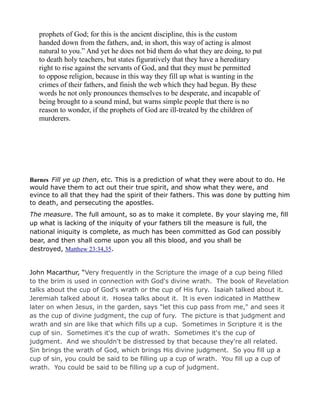
Grace to you, "But of all of the portions of Scripture that deal with these false teachers, none is more
poignant, none is more direct, none puts them in clearer focus and none is more penetratingly full of
judgment than Matthew 23. And these words seem to be the strongest, harshest, most direct and
comprehensive diatribe against false teachers in the Scripture, and that may well be, of course, because
they were spoken by our Lord against the greatest assault that hell had ever amassed, namely the three-
year assault on the ministry of Jesus Christ. It may well be that this was the greatest assault of false
doctrine and false teaching to this point in the world's history. Certainly this is the greatest denunciation
of false teachers in Scripture.
Hanson makes several salient arguments for a new interpretation of this form. First, the Greek
word ouai (Hebrew, h?i>) must be translated not as the lukewarm ?alas,? or ?woe to you,? but
rather as ?how shameful? or ?shame on...? He further classifies such statements as ?reproaches,?
which follow a formulaic pattern in scripture. Finally, Hanson contends that reproaches are most
effectively understood when contrasted with makarisms, or ?beatitudes.? That is to say, the two
genres exist in relationship with each other; both are ?formal pronouncements by someone in
authority.?[16]
Regarding the nature of reproaches, Hanson reminds us that Mediterranean societies are
competitive, and that
honor is the object of continuous competition...Acquired honor [in contrast to
ascribed honor] is that which one procures through competition, especially in
verbal [duels]...Reproaches constitute a negative challenge to another?s honor...To
be shamed means the loss of status, respect, and worth in the community.[17]
Clearly, the reproaches in Matthew?s gospel are intended to shame the Pharisees and challenge
their status; the effect is heightened by the evangelist?s clever placement of the reproaches in
opposition to the makarisms in the Sermon on the Mount (5:3-12). Matthew?s writer believes
that these leaders of formative Judaism bear shame for ?the murder of all righteous blood in the
history of Israel,?[18] and for aut_n synag_g_, ?their? synagogues (23:34).[19] His blame is further
reflected in his treatment of Jesus? trial, in which Pilate washes his hands (27:24-25) of Jesus?
death.
Seven Woes
WOES TO THE SCRIBES A D PHARISEES Matthew 23:1-36; Mark 12:37b-40; Luke
20:45-70
1Then Jesus said to the crowds and to his disciples:
1. We see that this was not a private scolding, but a public exposing of the evils of these leaders. It
had to be the most embarrassing experience of their lives to be hung out to dry before the very
people they lorded over with the hypocritical attitude of being the most godly people. Jesus rips
off their mask before everyone, and now it is war to the death. John Macarthur wrote, “So they
are denounced publicly in the presence of the multitude and in their own presence also. This then
is an electrifying scene. And again it helps us understand why they had to get rid of Jesus, why
they had to have Him killed by the Romans, especially after such a blistering public
denunciation, which threatened their own credibility and career.”
2. Edward F. Markquart gives us a list of events leading up to this chapter, and in it we see the
continuous battle of Jesus with the Pharisees, and clearly see that it was a duel to the death.
Jesus curses the fig tree.
• The chief priests and scribes seek to destroy him.
• The fig tree is withered (symbolic of the Pharisees)
• Jesus teaches in the temple with authority and challenges the Pharisees.
• Jesus tells the parable of the wicked tenants (Pharisees) who killed the servants (prophets)
and also the Son (Jesus) of the owner. Jesus teaches that “the kingdom of God will be
taken away from you (Pharisees) and given to people who produce the fruit of it (the tax
collectors and prostitutes).” When the Pharisees heard these two parables (the two sons
and the wicked tenants), they tried to arrest Jesus.
• Jesus tells the parable of the Marriage Feast where people offered flimsy excuses not to
come.
• The Pharisees seek to entangle him in a debate about not paying taxes.
• The Sadducees try to entangle him in a debate about the resurrection.
• A lawyer of the Pharisees try to entangle him in a debate about the great commandment.
• The Pharisees seek to entangle him in a debate about the Messiah and his origins.
• Jesus teaches his disciples about the phoniness of the Pharisees (Matthew 23).
• Jesus’ laments over Jerusalem.”
It may well be that this was the greatest assault of false doctrine and false teaching to this point in the
world's history. Certainly this is the greatest denunciation of false teachers in Scripture.
Now I want to give you a little bit of the background. It is the Passover season. Jesus will soon be at the
cross in just a matter of days. He has gone into the temple, in the temple He has entered into conflict
with the religious leaders, namely the scribes and the Pharisees. The Pharisees were the legalistic sect
of Jews who believed in salvation by works. They were fundamental legalists. Within the Pharisees was
a group known as the scribes who were the experts in the law. They were Pharisaical law experts. They
had devised an apostate Judaistic system in which salvation was gained by ones own self-righteous
achievements.
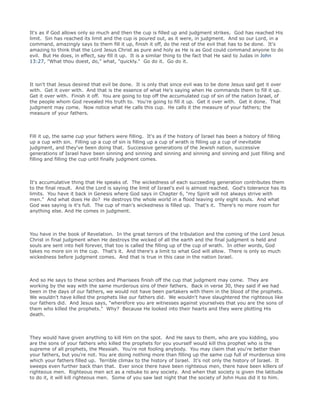
2.It is to them that Jesus brings this message. It is His final public sermon that He ever preached.
The rest of His conversations are with the disciples from this point on. He gives this message in
the temple where He has been in an ongoing conflict with them. He has given parables that speak
of their judgment, now He is direct. He gives the message in the hearing of the scribes and the
Pharisees because after all it is directed at them. But He also gives it in the hearing of the crowd,
the multitude, because it acts as a warning to them to turn from these false leaders. Furthermore,
He gives it in the hearing of the disciples because they are to be the true teachers to whom the
people must turn.
JAMES PHILLIPS, “Eight Woes, you are guilty, and punishment will come upon you. Jesus
proceeds to state wherein they were guilty. This most eloquent, most appalling, and most terrible
of all discourses ever delivered to mortals was pronounced in the temple, in the presence of
multitudes. ever was there more faithful dealing, more terrible reproof, more profound
knowledge of the workings of hypocrisy, or more skill in detecting the concealing of sin. This was
the last of the Savior’s public discourses; and it is a most impressive summary of all that he had
ever said, or that he had to say, of a wicked and hypocritical generation.
This was the final public message of Jesus, and it guaranteed His crucifixion. Jesus was a good
Jew and loved Israel, but criticism of the leaders of one’s nation does not mean one lacks
patriotism or seeks to undermine the government. Jesus wants the best of Israel, and feels they
cannot give it by the example of their leaders. One who is a great critic of the nation’s leadership
may be a far more loyal patriot than one who never criticizes but goes along with everything.
The prophets were always the nation’s greatest critics.
GILL,”Then spake Jesus to the multitude,.... To the common people that were about him in the
temple; the high priests and elders, Scribes, Pharisees, and Sadducees, having left him, being all
nonplussed and silenced by him: and now, lest on the one hand, the people seeing the ignorance and
errors of these men detected by Christ, should be tempted to conclude there was nothing in religion,
and to neglect the word and worship of God, on account of the concern these men had in it; and on the
other hand, because of their great authority and influence, being in Moses's chair, lest the people
should be led into bad principles and practices by them, he directs them in what they should observe
them, and in what not: that they were not altogether to be rejected, nor in everything to be attended to;
and warns them against their ostentation, pride, hypocrisy, covetousness, and cruelty; and, at the same
time, removes an objection against himself, proving that he was no enemy to Moses, and the law,
rightly explained and practised:
and to his disciples; not only the twelve, but to all that believed in him, and were followers of him.
CLARKE, “Then spake Jesus to the multitude,.... To the common people that were about him in
the temple; the high priests and elders, Scribes, Pharisees, and Sadducees, having left him, being all
nonplussed and silenced by him: and now, lest on the one hand, the people seeing the ignorance and
errors of these men detected by Christ, should be tempted to conclude there was nothing in religion,
and to neglect the word and worship of God, on account of the concern these men had in it; and on the
other hand, because of their great authority and influence, being in Moses's chair, lest the people
should be led into bad principles and practices by them, he directs them in what they should observe
them, and in what not: that they were not altogether to be rejected, nor in everything to be attended to;
and warns them against their ostentation, pride, hypocrisy, covetousness, and cruelty; and, at the same
time, removes an objection against himself, proving that he was no enemy to Moses, and the law,
rightly explained and practised:
and to his disciples; not only the twelve, but to all that believed in him, and were followers of him.
HE RY, “We find not Christ, in all his preaching, so severe upon any sort of people as upon these
scribes and Pharisees; for the truth is, nothing is more directly opposite to the spirit of the gospel than
the temper and practice of that generation of men, who were made up of pride, worldliness, and
tyranny, under a cloak and pretence of religion; yet these were the idols and darlings of the people,
who thought, if but two men went to heaven, one would be a Pharisee. Now Christ directs his discourse
here to the multitude, and to his disciples (Mat_23:1) to rectify their mistakes concerning these scribes
and Pharisees, by painting them out in their true colours, and so to take off the prejudice which some
of the multitude had conceived against Christ and his doctrine, because it was opposed by those men
of their church, that called themselves the people's guides. Note, It is good to know the true characters
of men, that we may not be imposed upon by great and mighty names, titles, and pretensions to power.
People must be told of the wolves (Act_20:29, Act_20:30), the dogs (Phi_3:2), the deceitful workers
(2Co_11:13), that they may know here to stand upon their guard. And not only the mixed multitude,
but even the disciples, need these cautions; for good men are apt to have their eyes dazzled with
worldly pomp.
JAMISON, “Mat_23:1-39. Denunciation of the scribes and Pharisees - Lamentation over Jerusalem,
and farewell to the Temple. ( = Mar_12:38-40; Luk_20:45-47).
For this long and terrible discourse we are indebted, with the exception of a few verses in Mark and
Luke, to Matthew alone. But as it is only an extended repetition of denunciations uttered not long
before at the table of a Pharisee, and recorded by Luke (Luk_11:37-54), we may take both together in
the exposition.
Denunciation of the Scribes and Pharisees (Mat_23:1-36).
The first twelve verses were addressed more immediately to the disciples, the rest to the scribes and
Pharisees.
Then spake Jesus to the multitude — to the multitudes, “and to his disciples.”
CALVIN, “Matthew 23:1.Then Jesus spoke to the multitudes. This warning was highly useful, that, amidst
contentions and the noise of combats, amidst the trouble and confusion of public affairs, amidst the destruction of
proper and lawful order, the authority of the word of God might remain entire. The design of Christ was, that the
people might not, in consequence of being offended at the vices of the scribes, (88) throw away reverence for the
Law. For we know how prone the minds of men are to entertain dislike of the Law; and more especially when the
life of their pastors is dissolute, and does not correspond to their words, almost all grow wanton through their
example, as if they had received permission to sin with impunity. The same thing happens — and something worse
— when contentions arise; for the greater part of men, having thrown off the yoke, give utterance to their wicked
desires, and break out into extreme contempt.
At that time the scribes burned with covetousness and swelled with ambition; their extortions were notorious; their
cruelty was formidable; and such was their corruption of manners, that one would think they had conspired for the
destruction of the Law. Besides, they had perverted by their false opinions the pure and natural meaning of the
Law, so that Christ was constrained to enter into a sharp conflict with them; because their amazing rage hurried
them on to extinguish the light of truth. So then, because there was danger that many persons, partly on account of
such abuses, and partly on account of the din of controversies, would come to despise all religion, Christ
seasonably meets them, and declares that it would be unreasonable if, on account of the vices of men, true religion
were to perish, or reverence for the Law to be in any degree diminished. As the scribes were obstinate and
inveterate enemies, and as they held the Church oppressed through their tyranny, Christ was compelled to expose
their wickedness; for if good and simple men had not been withdrawn from bondage to them, the door would have
been shut against the Gospel. There was also another reason; for the common people think themselves at liberty to
do whatever they see done by their rulers, whose corrupt manners they form into a law.
But that no man might put a different interpretation on what he was about to say, he begins by stating, that
whatever sort of men the teachers were it was altogether unreasonable, either that on account of their filth the word
of God should receive any stain, or that on account of their wicked examples men should hold themselves at liberty
to commit sin. And this wisdom ought to be carefully observed; for many persons, having no other object in view
than to bring hatred and detestation on the wicked and ungodly, mix and confound every thing through their
inconsiderate zeal. All discipline is despised, and shame is trampled under foot; in short, there remains no respect
for what is honorable, and, what is more, many are emboldened by it, and intentionally blazon the sins of priests,
that they may have a pretext for sinning with less restraint. But in attacking the scribes, Christ proceeds in such a
manner, that he first vindicates the Law of God from contempt. We must attend to this caution also if we desire that
our reproofs should be of any service. But, on the other hand, we ought to observe, that no dread of giving offense
prevented Christ from exposing ungodly teachers as they deserved; only he preserved such moderation, that the
doctrine of God might not come to be despised on account of the wickedness of men.
To inform us that he spoke publicly about their vices, not to raise envy against their persons, but to prevent the
contagion from spreading more widely, Mark expressly states that he spoke to them in his doctrine; by which words
he means that the hearers were profitably warned to beware of them. Now, though Luke appears to restrict it to
the disciples, yet it is probable that the discourse was addressed indiscriminately to the whole multitude; which
appears more clearly from Matthew, and, indeed, the subject itself required that Christ should have his eye on all
without exception.
BIBLICAL ILLUSTRATOR 1-7,”The scribes and the Pharisees sit in Moses’ seat.
Christ’s reproaches of Pharisees
There must be some just, reasonable, and great cause of our Lord’s indignation, and this we find was
an accumulation of great wickedness in these men, which received aggravations
(1) from their pretences to greater sanctity than others;
(2) from their having greater opportunities of being better than others;
(3) because they, being many of them in public places, their practice must have a bad influence
on their followers. For they who pretend holiness, and are wicked; they who are wicked, though
they have great helps to be good; and by being wicked cause others to be so too, their sin is
exceeding sinful.
The particulars for which our Saviour taxes them, were principally these:
1. Their great pride. Under the title of Rabbi they affected a greater authority than is compatible to
men.
2. Their wretched covetousness, which showed itself in the instances of devouring widows’ houses,
of esteeming the gifts and the gold above the altar and the temple.
3. Their abominable hypocrisy, shown in “teaching others to do what they themselves would not
do;” in serving a carnal interest by a religious carriage. It might have been supposed that Christ’s
disciples had been out of danger of these evils, that they would not have come near the place where
their Pilot had set a sea-mark. But whoso takes a view of the Christian Church, as Erasmus hath
represented it, he’ll say, that Pharisaism then lived and reigned as much as ever. (Hezekiah
Burton.)
Origin of Pharisaism
There was a great religious revival among the Jews after their return from the captivity, which
continued for a considerable time; and which, after they had rebuilt the temple, sent them back to the
law with a sincere desire to honour God by keeping its commands. So long as the life remained, the
obedience was the real outcome of an inward principle; but when the life died out, then the obedience
became only a fossil, and was soon covered over with corruption, until it became what we see it to have
been in the days of the Saviour upon earth. The same danger attends on every spiritual movement. A
real devotion to Christ stimulates to reverent attention to the forms of worship, and so long as that is
simply an expression of loyalty to Him, all is well; but by and by all thought of Him drops out, and then
only the ritual remains, becoming the idol of the heart, and so the life departs. Thus what was a voice
full of sincerity in one generation, is often only an empty echo in that which follows. (W. M. Taylor, D.
D.)
Evil ministers better in speech than works
If ministers do well, it is their own gain; if they say well, it is thine. Take thou what thine own is, and
let alone what is another man’s. Sylla and King Richard III. commanded others, under great penalties,
to be virtuous and modest, when themselves walked the clean contrary way. A deformed painter may
draw a goodly picture; a stinking breath sounds a mighty blast; and he that hath but a bad voice may
show cunning in descant. A blind man may bear a torch in a dark night, and a harp wake music to
others, which itself is not sensible of. Posts set for directions of passengers by the highway side do
point out the way which themselves go not; and sign-posts tell the traveller there is wholesome diet or
warm lodging within, when themselves remain in the storms without. Lewd preachers are like spire-
steeples, or high pinnacles, which point up to heaven, but press down to the centre. (J. Trapp.)
Ministerial inconsistency
They had tongues which spake by the talent, but their hands scarce wrought by the ounce; like that
ridiculous actor at Smyrna, who, pronouncing, O coelum, O heaven, pointed with his finger toward the
ground: so these Pharisees had the heaven commonly at their tongues’ end, but the earth continually
at their fingers’ end. In a certain battle against the Turks, there was a bishop who thus encouraged the
army: “Play the men, fellow-soldiers, to-day: and I dare promise you, that if ye die fighting, ye shall
sup to-night with God in heaven.” Now after the battle was begun, the bishop withdrew himself; and
when some of the soldiers inquired among themselves what was become of the bishop, and why he
would not take a supper with them that night in heaven, others answered, “This is fasting-day with
him, and therefore he will eat no supper, no, not in heaven!” (J. Trapp.)
Selfish religious pride
Thirty miles north-east of Sholapoor, at Toolazapoor, is the great temple of the goddess Bhowani, and
twice in the year the place is thronged by men and women of every grade, who come to pay their vows
and sacrifices to the idol. Besides this, at every full moon long trains of pilgrims may be seen flocking
thither; and such is the faith of the people in the healing powers of the goddess, that the sick are
resorting there constantly in the vain hope of some relief. The temple at Punderpoor is still more
renowned. Not to speak of the myriads who go there at the great festivals, persons make a pilgrimage
thither every month from a distance of fifty or a hundred miles; and the practice is kept up for many
years. One man, who had apparently come from a distance, the writer saw near Barsee, making the
journey by prostrations, measuring his length upon the ground. It was under the burning sun of
noonday; and, hardly able to proceed, he seemed the very picture of despair. But a case still more
remarkable was that of a man performing the journey by rolling himself upon the ground. We came up
with him two miles east of Wairag, and asked him where he was going, and why he was thus torturing
himself. He at first did not seem to hear; but at length stopping, he lay exhausted upon the ground,
and answered in a faint voice that he was going to Punderpoor. After some further questions, as the
writer remonstrated with him upon the folly of such a course, he raised his head from the ground, and
half reclining, said that he had come so far already he could not desist now. He stated that his village
was near Chandrapoor, 450 miles to the east from there, that he had spent fifteen months on the way
thus far, and that it was forty miles more, and he wished to complete the pilgrimage. He was
accustomed to go about a mile each day. He would then note the place where he had stopped, and
walking back to the nearest village, would remain until the next day, receiving his food from the
villagers. Then he would return, and from the place left the previous day would begin his toilsome
pilgrimage. If he came to a river that could not be passed in this manner, he would go back a distance
equal to this space, and roll over the ground a second time. He had for clothing only a coarse cloth
bound tightly about his loins, and another about his head; and thus, almost naked, over roads
extremely rough and stony, exposed to heat and cold, sometimes drenched with rain or covered with
mud-for a year and three months this poor man had been rolling himself along towards the shrine of
Vithoba. Yet it was not a sense of sin or a desire for pardon that induced him to undertake this painful
journey. But it was evident, upon further conversation, that he was urged on by no higher motive than
a selfish pride. He sought a reputation for holiness. (Bombay Times.)
Worthless ceremonies
When corn runs into straw and chaff, those who feed on it may well be thin and lean; but when it runs
into ears and kernel, thou mayest expect such as eat of it to be fat and well-favoured. When religion
runs into formalities and ceremonies, her followers can never be thriving spiritually. They may starve,
for all the gaudy flowers wherewith several dishes on her table are decked and set forth. (Swinnock.)
Deceptive, religious obedience
The shops in the square of San Marco were all religiously closed, for the day was a high festival. We
were much disappointed, for it was our last day, and we desired to take away with us some souvenirs of
lovely Venice; but our regret soon vanished, for on looking at the shop we meant to patronise, we
readily discovered signs of traffic within. We stepped to the side door, and found when one or two
other customers had been served, that we might purchase to our heart’s content, saint or no saint.
After this fashion too many keep the laws of God to the eye, but violate them in the heart. The shutters
are up as if the man no more dealt with sin and Satan; but a brisk commerce is going on behind the
scenes. From such deceit may the Spirit of Truth preserve us. (C. H. Spurgeon.)
Best places at feasts
When Hanway was in Persia, a certain governor rose from his seat and left the room, because Hanway
had inadvertently taken his seat higher than he, though at the opposite side of the table,
Pope and councils not infallible
There is no external supreme, infallible judge in the Church of God, to whom all Christians are obliged
to submit their faith and consciences in all matters of religion. Argument
I. This authority which they pretend to is a greater authority than the apostles themselves did ever
claim or exercise in the Church of God, as plainly appears from 2Co_1:24 -”Not that we have dominion
over your faith.” This was very agreeable to the nature and person of Christ. Argument
II. Such an authority as they pretend to is contrary to that command of the trial of doctrines which is
laid upon all Christians; for if there be an infallible judge to whom I ought to submit my falth and
conscience in all matters of religion, what need I try doctrines?
1. Christians have ability to try things with.
2. They have a rule to try things by.
3. Christians have a promise of discovery upon trial. Argument III., against the supremacy and the
infallible authority of the pope, is taken from the danger of following false guides. People may sin
in following their guides and teachers. Argument IV., and last, against this doctrine is, from the
want of a Divine appointment and promise. Inference
II. Forasmuch as there is no person upon earth that can infallibly guide you to salvation, it concerns
you to have the greater care of your own salvation.
1. Study the Holy Scriptures.
2. Pray fervently for the guidance of God’s Spirit.
3. If you would discern and hold fast the truth, love and practise it. (M. Pool.)
A proud title the sign of usurped authority
But, indeed, there was a deeper and worse design than this in it; they did not only aim at splendid and
glorious titles, but they did usurp authority and dominion over the consciences of the people, whereof
this was but a sign: as amongst us the flag is a sign of the dominion of the seas, so.this title was an
indication and sign of that authority which they usurped over the people. (M. Pool.)
2"The teachers of the law and the Pharisees sit in Moses'
seat.
"In the modern sense they [the scribes] were the religious scholars or theologians
sometimes called lawyers or teacher of the law could make judicial decisions
based on scriptural exegesis, occupied important positions in the Sanhedrin played
a major role in bringing on the crucifixion of Jesus" and they "mainly belonged to the
party of the Pharisees" (WYCLIFFE Bible Dictionary, p. 1536).
Matthew Henry
We find not Christ, in all his preaching, so severe upon any sort of people as upon these
scribes and Pharisees; for the truth is, nothing is more directly opposite to the spirit of the
gospel than the temper and practice of that generation of men, who were made up of pride,
worldliness, and tyranny, under a cloak and pretence of religion; yet these were the idols and
darlings of the people, who thought, if but two men went to heaven, one would be a Pharisee.
People must be told of the wolves (Acts 20:29, 30), the dogs (Phil. 3:2), the deceitful
workers (2 Co. 11:13), that they may know here to stand upon their guard. And not only
the mixed multitude, but even the disciples, need these cautions; for good men are apt
to have their eyes dazzled with worldly pomp.
John Macarthur quotes William Barclay, “William Barkley who spent a part of his life in the
land of Israel researching background material say there were seven kinds of Pharisees and he
described them with these terms. First there was the shoulder Pharisee, so called because he
wore his good deeds on his shoulder. He paraded the good that he did. When he prayed he
would put something, ashes, on his head and he would look sad so everyone would know how
pious and spiritual he was. He was the shoulder Pharisee.
And then there was the wait a little Pharisee. This was the Pharisee who could come up with a
spiritual reason to put off doing something good. He always had excuses but they sounded very
pious.
And then there was the bruise and bleeding Pharisee who thought it was a sin to look at a woman
and so whenever women were around he bent over and closed his eyes and he kept running into
walls. And according to the Pharisees the more bruises you had from walls the more holy you
were.
Then there was the humpback tumbling Pharisee and the humpback tumbling Pharisee was
called that because he wanted to demonstrate his humility so he slouched way over and bent his
back and walked around all day in that humble position and thought it was wrong to lift his feet
so he shuffled his feet and he kept tripping on things and tumbling. And he was called the
humpback tumbling Pharisee.
Then there was the ever reckoning Pharisee. He was the Pharisee who kept count of all of his
good deeds so he's know what God owed him in terms of blessing.
And then there was the fearing Pharisee who did all that stuff because he was scared to death of
going to hell. And then William Barkley suggested there was the God-fearing Pharisee who did
what he did because he thought it was right to do it and he had integrity to some extent. He was
the one out of the seven who was a really good guy. And that's the group to whom our Lord
speaks in this chapter and of whom he warns.”
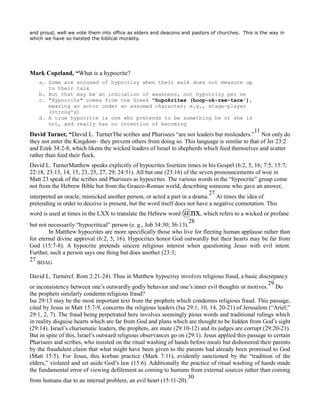
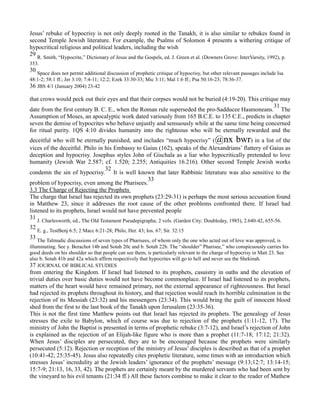
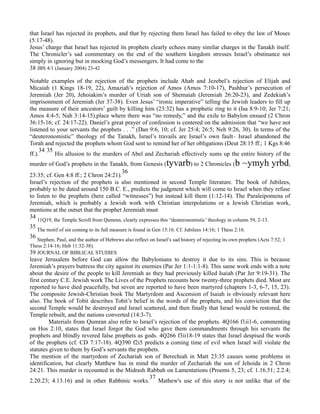
David L. Turner, “Matthew 23 has been called “a unique, unparalleled David L. Turnerspecimen of
invective” and a “masterpiece of vituperation.”
3
Matthew presents Jesus’ disputes with the Jewish leaders
in bold relief, and those disputes come to a head with Jesus’ seven
4
pronouncements of woe against the
Jewish leaders in Matt 23. These strident denunciations disturb many people today.
But heated rhetoric in the service of religious disputes was quite the norm in ancient times.
5
In fact,
it can be argued that such rhetoric was used in Jewish circles since the days of the biblical prophets, and that
it continued to be used in the days of the Second Temple as various Jewish groups critiqued the religious
establishment in Jerusalem. Davies and Allison bring this fact to bear upon Matthean polemics:
The ferocity of rhetoric in Jewish texts, and especially the volatile language of the Dead Sea Scrolls,
shows that Mathew’s polemic need not signal a break with Judaism. So far from that being the case,
we indeed deny that Matthew is a Christian critique of Judaism. It is rather a Jewish-Christian
critique of Jewish opponents– and therefore no more ‘anti-Semitic’ than the Dead Sea Scrolls
CALVIN, “2.In the chair of Moses. Reasons were not wanting for inserting here what Luke relates at a different
place. Besides that the doctrine is the same, I have no doubt that Luke, after having said that the scribes were
sharply and severely reproved by our Lord, added also the other reproofs which Matthew delayed till the proper
place; for already we have frequently seen that the Evangelists, as occasion required, collected into one place
various discourses of Christ. But as the narrative of Matthew is more full, I choose rather to take his words as the
subject of exposition.
Our Lord gives a general exhortation to believers to beware of conforming their life to the wicked conduct ofthe
scribes, but, on the contrary, to regulate it by the rule of the Law which they hear from the mouth ofthe scribes; for it
was necessary (as I have lately hinted) that he should reprove many abuses in them, that the whole people might
not be infected. Lest, through their crimes, the doctrine of which they were the ministers and heralds should be
injured, he enjoins believers to attend to their words, and not to their actions; as if he had said, that there is no
reason why the bad examples of pastors should hinder the children of God from holiness of life. That the
word scribes, agreeably to the Hebrew idiom, denotes the teachers or expounders of the Law, is well known; and it
is certain that Luke calls the same personslawyers (89)
Now our Lord refers peculiarly to the Pharisees, who belonged to the number of the scribes, because at that time
this sect held the highest rank in the government of the Church, and in the exposition of Scripture. For we have
formerly mentioned that, while the Sadducees and Essenes preferred the literal interpretation of Scripture,
the Pharisees followed a different manner of teaching, which had been handed down, as it were, to them by their
ancestors, which was, to make subtle inquiries into the mystical meaning of Scripture. This was also the reason
why they received their name; for they are calledPherusim, that is, expounders. (90) And though they had debased
the whole of Scripture by their false opinions, yet, as they plumed themselves on that popular method of instruction,
their authority was highly esteemed in explaining the worship of God and the rule of holy life. The phrase ought,
therefore, to be thus interpreted: “The Pharisees and other scribes, or, the scribes, among whom the Pharisees are
the most highly esteemed, when they speak to you, are good teachers of a holy life, but by their works they give
you very bad instructions; and therefore attend to their lips rather than to their hands.”
It may now be asked, Ought we to submit to all the instructions of teachers without exception? For it is plain
enough, that the scribes of that age had wickedly and basely corrupted the Law by false inventions,
had burdened wretched souls by unjust laws, and had corrupted the worship of God by many superstitions; but
Christ wishes their doctrine to be observed, as if it had been unlawful to oppose their tyranny. The answer is easy.
He does not absolutely compare any kind of doctrine with the life, but the design of Christ was, to distinguish the
holy Law of God from their profane works. For to sit in the chair of Moses is nothing else than to teach, according to
the Law of God, how we ought to live. And though I am not quite certain whence the phrase is derived, yet there is
probability in the conjecture of those who refer it to the pulpit which Ezra erected, from which the Law was read
aloud, (Nehemiah 8:4.) Certainly, when the Rabbis expounded Scripture, those who were about to speak rose up in
succession; but it was perhaps the custom that the Law itself should be proclaimed from a more elevated spot. That
man, therefore, sits in the chair of Moses who teaches, not from himself, or at his own suggestion, but according to
the authority and word of God. But it denotes, at the same time, a lawful calling; for Christ commands that the
scribes should be heard, because they were the public teachers of the, Church.
The Papists reckon it enough, that those who issue laws should possess the title and occupy the station; for in this
way they torture the words of Christ to mean, that we are bound to receive obediently whatever the ordinary
prelates of the Church enjoin. But this calumny is abundantly refuted by another injunction of Christ, when he bids
them beware of the leaven of the Pharisees, (Matthew 16:6.)
If Christ pronounces it to be not only lawful, but even proper, to reject whatever of their own the scribes mingle with
the pure doctrine of the Law, certainly we are not bound to embrace, without discrimination or the exercise of
judgment, whatever they are pleased to enjoin. Besides, if Christ had intended here to bind the consciences of his
followers to the commandments of men, there would have been no good ground for what he said in another
passage, that it is in vain to worship God by the commandments of men, (Matthew 15:9.)
Hence it is evident, that Christ exhorts the people to obey the scribes, only so far as they adhere to the pure and
simple exposition of the Law. For the exposition of, Augustine is accurate, and in accordance with Christ’s meaning,
that, “the scribes taught the Law of God while they sat in the chair of Moses; and, therefore, that the sheep ought to
hear the voice of the Shepherd by them, as by hirelings.” To which words he immediately adds: “God therefore
teaches by them; but if they wish to teach any thing of their own, refuse to hear, refuse to do them.” With this
sentiment accords what the same writer says in his Fourth Book of Christian Doctrine: “Because good believers do
not obediently listen to any sort of man, but to God himself; therefore we may profitably listen even to those whose
lives are not profitable.” It was, therefore, not the chair of the scribes, but the chair of Moses, that constrained them
to teach what was good, even when they did not do what was good. For what they did in their life was their own;
but the chairof another man did not permit them to teach what was their own.
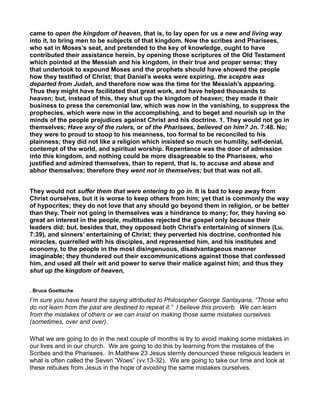
Unknown author, “ o less than four interpretations of “the Seat of Moses” have been pro-
posed: (1) the Seat of Moses was an actual piece of synagogue furniture upon
which authorized interpreters of the Torah sat;
2
(2) the expression is a meta-
phor referring to the fact that the Pharisees had assumed the role of being
the Law’s interpreters;
3
(3) “the Seat of Moses” was a specially designed chair
(used as a stand) upon which the Torah scroll was placed when not in use
during the synagogue service;
4
and (4) the expression refers to the social po-
sition of the Pharisees as those who control access to the Torah.
5
Davies and Allison conclude that it is impossible to determine what “the
seat of Moses” means with any degree of certainty.
6
In our opinion, how-
ever, this conclusion is unwarranted. The evidence seems to indicate that our
first suggestion is correct—the seat of Moses was an actual piece of syna-
gogue furniture upon which teachers of the Torah sat.
7
Stone seats, which
were positioned so that their occupant sat facing the congregation, have been
found in synagogues at Chorazin, En Gedi, and Hammat Tiberias, and in
Diaspora synagogues at Delos and Dura-Europos.
8
In an important study published in 1934, Eleazar Sukenik identified the
structures found at Hammat, Chorazin, and Delos as synagogues and iden-
tified the stone chairs found in their ruins as the seat of Moses referred to
in Matt 23:2.
9
Sukenik later reversed himself regarding the Delos structure,
but many within the academic community remain convinced that this first-
century structure was in fact a synagogue.
HISTORY OF THE PHARISEES by Gregory Dawson
In our passage today Jesus is again railing against the Pharisees. But in fairness to them,
they had their reasons for doing what they did. Back in the days of the Prophet Jeremiah Israel
had turned away from God. They forgot much about their origins in Egypt, and had decided that
they could live well enough on their own. After many warnings and calls to return to God’s ways
God brought judgment upon his nation. They were exiled into Babylon. They spent 70 years in
captivity before they began to return to a ruined land. And in response to this judment upon their
sin the people said “ ever Again.” Leaders like Ezra and ehemiah called the nation to be
faithful, to live according to the covenant God made with Israel when Moses lead them out of
slavery. Many driven by fear, set their hearts to obey God and his laws. So priests arose to
instruct the people in the ways of God. The Pharisees were these priests. The people knew the law
of Moses but they were unsure how to fulfill it. So they would go and ask for guidance. For
example, one commandment which showed how Israel honored God was to keep the Sabbath day
holy. ow the question some of the people had was “How do we do that, how do we keep the
Sabbath day holy?” The rabbis said it meant you don’t do any work on the Sabbath. But then
someone would ask, “What exactly do you mean by work?” You have to do some things. How
much is legitimate?” So the rabbis put there heads together and found that in the Law the Holy
of Holies was places 2000 cubits away for the nearest home. Presumably it was legitimate for
people to walk 2000 cubits to worship. Therefore, they said, on the Sabbath you must not walk
more that 2000 cubits (i.e. 1000 yards). And so that became a Sabbath Day’s journey. That was as
far as you could go. Remember the purpose of this discussion was to answer the people’s
question, “How do we honor God.” The answer was Keep the Sabbath. But now they have this
thing so well definedthat you honored God by not walking more than a thousand yards on the
Sabbath day.
That’s when matters got worse. Some people said, “1000 yards really isn’t much, and we have a
lot of things we need to do. Is there anything we can do about this?” So the rabbis
said, What we could do is decide that you don’t measure from your front door, but from the edge
of your property. That will give you a few more yards.” And that was helpful, but still some said,
“look we really are in a bit of a bind, is there anything more you can do.” So the rabbis said
“Well, if before the Sabbath begins, you walk 1000 yards and place some of your property, or
some food by the way, you can then consider that the end of your property, and walk a Sabbath
day’s journey from there.” ow this may sound ridiculous, but it’s called religion. It’s amazing
how people can start out to honor God, and if they are earnest they have a tendency to get more
and more meticulous about it until they loose track completely of honoring God and become
locked into the system. That’s what happened to the Pharisees. That is what happens when
generation after generation keeps the ways of their forebearers. The memory of the events that
shaped them fade, but the responses to the crisis remain. People no longer remember why they do
what they do. They just do it. And then you find other reasons for continuing as you always have.
JESUS’ CHALLE GE
This is what drew Jesus’ criticism. The people had forgotten not only the exile but also the call of
God. Jesus came to remind the people, and the leaders, and the priests not “Be Holy” but “I shall
be your God, you are my people.” More important than upright living, Jesus knew, was the
reason for living. Jesus announced “The greatest commandment is this: ‘you shall love the Lord
your God, and you shall love your neighbor as yourself.’And Jesus knew even more importantly,
that the true reason for love is this God is with us. Jesus came to call people to walk with God to
remind us that God is for us, that God is present here and now. And Jesus is willing to challenge
the crazy extremes that leads the Pharisees and others away from God and into religious effort
and self-righteousness. To point out to them and to us, the dangerous behaviors that come when
we forget the heart of the matter we live out of fear rather than love. When our motivation for
obedience is to avoid judgment rather than receive grace.
Jesus knew the Pharisees wanted to do their very best to be upright that is why he could say “ the
Scribes and Pharisees sit on the seat of Moses, so do as they say.” But Jesus looked far deeper
than the doing, and that is what he criticized. He saw through the religious habits and warned
“You do not practice what you preach.” How often we here that criticism. We say one thing on
Sunday but do another thing on Monday. It means we can talk the talk, but fail to walk the walk.
It means that we pay lip service, but fail to act. We may even defend ourselves and say ‘well no
one is perfect.” We know that no one is perfect, perfection is not the goal. To put into practice
means - you practice. It is your habit, your pattern to keep after those things you understand to
be important. Did you know performers like Isaac Perlman practice musical scales every day.
They know their performance demands it, so they do it. They practice what they preach. Jesus
calls us to practice our faith.
Another thing Jesus saw as corrupting was that as highly religious people we lay on others heavy
burdens we ourselves will not lift. You know what he is talking about. Everyone should pray
daily. Everyone should read the scripture. Everyone should tithe. Which gets
translated “You should”. Well Mary, you should really know more of the scripture. Mike, you
know you should pray. If you would tithe, the church could do more. And you should be visiting
too. But the danger Jesus says is that we are unwilling to follow the advice we give to others. We
wouldn’t do what we require of others. We will not even ask ourselves, but what about me? You
should tithe, but what am I giving? You should invite people to church, but could I? We demand
others to do what we find impossible for ourselves.
Jesus also exposed how religion becomes obvious and social. He said the Pharisees of his
day made their phylacteries broad and their fringe long. We don’t do that any more. What it
meant was that the signs of their religious practices were seen publicly. Today they would be
carrying 20 lb. Bibles, and praying really loud in restaurants, so others would know how
important it is to return to the way we were raised. Today it is the protests and cry to return
prayer to the schools and insistence on no sports or business on Sunday. But Jesus points out, the
danger is if that is as far as it goes. Jesus saw that there was no substance behind the social image.
Jesus warns us that there must be private devotion behind our civil religion, there must be
personal faith behind our public confession and individual commitment behind our corporate
practices.
Jesus then leveled his gaze on the esteem of religious living. He said the pious love being
given the best seats in the house, and being honored at feasts and acknowledged in the market
place. You know what that means. “ladies and gentlemen, it is our distinguished privilege to have
with us today....” We think of this in terms of having a big name like Billy Graham, or Rev.
Dawson. But don’t we all want our neighbors to say “Bill is a good Christian”, and “she is a godly
woman”. That is recognition too. Would we be willing to risk our reputation for the sake of
Christ? Would we be willing to have heads shake and tongue wag just for doing God’s will? Do
you think Mary was called a ice Jewish Girl when Joseph’s family found out she was pregnant?
What gossip flew around the temple when God called a priest named Hosea to marry a harlot
and then name their first two children “ ot mine, and no regard”? Jesus would remind us that
true obedience is risky business.
Lastly Jesus exposed the habit of the carefully religious - that they are careful. He warns
us not to call others father, or rabbi, or teacher. ow you may think this means not to take titles,
but its not simply that. It is the habit of giving others not just the title, but the authority of being
our religious master, our leader, --and our guru. Rather than struggle with obedience ourselves
we ask “What should I do” and then if, or when we are challenged, we say “I only did what
Pastor told me to do.” It’s the ‘don’t blame me, I listened in you’ syndrome. Jesus knows how
easily people, especially well meaning followers, wind up following the person rather than the one
they point to. When Jesus looked to the religious people of his day, and to their religious leaders,
the Scribes and Pharisees He saw the dangers of religion gone amuck. He saw the extreme
distortion of the desire to honor God, and the end result of the desire to be right and to escape
judgment. He saw the growth of self - justification, self - preservation and self-righteousness.
Jesus knew there was only one way to escape the dangers of bad religion. And it was radical.
Jesus said the way out of religion was meekness. He knew that true greatness was in service and
humility. But Jesus was not talking about slavishness and doing good to others, he was not
talking about shame and subservience. Jesus knew the way out of selfishness was healthy
selflessness. The heart of humility and true servanthood was self-forgetfulness. Humility was not
worrying about where you stand but was trusting in someone greater to whom you gave yourself.
This is what faith is all about, this is what Jesus calls us to. We who would truly honor God are
called to follow Christ. We are told: “Do nothing from selfishness or empty conceit, but in
humility count others better than yourselves...”
“Have this mind among yourselves, which is yours in Christ Jesus, who though he was in the
form of God, did not count equality with God a thing to be grasped, but emptied himself, taking
the form of a servant, being born in the likeness of men. And being found in human form he
humbled himself and became obedient unto death, even death on a cross.”
This is humility, this is servanthood. This is life which honors and loves God, that has so trusted
oneself to God that you lose yourself in God, knowing God will never lose you. You can forget
yourself because God remembers God’s grace. The way out of false religion is true relationship.
Paul, himself a Pharisee, knew this truth. In Phil 3 he said that in his religious life he had been
blameless under the Law, yet under it he never gained what he truly desired. Only when Paul
experienced a crisis on the Damascus road, when he saw the vision of the triumphant Christ, did
he realize the love and grace of God that was offered to him, and his goal became, not personal
righteousness, but the surpassing worth of knowing Christ Jesus the Lord.
CO CLUSIO
The challenge we face today is how are we living our life? What are you basing acceptance before
God on? Do you rely on religion? Is it what you believe is it your personal uprightness is it that
you faithfully come to church, that your family has been members here for generations is it that
you are known as a good Christian person. Or have you discovered the remarkable grace of God.
Have you experienced the world shattering crisis of the unending love of God that has forever
changed your life. Have ou
been transformed by the presence which calls you away from self-protective care and into
selfless love, that leads you out of the world of fear and into eternal joy. May we all seek
the answer to our hearts desire. Amen.
HENRY, “The pulpit of wood,such as was made for Ezra, that ready scribe in the law of God
(Neh. 8:4), is here called Moses’s seat, because Moses had those in every city (so the
expression is, Acts 15:21), who in those pulpits preached him; this was their office, and it was
just and honourable; it was requisite that there should be some at whose mouth the people
might enquire the law, Mal. 2:7. Note, 1. Many a good place is filled with bad men; it is no new
thing for the vilest men to be exalted even to Moses’s seat (Ps. 12:8); and, when it is so, the
men are not so much honoured by the seat as the seat is dishonoured by the men. Now they
that sat in Moses’s seat were so wretchedly degenerated, that it was time for the great
Prophet to arise, like unto Moses, to erect another seat. 2. Good and useful offices and
powers are not therefore to be condemned and abolished, because they fall sometimes into
the hands of bad men, who abuse them. We must not therefore pull down Moses’s seat,
because scribes and Pharisees have got possession of it; rather than so, let both grow
together until the harvest, ch. 13:30. Hence he infers (v. 3), "Whatsoever they bid you
observe, that observe and do As far as they sit in Moses’s seat, that is, read and preach the
law that was given by Moses’’ (which, as yet, continued in full force, power, and virtue), "and
judge according to that law, so far you must hearken to them, as remembrances to you of the
written word.’’ The scribes and Pharisees made it their business to study the scripture, and
were well acquainted with the language, history, and customs of it, and its style and
phraseology. Now Christ would have the people to make use of the helps they gave them for
the understanding of the scripture, and do accordingly. As long as their comments did
illustrate the text and not pervert it; did make plain, and not make void, the commandment of
God; so far they must be observed and obeyed, but with caution and a judgment of discretion.
Note, We must not think the worse of good truths for their being preached by bad ministers;
nor of good laws for their being executed by bad magistrates. Though it is most desirable to
have our food brought by angels, yet, if God send it to us by ravens, if it be good and
wholesome, we must take it, and thank God for it. Our Lord Jesus promiseth this, to prevent
the cavil which some would be apt to make at this following discourse; as if, by condemning
the scribes and Pharisees, he designed to bring the law of Moses into contempt, and to draw
people off from it; whereas he came not to destroy, but to fulfil. Note, It is wisdom to obviate
the exceptions which may be taken at just reproofs, especially when there is occasion to
distinguish between officers and their offices, that the ministry be not blamed when the
ministers are.
GRACE TO YOU
"The scribes and the Pharisees have seated themselves in the seat of Moses," or the chair of Moses.
Each synagogue had a special seat or a chair, the chair of Moses. It was a chair occupied by the legal
authority on the law, the supreme authority on the law, the supreme teacher in that synagogue
community would be said to be sitting in the chair. We have the same situation today in universities.
We talk about a chair of philosophy, or a chair of science, a chair of history, a chair of literature. What
we mean by that is the leading expert in that entire venue of education sits in that seat of prime
authority. They had it in the synagogue as well. There was the seat of Moses, it is the chair of authority.
The word "seat," by the way, is kathedra. The Roman Catholic Church says that when the Pope speaks
for God he speaks ex cathedra, out of the seat of authority. And so this was typical of the synagogue.
There was a chair occupied by the leading law expert. It may not always have been a literal chair but it
is seen as a position of authority.
Curtis Kittrell
Matthew 23:2
a [Moses’ seat]
Twenty-one Characteristics of Hypocrites
1. They demand respect as teachers (Matthew 23:2).
2. They teach, but do not practice (Matthew 23:3).
3. They demand service; not give it (Matthew 23:4).
4. They seek praise of men (Matthew 23:5).
5. They parade their religion (Matthew 23:5).
6. They seek chief banquet places (Matthew 23:6).
7. They seek chief places in church (Matthew 23:6).
8. They glory in personal attention (Matthew 23:7).
9. They glory in titles (Matthew 23:7).
10. They rob men of truth and life (Matthew 23:13).
11. They reject truth and life (Matthew 23:13).
12. They take advantage of widows (Matthew 23:14).
13. They exhibit long prayers (Matthew 23:14).
14. They are zealous to win men to their sect, but not to God (Matthew 23:15).
15. They root and ground converts in hypocrisy, but not to God (Matthew 23:15).
16. They profess to be the only guide in religion, but are blind to truth and practical Christianity
(Matthew 23:16-22).
17. They propagate those parts of religion from which they receive most personal gain and honor
(Matthew 23:16-22).
18. They strain at gnats and swallow camels; stress minor details and omit the fundamentals of religion
(Matthew 23:23-24).
19. They glory in physical cleanliness, but live in moral filth (Mt. v23:25-26).
20. They exhibit outward religion and self-righteousness and ignore inward holiness in life and conduct
(Matthew 23:2,7-28).
21. They pretend to be more righteous than their forefathers (Matthew 23:29-33).
BARNES, “Scribes and Pharisees - See the notes at Mat_3:7.
Moses’ seat - Moses was the great legislator of the Jews. By him the Law was given. The office of
explaining that Law among the Jews devolved on the scribes and Pharisees. In the synagogues they sat
while expounding the Law, and rose when they read it. By “sitting in the seat of Moses” we are to
understand authority to teach the Law; or, as he taught the nation by giving the Law, so they taught it
by explaining it.
CLARKE,”The scribes and the Pharisees sit in Moses’ seat - Εκαθισαν. - They sat there
formerly by Divine appointment: they sit there now by Divine permission. What our Lord says here
refers to their expounding the Scriptures, for it was the custom of the Jewish doctors to sit while they
expounded the law and prophets, (Mat_5:1; Luk_4:20-22), and to stand up when they read them.
By the seat of Moses, we are to understand authority to teach the law. Moses was the great teacher of
the Jewish people; and the scribes, etc., are here represented as his successors.
GILL, “Saying, the Scribes and Pharisees,.... The Persic version adds, the priests: but Christ does
not here speak of the sanhedrim, or grand council of the nation, and of their legislative power; but of
those that were the teachers of the people, and the interpreters of the law; and of those, who, though
they corrupted the word with their glosses and traditions, yet retained some truth, and at least came
nearer truth, than the Sadducees; who therefore are omitted, and only Scribes and Pharisees
mentioned, who gave the literal and traditional sense of the Scriptures; of whom he says, they
sit in Moses's seat: not that they were his successors in his office as a legislator and mediator;
though the Persic version reads it, "sit in the place and chair of Moses"; but they read his law, and
explained it to the people: this post and place, as yet, they kept in the office they were, and were to
continue; and the people were to regard them so far as they spoke consistent with the law, until it had
its full accomplishment in Christ. The allusion is not to the chairs in which the sanhedrim sat in trying
and determining causes, but to those in which the doctors sat when they expounded the law; for
though they stood up when they read the law, or the prophets, they sat down when they preached out
of them: this custom of the synagogue was observed by our Lord; see Luk_4:16.
JAMISON, “Saying, The scribes and the Pharisees sit — The Jewish teachers stood to read, but
sat to expound the Scriptures, as will be seen by comparing Luk_4:16 with Luk_4:20.
in Moses’ seat — that is, as interpreters of the law given by Moses.
3So you must obey them and do everything they tell you.
But do not do what they do, for they do not practice what
they preach.
1. Jesus gives us the definition of hypocrisy, for to preach the truth of God, and then not follow it
up with obedience to that truth is the essence of what it means to be a hypocrite. It is a surprise
that Jesus would make it so clear that these men were to be obeyed, but we need to understand
that there was no problem with their knowledge. They were well versed in the law of Moses, and
when they taught it to the people they were giving honest and truthful teaching. Jesus never
criticized them for not faithfully expounding the truth of the law. They were as accurate as could
be, and knew the law to the letter. He could compliment them on being excellent teachers. They
were just not faithful in living according to the truth they taught. Jesus wants to be sure there is
not a misunderstanding that leads people to believe that he is rejecting the Old Testament law of
Moses. He will make much of it obsolete by his sacrifice on the cross, but the moral laws of God
there are permanent for all time, and they are being conveyed by these men, and they are to be
obeyed by all.
2. What we learn from this is that it is possible for even an unbeliever to communicate the truth
of God. You can have a skeptic, or a way out liberal who does not believe the Bible is the Word of
God, and he can lecture on it and give forth wise and accurate words that are true and valid
insights into what God wants us to know. Just because a man does not believe, or because he does
not live as God wills, does not mean that he cannot be a communicator of what is of value for us
to hear and obey. Don't judge a book by its cover applies here, for you cannot judge the value of a
teaching by the man who speaks it, for he may be a bad man, but his teaching may still be good
and worth hearing. The Pharisees were terrible people, and yet Jesus said that they were
communicators of the truth that was to be obeyed. They were still being tools of God to convey
his Word, even though they were out of his will and under his judgment. We are to judge teaching
by its conformity to the Word of God, and not by the character of the man or woman teaching it.
3. The reason I make a point of the above is because there are many pagan authors who have
valuable insights that are truly biblical and valid for the guidance of the Christian. Paul quotes
pagan authors several times because what they say is valid. Paul does not say these pagans have it
all together and are great examples for life. ot at all, but they have some wisdom and insight
that wise believers will hear and heed. Authors do not have to be Christians to give us valuable
truths or worthwhile insights that illustrate biblical truths. The second point is, all truth is God's
truth, and so no matter what the source is, if it is true, it is good and valuable for the believer.
These truly bad men were conveying the truth of God so accurately that Jesus said obey what
they tell you, for they are still channels of God's truth in spite of their being double agents, for
they are also tools of the devil.
4. Powell, “In saying that the scribes and the Pharisees sit on Moses' seat, Jesus may be simply
acknowledging the powerful social and religious position they occupy in Matthew's story world, a
world in which most people are illiterate and copies of the Torah are not plentiful. Since Jesus'
disciples do not themselves have copies of the Torah, they will be dependent on the scribes and
the Pharisees to know what Moses said on any given subject. In light of such dependence, Jesus
advises his disciples to heed the words that the scribes and the Pharisees speak when they sit on
the seat of Moses, that is, when they pass on the words of the Torah itself. The first activity of the
scribes and the Pharisees, the one that Jesus commends, refers not to teaching or interpretation
of Moses but simply to citation of Moses.”
5. Edward Markquart, “The Pharisees were a bunch of phonies who did not do what they
preached. We recall the woes. “Woe to you, scribes and Pharisees, hypocrites.” Focus on the
word, “hypocrite.” This whole section of verses in both Matthew and Luke is a commentary on
Isaiah 29:13, “This people honors me with their lips (talk a good talk), but their hearts are far
from me.” The big issue in Jesus’ day was hypocrisy, especially as embodied in the lives of the
Pharisees.
An important issue of our day is still hypocrisy.
The word, “Pharisee,” was synonymous with the word, “hypocrisy.”
We recall Mark 7:7 when Jesus spoke against the Pharisees, “Well did the Isaiah’s prophecy of
you hypocrites. This was a very personal and direct confrontation and condemnation. Circle the
word, “hypocrites,” and write the word, “actor.” The Greek word for hypocrite means “actor.”
Sometimes, when seeing a play, an actor or actress is incredibly believable in their role. The actor
or actress seems so authentic, so genuine, so real that it is hard to comprehend that it is all “make
believe.” So it is with many people of faith: on the outside and the showy parts of their lives, they
give a good performance of being a Christian, but it is all “a front.” Inside, their hearts are far
from the love of God/Jesus and neighbor.”
6. Jerry Goebel, “Jesus was challenging the vast chasm between their walk and their talk. If the
two components do not match then we are not obedient—we are hypocrites. The Pharisees were,
quite simply, all “heavenly minded but no earthly good.” o matter how extensive our biblical
knowledge or how devoted we are to study and debate over the scriptures; if the study of God’s
word doesn’t increase our love of God’s people—we are gonging cymbals in the desert [1
Corinthians 13:1]. Jesus put it quite simply: 1.Do you love God? 2.Do you love your neighbor?
The Pharisees failed in both areas. They loved the law and they loved to judge others by it. I may
love to read Scripture; but do I love the people that it points me towards? These Pharisees (and
the Pharisee in me) used their elite education to gain attention for themselves and to distance
themselves from others......... Essentially, the Pharisees stance on life was; “I know more than you
and that makes me better.” Instead, it should have been; “God has given me the means to study
His ways—how can I use this privilege to free my people?”
7. Calvin, “Our Lord gives a general exhortation to believers to beware of conforming
their life to the wicked conduct of the scribes, but, on the contrary, to
regulate it by the rule of the Law which they hear from the mouth of the
scribes; for it was necessary (as I have lately hinted) that he should
reprove many abuses in them, that the whole people might not be infected.
Lest, through their crimes, the doctrine of which they were the ministers
and heralds should be injured, he enjoins believers to attend to their
words, and not to their actions; as if he had said, that there is no reason
why the bad examples of pastors should hinder the children of God from
holiness of life. That the word scribes, agreeably to the Hebrew idiom,
denotes the teachers or expounders of the Law, is well known; and it is
certain that Luke calls the same persons lawyers.”
7B. Calvin goes on, “Hence it is evident, that Christ exhorts the people to obey the scribes,only
so far as they adhere to the pure and simple exposition of the Law. For the exposition of,
Augustine is accurate, and in accordance with Christ’s meaning, that, “the scribes taught the
Law of God while they sat in the chair of Moses; and, therefore, that the sheep ought to hear the
voice of the Shepherd by them, as by hirelings.” To which words he immediately adds: “God
therefore teaches by them; but if they wish to teach any thing of their own, refuse to hear, refuse
to do them.” With this sentiment accords what the same writer says in his Fourth Book of
Christian Doctrine: “Because good believers do not obediently listen to any sort of man, but to
God himself; therefore we may profitably listen even to those whose lives are not profitable.” It
was, therefore, not the chair of the scribes, but the chair of Moses, that constrained them to teach
what was good, even when they did not do what was good. For what they did in their life was
their own; but the chair of another man did not permit them to teach what was their own.”
Follow their instruction, but not their conduct. Jesus says it is possible for a terrible person to
be a terrific teacher. A divorcee might be an excellent marriage counselor, or one with no
children and excellent family specialist. One can have knowledge and not have experience. One
can know what is good and right and still do what is bad and wrong. You can learn from a
person you would never take as an example. Their words are true even if their walk isn’t.
Bruce Goettsche
There was good in what they taught. The Pharisees were not wrong in all their
theology. These men taught the authority of God’s Word. They believed in angels. They
trusted the sovereignty of God while at the same time underscoring the responsibility of
man. They believed in a real Heaven and Hell. They taught many good things. We must
remember that the Word of God is authoritative even if the teacher is corrupt. The Scribes
and Pharisees were to be respected because they were passing on the truth of Scripture.
In Acts 17:11 we are told,
Now the Bereans were of more noble character than the Thessalonians, for they
received the message with great eagerness and examined the Scriptures every day to
see if what Paul said was true.
This is what we need to do also. We need to be like the Bereans. There is truth that can be
found in the exposition of Scripture. We need to respect these teachers even though we do
not agree with them on everything. We have a tendency to turn away from the teaching of
people simply because they don’t agree with our pet theological position. Our job is to
receive the messages eagerly and then check them thoroughly with the Word of God. It is the
truth that sets us free and we must seek the truth wherever it may be found.
Second, we need to remember that Christianity is revealed as much by what we do as by
what we say.
J. C. Ryle says in the footnote to his commentary that he not resist the opportunity of expressing
his firm conviction that Jesus sayings in this chapter were meant to bear a prophetic significance
and to apply to corruptions which he foresaw would spring up in his church. That is to say, Jesus
knew that that the Pharisee tendency would continue.
PAUL CULL
And like the Pharisees, we too can suffer from spiritual shallowness. We all too easily get
wrapped up in the details, and ignore the principles. For example, we can debate at length and in
great apparent depth how many spiritual gifts are detailed in the Bible, and ignore the real depth
of the principle that it is God who gives whatever gifts he will for the benefit of the Christian
community. At the other end of the scale, we can too easily develop a simplistic approach to God,
which results in a loss of sacredness. We can too easily resort to the spiritual shallowness of the
prejudged positions of our own churchmanship, and avoid using our minds and our brains to get
to grips with the difficulties and depths of faith and life.
We can also suffer from the Pharisees tendency towards confusing depth with spiritual
complication. One of the weaknesses of the Evangelical tradition can be that it results in a
prescriptive approach to the way of salvation. It can become formulaic. And so we can end up in
a position where we make judgements about the validity of someone’s faith by our perception of
the steps that they should have gone through. And it doesn’t stop there. We can too easily become
prescriptive and complicating about all sorts of issues. About prayer for example – the times,
places and manner of prayer can become prescriptive. And this was the fault that the Pharisees
had. Their prescription and their complication became a blocking activity, which made it difficult
for people to engage with God. Blocking activities of this kind can take many forms, and are not
necessarily limited to our preconceptions of them.
We can be like the Pharisees too in our own sort of spiritual ostentation. Perhaps we rate our
holiness on the number of Christian events that we attend. Worse still, we may rate the holiness
of others on the number of Christian events that they don’t attend. It is easy to develop a
spiritual superiority complex. This applies not only to us as individuals, but this is particularly a
danger in an apparently successful church like St James. We can easily see ourselves as better,
more effective, more spiritual, than other churches. We can easily consider our churchmanship as
more successful and more spiritual than others. And this can lead to problems where we become
exclusive and isolated. We can too easily perpetuate activities and worship styles and attitudes
which accentuate our attitude of superiority.
And the arrogance that arises from our spiritual ostentation and spiritual superiority can lead us,
like the Pharisees, into spiritual selectiveness. We can easily lapse into a degree of partiality,
where we become selective when we hear God’s word, and we become selective about applying it
to our selves. We can all too easily find ourselves ignoring God’s prophetic words. Perhaps in our
superiority we limit the people through whom we consider that God may speak. Perhaps we limit
Gods prophetic word to people like us. Perhaps we limit Gods prophetic word to those who agree
with us. Perhaps we limit God’s prophetic words to us because we expect prophecy to come in a
particular form or formula. But just remember Elijahs still small voice (1 Kgs 19). We limit
God’s prophetic words to us when we don’t like what he says and it does not agree with our
preconceptions.
So the Pharisee tendency is alive and well even in Clitheroe, and even in this church.
But that wasn’t the end of the story for the Pharisees. For although Jesus was critical of the
Pharisees, and judgemental of the Pharisees, he nevertheless loved them. He loved them enough
to tell them to their face the condition they were in. His desire is not to see their destruction, but
to see their restoration. And he reminds them that the love of God to the Pharisees has been
shown time and again as he has sent prophets and wise men to bring God’s word to them. v34.
His sadness for their condition and his love for them are clearly shown in those last few verses, as
he talks about gathering them under his wings like a mother hen.
And so, just as that wasn’t the end of the story for the Pharisees, it’s not the end of the story for
us. God continues to love us even when we adopt the Pharisees tendency. God continues to send
prophets to speak God’s word to us. God longs to gather us under his wings like a mother hen
and seek the restoration of a right relationship with us. And so we need to learn from the example
of the Pharisees.
So what must we do in response to Gods judgement and his love?
First, we must acknowledge and repent of our Pharisee tendencies. I believe that we all can
identify with aspects of the Pharisee tendency. So we all have a responsibility to acknowledge the
relevance of Jesus judgements on us as much as the Pharisees. So must be prepared to say ‘this is
me – and I’m sorry’. We must repent.
But being or saying sorry is not enough! We also need to remove and get rid of the attitudes and
activities the follow on from the Pharisee tendency. We must reject the diversions and
distractions. We must avoid complications and distractions that get in the way of our relationship
with God, in the way of the Gospel, in the way of Gods word speaking to us.
For on the basis of our repentance and the active removal of the attitudes and activities of the
Pharisee tendency, we are able to be restored to a right relationship with God - above all else. A
relationship with God that allows him to truly be God – and work in his ways, not ours.
- that allows him to speak to us prophetically and be truly heard.
- that opens our hearts and our minds to the possibility that God can work in different ways to
those we know.
- that enables us to have an uncomplicated, and unpretentious and yet profoundly deep faith.
For with that right relationship with God at the heart of faith and our lives, there is no need for
the Pharisee tendency, no need for pretence, no need for keeping up appearances.
Jesus endorses the Pharisees’ teachings, but warns against their practices.
Why Jesus Endorses the Pharisees’ Teachings
If we compare Jesus’ discussions with the Pharisees with His discussions with the Sadducees, we
find that Jesus has major doctrinal problems with Sadducees, but not with Pharisees. He differs
only on the role of rabbinical tradition in interpreting the Law. On the following points, Jesus
and the Pharisees find common cause against the Sadducees:
* The existence of angels and demons
* The resurrection and judgment on the last day
* The coming of a Messiah
* The necessity for preserving and keeping the Law
If you read 1 Maccabees in the Apocrypha, you understand the historical origins of the
Sadducees and the Pharisees. The Sadducees were modernists who saw much value in Greek
philosophy. They were materialists who did not believe in angels or demons; they did not believe
in an afterlife, let alone a resurrection or a judgment; they did not look for a Messiah, and they
believed that the Law had to be adapted to modern times and the current state of knowledge.
For this reason, we find Jesus very often as a guest in a Pharisee’s dinner party, but we never see
him hanging out with Sadducees. (Bear in mind that Pharisees would not socialize with anyone
outside their party.) Most of Jesus’ followers, as for example Paul, came from the Pharisees. The
ew Testament does not record a single Sadducee converting to Jesus’ cause.
That is why Jesus tells the people that the Pharisees are good teachers but bad examples.
Why Jesus Warns Against the Pharisees’ Example
Pharisees burden people down with their teachings, then stand back to watch them squirm.
I once knew two brothers, Jamie and Ben, who grew up in southern Maryland. Like most
southern Marylanders, their childhood was dominated by strict Catholic teachings.
Jamie, the older brother, was particularly impressed with the church. He even later made an
abortive attempt to become a priest. But while they were children, Jamie used to practice his
future vocation on his little brother. Jamie would mastermind the sort of mischief that little boys
are constantly getting into, and involve his little brother Ben. Then after the tawdry deed had
been done, he would lecture Ben about how he was going to hell for his misdeeds. I imagine that
this was Jamie’s way of expiating his guilty conscience, but it always ended with Ben in tears.
Jamie and Ben laughed as they told me about it as adults. They eventually grew up and matured.
Jamie realized the hypocrisy of his ways, and as Ben caught on, the childhood trauma was
healed. But I observe that despite Jesus’ warnings, there are still Christian leaders who abuse
their little brothers and sisters this way. However, they are adults, and as adults have no excuse.
Okay, so you are spiritually gifted and well-versed in the scriptures. How do you use the special
insights that God gave you? Do you delight in getting people to feel bad about their sins, or are
you most pleased when you can pull them out? And while you rail in public against the sinful
lives of others, how do you live in secret?
The motivation behind a Pharisee’s spiritual life is to be admired and recognized as religious.
ow I have to admit that this is my Achilles’ heel. When I was little, my parents placed great
value on intellectual development. I wanted my parents to praise me, so I worked very hard in
school to get good grades. I always looked forward to report-card time, because I always got good
grades and I was proud of my accomplishments. But my parents would only look at my report
card, tell me it was nice, and that was that! So I struggled to bring home better and better report
cards, always hoping that my parents would some day praise and reward me, but they never did.
Eventually they explained it to me: my sister, who was one grade behind me, did not live up to
her potential in school. They didn’t want to praise me because they thought it might discourage
her! So I find that, even as an adult, I am a slave to recognition. I don’t get any, mind you, but it
is my personal Holy Grail. I know precisely how I got into this predicament, but I can’t seem to
extricate myself.
So I take these words of Jesus to heart. I often assign myself to do some spiritual project that
serves my Lord but that cannot result in any recognition for me. Because of my craving for
recognition, it hurts, but it is good for my soul, because it prevents me from turning into a
Pharisee.
Pharisees like being the guests of honor at banquets, and they make sure they have the best seats
in the synagogue.
Modern-day Pharisees volunteer to do things in church, but they make sure they have leadership
roles where they can get all the visibility and credit, but can avoid most of the actual work.. The
way you can tell a Pharisee from a dedicated leader, is that the dedicated leader pitches in and
helps with the work and always shares the glory.
Pharisees love to be called by their academic or ecclesiastical titles in public.
The best priest I know has a doctorate degree, yet he dislikes being called ‘Reverend’ or ‘Father‘
or ‘Doctor.‘ He prefers being called just ‘Bill.‘ This man is a noted Hebrew scholar, he is a guest
lecturer in German universities, he works on assignment for the Archbishop of Canterbury in
matters of ecumenism, who translates the scripture readings in church from the Greek on the fly;
yet you have to find these things out indirectly. To you he’s just Bill, the guy who likes to ride a
bike to work, who loves his wife and sons, who lifts up every soul that comes in contact with him.
People who are recently graduated or ordained go through a period of time when they are
enamored of their title, but if they are not a Pharisee, this wears off pretty soon. Pharisees love
titles, and they do not realize that people who stand on their credentials generally have to.
What we must do to avoid becoming Pharisees
Do not strive for titles and honors.
If you are working for money, you expect to be rewarded with money. If you are working for
fame, you expect to be rewarded with notoriety. If you lead a charity’s fight against a disease, you
find your greatest reward in the news that the cure was found.
If you are truly working as Jesus’ servant in this world, then only when Jesus is glorified and His
cause is advanced do you feel satisfaction and reward. The degree to which you still have a hollow
place within your soul that wants recognition or money is the degree to which you are working
for Mammon and not God.
This is a hard lesson, and I admit I have not learned it myself. Let us press on to hone our
discipline and increase the proper fruits of our labors!
Do not strive to be leaders, but servants.
Whoever exalts himself will be humbled. Whoever humbles himself will be exalted. The one who
serves best is the greatest among us. Is this just pious claptrap, or is it sublimely practical in
everyday life? Well, I’m no expert, and I’m certainly a spiritual underachiever, so perhaps my
testimony is worthless. evertheless, the older I get and the longer I live, the more practical Jesus
sounds to me. I haven’t achieved spiritual perfection by a long shot, so perhaps I am not qualified
to say this yet, but the more I submit to Jesus’ discipline and the more I take His commandments
at face value, the deeper my joy becomes. I have so very far to go, but when I look back, I see that
I have come a very long way.
There is joy in the service of the Lord. His yoke is easy and His burden is light, which is all the
more reason to gladly don the yoke of His discipline and bear the burden of His commandments.
It is remarked by WEBSTER and WILKI SO that the warning to beware of the scribes is
given by Mark and Luke (Mr 12:38; Lu 20:46) without any qualification: the charge to respect
and obey them being reported by Matthew alone, indicating for whom this Gospel was especially
written, and the writer's desire to conciliate the Jews.
It is possible to be a teacher of the truth and not be an example of the truth you teach. Hypocrisy
is easy, for it is simple to know what is right, but hard to do what is right, and it is the doing that
makes you righteous before God and not the mere knowing what is right.
Jesus is saying that the Pharisees knew what was right and according to God’s will and they were
to be obeyed, for they taught what God’s will was for the people. They were good teachers, and to
obey them was to obey God, and yet they were evil because they did not obey themselves.
In Pulpit Digest William H. Willimon used this illustration:
“Philip Haille wrote of the little village of Le Chambon in France, a town whose people, unlike
others in France, hid their Jews from the azis. Haille went there, wondering what sort of
courageous, ethical heroes could risk all to do such extraordinary good. He interviewed people in
the village and was overwhelmed by the ordinariness. They weren’t heroes or smart, discerning
people. Haille decided that the one factor that united them was their attendance, Sunday after
Sunday, at their little church, where they heard the sermons of Pastor Trochme. Over time, they
became by habit people who just knew what to do and did it. When it came time for them to be
courageous, the day the azis came to town, they quietly did what was right. One old woman,
who faked a heart attack when the azis came to search her house, later said, ‘Pastor always
taught us that there comes a time in every life when a person is asked to do something for Jesus.
When our time came, we knew what to do.’”
True habits of the heart are there when they are most needed.
hypocrite:
a person whose actions contradict their stated or internal beliefs. (Or visa versa)
The act or practice of a hypocrite; a feigning to be what one is not, or to feel what one does not
feel; a dissimulation, or a concealment of one's real character, disposition, or motives; especially,
the assuming of false appearance of virtue or religion; a simulation of goodness.
Honest External hypocrites: Their stated beliefs contradict their actions. However, their stated
beliefs are consistent with their actual internal beliefs. Therefore they are also honest internal
hypocrites. They have strong convictions but do not always follow through.
GRACE TO YOUWhy does Jesus say do what they tell you? Because He's speaking in reference to the
chair of Moses. If they are sitting in the chair of Moses and articulating the law of God, then do what
they say...do what they say. The implication of that is that when anyone speaks the Word of God he
speaks as the true minister of God should speak. And the truth of God even in the mouth of a false
prophet is no less the truth, right? The Word of God in the mouth of a liar is no less the Word of God.
And so He is simply saying that the Word of God is the message, the Word of God is the issue, and
even they if they speak the Word of God speak truth that you must do.
Third thing that they lacked, they lacked integrity. Please note verse 3 again, "Do not do according to
their deeds for they say and do not do." They lack integrity. They say but they don't do. In other words,
He says when they sit in the chair of Moses and they speak Mosaic truth, do what they say. When they
speak the law of God, do what they say. But don't do what they do because even when they say the
truth they don't do it. They have no integrity. That's a very basic issue. False leaders are always corrupt
on the inside, always. Read carefully 2 Peter chapter 2. Read carefully Jude's epistle. There are
monumental statements in there about their internal corruption. If you add that to this chapter and to
some other places in the New Testament, you get a description of their lack of integrity that would run
something like this...they are called leaven, they are called whited tombs, they are called whited walls,
they are called graves concealed by grass, they are called broken pots covered with silver dross, they
are called tares, they are called wolves, they are called wells without water, false prophets,
presumptuous, natural brute beasts to be taken and destroyed, they are called filth spots and scabs,
immoral, covetous, cursed children, clouds in a tempest to whom the mist of darkness is reserved
forever. They are called deluded dreamers who defile the flesh, spots on your love feasts, clouds
without water, trees without fruit, twice dead plucked up by the roots. They're called raging waves of
the sea foaming out their own shame, wandering stars to whom it is reserved the blackness of darkness
forever. They're called murmurers, complainers, walkers after their own lust with their mouths speaking
great swelling words, cloaks over sin and sensual.
2.The point is, no matter what they say that's what they are, that's what they are. They are full of
masked vice. They maintain a theatrical goodness but not a real one because they have no internal
restraint against the flesh. They may spout God's truth once in a while like the clock that isn't working
is still right twice a day. So you need to be very discerning. So they lack authenticity, they have no call
from God. They lack simplicity, they are not confined to the Word of God. They lack integrity, they do
not live what they call other people to do. Fourthly, they lack sympathy. Please notice verse 4, "They tie
up heavy loads and lay them on men's shoulders but they themselves are unwilling to move them with
so much as a finger." They load up the burdens...the picture here is of a man who has unmercifully
loaded his beast of burden with assorted loads on his back. And the Pharisees and the scribes were like
this, they were bringing people under a tremendous pile of rules and regulations and impossible
demands, leaving them hopelessly loaded down, hopelessly guilty, without deliverance, no way to find
comfort. And, of course, the heaviest load of all was a works righteousness system. Friends, anybody in
a false religion, anybody under a false teacher who is trying to work his way to salvation has an
unbearable load that is piled on him by the false leaders.
HENRY “He condemns the men. He had ordered the multitude to do as they taught; but here
he annexeth a caution not to do as they did, to beware of their leaven; Do not ye after their
works. Their traditions were their works, were their idols, the works of their fancy. Or, "Do not
according to their example.’’ Doctrines and practices are spirits that must be tried, and where
there is occasion, must be carefully separated and distinguished; and as we must not swallow
corrupt doctrines for the sake of any laudable practices of those that teach them, so we must
not imitate any bad examples for the sake of the plausible doctrines of those that set them.
The scribes and Pharisees boasted as much of the goodness of their works as of the
orthodoxy of their teaching, and hoped to be justified by them; it was the plea they put in (Lu.
18:11, 12); and yet these things, which they valued themselves so much upon, were an
abomination in the sight of God. Our Saviour here, and in the following verses, specifies
divers particulars of their works, wherein we must not imitate them. In general, they are
charged with hypocrisy, dissimulation, or double-dealing in religion; a crime which cannot be
enquired of at men’s bar, because we can only judge according to outward appearance; but
God, who searcheth the heart, can convict of hypocrisy; and nothing is more displeasing to
him, for he desireth truth. Four things are in these verses charged upon them. 1. Their saying
and doing were two things. Their practice was no way agreeable either to their preaching or to
their profession; for they say, and do not; they teach out of the law that which is good, but
their conversation gives them the lie; and they seem to have found another way to heaven for
themselves than what they show to others. See this illustrated and charged home upon them,
Rom. 2:17–24. Those are of all sinners most inexcusable that allow themselves in the sins
they condemn in others, or in worse. This doth especially touch wicked ministers, who will be
sure to have their portion appointed them with hypocrites (ch. 24:51); for what greater
hypocrisy can there be, than to press that upon others, to be believed and done, which they
themselves disbelieve and disobey; pulling down in their practice what they build up in their
preaching; when in the pulpit, preaching so well that it is a pity they should ever come out;
but, when out of the pulpit, living so ill that it is a pity they should ever come in; like bells, that
call others to church, but hang out of it themselves; or Mercurial posts, that point the way to
others, but stand still themselves? Such will be judged out of their own mouths. It is applicable
to all others that say, and do not; that make a plausible profession of religion, but do not live
up to that profession; that make fair promises, but do not perform their promises; are full of
good discourse, and can lay down the law to all about them, but are empty of good works;
great talkers, but little doers;
BARNES, “All, therefore, whatsoever ... - That is, all that they teach that is consistent with the
Law of Moses - all the commands of Moses which they read to you and properly explain. The word “all”
could not be taken without such a restriction, for Christ himself accuses them of teaching many things
contrary to that law, and of making it void by their traditions, Mat_15:1-6.
They say, and do not - The interpretation which they give to the law is in the main correct, but
their lives do not correspond with their teaching. It is not the duty of people to imitate their teachers
unless their lives are pure; they are to obey the law of God, and not to frame their lives by the example
of evil people.
CLARKE, “All therefore whatsoever - That is, all those things which they read out of the law and
prophets, and all things which they teach consistently with them. This must be our Lord’s meaning: he
could not have desired them to do every thing, without restriction, which the Jewish doctors taught;
because himself warns his disciples against their false teaching, and testifies that they had made the
word of God of none effect by their traditions. See Mat_15:6, etc. Besides, as our Lord speaks here in
the past tense - whatsoever they Have commanded, ᆇσα ειπωσιν, he may refer to the teaching of a
former period, when they taught the way of God in truth, or were much less corrupted than they were
now.
GILL, “All therefore whatsoever they bid you observe,.... This must be restrained to things that
were agreeable to the chair of Moses, in which they sat, to the law of Moses, which they read and
explained, to other parts of Scripture and truth in general; for otherwise many of their glosses and
traditions were repugnant to the law, and ought not to be observed, as appears from Mat_5:1. The
word "observe", in this clause, is omitted by the Vulgate Latin, Arabic, and Ethiopic versions, and in
Munster's Hebrew Gospel; and Beza says, it is wanting in one ancient copy, but is in others; and is
retained in the Syriac and Persic versions
that observe and do; hearken to what they say, give diligent heed unto it, take notice of it, and act
according to it:
but do not ye after their works; let their doctrine be the rule of your lives, so far as it agrees with
the law of Moses; but let not their actions be drawn into an example by you; conform to their
instructions, but do not imitate their practices:
for they say, and do not; they talk of good works, but do none; they bid others do them, but do not
practise them themselves; they very strictly and severely enjoin them on others, but are very careless
themselves to observe them; and of this the Jews are so conscious, that they suggest the same doctrine
(n).
"The daughter of Ahar (a wicked man) came before Rabbi; she said to him, Rabbi, supply me with the
necessaries of life: he replied to her, daughter, who art thou? she answered him, the daughter of Ahar:
he said to her, is there any of his seed in the world? for lo! it is written, Job_18:19. "He shall neither
have son, nor nephew, among his people, nor any remaining, in his dwellings": she replied to him, ‫זכור‬
‫מעשיו‬ ‫תזכור‬ ‫ואל‬ ‫,לתורתו‬ "remember his law, or doctrine, but do not remember his works."--Says R. Jochanan, what
is that which is written, Mal_2:7. "For the priest's lips should keep knowledge, and they should seek the law at his
mouth; for he is the messenger of the Lord of hosts." If the doctor is like to an angel, or messenger of the Lord of
hosts, they should seek the law at his mouth; and if not, they should not seek the law at his mouth. Says Resh
Lekish, R. Meir found and explained that Scripture, Pro_22:17. "Bow down thine ear, and hear the words of the
wise, and apply thine heart to my knowledge": to their knowledge it is not said, but to my knowledge. R. Chanina
says, hence, Psa_45:10. "Hearken, O daughter! and consider, incline thine ear, forget thine own people, and thy
father's house": on which the gloss is, forget their works, and do not learn them: he that knows how to take care
not to learn their works, may learn the law from their mouths.''
--And a little after,
"the disciples of the wise men are like to a nut; as a nut, though it is defiled with mire and filth, yet that which is
within it is not to be rejected; so a scholar, or a disciple of a wise man, though he act wickedly, his law, or
doctrine, is not to be despised.''
Good doctrine is not the worse for being taught by bad men; nor are good works to be slighted and neglected,
because they are not done by all that teach them; but it must be owned that examples are very useful and
forcible, and practice greatly recommends doctrine; and it is to be wished, that they both always went together.
JAMISON, “All therefore — that is, all which, as sitting in that seat and teaching out of that law.
they bid you observe, that observe and do — The word “therefore” is thus, it will be seen, of
great importance, as limiting those injunctions which He would have them obey to what they fetched
from the law itself. In requiring implicit obedience to such injunctions, He would have them to
recognize the authority with which they taught over and above the obligations of the law itself - an
important principle truly; but He who denounced the traditions of such teachers (Mat_15:3) cannot
have meant here to throw His shield over these. It is remarked by Webster and Wilkinson that the
warning to beware of the scribes is given by Mark and Luke (Mar_12:38; Luk_20:46) without any
qualification: the charge to respect and obey them being reported by Matthew alone, indicating for
whom this Gospel was especially written, and the writer’s desire to conciliate the Jews.
Rev. Brian Bill
4/29/01
Armed with hidden cameras, a recent Dateline NBC program depicted what goes on behind the scenes
at some used car lots. It was incredible. A couple of the salesmen had no problem lying to potential
customers. They went out of their way to cover-up any mechanical problems.
With apologies to any of you who do this for a living, the used car business has a knock against it. It’s
hard to know if you’re being told everything. When I was watching this show, I couldn’t help but
wonder what kind of a story they would uncover if they installed hidden cameras in the church. What
would the secret tape look like if they also shot some film when churchgoers were in their cars, at their
jobs, and in their homes?
It’d be quite a story, wouldn’t it? I can see the headlines now...Christians Who Play Charades or
Pretenders in the Pews. It would confirm what many already believe -- that the church is full of
hypocrites. It’s difficult to believe Christianity is true when so many of its followers lead such
contradictory lives.
We grow tired of people saying one thing and living something that’s completely opposite. According
to the dictionary, a hypocrite is “a person who pretends to have beliefs or practices which he or she
does not actually possess.” As used in the Bible, the term comes from ancient Greek theater, where one
actor would often play two parts. When saying something humorous, he would hold up a mask with a
smiley face; when playing a tragic part, he would hold up a mask with a sad face. A good actor could
imitate the speech, mannerisms, and conduct of the character he was portraying. The word literally
means, “One who hides behind a mask.”
There’s a difference between being a sinner and being a hypocrite. There’s an unspoken assumption
that a Christian is someone who doesn’t sin. Nothing could be further from the truth. In reality, it’s just
the opposite.
1 John 1:8 puts it very clearly: “If we claim to be without sin, we deceive ourselves and the truth is not
in us.” A hypocrite, or one who wears a mask, claims to be free from faults. A Christian, on the other
hand, freely admits the fact that he or she is a sinner. The next verse, 1 John 1:9 describes the difference
between a hypocrite and an honest sinner: “If we confess our sins, he is faithful and just and will
forgive us our sins and purify us from all unrighteousness.” A forgiven sinner consistently seeks
cleansing from sin.
Most of us seek to present an image of ourselves that is better than we really are. In that sense, we’re
all hypocrites.
John Stott said this about hypocrisy: “Hypocrisy is hideous. What cancer is to the body, hypocrisy is to
the church. It’s a killing agent. Unfortunately, hypocrisy is also addictive. And even though Jesus
reserved His most severe words of condemnation for the hypocrite, we still seem to prefer that lifestyle
to truth and authenticity.”
There was a man that made free use of the Christian vocabulary.
He talked about the blessing of the Almighty and the Christian confessions which would become
the pillars of the new government.
He assumed the earnestness of a man weighed down by historic responsibility.
He handed out pious stories to the press, especially to the church papers.
He showed his tattered Bible and declared that he drew the strength for his great work from it as
scores of pious people welcomed him as a man sent from God.
Indeed, Adolf Hitler was a master of outward religion--with no inward reality! Today in the
Word, June 3, 1989.
But Peter declared, "Even if I have to die with you, I will never disown you." And all the other
disciples said the same. Jesus said, "Sit here while I go over there and pray." (Matt. 26:35,36)
MARTI ALBA ESE
Most of the time we are pretty good with our words
• We stumble on our actions
• We talk way too much and do no follow through
• Verbalize so well yet actualize so poorly
• Speak eloquently yet perform so inadequately
• Words are not enough, only when our words are translated inaction are they authenticated
Faith
• It’s not just good enough to hear it preached
• It’s not enough to sing it in songs
• It’s not enough to talk about it in Sunday School
• It’s a way of living!
• We don’t just celebrate it in the church
o We live it out
o Demonstrate it
o We share it with others
? At Home
? At the Office
? On the Streets
? While Playing
? Wherever we go!
• YOU HAVE TO LIVE IT!!
Philippians 1:27 KJV Only let your conduct be worthy of the gospel of Christ, so that whether I
come and see you or am absent, I may hear of your affairs, that you stand fast in one spirit, with
one mind striving together for the faith of the gospel,
• Your Behavior
• Your Conduct
• Your Actions
• Your Tone of voice
• Your Everyday Life
Christianity
• It is not an intellectual idea
• It is not a collection of theological beliefs
• It is not a series of philosophical arguments
It is though…
• A way of life
• A way of acting and responding
• A way of relating to God and people
It is more then just believing it is a way of behaving
Talking a good game is not enough, unless our beliefs are translated into action; they become
dull, dead worthless. Let’s look at a few areas where we can sharpen our walk.
Only when our beliefs become actions do they become compelling
• John Mott
o Set out to seek prayer
? He attended lectures on prayer
? He read books on prayer (72 to be exact)
? He researched the significance of prayer in the bible
? He listened to sermons on prayer
o But he came up short....
? Then he discovered the answer
? He Prayed
• We can recite our creeds
• We can study Scriptures
• We can recite our doctrines
o These are all good and we should be able to do this
o But until it is translated into action they are only words.
Only when our beliefs become actions do they become contagious
• o matter how beautiful our words are
• o matter how true they may be
• o matter how perfectly phrased they are
o It is when they walk before us in the flesh and blood then & only then will they become
contagious
o The truths of our Christianity are
? Most inspiring
? Most impressive
? Most influential
• When they are seen in a living person
• God knew this! That is why he sent Jesus
o So we could see the truth
• We are our own worse enemy in Christianity
o Through our actions we turn off many to the cause
o The most effective argument for Christianity is the REAL Christian
? Truth is that people do not care about:
• our religion
• our vestments
• our liturgies
o They want to know does it work.
? What best way to tell them is to show them!
Illustration - taken from Twelve Tests of Character
• Turkish soldier chase down brother and sister to a dead end
• Brother is shot and killed, somehow the sister gets away
• The sister was captured later and since she was a nurse was put to work
• One day the soldier was critically wounded and ended up in the hospital
• She was the nurse who had to work on him
• She also knew that any hesitation on her behalf would result in him dying
• They recognized each other
• She tendered him back to health
• They have a conversation, and he asks why?
• She said ”Because I serve Him who said,’ Love your enemies and do them good’, that is my
faith”
• After a moment of silence, the soldier grabs her and says tell me more of your Lord, I would
give anything to have faith like yours
Only when our beliefs become actions do they become convincing
The tutor
• Teacher who was a tutor of children in a large city hospitals
• She was asked to tutor a boy who was seriously burned in an accident
• Regular teacher told the tutor they were studying irregular verbs and dangling participles
• The regular teacher was concerned that if the boy would fall way behind
• Tutor was horrified to find out he was in ICU (intensive care unit)
o The boy could barley talk or move
• The tutor left and did not know if anything will stick with him
• Upon returning the next day she was greeted by the nursing staff
o They told her she was a miracle worker
o After the lesson the boy began to fight for his life
? He started to respond to treatment
• Everyone had the attitude that he would make it
• She had no idea what she had done to cause such a change
• After the boy got out he told her
o They told me I would live, but I didn’t believe them. I thought they were just saying that. But
when that teacher came, it made all the difference. I realized they wouldn’t send a teacher to
work with a dying boy on irregular verbs and dangling participles!
They told him he would live but he wasn’t convinced
The tutor’s action made all the difference
Actions speak louder then words
Actions are more compelling, more contagious, and more convincing
Unknown poet put it like this
We are writing a gospel a chapter each day
By deeds that we do and the words that w say;
People read what we write, whether faithless or true…
So what is the gospel according to you?
THE MARKS OF THE HYPOCRITE BY IA HUMPHREY
Matthew 23 v. 1 - 36
The Hypocrite is an actor or pretender - and here is seen in the Scribes and Pharisees by:-
1. What they sought
They sought the :-
v. 1 - 5,
(a) Admiration of men - v. 5 "but all their works they do for to be seen of men"
(1) The rigour in their works v. 4 "they bind heavy burdens"
(2) The revelation by their works v. 4 - don’t keep them
(3) The rejection of their works v. 3 "do not ye after their works"
(4) The reason for their works - man’s praise not God’s
(b) Advancement of men v. 6 - "they love the uppermost rooms at feasts"
- in social and religious life, they love the place, the power, the pride, the praise,and the
prominence -but as for Jesus "I am meek and lowly"
(c) Adulation of men v. 7 - 12 they seek:-
(1) The respect of men v. 5 "they make broad their phylacteries"
(2) The reward of men v. 6 " love the chief seats"
(3) The response of men v. 7 "greetings in the markets and to be called Rabbi."
we find in v. 8 - 12:-
(1) Such praise is deceitful v. 8 - one is your master and ye are brethern
(2) Such praise is delusion v. 9 & 10 one is your Father that is God,
v. 10 one is Master that is Christ
(3) Such praise is a denial v. 11 - of what and who you really are i.e. a servant
(4) Such praise is a danger v. 12 "whosoever shall exalt himself, shall be abased"
2. What they taught
v. 13 - 22,
v. 13 "but woe unto you" - because of:-
(a) Their preaching v. 13 "they shut up the kingdom of heaven against men"
ote:-
(1) The seriousness of this charge "ye shut up" - men who could be saved, and would be saved,
and should be saved are not saved because of their error
(2) The severity of this charge v33 "Ye serpents how can ye escape the damnation of hell"
(3) The solemnity of this charge v. 13 - not only do they refuse themselves but they repel others
also - "woe unto you"
(b) Their praying v. 14 "ye devour widows houses and make long prayers"
(1) The Cost of their praying - "devour", robbing widows
(2) The Conceit in their praying " for a pretence"
(3) The Characteristics of their praying -"make long prayers"
(4) The Consequence of their praying v. 14 "ye shall receive the greater damnation"
(c) Their proselytising v. 15 "ye compass sea and land"
ote it was:-
(1) An undoubted zeal
(2) Undaunted zeal "one proselyte"
(3) Undesirable zeal "two-fold more the child of hell" - not even aware of their error
(d) Their praising :-
v. 16 of gold over the temple
v. 18 of the gift over the altar,
v. 22 of heaven over God,
and so the Lord responds:-
v. 17 - the temple sanctifies the gold,
v. 19 the altar sanctifies the gift,
v. 22 and it is God that sanctifies heaven
3. What they wrought
v. 23 - 28 They had a show of:-
(a) Religious tithing - it was so precise v. 23, pre-eminent, perverse "omitted" v. 23, and
presumptious v. 24
(b) Respectability v. 25 & 26 started wrong (working from the outside), sought wrong
(comformity not conversion), settled for wrong v. 25 -(sin not salvation) "within was full of
extortion and excess."
(c) Righteousness v. 27 & 28 - its self-righteousness, showy righteousness, but sham righteousness
- "full of all uncleaness"
4. What they thought
v. 29 - 36 - they thought they were better than:-
(a) Their fathers v. 30 and they weren’t
(b) Their teachers v. 34 - and they weren’t
(c) Their temple v. 38 - and they weren’t "your house is left unto you desolate"
GARY Regazzoli
Face-off
The Movie “Face-Off” is the story of a detective trying to capture a notorious criminal
• In a plot that is to involved to explain here, the two main characters icholas Cage and John
Travolta end up with each other’s faces surgically swapped
• Which is real confusing when you are trying to remember who the good and the bad guys are
• Even the good guy’s wife is confused because on the outside it looks like her husband, but his
behavior doesn’t add up
• The outside belied what lay underneath, in other words, the interior was not consistent with the
exterior
We all wear masks don’t we, pretending to be something we’re not
• We start off as children and at that stage we don’t understand or care what people think when
we throw a tantrum or spit the dummy
• But as we grow older, we become more sophisticated, we learn to mask our true thoughts and
emotions
• We might be seething inside with rage or jealously but we maintain this calm reserved
appearance on the outside
• But occasionally what is going on on the inside pops out when our emotions get the better of us,
we spit the dummy and we get an insight into a person’s true nature
• We saw this at the recent 100m finals at the World Athletic championships. American Jon
Drummond had a false start and was disqualified
• Here was a thirty year old, one of the fastest men in the world, a perfect specimen of horse flesh,
with space age lycra suit, and designer sunglasses, whose pouting bottom lip would have make
any two year old envious, letting it all hang out for the whole world to see
• Jesus talks about this human condition in Matt 23:
• He has finally had enough of the Pharisees and takes them to task about this hypocrisy that
exists between the inside and the outside
• By the way we all have a little Pharisee in us, they don’t hold the corner on the market when it
comes to human nature
Matthew 23:25-28 “How terrible it will be for you teachers of religious law and you Pharisees.
Hypocrites! You are so careful to clean the outside of the cup and the dish, but inside you are
filthy—full of greed and self-indulgence!
• They tithed of mint, cumin and anise, they blew trumpets to attract a crowd before they cast
their offerings into the temple treasury; they had the best seats in the synagogue, they liked to be
called “Rabbi”
• They looked like they had it together, all the trappings of success, yet they were corrupt on the
inside
• Funny thing was they thought they were getting away with it. They thought people couldn’t see
past the masks they were wearing
• Isn’t that annoying when our mask is ripped away and we are exposed for what we are really
like – its embarrassing
26 Blind Pharisees! First wash the inside of the cup, and then the outside will become clean, too.
• Its interesting in his criticism of the Pharisees Jesus also offers the solution to the problem
• A good point for the church to pick up on. We are good at criticizing the world without offering
the solution
• Like this preacher who gunned down the doctor at the abortion clinic
• That really solved the problem
• What would happen if we applied that solution to every sin? We would all be dead!
• Jesus has a different solution to that problem and ever other problem in the world
27 “How terrible it will be for you teachers of religious law and you Pharisees. Hypocrites! You
are like whitewashed tombs—beautiful on the outside but filled on the inside with dead people’s
bones and all sorts of impurity. 28 You try to look like upright people outwardly, but inside your
hearts are filled with hypocrisy and lawlessness.
• Where I grew up in orth Queensland there was a large Italian community
• The cemetery there was a real tourist attraction with its polished marble and granite
monuments to the departed
• Beautiful on the outside but decaying flesh and bones on the inside
• This is the appalling condition the whole human race finds itself in because of sin
• We are corrupt on the inside, but our pride can’t allow others to see what we are really like so
we become very adept at covering it up with masks
• And that’s the best mankind of himself can do, cover up the real problem
• That’s why fashion is such a big industry, that’s why politicians lie, It’s all a huge façade to
cover what we are really like underneath
Then Jesus comes along and promptly rips off the mask and leaves us standing there naked as
jay birds, exposing all the hideous muck and evil of our deceitful human heart
• ot a pretty sight to see a skull with the face ripped off
• Its not a pretty sight to see the full potential of our evil hearts
• But until we do, we can never solve the problem, because the solution lies here at the heart level
• This is what makes Christianity different to all other faiths and religions
• It doesn’t matter how much governments legislate, it doesn’t matter how many rules and
regulations we pass, it doesn’t matter what creed or beliefs we espouse, without a change of heart,
we are held hostage to sin and evil
• Only Christianity holds out the option of a new heart
• And the advice Jesus offers the Pharisees and to anyone else who is sick of playing the “mask”
game, get a new heart from me!
• 26 Blind Pharisees! First wash the inside of the cup, and then the outside will become clean, too.
• The solution to the mask problem is heart change – a transplant
• The solution is not to change the face like in this movie, the solution is to change the heart and
the face will automatically follow
• Matthew 12:33-35 “Either make the tree good and its fruit good, or else make the tree bad and
its fruit bad; for a tree is known by its fruit.34 “Brood of vipers! How can you, being evil, speak
good things? For out of the abundance of the heart the mouth speaks.35 “A good man out of the
good treasure of his heart brings forth good things, and an evil man out of the evil treasure
brings forth evil things.
• Jesus is saying, “The outside will always express what’s on the inside”
• The priority for a Christian is the inside
• As someone once said, "The heart of the matter is the matter of the heart."
• David after the matter of Bathsheba said, "Create in me a clean heart, O God." (Psalm 51:10)
• 1 Peter 3:3 Don’t be concerned about the outward beauty that depends on fancy hairstyles,
expensive jewelry, or beautiful clothes. 4 You should be known for the beauty that comes from
within, the unfading beauty of a gentle and quiet spirit, which is so precious to God. 5 That is the
way the holy women of old made themselves beautiful. They trusted God and accepted the
authority of their husbands. 6 For instance, Sarah obeyed her husband, Abraham, when she
called him her master. You are her daughters when you do what is right without fear of what
your husbands might do.
So if we were to rip off that mask and scrape below the exterior of our lives, what kind of heart
would we find beating underneath?
• The ancient Greek mathematician Pythagoras said, "The sum total of your religion is to be like
the one you worship"
• The goal of Christianity is to become like Jesus
• Romans 8:29 ( TL) For God knew his people in advance, and he chose them to become like his
Son
• We are to become like Jesus, both inside and outside
• The goal of a Christian is not to hide what lies underneath, but to get the outside to match the
inside
• That’s why Jesus said, “Blessed are the pure in heart” or to put it another way, “blessed are
those who don’t play the mask game”
• Many Christians still play the mask game. On the outside they look like Jesus, they sound like
Jesus, but it is just a mask, the inside hasn’t changed
• They are just counterfeits, not imitators, and there is a difference
• To imitate is to behave like someone or something.
• To counterfeit is to look like someone or something, usually for dishonest or illegal purposes
• One is to behave like the original; the other is to look like the original.
• The truth is: if we are successful in imitating Christ, we won’t have to worry about looking the
part.
• The outside will always imitate the inside and if Jesus is living in our hearts, the end result is we
will become like him
So are we sick of wearing masks, sick of playing games? Want to become like Jesus Christ? The
solution is a new heart
• The sooner we get that new heart, the sooner we can throw away our masks and devote our
energies to becoming more like Jesus Christ
marc axelrod
This morning, I want to mention 5 things that religious people need to remember if they want to
be exalted by God. umber one: Religious people must practice what they teach. In Matthew 23,
Jesus says, "The teachers of the law and the Pharisees sit in Moses’ seat. So you must obey them
and do everything they tell you. But do not do what they do, for they do not practice what they
preach." The Pharisees were the religious leaders of the community. They were telling people,
"You need to keep all 613 commandments. You need to follow all the rules of the rabbis. You need
to respect the oral traditions of the Jewish community." They were preaching all these things.
But they weren’t practicing it. They knew all the loopholes. For example, they told people,
"You’re not allowed to wander a certain distance off your property on the Sabbath." But they
knew that if they had a piece of string in their pockets, they could drop it on the ground. And
they could say, "It’s ok for me to be here on the Sabbath. This piece of string is my property."
They knew all the loopholes. But they didn’t pass this information on to the people. They made
the people suffer under these dumb little rules. Without even caring enough to help. That’s what
verse 4 means when it says that "They tie up heavy loads and put them on men’s shoulders, but
they themselves are not willing to lift a finger to help them." They thought that they were better
than everybody else.
And I just want to say that the last thing the world needs is another religious person who thinks
he’s better than everybody else. The last thing we need is another Christian who says one thing
on Sunday and another thing on Monday. The last thing we need is another person who can talk
the talk. But doesn’t walk the walk. We need people of faith who will practice what they preach.
James 1:22 says "Do not just listen to the word and deceive yourselves. Do what it says! Put it
into practice!"
They are not false prophets like those condemned in the O T for they spoke the truth of God, but just
ignored doing it.
John Macarthur, “In Jeremiah chapter 14, and I can tell we’re not going to finish this, but that’s okay, in Jeremiah chapter
14, because I do need to show you these texts...in Jeremiah chapter 14 and verses 14 and 15, the Lord said to me, “The
prophets are prophesying falsehood in My name. I have neither sent them nor commanded them, nor spoken to them.” I
didn’t send them...I didn’t command them...And I haven’t given them what to say....they’re prophesying to you a false vision,
divination, futility and the deception of their own minds. You think that’s gone away? That hasn’t gone away. Therefore,
verse 15, “Thus says the Lord concerning the prophets who are prophesying in My name, although it was not I who sent
them, yet they keep saying there shall be no sword or famine in this land, by sword and famine those prophets shall meet
their end.”
They’re giving you a message that everything is fine and there’s not going to be any sword, that is indicating that an enemy
would come in under divine compulsion and for divine judgment, a famine would ensue again under divine judgment.
They’re not going to tell you the truth about that. I didn’t send them. I didn’t give them a message. They speak on their own
a false vision. That’s still around, as you well know.
Jeremiah again addresses false prophets in chapter 23 and a couple of verses there. Chapter 23 verse 21, “I did not send
these prophets, but they ran. I did not speak to them, but they prophesied. If they had stood in My counsel, then they would
have announced My words to My people and would have turned them back from their evil way and from the evil of their
deeds.” If they had come from Me, they would have spoken My words and there would have been a real turning, a real
revival.
Verse 32, “Behold, I’m against those who have prophesied false dreams, declares the Lord, and related them, and led My
people astray by their falsehoods and reckless boasting. Yet I did not send them, or command them, nor do they furnish
these people the slightest benefit, declares the Lord.” Self-appointed, self-styled, independent prophets saying whatever
they want to say, passing it off, having been deceived in their own hearts, they deceive others with their empty imaginations.
Verses 15 and 16, by the way, of that same chapter give you some idea how the Lord feels about them. “Therefore, thus
says the Lord of host concerning the prophets, ‘Behold, I’m going to feed them worm wood, make them drink poisonous
water. For from the prophets of Jerusalem, pollution has gone forth into all the land.’ Thus says the Lord of host, verse 16,
‘Do not listen to the words of the prophets who are prophesying to you, they’re leading you into futility. They speak a vision
of their own imagination, not from the mouth of the Lord.’”
You’ll read this again in chapter 27 of Jeremiah. Again in chapter 28, again in chapter 29, very similar passage in the thirtieth
chapter of Isaiah, self-appointed.
In contrast to that, someone who comes with true authority, has been called by God, gifted by God, confirmed by the leaders
of the church and faithful to the Scripture, that’s where true authority comes from. False authority, counterfeit authority
inevitably self-appointed, and when you try to hold them to a biblical standard, they will scream that you are intolerant and
narrow minded and bigoted and judgmental and divisive and condemning because that’s their only defense to back you off.
And by the way, that defense has worked wonderfully in contemporary evangelicalism.
So counterfeit authority lacks authenticity. Secondly, counterfeit authority, and this is an important one, lacks integrity...lacks
integrity. Verse 3, “They’re in the chair of Moses, therefore all that they tell you either do and observe, or you do and
observe,” and that simply means this, when in fact they do, tell you what Moses said, when they do tell you what the Law of
God said, then they’re correct.
4They tie up heavy loads and put them on men's
shoulders, but they themselves are not willing to lift a
finger to move them.
1. What a picture of hypocritical legalism. They tell the people that they have to obey the letter of
the law, which is nearly impossible, for Jesus was the only man who ever lived who could do it. It
was a load that nobody could carry, and they knew it, but they piled it on others and then never
made any attempt to lift it themselves. Barnes says these burdens were probably the ceremonies
and rites appointed by Moses, and they were expensive for people to practice, and time
consuming and laborious. They made religion a burden rather than a blessing, but they made it
easier on themselves by ignoring the things they expected the people to do.
2.Jesus said in Matthew 11:28, “Come unto me, all you who labor and are heavy laden, and I will
give you rest" Paul urged Christians to bear each others burdens. True religion lifts burdens
rather than adds them to people. Life is already loaded with burdens, and what people need is
some relief, and this is what Christ offers, rather than the added loads that the Pharisees put on
people. Jesus came to give relief and take away some of the burdens of life, and the biggest one
that he removes is by means of the forgiveness of sin. Under the Pharisees people were made to
feel hopelessly under the weight of their sin. Jesus came to make it possible to be relieved of that
burden by trusting his atonement for sin as satisfaction before God. They can lay their heavy
burden at the cross and walk away free to live at peace with God.
3. Brian Stoffregen quotes Robert Capon, “The church is not in the morals business. The world is
in the morals business, quite rightfully; and it has done a fine job of it, all things considered. The
history of the world's moral codes is a monument to the labors of many philosophers, and it is a
monument of striking unity and beauty. As C.S. Lewis said, anyone who thinks the moral codes
of mankind are all different should be locked up in a library and be made to read three days'
worth of them. He would be bored silly by the sheer sameness.
What the world cannot get right, however, is the forgiveness business -- and that, of course,
is the church's real job. She is in the world to deal with the Sin which the world can't turn
off or escape from. She is not in the business of telling the world what's right and wrong so
that it can do good and avoid evil. She is in the business of offering, to a world which knows
all about that tiresome subject, forgiveness for its chronic unwillingness to take its own
advice. But the minute she even hints that morals, and not forgiveness, is the name of her
game, she instantly corrupts the Gospel and runs headlong into blatant nonsense. The
church becomes, not Ms. Forgiven Sinner, but Ms. Right. Christianity becomes the good
guys in here versus the bad guys out there. Which, of course, is pure tripe. The church is
nothing but the world under the sign of baptism.” [Hunting the Divine Fox, pp. 132-133]
3B. Stoffregen then concludes, “I have often said that the primary purpose of preaching is
absolution. If we aren't absolving sin(s) somewhere in the sermon, we are not preaching the Good
ews. If we aren't proclaiming the Word that lifts the burden of sin from the hearers, do we then
fall under Jesus/Matthew's critique?” Christians are in the business of giving people relief from
the burdens of sin, but it is so easy to fall back into the pattern of the Pharisees and add to the
burden by making people feel guilty and hopelessly trapped under the load of their own sinful
nature. We are to be followers of Jesus who came to give freedom to the captives, and this
involves the offering of forgiveness. That is a basic aspect of the good news we offer the world so
burdened with a load of guilt.
4.The law itself was a heavy yoke (Acts xv. 10), but these teachers added to the burden of it a vast
volume of traditions, but they themselves did not keep these traditions, excusing themselves by
inventing subtle distinctions like those in reference to the Corban (Matt. xv. 4-6) and to oaths
(Matt. xv. 16-22). Calvin wrote, “Christ reproves the stern and rigid manner of teaching which
was usually followed by thoseproud hypocrites, who authoritatively demand from others what
they owe to God, and are rigorous in enforcing duties, and yet indolently dispense with the
performance of what they so strictly enjoin on others, and allow themselves to do whatever they
please.”
4B. CALVI , “4.For they bind heavy and intolerable burdens. He does not charge the scribes with oppressing
and tyrannizing over souls by harsh and unjust laws; for, though they had introduced many superfluous ceremonies
— as is evident from other passages — yet Christ does not at present refer to that vice, because his design is, to
compare right doctrine with a wicked and dissolute life. That the Law of God should be called a heavy and
intolerable burden is not wonderful, and more especially in reference to our weakness. But though the scribes
required nothing but what God had enjoined, yet Christ reproves the stern and rigid manner of teaching which was
usually followed by those proud hypocrites, who authoritatively demand from others what they owe to God, and are
rigorous in enforcing duties, and yet indolently dispense with the performance of what they so strictly enjoin on
others, and allow themselves to do whatever they please. In this sense Ezekiel (Ezekiel 34:4) reproaches them for
ruling with sternness and rigor. For those who truly fear God, though they sincerely and earnestly endeavor to bring
their disciples to obey Him, yet as they are more severe towards themselves than towards others, they are not so
rigid in exacting obedience, and, being conscious of their own weakness, kindly forgive the weak. But it is
impossible to imagine any thing that can exceed the insolence in commanding, or the cruelty, of stupid despisers of
God, because they give themselves no concern about the difficulty of doing those things from which they relieve
themselves; and therefore no man will exercise moderation in commanding others, unless he shall first become his
own teacher. (91)
5. It is not likely that any followers of the Pharisees would ever dream of writing a song like that
of Josh Groban, which he wrote in praise of Jesus.
“When I am down and, oh my soul, so weary;
When troubles come and my heart burdened be;
Then, I am still and wait here in the silence,
Until you come and sit awhile with me.
You raise me up, so I can stand on mountains;
You raise me up, to walk on stormy seas;
I am strong, when I am on your shoulders;
You raise me up... To more than I can be.”
Brian McGowan, Anglican priest in Western Australia
MT 23: 1-12 (& 37-39)
Sunday between Oct 30th & ov 5th...in 2005, 3oth October...24th S.after Pentecost
This is scary. For 'scribes' & 'Pharisees', it doesn't take much imagination to read 'priests', 'pastors',
'elders', 'wardens',.... nor Jesus saying to today's 'crowds' & 'disciples' in general, "Look at them! Do
what they teach, but don't do what they do. They're windbags. Full of hot air. Don't expect them to lift a
hand to help anyone. They're just show! More interested in their authority than sitting under God's
authority. In dressing up for show than being clothed in righteousness. On about positions of honour, &
titles, not about getting their hands dirty along with me! More interested in being celebrities than being
servants." Is there a mirror handy? Whom do we see in it?
We're all raised to use some system of honorifics to refer to people, & many of them are probably
harmless, but I take Jesus to mean that any title we use must be one of servanthood rather than rank or
superiority. Church, most parts, anyway, don't have a good track record on this one. Many of us have
experienced those who claw their way or are kicked upstairs only for us to discover to our sorrow that
servanthood goes out the door as they go up the stairs. In favour of consolidation of rank & position. Is
it time to cut ourselves back to size before God does it for us? I like that rather lovely little newer
hymn, 'Brother, sister, let me serve you, Let me be as Christ for you'... Perhaps it could be our theme
song out there in our margins. Sing it out in what we do for God & each other. (I often find myself
sitting near a woman who closes her hymn book gently but firmly rather than sing what's on offer in
church. I find that catching!) How about we sing a new song, the new song for God out there?
Somewhere. Everywhere. Gently but firmly shut down inappropriate responses to Jesus in favour of
living & serving as he did & still does - in us, out through us, or not at all.
Here Jesus has many other harsh things to say about the Hebrew church as he observed it. Maybe it's
just as well we're skipping most of the rest of it today in our Christian sanctuaries! What do we have to
do to put things right? Not just in church. Right with God & right out there, wherever that is.
Jesus seems despairing, in his humanity, at least, at the indifference & opposition he encounters. We
often complain about it, too, but with less reason, methinks. Ask our congregation which Christians
they most respect & they'll almost certainly name those who get down on their hands & knees among
ordinary people who need someone to serve them. In a famous mural of 'saints' dancing above &
around the altar, S.Gregory of Nyssa church in San Francisco incorporates a lot of people as unlikely as
Jesus himself! Could we go that far? Blessed, indeed, is the one who, like Jesus himself, comes in the
Name of the Lord! May we be numbered among them all.
Clarke, “They are now so corrupt that they have added to the ceremonies of the law others of
their own invention, which are not only burdensome and oppressive, but have neither reason,
expediency, nor revelation, to countenance them. In a word, like all their successors in spirit to
the present day, they were severe to others, but very indulgent to themselves.
Pseudo-Chrys.: And to the Scribes and Pharisees of whom He is now speaking, heavy burdens not to be
borne are the commandments of the Law; as St. Peter speaks in the Acts, "Why seek ye to put a yoke
upon the neck of the disciples, which neither we nor our fathers were able to bear? [Acts 15:10] For
commending the burdens of the Law by fabulous proofs, they bound as it were the shoulders of the
heart of their hearers with bands, that thus tied as though with proof of reason to them, they might not
fling [p. 770] them off; but themselves did not in the least measure fulfil them, that is, not only did not
wholly, but did not so much as attempt to.
Gloss., interlin.: Or, "bind burdens," that is, gather traditions from all sides, not to aid, but to burden the
conscience.
Jerome: But all these things, the shoulders, the finger, the burdens, and the bands with which they bind
the burdens, have a spiritual meaning. Herein also the Lord speaks generally against all masters who
enjoin high things, but do not even little things.
Pseudo-Chrys.: Such also are they who lay a heavy burden upon those who come to penitence, so that
while men would avoid present punishment, they overlook that which is to come. For if you lay upon a
boy's shoulders a burden more than be can bear, be must needs either cast it off, or be broken down by
it; so the man on whom you lay too grievous a burden of penance must either wholly refuse it, or if be
submit himself to it will find himself unable to bear it, and so be offended, and sin worse.
Also, if we should be wrong in imposing too light a penance, is it not better to have to answer for
mercy than for severity ? Where the master of the household is liberal, the steward should not be
oppressive. If God be kind, should His Priest be harsh? Do you seek thereby the character of sanctity?
Be strict in ordering your own life, in that of others lenient; let men hear of you as enjoining little, and
performing much. The Priest who gives licence to himself, and exacts the utmost from others, is like a
corrupt tax-gatherer in the state, who to ease himself taxes others heavily.
The heavy burdens of the law must be lightened by the message of grace.
Leviticus 4:2-3; Psalm 38:4. Matthew 12:2, 9; 15:2. Mark 7:4.
Matthew 11:28-30 Come to Me, all you who labor and are heavy laden, and I will
give you rest. Take My yoke upon you and learn from Me, for I am gentle and lowly
in heart, and you will find rest for your souls. For My yoke is easy and My burden is
light.
You know that crazy slogan: "God helps those who help themselves."
It’s about as ungodly a phrase as I can think of.
The truth is, and Isaiah tells us
"God helps those who help others."
The paradox is he stresses the weightier matters of the law and they the lesser things-v. 23. In Christ
one is to add wings and not weights. They make religion a weight to carry, but Jesus makes it lighter
by lifting people. He said my burden is light. He took the same truth and lifted people rather than
crushing them under a heavy load. If your religion is heavy you are getting it from the wrong source.
Jesus did not put a heavy load on people. He said that the weary and heavy laden were to come to
him for rest, for his yolk was easy and not a burden. Jesus came to help people live for God and
to enjoy religion. The Pharisees made it a burden that put religion in the category of negative and
a pain in life. If your faith does not lift you but puts you down with a heavy load to bear, you are
not following Jesus but the Pharisees. If you go through life bearing the burden of guilt and living
under the pressure on constant legalism, then you have not found the liberty that Jesus brought
into the world.
The wrath of the Lamb. Morgan says, “It proceeds against those who are wronging men by
misrepresenting God.”
Jesus in anger denounces false religion so that for all time His followers will be able to judge what
is to be rejected. It is shocking to many and it has been called the most un-Christian chapter in
Matthew.
In the Sermon on the Mount Jesus taught us how to live. In the this sermon of woes Jesus taught
us how not to live. If one does not get angry at the false and hate it one will not love the true and
be tempted to compromise with the false. It is to make us angry at ourselves if we find we are
falling into the same trap.
What made Jesus angry?
Inconsistency.
Making life hard for others.
Doing good for the praise of men.
Being proud and loving the acclaim of men.
Self-exaltation.
Hindering the religious progress of others.
Zeal to make men like yourself and not as God wants.
Corruption of God’s values.
Exaggerating the trivial.
Stressing the external and neglecting the internal.
Pretending you are better than those of the past.
Anger is a wind that blows out the lamp of the mind. Henry said, “Anger is a sin that is its own
punishment.” C. S. Lewis, “When passion enters a situation, human reasoning has as much
chance of retaining its hold on truth as a snowflake in the mouth of a blast furnace.” Anger is
just letter short of danger. Will Rogers, “People who fly into a rage always make a bad landing.”
“In general, pride is at the bottom of all great mistakes.” Ruskin.
HENRY “...witness their many additions to the law of the fourth commandment, by which they
made the sabbath a burthen on men’s shoulders, which was designed to be the joy of their
hearts. Thus with force and cruelty did those shepherds rule the flock, as of old, Eze. 34:4.
But see their hypocrisy; They themselves will not move them with one of their fingers. (1.)
They would not exercise themselves in those things which they imposed upon others; they
pressed upon the people a strictness in religion which they themselves would not be bound
by; but secretly transgressed their own traditions, which they publicly enforced. They indulged
their pride in giving law to others; but consulted their ease in their own practice. Thus it has
been said, to the reproach of the popish priests, that they fast with wine and sweetmeats,
while they force the people to fast with bread and water; and decline the penances they enjoin
the laity. (2.) They would not ease the people in these things, nor put a finger to lighten their
burthen, when they saw it pinched them. They could find out loose constructions to put upon
God’s law, and could dispense with that, but would not bate an ace of their own impositions,
nor dispense with a failure in the least punctilio of them. They allowed no chancery to relieve
the extremity of their common law. How contrary to this was the practice of Christ’s apostles,
who would allow to others that use of Christian liberty which, for the peace and edification of
the church, they would deny themselves in! They would lay no other burthen than necessary
things, and those easy, Acts 15:28. How carefully doth Paul spare those to whom he writes! 1
Co. 7:28; 9:12. 3.
GRACE TO YOU
It also notes in verse 4, "They will not move." The word is actually remove, they will not remove the
burden. No sympathy, no care, no love, they are heartless, they are abusive, they use people, they
manipulate people, they keep people under a tremendous load of guilt.
2.You know, people are just gullible for that. It's amazing but it's...that gullibility isn't new. Do you
remember 2 Corinthians 11:20? Paul here is talking about true and false prophets, deceitful workers
who disguise themselves as apostles of Christ. The context is right on. He says in verse 13 these are
false apostles, deceitful workers disguising themselves as apostles of Christ. Then in verse 20 he says
this, "You bear with anyone if he enslaves you, if he devours you, if he takes advantage of you, if he
exalts himself, if he hits you in the face." Isn't it amazing? You take it. I mean, how amazing that you
can literally be suckered by all of that, even to the point where if he hits you in the face you take it.
Incredible how people become spellbound under those who load them up with absolutely unbearable
burdens of responsibility and guilt and manipulation...no compassion at all, none at all.
They lack authenticity. They lack simplicity. They lack integrity. They lack sympathy, they use people,
they abuse people, people are manipulated for their own goals and their own self-fulling ends. Number
five, they lack spirituality. Verse 5 says, "They do all their deeds to be noticed by men for they broaden
their phylacteries and lengthen the tassels of their garments." That's quite an interesting verse. Four
times in the Old Testament the Jews are told to bind the law of God on their forehead and on their hand,
four times. The Jews understood that. They understood that that was symbolic of having the law of God
in your mind, that's thought, and having the law of God applied in your action, that's work, that's living.
So having the law of God bound on your forehead meant to have it at the center of your thoughts,
having it bound on your hand meant to have it at the core of your behavior. They all understood that.
But about 400 B.C. some Jews decided that they needed to make that internal principle of the law of
God in the mind and in the behavior an external act. So about 400 B.C. they started building little boxes
covering them with black leather. In them they put four portions of scripture, two out of Exodus chapter
2, two out of Deuteronomy chapter 2, tucked them in the little box, covered it with leather, strapped it
on their head and strapped it on their arm. Those are called phylacteries. I have seen them many times
when I was flying to Israel with an entire plane load, a 747, full of orthodox Jews. I saw a lot of it.
Every stop we made they all got out and faced toward the east and put all their phylacteries on and all
their prayer cloths. You'll still see it today among orthodox Jews in the United States, particularly New
York City where they are and other parts of the world.
The external demonstration of that became the issue. Now what He's saying here is very interesting. By
the way, when they tie their little thongs around on their arm and their head and everywhere, they tie
them in the shape of Hebrew letters and the Hebrew letters together spell Shaddai which is one of the
names of God, El Shaddai. And so it's a very formal, external, ritualistic thing from about 400 B.C. on.
Why do they do it? Well look what He says here, not only do they do that on the outside, but, this is
interesting, "They enlarge their phylacteries," they put a big box on their head. Why? So people will see
how devout they are. It's all externalism. And then they were also commanded in Numbers chapter 15
to put tassels on their robes. Why? So they would be singled out as God's people. Why did God do
that? To keep them from mingling with the pagans. They were easily identifiable by the kind of robe
they wore, and they had the tassels. It was a symbol of their Jewishness of their identity with the people
of God and of their commitment to the law of God. So now when they want to parade how committed
to the law of God they are, they get great big tassels and great big boxes, see how spiritual we are. They
became, by the way, magical charms to keep away evil and they taught that God even wore one on His
head, amazingly enough.
This was sheer external show. They had no spirituality. You know what it says in Jude 19? They were
devoid of the Holy Spirit...they were devoid of the Holy Spirit, they had not the Holy Spirit. They
weren't spiritual. That's deadly because they had no way to restrain the flesh. They had no way to
constrain their fallenness. They had no way to control their sin. So you see these false spiritual leaders
on big ego trips parading all their holiness, parading all their piosity on the outside, but the truth is the
Spirit does not dwell on the inside, they are corrupt, they are all those things that we read you a
moment ago because they have no spirituality. It is all, as Galatians 6:12 says, a fair show in the flesh.
BARNES, “They bind heavy burdens ... - This phrase is derived from the custom of loading
animals. The load or burden is bound up and then laid on the beast. So the Pharisees appointed
weighty burdens, or grievous and heavy precepts, and insisted that the people should obey them,
though they lent no assistance. The “heavy burdens” refer not here to the traditions and foolish
customs of the Pharisees, for Jesus would not command the people to observe them; but they clearly
mean the ceremonies and rights appointed by Moses, which Peter says neither “they nor their fathers
were able to bear,” Act_15:10. Those rites were numerous, expensive, requiring much time, much
property, and laborious. The Pharisees were rigid in requiring that all the people should pay the taxes,
give of their property, comply with every part of the law with the utmost rigor, yet they indulged
themselves, and bore as little of the expense and trouble as possible; so that, where they could avoid it,
they would not lend the least aid to the people in the toils and expense of their religious rites.
With one of their fingers - In the least degree. They will not render the least aid.
CLARKE,”They bind heavy burdens - They are now so corrupt that they have added to the
ceremonies of the law others of their own invention, which are not only burdensome and oppressive,
but have neither reason, expediency, nor revelation, to countenance them. In a word, like all their
successors in spirit to the present day, they were severe to others, but very indulgent to themselves.
GILL, “For they bind heavy burdens,.... Meaning not the rites and ceremonies of the law of
Moses, circumcision, and other rituals, which obliged to the keeping of the whole law, which was a
yoke men were not able to bear; but the traditions of the elders, which the Scribes and Pharisees were
very tenacious of, and very severely enjoined the observance of, and are called their "heavy" things (o).
"It is a tradition of R. Ishmael, there are in the words of the law, that, which is bound or forbidden, and
that which is loose or free; and there are in them light things, and there are in them heavy things; but
the words of the Scribes, ‫הן‬ ‫חמורין‬ ‫,כולן‬ "all of them are heavy".''
And a little after,
"the words of the elders, ‫,חמורים‬ "are heavier" than the words of the prophets.''
Hence frequent mention is made of
"the light things of the school of Shammai, ‫,ומחומרי‬ "and of the heavy things of the school of Hillell" (p)''
two famous doctors, heads of two universities, in being in Christ's time: these are also called, ‫פרושין‬ ‫,מכות‬ "the
blows, or wounds of the Pharisees" (q); not as Bartenora explains them, the wounds they gave themselves, to
show their humility; or which they received, by beating their heads against the wall, walking with their eyes shut,
that they might not look upon women, under a pretence of great chastity; but, as Maimonides says, these are
their additions and heavy things, which they add to the law. Now the binding of these heavy things, means the
imposing them on men, obliging them to observe them very strictly, under great penalties, should they omit
them. The allusion is, to those frequent sayings in use among them, such a thing is "bound", and such a thing is
loosed; such a "Rabbi binds", and such an one looses; that is, forbids, or allows of such and such things; See Gill
on Mat_16:19.
and grievous to be borneand grievous to be borneand grievous to be borneand grievous to be borne. This clause is left out in the Syriac, Arabic, Persic, and Ethiopic versions; but is in all
the Greek copies, and serves to illustrate and aggravate the burdensome rites and institutions of these people:
and
lay them on men's shoulders, but they themselves will not move them with one of their fingerslay them on men's shoulders, but they themselves will not move them with one of their fingerslay them on men's shoulders, but they themselves will not move them with one of their fingerslay them on men's shoulders, but they themselves will not move them with one of their fingers: the sense is, not
that they were so rigid and hardhearted, that they would not move a finger to remove these burdens from the
shoulders of men, or ease them in the least degree, or dispense with their performance of them in the least
measure, upon any consideration, though this also was true in many respects; but that they were so slothful and
indolent themselves, that though they strictly enjoined the observance of their numerous and unwritten
traditions on the people, yet in many cases, where they could without public notice, they neglected them
themselves, or at least, made them lighter and easier to them, as in their fastings, &c. In the Misna (r), mention
is made of "a crafty wicked man", along with a woman Pharisee, and the blows of the Pharisees before spoken of;
and in the Gemara (s), is explained by R. Hona, of one,
"that makes things "light" for himself, and makes them "heavy" for others.''
Such crafty wicked men were Scribes and Pharisees; though R. Meir pretended that he made things "light" to
others and "heavy" to himself (t).
5"Everything they do is done for men to see: They make
their phylacteries[a]wide and the tassels on their garments
long;
1. They were the stars of stage and screen of their day. Public exposure was the name of their
game, for they were proud of their religion. They were religious showoffs who did all the did for
attention. They made their garments extravagant so they would stand out anywhere and draw
public attention. What good is it in being an actor if nobody sees your act? They wanted to be
seen, for that was the whole point of their religion. Getting a reputation for being super spiritual
was the goal they sought to achieve. They cared not for God nor man, but only self exaltation in
the public eye. Jesus made it clear in his teaching that this kind of behavior is not acceptable in
those who follow him.
Matthew 6:2: “So when you give to the needy, do not announce it with trumpets, as the
hypocrites do in the synagogues and on the streets to be honored by men…”
Matthew 6:5: “And when you pray, do not be like the hypocrites, for they love to pray standing in
the synagogues and on the street corners to be seen by men…”
Matthew 6:16: “When you fast, do not look somber as the hypocrites do, for they disfigure their
faces to show men they are fasting...”
2. Barnes, “The word phylactery comes from a word signifying to keep, preserve, or guard. The
name was given because phylacteries were worn as amulets or charms, and were supposed to
defend them from evil. They were small slips of parchment or vellum, on which were written
certain portions of the Old Testament. The practice of using phylacteries was founded on a literal
interpretation of that passage where God commands the Hebrews to have the law as a sign on
their foreheads, and as frontlets between their eyes, Exodus 13:16;Proverbs 3:1,3 Proverbs 6:21.
One kind or phylactery was called a "frontlet," and was composed of four pieces of parchment;
on the first of which was written,Exodus 12:2-10; on the second, Exodus 12:11-21; on the
third, Deuteronomy 6:4-9; and on the fourth, Deuteronomy 11:18-21. These pieces of parchment,
thus inscribed, they enclosed in a piece of tough skin, making a square, on one side of which is
placed the Hebrew letter shin --and bound them round their foreheads with a thong or riband,
when they went to the synagogue. Some wore them evening and morning; and others only at the
morning prayer.”
3. Long (Matthew, Westminster Bible Companion) “The true purpose of these phylacteries and
fringes was to keep the faithful ever mindful of the laws of God, to assist the worshiper in prayer,
but, according to Jesus, the scribes and Pharisees had turned them into fashion statements. Like
a contemporary Christian wearing a two-pound cross or sporting a bumper sticker on the car
reading "My God Is Alive, Sorry About Yours," the question can be raised: Is this faith or flash,
praise or pomp?” It is wise for Christians to evaluate their motives for some of the ways they
choose to give public display of their faith.
4. Calvin, “And all their works they do that they may be seen by men. He had lately
said that the scribes live very differently from what they teach; but now he
adds that, if they have any thing which is apparently good, it is
hypocritical and worthless, because they have no other design than to please
men, and to vaunt themselves. And here zeal for piety and a holy life is
contrasted with the mask of those works which serve no purpose but for
ostentation; for an upright worshiper of God will never give himself up to
that empty parade by which hypocrites are puffed up.”
Religion of exhibition. It is all for show to get the attention and admiration of others, and not to
please God. It is totally external.
COFFMAN
In Exo. 13:16; Deut. 6:8 and Deut. 11:18, it was said to Israel concerning the teachings of the law,
that they should be bound, "for a token upon thy head, and for frontlets between thine eyes." In the
interbiblical period, we find the Jews converting this figure into outward fact. They took four passages
adjacent to the thrice repeated injunction, namely, Exo. 13:2-10; Exo. 13:11-17; Deut. 6:4-9; and Deut.
11:13-22, and writing them on strips of parchment, encased the folded strips in minute leather boxes.
These four boxes were set on edge and fastened upon one leather base, which was placed in the middle
of the forehead, and held there by a string tied round the head with peculiar knots which had a mystical
meaning. F1
Naturally, the bigger the phylactery the more attention the device would get for its wearer. If this seems
strange to anyone today, it ought to be remembered that the making of a figurative statement to become
a literal statement is an error that certainly was not confined to ancient Jews. The doctrine of
transubstantiation is a similar error, resulting from exactly the same kind of mistake, and just as
illogical.
Borders of the garments were considered sacred by the Jews, and the enlargement of the border was
another device for ostentation and gratification of the pride of its wearer.
DO 'T PUT YOUR PIETY O PARADE
To be seen-theathenai from which we get theater. Their life
was a play to be seen of men for applause. It is not God they
seek to please, for they live for the approval of men.
They were people pleasers.
HENRY (v. 5); All their works they do, to be seen of men. We must do such good works, that
they who see them may glorify God; but we must not proclaim our good works, with design
that others may see them, and glorify us; which our Saviour here chargeth upon the
Pharisees in general, as he had done before in the particular instances of prayer and giving of
alms. All their end was to be praised of men, and therefore all their endeavour was to be seen
of men, to make a fair show in the flesh. In those duties of religion which fall under the eye of
men, none ere so constant and abundant as they; but in what lies between God and their
souls, in the retirement of their closets, and the recesses of their hearts, they desire to be
excused. The form of godliness will get them a name to live, which is all they aim at, and
therefore they trouble not themselves with the power of it, which is essential to a life indeed.
He that does all to be seen does nothing to the purpose. He specifies two things which they
did to be seen of men. (1.) They made broad their phylacteries. Those were little scrolls of
paper or parchment, wherein were written, with great niceness, these four paragraphs of the
law, Ex. 13:2–11; 13:11–16; Deu. 6:4-9; 11:13–21. These were sewn up in leather, and worn
upon their foreheads and left arms. It was a tradition of the elders, which had reference to Ex.
13:9, and Prov. 7:3, where the expressions seem to be figurative, intimating no more than that
we should bear the things of God in our minds as carefully as if we had them bound between
our eyes. Now the Pharisees made broad these phylacteries, that they might be thought more
holy, and strict, and zealous for the law, than others. It is a gracious ambition to covet to be
really more holy than others, but it is a proud ambition to covet to appear so. It is good to
excel in real piety, but not to exceed in outward shows; for overdoing is justly suspected of
design, Prov. 27:14. It is the guise of hypocrisy to make more ado than needs in external
service, more than is needful either to prove, or to im prove, the good affections and
dispositions of the soul. (2.) They enlarged the borders of their garments. God appointed the
Jews to make borders or fringes upon their garments (Num. 15:38), to distinguish them from
other nations, and to be a memorandum to them of their being a peculiar people; but the
Pharisees were not content to have these borders like other people’s, which might serve
God’s design in appointing them; but they must be larger than ordinary, to answer their design
of making themselves to be taken notice of; as if they were more religious than others. But
those who thus enlarge their phylacteries, and the borders of their garments, while their
hearts are straitened, and destitute of the love of God and their neighbour, though they may
now deceive others, will in the end deceive themselves. 4. They much affected pre-eminence
and superiority, and prided themselves extremely in it. Pride was the darling reigning sin of
the Pharisees, the sin that did most easily beset them and which our Lord Jesus takes all
occasions to witness against.
John Macarthur, “It was all externalism. Jude in verse 19 of that marvelous epistle that deals so much with false
spiritual leaders says this, these are they who separate themselves. What a remarkable statement. They separate
themselves. They want to be considered a spiritual elite. They want to dress differently. They want to appear very pious.
Sometimes they may wear a backwards collar or a fancy robe or a funny hat or all kinds of stuff all over them. And they want
to appear different than other people. They want to make a display of their piosity. They want to separate themselves. They
want to be creating some kind of separated identification as if they are greater than just normal folks.
By the way, the word Pharisee may come from a word that means separated. Generally, they thought of
themselves as better than everybody else. Someone to be revered and looked up to and honored. They
were in it for the whole objective of being seen by men. And Jesus says in Matthew 6, "They have their
reward." What is it? They're seen by men, period. God will not reward them at all. In fact, He'll punish
them. Then Jude 19 says, they not only separate themselves, but then this dramatic word, they are
sensual.
They are psuchikos, the soul. It has to do with the soul. It has to do with the physical part of life. It has
to do with our human life as opposed to the spiritual dimension in the sense of being sensitive to God.
They're not spiritual in the sense of being tuned to God. They're not spiritual in the sense of considering
things that are the deepest part of a man's being. They're soulish. And the word is used of the life that's
in a tree or the life that's in an animal. It's just that everything is for the human dimension. Everything is
for the physical world. Nothing belongs to the pneuma, the spirit which knows God.
They are soulish. They are psuchikos, but void of pneuma, void of any spiritual sense. In fact, it says in
the same verse 19, "they separate themselves, they are sensual, they have not the spirit." They don't
possess the spirit. Devoid of the spirit. Oh they have breadth, but not the spirit of God. These elite fleshly
frauds without the Holy Spirit who parade and masquerade as if they were representatives of God are
followed by millions of people. They head religious organizations. They have seminaries and colleges.
They even pastor churches and teach all in the flesh, all for the gratification of their earthly appetites. And
so they are characterized as those who are desirous of being seen by men. That's the whole business.
The gratification that comes when you think people think you're something very pious and very devout.
It's an ego trip. Now, notice verse 5, and the Lord identifies a couple of ways in which they desired to be
seen of men. He says, "They make broad their phylacteries and enlarged the borders of their garment."
Everything is on the outside. The whole religious game with them is what is visible to people. Contrary to
the heart. If you read 1 Corinthians Chapter 4, you will find that everyone of us who serves Christ will
ultimately be judged as to the heart, as to the motives of the heart, as to the intense of the heart, as to the
purposes and drives and thoughts and desires of the heart.
CALVIN, “5.And all their works they do that they may be seen by men. He had lately said that the scribes live
very differently from what they teach; but now he adds that, if they have any thing which is apparently good, it is
hypocritical and worthless, because they have no other design than to please men, and to vaunt themselves. And
here zeal for piety and a holy life is contrasted with the mask of those works which serve no purpose but for
ostentation; for an upright worshipper of God will never give himself up to that empty parade by which hypocrites
are puffed up. Thus not only is the ambition of the scribes and Phariseesreproved, but our Lord, after having
condemned the transgression and contempt of the Law of God in their whole life, that they might not shield
themselves by their pretended holiness, anticipates them by replying, that those things of which they boast are
absolute trifles, and of no value whatever, because they spring from mere ostentation. He afterwards produces a
single instance, by which that ambition was easily perceived, which was, that by the fringes of their robes they held
themselves out to the eyes of men as good observers of the Law.
And make their phylacteries broad, and enlarge the fringes of their robes. For why were
their fringes madebroader, and their phylacteries more magnificent, than what was customary, except for idle
display? The Lord had commanded the Jews to wear, both on their forehead and on their raiment, some
remarkable passages selected out of the Law, (Deuteronomy 6:8.) As forgetfulness of the Law easily creeps upon
the flesh, the Lord intended in this manner to keep it constantly in the remembrance of his people; for they were
likewise enjoined to inscribe such sentences
on the posts of their houses, (Deuteronomy 6:9,)
that, wherever they turned their eyes, some godly warning might immediately meet them. But what did the
scribes do? In order to distinguish themselves from the rest of the people, they carried about with them the
commandments of God more magnificently inscribed on their garments; and in this boasting there was displayed an
offensive ambition.
Let us also learn from this, how ingenious men are in mixing up vain deception, in order to conceal their vices under
some pretext and cloak of virtues, by turning to the purposes of their own hypocrisy those exercises of piety which
God has enjoined. Nothing was more profitable than to exercise all their senses in the contemplation of the Law,
and it was not without good reason that this was enjoined by the Lord. But so far were they from profiting by these
simple instructions, that, by making perfect righteousness to consist in the adorning of robes, they despised the
Law throughout their whole life. For it was impossible to treat the Law of God with greater contempt, than when
they imagined that they kept it by pompous dress, or pronounced masks contrived for enacting a play to be a
keeping of the Law.
What Mark and Luke say about the robes relates to the same subject. We know that the inhabitants of Eastern
countries commonly used long robes, — a custom which they retain to this day. But it is evident from Zechariah
(Zechariah 13:4) that the prophets were distinguished from the rest of the people by a particular form of a cloak.
And, indeed, it was highly reasonable that the teachers should dress in this manner, that there might be a higher
degree of gravity and modesty in their dress than in that of the common people; but the scribes had made an
improper use of it by turning it into luxury and display. Their example has been followed by the Popish priests,
among whom robes are manifestly nothing more than the badges of proud tyranny.
JOHN BEEHLER
Now, phylacteries were small leather boxes containing portions of God’s Word and they were worn by
Jews who interpreted literally the instructions to fasten God’s Word on their hands and forehead. And
Moses, in Numbers 15, had instructed the children of Israel to put fringes on their garments to
remember, not only the law in general, but also the smaller parts of the rites and ceremonies belonging
to it.
So the Pharisees made their phylacteries broad, that is, they put more writing on them or made the
letters larger and thus more visible, to appear more holy. And they made their fringes longer to show
how much more they followed the finer points of the law, therefore making them “holier than thou”.
I’m sure they didn’t like it one bit when Jesus pointed out how these men dressed to draw attention to
themselves to put themselves on a higher level than others. They wanted to appear religious without
actually being religious. “…for they do not practice what they teach.” Their philosophy was, “Do as I
say, not as I do.”
These men thought they were important to God, they thought they were important to men, but they
were just a bunch of hypocrites.
A man, returning from a business trip, was met at the airport by his wife. They walked from the gate
together and were standing waiting for the baggage to be unloaded. An extremely attractive stewardess
walked by. Suddenly, the man came to life. Beaming, he said to the stewardess, "I hope we can fly
together again, Miss Jones."
His wife asked, "How come you knew the name of that stewardess?" The man replied smoothly, "Well
dear, her name was posted up front in the plane, right under the names of the pilot and co-pilot." To
which the wife replied, "Okay, so what were the names of the pilot and co-pilot?" BUSTED! The man’s
hypocrisy was uncovered.
“Are there hypocrites in our churches today? Are there ‘Pharisees’ today that wear broad phylacteries
and long fringes? Are there people in our churches today that say one thing on Sunday and do another
thing on Monday?”
The answer to these questions is yes, YES, and YES! Of course there are people that don’t practice
what they preach; who talk the talk, but don’t walk the walk.
HENRY, “3. They were all for show, and nothing for substance, in religion (Mat_23:5); All their works
they do, to be seen of men. We must do such good works, that they who see them may glorify God; but
we must not proclaim our good works, with design that others may see them, and glorify us; which our
Saviour here chargeth upon the Pharisees in general, as he had done before in the particular instances
of prayer and giving of alms. All their end was to be praised of men, and therefore all their endeavour
was to be seen of men, to make a fair show in the flesh. In those duties of religion which fall under the
eye of men, none ere so constant and abundant as they; but in what lies between God and their souls,
in the retirement of their closets, and the recesses of their hearts, they desire to be excused. The form
of godliness will get them a name to live, which is all they aim at, and therefore they trouble not
themselves with the power of it, which is essential to a life indeed. He that does all to be seen does
nothing to the purpose.
He specifies two things which they did to be seen of men.
(1.) They made broad their phylacteries. Those were little scrolls of paper or parchment, wherein
were written, with great niceness, these four paragraphs of the law, Exo_13:2-11; Exo_13:11-16;
Deu_6:4-9; Deu_11:13-21. These were sewn up in leather, and worn upon their foreheads and left
arms. It was a tradition of the elders, which had reference to Exo_13:9, and Pro_7:3, where the
expressions seem to be figurative, intimating no more than that we should bear the things of God in
our minds as carefully as if we had them bound between our eyes. Now the Pharisees made broad
these phylacteries, that they might be thought more holy, and strict, and zealous for the law, than
others. It is a gracious ambition to covet to be really more holy than others, but it is a proud ambition
to covet to appear so. It is good to excel in real piety, but not to exceed in outward shows; for overdoing
is justly suspected of design, Pro_27:14. It is the guise of hypocrisy to make more ado than needs in
external service, more than is needful either to prove, or to improve, the good affections and
dispositions of the soul.
(2.) They enlarged the borders of their garments. God appointed the Jews to make borders or
fringes upon their garments (Num_15:38), to distinguish them from other nations, and to be a
memorandum to them of their being a peculiar people; but the Pharisees were not content to have
these borders like other people's, which might serve God's design in appointing them; but they must be
larger than ordinary, to answer their design of making themselves to be taken notice of; as if they were
more religious than others. But those who thus enlarge their phylacteries, and the borders of their
garments, while their hearts are straitened, and destitute of the love of God and their neighbour,
though they may now deceive others, will in the end deceive themselves.
Clarke, “Even the phylactery became an important appendage to a Pharisee's character,
insomuch that some of them wore them very broad, either that they might have the more written
on them, or that, the characters being larger, they might be the more visible, and that they might
hereby acquire greater esteem among the common people, as being more than ordinarily
religious. For the same reason, they wore the fringes of their garments of an unusual length.
Moses had commanded ( um. xv. 38, 39) the children of Israel to put fringes to the borders of
their garments, that, when they looked upon even these distinct threads, they might remember,
not only the law in general, but also the very minutiae, or smaller parts of all the precepts, rites,
and ceremonies, belonging to it. As these hypocrites were destitute of all the life and power of
religion within, they endeavoured to supply its place by phylacteries and fringes without.
The secure man’s 23rd Psalm says…
I am my provider, I shall not be in want
I have stored up hay if the grass is not green in the valley
I have a big canteen just incase the waters are dried up
I have a map so I can find the right path
Even if I walk through the valley of the shadow of death I have no fear… I have a living will, my
funeral paid for and a healthy life insurance policy to care for my family.
I will fear no evil because I have theft alarms on my car and home and the police will be there in
minutes.
My accountant and my broker, they comfort me.
I have prepared an investment portfolio that will put food on the table for years to come, even if my
competitors should go belly up.
I have been anointed with ability and good planning.
Surely, income and dividends will follow me every month, without fail.
And I will dwell in my own home, not a nursing home, all the days of my life.
6they love the place of honor at banquets and the most
important seats in the synagogues;
1. Human nature stays the same century after century, for men are always competing for the first
place, and not just in sports, but in every aspect of life. They want the best seats everywhere, and
the place of highest honor is what they expect in their pride that they deserve the best. Pride is
operating in human relationships all the time, and everyone is seeking to be the front runner in
the perpetual competition to be the first, the best, and the greatest and most successful.
Christians get caught up in this race to the top just like everyone else, and it leads to compromise
of Christian values in order to stay ahead, or it leads to cover up of things out of God's will lest
they hinder our progress. The very things that Jesus condemns in the Scribes and Pharisees can
be seen today, and Christian leaders are not exempt from this prideful display of ambition.
2. It is legitimate to accept rewards and be seated in places of honor, but when this is the ambition
that motivates your life, you are self centered rather than God centered, and your motive for
doing good things is not to please God, but to get people pleased with you. Your whole motive in
life is based on self, and this is not what a truly spiritual person should be striving for as a life
goal. Your good works and good teaching are just to exalt yourself and not God. God does not get
the glory for all the good you do, for the goal is your own glory, and people will see this and be
offended by such self-centered pride. When honor is rightly due, and it can be seen that it was
done not for self, but for the glory of God, people will be delighted that you are honored for your
labor of love. They will be happy for you to have the best seats anywhere, for they will see that
you serve the Lord and not just to enhance your own reputation.
“There once was a preacher named Tweedle, who refused to accept his degree, he said it’s bad
enough to be Tweedle, without being Tweedle, D.D.
Their quest for honor by always seeking to be first is condemned as sinful pride. The Apostles
needed this as well. The desire to be great is the most frequently combated desire in the Gospels
says Brunner. When this desire becomes religious it is really dangerous. He said, “Greatnessism
is a major social-spiritual disease attacked by Jesus.” Leadership desire for greatness is one of
the root causes of God’s people going astray.
He describes their pride, v. 6, 7. They courted, and coveted, [1.] Places of honour and
respect. In all public appearances, as at feasts, and in the synagogues, they expected, and
had, to their hearts’ delight, the uppermost rooms, and the chief seats. They took place of all
others, and precedency was adjudged to them, as persons of the greatest note and merit; and
it is easy to imagine what a complacency they took in it; they loved to have the preeminence,
3 Jn. 9. It is not possessing the uppermost rooms, nor sitting in the chief seats, that is
condemned (somebody must sit uppermost), but loving them; for men to value such a little
piece of ceremony as sitting highest, going first, taking the wall, or the better hand, and to
value themselves upon it, to seek it, and to feel resentment if they have it not; what is that but
making an idol of ourselves, and then falling down and worshipping it—the worst kind of
idolatry! It is bad any where, but especially in the synagogues. There to seek honour to
ourselves, where we appear in order to give glory to God, and to humble ourselves before
him, is indeed to mock God instead of serving him. David would willingly lie at the threshold in
God’s house; so far was he from coveting the chief seat there, Ps. 84:10. It savours much of
pride and hypocrisy, when people do not care for going to church, unless they can look fine
and make a figure there. [2.] Titles of honour and respect. They loved greetings in the
markets, loved to have people put off their hats to them, and show them respect when they
met them in the streets. O how it pleased them, and fed their vain humour, digito monstrari et
dicier, Hic est—to be pointed out, and to have it said, This be he, to have way made for them
in the crowd of market people; "Stand off, here is a Pharisee coming!’’ and to be
complimented with the high and pompous title of Rabbi, Rabbi! This was meat and drink and
dainties to them; and they took as great a satisfaction in it as Nebuchadnezzar did in his
palace, when he said, Is not this great Babylon that I have built? The greetings would not
have done them half so much good, if they had not been in the markets, where every body
might see how much they were respected, and how high they stood in the opinion of the
people. It was but a little before Christ’s time, that the Jewish teachers, the masters of Israel,
had assumed the title of Rabbi, Rab, or Rabban, which signifies great or much; and was
construed as Doctor, or My lord. And they laid such a stress upon it, that they gave it for a
maxim that "he who salutes his teacher, and does not call him Rabbi, provokes the divine
Majesty to depart from Israel;’’ so much religion did they place in that which was but a piece of
good manners! For him that is taught in the word to give respect to him that teaches is
commendable enough in him that gives it; but for him that teaches to love it, and demand it,
and affect it, to be puffed up with it, and to be displeased if it be omitted, is sinful and
abominable; and, instead of teaching, he has need to learn the first lesson in the school of
Christ, which is humility. (2.) He cautions his disciples against being herein like them; herein
they must not do after their works;
GRACE TO YOU
And one more virtue they lack, number six, they lack humility...they lack humility. Verse 6, "They love
the place of honor at banquets and the chief seats in the synagogues."
3.The seats of honor were at the right and the left hand of the host and they loved to be at the right and
the left hand of the host. They were really into that. I mean, even James and John got sucked into that
deal, didn't they? "Can we please sit on the right and left hand in the Kingdom," they said to Jesus. This
was typical of those who sought preeminence and prominence. They wanted to be on the right and the
left hand of the guest. They wanted to be in the know. They were really looking for significance.
Furthermore, they wanted to sit in the chief seats, up front on the raised platform in the synagogue
where they would sit and all the dignitaries would sit there and face the people. That's what they chose.
That's what they liked. They liked being elevated and being highly esteemed in the eyes of the people.
Now that's one reason I don't sit up on the platform, I just want to stay as far away from that as I can.
But it isn't necessarily wrong to sit on a platform, I do that in a lot of places I go. It's wrong to have the
attitude of wanting to be seen and thought to be holy and pious because you're up there. So I'm not
discounting the fact that it's perfectly all right to have people sitting on a platform as long as their
hearts are right, that's the issue. But their hearts were not right. And I'm a little cautious about my own
heart so I don't feed that. But they lacked humility. They sought the chief places of respect and honor.
A local church asked it’s members to donate money for a new building. The building committee made
one stipulation: no plaques or recognition of any kind would be placed in the building to honor the
givers. The response was mediocre at best. When the committee withdrew their requirement and
allowed for a memorial registry with a listing of donors, the money was easily raised. What had
changed? At first, the building committee was appealing solely to people’s charity and generosity.
Later, they offered an appeal to their egos, and the egos won.
Michael Duduit, The Abingdon Preaching Annual 1999, Nashville: Abingdon, 1998, 349.
JOHN BEEHLER
Pride and our egos cause us to become hypocrites. And that hurts us. And it hurts our relationships with
others. We pretend to be somebody we’re not because of pride. We try to hide who we really are. ("I
don’t have any problems! My life is perfect! I don’t make mistakes! ) Our pride and egos won’t allow
us to be real. We’re too ashamed to admit we’re not better than everybody else.
I came to realize a long time ago that I’m the best in the world at one thing and one thing only. I’m not
the best preacher. I’m not the best father. I’m not the best singer. I’m not the best writer. I’m not the
best at remembering people’s names. I’m not the best golfer. I’m the best at one thing and that is being
myself. Nobody can be me better than me.
We can’t fool God. 1 Samuel 16:7 says, “..the Lord does not see as mortals see; they look on the
outward appearance, but the Lord looks on the heart.”
WILLIAM BAETA
God has a divine plan for each person’s life. This plan, however, can only be fulfilled when one totally
depends on God and this is only possible when one lives a life of humility. It is humility that allows us
to acknowledge that God has a claim on our life as our Creator. It is humility that says, “I am a sinner,
and I need to be saved”. It is humility that is the beginning of wisdom and only those who are humble
see and understand the truths of the Kingdom. No one, on the other hand, who is proud, will ever gain
anything from God. Pride says, “I can do it better than God”. Pride prevents us from following God’s
plan, which leads to the sin of rebellion. By proudly carrying out our own plan for our lives and those
around us, we will necessarily come into conflict with God’s plan. This is why the Scriptures say, “God
resists the proud but gives grace to the humble”. From Genesis to Revelation this warning is echoed
over and over again. Pride leads to destruction and a haughty spirit comes before a person falls.
Humility and pride are directly related to the way we view God. If we think very little of God or do not
believe God can direct our lives, we will think that we are capable of doing a better job than He can.
When we put God in a proper perspective, our self-image will fall into the right perspective. Humility
is not hanging our head low and belittling ourselves. Humility is depending on the sovereignty of God.
Humility is understanding and believing that God’s ways are right. Humility is choosing to align our
lives with the will of God. Humility is trusting God’s ability to lead and direct us.
Humility is to depend on God and results in trusting and obeying Him. To depend on self, however,
makes it impossible for us to learn or to receive from God or from man. Malachi talks about a curse on
those who depend on themselves. They are cursed because they see nothing wrong with what they are
doing, nothing wrong with deceiving, nothing wrong with not keeping their vows and nothing wrong
with not keeping God’s Law. They are cursed because they attempt to do the impossible – they attempt
to live righteously without depending on God - without depending on the supernatural grace of God.
Paul Younggi Cho is a very humble man. Once a reporter asked him the reason for his success in
ministry and his reply was, “I listen and I obey”. Humility obeys God. Yet today many people no longer
place any emphasis on humility. They have turned back to relying on their own efforts instead of
relying on God. They have put human ability in the place of divine grace.
This was the main reason why the relationship between Jesus and the religious leaders of the Jews,
particularly the Pharisees and the Sadducees was often one of confrontation. The scribes were the
teachers of the Law and the Pharisees the interpreters of the Law. If the Scribe instructed that it was
against the Law to work on the Sabbath, the Pharisees would define exactly what work meant in precise
terms. The Pharisees showed society how the laws, which the scribes taught, were to be put into
practice. The Pharisees, however, accepted as Scripture more than just the Pentateuch and the Prophets.
They also accepted the sayings and the traditions that had been handed down by their forefathers. These
traditions and their interpretation and application had become just as important to them as the Law of
God itself. The result was a ritualistic form of legalism that led to the formulation of as many as 613
rules and regulations that the Jews were required to obey. They openly attempted to fulfil every
requirement of the law to the letter, but in so doing often missed the principle behind the law. Jesus saw
this as departing from the law, and only placing an unnecessary burden on the people. Not only were all
these numerous regulations difficult to keep, it was even more difficult to learn each and every one of
the clarifications as set forth by the Pharisees. We cannot achieve righteousness with God by observing
a set of rules. The only way we can attain righteousness is to trust God, believing that He delivered
Christ to death for our sins and that He raised Him from the dead for our justification.
God requires humility from everyone. In today’s gospel reading Jesus is addressing both the multitudes
and His disciples. Today we would say that He was addressing both Churchgoers and the Church
leadership about humility. The religious leaders of Jesus’ day can be compared to the religious leaders
of today. Just like the Pharisees of old they want to be addressed with special titles and treated as
though they are a step closer to God than everyone else. Humility is no longer a part of their lifestyle.
Jesus is also telling the ordinary Churchgoer portrayed by the multitude to obey and do whatever the
Church leadership says but not to copy them for the simple reason that they do not practice what they
preach. They do not live a life of humility
Just like the Pharisees many religious leaders today dress to draw attention to themselves and expect
their followers to obey foolish rules that they themselves would not obey. Concerning the Sabbath
Jesus said that the Sabbath was made for man and not man for the Sabbath. The Sabbath was made for
the benefit of man – to bring joy and lift up man’s spiritual state. Whenever religion becomes
depressing and deals only with burdens and prohibitions, it ceases to be a true religion. The Pharisee
knew the letter of the law, but they had forgotten the meaning behind the law. In order to fulfil the
requirements of the Law, the Jews wore at times what are called phylacteries. They are little leather
boxes containing Scripture verses. Very religious people wore these boxes on their foreheads and arms
in order to obey the Law. The Pharisees, in order to draw attention to how godly and how obedient they
were wore very large phylacteries. They had become more important for the status they gave than for
the truth they contained. Another commandment of God was for His people to make fringes on the
borders of their garments to remind them of His commandments. The Pharisees made very large ones
to draw attention to how holy they were instead of drawing attention to the commandments. Further,
the Pharisees wanted to be respected and given prominence. They wanted to be given the principal
places at meals, on the left and on the right of the host. They wanted to be given the front seats at the
synagogues where they would be noticed. They even claimed that they should be treated with greater
respect than one’s parents because parents only give physical life, whereas they being teachers give
eternal life. The Pharisees were mainly concerned about drawing attention to themselves instead of
drawing attention to God. We should not behave like the Pharisees by being concerned about drawing
attention to God. Our good deeds should not performed to glorify us but to glorify our Father in
heaven.
The teacher’s of the Law and the Pharisees have, according to Christ, a God given authority and are to
be respected for their teaching role in the Synagogues. The problem Jesus had with them was that they
knew the Scriptures but did not live by them. When they obeyed the rules it was not to honour God but
to make themselves look good. The same is true of many Christian leaders today who are often
unwilling to undertake themselves what they prescribe for others. They talk about loving your
neighbour but are more interested in their titles and showing off their wealth. They often see ministry
not as an opportunity for service but as a chance to gain recognition. God is only impressed when He
comes first. He is the creator of all things and in Him are hid all the treasures of wisdom and
knowledge. God does not need us running around pretending to be more important than we really are.
God needs us to put Him first.
It is only when we put God first that we can serve Him in a way that pleases Him. Jesus taught His
disciples the importance of humility so that they could serve the Lord in a way that was pleasing to
Him. When they were given the opportunity at the Last Supper none of His disciples were willing to
serve. They felt too big to do a servants job. Jesus taught them the meaning of true humility by washing
the feet of His disciples. The Pharisees and the teachers of the Law saw leadership as an opportunity to
serve themselves rather than as an opportunity to serve others. We should not make the same mistakes
they did by not letting our love for positions come before our loyalty to God.
Humility puts God first and when we do so we will do His will. Jesus put God first. He taught, suffered
and died that we might be saved. Service to others is rewarding and is very easy when we put God first.
Everyone has something to offer. I am reminded of something that Gandhi once did. As he stepped
aboard a train one day, one of his shoes slipped off and landed on the track. Not able to retrieve it, as
the train was moving Gandhi removed his other shoe and threw it back to land close to the first. When
a fellow passenger asked why he did so, Gandhi simply smiled. “The poor man who finds the shoe
lying on the track,” he replied, “will now have a pair he can use.” According to D. L. Moody “The
measure of a man is not how many servants he has, but how many men he serves." We all have
something to offer. Let us humble ourselves and serve God by meeting the needs of others. We cannot
serve everyone but we can serve someone. And if everybody is serving somebody everyone will be
served. Amen!
CALVIN,”6And love the first places at entertainments.. He proves, by evident signs, that no zeal for piety exists
in the scribes, but that they are wholly devoted to ambition. For to seek the first places and the first seatsbelongs
only to those who choose rather to exalt themselves among men, than to enjoy the approbation of God. But above
all, Christ condemns them for desiring to be called masters; for, though the name Rabbiin itself denotes excellence,
yet at that time the prevailing practice among the Jews was, to give this name to the masters and teachers of the
Law. But Christ asserts that this honor does not belong to any except himself; from which it follows that it cannot,
without doing injury to him, be applied to men. But there is an appearance of excessive harshness, and even of
absurdity, in this, since Christ does not now teach us in his own person, but appoints and ordains masters for us.
Now it is absurd to take away the title from those on whom he bestows the office, and more especially since, while
he was on earth, he appointed apostles to discharge the office of teaching in his name.
If the question be about the title, Paul certainly did not intend to do any injury to Christ by sacrilegious usurpation or
boasting, when he declared that. he was
a master and teacher of the Gentiles, (1 Timothy 2:7.)
But as Christ had no other design than to bring all, from the least to the greatest, to obey him, so as to preserve his
own authority unimpaired, we need not give ourselves much trouble about the word. Christ therefore does not
attach importance to the title bestowed on those who discharge the office of teaching, but restrains them within
proper limits, that they may not rule over the kith of brethren. We must always attend to the distinction, that Christ
alone ought to be obeyed, because concerning him alone was the voice of the Father heard aloud from
heaven, Hear him, (Matthew 17:5;) and that teachers are his ministers in such a manner that he ought to be heard
in them, and that they are masters under him, so far as they represent his person. The general meaning is, that his
authority must remain entire, and that no mortal man ought to claim the smallest portion of it. Thus he is the only
Pastor; but yet he admits many pastors under him, provided that he hold the preeminence over them all, and that
by them he alone govern the Church.
And you are all brethren. This opposite clause must be observed. For, since we are brethren, he maintains that no
man has a right to hold the place of a master over others; and hence it follows, that he does not condemn that
authority of masters which does not violate brotherly intercourse among the godly. In short, nothing else is here
enjoined than that all should depend on the mouth of Christ alone. Nearly to the same purpose does Paul argue,
when he says that we have no right to judge one another, for all are brethren,and
all must stand before the judgment seat of Christ,
(Romans 14:10.)
COFFMA
They were little men, puffed up with their supposed learning, parading like peacocks before the
admiring eyes of their followers, and inwardly gloating over titles of honor and deference. Such
empty superficiality blinded the Pharisees and will also blind all others in all places in all times
who become infected with the deadly virus of human pride.
Christ assuredly condemned the employment of religious titles denoting any kind of authority.
The acceptance of title, no less than its bestowal, was forbidden by Christ. "Be not ye called ...
Call no man ..." In the teaching here, Christ struck at one of the great failings of mankind, the
reliance upon human authorities for the settlement of religious truth. In apostolic times, the
living teachers were called "rabbis" and the ones who formerly lived were called "fathers." (The
latter term even crept into the speech of Stephen, Acts 7:2). But Christ taught there is just one
authority in religion, namely, God, and that which God has revealed in Christ through the
apostles. Plummer expressed it: "They were to abandon the practice of appealing to `the fathers,'
which had done so much evil in perpetuating misleading traditions." F2 The sense of Christ's
teaching recorded in this place is always violated when men are willing to accept the authority of
"Doctor So and So" instead of the teachings of the word of God.
Call no man your father on earth
... At least the Jews are consistent who, rejecting Christ, reject also what he said about "rabbi";
but it appears unbelievable that so large a part of Christendom should be so blind to Christ's
commandment as to flaunt the title "father" as the just inheritance of all their priests and to
bestow upon their sovereign the near-blasphemous title, "Most Holy Father"! Such reminds one
of the custom of Wilhelm II, emperor of Germany, the kaiser of World War I, who allowed it to
be printed in the court circular, on the occasion of Wilhelm's going to church, that "This
morning, The All-Highest paid His respects to the Highest"! F3
Wherever the title "father" is received and allowed, there is also a sinful implication of the
authority of such persons and of the deference due their opinions regarding religious questions. It
is precisely there that the damage is done. Positively no Father, Rabbi, Reverend, Doctor, or other
religious title-holder has any authority at all to legislate, absolve, bind, loose, require, or demand,
in any religious sense, anything whatsoever, upon anyone whomsoever! The principal heresy of
the ages has been and continues to be the human failing in this very area. Humanity confers upon
itself, in the person of those whom it denominates "fathers," "rabbis," etc., prerogatives which
pertain and can only pertain to God. As for the titles themselves, they are forbidden to all who
honor the word of Christ. Let any person who uses such a title in a religious sense beware of the
consequences. Titles, apart from their religious implications, are not necessarily condemned by
Christ; the distinction is seen in the fact that one may refer to his earthly parent as his father
without violating the prohibition taught by Christ; but if the very same title, or any other, should
be applied in a religious sense and in order to confer dignity and authority upon the conferee,
then Christ's law is violated. The consent of long centuries of men to disobey Christ's law on
these matters does not change it.
The word "reverend" may be used of a man if it should be used in the sense that one is revered,
respected, or God-fearing, and if not at the same time intended as a title of religious authority or
distinction. Psa. 111:9 reads, "Holy and reverend is his name." The words HOLY and
REVERE D are applied to God in that passage, or rather to God's name; but it is not true that
all words so applied are therefore forbidden to be used as applicable to men. The word HOLY,
for example, is applied to people, even by the apostles (Hebrews 3:1; 1 Peter 3:5,; 3:5, ); and it
would be hard to find authority for any dogma to the effect that there are no reverend men, or
that it would be wrong thus to describe them. But both those words (holy and reverend) violate
Christ's plain word the moment one is made a title or symbol of religious authority to which
other men are expected to give obedience, allegiance, submission, or deference. All titles that seek
to elevate one man above another in the solemn business of the faith in Christ are wrong. Some of
the arguments brethren use to maintain this truth may sometimes be described as illogical, but
the truth is overwhelmingly plain and undeniable. Christ condemned religious titles of
preferment and authority because all of them are founded upon a false premise: that one man,
more than another, has the right to interpret God's word.
eedless to say, such terms as Brother, Evangelist, Elder, Minister, Bishop, Deacon, Cardinal,
Pope, Metropolitan, Monsignor, etc., etc., violate Christ's law when such are used as food for
vanity of the designate or for procuring the acceptance of his views by others. How far the race
has drifted in this matter might be realized by the imposition of some modern terminology upon
an ancient incident. Could we say, for example, that His Eminence, Prince of the Apostles, and
Vicar of Christ, His Holiness Simon Peter, the Pope of all Christendom, was once withstood to his
face by the Right Reverend Monsignor Paul, Metropolitan and Bishop of Ephesus! This writer
has no delusion that these words on this subject will be much noted or long remembered; but to
the devout, who believe in Jesus, we dare to suggest that they are true. It is prayerfully hoped
that Christ's warning against the virus of seats (the chief ones, of course) will be heeded by those
who truly desire to follow him.
BAR ES, “The uppermost rooms at feasts - The word “rooms,” here, by no means expresses the
meaning of the original. It would be correctly rendered the uppermost “places or couches” at feasts. To
understand this, it is necessary to remark that the custom among the Jews was not to eat sitting, as we
do, but reclining on couches. The table was made by “three” tables, raised like ours and placed so as to
form a square, with a clear space in the midst, and one end quite open. Around these tables were
placed cushions capable of containing three or more persons. On these the guests reclined, leaning on
their left side, with their feet extended from the table, and so lying that the head of one naturally
reclined on the bosom of another. To recline near to one in this manner denoted intimacy, and was
what was meant by lying “in the bosom” of another, Joh_13:23; Luk_16:22-23. As the feet were
extended “from” the table, and as they reclined instead of sitting, it was easy to approach the feet
behind, and even unperceived. Thus, in Luk_7:37-38, while Jesus reclined in this manner, a woman
that had been a sinner came to his feet “behind him,” and washed them with her tears, and wiped them
with the hair of her head. She stood on the outside of the couches. So our Saviour washed the feet of
his disciples as they reclined on a couch in this manner, Joh_13:4-12. Whenever we read in the New
Testament of “sitting” at meals, it always means reclining in this manner, and never sitting as we do.
The chief seat, or the “uppermost” one, was the middle couch at the upper end of the table. This the
Pharisees loved, as a post of honor or distinction.
Chief seats in the synagogues - The seats usually occupied by the elders of the synagogue, near
the pulpit. The meaning is, they love a place of distinction. See the notes at Mat_4:23.
GILL, “And love the uppermost rooms at feasts,.... Or the first and chief places to sit, or lie
down on, at ordinary meals, and especially at large entertainments, where the great ones sat, as in
1Sa_9:22 where Jarchi on the place observes, that by the manner of their sitting, it was known who
was the greatest; and this the Scribes and Pharisees affected. With the Romans, the most honourable
place was at the upper end of the table: some think it was more honourable to sit in the middle, but the
master of the feast sat at the lower end; and to senior men, and who were venerable with age, or
excelled in prudence and authority, the first sitting down, and the more honourable place, were given;
and when the table was taken away, they used to rise first (a): the middle place was the more
honourable with the Numidians (b), and so it seems to be with the Romans (c), and also with the Jews;
and this the Scribes and Pharisees loved, desired, sought for, and were pleased if they had not it. It is
said (d) of Simeon ben Shetach, a noted Pharisee, about, or rather before the time of Christ, that
having fled upon a certain account from king Jannai, he sent for him, and when he came,
"he sat himself between the king and the queen: the king said to him, why dost thou mock me? he
replied to him, I do not mock thee, thou hast riches and I have learning, as it is written, "Wisdom is a
defence, and money is a defence", Ecc_7:12. He said to him, but why dost thou "sit between the king
and queen?" He replied, in the book of Ben Sira, it is written, "Exalt her and she shall promote thee,
and cause thee to sit among princes." He ordered to give him a cup, that he might ask a blessing; he
took the cup and said, blessed be the food that Jannai and his friends eat.''
Thus on account of their wisdom and learning, they thought they had a right to take the upper hand of
kings themselves:
and the chief seats in the synagogues; for these were different; the seats of the senior men were
turned towards the people, and the backs of them were towards the ark or chest, in which the holy
books were put; and these seem to be what the Scribes and Pharisees coveted, that they might be in the
full view of the people. And so says Maimonides (e), "How do the people sit in the synagogues?"
"The elders sit, i.e. first, and their faces are towards the people, and their backs are to the temple, or
holy place; and all the people sit in rows, and the faces of one row are to the backs of the row that is
before them; so that the faces of all the people are to the holy place, and to the elders, and to the ark.''
JAMISO ,”And love the uppermost rooms at feasts — The word “room” is now obsolete in the
sense here intended. It should be “the uppermost place,” that is, the place of highest honor.
and the chief seats in the synagogues. See on Luk_14:7, Luk_14:8.
HENRY, “4. They much affected pre-eminence and superiority, and prided themselves extremely in it.
Pride was the darling reigning sin of the Pharisees, the sin that did most easily beset them and which
our Lord Jesus takes all occasions to witness against.
(1.) He describes their pride, Mat_23:6, Mat_23:7. They courted, and coveted,
[1.] Places of honour and respect. In all public appearances, as at feasts, and in the synagogues, they
expected, and had, to their hearts' delight, the uppermost rooms, and the chief seats. They took place
of all others, and precedency was adjudged to them, as persons of the greatest note and merit; and it is
easy to imagine what a complacency they took in it; they loved to have the preeminence, 3Jo_1:9. It is
not possessing the uppermost rooms, nor sitting in the chief seats, that is condemned (somebody must
sit uppermost), but loving them; for men to value such a little piece of ceremony as sitting highest,
going first, taking the wall, or the better hand, and to value themselves upon it, to seek it, and to feel
resentment if they have it not; what is that but making an idol of ourselves, and then falling down and
worshipping it - the worst kind of idolatry! It is bad any where, but especially in the synagogues. There
to seek honour to ourselves, where we appear in order to give glory to God, and to humble ourselves
before him, is indeed to mock God instead of serving him. David would willingly lie at the threshold in
God's house; so far was he from coveting the chief seat there, Psa_84:10. It savours much of pride and
hypocrisy, when people do not care for going to church, unless they can look fine and make a figure
there.
[2.] Titles of honour and respect. They loved greetings in the markets, loved to have people put off
their hats to them, and show them respect when they met them in the streets. O how it pleased them,
and fed their vain humour, digito monstrari et dicier, Hic est - to be pointed out, and to have it said,
This be he, to have way made for them in the crowd of market people; “Stand off, here is a Pharisee
coming!” and to be complimented with the high and pompous title of Rabbi, Rabbi! This was meat and
drink and dainties to them; and they took as great a satisfaction in it as Nebuchadnezzar did in his
palace, when he said, Is not this great Babylon that I have built? The greetings would not have done
them half so much good, if they had not been in the markets, where every body might see how much
they were respected, and how high they stood in the opinion of the people. It was but a little before
Christ's time, that the Jewish teachers, the masters of Israel, had assumed the title of Rabbi, Rab, or
Rabban, which signifies great or much; and was construed as Doctor, or My lord. And they laid such a
stress upon it, that they gave it for a maxim that “he who salutes his teacher, and does not call him
Rabbi, provokes the divine Majesty to depart from Israel;” so much religion did they place in that
which was but a piece of good manners! For him that is taught in the word to give respect to him that
teaches is commendable enough in him that gives it; but for him that teaches to love it, and demand it,
and affect it, to be puffed up with it, and to be displeased if it be omitted, is sinful and abominable;
and, instead of teaching, he has need to learn the first lesson in the school of Christ, which is humility.
7they love to be greeted in the marketplaces and to have
men call them 'Rabbi.'
William Loader, “People bent on power surround themselves with the trappings of power, which are
often designed to reinforce their claim. What we wear, where we sit, how we are greeted - these are
elements of the persona we want people to see and respect. Behind it is often a frail yearning for love
which has been met by such compensatory strategies. Abuse of others is frequently the result of
exploiting others to meet our own stifled needs. The abuse may be as apparently harmless as
captivating congregations with our preaching, framing our communities so that we are constantly
affirmed, developing dependency on us among other needy people.”
GRACE TO YOUThen notice, would you please, this is very interesting, verse 7, "They also loved
respectful greetings in the marketplaces." They loved people to acknowledge them as dignitaries. They
wanted honored titles. In fact the rabbinical writings give an elaborate direction about how you're to
greet a rabbi when you meet him. There's all kinds of things you're supposed to say. And by the way, it
says they're to be treated superior to kings. Some of the Jewish writings that I've seen indicated that one
time the Academy of Rabbis was having an argument with God and they had to select a very special
rabbi to settle it. Now that is an exalted opinion of oneself when a rabbi has to resolve a conflict that
God can't solve. The Mishna says, quote: "It is more punishable to act against the words of the scribes
than against the words of Scripture." So you get the idea of how they were elevated in their own minds.
2.They had an inflated sense of their own importance. And here's what they liked, they loved being
called by men "rabbi." They loved that. What does that mean? You want to know what the Latin is?
Docere from which we get doctor. They liked being called doctor because that elevated them, that lifted
them up. "Your excellency," would be another way to translate that. "You superior one, you." "You
great one." They loved that, they sought that. We still have people like that around, they seek that, they
want to be sure that you don't miss that they're doctor someone, or excellency someone or great one
someone. But there's always been a propensity in a false leader to seek that glorification, that
prominence. That's why there's such a market in degree mills for easily gained titles of honor.
Barnes Verse 7. Greetings in the markets. Marks of particular respect shown to them in public
places. Markets were places where multitudes of people were assembled together. They were
pleased with particular attention among the multitude, and desired that all should show them
particular respect.
Greetings. Salutations. See Barnes "Luke 10:4".
To be called--Rabbi, Rabbi. This word literally signifies great. It was a title given
to eminent teachers of the law among the Jews; a title of honour and dignity,
denoting their authority and ability to teach. They were gratified with such titles,
and wished it given to themselves as denoting superiority. Every time it was given
to them it implied their superiority to the persons who used it; and they were
fond, therefore, of hearing it often applied to them. There were three titles in use
among the Jews--Rab, Rabbi, and Rabban--denoting different degrees of learning
and ability, as literary degrees do among us.
Thus Jesus reproves those who make religion a matter of praise-seeking ostentation, whether
they do so by seeking position, or by peculiarity of dress, or by assuming or accepting titles of
honor or distinction. This sin of ostentation was the first enumerated sin of the Pharisees.]
CLARKE, “To be called of men, Rabbi, Rabbi - ‫רבי‬ ‫,רבי‬ i.e. My teacher! my teacher! The second
rabbi is omitted by several excellent MSS., by most of the ancient versions, and by some of the fathers. Griesbach
has left it in the text, with the note of doubtfulness.
There are three words used among the Jews as titles of dignity, which they apply to their doctors - Rabh,
Rabbi, and Rabban; each of these terms has its particular meaning: rabban implies much more than rabbi, and
rabbi much more than rabh.
They may be considered as three degrees of comparison: rabh great, rabbi greater, and rabban greatest. These
rabbins were looked up to as infallible oracles in religious matters, and usurped not only the place of the law, but
of God himself.
GILL, “And greetings in the markets,.... They used to stroll about the markets, being public
places, where there was a great concourse of people, on purpose to be taken notice of before
multitudes, with singular marks of respect; as stretching out the hand, uncovering the head, and
bowing the knee:
and to be called of men Rabbi, Rabbi; because of their great authority, and largeness of their
knowledge: the repetition of the word Rabbi, is not made in the Vulgate Latin, nor in the Syriac,
Arabic, Persic, and Ethiopic versions, nor in Munster's Hebrew Gospel, but is in all the Greek copies,
and very justly; since it was usual in the salutations of them, to double the word. It is reported (f) of R.
Eleazar ben Simeon, of Migdal Gedur, that having reproached a deformed man he met in the road;
when he came to the city where the man lived,
"the citizens came out to meet him, and said to him, peace be upon thee, ‫מורי‬ ‫מורי‬ ‫רבי‬ ‫,רבי‬ "Rabbi, Rabbi,
Master, Master"; he (Eleazar) said to them, who do you call "Rabbi, Rabbi?" They replied to him, he who
followed thee: he said unto them, if this be a Rabbi, let there not be many such in Israel.''
The Jews pretend, that king Jehoshaphat used to salute the doctors with these titles; though they forget that they
were not in use in his time, as will be hereafter observed: they say (g),
"whenever he saw a disciple of the wise men, he rose from his throne, and embraced and kissed him, and called
him, ‫מרי‬ ‫מרי‬ ‫רבי‬ ‫רבי‬ ‫אבי‬ ‫,אבי‬ "Father, Father, Rabbi, Rabbi, Master, Master".''
Where you have the three different words used by our Lord in this and the following verses, by which these men
loved to be called, and he inveighed against; nay, they not only suggest, that kings gave them these honourable
titles, and they expected them from them, but even they liked to be called kings themselves. It is said (h) of R.
Hona arid R. Chasda, that as they were sitting together, one passed by them,
"and said to them, "peace be to you kings", ‫מלכי‬ ‫עליכו‬‫שלמא‬ , "peace be to you kings": they said to him, from
whence does it appear to thee, that the Rabbins are called kings? He replied to them, from what is written, "by
me kings reign", &c. They said to him, from whence hast thou it, that we are to double or repeat peace, or
salutation to kings? He answered them, that R. Judah said, that Rab said from hence, 1Ch_12:18. "Then the
spirit came upon Amasai", &c.''
This title began but to be in use in the time of our Lord, or a very little while before: none of the prophets had it,
nor Ezra the Scribe, nor the men of the great synagogue, nor Simeon the Just, the last of them; nor Antigonus, a
man of Socho, a disciple of his: and it is observed by the Jews themselves (i), that
"the five couple are never called by the name of Rabban, nor by the name of Rabbi, only by their own name.''
By whom are meant, Joseph ben Joezer, and Joseph ben Jochanan; Joshua ben Perachia, said to be the master
of Jesus of Nazareth, and Nittai the Arbelite; Judah ben Tabai, and Simeon ben Shetach; Shemaiah and
Abtalion; Hillell and Shammai. The sons, or disciples of the two last, first took these titles. Rabban Simeon, the
son of Hillell, thought by some to be the same Simeon that had Christ in his arms, is (k) said to be the first that
was called by this name; and it is also observed by them (l), that Rabban was a name of greater honour than
Rabbi, or Rab, and that Rabbi was more honourable than Rab; and to be called by a man's own name, was more
honourable than any of them. The Karaite Jews make much the same complaint, and give much the same
account of the pride and vanity of the Rabbinical doctors, as Christ here does; for so one of them says (m);
"The Karaites do not use to act according to the custom of the wise men among the Rabbans, to make to
themselves gods of silver, and guides of gold, with this view, ‫רב‬ ‫,להקרא‬ "to be called Rab"; and also to gather
wealth and food to fulness, &c.''
JAMISO , “And greetings in the markets, and to be called of men, Rabbi, Rabbi — It is the
spirit rather than the letter of this that must be pressed; though the violation of the letter, springing
from spiritual pride, has done incalculable evil in the Church of Christ. The reiteration of the word
“Rabbi” shows how it tickled the ear and fed the spiritual pride of those ecclesiastics.
8"But you are not to be called 'Rabbi,' for you have only
one Master and you are all brothers.
The poor people of that day had masters all over the place, and they were all seeking for attention
from them. Jesus said from now on, less is more. You do not have to greet one after another of
these Rabbis, and acknowledge their authority, for from now on you only have one such authority
who is worthy of being your Master. All other authorities under Jesus were not to take on the
kind of authority that the Pharisees had, and lord it over people. They were not to do so because
they were all just part of a family where all were brothers. You do not bow to a brother, but greet
them as equals, and that is what Jesus is saying about Christian leaders. They are all brothers,
and all who follow Jesus as Master are brothers and sisters in Christ. This eliminates the idea of
any pyramid of authority where we bow or kiss the hand of some brother or sister because of an
assumed higher level of authority that demands greater respect than that due to the rest of the
brothers. There is no believer in Christ who has any basis for expecting greater respect than
other believers. I know we have people who rise to high offices in Christian organizations, and we
tend to give them greater respect, and that is fine, but for them to expect it, or dare to demand it
would be sinful behavior based on pride. Every child of God is to be respected on the highest level
by every other Christian. I know this is wild thinking, but it is what Jesus is teaching us here.
2. Arthur Pink, “What strange methods God sometimes employs in teaching His Children much
needed lessons! This has recently been the writer's experience. I have been approached by a
"university" to accept from them a degree of "D. D." Asking for time to be given so that I might
prayerfully seek from God, through His written word, a knowledge of His will, fuller light came
than was expected. I had very serious doubt's as to the permissibility of one of God's servants
accepting a title of fleshly honor. I now perceive that it is wrong for me to receive it even
complimentary. Various friends, as a mark of respect, have addressed me as "Dr. Pink." I now
ask them to please CEASE from doing so. Let it not be understood that I hereby condemn other
men for what they allow. o, to their own Master they stand or fall. The principal passages which
have helped me I now mention, praying that it may please God to also bless them to others.
FIRST, to the false comforters of Job, Elihu (God's representative) said. "Let me not, I pray you,
accept any man's person, neither let me give FLATTERI G TITLES unto men" (Job 32:31).
SECO D, "Be OT ye called Rabbi" or teacher" (Matthew 23:8), which is what "Doctor"
signifies. THIRD, John 5:44 reproves those who "receive honor one of another" and bids us seek
"the honor that cometh from God O LY." FOURTH, none of the Lord's servants in the ew
Testament ever employed a title. "Paul, an apostle, "but never "the apostle Paul." FIFTH, the
Son of God "made Himself of no reputation" (Phil. 2:7); is it then fitting that His servants should
now follow an opposite course? SIXTH, Christ bids us learn of Him who was "meek and lowly"
(Matthew 11:29). SEVE TH, one of the marks of the apostasy as "having men's persons in
admiration because of advantage" (Jude 17). EIGHTH, we are bidden to go forth unto Christ
outside the camp "bearing His reproach" (Heb. 13:13).
For these reasons it does not seem to me to be fitting that one who is here as a representative and
witness for a "despised and rejected" Christ should be honored and flattered of men. Please
address me as "BROTHER PI K"
John Macarthur, “No one ever walked on this earth who had more authority than Jesus Christ. While as far as God
was concerned, He had the highest of all titles, Lord and God. As far as men were concerned, He had no title. He had no
office. In fact, He was basically demeaned because He came from a nondescript area, Galilee, and even more nondescript
town, Nazareth. He had no education. He had no granted titles. He had achieved nothing in the religious world. He was not
commended by any of the sects of religion in Judaism whatsoever. He had no authority in terms that people view authority.
But, when He spoke, even after the first great sermon in the book of Matthew, the Sermon on the Mount, the people were
stunned because He spoke as one having authority and not as the rabbis. He came with an authority that was way beyond
anything people had ever experienced. Every single thing that came out of His mouth was absolutely true. He spoke only
what the Father told Him to say, only what the Father showed Him and only what the Father said. That’s what He says, “I
speak only what He shows Me, only what He tells Me, and only what I have heard the Father say.” And thus He spoke with
authority.
He went on beyond that to say that the Father had committed into His hands all authority in heaven and in earth. The day
will come when He will exercise the authority that goes with the title King of kings and Lord of lords, an authority in title
consistent with His authority in truth.
Those then who are in the church proclaiming faithfully and accurately the Word of God are speaking authoritatively. We’re
not usurping authority. We’re not taking it personally. We’re simply speaking the truth of God which in and of itself bears the
full authority of God. That is why believers are told, for example, in 1 Thessalonians 5, “Brethren, appreciate those who
diligently labor among you and have charge over you in the Lord and give you instruction, esteem them very highly in love
because of their work.” Or in Hebrews 13, “Remember those who led you, who spoke the Word of God to you and
considering the result of their conduct imitate their faith, obey your leaders and submit to them...verse 17...for they keep
watch over your souls as those who will give an account.”
BarnesVerse 8. Be not ye, etc. Jesus forbade his disciples to seek such titles of
distinction. The reason he gave was, that he was himself their Master and
Teacher. They were on a level; they were to be equal in authority; they were
brethren; and they should neither covet nor receive a title which implied either an
elevation of one above another, or which appeared to infringe on the absolute
right of the Saviour to be their only Teacher and Master. The command here is an
express command to his disciples not to receive such a title of distinction. They
were not to covet it; they were not to seek it; they were not to do anything that
implied a wish or a willingness that it should be appended to their names.
Everything which would tend to make a distinction among them, or destroy their
parity; everything which would lead the world to suppose that there were ranks
and grades among them as ministers, they were to avoid. It is to be observed
that the command is, that they were not to receive the title. "Be not ye called
Rabbi." The Saviour did not forbid them giving the title to others when it was
customary or not regarded as improper, (comp. Acts 26:25;) but they were not to
receive it. It was to be unknown among them. This title corresponds with the title
"Doctor of Divinity," as applied to ministers of the gospel; and so far as I can see,
the spirit of the Saviour's command is violated by the reception of such a title, as
it would have been by their being called Rabbi. It is a literary distinction. It does
not appropriately pertain to office. It makes a distinction among ministers. It
tends to engender pride, and a sense of superiority in those who obtain it, and
envy and a sense of inferiority in those who do not; and the whole spirit and
tendency of it is contrary to the "simplicity that is in Christ"
SIMEO , “OUR RELATIO TO CHRIST A D TO EACH OTHER
Matthew 23:8. One is your Master, even Christ; and all ye are brethren.
THE mind of man naturally affects pre-eminence and power: and this was peculiarly the habit of the Scribes and
Pharisees in our Lord’s day. The hatefulness of such a disposition he pointed out to them, and strongly guarded his
disciples against it; shewing them, that the Messiah alone was to be regarded as the source and centre of all
authority; and that they, of whatever rank they were, were to consider each other as brethren.
Now, in treating this admonition, I shall consider it,
I. With an immediate reference to the subject in hand—
Two things our blessed Lord designed to teach his disciples;
1. Not to affect pre-eminence for themselves—
[“Rabbi” was a title which conveyed the highest possible respect: and therefore it was so fondly delighted in by the
Scribes and Pharisees. It, in fact, ascribed to the person so designated a very high degree of wisdom; such as
justified him in dictating to others, and in having his sentiments propounded as a law. But our blessed Lord would
have it known, that there is no wisdom which is not derived from him, nor any authority but what proceeds from him;
and that therefore all must look to him, and him alone, as giving law to his people, and as regulating, in every
respect, whatever relates either to their faith or practice — — —]
2. Not to usurp authority over others—
[As “Christ is the one Master of all,” so is “Almighty God the Father of all:” all, therefore, are fellow-servants in the
same household, and “brethren” in the same family. There are, indeed, different offices to be performed by
servants; but no servant is at liberty to exercise an independent authority: and so also are there different ages
amongst brethren; but in their feelings towards each other they are not any of them to forget for one moment the
relation in which they stand. Instead of domineering over one another, those who stand the highest in authority
should condescend to take the lowest place in the offices of love, even as our blessed Lord himself did, when he
washed his disciples’ feet [Note: ver. 11. with John 13:13-15.] — — —]
But as this view of the words is rather for persons who take a lead in the Church, I shall proceed to notice them,
II. In a more general and extended view—
“We have but one Master, even Christ”—
[O, brethren, think how “many lords have had dominion over you,” and how grievously you have neglected the work
which Christ has given you to do! Remember, I pray you, that as, in our families, every servant has his proper work
assigned him, and is expected to perform it from day to day; so have you your proper office to perform in the family
of Christ: and you should be able, at the close of every day, to say as Christ himself did, “Father, I have glorified
thee on earth; I have finished the work which thou hast given me to do” — — —]
As for all our fellow-Christians, they are our “brethren”—
[Our Lord did not intend to forbid titles of distinction. It is of necessity that some should be addressed by the name
of “Father,” and others by the name of “Master.” That which is here forbidden, is the affecting of such titles, as
marks of high distinction, and as means of great authority. Lowliness is that which our Lord approves, and which is
the proper fruit of Christianity in the soul. In a family, all are studious to promote the welfare of each other, and
ready to make sacrifices for each other’s good. This is the spirit which we should cultivate towards all the members
of Christ’s mystical body, yea, and towards every individual of mankind — — —]
Learn here, my brethren,
1. The sublime nature of Christianity, as forming the character of individuals—
[Christianity does not regulate the outward conduct only, but forms the habit of the mind to humility and love
— — —]
2. The blessed tendency of Christianity, as contributing to the welfare of the community—
[What a world would this be, if all were brought to this standard of morals, this exercise of mutual kindness! Look at
the primitive Church, and there you see it realized [Note: Acts 2:44-47.]. O that it might be realized amongst us; and
that every one of us in our respective spheres might thus shine as lights in the world! — — —]
CLARKE,”But be not ye called Rabbi - As our Lord probably spoke in Hebrew, the latter word rabbi,
in this verse, must have been in the plural; but as the contracted form of the plural sounds almost
exactly like the singular, the Greek writer would naturally express them both in the same letters.
None of the prophets had ever received this title, nor any of the Jewish doctors before the time of
Hillel and Shammai, which was about the time of our Lord; and, as disputes on several subjects had
run high between these two schools, the people were of course divided; some acknowledging Hillel as
rabbi, - infallible teacher, and others giving this title to Shammai. The Pharisees, who always sought
the honor that comes from men, assumed the title, and got their followers to address them by it. See
on Mat_19:3 (note).
One is your Master - Instead of καθηγητης, guide or leader, (the common reading here, and which
occurs in Mat_23:10), the famous Vatican MS., upwards of fifty others, and most of the ancient
versions, read διδασκαλος, master. The most eminent critics approve of this reading and,
independently of the very respectable authority by which it is supported, it is evident that this reading
is more consistent with the context than the other, - Be not ye called Masters, for one is your Master.
Even Christ - Griesbach has left this out of the text, because it is wanting in many of the most
excellent MSS., versions, and fathers. Mill and Bengel approve of the omission. It might have been
brought into this verse from Mat_23:10. Our Lord probably alludes to Isa_54:13, All thy children shall
be taught of the Lord.
Ye are brethren - No one among you is higher than another, or can possibly have from me any
jurisdiction over the rest. Ye are, in this respect, perfectly equal.
GILL, “But be not ye called Rabbi,.... Do not be ambitious of any such title, fond of it, or affect it, or
be elated with it, should it be given you; nor look upon yourselves as men of power and authority over
others; as having the dominion over men's faith, a power to make laws for others, impose them in a
magisterial way, and bind and loose men's consciences at pleasure, as these men do:
for one is your master, even Christ; meaning himself, the true Messiah, the head of the church,
King of saints, and Lord of all; who had all power in heaven and in earth, to make laws, appoint
ordinances, and oblige men to receive his doctrines, and obey his commands: the word "Christ", is left
out in the Vulgate Latin, the Syriac, Persic, and Ethiopic versions; but is in the Arabic version, and
Munster's Hebrew Gospel, and in all the ancient Greek copies Beza consulted, excepting two: no other
indeed can be meant; he is the great Rabbi, and doctor, that is to be hearkened to, and the master we
are all to obey:
and all ye are brethren; not merely as the descendants of Adam, but as being in a spiritual relation,
the children of God, and disciples of Christ, and so have no superiority one over another: this may
regard the disciples, both as believers and Christians, partakers of the same grace, and standing in the
same relation to God, Christ, and one another, and having an equal right to the same privileges: and as
apostles and ministers, one as such, no, not Peter, having no pre-eminence over the other, having the
same commission, doctrine, and authority, one as the other.
HENRY, “(2.) He cautions his disciples against being herein like them; herein they must not do after
their works; “But be not ye called so, for ye shall not be of such a spirit,” Mat_23:8, etc.
Here is, [1.] A prohibition of pride. They are here forbidden,
First, To challenge titles of honour and dominion to themselves, Mat_23:8-10. It is repeated twice;
Be not called Rabbi, neither be ye called Master or Guide: not that it is unlawful to give civil respect to
those that are over us in the Lord, nay, it is an instance of the honour and esteem which it is our duty
to show them; but, 1. Christ's ministers must not affect the name of Rabbi or Master, by way of
distinction from other people; it is not agreeable to the simplicity of the gospel, for them to covet or
accept the honour which they have that are in kings' palaces. 2. They must not assume the authority
and dominion implied in those names; they must not be magisterial, nor domineer over their brethren,
or over God's heritage, as if they had dominion over the faith of Christians: what they received of the
Lord, all must receive from them; but in other things they must not make their opinions and wills a
rule and standard to all other people, to be admitted with an implicit obedience. The reasons for this
prohibition are,
(1.) One is your Master, even Christ, Mat_23:8, and again, Mat_23:10. Note, [1.] Christ is our
Master, our Teacher, our Guide. Mr. George Herbert, when he named the name of Christ, usually
added, My Master. [2.] Christ only is our Master, ministers are but ushers in the school. Christ only is
the Master, the great Prophet, whom we must hear, and be ruled and overruled by; whose word must
be an oracle and a law to us; Verily I say unto you, must be enough to us. And if he only be our Master,
then for his ministers to set up for dictators, and to pretend to a supremacy and an infallibility, is a
daring usurpation of that honour of Christ which he will not give to another.
(2.) All ye are brethren. Ministers are brethren not only to one another, but to the people; and
therefore it ill becomes them to be masters, when there are none for them to master it over but their
brethren; yea, and we are all younger brethren, otherwise the eldest might claim an excellency of
dignity and power, Gen_49:3. But, to preclude that, Christ himself is the first-born among many
brethren, Rom_8:29. Ye are brethren, as ye are all disciples of the same Master. School-fellows are
brethren, and, as such, should help one another in getting their lesson; but it will by no means be
allowed that one of the scholars step into the master's seat, and give law to the school. If we are all
brethren, we must not be many masters. Jam_3:1.
BIBLICAL ILLUSTRATOR 8-12, “But be not ye called Rabbi.
Christians are brethren
The late Rev. Wm. Jay, in a sermon at Surrey Chapel, said “Some time ago a countryman observed to
me, ‘I was exceedingly alarmed this morning, sir. I was going down in a lonely place, and I thought I
saw a strange monster. It seemed in motion, but I could not make out its form. I didn’t like to turn
back, but my heart beat, and the more I looked the more I was afraid. But, as we came nearer each
other, I saw it was a man, and who do you think it was?’ ‘I know not.’ ‘Oh, it was my brother John!’
‘Ah,’ said I to myself, as he added that it was early in the morning, and very foggy, ‘how often do we
thus mistake our Christian brethren!’”
Christian brethren not to be treated as enemies
During the Peninsular war, an officer of artillery had just served a gun with admirable precision
against a body of men posted in a wood to his left. When the Commander-in-Chief rode up, after
turning his glass for a moment in the direction of the shot, he said, in his cool way, “Well aimed,
captain; but no more; they are our own 99th.” This sad blunder has been repeated too often in the
armies of Jesus. The great guns of the Church, which might have battered down the citadels of Satan,
have been misdirected against Christian brethren!
A bond of union
A Hindoo and a New Zealander met upon the deck of a missionary ship. They had been converted from
their heathenism, and were brothers in Christ, but they could not speak to each other. They pointed to
their Bibles, shook hands, smiled in each other’s faces, but that was all. At last a happy thought
occurred to the Hindoo. With sudden joy he exclaimed, “Hallelujah!” The New Zealander, in delight,
cried out, “Amena!” Those two words, not found in their own heathen tongues, were to them the
beginning of “one language and one speech.”
Recognition of Christian brotherhood
It was on a sacramental Sabbath, and at the close of the service, Dr. Cumming invited Christ’s
followers to remain and partake of the emblems of His atoning love. As we changed our seat to take
our place among the communicants, we found ourselves in the pew of the Duke of Sutherland. The
only two persons in the pew, besides our republican self, were the beautiful Duchess (then apparently
about five-and-thirty years of age) and a poor, coarsely-clad woman, who had strayed in there from her
seat in the gallery. On seeing the name of the titled owner of the pew upon the psalm-book, the poor
woman looked disconcerted, as if she was “in the wrong box.” But when the sacramental bread was
passed, the Duchess very courteously took the plate and handed it to her neighbour with such delicate
graciousness that the “puir body” was made to feel quite at ease immediately. It was a striking
illustration of the unity of Christ’s household, in which the rich and the poor, the lofty and the lowly,
meet together and feel that Jesus is the Saviour of them all. When the service ended I said to myself,
“Now, which of these two women has had the most serious obstacle to contend with in taking up the
cross for Christ? That poor labouring woman probably lives in some back alley, and thanks God for her
daily meal of potatoes and salt. Her worldly temptations are few; her sources of enjoyment are few;
and perhaps her chief comfort in life is found in her Bible, her prayers, her communion with Christ,
and her hope of heaven. The Duchess dwells amid the splendours of Stafford House, with everything to
attract her toward this world, and very little to remind her of eternity. She has troops of friends, and
luxury tends to self-indulgence. The atmosphere of high life is unfavourable usually to godliness. Gold
is often a hardener of the heart. So I decided that it required more grace to make the lady of rank a
humbleminded, devoted disciple than it did to make the poor woman at her side a Christian. Was I not
right? Remember the dear Master said, “How hard it is for them that have riches to enter into the
kingdom of God.” (T. L. Cuyler, D. D.)
Christ the true Master
I. Human masters may transmit their words; Christ alone can impart His Spirit.
II. Human masters may teach the elements; Christ alone can conduct to the goal.
III. Human masters may establish schools; Christ alone can found a church. (J. P. Lange, D. D.)
Christ’s right to leadership
I. He Himself, by Himself, teaches us, and leads us by the way of virtue to heavenly glory. All others
teach as they have been first taught by Him.
II. All others only teach in words that sound in the outward ears, like a tinkling cymbal; but Christ
makes known their meaning inwardly to the mind.
III. All others only show what the law commands and what God requires; but Christ gives grace to the
will, that we, when we hear the things which ought to be done, may indeed constantly fulfil the same.
(Lapide.)
The true Master
“I am my own master,” cried a young man, proudly, when a friend tried to dissuade him from an
enterprize he had on hand, “I am my own master.” “Did you ever consider what a responsible post that
is?” asked his friend. “Responsible! what do you mean?” “A master must lay out the work which he
wants done, and see that it is done right. He should try to secure the best ends by the best means. He
must keep on the look-out against obstacles and accidents, and watch that everything goes straight,
else he must fail. To be master of yourself, you have your conscience to keep clear, your heart to
cultivate, your temper to govern, your will to direct, and your judgment to instruct. You are master
over many servants, and, if you don’t master them, they will master you.” “That is so,” said the young
man. “Now I could undertake no such thing,” continued his friend; “ I should fail if I did. Saul wanted
to be his own master, and failed. Herod failed. Judas failed. No man is fit to be his own master. ‘One is
your Master, even Christ.’ I work under His direction.”
Calling no man master
I. Christians have a Master and a Father.
II. Christians have but one Master, but one Father.
III. There is no man upon earth that is the Christian’s father or master.
IV. God is the Christian’s only Father, Jesus Christ their only Master. (Hezekiah Burton.)
A truth about religion
Religion, like water, will not rise higher than the spring; if it derives its origin from this earth only, it
will not rise and raise us up with it to heaven. (Hezekiah Burton.)
Call no man father
The reasons for this caution are evident.
1. When the gospel began to be preached, men who were convinced of its truth, and inclined to
receive it, were often in danger of incurring the displeasure of their nearest relations and dearest
friends, of father and mother, as also of the rulers in Church and State.
2. The Jews at that time were accustomed to pay a blind and slavish deference to their spiritual
fathers, their doctors, and wise men, and to prefer their authority even to that of their prophets
and of their own sacred books.
3. Our Saviour foresaw that the same corruption would enter into His Church, and the same
slavish obedience to the traditions and doctrines of men; that fathers, and monks, and councils,
and synods, and prelates, and popes would at last so engross all power, both spiritual and
temporal, and abuse it to such an enormous degree, that scarcely the shadow of Christianity would
remain in the Christian Church. (J. Jortin.)
What we may learn from earth masters
The points may be reduced to three.
1. A belief in God, in opposition to atheism.
2. Moral duties, in opposition to vice and debauchery.
3. Christianity, in opposition to infidelity. (J. Jortin.)
God our Father
As God is our Father, a willing compliance and a cheerful obedience are due to Him. God is a Father to
us in every sense of the word, bestowing upon us more than we could hope or expect, forgiving us our
offences, ruling us with lenity, making allowances for human infirmities, temptations, surprises,
mistakes, and errors, for everything that can claim compassion, and is not deliberate and stubborn. We
should imitate and resemble Him. We should place our trust and confidence in Him. If God be the
Father of all beings, they are all, in some way, related to us. (J. Jortin.)
God the Father of His people
I. He is the Author of their spiritual being, gives life, and imparts His own nature.
II. God supplies all the need of His children. They are dependent, etc.
III. He provides them with a suitable home and habitation-Himself, His Church, His heaven.
IV. He secures the instruction of His children by His works, His word. He has appointed for them
teachers.
V. He guards and protects His children.
VI. He gives them a glorious and everlasting portion. Reverence and fear Him; live and delight in
Him; follow and obey Him, etc. (J. Burns, LL. D.)
Virtue only commands esteem
It is virtue that puts an esteem upon men, it makes their countenances lovely, their words to be
remembered; it casts a perfume on all that men do or say; gives every word or action a rich scent. This
will make our so much distasted habits and gestures that they shall not be contemned or derided, but
reverenced and honoured. (Hezekiah Burton.)
Authority means service, not proud dominion
Excellent and admirable was the speech of Xunus, Emperor of China, to his son Tunis, who, according
to the relation of Martinius, lived 2258 years before the birth of Christ. “Take,” said he, when he was
dying, “this sceptre, due to your virtue and merits; remember that you are the father of your people,
that you are to deal with them as with your children; that the people are not born to serve you, but that
you are born and designed to serve them; and that a king is alone raised up above all the rest that he
might alone be able to serve all. (C. Buckley.)
Peril of high things
Do you see, so we have it in Herodotus, how God strikes the taller animals with His thunder, and
causes them to disappear; while the small ones are not at all affected by it? Do you see how the loftiest
houses and the highest trees are in a like manner thunder-stricken. (C. Buckley.)
Jesus Christ to the brethren
I. A prohibition.
1. Against a proud, ambitious spirit-“Be not ye called Rabbi.”
2. Against a servile spirit” And call no man your father upon earth.”
II. A revelation.
1. As to Christ. He was their Master.
2. As to the unseen God. He is our Father in heaven.
III. An ideal-“All ye are brethren.” (A. Scott.)
9And do not call anyone on earth 'father,' for you have
one Father, and he is in heaven.
1.The point here is not the word father, but the meaning you give to the word. It implies that if
you call any man father you are saying he is the ultimate authority to be honored in your life. We
are to honor our earthly fathers, but not exalt them to the level of God our heavenly Father. Jesus
is saying do not exalt anyone to that level, for there is only one on that level, and it is God in
heaven. Paul more than once calls himself a spiritual father, (1Corinthians 4:15; Philippians
2:22,). This is clear evidence that we are not to take it literally that no man is to be called father.
What Jesus was referring to is the looking to any man as the highest authority. Paul was saying
that he gave birth to them through the Gospel, but he would never say that he was the ultimate
authority. He was an Apostle of Jesus Christ, and he was Lord and Master, and not himself. Paul
also looked to God as his heavenly Father, and would not presume to replace him as the final
authority. Catholic priests take the term father as well, and it does seem to border on a violation
of these words of Christ, but in practice it is not ultimate authority that is being conveyed.
However, calling the Pope the Holy Father is very close to that which Jesus is warning about, for
the idea of final authority is conveyed in that title.
2. Barnes, “Verse 9. And call no man your father, etc. This does not of course forbid us to apply
the term to our real father. Religion requires all proper honor to be shown to him, Exodus
20:12; Matthew 15:4; Ephesians 6:1-3. But the word father also denotes authority, eminence,
superiority, a right to command, and a claim to particular respect. In this sense it is used here. In
this sense it belongs eminently to God, and it is not right to give it to men. Christian brethren are
equal. God only has supreme authority. He only has a right to give laws, to declare doctrines to
bind the conscience, to punish disobedience. The Jewish teachers affected that title because they
seem to have supposed that a teacher formed the man, or gave him real life, and sought therefore
to be called father. Christ taught them that the source of all life and truth was God; and they
ought not to seek or receive a title which properly belongs to him.”
They were not to follow any earthly person or school and give them honor above the father in
heaven. We do this by exalting systems like Calvinism and Armenianism etc. I am of Peter, or
Apollas or Paul. When we honor any name but that of Jesus or God we tend to exalt them above
God.
father] Greek: pater (GS -3962), generator, nearest ancestor, founder of a race or, in this case,
founder of Christianity. Members of the Sanhedrin were called fathers (Acts 7:2; Acts 22:1), but
this was not to be a practice among Christians. It is used of God 244 times and of earthly fathers
140 times. It is used of idolatrous priests (Judges 17:10) and of Abraham, the founder of Israel
and great example of faith (Romans 4:11-18). It is also used of one who converts men to God
through the gospel, so this is not the thing Jesus condemns (1 Cor. 4:15). The "fathers" of
Matthew 23 were the hypocrites who lorded it over others solely because of religious position and
power.
Here He condemns all three titles that Jewish doctors greatly cherished and that fostered their
hypocrisy and religious pride.
Barnes, “Verse 9. And call no man your father, etc. This does not of course forbid
us to apply the term to our real father. Religion requires all proper honour to be
shown to him, Exodus 20:12; Matthew 15:4; Ephesians 6:1-3. But the word father also
denotes authority, eminence, superiority, a right to command, and a claim to
particular respect. In this sense it is used here. In this sense it belongs eminently
to God, and it is not right to give it to men. Christian brethren are equal. God
only has supreme authority. He only has a right to give laws, to declare doctrines
to bind the conscience, to punish disobedience. The Jewish teachers affected that
title because they seem to have supposed that a teacher formed the man, or
gave him real life, and sought therefore to be called father. Christ taught them
that the source of all life and truth was God; and they ought not to seek or
receive a title which properly belongs to him.
GRACE TO YOUVerse 9 He says, "Don't call anybody on earth Father for One is your Father." You've
got the whole trinity there. The Spirit is your teacher. God is your Father. Christ is your leader. All you
are is brothers. Don't get an elevated view of yourself and don't go around demanding that everyone
give you honor by calling you all these things.
2.By the way, I just kind of passed by verse 9. "Don't call anyone on earth your Father for One is your
Father who is in heaven." I think sometimes the Catholic Church must have erased that out of the Bible
because it's so absolutely explicit. "Don't call anyone Father." What does Father mean? Source, source,
source of life, source of spiritual life. There's only one source of spiritual life, that's God the Father.
There's only one true teacher and the only time I am ever a worthy teacher is when I teach you exactly
what He taught in the Word. There's only one leader and that's Christ, not me. And my leadership is
useless if I'm not leading you into the will of Christ. So we're all leveled at this point. But they lacked
humility.
He goes to the disciples then in the final two verses and says, "The greatest among you shall be your
servant and whoever exalts himself shall be humbled and whoever humbles himself shall be exalted."
Learn humility.
Now, what have we seen? Six characteristics of a false spiritual leader. He lacks authenticity, simplicity,
integrity, sympathy, spirituality and humility. And all you have to do to find out what a spiritual leader
should be is flip that over.
What should be the characteristic of a true spiritual leader? Authenticity. What does that mean? Called
by God, strong sense of divine call, confirmation by the church, affirmation by the church of his
giftedness and of his moral character and virtue and godliness.
Secondly, simplicity. We should be characterized as those who are totally committed to and bound by
the parameters of the revealed Word of the living God. That is the beginning and the end of our
message.
Integrity, what does that mean? That the true spiritual leader will live what he preaches, live what he
says. That's integrity. Integrity means wholeness. An integer is a whole number, that's where that word
comes from. It's not a fraction, wholeness, all the parts are touching, no inconsistencies, integrity.
We are also to be marked by sympathy. Those of us who serve Jesus Christ with authenticity, those who
serve in simplicity with integrity are to be also sympathetic. We are to be like Jesus of whom it is so
wonderfully said by the prophet and then quoted again in Matthew 12 that a bruised reed He will not
break and smoking flax He will not extinguish. Do you understand the beauty of that statement? A
shepherd would take a little reed and he would use it to play a little tune but because he would use it
over and over again his saliva would eventually weaken it and it would get soft and it would begin to
kind of be crushed and he wouldn't blow the tune properly. And so he would break it and throw it away.
And there was very often a wick that would be burning in an oil lamp and the wick would get down to
the very end and it wouldn't burn with a flame that would light, it would just smolder with smoke. And
the bruised reed would be thrown away and the smoking flax would be thrown away. It's discarding the
frail things. Jesus comes along and it is said of Him the bruised reed He will not break and the smoking
flax He will not extinguish. Just the opposite. He will strengthen the bruised and He will give light back
to the flickering. That's the ministry of compassion, the ministry of sympathy, the ministry of
gentleness that characterizes the true shepherd.
And then fifthly, we are to be marked by spirituality. Our life is not a life of outward show but our life
is a life of inward power. It is not that we enlarge the outward stuff. It is not what we look like on the
outside. It is not a pious appearance. It is a heart controlled by the Spirit of God, basic things.
And finally, humility as opposed to the ugly pride of the false preachers and teachers, we are to have an
evident, inward, manifest meekness...meekness. That's it.
We who are those that God has called are to be the gifted, the one set apart by God, not self-appointed.
The ones who seek to serve, not to be served. The ones who are faithful in the stewardship of our life
and ministry to the sacred tusk...trust of Scripture. The ones who are not inventing their own ideas or
giving their own opinions. The ones who are faithful to feed the flock not fleece the flock. The ones
who seek by the manifest meekness and gentleness of Christ, not to abuse the flock but to comfort and
encourage the flock. The ones who seek no honor for self but honor only for Christ. The ones who do
not preach what they will not live, but the ones who live what they preach. Shepherds who know their
humility will make them useful and shepherd who understand that neither they nor their flock are their
own but God's.
HENRY, “Secondly, They are forbidden to ascribe such titles to others (Mat_23:9); “Call no man your
father upon the earth; constitute no man the father of your religion, that is, the founder, author,
director, and governor, of it.” The fathers of our flesh must be called fathers, and as such we must give
them reverence; but God only must be allowed as the Father of our spirits, Heb_12:9. Our religion
must not be derived fRom. or made to depend upon, any man. We are born again to the spiritual and
divine life, not of corruptible seed, but by the word of God; not of the will of the flesh, or the will of
man, but of God. Now the will of man, not being the rise of our religion, must not be the rule of it. We
must not jurare in verba magistri - swear to the dictates of any creature, not the wisest or best, nor
pin our faith on any man's sleeve, because we know not whither he will carry it. St. Paul calls himself a
Father to those whose conversion he had been an instrument of (1Co_4:15; Phm_1:10); but he
pretends to no dominion over them, and uses that title to denote, not authority, but affection:
therefore he calls them not his obliged, but his beloved, sons, 1Co_4:14.
The reason given is, One is your Father, who is in heaven. God is our Father, and is All in all in our
religion. He is the Fountain of it, and its Founder; the Life of it, and its Lord; from whom alone, as the
Original, our spiritual life is derived, and on whom it depends. He is the Father of all lights
(Jam_1:17), that one Father, from whom are all things, and we in him, Eph_4:6. Christ having taught
us to say, Our Father, who art in heaven; let us call no man Father upon earth; no man, because man
is a worm, and the son of man is a worm, hewn out of the same rock with us; especially not upon
earth, for man upon earth is a sinful worm; there is not a just man upon earth, that doeth good, and
sinneth not, and therefore no one is fit to be called Father.
ANTHONY SMITH
Call no man Father A look at deception and Consequences. The institution of the Christian religion was
and is still based on the words of Jesus and the Holy Spirit directing men to put forth laws and statutes
that are pleasing to the Father. Many have taken this law of Our Father in Heaven and made it to none
effect upon this earth to millions. Some times men will say, “Its all in the interpretation.” But where in
the Bible is it stated that, the Scripture is only open to private interpretation? This is a deception and
misleading statement. In Matthew 23:5 we see Jesus rebuking the leadership of the Church for Vanity,
lets read; Matthew 23:5-10 But all their works they do for to be seen of men: they make broad their
phylacteries, and enlarge the borders of their garments,
And love the uppermost rooms at feasts, and the chief seats in the synagogues, And greetings in the
markets, and to be called of men, Rabbi, Rabbi. The stability of the House of Israel was not upon the
minds of the religious leadership at this time. Leaders were trying, as is today, to enlarge their influence
upon the congregations. Making laws and rules and changing the truth of the word of God into a lie.
Not stopping for a moment to see the damage that they have done neither repenting of it. These men as
some are today, cannot see clearly neither can they see any farther than their own ambition. Wanting to
make a name for themselves in the annals of history, but what they fail to understand, history will
neither remember them nor will any of the saints of God. Ask yourself a question, Why Did Jesus come
to this earth? What was so important that He gave up, Glory for abuse, a mansion for a rock, Golden
Garments for Rags, Honor for Dishonor? John 8:45-49 And because I tell you the truth, ye believe me
not. How many have been put down because they have told the truth? Mankind has gotten to the point
that they would rather believe a lie instead of believing the truth. Mans truth is short lived and it is
cankerous and moth eaten.
Which of you convinceth me of sin? And if I say the truth, why do ye not believe me? Why wont they
believe the truth, message after message from the Word of God and many still reject the truth. Man has
stated;” We have developed a Roadmap to Peace in the Middle East.” The facts state; U.S. Consulate in
Saudi Arabia hit
An attack on the U.S. consulate in Jiddah, Saudi Arabia, left five non-American staff, four police and
three extremists dead, U.S. and Saudi officials said after the three-hour long battle.
Suit against military policy on Gays, Gunfights rage in Baghdad streets. After escaping from the PA
prison several months ago, Kamil returned to the Jenin region and significantly increased his
involvement in Islamic Jihad activity. Kamil is responsible for both executing and directing explosive
device attacks and shooting attacks against Israeli security forces operating in the Kabatya region.
Kamil recruited a vast number of operatives to the Islamic Jihad infrastructure in the Jenin region.
Even after this man still calls others father. What have they done, have they delivered any from sin,
have they saved a single soul, have they created anything from nothing, have they caused man to be at
peace with each other, NO. They can do nothing. And what about them hearing the truth, Jesus said; He
that is of God heareth God’s words: ye therefore hear them not, because ye are not of God. This was a
harsh statement wasn’t it, but does this statement from Christ still hold true today? The answer is yes.
Everything Jesus said and did was from the True Father in Heaven and not a man made doctrine of
human fatherhood. Then answered the Jews, and said unto him, Say we not well that thou art a
Samaritan, and hast a devil? {This was an example of Blaspheme of the Holy Ghost}
Jesus answered, I have not a devil; but I honour my Father, and ye do dishonour me.
{Mat 23:12-13 And whosoever shall exalt himself shall be abased; and he that shall humble himself
shall be exalted.
But woe unto you, scribes and Pharisees, hypocrites! for ye shut up the kingdom of heaven against
men: for ye neither go in yourselves, neither suffer ye them that are entering to go in.}
[ABA’SED, pp. Reduced to a low state, humbled, degraded.] Jesus in this verse declares the state of the
Priest and others that dared to exalt themselves above the level of servant to the people. Jesus stated
that, he came to serve and not to be served. These last few verses are the most ignored verses in
Scripture, Lets read;
“But be not ye called Rabbi: for one is your Master, even Christ; and all ye are brethren.
And call no man your father upon the earth: for one is your Father, which is in heaven.
Neither be ye called masters: for one is your Master, even Christ.” Commandments from Jesus. Mark
7:7 Howbeit in vain do they worship me, teaching for doctrines the commandments of men.
Matthew 15:9 But in vain they do worship me, teaching for doctrines the commandments of men.
John 14:15 If ye love me, keep my commandments.
Matthew 19:17 And he said unto him, Why callest thou me good? there is none good but one, that is,
God: but if thou wilt enter into life, keep the commandments. If this were not important to the
association of man to God, Jesus would not have stated these commandments. Our relationship with
The Father is based upon our acceptance of Him as, Father, Counselor, Teacher, King, Master, and
Almighty God. But when we put man at the same level as God then there is a breakdown in our
relationship with God. “Howbeit in vain” ” But in vain’ they do worship me! Is your worship of God in
vain, does he hear your prayers and petitions or does He turn His back to a adulterous and gainsaying
person? Are you calling a man Holy Father, who can neither answer prayers nor forgive sin? {But woe
unto you, scribes and Pharisees, hypocrites! for ye shut up the kingdom of heaven against men: for ye
neither go in yourselves, neither suffer ye them that are entering to go in.} these men were destined for
Hell, are you? Its time to think and search the scriptures, its time to hear the truth before its too late.
CALVIN, “9.And call no man on earth your Father. He claims for God alone the honor of Father, in nearly the
same sense as he lately asserted that he himself is the only Master; for this name was not assumed by men for
themselves, but was given to them by God. And therefore it is not only lawful to call men on earth fathers, but it
would be wicked to deprive them of that honor. Nor is there any importance in the distinction which some have
brought forward, that men, by whom children have been begotten, are fathers according to the flesh, but that God
alone is the Father of spirits. I readily acknowledge that in this manner God is sometimes distinguished from men,
as in Hebrews 12:5, but as Paul more than once calls himself a spiritual father, (1 Corinthians 4:15,) we must see
how this agrees with the words of Christ. The true meaning therefore is, that the honor of a father is falsely ascribed
to men, when it obscures the glory of God. Now this is done, whenever a mortal man, viewed apart from God, is
accounted a father, since all the degrees of relationship depend on God alone through Christ, and are held together
in such a manner that, strictly speaking, God alone is the Father of all.
CLARKE,”Call no man your Father - Our Lord probably alludes to the Ab, or father of the
Sanhedrin, who was the next after the nasi, or president. See on Mat_20:21 (note). By which he gives
his disciples to understand that he would have no Second, after himself, established in his Church, of
which he alone was the head; and that perfect equality must subsist among them.
GILL, “And call no man your father upon the earth,.... Not but that children may, and should
call their natural parents, fathers; and such who have been instrumental in the conversion of souls,
may be rightly called by them their spiritual fathers; as servants and scholars also, may call those that
are over them, and instruct them, their masters: our Lord does not mean, by any of these expressions,
to set aside all names and titles, of natural and civil distinction among men, but only to reject all such
names and titles, as are used to signify an authoritative power over men's consciences, in matters of
faith and obedience; in which, God and Christ are only to be attended to. Christ's sense is, that he
would have his disciples not fond of any titles of honour at all; and much less assume an authority over
men, as if they were to depend on them, as the founders of the Christian religion, the authors of its
doctrines and ordinances; and to take that honour to themselves, which did not belong to them; nor
even choose to be called by such names, as would lead people to entertain too high an opinion of them,
and take off of their dependence on God the Father, and himself, as these titles the Scribes and
Pharisees loved to be called by, did: and who were called not only by the name of Rabbi, but Abba,
"Father", also: hence we read of Abba Saul, or "Father" Saul (n); Abba Jose ben Jochanan, a man of
Jerusalem (o), Abba Chanan (p), Abba Chelphetha, a man of the village of Hananiah (q); Abba Gorion
(r), and others; and this name was ‫רבי‬ ‫כמו‬ ‫כבוד‬ ‫,לשון‬ "a name of honour, even as Rabbi" (s), and of great
authority: the wise men are said to be ‫הכל‬ ‫,אבות‬ "the fathers of all" (t), to whom all gave heed, and upon whom all
depended, as so many oracles. There is a whole treatise in their Misna, called Pirke Abot, which contains some
of the oracles, and peculiar sayings of these "fathers", the Misnic doctors, and which are preferred to the writings
of Moses, and the prophets. In this sense, and upon this score, our Lord inveighs against them, and cautions his
disciples against giving or taking all such titles, in such sense. "For one is your Father, which is in heaven"; who is
so, both by creation and adoption, and is possessed of all paternal authority; and is to be honoured and obeyed
by all; from whom all wisdom and knowledge is derived, and who has the care and government of all in heaven
and in earth.
JAMISON, “And call no man your father upon the earth: for one is your Father, which is
in heaven, etc. — To construe these injunctions into a condemnation of every title by which Church
rulers may be distinguished from the flock which they rule, is virtually to condemn that rule itself; and
accordingly the same persons do both - but against the whole strain of the New Testament and sound
Christian judgment. But when we have guarded ourselves against these extremes, let us see to it that
we retain the full spirit of this warning against that itch for ecclesiastical superiority which has been
the bane and the scandal of Christ’s ministers in every age. (On the use of the word “Christ” here, see
on Mat_1:1).
10 or are you to be called 'teacher,' for you have one
Teacher, the Christ.[b]
1. Barnes, “ either--masters. Leaders. Those who go before others; who claim, therefore, the right
to direct and control others. This was also a title conferred on Jewish teachers. either of these
commands forbid us to give proper titles of civil office to men, or to render them the honor
belonging to their station, Matthew 22:21; Romans 13:7;1 Peter 2:17. They forbid the disciples of
Jesus to seek or receive mere empty titles, producing distinctions among themselves, implying
authority to control the opinions and conduct of others, and claiming that others should
acknowledge them to be superior to them.”
2. Human nature is such that it is constantly trying to draw distinctions between people, and
Jesus was constantly trying to prevent it, for we are all brothers and sisters in Christ, and before
him we are all equal. The family is his ideal for the body of Christ, but we tend to want the
hierarchy of levels to be brought into the picture. This gives some of the brothers a higher place
than others, and they have distinctive titles to make it clear that they are above the rest of the
family. We have come to accept this as inevitable, and so we see no violation of the will of Jesus in
building such a hierarchy where there are different levels of people in the family of God. Even the
idea of calling pastors reverend is making a distinction that is not consistent with the meaning of
Jesus here, for it implies that he is more reverent than the rest of the body, and we know this is
not necessarily so. Call him or her Pastor, but not reverend, for Pastor is what they are, and
though they should be reverent, it is not more so for them than for all others in the body of
Christ.
3. John Wesley, “The Jewish rabbis were also called father and master, by their several disciples,
whom they required,
1. To believe implicitly what they affirmed, without asking any farther reason;
2. To obey implicitly what they enjoined, without seeking farther authority.
Our Lord, therefore, by forbidding us either to give or receive the title of rabbi, master, or father,
forbids us either to receive any such reverence, or to pay any such to any but God.”
Robert Brow, “They were also given titles which turned the attention of people to
them rather than to the Messiah himself. It may be necessary to recognize certain
functions in a congregation such as janitor, secretary, Sunday School teacher,
choir director, presiding elder, preacher. But we are to beware of making the
names of these functions into reasons for singling out some for special honor
above others in the community.
CALVIN, “10.For one is your Master, even Christ. He repeats a second time the former statement about Christ’s
office as Master, in order to inform us that the lawful order is, that God alone rule over us, and possess the power
and authority of a Father, and that Christ subject all to his doctrine, and have them as disciples; as it is elsewhere
said, that Christ is the only
head of the whole Church, (Ephesians 1:22)
because the whole body ought to be subject to him and obey him.
CLARKE, “Neither be ye called masters - Καθηγηται, leaders. God is in all these respects jealous of
his honor. To him alone it belongs to guide and lead his Church, as well as to govern and defend it.
Jesus is the sole teacher of righteousness. It is he alone, (who is the word, light, and eternal truth), that
can illuminate every created mind; and who, as Savior and Redeemer, speaks to every heart by his
Spirit.
Though the title of Rabbi, mentioned above, was comparatively recent in the time of our Lord, yet it
was in great vogue, as were the others - father and master, mentioned in this and the following verse:
some had all three titles, for thus in Bab. Maccoth, fol. 24. It is feigned,” says Dr. Lightfoot, “that when
King Jehosaphat saw a disciple of the wise men, he rose up out of his throne, and embraced him, and
said, ‫מרי‬ ‫מרי‬ ‫רבי‬ ‫רבי‬ ‫אבי‬ ‫,אבי‬ Abbi, Abbi! Rabbi, Rabbi! Mori, Mori! - Father, Father! Rabbi, Rabbi! Master,
Master!” Here then are the three titles which, in Mat_23:7, Mat_23:8, Mat_23:10, our blessed Lord
condemns; and these were titles that the Jewish doctors greatly affected.
GILL, “Neither be ye called masters,.... Or guides and leaders; not but that, the ministers of the
word are in a sense such; it is their business to lead and direct souls to Christ, to guide their feet in the
way of peace, and to go before them, as examples to them, in word, in conversation, faith, and purity;
but then they are to guide them according to the word of God, and not their own dictates; and teach
them to observe the rules, and obey the ordinances of Christ, and not what are of their own inventing
and prescribing; and to enforce the authority of their great Lord and Master, and not their own; and
direct men to a dependence on Christ, as head of the church, who is the one Lord, as his faith is one,
and his baptism one also: "for one is your master, even Christ"; which is said before, in Mat_23:8 but
being a matter of so much importance to the honour of Christ, and men being so apt to set up for
masters themselves, in opposition to him, or in conjunction with him, or above him, it was necessary
to repeat it; for in an authoritative sense he is the one, and only master of the assemblies.
11The greatest among you will be your servant.
1. Jesus is saying that if you want to be great, be one who serves greatest, for it is not titles and
ranks that exalt anyone in the eyes of God, but service. If there is a hierarchy anywhere that
matters it is in the rank that God keeps in his books, and the highest on that list are those who do
not lord it over others, but serve others. The people that rank highest with God are not prideful
people who want to be exalted so that people look up to them and praise them, but people who
are willing to stoop to meet the needs of others with no ambition to make a name for themselves.
This means that many people that are unknown to us, and who have no status in the minds of
most believers are among the highest on God's list. Thank God he does not publish his list, for
this would ruin the whole thing, and those people on his list would be tempted to be full of pride,
and seek to add self honoring titles to their names. Even the most humble may stumble if they are
praised openly by God.
2. "The person who helps care for the people of God is an "under-shepherd" -- not an "over-
shepherd." The First Epistle of Peter has it nailed, "...tend the flock of God that is in your
charge, exercising the oversight, not under compulsion but willingly, as God would have you do it
--not for sordid gain but eagerly. Do not lord it over those in your charge, but be examples to the
flock." [1 Peter 5:2-3]"
3. Jeannine K. Brown Associate professor of ew Testament Bethel Seminary St. Paul, M , wrote,
"This particular message from Matthew continues to speak with relevance to the contemporary
church. For, even if we believe ourselves to be more democratic than our ancient brothers and
sisters, it is often the case that "[t]he Christian community resembles a Wall Street exchange of
works wherein the elite are honored and the ordinary ignored."(Manning 1990) When we walk
into our ministry settings, who is it most important to acknowledge first? Who is "expendable"
among those we are called to lead? The answers to these kinds of questions will help us to see the
ranking within the church we and our congregations have envisioned and often supported. All of
us are prone to desire prestige and status. In order to preach this Matthean text, we will need to
address implicit and explicit ways that our structures might function in ways contrary to Jesus'
teachings, keeping the humble (in status) humble and maintaining the status advantages of the
'elite.' The hope offered us as we address these difficult issues is a gracious heavenly Father and
Jesus our Messiah who will continue to instruct us and lead us as communities of faith (23:10)."
CALVI ,”11.He who is greatest among you. By this conclusion he shows that he did not, after the manner of
the sophists, dispute about words, but, on the contrary, looked to the fact, that no man, through forgetfulness of his
rank, might claim more than was proper. He therefore declares that the highest honor in the Church is not
government, but service. Whoever keeps himself within this limit, whatever may be the title which he bears, takes
nothing away either from God or from Christ; as, on the other hand, it serves no good purpose to take the name of
a servant for the purpose of cloaking that power which diminishes the authority of Christ as a Master. For of what
avail is it that the Pope, when he is about to oppress wretched souls by tyrannical laws, begins with styling
himself the servant of servants of God, but to insult God openly, and to practice shameful mockery on men? Now
while Christ does not insist on words, he strictly forbids his followers to aspire or desire to rise any higher than to
enjoy brotherly intercourse on an equal footing under the heavenly Father, and charges those who occupy places of
honor to conduct themselves as the servants of others. He adds that remarkable statement which has been
formerly explained, (92) hethat humbleth himself shall be exalted.
HENRY, “[2.] Here is a precept of humility and mutual subjection (Mat_23:11); He that is greatest
among you shall be your servant; not only call himself so (we know of one who styles himself Servus
servorum Dei - Servant of the servants of God, but acts as Rabbi, and father, and master, and
Dominus Deus noster - The Lord our God, and what not), but he shall be so. Take it as a promise; “He
shall be accounted greatest, and stand highest in the favour of God, that is most submissive and
serviceable;” or as a precept; “He that is advanced to any place of dignity, trust, and honour, in the
church, let him be your servant” (some copies read estō for estai), “let him not think that his patent of
honour is a writ of ease; no; he that is greatest is not a lord, but a minister.” St. Paul, who knew his
privilege as well as duty, though free from all, yet made himself servant unto all (1Co_9:19); and our
Master frequently pressed it upon his disciples to be humble and self-denying, mild and
condescending, and to abound in all offices of Christian love, though mean, and to the meanest; and of
this he hath set us an example.
Greatness is measure by service and not by titles and names.
11. But he that is greatest among you shall be your servant--This plainly means, "shall show
that he is so by becoming your servant"; as in Mt 20:27, compared with Mr 10:44.
Leaders in the church, according to the ew Testament, especially as taught and exemplified by
Christ, are instructed to lead from a lowly posture of servitude and love; not from some lofty
pedestal of entitlement, usurped authority and privilege (e.g., Mat.20.20-28; Mat.23.1ff; Mark
10.42-45; Luke 22.24-27; John 13.14-17; 2 Cor. 4.5; 1 Pet. 5.3).
Take Gandhi for instance, as he stepped aboard a train one day, one of his shoes slipped off and
landed on the track. He was unable to retrieve it as the train was moving. To the amazement of
his companions, Gandhi calmly took off his other shoe and threw it back along the track to land
close to the first. Asked by a fellow passenger why he did so, Gandhi smiled. “The poor man who
finds the shoe lying on the track,” he replied, “will now have a pair he can use.”
Quotes
"Let no one come to you without feeling better and happier when they leave."
--Mother Teresa
"The measure of a man is not how many servants he has, but how many men he serves."
--D. L. Moody
b[servant] Greek: diakonos (GS -1249), note, §Matthew 20:26.
Matthew 20:26
a[it shall not be so among you: but whosoever will be great among you, let him be your minister]
This was the original and eternal purpose, not a historical fact.
b[minister] Greek: diakonos (GS -1249), one who executes the command of
another. It is used of:
1.Servants of kings (Matthew 22:13)
2.Servants at feasts (John 2:5,9)
3.Ministers or officers of civil governments (Romans 13:4)
4.Men and women servants of churches (Matthew 23:11; Mark 9:35; Romans 16:1)
5.Deacons of churches or business elders and distinct from bishops or preaching elders
(Phil. 1:1; 1 Tim. 3:10-13; Acts 6:1-7)
6.Jesus Christ as a minister to the Jews in the work of preaching, teaching and healing
(Romans 15:8; Galatians 2:17; Matthew 4:23-24; Matthew 9:35; Acts 10:38)
7.Ministers of churches (Matthew 20:26; Mark 10:43). See Marks of a Good Pastor.
8.Preachers of the gospel (1 Cor. 3:5; 2 Cor. 3:6; Ephes. 3:7; Col. 1:23,25; 1 Thes. 3:2)
9.Ministers of Christ and of God (John 12:26; 2 Cor. 6:4-10; 2 Cor. 11:23; Ephes.
6:21; Col. 1:7; Col. 4:7; 1 Tim. 4:6)
10.Also used of ministers of Satan to counterfeit the work of true ministers and to
deceive (2 Cor. 11:15)
PAUL FRITZ
Jesus said, "Whoever would be great let him become a servant to all." Matt 23:11
The Lord evaluates us on the basis of how well we are serving Him, His purposes and His
kingdom’s expansion and righteousness. However:
Most of us would like to do something noble or great. Perhaps have our names in lights...
Outstanding speakers, renowned scientists, business tycoons, and athletes who seem to do the
impossible captivate us. We sigh because our lives appear to be so routine, pedestrian and
unsung.
As I observe the men with whom I am involved, however, I often see nobility and true character
being forged in them as they quietly work through extremely trying circumstances. These silent
heroes of the faith are, for the most part, unnoticed, little appreciated, rarely applauded.
One man has a son who is severely ill with a disease that will probably take his life within the
next few years. The boy’s unimaginable suffering permeates the family. But there is a calm grace
about the way they are handling it. o whining or grousing with God as they walk through their
Gethsemane.
A second man is an executive in a company where the top management steps on anyone who
excels or shows any evidence of genius. He refuses however to play the corporate political games
that are necessary to garner the coveted positions. Brilliant in his field, he purposely remains
understated as he unobtrusively facilitates his subordinates in order to insure their success.
A third friend is enmeshed in an insolvable marriage. Yet I never hear one word of complaint, as
he chooses to exhibit compassion and graciousness toward his spouse.
These men probably will never have their names in lights. But in my book they are the real
heroes! Heroes who are becoming Christ-like.
My guess is that you too have your Gethsemane. You too have your cross. Your cross is not the
gold-plated, smooth or shiny model. Rather, it is rugged and bruising, with you all the time.
How you decide to respond to that cross will spell the difference between a life of crippling
bitterness that diminishes your inner spiritual life, or a life of praise that enables you to
surmount, and ascend.
"...Each (man) shall bear his own private burden...Therefore, my dear brothers, stand firm. Let
nothing move you...because you know that your labor in the Lord is not in vain." (Galatians 6:5 -
Wuest Translation; I Corinthians 15:58)
Concluding thought; To serve the Lord is greater than all endeavors as only one life will soon be
past. Only whats done for Christ will last.
paul kallan
The gospel passage Mt 23.1-12 speaks to the hearts of many people, especially, those who feel
dominated and oppressed by others. Jesus turns himself harshly against those who try to put
themselves up over others and lord over them. He is quite clear of the consequences of a social
order that maintains rabbis, fathers and masters who multiply the burdens of daily normal life of
the ordinary people through their wrong advices, false guidance and misleading prescriptions for
living.
In the administration of the material goods of this world, humans have divided the realm of life
into high and low, small and great, successful and shattering and capable and incapable. The
creators of this order have used this exercise to possess more power over the others and have
insisted that they be venerated, honoured, obeyed and respected by others. Such a pattern of life
has led to the abuse of power, to unjust treatment of our neighbours, to competition between
people and to the tendency to compare one with another. As a solution to such problems, Jesus
suggests, “the greatest among you should be the servants [Mt 23.11].”
The experience of a girl who works in a bank explains such a problem very vividly. In her office,
the senior colleagues try to lord over her. They work less and demand more from her. They force
her to bring them tea, entertain their customers and work overtime in the office, even after all the
others have gone home, leaving all the unfinished work to her. When she complains to the Boss,
he threatens her to quit the job if she is unhappy there. Out of fear for losing her job, she puts up
with such illtreatment. But she is determined to go for further training, so that in the future she
does not continue to become a victim of her senior colleagues.
One sees in such a situation not only the unjust treatment of a person, but also a lack of respect
for one’s colleagues and neighbours. Human rights apart, such behaviour reveals the human
need for authority and domination over others. On the strength of a higher position in the
workplace, one tries to fix the worth and honour of another. One tries to determine the place of
another also within a circle of relationship.
The Mission of Jesus included the task of teaching the humans to honour and respect others, and
not to demand them from others. Honour and respect in life do not depend on the seniority, age
or the position one has within an establishment in society. Just by virtue of being co-humans and
neighbours, we are all called to respect and value the others around us. When we add good deeds
to it, we evoke already in others respect and value towards us. “The one who humbles himself will
be made great”[Mt23.12]. That is the key to gain respect and authority from others in our world.
There’s an old story about three boys who are bragging about rich their dads are. The first boy
said, "My dad is so rich. He writes a few paragraphs on a piece of paper. Calls it a poem. And he
gets $50 for it."
The second boy said, "That’s nothing. My dad is so rich. He makes a few dots on a piece of paper.
Calls it a song. And he gets $100 for it."
The third boy said, "That’s nothing. My dad writes a few paragraphs. Calls it a sermon. And it
takes four men to carry the money down the aisle!"
We all want to impress people. We want people to say, "Yeah, man! That guy is really cool! He’s
got the biggest house. The nicest car. The best looking girlfriend. That guy is the greatest!" God
has a word for those of us who are trying too hard to be great in this life: "The greatest among
you will be your servant. For whoever exalts himself will be humbled. And he humbles himself
will be exalted."
There will be greater and lesser servants among Christians. Some Christians will be very helpful,
and others not of much help. In the world dignity is measured by the number of people you have
serving you. In the kingdom of God it is measured by the number of people you serve. Jesus
stresses the equality of all in Matt. 20:25-26. It is not status but service that is the key to
greatness. It had never before been commanded that a greater should ever serve a lesser.
BAR ES, “See the notes at Mat_20:26.
He that shall humble himself ... - God will exalt or honor him that is humble, and that seeks a
lowly place among people. That is true religion, and God will reward it.
GILL, “But he that is greatest among you,.... Either who really is so, having more grace, and
greater gifts bestowed upon him, than others; which doubtless was the case of some of the disciples, or
who desired to be the greatest, was ambitious of, and affected a superiority over others, and to be in
the highest post and place, as it is certain some of them did. This was what they were often contending
about among themselves, who should be greatest: and Christ here seems to have regard to that vain
spirit, which appeared among them; and his view is, to check and restrain it: "shall be your servant"; or
"let him be your servant". Service is the way to honour; he that would be most esteemed ought to do
the most work; and the man that has the most grace, and the greatest gifts, ought to employ them for
the use and benefit of others; See Gill on Mat_20:27.
HE RY, “[2.] Here is a precept of humility and mutual subjection (Mat_23:11); He that is greatest
among you shall be your servant; not only call himself so (we know of one who styles himself Servus
servorum Dei - Servant of the servants of God, but acts as Rabbi, and father, and master, and
Dominus Deus noster - The Lord our God, and what not), but he shall be so. Take it as a promise; “He
shall be accounted greatest, and stand highest in the favour of God, that is most submissive and
serviceable;” or as a precept; “He that is advanced to any place of dignity, trust, and honour, in the
church, let him be your servant” (some copies read estō for estai), “let him not think that his patent of
honour is a writ of ease; no; he that is greatest is not a lord, but a minister.” St. Paul, who knew his
privilege as well as duty, though free from all, yet made himself servant unto all (1Co_9:19); and our
Master frequently pressed it upon his disciples to be humble and self-denying, mild and
condescending, and to abound in all offices of Christian love, though mean, and to the meanest; and of
this he hath set us an example.
JAMISON,”But he that is greatest among you shall be your servant — This plainly means,
“shall show that he is so by becoming your servant”; as in Mat_20:27, compared with Mar_10:44.
12For whoever exalts himself will be humbled, and
whoever humbles himself will be exalted.
1. If you have an ambition to reach the top in the kingdom of God, you do not succeed by taking
on titles that exalt you, and by seeking the best places in public honor; you succeed by being the
humble servant who does not care about the praises of men, but only the praises of God. You will
get praises from men for your humble service, but that must not be what motivates you. Your
motivation is to be the praise of God.
I noticed in England, some ministers are referred to as The Most Reverend Jason R Smith. Or
the Right Reverend Irving R Levine. With a bunch of letters after their name: Phd. Thd. MD.
BLT. SUV. It’s all about ego. They like when people refer to them as the The Right Reverend
Doctor So-and-So, Phd., M.Div. Don’t go through life looking for titles. Go through life looking to
honor God.
Job 22:29
29 “When you are cast down, you will speak with confidence And the humble person He will
save.”
Psalm 138:6
6 For though the LORD is exalted, yet He regards the lowly; but the haughty He knows from afar.
Proverbs 15:33
33 The fear of the LORD is the instruction for wisdom, and before honor {comes} humility.
Proverbs 16:18-19
18 Pride {goes} before destruction, and a haughty spirit before stumbling.
19 It is better to be of a humble spirit with the lowly, than to divide the spoil with the proud.
Proverbs 29:23
23 A man’s pride will bring him low, but a humble spirit will obtain honor.
Isaiah 57:15
15 For thus says the high and exalted One who lives forever, whose name is Holy, “I dwell {on} a
high and holy place, and {also} with the contrite and lowly of spirit in order to revive the spirit of
the lowly and to revive the heart of the contrite.”
James 4:6
6 But He gives a greater grace. Therefore {it} says, “God is opposed to the proud, but gives grace
to the humble.”
HE RY, “[3.] Here is a good reason for all this, Mat_23:12. Consider,
First, The punishment intended for the proud; Whosoever shall exalt himself shall be abased. If
God give them repentance, they will be abased in their own eyes, and will abhor themselves for it; if
they repent not, sooner or later they will be abased before the world. Nebuchadnezzar, in the height of
his pride, was turned to be a fellow-commoner with the beasts; Herod, to be a feast for the worms; and
Babylon, that sat as a queen, to be the scorn of nations. God made the proud and aspiring priests
contemptible and base (Mal_2:9), and the lying prophet to be the tail, Isa_9:15. But if proud men have
not marks of humiliation set upon them in this world, there is a day coming, when they shall rise to
everlasting shame and contempt (Dan_12:2); so plentifully will he reward the proud doer!
Psa_31:23.
Secondly, The preferment intended for the humble; He that shall humble himself shall be exalted.
Humility is that ornament which is in the sight of God of great price. In this world the humble have
the honour of being accepted with the holy God, and respected by all wise and good men; of being
qualified for, and often called out to, the most honourable services; for honour is like the shadow,
which flees from those that pursue it, and grasp at it, but follows those that flee from it. However, in
the other world, they that have humbled themselves in contrition for their sin, in compliance with their
God, and in condescension to their brethren, shall be exalted to inherit the throne of glory; shall be not
only owned, but crowned, before angels and men.
CLARKE, “Whosoever shall exalt himself, etc. - The way to arrive at the highest degree of
dignity, in the sight of God, is by being willing to become the servant of all. Nothing is more hateful in
his sight than pride; to bring it into everlasting contempt, God was manifest in the flesh. He who was
in the likeness of God took upon him the form of a servant, and was made in the likeness of man, and
humbled himself unto death. After this, can God look upon any proud man without abasing him?
Spiritual lordship and domination, ecclesiastical luxury, pomp, and pride, must be an abhorrence in
the sight of that God who gave the above advices to his followers.
Another lesson, which our blessed Lord teaches here, is, that no man is implicitly to receive the
sayings, doctrines, and decisions of any man, or number of men, in the things which concern the
interests of his immortal soul. Christ, his Spirit, and his word, are the only infallible teachers. Every
man who wishes to save his soul must search the Scriptures, by prayer and faith. Reader, take counsel
with the pious; hear the discourses of the wise and holy: but let the book of God ultimately fix thy
creed.
GILL, “And whosoever shall exalt himself,.... Above his fellow Christians, or fellow ministers, by
entertaining too high an opinion of himself, by boasting of his gifts, as preferable to others, and as if he
had not received them; by assuming, or eagerly coveting titles of honour among men, or by affecting
honour that do not belong to him, or, abusing what he has: "shall be abased"; or humbled by God, or
men, or both; such shall lose the honour they have, and come greatly short of what they are ambitious
of; they shall fall into disgrace with men, and are abominable in the sight of God: "and he that shall
humble himself"; by entertaining low thoughts, and a mean opinion of himself, behaving modestly
among men; not being elated with his gifts, but acknowledging that they are owing to the grace and
goodness of God; and using them in an humble manner, for, the advantage of others; not coveting
honour from men, nor lifted up with what is conferred on him: "shall be exalted"; by God, or men, or
both; if not in this world, yet in the world to come: and indeed, generally speaking, such modest,
humble, persons, are most esteemed among men; and God gives more grace unto them, and will at last
give them glory. This is a saying, often used by our Lord on different accounts, both with respect to his
disciples, for their instruction, and with regard to the scribes and Pharisees, for their mortification; see
Luk_14:11. It seems to be a proverbial expression, and much in use among the Jews: it is said in so
many words in the Talmud (u), as here;
"whosoever shall humble himself, the holy blessed God shall exalt him; and whosoever shall exalt
himself, the holy blessed God shall humble him.''
JAMISO , “And whosoever shall exalt himself shall be abased — See on Luk_18:14. What
follows was addressed more immediately to the scribes and Pharisees.
COFFMAN
Thus, Christ climaxed his teaching on the basic moral failure of the Pharisees. It was their love of
preference, desire for social or worldly acclaim, delight in popularity, affinity for pompous titles, and
their constant jostling each other for positions of eminence - these were the outward symptoms of their
deadly pride within, which blinded their eyes to the Lord of glory and shut the gates of light against
themselves. Humility is the indispensable virtue. All the Pharisees' excellence, all their strict attention
to observe details of the law, all their visible identity with religion could not save them without
humility.
Humility is that low sweet root
From which all the heavenly virtues shoot!
-Thomas Moore
Lack of humility is at the bottom of practically all the trouble that ever came into the church. Proud,
arrogant men, striving against each other for some type of advantage, stand squarely in the center of
every division that ever occurred among the followers of Christ. Through pride, Satan fell; through
pride, he holds countless souls in captivity to do the will of the devil! Having thus laid bare before all
the true source of guile and wickedness in the Pharisees and scribes, namely pride, Christ then
proceeded to pronounce a number of "woes" upon them.
Brad Froese
Last week we learned that as Christians, we’re all like vases: vessels designed to be used in the house
of God, and as vessels we’re called to be sanctified: set aside as holy vessels, for noble use in the house
of God… To be used for God’s purposes, in His Kingdom.
Unfortunately, all of us sanctified vessels have little faults, which are constantly in need of attention.
Those little cracks and leaks represent the desires of the flesh, and the things in ourselves that we
constantly struggle to keep under Godly control such as worry, anger and lust. As vessels in God’s
house, we all have our faults.
Let’s face it: there are just some days when we just don’t hold our “holy water” very well, aren’t there?
One of our major faults is the powerful and life-altering sin we call pride.
Pride and noble service in the house of God don’t mix well, do they? Satan: 1st example.
Isa 14:13-15, “You said in your heart, "I will ascend to heaven; I will raise my throne above the stars of
God; I will sit enthroned on the mount of assembly, on the utmost heights of the sacred mountain. I will
ascend above the tops of the clouds; I will make myself like the Most High. But you are brought down
to the grave, to the depths of the pit.”
I will… I will…, I will… Five times this proud angel named himself above God.
He was the first passenger on the ego trip and GOD cast him out of his presence, as He will do to all of
those who follow Satan on the Pride Ride.
Lucifer convinced Adam and Eve to take the Pride Ride. His foremost temptation to them was this;
“you will not surely die! For God knows that in the day you eat of its fruit your eyes will be open, and
you will be like GOD.”
Note the parallel. Satan said, “I will be like the most high. He told Adam and Eve, “you will be like
GOD,” his words are the very essence of pride. “I can be like GOD. I can make my own decisions, my
own judgments, my own laws and rules.
When Adam and Eve took the Pride Ride they took us along with them. And we had been struggling
with pride ever sense.
Most of us have heard the story of the Triumphal Entry…
That incredible day when our Lord Jesus came riding into town on the back of a little donkey. The
crowds went berserks that day, running ahead of Jesus shouting, "Hosanna to the Son of David!"
"Blessed is he who comes in the name of the Lord!" "Hosanna in the highest!"
On that wonderful day, Jesus was hailed as King of the Jews, and rightly so! Most of us have heard the
story told from many points of view, but I’ll bet none of you ever heard it from the donkey’s
perspective: the little animal on which The King rode that day.
That donkey had a great time on Palm Sunday! In fact, on the morning after, the donkey woke up, still
in the afterglow of the most exciting day of his life. He never knew such praise and adoration before in
his life. What a rush of pleasure and pride that was! In fact, it felt so good, he thought he’d go out and
try it again.
So the donkey gets up, shakes the dust off and trots into town for a replay of the day before.
But as he approaches a group of people by the well he thinks, “I’ll show my beautiful self to these
people and get some more of that praise like I did yesterday.”
But nobody noticed him. They all went on drawing their water and ignored him like he wasn’t even
there. He was a little upset. His pride was bruised, so he said, “Throw your garments down! Don’t you
know who I am?” All the people turned around, looking at him in amazement. Someone even slapped
him on the rear and ordered him to move.
Man was that donkey upset. Distraught and indignant, he scampered off saying, “Those miserable
heathens! I’ll just go to the market where the good people are. They’ll remember me from yesterday.”
But the same thing happened at the market that happened back at the well. No one paid any attention to
the donkey as he strutted down Main Street in front of the market place.
“The palm branches! Where are the palm branches?” he shouted. “Yesterday, you threw palm
branches!” So the donkey headed back home to his mother, tail between his legs and told her his story
of bewilderment. His mother just looked at him with a smirk on her face and said, “Foolish child. Don’t
you realize: without Jesus, you’re just an ordinary donkey?”
Without Jesus, you and I are just ordinary donkeys. It takes the power of Jesus Christ to transform us
into EXTRAORDINARY BEINGS: to transform our lives into something powerful. And even when
we are elevated to a position of being able to shine for God’s glory, sometimes we’re still tempted to
drink in a little glory for ourselves, like the little donkey did.
But it’s so important for us to remember as we perform our acts of servanthood to maintain a position
of humility, a bowing of the head toward the Lord Jesus, because HE is the King, who deserves all the
Glory and all the praise! Without Jesus, you’re just an ordinary donkey.
The donkey’s problem was his pride. Like a lot of us Christians, he served Jesus and lifted Him up as
he carried The Savior down through the Sheep Gate and into a large crowd of worshippers, but
somewhere in the middle of all that celebration and praise, the donkey got it into his head that he was
the one worth celebrating, instead of the King riding on his back.
The donkey elevated himself to a level higher than he was worthy of. He made a much higher appraisal
of himself than he should have. In his heart, he was robbing the King of the worship and praise that
belonged to The King. He was taking for himself something that belonged to the King, exalting himself
to a higher status than that which he was worthy of.
Pride comes when we begin to elevate ourselves above others.
“For whoever exalts himself will be humbled, and whoever humbles himself will be exalted.” Matthew
23:12
C.S. Lewis says of Pride, “There is no fault which makes a man more unpopular, and no fault which we
are more unconscious of in ourselves than pride. And the more we have it ourselves, the more we
dislike it in others.”
Pride is dangerously deceptive. A while back I had been doing some work on the computer when it
crashed and I lost all my work. I came upstairs and Vanessa was amazed at how good my attitude was.
She said, “Are you okay after losing your work?” I said, “Well, the computer certainly saves me a lot of
time, but I can’t complain if it takes some back now and then. It’ll be
okay.” She said, “It’s amazing how calm you are and how happy you seem even though you’ve lost a
lot of work. You really have a great attitude.”
She left the room and I thought, “She’s right. I really do have a good attitude. Instead of ranting and
raving, I just accept it and move on. That’s good. That’s mature. In fact, that’s how Jesus would
respond.”
? How many of you husbands have been there before, where you let a little compliment go to your
head?
Later on the kids did something they shouldn’t have and my wife got a little upset. A little later I forgot
to do something and she became upset again. I thought, “I have this great attitude, but hers is awful.
Why can’t she just roll with the punches like I do?” Being the one with the more mature attitude I felt it
was my duty to lecture her on how rotten hers had become.
He ends his story by saying, “Do you see how pride is conceived? That morning I might have been
Christ-like, but by evening I had become a Pharisee. Pride is just that potent, that abusive, that
offensive, that destructive. Relationally there are few things more obnoxious than self-righteousness.
Spiritually there are few things more lethal than pride.”
Human pride is the 2nd greatest spiritual stronghold people struggle against on a daily basis, right after
materialism.
The problem with pride is that it is an idolatrous sin. It is a sin in which the flesh (human animal)
willingly places one’s self before others in terms of importance, and before God in the areas of
governing our life, decision making and in submission.
Pride impairs our ability to express genuine love and compassion toward others.
Pride impedes our willingness to express true worship toward God. (Hence the inability to raise one’s
hands and worship with a whole heart.)
And it prevents us from coming to the altar when God has something special for us to receive there,
like baptism in the Holy Spirit, salvation or healing.
Pride prevents us from receiving what God has for us at the altar.
Mark 6:1-6, “Jesus …went to his hometown, accompanied by his disciples. When the Sabbath came, he
began to teach in the synagogue, and many who heard him were amazed. "Where did this man get these
things?" they asked. "What’s this wisdom that has been given him, that he even does miracles! Isn’t this
the carpenter? Isn’t this Mary’s son and the brother of James, Joseph, Judas and Simon? Aren’t his
sisters here with us?" And they took offense at him. Jesus said to them, "Only in his hometown, among
his relatives and in his own house is a prophet without honor." He could not do any miracles there,
except lay his hands on a few sick people and heal them. And he was amazed at their lack of faith. Then
Jesus went around teaching from village to village.”
The people of Jesus’ hometown robbed themselves of God’s blessings because they were too proud to
accept the fact that someone like them rose above them to become their savior.
You see, Pride robs. Satan uses it to kill, steal and destroy what we could have had, if we only had the
grace and humility to approach the throne of God with sincerity and faith: without pride.
It blocks us from brokenness before God and therefore it cancels out the power of reconciliation in our
lives.
How many of you married couples have been in a knock-down, drag out fight where both you and your
spouse were too mad, or too proud to apologize, even though you were both wrong to some degree?
The result of refusing to apologize, refusing to submit to one another and forgive each other is a house
divided.
Luke 11:17, "Any kingdom divided against itself will be ruined, and a house divided against itself will
fall."
Until someone humbles himself enough to say, “I’m sorry,” there is no chance of reconciliation.
It’s no different in our relationship with the Lord. If we refuse to admit our guilt and come to Him with
an attitude of repentance, seeking forgiveness, then there remains no chance of reconciliation and we
live a life divided apart from Christ because of our pride and our stubbornness and our unwillingness to
repent.
How do we overcome our pride?
I: Overcoming pride begins with REPENTANCE.
In the book of Daniel, King Nebuchadnezzar received a warning from the prophet Daniel because of
his overwhelming pride. Daniel’s advice to the king was to REPENT.
“Therefore, O king, be pleased to accept my advice: Renounce your sins by doing what is right, and
your wickedness by being kind to the oppressed. It may be that then your prosperity will continue.”
Dan 4:29-31, “Twelve months later, as the king was walking on the roof of the royal palace of Babylon,
he said, "Is not this the great Babylon I have built as the royal residence, by my mighty power and for
the glory of my majesty?" The words were still on his lips when a voice came from heaven, “This is
what is decreed for you, King Nebuchadnezzar: Your royal authority has been taken from you.”
It took 7 years of living like an animal and eating grass like a cow to cleanse Nebuchadnezzar of his
pride. At the end of the 7 years,
Dan 4:34-37, “At the end of that time, I, Nebuchadnezzar, raised my eyes toward heaven, and my
sanity was restored. Then I praised the Most High; I honored and glorified him who lives forever. His
dominion is an eternal dominion; his kingdom endures from generation to generation. All the peoples
of the earth are regarded as nothing. He does as he pleases with the powers of heaven and the peoples
of the earth. No one can hold back his hand or say to him: "What have you done?" At the same time
that my sanity was restored, my honor and splendor were returned to me for the glory of my kingdom.
My advisers and nobles sought me out, and I was restored to my throne and became even greater than
before. Now I, Nebuchadnezzar, praise and exalt and glorify the King of heaven, because everything he
does is right and all his ways are just. And those who walk in pride he is able to humble.” (full
submission from a man who lived as an animal)
Nebuchadnezzar lost it all because of pride, but when he repented his sanity returned to him and his life
was restored to him, even greater than what he knew before.
Let’s learn a lesson from a man much wiser and more experience than us: Nebuchadnezzar.
Put yourself aside. Praise, exalt and glorify the King of heaven or be humbled before Him.
Repent… Overcoming pride begins with repentance and in full submission to God’s will.
II: Overcome pride with SERVICE:
Of all the classical Spiritual Disciplines, service is the most conductive to the growth of humility. When
we set out on a consciously chosen course of action that brings out the good of other and is for the most
part a hidden work, a deep change occurs in our spirit.
Nothing disciplines the inordinate desires of the flesh like service, and nothing transforms the desires of
the flesh like serving in hiddenness. In our flesh, we want to be recognized for every righteous deed.
The flesh whines against service but screams against hidden service.
It strains and pulls for honor and recognition. The flesh will even find subtle, religiously acceptable
means to call attention to itself. If we stoutly refuse to give in to this lust of the flesh we crucify it, and
every time we crucify the flesh we crucify our pride and arrogance.” This is how we train…
III: Overcome Pride by Surrendering our will to God’s:
The captain of the ship looked into the dark night and saw faint lights in the distance. Immediately he
told his signalman to send a message" "Alter your course 10 degrees south." Promptly a return message
was received: "Alter your course 10 degrees north."
The captain was angered; his command had been ignored. So he sent a second message: "Alter your
course 10 degrees south--I am the captain!" Soon another message was received: "Alter your course 10
degrees north--I am seaman third class Jones." Immediately the captain sent a third message, knowing
the fear it would evoke: "Alter your course 10 degrees south--I am a battleship." Then the reply came
"Alter your course 10 degrees north--I am a lighthouse."
In the midst of our dark and foggy times, all sorts of voices are shouting orders into the night, telling us
what to do, how to adjust our lives. Out of the darkness, one voice signals something quite opposite to
the rest--something almost absurd. But the voice happens to be the Light of the Word of God, and we
ignore it at our own peril.
Listen to His Word, surrender your will to His. Quit doing the things you know He’s asking you to not
to do. Don’t be so bold as to ignore God to satisfy your own desires. Cast away pride.
Christians, it’s absolutely vital that we learn to exercise the discipline of humility: self-control against
the destructive sin of pride.
That we cast away the pride, which is idolatry: placing something else, whatever it might be, before
God in importance: seizing Lordship over a life that belongs to God.
Repent. Surrender to God’s will and serve Him with Grace and Humility.
Hold nothing back—no earthly life, no material gain, no pride-filled position—but simply say, “Jesus,
do with my life whatever You want.”
The man who conquers his pride is the one who gives a fair appraisal of Himself in light of humankind
and what the Lord Jesus did for us unworthy sinners 2,000 years ago.
The man who is truly saved by Jesus is the one who finds himself lost, ruined and ruined, like king
Nebachudnezzar.
Until you truly know and understand your ruin: how dry and ravaged your life is without Christ, and
confess your sin to Him in repentance, it is not likely you will ever accept a Savior.
Your pride may convince you that you can save yourself by some means, and you may struggle all your
life to be whatever you think it is that your religion dictates for your life.
But when you finally reach the end of yourself: when you’re trying to drink fresh water from the mud,
when you can do no more, then you will fall into the arms of your Savior; and what a glorious fall that
will be!
Altar Call: Is that you today? Are you struggling with pride? Give in to God. Give Him the opportunity
to restore your sanity and your life to better than you could ever imagine. Trust Him
John Macarthur, “
Repeatedly He told the disciples if you want to be first, be last. True spiritual authorities faithful to the Word
of God are called by God, gifted by God, set apart by God, not self-appointed. They seek to serve, not to be
served. They are faithful in the stewardship in the sacred trust of Scripture, not inventing their own ideas.
They are faithful to feed the flock, sympathize with the flock, not ever fleece the flock. They seek to
demonstrate the meekness and gentleness of Christ. Seek no honor for themselves but all honor for Christ.
They do not preach what they cannot and will not live. Like Jesus, they don’t break the already bruised and
broken. They don’t extinguish the last signs of life. They lift up the broken and the bruised.
It’s a very, very important contrast. They are the true sympathizers. They are the truly humble. And this is
where I want you to end with me here. They are those with real integrity. They are authentic and don’t
dismiss those realities because they speak with authority. The fact that they speak with authority from the
Word of God is consistent with being true shepherds.
Bruce Goettsche
PRESCRIPTION: BECOME A SERVANT
Jesus doesn’t leave us simply with a prohibition. He tells us how to correct the problem. “The
greatest among you will be your servant. 12 For whoever exalts himself will be humbled, and
whoever humbles himself will be exalted.” (vv. 11,12) This is familiar counsel in the
Bible. Several times He repeated this phrase in the gospels. This teaching is consistent with
what is taught elsewhere.,
“Before downfall goes pride; and before stumbling, a haughty spirit” (Prov. 16:18)
23 A man’s pride brings him low, but a man of lowly spirit gains honor. [Prov. 29:23]
“God opposes the proud but gives grace to the humble.” [Jas. 4:5-6]
There are a couple of key benefits to the servant heart. First, the servant heart sees hurting
people. Think about it, how many times have you been walking through a store or a mall and
you walked right by someone you knew and didn’t even see them until they called to
you? How did that happen? You were preoccupied. You were thinking about something else
and didn’t see anyone who wasn’t in your focus.
People who are focused on titles and perks don’t see people who can’t help them to their
goal. This was the case with the Pharisees. They didn’t want to associate with the “little
people”. Internally the question they ask of everyone is simple: “Can this person help me get
to my goal?” If not, they dismiss them. Sometimes this decision takes a fraction of a second.
We see this in schools all the time. Kids that aren’t attractive, athletic or intellectually
advanced are overlooked because everyone is trying to get close to the “stars” of the
school. But it is not just in school. It is in every area of life.
Jesus was the example of what a servant was like. He set aside the power and privilege that
was rightfully His and instead became a servant. Jesus attracted the people who were
scorned by the Scribes and Pharisees. In the crowd following Jesus were common people,
discarded people, and hurting people.
If Jesus had big meetings today the parking lot wouldn’t be filled with Lexuses, Cadillacs, and
expensive SUV’s. There would be a few of those vehicles, but mostly it would be Ford’s,
Chevy’s, and rusted out vehicles. Jesus drew the common folk to Him. He drew the people
the Pharisees didn’t have time for.
So here’s a question for us: Who are we overlooking? Where have we become so intent on
rising in the pecking order that we no longer see the person who is hurting? We are so
focused on status that we don’t see the cleaning person, the new employee, the delivery
person, the teen who stands in the corner or the cashier. We have no time for the elderly and
don’t have time for children! If you see this in your life you need to develop a servant heart.
Second, The servant is willing to be used as God sees fit. The person who is focused on
titles and perks always wants to know, “what’s in it for me?” The person with a servant heart
is willing to do whatever needs to be done. They will take out garbage, sweep floors, change
a diaper, hold a door, drive someone to a meeting, or pick up a scrap of paper. These are
people who aren’t afraid of getting dirty or being inconvenienced. They see a job that needs
to be done and see no reason why they shouldn’t be the one to do that job.
The servant will sacrifice present pleasure to invest in what will have eternal
consequences. They aren’t bound by ego; they are set free by grace. They listen to others
because they know God is listening to them. They have a humility that says, “I don’t have all
the information.”
APPLICATION
I hope you see what an important passage of Scripture this is. This is a very real battle that
we all fight. We are constantly pushed to pursue titles and perks. This is how we are
measured by the world. This pursuit is sometimes bold and at other times passive aggressive.
The result is the same: we end up trying to build our Kingdom rather than His.
There are two different applications in this passage. The first is a rebuke. Jesus speaks
plainly; If you are seeking to push your own preferences and demand your own way, you
need to repent. It is sin. We are to humbly seek His way, not ours. We must decrease and
He must increase.
If we are judging others based on externals we must repent. We must work to eliminate
thoughts and actions that say, “I’m better (or worse) than you are. We must see the image of
God in all around us.
We need to develop a servant heart. But we can’t do this without taking deliberate steps to
do so. First, we must pray. We must ask the Lord to purify our hearts and to give us the heart
of the servant. We need to ask the Lord to show us where our pride and self-centeredness is
hindering our walk with Him. When God shows us the problems we must not excuse them,
we must repent!
Second, we must practice servanthood. Let someone else talk. Make it a point to reach out
to someone on the fringe of the social group. Ask someone to tell you about their life. Resist
the urge to talk about the time you had an experience “just like that” (that was more difficult or
significant). Listen.
Let someone else have the bigger piece of pie. Take out the garbage or do the dishes even if
it isn’t “your turn”. Clean up a mess you didn’t make. Do a job that is “beneath you”. Let
someone else have the closer parking spot. Give a compliment rather than fish for one. And .
. . do all of this without expecting credit for doing so.
The second application is a message of encouragement. Many of us have been in this
position of being at the bottom of the Pecking Order at one time or another. You may feel
inadequate because you aren’t as attractive, coordinated, talented or have as big or nice a
house as others. You may feel like a second-class person because you have a stained past
or have made bad choices.
First, let me say, on behalf of the Lord Jesus Christ: please forgive us if we cause you to feel
like a second-class person. We may act that way . . . Jesus does not. Forgive us for mis-
representing our wonderful Savior. You have nothing to prove here. We are all people who
are dependent on God’s forgiveness and grace. Second, let me assure you that the Lord
Jesus Christ sees the real you. He understands you. He loves you. He sees the potential
you may not even see in yourself. Please, look past us and see Him. Don’t dismiss Him
because of your experience in the church. Come to Him. He cherishes you.
Jesus gave His life for the broken, the bruised and the rejected. He came for you. Many of
the people who look like they have it “all together” are just as broken as you are. They hide
behind their smiles. God loves you. There is a place for you in His kingdom. He wants to
use you in significant and eternal ways.
Our goal as people and as a congregation should be: to stop pecking and to start embracing;
to stop building walls and start building bridges; to stop fighting and start healing; to stop
complaining about what others are doing and roll up our own sleeves and get to work. When
all is said and done, this passage is less about titles than it is about the heart. Jesus calls us
to see things differently than the rest of the world. He calls us to buck the trend of our push
and shove world. He calls us to trust Him and to learn to see not with the blinders of labels,
but with the clarity of grace.
©January 15, 2006 Rev. Bruce Goettsche
13"Woe to you, teachers of the law and Pharisees, you
hypocrites! You shut the kingdom of heaven in men's
faces. You yourselves do not enter, nor will you let those
enter who are trying to.[c]
1. So, it is no wonder that Jesus addresses the character and nature of the scribes and Pharisees
in such shocking terms. The people needed jolting out of their complacency for failing to heed the
gospel of Christ. The scribes and Pharisees – their religious leaders – stood between the people
and Christ, fighting ‘tooth and nail’ to hang on to every Jew and keep them from One they
considered to be false. In this last sermon of Christ to the masses, the message boils down to
Jesus v. Israel’s spiritual leaders. The crowds did not see what perhaps we easily understand from
the pages of the ew Testament. Blindly, they followed their spiritual leaders without question.
So Christ’s warning not only exposed the hypocrisy of these leaders but the eternal danger of all
that followed in their wake.
2. Herein we find a wake up call for our own day. Spiritual leaders of varied hue still influence
multitudes. Some do so properly, pointing to Christ alone as the way to God. Others muddle the
picture or openly teach false ways. Christ’s woes belong to all that would lead others away from
Him. His character hasn’t changed, nor His concern for truth being understood and believed.
Why does Jesus pronounce woes on particular types of spiritual leaders? Unknown author
3. Robert Brow, “23:13 Ordinary people can enter the Messianic kingdom by simple faith as they
turn to the power of the Spirit to change them. The Pharisaic mass of burdensome rules only
served to discourage them. And in some cases those who wanted to follow the Messiah were even
put out of the synagogue (John 9:22; 12:42). Later in the churches of the Galatians Christians
had been persuaded to go back from the freedom of life in the Spirit into legalism (Galatians 3:1-
5).”
4. IVP Commentary, “Jesus' woes are the angry laments of wounded love, incited by compassion
for those whom religious leaders have led astray (see 23:37). Second-century rabbis, probably
passing on many ideas from the Pharisees of Jesus' day, harshly condemned hypocrisy (for
example, t. Yoma 5:12). Christians today often think of "Pharisees" as hypocrites and hence do
not feel threatened when hearing them denounced. But the Pharisees' contemporaries thought of
them as very devoted practitioners of the Bible, and of the scribes as experts in biblical laws. In
today's terms, Jesus was thundering against many popular preachers and people who seemed to
be living holy lives--because they were practicing human religion rather than serving God with
purified hearts.”
They are eager to make converts, but their converts simply mimic and accentuate their flaws.
(One thinks by contrast of the stone-drunk man who told D. L. Moody, "I'm one of your
converts," to which Moody reportedly replied, "I can certainly see you're not one of the Lord's.")
Although Judaism had no central sending agency, hence no "missionaries" in the formal sense,
plenty of evidence testifies that many Jewish people were winning Gentiles to Judaism (for
example, Jos. Ant. 20.17, 34-36; Apion 2.210; Tac. History 5.5). Jewish people actively courted
many conversions in the Gentile world until Christian emperors began enforcing earlier Roman
laws to shut down Jewish proselytism (see Jeremias 1958:11-12). Presumably by exposing
converts to the truth of God's standards while allowing hypocrisy through their own bad example
(23:3, 13), these Pharisees were leading their converts to be doubly damned.”
Barnes Woe unto you. You are guilty, and punishment will come unto you. tie
proceeds to state wherein they were guilty. This most eloquent, most appalling,
and most terrible of all discourses ever delivered to mortals, was pronounced hi
the temple, in the presence of multitudes. Never was there more faithful dealing,
more terrible reproof, more profound knowledge of the workings of hypocrisy, or
more skillful in detecting the concealments of sin. This was the last of his
public.discourses; and it is a most impressive summary of all he ever had said, or
had to say, of a wicked and hypocritical generation.
Scribes and Pharisees. See Barnes "Matthew 3:7".
Hypocrites. See Barnes "Matthew 6:2".
Ye shut up the kingdom of heaven. See Barnes "Matthew 3:2". They shut it up by
their doctrines. By teaching false doctrines respecting the Messiah; by binding the
people to an observance of their traditions; by opposing Jesus, and attempting to
convince the people that he was an impostor, they prevented many from
becoming his followers. Many were ready to embrace Jesus as the Messiah, and
were about entering into the kingdom of heaven--i.e. the church--but they
prevented it. Luke says Luke 11:52 they had taken away the key of knowledge, and
thus prevented their entering in. That is, they had taken away the right
interpretation of the ancient prophecies respecting the Messiah, and thus had
done all they could to prevent the people from receiving Jesus as the Redeemer.
John Macarthur, “This is a very bold, very confrontive, very dramatic act. Jesus confronts them and
curses them in front of the whole crowd. Pulls no punches, holds back nothing. We've looked at that
condemnation. We've gone through those seven woes, seven curses. Let me just remind you of the
elements of our Lord's curse. First He cursed the false spiritual leaders for exclusion, keeping people out of
heaven. Secondly, He cursed them for perversion. Turning people in their influence into children of hell.
Then He cursed them for subversion. That is undermining truth and substituting for it a system of lies. Then
He cursed them for inversion. That is the reversing of all right moral perspectives. Putting justice and mercy
and faith low on the list and ritual high on the list. Inverting the divine order.
The He cursed them for extortion. For cleaning the outside of their act, but stealing and robbing from the
people at every chance they had. Then He cursed them for deception. Appearing to be models of virtue,
but actually being contaminating graves where people were defiled as if they touched the grave of a dead
person. And finally he cursed them for pretension. Pretending to be pious and holy and better than all of
those who preceded them when, in fact, they weren't better at all. They were the same and if anything,
they were worse.
CALVIN, “Matthew 23:13.You shut up the kingdom of heaven. Christ pronounces a curse on them, because they
pervert their office to the general destruction of the whole people; for since the government of the Church was in
their hands, they ought to have been, as it were, porters for the kingdom of heaven. What purpose is served by
religion and holy doctrine but to open heaven to us? For we know that all mankind are banished from God, and
excluded from the inheritance of eternal salvation. Now the doctrine of religion may be said to be the door by
which we enter into life, and therefore Scripture says metaphorically, that the keys of the kingdom of heaven are
given to pastors, as I have explained more fully under Matthew 16:19. And we ought to abide by this definition,
which appears still more strongly from the words of Luke, in which Christ reproaches the lawyers with having
taken away the key of knowledge, which means that, though they were the guardians of the Law of God, they
deprived the people of the true understanding of it. As, therefore, in the present day, the keys of the kingdom of
heaven are committed to the custody of pastors, that they may admit believers into eternal life, and exclude
unbelievers from all expectation of it, so the priests and scribes anciently under the Law held the same office.
From the word knowledge we infer how absurdly the Papists forge false keys, as if they possessed some magical
power apart from the word of God; for Christ declares that none but those who are ministers of doctrine have the
use of keys. If it be objected, that the Pharisees, though they were perverse expounders of the Law still held the
keys, I reply: Though, in respect of their office, the keys were entrusted to them, yet they were suppressed by
malice and deceit, so that they no longer retained the use of them. And therefore Christ says, that they took
away, or stole that key of knowledge, by which they ought to have opened the gate of heaven. In like
manner, heaven is shut by Popery against the wretched people, while the very pastors—or, at least, those who hold
that office—prevent them by their tyranny from being opened. If we are not excessively indifferent, we will not
willingly enter into a league with wicked tyrants, who cruelly shut against us the entrance into life.
Have you checked the labels on your grocery items lately? You may be getting less than you
thought. According to U.S. ews & World Report, some manufacturers are selling us the same
size packages we are accustomed to, but they are putting less of the product in the box. For
example, a box of well-known detergent that once held 61 ounces now contains only 55. Same size
box, less soap.
How something is wrapped doesn't always show us what's on the inside. That's true with people
as well. We can wrap ourselves up in the same packaging every day -- nice clothes, big smile,
friendly demeanor -- yet still be less than what we appear to be.
Daily Bread, June 22, 1992.
My brother adopted a snake named Slinky, whose most disagreeable trait was eating live mice.
Once I was pressed into going to the pet store to buy Slinky's dinner. The worst part of this
wasn't choosing the juiciest-looking creatures or turning down the clerk who wanted to sell me
vitamins to ensure their longevity. The hardest part was carrying the poor things out in a box
bearing the words "Thank you for giving me a home."
Joanne Mitchell, Reader's Digest, February, 1990.
Despair no more. You can all be satisfied, thanks to "Genius at Work," a long-needed cassette
tape now on the market. After dinner, retreat to your room, shut the door and turn on your tape
recorder. Your walls will instantly echo with the industrious sounds of paper being rolled into a
typewriter, followed by the click-clickity-click clatter of somebody hard at work. A full 60
minutes of stereo-typing, while you recline in peaceful procrastination.
The "Genius at Work" tapes, produced by Dying eed Industries, can be purchased by writing:
P.O. Box 124, Hubbard Woods, Il 60093. They cost $6.95 each...which shows who the real genius
is.
C.S. Lewis explains the conflict in The Four Loves: Those like myself, whose imagination far
exceeds their obedience, are subject to a just penalty; we easily imagine conditions far higher
than any we have really reached. If we describe what we have imagined we may make others, and
make ourselves, believe that we have really been there.Anyone who has ever taught or attempted
to lead others knows the tendency in all of us toward exaggerating our depth of character while
treating leniently our flaws. The Bible calls this tendency hypocrisy. We consciously or
subconsciously put forward a better image of ourselves than really exists. The outward
appearance of our character and the inner reality (that only God, we, and perhaps our family
members know) do not match.
C.S. Lewis explains the conflict in The Four Loves: Those like myself, whose imagination far
exceeds their obedience, are subject to a just penalty; we easily imagine conditions far higher
than any we have really reached. If we describe what we have imagined we may make others, and
make ourselves, believe that we have really been there.
Bruce G. “The teachers of the law and Pharisees were people who believed they were
leading people to God. Jesus said they were keeping people FROM God. They were
slamming the door in the face of those who wished to know God. They were leading people
to Hell, not Heaven.
It is a devastating thought isn’t it? Those who think they are serving the advancement of the
Kingdom might actually be hindering its’ advancement.
Suppose you went to see the Doctor because you weren’t feeling well. Suppose the Doctor
read the test results with the nurse and discovered that you had early stages of cancer and
needed surgery followed by radiation and perhaps chemotherapy.
Next suppose the Doctor came to see you and said, “We got the test results back and I don’t
think it is really anything to worry about. Let me give you some pain medication and you
should start feeling better.” As soon as you left the office, the nurse turns to the Doctor and
says, “Why didn’t you tell him that he had cancer? If he doesn’t get treatment it will be too
late and he will die!”
The Doctor says, “Well, I knew the idea of having cancer and needing these treatments might
upset him. He’s my friend. I want him to be happy. If I tell him he needs surgery and
chemotherapy he might be upset with me and I might lose him as a patient.”
Would you consider that Doctor to be competent? Would you consider him to be your
friend? Of course not! Sometimes we have to hear difficult things before we can take
corrective action. In the long run such behavior is only going to make things worse. When
Christians do not preach the entire message of the gospel, when we refuse to talk about sin,
repentance, and Hell, we are just like that Doctor.
Churches are filled with thousands of people who enjoy moral pep talks but who never hear
the truth of the Bible. They listen to a popularized gospel that is really no gospel at all. This
distorted gospel is simply serving to make people feel comfortable as they slide toward
Hell. It is not opening the door to Heaven it is closing it.
We need to stick to the Biblical Essentials. It is easy to confuse personal preference with
Biblical essentials. We need to beware of making baptism, our interpretation of the events of
the second coming, our style of worship, our denominational affiliation, our practice of
communion, or interpretation on debated theological issues a test of faith. These items are
secondary issues and not essential for salvation.
I was amused by this story from Max Lucado,
A bishop was traveling by ship to visit a church across the ocean. While en
route, the ship stopped at an island for a day. He went for a walk on a beach. He came
upon three fishermen mending their nets.
Curious about their trade he asked them some questions. Curious about his
ecclesiastical robes, they asked him some questions. When they found out he was a
Christian leader, they got excited. “We Christians!” they said, proudly pointing to one
another.
The bishop was impressed but cautious. Did they know the Lord’s Prayer? They
had never heard of it.
“What do you say, then, when you pray?”
“We pray, ‘We are three, you are three, have mercy on us.’ ”
The bishop was appalled at the primitive nature of the prayer. “That will not do.”
So he spent the day teaching them the Lord’s Prayer. The fishermen were poor but
willing learners. And before the bishop sailed away the next day, they could recite the
prayer with no mistakes.
The bishop was proud.
On the return trip the bishop’s ship drew near the island again. When the island
came into view the bishop came to the deck and recalled with pleasure the men he had
taught and resolved to go see them again. As he was thinking a light appeared on the
horizon near the island. It seemed to be getting nearer. As the bishop gazed in wonder
he realized the three fishermen were walking toward him on the water. Soon all the
passengers and crew were on the deck to see the sight.
When they were within speaking distance, the fisherman cried out, “Bishop, we
come hurry to meet you.”
“What is it you want?” asked the stunned bishop.
“We are so sorry. We forget lovely prayer. We say, ‘Our Father, who art in
heaven, hallowed be your name ’ and then we forget. Please tell us prayer again.”
The bishop was humbled. “Go back to your homes, my friends, and when you
pray say, ‘We are three, you are three, have mercy on us.’ ”[1]
Our job is not to make other people look and talk like we do. Our job is to introduce people to
one who can change them forever.
CONCLUSIONS
It is always easier to see the fault in another than it is to see it in the mirror. As we study the
woes of Jesus directed at the Scribes and Pharisees we need to remember that we can fall
into the same patterns and mistakes that they were guilty of committing.
So let’s take this text personally. Look at your own life. Are you opening the door of the
Kingdom of God to others or are you closing the door? Are you discouraging others from faith
by your inconsistency, your emphasis on superficial things, or your embracing of false
teachers? Are you a person “of the book”? Do you make time to read and study the
Scriptures for yourself? Do you check what others teach by asking, “but is this biblical?”
Take a good look at your life. Repent where needed and return to the wonderful truth of the
gospel of God’s grace. The message of the gospel is the most wonderful news we could ever
share: God in His wonderful and marvelous grace has provided a way for us to know
forgiveness from our sin and a life of fulfillment and purpose. He has done this through His
Son, Jesus. It is a message we have the privilege of sharing with others. We need to make
sure that we pass it on correctly.
©January 22, 2006 Rev. Bruce Goettsche
Dean Rhine
If you stop to ask anyone for the reasons people don’t go to church, one of the most prominent is
“that there are too many hypocrites there.” A man in a carnival sideshow once boasted that he
had trained his horse to count. A man yelled out, how many sides to a quarter? The horse
stomped out, one, two. Someone else called out, how many bases in baseball? The horse stomped
out, one, two, three, four. Someone else yelled, how many hypocrites in the church? And the horse
started prancing away on all four feet as fast as he could go.
HE RY, “They shut up the kingdom of heaven against men, that is, they did all they
could to keep people from believing in Christ, and so entering into his kingdom. Christ
came to open the kingdom of heaven, that is, to lay open for us a new and living way
into it, to bring men to be subjects of that kingdom. Now the scribes and Pharisees,
who sat in Moses’s seat, and pretended to the key of knowledge, ought to have
contributed their assistance herein, by opening those scriptures of the Old Testament
which pointed at the Messiah and his kingdom, in their true and proper sense; they
that undertook to expound Moses and the prophets should have showed the people
how they testified of Christ; that Daniel’s weeks were expiring, the sceptre was
departed from Judah, and therefore now was the time for the Messiah’s appearing.
Thus they might have facilitated that great work, and have helped thousands to
heaven; but, instead of this, they shut up the kingdom of heaven; they made it their
business to press the ceremonial law, which was now in the vanishing, to suppress the
prophecies, which were now in the accomplishing, and to beget and nourish up in the
minds of the people prejudices against Christ and his doctrine. 1. They would not go in
themselves; Have any of the rulers, or of the Pharisees, believed on him? Jn. 7:48. No;
they were to proud to stoop to his meanness, too formal to be reconciled to his
plainness; they did not like a religion which insisted so much on humility, self-denial,
contempt of the world, and spiritual worship. Repentance was the door of admission
into this kingdom, and nothing could be more disagreeable to the Pharisees, who
justified and admired themselves, than to repent, that is, to accuse and abase and
abhor themselves; therefore they went not in themselves; but that was not all.
They would not suffer them that were entering to go in. It is bad to keep away from
Christ ourselves, but it is worse to keep others from him; yet that is commonly the way
of hypocrites; they do not love that any should go beyond them in religion, or be better
than they. Their not going in themselves was a hindrance to many; for, they having so
great an interest in the people, multitudes rejected the gospel only because their
leaders did; but, besides that, they opposed both Christ’s entertaining of sinners (Lu.
7:39), and sinners’ entertaining of Christ; they perverted his doctrine, confronted his
miracles, quarrelled with his disciples, and represented him, and his institutes and
economy, to the people in the most disingenuous, disadvantageous manner
imaginable; they thundered out their excommunications against those that confessed
him, and used all their wit and power to serve their malice against him; and thus they
shut up the kingdom of heaven,
. Bruce Goettsche
I’m sure you have heard the saying attributed to Philosopher George Santayana, “Those who
do not learn from the past are destined to repeat it.” I believe this proverb. We can learn
from the mistakes of others or we can insist on making those same mistakes ourselves
(sometimes, over and over).
What we are going to do in the next couple of months is try to avoid making some mistakes in
our lives and in our church. We are going to do this by learning from the mistakes of the
Scribes and the Pharisees. In Matthew 23 Jesus sternly denounced these religious leaders in
what is often called the Seven “Woes” (vv.13-32). We are going to take our time and look at
these rebukes from Jesus in the hope of avoiding the same mistakes ourselves.
From the chronology of Matthew it would seem that Jesus spoke these words on the Tuesday
of the week leading up to his crucifixion. We are told that he was speaking to the disciples
and the people but I’m certain there were Scribes and Pharisees in the crowd.
The Pharisees were one of the religious parties of Israel. There were three main parties: the
Pharisees, Sadducees and the Essenes. The Pharisees were separatists. They were careful
to obey all the laws of Moses. They developed a series of laws that were designed to help
people keep from breaking the laws of Moses. This was sometimes called the Tradition of the
Elders. Later (after the time of Jesus) these laws were written down and became known as
the Mishnah. Latter still, a commentary on the Mishnah was written that is called the Talmud.
These guys were the religious establishment of the day. They were the conservatives. They
held to the authority of Scripture and encouraged their society to be more committed to God’s
Word. Does that sound like anyone you know? Of course it does . . . it sounds like us! This
makes the words of Jesus that much more important for us to hear.
S. Lewis Johnson, “Thomas Adams once said that a hypocrite is a secret atheist. There’s a great deal of truth in this,
and he went on to say he was a secret atheist because if he did believe that there was a God, he darest not be so bold as to
deceive him to his face. The very fact that he thought that he could deceive God by putting on this appearance was evident
that he really didn’t believe in God. A person who believed in God would never so attempt to deceive this God whom he
knew could not be deceived. So the hypocrite, according to Thomas Adams, one of the Puritans, was a secret atheist.
“Hypocrisy,” La Roche Foucault said, “Is the homage that vice pays to virtue. When a man is a hypocrite, he
admits that to be virtuous is very good, but out of his vice, even in the midst of his sin and iniquity, he pays
the worship and homage to that which is good by his sin of hypocrisy.
When I read this, I think of the parable of the prodigal son, because the prodigal son was the son who went
off and wasted his substance in riotous living, finally came to himself and came home.
Now the elder brother had remained there all the time. The elder brother our Lord Jesus uses as an
illustration of the scribes and Pharisees. He objected to the way in which the father treated the son who had
come to himself, and I do think it is providential that when the son, the prodigal, came home having been
brought through the experiences of life to recognize what he really was and what his father was, it was
providential that he saw the father before he saw the elder brother, because if he had seen the older brother,
he might have wanted to go back. No one can be more distasteful to a man of God than a hypocrite, and it
is evident in our Lord’s words.
Now you know in the Christian church today, we have things backward. We talk about the fleshly sins as
being the real sins, but the sins of envy, why that’s practiced in the Christian church and no one does
anything about it, or thinks anything about it.
Or gossiping. Gossiping has almost been canonized. You’re not really a good saint unless you gossip a little
bit, and you get on the telephone. I have a friend who calls it Alexander Graham Bell-itis, [laughter] and you
get on the telephone and you rip the saints up and down and then you have the nerve afterwards to say to
one of your friends that you were just having a little fellowship with another Christian, calling gossip Christian
fellowship. And so the sins of the mind, the mental sins, we have raised to the power of virtue, and the sins
that are fleshly, the sins that most of us would not commit, why those are the Christian sins or are sins.
Now when we turn to the Bible, we find the strange fact that while the fleshly sins are still sins, the mental
sins are just as much sin as the fleshly sins, and envy and gossiping and hypocrisy and pride and arrogance
– these are the things that the apostles and our Lord mention in the same breath that they mention adultery
and murder and fornication.
And in the Christian church, we have so reversed things that it’s very difficult for a prodigal to find a place in
our assembly. He comes in and he’s looked down upon he’s had a true Christian conversion, but we look at
the fleshly sins and we say he really doesn’t belong in our midst, but those who are hypocritical and arrogant
and proud, well we vote them into office as elders and deacons and pastors of churches. This is the way in
which we have so twisted the biblical morality.
Mark Copeland, “What is a hypocrite?
a. Some are accused of hypocrisy when their walk does not measure up
to their talk
b. But that may be an indication of weakness, not hypocrisy per se
c. "Hypocrite" comes from the Greek "hupokrites (hoop-ok-ree-tace'),
meaning an actor under an assumed character; e.g., stage-player
(Strong's)
d. A true hypocrite is one who pretends to be something he or she is
not, and really has no intention of becoming
David Turner, “David L. TurnerThe scribes and Pharisees “are not leaders but misleaders.”
11
Not only do
they not enter the Kingdom– they prevent others from doing so. This language is similar to that of Jer 23:2
and Ezek 34:2-8, which likens the wicked leaders of Israel to shepherds which feed themselves and scatter
rather than feed their flock.
David L. TurnerMatthew speaks explicitly of hypocrites fourteen times in his Gospel (6:2, 5, 16; 7:5; 15:7;
22:18; 23:13, 14, 15, 23, 25, 27, 29; 24:51). All but one (23:16) of the seven pronouncements of woe in
Matt 23 speak of the scribes and Pharisees as hypocrites. The various words in the “hypocrite” group come
not from the Hebrew Bible but from the Graeco-Roman world, describing someone who gave an answer,
interpreted an oracle, mimicked another person, or acted a part in a drama.
27
At times the idea of
pretending in order to deceive is present, but the word itself does not have a negative connotation. This
word is used at times in the LXX to translate the Hebrew word @nx, which refers to a wicked or profane
but not necessarily “hypocritical” person (e. g., Job 34:30; 36:13).
28
In Matthew hypocrites are more specifically those who live for fleeting human applause rather than
for eternal divine approval (6:2, 5, 16). Hypocrites honor God outwardly but their hearts may be far from
God (15:7-8). A hypocrite pretends sincere religious interest when questioning Jesus with evil intent.
Further, such a person says one thing but does another (23:3;
27
BDAG
David L. Turnercf. Rom 2:21-24). Thus in Matthew hypocrisy involves religious fraud, a basic discrepancy
or inconsistency between one’s outwardly godly behavior and one’s inner evil thoughts or motives.
29
Do
the prophets similarly condemn religious fraud?
Isa 29:13 may be the most important text from the prophets which condemns religious fraud. This passage,
cited by Jesus in Matt 15:7-9, concerns the religious leaders (Isa 29:1, 10, 14, 20-21) of Jerusalem (“Ariel;”
29:1, 2, 7). The fraud being perpetrated here involves seemingly pious words and traditional rulings which
in reality disguise hearts which are far from God and plans which are thought to be hidden from God’s sight
(29:14). Israel’s charismatic leaders, the prophets, are mute (29:10-12) and its judges are corrupt (29:20-21).
But in spite of this, Israel’s outward religious observances go on (29:1). Jesus applied this passage to certain
Pharisees and scribes, who insisted on the ritual washing of hands before meals but dishonored their parents
by the fraudulent claim that what might have been given to the parents had already been promised to God
(Matt 15:5). For Jesus, this korban practice (Mark 7:11), evidently sanctioned by the “tradition of the
elders,” violated and set aside God’s law (15:6). Additionally the practice of ritual washing of hands made
the fundamental error of viewing defilement as coming to humans from external sources rather than coming
from humans due to an internal problem, an evil heart (15:11-20).
30
Jesus’ rebuke of hypocrisy is not only deeply rooted in the Tanakh, it is also similar to rebukes found in
second Temple Jewish literature. For example, the Psalms of Solomon 4 presents a withering critique of
hypocritical religious and political leaders, including the wish
29 R. Smith, “Hypocrite,” Dictionary of Jesus and the Gospels, ed. J. Green et al. (Downers Grove: InterVarsity, 1992), p.
353.
30
Space does not permit additional discussion of prophetic critique of hypocrisy, but other relevant passages include Isa
48:1-2; 58:1 ff.; Jer 3:10; 7:4-11; 12:2; Ezek 33:30-33; Mic 3:11; Mal 1:6 ff.; Psa 50:16-23; 78:36-37.
36 JBS 4/1 (January 2004) 23-42
that crows would peck out their eyes and that their corpses would not be buried (4:19-20). This critique may
date from the first century B. C. E., when the Roman rule superseded the pro-Sadducee Hasmoneans.
31
The
Assumption of Moses, an apocalyptic work dated variously from 165 B.C.E. to 135 C.E., predicts in chapter
seven the demise of hypocrites who behave unjustly and sensuously while at the same time being concerned
for ritual purity. 1QS 4:10 divides humanity into the righteous who will be eternally rewarded and the
deceitful who will be eternally punished, and includes “much hypocrisy” (@nx bwr) in a list of the
vices of the deceitful. Philo in his Embassy to Gaius (162), speaks of the Alexandrians’ flattery of Gaius as
deception and hypocrisy. Josephus styles John of Gischala as a liar who hypocritically pretended to love
humanity (Jewish War 2.587; cf. 1.520; 2.255; Antiquities 16.216). Other second Temple Jewish works
condemn the sin of hypocrisy.
32
It is well known that later Rabbinic literature was also sensitive to the
problem of hypocrisy, even among the Pharisees.
33
3.3 The Charge of Rejecting the Prophets
The charge that Israel has rejected its own prophets (23:29-31) is perhaps the most serious accusation found
in Matthew 23, since it addresses the root cause of the other problems confronted there. If Israel had
listened to its prophets, Israel would not have prevented people
31
J. Charlesworth, ed., The Old Testament Pseudepigrapha, 2 vols. (Garden City: Doubleday, 1985), 2.640-42, 655-56.
32
E. g., TestBenj 6:5; 2 Macc 6:21-28; Philo, Her. 43; Ios. 67; Sir. 32:15
33
The Talmudic discussions of seven types of Pharisees, of whom only the one who acted out of love was approved, is
illuminating. See y. Berachot 14b and Sotah 20c and b. Sotah 22b. The “shoulder” Pharisee,” who conspicuously carries his
good deeds on his shoulder so that people can see them, is particularly relevant to the charge of hypocrisy in Matt 23. See
also b. Sotah 41b and 42a which affirm respectively that hypocrites will go to hell and never see the Shekinah.
37 JOURNAL OF BIBLICAL STUDIES
from entering the Kingdom. If Israel had listened to its prophets, casuistry in oaths and the elevation of
trivial duties over basic duties would not have become commonplace. If Israel had listened to its prophets,
matters of the heart would have remained primary, not the external appearance of righteousness. But Israel
had rejected its prophets throughout its history, and that rejection would reach its horrible culmination in the
rejection of its Messiah (23:32) and his messengers (23:34). This would bring the guilt of innocent blood
shed from the first to the last book of the Tanakh upon Jerusalem (23:35-36).
This is not the first time Matthew points out that Israel has rejected its prophets. The genealogy of Jesus
stresses the exile to Babylon, which of course was due to rejection of the prophets (1:11-12, 17). The
ministry of John the Baptist is presented in terms of prophetic rebuke (3:7-12), and Israel’s rejection of John
is explained as the rejection of an Elijah-like figure who is more than a prophet (11:7-18; 17:12; 21:32).
When Jesus’ disciples are persecuted, they are to be encouraged because the prophets were similarly
persecuted (5:12). Rejection or reception of the ministry of Jesus’ disciples is described as that of a prophet
(10:41-42; 25:35-45). Jesus also repeatedly cites prophetic literature, some times with an introduction which
stresses Jesus’ incredulity at the Jewish leaders’ ignorance of the prophets’ message (9:13;12:7; 13:14-15;
15:7-9; 21:13, 16, 33, 42). The prophets are certainly meant by the murdered servants who had been sent by
the vineyard to his evil tenants (21:34 ff.) All these factors combine to make it clear to the reader of Mathew
that Israel has rejected its prophets, and that by rejecting them Israel has failed to obey the law of Moses
(5:17-48).
Jesus’ charge that Israel has rejected its prophets clearly echoes many similar charges in the Tanakh itself.
The Chronicler’s sad commentary on the end of the southern kingdom stresses Israel’s obstinance not
simply in ignoring but in mocking God’s messengers. It had come to the
38 JBS 4/1 (January 2004) 23-42
Notable examples of the rejection of the prophets include Ahab and Jezebel’s rejection of Elijah and
Micaiah (1 Kings 18-19, 22), Amaziah’s rejection of Amos (Amos 7:10-17), Pashhur’s persecution of
Jeremiah (Jer 20), Jehoiakim’s murder of Uriah son of Shemaiah (Jeremiah 26:20-23), and Zedekiah’s
imprisonment of Jeremiah (Jer 37-38). Even Jesus’ “ironic imperative” telling the Jewish leaders to fill up
the measure of their ancestors’ guilt by killing him (23:32) has a prophetic ring to it (Isa 8:9-10; Jer 7:21;
Amos 4:4-5; Nah 3:14-15).place where there was “no remedy,” and the exile to Babylon ensued (2 Chron
36:15-16; cf. 24:17-22). Daniel’s great prayer of confession is centered on the admission that “we have not
listened to your servants the prophets . . .” (Dan 9:6, 10; cf. Jer 25:4; 26:5; Neh 9:26, 30). In terms of the
“deuteronomistic” theology of the Tanakh, Israel’s travails are Israel’s own fault– Israel abandoned the
Torah and rejected the prophets whom God sent to remind her of her obligations (Deut 28:15 ff.; 1 Kgs 8:46
ff.).
34 35
His allusion to the murders of Abel and Zechariah effectively sums up the entire history of the
murder of God’s prophets in the Tanakh, from Genesis (tyvarb) to 2 Chronicles (b ~ymyh yrbd;
23:35; cf. Gen 4:8 ff.; 2 Chron 24:21).
36
Israel’s rejection of the prophets is also mentioned in second Temple literature. The book of Jubilees,
probably to be dated around 150 B.C. E., predicts the judgment which will come to Israel when they refuse
to listen to the prophets (here called “witnesses”) but instead kill them (1:12-14). The Paraleipomena of
Jeremiah, which is probably a Jewish work with Christian interpolations or a Jewish Christian work,
mentions at the outset that the prophet Jeremiah must
34
11Q19, the Temple Scroll from Qumran, clearly expresses this “deuteronomistic’ theology in column 59, 2-13.
35 The motif of sin coming to its full measure is found in Gen 15:16. Cf. Jubilees 14:16; 1 Thess 2:16.
36
Stephen, Paul, and the author of Hebrews also reflect on Israel’s sad history of rejecting its own prophets (Acts 7:52; 1
Thess 2:14-16; Heb 11:32-38).
39 JOURNAL OF BIBLICAL STUDIES
leave Jerusalem before God can allow the Babylonians to destroy it due to its sins. This is because
Jeremiah’s prayers buttress the city against its enemies (Par Jer 1:1-1:1-8). This same work ends with a note
about the desire of the people to kill Jeremiah as they had previously killed Isaiah (Par Jer 9:19-31). The
first century C.E. Jewish work The Lives of the Prophets recounts how twenty-three prophets died. Most are
reported to have died peacefully, but seven are reported to have been martyred (chapters 1-3, 6-7, 15, 23).
The composite Jewish-Christian book The Martyrdom and Ascension of Isaiah is obviously relevant here
also. The book of Tobit describes Tobit’s belief in the words of the prophets, and his conviction that the
second Temple would be destroyed and Israel scattered, and then finally that Israel would be restored, the
Temple rebuilt, and the nations converted (14:3-7).
Materials from Qumran also refer to Israel’s rejection of the prophets. 4Q166 f1ii1-6, commenting
on Hos 2:10, states that Israel forgot the God who gave them commandments through his servants the
prophets and blindly revered false prophets as gods. 4Q266 f3ii18-19 states that Israel despised the words
of the prophets (cf. CD 7:17-18). 4Q390 f2i5 predicts a coming time of evil when Israel will violate the
statutes given to them by God’s servants the prophets.
The mention of the martyrdom of Zechariah son of Berechiah in Matt 23:35 causes some problems in
identification, but clearly Matthew has in mind the murder of Zechariah the son of Jehoida in 2 Chron
24:21. This murder is recounted in the Midrash Rabbah on Lamentations (Proems 5, 23; cf. 1.16.51; 2.2.4;
2.20.23; 4.13.16) and in other Rabbinic works.
37
Mathew's use of this story is not unlike that of the
Rabbinic materials in that the murder of Zechariah is a
37
Midrash Tanchuma Yelamdenu on Lev 4:1; Qohelet Rabbah 3:16; 10:4; Targum Lam 2:20; y. Taanit 69a; , b. Gittin 57b
and Sanhedrin 96b.
40 JBS 4/1 (January 2004) 23-42
particularly egregious sin, one for which the victim implored God's retribution. For Matthew as well as for
the rabbis, that retribution is put into the context of lament over the destruction of Jerusalem.
IV. CONCLUSION
No one can doubt that the language of Matt 23 is severe, and that it castigates certain first century
Jewish religious leaders in terms that make us extremely uncomfortable in the twenty-first century. And no
one can deny that during the intervening centuries many Christians have used this language as a
confirmation of anti-Semitic attitudes and, worse yet, inquisitions, pogroms, and even the shoah. But all this
is due to a misunderstanding of Matt 23 by the early Gentile Church, a misunderstanding borne out of the
arrogance against which Paul warned in Rom 11:18-21. Such arrogance ignores the Jewishness of Jesus’
woe oracles and his concerns about hypocrisy and the rejection of the prophets. Jesus’ denunciation of the
Jewish leaders in Matt 23 is in keeping with both the spirit of the prophets and the rhetoric of the times.
This denunciation should not be minimized by denying its essential historicity, but neither should it be
extrapolated to apply to the Jewish people as a whole, either then or now.
In terms of Jewish-Christian relations, this Christian argument will doubtless fall on deaf Jewish
ears unless it is conveyed in a sensitive, repentant spirit. In light of the sorry history of Jewish-Christian
relations, the Church has much to live down. Christians must acknowledge that Matt 23 was directed first to
themselves, (23:8-12), and only secondly to the religious leaders (23:13 ff.). At several places in his Gospel
Matthew warns the disciples of Jesus that they too must be on guard against the sins charged against the
religious leaders in Matt 23 (7:1-5, 15-23; 19:30-20:16; 20:20-28; 22:1-14). Unless the Church takes this to
heart and grieves for the sad
41 JOURNAL OF BIBLICAL STUDIES 42
state of Jewish-Christian relations, as did Jesus (Matt 23:37) and Paul (Rom 9:1-3), there is no
reason to think that the arguments made here will make any difference at all, or that the Church’s ultimate
theological loose end will begin to be tied up.
Verse 14 not here.
But it is in Mark 12:40, “Who devour widows’ houses, and that under the disguise of a long
prayer. These shall receive a severer condemnation.” It is also in Luke 20:47, “Who devour
widows’ houses, and by way of pretense make long prayers. These shall receive greater
condemnation.
I mentioned this in the reading of the Scripture last week but several have since asked me why there are
eight, when I only mention seven woes, and again, I repeat the 14th
verse, found in the Authorized Version
which many of you may have before you, is probably not a verse that belongs to Matthew. But some early
scribe in copying the Gospel of Matthew remembered that the contents of verse 14 are found in Mark chapter
12, and in Luke, so he inserted them here, and it came into our Authorized Version as a result. But there are
only seven woes. The one in the 14th
verse is not genuine in the Gospel of Matthew. S Lewis Johnson
Calvin, “ 14. For you devour widows’ houses. He now proceeds farther, for he not only
accuses them of open crimes which demand hatred and detestation, but even
tears away the disguises of virtues, by which they deceived the common
people. If it be objected, that there was no need of reproving those things
which could do no harm by their example, we ought to recollect that it was
impossible to promote the salvation of those who were held bound by the
errors of the scribes, unless they turned away entirely from such persons.
This reason, therefore, constrained Christ to expose the vain appearance of
virtues, which nourishes superstitions.
And that under the pretense of a long prayer. He says in general that, even
when they appear to do what is right, they wickedly abuse the pretense of
religion. Long prayers contained some evidence of remarkable piety; for the
more holy a man is, the more eminently is he devoted to prayer. But Christ
says that the Pharisees and scribes were so impure, that even the chief part
of the worship of God was not used by them without committing sin, because
constancy in prayer was with them, trap for base gain. For they sold their
prayers in exactly the same manner as hirelings dispose of their daily
labor. [97] Hence also we infer that our Lord does not exactly reprove long
prayers, as if in itself it were an impropriety—particularly since pastors
ought to be eminently devoted to prayer—but to condemn this abuse, because a
thing laudable in itself was turned to a wicked purpose. For when men aim at
gain by means of hired prayers, the more fervent the appearance of what they
call devotion becomes, the more is the name of God profaned. And as this
false conviction had been long and deeply seated in the minds of the common
people, on this account Christ employs harsher threatenings; for the
pollution of so sacred a thing was no light offense. That it was chiefly
widows that were imposed on need not excite surprise, because silly women
are more prone to superstition, and therefore it has always been customary
for base men to make gain of. them. Thus Paul brings a charge against the
false teachers of his age, that they
lead captive silly women laden with sins, (2 Timothy 3:6.)
Barnes,”Verse 14. Devour widows' houses. The word houses is here used to denoteproperty or
possessions of any kind. You take away, or get possession of, by improper arts and pretences. This was
done in two ways:
(1.) They pretended to a very exact knowledge of the law, and to the poor a
perfect observance of it. They pretended to extraordinary justice to the poor,
friendship for the distressed, and willingness to aid those who were in
embarrassed circumstances. They thus induced widows and poor people to
commit the management of their property to them, as guardians and executors,
and then took advantage of them, and defrauded them.
(2.) By their long prayers they put on the appearance of great sanctity, and
induced many weak women to give them much, under pretence of devoting it to
religious purposes.
Long prayer. Their prayers are said to have been often three hours in length. One
rule among them, says Lightfoot, was to meditate an hour, then pray an hour, and
then meditate another hour--all of which was included in their long prayers or
devotions.
Damnation. Condemnation. The word here probably refers to future punishment.
It does not always, however. It means, frequently, no more than condemnation,
or the Divine disapprobation of a certain course of conduct, as in 1 Corinthians 11:29:
"He that eateth and drinketh unworthily, eateth and drinketh damnation to
himself." That is, he that eateth and drinketh in an unworthy manner--disorderly,
not with reverence--is guilty, and his conduct will be disapproved or condemned
by God: referring solely to the impropriety of the manner of partaking of the
Lord's Supper, and not at all to the worthiness or unworthiness of the person. See
Barnes "1 Corinthians 11:29". Comp. Romans 14:23.
For a pretence. For appearance or show; in order that they might the better
defraud poor people. They would not be condemned for making long prayers, but
because they did it with an evil design. Public prayers should, however, be short,
and always to the point. A man praying in a Sunday-school should pray for the
school, and usually not for everything else.
GRACE TO YOU Secondly, they're guilty of the sin of exploitation. While there is some
discussion about verse 14's inclusion in the text, we'll look at it and accept it as being here. It
says, "Woe to you scribes and Pharisees, hypocrites, because you devour widows houses even
while for a pretense you make long prayers, therefore you shall receive greater condemnation."
You come off as this pious, long-praying, spiritual person and you take advantage of widows, you
are an exploiting person, exploitation. Taking advantage of poor people, taking advantage of
people in need, taking money from widows...would you say that's still characteristic of false
teachers? You better believe it. According to the statistics that I have seen, and I forget the exact
figure, the majority of dollars being sent to the typical false teachers that are moving around this
country are coming from older women, many of them over sixty years of age, many of them in a
widowed situation. And that is a vile sin for one who offers himself as the servant of God come to
meet people's needs, to exploit them for personal vice sake.
Their lives, and the lives of those under their jurisdiction, consisted of endless, mindless details.
Endless, for they continued to break branches of the law down to twigs down to leaves. Mindless,
because this focus hampered their ability to think and properly weigh what was most important.
They became so involved in making sure everyone else obeyed their demands that they no longer
remembered the fundamental purpose of the law or kept it properly themselves. Even worse, they
used the law against others and took advantage even to the point of "devouring widows' houses"
(verse 14). Author unknown
[It is doubtful in what way the Pharisees devoured widows' houses, or property. Godet suggests
that they extorted presents under pretense of interceding for them in their prayers, and Lightfoot
thinks that they got the goods of widows "by subtle attractives," and by the management of their
estates as judges, and as men acquainted with the law and therefore fit to administer estates.
According to the later rabbinical teaching it is urged that a rabbi should pray one hour, and that
he should meditate for an hour before and an hour after prayer. On days when they carried out
this rule and the other rule which required three seasons of prayer a day, they would spend nine
hours in prayer. But this was no doubt one [607] of the cases where they said and did not. For
thus making their religion a cloak for their vices they would be more severely punished. As to the
particular blackness of the crime of robbing widows, see Ex. xxii. 22-24; Deut. xxvii. 19.]
15"Woe to you, teachers of the law and Pharisees, you
hypocrites! You travel over land and sea to win a single
convert, and when he becomes one, you make him twice as
much a son of hell as you are.
1. It is agreed to by many authors that this is the strongest denunciation of religious leaders to be
found anywhere. The language of Jesus is radical as he blasts these men who are supposed to be
the examples for God's people. They turn out to be examples of children of the devil instead of
children of God. Many use the strong language of Jesus to justify their own blasting of religious
leaders in their day. Calvin does this as we see below, and there are many on the internet today
who level angry condemning words at many of the outstanding religious leaders of our day. We
have to be careful here, for what Jesus does here does make it valid to make sharp criticism
valid, but not just when one is opposing others for not following their line of theology. Christians
have different approaches to many social and political issues, and it is folly to pretend that you
have the corner on the market of truth, and all who differ are children of hell. This is a total
violation of the Spirit of Christ who demands that we be one as believers, and treat each other as
brothers.
When a Christian blasts away at another Christian it is a clear example of pride that has taken
over, and this is in no way justified by Jesus. Calvin was justified, because there was a great deal
of corruption in the church in his day, and others have also been justified when the leaders of the
contemporary church were corrupt in their theology and life style. It is still valid today when it
can be established that church leaders are forsaking Scripture for man made principles. Many,
however, are trying to justify their violent attacks based on different interpretations of certain
Scriptures, when this has been a valid difference among believers from the start. It is sinful
blindness for any believer to be unaware of the right of all believers to have different perspectives
on how Scripture is to be interpreted and applied. When any believer rises up to condemn all who
do not see everything from his perspective, he is saying, “I am Father, and I am Master; listen to
me only and no other, for I am the highest authority.” This does not fit well with the spirit of this
passage, and it should be a clear giveaway as to who is out of God's will. If you can demonstrate
that there are people who do not love Christ as Savior and Lord, and who have no love for the
Word of God, the blast away, but if they are true believers who love Jesus and his Word, the hold
your fire, for in that case you are only shooting yourself in the foot, and you will be held
accountable, as Paul was, for persecuting Christ.
2. One can be zealous to win converts to his or her persuasion without winning them to Christ,
and this is folly, for building up any church, denomination, or social body of any kind does not
build the kingdom of God. They won people to the contemporary Judaism, but since it was
corrupt, they only brought people into a place where they were no better off, and after being
corrupted by the system then in place, they would be worse off. Their zeal was again for self, and
not for God and the good of the converts. They were not loving God or their neighbor, but only
themselves in all their labor.
3. This verse give a whole new meaning to the phrase, “working like the devil for the Lord.” They
were zealous for sure, and they no doubt thought they were working for the Lord, but, in fact,
they were working for the devil, and like the devil their end result was hell rather than heaven.
What a paradox it is that religious leaders, whose very purpose in life is to lead people to God,
instead lead people to the devil. Here is Jesus confirming that religious people can increase the
hell on earth, even though their professed goal is to increase heaven on earth. The history of
religion is not always pleasant reading, for there are terrible periods of darkness between the
periods of light. The world is both better and worse because of religion, and both groups who
cause each are standing here as Jesus speaks. It is unfortunate, but true, that critics of all
religion, including Judaism and Christianity, are not wrong when they point out how hypocritical
the followers of these faiths can be. The only meaningful answer is not to deny it, but to admit it,
and point out that the positives have far outweighed all of the negatives. The evidence to support
this claim in overwhelming.
Proselytes here meant are not those converted from heathenism to worship God, but Jews
converted to Phariseeism. These become worse than their instructors, because each generation
drifted farther from the law and became more zealously and completely devoted to the traditions.
Robert Brow, “23:15 Legalists also engage in missionary work, but their converts are often
characterized by hellish judgmentalism. Here, as in other cases in the Gospel, the word "hell" is a
translation of the Greek word gehenna, which is a transliteration of ge hinnom, the valley of Hinnom,
which was the stinking burning garbage dump for the city over the high south wall of Jerusalem (5:22,
29-30; 18:9; 23:33).
Barnes Twofold more the child of hell. That is, twice as bad. To be a child of hell
was a Hebrew phrase, signifying to be deserving of hell, to be awfully wicked. The
Jewish writers themselves say that the proselytes were "scabs of Israel," and
"hindered the coming of the Messiah" by their great wickedness. The Pharisees
gained them either to swell their numbers, or to make gain by extorting their
money under various pretences; and when they had accomplished that, they took
no pains to instruct them, or to restrain them. They had renounced their
superstitions, which had before somewhat restrained them. The Pharisees had
given them no religion in its place to restrain them, and they were consequently
left to the full indulgence of their vices.
John Macarthur, “You go everywhere you can go to make some convert, not just a proselyte of the "gate,"
which was a Gentile who just kind of got in the gate. He just took on a few of the elements of Judaism, but a
proselyte of righteousness. What William Hendrickson calls a full fledge, legalistic, ritualistic, hair-splitting
Pharisee filled with fanatical zeal. You want to make him every bit what you are and you'll go every where
just to make one of them and when you've done it, you've made him a double son of hell beyond yourself.
S. Lewis Johnson, “Then the second woe in the 15th verse is the woe of proselytism, desirous of
winning for themselves converts—not winning them for Jehovah mind you—but winning them
for themselves. What the Pharisees wished, as they compassed land and sea— incidentally,
historically this was true. In the 1st Century, Judaism was very vigorous in its proselyting men of
other faith. Today, Judaism is not proselyting at all, because Judaism is on the defensive, and
Judaism makes the strongest remarks against proselyting today. But in the 1st Century, and
characteristic of Judaism in the early days, was this spirit of proselytism. It is historically true.
But they didn’t want to win disciples for Jehovah. It was for themselves. They wanted the individual to
became one of them, to become a full-fledged, legalistic, ritualistic, hair-splitting Pharisee under the full yoke
of the law as they understood it. The Lord Jesus said – just as Erasmus said – out of bad heathens they
have made worse Jews, for they have made them twofold more a child of Gehenna than yourselves. It is
characteristic, of course, of people who are converted to something that they usually become very strong
adherents of it. We have all seen that as a characteristic of human nature, and that is what is found here.
Now I think there is something, two things, that ought to be mentioned in connection with this. There are
people who believe that if a person is sincere, everything ultimately will turn out all right. You constantly
hear this. You constantly hear people saying, well there they’re not so straight in their knowledge of
Scripture, but they are very sincere in what they believe, as if that’s a virtue. Well now sincerity by itself
might be considered a virtue, but sincerity for that which is evil, is evil according to the Bible. “I bear them
record,” Paul said of the Jews “that they have a zeal for God but not according to knowledge.” They were
men who did not have the truth as it should have been had by them, and as a result Paul considered them to
be lost and in need of salvation. He himself gave himself for his brethren according to the flesh, that some
of them might be saved.
But they were very sincere. Sincerity is not enough. And today there are religions characterized by sincerity.
Jehovah’s Witnesses are characterized by a great deal sincerity. The Mormons are characterized by a great
deal of sincerity. But sincerity for that which is evil is evil, not good, and the fact that a person is sincere
does not mean that he is in the will of God. Our Lord makes that very plain here.
Calvin felt that the purpose of this condemnation of the Pharisees was to provoke the people to
forsake their leadership and follow him. He saw his role in the Reformation much like that of
Christ in trying to get people to leave the leadership of the Catholic church. He wrote,
“We know how powerfully a foolish reverence for false teachers hinders simple
people from getting clear of their erroneous views. The Jews were at that
time deeply imbued with false doctrine, and had even imbibed from their
earliest years many superstitions. While it was hard and difficult in itself
to bring them back to the right path, the chief obstacle lay in the foolish
opinion which they had formed about the false teachers, whom they regarded
as the lawful prelates of the Church, the rulers of divine worship, and the
pillars of religion. Besides, they were so strongly fascinated, that they
could scarcely be drawn away from those teachers but by violent fear. It is
not therefore for the purpose of cursing the scribes that Christ pronounces
against them the dreadful vengeance of God, but to withdraw others from
their impostures. In like manner, we are compelled at the present day to
thunder loudly against the Popish clergy, for no other reason than that
those who are tractable, and not quite desperate, may direct their minds to
their salvation, and, moved by the judgment of God, may break the deadly
snares of superstitions by which they are held captive.
Hence we may infer how cruel is the mildness of those who dislike our
vehemence. They are displeased to see harshness and severity used towards
the wolves, which are constantly, with open mouth, tearing and devouring the
sheep; and yet they see the poor sheep deceived by a vain disguise, freely
throwing themselves into the jaws of the wolves, unless the pastor who
desires to save them, and endeavors to rescue them from destruction, drive
them away with a loud voice. We must therefore follow out the design of
Christ, by copying out his example in severe threatenings against wicked
despisers, and in boldly exclaiming against them, that those who are capable
of being cured may be led by the fear of destruction to withdraw from them.
For though we gain nothing by addressing the enemies of the truth, yet they
must be summoned to the judgment-seat of God, and others must be warned,
that they may know that the same destruction awaits themselves, if they do
not speedily withdraw from a wicked league with them.”
JAMES PHILLIPS To be a child of hell was a Hebrew phrase, signifying to be deserving of hell,
to be awfully wicked. The Jewish writers themselves say that the proselytes were "scabs of
Israel," and "hindered the coming of the Messiah" by their great wickedness. The Pharisees
gained them either to swell their own numbers or to make gain by extorting their money under
various pretences; and when they had accomplished that, they took no pains to instruct them or
to restrain them. They had renounced their superstition which had before somewhat restrained
them, but the Pharisees had given them no religion in its place to restrain them, and they were
consequently left to the full indulgence of their vices.
More times than not when some one comes into the church, they are left on their own and not
given good instruction or we will give them false instruction as not to make them fell bad.
Because, they have no firm ground to stand on they are worst off than before.
23:15 Legalists also engage in missionary work, but their converts are often characterized by hellish
judgmentalism. Here, as in other cases in the Gospel, the word "hell" is a translation of the Greek word
gehenna, which is a transliteration of ge hinnom, the valley of Hinnom, which was the stinking burning
garbage dump for the city over the high south wall of Jerusalem (5:22, 29-30; 18:9; 23:33).
b[proselyte] Greek: proselutos (GSN-4339), a newcomer, a convert from a Gentile religion to Judaism
(Acts 2:10; Acts 6:5; Acts 13:43).
Two Classes of Jewish Proselytes:
1.Proselytes of righteousness who received circumcision and vowed to keep the whole law of Moses
and all requirements of Judaism.
2.Proselytes of the gate (Exodus 20:10; Deut. 5:14; Deut. 24:16-21) who dwelt among Israel, and,
although uncircumcised, observed the "seven precepts of Noah" which, according to the rabbis, were
laws against idolatry, blasphemy, homicide, unchastity, theft or plundering, rebellion against rulers, and
the use of "flesh with the blood thereof." They were called the scabs of the Jewish church. History
records that they were more bitter against Christ and Christians than Jews, fulfilling this verse.
c[child of hell] Greek: gehenna (GSN-1067). "Child of hell" means one destined to hell (note, §John
17:12 and note, §Luke 12:5).
Jesus was angry at success which made people like the Pharisees and not like Christ. The goal of
making people in your own image is very risky, for God’s goal is variety and not all being carbon
copies of some man made model. You can be converted to what is worse as well as to God’s best.
Eager zeal to make converts is not good unless it is zeal for truth. Some pagans had been better off
never converted to this fanatical kind of Judaism.
GRACE TO YOU
Thirdly, they're guilty of the sin of perversion, not only exclusion and exploitation but perversion. Verse
15, "Woe to you scribes and Pharisees, hypocrites, because you travel about on sea and land to make
one proselyte," or one convert, "and when he becomes one you become twice as much a son of hell as
yourselves." He comes in as a convert and becomes a pervert. The point is this, you corrupt everybody
that comes to you. Yours is not a proper ministry of conversion, it's a ministry of perversion. You don't
make converts, you make perverts. Somebody who comes to you...and let's face it, false teachers attract
the broken, the hurting, the suffering, the questioning, the doubting, the struggling people, the weak-
willed people, the people who have all kinds of problems they can't solve who are struggling with the
exigencies of life and they bring them in and instead of bringing them to the true God, they make them
perverts, twice as much the children of hell as they themselves are. What is a child of hell? One whose
character and deeds cause him to deserve hell.
2.Fourthly, they're guilty of subversion. Verse 16 and following, and I won't read all of this because of
time, but it simply describes how they had invented this system of swearing, you know, and they
wanted to lie is basically the bottom line, they wanted to lie but they knew it was a very serious thing to
lie. So they developed a subversive system of lying based upon oaths and it got as complex as this,
verse 16, "You say whoever swears by the temple, that's nothing, but whoever swears by the gold of the
temple, he's obligated." So let's say a guy wants you to make him a promise and you don't want to keep
the promise so you say, "I swear by the temple to keep that promise." Well you don't have to keep that
cause according to the system swearing by the temple you don't have to keep, that's like having your
fingers crossed behind your back when you're six-years-old an you tell your friend you'll do something
you know you're not going to do. And when he says you didn't do it, you said, "Yeah, but I had my
fingers crossed." It's the same kind of system.
So, they had some things that were binding to swear by, some things that were not binding, and you
could lie through your teeth all you wanted and as long as you were swearing by something that was
non-binding, it was okay. So what they had done was subverted God's truth by developing a system that
permitted them to live in sin and not violate categorically their defined moral code.
So, they're condemned for exclusion, exploitation, perversion, subversion. Number five, inversion,
turning something inside out, that's inversion. Look at verse 23, "Woe to you scribes and Pharisees,
hypocrites, you tied mint and dill and cumin..." You say, what's that? Herbs. You know what a mint leaf
is? They said if we have ten mint leaves we give one to the temple. Good for you. If we have ten dill
seeds, we give one to the temple. Oh, that's good, wonderful. But the problem is, "You have neglected
the weightier provisions of the law: justice and mercy and faithfulness." I mean, those are the big
things. You've turned it all inside out. You paid no attention to justice, mercy and faithfulness, but
you're counting seeds of kitchen herbs used to spice your dinner. Ludicrous, making little things big
and big things insignificant, reversing the divine patterns, the divine priorities...really a sad thing to
think about. They neglected the things that really mattered, paid attention to the things that didn't matter
at all. He says you should take care of the little things, but not neglect the other things, they don't
matter morally. They're not even an issue.
That really showed up in the incident in the book of Matthew where Jesus says, "You're supposed to
take care of your parents," the Sermon on the Mount, "but when it comes time to give to your parents
you say...Oh, it's korban, it's korban...sorry. What does that mean? Korban means devoted to God.
What do they say that for? Oh, I've already pledged it to God, I've already pledged it to God, I can't
give it to them. You heartless, merciless person, you won't even meet your parents needs and you
piously say, "Oh, I've devoted it to God, I've devoted it to God." And the implication is in so saying you
devoted it to God, swore you'd give it to God, only you swore by the temple which didn't count, so you
have no intention of giving it to God, you phony. But that's what they were in to. Inversion of the
divine priority.
Sixth, they were guilty of extortion. Verse 25...after, oh, verse 24 I need to comment on. He says, "You
blind guides who strain out a gnat and swallow a camel." Do you know they literally did that? Not the
second half, but the first half. Do you know that some of them were so afraid of taking in a dead insect
into their body because of the law that they had prescribed that there is evidence to indicate that when
they drank wine they would suck it through their teeth like this..... so they could strain off on their teeth
the gnats. Now there were gnats in wine because there were gnats on grapes and when they made the
grapes and things like that they might get crushed in there so they would suck it like this...and they'd
pick the gnats off their teeth. So the Lord says you strain out the gnats and then you swallow a camel.
Very vivid.
Then verse 25, extortion. "Woe to you scribes and Pharisees, hypocrites, you clean the outside of the
cup and of the dish, but inside you are full of robbery and self- indulgence." Would you please note that
is so characteristic of false teachers, they are robbers, the Greek word is harpage, it means rapers,
plunderers. It's the word for pillaging, raping, plundering. It's not a term...it's not a term for, you know,
the stealthy thief who comes in the night and takes something out and you don't know he's been...it's
the...it's the marauder, the plunderer, the rapist, the brigand. So they look so scrupulous and clean on
the outside, they are rapers, they are robbers, they are plunderers and because of your extortion,
because you have done so much harm to others for the sake of self-indulgence, you are robbers for self-
indulgence sake. They...verse 26 says, "You blind Pharisee, first clean the inside of the cup and of the
dish so the outside of it may become clean also." Start from the inside out.
Number seven, they are condemned for deception. Verse 27, "Woe to you scribes and Pharisees,
hypocrites, for you're like whitewashed tombs which on the outside appear beautiful but inside they are
full of dead men's bones and all uncleanness. Even so you too outwardly appear righteous to men, but
inwardly you are full of hypocrisy and lawlessness." This is very vivid. There are tombs all over
Jerusalem, this is Passover, lots of people in the city, very crowded, very pressed together, lots of
strangers in the city who might not know where the tombs were. So typically each year before Passover
they went through the city and whitewashed all the tombs because to touch a tomb was to become
unclean. You didn't want to become unclean at Passover, obviously. So they would go around and
whitewash all the tombs at the Passover time so that the people coming into the city would be able to
see them and not touch them. And so He is looking at that very moment in the temple, perhaps, and He
can see the tombs certainly if He was able to see out the backside of the temple mount, He could see
that the Mount of Olives would be a place where there were tombs, we know that. But nonetheless, He
is simply saying...You look white and shiny and bright and pure and clean on the outside, the fact is on
the inside you are full of dead men's bones, rotten, vile, decaying flesh. Deception. You will be
condemned for your deception. You have deceived people. You have deluded people.
And then lastly, pretention. They are guilty of the deception as well as extortion, as well as inversion,
subversion, perversion, exploitation, exclusion...the last word pretention. Verse 29, "Woe to you scribes
and Pharisees, hypocrites, you build the tombs of the prophets, you adorn the monuments of the
righteous and you say...If we had been living in the days of our fathers we would not have been
partners with them in shedding the blood of the prophets." We're not like them...oh, we're much better
than our forefathers. They pretend to be better than they are. They pretend to be so holy, so
sanctimonious, better than their fathers, you can trust us. Oh there have been false leaders in the past,
false prophets in the past, you can trust us, we represent God. Listen, don't believe it. They aren't better
than the past. Evil men...says Paul to Timothy...will grow worse and worse.
And how does Jesus respond to that? He responds like this, verse 31, "You bear witness against
yourselves that you are the sons of those who murder the prophets." How did they do that? How did
they give testimony that they were worse than their forefathers? I'll tell you why, their forefathers killed
the servants of God, these guys were about to kill...whom?...the Son of God. And so in 32 He says,
"Fill up then the measure of the guilt of your fathers." Complete it, go ahead. And He's really saying,
"Take My life...take My life."
And then He closes our little section, "You serpents, you brood of vipers, how shall you escape the
sentence of hell?" Very serious.
Now let me conclude very quickly. When you look at your ministry as a servant of God, you look not
only at the positive but you look at the negative...the positive model as we have seen, Paul, Timothy,
Epaphroditus; the negative, as we've seen, these men...we are reminded that God has called us to
authenticity, simplicity, all those good things that we noted. We are reminded that God has called us not
to keep people out of the Kingdom but to bring them in. He has called us not to be abusive and
debilitating and cruel to people, but to care for the poor and needy; not to contaminate our followers
but to make them pure and holy as they follow our pattern; not to create a subversive kind of religious
code that undermines biblical truth, but to uphold biblical truth; not to reverse the divine order of
priority, but to emphasize the weightier matters of God's law, not the minute things; not to extort and
use and abuse people but to give our life in their behalf; not to contaminate everybody who touches us
with the putridness of our own life, but to make those holy who come near, and certainly not to pretend
to be something that we're not. May God make us faithful, one, to recognize the false and to respect the
true and to help us through this particular portion to see what we should be.
Let me close with Jeremiah 23, just listen, three verses, Jeremiah 23:1, "Woe to the shepherds who are
destroying and scattering the sheep of My pasture, declares the Lord. Therefore, thus says the Lord
God of Israel concerning the shepherds who are tending My people, You have scattered My flock and
driven them away and have not attended to them, behold, I am about to attend to you for the evil of
your deeds." I'm going to take care of you for what you've done to My sheep. But then He says in verse
4, "I shall also raise up shepherds over them and they will tend them and they will not be afraid any
longer, nor be terrified, nor will any be missing." That's the kind of shepherd God wants us to be, who
don't terrify the sheep but feed the sheep, who don't lose the sheep but keep the sheep. May God make
us faithful spiritual leaders. Let's bow together in prayer.
Father, we do ask that You would move in us, help us to say yes to Your Holy Spirit as He calls us to a
life of faithful service, whether we be pastors, lay leaders, deacons, workers in the church, faithful
Christians. Lord, help us, help us to be all that You wanted us to be when You gave this message and no
doubt by contrast were showing the disciples what we've seen today. Don't be like this. On the other
hand, be the opposite. Help us to be faithful so that You might use us to Your glory in Jesus name.
Amen.
Clarke, “Verse 15. Compass sea and land] A proverbial expression, similar to ours, You leave no
stone unturned; intimating that they did all in their power to gain converts, not to God, but to
their sect. These we may suppose were principally sought for among the Gentiles, for the bulk of
the Jewish nation was already on the side of the Pharisees.
Proselyte] proshlutov, a stranger, or foreigner; one who is come from his own people and country,
to sojourn with another. See the different kinds of proselytes explained in the note on Exodus xii.
43.
The child of hell] A Hebraism for an excessively wicked person, such as might claim hell for his
mother, and the devil for his father.
Twofold-the child of] The Greek word diploteron, which has generally been translated twofold,
KYPKE has demonstrated to mean more deceitful. aplouv is used by the best Greek writers for
simple, sincere, aplothv for simplicity, sincerity; so diplouv, deceitful, dissembling, and diploh,
hypocrisy, fraudulence, and diploteron, more fraudulent, more deceitful, more hypocritical. See
also Suidas in diploh.
Dr. Lightfoot, and others, observe, that the proselytes were considered by the Jewish nation as the
scabs of the Church, and hindered the coming of the Messiah; and Justin Martyr observes, that
"the proselytes did not only disbelieve Christ's doctrine, but were abundantly more blasphemous
against him than the Jews themselves, endeavouring to torment and cut off the Christians
wherever they could; they being in this the instruments of the scribes and Pharisees."
16"Woe to you, blind guides! You say, 'If anyone swears
by the temple, it means nothing; but if anyone swears by
the gold of the temple, he is bound by his oath.'
[The word "debtor" is here meant to describe one who owes it to himself and to God to keep his
oath. The Pharisees graduated oaths according to their own foolish conceptions of the sanctity of
the object invoked, so that if the object by which a man swore was not sacred enough, he was not
forsworn if he did not keep his oath. Esteeming the gold of the temple more sacred than the
temple itself, they held that an oath by the former was binding while an oath by the latter was
not. The gold meant is probably the golden ornaments on the temple
Blind guides are not in great demand. Imagine having a blind guide to a city, or down a cave, or
some other place of interesting sites. It would be the blind leading the blind if you accepted such
guidance. A guide needs to be able to see where he is going to lead others, and these leaders were
not seeing at all that they were heading straight for the ditch of condemnation. The pit of hell is
in their path just ahead, and they are saying to the people, “come follow us.”
John Macarthur, “In John 8 our Lord talks about the fact that the devil is a liar and the father of it. False
systems are filled with lies, untruths, broken promises and that's exactly what the Pharisees and scribes had
developed, a system evade the truth. A system to undermine integrity to subvert truth. Notice how they did
it in verse 16. "Woe unto you," and instead of calling them hupokrites, phonies, deceivers, hypocrites, He
calls them blind guides, because they lived under the illusion that they were the guides of the blind. Romans
2 says, "You Jews think you're guides of the blind, light to those in darkness, instructors of babes, you giving
wisdom to those that are foolish and you don't know the truth. You're nothing but blind guides. That's what
our Lord is saying here. In fact, earlier in Matthew 15:14, He said, "the blind are leaders of the blind and if
the blind lead the blind, both are going to fall in a ditch."
So here were the people blind, here were their leaders blind, and the blind leaders trying to guide the blind
people; you blind guides. That's a very blistering statement because they prided themselves on their
spiritual sight and ability to guide people. "You say whosoever shall swear by the temple it is nothing, but
whosoever shall swear by the gold of the temple he is the debtor." Now what is this? Well, they were liars
to start with and all spiritual...all false spiritual leaders are liars, because only one who possessed the life of
God can be utterly true. Only God can break down the lying tendencies of fallenness and replace it with
truth. And that is a redemptive work, a sanctifying work, a work of regeneration.
Calvin, “ It is nothing. By this phrase he does not mean that they entirely took away
the honor of the temple, but he speaks comparatively. For when they
represented in extravagant terms the sacredness of offerings, the common
people were led to entertain such veneration for them, that the majesty of
the temple and of the altar was undervalued, and they reckoned it a less
heinous crime to violate it by perjuries than to swear by the sacred
offerings with too little reverence.
16. Woe unto you, ye blind guides--Striking expression this of the ruinous effects of erroneous
teaching. Our Lord, here and in some following verses, condemns the subtle distinctions they
made as to the sanctity of oaths--distinctions invented only to promote their own avaricious
purposes.
which say, Whosoever shall swear by the temple, it is nothing--He has incurred no debt.
but whosoever shall swear by the gold of the temple--meaning not the gold that adorned the
temple itself, but the Corban, set apart for sacred uses (see on Mt 15:5).
he is a debtor!--that is, it is no longer his own, even though the necessities of the parent might
require it. We know who the successors of these men are.
but whosoever sweareth by the gift that is upon it, he is guilty--It should have been rendered,
"he is a debtor," as in Mt 23:16.
They made empty distinctions concerning oaths. They said some are valid and some are not.
Jesus teaches that all oaths are to be taken seriously. You cannot say cross my heart and hope to
die and make it not valid by having your fingers crossed. To be a blind guide is a contradiction in
terms.
S. Lewis Johnson, “The third woe is the woe of sophism. Hair-splitting reasoning, usually of a fallacious
character. He speaks about blind guides who swear by the temple and swear by something that is in the
temple, who swear by the altar, and who swear by something that is upon the altar. The scribes and the
Pharisees were masters in the art of evasion. So an oath was binding upon them, they thought, if the name
of God was involved, but an oath was not binding if the name of God was not involved. In other words a
person’s word didn’t really mean anything, providing he didn’t mention the name of God. But if he
mentioned the name of God, then that was a binding oath.
Now this had worked out in such a way that if a person came and in conversation made an oath by virtue of
the gold that was in the temple, that was considered to be a binding oath, but if he swore by the temple
itself that was not considered to be a binding oath. If he swore by something upon the altar of sacrifice, why
that was a binding oath, but if he swore by the altar, it was not a binding sacrifice. Now our Lord Jesus
sweeps away all of this fallacious reasoning by saying first of all, that anything in the temple partakes of the
character of the temple. It is the temple that sanctifies the gold, not the gold that sanctifies the temple, and
it’s the altar, the ceremonial altar of the Old Testament that sanctified the gift, not the gift the altar. And
then finally he concludes by saying after all everything belongs to God, and if you swear by anything, you
swear by that which belongs to God and therefore every oath is binding.
That’s why he says back in chapter 5, it’s a good thing not to swear. Shouldn’t have to swear. The reason
men swear on a Bible – if they still do that in some places – swear by the Bible in the law of courts, is
because everybody knows that men are untruthful, naturally. Our Lord occasionally stooped to swearing. It
was a stooping a condescending to the characteristics of men who never tell the truth. God is a God who
doesn’t lie, and he likes for his children to be people who don’t lie and tell untruths.
Now I wish I could apply this, because I think there’s a great deal of application needed among Christians,
and I think one of the ways in which this most manifests itself is in the subject of marriage and divorce. The
Bible is so plain in what it has to say concerning marriage and what it has to say concerning divorce.
Now I’m not suggesting the Bible touches every particular difficulty in which we can find ourselves now in
1977, but it’s marvelously plain about the kinds of people Christian ought to marry, and also it’s marvelously
plain on the basis of divorce. But the sophistry into which we can ourselves enter and fall into in seeking to
explain our evil action is amazing. Amazing.
HE RY, “ Ye blind guides. Note, 1. It is sad to think how many are under the guidance
of such as are themselves blind, who undertake to show others that way which they
are themselves willingly ignorant of. His watchmen are blind (Isa. 56:10); and too often
the people love to have it so, and say to the seers, See not. But the case is bad, when
the leaders of the people cause them to err, Isa. 9:16. 2. Though the condition of those
whose guides are blind is very sad, yet that of the blind guides themselves is yet more
woeful. Christ denounces a woe to the blind guides that have the blood of so many
souls to answer for. Now, to prove their blindness, he specifies the matter of swearing,
and shows what corrupt casuists they were. (1.) He lays down the doctrine they taught.
[1.] They allowed swearing by creatures, provided they were consecrated to the service
of God, and stood in any special relation to him. They allowed swearing by the temple
and the altar, though they were the work of men’s hands, intended to be the servants of
God’s honour, not sharers in it. An oath is an appeal to God, to his omniscience and
justice; and to make this appeal to any creature is to put that creature in the place of
God. See Deu. 6:13. [2.] They distinguished between an oath by the temple and an oath
by the gold of the temple; an oath by the altar and an oath by the gift upon the altar;
making the latter binding, but not the former. Here was a double wickedness; First,
That there were some oaths which they dispensed with, and made light of, and
reckoned a man was not bound by to assert the truth, or perform a promise. They
ought not to have sworn by the temple or the altar; but, when they had so sworn, they
were taken in the words of their mouth. That doctrine cannot be of the God of truth
which gives countenance to the breach of faith in any case whatsoever. Oaths are
edge-tools and are not to be jested with. Secondly, That they preferred the gold before
the temple, and the gift before the altar, to encourage people to bring gifts to the altar,
and gold to the treasures of the temple, which they hoped to be gainers by. Those who
had made gold their hope, and whose eyes were blinded by gifts in secret, were great
friends to the Corban; and, gain being their godliness, by a thousand artifices they
made religion truckle to their worldly interests. Corrupt church-guides make things to
be sin or not sin as it serves their purposes, and lay a much greater stress on that
which concerns their own gain than on that which is for God’s glory and the good of
souls. (2.) He shows the folly and absurdity of this distinction (v. 17–19); Ye fools, and
blind. It was in the way of a necessary reproof, not an angry reproach, that Christ
called them fools. Let it suffice us from the word of wisdom to show the folly of sinful
opinions and practices: but, for the fastening of the character upon particular persons,
leave that to Christ, who knows what is in man, and has forbidden us to say, Thou fool.
To convict them of folly, he appeals to themselves, Whether is greater, the gold (the
golden vessels and ornaments, or the gold in the treasury) or the temple that sanctifies
the gold; the gift, or the altar that sanctifies the gift? Any one will own, Propter quod
aliquid est tale, id est magis tale—That, on account of which any thing is qualified in a
particular way, must itself be much more qualified in the same way. They that sware by
the gold of the temple had an eye to it as holy; but what was it that made it holy but the
holiness of the temple, to the service of which it was appropriated? And therefore the
temple cannot be less holy than the gold, but must be more so; for the less is blessed
and sanctified of the better, Heb. 7:7. The temple and altar were dedicated to God
fixedly, the gold and gift but secondarily. Christ is our altar (Heb. 13:10), our temple (Jn.
2:21); for it is he that sanctifies all our gifts, and puts an acceptableness in them, 1 Pt.
2:5. Those that put their own works into the place of Christ’s righteousness in
justification are guilty of the Pharisees’ absurdity, who preferred the gift before the
altar. Every true Christian is a living temple; and by virtue thereof common things are
sanctified to him; unto the pure all things are pure (Tit. 1:15), and the unbelieving
husband is sanctified by the believing wife, 1 Co. 7:14. (3.) He rectifies the mistake (v.
20–22), by reducing all the oaths they had invented to the true intent of an oath, which
is, By the name of the Lord: so that though an oath by the temple, or the altar, or
heaven, be formally bad, yet it is binding. Quod fieri non debuit, factum valet—
Engagements which ought not to have been made, are yet, when made, binding. A man
shall never take advantage of his own fault. [1.] He that swears by the altar, let him not
think to shake off the obligation of it by saying, "The altar is but wood, and stone, and
brass;’’ for his oath shall be construed most strongly against himself; because he was
culpable, and so as that the obligation of it may be preserved, ut res potius valeat
quam pereat—the obligation being hereby strengthened rather than destroyed. And
therefore an oath by the altar shall be interpreted by it and by all things thereon; for the
appurtenances pass with the principal. And, the things thereon being offered up to
God, to swear by it and them was, in effect, to call God himself to witness: for it was
the altar of God; and he that went to that, went to God, Ps. 43:4; 26:6. [2.] He that
swears by the temple, if he understand what he does, cannot but apprehend that the
ground of such a respect to it, is, not because it is a fine house, but because it is the
house of God, dedicated to his service, the place which he has chosen to put his name
there; and therefore he swears by it, and by him that dwells therein; there he was
(v. 16); pleased in a peculiar manner to manifest himself, and give tokens of his
presence; so that whoso swears by it, swears by him who had said, This is my rest,
here will I dwell. Good Christians are God’s temples, and the Spirit of God dwells in
them (1 Co. 3:16; 6:19), and God takes what is done to them as done to himself; he that
grieves a gracious soul, grieves it and the Spirit that dwells in it. Eph. 4:30. [3.] If a man
swears by heaven, he sins ( ch. 5:34); yet he shall not therefore be discharged from the
obligation of his oath; no, God will make him know that the heaven he swears by, is his
throne (Isa. 66:1); and he that swears by the throne, appeals to him that sits upon it;
who, as he resents the affront done to him in the form of the oath, so he will certainly
revenge the greater affront done to him by the violation of it. Christ will not
countenance the evasion of a solemn oath, though ever so plausible. V. They were very
strict and precise in the smaller matters of the law, but as careless and loose in the
weightier matters, v. 23, 24. They were partial in the law (Mal. 2:9), would pick and
choose their duty, according as they were interested or stood affected. Sincere
obedience is universal, and he that from a right principle obeys any of God’s precepts,
will have respect to them all, Ps. 119:6. But hypocrites, who act in religion for
themselves, and not for God, will do no more in religion than they can serve a turn by
for themselves. The partiality of the scribes and Pharisees appears here, in two
instances. 1. They observed smaller duties, but omitted greater; they were very exact
in paying tithes, till it came to mint, anise, and cummin, their exactness in tithing of
which would not cost them much, but would be cried up, and they should buy
reputation cheap. The Pharisee boasted of this, I give tithes of all that I possess, Lu.
18:12. But it is probable that they had ends of their own to serve, and would find their
own account in it; for the priests and Levites, to whom the tithes were paid, were in
their interests, and knew how to return their kindness. Paying tithes was their duty, and
what the law required; Christ tells them they ought not to leave it undone. Note, All
ought in their places to contribute to the support and maintenance of a standing
ministry: withholding tithes is called robbing God, Mal. 2:8–10. They that are taught in
the word, and do not communicate to them that teach them that love a cheap gospel,
come short of the Pharisee. But that which Christ here condemns them for, is, that they
omitted the weightier matters of the law, judgment, mercy, and faith; and their niceness
in paying tithes, was, if not to atone before God, yet at least to excuse end palliate to
men the omission of those. All the things of God’s law are weighty, but those are most
weighty, which are most expressive of inward holiness in the heart; the instances of
self-denial, contempt of the world, and resignation to God, in which lies the life of
religion. Judgment and mercy toward men, and faith toward God, are the weightier
matters of the law, the good things which the Lord our God requires (Mic. 6:8); to do
justly, and love mercy, and humble ourselves by faith to walk with God.
This is the obedience which is better than sacrifice or tithe; judgment is preferred
before sacrifice, Isa. 1:11. To be just to the priests in their tithe, and yet to cheat and
defraud every body else, is but to mock God, and deceive ourselves. Mercy also is
preferred before sacrifice, Hos. 6:6. To feed those who made themselves fat with the
offering of the Lord, and at the same time to shut up the bowels of compassion from a
brother or a sister that is naked, and destitute of daily food, to pay tithe-mint to the
priest, and to deny a crumb to Lazarus, is to lie open to that judgment without mercy,
which is awarded to those who pretended to judgment, and showed no mercy; nor will
judgment and mercy serve without faith in divine revelation; for God will be honoured
in his truths as well as in his laws. 2. They avoided lesser sins, but committed greater
(v. 24); Ye blind guides; so he had called them before (v. 16), for their corrupt teaching;
here he calls them so for their corrupt living, for their example was leading as well as
their doctrine; and in this also they were blind and partial; they strained at a gnat, and
swallowed a camel. In their doctrine they strained at gnats, warned people against
every the least violation of the tradition of the elders. In their practice they strained at
gnats, heaved at them, with a seeming dread, as if they had a great abhorrence of sin,
and were afraid of it in the least instance; but they made no difficulty of those sins
which, in comparison with them, were as a camel to a gnat; when they devoured
widows’ houses, they did indeed swallow a camel; when they gave Judas the price of
innocent blood, and yet scrupled to put the returned money into the treasury (ch. 27:6);
when they would not go into the judgment-hall, for fear of being defiled, and yet would
stand at the door, and cry out against the holy Jesus (Jn. 18:28); when they quarrelled
with the disciples for eating with unwashen hands, and yet, for the filling of the
Corban, taught people to break the fifth commandment, they strained at gnats, or
lesser things, and yet swallowed camels. It is not the scrupling of a little sin that Christ
here reproves; if it be a sin, though but a gnat, it must be strained at, but the doing of
that, and then swallowing a camel. In the smaller matters of the law to be superstitious,
and to be profane in the greater, is the hypocrisy here condemned.
CALVIN, “Matthew 23:16.Woe to you, blind guides, As ambition is almost always connected with hypocrisy, so
the superstitions of the people are usually encouraged by the covetousness and rapacity of pastors. The world has,
indeed, a natural propensity to errors, and even draws down upon itself, as if on purpose, every kind of deceit and
imposture; but improper modes of worship come to gain a footing only when they are confirmed by the
rulers (100) themselves. And it generally happens, that those who possess authority not only, by their connivance,
fawn upon errors, because they perceive that they are a source of gain to them, but even assist in fanning the
flame. Thus we see that the superstitions of Popery were heightened by innumerable expedients, while the priests
opened their mouths for the prey; and even now they daily contrive many things by which they delude still more the
foolish multitude. And when minds have once fallen under the darkening influence of the enchantments of Satan,
nothing is so absurd or monstrous as not to be eagerly swallowed.
It was on this account that the Jews had more reverence for the gold of the temple, and for the
sacredofferings, than for the temple and the altar. But the sacredness of the offerings depended on the
templeand the altar, and was only something inferior and accessory. It may readily be believed that this dream
proceeded from the scribes and priests, because it was a scheme well fitted for collecting prey. And this was not
only a foolish but a highly dangerous error, because it led the people into ridiculous fancies. There is nothing to
which men are more prone than to fall away from the pure worship of God: and therefore, under the covering of this
veil, it was easy for Satan to withdraw from the contemplation of God those who were too strongly inclined to foolish
imaginations. This is the reason why Christ so severely chastises that error. And yet the Papists were not ashamed
to prostitute the sacred name of God to a mockery still more detestable; for they reckon it of more importance to
touch a morsel of a stinking carcass, than to peruse the sacred volume of the Old and New Testaments, or even to
raise their hands towards heaven. And in this way arises a carnal worship of God, by which the proper fear of God
is gradually obliterated.
It is nothing. By this phrase he does not mean that they entirely took away the honor of the temple, but he speaks
comparatively. For when they represented in extravagant terms the sacredness of offerings, the common people
were led to entertain such veneration for them, that the majesty of the temple and of the altar was undervalued, and
they reckoned it a less heinous crime to violate it by perjuries than to swear by the sacred offerings with too little
reverence.
BIBLICAL ILLUSTRATOR 16-32, “Whosoever shall swear by the Temple, it is nothing.
Thoughtless profanity
Are there any before me who are accustomed to use God’s name as an expletive, and to bandy it as a
byword? Who employ it in all kinds of conversation, and throw it about in every place? Perhaps in
their hearts they consider this an accomplishment! think it manly and brave to swear! Let me say,
then, that profaneness is a brutal vice. He who indulges in it is no gentleman. I care not what his stamp
,nay be in society. I care not what clothes be wears, or what culture he boasts. Despite all his
refinement, the light and habitual taking of God’s name betrays a coarse nature and a brutal will. Nay,
he tacitly admits that it is ungentlemanly, for he restrains his oaths in the presence of ladies; and he
who fears not to rush into the chancery of heaven and swear by the Majesty there, is decently
observant in the drawing-room and the parlour. (E. H. Chopin, D. D.)
Ostentatious profanity
If there are hypocrites in religion, there are also, strange as it may appear, hypocrites in impiety-men
who make an ostentation of more irreligion than they possess. An ostentation of this nature, the most
irrational in the records of human folly, seems to lie at the root of profane swearing. (R. Hall.)
Unreasonable oaths
He that sweareth by any person, or thing, doth two things.
1. He attributeth to the thing, or person, by which he sweareth, a knowledge of the heart and the
secret intention.
2. He calleth upon the person, or thing, by which he sweareth, to be his judge, or to take a revenge
upon him, in case lie doth not believe in his heart what he affirmeth or denieth with his words to be
true or false; otherwise an oath is no security at all. From whence appeareth that it is unreasonable
for any to swear by any other than God, who alone can have a knowledge of the truth and security
of the heart; and that he who sweareth by any creature committeth idolatry in his heart, and
indeed blasphemeth playing Divine homage to a creature, and attributing to the creature what
belongs only to the Creator. (M. Pool.)
The altar
The one altar which sanctifieth the gift is the person and merit of our Lord Jesus Christ.
I. Jesus Christ is the antitype of this brazen altar (Exo_27:1-21.).
1. The altar typifies our Lord if we consider the use of it. To sanctify that which was put upon it,
and to sustain it while the fire was consuming it. Our Lord lifts up our gifts towards heaven.
2. The place of the altar. You saw it the moment you entered the door of the tabernacle. The most
prominent thought of the soul is Jesus as Mediator.
3. The form of the altar. It was foursquare; stability and endurance.
4. The materials of which the altar was made. Shittim wood, overlaid with brass; the former
represents the incorruptible human character of Jesus: the latter the endurance of Christ.
II. A question or two.
1. Have you always taken care to keep to the one spiritual altar?
2. Are there not some among you who have been offering to God without an altar at all? You have
not respect to the Mediator in your life, and prayers, and acts.
3. Whether we have not often forgotten to attach the importance to the altar which we should have
done. We must plead the merit of Christ. (C. H. Spurgeon.)
17You blind fools! Which is greater: the gold, or the
temple that makes the gold sacred?
Barnes, “The temple that sanctifieth the gold - To sanctify is to make holy. The gold had no
holiness but what it derived from the temple. If in any other place, it would be no more holy than any
other gold. It was foolish, then, to suppose that that was more holy than the temple, from which it
received all the sanctity which it possessed.
GILL, “Ye fools, and blind,.... That argue after so ridiculous a manner, that make use of such thin
sophistry, that everybody may see through it; who must be stupid and sottish to the last degree, and
their minds foolishly blinded with avarice; as to please and satisfy themselves: with so poor a
distinction; that would by no means serve them, but make against them:
for whether is greater, the gold, or the temple that sanctifieth the gold? The temple, to be
sure: for that was the seat of the divine majesty; built for him to dwell in, and in which he took up his
residence; and was dedicated to his service, and in it was divine worship performed unto him. The
temple was sanctified by the presence of God in it; and the gold sanctified by the temple, being devoted
to the service of it: whatever holiness it had, it had it from the temple, and therefore the temple must
be greater than that; and consequently it must be most extravagantly ridiculous and foolish in them, to
make oaths by the gold of the temple, and gifts dedicated to its service, and on that score sanctified by
it, more binding and sacred than such as were by the temple itself.
HE RY, “(2.) He shows the folly and absurdity of this distinction (Mat_23:17-19); Ye fools, and
blind. It was in the way of a necessary reproof, not an angry reproach, that Christ called them fools. Let
it suffice us from the word of wisdom to show the folly of sinful opinions and practices: but, for the
fastening of the character upon particular persons, leave that to Christ, who knows what is in man, and
has forbidden us to say, Thou fool.
To convict them of folly, he appeals to themselves, Whether is greater, the gold (the golden vessels
and ornaments, or the gold in the treasury) or the temple that sanctifies the gold; the gift, or the altar
that sanctifies the gift? Any one will own, Propter quod aliquid est tale, id est magis tale - That, on
account of which any thing is qualified in a particular way, must itself be much more qualified in the
same way. They that sware by the gold of the temple had an eye to it as holy; but what was it that
made it holy but the holiness of the temple, to the service of which it was appropriated? And therefore
the temple cannot be less holy than the gold, but must be more so; for the less is blessed and sanctified
of the better, Heb_7:7. The temple and altar were dedicated to God fixedly, the gold and gift but
secondarily. Christ is our altar (Heb_13:10), our temple (Joh_2:21); for it is he that sanctifies all our
gifts, and puts an acceptableness in them, 1Pe_2:5. Those that put their own works into the place of
Christ's righteousness in justification are guilty of the Pharisees' absurdity, who preferred the gift
before the altar. Every true Christian is a living temple; and by virtue thereof common things are
sanctified to him; unto the pure all things are pure (Tit_1:15), and the unbelieving husband is
sanctified by the believing wife, 1Co_7:14.
SBC, “The Visible Temple.
I. A Temple there has been upon earth, a spiritual Temple, made up of living stones—a Temple, as I
may say, composed of souls. This Temple is invisible, but it is perfect and real because it is invisible,
and gains nothing in perfection by possessing visible tokens. There needs no outward building to meet
the eye, in order to make it more of a Temple than it already is in itself. God and Christ and angels—
souls, are not these a heavenly court, all perfect to which this world can add nothing? This is true and
ever to be borne in mind; and yet no one can deny on the other hand, that a great object of Christ’s
coming was to subdue the world, to claim it as His own, to assert His right as its Master, to show
Himself to all men, and to take possession. When He came He had not a place to lay His head; but He
came to make Himself a place, to make Himself a home, to fashion for Himself a glorious dwelling out
of the whole world which the powers of evil had taken captive. He was not born in the Temple of
Jerusalem; He abhorred the palace of David; He laid Himself on the damp earth in the cold night, a
Light shining in a dark place, till by the virtue that went out of Him He should erect a Temple worthy
of His Name.
II. And lo! in omen of the future, even in His cradle, the rich and wise of the earth seek Him with gold,
and frankincense, and myrrh as an offering. Pass a few generations and the whole face of things is
changed; the earth is covered with His temples, as it has been for ages. Go where you will, you find the
eternal mountains hewn and fashioned into shrines where He may dwell who was an outcast in the
days of His flesh. The invisible temple has become visible, and He has made Him a temple, not only
out of inanimate things, but of men also as parts of it. Not gold and silver, jewels and fine linen, and
skill of man to use them, make the house of God, but worshippers: the souls and bodies of men whom
He has redeemed.
III. The temple is greater than the gold, therefore care not though the gold be away; it sanctifies it,
therefore cherish the gold while it is present. Christ is with us, though there be no outward show.
Where He really places His Name, there—be the spot a palace or a cottage—it is sacred and glorious.
He accepts our gold and our silver, not to honour Himself thereby, but in mercy to us.
J. H. Newman, Parochial and Plain Sermons, vol. vi., p. 280.
18You also say, 'If anyone swears by the altar, it means
nothing; but if anyone swears by the gift on it, he is bound
by his oath.'
Barnes, “The altar - The altar of burnt-offerings, in the court of the priests. See the notes at
Mat_21:12. It was made of brass, about 30 feet in length and breadth, and 15 feet in height, 2Ch_4:1.
On this altar were offered all the beasts and bloody oblations of the temple.
The gift that is upon it - The gift or offering made to God, so called because it was devoted or
“given” to him. The gift upon this altar was always beasts and birds.
GILL, “And whosoever shall swear by the altar, it is nothing,.... These are again the words or
savings of the scribes and Pharisees, and express their sentiments and practice: it was usual with them
to swear by the altar; and this was reckoned either no sin at all, or such an oath was not accounted
binding on a man; he might break, or keep it as he thought fit: of this kind of swearing, we have the
following instances. One said to another (r),
"swear to me that thou wilt not discover me, and he swore to him; by what did he swear? says R. Jose
bar Chanina, ‫הפנימי‬ ‫,במזבח‬ "by the innermost altar".''
Again, it is said of Zedekiah (s),
"that he (Nebuchadnezzar) made him to swear; by what did he make him to swear? says R. Jose, by the covenant
he made him to swear; Rabbi says ‫,במזבח‬ "by the altar" he made him to swear.''
And elsewhere (t) it is said of him,
""and he also rebelled against king Nebuchadnezzar, who made him swear by God", 2Ch_36:13. By what did he
make him swear? says R. Jose bar Chanina, "by the horns of the innermost altar" he made him swear.''
But whosoever sweareth by the gift that is upon it, he is guiltyBut whosoever sweareth by the gift that is upon it, he is guiltyBut whosoever sweareth by the gift that is upon it, he is guiltyBut whosoever sweareth by the gift that is upon it, he is guilty: of perjury, if he does not make good his oath; he
is bound to perform it, it is obligatory; whatever he swore should be a gift for the altar, he was indispensably
obliged to bring it; for whatever he swore by "Korban", or the gift, could never be put to any other use.
Coffman, “ It is grievous enough that men should be encouraged to think that there are two
kinds of TRUTH, one of which is important, and the other not; namely, that which is sworn to,
and that which is stated without an oath. That leads men to think that unless they take an oath,
they may tell lies with little or no blame. But to tell men that, even when they have sworn, they
are not bound to tell the truth or abide by the promise, U LESS THEIR OATH IS TAKE I A
CERTAI WAY, is far worse, and far more destructive of men's sense of honor and love of
truthfulness. F7
Intervening centuries have not diminished the amazement one feels when considering the hair-splitting
nonsense of those blind and foolish hypocrites, glorying in all those minuscule distinctions and
disputations concerning the super-fine points of religion.
The big point in the whole passage is that the whole is greater than any of its parts, and that the whole
is equal to the sum of its parts. In spite of truth so plain as to be considered axiomatic, the scribes and
Pharisees had become champions of small distinctions such as those regarding oaths. Their thinking on
such matters was foolish.
Theology today is just as foolish, for example, in allowing that a man may tell a lie if he is doing it (or
thinks he is) for the good of the person deceived. During the great religious wars of the sixteenth
century, many a "safe conduct" was violated, even by the highest ranking prelates, by just such a
devious intellectual device as that so severely condemned by Christ. See under Matt. 5:33-37.
Calvin, “ 18. And whosoever shall swear by the altar. Here our Lord does what ought to
be done in correcting errors; for he leads us up to the source, and shows,
by the very nature of an oath, that the temple is far more valuable than the
gifts which are offered in it. He accordingly assumes this principle, that
it is not lawful to swear but by the name of God alone. Hence it follows
that, whatever forms men may employ in swearing, they must give to God the
honor which is due to him; and hence also it follows in what manner and to
what extent we are at liberty to swear by the temple, namely, because it is
the residence or sanctuary of God; and by heaven, because there the glory of
God shines. God permits himself to be called as a witness and judge, by
means of such symbols of his presence, provided that he retain his authority
unimpaired; for to ascribe any Divinity to heaven would be detestable
idolatry. Now so far as God holds out to us a brighter mirror of his glory
in the temple than in offerings, so much the greater reverence and
sacredness is due to the name of the temple. We now perceive, therefore, in
what sense Christ says that we swear by him who inhabits heaven, when we
swear by heaven itself. His design is, to direct all forms of swearing to
their lawful end and object.
BARNES, “The altar that sanctifieth the gift - The altar, dedicated to God, gave all the value or
holiness to the offering, and must therefore be the greatest or of the most importance. If, therefore,
either bound to the fulfillment of an oath, it must be the altar.
19You blind men! Which is greater: the gift, or the altar
that makes the gift sacred?
BAR ES, “The altar that sanctifieth the gift - The altar, dedicated to God, gave all the value or
holiness to the offering, and must therefore be the greatest or of the most importance. If, therefore,
either bound to the fulfillment of an oath, it must be the altar.
GILL, “Ye fools, and blind,.... This is very justly repeated, since this is no less an instance of their
folly, blindness, and stupidity. In three copies of Beza's the word "fools" is not; nor is it in the Vulgate
Latin, nor in Munster's Hebrew Gospel; but the Syriac, Arabic, Persic, and Ethiopic versions have it:
for whether is greater, the gift, or the altar that sanctifieth the gift? The gift, or offering,
before it was devoted to sacred use, and brought, and laid upon the altar, was common, had no
ceremonial sanctity in it, and might be put to any use; but when it was brought, and laid upon the
altar, it became holy; for, according to the law, whatever touched the altar, and indeed all, or any of the
vessels of the sanctuary, was holy, Exo_29:37. Christ speaks the sense of the law, and their own
traditions, and in their own language, and argues from the same to the confutation of them: ‫מקדש‬ ‫,חמזבח‬
"the altar", they say (u), "sanctifies" that which is fit for it; that is, that which is proper to be offered up upon it:
"as the altar sanctifies that which is fit for it, so the ascent unto it sanctifies; and as the altar, and the ascent,
sanctify what is fit for them, so the vessels sanctify; the vessels for liquids sanctify the liquids, and the dry
measures sanctify the dry; the vessels for liquids do not sanctify the dry, nor the dry measures sanctify the liquids;
the holy vessels, which are bored, (or broken,) when they do the service they used to do, when whole, sanctify, if
not, they do not sanctify; nor does anything sanctify but in the sanctuary.''
Now, since this is a clear case, that the altar sanctifies the gift, and not the gift the altar, our Lord's question is,
which is the greater? A man that has the least share of common sense will easily see, that the altar must be the
greater: wherefore these scribes and Pharisees must be wretchedly stupid to give out, that an oath made by the
altar was not binding, when one that was made by the gift, or
KorbanKorbanKorbanKorban, was binding; seeing the gift, or offering, received its sanctity from the altar: hence, of the two, an oath
made by the altar should be more sacred and obligatory than one made by the gift.
JAMISON,”Ye fools, and blind! for whether is greater, the gift, or the altar that sanctifieth
the gift? — (See Exo_29:37).
20Therefore, he who swears by the altar swears by it and
by everything on it.
John Macarthur, “So He says, in verse 20, "Whosoever therefore shall swear by the altar, swears by it and
all things on it. Whosoever shall swear by the temple, swears by it and him that dwelleth in it. And he that
shall swear by heaven, swears by the throne of God and Him who sits on it." I mean, everything you touch
eventually is going back to God, right? You swear by anything that represents God, a gift, an altar, the gold
of the temple, the temple, the heaven of heavens, the throne of God and you're going to touch the God who
fills it all.
In other words, have you forgotten that God is everywhere, as creator of all and Lord of all. You better tell
the truth. They subverted the truth. They developed reasoning that undermine truth. False spiritual
leaders don't tell the truth folks, but they parade piosity. Try to cover up for their lying pretense. We need
to be careful of that. They subvert whole houses. They by their great covetousness, says Peter, use
feigned words to make merchandise out of you. They lie. They say they need money when they don't
need money. They say God told them something, when He never told them anything. They say Jesus led
them into something, when He never led them into anything. They lie. Beware of those liars who are false
spiritual leaders.
CLARKE, “Whoso - shall swear by the altar - As an oath always supposes a person who witnesses
it, and will punish perjury; therefore, whether they swore by the temple or the gold, (Mat_23:16), or
by the altar or the gift laid on it, (Mat_23:18), the oath necessarily supposes the God of the temple, of
the altar, and of the gifts, who witnessed the whole, and would, even in their exempt cases, punish
the perjury.
GILL, “Whosoever therefore shall swear by the altar,.... Not that Christ allowed of swearing by
the altar, or by the temple, or by heaven, or by any creature, animate or inanimate; for such swearing
is elsewhere disapproved of by him, and forbid, but if a man did swear by the altar, he ought to know,
and consider that he not only
sweareth by it, but by all the gifts, and offerings that are brought, and laid upon it,
and by all things thereon; whatever gifts and sacrifices are offered upon it; which, by being put
there, become holy, as the altar itself: so that he that swears by the altar, swears also by the gifts of the
altar; and consequently, according to their own traditions, such oaths must be binding.
HENRY, “(3.) He rectifies the mistake (Mat_23:20-22), by reducing all the oaths they had invented to
the true intent of an oath, which is, By the name of the Lord: so that though an oath by the temple, or
the altar, or heaven, be formally bad, yet it is binding. Quod fieri non debuit, factum valet -
Engagements which ought not to have been made, are yet, when made, binding. A man shall never
take advantage of his own fault.
[1.] He that swears by the altar, let him not think to shake off the obligation of it by saying, “The altar
is but wood, and stone, and brass;” for his oath shall be construed most strongly against himself;
because he was culpable, and so as that the obligation of it may be preserved, ut res potius valeat
quam pereat - the obligation being hereby strengthened rather than destroyed. And therefore an oath
by the altar shall be interpreted by it and by all things thereon; for the appurtenances pass with the
principal. And, the things thereon being offered up to God, to swear by it and them was, in effect, to
call God himself to witness: for it was the altar of God; and he that went to that, went to God,
Psa_43:4; Psa_26:6.
[2.] He that swears by the temple, if he understand what he does, cannot but apprehend that the
ground of such a respect to it, is, not because it is a fine house, but because it is the house of God,
dedicated to his service, the place which he has chosen to put his name there; and therefore he swears
by it, and by him that dwells therein; there he was pleased in a peculiar manner to manifest himself,
and give tokens of his presence; so that whoso swears by it, swears by him who had said, This is my
rest, here will I dwell. Good Christians are God's temples, and the Spirit of God dwells in them
(1Co_3:16; 1Co_6:19), and God takes what is done to them as done to himself; he that grieves a
gracious soul, grieves it and the Spirit that dwells in it. Eph_4:30.
[3.] If a man swears by heaven, he sins (Mat_5:34); yet he shall not therefore be discharged from the
obligation of his oath; no, God will make him know that the heaven he swears by, is his throne
(Isa_66:1); and he that swears by the throne, appeals to him that sits upon it; who, as he resents the
affront done to him in the form of the oath, so he will certainly revenge the greater affront done to him
by the violation of it. Christ will not countenance the evasion of a solemn oath, though ever so
plausible.
JAMISON,”Whoso therefore shall swear by the altar, etc. — See on Mat_5:33-37.
21And he who swears by the temple swears by it and by
the one who dwells in it.
BAR ES, “Him that dwelleth therein - That is, God. The temple was his house, his dwelling. In
the first, or Solomon’s temple, he dwelt between the cherubims in the most holy place. He manifested
himself there by a visible symbol, in the form of a cloud resting on the mercy-seat, 1Ki_8:10, 1Ki_8:13;
Psa_80:1.
CLARKE, “Whoso shall swear by the temple - Perhaps it is to this custom of swearing by the
temple, that Martial alludes, lib. xi. epist. 95.
Ecce negas, jurasque mihi per templa Tonantis; Non credo; jura, Verpe, per Anchialum.
“Behold, thou deniest, and swearest to me by the temples of Jupiter; I will not credit thee:
swear, O Jew, by the temple of Jehovah.”
This word probably comes from ‫יה‬ ‫היכל‬ heical Yah, the temple of Jehovah. This seems a better
derivation than ‫אלהים‬ ‫חי‬ ‫אם‬ im chai Elohim, as God liveth, though the sound of the latter is nearer to the
Latin.
By him that dwelleth therein - The common reading is κατοικουντι, dwelleth or Inhabiteth, but
κατοικησαντι, dwelt or Did inhabit, is the reading of CDEFGHKLM, eighty-six others; this reading has
been adopted in the editions of Complutum, Colineus, Bengel, and Griesbach. The importance of this
reading may be perceived by the following considerations. In the first Jewish temple, God had
graciously condescended to manifest himself - he is constantly represented as dwelling between the
cherubim, the two figures that stood at each end of the ark of the covenant; between whom, on the
mercy seat, the lid of the ark, a splendor of glory was exhibited, which was the symbol and proof of the
Divine presence. This the Jews called ‫שכינה‬ Shekinah, the habitation of Jehovah. Now the Jews
unanimously acknowledge that five things were wanting in the second temple, which were found in the
first, viz.,
1. The ark;
2. The holy spirit of prophecy;
3. The Urim and Thummim;
4. The sacred fire; and
5. The ‫שכינה‬ Shekinah.
As the Lord had long before this time abandoned the Jewish temple, and had now made the human
nature of Jesus the Shekinah, (see Joh_1:14, the Logos was made flesh, εσκηνωσεν, and made his
tabernacle - made the Shekinah, - among us), our Lord could not, with any propriety, say that the
supreme Being did now inhabit the temple; and therefore used a word that hinted to them that God
had forsaken their temple, and consequently the whole of that service which was performed in it, and
had now opened the new and living way to the holiest by the Messiah. But all this was common
swearing; and, whether the subject was true or false, the oath was unlawful. A common swearer is
worthy of no credit, when, even in the most solemn manner he takes an oath before a magistrate; he is
so accustomed to stake his truth, perhaps even his soul, to things whether true or false, that an oath
cannot bind him, and indeed is as little respected by himself as it is by his neighbor. Common
swearing, and the shocking frequency and multiplication of oaths in civil cases, have destroyed all
respect for an oath; so that men seldom feel themselves bound by it; and thus it is useless in many
cases to require it as a confirmation, in order to end strife or ascertain truth. See the note on Mat_5:37.
GILL, “And whoso shall swear by the temple,.... As we have before seen they used to do, and as
appears from what the poet says (w):
Ecce negas, jurasque mihi per templa tonantis Non credo: jura, verpe, per Anchialum.
In which he intimates, that if the Jew swore by the temple, he would not believe him; as well he might
not, since such an oath was accounted nothing; but bids him swear by Anchialus, that is, by ‫אלוה‬‫חי‬ ,
"Chi Eloah", or ‫עליון‬ ‫,חי‬ "Chi Alon", or "Elion, the living God", or ‫העולם‬ ‫,הי‬ "Chi Haolam, he that lives for ever"
(x); and suggests, that he should then believe him. Now our Lord, though he did not allow of such swearing, yet
justly argues, that he that sweareth by the temple, not only "sweareth by it", which could not be a witness of what
was swore; but he must be interpreted to swear by the inhabitant of it, and by him that dwelleth in it; that is,
God, for whom it was built, to whom it was dedicated; where he was worshipped, and where he vouchsafed to
reside; taking up his dwelling between the cherubim upon the mercy seat, in the most holy place; from whence
he communed with men, and gave tokens of his presence; and who only could be the proper witness of the truth,
or falsehood, of what was swore; and therefore an oath, by the temple, ought to be looked upon as if made by
God himself, and so to be sacred and binding.
22And he who swears by heaven swears by God's throne
and by the one who sits on it.
BAR ES, “The throne of God - Heaven is his throne, Mat_5:34. It is so called as being the place
where he sits in glory. Jesus says, here, that all who swear at all do, in fact, swear by God, or the oath is
good for nothing. To swear by an altar, a gift, or a temple is of no force unless it be meant to appeal to
God himself. The essential thing in an oath is calling God to witness our sincerity. If a real oath is
taken, therefore, God is appealed to. If not it is foolish and wicked to swear by anything else.
GILL, “And he that shall swear by heaven,.... As the Jews were wont to do in common, but did
not look upon such an oath as obligatory on them; See Gill on Mat_5:34, though such an one
sweareth by the throne of God; for heaven is God's throne, where he sits, and, in an eminent
manner, displays the glory of his majesty:
and by him that sitteth thereon, by God himself. Thus swearing by anything that has any relation
to God, is implicitly swearing by him; and therefore ought to be considered as binding, as if he was
expressed in it; since an appeal cannot be made to things inanimate, nor indeed to any creature, but to
God, the searcher of hearts.
23"Woe to you, teachers of the law and Pharisees, you
hypocrites! You give a tenth of your spices—mint, dill and
cummin. But you have neglected the more important
matters of the law—justice, mercy and faithfulness. You
should have practiced the latter, without neglecting the
former.
The anise was used for medical purposes and also for culinary seasoning, so that Pliny says "the
kitchen can not be without it." Cummin also was a condiment and a medicine, the bruised seed
mixed with wine being used as a styptic, especially after circumcision. It was also used as an
ingredient for salves and plasters such as were applied to the ulcers of cattle produced from the
bites, grubs, etc., of insects.]
Calvin says if you want to be petty it must never be at the expense of the essential. You have the
sins of omission, which is not doing evil, but just neglecting what is vital. People miss God’s best
by neglect. Going to church and listening to a sermon on love is merely trivial if one still lives
with prejudice. Attention to trifles is folly if you are majoring on minors and forgetting what is
major. A perfectionist often gets so wrapped up in details he misses what is of major importance.
and have omitted the weightier matters of the law, judgment, mercy, and faith--In Luke (Lu
11:42) it is "judgment, mercy, and the love of God"--the expression being probably varied by our
Lord Himself on the two different occasions. In both His reference is to Mic 6:6-8, where the
prophet makes all acceptable religion to consist of three elements--"doing justly, loving mercy,
and walking humbly with our God"; which third element presupposes and comprehends both the
"faith" of Matthew and the "love" of Luke. See on Mr 12:29; Mr 12:32, 33. The same tendency
to merge greater duties in less besets even the children of God; but it is the characteristic of
hypocrites.
these ought ye to have done, and not to leave the other undone--There is no need for one set of
duties to jostle out another; but it is to be carefully noted that of the greater duties our Lord says,
"Ye ought to have done" them, while of the lesser He merely says, "Ye ought not to leave them
undone."
BAR ES, “Ye pay tithe - A tenth part. The law required the Jews to devote a tenth part of all their
property to the support of the Levites, Num_18:20-24. Another tenth part they paid for the service of
the sanctuary, commonly in cattle or grain, but where they lived far from the place of worship they
changed it to money, Deu_14:22-24. Besides these, there was to be every third year a tenth part given
to the poor, to be eaten at their own dwellings Deu_14:28-29; so that nearly one-third of the property
of the Jews was devoted to religious services by law. This was besides the voluntary offerings which
they made. How much more mild and gentle are the laws of Christianity under which we live!
Mint - A garden herb, in the original so called from its agreeable flavor. It was used to sprinkle the
floors of their houses and synagogues to produce a pleasant fragrance.
Anise - Known commonly among us as “dill.” It has a fine aromatic smell, and is used by
confectioners and perfumers.
Cummin - A plant of the same genus, like “fennel,” and used for similar purposes. These were all
herbs of little value. The law of Moses said that they should pay tithes of the “fruits of the earth,”
Deu_14:22. It said nothing, however, about herbs. It was a question whether these should be tithed.
The Pharisees maintained, in their extraordinary strictness, that they ought. Our Saviour says that they
were precise in doing small matters which the law had not expressly commanded, while they omitted
the greater things which it had enjoined.
Judgment - Justice to others, as magistrates, neighbors, citizens. Giving to all their just dues.
Mercy - Compassion and kindness to the poor and miserable.
Faith - Piety toward God; confidence in him. Faith in God here means that we are to give to him
what is his due; as mercy and justice mean to do to people, in all circumstances, what is right toward
them.
These ought ye to have done - Attention to even the smallest points of the law of God is proper,
but it should not interfere with the “higher” and more important parts of that law.
CLARKE, “Ye pay tithe of mint, etc. - They were remarkably scrupulous in the performance of all
the rites and ceremonies of religion, but totally neglected the soul, spirit, and practice of godliness.
Judgment - Acting according to justice and equity towards all mankind. Mercy - to the distressed
and miserable. And faith in God as the fountain of all righteousness, mercy, and truth. The scribes and
Pharisees neither began nor ended their works in God, nor had they any respect unto his name in
doing them. They did them to be seen of men, and they had their reward - human applause.
These ought ye to have done, etc. - Our Lord did not object to their paying tithe even of
common pot-herbs - this did not affect the spirit of religion; but while they did this and such like, to
the utter neglect of justice, mercy, and faith, they showed that they had no religion, and knew nothing
of its nature.
GILL, “Woe unto you scribes and Pharisees, hypocrites,.... Christ returns to the former
epithets he had very rightly given to these men, and very pertinently repeats them here; and which are
confirmed by the instances of their conduct and practice here alleged, which abundantly show their
hypocrisy and deceit; since they were very strict in observing some outward things, which gave them
credit with the people, and especially the priests and Levites, some little trifling ceremonies and
traditions of their elders, whilst they neglected internal religion, and those things which were of the
greatest moment and importance:
for ye take tithe of mint, and anise, and cummin; which ought not commanded by the law, they
were obliged to by the traditions of the elders. Mint is an herb well known, and has its name in the
Greek from its sweet smell; on account of which the Jews used to spread it on the floors of their
synagogues (y). This was one of the herbs that was subject to the law of the seventh year (z), and is
mentioned with those which were to be tithed (a). The Ethiopic version, instead of mint reads
"hyssop"; and which also was an herb that was obliged to be tithed (b). "Anise" is a seed also well
known, and which the Jews call ‫,שבת‬ and of which they often observe, that it is subject to tithing, both seed,
herb, flowers, or stalks (c): instead of this Munster's Hebrew Gospel has ‫,פיגם‬ "rue"; and which, in the Misna (d),
is mentioned along with mint, as it is by Luk_11:42 and said to be one of the things the Pharisees gave tithe of;
though in their oral law it is reckoned among the things that are free from tithe (e): and therefore this must be a
sort of work of supererogation to give tithe of that, which they were not obliged to. "Cummin" is a sort of anise;
its seed is much like fennel seed, and which pigeons are very fond of: mention is made of it in Isa_28:25 and is
reckoned with figs, dates, carobes, or Egyptian figs, and rice, which were obliged to be tithed (f), and was what
was also bound to the offering of the first fruits to the priest (g). Christ mentions these particular herbs and
seeds, as a specimen of what they paid tithes of. In Luke, it is added, "and all manner of herbs": for, according to
the traditions of the elders, they were in general subject to tithes: and it is a common saying or maxim of the
Jews, that the tithing of corn is from the law, but ‫דרבנן‬ ‫ירק‬‫מעשר‬ , "the tithing of herbs is from the Rabbins" (h): it
is a constitution of their's, and not of Moses:
and have omitted the weightier matters of the lawand have omitted the weightier matters of the lawand have omitted the weightier matters of the lawand have omitted the weightier matters of the law. The distinction of the commandments of the law into lighter
and heavier, or weightier, to which Christ here refers, is frequent with the Jews. When one comes to be made a
proselyte, they acquaint him with some of ‫קלות‬ ‫,מצות‬ "the light commands", and some of ‫חמורות‬ ‫,מצות‬ "the heavy",
or "weighty commands" (i). So again, they paraphrase the words in Isa_33:18 "where is the scribe?" he that
numbers all the letters in the law. "Where is the receiver?" who weighs the "light" things, ‫שבתורה‬ ‫,וחמורין‬ and
"heavy", or "weighty things in the law" (k). Again (l),
"in the words of the law there are some things "light", and some things "heavy", or "weighty":''
but those weighty things they omitted, and regarded those that were light; yea, that had no foundation in the law
at all: and no wonder, since, in the place last cited, they say (m), that
"the words of the Scribes are all of them "weighty" and that the sayings of the elders are more "weighty" than the
words of the prophets.''
The things our Lord refers to, and instances in, are as follow;
judgment, mercy, and faithjudgment, mercy, and faithjudgment, mercy, and faithjudgment, mercy, and faith. "Judgment" may mean the administration of justice in courts of judicature; the
putting in execution good judgments, righteous laws and statutes; protecting and relieving the injured and
oppressed, and doing that which is right and equitable between man and man: but, on the contrary, these men
devoured widows' houses, and oppressed the poor and fatherless. "Mercy" includes all acts of compassion to the
distressed, relieving the necessitous, distributing to their wants, and showing all kindness and beneficence to the
poor and needy; which the scribes and Pharisees very little practised, being a set of cruel, hard hearted, and
covetous persons. "Faith" may not only design faithfulness in a man's keeping his word and promise, and fidelity
to a trust reposed in him; but also faith in God, as the God of providence, and as the God of grace and mercy;
believing in his word and promises, and worshipping him, which the law requires; and the rather this seems to be
intended, because Luke, instead of "faith", puts "the love of God", which faith includes, and works by, and is the
end of the commandment, arising from faith unfeigned: so that Christ instances in the weightier matters of both
tables of the law, which these men neglected, and the latter, as well as the former; not believing the revelation of
the Gospel, nor the Messiah, who was promised, and prophesied of by God, in the writings of the Old
Testament:
these ought ye to have donethese ought ye to have donethese ought ye to have donethese ought ye to have done: more especially, and in the first place, as being of the greatest use and importance:
and not to leave the other undoneand not to leave the other undoneand not to leave the other undoneand not to leave the other undone; meaning either the lighter matters, and lesser commands of the law; or even
their tithes of herbs: if they thought themselves obliged to them, Christ would not dispute the matter with them;
if they thought fit to observe them, they might, so long as they did not interfere with, and take them off from
things of greater moment. But alas! these men preferred the rituals of the ceremonial law, and the traditions of
the elders, above the duties of the moral law; and reckoned that the latter were nothing, if the former were
wanting; for they (n) Say, that
"the words of the Scribes, are more lovely than the words of the law.''
And also (o), that
"he that profanes the holy things, and despises the solemn feasts, and makes void the covenant of Abraham our
father (circumcision), and behaves impudently towards the law (ceremonial), although the law and good works
are in his hands, he has no part in the world to come.''
The Persic version renders the words thus; "these ought ye to do, and not them"; as if it was our Lord's sense,
that they ought to observe the weightier matters of the moral law, and not regard their tithing of herbs, and
other traditions of, their fathers.
HE RY, “V. They were very strict and precise in the smaller matters of the law, but as careless and
loose in the weightier matters, Mat_23:23, Mat_23:24. They were partial in the law (Mal_2:9), would
pick and choose their duty, according as they were interested or stood affected. Sincere obedience is
universal, and he that from a right principle obeys any of God's precepts, will have respect to them all,
Psa_119:6. But hypocrites, who act in religion for themselves, and not for God, will do no more in
religion than they can serve a turn by for themselves. The partiality of the scribes and Pharisees
appears here, in two instances.
1. They observed smaller duties, but omitted greater; they were very exact in paying tithes, till it
came to mint, anise, and cummin, their exactness in tithing of which would not cost them much, but
would be cried up, and they should buy reputation cheap. The Pharisee boasted of this, I give tithes of
all that I possess, Luk_18:12. But it is probable that they had ends of their own to serve, and would
find their own account in it; for the priests and Levites, to whom the tithes were paid, were in their
interests, and knew how to return their kindness. Paying tithes was their duty, and what the law
required; Christ tells them they ought not to leave it undone. Note, All ought in their places to
contribute to the support and maintenance of a standing ministry: withholding tithes is called robbing
God, Mal_2:8-10. They that are taught in the word, and do not communicate to them that teach them
that love a cheap gospel, come short of the Pharisee.
But that which Christ here condemns them for, is, that they omitted the weightier matters of the
law, judgment, mercy, and faith; and their niceness in paying tithes, was, if not to atone before God,
yet at least to excuse end palliate to men the omission of those. All the things of God's law are weighty,
but those are most weighty, which are most expressive of inward holiness in the heart; the instances of
self-denial, contempt of the world, and resignation to God, in which lies the life of religion. Judgment
and mercy toward men, and faith toward God, are the weightier matters of the law, the good things
which the Lord our God requires (Mic_6:8); to do justly, and love mercy, and humble ourselves by
faith to walk with God. This is the obedience which is better than sacrifice or tithe; judgment is
preferred before sacrifice, Isa_1:11. To be just to the priests in their tithe, and yet to cheat and defraud
every body else, is but to mock God, and deceive ourselves. Mercy also is preferred before sacrifice,
Hos_6:6. To feed those who made themselves fat with the offering of the Lord, and at the same time
to shut up the bowels of compassion from a brother or a sister that is naked, and destitute of daily
food, to pay tithe - mint to the priest, and to deny a crumb to Lazarus, is to lie open to that judgment
without mercy, which is awarded to those who pretended to judgment, and showed no mercy; nor will
judgment and mercy serve without faith in divine revelation; for God will be honoured in his truths as
well as in his laws.
JAMISO , “Woe unto you, scribes and Pharisees, hypocrites! for ye pay tithe of mint
and anise — rather, “dill,” as in Margin.
and cummin — In Luke (Luk_11:42) it is “and rue, and all manner of herbs.” They grounded this
practice on Lev_27:30, which they interpreted rigidly. Our Lord purposely names the most trifling
products of the earth as examples of what they punctiliously exacted the tenth of.
and have omitted the weightier matters of the law, judgment, mercy, and faith — In
Luke (Luk_11:42) it is “judgment, mercy, and the love of God” - the expression being probably varied
by our Lord Himself on the two different occasions. In both His reference is to Mic_6:6-8, where the
prophet makes all acceptable religion to consist of three elements - “doing justly, loving mercy, and
walking humbly with our God”; which third element presupposes and comprehends both the “faith” of
Matthew and the “love” of Luke. See on Mar_12:29; see on Mar_12:32, Mar_12:33. The same tendency
to merge greater duties in less besets even the children of God; but it is the characteristic of
hypocrites.
these ought ye to have done, and not to leave the other undone — There is no need for one
set of duties to jostle out another; but it is to be carefully noted that of the greater duties our Lord
says, “Ye ought to have done” them, while of the lesser He merely says, “Ye ought not to leave them
undone.”
SBC, “We learn from the text:—
I. That the commands of God are of different degrees of importance. There are matters of more weight
than others among the Divine precepts. That God has commanded a thing always invests it with a
certain importance, but all His commandments are not of equal gravity. There are higher and lower
obligations; and the higher will be first attended to, nay, if need be, will absorb into them the lower.
II. The weightiest of all God’s commands have respect to judgment, mercy, and faith. That is a truth
which is emphasized over and over again by the prophets in the Old Testament, and the Apostles in the
New. The inner is more important than the outer; the spirit than the letter; the principle than the
action; the character than the isolated deed. The heart is the great thing, for out of it are the issues of
life; and therefore it should have the first and the greatest attention. If that be wrong, nothing can be
right; but if that be right, everything will partake of its quality.
III. Attention to the matters of less importance will not compensate for the neglect of those which are
of essential moment. Punctilious tithe-paying will not condone oppression, or injustice, or the lack of
humble faith in God. Ritual is not religion: it is only, even at the best, the outer garment which she
wears on certain occasions; but religion herself is character, and that is a moral unit, giving its quality
both to the worship and to the ordinary conduct of the man. It is no vindication for not doing a most
important duty, to say that I have done something else that is on a far lower plain.
IV. Where the heart is right with God through faith in Jesus Christ, both the weightier matters and
those of less importance will be attended to. The performance of one duty must not be pleaded as an
excuse for the neglect of another. In all such matters what is put before us is not an alternative—
whether we shall do this or that—but an aggregate, for we are to do this and that.
W. M. Taylor, Contrary Winds, p. 356.
I. On closer observation, the sins of the Pharisees resolve themselves chiefly into four—Pride,
hypocrisy, superstition, and a dislike to real spiritual religion. To understand Christ’s feelings and
actions towards them, you must remember that the men who committed these sins were the
enlightened ones of the earth. They knew their Bibles wonderfully. They had the Name and Word of
God constantly on their lips. And the cause of truth and of God was committed to them. Hence Christ’s
exceeding severity with these men. For there are two points on which Christ was always most jealous:
the one was the glory of the Father; and the other the interests of religion, and especially the
consciences of young believers. Whatever compared with these, whatever offended against these and
hurt them, was sure to awake Christ’s holy anger, and incur His awful malediction. And this is exactly
what pride and hypocrisy, superstition and severity, do. Therefore Christ’s utter revulsion of a
Pharisee.
II. (1) God is in His holy temple, and all creation lies—poor and sinful—at His feet. Whatever lifts itself
up offends against God’s holiness, and rebels against God’s sovereignty. Hence Christ’s detestation of a
Pharisee. (2) And the characteristic of our religion as a test of everything is reality. There is no false
sheen thrown upon any part of God’s creation. The beauty of the interior generally exceeds the beauty
of the, exterior. God in His work and in His truth is all real. He abhors hollowness. Hence Christ’s woe
to a Pharisee. (3) Truth is always simple. Superstition complicates and clouds God’s great, simple plan.
Therefore God repudiates it. (4) God is one God, therefore He loves unity because it is His own
reflection; therefore he hates all separation. All sitting aloof, all unkind feeling towards brethren, all
party spirit—is offensive to God; and this is just what the Pharisees did. Hence again, the rejection and
curse of a Pharisee.
J. Vaughan, Sermons, 11th series, p. 109.
John Macarthur, “Now the Old Testament law, God instructed His people to give one-tenth of all their
crops and all their products to the treasury in Israel. In other words, the government was supported by
taxation and one of the forms of taxation was ten percent tax on all the product of the land. So every year
when you got your crop, ten percent of it went to the government. That's how the priests were supported
because the government was a theocracy run by priests. So their sustenance came from the part that you
put into the government. There also was another tenth paid and there also was a third tenth paid every third
year for welfare, for strangers and so forth. The second tenth was for ceremonies and national festivals and
so forth. So you were giving usually about 23 percent a year that you put in, not far off our tax base today.
So they were used to that. And the Old Testament text said in Leviticus 27:30 and Deuteronomy 14:22,
that this included "all the increase of thy seed;" all the increase of thy seed. Now what that meant was,
you plant your seed and whatever you get of the increase, you tithe that. But these wooden literalists had
taken that to the absolute ridiculous extreme. And in the little kitchen pots, they would grow mint and they
would grow dill and they would have these little herbs called cumin and that was just a kitchen deal. And
when it came time to sort that out, they'd go here's ten little tiny herbs, one for God, nine for me. One
for...I mean, it was ridiculous. Absurd. God wasn't saying that when He said the increase of your seed. He
meant you tithe the grain and the wine and oil product.
But they were down to this minuscule...you say why were they doing that? Because it made them feel so
pious, so righteous, trivia, minutia. They were real good at that, real good at counting out seeds. But they
were bad at, and you'll see in the rest of the verse. "You have omitted the weightier elements of the divine
law," implied divine, "justice, mercy, and faith." Oh is this amazing? You're real good at counting mint
leaves, great fooling around with dill, but bad when it came to justice, mercy, and faith.
False religious leaders get wrapped up in inconsequential minutia and have no capacity to deal with the
weightier matters. And the weightier, that word is a rabbinical word. Jesus borrows it from the tradition of
the rabbis who believe there were light elements to the law and weighty elements and here He says the
weighty elements are justice, mercy, and faith. Spiritual realties, not feeds. By the way, this is a direct
parallel from Micah. Our Lord here is not just grabbing three things out of the air, justice, mercy, and
faith. The Jews had been taught in Micah 6:8, "He hath shown thee oh man what is good and what doth
the Lord require of thee, but to do justly, to love mercy and to walk humbly with thy God." That's faith.
The walk with God in faith.
To do justly, to love mercy, to walk humbly. Listen the Pharisees and the scribes didn't do justly, they were
inequitable. They were unfair, unjust. And they were merciful, brutal, unforgiving, unkind, ungenerous.
They abuse the people. Piling, as it says in verse 4 of this chapter, heavy burdens on them, grievous to be
born and not even moving one finger to help lighten the load. And they had no faith. They walked by
sight. They walked by works. They walked by law. They walked by their own efforts. And so He says
you're real great at counting out kitchen seeds used to flavor food and you've missed the whole point of
what is really important, justice, mercy, and faith.
Spiritual matters you've lost. False religious leaders, listen, can get all wrapped up in the minutia of their
system. It's just the real spiritual stuff they don't have. At the end of verse of 23 He says, "these ought
you to have done and not to leave the other undone." In other words, "these ought you to have done,"
justice, mercy, and faith. And I'm not saying that you should leave the other commands undone. And I
don't think He means you should keep counting your seeds. He means you should take care to attend to
the matter of the tithe as well. It isn't that I want everything to be concentrated on justice, mercy, and
faith so that you fail to obey those other commands. I don't think He's saying necessarily you have to
count out all the seeds and the herbs. He's saying, you should have kept these weightier matters and also
give attention to the matters of tithe; the proper matters of tithe.
Tithe does have its proper place still in Judaism in the gospel time. The Jewish people are still a duly
constituted people. They were still under the ceremonial instruction of God's law. They were still under the
obligation to obey the commandments relative to their national identity and to the funding of the
priesthood. That had not been set aside yet until the church was born. And so He says you should do
that. You should do that. By the way, the tithe is mentioned six times in the New Testament. Three times
in the gospels and each time it is mention in the text condemning the abuse of it by the scribes and the
Pharisees. Three times in the book of Hebrews when it simply reaches back and describes its historical
reality in the history of Israel. At no time is it ever mentioned in the New Testament as binding on the
church. It had to do with taxation of the national government of Israel.
So He says do that, just make sure you do this as well. I'm always amazed at how false religious systems
have so much minutia and so little reality. I think about that, for example, sometimes when you see "holy
wars." Or you see great groups of nations of people who are so religious, maybe they're Islamic people or
maybe they're "Christians and Catholics in Ireland." I don't know what, but they sure have all the nuts and
bolts of their little religious deal, but the fact of the matter is they operate as people who have no internal
spiritual commitment at all, right?
Without massacring each other in the name of "their religions." And there are many ways to illustrate this.
I thought of this the other day as I watched a man giving prophetic charts and all the little dits and dots of
all the little prophetic things and you know where this is going to go and who's coming here and what's up
here and here's the beast and how many heads and horns and he's got every little deal all along and he's
living in adultery. And you want to say to the guy burn your chart man and stop your sin. I mean, get
your perspective right. False spiritual leaders deal with minutia.
Calvin, “ Christ charges the scribes with a fault which is found in all hypocrites,
that they are exceedingly diligent and careful in small matters, but
disregard the principal points of the Law. This disease has prevailed in
almost all ages, and among all nations; so that men have, in most cases,
endeavored to please God by observing with exactness some trivial matters.
Finding that they cannot entirely release themselves from all obedience to
God, they have recourse to this second remedy of expiating any heinous
offenses by satisfactions which are of no value. Thus we see that the
Papists, while they transgress the chief commandments of God, are extremely
zealous in the performance of trifling ceremonies. Hypocrisy of the same
kind is now reproved by God in the scribes, who, while they were very
diligent and careful in paying tithes, cared little about the principal
points of the Law. To expose more fully to ridicule their offensive
ostentation, he does not say generally that they paid tithes, but tithes of
mint, and anise, and (as Luke has it) of every kind of herb, so as to make a
display of extraordinary zeal for piety at the least possible expense.
But as Christ makes the chief righteousness of the Law to consist in mercy,
judgment, and faith, we must first, see what he means by these words; and,
secondly, why he left out the commandments of the first table, which
strictly relate to the worship of God, as if godliness were of less value
than the duties of charity. Judgment is taken for equity, or uprightness,
the effect of which is, that we render to every man what belongs to him, and
that no man deceives or injures others. Mercy proceeds farther, and leads a
man to endeavor to assist his brethren with his property, to relieve the
wretched by advice or by money, to protect those who are unjustly oppressed,
and to employ liberally for the common good the means which God has put into
his hands. Faith is nothing else than strict integrity; not to attempt any
thing by cunning, or malice, or deceit, but to cultivate towards all that
mutual sincerity which every man wishes to be pursued towards himself. The
sum of the Law, therefore, relates to charity.
Edward Markquart, “Highlight and circle all the important words in both Matthew and Luke e.g.
“woe, scribes, Pharisees, hypocrites, weightier matters of the law, justice, mercy, faith, love of God.”
The Pharisees tithed on trivialities but neglected the weightier aspects of true faith in God. When the
Pharisees were concerned about their religious traditions, there concerns were trivial. There was a
connection between the trivialities of their traditions and the trivialities of tithing on their herbs. In the
Old Testament, God commanded the Jews to tithe on their crops and livestock, but these Pharisees
applied that law so the result was that they emphasized tithing on their herbs. The Pharisees trivialized
the law of the tithe in the Old Testament law. Meanwhile, they neglected the weightier parts of the law
such as justice, mercy, faith and the love of God.
In the New Testament, the word and concept of “tithe” is not used except for here. The Apostle Paul
speaks about financial giving of offerings and he emphasizes giving out of the abundance of one’s heart
and not because of any Old Testament law commanding Christians to tithe. (II Corinthians 8 and 9).
Robert Brow, “23:23-24 The Old Testament required the setting aside of a tithe or ten per cent of one's
income for the needs of others (Leviticus 27:30-32; Numbers 18:24-28; Deuteronomy 12:6-17; 14:23-
28; Amos 4:4; Malachi 3:8-10). Instead of the spirit and purpose of tithing, legalists made a great fuss
of tithing the produce of their spice garden. As the prophet Micah explained, what was really needed
was "to do justice, and to love kindness, and to walk humbly with your God" (Micah 6:8).
The metaphor of a camel had been used to illustrate how hard it was for a rich person to enter the
kingdom (19:24). Now Jesus uses a metaphor of fussiness about straining out gnats from one's milk and
then swallowing a camel. The point is that legalism quickly focuses on minor matters of obedience and
forgets the heart of loving God and loving one's neighbor (22:37-40).
Calvin, “The former you ought to have done. This is intended to
anticipate their calumny; for they might have put an unfavorable
interpretation on his discourse, and charged him with setting no value on
what the Law of God had enjoined. He therefore acknowledges that whatever
God has enjoined ought to be performed, and that no part of it ought to be
omitted, but maintains that zeal for the whole Law is no reason why we ought
not to insist chiefly on the principal points. Hence he infers that they
overturn the natural order who employ themselves in the smallest matters,
when they ought rather to have begun with the principal points; for tithes
were only a kind of appendage. Christ therefore affirms that he has no
intention to lessen the authority even of the smallest commandments, though
he recommends and demands due order in keeping the Law. It is therefore our
duty to preserve entire the whole Law, which cannot be violated in any part
without contempt for its Author; for He who has forbidden us to commit
adultery, and to kill, and to steal, has likewise condemned all impure
desire. Hence we conclude that all the commandments are so interwoven with
each other, that we have no right to detach one of them from the rest.
Wherefore it is also written,
Cursed is every one that performeth not all things that are written,
(Deuteronomy 27:26; Galatians 3:10;)
by which words the righteousness of the whole Law, without exception, is
enforced. But this reverence, as we have said, does not take away the
distinction between the commandments, or the true design of the Law, to
which those who truly observe it direct their mind, that they may not merely
amuse themselves on the surface.
STEPHA BROW
I. Justice – Justice is preserving what is “just” or “right.” We often think of justice as a legal
term. We say that justice has been served when someone gets what they deserved. If they
committed a crime and they are convicted, then we say that their punishment brings about
justice. When someone is wronged and that wrong is righted in court, then we call that justice.
Justice is what is fair. Justice is how we right a wrong.
ow, I’m sure we all know that God is revealed as holy in the Old Testament. But God is also
revealed to be just in the Old Testament.
PS 11:7 For the LORD is righteous, he loves justice; upright men will see his face.
ot only does God love what is right and just, but just as God in his holiness required holiness
from his people, so God in his justice required justice from his people. From the very beginning
of the Law, justice was one of the major themes of the Law. There were several laws put in place
that ensured proper treatment not only of fellow Israelite brothers, but also of foreigners. Just
one example of God’s specific commandment toward justice in the Law is:
LEV 19:15 " `Do not pervert justice; do not show partiality to the poor or favoritism to the great,
but judge your neighbor fairly.
And in fact, when we come to the prophets speaking out against the sins of Israel, one of the
biggest sins that they speak out against is injustice. Isaiah especially speaks many many times of
the injustice of the Israelites, of the way they perverted justice. Over and over we see the reverse
of the command from Leviticus. We see God’s complaint against his people as “you have
perverted justice.” It’s interesting that I don’t see any homosexuality or abortions going on
among God’s people. The prophets speak of adultery only as a metaphor for idolatry. God
severely judged his people by vomiting them out of the land that he had given them, but it wasn’t
for any of the things that we would consider to the be the horrible sins of our land. (And certainly
God hates these sins. And certainly God wants us to stand against these sins!) But God judged his
people for the sin of injustice.
ow what is meant by justice? Does it mean that we cannot let a criminal go free? Am I about to
defend the death penalty saying that God demands justice? o. I’ll leave those sorts of issues for
another day. God is very interested in that kind of justice, in fact his demands are just as high for
that type of justice. However, I would propose that this legal kind of justice is the easy kind. And
if we focus too much on this type, we may neglect the more difficult justice that God speaks of,
which is the same injustice for which he judged Israel.
To illustrate what is meant by justice, let me demonstrate a few of the places in which the word is
used.
EX 23:6 "Do not deny justice to your poor people in their lawsuits.
LEV 19:15 " `Do not pervert justice; do not show partiality to the poor or favoritism to the great,
but judge your neighbor fairly.
PR 29:7 The righteous care about justice for the poor, but the wicked have no such concern.
DT 27:19 "Cursed is the man who withholds justice from the alien, the fatherless or the widow."
Then all the people shall say, "Amen!"
ISA 1:17 learn to do right! Seek justice, encourage the oppressed. Defend the cause of the
fatherless, plead the case of the widow.
I hope that you observed in these verses like I did that this justice or injustice tends to fall into a
certain category of people. That people is the poor and the disadvantaged. And the natural
tendency in our fallen world is for the poor and the disadvantaged to become downtrodden. The
tendency is for them to be pushed even lower. And even many people use their position to take
advantage of the poor. Without even thinking twice in our culture it’s so easy to take advantage of
someone when they’re down. When there is a need, they great American sales force tries to think
of a way to meet that need. It’s not because they care, but because they want to think of a way to
capitalize on that need. And this sort of thinking can so easily creep into the Christian’s life. After
all, we’re fighting for what is right. We’re fighting for morality.
But “what is right” includes the right treatment of the poor and the disadvantaged. “What is
right” doesn’t allow for us gaining at somebody else’s expense. And indeed in the Law there are
many specific rules about how to deal with these people. And maybe the Pharisees kept most or
all of these rules right down to the letter. But these rules that were intended to ensure justice for
the poor did not, because the people found ways around the Law. They kept the letter of the Law,
but they did not keep the intent of the Law. Luckily for you, I’m not going to list all of these rules
for you this evening. The reason for that is that it’s not important. Because keeping the letter
doesn’t ensure that the purpose or intent of the Law will be fulfilled. That is why Jesus so many
times pointed out the intent of the Law. And by keeping the intent, you don’t have to worry about
the details, because they’ll fall into place.
Dr. Hans Nikoley - Pastor
Matt 23:23
Woe unto you, scribes and Pharisees, hypocrites! for ye pay tithe of mint and anise and cummin, and
have omitted the weightier matters of the law, judgment, mercy, and faith: these ought ye to have done,
and not to leave the other undone.
Illus: This sharp rebuke by Jesus to the legalist of His day should also be taken seriously by us today.
Although we are saved by grace alone, there are many thing we OUGHT to do, not as a mater of credit
toward salvation, but as gratitude for our salvation.
Surely judgment, mercy, and faithfulness are high on such a list.
Other “oughts” of the born-again Christian life would include the following incomplete list of
“oughts.”
Ought appears some 99 times in the entire Bible.
We have listed just a few to cause us to think about “SEVEN THINGS WE OUGHT TO DO.
I. WE OUGHT ALWAYS TO PRAY:
“Men ought always to pray, and not to faint.”
Luke 18:1-14. Also see Notes in Daniel Ch. Six.
II. WE OUGHT TO OBEY GOD IN ALL THINGS.
Ac. 5:29-32.
“We ought to obey God rather than men.”
1 Sam 15:22
And Samuel said, Hath the LORD as great delight in burnt offerings and sacrifices, as in obeying the
voice of the LORD? Behold, to obey is better than sacrifice, and to hearken than the fat of rams.
III. WE OUGHT TO WORK AND SHARE WITH OTHERS.
Acts 20:35
I have shewed you all things, how that so labouring ye ought to support the weak, and to remember the
words of the Lord Jesus, how he said, It is more blessed to give than to receive.
1 Cor 9:9
For it is written in the law of Moses, Thou shalt not muzzle the mouth of the ox that treadeth out the
corn. Doth God take care for oxen?
Eph 4:28
Let him that stole steal no more: but rather let him labour, working with his hands the thing which is
good, that he may have to give to him that needeth.
1Thes 4:11
And that ye study to be quiet, and to do your own business, and to work with your own hands, as we
commanded you;
II Th 3:10
For even when we were with you, this we commanded you, that if any would not work, neither should
he eat.
1 Tim 5:18
For the scripture saith, Thou shalt not muzzle the ox that treadeth out the corn. And, The labourer is
worthy of his reward.
James 5:4
Behold, the hire of the labourers who have reaped down your fields, which is of you kept back by
fraud, crieth: and the cries of them which have reaped are entered into the ears of the Lord of Sabbath.
IV. WE OUGHT ALWAYS TO BE GRACIOUS IN SPEECH.
Col 4:6
Let your speech be alway with grace, seasoned with salt, that ye may know how ye ought to answer
every man.
V. WE OUGHT ALWAYS TO WALK WITH GOD.
1Thes 4:1
Furthermore then we beseech you, brethren, and exhort you by the Lord Jesus, that as ye have received
of us how ye ought to walk and to please God, so ye would abound more and more.
VI. WE OUGHT ALWAYS TO HEED THE WORD OF GOD.
Heb 2:1
Therefore we ought to give the more earnest heed to the things which we have heard, lest at any time
we should let them slip.
VII. WE OUGHT ALWAYS BE HOLY IN OUR LIVING.
2 Pet 3:11-18.
Seeing then that all these things shall be dissolved, what manner of persons ought ye to be in all holy
conversation and godliness,
Are there some things you OUGHT to do?
How about starting with these, “SEVEN THINGS WE OUGHT TO DO.”
Coffman, “In the fourth woe also, the Pharisee was presented as a specialist in trifles. To be sure, there
was nothing wrong with tithing mint, dill (see the margin of the RSV), and cummin. Christ admitted
that such was a duty, "These ought ye to have done!" The trouble was that such petty little deeds of
scrupulosity were the PRINCIPAL concern of the scribes and Pharisees. They could murder the Son of
God but would not think of neglecting to tithe a sprig of dill on the back doorstep. It was precisely in
such a tradition that they finally appeared before Pilate to extort a death sentence for the Master, while
refusing at the same time to enter the governor's court lest they be defiled! Jesus contrasted justice,
mercy, and faith with small things like tithing herbs, and then laid down the proposition that some
things ARE more important than others in God's kingdom. Furthermore, the BIG END of all obligation
is in the ethical and moral realm, rather than in ceremonial and external observances. Without wishing
to appear as a judge of others, we may nevertheless urge upon all brethren everywhere the fact that
such questions as HOW orphans should be cared for, whether from the church treasury or by
individuals, is just such a proposition as some of those so dear to the Pharisees and so repulsive to
Jesus. The "weightier matter" as far as orphans are concerned, and as far as Christ is concerned, is that
they shall be properly and affectionately cared for, and not "how" it is done.
Blind guides ... the gnat ... the camel ...
In Christ's day, any small impurity in a glass of milk or water would have been filtered out. Jesus
contrasted this straining of such a thing as a gnat out of a glass of water with swallowing a camel! This
is hyperbole at its best and a perfect picture of the unbalanced thinking of those unfortunate men. For
example, they literally stoned Stephen to death with their own hands, but scrupulously avoided
stepping on an old grave, neglecting to tithe a sprig of dill, or putting foot inside a Gentile's house. The
figure of the gnat and the camel emphasizes the difference in the culture of that day and ours. Today,
any good housekeeper would throw a glass of milk in the garbage if it had a gnat in it; but in those
days, such things as germs were unknown. Therefore, the gnat was strained out! Presumably this may
still go on wherever there is such poverty as to require it or such ignorance as to allow it. Of course,
Christ did not endorse that type of sanitation, or lack of it, but was merely drawing an illustration from
the customs of the day.
Barnes Ye pay tithe. A tenth part. The law required the Jews to devote a tenth
part of all their property to the support of the Levites, Numbers 18:20-24. Another
tenth part they paid for the service of the sanctuary, commonly in cattle or grain;
but where they lived far from the place of worship, they changed it to
money;Deuteronomy 14:22-24 Besides these, there was to be every third year a tenth
part given to the poor, to be eaten at their own dwellings, Deuteronomy 14:28,29. So
that nearly one-third of the property of the Jews was devoted to religious services
by law. This was beside the voluntary offerings which they made. How much more
mild and gentle are the laws of Christianity under which we live!
Mint. A garden herb, in the original so called from its agreeable flavour. It was
used to sprinkle the floors of their houses and synagogues, to produce a pleasant
fragrance.
Anise. Known commonly among us as dill. It has a fine aromatic smell, and is
used by confectioners and perfumers.
Cummin. A plant of the same genus, like fennel, and used for similar purposes.
These were all herbs of little value. The law of Moses said that they should pay
tithes of the fruits of the earth, Deuteronomy 14:22. It said nothing, however, about
herbs. It was a question whether these should be tithed. The Pharisees
maintained, in their extraordinary strictness, that they ought. Our Saviour says
that they were precise in doing small matters, which the law had not expressly
commanded, while they omitted the greater things which it had enjoined.
Judgment. Justice to others, as magistrates, neighbours, citizens. Giving to all
their just dues.
Mercy. Compassion and kindness to the poor and miserable.
Faith. Piety towards God; confidence in him. Faith in God here means that we are
to give to him what is his due; as mercy and justice mean to do to MEN, in all
circumstances, what is right toward them.
These ought ye to have done. Attention to even the smallest points of the law of
God is proper, but it should not interfere with the higher and more important
parts of that law.
S. Lewis Johnson, “Now the fourth woe is a kind of transitional woe. “Woe unto you, scribes and
Pharisees, hypocrites!” he says in the 23rd verse, “for you pay tithe of mint and anise and cummin, and have
omitted the weightier matters of the law, justice, mercy, and faith: these ought ye to have done, and not to
leave the other undone. Ye blind guides, who strain out a gnat, and swallow a camel.” Scrupulosity at the
expense of morality. In other words, pay tithes of the most minute products of your work.
Incidentally as far as I can tell it is not taught in the Old Testament that they should tithe the mint and the
anise and the cummin unless they were true products in a commercial sense. It was the responsibility of the
Jews to pay a tithe of ten percent of the produce that they raised. Now this was done in order to support the
Levites who were engaged in the material work of the tabernacle and temple, and that tithe, which
incidentally was not a gift at all – it was an income tax paid for their benefit – just as we pay a lot more than
ten percent, many of you, in order to support those fellows in Washington and throughout the rest of the
country. So they were responsible for paying the tithe.
But now the scribes and the Pharisees tithed everything that they produced, and even the mint and the dill
and cummin which were really little plants that women used for their kitchen cooking, which they may have
grown in a little plot outside the back of the house in order to use for seasoning of the food. The scribes and
Pharisees required them to tithe that. Now that would not have been so bad, I guess in itself, were it not for
the fact that they combined that with the omission of the weightier matters of the law: justice mercy and
faith.
Perhaps our Lord would not have spoken so harshly about it if they were just as anxious to be just, just as
anxious to show mercy and faith, as they were in tithing these infinitesimally small plants. So what we have
here is the gigantic inconsistency. It’s so often manifested among Christians.
I’m going use one that’s out of date; you can make your own application. But about 25 years ago, it was
very common in evangelical churches to use as a general taboo the statement or the doctrine that a true
biblical Christian should never darken the door of a theater. Now we have all seen such gigantic
inconsistencies as a fat person condemning people who go to the theater. One who does not observe the
requirements of the word of God for self control in one area, attacking others who have no self control in
another. If our area of weakness is one thing, we tend to cover it up by attacking areas of weakness in
others which are, relatively, areas of strength in ourselves.
Or we have unethical churchgoers, men who come into the church on Sunday and sit in the pew and look
extremely pious, and in the midst of their piety they go out of the church, and on Sunday even in their
homes do not act like believing Christians. And then on Monday become just as rapacious, and just as much
a prosecutor of extortion as others in their business world. Now incidentally, I don’t believe all businessmen
are extortioners, and I don’t believe all businessmen are rapacious, but I do believe some were. In fact I
know some were, because I was in business myself. I used to work. You understand that don’t you?
[Laughter] And when I said that, I was speaking about myself, because I know what it is to be in business
and to seek to make as much money as you can, and I also know how easy it is to cut corners in order to do
it, and I know also the conflicts that came when I became a Christian, and I had to face the question of
whether I would cut the corners a little bit here or a little bit there in order to be successful in business. Who
doesn’t want to be successful?
But it is a gigantic inconsistency to come into church on Sunday and look very pious and then on Sunday, on
Monday and Tuesday and throughout the week, live like the world. And it also is a gigantic inconsistency to
plaster all over the church, the tithe is the Lord’s, and then to not be concerned about the preaching of the
gospel in the pulpit – of which many churches are guilty and, incidentally, since we have brought up the
subject of tithes, the Bible says nothing about Christians in this age tithing.
Now if you will just take a concordance out and take a look at it and see what the New Testament has to say
about the word, tithe, you will see that tithing is an Old Testament practice an income tax. In the New
Testament, Christians are exhorted to give as God has prospered them, proportionate to the ways in which
God has prospered them, to give cheerfully to give out of gratitude for that which Jesus Christ has done for
us.
Now the biblical injunctions are most productive of the spirit that our Lord speaks about when he speaks
about giving out of gratitude and thanksgiving, and that’s why we don’t have an offering at our Sunday
morning service because there are a number of people in this audience, from time to time, who are not
believers and whose idea of the Christian church is that it simply is an organization that is just as rapacious
as the Internal Revenue Service – maybe more so – because it parades under the banner of religion and
righteousness, and we want you to know that your first responsibility before God is not to put money in the
collection plate. That will not advance you one step toward heaven.
Your first responsibility is to believe in our Lord Jesus Christ, and then if God moves in your heart, you can
give out of gratitude for that which He has done. The supreme illustration of this particular woe is the chief
priests themselves, who plotted with Judas for thirty pieces of silver to betray the Lord Jesus, and after he
had done it and Judas came back and threw the thirty pieces of silver into the temple said, take them away,
because we cannot defile the temple with that money; it’s blood money. Murder was alright, but defiling the
temple was all wrong. Couldn’t be worse than that.
Then he speaks about the woe of hypocritical ceremonialism, and he talks about ritual purification of kitchen
vessels in verse 25 and verse 26. He said you make clean the outside of the cup and the platter, but within
they are full of extortion and excess. What he means by that simply is that you observe all of these rules for
the cleansing of the plates and the cups in the kitchen, but the contents of the plates and the contents of the
cups ,the food and other niceties which you are eating have been obtained by the wickedness and evil
practices of your business dealings with other Israelites.
BIBLICAL ILLUSTRATOR, “And have omitted the weightier matters of the law.
Sins of omission
1. The very earliest cause of nearly all sin lies in omitting something which we ought to have done.
Perhaps you left your room without prayer.
2. That sins of omission in God’s sight are of larger magnitude than sins of commission.
3. They will form the basis of judgment at the last day-“Ye gave Me no meat.”
4. Why is any man lost that is lost, but because he omitted God’s way of escape?
5. Sins of omission are characteristically sins of the Christian dispensation. Its laws are positive.
(J. Vaughan, M. A.)
The great duties of religion
Define these weightier matters of the law.
1. One virtue originating immediately in primitive law is more important than another, an
obligation to perform which is founded only on some particular circumstances.
2. Virtues anterior to particulars subsist after those circumstances.
3. A virtue that hath a great object is more than those which have small objects.
4. Every virtue connected with other virtues, and drawing after it many more, is greater than any
single or detached virtue.
5. A virtue that constitutes the end, to which all religion conducts us, is more important than other
virtues, which at most are only means to lead to the end. (J. Saurin)
Small duties of religion
Obligation to little duties may be urged, because
(1) they contribute to maintain a tenderness of conscience;
(2) they are sources of re-conversion after great falls;
(3) they make up by their frequency what is wanting to their importance;
(4) they have sometimes characters as certain of real love as the great duties have. (J. Saurin.)
The superlative importance of the moral duties of religion
I. Moral duties, the weightier matters of the law, the love of God, justice, mercy, and fidelity, are more
excellent in their own nature, and ought always to be preferred to all ritual and positive institutions,
whenever they come into competition with them.
II. Notwithstanding the intrinsic and superior excellence of moral duties, yet those rites and external
institutions which are of Divine appointment ought to be religiously observed, and it is really criminal
in the sight of God to despise and neglect them. (W. Leechman.)
Sins of omission
The last words that Archbishop Usher was heard to express, were, “Lord, forgive my sins; especially
my sins of omission.”
Fidelity in little duties no excuse for neglect of great
The tithing of cummin must not be neglected; but take heed thou dost not neglect the weightiest things
of the Law-judgment, mercy, and faith; making your preciseness in the less a blind for your horrible
wickedness in the greater. (W. Gurnall.)
All sin traced to an omission
It scarcely admits of a question, but that every sin which was ever committed upon the earth, is
traceable, in the first instance, to a sin of omission. At a certain point of the genealogy of that sin, there
was something of which it is not too much to say that if it had been done that sin would have been cut
short. And the very earliest cause of that sin (whether you are able to discover a root or not) lay, not in
anything we did, or said, or thought, but in that which we might have done, and did not do; or, might
have said, and did not say; or, might have thought, and did not think. Every sin lies in a chain, and the
first link is fastened to another link. For instance, that first sin committed after the Fall-Cain’s
fratricide-was the result of anger; that anger was the result of jealousy; that jealousy was the result of
an unaccepted sacrifice; that unaccepted sacrifice was the result of the absence of faith; and that
absence of faith was the result of an inattentive ear, or a heart which had grown silent towards God …
As you uncoil a sin, you have been surprised to find what a compound thing that is which, at first sight,
appeared single. You have gone on, finding the germ of one sin in the seed of another sin, till you could
scarcely pursue the process because it stretched so far; but, if you went far enough, you found at last
that some neglect was the beginning of it all. (J. Vaughan, M. A.)
Sins of omission the most heinous
By which are we most pained-the omissions, or the commissions, of life? Say you have two persons
whom you love. I will suppose a father with two sons. The one often offends him by direct and open
disobedience; and your heart is made to ache, again and again, by his frequent and flagrant
transgressions of your law. The other does nothing which is outwardly and palpably bad. His life is
moral, and his course correct. But he shows no sign whatsoever of any personal regard for you. You
long to catch some indication of affection; but there is none. Day after day you have watched for it; but
still there is none! You are plainly indifferent to him. He does not injure you. But in no thought, or
word, or deed, does he ever show you that he has you in his heart, to care for you and love you. Now,
which of those two sons will pain you most? The disobedient, or the cold one? The one who often
transgresses, or the one who never loves? The one who commits, or the one who omits? Is there a
doubt that, however much the committee may the more injure himself, or society, the omitter most
wounds the parent’s heart? And is it not so with the great Father of us all? (J. Vaughan, M. A.)
Omission the sin of the lost
Why is any man lost who is lost? Is it because he did certain things which brought down upon him the
righteous retribution of eternal punishment? No; but because, having broken God’s commandments,
he omitted to use God’s way of escape-to go to Christ, to believe the promises, to accept pardon, to
realize truth: therefore he is lost; and the cause of the final condemnation of every sinner in hell is a
sin of omission. The gospel precept-unlike the law-is direct and absolute, not negative: “Thou shalt
love God, and thy neighbour.” And therefore the transgression must consist in an omission. It is only
by not loving, that you can be brought in guilty, under the code of the gospel of Jesus Christ. (J.
Vaughan, M. A.)
Religious duties great and small to be combined
Turning to the house-old, we may see how the principle here stated holds good. Public religious
services must not be made the substitute for home duties; and, again, home duties must not be
pleaded as an apology for the neglect of public ordinances. Arrangements ought to be made for rightly
engaging in both. The instructing of other people’s children must not be allowed to keep us from giving
needed attention to the godly upbringing of our own. And, again, the training of our own families
should not be made a plea for exemption from all effort for the spiritual welfare of those of others. A
workman meeting a friend on the street in Edinburgh, one Monday morning, said to him, “Why were
you not at church last night? our minister preached an excellent sermon on home religion. Why were
you not there to hear it?” “Because,” was the answer, “I was at home doing it.” That was a good answer,
for the service was an extra one, and the man had been at church twice before. So he was right, with
the third, to give his home duties the preference. But then, on the other hand, the “at home doing it” is
not all, and it should be so provided for as not to take away from proper attendance on regular
ordinances, otherwise the result will be that after a while religion will not be much cared for either in
the church or in the home. A tardy student coming late into the class was asked by his professor to
account for his want of punctuality; and replied that he had delayed for purposes of private devotion.
But his teacher very properly reproved him by saying, “You had no right to be at your prayers, when
you ought to have been here; it is your duty to make such arrangements that the one shall not interfere
with the other.” So in regard to the conflicting claims of the household and the church upon you. Make
arrangements for giving due attention to both, and do not sacrifice the one on the shrine of the other.
(W. M. Taylor, D. D.)
These things done, and others not left undone
A clear conception of the real nature of Phariseeism is all that is needed to vindicate the severity of this
denunciation.
1. The error of the Pharisees was not superficial, but fundamental. Their religion was not simply
defective, but positively false.
2. Such radically erroneous notions concerning religion, lulled the Pharisees into absolute self-
security.
3. Still further we may account for the severity of these denunciations from the fact that the
Saviour foresaw that Phariseeism would in after ages become the greatest hindrance to the
progress of His cause in the world. There is a constant tendency to retain the form after the life has
departed.
I. That the commands of god are of different degrees of importance. There are matters of more weight
than others among the Divine precepts. The heart that reverences God will seek to obey all, but each in
its own order. In morals as in doctrine there are things essential and non-essential. The weightiest of
all God’s commands have respect to judgment, mercy, faith. The inner is more important than the
outward life; out of the heart are the issues of life, and therefore should have the greatest attention. So
the great things and the smaller will follow in their train.
II. That attention to the matters of less importance will not compensate for the neglect of those which
are of essential moment. Punctilious title-paying will not condone lack of humble faith in God.
III. That when the heart is right with God through faith in Jesus Christ, both the weightier matters
and those of less importance will be properly attended to. (W. M. Taylor, D. D.)
The gnat and the camel
I. Inward qualities count for more than outward observances.
II. That a just sense of proportion is essential to a welt-regulated Christian mind. It is no infrequent
thing to find a person who seems to be very religious curiously deficient in the sense of proportion. He
cannot quite see what is great or what is small. If he be disposed to obstinacy or bigotry, he simply
regards all that is plain to him as great; and all his tenets and regulations as equally great. If he be
merely small-minded, by natural affinity he fastens keenly on small points. These are of the proper size
for him; and he takes them to be quite large. Or if he be of a self-regarding mind, considering religion
simply with reference to his own safety, he lays all the stress on the truths which are near himself, and
has but a faint appreciation of those which are much more vast but more remote. (D. Fraser, D. D.)
Cummin
“That we meet so often,” says Sir Thomas Brown, “with cummin seeds in many parts of Scripture, in
reference unto Judaea, a seed so abominable at present to our palates and nostrils, will not seem
strange unto any who consider the frequent use thereof among the ancients, not only in medical, but in
dietetical use and practice; for their dishes were filled therewith; and their noblest festival
preparations in Apicius, were not without it; and even in the polenta and parched corn, the old diet of
the Romans, unto every measure they mixed a small proportion of linseed and cummin seed. And so
cummin is justly set down among things of vulgar and common use. (C. Bulkley.)
Tithe of mint
The Pharisee, in his minute scrupulosity, made a point of gathering the tenth sprig of every garden
herb, and presenting it to the priest. (Dean Plumptre.)
Straining out a gnat
The expression may be more precisely rendered, “strain out a gnat,” and then there may be a reference
intended to the custom that prevailed, among the more strict and accurate Jews, of straining their
wine and other drinks, lest they should inadvertently swallow a gnat, or some other unclean insect:
supposing that thereby they would transgress (Lev_11:20; Lev_11:23; Lev_11:41-42). A traveller in
North Africa, where Eastern customs are very jealously retained, reports noticing that a Moorish
soldier who accompanied him, when he drank, always unfolded the end of his turban, and placed it
over the mouth of his bota, drinking through the muslin to strain out the gnats, whose larvae swarm in
the water of that country. (Trench.)
24You blind guides! You strain out a gnat but swallow a
camel.
The metaphor of a camel had been used to illustrate how hard it was for a rich person to enter the
kingdom (19:24). Now Jesus uses a metaphor of fussiness about straining out gnats from one's milk and
then swallowing a camel. The point is that legalism quickly focuses on minor matters of obedience and
forgets the heart of loving God and loving one's neighbor (22:37-40).
The Interpreter’s Bible, “It is in the grotesquely humorous style that Jesus sometimes adopted. Both
gnat and camel were unclean animals: In their eagerness to avoid a tiny defilement the Pharisees are
polluted by a huge one.”
S. Lewis Johnson, “That’s a very interesting uh text in the Authorized Version if you have an Authorized
Version. It has, “who strain at a gnat.” That was not a mistranslation. It was a misprint in the English or
the English editions of this ancient version. It was intended to be, strain out a gnat, and one of the printers
of the early edition of the King James Version had, strain at instead of out, and it has been preserved in the
English text since that time.
24. Ye blind guides, which strain at a gnat--The proper rendering--as in the older English translations,
and perhaps our own as it came from the translators' hands--evidently is, "strain out." It was the
custom, says TRENCH, of the stricter Jews to strain their wine, vinegar, and other potables through
linen or gauze, lest unawares they should drink down some little unclean insect therein and thus
transgress (Le 11:20, 23, 41, 42) --just as the Buddhists do now in Ceylon and Hindustan--and to this
custom of theirs our Lord here refers.
and swallow a camel--the largest animal the Jews knew, as the "gnat" was the smallest; both were by
the law unclean.
Quesnel, “The false tenderness of conscience, which serves only to nourish pride and vanity, and to
deceive the sinner by an appearance of good.” To be extremely concerned about minor things and
almost indifferent to major values is to be a hypocrite.
Blind, “We have a knack for noticing wickedness only when someone else is doing it.” We want
robbers and murderers punished severely, but we can be a part of a system which keeps minorities from
getting a good education and job, thus turning them into robbers and murderers, and yet feel very self-
righteous.
John Macarthur, “Verse 24 describes them in a very graphic way. "You blind guides, you strain out," it
should be, "you strain out a gnat and swallow a camel." You say what in the world is this? Well, you have to
understand something about this. The word strain means to filter, diulizo, filter. In the Old Testament, the
smallest unclean animal was a gnat. Leviticus 11:42, it's considered unclean. It's an insect, not an animal.
But the smallest unclean creature was a gnat. The largest unclean creature that was forbidden to a Jew was
a camel, Leviticus 11:4.
So the Jew didn't want to get involved with an unclean gnat or an unclean camel. So He says to them, do
you know what you're doing? You're straining out a gnat and swallowing a camel. You know what they
did? This is what happened. They make wine and as they're making, crushing the grapes, a little gnat is
flying around, he lands in the grapes, he gets gobbled up in the grapes, winds up in the wine or maybe he
just flies in the wine and lands there. So the fastidious Pharisee drank his wine like this. Then he picked
the gnat off his teeth, see.
In fact, he didn't even enjoy the stuff. Sucking out the gnats so they wouldn't be defiled and then
swallowing a camel, the biggest unclean animal of all. Ceremonial fastidious sucking through your clinched
teeth to filter out a gnat and then swallowing a camel. In other words, you are all confused. You're whole
priority system is inverted. You're just fooling around with stuff that doesn't matter. And blind to the
enormous evil that you're consuming. You're afraid to eat the tenth mint leaf and then you're allowing into
your life hypocrisy, dishonesty, cruelty, greed, self-worship; incredible.
It's amazing how fastidious religious people can be and so far from the reality of what God seeks. So many
false spiritual leaders reverse divine priorities, substitute insignificant forms and outward acts of religion for
essential realities of the heart. You see, that's the point. So the false spiritual leaders are condemned for
exclusion, perversion, subversion, inversion, how about extortion for a fifth; extortion.
"Woe unto you scribes and Pharisees, you clean the outside of the cup and the platter," and platter is an
interesting Greek word. It has to do with a plate used to serve delicacies. You clean the outside of the cup
and the platter and within they're full of extortion and excess. You're real big at extortion. You have a
ministry that looks pious, but the whole thing is based on taking advantage of other people. You use
people. You make merchandise out of people.
The idea is this, here comes a guy with...who's going to offer you a lovely meal. He's got a plate, on it are
all the lovely delicacies. It's got a cup and in it is the fruit of the vine and he offers it to you and the plate
and the cup have been clean ceremonial, they've been ceremonially prepared. All the ritual, all the whole
deal is prepared. Only problem is the food on the plate and the wine in the cup were stolen; stolen.
Very...oh we've ceremoniously prepared the platter. We've ceremoniously prepared the cup. It all is so
religious and everything in it and on it was gained by extortion. How many false religious leaders are there
from one end of this world who are offering people their religious plate and in that plate is nothing but the
stuff they've stolen from those very people. Milked them for every dime they could get out of them;
extortionists.
Extortion, by the way, is the word harpage. It means to plunder or rape; they are rapists. That's why I get
so angry with false spiritual leaders, because I see them raping people, don't you? You see them just
plundering people. Just making merchandise out of people for their own gain. And they...it says they are
full of extortion, and notice this word, excess. That means unrestrained desire for gain; acarsia. And
unrestrained desire for gain; a lack of self-control. So the Lord is saying they appear so scrupulous. They
appear so religiously meticulous. They appear so pious in their system and everything they serve you was
gained with their filthy desires. Gained by the abusive people. They are greedy rapists and robbers who
steal and plunder the souls and the money and the hearts and the minds and the goods of everybody they
can touch.
Calvin, “ Blind guides. This is s proverbial saying, by which he beautifully
describes the affected scrupulousness of hypocrites about trifling matters;
for they utterly shrink from very small faults, as if a single transgression
appeared to them more revolting than a hundred deaths, and yet they freely
permit themselves and others to commit the most heinous crimes. They act as
absurdly as if a man were to strain out a small crumb of bread, and to
swallow a whole loaf.
Straining out [101] a gnat, and swallowing a camel. We know that a gnat is a
very small animal, and that a camel is a huge beast. Nothing therefore could
be more ridiculous than to strain out the wine or the water, so as not to
hurt the jaws by swallowing a gnat, and yet carelessly to gulp down a camel.
[102] But it is evident that hypocrites amuse themselves with such
distinctions; for while they pass by judgment, mercy, and faith, and even
tear in pieces the whole Law, they are excessively rigid and severe in
matters that are of no great importance; and while in this way they pretend
to kiss the feet of God, they proudly spit in his face.
Frances Russell lightens it up.
Remember that man who swallowed a camel?
I can’t think of HOW he swallowed a camel-
Such a large and lumpy,
Hairy, humpy
Improbable mammal!
That head-that neck-
Those feet, those knees!
Yet down they slid, as neat as you please,
Without producing (as I recall)
Any sort of sensation whatever at all.
How numb can you get?
How dumb?
And yet
He noticed the gnat-consider that!-
Some infinitesimal fly or flea
A-swim in his tea.
Gave a cluck of displeasure, a frown, no doubt,
And calmly, carefully, fished it out-
-Then down went the camel that lurked below.
He swallowed a camel-
And didn’t know!
Its outrageously funny, you must agree.
Alarming, rather? Who to?
To ME?
ME swallow a camel? You must be crazy.
I’d swallow a fly-I’m just that lazy;
But swallow a camel-I couldn’t, could I?
AND I WOULDN’T-
-Would I?
GERRY PRATT
During the summer of 1970, a certain individual worked for
a road construction company that was rebuilding U.S.
highway 90 along the Mississippi gulf coast. This, follow-
ing the devastation of hurricane Camille the previous
summer. Long work days began at about daybreak.
Without even the hint of a breeze at that hour, the waters of
the Gulf of Mexico were as still as a sheet of glass. The
freshness of these mornings might have been more fully
enjoyed, if it had not been for another phenomenon
familiar to Gulf Coast dwellers...gnats. Down there,
anyone foolish enough to come near the sandy beach that
early on certain summer mornings would be attacked. So
small that you can hardly see them...these gnats bite with a
torment that is out of all proportion to their size. By
mid-morning they’ve disappeared, but for the first few
hours of the day they are enough to make a grown man cry.
Joe Bridges, from Tylertown, Mississippi, had been a
common laborer for many long years and had followed
construction jobs all over the South. In a patient, rhythmic
way he worked in difficult conditions, and this morning
was no exception. As one man furiously fought the gnats
and said unappreciative things about the day in which he I
was born, Joe seemed to take only slight notice of the
annoying little insects.
‘Man, how in the world can you stand this?’, the first man
finally screamed., ‘Don’t these gnats bother you?’
‘Well,’ Joe said, looking at him sideways as he adjusted his
hard hat a little, ‘I guess they would.....if I let ‘em.’
Folks who have known what real hardship is do not pay
much attention to gnats.
I. Our lives are dominated by relatively minor vexations.
A. If we took the time to think and to place
importance where importance really belonged....
we know that we should not give these things the
honor of a second’s thought.
1. Instead of rising above these things and setting
our eyes on the important things of this life,
we concentrate on the gnats and let the things
that are important go unheeded.
Matt. 23:23 - 23“Woe to you, scribes and Pharisees,
hypocrites! For you pay tithe of mint and anise and
cummin, and have neglected the weightier matters of the
law: justice and mercy and faith. These you ought to have
done, without leaving the others undone.
a. We have all heard the saying, “the
squeaky wheel gets the grease”......why
does it get the grease?
1.) Are there not more important
things than squeaky wheels?
a.) The squeaky wheel gets the
grease because we cannot
stand to have our ears
annoyed.....and while we are
greasing the squeaky wheel,
we forget to put in gasoline.
B. Vexation (annoyance) comes in many forms and
circumstances.
1. They come from people who do not do what
we think that they should.
2. They come from people who do things
in a different way than we would do them.
3. They come from circumstances that we find
ourselves in......things that we would be
happier to NEVER BE INVOLVED WITH!
4. They can come from our own inability to do
or not do what we intend.
** A measure of a person is the size of what it takes to
annoy that person.
II. Our inability to cope with the “gnats of annoyance” in
our lives can be traced directly to....a failure of
self-discipline with regard to the basic issues of
irritability.
A. Annoyance brought about because of “gnats” may
not, in itself, be a sin....but this failure to control
the emotions can certainly become a sin.
1. We get annoyed only if and when we choose
to be annoyed.
B. The tendency to become annoyed opens wide the
heart to all manner of evil things.
Prov. 25:28 - 28 Whoever has no rule over his own
spirit Is like a city broken down, without walls.
Prov. 16:32 - 32 He who is slow to anger is better than
the mighty, And he who rules his spirit than he who takes a
city.
Prov. 19:11 - 11 The discretion of a man
makes him slow to anger, And his glory is to
overlook a transgression.
I Peter 4:8 - 8And above all things have fervent love for
one another, for “love will cover a multitude of sins.”
I Cor. 13:5 - 5does not behave rudely, does not seek its
own, is not easily provoked, thinks no evil.
1. I can think of a multitude of sins that come, as
a direct result of being provoked by a gnat.
a. Anger (display of violent temper)
b. Quarrels
c. Revenge (Vengeance or “pay back time”)
d. Hatred (the opposite of love)
e. bitterness
f. Murder (carried out physically or in a
person’s heart)
g. Impatience and lack of “long suffering”
h. Feelings of superiority and disdain
i. Feelings of helplessness and an inability
to cope.
** The tendency to be easily annoyed is something far
more serious than a “quirkey little personality trait”.
1. It reflects our inability to deal with people or
circumstances which God has allowed to come our
way.
a. We fail the test....in other words.
1.) We have not taken control of self, yet....
and, indeed......it appears that self has
retaken the fort.
II Tim. 3:1-5 - 1But know this, that in the last days
perilous times will come: 2For men will be lovers of
themselves, lovers of money, boasters, proud, blasphemers,
disobedient to parents, unthankful, unholy, 3unloving,
unforgiving, slanderers, without self-control, brutal,
despisers of good, 4traitors, headstrong, haughty, lovers of
pleasure rather than lovers of God,
5having a form of godliness but denying its power. And
from such people turn away!
a.) We can...and have....applied this
verse to those outside of Christ,
but can these verses equally apply
to those who think that they are
truly Christians, but have not
brought the base emotions under
control?
III. We must not only be self-disciplined, but we must be
wise with a wisdom that can only come from God.
A. We need to have a thorough and firm grasp of
what God wants in our lives and not allow
ourselves to be sidetracked and led into sin by the
petty annoyances of life.
James 3:13-17 - 13Who is wise and understanding among
you? Let him show by good conduct that his works are
done in the meekness of wisdom. 14But if you have bitter
envy and self-seeking in your hearts, do not boast and lie
against the truth. 15This wisdom does not descend from
above, but is earthly, sensual, demonic. 16For where envy
and self-seeking exist, confusion and every evil thing are
there. 17But the wisdom that is from above is first pure,
then peaceable, gentle, willing to yield, full of mercy and
good fruits, without partiality and without hypocrisy.
1. Envy and self-seeking are merely the
by-product of a heart that has not been given
completely over to God.........it is a heart
that still lives and beats for self and nobody
else.
a. The wisdom that is from above.....the
wisdom that we must have within our
hearts would not allow us to be annoyed
by the inconsequential little things of this
world.
1.) That wisdom is:
a.) Pure
** Pure means that the impure thoughts, motives, and
actions of the world are no longer present.
b.) Peaceable
** This person wants to be at peace and make peace with
all mankind....this person is not a scrapper.....certainly not
at the “drop of a hat”.
c.) Gentle
** From the Greek word: epieikas.....gentle, moderate,
patient......not brash, bold, or impatient.
d.) Willing to yield
** Can allow someone else to be right,.....can allow
someone else to have his/her own way.
e.) Full of mercy
** Even when this person has been improperly treated in
some way, ......he/she is still willing to forgive.
f.) Full of good fruits (fruit of the
Spirit?)
** Love, joy, peace, long-suffering, kindness, goodness,
faithfulness, gentleness, and self-control........even when
gnats are biting at the eyes.
g.) Without partiality
** We don’t put up with some gnats, but slap at other
gnats...........all gnats are treated equally.
h.) Without hypocrisy
** A Christian will display these traits.....not as a phony...
just on the outside while he/she seethes on the
inside.......no, this person will work at changing the heart
so that the good things that he/she displays comes from a
good heart.
Matt. 12:35 - 35“A good man out of the good treasure of
his heart brings forth good things, and an evil man out of
the evil treasure brings forth evil things.
IV. Consider these “gnats of annoyance” a test that has
been allowed of God.
A. If we cannot overcome in these little, petty
annoyances of life......how will we be overcomers
in the trials that can vex the soul?
Matt. 25:23 - 23“His lord said to him, ‘Well done, good
and faithful servant; you have been faithful over a few
things, I will make you ruler over many things. Enter into
the joy of your lord.’
1. This life is the only testing or “proving ground
that we are ever going to encounter.
a. We must be ready to do the job that God
has called upon us to perform.....even if
there are gnats all around us.
2. We must not lose sight of who’s we are...what
we have been placed here for...and what is
expected of us, if we wish to succeed in the
things that count for eternity.
a. Annoyances are attempts, by satan, to
derail our train.
1.) It really does not take much to
derail a train and it could come
down to only a gnat of annoyance
and frustration which would send
a person to an eternity of pain and
torments.
B. We all imagine ourselves going through some
terrible test of martyrdom.
1. Let me say this.....if a person can’t stand the
pain of a match, he won’t stand for the pain
of the stake.
a. If pain, suffering, annoyance, hurt
feelings, and the like cause a person
to crumble or to “loose their cool”......
the real tests of a Christian’s character
will be totally overwhelming.
CONCLUSION:
Most of us would like to have more peace of mind.
A. We could have what we wanted if we could learn
to overlook the gnats of life.
1. These little annoyances can lead to our
spiritual destruction.
As Christians, we need to cultivate......Love, that is not
easily provoked.....patience and long-suffering, which allow
us to put up with the foibles of others....mercy, the ability
to forgive when we could crush (physically, emotionally, or
spiritually).
A. The Christian is able to keep their rights and
powers under control.
1. We should be willing to make sacrifices.....
sacrifices which cause hurt and suffering.....
for the sake of God and of others who are
struggling along in this world of sin.
Those who live for self, will continue to be annoyed by the
gnats of life.
A. It is only in rising above self and living for others
that we can rise above sin and be able to put up
with the gnats of life.
Romans 12:21 - 21Do not be overcom
Barnes Which strain at a gnat, etc. This is a proverb. There is, however, a
mistranslation or misprint here, which makes the verse unmeaning. To strain AT
a gnat conveys no sense. It should have been, to strain OUT a gnat; and so it is
printed in some of the earlier versions; and so it was undoubtedly rendered by
the translators. The common reading is a misprint, and should be corrected. The
Greek means, to strain out by a cloth or sieve.
A gnat. The gnat has its origin in the water, not in great rivers, but in pools and
marshes. In the stagnant waters they appear in the form of small grubs,
or larvae. These larvae retain their form about three weeks, after which they turn
to chrysalids; and after three or four days they pass to the form of gnats. They
are then distinguished by their well-known sharp sting. It is probable that the
Saviour here refers to the insect as it exists in its grub or larva form, before it
appears in the form of a gnat. Water is then its element, and those who were nice
in their drink would take pains to strain it out. Hence the proverb. See Calmet's
Dict., Art.Gnat. It is here used to denote a very small matter, as a camel is to
denote a large object. "You, Jews, take great pains to avoid offence in very small
matters, superstitiously observing the smallest points of the law, like a man
carefully straining out the animalculae from his wine; while you are at no pains to
avoid great sins--hypocrisy, deceit, oppression, and lust--like a man who should
swallow a camel." The Arabians have a similar proverb: "He eats an elephant, and
is suffocated with a gnat." He is troubled with little things, but pays no attention
to great matters.
25"Woe to you, teachers of the law and Pharisees, you
hypocrites! You clean the outside of the cup and dish, but
inside they are full of greed and self-indulgence.
John Wesley, “Full of rapine and intemperance - The censure is double (taking intemperance in the
vulgar sense.) These miserable men procured unjustly what they used intemperately. No wonder tables
so furnished prove a snare, as many find by sad experience. Thus luxury punishes fraud while it feeds
disease with the fruits of injustice. But intemperance in the full sense takes in not only all kinds of
outward intemperance, particularly in eating and drinking, but all intemperate or immoderate desires,
whether of honour, gain, or sensual pleasure.
They are specialists in the non-essential. Here we see an obsession with appearance. It is all for
show.
Barnes Full of extortion and excess. The outside appeared well. The inside was
filled with the fruit of extortion, oppression, and wickedness. The meaning is, that
though they took much pains to appear well, yet they obtained a living by
extortion and crime. Their cups, neat as they appeared outward, were filled not
with the fruits of honest industry, but were extorted from the poor by wicked arts.
Instead of excess, many manuscripts and editions of the Greek Testament
read wickedness.
Calvin, “For you cleanse the outer part. Our Lord follows out the same statement,
and employs a figure for reproaching the scribes with being eagerly bent on
this single object of making a brilliant appearance before men. For by the
outer part of the dish he metaphorically expresses the outward appearance;
as if he had said, “You give yourselves no concern about any cleanness but
what appears outwardly, which is quite as if one were carefully to wash off
the filth of the dish without, but to leave it filthy within.” That the
expression is metaphorical is evident from the second clause, in which the
uncleanness within is condemned, because within they are full of
intemperance and extortion. He therefore reproves their hypocrisy, in not
endeavoring to regulate their life, except before the eyes of men, in order
to procure for themselves an empty reputation for holiness. Thus he recalls
them to the pure and sincere desire of a holy life. Cleanse first, he says,
that which is within; for it would be ridiculous to feast your eyes with
outward splendor, and yet to drink out of a cup full of dregs, or in other
respects filthy. [103]
HE RY, “ They were all for the outside, and not at all for the inside, of religion. They
were more desirous and solicitous to appear pious to men than to approve themselves
so toward God. This is illustrated by two similitudes. 1. They are compared to a vessel
that is clean washed on the outside, but all dirt within, v. 25, 26. The Pharisees placed
religion in that which at best was but a point of decency—the washing of cups, Mk. 7:4.
They were in care to eat their meat in clean cups and platters, but made no conscience
of getting their meat by extortion, and using it to excess. Now what a foolish thing
would it be for a man to wash only the outside of a cup, which is to be looked at, and to
leave the inside dirty, which is to be used; so they do who only avoid scandalous sins,
that would spoil their reputation with men, but allow themselves in heart-wickedness,
which renders them odious to the pure and holy God. In reference to his, observe, (1.)
The practice of the Pharisees; they made clean the outside. In those things which fell
under the observation of their neighbours, they seemed very exact, and carried on
their wicked intrigues with so much artifice, that their wickedness was not suspected;
people generally took them for very good men. But within, in the recesses of their
hearts and the close retirements of their lives, they were full of extortion and excess; of
violence and incontinence (so Dr. Hammond); that is, of injustice and intemperance.
While they would seem to be godly, they were neither sober nor righteous. Their
inward part was very wickedness (Ps. 5:9); and that we are really, which we are
inwardly. (2.) The rule Christ gives, in opposition to this practice, v. 26. It is addressed
to the blind Pharisees. They thought themselves the seers of the land, but (Jn. 9:39)
Christ calls them blind. Note, those are blind, in Christ’s account who (how quick-
sighted soever they are in other things) are strangers, and no enemies, to the
wickedness of their own hearts; who see not, and hate not, the secret sin that lodgeth
there. Self-ignorance is the most shameful and hurtful ignorance, Rev. 3:17. The rule is,
Cleanse first that which is within. Note, the principal care of every one of us should be
to wash our hearts from wickedness, Jer. 4:14. The main business of a Christian lies
within, to get cleansed from the filthiness of the spirit. Corrupt affections and
inclinations, the secret lusts that lurk in the soul, unseen and unobserved, these must
first be mortified and subdued. Those sins must be conscientiously abstained from,
which the eye of God only is a witness to, who searcheth the heart. Observe the
method prescribed; Cleanse first that which is within not that only, but that first;
because, if due care be taken concerning that, the outside will be clean also. External
motives and inducements may keep the outside clean, while the inside is filthy; but if
renewing, sanctifying grace make clean the inside, that will have an influence upon the
outside, for the commanding principle is within. If the heart be well kept, all is well, for
out of it are the issues of life; the eruptions will vanish of course. If the heart and spirit
be made new, there will be a newness of life; here therefore we must begin with
ourselves; first cleanse
Coffman, “In this woe also, another remarkable imbalance in the thinking of the Pharisees was
pinpointed by Jesus. All of the dishes they used were subjected to the ceremonial washing to
avoid legal defilement; but Christ made it clear that cleanliness of another kind had been
neglected. It was far more important that food be "clean" in the sense of its not having been
obtained through extortion, and that gluttony or excess could occur in spite of all ceremonial
cleanliness. Of course, extortion and excess were two of the Pharisees' commonest sins. They
robbed widows and orphans, dealt deceitfully, defrauded in money-changing, and violated
wholesale the great moral precepts of the Law; in a genuine moral sense, therefore, their food
was contaminated with extortion and excess. That was the real uncleanness which should have
concerned them but did not. On the other hand, they never forgot the ceremonial washings!
Christ did not condemn outward cleanliness, nor even the washing of cups and platters, but made
such things secondary. And how did Christ teach that the I SIDE of the cup and platter should
be cleansed? That was to be done through no outward ceremonial but was to be accomplished by
honesty, industry, thrift, temperance, truthfulness, fairness, regard for the needs of others, and,
in short, by living righteous lives.
26Blind Pharisee! First clean the inside of the cup and
dish, and then the outside also will be clean.
“Ten times this word blind is used by Christ of the blindness of religious leaders (Matthew 15:14;
Matthew 23:16-26; Luke 6:39; John 9:41; Rev. 3:17). Others used it in this sense (Romans 2:19;
Romans 11:7; 2 Cor. 3:14; 2 Cor. 4:4; 2 Peter 1:9). Rejecting light results in blindness (1 John 1:7;
1 John 2:11; John 3:19-20). Such people choose to be blind (John 8:39-41; John 12:40; Matthew
13:14-16). This is the worst kind of blindness, making people worthy of eternal blindness
(Matthew 8:12; Matthew 25:30-46).”
John Macarthur, “So He says in verse 26, "You blind Pharisee," He personalizes it, "cleanse first that
which is within the cup and platter that the outside of them may be clean also." You better have more than
your form. You better be sure that what's on your plate is as clean as your plate. And no dish is clean,
which holds unclean food gained dishonestly. So prevalent today, the false spiritual leaders become rich,
they become fat, they become wealthy with their paraded piosity and they have the heart of a thief.
Sixthly, false spiritual leaders are cursed for deception. This is unbelievable. Deception and we're going to
cover these very quickly as we close. Deception, "Woe unto you scribes and Pharisees," verse 27 says,
"hypocrites, for you're like whited sepulchers which indeed appear beautiful outward, but are within full of
dead bones and all uncleanness." Now follow this. He says you are guilty of deception. You contaminate
people. You aren't what you claim. You look like oh every time I see this guy, Sung Yun Moon, who's
supposed to be the Messiah to lead everyone to God and people flocking around him and you see him with
his arms open and all these people. And everybody touches that man is contaminated.
He offers himself as one who will purify the impure and he contaminates everyone he touches. And that's
the way it is with false spiritual leaders. And he pictures it so vividly. On the 15th
avadar, which is the
month of March in Israel in the time of our Lord, there was a very unusual custom. It was right after the
spring rains and the rains that came washed away many things. One of the things they washed away was
white-wash. You say where was white-wash used? It was on walls, it was on houses sometimes, but most
specifically the Jews used to white-wash the tombs. They would white-wash those limestone caves and
limestone tombs where people were buried, the more prominent people were buried that way. And the
reason they did that was because in preparation of Passover, along the roads and the hillsides where people
would be traversing, they feared that people might inadvertently touch a tomb and thus be defiled. And
because of the ceremonial cleansing process necessary, they could void out certain activities in the
Passover season.
And so to accommodate the Passover visitors who might not know where the tombs were and also just to
keep the rest of the people clear of them, they went around the city of Jerusalem with white-wash. In
some cases, they white-washed the entire tomb, historians tell us. In other cases, they just painted white-
washed bones on the outside so that people wouldn't touch them lest according to Numbers 19:16, they'd
be ceremonially defiled.
And so as you came into Jerusalem, you'd see these beautiful clean white tombs everywhere dazzling in the
sun. But they weren't what they appeared to be. They were so beautiful and so pure and so white, but
they were tombs. And anybody who touched them would be contaminated and Jesus says that's what you
are, verse 27. You're whited tombs. The word taffos, it means graves. Which indeed appear beautiful
outward, but are within full of dead men's bones and all uncleanness. Even so you also outwardly appear
righteous unto men, but within you are full of hypocrisy and omnomia, lawlessness. Disregard for the law
of God. And anybody who touches you, you look so white and so pure, is contaminated, is defiled. So you
pollute, so you contaminate everybody who touches you.
Then the last one. The last one, false spiritual leaders are cursed for pretension. For pretending to be so
much better than everybody else. Verse 29, "Woe unto you scribes and Pharisees, hypocrites," may I inject
here? Nothing God hates worst than pride. "You build the," the memorials literally, "you build
the mnemeion, from the verb to remember. "You build the memorials of the prophets and you decorate the
tombs of the righteous." You're really in to memorializing the saints. You're really big on lifting up the
heroes of the past. Oh we honor saint this guy. Oh we honor saint that guy. Oh we remember this man of
God, this great prophet, this great worker of miracles of the past. God's great man of this era and that
era. You lift them up, you exalt them with your memorials and your monuments.
And then you say, verse 30, "If we had been in the days of our fathers we would not have been partakers
with them in the blood of the prophets." Why we would never have killed the prophets as our fathers have
done. Oh we wouldn't have thought of it. We're so much better than they are. You see, we're so much
holier than they. We're so far beyond them. This is the ugly pretense of spiritual pride. Great at building
monuments, great at honoring men of the past and claiming to be better than their fathers.
Jesus had told them that in the parable earlier in Chapter 21 about how they had...the people of Israel had
kill all of the prophets and the messengers from God and the parable of the vineyard and the landowner
and the servants and the son. But they claim, oh we would never have done that. And Jesus answered in
verse 31 as a direct hit. "Wherefore you are witnesses," right now on the spot, "you give testimony against
yourselves that you are the sons of them that killed the prophets." They say oh we would never do that.
We wouldn't do that. Oh we raised memorials to the prophets. We would never do what our fathers have
done. We're so much more holy than they.
And Jesus says, you are a witness to the fact that you indeed are a son of those who killed the prophets.
Why? Why does He say that? Well, what were they right there, right then plotting to do? What? Kill Him.
Kill Him. Kill Him. I mean, they were so consumed with their own lying deceit that they didn't even see
the reality of the fact that they were killing one greater than the prophets, the son of God. Verse 32, "Fill
up then the measure of your fathers." What does He mean? Do it. Go ahead. You're scheming to kill the
greatest prophet of all. That'll fill up the full measure of the murderous attitude of your people against
God's messengers. Do it.
You ought to underline verse 32. That's Jesus resigning Himself overtly to the fact that they were going to
take His life. Do it. Do it. Fill it up. No, they weren't any better. They were worse if anything. And then
He pronounces a curse. "You snakes, you generation of vipers. How can you escape the damnation of
hell?" What's the answer to that? What's the answer? No way. He damns them to hell. Snakes, vipers,
let me conclude this with these words.
Listen, these false spiritual leaders, listen carefully, were guilty of these things and I want you to listen
because I'm going to turn the table on it a little bit. They kept people out of heaven. What does a true
spiritual leader do? What? Brings them into heaven. They did all they could to send people to hell. To
make them as evil as possible, double sons of hell. What does a true spiritual leader do? He is used by
God to make men not hellish, but what? Righteous. They subverted the truth. What does a true spiritual
leader do? Leads people into truth. They appeared pious, but only used people for their own gain. What
does a true spiritual leader do? He serves people, meets their needs. They contaminate everybody they
touch. What does a true spiritual leader do? He makes holy anyone he touches. And they proudly thought
themselves to be better than everybody else. What does a true spiritual leader say? I am the least of all
the chief of sinners. God help us to be true spiritual leaders and to avoid these false leaders. People
beware would you? Beware. Be thankful God's given you true leaders.
Father, we do come to You with thankful hearts this morning as we think about all these false religious
systems around the world and false spiritual leaders every place. We'd have to say thank You, thank You
for the great grace that redeemed us and brought us into the knowledge of the Savior, brought us under
true spiritual leaders who could feed us the bread of life. Through rather than leading us to hell have led us
to heaven. Who rather than making our character hellish have been used that we might be righteous.
Who rather than undermining truth have lead us to truth, rather than reversing divine values have taught
us God's priorities. Who rather than using us for their own gain have served us for our own needs. Who
rather than contaminate us have made us to be holy and who rather than exercise pride have shown us
humility.
Thank You oh God that we have so been influenced by Your choice servants. And Lord God we pray that
any in this congregation today who are under the influence of false spiritual leaders will be delivered from
that for Your glory and their eternal blessing. While your heads are bowed in a closing moment, if you
don't know the Lord Jesus Christ as your Savior, we would offer to you that same Savior. And if the Spirit
of God is prompting and pulling at your heart and revealing to you the need for Christ and the reality of
who He is, then open your heart to him. Follow not the lying prophets. Come to the truth of Christ.
If you're a believer and you have been less than thankful and less than reflective on the good grace of God,
which has bestowed salvation upon you and kept you from the influence of these evil ones, may your heart
be filled this day with a new thanksgiving. And if you desire to be a part of the family of God, desire to be
one who hears the truth, desires too out of thanksgiving and gratitude serve God with all your heart, I trust
you'll make those kinds of commitments in your heart today.
Barnes
27"Woe to you, teachers of the law and Pharisees, you
hypocrites! You are like whitewashed tombs, which look
beautiful on the outside but on the inside are full of dead
men's bones and everything unclean.
Barnes
Tombs were often whitewashed, but that did not change their contents. And hypocrisy is a
concern for whitewashing the outward appearance instead of the heart.
Jesus is saying to the people that they did not have to go to the cemetery to see dead people, for
their leaders were dead from the inside, even though they looked good on the outside. There
whole religion was external and designed to be seen of men, but it was dead and totally lifeless to
God who looks at the heart and not the whitewashed surface.
Calvin, “You are like whitened sepulchers. This is a different metaphor, but the
meaning is the same; for he compares them to sepulchers, which the men of
the world ambitiously construct with great beauty and splendor. As a
painting or engraving on sepulchers draws the eyes of men upon them, while
inwardly they contain stinking carcasses; so Christ says that hypocrites
deceive by their outward appearance, because they are full of deceit and
iniquity. The words of Luke are somewhat different, that they deceive the
eyes of men, like sepulchers, which frequently are not perceived by those
who walk over them; but it amounts to the same meaning, that, under the garb
of pretended holiness, there lurks hidden filth which they cherish in their
hearts, like a marble sepulcher; for it wears the aspect of what is
beautiful and lovely, but covers a stinking carcass, so as not to be
offensive to those who pass by. Hence we infer what I have formerly said,
that Christ, with a view to the advantage of the simple and ignorant, tore
off the deceitful mask which the scribes held wrapped around them in empty
hypocrisy; for this warning was advantageous to simple persons, that they
might quickly withdraw from the jaws of wolves. Yet this passage contains a
general doctrine, that the children of God ought to desire to be pure rather
than to appear so.
Coffman, “Here is another figure drawn from the customs of the day and the practice of the scribes
and Pharisees, who customarily whitewashed graves in order to make them more easily visible and to
prevent one's stepping on one of them accidentally or unknowingly. Such graves were a fair figure of
the Pharisees, who were outwardly clean and beautiful, but inwardly were full of wickedness. The
implications in such a comparison by the Lord are profound. The Pharisees, with all their pomp and
glamour, earthly glory and prestige, outward beauty and ostentation, were, for all that, actually dead in
the eyes of Jesus. They were dead spiritually and morally. Although their inward decay was concealed
with an attractive veneer of political and social respectability, it was not hidden from the penetrating
knowledge and vision of the Son of God, who knew their hearts.
HENRY, “ They were fair without, like sepulchres, which appear beautiful outward. Some
make it to refer to the custom of the Jews to whiten graves, only for the notifying of them,
especially if they were in unusual places, that people might avoid them, because of the
ceremonial pollution contracted by the touch of a grave, Num. 19:16. And it was part of the
charge of the overseers of the highways, to repair that whitening when it was decayed.
Sepulchres were thus made remarkable, 2 Ki. 23:16, 17. The formality of hypocrites, by which
they study to recommend themselves to the world, doth but make all wise and good men the
more careful to avoid them, for fear of being defiled by them. Beware of the scribes, Lu.
20:46. It rather alludes to the custom of whitening the sepulchres of eminent persons, for the
beautifying of them. It is said here (v. 29), that they garnished the sepulchres of the righteous;
as it is usual with us to erect monuments upon the graves of great persons, and to strew
flowers on the graves of dear friends. Now the righteousness of the scribes and Pharisees
was like the ornaments of a grave, or the dressing up of a dead body, only for show. The top
of their ambition was to appear righteous before men, and to be applauded and had in
admiration by them. But, (2.) They were foul within, like sepulchres, full of dead men’s bones,
and all uncleanness: so vile are our bodies, when the soul has deserted them! Thus were
they full of hypocrisy and iniquity. Hypocrisy is the worst iniquity of all other. Note, It is
possible for those that have their hearts full of sin, to have their lives free from blame, and to
appear very good. But what will it avail us, to have the good word of our fellow-servants, if our
Master doth not say, Well done ? When all other graves are opened, these whited sepulchres
will be looked into, and the dead men’s bones, and all the uncleanness, shall be brought out,
and be spread before all the host of heaven, Jer. 8:1, 2. For it is the day when God shall
judge, not the shows, but the secrets, of men. And it will then be small comfort to them who
shall have their portion with hypocrites, to remember how creditably and plausibly they went
to hell, applauded by all their neighbours. VII. They pretended a deal of kindness for the
memory of the prophets that were dead and gone, while they hated and persecuted those that
were present with them. This is put last, because it was the blackest part of their character.
God is jealous for his honour in his laws and ordinances, and resents it if they be profaned
and abused; but he has often expressed an equal jealousy for his honour in his prophets and
ministers, and resents it worse if they be wronged and persecuted: and therefore, when our
Lord Jesus comes to this head, he speaks more fully than upon any of the other
S.Lewis Johnson, “And then he speaks of the woe of hypocritical externalism in verse 27 and
28. Woe unto you, scribes and Pharisees, hypocrites! for ye are like whited sepulchers. Now
you must understand the situation in which this was said to catch it full force. It was the time
of the feast, and of course particularly at the Passover feast, which was held once a year.
People came from all over that world to Jerusalem in order to participate in the Passover
festival.
But there was a rule or a law in the Old Testament, part of the word of God, that if you should happen to
touch a grave, you were unclean for seven days – could not participate in the feast. So let’s just imagine a
person who saved up money for years in order to make a trip home to the land of Palestine and happened to
come into the land and walk near a cemetery and accidentally stumble against a tombstone which was
almost invisible amid the overgrowth or undergrowth, and discovered that he was now ceremonially unclean
for seven days, and therefore could not enjoy the time which he had intended to have as vacation.
So they were very cooperative with them, and they whitewashed all the tombs before the time of the feasts,
so you wouldn’t stumble over them and therefore be ceremonially unclean. The Lord Jesus uses this as an
illustration. He says you blind Pharisees, why you’re like whited sepulchers which indeed appear outwardly
beautiful, but just as inside that grave there are bones and corruption, so inside your outward exterior of
religion and righteousness and observance of the details of the Mosaic Law, there is inside of you hypocrisy
and inequity, and I think also he implies by this that just as you ought to avoid those graves in order that
you might not become unclean ceremonially, you ought to avoid these men, these scribes and Pharisees, who
are so wicked within but who appear so righteous and beautiful outside.
That’s a word for preachers. Some time, a long time, well a long time ago, now, fourteen years ago, I heard
a man speak at one of our commencement services at Dallas Seminary, and he said, “It is my observation,”
as he spoke to the crowd, “That when you see a man who always looks pious you had better watch him.
He’s apt to lie about other things too.” [Laughter] Now that’s right in the spirit of what our Lord is saying
here. Whitewash.
Now finally he speaks of the woe of hypocritical veneration. He says in verse 29, Woe unto you, scribes and
Pharisees, hypocrites! because you build the tombs of the prophets, and garnish the sepulchers of the
righteous, and you say, If we had been in the days of our fathers, we would not have been partakers with
them in the blood of the prophets. So they honored the dead prophets but killed the living, Great Prophet
who was in their midst at that very time. By the very fact that they did what they did they proved
themselves to be exactly what they were saying, but in a sense which they did not understand, the sons of
their fathers who were before them.
There is a Latin proverb that says it’s permitted that he be divine while he’s not living. That’s what we tend
to do. We tend to see a person who was not very popular while he was living after he has died as a rather
remarkable and unusual man. And so they did.
And incidentally in the Bible you can see some evidence of this very practice, and if you travel in
the land of Palestine or in the East today, you will know that’s true, because they love to venerate the place
of burial of the ancient saints. And so you can go to the places where David was buried. Peter when he was
preaching on the day of Pentecost said in the midst of his sermon, when he mentioned David, his grave is
still with us today. They honor David, and honored him by whitewashing his tomb, building memorials about
it. You can see where Abraham is supposed to have been buried and so on. It was characteristic.
But these men who were doing this, honoring these great men of the Old Testament by garnishing their
tombs, at the same time were killing the prophets down through the ages. And now in the person of our
Lord Jesus, the Prophet is before them. So here was a generation that was ready to honor—we’ll I’m sure
that they would they would have rejected this—but what they were doing is they were ready to kill the Lord
Jesus in honor of Moses, and if they had lived in the day of Moses they would have killed Moses in honor of
Abraham. Just as today, in honor of the apostles, they desire to put to death those who preach the apostles’
doctrine. It is characteristic of our human nature to do that.
Now does that have any application to us? Why it certainly does. When I was in Scotland, the land of the
Scottish Reformation of John Knox, 1960, four hundred years after the event in which the Scottish
Reformation really came to its own, 1560, Reformation Sunday, honoring the four hundred year anniversary
of the Reformation, was held all over the land of Scotland.
But if you went into churches of Scotland, one after the other, there are some fine churches still that are
preaching the gospel there, but generally speaking if you went into church after church you would not hear
the gospel of the Lord Jesus spoken at all. You would not hear the doctrine that John Knox proclaimed. We
can have Reformation Sundays, and say we are Reformed in our doctrine, but we don’t know anything about
the doctrine of total depravity and the bondage of the will which the Reformers proclaim. We say this is
Reformation Sunday, we have Reformation theology, but we don’t proclaim and do not believe often the
unconditional election of the saints of God.
We say we are following the reformers in doctrine, but we do not say anything about the fact that that
atonement was definite and purposeful and designed to save a certain group of people. We do not say that
we believe in the efficacious working of the Holy Spirit by which he alone brings a man to faith in Christ, and
that if that does not take place, he cannot come. No man can come to me except the Father which hath sent
me. Draw him, but at the same breath, in the same breath at which we deny that doctrine we can say we
are Reformed in our teaching. You see, we are really the sons of, not the fathers, but we are the sons of the
Pharisees. We are the sons of the fathers who murdered the prophets too often.
Well, there is a climactic condemnation. Our Lord announces that he is going to send unto them prophets.
Incidentally, he assumes the position of Jehovah when he says that, because Jehovah sends prophets. But he
is the Jehovah of the Old Testament, and so he says wherefore behold I send unto you prophets and wise
men and scribes, and some of them you shall kill and crucify, and some of them you shall scourge in your
synagogues, and you’ll persecute them from city to city, in order that upon you may come all the righteous
bloodshed upon the earth from the blood of Abel to the blood of Zacharias. Verily I say unto you, to
emphasize this, verily I say unto you all these things shall come upon this generation. No wonder he calls
them snakes and a generation of vipers. How shall you escape the Gehenna of fire?
If our Lord should say that it’s evident no one can who has the same spirit that the fathers and the scribes
and Pharisees had. Well this is the lesson of the crime of externalism in spiritual things. You know, I think
this particular sin is the sin of which we in Believers Chapel have most to fear. It is from this that we have
most to fear, because so often we think of ourselves as those who have the truth of God, and not only the
truth of God, but we interpret it in the way in which it should be interpreted, and the danger for every one of
us is to become so enamored of the truth that we hold, and the way in which we hold it, that we forget
justice and mercy and faith.
The true saints are characterized by justice in their dealings with men, mercy in their dealings with their
fellow Christians, love in our relationships one to another, and faith and faithfulness. It is true the hypocrite
is an atheist, really. He is a man who does not really believe that there is a sovereign in heaven. He’s man
who sets his watch not by the sun, but by the town clock. Instead of setting his watch by the Bible and what
the word of God says, he sets his clock by the things that men do, so that vox populi, the voice of the
people, what everybody does, is vox dei to him – the voice of God. May God deliver us in Believers Chapel
from the sin of hypocrisy and pride and arrogance that go along with it.
If you’re here today and you’ve never believed in the Lord Jesus, the only way to eternal life is through him.
He’s the way, the truth and the life, no man cometh unto the Father but by the Son who is the only Mediator
between God and man. He has offered a sacrifice, an atoning sacrifice for sinners, and if you’re a sinner, that
means that you’re a hypocrite, today, if you’re a hypocrite and you know you’re a hypocrite, if you’re guilty of
that sin, then you need this Savior you are under divine condemnation. You are heading fast for divine
judgment. May God the Holy Spirit in his grace and mercy bring you to faith in the Son of God. That
transaction’s something very easy to accomplish. It takes place when the Holy Spirit brings us to the sense
of our lostness and also to cry out to God to have mercy upon us on the basis of what Christ has done for us.
May God work in your heart to that end. Shall we stand for the benediction?
[Prayer] Father we are so grateful to Thee for these wonderful words that our Lord has spoken which are so
convicting and condemning, and if there should be someone here without Christ, O God, give them no rest
nor peace in their self righteousness until they recline upon the Son of God and his cross for everlasting
salvation.
And for those of us, Lord, who name the name of the Lord Jesus, help us to so live that men may glorify our
Father in heaven and not reproach him because of our weakness and sin.
May grace mercy and peace go with us.
For Jesus’ sake. Amen.
28In the same way, on the outside you appear to people as
righteous but on the inside you are full of hypocrisy and
wickedness.
“In Lu 11:44 our Lord gives another turn to this figure of a grave: "Ye are as graves which
appear not, and the men that walk over them are not aware of them." As one might
unconsciously walk over a grave concealed from view, and thus contract ceremonial defilement,
so the plausible exterior of the Pharisees kept people from perceiving the pollution they
contracted from coming in contact with such corrupt characters.”
Barnes
29"Woe to you, teachers of the law and Pharisees, you
hypocrites! You build tombs for the prophets and decorate
the graves of the righteous.
Men often feel they are open and more mature than the narrow men of the past, but in reality
they are the same. It is just that the issues have changed. They love the prophets their fathers
killed, but hate equally the prophets of their own day, for the task of a prophet is always to wake
up and shake up his own generation. They honored the dead prophets but hated the living Christ
which the prophets spoke of. They got a reputation for honoring the great men of the past, but
they were still rejecting the message of the prophets.
Barnes
Calvin, “For you build the sepulchers of the prophets. An unfounded
opinion is entertained by some, that the scribes are here reproved for
superstition, in foolishly honoring the deceased prophets by splendid
sepulchers, as the Papists now transfer the honor of God to departed saints,
and even are so perverse as to adore their images. They had not yet arrived
at such a pitch of blindness and madness, and therefore the design of Christ
was different. The scribes endeavored to gain the favor of the ignorant
multitude, and indeed of all the Jews, by this additional hypocrisy, that
they cherished with reverence the memory of the prophets; for while in this
manner they pretended to maintain their doctrine, any one would have
supposed that they were faithful imitators of them, and very keen zealots
for the worship of God. It was a proposal, therefore, which was likely to
prove highly acceptable, to erect monuments for the prophets, because in
this way religion might be said to be drawn out of darkness, that it might
receive the honor which it deserved. And yet nothing was farther from their
design than to restore doctrine, which might appear to have been
extinguished by the death of the prophets. But though they were not only
averse to the doctrine of the prophets, but most inveterate enemies to it,
yet they honored them—when dead—with sepulchers, as if they had made common
cause with them.
It is customary, indeed, with hypocrites thus to honor, after their death,
good teachers and holy ministers of God, whom they cannot endure while they
are alive. Nor does this arise merely from the common fault, which Horace
thus describes: “We hate virtue while it is in safety, but when it has been
removed from our eyes, we seek it with envy;” [107] but as the ashes of the
dead no longer give annoyance by harsh and severe reproofs, they who are
driven to madness by the living voices of those men are not unwilling, by
adoring them, to make an empty display of religion. It is a hypocrisy which
costs little to profess warm regard for those who are now silent. [108] Thus
each of the prophets, in his own age, was contemptuously rejected, and
wickedly tormented, by the Jews, and, in many instances, cruelly put to
death; while posterity, though not a whit better than their fathers,
pretended to venerate their memory, instead of embracing their doctrine; for
they too were actuated by equal hostility towards their own teachers. [109]
As the world—not venturing altogether to despise God, or at least to rise
openly against him—contrives this stratagem of adoring the shadow of God
instead of God, so a similar game is played in reference to the prophets.
A proof of this—far too striking—may be seen in Popery. Not satisfied with
paying just veneration to Apostles and Martyrs, they render to them divine
worship, and think that they cannot go too far in the honors which they heap
upon them; and yet, by their rage against believers, they show what sort of
respect they would have manifested towards Apostles and Martyrs, if they had
been still alive to discharge the same office which they anciently held. For
why are they inflamed with such rage against us, but because we desire that
doctrine to be received, and to be successful, which the Apostles and
Martyrs sealed with their blood? While the holy servants of God valued that
doctrine more highly than their own life, would their life have been spared
by those who so outrageously persecute the doctrine? Let them adorn the
images of the saints as they may think fit, by perfumes, candles, flowers,
and every sort of gaudy ornament. If Peter were now alive, they would tear
him in pieces; they would stone Paul; and if Christ himself were still in
the world, they would burn him with a slow fire.
Our Lord, perceiving that the scribes and priests of his age were eager to
obtain the applause of the people, on the ground of their being devout
worshippers of the prophets, reproves them for deceit and mockery, because
they not only reject, but even cruelly persecute, the prophets that are now
present, [110] and whom God has sent to them. But it is a display of base
hypocrisy, and shameful impudence, to desire to be thought religious on
account of worshipping the dead, while they endeavor to murder the living.
Coffman, “In this seventh woe, Christ began to pronounce sentence upon those religious leaders and
the nation they had so basely led and betrayed. In this seventh woe, Christ suddenly revealed himself as
the Judge of those evil people and dramatically assumed the prerogatives of judgment and gave
sentence against those who had the vanity to suppose they were judging him!
The time of pleading, persuading, and reasoning with them had passed. Without hesitation, in the
clearest and most powerful language, in the presence of his disciples and all the people, Christ uttered
the judgment of God upon the flower of Israel's religious hierarchy, condemning, along with the nation
which, alas, had blindly followed them, and consigning them to the judgment and punishment of hell.
The seventh woe, as all the others, dealt with hypocrisy, the sin reiterated over and over. In the seventh
case, they were making a fine "to do" over the tombs of the prophets, building beautiful sepulchres, and
decorating their graves, and at the same time declaiming their superiority over their ancestors who had
slain the prophets. In this woe, Christ exposed the Pharisees as true sons of their evil fathers.
HE RY, “for that toucheth his ministers, toucheth his Anointed, and toucheth the
apple of his eye. Observe here, 1. The respect which the scribes and Pharisees pretend
for the prophets that were gone, v. 29, 30. This was the varnish, and that in which they
outwardly appeared righteous. (1.) They honoured the relics of the prophets, they built
their tombs, and garnished their sepulchres. It seems, the places of their burial were
known, David’s sepulchre was with them, Acts 2:29. There was a title upon the
sepulchre of the man of God (2 Ki. 23:17), and Josiah thought it respect enough not to
move his bones, v. 18. But they would do more, rebuild and beautify them. Now
consider this, [1.] As an instance of honour done to deceased prophets, who, while
they lived, were counted as the off-scouring of all things, and had all manner of evil
spoken against them falsely. Note, God can extort, even from bad men, an
acknowledgment of the honour of piety and holiness. Them that honour God he will
honour, and sometimes with those from whom contempt is expected, 2 Sa. 6:22. The
memory of the just is blessed, when the names of those that hated and persecuted
them shall be covered with shame. The honour of constancy and resolution in the way
of duty will be a lasting honour; and those that are manifest to God, will be manifest in
the consciences of those about them. [2.] As an instance of the hypocrisy of the
scribes and Pharisees, who paid their respect to them. Note, Carnal people can easily
honour the memories of faithful ministers that are dead and gone, because they do not
reprove them, nor disturb them, in their sins. Dead prophets are seers that see not, and
those they can bear well enough; they do not torment them, as the living witnesses do,
that bear their testimony viva voce—with a living voice, Rev. 11:10. They can pay
respect to the writings of the dead prophets, which tell them what they should be; but
not the reproofs of the living prophets, which tell them what they are. Sit divus, modo
non sit vivus—Let there be saints; but let them not be living here. The extravagant
respect which the church of Rome pays to the memory of saints departed, especially
the martyrs, dedicating days and places to their names, enshrining their relics, praying
to them, and offering to their images, while they make themselves drunk with the blood
of the saints of their own day, is a manifest proof that they not only suc ceed, but ex
ceed, the scribes and Pharisees in a counterfeit hypocritical religion, which builds the
prophets’ tombs, but hates the prophets’ doctrine. (2.) They protested against the
murder of them (v. 30); If we had been in the days of our fathers, we would not have
been partakers with them. They would never have consented to the silencing of Amos,
and the imprisonment of Micaiah, to the putting of Hanani in the stocks, and Jeremiah
in the dungeon, to the stoning of Zechariah, the mocking of all the messengers of the
Lord, and the abuses put upon his prophets; no, not they, they would sooner have lost
their right hands than have done any such thing. What, is thy servant a dog? And yet
they were at this time plotting to murder
HENRY, “Christ, to whom all the prophets bore witness. They think, if they had lived in
the days of the prophets, they would have heard them gladly and obeyed; and yet they
rebelled against the light that Christ brought into the world. But it is certain, a Herod
and an Herodias to John the Baptist, would have been an Ahab and a Jezebel to Elijah.
Note, The deceitfulness of sinners’ hearts appears very much in this, that, while they
go down the stream of the sins of their own day, they fancy they should have swum
against the stream of the sins of the former days; that, if they had had other people’s
opportunities, they should have improved them more faithfully; if they had been in
other people’s temptations, they should have resisted them more vigorously; when yet
they improve not the opportunities they have, nor resist the temptations they are in.
We are sometimes thinking, if we had lived when Christ was upon earth, how
constantly we would have followed him; we would not have despised and rejected him,
as they then did; and yet Christ in his Spirit, in his word, in his ministers, is still no
better treated. 2. Their enmity and opposition to Christ and his gospel,
notwithstanding, and the ruin they were bringing upon themselves and upon that
generation thereby, v. 31–33. Observe here, (1.) The indictment proved; Ye are
witnesses against yourselves. Note, Sinners cannot hope to escape the judgment of
Christ for want of proof against them, when it is easy to find them witnesses against
themselves; and their very pleas will not only be overruled, but turned to their
conviction, and their own tongues shall be made to fall upon them, Ps. 64:8. [1.] By
their own confession, it was the great wickedness of their forefathers, to kill the
prophets; so that they knew the fault of it, and yet were themselves guilty of the same
fact. Note, They who condemn sin in others, and yet allow the same or worse in
themselves, are of all others most inexcusable, Rom. 1:32–2:1. They knew they ought
not to have been partakers with persecutors, and yet were the followers of them. Such
self-contradictions now will amount to self-condemnations in the great day. Christ puts
another construction upon their building of the tombs of the prophets than what they
intended; as if by beautifying their graves they justified their murderers (Lu. 11:48), for
they persisted in the sin. [2.] By their own confession, these notorious persecutors
were their ancestors; Ye are the children of them. They meant no more than that they
were their children by blood and nature; but Christ turns it upon them;, that they were
so by spirit and disposition; You are of those fathers, and their lusts you will do. They
are, as you say, your fathers, and you patrizare—take after your fathers; it is the sin
that runs in the blood among you. As your fathers did, so do ye, Acts 7:51. They came
of a persecuting race, were a seed of evil doers (Isa. 1:4), risen up in their fathers’
stead, Num. 32:14. Malice, envy, and cruelty, were bred in the bone with them, and they
had formerly espoused it for a principle, to do as their fathers did, Jer. 44:17. And it is
observable here (v. 30) how careful they are to mention the relation; "They were our
fathers, that killed the prophets, and they were men in honour and power, whose sons
and successors we are.’’ If they had detested the wickedness of their ancestors, as
they ought to have done, they would not have been so fond to call them their fathers;
for it is no credit to be akin to persecutors, though they have ever so much dignity and
dominion. (2.) The sentence passed upon them. Christ here proceeds, [1.] To give them
up to sin as irreclaimable (v. 32); Fill ye up then the measure of your fathers. If Ephraim
be joined to idols, and hate to be reformed, let him alone. He that is filthy, let him be
filthy still. Christ knew they were now contriving his death, and in a few days would
accomplish it; "Well,’’ saith he, "go on with your plot, take your curse, walk in the way
of your heart and in the sight of your eyes, and see what will come of it. What thou
doest, do quickly. You will but fill up the measure of guilt, which will then overflow in a
deluge of wrath.’’ Note, First, There is a measure of sin to be filled up, before utter ruin
comes upon persons and families, churches and nations. God will bear long, but the
time will come when he can no longer forbear, Jer. 44:22. We read of the measure of
the Amorites that was to be filled (Gen. 15:16), of the harvest of the earth being ripe for
the sickle (Rev. 14:15–19), and of sinners making an end to deal treacherously, arriving
at a full stature in treachery, Isa. 33:1. Secondly, Children fill up the measure of their
fathers’ sins whey they are gone, if they persist in the same or the like. That national
guilt which brings national ruin is made up of the sin of many in several ages, and in
the successions of societies there is a score going on; for God justly visits the iniquity
of the fathers upon the children that tread in the steps of it. Thirdly, Persecuting Christ,
and his people and ministers, is a sin that fills the measure of a nation’s guilt sooner
than any other. This was it that brought wrath without remedy upon the fathers (2 Chr.
36:16), and wrath to the utmost upon the children too, 1 Th. 2:16. This was that fourth
transgression, of which, when added to the other three, the Lord would not turn away
the punishment, Amos 1:3, 6, 9, 11, 13. Fourthly, It is just with God to give those up to
their own heart’s lusts, who obstinately persist in the gratification f them. Those who
will run headlong to ruin, let the reins be laid on their neck, and it is the saddest
condition a man can be in on this side hell. [2.] He proceeds to give them up to ruin as
irrecoverable, to a personal ruin in the other world (v. 33); Ye serpents, ye generation
of vipers, how can ye escape the damnation of hell? These are strange words to come
from the mouth of Christ, into whose lips grace was poured. But he can and will speak
terror, and in these words he explains and sums up the eight woes he had denounced
against the scribes and Pharisees. Here is, First, Their description; Ye serpents. Doth
Christ call names? Yes, but this doth not warrant us to do so. He infallibly knew what
was in man, and knew them to be subtle as serpents, cleaving to the earth, feeding on
dust; they had a specious outside, but were within malignant, had poison under their
tongues, the seed of the old serpent. They were a generation of vipers; they and those
that went before them, they and those that joined with them, were a generation of
envenomed, enraged, spiteful adversaries to Christ and his gospel. They loved to be
called of men, Rabbi, rabbi, but Christ calls them serpents and vipers; for he gives men
their true characters, and delights to put contempt upon the proud.
30And you say, 'If we had lived in the days of our
forefathers, we would not have taken part with them in
shedding the blood of the prophets.'
COFFMA
Loud professions of moral rectitude on the part of the Pharisees did not conceal their moral
leprosy from Jesus. At that very moment, they were plotting to kill him; and, before the week
ended, they would commit a crime against the Lord of Life in a manner so revolting and hateful
that all succeeding generations would hold it to be the crime of the ages. Whereas others had
slain God's messengers, they would slay his SO !
Edward Markquart, “The Pharisees were blind about themselves, thinking that they would have been
righteous like the prophets of old and thinking that they would have supported God’s prophets in the
centuries past. The Pharisees thought to themselves, “If we had lived in the good old days of the
prophets, we would not have killed them.” In other words, the Pharisees were blind about who they
were and what they would have done. In fact, the Pharisees rejoiced when John the Baptist was killed
and wanted the prophetic voice of Jesus to be killed.
Both of the Baptist and Jesus were contemporary prophets of God, and the Pharisees wanted both of
them dead.
-This generation will kill some of the prophets and apostles. It is not only the prophets in previous
centuries who were killed by the Jews; it is this current generation of Pharisaical Jews who will also
kill prophets and apostles. Jesus’ words proved to be true: that is, within a few years, there were
numerous martyrs of the church, those people who were killed and crucified because of their faith in
Christ. The prophets were the leaders of the church of the Old Testament; the apostles were the leaders
of the church of the New Testament.
IVP Commentary, “Those Who Hate Prophets Have a Long Line of Predecessors (23:29-32) It is
possible to be very religious yet hate God's message and messengers! In verses 29-36 Jesus challenges
the hypocrisy of those who honor the prophets by caring for their tombs, yet like their ancestors will
kill the Prophet who has come to them. Their behavior proves that, spiritually speaking, they are not
descendants of the prophets, but rather descendants of those who killed them. (A parallel today would
be to claim, "If I had lived in 1830, I would have opposed slavery," while treating others in racist or
otherwise demeaning ways today; or to say, "If I had lived in Nazi Germany, I would have helped
Jewish people escape Hitler," while fearing to speak against abortion or racism lest someone think us
too reactionary.)”
Barnes Ye build the tombs of the prophets. That is, ye build sepulchres or tombs
over the prophets that have been slain. This they did professedly from
veneration, and respect for their character. This is often done in the East at the
present day, and indeed elsewhere. Among the Mohammedans it is a common
way of showing respect for any distinguished man to build a tomb for him. By
doing this they profess respect for his character, and veneration for his memory.
So the Pharisees, by building tombs in this manner, professedly approved of the
character and conduct of the prophets, and disapproved of the conduct of their
fathers in killing them.
And garnish, etc. That is, adorn or ornament. This was done by rebuilding them
with more taste, decorating them, and keeping them neat and clean. The original
word means, also, to show any proper honour to the memory of the dead; as by
speaking well of them, praying near them, or rearing synagogues near to them,
in honour of their memory.
Calvin, “If we had been in the days of our fathers. Not without good reason did
Christ introduce this sentiment; for though he does not blame them for the
conduct of their fathers, and does not make it the chief ground of
accusation that they are the children of murderers: yet he takes a passing
glance of their foolish boasting, in being accustomed to glory in their
ancestors, while they were descended from the bloody enemies of God. The
appeal may be thus stated: “You look upon the veneration which you pay to
the deceased prophets as some sort of expiation for the wickedness of your
fathers. Now then I have this to urge, that it is in vain for you to boast
of a sacred ancestry, since you are descended from wicked and ungodly
parents. Go now, and screen your crimes by the piety of those whose hands,
you acknowledge, were stained with innocent blood. But it is an additional
and far more heinous crime, that the sacrilegious fury of the fathers, which
you condemn by raising sepulchers for the dead, is imitated by you in the
murder of the living.”
31So you testify against yourselves that you are the
descendants of those who murdered the prophets.
John Wesley, “Wherefore ye testify against yourselves - By your smooth words as well as devilish
actions: that ye are the genuine sons of them who killed the prophets of their own times, while they
professed the utmost veneration for those of past ages.
From the 3d to the 30th verse Mt 23:3 - 30 is exposed every thing that commonly passes in the world
for religion, whereby the pretenders to it keep both themselves and others from entering into the
kingdom of God; from attaining, or even seeking after those tempers, in which alone true Christianity
consists. As,
1. Punctuality in attending on public and private prayer, ver. 4 - 14. Mt 23:4 - 14
2. Zeal to make proselytes to our opinion or communion, though they have less of the spirit of
religion than before, ver. 15. Mt 23:15
3. A superstitious reverence for consecrated places or things, without any for Him to whom they
are consecrated, ver. 16 - 22. Mt 23:16 - 22
4. A scrupulous exactness in little observances, though with the neglect of justice, mercy, and
faith, ver. 23, 24. Mt 23:23,24
5. A nice cautiousness to cleanse the outward behaviour, but without any regard to inward purity,
ver. 25, 26. Mt 23:25,26
6. A specious face of virtue and piety, covering the deepest hypocrisy and villany, ver. 27, 28. Mt
23:27,28
7. A professed veneration for all good men, except those among whom they live.
Barnes
32Fill up, then, the measure of the sin of your forefathers!
1. Jesus is saying go ahead and keep sinning until you fill up the full measure of the sins of your
forefathers, for then God will judge you justly and bring his wrath down upon you and your
entire generation. IVP Commentary put it, “Employing irony in a manner typical of the prophets
(who sometimes told the people to go on sinning but to expect God's judgment for it--Is 6:9; 29:9;
Jer 23:28; 44:25-26; Ezek 3:27; Amos 4:4-5), Jesus tells the leaders to fill to the brim the role of
prophet murderers they have inherited, so that the judgment accumulating for generations will
finally be poured out (Mt 23:36).”
2. Coffman, “COFFMA , “Fill ye up then the measure of your fathers.This is irony. They had
passed the point of no return; and like Balaam of old, they could not have gone back if they had
tried at this point, although there was no possibility of their even trying. As the angel said to
Balaam, "Go with the men!" so Jesus here commanded them to do the thing they had already
purposed to do, and from which there was now no longer any possibility of drawing back. Evil
hearts had already committed the foul murder which their external actions would only confirm
before the week ended.
There is a stark contrast between the wickedness of the men who killed Christ and that of
Balaam ( umbers 22:34). Balaam tried to abort his evil mission but could not. These men did not
even try to abort theirs. Over against Balaam, an angel with a drawn sword gave the summary
command, "Go with the men!" How that must have chilled his heart with fear and dread. In
every evil course, there is a point where the sinful soul becomes apprehensive and would draw
back but cannot. There is a threshold which, when crossed, admits of no complete spiritual
returning. What a terrible moment for the sinful that must be! It is an evil hour, fraught with the
pangs of conscience and the fear of hell, but void of any place for repentance even though sought
bitterly with tears, as in the case of Esau. Yet such an awareness of the horrors of evil seems never
to have come to the Pharisees. They were already dead spiritually. The very Christ of God stood
before them in an amazing drama of outraged innocence and thundered the sentence: "Fill ye up
then the measure of your fathers!" There was no evidence that they heard him. Spiritual "rigor
mortis" had already set in!
Calvin, “Do you then fill up the measure of your fathers. He at length concludes
that they are not, in this respect, degenerate from their fathers; as if he
had said, “It is not now that your nation begins to treat with cruelty the
prophets of God; for this is the ancient discipline, this is the custom
handed down from the fathers, and, in short, this way of acting is almost
natural to you.” And yet he does not bid them do what they are doing, to put
to death holy teachers, but states figuratively that they have a hereditary
right to rise against the servants of God, and that they must be permitted
to oppose religion, because in this way they fill up what is wanting in the
crimes of their fathers, and finish the web which they had begun. By these
words he not only pronounces themselves to be desperate, and incapable of
being brought to a sound mind, but warns simple people that there is no
reason to wonder, if the prophets of God are ill-treated by the children of
murderers.
Barnes Fill ye up then, etc. This is a prediction of what they were about to do. He
would have them to act out their true spirit, and show what they were, and
evince to all that they had the spirit of their fathers. This was done by putting him
to death, and persecuting the apostles.
The measure. The full amount, so as to make it complete. By your slaying me, fill
up what is lacking of the iniquity of your fathers till the measure is full, the
national iniquity is complete, as much has been committed as God can possibly
bear, and then shall come upon you all this blood, and you shall be
destroyed, Matthew 23:34,35.
John Macarthur, “Very frequently in the Scripture the image of a cup being filled
to the brim is used in connection with God's divine wrath. The book of Revelation
talks about the cup of God's wrath or the cup of His fury. Isaiah talked about it.
Jeremiah talked about it. Hosea talks about it. It is even indicated in Matthew
later on when Jesus, in the garden, says "let this cup pass from me," and sees it
as the cup of divine judgment, the cup of fury. The picture is that judgment and
wrath and sin are like that which fills up a cup. Sometimes in Scripture it is the
cup of sin. Sometimes it's the cup of wrath. Sometimes it's the cup of
judgment. And we shouldn't be distressed by that because they're all related.
Sin brings the wrath of God, which brings His divine judgment. So you fill up a
cup of sin, you could be said to be filling up a cup of wrath. You fill up a cup of
wrath. You could be said to be filling up a cup of judgment.
It's as if God allows only so much and then the cup is filled up and judgment strikes. God has reached His
limit. Sin has reached its limit and the cup is poured out, as it were, in judgment. And so our Lord, in a
command, amazingly says to them fill it up, finish it off, do the rest of the evil that has to be done. It's
amazing to think that the Lord Jesus Christ as pure and holy as He is as God could command anyone to do
evil. But He does, in effect, say fill it up. It is a similar thing to the fact that He said to Judas in John
13:27, "What thou doest, do," what, "quickly." Go do it. Go do it.
It isn't that Jesus desired that evil be done. It is only that since evil was to be done Jesus said get it over
with. Get it over with. And that is the essence of what He's saying when He commands them to fill it up.
Get it over with. Finish it off. You are going to top off the accumulated cup of sin of the nation Israel, of
the people whom God revealed His truth to. You're going to fill it up. Get it over with. Get it done. That
judgment may come. Now notice what He calls this cup. He calls it the measure of your fathers; the
measure of your fathers.
Fill it up, the same cup your fathers were filling. It's as if the history of Israel has been a history of filling
up a cup with sin. Filling up a cup of sin is filling up a cup of wrath is filling up a cup of inevitable
judgment, and they've been doing that. Successive generations of the Jewish nation, successive
generations of Israel have been sinning and sinning and sinning and sinning and sinning and just filling and
filling and filling the cup until finally judgment comes.
It's accumulative thing that He speaks of. The wickedness of each succeeding generation contributes them
to the final result. And the Lord is saying the limit of Israel's evil is almost reached. God's tolerance has its
limits. You have it back in Genesis where God says in Chapter 6, "my Spirit will not always strive with
men." And what does He do? He destroys the whole world in a flood leaving only eight souls. And what
God was saying is it's full. The cup of man's wickedness is filled up. That's it. There's no more room for
anything else. And He comes in judgment.
You have in the book of Revelation. In the great terrors of the tribulation and the coming of the Lord Jesus
Christ in final judgment when He destroys the wicked of all the earth and the final judgment is held and
souls are sent into hell forever, that too is called the filling up of the cup of wrath. In other words, God
takes no more sin in the cup. That's it. And there's a limit to what God will allow. There is only so much
wickedness before judgment comes. And that is true in this case in the nation Israel.
And so He says to these scribes and Pharisees finish off the cup that judgment may come. They are
working by the way with the same murderous sins of their fathers. Back in verse 30, they said if we had
been in the days of our fathers, we would not have been partakers with them in the blood of the prophets.
We wouldn't have killed the prophets like our fathers did. We wouldn't have slaughtered the righteous like
our fathers did. And Jesus says, "wherefore you are witnesses against yourselves that you are the sons of
them who killed the prophets." Why? Because He looked into their hearts and they were plotting His
death.
They would have given anything to kill Him on the spot. And He says to them, who are you kidding, you
are the sons of your fathers who killed the prophets for you yourself would kill this prophet who is the
supreme of all prophets, the Messiah. You're not fooling anybody. You may claim that you're better than
your fathers, but you're not. You are doing nothing more than filling up the same cup full of murderous sins
which your fathers filled up. Terrible climax to the history of Israel. It's not only the history of Israel. It
sweeps even further back than that. Ever since there have been righteous men, there have been killers of
righteous men. Righteous men act as a rebuke to any society. And when that society is given the latitude
to do it, it will kill righteous men. Some of you saw last night that the society of John Huss did it to him.
And they will always do it, because a righteous man is a rebuke to a society and if that society has latitude
for the execution of righteous men, that society will do it unless that society has turned to God. And so He
says you are simply filling up what began a long time ago with your fathers. He characterizes them in
verse 33 then. He says, "you snakes," ophis, just the general word for snakes. You brude ofekidna. Very
interesting word, ekidna. It means a small poisonous snake. "You snakes," He says generally. "You brude
of poisonous snakes." And they are very small little snake that live down in the desert area of Israel that
looked like a stick. They would be sitting somewhere still. They would look like a small twig or a broken
branch or a small stick and maybe in gathering sticks for a fire, you would collect one in your hands and
the next thing you knew those teeth would plunge their way into your arm or your hand they would not be
able to be torn loose. Such has happened to the apostle Paul in the book of Acts. And God spared him
miraculously.
This is a poisoned snake that is impossible to detect in some situations, deceitful and deadly. This is what
He calls them. "You deadly poisonous snakes," but we shouldn't be surprised that He called them that
because that's exactly what John the Baptist called them back in Chapter 3 of Matthew when he said "Oh
you brude of vipers, you snakes." They came out to him and he said the same thing. Here we are several
years later and they're no different. The ministry of John the Baptist had no effect on them and the
ministry of Jesus Christ had no positive effect on them, only hardened them all the more and they are the
same poisonous, deadly, deceitful snakes they were when He first arrived.
By the way, the word ekidna has to do with this poisonous snake, and in fact, the word became such a
connotation for evil, for subtle wickedness, that ekidna eventually in classic Greek mythology became the
name of a monster that was half snake and half woman. So theekidna was known as a wicked, subtle,
poisonous, deadly, deceitful creature. There was no compliment to be called an ekidna. And when Jesus
called them that, everyone knew what He was saying.
33"You snakes! You brood of vipers! How will you escape
being condemned to hell?
1. Coffman, “Much of Jesus' language was metaphorical, but this was one of the strongest ever
used. Herod was called a fox; the opponents of the gospel were called "wolves" in sheep's
clothing; but the Pharisees were compared to the most detestable of all creatures, serpents, and
poisonous ones at that, VIPERS! The judgment of hell was a reference to the final overthrow of
the wicked in the lake of fire (see the margin of the ASV). The question, "how shall ye escape" ...
is actually an affirmation that they shall not escape.”
Robert Brow, “23:32-33 The Pharisees of Jesus' day are about to fill up of God's wrath by killing the
Messiah. Here again "hell" is a translation of gehenna (5:22, 29-30; 18:9; 23:33), and it does not refer
to eternal damnation but to the awful end of Jerusalem and its religious establishment in AD 70. The
wrath consequences were terrible (24:35-36), but we should not assume that all the members of the
religious establishment who had Jesus crucified, all ended up in hell fire after their death.
Calling them animal names was common for Jesus. L Ray Smith wrote, “Do any believe Jesus
was referencing farm animals when He said not to cast pearls or give what is holy to
"the DOGS and PIGS?"
Jesus referred to the recalcitrant Jewish leaders as, "an EVIL and ADULTEROUS
generation," "SERPENTS and SNAKES," and "children of the DEVIL." Why He even told
the Scribes and Pharisees regarding the royal and mighty King Herod: "Go ye, and tell that
FOX [that JACKAL] "
There isn’t a denomination in all Christendom that would hire Jesus as their Pastor if
He were to return today. Why they would throw him out the door on His ear before He
got ten minutes into His first sermon. Christians are offended that I would even point
out these historical facts of Scripture. They really don’t want to believe Jesus spoke as
He did, even though it’s all right there in their Bibles. Most of the followers of the
Scribes and Pharisees thought them to be virtually perfect, just as the modern Church
scholars, teachers, and preachers are thought by their followers to be perfect.
ow then, let’s see some examples of "upbraiding" used by our Lord in preaching the Gospel of
the Kingdom of God: After the high priest asked Jesus about His disciples and teachings, Jesus
said:
"‘Why are you asking Me this question? Ask those who heard me. You have
some of them here. They know what I said.’ One of the soldiers standing
there struck Jesus WITH HIS FIST. ‘Is THAT THE WAY to answer the High
Priest?’ he demanded" (John 18:21-22, The Living Bible).
One of the guards felt Jesus was so contemptuous and out of line, that he guard slapped
Jesus in the mouth with the palm of his hand and told Him to WATCH HIS MOUTH when
speaking to the High Priest! The guard was letting Jesus know in no uncertain terms that one
does not speak to such a dignified person as the High Priest with such a demeaning tone of
voice!
What would you think if someone were to address the Pope with this same tone of voice as
Jesus used on the High Priest? Would you too think that someone ought to slap such a
person’s face for talking that way to the Pope? Well? Was our Lord too smart for His britches?
Was His language and tone of voice to be condemned by a punch in the mouth? But woe be
unto the servant of Jesus Christ who today would suggest that, " because as He [Jesus] is,
so are WE in this world" (I John 4:17).
Jesus told the truth. Jesus called a spade a spade. And many people thought He was a
contemptuous smart aleck! He was not. It was the Truth of His words that cut them; not just
the tone of His voice. However, the tone of His voice and the selection of words and analogies
that He used were not only highly offensive to those whom He spoke, but are likewise
offensive to people hearing this same approach used today by God’s servants. It is
unscriptural foolishness to retort that, "Well, YOU ARE NOT Jesus!" Oh really? And what
happened to,
" because AS He [Jesus] is, SO ARE WE in this world" (I John 4:17),
and
"Let this MIND be IN YOU, which was also in Christ Jesus" (Phil. 2:5)?
"Give not that which is holy unto the DOGS, neither cast your pearls before SWINE,
lest they trample them under their feet, and turn again and REND you [‘tear you in
pieces’ Goodspeed Translation]" (Matt. 7:6).
Calvin, “Offspring of vipers. After having demonstrated that the scribes are not
only base enemies of sound doctrine, and wicked corrupters of the worship of
God, but likewise deadly plagues of the Church, Christ, being about to close
his discourse, kindles into more vehement indignation against them; as it is
necessary to shake off by violence the flatteries in which hypocrites
indulge, and to drag them, as it were, to the judgment seat of God, that
they may be filled with alarm. And yet Christ did not keep them alone in his
eye, but intended to strike terror into the whole people, that all might
guard against a similar destruction. How harsh and intolerable this
roughness of language must have been to these reverend instructors may
easily be inferred from the long period during which they had held a
peaceful dominion, so that no one dared to mutter against them. And there
can be no doubt that many were displeased with the great freedom and
sharpness which Christ used, and, above all, that he was looked upon as
immoderate and outrageous in venturing to apply such reproachful epithets to
the order of the scribes; as many fastidious persons of the present day
cannot endure any harsh word to be spoken against the Popish clergy. But as
Christ had to deal with the worst of hypocrites, who not only were swelled
with proud contempt of God, and intoxicated with careless security, but had
captivated the multitude by their enchantments, he found it necessary to
exclaim against them with vehemence. He calls them serpents both in nature
and in habits, and then threatens them with a punishment, which it will be
in vain for them to attempt to escape, if they do not speedily repent.
Barnes This name is given to them on account of their pretending to be pious, and
very much devoted to God, but being secretly evil. At the heart, with all their
pretensions, they were filled with evil designs, as the serpent was,Genesis 3:1-5.
Generation of vipers. See Barnes "Matthew 12:34".
Damnation of hell. This refers, beyond all question, to future punishment. So
great was their wickedness and hypocrisy, that if they persevered in this course,
it was impossible to escape the damnation that should come on the guilty. This is
the sternest language that Jesus ever used to wicked men. But it by no means
authorizes ministers to use such language to sinners now. Christ knew that this
was true of them. He had an authority which none now have. It is not the
province of ministers to denounce judgment, or to use severe names; least of all
to do it on pretence of imitating Christ. He knew the hearts of men; we know
them not. He had authority to declare certainly that those whom he addressed
would be lost; we have no such authority. He addressed persons; we address
characters.
34Therefore I am sending you prophets and wise men and
teachers. Some of them you will kill and crucify; others
you will flog in your synagogues and pursue from town to
town.
1. “Only God sends prophets and here we see Jesus sending them. The Jews will repeat the folly
of their fathers. See Acts 7:59 and 12:2 for killing, and scourging in Acts 5:40, 22:19, 26:11 and II
Cor. 11:24-25. For crucify see John 21:18-19, II Pet. 1:14.” Jesus fights to the bitter end to reach
these rebel people. He will send, even after his death, prophets,wise men, and teachers to try and
open their hearts to the grace of God, but he already knows that this last ditch effort will fail.
They will still not hear, but will go on killing and persecuting those agents of grace just as their
forefathers had done. It is hopeless, and yet Jesus will not stop trying until judgment falls and
there is nothing more that can be done. Jesus knows they will not listen, but he will not stop until
the end. He never gives up because he knows that there will be individuals who will listen and
become a part of his kingdom, even though the nation as a whole will go down in flames. It is
worth the effort to win even one eternal soul, and so Jesus will not stop trying even in a hopeless
cause. A part may not be the whole, but Jesus cares about every individual, and it is worth any
effort to reach the few, or even the one.
2. Coffman, “The treatment which God's messengers sent by Christ were to receive was
accurately foretold. The stoning of Stephen, the imprisonment of the apostles, the persecutions of
Paul and others from city to city, even the crucifixion of Christ - all such things in time
demonstrated the accuracy of our Lord's predictions to the Pharisees. The mention of "crucify"
among the things the Pharisees would do to those sent by Christ showed that Jesus himself was
among those "sent." Thus, in this strange and exciting paragraph, Christ appeared both as the
Sender and as One sent, both as God and as man. This deduction follows upon the fact that
Christ alone was crucified by the Pharisees.”
Barnes, “ I send unto you prophets, etc. He doubtless refers here to the apostles,
and other teachers of religion. Prophets, wise men, and scribes, were the names
by which the teachers of religion were known among the Jews; and he, therefore,
used the same terms when speaking of the messengers which he would send. I
send has the force of the future, I will send.
John Macarthur, “In Matthew 23, we are examining a sad and pathetic scene in Scripture. In fact, one of
the very saddest of all scenes. Because it is the pronouncement of doom on the nation of Israel. They stand
in imminent judgment. They are condemned in this chapter because they have rejected the Lord Jesus
Christ. They have rejected in rejecting Him, God Himself and His word.
It is also the last sermon Jesus ever preached publicly. It is His final public statement. And it is not a warm
inviting and loving statement. It is just the opposite. It is a statement of damnation and cursing against
these false spiritual leaders who have lead the people astray.
Now listen very carefully to this, because this is a very difficult thing to understand. But the Lord says, I am
sending you these people, not so that you might have another chance to believe. But that you might have
continued chances to reject so that you will pile upon yourself a greater weight of guilt which deserves a
severer judgment. It's a fearful thought, but that's what He's saying. "Because when I send you these
prophets and these wise men and these scribes some of them you will kill and crucify and some of them you
will scourge in your synagogues and persecute them from city to city so that upon you will come all the
righteous blood."
The purpose of sending the preachers is not for grace, it's for judgment. And may I suggest this
to you, that when you hear the message of Jesus Christ and you hear the gospel of Jesus Christ, it
is a message unto salvation or it is a message unto judgment. And the more you hear it the more
it comes to you as a message of grace and the more you reject it, the more it piles upon you the
guilt of judgment. For the more you have, the more you're responsible for. To whom much is
given, what? Much is required. Better off only to have heard once than to have heard a
multiplicity of times and continue to reject, you just pile on greater guilt. And ultimately that's
what the Lord is saying here.
God is not lopsided. He's not all love and grace and kindness and mercy. He's a God of holiness and a God
of justice and a God of judgment and a God of wrath and a God of vengeance against evil. And if men
choose that, He will be glorified in their condemnation as much as He is glorified in the conversion of those
who believe. God will be glorified either way. And so it is a sweet smell to them that are saved and them
that perish. To the ones who are saved, it is a smell, says verse 16, "of life unto life." To the ones who
perish, it is a smell of death unto death.
Perhaps Revelation 22:11 might help. In Revelation 22:11, at the conclusion of all that God could possibly
say at the last Chapter in the Bible, the message is all given. This is the last word, "He that is unjust, let him
be unjust still. He that is filthy, let him be filthy still. He that is righteous, let him be righteous still. He that
is holy, let him be holy still." In other words, as it is at the end so it'll be forever. And if you are unjust and
filthy, then let it be so forever. God will be glorified even in that act of judgment against your ungodliness. If
you are righteous and godly, let it be that forever. God will be glorified through that as well.
Calvin, “Therefore, lo, I send to you. Luke introduces it in a still more
emphatic manner, Wherefore also the Wisdom of God hath said; which some
commentators explain thus: “I, who am the eternal Wisdom of God, declare
this concerning you.” But I am more inclined to believe that, according to
the ordinary custom of Scripture, God is here represented as speaking in the
person of his Wisdom; so that the meaning is, “God foretold long ago, by the
prophetic Spirit, what would happen with regard to you.” This sentence, I
acknowledge, is nowhere to be found literally: but as God denounces the
incorrigible obstinacy of that people in many places of Scripture, Christ
draws up a kind of summary of them, and by this personification [111]
expresses more clearly what was the judgment of God as to the incurable
wickedness of that nation. For if those teachers would have no success, it
might have appeared strange that Christ should have desired them to weary
themselves to no purpose. Men argue thus: “God labors in vain, when he sends
his word to the reprobate, who, he knows, will continue obstinate.” And
hypocrites, as if it were sufficient of itself to have preachers of the
heavenly doctrine continually with them, though they show themselves to be
disobedient, entertain the conviction that God is reconciled and favorable
to them, provided that the outward word be heard amongst them.
Thus the Jews fiercely boasted that, in comparison of other nations, they
had always enjoyed the best prophets and teachers, and, as if they had
deserved so great an honor, they considered this to be an undoubted proof of
their own excellence. [112] To put down this foolish boasting, Christ not
only affirms that they do not excel other nations on the ground of having
received from God distinguished prophets and expounders of his Wisdom, but
maintains that this ilk requited favor is a greater reproach, and will bring
upon them a heavier condemnation, because the purpose of God was different
from what they supposed, namely, to render them more inexcusable, and to
bring their wicked malice to the highest pitch; as if he had said, “Though
prophets have been appointed to you by heaven in close succession, it is
idly and foolishly that you claim this as an honor; for God had quite a
different object in his secret judgment, which was, to lay open, by an
uninterrupted succession of gracious invitations, your wicked obstinacy,
and, on your being convicted of it, to involve the children in the same
condemnation with the fathers.”
With regard to the words, the discourse as related by Matthew is defective,
but its meaning must be supplied from the words of Luke. The mention of
scribes and wise men along with prophets tends to magnify the grace of God;
by which their ingratitude becomes more apparent, since, though God left
nothing undone for their instruction, they made no proficiency. Instead of
wise men and scribes, Luke mentions apostles, but the meaning is the same.
This passage shows that God does not always bestow salvation on men when he
sends his word to them, but that he sometimes intends to have it proclaimed
to the reprobate, who, he knows, will continue obstinate, that it may be to
them
the savior of death unto death, (2 Corinthians 2:16.)
The word of God, indeed, in itself and by its own nature, brings salvation,
and invites all men indiscriminately to the hope of eternal life; but as all
are not inwardly drawn, and as God does not pierce the ears of ally—in
short, as they are not renewed to repentance or bent to obedience, those who
reject the word of God render it, by their unbelief, deadly and destructive.
While God foresees that this will be the result, he purposely sends his
prophets to them, that he may involve the reprobate in severer condemnation,
as is more fully explained by Isaiah, (6:10.) This, I acknowledge, is very
far from being agreeable to the reason of the flesh, as we see that unholy
despisers of God seize on it as a plausible excuse for barking, that God,
like some cruel tyrant, takes pleasure in inflicting more severe punishment
on men whom, without any expectation of advantage, he knowingly and
willingly hardens more and more. But by such examples God exercises the
modesty of believers. Let us maintain such sobriety as to tremble and adore
what exceeds our senses. Those who say, that God’s foreknowledge does not
hinder unbelievers from being saved, foolishly make use of an idle defense
for excusing God. I admit that the reprobate, in bringing death upon
themselves, have no intention of doing what God foresaw would happen, and
therefore that the fault of their perishing cannot be ascribed to His
foreknowledge; but I assert that it is improper to employ this sophistry in
defending the justice of God, because it may be immediately objected that it
lies with God to make them repent, for the gift of faith and repentance is
in his power.
We shall next be met by this objection, What is the reason why God, by a
fixed and deliberate purpose, appoints the light of his word to blind men?
When they have been devoted to eternal death, why is he not satisfied with
their simple ruin? and why does he wish that they should perish twice or
three times? There is nothing left for us but to ascribe glory to the
judgments of God, by exclaiming with Paul, that they are a deep and
unfathomable abyss, (Romans 11:33.) But it is asked, How does he declare
that the prophecies will turn to the destruction of the Jews, while his
adoption still continued to be in force towards that nation? I reply, As but
a small portion embraced the word by faith for salvation, this passage
relates to the greater number or the whole body; as Isaiah, after having
predicted the general destruction of the nation, is commanded
to seal the law of God among the disciples, (Isaiah 8:16.)
Let us know then that, wherever the Scripture denounces eternal death
against the Jews, it excepts a remnant, (Isaiah 1:9; Romans 11:5;) that is,
those in whom the Lord preserves some seed on account of his free election
35. That upon you may come. He not only takes away from them their false
boasting, but shows that they had received prophets for a totally different
purpose, that no age might be free from the criminality of wicked rebellion;
for the pronoun you embraces generally the whole nation from its very
commencement. If it be objected, that it is not consistent with the judgment
of God that punishment should be inflicted on the children for the sins of
the parents, the answer is easy. Since they are all involved in a wicked
conspiracy, we ought not to think it strange if God, in punishing all
without reserve, make the punishment due to the fathers to fall upon the
children. Justly then is the whole nation — in whatever age individuals may
have lived — called to account, and likewise punished, for this unceasing
contempt. For as God, by an uninterrupted course of patience, has
unceasingly contended with the malice of the whole people, so the whole
people is justly held guilty of the inflexible obstinacy which continued to
the very last; and as every age had conspired to put to death its own
prophets, so it is right that a general sentence should be pronounced upon
them, and that all the murders, which have been perpetrated with one
consent, should be avenged on all.
From the blood of Abel. Though Abel (Genesis 4:8) was not slain by the Jews,
yet the murder of Abel is imputed to them by Christ, because there is an
affinity of wickedness between them and Cain; otherwise there would have
been no propriety in saying that righteous blood had been shed by that
nation from the beginning of the world. Cain is therefore declared to be the
head, and leader, and instigator of the Jewish people, because, ever since
they began to slay prophets, they succeeded in the room of him whose
imitators they were.
To the blood of Zechariah. He does not speak of Zechariah as the latest
martyr; for the Jews did not then put an end to the murder of the prophets,
but, on the contrary, their insolence and madness increased from that
period; and posterity, who followed them, satiated themselves with the blood
which their fathers only tasted. Nor is it because his death was better
known, though it is recorded in Scripture. But there is another reason,
which, though it deserves attention, has escaped the notice of commentators;
in consequence of which they have not only fallen into a mistake, but have
likewise involved their readers in a troublesome question. We might suppose
it to have arisen from forgetfulness on the part of Christ, that, while he
mentions one ancient murder, he passes by a prodigious slaughter which
afterwards took place under Manasseh. For until the Jews were carried to
Babylon, their wicked persecutions of holy men did not cease; and even while
they were still under affliction, we know with what cruelty and rage they
pursued Jeremiah, (32:2.) But our Lord on purpose abstains from reproaching
them with recent murders, and selects this murder, which was more
ancient—which was also the commencement and source of base licentiousness,
and afterwards led them to break out into unbounded cruelty—because it was
more suitable to his design. For I have lately explained, that his leading
object was to show that this nation, as it did not desist from impiety, must
be held guilty of all the murders which had been perpetrated during a long
period. Not only, therefore, does he denounce the punishment of their
present cruelty, but says that they must be called to account for the murder
of Zechariah, as if their own hands had been imbrued in his blood.
There is no probability in the opinion of those who refer this passage to
that Zechariah who exhorted the people, after their return from the
Babylonish captivity, to build the temple, (Zechariah 8:9,) and whose
prophecies are still in existence. For though the title of the book informs
us that he was the son of Barachiah, (Zechariah 1:1,) yet we nowhere read
that he was slain; and it is, forced exposition to say, that he was slain
during the period that intervened between the building of the altar and of
the temple. But as to the other Zechariah, son of Jehoiada, the sacred
history relates what agrees perfectly with this passage; that when true
religion had fallen into decay, after the death of his father, through the
wicked revolt of the king and of the people, the Spirit of God came upon
him, to reprove severely the public idolatry, and that on this account he
was stoned in the porch of the temple, (2 Chronicles 24:20, 21.) There is no
absurdity in supposing that his father Jehoiada received, in token of
respect, the surname of Barachiah, because, having throughout his whole life
defended the true worship, he might justly be pronounced to be the Blessed
of God. But whether Jehoiada had two names, or whether (as Jerome thinks)
there is a mistake in the word, there can be no doubt as to the fact, that
Christ refers to that impious stoning of Zechariah which is recorded in 2
Chronicles 24:21, 22
Whom you slew between the temple and the altar. The crime is rendered still
more heinous by the circumstance of the place, since they did not revere the
sacredness of the temple. Here the temple is put for the outer court, as in
other passages. Near it was the altar of burnt offerings, (1 Kings 8:64;
18:30,) so that the priest offered the sacrifices in presence of the people.
It is evident, therefore, that there must have been furious rage, when the
sight of the altar and of the temple could not restrain the Jews from
profaning that sacred place by a detestable murder.
35And so upon you will come all the righteous blood that
has been shed on earth, from the blood of righteous Abel
to the blood of Zechariah son of Berekiah, whom you
murdered between the temple and the altar.
1. John Wesley, “That upon you may come - The consequence of which will be, that upon you will
come the vengeance of all the righteous blood shed on the earth - Zechariah the son of Barachiah
- Termed Jehoiada, 2Chron 24:20, where the story is related: Ye slew - Ye make that murder also
of your fathers your own, by imitating it: Between the temple - That is, the inner temple, and the
altar - Which stood in the outer court. Our Lord seems to refer to this instance, rather than any
other, because he was the last of the prophets on record that were slain by the Jews for reproving
their wickedness: and because God's requiring this blood as well as that of Abel, is particularly
taken notice of in Scripture.”
2.IVP Commentary, “Persecutors of God's Servants Will Face Judgment (23:33-36) Just as the
religious people had murdered God's spokespeople in the past (vv. 29-31), they would do to Jesus
(v. 32) and his followers (v. 34). But whatever judgments past generations might have suffered,
the true guilt had been saved up for the climactic murder of this generation--the execution of
Jesus (27:25). Like Matthew 24, this section views the destruction of the temple, due to occur in
the leaders' generation (23:35-38), in the context of the final period of judgment (vv. 33, 39).”
3. Henry, “ How early did martyrdom come into the world! The first that died, died for his
religion, and, being dead, he yet speaketh. His blood not only cried against Cain, but continues to
cry against all that walk in the way of Cain, and hate and persecute their brother, because their
works are righteous. He extends it to the blood of Zacharias, the son of Barachias (v. 36), not
Zecharias the prophet (as some would have it), though he was the son of Barachias (Zec. 1:1.) nor
Zecharias the father of John Baptist, as others say; but, as is most probable, Zechariah the son of
Jehoiada, who was slain in the court of the Lord’s house, 2 Chr. 24:20, 21. His father is called
Barachias, which signifies much the same with Jehoiada; and it was usual among the Jews for the
same person to have two names; whom ye slew, ye of this nation, though not of this generation.
This is specified, because the requiring of that is particularly spoken of (2 Chr. 24:22), as that of
Abel’s is. The Jews imagined that the captivity had sufficiently atoned for the guilt; but Christ
lets them know that it was not yet fully accounted for, but remained upon the score. And some
think that this is mentioned with a prophetical hint, for there was one Zecharias, the son of
Baruch, whom Josephus speaks of ( War 4.335), who was a just and good man, who was killed in
the temple a little before it was destroyed by the Romans. Archbishop Tillotson thinks that Christ
both alludes to the history of the former Zecharias in Chronicles, and foretels the death of this
latter in Josephus. Though the latter was not yet slain, yet, before this destruction comes, it would
be true that they had slain him; so that all shall be put together from first to last. 2. The effect of
it; All these things shall come; all the guilt of this blood, all the punishment of it, it shall all come
upon this generation. The misery and ruin that are coming upon them, shall be so very great, that,
though, considering the evil of their own sins, it was less that even those deserved; yet, comparing
it with other judgments, it will seem to be a general reckoning for all the wickedness of their
ancestors, especially their persecutions, to all which God declared this ruin to have special
reference and relation. The destruction shall be so dreadful, as if God had once for all arraigned
them for all the righteous blood shed in the world. It shall come upon this generation; which
intimates, that it shall come quickly; some here shall live to see it.”
4. The film Godspell has these lyrics based on these condemning words, “Alas, alas for you,
lawyers and Pharisees,
Hypocrites that you be
Searching for souls and fools to forsake them, you travel the land, you scour the sea;
Then when you got your converts you make them twice as fit for hell as you are yourselves.
Alas, alas for you, lawyers and Pharisees,
Hypocrites that you are;
Sure that the kingdom of heaven awaits you
You will not venture half so far
Other men who might enter the gates you keep from passing through, drag them down with you.
You snakes, you viper?s brood, you cannot escape being devil?s food.
I send you prophets and I send you preachers,
Sages in rages and ages of teachers.
othing can mar your mood.
Alas, alas for you, lawyers and Pharisees,
Hypocrites to a man;
sons of the dogs who murdered the prophets, finishing off what your fathers began.
You don?t have time to scorn or to scoff. It?s getting very late. Vengeance doesn't wait.
You snakes, you viper?s brood, you cannot escape being devil?s food.
I send you prophets and I send you preachers,
Sages in rages and ages of teachers.
othing can mar your mood.
Blind guides! Blind fools!
The blood you?ve spilt on you will fall.
This nation, this generation
?shall bear the guilt of it all!
Alas, alas, alas for you, blind fools!
Barnes, “Verse 35. That upon you may come, etc. That is, the nation is guilty Your
fathers were guilty. You have shown yourselves to be like them. You are about, by
slaying the Messiah and his messengers, to fill up the iniquity of the land. The
patience of God is exhausted; and the nation is about to be visited with signal
vengeance. These national crimes deserve national judgments; and the proper
judgments for all these crimes are about to come upon you in the destruction of
your temple and city.
All the righteous blood. That is, all the judgments due for shedding that blood.
God did not hold them guilty for what their fathers did; but temporal judgments
descend on children in consequence of the wickedness of parents--as in the case
of drunken and profligate parents. A drunken father wastes the property that his
children might have possessed. A gambler reduces his children to poverty and
want. An imprudent and foolish parent is the occasion of leading his sons into
places of poverty, ignorance, and crime, materially affecting their character and
destiny. See Barnes "Romans 5:12", also Romans 5:13-19. So of the Jews. The
appropriate effects of their fathers' crimes were coming on the nation, and they
would suffer.
Upon the earth. Upon the land of Judea. The word is often used with this
limitation. See Matthew 4:8.
Righteous Abel. Slain by Cain, his brother, Genesis 4:8,9. Zacharias son of Barschias.
It is not certainly known who this was. Some have thought it was the Zechariah
whose death is recorded in 2 Chronicles 24:20,21. He is there called the son of
Jehoiada; but it is known that it was common among the Jews to have two
names, as Matthew is called Levi; Lebbeus, Thaddeus; and Simon, Cephas.
Others have thought he referred to Zechariah the prophet, who might have been
massacred by the Jews, though no account of his death is recorded. It might have
been known by tradition.
Whom ye slew. Whom you, Jews, slew. Whom your nation killed.
Between the temple and the altar. Between the temple, properly so called, the
sanctuary, and the altar of burnt-offering in the court of the priests. See the plan
of the temple, Matthew 21:12.
John Macarthur, “And so it all breaks on their heads. How can one generation be held responsible for
all the righteous blood? Because of its constant rejection of full light, constant rejection of all the lessons of
history. I mean, we can see it in this covenant people clearly. I hope we can see it as clearly in our own
nation, because we are in the very process right now of filling up the cup of God's wrath. And we've been
doing it steadily and this generation alive today is more guilty of doing it than any in the past, because we
have the accumulated testimony of God's truth in this culture and we also have the accumulated lessons of
why we should not act against a holy God. And the more we accumulate that data, the more guilty we
become and when it breaks, it'll break on the generation that finally fills the cup to the brim.
36 I tell you the truth, all this will come upon this
generation.
1. God judges people according to the light they receive, and these people have had the light of
the world in their midst. Jesus did so many things that should have convinced the most skeptical
that he was the promised Messiah. Still they refused to believe, and mainly because their leaders
refused to believe. They had the most light, and so they are held to the highest standard of
responsibility to receive that light. Instead, they followed the way of darkness led by their leaders
who should have encouraged them to follow Jesus, but instead, led them away from Jesus. Such
people come under the greatest condemnation, and they were judged as few people have ever
been judged. Their whole world came crashing down around their heads because of their extreme
folly in turning down the greatest light that God had ever given his people. That generation was
the worst generation of people in history in terms of what was given them, and what they refused
to take. The result was they were guilty of everything from A to Z says Matthew. It was from a to
z, Abel to Zechariah. They were the Z generation, and the alphabet of God mercy for their evil
acts has come to an end.
2. aturally men will ask, how can God be justified in bringing judgment on this generation for
all the bad things former generations have done. They did their share of evil, but they did not kill
Able, and many of the other prophets in the past. They were innocent of some of these crimes,
and yet the blood of all will come upon them. What we see here is that we have come to the final
chapter of God's patience with his people. This generation had more light than any generation
before them. They could see the folly of their fathers, and they could see the mistakes of the past,
and the amazing mercy and grace of God in forgiving them over and over. God let judgment
slide, for he longed for his people to repent. ow that they are in the process of rejecting his only
Son, and that, in spite of his being the most loving and compassionate person who ever walked in
their midst, God is saying that the days of grace are over. othing more can be done to open the
eyes of this generation, and so when men choose to be blind in the face of awesome light, it is time
for the judgment to come. We often say that nobody is hopeless, but God says you are wrong.
These people had reached the point of no return, and they were hopeless. Judgment was the only
alternative, and they deserved it like no other generation, because God gave them the greatest
light possible, and they still chose darkness.
3. IVP Commentary, “Filling up the cup to the brim refers to meriting all the blood (bloodguilt)
saved up among past generations, never punished as was deserved (compare Deut 32:43; Ps
79:10; Is 40:2; Rev 6:10). The blood of Abel, a prototypical martyr (as in Ps-Philo 16:2), had cried
for vengeance against his fraternal slayer (Gen 4:10; Heb 11:4; 12:24; Jub. 4:3; 1 Enoch 22:6-7).
Jesus' second example is probably the Zechariah of 2 Chronicles 24:20-22, martyred in the
temple. According to Jewish tradition, Zechariah's blood, like Abel's, cried against the murderers
for vengeance, yielding the massacre of many priests (b. Gittin 57b; p. Ta`anit 4:5, Section 14; Pes.
Rab Kah. 15:7). The bloodguilt for Jesus' death would fall on that generation (Mt 27:25). And as
Zechariah's blood had once desecrated the priestly sanctuary and so invited judgment (Lives of
Prophets 23:1; Sipra Behuq. pq. 6.267.2.1), so would the blood of the priests in A.D. 66 as the
"abomination that causes desolation" (24:15).
4. This is a good illustration of the fact that if people do not learn from the past they are
condemned to repeat it. The leaders of Israel did not learn anything from the sins of their fathers,
and so they went right on to do the same stupid and evil things that were worthy of God's
judgment. If you have examples of folly in your past, and you still fall into the same ditches that
your forefathers fell into, then you are worthy of greater judgment, for you had more reason than
they did for avoiding those ditches. The greater the light, the greater the sin, and the greater the
sin, the greater the judgment.
Barnes The destruction of Jerusalem took place about forty years after this was
spoken.
John Macarthur, “So all of the worst of your evil manifested in the killing of righteous people, shedding their blood, it's all going
to come to fill the cup and break on you. "And you're going to be suffering the just punishment of all that blood from righteous Abel to
the blood of Zechariah's son of Barachiah whom you slew between the temple and the altar." From A to Z, from the beginning of the Old
Testament, Genesis Chapter 4, the first murder of a righteous man, who killed who? Cain killed. Why did he kill Abel? Because he
couldn't stand a righteous man, right? He couldn't stand him.
I said it earlier and I'll say it again, if a society has the latitude to kill righteous people, it'll do it, because it
can't tolerate that. And Cain could not tolerate the purity of Abel, so he murdered him. And that was the
first murder of a righteous man. And he sweeps them all the way through their history, because they were
out of the loins of the Adamic family. All the way through to the conclusion of the Old Testament era and
the last Old Testament martyr, Zechariah, son of Barachiah. And they murdered him between the temple
and the altar. Now there's a lot of discussion about who this last guy is. We don't have any problem with
Abel. We know who he was.
But they say Zechariah, son of Barachiah, seems to be a mistake because if you go back to 2 Chronicles,
don't do it now just write it down somewhere, if you go back to 2 Chronicles 24, I think it's around verse
20-22 or 23, 2 Chronicles 24, you will find there a man named Zechariah, the son of Jehoiada. And
Zechariah the son of Jehoiada was alive during the time of King Joash. That's about 800 B.C. That's a long
time before the end of the Old Testament era. Now this guy, Zechariah, son of Jehoiada, was stoned to
death in the temple court. He was stoned to death by his countrymen, the Jews in the temple court. The
reason was because Joash the king told them to stone him to death because he didn't like the fact that he
was rebuking idolatry.
So there's another illustration. Zechariah, son of Jehoiada, around 800 B.C. spoken against the idolatry of
Israel. The king didn't like it, so he told the people to stone him to death. They stoned him to death in the
temple. So many people have said well, you see, that's who Jesus has in mind. Zechariah, son of
Barachiah. Only Jesus muffed up his father's name. And it's really Zechariah, son of Jehoiada. And critics
want to use this passage to indicate to us that not only can we not always trust the Bible, but we can't even
always trust Jesus who may be prone to era from time to time.
Is that the case? I think not. You say who is Zechariah, son of Barachiah? Well, if this Barachiah was
nobody, if this was a name pulled out of the air, if we didn't know Zechariah, son of Barachiah, well, maybe
would say or a little more prone to say that he made a mistake. But there is in the Bible a Zechariah, son
of Barachiah. Do you know who it is? It's the Zechariah that wrote the prophecy Zechariah. And in case
you're startled by that, there are 27 Zechariahs in the Bible. And if there were 27 Zechariahs named in the
Bible, God only knows how many thousands of Zechariahs there must have been.
So it shouldn't be too startling to us that in 800 B.C. Zechariah, son of Jehoiada was murdered for being
righteous and later on another man who happened to have the same name, Zechariah, son of Barachiah,
was also murdered for righteousness. When Jesus says in this passage that all through history you've been
killing the righteous. If Zechariah is a common name, why does that bother us? I mean, they continually
killed the messengers of God. Jesus pointed that out in the parable, you remember, about the man who
sent back his servants to the vineyard and they kept killing his servants? Sure, this is a way of life for
them. They probably killed a lot of Zechariahs.
So we aren't startled by that. I believe this to be Zechariah the son of Barachiah, none other than the
prophet Zechariah. Who lived, by the way, way down to the end of the Old Testament era in 580 to 570,
right at the end of the era. And what He is saying the first martyr of righteous in that Old Testament era
Abel and the last martyr of righteous in that Old Testament era was Zechariah, son of Barachiah. We didn't
know this until Jesus said it, but they killed him between the temple and the altar. It seemed to be that in
the temple was a familiar place for them to murder people.
Don't be shocked, they tried to killed Paul there. Read Acts 21. That may have been a place where they
killed a lot of righteous people, because that's where the focus came clear you see. You have unrighteous
people running the place and you have a righteous person who confronts them. That would be the place
where they might kill. Think of the life of Christ. How many times did He go into the temple when they
would have wanted to kill Him if they could have. So we're not surprised by that. So I don't believe Jesus
made a mistake. I don't believe He could.
Now, I'm not going to second-guess Him. I believe this takes us from Abel to Zechariah, the son of
Barachiah, and Jesus is telling us that He too died a martyr like so many others because He spoke the truth
of God. You slew him. Would you notice that when He says, "whom you slew," some of them would have
said wait a minute we weren't there. We didn't do that, but He sees the nation as one guilty nation.
Cumulatively filling up the cup through many generations and the guilt of rejection and rebellion is
increased by that accumulation of previous warnings that accumulation of previous messages and
preachings from the prophets and writings from the scribes. They had so much information, they had so
much knowledge, they were filling up the same cup to its brim.
So the bloody flow of murdered martyrs from Abel to Zechariah, He says you're guilty of it all. And I see
you as one with your whole nation. You are guilty as guilty as Cain. You are guilty as guilty as those who
slew Zechariah and everybody in between those two. You've accumulated all that guilt. What's going to
happen? Verse 36, we'll stop with this verse. "Truly I say to you all these things shall come upon this
generation." All these things. All what things? All this guilt. All this guilt for righteous blood is going to
break on your heads.
It's like in Revelation 17 when John sees the vision of the final world false church, you know the harlot and
mystery Babylon, the great prostitute, the false religious system of the tribulation time? And John says
"She was drunk with the blood of all the martyrs. It's as if that false system too accumulates the guilt of all
the slaying of the righteous there. So he says you're guilty of it all and because you are guilty of it all, the
guilt is going to come down on top of you. It's all going to break on you. This generation. What's He
mean? I think He meant the people right there. This generation. This Jewish group of people. This nation
at this time and this place in history, you fill the cup up when you killed the Savior and His apostles. You've
filled it up, that's it.
And God says, through Christ it's going to break on you. And it did by the way, it did. The Lord was
crucified as we shall see a few days later. And it wasn't but a few years after that in 70 A.D. that the
judgment of God came and that judgment physically that came in 70 A.D. against the nation Israel was
only a symbol of the eternal damnation that came against those Christ rejecters. Oh there was some who
believed in the midst, but as a whole, the nation rejected. And that judgment that fell on them in 70 A.D.
is still being meted out against them and will be until the day comes when they turn and see the Messiah
for who He is and we'll get into that next week.
But the judgment came and 70 A.D. and it was a holocaust to end all holocausts. It is called by Luke, in
Chapter 21:22, "the days of vengeance." If Christ was crucified in 33 A.D. in 66 A.D. the revolution broke
out against Rome. They took as much as they could take of Roman oppression. The Zealots had been
running around. Zealots were a political party that were aggressively anti-Roman. They went around with
daggers in their cloaks and they would stab Roman soldiers. They were the terrorists of the time. If there
were bombs, they would have been the ones setting the off. But they ran around assassinating and
fomenting problems and came out of the hills in little raids and so forth, the Zealots. And finally and
around 66 A.D. the thing flourished and broke into open revolt. In fact, it was about May of 66. And Rome
struck back and they started a bloody battle in Galilee and started slaughtering the Jews in the north in
Galilee. And finally Titus came down to the city of Jerusalem with an army in excess of 80,000 men.
By the way, Josephus, the great Jewish historian was there and has written the full record of it so we know
what happened. And Josephus fills in all kinds of information for us. The 80,000 men came in, they got all
around the city, the Jews laughed at them, mocked them, refused to surrender and the siege broke out and
the war broke out. It's beyond description. Absolutely beyond description to tell what happened. The
Romans who were outside the city had the Jews captive in the city. Any Jew outside was immediately
killed. In fact, they put crosses up all around the city so Jews could look out of the city and see crucified
Jews everywhere. When they caught a Jew, they crucified him outside the city.
They built a mount outside the city so that the Jews could not escape and that's a very common Roman
technique. In fact, you were with us in Masada earlier at the end of last year, we stood on the top of
Masada, we could see the Roman mound that was put around that so that it would be a place that soldiers
could entrench themselves and people could not escape in living the city. They denuded all the hillsides of
the trees to make war machines and they had these create siege machines that would catapult 600 pound
boulders over the walls and crush the buildings and the people inside. The built battering rams. They built
weapons out of the woods and...out of the wood, and what the Jews did was set all that on fire. And so
every time the Jews burned that up they took more trees and built more weapons.
And so for months they were stripping the forest as they built the sheaves and the Jews burned them up
because they were made of wood. And inside the city there was all kinds of problems going on. In fact,
there was even an eternal revolution among the Jews and they were killing each other. The Romans sealed
off the city eventually and starvation and famine began to work its terrible work. And unbearable stench
began to rise from which in the city because of the death. And they threw out at least 100,000 bodies
according to Josephus, they threw 100,000 bodies out over the wall just to get rid of the decay and the
stink. And so the outer part of Jerusalem was just covered with dead bodies decaying. It's an unbelievable
thing.
Finally, the temple was destroyed fire and in August of 70 A.D. the Roman soldiers went into the temple
location and lifted their own banners in the very holy place and sacrificed to their false Gods. Caesar then
ordered that the whole city of Jerusalem be raised to the ground and it was completely leveled. All that
was left was a small part of the western wall. There were, according to Josephus, 1,100,000 dead Jews,
100,000 Jews or 97,000 I guess he says were taken into prison as prisoners. Out of one city gate, they
hauled over 115,000 corpses of Jews, out of one city gate. They obliterated them.
God said the cup is full, that's it. God's spirit does not always strive with man. And so the word of
judgment was imminent condemnation and it came and it came fast. That's how God feels about sin.
That's how God feels about the rejection of His truth and His Son. That's not the end of the story. There's
hope in the last three verses, but that's for next time. Let's bow in prayer.
Oh Father what a fearful thing it is to fall into the hands of an angry God, as the writer of Hebrews has
said. Lord God, may we learn the lesson. May we not be those who go on compounding the sins of the
past. May no one here be ignorant of the revelation of grace and of the history of judgment. May
everyone of us be drawn to the Savior, who alone can save from sin the Christ, the Lord Jesus, and believe
in Him, confessing Him as Lord. Lord we know that this is not that which is Your desire for You are not
pleased in the death of the wicked. You have no pleasure in that. Though it reveals Your great glory and
holy justice, You have no pleasure in it. You are not willing that any should perish, but that all should come
to repentance. Lord we pray today that everyone here would come to repent us. Turn from sin to Christ.
Father, we pray that You would do your work in every heart for Jesus' sake. Amen.
37"O Jerusalem, Jerusalem, you who kill the prophets
and stone those sent to you, how often I have longed to
gather your children together, as a hen gathers her chicks
under her wings, but you were not willing.
1. Jerusalem the great city of God, and the place God chose to reside in his temple to be with his
people has such a paradoxical history. God sent his prophets to this holy city to try and keep it
holy and separated unto himself, but the people were hostile to his efforts, and they killed his
messengers. ow they have chosen to kill the greatest messenger yet, the very Son of God. They
have had the clearest and brightest light shown to them of any generation in history, and still they
have chosen to stay in the dark. This was the last straw, for even God's patience has a breaking
point, and this was it. There is nothing more that can be done except bring judgment and doom
on these rebellious people, and it came in 70 A. D. when Jerusalem was demolished by the
Romans, and the temple was destroyed. God took his presence out of this holy city, and left it
desolate.
2. What can be more tragic than a Savior standing at your door, and you will not let him in?
These very religious people were lost because they would not welcome the gift of God in his Son.
They had the greatest offer in life, for they were the first to be offered the chance to enter God's
eternal kingdom by faith in Jesus, but they would not receive him. He came unto his own, and his
own would not receive him. Many have denied the reality of free will, and have insisted that all is
a matter of God's sovereignty, but Jesus punches a hole in that theology. He was willing, for it
was his will to save these people and gather them to himself as a mother hen gathers her chicks,
but they were not willing. Was their judgment based on what God wanted, or on what they
wanted? It is clear that it was God's will that they be saved, but their own free stubborn will led
them to be rejected and judged severely. God was willing, but they were unwilling, and their free
will led them to miss God's best, and instead receive his worst. God has no pleasure in judgment,
but he has to judge when man's free will is so locked into folly that there is no other choice. Jesus
is saying clearly that man has the power to choose not to receive what God wills. Jesus is
lamenting that he is not getting what he wants because of the reality of stubborn free wills.
2B. There are so many places in Scripture where Calvinistic theology is supported, but this is not
one of those places, for nowhere do we see more powerful grace being resisted. Irresistible grace
is not alive and well in this context, for these people have received God's grace smack in their
face, and yet they have said, “no thanks!” They turned down the grace of God, and by their
stubborn choice said we will not take what you offer. Coffman wrote, “Man's freedom of the will
makes it possible for him to reject even his God; but when he does so, he cannot avoid the
consequences.” Morgan wrote, “Here, indeed, if ever, we have thoughts that breathe and burn.
One can almost feel the withering force of his strong and mighty indignation - indignation
directed, not against the people, but against their false guides. And yet behind it all is his heart;
and the woes merge into a wail of agony, the cry of a mother over her lost child.” Can a child
reject its parents and their will? Yes they can, and God's people can do the same, and they are
doing it here. Ellicott, “ o words could more emphatically state man’s fatal gift of freedom, as
shown in the power of his will to frustrate the love and pity, and therefore the will, even of the
almighty.” It was not that they could not but that they would not. Henry wrote, “How
emphatically is their obstinacy opposed to Christ’s mercy! I would, and ye would not. He was
willing to save them, but they were not willing to be saved by him. ote, It is wholly owing to the
wicked wills of sinners, that they are not gathered under the wings of the Lord Jesus. They did
not like the terms upon which Christ proposed to gather them; they loved their sins, and yet
trusted to their righteousness; they would not submit either to the grace of Christ or to his
government, and so the bargain broke off.”
3. Ian Humphrey gives us an outline that shows the tragic story.
(1) The Lord wished to save Israel "how oft would I" Adam Clarke says- "it is evident that our
blessed Lord seriously and earnestly wished the salvation of the Jews"
(2) He worked to save Israel - that He did everything that could have been done, consistently with
His own perfections, and the liberty of His creatures, to effect this.
(3) He wept to save Israel - that His tears over the city sufficiently evince His sincerity
(4) He would have saved Israel - but that these persons nevertheless perished.
(5) He couldn’t save Israel - and that the reason was they would not be gathered together under
His protection, therefore wrath came upon them to the uttermost.
John 5 v. 40 - "and ye will not come to me, that ye might have life"
4. "Jerusalem" here does not mean the mere city or its inhabitants; nor is it to be viewed merely
as the metropolis of the nation, but as the center of their religious life--"the city of their
solemnities, whither the tribes went up, to give thanks unto the name of the Lord"; and at this
moment it was full of them. It is the whole family of God, then, which is here apostrophized by a
name dear to every Jew, recalling to him all that was distinctive and precious in his religion. The
intense feeling that sought vent in this utterance comes out first in the redoubling of the opening
word--"Jerusalem, Jerusalem!" but, next, in the picture of it which He draws--"that killest the
prophets, and stonest them which are sent unto thee!"--not content with spurning God's
messages of mercy, that canst not suffer even the messengers to live! When He adds, "How often
would I have gathered thee!" He refers surely to something beyond the six or seven times that He
visited and taught in Jerusalem while on earth. o doubt it points to "the prophets," whom they
"killed," to "them that were sent unto her," whom they "stoned." But whom would He have
gathered so often? "Thee," truth-hating, mercy-spurning, prophet-killing Jerusalem--how often
would I have gathered thee!
I would have gathered thee, He says, "even as a hen gathers her chickens under her wings." Was
ever imagery so homely invested with such grace and such sublimity as this, at our Lord's touch?
And yet how exquisite the figure itself--of protection, rest, warmth, and all manner of conscious
well-being in those poor, defenseless, dependent little creatures, as they creep under and feel
themselves overshadowed by the capacious and kindly wing of the mother bird! If, wandering
beyond hearing of her peculiar call, they are overtaken by a storm or attacked by an enemy, what
can they do but in the one case droop and die, and in the other submit to be torn in pieces? But if
they can reach in time their place of safety, under the mother's wing, in vain will any enemy try
to drag them thence. For rising into strength, kindling into fury, and forgetting herself entirely in
her young, she will let the last drop of her blood be shed out and perish in defense of her precious
charge, rather than yield them to an enemy's talons. How significant all this of what Jesus is and
does for men!” Author unknown
4B. Henry, “O Jerusalem, Jerusalem! The repetition is emphatic, and bespeaks abundance of
commiseration. A day or two before Christ had wept over Jerusalem, now he sighed and groaned
over it. Jerusalem, the vision of peace (so it signifies), must now be the seat of war and confusion.
Jerusalem, that had been the joy of the whole earth, must now be a hissing, and an astonishment,
and a by-word; Jerusalem, that has been a city compact together, shall now be shattered and
ruined by its own intestine broils. Jerusalem, the place that God has chosen to put his name there,
shall now be abandoned to the spoil and the robbers, Lam. 1:1, 4:1. But wherefore will the Lord
do all this to Jerusalem? Why? Jerusalem hath grievously sinned, Lam. 1:8. 1. She persecuted
God’s messengers; Thou that killest the prophets, and stonest them that are sent unto thee. This sin
is especially charged upon Jerusalem; because there the Sanhedrin, or great council, sat, who
took cognizance of church matters, and therefore a prophet could not perish but in Jerusalem,
Lu. 13:33. It is true, they had not now a power to put any man to death, but they killed the
prophets in popular tumults, mobbed them, as Stephen, and put the Roman powers on to kill
them. At Jerusalem, where the gospel was first preached, it was first persecuted (Acts 8:1), and
that place was the head-quarters of the persecutors; thence warrants were issued out to other
cities, and thither the saints were brought bound, Acts 9:2. Thou stonest them: that was a capital
punishment, in use only among the Jews. By the law, false prophets and seducers were to be
stoned (Deu. 13:10), under color of which law, they put the true prophets to death. ote, It has
often been the artifice of Satan, to turn that artillery against the church, which was originally
planted in the defense of it. Brand the true prophets as seducers, and the true professors of
religion as heretics and schismatics, and then it will be easy to persecute them. There was
abundance of other wickedness in Jerusalem; but this was the sin that made the loudest cry, and
which God had an eye to more than any other, in bringing that ruin upon them.”
5. Melvin ewland, “ILL. Did you ever have to gather eggs? If you ever did, you know the nature
of the mother hen. In Pilgrim’s Progress, John Bunyan looks at an old hen taking care of her
chicks & makes these points:
1. He says, "First of all, she issues a common call." She calls her chicks with a little clucking
sound, & she continues making it all day long so that they can rush to the shelter of her wings
any time they desire.
In Romans 10:21 Paul quotes from Isaiah. He says, "All day long I have held out my hands to a
disobedient & obstinate people." All day long God has reached out to us. The call is there. You
don’t have to wait for a special appointed time. You can come any day of the week at any time
because it is a common call, an all?day call.
2. Secondly, Bunyan says, "It’s a special call." The hen calls her chicks because she has something
special to offer them, some morsel of food, something that will cause them delight.
Jesus is the same. He calls us because He has something very special to give us. He wants to lift
the burden of guilt from us. He wants us to be with Him for all eternity. So Jesus calls us to save
us from our sin.
3. Thirdly, it is a comforting call. The old hen fluffs her feathers & nestles down over her chicks
& then just kind of sighs a sigh of relief because all of her chicks are safe & sound.
ILL. I can remember having that same kind of feeling when my kids were teenagers & I would be
waiting up for them to get home. And sometimes I was worried. Finally the last one would get
home & then I could relax & feel good because everybody was safe & sound.
But the only place we are ever really safe in this world is in Jesus Christ. When we come to Him
& He puts His arms around us as an old mother hen puts her wings around her chicks - that’s
comfort & strength.”
Clarke, “Verse 37. O Jerusalem, Jerusalem] 1. It is evident that our blessed Lord seriously
and earnestly wished the salvation of the Jews. 2. That he did every thing that could be done,
consistently with his own perfections, and the liberty of his creatures, to effect this. 3. That his
tears over the city, Luke xix. 41, sufficiently evince his sincerity. 4. That these persons
nevertheless perished. And 5. That the reason was, they would not be gathered together under his
protection: therefore wrath, i.e. punishment, came upon them to the uttermost. From this it is
evident that there have been persons whom Christ wished to save, and bled to save, who
notwithstanding perished, because they would not come unto him, John v. 40. The metaphor
which our Lord uses here is a very beautiful one.
When the hen sees a beast of prey coming, she makes a noise to assemble her chickens, that she
may cover them with her wings from the danger. The Roman eagle is about to fall upon the
Jewish state-nothing can prevent this but their conversion to God through Christ-Jesus cries
throughout the land, publishing the Gospel of reconciliation-they would not assemble, and the
Roman eagle came and destroyed them. The hen's affection to her brood is so very strong as to
become proverbial. The following beautiful Greek epigram, taken from the Anthologia, affords a
very fine illustration of this text.
ceimeriaiv nifadessi palunomena tiqav orniv teknoiv eunaiav amfecee pterugav mesfa men
ouranion kruov wlesen h gar emeinen aiqerov ouraniwn antipalov nefewn proknh kai medeia,
katÆ aidov aidesqhte, mhterev, orniqwn erga didaskomenai Anthol. lib. i. Titus. lxx17: edit.
Bosch. p. 344 Beneath her fostering wing the HE defends Her darling offspring, while the snow
descends; Throughout the winter's day unmoved defies The chilling fleeces and inclement skies;
Till, vanquish'd by the cold and piercing blast, True to her charge, she perishes at last! O Fame!
to hell this fowl's affection bear; Tell it to Progne and Medea there:-To mothers such as those the
tale unfold, And let them blush to hear the story told!-T. G This epigram contains a happy
illustration, not only of our Lord's simile, but also of his own conduct. How long had these
thankless and unholy people been the objects of his tenderest cares! For more than 2000 years,
they engrossed the most peculiar regards of the most beneficent Providence; and during the three
years of our Lord's public ministry, his preaching and miracles had but one object and aim, the
instruction and salvation of this thoughtless and disobedient people. For their sakes, he who was
rich became poor, that they through his poverty might be rich:-for their sakes, he made himself
of no reputation, and took upon him the form of a servant, and became obedient unto death, even
the death of the cross! HE died, that THEY might not perish, but have everlasting life.
Thus, to save their life, he freely abandoned his own.
Barnes
Calvin, “Jerusalem, Jerusalem. By these words, Christ shows more clearly what
good reason he had for indignation, that Jerusalem, which God had chosen to
be his sacred, and — as we might say — heavenly abode, not only had shown
itself to be unworthy of so great an honor, but, as if it had been a den of
robbers, (Jeremiah 7:11,) had been long accustomed to suck the blood of the
prophets. Christ therefore utters a pathetic exclamation at a sight so
monstrous, as that the holy city of God should have arrived at such a pitch
of madness, that it had long endeavored to extinguish the saving doctrine of
God by shedding the blood of the prophets. This is also implied in the
repetition of the name, because impiety so monstrous and incredible deserves
no ordinary detestation.
Thou who killest the prophets. Christ does not reproach them with merely one
or another murder, but says that this custom was so deeply rooted, that the
city did not care to slay every one of the prophets that were sent to it.
For the participle, (apokteinousa tous prophētas), (killing the prophets,)
is put for an epithet; as if Christ had said, “Thou who oughtest to have
been a faithful guardian of the word of God, a teacher of heavenly wisdom,
the light of the world, the fountain of sound doctrine, the seat of divine
worship, a pattern of faith and obedience, art a murderer of the prophets,
so that thou hast acquired a certain habit of sucking their blood.” [113]
Hence it is evident, that they who had so basely profaned the sanctuary of
God deserved every kind of reproaches. Yet Christ had likewise the intention
to obviate the scandal which soon after arose, that believers, when they saw
him basely put to death at Jerusalem, might not be confounded by the novelty
of such an exhibition. For by these words they were already warned that it
was not wonderful if a city, which had been accustomed to strangle or stone
the prophets, should cruelly put to death its own Redeemer. This shows us
what value we should attach to places. There never certainly was a city in
the world on which God bestowed such magnificent titles, or such
distinguished honor; and yet we see how deeply it was sunk by its
ingratitude.
Let the Pope now compare the abode of his robbery with that holy city; what
will he find worthy of equal honor? His hired flatterers boast to us that
the faith flourished there in ancient times. But admitting this to be true,
if it is evident that it has now, by wicked rebellion, revolted from Christ,
and is full of innumerable deeds of sacrilege, what folly is it in them to
maintain that the honor of primacy belongs to it? Let us, on the contrary,
learn from this memorable example, that when any place has been exalted by
uncommon instances of the favor of God, and thus has been removed from the
ordinary rank, if it degenerate, it will not only be stripped of its
ornaments, but will become so much the more hateful and detestable, because
it has basely profaned the glow of God by staining the beauty of his favors.
How often would I have gathered together thy children. This is expressive of
indignation rather than of compassion. The city itself, indeed, over which
he had lately wept, (Luke 19:41,) is still an object of his compassion; but
towards the scribes, who were the authors of its destruction, he uses
harshness and severity, as they deserved. And yet he does not spare the
rest, who were all guilty of approving and partaking of the same crime, but,
including all in the same condemnation, he inveighs chiefly against the
leaders themselves, who were the cause of all the evils. We must now observe
the vehemence of the discourse. If in Jerusalem the grace of God had been
merely rejected, there would have been inexcusable ingratitude; but since
God attempted to draw the Jews to himself by mild and gentle methods, and
gained nothing by such kindness, the criminality of such haughty disdain was
far more aggravated. There was likewise added unconquerable obstinacy; for
not once and again did God wish to gather them together, but, by constant
and uninterrupted advances, he sent to them the prophets, one after another,
almost all of whom were rejected by the great body of the people.
As a hen collecteth her brood under her wings. We now perceive the reason
why Christ, speaking in the person of God, compares himself to a hen. It is
to inflict deeper disgrace on this wicked nation, which had treated with
disdain invitations so gentle, and proceeding from more than maternal
kindness. It is an amazing and unparalleled instance of love, that he did
not disdain to stoop to those blandishments, by which he might tame rebels
into subjection. A reproof nearly similar is employed by Moses, that God,
like
an eagle with outspread wings, (Deuteronomy 32:11,)
embraced that people. And though in more than one way God spread out his
wings to cherish that people, yet this form of expression is applied by
Christ, in a peculiar manner, to one class, namely, that prophets were sent
to gather together the wandering and dispersed into the bosom of God. By
this he means that, whenever the word of God is exhibited to us, he opens
his bosom to us with maternal kindness, and, not satisfied with this,
condescends to the humble affection of a hen watching over her chickens.
Hence it follows, that our obstinacy is truly monstrous, if we do not permit
him to gather us together. And, indeed, if we consider, on the one hand, the
dreadful majesty of God, and, on the other, our mean and low condition, we
cannot but be ashamed and astonished at such amazing goodness. For what
object can God have in view in abasing himself so low on our account? When
he compares himself to a mother, he descends very far below his glory; how
much more when he takes the form of a hen, and deigns to treat us as his
chickens?
Besides, if this charge was justly brought against the ancient people, who
lived under the Law, it is far more applicable to us. For though the
statement—which I quoted a little ago from Moses—was always true, and though
the complaints which we find in Isaiah are just, that
in vain did God spread out his hands every day to embrace a hard-hearted and
rebellious people, (Isaiah 65:2)
that, though he rose up early, (Jeremiah 7:13) he gained nothing by his
incessant care of them; yet now, with far greater familiarity and kindness,
he invites us to himself by his Son. And, therefore, whenever he exhibits to
us the doctrine of the Gospel, dreadful vengeance awaits us, if we do not
quietly hide ourselves under his wings, by which he is ready to receive and
shelter us. Christ teaches us, at the same time, that all enjoy safety and
rest who, by the obedience of faith, are gathered together to God; because
under his wings they have an impregnable refuge. [114]
We must attend likewise to the other part of this accusation, that God,
notwithstanding the obstinate rebellion of his ancient people, was not all
at once so much offended by it, as to lay aside a father’s love and a
mother’s anxiety, since he did not cease to send prophets after prophets in
uninterrupted succession; as in our own day, though he has experienced a
marvelous depravity in the world, he still continues to dispense his grace.
But these words contain still deeper instruction, namely, that the Jews, as
soon as the Lord gathered them together, immediately left him. Hence came
dispersions so frequent, that they scarcely remained at rest for a single
moment under the wings of God, as we see in the present day a certain
wildness in the world, which has indeed existed in all ages; and, therefore,
it is necessary that God should recall to himself those who are wandering
and going astray. But this is the crowning point of desperate and final
depravity, when men obstinately reject the goodness of God, and refuse to
come under his wings.
I said formerly that Christ speaks here in the person of God, and my meaning
is, that this discourse belongs properly to his eternal Godhead; for he does
not now speak of what he began to do since he was manifested in the flesh,
(1 Timothy 3:16,) but of the care which he exercised about the salvation of
his people from the beginning. Now we know that the Church was governed by
God in such a manner that Christ, as the Eternal Wisdom of God, presided
over it. In this sense Paul says, not that God the Father was tempted in the
wilderness, but that Christ himself was tempted, [115] (1 Corinthians 10:9.)
Again, when the sophists seize on this passage, to prove free will, and to
set aside the secret predestination of God, the answer is easy. “God wills
to gather all men,” say they; “and therefore all are at liberty to come, and
their will does not depend on the election of God.” I reply: The will of
God, which is here mentioned, must be judged from the result. For since by
his word he calls all men indiscriminately to salvation, and since the end
of preaching is, that all should betake themselves to his guardianship and
protection, it may justly be said that he wills to gather all to himself. It
is not, therefore, the secret purpose of God, but his will, which is
manifested by the nature of the word, that is here described; for,
undoubtedly, whomsoever he efficaciously wills to gather, he inwardly draws
by his Spirit, and does not merely invite by the outward voice of man.
If it be objected, that it is absurd to suppose the existence of two wills
in God, I reply, we fully believe that his will is simple and one; but as
our minds do not fathom the deep abyss of secret election, in accommodation
to the capacity of our weakness, the will of God is exhibited to us in two
ways. And I am astonished at the obstinacy of some people, who, when in many
passages of Scripture they meet with that figure of speech [116]
(anthrōpopatheia) which attributes to God human feelings, take no offense,
but in this case alone refuse to admit it. But as I have elsewhere treated
this subject fully, that I may not be unnecessarily tedious, I only state
briefly that, whenever the doctrine, which is the standard of union, [117]
is brought forward, God wills to gather all, that all who do not come may be
inexcusable.
And you would not. This may be supposed to refer to the whole nation, as
well as to the scribes; but I rather interpret it in reference to the
latter, by whom the gathering together, [118] was chiefly prevented. For it
was against them that Christ inveighed throughout the whole of the passage;
and now, after having addressed Jerusalem in the singular number, it appears
not without reason that he immediately used the plural number. There is an
emphatic contrast between God’s willing and their not willing; [119] for it
expresses the diabolical rage of men, who do not hesitate to contradict God.
S. Lewis Johnson
The subject for today is “Christ’s Lament Over Jerusalem.” It is the parting wail of a rejected love. One of
the great expositors has said, adding, “The lightning flashes of the seven woes end in a rain of pity and
tears.” What we obviously see in chapter 23 at the conclusion of the great chapter on the woes is the
unrequited love of a man for a nation. It has been said that great lovers are great weepers, and that great
workers are great weepers. I think the order should be love, weeping and working. It is the love that leads
to the weeping over failure to respond, and it is that love and that weeping that leads to working.
Jeremiah has been called the Weeping Prophet, and with good reason, because Jeremiah is the man who
said, “O that my head were waters, and my eye a fountain of tears, that I might weep day and night for the
slain of daughter of my people.” I think I can understand why when the Lord Jesus was here and asked at
Caesarea Philippi, “Who do men say that I, the Son of man, am,” that the disciples replied, some say you are
Elijah and some say you are Jeremiah. It is because there was characteristic of our Lord Jesus the weeping
of a man like Jeremiah.
I think that reminds me also of the Apostle Paul, who after concluding his eight great chapters on the saving
work of the Lord Jesus in the first eight chapters of Romans, in the 9th chapter begins, I say the truth, in
Christ I lie not, my conscience also bearing me witness in the Holy Spirit that I have great heaviness and
continual sorrow in my heart, for I could wish that I myself were accursed from Christ for my brethren, my
kinsmen according to the flesh.”
One of the older commentaries on the Old Testament, a German man by the name of Hengstenberg, said
concerning Jeremiah, that “he was no second Elijah. He had a soft nature, a susceptible temperament. His
tears flowed readily.” That would beautifully describe our Lord, for he was a lover, and because he was a
lover, he was a weeper, and because he was a lover and a weeper, he also was a worker. He is despised and
rejected of men, a man of sorrows and acquainted with grief, Isaiah said. So we’re not surprised then to
read that he is called the suffering servant of Jehovah.
A great love for a nation, an unrequited love, led to weeping, but it also led to a complete devotion to the
best interests of those for whom he came. The Son of God in tears, the angels wondering sea / hast thou no
wonder O my soul, he shed those tears for thee. He wept that we might weep, might weep for our sin and
shame / He wept to show His love for us and bid us love the same.
O Jerusalem, Jerusalem, thou that killest the prophets and stonest them that are sent unto thee, how often
would I have gathered thy children together even as a hen gathereth her chickens under her wings, and ye
would not. The warnings to the scribes and the Pharisees and the disciples are over, and the woes are
completed, and now the Son of God yearns over the ancient theocratic city with great intensity, and then he
offers a solemn sentence of abandonment, “Behold your house is left unto you desolate.” And concludes with
the fact that Israel shall suffer discipline for an indeterminate period of time until they shall say, Blessed is he
that cometh in the name of the Lord.
Now that’s the principal burden of this section of the Gospel of Matthew. The lamentation in the first verse
is, of course the thing that strikes us most clearly as you read these verses.
Now I think there is one thing that appears immediately, and we ought not to forget it. And I don’t think
that we should ever forget it – particularly if we are teachers of the word of God, or if we are simply
witnessing to our neighbor. There is no vindictiveness in this prophecy of doom. And yet on the other hand,
our Lord unflinchingly pronounces it. He doesn’t hesitate to say, behold your temple is left unto you
desolate, but at the same time there is no vindictive spirit about him.
There is a Bible teacher whose books I’ve read for many years, a lot of his books—can’t say I’ve read every
one of them cause he wrote over fifty—but in one of them in one of his commentaries he said that as a very
young man he had a personal interview with Robert William Dale, one of the great theologians and preachers
of the first part of this century. And in the course of that interview, in the study of this well known
theologian from Birmingham, England, Dale spoke to him and said, “I never heard Dwight Lyman Moody
speak of hell without feeling that he had a right to do it, because I never heard him speak of hell except in a
voice tremulous with emotion.”
Now I think that does express a truth. I do not think that men have a right to speak of the anger of God, as
if they delight in that anger. We do not have any right it seems to me to speak of the judgment of God in a
spirit of glee. As far as I can tell in the Bible, when the wrath and anger of God is spoken, it is a very solemn
thing. And I think you can also catch something of the spirit of our Lord, the spirit of tears, when God
announces the coming judgments that are to fall upon the unbelieving. After all, he is a God who delights in
mercy, and we should speak our tones of judgment in tones of mercy.
Well what shall we say then about this opening statement? O Jerusalem, Jerusalem, thou that killest the
prophets and stonest them that are sent unto thee. I think you can sense the tenderness of a broken heart
in the words of our Lord. O Jerusalem,Jerusalem, the very repetition of these words points to the deep
pathos of a king who yearns wistfully. It almost seems as if he’s still hoping to win them from the apostasy
to which they have committed themselves.
It reminds me of the lesser David, the David of the Old Testament, who when he learned of the death of his
beloved son Absalom said, “O my son Absalom, my son, my son; Absalom, would God I had died for thee, O
Absalom my son, my son. OJerusalem, Jerusalem; Saul, Saul. Over and over in the Bible, the repetition of
words frequently points to pathos and tenderness.
I think I remember one incident in the ministry about twenty years ago in connection with this. I don’t think
I’ll ever forget it. It was the case of man who so far as I know had come to the knowledge of the Lord Jesus
through the preaching of the gospel which I had given, and he evidently became a very active Christian, and
while yet a very immature Christian had been very active in testimony. But he had also been a man who had
been given to a certain kind of sin, and after he had been a Christian for a while, he fell back into this sin,
and one night – and I think as far as I know it was an isolated incident – one night he fell into this sin, and
was as he was coming home after having lied to his wife about where he had been, he rounded the corner of
the bend of a road and ran into a a tree and was killed almost instantly.
I can still remember the telephone ringing about three o’clock in the morning and just hearing the words
over the telephone, Lewis, Lewis, and then the person, the wife, gave his name, so-and-so is dead, and I got
up and dressed and went over to the house. And I also still remember the words that she was saying. She
would frequently speak beyond me and say, O honey, honey, why did you do it? The repetition of the word,s
O Jerusalem, Jerusalem, thou that killest the prophets, contains a deep pathos and a yearning intensity over
the future of the nation Israel.
Did you notice how Israel how Jerusalem is described? Jerusalem, thou that killest the prophets and stonest
them that are sent unto thee. Of all the descriptions that you might expect of the most religious city on the
face of the earth, this would seem to be the least likely. Jerusalem, the city of peace – that’s the most likely
derivation of the name Jerusalem, the city of peace – and the present participles, killest the prophets,
stonest them, suggest that this is a constant characteristic of the religious city of the earth. Amazing isn’t it?
Not amazing when we remember that the Lord Jesus said it cannot be that a prophet should perish
outside Jerusalem. It’s in the religious city, it’s the religious place that you are most likely to find the
crucifixion of the truth of God.
O Jerusalem, Jerusalem that killest the prophets and stonest them that are sent unto thee. She’s described
in the feminine gender because the term that is used is, feminine, and it’s as if the Lord Jesus is saying
Jerusalem is a murderess, continually draining the blood of the prophets, and now she is on the threshold to
follow the draining of the blood of the prophets and the strangling of the wise men of the Old Testament by
the slaying of the Son of Man himself.
Now let’s look at the compassion of our Lord and the terms that are used; very beautiful. How often would I
have gathered thy children together? Now mind you, these are not the words of a mere man. Suppose I
were to stand up and say, Dallas, Dallas, how often would I have gathered thy children together as a hen
gathers her chickens under her wings? Ridiculous. To think of one man gathering a giant city like this city
under his wings. You see, the very fact that our Lord expresses this is an indication of the fact that he
considered himself to be more than a man. It would be preposterous for a mere man to gather the
inhabitants of a city together. He speaks as the divine Son of God, and further, in the same breath that he
mentions the gathering of the children together, he speaks also of the sending of the prophets. In verse 34
we read, “Wherefore behold, I send unto you prophets and wise men.”
Now it is God who sends prophets. And then in verse 37 he said, stonest them that are sent unto thee. So
what he is saying is, I am the Yahweh of the Old Testament, the one who sends the prophets and the wise
men and the mighty men and the apostles, and it is I who would have under my wings the inhabitants of the
city ofJerusalem. How often? Not just once. In my opinion, I cannot prove this, but in my opinion this is not
limited to the times that our Lord in his earthly ministry went to the city of Jerusalem. The preexistence of
the Son of God is a fact of divine revelation, and in the Old Testament he often appeared as the angel of
Jehovah. That preincarnate theophany of the Lord Jesus was designed to prepare the Nation Israel for the
incarnation. That is the thing that lies back of the the the theophanies of the Old Testament, and as the
angel of Jehovah he ministered to the Nation Israel.
In 1 Corinthians chapter 10 the Apostle Paul says that the rock that followed Israelwas the Messiah. So we
have Christ in the Old Testament experiences of the Nation Israel, and when he says, how often would I have
gathered together under my wings, he is speaking not simply of his earthly ministry but of the ministry that
preceded his incarnation.
And then have you reflected upon the figure that he uses? How often would I have gathered thy children
together even as a hen gathereth her chickens. Now I’m not a rustic – except in my thinking – I didn’t grow
up on the farm. I would be much better expounding this if I had grown up on the farm. I often wish I had,
incidentally, because the prophets of the Old Testament, and it seems to me the apostles of the New, and our
Lord, understand figures of speech in ways that I have a very difficult time comprehending, but I can sense
here that there’s something unusual in our Lord going to the barnyard for an emblem of tenderness. He says
how often he would have gathered thy children together just like a hen gathers her chickens.
Hendrickson, in his commentary I think, has caught this very well. He must have grown up on the farm, but
he said, “The simile that Jesus uses is unforgettable. A chicken hawk suddenly appears. Its wings folded its
eyes concentrated on the farm yard. Its ominous claws ready to grasp a chick. Or to change the figure, a
storm is approaching, lightning flashes become more frequent, the rumbling of the thunder grows louder, and
electrical discharges follow more closely, rain drops develop into a shower, the shower into a cloudburst – in
either case, what happens is that an anxious and commanding, cluck cluck cluck, (that’s what he wrote; that
doesn’t sound like a hen I know [laughter]) but the hen calls her chicks, conceals them under her protecting
wings, and rushes off to a place of shelter.” That’s what our Lord has in mind.
Now you know the thing that is striking about this is that it would seem to suggest that what Israel really
was thinking is that these threats of judgment that were to come were things that were empty. There were
for them no chicken hawks, or Cooper’s hawks, or eagles about, but the Roman legions were not far away
from the city of Jerusalem in time, and if you remember your ancient history you know that the emblem of
the Romans was the eagle. It belongs to the same family as the hawk. And it was not but just a few years
after this that the Romans did come. The chicken hawk did come, and the chicks, exposed, suffered ultimate
judgment and were sent to the four corners of the earth.
You know we are living in rather interesting days. I must say I am very glad I’m living in 1977. I have been
very interested as you can tell from my comments here and there in what has happened in the relationship
between men and women in our day. It’s very striking. I’m sure, incidentally, that there are some injustices
that have been done to our women, and of course we as Christians cannot help but be sympathetic with
things that would do away with injustices.
Some of the things have become rather amusing to me, and one of the most amusing things to me I must
confess, that the feminists – I know there are not any feminists in this auditorium – but the feminists are
very interested now in removing the sexist language from the Bible itself recognizing that the ultimate sexist
is the God of the Bible. And so believe it or not there are committees in some of our rather conservative
denominations, there are committees that are studying ways in which they can eliminate the sexist language
of the Bible.
Now there is no need to do that, of course, because the Bible does not denigrate women. In fact when you
look at the word of God, you discover that the Bible recognizes that recognizes that there are certain
excellent virtues certain excellencies about the females. I have no doubt whatsoever that this is true to fact
and that we have certain virtues and certain excellencies that belong to the female gender, and we who are
of the male gender can only admire these excellencies.
Now the Bible presents God as a God who possesses the excellencies of the male and the excellencies of the
female, so even though the term “he” is used of God –incidentally, all of the religions of the ancient world so
far as I know spoke of God in that sense. If you go to the Old Testament you do not find any reference to a
female deity, that is within the revelation within in the word of God.
Now I don’t mean the fact that there were not female deities in the ancient religions. I don’t mean that. I
mean in the religion set forth in the word of God. But the thing I was trying to get at is this, that in the
Bible, the recognition of the excellency of the female, and you will find sentences like this, as one whom his
mother comforteth so will I comfort you and ye shall be comforted in Jerusalem, so God speaks of himself as
a comforting mother. And so we should not take way those things in Scripture any more than we should the
text, like as a father pityeth his children, the Lord pityeth them that fear him. We—there is no need to exalt
the Virgin Mary, because the excellencies of the female gender are found in our great God and so we can,
with real propriety, speak of our great God as a great father/mother God.
Now we say Father and our Father God and I prefer that, but the excellencies of the female are found in our
great God. Here the Lord Jesus likens himself to a hen who wants to gather his chicks her chicks together
under his wings.
Now then we read, “And ye would not.” Now that is an eloquent statement of human unwillingness. In the
Bible there is no question but that we read that men are unable to respond to the word of God apart from
divine enablement. I guess in the exposition of Matthew, I have cited Romans chapter 8, verses 7 and 8. I
said in the morning service at 8:30, seven or eight times I guess – I have done it ten or twenty times. There
we read in Romans 8:7 and 8, “The mind of the flesh is enmity against God; it is not subject to the law of
God. It cannot be.” So the mind of the flesh, the mind of man, naturally, cannot be subject to God. It is not
in the power of human nature to respond to God. So Paul concludes in the 8th verse, so then, they that are
in the flesh cannot please God. Incidentally that’s why we believe that the Holy Spirit must work in a man’s
heart and bring new life before faith, because faith pleases God, and if a man who is not yet regenerated,
exercise faith, then you cannot say they that are in the flesh cannot please God. They can please God.
So the Bible teaches that a man is brought by the Holy Spirit to life, and the first manifestation of the life is
faith in the Son of God. That’s why we say regeneration logically precedes faith. That may startle you,
because you hear preaching in which the opposite order is so often given, but theologically the other is
impossible. As John says, “Everyone who believes that Jesus is the Christ has been born of God”—perfect
tense. Everyone who believes has been born. You see, they that are in the flesh cannot please God. And so
when the Lord Jesus said, how often would I and ye, would not expresses the natural unwillingness of men.
Well that brings me to an interesting question. There are two major interpretations of Christianity within
Christianity. There is one class of interpreters of the word of God that believe, essentially, that salvation is a
work of God, but it’s also a work of man. And then there is a group of believers who believe that salvation is
the work of God period. Now this controversy will not be settled by this sermon this morning, only of course
because not everybody is listening.
Now, seriously, this controversy will never be settled, in my opinion, as long as we are on the earth. It will
be settled when we all get to heaven, and then we shall discover what is the teaching of Holy Scripture. And
I want to say there are many Arminians who are believers, in my opinion. Of course I wouldn’t be honest
with you if I didn’t say that they are confused believers, in my opinion. They talk about salvation being of
the Lord, but at the same time they also utter phrases that suggest they believe salvation is also of man.
Now when we come to Matthew chapter 23 and verse 37, my Arminian brethren roll out their heaviest pieces
of armor, [laughter] because here they have their rocket, their cannons, and in any discussion sooner or later
this text is going to come up. It’s one of their great weapons and they love to hit unthinking Calvinists over
the head with it. You say that salvation is altogether of the Lord, but did not the Lord Jesus say, how often
would I have gathered thy children together, and ye would not? Does that not say that we can frustrate the
work of God?
I had a student at the seminary who hit me over the head with this some years ago. I confess, I saw stars
for a little while. [Laughter] I had never thought of this text in that particular context, and it stumped me.
I’m sure he went off and thought, well I have defeated Dr. Johnson [laughter] Well, he won the first
engagement, I’ll grant that. He won the first engagement, but the battle, well that’s different. The whole
campaign is over now, and I think I’ve won.
But this is an interesting text and, I say our good brethren who are students of the Bible enough – and there
are Arminian brethren like that – they say this is their text. It proves what they say. What do they say?
Well let me read you some of the things they say. I’m sure you’ll recognize in this, the preaching of many
evangelicals. The great mass of evangelicals as a matter of fact. I don’t think I’m unfair or unkind in saying
that. They say and I’m quoting, “It is in the power of man to hinder the execution of God’s will.” All God’s
decrees are not preemptory, another one of them says, but some are conditional and changeable.
Simon Episcopias, who became the leader of the Arminians after Arminius died said, “It is ridiculous to
imagine that God doth not seriously will anything but what taketh effect.” In other words, it’s ridiculous to
think that God only wills those things that really come to pass. And then the remonstrant, or Arminian synod
itself said, “It may be objected that God faileth of his end. This we readily grant.” In other words, it is their
position that God has certain things that he wills, but he fails in attaining his end or his purpose. Why? Well
because he has given men the power to resist his sovereign will.
Now I have before me something that one of my students gave me, and it is really a letter of appeal for
funds from a Christian organization. This letter I’m not going to read the names of the people involved in it,
because I don’t want to attack them personally. I want to think primarily of the doctrine. and I want to say
right at the beginning that when I do this. I do not mean at all that we as those who believe in the
sovereignty of God should not, I do not want to say that we should not be interested in evangelism. Of all
the people who should be interested in evangelism – those who believe that God accompanies his word with
the power to irresistibly bring men to Christ – it is they, who of all people, should most should most
confidently preach the word of God, and we do.
So I hope you will not misunderstand what I’m saying. But I firmly believe that when we preach the word of
God, we must preach it as God has written. We are not being faithful to God if we do not do that. This
begins, I believe God has raised up so-and-so to write a whole new chapter of history in such-and-such a
community on behalf of the kingdom of God. We are asking you to join with us in becoming the agents of
God to fulfill this undertaking this letter begins. The fact is the Holy Spirit has not had the same options in
the so-and-so community as he has had in other communities ofAmerica.
Now that would be news to the Holy Spirit. [Laughter] Were it not for the fact that the Holy Spirit knew in
ages past that this brother would write this. Later on, he says, I suggest to you the Holy Spirit has not had
the same options in the such-and-such community that he has had in other communities. I appeal to you to
give us a chance to reverse that situation. And that’s in capital letters.
Now can you imagine the colossal spiritual effrontery to believe that the Holy Spirit is unable to do what they
are able to do if we give them a little money?
Now here are people that do not have even the power to get the funds to do their work who are asking us to
believe that they can do more than the Holy Spirit who controls the cattle on a thousand hills. The only
really sad thing about this is that most evangelicals would read that – I’m sorry I did say it; I do mean it –
most would read that and see nothing unusual about it at all. I consider it an attack on the sovereignty of
our God in heaven.
Now I want to say in love, I don’t consider it a willful attack. It’s not that at all. It’s a very unwitting attack,
and I hope I don’t say that in the spirit of glee, but rather in something of the spirit of our Lord. Augustine
said, “For if without any doubt as the truth sings of him in heaven and in earth, whatsoever the Lord pleased
he hath done, surely he has not will to do anything he has not done.” That was a great theologian.
In the Old Testament the pProphet Isaiah, who had a good concept of the sovereignty of God, in the
14th chapter of his prophecy makes a very interesting statement that bears on this point. In the
14th chapter in the 24th verse he says, “The Lord of hosts has sworn saying surely as I have thought so shall
it come to pass and as I have purposed so shall it stand.” As I have purposed so shall it stand. As a matter
of fact, as I have thought, it shall come to pass. In the 46th chapter and the 10th verse again the prophet
writes, “Declaring the end from the beginning and from ancient times the things that are not yet done,
saying (this is God speaking) my counsel shall stand and I will do all my pleasure.” Well Dr. Johnson, what
does this text mean though when it says, I would, ye would not?
Now I pass by the dealing with the context in detail here since it doesn’t really bear on this particular
theological question. I do want you to notice simply that when our Lord spoke and said O
Jerusalem, Jerusalem, and then spoke about Jerusalem’s children, he evidently was referring to the leaders
and governors of the nation down through the years, and particularly this present generation of leaders
under the term,Jerusalem. And her children were thy children, by that he meant the ordinary citizens in the
Nation Israel. So he said O Jerusalem Jerusalem thou that stonest the prophets and them that are sent unto
thee how often would I have gathered thy children and ye would not – that is, you prevented the ministry by
your opposition to the word of God. In other words he’s saying same the same thing that he said over in
verse 13, “But woe unto you scribes and Pharisees, hypocrites, for you shut up the kingdom against men for
ye neither go in yourselves nor permit them that are entering to go in.”
Now then what is this I would though? I would, ye would not? Well now, we can look at all of the texts of
our Lord Jesus Christ and ask ourselves the question does he speak as the Son of God and does he speak out
of his divine nature, or does he speak as the Son of God but speak out of his human nature? So when he
says, how often would I is he speaking of the divine Son? Well I have said that he has been speaking of the
divine person when he said I would have gathered all of your children under my wings. No mere man could
have said that.
So if he is speaking as the Son of God, then he speaks here of God’s benevolent will, by which he does not
take pleasure in the death of the wicked. The Old Testament makes it very plain that I have no pleasure in
the death of the wicked. God does not rejoice in sending men to hell. He may, for reasons that are known
ultimately in himself, he may determine that some shall go to an eternal separation from himself, but he
takes no pleasure in that. It’s part of his great sovereign will into the recesses of which we do not have
access except through divine revelation.
Now if he speaks then as God here, it does speak of his benevolent will, and we should think of our God in
that way. It’s not a pleasure for God to send somebody to an eternal separation from himself. He doesn’t
clap his hands in laughter over that. But on the other hand, if Christ is speaking out of his human nature,
then he’s speaking out of the human affection which he as a man had for his own people. I remember when
he met the rich young ruler, looking upon him, Scripture says, Jesus loved him. That was natural affection.
That was the affection our Lord had for someone who had not responded to him; a natural affection. Not
the complacent love of a sovereign God who had elected and who brings to faith in Christ according to his
sovereign good pleasure.
So when we read here that how often would I, we are not to understand our Lord to be speaking here of the
decretive will of God – that is inflexible, it is invariable, it is unchanging – and God’s decretive will is always
carried out. That’s the error of our Arminian friends. They’ve failed to understand the difference between
the decretive will of God and the human affection of our Lord Jesus. Or perhaps we could put it, the
preceptive will of God – the things that please him but which may not necessarily be carried out according to
his good pleasure.
You see, if the Arminians were really right, if their cannons and their rockets are to be really so powerful as
to destroy the interpretation of the other company of people – I won’t name’em – it would be essential for
them to show that Jesus Christ, as God, as God, said, I would have gathered you but you prevented me.
And further, it would be necessary for them to show that he said that to everybody, giving everybody the
same grace and then to have the Scripture read, ye would not. This they have not done. This they cannot
do—they shall never be able to do. It will be easier to nail a drop of water to a wall than for them to prove
their point. So this text is all smoke.
And then it becomes a wonderful revelation of the love and affection of a great God who in the midst of his
sovereign purposes loves and has genuine affection for even those who reject the gospel message.
Well, the section concludes with, your house is left unto you desolate. A solemn final goodbye closes the
public ministry. Yahweh, the Father of the theocracy, abandons them, and Judaism from this point on is only
Judaism. Some time ago, I read an article by a man who is a one of our finest younger theologians. He was
describing what happened one night at his home as he was looking at the David Frost Show, whether it was
at night or in the morning or in the afternoon, he did not say, but he said he was looking at the show and
Madalyn Murray O’Hair came on.
And as you might expect, what developed was that Dr. Frost, contrary to his usual custom, became a great
champion of the Christian faith, and as so often happens with Madalyn Murray O’Hair, she is a skillful
debater. She’s a female. [Laughter] She has some of those virtues and excellencies that belong to that sex.
Well, she got him, finally, so mad that the only thing he could do was to turn to the audience, and so he
asked the audience how many of you believe in some kind of supreme being, some kind of higher power,
something greater than yourselves, and of course everybody in the audience raised their hand.
So my friend said he waited breathless for what Madalyn might say. She said, “Well, what do you expect
from the masses who come to this studio? What do they know? Give’em time to catch up with modern
knowledge and this myth will disappear.” And my friend who is a thinking man said, “I wish I had been there
to phrase the kind of question she should have asked the audience.”
Now I hope Madalyn doesn’t hear of this, because she’ll be even more difficult. But anyway, he said, this is
what I would say for her. He said, I know that some of you believe in something than yourself, some higher
power, some faceless, nameless, contextless unknown God, who makes no claims on your existence, who
never stands in judgment over your morality, who doesn’t demand the sacrifice of your life—anybody can
believe in that kind of God. But do you believe in Yahweh, the Lord God of Israel, who thunders from Sinai,
you will have no others gods before me?
Do you believe in a God who demands obedience to his perfect law and calls men to repentance? How many
of you believe in a God who makes absolute demands on your life? And I think I would have added
something there, too, to my friend. I would have said, How many of you believe in a Yahweh who says there
is only one way of salvation and it is through the Lord Jesus Christ and the sacrifice he accomplished on the
cross at Calvary, and all other interpretations of how we should come to God are wrong – how many of you
believe in that kind of God?
And the chances are there would have been very few hands go up in the audience, because you see the title,
supreme being, or ground of being, or ultimate concern, all these are nonthreatening titles for God. People
can say easily I believe in a ground of being or I have some ultimate concern, but when you talk about a God
who judges us, that’s different.
There are people, incidentally, who often say, the reason you’re religious is because being religious is part of
human nature. We are all human beings and we have a desire for someone to help us, someone to lean on.
And that’s why the Christian religion rose, that’s why non-Christian religion rose, they all are just ways by
which we satisfy this basic need of human nature. And Christians who don’t think go for that too; they go
home wondering well, yeah, I guess that’s right I guess the human being is a religious animal and that
explains everything.
That doesn’t explain Christianity at all. That might explain all these other religions that have a God who is
like a Santa Claus, who every now and then stops and looks down on what’s happening down here, among
the frolicking and cavorting about on the earth and says, well boys will be boys. See the God of the Bible is
an entirely different kind of God. He’s a God who does thunder from Sinai, and he not only thunders from
Sinai and says you shall have no other gods before me, but he says if you have other gods you shall come
under divine judgment.
Men don’t naturally flee to that kind of a God. That’s what makes Christianity unique. The fact of
Christianity that makes it unique is that these individuals who are sinners, who cannot respond, have
responded, and responded to a God who is holy omniscient and sovereign. That’s contrary to our nature.
That’s the thing that makes Christianity unique, and that’s something you won’t find in your books of
sociology and psychology and philosophy, when religion or philosophy of religion, when religion is spoken
about.
Now my friend he also had something else to say, because he wrote a book on the psychology of atheism,
and in this book he worked through three attributes: the holiness of God the sovereignty of God and the
omniscience of God, and he said, “I remembered a sermon that Jonathan Edwards had written, and it was
called, ‘Man Naturally God’s Enemy.’” He said, “I wonder what Edwards had to say about why men hate God,
so I went back and read that sermon,” he said, “after I had done my studying.
“And Edwards said there are four things about (I should say there are four things about God that make men
hate him). Four things,” he said, “what did I miss?” So he began to read Edwards’ sermon. “Edwards said
the first thing that terrifies man is God’s holiness.” He said, “Ah, I got that one right. He said the second
thing about God that makes man hate him is his omniscience.” He said, “By this time, my opinion of
Edwards as a scholar was rising.” Then he said, “I read on in Edwards, and he said the third thing that men
hate about God is his sovereignty. And I could hardly believe he said that. I put my finger on the three
things that Edwards said.”
He said, “Then I turned the page and I read (perhaps you are wondering what the fourth one is),” he said,
“He took the words right out of my mouth. I was wondering.” And he said he read on, and the fourth thing
about God that men hate is his immutability. Immutability, he said. Why should that be so threatening? Why
should his unchangeability mean so much? Why should that bother us? A nd then he read on and Edwards
said, “Man faces this dilemma. Not only does he know and know clearly that God is holy and omniscient and
sovereign, but he knows that God will always be holy, will always be omniscient, will always be sovereign and
there is nothing we can possibly do to make him less holy less omniscient less sovereign.” These attributes
are not open to negotiation. That’s the kind of God that we have.
And when the Lord Jesus says, “Behold your house is left unto you desolate,” that’s judgment. And that has
come to pass. The temple in a short time, was desolated, but the passage does not close on judgment. “For
I say unto you you shall not see me henceforth till ye shall say, blessed is he that cometh in the name of the
Lord.” There is a time coming when Israel shall respond, when as a result of the sovereign work of the Holy
Spirit in the heart of the nation, they shall be returned. He shall work in their hearts. They shall look upon
him whom they have pierced by means of the spirit of grace and supplications that shall be poured out upon
them, and they shall believe in this Lamb of God that they have crucified.
Well I’ve gone overtime. I cannot speak about what a beautiful picture of the grace of the Savior is found in
this. Why should we, incidentally, want to flee to him? The chicks flee because of imminent danger of
judgment, of destruction. That’s one reason why we ought to flee. But we ought to flee to the Lord Jesus
like the chicks flee to the mother hen because of the associations we have in the family of God. There is
nothing greater than being a member of the family of God let me assure you. The saints have ministered to
me in such a way through the years that I could never cease to thank God for bringing me into the family of
God.
The safety that I possess because I rest under the wings and feathers of my great Savior God is something
of which I could never full—I could never fully expound that. The interest of the mother hen in the growth of
those little chickens is the interest that the Holy Spirit in building me up into the kind of person that he wants
me to be throughout all eternity. What more wonderful incentive could we have than to come to our Lord
Jesus and trust him? And so I say to you in the audience as I close, you’ll have to pardon the brevity of this
invitation. Come unto Him. Put your trust in Him who has made it possible for sinners to come avoid the
coming judgment by fleeing under the wings and feathers of our great Savior God. Shall we stand for the
benediction?
[Prayer] Father how wonderful it is to reflect upon the metaphors that our Lord Jesus has used to describe
his own relationship to us and to Israel. Lord we do pray that through the Holy Spirit Thy would work, and
may there, as a result of the message this morning, be gathered to him some who have been straying from
him.
May grace mercy and peace go with us.
For Jesus’ sake. Amen.
SIMEON, “CHRIST’S COMPASSION AND MAN’S OBSTINACY CONTRASTED
Matthew 23:37. O Jerusalem, Jerusalem, thou that killest the prophets, and stonest them which are sent unto thee,
how often would I have gathered thy children together, even as a hen gathereth her chickens under her wings, and
ye would not!
THE enmity of the human heart against God, visible as it is in all our conduct, is discoverable in nothing more than
in the treatment which has been shewn in all ages to his faithful servants. One might well expect, that persons
commissioned by the Governor of the Universe to instruct and reform mankind, should be welcomed with every
expression of love and gratitude. But historic fact precluded a possibility of reply to that pungent question of our
Lord, “Which of the prophets have not your fathers persecuted?” Nevertheless, God in infinite mercy, after a host of
messengers had in succession been cruelly put to death, vouchsafed to send his only dear Son, with credentials
indisputable, with authority unparalleled, with compassion infinite. Yet was not even his ministry successful. The
obduracy of man withstood all his kind solicitations; and constrained him, with his dying breath, to testify against his
devoted country as self-ruined and self-condemned.
The words before us will naturally lead us to consider,
I. The tender compassion of Christ—
The simile by which our Lord illustrates his own tenderness, is admirably calculated to impress and edify our minds.
It is familiar to all, and therefore intelligible to the meanest capacity: at the same time it gives us as just an idea of
parental anxiety as any image can convey. A hen, observing a bird of prey hovering over her young, instantly
sounds an alarm, and calls them to her for protection. Thus our blessed Lord warned sinners in the days of his
flesh: and thus he still warns them,
1. By his providence—
[All the dispensations of Providence, whether relating to the world at large, or to ourselves in particular, have a
voice which may be heard with ease, and interpreted with certainty. Whether they be of a more painful or pleasing
nature, they may alike be regarded as calls to turn from sin, and to seek our happiness in God. And if we had been
as attentive to the dictates of reason as the chickens are to the impulse of their natural instinct, we should long
since have turned at God’s reproofs, “and been led by his goodness to repentance.”]
2. By his word—
[What are all the warnings, the invitations, the promises of the Gospel but so many expressions of that tender
regard which Christ bears to his people [Note: Proverbs 1:22-23. Isaiah 55:1-3. John 7:37-39.]? Surely, if we be not
more deaf than the adder, we cannot but acknowledge, that in all these Christ is speaking to us, and entreating us
to flee from the wrath to come. Moreover, whenever the ministers of the Gospel have spoken to us in the name of
Christ, our adorable Saviour has addressed us by their mouth.]
3. By his Spirit—
[There is no man so obdurate, but he has felt, and perhaps still occasionally feels, some convictions and
remonstrances within his own bosom, some secret admonitions to repent and turn to God. We call these properly
‘the voice of conscience;’ but they are also the ‘voice of Christ,’ that “small still voice” whereby he invites us to seek
his face. And in them, no less than in the written word, we have a demonstration of the concern which Christ has for
the welfare of our souls, and of his solicitude to gather us under the shadow of his wings.]
But these efforts, instead of being requited as they ought, afford us only an occasion of contemplating,
II. The unrelenting obstinacy of man—
In the midst of all these overtures of mercy, man continues insensible, and,
1. Denies that any danger exists—
[The Saviour beholds the law denouncing its curse against us, and justice unsheathing its sword to enforce its awful
sanctions, and hell opening to swallow us up quick, and the fallen angels, as ministers of God’s vengeance, ready
to concur in executing upon us the punishment we deserve. Of these things he warns us: but we, like the
inhabitants of Sodom, laugh at the impending judgments, and, because we do not see them with our eyes, deny
their existence. How lamentable is it, that we should be more stupid and incredulous than the brute creation; and
that our conduct, instead of being suited to the nobler faculties we enjoy, should be in perfect contrast with theirs!]
2. Contents himself with false refuges—
[When we can no longer deny the existence of danger, we then look out for such refuges as will be most congenial
with our natural feelings, and will leave us most at liberty to follow our own ways. Many speedily present
themselves to our view. Some repentance, some reformation, some alms-deeds, some religious observances,
afford, as we imagine, ample security for our souls, while yet they require no great exercise of self-denial in fleeing
to them. But in choosing these refuges of lies, we renounce the Saviour: we turn from that adorable “Shiloh, to
whom the gathering of the people must be;” and expose ourselves to inevitable, everlasting destruction.]
3. Prefers temporal and carnal pleasures to those which are spiritual and eternal—
[When the necessity of fleeing to Christ for refuge is not acknowledged, the vanities of the world are suffered to
stand in competition with our duty to him, and are preferred before the security which he offers. Thus the Saviour’s
calls are disregarded. The chickens, however occupied in picking up their food, will not disregard their parent’s call:
but sinful man is obstinately bent on the prosecution of some favourite pursuit; and the complaint in the text is fully
verified, “How often would I, but ye would not!”]
Let us improve this subject in a way of,
1. Inquiry—
[Have we ever felt our danger of perishing, and taken shelter under our Redeemer’s wings? We can be at no loss
to answer this question, if only we will consult the records of our own conscience. The necessity of fleeing thus to
Christ is plainly intimated in the image before us, and attested by innumerable other passages of Holy Writ. Know
then, that if your own hearts condemn you, you have an evidence within yourselves that you are yet exposed to the
wrath of God. O tremble at the thought, and flee without delay to the refuge set before you!]
2. Admonition—
[It is to little purpose to deny our danger. If the helpless chickens should disregard their parent’s call, under the idea
that the warning given them was the result of ungrounded fear, would their denial of the danger free them from it?
Would not their presumption bring upon them the very destruction which they refused to shun? Thus it will be with
those who despise the Saviour’s voice. Their security will be their ruin. Nor will they be at all more safe, if they
content themselves with coming nearer to him in the ordinances, while they defer hiding themselves altogether
under the shadow of his wings. It is there alone that they can find protection: and if they be not “found in him,” the
“wrath of God will surely come upon them to the uttermost.” Be thankful then, that, after so many calls have been
despised, the voice of mercy is yet sounding in your ears.]
3. Encouragement—
[Whom is it that the Saviour calls? The innocent, the good, the virtuous? No; but those who had embrued their
hands in the blood of all his martyred servants: and these he calls with tenderest compassion, “O Jerusalem,
Jerusalem:” to these he appeals, that he had renewed his invitations to them times without number, and that, if they
perish, they will be the sole authors of their own destruction: “How often would I have gathered you, but ye would
not!” Know then, beloved, that your former sins, however numerous or heinous, shall be no bar to your acceptance,
if only you will flee to Christ. Over you he weeps, as he once did over the murderous Jerusalem; and he declares
unto you, that “Whosoever cometh to him, he will in no wise cast out.” Remember that, if you perish, it will not be
through any want of willingness in Christ to save you: and that that very consideration, which is now so
encouraging, will one day fill you with inconceivable anguish; “Christ would, but I would not.” O let not that reflection
be suffered to embitter your eternal state; but now let your reluctance be overcome; and obey the voice that warns
you only for your good.]
38Look, your house is left to you desolate.
1. COFFMA , “Scholars omit the word "desolate" (see the ASV margin). Whether or not
the word is in the original, the meaning surely is. "Behold your house is left unto you!" This was
a seven-word summary of the seven woes just pronounced by the Lord. o longer would the city
be disturbed by the teaching of her Savior. His last public discourse was ended. The Holy City
was then left to those vain captains of their sinking ship, unaware of their doom, even when the
last lifeboat had departed and no means of escape remained. Plummer expressed it thus: “These
sorrowful words of warning are the Messiah's farewell to his people. He never again taught in
public, and perhaps he never again entered the temple. It was perhaps only a few hours after
uttering these woes upon the teachers, and this lamentation over the inhabitants of Jerusalem,
that the Sanhedrin met to consider how they might destroy him who had uttered them. That was
their answer to his condemnation of their past and his warnings respecting their future.”
2. Henry, “Christ was now departing from the temple, and never came into it again, but by
this word abandoned it to ruin. They doted on it, would have it to themselves; Christ must have
no room or interest there. "Well,’’ saith Christ, "it is left to you; take it, and make your best of it;
I will never have any thing more to do with it.’’ They had made it a house of merchandise, and a
den of thieves, and so it is left to them. ot long after this, the voice was heard in the temple, "Let
us depart hence.’’ When Christ went, Ichabod, the glory departed. Their city also was left to them,
destitute of God’s presence and grace; he was no longer a wall of fire about them, nor the glory in
the midst of them. 2. It shall be desolate; It is left unto you desolate; it is left eremos — a wilderness.
(1.) It was immediately, when Christ left it, in the eyes of all that understood themselves, a very
dismal melancholy place. Christ’s departure makes the best furnished, best replenished place a
wilderness, though it be the temple, the chief place of concourse; for what comfort can there be
where Christ is not?”
Calvin, “Lo, your house is left to you desolate. He threatens the destruction of
the temple, and the dissolution of the whole frame of civil government.
Though they were disfigured by irreligion, crimes, and every kind of infamy,
yet they were so blinded by a foolish confidence in the temple, and its
outward service, that they thought that God was bound to them; and this was
the shield which they had always at hand: “What? Could God depart from that
place which he has chosen to be his only habitation in the world? And since
he dwells in the midst of us, we must one day be restored.” In short, they
looked upon the temple as their invincible fortress, as if they dwelt in the
bosom of God. But Christ maintains that it is in vain for them to boast of
the presence of God, whom they had driven away by their crimes, and, by
calling it their house, (lo, your house is left to you,) he indirectly
intimates to them that it is no longer the house of God. The temple had
indeed been built on the condition, that at the coming of Christ it would
cease to be the abode and residence of Deity; but it would have remained as
a remarkable demonstration of the continued grace of God, if its destruction
had not been occasioned by the wickedness of the people. It was therefore a
dreadful vengeance of God, that the place which Himself had so magnificently
adorned was not only forsaken by Him, and ordered to be razed to the
foundation, but consigned to the lowest infamy to the end of the world. Let
the Romanists now go, and let them proceed, in opposition to the will of
God, to build their Tower of Babylon, while they see that the temple of God,
which had been built by his authority and at his command, was laid low on
account of the crimes of the people.
39 For I tell you, you will not see me again until you say,
'Blessed is he who comes in the name of the Lord.'[d]"
1. COFFMA , “Some believe that this verse refers to the ultimate acceptance of Christ as the
Messiah on the part of the Jews of some subsequent age, basing it upon Paul's words in Romans
11; but, although such a possibility might be allowed, it is the view here that no such prophecy
was intended in this place. On the other hand, the exact opposite seems indicated by this
emphatic declaration. See notes on Matthew 18:34. But even if passing ages should reveal an
ultimate acceptance of their King on the part of some Jews of some future generation, the
emphatic declaration here would still be true enough as applicable to the millennia intervening.”
2. Barnes, “The day of your mercy is gone by. I have offered you protection and salvation, and
you have rejected it. You are about to crucify me, and your temple to be destroyed; and you, as a
nation, be given up to long and dreadful suffering. You will not see me as a merciful Saviour,
offering you redemption any more, till you have borne these heavy judgments. They must come
upon you, and be borne, until you would be glad to hail a deliverer, and say, Blessed is he that
cometh in the name of the Lord. Blessed be he that comes as the Messiah, to bring deliverance.
This has not been yet accomplished; but the days will come when the Jews, long cast out and
rejected, will hail Jesus as the Messiah, and receive him whom their fathers slew, as the merciful
Saviour, Romans 11:25-32.”
3. It does seem that Jesus is saying the nation of Israel will see him again at some point in history
when they are willing to admit that he was indeed the Messiah they were expecting, but which
they totally misread. The Jews today have returned to Israel in great numbers, but I do not see
them choosing to acknowledge that Jesus is their Messiah, and so we do not see any sign that they
are any closer today than they were when Jesus spoke this message.
4. Calvin does not see hope here at all, but only judgment. He wrote, “ For I tell you. He confirms
what he had said about the approaching vengeance of God, by saying that the only method of
avoiding destruction will be taken from them. For that was the accepted time, the day of
salvation, (Isaiah 49:8; 2 Corinthians 6:2,) so long as that very person who had come to be their
Redeemer, attested and proclaimed the redemption which he had brought. But at his departure,
as at the setting of the sun, the light of life vanished; and therefore this dreadful calamity, which
he threatens, must of necessity fall upon them.
Until you say. We come now to inquire what period is denoted by this phrase. Some restrict it to
the last day of judgment. Others think that it is a prediction, which was soon afterwards fulfilled,
when some of the Jews humbly adored Christ. But I do not approve of either of these
interpretations................ So then the true meaning of the present passage, in nay opinion, is this:
“Hitherto I have lived among you in humility and kindness, and have discharged the office of a
teacher; and now having finished the course of my calling, I shall depart, and it will not be
possible for you any longer to enjoy my presence, but him whom you now despise as a Redeemer
and a minister of salvation, you will find to be your Judge.” In this manner the passage agrees
with the words of Zechariah, They shall look on him whom they pierced, (Zechariah 12:10; John
19:37.) But Christ appears also to make an indirect allusion to their vain hypocrisy, because, as if
they ardently longed for the promised salvation, they sung daily the words of the psalm, Blessed
be he that cometh in the name of the Lord, (Psalm 118:26;) while they treated with scorn the
Redeemer that was offered to them. In short, he declares that he will not come to them until,
trembling at the sight of his dreadful majesty, they shall exclaim—when it is too late—that
truly he is the Son of God. And this threatening is addressed to all despisers of the Gospel, more
especially to those who falsely profess his name, while they reject his doctrine; for they will one
day acknowledge that they cannot escape the hands of him whom they now mock by their
hypocritical pretensions.”
5.Clarke is much more hopeful as he wrote, “Till ye shall say, Blessed] Till after the fullness of
the Gentiles is brought in, when the word of life shall again be sent unto you; then will ye rejoice,
and bless, and praise him that cometh in the name of the Lord, with full and final salvation for
the lost sheep of the house of Israel.” See Rom. xi. 26, 27.
While he appears in this last discourse with all the authority of a lawgiver and judge, he at the
same time shows the tenderness and compassion of a friend and a father: he beholds their awful
state-his eye affects his heart, and he weeps over them! Were not the present hardness and final
perdition of these ungodly men entirely of themselves? Could Jesus, as the Supreme God, have
fixed their reprobation from all eternity by any necessitating decree; and yet weep over the
unavoidable consequences of his own sovereign determinations? How absurd as well as shocking
is the thought!”
John Macarthur, “Let me give you a little bit of background. The contemporary picture of the Jews in
suffering really begins with the destruction of Jerusalem. In 70 A.D., Titus Vespasian came the Roman
General, sieged the city and before it was over, over a million Jews were killed according to Josephus. Two
years before that in 68 A.D. the Gentiles of Caesarea had slain 20,000 Jews and captured thousands more
and sold them into slavery. And that really began the 2,000 years of holocaust that the Jews have suffered.
For example, around that period of time in one single day, the inhabitance of Damascus slit the throats of
10,000 Jews. It wasn't long after that, a couple of centuries, that a man came into power by the name of
Theodosius. And Theodosius, under his reign, developed a legal code. And that legal code has inherent in
it anti-Semitic viewpoints which state the inferiority of the Jews and unfortunately Theodosius legal code
penetrated all of western law so that there was built in from that fourth century period and anti-Jewish
feeling underlying much of western culture. The sad history really took on unbelievable proportions in the
crusades. The first crusade occurred in 1096 and I'll just give you a brief background. You can remember
your history course. The crusades were basically supposed to be holy pilgrimages on the part of the
western European Christians. And I used the word Christians loosely because they were not Christians in
the true sense, but only in the name of religion. And they decided to march to the holy land to recapture
the holy land from the pagan Turks who possessed it.
The holy land had fallen into the control of the Turks and they thought that was a desecration of the
Christian holy places. Now the fear that they had was that as they went back and laid claim to that the
Jews would then make demands on them. And the Jews would want also to lay claim to the land. And so
to prevent the Jews from exercising any of that, they just went across Europe and massacred all the Jews
they found. So here they are in the name of Christ massacring Jews across Europe.
Now that might give you a little idea why the Jews have a distaste in their mouth for Christianity. Secondly,
why the very word crusade conjures up all kinds of evil things to a Jew. So the crusades were a very
disastrous event. Let me tell you what they did basically. They would go into a town, they would find a
Jewish settlement. They would find a small group of Jews or a large group in a town. They would give
them very often two choices. Choice number one convert to Christianity and be publicly baptized. Choice
number two, die. What happened was many Jews who didn't want to do that died. Many others falsely
converted to Christianity to save their lives. Some of the Jewish leaders tried to prevent false conversions
and so they told the people you're better off dead and in many towns and villages, the people committed
suicide as families when they knew the crusaders were approaching their village.
They were guilty of no crime, they were victims of unbelievable persecution. In one particular case that I
read about this week in one village, at least, some of the women and young girls decided that they would
rather die than go through what would happen in the crusades and many of them didn't have the option of
being baptized. It was just a question of being killed. And so they loaded rocks on these young girls tying
them in their garments and dropping them in the river so that they would drown rather than be in any way
humiliated by the crusaders.
They were accused of crucifying Christian children. They were accused of drinking then the blood in the
Passover of Christian children which they executed. All kinds of unbelievable horrors. In the city
of Verns later famous because of Martin Luther. The Jews refused to be baptized, so they were murdered
by the mob and their corpses were dragged from one end of the city to the other to desecrate their bodies.
In 1236 still in the time of the crusades, there were several of them, they went into two villages, the
crusaders did Anjou and Poitou and they trampled 3,000 Jews under their horses hooves, and the worst
was yet to come.
In England, there came to be a king by the name of Edward the I and under him the Jews were somewhat
safe. They by now had scattered all over Europe and the dispossession of Jerusalem and their land. And
they found their way into England and they had a modicum of safety there for a while until a Dominican
monk, in the Roman system, the Dominicans were a very well-known and proud group, a Dominican monk
decided to study the Hebrew Scriptures in order to convert to Roman Catholicism. In the process, he
became converted to Judaism and was circumcised. The result of that was that the Roman Catholic Church
was irate, the Dominicans felt that they had been betrayed and disgraced and so they sought to take
vengeance on the Jews and they did.
They expelled them from Cambridge, laws were passed against them. They were charged with
counterfeiting coins. They were hanged. They were exiled. They were made, those who weren't hanged
or exiled to wear a badge saying, in effect, I'm a Jew. A badge of inferiority. In London, they took Jews
and they tied horses to their extremities and sent the horses in opposite directions ripping their bodies in
half and then hanging the remnants of their bodies on the gallows for all the town to see. Finally, around
1290 the king made a decree that if any Jews were left they were to be expelled. The fled, the went
further into Europe into France, which already had expelled Jews under the reign of Louis the XI, but by
now had released a little bit of its animosity and so the Jews could find at least a place to stay in France
where they could live. They too had to put either a red felt or a yellow cloth badge on indicating they were
Jews so everyone would know they were inferior.
That didn't last very long. Within about 15 years after that, Philip the Fair expelled over 100,000 Jews from
France. Some of them managed to hang around and stay and when the terrible black death came in the
14th Century, the plague that went all across Europe and tens of thousands of people were killed with that
terrible plague, the Jews were blamed. And it was said that the Jews had poisoned the wells in France and
caused the black death. And so they began again to kill the Jews. One entire congregation was together
meeting and they burned them all in that one place.
As a result of this they fled further and this time they fled to Poland and to Russia. And in our
contemporary time today we know about Polish Jews and Russian Jews, very commonly. They were chased
there. Poland really became a homeland for them. It was in Poland that they established Talmudic
schools. It was in Poland that they built seminaries that they did much of their work and so forth. They
then came into great conflict with the Roman Catholic Church in Poland and there was tremendous
persecution there. They pitted themselves on one occasion against the Cossacks in a war which the
Cossacks won and therefore, the Cossacks took out their vengeance on the Jews and massacred them.
Some of them managed to flee to Spain, but historians tell us that Spain could be "the hell of the Jews,"
and the two people who heap the most hatred and horror on the Jews were a king and queen by the name
Ferdinand and Isabella, who were the same two in power commissioning Columbus to sail, who later found
the western hemisphere. So while they were giving the world the benefit of the western hemisphere, they
were doing all they could to massacre the Jews in their own country.
One of the things they did in Spain that's inconceivable is they found the names of proselytes who had
converted to Judaism under the influence of the Jews and if they were dead, they dug up their graves,
desecrated their bodies and confiscated all the property of their heirs to make sure no one every proselyted
to Judaism. This was the mark of being a Jew. All across Europe Jews became known as maranaused,
swine. A mark had to be warn in Spain by every Jew compose of a series of flaming crosses. Finally in
1492, when Columbus was sent west, the Jews were sent east out of Spain. The ones that wound their
way to Russia to this day have been persecuted. And we've all read about the terrible, terrible plight of
Soviet Jews, haven't we? I mean, folks, it's been 2,000 years like that for these people. You can back up a
little bit in the middle of the 17th Century, the first persecution broke out in Poland. That had had some
safety there for a couple hundred years and then it all of a sudden changed.
Germany began to massacre Jews. Periodically through the centuries Germany had done that. Accusing
them again, also of using Christian children's blood for their Passover. And the German Catholic Church
said that they took knives, the Jews did, and pierced the host in the mass until blood poured forth. In
other words, they excused them of stabbing the body of Christ. Persecuted and massacred them for that.
So the anti-Semitism just flowed through western civilization finally in a contemporary setting reaching
somewhat of an apex in the terrible Dryfus affair in France when Dryfus who was an officer in the army was
put out of the army and humiliated as a traitor simply and only because he was Jewish. An unjust
accusation of treason meant to get all Jews out of the high ranks of officers in the French army.
Now in spite of all of this, the marvel of it all is this. You have all these centuries of endeavors to
exterminate the Jews; and by the time you come to World War II there are 16.5 million Jews in Europe. So
while God is allowing all of this, God is not allowing it to exterminate this people. So they are perpetuated
in punishment. And then, of course, Hitler came and then the unbelievable, indescribable Holocaust
exterminated nearly six million Jews. Only this time there was a difference.
This time it wasn't hatred based on religion. It was hatred based on race and that was a whole new thing.
It had always been religious until Hitler or most always. Now it was based on race and secular society
picked up the legacy of religious anti-Semitism and gave the world racial anti-Semitism. And these people
still suffer from it even today. It's tragic. Now all of that to say this, why? Why? And that is the question
on the lips of Jews throughout their history. Why? Why is it this way with us? Why so long do we suffer?
The answer is in our passage. Look at verse 37. "Oh Jerusalem, Jerusalem, thou that killest the prophets
and stonest them who are sent unto thee how often would I have gathered thy children together even as a
hen gathereth her chicken under her wings and you would not. Behold your house is left unto you
desolate." Stop there at that point. What do you mean your house is left unto you desolate? The Lord
Jesus is saying Jerusalem, nobody is going to plow your ground anymore. Nobody is going to cultivate your
field. No one is going to plant the crop. No one is going to concerned about noble vine. No one is going to
water you. No one is going to prune you. No one is going to build a hedge around you. No one is going to
protect you. You are on your own left to the elements.
It's very similar to Isaiah Chapter 5 where Isaiah said to Israel just before the Babylonian captivity, a
holocaust of another kind. Earlier in their history, Isaiah says God made you all that you could be. God
planted you a noble vine in a very fertile hill. He put a mote around you. He protected you. He did all He
could to preserve you to cause you to bring forth grapes and you brought forth sour berries and the
judgment of the Isaiah was and now God's going to take away your hedge and no rain's going to rain on
you and you're going to be left to the elements and whatever's going to happen is going to happen.
For 2,000 years nearly the nation Israel has had to live its life without God and without His protection,
that's the difference. Why is it the way it is? Because God has removed His protecting hand. He has
preserved them as a people. He has left them unprotected from all the holocausts that the world could
bring to bear. Why? Because of what it says in verse 37. Jesus came and said I wanted to gather you. I
wanted to protect you. I wanted to bring you under my wings and you would not. That's the issue right
there. Why? Because they refused their Messiah. That's right, because they refused their Messiah. You
want to hear something very, very important historically? If the Jews had received Jesus Christ, the
kingdom would have come; therefore, in rejecting Him, they have gotten what they have gotten. Jesus
said He came to bring the kingdom. They refused the king, they forfeited the kingdom, they got what they
got.
Instead of entering into the blessing of God, God took His hand of blessing off and left to the fate of an evil
world. They have suffered immeasurably. Another way to say it is in the words of 1 Corinthians
16:22 where Paul says "If any man love not the Lord, let him be Anathema. If any man love not the Lord,
he's cursed. He is cursed. If any man love not the Lord, he is cursed. Privilege was given to Israel
unequal to any privilege ever given to any nation, unbelievable privilege. And with it came tremendous
responsibility. Now we have gone through 23 chapters of the gospel of Matthew, 23 chapters of the coming
of Messiah. His birth, His ministry, His message, His miracles, His call and His cry to Israel; 23chapters,
and the sum of it is this. When it's all said and done and the Messiah has come in human flesh and He has
taught and He has healed and He has preached and He has loved and He's demonstrated all that God is,
they reject it totally, totally. And He says that's it. You are desolate.
Now this passage closes the sermon of Chapter 23. It is a sermon, its one sermon this Chapter, and it's the
final sermon the Lord ever gave publicly. And it is a sermon against false spiritual leaders who have lead
the nation to this point of rejection. Who have led the nation in their sin. It doesn't mean that the people
weren't as guilty. They were for following, but nonetheless the leaders led them there. And so the chapter
is against those leaders. It is a furious diatribe against those leaders. But it ends with this pathos. It ends
with this grief. It ends with this lament, because though God is going to judge that nation by removing
protection and letting Satan go full blast at them.
And may I suggest to you something very important here. You say God has His hand of protection off a lot
of nations, that's probably right. You say why is it worse with Israel? Because Satan wants to exterminate
Israel more than other nation, because they are the nation in the plan of God which Satan wants to thwart.
Therefore, for God to remove His protection from Israel is to expose them to the worst furies that Satan
could ever bring upon any nation, because he desires to eliminate them so that Christ can never inherit
them and fulfill the promise of God to them, you see.
So these false leaders have led the people in a rejection of their Messiah. And God has removed His
blessing. But the heart of God is grieved as ours ought to be. We don't gloat over that. God says I have
no pleasure in the death of the wicked. In Jeremiah Chapter 13 God speaks through Jeremiah the prophet
and calls for the people to glorify Him and to obey Him and then says and if you don't mine eye will run
down with tears. You see? This does not make God happy. This grieves Him. Now last week we looked at
verses 34 to 36 and we saw there the imminent condemnation.
We saw there that God says because you have rejected the Messiah, because you have filled up the cup of
sin and guilt, because you've not only rejected the Messiah, but all the prophets of the past, you have
cumulatively rejected all of God's revelation. You have all the Old Testament in front of you. You have all
the preaching of John the Baptist. You have all the ministry of Jesus Christ. You've rejected it all. You've
filled the cup in verse 32. That's the image there. You have filled the cup of wrath to the brim. This is it.
And the cup that it took centuries to fill is going to take centuries equally to pour back out.
They filled it up with centuries of sin. It's being poured out with centuries of chastening. You say well, how
could this group of people be guilty of the sins of the past? Because they knew the sins of the past and
didn't learn from them, they inherited their guilt. Because they not only didn't listen to Jesus and the
apostles, they didn't listen to John before Jesus and the prophets before John. They accumulated the guilt
of all of it because they followed in the sins of their fathers never learning lessons their fathers pain and
deprivation and punishment should have taught them. So they had a cumulative guilt.
They had rejected full light, full revelation. They had come so far as...in the words of Hebrews 6 to be
exposed to the whole of the gospel, tasting the heavenly gift. Being partakers of the Holy Spirit's power
and of the things of the age to come. In other words, they had a full revelation of Christ and they rejected
and said He was from Satan, He was from hell, He was from the pit. And they, therefore, became the
apostates of all apostates rejecting the accumulation of all revelation to them, which are summarized,
epitomized, and maximized in the coming of Jesus Christ.
So He says because of this, verse 36, all these things are going to come on this generation. This is the
most guilty generation in the history of Israel, because it rejected the light that had accumulated through
thousands of years of divine revelation. And it's all going to come on you. You have filled up the cup and
now it's going to poured out. And it started in 70 A.D. in that terrible destruction of Jerusalem and it's still
going on right now. Still going on right now.
And you want to hear something else, folks? It will get worse. That's right. The persecution of Israel isn't
over. The hand of God is off and Satan's doing his thing. And you want to know something? There's a
time described in the Bible as the tribulation, the great tribulation. It's also called the time of Jacob's
what? Trouble. We're going to learn more about when we get into Chapter 24, but that is going to be a
holocaust like no other holocaust Israel has ever seen. The worst is yet to come. The cup is still being
poured out.
Now may I say as footnote here, that doesn't mean that because that nation as a nation is going through
this with the hand of blessing off and Satan doing all he can to destroy them to thwart the plan of God.
That doesn't mean that individual Jews can't come to Christ. They can and they do and they will. Because
always God has His, what? His remnant, always, always. There are some true Jews who see the Messiah,
but for the whole, for the nation, for the greater part, terrible time of judgment.
Now we said verse 34 to 36 could be called imminent condemnation. Imminent in the sense that it's
coming immediately and it didn't. In 30 some years it started. But the second thing, and what I want you
to look at today is intense compassion, verse 37 and 38. From imminent condemnation to intense
compassion, and this is an outpouring of grief equal to the outpouring of wrath. It is the climax of great
emotion and compassion. It provides for us an essential balance and an essential understanding of the
character of God and Christ. We have heard furious words of judgment. And now we're going to hear
words of grief. God never rejoices in punishment in the sense that He gloats over the doom of the people.
No, He is grieved and so we read in verse 37, "Oh Jerusalem, Jerusalem," and there is pathos in the
repetition isn't there? Those words are filled with sorrow. And if you parallel that passage, for example
with the Luke 19 passage where it says "And when He was come near He beheld the city and wept over it
saying if thou hast known even thou at least in this thy day the things which belong to thy peace, but now
they're hidden from thine eyes." He wrote in that day of triumphal entry, that Monday of the passion week
and He saw the city and began to weep and weep and weep and say oh if you only knew. If you'd only
known who was here, who was visiting you, but you didn't know and now you can't see. Your eyes are
blind.
So He sorrowed, He wept tears and it may well be that He wept here again on Wednesday as He had on
Monday when He cried "Oh Jerusalem, Jerusalem." The tears of lament over a people about to have the
hand of God's protection removed from them, to be turned over to Satan who more than other people
would want them to be destroyed. Just the idea of the repetition is interesting. Very often in Scripture
repetition like that is an indication of great emotion. For example, "Martha, Martha," in Luke Chapter 10,
verse 41 or in Luke 22:3, "Simon, Simon," says the Lord. Or in Acts 9 from the voice out of heaven we
hear "Saul, Saul why are you persecuting me." Or perhaps best 2 Samuel, the cry of anguish and the heart
of David over his son. He says, "Oh my son Absalom, my son, my son Absalom, if only I had died for you
oh Absalom, my son, my son."
And so that repetition is the repetition of grief, the repetition of emotion. And so He says, "Oh Jerusalem,
Jerusalem." And He characterizes the city not as the city of peace, not as the holy city. He characterizes
the city with present participles. "You who are killing the prophets and you who are stoning them who are
sent to you, that's the city you are. You are the city that kills prophets and stones messengers." What a
characterization of the holy city.
People who prided themselves on being the city of God, the city of purity, the city of peace, the city of God
it's called the city of killers. In fact, later on later on in the book of Revelation God calls Jerusalem Sodom
and Egypt. Sodom, perversion, Egypt pagan. So Jerusalem is the Sodom, the Egypt, the murderous city.
It's not the holy city. It's not the city of peace. It's not the city of God. It's not beautiful for habitation.
It's not lovely among all the cities of the earth. It's not Jerusalem the golden. It's Jerusalem the killer,
Jerusalem the murderer. And the present participles are most interesting who are killing the prophets.
They were about to kill Him and He was the supreme prophet. Who are stoning those who were sent to
you, they would also very soon after they killed him, kill Stephen and they would stone him to death. They
weren't through doing it.
They were still doing it. They were definitely the sons of their fathers in terms of where we see earlier in
the Chapter verse 29 to 31, they deny that they would kill the prophets and yet they're doing it. They
think they're better than their fathers who did that, but they're not. If you remember their fathers had
wanted Jeremiah dead. They hated Jeremiah because he spoke the truth. They wanted to get rid of him.
Justin Martyr in Dialogues of Trifo says they sawed Isaiah in half with a wooden sword, the prophet of God.
Apparently, they murdered Zechariah the prophet between the temple and the altar. I mean, they killed
the prophets rather than hear their message. And so they are characterized as a city of murderers and
indeed they were because they were about to murder the Son of God.
Earlier in a parable back in Chapter 21 the Lord had said you're like a group of tenant farmers who've come
into a vineyard that someone else owns and when the owner sends back his servants to give you a
message, you kill the servants. And finally after you've killed all the servants, the owner sends the Son,
you kill Him too. That's the kind of people they were. They were killers of those who spoke the truth and
represented God. Unbelievable. Murderers of the righteous. Now you ask the question, why has Israel
suffered so long? This is why. Because for so long they rejected God. For so long they killed His
messengers. For so long they stoned those that were sent. Finally, they filled the cup up when they
executed their own Messiah. And God says, that's it, you are desolate. I take my hand of blessing off and
all hell will break loose on you. Culminating in the tribulation time when Revelation tells us the mouth of
the pit is open and the demons that for centuries have been bound are released to run ramped across the
earth.
And you have not only the persecution of men, but the persecution of hellish supernatural demons,
culminating this terrible time of Jerusalem's chastening. By the way, it's important to note that Jerusalem
here is a symbol for the whole nation as it was very often in the ministry of the prophets. When He says,
"Oh Jerusalem, Jerusalem," He gathers up in Jerusalem's symbolic use the whole of the people and the
nation. And then you see the heart of the Savior. Look what He says.
"How often would I have gathered thy children together?" I wanted to bring you into safety. Like we read
in Psalm 36 this morning, I wanted you to come unto the shelter of my wings. I wanted you to be
protected. I didn't want to take my hand of blessing off. I didn't want to expose you to the elements. I
didn't want to leave you unprotected. But often I wanted to gather you. Does He mean just when He
visited Jerusalem? No, John...the gospel of John records His several visits to Jerusalem, but He isn't only
referring to that. He's saying how often? In other words, it's a way of saying so many, many times I
wanted to gather you. In fact, all the time of His ministry, He wanted to gather them. He wanted to gather
them. He wanted to call them to Himself. "Come unto me all ye that labored heavy laden, I'll give you
rest."
Even as He dies on the cross, He gathers a thief into His arms who is willing to believe. I mean, that's the
way it was until they silenced His voice in death. He was always wanting to gather them and gather them
into protection, into safety from judgment. And then He gives a beautiful analogy of that, "even as a hen,"
and the word in the Greek is actually a bird, "gathers her chickens or little birds under her wings." It's kind
of like a little farmyard maybe and little hen and some little chicks. And the hen looks up and sees a
chicken hawk flying across, gathers those little ones into protection in a private corner where she can't be
seen and they can't run around unprotected and unwitting to be consumed by that preying bird.
Or maybe a storm is approaching and a crash of thundering and lightening, she gathers those little ones in
the warmth of safety. The Lord would have done that. There's a beautiful intimacy here. There's a
tenderness here. It isn't just some theological thing of which He speaks. It's something very personal,
very intimate, very warm. He wanted to give them security and the key to the whole deal, underline it in
your Bible, the last part of verse 37, "and ye would not." That's the key. You wouldn't do it.
Let me just say to those of you who tend to be hard-line Calvinists, I find no absolute determinism in this
verse. I find no fate here. I find no predetermined destiny here without thought for a response. I find
here that God would, but you wouldn't. That's what I find here. And somewhere in the midst of that
incredible apparent paradox of sovereignty and volition, we've got to see this passage. "I would," He says.
"How often I would have gathered, but you would not." And every soul that spends eternity outside the
protection of God, every soul that spends eternity in hell is there because they would not, they would not.
The gospel gives no place for absolute determinism. Go back to the parable of Chapter 22, verse 3. The
king sent forth servants to call them that were bidden to the wedding and they would not come. And again
He characterizes the time in which He lived in the people of Israel. You got called, you got invited, but you
wouldn't come. You refused to come. You find it in the parable of Luke 14. A certain man gave a great
supper and called many. "Come for all things are ready," and they all with one consent began to make
excuses. I have bought a piece of ground. I have to go see it. I pray have me excused. Another said, I
have yoke of oxen, I have to prove them. Have me excused. Another said I've married a wife, I can't
come. So the servant came and showed his lord these things and the master of the house said all right.
Then go in the streets and lanes of the city and bring the poor and the maimed and the lame and the
blind. In other words, if the ones that were supposed to come don't want to come, we'll just go take
anybody that will. They wouldn't come.
There's no determinism there. I would, but you would not. Man's choice, don't ever forget it theologically,
man's choice is as much a part of salvation as is God's choice. You would not. You would not. And anyone
who goes to hell goes there because they would not, they would not. In this sense, grace is resistible and
every person responsible. And so we see the heart of Christ. Look at verse 38, "Because you would not,"
He says, "behold," and that's an exclamation which involves surprise and shock, "your house," oh that's
important. He before had called it "My Father's house," hadn't He? Now He says it's your house. It's been
so desecrated now and He's talking probably about the temple which was the House of God and that was
where He was right then. Your house is deserted. God just left.
To put it in Old Testament terms, Ichabad, the glory hath departed, you're on your own. You're a desert,
your house. And in speaking of the temple that way, He included the city and the whole nation. God's
protection is gone. In fact, in this age, God has a new house. The church is the house of God, 1 Timothy
3:15. The rest is desolate He says for you. Some time ready Deuteronomy 28. I wish I had time to do
that. Deuteronomy 28:15-68, and there you will find that very early in the Pentateuch when God first
established His relation with His people, He said if you turn from me, here's what'll happen. And they did it
and that's exactly what happened. You read Deuteronomy 28 and you'll see it fulfilled in the history of
Israel.
So here Christ rejected Israel because Israel rejected Him. Now may I add again as I said earlier, the
gospel is still opened to individual Jews. On the day of Pentecost 3,000 Jews were saved. Later on, many
thousands more were saved. Jews have been saved throughout all history. They're still be saved today.
There are still many of them whose hearts are opened to the gospel of Jesus Christ. God will always have
remnant. Individual Jews can come, but as a nation, God has removed His hand of blessing, and they're
exposed.
And just what Jesus said would happen, happened. In Luke 19, verse 43, Jesus said to them, "The day
shall come upon you that your enemies shall cast a trench about you and compass you around and keep
you on every side...keep you in on every side." He was talking about the seize of Jerusalem in 70 A.D.
And they'll lay even with you...lay you even with the ground that has flattened you. Your children within
you, they'll not leave in you one stone upon another, because you knew not the time of your visitation, you
didn't know when God came in the form of Jesus Christ, because you didn't know that, your city's going to
be devastated.
And Josephus says the city was raised to the ground. Nothing was left but one prominent tower and a part
of the western wall and the city was so flattened and so leveled not one was thrown upon another that a
visitor coming to the area would not know that it was ever inhabited. It happened and it set in motion the
centuries of Israel's unprotected devastation. It's a divine payoff folks for rejecting Christ and cumulative
sin of a nation killing prophets, stoning the messengers of God. So sad, so heartbreaking. You say, is that
end? Bless God it isn't the end.
Imminent condemnation, verse 34 to 36. Intense compassion, verse 37 and 38, and finally, insured
conversion, verse 39. It's not the end. Insured conversion. Oh what a great verse. "I say unto you, you
shall not see me anymore." Stop at that point. Jesus says, I'm gone. This is the end. Farewell from your
Messiah. Your rejection is final and it was proven final because when the apostles came and preached after
Christ was gone, they wanted them dead too. Nothing changed. It's the end of the call for Israel. They
refused the grace of salvation when it was offered to them. His mission to them as Savior as a nation has
ended. You want see me anymore, I'm gone.
That's the end. You say wait a minute. That's the end? Is that the end of Israel? You shall not see me
anymore. Period, paragraph. Is there where the verse ends? It doesn't end there. If it ended there, it
would dramatically change all of our doctrine, all of our theology. It'd be over with. I'll tell you something
else it would do. It would make us doubt that we could ever trust God again. Because if He said to that
nation, you will never see me again, then He's just broken some pretty strong, some pretty strong
promises.
My Bible tells me in the Old Testament that He promised them that He would regather them. That
ultimately he would be their Savior. That ultimately He would be their king. That ultimately they would
come into a relationship with Him. That ultimately all the promises and covenants would come to fruition.
If my Bible ended at the word henceforth or anymore, and there's nothing more for Israel, I've got to
rethink the whole Old Testament and the character of God who made promises He's now not going to keep,
but it doesn't end there.
It says this, what's the next word after henceforth or no more? Until, not unless, but until. "You're not
going to see me anymore until," now there's hope in that. Just put a little circle around the word until.
There's hope in that. You say you mean there's going to be an until? You mean there's going to be a time
when something happens? That's right. "Until you shall say blessed is He that cometh in the name of the
Lord." You say what does that mean? Well, what does that mean?
Well, back in Matthew 21:9 when Jesus rode into the city in His triumphal entry and they were hailing Him
as the Messiah, they were crying verse 9, "Hosanna to the Son of David," and they said this, from Psalm
118:26, "Blessed is He that cometh in the name of the Lord." That was a cry meant to identify the
Messiah. Messiah was the coming one. That's the Greek text. The coming one, coming in the Lord's name
or in the Lord's behalf or representing the Lord. Blessed is a perfect, always blessed, blessed in the past,
and continually blessed. The always blessed coming one who comes in the name of the Lord. In other
words, you're not going to see me ever again until you recognize me as your what? Messiah. That's what
He's saying.
Until you recognize me as your Messiah. You say are they going to do that? Yeah, they're going to do
that. They sure are going to do that. Go back to Zechariah, next to the last book in the Old Testament and
watch these profound promises. Zechariah 12:9, Israel's history, now listen folks, Israel's history is going
to get worse and worse and more tragic and more tragic in the future. You can read about it in Daniel. You
can read about it in Revelation. You can read about it in Matthew 24 as we will very soon. It's going to get
worse and the world is going to be massed against that people.
But all of a sudden Zechariah promises, verse 9, Zechariah 12, "It shall come to pass in that day that I will
seek to destroy all the nations that come against Jerusalem." Oh what a reversal. Now all of a sudden
Israel's invincible. "And I," verse 10, here's the key, "I will pour upon the house of David and upon the
inhabitance of Jerusalem the spirit of grace and of supplication," grace and blessings, responding to their
great need. "And they shall look upon me whom they have pierced and mourn for Him as one mourneth
for his only son and shall be in bitterness for Him as one that is bitterness for his firstborn."
You know what's going to happen? When they have...when the cup is empty and the wrath is fully poured
out, God is going to turn the tables and God is going to destroy the nations that come against Jerusalem.
And on Jerusalem pour out the spirit of grace. And the scales are going to come off their eyes and they're
going to look again at the one they pierced. Who's that? Christ. And they're going to mourn as for an only
son. Is He an only son? Yes, because there was only one Messiah and they're going to say oh, oh, oh, now
we see. Now we understand why our history's been like this. Now we understand it all. We mourn for we
have killed the only son, the firstborn, the Messiah. And it's unbelievable what'll happen. The bitterness,
verse 10 says, the mourning, verse 11, more great mourning in Jerusalem and other places all down
through verse 14. All over the land and the families there's mourning. Oh all these years of all this
because of what we did. And the grief is overwhelming. And the sense of sin totally consuming.
Israel's going to come to that place. You say how do that come to that place? Because God pours out on
them on the spirit of grace and supplication. God gives them grace to cry out to Him for blessing and
mercy. And in that day verse 1 of Chapter 13, Chapter 13, verse 1, "In that day, there shall be a fountain
open to the house of David and to the inhabitance of Jerusalem for sin and for cleansing." God's going to
wash them. Going to wash the whole nation, clean them.
"In that day," verse 2 says, "all the names of idols are cut out of the land." Never remember again. All the
false prophets and unclean spirits are going to go. God's going to save His people. Glorious, marvelous.
The end verse 9, when it's all said and done, "a third part will come through the fire, refine them as silver
is refined, test them as gold is tested, they'll call on my name, I'll hear them. I'll say he is my people. And
they'll say He, the Lord, is my God."
Listen, you know what happens when that happens? When they look on the one they've pierced and they
see Him for who He is and they say blessed is He that cometh in the name of the Lord, that's our Messiah.
That's our Messiah. Jesus said in Matthew 23:39, "Then you'll see me." You won't see me until you say
that. When you say that, then you'll see me. They say that in Chapter 13 of Zechariah. Look what
happens in Chapter 14, verse 3, "Then shall the Lord go forth." When they have said it, He comes. "And
His feet stand," verse 4, "on the Mount of Olives before Jerusalem on the east and the Mount of Olives shall
cleave in its midst towards the east and toward the west" and so forth.
Where's He going to come when He comes back? Where's He going to come? The Mount of Olives,
Jerusalem. It's going to be right after they say, blessed is He that comes in the name of the Lord. As soon
as they recognize the Messiah, they're going to see Him. You say well, is that really going to happen,
John? One final passage, Romans 11. It has to happen. It has to happen. There is no question about
it. Romans 11:11, "I say then," Paul says, "has Israel," he's talking about Israel here, "stumbled that they
should fall?" In other words, have they stumbled that they should fall permanently? God forbid. Listen,
they haven't stumbled to fall permanently. God forbid. No.
Further on, verse 23, the end of the verse talking of Israel, "God is able to graft them in again." It's as if
they're a branch cut off. They can be grafted in again. They're not fallen permanently. They can be
grafted in again. Will they be? Verse 26, "So all Israel shall be saved." Verse 27, "For this is my covenant
unto them when I shall take away their sins." Not if but what? When. So the time is coming of insured
conversion. Oh what great hope, great, great hope. So the Lord ends this sermon with hope. You say but
John, that's all a big national lesson.
What does it have to do with me? Just this, listen to me. If God has chastened and punished and cursed
by abandoning His own beloved people Israel, what do you think is going to happen to you if you reject
Jesus Christ? Do you think you'll fair any better who are not His people? Don't be proud. This lesson of a
nation in history can be reduced to a lesson for a man and a woman in this moment of time. For it must be
said to you as well, if you love not the Lord you are cursed. The principle is the same whether a nation or
an individual. You make a choice. The Lord seeks to gather you into the safety of His love and salvation.
Will you or won't you allow that to happen? He would, but in so many cases you would not. And bring
upon yourself the same abandonment you're left to Satan's devices. Let's bow in a closing of prayer.
Someone put it in perspective in writing a poem about Christ. It says, "He wept alone and men passed on.
The men whose sins He bore, they saw the man of sorrow's weep. They'd seen Him weep before. They
ask not whom these tears were for, they asked not whence they flowed. Those tears were for rebellious
men, their source the heart of God. They fell upon this desert earth like drops from heaven on high, struck
from an ocean tide of love that fills eternity. With love and tenderness divine those crystal cells or flow, tis
God that weeps through human eyes for human guilt and woe. The eye of God is downward bent still
ranging to and fro, where ere in this wide wilderness there roams a child of woe. And if the rebel chooses
wrath, God mourns his tragic lot. Deep breathings from the heart of God, I would, but you would not."
Father, we pray that there's no one here in hearing this message that says I would not. I will not to
believe, not to receive Christ. I turn my back, oh God, what a cursed place to be. May hearts turn to the
Savior and receive what He offers the blessed salvation. While your heads are bowed before we close, if
you don't know the Savior, open your heart to Him.

Matthew 23 commentary

  • 1.
    MATTHEW 23 COMMETARY Written and edited by Glenn Pease PREFACE The purpose of this commentary is to bring together the best thoughts of past and present commentators and preachers. Most all of this material is available to everyone on the internet, but it takes an enormous amount of time to find it. I am bringing it together in one place to make it easier for students of the Word to have access to it. I try to give credit to all of those I quote, but sometimes they do not attach their names to their material, and so if you know the author, let me know and I will give them credit. If anyone does not wish for their quotes to be included please let me know and I will delete them. My e-mail is glenndalepease@gmail.com I TRODUCTIO This chapter reveals just why such religious leaders would want to crucify the Son of God. If we put ourselves in their place, I think we would all want to vote as they did, and that was for the death penalty so that Jesus would be out o our hair. He was so brutal in his honesty, and they could not stand it. He exposed all of their weaknesses and sins, and made them out to be the monsters they were. It was intolerable, and it would be for us too, and we would want him to be out of the picture. This is the ultimate and universal expose of the human condition. Most any group of leaders hearing these words of Christ against them would be in favor of crucifying him. That is a radical statement, but a close look at what Jesus is saying will support it. An unknown author gives us the gist of this chapter in this way: “Eight times He pronounces on them woe—defined by Webster's Dictionary as "deep suffering, grief, affliction, ruinous trouble." He dubs them "hypocrites" seven times, "blind guides" twice, "fools and blind" twice, "blind" once, "whitewashed tombs" once, and finishes His name-calling tirade by designating them "brood of vipers"! The chances are very good that you have never, and will never, have anyone call you that many bad names in any one day, and in any one decade. These leaders had to hear them all in a matter of a few minutes. This helps you understand why crucifixion was on the agenda at their next meeting. Erika Hewitt, “The ?woes against the Pharisees,? while present in all three synoptic gospels, are distinctly Matthean. Mark's version is a mild, bare bones affair (12:38-40), while Luke's writer has put some meat on it (11:37-54). The writer of Matthew?s gospel, in contrast, has fully fleshed out the theme, adding layer after layer of reproach and placing the passage at the doorway to the Passion. To whom was this writer speaking? And why is he so angry at the Pharisees? According to K.C. Hanson, these woes have been misunderstood because they have been translated with little regard for their Sitz im Leben. He reminds readers that the honor/shame complex was so fundamental to the Mediterranean culture in which the gospels were written that everything which the evangelists wrote would also be saturated with these values.
  • 2.
    Grace to you,"But of all of the portions of Scripture that deal with these false teachers, none is more poignant, none is more direct, none puts them in clearer focus and none is more penetratingly full of judgment than Matthew 23. And these words seem to be the strongest, harshest, most direct and comprehensive diatribe against false teachers in the Scripture, and that may well be, of course, because they were spoken by our Lord against the greatest assault that hell had ever amassed, namely the three- year assault on the ministry of Jesus Christ. It may well be that this was the greatest assault of false doctrine and false teaching to this point in the world's history. Certainly this is the greatest denunciation of false teachers in Scripture. Hanson makes several salient arguments for a new interpretation of this form. First, the Greek word ouai (Hebrew, h?i>) must be translated not as the lukewarm ?alas,? or ?woe to you,? but rather as ?how shameful? or ?shame on...? He further classifies such statements as ?reproaches,? which follow a formulaic pattern in scripture. Finally, Hanson contends that reproaches are most effectively understood when contrasted with makarisms, or ?beatitudes.? That is to say, the two genres exist in relationship with each other; both are ?formal pronouncements by someone in authority.?[16] Regarding the nature of reproaches, Hanson reminds us that Mediterranean societies are competitive, and that honor is the object of continuous competition...Acquired honor [in contrast to ascribed honor] is that which one procures through competition, especially in verbal [duels]...Reproaches constitute a negative challenge to another?s honor...To be shamed means the loss of status, respect, and worth in the community.[17] Clearly, the reproaches in Matthew?s gospel are intended to shame the Pharisees and challenge their status; the effect is heightened by the evangelist?s clever placement of the reproaches in opposition to the makarisms in the Sermon on the Mount (5:3-12). Matthew?s writer believes that these leaders of formative Judaism bear shame for ?the murder of all righteous blood in the history of Israel,?[18] and for aut_n synag_g_, ?their? synagogues (23:34).[19] His blame is further reflected in his treatment of Jesus? trial, in which Pilate washes his hands (27:24-25) of Jesus? death. Seven Woes WOES TO THE SCRIBES A D PHARISEES Matthew 23:1-36; Mark 12:37b-40; Luke 20:45-70 1Then Jesus said to the crowds and to his disciples:
  • 3.
    1. We seethat this was not a private scolding, but a public exposing of the evils of these leaders. It had to be the most embarrassing experience of their lives to be hung out to dry before the very people they lorded over with the hypocritical attitude of being the most godly people. Jesus rips off their mask before everyone, and now it is war to the death. John Macarthur wrote, “So they are denounced publicly in the presence of the multitude and in their own presence also. This then is an electrifying scene. And again it helps us understand why they had to get rid of Jesus, why they had to have Him killed by the Romans, especially after such a blistering public denunciation, which threatened their own credibility and career.” 2. Edward F. Markquart gives us a list of events leading up to this chapter, and in it we see the continuous battle of Jesus with the Pharisees, and clearly see that it was a duel to the death. Jesus curses the fig tree. • The chief priests and scribes seek to destroy him. • The fig tree is withered (symbolic of the Pharisees) • Jesus teaches in the temple with authority and challenges the Pharisees. • Jesus tells the parable of the wicked tenants (Pharisees) who killed the servants (prophets) and also the Son (Jesus) of the owner. Jesus teaches that “the kingdom of God will be taken away from you (Pharisees) and given to people who produce the fruit of it (the tax collectors and prostitutes).” When the Pharisees heard these two parables (the two sons and the wicked tenants), they tried to arrest Jesus. • Jesus tells the parable of the Marriage Feast where people offered flimsy excuses not to come. • The Pharisees seek to entangle him in a debate about not paying taxes. • The Sadducees try to entangle him in a debate about the resurrection. • A lawyer of the Pharisees try to entangle him in a debate about the great commandment. • The Pharisees seek to entangle him in a debate about the Messiah and his origins. • Jesus teaches his disciples about the phoniness of the Pharisees (Matthew 23). • Jesus’ laments over Jerusalem.” It may well be that this was the greatest assault of false doctrine and false teaching to this point in the world's history. Certainly this is the greatest denunciation of false teachers in Scripture. Now I want to give you a little bit of the background. It is the Passover season. Jesus will soon be at the cross in just a matter of days. He has gone into the temple, in the temple He has entered into conflict with the religious leaders, namely the scribes and the Pharisees. The Pharisees were the legalistic sect of Jews who believed in salvation by works. They were fundamental legalists. Within the Pharisees was a group known as the scribes who were the experts in the law. They were Pharisaical law experts. They had devised an apostate Judaistic system in which salvation was gained by ones own self-righteous achievements. 2.It is to them that Jesus brings this message. It is His final public sermon that He ever preached. The rest of His conversations are with the disciples from this point on. He gives this message in the temple where He has been in an ongoing conflict with them. He has given parables that speak of their judgment, now He is direct. He gives the message in the hearing of the scribes and the Pharisees because after all it is directed at them. But He also gives it in the hearing of the crowd, the multitude, because it acts as a warning to them to turn from these false leaders. Furthermore,
  • 4.
    He gives itin the hearing of the disciples because they are to be the true teachers to whom the people must turn. JAMES PHILLIPS, “Eight Woes, you are guilty, and punishment will come upon you. Jesus proceeds to state wherein they were guilty. This most eloquent, most appalling, and most terrible of all discourses ever delivered to mortals was pronounced in the temple, in the presence of multitudes. ever was there more faithful dealing, more terrible reproof, more profound knowledge of the workings of hypocrisy, or more skill in detecting the concealing of sin. This was the last of the Savior’s public discourses; and it is a most impressive summary of all that he had ever said, or that he had to say, of a wicked and hypocritical generation. This was the final public message of Jesus, and it guaranteed His crucifixion. Jesus was a good Jew and loved Israel, but criticism of the leaders of one’s nation does not mean one lacks patriotism or seeks to undermine the government. Jesus wants the best of Israel, and feels they cannot give it by the example of their leaders. One who is a great critic of the nation’s leadership may be a far more loyal patriot than one who never criticizes but goes along with everything. The prophets were always the nation’s greatest critics. GILL,”Then spake Jesus to the multitude,.... To the common people that were about him in the temple; the high priests and elders, Scribes, Pharisees, and Sadducees, having left him, being all nonplussed and silenced by him: and now, lest on the one hand, the people seeing the ignorance and errors of these men detected by Christ, should be tempted to conclude there was nothing in religion, and to neglect the word and worship of God, on account of the concern these men had in it; and on the other hand, because of their great authority and influence, being in Moses's chair, lest the people should be led into bad principles and practices by them, he directs them in what they should observe them, and in what not: that they were not altogether to be rejected, nor in everything to be attended to; and warns them against their ostentation, pride, hypocrisy, covetousness, and cruelty; and, at the same time, removes an objection against himself, proving that he was no enemy to Moses, and the law, rightly explained and practised: and to his disciples; not only the twelve, but to all that believed in him, and were followers of him. CLARKE, “Then spake Jesus to the multitude,.... To the common people that were about him in the temple; the high priests and elders, Scribes, Pharisees, and Sadducees, having left him, being all nonplussed and silenced by him: and now, lest on the one hand, the people seeing the ignorance and errors of these men detected by Christ, should be tempted to conclude there was nothing in religion, and to neglect the word and worship of God, on account of the concern these men had in it; and on the other hand, because of their great authority and influence, being in Moses's chair, lest the people should be led into bad principles and practices by them, he directs them in what they should observe them, and in what not: that they were not altogether to be rejected, nor in everything to be attended to; and warns them against their ostentation, pride, hypocrisy, covetousness, and cruelty; and, at the same time, removes an objection against himself, proving that he was no enemy to Moses, and the law, rightly explained and practised: and to his disciples; not only the twelve, but to all that believed in him, and were followers of him. HE RY, “We find not Christ, in all his preaching, so severe upon any sort of people as upon these scribes and Pharisees; for the truth is, nothing is more directly opposite to the spirit of the gospel than
  • 5.
    the temper andpractice of that generation of men, who were made up of pride, worldliness, and tyranny, under a cloak and pretence of religion; yet these were the idols and darlings of the people, who thought, if but two men went to heaven, one would be a Pharisee. Now Christ directs his discourse here to the multitude, and to his disciples (Mat_23:1) to rectify their mistakes concerning these scribes and Pharisees, by painting them out in their true colours, and so to take off the prejudice which some of the multitude had conceived against Christ and his doctrine, because it was opposed by those men of their church, that called themselves the people's guides. Note, It is good to know the true characters of men, that we may not be imposed upon by great and mighty names, titles, and pretensions to power. People must be told of the wolves (Act_20:29, Act_20:30), the dogs (Phi_3:2), the deceitful workers (2Co_11:13), that they may know here to stand upon their guard. And not only the mixed multitude, but even the disciples, need these cautions; for good men are apt to have their eyes dazzled with worldly pomp. JAMISON, “Mat_23:1-39. Denunciation of the scribes and Pharisees - Lamentation over Jerusalem, and farewell to the Temple. ( = Mar_12:38-40; Luk_20:45-47). For this long and terrible discourse we are indebted, with the exception of a few verses in Mark and Luke, to Matthew alone. But as it is only an extended repetition of denunciations uttered not long before at the table of a Pharisee, and recorded by Luke (Luk_11:37-54), we may take both together in the exposition. Denunciation of the Scribes and Pharisees (Mat_23:1-36). The first twelve verses were addressed more immediately to the disciples, the rest to the scribes and Pharisees. Then spake Jesus to the multitude — to the multitudes, “and to his disciples.” CALVIN, “Matthew 23:1.Then Jesus spoke to the multitudes. This warning was highly useful, that, amidst contentions and the noise of combats, amidst the trouble and confusion of public affairs, amidst the destruction of proper and lawful order, the authority of the word of God might remain entire. The design of Christ was, that the people might not, in consequence of being offended at the vices of the scribes, (88) throw away reverence for the Law. For we know how prone the minds of men are to entertain dislike of the Law; and more especially when the life of their pastors is dissolute, and does not correspond to their words, almost all grow wanton through their example, as if they had received permission to sin with impunity. The same thing happens — and something worse — when contentions arise; for the greater part of men, having thrown off the yoke, give utterance to their wicked desires, and break out into extreme contempt. At that time the scribes burned with covetousness and swelled with ambition; their extortions were notorious; their cruelty was formidable; and such was their corruption of manners, that one would think they had conspired for the destruction of the Law. Besides, they had perverted by their false opinions the pure and natural meaning of the Law, so that Christ was constrained to enter into a sharp conflict with them; because their amazing rage hurried them on to extinguish the light of truth. So then, because there was danger that many persons, partly on account of such abuses, and partly on account of the din of controversies, would come to despise all religion, Christ seasonably meets them, and declares that it would be unreasonable if, on account of the vices of men, true religion were to perish, or reverence for the Law to be in any degree diminished. As the scribes were obstinate and inveterate enemies, and as they held the Church oppressed through their tyranny, Christ was compelled to expose their wickedness; for if good and simple men had not been withdrawn from bondage to them, the door would have been shut against the Gospel. There was also another reason; for the common people think themselves at liberty to do whatever they see done by their rulers, whose corrupt manners they form into a law. But that no man might put a different interpretation on what he was about to say, he begins by stating, that whatever sort of men the teachers were it was altogether unreasonable, either that on account of their filth the word of God should receive any stain, or that on account of their wicked examples men should hold themselves at liberty to commit sin. And this wisdom ought to be carefully observed; for many persons, having no other object in view than to bring hatred and detestation on the wicked and ungodly, mix and confound every thing through their inconsiderate zeal. All discipline is despised, and shame is trampled under foot; in short, there remains no respect for what is honorable, and, what is more, many are emboldened by it, and intentionally blazon the sins of priests, that they may have a pretext for sinning with less restraint. But in attacking the scribes, Christ proceeds in such a manner, that he first vindicates the Law of God from contempt. We must attend to this caution also if we desire that our reproofs should be of any service. But, on the other hand, we ought to observe, that no dread of giving offense
  • 6.
    prevented Christ fromexposing ungodly teachers as they deserved; only he preserved such moderation, that the doctrine of God might not come to be despised on account of the wickedness of men. To inform us that he spoke publicly about their vices, not to raise envy against their persons, but to prevent the contagion from spreading more widely, Mark expressly states that he spoke to them in his doctrine; by which words he means that the hearers were profitably warned to beware of them. Now, though Luke appears to restrict it to the disciples, yet it is probable that the discourse was addressed indiscriminately to the whole multitude; which appears more clearly from Matthew, and, indeed, the subject itself required that Christ should have his eye on all without exception. BIBLICAL ILLUSTRATOR 1-7,”The scribes and the Pharisees sit in Moses’ seat. Christ’s reproaches of Pharisees There must be some just, reasonable, and great cause of our Lord’s indignation, and this we find was an accumulation of great wickedness in these men, which received aggravations (1) from their pretences to greater sanctity than others; (2) from their having greater opportunities of being better than others; (3) because they, being many of them in public places, their practice must have a bad influence on their followers. For they who pretend holiness, and are wicked; they who are wicked, though they have great helps to be good; and by being wicked cause others to be so too, their sin is exceeding sinful. The particulars for which our Saviour taxes them, were principally these: 1. Their great pride. Under the title of Rabbi they affected a greater authority than is compatible to men. 2. Their wretched covetousness, which showed itself in the instances of devouring widows’ houses, of esteeming the gifts and the gold above the altar and the temple. 3. Their abominable hypocrisy, shown in “teaching others to do what they themselves would not do;” in serving a carnal interest by a religious carriage. It might have been supposed that Christ’s disciples had been out of danger of these evils, that they would not have come near the place where their Pilot had set a sea-mark. But whoso takes a view of the Christian Church, as Erasmus hath represented it, he’ll say, that Pharisaism then lived and reigned as much as ever. (Hezekiah Burton.) Origin of Pharisaism There was a great religious revival among the Jews after their return from the captivity, which continued for a considerable time; and which, after they had rebuilt the temple, sent them back to the law with a sincere desire to honour God by keeping its commands. So long as the life remained, the obedience was the real outcome of an inward principle; but when the life died out, then the obedience became only a fossil, and was soon covered over with corruption, until it became what we see it to have been in the days of the Saviour upon earth. The same danger attends on every spiritual movement. A real devotion to Christ stimulates to reverent attention to the forms of worship, and so long as that is simply an expression of loyalty to Him, all is well; but by and by all thought of Him drops out, and then only the ritual remains, becoming the idol of the heart, and so the life departs. Thus what was a voice full of sincerity in one generation, is often only an empty echo in that which follows. (W. M. Taylor, D. D.) Evil ministers better in speech than works
  • 7.
    If ministers dowell, it is their own gain; if they say well, it is thine. Take thou what thine own is, and let alone what is another man’s. Sylla and King Richard III. commanded others, under great penalties, to be virtuous and modest, when themselves walked the clean contrary way. A deformed painter may draw a goodly picture; a stinking breath sounds a mighty blast; and he that hath but a bad voice may show cunning in descant. A blind man may bear a torch in a dark night, and a harp wake music to others, which itself is not sensible of. Posts set for directions of passengers by the highway side do point out the way which themselves go not; and sign-posts tell the traveller there is wholesome diet or warm lodging within, when themselves remain in the storms without. Lewd preachers are like spire- steeples, or high pinnacles, which point up to heaven, but press down to the centre. (J. Trapp.) Ministerial inconsistency They had tongues which spake by the talent, but their hands scarce wrought by the ounce; like that ridiculous actor at Smyrna, who, pronouncing, O coelum, O heaven, pointed with his finger toward the ground: so these Pharisees had the heaven commonly at their tongues’ end, but the earth continually at their fingers’ end. In a certain battle against the Turks, there was a bishop who thus encouraged the army: “Play the men, fellow-soldiers, to-day: and I dare promise you, that if ye die fighting, ye shall sup to-night with God in heaven.” Now after the battle was begun, the bishop withdrew himself; and when some of the soldiers inquired among themselves what was become of the bishop, and why he would not take a supper with them that night in heaven, others answered, “This is fasting-day with him, and therefore he will eat no supper, no, not in heaven!” (J. Trapp.) Selfish religious pride Thirty miles north-east of Sholapoor, at Toolazapoor, is the great temple of the goddess Bhowani, and twice in the year the place is thronged by men and women of every grade, who come to pay their vows and sacrifices to the idol. Besides this, at every full moon long trains of pilgrims may be seen flocking thither; and such is the faith of the people in the healing powers of the goddess, that the sick are resorting there constantly in the vain hope of some relief. The temple at Punderpoor is still more renowned. Not to speak of the myriads who go there at the great festivals, persons make a pilgrimage thither every month from a distance of fifty or a hundred miles; and the practice is kept up for many years. One man, who had apparently come from a distance, the writer saw near Barsee, making the journey by prostrations, measuring his length upon the ground. It was under the burning sun of noonday; and, hardly able to proceed, he seemed the very picture of despair. But a case still more remarkable was that of a man performing the journey by rolling himself upon the ground. We came up with him two miles east of Wairag, and asked him where he was going, and why he was thus torturing himself. He at first did not seem to hear; but at length stopping, he lay exhausted upon the ground, and answered in a faint voice that he was going to Punderpoor. After some further questions, as the writer remonstrated with him upon the folly of such a course, he raised his head from the ground, and half reclining, said that he had come so far already he could not desist now. He stated that his village was near Chandrapoor, 450 miles to the east from there, that he had spent fifteen months on the way thus far, and that it was forty miles more, and he wished to complete the pilgrimage. He was accustomed to go about a mile each day. He would then note the place where he had stopped, and walking back to the nearest village, would remain until the next day, receiving his food from the villagers. Then he would return, and from the place left the previous day would begin his toilsome pilgrimage. If he came to a river that could not be passed in this manner, he would go back a distance equal to this space, and roll over the ground a second time. He had for clothing only a coarse cloth bound tightly about his loins, and another about his head; and thus, almost naked, over roads extremely rough and stony, exposed to heat and cold, sometimes drenched with rain or covered with mud-for a year and three months this poor man had been rolling himself along towards the shrine of Vithoba. Yet it was not a sense of sin or a desire for pardon that induced him to undertake this painful journey. But it was evident, upon further conversation, that he was urged on by no higher motive than
  • 8.
    a selfish pride.He sought a reputation for holiness. (Bombay Times.) Worthless ceremonies When corn runs into straw and chaff, those who feed on it may well be thin and lean; but when it runs into ears and kernel, thou mayest expect such as eat of it to be fat and well-favoured. When religion runs into formalities and ceremonies, her followers can never be thriving spiritually. They may starve, for all the gaudy flowers wherewith several dishes on her table are decked and set forth. (Swinnock.) Deceptive, religious obedience The shops in the square of San Marco were all religiously closed, for the day was a high festival. We were much disappointed, for it was our last day, and we desired to take away with us some souvenirs of lovely Venice; but our regret soon vanished, for on looking at the shop we meant to patronise, we readily discovered signs of traffic within. We stepped to the side door, and found when one or two other customers had been served, that we might purchase to our heart’s content, saint or no saint. After this fashion too many keep the laws of God to the eye, but violate them in the heart. The shutters are up as if the man no more dealt with sin and Satan; but a brisk commerce is going on behind the scenes. From such deceit may the Spirit of Truth preserve us. (C. H. Spurgeon.) Best places at feasts When Hanway was in Persia, a certain governor rose from his seat and left the room, because Hanway had inadvertently taken his seat higher than he, though at the opposite side of the table, Pope and councils not infallible There is no external supreme, infallible judge in the Church of God, to whom all Christians are obliged to submit their faith and consciences in all matters of religion. Argument I. This authority which they pretend to is a greater authority than the apostles themselves did ever claim or exercise in the Church of God, as plainly appears from 2Co_1:24 -”Not that we have dominion over your faith.” This was very agreeable to the nature and person of Christ. Argument II. Such an authority as they pretend to is contrary to that command of the trial of doctrines which is laid upon all Christians; for if there be an infallible judge to whom I ought to submit my falth and conscience in all matters of religion, what need I try doctrines? 1. Christians have ability to try things with. 2. They have a rule to try things by. 3. Christians have a promise of discovery upon trial. Argument III., against the supremacy and the infallible authority of the pope, is taken from the danger of following false guides. People may sin in following their guides and teachers. Argument IV., and last, against this doctrine is, from the want of a Divine appointment and promise. Inference II. Forasmuch as there is no person upon earth that can infallibly guide you to salvation, it concerns you to have the greater care of your own salvation. 1. Study the Holy Scriptures. 2. Pray fervently for the guidance of God’s Spirit. 3. If you would discern and hold fast the truth, love and practise it. (M. Pool.)
  • 9.
    A proud titlethe sign of usurped authority But, indeed, there was a deeper and worse design than this in it; they did not only aim at splendid and glorious titles, but they did usurp authority and dominion over the consciences of the people, whereof this was but a sign: as amongst us the flag is a sign of the dominion of the seas, so.this title was an indication and sign of that authority which they usurped over the people. (M. Pool.) 2"The teachers of the law and the Pharisees sit in Moses' seat. "In the modern sense they [the scribes] were the religious scholars or theologians sometimes called lawyers or teacher of the law could make judicial decisions based on scriptural exegesis, occupied important positions in the Sanhedrin played a major role in bringing on the crucifixion of Jesus" and they "mainly belonged to the party of the Pharisees" (WYCLIFFE Bible Dictionary, p. 1536). Matthew Henry We find not Christ, in all his preaching, so severe upon any sort of people as upon these scribes and Pharisees; for the truth is, nothing is more directly opposite to the spirit of the gospel than the temper and practice of that generation of men, who were made up of pride, worldliness, and tyranny, under a cloak and pretence of religion; yet these were the idols and darlings of the people, who thought, if but two men went to heaven, one would be a Pharisee. People must be told of the wolves (Acts 20:29, 30), the dogs (Phil. 3:2), the deceitful workers (2 Co. 11:13), that they may know here to stand upon their guard. And not only the mixed multitude, but even the disciples, need these cautions; for good men are apt to have their eyes dazzled with worldly pomp. John Macarthur quotes William Barclay, “William Barkley who spent a part of his life in the land of Israel researching background material say there were seven kinds of Pharisees and he described them with these terms. First there was the shoulder Pharisee, so called because he wore his good deeds on his shoulder. He paraded the good that he did. When he prayed he would put something, ashes, on his head and he would look sad so everyone would know how pious and spiritual he was. He was the shoulder Pharisee. And then there was the wait a little Pharisee. This was the Pharisee who could come up with a spiritual reason to put off doing something good. He always had excuses but they sounded very pious. And then there was the bruise and bleeding Pharisee who thought it was a sin to look at a woman and so whenever women were around he bent over and closed his eyes and he kept running into
  • 10.
    walls. And accordingto the Pharisees the more bruises you had from walls the more holy you were. Then there was the humpback tumbling Pharisee and the humpback tumbling Pharisee was called that because he wanted to demonstrate his humility so he slouched way over and bent his back and walked around all day in that humble position and thought it was wrong to lift his feet so he shuffled his feet and he kept tripping on things and tumbling. And he was called the humpback tumbling Pharisee. Then there was the ever reckoning Pharisee. He was the Pharisee who kept count of all of his good deeds so he's know what God owed him in terms of blessing. And then there was the fearing Pharisee who did all that stuff because he was scared to death of going to hell. And then William Barkley suggested there was the God-fearing Pharisee who did what he did because he thought it was right to do it and he had integrity to some extent. He was the one out of the seven who was a really good guy. And that's the group to whom our Lord speaks in this chapter and of whom he warns.” David L. Turner, “Matthew 23 has been called “a unique, unparalleled David L. Turnerspecimen of invective” and a “masterpiece of vituperation.” 3 Matthew presents Jesus’ disputes with the Jewish leaders in bold relief, and those disputes come to a head with Jesus’ seven 4 pronouncements of woe against the Jewish leaders in Matt 23. These strident denunciations disturb many people today. But heated rhetoric in the service of religious disputes was quite the norm in ancient times. 5 In fact, it can be argued that such rhetoric was used in Jewish circles since the days of the biblical prophets, and that it continued to be used in the days of the Second Temple as various Jewish groups critiqued the religious establishment in Jerusalem. Davies and Allison bring this fact to bear upon Matthean polemics: The ferocity of rhetoric in Jewish texts, and especially the volatile language of the Dead Sea Scrolls, shows that Mathew’s polemic need not signal a break with Judaism. So far from that being the case, we indeed deny that Matthew is a Christian critique of Judaism. It is rather a Jewish-Christian critique of Jewish opponents– and therefore no more ‘anti-Semitic’ than the Dead Sea Scrolls CALVIN, “2.In the chair of Moses. Reasons were not wanting for inserting here what Luke relates at a different place. Besides that the doctrine is the same, I have no doubt that Luke, after having said that the scribes were sharply and severely reproved by our Lord, added also the other reproofs which Matthew delayed till the proper place; for already we have frequently seen that the Evangelists, as occasion required, collected into one place various discourses of Christ. But as the narrative of Matthew is more full, I choose rather to take his words as the subject of exposition. Our Lord gives a general exhortation to believers to beware of conforming their life to the wicked conduct ofthe scribes, but, on the contrary, to regulate it by the rule of the Law which they hear from the mouth ofthe scribes; for it was necessary (as I have lately hinted) that he should reprove many abuses in them, that the whole people might not be infected. Lest, through their crimes, the doctrine of which they were the ministers and heralds should be injured, he enjoins believers to attend to their words, and not to their actions; as if he had said, that there is no reason why the bad examples of pastors should hinder the children of God from holiness of life. That the word scribes, agreeably to the Hebrew idiom, denotes the teachers or expounders of the Law, is well known; and it is certain that Luke calls the same personslawyers (89) Now our Lord refers peculiarly to the Pharisees, who belonged to the number of the scribes, because at that time this sect held the highest rank in the government of the Church, and in the exposition of Scripture. For we have formerly mentioned that, while the Sadducees and Essenes preferred the literal interpretation of Scripture, the Pharisees followed a different manner of teaching, which had been handed down, as it were, to them by their ancestors, which was, to make subtle inquiries into the mystical meaning of Scripture. This was also the reason why they received their name; for they are calledPherusim, that is, expounders. (90) And though they had debased the whole of Scripture by their false opinions, yet, as they plumed themselves on that popular method of instruction,
  • 11.
    their authority washighly esteemed in explaining the worship of God and the rule of holy life. The phrase ought, therefore, to be thus interpreted: “The Pharisees and other scribes, or, the scribes, among whom the Pharisees are the most highly esteemed, when they speak to you, are good teachers of a holy life, but by their works they give you very bad instructions; and therefore attend to their lips rather than to their hands.” It may now be asked, Ought we to submit to all the instructions of teachers without exception? For it is plain enough, that the scribes of that age had wickedly and basely corrupted the Law by false inventions, had burdened wretched souls by unjust laws, and had corrupted the worship of God by many superstitions; but Christ wishes their doctrine to be observed, as if it had been unlawful to oppose their tyranny. The answer is easy. He does not absolutely compare any kind of doctrine with the life, but the design of Christ was, to distinguish the holy Law of God from their profane works. For to sit in the chair of Moses is nothing else than to teach, according to the Law of God, how we ought to live. And though I am not quite certain whence the phrase is derived, yet there is probability in the conjecture of those who refer it to the pulpit which Ezra erected, from which the Law was read aloud, (Nehemiah 8:4.) Certainly, when the Rabbis expounded Scripture, those who were about to speak rose up in succession; but it was perhaps the custom that the Law itself should be proclaimed from a more elevated spot. That man, therefore, sits in the chair of Moses who teaches, not from himself, or at his own suggestion, but according to the authority and word of God. But it denotes, at the same time, a lawful calling; for Christ commands that the scribes should be heard, because they were the public teachers of the, Church. The Papists reckon it enough, that those who issue laws should possess the title and occupy the station; for in this way they torture the words of Christ to mean, that we are bound to receive obediently whatever the ordinary prelates of the Church enjoin. But this calumny is abundantly refuted by another injunction of Christ, when he bids them beware of the leaven of the Pharisees, (Matthew 16:6.) If Christ pronounces it to be not only lawful, but even proper, to reject whatever of their own the scribes mingle with the pure doctrine of the Law, certainly we are not bound to embrace, without discrimination or the exercise of judgment, whatever they are pleased to enjoin. Besides, if Christ had intended here to bind the consciences of his followers to the commandments of men, there would have been no good ground for what he said in another passage, that it is in vain to worship God by the commandments of men, (Matthew 15:9.) Hence it is evident, that Christ exhorts the people to obey the scribes, only so far as they adhere to the pure and simple exposition of the Law. For the exposition of, Augustine is accurate, and in accordance with Christ’s meaning, that, “the scribes taught the Law of God while they sat in the chair of Moses; and, therefore, that the sheep ought to hear the voice of the Shepherd by them, as by hirelings.” To which words he immediately adds: “God therefore teaches by them; but if they wish to teach any thing of their own, refuse to hear, refuse to do them.” With this sentiment accords what the same writer says in his Fourth Book of Christian Doctrine: “Because good believers do not obediently listen to any sort of man, but to God himself; therefore we may profitably listen even to those whose lives are not profitable.” It was, therefore, not the chair of the scribes, but the chair of Moses, that constrained them to teach what was good, even when they did not do what was good. For what they did in their life was their own; but the chairof another man did not permit them to teach what was their own. Unknown author, “ o less than four interpretations of “the Seat of Moses” have been pro- posed: (1) the Seat of Moses was an actual piece of synagogue furniture upon which authorized interpreters of the Torah sat; 2 (2) the expression is a meta- phor referring to the fact that the Pharisees had assumed the role of being the Law’s interpreters; 3 (3) “the Seat of Moses” was a specially designed chair (used as a stand) upon which the Torah scroll was placed when not in use during the synagogue service; 4 and (4) the expression refers to the social po- sition of the Pharisees as those who control access to the Torah. 5
  • 12.
    Davies and Allisonconclude that it is impossible to determine what “the seat of Moses” means with any degree of certainty. 6 In our opinion, how- ever, this conclusion is unwarranted. The evidence seems to indicate that our first suggestion is correct—the seat of Moses was an actual piece of syna- gogue furniture upon which teachers of the Torah sat. 7 Stone seats, which were positioned so that their occupant sat facing the congregation, have been found in synagogues at Chorazin, En Gedi, and Hammat Tiberias, and in Diaspora synagogues at Delos and Dura-Europos. 8 In an important study published in 1934, Eleazar Sukenik identified the structures found at Hammat, Chorazin, and Delos as synagogues and iden- tified the stone chairs found in their ruins as the seat of Moses referred to in Matt 23:2. 9 Sukenik later reversed himself regarding the Delos structure, but many within the academic community remain convinced that this first- century structure was in fact a synagogue. HISTORY OF THE PHARISEES by Gregory Dawson In our passage today Jesus is again railing against the Pharisees. But in fairness to them, they had their reasons for doing what they did. Back in the days of the Prophet Jeremiah Israel had turned away from God. They forgot much about their origins in Egypt, and had decided that they could live well enough on their own. After many warnings and calls to return to God’s ways God brought judgment upon his nation. They were exiled into Babylon. They spent 70 years in captivity before they began to return to a ruined land. And in response to this judment upon their sin the people said “ ever Again.” Leaders like Ezra and ehemiah called the nation to be faithful, to live according to the covenant God made with Israel when Moses lead them out of slavery. Many driven by fear, set their hearts to obey God and his laws. So priests arose to instruct the people in the ways of God. The Pharisees were these priests. The people knew the law of Moses but they were unsure how to fulfill it. So they would go and ask for guidance. For example, one commandment which showed how Israel honored God was to keep the Sabbath day holy. ow the question some of the people had was “How do we do that, how do we keep the Sabbath day holy?” The rabbis said it meant you don’t do any work on the Sabbath. But then someone would ask, “What exactly do you mean by work?” You have to do some things. How much is legitimate?” So the rabbis put there heads together and found that in the Law the Holy of Holies was places 2000 cubits away for the nearest home. Presumably it was legitimate for people to walk 2000 cubits to worship. Therefore, they said, on the Sabbath you must not walk more that 2000 cubits (i.e. 1000 yards). And so that became a Sabbath Day’s journey. That was as far as you could go. Remember the purpose of this discussion was to answer the people’s question, “How do we honor God.” The answer was Keep the Sabbath. But now they have this thing so well definedthat you honored God by not walking more than a thousand yards on the Sabbath day.
  • 13.
    That’s when mattersgot worse. Some people said, “1000 yards really isn’t much, and we have a lot of things we need to do. Is there anything we can do about this?” So the rabbis said, What we could do is decide that you don’t measure from your front door, but from the edge of your property. That will give you a few more yards.” And that was helpful, but still some said, “look we really are in a bit of a bind, is there anything more you can do.” So the rabbis said “Well, if before the Sabbath begins, you walk 1000 yards and place some of your property, or some food by the way, you can then consider that the end of your property, and walk a Sabbath day’s journey from there.” ow this may sound ridiculous, but it’s called religion. It’s amazing how people can start out to honor God, and if they are earnest they have a tendency to get more and more meticulous about it until they loose track completely of honoring God and become locked into the system. That’s what happened to the Pharisees. That is what happens when generation after generation keeps the ways of their forebearers. The memory of the events that shaped them fade, but the responses to the crisis remain. People no longer remember why they do what they do. They just do it. And then you find other reasons for continuing as you always have. JESUS’ CHALLE GE This is what drew Jesus’ criticism. The people had forgotten not only the exile but also the call of God. Jesus came to remind the people, and the leaders, and the priests not “Be Holy” but “I shall be your God, you are my people.” More important than upright living, Jesus knew, was the reason for living. Jesus announced “The greatest commandment is this: ‘you shall love the Lord your God, and you shall love your neighbor as yourself.’And Jesus knew even more importantly, that the true reason for love is this God is with us. Jesus came to call people to walk with God to remind us that God is for us, that God is present here and now. And Jesus is willing to challenge the crazy extremes that leads the Pharisees and others away from God and into religious effort and self-righteousness. To point out to them and to us, the dangerous behaviors that come when we forget the heart of the matter we live out of fear rather than love. When our motivation for obedience is to avoid judgment rather than receive grace. Jesus knew the Pharisees wanted to do their very best to be upright that is why he could say “ the Scribes and Pharisees sit on the seat of Moses, so do as they say.” But Jesus looked far deeper than the doing, and that is what he criticized. He saw through the religious habits and warned “You do not practice what you preach.” How often we here that criticism. We say one thing on Sunday but do another thing on Monday. It means we can talk the talk, but fail to walk the walk. It means that we pay lip service, but fail to act. We may even defend ourselves and say ‘well no one is perfect.” We know that no one is perfect, perfection is not the goal. To put into practice means - you practice. It is your habit, your pattern to keep after those things you understand to be important. Did you know performers like Isaac Perlman practice musical scales every day. They know their performance demands it, so they do it. They practice what they preach. Jesus calls us to practice our faith. Another thing Jesus saw as corrupting was that as highly religious people we lay on others heavy burdens we ourselves will not lift. You know what he is talking about. Everyone should pray daily. Everyone should read the scripture. Everyone should tithe. Which gets translated “You should”. Well Mary, you should really know more of the scripture. Mike, you know you should pray. If you would tithe, the church could do more. And you should be visiting too. But the danger Jesus says is that we are unwilling to follow the advice we give to others. We wouldn’t do what we require of others. We will not even ask ourselves, but what about me? You should tithe, but what am I giving? You should invite people to church, but could I? We demand
  • 14.
    others to dowhat we find impossible for ourselves. Jesus also exposed how religion becomes obvious and social. He said the Pharisees of his day made their phylacteries broad and their fringe long. We don’t do that any more. What it meant was that the signs of their religious practices were seen publicly. Today they would be carrying 20 lb. Bibles, and praying really loud in restaurants, so others would know how important it is to return to the way we were raised. Today it is the protests and cry to return prayer to the schools and insistence on no sports or business on Sunday. But Jesus points out, the danger is if that is as far as it goes. Jesus saw that there was no substance behind the social image. Jesus warns us that there must be private devotion behind our civil religion, there must be personal faith behind our public confession and individual commitment behind our corporate practices. Jesus then leveled his gaze on the esteem of religious living. He said the pious love being given the best seats in the house, and being honored at feasts and acknowledged in the market place. You know what that means. “ladies and gentlemen, it is our distinguished privilege to have with us today....” We think of this in terms of having a big name like Billy Graham, or Rev. Dawson. But don’t we all want our neighbors to say “Bill is a good Christian”, and “she is a godly woman”. That is recognition too. Would we be willing to risk our reputation for the sake of Christ? Would we be willing to have heads shake and tongue wag just for doing God’s will? Do you think Mary was called a ice Jewish Girl when Joseph’s family found out she was pregnant? What gossip flew around the temple when God called a priest named Hosea to marry a harlot and then name their first two children “ ot mine, and no regard”? Jesus would remind us that true obedience is risky business. Lastly Jesus exposed the habit of the carefully religious - that they are careful. He warns us not to call others father, or rabbi, or teacher. ow you may think this means not to take titles, but its not simply that. It is the habit of giving others not just the title, but the authority of being our religious master, our leader, --and our guru. Rather than struggle with obedience ourselves we ask “What should I do” and then if, or when we are challenged, we say “I only did what Pastor told me to do.” It’s the ‘don’t blame me, I listened in you’ syndrome. Jesus knows how easily people, especially well meaning followers, wind up following the person rather than the one they point to. When Jesus looked to the religious people of his day, and to their religious leaders, the Scribes and Pharisees He saw the dangers of religion gone amuck. He saw the extreme distortion of the desire to honor God, and the end result of the desire to be right and to escape judgment. He saw the growth of self - justification, self - preservation and self-righteousness. Jesus knew there was only one way to escape the dangers of bad religion. And it was radical. Jesus said the way out of religion was meekness. He knew that true greatness was in service and humility. But Jesus was not talking about slavishness and doing good to others, he was not talking about shame and subservience. Jesus knew the way out of selfishness was healthy selflessness. The heart of humility and true servanthood was self-forgetfulness. Humility was not worrying about where you stand but was trusting in someone greater to whom you gave yourself. This is what faith is all about, this is what Jesus calls us to. We who would truly honor God are called to follow Christ. We are told: “Do nothing from selfishness or empty conceit, but in humility count others better than yourselves...” “Have this mind among yourselves, which is yours in Christ Jesus, who though he was in the form of God, did not count equality with God a thing to be grasped, but emptied himself, taking
  • 15.
    the form ofa servant, being born in the likeness of men. And being found in human form he humbled himself and became obedient unto death, even death on a cross.” This is humility, this is servanthood. This is life which honors and loves God, that has so trusted oneself to God that you lose yourself in God, knowing God will never lose you. You can forget yourself because God remembers God’s grace. The way out of false religion is true relationship. Paul, himself a Pharisee, knew this truth. In Phil 3 he said that in his religious life he had been blameless under the Law, yet under it he never gained what he truly desired. Only when Paul experienced a crisis on the Damascus road, when he saw the vision of the triumphant Christ, did he realize the love and grace of God that was offered to him, and his goal became, not personal righteousness, but the surpassing worth of knowing Christ Jesus the Lord. CO CLUSIO The challenge we face today is how are we living our life? What are you basing acceptance before God on? Do you rely on religion? Is it what you believe is it your personal uprightness is it that you faithfully come to church, that your family has been members here for generations is it that you are known as a good Christian person. Or have you discovered the remarkable grace of God. Have you experienced the world shattering crisis of the unending love of God that has forever changed your life. Have ou been transformed by the presence which calls you away from self-protective care and into selfless love, that leads you out of the world of fear and into eternal joy. May we all seek the answer to our hearts desire. Amen. HENRY, “The pulpit of wood,such as was made for Ezra, that ready scribe in the law of God (Neh. 8:4), is here called Moses’s seat, because Moses had those in every city (so the expression is, Acts 15:21), who in those pulpits preached him; this was their office, and it was just and honourable; it was requisite that there should be some at whose mouth the people might enquire the law, Mal. 2:7. Note, 1. Many a good place is filled with bad men; it is no new thing for the vilest men to be exalted even to Moses’s seat (Ps. 12:8); and, when it is so, the men are not so much honoured by the seat as the seat is dishonoured by the men. Now they that sat in Moses’s seat were so wretchedly degenerated, that it was time for the great Prophet to arise, like unto Moses, to erect another seat. 2. Good and useful offices and powers are not therefore to be condemned and abolished, because they fall sometimes into the hands of bad men, who abuse them. We must not therefore pull down Moses’s seat, because scribes and Pharisees have got possession of it; rather than so, let both grow together until the harvest, ch. 13:30. Hence he infers (v. 3), "Whatsoever they bid you observe, that observe and do As far as they sit in Moses’s seat, that is, read and preach the law that was given by Moses’’ (which, as yet, continued in full force, power, and virtue), "and judge according to that law, so far you must hearken to them, as remembrances to you of the written word.’’ The scribes and Pharisees made it their business to study the scripture, and were well acquainted with the language, history, and customs of it, and its style and phraseology. Now Christ would have the people to make use of the helps they gave them for the understanding of the scripture, and do accordingly. As long as their comments did illustrate the text and not pervert it; did make plain, and not make void, the commandment of God; so far they must be observed and obeyed, but with caution and a judgment of discretion. Note, We must not think the worse of good truths for their being preached by bad ministers; nor of good laws for their being executed by bad magistrates. Though it is most desirable to have our food brought by angels, yet, if God send it to us by ravens, if it be good and
  • 16.
    wholesome, we musttake it, and thank God for it. Our Lord Jesus promiseth this, to prevent the cavil which some would be apt to make at this following discourse; as if, by condemning the scribes and Pharisees, he designed to bring the law of Moses into contempt, and to draw people off from it; whereas he came not to destroy, but to fulfil. Note, It is wisdom to obviate the exceptions which may be taken at just reproofs, especially when there is occasion to distinguish between officers and their offices, that the ministry be not blamed when the ministers are. GRACE TO YOU "The scribes and the Pharisees have seated themselves in the seat of Moses," or the chair of Moses. Each synagogue had a special seat or a chair, the chair of Moses. It was a chair occupied by the legal authority on the law, the supreme authority on the law, the supreme teacher in that synagogue community would be said to be sitting in the chair. We have the same situation today in universities. We talk about a chair of philosophy, or a chair of science, a chair of history, a chair of literature. What we mean by that is the leading expert in that entire venue of education sits in that seat of prime authority. They had it in the synagogue as well. There was the seat of Moses, it is the chair of authority. The word "seat," by the way, is kathedra. The Roman Catholic Church says that when the Pope speaks for God he speaks ex cathedra, out of the seat of authority. And so this was typical of the synagogue. There was a chair occupied by the leading law expert. It may not always have been a literal chair but it is seen as a position of authority. Curtis Kittrell Matthew 23:2 a [Moses’ seat] Twenty-one Characteristics of Hypocrites 1. They demand respect as teachers (Matthew 23:2). 2. They teach, but do not practice (Matthew 23:3). 3. They demand service; not give it (Matthew 23:4). 4. They seek praise of men (Matthew 23:5). 5. They parade their religion (Matthew 23:5). 6. They seek chief banquet places (Matthew 23:6). 7. They seek chief places in church (Matthew 23:6). 8. They glory in personal attention (Matthew 23:7). 9. They glory in titles (Matthew 23:7). 10. They rob men of truth and life (Matthew 23:13). 11. They reject truth and life (Matthew 23:13). 12. They take advantage of widows (Matthew 23:14). 13. They exhibit long prayers (Matthew 23:14). 14. They are zealous to win men to their sect, but not to God (Matthew 23:15). 15. They root and ground converts in hypocrisy, but not to God (Matthew 23:15). 16. They profess to be the only guide in religion, but are blind to truth and practical Christianity (Matthew 23:16-22). 17. They propagate those parts of religion from which they receive most personal gain and honor (Matthew 23:16-22). 18. They strain at gnats and swallow camels; stress minor details and omit the fundamentals of religion (Matthew 23:23-24). 19. They glory in physical cleanliness, but live in moral filth (Mt. v23:25-26). 20. They exhibit outward religion and self-righteousness and ignore inward holiness in life and conduct
  • 17.
    (Matthew 23:2,7-28). 21. Theypretend to be more righteous than their forefathers (Matthew 23:29-33). BARNES, “Scribes and Pharisees - See the notes at Mat_3:7. Moses’ seat - Moses was the great legislator of the Jews. By him the Law was given. The office of explaining that Law among the Jews devolved on the scribes and Pharisees. In the synagogues they sat while expounding the Law, and rose when they read it. By “sitting in the seat of Moses” we are to understand authority to teach the Law; or, as he taught the nation by giving the Law, so they taught it by explaining it. CLARKE,”The scribes and the Pharisees sit in Moses’ seat - Εκαθισαν. - They sat there formerly by Divine appointment: they sit there now by Divine permission. What our Lord says here refers to their expounding the Scriptures, for it was the custom of the Jewish doctors to sit while they expounded the law and prophets, (Mat_5:1; Luk_4:20-22), and to stand up when they read them. By the seat of Moses, we are to understand authority to teach the law. Moses was the great teacher of the Jewish people; and the scribes, etc., are here represented as his successors. GILL, “Saying, the Scribes and Pharisees,.... The Persic version adds, the priests: but Christ does not here speak of the sanhedrim, or grand council of the nation, and of their legislative power; but of those that were the teachers of the people, and the interpreters of the law; and of those, who, though they corrupted the word with their glosses and traditions, yet retained some truth, and at least came nearer truth, than the Sadducees; who therefore are omitted, and only Scribes and Pharisees mentioned, who gave the literal and traditional sense of the Scriptures; of whom he says, they sit in Moses's seat: not that they were his successors in his office as a legislator and mediator; though the Persic version reads it, "sit in the place and chair of Moses"; but they read his law, and explained it to the people: this post and place, as yet, they kept in the office they were, and were to continue; and the people were to regard them so far as they spoke consistent with the law, until it had its full accomplishment in Christ. The allusion is not to the chairs in which the sanhedrim sat in trying and determining causes, but to those in which the doctors sat when they expounded the law; for though they stood up when they read the law, or the prophets, they sat down when they preached out of them: this custom of the synagogue was observed by our Lord; see Luk_4:16. JAMISON, “Saying, The scribes and the Pharisees sit — The Jewish teachers stood to read, but sat to expound the Scriptures, as will be seen by comparing Luk_4:16 with Luk_4:20. in Moses’ seat — that is, as interpreters of the law given by Moses. 3So you must obey them and do everything they tell you. But do not do what they do, for they do not practice what they preach.
  • 18.
    1. Jesus givesus the definition of hypocrisy, for to preach the truth of God, and then not follow it up with obedience to that truth is the essence of what it means to be a hypocrite. It is a surprise that Jesus would make it so clear that these men were to be obeyed, but we need to understand that there was no problem with their knowledge. They were well versed in the law of Moses, and when they taught it to the people they were giving honest and truthful teaching. Jesus never criticized them for not faithfully expounding the truth of the law. They were as accurate as could be, and knew the law to the letter. He could compliment them on being excellent teachers. They were just not faithful in living according to the truth they taught. Jesus wants to be sure there is not a misunderstanding that leads people to believe that he is rejecting the Old Testament law of Moses. He will make much of it obsolete by his sacrifice on the cross, but the moral laws of God there are permanent for all time, and they are being conveyed by these men, and they are to be obeyed by all. 2. What we learn from this is that it is possible for even an unbeliever to communicate the truth of God. You can have a skeptic, or a way out liberal who does not believe the Bible is the Word of God, and he can lecture on it and give forth wise and accurate words that are true and valid insights into what God wants us to know. Just because a man does not believe, or because he does not live as God wills, does not mean that he cannot be a communicator of what is of value for us to hear and obey. Don't judge a book by its cover applies here, for you cannot judge the value of a teaching by the man who speaks it, for he may be a bad man, but his teaching may still be good and worth hearing. The Pharisees were terrible people, and yet Jesus said that they were communicators of the truth that was to be obeyed. They were still being tools of God to convey his Word, even though they were out of his will and under his judgment. We are to judge teaching by its conformity to the Word of God, and not by the character of the man or woman teaching it. 3. The reason I make a point of the above is because there are many pagan authors who have valuable insights that are truly biblical and valid for the guidance of the Christian. Paul quotes pagan authors several times because what they say is valid. Paul does not say these pagans have it all together and are great examples for life. ot at all, but they have some wisdom and insight that wise believers will hear and heed. Authors do not have to be Christians to give us valuable truths or worthwhile insights that illustrate biblical truths. The second point is, all truth is God's truth, and so no matter what the source is, if it is true, it is good and valuable for the believer. These truly bad men were conveying the truth of God so accurately that Jesus said obey what they tell you, for they are still channels of God's truth in spite of their being double agents, for they are also tools of the devil. 4. Powell, “In saying that the scribes and the Pharisees sit on Moses' seat, Jesus may be simply acknowledging the powerful social and religious position they occupy in Matthew's story world, a world in which most people are illiterate and copies of the Torah are not plentiful. Since Jesus' disciples do not themselves have copies of the Torah, they will be dependent on the scribes and the Pharisees to know what Moses said on any given subject. In light of such dependence, Jesus advises his disciples to heed the words that the scribes and the Pharisees speak when they sit on the seat of Moses, that is, when they pass on the words of the Torah itself. The first activity of the
  • 19.
    scribes and thePharisees, the one that Jesus commends, refers not to teaching or interpretation of Moses but simply to citation of Moses.” 5. Edward Markquart, “The Pharisees were a bunch of phonies who did not do what they preached. We recall the woes. “Woe to you, scribes and Pharisees, hypocrites.” Focus on the word, “hypocrite.” This whole section of verses in both Matthew and Luke is a commentary on Isaiah 29:13, “This people honors me with their lips (talk a good talk), but their hearts are far from me.” The big issue in Jesus’ day was hypocrisy, especially as embodied in the lives of the Pharisees. An important issue of our day is still hypocrisy. The word, “Pharisee,” was synonymous with the word, “hypocrisy.” We recall Mark 7:7 when Jesus spoke against the Pharisees, “Well did the Isaiah’s prophecy of you hypocrites. This was a very personal and direct confrontation and condemnation. Circle the word, “hypocrites,” and write the word, “actor.” The Greek word for hypocrite means “actor.” Sometimes, when seeing a play, an actor or actress is incredibly believable in their role. The actor or actress seems so authentic, so genuine, so real that it is hard to comprehend that it is all “make believe.” So it is with many people of faith: on the outside and the showy parts of their lives, they give a good performance of being a Christian, but it is all “a front.” Inside, their hearts are far from the love of God/Jesus and neighbor.” 6. Jerry Goebel, “Jesus was challenging the vast chasm between their walk and their talk. If the two components do not match then we are not obedient—we are hypocrites. The Pharisees were, quite simply, all “heavenly minded but no earthly good.” o matter how extensive our biblical knowledge or how devoted we are to study and debate over the scriptures; if the study of God’s word doesn’t increase our love of God’s people—we are gonging cymbals in the desert [1 Corinthians 13:1]. Jesus put it quite simply: 1.Do you love God? 2.Do you love your neighbor? The Pharisees failed in both areas. They loved the law and they loved to judge others by it. I may love to read Scripture; but do I love the people that it points me towards? These Pharisees (and the Pharisee in me) used their elite education to gain attention for themselves and to distance themselves from others......... Essentially, the Pharisees stance on life was; “I know more than you and that makes me better.” Instead, it should have been; “God has given me the means to study His ways—how can I use this privilege to free my people?” 7. Calvin, “Our Lord gives a general exhortation to believers to beware of conforming their life to the wicked conduct of the scribes, but, on the contrary, to regulate it by the rule of the Law which they hear from the mouth of the scribes; for it was necessary (as I have lately hinted) that he should reprove many abuses in them, that the whole people might not be infected. Lest, through their crimes, the doctrine of which they were the ministers and heralds should be injured, he enjoins believers to attend to their words, and not to their actions; as if he had said, that there is no reason why the bad examples of pastors should hinder the children of God from holiness of life. That the word scribes, agreeably to the Hebrew idiom,
  • 20.
    denotes the teachersor expounders of the Law, is well known; and it is certain that Luke calls the same persons lawyers.” 7B. Calvin goes on, “Hence it is evident, that Christ exhorts the people to obey the scribes,only so far as they adhere to the pure and simple exposition of the Law. For the exposition of, Augustine is accurate, and in accordance with Christ’s meaning, that, “the scribes taught the Law of God while they sat in the chair of Moses; and, therefore, that the sheep ought to hear the voice of the Shepherd by them, as by hirelings.” To which words he immediately adds: “God therefore teaches by them; but if they wish to teach any thing of their own, refuse to hear, refuse to do them.” With this sentiment accords what the same writer says in his Fourth Book of Christian Doctrine: “Because good believers do not obediently listen to any sort of man, but to God himself; therefore we may profitably listen even to those whose lives are not profitable.” It was, therefore, not the chair of the scribes, but the chair of Moses, that constrained them to teach what was good, even when they did not do what was good. For what they did in their life was their own; but the chair of another man did not permit them to teach what was their own.” Follow their instruction, but not their conduct. Jesus says it is possible for a terrible person to be a terrific teacher. A divorcee might be an excellent marriage counselor, or one with no children and excellent family specialist. One can have knowledge and not have experience. One can know what is good and right and still do what is bad and wrong. You can learn from a person you would never take as an example. Their words are true even if their walk isn’t. Bruce Goettsche There was good in what they taught. The Pharisees were not wrong in all their theology. These men taught the authority of God’s Word. They believed in angels. They trusted the sovereignty of God while at the same time underscoring the responsibility of man. They believed in a real Heaven and Hell. They taught many good things. We must remember that the Word of God is authoritative even if the teacher is corrupt. The Scribes and Pharisees were to be respected because they were passing on the truth of Scripture. In Acts 17:11 we are told, Now the Bereans were of more noble character than the Thessalonians, for they received the message with great eagerness and examined the Scriptures every day to see if what Paul said was true. This is what we need to do also. We need to be like the Bereans. There is truth that can be found in the exposition of Scripture. We need to respect these teachers even though we do not agree with them on everything. We have a tendency to turn away from the teaching of people simply because they don’t agree with our pet theological position. Our job is to receive the messages eagerly and then check them thoroughly with the Word of God. It is the truth that sets us free and we must seek the truth wherever it may be found. Second, we need to remember that Christianity is revealed as much by what we do as by what we say.
  • 21.
    J. C. Rylesays in the footnote to his commentary that he not resist the opportunity of expressing his firm conviction that Jesus sayings in this chapter were meant to bear a prophetic significance and to apply to corruptions which he foresaw would spring up in his church. That is to say, Jesus knew that that the Pharisee tendency would continue. PAUL CULL And like the Pharisees, we too can suffer from spiritual shallowness. We all too easily get wrapped up in the details, and ignore the principles. For example, we can debate at length and in great apparent depth how many spiritual gifts are detailed in the Bible, and ignore the real depth of the principle that it is God who gives whatever gifts he will for the benefit of the Christian community. At the other end of the scale, we can too easily develop a simplistic approach to God, which results in a loss of sacredness. We can too easily resort to the spiritual shallowness of the prejudged positions of our own churchmanship, and avoid using our minds and our brains to get to grips with the difficulties and depths of faith and life. We can also suffer from the Pharisees tendency towards confusing depth with spiritual complication. One of the weaknesses of the Evangelical tradition can be that it results in a prescriptive approach to the way of salvation. It can become formulaic. And so we can end up in a position where we make judgements about the validity of someone’s faith by our perception of the steps that they should have gone through. And it doesn’t stop there. We can too easily become prescriptive and complicating about all sorts of issues. About prayer for example – the times, places and manner of prayer can become prescriptive. And this was the fault that the Pharisees had. Their prescription and their complication became a blocking activity, which made it difficult for people to engage with God. Blocking activities of this kind can take many forms, and are not necessarily limited to our preconceptions of them. We can be like the Pharisees too in our own sort of spiritual ostentation. Perhaps we rate our holiness on the number of Christian events that we attend. Worse still, we may rate the holiness of others on the number of Christian events that they don’t attend. It is easy to develop a spiritual superiority complex. This applies not only to us as individuals, but this is particularly a danger in an apparently successful church like St James. We can easily see ourselves as better, more effective, more spiritual, than other churches. We can easily consider our churchmanship as more successful and more spiritual than others. And this can lead to problems where we become exclusive and isolated. We can too easily perpetuate activities and worship styles and attitudes which accentuate our attitude of superiority. And the arrogance that arises from our spiritual ostentation and spiritual superiority can lead us, like the Pharisees, into spiritual selectiveness. We can easily lapse into a degree of partiality, where we become selective when we hear God’s word, and we become selective about applying it to our selves. We can all too easily find ourselves ignoring God’s prophetic words. Perhaps in our superiority we limit the people through whom we consider that God may speak. Perhaps we limit Gods prophetic word to people like us. Perhaps we limit Gods prophetic word to those who agree with us. Perhaps we limit God’s prophetic words to us because we expect prophecy to come in a particular form or formula. But just remember Elijahs still small voice (1 Kgs 19). We limit God’s prophetic words to us when we don’t like what he says and it does not agree with our preconceptions.
  • 22.
    So the Phariseetendency is alive and well even in Clitheroe, and even in this church. But that wasn’t the end of the story for the Pharisees. For although Jesus was critical of the Pharisees, and judgemental of the Pharisees, he nevertheless loved them. He loved them enough to tell them to their face the condition they were in. His desire is not to see their destruction, but to see their restoration. And he reminds them that the love of God to the Pharisees has been shown time and again as he has sent prophets and wise men to bring God’s word to them. v34. His sadness for their condition and his love for them are clearly shown in those last few verses, as he talks about gathering them under his wings like a mother hen. And so, just as that wasn’t the end of the story for the Pharisees, it’s not the end of the story for us. God continues to love us even when we adopt the Pharisees tendency. God continues to send prophets to speak God’s word to us. God longs to gather us under his wings like a mother hen and seek the restoration of a right relationship with us. And so we need to learn from the example of the Pharisees. So what must we do in response to Gods judgement and his love? First, we must acknowledge and repent of our Pharisee tendencies. I believe that we all can identify with aspects of the Pharisee tendency. So we all have a responsibility to acknowledge the relevance of Jesus judgements on us as much as the Pharisees. So must be prepared to say ‘this is me – and I’m sorry’. We must repent. But being or saying sorry is not enough! We also need to remove and get rid of the attitudes and activities the follow on from the Pharisee tendency. We must reject the diversions and distractions. We must avoid complications and distractions that get in the way of our relationship with God, in the way of the Gospel, in the way of Gods word speaking to us. For on the basis of our repentance and the active removal of the attitudes and activities of the Pharisee tendency, we are able to be restored to a right relationship with God - above all else. A relationship with God that allows him to truly be God – and work in his ways, not ours. - that allows him to speak to us prophetically and be truly heard. - that opens our hearts and our minds to the possibility that God can work in different ways to those we know. - that enables us to have an uncomplicated, and unpretentious and yet profoundly deep faith. For with that right relationship with God at the heart of faith and our lives, there is no need for the Pharisee tendency, no need for pretence, no need for keeping up appearances. Jesus endorses the Pharisees’ teachings, but warns against their practices. Why Jesus Endorses the Pharisees’ Teachings If we compare Jesus’ discussions with the Pharisees with His discussions with the Sadducees, we find that Jesus has major doctrinal problems with Sadducees, but not with Pharisees. He differs only on the role of rabbinical tradition in interpreting the Law. On the following points, Jesus and the Pharisees find common cause against the Sadducees: * The existence of angels and demons * The resurrection and judgment on the last day * The coming of a Messiah
  • 23.
    * The necessityfor preserving and keeping the Law If you read 1 Maccabees in the Apocrypha, you understand the historical origins of the Sadducees and the Pharisees. The Sadducees were modernists who saw much value in Greek philosophy. They were materialists who did not believe in angels or demons; they did not believe in an afterlife, let alone a resurrection or a judgment; they did not look for a Messiah, and they believed that the Law had to be adapted to modern times and the current state of knowledge. For this reason, we find Jesus very often as a guest in a Pharisee’s dinner party, but we never see him hanging out with Sadducees. (Bear in mind that Pharisees would not socialize with anyone outside their party.) Most of Jesus’ followers, as for example Paul, came from the Pharisees. The ew Testament does not record a single Sadducee converting to Jesus’ cause. That is why Jesus tells the people that the Pharisees are good teachers but bad examples. Why Jesus Warns Against the Pharisees’ Example Pharisees burden people down with their teachings, then stand back to watch them squirm. I once knew two brothers, Jamie and Ben, who grew up in southern Maryland. Like most southern Marylanders, their childhood was dominated by strict Catholic teachings. Jamie, the older brother, was particularly impressed with the church. He even later made an abortive attempt to become a priest. But while they were children, Jamie used to practice his future vocation on his little brother. Jamie would mastermind the sort of mischief that little boys are constantly getting into, and involve his little brother Ben. Then after the tawdry deed had been done, he would lecture Ben about how he was going to hell for his misdeeds. I imagine that this was Jamie’s way of expiating his guilty conscience, but it always ended with Ben in tears. Jamie and Ben laughed as they told me about it as adults. They eventually grew up and matured. Jamie realized the hypocrisy of his ways, and as Ben caught on, the childhood trauma was healed. But I observe that despite Jesus’ warnings, there are still Christian leaders who abuse their little brothers and sisters this way. However, they are adults, and as adults have no excuse. Okay, so you are spiritually gifted and well-versed in the scriptures. How do you use the special insights that God gave you? Do you delight in getting people to feel bad about their sins, or are you most pleased when you can pull them out? And while you rail in public against the sinful lives of others, how do you live in secret? The motivation behind a Pharisee’s spiritual life is to be admired and recognized as religious. ow I have to admit that this is my Achilles’ heel. When I was little, my parents placed great value on intellectual development. I wanted my parents to praise me, so I worked very hard in school to get good grades. I always looked forward to report-card time, because I always got good grades and I was proud of my accomplishments. But my parents would only look at my report card, tell me it was nice, and that was that! So I struggled to bring home better and better report cards, always hoping that my parents would some day praise and reward me, but they never did. Eventually they explained it to me: my sister, who was one grade behind me, did not live up to her potential in school. They didn’t want to praise me because they thought it might discourage her! So I find that, even as an adult, I am a slave to recognition. I don’t get any, mind you, but it is my personal Holy Grail. I know precisely how I got into this predicament, but I can’t seem to
  • 24.
    extricate myself. So Itake these words of Jesus to heart. I often assign myself to do some spiritual project that serves my Lord but that cannot result in any recognition for me. Because of my craving for recognition, it hurts, but it is good for my soul, because it prevents me from turning into a Pharisee. Pharisees like being the guests of honor at banquets, and they make sure they have the best seats in the synagogue. Modern-day Pharisees volunteer to do things in church, but they make sure they have leadership roles where they can get all the visibility and credit, but can avoid most of the actual work.. The way you can tell a Pharisee from a dedicated leader, is that the dedicated leader pitches in and helps with the work and always shares the glory. Pharisees love to be called by their academic or ecclesiastical titles in public. The best priest I know has a doctorate degree, yet he dislikes being called ‘Reverend’ or ‘Father‘ or ‘Doctor.‘ He prefers being called just ‘Bill.‘ This man is a noted Hebrew scholar, he is a guest lecturer in German universities, he works on assignment for the Archbishop of Canterbury in matters of ecumenism, who translates the scripture readings in church from the Greek on the fly; yet you have to find these things out indirectly. To you he’s just Bill, the guy who likes to ride a bike to work, who loves his wife and sons, who lifts up every soul that comes in contact with him. People who are recently graduated or ordained go through a period of time when they are enamored of their title, but if they are not a Pharisee, this wears off pretty soon. Pharisees love titles, and they do not realize that people who stand on their credentials generally have to. What we must do to avoid becoming Pharisees Do not strive for titles and honors. If you are working for money, you expect to be rewarded with money. If you are working for fame, you expect to be rewarded with notoriety. If you lead a charity’s fight against a disease, you find your greatest reward in the news that the cure was found. If you are truly working as Jesus’ servant in this world, then only when Jesus is glorified and His cause is advanced do you feel satisfaction and reward. The degree to which you still have a hollow place within your soul that wants recognition or money is the degree to which you are working for Mammon and not God. This is a hard lesson, and I admit I have not learned it myself. Let us press on to hone our discipline and increase the proper fruits of our labors! Do not strive to be leaders, but servants. Whoever exalts himself will be humbled. Whoever humbles himself will be exalted. The one who serves best is the greatest among us. Is this just pious claptrap, or is it sublimely practical in everyday life? Well, I’m no expert, and I’m certainly a spiritual underachiever, so perhaps my testimony is worthless. evertheless, the older I get and the longer I live, the more practical Jesus sounds to me. I haven’t achieved spiritual perfection by a long shot, so perhaps I am not qualified to say this yet, but the more I submit to Jesus’ discipline and the more I take His commandments at face value, the deeper my joy becomes. I have so very far to go, but when I look back, I see that I have come a very long way.
  • 25.
    There is joyin the service of the Lord. His yoke is easy and His burden is light, which is all the more reason to gladly don the yoke of His discipline and bear the burden of His commandments. It is remarked by WEBSTER and WILKI SO that the warning to beware of the scribes is given by Mark and Luke (Mr 12:38; Lu 20:46) without any qualification: the charge to respect and obey them being reported by Matthew alone, indicating for whom this Gospel was especially written, and the writer's desire to conciliate the Jews. It is possible to be a teacher of the truth and not be an example of the truth you teach. Hypocrisy is easy, for it is simple to know what is right, but hard to do what is right, and it is the doing that makes you righteous before God and not the mere knowing what is right. Jesus is saying that the Pharisees knew what was right and according to God’s will and they were to be obeyed, for they taught what God’s will was for the people. They were good teachers, and to obey them was to obey God, and yet they were evil because they did not obey themselves. In Pulpit Digest William H. Willimon used this illustration: “Philip Haille wrote of the little village of Le Chambon in France, a town whose people, unlike others in France, hid their Jews from the azis. Haille went there, wondering what sort of courageous, ethical heroes could risk all to do such extraordinary good. He interviewed people in the village and was overwhelmed by the ordinariness. They weren’t heroes or smart, discerning people. Haille decided that the one factor that united them was their attendance, Sunday after Sunday, at their little church, where they heard the sermons of Pastor Trochme. Over time, they became by habit people who just knew what to do and did it. When it came time for them to be courageous, the day the azis came to town, they quietly did what was right. One old woman, who faked a heart attack when the azis came to search her house, later said, ‘Pastor always taught us that there comes a time in every life when a person is asked to do something for Jesus. When our time came, we knew what to do.’” True habits of the heart are there when they are most needed. hypocrite: a person whose actions contradict their stated or internal beliefs. (Or visa versa) The act or practice of a hypocrite; a feigning to be what one is not, or to feel what one does not feel; a dissimulation, or a concealment of one's real character, disposition, or motives; especially, the assuming of false appearance of virtue or religion; a simulation of goodness. Honest External hypocrites: Their stated beliefs contradict their actions. However, their stated beliefs are consistent with their actual internal beliefs. Therefore they are also honest internal hypocrites. They have strong convictions but do not always follow through. GRACE TO YOUWhy does Jesus say do what they tell you? Because He's speaking in reference to the
  • 26.
    chair of Moses.If they are sitting in the chair of Moses and articulating the law of God, then do what they say...do what they say. The implication of that is that when anyone speaks the Word of God he speaks as the true minister of God should speak. And the truth of God even in the mouth of a false prophet is no less the truth, right? The Word of God in the mouth of a liar is no less the Word of God. And so He is simply saying that the Word of God is the message, the Word of God is the issue, and even they if they speak the Word of God speak truth that you must do. Third thing that they lacked, they lacked integrity. Please note verse 3 again, "Do not do according to their deeds for they say and do not do." They lack integrity. They say but they don't do. In other words, He says when they sit in the chair of Moses and they speak Mosaic truth, do what they say. When they speak the law of God, do what they say. But don't do what they do because even when they say the truth they don't do it. They have no integrity. That's a very basic issue. False leaders are always corrupt on the inside, always. Read carefully 2 Peter chapter 2. Read carefully Jude's epistle. There are monumental statements in there about their internal corruption. If you add that to this chapter and to some other places in the New Testament, you get a description of their lack of integrity that would run something like this...they are called leaven, they are called whited tombs, they are called whited walls, they are called graves concealed by grass, they are called broken pots covered with silver dross, they are called tares, they are called wolves, they are called wells without water, false prophets, presumptuous, natural brute beasts to be taken and destroyed, they are called filth spots and scabs, immoral, covetous, cursed children, clouds in a tempest to whom the mist of darkness is reserved forever. They are called deluded dreamers who defile the flesh, spots on your love feasts, clouds without water, trees without fruit, twice dead plucked up by the roots. They're called raging waves of the sea foaming out their own shame, wandering stars to whom it is reserved the blackness of darkness forever. They're called murmurers, complainers, walkers after their own lust with their mouths speaking great swelling words, cloaks over sin and sensual. 2.The point is, no matter what they say that's what they are, that's what they are. They are full of masked vice. They maintain a theatrical goodness but not a real one because they have no internal restraint against the flesh. They may spout God's truth once in a while like the clock that isn't working is still right twice a day. So you need to be very discerning. So they lack authenticity, they have no call from God. They lack simplicity, they are not confined to the Word of God. They lack integrity, they do not live what they call other people to do. Fourthly, they lack sympathy. Please notice verse 4, "They tie up heavy loads and lay them on men's shoulders but they themselves are unwilling to move them with so much as a finger." They load up the burdens...the picture here is of a man who has unmercifully loaded his beast of burden with assorted loads on his back. And the Pharisees and the scribes were like this, they were bringing people under a tremendous pile of rules and regulations and impossible demands, leaving them hopelessly loaded down, hopelessly guilty, without deliverance, no way to find comfort. And, of course, the heaviest load of all was a works righteousness system. Friends, anybody in a false religion, anybody under a false teacher who is trying to work his way to salvation has an unbearable load that is piled on him by the false leaders. HENRY “He condemns the men. He had ordered the multitude to do as they taught; but here he annexeth a caution not to do as they did, to beware of their leaven; Do not ye after their works. Their traditions were their works, were their idols, the works of their fancy. Or, "Do not according to their example.’’ Doctrines and practices are spirits that must be tried, and where there is occasion, must be carefully separated and distinguished; and as we must not swallow corrupt doctrines for the sake of any laudable practices of those that teach them, so we must not imitate any bad examples for the sake of the plausible doctrines of those that set them. The scribes and Pharisees boasted as much of the goodness of their works as of the
  • 27.
    orthodoxy of theirteaching, and hoped to be justified by them; it was the plea they put in (Lu. 18:11, 12); and yet these things, which they valued themselves so much upon, were an abomination in the sight of God. Our Saviour here, and in the following verses, specifies divers particulars of their works, wherein we must not imitate them. In general, they are charged with hypocrisy, dissimulation, or double-dealing in religion; a crime which cannot be enquired of at men’s bar, because we can only judge according to outward appearance; but God, who searcheth the heart, can convict of hypocrisy; and nothing is more displeasing to him, for he desireth truth. Four things are in these verses charged upon them. 1. Their saying and doing were two things. Their practice was no way agreeable either to their preaching or to their profession; for they say, and do not; they teach out of the law that which is good, but their conversation gives them the lie; and they seem to have found another way to heaven for themselves than what they show to others. See this illustrated and charged home upon them, Rom. 2:17–24. Those are of all sinners most inexcusable that allow themselves in the sins they condemn in others, or in worse. This doth especially touch wicked ministers, who will be sure to have their portion appointed them with hypocrites (ch. 24:51); for what greater hypocrisy can there be, than to press that upon others, to be believed and done, which they themselves disbelieve and disobey; pulling down in their practice what they build up in their preaching; when in the pulpit, preaching so well that it is a pity they should ever come out; but, when out of the pulpit, living so ill that it is a pity they should ever come in; like bells, that call others to church, but hang out of it themselves; or Mercurial posts, that point the way to others, but stand still themselves? Such will be judged out of their own mouths. It is applicable to all others that say, and do not; that make a plausible profession of religion, but do not live up to that profession; that make fair promises, but do not perform their promises; are full of good discourse, and can lay down the law to all about them, but are empty of good works; great talkers, but little doers; BARNES, “All, therefore, whatsoever ... - That is, all that they teach that is consistent with the Law of Moses - all the commands of Moses which they read to you and properly explain. The word “all” could not be taken without such a restriction, for Christ himself accuses them of teaching many things contrary to that law, and of making it void by their traditions, Mat_15:1-6. They say, and do not - The interpretation which they give to the law is in the main correct, but their lives do not correspond with their teaching. It is not the duty of people to imitate their teachers unless their lives are pure; they are to obey the law of God, and not to frame their lives by the example of evil people. CLARKE, “All therefore whatsoever - That is, all those things which they read out of the law and prophets, and all things which they teach consistently with them. This must be our Lord’s meaning: he could not have desired them to do every thing, without restriction, which the Jewish doctors taught; because himself warns his disciples against their false teaching, and testifies that they had made the word of God of none effect by their traditions. See Mat_15:6, etc. Besides, as our Lord speaks here in the past tense - whatsoever they Have commanded, ᆇσα ειπωσιν, he may refer to the teaching of a former period, when they taught the way of God in truth, or were much less corrupted than they were now. GILL, “All therefore whatsoever they bid you observe,.... This must be restrained to things that were agreeable to the chair of Moses, in which they sat, to the law of Moses, which they read and explained, to other parts of Scripture and truth in general; for otherwise many of their glosses and traditions were repugnant to the law, and ought not to be observed, as appears from Mat_5:1. The word "observe", in this clause, is omitted by the Vulgate Latin, Arabic, and Ethiopic versions, and in Munster's Hebrew Gospel; and Beza says, it is wanting in one ancient copy, but is in others; and is
  • 28.
    retained in theSyriac and Persic versions that observe and do; hearken to what they say, give diligent heed unto it, take notice of it, and act according to it: but do not ye after their works; let their doctrine be the rule of your lives, so far as it agrees with the law of Moses; but let not their actions be drawn into an example by you; conform to their instructions, but do not imitate their practices: for they say, and do not; they talk of good works, but do none; they bid others do them, but do not practise them themselves; they very strictly and severely enjoin them on others, but are very careless themselves to observe them; and of this the Jews are so conscious, that they suggest the same doctrine (n). "The daughter of Ahar (a wicked man) came before Rabbi; she said to him, Rabbi, supply me with the necessaries of life: he replied to her, daughter, who art thou? she answered him, the daughter of Ahar: he said to her, is there any of his seed in the world? for lo! it is written, Job_18:19. "He shall neither have son, nor nephew, among his people, nor any remaining, in his dwellings": she replied to him, ‫זכור‬ ‫מעשיו‬ ‫תזכור‬ ‫ואל‬ ‫,לתורתו‬ "remember his law, or doctrine, but do not remember his works."--Says R. Jochanan, what is that which is written, Mal_2:7. "For the priest's lips should keep knowledge, and they should seek the law at his mouth; for he is the messenger of the Lord of hosts." If the doctor is like to an angel, or messenger of the Lord of hosts, they should seek the law at his mouth; and if not, they should not seek the law at his mouth. Says Resh Lekish, R. Meir found and explained that Scripture, Pro_22:17. "Bow down thine ear, and hear the words of the wise, and apply thine heart to my knowledge": to their knowledge it is not said, but to my knowledge. R. Chanina says, hence, Psa_45:10. "Hearken, O daughter! and consider, incline thine ear, forget thine own people, and thy father's house": on which the gloss is, forget their works, and do not learn them: he that knows how to take care not to learn their works, may learn the law from their mouths.'' --And a little after, "the disciples of the wise men are like to a nut; as a nut, though it is defiled with mire and filth, yet that which is within it is not to be rejected; so a scholar, or a disciple of a wise man, though he act wickedly, his law, or doctrine, is not to be despised.'' Good doctrine is not the worse for being taught by bad men; nor are good works to be slighted and neglected, because they are not done by all that teach them; but it must be owned that examples are very useful and forcible, and practice greatly recommends doctrine; and it is to be wished, that they both always went together. JAMISON, “All therefore — that is, all which, as sitting in that seat and teaching out of that law. they bid you observe, that observe and do — The word “therefore” is thus, it will be seen, of great importance, as limiting those injunctions which He would have them obey to what they fetched from the law itself. In requiring implicit obedience to such injunctions, He would have them to recognize the authority with which they taught over and above the obligations of the law itself - an
  • 29.
    important principle truly;but He who denounced the traditions of such teachers (Mat_15:3) cannot have meant here to throw His shield over these. It is remarked by Webster and Wilkinson that the warning to beware of the scribes is given by Mark and Luke (Mar_12:38; Luk_20:46) without any qualification: the charge to respect and obey them being reported by Matthew alone, indicating for whom this Gospel was especially written, and the writer’s desire to conciliate the Jews. Rev. Brian Bill 4/29/01 Armed with hidden cameras, a recent Dateline NBC program depicted what goes on behind the scenes at some used car lots. It was incredible. A couple of the salesmen had no problem lying to potential customers. They went out of their way to cover-up any mechanical problems. With apologies to any of you who do this for a living, the used car business has a knock against it. It’s hard to know if you’re being told everything. When I was watching this show, I couldn’t help but wonder what kind of a story they would uncover if they installed hidden cameras in the church. What would the secret tape look like if they also shot some film when churchgoers were in their cars, at their jobs, and in their homes? It’d be quite a story, wouldn’t it? I can see the headlines now...Christians Who Play Charades or Pretenders in the Pews. It would confirm what many already believe -- that the church is full of hypocrites. It’s difficult to believe Christianity is true when so many of its followers lead such contradictory lives. We grow tired of people saying one thing and living something that’s completely opposite. According to the dictionary, a hypocrite is “a person who pretends to have beliefs or practices which he or she does not actually possess.” As used in the Bible, the term comes from ancient Greek theater, where one actor would often play two parts. When saying something humorous, he would hold up a mask with a smiley face; when playing a tragic part, he would hold up a mask with a sad face. A good actor could imitate the speech, mannerisms, and conduct of the character he was portraying. The word literally means, “One who hides behind a mask.” There’s a difference between being a sinner and being a hypocrite. There’s an unspoken assumption that a Christian is someone who doesn’t sin. Nothing could be further from the truth. In reality, it’s just the opposite. 1 John 1:8 puts it very clearly: “If we claim to be without sin, we deceive ourselves and the truth is not in us.” A hypocrite, or one who wears a mask, claims to be free from faults. A Christian, on the other hand, freely admits the fact that he or she is a sinner. The next verse, 1 John 1:9 describes the difference between a hypocrite and an honest sinner: “If we confess our sins, he is faithful and just and will forgive us our sins and purify us from all unrighteousness.” A forgiven sinner consistently seeks cleansing from sin. Most of us seek to present an image of ourselves that is better than we really are. In that sense, we’re all hypocrites. John Stott said this about hypocrisy: “Hypocrisy is hideous. What cancer is to the body, hypocrisy is to the church. It’s a killing agent. Unfortunately, hypocrisy is also addictive. And even though Jesus reserved His most severe words of condemnation for the hypocrite, we still seem to prefer that lifestyle
  • 30.
    to truth andauthenticity.” There was a man that made free use of the Christian vocabulary. He talked about the blessing of the Almighty and the Christian confessions which would become the pillars of the new government. He assumed the earnestness of a man weighed down by historic responsibility. He handed out pious stories to the press, especially to the church papers. He showed his tattered Bible and declared that he drew the strength for his great work from it as scores of pious people welcomed him as a man sent from God. Indeed, Adolf Hitler was a master of outward religion--with no inward reality! Today in the Word, June 3, 1989. But Peter declared, "Even if I have to die with you, I will never disown you." And all the other disciples said the same. Jesus said, "Sit here while I go over there and pray." (Matt. 26:35,36) MARTI ALBA ESE Most of the time we are pretty good with our words • We stumble on our actions • We talk way too much and do no follow through • Verbalize so well yet actualize so poorly • Speak eloquently yet perform so inadequately • Words are not enough, only when our words are translated inaction are they authenticated Faith • It’s not just good enough to hear it preached • It’s not enough to sing it in songs • It’s not enough to talk about it in Sunday School • It’s a way of living! • We don’t just celebrate it in the church o We live it out o Demonstrate it o We share it with others ? At Home ? At the Office ? On the Streets ? While Playing ? Wherever we go! • YOU HAVE TO LIVE IT!! Philippians 1:27 KJV Only let your conduct be worthy of the gospel of Christ, so that whether I come and see you or am absent, I may hear of your affairs, that you stand fast in one spirit, with one mind striving together for the faith of the gospel, • Your Behavior • Your Conduct • Your Actions
  • 31.
    • Your Toneof voice • Your Everyday Life Christianity • It is not an intellectual idea • It is not a collection of theological beliefs • It is not a series of philosophical arguments It is though… • A way of life • A way of acting and responding • A way of relating to God and people It is more then just believing it is a way of behaving Talking a good game is not enough, unless our beliefs are translated into action; they become dull, dead worthless. Let’s look at a few areas where we can sharpen our walk. Only when our beliefs become actions do they become compelling • John Mott o Set out to seek prayer ? He attended lectures on prayer ? He read books on prayer (72 to be exact) ? He researched the significance of prayer in the bible ? He listened to sermons on prayer o But he came up short.... ? Then he discovered the answer ? He Prayed • We can recite our creeds • We can study Scriptures • We can recite our doctrines o These are all good and we should be able to do this o But until it is translated into action they are only words. Only when our beliefs become actions do they become contagious • o matter how beautiful our words are • o matter how true they may be • o matter how perfectly phrased they are o It is when they walk before us in the flesh and blood then & only then will they become contagious o The truths of our Christianity are ? Most inspiring ? Most impressive ? Most influential • When they are seen in a living person • God knew this! That is why he sent Jesus o So we could see the truth • We are our own worse enemy in Christianity o Through our actions we turn off many to the cause
  • 32.
    o The mosteffective argument for Christianity is the REAL Christian ? Truth is that people do not care about: • our religion • our vestments • our liturgies o They want to know does it work. ? What best way to tell them is to show them! Illustration - taken from Twelve Tests of Character • Turkish soldier chase down brother and sister to a dead end • Brother is shot and killed, somehow the sister gets away • The sister was captured later and since she was a nurse was put to work • One day the soldier was critically wounded and ended up in the hospital • She was the nurse who had to work on him • She also knew that any hesitation on her behalf would result in him dying • They recognized each other • She tendered him back to health • They have a conversation, and he asks why? • She said ”Because I serve Him who said,’ Love your enemies and do them good’, that is my faith” • After a moment of silence, the soldier grabs her and says tell me more of your Lord, I would give anything to have faith like yours Only when our beliefs become actions do they become convincing The tutor • Teacher who was a tutor of children in a large city hospitals • She was asked to tutor a boy who was seriously burned in an accident • Regular teacher told the tutor they were studying irregular verbs and dangling participles • The regular teacher was concerned that if the boy would fall way behind • Tutor was horrified to find out he was in ICU (intensive care unit) o The boy could barley talk or move • The tutor left and did not know if anything will stick with him • Upon returning the next day she was greeted by the nursing staff o They told her she was a miracle worker o After the lesson the boy began to fight for his life ? He started to respond to treatment • Everyone had the attitude that he would make it • She had no idea what she had done to cause such a change • After the boy got out he told her o They told me I would live, but I didn’t believe them. I thought they were just saying that. But when that teacher came, it made all the difference. I realized they wouldn’t send a teacher to work with a dying boy on irregular verbs and dangling participles! They told him he would live but he wasn’t convinced The tutor’s action made all the difference Actions speak louder then words Actions are more compelling, more contagious, and more convincing Unknown poet put it like this
  • 33.
    We are writinga gospel a chapter each day By deeds that we do and the words that w say; People read what we write, whether faithless or true… So what is the gospel according to you? THE MARKS OF THE HYPOCRITE BY IA HUMPHREY Matthew 23 v. 1 - 36 The Hypocrite is an actor or pretender - and here is seen in the Scribes and Pharisees by:- 1. What they sought They sought the :- v. 1 - 5, (a) Admiration of men - v. 5 "but all their works they do for to be seen of men" (1) The rigour in their works v. 4 "they bind heavy burdens" (2) The revelation by their works v. 4 - don’t keep them (3) The rejection of their works v. 3 "do not ye after their works" (4) The reason for their works - man’s praise not God’s (b) Advancement of men v. 6 - "they love the uppermost rooms at feasts" - in social and religious life, they love the place, the power, the pride, the praise,and the prominence -but as for Jesus "I am meek and lowly" (c) Adulation of men v. 7 - 12 they seek:- (1) The respect of men v. 5 "they make broad their phylacteries" (2) The reward of men v. 6 " love the chief seats" (3) The response of men v. 7 "greetings in the markets and to be called Rabbi." we find in v. 8 - 12:- (1) Such praise is deceitful v. 8 - one is your master and ye are brethern (2) Such praise is delusion v. 9 & 10 one is your Father that is God, v. 10 one is Master that is Christ (3) Such praise is a denial v. 11 - of what and who you really are i.e. a servant (4) Such praise is a danger v. 12 "whosoever shall exalt himself, shall be abased" 2. What they taught v. 13 - 22, v. 13 "but woe unto you" - because of:- (a) Their preaching v. 13 "they shut up the kingdom of heaven against men" ote:- (1) The seriousness of this charge "ye shut up" - men who could be saved, and would be saved, and should be saved are not saved because of their error (2) The severity of this charge v33 "Ye serpents how can ye escape the damnation of hell" (3) The solemnity of this charge v. 13 - not only do they refuse themselves but they repel others also - "woe unto you" (b) Their praying v. 14 "ye devour widows houses and make long prayers" (1) The Cost of their praying - "devour", robbing widows (2) The Conceit in their praying " for a pretence" (3) The Characteristics of their praying -"make long prayers" (4) The Consequence of their praying v. 14 "ye shall receive the greater damnation" (c) Their proselytising v. 15 "ye compass sea and land" ote it was:- (1) An undoubted zeal
  • 34.
    (2) Undaunted zeal"one proselyte" (3) Undesirable zeal "two-fold more the child of hell" - not even aware of their error (d) Their praising :- v. 16 of gold over the temple v. 18 of the gift over the altar, v. 22 of heaven over God, and so the Lord responds:- v. 17 - the temple sanctifies the gold, v. 19 the altar sanctifies the gift, v. 22 and it is God that sanctifies heaven 3. What they wrought v. 23 - 28 They had a show of:- (a) Religious tithing - it was so precise v. 23, pre-eminent, perverse "omitted" v. 23, and presumptious v. 24 (b) Respectability v. 25 & 26 started wrong (working from the outside), sought wrong (comformity not conversion), settled for wrong v. 25 -(sin not salvation) "within was full of extortion and excess." (c) Righteousness v. 27 & 28 - its self-righteousness, showy righteousness, but sham righteousness - "full of all uncleaness" 4. What they thought v. 29 - 36 - they thought they were better than:- (a) Their fathers v. 30 and they weren’t (b) Their teachers v. 34 - and they weren’t (c) Their temple v. 38 - and they weren’t "your house is left unto you desolate" GARY Regazzoli Face-off The Movie “Face-Off” is the story of a detective trying to capture a notorious criminal • In a plot that is to involved to explain here, the two main characters icholas Cage and John Travolta end up with each other’s faces surgically swapped • Which is real confusing when you are trying to remember who the good and the bad guys are • Even the good guy’s wife is confused because on the outside it looks like her husband, but his behavior doesn’t add up • The outside belied what lay underneath, in other words, the interior was not consistent with the exterior We all wear masks don’t we, pretending to be something we’re not • We start off as children and at that stage we don’t understand or care what people think when we throw a tantrum or spit the dummy • But as we grow older, we become more sophisticated, we learn to mask our true thoughts and emotions • We might be seething inside with rage or jealously but we maintain this calm reserved appearance on the outside • But occasionally what is going on on the inside pops out when our emotions get the better of us, we spit the dummy and we get an insight into a person’s true nature • We saw this at the recent 100m finals at the World Athletic championships. American Jon Drummond had a false start and was disqualified
  • 35.
    • Here wasa thirty year old, one of the fastest men in the world, a perfect specimen of horse flesh, with space age lycra suit, and designer sunglasses, whose pouting bottom lip would have make any two year old envious, letting it all hang out for the whole world to see • Jesus talks about this human condition in Matt 23: • He has finally had enough of the Pharisees and takes them to task about this hypocrisy that exists between the inside and the outside • By the way we all have a little Pharisee in us, they don’t hold the corner on the market when it comes to human nature Matthew 23:25-28 “How terrible it will be for you teachers of religious law and you Pharisees. Hypocrites! You are so careful to clean the outside of the cup and the dish, but inside you are filthy—full of greed and self-indulgence! • They tithed of mint, cumin and anise, they blew trumpets to attract a crowd before they cast their offerings into the temple treasury; they had the best seats in the synagogue, they liked to be called “Rabbi” • They looked like they had it together, all the trappings of success, yet they were corrupt on the inside • Funny thing was they thought they were getting away with it. They thought people couldn’t see past the masks they were wearing • Isn’t that annoying when our mask is ripped away and we are exposed for what we are really like – its embarrassing 26 Blind Pharisees! First wash the inside of the cup, and then the outside will become clean, too. • Its interesting in his criticism of the Pharisees Jesus also offers the solution to the problem • A good point for the church to pick up on. We are good at criticizing the world without offering the solution • Like this preacher who gunned down the doctor at the abortion clinic • That really solved the problem • What would happen if we applied that solution to every sin? We would all be dead! • Jesus has a different solution to that problem and ever other problem in the world 27 “How terrible it will be for you teachers of religious law and you Pharisees. Hypocrites! You are like whitewashed tombs—beautiful on the outside but filled on the inside with dead people’s bones and all sorts of impurity. 28 You try to look like upright people outwardly, but inside your hearts are filled with hypocrisy and lawlessness. • Where I grew up in orth Queensland there was a large Italian community • The cemetery there was a real tourist attraction with its polished marble and granite monuments to the departed • Beautiful on the outside but decaying flesh and bones on the inside • This is the appalling condition the whole human race finds itself in because of sin • We are corrupt on the inside, but our pride can’t allow others to see what we are really like so we become very adept at covering it up with masks • And that’s the best mankind of himself can do, cover up the real problem • That’s why fashion is such a big industry, that’s why politicians lie, It’s all a huge façade to cover what we are really like underneath Then Jesus comes along and promptly rips off the mask and leaves us standing there naked as jay birds, exposing all the hideous muck and evil of our deceitful human heart • ot a pretty sight to see a skull with the face ripped off • Its not a pretty sight to see the full potential of our evil hearts • But until we do, we can never solve the problem, because the solution lies here at the heart level • This is what makes Christianity different to all other faiths and religions • It doesn’t matter how much governments legislate, it doesn’t matter how many rules and
  • 36.
    regulations we pass,it doesn’t matter what creed or beliefs we espouse, without a change of heart, we are held hostage to sin and evil • Only Christianity holds out the option of a new heart • And the advice Jesus offers the Pharisees and to anyone else who is sick of playing the “mask” game, get a new heart from me! • 26 Blind Pharisees! First wash the inside of the cup, and then the outside will become clean, too. • The solution to the mask problem is heart change – a transplant • The solution is not to change the face like in this movie, the solution is to change the heart and the face will automatically follow • Matthew 12:33-35 “Either make the tree good and its fruit good, or else make the tree bad and its fruit bad; for a tree is known by its fruit.34 “Brood of vipers! How can you, being evil, speak good things? For out of the abundance of the heart the mouth speaks.35 “A good man out of the good treasure of his heart brings forth good things, and an evil man out of the evil treasure brings forth evil things. • Jesus is saying, “The outside will always express what’s on the inside” • The priority for a Christian is the inside • As someone once said, "The heart of the matter is the matter of the heart." • David after the matter of Bathsheba said, "Create in me a clean heart, O God." (Psalm 51:10) • 1 Peter 3:3 Don’t be concerned about the outward beauty that depends on fancy hairstyles, expensive jewelry, or beautiful clothes. 4 You should be known for the beauty that comes from within, the unfading beauty of a gentle and quiet spirit, which is so precious to God. 5 That is the way the holy women of old made themselves beautiful. They trusted God and accepted the authority of their husbands. 6 For instance, Sarah obeyed her husband, Abraham, when she called him her master. You are her daughters when you do what is right without fear of what your husbands might do. So if we were to rip off that mask and scrape below the exterior of our lives, what kind of heart would we find beating underneath? • The ancient Greek mathematician Pythagoras said, "The sum total of your religion is to be like the one you worship" • The goal of Christianity is to become like Jesus • Romans 8:29 ( TL) For God knew his people in advance, and he chose them to become like his Son • We are to become like Jesus, both inside and outside • The goal of a Christian is not to hide what lies underneath, but to get the outside to match the inside • That’s why Jesus said, “Blessed are the pure in heart” or to put it another way, “blessed are those who don’t play the mask game” • Many Christians still play the mask game. On the outside they look like Jesus, they sound like Jesus, but it is just a mask, the inside hasn’t changed • They are just counterfeits, not imitators, and there is a difference • To imitate is to behave like someone or something. • To counterfeit is to look like someone or something, usually for dishonest or illegal purposes • One is to behave like the original; the other is to look like the original. • The truth is: if we are successful in imitating Christ, we won’t have to worry about looking the part. • The outside will always imitate the inside and if Jesus is living in our hearts, the end result is we will become like him So are we sick of wearing masks, sick of playing games? Want to become like Jesus Christ? The solution is a new heart
  • 37.
    • The soonerwe get that new heart, the sooner we can throw away our masks and devote our energies to becoming more like Jesus Christ marc axelrod This morning, I want to mention 5 things that religious people need to remember if they want to be exalted by God. umber one: Religious people must practice what they teach. In Matthew 23, Jesus says, "The teachers of the law and the Pharisees sit in Moses’ seat. So you must obey them and do everything they tell you. But do not do what they do, for they do not practice what they preach." The Pharisees were the religious leaders of the community. They were telling people, "You need to keep all 613 commandments. You need to follow all the rules of the rabbis. You need to respect the oral traditions of the Jewish community." They were preaching all these things. But they weren’t practicing it. They knew all the loopholes. For example, they told people, "You’re not allowed to wander a certain distance off your property on the Sabbath." But they knew that if they had a piece of string in their pockets, they could drop it on the ground. And they could say, "It’s ok for me to be here on the Sabbath. This piece of string is my property." They knew all the loopholes. But they didn’t pass this information on to the people. They made the people suffer under these dumb little rules. Without even caring enough to help. That’s what verse 4 means when it says that "They tie up heavy loads and put them on men’s shoulders, but they themselves are not willing to lift a finger to help them." They thought that they were better than everybody else. And I just want to say that the last thing the world needs is another religious person who thinks he’s better than everybody else. The last thing we need is another Christian who says one thing on Sunday and another thing on Monday. The last thing we need is another person who can talk the talk. But doesn’t walk the walk. We need people of faith who will practice what they preach. James 1:22 says "Do not just listen to the word and deceive yourselves. Do what it says! Put it into practice!" They are not false prophets like those condemned in the O T for they spoke the truth of God, but just ignored doing it. John Macarthur, “In Jeremiah chapter 14, and I can tell we’re not going to finish this, but that’s okay, in Jeremiah chapter 14, because I do need to show you these texts...in Jeremiah chapter 14 and verses 14 and 15, the Lord said to me, “The prophets are prophesying falsehood in My name. I have neither sent them nor commanded them, nor spoken to them.” I didn’t send them...I didn’t command them...And I haven’t given them what to say....they’re prophesying to you a false vision, divination, futility and the deception of their own minds. You think that’s gone away? That hasn’t gone away. Therefore, verse 15, “Thus says the Lord concerning the prophets who are prophesying in My name, although it was not I who sent them, yet they keep saying there shall be no sword or famine in this land, by sword and famine those prophets shall meet their end.” They’re giving you a message that everything is fine and there’s not going to be any sword, that is indicating that an enemy would come in under divine compulsion and for divine judgment, a famine would ensue again under divine judgment. They’re not going to tell you the truth about that. I didn’t send them. I didn’t give them a message. They speak on their own a false vision. That’s still around, as you well know. Jeremiah again addresses false prophets in chapter 23 and a couple of verses there. Chapter 23 verse 21, “I did not send these prophets, but they ran. I did not speak to them, but they prophesied. If they had stood in My counsel, then they would have announced My words to My people and would have turned them back from their evil way and from the evil of their deeds.” If they had come from Me, they would have spoken My words and there would have been a real turning, a real
  • 38.
    revival. Verse 32, “Behold,I’m against those who have prophesied false dreams, declares the Lord, and related them, and led My people astray by their falsehoods and reckless boasting. Yet I did not send them, or command them, nor do they furnish these people the slightest benefit, declares the Lord.” Self-appointed, self-styled, independent prophets saying whatever they want to say, passing it off, having been deceived in their own hearts, they deceive others with their empty imaginations. Verses 15 and 16, by the way, of that same chapter give you some idea how the Lord feels about them. “Therefore, thus says the Lord of host concerning the prophets, ‘Behold, I’m going to feed them worm wood, make them drink poisonous water. For from the prophets of Jerusalem, pollution has gone forth into all the land.’ Thus says the Lord of host, verse 16, ‘Do not listen to the words of the prophets who are prophesying to you, they’re leading you into futility. They speak a vision of their own imagination, not from the mouth of the Lord.’” You’ll read this again in chapter 27 of Jeremiah. Again in chapter 28, again in chapter 29, very similar passage in the thirtieth chapter of Isaiah, self-appointed. In contrast to that, someone who comes with true authority, has been called by God, gifted by God, confirmed by the leaders of the church and faithful to the Scripture, that’s where true authority comes from. False authority, counterfeit authority inevitably self-appointed, and when you try to hold them to a biblical standard, they will scream that you are intolerant and narrow minded and bigoted and judgmental and divisive and condemning because that’s their only defense to back you off. And by the way, that defense has worked wonderfully in contemporary evangelicalism. So counterfeit authority lacks authenticity. Secondly, counterfeit authority, and this is an important one, lacks integrity...lacks integrity. Verse 3, “They’re in the chair of Moses, therefore all that they tell you either do and observe, or you do and observe,” and that simply means this, when in fact they do, tell you what Moses said, when they do tell you what the Law of God said, then they’re correct. 4They tie up heavy loads and put them on men's shoulders, but they themselves are not willing to lift a finger to move them. 1. What a picture of hypocritical legalism. They tell the people that they have to obey the letter of the law, which is nearly impossible, for Jesus was the only man who ever lived who could do it. It was a load that nobody could carry, and they knew it, but they piled it on others and then never made any attempt to lift it themselves. Barnes says these burdens were probably the ceremonies and rites appointed by Moses, and they were expensive for people to practice, and time consuming and laborious. They made religion a burden rather than a blessing, but they made it easier on themselves by ignoring the things they expected the people to do. 2.Jesus said in Matthew 11:28, “Come unto me, all you who labor and are heavy laden, and I will give you rest" Paul urged Christians to bear each others burdens. True religion lifts burdens rather than adds them to people. Life is already loaded with burdens, and what people need is some relief, and this is what Christ offers, rather than the added loads that the Pharisees put on people. Jesus came to give relief and take away some of the burdens of life, and the biggest one
  • 39.
    that he removesis by means of the forgiveness of sin. Under the Pharisees people were made to feel hopelessly under the weight of their sin. Jesus came to make it possible to be relieved of that burden by trusting his atonement for sin as satisfaction before God. They can lay their heavy burden at the cross and walk away free to live at peace with God. 3. Brian Stoffregen quotes Robert Capon, “The church is not in the morals business. The world is in the morals business, quite rightfully; and it has done a fine job of it, all things considered. The history of the world's moral codes is a monument to the labors of many philosophers, and it is a monument of striking unity and beauty. As C.S. Lewis said, anyone who thinks the moral codes of mankind are all different should be locked up in a library and be made to read three days' worth of them. He would be bored silly by the sheer sameness. What the world cannot get right, however, is the forgiveness business -- and that, of course, is the church's real job. She is in the world to deal with the Sin which the world can't turn off or escape from. She is not in the business of telling the world what's right and wrong so that it can do good and avoid evil. She is in the business of offering, to a world which knows all about that tiresome subject, forgiveness for its chronic unwillingness to take its own advice. But the minute she even hints that morals, and not forgiveness, is the name of her game, she instantly corrupts the Gospel and runs headlong into blatant nonsense. The church becomes, not Ms. Forgiven Sinner, but Ms. Right. Christianity becomes the good guys in here versus the bad guys out there. Which, of course, is pure tripe. The church is nothing but the world under the sign of baptism.” [Hunting the Divine Fox, pp. 132-133] 3B. Stoffregen then concludes, “I have often said that the primary purpose of preaching is absolution. If we aren't absolving sin(s) somewhere in the sermon, we are not preaching the Good ews. If we aren't proclaiming the Word that lifts the burden of sin from the hearers, do we then fall under Jesus/Matthew's critique?” Christians are in the business of giving people relief from the burdens of sin, but it is so easy to fall back into the pattern of the Pharisees and add to the burden by making people feel guilty and hopelessly trapped under the load of their own sinful nature. We are to be followers of Jesus who came to give freedom to the captives, and this involves the offering of forgiveness. That is a basic aspect of the good news we offer the world so burdened with a load of guilt. 4.The law itself was a heavy yoke (Acts xv. 10), but these teachers added to the burden of it a vast volume of traditions, but they themselves did not keep these traditions, excusing themselves by inventing subtle distinctions like those in reference to the Corban (Matt. xv. 4-6) and to oaths (Matt. xv. 16-22). Calvin wrote, “Christ reproves the stern and rigid manner of teaching which was usually followed by thoseproud hypocrites, who authoritatively demand from others what they owe to God, and are rigorous in enforcing duties, and yet indolently dispense with the performance of what they so strictly enjoin on others, and allow themselves to do whatever they please.” 4B. CALVI , “4.For they bind heavy and intolerable burdens. He does not charge the scribes with oppressing and tyrannizing over souls by harsh and unjust laws; for, though they had introduced many superfluous ceremonies — as is evident from other passages — yet Christ does not at present refer to that vice, because his design is, to compare right doctrine with a wicked and dissolute life. That the Law of God should be called a heavy and intolerable burden is not wonderful, and more especially in reference to our weakness. But though the scribes required nothing but what God had enjoined, yet Christ reproves the stern and rigid manner of teaching which was usually followed by those proud hypocrites, who authoritatively demand from others what they owe to God, and are
  • 40.
    rigorous in enforcingduties, and yet indolently dispense with the performance of what they so strictly enjoin on others, and allow themselves to do whatever they please. In this sense Ezekiel (Ezekiel 34:4) reproaches them for ruling with sternness and rigor. For those who truly fear God, though they sincerely and earnestly endeavor to bring their disciples to obey Him, yet as they are more severe towards themselves than towards others, they are not so rigid in exacting obedience, and, being conscious of their own weakness, kindly forgive the weak. But it is impossible to imagine any thing that can exceed the insolence in commanding, or the cruelty, of stupid despisers of God, because they give themselves no concern about the difficulty of doing those things from which they relieve themselves; and therefore no man will exercise moderation in commanding others, unless he shall first become his own teacher. (91) 5. It is not likely that any followers of the Pharisees would ever dream of writing a song like that of Josh Groban, which he wrote in praise of Jesus. “When I am down and, oh my soul, so weary; When troubles come and my heart burdened be; Then, I am still and wait here in the silence, Until you come and sit awhile with me. You raise me up, so I can stand on mountains; You raise me up, to walk on stormy seas; I am strong, when I am on your shoulders; You raise me up... To more than I can be.” Brian McGowan, Anglican priest in Western Australia MT 23: 1-12 (& 37-39) Sunday between Oct 30th & ov 5th...in 2005, 3oth October...24th S.after Pentecost This is scary. For 'scribes' & 'Pharisees', it doesn't take much imagination to read 'priests', 'pastors', 'elders', 'wardens',.... nor Jesus saying to today's 'crowds' & 'disciples' in general, "Look at them! Do what they teach, but don't do what they do. They're windbags. Full of hot air. Don't expect them to lift a hand to help anyone. They're just show! More interested in their authority than sitting under God's authority. In dressing up for show than being clothed in righteousness. On about positions of honour, & titles, not about getting their hands dirty along with me! More interested in being celebrities than being servants." Is there a mirror handy? Whom do we see in it? We're all raised to use some system of honorifics to refer to people, & many of them are probably harmless, but I take Jesus to mean that any title we use must be one of servanthood rather than rank or superiority. Church, most parts, anyway, don't have a good track record on this one. Many of us have experienced those who claw their way or are kicked upstairs only for us to discover to our sorrow that servanthood goes out the door as they go up the stairs. In favour of consolidation of rank & position. Is it time to cut ourselves back to size before God does it for us? I like that rather lovely little newer hymn, 'Brother, sister, let me serve you, Let me be as Christ for you'... Perhaps it could be our theme song out there in our margins. Sing it out in what we do for God & each other. (I often find myself sitting near a woman who closes her hymn book gently but firmly rather than sing what's on offer in church. I find that catching!) How about we sing a new song, the new song for God out there? Somewhere. Everywhere. Gently but firmly shut down inappropriate responses to Jesus in favour of
  • 41.
    living & servingas he did & still does - in us, out through us, or not at all. Here Jesus has many other harsh things to say about the Hebrew church as he observed it. Maybe it's just as well we're skipping most of the rest of it today in our Christian sanctuaries! What do we have to do to put things right? Not just in church. Right with God & right out there, wherever that is. Jesus seems despairing, in his humanity, at least, at the indifference & opposition he encounters. We often complain about it, too, but with less reason, methinks. Ask our congregation which Christians they most respect & they'll almost certainly name those who get down on their hands & knees among ordinary people who need someone to serve them. In a famous mural of 'saints' dancing above & around the altar, S.Gregory of Nyssa church in San Francisco incorporates a lot of people as unlikely as Jesus himself! Could we go that far? Blessed, indeed, is the one who, like Jesus himself, comes in the Name of the Lord! May we be numbered among them all. Clarke, “They are now so corrupt that they have added to the ceremonies of the law others of their own invention, which are not only burdensome and oppressive, but have neither reason, expediency, nor revelation, to countenance them. In a word, like all their successors in spirit to the present day, they were severe to others, but very indulgent to themselves. Pseudo-Chrys.: And to the Scribes and Pharisees of whom He is now speaking, heavy burdens not to be borne are the commandments of the Law; as St. Peter speaks in the Acts, "Why seek ye to put a yoke upon the neck of the disciples, which neither we nor our fathers were able to bear? [Acts 15:10] For commending the burdens of the Law by fabulous proofs, they bound as it were the shoulders of the heart of their hearers with bands, that thus tied as though with proof of reason to them, they might not fling [p. 770] them off; but themselves did not in the least measure fulfil them, that is, not only did not wholly, but did not so much as attempt to. Gloss., interlin.: Or, "bind burdens," that is, gather traditions from all sides, not to aid, but to burden the conscience. Jerome: But all these things, the shoulders, the finger, the burdens, and the bands with which they bind the burdens, have a spiritual meaning. Herein also the Lord speaks generally against all masters who enjoin high things, but do not even little things. Pseudo-Chrys.: Such also are they who lay a heavy burden upon those who come to penitence, so that while men would avoid present punishment, they overlook that which is to come. For if you lay upon a boy's shoulders a burden more than be can bear, be must needs either cast it off, or be broken down by it; so the man on whom you lay too grievous a burden of penance must either wholly refuse it, or if be submit himself to it will find himself unable to bear it, and so be offended, and sin worse. Also, if we should be wrong in imposing too light a penance, is it not better to have to answer for mercy than for severity ? Where the master of the household is liberal, the steward should not be oppressive. If God be kind, should His Priest be harsh? Do you seek thereby the character of sanctity? Be strict in ordering your own life, in that of others lenient; let men hear of you as enjoining little, and performing much. The Priest who gives licence to himself, and exacts the utmost from others, is like a corrupt tax-gatherer in the state, who to ease himself taxes others heavily. The heavy burdens of the law must be lightened by the message of grace. Leviticus 4:2-3; Psalm 38:4. Matthew 12:2, 9; 15:2. Mark 7:4.
  • 42.
    Matthew 11:28-30 Cometo Me, all you who labor and are heavy laden, and I will give you rest. Take My yoke upon you and learn from Me, for I am gentle and lowly in heart, and you will find rest for your souls. For My yoke is easy and My burden is light. You know that crazy slogan: "God helps those who help themselves." It’s about as ungodly a phrase as I can think of. The truth is, and Isaiah tells us "God helps those who help others." The paradox is he stresses the weightier matters of the law and they the lesser things-v. 23. In Christ one is to add wings and not weights. They make religion a weight to carry, but Jesus makes it lighter by lifting people. He said my burden is light. He took the same truth and lifted people rather than crushing them under a heavy load. If your religion is heavy you are getting it from the wrong source. Jesus did not put a heavy load on people. He said that the weary and heavy laden were to come to him for rest, for his yolk was easy and not a burden. Jesus came to help people live for God and to enjoy religion. The Pharisees made it a burden that put religion in the category of negative and a pain in life. If your faith does not lift you but puts you down with a heavy load to bear, you are not following Jesus but the Pharisees. If you go through life bearing the burden of guilt and living under the pressure on constant legalism, then you have not found the liberty that Jesus brought into the world. The wrath of the Lamb. Morgan says, “It proceeds against those who are wronging men by misrepresenting God.” Jesus in anger denounces false religion so that for all time His followers will be able to judge what is to be rejected. It is shocking to many and it has been called the most un-Christian chapter in Matthew. In the Sermon on the Mount Jesus taught us how to live. In the this sermon of woes Jesus taught us how not to live. If one does not get angry at the false and hate it one will not love the true and be tempted to compromise with the false. It is to make us angry at ourselves if we find we are falling into the same trap. What made Jesus angry? Inconsistency. Making life hard for others. Doing good for the praise of men. Being proud and loving the acclaim of men. Self-exaltation. Hindering the religious progress of others. Zeal to make men like yourself and not as God wants. Corruption of God’s values. Exaggerating the trivial. Stressing the external and neglecting the internal. Pretending you are better than those of the past.
  • 43.
    Anger is awind that blows out the lamp of the mind. Henry said, “Anger is a sin that is its own punishment.” C. S. Lewis, “When passion enters a situation, human reasoning has as much chance of retaining its hold on truth as a snowflake in the mouth of a blast furnace.” Anger is just letter short of danger. Will Rogers, “People who fly into a rage always make a bad landing.” “In general, pride is at the bottom of all great mistakes.” Ruskin. HENRY “...witness their many additions to the law of the fourth commandment, by which they made the sabbath a burthen on men’s shoulders, which was designed to be the joy of their hearts. Thus with force and cruelty did those shepherds rule the flock, as of old, Eze. 34:4. But see their hypocrisy; They themselves will not move them with one of their fingers. (1.) They would not exercise themselves in those things which they imposed upon others; they pressed upon the people a strictness in religion which they themselves would not be bound by; but secretly transgressed their own traditions, which they publicly enforced. They indulged their pride in giving law to others; but consulted their ease in their own practice. Thus it has been said, to the reproach of the popish priests, that they fast with wine and sweetmeats, while they force the people to fast with bread and water; and decline the penances they enjoin the laity. (2.) They would not ease the people in these things, nor put a finger to lighten their burthen, when they saw it pinched them. They could find out loose constructions to put upon God’s law, and could dispense with that, but would not bate an ace of their own impositions, nor dispense with a failure in the least punctilio of them. They allowed no chancery to relieve the extremity of their common law. How contrary to this was the practice of Christ’s apostles, who would allow to others that use of Christian liberty which, for the peace and edification of the church, they would deny themselves in! They would lay no other burthen than necessary things, and those easy, Acts 15:28. How carefully doth Paul spare those to whom he writes! 1 Co. 7:28; 9:12. 3. GRACE TO YOU It also notes in verse 4, "They will not move." The word is actually remove, they will not remove the burden. No sympathy, no care, no love, they are heartless, they are abusive, they use people, they manipulate people, they keep people under a tremendous load of guilt. 2.You know, people are just gullible for that. It's amazing but it's...that gullibility isn't new. Do you remember 2 Corinthians 11:20? Paul here is talking about true and false prophets, deceitful workers who disguise themselves as apostles of Christ. The context is right on. He says in verse 13 these are false apostles, deceitful workers disguising themselves as apostles of Christ. Then in verse 20 he says this, "You bear with anyone if he enslaves you, if he devours you, if he takes advantage of you, if he exalts himself, if he hits you in the face." Isn't it amazing? You take it. I mean, how amazing that you can literally be suckered by all of that, even to the point where if he hits you in the face you take it. Incredible how people become spellbound under those who load them up with absolutely unbearable burdens of responsibility and guilt and manipulation...no compassion at all, none at all. They lack authenticity. They lack simplicity. They lack integrity. They lack sympathy, they use people, they abuse people, people are manipulated for their own goals and their own self-fulling ends. Number five, they lack spirituality. Verse 5 says, "They do all their deeds to be noticed by men for they broaden their phylacteries and lengthen the tassels of their garments." That's quite an interesting verse. Four times in the Old Testament the Jews are told to bind the law of God on their forehead and on their hand,
  • 44.
    four times. TheJews understood that. They understood that that was symbolic of having the law of God in your mind, that's thought, and having the law of God applied in your action, that's work, that's living. So having the law of God bound on your forehead meant to have it at the center of your thoughts, having it bound on your hand meant to have it at the core of your behavior. They all understood that. But about 400 B.C. some Jews decided that they needed to make that internal principle of the law of God in the mind and in the behavior an external act. So about 400 B.C. they started building little boxes covering them with black leather. In them they put four portions of scripture, two out of Exodus chapter 2, two out of Deuteronomy chapter 2, tucked them in the little box, covered it with leather, strapped it on their head and strapped it on their arm. Those are called phylacteries. I have seen them many times when I was flying to Israel with an entire plane load, a 747, full of orthodox Jews. I saw a lot of it. Every stop we made they all got out and faced toward the east and put all their phylacteries on and all their prayer cloths. You'll still see it today among orthodox Jews in the United States, particularly New York City where they are and other parts of the world. The external demonstration of that became the issue. Now what He's saying here is very interesting. By the way, when they tie their little thongs around on their arm and their head and everywhere, they tie them in the shape of Hebrew letters and the Hebrew letters together spell Shaddai which is one of the names of God, El Shaddai. And so it's a very formal, external, ritualistic thing from about 400 B.C. on. Why do they do it? Well look what He says here, not only do they do that on the outside, but, this is interesting, "They enlarge their phylacteries," they put a big box on their head. Why? So people will see how devout they are. It's all externalism. And then they were also commanded in Numbers chapter 15 to put tassels on their robes. Why? So they would be singled out as God's people. Why did God do that? To keep them from mingling with the pagans. They were easily identifiable by the kind of robe they wore, and they had the tassels. It was a symbol of their Jewishness of their identity with the people of God and of their commitment to the law of God. So now when they want to parade how committed to the law of God they are, they get great big tassels and great big boxes, see how spiritual we are. They became, by the way, magical charms to keep away evil and they taught that God even wore one on His head, amazingly enough. This was sheer external show. They had no spirituality. You know what it says in Jude 19? They were devoid of the Holy Spirit...they were devoid of the Holy Spirit, they had not the Holy Spirit. They weren't spiritual. That's deadly because they had no way to restrain the flesh. They had no way to constrain their fallenness. They had no way to control their sin. So you see these false spiritual leaders on big ego trips parading all their holiness, parading all their piosity on the outside, but the truth is the Spirit does not dwell on the inside, they are corrupt, they are all those things that we read you a moment ago because they have no spirituality. It is all, as Galatians 6:12 says, a fair show in the flesh. BARNES, “They bind heavy burdens ... - This phrase is derived from the custom of loading animals. The load or burden is bound up and then laid on the beast. So the Pharisees appointed weighty burdens, or grievous and heavy precepts, and insisted that the people should obey them, though they lent no assistance. The “heavy burdens” refer not here to the traditions and foolish customs of the Pharisees, for Jesus would not command the people to observe them; but they clearly mean the ceremonies and rights appointed by Moses, which Peter says neither “they nor their fathers were able to bear,” Act_15:10. Those rites were numerous, expensive, requiring much time, much property, and laborious. The Pharisees were rigid in requiring that all the people should pay the taxes, give of their property, comply with every part of the law with the utmost rigor, yet they indulged themselves, and bore as little of the expense and trouble as possible; so that, where they could avoid it, they would not lend the least aid to the people in the toils and expense of their religious rites. With one of their fingers - In the least degree. They will not render the least aid.
  • 45.
    CLARKE,”They bind heavyburdens - They are now so corrupt that they have added to the ceremonies of the law others of their own invention, which are not only burdensome and oppressive, but have neither reason, expediency, nor revelation, to countenance them. In a word, like all their successors in spirit to the present day, they were severe to others, but very indulgent to themselves. GILL, “For they bind heavy burdens,.... Meaning not the rites and ceremonies of the law of Moses, circumcision, and other rituals, which obliged to the keeping of the whole law, which was a yoke men were not able to bear; but the traditions of the elders, which the Scribes and Pharisees were very tenacious of, and very severely enjoined the observance of, and are called their "heavy" things (o). "It is a tradition of R. Ishmael, there are in the words of the law, that, which is bound or forbidden, and that which is loose or free; and there are in them light things, and there are in them heavy things; but the words of the Scribes, ‫הן‬ ‫חמורין‬ ‫,כולן‬ "all of them are heavy".'' And a little after, "the words of the elders, ‫,חמורים‬ "are heavier" than the words of the prophets.'' Hence frequent mention is made of "the light things of the school of Shammai, ‫,ומחומרי‬ "and of the heavy things of the school of Hillell" (p)'' two famous doctors, heads of two universities, in being in Christ's time: these are also called, ‫פרושין‬ ‫,מכות‬ "the blows, or wounds of the Pharisees" (q); not as Bartenora explains them, the wounds they gave themselves, to show their humility; or which they received, by beating their heads against the wall, walking with their eyes shut, that they might not look upon women, under a pretence of great chastity; but, as Maimonides says, these are their additions and heavy things, which they add to the law. Now the binding of these heavy things, means the imposing them on men, obliging them to observe them very strictly, under great penalties, should they omit them. The allusion is, to those frequent sayings in use among them, such a thing is "bound", and such a thing is loosed; such a "Rabbi binds", and such an one looses; that is, forbids, or allows of such and such things; See Gill on Mat_16:19. and grievous to be borneand grievous to be borneand grievous to be borneand grievous to be borne. This clause is left out in the Syriac, Arabic, Persic, and Ethiopic versions; but is in all the Greek copies, and serves to illustrate and aggravate the burdensome rites and institutions of these people: and lay them on men's shoulders, but they themselves will not move them with one of their fingerslay them on men's shoulders, but they themselves will not move them with one of their fingerslay them on men's shoulders, but they themselves will not move them with one of their fingerslay them on men's shoulders, but they themselves will not move them with one of their fingers: the sense is, not that they were so rigid and hardhearted, that they would not move a finger to remove these burdens from the
  • 46.
    shoulders of men,or ease them in the least degree, or dispense with their performance of them in the least measure, upon any consideration, though this also was true in many respects; but that they were so slothful and indolent themselves, that though they strictly enjoined the observance of their numerous and unwritten traditions on the people, yet in many cases, where they could without public notice, they neglected them themselves, or at least, made them lighter and easier to them, as in their fastings, &c. In the Misna (r), mention is made of "a crafty wicked man", along with a woman Pharisee, and the blows of the Pharisees before spoken of; and in the Gemara (s), is explained by R. Hona, of one, "that makes things "light" for himself, and makes them "heavy" for others.'' Such crafty wicked men were Scribes and Pharisees; though R. Meir pretended that he made things "light" to others and "heavy" to himself (t). 5"Everything they do is done for men to see: They make their phylacteries[a]wide and the tassels on their garments long; 1. They were the stars of stage and screen of their day. Public exposure was the name of their game, for they were proud of their religion. They were religious showoffs who did all the did for attention. They made their garments extravagant so they would stand out anywhere and draw public attention. What good is it in being an actor if nobody sees your act? They wanted to be seen, for that was the whole point of their religion. Getting a reputation for being super spiritual was the goal they sought to achieve. They cared not for God nor man, but only self exaltation in the public eye. Jesus made it clear in his teaching that this kind of behavior is not acceptable in those who follow him. Matthew 6:2: “So when you give to the needy, do not announce it with trumpets, as the hypocrites do in the synagogues and on the streets to be honored by men…” Matthew 6:5: “And when you pray, do not be like the hypocrites, for they love to pray standing in the synagogues and on the street corners to be seen by men…” Matthew 6:16: “When you fast, do not look somber as the hypocrites do, for they disfigure their faces to show men they are fasting...”
  • 47.
    2. Barnes, “Theword phylactery comes from a word signifying to keep, preserve, or guard. The name was given because phylacteries were worn as amulets or charms, and were supposed to defend them from evil. They were small slips of parchment or vellum, on which were written certain portions of the Old Testament. The practice of using phylacteries was founded on a literal interpretation of that passage where God commands the Hebrews to have the law as a sign on their foreheads, and as frontlets between their eyes, Exodus 13:16;Proverbs 3:1,3 Proverbs 6:21. One kind or phylactery was called a "frontlet," and was composed of four pieces of parchment; on the first of which was written,Exodus 12:2-10; on the second, Exodus 12:11-21; on the third, Deuteronomy 6:4-9; and on the fourth, Deuteronomy 11:18-21. These pieces of parchment, thus inscribed, they enclosed in a piece of tough skin, making a square, on one side of which is placed the Hebrew letter shin --and bound them round their foreheads with a thong or riband, when they went to the synagogue. Some wore them evening and morning; and others only at the morning prayer.” 3. Long (Matthew, Westminster Bible Companion) “The true purpose of these phylacteries and fringes was to keep the faithful ever mindful of the laws of God, to assist the worshiper in prayer, but, according to Jesus, the scribes and Pharisees had turned them into fashion statements. Like a contemporary Christian wearing a two-pound cross or sporting a bumper sticker on the car reading "My God Is Alive, Sorry About Yours," the question can be raised: Is this faith or flash, praise or pomp?” It is wise for Christians to evaluate their motives for some of the ways they choose to give public display of their faith. 4. Calvin, “And all their works they do that they may be seen by men. He had lately said that the scribes live very differently from what they teach; but now he adds that, if they have any thing which is apparently good, it is hypocritical and worthless, because they have no other design than to please men, and to vaunt themselves. And here zeal for piety and a holy life is contrasted with the mask of those works which serve no purpose but for ostentation; for an upright worshiper of God will never give himself up to that empty parade by which hypocrites are puffed up.” Religion of exhibition. It is all for show to get the attention and admiration of others, and not to please God. It is totally external. COFFMAN In Exo. 13:16; Deut. 6:8 and Deut. 11:18, it was said to Israel concerning the teachings of the law, that they should be bound, "for a token upon thy head, and for frontlets between thine eyes." In the interbiblical period, we find the Jews converting this figure into outward fact. They took four passages adjacent to the thrice repeated injunction, namely, Exo. 13:2-10; Exo. 13:11-17; Deut. 6:4-9; and Deut. 11:13-22, and writing them on strips of parchment, encased the folded strips in minute leather boxes. These four boxes were set on edge and fastened upon one leather base, which was placed in the middle of the forehead, and held there by a string tied round the head with peculiar knots which had a mystical meaning. F1 Naturally, the bigger the phylactery the more attention the device would get for its wearer. If this seems
  • 48.
    strange to anyonetoday, it ought to be remembered that the making of a figurative statement to become a literal statement is an error that certainly was not confined to ancient Jews. The doctrine of transubstantiation is a similar error, resulting from exactly the same kind of mistake, and just as illogical. Borders of the garments were considered sacred by the Jews, and the enlargement of the border was another device for ostentation and gratification of the pride of its wearer. DO 'T PUT YOUR PIETY O PARADE To be seen-theathenai from which we get theater. Their life was a play to be seen of men for applause. It is not God they seek to please, for they live for the approval of men. They were people pleasers. HENRY (v. 5); All their works they do, to be seen of men. We must do such good works, that they who see them may glorify God; but we must not proclaim our good works, with design that others may see them, and glorify us; which our Saviour here chargeth upon the Pharisees in general, as he had done before in the particular instances of prayer and giving of alms. All their end was to be praised of men, and therefore all their endeavour was to be seen of men, to make a fair show in the flesh. In those duties of religion which fall under the eye of men, none ere so constant and abundant as they; but in what lies between God and their souls, in the retirement of their closets, and the recesses of their hearts, they desire to be excused. The form of godliness will get them a name to live, which is all they aim at, and therefore they trouble not themselves with the power of it, which is essential to a life indeed. He that does all to be seen does nothing to the purpose. He specifies two things which they did to be seen of men. (1.) They made broad their phylacteries. Those were little scrolls of paper or parchment, wherein were written, with great niceness, these four paragraphs of the law, Ex. 13:2–11; 13:11–16; Deu. 6:4-9; 11:13–21. These were sewn up in leather, and worn upon their foreheads and left arms. It was a tradition of the elders, which had reference to Ex. 13:9, and Prov. 7:3, where the expressions seem to be figurative, intimating no more than that we should bear the things of God in our minds as carefully as if we had them bound between our eyes. Now the Pharisees made broad these phylacteries, that they might be thought more holy, and strict, and zealous for the law, than others. It is a gracious ambition to covet to be really more holy than others, but it is a proud ambition to covet to appear so. It is good to excel in real piety, but not to exceed in outward shows; for overdoing is justly suspected of design, Prov. 27:14. It is the guise of hypocrisy to make more ado than needs in external service, more than is needful either to prove, or to im prove, the good affections and dispositions of the soul. (2.) They enlarged the borders of their garments. God appointed the Jews to make borders or fringes upon their garments (Num. 15:38), to distinguish them from
  • 49.
    other nations, andto be a memorandum to them of their being a peculiar people; but the Pharisees were not content to have these borders like other people’s, which might serve God’s design in appointing them; but they must be larger than ordinary, to answer their design of making themselves to be taken notice of; as if they were more religious than others. But those who thus enlarge their phylacteries, and the borders of their garments, while their hearts are straitened, and destitute of the love of God and their neighbour, though they may now deceive others, will in the end deceive themselves. 4. They much affected pre-eminence and superiority, and prided themselves extremely in it. Pride was the darling reigning sin of the Pharisees, the sin that did most easily beset them and which our Lord Jesus takes all occasions to witness against. John Macarthur, “It was all externalism. Jude in verse 19 of that marvelous epistle that deals so much with false spiritual leaders says this, these are they who separate themselves. What a remarkable statement. They separate themselves. They want to be considered a spiritual elite. They want to dress differently. They want to appear very pious. Sometimes they may wear a backwards collar or a fancy robe or a funny hat or all kinds of stuff all over them. And they want to appear different than other people. They want to make a display of their piosity. They want to separate themselves. They want to be creating some kind of separated identification as if they are greater than just normal folks. By the way, the word Pharisee may come from a word that means separated. Generally, they thought of themselves as better than everybody else. Someone to be revered and looked up to and honored. They were in it for the whole objective of being seen by men. And Jesus says in Matthew 6, "They have their reward." What is it? They're seen by men, period. God will not reward them at all. In fact, He'll punish them. Then Jude 19 says, they not only separate themselves, but then this dramatic word, they are sensual. They are psuchikos, the soul. It has to do with the soul. It has to do with the physical part of life. It has to do with our human life as opposed to the spiritual dimension in the sense of being sensitive to God. They're not spiritual in the sense of being tuned to God. They're not spiritual in the sense of considering things that are the deepest part of a man's being. They're soulish. And the word is used of the life that's in a tree or the life that's in an animal. It's just that everything is for the human dimension. Everything is for the physical world. Nothing belongs to the pneuma, the spirit which knows God. They are soulish. They are psuchikos, but void of pneuma, void of any spiritual sense. In fact, it says in the same verse 19, "they separate themselves, they are sensual, they have not the spirit." They don't possess the spirit. Devoid of the spirit. Oh they have breadth, but not the spirit of God. These elite fleshly frauds without the Holy Spirit who parade and masquerade as if they were representatives of God are followed by millions of people. They head religious organizations. They have seminaries and colleges. They even pastor churches and teach all in the flesh, all for the gratification of their earthly appetites. And so they are characterized as those who are desirous of being seen by men. That's the whole business. The gratification that comes when you think people think you're something very pious and very devout. It's an ego trip. Now, notice verse 5, and the Lord identifies a couple of ways in which they desired to be seen of men. He says, "They make broad their phylacteries and enlarged the borders of their garment." Everything is on the outside. The whole religious game with them is what is visible to people. Contrary to the heart. If you read 1 Corinthians Chapter 4, you will find that everyone of us who serves Christ will ultimately be judged as to the heart, as to the motives of the heart, as to the intense of the heart, as to the purposes and drives and thoughts and desires of the heart. CALVIN, “5.And all their works they do that they may be seen by men. He had lately said that the scribes live very differently from what they teach; but now he adds that, if they have any thing which is apparently good, it is
  • 50.
    hypocritical and worthless,because they have no other design than to please men, and to vaunt themselves. And here zeal for piety and a holy life is contrasted with the mask of those works which serve no purpose but for ostentation; for an upright worshipper of God will never give himself up to that empty parade by which hypocrites are puffed up. Thus not only is the ambition of the scribes and Phariseesreproved, but our Lord, after having condemned the transgression and contempt of the Law of God in their whole life, that they might not shield themselves by their pretended holiness, anticipates them by replying, that those things of which they boast are absolute trifles, and of no value whatever, because they spring from mere ostentation. He afterwards produces a single instance, by which that ambition was easily perceived, which was, that by the fringes of their robes they held themselves out to the eyes of men as good observers of the Law. And make their phylacteries broad, and enlarge the fringes of their robes. For why were their fringes madebroader, and their phylacteries more magnificent, than what was customary, except for idle display? The Lord had commanded the Jews to wear, both on their forehead and on their raiment, some remarkable passages selected out of the Law, (Deuteronomy 6:8.) As forgetfulness of the Law easily creeps upon the flesh, the Lord intended in this manner to keep it constantly in the remembrance of his people; for they were likewise enjoined to inscribe such sentences on the posts of their houses, (Deuteronomy 6:9,) that, wherever they turned their eyes, some godly warning might immediately meet them. But what did the scribes do? In order to distinguish themselves from the rest of the people, they carried about with them the commandments of God more magnificently inscribed on their garments; and in this boasting there was displayed an offensive ambition. Let us also learn from this, how ingenious men are in mixing up vain deception, in order to conceal their vices under some pretext and cloak of virtues, by turning to the purposes of their own hypocrisy those exercises of piety which God has enjoined. Nothing was more profitable than to exercise all their senses in the contemplation of the Law, and it was not without good reason that this was enjoined by the Lord. But so far were they from profiting by these simple instructions, that, by making perfect righteousness to consist in the adorning of robes, they despised the Law throughout their whole life. For it was impossible to treat the Law of God with greater contempt, than when they imagined that they kept it by pompous dress, or pronounced masks contrived for enacting a play to be a keeping of the Law. What Mark and Luke say about the robes relates to the same subject. We know that the inhabitants of Eastern countries commonly used long robes, — a custom which they retain to this day. But it is evident from Zechariah (Zechariah 13:4) that the prophets were distinguished from the rest of the people by a particular form of a cloak. And, indeed, it was highly reasonable that the teachers should dress in this manner, that there might be a higher degree of gravity and modesty in their dress than in that of the common people; but the scribes had made an improper use of it by turning it into luxury and display. Their example has been followed by the Popish priests, among whom robes are manifestly nothing more than the badges of proud tyranny. JOHN BEEHLER Now, phylacteries were small leather boxes containing portions of God’s Word and they were worn by Jews who interpreted literally the instructions to fasten God’s Word on their hands and forehead. And Moses, in Numbers 15, had instructed the children of Israel to put fringes on their garments to remember, not only the law in general, but also the smaller parts of the rites and ceremonies belonging to it. So the Pharisees made their phylacteries broad, that is, they put more writing on them or made the letters larger and thus more visible, to appear more holy. And they made their fringes longer to show how much more they followed the finer points of the law, therefore making them “holier than thou”. I’m sure they didn’t like it one bit when Jesus pointed out how these men dressed to draw attention to themselves to put themselves on a higher level than others. They wanted to appear religious without actually being religious. “…for they do not practice what they teach.” Their philosophy was, “Do as I say, not as I do.” These men thought they were important to God, they thought they were important to men, but they were just a bunch of hypocrites.
  • 51.
    A man, returningfrom a business trip, was met at the airport by his wife. They walked from the gate together and were standing waiting for the baggage to be unloaded. An extremely attractive stewardess walked by. Suddenly, the man came to life. Beaming, he said to the stewardess, "I hope we can fly together again, Miss Jones." His wife asked, "How come you knew the name of that stewardess?" The man replied smoothly, "Well dear, her name was posted up front in the plane, right under the names of the pilot and co-pilot." To which the wife replied, "Okay, so what were the names of the pilot and co-pilot?" BUSTED! The man’s hypocrisy was uncovered. “Are there hypocrites in our churches today? Are there ‘Pharisees’ today that wear broad phylacteries and long fringes? Are there people in our churches today that say one thing on Sunday and do another thing on Monday?” The answer to these questions is yes, YES, and YES! Of course there are people that don’t practice what they preach; who talk the talk, but don’t walk the walk. HENRY, “3. They were all for show, and nothing for substance, in religion (Mat_23:5); All their works they do, to be seen of men. We must do such good works, that they who see them may glorify God; but we must not proclaim our good works, with design that others may see them, and glorify us; which our Saviour here chargeth upon the Pharisees in general, as he had done before in the particular instances of prayer and giving of alms. All their end was to be praised of men, and therefore all their endeavour was to be seen of men, to make a fair show in the flesh. In those duties of religion which fall under the eye of men, none ere so constant and abundant as they; but in what lies between God and their souls, in the retirement of their closets, and the recesses of their hearts, they desire to be excused. The form of godliness will get them a name to live, which is all they aim at, and therefore they trouble not themselves with the power of it, which is essential to a life indeed. He that does all to be seen does nothing to the purpose. He specifies two things which they did to be seen of men. (1.) They made broad their phylacteries. Those were little scrolls of paper or parchment, wherein were written, with great niceness, these four paragraphs of the law, Exo_13:2-11; Exo_13:11-16; Deu_6:4-9; Deu_11:13-21. These were sewn up in leather, and worn upon their foreheads and left arms. It was a tradition of the elders, which had reference to Exo_13:9, and Pro_7:3, where the expressions seem to be figurative, intimating no more than that we should bear the things of God in our minds as carefully as if we had them bound between our eyes. Now the Pharisees made broad these phylacteries, that they might be thought more holy, and strict, and zealous for the law, than others. It is a gracious ambition to covet to be really more holy than others, but it is a proud ambition to covet to appear so. It is good to excel in real piety, but not to exceed in outward shows; for overdoing is justly suspected of design, Pro_27:14. It is the guise of hypocrisy to make more ado than needs in external service, more than is needful either to prove, or to improve, the good affections and dispositions of the soul. (2.) They enlarged the borders of their garments. God appointed the Jews to make borders or fringes upon their garments (Num_15:38), to distinguish them from other nations, and to be a memorandum to them of their being a peculiar people; but the Pharisees were not content to have these borders like other people's, which might serve God's design in appointing them; but they must be larger than ordinary, to answer their design of making themselves to be taken notice of; as if they were more religious than others. But those who thus enlarge their phylacteries, and the borders of their garments, while their hearts are straitened, and destitute of the love of God and their neighbour, though they may now deceive others, will in the end deceive themselves. Clarke, “Even the phylactery became an important appendage to a Pharisee's character,
  • 52.
    insomuch that someof them wore them very broad, either that they might have the more written on them, or that, the characters being larger, they might be the more visible, and that they might hereby acquire greater esteem among the common people, as being more than ordinarily religious. For the same reason, they wore the fringes of their garments of an unusual length. Moses had commanded ( um. xv. 38, 39) the children of Israel to put fringes to the borders of their garments, that, when they looked upon even these distinct threads, they might remember, not only the law in general, but also the very minutiae, or smaller parts of all the precepts, rites, and ceremonies, belonging to it. As these hypocrites were destitute of all the life and power of religion within, they endeavoured to supply its place by phylacteries and fringes without. The secure man’s 23rd Psalm says… I am my provider, I shall not be in want I have stored up hay if the grass is not green in the valley I have a big canteen just incase the waters are dried up I have a map so I can find the right path Even if I walk through the valley of the shadow of death I have no fear… I have a living will, my funeral paid for and a healthy life insurance policy to care for my family. I will fear no evil because I have theft alarms on my car and home and the police will be there in minutes. My accountant and my broker, they comfort me. I have prepared an investment portfolio that will put food on the table for years to come, even if my competitors should go belly up. I have been anointed with ability and good planning. Surely, income and dividends will follow me every month, without fail. And I will dwell in my own home, not a nursing home, all the days of my life. 6they love the place of honor at banquets and the most important seats in the synagogues; 1. Human nature stays the same century after century, for men are always competing for the first place, and not just in sports, but in every aspect of life. They want the best seats everywhere, and the place of highest honor is what they expect in their pride that they deserve the best. Pride is operating in human relationships all the time, and everyone is seeking to be the front runner in the perpetual competition to be the first, the best, and the greatest and most successful. Christians get caught up in this race to the top just like everyone else, and it leads to compromise
  • 53.
    of Christian valuesin order to stay ahead, or it leads to cover up of things out of God's will lest they hinder our progress. The very things that Jesus condemns in the Scribes and Pharisees can be seen today, and Christian leaders are not exempt from this prideful display of ambition. 2. It is legitimate to accept rewards and be seated in places of honor, but when this is the ambition that motivates your life, you are self centered rather than God centered, and your motive for doing good things is not to please God, but to get people pleased with you. Your whole motive in life is based on self, and this is not what a truly spiritual person should be striving for as a life goal. Your good works and good teaching are just to exalt yourself and not God. God does not get the glory for all the good you do, for the goal is your own glory, and people will see this and be offended by such self-centered pride. When honor is rightly due, and it can be seen that it was done not for self, but for the glory of God, people will be delighted that you are honored for your labor of love. They will be happy for you to have the best seats anywhere, for they will see that you serve the Lord and not just to enhance your own reputation. “There once was a preacher named Tweedle, who refused to accept his degree, he said it’s bad enough to be Tweedle, without being Tweedle, D.D. Their quest for honor by always seeking to be first is condemned as sinful pride. The Apostles needed this as well. The desire to be great is the most frequently combated desire in the Gospels says Brunner. When this desire becomes religious it is really dangerous. He said, “Greatnessism is a major social-spiritual disease attacked by Jesus.” Leadership desire for greatness is one of the root causes of God’s people going astray. He describes their pride, v. 6, 7. They courted, and coveted, [1.] Places of honour and respect. In all public appearances, as at feasts, and in the synagogues, they expected, and had, to their hearts’ delight, the uppermost rooms, and the chief seats. They took place of all others, and precedency was adjudged to them, as persons of the greatest note and merit; and it is easy to imagine what a complacency they took in it; they loved to have the preeminence, 3 Jn. 9. It is not possessing the uppermost rooms, nor sitting in the chief seats, that is condemned (somebody must sit uppermost), but loving them; for men to value such a little piece of ceremony as sitting highest, going first, taking the wall, or the better hand, and to value themselves upon it, to seek it, and to feel resentment if they have it not; what is that but making an idol of ourselves, and then falling down and worshipping it—the worst kind of idolatry! It is bad any where, but especially in the synagogues. There to seek honour to ourselves, where we appear in order to give glory to God, and to humble ourselves before him, is indeed to mock God instead of serving him. David would willingly lie at the threshold in God’s house; so far was he from coveting the chief seat there, Ps. 84:10. It savours much of pride and hypocrisy, when people do not care for going to church, unless they can look fine and make a figure there. [2.] Titles of honour and respect. They loved greetings in the markets, loved to have people put off their hats to them, and show them respect when they met them in the streets. O how it pleased them, and fed their vain humour, digito monstrari et dicier, Hic est—to be pointed out, and to have it said, This be he, to have way made for them in the crowd of market people; "Stand off, here is a Pharisee coming!’’ and to be complimented with the high and pompous title of Rabbi, Rabbi! This was meat and drink and dainties to them; and they took as great a satisfaction in it as Nebuchadnezzar did in his
  • 54.
    palace, when hesaid, Is not this great Babylon that I have built? The greetings would not have done them half so much good, if they had not been in the markets, where every body might see how much they were respected, and how high they stood in the opinion of the people. It was but a little before Christ’s time, that the Jewish teachers, the masters of Israel, had assumed the title of Rabbi, Rab, or Rabban, which signifies great or much; and was construed as Doctor, or My lord. And they laid such a stress upon it, that they gave it for a maxim that "he who salutes his teacher, and does not call him Rabbi, provokes the divine Majesty to depart from Israel;’’ so much religion did they place in that which was but a piece of good manners! For him that is taught in the word to give respect to him that teaches is commendable enough in him that gives it; but for him that teaches to love it, and demand it, and affect it, to be puffed up with it, and to be displeased if it be omitted, is sinful and abominable; and, instead of teaching, he has need to learn the first lesson in the school of Christ, which is humility. (2.) He cautions his disciples against being herein like them; herein they must not do after their works; GRACE TO YOU And one more virtue they lack, number six, they lack humility...they lack humility. Verse 6, "They love the place of honor at banquets and the chief seats in the synagogues." 3.The seats of honor were at the right and the left hand of the host and they loved to be at the right and the left hand of the host. They were really into that. I mean, even James and John got sucked into that deal, didn't they? "Can we please sit on the right and left hand in the Kingdom," they said to Jesus. This was typical of those who sought preeminence and prominence. They wanted to be on the right and the left hand of the guest. They wanted to be in the know. They were really looking for significance. Furthermore, they wanted to sit in the chief seats, up front on the raised platform in the synagogue where they would sit and all the dignitaries would sit there and face the people. That's what they chose. That's what they liked. They liked being elevated and being highly esteemed in the eyes of the people. Now that's one reason I don't sit up on the platform, I just want to stay as far away from that as I can. But it isn't necessarily wrong to sit on a platform, I do that in a lot of places I go. It's wrong to have the attitude of wanting to be seen and thought to be holy and pious because you're up there. So I'm not discounting the fact that it's perfectly all right to have people sitting on a platform as long as their hearts are right, that's the issue. But their hearts were not right. And I'm a little cautious about my own heart so I don't feed that. But they lacked humility. They sought the chief places of respect and honor. A local church asked it’s members to donate money for a new building. The building committee made one stipulation: no plaques or recognition of any kind would be placed in the building to honor the givers. The response was mediocre at best. When the committee withdrew their requirement and allowed for a memorial registry with a listing of donors, the money was easily raised. What had changed? At first, the building committee was appealing solely to people’s charity and generosity. Later, they offered an appeal to their egos, and the egos won. Michael Duduit, The Abingdon Preaching Annual 1999, Nashville: Abingdon, 1998, 349. JOHN BEEHLER Pride and our egos cause us to become hypocrites. And that hurts us. And it hurts our relationships with others. We pretend to be somebody we’re not because of pride. We try to hide who we really are. ("I don’t have any problems! My life is perfect! I don’t make mistakes! ) Our pride and egos won’t allow us to be real. We’re too ashamed to admit we’re not better than everybody else.
  • 55.
    I came torealize a long time ago that I’m the best in the world at one thing and one thing only. I’m not the best preacher. I’m not the best father. I’m not the best singer. I’m not the best writer. I’m not the best at remembering people’s names. I’m not the best golfer. I’m the best at one thing and that is being myself. Nobody can be me better than me. We can’t fool God. 1 Samuel 16:7 says, “..the Lord does not see as mortals see; they look on the outward appearance, but the Lord looks on the heart.” WILLIAM BAETA God has a divine plan for each person’s life. This plan, however, can only be fulfilled when one totally depends on God and this is only possible when one lives a life of humility. It is humility that allows us to acknowledge that God has a claim on our life as our Creator. It is humility that says, “I am a sinner, and I need to be saved”. It is humility that is the beginning of wisdom and only those who are humble see and understand the truths of the Kingdom. No one, on the other hand, who is proud, will ever gain anything from God. Pride says, “I can do it better than God”. Pride prevents us from following God’s plan, which leads to the sin of rebellion. By proudly carrying out our own plan for our lives and those around us, we will necessarily come into conflict with God’s plan. This is why the Scriptures say, “God resists the proud but gives grace to the humble”. From Genesis to Revelation this warning is echoed over and over again. Pride leads to destruction and a haughty spirit comes before a person falls. Humility and pride are directly related to the way we view God. If we think very little of God or do not believe God can direct our lives, we will think that we are capable of doing a better job than He can. When we put God in a proper perspective, our self-image will fall into the right perspective. Humility is not hanging our head low and belittling ourselves. Humility is depending on the sovereignty of God. Humility is understanding and believing that God’s ways are right. Humility is choosing to align our lives with the will of God. Humility is trusting God’s ability to lead and direct us. Humility is to depend on God and results in trusting and obeying Him. To depend on self, however, makes it impossible for us to learn or to receive from God or from man. Malachi talks about a curse on those who depend on themselves. They are cursed because they see nothing wrong with what they are doing, nothing wrong with deceiving, nothing wrong with not keeping their vows and nothing wrong with not keeping God’s Law. They are cursed because they attempt to do the impossible – they attempt to live righteously without depending on God - without depending on the supernatural grace of God. Paul Younggi Cho is a very humble man. Once a reporter asked him the reason for his success in ministry and his reply was, “I listen and I obey”. Humility obeys God. Yet today many people no longer place any emphasis on humility. They have turned back to relying on their own efforts instead of relying on God. They have put human ability in the place of divine grace. This was the main reason why the relationship between Jesus and the religious leaders of the Jews, particularly the Pharisees and the Sadducees was often one of confrontation. The scribes were the teachers of the Law and the Pharisees the interpreters of the Law. If the Scribe instructed that it was against the Law to work on the Sabbath, the Pharisees would define exactly what work meant in precise terms. The Pharisees showed society how the laws, which the scribes taught, were to be put into practice. The Pharisees, however, accepted as Scripture more than just the Pentateuch and the Prophets. They also accepted the sayings and the traditions that had been handed down by their forefathers. These traditions and their interpretation and application had become just as important to them as the Law of God itself. The result was a ritualistic form of legalism that led to the formulation of as many as 613 rules and regulations that the Jews were required to obey. They openly attempted to fulfil every requirement of the law to the letter, but in so doing often missed the principle behind the law. Jesus saw this as departing from the law, and only placing an unnecessary burden on the people. Not only were all these numerous regulations difficult to keep, it was even more difficult to learn each and every one of the clarifications as set forth by the Pharisees. We cannot achieve righteousness with God by observing
  • 56.
    a set ofrules. The only way we can attain righteousness is to trust God, believing that He delivered Christ to death for our sins and that He raised Him from the dead for our justification. God requires humility from everyone. In today’s gospel reading Jesus is addressing both the multitudes and His disciples. Today we would say that He was addressing both Churchgoers and the Church leadership about humility. The religious leaders of Jesus’ day can be compared to the religious leaders of today. Just like the Pharisees of old they want to be addressed with special titles and treated as though they are a step closer to God than everyone else. Humility is no longer a part of their lifestyle. Jesus is also telling the ordinary Churchgoer portrayed by the multitude to obey and do whatever the Church leadership says but not to copy them for the simple reason that they do not practice what they preach. They do not live a life of humility Just like the Pharisees many religious leaders today dress to draw attention to themselves and expect their followers to obey foolish rules that they themselves would not obey. Concerning the Sabbath Jesus said that the Sabbath was made for man and not man for the Sabbath. The Sabbath was made for the benefit of man – to bring joy and lift up man’s spiritual state. Whenever religion becomes depressing and deals only with burdens and prohibitions, it ceases to be a true religion. The Pharisee knew the letter of the law, but they had forgotten the meaning behind the law. In order to fulfil the requirements of the Law, the Jews wore at times what are called phylacteries. They are little leather boxes containing Scripture verses. Very religious people wore these boxes on their foreheads and arms in order to obey the Law. The Pharisees, in order to draw attention to how godly and how obedient they were wore very large phylacteries. They had become more important for the status they gave than for the truth they contained. Another commandment of God was for His people to make fringes on the borders of their garments to remind them of His commandments. The Pharisees made very large ones to draw attention to how holy they were instead of drawing attention to the commandments. Further, the Pharisees wanted to be respected and given prominence. They wanted to be given the principal places at meals, on the left and on the right of the host. They wanted to be given the front seats at the synagogues where they would be noticed. They even claimed that they should be treated with greater respect than one’s parents because parents only give physical life, whereas they being teachers give eternal life. The Pharisees were mainly concerned about drawing attention to themselves instead of drawing attention to God. We should not behave like the Pharisees by being concerned about drawing attention to God. Our good deeds should not performed to glorify us but to glorify our Father in heaven. The teacher’s of the Law and the Pharisees have, according to Christ, a God given authority and are to be respected for their teaching role in the Synagogues. The problem Jesus had with them was that they knew the Scriptures but did not live by them. When they obeyed the rules it was not to honour God but to make themselves look good. The same is true of many Christian leaders today who are often unwilling to undertake themselves what they prescribe for others. They talk about loving your neighbour but are more interested in their titles and showing off their wealth. They often see ministry not as an opportunity for service but as a chance to gain recognition. God is only impressed when He comes first. He is the creator of all things and in Him are hid all the treasures of wisdom and knowledge. God does not need us running around pretending to be more important than we really are. God needs us to put Him first. It is only when we put God first that we can serve Him in a way that pleases Him. Jesus taught His disciples the importance of humility so that they could serve the Lord in a way that was pleasing to Him. When they were given the opportunity at the Last Supper none of His disciples were willing to serve. They felt too big to do a servants job. Jesus taught them the meaning of true humility by washing the feet of His disciples. The Pharisees and the teachers of the Law saw leadership as an opportunity to serve themselves rather than as an opportunity to serve others. We should not make the same mistakes they did by not letting our love for positions come before our loyalty to God. Humility puts God first and when we do so we will do His will. Jesus put God first. He taught, suffered
  • 57.
    and died thatwe might be saved. Service to others is rewarding and is very easy when we put God first. Everyone has something to offer. I am reminded of something that Gandhi once did. As he stepped aboard a train one day, one of his shoes slipped off and landed on the track. Not able to retrieve it, as the train was moving Gandhi removed his other shoe and threw it back to land close to the first. When a fellow passenger asked why he did so, Gandhi simply smiled. “The poor man who finds the shoe lying on the track,” he replied, “will now have a pair he can use.” According to D. L. Moody “The measure of a man is not how many servants he has, but how many men he serves." We all have something to offer. Let us humble ourselves and serve God by meeting the needs of others. We cannot serve everyone but we can serve someone. And if everybody is serving somebody everyone will be served. Amen! CALVIN,”6And love the first places at entertainments.. He proves, by evident signs, that no zeal for piety exists in the scribes, but that they are wholly devoted to ambition. For to seek the first places and the first seatsbelongs only to those who choose rather to exalt themselves among men, than to enjoy the approbation of God. But above all, Christ condemns them for desiring to be called masters; for, though the name Rabbiin itself denotes excellence, yet at that time the prevailing practice among the Jews was, to give this name to the masters and teachers of the Law. But Christ asserts that this honor does not belong to any except himself; from which it follows that it cannot, without doing injury to him, be applied to men. But there is an appearance of excessive harshness, and even of absurdity, in this, since Christ does not now teach us in his own person, but appoints and ordains masters for us. Now it is absurd to take away the title from those on whom he bestows the office, and more especially since, while he was on earth, he appointed apostles to discharge the office of teaching in his name. If the question be about the title, Paul certainly did not intend to do any injury to Christ by sacrilegious usurpation or boasting, when he declared that. he was a master and teacher of the Gentiles, (1 Timothy 2:7.) But as Christ had no other design than to bring all, from the least to the greatest, to obey him, so as to preserve his own authority unimpaired, we need not give ourselves much trouble about the word. Christ therefore does not attach importance to the title bestowed on those who discharge the office of teaching, but restrains them within proper limits, that they may not rule over the kith of brethren. We must always attend to the distinction, that Christ alone ought to be obeyed, because concerning him alone was the voice of the Father heard aloud from heaven, Hear him, (Matthew 17:5;) and that teachers are his ministers in such a manner that he ought to be heard in them, and that they are masters under him, so far as they represent his person. The general meaning is, that his authority must remain entire, and that no mortal man ought to claim the smallest portion of it. Thus he is the only Pastor; but yet he admits many pastors under him, provided that he hold the preeminence over them all, and that by them he alone govern the Church. And you are all brethren. This opposite clause must be observed. For, since we are brethren, he maintains that no man has a right to hold the place of a master over others; and hence it follows, that he does not condemn that authority of masters which does not violate brotherly intercourse among the godly. In short, nothing else is here enjoined than that all should depend on the mouth of Christ alone. Nearly to the same purpose does Paul argue, when he says that we have no right to judge one another, for all are brethren,and all must stand before the judgment seat of Christ, (Romans 14:10.) COFFMA They were little men, puffed up with their supposed learning, parading like peacocks before the admiring eyes of their followers, and inwardly gloating over titles of honor and deference. Such empty superficiality blinded the Pharisees and will also blind all others in all places in all times who become infected with the deadly virus of human pride. Christ assuredly condemned the employment of religious titles denoting any kind of authority. The acceptance of title, no less than its bestowal, was forbidden by Christ. "Be not ye called ...
  • 58.
    Call no man..." In the teaching here, Christ struck at one of the great failings of mankind, the reliance upon human authorities for the settlement of religious truth. In apostolic times, the living teachers were called "rabbis" and the ones who formerly lived were called "fathers." (The latter term even crept into the speech of Stephen, Acts 7:2). But Christ taught there is just one authority in religion, namely, God, and that which God has revealed in Christ through the apostles. Plummer expressed it: "They were to abandon the practice of appealing to `the fathers,' which had done so much evil in perpetuating misleading traditions." F2 The sense of Christ's teaching recorded in this place is always violated when men are willing to accept the authority of "Doctor So and So" instead of the teachings of the word of God. Call no man your father on earth ... At least the Jews are consistent who, rejecting Christ, reject also what he said about "rabbi"; but it appears unbelievable that so large a part of Christendom should be so blind to Christ's commandment as to flaunt the title "father" as the just inheritance of all their priests and to bestow upon their sovereign the near-blasphemous title, "Most Holy Father"! Such reminds one of the custom of Wilhelm II, emperor of Germany, the kaiser of World War I, who allowed it to be printed in the court circular, on the occasion of Wilhelm's going to church, that "This morning, The All-Highest paid His respects to the Highest"! F3 Wherever the title "father" is received and allowed, there is also a sinful implication of the authority of such persons and of the deference due their opinions regarding religious questions. It is precisely there that the damage is done. Positively no Father, Rabbi, Reverend, Doctor, or other religious title-holder has any authority at all to legislate, absolve, bind, loose, require, or demand, in any religious sense, anything whatsoever, upon anyone whomsoever! The principal heresy of the ages has been and continues to be the human failing in this very area. Humanity confers upon itself, in the person of those whom it denominates "fathers," "rabbis," etc., prerogatives which pertain and can only pertain to God. As for the titles themselves, they are forbidden to all who honor the word of Christ. Let any person who uses such a title in a religious sense beware of the consequences. Titles, apart from their religious implications, are not necessarily condemned by Christ; the distinction is seen in the fact that one may refer to his earthly parent as his father without violating the prohibition taught by Christ; but if the very same title, or any other, should be applied in a religious sense and in order to confer dignity and authority upon the conferee, then Christ's law is violated. The consent of long centuries of men to disobey Christ's law on these matters does not change it. The word "reverend" may be used of a man if it should be used in the sense that one is revered, respected, or God-fearing, and if not at the same time intended as a title of religious authority or distinction. Psa. 111:9 reads, "Holy and reverend is his name." The words HOLY and REVERE D are applied to God in that passage, or rather to God's name; but it is not true that all words so applied are therefore forbidden to be used as applicable to men. The word HOLY, for example, is applied to people, even by the apostles (Hebrews 3:1; 1 Peter 3:5,; 3:5, ); and it would be hard to find authority for any dogma to the effect that there are no reverend men, or that it would be wrong thus to describe them. But both those words (holy and reverend) violate Christ's plain word the moment one is made a title or symbol of religious authority to which other men are expected to give obedience, allegiance, submission, or deference. All titles that seek to elevate one man above another in the solemn business of the faith in Christ are wrong. Some of the arguments brethren use to maintain this truth may sometimes be described as illogical, but the truth is overwhelmingly plain and undeniable. Christ condemned religious titles of preferment and authority because all of them are founded upon a false premise: that one man,
  • 59.
    more than another,has the right to interpret God's word. eedless to say, such terms as Brother, Evangelist, Elder, Minister, Bishop, Deacon, Cardinal, Pope, Metropolitan, Monsignor, etc., etc., violate Christ's law when such are used as food for vanity of the designate or for procuring the acceptance of his views by others. How far the race has drifted in this matter might be realized by the imposition of some modern terminology upon an ancient incident. Could we say, for example, that His Eminence, Prince of the Apostles, and Vicar of Christ, His Holiness Simon Peter, the Pope of all Christendom, was once withstood to his face by the Right Reverend Monsignor Paul, Metropolitan and Bishop of Ephesus! This writer has no delusion that these words on this subject will be much noted or long remembered; but to the devout, who believe in Jesus, we dare to suggest that they are true. It is prayerfully hoped that Christ's warning against the virus of seats (the chief ones, of course) will be heeded by those who truly desire to follow him. BAR ES, “The uppermost rooms at feasts - The word “rooms,” here, by no means expresses the meaning of the original. It would be correctly rendered the uppermost “places or couches” at feasts. To understand this, it is necessary to remark that the custom among the Jews was not to eat sitting, as we do, but reclining on couches. The table was made by “three” tables, raised like ours and placed so as to form a square, with a clear space in the midst, and one end quite open. Around these tables were placed cushions capable of containing three or more persons. On these the guests reclined, leaning on their left side, with their feet extended from the table, and so lying that the head of one naturally reclined on the bosom of another. To recline near to one in this manner denoted intimacy, and was what was meant by lying “in the bosom” of another, Joh_13:23; Luk_16:22-23. As the feet were extended “from” the table, and as they reclined instead of sitting, it was easy to approach the feet behind, and even unperceived. Thus, in Luk_7:37-38, while Jesus reclined in this manner, a woman that had been a sinner came to his feet “behind him,” and washed them with her tears, and wiped them with the hair of her head. She stood on the outside of the couches. So our Saviour washed the feet of his disciples as they reclined on a couch in this manner, Joh_13:4-12. Whenever we read in the New Testament of “sitting” at meals, it always means reclining in this manner, and never sitting as we do. The chief seat, or the “uppermost” one, was the middle couch at the upper end of the table. This the Pharisees loved, as a post of honor or distinction. Chief seats in the synagogues - The seats usually occupied by the elders of the synagogue, near the pulpit. The meaning is, they love a place of distinction. See the notes at Mat_4:23. GILL, “And love the uppermost rooms at feasts,.... Or the first and chief places to sit, or lie down on, at ordinary meals, and especially at large entertainments, where the great ones sat, as in 1Sa_9:22 where Jarchi on the place observes, that by the manner of their sitting, it was known who was the greatest; and this the Scribes and Pharisees affected. With the Romans, the most honourable place was at the upper end of the table: some think it was more honourable to sit in the middle, but the master of the feast sat at the lower end; and to senior men, and who were venerable with age, or excelled in prudence and authority, the first sitting down, and the more honourable place, were given; and when the table was taken away, they used to rise first (a): the middle place was the more honourable with the Numidians (b), and so it seems to be with the Romans (c), and also with the Jews; and this the Scribes and Pharisees loved, desired, sought for, and were pleased if they had not it. It is said (d) of Simeon ben Shetach, a noted Pharisee, about, or rather before the time of Christ, that having fled upon a certain account from king Jannai, he sent for him, and when he came, "he sat himself between the king and the queen: the king said to him, why dost thou mock me? he replied to him, I do not mock thee, thou hast riches and I have learning, as it is written, "Wisdom is a defence, and money is a defence", Ecc_7:12. He said to him, but why dost thou "sit between the king and queen?" He replied, in the book of Ben Sira, it is written, "Exalt her and she shall promote thee, and cause thee to sit among princes." He ordered to give him a cup, that he might ask a blessing; he
  • 60.
    took the cupand said, blessed be the food that Jannai and his friends eat.'' Thus on account of their wisdom and learning, they thought they had a right to take the upper hand of kings themselves: and the chief seats in the synagogues; for these were different; the seats of the senior men were turned towards the people, and the backs of them were towards the ark or chest, in which the holy books were put; and these seem to be what the Scribes and Pharisees coveted, that they might be in the full view of the people. And so says Maimonides (e), "How do the people sit in the synagogues?" "The elders sit, i.e. first, and their faces are towards the people, and their backs are to the temple, or holy place; and all the people sit in rows, and the faces of one row are to the backs of the row that is before them; so that the faces of all the people are to the holy place, and to the elders, and to the ark.'' JAMISO ,”And love the uppermost rooms at feasts — The word “room” is now obsolete in the sense here intended. It should be “the uppermost place,” that is, the place of highest honor. and the chief seats in the synagogues. See on Luk_14:7, Luk_14:8. HENRY, “4. They much affected pre-eminence and superiority, and prided themselves extremely in it. Pride was the darling reigning sin of the Pharisees, the sin that did most easily beset them and which our Lord Jesus takes all occasions to witness against. (1.) He describes their pride, Mat_23:6, Mat_23:7. They courted, and coveted, [1.] Places of honour and respect. In all public appearances, as at feasts, and in the synagogues, they expected, and had, to their hearts' delight, the uppermost rooms, and the chief seats. They took place of all others, and precedency was adjudged to them, as persons of the greatest note and merit; and it is easy to imagine what a complacency they took in it; they loved to have the preeminence, 3Jo_1:9. It is not possessing the uppermost rooms, nor sitting in the chief seats, that is condemned (somebody must sit uppermost), but loving them; for men to value such a little piece of ceremony as sitting highest, going first, taking the wall, or the better hand, and to value themselves upon it, to seek it, and to feel resentment if they have it not; what is that but making an idol of ourselves, and then falling down and worshipping it - the worst kind of idolatry! It is bad any where, but especially in the synagogues. There to seek honour to ourselves, where we appear in order to give glory to God, and to humble ourselves before him, is indeed to mock God instead of serving him. David would willingly lie at the threshold in God's house; so far was he from coveting the chief seat there, Psa_84:10. It savours much of pride and hypocrisy, when people do not care for going to church, unless they can look fine and make a figure there. [2.] Titles of honour and respect. They loved greetings in the markets, loved to have people put off their hats to them, and show them respect when they met them in the streets. O how it pleased them, and fed their vain humour, digito monstrari et dicier, Hic est - to be pointed out, and to have it said, This be he, to have way made for them in the crowd of market people; “Stand off, here is a Pharisee coming!” and to be complimented with the high and pompous title of Rabbi, Rabbi! This was meat and drink and dainties to them; and they took as great a satisfaction in it as Nebuchadnezzar did in his palace, when he said, Is not this great Babylon that I have built? The greetings would not have done them half so much good, if they had not been in the markets, where every body might see how much they were respected, and how high they stood in the opinion of the people. It was but a little before Christ's time, that the Jewish teachers, the masters of Israel, had assumed the title of Rabbi, Rab, or Rabban, which signifies great or much; and was construed as Doctor, or My lord. And they laid such a stress upon it, that they gave it for a maxim that “he who salutes his teacher, and does not call him Rabbi, provokes the divine Majesty to depart from Israel;” so much religion did they place in that which was but a piece of good manners! For him that is taught in the word to give respect to him that teaches is commendable enough in him that gives it; but for him that teaches to love it, and demand it, and affect it, to be puffed up with it, and to be displeased if it be omitted, is sinful and abominable;
  • 61.
    and, instead ofteaching, he has need to learn the first lesson in the school of Christ, which is humility. 7they love to be greeted in the marketplaces and to have men call them 'Rabbi.' William Loader, “People bent on power surround themselves with the trappings of power, which are often designed to reinforce their claim. What we wear, where we sit, how we are greeted - these are elements of the persona we want people to see and respect. Behind it is often a frail yearning for love which has been met by such compensatory strategies. Abuse of others is frequently the result of exploiting others to meet our own stifled needs. The abuse may be as apparently harmless as captivating congregations with our preaching, framing our communities so that we are constantly affirmed, developing dependency on us among other needy people.” GRACE TO YOUThen notice, would you please, this is very interesting, verse 7, "They also loved respectful greetings in the marketplaces." They loved people to acknowledge them as dignitaries. They wanted honored titles. In fact the rabbinical writings give an elaborate direction about how you're to greet a rabbi when you meet him. There's all kinds of things you're supposed to say. And by the way, it says they're to be treated superior to kings. Some of the Jewish writings that I've seen indicated that one time the Academy of Rabbis was having an argument with God and they had to select a very special rabbi to settle it. Now that is an exalted opinion of oneself when a rabbi has to resolve a conflict that God can't solve. The Mishna says, quote: "It is more punishable to act against the words of the scribes than against the words of Scripture." So you get the idea of how they were elevated in their own minds. 2.They had an inflated sense of their own importance. And here's what they liked, they loved being called by men "rabbi." They loved that. What does that mean? You want to know what the Latin is? Docere from which we get doctor. They liked being called doctor because that elevated them, that lifted them up. "Your excellency," would be another way to translate that. "You superior one, you." "You great one." They loved that, they sought that. We still have people like that around, they seek that, they want to be sure that you don't miss that they're doctor someone, or excellency someone or great one someone. But there's always been a propensity in a false leader to seek that glorification, that prominence. That's why there's such a market in degree mills for easily gained titles of honor. Barnes Verse 7. Greetings in the markets. Marks of particular respect shown to them in public places. Markets were places where multitudes of people were assembled together. They were pleased with particular attention among the multitude, and desired that all should show them particular respect. Greetings. Salutations. See Barnes "Luke 10:4".
  • 62.
    To be called--Rabbi,Rabbi. This word literally signifies great. It was a title given to eminent teachers of the law among the Jews; a title of honour and dignity, denoting their authority and ability to teach. They were gratified with such titles, and wished it given to themselves as denoting superiority. Every time it was given to them it implied their superiority to the persons who used it; and they were fond, therefore, of hearing it often applied to them. There were three titles in use among the Jews--Rab, Rabbi, and Rabban--denoting different degrees of learning and ability, as literary degrees do among us. Thus Jesus reproves those who make religion a matter of praise-seeking ostentation, whether they do so by seeking position, or by peculiarity of dress, or by assuming or accepting titles of honor or distinction. This sin of ostentation was the first enumerated sin of the Pharisees.] CLARKE, “To be called of men, Rabbi, Rabbi - ‫רבי‬ ‫,רבי‬ i.e. My teacher! my teacher! The second rabbi is omitted by several excellent MSS., by most of the ancient versions, and by some of the fathers. Griesbach has left it in the text, with the note of doubtfulness. There are three words used among the Jews as titles of dignity, which they apply to their doctors - Rabh, Rabbi, and Rabban; each of these terms has its particular meaning: rabban implies much more than rabbi, and rabbi much more than rabh. They may be considered as three degrees of comparison: rabh great, rabbi greater, and rabban greatest. These rabbins were looked up to as infallible oracles in religious matters, and usurped not only the place of the law, but of God himself. GILL, “And greetings in the markets,.... They used to stroll about the markets, being public places, where there was a great concourse of people, on purpose to be taken notice of before multitudes, with singular marks of respect; as stretching out the hand, uncovering the head, and bowing the knee: and to be called of men Rabbi, Rabbi; because of their great authority, and largeness of their knowledge: the repetition of the word Rabbi, is not made in the Vulgate Latin, nor in the Syriac, Arabic, Persic, and Ethiopic versions, nor in Munster's Hebrew Gospel, but is in all the Greek copies, and very justly; since it was usual in the salutations of them, to double the word. It is reported (f) of R. Eleazar ben Simeon, of Migdal Gedur, that having reproached a deformed man he met in the road; when he came to the city where the man lived, "the citizens came out to meet him, and said to him, peace be upon thee, ‫מורי‬ ‫מורי‬ ‫רבי‬ ‫,רבי‬ "Rabbi, Rabbi, Master, Master"; he (Eleazar) said to them, who do you call "Rabbi, Rabbi?" They replied to him, he who followed thee: he said unto them, if this be a Rabbi, let there not be many such in Israel.'' The Jews pretend, that king Jehoshaphat used to salute the doctors with these titles; though they forget that they were not in use in his time, as will be hereafter observed: they say (g),
  • 63.
    "whenever he sawa disciple of the wise men, he rose from his throne, and embraced and kissed him, and called him, ‫מרי‬ ‫מרי‬ ‫רבי‬ ‫רבי‬ ‫אבי‬ ‫,אבי‬ "Father, Father, Rabbi, Rabbi, Master, Master".'' Where you have the three different words used by our Lord in this and the following verses, by which these men loved to be called, and he inveighed against; nay, they not only suggest, that kings gave them these honourable titles, and they expected them from them, but even they liked to be called kings themselves. It is said (h) of R. Hona arid R. Chasda, that as they were sitting together, one passed by them, "and said to them, "peace be to you kings", ‫מלכי‬ ‫עליכו‬‫שלמא‬ , "peace be to you kings": they said to him, from whence does it appear to thee, that the Rabbins are called kings? He replied to them, from what is written, "by me kings reign", &c. They said to him, from whence hast thou it, that we are to double or repeat peace, or salutation to kings? He answered them, that R. Judah said, that Rab said from hence, 1Ch_12:18. "Then the spirit came upon Amasai", &c.'' This title began but to be in use in the time of our Lord, or a very little while before: none of the prophets had it, nor Ezra the Scribe, nor the men of the great synagogue, nor Simeon the Just, the last of them; nor Antigonus, a man of Socho, a disciple of his: and it is observed by the Jews themselves (i), that "the five couple are never called by the name of Rabban, nor by the name of Rabbi, only by their own name.'' By whom are meant, Joseph ben Joezer, and Joseph ben Jochanan; Joshua ben Perachia, said to be the master of Jesus of Nazareth, and Nittai the Arbelite; Judah ben Tabai, and Simeon ben Shetach; Shemaiah and Abtalion; Hillell and Shammai. The sons, or disciples of the two last, first took these titles. Rabban Simeon, the son of Hillell, thought by some to be the same Simeon that had Christ in his arms, is (k) said to be the first that was called by this name; and it is also observed by them (l), that Rabban was a name of greater honour than Rabbi, or Rab, and that Rabbi was more honourable than Rab; and to be called by a man's own name, was more honourable than any of them. The Karaite Jews make much the same complaint, and give much the same account of the pride and vanity of the Rabbinical doctors, as Christ here does; for so one of them says (m); "The Karaites do not use to act according to the custom of the wise men among the Rabbans, to make to themselves gods of silver, and guides of gold, with this view, ‫רב‬ ‫,להקרא‬ "to be called Rab"; and also to gather wealth and food to fulness, &c.'' JAMISO , “And greetings in the markets, and to be called of men, Rabbi, Rabbi — It is the spirit rather than the letter of this that must be pressed; though the violation of the letter, springing
  • 64.
    from spiritual pride,has done incalculable evil in the Church of Christ. The reiteration of the word “Rabbi” shows how it tickled the ear and fed the spiritual pride of those ecclesiastics. 8"But you are not to be called 'Rabbi,' for you have only one Master and you are all brothers. The poor people of that day had masters all over the place, and they were all seeking for attention from them. Jesus said from now on, less is more. You do not have to greet one after another of these Rabbis, and acknowledge their authority, for from now on you only have one such authority who is worthy of being your Master. All other authorities under Jesus were not to take on the kind of authority that the Pharisees had, and lord it over people. They were not to do so because they were all just part of a family where all were brothers. You do not bow to a brother, but greet them as equals, and that is what Jesus is saying about Christian leaders. They are all brothers, and all who follow Jesus as Master are brothers and sisters in Christ. This eliminates the idea of any pyramid of authority where we bow or kiss the hand of some brother or sister because of an assumed higher level of authority that demands greater respect than that due to the rest of the brothers. There is no believer in Christ who has any basis for expecting greater respect than other believers. I know we have people who rise to high offices in Christian organizations, and we tend to give them greater respect, and that is fine, but for them to expect it, or dare to demand it would be sinful behavior based on pride. Every child of God is to be respected on the highest level by every other Christian. I know this is wild thinking, but it is what Jesus is teaching us here. 2. Arthur Pink, “What strange methods God sometimes employs in teaching His Children much needed lessons! This has recently been the writer's experience. I have been approached by a "university" to accept from them a degree of "D. D." Asking for time to be given so that I might prayerfully seek from God, through His written word, a knowledge of His will, fuller light came than was expected. I had very serious doubt's as to the permissibility of one of God's servants accepting a title of fleshly honor. I now perceive that it is wrong for me to receive it even complimentary. Various friends, as a mark of respect, have addressed me as "Dr. Pink." I now ask them to please CEASE from doing so. Let it not be understood that I hereby condemn other men for what they allow. o, to their own Master they stand or fall. The principal passages which have helped me I now mention, praying that it may please God to also bless them to others. FIRST, to the false comforters of Job, Elihu (God's representative) said. "Let me not, I pray you, accept any man's person, neither let me give FLATTERI G TITLES unto men" (Job 32:31). SECO D, "Be OT ye called Rabbi" or teacher" (Matthew 23:8), which is what "Doctor" signifies. THIRD, John 5:44 reproves those who "receive honor one of another" and bids us seek "the honor that cometh from God O LY." FOURTH, none of the Lord's servants in the ew Testament ever employed a title. "Paul, an apostle, "but never "the apostle Paul." FIFTH, the Son of God "made Himself of no reputation" (Phil. 2:7); is it then fitting that His servants should
  • 65.
    now follow anopposite course? SIXTH, Christ bids us learn of Him who was "meek and lowly" (Matthew 11:29). SEVE TH, one of the marks of the apostasy as "having men's persons in admiration because of advantage" (Jude 17). EIGHTH, we are bidden to go forth unto Christ outside the camp "bearing His reproach" (Heb. 13:13). For these reasons it does not seem to me to be fitting that one who is here as a representative and witness for a "despised and rejected" Christ should be honored and flattered of men. Please address me as "BROTHER PI K" John Macarthur, “No one ever walked on this earth who had more authority than Jesus Christ. While as far as God was concerned, He had the highest of all titles, Lord and God. As far as men were concerned, He had no title. He had no office. In fact, He was basically demeaned because He came from a nondescript area, Galilee, and even more nondescript town, Nazareth. He had no education. He had no granted titles. He had achieved nothing in the religious world. He was not commended by any of the sects of religion in Judaism whatsoever. He had no authority in terms that people view authority. But, when He spoke, even after the first great sermon in the book of Matthew, the Sermon on the Mount, the people were stunned because He spoke as one having authority and not as the rabbis. He came with an authority that was way beyond anything people had ever experienced. Every single thing that came out of His mouth was absolutely true. He spoke only what the Father told Him to say, only what the Father showed Him and only what the Father said. That’s what He says, “I speak only what He shows Me, only what He tells Me, and only what I have heard the Father say.” And thus He spoke with authority. He went on beyond that to say that the Father had committed into His hands all authority in heaven and in earth. The day will come when He will exercise the authority that goes with the title King of kings and Lord of lords, an authority in title consistent with His authority in truth. Those then who are in the church proclaiming faithfully and accurately the Word of God are speaking authoritatively. We’re not usurping authority. We’re not taking it personally. We’re simply speaking the truth of God which in and of itself bears the full authority of God. That is why believers are told, for example, in 1 Thessalonians 5, “Brethren, appreciate those who diligently labor among you and have charge over you in the Lord and give you instruction, esteem them very highly in love because of their work.” Or in Hebrews 13, “Remember those who led you, who spoke the Word of God to you and considering the result of their conduct imitate their faith, obey your leaders and submit to them...verse 17...for they keep watch over your souls as those who will give an account.” BarnesVerse 8. Be not ye, etc. Jesus forbade his disciples to seek such titles of distinction. The reason he gave was, that he was himself their Master and Teacher. They were on a level; they were to be equal in authority; they were brethren; and they should neither covet nor receive a title which implied either an elevation of one above another, or which appeared to infringe on the absolute right of the Saviour to be their only Teacher and Master. The command here is an express command to his disciples not to receive such a title of distinction. They were not to covet it; they were not to seek it; they were not to do anything that implied a wish or a willingness that it should be appended to their names. Everything which would tend to make a distinction among them, or destroy their parity; everything which would lead the world to suppose that there were ranks and grades among them as ministers, they were to avoid. It is to be observed that the command is, that they were not to receive the title. "Be not ye called Rabbi." The Saviour did not forbid them giving the title to others when it was customary or not regarded as improper, (comp. Acts 26:25;) but they were not to receive it. It was to be unknown among them. This title corresponds with the title "Doctor of Divinity," as applied to ministers of the gospel; and so far as I can see, the spirit of the Saviour's command is violated by the reception of such a title, as it would have been by their being called Rabbi. It is a literary distinction. It does
  • 66.
    not appropriately pertainto office. It makes a distinction among ministers. It tends to engender pride, and a sense of superiority in those who obtain it, and envy and a sense of inferiority in those who do not; and the whole spirit and tendency of it is contrary to the "simplicity that is in Christ" SIMEO , “OUR RELATIO TO CHRIST A D TO EACH OTHER Matthew 23:8. One is your Master, even Christ; and all ye are brethren. THE mind of man naturally affects pre-eminence and power: and this was peculiarly the habit of the Scribes and Pharisees in our Lord’s day. The hatefulness of such a disposition he pointed out to them, and strongly guarded his disciples against it; shewing them, that the Messiah alone was to be regarded as the source and centre of all authority; and that they, of whatever rank they were, were to consider each other as brethren. Now, in treating this admonition, I shall consider it, I. With an immediate reference to the subject in hand— Two things our blessed Lord designed to teach his disciples; 1. Not to affect pre-eminence for themselves— [“Rabbi” was a title which conveyed the highest possible respect: and therefore it was so fondly delighted in by the Scribes and Pharisees. It, in fact, ascribed to the person so designated a very high degree of wisdom; such as justified him in dictating to others, and in having his sentiments propounded as a law. But our blessed Lord would have it known, that there is no wisdom which is not derived from him, nor any authority but what proceeds from him; and that therefore all must look to him, and him alone, as giving law to his people, and as regulating, in every respect, whatever relates either to their faith or practice — — —] 2. Not to usurp authority over others— [As “Christ is the one Master of all,” so is “Almighty God the Father of all:” all, therefore, are fellow-servants in the same household, and “brethren” in the same family. There are, indeed, different offices to be performed by servants; but no servant is at liberty to exercise an independent authority: and so also are there different ages amongst brethren; but in their feelings towards each other they are not any of them to forget for one moment the relation in which they stand. Instead of domineering over one another, those who stand the highest in authority should condescend to take the lowest place in the offices of love, even as our blessed Lord himself did, when he washed his disciples’ feet [Note: ver. 11. with John 13:13-15.] — — —] But as this view of the words is rather for persons who take a lead in the Church, I shall proceed to notice them, II. In a more general and extended view— “We have but one Master, even Christ”— [O, brethren, think how “many lords have had dominion over you,” and how grievously you have neglected the work which Christ has given you to do! Remember, I pray you, that as, in our families, every servant has his proper work assigned him, and is expected to perform it from day to day; so have you your proper office to perform in the family of Christ: and you should be able, at the close of every day, to say as Christ himself did, “Father, I have glorified thee on earth; I have finished the work which thou hast given me to do” — — —] As for all our fellow-Christians, they are our “brethren”— [Our Lord did not intend to forbid titles of distinction. It is of necessity that some should be addressed by the name of “Father,” and others by the name of “Master.” That which is here forbidden, is the affecting of such titles, as marks of high distinction, and as means of great authority. Lowliness is that which our Lord approves, and which is the proper fruit of Christianity in the soul. In a family, all are studious to promote the welfare of each other, and ready to make sacrifices for each other’s good. This is the spirit which we should cultivate towards all the members of Christ’s mystical body, yea, and towards every individual of mankind — — —] Learn here, my brethren, 1. The sublime nature of Christianity, as forming the character of individuals— [Christianity does not regulate the outward conduct only, but forms the habit of the mind to humility and love
  • 67.
    — — —] 2.The blessed tendency of Christianity, as contributing to the welfare of the community— [What a world would this be, if all were brought to this standard of morals, this exercise of mutual kindness! Look at the primitive Church, and there you see it realized [Note: Acts 2:44-47.]. O that it might be realized amongst us; and that every one of us in our respective spheres might thus shine as lights in the world! — — —] CLARKE,”But be not ye called Rabbi - As our Lord probably spoke in Hebrew, the latter word rabbi, in this verse, must have been in the plural; but as the contracted form of the plural sounds almost exactly like the singular, the Greek writer would naturally express them both in the same letters. None of the prophets had ever received this title, nor any of the Jewish doctors before the time of Hillel and Shammai, which was about the time of our Lord; and, as disputes on several subjects had run high between these two schools, the people were of course divided; some acknowledging Hillel as rabbi, - infallible teacher, and others giving this title to Shammai. The Pharisees, who always sought the honor that comes from men, assumed the title, and got their followers to address them by it. See on Mat_19:3 (note). One is your Master - Instead of καθηγητης, guide or leader, (the common reading here, and which occurs in Mat_23:10), the famous Vatican MS., upwards of fifty others, and most of the ancient versions, read διδασκαλος, master. The most eminent critics approve of this reading and, independently of the very respectable authority by which it is supported, it is evident that this reading is more consistent with the context than the other, - Be not ye called Masters, for one is your Master. Even Christ - Griesbach has left this out of the text, because it is wanting in many of the most excellent MSS., versions, and fathers. Mill and Bengel approve of the omission. It might have been brought into this verse from Mat_23:10. Our Lord probably alludes to Isa_54:13, All thy children shall be taught of the Lord. Ye are brethren - No one among you is higher than another, or can possibly have from me any jurisdiction over the rest. Ye are, in this respect, perfectly equal. GILL, “But be not ye called Rabbi,.... Do not be ambitious of any such title, fond of it, or affect it, or be elated with it, should it be given you; nor look upon yourselves as men of power and authority over others; as having the dominion over men's faith, a power to make laws for others, impose them in a magisterial way, and bind and loose men's consciences at pleasure, as these men do: for one is your master, even Christ; meaning himself, the true Messiah, the head of the church, King of saints, and Lord of all; who had all power in heaven and in earth, to make laws, appoint ordinances, and oblige men to receive his doctrines, and obey his commands: the word "Christ", is left out in the Vulgate Latin, the Syriac, Persic, and Ethiopic versions; but is in the Arabic version, and Munster's Hebrew Gospel, and in all the ancient Greek copies Beza consulted, excepting two: no other indeed can be meant; he is the great Rabbi, and doctor, that is to be hearkened to, and the master we are all to obey: and all ye are brethren; not merely as the descendants of Adam, but as being in a spiritual relation, the children of God, and disciples of Christ, and so have no superiority one over another: this may regard the disciples, both as believers and Christians, partakers of the same grace, and standing in the same relation to God, Christ, and one another, and having an equal right to the same privileges: and as apostles and ministers, one as such, no, not Peter, having no pre-eminence over the other, having the same commission, doctrine, and authority, one as the other. HENRY, “(2.) He cautions his disciples against being herein like them; herein they must not do after their works; “But be not ye called so, for ye shall not be of such a spirit,” Mat_23:8, etc.
  • 68.
    Here is, [1.]A prohibition of pride. They are here forbidden, First, To challenge titles of honour and dominion to themselves, Mat_23:8-10. It is repeated twice; Be not called Rabbi, neither be ye called Master or Guide: not that it is unlawful to give civil respect to those that are over us in the Lord, nay, it is an instance of the honour and esteem which it is our duty to show them; but, 1. Christ's ministers must not affect the name of Rabbi or Master, by way of distinction from other people; it is not agreeable to the simplicity of the gospel, for them to covet or accept the honour which they have that are in kings' palaces. 2. They must not assume the authority and dominion implied in those names; they must not be magisterial, nor domineer over their brethren, or over God's heritage, as if they had dominion over the faith of Christians: what they received of the Lord, all must receive from them; but in other things they must not make their opinions and wills a rule and standard to all other people, to be admitted with an implicit obedience. The reasons for this prohibition are, (1.) One is your Master, even Christ, Mat_23:8, and again, Mat_23:10. Note, [1.] Christ is our Master, our Teacher, our Guide. Mr. George Herbert, when he named the name of Christ, usually added, My Master. [2.] Christ only is our Master, ministers are but ushers in the school. Christ only is the Master, the great Prophet, whom we must hear, and be ruled and overruled by; whose word must be an oracle and a law to us; Verily I say unto you, must be enough to us. And if he only be our Master, then for his ministers to set up for dictators, and to pretend to a supremacy and an infallibility, is a daring usurpation of that honour of Christ which he will not give to another. (2.) All ye are brethren. Ministers are brethren not only to one another, but to the people; and therefore it ill becomes them to be masters, when there are none for them to master it over but their brethren; yea, and we are all younger brethren, otherwise the eldest might claim an excellency of dignity and power, Gen_49:3. But, to preclude that, Christ himself is the first-born among many brethren, Rom_8:29. Ye are brethren, as ye are all disciples of the same Master. School-fellows are brethren, and, as such, should help one another in getting their lesson; but it will by no means be allowed that one of the scholars step into the master's seat, and give law to the school. If we are all brethren, we must not be many masters. Jam_3:1. BIBLICAL ILLUSTRATOR 8-12, “But be not ye called Rabbi. Christians are brethren The late Rev. Wm. Jay, in a sermon at Surrey Chapel, said “Some time ago a countryman observed to me, ‘I was exceedingly alarmed this morning, sir. I was going down in a lonely place, and I thought I saw a strange monster. It seemed in motion, but I could not make out its form. I didn’t like to turn back, but my heart beat, and the more I looked the more I was afraid. But, as we came nearer each other, I saw it was a man, and who do you think it was?’ ‘I know not.’ ‘Oh, it was my brother John!’ ‘Ah,’ said I to myself, as he added that it was early in the morning, and very foggy, ‘how often do we thus mistake our Christian brethren!’” Christian brethren not to be treated as enemies During the Peninsular war, an officer of artillery had just served a gun with admirable precision against a body of men posted in a wood to his left. When the Commander-in-Chief rode up, after turning his glass for a moment in the direction of the shot, he said, in his cool way, “Well aimed, captain; but no more; they are our own 99th.” This sad blunder has been repeated too often in the armies of Jesus. The great guns of the Church, which might have battered down the citadels of Satan, have been misdirected against Christian brethren! A bond of union A Hindoo and a New Zealander met upon the deck of a missionary ship. They had been converted from their heathenism, and were brothers in Christ, but they could not speak to each other. They pointed to their Bibles, shook hands, smiled in each other’s faces, but that was all. At last a happy thought occurred to the Hindoo. With sudden joy he exclaimed, “Hallelujah!” The New Zealander, in delight, cried out, “Amena!” Those two words, not found in their own heathen tongues, were to them the
  • 69.
    beginning of “onelanguage and one speech.” Recognition of Christian brotherhood It was on a sacramental Sabbath, and at the close of the service, Dr. Cumming invited Christ’s followers to remain and partake of the emblems of His atoning love. As we changed our seat to take our place among the communicants, we found ourselves in the pew of the Duke of Sutherland. The only two persons in the pew, besides our republican self, were the beautiful Duchess (then apparently about five-and-thirty years of age) and a poor, coarsely-clad woman, who had strayed in there from her seat in the gallery. On seeing the name of the titled owner of the pew upon the psalm-book, the poor woman looked disconcerted, as if she was “in the wrong box.” But when the sacramental bread was passed, the Duchess very courteously took the plate and handed it to her neighbour with such delicate graciousness that the “puir body” was made to feel quite at ease immediately. It was a striking illustration of the unity of Christ’s household, in which the rich and the poor, the lofty and the lowly, meet together and feel that Jesus is the Saviour of them all. When the service ended I said to myself, “Now, which of these two women has had the most serious obstacle to contend with in taking up the cross for Christ? That poor labouring woman probably lives in some back alley, and thanks God for her daily meal of potatoes and salt. Her worldly temptations are few; her sources of enjoyment are few; and perhaps her chief comfort in life is found in her Bible, her prayers, her communion with Christ, and her hope of heaven. The Duchess dwells amid the splendours of Stafford House, with everything to attract her toward this world, and very little to remind her of eternity. She has troops of friends, and luxury tends to self-indulgence. The atmosphere of high life is unfavourable usually to godliness. Gold is often a hardener of the heart. So I decided that it required more grace to make the lady of rank a humbleminded, devoted disciple than it did to make the poor woman at her side a Christian. Was I not right? Remember the dear Master said, “How hard it is for them that have riches to enter into the kingdom of God.” (T. L. Cuyler, D. D.) Christ the true Master I. Human masters may transmit their words; Christ alone can impart His Spirit. II. Human masters may teach the elements; Christ alone can conduct to the goal. III. Human masters may establish schools; Christ alone can found a church. (J. P. Lange, D. D.) Christ’s right to leadership I. He Himself, by Himself, teaches us, and leads us by the way of virtue to heavenly glory. All others teach as they have been first taught by Him. II. All others only teach in words that sound in the outward ears, like a tinkling cymbal; but Christ makes known their meaning inwardly to the mind. III. All others only show what the law commands and what God requires; but Christ gives grace to the will, that we, when we hear the things which ought to be done, may indeed constantly fulfil the same. (Lapide.) The true Master “I am my own master,” cried a young man, proudly, when a friend tried to dissuade him from an enterprize he had on hand, “I am my own master.” “Did you ever consider what a responsible post that is?” asked his friend. “Responsible! what do you mean?” “A master must lay out the work which he wants done, and see that it is done right. He should try to secure the best ends by the best means. He must keep on the look-out against obstacles and accidents, and watch that everything goes straight,
  • 70.
    else he mustfail. To be master of yourself, you have your conscience to keep clear, your heart to cultivate, your temper to govern, your will to direct, and your judgment to instruct. You are master over many servants, and, if you don’t master them, they will master you.” “That is so,” said the young man. “Now I could undertake no such thing,” continued his friend; “ I should fail if I did. Saul wanted to be his own master, and failed. Herod failed. Judas failed. No man is fit to be his own master. ‘One is your Master, even Christ.’ I work under His direction.” Calling no man master I. Christians have a Master and a Father. II. Christians have but one Master, but one Father. III. There is no man upon earth that is the Christian’s father or master. IV. God is the Christian’s only Father, Jesus Christ their only Master. (Hezekiah Burton.) A truth about religion Religion, like water, will not rise higher than the spring; if it derives its origin from this earth only, it will not rise and raise us up with it to heaven. (Hezekiah Burton.) Call no man father The reasons for this caution are evident. 1. When the gospel began to be preached, men who were convinced of its truth, and inclined to receive it, were often in danger of incurring the displeasure of their nearest relations and dearest friends, of father and mother, as also of the rulers in Church and State. 2. The Jews at that time were accustomed to pay a blind and slavish deference to their spiritual fathers, their doctors, and wise men, and to prefer their authority even to that of their prophets and of their own sacred books. 3. Our Saviour foresaw that the same corruption would enter into His Church, and the same slavish obedience to the traditions and doctrines of men; that fathers, and monks, and councils, and synods, and prelates, and popes would at last so engross all power, both spiritual and temporal, and abuse it to such an enormous degree, that scarcely the shadow of Christianity would remain in the Christian Church. (J. Jortin.) What we may learn from earth masters The points may be reduced to three. 1. A belief in God, in opposition to atheism. 2. Moral duties, in opposition to vice and debauchery. 3. Christianity, in opposition to infidelity. (J. Jortin.) God our Father As God is our Father, a willing compliance and a cheerful obedience are due to Him. God is a Father to us in every sense of the word, bestowing upon us more than we could hope or expect, forgiving us our offences, ruling us with lenity, making allowances for human infirmities, temptations, surprises,
  • 71.
    mistakes, and errors,for everything that can claim compassion, and is not deliberate and stubborn. We should imitate and resemble Him. We should place our trust and confidence in Him. If God be the Father of all beings, they are all, in some way, related to us. (J. Jortin.) God the Father of His people I. He is the Author of their spiritual being, gives life, and imparts His own nature. II. God supplies all the need of His children. They are dependent, etc. III. He provides them with a suitable home and habitation-Himself, His Church, His heaven. IV. He secures the instruction of His children by His works, His word. He has appointed for them teachers. V. He guards and protects His children. VI. He gives them a glorious and everlasting portion. Reverence and fear Him; live and delight in Him; follow and obey Him, etc. (J. Burns, LL. D.) Virtue only commands esteem It is virtue that puts an esteem upon men, it makes their countenances lovely, their words to be remembered; it casts a perfume on all that men do or say; gives every word or action a rich scent. This will make our so much distasted habits and gestures that they shall not be contemned or derided, but reverenced and honoured. (Hezekiah Burton.) Authority means service, not proud dominion Excellent and admirable was the speech of Xunus, Emperor of China, to his son Tunis, who, according to the relation of Martinius, lived 2258 years before the birth of Christ. “Take,” said he, when he was dying, “this sceptre, due to your virtue and merits; remember that you are the father of your people, that you are to deal with them as with your children; that the people are not born to serve you, but that you are born and designed to serve them; and that a king is alone raised up above all the rest that he might alone be able to serve all. (C. Buckley.) Peril of high things Do you see, so we have it in Herodotus, how God strikes the taller animals with His thunder, and causes them to disappear; while the small ones are not at all affected by it? Do you see how the loftiest houses and the highest trees are in a like manner thunder-stricken. (C. Buckley.) Jesus Christ to the brethren I. A prohibition. 1. Against a proud, ambitious spirit-“Be not ye called Rabbi.” 2. Against a servile spirit” And call no man your father upon earth.” II. A revelation. 1. As to Christ. He was their Master.
  • 72.
    2. As tothe unseen God. He is our Father in heaven. III. An ideal-“All ye are brethren.” (A. Scott.) 9And do not call anyone on earth 'father,' for you have one Father, and he is in heaven. 1.The point here is not the word father, but the meaning you give to the word. It implies that if you call any man father you are saying he is the ultimate authority to be honored in your life. We are to honor our earthly fathers, but not exalt them to the level of God our heavenly Father. Jesus is saying do not exalt anyone to that level, for there is only one on that level, and it is God in heaven. Paul more than once calls himself a spiritual father, (1Corinthians 4:15; Philippians 2:22,). This is clear evidence that we are not to take it literally that no man is to be called father. What Jesus was referring to is the looking to any man as the highest authority. Paul was saying that he gave birth to them through the Gospel, but he would never say that he was the ultimate authority. He was an Apostle of Jesus Christ, and he was Lord and Master, and not himself. Paul also looked to God as his heavenly Father, and would not presume to replace him as the final authority. Catholic priests take the term father as well, and it does seem to border on a violation of these words of Christ, but in practice it is not ultimate authority that is being conveyed. However, calling the Pope the Holy Father is very close to that which Jesus is warning about, for the idea of final authority is conveyed in that title. 2. Barnes, “Verse 9. And call no man your father, etc. This does not of course forbid us to apply the term to our real father. Religion requires all proper honor to be shown to him, Exodus 20:12; Matthew 15:4; Ephesians 6:1-3. But the word father also denotes authority, eminence, superiority, a right to command, and a claim to particular respect. In this sense it is used here. In this sense it belongs eminently to God, and it is not right to give it to men. Christian brethren are equal. God only has supreme authority. He only has a right to give laws, to declare doctrines to bind the conscience, to punish disobedience. The Jewish teachers affected that title because they seem to have supposed that a teacher formed the man, or gave him real life, and sought therefore to be called father. Christ taught them that the source of all life and truth was God; and they ought not to seek or receive a title which properly belongs to him.” They were not to follow any earthly person or school and give them honor above the father in heaven. We do this by exalting systems like Calvinism and Armenianism etc. I am of Peter, or Apollas or Paul. When we honor any name but that of Jesus or God we tend to exalt them above God.
  • 73.
    father] Greek: pater(GS -3962), generator, nearest ancestor, founder of a race or, in this case, founder of Christianity. Members of the Sanhedrin were called fathers (Acts 7:2; Acts 22:1), but this was not to be a practice among Christians. It is used of God 244 times and of earthly fathers 140 times. It is used of idolatrous priests (Judges 17:10) and of Abraham, the founder of Israel and great example of faith (Romans 4:11-18). It is also used of one who converts men to God through the gospel, so this is not the thing Jesus condemns (1 Cor. 4:15). The "fathers" of Matthew 23 were the hypocrites who lorded it over others solely because of religious position and power. Here He condemns all three titles that Jewish doctors greatly cherished and that fostered their hypocrisy and religious pride. Barnes, “Verse 9. And call no man your father, etc. This does not of course forbid us to apply the term to our real father. Religion requires all proper honour to be shown to him, Exodus 20:12; Matthew 15:4; Ephesians 6:1-3. But the word father also denotes authority, eminence, superiority, a right to command, and a claim to particular respect. In this sense it is used here. In this sense it belongs eminently to God, and it is not right to give it to men. Christian brethren are equal. God only has supreme authority. He only has a right to give laws, to declare doctrines to bind the conscience, to punish disobedience. The Jewish teachers affected that title because they seem to have supposed that a teacher formed the man, or gave him real life, and sought therefore to be called father. Christ taught them that the source of all life and truth was God; and they ought not to seek or receive a title which properly belongs to him. GRACE TO YOUVerse 9 He says, "Don't call anybody on earth Father for One is your Father." You've got the whole trinity there. The Spirit is your teacher. God is your Father. Christ is your leader. All you are is brothers. Don't get an elevated view of yourself and don't go around demanding that everyone give you honor by calling you all these things. 2.By the way, I just kind of passed by verse 9. "Don't call anyone on earth your Father for One is your Father who is in heaven." I think sometimes the Catholic Church must have erased that out of the Bible because it's so absolutely explicit. "Don't call anyone Father." What does Father mean? Source, source, source of life, source of spiritual life. There's only one source of spiritual life, that's God the Father. There's only one true teacher and the only time I am ever a worthy teacher is when I teach you exactly what He taught in the Word. There's only one leader and that's Christ, not me. And my leadership is useless if I'm not leading you into the will of Christ. So we're all leveled at this point. But they lacked humility. He goes to the disciples then in the final two verses and says, "The greatest among you shall be your servant and whoever exalts himself shall be humbled and whoever humbles himself shall be exalted." Learn humility. Now, what have we seen? Six characteristics of a false spiritual leader. He lacks authenticity, simplicity, integrity, sympathy, spirituality and humility. And all you have to do to find out what a spiritual leader should be is flip that over. What should be the characteristic of a true spiritual leader? Authenticity. What does that mean? Called
  • 74.
    by God, strongsense of divine call, confirmation by the church, affirmation by the church of his giftedness and of his moral character and virtue and godliness. Secondly, simplicity. We should be characterized as those who are totally committed to and bound by the parameters of the revealed Word of the living God. That is the beginning and the end of our message. Integrity, what does that mean? That the true spiritual leader will live what he preaches, live what he says. That's integrity. Integrity means wholeness. An integer is a whole number, that's where that word comes from. It's not a fraction, wholeness, all the parts are touching, no inconsistencies, integrity. We are also to be marked by sympathy. Those of us who serve Jesus Christ with authenticity, those who serve in simplicity with integrity are to be also sympathetic. We are to be like Jesus of whom it is so wonderfully said by the prophet and then quoted again in Matthew 12 that a bruised reed He will not break and smoking flax He will not extinguish. Do you understand the beauty of that statement? A shepherd would take a little reed and he would use it to play a little tune but because he would use it over and over again his saliva would eventually weaken it and it would get soft and it would begin to kind of be crushed and he wouldn't blow the tune properly. And so he would break it and throw it away. And there was very often a wick that would be burning in an oil lamp and the wick would get down to the very end and it wouldn't burn with a flame that would light, it would just smolder with smoke. And the bruised reed would be thrown away and the smoking flax would be thrown away. It's discarding the frail things. Jesus comes along and it is said of Him the bruised reed He will not break and the smoking flax He will not extinguish. Just the opposite. He will strengthen the bruised and He will give light back to the flickering. That's the ministry of compassion, the ministry of sympathy, the ministry of gentleness that characterizes the true shepherd. And then fifthly, we are to be marked by spirituality. Our life is not a life of outward show but our life is a life of inward power. It is not that we enlarge the outward stuff. It is not what we look like on the outside. It is not a pious appearance. It is a heart controlled by the Spirit of God, basic things. And finally, humility as opposed to the ugly pride of the false preachers and teachers, we are to have an evident, inward, manifest meekness...meekness. That's it. We who are those that God has called are to be the gifted, the one set apart by God, not self-appointed. The ones who seek to serve, not to be served. The ones who are faithful in the stewardship of our life and ministry to the sacred tusk...trust of Scripture. The ones who are not inventing their own ideas or giving their own opinions. The ones who are faithful to feed the flock not fleece the flock. The ones who seek by the manifest meekness and gentleness of Christ, not to abuse the flock but to comfort and encourage the flock. The ones who seek no honor for self but honor only for Christ. The ones who do not preach what they will not live, but the ones who live what they preach. Shepherds who know their humility will make them useful and shepherd who understand that neither they nor their flock are their own but God's. HENRY, “Secondly, They are forbidden to ascribe such titles to others (Mat_23:9); “Call no man your father upon the earth; constitute no man the father of your religion, that is, the founder, author, director, and governor, of it.” The fathers of our flesh must be called fathers, and as such we must give them reverence; but God only must be allowed as the Father of our spirits, Heb_12:9. Our religion must not be derived fRom. or made to depend upon, any man. We are born again to the spiritual and divine life, not of corruptible seed, but by the word of God; not of the will of the flesh, or the will of man, but of God. Now the will of man, not being the rise of our religion, must not be the rule of it. We must not jurare in verba magistri - swear to the dictates of any creature, not the wisest or best, nor pin our faith on any man's sleeve, because we know not whither he will carry it. St. Paul calls himself a Father to those whose conversion he had been an instrument of (1Co_4:15; Phm_1:10); but he
  • 75.
    pretends to nodominion over them, and uses that title to denote, not authority, but affection: therefore he calls them not his obliged, but his beloved, sons, 1Co_4:14. The reason given is, One is your Father, who is in heaven. God is our Father, and is All in all in our religion. He is the Fountain of it, and its Founder; the Life of it, and its Lord; from whom alone, as the Original, our spiritual life is derived, and on whom it depends. He is the Father of all lights (Jam_1:17), that one Father, from whom are all things, and we in him, Eph_4:6. Christ having taught us to say, Our Father, who art in heaven; let us call no man Father upon earth; no man, because man is a worm, and the son of man is a worm, hewn out of the same rock with us; especially not upon earth, for man upon earth is a sinful worm; there is not a just man upon earth, that doeth good, and sinneth not, and therefore no one is fit to be called Father. ANTHONY SMITH Call no man Father A look at deception and Consequences. The institution of the Christian religion was and is still based on the words of Jesus and the Holy Spirit directing men to put forth laws and statutes that are pleasing to the Father. Many have taken this law of Our Father in Heaven and made it to none effect upon this earth to millions. Some times men will say, “Its all in the interpretation.” But where in the Bible is it stated that, the Scripture is only open to private interpretation? This is a deception and misleading statement. In Matthew 23:5 we see Jesus rebuking the leadership of the Church for Vanity, lets read; Matthew 23:5-10 But all their works they do for to be seen of men: they make broad their phylacteries, and enlarge the borders of their garments, And love the uppermost rooms at feasts, and the chief seats in the synagogues, And greetings in the markets, and to be called of men, Rabbi, Rabbi. The stability of the House of Israel was not upon the minds of the religious leadership at this time. Leaders were trying, as is today, to enlarge their influence upon the congregations. Making laws and rules and changing the truth of the word of God into a lie. Not stopping for a moment to see the damage that they have done neither repenting of it. These men as some are today, cannot see clearly neither can they see any farther than their own ambition. Wanting to make a name for themselves in the annals of history, but what they fail to understand, history will neither remember them nor will any of the saints of God. Ask yourself a question, Why Did Jesus come to this earth? What was so important that He gave up, Glory for abuse, a mansion for a rock, Golden Garments for Rags, Honor for Dishonor? John 8:45-49 And because I tell you the truth, ye believe me not. How many have been put down because they have told the truth? Mankind has gotten to the point that they would rather believe a lie instead of believing the truth. Mans truth is short lived and it is cankerous and moth eaten. Which of you convinceth me of sin? And if I say the truth, why do ye not believe me? Why wont they believe the truth, message after message from the Word of God and many still reject the truth. Man has stated;” We have developed a Roadmap to Peace in the Middle East.” The facts state; U.S. Consulate in Saudi Arabia hit An attack on the U.S. consulate in Jiddah, Saudi Arabia, left five non-American staff, four police and three extremists dead, U.S. and Saudi officials said after the three-hour long battle. Suit against military policy on Gays, Gunfights rage in Baghdad streets. After escaping from the PA prison several months ago, Kamil returned to the Jenin region and significantly increased his involvement in Islamic Jihad activity. Kamil is responsible for both executing and directing explosive device attacks and shooting attacks against Israeli security forces operating in the Kabatya region. Kamil recruited a vast number of operatives to the Islamic Jihad infrastructure in the Jenin region. Even after this man still calls others father. What have they done, have they delivered any from sin, have they saved a single soul, have they created anything from nothing, have they caused man to be at peace with each other, NO. They can do nothing. And what about them hearing the truth, Jesus said; He
  • 76.
    that is ofGod heareth God’s words: ye therefore hear them not, because ye are not of God. This was a harsh statement wasn’t it, but does this statement from Christ still hold true today? The answer is yes. Everything Jesus said and did was from the True Father in Heaven and not a man made doctrine of human fatherhood. Then answered the Jews, and said unto him, Say we not well that thou art a Samaritan, and hast a devil? {This was an example of Blaspheme of the Holy Ghost} Jesus answered, I have not a devil; but I honour my Father, and ye do dishonour me. {Mat 23:12-13 And whosoever shall exalt himself shall be abased; and he that shall humble himself shall be exalted. But woe unto you, scribes and Pharisees, hypocrites! for ye shut up the kingdom of heaven against men: for ye neither go in yourselves, neither suffer ye them that are entering to go in.} [ABA’SED, pp. Reduced to a low state, humbled, degraded.] Jesus in this verse declares the state of the Priest and others that dared to exalt themselves above the level of servant to the people. Jesus stated that, he came to serve and not to be served. These last few verses are the most ignored verses in Scripture, Lets read; “But be not ye called Rabbi: for one is your Master, even Christ; and all ye are brethren. And call no man your father upon the earth: for one is your Father, which is in heaven. Neither be ye called masters: for one is your Master, even Christ.” Commandments from Jesus. Mark 7:7 Howbeit in vain do they worship me, teaching for doctrines the commandments of men. Matthew 15:9 But in vain they do worship me, teaching for doctrines the commandments of men. John 14:15 If ye love me, keep my commandments. Matthew 19:17 And he said unto him, Why callest thou me good? there is none good but one, that is, God: but if thou wilt enter into life, keep the commandments. If this were not important to the association of man to God, Jesus would not have stated these commandments. Our relationship with The Father is based upon our acceptance of Him as, Father, Counselor, Teacher, King, Master, and Almighty God. But when we put man at the same level as God then there is a breakdown in our relationship with God. “Howbeit in vain” ” But in vain’ they do worship me! Is your worship of God in vain, does he hear your prayers and petitions or does He turn His back to a adulterous and gainsaying person? Are you calling a man Holy Father, who can neither answer prayers nor forgive sin? {But woe unto you, scribes and Pharisees, hypocrites! for ye shut up the kingdom of heaven against men: for ye neither go in yourselves, neither suffer ye them that are entering to go in.} these men were destined for Hell, are you? Its time to think and search the scriptures, its time to hear the truth before its too late. CALVIN, “9.And call no man on earth your Father. He claims for God alone the honor of Father, in nearly the same sense as he lately asserted that he himself is the only Master; for this name was not assumed by men for themselves, but was given to them by God. And therefore it is not only lawful to call men on earth fathers, but it would be wicked to deprive them of that honor. Nor is there any importance in the distinction which some have brought forward, that men, by whom children have been begotten, are fathers according to the flesh, but that God alone is the Father of spirits. I readily acknowledge that in this manner God is sometimes distinguished from men, as in Hebrews 12:5, but as Paul more than once calls himself a spiritual father, (1 Corinthians 4:15,) we must see how this agrees with the words of Christ. The true meaning therefore is, that the honor of a father is falsely ascribed to men, when it obscures the glory of God. Now this is done, whenever a mortal man, viewed apart from God, is accounted a father, since all the degrees of relationship depend on God alone through Christ, and are held together in such a manner that, strictly speaking, God alone is the Father of all.
  • 77.
    CLARKE,”Call no manyour Father - Our Lord probably alludes to the Ab, or father of the Sanhedrin, who was the next after the nasi, or president. See on Mat_20:21 (note). By which he gives his disciples to understand that he would have no Second, after himself, established in his Church, of which he alone was the head; and that perfect equality must subsist among them. GILL, “And call no man your father upon the earth,.... Not but that children may, and should call their natural parents, fathers; and such who have been instrumental in the conversion of souls, may be rightly called by them their spiritual fathers; as servants and scholars also, may call those that are over them, and instruct them, their masters: our Lord does not mean, by any of these expressions, to set aside all names and titles, of natural and civil distinction among men, but only to reject all such names and titles, as are used to signify an authoritative power over men's consciences, in matters of faith and obedience; in which, God and Christ are only to be attended to. Christ's sense is, that he would have his disciples not fond of any titles of honour at all; and much less assume an authority over men, as if they were to depend on them, as the founders of the Christian religion, the authors of its doctrines and ordinances; and to take that honour to themselves, which did not belong to them; nor even choose to be called by such names, as would lead people to entertain too high an opinion of them, and take off of their dependence on God the Father, and himself, as these titles the Scribes and Pharisees loved to be called by, did: and who were called not only by the name of Rabbi, but Abba, "Father", also: hence we read of Abba Saul, or "Father" Saul (n); Abba Jose ben Jochanan, a man of Jerusalem (o), Abba Chanan (p), Abba Chelphetha, a man of the village of Hananiah (q); Abba Gorion (r), and others; and this name was ‫רבי‬ ‫כמו‬ ‫כבוד‬ ‫,לשון‬ "a name of honour, even as Rabbi" (s), and of great authority: the wise men are said to be ‫הכל‬ ‫,אבות‬ "the fathers of all" (t), to whom all gave heed, and upon whom all depended, as so many oracles. There is a whole treatise in their Misna, called Pirke Abot, which contains some of the oracles, and peculiar sayings of these "fathers", the Misnic doctors, and which are preferred to the writings of Moses, and the prophets. In this sense, and upon this score, our Lord inveighs against them, and cautions his disciples against giving or taking all such titles, in such sense. "For one is your Father, which is in heaven"; who is so, both by creation and adoption, and is possessed of all paternal authority; and is to be honoured and obeyed by all; from whom all wisdom and knowledge is derived, and who has the care and government of all in heaven and in earth. JAMISON, “And call no man your father upon the earth: for one is your Father, which is in heaven, etc. — To construe these injunctions into a condemnation of every title by which Church rulers may be distinguished from the flock which they rule, is virtually to condemn that rule itself; and accordingly the same persons do both - but against the whole strain of the New Testament and sound Christian judgment. But when we have guarded ourselves against these extremes, let us see to it that we retain the full spirit of this warning against that itch for ecclesiastical superiority which has been the bane and the scandal of Christ’s ministers in every age. (On the use of the word “Christ” here, see on Mat_1:1).
  • 78.
    10 or areyou to be called 'teacher,' for you have one Teacher, the Christ.[b] 1. Barnes, “ either--masters. Leaders. Those who go before others; who claim, therefore, the right to direct and control others. This was also a title conferred on Jewish teachers. either of these commands forbid us to give proper titles of civil office to men, or to render them the honor belonging to their station, Matthew 22:21; Romans 13:7;1 Peter 2:17. They forbid the disciples of Jesus to seek or receive mere empty titles, producing distinctions among themselves, implying authority to control the opinions and conduct of others, and claiming that others should acknowledge them to be superior to them.” 2. Human nature is such that it is constantly trying to draw distinctions between people, and Jesus was constantly trying to prevent it, for we are all brothers and sisters in Christ, and before him we are all equal. The family is his ideal for the body of Christ, but we tend to want the hierarchy of levels to be brought into the picture. This gives some of the brothers a higher place than others, and they have distinctive titles to make it clear that they are above the rest of the family. We have come to accept this as inevitable, and so we see no violation of the will of Jesus in building such a hierarchy where there are different levels of people in the family of God. Even the idea of calling pastors reverend is making a distinction that is not consistent with the meaning of Jesus here, for it implies that he is more reverent than the rest of the body, and we know this is not necessarily so. Call him or her Pastor, but not reverend, for Pastor is what they are, and though they should be reverent, it is not more so for them than for all others in the body of Christ. 3. John Wesley, “The Jewish rabbis were also called father and master, by their several disciples, whom they required, 1. To believe implicitly what they affirmed, without asking any farther reason; 2. To obey implicitly what they enjoined, without seeking farther authority. Our Lord, therefore, by forbidding us either to give or receive the title of rabbi, master, or father, forbids us either to receive any such reverence, or to pay any such to any but God.” Robert Brow, “They were also given titles which turned the attention of people to them rather than to the Messiah himself. It may be necessary to recognize certain functions in a congregation such as janitor, secretary, Sunday School teacher, choir director, presiding elder, preacher. But we are to beware of making the names of these functions into reasons for singling out some for special honor above others in the community. CALVIN, “10.For one is your Master, even Christ. He repeats a second time the former statement about Christ’s office as Master, in order to inform us that the lawful order is, that God alone rule over us, and possess the power and authority of a Father, and that Christ subject all to his doctrine, and have them as disciples; as it is elsewhere said, that Christ is the only head of the whole Church, (Ephesians 1:22) because the whole body ought to be subject to him and obey him.
  • 79.
    CLARKE, “Neither beye called masters - Καθηγηται, leaders. God is in all these respects jealous of his honor. To him alone it belongs to guide and lead his Church, as well as to govern and defend it. Jesus is the sole teacher of righteousness. It is he alone, (who is the word, light, and eternal truth), that can illuminate every created mind; and who, as Savior and Redeemer, speaks to every heart by his Spirit. Though the title of Rabbi, mentioned above, was comparatively recent in the time of our Lord, yet it was in great vogue, as were the others - father and master, mentioned in this and the following verse: some had all three titles, for thus in Bab. Maccoth, fol. 24. It is feigned,” says Dr. Lightfoot, “that when King Jehosaphat saw a disciple of the wise men, he rose up out of his throne, and embraced him, and said, ‫מרי‬ ‫מרי‬ ‫רבי‬ ‫רבי‬ ‫אבי‬ ‫,אבי‬ Abbi, Abbi! Rabbi, Rabbi! Mori, Mori! - Father, Father! Rabbi, Rabbi! Master, Master!” Here then are the three titles which, in Mat_23:7, Mat_23:8, Mat_23:10, our blessed Lord condemns; and these were titles that the Jewish doctors greatly affected. GILL, “Neither be ye called masters,.... Or guides and leaders; not but that, the ministers of the word are in a sense such; it is their business to lead and direct souls to Christ, to guide their feet in the way of peace, and to go before them, as examples to them, in word, in conversation, faith, and purity; but then they are to guide them according to the word of God, and not their own dictates; and teach them to observe the rules, and obey the ordinances of Christ, and not what are of their own inventing and prescribing; and to enforce the authority of their great Lord and Master, and not their own; and direct men to a dependence on Christ, as head of the church, who is the one Lord, as his faith is one, and his baptism one also: "for one is your master, even Christ"; which is said before, in Mat_23:8 but being a matter of so much importance to the honour of Christ, and men being so apt to set up for masters themselves, in opposition to him, or in conjunction with him, or above him, it was necessary to repeat it; for in an authoritative sense he is the one, and only master of the assemblies. 11The greatest among you will be your servant. 1. Jesus is saying that if you want to be great, be one who serves greatest, for it is not titles and ranks that exalt anyone in the eyes of God, but service. If there is a hierarchy anywhere that matters it is in the rank that God keeps in his books, and the highest on that list are those who do not lord it over others, but serve others. The people that rank highest with God are not prideful people who want to be exalted so that people look up to them and praise them, but people who are willing to stoop to meet the needs of others with no ambition to make a name for themselves. This means that many people that are unknown to us, and who have no status in the minds of most believers are among the highest on God's list. Thank God he does not publish his list, for this would ruin the whole thing, and those people on his list would be tempted to be full of pride, and seek to add self honoring titles to their names. Even the most humble may stumble if they are praised openly by God.
  • 80.
    2. "The personwho helps care for the people of God is an "under-shepherd" -- not an "over- shepherd." The First Epistle of Peter has it nailed, "...tend the flock of God that is in your charge, exercising the oversight, not under compulsion but willingly, as God would have you do it --not for sordid gain but eagerly. Do not lord it over those in your charge, but be examples to the flock." [1 Peter 5:2-3]" 3. Jeannine K. Brown Associate professor of ew Testament Bethel Seminary St. Paul, M , wrote, "This particular message from Matthew continues to speak with relevance to the contemporary church. For, even if we believe ourselves to be more democratic than our ancient brothers and sisters, it is often the case that "[t]he Christian community resembles a Wall Street exchange of works wherein the elite are honored and the ordinary ignored."(Manning 1990) When we walk into our ministry settings, who is it most important to acknowledge first? Who is "expendable" among those we are called to lead? The answers to these kinds of questions will help us to see the ranking within the church we and our congregations have envisioned and often supported. All of us are prone to desire prestige and status. In order to preach this Matthean text, we will need to address implicit and explicit ways that our structures might function in ways contrary to Jesus' teachings, keeping the humble (in status) humble and maintaining the status advantages of the 'elite.' The hope offered us as we address these difficult issues is a gracious heavenly Father and Jesus our Messiah who will continue to instruct us and lead us as communities of faith (23:10)." CALVI ,”11.He who is greatest among you. By this conclusion he shows that he did not, after the manner of the sophists, dispute about words, but, on the contrary, looked to the fact, that no man, through forgetfulness of his rank, might claim more than was proper. He therefore declares that the highest honor in the Church is not government, but service. Whoever keeps himself within this limit, whatever may be the title which he bears, takes nothing away either from God or from Christ; as, on the other hand, it serves no good purpose to take the name of a servant for the purpose of cloaking that power which diminishes the authority of Christ as a Master. For of what avail is it that the Pope, when he is about to oppress wretched souls by tyrannical laws, begins with styling himself the servant of servants of God, but to insult God openly, and to practice shameful mockery on men? Now while Christ does not insist on words, he strictly forbids his followers to aspire or desire to rise any higher than to enjoy brotherly intercourse on an equal footing under the heavenly Father, and charges those who occupy places of honor to conduct themselves as the servants of others. He adds that remarkable statement which has been formerly explained, (92) hethat humbleth himself shall be exalted. HENRY, “[2.] Here is a precept of humility and mutual subjection (Mat_23:11); He that is greatest among you shall be your servant; not only call himself so (we know of one who styles himself Servus servorum Dei - Servant of the servants of God, but acts as Rabbi, and father, and master, and Dominus Deus noster - The Lord our God, and what not), but he shall be so. Take it as a promise; “He shall be accounted greatest, and stand highest in the favour of God, that is most submissive and serviceable;” or as a precept; “He that is advanced to any place of dignity, trust, and honour, in the church, let him be your servant” (some copies read estō for estai), “let him not think that his patent of honour is a writ of ease; no; he that is greatest is not a lord, but a minister.” St. Paul, who knew his privilege as well as duty, though free from all, yet made himself servant unto all (1Co_9:19); and our Master frequently pressed it upon his disciples to be humble and self-denying, mild and condescending, and to abound in all offices of Christian love, though mean, and to the meanest; and of this he hath set us an example.
  • 81.
    Greatness is measureby service and not by titles and names. 11. But he that is greatest among you shall be your servant--This plainly means, "shall show that he is so by becoming your servant"; as in Mt 20:27, compared with Mr 10:44. Leaders in the church, according to the ew Testament, especially as taught and exemplified by Christ, are instructed to lead from a lowly posture of servitude and love; not from some lofty pedestal of entitlement, usurped authority and privilege (e.g., Mat.20.20-28; Mat.23.1ff; Mark 10.42-45; Luke 22.24-27; John 13.14-17; 2 Cor. 4.5; 1 Pet. 5.3). Take Gandhi for instance, as he stepped aboard a train one day, one of his shoes slipped off and landed on the track. He was unable to retrieve it as the train was moving. To the amazement of his companions, Gandhi calmly took off his other shoe and threw it back along the track to land close to the first. Asked by a fellow passenger why he did so, Gandhi smiled. “The poor man who finds the shoe lying on the track,” he replied, “will now have a pair he can use.” Quotes "Let no one come to you without feeling better and happier when they leave." --Mother Teresa "The measure of a man is not how many servants he has, but how many men he serves." --D. L. Moody b[servant] Greek: diakonos (GS -1249), note, §Matthew 20:26. Matthew 20:26 a[it shall not be so among you: but whosoever will be great among you, let him be your minister] This was the original and eternal purpose, not a historical fact. b[minister] Greek: diakonos (GS -1249), one who executes the command of another. It is used of: 1.Servants of kings (Matthew 22:13) 2.Servants at feasts (John 2:5,9) 3.Ministers or officers of civil governments (Romans 13:4) 4.Men and women servants of churches (Matthew 23:11; Mark 9:35; Romans 16:1) 5.Deacons of churches or business elders and distinct from bishops or preaching elders (Phil. 1:1; 1 Tim. 3:10-13; Acts 6:1-7) 6.Jesus Christ as a minister to the Jews in the work of preaching, teaching and healing (Romans 15:8; Galatians 2:17; Matthew 4:23-24; Matthew 9:35; Acts 10:38) 7.Ministers of churches (Matthew 20:26; Mark 10:43). See Marks of a Good Pastor. 8.Preachers of the gospel (1 Cor. 3:5; 2 Cor. 3:6; Ephes. 3:7; Col. 1:23,25; 1 Thes. 3:2) 9.Ministers of Christ and of God (John 12:26; 2 Cor. 6:4-10; 2 Cor. 11:23; Ephes. 6:21; Col. 1:7; Col. 4:7; 1 Tim. 4:6) 10.Also used of ministers of Satan to counterfeit the work of true ministers and to deceive (2 Cor. 11:15) PAUL FRITZ
  • 82.
    Jesus said, "Whoeverwould be great let him become a servant to all." Matt 23:11 The Lord evaluates us on the basis of how well we are serving Him, His purposes and His kingdom’s expansion and righteousness. However: Most of us would like to do something noble or great. Perhaps have our names in lights... Outstanding speakers, renowned scientists, business tycoons, and athletes who seem to do the impossible captivate us. We sigh because our lives appear to be so routine, pedestrian and unsung. As I observe the men with whom I am involved, however, I often see nobility and true character being forged in them as they quietly work through extremely trying circumstances. These silent heroes of the faith are, for the most part, unnoticed, little appreciated, rarely applauded. One man has a son who is severely ill with a disease that will probably take his life within the next few years. The boy’s unimaginable suffering permeates the family. But there is a calm grace about the way they are handling it. o whining or grousing with God as they walk through their Gethsemane. A second man is an executive in a company where the top management steps on anyone who excels or shows any evidence of genius. He refuses however to play the corporate political games that are necessary to garner the coveted positions. Brilliant in his field, he purposely remains understated as he unobtrusively facilitates his subordinates in order to insure their success. A third friend is enmeshed in an insolvable marriage. Yet I never hear one word of complaint, as he chooses to exhibit compassion and graciousness toward his spouse. These men probably will never have their names in lights. But in my book they are the real heroes! Heroes who are becoming Christ-like. My guess is that you too have your Gethsemane. You too have your cross. Your cross is not the gold-plated, smooth or shiny model. Rather, it is rugged and bruising, with you all the time. How you decide to respond to that cross will spell the difference between a life of crippling bitterness that diminishes your inner spiritual life, or a life of praise that enables you to surmount, and ascend. "...Each (man) shall bear his own private burden...Therefore, my dear brothers, stand firm. Let nothing move you...because you know that your labor in the Lord is not in vain." (Galatians 6:5 - Wuest Translation; I Corinthians 15:58) Concluding thought; To serve the Lord is greater than all endeavors as only one life will soon be past. Only whats done for Christ will last.
  • 83.
    paul kallan The gospelpassage Mt 23.1-12 speaks to the hearts of many people, especially, those who feel dominated and oppressed by others. Jesus turns himself harshly against those who try to put themselves up over others and lord over them. He is quite clear of the consequences of a social order that maintains rabbis, fathers and masters who multiply the burdens of daily normal life of the ordinary people through their wrong advices, false guidance and misleading prescriptions for living. In the administration of the material goods of this world, humans have divided the realm of life into high and low, small and great, successful and shattering and capable and incapable. The creators of this order have used this exercise to possess more power over the others and have insisted that they be venerated, honoured, obeyed and respected by others. Such a pattern of life has led to the abuse of power, to unjust treatment of our neighbours, to competition between people and to the tendency to compare one with another. As a solution to such problems, Jesus suggests, “the greatest among you should be the servants [Mt 23.11].” The experience of a girl who works in a bank explains such a problem very vividly. In her office, the senior colleagues try to lord over her. They work less and demand more from her. They force her to bring them tea, entertain their customers and work overtime in the office, even after all the others have gone home, leaving all the unfinished work to her. When she complains to the Boss, he threatens her to quit the job if she is unhappy there. Out of fear for losing her job, she puts up with such illtreatment. But she is determined to go for further training, so that in the future she does not continue to become a victim of her senior colleagues. One sees in such a situation not only the unjust treatment of a person, but also a lack of respect for one’s colleagues and neighbours. Human rights apart, such behaviour reveals the human need for authority and domination over others. On the strength of a higher position in the workplace, one tries to fix the worth and honour of another. One tries to determine the place of another also within a circle of relationship. The Mission of Jesus included the task of teaching the humans to honour and respect others, and not to demand them from others. Honour and respect in life do not depend on the seniority, age or the position one has within an establishment in society. Just by virtue of being co-humans and neighbours, we are all called to respect and value the others around us. When we add good deeds to it, we evoke already in others respect and value towards us. “The one who humbles himself will be made great”[Mt23.12]. That is the key to gain respect and authority from others in our world. There’s an old story about three boys who are bragging about rich their dads are. The first boy said, "My dad is so rich. He writes a few paragraphs on a piece of paper. Calls it a poem. And he gets $50 for it." The second boy said, "That’s nothing. My dad is so rich. He makes a few dots on a piece of paper. Calls it a song. And he gets $100 for it." The third boy said, "That’s nothing. My dad writes a few paragraphs. Calls it a sermon. And it
  • 84.
    takes four mento carry the money down the aisle!" We all want to impress people. We want people to say, "Yeah, man! That guy is really cool! He’s got the biggest house. The nicest car. The best looking girlfriend. That guy is the greatest!" God has a word for those of us who are trying too hard to be great in this life: "The greatest among you will be your servant. For whoever exalts himself will be humbled. And he humbles himself will be exalted." There will be greater and lesser servants among Christians. Some Christians will be very helpful, and others not of much help. In the world dignity is measured by the number of people you have serving you. In the kingdom of God it is measured by the number of people you serve. Jesus stresses the equality of all in Matt. 20:25-26. It is not status but service that is the key to greatness. It had never before been commanded that a greater should ever serve a lesser. BAR ES, “See the notes at Mat_20:26. He that shall humble himself ... - God will exalt or honor him that is humble, and that seeks a lowly place among people. That is true religion, and God will reward it. GILL, “But he that is greatest among you,.... Either who really is so, having more grace, and greater gifts bestowed upon him, than others; which doubtless was the case of some of the disciples, or who desired to be the greatest, was ambitious of, and affected a superiority over others, and to be in the highest post and place, as it is certain some of them did. This was what they were often contending about among themselves, who should be greatest: and Christ here seems to have regard to that vain spirit, which appeared among them; and his view is, to check and restrain it: "shall be your servant"; or "let him be your servant". Service is the way to honour; he that would be most esteemed ought to do the most work; and the man that has the most grace, and the greatest gifts, ought to employ them for the use and benefit of others; See Gill on Mat_20:27. HE RY, “[2.] Here is a precept of humility and mutual subjection (Mat_23:11); He that is greatest among you shall be your servant; not only call himself so (we know of one who styles himself Servus servorum Dei - Servant of the servants of God, but acts as Rabbi, and father, and master, and Dominus Deus noster - The Lord our God, and what not), but he shall be so. Take it as a promise; “He shall be accounted greatest, and stand highest in the favour of God, that is most submissive and serviceable;” or as a precept; “He that is advanced to any place of dignity, trust, and honour, in the church, let him be your servant” (some copies read estō for estai), “let him not think that his patent of honour is a writ of ease; no; he that is greatest is not a lord, but a minister.” St. Paul, who knew his privilege as well as duty, though free from all, yet made himself servant unto all (1Co_9:19); and our Master frequently pressed it upon his disciples to be humble and self-denying, mild and condescending, and to abound in all offices of Christian love, though mean, and to the meanest; and of this he hath set us an example. JAMISON,”But he that is greatest among you shall be your servant — This plainly means, “shall show that he is so by becoming your servant”; as in Mat_20:27, compared with Mar_10:44.
  • 85.
    12For whoever exaltshimself will be humbled, and whoever humbles himself will be exalted. 1. If you have an ambition to reach the top in the kingdom of God, you do not succeed by taking on titles that exalt you, and by seeking the best places in public honor; you succeed by being the humble servant who does not care about the praises of men, but only the praises of God. You will get praises from men for your humble service, but that must not be what motivates you. Your motivation is to be the praise of God. I noticed in England, some ministers are referred to as The Most Reverend Jason R Smith. Or the Right Reverend Irving R Levine. With a bunch of letters after their name: Phd. Thd. MD. BLT. SUV. It’s all about ego. They like when people refer to them as the The Right Reverend Doctor So-and-So, Phd., M.Div. Don’t go through life looking for titles. Go through life looking to honor God. Job 22:29 29 “When you are cast down, you will speak with confidence And the humble person He will save.” Psalm 138:6 6 For though the LORD is exalted, yet He regards the lowly; but the haughty He knows from afar. Proverbs 15:33 33 The fear of the LORD is the instruction for wisdom, and before honor {comes} humility. Proverbs 16:18-19 18 Pride {goes} before destruction, and a haughty spirit before stumbling. 19 It is better to be of a humble spirit with the lowly, than to divide the spoil with the proud. Proverbs 29:23 23 A man’s pride will bring him low, but a humble spirit will obtain honor. Isaiah 57:15 15 For thus says the high and exalted One who lives forever, whose name is Holy, “I dwell {on} a high and holy place, and {also} with the contrite and lowly of spirit in order to revive the spirit of the lowly and to revive the heart of the contrite.”
  • 86.
    James 4:6 6 ButHe gives a greater grace. Therefore {it} says, “God is opposed to the proud, but gives grace to the humble.” HE RY, “[3.] Here is a good reason for all this, Mat_23:12. Consider, First, The punishment intended for the proud; Whosoever shall exalt himself shall be abased. If God give them repentance, they will be abased in their own eyes, and will abhor themselves for it; if they repent not, sooner or later they will be abased before the world. Nebuchadnezzar, in the height of his pride, was turned to be a fellow-commoner with the beasts; Herod, to be a feast for the worms; and Babylon, that sat as a queen, to be the scorn of nations. God made the proud and aspiring priests contemptible and base (Mal_2:9), and the lying prophet to be the tail, Isa_9:15. But if proud men have not marks of humiliation set upon them in this world, there is a day coming, when they shall rise to everlasting shame and contempt (Dan_12:2); so plentifully will he reward the proud doer! Psa_31:23. Secondly, The preferment intended for the humble; He that shall humble himself shall be exalted. Humility is that ornament which is in the sight of God of great price. In this world the humble have the honour of being accepted with the holy God, and respected by all wise and good men; of being qualified for, and often called out to, the most honourable services; for honour is like the shadow, which flees from those that pursue it, and grasp at it, but follows those that flee from it. However, in the other world, they that have humbled themselves in contrition for their sin, in compliance with their God, and in condescension to their brethren, shall be exalted to inherit the throne of glory; shall be not only owned, but crowned, before angels and men. CLARKE, “Whosoever shall exalt himself, etc. - The way to arrive at the highest degree of dignity, in the sight of God, is by being willing to become the servant of all. Nothing is more hateful in his sight than pride; to bring it into everlasting contempt, God was manifest in the flesh. He who was in the likeness of God took upon him the form of a servant, and was made in the likeness of man, and humbled himself unto death. After this, can God look upon any proud man without abasing him? Spiritual lordship and domination, ecclesiastical luxury, pomp, and pride, must be an abhorrence in the sight of that God who gave the above advices to his followers. Another lesson, which our blessed Lord teaches here, is, that no man is implicitly to receive the sayings, doctrines, and decisions of any man, or number of men, in the things which concern the interests of his immortal soul. Christ, his Spirit, and his word, are the only infallible teachers. Every man who wishes to save his soul must search the Scriptures, by prayer and faith. Reader, take counsel with the pious; hear the discourses of the wise and holy: but let the book of God ultimately fix thy creed. GILL, “And whosoever shall exalt himself,.... Above his fellow Christians, or fellow ministers, by entertaining too high an opinion of himself, by boasting of his gifts, as preferable to others, and as if he had not received them; by assuming, or eagerly coveting titles of honour among men, or by affecting honour that do not belong to him, or, abusing what he has: "shall be abased"; or humbled by God, or men, or both; such shall lose the honour they have, and come greatly short of what they are ambitious of; they shall fall into disgrace with men, and are abominable in the sight of God: "and he that shall humble himself"; by entertaining low thoughts, and a mean opinion of himself, behaving modestly among men; not being elated with his gifts, but acknowledging that they are owing to the grace and goodness of God; and using them in an humble manner, for, the advantage of others; not coveting honour from men, nor lifted up with what is conferred on him: "shall be exalted"; by God, or men, or both; if not in this world, yet in the world to come: and indeed, generally speaking, such modest, humble, persons, are most esteemed among men; and God gives more grace unto them, and will at last
  • 87.
    give them glory.This is a saying, often used by our Lord on different accounts, both with respect to his disciples, for their instruction, and with regard to the scribes and Pharisees, for their mortification; see Luk_14:11. It seems to be a proverbial expression, and much in use among the Jews: it is said in so many words in the Talmud (u), as here; "whosoever shall humble himself, the holy blessed God shall exalt him; and whosoever shall exalt himself, the holy blessed God shall humble him.'' JAMISO , “And whosoever shall exalt himself shall be abased — See on Luk_18:14. What follows was addressed more immediately to the scribes and Pharisees. COFFMAN Thus, Christ climaxed his teaching on the basic moral failure of the Pharisees. It was their love of preference, desire for social or worldly acclaim, delight in popularity, affinity for pompous titles, and their constant jostling each other for positions of eminence - these were the outward symptoms of their deadly pride within, which blinded their eyes to the Lord of glory and shut the gates of light against themselves. Humility is the indispensable virtue. All the Pharisees' excellence, all their strict attention to observe details of the law, all their visible identity with religion could not save them without humility. Humility is that low sweet root From which all the heavenly virtues shoot! -Thomas Moore Lack of humility is at the bottom of practically all the trouble that ever came into the church. Proud, arrogant men, striving against each other for some type of advantage, stand squarely in the center of every division that ever occurred among the followers of Christ. Through pride, Satan fell; through pride, he holds countless souls in captivity to do the will of the devil! Having thus laid bare before all the true source of guile and wickedness in the Pharisees and scribes, namely pride, Christ then proceeded to pronounce a number of "woes" upon them. Brad Froese Last week we learned that as Christians, we’re all like vases: vessels designed to be used in the house of God, and as vessels we’re called to be sanctified: set aside as holy vessels, for noble use in the house of God… To be used for God’s purposes, in His Kingdom. Unfortunately, all of us sanctified vessels have little faults, which are constantly in need of attention. Those little cracks and leaks represent the desires of the flesh, and the things in ourselves that we constantly struggle to keep under Godly control such as worry, anger and lust. As vessels in God’s house, we all have our faults.
  • 88.
    Let’s face it:there are just some days when we just don’t hold our “holy water” very well, aren’t there? One of our major faults is the powerful and life-altering sin we call pride. Pride and noble service in the house of God don’t mix well, do they? Satan: 1st example. Isa 14:13-15, “You said in your heart, "I will ascend to heaven; I will raise my throne above the stars of God; I will sit enthroned on the mount of assembly, on the utmost heights of the sacred mountain. I will ascend above the tops of the clouds; I will make myself like the Most High. But you are brought down to the grave, to the depths of the pit.” I will… I will…, I will… Five times this proud angel named himself above God. He was the first passenger on the ego trip and GOD cast him out of his presence, as He will do to all of those who follow Satan on the Pride Ride. Lucifer convinced Adam and Eve to take the Pride Ride. His foremost temptation to them was this; “you will not surely die! For God knows that in the day you eat of its fruit your eyes will be open, and you will be like GOD.” Note the parallel. Satan said, “I will be like the most high. He told Adam and Eve, “you will be like GOD,” his words are the very essence of pride. “I can be like GOD. I can make my own decisions, my own judgments, my own laws and rules. When Adam and Eve took the Pride Ride they took us along with them. And we had been struggling with pride ever sense. Most of us have heard the story of the Triumphal Entry… That incredible day when our Lord Jesus came riding into town on the back of a little donkey. The crowds went berserks that day, running ahead of Jesus shouting, "Hosanna to the Son of David!" "Blessed is he who comes in the name of the Lord!" "Hosanna in the highest!" On that wonderful day, Jesus was hailed as King of the Jews, and rightly so! Most of us have heard the story told from many points of view, but I’ll bet none of you ever heard it from the donkey’s perspective: the little animal on which The King rode that day. That donkey had a great time on Palm Sunday! In fact, on the morning after, the donkey woke up, still in the afterglow of the most exciting day of his life. He never knew such praise and adoration before in his life. What a rush of pleasure and pride that was! In fact, it felt so good, he thought he’d go out and try it again. So the donkey gets up, shakes the dust off and trots into town for a replay of the day before. But as he approaches a group of people by the well he thinks, “I’ll show my beautiful self to these people and get some more of that praise like I did yesterday.”
  • 89.
    But nobody noticedhim. They all went on drawing their water and ignored him like he wasn’t even there. He was a little upset. His pride was bruised, so he said, “Throw your garments down! Don’t you know who I am?” All the people turned around, looking at him in amazement. Someone even slapped him on the rear and ordered him to move. Man was that donkey upset. Distraught and indignant, he scampered off saying, “Those miserable heathens! I’ll just go to the market where the good people are. They’ll remember me from yesterday.” But the same thing happened at the market that happened back at the well. No one paid any attention to the donkey as he strutted down Main Street in front of the market place. “The palm branches! Where are the palm branches?” he shouted. “Yesterday, you threw palm branches!” So the donkey headed back home to his mother, tail between his legs and told her his story of bewilderment. His mother just looked at him with a smirk on her face and said, “Foolish child. Don’t you realize: without Jesus, you’re just an ordinary donkey?” Without Jesus, you and I are just ordinary donkeys. It takes the power of Jesus Christ to transform us into EXTRAORDINARY BEINGS: to transform our lives into something powerful. And even when we are elevated to a position of being able to shine for God’s glory, sometimes we’re still tempted to drink in a little glory for ourselves, like the little donkey did. But it’s so important for us to remember as we perform our acts of servanthood to maintain a position of humility, a bowing of the head toward the Lord Jesus, because HE is the King, who deserves all the Glory and all the praise! Without Jesus, you’re just an ordinary donkey. The donkey’s problem was his pride. Like a lot of us Christians, he served Jesus and lifted Him up as he carried The Savior down through the Sheep Gate and into a large crowd of worshippers, but somewhere in the middle of all that celebration and praise, the donkey got it into his head that he was the one worth celebrating, instead of the King riding on his back. The donkey elevated himself to a level higher than he was worthy of. He made a much higher appraisal of himself than he should have. In his heart, he was robbing the King of the worship and praise that belonged to The King. He was taking for himself something that belonged to the King, exalting himself to a higher status than that which he was worthy of. Pride comes when we begin to elevate ourselves above others. “For whoever exalts himself will be humbled, and whoever humbles himself will be exalted.” Matthew 23:12 C.S. Lewis says of Pride, “There is no fault which makes a man more unpopular, and no fault which we are more unconscious of in ourselves than pride. And the more we have it ourselves, the more we dislike it in others.”
  • 90.
    Pride is dangerouslydeceptive. A while back I had been doing some work on the computer when it crashed and I lost all my work. I came upstairs and Vanessa was amazed at how good my attitude was. She said, “Are you okay after losing your work?” I said, “Well, the computer certainly saves me a lot of time, but I can’t complain if it takes some back now and then. It’ll be okay.” She said, “It’s amazing how calm you are and how happy you seem even though you’ve lost a lot of work. You really have a great attitude.” She left the room and I thought, “She’s right. I really do have a good attitude. Instead of ranting and raving, I just accept it and move on. That’s good. That’s mature. In fact, that’s how Jesus would respond.” ? How many of you husbands have been there before, where you let a little compliment go to your head? Later on the kids did something they shouldn’t have and my wife got a little upset. A little later I forgot to do something and she became upset again. I thought, “I have this great attitude, but hers is awful. Why can’t she just roll with the punches like I do?” Being the one with the more mature attitude I felt it was my duty to lecture her on how rotten hers had become. He ends his story by saying, “Do you see how pride is conceived? That morning I might have been Christ-like, but by evening I had become a Pharisee. Pride is just that potent, that abusive, that offensive, that destructive. Relationally there are few things more obnoxious than self-righteousness. Spiritually there are few things more lethal than pride.” Human pride is the 2nd greatest spiritual stronghold people struggle against on a daily basis, right after materialism. The problem with pride is that it is an idolatrous sin. It is a sin in which the flesh (human animal) willingly places one’s self before others in terms of importance, and before God in the areas of governing our life, decision making and in submission. Pride impairs our ability to express genuine love and compassion toward others. Pride impedes our willingness to express true worship toward God. (Hence the inability to raise one’s hands and worship with a whole heart.) And it prevents us from coming to the altar when God has something special for us to receive there, like baptism in the Holy Spirit, salvation or healing. Pride prevents us from receiving what God has for us at the altar. Mark 6:1-6, “Jesus …went to his hometown, accompanied by his disciples. When the Sabbath came, he began to teach in the synagogue, and many who heard him were amazed. "Where did this man get these things?" they asked. "What’s this wisdom that has been given him, that he even does miracles! Isn’t this
  • 91.
    the carpenter? Isn’tthis Mary’s son and the brother of James, Joseph, Judas and Simon? Aren’t his sisters here with us?" And they took offense at him. Jesus said to them, "Only in his hometown, among his relatives and in his own house is a prophet without honor." He could not do any miracles there, except lay his hands on a few sick people and heal them. And he was amazed at their lack of faith. Then Jesus went around teaching from village to village.” The people of Jesus’ hometown robbed themselves of God’s blessings because they were too proud to accept the fact that someone like them rose above them to become their savior. You see, Pride robs. Satan uses it to kill, steal and destroy what we could have had, if we only had the grace and humility to approach the throne of God with sincerity and faith: without pride. It blocks us from brokenness before God and therefore it cancels out the power of reconciliation in our lives. How many of you married couples have been in a knock-down, drag out fight where both you and your spouse were too mad, or too proud to apologize, even though you were both wrong to some degree? The result of refusing to apologize, refusing to submit to one another and forgive each other is a house divided. Luke 11:17, "Any kingdom divided against itself will be ruined, and a house divided against itself will fall." Until someone humbles himself enough to say, “I’m sorry,” there is no chance of reconciliation. It’s no different in our relationship with the Lord. If we refuse to admit our guilt and come to Him with an attitude of repentance, seeking forgiveness, then there remains no chance of reconciliation and we live a life divided apart from Christ because of our pride and our stubbornness and our unwillingness to repent. How do we overcome our pride? I: Overcoming pride begins with REPENTANCE. In the book of Daniel, King Nebuchadnezzar received a warning from the prophet Daniel because of his overwhelming pride. Daniel’s advice to the king was to REPENT. “Therefore, O king, be pleased to accept my advice: Renounce your sins by doing what is right, and your wickedness by being kind to the oppressed. It may be that then your prosperity will continue.” Dan 4:29-31, “Twelve months later, as the king was walking on the roof of the royal palace of Babylon, he said, "Is not this the great Babylon I have built as the royal residence, by my mighty power and for the glory of my majesty?" The words were still on his lips when a voice came from heaven, “This is what is decreed for you, King Nebuchadnezzar: Your royal authority has been taken from you.” It took 7 years of living like an animal and eating grass like a cow to cleanse Nebuchadnezzar of his pride. At the end of the 7 years,
  • 92.
    Dan 4:34-37, “Atthe end of that time, I, Nebuchadnezzar, raised my eyes toward heaven, and my sanity was restored. Then I praised the Most High; I honored and glorified him who lives forever. His dominion is an eternal dominion; his kingdom endures from generation to generation. All the peoples of the earth are regarded as nothing. He does as he pleases with the powers of heaven and the peoples of the earth. No one can hold back his hand or say to him: "What have you done?" At the same time that my sanity was restored, my honor and splendor were returned to me for the glory of my kingdom. My advisers and nobles sought me out, and I was restored to my throne and became even greater than before. Now I, Nebuchadnezzar, praise and exalt and glorify the King of heaven, because everything he does is right and all his ways are just. And those who walk in pride he is able to humble.” (full submission from a man who lived as an animal) Nebuchadnezzar lost it all because of pride, but when he repented his sanity returned to him and his life was restored to him, even greater than what he knew before. Let’s learn a lesson from a man much wiser and more experience than us: Nebuchadnezzar. Put yourself aside. Praise, exalt and glorify the King of heaven or be humbled before Him. Repent… Overcoming pride begins with repentance and in full submission to God’s will. II: Overcome pride with SERVICE: Of all the classical Spiritual Disciplines, service is the most conductive to the growth of humility. When we set out on a consciously chosen course of action that brings out the good of other and is for the most part a hidden work, a deep change occurs in our spirit. Nothing disciplines the inordinate desires of the flesh like service, and nothing transforms the desires of the flesh like serving in hiddenness. In our flesh, we want to be recognized for every righteous deed. The flesh whines against service but screams against hidden service. It strains and pulls for honor and recognition. The flesh will even find subtle, religiously acceptable means to call attention to itself. If we stoutly refuse to give in to this lust of the flesh we crucify it, and every time we crucify the flesh we crucify our pride and arrogance.” This is how we train… III: Overcome Pride by Surrendering our will to God’s: The captain of the ship looked into the dark night and saw faint lights in the distance. Immediately he told his signalman to send a message" "Alter your course 10 degrees south." Promptly a return message was received: "Alter your course 10 degrees north." The captain was angered; his command had been ignored. So he sent a second message: "Alter your course 10 degrees south--I am the captain!" Soon another message was received: "Alter your course 10 degrees north--I am seaman third class Jones." Immediately the captain sent a third message, knowing the fear it would evoke: "Alter your course 10 degrees south--I am a battleship." Then the reply came "Alter your course 10 degrees north--I am a lighthouse." In the midst of our dark and foggy times, all sorts of voices are shouting orders into the night, telling us what to do, how to adjust our lives. Out of the darkness, one voice signals something quite opposite to
  • 93.
    the rest--something almostabsurd. But the voice happens to be the Light of the Word of God, and we ignore it at our own peril. Listen to His Word, surrender your will to His. Quit doing the things you know He’s asking you to not to do. Don’t be so bold as to ignore God to satisfy your own desires. Cast away pride. Christians, it’s absolutely vital that we learn to exercise the discipline of humility: self-control against the destructive sin of pride. That we cast away the pride, which is idolatry: placing something else, whatever it might be, before God in importance: seizing Lordship over a life that belongs to God. Repent. Surrender to God’s will and serve Him with Grace and Humility. Hold nothing back—no earthly life, no material gain, no pride-filled position—but simply say, “Jesus, do with my life whatever You want.” The man who conquers his pride is the one who gives a fair appraisal of Himself in light of humankind and what the Lord Jesus did for us unworthy sinners 2,000 years ago. The man who is truly saved by Jesus is the one who finds himself lost, ruined and ruined, like king Nebachudnezzar. Until you truly know and understand your ruin: how dry and ravaged your life is without Christ, and confess your sin to Him in repentance, it is not likely you will ever accept a Savior. Your pride may convince you that you can save yourself by some means, and you may struggle all your life to be whatever you think it is that your religion dictates for your life. But when you finally reach the end of yourself: when you’re trying to drink fresh water from the mud, when you can do no more, then you will fall into the arms of your Savior; and what a glorious fall that will be! Altar Call: Is that you today? Are you struggling with pride? Give in to God. Give Him the opportunity to restore your sanity and your life to better than you could ever imagine. Trust Him John Macarthur, “ Repeatedly He told the disciples if you want to be first, be last. True spiritual authorities faithful to the Word of God are called by God, gifted by God, set apart by God, not self-appointed. They seek to serve, not to be served. They are faithful in the stewardship in the sacred trust of Scripture, not inventing their own ideas. They are faithful to feed the flock, sympathize with the flock, not ever fleece the flock. They seek to demonstrate the meekness and gentleness of Christ. Seek no honor for themselves but all honor for Christ. They do not preach what they cannot and will not live. Like Jesus, they don’t break the already bruised and broken. They don’t extinguish the last signs of life. They lift up the broken and the bruised.
  • 94.
    It’s a very,very important contrast. They are the true sympathizers. They are the truly humble. And this is where I want you to end with me here. They are those with real integrity. They are authentic and don’t dismiss those realities because they speak with authority. The fact that they speak with authority from the Word of God is consistent with being true shepherds. Bruce Goettsche PRESCRIPTION: BECOME A SERVANT Jesus doesn’t leave us simply with a prohibition. He tells us how to correct the problem. “The greatest among you will be your servant. 12 For whoever exalts himself will be humbled, and whoever humbles himself will be exalted.” (vv. 11,12) This is familiar counsel in the Bible. Several times He repeated this phrase in the gospels. This teaching is consistent with what is taught elsewhere., “Before downfall goes pride; and before stumbling, a haughty spirit” (Prov. 16:18) 23 A man’s pride brings him low, but a man of lowly spirit gains honor. [Prov. 29:23] “God opposes the proud but gives grace to the humble.” [Jas. 4:5-6] There are a couple of key benefits to the servant heart. First, the servant heart sees hurting people. Think about it, how many times have you been walking through a store or a mall and you walked right by someone you knew and didn’t even see them until they called to you? How did that happen? You were preoccupied. You were thinking about something else and didn’t see anyone who wasn’t in your focus. People who are focused on titles and perks don’t see people who can’t help them to their goal. This was the case with the Pharisees. They didn’t want to associate with the “little people”. Internally the question they ask of everyone is simple: “Can this person help me get to my goal?” If not, they dismiss them. Sometimes this decision takes a fraction of a second. We see this in schools all the time. Kids that aren’t attractive, athletic or intellectually advanced are overlooked because everyone is trying to get close to the “stars” of the school. But it is not just in school. It is in every area of life. Jesus was the example of what a servant was like. He set aside the power and privilege that was rightfully His and instead became a servant. Jesus attracted the people who were scorned by the Scribes and Pharisees. In the crowd following Jesus were common people, discarded people, and hurting people. If Jesus had big meetings today the parking lot wouldn’t be filled with Lexuses, Cadillacs, and expensive SUV’s. There would be a few of those vehicles, but mostly it would be Ford’s, Chevy’s, and rusted out vehicles. Jesus drew the common folk to Him. He drew the people the Pharisees didn’t have time for. So here’s a question for us: Who are we overlooking? Where have we become so intent on rising in the pecking order that we no longer see the person who is hurting? We are so focused on status that we don’t see the cleaning person, the new employee, the delivery person, the teen who stands in the corner or the cashier. We have no time for the elderly and don’t have time for children! If you see this in your life you need to develop a servant heart.
  • 95.
    Second, The servantis willing to be used as God sees fit. The person who is focused on titles and perks always wants to know, “what’s in it for me?” The person with a servant heart is willing to do whatever needs to be done. They will take out garbage, sweep floors, change a diaper, hold a door, drive someone to a meeting, or pick up a scrap of paper. These are people who aren’t afraid of getting dirty or being inconvenienced. They see a job that needs to be done and see no reason why they shouldn’t be the one to do that job. The servant will sacrifice present pleasure to invest in what will have eternal consequences. They aren’t bound by ego; they are set free by grace. They listen to others because they know God is listening to them. They have a humility that says, “I don’t have all the information.” APPLICATION I hope you see what an important passage of Scripture this is. This is a very real battle that we all fight. We are constantly pushed to pursue titles and perks. This is how we are measured by the world. This pursuit is sometimes bold and at other times passive aggressive. The result is the same: we end up trying to build our Kingdom rather than His. There are two different applications in this passage. The first is a rebuke. Jesus speaks plainly; If you are seeking to push your own preferences and demand your own way, you need to repent. It is sin. We are to humbly seek His way, not ours. We must decrease and He must increase. If we are judging others based on externals we must repent. We must work to eliminate thoughts and actions that say, “I’m better (or worse) than you are. We must see the image of God in all around us. We need to develop a servant heart. But we can’t do this without taking deliberate steps to do so. First, we must pray. We must ask the Lord to purify our hearts and to give us the heart of the servant. We need to ask the Lord to show us where our pride and self-centeredness is hindering our walk with Him. When God shows us the problems we must not excuse them, we must repent! Second, we must practice servanthood. Let someone else talk. Make it a point to reach out to someone on the fringe of the social group. Ask someone to tell you about their life. Resist the urge to talk about the time you had an experience “just like that” (that was more difficult or significant). Listen. Let someone else have the bigger piece of pie. Take out the garbage or do the dishes even if it isn’t “your turn”. Clean up a mess you didn’t make. Do a job that is “beneath you”. Let someone else have the closer parking spot. Give a compliment rather than fish for one. And . . . do all of this without expecting credit for doing so. The second application is a message of encouragement. Many of us have been in this position of being at the bottom of the Pecking Order at one time or another. You may feel inadequate because you aren’t as attractive, coordinated, talented or have as big or nice a house as others. You may feel like a second-class person because you have a stained past or have made bad choices.
  • 96.
    First, let mesay, on behalf of the Lord Jesus Christ: please forgive us if we cause you to feel like a second-class person. We may act that way . . . Jesus does not. Forgive us for mis- representing our wonderful Savior. You have nothing to prove here. We are all people who are dependent on God’s forgiveness and grace. Second, let me assure you that the Lord Jesus Christ sees the real you. He understands you. He loves you. He sees the potential you may not even see in yourself. Please, look past us and see Him. Don’t dismiss Him because of your experience in the church. Come to Him. He cherishes you. Jesus gave His life for the broken, the bruised and the rejected. He came for you. Many of the people who look like they have it “all together” are just as broken as you are. They hide behind their smiles. God loves you. There is a place for you in His kingdom. He wants to use you in significant and eternal ways. Our goal as people and as a congregation should be: to stop pecking and to start embracing; to stop building walls and start building bridges; to stop fighting and start healing; to stop complaining about what others are doing and roll up our own sleeves and get to work. When all is said and done, this passage is less about titles than it is about the heart. Jesus calls us to see things differently than the rest of the world. He calls us to buck the trend of our push and shove world. He calls us to trust Him and to learn to see not with the blinders of labels, but with the clarity of grace. ©January 15, 2006 Rev. Bruce Goettsche 13"Woe to you, teachers of the law and Pharisees, you hypocrites! You shut the kingdom of heaven in men's faces. You yourselves do not enter, nor will you let those enter who are trying to.[c] 1. So, it is no wonder that Jesus addresses the character and nature of the scribes and Pharisees in such shocking terms. The people needed jolting out of their complacency for failing to heed the gospel of Christ. The scribes and Pharisees – their religious leaders – stood between the people and Christ, fighting ‘tooth and nail’ to hang on to every Jew and keep them from One they considered to be false. In this last sermon of Christ to the masses, the message boils down to Jesus v. Israel’s spiritual leaders. The crowds did not see what perhaps we easily understand from the pages of the ew Testament. Blindly, they followed their spiritual leaders without question. So Christ’s warning not only exposed the hypocrisy of these leaders but the eternal danger of all that followed in their wake. 2. Herein we find a wake up call for our own day. Spiritual leaders of varied hue still influence multitudes. Some do so properly, pointing to Christ alone as the way to God. Others muddle the picture or openly teach false ways. Christ’s woes belong to all that would lead others away from
  • 97.
    Him. His characterhasn’t changed, nor His concern for truth being understood and believed. Why does Jesus pronounce woes on particular types of spiritual leaders? Unknown author 3. Robert Brow, “23:13 Ordinary people can enter the Messianic kingdom by simple faith as they turn to the power of the Spirit to change them. The Pharisaic mass of burdensome rules only served to discourage them. And in some cases those who wanted to follow the Messiah were even put out of the synagogue (John 9:22; 12:42). Later in the churches of the Galatians Christians had been persuaded to go back from the freedom of life in the Spirit into legalism (Galatians 3:1- 5).” 4. IVP Commentary, “Jesus' woes are the angry laments of wounded love, incited by compassion for those whom religious leaders have led astray (see 23:37). Second-century rabbis, probably passing on many ideas from the Pharisees of Jesus' day, harshly condemned hypocrisy (for example, t. Yoma 5:12). Christians today often think of "Pharisees" as hypocrites and hence do not feel threatened when hearing them denounced. But the Pharisees' contemporaries thought of them as very devoted practitioners of the Bible, and of the scribes as experts in biblical laws. In today's terms, Jesus was thundering against many popular preachers and people who seemed to be living holy lives--because they were practicing human religion rather than serving God with purified hearts.” They are eager to make converts, but their converts simply mimic and accentuate their flaws. (One thinks by contrast of the stone-drunk man who told D. L. Moody, "I'm one of your converts," to which Moody reportedly replied, "I can certainly see you're not one of the Lord's.") Although Judaism had no central sending agency, hence no "missionaries" in the formal sense, plenty of evidence testifies that many Jewish people were winning Gentiles to Judaism (for example, Jos. Ant. 20.17, 34-36; Apion 2.210; Tac. History 5.5). Jewish people actively courted many conversions in the Gentile world until Christian emperors began enforcing earlier Roman laws to shut down Jewish proselytism (see Jeremias 1958:11-12). Presumably by exposing converts to the truth of God's standards while allowing hypocrisy through their own bad example (23:3, 13), these Pharisees were leading their converts to be doubly damned.” Barnes Woe unto you. You are guilty, and punishment will come unto you. tie proceeds to state wherein they were guilty. This most eloquent, most appalling, and most terrible of all discourses ever delivered to mortals, was pronounced hi the temple, in the presence of multitudes. Never was there more faithful dealing, more terrible reproof, more profound knowledge of the workings of hypocrisy, or more skillful in detecting the concealments of sin. This was the last of his public.discourses; and it is a most impressive summary of all he ever had said, or had to say, of a wicked and hypocritical generation. Scribes and Pharisees. See Barnes "Matthew 3:7". Hypocrites. See Barnes "Matthew 6:2". Ye shut up the kingdom of heaven. See Barnes "Matthew 3:2". They shut it up by their doctrines. By teaching false doctrines respecting the Messiah; by binding the people to an observance of their traditions; by opposing Jesus, and attempting to convince the people that he was an impostor, they prevented many from becoming his followers. Many were ready to embrace Jesus as the Messiah, and were about entering into the kingdom of heaven--i.e. the church--but they
  • 98.
    prevented it. Lukesays Luke 11:52 they had taken away the key of knowledge, and thus prevented their entering in. That is, they had taken away the right interpretation of the ancient prophecies respecting the Messiah, and thus had done all they could to prevent the people from receiving Jesus as the Redeemer. John Macarthur, “This is a very bold, very confrontive, very dramatic act. Jesus confronts them and curses them in front of the whole crowd. Pulls no punches, holds back nothing. We've looked at that condemnation. We've gone through those seven woes, seven curses. Let me just remind you of the elements of our Lord's curse. First He cursed the false spiritual leaders for exclusion, keeping people out of heaven. Secondly, He cursed them for perversion. Turning people in their influence into children of hell. Then He cursed them for subversion. That is undermining truth and substituting for it a system of lies. Then He cursed them for inversion. That is the reversing of all right moral perspectives. Putting justice and mercy and faith low on the list and ritual high on the list. Inverting the divine order. The He cursed them for extortion. For cleaning the outside of their act, but stealing and robbing from the people at every chance they had. Then He cursed them for deception. Appearing to be models of virtue, but actually being contaminating graves where people were defiled as if they touched the grave of a dead person. And finally he cursed them for pretension. Pretending to be pious and holy and better than all of those who preceded them when, in fact, they weren't better at all. They were the same and if anything, they were worse. CALVIN, “Matthew 23:13.You shut up the kingdom of heaven. Christ pronounces a curse on them, because they pervert their office to the general destruction of the whole people; for since the government of the Church was in their hands, they ought to have been, as it were, porters for the kingdom of heaven. What purpose is served by religion and holy doctrine but to open heaven to us? For we know that all mankind are banished from God, and excluded from the inheritance of eternal salvation. Now the doctrine of religion may be said to be the door by which we enter into life, and therefore Scripture says metaphorically, that the keys of the kingdom of heaven are given to pastors, as I have explained more fully under Matthew 16:19. And we ought to abide by this definition, which appears still more strongly from the words of Luke, in which Christ reproaches the lawyers with having taken away the key of knowledge, which means that, though they were the guardians of the Law of God, they deprived the people of the true understanding of it. As, therefore, in the present day, the keys of the kingdom of heaven are committed to the custody of pastors, that they may admit believers into eternal life, and exclude unbelievers from all expectation of it, so the priests and scribes anciently under the Law held the same office. From the word knowledge we infer how absurdly the Papists forge false keys, as if they possessed some magical power apart from the word of God; for Christ declares that none but those who are ministers of doctrine have the use of keys. If it be objected, that the Pharisees, though they were perverse expounders of the Law still held the keys, I reply: Though, in respect of their office, the keys were entrusted to them, yet they were suppressed by malice and deceit, so that they no longer retained the use of them. And therefore Christ says, that they took away, or stole that key of knowledge, by which they ought to have opened the gate of heaven. In like manner, heaven is shut by Popery against the wretched people, while the very pastors—or, at least, those who hold that office—prevent them by their tyranny from being opened. If we are not excessively indifferent, we will not willingly enter into a league with wicked tyrants, who cruelly shut against us the entrance into life. Have you checked the labels on your grocery items lately? You may be getting less than you thought. According to U.S. ews & World Report, some manufacturers are selling us the same size packages we are accustomed to, but they are putting less of the product in the box. For example, a box of well-known detergent that once held 61 ounces now contains only 55. Same size box, less soap.
  • 99.
    How something iswrapped doesn't always show us what's on the inside. That's true with people as well. We can wrap ourselves up in the same packaging every day -- nice clothes, big smile, friendly demeanor -- yet still be less than what we appear to be. Daily Bread, June 22, 1992. My brother adopted a snake named Slinky, whose most disagreeable trait was eating live mice. Once I was pressed into going to the pet store to buy Slinky's dinner. The worst part of this wasn't choosing the juiciest-looking creatures or turning down the clerk who wanted to sell me vitamins to ensure their longevity. The hardest part was carrying the poor things out in a box bearing the words "Thank you for giving me a home." Joanne Mitchell, Reader's Digest, February, 1990. Despair no more. You can all be satisfied, thanks to "Genius at Work," a long-needed cassette tape now on the market. After dinner, retreat to your room, shut the door and turn on your tape recorder. Your walls will instantly echo with the industrious sounds of paper being rolled into a typewriter, followed by the click-clickity-click clatter of somebody hard at work. A full 60 minutes of stereo-typing, while you recline in peaceful procrastination. The "Genius at Work" tapes, produced by Dying eed Industries, can be purchased by writing: P.O. Box 124, Hubbard Woods, Il 60093. They cost $6.95 each...which shows who the real genius is. C.S. Lewis explains the conflict in The Four Loves: Those like myself, whose imagination far exceeds their obedience, are subject to a just penalty; we easily imagine conditions far higher than any we have really reached. If we describe what we have imagined we may make others, and make ourselves, believe that we have really been there.Anyone who has ever taught or attempted to lead others knows the tendency in all of us toward exaggerating our depth of character while treating leniently our flaws. The Bible calls this tendency hypocrisy. We consciously or subconsciously put forward a better image of ourselves than really exists. The outward appearance of our character and the inner reality (that only God, we, and perhaps our family members know) do not match. C.S. Lewis explains the conflict in The Four Loves: Those like myself, whose imagination far exceeds their obedience, are subject to a just penalty; we easily imagine conditions far higher than any we have really reached. If we describe what we have imagined we may make others, and make ourselves, believe that we have really been there. Bruce G. “The teachers of the law and Pharisees were people who believed they were leading people to God. Jesus said they were keeping people FROM God. They were slamming the door in the face of those who wished to know God. They were leading people to Hell, not Heaven. It is a devastating thought isn’t it? Those who think they are serving the advancement of the Kingdom might actually be hindering its’ advancement.
  • 100.
    Suppose you wentto see the Doctor because you weren’t feeling well. Suppose the Doctor read the test results with the nurse and discovered that you had early stages of cancer and needed surgery followed by radiation and perhaps chemotherapy. Next suppose the Doctor came to see you and said, “We got the test results back and I don’t think it is really anything to worry about. Let me give you some pain medication and you should start feeling better.” As soon as you left the office, the nurse turns to the Doctor and says, “Why didn’t you tell him that he had cancer? If he doesn’t get treatment it will be too late and he will die!” The Doctor says, “Well, I knew the idea of having cancer and needing these treatments might upset him. He’s my friend. I want him to be happy. If I tell him he needs surgery and chemotherapy he might be upset with me and I might lose him as a patient.” Would you consider that Doctor to be competent? Would you consider him to be your friend? Of course not! Sometimes we have to hear difficult things before we can take corrective action. In the long run such behavior is only going to make things worse. When Christians do not preach the entire message of the gospel, when we refuse to talk about sin, repentance, and Hell, we are just like that Doctor. Churches are filled with thousands of people who enjoy moral pep talks but who never hear the truth of the Bible. They listen to a popularized gospel that is really no gospel at all. This distorted gospel is simply serving to make people feel comfortable as they slide toward Hell. It is not opening the door to Heaven it is closing it. We need to stick to the Biblical Essentials. It is easy to confuse personal preference with Biblical essentials. We need to beware of making baptism, our interpretation of the events of the second coming, our style of worship, our denominational affiliation, our practice of communion, or interpretation on debated theological issues a test of faith. These items are secondary issues and not essential for salvation. I was amused by this story from Max Lucado, A bishop was traveling by ship to visit a church across the ocean. While en route, the ship stopped at an island for a day. He went for a walk on a beach. He came upon three fishermen mending their nets. Curious about their trade he asked them some questions. Curious about his ecclesiastical robes, they asked him some questions. When they found out he was a Christian leader, they got excited. “We Christians!” they said, proudly pointing to one another. The bishop was impressed but cautious. Did they know the Lord’s Prayer? They had never heard of it. “What do you say, then, when you pray?” “We pray, ‘We are three, you are three, have mercy on us.’ ” The bishop was appalled at the primitive nature of the prayer. “That will not do.” So he spent the day teaching them the Lord’s Prayer. The fishermen were poor but willing learners. And before the bishop sailed away the next day, they could recite the prayer with no mistakes. The bishop was proud. On the return trip the bishop’s ship drew near the island again. When the island came into view the bishop came to the deck and recalled with pleasure the men he had
  • 101.
    taught and resolvedto go see them again. As he was thinking a light appeared on the horizon near the island. It seemed to be getting nearer. As the bishop gazed in wonder he realized the three fishermen were walking toward him on the water. Soon all the passengers and crew were on the deck to see the sight. When they were within speaking distance, the fisherman cried out, “Bishop, we come hurry to meet you.” “What is it you want?” asked the stunned bishop. “We are so sorry. We forget lovely prayer. We say, ‘Our Father, who art in heaven, hallowed be your name ’ and then we forget. Please tell us prayer again.” The bishop was humbled. “Go back to your homes, my friends, and when you pray say, ‘We are three, you are three, have mercy on us.’ ”[1] Our job is not to make other people look and talk like we do. Our job is to introduce people to one who can change them forever. CONCLUSIONS It is always easier to see the fault in another than it is to see it in the mirror. As we study the woes of Jesus directed at the Scribes and Pharisees we need to remember that we can fall into the same patterns and mistakes that they were guilty of committing. So let’s take this text personally. Look at your own life. Are you opening the door of the Kingdom of God to others or are you closing the door? Are you discouraging others from faith by your inconsistency, your emphasis on superficial things, or your embracing of false teachers? Are you a person “of the book”? Do you make time to read and study the Scriptures for yourself? Do you check what others teach by asking, “but is this biblical?” Take a good look at your life. Repent where needed and return to the wonderful truth of the gospel of God’s grace. The message of the gospel is the most wonderful news we could ever share: God in His wonderful and marvelous grace has provided a way for us to know forgiveness from our sin and a life of fulfillment and purpose. He has done this through His Son, Jesus. It is a message we have the privilege of sharing with others. We need to make sure that we pass it on correctly. ©January 22, 2006 Rev. Bruce Goettsche Dean Rhine If you stop to ask anyone for the reasons people don’t go to church, one of the most prominent is “that there are too many hypocrites there.” A man in a carnival sideshow once boasted that he had trained his horse to count. A man yelled out, how many sides to a quarter? The horse stomped out, one, two. Someone else called out, how many bases in baseball? The horse stomped out, one, two, three, four. Someone else yelled, how many hypocrites in the church? And the horse started prancing away on all four feet as fast as he could go. HE RY, “They shut up the kingdom of heaven against men, that is, they did all they could to keep people from believing in Christ, and so entering into his kingdom. Christ
  • 102.
    came to openthe kingdom of heaven, that is, to lay open for us a new and living way into it, to bring men to be subjects of that kingdom. Now the scribes and Pharisees, who sat in Moses’s seat, and pretended to the key of knowledge, ought to have contributed their assistance herein, by opening those scriptures of the Old Testament which pointed at the Messiah and his kingdom, in their true and proper sense; they that undertook to expound Moses and the prophets should have showed the people how they testified of Christ; that Daniel’s weeks were expiring, the sceptre was departed from Judah, and therefore now was the time for the Messiah’s appearing. Thus they might have facilitated that great work, and have helped thousands to heaven; but, instead of this, they shut up the kingdom of heaven; they made it their business to press the ceremonial law, which was now in the vanishing, to suppress the prophecies, which were now in the accomplishing, and to beget and nourish up in the minds of the people prejudices against Christ and his doctrine. 1. They would not go in themselves; Have any of the rulers, or of the Pharisees, believed on him? Jn. 7:48. No; they were to proud to stoop to his meanness, too formal to be reconciled to his plainness; they did not like a religion which insisted so much on humility, self-denial, contempt of the world, and spiritual worship. Repentance was the door of admission into this kingdom, and nothing could be more disagreeable to the Pharisees, who justified and admired themselves, than to repent, that is, to accuse and abase and abhor themselves; therefore they went not in themselves; but that was not all. They would not suffer them that were entering to go in. It is bad to keep away from Christ ourselves, but it is worse to keep others from him; yet that is commonly the way of hypocrites; they do not love that any should go beyond them in religion, or be better than they. Their not going in themselves was a hindrance to many; for, they having so great an interest in the people, multitudes rejected the gospel only because their leaders did; but, besides that, they opposed both Christ’s entertaining of sinners (Lu. 7:39), and sinners’ entertaining of Christ; they perverted his doctrine, confronted his miracles, quarrelled with his disciples, and represented him, and his institutes and economy, to the people in the most disingenuous, disadvantageous manner imaginable; they thundered out their excommunications against those that confessed him, and used all their wit and power to serve their malice against him; and thus they shut up the kingdom of heaven, . Bruce Goettsche I’m sure you have heard the saying attributed to Philosopher George Santayana, “Those who do not learn from the past are destined to repeat it.” I believe this proverb. We can learn from the mistakes of others or we can insist on making those same mistakes ourselves (sometimes, over and over). What we are going to do in the next couple of months is try to avoid making some mistakes in our lives and in our church. We are going to do this by learning from the mistakes of the Scribes and the Pharisees. In Matthew 23 Jesus sternly denounced these religious leaders in what is often called the Seven “Woes” (vv.13-32). We are going to take our time and look at these rebukes from Jesus in the hope of avoiding the same mistakes ourselves.
  • 103.
    From the chronologyof Matthew it would seem that Jesus spoke these words on the Tuesday of the week leading up to his crucifixion. We are told that he was speaking to the disciples and the people but I’m certain there were Scribes and Pharisees in the crowd. The Pharisees were one of the religious parties of Israel. There were three main parties: the Pharisees, Sadducees and the Essenes. The Pharisees were separatists. They were careful to obey all the laws of Moses. They developed a series of laws that were designed to help people keep from breaking the laws of Moses. This was sometimes called the Tradition of the Elders. Later (after the time of Jesus) these laws were written down and became known as the Mishnah. Latter still, a commentary on the Mishnah was written that is called the Talmud. These guys were the religious establishment of the day. They were the conservatives. They held to the authority of Scripture and encouraged their society to be more committed to God’s Word. Does that sound like anyone you know? Of course it does . . . it sounds like us! This makes the words of Jesus that much more important for us to hear. S. Lewis Johnson, “Thomas Adams once said that a hypocrite is a secret atheist. There’s a great deal of truth in this, and he went on to say he was a secret atheist because if he did believe that there was a God, he darest not be so bold as to deceive him to his face. The very fact that he thought that he could deceive God by putting on this appearance was evident that he really didn’t believe in God. A person who believed in God would never so attempt to deceive this God whom he knew could not be deceived. So the hypocrite, according to Thomas Adams, one of the Puritans, was a secret atheist. “Hypocrisy,” La Roche Foucault said, “Is the homage that vice pays to virtue. When a man is a hypocrite, he admits that to be virtuous is very good, but out of his vice, even in the midst of his sin and iniquity, he pays the worship and homage to that which is good by his sin of hypocrisy. When I read this, I think of the parable of the prodigal son, because the prodigal son was the son who went off and wasted his substance in riotous living, finally came to himself and came home. Now the elder brother had remained there all the time. The elder brother our Lord Jesus uses as an illustration of the scribes and Pharisees. He objected to the way in which the father treated the son who had come to himself, and I do think it is providential that when the son, the prodigal, came home having been brought through the experiences of life to recognize what he really was and what his father was, it was providential that he saw the father before he saw the elder brother, because if he had seen the older brother, he might have wanted to go back. No one can be more distasteful to a man of God than a hypocrite, and it is evident in our Lord’s words. Now you know in the Christian church today, we have things backward. We talk about the fleshly sins as being the real sins, but the sins of envy, why that’s practiced in the Christian church and no one does anything about it, or thinks anything about it. Or gossiping. Gossiping has almost been canonized. You’re not really a good saint unless you gossip a little bit, and you get on the telephone. I have a friend who calls it Alexander Graham Bell-itis, [laughter] and you get on the telephone and you rip the saints up and down and then you have the nerve afterwards to say to one of your friends that you were just having a little fellowship with another Christian, calling gossip Christian fellowship. And so the sins of the mind, the mental sins, we have raised to the power of virtue, and the sins that are fleshly, the sins that most of us would not commit, why those are the Christian sins or are sins. Now when we turn to the Bible, we find the strange fact that while the fleshly sins are still sins, the mental sins are just as much sin as the fleshly sins, and envy and gossiping and hypocrisy and pride and arrogance – these are the things that the apostles and our Lord mention in the same breath that they mention adultery and murder and fornication. And in the Christian church, we have so reversed things that it’s very difficult for a prodigal to find a place in our assembly. He comes in and he’s looked down upon he’s had a true Christian conversion, but we look at the fleshly sins and we say he really doesn’t belong in our midst, but those who are hypocritical and arrogant
  • 104.
    and proud, wellwe vote them into office as elders and deacons and pastors of churches. This is the way in which we have so twisted the biblical morality. Mark Copeland, “What is a hypocrite? a. Some are accused of hypocrisy when their walk does not measure up to their talk b. But that may be an indication of weakness, not hypocrisy per se c. "Hypocrite" comes from the Greek "hupokrites (hoop-ok-ree-tace'), meaning an actor under an assumed character; e.g., stage-player (Strong's) d. A true hypocrite is one who pretends to be something he or she is not, and really has no intention of becoming David Turner, “David L. TurnerThe scribes and Pharisees “are not leaders but misleaders.” 11 Not only do they not enter the Kingdom– they prevent others from doing so. This language is similar to that of Jer 23:2 and Ezek 34:2-8, which likens the wicked leaders of Israel to shepherds which feed themselves and scatter rather than feed their flock. David L. TurnerMatthew speaks explicitly of hypocrites fourteen times in his Gospel (6:2, 5, 16; 7:5; 15:7; 22:18; 23:13, 14, 15, 23, 25, 27, 29; 24:51). All but one (23:16) of the seven pronouncements of woe in Matt 23 speak of the scribes and Pharisees as hypocrites. The various words in the “hypocrite” group come not from the Hebrew Bible but from the Graeco-Roman world, describing someone who gave an answer, interpreted an oracle, mimicked another person, or acted a part in a drama. 27 At times the idea of pretending in order to deceive is present, but the word itself does not have a negative connotation. This word is used at times in the LXX to translate the Hebrew word @nx, which refers to a wicked or profane but not necessarily “hypocritical” person (e. g., Job 34:30; 36:13). 28 In Matthew hypocrites are more specifically those who live for fleeting human applause rather than for eternal divine approval (6:2, 5, 16). Hypocrites honor God outwardly but their hearts may be far from God (15:7-8). A hypocrite pretends sincere religious interest when questioning Jesus with evil intent. Further, such a person says one thing but does another (23:3; 27 BDAG David L. Turnercf. Rom 2:21-24). Thus in Matthew hypocrisy involves religious fraud, a basic discrepancy or inconsistency between one’s outwardly godly behavior and one’s inner evil thoughts or motives. 29 Do the prophets similarly condemn religious fraud? Isa 29:13 may be the most important text from the prophets which condemns religious fraud. This passage, cited by Jesus in Matt 15:7-9, concerns the religious leaders (Isa 29:1, 10, 14, 20-21) of Jerusalem (“Ariel;” 29:1, 2, 7). The fraud being perpetrated here involves seemingly pious words and traditional rulings which in reality disguise hearts which are far from God and plans which are thought to be hidden from God’s sight (29:14). Israel’s charismatic leaders, the prophets, are mute (29:10-12) and its judges are corrupt (29:20-21). But in spite of this, Israel’s outward religious observances go on (29:1). Jesus applied this passage to certain Pharisees and scribes, who insisted on the ritual washing of hands before meals but dishonored their parents by the fraudulent claim that what might have been given to the parents had already been promised to God (Matt 15:5). For Jesus, this korban practice (Mark 7:11), evidently sanctioned by the “tradition of the elders,” violated and set aside God’s law (15:6). Additionally the practice of ritual washing of hands made the fundamental error of viewing defilement as coming to humans from external sources rather than coming from humans due to an internal problem, an evil heart (15:11-20). 30
  • 105.
    Jesus’ rebuke ofhypocrisy is not only deeply rooted in the Tanakh, it is also similar to rebukes found in second Temple Jewish literature. For example, the Psalms of Solomon 4 presents a withering critique of hypocritical religious and political leaders, including the wish 29 R. Smith, “Hypocrite,” Dictionary of Jesus and the Gospels, ed. J. Green et al. (Downers Grove: InterVarsity, 1992), p. 353. 30 Space does not permit additional discussion of prophetic critique of hypocrisy, but other relevant passages include Isa 48:1-2; 58:1 ff.; Jer 3:10; 7:4-11; 12:2; Ezek 33:30-33; Mic 3:11; Mal 1:6 ff.; Psa 50:16-23; 78:36-37. 36 JBS 4/1 (January 2004) 23-42 that crows would peck out their eyes and that their corpses would not be buried (4:19-20). This critique may date from the first century B. C. E., when the Roman rule superseded the pro-Sadducee Hasmoneans. 31 The Assumption of Moses, an apocalyptic work dated variously from 165 B.C.E. to 135 C.E., predicts in chapter seven the demise of hypocrites who behave unjustly and sensuously while at the same time being concerned for ritual purity. 1QS 4:10 divides humanity into the righteous who will be eternally rewarded and the deceitful who will be eternally punished, and includes “much hypocrisy” (@nx bwr) in a list of the vices of the deceitful. Philo in his Embassy to Gaius (162), speaks of the Alexandrians’ flattery of Gaius as deception and hypocrisy. Josephus styles John of Gischala as a liar who hypocritically pretended to love humanity (Jewish War 2.587; cf. 1.520; 2.255; Antiquities 16.216). Other second Temple Jewish works condemn the sin of hypocrisy. 32 It is well known that later Rabbinic literature was also sensitive to the problem of hypocrisy, even among the Pharisees. 33 3.3 The Charge of Rejecting the Prophets The charge that Israel has rejected its own prophets (23:29-31) is perhaps the most serious accusation found in Matthew 23, since it addresses the root cause of the other problems confronted there. If Israel had listened to its prophets, Israel would not have prevented people 31 J. Charlesworth, ed., The Old Testament Pseudepigrapha, 2 vols. (Garden City: Doubleday, 1985), 2.640-42, 655-56. 32 E. g., TestBenj 6:5; 2 Macc 6:21-28; Philo, Her. 43; Ios. 67; Sir. 32:15 33 The Talmudic discussions of seven types of Pharisees, of whom only the one who acted out of love was approved, is illuminating. See y. Berachot 14b and Sotah 20c and b. Sotah 22b. The “shoulder” Pharisee,” who conspicuously carries his good deeds on his shoulder so that people can see them, is particularly relevant to the charge of hypocrisy in Matt 23. See also b. Sotah 41b and 42a which affirm respectively that hypocrites will go to hell and never see the Shekinah. 37 JOURNAL OF BIBLICAL STUDIES from entering the Kingdom. If Israel had listened to its prophets, casuistry in oaths and the elevation of trivial duties over basic duties would not have become commonplace. If Israel had listened to its prophets, matters of the heart would have remained primary, not the external appearance of righteousness. But Israel had rejected its prophets throughout its history, and that rejection would reach its horrible culmination in the rejection of its Messiah (23:32) and his messengers (23:34). This would bring the guilt of innocent blood shed from the first to the last book of the Tanakh upon Jerusalem (23:35-36). This is not the first time Matthew points out that Israel has rejected its prophets. The genealogy of Jesus stresses the exile to Babylon, which of course was due to rejection of the prophets (1:11-12, 17). The ministry of John the Baptist is presented in terms of prophetic rebuke (3:7-12), and Israel’s rejection of John is explained as the rejection of an Elijah-like figure who is more than a prophet (11:7-18; 17:12; 21:32). When Jesus’ disciples are persecuted, they are to be encouraged because the prophets were similarly persecuted (5:12). Rejection or reception of the ministry of Jesus’ disciples is described as that of a prophet (10:41-42; 25:35-45). Jesus also repeatedly cites prophetic literature, some times with an introduction which stresses Jesus’ incredulity at the Jewish leaders’ ignorance of the prophets’ message (9:13;12:7; 13:14-15; 15:7-9; 21:13, 16, 33, 42). The prophets are certainly meant by the murdered servants who had been sent by the vineyard to his evil tenants (21:34 ff.) All these factors combine to make it clear to the reader of Mathew
  • 106.
    that Israel hasrejected its prophets, and that by rejecting them Israel has failed to obey the law of Moses (5:17-48). Jesus’ charge that Israel has rejected its prophets clearly echoes many similar charges in the Tanakh itself. The Chronicler’s sad commentary on the end of the southern kingdom stresses Israel’s obstinance not simply in ignoring but in mocking God’s messengers. It had come to the 38 JBS 4/1 (January 2004) 23-42 Notable examples of the rejection of the prophets include Ahab and Jezebel’s rejection of Elijah and Micaiah (1 Kings 18-19, 22), Amaziah’s rejection of Amos (Amos 7:10-17), Pashhur’s persecution of Jeremiah (Jer 20), Jehoiakim’s murder of Uriah son of Shemaiah (Jeremiah 26:20-23), and Zedekiah’s imprisonment of Jeremiah (Jer 37-38). Even Jesus’ “ironic imperative” telling the Jewish leaders to fill up the measure of their ancestors’ guilt by killing him (23:32) has a prophetic ring to it (Isa 8:9-10; Jer 7:21; Amos 4:4-5; Nah 3:14-15).place where there was “no remedy,” and the exile to Babylon ensued (2 Chron 36:15-16; cf. 24:17-22). Daniel’s great prayer of confession is centered on the admission that “we have not listened to your servants the prophets . . .” (Dan 9:6, 10; cf. Jer 25:4; 26:5; Neh 9:26, 30). In terms of the “deuteronomistic” theology of the Tanakh, Israel’s travails are Israel’s own fault– Israel abandoned the Torah and rejected the prophets whom God sent to remind her of her obligations (Deut 28:15 ff.; 1 Kgs 8:46 ff.). 34 35 His allusion to the murders of Abel and Zechariah effectively sums up the entire history of the murder of God’s prophets in the Tanakh, from Genesis (tyvarb) to 2 Chronicles (b ~ymyh yrbd; 23:35; cf. Gen 4:8 ff.; 2 Chron 24:21). 36 Israel’s rejection of the prophets is also mentioned in second Temple literature. The book of Jubilees, probably to be dated around 150 B.C. E., predicts the judgment which will come to Israel when they refuse to listen to the prophets (here called “witnesses”) but instead kill them (1:12-14). The Paraleipomena of Jeremiah, which is probably a Jewish work with Christian interpolations or a Jewish Christian work, mentions at the outset that the prophet Jeremiah must 34 11Q19, the Temple Scroll from Qumran, clearly expresses this “deuteronomistic’ theology in column 59, 2-13. 35 The motif of sin coming to its full measure is found in Gen 15:16. Cf. Jubilees 14:16; 1 Thess 2:16. 36 Stephen, Paul, and the author of Hebrews also reflect on Israel’s sad history of rejecting its own prophets (Acts 7:52; 1 Thess 2:14-16; Heb 11:32-38). 39 JOURNAL OF BIBLICAL STUDIES leave Jerusalem before God can allow the Babylonians to destroy it due to its sins. This is because Jeremiah’s prayers buttress the city against its enemies (Par Jer 1:1-1:1-8). This same work ends with a note about the desire of the people to kill Jeremiah as they had previously killed Isaiah (Par Jer 9:19-31). The first century C.E. Jewish work The Lives of the Prophets recounts how twenty-three prophets died. Most are reported to have died peacefully, but seven are reported to have been martyred (chapters 1-3, 6-7, 15, 23). The composite Jewish-Christian book The Martyrdom and Ascension of Isaiah is obviously relevant here also. The book of Tobit describes Tobit’s belief in the words of the prophets, and his conviction that the second Temple would be destroyed and Israel scattered, and then finally that Israel would be restored, the Temple rebuilt, and the nations converted (14:3-7). Materials from Qumran also refer to Israel’s rejection of the prophets. 4Q166 f1ii1-6, commenting on Hos 2:10, states that Israel forgot the God who gave them commandments through his servants the prophets and blindly revered false prophets as gods. 4Q266 f3ii18-19 states that Israel despised the words of the prophets (cf. CD 7:17-18). 4Q390 f2i5 predicts a coming time of evil when Israel will violate the statutes given to them by God’s servants the prophets. The mention of the martyrdom of Zechariah son of Berechiah in Matt 23:35 causes some problems in identification, but clearly Matthew has in mind the murder of Zechariah the son of Jehoida in 2 Chron 24:21. This murder is recounted in the Midrash Rabbah on Lamentations (Proems 5, 23; cf. 1.16.51; 2.2.4; 2.20.23; 4.13.16) and in other Rabbinic works. 37 Mathew's use of this story is not unlike that of the
  • 107.
    Rabbinic materials inthat the murder of Zechariah is a 37 Midrash Tanchuma Yelamdenu on Lev 4:1; Qohelet Rabbah 3:16; 10:4; Targum Lam 2:20; y. Taanit 69a; , b. Gittin 57b and Sanhedrin 96b. 40 JBS 4/1 (January 2004) 23-42 particularly egregious sin, one for which the victim implored God's retribution. For Matthew as well as for the rabbis, that retribution is put into the context of lament over the destruction of Jerusalem. IV. CONCLUSION No one can doubt that the language of Matt 23 is severe, and that it castigates certain first century Jewish religious leaders in terms that make us extremely uncomfortable in the twenty-first century. And no one can deny that during the intervening centuries many Christians have used this language as a confirmation of anti-Semitic attitudes and, worse yet, inquisitions, pogroms, and even the shoah. But all this is due to a misunderstanding of Matt 23 by the early Gentile Church, a misunderstanding borne out of the arrogance against which Paul warned in Rom 11:18-21. Such arrogance ignores the Jewishness of Jesus’ woe oracles and his concerns about hypocrisy and the rejection of the prophets. Jesus’ denunciation of the Jewish leaders in Matt 23 is in keeping with both the spirit of the prophets and the rhetoric of the times. This denunciation should not be minimized by denying its essential historicity, but neither should it be extrapolated to apply to the Jewish people as a whole, either then or now. In terms of Jewish-Christian relations, this Christian argument will doubtless fall on deaf Jewish ears unless it is conveyed in a sensitive, repentant spirit. In light of the sorry history of Jewish-Christian relations, the Church has much to live down. Christians must acknowledge that Matt 23 was directed first to themselves, (23:8-12), and only secondly to the religious leaders (23:13 ff.). At several places in his Gospel Matthew warns the disciples of Jesus that they too must be on guard against the sins charged against the religious leaders in Matt 23 (7:1-5, 15-23; 19:30-20:16; 20:20-28; 22:1-14). Unless the Church takes this to heart and grieves for the sad 41 JOURNAL OF BIBLICAL STUDIES 42 state of Jewish-Christian relations, as did Jesus (Matt 23:37) and Paul (Rom 9:1-3), there is no reason to think that the arguments made here will make any difference at all, or that the Church’s ultimate theological loose end will begin to be tied up. Verse 14 not here. But it is in Mark 12:40, “Who devour widows’ houses, and that under the disguise of a long prayer. These shall receive a severer condemnation.” It is also in Luke 20:47, “Who devour widows’ houses, and by way of pretense make long prayers. These shall receive greater condemnation. I mentioned this in the reading of the Scripture last week but several have since asked me why there are eight, when I only mention seven woes, and again, I repeat the 14th verse, found in the Authorized Version which many of you may have before you, is probably not a verse that belongs to Matthew. But some early scribe in copying the Gospel of Matthew remembered that the contents of verse 14 are found in Mark chapter 12, and in Luke, so he inserted them here, and it came into our Authorized Version as a result. But there are only seven woes. The one in the 14th verse is not genuine in the Gospel of Matthew. S Lewis Johnson
  • 108.
    Calvin, “ 14.For you devour widows’ houses. He now proceeds farther, for he not only accuses them of open crimes which demand hatred and detestation, but even tears away the disguises of virtues, by which they deceived the common people. If it be objected, that there was no need of reproving those things which could do no harm by their example, we ought to recollect that it was impossible to promote the salvation of those who were held bound by the errors of the scribes, unless they turned away entirely from such persons. This reason, therefore, constrained Christ to expose the vain appearance of virtues, which nourishes superstitions. And that under the pretense of a long prayer. He says in general that, even when they appear to do what is right, they wickedly abuse the pretense of religion. Long prayers contained some evidence of remarkable piety; for the more holy a man is, the more eminently is he devoted to prayer. But Christ says that the Pharisees and scribes were so impure, that even the chief part of the worship of God was not used by them without committing sin, because constancy in prayer was with them, trap for base gain. For they sold their prayers in exactly the same manner as hirelings dispose of their daily labor. [97] Hence also we infer that our Lord does not exactly reprove long prayers, as if in itself it were an impropriety—particularly since pastors ought to be eminently devoted to prayer—but to condemn this abuse, because a thing laudable in itself was turned to a wicked purpose. For when men aim at gain by means of hired prayers, the more fervent the appearance of what they call devotion becomes, the more is the name of God profaned. And as this false conviction had been long and deeply seated in the minds of the common people, on this account Christ employs harsher threatenings; for the pollution of so sacred a thing was no light offense. That it was chiefly widows that were imposed on need not excite surprise, because silly women are more prone to superstition, and therefore it has always been customary for base men to make gain of. them. Thus Paul brings a charge against the false teachers of his age, that they lead captive silly women laden with sins, (2 Timothy 3:6.) Barnes,”Verse 14. Devour widows' houses. The word houses is here used to denoteproperty or possessions of any kind. You take away, or get possession of, by improper arts and pretences. This was done in two ways: (1.) They pretended to a very exact knowledge of the law, and to the poor a perfect observance of it. They pretended to extraordinary justice to the poor, friendship for the distressed, and willingness to aid those who were in embarrassed circumstances. They thus induced widows and poor people to
  • 109.
    commit the managementof their property to them, as guardians and executors, and then took advantage of them, and defrauded them. (2.) By their long prayers they put on the appearance of great sanctity, and induced many weak women to give them much, under pretence of devoting it to religious purposes. Long prayer. Their prayers are said to have been often three hours in length. One rule among them, says Lightfoot, was to meditate an hour, then pray an hour, and then meditate another hour--all of which was included in their long prayers or devotions. Damnation. Condemnation. The word here probably refers to future punishment. It does not always, however. It means, frequently, no more than condemnation, or the Divine disapprobation of a certain course of conduct, as in 1 Corinthians 11:29: "He that eateth and drinketh unworthily, eateth and drinketh damnation to himself." That is, he that eateth and drinketh in an unworthy manner--disorderly, not with reverence--is guilty, and his conduct will be disapproved or condemned by God: referring solely to the impropriety of the manner of partaking of the Lord's Supper, and not at all to the worthiness or unworthiness of the person. See Barnes "1 Corinthians 11:29". Comp. Romans 14:23. For a pretence. For appearance or show; in order that they might the better defraud poor people. They would not be condemned for making long prayers, but because they did it with an evil design. Public prayers should, however, be short, and always to the point. A man praying in a Sunday-school should pray for the school, and usually not for everything else. GRACE TO YOU Secondly, they're guilty of the sin of exploitation. While there is some discussion about verse 14's inclusion in the text, we'll look at it and accept it as being here. It says, "Woe to you scribes and Pharisees, hypocrites, because you devour widows houses even while for a pretense you make long prayers, therefore you shall receive greater condemnation." You come off as this pious, long-praying, spiritual person and you take advantage of widows, you are an exploiting person, exploitation. Taking advantage of poor people, taking advantage of people in need, taking money from widows...would you say that's still characteristic of false teachers? You better believe it. According to the statistics that I have seen, and I forget the exact figure, the majority of dollars being sent to the typical false teachers that are moving around this country are coming from older women, many of them over sixty years of age, many of them in a widowed situation. And that is a vile sin for one who offers himself as the servant of God come to meet people's needs, to exploit them for personal vice sake. Their lives, and the lives of those under their jurisdiction, consisted of endless, mindless details. Endless, for they continued to break branches of the law down to twigs down to leaves. Mindless,
  • 110.
    because this focushampered their ability to think and properly weigh what was most important. They became so involved in making sure everyone else obeyed their demands that they no longer remembered the fundamental purpose of the law or kept it properly themselves. Even worse, they used the law against others and took advantage even to the point of "devouring widows' houses" (verse 14). Author unknown [It is doubtful in what way the Pharisees devoured widows' houses, or property. Godet suggests that they extorted presents under pretense of interceding for them in their prayers, and Lightfoot thinks that they got the goods of widows "by subtle attractives," and by the management of their estates as judges, and as men acquainted with the law and therefore fit to administer estates. According to the later rabbinical teaching it is urged that a rabbi should pray one hour, and that he should meditate for an hour before and an hour after prayer. On days when they carried out this rule and the other rule which required three seasons of prayer a day, they would spend nine hours in prayer. But this was no doubt one [607] of the cases where they said and did not. For thus making their religion a cloak for their vices they would be more severely punished. As to the particular blackness of the crime of robbing widows, see Ex. xxii. 22-24; Deut. xxvii. 19.] 15"Woe to you, teachers of the law and Pharisees, you hypocrites! You travel over land and sea to win a single convert, and when he becomes one, you make him twice as much a son of hell as you are. 1. It is agreed to by many authors that this is the strongest denunciation of religious leaders to be found anywhere. The language of Jesus is radical as he blasts these men who are supposed to be the examples for God's people. They turn out to be examples of children of the devil instead of children of God. Many use the strong language of Jesus to justify their own blasting of religious leaders in their day. Calvin does this as we see below, and there are many on the internet today who level angry condemning words at many of the outstanding religious leaders of our day. We have to be careful here, for what Jesus does here does make it valid to make sharp criticism valid, but not just when one is opposing others for not following their line of theology. Christians have different approaches to many social and political issues, and it is folly to pretend that you have the corner on the market of truth, and all who differ are children of hell. This is a total violation of the Spirit of Christ who demands that we be one as believers, and treat each other as brothers.
  • 111.
    When a Christianblasts away at another Christian it is a clear example of pride that has taken over, and this is in no way justified by Jesus. Calvin was justified, because there was a great deal of corruption in the church in his day, and others have also been justified when the leaders of the contemporary church were corrupt in their theology and life style. It is still valid today when it can be established that church leaders are forsaking Scripture for man made principles. Many, however, are trying to justify their violent attacks based on different interpretations of certain Scriptures, when this has been a valid difference among believers from the start. It is sinful blindness for any believer to be unaware of the right of all believers to have different perspectives on how Scripture is to be interpreted and applied. When any believer rises up to condemn all who do not see everything from his perspective, he is saying, “I am Father, and I am Master; listen to me only and no other, for I am the highest authority.” This does not fit well with the spirit of this passage, and it should be a clear giveaway as to who is out of God's will. If you can demonstrate that there are people who do not love Christ as Savior and Lord, and who have no love for the Word of God, the blast away, but if they are true believers who love Jesus and his Word, the hold your fire, for in that case you are only shooting yourself in the foot, and you will be held accountable, as Paul was, for persecuting Christ. 2. One can be zealous to win converts to his or her persuasion without winning them to Christ, and this is folly, for building up any church, denomination, or social body of any kind does not build the kingdom of God. They won people to the contemporary Judaism, but since it was corrupt, they only brought people into a place where they were no better off, and after being corrupted by the system then in place, they would be worse off. Their zeal was again for self, and not for God and the good of the converts. They were not loving God or their neighbor, but only themselves in all their labor. 3. This verse give a whole new meaning to the phrase, “working like the devil for the Lord.” They were zealous for sure, and they no doubt thought they were working for the Lord, but, in fact, they were working for the devil, and like the devil their end result was hell rather than heaven. What a paradox it is that religious leaders, whose very purpose in life is to lead people to God, instead lead people to the devil. Here is Jesus confirming that religious people can increase the hell on earth, even though their professed goal is to increase heaven on earth. The history of religion is not always pleasant reading, for there are terrible periods of darkness between the periods of light. The world is both better and worse because of religion, and both groups who cause each are standing here as Jesus speaks. It is unfortunate, but true, that critics of all religion, including Judaism and Christianity, are not wrong when they point out how hypocritical the followers of these faiths can be. The only meaningful answer is not to deny it, but to admit it, and point out that the positives have far outweighed all of the negatives. The evidence to support this claim in overwhelming. Proselytes here meant are not those converted from heathenism to worship God, but Jews converted to Phariseeism. These become worse than their instructors, because each generation drifted farther from the law and became more zealously and completely devoted to the traditions. Robert Brow, “23:15 Legalists also engage in missionary work, but their converts are often characterized by hellish judgmentalism. Here, as in other cases in the Gospel, the word "hell" is a
  • 112.
    translation of theGreek word gehenna, which is a transliteration of ge hinnom, the valley of Hinnom, which was the stinking burning garbage dump for the city over the high south wall of Jerusalem (5:22, 29-30; 18:9; 23:33). Barnes Twofold more the child of hell. That is, twice as bad. To be a child of hell was a Hebrew phrase, signifying to be deserving of hell, to be awfully wicked. The Jewish writers themselves say that the proselytes were "scabs of Israel," and "hindered the coming of the Messiah" by their great wickedness. The Pharisees gained them either to swell their numbers, or to make gain by extorting their money under various pretences; and when they had accomplished that, they took no pains to instruct them, or to restrain them. They had renounced their superstitions, which had before somewhat restrained them. The Pharisees had given them no religion in its place to restrain them, and they were consequently left to the full indulgence of their vices. John Macarthur, “You go everywhere you can go to make some convert, not just a proselyte of the "gate," which was a Gentile who just kind of got in the gate. He just took on a few of the elements of Judaism, but a proselyte of righteousness. What William Hendrickson calls a full fledge, legalistic, ritualistic, hair-splitting Pharisee filled with fanatical zeal. You want to make him every bit what you are and you'll go every where just to make one of them and when you've done it, you've made him a double son of hell beyond yourself. S. Lewis Johnson, “Then the second woe in the 15th verse is the woe of proselytism, desirous of winning for themselves converts—not winning them for Jehovah mind you—but winning them for themselves. What the Pharisees wished, as they compassed land and sea— incidentally, historically this was true. In the 1st Century, Judaism was very vigorous in its proselyting men of other faith. Today, Judaism is not proselyting at all, because Judaism is on the defensive, and Judaism makes the strongest remarks against proselyting today. But in the 1st Century, and characteristic of Judaism in the early days, was this spirit of proselytism. It is historically true. But they didn’t want to win disciples for Jehovah. It was for themselves. They wanted the individual to became one of them, to become a full-fledged, legalistic, ritualistic, hair-splitting Pharisee under the full yoke of the law as they understood it. The Lord Jesus said – just as Erasmus said – out of bad heathens they have made worse Jews, for they have made them twofold more a child of Gehenna than yourselves. It is characteristic, of course, of people who are converted to something that they usually become very strong adherents of it. We have all seen that as a characteristic of human nature, and that is what is found here. Now I think there is something, two things, that ought to be mentioned in connection with this. There are people who believe that if a person is sincere, everything ultimately will turn out all right. You constantly hear this. You constantly hear people saying, well there they’re not so straight in their knowledge of Scripture, but they are very sincere in what they believe, as if that’s a virtue. Well now sincerity by itself might be considered a virtue, but sincerity for that which is evil, is evil according to the Bible. “I bear them record,” Paul said of the Jews “that they have a zeal for God but not according to knowledge.” They were men who did not have the truth as it should have been had by them, and as a result Paul considered them to be lost and in need of salvation. He himself gave himself for his brethren according to the flesh, that some of them might be saved. But they were very sincere. Sincerity is not enough. And today there are religions characterized by sincerity. Jehovah’s Witnesses are characterized by a great deal sincerity. The Mormons are characterized by a great deal of sincerity. But sincerity for that which is evil is evil, not good, and the fact that a person is sincere does not mean that he is in the will of God. Our Lord makes that very plain here.
  • 113.
    Calvin felt thatthe purpose of this condemnation of the Pharisees was to provoke the people to forsake their leadership and follow him. He saw his role in the Reformation much like that of Christ in trying to get people to leave the leadership of the Catholic church. He wrote, “We know how powerfully a foolish reverence for false teachers hinders simple people from getting clear of their erroneous views. The Jews were at that time deeply imbued with false doctrine, and had even imbibed from their earliest years many superstitions. While it was hard and difficult in itself to bring them back to the right path, the chief obstacle lay in the foolish opinion which they had formed about the false teachers, whom they regarded as the lawful prelates of the Church, the rulers of divine worship, and the pillars of religion. Besides, they were so strongly fascinated, that they could scarcely be drawn away from those teachers but by violent fear. It is not therefore for the purpose of cursing the scribes that Christ pronounces against them the dreadful vengeance of God, but to withdraw others from their impostures. In like manner, we are compelled at the present day to thunder loudly against the Popish clergy, for no other reason than that those who are tractable, and not quite desperate, may direct their minds to their salvation, and, moved by the judgment of God, may break the deadly snares of superstitions by which they are held captive. Hence we may infer how cruel is the mildness of those who dislike our vehemence. They are displeased to see harshness and severity used towards the wolves, which are constantly, with open mouth, tearing and devouring the sheep; and yet they see the poor sheep deceived by a vain disguise, freely throwing themselves into the jaws of the wolves, unless the pastor who desires to save them, and endeavors to rescue them from destruction, drive them away with a loud voice. We must therefore follow out the design of Christ, by copying out his example in severe threatenings against wicked despisers, and in boldly exclaiming against them, that those who are capable of being cured may be led by the fear of destruction to withdraw from them. For though we gain nothing by addressing the enemies of the truth, yet they must be summoned to the judgment-seat of God, and others must be warned, that they may know that the same destruction awaits themselves, if they do not speedily withdraw from a wicked league with them.” JAMES PHILLIPS To be a child of hell was a Hebrew phrase, signifying to be deserving of hell, to be awfully wicked. The Jewish writers themselves say that the proselytes were "scabs of Israel," and "hindered the coming of the Messiah" by their great wickedness. The Pharisees gained them either to swell their own numbers or to make gain by extorting their money under various pretences; and when they had accomplished that, they took no pains to instruct them or to restrain them. They had renounced their superstition which had before somewhat restrained them, but the Pharisees had given them no religion in its place to restrain them, and they were consequently left to the full indulgence of their vices. More times than not when some one comes into the church, they are left on their own and not given good instruction or we will give them false instruction as not to make them fell bad.
  • 114.
    Because, they haveno firm ground to stand on they are worst off than before. 23:15 Legalists also engage in missionary work, but their converts are often characterized by hellish judgmentalism. Here, as in other cases in the Gospel, the word "hell" is a translation of the Greek word gehenna, which is a transliteration of ge hinnom, the valley of Hinnom, which was the stinking burning garbage dump for the city over the high south wall of Jerusalem (5:22, 29-30; 18:9; 23:33). b[proselyte] Greek: proselutos (GSN-4339), a newcomer, a convert from a Gentile religion to Judaism (Acts 2:10; Acts 6:5; Acts 13:43). Two Classes of Jewish Proselytes: 1.Proselytes of righteousness who received circumcision and vowed to keep the whole law of Moses and all requirements of Judaism. 2.Proselytes of the gate (Exodus 20:10; Deut. 5:14; Deut. 24:16-21) who dwelt among Israel, and, although uncircumcised, observed the "seven precepts of Noah" which, according to the rabbis, were laws against idolatry, blasphemy, homicide, unchastity, theft or plundering, rebellion against rulers, and the use of "flesh with the blood thereof." They were called the scabs of the Jewish church. History records that they were more bitter against Christ and Christians than Jews, fulfilling this verse. c[child of hell] Greek: gehenna (GSN-1067). "Child of hell" means one destined to hell (note, §John 17:12 and note, §Luke 12:5). Jesus was angry at success which made people like the Pharisees and not like Christ. The goal of making people in your own image is very risky, for God’s goal is variety and not all being carbon copies of some man made model. You can be converted to what is worse as well as to God’s best. Eager zeal to make converts is not good unless it is zeal for truth. Some pagans had been better off never converted to this fanatical kind of Judaism. GRACE TO YOU Thirdly, they're guilty of the sin of perversion, not only exclusion and exploitation but perversion. Verse 15, "Woe to you scribes and Pharisees, hypocrites, because you travel about on sea and land to make one proselyte," or one convert, "and when he becomes one you become twice as much a son of hell as yourselves." He comes in as a convert and becomes a pervert. The point is this, you corrupt everybody that comes to you. Yours is not a proper ministry of conversion, it's a ministry of perversion. You don't make converts, you make perverts. Somebody who comes to you...and let's face it, false teachers attract the broken, the hurting, the suffering, the questioning, the doubting, the struggling people, the weak- willed people, the people who have all kinds of problems they can't solve who are struggling with the exigencies of life and they bring them in and instead of bringing them to the true God, they make them perverts, twice as much the children of hell as they themselves are. What is a child of hell? One whose character and deeds cause him to deserve hell. 2.Fourthly, they're guilty of subversion. Verse 16 and following, and I won't read all of this because of time, but it simply describes how they had invented this system of swearing, you know, and they wanted to lie is basically the bottom line, they wanted to lie but they knew it was a very serious thing to lie. So they developed a subversive system of lying based upon oaths and it got as complex as this, verse 16, "You say whoever swears by the temple, that's nothing, but whoever swears by the gold of the temple, he's obligated." So let's say a guy wants you to make him a promise and you don't want to keep
  • 115.
    the promise soyou say, "I swear by the temple to keep that promise." Well you don't have to keep that cause according to the system swearing by the temple you don't have to keep, that's like having your fingers crossed behind your back when you're six-years-old an you tell your friend you'll do something you know you're not going to do. And when he says you didn't do it, you said, "Yeah, but I had my fingers crossed." It's the same kind of system. So, they had some things that were binding to swear by, some things that were not binding, and you could lie through your teeth all you wanted and as long as you were swearing by something that was non-binding, it was okay. So what they had done was subverted God's truth by developing a system that permitted them to live in sin and not violate categorically their defined moral code. So, they're condemned for exclusion, exploitation, perversion, subversion. Number five, inversion, turning something inside out, that's inversion. Look at verse 23, "Woe to you scribes and Pharisees, hypocrites, you tied mint and dill and cumin..." You say, what's that? Herbs. You know what a mint leaf is? They said if we have ten mint leaves we give one to the temple. Good for you. If we have ten dill seeds, we give one to the temple. Oh, that's good, wonderful. But the problem is, "You have neglected the weightier provisions of the law: justice and mercy and faithfulness." I mean, those are the big things. You've turned it all inside out. You paid no attention to justice, mercy and faithfulness, but you're counting seeds of kitchen herbs used to spice your dinner. Ludicrous, making little things big and big things insignificant, reversing the divine patterns, the divine priorities...really a sad thing to think about. They neglected the things that really mattered, paid attention to the things that didn't matter at all. He says you should take care of the little things, but not neglect the other things, they don't matter morally. They're not even an issue. That really showed up in the incident in the book of Matthew where Jesus says, "You're supposed to take care of your parents," the Sermon on the Mount, "but when it comes time to give to your parents you say...Oh, it's korban, it's korban...sorry. What does that mean? Korban means devoted to God. What do they say that for? Oh, I've already pledged it to God, I've already pledged it to God, I can't give it to them. You heartless, merciless person, you won't even meet your parents needs and you piously say, "Oh, I've devoted it to God, I've devoted it to God." And the implication is in so saying you devoted it to God, swore you'd give it to God, only you swore by the temple which didn't count, so you have no intention of giving it to God, you phony. But that's what they were in to. Inversion of the divine priority. Sixth, they were guilty of extortion. Verse 25...after, oh, verse 24 I need to comment on. He says, "You blind guides who strain out a gnat and swallow a camel." Do you know they literally did that? Not the second half, but the first half. Do you know that some of them were so afraid of taking in a dead insect into their body because of the law that they had prescribed that there is evidence to indicate that when they drank wine they would suck it through their teeth like this..... so they could strain off on their teeth the gnats. Now there were gnats in wine because there were gnats on grapes and when they made the grapes and things like that they might get crushed in there so they would suck it like this...and they'd pick the gnats off their teeth. So the Lord says you strain out the gnats and then you swallow a camel. Very vivid. Then verse 25, extortion. "Woe to you scribes and Pharisees, hypocrites, you clean the outside of the cup and of the dish, but inside you are full of robbery and self- indulgence." Would you please note that is so characteristic of false teachers, they are robbers, the Greek word is harpage, it means rapers, plunderers. It's the word for pillaging, raping, plundering. It's not a term...it's not a term for, you know, the stealthy thief who comes in the night and takes something out and you don't know he's been...it's the...it's the marauder, the plunderer, the rapist, the brigand. So they look so scrupulous and clean on the outside, they are rapers, they are robbers, they are plunderers and because of your extortion, because you have done so much harm to others for the sake of self-indulgence, you are robbers for self-
  • 116.
    indulgence sake. They...verse26 says, "You blind Pharisee, first clean the inside of the cup and of the dish so the outside of it may become clean also." Start from the inside out. Number seven, they are condemned for deception. Verse 27, "Woe to you scribes and Pharisees, hypocrites, for you're like whitewashed tombs which on the outside appear beautiful but inside they are full of dead men's bones and all uncleanness. Even so you too outwardly appear righteous to men, but inwardly you are full of hypocrisy and lawlessness." This is very vivid. There are tombs all over Jerusalem, this is Passover, lots of people in the city, very crowded, very pressed together, lots of strangers in the city who might not know where the tombs were. So typically each year before Passover they went through the city and whitewashed all the tombs because to touch a tomb was to become unclean. You didn't want to become unclean at Passover, obviously. So they would go around and whitewash all the tombs at the Passover time so that the people coming into the city would be able to see them and not touch them. And so He is looking at that very moment in the temple, perhaps, and He can see the tombs certainly if He was able to see out the backside of the temple mount, He could see that the Mount of Olives would be a place where there were tombs, we know that. But nonetheless, He is simply saying...You look white and shiny and bright and pure and clean on the outside, the fact is on the inside you are full of dead men's bones, rotten, vile, decaying flesh. Deception. You will be condemned for your deception. You have deceived people. You have deluded people. And then lastly, pretention. They are guilty of the deception as well as extortion, as well as inversion, subversion, perversion, exploitation, exclusion...the last word pretention. Verse 29, "Woe to you scribes and Pharisees, hypocrites, you build the tombs of the prophets, you adorn the monuments of the righteous and you say...If we had been living in the days of our fathers we would not have been partners with them in shedding the blood of the prophets." We're not like them...oh, we're much better than our forefathers. They pretend to be better than they are. They pretend to be so holy, so sanctimonious, better than their fathers, you can trust us. Oh there have been false leaders in the past, false prophets in the past, you can trust us, we represent God. Listen, don't believe it. They aren't better than the past. Evil men...says Paul to Timothy...will grow worse and worse. And how does Jesus respond to that? He responds like this, verse 31, "You bear witness against yourselves that you are the sons of those who murder the prophets." How did they do that? How did they give testimony that they were worse than their forefathers? I'll tell you why, their forefathers killed the servants of God, these guys were about to kill...whom?...the Son of God. And so in 32 He says, "Fill up then the measure of the guilt of your fathers." Complete it, go ahead. And He's really saying, "Take My life...take My life." And then He closes our little section, "You serpents, you brood of vipers, how shall you escape the sentence of hell?" Very serious. Now let me conclude very quickly. When you look at your ministry as a servant of God, you look not only at the positive but you look at the negative...the positive model as we have seen, Paul, Timothy, Epaphroditus; the negative, as we've seen, these men...we are reminded that God has called us to authenticity, simplicity, all those good things that we noted. We are reminded that God has called us not to keep people out of the Kingdom but to bring them in. He has called us not to be abusive and debilitating and cruel to people, but to care for the poor and needy; not to contaminate our followers but to make them pure and holy as they follow our pattern; not to create a subversive kind of religious code that undermines biblical truth, but to uphold biblical truth; not to reverse the divine order of priority, but to emphasize the weightier matters of God's law, not the minute things; not to extort and use and abuse people but to give our life in their behalf; not to contaminate everybody who touches us with the putridness of our own life, but to make those holy who come near, and certainly not to pretend to be something that we're not. May God make us faithful, one, to recognize the false and to respect the true and to help us through this particular portion to see what we should be.
  • 117.
    Let me closewith Jeremiah 23, just listen, three verses, Jeremiah 23:1, "Woe to the shepherds who are destroying and scattering the sheep of My pasture, declares the Lord. Therefore, thus says the Lord God of Israel concerning the shepherds who are tending My people, You have scattered My flock and driven them away and have not attended to them, behold, I am about to attend to you for the evil of your deeds." I'm going to take care of you for what you've done to My sheep. But then He says in verse 4, "I shall also raise up shepherds over them and they will tend them and they will not be afraid any longer, nor be terrified, nor will any be missing." That's the kind of shepherd God wants us to be, who don't terrify the sheep but feed the sheep, who don't lose the sheep but keep the sheep. May God make us faithful spiritual leaders. Let's bow together in prayer. Father, we do ask that You would move in us, help us to say yes to Your Holy Spirit as He calls us to a life of faithful service, whether we be pastors, lay leaders, deacons, workers in the church, faithful Christians. Lord, help us, help us to be all that You wanted us to be when You gave this message and no doubt by contrast were showing the disciples what we've seen today. Don't be like this. On the other hand, be the opposite. Help us to be faithful so that You might use us to Your glory in Jesus name. Amen. Clarke, “Verse 15. Compass sea and land] A proverbial expression, similar to ours, You leave no stone unturned; intimating that they did all in their power to gain converts, not to God, but to their sect. These we may suppose were principally sought for among the Gentiles, for the bulk of the Jewish nation was already on the side of the Pharisees. Proselyte] proshlutov, a stranger, or foreigner; one who is come from his own people and country, to sojourn with another. See the different kinds of proselytes explained in the note on Exodus xii. 43. The child of hell] A Hebraism for an excessively wicked person, such as might claim hell for his mother, and the devil for his father. Twofold-the child of] The Greek word diploteron, which has generally been translated twofold, KYPKE has demonstrated to mean more deceitful. aplouv is used by the best Greek writers for simple, sincere, aplothv for simplicity, sincerity; so diplouv, deceitful, dissembling, and diploh, hypocrisy, fraudulence, and diploteron, more fraudulent, more deceitful, more hypocritical. See also Suidas in diploh. Dr. Lightfoot, and others, observe, that the proselytes were considered by the Jewish nation as the scabs of the Church, and hindered the coming of the Messiah; and Justin Martyr observes, that "the proselytes did not only disbelieve Christ's doctrine, but were abundantly more blasphemous against him than the Jews themselves, endeavouring to torment and cut off the Christians wherever they could; they being in this the instruments of the scribes and Pharisees."
  • 118.
    16"Woe to you,blind guides! You say, 'If anyone swears by the temple, it means nothing; but if anyone swears by the gold of the temple, he is bound by his oath.' [The word "debtor" is here meant to describe one who owes it to himself and to God to keep his oath. The Pharisees graduated oaths according to their own foolish conceptions of the sanctity of the object invoked, so that if the object by which a man swore was not sacred enough, he was not forsworn if he did not keep his oath. Esteeming the gold of the temple more sacred than the temple itself, they held that an oath by the former was binding while an oath by the latter was not. The gold meant is probably the golden ornaments on the temple Blind guides are not in great demand. Imagine having a blind guide to a city, or down a cave, or some other place of interesting sites. It would be the blind leading the blind if you accepted such guidance. A guide needs to be able to see where he is going to lead others, and these leaders were not seeing at all that they were heading straight for the ditch of condemnation. The pit of hell is in their path just ahead, and they are saying to the people, “come follow us.” John Macarthur, “In John 8 our Lord talks about the fact that the devil is a liar and the father of it. False systems are filled with lies, untruths, broken promises and that's exactly what the Pharisees and scribes had developed, a system evade the truth. A system to undermine integrity to subvert truth. Notice how they did it in verse 16. "Woe unto you," and instead of calling them hupokrites, phonies, deceivers, hypocrites, He calls them blind guides, because they lived under the illusion that they were the guides of the blind. Romans 2 says, "You Jews think you're guides of the blind, light to those in darkness, instructors of babes, you giving wisdom to those that are foolish and you don't know the truth. You're nothing but blind guides. That's what our Lord is saying here. In fact, earlier in Matthew 15:14, He said, "the blind are leaders of the blind and if the blind lead the blind, both are going to fall in a ditch." So here were the people blind, here were their leaders blind, and the blind leaders trying to guide the blind people; you blind guides. That's a very blistering statement because they prided themselves on their spiritual sight and ability to guide people. "You say whosoever shall swear by the temple it is nothing, but whosoever shall swear by the gold of the temple he is the debtor." Now what is this? Well, they were liars to start with and all spiritual...all false spiritual leaders are liars, because only one who possessed the life of God can be utterly true. Only God can break down the lying tendencies of fallenness and replace it with truth. And that is a redemptive work, a sanctifying work, a work of regeneration. Calvin, “ It is nothing. By this phrase he does not mean that they entirely took away the honor of the temple, but he speaks comparatively. For when they represented in extravagant terms the sacredness of offerings, the common people were led to entertain such veneration for them, that the majesty of
  • 119.
    the temple andof the altar was undervalued, and they reckoned it a less heinous crime to violate it by perjuries than to swear by the sacred offerings with too little reverence. 16. Woe unto you, ye blind guides--Striking expression this of the ruinous effects of erroneous teaching. Our Lord, here and in some following verses, condemns the subtle distinctions they made as to the sanctity of oaths--distinctions invented only to promote their own avaricious purposes. which say, Whosoever shall swear by the temple, it is nothing--He has incurred no debt. but whosoever shall swear by the gold of the temple--meaning not the gold that adorned the temple itself, but the Corban, set apart for sacred uses (see on Mt 15:5). he is a debtor!--that is, it is no longer his own, even though the necessities of the parent might require it. We know who the successors of these men are. but whosoever sweareth by the gift that is upon it, he is guilty--It should have been rendered, "he is a debtor," as in Mt 23:16. They made empty distinctions concerning oaths. They said some are valid and some are not. Jesus teaches that all oaths are to be taken seriously. You cannot say cross my heart and hope to die and make it not valid by having your fingers crossed. To be a blind guide is a contradiction in terms. S. Lewis Johnson, “The third woe is the woe of sophism. Hair-splitting reasoning, usually of a fallacious character. He speaks about blind guides who swear by the temple and swear by something that is in the temple, who swear by the altar, and who swear by something that is upon the altar. The scribes and the Pharisees were masters in the art of evasion. So an oath was binding upon them, they thought, if the name of God was involved, but an oath was not binding if the name of God was not involved. In other words a person’s word didn’t really mean anything, providing he didn’t mention the name of God. But if he mentioned the name of God, then that was a binding oath. Now this had worked out in such a way that if a person came and in conversation made an oath by virtue of the gold that was in the temple, that was considered to be a binding oath, but if he swore by the temple itself that was not considered to be a binding oath. If he swore by something upon the altar of sacrifice, why that was a binding oath, but if he swore by the altar, it was not a binding sacrifice. Now our Lord Jesus sweeps away all of this fallacious reasoning by saying first of all, that anything in the temple partakes of the character of the temple. It is the temple that sanctifies the gold, not the gold that sanctifies the temple, and it’s the altar, the ceremonial altar of the Old Testament that sanctified the gift, not the gift the altar. And then finally he concludes by saying after all everything belongs to God, and if you swear by anything, you swear by that which belongs to God and therefore every oath is binding. That’s why he says back in chapter 5, it’s a good thing not to swear. Shouldn’t have to swear. The reason men swear on a Bible – if they still do that in some places – swear by the Bible in the law of courts, is because everybody knows that men are untruthful, naturally. Our Lord occasionally stooped to swearing. It was a stooping a condescending to the characteristics of men who never tell the truth. God is a God who doesn’t lie, and he likes for his children to be people who don’t lie and tell untruths. Now I wish I could apply this, because I think there’s a great deal of application needed among Christians, and I think one of the ways in which this most manifests itself is in the subject of marriage and divorce. The Bible is so plain in what it has to say concerning marriage and what it has to say concerning divorce. Now I’m not suggesting the Bible touches every particular difficulty in which we can find ourselves now in 1977, but it’s marvelously plain about the kinds of people Christian ought to marry, and also it’s marvelously plain on the basis of divorce. But the sophistry into which we can ourselves enter and fall into in seeking to explain our evil action is amazing. Amazing.
  • 120.
    HE RY, “Ye blind guides. Note, 1. It is sad to think how many are under the guidance of such as are themselves blind, who undertake to show others that way which they are themselves willingly ignorant of. His watchmen are blind (Isa. 56:10); and too often the people love to have it so, and say to the seers, See not. But the case is bad, when the leaders of the people cause them to err, Isa. 9:16. 2. Though the condition of those whose guides are blind is very sad, yet that of the blind guides themselves is yet more woeful. Christ denounces a woe to the blind guides that have the blood of so many souls to answer for. Now, to prove their blindness, he specifies the matter of swearing, and shows what corrupt casuists they were. (1.) He lays down the doctrine they taught. [1.] They allowed swearing by creatures, provided they were consecrated to the service of God, and stood in any special relation to him. They allowed swearing by the temple and the altar, though they were the work of men’s hands, intended to be the servants of God’s honour, not sharers in it. An oath is an appeal to God, to his omniscience and justice; and to make this appeal to any creature is to put that creature in the place of God. See Deu. 6:13. [2.] They distinguished between an oath by the temple and an oath by the gold of the temple; an oath by the altar and an oath by the gift upon the altar; making the latter binding, but not the former. Here was a double wickedness; First, That there were some oaths which they dispensed with, and made light of, and reckoned a man was not bound by to assert the truth, or perform a promise. They ought not to have sworn by the temple or the altar; but, when they had so sworn, they were taken in the words of their mouth. That doctrine cannot be of the God of truth which gives countenance to the breach of faith in any case whatsoever. Oaths are edge-tools and are not to be jested with. Secondly, That they preferred the gold before the temple, and the gift before the altar, to encourage people to bring gifts to the altar, and gold to the treasures of the temple, which they hoped to be gainers by. Those who had made gold their hope, and whose eyes were blinded by gifts in secret, were great friends to the Corban; and, gain being their godliness, by a thousand artifices they made religion truckle to their worldly interests. Corrupt church-guides make things to be sin or not sin as it serves their purposes, and lay a much greater stress on that which concerns their own gain than on that which is for God’s glory and the good of souls. (2.) He shows the folly and absurdity of this distinction (v. 17–19); Ye fools, and blind. It was in the way of a necessary reproof, not an angry reproach, that Christ called them fools. Let it suffice us from the word of wisdom to show the folly of sinful opinions and practices: but, for the fastening of the character upon particular persons, leave that to Christ, who knows what is in man, and has forbidden us to say, Thou fool. To convict them of folly, he appeals to themselves, Whether is greater, the gold (the golden vessels and ornaments, or the gold in the treasury) or the temple that sanctifies the gold; the gift, or the altar that sanctifies the gift? Any one will own, Propter quod aliquid est tale, id est magis tale—That, on account of which any thing is qualified in a particular way, must itself be much more qualified in the same way. They that sware by the gold of the temple had an eye to it as holy; but what was it that made it holy but the holiness of the temple, to the service of which it was appropriated? And therefore the temple cannot be less holy than the gold, but must be more so; for the less is blessed and sanctified of the better, Heb. 7:7. The temple and altar were dedicated to God fixedly, the gold and gift but secondarily. Christ is our altar (Heb. 13:10), our temple (Jn. 2:21); for it is he that sanctifies all our gifts, and puts an acceptableness in them, 1 Pt. 2:5. Those that put their own works into the place of Christ’s righteousness in justification are guilty of the Pharisees’ absurdity, who preferred the gift before the
  • 121.
    altar. Every trueChristian is a living temple; and by virtue thereof common things are sanctified to him; unto the pure all things are pure (Tit. 1:15), and the unbelieving husband is sanctified by the believing wife, 1 Co. 7:14. (3.) He rectifies the mistake (v. 20–22), by reducing all the oaths they had invented to the true intent of an oath, which is, By the name of the Lord: so that though an oath by the temple, or the altar, or heaven, be formally bad, yet it is binding. Quod fieri non debuit, factum valet— Engagements which ought not to have been made, are yet, when made, binding. A man shall never take advantage of his own fault. [1.] He that swears by the altar, let him not think to shake off the obligation of it by saying, "The altar is but wood, and stone, and brass;’’ for his oath shall be construed most strongly against himself; because he was culpable, and so as that the obligation of it may be preserved, ut res potius valeat quam pereat—the obligation being hereby strengthened rather than destroyed. And therefore an oath by the altar shall be interpreted by it and by all things thereon; for the appurtenances pass with the principal. And, the things thereon being offered up to God, to swear by it and them was, in effect, to call God himself to witness: for it was the altar of God; and he that went to that, went to God, Ps. 43:4; 26:6. [2.] He that swears by the temple, if he understand what he does, cannot but apprehend that the ground of such a respect to it, is, not because it is a fine house, but because it is the house of God, dedicated to his service, the place which he has chosen to put his name there; and therefore he swears by it, and by him that dwells therein; there he was (v. 16); pleased in a peculiar manner to manifest himself, and give tokens of his presence; so that whoso swears by it, swears by him who had said, This is my rest, here will I dwell. Good Christians are God’s temples, and the Spirit of God dwells in them (1 Co. 3:16; 6:19), and God takes what is done to them as done to himself; he that grieves a gracious soul, grieves it and the Spirit that dwells in it. Eph. 4:30. [3.] If a man swears by heaven, he sins ( ch. 5:34); yet he shall not therefore be discharged from the obligation of his oath; no, God will make him know that the heaven he swears by, is his throne (Isa. 66:1); and he that swears by the throne, appeals to him that sits upon it; who, as he resents the affront done to him in the form of the oath, so he will certainly revenge the greater affront done to him by the violation of it. Christ will not countenance the evasion of a solemn oath, though ever so plausible. V. They were very strict and precise in the smaller matters of the law, but as careless and loose in the weightier matters, v. 23, 24. They were partial in the law (Mal. 2:9), would pick and choose their duty, according as they were interested or stood affected. Sincere obedience is universal, and he that from a right principle obeys any of God’s precepts, will have respect to them all, Ps. 119:6. But hypocrites, who act in religion for themselves, and not for God, will do no more in religion than they can serve a turn by for themselves. The partiality of the scribes and Pharisees appears here, in two instances. 1. They observed smaller duties, but omitted greater; they were very exact in paying tithes, till it came to mint, anise, and cummin, their exactness in tithing of which would not cost them much, but would be cried up, and they should buy reputation cheap. The Pharisee boasted of this, I give tithes of all that I possess, Lu. 18:12. But it is probable that they had ends of their own to serve, and would find their own account in it; for the priests and Levites, to whom the tithes were paid, were in their interests, and knew how to return their kindness. Paying tithes was their duty, and what the law required; Christ tells them they ought not to leave it undone. Note, All ought in their places to contribute to the support and maintenance of a standing ministry: withholding tithes is called robbing God, Mal. 2:8–10. They that are taught in
  • 122.
    the word, anddo not communicate to them that teach them that love a cheap gospel, come short of the Pharisee. But that which Christ here condemns them for, is, that they omitted the weightier matters of the law, judgment, mercy, and faith; and their niceness in paying tithes, was, if not to atone before God, yet at least to excuse end palliate to men the omission of those. All the things of God’s law are weighty, but those are most weighty, which are most expressive of inward holiness in the heart; the instances of self-denial, contempt of the world, and resignation to God, in which lies the life of religion. Judgment and mercy toward men, and faith toward God, are the weightier matters of the law, the good things which the Lord our God requires (Mic. 6:8); to do justly, and love mercy, and humble ourselves by faith to walk with God. This is the obedience which is better than sacrifice or tithe; judgment is preferred before sacrifice, Isa. 1:11. To be just to the priests in their tithe, and yet to cheat and defraud every body else, is but to mock God, and deceive ourselves. Mercy also is preferred before sacrifice, Hos. 6:6. To feed those who made themselves fat with the offering of the Lord, and at the same time to shut up the bowels of compassion from a brother or a sister that is naked, and destitute of daily food, to pay tithe-mint to the priest, and to deny a crumb to Lazarus, is to lie open to that judgment without mercy, which is awarded to those who pretended to judgment, and showed no mercy; nor will judgment and mercy serve without faith in divine revelation; for God will be honoured in his truths as well as in his laws. 2. They avoided lesser sins, but committed greater (v. 24); Ye blind guides; so he had called them before (v. 16), for their corrupt teaching; here he calls them so for their corrupt living, for their example was leading as well as their doctrine; and in this also they were blind and partial; they strained at a gnat, and swallowed a camel. In their doctrine they strained at gnats, warned people against every the least violation of the tradition of the elders. In their practice they strained at gnats, heaved at them, with a seeming dread, as if they had a great abhorrence of sin, and were afraid of it in the least instance; but they made no difficulty of those sins which, in comparison with them, were as a camel to a gnat; when they devoured widows’ houses, they did indeed swallow a camel; when they gave Judas the price of innocent blood, and yet scrupled to put the returned money into the treasury (ch. 27:6); when they would not go into the judgment-hall, for fear of being defiled, and yet would stand at the door, and cry out against the holy Jesus (Jn. 18:28); when they quarrelled with the disciples for eating with unwashen hands, and yet, for the filling of the Corban, taught people to break the fifth commandment, they strained at gnats, or lesser things, and yet swallowed camels. It is not the scrupling of a little sin that Christ here reproves; if it be a sin, though but a gnat, it must be strained at, but the doing of that, and then swallowing a camel. In the smaller matters of the law to be superstitious, and to be profane in the greater, is the hypocrisy here condemned. CALVIN, “Matthew 23:16.Woe to you, blind guides, As ambition is almost always connected with hypocrisy, so the superstitions of the people are usually encouraged by the covetousness and rapacity of pastors. The world has, indeed, a natural propensity to errors, and even draws down upon itself, as if on purpose, every kind of deceit and imposture; but improper modes of worship come to gain a footing only when they are confirmed by the rulers (100) themselves. And it generally happens, that those who possess authority not only, by their connivance, fawn upon errors, because they perceive that they are a source of gain to them, but even assist in fanning the flame. Thus we see that the superstitions of Popery were heightened by innumerable expedients, while the priests opened their mouths for the prey; and even now they daily contrive many things by which they delude still more the foolish multitude. And when minds have once fallen under the darkening influence of the enchantments of Satan,
  • 123.
    nothing is soabsurd or monstrous as not to be eagerly swallowed. It was on this account that the Jews had more reverence for the gold of the temple, and for the sacredofferings, than for the temple and the altar. But the sacredness of the offerings depended on the templeand the altar, and was only something inferior and accessory. It may readily be believed that this dream proceeded from the scribes and priests, because it was a scheme well fitted for collecting prey. And this was not only a foolish but a highly dangerous error, because it led the people into ridiculous fancies. There is nothing to which men are more prone than to fall away from the pure worship of God: and therefore, under the covering of this veil, it was easy for Satan to withdraw from the contemplation of God those who were too strongly inclined to foolish imaginations. This is the reason why Christ so severely chastises that error. And yet the Papists were not ashamed to prostitute the sacred name of God to a mockery still more detestable; for they reckon it of more importance to touch a morsel of a stinking carcass, than to peruse the sacred volume of the Old and New Testaments, or even to raise their hands towards heaven. And in this way arises a carnal worship of God, by which the proper fear of God is gradually obliterated. It is nothing. By this phrase he does not mean that they entirely took away the honor of the temple, but he speaks comparatively. For when they represented in extravagant terms the sacredness of offerings, the common people were led to entertain such veneration for them, that the majesty of the temple and of the altar was undervalued, and they reckoned it a less heinous crime to violate it by perjuries than to swear by the sacred offerings with too little reverence. BIBLICAL ILLUSTRATOR 16-32, “Whosoever shall swear by the Temple, it is nothing. Thoughtless profanity Are there any before me who are accustomed to use God’s name as an expletive, and to bandy it as a byword? Who employ it in all kinds of conversation, and throw it about in every place? Perhaps in their hearts they consider this an accomplishment! think it manly and brave to swear! Let me say, then, that profaneness is a brutal vice. He who indulges in it is no gentleman. I care not what his stamp ,nay be in society. I care not what clothes be wears, or what culture he boasts. Despite all his refinement, the light and habitual taking of God’s name betrays a coarse nature and a brutal will. Nay, he tacitly admits that it is ungentlemanly, for he restrains his oaths in the presence of ladies; and he who fears not to rush into the chancery of heaven and swear by the Majesty there, is decently observant in the drawing-room and the parlour. (E. H. Chopin, D. D.) Ostentatious profanity If there are hypocrites in religion, there are also, strange as it may appear, hypocrites in impiety-men who make an ostentation of more irreligion than they possess. An ostentation of this nature, the most irrational in the records of human folly, seems to lie at the root of profane swearing. (R. Hall.) Unreasonable oaths He that sweareth by any person, or thing, doth two things. 1. He attributeth to the thing, or person, by which he sweareth, a knowledge of the heart and the secret intention. 2. He calleth upon the person, or thing, by which he sweareth, to be his judge, or to take a revenge upon him, in case lie doth not believe in his heart what he affirmeth or denieth with his words to be true or false; otherwise an oath is no security at all. From whence appeareth that it is unreasonable for any to swear by any other than God, who alone can have a knowledge of the truth and security of the heart; and that he who sweareth by any creature committeth idolatry in his heart, and indeed blasphemeth playing Divine homage to a creature, and attributing to the creature what belongs only to the Creator. (M. Pool.)
  • 124.
    The altar The onealtar which sanctifieth the gift is the person and merit of our Lord Jesus Christ. I. Jesus Christ is the antitype of this brazen altar (Exo_27:1-21.). 1. The altar typifies our Lord if we consider the use of it. To sanctify that which was put upon it, and to sustain it while the fire was consuming it. Our Lord lifts up our gifts towards heaven. 2. The place of the altar. You saw it the moment you entered the door of the tabernacle. The most prominent thought of the soul is Jesus as Mediator. 3. The form of the altar. It was foursquare; stability and endurance. 4. The materials of which the altar was made. Shittim wood, overlaid with brass; the former represents the incorruptible human character of Jesus: the latter the endurance of Christ. II. A question or two. 1. Have you always taken care to keep to the one spiritual altar? 2. Are there not some among you who have been offering to God without an altar at all? You have not respect to the Mediator in your life, and prayers, and acts. 3. Whether we have not often forgotten to attach the importance to the altar which we should have done. We must plead the merit of Christ. (C. H. Spurgeon.) 17You blind fools! Which is greater: the gold, or the temple that makes the gold sacred? Barnes, “The temple that sanctifieth the gold - To sanctify is to make holy. The gold had no holiness but what it derived from the temple. If in any other place, it would be no more holy than any other gold. It was foolish, then, to suppose that that was more holy than the temple, from which it received all the sanctity which it possessed. GILL, “Ye fools, and blind,.... That argue after so ridiculous a manner, that make use of such thin sophistry, that everybody may see through it; who must be stupid and sottish to the last degree, and their minds foolishly blinded with avarice; as to please and satisfy themselves: with so poor a distinction; that would by no means serve them, but make against them: for whether is greater, the gold, or the temple that sanctifieth the gold? The temple, to be sure: for that was the seat of the divine majesty; built for him to dwell in, and in which he took up his residence; and was dedicated to his service, and in it was divine worship performed unto him. The temple was sanctified by the presence of God in it; and the gold sanctified by the temple, being devoted to the service of it: whatever holiness it had, it had it from the temple, and therefore the temple must be greater than that; and consequently it must be most extravagantly ridiculous and foolish in them, to
  • 125.
    make oaths bythe gold of the temple, and gifts dedicated to its service, and on that score sanctified by it, more binding and sacred than such as were by the temple itself. HE RY, “(2.) He shows the folly and absurdity of this distinction (Mat_23:17-19); Ye fools, and blind. It was in the way of a necessary reproof, not an angry reproach, that Christ called them fools. Let it suffice us from the word of wisdom to show the folly of sinful opinions and practices: but, for the fastening of the character upon particular persons, leave that to Christ, who knows what is in man, and has forbidden us to say, Thou fool. To convict them of folly, he appeals to themselves, Whether is greater, the gold (the golden vessels and ornaments, or the gold in the treasury) or the temple that sanctifies the gold; the gift, or the altar that sanctifies the gift? Any one will own, Propter quod aliquid est tale, id est magis tale - That, on account of which any thing is qualified in a particular way, must itself be much more qualified in the same way. They that sware by the gold of the temple had an eye to it as holy; but what was it that made it holy but the holiness of the temple, to the service of which it was appropriated? And therefore the temple cannot be less holy than the gold, but must be more so; for the less is blessed and sanctified of the better, Heb_7:7. The temple and altar were dedicated to God fixedly, the gold and gift but secondarily. Christ is our altar (Heb_13:10), our temple (Joh_2:21); for it is he that sanctifies all our gifts, and puts an acceptableness in them, 1Pe_2:5. Those that put their own works into the place of Christ's righteousness in justification are guilty of the Pharisees' absurdity, who preferred the gift before the altar. Every true Christian is a living temple; and by virtue thereof common things are sanctified to him; unto the pure all things are pure (Tit_1:15), and the unbelieving husband is sanctified by the believing wife, 1Co_7:14. SBC, “The Visible Temple. I. A Temple there has been upon earth, a spiritual Temple, made up of living stones—a Temple, as I may say, composed of souls. This Temple is invisible, but it is perfect and real because it is invisible, and gains nothing in perfection by possessing visible tokens. There needs no outward building to meet the eye, in order to make it more of a Temple than it already is in itself. God and Christ and angels— souls, are not these a heavenly court, all perfect to which this world can add nothing? This is true and ever to be borne in mind; and yet no one can deny on the other hand, that a great object of Christ’s coming was to subdue the world, to claim it as His own, to assert His right as its Master, to show Himself to all men, and to take possession. When He came He had not a place to lay His head; but He came to make Himself a place, to make Himself a home, to fashion for Himself a glorious dwelling out of the whole world which the powers of evil had taken captive. He was not born in the Temple of Jerusalem; He abhorred the palace of David; He laid Himself on the damp earth in the cold night, a Light shining in a dark place, till by the virtue that went out of Him He should erect a Temple worthy of His Name. II. And lo! in omen of the future, even in His cradle, the rich and wise of the earth seek Him with gold, and frankincense, and myrrh as an offering. Pass a few generations and the whole face of things is changed; the earth is covered with His temples, as it has been for ages. Go where you will, you find the eternal mountains hewn and fashioned into shrines where He may dwell who was an outcast in the days of His flesh. The invisible temple has become visible, and He has made Him a temple, not only out of inanimate things, but of men also as parts of it. Not gold and silver, jewels and fine linen, and skill of man to use them, make the house of God, but worshippers: the souls and bodies of men whom He has redeemed. III. The temple is greater than the gold, therefore care not though the gold be away; it sanctifies it, therefore cherish the gold while it is present. Christ is with us, though there be no outward show. Where He really places His Name, there—be the spot a palace or a cottage—it is sacred and glorious. He accepts our gold and our silver, not to honour Himself thereby, but in mercy to us. J. H. Newman, Parochial and Plain Sermons, vol. vi., p. 280.
  • 126.
    18You also say,'If anyone swears by the altar, it means nothing; but if anyone swears by the gift on it, he is bound by his oath.' Barnes, “The altar - The altar of burnt-offerings, in the court of the priests. See the notes at Mat_21:12. It was made of brass, about 30 feet in length and breadth, and 15 feet in height, 2Ch_4:1. On this altar were offered all the beasts and bloody oblations of the temple. The gift that is upon it - The gift or offering made to God, so called because it was devoted or “given” to him. The gift upon this altar was always beasts and birds. GILL, “And whosoever shall swear by the altar, it is nothing,.... These are again the words or savings of the scribes and Pharisees, and express their sentiments and practice: it was usual with them to swear by the altar; and this was reckoned either no sin at all, or such an oath was not accounted binding on a man; he might break, or keep it as he thought fit: of this kind of swearing, we have the following instances. One said to another (r), "swear to me that thou wilt not discover me, and he swore to him; by what did he swear? says R. Jose bar Chanina, ‫הפנימי‬ ‫,במזבח‬ "by the innermost altar".'' Again, it is said of Zedekiah (s), "that he (Nebuchadnezzar) made him to swear; by what did he make him to swear? says R. Jose, by the covenant he made him to swear; Rabbi says ‫,במזבח‬ "by the altar" he made him to swear.'' And elsewhere (t) it is said of him, ""and he also rebelled against king Nebuchadnezzar, who made him swear by God", 2Ch_36:13. By what did he make him swear? says R. Jose bar Chanina, "by the horns of the innermost altar" he made him swear.'' But whosoever sweareth by the gift that is upon it, he is guiltyBut whosoever sweareth by the gift that is upon it, he is guiltyBut whosoever sweareth by the gift that is upon it, he is guiltyBut whosoever sweareth by the gift that is upon it, he is guilty: of perjury, if he does not make good his oath; he is bound to perform it, it is obligatory; whatever he swore should be a gift for the altar, he was indispensably obliged to bring it; for whatever he swore by "Korban", or the gift, could never be put to any other use.
  • 127.
    Coffman, “ Itis grievous enough that men should be encouraged to think that there are two kinds of TRUTH, one of which is important, and the other not; namely, that which is sworn to, and that which is stated without an oath. That leads men to think that unless they take an oath, they may tell lies with little or no blame. But to tell men that, even when they have sworn, they are not bound to tell the truth or abide by the promise, U LESS THEIR OATH IS TAKE I A CERTAI WAY, is far worse, and far more destructive of men's sense of honor and love of truthfulness. F7 Intervening centuries have not diminished the amazement one feels when considering the hair-splitting nonsense of those blind and foolish hypocrites, glorying in all those minuscule distinctions and disputations concerning the super-fine points of religion. The big point in the whole passage is that the whole is greater than any of its parts, and that the whole is equal to the sum of its parts. In spite of truth so plain as to be considered axiomatic, the scribes and Pharisees had become champions of small distinctions such as those regarding oaths. Their thinking on such matters was foolish. Theology today is just as foolish, for example, in allowing that a man may tell a lie if he is doing it (or thinks he is) for the good of the person deceived. During the great religious wars of the sixteenth century, many a "safe conduct" was violated, even by the highest ranking prelates, by just such a devious intellectual device as that so severely condemned by Christ. See under Matt. 5:33-37. Calvin, “ 18. And whosoever shall swear by the altar. Here our Lord does what ought to be done in correcting errors; for he leads us up to the source, and shows, by the very nature of an oath, that the temple is far more valuable than the gifts which are offered in it. He accordingly assumes this principle, that it is not lawful to swear but by the name of God alone. Hence it follows that, whatever forms men may employ in swearing, they must give to God the honor which is due to him; and hence also it follows in what manner and to what extent we are at liberty to swear by the temple, namely, because it is the residence or sanctuary of God; and by heaven, because there the glory of God shines. God permits himself to be called as a witness and judge, by means of such symbols of his presence, provided that he retain his authority unimpaired; for to ascribe any Divinity to heaven would be detestable idolatry. Now so far as God holds out to us a brighter mirror of his glory in the temple than in offerings, so much the greater reverence and sacredness is due to the name of the temple. We now perceive, therefore, in what sense Christ says that we swear by him who inhabits heaven, when we
  • 128.
    swear by heavenitself. His design is, to direct all forms of swearing to their lawful end and object. BARNES, “The altar that sanctifieth the gift - The altar, dedicated to God, gave all the value or holiness to the offering, and must therefore be the greatest or of the most importance. If, therefore, either bound to the fulfillment of an oath, it must be the altar. 19You blind men! Which is greater: the gift, or the altar that makes the gift sacred? BAR ES, “The altar that sanctifieth the gift - The altar, dedicated to God, gave all the value or holiness to the offering, and must therefore be the greatest or of the most importance. If, therefore, either bound to the fulfillment of an oath, it must be the altar. GILL, “Ye fools, and blind,.... This is very justly repeated, since this is no less an instance of their folly, blindness, and stupidity. In three copies of Beza's the word "fools" is not; nor is it in the Vulgate Latin, nor in Munster's Hebrew Gospel; but the Syriac, Arabic, Persic, and Ethiopic versions have it: for whether is greater, the gift, or the altar that sanctifieth the gift? The gift, or offering, before it was devoted to sacred use, and brought, and laid upon the altar, was common, had no ceremonial sanctity in it, and might be put to any use; but when it was brought, and laid upon the altar, it became holy; for, according to the law, whatever touched the altar, and indeed all, or any of the vessels of the sanctuary, was holy, Exo_29:37. Christ speaks the sense of the law, and their own traditions, and in their own language, and argues from the same to the confutation of them: ‫מקדש‬ ‫,חמזבח‬ "the altar", they say (u), "sanctifies" that which is fit for it; that is, that which is proper to be offered up upon it: "as the altar sanctifies that which is fit for it, so the ascent unto it sanctifies; and as the altar, and the ascent, sanctify what is fit for them, so the vessels sanctify; the vessels for liquids sanctify the liquids, and the dry measures sanctify the dry; the vessels for liquids do not sanctify the dry, nor the dry measures sanctify the liquids; the holy vessels, which are bored, (or broken,) when they do the service they used to do, when whole, sanctify, if not, they do not sanctify; nor does anything sanctify but in the sanctuary.'' Now, since this is a clear case, that the altar sanctifies the gift, and not the gift the altar, our Lord's question is, which is the greater? A man that has the least share of common sense will easily see, that the altar must be the greater: wherefore these scribes and Pharisees must be wretchedly stupid to give out, that an oath made by the altar was not binding, when one that was made by the gift, or
  • 129.
    KorbanKorbanKorbanKorban, was binding;seeing the gift, or offering, received its sanctity from the altar: hence, of the two, an oath made by the altar should be more sacred and obligatory than one made by the gift. JAMISON,”Ye fools, and blind! for whether is greater, the gift, or the altar that sanctifieth the gift? — (See Exo_29:37). 20Therefore, he who swears by the altar swears by it and by everything on it. John Macarthur, “So He says, in verse 20, "Whosoever therefore shall swear by the altar, swears by it and all things on it. Whosoever shall swear by the temple, swears by it and him that dwelleth in it. And he that shall swear by heaven, swears by the throne of God and Him who sits on it." I mean, everything you touch eventually is going back to God, right? You swear by anything that represents God, a gift, an altar, the gold of the temple, the temple, the heaven of heavens, the throne of God and you're going to touch the God who fills it all. In other words, have you forgotten that God is everywhere, as creator of all and Lord of all. You better tell the truth. They subverted the truth. They developed reasoning that undermine truth. False spiritual leaders don't tell the truth folks, but they parade piosity. Try to cover up for their lying pretense. We need to be careful of that. They subvert whole houses. They by their great covetousness, says Peter, use feigned words to make merchandise out of you. They lie. They say they need money when they don't need money. They say God told them something, when He never told them anything. They say Jesus led them into something, when He never led them into anything. They lie. Beware of those liars who are false spiritual leaders. CLARKE, “Whoso - shall swear by the altar - As an oath always supposes a person who witnesses it, and will punish perjury; therefore, whether they swore by the temple or the gold, (Mat_23:16), or by the altar or the gift laid on it, (Mat_23:18), the oath necessarily supposes the God of the temple, of the altar, and of the gifts, who witnessed the whole, and would, even in their exempt cases, punish the perjury. GILL, “Whosoever therefore shall swear by the altar,.... Not that Christ allowed of swearing by the altar, or by the temple, or by heaven, or by any creature, animate or inanimate; for such swearing is elsewhere disapproved of by him, and forbid, but if a man did swear by the altar, he ought to know, and consider that he not only sweareth by it, but by all the gifts, and offerings that are brought, and laid upon it,
  • 130.
    and by allthings thereon; whatever gifts and sacrifices are offered upon it; which, by being put there, become holy, as the altar itself: so that he that swears by the altar, swears also by the gifts of the altar; and consequently, according to their own traditions, such oaths must be binding. HENRY, “(3.) He rectifies the mistake (Mat_23:20-22), by reducing all the oaths they had invented to the true intent of an oath, which is, By the name of the Lord: so that though an oath by the temple, or the altar, or heaven, be formally bad, yet it is binding. Quod fieri non debuit, factum valet - Engagements which ought not to have been made, are yet, when made, binding. A man shall never take advantage of his own fault. [1.] He that swears by the altar, let him not think to shake off the obligation of it by saying, “The altar is but wood, and stone, and brass;” for his oath shall be construed most strongly against himself; because he was culpable, and so as that the obligation of it may be preserved, ut res potius valeat quam pereat - the obligation being hereby strengthened rather than destroyed. And therefore an oath by the altar shall be interpreted by it and by all things thereon; for the appurtenances pass with the principal. And, the things thereon being offered up to God, to swear by it and them was, in effect, to call God himself to witness: for it was the altar of God; and he that went to that, went to God, Psa_43:4; Psa_26:6. [2.] He that swears by the temple, if he understand what he does, cannot but apprehend that the ground of such a respect to it, is, not because it is a fine house, but because it is the house of God, dedicated to his service, the place which he has chosen to put his name there; and therefore he swears by it, and by him that dwells therein; there he was pleased in a peculiar manner to manifest himself, and give tokens of his presence; so that whoso swears by it, swears by him who had said, This is my rest, here will I dwell. Good Christians are God's temples, and the Spirit of God dwells in them (1Co_3:16; 1Co_6:19), and God takes what is done to them as done to himself; he that grieves a gracious soul, grieves it and the Spirit that dwells in it. Eph_4:30. [3.] If a man swears by heaven, he sins (Mat_5:34); yet he shall not therefore be discharged from the obligation of his oath; no, God will make him know that the heaven he swears by, is his throne (Isa_66:1); and he that swears by the throne, appeals to him that sits upon it; who, as he resents the affront done to him in the form of the oath, so he will certainly revenge the greater affront done to him by the violation of it. Christ will not countenance the evasion of a solemn oath, though ever so plausible. JAMISON,”Whoso therefore shall swear by the altar, etc. — See on Mat_5:33-37. 21And he who swears by the temple swears by it and by the one who dwells in it. BAR ES, “Him that dwelleth therein - That is, God. The temple was his house, his dwelling. In the first, or Solomon’s temple, he dwelt between the cherubims in the most holy place. He manifested himself there by a visible symbol, in the form of a cloud resting on the mercy-seat, 1Ki_8:10, 1Ki_8:13; Psa_80:1.
  • 131.
    CLARKE, “Whoso shallswear by the temple - Perhaps it is to this custom of swearing by the temple, that Martial alludes, lib. xi. epist. 95. Ecce negas, jurasque mihi per templa Tonantis; Non credo; jura, Verpe, per Anchialum. “Behold, thou deniest, and swearest to me by the temples of Jupiter; I will not credit thee: swear, O Jew, by the temple of Jehovah.” This word probably comes from ‫יה‬ ‫היכל‬ heical Yah, the temple of Jehovah. This seems a better derivation than ‫אלהים‬ ‫חי‬ ‫אם‬ im chai Elohim, as God liveth, though the sound of the latter is nearer to the Latin. By him that dwelleth therein - The common reading is κατοικουντι, dwelleth or Inhabiteth, but κατοικησαντι, dwelt or Did inhabit, is the reading of CDEFGHKLM, eighty-six others; this reading has been adopted in the editions of Complutum, Colineus, Bengel, and Griesbach. The importance of this reading may be perceived by the following considerations. In the first Jewish temple, God had graciously condescended to manifest himself - he is constantly represented as dwelling between the cherubim, the two figures that stood at each end of the ark of the covenant; between whom, on the mercy seat, the lid of the ark, a splendor of glory was exhibited, which was the symbol and proof of the Divine presence. This the Jews called ‫שכינה‬ Shekinah, the habitation of Jehovah. Now the Jews unanimously acknowledge that five things were wanting in the second temple, which were found in the first, viz., 1. The ark; 2. The holy spirit of prophecy; 3. The Urim and Thummim; 4. The sacred fire; and 5. The ‫שכינה‬ Shekinah. As the Lord had long before this time abandoned the Jewish temple, and had now made the human nature of Jesus the Shekinah, (see Joh_1:14, the Logos was made flesh, εσκηνωσεν, and made his tabernacle - made the Shekinah, - among us), our Lord could not, with any propriety, say that the supreme Being did now inhabit the temple; and therefore used a word that hinted to them that God had forsaken their temple, and consequently the whole of that service which was performed in it, and had now opened the new and living way to the holiest by the Messiah. But all this was common swearing; and, whether the subject was true or false, the oath was unlawful. A common swearer is worthy of no credit, when, even in the most solemn manner he takes an oath before a magistrate; he is so accustomed to stake his truth, perhaps even his soul, to things whether true or false, that an oath cannot bind him, and indeed is as little respected by himself as it is by his neighbor. Common swearing, and the shocking frequency and multiplication of oaths in civil cases, have destroyed all respect for an oath; so that men seldom feel themselves bound by it; and thus it is useless in many cases to require it as a confirmation, in order to end strife or ascertain truth. See the note on Mat_5:37. GILL, “And whoso shall swear by the temple,.... As we have before seen they used to do, and as appears from what the poet says (w): Ecce negas, jurasque mihi per templa tonantis Non credo: jura, verpe, per Anchialum.
  • 132.
    In which heintimates, that if the Jew swore by the temple, he would not believe him; as well he might not, since such an oath was accounted nothing; but bids him swear by Anchialus, that is, by ‫אלוה‬‫חי‬ , "Chi Eloah", or ‫עליון‬ ‫,חי‬ "Chi Alon", or "Elion, the living God", or ‫העולם‬ ‫,הי‬ "Chi Haolam, he that lives for ever" (x); and suggests, that he should then believe him. Now our Lord, though he did not allow of such swearing, yet justly argues, that he that sweareth by the temple, not only "sweareth by it", which could not be a witness of what was swore; but he must be interpreted to swear by the inhabitant of it, and by him that dwelleth in it; that is, God, for whom it was built, to whom it was dedicated; where he was worshipped, and where he vouchsafed to reside; taking up his dwelling between the cherubim upon the mercy seat, in the most holy place; from whence he communed with men, and gave tokens of his presence; and who only could be the proper witness of the truth, or falsehood, of what was swore; and therefore an oath, by the temple, ought to be looked upon as if made by God himself, and so to be sacred and binding. 22And he who swears by heaven swears by God's throne and by the one who sits on it. BAR ES, “The throne of God - Heaven is his throne, Mat_5:34. It is so called as being the place where he sits in glory. Jesus says, here, that all who swear at all do, in fact, swear by God, or the oath is good for nothing. To swear by an altar, a gift, or a temple is of no force unless it be meant to appeal to God himself. The essential thing in an oath is calling God to witness our sincerity. If a real oath is taken, therefore, God is appealed to. If not it is foolish and wicked to swear by anything else. GILL, “And he that shall swear by heaven,.... As the Jews were wont to do in common, but did not look upon such an oath as obligatory on them; See Gill on Mat_5:34, though such an one sweareth by the throne of God; for heaven is God's throne, where he sits, and, in an eminent manner, displays the glory of his majesty: and by him that sitteth thereon, by God himself. Thus swearing by anything that has any relation to God, is implicitly swearing by him; and therefore ought to be considered as binding, as if he was expressed in it; since an appeal cannot be made to things inanimate, nor indeed to any creature, but to God, the searcher of hearts. 23"Woe to you, teachers of the law and Pharisees, you hypocrites! You give a tenth of your spices—mint, dill and
  • 133.
    cummin. But youhave neglected the more important matters of the law—justice, mercy and faithfulness. You should have practiced the latter, without neglecting the former. The anise was used for medical purposes and also for culinary seasoning, so that Pliny says "the kitchen can not be without it." Cummin also was a condiment and a medicine, the bruised seed mixed with wine being used as a styptic, especially after circumcision. It was also used as an ingredient for salves and plasters such as were applied to the ulcers of cattle produced from the bites, grubs, etc., of insects.] Calvin says if you want to be petty it must never be at the expense of the essential. You have the sins of omission, which is not doing evil, but just neglecting what is vital. People miss God’s best by neglect. Going to church and listening to a sermon on love is merely trivial if one still lives with prejudice. Attention to trifles is folly if you are majoring on minors and forgetting what is major. A perfectionist often gets so wrapped up in details he misses what is of major importance. and have omitted the weightier matters of the law, judgment, mercy, and faith--In Luke (Lu 11:42) it is "judgment, mercy, and the love of God"--the expression being probably varied by our Lord Himself on the two different occasions. In both His reference is to Mic 6:6-8, where the prophet makes all acceptable religion to consist of three elements--"doing justly, loving mercy, and walking humbly with our God"; which third element presupposes and comprehends both the "faith" of Matthew and the "love" of Luke. See on Mr 12:29; Mr 12:32, 33. The same tendency to merge greater duties in less besets even the children of God; but it is the characteristic of hypocrites. these ought ye to have done, and not to leave the other undone--There is no need for one set of duties to jostle out another; but it is to be carefully noted that of the greater duties our Lord says, "Ye ought to have done" them, while of the lesser He merely says, "Ye ought not to leave them undone." BAR ES, “Ye pay tithe - A tenth part. The law required the Jews to devote a tenth part of all their property to the support of the Levites, Num_18:20-24. Another tenth part they paid for the service of the sanctuary, commonly in cattle or grain, but where they lived far from the place of worship they changed it to money, Deu_14:22-24. Besides these, there was to be every third year a tenth part given to the poor, to be eaten at their own dwellings Deu_14:28-29; so that nearly one-third of the property of the Jews was devoted to religious services by law. This was besides the voluntary offerings which they made. How much more mild and gentle are the laws of Christianity under which we live! Mint - A garden herb, in the original so called from its agreeable flavor. It was used to sprinkle the floors of their houses and synagogues to produce a pleasant fragrance. Anise - Known commonly among us as “dill.” It has a fine aromatic smell, and is used by confectioners and perfumers. Cummin - A plant of the same genus, like “fennel,” and used for similar purposes. These were all
  • 134.
    herbs of littlevalue. The law of Moses said that they should pay tithes of the “fruits of the earth,” Deu_14:22. It said nothing, however, about herbs. It was a question whether these should be tithed. The Pharisees maintained, in their extraordinary strictness, that they ought. Our Saviour says that they were precise in doing small matters which the law had not expressly commanded, while they omitted the greater things which it had enjoined. Judgment - Justice to others, as magistrates, neighbors, citizens. Giving to all their just dues. Mercy - Compassion and kindness to the poor and miserable. Faith - Piety toward God; confidence in him. Faith in God here means that we are to give to him what is his due; as mercy and justice mean to do to people, in all circumstances, what is right toward them. These ought ye to have done - Attention to even the smallest points of the law of God is proper, but it should not interfere with the “higher” and more important parts of that law. CLARKE, “Ye pay tithe of mint, etc. - They were remarkably scrupulous in the performance of all the rites and ceremonies of religion, but totally neglected the soul, spirit, and practice of godliness. Judgment - Acting according to justice and equity towards all mankind. Mercy - to the distressed and miserable. And faith in God as the fountain of all righteousness, mercy, and truth. The scribes and Pharisees neither began nor ended their works in God, nor had they any respect unto his name in doing them. They did them to be seen of men, and they had their reward - human applause. These ought ye to have done, etc. - Our Lord did not object to their paying tithe even of common pot-herbs - this did not affect the spirit of religion; but while they did this and such like, to the utter neglect of justice, mercy, and faith, they showed that they had no religion, and knew nothing of its nature. GILL, “Woe unto you scribes and Pharisees, hypocrites,.... Christ returns to the former epithets he had very rightly given to these men, and very pertinently repeats them here; and which are confirmed by the instances of their conduct and practice here alleged, which abundantly show their hypocrisy and deceit; since they were very strict in observing some outward things, which gave them credit with the people, and especially the priests and Levites, some little trifling ceremonies and traditions of their elders, whilst they neglected internal religion, and those things which were of the greatest moment and importance: for ye take tithe of mint, and anise, and cummin; which ought not commanded by the law, they were obliged to by the traditions of the elders. Mint is an herb well known, and has its name in the Greek from its sweet smell; on account of which the Jews used to spread it on the floors of their synagogues (y). This was one of the herbs that was subject to the law of the seventh year (z), and is mentioned with those which were to be tithed (a). The Ethiopic version, instead of mint reads "hyssop"; and which also was an herb that was obliged to be tithed (b). "Anise" is a seed also well known, and which the Jews call ‫,שבת‬ and of which they often observe, that it is subject to tithing, both seed, herb, flowers, or stalks (c): instead of this Munster's Hebrew Gospel has ‫,פיגם‬ "rue"; and which, in the Misna (d), is mentioned along with mint, as it is by Luk_11:42 and said to be one of the things the Pharisees gave tithe of; though in their oral law it is reckoned among the things that are free from tithe (e): and therefore this must be a sort of work of supererogation to give tithe of that, which they were not obliged to. "Cummin" is a sort of anise; its seed is much like fennel seed, and which pigeons are very fond of: mention is made of it in Isa_28:25 and is reckoned with figs, dates, carobes, or Egyptian figs, and rice, which were obliged to be tithed (f), and was what was also bound to the offering of the first fruits to the priest (g). Christ mentions these particular herbs and seeds, as a specimen of what they paid tithes of. In Luke, it is added, "and all manner of herbs": for, according to
  • 135.
    the traditions ofthe elders, they were in general subject to tithes: and it is a common saying or maxim of the Jews, that the tithing of corn is from the law, but ‫דרבנן‬ ‫ירק‬‫מעשר‬ , "the tithing of herbs is from the Rabbins" (h): it is a constitution of their's, and not of Moses: and have omitted the weightier matters of the lawand have omitted the weightier matters of the lawand have omitted the weightier matters of the lawand have omitted the weightier matters of the law. The distinction of the commandments of the law into lighter and heavier, or weightier, to which Christ here refers, is frequent with the Jews. When one comes to be made a proselyte, they acquaint him with some of ‫קלות‬ ‫,מצות‬ "the light commands", and some of ‫חמורות‬ ‫,מצות‬ "the heavy", or "weighty commands" (i). So again, they paraphrase the words in Isa_33:18 "where is the scribe?" he that numbers all the letters in the law. "Where is the receiver?" who weighs the "light" things, ‫שבתורה‬ ‫,וחמורין‬ and "heavy", or "weighty things in the law" (k). Again (l), "in the words of the law there are some things "light", and some things "heavy", or "weighty":'' but those weighty things they omitted, and regarded those that were light; yea, that had no foundation in the law at all: and no wonder, since, in the place last cited, they say (m), that "the words of the Scribes are all of them "weighty" and that the sayings of the elders are more "weighty" than the words of the prophets.'' The things our Lord refers to, and instances in, are as follow; judgment, mercy, and faithjudgment, mercy, and faithjudgment, mercy, and faithjudgment, mercy, and faith. "Judgment" may mean the administration of justice in courts of judicature; the putting in execution good judgments, righteous laws and statutes; protecting and relieving the injured and oppressed, and doing that which is right and equitable between man and man: but, on the contrary, these men devoured widows' houses, and oppressed the poor and fatherless. "Mercy" includes all acts of compassion to the distressed, relieving the necessitous, distributing to their wants, and showing all kindness and beneficence to the poor and needy; which the scribes and Pharisees very little practised, being a set of cruel, hard hearted, and covetous persons. "Faith" may not only design faithfulness in a man's keeping his word and promise, and fidelity to a trust reposed in him; but also faith in God, as the God of providence, and as the God of grace and mercy; believing in his word and promises, and worshipping him, which the law requires; and the rather this seems to be intended, because Luke, instead of "faith", puts "the love of God", which faith includes, and works by, and is the end of the commandment, arising from faith unfeigned: so that Christ instances in the weightier matters of both tables of the law, which these men neglected, and the latter, as well as the former; not believing the revelation of the Gospel, nor the Messiah, who was promised, and prophesied of by God, in the writings of the Old Testament:
  • 136.
    these ought yeto have donethese ought ye to have donethese ought ye to have donethese ought ye to have done: more especially, and in the first place, as being of the greatest use and importance: and not to leave the other undoneand not to leave the other undoneand not to leave the other undoneand not to leave the other undone; meaning either the lighter matters, and lesser commands of the law; or even their tithes of herbs: if they thought themselves obliged to them, Christ would not dispute the matter with them; if they thought fit to observe them, they might, so long as they did not interfere with, and take them off from things of greater moment. But alas! these men preferred the rituals of the ceremonial law, and the traditions of the elders, above the duties of the moral law; and reckoned that the latter were nothing, if the former were wanting; for they (n) Say, that "the words of the Scribes, are more lovely than the words of the law.'' And also (o), that "he that profanes the holy things, and despises the solemn feasts, and makes void the covenant of Abraham our father (circumcision), and behaves impudently towards the law (ceremonial), although the law and good works are in his hands, he has no part in the world to come.'' The Persic version renders the words thus; "these ought ye to do, and not them"; as if it was our Lord's sense, that they ought to observe the weightier matters of the moral law, and not regard their tithing of herbs, and other traditions of, their fathers. HE RY, “V. They were very strict and precise in the smaller matters of the law, but as careless and loose in the weightier matters, Mat_23:23, Mat_23:24. They were partial in the law (Mal_2:9), would pick and choose their duty, according as they were interested or stood affected. Sincere obedience is universal, and he that from a right principle obeys any of God's precepts, will have respect to them all, Psa_119:6. But hypocrites, who act in religion for themselves, and not for God, will do no more in religion than they can serve a turn by for themselves. The partiality of the scribes and Pharisees appears here, in two instances. 1. They observed smaller duties, but omitted greater; they were very exact in paying tithes, till it came to mint, anise, and cummin, their exactness in tithing of which would not cost them much, but would be cried up, and they should buy reputation cheap. The Pharisee boasted of this, I give tithes of all that I possess, Luk_18:12. But it is probable that they had ends of their own to serve, and would find their own account in it; for the priests and Levites, to whom the tithes were paid, were in their interests, and knew how to return their kindness. Paying tithes was their duty, and what the law required; Christ tells them they ought not to leave it undone. Note, All ought in their places to contribute to the support and maintenance of a standing ministry: withholding tithes is called robbing God, Mal_2:8-10. They that are taught in the word, and do not communicate to them that teach them that love a cheap gospel, come short of the Pharisee. But that which Christ here condemns them for, is, that they omitted the weightier matters of the law, judgment, mercy, and faith; and their niceness in paying tithes, was, if not to atone before God, yet at least to excuse end palliate to men the omission of those. All the things of God's law are weighty, but those are most weighty, which are most expressive of inward holiness in the heart; the instances of self-denial, contempt of the world, and resignation to God, in which lies the life of religion. Judgment
  • 137.
    and mercy towardmen, and faith toward God, are the weightier matters of the law, the good things which the Lord our God requires (Mic_6:8); to do justly, and love mercy, and humble ourselves by faith to walk with God. This is the obedience which is better than sacrifice or tithe; judgment is preferred before sacrifice, Isa_1:11. To be just to the priests in their tithe, and yet to cheat and defraud every body else, is but to mock God, and deceive ourselves. Mercy also is preferred before sacrifice, Hos_6:6. To feed those who made themselves fat with the offering of the Lord, and at the same time to shut up the bowels of compassion from a brother or a sister that is naked, and destitute of daily food, to pay tithe - mint to the priest, and to deny a crumb to Lazarus, is to lie open to that judgment without mercy, which is awarded to those who pretended to judgment, and showed no mercy; nor will judgment and mercy serve without faith in divine revelation; for God will be honoured in his truths as well as in his laws. JAMISO , “Woe unto you, scribes and Pharisees, hypocrites! for ye pay tithe of mint and anise — rather, “dill,” as in Margin. and cummin — In Luke (Luk_11:42) it is “and rue, and all manner of herbs.” They grounded this practice on Lev_27:30, which they interpreted rigidly. Our Lord purposely names the most trifling products of the earth as examples of what they punctiliously exacted the tenth of. and have omitted the weightier matters of the law, judgment, mercy, and faith — In Luke (Luk_11:42) it is “judgment, mercy, and the love of God” - the expression being probably varied by our Lord Himself on the two different occasions. In both His reference is to Mic_6:6-8, where the prophet makes all acceptable religion to consist of three elements - “doing justly, loving mercy, and walking humbly with our God”; which third element presupposes and comprehends both the “faith” of Matthew and the “love” of Luke. See on Mar_12:29; see on Mar_12:32, Mar_12:33. The same tendency to merge greater duties in less besets even the children of God; but it is the characteristic of hypocrites. these ought ye to have done, and not to leave the other undone — There is no need for one set of duties to jostle out another; but it is to be carefully noted that of the greater duties our Lord says, “Ye ought to have done” them, while of the lesser He merely says, “Ye ought not to leave them undone.” SBC, “We learn from the text:— I. That the commands of God are of different degrees of importance. There are matters of more weight than others among the Divine precepts. That God has commanded a thing always invests it with a certain importance, but all His commandments are not of equal gravity. There are higher and lower obligations; and the higher will be first attended to, nay, if need be, will absorb into them the lower. II. The weightiest of all God’s commands have respect to judgment, mercy, and faith. That is a truth which is emphasized over and over again by the prophets in the Old Testament, and the Apostles in the New. The inner is more important than the outer; the spirit than the letter; the principle than the action; the character than the isolated deed. The heart is the great thing, for out of it are the issues of life; and therefore it should have the first and the greatest attention. If that be wrong, nothing can be right; but if that be right, everything will partake of its quality. III. Attention to the matters of less importance will not compensate for the neglect of those which are of essential moment. Punctilious tithe-paying will not condone oppression, or injustice, or the lack of humble faith in God. Ritual is not religion: it is only, even at the best, the outer garment which she wears on certain occasions; but religion herself is character, and that is a moral unit, giving its quality both to the worship and to the ordinary conduct of the man. It is no vindication for not doing a most important duty, to say that I have done something else that is on a far lower plain. IV. Where the heart is right with God through faith in Jesus Christ, both the weightier matters and those of less importance will be attended to. The performance of one duty must not be pleaded as an excuse for the neglect of another. In all such matters what is put before us is not an alternative— whether we shall do this or that—but an aggregate, for we are to do this and that.
  • 138.
    W. M. Taylor,Contrary Winds, p. 356. I. On closer observation, the sins of the Pharisees resolve themselves chiefly into four—Pride, hypocrisy, superstition, and a dislike to real spiritual religion. To understand Christ’s feelings and actions towards them, you must remember that the men who committed these sins were the enlightened ones of the earth. They knew their Bibles wonderfully. They had the Name and Word of God constantly on their lips. And the cause of truth and of God was committed to them. Hence Christ’s exceeding severity with these men. For there are two points on which Christ was always most jealous: the one was the glory of the Father; and the other the interests of religion, and especially the consciences of young believers. Whatever compared with these, whatever offended against these and hurt them, was sure to awake Christ’s holy anger, and incur His awful malediction. And this is exactly what pride and hypocrisy, superstition and severity, do. Therefore Christ’s utter revulsion of a Pharisee. II. (1) God is in His holy temple, and all creation lies—poor and sinful—at His feet. Whatever lifts itself up offends against God’s holiness, and rebels against God’s sovereignty. Hence Christ’s detestation of a Pharisee. (2) And the characteristic of our religion as a test of everything is reality. There is no false sheen thrown upon any part of God’s creation. The beauty of the interior generally exceeds the beauty of the, exterior. God in His work and in His truth is all real. He abhors hollowness. Hence Christ’s woe to a Pharisee. (3) Truth is always simple. Superstition complicates and clouds God’s great, simple plan. Therefore God repudiates it. (4) God is one God, therefore He loves unity because it is His own reflection; therefore he hates all separation. All sitting aloof, all unkind feeling towards brethren, all party spirit—is offensive to God; and this is just what the Pharisees did. Hence again, the rejection and curse of a Pharisee. J. Vaughan, Sermons, 11th series, p. 109. John Macarthur, “Now the Old Testament law, God instructed His people to give one-tenth of all their crops and all their products to the treasury in Israel. In other words, the government was supported by taxation and one of the forms of taxation was ten percent tax on all the product of the land. So every year when you got your crop, ten percent of it went to the government. That's how the priests were supported because the government was a theocracy run by priests. So their sustenance came from the part that you put into the government. There also was another tenth paid and there also was a third tenth paid every third year for welfare, for strangers and so forth. The second tenth was for ceremonies and national festivals and so forth. So you were giving usually about 23 percent a year that you put in, not far off our tax base today. So they were used to that. And the Old Testament text said in Leviticus 27:30 and Deuteronomy 14:22, that this included "all the increase of thy seed;" all the increase of thy seed. Now what that meant was, you plant your seed and whatever you get of the increase, you tithe that. But these wooden literalists had taken that to the absolute ridiculous extreme. And in the little kitchen pots, they would grow mint and they would grow dill and they would have these little herbs called cumin and that was just a kitchen deal. And when it came time to sort that out, they'd go here's ten little tiny herbs, one for God, nine for me. One for...I mean, it was ridiculous. Absurd. God wasn't saying that when He said the increase of your seed. He meant you tithe the grain and the wine and oil product. But they were down to this minuscule...you say why were they doing that? Because it made them feel so pious, so righteous, trivia, minutia. They were real good at that, real good at counting out seeds. But they were bad at, and you'll see in the rest of the verse. "You have omitted the weightier elements of the divine
  • 139.
    law," implied divine,"justice, mercy, and faith." Oh is this amazing? You're real good at counting mint leaves, great fooling around with dill, but bad when it came to justice, mercy, and faith. False religious leaders get wrapped up in inconsequential minutia and have no capacity to deal with the weightier matters. And the weightier, that word is a rabbinical word. Jesus borrows it from the tradition of the rabbis who believe there were light elements to the law and weighty elements and here He says the weighty elements are justice, mercy, and faith. Spiritual realties, not feeds. By the way, this is a direct parallel from Micah. Our Lord here is not just grabbing three things out of the air, justice, mercy, and faith. The Jews had been taught in Micah 6:8, "He hath shown thee oh man what is good and what doth the Lord require of thee, but to do justly, to love mercy and to walk humbly with thy God." That's faith. The walk with God in faith. To do justly, to love mercy, to walk humbly. Listen the Pharisees and the scribes didn't do justly, they were inequitable. They were unfair, unjust. And they were merciful, brutal, unforgiving, unkind, ungenerous. They abuse the people. Piling, as it says in verse 4 of this chapter, heavy burdens on them, grievous to be born and not even moving one finger to help lighten the load. And they had no faith. They walked by sight. They walked by works. They walked by law. They walked by their own efforts. And so He says you're real great at counting out kitchen seeds used to flavor food and you've missed the whole point of what is really important, justice, mercy, and faith. Spiritual matters you've lost. False religious leaders, listen, can get all wrapped up in the minutia of their system. It's just the real spiritual stuff they don't have. At the end of verse of 23 He says, "these ought you to have done and not to leave the other undone." In other words, "these ought you to have done," justice, mercy, and faith. And I'm not saying that you should leave the other commands undone. And I don't think He means you should keep counting your seeds. He means you should take care to attend to the matter of the tithe as well. It isn't that I want everything to be concentrated on justice, mercy, and faith so that you fail to obey those other commands. I don't think He's saying necessarily you have to count out all the seeds and the herbs. He's saying, you should have kept these weightier matters and also give attention to the matters of tithe; the proper matters of tithe. Tithe does have its proper place still in Judaism in the gospel time. The Jewish people are still a duly constituted people. They were still under the ceremonial instruction of God's law. They were still under the obligation to obey the commandments relative to their national identity and to the funding of the priesthood. That had not been set aside yet until the church was born. And so He says you should do that. You should do that. By the way, the tithe is mentioned six times in the New Testament. Three times in the gospels and each time it is mention in the text condemning the abuse of it by the scribes and the Pharisees. Three times in the book of Hebrews when it simply reaches back and describes its historical reality in the history of Israel. At no time is it ever mentioned in the New Testament as binding on the church. It had to do with taxation of the national government of Israel. So He says do that, just make sure you do this as well. I'm always amazed at how false religious systems have so much minutia and so little reality. I think about that, for example, sometimes when you see "holy wars." Or you see great groups of nations of people who are so religious, maybe they're Islamic people or maybe they're "Christians and Catholics in Ireland." I don't know what, but they sure have all the nuts and bolts of their little religious deal, but the fact of the matter is they operate as people who have no internal spiritual commitment at all, right? Without massacring each other in the name of "their religions." And there are many ways to illustrate this. I thought of this the other day as I watched a man giving prophetic charts and all the little dits and dots of
  • 140.
    all the littleprophetic things and you know where this is going to go and who's coming here and what's up here and here's the beast and how many heads and horns and he's got every little deal all along and he's living in adultery. And you want to say to the guy burn your chart man and stop your sin. I mean, get your perspective right. False spiritual leaders deal with minutia. Calvin, “ Christ charges the scribes with a fault which is found in all hypocrites, that they are exceedingly diligent and careful in small matters, but disregard the principal points of the Law. This disease has prevailed in almost all ages, and among all nations; so that men have, in most cases, endeavored to please God by observing with exactness some trivial matters. Finding that they cannot entirely release themselves from all obedience to God, they have recourse to this second remedy of expiating any heinous offenses by satisfactions which are of no value. Thus we see that the Papists, while they transgress the chief commandments of God, are extremely zealous in the performance of trifling ceremonies. Hypocrisy of the same kind is now reproved by God in the scribes, who, while they were very diligent and careful in paying tithes, cared little about the principal points of the Law. To expose more fully to ridicule their offensive ostentation, he does not say generally that they paid tithes, but tithes of mint, and anise, and (as Luke has it) of every kind of herb, so as to make a display of extraordinary zeal for piety at the least possible expense. But as Christ makes the chief righteousness of the Law to consist in mercy, judgment, and faith, we must first, see what he means by these words; and, secondly, why he left out the commandments of the first table, which strictly relate to the worship of God, as if godliness were of less value than the duties of charity. Judgment is taken for equity, or uprightness, the effect of which is, that we render to every man what belongs to him, and that no man deceives or injures others. Mercy proceeds farther, and leads a man to endeavor to assist his brethren with his property, to relieve the wretched by advice or by money, to protect those who are unjustly oppressed, and to employ liberally for the common good the means which God has put into his hands. Faith is nothing else than strict integrity; not to attempt any thing by cunning, or malice, or deceit, but to cultivate towards all that mutual sincerity which every man wishes to be pursued towards himself. The sum of the Law, therefore, relates to charity. Edward Markquart, “Highlight and circle all the important words in both Matthew and Luke e.g. “woe, scribes, Pharisees, hypocrites, weightier matters of the law, justice, mercy, faith, love of God.”
  • 141.
    The Pharisees tithedon trivialities but neglected the weightier aspects of true faith in God. When the Pharisees were concerned about their religious traditions, there concerns were trivial. There was a connection between the trivialities of their traditions and the trivialities of tithing on their herbs. In the Old Testament, God commanded the Jews to tithe on their crops and livestock, but these Pharisees applied that law so the result was that they emphasized tithing on their herbs. The Pharisees trivialized the law of the tithe in the Old Testament law. Meanwhile, they neglected the weightier parts of the law such as justice, mercy, faith and the love of God. In the New Testament, the word and concept of “tithe” is not used except for here. The Apostle Paul speaks about financial giving of offerings and he emphasizes giving out of the abundance of one’s heart and not because of any Old Testament law commanding Christians to tithe. (II Corinthians 8 and 9). Robert Brow, “23:23-24 The Old Testament required the setting aside of a tithe or ten per cent of one's income for the needs of others (Leviticus 27:30-32; Numbers 18:24-28; Deuteronomy 12:6-17; 14:23- 28; Amos 4:4; Malachi 3:8-10). Instead of the spirit and purpose of tithing, legalists made a great fuss of tithing the produce of their spice garden. As the prophet Micah explained, what was really needed was "to do justice, and to love kindness, and to walk humbly with your God" (Micah 6:8). The metaphor of a camel had been used to illustrate how hard it was for a rich person to enter the kingdom (19:24). Now Jesus uses a metaphor of fussiness about straining out gnats from one's milk and then swallowing a camel. The point is that legalism quickly focuses on minor matters of obedience and forgets the heart of loving God and loving one's neighbor (22:37-40). Calvin, “The former you ought to have done. This is intended to anticipate their calumny; for they might have put an unfavorable interpretation on his discourse, and charged him with setting no value on what the Law of God had enjoined. He therefore acknowledges that whatever God has enjoined ought to be performed, and that no part of it ought to be omitted, but maintains that zeal for the whole Law is no reason why we ought not to insist chiefly on the principal points. Hence he infers that they overturn the natural order who employ themselves in the smallest matters, when they ought rather to have begun with the principal points; for tithes were only a kind of appendage. Christ therefore affirms that he has no intention to lessen the authority even of the smallest commandments, though he recommends and demands due order in keeping the Law. It is therefore our duty to preserve entire the whole Law, which cannot be violated in any part without contempt for its Author; for He who has forbidden us to commit adultery, and to kill, and to steal, has likewise condemned all impure desire. Hence we conclude that all the commandments are so interwoven with each other, that we have no right to detach one of them from the rest. Wherefore it is also written, Cursed is every one that performeth not all things that are written, (Deuteronomy 27:26; Galatians 3:10;)
  • 142.
    by which wordsthe righteousness of the whole Law, without exception, is enforced. But this reverence, as we have said, does not take away the distinction between the commandments, or the true design of the Law, to which those who truly observe it direct their mind, that they may not merely amuse themselves on the surface. STEPHA BROW I. Justice – Justice is preserving what is “just” or “right.” We often think of justice as a legal term. We say that justice has been served when someone gets what they deserved. If they committed a crime and they are convicted, then we say that their punishment brings about justice. When someone is wronged and that wrong is righted in court, then we call that justice. Justice is what is fair. Justice is how we right a wrong. ow, I’m sure we all know that God is revealed as holy in the Old Testament. But God is also revealed to be just in the Old Testament. PS 11:7 For the LORD is righteous, he loves justice; upright men will see his face. ot only does God love what is right and just, but just as God in his holiness required holiness from his people, so God in his justice required justice from his people. From the very beginning of the Law, justice was one of the major themes of the Law. There were several laws put in place that ensured proper treatment not only of fellow Israelite brothers, but also of foreigners. Just one example of God’s specific commandment toward justice in the Law is: LEV 19:15 " `Do not pervert justice; do not show partiality to the poor or favoritism to the great, but judge your neighbor fairly. And in fact, when we come to the prophets speaking out against the sins of Israel, one of the biggest sins that they speak out against is injustice. Isaiah especially speaks many many times of the injustice of the Israelites, of the way they perverted justice. Over and over we see the reverse of the command from Leviticus. We see God’s complaint against his people as “you have perverted justice.” It’s interesting that I don’t see any homosexuality or abortions going on among God’s people. The prophets speak of adultery only as a metaphor for idolatry. God severely judged his people by vomiting them out of the land that he had given them, but it wasn’t for any of the things that we would consider to the be the horrible sins of our land. (And certainly God hates these sins. And certainly God wants us to stand against these sins!) But God judged his people for the sin of injustice. ow what is meant by justice? Does it mean that we cannot let a criminal go free? Am I about to defend the death penalty saying that God demands justice? o. I’ll leave those sorts of issues for another day. God is very interested in that kind of justice, in fact his demands are just as high for that type of justice. However, I would propose that this legal kind of justice is the easy kind. And if we focus too much on this type, we may neglect the more difficult justice that God speaks of, which is the same injustice for which he judged Israel.
  • 143.
    To illustrate whatis meant by justice, let me demonstrate a few of the places in which the word is used. EX 23:6 "Do not deny justice to your poor people in their lawsuits. LEV 19:15 " `Do not pervert justice; do not show partiality to the poor or favoritism to the great, but judge your neighbor fairly. PR 29:7 The righteous care about justice for the poor, but the wicked have no such concern. DT 27:19 "Cursed is the man who withholds justice from the alien, the fatherless or the widow." Then all the people shall say, "Amen!" ISA 1:17 learn to do right! Seek justice, encourage the oppressed. Defend the cause of the fatherless, plead the case of the widow. I hope that you observed in these verses like I did that this justice or injustice tends to fall into a certain category of people. That people is the poor and the disadvantaged. And the natural tendency in our fallen world is for the poor and the disadvantaged to become downtrodden. The tendency is for them to be pushed even lower. And even many people use their position to take advantage of the poor. Without even thinking twice in our culture it’s so easy to take advantage of someone when they’re down. When there is a need, they great American sales force tries to think of a way to meet that need. It’s not because they care, but because they want to think of a way to capitalize on that need. And this sort of thinking can so easily creep into the Christian’s life. After all, we’re fighting for what is right. We’re fighting for morality. But “what is right” includes the right treatment of the poor and the disadvantaged. “What is right” doesn’t allow for us gaining at somebody else’s expense. And indeed in the Law there are many specific rules about how to deal with these people. And maybe the Pharisees kept most or all of these rules right down to the letter. But these rules that were intended to ensure justice for the poor did not, because the people found ways around the Law. They kept the letter of the Law, but they did not keep the intent of the Law. Luckily for you, I’m not going to list all of these rules for you this evening. The reason for that is that it’s not important. Because keeping the letter doesn’t ensure that the purpose or intent of the Law will be fulfilled. That is why Jesus so many times pointed out the intent of the Law. And by keeping the intent, you don’t have to worry about the details, because they’ll fall into place. Dr. Hans Nikoley - Pastor Matt 23:23 Woe unto you, scribes and Pharisees, hypocrites! for ye pay tithe of mint and anise and cummin, and have omitted the weightier matters of the law, judgment, mercy, and faith: these ought ye to have done, and not to leave the other undone.
  • 144.
    Illus: This sharprebuke by Jesus to the legalist of His day should also be taken seriously by us today. Although we are saved by grace alone, there are many thing we OUGHT to do, not as a mater of credit toward salvation, but as gratitude for our salvation. Surely judgment, mercy, and faithfulness are high on such a list. Other “oughts” of the born-again Christian life would include the following incomplete list of “oughts.” Ought appears some 99 times in the entire Bible. We have listed just a few to cause us to think about “SEVEN THINGS WE OUGHT TO DO. I. WE OUGHT ALWAYS TO PRAY: “Men ought always to pray, and not to faint.” Luke 18:1-14. Also see Notes in Daniel Ch. Six. II. WE OUGHT TO OBEY GOD IN ALL THINGS. Ac. 5:29-32. “We ought to obey God rather than men.” 1 Sam 15:22 And Samuel said, Hath the LORD as great delight in burnt offerings and sacrifices, as in obeying the voice of the LORD? Behold, to obey is better than sacrifice, and to hearken than the fat of rams. III. WE OUGHT TO WORK AND SHARE WITH OTHERS. Acts 20:35 I have shewed you all things, how that so labouring ye ought to support the weak, and to remember the words of the Lord Jesus, how he said, It is more blessed to give than to receive. 1 Cor 9:9
  • 145.
    For it iswritten in the law of Moses, Thou shalt not muzzle the mouth of the ox that treadeth out the corn. Doth God take care for oxen? Eph 4:28 Let him that stole steal no more: but rather let him labour, working with his hands the thing which is good, that he may have to give to him that needeth. 1Thes 4:11 And that ye study to be quiet, and to do your own business, and to work with your own hands, as we commanded you; II Th 3:10 For even when we were with you, this we commanded you, that if any would not work, neither should he eat. 1 Tim 5:18 For the scripture saith, Thou shalt not muzzle the ox that treadeth out the corn. And, The labourer is worthy of his reward. James 5:4 Behold, the hire of the labourers who have reaped down your fields, which is of you kept back by fraud, crieth: and the cries of them which have reaped are entered into the ears of the Lord of Sabbath. IV. WE OUGHT ALWAYS TO BE GRACIOUS IN SPEECH. Col 4:6 Let your speech be alway with grace, seasoned with salt, that ye may know how ye ought to answer every man. V. WE OUGHT ALWAYS TO WALK WITH GOD. 1Thes 4:1 Furthermore then we beseech you, brethren, and exhort you by the Lord Jesus, that as ye have received of us how ye ought to walk and to please God, so ye would abound more and more. VI. WE OUGHT ALWAYS TO HEED THE WORD OF GOD. Heb 2:1
  • 146.
    Therefore we oughtto give the more earnest heed to the things which we have heard, lest at any time we should let them slip. VII. WE OUGHT ALWAYS BE HOLY IN OUR LIVING. 2 Pet 3:11-18. Seeing then that all these things shall be dissolved, what manner of persons ought ye to be in all holy conversation and godliness, Are there some things you OUGHT to do? How about starting with these, “SEVEN THINGS WE OUGHT TO DO.” Coffman, “In the fourth woe also, the Pharisee was presented as a specialist in trifles. To be sure, there was nothing wrong with tithing mint, dill (see the margin of the RSV), and cummin. Christ admitted that such was a duty, "These ought ye to have done!" The trouble was that such petty little deeds of scrupulosity were the PRINCIPAL concern of the scribes and Pharisees. They could murder the Son of God but would not think of neglecting to tithe a sprig of dill on the back doorstep. It was precisely in such a tradition that they finally appeared before Pilate to extort a death sentence for the Master, while refusing at the same time to enter the governor's court lest they be defiled! Jesus contrasted justice, mercy, and faith with small things like tithing herbs, and then laid down the proposition that some things ARE more important than others in God's kingdom. Furthermore, the BIG END of all obligation is in the ethical and moral realm, rather than in ceremonial and external observances. Without wishing to appear as a judge of others, we may nevertheless urge upon all brethren everywhere the fact that such questions as HOW orphans should be cared for, whether from the church treasury or by individuals, is just such a proposition as some of those so dear to the Pharisees and so repulsive to Jesus. The "weightier matter" as far as orphans are concerned, and as far as Christ is concerned, is that they shall be properly and affectionately cared for, and not "how" it is done. Blind guides ... the gnat ... the camel ... In Christ's day, any small impurity in a glass of milk or water would have been filtered out. Jesus contrasted this straining of such a thing as a gnat out of a glass of water with swallowing a camel! This is hyperbole at its best and a perfect picture of the unbalanced thinking of those unfortunate men. For example, they literally stoned Stephen to death with their own hands, but scrupulously avoided stepping on an old grave, neglecting to tithe a sprig of dill, or putting foot inside a Gentile's house. The figure of the gnat and the camel emphasizes the difference in the culture of that day and ours. Today, any good housekeeper would throw a glass of milk in the garbage if it had a gnat in it; but in those days, such things as germs were unknown. Therefore, the gnat was strained out! Presumably this may still go on wherever there is such poverty as to require it or such ignorance as to allow it. Of course, Christ did not endorse that type of sanitation, or lack of it, but was merely drawing an illustration from the customs of the day.
  • 147.
    Barnes Ye paytithe. A tenth part. The law required the Jews to devote a tenth part of all their property to the support of the Levites, Numbers 18:20-24. Another tenth part they paid for the service of the sanctuary, commonly in cattle or grain; but where they lived far from the place of worship, they changed it to money;Deuteronomy 14:22-24 Besides these, there was to be every third year a tenth part given to the poor, to be eaten at their own dwellings, Deuteronomy 14:28,29. So that nearly one-third of the property of the Jews was devoted to religious services by law. This was beside the voluntary offerings which they made. How much more mild and gentle are the laws of Christianity under which we live! Mint. A garden herb, in the original so called from its agreeable flavour. It was used to sprinkle the floors of their houses and synagogues, to produce a pleasant fragrance. Anise. Known commonly among us as dill. It has a fine aromatic smell, and is used by confectioners and perfumers. Cummin. A plant of the same genus, like fennel, and used for similar purposes. These were all herbs of little value. The law of Moses said that they should pay tithes of the fruits of the earth, Deuteronomy 14:22. It said nothing, however, about herbs. It was a question whether these should be tithed. The Pharisees maintained, in their extraordinary strictness, that they ought. Our Saviour says that they were precise in doing small matters, which the law had not expressly commanded, while they omitted the greater things which it had enjoined. Judgment. Justice to others, as magistrates, neighbours, citizens. Giving to all their just dues. Mercy. Compassion and kindness to the poor and miserable. Faith. Piety towards God; confidence in him. Faith in God here means that we are to give to him what is his due; as mercy and justice mean to do to MEN, in all circumstances, what is right toward them. These ought ye to have done. Attention to even the smallest points of the law of God is proper, but it should not interfere with the higher and more important parts of that law. S. Lewis Johnson, “Now the fourth woe is a kind of transitional woe. “Woe unto you, scribes and Pharisees, hypocrites!” he says in the 23rd verse, “for you pay tithe of mint and anise and cummin, and have omitted the weightier matters of the law, justice, mercy, and faith: these ought ye to have done, and not to leave the other undone. Ye blind guides, who strain out a gnat, and swallow a camel.” Scrupulosity at the expense of morality. In other words, pay tithes of the most minute products of your work. Incidentally as far as I can tell it is not taught in the Old Testament that they should tithe the mint and the anise and the cummin unless they were true products in a commercial sense. It was the responsibility of the Jews to pay a tithe of ten percent of the produce that they raised. Now this was done in order to support the Levites who were engaged in the material work of the tabernacle and temple, and that tithe, which
  • 148.
    incidentally was nota gift at all – it was an income tax paid for their benefit – just as we pay a lot more than ten percent, many of you, in order to support those fellows in Washington and throughout the rest of the country. So they were responsible for paying the tithe. But now the scribes and the Pharisees tithed everything that they produced, and even the mint and the dill and cummin which were really little plants that women used for their kitchen cooking, which they may have grown in a little plot outside the back of the house in order to use for seasoning of the food. The scribes and Pharisees required them to tithe that. Now that would not have been so bad, I guess in itself, were it not for the fact that they combined that with the omission of the weightier matters of the law: justice mercy and faith. Perhaps our Lord would not have spoken so harshly about it if they were just as anxious to be just, just as anxious to show mercy and faith, as they were in tithing these infinitesimally small plants. So what we have here is the gigantic inconsistency. It’s so often manifested among Christians. I’m going use one that’s out of date; you can make your own application. But about 25 years ago, it was very common in evangelical churches to use as a general taboo the statement or the doctrine that a true biblical Christian should never darken the door of a theater. Now we have all seen such gigantic inconsistencies as a fat person condemning people who go to the theater. One who does not observe the requirements of the word of God for self control in one area, attacking others who have no self control in another. If our area of weakness is one thing, we tend to cover it up by attacking areas of weakness in others which are, relatively, areas of strength in ourselves. Or we have unethical churchgoers, men who come into the church on Sunday and sit in the pew and look extremely pious, and in the midst of their piety they go out of the church, and on Sunday even in their homes do not act like believing Christians. And then on Monday become just as rapacious, and just as much a prosecutor of extortion as others in their business world. Now incidentally, I don’t believe all businessmen are extortioners, and I don’t believe all businessmen are rapacious, but I do believe some were. In fact I know some were, because I was in business myself. I used to work. You understand that don’t you? [Laughter] And when I said that, I was speaking about myself, because I know what it is to be in business and to seek to make as much money as you can, and I also know how easy it is to cut corners in order to do it, and I know also the conflicts that came when I became a Christian, and I had to face the question of whether I would cut the corners a little bit here or a little bit there in order to be successful in business. Who doesn’t want to be successful? But it is a gigantic inconsistency to come into church on Sunday and look very pious and then on Sunday, on Monday and Tuesday and throughout the week, live like the world. And it also is a gigantic inconsistency to plaster all over the church, the tithe is the Lord’s, and then to not be concerned about the preaching of the gospel in the pulpit – of which many churches are guilty and, incidentally, since we have brought up the subject of tithes, the Bible says nothing about Christians in this age tithing. Now if you will just take a concordance out and take a look at it and see what the New Testament has to say about the word, tithe, you will see that tithing is an Old Testament practice an income tax. In the New Testament, Christians are exhorted to give as God has prospered them, proportionate to the ways in which God has prospered them, to give cheerfully to give out of gratitude for that which Jesus Christ has done for us. Now the biblical injunctions are most productive of the spirit that our Lord speaks about when he speaks about giving out of gratitude and thanksgiving, and that’s why we don’t have an offering at our Sunday morning service because there are a number of people in this audience, from time to time, who are not believers and whose idea of the Christian church is that it simply is an organization that is just as rapacious as the Internal Revenue Service – maybe more so – because it parades under the banner of religion and righteousness, and we want you to know that your first responsibility before God is not to put money in the collection plate. That will not advance you one step toward heaven. Your first responsibility is to believe in our Lord Jesus Christ, and then if God moves in your heart, you can give out of gratitude for that which He has done. The supreme illustration of this particular woe is the chief priests themselves, who plotted with Judas for thirty pieces of silver to betray the Lord Jesus, and after he had done it and Judas came back and threw the thirty pieces of silver into the temple said, take them away, because we cannot defile the temple with that money; it’s blood money. Murder was alright, but defiling the temple was all wrong. Couldn’t be worse than that. Then he speaks about the woe of hypocritical ceremonialism, and he talks about ritual purification of kitchen vessels in verse 25 and verse 26. He said you make clean the outside of the cup and the platter, but within they are full of extortion and excess. What he means by that simply is that you observe all of these rules for the cleansing of the plates and the cups in the kitchen, but the contents of the plates and the contents of the
  • 149.
    cups ,the foodand other niceties which you are eating have been obtained by the wickedness and evil practices of your business dealings with other Israelites. BIBLICAL ILLUSTRATOR, “And have omitted the weightier matters of the law. Sins of omission 1. The very earliest cause of nearly all sin lies in omitting something which we ought to have done. Perhaps you left your room without prayer. 2. That sins of omission in God’s sight are of larger magnitude than sins of commission. 3. They will form the basis of judgment at the last day-“Ye gave Me no meat.” 4. Why is any man lost that is lost, but because he omitted God’s way of escape? 5. Sins of omission are characteristically sins of the Christian dispensation. Its laws are positive. (J. Vaughan, M. A.) The great duties of religion Define these weightier matters of the law. 1. One virtue originating immediately in primitive law is more important than another, an obligation to perform which is founded only on some particular circumstances. 2. Virtues anterior to particulars subsist after those circumstances. 3. A virtue that hath a great object is more than those which have small objects. 4. Every virtue connected with other virtues, and drawing after it many more, is greater than any single or detached virtue. 5. A virtue that constitutes the end, to which all religion conducts us, is more important than other virtues, which at most are only means to lead to the end. (J. Saurin) Small duties of religion Obligation to little duties may be urged, because (1) they contribute to maintain a tenderness of conscience; (2) they are sources of re-conversion after great falls; (3) they make up by their frequency what is wanting to their importance; (4) they have sometimes characters as certain of real love as the great duties have. (J. Saurin.) The superlative importance of the moral duties of religion I. Moral duties, the weightier matters of the law, the love of God, justice, mercy, and fidelity, are more excellent in their own nature, and ought always to be preferred to all ritual and positive institutions, whenever they come into competition with them. II. Notwithstanding the intrinsic and superior excellence of moral duties, yet those rites and external institutions which are of Divine appointment ought to be religiously observed, and it is really criminal in the sight of God to despise and neglect them. (W. Leechman.)
  • 150.
    Sins of omission Thelast words that Archbishop Usher was heard to express, were, “Lord, forgive my sins; especially my sins of omission.” Fidelity in little duties no excuse for neglect of great The tithing of cummin must not be neglected; but take heed thou dost not neglect the weightiest things of the Law-judgment, mercy, and faith; making your preciseness in the less a blind for your horrible wickedness in the greater. (W. Gurnall.) All sin traced to an omission It scarcely admits of a question, but that every sin which was ever committed upon the earth, is traceable, in the first instance, to a sin of omission. At a certain point of the genealogy of that sin, there was something of which it is not too much to say that if it had been done that sin would have been cut short. And the very earliest cause of that sin (whether you are able to discover a root or not) lay, not in anything we did, or said, or thought, but in that which we might have done, and did not do; or, might have said, and did not say; or, might have thought, and did not think. Every sin lies in a chain, and the first link is fastened to another link. For instance, that first sin committed after the Fall-Cain’s fratricide-was the result of anger; that anger was the result of jealousy; that jealousy was the result of an unaccepted sacrifice; that unaccepted sacrifice was the result of the absence of faith; and that absence of faith was the result of an inattentive ear, or a heart which had grown silent towards God … As you uncoil a sin, you have been surprised to find what a compound thing that is which, at first sight, appeared single. You have gone on, finding the germ of one sin in the seed of another sin, till you could scarcely pursue the process because it stretched so far; but, if you went far enough, you found at last that some neglect was the beginning of it all. (J. Vaughan, M. A.) Sins of omission the most heinous By which are we most pained-the omissions, or the commissions, of life? Say you have two persons whom you love. I will suppose a father with two sons. The one often offends him by direct and open disobedience; and your heart is made to ache, again and again, by his frequent and flagrant transgressions of your law. The other does nothing which is outwardly and palpably bad. His life is moral, and his course correct. But he shows no sign whatsoever of any personal regard for you. You long to catch some indication of affection; but there is none. Day after day you have watched for it; but still there is none! You are plainly indifferent to him. He does not injure you. But in no thought, or word, or deed, does he ever show you that he has you in his heart, to care for you and love you. Now, which of those two sons will pain you most? The disobedient, or the cold one? The one who often transgresses, or the one who never loves? The one who commits, or the one who omits? Is there a doubt that, however much the committee may the more injure himself, or society, the omitter most wounds the parent’s heart? And is it not so with the great Father of us all? (J. Vaughan, M. A.) Omission the sin of the lost Why is any man lost who is lost? Is it because he did certain things which brought down upon him the righteous retribution of eternal punishment? No; but because, having broken God’s commandments, he omitted to use God’s way of escape-to go to Christ, to believe the promises, to accept pardon, to realize truth: therefore he is lost; and the cause of the final condemnation of every sinner in hell is a sin of omission. The gospel precept-unlike the law-is direct and absolute, not negative: “Thou shalt
  • 151.
    love God, andthy neighbour.” And therefore the transgression must consist in an omission. It is only by not loving, that you can be brought in guilty, under the code of the gospel of Jesus Christ. (J. Vaughan, M. A.) Religious duties great and small to be combined Turning to the house-old, we may see how the principle here stated holds good. Public religious services must not be made the substitute for home duties; and, again, home duties must not be pleaded as an apology for the neglect of public ordinances. Arrangements ought to be made for rightly engaging in both. The instructing of other people’s children must not be allowed to keep us from giving needed attention to the godly upbringing of our own. And, again, the training of our own families should not be made a plea for exemption from all effort for the spiritual welfare of those of others. A workman meeting a friend on the street in Edinburgh, one Monday morning, said to him, “Why were you not at church last night? our minister preached an excellent sermon on home religion. Why were you not there to hear it?” “Because,” was the answer, “I was at home doing it.” That was a good answer, for the service was an extra one, and the man had been at church twice before. So he was right, with the third, to give his home duties the preference. But then, on the other hand, the “at home doing it” is not all, and it should be so provided for as not to take away from proper attendance on regular ordinances, otherwise the result will be that after a while religion will not be much cared for either in the church or in the home. A tardy student coming late into the class was asked by his professor to account for his want of punctuality; and replied that he had delayed for purposes of private devotion. But his teacher very properly reproved him by saying, “You had no right to be at your prayers, when you ought to have been here; it is your duty to make such arrangements that the one shall not interfere with the other.” So in regard to the conflicting claims of the household and the church upon you. Make arrangements for giving due attention to both, and do not sacrifice the one on the shrine of the other. (W. M. Taylor, D. D.) These things done, and others not left undone A clear conception of the real nature of Phariseeism is all that is needed to vindicate the severity of this denunciation. 1. The error of the Pharisees was not superficial, but fundamental. Their religion was not simply defective, but positively false. 2. Such radically erroneous notions concerning religion, lulled the Pharisees into absolute self- security. 3. Still further we may account for the severity of these denunciations from the fact that the Saviour foresaw that Phariseeism would in after ages become the greatest hindrance to the progress of His cause in the world. There is a constant tendency to retain the form after the life has departed. I. That the commands of god are of different degrees of importance. There are matters of more weight than others among the Divine precepts. The heart that reverences God will seek to obey all, but each in its own order. In morals as in doctrine there are things essential and non-essential. The weightiest of all God’s commands have respect to judgment, mercy, faith. The inner is more important than the outward life; out of the heart are the issues of life, and therefore should have the greatest attention. So the great things and the smaller will follow in their train. II. That attention to the matters of less importance will not compensate for the neglect of those which are of essential moment. Punctilious title-paying will not condone lack of humble faith in God. III. That when the heart is right with God through faith in Jesus Christ, both the weightier matters and those of less importance will be properly attended to. (W. M. Taylor, D. D.)
  • 152.
    The gnat andthe camel I. Inward qualities count for more than outward observances. II. That a just sense of proportion is essential to a welt-regulated Christian mind. It is no infrequent thing to find a person who seems to be very religious curiously deficient in the sense of proportion. He cannot quite see what is great or what is small. If he be disposed to obstinacy or bigotry, he simply regards all that is plain to him as great; and all his tenets and regulations as equally great. If he be merely small-minded, by natural affinity he fastens keenly on small points. These are of the proper size for him; and he takes them to be quite large. Or if he be of a self-regarding mind, considering religion simply with reference to his own safety, he lays all the stress on the truths which are near himself, and has but a faint appreciation of those which are much more vast but more remote. (D. Fraser, D. D.) Cummin “That we meet so often,” says Sir Thomas Brown, “with cummin seeds in many parts of Scripture, in reference unto Judaea, a seed so abominable at present to our palates and nostrils, will not seem strange unto any who consider the frequent use thereof among the ancients, not only in medical, but in dietetical use and practice; for their dishes were filled therewith; and their noblest festival preparations in Apicius, were not without it; and even in the polenta and parched corn, the old diet of the Romans, unto every measure they mixed a small proportion of linseed and cummin seed. And so cummin is justly set down among things of vulgar and common use. (C. Bulkley.) Tithe of mint The Pharisee, in his minute scrupulosity, made a point of gathering the tenth sprig of every garden herb, and presenting it to the priest. (Dean Plumptre.) Straining out a gnat The expression may be more precisely rendered, “strain out a gnat,” and then there may be a reference intended to the custom that prevailed, among the more strict and accurate Jews, of straining their wine and other drinks, lest they should inadvertently swallow a gnat, or some other unclean insect: supposing that thereby they would transgress (Lev_11:20; Lev_11:23; Lev_11:41-42). A traveller in North Africa, where Eastern customs are very jealously retained, reports noticing that a Moorish soldier who accompanied him, when he drank, always unfolded the end of his turban, and placed it over the mouth of his bota, drinking through the muslin to strain out the gnats, whose larvae swarm in the water of that country. (Trench.) 24You blind guides! You strain out a gnat but swallow a camel.
  • 153.
    The metaphor ofa camel had been used to illustrate how hard it was for a rich person to enter the kingdom (19:24). Now Jesus uses a metaphor of fussiness about straining out gnats from one's milk and then swallowing a camel. The point is that legalism quickly focuses on minor matters of obedience and forgets the heart of loving God and loving one's neighbor (22:37-40). The Interpreter’s Bible, “It is in the grotesquely humorous style that Jesus sometimes adopted. Both gnat and camel were unclean animals: In their eagerness to avoid a tiny defilement the Pharisees are polluted by a huge one.” S. Lewis Johnson, “That’s a very interesting uh text in the Authorized Version if you have an Authorized Version. It has, “who strain at a gnat.” That was not a mistranslation. It was a misprint in the English or the English editions of this ancient version. It was intended to be, strain out a gnat, and one of the printers of the early edition of the King James Version had, strain at instead of out, and it has been preserved in the English text since that time. 24. Ye blind guides, which strain at a gnat--The proper rendering--as in the older English translations, and perhaps our own as it came from the translators' hands--evidently is, "strain out." It was the custom, says TRENCH, of the stricter Jews to strain their wine, vinegar, and other potables through linen or gauze, lest unawares they should drink down some little unclean insect therein and thus transgress (Le 11:20, 23, 41, 42) --just as the Buddhists do now in Ceylon and Hindustan--and to this custom of theirs our Lord here refers. and swallow a camel--the largest animal the Jews knew, as the "gnat" was the smallest; both were by the law unclean. Quesnel, “The false tenderness of conscience, which serves only to nourish pride and vanity, and to deceive the sinner by an appearance of good.” To be extremely concerned about minor things and almost indifferent to major values is to be a hypocrite. Blind, “We have a knack for noticing wickedness only when someone else is doing it.” We want robbers and murderers punished severely, but we can be a part of a system which keeps minorities from getting a good education and job, thus turning them into robbers and murderers, and yet feel very self- righteous. John Macarthur, “Verse 24 describes them in a very graphic way. "You blind guides, you strain out," it should be, "you strain out a gnat and swallow a camel." You say what in the world is this? Well, you have to understand something about this. The word strain means to filter, diulizo, filter. In the Old Testament, the smallest unclean animal was a gnat. Leviticus 11:42, it's considered unclean. It's an insect, not an animal. But the smallest unclean creature was a gnat. The largest unclean creature that was forbidden to a Jew was a camel, Leviticus 11:4. So the Jew didn't want to get involved with an unclean gnat or an unclean camel. So He says to them, do you know what you're doing? You're straining out a gnat and swallowing a camel. You know what they did? This is what happened. They make wine and as they're making, crushing the grapes, a little gnat is
  • 154.
    flying around, helands in the grapes, he gets gobbled up in the grapes, winds up in the wine or maybe he just flies in the wine and lands there. So the fastidious Pharisee drank his wine like this. Then he picked the gnat off his teeth, see. In fact, he didn't even enjoy the stuff. Sucking out the gnats so they wouldn't be defiled and then swallowing a camel, the biggest unclean animal of all. Ceremonial fastidious sucking through your clinched teeth to filter out a gnat and then swallowing a camel. In other words, you are all confused. You're whole priority system is inverted. You're just fooling around with stuff that doesn't matter. And blind to the enormous evil that you're consuming. You're afraid to eat the tenth mint leaf and then you're allowing into your life hypocrisy, dishonesty, cruelty, greed, self-worship; incredible. It's amazing how fastidious religious people can be and so far from the reality of what God seeks. So many false spiritual leaders reverse divine priorities, substitute insignificant forms and outward acts of religion for essential realities of the heart. You see, that's the point. So the false spiritual leaders are condemned for exclusion, perversion, subversion, inversion, how about extortion for a fifth; extortion. "Woe unto you scribes and Pharisees, you clean the outside of the cup and the platter," and platter is an interesting Greek word. It has to do with a plate used to serve delicacies. You clean the outside of the cup and the platter and within they're full of extortion and excess. You're real big at extortion. You have a ministry that looks pious, but the whole thing is based on taking advantage of other people. You use people. You make merchandise out of people. The idea is this, here comes a guy with...who's going to offer you a lovely meal. He's got a plate, on it are all the lovely delicacies. It's got a cup and in it is the fruit of the vine and he offers it to you and the plate and the cup have been clean ceremonial, they've been ceremonially prepared. All the ritual, all the whole deal is prepared. Only problem is the food on the plate and the wine in the cup were stolen; stolen. Very...oh we've ceremoniously prepared the platter. We've ceremoniously prepared the cup. It all is so religious and everything in it and on it was gained by extortion. How many false religious leaders are there from one end of this world who are offering people their religious plate and in that plate is nothing but the stuff they've stolen from those very people. Milked them for every dime they could get out of them; extortionists. Extortion, by the way, is the word harpage. It means to plunder or rape; they are rapists. That's why I get so angry with false spiritual leaders, because I see them raping people, don't you? You see them just plundering people. Just making merchandise out of people for their own gain. And they...it says they are full of extortion, and notice this word, excess. That means unrestrained desire for gain; acarsia. And unrestrained desire for gain; a lack of self-control. So the Lord is saying they appear so scrupulous. They appear so religiously meticulous. They appear so pious in their system and everything they serve you was gained with their filthy desires. Gained by the abusive people. They are greedy rapists and robbers who steal and plunder the souls and the money and the hearts and the minds and the goods of everybody they can touch. Calvin, “ Blind guides. This is s proverbial saying, by which he beautifully describes the affected scrupulousness of hypocrites about trifling matters; for they utterly shrink from very small faults, as if a single transgression
  • 155.
    appeared to themmore revolting than a hundred deaths, and yet they freely permit themselves and others to commit the most heinous crimes. They act as absurdly as if a man were to strain out a small crumb of bread, and to swallow a whole loaf. Straining out [101] a gnat, and swallowing a camel. We know that a gnat is a very small animal, and that a camel is a huge beast. Nothing therefore could be more ridiculous than to strain out the wine or the water, so as not to hurt the jaws by swallowing a gnat, and yet carelessly to gulp down a camel. [102] But it is evident that hypocrites amuse themselves with such distinctions; for while they pass by judgment, mercy, and faith, and even tear in pieces the whole Law, they are excessively rigid and severe in matters that are of no great importance; and while in this way they pretend to kiss the feet of God, they proudly spit in his face. Frances Russell lightens it up. Remember that man who swallowed a camel? I can’t think of HOW he swallowed a camel- Such a large and lumpy, Hairy, humpy Improbable mammal! That head-that neck- Those feet, those knees! Yet down they slid, as neat as you please, Without producing (as I recall) Any sort of sensation whatever at all. How numb can you get? How dumb? And yet He noticed the gnat-consider that!-
  • 156.
    Some infinitesimal flyor flea A-swim in his tea. Gave a cluck of displeasure, a frown, no doubt, And calmly, carefully, fished it out- -Then down went the camel that lurked below. He swallowed a camel- And didn’t know! Its outrageously funny, you must agree. Alarming, rather? Who to? To ME? ME swallow a camel? You must be crazy. I’d swallow a fly-I’m just that lazy; But swallow a camel-I couldn’t, could I? AND I WOULDN’T- -Would I? GERRY PRATT During the summer of 1970, a certain individual worked for a road construction company that was rebuilding U.S. highway 90 along the Mississippi gulf coast. This, follow- ing the devastation of hurricane Camille the previous summer. Long work days began at about daybreak. Without even the hint of a breeze at that hour, the waters of the Gulf of Mexico were as still as a sheet of glass. The freshness of these mornings might have been more fully
  • 157.
    enjoyed, if ithad not been for another phenomenon familiar to Gulf Coast dwellers...gnats. Down there, anyone foolish enough to come near the sandy beach that early on certain summer mornings would be attacked. So small that you can hardly see them...these gnats bite with a torment that is out of all proportion to their size. By mid-morning they’ve disappeared, but for the first few hours of the day they are enough to make a grown man cry. Joe Bridges, from Tylertown, Mississippi, had been a common laborer for many long years and had followed construction jobs all over the South. In a patient, rhythmic way he worked in difficult conditions, and this morning was no exception. As one man furiously fought the gnats and said unappreciative things about the day in which he I was born, Joe seemed to take only slight notice of the annoying little insects. ‘Man, how in the world can you stand this?’, the first man finally screamed., ‘Don’t these gnats bother you?’ ‘Well,’ Joe said, looking at him sideways as he adjusted his hard hat a little, ‘I guess they would.....if I let ‘em.’ Folks who have known what real hardship is do not pay much attention to gnats.
  • 158.
    I. Our livesare dominated by relatively minor vexations. A. If we took the time to think and to place importance where importance really belonged.... we know that we should not give these things the honor of a second’s thought. 1. Instead of rising above these things and setting our eyes on the important things of this life, we concentrate on the gnats and let the things that are important go unheeded. Matt. 23:23 - 23“Woe to you, scribes and Pharisees, hypocrites! For you pay tithe of mint and anise and cummin, and have neglected the weightier matters of the law: justice and mercy and faith. These you ought to have done, without leaving the others undone. a. We have all heard the saying, “the squeaky wheel gets the grease”......why does it get the grease? 1.) Are there not more important things than squeaky wheels? a.) The squeaky wheel gets the grease because we cannot stand to have our ears annoyed.....and while we are greasing the squeaky wheel, we forget to put in gasoline.
  • 159.
    B. Vexation (annoyance)comes in many forms and circumstances. 1. They come from people who do not do what we think that they should. 2. They come from people who do things in a different way than we would do them. 3. They come from circumstances that we find ourselves in......things that we would be happier to NEVER BE INVOLVED WITH! 4. They can come from our own inability to do or not do what we intend. ** A measure of a person is the size of what it takes to annoy that person. II. Our inability to cope with the “gnats of annoyance” in our lives can be traced directly to....a failure of self-discipline with regard to the basic issues of irritability. A. Annoyance brought about because of “gnats” may not, in itself, be a sin....but this failure to control the emotions can certainly become a sin. 1. We get annoyed only if and when we choose to be annoyed. B. The tendency to become annoyed opens wide the heart to all manner of evil things. Prov. 25:28 - 28 Whoever has no rule over his own spirit Is like a city broken down, without walls.
  • 160.
    Prov. 16:32 -32 He who is slow to anger is better than the mighty, And he who rules his spirit than he who takes a city. Prov. 19:11 - 11 The discretion of a man makes him slow to anger, And his glory is to overlook a transgression. I Peter 4:8 - 8And above all things have fervent love for one another, for “love will cover a multitude of sins.” I Cor. 13:5 - 5does not behave rudely, does not seek its own, is not easily provoked, thinks no evil. 1. I can think of a multitude of sins that come, as a direct result of being provoked by a gnat. a. Anger (display of violent temper) b. Quarrels c. Revenge (Vengeance or “pay back time”) d. Hatred (the opposite of love) e. bitterness f. Murder (carried out physically or in a person’s heart)
  • 161.
    g. Impatience andlack of “long suffering” h. Feelings of superiority and disdain i. Feelings of helplessness and an inability to cope. ** The tendency to be easily annoyed is something far more serious than a “quirkey little personality trait”. 1. It reflects our inability to deal with people or circumstances which God has allowed to come our way. a. We fail the test....in other words. 1.) We have not taken control of self, yet.... and, indeed......it appears that self has retaken the fort. II Tim. 3:1-5 - 1But know this, that in the last days perilous times will come: 2For men will be lovers of themselves, lovers of money, boasters, proud, blasphemers, disobedient to parents, unthankful, unholy, 3unloving, unforgiving, slanderers, without self-control, brutal, despisers of good, 4traitors, headstrong, haughty, lovers of pleasure rather than lovers of God, 5having a form of godliness but denying its power. And from such people turn away! a.) We can...and have....applied this verse to those outside of Christ,
  • 162.
    but can theseverses equally apply to those who think that they are truly Christians, but have not brought the base emotions under control? III. We must not only be self-disciplined, but we must be wise with a wisdom that can only come from God. A. We need to have a thorough and firm grasp of what God wants in our lives and not allow ourselves to be sidetracked and led into sin by the petty annoyances of life. James 3:13-17 - 13Who is wise and understanding among you? Let him show by good conduct that his works are done in the meekness of wisdom. 14But if you have bitter envy and self-seeking in your hearts, do not boast and lie against the truth. 15This wisdom does not descend from above, but is earthly, sensual, demonic. 16For where envy and self-seeking exist, confusion and every evil thing are there. 17But the wisdom that is from above is first pure, then peaceable, gentle, willing to yield, full of mercy and good fruits, without partiality and without hypocrisy. 1. Envy and self-seeking are merely the
  • 163.
    by-product of aheart that has not been given completely over to God.........it is a heart that still lives and beats for self and nobody else. a. The wisdom that is from above.....the wisdom that we must have within our hearts would not allow us to be annoyed by the inconsequential little things of this world. 1.) That wisdom is: a.) Pure ** Pure means that the impure thoughts, motives, and actions of the world are no longer present. b.) Peaceable ** This person wants to be at peace and make peace with all mankind....this person is not a scrapper.....certainly not at the “drop of a hat”. c.) Gentle ** From the Greek word: epieikas.....gentle, moderate, patient......not brash, bold, or impatient. d.) Willing to yield ** Can allow someone else to be right,.....can allow someone else to have his/her own way. e.) Full of mercy ** Even when this person has been improperly treated in some way, ......he/she is still willing to forgive.
  • 164.
    f.) Full ofgood fruits (fruit of the Spirit?) ** Love, joy, peace, long-suffering, kindness, goodness, faithfulness, gentleness, and self-control........even when gnats are biting at the eyes. g.) Without partiality ** We don’t put up with some gnats, but slap at other gnats...........all gnats are treated equally. h.) Without hypocrisy ** A Christian will display these traits.....not as a phony... just on the outside while he/she seethes on the inside.......no, this person will work at changing the heart so that the good things that he/she displays comes from a good heart. Matt. 12:35 - 35“A good man out of the good treasure of his heart brings forth good things, and an evil man out of the evil treasure brings forth evil things. IV. Consider these “gnats of annoyance” a test that has been allowed of God. A. If we cannot overcome in these little, petty annoyances of life......how will we be overcomers
  • 165.
    in the trialsthat can vex the soul? Matt. 25:23 - 23“His lord said to him, ‘Well done, good and faithful servant; you have been faithful over a few things, I will make you ruler over many things. Enter into the joy of your lord.’ 1. This life is the only testing or “proving ground that we are ever going to encounter. a. We must be ready to do the job that God has called upon us to perform.....even if there are gnats all around us. 2. We must not lose sight of who’s we are...what we have been placed here for...and what is expected of us, if we wish to succeed in the things that count for eternity. a. Annoyances are attempts, by satan, to derail our train. 1.) It really does not take much to derail a train and it could come down to only a gnat of annoyance and frustration which would send a person to an eternity of pain and torments. B. We all imagine ourselves going through some terrible test of martyrdom.
  • 166.
    1. Let mesay this.....if a person can’t stand the pain of a match, he won’t stand for the pain of the stake. a. If pain, suffering, annoyance, hurt feelings, and the like cause a person to crumble or to “loose their cool”...... the real tests of a Christian’s character will be totally overwhelming. CONCLUSION: Most of us would like to have more peace of mind. A. We could have what we wanted if we could learn to overlook the gnats of life. 1. These little annoyances can lead to our spiritual destruction. As Christians, we need to cultivate......Love, that is not easily provoked.....patience and long-suffering, which allow us to put up with the foibles of others....mercy, the ability to forgive when we could crush (physically, emotionally, or spiritually). A. The Christian is able to keep their rights and powers under control. 1. We should be willing to make sacrifices.....
  • 167.
    sacrifices which causehurt and suffering..... for the sake of God and of others who are struggling along in this world of sin. Those who live for self, will continue to be annoyed by the gnats of life. A. It is only in rising above self and living for others that we can rise above sin and be able to put up with the gnats of life. Romans 12:21 - 21Do not be overcom Barnes Which strain at a gnat, etc. This is a proverb. There is, however, a mistranslation or misprint here, which makes the verse unmeaning. To strain AT a gnat conveys no sense. It should have been, to strain OUT a gnat; and so it is printed in some of the earlier versions; and so it was undoubtedly rendered by the translators. The common reading is a misprint, and should be corrected. The Greek means, to strain out by a cloth or sieve. A gnat. The gnat has its origin in the water, not in great rivers, but in pools and marshes. In the stagnant waters they appear in the form of small grubs, or larvae. These larvae retain their form about three weeks, after which they turn to chrysalids; and after three or four days they pass to the form of gnats. They are then distinguished by their well-known sharp sting. It is probable that the Saviour here refers to the insect as it exists in its grub or larva form, before it appears in the form of a gnat. Water is then its element, and those who were nice in their drink would take pains to strain it out. Hence the proverb. See Calmet's Dict., Art.Gnat. It is here used to denote a very small matter, as a camel is to denote a large object. "You, Jews, take great pains to avoid offence in very small matters, superstitiously observing the smallest points of the law, like a man carefully straining out the animalculae from his wine; while you are at no pains to avoid great sins--hypocrisy, deceit, oppression, and lust--like a man who should swallow a camel." The Arabians have a similar proverb: "He eats an elephant, and is suffocated with a gnat." He is troubled with little things, but pays no attention to great matters.
  • 168.
    25"Woe to you,teachers of the law and Pharisees, you hypocrites! You clean the outside of the cup and dish, but inside they are full of greed and self-indulgence. John Wesley, “Full of rapine and intemperance - The censure is double (taking intemperance in the vulgar sense.) These miserable men procured unjustly what they used intemperately. No wonder tables so furnished prove a snare, as many find by sad experience. Thus luxury punishes fraud while it feeds disease with the fruits of injustice. But intemperance in the full sense takes in not only all kinds of outward intemperance, particularly in eating and drinking, but all intemperate or immoderate desires, whether of honour, gain, or sensual pleasure. They are specialists in the non-essential. Here we see an obsession with appearance. It is all for show. Barnes Full of extortion and excess. The outside appeared well. The inside was filled with the fruit of extortion, oppression, and wickedness. The meaning is, that though they took much pains to appear well, yet they obtained a living by extortion and crime. Their cups, neat as they appeared outward, were filled not with the fruits of honest industry, but were extorted from the poor by wicked arts. Instead of excess, many manuscripts and editions of the Greek Testament read wickedness. Calvin, “For you cleanse the outer part. Our Lord follows out the same statement, and employs a figure for reproaching the scribes with being eagerly bent on this single object of making a brilliant appearance before men. For by the outer part of the dish he metaphorically expresses the outward appearance; as if he had said, “You give yourselves no concern about any cleanness but what appears outwardly, which is quite as if one were carefully to wash off the filth of the dish without, but to leave it filthy within.” That the expression is metaphorical is evident from the second clause, in which the uncleanness within is condemned, because within they are full of intemperance and extortion. He therefore reproves their hypocrisy, in not endeavoring to regulate their life, except before the eyes of men, in order to procure for themselves an empty reputation for holiness. Thus he recalls them to the pure and sincere desire of a holy life. Cleanse first, he says, that which is within; for it would be ridiculous to feast your eyes with outward splendor, and yet to drink out of a cup full of dregs, or in other respects filthy. [103]
  • 169.
    HE RY, “They were all for the outside, and not at all for the inside, of religion. They were more desirous and solicitous to appear pious to men than to approve themselves so toward God. This is illustrated by two similitudes. 1. They are compared to a vessel that is clean washed on the outside, but all dirt within, v. 25, 26. The Pharisees placed religion in that which at best was but a point of decency—the washing of cups, Mk. 7:4. They were in care to eat their meat in clean cups and platters, but made no conscience of getting their meat by extortion, and using it to excess. Now what a foolish thing would it be for a man to wash only the outside of a cup, which is to be looked at, and to leave the inside dirty, which is to be used; so they do who only avoid scandalous sins, that would spoil their reputation with men, but allow themselves in heart-wickedness, which renders them odious to the pure and holy God. In reference to his, observe, (1.) The practice of the Pharisees; they made clean the outside. In those things which fell under the observation of their neighbours, they seemed very exact, and carried on their wicked intrigues with so much artifice, that their wickedness was not suspected; people generally took them for very good men. But within, in the recesses of their hearts and the close retirements of their lives, they were full of extortion and excess; of violence and incontinence (so Dr. Hammond); that is, of injustice and intemperance. While they would seem to be godly, they were neither sober nor righteous. Their inward part was very wickedness (Ps. 5:9); and that we are really, which we are inwardly. (2.) The rule Christ gives, in opposition to this practice, v. 26. It is addressed to the blind Pharisees. They thought themselves the seers of the land, but (Jn. 9:39) Christ calls them blind. Note, those are blind, in Christ’s account who (how quick- sighted soever they are in other things) are strangers, and no enemies, to the wickedness of their own hearts; who see not, and hate not, the secret sin that lodgeth there. Self-ignorance is the most shameful and hurtful ignorance, Rev. 3:17. The rule is, Cleanse first that which is within. Note, the principal care of every one of us should be to wash our hearts from wickedness, Jer. 4:14. The main business of a Christian lies within, to get cleansed from the filthiness of the spirit. Corrupt affections and inclinations, the secret lusts that lurk in the soul, unseen and unobserved, these must first be mortified and subdued. Those sins must be conscientiously abstained from, which the eye of God only is a witness to, who searcheth the heart. Observe the method prescribed; Cleanse first that which is within not that only, but that first; because, if due care be taken concerning that, the outside will be clean also. External motives and inducements may keep the outside clean, while the inside is filthy; but if renewing, sanctifying grace make clean the inside, that will have an influence upon the outside, for the commanding principle is within. If the heart be well kept, all is well, for out of it are the issues of life; the eruptions will vanish of course. If the heart and spirit be made new, there will be a newness of life; here therefore we must begin with ourselves; first cleanse Coffman, “In this woe also, another remarkable imbalance in the thinking of the Pharisees was pinpointed by Jesus. All of the dishes they used were subjected to the ceremonial washing to avoid legal defilement; but Christ made it clear that cleanliness of another kind had been neglected. It was far more important that food be "clean" in the sense of its not having been obtained through extortion, and that gluttony or excess could occur in spite of all ceremonial cleanliness. Of course, extortion and excess were two of the Pharisees' commonest sins. They robbed widows and orphans, dealt deceitfully, defrauded in money-changing, and violated wholesale the great moral precepts of the Law; in a genuine moral sense, therefore, their food
  • 170.
    was contaminated withextortion and excess. That was the real uncleanness which should have concerned them but did not. On the other hand, they never forgot the ceremonial washings! Christ did not condemn outward cleanliness, nor even the washing of cups and platters, but made such things secondary. And how did Christ teach that the I SIDE of the cup and platter should be cleansed? That was to be done through no outward ceremonial but was to be accomplished by honesty, industry, thrift, temperance, truthfulness, fairness, regard for the needs of others, and, in short, by living righteous lives. 26Blind Pharisee! First clean the inside of the cup and dish, and then the outside also will be clean. “Ten times this word blind is used by Christ of the blindness of religious leaders (Matthew 15:14; Matthew 23:16-26; Luke 6:39; John 9:41; Rev. 3:17). Others used it in this sense (Romans 2:19; Romans 11:7; 2 Cor. 3:14; 2 Cor. 4:4; 2 Peter 1:9). Rejecting light results in blindness (1 John 1:7; 1 John 2:11; John 3:19-20). Such people choose to be blind (John 8:39-41; John 12:40; Matthew 13:14-16). This is the worst kind of blindness, making people worthy of eternal blindness (Matthew 8:12; Matthew 25:30-46).” John Macarthur, “So He says in verse 26, "You blind Pharisee," He personalizes it, "cleanse first that which is within the cup and platter that the outside of them may be clean also." You better have more than your form. You better be sure that what's on your plate is as clean as your plate. And no dish is clean, which holds unclean food gained dishonestly. So prevalent today, the false spiritual leaders become rich, they become fat, they become wealthy with their paraded piosity and they have the heart of a thief. Sixthly, false spiritual leaders are cursed for deception. This is unbelievable. Deception and we're going to cover these very quickly as we close. Deception, "Woe unto you scribes and Pharisees," verse 27 says, "hypocrites, for you're like whited sepulchers which indeed appear beautiful outward, but are within full of dead bones and all uncleanness." Now follow this. He says you are guilty of deception. You contaminate people. You aren't what you claim. You look like oh every time I see this guy, Sung Yun Moon, who's supposed to be the Messiah to lead everyone to God and people flocking around him and you see him with his arms open and all these people. And everybody touches that man is contaminated. He offers himself as one who will purify the impure and he contaminates everyone he touches. And that's the way it is with false spiritual leaders. And he pictures it so vividly. On the 15th avadar, which is the month of March in Israel in the time of our Lord, there was a very unusual custom. It was right after the spring rains and the rains that came washed away many things. One of the things they washed away was white-wash. You say where was white-wash used? It was on walls, it was on houses sometimes, but most specifically the Jews used to white-wash the tombs. They would white-wash those limestone caves and limestone tombs where people were buried, the more prominent people were buried that way. And the reason they did that was because in preparation of Passover, along the roads and the hillsides where people would be traversing, they feared that people might inadvertently touch a tomb and thus be defiled. And
  • 171.
    because of theceremonial cleansing process necessary, they could void out certain activities in the Passover season. And so to accommodate the Passover visitors who might not know where the tombs were and also just to keep the rest of the people clear of them, they went around the city of Jerusalem with white-wash. In some cases, they white-washed the entire tomb, historians tell us. In other cases, they just painted white- washed bones on the outside so that people wouldn't touch them lest according to Numbers 19:16, they'd be ceremonially defiled. And so as you came into Jerusalem, you'd see these beautiful clean white tombs everywhere dazzling in the sun. But they weren't what they appeared to be. They were so beautiful and so pure and so white, but they were tombs. And anybody who touched them would be contaminated and Jesus says that's what you are, verse 27. You're whited tombs. The word taffos, it means graves. Which indeed appear beautiful outward, but are within full of dead men's bones and all uncleanness. Even so you also outwardly appear righteous unto men, but within you are full of hypocrisy and omnomia, lawlessness. Disregard for the law of God. And anybody who touches you, you look so white and so pure, is contaminated, is defiled. So you pollute, so you contaminate everybody who touches you. Then the last one. The last one, false spiritual leaders are cursed for pretension. For pretending to be so much better than everybody else. Verse 29, "Woe unto you scribes and Pharisees, hypocrites," may I inject here? Nothing God hates worst than pride. "You build the," the memorials literally, "you build the mnemeion, from the verb to remember. "You build the memorials of the prophets and you decorate the tombs of the righteous." You're really in to memorializing the saints. You're really big on lifting up the heroes of the past. Oh we honor saint this guy. Oh we honor saint that guy. Oh we remember this man of God, this great prophet, this great worker of miracles of the past. God's great man of this era and that era. You lift them up, you exalt them with your memorials and your monuments. And then you say, verse 30, "If we had been in the days of our fathers we would not have been partakers with them in the blood of the prophets." Why we would never have killed the prophets as our fathers have done. Oh we wouldn't have thought of it. We're so much better than they are. You see, we're so much holier than they. We're so far beyond them. This is the ugly pretense of spiritual pride. Great at building monuments, great at honoring men of the past and claiming to be better than their fathers. Jesus had told them that in the parable earlier in Chapter 21 about how they had...the people of Israel had kill all of the prophets and the messengers from God and the parable of the vineyard and the landowner and the servants and the son. But they claim, oh we would never have done that. And Jesus answered in verse 31 as a direct hit. "Wherefore you are witnesses," right now on the spot, "you give testimony against yourselves that you are the sons of them that killed the prophets." They say oh we would never do that. We wouldn't do that. Oh we raised memorials to the prophets. We would never do what our fathers have done. We're so much more holy than they. And Jesus says, you are a witness to the fact that you indeed are a son of those who killed the prophets. Why? Why does He say that? Well, what were they right there, right then plotting to do? What? Kill Him. Kill Him. Kill Him. I mean, they were so consumed with their own lying deceit that they didn't even see the reality of the fact that they were killing one greater than the prophets, the son of God. Verse 32, "Fill up then the measure of your fathers." What does He mean? Do it. Go ahead. You're scheming to kill the greatest prophet of all. That'll fill up the full measure of the murderous attitude of your people against God's messengers. Do it.
  • 172.
    You ought tounderline verse 32. That's Jesus resigning Himself overtly to the fact that they were going to take His life. Do it. Do it. Fill it up. No, they weren't any better. They were worse if anything. And then He pronounces a curse. "You snakes, you generation of vipers. How can you escape the damnation of hell?" What's the answer to that? What's the answer? No way. He damns them to hell. Snakes, vipers, let me conclude this with these words. Listen, these false spiritual leaders, listen carefully, were guilty of these things and I want you to listen because I'm going to turn the table on it a little bit. They kept people out of heaven. What does a true spiritual leader do? What? Brings them into heaven. They did all they could to send people to hell. To make them as evil as possible, double sons of hell. What does a true spiritual leader do? He is used by God to make men not hellish, but what? Righteous. They subverted the truth. What does a true spiritual leader do? Leads people into truth. They appeared pious, but only used people for their own gain. What does a true spiritual leader do? He serves people, meets their needs. They contaminate everybody they touch. What does a true spiritual leader do? He makes holy anyone he touches. And they proudly thought themselves to be better than everybody else. What does a true spiritual leader say? I am the least of all the chief of sinners. God help us to be true spiritual leaders and to avoid these false leaders. People beware would you? Beware. Be thankful God's given you true leaders. Father, we do come to You with thankful hearts this morning as we think about all these false religious systems around the world and false spiritual leaders every place. We'd have to say thank You, thank You for the great grace that redeemed us and brought us into the knowledge of the Savior, brought us under true spiritual leaders who could feed us the bread of life. Through rather than leading us to hell have led us to heaven. Who rather than making our character hellish have been used that we might be righteous. Who rather than undermining truth have lead us to truth, rather than reversing divine values have taught us God's priorities. Who rather than using us for their own gain have served us for our own needs. Who rather than contaminate us have made us to be holy and who rather than exercise pride have shown us humility. Thank You oh God that we have so been influenced by Your choice servants. And Lord God we pray that any in this congregation today who are under the influence of false spiritual leaders will be delivered from that for Your glory and their eternal blessing. While your heads are bowed in a closing moment, if you don't know the Lord Jesus Christ as your Savior, we would offer to you that same Savior. And if the Spirit of God is prompting and pulling at your heart and revealing to you the need for Christ and the reality of who He is, then open your heart to him. Follow not the lying prophets. Come to the truth of Christ. If you're a believer and you have been less than thankful and less than reflective on the good grace of God, which has bestowed salvation upon you and kept you from the influence of these evil ones, may your heart be filled this day with a new thanksgiving. And if you desire to be a part of the family of God, desire to be one who hears the truth, desires too out of thanksgiving and gratitude serve God with all your heart, I trust you'll make those kinds of commitments in your heart today. Barnes
  • 173.
    27"Woe to you,teachers of the law and Pharisees, you hypocrites! You are like whitewashed tombs, which look beautiful on the outside but on the inside are full of dead men's bones and everything unclean. Barnes Tombs were often whitewashed, but that did not change their contents. And hypocrisy is a concern for whitewashing the outward appearance instead of the heart. Jesus is saying to the people that they did not have to go to the cemetery to see dead people, for their leaders were dead from the inside, even though they looked good on the outside. There whole religion was external and designed to be seen of men, but it was dead and totally lifeless to God who looks at the heart and not the whitewashed surface. Calvin, “You are like whitened sepulchers. This is a different metaphor, but the meaning is the same; for he compares them to sepulchers, which the men of the world ambitiously construct with great beauty and splendor. As a painting or engraving on sepulchers draws the eyes of men upon them, while inwardly they contain stinking carcasses; so Christ says that hypocrites deceive by their outward appearance, because they are full of deceit and iniquity. The words of Luke are somewhat different, that they deceive the eyes of men, like sepulchers, which frequently are not perceived by those who walk over them; but it amounts to the same meaning, that, under the garb of pretended holiness, there lurks hidden filth which they cherish in their hearts, like a marble sepulcher; for it wears the aspect of what is beautiful and lovely, but covers a stinking carcass, so as not to be offensive to those who pass by. Hence we infer what I have formerly said, that Christ, with a view to the advantage of the simple and ignorant, tore off the deceitful mask which the scribes held wrapped around them in empty hypocrisy; for this warning was advantageous to simple persons, that they might quickly withdraw from the jaws of wolves. Yet this passage contains a general doctrine, that the children of God ought to desire to be pure rather than to appear so. Coffman, “Here is another figure drawn from the customs of the day and the practice of the scribes and Pharisees, who customarily whitewashed graves in order to make them more easily visible and to prevent one's stepping on one of them accidentally or unknowingly. Such graves were a fair figure of the Pharisees, who were outwardly clean and beautiful, but inwardly were full of wickedness. The implications in such a comparison by the Lord are profound. The Pharisees, with all their pomp and glamour, earthly glory and prestige, outward beauty and ostentation, were, for all that, actually dead in the eyes of Jesus. They were dead spiritually and morally. Although their inward decay was concealed
  • 174.
    with an attractiveveneer of political and social respectability, it was not hidden from the penetrating knowledge and vision of the Son of God, who knew their hearts. HENRY, “ They were fair without, like sepulchres, which appear beautiful outward. Some make it to refer to the custom of the Jews to whiten graves, only for the notifying of them, especially if they were in unusual places, that people might avoid them, because of the ceremonial pollution contracted by the touch of a grave, Num. 19:16. And it was part of the charge of the overseers of the highways, to repair that whitening when it was decayed. Sepulchres were thus made remarkable, 2 Ki. 23:16, 17. The formality of hypocrites, by which they study to recommend themselves to the world, doth but make all wise and good men the more careful to avoid them, for fear of being defiled by them. Beware of the scribes, Lu. 20:46. It rather alludes to the custom of whitening the sepulchres of eminent persons, for the beautifying of them. It is said here (v. 29), that they garnished the sepulchres of the righteous; as it is usual with us to erect monuments upon the graves of great persons, and to strew flowers on the graves of dear friends. Now the righteousness of the scribes and Pharisees was like the ornaments of a grave, or the dressing up of a dead body, only for show. The top of their ambition was to appear righteous before men, and to be applauded and had in admiration by them. But, (2.) They were foul within, like sepulchres, full of dead men’s bones, and all uncleanness: so vile are our bodies, when the soul has deserted them! Thus were they full of hypocrisy and iniquity. Hypocrisy is the worst iniquity of all other. Note, It is possible for those that have their hearts full of sin, to have their lives free from blame, and to appear very good. But what will it avail us, to have the good word of our fellow-servants, if our Master doth not say, Well done ? When all other graves are opened, these whited sepulchres will be looked into, and the dead men’s bones, and all the uncleanness, shall be brought out, and be spread before all the host of heaven, Jer. 8:1, 2. For it is the day when God shall judge, not the shows, but the secrets, of men. And it will then be small comfort to them who shall have their portion with hypocrites, to remember how creditably and plausibly they went to hell, applauded by all their neighbours. VII. They pretended a deal of kindness for the memory of the prophets that were dead and gone, while they hated and persecuted those that were present with them. This is put last, because it was the blackest part of their character. God is jealous for his honour in his laws and ordinances, and resents it if they be profaned and abused; but he has often expressed an equal jealousy for his honour in his prophets and ministers, and resents it worse if they be wronged and persecuted: and therefore, when our Lord Jesus comes to this head, he speaks more fully than upon any of the other S.Lewis Johnson, “And then he speaks of the woe of hypocritical externalism in verse 27 and 28. Woe unto you, scribes and Pharisees, hypocrites! for ye are like whited sepulchers. Now you must understand the situation in which this was said to catch it full force. It was the time of the feast, and of course particularly at the Passover feast, which was held once a year. People came from all over that world to Jerusalem in order to participate in the Passover festival. But there was a rule or a law in the Old Testament, part of the word of God, that if you should happen to touch a grave, you were unclean for seven days – could not participate in the feast. So let’s just imagine a person who saved up money for years in order to make a trip home to the land of Palestine and happened to
  • 175.
    come into theland and walk near a cemetery and accidentally stumble against a tombstone which was almost invisible amid the overgrowth or undergrowth, and discovered that he was now ceremonially unclean for seven days, and therefore could not enjoy the time which he had intended to have as vacation. So they were very cooperative with them, and they whitewashed all the tombs before the time of the feasts, so you wouldn’t stumble over them and therefore be ceremonially unclean. The Lord Jesus uses this as an illustration. He says you blind Pharisees, why you’re like whited sepulchers which indeed appear outwardly beautiful, but just as inside that grave there are bones and corruption, so inside your outward exterior of religion and righteousness and observance of the details of the Mosaic Law, there is inside of you hypocrisy and inequity, and I think also he implies by this that just as you ought to avoid those graves in order that you might not become unclean ceremonially, you ought to avoid these men, these scribes and Pharisees, who are so wicked within but who appear so righteous and beautiful outside. That’s a word for preachers. Some time, a long time, well a long time ago, now, fourteen years ago, I heard a man speak at one of our commencement services at Dallas Seminary, and he said, “It is my observation,” as he spoke to the crowd, “That when you see a man who always looks pious you had better watch him. He’s apt to lie about other things too.” [Laughter] Now that’s right in the spirit of what our Lord is saying here. Whitewash. Now finally he speaks of the woe of hypocritical veneration. He says in verse 29, Woe unto you, scribes and Pharisees, hypocrites! because you build the tombs of the prophets, and garnish the sepulchers of the righteous, and you say, If we had been in the days of our fathers, we would not have been partakers with them in the blood of the prophets. So they honored the dead prophets but killed the living, Great Prophet who was in their midst at that very time. By the very fact that they did what they did they proved themselves to be exactly what they were saying, but in a sense which they did not understand, the sons of their fathers who were before them. There is a Latin proverb that says it’s permitted that he be divine while he’s not living. That’s what we tend to do. We tend to see a person who was not very popular while he was living after he has died as a rather remarkable and unusual man. And so they did. And incidentally in the Bible you can see some evidence of this very practice, and if you travel in the land of Palestine or in the East today, you will know that’s true, because they love to venerate the place of burial of the ancient saints. And so you can go to the places where David was buried. Peter when he was preaching on the day of Pentecost said in the midst of his sermon, when he mentioned David, his grave is still with us today. They honor David, and honored him by whitewashing his tomb, building memorials about it. You can see where Abraham is supposed to have been buried and so on. It was characteristic. But these men who were doing this, honoring these great men of the Old Testament by garnishing their tombs, at the same time were killing the prophets down through the ages. And now in the person of our Lord Jesus, the Prophet is before them. So here was a generation that was ready to honor—we’ll I’m sure that they would they would have rejected this—but what they were doing is they were ready to kill the Lord Jesus in honor of Moses, and if they had lived in the day of Moses they would have killed Moses in honor of Abraham. Just as today, in honor of the apostles, they desire to put to death those who preach the apostles’ doctrine. It is characteristic of our human nature to do that. Now does that have any application to us? Why it certainly does. When I was in Scotland, the land of the Scottish Reformation of John Knox, 1960, four hundred years after the event in which the Scottish Reformation really came to its own, 1560, Reformation Sunday, honoring the four hundred year anniversary of the Reformation, was held all over the land of Scotland. But if you went into churches of Scotland, one after the other, there are some fine churches still that are preaching the gospel there, but generally speaking if you went into church after church you would not hear the gospel of the Lord Jesus spoken at all. You would not hear the doctrine that John Knox proclaimed. We can have Reformation Sundays, and say we are Reformed in our doctrine, but we don’t know anything about the doctrine of total depravity and the bondage of the will which the Reformers proclaim. We say this is Reformation Sunday, we have Reformation theology, but we don’t proclaim and do not believe often the unconditional election of the saints of God. We say we are following the reformers in doctrine, but we do not say anything about the fact that that atonement was definite and purposeful and designed to save a certain group of people. We do not say that we believe in the efficacious working of the Holy Spirit by which he alone brings a man to faith in Christ, and that if that does not take place, he cannot come. No man can come to me except the Father which hath sent me. Draw him, but at the same breath, in the same breath at which we deny that doctrine we can say we are Reformed in our teaching. You see, we are really the sons of, not the fathers, but we are the sons of the Pharisees. We are the sons of the fathers who murdered the prophets too often.
  • 176.
    Well, there isa climactic condemnation. Our Lord announces that he is going to send unto them prophets. Incidentally, he assumes the position of Jehovah when he says that, because Jehovah sends prophets. But he is the Jehovah of the Old Testament, and so he says wherefore behold I send unto you prophets and wise men and scribes, and some of them you shall kill and crucify, and some of them you shall scourge in your synagogues, and you’ll persecute them from city to city, in order that upon you may come all the righteous bloodshed upon the earth from the blood of Abel to the blood of Zacharias. Verily I say unto you, to emphasize this, verily I say unto you all these things shall come upon this generation. No wonder he calls them snakes and a generation of vipers. How shall you escape the Gehenna of fire? If our Lord should say that it’s evident no one can who has the same spirit that the fathers and the scribes and Pharisees had. Well this is the lesson of the crime of externalism in spiritual things. You know, I think this particular sin is the sin of which we in Believers Chapel have most to fear. It is from this that we have most to fear, because so often we think of ourselves as those who have the truth of God, and not only the truth of God, but we interpret it in the way in which it should be interpreted, and the danger for every one of us is to become so enamored of the truth that we hold, and the way in which we hold it, that we forget justice and mercy and faith. The true saints are characterized by justice in their dealings with men, mercy in their dealings with their fellow Christians, love in our relationships one to another, and faith and faithfulness. It is true the hypocrite is an atheist, really. He is a man who does not really believe that there is a sovereign in heaven. He’s man who sets his watch not by the sun, but by the town clock. Instead of setting his watch by the Bible and what the word of God says, he sets his clock by the things that men do, so that vox populi, the voice of the people, what everybody does, is vox dei to him – the voice of God. May God deliver us in Believers Chapel from the sin of hypocrisy and pride and arrogance that go along with it. If you’re here today and you’ve never believed in the Lord Jesus, the only way to eternal life is through him. He’s the way, the truth and the life, no man cometh unto the Father but by the Son who is the only Mediator between God and man. He has offered a sacrifice, an atoning sacrifice for sinners, and if you’re a sinner, that means that you’re a hypocrite, today, if you’re a hypocrite and you know you’re a hypocrite, if you’re guilty of that sin, then you need this Savior you are under divine condemnation. You are heading fast for divine judgment. May God the Holy Spirit in his grace and mercy bring you to faith in the Son of God. That transaction’s something very easy to accomplish. It takes place when the Holy Spirit brings us to the sense of our lostness and also to cry out to God to have mercy upon us on the basis of what Christ has done for us. May God work in your heart to that end. Shall we stand for the benediction? [Prayer] Father we are so grateful to Thee for these wonderful words that our Lord has spoken which are so convicting and condemning, and if there should be someone here without Christ, O God, give them no rest nor peace in their self righteousness until they recline upon the Son of God and his cross for everlasting salvation. And for those of us, Lord, who name the name of the Lord Jesus, help us to so live that men may glorify our Father in heaven and not reproach him because of our weakness and sin. May grace mercy and peace go with us. For Jesus’ sake. Amen. 28In the same way, on the outside you appear to people as righteous but on the inside you are full of hypocrisy and wickedness. “In Lu 11:44 our Lord gives another turn to this figure of a grave: "Ye are as graves which appear not, and the men that walk over them are not aware of them." As one might unconsciously walk over a grave concealed from view, and thus contract ceremonial defilement,
  • 177.
    so the plausibleexterior of the Pharisees kept people from perceiving the pollution they contracted from coming in contact with such corrupt characters.” Barnes 29"Woe to you, teachers of the law and Pharisees, you hypocrites! You build tombs for the prophets and decorate the graves of the righteous. Men often feel they are open and more mature than the narrow men of the past, but in reality they are the same. It is just that the issues have changed. They love the prophets their fathers killed, but hate equally the prophets of their own day, for the task of a prophet is always to wake up and shake up his own generation. They honored the dead prophets but hated the living Christ which the prophets spoke of. They got a reputation for honoring the great men of the past, but they were still rejecting the message of the prophets. Barnes Calvin, “For you build the sepulchers of the prophets. An unfounded opinion is entertained by some, that the scribes are here reproved for superstition, in foolishly honoring the deceased prophets by splendid sepulchers, as the Papists now transfer the honor of God to departed saints, and even are so perverse as to adore their images. They had not yet arrived at such a pitch of blindness and madness, and therefore the design of Christ was different. The scribes endeavored to gain the favor of the ignorant multitude, and indeed of all the Jews, by this additional hypocrisy, that they cherished with reverence the memory of the prophets; for while in this manner they pretended to maintain their doctrine, any one would have supposed that they were faithful imitators of them, and very keen zealots for the worship of God. It was a proposal, therefore, which was likely to prove highly acceptable, to erect monuments for the prophets, because in this way religion might be said to be drawn out of darkness, that it might receive the honor which it deserved. And yet nothing was farther from their design than to restore doctrine, which might appear to have been extinguished by the death of the prophets. But though they were not only averse to the doctrine of the prophets, but most inveterate enemies to it, yet they honored them—when dead—with sepulchers, as if they had made common
  • 178.
    cause with them. Itis customary, indeed, with hypocrites thus to honor, after their death, good teachers and holy ministers of God, whom they cannot endure while they are alive. Nor does this arise merely from the common fault, which Horace thus describes: “We hate virtue while it is in safety, but when it has been removed from our eyes, we seek it with envy;” [107] but as the ashes of the dead no longer give annoyance by harsh and severe reproofs, they who are driven to madness by the living voices of those men are not unwilling, by adoring them, to make an empty display of religion. It is a hypocrisy which costs little to profess warm regard for those who are now silent. [108] Thus each of the prophets, in his own age, was contemptuously rejected, and wickedly tormented, by the Jews, and, in many instances, cruelly put to death; while posterity, though not a whit better than their fathers, pretended to venerate their memory, instead of embracing their doctrine; for they too were actuated by equal hostility towards their own teachers. [109] As the world—not venturing altogether to despise God, or at least to rise openly against him—contrives this stratagem of adoring the shadow of God instead of God, so a similar game is played in reference to the prophets. A proof of this—far too striking—may be seen in Popery. Not satisfied with paying just veneration to Apostles and Martyrs, they render to them divine worship, and think that they cannot go too far in the honors which they heap upon them; and yet, by their rage against believers, they show what sort of respect they would have manifested towards Apostles and Martyrs, if they had been still alive to discharge the same office which they anciently held. For why are they inflamed with such rage against us, but because we desire that doctrine to be received, and to be successful, which the Apostles and Martyrs sealed with their blood? While the holy servants of God valued that doctrine more highly than their own life, would their life have been spared by those who so outrageously persecute the doctrine? Let them adorn the images of the saints as they may think fit, by perfumes, candles, flowers, and every sort of gaudy ornament. If Peter were now alive, they would tear him in pieces; they would stone Paul; and if Christ himself were still in the world, they would burn him with a slow fire. Our Lord, perceiving that the scribes and priests of his age were eager to obtain the applause of the people, on the ground of their being devout worshippers of the prophets, reproves them for deceit and mockery, because they not only reject, but even cruelly persecute, the prophets that are now present, [110] and whom God has sent to them. But it is a display of base hypocrisy, and shameful impudence, to desire to be thought religious on account of worshipping the dead, while they endeavor to murder the living.
  • 179.
    Coffman, “In thisseventh woe, Christ began to pronounce sentence upon those religious leaders and the nation they had so basely led and betrayed. In this seventh woe, Christ suddenly revealed himself as the Judge of those evil people and dramatically assumed the prerogatives of judgment and gave sentence against those who had the vanity to suppose they were judging him! The time of pleading, persuading, and reasoning with them had passed. Without hesitation, in the clearest and most powerful language, in the presence of his disciples and all the people, Christ uttered the judgment of God upon the flower of Israel's religious hierarchy, condemning, along with the nation which, alas, had blindly followed them, and consigning them to the judgment and punishment of hell. The seventh woe, as all the others, dealt with hypocrisy, the sin reiterated over and over. In the seventh case, they were making a fine "to do" over the tombs of the prophets, building beautiful sepulchres, and decorating their graves, and at the same time declaiming their superiority over their ancestors who had slain the prophets. In this woe, Christ exposed the Pharisees as true sons of their evil fathers. HE RY, “for that toucheth his ministers, toucheth his Anointed, and toucheth the apple of his eye. Observe here, 1. The respect which the scribes and Pharisees pretend for the prophets that were gone, v. 29, 30. This was the varnish, and that in which they outwardly appeared righteous. (1.) They honoured the relics of the prophets, they built their tombs, and garnished their sepulchres. It seems, the places of their burial were known, David’s sepulchre was with them, Acts 2:29. There was a title upon the sepulchre of the man of God (2 Ki. 23:17), and Josiah thought it respect enough not to move his bones, v. 18. But they would do more, rebuild and beautify them. Now consider this, [1.] As an instance of honour done to deceased prophets, who, while they lived, were counted as the off-scouring of all things, and had all manner of evil spoken against them falsely. Note, God can extort, even from bad men, an acknowledgment of the honour of piety and holiness. Them that honour God he will honour, and sometimes with those from whom contempt is expected, 2 Sa. 6:22. The memory of the just is blessed, when the names of those that hated and persecuted them shall be covered with shame. The honour of constancy and resolution in the way of duty will be a lasting honour; and those that are manifest to God, will be manifest in the consciences of those about them. [2.] As an instance of the hypocrisy of the scribes and Pharisees, who paid their respect to them. Note, Carnal people can easily honour the memories of faithful ministers that are dead and gone, because they do not reprove them, nor disturb them, in their sins. Dead prophets are seers that see not, and those they can bear well enough; they do not torment them, as the living witnesses do, that bear their testimony viva voce—with a living voice, Rev. 11:10. They can pay respect to the writings of the dead prophets, which tell them what they should be; but not the reproofs of the living prophets, which tell them what they are. Sit divus, modo non sit vivus—Let there be saints; but let them not be living here. The extravagant respect which the church of Rome pays to the memory of saints departed, especially the martyrs, dedicating days and places to their names, enshrining their relics, praying to them, and offering to their images, while they make themselves drunk with the blood
  • 180.
    of the saintsof their own day, is a manifest proof that they not only suc ceed, but ex ceed, the scribes and Pharisees in a counterfeit hypocritical religion, which builds the prophets’ tombs, but hates the prophets’ doctrine. (2.) They protested against the murder of them (v. 30); If we had been in the days of our fathers, we would not have been partakers with them. They would never have consented to the silencing of Amos, and the imprisonment of Micaiah, to the putting of Hanani in the stocks, and Jeremiah in the dungeon, to the stoning of Zechariah, the mocking of all the messengers of the Lord, and the abuses put upon his prophets; no, not they, they would sooner have lost their right hands than have done any such thing. What, is thy servant a dog? And yet they were at this time plotting to murder HENRY, “Christ, to whom all the prophets bore witness. They think, if they had lived in the days of the prophets, they would have heard them gladly and obeyed; and yet they rebelled against the light that Christ brought into the world. But it is certain, a Herod and an Herodias to John the Baptist, would have been an Ahab and a Jezebel to Elijah. Note, The deceitfulness of sinners’ hearts appears very much in this, that, while they go down the stream of the sins of their own day, they fancy they should have swum against the stream of the sins of the former days; that, if they had had other people’s opportunities, they should have improved them more faithfully; if they had been in other people’s temptations, they should have resisted them more vigorously; when yet they improve not the opportunities they have, nor resist the temptations they are in. We are sometimes thinking, if we had lived when Christ was upon earth, how constantly we would have followed him; we would not have despised and rejected him, as they then did; and yet Christ in his Spirit, in his word, in his ministers, is still no better treated. 2. Their enmity and opposition to Christ and his gospel, notwithstanding, and the ruin they were bringing upon themselves and upon that generation thereby, v. 31–33. Observe here, (1.) The indictment proved; Ye are witnesses against yourselves. Note, Sinners cannot hope to escape the judgment of Christ for want of proof against them, when it is easy to find them witnesses against themselves; and their very pleas will not only be overruled, but turned to their conviction, and their own tongues shall be made to fall upon them, Ps. 64:8. [1.] By their own confession, it was the great wickedness of their forefathers, to kill the prophets; so that they knew the fault of it, and yet were themselves guilty of the same fact. Note, They who condemn sin in others, and yet allow the same or worse in themselves, are of all others most inexcusable, Rom. 1:32–2:1. They knew they ought not to have been partakers with persecutors, and yet were the followers of them. Such self-contradictions now will amount to self-condemnations in the great day. Christ puts another construction upon their building of the tombs of the prophets than what they intended; as if by beautifying their graves they justified their murderers (Lu. 11:48), for they persisted in the sin. [2.] By their own confession, these notorious persecutors were their ancestors; Ye are the children of them. They meant no more than that they were their children by blood and nature; but Christ turns it upon them;, that they were so by spirit and disposition; You are of those fathers, and their lusts you will do. They are, as you say, your fathers, and you patrizare—take after your fathers; it is the sin that runs in the blood among you. As your fathers did, so do ye, Acts 7:51. They came
  • 181.
    of a persecutingrace, were a seed of evil doers (Isa. 1:4), risen up in their fathers’ stead, Num. 32:14. Malice, envy, and cruelty, were bred in the bone with them, and they had formerly espoused it for a principle, to do as their fathers did, Jer. 44:17. And it is observable here (v. 30) how careful they are to mention the relation; "They were our fathers, that killed the prophets, and they were men in honour and power, whose sons and successors we are.’’ If they had detested the wickedness of their ancestors, as they ought to have done, they would not have been so fond to call them their fathers; for it is no credit to be akin to persecutors, though they have ever so much dignity and dominion. (2.) The sentence passed upon them. Christ here proceeds, [1.] To give them up to sin as irreclaimable (v. 32); Fill ye up then the measure of your fathers. If Ephraim be joined to idols, and hate to be reformed, let him alone. He that is filthy, let him be filthy still. Christ knew they were now contriving his death, and in a few days would accomplish it; "Well,’’ saith he, "go on with your plot, take your curse, walk in the way of your heart and in the sight of your eyes, and see what will come of it. What thou doest, do quickly. You will but fill up the measure of guilt, which will then overflow in a deluge of wrath.’’ Note, First, There is a measure of sin to be filled up, before utter ruin comes upon persons and families, churches and nations. God will bear long, but the time will come when he can no longer forbear, Jer. 44:22. We read of the measure of the Amorites that was to be filled (Gen. 15:16), of the harvest of the earth being ripe for the sickle (Rev. 14:15–19), and of sinners making an end to deal treacherously, arriving at a full stature in treachery, Isa. 33:1. Secondly, Children fill up the measure of their fathers’ sins whey they are gone, if they persist in the same or the like. That national guilt which brings national ruin is made up of the sin of many in several ages, and in the successions of societies there is a score going on; for God justly visits the iniquity of the fathers upon the children that tread in the steps of it. Thirdly, Persecuting Christ, and his people and ministers, is a sin that fills the measure of a nation’s guilt sooner than any other. This was it that brought wrath without remedy upon the fathers (2 Chr. 36:16), and wrath to the utmost upon the children too, 1 Th. 2:16. This was that fourth transgression, of which, when added to the other three, the Lord would not turn away the punishment, Amos 1:3, 6, 9, 11, 13. Fourthly, It is just with God to give those up to their own heart’s lusts, who obstinately persist in the gratification f them. Those who will run headlong to ruin, let the reins be laid on their neck, and it is the saddest condition a man can be in on this side hell. [2.] He proceeds to give them up to ruin as irrecoverable, to a personal ruin in the other world (v. 33); Ye serpents, ye generation of vipers, how can ye escape the damnation of hell? These are strange words to come from the mouth of Christ, into whose lips grace was poured. But he can and will speak terror, and in these words he explains and sums up the eight woes he had denounced against the scribes and Pharisees. Here is, First, Their description; Ye serpents. Doth Christ call names? Yes, but this doth not warrant us to do so. He infallibly knew what was in man, and knew them to be subtle as serpents, cleaving to the earth, feeding on dust; they had a specious outside, but were within malignant, had poison under their tongues, the seed of the old serpent. They were a generation of vipers; they and those that went before them, they and those that joined with them, were a generation of envenomed, enraged, spiteful adversaries to Christ and his gospel. They loved to be called of men, Rabbi, rabbi, but Christ calls them serpents and vipers; for he gives men their true characters, and delights to put contempt upon the proud.
  • 182.
    30And you say,'If we had lived in the days of our forefathers, we would not have taken part with them in shedding the blood of the prophets.' COFFMA Loud professions of moral rectitude on the part of the Pharisees did not conceal their moral leprosy from Jesus. At that very moment, they were plotting to kill him; and, before the week ended, they would commit a crime against the Lord of Life in a manner so revolting and hateful that all succeeding generations would hold it to be the crime of the ages. Whereas others had slain God's messengers, they would slay his SO ! Edward Markquart, “The Pharisees were blind about themselves, thinking that they would have been righteous like the prophets of old and thinking that they would have supported God’s prophets in the centuries past. The Pharisees thought to themselves, “If we had lived in the good old days of the prophets, we would not have killed them.” In other words, the Pharisees were blind about who they were and what they would have done. In fact, the Pharisees rejoiced when John the Baptist was killed and wanted the prophetic voice of Jesus to be killed. Both of the Baptist and Jesus were contemporary prophets of God, and the Pharisees wanted both of them dead. -This generation will kill some of the prophets and apostles. It is not only the prophets in previous centuries who were killed by the Jews; it is this current generation of Pharisaical Jews who will also kill prophets and apostles. Jesus’ words proved to be true: that is, within a few years, there were numerous martyrs of the church, those people who were killed and crucified because of their faith in Christ. The prophets were the leaders of the church of the Old Testament; the apostles were the leaders of the church of the New Testament. IVP Commentary, “Those Who Hate Prophets Have a Long Line of Predecessors (23:29-32) It is possible to be very religious yet hate God's message and messengers! In verses 29-36 Jesus challenges the hypocrisy of those who honor the prophets by caring for their tombs, yet like their ancestors will kill the Prophet who has come to them. Their behavior proves that, spiritually speaking, they are not descendants of the prophets, but rather descendants of those who killed them. (A parallel today would be to claim, "If I had lived in 1830, I would have opposed slavery," while treating others in racist or otherwise demeaning ways today; or to say, "If I had lived in Nazi Germany, I would have helped Jewish people escape Hitler," while fearing to speak against abortion or racism lest someone think us too reactionary.)” Barnes Ye build the tombs of the prophets. That is, ye build sepulchres or tombs over the prophets that have been slain. This they did professedly from veneration, and respect for their character. This is often done in the East at the present day, and indeed elsewhere. Among the Mohammedans it is a common way of showing respect for any distinguished man to build a tomb for him. By doing this they profess respect for his character, and veneration for his memory. So the Pharisees, by building tombs in this manner, professedly approved of the
  • 183.
    character and conductof the prophets, and disapproved of the conduct of their fathers in killing them. And garnish, etc. That is, adorn or ornament. This was done by rebuilding them with more taste, decorating them, and keeping them neat and clean. The original word means, also, to show any proper honour to the memory of the dead; as by speaking well of them, praying near them, or rearing synagogues near to them, in honour of their memory. Calvin, “If we had been in the days of our fathers. Not without good reason did Christ introduce this sentiment; for though he does not blame them for the conduct of their fathers, and does not make it the chief ground of accusation that they are the children of murderers: yet he takes a passing glance of their foolish boasting, in being accustomed to glory in their ancestors, while they were descended from the bloody enemies of God. The appeal may be thus stated: “You look upon the veneration which you pay to the deceased prophets as some sort of expiation for the wickedness of your fathers. Now then I have this to urge, that it is in vain for you to boast of a sacred ancestry, since you are descended from wicked and ungodly parents. Go now, and screen your crimes by the piety of those whose hands, you acknowledge, were stained with innocent blood. But it is an additional and far more heinous crime, that the sacrilegious fury of the fathers, which you condemn by raising sepulchers for the dead, is imitated by you in the murder of the living.” 31So you testify against yourselves that you are the descendants of those who murdered the prophets. John Wesley, “Wherefore ye testify against yourselves - By your smooth words as well as devilish actions: that ye are the genuine sons of them who killed the prophets of their own times, while they professed the utmost veneration for those of past ages. From the 3d to the 30th verse Mt 23:3 - 30 is exposed every thing that commonly passes in the world for religion, whereby the pretenders to it keep both themselves and others from entering into the kingdom of God; from attaining, or even seeking after those tempers, in which alone true Christianity consists. As, 1. Punctuality in attending on public and private prayer, ver. 4 - 14. Mt 23:4 - 14 2. Zeal to make proselytes to our opinion or communion, though they have less of the spirit of religion than before, ver. 15. Mt 23:15 3. A superstitious reverence for consecrated places or things, without any for Him to whom they are consecrated, ver. 16 - 22. Mt 23:16 - 22
  • 184.
    4. A scrupulousexactness in little observances, though with the neglect of justice, mercy, and faith, ver. 23, 24. Mt 23:23,24 5. A nice cautiousness to cleanse the outward behaviour, but without any regard to inward purity, ver. 25, 26. Mt 23:25,26 6. A specious face of virtue and piety, covering the deepest hypocrisy and villany, ver. 27, 28. Mt 23:27,28 7. A professed veneration for all good men, except those among whom they live. Barnes 32Fill up, then, the measure of the sin of your forefathers! 1. Jesus is saying go ahead and keep sinning until you fill up the full measure of the sins of your forefathers, for then God will judge you justly and bring his wrath down upon you and your entire generation. IVP Commentary put it, “Employing irony in a manner typical of the prophets (who sometimes told the people to go on sinning but to expect God's judgment for it--Is 6:9; 29:9; Jer 23:28; 44:25-26; Ezek 3:27; Amos 4:4-5), Jesus tells the leaders to fill to the brim the role of prophet murderers they have inherited, so that the judgment accumulating for generations will finally be poured out (Mt 23:36).” 2. Coffman, “COFFMA , “Fill ye up then the measure of your fathers.This is irony. They had passed the point of no return; and like Balaam of old, they could not have gone back if they had tried at this point, although there was no possibility of their even trying. As the angel said to Balaam, "Go with the men!" so Jesus here commanded them to do the thing they had already purposed to do, and from which there was now no longer any possibility of drawing back. Evil hearts had already committed the foul murder which their external actions would only confirm before the week ended. There is a stark contrast between the wickedness of the men who killed Christ and that of Balaam ( umbers 22:34). Balaam tried to abort his evil mission but could not. These men did not even try to abort theirs. Over against Balaam, an angel with a drawn sword gave the summary command, "Go with the men!" How that must have chilled his heart with fear and dread. In every evil course, there is a point where the sinful soul becomes apprehensive and would draw back but cannot. There is a threshold which, when crossed, admits of no complete spiritual returning. What a terrible moment for the sinful that must be! It is an evil hour, fraught with the pangs of conscience and the fear of hell, but void of any place for repentance even though sought bitterly with tears, as in the case of Esau. Yet such an awareness of the horrors of evil seems never to have come to the Pharisees. They were already dead spiritually. The very Christ of God stood before them in an amazing drama of outraged innocence and thundered the sentence: "Fill ye up then the measure of your fathers!" There was no evidence that they heard him. Spiritual "rigor mortis" had already set in! Calvin, “Do you then fill up the measure of your fathers. He at length concludes that they are not, in this respect, degenerate from their fathers; as if he had said, “It is not now that your nation begins to treat with cruelty the
  • 185.
    prophets of God;for this is the ancient discipline, this is the custom handed down from the fathers, and, in short, this way of acting is almost natural to you.” And yet he does not bid them do what they are doing, to put to death holy teachers, but states figuratively that they have a hereditary right to rise against the servants of God, and that they must be permitted to oppose religion, because in this way they fill up what is wanting in the crimes of their fathers, and finish the web which they had begun. By these words he not only pronounces themselves to be desperate, and incapable of being brought to a sound mind, but warns simple people that there is no reason to wonder, if the prophets of God are ill-treated by the children of murderers. Barnes Fill ye up then, etc. This is a prediction of what they were about to do. He would have them to act out their true spirit, and show what they were, and evince to all that they had the spirit of their fathers. This was done by putting him to death, and persecuting the apostles. The measure. The full amount, so as to make it complete. By your slaying me, fill up what is lacking of the iniquity of your fathers till the measure is full, the national iniquity is complete, as much has been committed as God can possibly bear, and then shall come upon you all this blood, and you shall be destroyed, Matthew 23:34,35. John Macarthur, “Very frequently in the Scripture the image of a cup being filled to the brim is used in connection with God's divine wrath. The book of Revelation talks about the cup of God's wrath or the cup of His fury. Isaiah talked about it. Jeremiah talked about it. Hosea talks about it. It is even indicated in Matthew later on when Jesus, in the garden, says "let this cup pass from me," and sees it as the cup of divine judgment, the cup of fury. The picture is that judgment and wrath and sin are like that which fills up a cup. Sometimes in Scripture it is the cup of sin. Sometimes it's the cup of wrath. Sometimes it's the cup of judgment. And we shouldn't be distressed by that because they're all related. Sin brings the wrath of God, which brings His divine judgment. So you fill up a cup of sin, you could be said to be filling up a cup of wrath. You fill up a cup of wrath. You could be said to be filling up a cup of judgment.
  • 186.
    It's as ifGod allows only so much and then the cup is filled up and judgment strikes. God has reached His limit. Sin has reached its limit and the cup is poured out, as it were, in judgment. And so our Lord, in a command, amazingly says to them fill it up, finish it off, do the rest of the evil that has to be done. It's amazing to think that the Lord Jesus Christ as pure and holy as He is as God could command anyone to do evil. But He does, in effect, say fill it up. It is a similar thing to the fact that He said to Judas in John 13:27, "What thou doest, do," what, "quickly." Go do it. Go do it. It isn't that Jesus desired that evil be done. It is only that since evil was to be done Jesus said get it over with. Get it over with. And that is the essence of what He's saying when He commands them to fill it up. Get it over with. Finish it off. You are going to top off the accumulated cup of sin of the nation Israel, of the people whom God revealed His truth to. You're going to fill it up. Get it over with. Get it done. That judgment may come. Now notice what He calls this cup. He calls it the measure of your fathers; the measure of your fathers. Fill it up, the same cup your fathers were filling. It's as if the history of Israel has been a history of filling up a cup with sin. Filling up a cup of sin is filling up a cup of wrath is filling up a cup of inevitable judgment, and they've been doing that. Successive generations of the Jewish nation, successive generations of Israel have been sinning and sinning and sinning and sinning and sinning and just filling and filling and filling the cup until finally judgment comes. It's accumulative thing that He speaks of. The wickedness of each succeeding generation contributes them to the final result. And the Lord is saying the limit of Israel's evil is almost reached. God's tolerance has its limits. You have it back in Genesis where God says in Chapter 6, "my Spirit will not always strive with men." And what does He do? He destroys the whole world in a flood leaving only eight souls. And what God was saying is it's full. The cup of man's wickedness is filled up. That's it. There's no more room for anything else. And He comes in judgment. You have in the book of Revelation. In the great terrors of the tribulation and the coming of the Lord Jesus Christ in final judgment when He destroys the wicked of all the earth and the final judgment is held and souls are sent into hell forever, that too is called the filling up of the cup of wrath. In other words, God takes no more sin in the cup. That's it. And there's a limit to what God will allow. There is only so much wickedness before judgment comes. And that is true in this case in the nation Israel. And so He says to these scribes and Pharisees finish off the cup that judgment may come. They are working by the way with the same murderous sins of their fathers. Back in verse 30, they said if we had been in the days of our fathers, we would not have been partakers with them in the blood of the prophets. We wouldn't have killed the prophets like our fathers did. We wouldn't have slaughtered the righteous like our fathers did. And Jesus says, "wherefore you are witnesses against yourselves that you are the sons of them who killed the prophets." Why? Because He looked into their hearts and they were plotting His death. They would have given anything to kill Him on the spot. And He says to them, who are you kidding, you are the sons of your fathers who killed the prophets for you yourself would kill this prophet who is the supreme of all prophets, the Messiah. You're not fooling anybody. You may claim that you're better than your fathers, but you're not. You are doing nothing more than filling up the same cup full of murderous sins which your fathers filled up. Terrible climax to the history of Israel. It's not only the history of Israel. It sweeps even further back than that. Ever since there have been righteous men, there have been killers of righteous men. Righteous men act as a rebuke to any society. And when that society is given the latitude to do it, it will kill righteous men. Some of you saw last night that the society of John Huss did it to him.
  • 187.
    And they willalways do it, because a righteous man is a rebuke to a society and if that society has latitude for the execution of righteous men, that society will do it unless that society has turned to God. And so He says you are simply filling up what began a long time ago with your fathers. He characterizes them in verse 33 then. He says, "you snakes," ophis, just the general word for snakes. You brude ofekidna. Very interesting word, ekidna. It means a small poisonous snake. "You snakes," He says generally. "You brude of poisonous snakes." And they are very small little snake that live down in the desert area of Israel that looked like a stick. They would be sitting somewhere still. They would look like a small twig or a broken branch or a small stick and maybe in gathering sticks for a fire, you would collect one in your hands and the next thing you knew those teeth would plunge their way into your arm or your hand they would not be able to be torn loose. Such has happened to the apostle Paul in the book of Acts. And God spared him miraculously. This is a poisoned snake that is impossible to detect in some situations, deceitful and deadly. This is what He calls them. "You deadly poisonous snakes," but we shouldn't be surprised that He called them that because that's exactly what John the Baptist called them back in Chapter 3 of Matthew when he said "Oh you brude of vipers, you snakes." They came out to him and he said the same thing. Here we are several years later and they're no different. The ministry of John the Baptist had no effect on them and the ministry of Jesus Christ had no positive effect on them, only hardened them all the more and they are the same poisonous, deadly, deceitful snakes they were when He first arrived. By the way, the word ekidna has to do with this poisonous snake, and in fact, the word became such a connotation for evil, for subtle wickedness, that ekidna eventually in classic Greek mythology became the name of a monster that was half snake and half woman. So theekidna was known as a wicked, subtle, poisonous, deadly, deceitful creature. There was no compliment to be called an ekidna. And when Jesus called them that, everyone knew what He was saying. 33"You snakes! You brood of vipers! How will you escape being condemned to hell? 1. Coffman, “Much of Jesus' language was metaphorical, but this was one of the strongest ever used. Herod was called a fox; the opponents of the gospel were called "wolves" in sheep's clothing; but the Pharisees were compared to the most detestable of all creatures, serpents, and poisonous ones at that, VIPERS! The judgment of hell was a reference to the final overthrow of the wicked in the lake of fire (see the margin of the ASV). The question, "how shall ye escape" ... is actually an affirmation that they shall not escape.” Robert Brow, “23:32-33 The Pharisees of Jesus' day are about to fill up of God's wrath by killing the Messiah. Here again "hell" is a translation of gehenna (5:22, 29-30; 18:9; 23:33), and it does not refer to eternal damnation but to the awful end of Jerusalem and its religious establishment in AD 70. The wrath consequences were terrible (24:35-36), but we should not assume that all the members of the religious establishment who had Jesus crucified, all ended up in hell fire after their death.
  • 188.
    Calling them animalnames was common for Jesus. L Ray Smith wrote, “Do any believe Jesus was referencing farm animals when He said not to cast pearls or give what is holy to "the DOGS and PIGS?" Jesus referred to the recalcitrant Jewish leaders as, "an EVIL and ADULTEROUS generation," "SERPENTS and SNAKES," and "children of the DEVIL." Why He even told the Scribes and Pharisees regarding the royal and mighty King Herod: "Go ye, and tell that FOX [that JACKAL] " There isn’t a denomination in all Christendom that would hire Jesus as their Pastor if He were to return today. Why they would throw him out the door on His ear before He got ten minutes into His first sermon. Christians are offended that I would even point out these historical facts of Scripture. They really don’t want to believe Jesus spoke as He did, even though it’s all right there in their Bibles. Most of the followers of the Scribes and Pharisees thought them to be virtually perfect, just as the modern Church scholars, teachers, and preachers are thought by their followers to be perfect. ow then, let’s see some examples of "upbraiding" used by our Lord in preaching the Gospel of the Kingdom of God: After the high priest asked Jesus about His disciples and teachings, Jesus said: "‘Why are you asking Me this question? Ask those who heard me. You have some of them here. They know what I said.’ One of the soldiers standing there struck Jesus WITH HIS FIST. ‘Is THAT THE WAY to answer the High Priest?’ he demanded" (John 18:21-22, The Living Bible). One of the guards felt Jesus was so contemptuous and out of line, that he guard slapped Jesus in the mouth with the palm of his hand and told Him to WATCH HIS MOUTH when speaking to the High Priest! The guard was letting Jesus know in no uncertain terms that one does not speak to such a dignified person as the High Priest with such a demeaning tone of voice! What would you think if someone were to address the Pope with this same tone of voice as Jesus used on the High Priest? Would you too think that someone ought to slap such a person’s face for talking that way to the Pope? Well? Was our Lord too smart for His britches? Was His language and tone of voice to be condemned by a punch in the mouth? But woe be unto the servant of Jesus Christ who today would suggest that, " because as He [Jesus] is, so are WE in this world" (I John 4:17). Jesus told the truth. Jesus called a spade a spade. And many people thought He was a contemptuous smart aleck! He was not. It was the Truth of His words that cut them; not just the tone of His voice. However, the tone of His voice and the selection of words and analogies that He used were not only highly offensive to those whom He spoke, but are likewise offensive to people hearing this same approach used today by God’s servants. It is unscriptural foolishness to retort that, "Well, YOU ARE NOT Jesus!" Oh really? And what happened to, " because AS He [Jesus] is, SO ARE WE in this world" (I John 4:17), and
  • 189.
    "Let this MINDbe IN YOU, which was also in Christ Jesus" (Phil. 2:5)? "Give not that which is holy unto the DOGS, neither cast your pearls before SWINE, lest they trample them under their feet, and turn again and REND you [‘tear you in pieces’ Goodspeed Translation]" (Matt. 7:6). Calvin, “Offspring of vipers. After having demonstrated that the scribes are not only base enemies of sound doctrine, and wicked corrupters of the worship of God, but likewise deadly plagues of the Church, Christ, being about to close his discourse, kindles into more vehement indignation against them; as it is necessary to shake off by violence the flatteries in which hypocrites indulge, and to drag them, as it were, to the judgment seat of God, that they may be filled with alarm. And yet Christ did not keep them alone in his eye, but intended to strike terror into the whole people, that all might guard against a similar destruction. How harsh and intolerable this roughness of language must have been to these reverend instructors may easily be inferred from the long period during which they had held a peaceful dominion, so that no one dared to mutter against them. And there can be no doubt that many were displeased with the great freedom and sharpness which Christ used, and, above all, that he was looked upon as immoderate and outrageous in venturing to apply such reproachful epithets to the order of the scribes; as many fastidious persons of the present day cannot endure any harsh word to be spoken against the Popish clergy. But as Christ had to deal with the worst of hypocrites, who not only were swelled with proud contempt of God, and intoxicated with careless security, but had captivated the multitude by their enchantments, he found it necessary to exclaim against them with vehemence. He calls them serpents both in nature and in habits, and then threatens them with a punishment, which it will be in vain for them to attempt to escape, if they do not speedily repent. Barnes This name is given to them on account of their pretending to be pious, and very much devoted to God, but being secretly evil. At the heart, with all their pretensions, they were filled with evil designs, as the serpent was,Genesis 3:1-5. Generation of vipers. See Barnes "Matthew 12:34". Damnation of hell. This refers, beyond all question, to future punishment. So great was their wickedness and hypocrisy, that if they persevered in this course,
  • 190.
    it was impossibleto escape the damnation that should come on the guilty. This is the sternest language that Jesus ever used to wicked men. But it by no means authorizes ministers to use such language to sinners now. Christ knew that this was true of them. He had an authority which none now have. It is not the province of ministers to denounce judgment, or to use severe names; least of all to do it on pretence of imitating Christ. He knew the hearts of men; we know them not. He had authority to declare certainly that those whom he addressed would be lost; we have no such authority. He addressed persons; we address characters. 34Therefore I am sending you prophets and wise men and teachers. Some of them you will kill and crucify; others you will flog in your synagogues and pursue from town to town. 1. “Only God sends prophets and here we see Jesus sending them. The Jews will repeat the folly of their fathers. See Acts 7:59 and 12:2 for killing, and scourging in Acts 5:40, 22:19, 26:11 and II Cor. 11:24-25. For crucify see John 21:18-19, II Pet. 1:14.” Jesus fights to the bitter end to reach these rebel people. He will send, even after his death, prophets,wise men, and teachers to try and open their hearts to the grace of God, but he already knows that this last ditch effort will fail. They will still not hear, but will go on killing and persecuting those agents of grace just as their forefathers had done. It is hopeless, and yet Jesus will not stop trying until judgment falls and there is nothing more that can be done. Jesus knows they will not listen, but he will not stop until the end. He never gives up because he knows that there will be individuals who will listen and become a part of his kingdom, even though the nation as a whole will go down in flames. It is worth the effort to win even one eternal soul, and so Jesus will not stop trying even in a hopeless cause. A part may not be the whole, but Jesus cares about every individual, and it is worth any effort to reach the few, or even the one. 2. Coffman, “The treatment which God's messengers sent by Christ were to receive was accurately foretold. The stoning of Stephen, the imprisonment of the apostles, the persecutions of Paul and others from city to city, even the crucifixion of Christ - all such things in time demonstrated the accuracy of our Lord's predictions to the Pharisees. The mention of "crucify" among the things the Pharisees would do to those sent by Christ showed that Jesus himself was among those "sent." Thus, in this strange and exciting paragraph, Christ appeared both as the Sender and as One sent, both as God and as man. This deduction follows upon the fact that Christ alone was crucified by the Pharisees.” Barnes, “ I send unto you prophets, etc. He doubtless refers here to the apostles, and other teachers of religion. Prophets, wise men, and scribes, were the names by which the teachers of religion were known among the Jews; and he, therefore, used the same terms when speaking of the messengers which he would send. I send has the force of the future, I will send.
  • 191.
    John Macarthur, “InMatthew 23, we are examining a sad and pathetic scene in Scripture. In fact, one of the very saddest of all scenes. Because it is the pronouncement of doom on the nation of Israel. They stand in imminent judgment. They are condemned in this chapter because they have rejected the Lord Jesus Christ. They have rejected in rejecting Him, God Himself and His word. It is also the last sermon Jesus ever preached publicly. It is His final public statement. And it is not a warm inviting and loving statement. It is just the opposite. It is a statement of damnation and cursing against these false spiritual leaders who have lead the people astray. Now listen very carefully to this, because this is a very difficult thing to understand. But the Lord says, I am sending you these people, not so that you might have another chance to believe. But that you might have continued chances to reject so that you will pile upon yourself a greater weight of guilt which deserves a severer judgment. It's a fearful thought, but that's what He's saying. "Because when I send you these prophets and these wise men and these scribes some of them you will kill and crucify and some of them you will scourge in your synagogues and persecute them from city to city so that upon you will come all the righteous blood." The purpose of sending the preachers is not for grace, it's for judgment. And may I suggest this to you, that when you hear the message of Jesus Christ and you hear the gospel of Jesus Christ, it is a message unto salvation or it is a message unto judgment. And the more you hear it the more it comes to you as a message of grace and the more you reject it, the more it piles upon you the guilt of judgment. For the more you have, the more you're responsible for. To whom much is given, what? Much is required. Better off only to have heard once than to have heard a multiplicity of times and continue to reject, you just pile on greater guilt. And ultimately that's what the Lord is saying here. God is not lopsided. He's not all love and grace and kindness and mercy. He's a God of holiness and a God of justice and a God of judgment and a God of wrath and a God of vengeance against evil. And if men choose that, He will be glorified in their condemnation as much as He is glorified in the conversion of those who believe. God will be glorified either way. And so it is a sweet smell to them that are saved and them that perish. To the ones who are saved, it is a smell, says verse 16, "of life unto life." To the ones who perish, it is a smell of death unto death. Perhaps Revelation 22:11 might help. In Revelation 22:11, at the conclusion of all that God could possibly say at the last Chapter in the Bible, the message is all given. This is the last word, "He that is unjust, let him be unjust still. He that is filthy, let him be filthy still. He that is righteous, let him be righteous still. He that is holy, let him be holy still." In other words, as it is at the end so it'll be forever. And if you are unjust and filthy, then let it be so forever. God will be glorified even in that act of judgment against your ungodliness. If you are righteous and godly, let it be that forever. God will be glorified through that as well. Calvin, “Therefore, lo, I send to you. Luke introduces it in a still more emphatic manner, Wherefore also the Wisdom of God hath said; which some commentators explain thus: “I, who am the eternal Wisdom of God, declare this concerning you.” But I am more inclined to believe that, according to the ordinary custom of Scripture, God is here represented as speaking in the person of his Wisdom; so that the meaning is, “God foretold long ago, by the
  • 192.
    prophetic Spirit, whatwould happen with regard to you.” This sentence, I acknowledge, is nowhere to be found literally: but as God denounces the incorrigible obstinacy of that people in many places of Scripture, Christ draws up a kind of summary of them, and by this personification [111] expresses more clearly what was the judgment of God as to the incurable wickedness of that nation. For if those teachers would have no success, it might have appeared strange that Christ should have desired them to weary themselves to no purpose. Men argue thus: “God labors in vain, when he sends his word to the reprobate, who, he knows, will continue obstinate.” And hypocrites, as if it were sufficient of itself to have preachers of the heavenly doctrine continually with them, though they show themselves to be disobedient, entertain the conviction that God is reconciled and favorable to them, provided that the outward word be heard amongst them. Thus the Jews fiercely boasted that, in comparison of other nations, they had always enjoyed the best prophets and teachers, and, as if they had deserved so great an honor, they considered this to be an undoubted proof of their own excellence. [112] To put down this foolish boasting, Christ not only affirms that they do not excel other nations on the ground of having received from God distinguished prophets and expounders of his Wisdom, but maintains that this ilk requited favor is a greater reproach, and will bring upon them a heavier condemnation, because the purpose of God was different from what they supposed, namely, to render them more inexcusable, and to bring their wicked malice to the highest pitch; as if he had said, “Though prophets have been appointed to you by heaven in close succession, it is idly and foolishly that you claim this as an honor; for God had quite a different object in his secret judgment, which was, to lay open, by an uninterrupted succession of gracious invitations, your wicked obstinacy, and, on your being convicted of it, to involve the children in the same condemnation with the fathers.” With regard to the words, the discourse as related by Matthew is defective, but its meaning must be supplied from the words of Luke. The mention of scribes and wise men along with prophets tends to magnify the grace of God; by which their ingratitude becomes more apparent, since, though God left nothing undone for their instruction, they made no proficiency. Instead of wise men and scribes, Luke mentions apostles, but the meaning is the same. This passage shows that God does not always bestow salvation on men when he sends his word to them, but that he sometimes intends to have it proclaimed to the reprobate, who, he knows, will continue obstinate, that it may be to them the savior of death unto death, (2 Corinthians 2:16.)
  • 193.
    The word ofGod, indeed, in itself and by its own nature, brings salvation, and invites all men indiscriminately to the hope of eternal life; but as all are not inwardly drawn, and as God does not pierce the ears of ally—in short, as they are not renewed to repentance or bent to obedience, those who reject the word of God render it, by their unbelief, deadly and destructive. While God foresees that this will be the result, he purposely sends his prophets to them, that he may involve the reprobate in severer condemnation, as is more fully explained by Isaiah, (6:10.) This, I acknowledge, is very far from being agreeable to the reason of the flesh, as we see that unholy despisers of God seize on it as a plausible excuse for barking, that God, like some cruel tyrant, takes pleasure in inflicting more severe punishment on men whom, without any expectation of advantage, he knowingly and willingly hardens more and more. But by such examples God exercises the modesty of believers. Let us maintain such sobriety as to tremble and adore what exceeds our senses. Those who say, that God’s foreknowledge does not hinder unbelievers from being saved, foolishly make use of an idle defense for excusing God. I admit that the reprobate, in bringing death upon themselves, have no intention of doing what God foresaw would happen, and therefore that the fault of their perishing cannot be ascribed to His foreknowledge; but I assert that it is improper to employ this sophistry in defending the justice of God, because it may be immediately objected that it lies with God to make them repent, for the gift of faith and repentance is in his power. We shall next be met by this objection, What is the reason why God, by a fixed and deliberate purpose, appoints the light of his word to blind men? When they have been devoted to eternal death, why is he not satisfied with their simple ruin? and why does he wish that they should perish twice or three times? There is nothing left for us but to ascribe glory to the judgments of God, by exclaiming with Paul, that they are a deep and unfathomable abyss, (Romans 11:33.) But it is asked, How does he declare that the prophecies will turn to the destruction of the Jews, while his adoption still continued to be in force towards that nation? I reply, As but a small portion embraced the word by faith for salvation, this passage relates to the greater number or the whole body; as Isaiah, after having predicted the general destruction of the nation, is commanded to seal the law of God among the disciples, (Isaiah 8:16.) Let us know then that, wherever the Scripture denounces eternal death against the Jews, it excepts a remnant, (Isaiah 1:9; Romans 11:5;) that is,
  • 194.
    those in whomthe Lord preserves some seed on account of his free election 35. That upon you may come. He not only takes away from them their false boasting, but shows that they had received prophets for a totally different purpose, that no age might be free from the criminality of wicked rebellion; for the pronoun you embraces generally the whole nation from its very commencement. If it be objected, that it is not consistent with the judgment of God that punishment should be inflicted on the children for the sins of the parents, the answer is easy. Since they are all involved in a wicked conspiracy, we ought not to think it strange if God, in punishing all without reserve, make the punishment due to the fathers to fall upon the children. Justly then is the whole nation — in whatever age individuals may have lived — called to account, and likewise punished, for this unceasing contempt. For as God, by an uninterrupted course of patience, has unceasingly contended with the malice of the whole people, so the whole people is justly held guilty of the inflexible obstinacy which continued to the very last; and as every age had conspired to put to death its own prophets, so it is right that a general sentence should be pronounced upon them, and that all the murders, which have been perpetrated with one consent, should be avenged on all. From the blood of Abel. Though Abel (Genesis 4:8) was not slain by the Jews, yet the murder of Abel is imputed to them by Christ, because there is an affinity of wickedness between them and Cain; otherwise there would have been no propriety in saying that righteous blood had been shed by that nation from the beginning of the world. Cain is therefore declared to be the head, and leader, and instigator of the Jewish people, because, ever since they began to slay prophets, they succeeded in the room of him whose imitators they were. To the blood of Zechariah. He does not speak of Zechariah as the latest martyr; for the Jews did not then put an end to the murder of the prophets, but, on the contrary, their insolence and madness increased from that period; and posterity, who followed them, satiated themselves with the blood which their fathers only tasted. Nor is it because his death was better known, though it is recorded in Scripture. But there is another reason, which, though it deserves attention, has escaped the notice of commentators; in consequence of which they have not only fallen into a mistake, but have likewise involved their readers in a troublesome question. We might suppose it to have arisen from forgetfulness on the part of Christ, that, while he mentions one ancient murder, he passes by a prodigious slaughter which afterwards took place under Manasseh. For until the Jews were carried to Babylon, their wicked persecutions of holy men did not cease; and even while
  • 195.
    they were stillunder affliction, we know with what cruelty and rage they pursued Jeremiah, (32:2.) But our Lord on purpose abstains from reproaching them with recent murders, and selects this murder, which was more ancient—which was also the commencement and source of base licentiousness, and afterwards led them to break out into unbounded cruelty—because it was more suitable to his design. For I have lately explained, that his leading object was to show that this nation, as it did not desist from impiety, must be held guilty of all the murders which had been perpetrated during a long period. Not only, therefore, does he denounce the punishment of their present cruelty, but says that they must be called to account for the murder of Zechariah, as if their own hands had been imbrued in his blood. There is no probability in the opinion of those who refer this passage to that Zechariah who exhorted the people, after their return from the Babylonish captivity, to build the temple, (Zechariah 8:9,) and whose prophecies are still in existence. For though the title of the book informs us that he was the son of Barachiah, (Zechariah 1:1,) yet we nowhere read that he was slain; and it is, forced exposition to say, that he was slain during the period that intervened between the building of the altar and of the temple. But as to the other Zechariah, son of Jehoiada, the sacred history relates what agrees perfectly with this passage; that when true religion had fallen into decay, after the death of his father, through the wicked revolt of the king and of the people, the Spirit of God came upon him, to reprove severely the public idolatry, and that on this account he was stoned in the porch of the temple, (2 Chronicles 24:20, 21.) There is no absurdity in supposing that his father Jehoiada received, in token of respect, the surname of Barachiah, because, having throughout his whole life defended the true worship, he might justly be pronounced to be the Blessed of God. But whether Jehoiada had two names, or whether (as Jerome thinks) there is a mistake in the word, there can be no doubt as to the fact, that Christ refers to that impious stoning of Zechariah which is recorded in 2 Chronicles 24:21, 22 Whom you slew between the temple and the altar. The crime is rendered still more heinous by the circumstance of the place, since they did not revere the sacredness of the temple. Here the temple is put for the outer court, as in other passages. Near it was the altar of burnt offerings, (1 Kings 8:64; 18:30,) so that the priest offered the sacrifices in presence of the people. It is evident, therefore, that there must have been furious rage, when the sight of the altar and of the temple could not restrain the Jews from profaning that sacred place by a detestable murder.
  • 196.
    35And so uponyou will come all the righteous blood that has been shed on earth, from the blood of righteous Abel to the blood of Zechariah son of Berekiah, whom you murdered between the temple and the altar. 1. John Wesley, “That upon you may come - The consequence of which will be, that upon you will come the vengeance of all the righteous blood shed on the earth - Zechariah the son of Barachiah - Termed Jehoiada, 2Chron 24:20, where the story is related: Ye slew - Ye make that murder also of your fathers your own, by imitating it: Between the temple - That is, the inner temple, and the altar - Which stood in the outer court. Our Lord seems to refer to this instance, rather than any other, because he was the last of the prophets on record that were slain by the Jews for reproving their wickedness: and because God's requiring this blood as well as that of Abel, is particularly taken notice of in Scripture.” 2.IVP Commentary, “Persecutors of God's Servants Will Face Judgment (23:33-36) Just as the religious people had murdered God's spokespeople in the past (vv. 29-31), they would do to Jesus (v. 32) and his followers (v. 34). But whatever judgments past generations might have suffered, the true guilt had been saved up for the climactic murder of this generation--the execution of Jesus (27:25). Like Matthew 24, this section views the destruction of the temple, due to occur in the leaders' generation (23:35-38), in the context of the final period of judgment (vv. 33, 39).” 3. Henry, “ How early did martyrdom come into the world! The first that died, died for his religion, and, being dead, he yet speaketh. His blood not only cried against Cain, but continues to cry against all that walk in the way of Cain, and hate and persecute their brother, because their works are righteous. He extends it to the blood of Zacharias, the son of Barachias (v. 36), not Zecharias the prophet (as some would have it), though he was the son of Barachias (Zec. 1:1.) nor Zecharias the father of John Baptist, as others say; but, as is most probable, Zechariah the son of Jehoiada, who was slain in the court of the Lord’s house, 2 Chr. 24:20, 21. His father is called Barachias, which signifies much the same with Jehoiada; and it was usual among the Jews for the same person to have two names; whom ye slew, ye of this nation, though not of this generation. This is specified, because the requiring of that is particularly spoken of (2 Chr. 24:22), as that of Abel’s is. The Jews imagined that the captivity had sufficiently atoned for the guilt; but Christ lets them know that it was not yet fully accounted for, but remained upon the score. And some think that this is mentioned with a prophetical hint, for there was one Zecharias, the son of Baruch, whom Josephus speaks of ( War 4.335), who was a just and good man, who was killed in the temple a little before it was destroyed by the Romans. Archbishop Tillotson thinks that Christ both alludes to the history of the former Zecharias in Chronicles, and foretels the death of this latter in Josephus. Though the latter was not yet slain, yet, before this destruction comes, it would be true that they had slain him; so that all shall be put together from first to last. 2. The effect of it; All these things shall come; all the guilt of this blood, all the punishment of it, it shall all come upon this generation. The misery and ruin that are coming upon them, shall be so very great, that, though, considering the evil of their own sins, it was less that even those deserved; yet, comparing it with other judgments, it will seem to be a general reckoning for all the wickedness of their
  • 197.
    ancestors, especially theirpersecutions, to all which God declared this ruin to have special reference and relation. The destruction shall be so dreadful, as if God had once for all arraigned them for all the righteous blood shed in the world. It shall come upon this generation; which intimates, that it shall come quickly; some here shall live to see it.” 4. The film Godspell has these lyrics based on these condemning words, “Alas, alas for you, lawyers and Pharisees, Hypocrites that you be Searching for souls and fools to forsake them, you travel the land, you scour the sea; Then when you got your converts you make them twice as fit for hell as you are yourselves. Alas, alas for you, lawyers and Pharisees, Hypocrites that you are; Sure that the kingdom of heaven awaits you You will not venture half so far Other men who might enter the gates you keep from passing through, drag them down with you. You snakes, you viper?s brood, you cannot escape being devil?s food. I send you prophets and I send you preachers, Sages in rages and ages of teachers. othing can mar your mood. Alas, alas for you, lawyers and Pharisees, Hypocrites to a man; sons of the dogs who murdered the prophets, finishing off what your fathers began. You don?t have time to scorn or to scoff. It?s getting very late. Vengeance doesn't wait. You snakes, you viper?s brood, you cannot escape being devil?s food. I send you prophets and I send you preachers, Sages in rages and ages of teachers. othing can mar your mood. Blind guides! Blind fools! The blood you?ve spilt on you will fall.
  • 198.
    This nation, thisgeneration ?shall bear the guilt of it all! Alas, alas, alas for you, blind fools! Barnes, “Verse 35. That upon you may come, etc. That is, the nation is guilty Your fathers were guilty. You have shown yourselves to be like them. You are about, by slaying the Messiah and his messengers, to fill up the iniquity of the land. The patience of God is exhausted; and the nation is about to be visited with signal vengeance. These national crimes deserve national judgments; and the proper judgments for all these crimes are about to come upon you in the destruction of your temple and city. All the righteous blood. That is, all the judgments due for shedding that blood. God did not hold them guilty for what their fathers did; but temporal judgments descend on children in consequence of the wickedness of parents--as in the case of drunken and profligate parents. A drunken father wastes the property that his children might have possessed. A gambler reduces his children to poverty and want. An imprudent and foolish parent is the occasion of leading his sons into places of poverty, ignorance, and crime, materially affecting their character and destiny. See Barnes "Romans 5:12", also Romans 5:13-19. So of the Jews. The appropriate effects of their fathers' crimes were coming on the nation, and they would suffer. Upon the earth. Upon the land of Judea. The word is often used with this limitation. See Matthew 4:8. Righteous Abel. Slain by Cain, his brother, Genesis 4:8,9. Zacharias son of Barschias. It is not certainly known who this was. Some have thought it was the Zechariah whose death is recorded in 2 Chronicles 24:20,21. He is there called the son of Jehoiada; but it is known that it was common among the Jews to have two names, as Matthew is called Levi; Lebbeus, Thaddeus; and Simon, Cephas. Others have thought he referred to Zechariah the prophet, who might have been massacred by the Jews, though no account of his death is recorded. It might have been known by tradition. Whom ye slew. Whom you, Jews, slew. Whom your nation killed. Between the temple and the altar. Between the temple, properly so called, the sanctuary, and the altar of burnt-offering in the court of the priests. See the plan of the temple, Matthew 21:12.
  • 199.
    John Macarthur, “Andso it all breaks on their heads. How can one generation be held responsible for all the righteous blood? Because of its constant rejection of full light, constant rejection of all the lessons of history. I mean, we can see it in this covenant people clearly. I hope we can see it as clearly in our own nation, because we are in the very process right now of filling up the cup of God's wrath. And we've been doing it steadily and this generation alive today is more guilty of doing it than any in the past, because we have the accumulated testimony of God's truth in this culture and we also have the accumulated lessons of why we should not act against a holy God. And the more we accumulate that data, the more guilty we become and when it breaks, it'll break on the generation that finally fills the cup to the brim. 36 I tell you the truth, all this will come upon this generation. 1. God judges people according to the light they receive, and these people have had the light of the world in their midst. Jesus did so many things that should have convinced the most skeptical that he was the promised Messiah. Still they refused to believe, and mainly because their leaders refused to believe. They had the most light, and so they are held to the highest standard of responsibility to receive that light. Instead, they followed the way of darkness led by their leaders who should have encouraged them to follow Jesus, but instead, led them away from Jesus. Such people come under the greatest condemnation, and they were judged as few people have ever been judged. Their whole world came crashing down around their heads because of their extreme folly in turning down the greatest light that God had ever given his people. That generation was the worst generation of people in history in terms of what was given them, and what they refused to take. The result was they were guilty of everything from A to Z says Matthew. It was from a to z, Abel to Zechariah. They were the Z generation, and the alphabet of God mercy for their evil acts has come to an end. 2. aturally men will ask, how can God be justified in bringing judgment on this generation for all the bad things former generations have done. They did their share of evil, but they did not kill Able, and many of the other prophets in the past. They were innocent of some of these crimes, and yet the blood of all will come upon them. What we see here is that we have come to the final chapter of God's patience with his people. This generation had more light than any generation before them. They could see the folly of their fathers, and they could see the mistakes of the past, and the amazing mercy and grace of God in forgiving them over and over. God let judgment slide, for he longed for his people to repent. ow that they are in the process of rejecting his only Son, and that, in spite of his being the most loving and compassionate person who ever walked in their midst, God is saying that the days of grace are over. othing more can be done to open the eyes of this generation, and so when men choose to be blind in the face of awesome light, it is time for the judgment to come. We often say that nobody is hopeless, but God says you are wrong. These people had reached the point of no return, and they were hopeless. Judgment was the only alternative, and they deserved it like no other generation, because God gave them the greatest light possible, and they still chose darkness.
  • 200.
    3. IVP Commentary,“Filling up the cup to the brim refers to meriting all the blood (bloodguilt) saved up among past generations, never punished as was deserved (compare Deut 32:43; Ps 79:10; Is 40:2; Rev 6:10). The blood of Abel, a prototypical martyr (as in Ps-Philo 16:2), had cried for vengeance against his fraternal slayer (Gen 4:10; Heb 11:4; 12:24; Jub. 4:3; 1 Enoch 22:6-7). Jesus' second example is probably the Zechariah of 2 Chronicles 24:20-22, martyred in the temple. According to Jewish tradition, Zechariah's blood, like Abel's, cried against the murderers for vengeance, yielding the massacre of many priests (b. Gittin 57b; p. Ta`anit 4:5, Section 14; Pes. Rab Kah. 15:7). The bloodguilt for Jesus' death would fall on that generation (Mt 27:25). And as Zechariah's blood had once desecrated the priestly sanctuary and so invited judgment (Lives of Prophets 23:1; Sipra Behuq. pq. 6.267.2.1), so would the blood of the priests in A.D. 66 as the "abomination that causes desolation" (24:15). 4. This is a good illustration of the fact that if people do not learn from the past they are condemned to repeat it. The leaders of Israel did not learn anything from the sins of their fathers, and so they went right on to do the same stupid and evil things that were worthy of God's judgment. If you have examples of folly in your past, and you still fall into the same ditches that your forefathers fell into, then you are worthy of greater judgment, for you had more reason than they did for avoiding those ditches. The greater the light, the greater the sin, and the greater the sin, the greater the judgment. Barnes The destruction of Jerusalem took place about forty years after this was spoken. John Macarthur, “So all of the worst of your evil manifested in the killing of righteous people, shedding their blood, it's all going to come to fill the cup and break on you. "And you're going to be suffering the just punishment of all that blood from righteous Abel to the blood of Zechariah's son of Barachiah whom you slew between the temple and the altar." From A to Z, from the beginning of the Old Testament, Genesis Chapter 4, the first murder of a righteous man, who killed who? Cain killed. Why did he kill Abel? Because he couldn't stand a righteous man, right? He couldn't stand him. I said it earlier and I'll say it again, if a society has the latitude to kill righteous people, it'll do it, because it can't tolerate that. And Cain could not tolerate the purity of Abel, so he murdered him. And that was the first murder of a righteous man. And he sweeps them all the way through their history, because they were out of the loins of the Adamic family. All the way through to the conclusion of the Old Testament era and the last Old Testament martyr, Zechariah, son of Barachiah. And they murdered him between the temple and the altar. Now there's a lot of discussion about who this last guy is. We don't have any problem with Abel. We know who he was. But they say Zechariah, son of Barachiah, seems to be a mistake because if you go back to 2 Chronicles, don't do it now just write it down somewhere, if you go back to 2 Chronicles 24, I think it's around verse 20-22 or 23, 2 Chronicles 24, you will find there a man named Zechariah, the son of Jehoiada. And Zechariah the son of Jehoiada was alive during the time of King Joash. That's about 800 B.C. That's a long time before the end of the Old Testament era. Now this guy, Zechariah, son of Jehoiada, was stoned to death in the temple court. He was stoned to death by his countrymen, the Jews in the temple court. The reason was because Joash the king told them to stone him to death because he didn't like the fact that he was rebuking idolatry.
  • 201.
    So there's anotherillustration. Zechariah, son of Jehoiada, around 800 B.C. spoken against the idolatry of Israel. The king didn't like it, so he told the people to stone him to death. They stoned him to death in the temple. So many people have said well, you see, that's who Jesus has in mind. Zechariah, son of Barachiah. Only Jesus muffed up his father's name. And it's really Zechariah, son of Jehoiada. And critics want to use this passage to indicate to us that not only can we not always trust the Bible, but we can't even always trust Jesus who may be prone to era from time to time. Is that the case? I think not. You say who is Zechariah, son of Barachiah? Well, if this Barachiah was nobody, if this was a name pulled out of the air, if we didn't know Zechariah, son of Barachiah, well, maybe would say or a little more prone to say that he made a mistake. But there is in the Bible a Zechariah, son of Barachiah. Do you know who it is? It's the Zechariah that wrote the prophecy Zechariah. And in case you're startled by that, there are 27 Zechariahs in the Bible. And if there were 27 Zechariahs named in the Bible, God only knows how many thousands of Zechariahs there must have been. So it shouldn't be too startling to us that in 800 B.C. Zechariah, son of Jehoiada was murdered for being righteous and later on another man who happened to have the same name, Zechariah, son of Barachiah, was also murdered for righteousness. When Jesus says in this passage that all through history you've been killing the righteous. If Zechariah is a common name, why does that bother us? I mean, they continually killed the messengers of God. Jesus pointed that out in the parable, you remember, about the man who sent back his servants to the vineyard and they kept killing his servants? Sure, this is a way of life for them. They probably killed a lot of Zechariahs. So we aren't startled by that. I believe this to be Zechariah the son of Barachiah, none other than the prophet Zechariah. Who lived, by the way, way down to the end of the Old Testament era in 580 to 570, right at the end of the era. And what He is saying the first martyr of righteous in that Old Testament era Abel and the last martyr of righteous in that Old Testament era was Zechariah, son of Barachiah. We didn't know this until Jesus said it, but they killed him between the temple and the altar. It seemed to be that in the temple was a familiar place for them to murder people. Don't be shocked, they tried to killed Paul there. Read Acts 21. That may have been a place where they killed a lot of righteous people, because that's where the focus came clear you see. You have unrighteous people running the place and you have a righteous person who confronts them. That would be the place where they might kill. Think of the life of Christ. How many times did He go into the temple when they would have wanted to kill Him if they could have. So we're not surprised by that. So I don't believe Jesus made a mistake. I don't believe He could. Now, I'm not going to second-guess Him. I believe this takes us from Abel to Zechariah, the son of Barachiah, and Jesus is telling us that He too died a martyr like so many others because He spoke the truth of God. You slew him. Would you notice that when He says, "whom you slew," some of them would have said wait a minute we weren't there. We didn't do that, but He sees the nation as one guilty nation. Cumulatively filling up the cup through many generations and the guilt of rejection and rebellion is increased by that accumulation of previous warnings that accumulation of previous messages and preachings from the prophets and writings from the scribes. They had so much information, they had so much knowledge, they were filling up the same cup to its brim. So the bloody flow of murdered martyrs from Abel to Zechariah, He says you're guilty of it all. And I see you as one with your whole nation. You are guilty as guilty as Cain. You are guilty as guilty as those who slew Zechariah and everybody in between those two. You've accumulated all that guilt. What's going to happen? Verse 36, we'll stop with this verse. "Truly I say to you all these things shall come upon this
  • 202.
    generation." All thesethings. All what things? All this guilt. All this guilt for righteous blood is going to break on your heads. It's like in Revelation 17 when John sees the vision of the final world false church, you know the harlot and mystery Babylon, the great prostitute, the false religious system of the tribulation time? And John says "She was drunk with the blood of all the martyrs. It's as if that false system too accumulates the guilt of all the slaying of the righteous there. So he says you're guilty of it all and because you are guilty of it all, the guilt is going to come down on top of you. It's all going to break on you. This generation. What's He mean? I think He meant the people right there. This generation. This Jewish group of people. This nation at this time and this place in history, you fill the cup up when you killed the Savior and His apostles. You've filled it up, that's it. And God says, through Christ it's going to break on you. And it did by the way, it did. The Lord was crucified as we shall see a few days later. And it wasn't but a few years after that in 70 A.D. that the judgment of God came and that judgment physically that came in 70 A.D. against the nation Israel was only a symbol of the eternal damnation that came against those Christ rejecters. Oh there was some who believed in the midst, but as a whole, the nation rejected. And that judgment that fell on them in 70 A.D. is still being meted out against them and will be until the day comes when they turn and see the Messiah for who He is and we'll get into that next week. But the judgment came and 70 A.D. and it was a holocaust to end all holocausts. It is called by Luke, in Chapter 21:22, "the days of vengeance." If Christ was crucified in 33 A.D. in 66 A.D. the revolution broke out against Rome. They took as much as they could take of Roman oppression. The Zealots had been running around. Zealots were a political party that were aggressively anti-Roman. They went around with daggers in their cloaks and they would stab Roman soldiers. They were the terrorists of the time. If there were bombs, they would have been the ones setting the off. But they ran around assassinating and fomenting problems and came out of the hills in little raids and so forth, the Zealots. And finally and around 66 A.D. the thing flourished and broke into open revolt. In fact, it was about May of 66. And Rome struck back and they started a bloody battle in Galilee and started slaughtering the Jews in the north in Galilee. And finally Titus came down to the city of Jerusalem with an army in excess of 80,000 men. By the way, Josephus, the great Jewish historian was there and has written the full record of it so we know what happened. And Josephus fills in all kinds of information for us. The 80,000 men came in, they got all around the city, the Jews laughed at them, mocked them, refused to surrender and the siege broke out and the war broke out. It's beyond description. Absolutely beyond description to tell what happened. The Romans who were outside the city had the Jews captive in the city. Any Jew outside was immediately killed. In fact, they put crosses up all around the city so Jews could look out of the city and see crucified Jews everywhere. When they caught a Jew, they crucified him outside the city. They built a mount outside the city so that the Jews could not escape and that's a very common Roman technique. In fact, you were with us in Masada earlier at the end of last year, we stood on the top of Masada, we could see the Roman mound that was put around that so that it would be a place that soldiers could entrench themselves and people could not escape in living the city. They denuded all the hillsides of the trees to make war machines and they had these create siege machines that would catapult 600 pound boulders over the walls and crush the buildings and the people inside. The built battering rams. They built weapons out of the woods and...out of the wood, and what the Jews did was set all that on fire. And so every time the Jews burned that up they took more trees and built more weapons.
  • 203.
    And so formonths they were stripping the forest as they built the sheaves and the Jews burned them up because they were made of wood. And inside the city there was all kinds of problems going on. In fact, there was even an eternal revolution among the Jews and they were killing each other. The Romans sealed off the city eventually and starvation and famine began to work its terrible work. And unbearable stench began to rise from which in the city because of the death. And they threw out at least 100,000 bodies according to Josephus, they threw 100,000 bodies out over the wall just to get rid of the decay and the stink. And so the outer part of Jerusalem was just covered with dead bodies decaying. It's an unbelievable thing. Finally, the temple was destroyed fire and in August of 70 A.D. the Roman soldiers went into the temple location and lifted their own banners in the very holy place and sacrificed to their false Gods. Caesar then ordered that the whole city of Jerusalem be raised to the ground and it was completely leveled. All that was left was a small part of the western wall. There were, according to Josephus, 1,100,000 dead Jews, 100,000 Jews or 97,000 I guess he says were taken into prison as prisoners. Out of one city gate, they hauled over 115,000 corpses of Jews, out of one city gate. They obliterated them. God said the cup is full, that's it. God's spirit does not always strive with man. And so the word of judgment was imminent condemnation and it came and it came fast. That's how God feels about sin. That's how God feels about the rejection of His truth and His Son. That's not the end of the story. There's hope in the last three verses, but that's for next time. Let's bow in prayer. Oh Father what a fearful thing it is to fall into the hands of an angry God, as the writer of Hebrews has said. Lord God, may we learn the lesson. May we not be those who go on compounding the sins of the past. May no one here be ignorant of the revelation of grace and of the history of judgment. May everyone of us be drawn to the Savior, who alone can save from sin the Christ, the Lord Jesus, and believe in Him, confessing Him as Lord. Lord we know that this is not that which is Your desire for You are not pleased in the death of the wicked. You have no pleasure in that. Though it reveals Your great glory and holy justice, You have no pleasure in it. You are not willing that any should perish, but that all should come to repentance. Lord we pray today that everyone here would come to repent us. Turn from sin to Christ. Father, we pray that You would do your work in every heart for Jesus' sake. Amen. 37"O Jerusalem, Jerusalem, you who kill the prophets and stone those sent to you, how often I have longed to gather your children together, as a hen gathers her chicks under her wings, but you were not willing. 1. Jerusalem the great city of God, and the place God chose to reside in his temple to be with his people has such a paradoxical history. God sent his prophets to this holy city to try and keep it holy and separated unto himself, but the people were hostile to his efforts, and they killed his messengers. ow they have chosen to kill the greatest messenger yet, the very Son of God. They have had the clearest and brightest light shown to them of any generation in history, and still they have chosen to stay in the dark. This was the last straw, for even God's patience has a breaking point, and this was it. There is nothing more that can be done except bring judgment and doom on these rebellious people, and it came in 70 A. D. when Jerusalem was demolished by the
  • 204.
    Romans, and thetemple was destroyed. God took his presence out of this holy city, and left it desolate. 2. What can be more tragic than a Savior standing at your door, and you will not let him in? These very religious people were lost because they would not welcome the gift of God in his Son. They had the greatest offer in life, for they were the first to be offered the chance to enter God's eternal kingdom by faith in Jesus, but they would not receive him. He came unto his own, and his own would not receive him. Many have denied the reality of free will, and have insisted that all is a matter of God's sovereignty, but Jesus punches a hole in that theology. He was willing, for it was his will to save these people and gather them to himself as a mother hen gathers her chicks, but they were not willing. Was their judgment based on what God wanted, or on what they wanted? It is clear that it was God's will that they be saved, but their own free stubborn will led them to be rejected and judged severely. God was willing, but they were unwilling, and their free will led them to miss God's best, and instead receive his worst. God has no pleasure in judgment, but he has to judge when man's free will is so locked into folly that there is no other choice. Jesus is saying clearly that man has the power to choose not to receive what God wills. Jesus is lamenting that he is not getting what he wants because of the reality of stubborn free wills. 2B. There are so many places in Scripture where Calvinistic theology is supported, but this is not one of those places, for nowhere do we see more powerful grace being resisted. Irresistible grace is not alive and well in this context, for these people have received God's grace smack in their face, and yet they have said, “no thanks!” They turned down the grace of God, and by their stubborn choice said we will not take what you offer. Coffman wrote, “Man's freedom of the will makes it possible for him to reject even his God; but when he does so, he cannot avoid the consequences.” Morgan wrote, “Here, indeed, if ever, we have thoughts that breathe and burn. One can almost feel the withering force of his strong and mighty indignation - indignation directed, not against the people, but against their false guides. And yet behind it all is his heart; and the woes merge into a wail of agony, the cry of a mother over her lost child.” Can a child reject its parents and their will? Yes they can, and God's people can do the same, and they are doing it here. Ellicott, “ o words could more emphatically state man’s fatal gift of freedom, as shown in the power of his will to frustrate the love and pity, and therefore the will, even of the almighty.” It was not that they could not but that they would not. Henry wrote, “How emphatically is their obstinacy opposed to Christ’s mercy! I would, and ye would not. He was willing to save them, but they were not willing to be saved by him. ote, It is wholly owing to the wicked wills of sinners, that they are not gathered under the wings of the Lord Jesus. They did not like the terms upon which Christ proposed to gather them; they loved their sins, and yet trusted to their righteousness; they would not submit either to the grace of Christ or to his government, and so the bargain broke off.” 3. Ian Humphrey gives us an outline that shows the tragic story. (1) The Lord wished to save Israel "how oft would I" Adam Clarke says- "it is evident that our blessed Lord seriously and earnestly wished the salvation of the Jews" (2) He worked to save Israel - that He did everything that could have been done, consistently with His own perfections, and the liberty of His creatures, to effect this. (3) He wept to save Israel - that His tears over the city sufficiently evince His sincerity (4) He would have saved Israel - but that these persons nevertheless perished.
  • 205.
    (5) He couldn’tsave Israel - and that the reason was they would not be gathered together under His protection, therefore wrath came upon them to the uttermost. John 5 v. 40 - "and ye will not come to me, that ye might have life" 4. "Jerusalem" here does not mean the mere city or its inhabitants; nor is it to be viewed merely as the metropolis of the nation, but as the center of their religious life--"the city of their solemnities, whither the tribes went up, to give thanks unto the name of the Lord"; and at this moment it was full of them. It is the whole family of God, then, which is here apostrophized by a name dear to every Jew, recalling to him all that was distinctive and precious in his religion. The intense feeling that sought vent in this utterance comes out first in the redoubling of the opening word--"Jerusalem, Jerusalem!" but, next, in the picture of it which He draws--"that killest the prophets, and stonest them which are sent unto thee!"--not content with spurning God's messages of mercy, that canst not suffer even the messengers to live! When He adds, "How often would I have gathered thee!" He refers surely to something beyond the six or seven times that He visited and taught in Jerusalem while on earth. o doubt it points to "the prophets," whom they "killed," to "them that were sent unto her," whom they "stoned." But whom would He have gathered so often? "Thee," truth-hating, mercy-spurning, prophet-killing Jerusalem--how often would I have gathered thee! I would have gathered thee, He says, "even as a hen gathers her chickens under her wings." Was ever imagery so homely invested with such grace and such sublimity as this, at our Lord's touch? And yet how exquisite the figure itself--of protection, rest, warmth, and all manner of conscious well-being in those poor, defenseless, dependent little creatures, as they creep under and feel themselves overshadowed by the capacious and kindly wing of the mother bird! If, wandering beyond hearing of her peculiar call, they are overtaken by a storm or attacked by an enemy, what can they do but in the one case droop and die, and in the other submit to be torn in pieces? But if they can reach in time their place of safety, under the mother's wing, in vain will any enemy try to drag them thence. For rising into strength, kindling into fury, and forgetting herself entirely in her young, she will let the last drop of her blood be shed out and perish in defense of her precious charge, rather than yield them to an enemy's talons. How significant all this of what Jesus is and does for men!” Author unknown 4B. Henry, “O Jerusalem, Jerusalem! The repetition is emphatic, and bespeaks abundance of commiseration. A day or two before Christ had wept over Jerusalem, now he sighed and groaned over it. Jerusalem, the vision of peace (so it signifies), must now be the seat of war and confusion. Jerusalem, that had been the joy of the whole earth, must now be a hissing, and an astonishment, and a by-word; Jerusalem, that has been a city compact together, shall now be shattered and ruined by its own intestine broils. Jerusalem, the place that God has chosen to put his name there, shall now be abandoned to the spoil and the robbers, Lam. 1:1, 4:1. But wherefore will the Lord do all this to Jerusalem? Why? Jerusalem hath grievously sinned, Lam. 1:8. 1. She persecuted God’s messengers; Thou that killest the prophets, and stonest them that are sent unto thee. This sin is especially charged upon Jerusalem; because there the Sanhedrin, or great council, sat, who took cognizance of church matters, and therefore a prophet could not perish but in Jerusalem, Lu. 13:33. It is true, they had not now a power to put any man to death, but they killed the prophets in popular tumults, mobbed them, as Stephen, and put the Roman powers on to kill them. At Jerusalem, where the gospel was first preached, it was first persecuted (Acts 8:1), and that place was the head-quarters of the persecutors; thence warrants were issued out to other cities, and thither the saints were brought bound, Acts 9:2. Thou stonest them: that was a capital
  • 206.
    punishment, in useonly among the Jews. By the law, false prophets and seducers were to be stoned (Deu. 13:10), under color of which law, they put the true prophets to death. ote, It has often been the artifice of Satan, to turn that artillery against the church, which was originally planted in the defense of it. Brand the true prophets as seducers, and the true professors of religion as heretics and schismatics, and then it will be easy to persecute them. There was abundance of other wickedness in Jerusalem; but this was the sin that made the loudest cry, and which God had an eye to more than any other, in bringing that ruin upon them.” 5. Melvin ewland, “ILL. Did you ever have to gather eggs? If you ever did, you know the nature of the mother hen. In Pilgrim’s Progress, John Bunyan looks at an old hen taking care of her chicks & makes these points: 1. He says, "First of all, she issues a common call." She calls her chicks with a little clucking sound, & she continues making it all day long so that they can rush to the shelter of her wings any time they desire. In Romans 10:21 Paul quotes from Isaiah. He says, "All day long I have held out my hands to a disobedient & obstinate people." All day long God has reached out to us. The call is there. You don’t have to wait for a special appointed time. You can come any day of the week at any time because it is a common call, an all?day call. 2. Secondly, Bunyan says, "It’s a special call." The hen calls her chicks because she has something special to offer them, some morsel of food, something that will cause them delight. Jesus is the same. He calls us because He has something very special to give us. He wants to lift the burden of guilt from us. He wants us to be with Him for all eternity. So Jesus calls us to save us from our sin. 3. Thirdly, it is a comforting call. The old hen fluffs her feathers & nestles down over her chicks & then just kind of sighs a sigh of relief because all of her chicks are safe & sound. ILL. I can remember having that same kind of feeling when my kids were teenagers & I would be waiting up for them to get home. And sometimes I was worried. Finally the last one would get home & then I could relax & feel good because everybody was safe & sound. But the only place we are ever really safe in this world is in Jesus Christ. When we come to Him & He puts His arms around us as an old mother hen puts her wings around her chicks - that’s comfort & strength.” Clarke, “Verse 37. O Jerusalem, Jerusalem] 1. It is evident that our blessed Lord seriously and earnestly wished the salvation of the Jews. 2. That he did every thing that could be done, consistently with his own perfections, and the liberty of his creatures, to effect this. 3. That his tears over the city, Luke xix. 41, sufficiently evince his sincerity. 4. That these persons
  • 207.
    nevertheless perished. And5. That the reason was, they would not be gathered together under his protection: therefore wrath, i.e. punishment, came upon them to the uttermost. From this it is evident that there have been persons whom Christ wished to save, and bled to save, who notwithstanding perished, because they would not come unto him, John v. 40. The metaphor which our Lord uses here is a very beautiful one. When the hen sees a beast of prey coming, she makes a noise to assemble her chickens, that she may cover them with her wings from the danger. The Roman eagle is about to fall upon the Jewish state-nothing can prevent this but their conversion to God through Christ-Jesus cries throughout the land, publishing the Gospel of reconciliation-they would not assemble, and the Roman eagle came and destroyed them. The hen's affection to her brood is so very strong as to become proverbial. The following beautiful Greek epigram, taken from the Anthologia, affords a very fine illustration of this text. ceimeriaiv nifadessi palunomena tiqav orniv teknoiv eunaiav amfecee pterugav mesfa men ouranion kruov wlesen h gar emeinen aiqerov ouraniwn antipalov nefewn proknh kai medeia, katÆ aidov aidesqhte, mhterev, orniqwn erga didaskomenai Anthol. lib. i. Titus. lxx17: edit. Bosch. p. 344 Beneath her fostering wing the HE defends Her darling offspring, while the snow descends; Throughout the winter's day unmoved defies The chilling fleeces and inclement skies; Till, vanquish'd by the cold and piercing blast, True to her charge, she perishes at last! O Fame! to hell this fowl's affection bear; Tell it to Progne and Medea there:-To mothers such as those the tale unfold, And let them blush to hear the story told!-T. G This epigram contains a happy illustration, not only of our Lord's simile, but also of his own conduct. How long had these thankless and unholy people been the objects of his tenderest cares! For more than 2000 years, they engrossed the most peculiar regards of the most beneficent Providence; and during the three years of our Lord's public ministry, his preaching and miracles had but one object and aim, the instruction and salvation of this thoughtless and disobedient people. For their sakes, he who was rich became poor, that they through his poverty might be rich:-for their sakes, he made himself of no reputation, and took upon him the form of a servant, and became obedient unto death, even the death of the cross! HE died, that THEY might not perish, but have everlasting life. Thus, to save their life, he freely abandoned his own. Barnes
  • 208.
    Calvin, “Jerusalem, Jerusalem.By these words, Christ shows more clearly what good reason he had for indignation, that Jerusalem, which God had chosen to be his sacred, and — as we might say — heavenly abode, not only had shown itself to be unworthy of so great an honor, but, as if it had been a den of robbers, (Jeremiah 7:11,) had been long accustomed to suck the blood of the prophets. Christ therefore utters a pathetic exclamation at a sight so monstrous, as that the holy city of God should have arrived at such a pitch of madness, that it had long endeavored to extinguish the saving doctrine of God by shedding the blood of the prophets. This is also implied in the repetition of the name, because impiety so monstrous and incredible deserves no ordinary detestation. Thou who killest the prophets. Christ does not reproach them with merely one or another murder, but says that this custom was so deeply rooted, that the city did not care to slay every one of the prophets that were sent to it. For the participle, (apokteinousa tous prophētas), (killing the prophets,) is put for an epithet; as if Christ had said, “Thou who oughtest to have been a faithful guardian of the word of God, a teacher of heavenly wisdom, the light of the world, the fountain of sound doctrine, the seat of divine worship, a pattern of faith and obedience, art a murderer of the prophets, so that thou hast acquired a certain habit of sucking their blood.” [113] Hence it is evident, that they who had so basely profaned the sanctuary of God deserved every kind of reproaches. Yet Christ had likewise the intention to obviate the scandal which soon after arose, that believers, when they saw him basely put to death at Jerusalem, might not be confounded by the novelty of such an exhibition. For by these words they were already warned that it was not wonderful if a city, which had been accustomed to strangle or stone the prophets, should cruelly put to death its own Redeemer. This shows us what value we should attach to places. There never certainly was a city in the world on which God bestowed such magnificent titles, or such distinguished honor; and yet we see how deeply it was sunk by its ingratitude. Let the Pope now compare the abode of his robbery with that holy city; what will he find worthy of equal honor? His hired flatterers boast to us that the faith flourished there in ancient times. But admitting this to be true, if it is evident that it has now, by wicked rebellion, revolted from Christ, and is full of innumerable deeds of sacrilege, what folly is it in them to maintain that the honor of primacy belongs to it? Let us, on the contrary, learn from this memorable example, that when any place has been exalted by
  • 209.
    uncommon instances ofthe favor of God, and thus has been removed from the ordinary rank, if it degenerate, it will not only be stripped of its ornaments, but will become so much the more hateful and detestable, because it has basely profaned the glow of God by staining the beauty of his favors. How often would I have gathered together thy children. This is expressive of indignation rather than of compassion. The city itself, indeed, over which he had lately wept, (Luke 19:41,) is still an object of his compassion; but towards the scribes, who were the authors of its destruction, he uses harshness and severity, as they deserved. And yet he does not spare the rest, who were all guilty of approving and partaking of the same crime, but, including all in the same condemnation, he inveighs chiefly against the leaders themselves, who were the cause of all the evils. We must now observe the vehemence of the discourse. If in Jerusalem the grace of God had been merely rejected, there would have been inexcusable ingratitude; but since God attempted to draw the Jews to himself by mild and gentle methods, and gained nothing by such kindness, the criminality of such haughty disdain was far more aggravated. There was likewise added unconquerable obstinacy; for not once and again did God wish to gather them together, but, by constant and uninterrupted advances, he sent to them the prophets, one after another, almost all of whom were rejected by the great body of the people. As a hen collecteth her brood under her wings. We now perceive the reason why Christ, speaking in the person of God, compares himself to a hen. It is to inflict deeper disgrace on this wicked nation, which had treated with disdain invitations so gentle, and proceeding from more than maternal kindness. It is an amazing and unparalleled instance of love, that he did not disdain to stoop to those blandishments, by which he might tame rebels into subjection. A reproof nearly similar is employed by Moses, that God, like an eagle with outspread wings, (Deuteronomy 32:11,) embraced that people. And though in more than one way God spread out his wings to cherish that people, yet this form of expression is applied by Christ, in a peculiar manner, to one class, namely, that prophets were sent to gather together the wandering and dispersed into the bosom of God. By this he means that, whenever the word of God is exhibited to us, he opens his bosom to us with maternal kindness, and, not satisfied with this, condescends to the humble affection of a hen watching over her chickens. Hence it follows, that our obstinacy is truly monstrous, if we do not permit him to gather us together. And, indeed, if we consider, on the one hand, the dreadful majesty of God, and, on the other, our mean and low condition, we
  • 210.
    cannot but beashamed and astonished at such amazing goodness. For what object can God have in view in abasing himself so low on our account? When he compares himself to a mother, he descends very far below his glory; how much more when he takes the form of a hen, and deigns to treat us as his chickens? Besides, if this charge was justly brought against the ancient people, who lived under the Law, it is far more applicable to us. For though the statement—which I quoted a little ago from Moses—was always true, and though the complaints which we find in Isaiah are just, that in vain did God spread out his hands every day to embrace a hard-hearted and rebellious people, (Isaiah 65:2) that, though he rose up early, (Jeremiah 7:13) he gained nothing by his incessant care of them; yet now, with far greater familiarity and kindness, he invites us to himself by his Son. And, therefore, whenever he exhibits to us the doctrine of the Gospel, dreadful vengeance awaits us, if we do not quietly hide ourselves under his wings, by which he is ready to receive and shelter us. Christ teaches us, at the same time, that all enjoy safety and rest who, by the obedience of faith, are gathered together to God; because under his wings they have an impregnable refuge. [114] We must attend likewise to the other part of this accusation, that God, notwithstanding the obstinate rebellion of his ancient people, was not all at once so much offended by it, as to lay aside a father’s love and a mother’s anxiety, since he did not cease to send prophets after prophets in uninterrupted succession; as in our own day, though he has experienced a marvelous depravity in the world, he still continues to dispense his grace. But these words contain still deeper instruction, namely, that the Jews, as soon as the Lord gathered them together, immediately left him. Hence came dispersions so frequent, that they scarcely remained at rest for a single moment under the wings of God, as we see in the present day a certain wildness in the world, which has indeed existed in all ages; and, therefore, it is necessary that God should recall to himself those who are wandering and going astray. But this is the crowning point of desperate and final depravity, when men obstinately reject the goodness of God, and refuse to come under his wings. I said formerly that Christ speaks here in the person of God, and my meaning is, that this discourse belongs properly to his eternal Godhead; for he does not now speak of what he began to do since he was manifested in the flesh, (1 Timothy 3:16,) but of the care which he exercised about the salvation of
  • 211.
    his people fromthe beginning. Now we know that the Church was governed by God in such a manner that Christ, as the Eternal Wisdom of God, presided over it. In this sense Paul says, not that God the Father was tempted in the wilderness, but that Christ himself was tempted, [115] (1 Corinthians 10:9.) Again, when the sophists seize on this passage, to prove free will, and to set aside the secret predestination of God, the answer is easy. “God wills to gather all men,” say they; “and therefore all are at liberty to come, and their will does not depend on the election of God.” I reply: The will of God, which is here mentioned, must be judged from the result. For since by his word he calls all men indiscriminately to salvation, and since the end of preaching is, that all should betake themselves to his guardianship and protection, it may justly be said that he wills to gather all to himself. It is not, therefore, the secret purpose of God, but his will, which is manifested by the nature of the word, that is here described; for, undoubtedly, whomsoever he efficaciously wills to gather, he inwardly draws by his Spirit, and does not merely invite by the outward voice of man. If it be objected, that it is absurd to suppose the existence of two wills in God, I reply, we fully believe that his will is simple and one; but as our minds do not fathom the deep abyss of secret election, in accommodation to the capacity of our weakness, the will of God is exhibited to us in two ways. And I am astonished at the obstinacy of some people, who, when in many passages of Scripture they meet with that figure of speech [116] (anthrōpopatheia) which attributes to God human feelings, take no offense, but in this case alone refuse to admit it. But as I have elsewhere treated this subject fully, that I may not be unnecessarily tedious, I only state briefly that, whenever the doctrine, which is the standard of union, [117] is brought forward, God wills to gather all, that all who do not come may be inexcusable. And you would not. This may be supposed to refer to the whole nation, as well as to the scribes; but I rather interpret it in reference to the latter, by whom the gathering together, [118] was chiefly prevented. For it was against them that Christ inveighed throughout the whole of the passage; and now, after having addressed Jerusalem in the singular number, it appears not without reason that he immediately used the plural number. There is an emphatic contrast between God’s willing and their not willing; [119] for it expresses the diabolical rage of men, who do not hesitate to contradict God. S. Lewis Johnson
  • 212.
    The subject fortoday is “Christ’s Lament Over Jerusalem.” It is the parting wail of a rejected love. One of the great expositors has said, adding, “The lightning flashes of the seven woes end in a rain of pity and tears.” What we obviously see in chapter 23 at the conclusion of the great chapter on the woes is the unrequited love of a man for a nation. It has been said that great lovers are great weepers, and that great workers are great weepers. I think the order should be love, weeping and working. It is the love that leads to the weeping over failure to respond, and it is that love and that weeping that leads to working. Jeremiah has been called the Weeping Prophet, and with good reason, because Jeremiah is the man who said, “O that my head were waters, and my eye a fountain of tears, that I might weep day and night for the slain of daughter of my people.” I think I can understand why when the Lord Jesus was here and asked at Caesarea Philippi, “Who do men say that I, the Son of man, am,” that the disciples replied, some say you are Elijah and some say you are Jeremiah. It is because there was characteristic of our Lord Jesus the weeping of a man like Jeremiah. I think that reminds me also of the Apostle Paul, who after concluding his eight great chapters on the saving work of the Lord Jesus in the first eight chapters of Romans, in the 9th chapter begins, I say the truth, in Christ I lie not, my conscience also bearing me witness in the Holy Spirit that I have great heaviness and continual sorrow in my heart, for I could wish that I myself were accursed from Christ for my brethren, my kinsmen according to the flesh.” One of the older commentaries on the Old Testament, a German man by the name of Hengstenberg, said concerning Jeremiah, that “he was no second Elijah. He had a soft nature, a susceptible temperament. His tears flowed readily.” That would beautifully describe our Lord, for he was a lover, and because he was a lover, he was a weeper, and because he was a lover and a weeper, he also was a worker. He is despised and rejected of men, a man of sorrows and acquainted with grief, Isaiah said. So we’re not surprised then to read that he is called the suffering servant of Jehovah. A great love for a nation, an unrequited love, led to weeping, but it also led to a complete devotion to the best interests of those for whom he came. The Son of God in tears, the angels wondering sea / hast thou no wonder O my soul, he shed those tears for thee. He wept that we might weep, might weep for our sin and shame / He wept to show His love for us and bid us love the same. O Jerusalem, Jerusalem, thou that killest the prophets and stonest them that are sent unto thee, how often would I have gathered thy children together even as a hen gathereth her chickens under her wings, and ye would not. The warnings to the scribes and the Pharisees and the disciples are over, and the woes are completed, and now the Son of God yearns over the ancient theocratic city with great intensity, and then he offers a solemn sentence of abandonment, “Behold your house is left unto you desolate.” And concludes with the fact that Israel shall suffer discipline for an indeterminate period of time until they shall say, Blessed is he that cometh in the name of the Lord. Now that’s the principal burden of this section of the Gospel of Matthew. The lamentation in the first verse is, of course the thing that strikes us most clearly as you read these verses. Now I think there is one thing that appears immediately, and we ought not to forget it. And I don’t think that we should ever forget it – particularly if we are teachers of the word of God, or if we are simply witnessing to our neighbor. There is no vindictiveness in this prophecy of doom. And yet on the other hand, our Lord unflinchingly pronounces it. He doesn’t hesitate to say, behold your temple is left unto you desolate, but at the same time there is no vindictive spirit about him. There is a Bible teacher whose books I’ve read for many years, a lot of his books—can’t say I’ve read every one of them cause he wrote over fifty—but in one of them in one of his commentaries he said that as a very young man he had a personal interview with Robert William Dale, one of the great theologians and preachers of the first part of this century. And in the course of that interview, in the study of this well known theologian from Birmingham, England, Dale spoke to him and said, “I never heard Dwight Lyman Moody speak of hell without feeling that he had a right to do it, because I never heard him speak of hell except in a voice tremulous with emotion.” Now I think that does express a truth. I do not think that men have a right to speak of the anger of God, as if they delight in that anger. We do not have any right it seems to me to speak of the judgment of God in a spirit of glee. As far as I can tell in the Bible, when the wrath and anger of God is spoken, it is a very solemn thing. And I think you can also catch something of the spirit of our Lord, the spirit of tears, when God announces the coming judgments that are to fall upon the unbelieving. After all, he is a God who delights in mercy, and we should speak our tones of judgment in tones of mercy. Well what shall we say then about this opening statement? O Jerusalem, Jerusalem, thou that killest the prophets and stonest them that are sent unto thee. I think you can sense the tenderness of a broken heart
  • 213.
    in the wordsof our Lord. O Jerusalem,Jerusalem, the very repetition of these words points to the deep pathos of a king who yearns wistfully. It almost seems as if he’s still hoping to win them from the apostasy to which they have committed themselves. It reminds me of the lesser David, the David of the Old Testament, who when he learned of the death of his beloved son Absalom said, “O my son Absalom, my son, my son; Absalom, would God I had died for thee, O Absalom my son, my son. OJerusalem, Jerusalem; Saul, Saul. Over and over in the Bible, the repetition of words frequently points to pathos and tenderness. I think I remember one incident in the ministry about twenty years ago in connection with this. I don’t think I’ll ever forget it. It was the case of man who so far as I know had come to the knowledge of the Lord Jesus through the preaching of the gospel which I had given, and he evidently became a very active Christian, and while yet a very immature Christian had been very active in testimony. But he had also been a man who had been given to a certain kind of sin, and after he had been a Christian for a while, he fell back into this sin, and one night – and I think as far as I know it was an isolated incident – one night he fell into this sin, and was as he was coming home after having lied to his wife about where he had been, he rounded the corner of the bend of a road and ran into a a tree and was killed almost instantly. I can still remember the telephone ringing about three o’clock in the morning and just hearing the words over the telephone, Lewis, Lewis, and then the person, the wife, gave his name, so-and-so is dead, and I got up and dressed and went over to the house. And I also still remember the words that she was saying. She would frequently speak beyond me and say, O honey, honey, why did you do it? The repetition of the word,s O Jerusalem, Jerusalem, thou that killest the prophets, contains a deep pathos and a yearning intensity over the future of the nation Israel. Did you notice how Israel how Jerusalem is described? Jerusalem, thou that killest the prophets and stonest them that are sent unto thee. Of all the descriptions that you might expect of the most religious city on the face of the earth, this would seem to be the least likely. Jerusalem, the city of peace – that’s the most likely derivation of the name Jerusalem, the city of peace – and the present participles, killest the prophets, stonest them, suggest that this is a constant characteristic of the religious city of the earth. Amazing isn’t it? Not amazing when we remember that the Lord Jesus said it cannot be that a prophet should perish outside Jerusalem. It’s in the religious city, it’s the religious place that you are most likely to find the crucifixion of the truth of God. O Jerusalem, Jerusalem that killest the prophets and stonest them that are sent unto thee. She’s described in the feminine gender because the term that is used is, feminine, and it’s as if the Lord Jesus is saying Jerusalem is a murderess, continually draining the blood of the prophets, and now she is on the threshold to follow the draining of the blood of the prophets and the strangling of the wise men of the Old Testament by the slaying of the Son of Man himself. Now let’s look at the compassion of our Lord and the terms that are used; very beautiful. How often would I have gathered thy children together? Now mind you, these are not the words of a mere man. Suppose I were to stand up and say, Dallas, Dallas, how often would I have gathered thy children together as a hen gathers her chickens under her wings? Ridiculous. To think of one man gathering a giant city like this city under his wings. You see, the very fact that our Lord expresses this is an indication of the fact that he considered himself to be more than a man. It would be preposterous for a mere man to gather the inhabitants of a city together. He speaks as the divine Son of God, and further, in the same breath that he mentions the gathering of the children together, he speaks also of the sending of the prophets. In verse 34 we read, “Wherefore behold, I send unto you prophets and wise men.” Now it is God who sends prophets. And then in verse 37 he said, stonest them that are sent unto thee. So what he is saying is, I am the Yahweh of the Old Testament, the one who sends the prophets and the wise men and the mighty men and the apostles, and it is I who would have under my wings the inhabitants of the city ofJerusalem. How often? Not just once. In my opinion, I cannot prove this, but in my opinion this is not limited to the times that our Lord in his earthly ministry went to the city of Jerusalem. The preexistence of the Son of God is a fact of divine revelation, and in the Old Testament he often appeared as the angel of Jehovah. That preincarnate theophany of the Lord Jesus was designed to prepare the Nation Israel for the incarnation. That is the thing that lies back of the the the theophanies of the Old Testament, and as the angel of Jehovah he ministered to the Nation Israel. In 1 Corinthians chapter 10 the Apostle Paul says that the rock that followed Israelwas the Messiah. So we have Christ in the Old Testament experiences of the Nation Israel, and when he says, how often would I have gathered together under my wings, he is speaking not simply of his earthly ministry but of the ministry that preceded his incarnation.
  • 214.
    And then haveyou reflected upon the figure that he uses? How often would I have gathered thy children together even as a hen gathereth her chickens. Now I’m not a rustic – except in my thinking – I didn’t grow up on the farm. I would be much better expounding this if I had grown up on the farm. I often wish I had, incidentally, because the prophets of the Old Testament, and it seems to me the apostles of the New, and our Lord, understand figures of speech in ways that I have a very difficult time comprehending, but I can sense here that there’s something unusual in our Lord going to the barnyard for an emblem of tenderness. He says how often he would have gathered thy children together just like a hen gathers her chickens. Hendrickson, in his commentary I think, has caught this very well. He must have grown up on the farm, but he said, “The simile that Jesus uses is unforgettable. A chicken hawk suddenly appears. Its wings folded its eyes concentrated on the farm yard. Its ominous claws ready to grasp a chick. Or to change the figure, a storm is approaching, lightning flashes become more frequent, the rumbling of the thunder grows louder, and electrical discharges follow more closely, rain drops develop into a shower, the shower into a cloudburst – in either case, what happens is that an anxious and commanding, cluck cluck cluck, (that’s what he wrote; that doesn’t sound like a hen I know [laughter]) but the hen calls her chicks, conceals them under her protecting wings, and rushes off to a place of shelter.” That’s what our Lord has in mind. Now you know the thing that is striking about this is that it would seem to suggest that what Israel really was thinking is that these threats of judgment that were to come were things that were empty. There were for them no chicken hawks, or Cooper’s hawks, or eagles about, but the Roman legions were not far away from the city of Jerusalem in time, and if you remember your ancient history you know that the emblem of the Romans was the eagle. It belongs to the same family as the hawk. And it was not but just a few years after this that the Romans did come. The chicken hawk did come, and the chicks, exposed, suffered ultimate judgment and were sent to the four corners of the earth. You know we are living in rather interesting days. I must say I am very glad I’m living in 1977. I have been very interested as you can tell from my comments here and there in what has happened in the relationship between men and women in our day. It’s very striking. I’m sure, incidentally, that there are some injustices that have been done to our women, and of course we as Christians cannot help but be sympathetic with things that would do away with injustices. Some of the things have become rather amusing to me, and one of the most amusing things to me I must confess, that the feminists – I know there are not any feminists in this auditorium – but the feminists are very interested now in removing the sexist language from the Bible itself recognizing that the ultimate sexist is the God of the Bible. And so believe it or not there are committees in some of our rather conservative denominations, there are committees that are studying ways in which they can eliminate the sexist language of the Bible. Now there is no need to do that, of course, because the Bible does not denigrate women. In fact when you look at the word of God, you discover that the Bible recognizes that recognizes that there are certain excellent virtues certain excellencies about the females. I have no doubt whatsoever that this is true to fact and that we have certain virtues and certain excellencies that belong to the female gender, and we who are of the male gender can only admire these excellencies. Now the Bible presents God as a God who possesses the excellencies of the male and the excellencies of the female, so even though the term “he” is used of God –incidentally, all of the religions of the ancient world so far as I know spoke of God in that sense. If you go to the Old Testament you do not find any reference to a female deity, that is within the revelation within in the word of God. Now I don’t mean the fact that there were not female deities in the ancient religions. I don’t mean that. I mean in the religion set forth in the word of God. But the thing I was trying to get at is this, that in the Bible, the recognition of the excellency of the female, and you will find sentences like this, as one whom his mother comforteth so will I comfort you and ye shall be comforted in Jerusalem, so God speaks of himself as a comforting mother. And so we should not take way those things in Scripture any more than we should the text, like as a father pityeth his children, the Lord pityeth them that fear him. We—there is no need to exalt the Virgin Mary, because the excellencies of the female gender are found in our great God and so we can, with real propriety, speak of our great God as a great father/mother God. Now we say Father and our Father God and I prefer that, but the excellencies of the female are found in our great God. Here the Lord Jesus likens himself to a hen who wants to gather his chicks her chicks together under his wings. Now then we read, “And ye would not.” Now that is an eloquent statement of human unwillingness. In the Bible there is no question but that we read that men are unable to respond to the word of God apart from divine enablement. I guess in the exposition of Matthew, I have cited Romans chapter 8, verses 7 and 8. I said in the morning service at 8:30, seven or eight times I guess – I have done it ten or twenty times. There
  • 215.
    we read inRomans 8:7 and 8, “The mind of the flesh is enmity against God; it is not subject to the law of God. It cannot be.” So the mind of the flesh, the mind of man, naturally, cannot be subject to God. It is not in the power of human nature to respond to God. So Paul concludes in the 8th verse, so then, they that are in the flesh cannot please God. Incidentally that’s why we believe that the Holy Spirit must work in a man’s heart and bring new life before faith, because faith pleases God, and if a man who is not yet regenerated, exercise faith, then you cannot say they that are in the flesh cannot please God. They can please God. So the Bible teaches that a man is brought by the Holy Spirit to life, and the first manifestation of the life is faith in the Son of God. That’s why we say regeneration logically precedes faith. That may startle you, because you hear preaching in which the opposite order is so often given, but theologically the other is impossible. As John says, “Everyone who believes that Jesus is the Christ has been born of God”—perfect tense. Everyone who believes has been born. You see, they that are in the flesh cannot please God. And so when the Lord Jesus said, how often would I and ye, would not expresses the natural unwillingness of men. Well that brings me to an interesting question. There are two major interpretations of Christianity within Christianity. There is one class of interpreters of the word of God that believe, essentially, that salvation is a work of God, but it’s also a work of man. And then there is a group of believers who believe that salvation is the work of God period. Now this controversy will not be settled by this sermon this morning, only of course because not everybody is listening. Now, seriously, this controversy will never be settled, in my opinion, as long as we are on the earth. It will be settled when we all get to heaven, and then we shall discover what is the teaching of Holy Scripture. And I want to say there are many Arminians who are believers, in my opinion. Of course I wouldn’t be honest with you if I didn’t say that they are confused believers, in my opinion. They talk about salvation being of the Lord, but at the same time they also utter phrases that suggest they believe salvation is also of man. Now when we come to Matthew chapter 23 and verse 37, my Arminian brethren roll out their heaviest pieces of armor, [laughter] because here they have their rocket, their cannons, and in any discussion sooner or later this text is going to come up. It’s one of their great weapons and they love to hit unthinking Calvinists over the head with it. You say that salvation is altogether of the Lord, but did not the Lord Jesus say, how often would I have gathered thy children together, and ye would not? Does that not say that we can frustrate the work of God? I had a student at the seminary who hit me over the head with this some years ago. I confess, I saw stars for a little while. [Laughter] I had never thought of this text in that particular context, and it stumped me. I’m sure he went off and thought, well I have defeated Dr. Johnson [laughter] Well, he won the first engagement, I’ll grant that. He won the first engagement, but the battle, well that’s different. The whole campaign is over now, and I think I’ve won. But this is an interesting text and, I say our good brethren who are students of the Bible enough – and there are Arminian brethren like that – they say this is their text. It proves what they say. What do they say? Well let me read you some of the things they say. I’m sure you’ll recognize in this, the preaching of many evangelicals. The great mass of evangelicals as a matter of fact. I don’t think I’m unfair or unkind in saying that. They say and I’m quoting, “It is in the power of man to hinder the execution of God’s will.” All God’s decrees are not preemptory, another one of them says, but some are conditional and changeable. Simon Episcopias, who became the leader of the Arminians after Arminius died said, “It is ridiculous to imagine that God doth not seriously will anything but what taketh effect.” In other words, it’s ridiculous to think that God only wills those things that really come to pass. And then the remonstrant, or Arminian synod itself said, “It may be objected that God faileth of his end. This we readily grant.” In other words, it is their position that God has certain things that he wills, but he fails in attaining his end or his purpose. Why? Well because he has given men the power to resist his sovereign will. Now I have before me something that one of my students gave me, and it is really a letter of appeal for funds from a Christian organization. This letter I’m not going to read the names of the people involved in it, because I don’t want to attack them personally. I want to think primarily of the doctrine. and I want to say right at the beginning that when I do this. I do not mean at all that we as those who believe in the sovereignty of God should not, I do not want to say that we should not be interested in evangelism. Of all the people who should be interested in evangelism – those who believe that God accompanies his word with the power to irresistibly bring men to Christ – it is they, who of all people, should most should most confidently preach the word of God, and we do. So I hope you will not misunderstand what I’m saying. But I firmly believe that when we preach the word of God, we must preach it as God has written. We are not being faithful to God if we do not do that. This begins, I believe God has raised up so-and-so to write a whole new chapter of history in such-and-such a
  • 216.
    community on behalfof the kingdom of God. We are asking you to join with us in becoming the agents of God to fulfill this undertaking this letter begins. The fact is the Holy Spirit has not had the same options in the so-and-so community as he has had in other communities ofAmerica. Now that would be news to the Holy Spirit. [Laughter] Were it not for the fact that the Holy Spirit knew in ages past that this brother would write this. Later on, he says, I suggest to you the Holy Spirit has not had the same options in the such-and-such community that he has had in other communities. I appeal to you to give us a chance to reverse that situation. And that’s in capital letters. Now can you imagine the colossal spiritual effrontery to believe that the Holy Spirit is unable to do what they are able to do if we give them a little money? Now here are people that do not have even the power to get the funds to do their work who are asking us to believe that they can do more than the Holy Spirit who controls the cattle on a thousand hills. The only really sad thing about this is that most evangelicals would read that – I’m sorry I did say it; I do mean it – most would read that and see nothing unusual about it at all. I consider it an attack on the sovereignty of our God in heaven. Now I want to say in love, I don’t consider it a willful attack. It’s not that at all. It’s a very unwitting attack, and I hope I don’t say that in the spirit of glee, but rather in something of the spirit of our Lord. Augustine said, “For if without any doubt as the truth sings of him in heaven and in earth, whatsoever the Lord pleased he hath done, surely he has not will to do anything he has not done.” That was a great theologian. In the Old Testament the pProphet Isaiah, who had a good concept of the sovereignty of God, in the 14th chapter of his prophecy makes a very interesting statement that bears on this point. In the 14th chapter in the 24th verse he says, “The Lord of hosts has sworn saying surely as I have thought so shall it come to pass and as I have purposed so shall it stand.” As I have purposed so shall it stand. As a matter of fact, as I have thought, it shall come to pass. In the 46th chapter and the 10th verse again the prophet writes, “Declaring the end from the beginning and from ancient times the things that are not yet done, saying (this is God speaking) my counsel shall stand and I will do all my pleasure.” Well Dr. Johnson, what does this text mean though when it says, I would, ye would not? Now I pass by the dealing with the context in detail here since it doesn’t really bear on this particular theological question. I do want you to notice simply that when our Lord spoke and said O Jerusalem, Jerusalem, and then spoke about Jerusalem’s children, he evidently was referring to the leaders and governors of the nation down through the years, and particularly this present generation of leaders under the term,Jerusalem. And her children were thy children, by that he meant the ordinary citizens in the Nation Israel. So he said O Jerusalem Jerusalem thou that stonest the prophets and them that are sent unto thee how often would I have gathered thy children and ye would not – that is, you prevented the ministry by your opposition to the word of God. In other words he’s saying same the same thing that he said over in verse 13, “But woe unto you scribes and Pharisees, hypocrites, for you shut up the kingdom against men for ye neither go in yourselves nor permit them that are entering to go in.” Now then what is this I would though? I would, ye would not? Well now, we can look at all of the texts of our Lord Jesus Christ and ask ourselves the question does he speak as the Son of God and does he speak out of his divine nature, or does he speak as the Son of God but speak out of his human nature? So when he says, how often would I is he speaking of the divine Son? Well I have said that he has been speaking of the divine person when he said I would have gathered all of your children under my wings. No mere man could have said that. So if he is speaking as the Son of God, then he speaks here of God’s benevolent will, by which he does not take pleasure in the death of the wicked. The Old Testament makes it very plain that I have no pleasure in the death of the wicked. God does not rejoice in sending men to hell. He may, for reasons that are known ultimately in himself, he may determine that some shall go to an eternal separation from himself, but he takes no pleasure in that. It’s part of his great sovereign will into the recesses of which we do not have access except through divine revelation. Now if he speaks then as God here, it does speak of his benevolent will, and we should think of our God in that way. It’s not a pleasure for God to send somebody to an eternal separation from himself. He doesn’t clap his hands in laughter over that. But on the other hand, if Christ is speaking out of his human nature, then he’s speaking out of the human affection which he as a man had for his own people. I remember when he met the rich young ruler, looking upon him, Scripture says, Jesus loved him. That was natural affection. That was the affection our Lord had for someone who had not responded to him; a natural affection. Not the complacent love of a sovereign God who had elected and who brings to faith in Christ according to his sovereign good pleasure.
  • 217.
    So when weread here that how often would I, we are not to understand our Lord to be speaking here of the decretive will of God – that is inflexible, it is invariable, it is unchanging – and God’s decretive will is always carried out. That’s the error of our Arminian friends. They’ve failed to understand the difference between the decretive will of God and the human affection of our Lord Jesus. Or perhaps we could put it, the preceptive will of God – the things that please him but which may not necessarily be carried out according to his good pleasure. You see, if the Arminians were really right, if their cannons and their rockets are to be really so powerful as to destroy the interpretation of the other company of people – I won’t name’em – it would be essential for them to show that Jesus Christ, as God, as God, said, I would have gathered you but you prevented me. And further, it would be necessary for them to show that he said that to everybody, giving everybody the same grace and then to have the Scripture read, ye would not. This they have not done. This they cannot do—they shall never be able to do. It will be easier to nail a drop of water to a wall than for them to prove their point. So this text is all smoke. And then it becomes a wonderful revelation of the love and affection of a great God who in the midst of his sovereign purposes loves and has genuine affection for even those who reject the gospel message. Well, the section concludes with, your house is left unto you desolate. A solemn final goodbye closes the public ministry. Yahweh, the Father of the theocracy, abandons them, and Judaism from this point on is only Judaism. Some time ago, I read an article by a man who is a one of our finest younger theologians. He was describing what happened one night at his home as he was looking at the David Frost Show, whether it was at night or in the morning or in the afternoon, he did not say, but he said he was looking at the show and Madalyn Murray O’Hair came on. And as you might expect, what developed was that Dr. Frost, contrary to his usual custom, became a great champion of the Christian faith, and as so often happens with Madalyn Murray O’Hair, she is a skillful debater. She’s a female. [Laughter] She has some of those virtues and excellencies that belong to that sex. Well, she got him, finally, so mad that the only thing he could do was to turn to the audience, and so he asked the audience how many of you believe in some kind of supreme being, some kind of higher power, something greater than yourselves, and of course everybody in the audience raised their hand. So my friend said he waited breathless for what Madalyn might say. She said, “Well, what do you expect from the masses who come to this studio? What do they know? Give’em time to catch up with modern knowledge and this myth will disappear.” And my friend who is a thinking man said, “I wish I had been there to phrase the kind of question she should have asked the audience.” Now I hope Madalyn doesn’t hear of this, because she’ll be even more difficult. But anyway, he said, this is what I would say for her. He said, I know that some of you believe in something than yourself, some higher power, some faceless, nameless, contextless unknown God, who makes no claims on your existence, who never stands in judgment over your morality, who doesn’t demand the sacrifice of your life—anybody can believe in that kind of God. But do you believe in Yahweh, the Lord God of Israel, who thunders from Sinai, you will have no others gods before me? Do you believe in a God who demands obedience to his perfect law and calls men to repentance? How many of you believe in a God who makes absolute demands on your life? And I think I would have added something there, too, to my friend. I would have said, How many of you believe in a Yahweh who says there is only one way of salvation and it is through the Lord Jesus Christ and the sacrifice he accomplished on the cross at Calvary, and all other interpretations of how we should come to God are wrong – how many of you believe in that kind of God? And the chances are there would have been very few hands go up in the audience, because you see the title, supreme being, or ground of being, or ultimate concern, all these are nonthreatening titles for God. People can say easily I believe in a ground of being or I have some ultimate concern, but when you talk about a God who judges us, that’s different. There are people, incidentally, who often say, the reason you’re religious is because being religious is part of human nature. We are all human beings and we have a desire for someone to help us, someone to lean on. And that’s why the Christian religion rose, that’s why non-Christian religion rose, they all are just ways by which we satisfy this basic need of human nature. And Christians who don’t think go for that too; they go home wondering well, yeah, I guess that’s right I guess the human being is a religious animal and that explains everything. That doesn’t explain Christianity at all. That might explain all these other religions that have a God who is like a Santa Claus, who every now and then stops and looks down on what’s happening down here, among the frolicking and cavorting about on the earth and says, well boys will be boys. See the God of the Bible is
  • 218.
    an entirely differentkind of God. He’s a God who does thunder from Sinai, and he not only thunders from Sinai and says you shall have no other gods before me, but he says if you have other gods you shall come under divine judgment. Men don’t naturally flee to that kind of a God. That’s what makes Christianity unique. The fact of Christianity that makes it unique is that these individuals who are sinners, who cannot respond, have responded, and responded to a God who is holy omniscient and sovereign. That’s contrary to our nature. That’s the thing that makes Christianity unique, and that’s something you won’t find in your books of sociology and psychology and philosophy, when religion or philosophy of religion, when religion is spoken about. Now my friend he also had something else to say, because he wrote a book on the psychology of atheism, and in this book he worked through three attributes: the holiness of God the sovereignty of God and the omniscience of God, and he said, “I remembered a sermon that Jonathan Edwards had written, and it was called, ‘Man Naturally God’s Enemy.’” He said, “I wonder what Edwards had to say about why men hate God, so I went back and read that sermon,” he said, “after I had done my studying. “And Edwards said there are four things about (I should say there are four things about God that make men hate him). Four things,” he said, “what did I miss?” So he began to read Edwards’ sermon. “Edwards said the first thing that terrifies man is God’s holiness.” He said, “Ah, I got that one right. He said the second thing about God that makes man hate him is his omniscience.” He said, “By this time, my opinion of Edwards as a scholar was rising.” Then he said, “I read on in Edwards, and he said the third thing that men hate about God is his sovereignty. And I could hardly believe he said that. I put my finger on the three things that Edwards said.” He said, “Then I turned the page and I read (perhaps you are wondering what the fourth one is),” he said, “He took the words right out of my mouth. I was wondering.” And he said he read on, and the fourth thing about God that men hate is his immutability. Immutability, he said. Why should that be so threatening? Why should his unchangeability mean so much? Why should that bother us? A nd then he read on and Edwards said, “Man faces this dilemma. Not only does he know and know clearly that God is holy and omniscient and sovereign, but he knows that God will always be holy, will always be omniscient, will always be sovereign and there is nothing we can possibly do to make him less holy less omniscient less sovereign.” These attributes are not open to negotiation. That’s the kind of God that we have. And when the Lord Jesus says, “Behold your house is left unto you desolate,” that’s judgment. And that has come to pass. The temple in a short time, was desolated, but the passage does not close on judgment. “For I say unto you you shall not see me henceforth till ye shall say, blessed is he that cometh in the name of the Lord.” There is a time coming when Israel shall respond, when as a result of the sovereign work of the Holy Spirit in the heart of the nation, they shall be returned. He shall work in their hearts. They shall look upon him whom they have pierced by means of the spirit of grace and supplications that shall be poured out upon them, and they shall believe in this Lamb of God that they have crucified. Well I’ve gone overtime. I cannot speak about what a beautiful picture of the grace of the Savior is found in this. Why should we, incidentally, want to flee to him? The chicks flee because of imminent danger of judgment, of destruction. That’s one reason why we ought to flee. But we ought to flee to the Lord Jesus like the chicks flee to the mother hen because of the associations we have in the family of God. There is nothing greater than being a member of the family of God let me assure you. The saints have ministered to me in such a way through the years that I could never cease to thank God for bringing me into the family of God. The safety that I possess because I rest under the wings and feathers of my great Savior God is something of which I could never full—I could never fully expound that. The interest of the mother hen in the growth of those little chickens is the interest that the Holy Spirit in building me up into the kind of person that he wants me to be throughout all eternity. What more wonderful incentive could we have than to come to our Lord Jesus and trust him? And so I say to you in the audience as I close, you’ll have to pardon the brevity of this invitation. Come unto Him. Put your trust in Him who has made it possible for sinners to come avoid the coming judgment by fleeing under the wings and feathers of our great Savior God. Shall we stand for the benediction? [Prayer] Father how wonderful it is to reflect upon the metaphors that our Lord Jesus has used to describe his own relationship to us and to Israel. Lord we do pray that through the Holy Spirit Thy would work, and may there, as a result of the message this morning, be gathered to him some who have been straying from him. May grace mercy and peace go with us.
  • 219.
    For Jesus’ sake.Amen. SIMEON, “CHRIST’S COMPASSION AND MAN’S OBSTINACY CONTRASTED Matthew 23:37. O Jerusalem, Jerusalem, thou that killest the prophets, and stonest them which are sent unto thee, how often would I have gathered thy children together, even as a hen gathereth her chickens under her wings, and ye would not! THE enmity of the human heart against God, visible as it is in all our conduct, is discoverable in nothing more than in the treatment which has been shewn in all ages to his faithful servants. One might well expect, that persons commissioned by the Governor of the Universe to instruct and reform mankind, should be welcomed with every expression of love and gratitude. But historic fact precluded a possibility of reply to that pungent question of our Lord, “Which of the prophets have not your fathers persecuted?” Nevertheless, God in infinite mercy, after a host of messengers had in succession been cruelly put to death, vouchsafed to send his only dear Son, with credentials indisputable, with authority unparalleled, with compassion infinite. Yet was not even his ministry successful. The obduracy of man withstood all his kind solicitations; and constrained him, with his dying breath, to testify against his devoted country as self-ruined and self-condemned. The words before us will naturally lead us to consider, I. The tender compassion of Christ— The simile by which our Lord illustrates his own tenderness, is admirably calculated to impress and edify our minds. It is familiar to all, and therefore intelligible to the meanest capacity: at the same time it gives us as just an idea of parental anxiety as any image can convey. A hen, observing a bird of prey hovering over her young, instantly sounds an alarm, and calls them to her for protection. Thus our blessed Lord warned sinners in the days of his flesh: and thus he still warns them, 1. By his providence— [All the dispensations of Providence, whether relating to the world at large, or to ourselves in particular, have a voice which may be heard with ease, and interpreted with certainty. Whether they be of a more painful or pleasing nature, they may alike be regarded as calls to turn from sin, and to seek our happiness in God. And if we had been as attentive to the dictates of reason as the chickens are to the impulse of their natural instinct, we should long since have turned at God’s reproofs, “and been led by his goodness to repentance.”] 2. By his word— [What are all the warnings, the invitations, the promises of the Gospel but so many expressions of that tender regard which Christ bears to his people [Note: Proverbs 1:22-23. Isaiah 55:1-3. John 7:37-39.]? Surely, if we be not more deaf than the adder, we cannot but acknowledge, that in all these Christ is speaking to us, and entreating us to flee from the wrath to come. Moreover, whenever the ministers of the Gospel have spoken to us in the name of Christ, our adorable Saviour has addressed us by their mouth.] 3. By his Spirit— [There is no man so obdurate, but he has felt, and perhaps still occasionally feels, some convictions and remonstrances within his own bosom, some secret admonitions to repent and turn to God. We call these properly ‘the voice of conscience;’ but they are also the ‘voice of Christ,’ that “small still voice” whereby he invites us to seek his face. And in them, no less than in the written word, we have a demonstration of the concern which Christ has for the welfare of our souls, and of his solicitude to gather us under the shadow of his wings.] But these efforts, instead of being requited as they ought, afford us only an occasion of contemplating, II. The unrelenting obstinacy of man— In the midst of all these overtures of mercy, man continues insensible, and, 1. Denies that any danger exists— [The Saviour beholds the law denouncing its curse against us, and justice unsheathing its sword to enforce its awful sanctions, and hell opening to swallow us up quick, and the fallen angels, as ministers of God’s vengeance, ready to concur in executing upon us the punishment we deserve. Of these things he warns us: but we, like the inhabitants of Sodom, laugh at the impending judgments, and, because we do not see them with our eyes, deny their existence. How lamentable is it, that we should be more stupid and incredulous than the brute creation; and that our conduct, instead of being suited to the nobler faculties we enjoy, should be in perfect contrast with theirs!]
  • 220.
    2. Contents himselfwith false refuges— [When we can no longer deny the existence of danger, we then look out for such refuges as will be most congenial with our natural feelings, and will leave us most at liberty to follow our own ways. Many speedily present themselves to our view. Some repentance, some reformation, some alms-deeds, some religious observances, afford, as we imagine, ample security for our souls, while yet they require no great exercise of self-denial in fleeing to them. But in choosing these refuges of lies, we renounce the Saviour: we turn from that adorable “Shiloh, to whom the gathering of the people must be;” and expose ourselves to inevitable, everlasting destruction.] 3. Prefers temporal and carnal pleasures to those which are spiritual and eternal— [When the necessity of fleeing to Christ for refuge is not acknowledged, the vanities of the world are suffered to stand in competition with our duty to him, and are preferred before the security which he offers. Thus the Saviour’s calls are disregarded. The chickens, however occupied in picking up their food, will not disregard their parent’s call: but sinful man is obstinately bent on the prosecution of some favourite pursuit; and the complaint in the text is fully verified, “How often would I, but ye would not!”] Let us improve this subject in a way of, 1. Inquiry— [Have we ever felt our danger of perishing, and taken shelter under our Redeemer’s wings? We can be at no loss to answer this question, if only we will consult the records of our own conscience. The necessity of fleeing thus to Christ is plainly intimated in the image before us, and attested by innumerable other passages of Holy Writ. Know then, that if your own hearts condemn you, you have an evidence within yourselves that you are yet exposed to the wrath of God. O tremble at the thought, and flee without delay to the refuge set before you!] 2. Admonition— [It is to little purpose to deny our danger. If the helpless chickens should disregard their parent’s call, under the idea that the warning given them was the result of ungrounded fear, would their denial of the danger free them from it? Would not their presumption bring upon them the very destruction which they refused to shun? Thus it will be with those who despise the Saviour’s voice. Their security will be their ruin. Nor will they be at all more safe, if they content themselves with coming nearer to him in the ordinances, while they defer hiding themselves altogether under the shadow of his wings. It is there alone that they can find protection: and if they be not “found in him,” the “wrath of God will surely come upon them to the uttermost.” Be thankful then, that, after so many calls have been despised, the voice of mercy is yet sounding in your ears.] 3. Encouragement— [Whom is it that the Saviour calls? The innocent, the good, the virtuous? No; but those who had embrued their hands in the blood of all his martyred servants: and these he calls with tenderest compassion, “O Jerusalem, Jerusalem:” to these he appeals, that he had renewed his invitations to them times without number, and that, if they perish, they will be the sole authors of their own destruction: “How often would I have gathered you, but ye would not!” Know then, beloved, that your former sins, however numerous or heinous, shall be no bar to your acceptance, if only you will flee to Christ. Over you he weeps, as he once did over the murderous Jerusalem; and he declares unto you, that “Whosoever cometh to him, he will in no wise cast out.” Remember that, if you perish, it will not be through any want of willingness in Christ to save you: and that that very consideration, which is now so encouraging, will one day fill you with inconceivable anguish; “Christ would, but I would not.” O let not that reflection be suffered to embitter your eternal state; but now let your reluctance be overcome; and obey the voice that warns you only for your good.] 38Look, your house is left to you desolate. 1. COFFMA , “Scholars omit the word "desolate" (see the ASV margin). Whether or not the word is in the original, the meaning surely is. "Behold your house is left unto you!" This was a seven-word summary of the seven woes just pronounced by the Lord. o longer would the city be disturbed by the teaching of her Savior. His last public discourse was ended. The Holy City
  • 221.
    was then leftto those vain captains of their sinking ship, unaware of their doom, even when the last lifeboat had departed and no means of escape remained. Plummer expressed it thus: “These sorrowful words of warning are the Messiah's farewell to his people. He never again taught in public, and perhaps he never again entered the temple. It was perhaps only a few hours after uttering these woes upon the teachers, and this lamentation over the inhabitants of Jerusalem, that the Sanhedrin met to consider how they might destroy him who had uttered them. That was their answer to his condemnation of their past and his warnings respecting their future.” 2. Henry, “Christ was now departing from the temple, and never came into it again, but by this word abandoned it to ruin. They doted on it, would have it to themselves; Christ must have no room or interest there. "Well,’’ saith Christ, "it is left to you; take it, and make your best of it; I will never have any thing more to do with it.’’ They had made it a house of merchandise, and a den of thieves, and so it is left to them. ot long after this, the voice was heard in the temple, "Let us depart hence.’’ When Christ went, Ichabod, the glory departed. Their city also was left to them, destitute of God’s presence and grace; he was no longer a wall of fire about them, nor the glory in the midst of them. 2. It shall be desolate; It is left unto you desolate; it is left eremos — a wilderness. (1.) It was immediately, when Christ left it, in the eyes of all that understood themselves, a very dismal melancholy place. Christ’s departure makes the best furnished, best replenished place a wilderness, though it be the temple, the chief place of concourse; for what comfort can there be where Christ is not?” Calvin, “Lo, your house is left to you desolate. He threatens the destruction of the temple, and the dissolution of the whole frame of civil government. Though they were disfigured by irreligion, crimes, and every kind of infamy, yet they were so blinded by a foolish confidence in the temple, and its outward service, that they thought that God was bound to them; and this was the shield which they had always at hand: “What? Could God depart from that place which he has chosen to be his only habitation in the world? And since he dwells in the midst of us, we must one day be restored.” In short, they looked upon the temple as their invincible fortress, as if they dwelt in the bosom of God. But Christ maintains that it is in vain for them to boast of the presence of God, whom they had driven away by their crimes, and, by calling it their house, (lo, your house is left to you,) he indirectly intimates to them that it is no longer the house of God. The temple had indeed been built on the condition, that at the coming of Christ it would cease to be the abode and residence of Deity; but it would have remained as a remarkable demonstration of the continued grace of God, if its destruction had not been occasioned by the wickedness of the people. It was therefore a dreadful vengeance of God, that the place which Himself had so magnificently adorned was not only forsaken by Him, and ordered to be razed to the foundation, but consigned to the lowest infamy to the end of the world. Let the Romanists now go, and let them proceed, in opposition to the will of God, to build their Tower of Babylon, while they see that the temple of God, which had been built by his authority and at his command, was laid low on
  • 222.
    account of thecrimes of the people. 39 For I tell you, you will not see me again until you say, 'Blessed is he who comes in the name of the Lord.'[d]" 1. COFFMA , “Some believe that this verse refers to the ultimate acceptance of Christ as the Messiah on the part of the Jews of some subsequent age, basing it upon Paul's words in Romans 11; but, although such a possibility might be allowed, it is the view here that no such prophecy was intended in this place. On the other hand, the exact opposite seems indicated by this emphatic declaration. See notes on Matthew 18:34. But even if passing ages should reveal an ultimate acceptance of their King on the part of some Jews of some future generation, the emphatic declaration here would still be true enough as applicable to the millennia intervening.” 2. Barnes, “The day of your mercy is gone by. I have offered you protection and salvation, and you have rejected it. You are about to crucify me, and your temple to be destroyed; and you, as a nation, be given up to long and dreadful suffering. You will not see me as a merciful Saviour, offering you redemption any more, till you have borne these heavy judgments. They must come upon you, and be borne, until you would be glad to hail a deliverer, and say, Blessed is he that cometh in the name of the Lord. Blessed be he that comes as the Messiah, to bring deliverance. This has not been yet accomplished; but the days will come when the Jews, long cast out and rejected, will hail Jesus as the Messiah, and receive him whom their fathers slew, as the merciful Saviour, Romans 11:25-32.” 3. It does seem that Jesus is saying the nation of Israel will see him again at some point in history when they are willing to admit that he was indeed the Messiah they were expecting, but which they totally misread. The Jews today have returned to Israel in great numbers, but I do not see them choosing to acknowledge that Jesus is their Messiah, and so we do not see any sign that they are any closer today than they were when Jesus spoke this message. 4. Calvin does not see hope here at all, but only judgment. He wrote, “ For I tell you. He confirms what he had said about the approaching vengeance of God, by saying that the only method of avoiding destruction will be taken from them. For that was the accepted time, the day of salvation, (Isaiah 49:8; 2 Corinthians 6:2,) so long as that very person who had come to be their Redeemer, attested and proclaimed the redemption which he had brought. But at his departure, as at the setting of the sun, the light of life vanished; and therefore this dreadful calamity, which he threatens, must of necessity fall upon them. Until you say. We come now to inquire what period is denoted by this phrase. Some restrict it to the last day of judgment. Others think that it is a prediction, which was soon afterwards fulfilled, when some of the Jews humbly adored Christ. But I do not approve of either of these interpretations................ So then the true meaning of the present passage, in nay opinion, is this:
  • 223.
    “Hitherto I havelived among you in humility and kindness, and have discharged the office of a teacher; and now having finished the course of my calling, I shall depart, and it will not be possible for you any longer to enjoy my presence, but him whom you now despise as a Redeemer and a minister of salvation, you will find to be your Judge.” In this manner the passage agrees with the words of Zechariah, They shall look on him whom they pierced, (Zechariah 12:10; John 19:37.) But Christ appears also to make an indirect allusion to their vain hypocrisy, because, as if they ardently longed for the promised salvation, they sung daily the words of the psalm, Blessed be he that cometh in the name of the Lord, (Psalm 118:26;) while they treated with scorn the Redeemer that was offered to them. In short, he declares that he will not come to them until, trembling at the sight of his dreadful majesty, they shall exclaim—when it is too late—that truly he is the Son of God. And this threatening is addressed to all despisers of the Gospel, more especially to those who falsely profess his name, while they reject his doctrine; for they will one day acknowledge that they cannot escape the hands of him whom they now mock by their hypocritical pretensions.” 5.Clarke is much more hopeful as he wrote, “Till ye shall say, Blessed] Till after the fullness of the Gentiles is brought in, when the word of life shall again be sent unto you; then will ye rejoice, and bless, and praise him that cometh in the name of the Lord, with full and final salvation for the lost sheep of the house of Israel.” See Rom. xi. 26, 27. While he appears in this last discourse with all the authority of a lawgiver and judge, he at the same time shows the tenderness and compassion of a friend and a father: he beholds their awful state-his eye affects his heart, and he weeps over them! Were not the present hardness and final perdition of these ungodly men entirely of themselves? Could Jesus, as the Supreme God, have fixed their reprobation from all eternity by any necessitating decree; and yet weep over the unavoidable consequences of his own sovereign determinations? How absurd as well as shocking is the thought!” John Macarthur, “Let me give you a little bit of background. The contemporary picture of the Jews in suffering really begins with the destruction of Jerusalem. In 70 A.D., Titus Vespasian came the Roman General, sieged the city and before it was over, over a million Jews were killed according to Josephus. Two years before that in 68 A.D. the Gentiles of Caesarea had slain 20,000 Jews and captured thousands more and sold them into slavery. And that really began the 2,000 years of holocaust that the Jews have suffered. For example, around that period of time in one single day, the inhabitance of Damascus slit the throats of 10,000 Jews. It wasn't long after that, a couple of centuries, that a man came into power by the name of Theodosius. And Theodosius, under his reign, developed a legal code. And that legal code has inherent in it anti-Semitic viewpoints which state the inferiority of the Jews and unfortunately Theodosius legal code penetrated all of western law so that there was built in from that fourth century period and anti-Jewish feeling underlying much of western culture. The sad history really took on unbelievable proportions in the crusades. The first crusade occurred in 1096 and I'll just give you a brief background. You can remember your history course. The crusades were basically supposed to be holy pilgrimages on the part of the western European Christians. And I used the word Christians loosely because they were not Christians in the true sense, but only in the name of religion. And they decided to march to the holy land to recapture the holy land from the pagan Turks who possessed it.
  • 224.
    The holy landhad fallen into the control of the Turks and they thought that was a desecration of the Christian holy places. Now the fear that they had was that as they went back and laid claim to that the Jews would then make demands on them. And the Jews would want also to lay claim to the land. And so to prevent the Jews from exercising any of that, they just went across Europe and massacred all the Jews they found. So here they are in the name of Christ massacring Jews across Europe. Now that might give you a little idea why the Jews have a distaste in their mouth for Christianity. Secondly, why the very word crusade conjures up all kinds of evil things to a Jew. So the crusades were a very disastrous event. Let me tell you what they did basically. They would go into a town, they would find a Jewish settlement. They would find a small group of Jews or a large group in a town. They would give them very often two choices. Choice number one convert to Christianity and be publicly baptized. Choice number two, die. What happened was many Jews who didn't want to do that died. Many others falsely converted to Christianity to save their lives. Some of the Jewish leaders tried to prevent false conversions and so they told the people you're better off dead and in many towns and villages, the people committed suicide as families when they knew the crusaders were approaching their village. They were guilty of no crime, they were victims of unbelievable persecution. In one particular case that I read about this week in one village, at least, some of the women and young girls decided that they would rather die than go through what would happen in the crusades and many of them didn't have the option of being baptized. It was just a question of being killed. And so they loaded rocks on these young girls tying them in their garments and dropping them in the river so that they would drown rather than be in any way humiliated by the crusaders. They were accused of crucifying Christian children. They were accused of drinking then the blood in the Passover of Christian children which they executed. All kinds of unbelievable horrors. In the city of Verns later famous because of Martin Luther. The Jews refused to be baptized, so they were murdered by the mob and their corpses were dragged from one end of the city to the other to desecrate their bodies. In 1236 still in the time of the crusades, there were several of them, they went into two villages, the crusaders did Anjou and Poitou and they trampled 3,000 Jews under their horses hooves, and the worst was yet to come. In England, there came to be a king by the name of Edward the I and under him the Jews were somewhat safe. They by now had scattered all over Europe and the dispossession of Jerusalem and their land. And they found their way into England and they had a modicum of safety there for a while until a Dominican monk, in the Roman system, the Dominicans were a very well-known and proud group, a Dominican monk decided to study the Hebrew Scriptures in order to convert to Roman Catholicism. In the process, he became converted to Judaism and was circumcised. The result of that was that the Roman Catholic Church was irate, the Dominicans felt that they had been betrayed and disgraced and so they sought to take vengeance on the Jews and they did. They expelled them from Cambridge, laws were passed against them. They were charged with counterfeiting coins. They were hanged. They were exiled. They were made, those who weren't hanged or exiled to wear a badge saying, in effect, I'm a Jew. A badge of inferiority. In London, they took Jews and they tied horses to their extremities and sent the horses in opposite directions ripping their bodies in half and then hanging the remnants of their bodies on the gallows for all the town to see. Finally, around 1290 the king made a decree that if any Jews were left they were to be expelled. The fled, the went further into Europe into France, which already had expelled Jews under the reign of Louis the XI, but by now had released a little bit of its animosity and so the Jews could find at least a place to stay in France where they could live. They too had to put either a red felt or a yellow cloth badge on indicating they were Jews so everyone would know they were inferior.
  • 225.
    That didn't lastvery long. Within about 15 years after that, Philip the Fair expelled over 100,000 Jews from France. Some of them managed to hang around and stay and when the terrible black death came in the 14th Century, the plague that went all across Europe and tens of thousands of people were killed with that terrible plague, the Jews were blamed. And it was said that the Jews had poisoned the wells in France and caused the black death. And so they began again to kill the Jews. One entire congregation was together meeting and they burned them all in that one place. As a result of this they fled further and this time they fled to Poland and to Russia. And in our contemporary time today we know about Polish Jews and Russian Jews, very commonly. They were chased there. Poland really became a homeland for them. It was in Poland that they established Talmudic schools. It was in Poland that they built seminaries that they did much of their work and so forth. They then came into great conflict with the Roman Catholic Church in Poland and there was tremendous persecution there. They pitted themselves on one occasion against the Cossacks in a war which the Cossacks won and therefore, the Cossacks took out their vengeance on the Jews and massacred them. Some of them managed to flee to Spain, but historians tell us that Spain could be "the hell of the Jews," and the two people who heap the most hatred and horror on the Jews were a king and queen by the name Ferdinand and Isabella, who were the same two in power commissioning Columbus to sail, who later found the western hemisphere. So while they were giving the world the benefit of the western hemisphere, they were doing all they could to massacre the Jews in their own country. One of the things they did in Spain that's inconceivable is they found the names of proselytes who had converted to Judaism under the influence of the Jews and if they were dead, they dug up their graves, desecrated their bodies and confiscated all the property of their heirs to make sure no one every proselyted to Judaism. This was the mark of being a Jew. All across Europe Jews became known as maranaused, swine. A mark had to be warn in Spain by every Jew compose of a series of flaming crosses. Finally in 1492, when Columbus was sent west, the Jews were sent east out of Spain. The ones that wound their way to Russia to this day have been persecuted. And we've all read about the terrible, terrible plight of Soviet Jews, haven't we? I mean, folks, it's been 2,000 years like that for these people. You can back up a little bit in the middle of the 17th Century, the first persecution broke out in Poland. That had had some safety there for a couple hundred years and then it all of a sudden changed. Germany began to massacre Jews. Periodically through the centuries Germany had done that. Accusing them again, also of using Christian children's blood for their Passover. And the German Catholic Church said that they took knives, the Jews did, and pierced the host in the mass until blood poured forth. In other words, they excused them of stabbing the body of Christ. Persecuted and massacred them for that. So the anti-Semitism just flowed through western civilization finally in a contemporary setting reaching somewhat of an apex in the terrible Dryfus affair in France when Dryfus who was an officer in the army was put out of the army and humiliated as a traitor simply and only because he was Jewish. An unjust accusation of treason meant to get all Jews out of the high ranks of officers in the French army. Now in spite of all of this, the marvel of it all is this. You have all these centuries of endeavors to exterminate the Jews; and by the time you come to World War II there are 16.5 million Jews in Europe. So while God is allowing all of this, God is not allowing it to exterminate this people. So they are perpetuated in punishment. And then, of course, Hitler came and then the unbelievable, indescribable Holocaust exterminated nearly six million Jews. Only this time there was a difference.
  • 226.
    This time itwasn't hatred based on religion. It was hatred based on race and that was a whole new thing. It had always been religious until Hitler or most always. Now it was based on race and secular society picked up the legacy of religious anti-Semitism and gave the world racial anti-Semitism. And these people still suffer from it even today. It's tragic. Now all of that to say this, why? Why? And that is the question on the lips of Jews throughout their history. Why? Why is it this way with us? Why so long do we suffer? The answer is in our passage. Look at verse 37. "Oh Jerusalem, Jerusalem, thou that killest the prophets and stonest them who are sent unto thee how often would I have gathered thy children together even as a hen gathereth her chicken under her wings and you would not. Behold your house is left unto you desolate." Stop there at that point. What do you mean your house is left unto you desolate? The Lord Jesus is saying Jerusalem, nobody is going to plow your ground anymore. Nobody is going to cultivate your field. No one is going to plant the crop. No one is going to concerned about noble vine. No one is going to water you. No one is going to prune you. No one is going to build a hedge around you. No one is going to protect you. You are on your own left to the elements. It's very similar to Isaiah Chapter 5 where Isaiah said to Israel just before the Babylonian captivity, a holocaust of another kind. Earlier in their history, Isaiah says God made you all that you could be. God planted you a noble vine in a very fertile hill. He put a mote around you. He protected you. He did all He could to preserve you to cause you to bring forth grapes and you brought forth sour berries and the judgment of the Isaiah was and now God's going to take away your hedge and no rain's going to rain on you and you're going to be left to the elements and whatever's going to happen is going to happen. For 2,000 years nearly the nation Israel has had to live its life without God and without His protection, that's the difference. Why is it the way it is? Because God has removed His protecting hand. He has preserved them as a people. He has left them unprotected from all the holocausts that the world could bring to bear. Why? Because of what it says in verse 37. Jesus came and said I wanted to gather you. I wanted to protect you. I wanted to bring you under my wings and you would not. That's the issue right there. Why? Because they refused their Messiah. That's right, because they refused their Messiah. You want to hear something very, very important historically? If the Jews had received Jesus Christ, the kingdom would have come; therefore, in rejecting Him, they have gotten what they have gotten. Jesus said He came to bring the kingdom. They refused the king, they forfeited the kingdom, they got what they got. Instead of entering into the blessing of God, God took His hand of blessing off and left to the fate of an evil world. They have suffered immeasurably. Another way to say it is in the words of 1 Corinthians 16:22 where Paul says "If any man love not the Lord, let him be Anathema. If any man love not the Lord, he's cursed. He is cursed. If any man love not the Lord, he is cursed. Privilege was given to Israel unequal to any privilege ever given to any nation, unbelievable privilege. And with it came tremendous responsibility. Now we have gone through 23 chapters of the gospel of Matthew, 23 chapters of the coming of Messiah. His birth, His ministry, His message, His miracles, His call and His cry to Israel; 23chapters, and the sum of it is this. When it's all said and done and the Messiah has come in human flesh and He has taught and He has healed and He has preached and He has loved and He's demonstrated all that God is, they reject it totally, totally. And He says that's it. You are desolate. Now this passage closes the sermon of Chapter 23. It is a sermon, its one sermon this Chapter, and it's the final sermon the Lord ever gave publicly. And it is a sermon against false spiritual leaders who have lead the nation to this point of rejection. Who have led the nation in their sin. It doesn't mean that the people weren't as guilty. They were for following, but nonetheless the leaders led them there. And so the chapter is against those leaders. It is a furious diatribe against those leaders. But it ends with this pathos. It ends with this grief. It ends with this lament, because though God is going to judge that nation by removing protection and letting Satan go full blast at them.
  • 227.
    And may Isuggest to you something very important here. You say God has His hand of protection off a lot of nations, that's probably right. You say why is it worse with Israel? Because Satan wants to exterminate Israel more than other nation, because they are the nation in the plan of God which Satan wants to thwart. Therefore, for God to remove His protection from Israel is to expose them to the worst furies that Satan could ever bring upon any nation, because he desires to eliminate them so that Christ can never inherit them and fulfill the promise of God to them, you see. So these false leaders have led the people in a rejection of their Messiah. And God has removed His blessing. But the heart of God is grieved as ours ought to be. We don't gloat over that. God says I have no pleasure in the death of the wicked. In Jeremiah Chapter 13 God speaks through Jeremiah the prophet and calls for the people to glorify Him and to obey Him and then says and if you don't mine eye will run down with tears. You see? This does not make God happy. This grieves Him. Now last week we looked at verses 34 to 36 and we saw there the imminent condemnation. We saw there that God says because you have rejected the Messiah, because you have filled up the cup of sin and guilt, because you've not only rejected the Messiah, but all the prophets of the past, you have cumulatively rejected all of God's revelation. You have all the Old Testament in front of you. You have all the preaching of John the Baptist. You have all the ministry of Jesus Christ. You've rejected it all. You've filled the cup in verse 32. That's the image there. You have filled the cup of wrath to the brim. This is it. And the cup that it took centuries to fill is going to take centuries equally to pour back out. They filled it up with centuries of sin. It's being poured out with centuries of chastening. You say well, how could this group of people be guilty of the sins of the past? Because they knew the sins of the past and didn't learn from them, they inherited their guilt. Because they not only didn't listen to Jesus and the apostles, they didn't listen to John before Jesus and the prophets before John. They accumulated the guilt of all of it because they followed in the sins of their fathers never learning lessons their fathers pain and deprivation and punishment should have taught them. So they had a cumulative guilt. They had rejected full light, full revelation. They had come so far as...in the words of Hebrews 6 to be exposed to the whole of the gospel, tasting the heavenly gift. Being partakers of the Holy Spirit's power and of the things of the age to come. In other words, they had a full revelation of Christ and they rejected and said He was from Satan, He was from hell, He was from the pit. And they, therefore, became the apostates of all apostates rejecting the accumulation of all revelation to them, which are summarized, epitomized, and maximized in the coming of Jesus Christ. So He says because of this, verse 36, all these things are going to come on this generation. This is the most guilty generation in the history of Israel, because it rejected the light that had accumulated through thousands of years of divine revelation. And it's all going to come on you. You have filled up the cup and now it's going to poured out. And it started in 70 A.D. in that terrible destruction of Jerusalem and it's still going on right now. Still going on right now. And you want to hear something else, folks? It will get worse. That's right. The persecution of Israel isn't over. The hand of God is off and Satan's doing his thing. And you want to know something? There's a time described in the Bible as the tribulation, the great tribulation. It's also called the time of Jacob's what? Trouble. We're going to learn more about when we get into Chapter 24, but that is going to be a holocaust like no other holocaust Israel has ever seen. The worst is yet to come. The cup is still being poured out.
  • 228.
    Now may Isay as footnote here, that doesn't mean that because that nation as a nation is going through this with the hand of blessing off and Satan doing all he can to destroy them to thwart the plan of God. That doesn't mean that individual Jews can't come to Christ. They can and they do and they will. Because always God has His, what? His remnant, always, always. There are some true Jews who see the Messiah, but for the whole, for the nation, for the greater part, terrible time of judgment. Now we said verse 34 to 36 could be called imminent condemnation. Imminent in the sense that it's coming immediately and it didn't. In 30 some years it started. But the second thing, and what I want you to look at today is intense compassion, verse 37 and 38. From imminent condemnation to intense compassion, and this is an outpouring of grief equal to the outpouring of wrath. It is the climax of great emotion and compassion. It provides for us an essential balance and an essential understanding of the character of God and Christ. We have heard furious words of judgment. And now we're going to hear words of grief. God never rejoices in punishment in the sense that He gloats over the doom of the people. No, He is grieved and so we read in verse 37, "Oh Jerusalem, Jerusalem," and there is pathos in the repetition isn't there? Those words are filled with sorrow. And if you parallel that passage, for example with the Luke 19 passage where it says "And when He was come near He beheld the city and wept over it saying if thou hast known even thou at least in this thy day the things which belong to thy peace, but now they're hidden from thine eyes." He wrote in that day of triumphal entry, that Monday of the passion week and He saw the city and began to weep and weep and weep and say oh if you only knew. If you'd only known who was here, who was visiting you, but you didn't know and now you can't see. Your eyes are blind. So He sorrowed, He wept tears and it may well be that He wept here again on Wednesday as He had on Monday when He cried "Oh Jerusalem, Jerusalem." The tears of lament over a people about to have the hand of God's protection removed from them, to be turned over to Satan who more than other people would want them to be destroyed. Just the idea of the repetition is interesting. Very often in Scripture repetition like that is an indication of great emotion. For example, "Martha, Martha," in Luke Chapter 10, verse 41 or in Luke 22:3, "Simon, Simon," says the Lord. Or in Acts 9 from the voice out of heaven we hear "Saul, Saul why are you persecuting me." Or perhaps best 2 Samuel, the cry of anguish and the heart of David over his son. He says, "Oh my son Absalom, my son, my son Absalom, if only I had died for you oh Absalom, my son, my son." And so that repetition is the repetition of grief, the repetition of emotion. And so He says, "Oh Jerusalem, Jerusalem." And He characterizes the city not as the city of peace, not as the holy city. He characterizes the city with present participles. "You who are killing the prophets and you who are stoning them who are sent to you, that's the city you are. You are the city that kills prophets and stones messengers." What a characterization of the holy city. People who prided themselves on being the city of God, the city of purity, the city of peace, the city of God it's called the city of killers. In fact, later on later on in the book of Revelation God calls Jerusalem Sodom and Egypt. Sodom, perversion, Egypt pagan. So Jerusalem is the Sodom, the Egypt, the murderous city. It's not the holy city. It's not the city of peace. It's not the city of God. It's not beautiful for habitation. It's not lovely among all the cities of the earth. It's not Jerusalem the golden. It's Jerusalem the killer, Jerusalem the murderer. And the present participles are most interesting who are killing the prophets. They were about to kill Him and He was the supreme prophet. Who are stoning those who were sent to you, they would also very soon after they killed him, kill Stephen and they would stone him to death. They weren't through doing it.
  • 229.
    They were stilldoing it. They were definitely the sons of their fathers in terms of where we see earlier in the Chapter verse 29 to 31, they deny that they would kill the prophets and yet they're doing it. They think they're better than their fathers who did that, but they're not. If you remember their fathers had wanted Jeremiah dead. They hated Jeremiah because he spoke the truth. They wanted to get rid of him. Justin Martyr in Dialogues of Trifo says they sawed Isaiah in half with a wooden sword, the prophet of God. Apparently, they murdered Zechariah the prophet between the temple and the altar. I mean, they killed the prophets rather than hear their message. And so they are characterized as a city of murderers and indeed they were because they were about to murder the Son of God. Earlier in a parable back in Chapter 21 the Lord had said you're like a group of tenant farmers who've come into a vineyard that someone else owns and when the owner sends back his servants to give you a message, you kill the servants. And finally after you've killed all the servants, the owner sends the Son, you kill Him too. That's the kind of people they were. They were killers of those who spoke the truth and represented God. Unbelievable. Murderers of the righteous. Now you ask the question, why has Israel suffered so long? This is why. Because for so long they rejected God. For so long they killed His messengers. For so long they stoned those that were sent. Finally, they filled the cup up when they executed their own Messiah. And God says, that's it, you are desolate. I take my hand of blessing off and all hell will break loose on you. Culminating in the tribulation time when Revelation tells us the mouth of the pit is open and the demons that for centuries have been bound are released to run ramped across the earth. And you have not only the persecution of men, but the persecution of hellish supernatural demons, culminating this terrible time of Jerusalem's chastening. By the way, it's important to note that Jerusalem here is a symbol for the whole nation as it was very often in the ministry of the prophets. When He says, "Oh Jerusalem, Jerusalem," He gathers up in Jerusalem's symbolic use the whole of the people and the nation. And then you see the heart of the Savior. Look what He says. "How often would I have gathered thy children together?" I wanted to bring you into safety. Like we read in Psalm 36 this morning, I wanted you to come unto the shelter of my wings. I wanted you to be protected. I didn't want to take my hand of blessing off. I didn't want to expose you to the elements. I didn't want to leave you unprotected. But often I wanted to gather you. Does He mean just when He visited Jerusalem? No, John...the gospel of John records His several visits to Jerusalem, but He isn't only referring to that. He's saying how often? In other words, it's a way of saying so many, many times I wanted to gather you. In fact, all the time of His ministry, He wanted to gather them. He wanted to gather them. He wanted to call them to Himself. "Come unto me all ye that labored heavy laden, I'll give you rest." Even as He dies on the cross, He gathers a thief into His arms who is willing to believe. I mean, that's the way it was until they silenced His voice in death. He was always wanting to gather them and gather them into protection, into safety from judgment. And then He gives a beautiful analogy of that, "even as a hen," and the word in the Greek is actually a bird, "gathers her chickens or little birds under her wings." It's kind of like a little farmyard maybe and little hen and some little chicks. And the hen looks up and sees a chicken hawk flying across, gathers those little ones into protection in a private corner where she can't be seen and they can't run around unprotected and unwitting to be consumed by that preying bird. Or maybe a storm is approaching and a crash of thundering and lightening, she gathers those little ones in the warmth of safety. The Lord would have done that. There's a beautiful intimacy here. There's a tenderness here. It isn't just some theological thing of which He speaks. It's something very personal,
  • 230.
    very intimate, verywarm. He wanted to give them security and the key to the whole deal, underline it in your Bible, the last part of verse 37, "and ye would not." That's the key. You wouldn't do it. Let me just say to those of you who tend to be hard-line Calvinists, I find no absolute determinism in this verse. I find no fate here. I find no predetermined destiny here without thought for a response. I find here that God would, but you wouldn't. That's what I find here. And somewhere in the midst of that incredible apparent paradox of sovereignty and volition, we've got to see this passage. "I would," He says. "How often I would have gathered, but you would not." And every soul that spends eternity outside the protection of God, every soul that spends eternity in hell is there because they would not, they would not. The gospel gives no place for absolute determinism. Go back to the parable of Chapter 22, verse 3. The king sent forth servants to call them that were bidden to the wedding and they would not come. And again He characterizes the time in which He lived in the people of Israel. You got called, you got invited, but you wouldn't come. You refused to come. You find it in the parable of Luke 14. A certain man gave a great supper and called many. "Come for all things are ready," and they all with one consent began to make excuses. I have bought a piece of ground. I have to go see it. I pray have me excused. Another said, I have yoke of oxen, I have to prove them. Have me excused. Another said I've married a wife, I can't come. So the servant came and showed his lord these things and the master of the house said all right. Then go in the streets and lanes of the city and bring the poor and the maimed and the lame and the blind. In other words, if the ones that were supposed to come don't want to come, we'll just go take anybody that will. They wouldn't come. There's no determinism there. I would, but you would not. Man's choice, don't ever forget it theologically, man's choice is as much a part of salvation as is God's choice. You would not. You would not. And anyone who goes to hell goes there because they would not, they would not. In this sense, grace is resistible and every person responsible. And so we see the heart of Christ. Look at verse 38, "Because you would not," He says, "behold," and that's an exclamation which involves surprise and shock, "your house," oh that's important. He before had called it "My Father's house," hadn't He? Now He says it's your house. It's been so desecrated now and He's talking probably about the temple which was the House of God and that was where He was right then. Your house is deserted. God just left. To put it in Old Testament terms, Ichabad, the glory hath departed, you're on your own. You're a desert, your house. And in speaking of the temple that way, He included the city and the whole nation. God's protection is gone. In fact, in this age, God has a new house. The church is the house of God, 1 Timothy 3:15. The rest is desolate He says for you. Some time ready Deuteronomy 28. I wish I had time to do that. Deuteronomy 28:15-68, and there you will find that very early in the Pentateuch when God first established His relation with His people, He said if you turn from me, here's what'll happen. And they did it and that's exactly what happened. You read Deuteronomy 28 and you'll see it fulfilled in the history of Israel. So here Christ rejected Israel because Israel rejected Him. Now may I add again as I said earlier, the gospel is still opened to individual Jews. On the day of Pentecost 3,000 Jews were saved. Later on, many thousands more were saved. Jews have been saved throughout all history. They're still be saved today. There are still many of them whose hearts are opened to the gospel of Jesus Christ. God will always have remnant. Individual Jews can come, but as a nation, God has removed His hand of blessing, and they're exposed. And just what Jesus said would happen, happened. In Luke 19, verse 43, Jesus said to them, "The day shall come upon you that your enemies shall cast a trench about you and compass you around and keep
  • 231.
    you on everyside...keep you in on every side." He was talking about the seize of Jerusalem in 70 A.D. And they'll lay even with you...lay you even with the ground that has flattened you. Your children within you, they'll not leave in you one stone upon another, because you knew not the time of your visitation, you didn't know when God came in the form of Jesus Christ, because you didn't know that, your city's going to be devastated. And Josephus says the city was raised to the ground. Nothing was left but one prominent tower and a part of the western wall and the city was so flattened and so leveled not one was thrown upon another that a visitor coming to the area would not know that it was ever inhabited. It happened and it set in motion the centuries of Israel's unprotected devastation. It's a divine payoff folks for rejecting Christ and cumulative sin of a nation killing prophets, stoning the messengers of God. So sad, so heartbreaking. You say, is that end? Bless God it isn't the end. Imminent condemnation, verse 34 to 36. Intense compassion, verse 37 and 38, and finally, insured conversion, verse 39. It's not the end. Insured conversion. Oh what a great verse. "I say unto you, you shall not see me anymore." Stop at that point. Jesus says, I'm gone. This is the end. Farewell from your Messiah. Your rejection is final and it was proven final because when the apostles came and preached after Christ was gone, they wanted them dead too. Nothing changed. It's the end of the call for Israel. They refused the grace of salvation when it was offered to them. His mission to them as Savior as a nation has ended. You want see me anymore, I'm gone. That's the end. You say wait a minute. That's the end? Is that the end of Israel? You shall not see me anymore. Period, paragraph. Is there where the verse ends? It doesn't end there. If it ended there, it would dramatically change all of our doctrine, all of our theology. It'd be over with. I'll tell you something else it would do. It would make us doubt that we could ever trust God again. Because if He said to that nation, you will never see me again, then He's just broken some pretty strong, some pretty strong promises. My Bible tells me in the Old Testament that He promised them that He would regather them. That ultimately he would be their Savior. That ultimately He would be their king. That ultimately they would come into a relationship with Him. That ultimately all the promises and covenants would come to fruition. If my Bible ended at the word henceforth or anymore, and there's nothing more for Israel, I've got to rethink the whole Old Testament and the character of God who made promises He's now not going to keep, but it doesn't end there. It says this, what's the next word after henceforth or no more? Until, not unless, but until. "You're not going to see me anymore until," now there's hope in that. Just put a little circle around the word until. There's hope in that. You say you mean there's going to be an until? You mean there's going to be a time when something happens? That's right. "Until you shall say blessed is He that cometh in the name of the Lord." You say what does that mean? Well, what does that mean? Well, back in Matthew 21:9 when Jesus rode into the city in His triumphal entry and they were hailing Him as the Messiah, they were crying verse 9, "Hosanna to the Son of David," and they said this, from Psalm 118:26, "Blessed is He that cometh in the name of the Lord." That was a cry meant to identify the Messiah. Messiah was the coming one. That's the Greek text. The coming one, coming in the Lord's name or in the Lord's behalf or representing the Lord. Blessed is a perfect, always blessed, blessed in the past, and continually blessed. The always blessed coming one who comes in the name of the Lord. In other words, you're not going to see me ever again until you recognize me as your what? Messiah. That's what He's saying.
  • 232.
    Until you recognizeme as your Messiah. You say are they going to do that? Yeah, they're going to do that. They sure are going to do that. Go back to Zechariah, next to the last book in the Old Testament and watch these profound promises. Zechariah 12:9, Israel's history, now listen folks, Israel's history is going to get worse and worse and more tragic and more tragic in the future. You can read about it in Daniel. You can read about it in Revelation. You can read about it in Matthew 24 as we will very soon. It's going to get worse and the world is going to be massed against that people. But all of a sudden Zechariah promises, verse 9, Zechariah 12, "It shall come to pass in that day that I will seek to destroy all the nations that come against Jerusalem." Oh what a reversal. Now all of a sudden Israel's invincible. "And I," verse 10, here's the key, "I will pour upon the house of David and upon the inhabitance of Jerusalem the spirit of grace and of supplication," grace and blessings, responding to their great need. "And they shall look upon me whom they have pierced and mourn for Him as one mourneth for his only son and shall be in bitterness for Him as one that is bitterness for his firstborn." You know what's going to happen? When they have...when the cup is empty and the wrath is fully poured out, God is going to turn the tables and God is going to destroy the nations that come against Jerusalem. And on Jerusalem pour out the spirit of grace. And the scales are going to come off their eyes and they're going to look again at the one they pierced. Who's that? Christ. And they're going to mourn as for an only son. Is He an only son? Yes, because there was only one Messiah and they're going to say oh, oh, oh, now we see. Now we understand why our history's been like this. Now we understand it all. We mourn for we have killed the only son, the firstborn, the Messiah. And it's unbelievable what'll happen. The bitterness, verse 10 says, the mourning, verse 11, more great mourning in Jerusalem and other places all down through verse 14. All over the land and the families there's mourning. Oh all these years of all this because of what we did. And the grief is overwhelming. And the sense of sin totally consuming. Israel's going to come to that place. You say how do that come to that place? Because God pours out on them on the spirit of grace and supplication. God gives them grace to cry out to Him for blessing and mercy. And in that day verse 1 of Chapter 13, Chapter 13, verse 1, "In that day, there shall be a fountain open to the house of David and to the inhabitance of Jerusalem for sin and for cleansing." God's going to wash them. Going to wash the whole nation, clean them. "In that day," verse 2 says, "all the names of idols are cut out of the land." Never remember again. All the false prophets and unclean spirits are going to go. God's going to save His people. Glorious, marvelous. The end verse 9, when it's all said and done, "a third part will come through the fire, refine them as silver is refined, test them as gold is tested, they'll call on my name, I'll hear them. I'll say he is my people. And they'll say He, the Lord, is my God." Listen, you know what happens when that happens? When they look on the one they've pierced and they see Him for who He is and they say blessed is He that cometh in the name of the Lord, that's our Messiah. That's our Messiah. Jesus said in Matthew 23:39, "Then you'll see me." You won't see me until you say that. When you say that, then you'll see me. They say that in Chapter 13 of Zechariah. Look what happens in Chapter 14, verse 3, "Then shall the Lord go forth." When they have said it, He comes. "And His feet stand," verse 4, "on the Mount of Olives before Jerusalem on the east and the Mount of Olives shall cleave in its midst towards the east and toward the west" and so forth. Where's He going to come when He comes back? Where's He going to come? The Mount of Olives, Jerusalem. It's going to be right after they say, blessed is He that comes in the name of the Lord. As soon
  • 233.
    as they recognizethe Messiah, they're going to see Him. You say well, is that really going to happen, John? One final passage, Romans 11. It has to happen. It has to happen. There is no question about it. Romans 11:11, "I say then," Paul says, "has Israel," he's talking about Israel here, "stumbled that they should fall?" In other words, have they stumbled that they should fall permanently? God forbid. Listen, they haven't stumbled to fall permanently. God forbid. No. Further on, verse 23, the end of the verse talking of Israel, "God is able to graft them in again." It's as if they're a branch cut off. They can be grafted in again. They're not fallen permanently. They can be grafted in again. Will they be? Verse 26, "So all Israel shall be saved." Verse 27, "For this is my covenant unto them when I shall take away their sins." Not if but what? When. So the time is coming of insured conversion. Oh what great hope, great, great hope. So the Lord ends this sermon with hope. You say but John, that's all a big national lesson. What does it have to do with me? Just this, listen to me. If God has chastened and punished and cursed by abandoning His own beloved people Israel, what do you think is going to happen to you if you reject Jesus Christ? Do you think you'll fair any better who are not His people? Don't be proud. This lesson of a nation in history can be reduced to a lesson for a man and a woman in this moment of time. For it must be said to you as well, if you love not the Lord you are cursed. The principle is the same whether a nation or an individual. You make a choice. The Lord seeks to gather you into the safety of His love and salvation. Will you or won't you allow that to happen? He would, but in so many cases you would not. And bring upon yourself the same abandonment you're left to Satan's devices. Let's bow in a closing of prayer. Someone put it in perspective in writing a poem about Christ. It says, "He wept alone and men passed on. The men whose sins He bore, they saw the man of sorrow's weep. They'd seen Him weep before. They ask not whom these tears were for, they asked not whence they flowed. Those tears were for rebellious men, their source the heart of God. They fell upon this desert earth like drops from heaven on high, struck from an ocean tide of love that fills eternity. With love and tenderness divine those crystal cells or flow, tis God that weeps through human eyes for human guilt and woe. The eye of God is downward bent still ranging to and fro, where ere in this wide wilderness there roams a child of woe. And if the rebel chooses wrath, God mourns his tragic lot. Deep breathings from the heart of God, I would, but you would not." Father, we pray that there's no one here in hearing this message that says I would not. I will not to believe, not to receive Christ. I turn my back, oh God, what a cursed place to be. May hearts turn to the Savior and receive what He offers the blessed salvation. While your heads are bowed before we close, if you don't know the Savior, open your heart to Him.