MATTHEW 10 COMME TARY
EDITED BY GLE PEASE
Jesus Sends Out the Twelve
1 Jesus called his twelve disciples to him and gave
them authority to drive out impure spirits and to
heal every disease and sickness.
BAR ES, "And when he had called unto him his twelve disciples ... - This
account of sending the apostles forth is recorded also in Mar_6:7-11, and Luk_9:1-6.
Mark says that he sent them out two and two. This was a kind arrangement, that each
one might have a companion, and that thus they might visit more places and accomplish
more labor than if they were all together. These twelve were the original number of
apostles. The word “apostle” means one that is “sent,” and was given to them because
they were “sent forth” to preach the gospel. They were ambassadors of Christ. To this
number Matthias was afterward added, to supply the place of Judas Act_1:26, and Paul
was specially called to be an apostle to the Gentiles, Rom_1:1; 1Co_15:8-9; Gal_1:1. In
all, therefore, there were 14 apostles.
In selecting “twelve” at first, it is probable that the Saviour was somewhat guided by
the number of the tribes of Israel. Twelve was, with them, a well-known number, and it
was natural that he should select one for every tribe. Their office was clearly made
known. They were to heal the sick, cast out devils, raise the dead, preach the gospel.
They were to be with him to receive his instructions, to learn the nature of his religion,
be witnesses to his resurrection, and then to bear his gospel around the globe. The
number twelve was the best number for these purposes that could be selected. It was
sufficiently “large” to answer the purpose of testimony, and it was “so small” as not to
tend to disorder, or that they could easily be divided into parties or factions. They were
not learned men, and could not be supposed to spread their religion by art or talents.
They were not men of wealth, and could not bribe men to follow them. They were not
men of rank and office, and could not compel people to believe. They were just such men
as are always found the best witnesses in courts of justice - plain men, of good sense, of
fair character, of great honesty, and with favorable opportunities of ascertaining the
facts to which they bore witness. Such men everybody believes, and especially when they
are willing to lay down their lives to prove their sincerity.
It was important that the Saviour should choose them early in his ministry, in order
that they might be fully acquainted with him; might treasure up his instructions, and
observe his manner of life and his person, so that, by having been long acquainted with
him, they might be able to testify to his identity and be competent witnesses of his
resurrection. No witnesses were ever so well qualified to give testimony as they, and
none ever gave so much evidence of their sincerity as they did. See Act_1:21-22.
CLARKE, "Twelve disciples - Our Lord seems to have had the twelve patriarchs,
heads of the congregation of Israel, in view, in his choosing twelve disciples. That he had
the plan of the ancient Jewish Church in his eye is sufficiently evident from Mat_19:28;
and from Luk_10:1; Luk_22:30; Joh_17:1, etc., and Rev_21:12-14.
He gave them power against unclean spirits - The word κατα, against, which
our translators have supplied in Italic, is found in many MSS. of good note, and in the
principal versions. Here we find the first call to the Christian ministry, and the end
proposed by the commission given. To call persons to the ministry belongs only to Him
who can give them power to cast out unclean spirits. He whose ministry is not
accompanied with healing to diseased souls, was never called of God. But let it be
observed, that, though the spiritual gifts requisite for the ministry must be supplied by
God himself, yet this does not preclude the importance of human learning. No man can
have his mind too well cultivated, to whom a dispensation of the Gospel is committed.
The influence of the Spirit of God was no more designed to render human learning
useless, than that learning should be considered as superseding the necessity of Divine
inspiration.
GILL, "And when he had called to him his twelve disciples,.... These persons
had been for some time called by the grace of God, and were already the disciples of
Christ, and such as were more familiar and intimate with him, than others, that went by
that name. They had sat down at his feet, and had received of his words; they had heard
his doctrines, and had seen his miracles, and had been by him training up for public
work; but as yet had not been called and sent forth to enter on such service: but now all
things being ready, they being properly instructed, and the time for the conversion of a
large number of souls being up, he called them together privately; and gave them a
commission to preach the Gospel, ordained them ministers of the word, and installed
them into the office of apostleship. The number "twelve", is either in allusion to the
twelve spies that were sent by Moses into the land of Canaan, or to the twelve stones in
Aaron's breast plate; or to the twelve fountains the Israelites found in the wilderness; or
to the twelve oxen on which the molten sea stood in Solomon's temple; or to the twelve
gates in Ezekiel's temple; or rather, to the twelve patriarchs, and the tribes which sprung
from them; that as they were the fathers of the Jewish nation, which was typical of God's
chosen people; so these were to be the instruments of spreading the Gospel, not only
Judea, but in all the world, and of planting Christian churches there. And that they
might appear to come forth with authority, and that their doctrine might be confirmed,
he gave them power against unclean spirits, to cast them out; or "over all
devils", as Luk_9:1. It was usual with the Jews to call a demon or devil ‫טומאה‬ ‫,רוח‬ "an
unclean spirit"; especially such as frequented burying places: so in one place (l), an
unclean spirit is interpreted by the gloss, ‫שדים‬ ‫,רוח‬ "the spirit of the demons", or devils;
and in another (m) place, ‫הקברות‬ ‫בית‬ ‫,שד‬ "the demon of the graves"; where necromancers
sought to be, that these spirits might be their familiars, and assist them in their
enchantments: accordingly the devils are here called, "unclean spirits"; being in
themselves, in their own nature, unclean, and being the cause and means of defiling
others, and delighting in impure persons, places, and things. There were many of these
spirits, who, because of the great impiety of the Jews, the prevalence of magic arts
among them, and by divine permission, had at this time taken possession of great
numbers of persons; whereby Christ had an opportunity of giving proof of his deity, of
his being the Messiah, the seed of the woman, that should bruise the serpent's head, by
his ejecting them; and of confirming the mission of his disciples, and establishing the
doctrine preached by them, by giving them power and authority over them, to cast them
out also: and whereas various diseases frequently followed and attended such
possessions; he likewise gave them power
to heal all manner of sicknesses, and all manner of diseases, as he himself had
done. The expressions are very full and strong, and include all sorts of maladies incident
to human bodies, either of men or women; all distempers natural or preternatural,
curable or incurable, by human methods: so that at the same time they were sent to
preach the Gospel, for the cure of the souls of men, they were empowered to heal the
diseases of their bodies; and which, one should think, could not fail of recommending
them to men, and of ingratiating them into their affections.
HE RY, "Here we are told, I. Who they were that Christ ordained to be his apostles
or ambassadors; they were his disciples, Mat_10:1. He had called them some time before
to be disciples, his immediate followers and constant attendants, and he then told them
that they should be made fishers of men, which promise he now performed. Note, Christ
commonly confers honours and graces by degrees; the light of both, like that of the
morning, shines more and more. All this while Christ had kept these twelve,
1. In a state of probation. Though he knows what is in man, though he knew from the
first what was in them (Joh_6:70), yet he took this method to give an example to his
church. Note, The ministry being a great trust, it is fit that men should be tried for a
time, before they are entrusted with it. Let them first be proved, 1Ti_3:10. Therefore,
hands must not be laid suddenly on any man, but let him first be observed as a candidate
and probationer, a proposant (that is the term the French churches use), because some
men's sins go before, others follow, 1Ti_5:22.
2. In a state of preparation. All this while he had been fitting them for this great work.
Note, Those whom Christ intends for, and calls to, any work, he first prepares and
qualifies, in some measure, for it. He prepared them, (1.) By taking them to be with him.
Note, The best preparative for the work of the ministry, is an acquaintance and
communion with Jesus Christ. They that would serve Christ, must first be with him
(Joh_12:26). Paul had Christ revealed, not only to him, but in him, before he went to
preach him among the Gentiles, Gal_1:16. By the lively acts of faith, and the frequent
exercise of prayer and meditation, that fellowship with Christ must be maintained and
kept up, which is a requisite qualification for the work of the ministry. (2.) By teaching
them; they were with him as scholars or pupils, and he taught them privately, besides
the benefit they derived from his public preaching; he opened the scriptures to them,
and opened their understandings to understand the scriptures: to them it was given to
know the mysteries of the kingdom of heaven, and to them they were made plain. Note,
They that design to be teachers must first be learners; they must receive, that they may
give; they must be able to teach others, 2Ti_2:2. Gospel truths must be first committed
to them, before they be commissioned to be gospel ministers. To give men authority to
teach others, that have not an ability, is but a mockery to God and the church; it is
sending a message by the hand of a fool, Pro_26:6. Christ taught his disciples before he
sent them forth (Mat_5:2), and afterwards, when he enlarged their commission, he gave
them more ample instructions, Act_1:3.
II. What the commission was that he gave them.
1. He called them to him, Mat_10:1. He had called them to come after him before; now
he calls them to come to him, admits them to a greater familiarity, and will not have
them to keep at such a distance as they had hitherto observed. They that humble
themselves shall thus be exalted. The priests under the law were said to draw near and
approach unto God, nearer than the people; the same may be said of gospel ministers;
they are called to draw near to Christ, which, as it is an honour, so should strike an awe
upon them, remembering that Christ will be sanctified in those that come nigh unto him.
It is observable, that when the disciples were to be instructed, they came unto him of
their own accord, Mat_5:1. But now they were to be ordained, he called them. Note, It
well becomes the disciples of Christ to be more forward to learn than to teach. In the
sense of our own ignorance, we must seek opportunities to be taught; and in the same
sense we must wait for a call, a clear call, ere we take upon us to teach others; for no
man ought to take this honour to himself.
2. He gave them power, exousian, authority in his name, to command men to
obedience, and for the confirmation of that authority, to command devils too into a
subjection. Note, All rightful authority is derived from Jesus Christ. All power is given to
him without limitation, and the subordinate powers that be are ordained of him. Some
of his honour he put on his ministers, as Moses put some of his on Joshua. Note, It is an
undeniable proof of the fulness of power which Christ used as Mediator, that he could
impart his power to those he employed, and enable them to work the same miracles that
he wrought in his name. He gave them power over unclean spirits, and over all manner
of sickness. Note, The design of the gospel was to conquer the devil and to cure the
world. These preachers were sent out destitute of all external advantages to recommend
them; they had no wealth, nor learning, nor titles of honour, and they made a very mean
figure; it was therefore requisite that they should have some extraordinary power to
advance them above the scribes.
(1.) He gave them power against unclean spirits, to cast them out. Note, The power
that is committed to the ministers of Christ, is directly levelled against the devil and his
kingdom. The devil, as an unclean spirit, is working both in doctrinal errors (Rev_
16:13), and in practical debauchery (2Pe_2:10); and in both these, ministers have a
charge against him. Christ gave them power to cast him out of the bodies of people; but
that was to signify the destruction of his spiritual kingdom, and all the works of the
devil; for which purpose the Son of God was manifested.
(2.) He gave them power to heal all manner of sickness. He authorized them to work
miracles for the confirmation of their doctrine, to prove that it was of God; and they
were to work useful miracles for the illustration of it, to prove that it is not only faithful,
but well worthy of all acceptation; that the design of the gospel is to heal and save.
Moses's miracles were many of them for destruction; those Mahomet pretended to, were
for ostentation; but the miracles Christ wrought, and appointed his apostles to work,
were all for edification, and evince him to be, not only the great Teacher and Ruler, but
the great Redeemer, of the world. Observe what an emphasis is laid upon the extent of
their power to all manner of sickness, and all manner of disease, without the exception
even of those that are reckoned incurable, and the reproach of physicians. Note, In the
grace of the gospel there is a salve for every sore, a remedy for every malady. There is no
spiritual disease so malignant, so inveterate, but there is a sufficiency of power in Christ,
for the cure of it. Let none therefore say there is no hope, or that the breach is wide as
the sea, that cannot be healed.
JAMISO , "Mat_10:1-5. Mission of the twelve apostles. ( = Mar_6:7-13; Luk_9:1-6).
The last three verses of the ninth chapter form the proper introduction to the Mission
of the Twelve, as is evident from the remarkable fact that the Mission of the Seventy was
prefaced by the very same words. (See on Luk_10:2).
And when he had called unto him his twelve disciples, he gave them power
— The word signifies both “power,” and “authority” or “right.” Even if it were not evident
that here both ideas are included, we find both words expressly used in the parallel
passage of Luke (Luk_9:1) - “He gave them power and authority” - in other words, He
both qualified and authorized them.
against — or “over.”
HAWKER, "In this Chapter we have the call of the Apostles, and Christ’s mission given
to them, to work miracles, and preach the Gospel.
(Mat_10:1) "And when he had called unto him his twelve disciples, he gave them power
against unclean spirits, to cast them out, and to heal all manner of sickness and all
manner of disease."
We have here the Lord Jesus calling his Apostles. Their number twelve. Perhaps in
allusion to the twelve tribes of Israel. The Church is. represented by twelve stars. Rev_
12:1. And the twelve foundations of the New Jerusalem are not without the same
signification. Rev_11:12-14. Yea, Jesus speaks of them, as sitting upon thrones to judge
the twelve tribes of Israel. Luk_22:30. The call of every disciple of Christ is the same.
The Holy Ghost, by Peter, shews that the election of the church is discoverable by it.
2Pe_1:10. For if ho hath saved us, he will call us. 2Ti_1:9. And whom he called, them he
also justified. Rom_8:30. Oh! how truly evident this is, in the life of every believer. And
in his ministers who are sent by him (and those unsent by him have no authority at all),
how sure the spiritual effects which follow. Jesus’ word, by them, works over unclean
spirits; and all soul diseases, and sicknesses, in Jesus’ name and power are healed.
SBC, "Jesus giving His Power to His Followers.
Note:—
I. The work Christ’s followers were to do. They were to do the mysterious work which the
Master had done, and to preach as both He and John had preached. They were sent forth
to do and to serve, but were done by and served as they went. Having been entrusted
with the responsibility of a great message, and furnished with a power which was the
envy and amazement of all, there ought to be an elevation of their consciousness into
some correspondence with the dignity of their theme and the mystery of their power.
They were called as servants, but were sent forth as friends in the communion of the
mystery of the Master’s power. He ought to have been more to them for ever after that.
II. The trials they were to endure. The brute forces of the world would be aroused against
them as they preached the kingdom that cometh not by observation, and the savage in
the man would be awakened by their cry for repentance. Law, as expounded by the
scribe, and administered by the magistrate, would be made to appear against them. The
force of religious prejudice and conviction was to be directed against them, and zeal for
God to be turned to the detriment of God’s servants. What were they against the mighty
host coming up against them? Nothing, indeed, unless the eye rested on God.
III. The conduct they were to pursue. (1) Whatever should betide them, they were to
remember Him by whom they had been sent. (2) They were to be wise as serpents. The
apostle of any movement needs the by no means ordinary combination of zeal and
wisdom. (3) They were to be harmless as doves; their wisdom was to be used neither to
hurt nor to unnecessarily annoy. Their only concern was to be both harmless and wise,
beyond that they had nothing and they had all, for they had God.
J. O. Davies, Sunrise on the Soul, p. 137.
RWP, "His twelve disciples (tous dōdeka mathētas autou). First mention of the
group of “learners” by Matthew and assumed as already in existence (note the article) as
they were (Mar_3:14). They were chosen before the Sermon on the Mount was delivered,
but Matthew did not mention it in connection with that sermon.
Gave them authority (edōken autois exousian). “Power” (Moffatt, Goodspeed). One
may be surprised that here only the healing work is mentioned, though Luke (Luk_9:2)
has it “to preach the kingdom of God, and to heal the sick.” And Matthew says (Mat_
10:7), “And as ye go, preach.” Hence it is not fair to say that Matthew knows only the
charge to heal the sick, important as that is. The physical distress was great, but the
spiritual even greater. Power is more likely the idea of exousia here. This healing ministry
attracted attention and did a vast deal of good. Today we have hospitals and skilled
physicians and nurses, but we should not deny the power of God to bless all these
agencies and to cure disease as he wills. Jesus is still the master of soul and body. But
intelligent faith does not justify us in abstaining from the help of the physician who must
not be confounded with the quack and the charlatan.
CALVI , "The calling of the Apostles is here described to us, not as on a former
occasion, when the Lord Jesus Christ, intending to prepare them for their office,
selected them for admission into his private circle. They are now called to immediate
performance, are ordered to prepare themselves for the work, receive injunctions,
and, that there may be no want of authority, are endued with the power of the Holy
Spirit. Formerly, they were held in expectation of future labor: now, Christ
announces that the hour is come when they must put their hands to the work. It is
proper to observe, however, that he does not as yet speak of perpetual apostleship,
but only of temporary preaching, which was fitted to awaken and excite the minds
of men, that they might be more attentive to hear Christ. So then they are now sent
to proclaim throughout Judea that the time of the promised restoration and
salvation is at hand at a future period, Christ will appoint them to spread the
Gospel through the whole world. Here, he employs them as assistants only, to secure
attention to him where his voice could not reach afterwards, he will commit into
their hands the office of teaching which he had discharged. It is of great importance
to observe this, that we may not suppose it to be a certain and fixed rule laid down
for all ministers of the word, when our Lord gives instructions to the preachers of
his doctrine as to what he wishes them to do for a short time. From inattention to
this point many have been led astray, so as to demand from all ministers of the
word, without distinction, conformity to this rule. (567)
Matthew 10:1.And having called the twelve disciples The number, twelve, was
intended to point out the future restoration of the Church. As the nation was
descended from twelve patriarchs, so its scattered remains are now reminded by
Christ of their origin, that they may entertain a fixed hope of being restored.
Although the kingdom of God was not in so flourishing a state in Judea, as to
preserve the nation entire, but, on the contrary, that people, which already had
miserably fallen, deserved doubly to die on account of ingratitude in despising the
grace which had been offered to them, yet this did not prevent a new nation from
afterwards springing up. At a future period, God extended far beyond Zion the
scepter of the power of his Son, and caused rivers to flow from that fountain, to
water abundantly the four quarters of the world. Then God assembled his Israel
from every direction, and united into one body not only the scattered and torn
members, but men who had formerly been entirely alienated from the people of
God.
It was not without reason, therefore, that the Lord, by appointing, as it were, twelve
patriarchs, declared the restoration of the Church. Besides, this number reminded
the Jews of the design of his coming; but, as they did not yield to the grace of God,
he begat for himself a new Israel. If you look at the beginnings, it might appear
ridiculous that Christ should bestow such honorable titles on persons who were
mean and of no estimation: but their astonishing success, and the wide extension of
the Church, make it evident that, in honorable rank and in numerous offspring, the
apostles not only are not inferior to the patriarchs, but greatly excel them.
Gave them power The apostles had almost no rank among men, while the
commission which Christ gave them was divine. Besides, they had neither ability nor
eloquence, while the excellence and novelty of their office required more than
human endowments, (568) It was therefore necessary that they should derive
authority from another source. By enabling them to perform miracles, Christ
invests them with the badges of heavenly power, in order to secure the confidence
and veneration of the people. And hence we may infer what is the proper use of
miracles. As Christ gives to them at the same time, and in immediate connection, the
appointment to be preachers of the gospel and ministers of miracles, it is plain that
miracles are nothing else than seals of his doctrine, and therefore we are not at
liberty to dissolve this close connection. The Papists, therefore, are guilty of forgery,
and of wickedly corrupting the works of God, by separating his word from miracles.
BE SO , "Matthew 10:1. And when he had called his twelve disciples — From the
evangelist’s naming them the twelve, it appears that he considered them as elected
before this, though he has given no account of it in his gospel. The number seems to
have relation to the twelve patriarchs and the twelve tribes of Israel. He gave them
power against unclean spirits — Evil spirits are called unclean, because they are
wicked, and delight in wickedness; which is the only pollution of a spiritual being.
And to heal all manner of sickness, &c. — By this power of working miracles the
apostles, though men of low degree and illiterate, were enabled to draw the attention
of their countrymen, and to gain credit to the before unheard-of doctrine which they
were to preach; and by our Lord’s giving them this power he gave a striking proof
of his Deity, for who but God can communicate any such power to man?
ELLICOTT, "(1) What is described here is not the choice, but the mission of the
Twelve. That selection had been made before (Luke 6:13), and the number at once
suggested the thought that they represented the twelve tribes of Israel (Matthew
19:28), and were as such to be His messengers to the whole people of the dispersion.
The name Apostle (which He had given them before—Luke 6:13) signified literally
“one who is sent;” but it had acquired in classical Greek a more specific meaning, as
the “ambassador,” or “envoy,” of a state. According to our Lord’s teaching they
were sent by Him, even as ‘He had been sent by the Father (John 20:21).
All manner of sickness.—See ote on Matthew 9:35. The repetition of the same
words emphasises the delegation of authority.
COKE, "Matthew 10:1. And when he had called unto him— The distinction of the
sacred writings into chapters and verses, which is a modern invention to facilitate
references, has with that advantage many inconveniencies, because it often breaks
that thread of discourse, which is the proper clue to lead us into the meaning of
what follows. It will be seen how reasonable this reflection is, if we look back to the
36th verse, &c. of the preceding chapter, where we read that Jesus, beholding the
multitudes (in their spiritual capacities, which were ever the principal object of his
regard), had compassion on them, because they were tired and lay down, as sheep
that had no shepherd; Then saith he, &c. After this, as he himself was ever
foremost, on all proper occasions, to do what he commanded others, he passed the
following night in prayer; see Luke 6:12-13.: and the next morning chose twelve
from among his disciples, whom he constituted apostles; persons sent, that is to say,
especial messengers, and sent them forth with a peculiar commission, as shepherds,
to raise and guide those dejected forlorn sheep, who had moved his compassion; and
as labourers, to be employed in the harvest which was now mature, and fit for the
threshing-floor. The language is figurative, and there is an absolute necessity that it
should be so; because the mental dispositions here spoken of have no proper names
in human language, which consists only of terms, that in their first signification all
belong to the objects of sense. The language is therefore figurative; andeven
different figures are here made use of to express the same object; which also cannot
sometimes be avoided: for every similitude is defective, and can shew but a part.
Therefore, where one similitude falls short, another may aptly supply its deficiency,
and represent, by new images, the whole of what was intended. Thus, in the passage
now under consideration, the same mental disposition is expressed by two
metaphors, both highly instructive, yet in different respects, for each gives a
different lesson. The first shews what kind of persons are rightly disposed to be
admitted into that last and peculiar dispensation, which is called the kingdom of
heaven; and the second intimates to those who are to be admitted, what kind of
treatment they are to expect there. See Heylin, the note on Matthew 10:6., and on ch.
Matthew 3:7. It appears from the present verse, that Jesus had already chosen from
among his disciples those whom he afterwards honoured with the name of Apostles.
Compare Mark 3:14. Luke 6:13. It is probable that he chose twelve, in reference to
the twelve tribes of Israel (see ch. Matthew 19:28. Luke 22:30. Revelation 21:12;
Revelation 21:14 and compare Exodus 24:4. Deuteronomy 1:23. Joshua 4:2-3.); and
therefore care was taken, on the death of Judas, to choose another to make up the
number; which seems to have been a mark of respect paid to the Jews, previous to
the grand offer of the Gospel to them: whereas, when they had generally rejected it,
Paul was added to the Apostles, without any regard to the particular number of
twelve.
BARCLAY 1-4, "Methodically, and yet with a certain drama, Matthew unfolds his
story of Jesus. In the story of the Baptism Matthew shows us Jesus accepting his
task. In the story of the Temptations Matthew shows us Jesus deciding on the
method which he will use to embark upon his task. In the Sermon on the Mount we
listen to Jesus' words of wisdom. In Matthew 8:1-34 we look on Jesus' deeds of
power. In Matthew 9:1-38 we see the growing opposition gathering itself against
Jesus. And now we see Jesus choosing his men.
If a leader is about to embark upon any great undertaking, the first thing that he
must do is to choose his staff. On them the present effect and the future success of
his work both depend. Here Jesus is choosing his staff, his right-hand men, his
helpers in the days of his flesh, and those who would carry on his work when he left
this earth and returned to his glory.
There are two facts about men which are bound to strike us at once.
(i) They were very ordinary men. They had no wealth; they had no academic
background; they had no social position. They were chosen from the common
people, men who did the ordinary things, men who had no special education, men
who had no social advantages.
It has been said that Jesus is looking, not so much for extraordinary men, as for
ordinary men who can do ordinary things extraordinarily well. Jesus sees in every
man, not only what that man is, but also what he can make him. Jesus chose these
men, not only for what they were, but also for what they were capable of becoming
under his influence and in his power.
o man need ever think that he has nothing to offer Jesus, for Jesus can take what
the most ordinary man can offer and use it for greatness.
(ii) They were the most extraordinary mixture. There was, for instance, Matthew,
the tax-gatherer. All men would regard Matthew as a quisling, as one who had sold
himself into the hands of his country's masters for gain, the very reverse of a patriot
and a lover of his country. And with Matthew there was Simon the Cananaean.
Luke (Luke 6:16) calls him Simon Zelotes, which means Simon the Zealot.
Josephus (Antiquities, 8. 1. 6.) describes these Zealots; he calls them the fourth party
of the Jews; the other three parties were the Pharisees, the Sadducees, and the
Essenes. He says that they had "an inviolable attachment to liberty," and that they
said that "God is to be their ruler and Lord." They were prepared to face any kind
of death for their country, and did not shrink to see their loved ones die in the
struggle for freedom. They refused to give to any earthly man the name and the title
of king. They had an immovable resolution which would undergo any pain. They
were prepared to go the length of secret murder and stealthy assassination to seek to
rid their country of foreign rule. They were the patriots par excellence among the
Jews, the most nationalist of all the nationalists.
The plain fact is that if Simon the Zealot had met Matthew the tax-gatherer
anywhere else than in the company of Jesus, he would have stuck a dagger in him.
Here is the tremendous truth that men who hate each other can learn to love each
other when they both love Jesus Christ. Too often religion has been a means of
dividing men. It was meant to be--and in the presence of the living Jesus it was--a
means of bringing together men who without Christ were sundered from each other.
We may ask why Jesus chose twelve special apostles. The reason is very likely
because there were twelve tribes; just as in the old dispensation there had been
twelve tribes of Israel, so in the new dispensation there are twelve apostles of the
new Israel. The ew Testament itself does not tell us very much about these men. As
Plummer has it: "In the ew Testament it is the work, and not the workers, that is
glorified." But, although we do not know much about them, the ew Testament is
very conscious of their greatness in the Church, for the Revelation tells us that the
twelve foundation stones of the Holy City are inscribed with their names (Revelation
21:14). These men, simple men with no great background, men from many differing
spheres of belief, were the very foundation stones on which the Church was built. It
is on the stuff of common men and women that the Church of Christ is founded.
THE MAKI G OF THE MESSE GERS (Matthew 10:1-4 continued)
When we put together the three accounts of the calling of the Twelve (Matthew
10:1-4; Mark 3:13-19; Luke 6:13-16) certain illuminating facts emerge.
(i) He chose them. Luke 6:13 says that Jesus called his disciples, and chose from
them twelve. It is as if Jesus' eyes moved over the crowds who followed him, and the
smaller band who stayed with him when the crowds had departed, and as if all the
time he was searching for the men to whom he could commit his work. As it has
been said, "God is always looking for hands to use." God is always saying, "Whom
shall I send, and who will go for us?" (Isaiah 6:8).
There are many tasks in the Kingdom, the task of him who must go out and the task
of him who must stay at home, the task of him who must use his hands and the task
of him who must use his mind, the task which will fasten the eyes of all upon the
doer and the task which no one will ewer see. And always Jesus' eyes are searching
the crowds for those who will do his work.
(ii) He called them. Jesus does not compel a man to do his work; he offers him work
to do. Jesus does not coerce; he invites. Jesus does not make conscripts; he seeks
volunteers. As it has been put, a man is free to be faithful and free to be faithless.
But to every man there comes the summons which he can accept or refuse.
(iii) He appointed them. The King James Version has it that he ordained them
(Mark 3:14). The word which is translated ordain is the simple Greek word poiein
(Greek #4160), which means to make or to do; but which is often technically used
for appointing a man to some office. Jesus was like a king appointing his men to be
his ministers; he was like a general allocating their tasks to his commanders. It was
not a case of drifting unconsciously into the service of Jesus Christ; it was a case of
definitely being appointed to it. A man might well be proud, if he is appointed to
some earthly office by some earthly king; how much more shall he be proud when
he is appointed by the King of kings?
(iv) These men were appointed from amongst the disciples. The word disciple means
a learner. The men whom Christ needs and desires are the men who are willing to
learn. The shut mind cannot serve him. The servant of Christ must be willing to
learn more every day. Each day he must be a step nearer Jesus and a little nearer
God.
(v) The reasons why these men were chosen are equally significant. They were
chosen to be with him (Mark 3:14). If they were to do his work in the world, they
must live in his presence, before they went out to the world; they must go from the
presence of Jesus into the presence of men.
It is told that on one occasion Alexander Whyte preached a most powerful and a
most moving sermon. After the service a friend said to him: "You preached today as
if you had come straight from the presence of Jesus Christ." Whyte answered:
"Perhaps I did."
o work of Christ can ever be done except by him who comes from the presence of
Christ. Sometimes in the complexity of the activities of the modern Church we are
so busy with committees and courts and administration and making the wheels go
round that we are in danger of forgetting that none of these things matters, if it is
carried on by men who have not been with Christ before they have been with men.
(vi) They were called to be apostles (Mark 3:14; Luke 6:13). The word apostle
literally means one who is sent out; it is the word for an envoy or an ambassador.
The Christian is Jesus Christ's ambassador to men. He goes forth from the presence
of Christ, bearing with him the word and the beauty of his Master.
(vii) They were called to be the heralds of Christ. In Matthew 10:7 they are bidden
to preach. The word is kerussein (Greek #2784), which comes from the noun kerux
(Greek #2783), which means a herald. The Christian is the herald Christ. That is
why he must begin in the presence of Christ. The Christian is not meant to bring to
men his own opinions; he brings a message of divine certainties from Jesus Christ--
and he cannot bring that message unless first in the presence he has received it.
BIBLICAL ILLUSTRATOR, "And when He had called unto Him His twelve
disciples.
The preparatory mission of the apostles
I. Their mission.
II. Their charge.
1. He prescribes their route.
2. He prescribes their doctrine.
3. He prescribes their work.
4. He prescribes the spirit they should display.
III. Their return. (J. Bennett, D. D.)
Gave them power
At first the apostles had a smaller gospel (they had not got the cross to preach) and a
larger power of miracles; afterwards less miracles but more gospel; but always a
sufficient equipment. You have not to make bricks without straw; Christ gives you power
for every duty. (Revelation R. Glover.)
Healing the sick
medical missions. Dr. Duncan Main of the Mid-China Medical Mission, gives a
remarkable instance, quoted in the Church Missionary Society’s Report, of what he
terms a remarkable case of cure both of body and soul. The Chinese woman he tended is
the wife of a tailor, living at Ju-yang. “She was,” says the doctor, “brought to our hospital
in the beginning of 1883, suffering from an ulcerated leg of the very worst description.
As soon as I saw the advanced state of the disease, I told the husband that there was
nothing for the limb but amputation.” To this the man most decidedly refused his
consent, “and,” continues Dr. Main, “pleaded with me to allow her to remain in the
hospital and attempt a cure on other terms. She remained six weeks, and at the end of
that period no signs of healing were apparent, and as the husband could not consent to
the operation, he reluctantly took his poor wife home, carrying her on his back from the
hospital, both of them in tears. A few months later I visited Ju-yang, where the patient
was carried to the Mission-room in a large basket. She was by this time worse in every
way, so that when they entreated me to re-admit her and perform the amputation, I
declined the risk, until overpowered by their pitiful condition. A week later she was again
in the female ward, and after some time devoted to raising her system by diet and tonics,
I decided at the husband’s renewed request to attempt the operation. Whilst attending
her daily in this interval, Mrs. Main had spoken frequently to her about salvation
through Christ, and she gave good evidence of being a new creature in Christ Jesus,
which seemed to justify our acceding, with the bishop’s approval and assistance, to her
request for baptism, before she underwent the hazardous trial. This was done, and
special prayer was offered in the ward next day before the operation commenced. Her
cheerfulness at the time was remarkable, and contributed to secure the extremely
favourable result. The stump healed rapidly, and a fairly satisfactory wooden leg being
made by a native joiner, under my directions, she was actually taken to church, more
than a quarter of a mile, to return thanks and confess her faith in Christ, so we had the
joy of seeing her walking and praising God. Her husband, who wished to be baptized on
that occasion, but was deferred for further instruction, has since been admitted to the
church at Ju-yang, whither they returned shortly after the completion of the cure. Her
age, as well as the extremity to which suffering had reduced her system, made the
successful amputation a subject of special thankfulness to myself and all connected with
the hospital.” And we have many well-authenticated instances on record of marvellous
answers to prayer in the cure of sickness, even when, from some circumstance or other,
medical aid was not at hand. Of course, fanaticism has exaggerated this, and has tried to
prove that medicine is of no use, and that it is sinful to consult physicians. As is well
known a sect has arisen, professing these doctrines, and calling itself “ The Peculiar
People,” but this must not blind us to real facts. Here is an instance from a German tract.
“A remarkable answer to prayer is furnished to us by the true Christian and upright
statesman, J. J. yon Moser, during the time of his long and unjust imprisonment in the
fortress of Hohentivial in Wurtemberg, from 1759 to 1764. ‘In Hohentivial,’ he writes, ‘I
was for a long time seriously ill from lumbago and other severe pains in the limbs. I
could scarcely move, and had to support myself with a stick in one hand and a crutch in
the other. On one occasion, three gentlemen paying me a visit in my prison, I apologized
to them for not being able to rise and receive them. One of my visitors, Dr. Eppli,
perceiving the crutch and staff lying on the table, exclaimed, “Heaven preserve us. What
horrible tools!” I replied, “I thank God that He has made the wood which furnishes these
useful supports.” Scarcely had my visitors gone, ere I found myself able to stand. I
walked up and down a step or two, and found myself perfectly able to dispense with
crutches.’ He never used them again.”
Christ the preacher’s powder
Let our one theme be Christ, not our own whims and fancies and crotchets, but Him.
Rather ourselves out of sight, unknown, unthought of, hidden in the excess of light
which streams from Him. You are familiar with the story of the artist who undertook the
task of painting the portrait of our Lord. When complete, you remember, he thought it
needed some embellishments, which were therefore supplied. When the picture was
exhibited, to his horror and disappointment the attention of the beholders was diverted
from the grand central figure to the flowers and trees which grew around. Without the
slightest hesitation or remorse, he grasped his brush and obliterated everything that
withdrew the mind from that which should fascinate every eye. The moral is obvious.
(Burr.)
2 These are the names of the twelve apostles: first,
Simon (who is called Peter) and his brother
Andrew; James son of Zebedee, and his brother
John;
BAR ES, "Now the names of the twelve apostles - The account of their being
called is more fully given in Mar_3:13-18, and Luk_6:12-19. Each of those evangelists
has recorded the circumstances of their appointment. They agree in saying it was done
on a mountain; and, according to Luke, it was done before the sermon on the mount was
delivered, perhaps on the same mountain, near Capernaum. Luke adds that the night
previous had been spent “in prayer” to God. See the notes at Luk_6:12.
Simon, who is called Peter - The word “Peter” means a rock. He was also called
Cephas, Joh_1:42; 1Co_1:12; 1Co_3:22; 1Co_15:5; Gal_2:9. This was a Syro-Chaldaic
word signifying the same as Peter. This name was given probably in reference to the
“resoluteness and firmness” which he was to exhibit in preaching the gospel. Before the
Saviour’s death he was rash, impetuous, and unstable. Afterward, as all history affirms,
he was firm, zealous, steadfast, and immovable. The tradition is that he was at last
crucified at Rome with his head downward, thinking it too great an honor to die as his
Master did. See the notes at Joh_21:18. There is no certain proof, however, that this
occurred at Rome, and no absolute knowledge as to the place where he died.
James the son of Zebedee, and John his brother - This James was killed by
Herod in a persecution, Act_12:2. The other James, the son of Alpheus, was stationed at
Jerusalem, and was the author of the epistle that bears his name. See Gal_1:19; Gal_2:9;
Act_15:13. A James is mentioned Gal_1:19 as “the Lord’s brother.” It has not been easy
to ascertain why he was thus called. He is here called the son of “Alpheus,” that is, of
Cleophas, Joh_19:25. Alpheus and Cleophas were but different ways of writing and
pronouncing the same name. This Mary, called the mother of James and Joses, is called
the wife of Cleophas, Joh_19:25.
CLARKE, "Apostles - This is the first place where the word is used. Απο̣ολος, an
apostle, comes from απο̣ελλω, I send a message. The word was anciently used to signify
a person commissioned by a king to negotiate any affair between him and any other
power or people. Hence απο̣ολοι and κηρυκες, apostles and heralds, are of the same
import in Herodotus. See the remarks at the end of chap. 3.
It is worthy of notice, that those who were Christ’s apostles were first his disciples; to
intimate, that men must be first taught of God, before they be sent of God. Jesus Christ
never made an apostle of any man who was not first his scholar or disciple. These twelve
apostles were chosen.
1. That they might be with our Lord, to see and witness his miracles, and hear his
doctrine.
2. That they might bear testimony of the former, and preach his truth to mankind.
The first, Simon, who is called Peter, and Andrew his brother; etc. - We are
not to suppose that the word πρωτος, first, refers to any kind of dignity, as some have
imagined; it merely signifies the first in order - the person first mentioned. A pious man
remarks: “God here unites by grace those who were before united by nature.” Though
nature cannot be deemed a step towards grace, yet it is not to be considered as always a
hinderance to it. Happy the brothers who are joint envoys of Heaven, and the parents
who have two or more children employed as ambassadors for God! But this is a very rare
case; and family compacts in the work of the ministry are dangerous and should be
avoided.
GILL, "Now the names of the twelve apostles are these,.... This is the first time
these disciples are called "apostles", they were learners before; now being instructed,
they are sent forth to preach publicly, and therefore are called apostles, or messengers,
persons that were sent: so the elders of the priesthood are called ‫דין‬ ‫בית‬ ‫,שלוחי‬ "the
apostles", or messengers "of the sanhedrim" (n), to whom the high priest were delivered,
before the day of atonement. So six months in the year, ‫,שלוחים‬ "apostles", or messengers,
were sent by the (o) sanhedrim, throughout all the land of Israel, and to the captive Jews
in other parts, to give notice of the new moon; in allusion to which, the disciples might
be so called. It was proper to give the names of them, for the truth of the history, and
confirmation of it; for the sake of the persons themselves, and the honour done them;
and for the exclusion and detection of false apostles.
The first, Simon, who is called Peter; his pure Hebrew name was ‫,שמעון‬ Simeon, as
he is called, Act_15:14 but in the then Jerusalem dialect, and in Rabbinical language, this
name is frequently read and pronounced ‫,סימון‬ "Simon", as here: we often read of R.
Simon, and of R. Juda bar Simon, in both Talmuds (p). This apostle is also called Peter,
to distinguish him from Simon the Canaanite, and which signifies a stone, or rock, in
allusion to the object of his faith, and the steadiness of it. He is said to be the "first"; not
that he was the head of the rest of the apostles, or had any primacy, dominion, and
authority over them; but because he was first called, and was the first that was to open
the door of faith to the Gentiles: but chiefly he is said to be so for order's sake; for, some
one in the account must be named first, and he as proper as any:
and Andrew his brother; who was called at the same time with him, and therefore
are put together. This name is also to be met with in the Talmudic writings; see Gill on
Mat_4:18.
James the son of Zebedee, and John his brother; these two were called next and
together, and therefore are placed in this order: the former is so called, to distinguish
him from another James, the son of Alphaeus, after mentioned; and the latter is the
beloved disciple; these were surnamed "Boanerges", that is, "sons of thunder".
HE RY, "III. The number and names of those that were commissioned; they are
made apostles, that is, messengers. An angel, and an apostle, both signify the same thing
- one sent on an errand, an ambassador. All faithful ministers are sent of Christ, but
they that were first, and immediately, sent by him, are eminently called apostles, the
prime ministers of state in his kingdom. Yet this was but the infancy of their office; it
was when Christ ascended on high that he gave some apostles, Eph_4:11. Christ himself
is called an apostle (Heb_3:1), for he was sent by the Father, and so sent them, Joh_
20:21. The prophets were called God's messengers.
1. Their number was twelve, referring to the number of the tribes of Israel, and the
sons of Jacob that were the patriarchs of those tribes. The gospel church must be the
Israel of God; the Jews must be first invited into it; the apostles must be spiritual
fathers, to beget a seed to Christ. Israel after the flesh is to be rejected for their infidelity;
these twelve, therefore, are appointed to be the fathers of another Israel. These twelve,
by their doctrine, were to judge the twelve tribes of Israel, Luk_22:30. These were the
twelve stars that made up the church's crown (Rev_12:1): the twelve foundations of the
new Jerusalem (Rev_21:12, Rev_21:14), typified by the twelve precious stones in Aaron's
breast-plate, the twelve loaves on the table of show-bread, the twelve wells of water at
Elim. This was that famous jury (and to make it a grand jury, Paul was added to it) that
was impanelled to enquire between the King of kings, and the body of mankind; and, in
this chapter, they have their charge given them, by him to whom all judgment was
committed.
2. Their names are here left upon record, and it is their honour; yet in this they had
more reason to rejoice, that their names were written in heaven (Luk_10:20), while the
high and mighty names of the great ones of the earth are buried in the dust. Observe,
(1.) There are some of these twelve apostles, of whom we know no more, from the
scripture, than their names; as Bartholomew, and Simon the Canaanite; and yet they
were faithful servants to Christ and his church. Note, all the good ministers of Christ are
not alike famous, nor their actions alike celebrated.
(2.) They are names by couples; for at first they were sent forth two and two, because
two are better than one; they would be serviceable to each other, and the more
serviceable jointly to Christ and souls; what one forgot the other would remember, and
out of the mouth of two witnesses every word would be established. Three couple of
them were brethren; Peter and Andrew, James and John, and the other James and
Lebbeus. Note, Friendship and fellowship ought to be kept up among relations, and to
be made serviceable to religion. It is an excellent thing, when brethren by nature are
brethren by grace, and those two bonds strengthen each other.
(3.) Peter is named first, because he was first called; or because he was the most
forward among them, and upon all occasions made himself the mouth of the rest, and
because he was to be the apostle of the circumcision; but that gave him no power over
the rest of the apostles, nor is there the least mark of any supremacy that was given to
him, or ever claimed by him, in this sacred college.
JAMISO , "Now the names of the twelve apostles are these — The other
Evangelists enumerate the twelve in immediate connection with their appointment
(Mar_3:13-19; Luk_6:13-16). But our Evangelist, not intending to record the
appointment, but only the Mission of the Twelve, gives their names here. And as in the
Acts (Act_1:13) we have a list of the Eleven who met daily in the upper room with the
other disciples after their Master’s ascension until the day of Pentecost, we have four
catalogues in all for comparison.
The first, Simon, who is called Peter — (See on Joh_1:42).
and Andrew his brother; James the son of Zebedee, and John his brother
— named after James, as the younger of the two.
HAWKER, ""Now the names of the twelve apostles are these; The first, Simon, who is
called Peter, and Andrew his brother; James the son of Zebedee, and John his brother;
(3) Philip, and Bartholomew; Thomas, and Matthew the publican; James the son of
Alphaeus, and Lebbaeus, whose surname was Thaddaeus; (4) Simon the Canaanite, and
Judas Iscariot, who also betrayed him."
I do not think it necessary to dwell upon the names of the Apostles, having, in my Poor
Man’s Concordance, already noticed each particular. But shall only briefly observe in
this place, how blessed were those holy men, whose names were first written in the book
of life: all excepting the traitor Judas; and his place was also marked from all eternity.
Act_1:25; Joh_17:12.
SBC, "Brotherhood in Christ.
The world is covered with a network of brotherhoods. The first and simplest
relationships run in and out in every direction, and multiply themselves till hardly any
man stands entirely alone. This network of brotherhoods, like every evident fact of life,
sets us to asking three questions: (1) What is its immediate cause? (2) What is its direct
result? (3) What is its final reason?
I. The natural relations which exist between man and man have one at least of their
purposes, and one of their most sacred purposes, in this—that they are God’s great
system, along whose lines He means to diffuse His truth and influence through the
world. Every higher and more spiritual influence avails itself of this same first fact of
related human life, this fact that no man stands alone, but each is bound by some kind of
kinship in with all the rest.
II. If religion spreads itself among mankind along the lines of man’s natural affections
and relationships, the results which we may look for will be two: (1) the exaltation and
refinement of those affections and relationships themselves; and (2) the simplifying and
humanizing of religion. We all know how the natural relations between human creatures
all have their downward as well as their upward tendency, their animal as well as their
spiritual side. The lusts of power and pride, and cruelty and passion, all come in to make
foul and mean that which ought to be pure and high. What is there that can keep the
purity and loftiness of domestic life? What is there that can preserve the colour and glory
of the family like the perpetual consciousness, running through all the open channels of
its life, that they are being used to convey the truth and power of God? The father who
counts himself one link in the ever-developing perpetuation of truth among mankind,
handing on to his children what has been already handed down to him; the brother who
without struggle or effort feels all that he believes flowing through this life into the open
life of the brother by his side; are not these the men in whom brotherhood and
fatherhood keep their true dignity, and never grow base, jealous, tawdry, or tyrannical?
Everything keeps its best nature only by being put to its best use.
Phillips Brooks, Twenty Sermons, p. 76.
Reference: Mat_10:2.—J. Foster, Christian World Pulpit, vol. xi., p. 366.
Matthew 10:2-4
A mere list of names! A good deal may be made of a list of names, but it depends on
whose names they are. There is a Book which has in it nothing but names. That Book
would interest the universe if it were to be opened up and read—"the Lamb’s Book of
Life." We may look on these men—
I. Officially. They are selected, chosen, set apart by Christ as apostles. (1) The first thing
suggested here is the marvellous results that flowed out of this selection, and the great
fact out of which it arose. (2) The second thing is the little power naturally there would
seem to have been in these men to have produced any great results. On the whole they
were respectable men, of good common education, but not cultivated; men of no rank;
some of them had a natural power, a rude energy, a faculty of speech, so we may
conclude, when we find them called "Sons of Consolation" or "Sons of Thunder." (3)
Thirdly, there is the list complete; twelve men are selected and ordained, all of them, and
yet comparatively few of them stand out large and in full length in history.
II. Personally. We may read it as a list of persons in society and in the Church. Notice (1)
how the Gospel embraces persons of different temper and tastes; yet all are looked on by
the eye of the loving Father, and all are part of the one Church. Here is Peter, with his
boldness and yet cowardice; John, with his sensitiveness; Nathanael, with his habit of
retirement. (2) Another thing to be observed here is how the good cause may be
advanced by relationship, friendship, brotherhood. There are three pairs of brothers in
this list. (3) A catalogue might be made out of a Church book of those whose previous
lives had been rather questionable. Observe how we can understand the Christian
mellowing with age. The better nature comes to be developed, and the imperfections
slough off, and are gone. So is it with the true man; he grows up into Christ.
T. Binney, Christian World Pulpit, vol. ii., p. 8.
RWP, "The names of the twelve apostles (tōn dōdeka apostolōn ta onomata).
This is the official name (missionaries) used here by Matthew for the first time. The
names are given here, but Matthew does not say that they were chosen at this time. Mark
(Mar_3:13-19) and Luke (Luk_6:12-16) state that Jesus “chose” them, “appointed” them
after a night of prayer in the mountain and came down with them and then delivered the
Sermon (Luk_6:17). Simon heads the list (prōtos) in all four lists including Act_1:13. He
came to be first and foremost at the great Pentecost (Acts 2 and Acts 3). The apostles
disputed a number of times as to which was greatest. Judas Iscariot comes last each time
save that he is absent in Acts, being already dead. Matthew calls him the betrayer (ho
paradidous). Iscariot is usually explained as “man of Kerioth” down near Edom (Jos_
15:25). Philip comes fifth and James the son of Alphaeus the ninth. Bartholomew is the
name for Nathanael. Thaddaeus is Judas the brother of James. Simon Zelotes is also
called Simon the Canaanean (Zealous, Hebrew word). This is apparently their first
preaching and healing tour without Jesus. He sends them forth by twos (Mar_6:7).
Matthew names them in pairs, probably as they were sent out.
CALVI , "2.The first, Simon, who is called Peter The Church of Rome displays
extreme folly in drawing from this passage their doctrine of the primacy. That
Simon Peter was the first among the apostles we readily allow, but what was true in
reference to a few persons, cannot, on any proper grounds, be extended to the whole
world. Besides, the circumstance of his being mentioned first, does not imply that he
possessed authority over his companions. Granting all that they ask regarding Peter,
his rank will be of no avail to the Roman See, till they prove that wicked and
sacrilegious apostles are Peter’s successors.
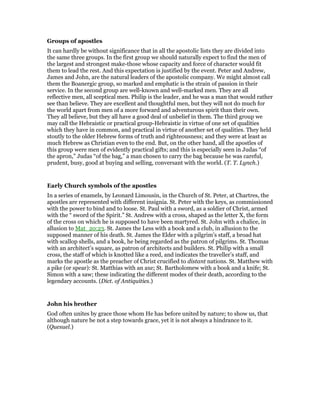
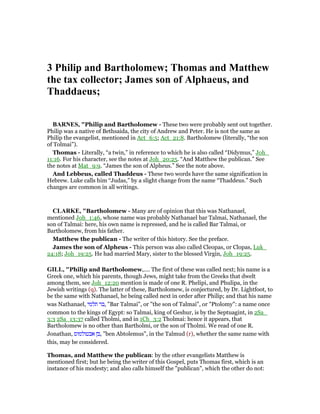
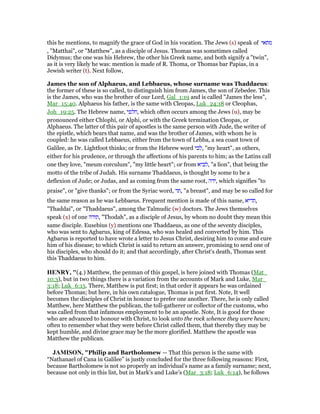
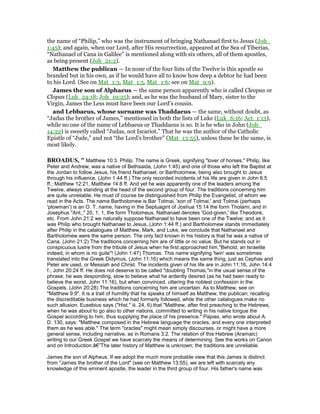
BROADUS, "Matthew 10:2-4. List Of The Twelve
Matthew has not mentioned the selection of the Twelve, which took place before this. (Mark 3:13,
Luke 6:13, compare on Matthew 5:1) At the time when he wrote, the twelve apostles were well
known, and he speaks of them accordingly: 'his twelve disciples,' 'the twelve apostles.' The
number twelve was probably chosen with reference to the number of tribes (see on "Matthew
19:28"). Apostles; the name, borrowed from Greek apostolos, 'one sent off,' or 'sent forth,' is here
introduced by Matt. for the first time, in connection with the occasion on which they were first
actually sent forth (Matthew 10:5) to labour. But our Lord gave them that name when he selected
the Twelve. (see Luke 6:13) The word is translated 'one that is sent' in John 13:16; 'messenger' in
1 Corinthians 8:13, Philippians 2:25; everywhere else in Com. Ver. and Rev. Ver., it is 'apostle.'
Jesus himself is called an apostle, i.e., sent by God, in Hebrews 8:1. Our word missionary,
derived from the Latin, likewise signifies "one sent."
Curious, and in some respects instructive results, may be obtained from a comparison of the four
lists of the Twelve.
Matthew 10:2
Mark 3:16 f.
Luke 6:14 f.
Acts 1:13 f.
Simon Peter
Simon Peter
Simon Peter
Simon Peter
Andrew
James
Andrew
James
James
John
James
John
Philip
Philip
Philip
Philip
Bartholomew
Bartholomew
Bartholomew
Bartholomew
Thomas
Matthew
Matthew
Bartholomew
Matthew
Thomas
Thomas
Matthew
James the son of Alpheus
Thaddeus
Thaddeus
Simon the Zealot
Simon the Zealot
Simon the Canaanite
Simon the Canaanite
Judas the brother of James
Philip
Philip
Philip
Philip
Judas Iscariot
Judas Iscariot
Judas Iscariot
(Vacant)
We observe at once that, with all the variety in the order of succession, Simon Peter is always
first, and Judas Iscariot last. Again, the first six names in Matthew, Mark, and Luke are the five
earliest known converts., (John 1:35-51) together with James, the brother of one of them; and the
first four in all the lists are the two pairs of brothers whose call to follow Jesus is the earliest
mentioned. (Matthew 4:18-22) Furthermore we note in each of the lists three groups of four,
headed respectively in every list by Peter, Philip, and James, which groups contain always the
same four persons, though within the limits of each group the order greatly varies, except as to
Judas Iscariot. It seems a natural and unavoidable inference that the Twelve were in some sense
divided into three companies of four, each having a recognized leader. The foremost in the first
company, and at the head of all the Twelve, is Simon Peter. When Matthew says, First, Simon
who is called Peter, he cannot mean merely that this happens to be the name first mentioned by
him; and there is no explanation in the fact that those are mentioned first who first came to Jesus;
for then Andrew and probably John, ought to precede Peter. (John 1:35 ff.) It is unquestionable
that Simon Peter was a sort of leader among the Twelve. (See on "Matthew 16:18".) As regards
the remaining members of the first company or group of four, we may suppose that Matthew and
Luke put Andrew next to Simon because they were brothers; while Mark and Acts and Mark 13:3
place James and John next to Simon, because they three were admitted to special intimacy and
favour with Jesus, being the only persons present on several solemn occasions. (See on
"Matthew 17:1".) The four who formed this first group are mentioned in Mark 13:3 as making
private inquiries of Jesus concerning the destruction of the temple, etc. In the second company,
Matthew puts Thomas before himself (compare Acts), while Mark and Luke place Matthew first.
After Philip, Matthew, Mark and Luke put Bartholomew, probably the same as Nathanael, who
was brought to Jesus by Philip (John 1:46 ff) In the third company of four, Simon the Cananite in
Matthew and Mark is obviously the same as Simon the Zealot in Luke and Acts (see below);
hence Thaddeus (Lebbeus is a false reading) must be only another name of Judas the brother of
James. He might naturally be put next to his brother, as by Matthew and Mark; or Luke's order
may indicate that Simon the Zealot was reckoned the more important personage. Observe that
there are among the Twelve three pairs of brothers—Simon and Andrew, James and John,
James the son of Alpheus, and Judas the brother of James (though this last may be 'son,' see
below); also that Matthew and Luke give the list in couples, and Mark (Mark 6:7) says they were
sent forth 'by two and two,' and these couples would easily lead to the grouping into fours. It would
be natural that in different journeyings the couples should somewhat vary, and this might perhaps
account for the different order of names in the several groups of four.
Simon who is called Peter. Simon was a Greek name, but in the New Testament is pretty certainly
a contraction of Simeon, which form is given in Acts 15:14, and by some authorities in 2 Peter 1:1.
Simeon signified hearing. (Genesis 29:33) Simon was a native of Bethsaida, (John 1:44) a town
on the Sea of Galilee, described below on Matthew 11:21. His father's name was Jonah or John
(see on "Matthew 16:17"). He and his brother Andrew were fishermen on the Lake of Galilee.
Andrew, and probably Simon also. was a disciple of John the Baptist, before coming to know
Jesus. (John 1:35 ff.) Jesus gave to Simon when he first approached him, the surname of
Cephas, (John 1:43) which in the Aramaic language spoken by them, signified a rock or stone
(Kepha, Greek form Kephas), and which was translated into the Greek, signifying the same thing;
hence Latin Petrus, English Peter. The Aramaic Cephas is always used by Paul (1 Corinthians,
Gal. correct text), and nowhere else in N. T. (except John 1:43) After following Jesus for some
time, Simon appears to have returned to his business as a fisherman, and was subsequently
prominent among those called to be regular attendants. (See on "Matthew 4:18 ff.") The principal
events of his subsequent life are given in Matthew 8:14 ff Matthew 14:28 ff.; Matthew 16:16
Matthew 16, 22 ff.; John 13:6 ff.; Matthew 26:33, Matthew 26:69 ff.; John 21:15 ff.; then in Acts
1:15, Acts 2:14, Acts 4:8, Acts 5:3, Acts 8:14 ff.; Acts 10:1 ff.; Acts 12:3 ff.; Acts 15:7. He was an
ardent and impulsive man, of great force of character, and extremely self-confident. Sad
experience, through the special influences of the Sprit, wrought a great change in him, though still,
the last time he appears distinctly in the N. T. history, we discern the same impulsiveness and
readiness to change, as of yore. (Galatians 2:11) He seems to have been at Babylon, where there
were many Jews, at the time of writing his First Epistle. (1 Peter 5:13) The traditions concerning
his later life are very uncertain, and so as to all the apostles except John. As regards Peter's
position of leader among the Twelve, see on "Matthew 16:18"f.
Andrew. The name is Greek, signifying 'manly.' The facts concerning his parentage. residence,
occupation, and early discipleship have been mentioned in connection with Peter. The only other
cases in which he appears are John 6:8, John 12:22, Mark 13:3. The traditions concerning him
are wholly unreliable. Yet he is important to us, not only as one of the inspired apostles, but as the
means of bringing to Jesus his own brother Simon. All the usefulness of Simon Peter is, in one
sense, due to the brother who told him of Jesus. And so, many a one in every age, little known
himself, and of no marked influence otherwise, has been among the great benefactors of
mankind, by bringing to Jesus some other person who proved widely useful.
James and John. James was probably the elder, as he is usually mentioned first, while John is
sometimes put foremost, (Luke 9:28, Acts 12:2) probably because more prominent, and because
alone surviving when the books were written. James is originally the same name as Jacob,
'supplanter,' being written in the Greek, Iacobos, Latin, Iacobus, then Jacopus, Jacomus, and so
James. John is the Hebrew Johanan, 'Jehovah graciously gave,' see on "Matthew 3:1". Their
father, Zebedee, was a fisherman on the Lake of Galilee, (Matthew 4:21) but apparently a man of
some property, as he employed hired servants, (Mark 1:20) and as his wife was one of the women
who contributed to the support of Jesus and his disciples (Matthew 27:55 f.; Luke 8:3), and
probably a man of good social position, as we find John familiarly acquainted at the house of the
high priest. (John 18:15 f.) Prom their mother Salome (see on "Matthew 27:56") was perhaps
inherited the ambition (see on "Matthew 20:26"), and perhaps also the ardor, intensity,
vehemence, and warm affection, which characterized her sons. These qualities of theirs were
doubtless the ground of the name Boanerges, 'sons of thunder,' which Jesus gave to the two
brothers. (Mark 3:17) John appears to have been a disciple of John the Baptist, it being almost
certain that he was the unnamed disciple of John 1:35-41.
We have no account of any call of James, until the time when the two brothers, with Simon and
Andrew, were called to become our Lord's constant followers; (Matthew 4:21) John at least was
probably with Jesus during the previous labours recorded in his Gospel. (Matthew 2-4.) The
peculiar temperament of the brothers appears in Mark 9:38 ff.; Luke 9:52 ff.; Matthew 20:20 ff.
After this last event, we hear nothing of James, save as present at Gethsemane, and included in
the list of Acts 1:13, until the time when Herod Agrippa I. put him to death, (Acts 12:2) the first
martyr among the apostles.
John, however, appears quite frequently, usually in immediate association with Peter, between
whom and himself there was probably a special friendship. Together they were sent to prepare for
the Paschal Supper, (Luke 22:8) at which John was allowed to lean on Jesus' breast, "the disciple
whom Jesus loved." Together they (and James) witnessed the agony in the garden, and both
followed to the trial. (John 18:15.) At the cross, John only of the Twelve seems to have been
present, drawn by his ardent affection, and perhaps relying to some extent on his acquaintance
with the high-priest for safety; and there he received the mother of his dying friend as one of his
own family. Peter and John were also together in John 20:2 ff.; John 21:2 ff.; Acts 3:1 ff.; Acts
8:14, Galatians 2:9. From Revelations Galatians 1:9 we learn that at some time he was in exile on
the Island of Patmos. There seems little doubt that he spent many years in "Asia," i.e.,
Proconsular Asia, particularly about Ephesus, and there wrote his inspired works. Several early
traditions in regard to him are pleasing and probably true, particularly the story of his reclaiming
the young robber, of his keeping a tame bird, of his saying, "Little children, love one another," and
of his leaving a house because a noted false teacher was there. John as disciplined by grace,
exhibits one of the noblest types of human character. The love with which his Epistles abound has
in it nothing effeminate. He strongly condemns and severely denounces the prevailing errors and
evils. He is not merely contemplative, but intensely practical; insisting that Christian love must
show itself in holiness and usefulness, or it is naught. Still vehement, uncompromising, and
outspoken, the loving and beloved old man has not ceased to be the "Son of Thunder"; but the
vaulting ambition which once aspired to be next to royalty in a worldly kingdom, now seeks to
overcome the world, to bear testimony to the truth, to purify the churches, and glorify God.
BENSON, "Matthew 10:2-4. The first, Simon — The first who was called to a constant attendance
on Christ: although Andrew had seen him before Simon, John 1:41. James the son of Zebedee —
The fisherman, and John his brother — The beloved disciple; who were also called at the same
time with the two former, as they were fishing at the sea of Galilee, Mark 1:19. The word ιακωβος,
which we translate James, is the same name with that of the patriarch; but immemorial custom
has appropriated, in our language, the name James to the two apostles, and Jacob to the
patriarch. Lebbeus, who was also called Judas, or Jude, the brother of James. Simon the
Canaanite — So called, it seems, because he was a native of Cana. And Judas, named Iscariot,
from Iscarioth, the place of his birth, a town of the tribe of Ephraim, near the city of Samaria.
ELLICOTT, "(2) A comparison of the four lists of the Apostles (Matthew 10:2-4, Mark 3:16-19,
Luke 6:13-16, Acts 1:13) brings out some interesting facts. (1.) The name of Peter is always first,
that of Judas always last. In the former case we recognise acknowledged preeminence. The
position of the latter may have been the consequence of the infamy which attached to the name of
the traitor; but it is possible (and this may have been one of the elements that entered into his
guilt) that his place had always been one of inferiority.
(2.) All the lists divide themselves into three groups of four, the persons in each group being
always the same (assuming that the three names, Judas the brother (?) of James, Thaddæus,
and Lebbæus, belong to the same person), though the order in each group varies.
(3.) The first group includes the two sons of Jona and the two sons of Zebedee, whose twofold
call is related in Matthew 4:18-21, John 1:40. In two lists (Mark and Acts) the name of Andrew
stands last; in two (Matt. and Luke) that of John. In none of them are the names of Peter and John
coupled together, as might have been expected from their close companionship (John 20:2; Acts
3:1). The four obviously occupied the innermost place in the company of the Twelve, and were
chosen out of the chosen. The three, Peter, James, and John, were the only witnesses of the
healing of Jairus’s daughter (Mark 5:37), of the Transfiguration (Matthew 17:1), and of the Agony
in Gethsemane (Matthew 26:37). Something seems to have excluded Andrew, though he had
been the first called of all (John 1:40), from this intimate companionship; but we find him joined
with the other three as called to listen to the great prophetic discourse on the Mount of Olives
(Mark 13:3). All the four appear to have come from Bethsaida, on the western shore of the Sea of
Galilee.
(4.) The name of Philip is always first in the second group, and he, too, came from Bethsaida.
Next, in the three Gospel lists, comes that of Bartholomew. The name, like Barjona and
Bartimæus, was obviously a patronymic, and it was at least probable that he had some other
name. The absence of any mention of Bartholomew in St. John’s Gospel, or of Nathanael (John
1:45) in the other three, has led most modern commentators to the conclusion that they were two
names for the same person; and the juxtaposition of the two names in their lists agrees with the
fact that it was Philip who brought him to know Jesus as the Christ (John 1:45). On this
assumption, Bartholomew was of Cana, the scene of our Lord’s first miracle (John 21:2). The
name of Matthew stands before that of Thomas in Mark and Luke, after it in the Gospel which
beare his own name. On the change of name from Levi, and his description as the son of
Alphæus, see Notes on Matthew 9:9. As the name of Thomas, or Didymus, means “twin,” there
seems some ground for believing, from the way in which the two names are grouped together,
that here too we have another pair of brothers called to the service of their Master. Eusebius (H.
E. i. 13), in his account of the conversion of Abgarus of Edessa, speaks of this Apostle as “Judas
who is also Thomas.” and this suggests the reason why the cognomen of “the Twin” prevailed
over the name which was already borne by two out of the company of the Twelve.
(5.) The third group always begins with “James the son of Alphæus;” and this description suggests
some interesting inferences:—(1.) That he too was a brother of Matthew (there are no grounds for
assuming two persons of the name of Alphæus), and probably, therefore, of Thomas also. (2.)
That if the Clopas (not Cleopas) of John 19:25, was, as is generally believed, only the less
Græcised form of the name Alphæus, then his mother Mary may have been the sister of Mary the
mother of the Lord (see Notes on John 19:25). (3.) This Mary, in her turn, is identified, on
comparing John 19:25 with Mark 15:40, with the mother of James the Less (literally, the Little) and
of Joses. The term probably pointed, not to subordinate position, but, as in the case of Zacchæus,
to short stature, and appears to have been an epithet (Luke 19:3) distinguishing him from the
James of the first list. The Greek form in both cases was Jacôbus—the Jacob of the Old
Testament—which has passed, like Joannes, through many changes, till it appears in its present
clipped and curtailed shape. (4.) On the assumption that the James and Joses of Mark 15:40 are
two of the “brethren of the Lord” of Matthew 13:55, this James might, perhaps, be identified with
the James “the brother of the Lord” of Galatians 1:19 and Acts 15:13, the writer of the Epistle. The
balance of evidence is, however, decidedly against this view. (Comp. Note on Matthew 13:55.)
The next name appears in three different forms: Judas the brother of James (it must be noted,
however, that the collocation of the two names is that which is elsewhere rendered “the son of . .
.” and that the insertion of the word “brother” is an inference from Jude 1:1) in Luke and Acts;
Lebbæus in Matthew (with the addition, in later MSS. and the textus receptus, of “who is also
surnamed Thaddæus”); Thaddæus in Mark; St. John names him simply as “Judas, not Iscariot”
(Matthew 14:22). The explanation of the variations is natural enough. One who bore the name of
Judas wanted something to distinguish him. This might be found either in the term which
expressed his relation as son or brother to James the son of Alphæus, or in a personal epithet.
Lebbæus suggests a derivation from the Hebrew leb (heart), and points to warmth and
earnestness of character; thad, in later Hebrew, meant the female breast, and may have been the
origin of Thaddæus, as indicating, even more than the other sobriquet, a feminine devotedness.
Taking the three names together, they suggest the thought that he was one of the youngest of the
Twelve, and was looked upon by the others with an affection which showed itself in the name thus
given to him. Simon, too, needed a distinguishing epithet, and it was found in the two forms of
Zelotes and Cananite (not Canaanite). The former may point to zeal as his chief characteristic, but
it was more probably used in the sense in which the followers of Judas of Galilee bore the name,
and under which they were prominent in the later struggle with the Romans, as in a special sense
“zealots for the law” (Jos. Wars, iv. 3, § 9). (Comp. a like use of the word in Acts 21:20.) On this
assumption we get a glimpse, full of interest, into the earlier life of the Apostle so named. The
other term, Cananite—which is not a local term, but connected with a Hebrew verb, kanà, to be
hot, to glow, to be zealous—expresses the same idea. Lastly, we have “Judas Iscariot, who also
betrayed Him,” described by St. John as the “son of Simon” (John 6:71; John 12:4; John 13:2;
John 13:26), the term “Iscariot” being applied in the first and last of these passages to the father.
These facts seem to leave little doubt that the name is local, and is the Græcised form of Ish-
Kerioth (a man of Kerioth), a town in Judah mentioned in the list of Joshua 15:25. Assuming this
inference, we have in him the only one among the Twelve of whom it is probable that he was of
Judah, and not of Galilee. This also may not have been without its influence on his character,
separating him, as it might well tend to do, from the devoted loyalty of the others.
COKE, "Matthew 10:2. Now the names, &c.— In the catalogue of the apostles, Simon and
Andrew, the sons of Jonah, are named first; not because they were greater in dignity than their
brethren of the apostolical college, but because they had become Christ's disciples before them.
With respect to Andrew, this is plain from John 1:40-41.; and as for Peter, he may have been the
second disciple, not withstanding it was another person who accompanied Andrew when he first
conversed with Jesus. That person is supposed to have been John, the son of Zebedee; and the
author of the Gospel, because he is spoken of in the manner in which John usually speaks of
himself. But whoever he was, Peter may have been a disciple before him, because it by no means
follows from Andrew's being convinced, that his companion was convinced also. The foundation
of his faith may have been laid at that meeting, though he did not acknowledge Christ's mission till
afterwards. Now, as some one of his disciples was to have the first place in the catalogue, the
earliness of Peter's faith might be a reason for conferring that honour on him. But he takes place
even of his brother Andrew, who was converted before him, perhaps because propriety called for
it, he being, as is generally believed, his elder brother. In like manner, James the son of Zebedee,
being elder than John his brother, is mentioned before him, though it is probable he was the
younger disciple. In the catalogue of apostles, Simon, the brother of Andrew, is distinguished from
the other Simon by the surname of Peter, which had been conferred on him when he first became
acquainted with Jesus at Jordan. The reason of the name, however, was not assigned till long
after that, viz. when Simon declared his faith inJesus as the Messiah, Matthew 16:17-18 for it was
then that Jesus told him he was called Cephas, and Peter (which by interpretation is a rock), on
account of the fortitude wherewith he was to preach the gospel. Simon and Andrew were originally
fishermen, and inhabitants of Bethsaida, a town situated on the north shore of the lake of
Gennesareth; but after Peter was married, he and his brother settled in Capernaum, perhaps
because his wife lived there. Before they became acquainted with Christ, they were disciples of
the Baptist, who pointed him out to them as the Messiah. Andrew has left no writings, for which
reason we are at a loss to judge of his literary endowments; but Peter was the author of the two
epistles which bear his name.
James and John, the sons of Zebedee, were also fishermen; they dwelt in Capernaum, and seem
to have been in rather better circumstances than Peter and Andrew; for the Gospel speaks of their
having hired servants to assist them in their business. John is thought to have been the youngest
of all the apostles; yet he was old enough to have been a follower of John the Baptist before he
came to Christ. On this, or on some other occasion, James and John, the sons of Zebedee,
obtained the surname of Boanerges, that is to say, the sons of thunder; perhaps because of the
natural vehemency and impetuosity of their tempers. Accordingly their spirit shewed itself in the
desire they expressed to have the Samaritans destroyed by fire from heaven, because they
refused to lodge Jesus in his way to Jerusalem. It appeared also in their ambition to become the
great officers of state in their Master's kingdom, which they supposed would be a secular one.
Besides, John's writings shew that he was a man of a very affectionate turn of mind. This
affectionate turn of his mind gave him a singular fitness for friendship, in which he was not only
peculiarly amiable, but peculiarly privileged, as it rendered him the object of Christ's peculiar love;
a love which will do him honour to the end of the world. As for James, his being put to death by
Herod is a proof that his zeal was uncommon, and that it moved him to be eminently active
andbold in the work of the Gospel. Had it been otherwise, he would not have become the object
either of Herod's jealousy or of his resentment. Some indeed are of opinion, that the epithet sons
of thunder was not expressive of the dispositions of the two brothers, but of the force and success
with which they should preach the Gospel: yet if that had been the reason of the surname, it was
equally applicable to all the apostles. Philip is said to have been a native of Bethsaida, the town of
Peter and Andrew. He was originally a disciple of theBaptist, but he left him, to follow Jesus, as
soon as he became acquainted with him at Jordan. John 1:44. Bartholomew is supposed to have
been the disciple called Nathanael, whose conversion is related, John 1:45; John 1:51. The
Ancients tell us he was a native of Cana, and was skilled in the law. Matthew was a rich publican
of Capernaum: he was otherwise named Levi, and left his gainful employment for the sake of
Christ. He wrote the Gospel to which his name is prefixed, and was the son of one Alpheus, of
whom we know nothing but the name. There is nothing said of Thomas before his conversion:
however, it is conjectured that, like the rest, he was of mean extraction; and because he is
mentioned among those who went a fishing, John 21:2-3 it is supposed that he was a fisherman
by occupation. He obtained the surname of Didymus, probably because he was a twin, and made
himself remarkable by continuing longer than his brethren to doubt of Christ's resurrection. In the
college of Apostles, besides James the son of Zebedee and brother of John, Judas Iscariot who
betrayed his master, and Simon surnamed Peter, we find James surnamed the Less, or Younger
(see Mark 15:40.), to distinguish him from the other James, the son of Zebedee, who was elder
than he: also Judeas surnamed Thaddeus (Mark, iii 18.) and Lebbeus, the brother of James the
Less, and Simon surnamed Zelotes. James the Less, Judas Thaddeus, and Simon Zelotes, were
brothers, and sons of one Alpheus or Cleophas, who was likewise a disciple, being one of the two
to whom our Lord appeared on the road to Emmaus after his resurrection. They were called
Christ's brethren (Matthew 13:55.), that is, his cousins; in which sense the word is used, Leviticus
10:4. It seems their mother Mary was sister to Mary our Lord's mother; for it was no unusual thing
among the Jews to have more children than one of a family called by the same name. The three
apostles, therefore, who go by the name of our Lord's brethren, were really his cousins-german:
James the Less and Judas Thaddeus wrote the epistles which bear their names. This James was
a person of great authority among the apostles; for in the council which met at Jerusalem to
decide the dispute about the necessityof circumcision, we find him, as president of the meeting,
summing up the debate, and wording the decree. Simon, the cousin of our Lord, is called by
Matthew and Mark the Canaanite; but from the above account of his relations it is plain, that the
epithet does not express his descent, otherwise his brothers James and Judas ought to have
been termed Canaanites likewise. Luke calls him Simon Zelotes, which seems to be the Greek
translation of the Hebrew appellation given him by Matthew and Mark. From ‫קנא‬ [kena] zelotyphus
fuit,—he was jealous,—comes the Chaldaic word ‫קנן‬ [kenen] zelotes,—a zealot. See Buxtorff on
the word. Put the Greek termination to this Chaldaic word, and it becomes κανανιτης, the
Canaanite: wherefore the appellation of Canaanite, given to Simon here and in Mark, and the
epithet Zelotes which he bears in Luke, are as perfectly the same as Cephas and Petros, Tabitha
and Dorcas. The Zealots were a particular sect or section among the Jews, who in later times,
under colour of zeal for God, committed all the disorders imaginable. They pretended to imitate
the zeal which Phinehas, Elijah, and the Maccabees expressed, in their manner of punishing
offenders; but they acted from blind fury, or from worse principles, without regard either to the
laws of God, or to the dictates of reason. Some are ofopinion, that Simon the Apostle had formerly
been one of this pestilent faction; but, as there is no mention made of it till a little before the
destruction of Jerusalem (Joseph. Bell. lib. iv. c. 3), we may rather suppose that the surname of
Zelotes was given him on account of his uncommon zeal in matters of true piety and religion.
Judeas the traitor was the son of one Simon: he had the surname of Iscariot given him, to
distinguish him from Judas Thaddeus, our Lord's cousin. The literal meaning of Iscariot is, a man
of Cariot or Kerioth, which was a town in the tribe of Judah. Joshua 15:25. In all probability,
therefore, this surname denotes the place of the traitor's nativity. Some pretend, that among the
Jews no person was surnamed by theplace of his birth, but such as were illustrious on account of
their station; and so would have us believe, that Judas was a person of some distinction. They
think his being entrusted with the bag, or common stock purse, preferablyto all the rest, is a
confirmation of this; but as the other apostles were men of mean condition, these arguments are
too trivial to prove that Judas was distinguished from them in that particular.
Thus were thefoundations of the church laid in twelve illiterate Galileans, who, being at first utterly
ignorant of the nature and end of their office, and destitute of the qualifications necessary to
discharge the duties of it, integrity excepted, were the most unlikelypersons in the world to
confound the wisdomof the wise, to baffle the power of the mighty, to overturn the many false
religions which then flourished everywhere under the protection of civil government, and, in a
word, to reform the universally-corrupted manners of mankind. Had human prudence been to
make choice of instruments for so grand an undertaking, doubtless such as were remarkable for
deep science, strong reasoning, and prevailing eloquence, would have been pitched upon; and
these endowments probably would have been set off with the external advantages of wealth and
power. But, lo! the wisdom of God, infinitely superior to that of men, acted quite differently in this
matter: for the treasure of the Gospel was committed to earthen vessels, that the excellency of its
power might in all countries be seen to be of God. Accordingly, the religion which these Galileans
taught through the world, without having at all applied themselves to letters, exhibited a far juster
notion of things than the Grecian or Roman philosophers were able to attain, though their lives
were spent in contemplation and study. Hence, by its own intrinsic splendour, as well as by the
external glory of the miracles which accompanied it, this religion shewed itself to be altogether of
divine original. Besides, it was attended with a success answerable to its dignity and truth. It was
received everywherewiththehighestapplause,as something which mankind had hitherto been
seeking in vain; while the maxims and precepts of the philosophers never spread
themselvesmuch farther than their particular schools. It was therefore with the highest wisdom
that the foundations of the churchwere thus laid in the labours of a few weak illiterate fishermen:
for with irresistible evidence it demonstrated that the immense fabric was at first raised, and is still
sustained, not by the arm of flesh, but purely by the hand of Almighty God. See Macknight.
COFFMAN, "There are four listings of the Twelve in the New Testament, always occurring in
groups of four, with positions 1,5, and 9 always listing Peter, Philip, and James the son of
Alphaeus in that order. See Mark 3:13; Luke 6:12; Acts 1:13. From this, it is conjectured that
Peter, Philip, and James the son of Alphaeus were the respective leaders in each of their groups
of four. The other names do not always follow a given order, but they do not occur outside the
group of four. Oddly, there are two Simons, two Jameses, and two Judases. Thaddaeus was also
named Judas the brother of James, or son of James, the Greek word meaning either "son" or
"brother."
The twelve apostles have a rank and dignity in the kingdom of heaven beyond that of all others.
The number twelve is suggestive of the twelve tribes of Israel; and just as the patriarchs were the
foundation of all that came afterwards for Israel, just so the Twelve are the foundation, in one
sense, for the church of our Lord (Ephesians 2:20). Even Paul confessed that he was not of the
Twelve (1 Corinthians 15:5), and that he was not worthy to be accounted an apostle, because he
"persecuted the church of God" (1 Corinthians 15:9). Their names, including, no doubt, that of
Matthias instead of Judas, are inscribed upon the twelve foundations of the Eternal City
(Revelation 21:14). They are ruling now upon twelve thrones, with Jesus Christ in his kingdom,
that is, during the "times of the regeneration (or `new birth')" (Matthew 19:28). It is specifically
declared that God set some in the church, "FIRST, apostles" (1 Corinthians 12:28).
These men were not princes of the blood, but fishermen, a tax collector, and followers of other
ordinary occupations. They were industrious, more than ordinarily successful in business, keen of
mind, sensitive of soul, honest, perceptive, and courageous. They were ambitious, hard-working
men, an excellent lot indeed; but apparently they possessed no skills or talents of an extraordinary
nature. They were men most remarkably like the best men of any stable community anywhere on
earth, peculiarly fitted to be the chosen representatives of all mankind, and eminently qualified for
the possession of that power and dignity to which the Master called and elevated them.
BIBLICAL ILLUSTRATOR, "Now the names of the twelve apostles.
Thoughts on a list of names
A good deal may be made out of a list of names, but it depends on whose names they are.
There is a book which has nothing in it but names-that book would interest the universe-
“the Lamb’s book of life.” We may look on the men-
I. Officially.
1. They are selected, chosen, set apart by Christ as apostles. The marvellous results
which have flowed from this selection. Their story has moved the world. The world
persecuted them, but now falls at their feet.
2. The little power naturally there would seem to have been in these men to have
produced any great results. Men of no rank. If the work had not been of God, it could
not have been done.
3. There is the list complete. Twelve men are selected, yet few of them stand out in
full length in the history. Every true worker God observes.
4. The name may be in the list of the apostles, but the man may not be there. Judas
in the list, he not there.
II. Personally. We may read it as a list of persons in the Church.
1. The gospel embraces persons of different tempers and tastes, yet all part of one
Church.
2. How the good cause may be advanced by relationship. Here are three pairs of
brothers in the list.
3. That a catalogue might be made out of a church book of those whose previous
lives had been rather questionable.
4. How we can understand the Christian mellowing with age, the better nature grows
and is perfected. (T. Binney.)
Called to the ministry
The attorney that pleads at the bar may have as good gifts as the judge that sits upon the
bench; but he must have a lawful commission before he sit as a judge: if it be thus in civil
matters, much more in church matters, which are of higher concern. Those, therefore,
who usurp the work of the ministry without being solemnly set apart for it, discover
more pride than zeal, and they can expect no blessing. (T. Watson.)
Groups of apostles
It can hardly be without significance that in all the apostolic lists they are divided into
the same three groups. In the first group we should naturally expect to find the men of
the largest and strongest make-those whose capacity and force of character would fit
them to lead the rest. And this expectation is justified by the event. Peter and Andrew,
James and John, are the natural leaders of the apostolic company. We might almost call
them the Boanergic group, so marked and emphatic is the strain of passion in their
service. In the second group are well-known and well-marked men. They are all
reflective men, all sceptical men. Philip is the leader, and he was a man that would rather
see than believe. They are excellent and thoughtful men, but they will not do much for
the world apart from men of a more forward and adventurous spirit than their own.
They all believe, but they all have a good deal of unbelief in them. The third group we
may call the Hebraistic or practical group-Hebraistic in virtue of one set of qualities
which they have in common, and practical in virtue of another set of qualities. They held
stoutly to the older Hebrew forms of truth and righteousness; and they were at least as
much Hebrew as Christian even to the end. But, on the other hand, all the apostles of
this group were men of evidently practical gifts; and this is especially seen in Judas “of
the apron,” Judas “of the bag,” a man chosen to carry the bag because he was careful,
prudent, busy, good at buying and selling, conversant with the world. (T. T. Lynch.)
Early Church symbols of the apostles
In a series of enamels, by Leonard Limousin, in the Church of St. Peter, at Chartres, the
apostles are represented with different insignia. St. Peter with the keys, as commissioned
with the power to bind and to loose. St. Paul with a sword, as a soldier of Christ, armed
with the “ sword of the Spirit.” St. Andrew with a cross, shaped as the letter X, the form
of the cross on which he is supposed to have been martyred. St. John with a chalice, in
allusion to Mat_20:23. St. James the Less with a book and a club, in allusion to the
supposed manner of his death. St. James the Elder with a pilgrim’s staff, a broad hat
with scallop shells, and a book, he being regarded as the patron of pilgrims. St. Thomas
with an architect’s square, as patron of architects and builders. St. Philip with a small
cross, the staff of which is knotted like a reed, and indicates the traveller’s staff, and
marks the apostle as the preacher of Christ crucified to distant nations. St. Matthew with
a pike (or spear): St. Matthias with an axe; St. Bartholomew with a book and a knife; St.
Simon with a saw; these indicating the different modes of their death, according to the
legendary accounts. (Dict. of Antiquities.)
John his brother
God often unites by grace those whom He has before united by nature; to show us, that
although nature be not a step towards grace, yet it is not always a hindrance to it.
(Quesuel.)
3 Philip and Bartholomew; Thomas and Matthew
the tax collector; James son of Alphaeus, and
Thaddaeus;
BAR ES, "Philip and Bartholomew - These two were probably sent out together.
Philip was a native of Bethsaida, the city of Andrew and Peter. He is not the same as
Philip the evangelist, mentioned in Act_6:5; Act_21:8. Bartholomew (literally, “the son
of Tolmai”).
Thomas - Literally, “a twin,” in reference to which he is also called “Didymus,” Joh_
11:16. For his character, see the notes at Joh_20:25. “And Matthew the publican.” See
the notes at Mat_9:9. “James the son of Alpheus.” See the note above.
And Lebbeus, called Thaddeus - These two words have the same signification in
Hebrew. Luke calls him “Judas,” by a slight change from the name “Thaddeus.” Such
changes are common in all writings.
CLARKE, "Bartholomew - Many are of opinion that this was Nathanael,
mentioned Joh_1:46, whose name was probably Nathanael bar Talmai, Nathanael, the
son of Talmai: here, his own name is repressed, and he is called Bar Talmai, or
Bartholomew, from his father.
Matthew the publican - The writer of this history. See the preface.
James the son of Alpheus - This person was also called Cleopas, or Clopas, Luk_
24:18; Joh_19:25. He had married Mary, sister to the blessed Virgin, Joh_19:25.
GILL, "Philip and Bartholomew,.... The first of these was called next; his name is a
Greek one, which his parents, though Jews, might take from the Greeks that dwelt
among them, see Joh_12:20 mention is made of one R. Phelipi, and Phulipa, in the
Jewish writings (q). The latter of these, Bartholomew, is conjectured, by Dr. Lightfoot, to
be the same with Nathanael, he being called next in order after Philip; and that his name
was Nathanael, ‫תלמי‬ ‫,בר‬ "Bar Talmai", or "the son of Talmai", or "Ptolomy": a name once
common to the kings of Egypt: so Talmai, king of Geshur, is by the Septuagint, in 2Sa_
3:3 2Sa_13:37 called Tholmi, and in 1Ch_3:2 Tholmai: hence it appears, that
Bartholomew is no other than Bartholmi, or the son of Tholmi. We read of one R.
Jonathan, ‫אבטולמוס‬ ‫,בן‬ "ben Abtolemus", in the Talmud (r), whether the same name with
this, may be considered.
Thomas, and Matthew the publican: by the other evangelists Matthew is
mentioned first; but he being the writer of this Gospel, puts Thomas first, which is an
instance of his modesty; and also calls himself the "publican", which the other do not:
this he mentions, to magnify the grace of God in his vocation. The Jews (s) speak of ‫מתאי‬
, "Matthai", or "Matthew", as a disciple of Jesus. Thomas was sometimes called
Didymus; the one was his Hebrew, the other his Greek name, and both signify a "twin",
as it is very likely he was: mention is made of R. Thoma, or Thomas bar Papias, in a
Jewish writer (t). Next follow,
James the son of Alphaeus, and Lebbaeus, whose surname was Thaddaeus:
the former of these is so called, to distinguish him from James, the son of Zebedee. This
is the James, who was the brother of our Lord, Gal_1:19 and is called "James the less",
Mar_15:40. Alphaeus his father, is the same with Cleopas, Luk_24:18 or Cleophas,
Joh_19:25. The Hebrew name, ‫,חלפי‬ which often occurs among the Jews (u), may be
pronounced either Chlophi, or Alphi, or with the Greek termination Cleopas, or
Alphaeus. The latter of this pair of apostles is the same person with Jude, the writer of
the epistle, which bears that name, and was the brother of James, with whom he is
coupled: he was called Lebbaeus, either from the town of Lebba, a sea coast town of
Galilee, as Dr. Lightfoot thinks; or from the Hebrew word ‫,לבי‬ "my heart", as others,
either for his prudence, or through the affections of his parents to him; as the Latins call
one they love, "meum corculum", "my little heart"; or from ‫,לביא‬ "a lion", that being the
motto of the tribe of Judah. His surname Thaddaeus, is thought by some to be a
deflexion of Jude; or Judas, and as coming from the same root, ‫,ידה‬ which signifies "to
praise", or "give thanks"; or from the Syriac word, ‫,תד‬ "a breast", and may be so called for
the same reason as he was Lebbaeus. Frequent mention is made of this name, ‫,תדיא‬
"Thaddai", or "Thaddaeus", among the Talmudic (w) doctors. The Jews themselves
speak (x) of one ‫,תודה‬ "Thodah", as a disciple of Jesus, by whom no doubt they mean this
same disciple. Eusebius (y) mentions one Thaddaeus, as one of the seventy disciples,
who was sent to Agbarus, king of Edessa, who was healed and converted by him. This
Agbarus is reported to have wrote a letter to Jesus Christ, desiring him to come and cure
him of his disease; to which Christ is said to return an answer, promising to send one of
his disciples, who should do it; and that accordingly, after Christ's death, Thomas sent
this Thaddaeus to him.
HE RY, "(4.) Matthew, the penman of this gospel, is here joined with Thomas (Mat_
10:3), but in two things there is a variation from the accounts of Mark and Luke, Mar_
3:18; Luk_6:15. There, Matthew is put first; in that order it appears he was ordained
before Thomas; but here, in his own catalogue, Thomas is put first. Note, It well
becomes the disciples of Christ in honour to prefer one another. There, he is only called
Matthew, here Matthew the publican, the toll-gatherer or collector of the customs, who
was called from that infamous employment to be an apostle. Note, It is good for those
who are advanced to honour with Christ, to look unto the rock whence they were hewn;
often to remember what they were before Christ called them, that thereby they may be
kept humble, and divine grace may be the more glorified. Matthew the apostle was
Matthew the publican.
JAMISO , "Philip and Bartholomew — That this person is the same with
“Nathanael of Cana in Galilee” is justly concluded for the three following reasons: First,
because Bartholomew is not so properly an individual’s name as a family surname; next,
because not only in this list, but in Mark’s and Luke’s (Mar_3:18; Luk_6:14), he follows
the name of “Philip,” who was the instrument of bringing Nathanael first to Jesus (Joh_
1:45); and again, when our Lord, after His resurrection, appeared at the Sea of Tiberias,
“Nathanael of Cana in Galilee” is mentioned along with six others, all of them apostles,
as being present (Joh_21:2).
Matthew the publican — In none of the four lists of the Twelve is this apostle so
branded but in his own, as if he would have all to know how deep a debtor he had been
to his Lord. (See on Mat_1:3, Mat_1:5, Mat_1:6; see on Mat_9:9).
James the son of Alphaeus — the same person apparently who is called Cleopas or
Clopas (Luk_24:18; Joh_19:25); and, as he was the husband of Mary, sister to the
Virgin, James the Less must have been our Lord’s cousin.
and Lebbaeus, whose surname was Thaddaeus — the same, without doubt, as
“Judas the brother of James,” mentioned in both the lists of Luke (Luk_6:16; Act_1:13),
while no one of the name of Lebbaeus or Thaddaeus is so. It is he who in John (Joh_
14:22) is sweetly called “Judas, not Iscariot.” That he was the author of the Catholic
Epistle of “Jude,” and not “the Lord’s brother” (Mat_13:55), unless these be the same, is
most likely.
BROADUS, " Matthew 10:3. Philip. The name is Greek, signifying "lover of horses." Philip, like
Peter and Andrew, was a native of Bethsaida, (John 1:45) and one of those who left the Baptist at
the Jordan to follow Jesus, his friend Nathanael, or Bartholomew, being also brought to Jesus
through his influence. (John 1:44 ff.) The only recorded incidents of his life are given in John 6:5
ff.; Matthew 12:21, Matthew 14:8 ff. And yet he was apparently one of the leaders among the
Twelve, always standing at the head of the second group of four. The traditions concerning him
are quite unreliable. He must of course be distinguished from Philip the Evangelist, of whom we
read in the Acts. The name Bartholomew is Bar Tolmai, 'son of Tolmai,' and Tolmai (perhaps
'plowman') is an O. T. name, having in the Septuagint of Joshua 15:14 the form Tholami, and in
Josephus "Ant.," 20, 1, 1, the form Tholomeus. Nathanael denotes 'God-given,' like Theodore,
etc. From John 21:2 we naturally suppose Nathanael to have been one of the Twelve; and as it
was Philip who brought Nathanael to Jesus, (John 1:44 ff.) and Bartholomew stands immediately
after Philip in the catalogues of Matthew, Mark, and Luke, we conclude that Nathanael and
Bartholomew were the same person. The only fact known in his history is that he was a native of
Cana. (John 21:2) The traditions concerning him are of little or no value. But he stands out in
conspicuous lustre from the tribute of Jesus when he first approached him,"Behold, an Israelite
indeed, in whom is no guile"! (John 1:47) Thomas. This name signifying 'twin' was sometimes
translated into the Greek Didymus, (John 11:16) which means the same thing, just as Cephas and
Peter are used, or Messiah and Christ. The incidents given of his life are in John 11:16, John 14:4
f.; John 20:24 ff. He does not deserve to be called "doubting Thomas,"in the usual sense of the
phrase; he was desponding, slow to believe what he ardently desired (as he had been ready to
believe the worst, John 11:16), but when convinced, uttering the noblest confession in the
Gospels. (John 20:28) The traditions concerning him are uncertain. As to Matthew, see on
"Matthew 9:9". It is a trait of humility that he speaks of himself as Matthew, the publican; recalling
the discreditable business which he had formerly followed, while the other catalogues make no
such allusion. Eusebius says ("Hist." iii. 24, 6) that "Matthew, after first preaching to the Hebrews,
when he was about to go also to other nations, committed to writing in his native tongue the
Gospel according to him, thus supplying the place of his presence." Papias, who wrote about A.
D. 130, says: "Matthew composed in the Hebrew language the oracles, and every one interpreted
them as he was able." The term "oracles" might mean simply discourses, or might have a more
general sense, including narrative, as in Romans 3:2. The relation of this Hebrew (Aramaic)
writing to our Greek Gospel we have scarcely the means of determining. See the works on Canon
and on Introduction.—The later history of Matthew is unknown; the traditions are unreliable.
James the son of Alpheus. If we adopt the much more probable view that this James is distinct
from "James the brother of the Lord" (see on Matthew 13:55), we are left with scarcely any
knowledge of this eminent apostle, the leader in the third group of four. His father's name was
Alpheus or Halpheus, which was also the name of Matthew's father. (Mark 2:14) Clopas (John
19:25) might be another form of the same name, but we cannot say that it was the same person.
As to whether James was the brother of Judas Thaddeus, see below.
The copious accounts sometimes given of him result from identifying him with James the brother
of the Lord. Thaddeus. This alone is the name in Matt. and Mark, according to the correct text.(1)
We have seen from comparing the catalogue that Thaddeus must be only another name of 'Judas
the brother of James,' as given in Luke and Acts. He was thus known as Judas the beloved, or
darling. In Luke and Acts he is distinguished from Judas Iscariot by calling him 'Judas of James,'
or 'James's Judas,' a form of expression which is quite common in Greek, and which usually adds
the father of the person described, but sometimes another connection, such as husband, son,
brother, or even friend. (See Winer, p. 190 237.) An eminent example is that of the early Christian
writer Eusebius, who, after the death of his friend Pamphilus, always called himself Eusebius of
Pamphilus. If nothing were known to the contrary, we should naturally translate 'Judas son of
James,' as is done by the Peshito and Thebaic versions, and by our Rev. Ver. (Luke 6:16, Acts
1:13) Compare Bishop Lightfoot on Gal., p. 256. But as the Epistle of Jude begins 'Judas, a
servant of Jesus Christ and brother of James' (where brother is expressed in the Greek), we
seem entirely warranted in using that fact to solve the ambiguity of Luke's expression 'Judas of
James,' and understanding it to mean the brother of James; yet it is impossible to determine the
question with certainty, for we cannot even be certain that the Epistle was written by the apostle
Judas. The only incident in the life of Judas Thaddeus is given in John 14:22. The traditions
concerning him are worthless.
Simon the Canaanite, or Cananaean. The name Simon being very common, this apostle is
distinguished from Simon Peter and others by the surname Cananaean, which in Aramaic would
signify the same thing as the Greek word Zelotes given in Luke and Acts, viz., 'Zealot.' Thirty
years later than this, as we find from Josephus ("War,"4, 3, 9), there existed a party calling
themselves Zealots, as being very zealous for the national religion and institutions. (Compare Acts
21:20, Romans 10:2) They were accustomed to punish without trial, to "lynch" any Jew who
seemed to them a traitor or violator of the law, finding precedent and sanction in the ease of
Phinehas. (Numbers 25:7) This practice, as must always happen when it is continued, led finally
to gross abuses and horrid cruelties, and the Zealots had no small part in the ruin of the nation. It
is likely that the party already existed in the time of our Lord (having come down from Judas the
Galilean), (Acts 5:27) though on a much smaller scale than afterwards, and that Simon had at one
time belonged to it, and thus acquired his surname, Zelotes or Cananaean. It is quite a mistake to
confound this with Canaanite, which in Greek is materially different; (Matthew 15:22) the mistake
is found as early as Great Bible, "Simon of Canaan," (so in Bagster's Hexapla, both in Matt. and
Mark. Bishop Lightfoot Rev. seems to be mistaken in ascribing the double a to the Bishop's Bible.)
Of this apostle's history we know nothing at all. The fact that he had been a Zealot would suggest
an ardent nature; it is probable that, like Paul, he showed in doing good the same fiery zeal he
had shown in doing evil.
Judas Iscariot has the same surname in John 12:4, John 13:2. His father was called Simon
Iscariot. (John 6:71, John 13:26, correct text.) Judas is a Greek form of Judah. (See on "Matthew
1:2".) The surname Iscariot is Ish-Kerioth, 'man of Kerioth,' a town in the tribe of Judah; (Joshua
15:15) it is spelled Iscarioth in the better Greek text of Mark 3:19, Luke 6:16. So Ish-Tob, 'man of
Tob' or 'men of Tob' is in the Sept., Istob, and in Josephus Istobos. The fact that his father had the
same surname quite excludes Lightfoot's fanciful etymologies from Latin scortea, a leathern
apron, because he carried the hag, or from Hebrew askara, strangling. All the other disciples
appear to have been Galileans (though that is not certain), and this difference might have some
effect on Judas in preventing full sympathy with the others. We know nothing of his early history or
his call to he a disciple. It was not only a matter of divine foreknowledge that he would betray his
Teacher—as all things are—but was distinctly foreseen from an early period by Jesus, (John
6:64) who in his human mind was not omniscient. (Matthew 24:36) That a person in whom this
was foreseen should be chosen one of the Twelve, is not more mysterious than a thousand other
things which are done in the providence of the same Lord. Weiss : "The other disciples, too, were
not without great weaknesses and faults of character, which were certainly no secret to Jesus.....
On the other hand, Judas must have possessed special endowments, for Jesus to consider it
desirable to secure him as a disciple." His talent for business, with the care of the common fund,
seems to have developed a ruinous avarice, even in the very company of Jesus. He shows us
that the greatest outward privileges may be of no avail, and may even be perverted into a curse;
and he exemplifies the gradual progress, the terrible power, and the awful results, of
covetousness. It may very well be that in the beginning he was sincere and meant to be faithful;
but as so often happens, his gift became his snare.—It is some relief to our distress when we
see men in high places of Christian usefulness at the present day falling utterly away, to
remember that it was so at the beginning, even among our Lord's chosen Twelve. Judas must
have wrought miracles like the others, (compare Matthew 7:22 f.) and his preaching must have
produced effects like theirs, or the difference would have been noticed by him and them. In like
manner now, a bad man sometimes preaches, and God converts souls through his
instrumentality; and these, when he afterwards turns out to have been all the while a bad man at
heart, may well mourn for him, but need have no fears as to the preciousness of the truths he
proclaimed, or scruples as to the validity of the ordinances he administered. As to the motives of
Judas in the betrayal, see on "Matthew 26:14 ff.", and as to his remorse and self-destruction, see
on "Matthew 27:3 ff." Betrayed, is literally, delivered up (margin Rev. Ver.), the same word as in
Matthew 10:17, Matthew 10:19, Matthew 10:21, above in Matthew 5:25, and often, It is a part of
the characteristic moderation of the Evangelists that never, except in Luke 6:16, do they apply to
Judas the harsh words betray and traitor, which have become so fixed in our usage. Compare on
Matthew 17:22.
BIBLICAL ILLUSTRATOR, "Matthew the publican.
Matthew the publican
I. The power, and grace of the divine call. Power is measured by the amount or degree of
resistance which it is able to overcome. There were three chief obstacles in the way of
this man’s conversion.
1. His business exposed hint constantly to temptations which were well nigh
irresistible.
2. The standard of morality recognized by his associates was proverbially low.
3. He had no character to sustain.
II. A sinner’s conversion is a cause of joy.
III. Converted souls desire to promote the conversion others.
IV. Matthew’s chief characteristic was humility. (W. F. Bishop.)
The tax-collector who became a bishop
St. Matthew’s example led to one of the holiest lives recorded in the annals of the early
Church. One of the most able and useful men of the North African Church was the
Bishop Nulgertius. He had originally been receiver of taxes, but it one day occurred to
him: “May I not be like Matthew, become from a tax-gatherer a preacher of the gospel.”
He accordingly left his worldly employment, became an ecclesiastic, and was ultimately a
most useful bishop.
A humble acknowledger of an unworthy past
We read the histories of such persons with vast interest and pleasure; and there is one
circumstance which you generally meet with, and which always peculiarly engages our
attention, and that is, the remembrance which these men had in their elevation of the
poverty and obscurity from which they had been raised. You will commonly find that
they had kept about them some memento of the insignificance of their origin, as though
they felt a pride in reminding others and themselves how little they owed to the
achievements of ancestors. In the splendid halls in which their latter days were spent,
they have delighted to hang pictures of the hovels in which they were born: so that the
stranger passing through the magnificent scene, after admiring a thousand gorgeous
works of art, and confessing the grandeur and taste of their owner, might come suddenly
on the representation of a lowly cottage, and learning that this cottage was the home of
the parents of the man who had possessed himself of all this glory, might have a feeling
of far higher reverence and wonder, than if there had been spread before him the
evidences of a most illustrious pedigree. And it is very curious to observe how the
biographers of such a man will labour to throw some “kind of lustre around his origin, as
though they could not bear that their hero should be deficient in aught to which the
world attaches worth. (H. Melvill.)
4 Simon the Zealot and Judas Iscariot, who
betrayed him.
BAR ES, "Simon the Canaanite - Luke calls him “Simon Zelotes,” the zealous. It
is probable that he was one of a small sect of the Jews called “Zealots,” on account of
special zeal in religion. His native place was probably “Cana.” Afterward he might with
propriety be called by either title.
Judas Iscariot - It is probable this name was given to him to designate his native
place. Carioth was a small town in the tribe of Judah.
CLARKE, "Simon - He was third son of Alpheus, and brother of James and Jude, or
Judas, Mat_13:55.
The Canaanite - This word is not put here to signify a particular people, as it is
elsewhere used in the Sacred Writings; but it is formed from the Hebrew ‫קנא‬ kana, which
signifies zealous, literally translated by Luke, Luk_6:15, ζηλωτης, zelotes, or the zealous,
probably from his great fervency in preaching the Gospel of his Master. But see Luk_
6:15.
Judas Iscariot - Probably from the Hebrew ‫קריות‬ ‫איש‬ ish kerioth, a man of Kerioth,
which was a city in the tribe of Judah, Jos_15:25, where it is likely this man was born.
As ‫אסכרא‬ iscara, signifies the quinsy, or strangulation, and Judas hanged himself after
he had betrayed our Lord, Dr. Lightfoot seems inclined to believe that he had his name
from this circumstance, and that it was not given him till after his death.
Who also betrayed him - Rather, even he who betrayed him, or delivered him up;
for so, I think, ο και παραδους αυτον should be translated. The common translation, who
Also betrayed him, is very exceptionable, as it seems to imply, he was betrayed by some
others, as well as by Judas.
GILL, "Simon the Canaanite, and Judas Iscariot,.... This is the last couple, for
they are all mentioned by pairs, because they were sent forth "by two and two", as the
Evangelist Mark says, Mar_6:7. The former of these is called Simon the Canaanite, to
distinguish him from Simon Peter, before mentioned; not that he was a Canaanite, that
is, an inhabitant of the land of Canaan, a man of Canaan, as a certain woman is called a
woman of Canaan, Mat_15:22 for all the disciples of Christ were Jews; though in
Munster's Hebrew Gospel he is called ‫הכנעני‬ ‫,שמעון‬ "Simeon the Canaanite", or of Canaan,
as if he belonged to that country; nor is he so called from Cana of Galilee, as Jerorm and
others have thought; but he was one of the ‫,קנאים‬ "Kanaim", or "Zealots"; and therefore
Luke styles him, "Simon called Zelotes", Luk_6:15. The Kanaites, or Zelotes, were a set
of men, who, in imitation of Phinehas, who slew Zimri and Cozbi in the very act of
uncleanness, when they found any persons in the act of adultery, idolatry, blasphemy, or
theft, would immediately kill them without any more ado: this they did, from a
pretended zeal for the honour and glory of God: nor were they accountable to any court
of judicature for it; yea, such an action was highly applauded, as a very laudable one (z):
under this specious name of Zealots, innumerable murders, and most horrible
wickedness were committed, both before, and during the siege of Jerusalem, as
Josephus (a) relates. Now Simon was one of this sect before his conversion, and still
retained the name afterwards. Judas, the last of the twelve, is called Iscariot; concerning
which name, the notation of it, and the reason of his being so called, many are the
conjectures of learned men: some think that he belonged to the tribe of Issachar, and
that he is called from thence, ‫יששכר‬ ‫,איש‬ "a man of Issachar", as a certain man is, in Jdg_
10:1 others, that he takes his name from the place he belonged to, and that he was called
‫קריות‬ ‫,איש‬ "a man of Kerioth". A place of this name is mentioned, Jos_15:25 and some
manuscripts and copies in some places read Judas απο Καρυωτου, of "Caryot". Caryota is
said (b) to be a plain of the city of Jericho, about eighteen miles from Jerusalem, which
abounded in palm trees, called ‫,קורייטי‬ "Caryotae", of which mention is made in the (c)
Talmud, and other writers (d). Others think he is so called, from the Syriac word, ‫סכריוטא‬
, "secariota", which signifies a "purse", or bag, because he carried the bag. Some copies
read it, σκαριωτες, "scariotes": others are of opinion, that he is so called, from the
manner of death he died, which was strangling: for ‫,אסכרא‬ "ascara", a word often used in
the (e) Talmudic writings, signifies "strangling"; and is accounted by the Jews the
hardest of deaths, and an evil one; and which seems to bid fair for the true reason of his
name: however, it is mentioned here, as elsewhere, to distinguish him from Jude, or
Judas, the true and faithful apostle of Christ; for this was he,
who also betrayed him; that is, Christ, as the Persic version reads it; and which is
mentioned, not only for further distinction's sake, but to his great reproach. We learn
from hence, that in the purest society on earth there has been an impure person; nor can
it therefore be expected it should be otherwise in the best of churches, in the present
state of imperfection; yea, that a man may have the highest gifts and attainments, as
Judas had, ministerial gifts, and power of performing miracles, and yet be a vile person.
HE RY, "(5.) Simon is called the Canaanite, or rather the Canite, from Cana of
Galilee, where probably he was born; or Simon the Zealot, which some make to be the
signification of Kananitēs.
(6.) Judas Iscariot is always named last, and with that black brand upon his name,
who also betrayed him; which intimates that from the first, Christ knew what a wretch
he was, that he had a devil, and would prove a traitor; yet Christ took him among the
apostles, that it might not be a surprise and discouragement to his church, if, at any
time, the vilest scandals should break out in the best societies. Such spots there have
been in our feasts of charity; tares among the wheat, wolves among the sheep; but there
is a day of discovery and separation coming, where hypocrites shall be unmasked and
discarded. Neither the apostleship, nor the rest of the apostles, were ever the worse for
Judas's being one of the twelve, while his wickedness was concealed and did not break
out.
JAMISO , "Simon the Canaanite — rather “Kananite,” but better still, “the
Zealot,” as he is called in Luk_6:15, where the original term should not have been
retained as in our version (“Simon, called Zelotes”), but rendered “Simon, called the
Zealot.” The word “Kananite” is just the Aramaic, or Syro-Chaldaic, term for “Zealot.”
Probably before his acquaintance with Jesus, he belonged to the sect of the Zealots, who
bound themselves, as a sort of voluntary ecclesiastical police, to see that the law was not
broken with impunity.
and Judas Iscariot — that is, Judas of Kerioth, a town of Judah (Jos_15:25); so
called to distinguish him from “Judas the brother of James” (Luk_6:16).
who also betrayed him — a note of infamy attached to his name in all the
catalogues of the Twelve.
BIBLICAL ILLUSTRATOR, "Judas Iscariot, who also betrayed Him.
A chapter in human biography
I. Early opportunity. Called to be an apostle. Sharing, too, in the prayers of Christ (Luk_
6:12-13). His gifts marked him out for certain work. That work fell to his lot. Possibilities
of such a calling.
II. Growth of evil (Joh_6:64-71; Joh_12:1-6).
III. The price of a soul (Joh_13:1-38.; Mat_26:14-16).
IV. The end (Joh_18:2-5; Mat_27:3-5; Act_1:18; Act_1:25, with Mat_27:5). The
sentence of the Master upon his life and his work is this, “It were better for this man that
he had never been born. (G. T. Kerble.)
A wicked minister
Let us adore the unsearchable judgment of God, in the choice of a wicked minister,
whose unworthiness He knew. Let us learn from hence that no merit gives a right to the
ministry, but the sole choice of God alone. Jesus Christ would not put saints into it, to
oblige us not to judge of the holiness of the Church by certain of her ministers. He would
not put into it any of the rich, noble, powerful, or learned, for fear lest men should affix
ecclesiastical dignities to temporal advantages. Let us bear with the bad patiently; let us
adore Jesus Christ and His authority degraded in them, yet without the virtue of His
ordinances thereby suffering anything; and herein let us be assured that it is Jesus Christ
who effects all in them, even by the most unworthy workmen. (Quesuel.)
5 These twelve Jesus sent out with the following
instructions: “Do not go among the Gentiles or
enter any town of the Samaritans.
BAR ES, "Into the way of the Gentiles - That is, among the Gentiles, or nowhere
but among the Jews. The full time for preaching the gospel to the Gentiles was not come.
It was proper that it should be first preached to the Jews, the ancient covenant people of
God, and the people among whom the Messiah was born. Afterward he gave them a
charge to go into all the world, Mat_28:19.
And into any city of the Samaritans enter ye not - The Samaritans occupied the
country formerly belonging to the tribe of Ephraim and the half-tribe of Manasseh. This
region was situated between Jerusalem and Galilee; so that in passing from the one to
the other, it was a direct course to pass through Samaria. The capital of the country was
Samaria, formerly a large and splendid city. It was situated about 15 miles to the
northwest of the city of Shechem or Sychar (see the notes at Joh_4:5), and about 40
miles to the north of Jerusalem. For a description of this city, see the notes at Isa_28:1.
Sychar or Shechem was also a city within the limits of Samaria.
This people was formerly composed of a few of the ten tribes and a mixture of
foreigners. When the ten tribes were carried away into captivity to Babylon, the King of
Assyria sent people from Cutha, Ava, Hamath, and Sepharvaim to inhabit their country,
2Ki_17:24; Ezr_4:2-11. These people at first worshipped the idols of their own nations;
but, being troubled with lions, which had increased greatly while the country remained
uninhabited, they supposed it was because they had not honored the God of the country.
A Jewish priest was therefore sent to them from Babylon to instruct them in the Jewish
religion. They were instructed partially from the books of Moses, but still retained many
of their old rites and idolatrous customs, and embraced a religion made up of Judaism
and idolatry, 2Ki_17:26-28.
The grounds of difference between the two nations were the following:
1. The Jews, after their return from Babylon, set about rebuilding their temple. The
Samaritans offered to aid them. The Jews, however, perceiving that it was not from a
love of true religion, but that they might obtain a part of the favors granted to the Jews
by Cyrus, rejected their offer. The consequence was, that a stare of long and bitter
animosity arose between them and the Jews.
2. While Nehemiah was engaged in building the walls of Jerusalem, the Samaritans
used every art to thwart him in his undertaking, Neh_6:1-14.
3. The Samaritans at length obtained leave of the Persian monarch to build a temple
for themselves. This was erected on “Mount Gerizim,” and they strenuously contended
that that was the place designated by Moses as the place where the nation should
worship. Sanballat, the leader of the Samaritans, constituted his son-in-law, Manasses,
high priest. The religion of the Samaritans thus became perpetuated, and an
irreconcilable hatred arose between them and the Jews. See the notes at Joh_4:20.
4. Afterward Samaria became a place of resort for all the outlaws of Judea. They
received willingly all the Jewish criminals and refugees from justice. The violators of the
Jewish laws, and those who had been excommunicated, betook themselves for safety to
Samaria, and greatly increased their numbers and the hatred which subsisted between
the two nations.
5. The Samaritans received only the five books of Moses, and rejected the writings of
the prophets and all the Jewish traditions. From these causes arose an irreconcilable
difference between them, so that the Jews regarded them as the worst of the human race
Joh_8:48, and had no dealings with them, Joh_4:9.
Our Saviour, however, preached the gospel to them afterward John 4:6-26, and the
apostles imitated his example, Act_8:25. The gospel was, however, first preached to the
Jews.
CLARKE, "These twelve Jesus sent forth, and commanded - To be properly
qualified for a minister of Christ, a man must be,
1. filled with the spirit of holiness;
2. called to this particular work;
3. instructed in its nature, etc.; and,
4. commissioned to go forth, and testify the Gospel of the grace of God.
These are four different gifts which a man must receive from God by Christ Jesus. To
these let him add all the human qualifications he can possibly attain; as in his arduous
work he will require every gift and every grace.
Go not into the way of the Gentiles - Our Lord only intended that the first offers
of salvation should be made to the Jewish people; and that the heathen should not be
noticed in this first mission, that no stumbling-block might be cast in the way of the
Jews.
Into any city of the Samaritans enter ye not - The Samaritans had afterwards
the Gospel preached to them by Christ himself, Joh_4:4, etc., for the reason assigned
above. Such as God seems at first to pass by are often those for whom he has designed
his greatest benefits, (witness the Samaritans, and the Gentiles in general), but he has
his own proper time to discover and reveal them.
The history of the Samaritans is sufficiently known from the Old Testament. Properly
speaking, the inhabitants of the city of Samaria should be termed Samaritans; but this
epithet belongs chiefly to the people sent into that part of the promised land by
Salmanezer, king of Assyria, in the year of the world 3283, when he carried the Israelites
that dwelt there captives beyond the Euphrates, and sent a mixed people, principally
Cuthites, to dwell in their place. These were altogether heathens at first; but they
afterwards incorporated the worship of the true God with that of their idols. See the
whole account, 2Ki_17:5, etc. From this time they feared Jehovah, and served other gods
till after the Babylonish captivity. From Alexander the Great, Sanballat, their governor,
obtained permission to build a temple upon Mount Gerizim, which the Jews conceiving
to be in opposition to their temple at Jerusalem, hated them with a perfect hatred, and
would have no fellowship with them. The Samaritans acknowledge the Divine authority
of the law of Moses, and carefully preserve it in their own characters, which are probably
the genuine ancient Hebrew; the character which is now called Hebrew being that of the
Chaldeans. The Samaritan Pentateuch is printed in the London Polyglott, and is an
undeniable record. A poor remnant of this people is found still at Naplouse, the ancient
Shechem; but they exist in a state of very great poverty and distress, and probably will
soon become extinct.
GILL, "These twelve Jesus sent forth,.... And no other but them, under the
character of apostles. These had been with him a considerable time, to whom he had
been gradually communicating spiritual knowledge; and by the benefit of private
conference with him, and the observation they had made upon his doctrine and conduct,
were greatly qualified for public usefulness: wherefore he gives them a commission,
furnishes them with power and authority; and sends them forth from him by pairs, that
they might be assisting to one another, and bear a joint testimony to the Gospel they
preached; but before he sent them forth from his presence, he gave them some
directions where they should go, and to whom they should minister, and where not:
and he commanded them, as their Lord and Master; he gave them strict orders,
which he expected them to comply with, and closely enjoined them, as they must answer
it to him again,
saying, go not into the way of the Gentiles; meaning, not the customs' and
manners of the Heathens, they were to avoid; but that they were not to steer their
course, or take their journey towards them: they were not, as yet, to go among them, and
preach the Gospel to them; the calling of the Gentiles was not a matter, as yet, so clearly
revealed and known, nor was the time of their calling come: besides it was the will of
God, that the Gospel should be first preached to the Jews, to take off all excuse from
them, and that their obstinacy and perverseness in rejecting Jesus as the Messiah, might
manifestly appear; and since Christ himself was the minister of the circumcision, he
would have his apostles, for the present, whilst he was on earth, act agreeably to the
character he bore, that there might be an entire harmony in their conduct.
And into any city of the Samaritans enter ye not: the word "any" is supplied, and
that very rightly; for, not the city of Samaria, the metropolis of that country, as the
Arabic version reads it, is only meant, but any, and every city of the Samaritans: not that
it was strictly unlawful and criminal to go thither; for he himself went into one of their
cities, and so did his apostles, Joh_4:4 Luk_9:52 and after his death preached the
Gospel there; but he judged it not proper and expedient at this time, and as yet, to do it;
that is, not before their preaching it to the Jews; for there was a very great hatred
subsisting between the Jews, and the Samaritans, insomuch that they had no
conversation with each other in things civil or religious. The Samaritans, though they
boasted of their descent from Jacob, were a mongrel sort of people, partly Jews, and
partly Gentiles, a mixture of both; and therefore are distinguished from both and though
they had, and held the law, and five books of Moses, yet corrupted them in many places,
to serve their purpose, and countenance their religion, particularly their worshipping at
Mount Gerizim; on which account they were looked upon by the Jews as apostates,
idolaters, and even as Heathens (f), and are therefore here joined with them; and to shun
giving offence to the Jews, seems to be the reason of this prohibition; see Gill on Joh_
4:20.
HE RY, "We have here the instructions that Christ gave to his disciples, when he
gave them their commission. Whether this charge was given them in a continued
discourse, or the several articles of it hinted to them at several times, is not material; in
this he commanded them. Jacob's blessing his sons, is called his commanding them, and
with these commands Christ commanded a blessing. Observe,
I. The people to whom he sent them. These ambassadors are directed what places to
go to.
1. Not to the Gentiles nor the Samaritans. They must not go into the way of the
Gentiles, nor into any road out of the land of Israel, whatever temptations they might
have. The Gentiles must not have the gospel brought them, till the Jews have first
refused it. As to the Samaritans, who were the posterity of the mongrel people that the
king of Assyria planted about Samaria, their country lay between Judea and Galilee, so
that they could not avoid going into the way of the Samaritans, but they must not enter
into any of their cities. Christ had declined manifesting himself to the Gentiles or
Samaritans, and therefore the apostles must not preach to them. If the gospel be hid
from any place, Christ thereby hides himself from that place. This restraint was upon
them only in their first mission, afterwards they were appointed to go into all the world,
and teach all nations.
2. But to the lost sheep of the house of Israel. To them Christ appropriated his own
ministry (Mat_15:24), for he was a minister of the circumcision (Rom_15:8): and,
therefore, to them the apostles, who were but his attendants and agents, must be
confined. The first offer of salvation must be made to the Jews, Act_3:26. Note, Christ
had a particular and very tender concern for the house of Israel; they were beloved for
the fathers' sakes, Rom_11:28. He looked with compassion upon them as lost sheep,
whom he, as a shepherd, was to gather out of the by-paths of sin and error, into which
they were gone astray, and in which, if not brought back, they would wander endlessly;
see Jer_2:6. The Gentiles also had been as lost sheep, 1Pe_2:25. Christ gives this
description of those to whom they were sent, to quicken them to diligence in their work,
they were sent to the house of Israel (of which number they themselves lately were),
whom they could not but pity, and be desirous to help.
JAMISO , "Mat_10:5-42. The twelve receive their instructions.
This directory divides itself into three distinct parts. The first part (Mat_10:5-15)
contains directions for the brief and temporary mission on which they were now going
forth, with respect to the places they were to go to, the works they were to do, the
message they were to bear, and the manner in which they were to conduct themselves.
The second part (Mat_10:16-23) contains directions of no such limited and temporary
nature, but opens out into the permanent exercise of the Gospel ministry. The third part
(Mat_10:24-42) is of wider application still, reaching not only to the ministry of the
Gospel in every age, but to the service of Christ in the widest sense. It is a strong
confirmation of this threefold division, that each part closes with the words, “Verily I
Say Unto You” (Mat_10:15, Mat_10:23, Mat_10:42).
Mat_10:5-15. Directions for the present mission.
These twelve Jesus sent forth, and commanded them, saying, Go not into
the way of the Gentiles, and into any city of the Samaritans enter ye not —
The Samaritans were Gentiles by blood; but being the descendants of those whom the
king of Assyria had transported from the East to supply the place of the ten tribes
carried captive, they had adopted the religion of the Jews, though with admixtures of
their own: and, as the nearest neighbors of the Jews, they occupied a place intermediate
between them and the Gentiles. Accordingly, when this prohibition was to be taken off,
on the effusion of the Spirit at Pentecost, the apostles were told that they should be
Christ’s witnesses first “in Jerusalem, and in all Judea,” then “in Samaria,” and lastly,
“unto the uttermost part of the earth” (Act_1:8).
HAWKER 5-15, ""These twelve Jesus sent forth, and commanded them, saying, Go not
into the way of the Gentiles, and into any city of the Samaritans enter ye not: (6) But go
rather to the lost sheep of the house of Israel. (7) And as ye go, preach, saying, The
kingdom of heaven is at hand. (8) Heal the sick, cleanse the lepers, raise the dead, cast
out devils: freely ye have received, freely give. (9) Provide neither gold, nor silver, nor
brass in your purses, (10) Nor scrip for your journey, neither two coats, neither shoes,
nor yet staves: for the workman is worthy of his meat. (11) And into whatsoever city or
town ye shall enter, inquire who in it is worthy; and there abide till ye go thence. (12)
And when ye come into an house, salute it. (13) And if the house be worthy, let your
peace come upon it: but if it be not worthy, let your peace return to you. (14) And
whosoever shall not receive you, nor hear your words, when ye depart out of that house
or city, shake off the dust of your feet. (15) Verily I say unto you, It shall be more
tolerable for the land of Sodom and Gomorrha in the day of judgment, than for that
city."
We have in these verses, the Apostles’ commission, where they were to preach, and what
their preaching was to consist of; namely, of the near approach of Christ’s kingdom; that
is, Christ’s Person and Christ’s Salvation. The kingdom of grace distinguished from the
law, and the kingdom of glory to which that grace led. Joh_1:17. And what a beautiful
view is here afforded of those holy men going forth with their lives in their hands to
preach Jesus. No gold, no silver, no money in their purse And the awful consequence to
those who rejected their preaching is read to us most solemnly, in that, Sodom and
Gomorrah will find more favor at the last day!
SBC, "The Obscure Apostles.
Half of these twelve are never heard of again as doing any work for Christ. Peter and
James and John we know; the other James and Judas have possibly left us short letters;
Matthew gives us a Gospel; and of all the rest no trace is left.
I. The first thought which this peculiar and unexpected silence suggests is of the true
worker in the Church’s progress. Men are nothing except as instruments and organs of
God. He is all, and His whole fulness is in Jesus Christ. Christ is the sole Worker in the
progress of His Church. That is the teaching of all the New Testament.
II. This same silence of Scripture, as to so many of the Apostles, may be taken as
suggesting what the real work of these delegated workers was. Peter’s words, on
proposing the election of a new apostle, lay down the duty as simply to bear witness of
the resurrection. Not supernatural channels of mysterious grace, not lords over God’s
heritage, not even leaders of the Church, but bearers of a testimony to the great
historical fact on the acceptance of which all belief in an historical Christ depended then,
and depends now. Christ is the true Worker, and all our work is but to proclaim Him,
and what He has done and is doing for ourselves and for all men.
III. We may gather, too, the great lesson of how often faithful work is unrewarded and
forgotten. The world has a short memory, and as the years go on the list that it has to
remember grows so crowded that it is harder and harder to find room to write a new
name on it, or to read the old. All that matters very little. The notoriety of our work is of
no consequence. The earnestness and accuracy with which we strike our blow are all-
important, but it matters nothing how far it echoes.
IV. Finally, we may add that forgotten work is remembered, and unrecorded names are
recorded above. In that last vision of the great city which the seer beheld descending
from God, we read that in its "foundations were the names of the twelve apostles of the
Lamb." All were graven there—the inconspicuous names carved on no record of earth, as
well as the familiar ones cut deep in the rock, to be seen of all men for ever.
A. Maclaren, The Secret of Power, p. 265.
BIBLICAL ILLUSTRATOR, "These twelve Jesus sent forth.
Unrecorded workers and heroes
Half of “these twelve” are never heard of again as doing any work for Christ. That fact
may suggest some considerations worth pondering.
I. This peculiar and unexpected silence suggests the true worker in the church’s
progress. Let us not over-estimate men. What confidence it ought to give us as we think
of the tasks and fortunes of the Church!
II. Suggests what the real work of those delegated workers was.
III. How often faithful work is unrecorded and forgotten.
IV. Forgotten work is remembered, and unrecorded names are recorded above. (Dr. A.
Maclaren.)
CALVI , "5.Into the tray of the Gentiles This makes still more evident what I have
lately hinted, that the office, which was then bestowed on the apostles, had no other
object than to awaken in the Jews the hope of an approaching salvation, and thus to
render them more attentive to hear Christ. On this account, he now confines within
the limits of Judea their voice, which he afterwards commands to sound everywhere
to the farthest limits of the world. The reason is, that he had been sent by the Father
to be
the minister of circumcision, to fulfill the promises, which had anciently been given
to the fathers, (Romans 15:8.)
ow God had entered into a special covenant with the family of Abraham, and
therefore Christ acted properly in confining the grace of God, at the outset, to the
chosen people, till the time for publishing it were fully come. But after his
resurrection, he spread over all nations the blessing which had been promised in the
second place, because then the veil of the temple had been rent, (Matthew 27:51,)
and the middle wall of partition had been thrown down, (Ephesians 2:14.) If any
one imagine that this prohibition is unkind, because Christ does not admit the
Gentiles to the enjoyment of the gospel, let him contend with God, who, to the
exclusion of the rest of the world, established with the seed of Abraham alone his
covenant, on which the command of Christ is founded.
BROADUS, " Matthew 10:5-15. Instructions To The Twelve
The remainder of Matthew 10 contains the charge given to the Twelve on sending them out.
(Compare on Matthew 9:35) The earlier portion of this, (Matthew 10:5-15) is also briefly reported
by Mark, (Mark 6:8-11) and Luke. (Matthew 9:3-5) The rest (Matthew 10:16-42) is found in
Matthew only. (See below on "Matthew 10:16".) A charge closely resembling the earlier part of this
discourse was also given to the Seventy, when sent out some time later. (Luke 10:1-16)
Matthew 10:5 f, These twelve Jesus sent forth; in Greek the verb from which comes apostolos,
'one sent off.' (See on "Matthew 10:2".) We learn from Mark (Mark 6:7) that he sent them 'two and
two.' This arrangement may possibly have been suggested by the fact that there were among the
Twelve two or three pairs of brothers (see on "Matthew 10:2"f.), but it had also some important
advantages, both as regards the apostles themselves, and as to their work. The two served as
company for each other, preventing the loneliness which the apostle Paul took so much pains to
avoid on his journeys. They could also relieve each other in preaching, which, in the open air, and
to the crowds gathered by their miracles, would be laborious, as our Lord himself found it. And
then the testimony of the two witnesses concerning the teachings and miracles of the Great
Prophet who was coming after them, would be more impressive among the people than that of
one alone. The Seventy also were sent forth two and two. (Luke 10:1) Compare Ecclesiastes 4:9-
12, Luke 7:19.—how long these journeyings and labours of the six pairs of apostles continued,
we have no means of ascertaining; one would conjecture a few weeks. Way of the Gentiles, like
'the removal of Babylon' (compare on Matthew 1:11), and 'the way of the tree of life,', (Genesis
3:24) readily signifies a way leading to the Gentiles (so rendered by Tyndale), a road to Gentile
countries. (Compare also Jeremiah 2:18, Acts 2:28, Acts 16:17) In travelling on the southern
border of Galilee, they would of course come near some Samaritan towns; thus we see that the
language is quite precise—Do not enter a city of the Samaritans, do not go off into a road to the
Gentiles.
Samaritans. samaria was the district lying between Judea and Galilee. The dislike between the
Jews and the Samaritans had its beginnings as far back as the earliest times of Israel in the
jealousy existing between the tribes of Judah and Ephraim, which finally led to the division into two
kingdoms. When the people of the Northern Kingdom (who came to be called Samaritans from
the capital city, Samaria, 1 Kings 16:24), were carried into captivity by the Assyrians, the country
was partly occupied by Mesopotamian colonists, who were idolaters. These gradually coalesced
with the dregs of the Israelites who had been left in the land, and with the fugitives who returned
from surrounding countries, into a half-heathen nation, attempting to unite idolatry with the worship
of Jehovah. When the people of the Southern Kingdom, the Jews, returned from their captivity in
Babylon, and undertook to rebuild the temple at Jerusalem, the Samaritans proffered to help
them; and being repulsed, as not of pure Israelitish descent, they then did all in their power to
hinder the building of the temple, and the fortification of the city. A brother of the Jewish high-
priest, having married a Samaritan woman, and being unwilling to put her away as required went
over to the Samaritans, and was made priest in a temple built for him on Mount Gerizim
(Jos."Ant.," 11, 8, 2), which the Samaritans from that time began to contend was the proper place
for the worship of Jehovah, rather than Jerusalem. (John 4:20) These causes naturally led to
bitter hatred between Jews and Samaritans, and they were constantly attempting to injure and
insult each other, while under the dominion of the Greek kings of Syria. John Hyrcanus conquered
the Samaritans, destroying their temple and capital (about B. C. 125). Pompey established their
independence (B. C. 63). At the time of our Lord's public ministry, Judea and Samaria were
governed by the same Roman procurator, but as distinct administrative districts; and the hatred
between the two nations, cherished through centuries, and combining all the elements of race
jealousy, religious rivalry, political hostility, and numerous old grudges, had become so intense
that the world has probably never seen its parallel. The theory of some writers that the Samaritans
were of purely heathen origins would suppose that the entire population of tile Northern people
was deported by the Assyrians—a thing extremely improbable; would render the frequent claim
of the Samaritans to be Jews an absurdity; and would make it difficult to account for the
Samaritan Pentateuch, and the Samaritan expectation of Messiah. For the Samaritans, like the
Jews, expected the Messiah, (John 4:25, John 4:29) and something like a year before this
mission of the Twelve our Lord's preaching among them at Sychar was warmly received, and
many believed on him. (John 4:39-42) Some time after this mission he also went twice through
Samaria, and spoke and acted kindly towards them. (Luke 9:51 ff.; Luke 17:11 ff.) Why, then,
might not the Twelve go into their cities? It is enough to reply that the Twelve had not then such
feelings towards that people as would qualify them to do good there. The proposal of James and
John to call down fire from heaven upon a Samaritan village (Luke 9:52 ff.) shows that there
would have been bitter controversies, with the old national hate ever ready to burst out. (Compare
Bruce,"Training of the Twelve.") In Acts 1:8, Samaria is expressly included in the field of their
appointed labours after the ascension. (Compare Acts 8:5)
BENSON, "Matthew 10:5-6. These twelve Jesus sent forth — Namely, to preach the gospel and to
work miracles; exercising therein his supreme authority over his Church. And commanded, Go not
into the way of the Gentiles — That is, into their country. Their commission was thus confined
now, because the calling of the Gentiles was deferred till after the more plentiful effusion of the
Holy Ghost on the day of pentecost. And into any city of the Samaritans enter ye not — In
travelling through Palestine the apostles would often have occasion to go into Samaria; but they
were not to enter the cities thereof with a design to preach. It is true, in the beginning of his
ministry, our Lord himself preached to the Samaritans with great success, John 4:41-42; and
therefore, had he sent his apostles among them, numbers, in all probability, would have been
induced to believe; but the inveterate enmity which the Jews bore to the Samaritans made the
conversion of the latter improper at this time, as it would have laid a great stumbling-block in the
way of the conversion of the Jews: as preaching now to the Gentiles would also have done. But
go rather to the lost sheep of the house of Israel — He calls the Jews lost sheep, because, as he
had told his disciples, Matthew 9:36, they fainted, and were scattered abroad, as sheep having no
shepherd, and so were in danger of perishing. See Isaiah 49.
ELLICOTT, "(5) Go not into the way of the Gentiles.—The emphatic limitation seems at first sight
at variance with the language which had spoken of those who should come from east and west to
sit down with Abraham and Isaac and Jacob in the kingdom of God, and with the fact that our
Lord had already taken His disciples into a city of Samaria, and told them that there also there
were fields white for the harvest (John 4:35). We must remember, however, (1) that the limitation
was confined to the mission on which they were now sent; (2) that it did but recognise a divine
order, the priority of Israel in God’s dealing with mankind, “to the Jew first, and also to the
Gentile;” and (3) that the disciples themselves were as yet unfitted to enter on a work which
required wider thoughts and hopes than they had yet attained. It was necessary that they should
learn to share their Master’s pity for the lost sheep of the house of Israel before they could enter
into His yearnings after the sheep that were “not of this fold” (John 10:16).
COKE, "Matthew 10:5. Go not into the way, &c.— It may seem strange that our Lord neither
preached himself to the Gentiles in general, nor allowed his disciples to preach among them,
during his own lifetime; especially when it is evident that he came into the world on purpose to
destroy the polytheism of the heathens, their idol mediators, and their idolatrous worship, and to
establish the knowledge of the true and triune God, and of the only Mediator between God and
man, and of the right method of attaining his favour: but our wonder will cease, when the reason
of his conduct is understood. As the Jews were the only people in the world who believed in the
one true God, before his messengers attempted to preach him to the heathens, it was fit that they
should prove their mission, to the conviction of the Jews; instruct them more fully in the
fundamental doctrines of religion, and correct what errors had crept into their faith. Besides,
Christianity was to be propagated through the world, not only by the force of its own intrinsic
excellence, and by the miracles wherewith it was accomplished, but it was to make its way also by
the evidence which it derived from the Jewish prophecies, and by the light thrown upon it,
considered as the perfection of that grand scheme which was begun in the first ages, and carried
on under various dispensations from time to time, till it obtained a more complete and lasting form
under the Jewish economy. It was highly expedient, therefore, that a competent numberof Jews
should be converted to Christianity, who might publish it to the rest of the world, with all the
evidence which was proper to be offered: but if, on account of the former revelation made to the
Jews, it was absolutely fit that the new revelation should be preached by them to the rest of the
world, it was necessary that the Gospel, at the first, should be confined to them; because, had it
been preached to the Gentiles, that circumstance alone would have made the Jews reject it
universally. It is well known how high the prejudices of the Apostles themselves ran on this head,
even after they had received the gifts of the Spirit; being excessively offended with Peter, one of
their number, who, by a vision from heaven, had with difficulty been prevailed upon to preach to
Cornelius the centurion. Nay, they were hardly brought to believe that God intended to bestow the
Gospel on the Gentiles, when they saw them receive the greatest of its privileges themselves,
even the gifts of the Spirit; and though after this they preached to the Gentiles, yet, wherever they
came, their custom was to begin at the Jews, if there were any in the place, that all offence might
be prevented; and, on the Jews rejecting the Gospel, they turned to the Gentiles. Acts 13:46.
Thus, as the Apostle tells us, Romans 15:8. Jesus Christ was a minister of the circumcision for
the truth of God, to confirm the promise made unto the fathers, namely, concerning the
conversion of the Gentiles, and that the Gentiles might glorify God on account of his mercy; the
mercy of the Gospel Dispensation, which they enjoyed by their conversion to Christianity. Had
Jesus Christ been a minister of the uncircumcision, that is to say, had he preached the Gospel to
all the Gentiles, the Jews would have rejected it; so that the proselytes, and such as held the faith
of the proselytes, which many of the best sort of Gentiles seem to have done, would not have
become Christ's disciples with such ease and readiness. The reason was, the evidence of the
Gospel being greatly weakened by the universal unbelief of the Jews, the converts among the
Gentiles would have been few in comparison, and, by that means, the promises made to the
fathers, that in Christ all nations should be blessed, would not have been confirmed, or at least not
so fully accomplished as it is by the scheme which Providence has actually chosen. See
Macknight. When our Saviour says, Enter not into any city of the Samaritans, he means, "Enter
not with a design to preach." It is true, in the beginning of his ministry, our Lord himself preached
to the Samaritans with great success, John 4:41-42 and therefore, had he sent his apostles
among them, numbers in all probability would have become members of the Christian
dispensation; but the inveterate enmity which the Jews bore to the Samaritans, made the
conversion of the latter to Christianity improper at this time, for the reasons mentioned above.
COFFMAN, "These words prove that the commission Jesus here gave the Twelve pertained only
to them and that special mission and is far different from the commission later given to the entire
church (Matthew 28:18-20). Therefore, requirements Jesus made of the Twelve on that occasion
should not be construed as mandatory upon God's ministers today. The church is commanded to
preach to "all nations"; the apostles were not sent to Gentiles or Samaritans. This view has
prevailed in the church from the very earliest times. Tertullian said, "We maintain that this belongs
specially to the persons of the apostles, and to their times and circumstances."[1] The purpose of
their going forth was to counteract the poisonous campaign of the Pharisees and to arouse Israel
to the acknowledgment and reception of their true King.
ENDNOTE:
[1] Tertullian, De Fuge in Persecutione in The Ante-Nicene Fathers (Grand Rapids, Michigan:
William B. Eerdmans Publishing Company, 1951), Vol. IV, p. 119.
BARCLAY 5-8, "Here we have the beginning of the King's commission to his messengers. The
word which is used in the Greek for Jesus commanding his men, or giving them orders is
interesting and illuminating. It is the word paragellein. This word in Greek has four special usages.
(i) It is the regular word of military command; Jesus was like a general sending his commanders
out on a campaign, and briefing them before they went. (ii) It is the word used of calling one's
friends to one's help. Jesus was like a man with a great ideal summoning his friends to make that
ideal come true. (iii) It is the word which is used of a teacher giving rules and precepts to his
students. Jesus was like a teacher sending his students out into the world, equipped with his
teaching and his message. (iv) It is the word which is regularly used for an imperial command.
Jesus was like a king despatching his ambassadors into the world to carry out his orders and to
speak for him.
This passage begins with what everyone must find a very difficult instruction. It begins by
forbidding the twelve to go to the Gentiles or to the Samaritans. There are many who find it very
difficult to believe that Jesus ever said this at all, This apparent exclusiveness is very unlike him;
and it has been suggested that this saying was put into his mouth by those who in the later days
wished to keep the gospel for the Jews, the very men who bitterly opposed Paul, when he wished
to take the gospel to the Gentiles.
But there are certain things to be remembered. This saying is so uncharacteristic of Jesus that no
one could have invented it; he must have said it, and so there must be some explanation.
We can be quite certain it was not a permanent command. Within the gospel itself we see Jesus
talking graciously and intimately to a woman of Samaria and revealing himself (John 4:4-42); we
see him telling one of his immortal stories to her (Luke 10:30); we see him healing the daughter of
Syro-Phoenician woman (Matthew 15:28); and Matthew himself tells us of Jesus' final commission
of his men to go out into all the world and to bring all nations into the gospel (Matthew 28:19-20).
What then is the explanation?
The twelve were forbidden to go to the Gentiles; that meant that they could not go north into Syria,
nor could they even go east into the Decapolis, which was largely a Gentile region. They could not
go south into Samaria for that was forbidden. The effect of this order was in actual fact to limit the
first journeys of the twelve to Galilee. There were three good reasons for that.
(i) The Jews had in God's scheme of things a very special place; in the justice of God they had to
be given the first offer of the gospel. It is true that they rejected it, but the whole of history was
designed to give them the first opportunity to accept.
(ii) The twelve were not equipped to preach to the Gentiles. They had neither the background, nor
the knowledge nor the technique. Before the gospel could be effectively brought to the Gentiles a
man with Paul's life and background had to emerge. A message has little chance of success, if
the messenger is ill-equipped to deliver it. If a preacher or teacher is wise, he will realize his
limitations, and will see clearly what he is fitted and what he is not fitted to do.
(iii) But the great reason for this command is simply this--any wise commander knows that he
must limit his objectives. He must direct his attack at one chosen point. If he diffuses his forces
here, there and everywhere, he dissipates his strength and invites failure. The smaller his forces
the more limited his immediate objective must be. To attempt to attack on too broad a front is
simply to court disaster. Jesus knew that, and his aim was to concentrate his attack on Galilee, for
Galilee, as we have seen, was the most open of all parts of Palestine to a new gospel and a new
message (compare on Matthew 4:12-17). This command of Jesus was a temporary command.
He was the wise commander who refused to diffuse and dissipate his forces; he skillfully
concentrated his attack on one limited objective in order to achieve an ultimate and universal
victory.
THE WORDS AND WORKS OF THE KING'S MESSENGER (Matthew 10:5-8 a continued)
The King's messengers had words to speak and deeds to do.
(i) They had to announce the imminence of the Kingdom. As we have seen (compare on Matthew
6:10-11) the Kingdom of God is a society on earth, where God's will is as perfectly done as it is in
heaven. Of all persons who ever lived in the world Jesus was, and is, the only person who ever
perfectly did, and obeyed, and fulfilled, God's will. Therefore in him the Kingdom had come. It is as
if the messengers of the King were to say, "Look! You have dreamed of the Kingdom, and you
have longed for the Kingdom. Here in the life of Jesus is the Kingdom. Look at him, and see what
being in the Kingdom means." In Jesus the Kingdom of God had come to men.
(ii) But the task of the twelve was not confined to speaking words; it involved doing deeds. They
had to heal the sick, to raise the dead, to cleanse the lepers, to cast out demons. All these
injunctions are to be taken in a double sense. They are to be taken physically, because Jesus
Christ came to bring health and healing to the bodies of men. But they are also to be taken
spiritually. They describe the change wrought by Jesus Christ in the souls of men.
(a) They were to heal the sick. The word used for sick is very suggestive. It is a part of the Greek
verb asthenein (Greek #770), the primary meaning of which is to be weak; asthenes (Greek #772)
is the standard Greek adjective for weak. When Christ comes to a man, he strengthens the weak
will, he buttresses the weak resistance, he nerves the feeble arm for fight, he confirms the weak
resolution. Jesus Christ fills our human weakness with his divine power.
(b) They were to raise the dead. A man can be dead in sin. His will to resist can be broken; his
vision of the good can be darkened until it does not exist; he may be helplessly and hopelessly in
the grip of his sins, blind to goodness and deaf to God. When Jesus Christ comes into a man's
life, he resurrects him to goodness, he revitalizes the goodness within us which our sinning has
killed.
(c) They were to cleanse the lepers. As we have seen, the leper was regarded as polluted.
Leviticus says of him, "He shall remain unclean as long as he has the disease; he is unclean; he
shall dwell alone in a habitation outside the camp" (Leviticus 13:46). 2 Kings 7:3-4 shows us the
lepers who only in the day of deadly famine dared to enter into the city. 2 Kings 15:5 tells us how
Azariah the king was smitten with leprosy, and to the day of his death he had to live in a lazar
house, separated from all men. It is interesting to note that even in Persia this pollution of the
leper was believed in. Herodotus (1: 138) tells us that, "if a man in Persia has the leprosy he is not
snowed to enter into a city or to have any dealings with any other Persians; he must, they say,
have sinned against the sun."
So, then, the twelve were to bring cleansing to the polluted. A man can stain his life with sin; he
can pollute his mind, his heart, his body with the consequences of his sin. His words, his actions,
his influence can become so befouled that they are an unclean influence on all with whom he
comes into contact. Jesus Christ can cleanse the soul that has stained itself with sin; he can bring
to men the divine antiseptic against sin; he cleanses human sin with the divine purity.
(d) They were to cast out demons. A demon-possessed man was a man in the grip of an evil
power; he was no longer master of himself and of his actions; the evil power within had him in its
mastery. A man can be mastered by evil; he can be dominated by evil habits; evil can have a
mesmeric fascination for him. Jesus comes not only to cancel sin, but to break the power of
cancelled sin. Jesus Christ brings to men enslaved by sin the liberating power of God.
6 Go rather to the lost sheep of Israel.
BAR ES, "But go rather to the lost sheep ... - That is, to the Jews. He regarded
them as wandering and lost, like sheep straying without a shepherd. They had been the
chosen people of God; they had long looked for the Messiah; and it was proper that the
gospel should be first offered to them.
CLARKE, "But go rather to the lost sheep, etc. - The Jewish Church was the
ancient fold of God; but the sheep had wandered from their Shepherd, and were lost.
Our blessed Lord sends these under-shepherds to seek, find, and bring them back to the
Shepherd and Overseer of their souls.
GILL, "But go rather to the lost sheep of the house of Israel. To whom he
himself was sent, Mat_15:24. By "the house of Israel" is meant the whole Jewish nation;
for though this phrase, when distinguished from the house of Judah, designs only the
ten tribes; yet here it intends all the Jews, then living in the land of Judea, among whom
there were some of all the tribes: and by "the lost sheep" of this house, are meant either
all the people of the Jews in general, who were wandering, and were lost in error and sin,
and to whom the external ministry of the Gospel came; or rather the elect of God among
them, for whose sake particularly the apostles were sent unto them. These are called
"sheep", because they were chosen of God, and given to Christ to be redeemed, looked
up, sought out, and saved by him; and "lost" ones, not only because lost in Adam, and by
their own transgressions, so that neither they themselves, nor any mere creature, could
save them from eternal ruin and destruction; but also, because they were made to go
astray, and were lost through the negligence and errors of their pastors, the Scribes and
Pharisees: and this character is the rather given of them, partly to reflect upon the
characters of the shepherds of Israel: and partly to magnify the grace of God, in having
regard to such ruined and miserable creatures; and also to excite the compassion and
diligence of the apostles, to preach the Gospel to them: respect seems to be had to Jer_
1:16.
JAMISO , "But go rather to the lost sheep of the house of Israel — Until
Christ’s death, which broke down the middle wall of partition (Eph_2:14), the Gospel
commission was to the Jews only, who, though the visible people of God, were “lost
sheep,” not merely in the sense which all sinners are (Isa_53:6; 1Pe_2:25; compare with
Luk_19:10), but as abandoned and left to wander from the right way by faithless
shepherds (Jer_50:6, Jer_50:17; Eze_34:2-6, etc.).
CALVI , "6.But go rather to the lost sheep The first rank, as we have said, is
assigned to the Jews, because they were the firstborn; or rather, because at that time
they alone were acknowledged by God to belong to his family, while others were
excluded. (569) He calls them lost sheep, partly that the apostles, moved by
compassion, may more readily and with warmer affection run to their assistance,
and partly to inform them that there is at present abundant occasion for their
labors. At the same time, under the figure of this nation, Christ taught what is the
condition of the whole human race. The Jews, who were near to God, and in
covenant with him, and therefore were the lawful heirs of eternal life, are
nevertheless pronounced to be lost, till they regain salvation through Christ. What
then remains for us who are inferior to them in honor? (570) Again, the word sheep
is applied even to the reprobate, who, properly speaking, did not belong to the flock
of God, because the adoption extended to the whole nation; as those who deserved to
be rejected, on account of their treachery, are elsewhere called the children of the
kingdom, (Matthew 8:12.) In a word, by the term sheep, Christ recommends the
Jews to the apostles, that they may dedicate their labors to them, because they could
recognize as the flock of God none but those who had been gathered into the fold.
BROADUS, "Matthew 10:6. To the lost sheep, etc., compare on Matthew 9:36; and see the
same figure employed in Isaiah 53:6, Jeremiah 50:6, Ezekiel 34:5. Our Lord confined his own
personal labours almost entirely to the Jews; he declares, in Matthew 15:24, that his mission was
'to the lost sheep of the house of Israel,' the same expression as here; though at a later period he
says that he has other sheep which are not of this fold.' (John 10:16) It was a part of the peculiar
privileges of the Jewish nation that the gospel should be first preached to them; (Luke 24:47, Acts
13:46, Romans 1:16) yet Jesus frequently intimated that these exclusive privileges could not last
always (Matthew 8:11, Matthew 10:18, Matthew 21:43, Matthew 22:9, Matthew 24:14) By
confining his labours and those of the Twelve to them he avoided exciting their prejudices, and
thus deprived them of even the poor excuse for rejecting him which they would have found in his
preaching freely among the Gentiles and Samaritans. Accordingly, Matthew mentions this
limitation, while Mark and Luke do not. Even at a later period, Paul found it almost impossible to
convince some Jewish Christians that the Gentiles were to be admitted to the privileges of the
gospel, without becoming Jews. And then had the reign of Messiah been proclaimed to the
Gentiles before it had been welcomed by many Jews, the former might have made it a very
plausible objection to the new religion that it was not believed in at home, where it was best
understood. Furthermore, as regards this mission of the Twelve, they were as yet too ignorant
themselves of the true nature of Messiah's kingdom to undertake its propagation among the
Gentiles; they would have introduced the current Jewish errors on the subject. Some years later,
when their own course of early instruction was completed, and the Spirit was come, they were
prepared to preach "repentance and remission of sins... unto all the nations." (Luke 24:47, Rev.
Ver.) For the present they could prepare the Jews among whom they went for the preaching of
Jesus, and what they said would not strengthen, but so far as it went would rather correct the
popular errors. Such a restriction of labour to the Jews is not addressed to the Seventy, (Luke
10:1 ff.) but it is really involved in the statement that they were to go where Jesus was going.
COKE, "Matthew 10:6. But go rather to the lost sheep, &c.— See what has been said concerning
the metaphors of sheep and harvest, in the note on Matthew 10:1. With respect to the first, it
should be remembered, that in the note on ch. Matthew 3:7 it was observed, that men, as
animals, have each of them a peculiar resemblance to some particular species of other animals;
which we exemplified in the term lamb, sheep, wolves, dogs, &c. We now farther add, that those
appellations are upon no account to be taken for indelible characters; but those to whom they are
applicable at any given time, may in the future course of life, through the converting and
sanctifying grace of God, be enabled so far to control their wrong propensities by a steady
practice of the contrary graces and virtues, as to afford to the church and to the world a quite
opposite character. To effect this is the proper work of grace, producing repentance in the soul,
and then genuine conversion, including a change of mental disposition, whereby the crafty,
rapacious, mischievous, stubborn, or other savage temper, may be transmuted into that simplicity,
meekness, harmlessness, and ductility, which constitute the character of sheep, or, what is an
infinitely more honourable title, members of Christ's mystical body. When our Lord is said to
behold the multitudes, tired, lying down, and without a shepherd;—when, in consequence of this
view, he directs his apostles to go in quest of them, he calls them the lost sheep; not that they had
gone astray from their shepherd, for they wanted one; but lost here imports, that they were quite
at a loss how to proceed, and actually perishing for want of a guide. Such were the persons who
had moved the compassion of our Lord, and for whose sake he had sent forth his apostles to
publish the glad tidings of his kingdom, with assurances that divine power was at hand to take
them under his immediate regency. And as that kingdom was mental, and therefore not obvious to
sense, the apostles were at the same time sent to give visible proofs of its reality, by healing the
sick, cleansing the lepers, raising the dead, and casting out demons. These miraculous
testimonies were to those who were, by the grace of repentance, rightly disposed, a sure ground
of faith in Christ; and, when concurring with the attractions of still superior degrees of grace, would
induce them in simple faith to resign themselves, with an implicit submission, to the conduct of his
Spirit, the fulness of which dwelt without measure in the incarnate Jesus, and was communicated
in the power of converting grace to those whose repentant hearts were prepared to receive it.
7 As you go, proclaim this message: ‘The kingdom
of heaven has come near.’
BAR ES, "The kingdom of heaven is at hand - Or, more literally, the “reign” of
heaven, or of God, draws near. See the notes at Mat_3:2.
CLARKE, "And as ye go, preach - πορευοµενοι δε κηρυσσετε, and as you proceed,
proclaim like heralds - make this proclamation wherever ye go, and while ye are
journeying. Preach and travel; and, as ye travel, preach - proclaim salvation to all you
meet. Wherever the ministers of Christ go, they find lost, ruined souls; and, wherever
they find them, they should proclaim Jesus, and his power to save. For an explanation of
the word proclaim or preach, see on Mat_3:1 (note).
From this commission we learn what the grand subject of apostolic preaching was -
The Kingdom Of Heaven Is At Hand! This was the great message. “They preached,” says
Quesnel, “to establish the faith; the kingdom, to animate the hope; of heaven, to inspire
the love of heavenly things, and the contempt of earthly; which is at hand, that men may
prepare for it without delay.”
GILL, "And as ye go,.... Through the cities of Judea, and the streets thereof, from one
city to another, from place to place; for these were itinerant preachers, who were not to
abide long in any place, but to move about, that the Gospel might be spread all over the
land, and the lost sheep in every corner be sought out and found.
Preach, saying, the kingdom of heaven is at hand. This was to be the subject
matter of their ministry, which they were to proclaim aloud in every place; and which is
expressed in the same words with which John the Baptist, and Christ himself, began
their ministry,
Mat_3:2 which shows the entire harmony, and strict agreement, there were between
them: for the meaning of the phrase; see Gill on Mat_3:2. The Cambridge copy reads,
"repent, for the kingdom", &c.
HE RY, "II. The preaching work which he appointed them. He did not send them
forth without an errand; no, As ye go, preach, Mat_10:7. They were to be itinerant
preachers: wherever they come they must proclaim the beginning of the gospel, saying,
The kingdom of heaven is at hand. Not that they must say nothing else, but this must be
their text; on this subject they must enlarge: let people know, that the kingdom of the
Messiah, who is the Lord from heaven, is now to be set up according to the scriptures;
from whence it follows, that men must repent of their sins and forsake them, that they
might be admitted to the privileges of that kingdom. It is said (Mar_6:12), they went
out, and preached that men should repent; which was the proper use and application of
this doctrine, concerning the approach of the kingdom of heaven. They must, therefore,
expect to hear more of this long-looked-for Messiah shortly, and must be ready to
receive his doctrine, to believe in him, and to submit to his yoke. The preaching of this
was like the morning light, to give notice of the approach of the rising sun. How unlike
was this to the preaching of Jonah, which proclaimed ruin at hand! Jon_3:4. This
proclaims salvation at hand, nigh them that fear God; mercy and truth meet together
(Psa_85:9, Psa_85:10), that is, the kingdom of heaven at hand: not so much the
personal presence of the king; that must not be doated upon; but a spiritual kingdom
which is to be set up, when his bodily presence is removed, in the hearts of men.
Now this was the same that John the Baptist and Christ had preached before. Note,
People need to have good truths pressed again and again upon them, and if they be
preached and heard with new affections, they are as if they were fresh to us. Christ, in
the gospel, is the same yesterday, today, and for ever, Heb_13:8. Afterwards, indeed,
when the Spirit was poured out, and the Christian church was formed, this kingdom of
heaven came, which was now spoken of as at hand; but the kingdom of heaven must
still be the subject of our preaching: now it is come, we must tell people it is come to
them, and must lay before them the precepts and privileges of it; and there is a kingdom
of glory yet to come, which we must speak of as at hand, and quicken people to diligence
from the consideration of that.
SBC, "We learn from this passage how needful it is for us all to remember that the
kingdom of God exists now in the world.
Consider—
I. What this remembrance means. The kingdom of God, the kingdom of heaven, may
appear to many a man an obscure conception, a mere way of speaking, one of the old-
fashioned, far-fetched expressions of Holy Scripture, belonging to the ecclesiastical style
of former times, but meaning little to our modern culture. Yet it is not so. The Jews to
whom it was first announced possessed the key to its meaning—they expected the
Messiah, that Divine King, who would establish the kingdom of God. Pity only that so
many of them spoiled that key by intruding their own worldly and fleshly thoughts into
the Divine revelation. St. Paul contradicted their views when he said, "The kingdom of
God is not meat and drink; but righteousness, and peace, and joy in the Holy Ghost."
The kingdom of heaven is among us, therefore heaven has come down to earth. God has
come forth from His hidden place that we may know Him as a people knows its king,
may have communion with Him, and may love Him, as a subject loves his sovereign. Our
labour is from henceforth no longer earthly and perishable; it reaches on to heaven.
Here with our poor labours we may gain for ourselves everlasting possessions, may hold
fellowship with the everlasting God, and with all His saints. Each man labours, not for
himself alone, but working together with all the forces of the kingdom of God. One
reaches out his hand to another, not for things immediate and visible only, but for things
eternal; we labour together for the kingdom of God, and thus our work is carried on in
love and friendship.
II. Who are those that most need this reminder? (1) Those who are well satisfied with
earth, who blindly live by the day, apparently oblivious even to the idea of a kingdom of
God. (2) Those who by a spiritualizing of earthly things seek to transform the earth itself
into the kingdom of heaven. To them I would say, The kingdom that you strive to raise is
here already—no realm of dreams, but a kingdom of glorious reality; break loose from
your enchanted world, and believe in the truth which has appeared among us! (3) Those
who think their own power sufficient to establish the kingdom of heaven. To them I
would say, The heaven that is to fill you with joy and gladness must be high above
yourself; it must be a rich and abundant heaven; it must come down from above. Receive
it as a gift of grace. You cannot take it by force; become, then, as a little child, and receive
it as the gift of love.
R. Rothe, Predigten, p. 52.
RWP, "As ye go, preach (poreuomenoi kērussete). Present participle and present
imperative. They were itinerant preachers on a “preaching tour,” heralds (kērukes)
proclaiming good news. The summary message is the same as that of the Baptist (Mat_
3:2) that first startled the country, “the kingdom of heaven has drawn nigh.” He echoed
it up and down the Jordan Valley. They are to shake Galilee with it as Jesus had done
(Mat_4:17). That same amazing message is needed today. But “the apprentice apostles”
(Bruce) could tell not a little about the King of the Kingdom who was with them.
BIBLICAL ILLUSTRATOR, "And as ye go, preach.
Preaching and going
I. Who are to preach?
II. What are they to preach? “The kingdom of heaven.” etc. Then we must speak of the
King. Tell them He is King of grief, grace, and glory.
III. When are they to preach? “As ye go.”
1. We are always on the go in this busy world.
2. “As ye go”-travelling.
3. While you are walking.
4. As long as you live.
IV. Where are we to preach? “ Go not into the way of the Gentiles,” etc. To kith and kin
first.
V. Why are we to preach? “Freely ye have received.” (T. Spurgeon.)
Preaching first to our own kith and kin
Do you remember how it was with Samson? He found honey in the carcase of the lion
which he had himself destroyed; and when he found the honey he, like a very sensible
man, took of it and did eat; and he went along eating, with his hands full of honey. I do
not know whether he had not time to eat it all up before he got to the end of the journey;
but I am inclined to think that he was not so selfish as to wish to keep it all to himself. At
all events, we read that when he got to the house of his father and of his mother he gave
them of the honey, and they did eat. Hast thou found honey? Have it not to thyself? Take
it home to those who have it not. And, Saviour, there is no honey that drops from earthly
honeycombs like Thy love-“sweeter than honey and the honeycomb.” (H. W. Beecher.)
CALVI , "7.Preach, saying This is the preaching, (571) I spoke of, by which Christ
intended to arouse the minds of the nation to expect an approaching redemption.
The kingdom of heaven is at hand For the kingdom of heaven Luke substitutes the
kingdom of God; but the meaning is the same. It was to inform the Jews, first, that
they owed their restoration to divine agency, and not to the kindness of men;
secondly, that under the reign of God their condition would be prosperous; and,
thirdly, that the happiness which had been promised to them was not earthly and
fading, but heavenly and eternal.
BROADUS, "Matthew 10:7 f. Preach, see on "Matthew 4:17". The kingdom of heaven is at
hand, see on "Matthew 8:2". This was the same announcement that John the Baptist had made,
and with which Jesus himself had begun his ministry in Galilee (compare on Matthew 4:17); so the
Seventy likewise. (Luke 10:9) Heal the sick, cleanse the lepers, raise the dead, cast out devils—
demons. The Greek has no article. The original means, Heal sick, i.e., persons, etc. They were
not commanded to heal all the sick they met with. Probably they restricted their miracles, as Jesus
himself usually did, to those who showed desire and faith. The Seventy also were commanded to
heal the sick, in every city which received them. (Luke 10:9) As to leprosy, see on Matthew 8:2;
and upon demoniacal possessions, see on Matthew 8:28-31. The clause raise dead, i.e., persons,
is not certainly genuine, but most probably.(1) Freely (or, gratis) ye have received, freely (or,
gratis) give. The word which Tyn., etc., and Com. Ver. here render 'freely' really signifies 'as a gift,'
and is exactly rendered gratis, by the Latin versions and Rheims. It is not opposed to the idea of
giving or receiving in a stingy way, or on a small scale, but to the idea of giving or receiving for
pay. Observe the force of the word, as thus explained, in Romans 3:24; 1 Corinthians 11:7;
Revelation 21:6, Revelation 22:17. (Compare Isaiah 55:1) The Jewish exorcisers who pretended
to cast out demons were no doubt accustomed to have pay; and physicians of course took pay for
healing the sick. The Twelve could easily have obtained money, in large sums, for the cures they
were empowered to perform. We might think it strange that they should need to be told not to do
so; but they had as yet very imperfect conceptions of the nature of Christ's work, and not merely
might Judas Iscariot have been glad enough to drive a brisk trade in miraculous healing for pay,
but others of them might have seen no impropriety in receiving compensation for conferring such
important benefits. Jesus tells them they received gratis, and must give gratis. They had not
purchased the power of miraculous healing—as Simon Magus wished to do, (Acts 8:18)—nor
obtained it by long and expensive study, and laborious practice; it was received as a gift, and must
be exercised in like manner. The miracles were really credentials for their teaching, as well as
indications of divine benevolence, and should be used accordingly. As to teaching, we find Micah
(Micah 3:11) making it a reproach that the heads of Israel "judge for reward, priests teach for hire,
and prophets divine for money." Some of the later Jewish writers maintained very earnestly,
though often on fanciful grounds, and though many rabbis acted quite otherwise, that a man ought
not to teach the law for pay, but gratuitously—just as Socrates and Plato held with reference to
philosophy.
BENSON, "Matthew 10:7-8. And as ye go, preach — κηρυσσετε, proclaim, namely, with ardour
and zeal, as becomes my heralds. The word is derived from κηρυξ, a herald. “Probably,” says
Doddridge, “they were to make this proclamation with a loud voice, as they passed through the
streets of the towns they went to, as Jonah delivered his message to Nineveh.” The kingdom of
heaven is at hand — ηγγικεν, hath approached. Publish everywhere the glad tidings of the
approach of the Messiah’s kingdom, promised by the prophets. Properly speaking, the kingdom of
heaven, or gospel kingdom, did not begin till the Jewish dispensation was abolished, and
therefore the apostles, in our Lord’s time, and even our Lord himself, preached the approach only,
and not the actual existence of that kingdom. But though the apostles were directed to preach the
approach of this kingdom, they did not yet fully understand its nature, that it was not to be a
temporal, but a spiritual kingdom, consisting in the dominion of truth and grace, of righteousness,
peace, and joy within men. Heal the sick, cleanse the lepers, &c. — Perform all these miraculous
cures in confirmation of your mission, to prove to men the certain truth and unspeakable
importance of your message. Freely ye have received — All things; in particular the power of
working miracles: freely give — Exert that power wherever you come, and that in a manner
honourable to yourselves and me: scorn the thought of making any gain of those for whom these
works of mercy and power are performed. That this clause relates to the miraculous cures which
the apostles were empowered to perform, and not to the stated offices of the apostolical function,
is evident from Luke 10:7, where our Lord, in giving a like commission to the seventy, bid them
eat and drink what was set before them, “because the labourer was worthy of his hire.” Nay, in this
very charge, no sooner did he order the apostles to give freely, than he forbade them to provide
gold, &c., because the labourer, says he, is worthy of his meat, plainly insinuating that while they
were preaching the gospel, they had a right to a maintenance from those who enjoyed the benefit
of their labours, and should in the course of the divine providence be supplied with all things
necessary.
ELLICOTT, "(7) Preach—i.e., “proclaim—act as heralds,” as elsewhere. The repetition of the self-
same words as had described first the Baptist’s teaching and then our Lord’s, seems to suggest
that this was actually a formula of proclamation. The two envoys of the King were to enter into
town or village, and there, standing in the gate, to announce that His kingdom had come near, and
then, when this had drawn crowds to listen, to call men to the repentance without which they could
not enter it.
8 Heal the sick, raise the dead, cleanse those who
have leprosy,[a] drive out demons. Freely you
have received; freely give.
BAR ES, "Freely ye have received, freely give - That is, they were not to sell
their favors of healing, preaching, etc. They were not to make a money-making business
of it, to bargain specifically to heal for so much, and to cast out devils for so much. This,
however, neither then nor afterward precluded them from receiving a competent
support. See Luk_10:7; 1Co_9:8-14; 1Ti_5:18.
CLARKE, "Raise the dead - This is wanting in the MSS. marked EKLMS of
Griesbach, and in those marked BHV of Mathai, and in upwards of one hundred others.
It is also wanting in the Syriac, (Vienna edition), latter Persic, Sahidic, Armenian,
Sclavonic, and in one copy of the Itala; also in Athanasius, Basil, and Chrysostom. There
is no evidence that the disciples raised any dead person previously to the resurrection of
Christ. The words should certainly be omitted, unless we could suppose that the
authority now given respected not only their present mission, but comprehended also
their future conduct. But that our blessed Lord did not give this power to his disciples at
this time, is, I think, pretty evident from Mat_10:1, and from Luk_9:6, Luk_9:10; Luk_
10:19, Luk_10:20, where, if any such power had been given, or exercised, it would
doubtless have been mentioned. Wetstein has rejected it, and so did Griesbach in his
first edition; but in the second (1796) he has left it in the text, with a note of
doubtfulness.
Freely ye have received, freely give - A rule very necessary, and of great extent. A
minister or laborer in the Gospel vineyard, though worthy of his comfortable support
while in the work, should never preach for hire, or make a secular traffic of a spiritual
work. What a scandal is it for a man to traffic with gifts which he pretends, at least, to
have received from the Holy Ghost, of which he is not the master, but the dispenser. He
who preaches to get a living, or to make a fortune, is guilty of the most infamous
sacrilege.
GILL, "Heal the sick,.... For so he had given them power to do, and this both for the
confirmation of their doctrine, and the recommendation of them to men; for nothing
could more evidently prove their mission to be divine, and their doctrine from heaven,
or be more acceptable to men, than to "heal" their "sick" friends and relations, who were
given up by physicians, and incurable by the art of man; and to do this without the use of
medicines, either by a word speaking, or by laying on of their hands, or by anointing
with oil, joined with prayer; and particularly to
cleanse the lepers, of which there were many in Israel, who otherwise could not get
rid of that disorder, and by the law were deprived of many privileges, and advantages,
which others enjoyed: and especially to
raise the dead, which had never been done before the times of Christ, since the days of
Elijah and Elisha; and which must be allowed by all men to be more than human, and to
require the arm of almighty power: and lastly, to
cast out devils, the sworn enemies of mankind, and who had taken possession of the
bodies, as well as souls of multitudes in the Jewish nation; all which they are ordered to
do, without taking any thing of the people, for so doing:
freely ye have received, freely give; which refers both to the working of miracles,
and preaching of the Gospel. As they had these miraculous gifts freely imparted to them
by Christ, they had them not of themselves, nor did they procure them at any charge, or
expense of their's, or purchase them with their money, as Simon Magus impiously
proposed to the apostles; so they were freely to make use of these wonderful powers,
they were possessed of, for the relief of the distressed, without insisting upon, or
receiving any thing for the same; a practice which was formerly disapproved and
condemned in Gehazi, the servant of Elisha: and with respect to the Gospel, as the
knowledge of it was freely communicated to them by Christ, and gifts qualifying them for
the preaching of it, were of his mere grace and goodness bestowed upon them, so they
were to dispense it without making a gain of godliness, or discovering in the least an
avaricious disposition. Our Lord seems to have respect to a rule frequently inculcated by
the Jews concerning teaching their oral law (g); which is this;
"in the place where they teach the written law for a reward, it is lawful to teach it for a
reward; but it is forbidden to teach the oral law for a reward, as it is said, "behold, I have
taught you statutes and judgments, even as the Lord my God commanded me", &c. Deu_
4:5. As I have ‫,בחנם‬ "freely" learned, and ye have also ‫,בחנם‬ "freely" learnt of me; so when
ye learn posterity, ‫ממני‬ ‫שלמד־תאם‬ ‫כמו‬ ‫בחנם‬ ‫,למדו‬ "teach them freely, as ye have learnt of
me".''
Now what the Jews say of their traditions, Christ applies to the Gospel: in dispensing of
which he would not have his disciples come behind them; but as they had freely received
the Gospel from his lips; so they would as freely, as well as faithfully, make it known to
others; and which no ways contradicts the maintenance of the Gospel ministers by the
people; only forbids amassing wealth and riches by it, or preaching for sordid gain, or
filthy lucre's sake: for otherwise it is Christ's own ordinance, that the preachers of the
Gospel should live by it; and which is confirmed in the following verses.
HE RY, "III. The power he gave them to work miracles for the confirmation of their
doctrine, Mat_10:8. When he sent them to preach the same doctrine that he had
preached, he empowered them to confirm it, by the same divine seals, which could never
be set to a lie. This is not necessary now the kingdom of God is come; to call for miracles
now is to lay again the foundation when the building is reared. The point being settled,
and the doctrine of Christ sufficiently attested, by the miracles which Christ and his
apostles wrought, it is tempting God to ask for more signs. They are directed here,
1. To use their power in doing good: not “Go and remove mountains,” or “fetch fire
from heaven,” but, Heal the sick, cleanse the lepers. They are sent abroad as public
blessings, to intimate to the world, that love and goodness were the spirit and genius of
that gospel which they came to preach, and of that kingdom which they were employed
to set up. By this it would appear, that they were the servants of that God who is good
and does good, and whose mercy is over all his works; and that the intention of the
doctrine they preached, was to heal sick souls, and to raise those that were dead in sin;
and therefore, perhaps, that of raising the dead is mentioned; for though we read not of
their raising any to life before the resurrection of Christ, yet they were instrumental to
raise many to spiritual life.
2. In doing good freely; Freely ye heave received, freely give. Those that had power to
heal all diseases, had an opportunity to enrich themselves; who would not purchase such
easy certain cures at any rate? Therefore they are cautioned not to make a gain of the
power they had to work miracles: they must cure gratis, further to exemplify the nature
and complexion of the gospel kingdom, which is made up, not only of grace, but of free
grace. Gratia gratis data (Rom_3:24), freely by his grace, Buy medicines without
money, and without price, Isa_55:1. And the reason is, because freely you have
received. Their power to heal the sick cost them nothing, and, therefore, they must not
make any secular advantage to themselves of it. Simon Magus would not have offered
money for the gifts of the Holy Ghost, if he had not hoped to get money by them; Act_
8:18. Note, The consideration of Christ's freeness in doing good to us, should make us
free in doing good to others.
IV. The provision that must be made for them in this expedition; it is a thing to be
considered in sending an ambassador, who must bear the charge of the embassy. As to
that,
JAMISO , "Heal the sick, cleanse the lepers, raise the dead, cast out
devils — (The italicized clause - “raise the dead” - is wanting in many manuscripts).
Here we have the first communication of supernatural power by Christ Himself to His
followers - thus anticipating the gifts of Pentecost. And right royally does He dispense it.
freely ye have received, freely give — Divine saying, divinely said! (Compare
Deu_15:10, Deu_15:11; Act_3:6) - an apple of gold in a setting of silver (Pro_25:11). It
reminds us of that other golden saying of our Lord, rescued from oblivion by Paul, “It is
more blessed to give than to receive” (Act_20:35). Who can estimate what the world
owes to such sayings, and with what beautiful foliage and rich fruit such seeds have
covered, and will yet cover, this earth!
SBC, "The opening of this commission, in a world eaten up by selfishness, proclaimed
the advent of a new era, and was the sign of the establishment of the kingdom of God
among men. From that time forth there would be a band of men upon earth consecrated
to minister to its woes and needs.
I. These servants of the kingdom of heaven, of which we, too, are subjects and ministers,
were sent forth to a practical conflict with the actual sufferings and maladies of
mankind. The Lord does not content Himself with proclaiming truth to our spirits,
leaving our bodies to be wasted with disease, and pinched by hunger, while our hearts
are wrung with anguish. Every actual wrong and pain grieved and troubled Him, and He
meant that His kingdom should do away with it all. He came to enter His protest against
all which made earth’s life so unlike heaven’s, and to promise that the lost harmony, for
which man was unconsciously pining, should be restored.
II. I gather a second broad fact about the ministry of this kingdom to the world from the
language of the text. It rests man’s duty to man on man’s duty and relationship to God.
"Freely ye have received, freely give." It is the only law which can girdle the earth with
benignant ministers, and drop dews of blessing on each succeeding generation of
mankind.
III. The ground of this duty the text declares, "Freely ye have received." Whatever you
hold by this tenure you hold as trustees. The very word "freely" seems in fatal opposition
to (1) that selfish sense cf possession which set up the "I" and the "my" as kings over all
our communications; and only gives when the gift is likely to be humbly recognized, and
to return, at any rate, a tribute of praise. (2) It equally, though not so palpably,
condemns that giving by rule and measure which is the fashion nowadays. Such a
method binds the very freeness of spirit which the Gospel enjoins and inspires.
IV. Consider that this principle alone (1) meets the need of humanity; (2) vindicates the
method of the Divine government; (3) fulfils the purpose of the Lord.
J. Baldwin Brown, The Divine Lift in Man, p. 335.
CALVI , "8.Cure the diseased As he has bestowed on them power, so he enjoins
them to be faithful and liberal in dispensing it, and charges them not to suppress
that power, which had been lodged with them for the common benefit of all. By
those miracles he shows why he was sent by the Father, and what was the design of
his Gospel. It is not without design that he enjoins them to raise the dead and heal
the sick, instead of bringing diseases on the healthy and inflicting death on the
living. There is an analogy and resemblance, therefore, which those miracles bear to
the office of Christ; and this is intended to inform us, that he came to bestow upon
us every blessing, to rescue us from the tyranny of Satan and of death, to heal our
diseases and sins, and to relieve us from all our miseries.
Freely you have received (572) That they may be more willing to communicate the
gifts which he had bestowed on them, he declares that they were not entrusted to
them for their own individual renown, but in order that they might be, as it were, a
sort of channels for transmitting the free bounty of God. “Consider whence you
derived this power. As it flowed without any merit of yours from the pure grace of
God, it is proper that, through your agency, it should flow freely to others.”
We know how unwilling every man is to communicate to others what he considers to
belong to himself, and how any one who excels the rest of the brethren is apt to
despise them all. o higher commendation could have been given to a liberal
communication of spiritual gifts, than by the warning which Christ gives them, that
no man surpasses another through his own industry, but through the undeserved
kindness of God. ow Christ has presented to us in his ministers a proof of that
grace which had been predicted by Isaiah, (Isaiah 55:1)
Ho, every one that thirsteth, come ye to the waters, and he that hath no money;
come ye, buy and eat; yea, come, buy wine and milh without money and without
price.
At the same time he shows, that no man will be a sincere minister of his word or
dispenser of his grace, till he is prepared to bestow his labor gratuitously, (573) and
that all hirelings basely corrupt and profane the sacred office of teaching. Yet it is
not inconsistent with this gratuitous dispensation, that the teachers of the church
receive public salaries, provided that they willingly and generously serve Christ and
his church, and that their support is, in some sort, an accessory of their labor.
ELLICOTT, "8) Raise the dead.—The words are omitted by the best MSS., and
their absence is more in accordance with the facts of the Gospel history, which
records no instance of that highest form of miracle as wrought by the disciples
during our Lord’s ministry. That was reserved for His own immediate act. The
insertion of the words was probably due to a wish to make the command cover such
instances of power as that shown in the instances of Dorcas (Acts 9:40) and
Eutychus (Acts 20:9-12).
Freely ye have received.—The English hardly suggests more than giving liberally.
The Greek is much stronger, “Give as a free gift—give gratis” They had paid Him
nothing. They were not in this their first mission to require payment from others.
When the kingdom had been established, the necessities of the case might require
the application of the principle that “the labourer is worthy of his hire” in an
organised system of stipend and the like (1 Timothy 5:18); but the principle of
“giving freely” in this sense is always applicable in proportion as the work of the
ministers of Christ has the character of a mission. They must proclaim the kingdom
till the sense of the blessing it has brought shows itself in the thank-offerings of
gratitude. The like principle of gratuitous teaching had been asserted before by
some of the nobler of the Jewish Rabbis.
COKE, "Matthew 10:8. Raise the dead— In several copies this clause is wanting;
for which reason, and because the disciples did not raise any person from the dead
whom we read of, till after Christ's ascension, Dr. Mill takes it for an interpolation.
But his opinion is ill-founded; as it is certain that this, with several other articles in
the apostles' first commission, have a direct relation to the period comprehended
under that more extensive commission which they received after their Master's
resurrection. See Matthew 10:18; Matthew 10:21; Matthew 10:23. Whitby and
Wetstein. That the direction at the end of this verse, Freely, or gratis ye have
received, freely give, relates to the miraculous cures which the apostles were
empowered to perform, and not to the stated offices of the apostolical function, is
evident from Luke 10:7 where our Lord, in giving a like commission to the Seventy,
bids them eat and drink what was set before them, because the labourer was worthy
of his hire; nay, in this very charge, no sooner did he order the apostles to give
freely, than he forbade them to provide gold, &c. because the workman is worthy of
his meat; [deserves his maintenance; Heylin;] plainly intimating, that while they
were preaching, they had a right to maintenance from those who enjoyed the benefit
of their labours, and should, in the course of divine providence, be supplied with all
things necessary. Accordingly, we find the apostles receiving such maintenance, and
insisting upon it as their due, 1 Corinthians 9:4-5; 1 Corinthians 9:14. Galatians 6:6.
See Macknight.
BARCLAY 8-10, "This is a passage in which every sentence and every phrase would
ring an answering bell in the mind of the Jews who heard it. In it Jesus was giving to
his men the instructions which the Rabbis at their best gave to their students and
disciples.
"Freely you have received," says Jesus, "freely give." A Rabbi was bound by law to
give his teaching freely and for nothing; the Rabbi was absolutely forbidden to take
money for teaching the Law which Moses had freely received from God. In only one
case could a Rabbi accept payment. He might accept payment for teaching a child,
for to teach a child is the parent's task, and no one else should be expected to spend
time and labour doing what is the parent's own duty to do; but higher teaching had
to be given without money and without price.
In the Mishnah the Law lays it down that, if a man takes payment for acting as a
judge, his judgments are invalid; that, if he takes payment for giving evidence as a
witness, his witness is void. Rabbi Zadok said, "Make not the Law a crown
wherewith to aggrandize thyself, nor a spade wherewith to dig." Hillel said, "He
who makes a worldly use of the crown of the Law shall waste away. Hence thou
mayest infer that whosoever desires a profit for himself from the words of the Law
is helping on his own destruction." It was laid down: "As God taught Moses gratis--
so do thou."
There is a story of Rabbi Tarphon. At the end of the fig harvest he was walking in a
garden; and he ate some of the figs which had been left behind. The watchmen came
upon him and beat him. He told them who he was, and because he was a famous
Rabbi they let him go. All his life he regretted that he had used his status as a Rabbi
to help himself. "Yet all his days did he grieve, for he said, 'Woe is me, for I have
used the crown of the Law for my own profit!'"
When Jesus told his disciples that they had freely received and must freely give, he
was telling them what the teachers of his own people had been telling their students
for many a day. If a man possesses a precious secret it is surely his duty, not to hug
it to himself until he is paid for it, but willingly to pass it on. It is a privilege to share
with others the riches God has given us.
Jesus told the twelve not to set out to acquire gold or silver or bronze for their
purses, the Greek literally means for their girdles. The girdle, which the Jew wore
round his waist, was rather broad; and at each end for part of its length it was
double; money was carried in the double part of the girdle; so that the girdle was
the usual purse of the Jew. Jesus told the twelve not to take a bag for the journey.
The bag may be one of two things. It may simply be a bag like a haversack in which
provisions would ordinarily have been carried. But there is another possibility. The
word is pera (Greek #4082), which can mean a beggar's collecting bag; sometimes
the wandering philosophers took a collection in such a bag after addressing the
crowd.
In all these instructions Jesus was not laying upon his men a deliberate and
calculated discomfort. He was once again speaking words which were very familiar
to a Jew. The Talmud tells us that: " o one is to go to the Temple Mount with staff,
shoes, girdle of money, or dusty feet." The idea was that when a man entered the
temple, he must make it quite clear that he had left everything which had to do with
trade and business and worldly affairs behind. What Jesus is saying to his men is:
"You must treat the whole world as the Temple of God. If you are a man of God,
you must never give the impression that you are a man of business, out for what you
can get." Jesus' instructions mean that the man of God must show by his attitude to
material things that his first interest is God.
Finally, Jesus says that the workman deserves his sustenance. Once again the Jews
would recognize this. It is true that a Rabbi might not accept payment, but it is also
true that it was considered at once a privilege and an obligation to support a Rabbi,
if he was truly a man of God. Rabbi Eliezer ben Jacob said: "He who receives a
Rabbi in his house, or as his guest, and lets him have his enjoyment from his
possessions, the scripture ascribes it to him as if he had offered the continual
offerings." Rabbi Jochanan laid it down that it was the duty of every Jewish
community to support a Rabbi, and the more so because a Rabbi naturally neglects
his own affairs to concentrate on the affairs of God.
Here then is the double truth; the man of God must never be over-concerned with
material things, but the people of God must never fail in their duty to see that the
man of God receives a reasonable support. This passage lays an obligation on
teacher and on people alike.
BIBLICAL ILLUSTRATOR, "Heal the sick.
Heal the sick
I. A confirmation of our sincerity.
II. An illustration of the completeness Of Christianity.
1. Its concern with the whole nature of man.
2. Its care for the individual.
III. A revelation Of the Spirit of the Lord.
IV. An undoubted mode of serving the Christ Himself. (U. R. Thomas.)
Cleanse the lepers.-
History of leprosy
Leprosy is a disease with which we are happily so little acquainted in Western lauds that
the miraculous power exerted by our Lord and His apostles in connection with it does
not strike us with the wonder and admiration it must have occasioned in early times, It
is, in the passage before us, distinguished from sickness-“Heal the sick” and” Cleanse the
lepers,” being distinct commands. For leprosy was the special disease of Palestine; was
looked upon as a type of sin, was in most cases incurable, and was one that necessitated
separation, as indeed it does at the present day, though what is now termed leprosy,
Elephantiasis Groecorum, is distinct from the Lepra Mosaics to which the Israelites
from the period of their bondage in Egypt to the time of our Lord, were subject. But the
former disease, like the latter, is of Eastern origin, and is thought to have been brought
into Europe by the Crusaders, while others affirm that it was introduced in the tenth and
eleventh centuries by the Moors and Arabs, who not only conquered the larger part of
Spain, but penetrated much further into Europe than is generally known, reaching, it is
believed, even as far as Switzerland. Its frequency in various parts of Europe through the
Middle Ages is shown by the word “Lazar,” for hospital, which referred to Lazarus,
because he was “full of sores,” and these hospitals were intended primarily for lepers.
Most great towns in England had their “ St. Giles’s Gate,” outside which these wretched
beings were housed to avoid infection, St. Giles being the patron saint of lepers. This was
generally a particularly low and wretched part of the town-St. Giles’s Church in London
and the Gilligate at Durham are instances. The laws to prevent the spread of leprosy
were very stringent, sometimes even cruel. At Edinburgh, for instance, there was at one
time a statute that if any person harboured a leper in their house, he was, among other
penalties, to be branded in the cheek. There is only one country in Northern Europe in
which this dire disease is still frequent, Norway. From want of vigorous measures to
stamp it out leprosy is common in that country, and there is a large leper hospital at
Christiania, the capital. In England isolated instances are met with-for instance, at
Marazide, in Cornwall, there lived some years ago a person most grievously afflicted with
Elephantiasis Groecorum, a form of the disease in which the extremities swell to a great
size, and sometimes fall off. In the Holy Land, at the present day, as well as in Greece
and Spain, this form of leprosy is far from uncommon. Ewald gives a thrilling account of
a village near Jerusalem which is exclusively inhabited by lepers-about one hundred in
number at the time he visited it. “This unfortunate and pitiable race,” he says, “are
compelled to live separate from all. The malady appears generally when they are about
twelve or fourteen years old, and increases every year, till they lose literally one limb
after the other. As they grow older their sight fails, their throat and lungs become
infected, till death ends their protracted sufferings. They live upon the alms which they
receive from pilgrims and others.” In South Africa the disease is very frequent, more
especially among the negroes and Hottentots. Very little care was taken to tend or isolate
these unfortunate sufferers while the Dutch were in possession of Cape Colony, since
they mostly belonged to the despised black race, but when the English came into power
in 1810 a settlement was appointed for the lepers at a place called by the Dutch Hemel en
Aaede (Heaven on Earth), which seems a most inappropriate name, but that the devoted
labours of the Moravian missionary Lehmann sweetened the lot of these unhappy ones.
In 1845 the settlement was removed to Robber Island, nearly opposite Cape Town,
where the lepers, it was thought, would be more completely isolated, and would enjoy
the benefit of sea-air. There the devoted Lehmann continued his ministrations, having
under his spiritual charge a motley assemblage of English, Germans, Frenchmen,
Malays, Swedes, Africans, only alike in their misfortune.
Freely ye have received, freely give.-
Freely ye have received, freely give
I. A very profitable recollection. Have you received at all? How have we received?
“Freely.”
1. Look at your own personal salvation.
2. Look at the abundance of grace given you.
3. Look at the treasures set before you.
II. The constraining obligation-“Freely give.”
1. Think what you have to give, give your own selves, your substance, your prayers.
2. How you are to give. (C. Bridges, M. A.)
I. Consider the privileges which have been so freely bestowed upon us. The value of the
gospel seen-
1. From our Lord’s commission to His disciples.
2. The labours attendant on the execution of that commission.
II. The duty resulting from these privileges.
1. Freely give your money, influence, and ability.
2. Freely give your friends and relatives to engage in this great missionary work.
3. Freely give yourselves, your lives to this great work.
4. Freely give your prayers. (J. B. Sumpter, M. A.)
The philosophy of benevolence
I. Giving is an act of consecration.
II. It is an act of grace.
III. It is an act of communion.
IV. It is a privilege. (W. M. Taylor, D. D.)
Freely ye have received
1. Manifested in creation.
2. Redemption.
3. Assurance.
4. All these blessings come freely.
5. The favourable administrations of providence. (R. Alliott.)
The best place for a fortune
When a gentleman, who had been accustomed to give away some thousands, was
supposed to be at the point of death, his presumptive heir inquired where his fortune
was to be found. To whom he answered, “that it was in the pockets of the indigent.”
The gospel gratis
In The Indian Female Evangelist for September of this year, we meet with rather a
pleasing illustration of this verse, in the report given by a native Bible-woman, who
accompanied the missionary, Mr. Harding and his wife, on an evangelizing tour of 180
miles in the Bombay Presidency, in a bullock-cart. At one place they came to, she says,
“We had so many openings in the town here to-day. There were several of us who went,
and at times we divided into two companies. We must have gone to six places. One
interesting-looking lad followed us around, waiting patiently for his time to come, when
we could follow him to his home. We gladly did so, and had a large company in front of
his mother’s house and yard. He tried to slip a few coppers into our hands but we
refused, for as we have received freely, we are glad to give freely.” But the boy’s offer
was gratifying, as showing how the work was appreciated. Freely … St. Helanon healed
very many sick persons, but would not receive any gifts from them, not so much as a
morsel of bread; for he was wont to say, “Gratis ye have received, gratis give.” He
replied to a certain nobleman whom he had delivered from a legion of devils, and who
urgently pressed him to receive a gift, at least that he might distribute it among the poor,
“Be not grieved, my son at what I do, for I do it for thy sake as well as my own. If I
should receive this I should offend God, and the legion would return to thee.”
9 “Do not get any gold or silver or copper to take
with you in your belts—
BAR ES, "See also Mar_6:8-11, and Luk_9:3-5. In both these places the substance
of this account is given, though not so particularly as in Matthew. The general subject is
the instructions given to the apostles.
Mat_10:9
Provide neither gold nor silver, nor brass - This prohibition of gold, silver, and
brass is designed to prevent their providing money for their journey.
Pieces of money of “small value” were made of brass.
In your purses - Literally, in your girdles (belts). See the notes at Mat_5:38-41. A
“girdle” or “sash” was an indispensable part of the dress. This girdle was made “hollow,”
and answered the purpose of a purse. It was convenient, easily borne, and safe.
CLARKE, "Provide neither gold, nor silver, nor brass, in your purses - Εις
τας ξωνας υµων, in your Girdles. It is supposed that the people of the east carry their
money in a fold of their girdles. This is scarcely correct: they carry it in a purse in their
bosom, under their girdles. This I have often observed.
In a thousand instances an apostolic preacher, who goes to the wilderness to seek the
lost sheep, will be exposed to hunger and cold, and other inconveniences; he must
therefore resign himself to God, depending on his providence for the necessaries of life.
If God have sent him, he is bound to support him, and will do it: anxiety therefore, in
him, is a double crime, as it insinuates a bad opinion of the Master who has employed
him. Every missionary should make himself master of this subject.
Have no money in your purse, is a command, obedience to which was secured by the
narrow circumstances of most of the primitive genuine preachers of the Gospel. Whole
herds of friars mendicants have professed the same principle, and abandoned
themselves to voluntary poverty; but if the money be in the heart it is a worse evil. In the
former case, it may be a temptation to sin; in the latter, it must be ruinous.
GILL, "Provide neither gold, nor silver, nor brass,.... That is, not any sort of
"money", as both Mark and Luke express it: for money was then coined, as now, of these
three sorts of metals, and which include all kind of money; so that they were not to
provide, get, prepare, or take along with them for their journey, as not gold, nor silver, or
any parcel of this sort of money, which might be of considerable importance, and lasting
consequence to them; so neither brass money, as, halfpence, and farthings, the least, and
most inconsiderable: they were forbidden to carry any of either sort
in your purses: or, as it may be rendered, "in", or "within your girdles"; in which
travellers, among the Jews, used to carry their money; and who, in their travelling dress,
might not go into the temple, and are thus described (h);
"a man may not go into the mountain of the house with his staff, or with his shoes on,
nor ‫,בפונדתו‬ "with his girdle".''
The ‫פונדא‬ "phunda", Maimonides says (i), is an inner garment, wore to keep off sweat
from other garments, to which were sewed hollow things like purses, in which a man put
what he pleased; though other (k) interpreters say it is ‫מעות‬ ‫בו‬ ‫שנותנין‬ ‫חלול‬ ‫,אזור‬ "a hollow
girdle, in which they put their money": and so the Romans (l) had used to do; and so do
the Turks (m) to this day; to which practice the allusion is here.
HE RY, "1. They must make no provision for it themselves, Mat_10:9, Mat_10:10.
Provide neither gold nor silver. As, on the one hand, they shall not raise estates by their
work, so, on the other hand, they shall not spend what little they have of their own upon
it. This was confined to the present mission, and Christ would teach them, (1.) To act
under the conduct of human prudence. They were now to make but a short excursion,
and were soon to return to their Master, and to their head-quarters again, and,
therefore, why should they burthen themselves with that which they would have no
occasion for? (2.) To act in dependence upon Divine Providence. They must be taught to
live, without taking thought for life, Mat_6:25, etc. Note, They who go upon Christ's
errand, have, of all people, most reason to trust him for food convenient. Doubtless he
will not be wanting to those that are working for him. Those whom he employs, as they
are taken under special protection, so they are entitled to special provisions. Christ's
hired servants shall have bread enough and to spare; while we abide faithful to God and
our duty, and are in care to do our work well, we may cast all our other care upon God;
Jehovah-jireh, let the Lord provide for us and ours as he thinks fit.
JAMISO , "Provide neither gold, nor silver, nor brass in your purses —
“for” your purses; literally, “your belts,” in which they kept their money.
BIBLICAL ILLUSTRATOR, "Provide neither gold.
The enthusiasm of poverty
It is impossible not to admire the noble enthusiasm of poverty which showed itself in the
literal adoption of such rules by the followers of Francis of Assisi, and, to some extent, by
those of Wiclif; but the history of the Mendicant Orders, and other like fraternities,
forms part of that teaching of history which has led men to feel that in the long-run the
beggar’s life will bring the beggar’s vices. Yet here, as in the case of the precepts of the
Sermon on the Mount, the spirit is binding still, though the letter has passed away. The
mission work of the Church has ever prospered in proportion as that spirit has pervaded
it. (E. H. Plumptre.)
Without a purse
The word purse here literally signifies girdle, those worn by the Jews were made hollow,
so as to contain money. A sort of purse convenient, light, and secure. In like manner, the
long sleeves worn by the Japanese serve them in lieu of purses. This custom of
missionaries going out with little store of money is carried out in its greatest literality
among the Moravians who give their missionaries the incredibly small salary of five
pounds a year. For anything they require beyond what this sum will procure, they have
to apply to the committee of the missionary society. Once, when St. Antony was on a
journey, he saw an immense piece of gold. He admired the size of the piece of metal, and
ran as fast as he could to his mountain, as though he were running from a fire. Whenever
money was offered to St. Vincent as he was preaching through the villages, he refused it,
and forbade his companions accepting it. St. Francis was wont to say that “money to the
servants of God is nothing else than a devil and a poisonous snake.” Our Lord gave His
disciples this precept for three reasons;
(1) That being free from all earthly affections and cares, they should depend
entirely upon God’s providence;
(2) That they should be wholly intent upon preaching the gospel, and give all
their thoughts and cares to that;
(3) That they might give to all nations an illustrious example of simplicity,
poverty, and contempt of riches, whereby they might draw all men to love and
admiration of the heavenly life.
CALVI , "Matthew 10:9.Do not provide. As the embassy (575) was of such a
nature, that Christ wished the disciples to traverse the whole of Judea within a few
days, and immediately to return to him, he forbids to carry luggage with them, by
which this speed may be retarded. Some have ignorantly supposed that the rule here
laid down for the ministers of the word, or for the apostles, is perpetual. We shall
presently meet with a few sentences which have a more extensive reference: but the
present injunctions not to carry baggage must undoubtedly be restricted to that
temporary commission of which I have already spoken. The whole of the prohibition
of gold, silver, a scrip, and two coats, which is given by Matthew, must be read in
immediate connection, as is evident from the other two Evangelists.
I have therefore chosen to translate υὴ κτήσησθε, do not provide: for our Lord
simply intended to forbid them to take any thing for the journey They might have
scrips, and shoes, and a change of coats, at home; but that they may be better
prepared for the journey, he orders them to leave every thing that would be
burdensome. Such too is the import of what Mark says, to be shod with sandals
There is an appearance of contradiction as to the staff, or stick for, according to
Mark, the staff is allowed, while according to Matthew and Luke it is refused. But
there is an ambiguity in the use of the Hebrew word ‫,שבט‬ (shebet;) and the
Evangelists, though they wrote in Greek, used the word ῥάβδος in various senses.
Matthew and Luke mean by it a rod which would be burdensome to the person who
carries it: while Mark means by it a walking-stick to support and relieve a traveler.
It is evident, that in making a journey it was customary to carry a staff; and hence
those words of Jacob, With my staff, I passed over this Jordan, (Genesis 32:10,) by
which he acknowledges that he came empty and without money into Syria.
BROADUS, "Matthew 10:9 f. While they were thus to work their miracles, and teach the
people, without pay, they must, on the other hand, look to those among whom they went for food
and clothing, (Matthew 10:9 f.) and for a hospitable reception. (Matthew 10:11-15) They must
neither seek for gain, (Matthew 19:8) nor be anxious about their livelihood, but laying aside both
selfish aims and personal cares, devote themselves to their appointed task. He therefore directs
them to lay in no money, whether gold, silver, or copper, no provision bag, nor staff, nor extra
clothing, nor even a loaf of bread; (Mark 6:8, Luke 9:3) since the labourer is worthy of his
sustenance. Our Lord is not giving an exact list of objects to be dispensed with, but is only
illustrating the principle; and so (Luketteroth) it is not strange that the other Gospels give the
details somewhat differently.
Provide neither gold, etc., or, as in Rev, Ver., Get you no gold, nor silver, nor copper, in your
girdles. The expression involves a climax—not gold, nor yet silver, nor even copper. Mark (Mark
6:8) mentions only copper; Luke (Luke 9:3) only silver, 'Brass,' as in Com. Ver., a mixture of
copper and zinc, is not believed to have been in use among the ancients; they made coins, and a
great variety of utensils and implements, sometimes of pure copper, but more frequently of
bronze, a mixture of copper and tin, and it is this that is commonly meant in Scripture by the word
copper. The 'girdle' (see on "Matthew 3:4") was often of fine materials and elegant workmanship,
and made hollow so as to carry money. The word rendered 'purse' in Luke 10:4, is different, and
denotes a small pouch, like our purse. No scrip, etc., or, no bag for the road, (travelling bag, or
haversack), the word signifying a leather bag or wallet, used for carrying provisions when
travelling. The English word 'scrip' was formerly used in that sense, but is now obsolete. Two
coats, the word meaning the inner garment or long shirt, described on Matthew 5:40. It was not
uncommon to wear two of them at once, but was unnecessary; and so John the Baptist (Luke
3:11) directed him who had two to give to him who had none. In setting out on a journey it is
natural to assume additional or thicker clothing; and even this is here prohibited. (Compare Mark
6:9) Or it may mean that they must not carry with them a change of clothing, but trust to obtaining
it when needed. Neither shoes, or, sandals. See on "Matthew 3:11". Nor yet staves —better—
nor staff. The singular is tile best supported reading of the Greek text. Mark, (Mark 6:8) 'he
charged them to take nothing for their journey save a staff only,' would not necessarily conflict with
Matthew. The one forbids them to procure a staff for the purpose, the other allows them to carry
with them one already possessed. But Luke (Luke 9:3) uses the same Greek term as Mark, they
must not carry a staff, and we have to fall back upon the principle stated above; there are indeed
many cases in which the Evangelists give details differently, while the substance is the same. So
in Matthew they are forbidden to procure sandals, while Mark has it, 'but to go shod with sandals.'
These soles of leather or raw hide, bound under the feet, would very soon wear out in travelling,
and one setting out on a long pedestrian journey would naturally wish to lay in a supply of them;
but the disciples must go with those they had on. Compare as to the Seventy Luke 10:4. We
might take for granted that these specific directions were designed only for the existing
circumstances of the disciples, and were meant to be followed after the Ascension only according
to the principles involved, not according to the particular details. Still more clearly is that seen in
the directions of Matthew 10:11 ff., which are manifestly founded upon the peculiar usages of
Oriental hospitality. And this view is established beyond controversy by Luke 22:35 ff., where
under different circumstances they are commanded to pursue an altogether different course. Yet
there have not been wanting some to contend, and even persons fanatical enough to attempt
carrying the idea into practice, that ministers now, and especially foreign missionaries, should
always go forth in the way here directed. But our Lord himself and the Twelve with him sometimes
had money, which Judas carried in a purse, (John 12:6) and expended from time to time in
supplying their wants and in relieving the poor. (John 13:29) For the workman is worthy of his
meat—or—sustenance, this being the exact meaning of the word—whatever is needed to
sustain life. To the Seventy he said, (Luke 10:7) 'for the labourer is worthy of his hire,' and this is
the form in which Paul quotes the saying. (1 Timothy 5:18) Aristotle says,"A slave's hire is his
sustenance." (Compare Numbers 18:31) It was a very useless variation for Tyndale, etc., and
Com. Ver., to put 'workman' here, when the same word is rendered 'labourers' just above in
Matthew 9:37 f., and also in the corresponding passages of Luke and 1 Timothy Our Lord here
distinctly sets forth the same truth concerning the preacher's right to have his wants supplied by
those among whom he labours, which Paul teaches in 1 Corinthians 9, and 1 Timothy 5:17 f.
Some think the meaning bore to be that as God's labourers they had a right to expect that he
would give them sustenance, by his providence; but that view does not well suit the connection
here, or in Luke 10:7, nor at all accord with Paul's use of the saying in 1 Tim. See also 1
Corinthians 9:14, which seems to refer to this passage, if we there understand 'the Lord' to mean,
as so often in the Epistles, the Lord Jesus.
BENSON, "Matthew 10:9-10. Provide neither gold — As if he said, Though I forbid you to take
money for the miraculous cures which you shall perform, I do not mean that you should
beforehand lay up money for your support during your journey. You are not even to provide the
clothes and shoes which you may have occasion for before you return; because you shall be
supplied with whatever you need by those to whom you preach the gospel. Our Lord forbade his
disciples to provide beforehand such things as might be necessary during their journey, because
they would be an encumbrance and would incommode them in travelling. He probably also
ordered them to go out thus unfurnished, partly that they might be inured, in his own lifetime, to
bear the hardships they would be exposed to afterward, when discharging the apostolical office;
and partly that their faith in the providence of God might be confirmed. For it must have afforded
them great comfort ever after, to reflect on the singular care that was taken of them while out on
their first mission, wholly unprepared to execute such an undertaking. Accordingly this was the
use which Christ himself directed them to make of it, Luke 22:35. It may not be improper to
observe here, that the word ζωναις, here rendered purses, properly means girdles: because the
people in the East had a custom of carrying their money in a kind of fob-pocket, or fold, made in
the duplicate of their girdles. The word τηρα, rendered scrip, was a sort of large bag, in which
shepherds and those who journeyed carried their provisions. Thus the bag into which David put
the smooth stones wherewith he smote Goliah, is called both a scrip and a shepherd’s bag. Our
Lord, in saying, Neither two coats nor shoes, means that they were only to take one coat and one
pair of shoes, that is, only the articles of raiment which they were wearing. “In the account which
Mark gives of the repetition of these instructions, immediately before the disciples took their
journey, he says, they were permitted to be shod with sandals; ( αλλ’ υποδεδεµενους σανδαλια,
Matthew 6:9.) The sandal was a piece of strong leather or wood fastened to the sole of the foot
with strings, which they tied round the foot and ankle; but the shoe was a kind of short boot, that
covered the foot and part of the leg, and was a more delicate piece of dress than the sandal.” —
Macknight. Nor yet staves — Though in the margin we read, Gr. a staff, which is the common
reading, many manuscripts and versions have ραβδους, staves, which some think reconciles this
place with Luke 9:3; and removes the seeming contradiction from Mark 6:8, where we read, Take
nothing save a staff only; that is, as they explain it, he that had a staff might take it to walk with:
but none of them were to take any sort of rod or staff besides, wherewith to defend themselves,
because, being the servants of the Lord, they were to be defended by his power as well as
supported by his bounty. But the more probable solution of the difficulty seems to be, any one of
them that had a staff in his hand, might take it: but as for those who were walking without staves,
they were not to provide them.
ELLICOTT, "(9) Neither gold, nor silver.—“Silver” alone is named in St. Luke; brass—i.e., bronze
or copper coinage—in St. Mark. St. Matthew’s report includes all the three forms of the money
then in circulation. The tense of the word rendered “provide” requires notice. It implies that if they
had money, they might take it, but they were not to “get” or “provide” it as a condition of their
journey, still less to delay till they had got it.
In your purses.—Literally, in your girdles—the twisted folds of which were, and are, habitually used
in the East instead of the “purse” of the West.
COKE, "Matthew 10:9. Brass in your purses— The Greek word κτησησθε, which signifies to
possess, signifies also to get, to furnish oneself with; which is the meaning of it here. The stress
seems to lie on this word: they might use what they had already, but they might not delay at all to
provide any thing more, nor take any thought about it. Nor indeed were they to take any thing with
them, more than was strictly necessary; lest it should retard them, and because they were to learn
hereby to trust God in all future exigencies. In your purses, in the Greek is ζωνας , girdles. The
Eastern girdles being doubled, and sewed along the edges, were more convenient for carrying a
quantity of money than purses, because money, being distributed round the body in the fobs of
the girdle, the weight of it was not so much felt. By money, therefore, in their girdles, is to be
understood a considerable sum. See Calmet, Beausobre and Lenfant, and Shaw's Travels, p.
227.
10 no bag for the journey or extra shirt or sandals
or a staff, for the worker is worth his keep.
BAR ES, "Nor scrip - That is, knapsack.
This was made of skin or coarse cloth, to carry provisions in. It was commonly hung
around the neck.
Neither two coats - See the notes at Mat_5:40.
Neither shoes - The original is the word commonly rendered sandals. See the notes
at Mat_3:11.
Mark says, in recording this discourse, “but be shod with sandals.” Between him and
Matthew there is an apparent contradiction, but there is really no difference. According
to Matthew, Jesus does not forbid their “wearing” the sandals which they probably had
on, but only forbids their “supplying themselves with more,” or with “superfluous ones.”
Instead of making provision for their feet when their “present” shoes were worn out,
they were to trust to Providence to be supplied, and “go as they were.” The meaning of
the two evangelists may be thus expressed: “Do not procure anything more for your
journey than you have on. Go as you are, shod with sandals, without making any more
preparation.”
Nor yet staves - In the margin, in all the ancient versions, and in the common Greek
text, this is in the singular number - “nor yet” a staff. But Mark says that they might have
a “staff:” “Jesus commanded them that they should take nothing for their journey, save a
staff only.” To many this would appear to be a contradiction. Yet the “spirit” of the
instruction, the main thing that the writers aim at, is the same. That was, that they were
“to go just as they were, to trust to Providence, and not to spend any time in making
preparation for their journey. Some of them, probably, when he addressed them, “had
staves,” and some had not. To those who “had,” he did not say that they should throw
them away, as the instructions he was giving them might seem to require, but he
suffered them to take them (Mark). To those who had not, he said they should not spend
time in procuring them (Matthew), but “they were all to go just as they were.”
The workman is worthy of his meat - This implies that they were to expect a
proper supply for their needs from those who were benefited. They were not to make
“bargain and sale” of the power of working miracles, but they were to expect competent
support from preaching the gospel, and that not merely as a gift, but because they were
“worthy” of it, and had a right to it.
CLARKE, "Nor scrip for your journey - To carry provisions. This was called
‫תורמיל‬ tormil, by the rabbins; it was a leathern pouch hung about their necks, in which
they put their victuals. This was properly, the shepherd’s bag.
Neither two coats, etc. - Nothing to encumber you.
Nor yet staves - Ραβδον, a staff, as in the margin, but, instead of ραβδον, staff, which
is the common reading, all the following MSS. and versions have ραβδους, staves, and
CEFGKLMPS. V. ninety-three others, Coptic, Armenian, latter Syriac, one of the Itala,
Chrysostom, and Theophylact. This reading is of great importance, as it reconciles this
place with Luk_9:3, and removes the seeming contradiction from Mar_6:8; as if he had
said: “Ye shall take nothing to defend yourselves with, because ye are the servants of the
Lord, and are to be supported by his bounty, and defended by his power. In a word, be
like men in haste, and eager to begin the important work of the ministry. The sheep are
lost-ruined: Satan is devouring them: give all diligence to pluck them out of the jaws of
the destroyer.”
The workman is worthy of his meat - Της τροφης αυτου, of his maintenance. It is a
maintenance, and that only, which a minister of God is to expect, and that he has a
Divine right to; but not to make a fortune, or lay up wealth: besides, it is the workman,
he that labors in the word and doctrine, that is to get even this. How contrary to Christ is
it for a man to have vast revenues, as a minister of the Gospel, who ministers no Gospel,
and who spends the revenues of the Church to its disgrace and ruin!
GILL, "Nor scrip for your journey,.... This the Jews call ‫,תרמיל‬ "tarmil": and which
their commentators (n) say, is a large leathern bag, in which shepherds and travellers
put their food, and other things, and carried with them, hanging it about their necks; so
that the disciples were neither to carry money with them, nor any provisions for their
journey:
neither two coats; one to travel in, and another to put on, when they came to their
quarters: they were not allowed change of raiment; either because superfluous, or too
magnificent to appear in, or too troublesome to carry:
nor shoes, only sandals, as Mark says; for there was a difference between shoes and
sandals, as appears from the case of the plucking off the shoe, when a man refused his
brother's wife (o): if the "shoe" was plucked off it was regarded; but if the "sandal", it
was not minded: this was the old tradition, though custom went against it. Sandals were
made of harder leather than shoes (p), and sometimes of wood covered with leather, and
stuck with nails, to make them more durable (q); though sometimes of bulrushes, and
bark of palm trees, and of cork (r), which were light to walk with.
"Says R. Bar bar Chanah (s), I saw R. Eleazar of Nineveh go out on a fast day of the
congregation, ‫שעם‬ ‫,בסנדל‬ "with a sandal of cork".''
Of what sort these were, the disciples were allowed to travel with, is not certain:
nor yet with staves: that is, with more than one staff, which was sufficient to assist
them, and lean upon in journeying: for, according to Mark, one was allowed; as though
they might take a travelling staff, yet not staves for defence, or to fight with; see Mat_
26:55. Now these several things were forbidden them, partly because they would be
burdensome to them in travelling; and partly because they were not to be out any long
time, but were quickly to return again; and chiefly to teach them to live and depend upon
divine providence. Now, since they were to take neither money, nor provisions with
them, and were also to preach the Gospel freely, they might reasonably ask how they
should be provided for, and supported: when our Lord suggests, that they should not be
anxiously concerned about that, he would take care that they had a suitable supply; and
would so influence and dispose the minds of such, to whom they should minister, as that
they should have all necessary provisions made for them, without any care or expense of
their's:
for the workman is worthy of his meat; which seems to be a proverbial expression,
and by which Christ intimates, that they were workmen, or labourers in his vineyard,
and they, discharging their duty aright, were entitled to food and raiment, and all the
necessaries of life: this to have, was their due; and it was but a piece of justice to give it
to them, and on which they might depend. So that this whole context is so far from
militating against a minister's maintenance by the people, that it most strongly
establishes it; for if the apostles were not to take any money or provisions with them, to
support themselves with, it clearly follows, that it was the will of Christ, that they should
live by the Gospel, upon those to whom they preached, as the following words show: and
though they were not to make gain of the Gospel, or preach it for filthy lucre's sake; yet
they might expect a comfortable subsistence, at the charge of the people, to whom they
ministered, and which was their duty to provide for them.
HE RY, "2. They might expect that those to whom they were sent would provide for
them what was necessary, Mat_10:10. The workman is worthy of his meat. They must
not expect to be fed by miracles, as Elijah was: but they might depend upon God to
incline the hearts of those they went among, to be kind to them, and provide for them.
Though they who serve at the altar may not expect to grow rich by the altar, yet they
may expect to live, and to live comfortably upon it, 1Co_9:13, 1Co_9:14. It is fit they
should have their maintenance from their work. Ministers are, and must be, workmen,
labourers, and they that are so are worthy of their meat, so as not to be forced to any
other labour for the earning of it. Christ would have his disciples, as not to distrust their
God, so not to distrust their countrymen, so far as to doubt of a comfortable subsistence
among them. If you preach to them, and endeavour to do good among them, surely they
will give you meat and drink enough for your necessities: and if they do, never desire
dainties; God will pay you your wages hereafter, and it will be running on in the mean
time.
JAMISO , "Nor scrip for your journey — the bag used by travelers for holding
provisions.
neither two coats — or tunics, worn next the skin. The meaning is, Take no change
of dress, no additional articles.
neither shoes — that is, change of them.
nor yet staves — The received text here has “a staff,” but our version follows another
reading, “staves,” which is found in the received text of Luke (Luk_9:3). The true
reading, however, evidently is “a staff” - meaning, that they were not to procure even
that much expressly for this missionary journey, but to go with what they had. No doubt
it was the misunderstanding of this that gave rise to the reading “staves” in so many
manuscripts Even if this reading were genuine, it could not mean “more than one”; for
who, as Alford well asks, would think of taking a spare staff?
for the workman is worthy of his meat — his “food” or “maintenance”; a
principle which, being universally recognized in secular affairs, is here authoritatively
applied to the services of the Lord’s workmen, and by Paul repeatedly and touchingly
employed in his appeals to the churches (Rom_15:27; 1Co_9:11; Gal_6:6), and once as
“scripture” (1Ti_5:18).
RWP, "No wallet (mē pēran). Better than “scrip.” It can be either a travelling or
bread bag. Deissmann (Light from the Ancient East, pp. 108f.) shows that it can mean
the beggar’s collecting bag as in an inscription on a monument at Kefr Hanar in Syria:
“While Christianity was still young the beggar priest was making his rounds in the land
of Syria on behalf of the national goddess.” Deissmann also quotes a pun in the
Didaskalia=Const. Apost. 3, 6 about some itinerant widows who said that they were not
so much chērai (spouseless) as pērai (pouchless). He cites also Shakespeare, Troilus and
Cressida III. iii. 145: “Time hath, my lord, a wallet at his back, wherein he puts alms for
oblivion.”
For the labourer is worthy of his food (axios gar ho ergatēs tēs trophēs autou).
The sermon is worth the dinner, in other words. Luke in the charge to the seventy (Luk_
10:7) has the same words with misthou (reward) instead of trophēs (food). In 1Ti_5:18
Paul quotes Luke’s form as scripture (hē graphē) or as a well-known saying if confined to
the first quotation. The word for workman here (ergatēs) is that used by Jesus in the
prayer for labourers (Mat_9:38). The well-known Didache or Teaching of the Twelve
(xiii) shows that in the second century there was still a felt need for care on the subject of
receiving pay for preaching. The travelling sophists added also to the embarrassment of
the situation. The wisdom of these restrictions was justified in Galilee at this time. Mark
(Mar_6:6-13) and Luke (Luk_9:1-6) vary slightly from Matthew in some of the details of
the instructions of Jesus.
CALVI , "10.For the laborer is worthy of his food. Christ anticipates an objection
that might be made: for it might appear to be a harsh condition to travel through
the whole of Judea without any provisions. (576) Accordingly, Christ tells them, that
they have no reason to dread that they will suffer hunger; because, wherever they
come, they will at least be worthy of their food (577) He calls them laborers, not that
they resembled ordinary ministers, who labor in the Lord’s vineyard, and who, by
planting and watering, bring it into a state of cultivation; but merely because they
were the heralds of a richer and more complete doctrine. They did not at that time
receive the office of preaching any farther than to render the Jews attentive to the
preaching of the Gospel.
ELLICOTT, "(10) Scrip.—The practical obsoleteness of the word in modern
English makes it necessary to remind readers of the ew Testament that the “scrip”
or wallet was a small basket carried on the back, or by a strap hanging from one
shoulder, containing the food of the traveller. So David carried in his scrip the five
smooth stones from the brook (1 Samuel 17:40). Such a basket was looked on as the
necessary equipment even of the poorest traveller, yet the apostles were to go
without it. St. Mark adds, what was implied in this, “no bread.”
either two coats.—Commonly, the poorer Eastern traveller carried with him the
flowing plaid-like outer garment (the modern abba), with one “coat” or tunic next
the skin, and one clean one as a change. That simplest of all the comforts of life they
were in this work of theirs to dispense with.
either shoes, nor yet staves.—The apparent contradiction between these words and
St. Mark’s “nothing except a staff only,” “be shod with sandals,” is explained by
what has been said above. They were to have none of the reserved comforts of
common travellers, no second staff in case the first should break, no second pair of
shoes in which to rest the worn and weary feet. The “sandals” were the shoes of the
peasant class.
Experience (and, we may add, the Spirit that teaches by experience) has led the
Christian Church at large to look on these commands as binding only during the
mission on which the Twelve were actually sent. It is impossible not to admire the
noble enthusiasm of poverty which showed itself in the literal adoption of such rules
by the followers of Francis of Assisi, and, to some extent, by those of Wiclif; but the
history of the Mendicant Orders, and other like fraternities, forms part of that
teaching of history which has led men to feel that in the long-run the beggar’s life
will bring the beggar’s vices. Yet here, as in the case of the precepts of the Sermon
on the Mount, the spirit is binding still, though the letter has passed away. The
mission work of the Church has ever prospered in proportion as that spirit has
pervaded it.
For the workman is worthy of his meat.—It is a singular instance of the varied
application of the same truth, that these words—which our Lord makes the ground
of His command that men should make no provision for the future and commit
themselves to their Father’s care—are quoted by St. Paul (1 Timothy 5:18) as a plea
for an organised system for the maintenance of the ministers of the Church. The
same law fulfils itself in many ways—now by helping to pay the hire of the labourer,
now by the full confidence that the payment may be left to God, and to the grateful
hearts of men.
COKE, "Matthew 10:10. or scrip for your journey— The scrip, Πηρα, was a sort
of large bag, in which shepherds, and those who journeyed, carried their provisions.
See on Luke 10:34. Thus the bag into which David put the smooth stones, wherewith
he smote Goliah, is called both a scrip and a shepherd's bag, In the account in which
St. Mark gives the repetition of these instructions, immediatelybefore the disciples
took their journey, he says, they were permitted to be shod with sandals, ch.
Matthew 6:9. The sandal was a piece of strong leather, or wood, fastened to the sole
of the foot with strings, which they tied round the foot and ancle; but the shoe was a
kind of short boot, that covered the foot and a part of the leg, and was a more
delicate piece of dress than the sandals. See Calmet on the word sandals, and
Lightfoot. St. Mark says, Mark 6:8 that they were allowed to take a staff; which
Calmet observes may be reconciled with St. Matthew, by attending to the ambiguity
of the Hebrew word ‫שׁבח‬ shabet, answering to the Greek word ραβδος : for, as the
Hebrew signifies any sort of rod, whether club, staff, sceptre, or pole, he thinks the
staff, which, according to St. Matthew, the disciples were prohibited to use, may
have been a pole for carrying a burden on; an accoutrement which was useless, as
they were not allowed to carry any provisions with them, nor any spare clothes;
whereas the staff, which by St. Mark's account he permitted them to take, was a
walking-staff, very proper for those who were to perform a journey with expedition.
Heinsius labours to prove, that ει µη, the exceptive particle in Mark, may signify no
not; and so would have the clause ει µη ραβδον µονον, translated no, not a single
staff. But the more probable solution of the difficulty seems to be, that such of the
apostles as had staffs in their hands might take them: as for those who were walking
without them, they were not to provide them; for as the providence of God was to
supply them with all necessaries, to have made the least preparation for their
journey would have implied a disbelief of their Master's promise.
11 Whatever town or village you enter, search
there for some worthy person and stay at their
house until you leave.
BAR ES, "Who in it is worthy - That is, who in it sustains such a character that
he will be disposed to show you hospitality and to treat you kindly.
This shows that they were not needlessly to throw themselves in the way of insult.
And there abide - There remain; as Luke adds, “Go not from house to house.” They
were to content themselves with one house; not to wander about in the manner of
vagrants and mendicants; not to appear to be people of idleness and fond of change; not
to seem dissatisfied with the hospitality of the people; but to show that they had regular,
important business; that they valued their time; that they were disposed to give
themselves to labor, and were intent only on the business for which he had sent them. If
ministers of the gospel are useful, it will be by not spending their time in idle chit-chat,
and wandering around as if they had nothing to do, but in an honest and laborious
improvement of their time in study, in prayer, in preaching, and in visiting their people.
CLARKE, "Into whatsoever city or town ye shall enter - In the
commencement of Christianity, Christ and his preachers were all itinerant.
Inquire who in it is worthy - That is, of a good character; for a preacher of the
Gospel should be careful of his reputation, and lodge only with those who are of a
regular life.
There abide till ye go thence - Go not about from house to house, Luk_10:7.
Acting contrary to this precept has often brought a great disgrace on the Gospel of God.
Stay in your own lodging as much as possible, that you may have time for prayer and
study. Seldom frequent the tables of the rich and great; if you do, it will unavoidably
prove a snare to you. The unction of God will perish from your mind, and your preaching
be only a dry barren repetition of old things; the bread of God in your hands will be like
the dry, mouldy, Gibeonitish crusts, mentioned Jos_9:5. He who knows the value of
time, and will redeem it from useless chit-chat, and trifling visits, will find enough for all
the purposes of his own salvation, the cultivation of his mind, and the work of the
ministry. He to whom time is not precious, and who lives not by rule, never finds time
sufficient for any thing, is always embarrassed, always in a hurry, and never capable of
bringing one good purpose to proper effect.
GILL, "And into whatsoever city or town ye shall enter,.... As Christ had
instructed them in what manner they were to travel, so he directs them where to go, and
who to ask for, and take up their abode with, in the several towns and villages to which
they should come; that as soon as they had entered any town or village, they should, in
the first place,
inquire, who in it is worthy; not of them, as the Arabic version reads, nor of the
Gospel they preached, or of the grace of God, of which no man is worthy: and besides,
who could answer to such a question when asked? Who in any town, or city, could tell
who in it were worthy of Christ, of his Gospel, and ministers, to which they were all
equally strangers before they came among them? Nor does it mean a man famous for
piety and religion, or one that feared God, and was a worshipper of him, but an
hospitable man; one that was very liberal; who was willing and ready to entertain
strangers; for such a man they would want, having neither money nor food: and so the
same word, in the Hebrew language, signifies "to be worthy", and "to give alms", because
an eleemosynary man, or a man given to alms, was reckoned by the Jews a very worthy
man: they thought giving of alms to be a matter of merit. Christ here speaks in the
language of the masters of Israel; take an instance or two:
"saith R. Jona, blessed is the man that giveth to the poor; it is not written so, but
"blessed is he that considereth the poor": he looks upon him, how he may ‫עמו‬ ‫,לזכות‬ "give
alms to him".''
And a little after,
""God hath set one against the other", that when evil comes to thy friend, thou mayest
see how ‫בו‬ ‫,לזכות‬ "to do thine alms to him", and nourish him, so that thou mayest receive
the gift of its reward.''
Again, so a man says to his neighbour, ‫בי‬ ‫,זכי‬ "give alms unto me": and afterwards, in the
same place, it is said, ‫איתתא‬ ‫בההיא‬ ‫,זכי‬ "give alms unto that woman" (t). Now, it was such a
worthy generous man, that was beneficent to the poor, and kind to strangers, that the
apostles were to inquire out, wherever they came; and having found such a person, they
were to continue with him:
and there abide till ye go out; of that city or town, to another city or town: for to be
often changing houses would bring upon them an ill character, as if they were difficult to
be pleased, not content with the provision made for them; and would look as if they
sought to serve their own bellies, and gratify their appetites, more than to do good to the
souls of men; and besides, moving from the house of a bountiful man, might bring some
reproach upon his character, as if he had not used them well, and therefore left him. In
short, Christ's meaning is, that he would not have his disciples be difficult, and dainty, or
fickle, and inconstant, but be content with such things they should have provided for
them; and not seek for other, and better quarters, nor fear being troublesome where they
were.
HE RY, "V. The proceedings they were to observe in dealing with any place, Mat_
10:11-15. They went abroad they knew not whither, uninvited, unexpected, knowing
none, and known of none; the land of their nativity was to them a strange land; what rule
must they go by? what course must they take? Christ would not send them out without
full instructions, and here they are.
1. They are here directed how to conduct themselves toward those that were strangers
to them; How to do,
(1.) In strange towns and cities: when you come to a town, enquire who in it is
worthy. [1.] It is supposed that there were some such in every place, as were better
disposed than others to receive the gospel, and the preachers of it; though it was a time
of general corruption and apostasy. Note, In the worst of times and places, we may
charitably hope that there are some who distinguish themselves, and are better than
their neighbours; some who swim against the stream, and are as wheat among the chaff.
There were saints in Nero's household. Enquire who is worthy, who there are that have
some fear of God before their eyes, and have made a good improvement of the light and
knowledge they have. The best are far from meriting the favour of a gospel offer; but
some would be more likely than others to give the apostles and their message a
favourable entertainment, and would not trample these pearls under their feet. Note,
Previous dispositions to that which is good, are both directions and encouragements to
ministers, in dealing with people. There is most hope of the word being profitable to
those who are already so well inclined, as that it is acceptable to them; and there is here
and there one such. [2.] They must enquire out such; not enquire for the best inns;
public houses were no proper places for them that neither took money with them (Mat_
10:9), nor expected to receive any (Mat_10:8); but they must look out for
accommodations in private houses, with those that would entertain them well, and
expect no other recompence for it but a prophet's reward, an apostle's reward, their
praying and preaching. Note, They that entertain the gospel, must neither grudge the
expense of it, nor promise themselves to get by it in this world. They must enquire, not
who is rich, but who is worthy; not who is the best gentleman, but who is the best man.
Note, Christ's disciples, wherever they come, should ask for the good people of the place,
and be acquainted with them; when we took God for our God, we took his people for our
people, and like will rejoice in its like. Paul in all his travels found out the brethren, if
there were any, Act_28:14. It is implied, that if they did enquire who was worthy, they
might discover them. They that were better than their neighbours would be taken notice
of, and any one could tell them, there lives an honest, sober, good man; for this is a
character which, like the ointment of the right hand, betrays itself and fills the house
with its odours. Every body knew where the seer's house was, 1Sa_9:18. [3.] In the house
of those they found worthy, they must continue; which intimates that they were to make
so short a stay at each town, that they needed not change their lodging, but whatever
house providence brought them to at first, there they must continue till they left that
town. They are justly suspected, as having no good design, that are often changing their
quarters. Note, It becomes the disciples of Christ to make the best of that which is, to
abide by it, and not be for shifting upon every dislike or inconvenience.
(2.) In strange houses. When they had found the house of one they thought worthy,
they must at their entrance salute it. “In those common civilities, be beforehand with
people, in token of your humility. Think it not a disparagement, to invite yourselves into
a house, nor stand upon the punctilio of being invited. Salute the family, [1.] To draw on
further discourse, and so to introduce your message.” (From matters of common
conversation, we may insensibly pass into that communication which is good to the use
of edifying.) [2.] “To try whether you are welcome or not; you will take notice whether
the salutation be received with shyness and coldness, or with a ready return. He that will
not receive your salutation kindly, will not receive your message kindly; for he that is
unskilful and unfaithful in a little, will also be in much, Luk_16:10. [3.] To insinuate
yourselves into their good opinion. Salute the family, that they may see that though you
are serious, you are not morose.” Note, Religion teaches us to be courteous and civil, and
obliging to all with whom we have to do. Though the apostles went out backed with the
authority of the Son of God himself, yet their instructions were, when they came into a
house, not to command it, but to salute it; for love's sake rather to beseech, is the
evangelical way, Phm_1:8, Phm_1:9. Souls are first drawn to Christ with the cords of a
man, and kept to him by the bands of love, Hos_11:4. When Peter made the first offer of
the gospel to Cornelius, a Gentile, Peter was first saluted; see Act_10:25, for the Gentiles
courted that which the Jews were courted to.
When they had saluted the family after a godly sort, they must by the return, judge
concerning the family, and proceed accordingly. Note, The eye of God is upon us, to
observe what entertainment we give to good people and good ministers; if the house be
worthy, let your peace come and rest upon it; if not, let it return to you, Mat_10:13. It
seems then, that after they had enquired for the most worthy (Mat_10:11), it was
possible they might light upon those that were unworthy. Note, Though it is wisdom to
hearken to, yet it is folly to rely upon, common report and opinion; we ought to use a
judgment of discretion, and to see with our own eyes. The wisdom of the prudent is
himself to understand his own way. Now this rule is intended,
JAMISO , "And into whatsoever city or town — town or village.
ye shall enter inquire — carefully.
who in it is worthy — or “meet” to entertain such messengers; not in point of rank,
of course, but of congenial disposition.
and there abide till ye go thence — not shifting about, as if discontented, but
returning the welcome given with a courteous, contented, accommodating disposition.
BIBLICAL ILLUSTRATOR, "And there abide.
Why?
(1) That they might not appear changeable:
(2) That they might not hurt the feelings of their first host;
(3) That they might not incur the charge of being gluttonous hankerers after the
boards of the rich. (Lapide.)
Free hospitality in the East
When travelling in the East no one need scruple to go into the best house of any Arab
village to which he comes, and he will be received with profuse and gratuitous
hospitality. From the moment we entered any house, it was regarded as our earn. There
is not an Arab you meet who will not empty for you the last drop in his water-skin, or
share with you his last piece of black bread. The Rabbis said that paradise was the
reward of willing hospitality. (Ernest Renan.)
CALVI , "11.Inquire what person in it is worthy. Again, they might object that
they would be deprived of the food to which they were entitled, because nobody
would acknowledge them as laborers But Christ meets this difficulty also by
ordering them to make inquiry what person in each city is worthy of the message of
salvation. By these words, he bids them ask, if there are any godly and upright men,
who have some fear and reverence for God, and of whose readiness to receive
instruction good hopes may be entertained, that they may direct their labors chiefly
to them. For, as they were not at liberty to remain long in any one place, it was
proper to begin with those who, in some respect were better prepared.
Remain there till you depart. This too has a reference to dispatch: for if they had
made a longer stay in any place, it would have been necessary to change their
lodging, that they might not be too burdensome to any individual. When, therefore,
Christ enjoins them to remain in the house of the person who shall first receive
them, till they depart to another city, he intimates that they must make haste, so
that, after having published the Gospel in one city, they may immediately run to
another.
BROADUS, "Matthew 10:11-13. Whatsoever city or town (village), see on "Matthew 9:35".
Nearly all the people were gathered into cities or villages, it being unusual to live alone in the
country, and indeed unsafe, from the unsettled condition of affairs and the prevalence of robbers;
in fact, travellers in Palestine have to pursue a similar course now. Inquire, search out, or
'ascertain by investigation,' a stronger term than 'enquire.' Who in it is worthy, i.e., a man of piety
and hospitality such as would make a fit associate and a willing host. And there abide till ye go
hence, viz., forth from the city. In addressing the Seventy, (Luke 10:7) he adds 'go not from house
to house.' The chief object of this injunction seems to have been to make them feel perfectly easy
about the burden of entertaining them; they must not even trouble themselves to change their
stopping-place in a town, with a view to divide the burden. They had a right to a support, and must
go without fear to a suitable place and stay there. It would not prove a real burden to entertain two
men on a hurried journey, and they would of course not go to stay with a family which they learned
was very poor. We can see another advantage of this course in that they could give themselves
more uninterruptedly to their public labours. Thomson says (Vol. ii., 407), that at the present day,
"when a stranger arrives in a village or an encampment, the neighbours, one after another, usually
invite him to eat with them. There is a strict etiquette about it, involving much ostentation and
hypocrisy, and a failure in the due observance of such hospitality is frequently resented, and often
leads to alienations and feuds amongst neighbours."—The apostles found in carrying out the
directions here given, that they lacked nothing—all their wants were supplied. (Luke 22:35) Into a
(the) house, i.e., the one selected according to his direction. Salute it. The form of salutation
would be readily understood, and was stated to the Seventy, (Luke 10:5) "Peace be to this house."
This was the common salutation among the Jews, e. g., Luke 24:36; John 20:19, John 20:21,
John 20:26; 1 Samuel 25:6; Psalms 122:7, Psalms 122:8. The Hebrew word employed, shalom,
signified originally wholeness, soundness, and hence health, welfare, prosperity, well-being in
general; and then peace, as opposed to war, because this so greatly conduces to prosperity and
welfare in general. As a salutation, the term was thus an invocation of good of every kind, a
benediction, a wish that one might be blessed in every respect. It is important to observe this
breadth of meaning in the term, when studying various passages, such as John 14:27; James
2:16, and the opening and closing salutations of several of the Epistles. The same word, salaam,
is now used by the Arabs. If the house be worthy, i. e., of your abiding in it, as in Matthew 10:11.
The emphasis in the Greek is on 'be,' and if the house be worthy, as you were informed.—If
(Matthew 10:11) it be not worthy, let your peace return to you, without having accomplished
anything. (Compare Isaiah 45:23, Isaiah 55:11) The explanation offered by many, that he says the
benediction would come back and do good to themselves, does not appear to be warranted by the
usage of similar expressions, although the idea which would thus be conveyed, is itself just and
Scriptural.
BENSON, "Matthew 10:11-13. Into whatsoever city, &c., ye shall enter, inquire who is worthy —
That you should abide with him, that is, who is of a good character, and disposed to receive the
gospel. And there abide — In that house, till ye leave the town. It is of much consequence that a
preacher of the gospel should not endanger his reputation, by taking up his lodging in a
disreputable family, or by removing from one family to another, out of regard to some little matter
of domestic convenience or entertainment. This is more fully expressed in the instructions to the
seventy, Luke 10:7.
“In the same house remain, eating and drinking such things as they have: go not from house to
house.” Doubtless the disciples on some occasions might change their quarters with decency; but
our Lord absolutely forbade them to do it for the sake of better entertainment or accommodation,
that they might not give mankind the least cause of imagining that they served their bellies, or
were particularly solicitous about conveniences. When ye come into a house, salute it — In the
usual Jewish form, “Peace, (that is, all blessings,) be to this house.” If the house be worthy — Of
it, God shall give them the peace you wish them. If not, he shall give you what they refuse. The
same will be the case when we pray for them that are not worthy.
ELLICOTT, "(11) Enquire who in it is worthy.—The command was a plain practical rule. The
habits of Eastern hospitality would throw many houses open to the preachers which would give no
openings for their work, or even bring on them an evil report. From these they were to turn away
and to seek out some one who, though poor, was yet of good repute, and willing to receive them
as messengers of glad tidings.
There abide.—The purpose of the rule was (1) to guard against fickleness, as in itself an evil; and
(2) against the tendency to go from one house to another according to the advantages which were
offered to the guest.
BARCLAY 11-15, "Here is a passage full of the most practical advice for the King's messengers.
When they entered a city or a village, they were to seek a house that is worthy. The point is that if
they took up their residence in a house which had an evil reputation for morals or for conduct or
for fellowship, it would seriously hinder their usefulness. They were not to identify themselves with
anyone who might prove to be a handicap. That is not for a moment to say that they were not to
seek to win such people for Christ, but it is to say that the messenger of Christ must have a care
whom he makes his intimate friend.
When they entered a house, they were to stay there until they moved on to another place. This
was a matter of courtesy. They might well be tempted, after they had won certain supporters and
converts in a place, to move on to a house which could provide more luxury, more comfort, and
better entertainment. The messenger of Christ must never give the impression that he courts
people for the sake of material things, and that his movements are dictated by the demands of his
own comfort.
The passage about giving a greeting, and, as it were, taking the greeting back again, is typically
eastern. In the east a spoken word was thought to have a kind of active and independent
existence. It went out from the mouth as independently as a bullet from a gun. This idea emerges
regularly in the Old Testament, especially in connection with words spoken by God. Isaiah hears
God say, "By myself I have sworn, from my mouth has gone forth in righteousness a word that
shall not return" (Isaiah 45:23). "So shall my word be that goes forth from my mouth; it shall not
return to me empty, but it shall accomplish that which I purpose, and prosper in the thing for which
I sent it" (Isaiah 55:11). Zechariah sees the flying scroll, and hears the voice: "This is the curse
that goes out over the face of the whole land" (Zechariah 5:3).
To this day in the east, if a man speaks his blessing to a passer-by, and then discovers that the
passer-by is of another faith, he will come and take his blessing back again. The idea here is that
the messengers of the King can send their blessing to rest upon a house, and, if the house is
unworthy of it, can, as it were, recall it.
If in any place their message is refused, the messengers of the King were to shake the dust of
that place off their feet and to move on. To the Jew the dust of a Gentile place or road was
defiling; therefore, when the Jew crossed the border of Palestine, and entered into his own
country, after a journey in Gentile lands, he shook the dust of the Gentile roads off his feet that the
last particle of pollution might be cleansed away. So Jesus said, "If a city or a village will not
receive you, you must treat it like a Gentile place." Again, we must be clear as to what Jesus is
saying. In this passage there is both a temporary and an eternal truth.
(i) The temporary truth is this, Jesus was not saying that certain people had to be abandoned as
being outside the message of the gospel and beyond the reach of grace. This was an instruction
like the opening instruction not to go to the Gentiles and to the Samaritans. It came from the
situation in which it was given. It was simply due to the time factor; time was short; as many as
possible must hear the proclamation of the Kingdom; there was not time then to argue with the
disputatious and to seek to win the stubborn; that would come later. At the moment the disciples
had to tour the country as quickly as possible, and therefore they had to move on when there was
no immediate welcome for the message which they brought.
(ii) The permanent truth is this. It is one of the great basic facts of life that time and time again an
opportunity comes to a man--and does not come back. To those people in Palestine there was
coming the opportunity to receive the gospel, but if they did not take it, the opportunity might well
never return. As the proverb has it: "Three things come not back--the spoken word, the spent
arrow, and the lost opportunity."
This happens in every sphere of life. In his autobiography, Chiaroscuro, Augustus John tells of an
incident and adds a laconic comment. He was in Barcelona: "It was time to leave for Marseilles. I
had sent forward my baggage and was walking to the station, when I encountered three Gitanas
engaged in buying flowers at a booth. I was so struck by their beauty and flashing elegance that I
almost missed my train. Even when I reached Marseilles and met my friend, this vision still
haunted me, and I positively had to return. But I did not find these gypsies again. One never
does." The artist was always looking for glimpses of beauty to transfer to his canvas--but he knew
well that if he did not paint the beauty when he found it, all the chances were that he would never
catch that glimpse again. The tragedy of life is so often the tragedy of the lost opportunity.
Finally, it is said that it will be easier for Sodom and Gomorrah in the day of judgment than for the
town or the village which has refused the message of Christ and the Kingdom. Sodom and
Gomorrah are in the New Testament proverbial for wickedness (Matthew 11:23-24; Luke 10:12-
13; Luke 17:29; Romans 9:29; 2 Peter 2:6; Jd 1:7 ). It is interesting and relevant to note that just
before their destruction Sodom and Gomorrah had been guilty of a grave and vicious breach of
the laws of hospitality (Genesis 19:1-11). They, too, had rejected the messengers of God. But,
even at their worst, Sodom and Gomorrah had never had the opportunity to reject the message of
Christ and his Kingdom. That is why it would be easier for them at the last than for the towns and
villages of Galilee; for it is always true that the greater the privilege has been the greater the
responsibility is.
12 As you enter the home, give it your greeting.
BAR ES, "And when ye come into a house, salute it - The word “house” here
evidently means “family,” as it does in the following verse.
See also Mat_12:25, and Joh_4:53; “And himself believed and his whole house.” The
apostles were directed to salute the family - to show them the customary tokens of
respect, and to treat them with civility. Religion never requires or permits its friends to
outrage the common rules of social contact. It demands of them to exhibit to all the
customary and proper tokens of respect, according to their age and station, 1Pe_2:12-25;
1Pe_3:8-11; Phi_4:8. For the mode of salutation, see the notes at Luk_10:4-5.
CLARKE, "Salute it - Λεγουτες, ειρηνη εν τω οικω τουτω, saying, “Peace be to this
house.” This clause, which, as explanatory of the word ασπασασθε, is necessary to the
connection in which it now stands, is added, by the MSS. D and L, and forty-three
others, the Armenian, Ethiopic, Slavonic, Saxon, Vulgate, all the copies of the old Itala,
Theophylact, and Hilary. The clause is also found in several modern versions. The
modern Greek has λεγοντες· ειρηνη εις το σκηπρι τουτο. The Italian, by Matthew, of
Erberg, and of Diodati, renders it thus: Pace sia a questa casa. Peace be to this house.
It is found also in Wickliff, and in my old MS. Seyinge, pees be to this hous. Some
suppose it is an addition taken from Luke; but there is nearly as much reason to believe
he took it from Matthew.
Peace, ‫,שלום‬ among the Hebrews, had a very extensive meaning: - it comprehended all
blessings, spiritual and temporal. Hence that saying of the rabbins, ‫הברכות‬ ‫שכל‬ ‫שלום‬ ‫גדול‬
‫בו‬ ‫כלולות‬ Gadal shalom, shecol haberacoth culoloth bo. Great is Peace, for all other blessings
are comprehended in it. To wish peace to a family, in the name and by the authority of
Christ, was in effect a positive promise, on the Lord’s side, of all the good implied in the
wish. This was paying largely even beforehand. Whoever receives the messengers of God
into his house confers the highest honor upon himself, and not upon the preacher,
whose honor is from God, and who comes with the blessings of life eternal to that man
and his family who receives him.
In India, it is customary for a way-faring man, when night draws on, to enter a house,
and simply say, “Sir, I am a guest with you this night.” If the owner cannot lodge him, he
makes an apology, and the traveler proceeds to another house.
GILL, "And when ye come into an house,.... Or the "house"; that is, the house of
an hospitable man, when, upon inquiry, found out:
salute it; meaning the inhabitants of it; or, as the Persic version reads, those of the
household, especially the master of the family. Some copies add, saying, peace be to this
house, as in Luk_10:5 and so read the Vulgate Latin, and Munster's Hebrew Gospel; and
is a very just, and proper explanation of saluting: for the usual form of salutation among
the Jews was in such words; of which See Gill on Mat_5:47 by which is meant all kind of
happiness, and prosperity, temporal, spiritual, and eternal.
HE RY, "First, For satisfaction to the apostles. The common salutation was, Peace
be unto you; this, as they used it, was turned into gospel; it was the peace of God, the
peace of the kingdom of heaven, that they wished. Now lest they should make a scruple
of pronouncing this blessing upon all promiscuously, because many were utterly
unworthy of it, this is to clear them of that scruple; Christ tells them that this gospel
prayer (for so it was now become) should be put up for all, as the gospel proffer was
made to all indefinitely, and that they should leave it to God who knows the heart, and
every man's true character, to determine the issue of it. If the house be worthy, it will
reap the benefit of your blessing; if now, there is no harm done, you will not lose the
benefit of it; it shall return to you, as David's prayers for his ungrateful enemies did,
Psa_35:13. Note, It becomes us to judge charitably of all, to pray heartily for all, and to
conduct ourselves courteously to all, for that is our part, and then to leave it with God to
determine what effect it shall have upon them, for that is his part.
Secondly, For direction to them. “If, upon your salutation, it appear that they are
indeed worthy, let them have more of your company, and so let your peace come upon
them; preach the gospel to them, peace by Jesus Christ; but if otherwise, if they carry it
rudely to you, and shut their doors against you, let your peace, as much as in you lies,
return to you. Retract what you have said, and turn your backs upon them; by slighting
this, they have made themselves unworthy of the rest of your favours, and cut
themselves short of them.” Note, Great blessings are often lost by a neglect seemingly
small and inconsiderable, when men are in their probation and upon their behaviour.
Thus Esau lost his birthright (Gen_25:34), and Saul his kingdom, 1Sa_13:13, 1Sa_13:14.
JAMISO , "And when ye come into an house — or “the house,” but it means
not the worthy house, but the house ye first enter, to try if it be worthy.
salute it — show it the usual civilities.
SBC, "I. The God of all peace sends peace to all His creatures. As He sends the light, as
He sends the air, so He sends peace. And in token that He desires peace for us, He has
set apart and empowered and accredited certain men to deliver it. The fact that there is a
ministry at this moment is a proof that God means peace for us. But it all depends upon
one thing—upon adaptation. The peace is to the house, but the question whether the
house or any one in it can have the peace turns upon the point of adaptation. "If the
house is worthy"—that is, if there be a fitness or adaptation in the house to receive—then
the peace will enter. But if the house be not worthy, then the peace will not enter, but it
will rebound, it will find no correspondence in the thing which it seeks to light upon.
II. Consider what this peace means. (1) It is peace with God—the peace which a man
feels when his sins are forgiven, and he knows that God is no longer his enemy, but his
Friend. (2) It is peace through the blood of Jesus Christ. It is the peace which has no fear
in it. It is the peace which gives a man strength to live and confidence to die. (3) It is a
peace within—between a man and himself. His conscience, being sprinkled, is at peace;
and the past does not now awake up to torment him, and the man is one, which he was
not before; his heart is single, and singleness of heart is peace. (4) It is peace with the
whole world. The peace with God made a peace within; and the peace within makes
peace without. He is too humble to quarrel, and too little in his own eyes to see wrong in
other men. He contemplates God till he grows like Him; as God is, so is he in this world;
and God is love.
J. Vaughan, Fifty Sermons, 6th series, p. 276.
BIBLICAL ILLUSTRATOR, "And if the house be worthy.
The happy family
Illustrate the transcendent importance of religion by presenting some of the leading
characteristics of the family which is governed by its influence.
I. The general aim of its arrangements.
II. Its department of education.
III. Its every-day pursuits-its ordinary habits and dispositions.
IV. Amid the sacred employment of the sabbath,
V. In its seasons of prosperity and adversity.
VI. In its final union in heaven. (J. Nilson, A. M.)
The peaceful salutation
1. The clergyman is to be the minister of peace.
2. But it all depends upon adaptation-the peace is to the house, but the question
whether “ the house “ or any one in it can say, the “peace” turns upon the point of
adaptation. “If the house is worthy” i.e., if there be fitness in the house to receive it.
What that peace means:
1. It is peace with God.
2. It is peace through the blood of Jesus Christ.
3. It is a peace within.
4. It is peace with the whole world. (J. Vaughan M. A.)
Spiritual adaptation
It is a principle which pervades everything. To select the congenial soil, or by art to make
it congenial to the seed, is the secret of husbandry. The man of physical science is certain
of the properties and powers of natural substances; but his difficulty is to secure that the
state of the recipient match with its virtues. In the most exquisite and delicate of modern
inventions, the capability of the ray of light to leave its impression, is invariable and
undoubted; the science lies in procuring a material which is capable to take and to retain
it. Nothing lives, nothing really exercises its being, but in that to which it stands in a
certain sympathy and proportion. So grace is to the gracious, and “ peace to the men of
peace.” (J. Vaughan M. A.)
Saluting a house
When a Persian enters an assembly, after having left his shoes without, he makes the
usual salutation of “ Peace be unto you,” which is addressed to the whole assembly-as it
were, saluting the house. (Morier.)
CALVI , "12.Salute it. As they could not distinguish the devout worshippers of
God from despisers, he enjoins them to address in a friendly manner any family
which they may have occasion to meet. The act of saluting is a kind of opening to a
conversation. They had already been warned to look out for persons to entertain
them, whose religious zeal was generally known and believed. But as it sometimes
happens that persons of lofty reputation, when they are brought to a serious trial,
discover their impiety, it was proper that this rule should be expressly laid down.
The meaning therefore is: “Make trial, when you first enter, whether your
entertainers will cheerfully submit to hear you. Whoever shall willingly embrace
your doctrine, remain in their house, that your salutation may be confirmed. If any
shall reject, depart from them immediately, and, so far as lies in your power,
withdraw your salutation.”
13 If the home is deserving, let your peace rest on
it; if it is not, let your peace return to you.
BAR ES, "If the house be worthy - That is, if the “family” be worthy, or be
willing to receive you as my disciples.
Let your peace come upon it - That is, let the peace or happiness which you seek
or for which you pray in saluting it (see Luk_10:5), come upon it; or seek their peace and
happiness by prayer, instruction, by remaining with them, and imparting to them the
blessings of the gospel.
But if it be not worthy ... - If the family be unwilling to receive you; if they show
themselves unfriendly to you and your message.
Let your peace return to you - This is a Hebrew mode of saying that your peace
shall not come upon it, Psa_35:13. It is a mode of speaking derived from bestowing a
gift. If people were willing to receive it, they derived the benefit from it; if not, then of
course the present came back or remained in the hand of the giver. So Christ figuratively
speaks of the peace which their labor would confer. If received kindly and hospitably by
the people, they would confer on them most valuable blessings. If rejected and
persecuted, the blessings which they sought for others would come upon themselves.
they would reap the benefit of being cast out and persecuted for their Master’s sake,
Mat_5:10.
CLARKE, "If that house be worthy - If that family be proper for a preacher to
lodge in, and the master be ready to embrace the message of salvation.
Your peace - The blessings you have prayed for shall come upon the family: God will
prosper them in their bodies, souls, and substance.
But if it be not worthy - As above explained.
Let your peace - The blessings prayed for, return to you. Προς υµας επι̣ραφητω, it
shall turn back upon yourselves. They shall get nothing, and you shall have an increase.
The trials, disappointments, insults, and wants of the followers of Christ become, in
the hand of the all-wise God, subservient to their best interests: hence, nothing can
happen to them without their deriving profit from it, unless it be their own fault.
GILL, "And if the house be worthy,.... If the family, and particularly the master of
it, appeared to be civil, courteous, friendly, and hospitable, upon such a salutation, and
ready to receive and embrace them, and provide for them,
let your peace come upon it, or it shall come upon it; the imperative for the future,
which is not unusual; and so read the Syriac and Vulgate Latin. The sense is, the peace
the apostles wished for, in their form of salutation, should come, and abide on the
family; for not the Gospel of peace, and the preaching of it, are here meant, but the
salutation itself, or the things desired in it, which should be granted, and the house be
blessed for their sake, and as a reward of their generosity, and hospitality:
but if it be not worthy: does not prove to be what it was said to be, and they expected;
namely, to be generous, liberal, and beneficent; but, on the contrary, uncivil and
churlish, should neglect their salutation, discover an unwillingness to receive them, and
turn their backs upon them:
let your peace return to you, or "it shall return to you"; the happiness wished for
shall not come upon them, and the prayers and good wishes of the apostles shall be void,
and of none effect, with respect to that family, but should be made good to themselves;
and they should be directed to another house, where they should find persons more
generous and free to entertain them.
JAMISO , "And if the house be worthy — showing this by giving you a welcome.
let your peace come upon it — This is best explained by the injunction to the
Seventy, “And into whatsoever house ye enter, first say, Peace be to this house” (Luk_
10:5). This was the ancient salutation of the East, and it prevails to this day. But from the
lips of Christ and His messengers, it means something far higher, both in the gift and the
giving of it, than in the current salutation. (See on Joh_14:27).
but if it be not worthy, let your peace return to you — If your peace finds a
shut, instead of an open, door in the heart of any household, take it back to yourselves,
who know how to value it; and it will taste the sweeter to you for having been offered,
even though rejected.
CALVI , "13.If it be not worthy. The import of this mode of expression may be
thus stated, — “As their ingratitude makes them unworthy to enjoy the blessing of
God which you have supplicated for them, break off every bond of communication.”
The word peace refers to the mode of salutation which generally used among the
Jews. As the Hebrew word ‫,שלום‬ (shalom,) peace, denotes prosperity, when they
desire that any one may be well and happy, and that his affairs may succeed to his
wish, they pray that he may have peace I do acknowledge that the apostles brought
to men a different kind of peace, but it is too great a refinement of speculation to
make this passage refer to the free reconciliation which takes place between God
and men.
ELLICOTT, "(13) If the house be worthy.—The doubt implied in the “if” seems at
first somewhat inconsistent with the supposition that they only went into the house
after having ascertained the worthiness of the occupant. It must be remembered,
however, that the missionaries entered each city or village as strangers, and that in
such a case even the most careful inquiry might not always be successful.
Let your peace come upon it—i.e., the peace implied in the formula of salutation.
The imperative is not so much a command addressed to them as the proclamation of
an edict from the King in whose name they went. Their greeting was not to be a
mere ceremonious form. It would be as a real prayer wherever the conditions of
peace were fulfilled on the other side. At the worst, the prayer for peace would bring
a blessing on him who prayed.
14 If anyone will not welcome you or listen to your
words, leave that home or town and shake the
dust off your feet.
BAR ES, "Shake off the dust of your feet - The Jews taught uniformly that the
dust of the Gentiles was impure, and was to be shaken off.
To shake off the dust from the feet, therefore, was a significant act, denoting that they
regarded them as impure, profane, and paganish, and that they declined any further
connection with them. It is recorded that this was actually done by some of the apostles.
See Act_13:51; Act_18:6.
CLARKE, "Shake off the dust of your feet - The Jews considered themselves
defiled by the dust of a heathen country, when was represented by the prophets as a
polluted laud, Amo_7:17, when compared with the land of Israel, which was considered
as a holy land, Eze_45:1; therefore, to shake the dust of any city of Israel from off one’s
clothes or feet was an emblematical action, signifying a renunciation of all farther
connection with them, and placing them on a level with the cities of the Heathen. See
Amo_9:7.
GILL, "And whosoever shall not receive you,.... Into their houses, and refuse to
entertain them and provide for them in a friendly manner;
nor hear your words, slight their salutations, make no account of, but despise their
good wishes for their welfare; and also treat with contempt the doctrines of the Gospel
preached by them; and either would not attend on their ministry, or if they did, give no
credit to what they should say, but deride and reject them.
When ye depart out of that house, or city; to another house, or to another city,
being obliged to remove, through their contemptuous rejection of them:
shake off the dust of your feet. So Paul and Barnabas did at Antioch in Pisidia, when
the Jews contradicted and blasphemed the Gospel preached by them, raised a
persecution against them, and expelled them out of their coasts, Act_13:51 which
ceremony was ordered by Christ to be observed even to the cities of Judea, that should
despise and reject the ministry of his apostles; and that either to show that they did not
come to them with worldly views, with any design to amass riches and wealth to
themselves, for they would not so much as carry away with them the dust on their feet,
but it was purely with a view to their welfare, both spiritual and temporal; or to testify
that they had been among them, and that that very dust they shook off their feet would
rise up in judgment against them, and declare that the Gospel had been preached among
them, and they had rejected it, which will be an aggravation of their condemnation; or
rather to observe to them, that such was their wickedness, that even the dust of their
country was infected thereby, and therefore they shook it off, as though it defiled them,
as the dust of an Heathen country was thought by the Jews to do; so that by this action
they signified that they would have nothing more to do with them, or say to them, and
that they looked upon them as impure and unholy, as any Heathen city or country. There
seems to be an allusion to some maxims and customs of the Jews, with respect to the
dust of Heathen countries.
"On account of six doubts, they say (u), they burn the first offering, for a doubt of a field
in which a grave might be, and for a doubt ‫העמים‬ ‫מארץ‬ ‫הבא‬ ‫,עפר‬ "of the dust which comes
from the land of the Gentiles", &c.''
On which Bartenora has this note;
"all dust which comes from the land of the Gentiles, is reckoned by us as the rottenness
of a dead carcass; and of these two, "the land of the Gentiles", and a field in which is a
grave, it is decreed that they "defile" by touching, and by carrying.''
Again (w),
"the dust of a field in which is a grave, and the dust without the land (of Israel) which
comes along with an herb, are unclean.''
Upon which Maimonides makes this remark,
"that the dust of a field that has a grave in it, and the dust which is without the land of
Israel, defile by touching and carrying; or if, when it hangs at the end of an herb, when
they root it out of the dust of such a field, it is unclean.''
Hence they would not suffer herbs to be brought out of an Heathen country into the land
of Israel, lest dust should be brought along with them.
"A Misnic doctor teaches (x), that they do not bring herbs from without the land (of
Israel into it), but our Rabbins permit it; what difference is there between them? Says R.
Jeremiah, they take care of their dust; that is the difference between them.''
On that clause, "they take care of their dust", the gloss is,
"lest there should be brought with it ‫העמים‬ ‫ארץ‬ ‫,מגוש‬ "any of the dust of the land of the
Gentiles", which defiles in the tent, and pollutes the purity of the land of Israel.''
HE RY, "2. They are here directed how to carry it towards those that were refusers
of them. The case is put (Mat_10:14) of those that would not receive them, nor hear
their words. The apostles might think, that now they had such a doctrine to preach, and
such a power to work miracles for the confirmation of it, no doubt but they should be
universally entertained and made welcome: they are, therefore, told before, that there
would be those that would slight them, and put contempt on them and their message.
Note, The best and most powerful preachers of the gospel must expect to meet with
some, that will not so much as give them the hearing, nor show them any token of
respect. Many turn a deaf ear, even to the joyful sound, and will not hearken to the voice
of the charmers, charm they never so wisely. Observe, “They will not receive you, and
they will not hear your words.” Note, Contempt of the gospel, and contempt of gospel
ministers, commonly go together, and they will either of them be construed into a
contempt of Christ, and will be reckoned for accordingly.
Now in this case we have here,
(1.) The directions given to the apostles what to do. They must depart out of that
house or city. Note, The gospel will not tarry long with those that put it away from them.
At their departure they must shake off the dust of their feet, [1.] In detestation of their
wickedness; it was so abominable, that it did even pollute the ground they went upon,
which must therefore be shaken off as a filthy thing. The apostles must have no
fellowship nor communion with them; must not so much as carry away the dust of their
city with them. The work of them that turn aside shall not cleave to me, Psa_101:3. The
prophet was not to eat or drink in Bethel, 1Ki_13:9. [2.] As a denunciation of wrath
against them. It was to signify, that they were base and vile as dust, and that God would
shake them off. The dust of the apostles' feet, which they left behind them, would
witness against them, and be brought in as evidence, that the gospel had been preached
to them, Mar_6:11. Compare Jam_5:3. See this practised, Act_13:51, Act_18:6. Note,
They who despise God and his gospel shall be lightly esteemed.
JAMISO , "And whosoever shall not receive you, nor hear your words,
when ye depart out of that house or city — for possibly a whole town might not
furnish one “worthy.”
shake off the dust of your feet — “for a testimony against them,” as Mark and
Luke add (Mar_6:11; Luk_10:11). By this symbolical action they vividly shook
themselves from all connection with such, and all responsibility for the guilt of rejecting
them and their message. Such symbolical actions were common in ancient times, even
among others than the Jews, as strikingly appears in Pilate (Mat_27:24). And even to
this day it prevails in the East.
RWP, "Shake off the dust (ektinaxate ton koniorton). Shake out, a rather violent
gesture of disfavour. The Jews had violent prejudices against the smallest particles of
Gentile dust, not as a purveyor of disease of which they did not know, but because it was
regarded as the putrescence of death. If the apostles were mistreated by a host or
hostess, they were to be treated as if they were Gentiles (cf. Mat_18:17; Act_18:6). Here
again we have a restriction that was for this special tour with its peculiar perils.
BIBLICAL ILLUSTRATOR, "Shake off the dust of your feet.
The sin of the Sodomites was single, but that of those rejecting the apostles would be
manifold, including
(1) infidelity;
(2) disobedience;
(3) ingratitude;
(4) inhospitality;
(5) rebellion and contumacy against God, contrary to the law of nature, and in
defiance of the grace of God. (Lapide.)
The danger of defilement
The danger of course was not from dust on the feet, but from defilement on the life and
in the heart. Every apostle was to let his impenitent countrymen know that they were “as
heathen men in the sight of the Messiah,” impure in the estimation of the infinitely Holy
One. The spirit of the injunction runs through all the ages, and has come down to our
day. Its spirit, but its spirit only. And hence a very heavy responsibility rests on that
minister of the gospel who gives no intimation of any kind to the impenitent with whom
he associates, that they are impure in the sight of God, and in danger of eternal
separation from the good. (James Morison, D. D.)
CALVI , "14.And whoever will not receive you. This awful threatening of
punishment against the despisers of the gospel was intended to animate his disciples,
that they might not be retarded by the ingratitude of the world. He directs the
apostles, indeed, what he wishes them to do if they meet with despisers. But his
principal design was that, wherever their doctrine was rejected, their well-founded
grief and distress might be relieved by consolation, that they might not fail in the
middle of their course. And we see how Paul, relying on this consolation, boldly sets
at naught all the obstinacy of men, moves on steadily in the midst of hindrances, and
boasts that he is
a sweet savor to God, though he is the savor of death
to them that perish, (2 Corinthians 2:15.)
ow, this passage shows in what estimation the Lord holds his gospel, and, indeed,
as it is an inestimable treasure, they are chargeable with base ingratitude who refuse
it when offered to them. Besides, it is the scepter of his kingdom, and therefore
cannot be rejected without treating him with open contempt.
Shake off the dust As the Lord here recommends the doctrine of the gospel, that all
may receive it with reverence, and terrifies rebels by threatening severe punishment,
so he enjoins the apostles to proclaim the vengeance which he threatens. But this
they cannot do, unless they burn with very ardent zeal to make known the doctrines
which they preach. We must therefore hold that no man is qualified to become a
teacher of heavenly doctrine, unless his feelings respecting it be such, that he is
distressed and agonized when it is treated with contempt.
To shake off the dust from the feet was probably a custom then prevalent in Judea,
as a sign of execration; and was intended to declare that the inhabitants of the place
were so polluted, that the very ground on which they trod was infected. That it was
an ordinary custom I conjecture from our Lord’s manner of speaking of it as a
thing well known. This form of execration confirms still more what I lately
mentioned, that no crime is more offensive to God than contempt of his word: for he
does not enjoin them to make use of so solemn a mode in expressing their detestation
of adulterers, or murderers, or any description of malefactors.
BROADUS, "Matthew 10:14 f. Out of that house or (that) city. He refers at the same time to the
case of an individual refusing them hospitality, and of a community refusing to hear their
message. They would turn away from an individual, shaking off the dust of their feet, if he refused
to receive or hear, but would not necessarily abandon the whole community for his sake. But if a
city refused to receive or hear, then they would turn away from that city, shaking off the dust of
their feet. These two directions are blended in one sentence. Whosoever is singular here, plural in
Luke 9:5. Shaking off the dust, etc., denoted that they wanted nothing whatever to do with them,
counting them vile, and all that pertained to them polluting. We find Paul doing this in Acts 13:51,
Acts 18:6. The Talmud represents it as common for Jews to do so when re-entering the Holy Land
from a heathen country. Similar is the ancient and modern Oriental custom of removing shoes
when entering a holy place. Our Lord himself had already been rejected at Nazareth, (Luke 4:16)
and in the country of the Gadarenes, and was rejected afterwards at a Samaritan village; (Luke
9:52) indeed, in general, 'he came to his own, and his own received him not.' (John 1:11) We
need not then be surprised if some reject us and our message, since it was so with Jesus, and so
with the apostles, even on the Day of Pentecost. More tolerable for the land of Sodom and
Gomorrah, compare on Matthew 11:22, Matthew 11:24. This solemn utterance is here given by
Matthew only, the corresponding sentence in Mark 6:11 being an unquestionably spurious though
early addition to the text, such as we so often find made in parallel passages.
BENSON, "Matthew 10:14-15. Whosoever shall not receive you — That is, entertain you kindly;
nor, in an obedient manner, hearken to your words, when you depart, &c., shake off the dust of
your feet — The Jews thought the land of Israel so peculiarly holy, that when they came home
from any heathen country they stopped at the borders, and shook or wiped off the dust of it from
their feet, that the holy land might not be polluted with it. Therefore the action here enjoined was a
lively intimation, that those Jews who had rejected the gospel were holy no longer, but were on a
level with heathen and idolaters. Verily, It shall be more tolerable, &c. — As if he had said, And
indeed you have reason to shake off the dust of your feet in such a case, for whatever profession
such Jews may make of their regard to the true God, and however they may continue to boast of
their national privileges, their punishment at the day of final judgment shall not only be greater
than that of the generality of Gentile sinners, but even than that of those monsters of unnatural
wickedness who formerly inhabited Sodom and Gomorrah, and were consumed with fire and
brimstone from heaven. For the people of those cities never sinned against such extraordinary
light and such singular favours as they will do who reject the gospel now to be preached to them,
with great plainness and power, by you, and attested by such miracles as I shall enable you to
perform.
COKE, "Matthew 10:14. Whosoever shall not receive you— In Scripture, to receive one signifies
to allow him the benefit of our company, to converse familiarly with him, and to do him good
offices. See Luke 15:2. It signifies also to entertain one hospitably, being applied twice to Rahab's
entertaining the spies, Hebrews 11:31. James 2:25. The Jews thought there was something of so
peculiar a holiness in the land of Israel, that when they came home from any heathen country,
they stopped at its borders, and wiped the dust of it from their shoes, that the sacred inheritance
might not be polluted with it: nor would they permit herbs to be brought to them from their
neighbours, lest they should bring any of the dust of their land upon them. So that the action here
enjoined to the apostles of shaking off the dust was a lively intimation, that when the Jews had
rejected the Gospel, they were no longer to be regarded as the people of God, but were on a level
with heathens and idolaters.See Fleming's Christology, vol. 2: p. 160. Doddridge, and Calmet.
15 Truly I tell you, it will be more bearable for
Sodom and Gomorrah on the day of judgment
than for that town.
BAR ES, "It shall be more tolerable for the land of Sodom ... - The cities
here mentioned, together with Admah and Zeboim, were destroyed by fire and
brimstone on account of their great wickedness.
They occupied the place afterward covered by the Dead Sea, bounding Palestine on the
southeast, Gen_19:24-25. Christ said that their punishment will be more “tolerable” -
that is, more easily borne - than that of the people who reject his gospel. The reason is,
that they were not favored with so much light and instruction. See Mat_11:23-24; Luk_
12:47-48. Sodom and Gomorrah are often referred to as signal instances of divine
vengeance, and as sure proofs that the wicked shall not go unpunished. See 2Pe_2:6;
Jud_1:7.
CLARKE, "In the day of judgment - Or, punishment, - κρισεως. Perhaps not
meaning the day of general judgment, nor the day of the destruction of the Jewish state
by the Romans; but a day in which God should send punishment on that particular city,
or on that person, for their crimes. So the day of judgment of Sodom and Gomorrah, was
the time in which the Lord destroyed them by fire and brimstone, from the Lord out of
heaven.
If men are thus treated for not receiving the preachers of the Gospel, what will it be to
despise the Gospel itself, to decry it, to preach the contrary, to hinder the preaching of it,
to abuse those who do preach it in its purity, or to render it fruitless by calumnies and
lies! Their punishment, our Lord intimates, shall be greater than that inflicted on the
inhabitants of Sodom and Gomorrah!
GILL, "Verily, I say unto you,.... This was not all the punishment that should be
inflicted on such despisers of the Gospel of Christ, and the ministers of it; as not to enjoy
that peace and prosperity wished for by the apostles, and to be declared to be on an
equal foot with Heathen cities and countries: but they were to suffer everlasting
punishment in the world to come; which is here asserted by Christ in the strongest
manner, saying:
it shall be more tolerable for the land of Sodom and Gomorrha, in the day of
judgment, than for that city. The inhabitants of the land of Sodom and Gomorrha
are the rather mentioned, because, as they were very notorious and abominable sinners,
so their temporal punishment was well known, exemplary and awful, though not that,
but their future damnation is here regarded, of which the Jews made no doubt; for they
say (y),
"the men of Sodom have no part in the world to come; as it is said, Gen_13:13 "the men
of Sodom were wicked, and sinners, before the Lord exceedingly": they were "wicked" in
this world, and "sinners" in the world to come;''
meaning, that by this passage is designed their double punishment in this, and the other
world. But though their punishment was very tremendous, and they will suffer also "the
vengeance of eternal fire", as Jude says; yet, their punishment will be milder, and more
tolerable, than that of the inhabitants of such a city, that rejects the Gospel of the grace
of God: as there are degrees in sinning, for all sins are not alike, as the Stoics say; so
there will be degrees in suffering; the sins of those that are favoured with the Gospel, are
greater than those who only have had the light of nature, and so their torments will be
greater. The inhabitants of Sodom and Gomorrha, though they sinned against the light
of nature, despised the advice and admonitions of Lot, and ill treated the angels, yet will
be more mildly punished than the wicked Jews, who rejected Christ, and his Gospel, and
despised his apostles, and ministers; because they sinned not against so much light, and
such means of grace, and knowledge, as these did; see Lam_4:6 which is thus
paraphrased by the Targumist, and may be aptly applied to the Jews in Christ's time:
"the sin of the congregation of my people is greater than the sin of Sodom, which was
overturned in a moment; and there dwelt no prophets in it to prophesy, and turn it to
repentance.''
The time referred to, signified by "the day of judgment", respects not the destruction of
Jerusalem, which was a very severe judgment on that people, but the general judgment,
at the end of the world, which is appointed and fixed by God, though unknown to angels
and men. The phrase is Jewish, and often to be met with in their writings, who use it in
the same sense; particularly in the book of Zohar (z), mention is made of ‫דדינא‬ ‫,יומא‬ "the
day of judgment", when there will be no pollution in the sanctuary.
HE RY, "(2.) The doom passed upon such wilful recusants, Mat_10:15. It shall be
more tolerable, in the day of judgment, for the land of Sodom, as wicked a place as it
was. Note, [1.] There is a day of judgment coming, when all those that refused the gospel
will certainly be called to account for it; however they now make a jest of it. They that
would not hear the doctrine that would save them, shall be made to hear the sentence
that will ruin them. Their judgment is respited till that day. [2.] There are different
degrees of punishment in that day. All the pains of hell will be intolerable; but some will
be more so than others. Some sinners sink deeper into hell than others, and are beaten
with more stripes. [3.] The condemnation of those that reject the gospel, will in that day
be severer and heavier than that of Sodom and Gomorrah. Sodom is said to suffer the
vengeance of eternal fire, Jud_1:7. But that vengeance will come with an aggravation
upon those that despise the great salvation. Sodom and Gomorrah were exceedingly
wicked (Gen_13:13), and that which filled up the measure of their iniquity was, that they
received not the angels that were sent to them, but abused them (Gen_19:4, Gen_19:5),
and hearkened not to their words, Mat_10:14. And yet it will be more tolerable for them
than for those who receive not Christ's ministers and hearken not to their words. God's
wrath against them will be more flaming, and their own reflections upon themselves
more cutting. Son, remember I will sound most dreadfully in the ears of such as had a
fair offer made them of eternal life, and chose death rather. The iniquity of Israel, when
God sent them his servants the prophets, is represented as, upon that account, more
heinous than the iniquity of Sodom (Eze_16:48, Eze_16:49), much more now he sent
them his Son, the great Prophet.
JAMISO , "Verily I say unto you, It shall be more tolerable — more bearable.
for Sodom and Gomorrah in the day of judgment, than for that city — Those
Cities of the Plain, which were given to the flames for their loathsome impurities, shall
be treated as less criminal, we are here taught, than those places which, though morally
respectable, reject the Gospel message and affront those that bear it.
CALVI , "Verily, I say to you That they may not imagine this to be an idle
bugbear, (578) Christ declares that those who reject the gospel, will receive more
severe punishment than the inhabitants of Sodom. Some view the word judgment as
referring to the destruction of Jerusalem. But this is foreign to our Lord’s intention:
for it must be understood as referring to the general judgment, in which both must
give their account, that there may be a comparison of the punishments. Christ
mentioned Sodom rather than other cities, not only because it went beyond them all
in flagitious crimes, but because God destroyed it in an extraordinary manner, that
it might serve as an example to all ages, and that its very name might be held in
abomination. And we need not wonder if Christ declares that they will be treated
less severely than those who refuse to hear the gospel. When men deny the authority
of Him who made and formed them, when they refuse to listen to his voice, nay,
reject disdainfully his gentle invitations, and withhold the confidence which is due to
his gracious promises, such impiety is the utmost accumulation, as it were, of all
crimes. But if the rejection of that obscure preaching was followed by such dreadful
vengeance, how awful must be the punishment that awaits those who reject Christ
when he speaks openly! Again, if God punishes so severely the despisers of the word,
what shall become of furious enemies who, by blasphemies and a venomous tongue,
oppose the gospel, or cruelly persecute it by fire and sword?
16 “I am sending you out like sheep among
wolves. Therefore be as shrewd as snakes and as
innocent as doves.
BAR ES, "As sheep in the midst of wolves - That is, I send you, inoffensive and
harmless, into a cold, unfriendly, and cruel world. Your innocence will not be a
protection.
Be wise as serpents ... - Serpents have always been an emblem of wisdom and
cunning, Gen_3:1. The Egyptians used the serpent in their hieroglyphics as a symbol of
wisdom. Probably the thing in which Christ directed his followers to imitate the serpent
was in its caution in avoiding danger. No animal equals them in the rapidity and skill
which they evince in escaping danger. So said Christ to his disciples, You need caution
and wisdom in the midst of a world that will seek your lives. He directs them, also, to be
harmless, not to provoke danger, not to do injury, and thus make their fellow-men justly
enraged against them. Doves are, and always have been, a striking emblem of innocence.
Most people would foolishly destroy a serpent, be it ever so harmless, yet few are so
hard-hearted as to kill a dove.
CLARKE, "Behold, I send you forth as sheep in the midst of wolves - He
who is called to preach the Gospel is called to embrace a state of constant labor, and
frequent suffering. He who gets ease and pleasure, in consequence of embracing the
ministerial office, neither preaches the Gospel, nor is sent of God. If he did the work of
an evangelist, wicked men and demons would both oppose him.
Wise (φρονιµοιφρονιµοιφρονιµοιφρονιµοι prudent) as serpents, and harmless as doves - This is a
proverbial saying: so in Shir hashirim Rabba, fol. 16, “The holy blessed God said to the
Israelites, Ye shall be towards me as upright as the doves; but, towards the Gentiles, as
cunning as serpents.”
There is a beauty in this saying which is seldom observed. The serpent is represented
as prudent to excess, being full of cunning, Gen_3:1; 2Co_11:3; and the dove is simple,
even to stupidity, Hos_7:11; but Jesus Christ corrects here the cunning of the serpent, by
the simplicity of the dove; and the too great simplicity of the dove, by the cunning of the
serpent. For a fine illustration of this text, see the account of the Boiga: -
“This species is remarkably beautiful, combining the richest colors of
the finest gems with the splendor of burnished gold, mingled with dark
brown shades, which contrast and heighten its brilliant ornaments. The
whole under surface of the head and body is of a silver white, separated
from the changing blue of the back by a golden chain on each side, the
whole length of the body. This fine blue and silver, ornamented with gold,
by no means give a full idea of the beautiful embroidery of the boiga. We
must take in all the reflected tints of silver color, golden yellow, red, blue,
green, and black, mingled, and changing in the most extraordinary and
beautiful manner possible; so that, when about to change its skin, it
seems studded with a mixed assemblage of diamonds, emeralds, topazes,
sapphires, and rubies, under a thin transparent veil of bluish crystal.
Thus, in the rich and torrid plains of India, where the most splendid gems
abound, nature seems to have chosen to reunite them all, together with
the noble metals, to adorn the brilliant robe of the boiga. This is one of
the most slender of serpents in proportion to its length. The specimens in
the royal collection, which exceed three feet in length, are hardly a few
lines in diameter. The tail is almost as long as the body, and at the end is
like a needle for fineness; yet it is sometimes flattened above, below, and
on the two sides, rendering it in some measure square. From the delicacy
of its form, its movements are necessarily extremely agile; so that,
doubling itself up several times, it can spring to a considerable distance,
with great swiftness. It can twine and twist itself, most readily, and
nimbly, around trees or other such bodies; climbing, or descending, or
suspending itself, with the utmost facility. The boiga feeds on small birds,
which it swallows very easily, notwithstanding the small diameter of its
body, in consequence of the great distensibility of its jaws, throat, and
stomach, common to it with other serpents. It conceals itself under the
foliage of trees, on purpose to surprise the small birds, and is said to
attract them by a peculiar kind of whistling, to which the term of song has
been applied; but we must consider this as an exaggeration, as its long
divided tongue, and the conformation of its other organs of sound, are
only adapted for producing a hiss, or species of simple whistle, instead of
forming a melodious assemblage of tones. Yet, if nature has not reckoned
the boiga among the songsters of the woods, it seems to possess a more
perfect instinct than other serpents, joined to more agile movements, and
more magnificent ornament. In the isle of Borneo, the children play with
the boiga, without the smallest dread. They carry it in their hands, as
innocent as themselves, and twist it about their necks, arms, and bodies,
in a thousand directions. This circumstance brings to recollection that
fine emblem of Candour and Confidence imagined by the genius of the
ancients: a child smiling on a snake, which holds him fast in his
convolutions. But, in that beautiful allegory, the snake is supposed to
conceal a deadly poison; while the boiga returns caress for caress to the
Indian children who fondle it, and seems pleased to be twisted about their
delicate hands. As the appearance of such nimble and innocent animals in
the forests must be extremely beautiful, displaying their splendid colors,
and gliding swiftly from branch to branch, without possessing the
smallest noxious quality, we might regret that this species should require
a degree of heat greatly superior to that of our regions, and that it can
only subsist near the tropics, in Asia, Africa, and America. It has usually a
hundred and sixty-six large plates, and a hundred and twenty-eight pairs
of small plates, but is subject to considerable variation.
“According to this representation, the boiga is not merely to be praised
for its beauty, but may be said to fulfill the old maxim of combining the
wisdom of the serpent with the harmlessness of the dove.” Cepede’s Hist.
of Oviparous Quadrupeds and Serpents.
Instead of ακεραιοι, harmless, or as the Etymol. Mag. defines it, without mixture of
evil, the Cod. Bezae reads απλουστατοι, simple - uncompounded, - so all the copies of the
old Itala, the Vulgate, and the Latin fathers; hut this curious and explanatory reading is
found in no other Greek MS.
GILL, "Behold, I send you forth, as sheep among wolves,.... This, and the
following verses, chiefly respect the troubles, afflictions, persecutions, and sufferings
which should befall the apostles after the death and resurrection of Christ; when their
commission was enlarged, and they afresh sent out by Christ to preach his Gospel; of
which he gives a faithful account before hand, that they might be prepared for them, and
not be surprised when they came upon them. He compares them to "sheep", because
they were meek and humble in their spirits, harmless, and inoffensive, in their lives and
conversations; were weak, and unable to protect themselves, and were sent out by him
unarmed and defenceless; and their oppressors and persecutors to "wolves", because
fierce and furious, voracious and ravenous, cruel and hurtful, as these creatures are,
especially to sheep; wherefore Christ gives them this wholesome advice,
be ye therefore wise as serpents, and harmless as doves. Much such an
expression as this God is represented as saying of Israel (a):
"Says R. Judah, in the name of R. Simon, the holy blessed God said, concerning Israel,
with me they are ‫כיונים‬ ‫,תמימים‬ "harmless as doves"; but among the nations of the world,
they are ‫כנחשים‬ ‫,ערומים‬ "subtle as serpents".''
The serpent is a very sharp sighted, cunning creature, and uses various arts and
stratagems for its own preservation, and especially of its head; and is so far to be
imitated by the followers of Christ, as to make use of all proper methods to preserve
themselves from the insults and rage of men, and not expose themselves to unnecessary
dangers: and, as much as in them lies, they should be careful to give no just occasion of
offence, or irritate, and provoke them to use them ill, and to avoid all snares and traps
that are laid for them; and, at the same time, maintain the innocence and harmlessness
of the dove, being free from all wicked cunning and craftiness, without rancour, malice,
and wrath; not meditating and seeking revenge, but meek and humble in their
deportment, leading inoffensive lives, and proceeding in the course of their calling,
though liable to many insults, and much oppression.
HE RY, "All these verses relate to the sufferings of Christ's ministers in their work,
which they are here taught to expect, and prepare for; they are directed also how to bear
them, and how to go on with their work in the midst of them. This part of the sermon
looks further than to their present mission; for we find not that they met with any great
hardships or persecutions while Christ was with them, nor were they well able to bear
them; but they are here forewarned of the troubles they should meet with, when after
Christ's resurrection, their commission should be enlarged, and the kingdom of heaven,
which was not at hand, should be actually set up; they dreamed of nothing then, but
outward pomp and power; but Christ tells them, they must expect greater sufferings
than they were yet called to; that they should then be made prisoners, when they
expected to be made princes. It is good to be told what troubles we may hereafter meet
with, that we may provide accordingly, and may not boast, as if we had put off the
harness, when we are yet but girding it on.
We have here intermixed, I. Predictions of trouble: and, II. Prescriptions of counsel
and comfort, with reference to it.
I. We have here predictions of trouble; which the disciples should meet with in their
work: Christ foresaw their sufferings as well as his own, and yet will have them go on, as
he went on himself; and he foretold them, not only that the troubles might not be a
surprise to them, and so a shock to their faith, but that, being the accomplishment of a
prediction, they might be a confirmation to their faith.
He tells them what they should suffer, and from whom.
1. What they should suffer: hard things to be sure; for, Behold, I send you forth as
sheep in the midst of wolves, Mat_10:16. And what may a flock of poor, helpless,
unguarded sheep expect, in the midst of a herd of ravenous wolves, but to be worried
and torn? Note, Wicked men are like wolves, in whose nature it is to devour and destroy.
God's people, and especially his ministers, are like sheep among them, of a contrary
nature and disposition, exposed to them, and commonly an easy prey to them. It looked
unkind in Christ to expose them to so much danger, who had left all to follow him; but
he knew that the glory reserved for his sheep, when in the great day they shall be set on
his right hand, would be a recompence sufficient for sufferings as well as services. They
are as sheep among wolves, that is frightful; but Christ sends them forth, that is
comfortable; for he that sends them forth will protect them, and bear them out. But that
they might know the worst, he tells them particularly what they must expect.
(1.) They must expect to be hated, Mat_10:22. Ye shall be hated for my name's sake:
that is the root of all the rest, and a bitter root it is. Note, Those whom Christ loves, the
world hates; as whom the court blesses the country curses. If the world hated Christ
without a cause (Joh_15:25), no marvel if it hated those that bore his image and served
his interests. We hate what is nauseous, and they are counted as the offscouring of all
things, 1Co_4:13. We hate what is noxious, and they are counted the troublers of the
land (1Ki_18:17), and the tormentors of their neighbours, Rev_11:10. It is grievous to be
hated, and to be the object of so much ill-will, but it is for thy name's sake; which, as it
speaks the true reason of the hatred, whatever is pretended, so it speaks comfort to them
who are thus hated; it is for a good cause, and they have a good friend that shares with
them in it, and takes it to himself.
JAMISO , "Mat_10:16-23. Directions for the future and permanent exercise of the
Christian ministry.
Behold, I send you forth — The “I” here is emphatic, holding up Himself as the
Fountain of the Gospel ministry, as He is also the Great Burden of it.
as sheep — defenseless.
in the midst of wolves — ready to make a prey of you (Joh_10:12). To be left
exposed, as sheep to wolves, would have been startling enough; but that the sheep
should be sent among the wolves would sound strange indeed. No wonder this
announcement begins with the exclamation, “Behold.”
be ye therefore wise as serpents, and harmless as doves — Wonderful
combination this! Alone, the wisdom of the serpent is mere cunning, and the
harmlessness of the dove little better than weakness: but in combination, the wisdom of
the serpent would save them from unnecessary exposure to danger; the harmlessness of
the dove, from sinful expedients to escape it. In the apostolic age of Christianity, how
harmoniously were these qualities displayed! Instead of the fanatical thirst for
martyrdom, to which a later age gave birth, there was a manly combination of
unflinching zeal and calm discretion, before which nothing was able to stand.
HAWKER 16-42, ""Behold, I send you forth as sheep in the midst of wolves: be ye
therefore wise as serpents, and harmless as doves. (17) But beware of men: for they will
deliver you up to the councils, and they will scourge you in their synagogues; (18) And ye
shall be brought before governors and kings for my sake, for a testimony against them
and the Gentiles. (19) But when they deliver you up, take no thought how or what ye
shall speak: for it shall be given you in that same hour what ye shall speak. (20) For it is
not ye that speak, but the Spirit of your Father which speaketh in you. (21) And the
brother shall deliver up the brother to death, and the father the child: and the children
shall rise up against their parents, and cause them to be put to death. (22) And ye shall
be hated of all men for my name’s sake: but he that endureth to the end shall be saved.
(23) But when they persecute you in this city, flee ye into another: for verily I say unto
you, Ye shall not have gone over the cities of Israel, till the Son of man become. (24) The
disciple is not above his master, nor the servant above his lord. (25) It is enough for the
disciple that he be as his master, and the servant as his lord. If they have called the
master of the house Beelzebub, how much more shall they call them of his household?
(26) Fear them not therefore: for there is nothing covered, that shall not be revealed;
and hid, that shall not be known. (27) What I tell you in darkness, that speak ye in light:
and what ye hear in the ear, that preach ye upon the housetops. (28) And fear not them
which kill the body, but are not able to kill the soul: but rather fear him which is able to
destroy both soul and body in hell. (29) Are not two sparrows sold for a farthing? and
one of them shall not fall on the ground without your Father. (30) But the very hairs of
your head are all numbered. (31) Fear ye not therefore, ye are of more value than many
sparrows. (32) Whosoever therefore shall confess me before men, him will I confess also
before my Father which is in heaven. (33) But whosoever shall deny me before men, him
will I also deny before my Father which is in heaven. (34) Think not that I am come to
send peace on earth: I came not to send peace, but a sword. (35) For I am come to set a
man at variance against his father, and the daughter against her mother, and the
daughter in law against her mother in law. (36) And a man’s foes shall be they of his own
household. (37) He that loveth father or mother more than me is not worthy of me: and
he that loveth son or daughter more than me is not worthy of me. (38) And he that
taketh not his cross, and followeth after me, is not worthy of me. (39) He that findeth his
life shall lose it: and he that loseth his life for my sake shall find it. (40) He that receiveth
you receiveth me, and he that receiveth me receiveth him that sent me. (41) He that
receiveth a prophet in the name of a prophet shall receive a prophet’s reward; and he
that receiveth a righteous man in the name of a righteous man shall receive a righteous
man’s reward. (42) And whosoever shall give to drink unto one of these little ones a cup
of cold water only in the name of a disciple, verily I say unto you, he shall in no wise lose
his reward."
Our Lord’s own words are so plain, so beautiful, and so expressive, that they would
suffer rather by the attempt of a paraphrase and cannot need a comment. I would only
beg to observe upon them, that though they had a special reference to the first, and
immediate disciples of Jesus, yet certainly Jesus had an eye to all his Apostles; that is, all
sent forth by the Holy Ghost to preach his Gospel to the end of time. Persecutions, and
the offence of the cross, are never to cease. Were they to do so, we should lose one of the
evidences of the Gospel. And as Jesus hath promised his unceasing presence with his
people, so in an eminent manner with his sent servants. And what can express his
attention more than in what the Lord hath closed the chapter with; that the smallest gift
done in the name of Christ, is, in his eye, done to himself.
RWP, "As sheep in the midst of wolves (hōs probata en mesōi lukōn). The
presence of wolves on every hand was a fact then and now. Some of these very sheep
(Mat_10:6) at the end will turn out to be wolves and cry for Christ’s crucifixion. The
situation called for consummate wisdom and courage. The serpent was the emblem of
wisdom or shrewdness, intellectual keenness (Gen_3:1; Psa_58:5), the dove of
simplicity (Hos_7:11). It was a proverb, this combination, but one difficult of realization.
Either without the other is bad (rascality or gullibility). The first clause with arnas for
probata is in Luk_10:3 and apparently is in a Fragment of a Lost Gospel edited by
Grenfell and Hunt. The combination of wariness and innocence is necessary for the
protection of the sheep and the discomfiture of the wolves. For “harmless” (akeraioi)
Moffatt and Goodspeed have “guileless,” Weymouth “innocent.” The word means
“unmixed” (a privative and kerannumi), “unadulterated,” “simple,” “unalloyed.”
CALVI , "The injunctions which Matthew has hitherto related had no farther
reference than to that former expedition or commission, which was to be terminated
in a few days. But now Christ proceeds farther, and prepares them for a future
period, by informing them, that they were not merely chosen for that brief exercise
of preaching, but that an office of greater difficulty and of far higher importance
awaited them. Though they were not immediately brought into those contests of
which Christ speaks, yet it was advantageous for them to have previous warning,
that any uneasiness which they might then suffer might be known to be a sort of
preparative for a fiercer warfare to which they had been destined. It was no doubt
true in reference to the first mission, that the apostles were like sheep in the midst of
wolves: but as the Lord spared their weakness, and restrained the cruelty of the
wolves from doing them any injury, these words properly relate to a subsequent
period, when the Lord treated them more harshly. Before his resurrection, while the
bridegroom was present, they were treated, so to speak, like guests at a marriage:
but after the departure of the bridegroom, that softness and gentleness ceased, and
they were reduced to such hardships as made them aware, that there were good
reasons why they had been early furnished with those arms.
Perhaps, too, Matthew may have collected into one passage discourses which were
delivered at different times: for Luke, as we shall afterwards see, (Luke 10:17)
relates that the same things were said to the seventy disciples, who were placed in
the room of the apostles. One thing is beyond dispute: These words did not merely
foretell the consequences of that journey which they were now commencing, but
gave them warning as to the whole course of their apostleship.
Matthew 10:16.Behold, I send you out The exhortation which immediately follows
plainly shows the design of this admonition; and therefore the order of the passage
must be explained in this manner: “You have need of wisdom and of harmlessness,
because you will be like sheep in the midst of wolves ” The reason is drawn from the
necessity of the case: for if they did not wisely exercise caution, they might be
immediately devoured by the wolves; and, on the other hand, if they trembled at the
rage of the wolves, or were incautious, they would presently waver, and would at
length fail to perform their duty.
We shall first inquire what is meant by their being sent out as sheep in the midst of
wolves Though men are cruel and bloody, the Lord might soften their ferocious
temper; for he tames and subdues, whenever he pleases, the beasts of prey. When
God does not subdue a considerable portion of mankind to the obedience of the
gospels but leaves them in their own savage nature, he does it on purpose to try his
ministers. Though all whom God does not regenerate with the spirit of gentleness
are by nature wolves yet this designation is applied by Christ chiefly to the enraged
enemies of the gospel, who are so far from being softened by hearing the voice of the
pastor that they are inflamed to greater cruelty. The Lord sends the ministers of his
word on the condition of dwelling in the midst of wolves; that is, of having many
determined enemies and of being beset on every hand by many dangers, which
render it no easy matter to discharge their duty in the midst of hindrances. To make
the trial more severe, he does not supply them with defensive armor, but exposes
them naked and defenseless to the teeth of the wolves
By calling them sheeps he does not refer to the sweetness and mildness of their
manners, or to the gentleness of their mind, but only means that they will have no
greater strength or fitness for repelling the violence of enemies than sheep have
against the rage of wolves Christ requires no doubt, from his disciples that they
shall resemble sheep in their dispositions, by their patience in contending against the
malice of wicked men, and by the meekness with which they endure injuries, but the
simple meaning of this passage is, that many powerful and cruel enemies are
arrayed against the apostles, while they, on their part, are furnished with no means
of defense, (582) If it be objected, that in this way there is no contrast between sheep
and wolves, the reply is easy. Though the Lords by calling the enemies of the gospel
wolves, expressed their power rather than their desire to do injury, yet as no man is
known to be a wolf but by his rage against the gospel, Christ has joined these two
things together, the fierce cruelty which impels them to shed blood, and the power
with which they are armed.
Be therefore wise The general meaning is, that their wisdom in exercising caution
must be so regulated, as to prevent them from being more timid than is necessary, or
from becoming more sluggish in duty. We see that those who wish to pass for
cautious and circumspect persons are, for the most part, timorous and lazy. It is no
doubt proper for the disciples of Christ, surrounded as they are by dangers on every
hand, to maintain the strictest caution; but as they are in extreme danger of being
kept back by slothfulness, he bids them move forward honestly wherever their
calling leads them.
This is pointed out by a twofold comparison, wise as serpents, and harmless as
doves. Serpents, being aware that they are hated, carefully avoid and shrink from
every thing that is hostile to them. In this manner he enjoins believers to take care of
their life, so as not to rush heedlessly into danger, or lay themselves open to any
kind of injury. Doves, on the other hand, though naturally timid, and liable to
innumerable attacks, fly in their simplicity, imagine themselves safe till they are
struck, and in most cases place themselves within the reach of the fowler’s snares.
To such simplicity Christ exhorts his disciples, that no excess of terror may hinder
them from pursuing their course. There are some who carry their ingenious
reasonings still farther as to the nature of the serpent and of the dove, but this is the
utmost extent of the resemblance. We see that Christ condemns that carnal wisdom,
or rather that trickery, in which the greater part of men are too fond of indulging,
while they look around them on every hand to discover how far it will be safe for
them to proceed; and thus, from an unwillingness to encounter danger, they
renounce the call of Christ. (583)
BROADUS, "Our Lord's instructions to the Twelve close in Mark (Mark 6:11) and Luke (Luke
9:5) at this point. But Matthew goes on to give much additional matter spoken on the same
occasion. There are several other remarkable cases, as the Sermon on the Mount, the discourse
in Matthew 18, and that on the Mount of Olives (ch. 24 and 25), in which Matthew gives much
more than Mark and Luke. The remainder of the present address consists of warnings as to
coming persecutions, directions how to act when persecuted, and reasons why they should not
shrink from duty because of danger. Some of these warnings and directions look beyond this brief
mission in Galilee and on to their labours after the Ascension. In the address to the Seventy (Luke
10:2-16) there is no such reference to future time. It was natural that he should, on first sending
them out to labour, give directions which would be of service to them throughout their appointed
course. Bruce: "It was his way on solemn occasions, to speak as a prophet, who in the present
saw the future, and from small beginnings looked forward to great ultimate issues. This Galilean
mission, though humble and limited compared with the great undertaking of after years, was really
a solemn event. It was the beginning of that vast work for which the Twelve had been chosen,
which embraced the world in its scope, and aimed at setting up on the earth the kingdom of God."
The parts most peculiar to that journey apply in principle (Edersheim) to us and to all time; the
parts which pointed to the remotest future applied in principle to the immediate journey about
Galilee. These considerations form a sufficient reply to those who insist that Matthew has here put
together matters actually spoken on different occasions at a later period. Mark and Luke give
some similar sayings in the discourse on the Mount of Olives, and Matthew there omits them. It
was natural that if similar things were said in different discourses an Evangelist should give them
in one case and omit them in another; and it was perfectly natural that Jesus should say similar
things on different occasions. On this point compare at the beginning of Matthew 5. In applying
the present discourse to ourselves, allowance must be made for the difference of situation. We do
not work miracles, and are not inspired; the opposition we meet is rather moral than physical; we
often go to foreign countries.
I. Matthew 10:16-23. They Must Be On Their Guard Against Coming Persecution
"We have here the general intimation and counsel of Matthew 10:16; warnings as to the
persecutions which awaited them," (Matthew 10:17 f.) with directions as to the defense of
themselves when brought before the tribunals; (Matthew 10:19 f.) further statements concerning
persecutions and hatred; (Matthew 10:21 f.) and the direction to flee from any town in which they
were persecuted into the next.
Matthew 10:16. They are going forth into the midst of perils, and must therefore exercise a
blended prudence and simplicity. These ideas are beautifully and strikingly expressed by figures.
Behold, I send you forth. 'Behold' calls special attention to what follows. 'I' is expressed in the
Greek, and therefore in some sense emphatic. The idea perhaps is that they are not going out like
sheep wandering into dangers, without the knowledge of their shepherd; he himself sends them
forth into the midst of these perils; and hence both a reason why they should strive to come off
safe, and an encouragement to hope they would succeed. He sends them forth as sheep, weak
and defenceless, and not only in a region where there was danger of wolves, but in the midst of
wolves—the language is very strong. To the Seventy (Luke 10:3) it is still stronger; they are
'lambs.' Herodotus speaks of leaving a man as a sheep among wolves. Be ye therefore wise
(prudent) as serpents, and harmless (simple) as doves. 'Be' is more exactly 'become,' get to be,
implying that they are not so now. 'Therefore' may be taken as an inference not merely from the
fact that they would be as sheep in the midst of wolves, but also from the fact that he sent them
as sheep in the midst of wolves; there is a duty to themselves and a duty to him. 'Wise,' more
exactly 'prudent' (compare on Matthew 7:24); Latin versions prudentes or astuti. Serpents show
great caution and skill in avoiding danger. The Egyptian hieroglyphics use the serpent as the
symbol of wisdom. We may understand that they were to be prudent in the recognition of danger,
and in the choice of means for opposing or escaping it—in general as to their behaviour when in
danger. But such prudent regard for self-preservation is very apt to be accompanied, in men as in
serpents, with the tricks of low cunning. This is forbidden by the other injunction. The word
rendered 'harmless,' better 'simple' (margin Rev. Ver.) signifies literally unmixed, and hence pure
(as pure wine, pure gold), uncorrupted, and so guileless, sincere. The Latin versions all have
simplices: the Peshito, a word denoting whole-minded, upright, sincere; Chrys. explains by simple
and artless. The English use of 'simple' does not quite clearly express the idea, but it is exactly hit
by the substantive 'simplicity.' The other proposed derivation, without horns, and so 'harmless,'
adopted by King James, is highly improbable. The Greek word is used also in Philippians 2:15,
and Romans 16:19, Rev. Ver., "wise unto that which is good, and simple unto that which is evil.
"In our passage the word is translated 'simple' in Wyc. and Rheims, McClellan, and Davidson, and
'innocent' in Tynd., Great B., and Geneya. They were not to deserve injury, or afford any pretext
for it; and were to employ no trickery or other improper means of escaping from danger. They
must combine prudence and simplicity. If the dove alone were taken as model, they might
become silly; (Hosea 7:11) if the serpent alone, they would become tricky. (Genesis 3:1) Stier :
"So that thy wisdom shall never degenerate into cunning, nor thy simplicity into ignorance or
imprudence." Plato : "Knowledge without justice should be called cunning rather than wisdom." If
we are to fail in either, it is doubtless better to be lacking in Christian prudence than in Christian
simplicity. But the injunction is to combine both in due proportion; and the example of Jesus
shows this to be possible. How prudent he was, constantly taking pains to avoid danger till his
hour was come and at the same time how innocent, guileless, and pure. Not merely in respect to
persecution, but in all the dangers to ourselves and our work which throng about Christian
labourers, we have constant need of prudence, united with simplicity. In a late Jewish commentary
(Midrash), a Rabbi says: "God says, toward me the Israelites are simple as doves, but toward the
Gentiles subtle as serpents." This may have been borrowed from the Gospels; we know that the
later Jews borrowed from every direction.
Matthew 10:16. Luther: "That's a slim affair, when sheep preach to wolves, lay down the law to
them, and judge them! Better send lions. But this comes to pass, as Paul says (1 Corinthians 2:5),
that your faith should not stand in the wisdom of men, but in the power of God."—Christian
Prudence and Simplicity (Sermons by jeremy taylor)—Find examples of combined prudence and
simplicity in the life of Paul and in the life of Jesus. gerhard (Lange): "Have a serpent's eye and a
dove's heart." Chrys.: "These things have had an accomplishment, and men became prudent as
serpents and simple as doves; not being of another nature, but of the same with us. Let not then
any one account Christ's injunctions impracticable. For he, beyond all others, knows the nature of
things; he knows that fierceness is not quenched by fierceness, but by gentleness." Bruce: "Happy
they who can be both; but if we cannot, let us at least be doves. The dove must come before the
serpent in our esteem, and in the development of our character. If we invert this order, as too
many do, and begin by being prudent to admiration, the higher virtue will not only be postponed,
but sacrificed; the dove will be devoured by the serpent."
BENSON, "Matthew 10:16. Behold, I send you forth as sheep in the midst of wolves — I now send
you forth weak and defenceless among a wicked, cruel, and persecuting people. “Considering the
nature of the tidings which the apostles were now sent out to publish, namely, that the kingdom of
heaven was at hand — considering, also, the number and variety of the miraculous cures which
they were to be enabled to perform in confirmation of their doctrine, together with the greatness of
the benefits they were to confer upon the families who should entertain them kindly, it is
reasonable to think that they were flattering themselves with the hopes of great honour and
acceptance wherever they came. In the meantime, the event was by no means to answer their
expectation. They were everywhere to be despised, persecuted, delivered up into the hands of
public justice, and punished as evil doers. Our Lord, therefore, who thought fit to forewarn them of
these things, made them large promises of the divine aid, and gave them directions with respect
to their conduct in every circumstance.” — Macknight. Be ye therefore wise as serpents — On the
one hand, be so prudent as not to irritate the wicked, and those who shall oppose you, either by
your behaviour or your doctrine, unnecessarily, and avoid all unnecessary dangers: and harmless
as doves — On the other hand, let not your prudence degenerate into craft, lest it lead you to
betray the truth, or to encourage or countenance men in their evil practices; maintain at all times a
holy simplicity of soul; and to your prudence join a harmless and inoffensive behaviour, rendering
yourselves remarkable for integrity amid the greatest temptations, and for meekness amid the
greatest provocations.
ELLICOTT, "(16) I send you forth.—The nominative pronoun is emphatic, “It is I who send,” and
that not so much as an assurance of protection, but, as the words that follow show, as reminding
them of their responsibility as His delegates.
As sheep in the midst of wolves.—Nothing can be more striking than the union of this clear
foresight of conflict and suffering with the full assurance of victory and sovereignty. The position of
the disciples would be as sheep surrounded by a flock of hungry and raging wolves, the wolf being
here, as elsewhere in the New Testament, the symbol of the persecutor.
Wise as serpents.—The idea of the serpent as symbolising wisdom, seems to have entered into
the early parables of most Eastern nations. We find it in Egyptian temples, in the twined serpents
of the rod of Æsculapius and of Hermes, in the serpent-worship of the Turanian races, in the
history in Genesis 3 of the serpent that was “more subtle than any beast of the field.” For the most
part it appears in Scripture as representing an evil wisdom to be fought with and overcome. Here
we learn that even the serpent’s sinuous craft presents something which we may well learn to
reproduce. When St. Paul “caught men with guile” (2 Corinthians 12:16), becoming “all things to
all men” (1 Corinthians 9:22), he was acting in the spirit of his Master’s counsels.
Harmless as doves.—Better, simple, sincere—i.e., “guileless.” The Greek indicates more than
simple harmlessness—a character in which there is no alloy of baser motives. Once again truth
appears in the form of paradox. The disciples of Christ are to be at once supremely guileful and
absolutely guileless. Our Lord’s reference to this symbolism gains a fresh significance when we
remember that He had seen the heavens opened, and the Spirit of God descending “like a dove”
upon Himself (Matthew 3:16). In and by that Spirit the two qualities that seem so contradictory are
reconciled.
COKE, "Matthew 10:16. Behold, I send you forth as sheep, &c.— Considering the nature of the
tidings which the apostles were now sent out to publish, namely, that the kingdom of heaven was
at hand, the number and variety of miraculous cures which they were enabled to perform in
confirmation of their doctrine, and the greatness of the benefits that they were empowered to
confer upon the families who should entertain them kindly, it is reasonable to think that they were
flattering themselves with the hopes of great honour and acceptance wherever they came. In the
mean time, the event was by no means to answer their expectation; they were everywhere to be
despised, persecuted, delivered up into the hands of public justice, and punished as evil-doers.
Our Lord, therefore, in the most fair and generous manner forewarned them of these things; made
them large promises of the divine aid, and gave them directions with respect to their conduct in
every circumstance. Behold, I send you forth, &c. "I send you forth weak and defenceless
amongst a cruel and wicked people." Be ye therefore wise as serpents, and harmless as doves.
"On the one hand, be so prudent as not to irritate them unnecessarily by your behaviour or mode
of speaking, ch. Matthew 7:6.; and on the other, let not your prudence degenerate into craft, lest it
lead you to betray the truth, or to encourage men in their evil practices. Join prudence and
harmlessnesstogether;renderingyourselvesremarkableforintegrityamidthegreatest temptations,
and for meekness under the greatest provocation." The word rendered harmless, ακεραιοι,
properly signifies pure and unmixed, or unwilling to do any harm. See Stockius. The simplicity
recommended here, includes meekness and sincerity; and it is with these virtuous qualities that
the Lord Jesus Christ tempers what might be pernicious in the serpents, whose prudence is
commonly accompanied with a mischievous disposition. See Genesis 3:1. Our blessed Saviour
has given remarkable instances of the prudence that he requires here in his disciples. Compare
ch. Matthew 22:21, &c. Bishop Warburton observes, that the character of the Christian mission is
denoted in these words, Behold, I send you forth as sheep; and the condition of an unbelieving
world in the following,—I send you in the midst of wolves. Though the faith waits be propagated
only by the mild measures of persuasion, yet even this would provoke the wolfish disposition of
the power of darkness to put in use all the iniquitous contrivances of fraud and violence for its
oppression. Their provident Master, therefore, delivers them a rule for the integrity and prudence
of their own conduct; Be ye wise,&c.—a direction equally respecting their private andtheir public
characters, whereby the first might correspond with the dignity of their office, and the other with
the objects of their care. So that, as men, the human virtues, as missionaries the social, are
recommended to their practice, and both under the familiar images of the serpent's wisdom, and
the dove's innocence. What these human virtues are, the illusion in the figurative expression will
discover; what the social, must be determined by the occasion of the precept, Be ye therefore
wise as serpents, and harmless as doves; a direction conveyed in two proverbial sayings, whose
import the disciples perfectly understood. The first alludes to a vulgar supposition of the ancient
world, which gave credit to certain artists, who pretended to the power of rendering serpents
innoxious by the force of charms and incantations. The men who traded in this imposture, in order
to hide their frequent miscarriages, made the people believe that some of these serpents had
gotten a trick as good as their own, which was, to shut their ears to their enchantments. Hence the
proverb of the deaf adder that stoppeth her ears, which refuseth to hear the voice of the charmer,
charm he never so wisely; by which moralists would infer the wisdom and safetyof abstaining from
unlawful pleasures. The second, of beingharmless as doves, alludes to as ancient and as fanciful
an error of the naturalists, that the dove is without a gall. The whole of this monition, therefore, to
the disciples in their private character implies, that they should learn to abstain from all unlawful
and intemperate pleasures, and to suppress in themselves all the sentiments of rage, envy, and
revenge; the serpent's wisdom being directed against the concupiscible passions, as the dove's
innocence is against the irascible; and both together make one good precept for the subjection
[through the power of Almighty Grace] of our brutal nature to the rational, in which consists the
exercise of the human virtues. Could any thing be more harmless than this method of propagating
religion? Could any thing be more holy than the manners of its propagators? What regard to the
rights of men, to the laws of society, was enjoined to the offerers of the Gospel! What neglect of
the interests of flesh and blood was required of the receivers of it! Truth was the lasting foundation
on which Jesus erected his church, and holiness and virtue the livingprinciples which were to
actuate its members. Indeed, the purity of his intentions, and the rectitude of his measures, are so
evident from theevangelic history of his life and death, that the most stubborn infidel is ready to
clear him of fraudulent imposture, and to centre all his suspicionsinawell-meaning enthusiasm.
This is the last miserable refuge of obstinate impiety.
COFFMAN, "The serpent was considered a symbol of wisdom among the ancients, especially the
python. The maid at Philippi who followed Paul and Silas was said to have had a "spirit of
divination" (Acts 16:16), but the Greek word denotes that she had a PYTHON! Genesis declares
that "The serpent was more subtle than any beast of the field" (Genesis 3:1). The dove as a
symbol of harmlessness and innocence derived significance from Noah's use of it as a
messenger in the ark. See more on the dove under Matthew 3:16.
The brutal and vicious dangers to which the apostles would be exposed were not concealed by
the Lord. Their mission was dangerous and fraught with countless perils. The figure "sheep in the
midst of wolves" is peculiarly apt and expressive. One wolf in a flock of sheep is a source of
incredible slaughter and destruction. Ask any herdsman upon the far slopes of the Rockies how
sickening is such a sight! Far worse, even than that, would be a few sheep in the "midst of
wolves"!
BARCLAY 16-22, "Before we deal with this passage in detail, we may note two things about it in
general.
When we were studying the Sermon on the Mount, we saw that one of Matthew's great
characteristics was his love of orderly arrangement. We saw that it was Matthew's custom to
collect in one place all the material on any given subject, even if it was spoken by Jesus on
different occasions. Matthew was the systematizer of his material. This passage is one of the
instances where Matthew collects his material from different times. Here he collects the things
which Jesus said on various occasions about persecution.
There is no doubt that even when Jesus sent out his men for the first time, he told them what to
expect. But at the very beginning Matthew relates how Jesus told his men not to go at that time to
the Gentiles or to the Samaritans; and yet in this passage Matthew shows us Jesus foretelling
persecution and trial before rulers and kings, that is to say, far beyond Palestine. The explanation
is that Matthew collects Jesus' references to persecution and he puts together both what Jesus
said when he sent his men out on their first expedition and what Jesus told them after his
resurrection, when he was sending them out into all the world. Here we have the words, not only
of Jesus of Galilee, but also of the Risen Christ.
Further, we must note that in these words Jesus was making use of ideas and pictures which
were part and parcel of Jewish thought. We have seen again and again how it was the custom of
the Jews, in their pictures of the future, to divide time into two ages. There was the present age,
which is wholly bad; there was the age to come, which would be the golden age of God; and in
between there was the Day of the Lord, which would be a terrible time of chaos and destruction
and judgment. Now in Jewish thought one of the ever-recurring features of the Day of the Lord
was that it would split friends and kindred into two, and that the dearest bonds of earth would be
destroyed in bitter enmities.
"All friends shall destroy each other" (2 Esdras 5:9). "At that time shall friends make war one
against another like enemies" (2 Esdras 6:24). "And they will strive with one another, the young
with the old, and the old with the young, the poor with the rich, and the lowly with the great, and
the beggar with the prince" (Jubilees 23: 19). "And they will hate one another, and provoke one
another to fight; and the mean will rule over the honourable, and those of low degree shall be
extolled above the famous'" (2 Baruch 70:3). "And they shall begin to fight among themselves,
and their right hand shall be strong against themselves, and a man shall not know his brother, nor
a son his father or his mother, till there be no number of the corpses through their slaughter"
(Enoch 56: 7). "And in those days the destitute shall go forth and carry off their children, and they
shall abandon them, so that their children shall perish through them; yea they shall abandon their
children that are still sucklings, and not return to them; and shall have no pity on their loved ones"
(Enoch 99: 5). "And in those days in one place the fathers together with their sons shall be smitten
and brothers one with another shall fall in death till the streams flow with their blood. For a man
shall not withhold his hand from slaying his sons and his sons' sons, and the sinner shall not
withhold his hand from his honoured brother; from dawn to sunset they shall slay each other."
(Enoch 100: 1-2).
All these quotations are taken from the books which the Jews wrote and knew and loved, and on
which they fed their hearts and their hopes, in the days between the Old and the New Testaments.
Jesus knew these books; his men knew these books; and when Jesus spoke of the terrors to
come, and of the divisions which would tear apart the closest ties of earth, he was in effect saying:
"The Day of the Lord has come." And his men would know that he was saying this, and would go
out in the knowledge that they were living in the greatest days of history.
THE KING'S HONESTY TO HIS MESSENGERS (Matthew 10:16-22 continued)
No one can read this passage without being deeply impressed with the honesty of Jesus. He
never hesitated to tell men what they might expect, if they followed him. It is as if he said, "Here is
my task for you--at its grimmest and at its worst--do you accept it?" Plummer comments: "This is
not the world's way to win adherents." The world will offer a man roses, roses all the way, comfort,
ease, advancement, the fulfilment of his worldly ambitions. Jesus offered his men hardship and
death. And yet the proof of history is that Jesus was right. In their heart of hearts men love a call
to adventure.
After the siege of Rome, in 1849, Garibaldi issued the following proclamation to his followers:
"Soldiers, all our efforts against superior forces have been unavailing. I have nothing to offer you
but hunger and thirst, hardship and death; but I call on all who love their country to join with me"--
and they came in their hundreds.
After Dunkirk, Churchill offered his country "blood, toil, sweat and tears".
Prescott tells how Pizarro, that reckless adventurer, offered his little band the tremendous choice
between the known safety of Panama, and the as yet unknown splendour of Peru. He took his
sword and traced a line with it on the sand from east to west: "Friends and comrades!" he said,
"on that side are toil, hunger, nakedness, the drenching storm, desertion and death; on this side,
ease and pleasure. There ties Peru with its riches; here, Panama and its poverty. Choose each
man what best becomes a brave Castilian. For my part I go south" and he stepped across the
line. And thirteen men, whose names are immortal, chose adventure with him.
When Shackleton proposed his march to the South Pole he asked for volunteers for that trek
amidst the blizzards across the polar ice. He expected to have difficulty but he was inundated with
letters, from young and old, rich and poor, the highest and the lowest, all desiring to share in that
great adventure.
It may be that the Church must learn again that we will never attract men to an easy way; it is the
call of the heroic which ultimately speaks to men's hearts.
Jesus offered his men three kinds of trial.
(i) The state would persecute them; they would be brought before councils and kings and
governors. Long before this Aristotle had wondered if a good man could ever really be a good
citizen, for, he said, it was the duty of the citizen ever to support and to obey the state, and there
were times when the good man would find that impossible. When Christ's men were brought to
court and to judgment, they were not to worry about what they would say; for God would give them
words. "I will be with your mouth and teach you what you shall speak," God had promised Moses
(Exodus 4:12). It was not the humiliation which the early Christians dreaded, not even the cruel
pain and the agony. But many of them feared that their own unskillfulness in words and defence
might injure rather than commend the faith. It is the promise of God that when a man is on trial for
his faith, the words will come to him.
(ii) The Church would persecute them; they would be scourged in the synagogues. The Church
does not like to be upset, and has its own ways of dealing with disturbers of the peace. The
Christians were, and are, those who turn the world upside down (Acts 17:6). It has often been true
that the man with a message from God has had to undergo the hatred and the enmity of a
fossilized orthodoxy.
(iii) The family would persecute them; their nearest and dearest would think them mad, and shut
the door against them. Sometimes the Christian is confronted with the hardest choice of all--the
choice between obedience to Christ and obedience to kindred and to friends.
Jesus warned his men that in the days to come they might well find state and Church and family
conjoined against them.
THE REASONS FOR THE PERSECUTION OF THE KING'S MESSENGER (Matthew 10:16-22
continued)
Looking at things from our own point of view, we find it hard to understand why any government
should wish to persecute the Christians, whose only aim was to live in purity, in charity, and in
reverence. But in later days the Roman government had what it considered good reason for
persecuting the Christians (see topic THE BLISS OF THE SUFFERER FOR CHRIST).
(i) There were certain slanders current about the Christians. They were accused of being
cannibals because of the words of the sacrament, which spoke of eating Christ's body and
drinking his blood. They were accused of immorality because the title of their weekly feast was the
agape (Greek #26), the love feast. They were accused of incendiarism because of the pictures
which the Christian preachers drew of the coming of the end of the world. They were accused of
being disloyal and disaffected citizens because they would not take the oath to the godhead of the
Emperor.
(ii) It is doubtful if even the heathen really believed these slanderous charges. But there were
other charges which were more serious. The Christians were accused of "tampering with family
relationships." It was the truth that Christianity often split families, as we have seen. And to the
heathen, Christianity appeared to be something which divided parents and children, and husbands
and wives.
(iii) A real difficulty was the position of slaves in the Christian Church. In the Roman Empire there
were 60,000,000 slaves. It was always one of the terrors of the Empire that these slaves might
rise in revolt. If the structure of the Empire was to remain intact they must be kept in their place;
nothing must be done by anyone to encourage them to rebel, or the consequences might be
terrible beyond imagining.
Now the Christian Church made no attempt to free the slaves, or to condemn slavery; but it did,
within the Church at least, treat the slaves as equals. Clement of Alexandria pleaded that "slaves
are like ourselves," and the golden rule applied to them. Lactantius wrote: "Slaves are not slaves
to us. We deem them brothers after the Spirit, in religion fellow-servants." It is a notable fact that,
although there were thousands of slaves in the Christian Church, the inscription slave is never
met with in the Roman Christian tombs.
Worse than that, it was perfectly possible for a slave to hold high office in the Christian Church. In
the early second century two bishops of Rome, Callistus and Pius, had been slaves. And it was
not uncommon for elders and deacons to be slaves.
And still worse, in A.D. 220 Callistus, who, as we have seen, had been a slave, declared that
henceforth the Christian Church would sanction the marriage of a highborn girl to a freed man, a
marriage which was in fact illegal under Roman law, and, therefore, not a marriage at all.
In its treatment of slaves the Christian Church must necessarily have seemed to the Roman
authorities a force which was disrupting the very basis of civilization, and threatening the very
existence of the Empire by giving slaves a position which they should never have had, as Roman
law saw it.
(iv) There is no doubt that Christianity seriously affected certain vested interests connected with
heathen religion. When Christianity came to Ephesus, the trade of the silversmiths was dealt a
mortal blow, for far fewer desired to buy the images which they fashioned (Acts 19:24-27). Pliny
was governor of Bithynia in the reign of Trajan, and in a letter to the Emperor (Pliny: Letters, 10:
96) he tells how he had taken steps to check the rapid growth of Christianity so that "the temples
which had been deserted now begin to be frequented; the sacred festivals, after a long
intermission, are revived; while there is a general demand for sacrificial animals, which for some
time past have met with few purchasers." It is clear that the spread of Christianity meant the
abolition of certain trades and activities; and those who lost their trade and lost their money not
unnaturally resented it.
Christianity preaches a view of man which no totalitarian state can accept. Christianity deliberately
aims to obliterate certain trades and professions and ways of making money. It still does--and
therefore the Christian is still liable to persecution for his faith.
MACLAREN, "THE WIDENED MISSION, ITS PERILS AND DEFENCES
We have already had two instances of Matthew’s way of bringing together sayings and
incidents of a like kind without regard to their original connection. The Sermon on the
Mount and the series of miracles in Mat_8:1-34 and Mat_9:1-38 are groups, the
elements of which are for the most part found disconnected in Mark and Luke. This
charge to the twelve in Mat_10:1-42 seems to present a third instance, and to pass over
in Mat_10:16 to a wider mission than that of the twelve during our Lord’s lifetime, for it
forebodes persecution, whereas the preceding verses opened no darker prospect than
that of indifference or non-reception. The ‘city’ which, in that stage of the gospel
message, simply would ‘not receive you nor hear your words,’ in this stage has worsened
into one where ‘they persecute you,’ and the persecutors are now ‘kings’ and ‘Gentiles,’
as well as Jewish councils and synagogue-frequenters. The period covered in these
verses, too, reaches to the ‘end,’ the final revelation of all hidden things.
Obviously, then, our Lord is looking down a far future, and giving a charge to the dim
crowd of His later disciples, whom His prescient eye saw pressing behind the twelve in
days to come. He had no dreams of swift success, but realised the long, hard fight to
which He was summoning His disciples. And His frankness in telling them the worst
that they had to expect was as suggestive as was His freedom from the rosy, groundless
visions of at once capturing a world which enthusiasts are apt to cherish, till hard
experience shatters the illusions. He knew the future in store for Himself, for His Gospel,
for His disciples. And He knew that dangers and death itself will not appal a soul that is
touched into heroic self-forgetfulness by His love. ‘Set down my name,’ says the man in
Pilgrim’s Progress, though he knew-may we not say, because he knew?-that the enemies
were outside waiting to fall on him.
A further difference between this and the preceding section is, that there the stress was
laid on the contents of the disciples’ message, but that here it is laid on their sufferings.
Not so much by what they say, as by how they endure, are they to testify. ‘The noble
army of martyrs praise Thee,’ and the primitive Church preached Jesus most effectually
by dying for Him.
The keynote is struck in Mat_10:16, in which are to be noted the ‘Behold,’ which
introduces something important and strange, and calls for close attention; the majestic ‘I
send you,’ which moves to obedience whatever the issues, and pledges Him to defend the
poor men who are going on His errands and the pathetic picture of the little flock
huddled together, while the gleaming teeth of the wolves gnash all round them. A
strange theme to drape in a metaphor! but does not the very metaphor help to lighten
the darkness of the picture, as well as speak of His calmness, while He contemplates it?
If the Shepherd sends His sheep into the midst of wolves, surely He will come to their
help, and surely any peril is more courageously faced when they can say to themselves,
‘He put us here.’ The sheep has no claws to wound with nor teeth to tear with, but the
defenceless Christian has a defence, and in his very weaponlessness wields the sharpest
two-edged sword. ‘Force from force must ever flow.’ Resistance is a mistake. The
victorious antagonist of savage enmity is patient meekness. ‘Sufferance is the badge of
all’ true servants of Jesus. Wherever they have been misguided enough to depart from
Christ’s law of endurance and to give blow for blow, they have lost their cause in the long
run, and have hurt their own Christian life more than their enemies’ bodies.
Guilelessness and harmlessness are their weapons. But ‘be ye wise as serpents’ is equally
imperative with ‘guileless as doves.’ Mark the fine sanity of that injunction, which not
only permits but enjoins prudent self-preservation, so long as it does not stoop to
crooked policy, and is saved from that by dove-like guilelessness. A difficult
combination, but a possible one, and when realised, a beautiful one!
The following verses (Mat_10:17) expand the preceding, and mingle in a very
remarkable way plain predictions of persecution to the death and encouragements to
front the worst. Jewish councils and synagogues, Gentile governors and kings, will unite
for once in common hatred, than which there is no stronger bond. That is a grim
prospect to set before a handful of Galilean peasants, but two little words turn its terror
into joy; it is ‘for My sake,’ and that is enough. Jesus trusted His humble friends, as He
trusts all such always, and believed that ‘for My sake’ was a talisman which would
sweeten the bitterest cup and would make cowards into heroes, and send men and
women to their deaths triumphant. And history has proved that He did not trust them
too much. ‘For His sake’-is that a charm for us, which makes the crooked straight and
the rough places plain, which nerves for suffering and impels to noble acts, which
moulds life and takes the sting and the terror out of death? Nor is that the only
encouragement given to the twelve, who might well be appalled at the prospect of
standing before Gentile kings. Jesus seems to discern how they shrank as they listened,
at the thought of having to bear ‘testimony’ before exalted personages, and, with
beautiful adaptation to their weakness, He interjects a great promise, which, for the first
time, presents the divine Spirit as dwelling in the disciples’ spirits. The occasion of the
dawning of that great Christian thought is very noteworthy, and not less so is the
designation of the Spirit as ‘of your Father,’ with all the implications of paternal care and
love which that name carries. Special crises bring special helps, and the martyrologies of
all ages and lands, from Stephen outside the city wall to the last Chinese woman, have
attested the faithfulness of the Promiser. How often have some calm, simple words from
some slave girl in Roman cities, or some ignorant confessor before Inquisitors, been
manifestly touched with heavenly light and power, and silenced sophistries and threats!
The solemn foretelling of persecution, broken for a moment, goes on and becomes even
more foreboding, for it speaks of dearest ones turned to foes, and the sweet sanctities of
family ties dissolved by the solvent of the new Faith. There is no enemy like a brother
estranged, and it is tragically significant that it is in connection with the rupture of
family bonds that death is first mentioned as the price that Christ’s messengers would
have to pay for faithfulness to their message. But the prediction springs at a bound, as it
were, from the narrow circle of home to the widest range, and does not fear to spread
before the eyes of the twelve that they will become the objects of hatred to the whole
human race if they are true to Christ’s charge. The picture is dark enough, and it has
turned out to be a true forecast of facts. It suggests two questions. What right had Jesus
to send men out on such an errand, and to bid them gladly die for Him? And what made
these men gladly take up the burden which He laid on them? He has the right to dispose
of us, because He is the Son of God who has died for us. Otherwise He is not entitled to
say to us, Do my bidding, even if it leads you to death. His servants find their inspiration
to absolute, unconditional self-surrender in the Love that has died for them. That which
gives Him His right to dispose of us in life and death gives us the disposition to yield
ourselves wholly to Him, to be His apostles according to our opportunities, and to say,
‘Whether I live or die, I am the Lord’s.’
That thought of world-wide hatred is soothed by the recurrence of the talisman, ‘For My
name’s sake,’ and by a moment’s showing of a fair prospect behind the gloom streaked
with lightning in the foreground. ‘He that endureth to the end shall be saved.’ The same
saying occurs in Mat_24:13, in connection with the prediction of the fall of Jerusalem,
and in the same connection in Mar_13:13, in both of which places several other sayings
which appear in this charge to the apostles are found. It is impossible to settle which is
the original place for these, or whether they were twice spoken. The latter supposition is
very unfashionable at present, but has perhaps more to say for itself than modern critics
are willing to allow. But Luk_21:19 has a remarkable variation of the saying, for his
version of it is, ‘In your patience, ye shall win your souls.’ His word ‘patience’ is a noun
cognate with the verb rendered in Matthew and Mark ‘endureth,’ and to ‘win one’s soul’
is obviously synonymous with being ‘saved.’ The saying cannot be limited, in any of its
forms, to a mere securing of earthly life, for in this context it plainly includes those who
have been delivered to death by parents and brethren, but who by death have won their
lives, and have been, as Paul expected to be, thereby ‘saved into His heavenly kingdom.’
To the Christian, death is the usher who introduces him into the presence-chamber of
the King, and he that loseth his life ‘for My name’s sake,’ finds it glorified in, and into,
life eternal.
But willingness to endure the utmost is to be accompanied with willingness to take all
worthy means to escape it. There has been a certain unwholesome craving for
martyrdom generated in times of persecution, which may appear noble but is very
wasteful. The worst use that you can put a man to is to burn him, and a living witness
may do more for Christ than a dead martyr. Christian heroism may be shown in not
being afraid to flee quite as much as in courting, or passively awaiting, danger. And
Christ’s Name will be spread when His lovers are hounded from one city to another, just
as it was when ‘they that were scattered abroad, went everywhere, preaching the word.’
When the brands are kicked apart by the heel of violence, they kindle flames where they
fall.
But the reason for this command to flee is perplexing. ‘Ye shall not have gone over the
cities of Israel till the Son of Man be come.’ Is Jesus here reverting to the narrower
immediate mission of the apostles? What ‘coming’ is referred to? We have seen that the
first mission of the twelve was the theme of Mat_10:5-15, and was there pursued to its
ultimate consequences of final judgment on rejecters, whilst the wider horizon of a
future mission opens out from Mat_10:16 onwards. A renewed contraction of the
horizon is extremely unlikely. It would be as if ‘a flower should shut and be a bud again.’
The recurrence in Mat_10:23 of ‘Verily I say unto you,’ which has already occurred in
Mat_10:15, closing the first section of the charge, makes it probable that here too a
section is completed, and that probability is strengthened if it is observed that the same
phrase occurs, for a third time, in the last verse of the chapter, where again the discourse
soars to the height of contemplating the final reward. The fact that the apostles met with
no persecution on their first mission, puts out of court the explanation of the words that
refers them to that mission, and takes the ‘coming’ to be Jesus’ own appearances in the
places they had preceded Him as His heralds. The difficult question as to what is the
terminus ad quem pointed to here seems best solved by taking the ‘coming of the Son of
Man’ to be His judicial manifestation in the destruction of Jerusalem and the consequent
desolation of many of ‘the cities of Israel,’ whilst at the same time, the nearer and
smaller catastrophe is a prophecy and symbol of the remoter and greater ‘day of the Son
of Man’ at the end of the days. The recognition of that aspect of the fall of Jerusalem is
forced on us by the eschatological parts of the Gospels, which are a bewildering whirl
without it. Here, however, it is the crash of the fall itself which is in view, and the
thought conveyed is that there would be cities enough to serve for refuges, and scope
enough for evangelistic work, till the end of the Jewish possession of the land.
In Mat_10:26-31, ‘fear not’ is thrice spoken, and at each occurrence is enforced by a
reason. The first of these encouragements is the assurance of the certain ultimate world-
wide manifestation of hidden things. That same dictum occurs in other connections, and
with other applications, but in the present context can only be taken as an assurance that
the Gospel message, little known as it thus far was, was destined to fill all ears. Therefore
the disciples were to be fearless in doing their part in making it known, and so working
in alliance with the divine purpose. It is the same thing that is meant by the ‘covered’
that ‘shall be revealed,’ the ‘hidden’ that ‘shall be known,’ ‘that which is spoken in
darkness,’ and ‘that which is whispered in the ear’; and all four designations refer to the
word which every Christian has it in charge to sound out. We note that Jesus foresees a
far wider range of publicity for His servants’ ministry than for His own, just as He
afterwards declared that they would do ‘greater works’ than His. He spoke to a handful
of men in an obscure corner of the world. His teaching was necessarily largely
confidential communication to the fit few. But the spark is going to be a blaze, and the
whisper to become a shout that fills the world. Surely, then, we who are working in the
line of direction of God’s working should let no fear make us dumb, but should ever hear
and obey the command: ‘Lift up thy voice with strength, lift it up, be not afraid.’
A second reason for fearlessness is the limitation of the enemy’s power to hurt,
reinforced by the thought that, while the penalties that man can inflict for faithfulness
are only corporeal, transitory, and incapable of harming the true self, the consequences
of unfaithfulness fling the whole man, body and soul, down to utter ruin. There is a fear
that makes cowards and apostates; there is a fear which makes heroes and apostles. He
who fears God, with the awe that has no torment and is own sister to love, is afraid of
nothing and of no man. That holy and blessed fear drives out all other, as fire draws the
heat out of a burn. He that serves Christ is lord of the world; he that fears God fronts the
world, and is not afraid.
The last reason for fearlessness touches a tender chord, and discloses a gracious thought
of God as Father, which softens the tremendous preceding word: ‘Who is able to destroy
both soul and body in hell.’ Take both designations together, and let them work together
in producing the awe which makes us brave, and the filial trust which makes us braver. A
bird does not ‘fall to the ground’ unless wounded, and if it falls it dies. Jesus had looked
pityingly on the great mystery, the woes of the creatures, and had stayed Himself on the
thought of the all-embracing working of God. The very dying sparrow, with broken wing,
had its place in that universal care. God is ‘immanent’ in nature. The antithesis often
drawn between His universal care and His ‘special providence’ is misleading. Providence
is special because it is universal. That which embraces everything must embrace each
thing. But the immanent God is ‘your Father,’ and because of that sonship, ‘ye are of
more value than many sparrows.’ There is an ascending order, and an increasing
closeness and tenderness of relation. ‘A man is better than a sheep,’ and Christians,
being God’s children, may count on getting closer into the Father’s heart than the poor
crippled bird can, or than the godless man can. ‘Your Father,’ on the one hand, can
destroy soul and body, therefore fear Him; but, on the other, He determines whether you
shall ‘fall to the ground’ or soar above dangers, therefore fear none but Him.
BIBLICAL ILLUSTRATOR, "Behold, I send you forth.
Christ foretells coming evils and persecutions to His apostles
(1) that they may learn His foreknowledge;
(2) that they may not suppose such things happen through lack of power in their
Master;
(3) that they may not be suddenly overcome;
(4) that they may not be troubled at the time of the Cross. (Chrysostom.)
The forlorn hope
Albanus, the Captain-General of the army of Charles V., had four hundred stout and
resolute youths, who were prodigal of life and devoted to death, called the forlorn hope.
In a battle he despatched these against the strongest part of the enemy’s ranks, that by
their audacity and determination to die, they might throw those ranks into confusion,
and so prepare the way for victory. Thus devoted and prodigal of his life let the
messenger of Christ deem himself, that he may subdue unbelievers to Christ the
Conqueror. Such a one did Xavier deem himself, when he was going to India, and said to
his weeping friends, “Do merchants at such expense and such peril, prodigal of life, sail
to India from zeal for earthly merchandize; and shall not I go thither for the sake of God
and souls?”
Wise as serpents, and harmless as doves.-
The union of simplicity and prudence
These words were addressed by Christ to His disciples when He sent them for the first
time to publish the kingdom of God. The dove has been regarded by all nations as the
symbol of innocence. Harmless signifies properly in the original what is not armed with
horns to attack, what has not teeth to bite, what has not a sting to wound; in a moral
point of view, what has no intention to injure. Thus simplicity is unsuspecting, and is the
companion of innocence. It extends to all the parts of our being. It knows the truth by
intuition. It trusts itself calmly to God. It passes through the most impenetrable
labyrinths without embarrassment. Prudence, on the contrary, supposes the existence of
evil in man and in the world. We have to” beware of the leaven of the Pharisees” (Mat_
16:6). We must combine simplicity with prudence. Some Christians are simple without
having prudence; some are prudent without simplicity. Without knowing how to unite
the two, you may by a badly enlightened and rash confidence in Divine Providence
reckon on help which you ought to have sought by the right use of means, and so
compromise success in the family, or plan, or Church. Through not having tact to choose
your means of action, and apply them to different persons, you may do more harm than
good for Christ. Through over-confidence you may commit yourself to the first
hypocrite. On other occasions the goodness of your heart leads you astray. At other
times you hurry on what ought to have been done gradually. Prudence may go too far
(1) when you have undue fear of the approbation of the world for all you do; or
when you are destitute of all fear of its opposition;
(2) when it gives undue attention to difficulties which the imagination likes to
magnify. (Dr. Grandpierre.)
The serpent
The serpent as a teacher. Jesus says that, in view of every kind of danger, we are to be as
sagacious and prudent as the serpent. The serpent is very careful about its-
I. Healer. Be anxious for the safety of your bodies and minds. Be doubly anxious about
the safety of your hearts. Why the Bible says so much about the heart.
II. Eyes. As your bodies have eyes, so have your souls. It is with the eyes of your souls
that you are to see your duties to God and man, and the way in which you are to be
saved-“Open thou,” etc. Bead a part of the Bible every day.
III. An approaching storm. Knows when a storm is coming, etc. There are moral as well
as physical storms. Jesus is the refuge from the storm.
IV. Temptation. In the East there are a great number of serpent charmers, etc. Guard
against every form of music which is not healthy, pure, and godly, etc. (Dr. Alex.
McAuslane.)
Sheep among wolves
I. Their prominent vocation-“Behold, I send you forth.”
1. These disciples had been with Him, and had been taught by Him, that they might
teach in His name. The mode of operation in the kingdom of God is, first make
disciples, teach them, and then let them go forth and do the same with others. When
one light is kindled other candles are lit therefrom. Drops of heavenly water are
flashed aloft and scattered all around like dew upon the face of the earth, and behold
each one begetteth a fountain where it fails, and thus the desert is made to rejoice
and blossom.
2. To go after the lost sheep.
3. He sent them forth to work miracles. We have not this power; it is more to God’s
glory that the world should be conquered by the force of truth than by the blaze of
miracles.
II. Their imminent peril-“As sheep in the midst of wolves.”
1. Amongst those who will not in any way sympathize with your efforts. The bleating
sheep finds no harmony in the howl of the wolf.
2. Amongst those who would rend them.
3. Amongst those who would hinder their endeavours.
4. We are powerless against them. What can a sheep do if a wolf sets upon it?
5. It is trying “work for the sheep.
6. It is testing work.
7. It is teaching work.
III. Their eminent authority-“I send you forth.”
1. The Lord of the harvest.
2. “I,” who prize you.
3. “I,” who have gone on the same errand Myself.
4. “I,” who overcame in the very character in which I send you.” “The Lamb shall
overcome them.”
IV. Their permanent instructions.
1. Be prudent and wise as a serpent.
(1) It gets out of the way of man as much as it can.
(2) It glides along very quietly.
(3) Famous for finding his way where no other creature could enter.
2. The innocence of the dove. (C. H. Spurgeon)
Grace blending the subtle with the gentle
Grace knows how to pick the good out of the evil, the jewel out of the oyster shell, the
diamond from the dunghill, the sagacity from the serpent; and by a Divine chemistry it
leaves the good which it takes out of the foul place as good as though it had never been
there. Grace knows how to blend the most gentle with the most subtle; to take away from
prudence the base element which makes it into cunning, and, by mingling innocence
with it, produce a sacred prudence most valuable for all walks of life. (C. H. Spurgeon.)
Wherein we should not be like the serpent
1. The serpent eats dust (Isa_65:24.)
2. The serpent is deceitful.
3. The serpent casts the coat, but another new coat comes in the room; we should
not cast off one sin, and another as bad come in the room.
4. The serpent is a venomous creature, and is full of poison (Psa_58:4.)
5. The serpent is given to hissing; we should not hiss out reproaches.
6. The serpent stops her ear.
7. The serpent casts her coat, but keeps her sting; we should not east off outward
acts of sin, and keep the love of sin.
8. Serpents are chased away with sweet perfumes,
Wherein we should be like the serpent
1. The serpent hath a subtlety in his eye, a singular sharpness of sight. Get the
serpent’s eye, have a quick insight into the mysteries of religion.
2. The serpent hath a prudence and subtlety in his ear: will not be deluded by the
voice of the charmer.
3. The serpent hath a chief care to defend his head; so we our head from error,
We should be as doves
1. In respect of meekness.
2. In respect of innocency.
3. In respect of purity,
Wherein does the Christian join these two together
1. To be sensible of injury but not revenge it.
2. To be humble but not base.
3. To defend the truth by argument, and adorn it by life. (J. Watson.)
In doves there are many things commendable
1. Beauty.
2. Chastity.
3. Fruitfulness. Most months in the year they bring forth young.
4. Amity. They love their mates.
5. Unity. They live in companies.
6. Their innocence. (T. Adams.)
Prudence of serpent and wisdom of dove
I. What our lord recommends to our thoughts, esteem, and practice. Wisdom is a solid
knowledge of things spiritual, especially such as relate to practice. Harmlessness or
innocence intimates purity, and meekness, mildness, and wrathlessness.
II. The way our lord takes to insinuate his advice.
1. The standard that is fixed, or the creatures of whom we are to learn the things
recommended.
2. The conformity that is required to that standard.
III. The connection fixed between the two things recommended.
1. There is no real inconsistency between them.
2. They mutually help each other to appear with greater lustre. (E. Calamy.)
Prevalence combined with innocence
This beautifies a Christian, when he hath the serpent’s eye in the dove’s head. We must
have the innocency of the dove, that we may not betray the truth; and the wisdom of the
serpent, that we may not betray ourselves. In short, religion without policy, is too weak
to be safe; policy without religion is too subtle to be good. When wisdom and innocency,
like Castor and Pollux, appear together, they presage the soul’s happiness. (T. Watson.)
Wise-not as foxes, whose cunning is to deceive others; but as serpents, whose policy is
only to defend themselves, and to shift for their own safety. (Matthew Henry.)
The ‘dove’ qualification helpful in Christian work
As Francis Xavier was preaching in one of the cities of Japan, a man went up to him,
pretending he had something to communicate in private. Upon his approach Xavier
leaned his head, to hear what he had to say. The scorner thus gained his object, which
was to spit freely upon the face of the devoted missionary, and thus insult him in the
most public manner. Xavier, without speaking a word or showing any sign of annoyance,
took out his handkerchief, wiped his face, and went on with his sermon, as if nothing
had happened to interrupt him. By such a heroic control of his passions, the scorn of the
audience was turned into admiration. The most learned doctor of the city, who
happened to be present, said to himself that a law which taught men such virtue,
inspired them with such courage, and gave them such complete mastery over
themselves, could not but be from God. Afterwards he desired baptism, and his example
was followed by many others. So effectually did the meekness of the missionary promote
the success of his work.
17 Be on your guard; you will be handed over to
the local councils and be flogged in the
synagogues.
BAR ES, "But beware of men - That is, be on your guard against people who are
like wolves, Mat_10:16. Do not run unnecessarily into danger. Use suitable prudence
and caution, and do not needlessly endanger your lives.
Councils - The word used here commonly signifies the great council of the nation,
the Sanhedrin. See the notes at Mat_5:22. Here it seems to refer to any judicial tribunal,
of which there were some in every village.
They will scourge you in their synagogues - Scourging, or “whipping,” is often
mentioned in the New Testament as a mode of punishment. The law of Moses directed
that the number of stripes should not exceed 40, but might be any number less, at the
discretion of the judge, Deu_25:2-3. The person who was sentenced to scourging was
formerly laid upon the ground, and the blows inflicted on his back in the presence of the
judge. In later times the criminal was tied to a low post. Scourging is still practiced in the
East, but the blows are commonly inflicted on the soles of the feet. It is called the
“bastinado.”
The instrument formerly used was a “rod.” Afterward they employed thongs or lashes
attached to the rod. To make the blows severe and more painful, they sometimes
fastened sharp points of iron or pieces of lead in the thongs. These were called
“scorpions,” 1Ki_12:11. The law was express that the number of stripes should not
exceed forty. The Jews, to secure greater accuracy in counting, used a scourge with three
lashes, which inflicted three stripes at once. With this the criminal was struck thirteen
times, making the number of blows thirty-nine. Paul was five times scourged in this way.
See 2Co_11:24.
The Romans did not feel themselves bound by the law of the Jews in regard to the
“number” of stripes, but inflicted them at pleasure. Thus our Saviour was scourged until
he was so weak as not to be able to bear his cross. This was often done in the synagogue.
See Mat_23:34; Act_22:19; Act_26:11.
CLARKE, "But beware of men - Or, be on your guard against men, των ανθρωπων
These men; i.e. your countrymen; those from whom you might have reasonably expected
comfort and support; and especially those in power, who will abuse that power to
oppress you.
Councils - Συνεδρια, sanhedrins and synagogues. See on Mat_5:22 (note). “By
synagogues we may understand here, not the places of public worship, but assemblies
where three magistrates, chosen out of the principal members of the synagogue,
presided to adjust differences among the people: these had power, in certain cases, to
condemn to the scourge, but not to death. See Act_22:19; 2Co_11:24, compared with
Luk_12:11.” See Lightfoot.
GILL, "But beware of men,.... Of these men, comparable to wolves, before spoken of:
the phrase is somewhat uncommon and emphatical, and designs not merely wicked men
in common, the men of the world, and enemies of the Gospel; but chiefly such of them as
were men of note and authority, ecclesiastical and civil governors of the people, the
Scribes, Pharisees, elders, and chief priests, and other rulers; and the advice to the
apostles is, to take care how they came into their company, and put themselves into their
hands; who would seek all opportunities and occasions against them, and use their
power and interest to do them hurt:
for they will deliver you up to the councils, or sanhedrim, of which there were
three sorts; the greater, which consisted of seventy one persons, and was only held in
Jerusalem; the lesser one, which was made up of twenty three members, and was kept in
every place where there were an hundred and twenty Israelites; and the third, where
there was not that number, and was a triumvirate, or a bench of three judges only (b).
And they will scourge you in their synagogues; where the triumvirate, or bench of
three Judges kept their court; under whose cognizance were pecuniary judgments, and
such as related to thefts, damages, restitutions, ravishing, and enticing of virgins, and
defamation; also to plucking off of the shoe, and refusing a brother's wife, to the plant of
the fourth year, second tithes whose price is unknown, holy things, and the estimations
of goods; to these belonged also laying on of hands, the beheading of the heifer, and,
among the rest, ‫בשלשה‬ ‫,מכות‬ "scourging was by the bench of three" (c). The manner of
performing it was this (d):
"they bind both his hands to a pillar, here and there; and the minister of the synagogue
takes hold of his clothes, and if they are rent, they are rent; and if they are ripped in the
seam, they are ripped till his breast is uncovered; for he is not to beat him on his clothes,
as it is said, "he shall beat him", but not his clothes: and a stone is placed behind him, on
which the minister that scourges stands, and a white leather whip in his hand, doubled
two and two with four, and two lashes of an ass's hide, going up and down: the breadth
of the whip was an hand's breadth, and the length of it, so as to reach to the navel, and
the handle of the whip, by which he took hold, was the length of an hand; and he lifts up
the whip with both his hands, and strikes with one hand, with all his might; and gives
him the third part of his stripes before, upon his breast, between his paps, and two
thirds behind him; one third upon this shoulder, and the other upon the other shoulder.
He that scourges neither stands, nor sits, but bows; as it is said, "the judge shall cause
him to lie down, and to be beaten before his face"; for the eyes of the judge shall be upon
him, that he do not look upon anything else, and smite him from thence; for no two
strokes are as one; the greatest of the judges reads all the time he is scourging, viz. these
passages; "if thou wilt not observe to do all the words of this law", &c. and "the Lord will
make thy plagues wonderful", &c. and he intends to finish the verses with the stripes;
but if he does not finish, he returns to the beginning of the Scripture, and reads, and
returns, and reads until the whole scourging is over: and the second of the judges
numbers the stripes; and the third says to the minister strike: every time he strikes, it is
at his orders he strikes.''
Now, as this punishment was inflicted by the chazan, or minister of the synagogue, who
was a sort of sexton, so it was done in the synagogue itself: and according to our Lord's
predictions here, and in Mat_23:34 as the former of these, delivering up to councils, had
its accomplishment in part, in the apostles, Act_4:1 so the latter, scourging in their
synagogues, was fulfilled both by Paul, Act_22:19 and upon him, 2Co_11:24.
Epiphanius tells (e) us of one Joseph, a Jew, who was caught by the Jews reading the
Gospels in his own house; upon which they dragged him away, and had him to the
synagogue, and there "scourged" him. Now as these things did not befall the apostles till
after the death of Christ, it is clear that the context refers not to their first, but to an after
mission.
HE RY, "(2.) They must expect to be apprehended and arraigned as malefactors.
Their restless malice is resistless malice, and they will not only attempt, but will prevail,
to deliver you up to the councils (Mat_10:17, Mat_10:18), to the bench of aldermen or
justices, that take care of the public peace. Note, A deal of mischief is often done to good
men, under colour of law and justice. In the place of judgment there is wickedness,
persecuting wickedness, Ecc_3:16. They must look for trouble, not only from inferior
magistrates in the councils, but from governors and kings, the supreme magistrates. To
be brought before them, under such black representations as were commonly made of
Christ's disciples, was dreadful and dangerous; for the wrath of a king is as the roaring
of a lion. We find this often fulfilled in the acts of the apostles.
JAMISO , "But beware of men; for they will deliver you up to the councils
— the local courts, used here for civil magistrates in general.
and they will scourge you in their synagogues — By this is meant persecution at
the hands of the ecclesiastics.
RWP, "Beware of men (prosechete apo tōn anthrōpōn). Ablative case with apo.
Hold your mind (noun understood) away from. The article with anthrōpōn points back to
lukōn (wolves) in Mat_10:16.
To councils (eis sunedria). The local courts of justice in every Jewish town. The
word is an old one from Herodotus on for any deliberative body (concilium). The same
word is used for the Sanhedrin in Jerusalem.
In their synagogues (en tois sunagōgais autōn). Here not merely as the place of
assembly for worship, but as an assembly of justice exercising discipline as when the
man born blind was cast out of the synagogue (Joh_9:35). They were now after the exile
in every town of any size where Jews were.
CALVI , "17.But beware of men Erasmus has inserted the word these, (beware of
these men,) supposing that the article has the force of a demonstrative pronoun.
(584) But in my opinion it is better to view it as indefinite, and as conveying a
declaration of Christ, that caution ought to be exercised in dealing with men, among
whom every thing is full of snares and injuries. But he appears to contradict
himself: for the best way of exercising caution would have been to remain at home,
and not to venture to appear in public. I reply, he points out here a different sort of
caution, — not that terror and alarm which would keep them from discharging
their duty, but a dread of being excessively annoyed by sudden calamities. We know
that those who are surprised by unexpected afflictions are apt to fall down lifeless.
Christ, therefore, desired that his disciples should foresee at a distance what would
happen, that their minds might be early prepared for maintaining a conflict. In
short, he sounds the trumpet to them, that they may quickly make ready for the
battle: for as foresight, when it is excessive or attended by unnecessary anxiety,
reduces many to a state of weakness, so many are intoxicated by an indolent
security, and, rushing on heedlessly, give way at the critical moment.
For they will deliver you up to councils It may readily be inferred from these words,
that the contests of which Christ forewarns the apostles must not be limited to the
first journey, in which they met with nothing of this description. The object of this
prediction is to prevent them from being ever cast down: for it was no ordinary
attainment for poor and despised men, when they came into the presence of princes,
to preserve composure, and to remain unmoved by any worldly splendor. He warns
them, too, that not in Judea only, but in more distant places, they will be called to
fight; and he does so, not merely for the purpose of preparing them by long
meditation for that warfare, but that, as instructed and experienced masters, they
might not scruple to yield themselves to heavenly guidance.
For a testimony to them and to the Gentiles This means that the will of God must be
proclaimed even to foreign princes, and to distant nations, that they may be without
excuse. Hence it follows, that the labor of the apostles will not be lost, for it will
vindicate the judgment of God, when men shall be convicted of their obstinacy.
BROADUS, "Matthew 10:17 f. With Matthew 10:17-22 compare similar things said to the four
disciples in the great discourse On the Mount of Olives; (Mark 13:9-13, Luke 21:12-19) there Matt.
does not record them. But beware of men, i.e., of mankind in general, spoken Of as hostile to
them, like 'the world' in John 15:18, John 17:14. They were few, and men were against them.
Councils does not here mean the great Sanhedrin, as in Matthew 26:59, but apparently refers to
the smaller judicial bodies which existed in every city and village, as in Matthew 5:22.
Synagogues, see on "Matthew 4:23". Other allusions to scourging in the synagogues, apparently
in the very place of worship, and in the actual presence of the worshipping assembly, are found in
Matthew 23:34, Mark 13:9, Acts 22:19; compare Acts 26:11. At a later period it is said that, on one
occasion, the Jews sung a psalm while a man was receiving a scourging in the synagogue; and
Maimonides says that the principal judge would read passages of Scripture throughout the
scourging. The Jews were very scrupulous not to exceed forty stripes, according to the law which
Moses made (Deuteronomy 25:3) to mitigate the dreadful severity of the common Oriental
scourgings; and to make sure of not going beyond forty they stopped at thirty-nine. (2 Corinthians
11:24) And ye shall be brought (even) before governors and kings for my sake. This is introduced
as more important ('even') than what precedes; and it was so not merely because they would be
tribunals of greater dignity, but because they could punish with death, which the Jewish tribunals
at that time could not do. It was also a remarkable thing that they were authorities of their own
people, but before the civil authorities, the highest Roman officials. The word rendered 'governors'
is a general term, which would include several kinds of Roman rulers of provinces, viz.:
propraetor, proconsul (like Sergius Paulus, and Gallio), and procurator (like Pilate, Felix, Festus),
and is used in the same broad sense in 1 Peter 2:14. As to their being brought before 'kings,' we
have examples in the persecutions of James and Peter by Herod Agrippa I, (Acts 12) and the
appearance of Paul before his son Herod Agrippa II. (Acts 26) The term king was also frequently
applied to the Roman imperator or emperor, (1 Peter 2:13 f.) and in that sense we should have an
example in Paul's trials before Nero. For a testimony against (to) them and against (to) the
Gentiles. The Greek might mean 'against them' (Com Ver.), but the other is a more natural
meaning, and better suits the connection. 'To them' may mean the rulers just mentioned, as
distinguished from the nation at large; or it more probably means the Jews, spoken of as 'they,'
'them;' as in Matthew 10:17, in Matthew 11:1, and often. The idea would thus be that the design of
Providence in suffering the disciples to be brought before these tribunals was, that they might
bear witness to rulers and people—or, more probably, to Jews and Gentiles—-of (Philippians
1:13, 2 Timothy 4:17) the truths they were going forth to proclaim. (Compare a similar expression
in Matthew 8:4, Matthew 24:14) All this we cannot understand as referring simply to their brief
journey about Galilee, during which they would perhaps encounter some persecution (see on
"Matthew 10:23"), but were certainly not brought before governors and kings. It must therefore be
understood as glancing forward to persecutions they would suffer in future days, while prosecuting
that mission as Christ's apostles, of which this journey would be the first stage. (Compare on
Matthew 10:16) How plainly our Lord spoke to his followers of the perils and persecutions which
awaited them in doing his work. He would have them count the cost. And they did not shrink from
his service, though warned what it would cost them, being doubtless sustained by their own
devotion, and by such promises as those of Matthew 10:19 and Matthew 10:22.
BENSON, "Matthew 10:17-18. Beware of men — That is, be on your guard against the men of the
world with whom you converse, that you do not, by any inadvertency, give them advantage against
you: and think not that all your innocence and all your wisdom united can screen you from
persecution. For they will deliver you up to the councils — They will seek all occasions of mischief
against you, and deliver you up to the sanhedrim, and other inferior courts of judicature: and they
will scourge you in their synagogues — A sort of discipline which was used in their synagogues,
where they held their courts about both civil and ecclesiastical affairs. Comp. Matthew 23:34, and
Acts 22:19. And ye shall be brought before governors — Namely, to be punished by them as
malefactors, not for any crimes wherewith they can charge you, but for my sake. Although these
things did not happen while the apostles were out on their first mission, yet they came to pass
after Christ’s ascension, when Peter and John were called before the sanhedrim, Acts 4:6-7, and
beaten, Acts 5:40 : also when James and Peter were brought before Herod, Acts 12:3; Paul
before Agrippa and his wife, and the Roman governors, Gallio, Felix, Festus; and, last of all,
before the Emperor Nero, and his prefect, Helius Cæsarianus. For a testimony against them and
the Gentiles — All these things will be permitted to befall you, that your innocence may be
manifested, the truth of the gospel demonstrated, and an opportunity afforded you of testifying it
with greater solemnity both to Jews and Gentiles. “The patience which the apostles showed under
continual persecutions, and the courage wherewith they went to death, in confirmation of their
doctrine, became strong proofs of their innocence and of the truth of the gospel. Moreover, if the
apostles had never been brought before the supreme powers, nor defended their cause in the
presence of kings and governors, it might have been said that because Christianity could not bear
a strict examination from able judges, it was preached to none but men of vulgar understanding,
who were not capable of detecting it. But, when persons of the highest distinction for birth, fortune,
capacity, and learning, had the gospel laid before them in the defences which the apostles were
obliged to make, at the public tribunals of every country, its standing such a trial was certainly a
great confirmation of its truth to persons of inferior note.” — Macknight
ELLICOTT, "17) To the councils.—The plural shows that our Lord referred, not to the Great
Council or Sanhedrin at Jerusalem, but to the lesser councils connected with provincial
synagogues that had power to judge and punish persons accused of offences against religion.
They will scourge you in their synagogues.—The words imply the actual infliction of the
punishment within the walls of the building. To us this appears something like desecration, but
there is no reason for thinking that it did so to the Jews, and St. Paul’s language in Acts 22:19;
Acts 26:11, seems to place the fact beyond the shadow of a doubt. The stripes of which the
Apostle speaks in 2 Corinthians 11:24, were probably thus and there inflicted.
COKE, "Matthew 10:17-18. But beware of men— "Though I order you to be meek and patient
under injuries, I do not mean that you should not be on your guard, and, as far as is consistent
with conscience and duty, avoid them: no, the more circumspect you are, the better; for, after
all,you will meet with many indignities, and often be in danger of death, even from the hand of
public justice." They will deliver you up to the Sanhedrim, or consistories, and scourge you in their
synagogues. Scourging is a sort of discipline which has long since been used in the synagogues,
where they keep their courts. See Beausobre and Lenfant's introduction. And ye shall be brought
before governors, &c. These things did not happen while the apostles were on their first mission,
but after Christ's ascension. See Acts 4:6-7, &c. Acts 5:40; Acts 12:2-3, &c. &c.—For a testimony
against them and the Gentiles, "All these things are ordered to befal you, that your integrity may
appear, and that the truth of the Gospel may be demonstrated." Had the apostles never come
before the supreme powers, nor defended their cause in the presence of kings and governors, it
might have been said, that because Christianity could not bear a strict examination from able
judges, it was preached to none but men of vulgar understandings, who were not capable of
detecting it: but when persons of the highest distinction for birth, fortune, capacity, and learning,
had the Gospel laid before them, in the defences which the apostles and first preachers of it were
obliged to make at the public tribunals of every country, its standing such a tribunal was certainly a
great confirmation of its truth. Wherefore, as Jesus here foretold, the bringing of his apostles
before kings became a testimony of their integrity, and of the truth of the Gospel, and
consequently an undeniable proof of the guilt of both Jews and Gentiles who neglected it. See
Macknight, Clarke, and the histories of the first ages of the church.
18 On my account you will be brought before
governors and kings as witnesses to them and to
the Gentiles.
BAR ES, "And ye shall be brought ... - This prediction was completely and
abundantly fulfilled, Act_5:26; Act_12:1-4; Act_23:33; Act_26:1, Act_26:28, Act_26:30.
Peter is said to have been brought before Nero, and John before Domitian, Roman
emperors; and others before Parthian, Scythian, and Indian kings. They were to stand
there to bear a testimony against them; or, as it might be rendered, to them. That is, they
were to be “witnesses to them” of the great facts and doctrines of the Christian religion;
and if they rejected Christianity, they would be witnesses “against” them in the day of
judgment. The fulfillment of this prophecy is a signal evidence that Christ possessed a
knowledge of the future. Few things were more improbable when this was uttered than
that the fishermen of Galilee would stand before the illustrious and mighty monarchs of
the East and the West.
CLARKE, "Ye shall be brought before governors, etc. - “This affords a
striking proof of the prescience of Christ. Who could have thought, at that time, that
these despised and illiterate men could excite so much attention, and be called upon to
apologize for the profession of their faith before the tribunals of the most illustrious
personages of the earth?” Wakefield.
By governors and kings we may understand, the Roman proconsuls, governors of
provinces, and the kings who were tributary to the Roman government, and the
emperors themselves, before whom many of the primitive Christians were brought.
For a testimony against them and the Gentiles - That is, to render testimony,
both to Jews and Gentiles, of the truth and power of my Gospel.
GILL, "And ye shall be brought before governors,.... Meaning Roman governors;
so Paul was had before Gallio, Felix, and Festas; for judgments relating to life and death
were to be taken away, and were taken away from the Jewish sanhedrim; and as they
themselves say (f), forty years before the destruction of the second temple, which was
much about the time of Christ's death: so that what power they had, was only with
regard to lesser matters, and to inflict lesser punishments, as beating and scourging: if
they sought to take away life, they were obliged to bring the cause before the governors
of the Roman provinces, who are here intended:
and kings for my sake; as Herod, Agrippa, Nero, Domitian, and others, before whom
one or other of the apostles were brought; not as thieves, or murderers, or traitors, and
seditious persons, or for having done any wrong or injury to any man's person or
property; but purely for the sake of Christ, for the profession of their faith in him, and
for preaching his Gospel; of all which they had no reason to be ashamed, nor were they:
for a testimony against, or "to"
them, and the Gentiles; that is, that thereby they might have an opportunity of
bearing a testimony to the truths of the Gospel, which would be either to the conviction
and conversion of many Gentiles, as well as Jews; or would be a testimony which would
stand against them another day, both against the Jews, who charged, and accused them,
and brought them before the Heathen kings and governors, to punish them with death;
and against those Gentile magistrates, and others, who should join with them in
rejecting the Gospel, and putting them to death for preaching it: so that they should have
no pretext or excuse; since the Gospel had been faithfully and clearly preached to them,
and they had despised it, and evil treated the ministers of it. This confirms what is before
observed, that this passage refers to an after mission.
JAMISO , "And ye shall be brought before governors — provincial rulers.
and kings — the highest tribunals.
for my sake, for a testimony against them — rather, “to them,” in order to bear
testimony to the truth and its glorious effects.
and the Gentiles — “to the Gentiles”; a hint that their message would not long be
confined to the lost sheep of the house of Israel. The Acts of the Apostles are the best
commentary on these warnings.
19 But when they arrest you, do not worry about
what to say or how to say it. At that time you will
be given what to say,
BAR ES, "Take no thought - That is, be not anxious or unduly solicitous. See the
notes at Mat_6:25. This was a full promise that they should be inspired, and was a most
seasonable consolation. Poor, and ignorant, and obscure fishermen would naturally be
solicitous what they should say before the great men of the earth. Eastern people
regarded kings as raised far above common mortals - as approaching to divinity. How
consoling, then, the assurance that God would aid them and speak within them!
CLARKE, "Take no thought how or what ye shall speak - Μη µεριµνησετε - Be
not anxiously careful, because such anxiety argues distrust in God, and infallibly
produces a confused mind. In such a state, no person is fit to proclaim or vindicate the
truth. This promise, It shall be given you, etc., banishes all distrust and inquietude on
dangerous occasions; but without encouraging sloth and negligence, and without
dispensing with the obligation we are under to prepare ourselves by the meditation of
sacred truths, by the study of the Holy Scriptures, and by prayer.
It shall be given you in that same hour what - This clause is wanting in the
MSS. D and L, and several others, some versions, and several of the fathers: but it is
found in Mar_13:11, without any various reading; and in substance in Luk_11:13.
GILL, "But when they deliver you up,.... The apostles hearing that they should be
delivered up to councils, and brought before governors and kings, might be under some
concern how they should behave, and what they should be able to say in vindication of
themselves and truth, before such great persons; they not being used to converse with
men in such high stations: they were illiterate men, and of no elocution; men of mean
birth, low life, most of them poor fishermen; and might fear, on these accounts, that the
Gospel would suffer for want of able persons to defend it before the great ones of the
earth. Now, in order to remove these their fears and objections, and to strengthen and
comfort their minds, our Lord bids them, when this would be their ease, that the Jews
would deliver them to the Roman magistrates, to
take no thought how, or what ye shall speak; not to be anxiously concerned,
neither as to the matter, or manner of what they should say in their defence: they should
have no occasion, as orators do, to take pains, and rack their thoughts, to prepare a
studied, elaborate oration, dressed with all the flowers of rhetoric, filled with the most
moving and powerful arguments, and clothed with diction of the strictest propriety and
elegance; for they should want neither words, nor things; they should have arguments
put into their mouths, and helped to proper language to express them in:
for it shall be given you in the same hour, what ye shall speak; immediate
assistance should be afforded them either by his father, or himself; or rather, the blessed
Spirit, who would suggest unto them, at once, things, the most proper to be said, and
help them to deliver them in the most proper manner: and these are the most convincing
arguments, and that the best elocution, which the Spirit of God helps men to; these
vastly exceed all the art of men, and strength of nature. This was greatly verified in Peter
and John, two poor fishermen, when before the council, and in Stephen the protomartyr.
JAMISO , "But when they deliver you up, take no thought — be not
solicitous or anxious. (See on Mat_6:25).
how or what ye shall speak — that is, either in what manner ye shall make your
defense, or of what matter it shall consist.
for it shall be given you in that same hour what ye shall speak — (See Exo_
4:12; Jer_1:7).
RWP,"Be not anxious (mē merimnēsēte). Ingressive aorist subjunctive in
prohibition. “Do not become anxious” (Mat_6:31). “Self-defence before Jewish kings
and heathen governors would be a terrible ordeal for humble Galileans. The injunction
applied to cases when preparation of a speech would be impossible” (McNeile). “It might
well alarm the bravest of these simple fishermen to be told that they would have to
answer for their doings on Christ’s behalf before Jewish councils and heathen courts”
(Plummer). Christ is not talking about preparation of sermons.
“In that hour” (en ekeinēi tēi hōrāi), if not before. The Spirit of your Father will
speak to you and through you (Mat_10:20). Here is no posing as martyr or courting a
martyr’s crown, but real heroism with full loyalty to Christ.
CALVI , "19.Be not anxious (585) A consolation is added: for in vain would Christ
have given a hundred exhortations to the disciples, if he had not, at the same time,
promised that God would be with them, and that through his power they would
assuredly be victorious. Hence we infer, that Christ is very far from intending, by
announcing those dangers, to abate the fervor of that zeal with which it would be
necessary for the disciples to burn if they wished to discharge their duty in a proper
manner. It is, no doubt, a great matter to endure the presence of princes; for not
only fear, but even shame, sometimes overpowers well-regulated minds. What, then,
may be expected, if princes break out into furious anger, and almost thunder? (586)
Yet Christ charges his disciples not to be anxious.
For in that hour shall be given to you what you shall speak The Spirit will suggest
words to them. The more a man distrusts himself through consciousness of his own
weakness, the more is he alarmed, unless he expect assistance from another quarter.
Accordingly, we see that the reason why most men give way is, that they measure by
their own strength, which is very small or almost nothing, the success of their
undertakings. Christ forbids the disciples to look at their own strength, and enjoins
them to rely, with undivided confidence, on heavenly grace. “It is not,” he says,
“your ability that is in question, but the power of the Holy Spirit, who forms and
guides the tongues of believers to a sincere confession of their faith.”
That they may not be alarmed by their present deficiency, he assures them that
assistance will come at the very instant when it is needed. Frequently does it happen
that the Lord leaves believers destitute of the gift of eloquence, so long as he does
not require that they give him a testimony, but, when the necessity for it arrives,
those who formerly appeared to be dumb are endued by him with more than
ordinary eloquence. Thus, in our own time, we have seen some martyrs, who seemed
to be almost devoid of talent, and yet were no sooner called to make a public
profession of their faith, than they exhibited a command of appropriate and
graceful language altogether miraculous. (587)
Yet it was not the will of Christ that the apostles should be free from all care: for it
was advantageous to them to have such a measure of anxiety, as to supplicate and
entreat that the Spirit might be given to them; but he desired to remove that deep
and uneasy thought which almost always tends to perplex and embarrass. So long as
men indulge in conjecture what is to take place, or whether this or the other thing
will happen, and do not rely on the providence of God, they are kept in a wretched
state of trouble and uneasiness. And, indeed, those who do not render such honor to
the providence of God, as to believe that it will seasonably relieve their wants,
deserve to be tormented in this manner.
BROADUS, "Matthew 10:19 f. When thus called before the authorities for trial, they need not
be anxiously considering as to the defense they shall make, the testimony they are to bear, for it
shall be communicated to them by the Divine Spirit, (Matthew 10:19) who indeed will be speaking
in them as his instruments. (Matthew 10:20) Compare the similar promise on the Mount of Olives,
(Mark 13:11, Luke 21:14 f.) and on another occasion. (Luke 12:12) Take no thought, be not
anxious , or 'do not anxiously consider.' See on "Matthew 6:25". They would be more likely to feel
anxious what they should say, because it was common to make very elaborate addresses and
affecting appeals; and before the Roman tribunals, even to employ counsel, such as Tertullus,
(Acts 24:1) who would understand Roman law and judicial methods, and could deliver high-
wrought orations. Knowing that importance was attached to such addresses, and conscious of
inexperience in Roman legal procedure, the disciples might naturally feel, when they were
delivered up, great solicitude; and this would be increased by the fact that they were called to
present, not only a defense of themselves, but a testimony for Jesus. There was thus great
comfort for them in the promise here given. As specimens of the addresses made by some of
them under such circumstances, we have the speeches of Peter and Stephen before the
Sanhedrin, and of Paul before Felix, Festus, and Agrippa. How or what ye shall speak, 'How'
suggests the general plan and delivery of their defence, and 'what' suggests the subject matter.
Compare 'mouth and wisdom' in Luke 21:15; and compare Luke 12:12.
BENSON, "Matthew 10:19. But take no thought how or what ye shall speak — When you are
compelled to appear before such personages be not anxiously careful about your defence there,
or how you shall answer for yourselves, but cheerfully confide in the divine direction, which shall
certainly be given you, and shall be abundantly sufficient for you. The apostles being, in general,
persons of a low education, and wholly unacquainted with the laws of the different countries
whither they were to go, and with the forms of their courts, might have been much terrified at the
thought of appearing before kings, governors, and other persons of distinction, and might have
feared lest, in the hurry of their spirits, they should be betrayed into some impropriety of language
or behaviour, by which the cause of the gospel might be injured. Nothing, therefore, could have
been more proper, or better suited to the circumstances in which they were placed, than the
promise which our Lord here makes them, which, if received in faith, was sufficient to prevent a
thousand anxious apprehensions. Observe, reader, neither at such a time as is here referred to,
nor on any sudden call, need the true disciples of Jesus be careful what or how to answer.
COKE, "Matthew 10:19-20. But when they deliver you up, take no thought— Be not solicitous.
This direction was repeated on several occasions afterwards; see particularly Mark 13:11. Luke
12:11. The apostles, being illiterate men, and wholly unacquainted with the laws of the different
countries whither they were to go, as well as with the forms of their courts, their Master foresaw
that they might be in great perplexity when they appeared as criminals before persons of the first
distinction.He foresaw likewise, that this circumstance would occur to themselves, and render
them anxious to meditate beforehand by what apology they might best defend so noble a cause.
More than once, therefore, he expressly forbad them to be in the least solicitous about the
defences they were to make, or so much as to premeditate any part of them; promising to afford
them, on all occasions, the aid of their Father's Spirit, who would inspire them to speak in a
manner becoming the cause which they were to defend. Nothing surely could have been more
suitable than the promise which our Lord here makes them; nor can one conceive any
admonitions and declarations farther from the language of imposture and enthusiasm, than those
before us in the present chapter.
COFFMAN, "This is one of the strongest statements in the New Testament of that inspiration
which guided the apostles into all truth. It is surprising that this text is not more often cited in that
connection. From the epistles of Cyprian comes this statement "And ought not the same texts to
be more faithfully accepted in explaining the inspiration of the Holy Scriptures? Language could
hardly be stronger. `It is not ye that speak'."[2] God's ministers NOW must study. Paul
commanded even Timothy to study (2 Timothy 2:15). Paul himself studied diligently and placed a
very high priority upon his books, "especially the parchments" (2 Timothy 4:13).
ENDNOTE:
[2] Cyprian, Elucidations, No. 22in Ibid., Vol. V, p. 420.
20 for it will not be you speaking, but the Spirit of
your Father speaking through you.
BAR ES, "Take no thought - That is, be not anxious or unduly solicitous. See the
notes at Mat_6:25. This was a full promise that they should be inspired, and was a most
seasonable consolation. Poor, and ignorant, and obscure fishermen would naturally be
solicitous what they should say before the great men of the earth. Eastern people
regarded kings as raised far above common mortals - as approaching to divinity. How
consoling, then, the assurance that God would aid them and speak within them!
CLARKE, "For it is - the Spirit of your Father, etc. - This was an extraordinary
promise, and was literally fulfilled to those first preachers of the Gospel; and to them it
was essentially necessary, because the New Testament dispensation was to be fully
opened by their extraordinary inspiration. In a certain measure, it may be truly said, that
the Holy Spirit animates the true disciples of Christ, and enables them to speak. The
Head speaks in his members, by his Spirit; and it is the province of the Spirit of God to
speak for God. Neither surprise, defect of talents, nor even ignorance itself, could hurt
the cause of God, in the primitive times, when the hearts and minds of those Divine men
were influenced by the Holy Spirit.
Your Father - This is added to excite and increase their confidence in God.
GILL, "For it is not ye that speak,.... Not but that they were to speak the words, and
did; but then both the things they spoke, and the very words in which they spoke them,
were not of themselves, but were suggested and dictated by the Spirit of God; for as "the
preparation of the heart" in them, so "the answer of the tongue" by them, were both
"from the Lord": the Spirit, he was the efficient cause, they were only instruments; for
not they of themselves spoke; or not so much they,
but the Spirit of your father, which speaketh in you, or "by you": what they
should say was not to be dictated by their own spirit or natural understanding, nor by an
angel, but by the Spirit of God; called the "Spirit of" their "father", because he proceeds
from him, is of the same nature with him, and is the reason of his being given to them:
and this character of him might serve to strengthen their faith in the expectation of him,
and in the assistance promised, and to be had by him; since he was the spirit of him, who
stood in the relation of a father to them, and bore a paternal affection for them.
JAMISO , "For it is not ye that speak, but the Spirit of your Father which
speaketh in you — How remarkably this has been verified, the whole history of
persecution thrillingly proclaims - from the Acts of the Apostles to the latest
martyrology.
BROADUS, "Matthew 10:20. For it is not ye that speak, etc. With the form of expression
compare Genesis 45:8, "It was not you that sent me hither, but God," and so Exodus 16:8. Your
Father, see on "Matthew 6:9". This was clearly a promise of special inspiration, in the highest
sense and degree. (compare Exodus 4:12) To apply it to uninspired preachers of to-day, is
unwarranted and absurd. They may expect, and should earnestly seek, the gracious aids of the
Holy Spirit in their previous reflections and in their actual preaching; but they have no right
whatever to expect inspiration. This promise of inspiration was repeated by our Lord in the
promise of the Comforter (John 14-16); and that assures us that in their writings also the apostles
were inspired.
BIBLICAL ILLUSTRATOR, "For it is not ye that speak.
The Christian ministry a ministry of the Spirit
The text applied-
I. To the apostles.
1. The primary reference is to the apostles.
2. The fact of the Spirit of the Father speaking in the apostles is evident from the
effects produced by their word.
II. To ourselves.
1. This is the dispensation of the Spirit.
2. The minister of the Spirit prepares diligently for his pulpit ministrations. (C.
Clayton, M. A.)
The intuitional element in lift,
The disciples were a helpless body of men for thinking purposes, and could not imagine
beforehand, in their simplicity and rudeness and ignorance, what would be best for
them; but if they gave themselves wholly to the ministry of Christ, and then were called
before magistrates, it would be given them in that hour what they should say. The range
of saying was very limited. It was not that they should understand all theology,
providence, learning; but the power of self-defence against magistrates. They were to
maintain innocency and simplicity; not to be tricked into casuistry.
1. The nation and times from which the sacred Scriptures came were anterior to the
philosophizing period which was ushered in later. Facts, events, things, emotions,
belong to the periods which generated the Scriptures.
2. Every man recognizes the fact that the mind acts with different degrees of
clearness and certainty under different conditions. The range of the eye is limited,
but in perfect health you can see more clearly than when health is impaired; also
when atmospheric conditions are favourable. So it is with faculty. The faculties of the
mind have a wonderful power of development. The limit to which you can draw out
the mind-for that is the meaning of education-is immense. But that is not the only
limit of the expansible faculties of the mind. They are subject to instantaneous
development. As a grain of powder, which is small, but which, when touched by fire,
expands instantly into a thousand times its bulk and diameter, and generates a
power that was unsuspected before, so the mental faculties can be touched with a fire
that shall give them an immense flash and scope and penetration utterly unlike the
ordinary experience of men in life. (Beecher.)
A latent prophetic gift in man
There is a latent spirit of prophecy in everybody who is highly organized. This action of
the mind is seen in lower forms. Take, for example, the inspiration which fear breeds. If
a man’s leading idea is gold, he has an instinct by which he avoids things unfavourable.
Others work on the plane of philosophical power. Scholars have the “critical judgment.”
These flashings of inspiration are of the highest value; in business, art. There may be
error in these intuitions; so there is in ordinary experience. These flashes of prophecy
should be corrected.
1. The primary benefit that comes from these moral intuitions is comfort and
direction of the individual. They clear his reason, they furnish an ideal; they redeem
him from bondage.
2. These inspirations work mostly beyond the senses, in the invisible. Is it
unreasonable to expect a certain degree of excitability of mind in the Divine realm?
(Beecher.)
Intuition begotten of fear
A man is walking sluggishly home, and thinking of the drudgery of the day, and he hears
the fire-bell, and instantly he says, “Why, that is my district; how did I leave things?”
Instantly he thinks of the way in which he left his shop and the tire; and then he says to
himself, “If it is there, what treasure I have in that shop, open and exposed! Why, there
is powder there!” In an instant that man, not by any slow process of analyzing, but with a
flash, thinks of a thousand things; and they are all material things; they are not higher
thoughts and realities at all. (Beecher.)
Intuition illuminates, but does not create, facts
Of course, when the flash of inspiration comes to a man in practical matters, there must
be material for it to illuminate or act upon. If in a gallery of pictures there is a central
electric fire, and the light flashes into the room, a spectator who has a liking for pictures,
standing there, feels the inspiration in a minute; and if the light instantly goes out, he
exclaims, “I have seen them: I know them; let the light go out;” but if a man is in an
empty room, where there is nothing on the walls, if the light were to flash, he might look
around and not know anything more than he did before. Let a man store his mind with
knowledge, with facts, with realities, with materials of various kinds, and then, when
swelling, flashing revelations come, he has something for them to inspire; but they never
inspire emptiness or ignorance; they merely give to what a man does know, facts,
principles, materials, spiritual or ethical forms and proportions and revelatory power for
the future. (Beecher.)
Intuition needs correction
We know, too, that these intuitions, these flashes of prophecy should be corrected. We
dig gold out of a vein, and we know that there is dross in it. Gold absolutely pure is
seldom found anywhere; but we do not reject the ore if there is only ninety per cent of
gold in it. I think that men who buy dry mines, and spend good money on nothing at all,
ought to be willing to take a mine that has ninety per cent of pure metal in it. If it has
fifty per cent or forty per cent., or even twenty per cent., it is worth working: it more
than pays expenses. (Beecher.)
Luther before the Diet of Worms
Never perhaps has this promise been more clearly fulfilled than in the case of Luther
before the Diet of Worms. The intrepid monk, who had hitherto boldly braved all his
enemies, spoke on this occasion, when he found himself in the presence of those who
thirsted for his blood, with calmness, dignity, and humility. There was no exaggeration,
no mere human enthusiasm, no anger; overflowing with the liveliest emotion, he was
still at peace; modest, though withstanding the powers of the earth; great in presence of
all the grandeur of the world. This is an indisputable mark that Luther obeyed God, and
not the suggestions of his own pride. In the hall of the Diet there was One greater than
Charles and than Luther.
21 “Brother will betray brother to death, and a
father his child; children will rebel against their
parents and have them put to death.
BAR ES, "And the brother shall deliver up the brother ... - Were there no
evidence that this had been done, it would scarcely be “credible.” The ties which bind
brothers and sisters, and parents and children together, are so strong that it could
scarcely be believed that division of sentiment on religious subjects would cause them to
forget these tender relations. Yet history assures us that this has been often done. If this
be so, then how inexpressibly awful must be the malignity of the human heart by nature
against religion! Nothing else but this dreadful opposition to God and his gospel ever has
induced or ever can induce people to violate the most tender relations, and consign the
best friends to torture, racks, and flames. It adds to the horrors of this, that those who
were put to death in persecution were tormented in the most awful modes that human
ingenuity could devise. They were crucified; were thrown into boiling oil; were burned at
the stake; were roasted slowly over coals; were compelled to drink melted lead; were
torn in pieces by beasts of prey; were covered with pitch and set on fire. Yet, dreadful as
this prediction was, it was fulfilled; and, incredible as it seems, parents and children,
husbands and wives, were found wicked enough to deliver up each other to these cruel
modes of death on account of attachment to the gospel. Such is the opposition of the
heart of man to the gospel! That hostility which will overcome the strong ties of natural
affection, and which will be satisfied with nothing else to show its power, can be no
slight opposition to the gospel of God.
CLARKE, "And the brother shall deliver up the brother, etc. - What an
astonishing enmity is there in the soul of man against God and goodness!
That men should think they did God service, in putting to death those who differ from
them in their political or religious creed, is a thing that cannot be accounted for but on
the principle of an indescribable depravity.
O shame to men! devil with devil damn’d
Firm concord holds, men only disagree
Of creatures rational; though under hope
Of heavenly grace; and, God proclaiming peace,
Yet live in hatred, enmity, and strife
Among themselves, and levy cruel wars,
Wasting the earth, each other to destroy!
par. Lost, b. ii. l. 496
GILL, "And the brother shall deliver up the brother to death,.... Christ having
fortified the minds of his disciples by the foregoing promises of divine influence and
assistance, proceeds to open more largely and particularly the sorrows, troubles, and
afflictions they must expect would attend the faithful ministration of his Gospel; as, that
the true followers of Christ should not only be persecuted and betrayed, and delivered up
into the hands of the civil magistrate, by persons that were strangers to them; but even
by their nearest relations, brethren, whom the nearness of blood, should oblige to the
tenderest regards to each other, to the securing of property and preserving of life: these
should deliver up those that were so nearly related to them in the bonds of
consanguinity, into the hands persecuting men in power, in order to be put to death;
than which scarce anything can be more barbarous and unnatural, though the next
instances exceed it:
and the father the child, and the children shall rise up against their parents,
and cause them to be put to death. The father laying aside his natural affection for
his child, whom he has begotten, and brought up, and has took so much care of, and
delight in, and perhaps his only one, his son aud heir; and yet, professing a faith
different from his, such is his blind zeal and bigotry, that, breaking through all the ties of
parental relation and affection, he delivers him up into the hands of wicked magistrates,
to put him to death: and, on the other hand, children, forgetting the bonds they are in,
and the obligations they lie under to their aged parents, rise up against them, and either
with their own hands murder them, or appear as witnesses against them, and give their
hearty consent to the taking away of their lives; even of them who have been the means
and instruments of bringing them into the world, and of bringing them up in it. This
shows the sad corruption of human nature, its enmity to the Gospel of Christ, and the
inveterate malice and hatred of Satan against Christ, and his interest. Something like
this is said by the Jews themselves, as what shall be in the times of the Messiah; for a
little before his coming, or in the age in which the son of David comes, they say,
"the son shall deal basely by his father, the daughter shall rise up against her mother--a
man's enemies shall be of his own household; the face of that generation shall be as the
face of a dog; and the son shall not reverence his father (g).''
HE RY, "(3.) They must expect to be put to death (Mat_10:21); They shall deliver
them to death, to death in state, with pomp and solemnity, when it shows itself most as
the king of terrors. The malice of the enemies rages so high as to inflict this; it is the
blood of the saints that they thirst after: the faith and patience of the saints stand so firm
as to expect this; Neither count I my life dear to myself: the wisdom of Christ permits it,
knowing how to make the blood of the martyrs the seal of the truth, and the seed of the
church. By this noble army's not loving their lives to the death, Satan has been
vanquished, and the kingdom of Christ and its interests greatly advanced, Rev_11:11.
They were put to death as criminals, so the enemies meant it, but really as sacrifices
(Phi_2:17; 2Ti_4:6); as burnt offerings, sacrifices of acknowledgement to the honour of
God, and in his truth and cause.
JAMISO , "And the brother shall deliver up the brother to death, and the
father the child: and the children shall rise up against their parents, and
cause them to be put to death — for example, by lodging information against them
with the authorities. The deep and virulent hostility of the old nature and life to the new
- as of Belial to Christ - was to issue in awful wrenches of the dearest ties; and the
disciples, in the prospect of their cause and themselves being launched upon society, are
here prepared for the worst.
BIBLICAL ILLUSTRATOR, "The disciple is not above his Master.
The Master and His disciple
Jeremy Taylor, in exhorting to patience the afflicted of his day, many of whom were
sufferers for conscience’ sake from loyalty to Church and king, reminded them that they
had seen their sovereign (the unfortunate Charles the First) imprisoned and put to
death, and that he had borne his misfortunes with exemplary fortitude. Guatemala the
sovereign of Mexico, whom the Spanish conquerors in their cruel greed tortured to make
him show them treasures they believed him to have concealed, bore all they inflicted
upon him with stoical heroism. One of his followers, also put to the torture, complained
of his treatment, and was disposed to give way, at which the chief reproachfully
exclaimed, “And I too, am I upon a bed of roses? “ or, as it ought perhaps to be more
literally rendered, “Am I enjoying the luxury of the bath? “ If the example of suffering
patience in an earthly monarch be so powerful, how much more when it is set us by the
King of kings?
CALVI , "Matthew 10:21.And the brother will deliver up the brother to death. He
first gives warning what heavy calamities await them, and then adds a remarkable
consideration, which sweetens all their bitterness. First, he announces that those
circumstances which other men find to be the means of protection, or from which
they obtain some relief, will prove to the disciples a fresh addition to their misery.
Brothers, who ought to assist them when oppressed, to stretch out their hand to
them amidst their distresses, and to watch over their safety, will be their mortal
enemies.
It is a mistake however, to suppose that it happens to none but believers to be
delivered up to death by their brethren: for it is possible that a father may pursue
his son with holy zeal, (590) if he perceives him to have apostatized from the true
worship of God; nay, the Lord enjoins us in such a case (Deuteronomy 13:9) to
forget flesh and blood, and to bestow all our care on vindicating the glory of his
name. (591) Whoever has fear and reverence for God will not spare his own
relatives, but will rather choose that all of them should perish, if it be found
necessary, than that the kingdom of Christ should be scattered, the doctrine of
salvation extinguished, and the worship of God abolished. If our affections were
properly regulated, there would be no other cause of just hatred among us.
On the other hand, as Christ not only restores the kingdom of God, and raises
godliness to its full vigor, but even brings men back from ruin to salvation, nothing
can be more unreasonable than that the ministers of so lovely a doctrine should be
hated on his account. A thing so monstrous, and so contrary to nature, might greatly
distress the minds of simple men: (592) but Christ foretells that it will actually take
place.
BROADUS, "21 f. Not only will the public authorities be disposed to persecute them, but men
will deliver to the tribunals their own dearest kindred for being Christians, and will put them to
death, and the hatred against them will be universal; yet let them endure to the end, and they shall
be saved. See a similar passage in Mark 13:12 f. and Luke 21:16-19, as spoken on the Mount of
Olives, and part of it is in this case given by Matthew also. (Matthew 24:9-13) And the children
shall rise up against their parents, and, literally, put them to death, (see margin of Rev. Ver). This
doubtless means, will put them to death through the instrumentality of the authorities. But Rev.
Ver. ought hardly to have followed Com. Ver. in giving a mere interpretation a place in the text,
and throwing into the margin the correct translation of Tyn. and his successors, and of Davidson,
Noyes, Darby. The dreadful effects of religious bigotry, as here predicted, and as so often
witnessed in the world's history, should impress us with the immense power and importance of the
religious principle in man; just as when a train of cars runs off the track, or a dynamite factory
explodes, we see all the more clearly from the ruinous consequences the power of the' forces in
question, and the importance of their being properly directed and controlled. For the motive to
such persecutions has usually been, not opposition for its own sake to the religion persecuted, but
attachment to another religion with which it was thought to interfere. But he that endureth to the
end, shall be saved. It seems proper here, as is manifestly necessary in the discourse on the
Mount of Olives (Matthew 24:13, Mark 13:13) to understand the assurance as having a twofold
application; first, he that endures to the end of the persecutions and other evils in question shall at
last be saved, delivered, from those evils; but also more widely, he that endures to the end of life's
trials shall be saved, in the usual sense of attaining eternal life. The propriety of understanding a
twofold: allusion in such passages, or making a varied application of them, will be discussed at the
beginning of Matthew 24; see also on the next verse.
BENSON, "Matthew 10:21. And the brother, who believeth not, shall deliver up the believing
brother to death, and the father the child, &c. — As if he had said, All the wisdom and justice of
your apologies, though divinely inspired, will not disarm the malice of your unreasonable enemies,
which shall prevail to such a degree as even to triumph over natural affection, and break asunder
the strictest bonds of social life: for the nearest relations shall betray one another, not only to
some slighter punishments, but even to violent and tormenting deaths. And fathers shall thus
become the murderers, instead of being the guardians and protectors, of their children: and
children, on the other hand, forgetting all the obligations of filial duty and affection, shall rise up, as
witnesses, against their own parents, and cause them to be put to death. And ye shall be hated of
all men — Namely, of all that know not God. You, my apostles, notwithstanding all the humanity of
your character, and benevolent design of your office, shall be the objects of general aversion,
censure, and persecution, and all this for my name’s sake — That is, for your attachment to me
and my cause, though it be the cause of righteousness and truth, of the redemption and salvation
of the human race. But he that endureth to the end shall be saved — But be not discouraged at
the prospect of these trials, for he that perseveres in the faith and practice of the gospel, and who
bears constantly and with invincible patience these persecutions, (which my grace is sufficient to
enable you all to do,) shall be finally and eternally saved from all sin and misery, into the kingdom
and glory of God: whatever extremities he may be called to suffer in this world, God will not only
deliver him from the destruction which shall come upon the wicked, but will repay his fidelity with
unspeakable and everlasting felicity in the next.
COFFMAN, "Tertullian referred this verse to others than the Twelve, writing:
He has clearly announced with reference to the others, that they would be subjected to this form
of unrighteous conduct, which we do not find exemplified in the case of the apostles. For none of
them had experience of a father or a brother as a betrayer, which very many of us have.[3]
In spite of Tertullian's opinion, one may not set aside the possibility that such things actually did
happen to the apostles. Tradition teaches that all of the Twelve were martyred; and yet the details
are known in only a couple of cases; and Christ's words in the verse before us strongly support
the probability, if not indeed proving, that the apostles did meet such a fate. Aside from that,
Jesus' words are surely indicative of the bitter hatred that would prevail in the hearts of so many
against his church; and, certainly, the beginnings of that hatred were borne by the apostles.
ENDNOTE:
[3] Tertullian, Scorpiace in Ibid., Vol. III, p. 641.
22 You will be hated by everyone because of me,
but the one who stands firm to the end will be
saved.
BAR ES, "Ye shall be hated of all men - That is, of all kinds of people. The
human heart would be opposed to them, because it is opposed to Christ.
But he that endureth to the end ... - That is, to the end of life, be it longer or
shorter. He that bears all these unspeakable sufferings, and who does not shrink and
apostatize, will give decisive evidence of attachment to me, and shall enter into heaven.
See Rev_3:21-22.
CLARKE, "Ye shall be hated of all men for my name’s sake - Because ye are
attached to me, and saved from the corruption that is in the world; therefore the world
will hate you. “The laws of Christ condemn a vicious world, and gall it to revenge.”
He that endureth to the end shall be saved - He who holds fast faith and a good
conscience to the end, till the punishment threatened against this wicked people be
poured out, he shall be saved, preserved from the destruction that shall fall upon the
workers of iniquity. This verse is commonly understood to refer to the destruction of
Jerusalem. It is also true that they who do not hold fast faith and a good conscience till
death have no room to hope for an admission into the kingdom of God.
GILL, "And ye shall be hated of all men for my name's sake,..... This is more
particularly directed to the apostles themselves, as what is said before regards the
followers of Christ in general; for this was to be the lot of the apostles, that they should
not only be ill treated in common with others, by their near friends and relations, whose
love would be turned into hatred to them, but should be the butt and mark of the malice
and wrath of all men; that is, of most men, or of the far greater part of the Jews, even of
all wicked men who disbelieved and rejected the Messiah: for that the words are not to
be understood in the utmost latitude, without any restriction, is certain; since there
would be some who would be converted; and believe in Christ through their ministry,
and consequently would love, esteem, and honour them as their spiritual fathers and
guides, and as the disciples and apostles of Christ. This hatred they should be exposed
to, would not be on account of any ill will to their persons; or because of any evil or
immorality committed by them; but purely, and alone, for the name of Christ, in whom
they believed, by which they were called, of which they made a profession, and zealously
preached: which consideration, as it must needs secure peace and tranquillity in their
breasts; so for their further encouragement, it is added,
but he that endureth to the end, shall be saved: which words suggest, that the
tribulations and persecutions of the disciples of Christ, through the hatred of wicked
men against them, shall not last always; there will be an end to them; respecting either
the end of time and life, or the destruction of Jerusalem, when these their enemies
would be cut off, or removed, and be capable of giving them no further trouble; and that
such persons are happy, who patiently endure the hatred of men, and all manner of
persecution, for Christ's sake; who are not moved by the afflictions they suffer, but stand
fast in the faith, hold fast the profession of it, go on in their Christian course, and hold
out to the end; for such shall be saved, not only with a temporal salvation, as the
Christians were at the destruction of Jerusalem, but with an eternal one.
JAMISO , "And ye shall be hated of all men for my name’s sake — The
universality of this hatred would make it evident to them, that since it would not be
owing to any temporary excitement, local virulence, or personal prejudice, on the part of
their enemies, so no amount of discretion on their part, consistent with entire fidelity to
the truth, would avail to stifle that enmity - though it might soften its violence, and in
some cases avert the outward manifestations of it.
but he that endureth to the end shall be saved — a great saying, repeated, in
connection with similar warnings, in the prophecy of the destruction of Jerusalem (Mat_
24:13); and often reiterated by the apostle as a warning against “drawing back unto
perdition” (Heb_3:6, Heb_3:13; Heb_6:4-6; Heb_10:23, Heb_10:26-29, Heb_10:38,
Heb_10:39, etc.). As “drawing back unto perdition” is merely the palpable evidence of
the want of “root” from the first in the Christian profession (Luk_8:13), so “enduring to
the end” is just the proper evidence of its reality and solidity.
CALVI , "22.But he who endured to the end shall be saved This single promise
ought sufficiently to support the minds of the godly, though the whole world should
rise against them: for they are assured that the result will be prosperous and happy.
If those who fight under earthly commanders, and are uncertain as to the issue of
the battle, are carried forward even to death by steadiness of purpose, shall those
who are certain of victory hesitate to abide by the cause of Christ to the very last?
COKE, "Matthew 10:22. Ye shall be hated of all men— They who believed the
testimony of the apostles, as multitudes did, could not but ardently love them,
astheir fathers in Christ. See Galatians 4:15. This, therefore, is plainly one of those
many scriptures, in which the universal term all is to be taken with great
restrictions. Compare John 12:32. Philippians 2:21. There is a peculiar emphasis in
the words for my name's sake in this place. The apostles and first Christians set
themselves in opposition both to the Jewish and Pagan religions, declaring the
nullity of the former, and urging the renunciation of the latter in all its forms, as
matter of indispensable necessity. On the most tremendous penalties, they required
every man, without exception, to believe in Christ, and to submit implicitly to his
authority; a demand most galling to the pride of their princes, priests, and
philosophers. Moreover, having a lively sense of the importance of the things which
they preached, they urged them not in a coldand indifferent manner, but with the
utmost fervency. eed it be matter of wonder then, that in every country such a
furious storm of persecution arose against them, and the religion which they taught,
and that they were treated as the filth and off-scourings of the earth? Our Saviour
adds, But he that endureth, &c.; he who perseveres, who bears constantly, and with
invincible patience, these persecutions. The original word υποµεινας denotes both
patience and constancy. Jesus gave this encouragement to his disciples likewise,
when he spoke to them of the sufferings that they were to meet with about the time
of the destruction of Jerusalem. See ch. Matthew 24:13. We may therefore believe
that he had those sufferings also now in view.
COFFMA , "The diabolical hatred that was vented against the Twelve still exists.
In the Jefferson Room of the Library of Congress, Washington, D.C., one may see in
PRAVDA and ISVESTIA caricatures and slanders of every kind against Christ and
the apostles. There was a report in PRAVDA of a farmer who named his asses after
the Twelve and called a sow "The Virgin Mary"!
He that endureth to the end ... This is the principal admonition in all times and
places to apostles, disciples, servants, and followers of Christ. Unless one endures to
the end, all is lost. On this, Cyprian wrote,
Confession is the beginning of glory, not the full desert of the crown, nor does it
perfect our praise, but it initiates our dignity. ... But after confession, his peril is
greater because the adversary is more provoked. ... For this cause, he ought the
more to stand on the side of the Lord's gospel.[4]
Other Scriptures enjoining endurance and continuity to the end are: Matthew
24:13; Mark 13:13; 1 Corinthians 13:7; Revelation 3:11, etc.
E D OTE:
[4] Cyprian, Treatise in Ibid., Vol. V, p. 428.
BIBLICAL ILLUSTRATOR, "But he that endureth to the end shall be saved.
Enduring to the end
We must not enter the work of the ministry without counting the cost.
I. Perseverance is the badge of the saint.
1. It is the Scriptural mark.
2. Analogy shows us that it is perseverance which must mark the Christian. The
winner in the race.
3. The common-sense judgment of mankind tells us, that those who merely begin
and do not hold out, will not be saved.
II. Perseverance is therefore the target of all our spiritual enemies.
1. The world.
2. The flesh.
3. It will try our perseverance in service, in suffering, in steadfastness, in doctrine.
III. Perseverance is the glory of Christ.
IV. Perseverance should be the great care of every Christian. (C. H. Spurgeon.)
Only he who reaches the goal may be accounted a Christian
A ship starts on a voyage to Australia-if it stops at Madeira, or returns after reaching the
Cape, would you consider that it ought to be called an emigrant ship for new South
Wales? It must go the whole voyage, or it does not deserve the name. A man has begun
to build a house, and has erected one side of it-do you consider him a builder if he stops
there, and fails to cover it in or to finish the other walls? Do we give men praise for being
warriors because they know how to make one desperate charge, but lose the campaign?
Have we not, of late, smiled at the boasting despatches of commanders, in fights where
both combatants fought with valour, and yet neither of them had the common sense to
push on to reap the victory? What was the very strength of Wellington, but that when a
triumph had been achieved, he knew how to reap the harvest which had been sown in
blood? And he only is a true conqueror, and shall be crowned at the last, who continueth
till war’s trumpet is blown no more. It is with a Christian as it was with the great
Napoleon: he said, “Conquest has made me what I am, and conquest must maintain me.”
So, under God, conquest has made you what you are, and conquest must sustain you. (C.
H. Spurgeon.)
Perseverance in the midst of trial
When Mr. Smeaton had built the lighthouse upon the Eddystone, he looked out
anxiously after a storm to see if the edifice was still there, and it was his great joy when
he could see it still standing, for a former builder had constructed an edifice which he
thought to be indestructible, and expressed a wish that he might be in it in the worst
storm which ever blew, and he was so, and neither himself nor his lighthouse were ever
seen afterwards. Now you have to be exposed to multitudes of storms; you must be in
your lighthouse in the worst storm which ever blew; build firmly then on the Rock of
Ages, and make sure work for eternity, for if you do these things, ye shall never fall. For
this Church’s sake, I pray you do it; for nothing can dishonour and weaken a Church so
much as the falls of professors. A thousand rivers flow to the sea, and make rich the
meadows, but no man heareth the sound thereof; but if there be one cataract, its roaring
will be heard for miles, and every traveller will mark the fall. A thousand Christians can
scarcely do such honour to their Master as one hypocrite can do dishonour to Him. (C.
H. Spurgeon.)
Final perseverance
It cannot be guaranteed by-
1. Habit, which may extend only to the outer framework, and not to the spirit,
motive, temper of the religious life.
2. Determination. The will can do almost everything except be sure of itself amid
circumstances which go against the grain.
3. Indefectible Grace. This doctrine is no part of the New Testament teaching. It
reduces the sacraments and ordinances of religion to mere charms. It brings
probation to an end, for it practically abolishes freewill. The Christian’s perseverance
may be morally, but it is assuredly not mechanically, certain. (Canon Liddon.)
The causes which make endurance difficult
1. Persecution arising because of the Word.
2. False christs and false prophets, which in our day may mean a sceptical friend, an
insidious article in a magazine, or merely the dangerous atmosphere of the social
circle in which we live.
3. The spiritual weariness which steals over the soul with the lapse of time. We
cannot sustain ourselves for ever on the mountains; we must, sooner or later,
descend to the plain. Depression ensues, and we find it difficult to struggle on.
4. Trifling with conscience-not necessarily in great matters, but in a number of little
matters-omissions or curtailments of daily prayers, neglect of a regular review of
conscience, carelessness as to objects on which money is spent, recklessness in
intercourse with others. These, and like matters, help forward a dull and inoperative
state of conscience, which is itself preparatory to a great failure. (Canon Liddon.)
How to secure perseverance
1. A sense of constant dependence on God. To be self-confident is to be in danger, for
God resisteth the proud, but giveth grace to the humble.
2. Prayer for this special grace. To win perseverance, prayer must persevere. Be not
discouraged, although your prayer does not seem to be answered all at once. God
may be testing your integrity of purpose. It is after describing all the parts of a
Christian’s armour-the girdle of truth, the breastplate of righteousness, the sandals
of preparation, the shield of faith, the helmet of salvation, the sword of the Spirit-
that the apostle adds, “Praying alway, with all prayer and supplication in the Spirit,
and watching thereunto with all perseverance.”
3. Keeping the mind fixed, as much as possible, on the end of life, and on that which
follows it. Death is as certain for each one of us as the how, the when, and the where
of its occurrence are uncertain. Let us then set lightly by this life, and embark
something less than the best half of our hearts in its concerns and interests. The
shore may still be distant, but the sailor keeps his eye on it as he prays for the skill
and the strength to weather the passing storm. On those heights which are beyond
the valley of death, the eyes of the predestinate constantly rest, and the sight sustains
them in times of trouble, darkness, and despair, which would otherwise prove
beyond the powers of their endurance. The end is well worth the effort; and, since we
are in the hands of infinite Love, the effort will be enduring, if the end be kept
steadily in view. (Canon Liddon.)
Staying power
It is not the fiery, headlong running in the course, nor the rapid, hurried stroke in the
boat, which mean victory. The man who has what is called staging power, who “
endureth to the end,” wins. (Wilmot Buxton.)
Perseverance is the only triumphing grace. (St. Bernard.)
23 When you are persecuted in one place, flee to
another. Truly I tell you, you will not finish going
through the towns of Israel before the Son of Man
comes.
BAR ES, "When they persecute ... - The apostles were not permitted to “throw
away” their lives. Where they could preserve them without denying their Lord, they were
to do it. Yet all the commands of Christ, as well as their conduct, show that they were
rather to lay down their lives than deny their Saviour. We are to preserve our lives by all
proper means, but we are rather to die than save ourselves by doing anything wrong.
Ye shall not have gone over the cities of Israel ... - That is, in fleeing from
persecutors from one city to another, you shall not have gone to every city in Judea until
the end of the Jewish economy shall occur. See the notes at Mat_24:28-30. By “the
coming of the Son of Man,” that is, of “Christ,” is probably meant the destruction of
Jerusalem, which happened about thirty years after this was spoken. The words are
often used in this sense. See Mat_24:30; Mar_13:26; Luk_21:27, Luk_21:32.
CLARKE, "But when they persecute you - It is prudence and humility (when
charity or righteousness obliges us not to the contrary) to avoid persecution. To deprive
those who are disposed to do evil of the opportunities of doing it; to convey the grace
which they despise to others; to accomplish God’s designs of justice on the former, and
of mercy on the latter, are consequences of the flight of a persecuted preacher. This flight
is a precept to those who are highly necessary to the Church of Christ, an advice to those
who might imprudently draw upon themselves persecution, and of indulgence for those
who are weak. But this flight is highly criminal in those mercenary preachers who,
through love to their flesh and their property, abandon the flock of Christ to the wolf.
See Quesnel.
In this city, flee ye into another - There is a remarkable repetition of this clause
found in the MSS. DL and eight others; the Armenian, Saxon, all the Italia except three;
Athan., Theodor., Tertul., August., Ambr., Hilar., and Juvencus. Bengel, in his gnomon
approves of this reading. On the above authorities Griesbach has inserted it in the text. It
probably made a portion of this Gospel as written by Matthew. The verse in the MSS. is
as follows: - But when they shall persecute you in this city, flee ye into another; and if
they persecute in the other, flee ye unto another.
Ye shall not have gone over (ended or finished, margin) the cities, etc. -
The word τελεσητε here is generally understood as implying to go over or through,
intimating that there should not be time for the disciples to travel over the cities of
Judea before the destruction predicted by Christ should take place. But this is very far
from being the truth, as there were not less than forty years after this was spoken, before
Jerusalem was destroyed: τελειων και µανθαναντων are used by the Septuagint. 1Ch_25:8,
for those who teach and those who learn. And τοις τελειοις is used by the apostle, 1Co_
2:6, for those who are perfectly instructed in the things of God. Ovid has used the Latin
perficio, which answers to the Greek τελειοω in exactly the same sense.
Phillyrides puerum cithara perfecit Achillem.
“Chiron Taught the young Achilles to play on the harp.”
For these reasons some contend that the passage should be translated, Ye shall not
have Instructed, i.e. preached the Gospel in the cities of Israel, till the Son of man be
come. The Greek divines call baptism τελειωσις or initiation. See Leigh. Crit. sacr. Edit.
Amst. p. 326, 328.
Dr. Lightfoot supposes the meaning to be: “Ye shall not have traveled over the cities of
Israel, preaching the Gospel, before the Son of man is revealed by his resurrection,
Rom_1:4; compare Act_3:19, Act_3:20; Act_5:26. To you first, God, raising up his Son,
sent him to bless you, etc. The epoch of the Messiah is dated from the resurrection of
Christ.” After all, the place may be understood literally; for τελειν τας πολεις, to finish the
cities, is only a concise mode of speech, for τελειν οδον δια τας πολεις, to complete the
journey through the cities. To finish the survey, to preach in every one: - till the Son of
man be come, may refer either to the outpouring of the Spirit on the day of pentecost, or
to the subversion of the Jewish state. See Rosenmuller.
GILL, "But when they persecute you in this city,.... Or any city into which they
went, and preached the Gospel; and would not suffer them to go on in their work, they
were not to desist, but to go elsewhere, where they might hope for a better reception,
and a longer continuance, and so of doing more good:
flee ye into another; not so much for their own safety, though this, according to the
circumstances of things, is lawful, but for the further spreading of the Gospel. The
exhortation is not to take methods to avoid persecution, or to make an escape from it,
but to perseverance under it: the sense is, they were not to be discouraged, and to leave
off, because of persecution in one place, but to persist in the ministration of the Gospel,
by carrying it to other cities; and it seems to be a spur to them to make haste, and fulfil
their office of preaching the Gospel, in the land of Judea: nor need they fear going on too
fast, lest they should have no places to preach in;
for verily I say unto you, this is a certain and indisputable truth not to be called in
question, being strongly affirmed by truth itself,
ye shall not have gone over the cities of Israel, or "finished" them; that is, their
tour through them, and their ministry, or the preaching of the Gospel in them,
till the son of man be come; which is not to be understood of his second coming to
judgment, but either of his resurrection from the dead, when he was declared to be the
Son of God, and when his glorification began; or of the pouring forth of the Spirit at the
day of Pentecost, when his kingdom began more visibly to take place, and he was made,
or manifested to be the Lord and Christ; or of his coming to take vengeance on his
enemies, that would not have him to rule over them, and the persecutors of his
ministers, at the destruction of Jerusalem.
JAMISO , "But when they persecute you in this city, flee ye into another
— “into the other.” This, though applicable to all time, and exemplified by our Lord
Himself once and again, had special reference to the brief opportunities which Israel was
to have of “knowing the time of His visitations.”
for verily I say unto you — what will startle you, but at the same time show you the
solemnity of your mission, and the need of economizing the time for it.
Ye shall not have gone over — Ye shall in nowise have completed.
the cities of Israel, till the Son of man be come — To understand this - as Lange
and others do - in the first instance, of Christ’s own peregrinations, as if He had said,
“Waste not your time upon hostile places, for I Myself will be after you ere your work be
over” - seems almost trifling. “The coming of the Son of man” has a fixed doctrinal sense,
here referring immediately to the crisis of Israel’s history as the visible kingdom of God,
when Christ was to come and judge it; when “the wrath would come upon it to the
uttermost”; and when, on the ruins of Jerusalem and the old economy, He would
establish His own kingdom. This, in the uniform language of Scripture, is more
immediately “the coming of the Son of man,” “the day of vengeance of our God” (Mat_
16:28; Mat_24:27, Mat_24:34; compare with Heb_10:25; Jam_5:7-9) - but only as
being such a lively anticipation of His second coming for vengeance and deliverance. So
understood, it is parallel with Mat_24:14 (on which see).
SBC, "We have here a precept, and a reason for it. Both are difficult. The precept is
unusual, and the reason ambiguous.
I. The precept is a precept of prudence. It says, There is a great work before you—a work
which requires workmen. The labourers are few at the best, and they must not be made
fewer by wanton self-sacrifices. Think of the work, think of the object, think of souls,
think of the Saviour; think of these more than of yourselves. Martyrdom itself may be a
sublime selfishness, enthusiasm may exaggerate even sacrifice; or, at least, the sacrifice
of the life may be nobler, more heroic, more divine than the sacrifice of the death. Each
as God wills; but you must interpret the will of God by the exigencies of the work. Flight
may be courage, if it be flight for Christ and with Christ.
II. The work of Christ in the world will never be finished till He comes. Not only will the
workmen, one by one, be removed by death—the work itself will be cut short, unfinished,
by the advent of Christ. "Ye shall not have finished the cities of Israel, till the Son of Man
be come." Our Lord thus ministers to our necessities by warning us against several
mistakes which are apt to spoil and ruin true work. One of these is the demand
beforehand for a roundness and completeness of defined duty, which is not often to be
found, and which must certainly not be waited for. The life and work, and the Christ-
work of which this text tells, are never finished till the Son of man comes. (1) One reason
for this lies in the mere sequence of human generations. Births and deaths are incessant.
"One generation goeth, and another generation cometh," but they are both on the stage
at once during a large part of the lifetime of earth, and the board is never cleared for a
new beginning. (2) Another and a deeper reason lies in the nature of the work. The most
real work of all is the intangible, impalpable thing which we call influence. Influence is
the thing which Christ looks for, and it is an indefinite, and so an interminable thing. (3)
We can see one other reason for this arrangement—the incompleteness of all work that is
worth the name; and it is the security thus given for the salubriousness of labour.
C. J. Vaughan, Contemporary Pulpit, vol. viii., p. 257.
RWP, "Till the Son of man be come (heōs elthēi ho huios tou anthrōpou). Moffatt
puts it “before the Son of man arrives” as if Jesus referred to this special tour of Galilee.
Jesus could overtake them. Possibly so, but it is by no means clear. Some refer it to the
Transfiguration, others to the coming of the Holy Spirit at Pentecost, others to the
Second Coming. Some hold that Matthew has put the saying in the wrong context.
Others bluntly say that Jesus was mistaken, a very serious charge to make in his
instructions to these preachers. The use of heōs with aorist subjunctive for a future event
is a good Greek idiom.
BIBLICAL ILLUSTRATOR, "But when they persecute you in this city.
They may go out of the way of danger, though they must not go out of the way of duty.
(Matthew Henry.)
An exception to flight
Polycarp (the friend and pupil of St. John) was eighty-six years old at the date of his
martyrdom, and this took place, it seems almost certain, in 155 or 156. There had been a
long and bitter persecution of the Christians in the East, and the reports of martyrdom
after martyrdom reached the aged man in his bishopric of Smyrna, “but,” we are quoting
Mr. Holland, “he was not disturbed at the reports, and wished to stay in the city at home;
but at the entreaties of his friends, he withdrew to a little field-house, not far from the
town, and stopped there, with a few companions, praying continuously for all men, and
for the Churches … as was was his habit. As he prayed, he saw a vision … his pillow
seemed to him all burning in flames, and he turned to those with him, and said, ‘I shall
be burnt alive.’ And to escape the pressure of his pursuers he moved to another field-
house, and they, the pursuers, came just after to his first hiding-place, and caught two
boys, one of whom, under torture, confessed where his hiding-place was … It was the
hour of the evening meal … when the officer of the peace came with fourteen horse and
arms, as if against a thief … Polycarp could have fled again, but he refused.” His
prediction came true, he was burnt, but God caused his sufferings to be brought to a
speedy end by a providential circumstance, which, on first reading it, one is inclined to
think too miraculous to be true, but which seems well-authenticated, though the
description given by his biographer is probably unintentionally exaggerated. The wind so
caught the flames that were to consume him that they took the shape of a hollow, or a
sail swollen by the wind, and they despatched him with a sword. Polycarp is thought to
have been the angel (i.e., messenger)
of the Church of Smyrna addressed in Rev_2:8.
CALVI , "23.And when they shall persecute you. He anticipates an objection that
might arise. If we must encounter the resentments of the whole world, what shall be
the end of all this? (593) Though it may not be safe for them to remain in any place,
yet Christ warns them not to despair, but, on the contrary, when they have been
driven from one place, to try whether their labors in some other place may be of any
avail. It is a mistake, however, to suppose that this is a bare permission: for it is
rather a command given to the disciples, what it is the will of Christ that they should
do. He who has sustained one persecution would willingly withdraw as a soldier who
has served his time. But no such exemption is granted to the followers of Christ, who
commands them to fulfill their whole course with unabated zeal. In short, the
apostles are enjoined to enter into fresh contests, and not to imagine that, when they
have succeeded in one or two cases, they have fully discharged their duty. o
permission is granted to them to flee to a retired spot, where they may remain
unemployed, but though their labor may have been unsuccessful in one place, the
Lord exhorts them to persevere.
And yet the command implies also a permission. As to avoiding persecution, it ought
to be understood in this manner: we must not condemn without distinction all who
flee, and yet it is not every kind of flight that is lawful. Some of the ancients carried
their zeal in this matter to an extreme and condemned flight as a species of
disavowal. Were this true, some part of the disgrace would fall on Christ and his
apostles. Again, if all without distinction are at liberty to flee, a good pastor could
not be distinguished from a hireling during a season of persecution. We must abide
by the moderation which Augustine recommends, when writing to Honoratus: o
man must quit his station through timidity, either by betraying the flock through
cowardice, or by giving an example of slothfulness; and yet no man must expose
himself precipitately, or at random. If a whole church is attacked, or if a part of
them is pursued to death, the pastor, whose duty it is to expose his life in place of
any individual among them, would do wrong in withdrawing. But sometimes it may
happen, that by his absence he will quell the rage of enemies, and thus promote the
advantage of the church. In such cases, the harmlessness of the dove must be his
guide, that effeminate persons may not seize on his conduct as an excuse for their
timidity: for the flesh is always too ingenious in avoiding what is troublesome.
For verily I say to you. These words cannot be understood in the sense which some
have given to them as relating to the first mission, (594) but embrace the whole
course of their apostleship. But the difficulty lies in ascertaining what is meant by
the coming of the Son of man Some explain it as denoting such a progress of the
gospel, as may enable all to acknowledge that Christ is truly reigning, and that he
may be expected to restore the kingdom of David. Others refer it to the destruction
of Jerusalem, in which Christ appeared taking vengeance on the ingratitude of the
nation. The former exposition is admissible: the latter is too far-fetched. I look upon
the consolation here given as addressed peculiarly to the apostles. Christ is said to
come, when matters are desperate, and he grants relief. The commission which they
received was almost boundless: it was to spread the doctrine of the Gospel through
the whole world. Christ promises that he will come before they have traveled
through the whole of Judea: that is, by the power of his Spirit, he will shed around
his reign such luster, that the apostles will be enabled to discern that glory and
majesty which they had hitherto been unable to discover.
BROADUS, "Matthew 10:23. Flee ye into another, or the other, i.e., into the next. The particular
city in which they are persecuted, and the one next in order are conceived of as forming a pair,
'this,' 'the other.'(1) In thus avoiding persecution they would be 'prudent as the serpents'; (Matthew
10:16) so Paul and Barnabas acted in going from Antioch in Pisidia to Iconium, etc. (Acts 13-14.)
For verily I say onto you, see on "Matthew 5:18". Some fancy that this expression in Matthew
10:15, Matthew 10:23, Matthew 10:42, marks the close of three distinct sections of the discourse;
but this is supposing a very artificial use of the phrase, and if so designed, it ought also to occur in
Matthew 10:33 and Matthew 10:35. Ye shall not have gone over (or, finish) the cities of Israel, till
the Son of man be come. 'Not' is a strong negative, translated 'in no wise' in John 6:37 and
Hebrews 13:5, and in Matthew 5:20, Matthew 10:42, etc. 'Finish' (so rendered by Tyn., Gen.,
Rheims, and margin of Com. Ver.), in the sense of visiting them all. They must not stay in one city,
vainly endeavouring to overcome opposition and persecution, but flee to the next; for there were
more cities than they would be able to visit before the Son of man should come. It is quite difficult
to determine the meaning of this last expression, as here employed. It has been supposed to
mean: (1) Till he come and rejoin the Twelve at the end of this journey. (2) Till he make his
appearance as the Messiah, distinctly present himself as such. (3) Till he come spiritually to
console and support. (John 14:23) (4) Till he come to put an end to the Jewish institutions at the
destruction of Jerusalem. (5) Till he come to judge the world. The first sense might at the outset
strike one as natural and good, and it would be possible that he should return from the more
general view of their coming labours and persecutions, to speak of the particular journey then
before them; as in the discourse on the Mount of Olives he sometimes returns from the second
topic to the first. In the mission of the Seventy, (Luke 10:1, R.V.) it is said that be sent them
'before his face into every city and place, whither he himself was about to come.' It is natural to
suppose that he was going to follow the Twelve also; and indeed he must have done so, since
their work was confined to Galilee (see on Matthew 10:5), and he himself went about all the cities
of Galilee. When the objection is made that it is hardly probable they were persecuted during this
journey, one may reply that Jesus himself was persecuted at Nazareth, and seriously threatened
with death at various other places. The greatest difficulty in the way of understanding the
expression in this sense is that the language seems too elaborate and solemn for so simple an
idea. He does not say "for I you will not finish the cities of Galilee till I come," but employs the
solemn phrase 'till the Son of man come,' and prefaces it by 'verily I say to you,' using also the
more general term Israel. The second sense proposed is not supported by any similar use of the
phrase elsewhere, and does not seem very appropriate to the connection. There was indeed no
broadly marked epoch at which he appeared as the Messiah, and the occasional intimations of his
Messiahship commenced long before the delivery of this discourse. The third sense is that of
Chrys. and his followers, of Beza, Maldonatus; while Calvin and Bleek understand similarly his
coming in the mission of the Holy Spirit. But the time of his spiritual coming would be a very vague
chronological epoch; and Jesus certainly seems to be speaking of some personal coming. The
fourth sense is accepted by many recent writers. In Matthew 16:28, 'the Son of man coming'
unquestionably refers to the destruction of Jerusalem. The idea here would thus be that they
would not reach all the Jews with their ministry before the overthrow of the Jewish institutions; and
hence they must not waste time in remaining where they were persecuted. But in the discourse on
the Mount of Olives (ch. 24 and 25), the coming to destroy Jerusalem and the coming at the end
of the world are constantly associated, and sometimes both referred to in the same expression.
So, also, in Matthew 16:27 f. It would, therefore, seem natural to combine with this fourth the fifth
sense. On no occasion would there be greater propriety in employing the obscure language and
perspective view of prophecy than here. He wishes to give counsel which shall apply not only to
this journey, but to their labours after the Ascension, and perhaps even to the labours of his
followers in all ages; and to intimate that in each of those periods there would be more to do than
they could complete before the season in question would end. It may, therefore, be that the
phrase was intended to include in some obscure fashion the first, fourth, and fifth senses. It was
manifestly impossible that the Twelve should at that time understand any distinct reference to the
coming to destroy Jerusalem; indeed it is not probable that they understood when he spoke of it
on the Mount of Olives. It was necessary, therefore, as so often in O. T. and N. T. prophecies, to
employ language which would refer to each of these at the same time; which would be understood
at once as regarded the present journey, and would afterwards be viewed in its broader meaning
when needed. (Compare on Matthew 10:22, and at the beginning of Matthew 24.) The notion of
Origen, that Scripture has everywhere a twofold, or even threefold, sense, is now justly rejected;
our present danger is that of rejecting along with it the unquestionable fact that Scripture does
sometimes use language referring at once to a nearer and a remoter event.
BENSON, "Matthew 10:23. But, &c. — As if he had said, I do not say this with a view to
encourage you to rush upon martyrdom before you have a plain and lawful call to it; on the other
hand, it will rather be your duty to prolong your useful lives to the utmost limits you lawfully may.
Therefore, when they persecute you in one city, flee to another — And though this may contract
the time of your abode in each, be not discouraged at that, which may, on the whole, be no
inconvenience: for ye shall not have gone over the cities of Israel — To preach the gospel in each
of them, make what haste you will, until the Son of man shall come — To destroy their capital city,
temple, and nation. The destruction of Jerusalem by Titus is often called the coming of the Son of
man. See Matthew 24:27; Matthew 24:37; Matthew 24:39; Matthew 24:44; Luke 18:5.
ELLICOTT, "(23) When they persecute you The counsel is noteworthy as suggesting at least one
form of the wisdom of the serpent. Men were not to imagine that they were “enduring to the end
“when, in the eagerness of their zeal, they courted martyrdom; but were rather to avoid danger
instead of courting it, and to utilise all opportunities for the continuance of their work. The effect of
the command thus given may be traced in all the great persecutions under the Roman Empire,
Polycarp and Cyprian furnishing, perhaps, the most conspicuous examples.
Till the Son of man be come.—The thought of another Coming than that of the days of His
humiliation and of His work as a Prophet and a Healer, which had been implied before (Matthew
7:21-23), is now explicitly unfolded. The Son of Man should come, as Daniel had seen Him come
(Daniel 7:13), in the clouds of heaven, with power and great glory, to complete the triumph of His
kingdom. It is more difficult to understand the connection of the words with the preceding limit of
time, “Ye shall not have gone over the cities of Israel.” The natural result of such a promise was to
lead the disciples to look forward to that coming as certain to be within the range of their own
lifetime, and was the ground of the general expectation of its nearness which, beyond all doubt,
pervaded the minds of men in the Apostolic age. Explanations have been given which point to the
destruction of Jerusalem as being so far “a day of the Lord” as to justify its being taken as a type
of the final Advent, and they receive at least a certain measure of support from the way in which
the two events are brought into close connection in the great prophetic discourse of Matthew 24,
Mark 13, Luke 21. But the question meets us, and cannot be evaded, Were the two events thus
brought together with a knowledge of the long interval by which they were in fact to be divided
from each other, and if so, why was that knowledge kept from the disciples? Some reasons for
that reticence lie on the surface. That sudden widening of the horizon of their vision would have
been one of the things which they were not able to bear (John 16:12). In this, as in all else, their
training as individual men was necessarily gradual, and the education of the Church which they
founded was to be carried on, like that of mankind at large, through a long succession of
centuries. The whole question will call for a fuller discussion in the Notes on Matthew 24. In the
meantime it will be enough humbly to express my own personal conviction that what seems the
boldest solution is also the truest and most reverential. The human thoughts of the Son of Man
may not have travelled in this matter to the furthest bound of the mysterious horizon. He Himself
told them of that day and that hour, that its time was known neither to the angels of heaven, nor
even to the Son, but to the Father only (Mark 13:32).
COKE, "Matthew 10:23. But when they persecute you, &c.— "Let not the persecutions that you
are to meet with, in any period of your ministry, discourage you: but when you are sore pressed in
any one city, flee to another, where you will meet with an asylum: for I assure you, in spite of all
opposition, your labours shall be attended with such success, that you shall not have gone over
the cities of Israel till the Son of Man be come;" that is to say, according to the general
interpretation, "before he comes to execute vengeance upon the Jews, by the destruction of their
devoted city." The destruction of Jerusalem by Titus is often called the coming of the son of man.
See ch. Matthew 24:27; Matthew 24:37; Matthew 24:39; Matthew 24:44. Luke 18:8. Macknight
differs from this interpretation, and gives the following: "Before ye have carried the glad tidings of
the Gospel to the several cities of Israel, my kingdom shall be established in many places; so that
in the midst of the hottest persecution, you may always expect to find some who will befriend you."
See Olearius, and Whitby.
COFFMAN, "Origen in quoting this passage wrote:
Jesus, in teaching his disciples not to be guilty of rashness, gave them (this) precept. He added
the example of a consistent life, acting so as not to expose himself to danger, rashly, or
unreasonably, or without good grounds.[5]
Likewise, Clement of Alexandria said:
He also who presents himself before the judgment seat becomes guilty of his (own) death. And
such is also the case with him who does not avoid persecution, but, out of daring, presents
himself for capture.[6]
It is plain that Christ desired that his disciples should avoid bringing against themselves any
persecutions due to unwise, rash, or improper conduct; and they were cautioned to avoid
animosities by flight whenever possible.
The words "till the Son of man come" do not refer to the final judgment but to the coming of Christ
in his kingdom.
[5] Origen, Against Celsus in Ibid., Vol. IV, p. 425.
[6] Clement of Alexandria, The Stromata in Ibid., Vol. II, p. 423.
BARCLAY, "This passage counsels a wise and a Christian prudence. In the days of persecution a
certain danger always threatened the Christian witness. There always were those who actually
courted martyrdom; they were wrought up to such a pitch of hysterical and fanatical enthusiasm
that they went out of their way to become martyrs for the faith. Jesus was wise. He told his men
that there must be no wanton waste of Christian lives; that they must not pointlessly and
needlessly throw their lives away. As some one has put it, the life of every Christian witness is
precious. and must not be recklessly thrown away. "Bravado is not martyrdom." Often the
Christians had to die for their faith, but they must not throw away their lives in a way that did not
really help the faith. As it was later said, a man must contend lawfully, for the faith.
When Jesus spoke like this, he was speaking in a way which Jews would recognize and
understand. No people were ever more persecuted than the Jews have always been; and no
people were ever clearer as to where the duties of the martyr lay. The teaching of the great
Rabbis was quite clear. When it was a question of public sanctification or open profanation of
God's name, duty was plain--a man must be prepared to lay down his life. But when that public
declaration was not in question, a man might save his life by breaking the law; but for no reason
must he commit idolatry, unchastity, or murder.
The case the Rabbis cited was this: suppose a Jew is seized by a Roman soldier, and the soldier
says mockingly, and with no other intention than to humiliate and to make a fool of the Jew: "Eat
this pork." Then the Jew may eat, for "God's laws are given for life and not for death." But
suppose the Roman says: "Eat this pork as a sign that you renounce Judaism; eat this pork as a
sign that you are ready to worship Jupiter and the Emperor," the Jew must die rather than eat. In
any time of official persecution the Jew must die rather than abandon his faith. As the Rabbis said,
"The words of the Law are only firm in that man who would die for their sake."
The Jew was forbidden to thrown away his life in a needless act of pointless martyrdom; but when
it came to a question of true witness, he must be prepared to die.
We do well to remember that, while we are bound to accept martyrdom for our faith, we are
forbidden to court martyrdom. If suffering for the faith comes to us in the course of duty, it must be
accepted; but it must not be needlessly invited; to invite it does more harm than good to the faith
we bear. The self-constituted martyr is much too common in all human affairs.
It has been said that there is sometimes more heroism in daring to fly from danger than in
stopping to meet it. There is real wisdom in recognizing when to escape. Andre Maurois in Why
France Fell tells of a conversation he had with Winston Churchill. There was a time at the
beginning of the Second World War when Great Britain seemed strangely inactive and unwilling to
act. Churchill said to Maurois: "Have you observed the habits of lobsters?" "No," answered
Maurois to this somewhat surprising question. Churchill went on: "Well, if you have the
opportunity, study them. At certain periods in his life the lobster loses his protective shell. At this
moment of moulting even the bravest crustacean retires into a crevice in the rock, and waits
patiently until a new carapace has time to grow. As soon as this new armour has grown strong, he
sallies out of the crevice, and becomes once more a fighter, lord of the seas. England, through the
faults of imprudent ministers, has lost its carapace; we must wait in our crevice until the new one
has time to grow strong." This was a time when inaction was wiser than action; and when to
escape was wiser than to attack.
If a man is weak in the faith, he will do well to avoid disputations about doubtful things, and not to
plunge into them. If a man knows that he is susceptible to a certain temptation, he will do well to
avoid the places where that temptation will speak to him, and not to frequent them. If a man
knows that there are people who anger and irritate him, and who bring the worst out of him, he will
be wise to avoid their society, and not to seek it. Courage is not recklessness; there is no virtue in
running needless risks; God's grace is not meant to protect the foolhardy, but the prudent.
THE COMING OF THE KING (Matthew 10:23 continued)
This passage contains one strange saying which we cannot honestly neglect. Matthew depicts
Jesus as sending out his men, and, as he does so, saying to them, "You will not complete your
tour of the cities of Israel, until the Son of Man shall come." On the face of it that seems to mean
that before his men had completed their preaching tour, his day of glory and his return to power
would have taken place. The difficulty is just this-that did not in fact happen, and, if at that
moment. Jesus had that expectation, he was mistaken. If he said this in this way, he foretold
something which actually did not happen. But there is a perfectly good and sufficient explanation
of this apparent difficulty.
The people of the early Church believed intensely in the second coming of Jesus, and they
believed it would happen soon, certainly within their own lifetime. There could be nothing more
natural than that, because they were living in days of savage persecution, and they were longing
for the day of their release and their glory. The result was that they fastened on every possible
saying of Jesus which could be interpreted as foretelling his triumphant and glorious return, and
sometimes they quite naturally used things which Jesus said, and read into them something more
definite than was originally there.
We can see this process happening within the pages of the New Testament itself. There are three
versions of the one saying of Jesus. Let us set them down one after another:
Truly, I say to you, there are some standing here who will not
taste death before they see the Son of Man coming in his
Kingdom (Matthew 16:28).
Truly, I say to you, there are some standing here who will not
taste death before they see the Kingdom of God come with power
(Mark 9:1).
But I tell you truly, there are some standing here who will not
taste death before they see the kingdom of God (Luke 9:27).
Now it is clear that these are three versions of the same saying. Mark is the earliest gospel, and
therefore Mark's version is most likely to be strictly accurate. Mark says that there were some
listening to Jesus who would not die until they saw the Kingdom of God coming with power. That
was gloriously true, for within thirty years of the Cross the message of Crucified and Risen Christ
had swept across the world and had reached Rome, the capital of the world. Indeed men were
being swept into the Kingdom; indeed the Kingdom was coming with power. Luke transmits the
saying in the same way as Mark.
Now look at Matthew. His version is slightly different; he says that there are some who will not die
until they see the Son of Man coming in power. That, in fact, did not happen. The explanation is
that Matthew was writing between A.D. 80 and 90, in days when terrible persecution was raging.
Men were clutching at everything which promised release from agony; and he took a saying which
foretold the spread of the Kingdom and turned it into a saying which foretold the return of Christ
within a lifetime--and who shall blame him?
That is what Matthew has done here. Take this saying in our passage and write it as Mark or Luke
would have written it: "You will not complete your tour of the cities of Israel, into the Kingdom of
God shall come." That was blessedly true, for as the tour went on, men's hearts opened to Jesus
Christ, and they took him as Master and Lord.
In a passage like this we must not think of Jesus as mistaken; we must rather think that Matthew
read into a promise of the coming of the Kingdom a promise of the second coming of Jesus
Christ. And he did so because, in days of terror, men clutched at the hope of Christ; and Christ did
come to them in the Spirit, for no man ever suffered alone for Christ.
24 “The student is not above the teacher, nor a
servant above his master.
BAR ES, "The disciple is not above his master ... - That is, you must expect
the same treatment which I have received. They have called me, your Master and
Teacher, Beelzebub, the prince of the devils (see Mat_12:24; Luk_11:15; Joh_8:48), and
you must expect that they will call all of the family by the same name. “Beelzebub” was a
god of the Ekronites. See 2Ki_1:2. The word literally means “the god of flies,” so called
because this idol was supposed to protect them from the numerous swarms of flies with
which that country abounded. The correct reading here, as in Luk_11:15, Luk_11:18-19;
Mar_3:22, is supposed to be, not “Beelzebub,” but “Beelzebul” (Griesbach, Hahn,
Robinson, Lexicon) an Aramean form of the word meaning the “god of dung” or “filth.”
The name, thus altered by the Jews by changing a single letter, was given to Satan to
express supreme contempt and aversion. The Jews seem to have first given to Satan the
name of a pagan god, and then, to express their sense of the character of Satan, to have
changed that name by altering a single letter so as to express their aversion in the most
emphatic manner. By giving the name to Christ, they poured upon him the greatest
possible abuse and contempt.
CLARKE, "The disciple is not above his master - Or in plainer terms, A scholar
is not above his teacher. The saying itself requires no comment, its truth and
reasonableness are self-evident, but to the spirit and design we should carefully attend.
Jesus is the great teacher: we profess to be his scholars. He who keeps the above saying
in his heart will never complain of what he suffers. How many irregular thoughts and
affections is this maxim capable of restraining! A man is not a scholar of Christ unless he
learn his doctrine; and he does not learn it as he ought unless he put it in practice.
GILL, "The disciple is not above his master,.... So far from it, that he is inferior to
him; as in knowledge, so in reputation and character; and cannot expect the same
honour to be given him, and the same respect shown to him, as to his master; and
therefore if his master is not used with that decency, and in that becoming manner he
ought to be, he must not think it any hardship if he is treated in the same way. Our Lord
hereby intends to fortify the minds of his disciples against all the reproach and
persecution they were to meet with from the world, by observing to them the treatment
he himself met with; wherefore, if he who was their master, a teacher that came from
God, and taught as never man did, and was worthy of the utmost deference that could be
paid, was maligned and evilly treated by men, it became them who were his disciples, to
look for, and patiently bear such indignities; since they could expect no better usage than
he himself had: the same doctrine is suggested in the next clause,
nor the servant above his Lord; and both seem to be proverbial expressions. The
Jews have a saying (h) much like unto them, ‫מרבו‬ ‫זכה‬ ‫העבד‬ ‫,אין‬ "no servant is worthier
than his master"; and Christ might make use of such common, well known expressions,
that he might be the more easily understood, and in the most familiar manner convey
what he intended, into the minds of his disciples; as, that since he was their Lord, and
they were his servants, if his superior character and dignity did not secure him from the
obloquy and insults of men, it could not be thought by them, who were inferior to him,
that they should escape them.
JAMISO , "Mat_10:24-42. Directions for the service of Christ in its widest sense.
The disciple is not above his master — teacher.
nor the servant above his lord — another maxim which our Lord repeats in
various connections (Luk_6:40; Joh_13:16; Joh_15:20).
SBC, "I. Likeness to the teacher in wisdom is the disciple’s perfection. "If the blind lead
the blind, both shall fall into the ditch." "The disciple is not greater than his master." "It
is enough for the disciple that he be as his master." If that be a true principle, that the
best that can happen to the scholar is to tread in his teacher’s footsteps, to see with his
eyes, to absorb his wisdom, to learn his truth, we may apply it in two opposite directions.
First, it teaches us the limitations, and the misery, and the folly of taking men for our
masters; and then, on the other hand, it teaches us the large hope, the blessing, freedom,
and joy of having Christ for our Master. (1) Look first at the principle as bearing upon
the relation of disciple and human teacher. All such teachers have their limitations. Each
man has his little circle of favourite ideas, that he is perpetually reiterating. In fact it
seems as if one truth was about as much as one teacher could manage, and as if
whensoever God had any great truth to give to the world He had to take one man and
make him its sole apostle; so that teachers become mere fragments, and to listen to them
is to dwarf and narrow oneself. It is safe to follow Christ absolutely, and Him alone. In
following Christ as our absolute Teacher there is no sacrifice of independence or
freedom of mind, but listening to Him is the very way to secure that in its highest degree.
II. Turn to the second application of this principle. Likeness to the Master in life is the
law of a disciple’s conduct. There is no discipleship worth naming which does not at least
attempt that likeness. They whose earthly life is following Christ, with faltering steps and
afar off, shall have for their heavenly blessedness, they shall "follow the Lamb
whithersoever He goeth."
III. Likeness to the Master in relation to the world is the fate that the disciple must put
up with. If we are like Jesus Christ in conduct, and if we have received His word as the
truth upon which we repose, depend upon it, in our measure and in varying fashions, we
shall have to bear the same kind of treatment from the world. If you do not know what it
is to find yourselves out of harmony with the world, I am afraid it is because you have
less of the Master’s spirit than you have of the world’s. The world loves its own. If you
are not of the world, the world will hate you. If it does not, it must be because, in spite of
your name, you belong to it.
A. Maclaren, Christian Commonwealth, June 18th, 1885.
CALVI , "24.The disciple is not above his master By his own example he now
exhorts them to perseverance; and, indeed, this consolation is enough to banish all
sadness, if we consider that our lot is shared with the Son of God. To make us feel
deeper shame, he borrows a twofold comparison from what is customary among
men. The disciple reckons it honorable to be placed on a level with his master, and
does not venture to wish a higher honor, and again, servants do not refuse to share
that condition to which their masters willingly submit. In both respects, the Son of
God is far above us: for the Father has given to him the highest authority, and has
bestowed on him the office of a teacher. We ought, therefore, to be ashamed of
declining what he did not scruple to undergo on our account. But there is more need
to meditate on these words than to explain them: for, in themselves, they are
sufficiently clear.
BROADUS, "Matthew 10:24 f. They need not think strange, or complain that they were going to
be persecuted; this would only be sharing-the fate of their Teacher and Master, The disciple is not
above his master (teacher,) nor the servant above his lord (master), (see margin Rev. Ver.) For
'disciple' see on "Matthew 5:1"; for 'teacher' (didaskolos), and 'master' (kurios), on Matthew 8:19;
and for 'slave' (doulos), on Matthew 8:6. This saying is also given by Luke, (Luke 6:40) as used in
the Sermon on the Mount; by John, (Matthew 13:16) as employed in an other connection; and
also in John 15:20, where the application is much the same as here. The saying, "It is enough for
the slave to be as his master", (compare Matthew 10:25) occurs repeatedly in the later Jewish
writings, and was perhaps proverbial when used by Jesus. (Compare on Matthew 7:5, Matthew
7:12) There are of course exceptional cases in which a pupil does have a better lot than his
teacher, or even a slave than his master; but the general fact is as here expressed, and so the
disciples need not be surprised at hearing that they would suffer the same treatment to which
Jesus himself was exposed. If they (i.e., people, the impersonal use) called the master of the
house Beelzebub, or Beelzebul (see margin Rev. Ver.). 'Master' is here (see on "Matthew 8:19"),
which we borrow as despot. The compound term of the original 'house-master' presents him as
ruler of the household in general a man's authority over his wife and children was then scarcely
less absolute than over his slaves. The Pharisees had already charged Jesus with being in league
with Beelzehul (see on "Matthew 9:34"; also see on "Matthew 12:24"); are we to understand here
that they had actually applied the name to Jesus? The expression does not necessitate this
supposition, but we know they had said what amounted to it, and on other unrecorded occasions
they may have literally called him by that name.
BENSON, "Matthew 10:24-26. The disciple is not above his master — As if he had said, As for the
unkind usage I have warned you to expect, you have no reason to be surprised at it, considering
what I have intimated respecting the persecutions awaiting my disciples for righteousness’ sake.
See Matthew 5:10-12. And, that you may bear all with a becoming fortitude, consider that they
have calumniated, traduced, and persecuted me your Master, for which cause you, my disciples,
cannot think it hard if they shall calumniate and persecute you: for if they have called the master,
Beelzebub, how much more, &c. — This cannot refer to the quantity of reproach and persecution;
(for in this the servant cannot be above his Lord;) but only to the certainty of it. Fear them not
therefore — Be not afraid of their calumnies, however false or malicious, for ye have only the
same usage that your Lord has: and neither shall their wickedness nor your innocence be always
concealed: both shall be manifested, at least, in the day of judgment. For there is nothing covered
that shall not be revealed, &c. — “The words,” says Whitby, “are capable of two good senses: 1st,
Let not the dread of these persecutors deter you from preaching the gospel, as despairing of the
success of it; for, though at present it seems to be hidden from the world, and it is likely to be
obscured for a while by the calumnies of the Jews and others, I will cause it to shine through all
the world, and dissipate all the clouds they cast over it, and will render it mighty to cast down
whatever exalts itself against the knowledge of God, &c. Or, 2dly, thus, Fear not the calumnies
with which they shall load you, as they did your Master, for I will make the innocence and the
excellence of your doctrine as clear as the light; and your integrity in the dispensing of it, and your
patience in suffering for it, to redound to your praise, honour, and glory, throughout all ages, and
especially at my revelation from heaven, 1 Peter 1:7.”
COFFMAN, "Christ's followers shall receive the same type of opposition, hatred, and persecution
that he received. The same expression is also used in John 15:20. Christ also used it to mean
that the disciples of the Pharisees were as blind as their leaders (Luke 6:40) and that, as Christ
humbly washed the feet of others, so should his disciples (John 13:16). Tertullian used the words
of the verse to teach that no disciple may advocate a doctrine contrary to Christ's teaching,
saying, "If Marcion be even a disciple, he is not yet `above his master'."[7]
ENDNOTE:
[7] Tertullian, Against Marcion in Ibid., Vol. III. p. 349.
BARCLAY 24-25, "It is Jesus' warning to his disciples that they must expect what happened to
him to happen to them. The Jews well knew this sentence: "It is enough for the slave to be as his
master." In the later days they were to use it in a special way. In A.D. 70 Jerusalem was
destroyed, and destroyed so completely that a plough was drawn across the devastation. The
Temple of God and the Holy City were in ruins. The Jews were dispersed throughout the world,
and many of them mourned and lamented about the terrible fate which had befallen them
personally. It was then that the Rabbis said to them: "When God's Temple has been destroyed,
how can any individual Jew complain about his personal misfortunes?"
In this saying of Jesus there are two things.
(i) There is a warning. There is the warning that, as Christ had to carry a cross, so also the
individual Christian must carry a cross. The word that is used for members of his household is the
one Greek word oikiakoi (Greek #3615). This word has a technical use; it means the members of
the household of a government official: that is to say, the official's staff. It is as if Jesus said, "If I,
the leader and commander, must suffer, you who are the members of my staff cannot escape."
Jesus calls us, not only to share his glory, but to share his warfare and his agony; and no man
deserves to share the fruits of victory, if he refuses to share the struggle of which these fruits are
the result.
(ii) There is the statement of a privilege. To suffer for Christ is to share the work of Christ; to have
to sacrifice for the faith is to share the sacrifice of Christ. When Christianity is hard. we can say to
ourselves, not only, "Brothers, we are treading where the saints have trod," we can also say,
"Brothers, we are treading where the feet of Christ have trod."
There is always a thrill in belonging to a noble company. Eric Linklater in his autobiography tells of
his experience in the disastrous March retreat in the First World War. He was with the Black
Watch, and they had emerged from the battle with one officer, thirty men, and a piper left of the
battalion. "The next day, marching peacefully in the morning light of France along a pleasant road
we encountered the tattered fragments of a battalion of the Foot Guards, and the piper, putting
breath into his bag, and playing so that he filled the air like the massed bands of the Highland
Division, saluted the tall Coldstreamers, who had a drum or two and some instruments of brass,
that made also a gallant music. Stiffly we passed each other, swollen of chest, heads tautly to the
right, kilts swinging to the answer of the swagger of the Guards, and the Red Hackle in our
bonnets, like the monstrance of a bruised but resilient faith. We were bearded and stained with
mud. The Guards--the fifty men that were left of a battalion--were button-bright and clean
shaved--we were a tatter-demalion crew from the coal mines of Fife and the back streets of
Dundee, but we trod quick-stepping to the brawling tune of 'Hietan' Laddie', and suddenly I was
crying with a fool's delight and the sheer gladness of being in such company." It is one of life's
great thrills to have the sense of belonging to a goodly company and a goodly fellowship.
When Christianity costs something we are closer than ever we were to the fellowship of Jesus
Christ; and if we know the fellowship of his sufferings, we shall also know the power of his
resurrection.
25 It is enough for students to be like their
teachers, and servants like their masters. If the
head of the house has been called Beelzebul, how
much more the members of his household!
BAR ES, "The disciple is not above his master ... - That is, you must expect
the same treatment which I have received. They have called me, your Master and
Teacher, Beelzebub, the prince of the devils (see Mat_12:24; Luk_11:15; Joh_8:48), and
you must expect that they will call all of the family by the same name. “Beelzebub” was a
god of the Ekronites. See 2Ki_1:2. The word literally means “the god of flies,” so called
because this idol was supposed to protect them from the numerous swarms of flies with
which that country abounded. The correct reading here, as in Luk_11:15, Luk_11:18-19;
Mar_3:22, is supposed to be, not “Beelzebub,” but “Beelzebul” (Griesbach, Hahn,
Robinson, Lexicon) an Aramean form of the word meaning the “god of dung” or “filth.”
The name, thus altered by the Jews by changing a single letter, was given to Satan to
express supreme contempt and aversion. The Jews seem to have first given to Satan the
name of a pagan god, and then, to express their sense of the character of Satan, to have
changed that name by altering a single letter so as to express their aversion in the most
emphatic manner. By giving the name to Christ, they poured upon him the greatest
possible abuse and contempt.
CLARKE, "It is enough for the disciple that he be as his master - Can any
man who pretends to be a scholar or disciple of Jesus Christ, expect to be treated well by
the world? Will not the world love its own, and them only? Why, then, so much
impatience under sufferings, such an excessive sense of injuries, such delicacy? Can you
expect any thing from the world better than you receive? If you want the honor that
comes from it, abandon Jesus Christ, and it will again receive you into its bosom. But
you will, no doubt, count the cost before you do this. Take the converse, abandon the
love of the world, etc., and God will receive you.
Beelzebub - This name is variously written in the MSS. Beelzebaul, Beelzeboun,
Beelzebud, but there is a vast majority in favor of the reading Beelzebul, which should,
by all means, be inserted in the text instead of Beelzebub. See the reasons below.
It is supposed that this idol was the same with ‫זבוב‬ ‫בעל‬ Baalzebub the god fly,
worshipped at Ekron, 2Ki_1:2, etc., who had his name changed afterwards by the Jews
to ‫זבול‬ ‫בעל‬ Baal zebul, the dung god, a title expressive of the utmost contempt. It seems
probable that the worship of this vile idol continued even to the time of our Lord; and
the title, being applied by the Jews to our blessed Lord, affords the strongest proof of the
inveteracy of their malice.
Dr. Lightfoot has some useful observations on this subject, which I shall take the
liberty to subjoin.
“For the searching out the sense of this horrid blasphemy, these things
are worthy observing,
“I. Among the Jews it was held, in a manner, for a matter of religion, to
reproach idols, and to give them odious names. R. Akibah saith, Idolatry
pollutes, as it is said, Thou shalt cast away the (idol) as something that is
abominable, and thou shalt say to it, Get thee hence: (Isa_30:22). R.
Lazar saith, Thou shalt say to it, Get thee hence: that which they call the
face of God, let them call the face of a dog. That which they call ‫כוס‬ ‫עין‬ ein
cos, the Fountain Of A Cup, let them call ‫קוץ‬ ‫עין‬ ein kuts, the Fountain Of
Toil (or of flails). That which they call ‫גדיה‬ gediyah, Fortune, let them call
‫גלייא‬ geliya, a Stink, etc. That town which sometimes was called Bethel,
was afterwards called Bethaven. See also the tract Schabbath.
“II. Among the ignominious names bestowed upon idols, the general
and common one was ‫זבול‬ Zebul, Dung, or a Dunghill. ‘Even to them that
have stretched out their hands ‫בזבול‬ bezebul in a dunghill, (that is, in an
idol temple, or in idolatry), there is hope. Thou canst not bring them (into
the Church) because they have stretched forth their hands bezebul, in a
dunghill. But yet you cannot reject them, because they have repented.’
And a little after, He that sees them dunging, ‫בזבלין‬ (that is, sacrificing), to
an idol, let him say, Cursed be he that sacrifices to a strange god. Let
them, therefore, who dare, form this word in Matthew into Beelzebub. I
am so far from doubting that the Pharisees pronounced the word
Beelzebul, and that Matthew so wrote it, that I doubt not but the sense
fails if it be writ otherwise.
“III. Very many names of evil spirits, or devils, occur in the Talmud,
which it is needless here to mention. Among all the devils, they esteemed
that devil the worst, the foulest, as it were, the prince of the rest, who
ruled over the idols, and by whom oracles and miracles were given forth
among the Heathens and idolaters. And they were of this opinion for this
reason, because they held idolatry, above all other things, chiefly wicked
and abominable, and to be the prince and head of evil. This demon they
called ‫זבול‬ ‫בעל‬ Baal-zebul, not so much by a proper name, as by one more
general and common; as much as to say, the lord of idolatry: the worst
devil, and the worst thing: and they called him the prince of devils,
because idolatry is the prince (or chief) of wickedness.”
GILL, "It is enough for the disciple that he be as his master,.... A disciple
should think himself very well off, be entirely satisfied, yea, abundantly thankful, if he
meets with no worse treatment than his master; if he has the same honour done him his
master has, this is more than could be expected by him; and if he has the same ill usage
with his master, he need not wonder at it, but should solace himself with this
consideration, that it is no other, nor worse than his master had before him: and the
same is equally true in the other case,
and the servant as his Lord: these expressions, as before, were proverbs, or common
sayings among the Jews, which our Lord chose to make use of, and adapt to his present
purpose; ‫כרבו‬ ‫,להיות‬ "vel" ‫שיהא‬ ‫לעבד‬ ‫,דיו‬ "it is enough for the servant, that he be as his
master", is a saying often to be met with in their writings (i); which our Lord applies,
and reasons upon, in the following manner:
if they have called the master of the house Beelzebub, how much more shall
they call them of the household? By "the master of the household"; he means
himself, who is master of the family both in heaven and in earth; who is son over his own
house, the high priest over the house of God, the lord and governor of all the household
of faith; who takes care of, provides for, and protects all that are of God's household: and
yet, though in such an high office, and of such great usefulness, he did not escape the
severest lashes of the tongues of the wicked Jews; who called him by the most
opprobrious names they could think of, and among the rest Beelzebub; see Mat_12:24.
This was the god of the Ekronites, 2Ki_1:2. The word signifies "a masterfly" or the "lord
of a fly": and so the Septuagint there call him βααλ µυιαν, "Baal the fly", the god of the
Ekronites. And this idol was so called, either because it was in the form of a fly: or else
from the abundance of flies about it, by reason of the sacrifices, which it was not able to
drive away; and therefore the Jews contemptuously gave it this name. They observe (k),
that in the temple, notwithstanding the multitude of sacrifices offered up there, there
never was seen a fly in the slaughter house: or else this deity was so called from its being
invoked to drive away flies, and the same with Myiodes, the god of flies, mentioned by
Pliny (l), or Myagros, which the same author (m) speaks of; so Jupiter was called
αποµυιος, a driver away of flies; as was also Hercules (n); and were worshipped by some
nations on this account. In most copies, and so in the Arabic version, it is read
Beelzebul; that is, as it is commonly rendered, the "lord of dung", or a dunghill god; and
it is generally thought the Jews called the god of the Ekronites so, by way of contempt; as
it was usual with them to call an idol's temple ‫,זבול‬ "zebul", "dung", and worshipping of
idols ‫,מזבל‬ "dunging" (o): but I must own, that I should rather think, that as Beelsamin,
the god of the Phoenicians, is the same with Beelzebul, the god of the Ekronites, so it
signifies the same thing: now ‫שמין‬ ‫,בעל‬ "Beelsamin", is "the lord of the heavens", and so is
Beelzebul; for ‫,זבול‬ "Zebul", signifies "heaven"; so the word is used in Hab_3:11 "the sun
and the moon stood still", ‫,זבלה‬ "in their habitation"; by which, as a Jewish (p) writer
observes, ‫השמים‬ ‫בו‬ ‫,הרצון‬ "is meant the heavens"; for they are the habitation of the sun and
moon: see also Isa_63:15 and so among the seven names of the heavens, reckoned up by
them, this is accounted one (q). Now as the Jews looked upon all the deities of the
Gentiles as demons, or devils; and since Beelzebub was the chief of them, they thought
they could not fix upon a more reproachful name, to give to Christ, than this: and our
Lord suggests, that since the great master of the family was called in such an abusive
manner, it should be no cause of stumbling and offence, if those of a lower class in the
family should be so stigmatized; if Christians are called by ever such hard names, even
devils, they should not be disturbed at it; since their lord and master was called the
prince of them.
HE RY, "(4.) They must expect, in the midst of these sufferings, to be branded with
the most odious and ignominious names and characters that could be. Persecutors
would be ashamed in this world, if they did not first dress up those in bear-skins whom
they thus bait, and represent them in such colours as may serve to justify such cruelties.
The blackest of all the ill characters they give them is here stated; they call them
Beelzebub, the name of the prince of the devils, Mat_10:25. They represent them as
ringleaders of the interest of the kingdom of darkness, and since every one thinks he
hates the devil, thus they endeavour to make them odious to all mankind. See, and be
amazed to see, how this world is imposed upon: [1.] Satan's sworn enemies are
represented as his friends; the apostles, who pulled down the devil's kingdom, were
called devils. Thus men laid to their charge, not only things which they knew not, but
things which they abhorred, and were directly contrary to, and the reverse of. [2.]
Satan's sworn servants would be thought to be his enemies, and they never more
effectually do his work, than when they pretend to be fighting against him. Many times
they who themselves are nearest akin to the devil, are most apt to father others upon
him; and those that paint him on others' clothes have him reigning in their own hearts.
It is well there is a day coming, when (as it follows here, Mat_10:26) that which is hid
will be brought to light.
JAMISO , "It is enough for the disciple that he be as his master, and the
servant as his lord. If they have called the master of the house Beelzebub —
All the Greek manuscripts, write “Beelzebul,” which undoubtedly is the right form of this
word. The other reading came in no doubt from the Old Testament “Baalzebub,” the god
of Ekron (2Ki_1:2), which it was designed to express. As all idolatry was regarded as
devil worship (Lev_17:7; Deu_32:17; Psa_106:37; 1Co_10:20), so there seems to have
been something peculiarly satanic about the worship of this hateful god, which caused
his name to be a synonym of Satan. Though we nowhere read that our Lord was actually
called “Beelzebul,” He was charged with being in league with Satan under that hateful
name (Mat_12:24, Mat_12:26), and more than once Himself was charged with “having a
devil” or “demon” (Mar_3:30; Joh_7:20; Joh_8:48). Here it is used to denote the most
opprobrious language which could be applied by one to another.
how much more shall they call them of his household — “the inmates.” Three
relations in which Christ stands to His people are here mentioned: He is their Teacher -
they His disciples; He is their Lord - they His servants; He is the Master of the
household - they its inmates. In all these relations, He says here, He and they are so
bound up together that they cannot look to fare better than He, and should think it
enough if they fare no worse.
RWP, "Beelzebub (beezeboul according to B, beelzeboul by most Greek MSS.,
beelzeboub by many non-Greek MSS.). The etymology of the word is also unknown,
whether “lord of a dwelling” with a pun on “the master of the house” (oikodespotēn) or
“lord of flies” or “lord of dung” or “lord of idolatrous sacrifices.” It is evidently a term of
reproach. “An opprobrious epithet; exact form of the word and meaning of the name
have given more trouble to commentators than it is all worth” (Bruce). See note on Mat_
12:24.
CALVI , "25.If they have called the master of the house Beelzebub This is
equivalent to calling himself Lord of the Church, as the apostle, when comparing
him to Moses and the prophets, (Hebrews 3:1,) says, that they were servants, but
that he is the Son and heir. Though he bestows on them the honor of calling them
brethren, (Hebrews 2:11,) yet he is the first-born (Romans 8:29) and head of the
whole church; and, in short, he possesses supreme government and power. othing,
therefore, can be more unreasonable than to wish to be accounted believers, and yet
to murmur against God when he conforms us to the image of his Son, whom he has
placed over all his family. To what sort of delicacy do we pretend, if we wish to hold
a place in his house, and to be above the Lord himself? The general meaning is, that
we carry our delicacy and tenderness to excess, if we account it a hardship to endure
reproaches to which our Prince willingly submitted.
Beelzebub is a corrupted term, and would have been more correctly written
Baalzebub. This was the name given to the chief of the false gods of the Philistines,
who was worshipped by the inhabitants of Ekron, (2 Kings 1:2.) Baalim was the
name of the inferior deities, whom the Papists of our day call patrons. ow, as
Baalzebub means the patron of the fly, or of the flies, some have thought that he was
so called on account of the great multitude of flies in the temple, occasioned by the
number of sacrifices; but I rather conjecture that the assistance of the idol was
implored against the flies which infested that place. When Ahazlah, under the
influence of superstition, applied to him to be informed about his recovery, he gave
him this name, which would appear from that circumstance not to be a term of
reproach. But as the name gehenna was applied by holy men to hell, in order to
stamp that place with infamy, so, in order to express their hatred and detestation of
the idol, they gave the name Beelzebub to the devil. Hence we infer that wicked men,
for the purpose of rendering Christ detestable to the multitude, employed the most
reproachful term which they could invent, by calling him the devil, or, in other
words, the greatest enemy of religion. If we happen to be assailed by the same kind
of reproach, we ought not to think it strange, that what began in the head should be
completed in the members.
ELLICOTT, "(25) It is enough.—Here also we note a tone of grave and tender
sympathy, not without the gentle play of feeling which the words seem to betoken.
To be as their Master in anything, even in shame and suffering, might well be
enough for any scholar.
Beelzebub.—The Greek gives the form Beel-zebul. Its history illustrates some
interesting phases of Jewish thought. (1.) It appears in the form Baal-zebub, the
“Lord of flies” (probably as sending or averting the swarms of flies or locusts that
are one of the plagues of the East), as the name of a god worshipped by the
Philistines at Ekron, and consulted as an oracle (2 Kings 1:2) in cases of disease. (2.)
Later Jews, identifying all heathen deities with evil spirits, saw in the god of their
nearest and most hated neighbours the chief or prince of those “demons,” and in
their scorn transformed the name into Baal-zebel, which would mean “Lord of
dung,” or Baal-zebul, “Lord of the dwelling”—i.e., of the house of the evil spirits
who are the enemies of God. Our Lord’s connection of the name with “the master of
the house” seems to point to the latter meaning as that present to our Lord’s
thoughts. The reference is clearly made to the charge that had already been implied
in Matthew 9:34. We do not indeed find the name of Beel-zebub there, nor indeed
do we meet with the direct application of that name to our Lord anywhere in the
Gospel history; but there was obviously but a single step, easily taken, between the
language they had actually used and that which is here reported of them.
26 “So do not be afraid of them, for there is
nothing concealed that will not be disclosed, or
hidden that will not be made known.
BAR ES, "Fear them not ... - He encouraged them by the assurance that God
would protect them. and that their truth and innocence should yet be vindicated. It is
probable that the declaration, There is nothing covered, etc., was a proverb among the
Jews. By it our Saviour meant that their “innocence,” their “principles,” and their
“integrity,” though then the world might not acknowledge them, in due time would be
revealed, or God would vindicate them and the world would do them justice. They were,
then, to be willing to be unknown, despised, persecuted for a time, with the assurance
that their true characters would yet be understood and their sufferings appreciated.
CLARKE, "Fear them not - A general direction to all the persecuted followers of
Christ. Fear them not, for they can make you suffer nothing worse than they have made
Christ suffer; and under all trials he has promised the most ample support.
For there is nothing covered, etc. - God sees every thing; this is consolation to
the upright and dismay to the wicked; and he will bring into judgment every work, and
every secret thing, whether good or bad, Ecc_12:14.
GILL, "Fear them not, therefore,.... That is, be not afraid of men, and of their
reproaches and revilings; which our Lord intimates would do them no more hurt, than
they did him, and which in a little while would be all wiped away: time would bring all
things to light, when the wickedness of these men would be discovered, their evil designs
seen through; which were now covered with the specious pretences of sanctity, and zeal
for religion, and the glory of God; and the innocence and integrity of him and his
disciples would be made manifest. There is no need to refer this to the great day of
account, when every secret thing shall be brought to light; but it chiefly regards the times
when the Gospel should be more publicly known, and embraced, and should prevail
against all the opposition made unto it; and then all these reproachful names and
characters would be seen plainly to arise from spite and malice: to which may be applied
those proverbial sayings in common use,
for there is nothing covered, that shall not be revealed, and hid, that shall
not be known. Men may cover their malice and wickedness, for a while, under the best
of names, but ere long it will all be revealed to their great shame and reproach: the
innocence of the followers of Christ may, for some time, lie out of sight, and they may be
traduced as the worst of men; but in process of time things take another turn, and their
characters appear in quite another light: and so it is with the Gospel preached and
professed by them, which, though sometimes it is little known, lies hid, and is covered
with disgrace; yet in the Lord's own time its light breaks forth, power attends it, and it is
made manifest to the consciences of men.
JAMISO , "Fear them not therefore: for there is nothing covered, that
shall not be revealed; and hid, that shall not be known — that is, There is no
use, and no need, of concealing anything; right and wrong, truth and error, are about to
come into open and deadly collision; and the day is coming when all hidden things shall
be disclosed, everything seen as it is, and every one have his due (1Co_4:5).
SBC 26-28, "Jesus Comforting and Warning.
Consider:—
I. What the disciples were not to fear. They were not to fear them which kill the body,
but are not able to kill the soul. Man’s power in God is very great, but out of Him very
little. He is not able to kill the soul; he can, however, kill the body, and the power to kill
the body is, after all, a terrible power. It was not in disdain of the body, with its functions
and sensibilities, that Christ said, "Fear not them which kill the body." But if the body
must be wasted in the path of duty, it must go; if the hands and feet must be pierced, the
Master taught that the decease must be accomplished, "for the servant is not above his
Lord."
II. He warns them of something that should be feared. "Rather fear him which is able to
destroy both soul and body in hell." The fear which they were not to have of men was
that vague dread which would unman them for the service of their life. The word "fear"
has a very different complexion in this connection from the word "fear" in such an
injunction as "Fear the Lord." The text says to us, Fear him, the arch-enemy, unto whose
power you may commit yourselves, the enemy of your souls. The destroyer of body and
of soul comes to us all, and finds much in us—much in our lower passions, and much in
our noblest faculties. Sin, whatever form and by whatever means appealed to, fear ye
him.
III. What they were to do. They were to speak in light what they heard in darkness. There
are dark and secret places in every life. It depends much on ourselves whether or not
these dark and secret places are a gain or a loss to us. A loss if we cannot be still in the
dark, and fearless and calm enough to hear what the darkness tells; a gain if we are still
enough to hear and understand what is told us. If you could be quiet through the night,
you would have something to say on the morrow.
J. O. Davies, Sunrise on the Soul, p. 153.
RWP, "Fear them not therefore (mē oun phobēthēte autous). Repeated in Mat_
10:28 and Mat_10:31 (mē phobeisthe present middle imperative here in contrast with
aorist passive subjunctive in the preceding prohibitions). Note also the accusative case
with the aorist passive subjunctive, transitive though passive. See same construction in
Luk_12:5. In Mat_10:28 the construction is with apo and the ablative, a translation
Hebraism as in Luk_12:4 (Robertson, Grammar of the Greek N.T. in the Light of
Historical Research, p. 577).
CALVI , "Matthew 10:26.Fear them not therefore When the apostles saw the
gospel so greatly despised, and recollected the small number of believers, they might
be apt to throw away hope even for the future. Christ now meets this doubt, by
declaring that the gospel would be widely spread, would at length rise superior to all
the hindrances which might arise from men, and would become generally known.
The saying, nothing is covered that shall not be revealed, has some appearance of
being a proverb: but we restrict it in a special manner to the doctrine of salvation,
which Christ promises will be victorious, whatsoever may be the contrivances of
men to oppose it. Though he sometimes preached openly in the temple, yet, as his
doctrine was rejected, it was still concealed in dark comers: but he declares that the
time for proclaiming it will come; which, we know, happened shortly afterwards. In
no part of the earth was there ever such thunder heard as the voice of the gospel,
which resounded through the whole world. As this promise ought to fill them with
courage, Christ exhorts them to devote themselves to it with boldness and
perseverance, and not to be alarmed, though they see the gospel hitherto despised,
but, on the contrary, to become its zealous preachers.
The passage which I have taken from Mark was, perhaps, spoken at a different
time, and in a different sense: but as the sentences in that place are concise, I have
followed the meaning which appeared to me the most probable. After having
commanded the apostles to assemble burning lamps by sending out a bright light to
a great distance, he immediately afterwards adds, nothing is hidden which shall not
be revealed. ow the lamp of the gospel was kindled by the apostles, as it were in the
midst of darkness, that by their agency it might be raised on high, and shine
throughout the whole world. The passage in the eighth chapter of Luke’s Gospel is
precisely alike. As to the passage in the twelfth chapter, there is no room to doubt
that it has the same meaning, though there is a difference in the words: for Christ
there commands the apostles to bring to light what they had spoken in darkness.
This means, that hitherto they had only spoken in whispers about the gospel, but
that their future preaching would be so public, that it would spread to the most
distant parts of the world.
BROADUS, "Matthew 10:26 f. With Matthew 10:26-33 compare Luke 12:2-9, where
substantially the same things are said in another discourse. The thought of Matthew 10:26 is also
found in Luke 8:17, as introduced in yet another connection. The injunction, Fear them not (i.e.,
the persecutors, Matthew 10:25, Matthew 10:16-23) is presented on the one hand as an inference
from what precedes—' therefore do not fear,' viz., because if they oppose and persecute you, it is
nothing more than your Master encounters; and on the other hand is supported by the assurance
that the truths they bear forth are destined, in spite of all opposition, to be made known—for
there is nothing covered that shall not be revealed (or uncovered); and hid that shall not be
known. And so they must proclaim everything boldly and publicly, even what he taught them in his
private instruction. (Matthew 10:27) Luke 8:26 might also mean, as some suppose, that the
apostles, so misunderstood and persecuted, should in a coming day be differently regarded, all
men then perceiving that they were the benefactors of their time; but the other view better suits
the connection. The expression of Matthew 10:27 gives a different turn to the idea than that found
in Luke 12:3, but it amounts to the same thing. There is repeated mention in the Talmud of Jewish
teachers as having one standing by, to whom the teacher would whisper something, and who
would then proclaim it to the audience. It is likely that such a practice existed already in our Lord's
time, and it may be that he here alludes to it, not as meaning that he literally did this, but as a
figurative and striking way of saying that they were to keep nothing back through fear, but even his
private instructions to them were to be proclaimed in the most public manner. Upon the
housetops. The roofs of the houses were fiat, and surrounded by a narrow battlement. It was
common (and still is) for persons to walk on the roof, and this would naturally afford an elevated
stand from which to proclaim anything to the people in the street below. Thus Josephus, having
taken refuge in a house from a mob in Tarichaea, "went up on the roof, and with his right hand
quieting the uproar, said," etc. ("War.," 2, 21, 5.) The Talmud represents a religious official as
proclaiming from a housetop, with the sound of a trumpet, the approach of any religious festival;
and the same thing is often done at the present day. Indeed, the muezzin's call to prayer, from the
minaret of the mosque, is the same sort of thing.
ELLICOTT, "26) Fear them not therefore: for . . .—The words that bid them banish fear look
backward and forward. Why should they be afraid when they were only suffering what their Master
Himself had suffered, and when they could look forward to the open publicity of His triumph? In
that day the veil that now conceals the truth shall be drawn away; the unknown sufferers for the
truth shall receive the crown of martyrdom; the undetected cowardice that shrinks from confessing
it will then be laid bare.
COKE, "Matthew 10:26. Fear them not therefore, &c.— The meaning of this verse is, that the
disciples ought not to conceal the truth which had been committed to them, notwithstanding all the
contradictions that they might meet with in the course of their ministry; because the design of the
Lord Jesus Christ was, that the gospel which he revealed to them in private, and which was a
mystery to all the rest of mankind, should by them be published all over the world. Our blessed
Saviour applies here a proverbial saying to the Gospel; see Mark 4:22. Luke 8:17; Luke 12:2.
There is nothing covered, &c. This is a general rule, which may admit of several exceptions. Our
Lord applies it to different subjects. Here he gives his disciples to understand, that it was his
design that they should openly and courageously reveal to the world those truths, which the time
and circumstances did not then permit him to disclose everywhere.
BARCLAY 26-31, "Three times in this short passage Jesus bids his disciples not to be afraid. In
the King's messenger there must be a certain courageous fearlessness which marks him out from
other men.
(i) The first commandment is in Matthew 10:26-27, and it speaks of a double fearlessness.
(a) They are not to be afraid because there is nothing covered that will not be unveiled, and
nothing hidden which will not be known. The meaning of that is that the truth will triumph. "Great is
the truth," ran the Latin proverb, "and the truth will prevail." When James the Sixth threatened to
hang or exile Andrew Melville, Melville's answer was: "You cannot hang or exile the truth." When
the Christian is involved in suffering and sacrifice and even martyrdom for his faith, he must
remember that the day will come when things will be seen as they really are; and then the power
of the persecutor and the heroism of Christian witness will be seen at their true value, and each
will have its true reward.
(b) They are not to be afraid to speak with boldness the message they have received. What Jesus
has told them, they must tell to men. Here in this one verse (Matthew 10:27) lies the true function
of the preacher.
First, the preacher must listen; he must he in the secret place with Christ, that in the dark hours
Christ may speak to him, and that in the loneliness Christ may whisper in his ear. No man can
speak for Christ unless Christ has spoken to him; no man can proclaim the truth unless he has
listened to the truth; for no man can tell that which he does not know.
In the great days in which the Reformation was coming to birth, Colet invited Erasmus to come to
Oxford to give a series of lectures on Moses or Isaiah; but Erasmus knew he was not ready. He
wrote back: "But I who have learned to live with myself, and know how scanty my equipment is,
can neither claim the learning required for such a task, nor do I think that I possess the strength of
mind to sustain the jealousy of so many men, who would be eager to maintain their own ground.
The campaign is one that demands, not a tyro, but a practiced general. Neither should you call me
immodest in declining a position which it would be most immodest for me to accept. You are not
acting wisely, Colet, in demanding water from a pumice stone, as Plautus said. With what
effrontery shall I teach what I have never learned? How am I to warm the coldness of others,
when I am shivering myself?"
He who would teach and preach must first in the secret place listen and learn.
Second, the preacher must speak what he has heard from Christ, and he must speak even if his
speaking is to gain him the hatred of men, and even if, by speaking, he takes his life in his hands.
Men do not like the truth, for, as Diogenes said, truth is like the light to sore eyes. Once Latimer
was preaching when Henry the king was present. He knew that he was about to say something
which the king would not relish. So in the pulpit he soliloquized aloud with himself. "Latimer!
Latimer! Latimer!" he said, "be careful what you say. Henry the king is here." He paused, and then
he said, "Latimer! Latimer! Latimer! be careful what you say. The King of kings is here."
The man with a message speaks to men, but he speaks in the presence of God. It was said of
John Knox, as they buried him, "Here lies one who feared God so much that he never feared the
face of any man."
The Christian witness is the man who knows no fear, because he knows that the judgments of
eternity will correct the judgments of time. The Christian preacher and teacher is the man who
listens with reverence and who speaks with courage, because he knows that, whether he listens
or speaks, he is in the presence of God.
THE KING'S MESSENGER'S FREEDOM FROM FEAR-THE COURAGE OF THE RIGHT
(Matthew 10:26-31 continued)
(ii) The second commandment is in Matthew 10:28. To put it very simply, what Jesus is saying is
that no punishment that men can ever lay upon a man can compare with the ultimate fate of one
who has been guilty of infidelity and disobedience to God. It is true that men can kill a man's
physical body; but God can condemn a man to the death of the soul. There are three things that
we must note here.
(a) Some people believe in what is called conditioned immortality. This belief holds that the reward
of goodness is that the soul climbs up and up until it is one with all the immortality, the bliss and
the blessedness of God; and that the punishment of the evil man, who will not mend his ways in
spite of all God's appeals to him, is that his soul goes down and down and down until it is finally
obliterated and ceases to be. We cannot erect a doctrine on a single text, but that is something
very like what Jesus is saying here.
The Jews knew the awfulness of the punishment of God.
For thou hast power over life and death.
And thou leadest down to the gates of Hades, and leadest up again.
But though a man can kill by his wickedness,
Yet the spirit that is gone forth he bringeth not back,
Neither giveth release to the soul that Hades has received
(Wisdom of Solomon 16:13-14).
During the killing times of the Maccabean struggle, the seven martyred brothers encouraged each
other by saying, "Let us not fear him who thinketh he kills; for a great struggle and pain of the soul
awaits in eternal torment those who transgress the ordinance of God"(4 Maccabees 13:14-15).
We do well to remember that the penalties which men can exact are as nothing to the penalties
which God can exact and to the rewards which he can give.
(b) The second thing which this passage teaches is that there is still left in the Christian life a
place for what we might call a holy fear.
The Jews well knew this fear of God. One of the rabbinic stories tells how Rabbi Jochanan was ill.
"His disciples went in to visit him. On beholding them he began to weep. His disciples said to him,
'O Lamp of Israel, righthand pillar, mighty hammer! Wherefore dost thou weep?' He replied to
them, 'If I was being led into the presence of a human king who today is here and tomorrow in the
grave, who, if he were wrathful against me, his anger would not be eternal, who, if he imprisoned
me, the imprisonment would not be eternal, who, if he condemned me to death, the death would
not be for ever, and whom I can appease with words and bribe with money even then I would
weep. But now, when I am being led into the presence of the King of kings, the Holy One, blessed
is he, who lives and endures for all eternity, who, if he be wrathful against me, his anger is eternal,
who, if he imprisoned me, the imprisonment would be for ever, who, if he condemned me to
death, the death would be for ever, and whom I cannot appease with words or bribe with money--
nay more, when before me lie two ways, one the way of the Garden of Eden and the other the way
of Gehenna, and I know not in which I am to be led--shall I not weep?'"
It is not that the Jewish thinkers forgot that there is love, and that love is the greatest of all things.
"The reward of him who acts from love," they said, "is double and quadruple. Act from love, for
there is no love where there is fear, or fear where there is love, except in relation to God." The
Jews were always sure that in relation to God there was both fear and love. "Fear God and love
God, the Law says both; act from both love and fear; from love, for, if you would hate, no lover
hates; from fear, for, if you would kick, no fearer kicks." But the Jew never forgot--and neither
must we--the sheer holiness of God.
And for the Christian the matter is even more compelling, for our fear is not that God will punish
us, but that we may grieve his love. The Jew was never in any danger of sentimentalizing the love
of God, and neither was Jesus. God is love, but God is also holiness, for God is God; and there
must be a place in our hearts and in our thought both for the love which answers God's love, and
the reverence, the awe and the fear which answer God's holiness.
(c) Further, this passage tells us that there are things which are worse than death; and disloyalty
is one of them. If a man is guilty of disloyalty, if he buys security at the expense of dishonour, life
is no longer tolerable. He cannot face men; he cannot face himself; and ultimately he cannot face
God. There are times when comfort, safety, ease, life itself can cost too much.
THE KING'S MESSENGER'S FREEDOM FROM FEAR-GOD CARES! (Matthew 10:26-31
continued)
(iii) The third commandment not to fear is in Matthew 10:31; and it is based on the certainty of the
detailed care of God. If God cares for the sparrows, surely he will care for men.
Matthew says that two sparrows are sold for a penny and yet not one of them falls to the ground
without the knowledge of God. Luke gives us that saying of Jesus in a slightly different form: "Are
not five sparrows sold for two pennies? And not one of them is forgotten before God?" (Luke
12:6). The point is this--two sparrows were sold for one penny. (The coin is the assarion, which
was one-sixteenth of a denarius; a denarius was approximately four new pence; therefore the
assarion was about one quarter of one new penny). But if the purchaser was prepared to spend
two pennies, he got, not four sparrows, but five. The extra one was thrown into the bargain as
having no value at all. God cares even for the sparrow which is thrown into the bargain, and which
on man's counting has no value at all. Even the forgotten sparrow is dear to God.
The thing is even more vivid than that. The Revised Standard Version--and it is a perfectly correct
translation of the Greek--has it that not one sparrow will fall to the ground without the knowledge
of God. In such a context the word "fall" makes us naturally think of death; but in all probability the
Greek is a translation of an Aramaic word which means to light upon the ground. It is not that God
marks the sparrow when the sparrow falls dead; it is far more; it is that God marks the sparrow
every time it lights and hops upon the ground. So it is Jesus' argument that, if God cares like that
for sparrows, much more will he care for men.
Once again the Jews would well understand what Jesus was saying. No nation ever had such a
conception of the detailed care of God for his creation. Rabbi Chanina said, "No man hurts his
finger here below, unless it is so disposed for him by God." There was a rabbinic saying, "God sits
and feeds the world, from the horns of the buffalo to the eggs of the louse." Hillel has a wonderful
interpretation of Psalms 136:1-26 . That psalm begins by telling the story in lyric poetry about the
God who is the God of creation, the God who made the heavens and the earth, and the sun and
the moon and the stars (Psalms 136:1-9); then it goes on to tell the story about the God who is the
God of history, the God who rescued Israel from Egypt and who fought her battles for her (Psalms
136:11-24); then finally it goes on to speak of God as the God "who gives food to all flesh"
(Psalms 136:25). The God who made the world and who controls all history is the God who gives
men food. The coming of our daily bread is just as much an act of God as the act of creation and
the saving power of the deliverance from Egypt. God's love for men is seen not only in the
omnipotence of creation and in the great events of history; it is seen also in the day--today
nourishment of the bodies of men.
The courage of the King's messenger is founded on the conviction that, whatever happens. he
cannot drift beyond the love of God. He knows that his times are for ever in God's hands; that God
will not leave him or forsake him; that he is surrounded for ever by God's care. If that is so--whom
then shall we be afraid?
27 What I tell you in the dark, speak in the
daylight; what is whispered in your ear, proclaim
from the roofs.
BAR ES, "What I say to you in darkness ... - That is, in “secret,” in “private,” in
“confidence. The private instructions which I give you while with me do you proclaim
publicly, on the “house-top.” The “house-top,” the flat roof, was a public, conspicuous
place. See 2Sa_16:22. See also the notes at Mat_9:1-8.
CLARKE, "What I tell you in darkness - A man ought to preach that only which
he has learned from God’s Spirit, and his testimonies; but let him not pretend to bring
forth any thing new, or mysterious. There is nothing that concerns our salvation that is
newer than the new covenant; and in that there are, properly speaking, no mysteries:
what was secret before is now made manifest in the Gospel of the ever-blessed God. See
Eph_3:1-12.
What ye hear in the ear - The doctor who explained the law in Hebrew had an
interpreter always by him, in whose ears he softly whispered what he said; this
interpreter spoke aloud what had been thus whispered to him. Lightfoot has clearly
proved this in his Horae Talmudicae, and to this custom our Lord here evidently alludes.
The spirit of our Lord’s direction appears to be this: whatever I speak to you is for the
benefit of mankind, - keep nothing from them, declare explicitly the whole counsel of
God; preach ye, (κηρυξατε proclaim), on the house-tops. The houses in Judea were flat-
roofed, with a ballustrade round about, which were used for the purpose of taking the
air, prayer, meditation, and it seems, from this place, for announcing things in the most
public manner. As there are no bells among the Turks, a crier proclaims all times of
public worship from the house-tops. Whoever will give himself the trouble to consult the
following scriptures will find a variety of uses to which these housetops were assigned.
Deu_22:8; Jos_2:6; Jdg_9:51; Neh_8:16; 2Sa_11:2; 2Ki_23:12; Isa_15:3; Jer_32:29,
and Act_10:9.
Lightfoot thinks that this may be an allusion to that custom, when the minister of the
synagogue, on the Sabbath eve, sounded with a trumpet six times, upon the roof of a
very high house, that from thence all might have notice of the coming in of the Sabbath.
The first blast signified that they should heave off their work in the field: the second that
they should cease from theirs in the city: the third that they should light the Sabbath
candle, etc.
GILL, "What I tell you in darkness,.... Hence Christ proceeds to encourage his
disciples to an open, plain, and faithful ministration of the Gospel, not fearing the faces
and frowns of men. For with respect to the Gospel, his meaning is, that what was hid and
covered should not remain so, but should be revealed, and made known, and they were
the persons who were to do it; and it was with that view that he had communicated it to
them: and whereas he had told them it "in darkness"; not in a dark and obscure manner;
for though he spoke in parables to others, yet to them he made known the mysteries of
the kingdom of heaven: and if at any time he delivered parables, or dark sayings, to
them, he would afterwards, or when alone, explain them to them; but his meaning
chiefly is, that what he communicated to them in private houses, when they were by
themselves, and no one saw, or heard them, and so were in darkness with respect to
others,
that speak ye in light; openly and publicly in the synagogues and temple, in the high
places of the city, streets, or fields, wherever there is a concourse of people; hide and
conceal nothing, but speak out all clearly, distinctly, fully, without the least reserve, or
throwing any obscurity on it, which may cover the true sense of it from the view of the
people.
And what ye hear in the ear, or is whispered to you by me, as your master. Christ
alludes to the custom of the Jewish doctors, who had each an interpreter, into whose ear
he used to whisper his doctrine, and then the interpreter delivered it to the people: so it
is said (s),
"Rab came to the place of R. Shilla, and he had no speaker to stand by him; wherefore
Rab stood by him, and explained.''
The gloss upon it is,
"an interpreter stands before a doctor whilst he is preaching, and the doctor ‫לו‬ ‫,לוחש‬
"whispers to him" in the Hebrew tongue, and he interprets it to the multitude in a
tongue they understand.''
Again (t),
"they said to Judah bar Nachmani, the interpreter of Resh Lekish, stand for a speaker for
him.''
The gloss upon it is,
"to cause his exposition to be heard by the congregation, ‫לך‬ ‫,שילחוש‬ "which he shall
whisper to thee".''
Now it was absolutely requisite, that the speaker, or interpreter, should faithfully relate
what the doctor said; sometimes, it seems, he did not: it is said (u) in commendation of
the meekness of R. Aba,
"that he delivered one sense, and his speaker said another, and he was not angry.''
The gloss says,
"his speaker was, he that interpreted to the multitude what he ‫לו‬ ‫,לוחש‬ "whispered to
him" in the time of preaching.''
Sometimes one doctor is said to whisper in the ear of another, when he instructed him,
or informed him of anything. R. Jochanan (w) whispered R. Joshua ‫,באודניה‬ "in his ear".
The Jews have a notion that the law was given this way; so they interpret "the eloquent
orator" in Isa_3:3 (x) this is he to whom it is fit to deliver the words of the law, ‫שניתנה‬
‫,בלחש‬ "which was given by whispering": and so, it seems, the Gospel was in like manner
delivered by Christ to his disciples. It was reckoned a very great honour, and a token of
magisterial dignity, to have one to whisper in the ear to, and speak for them. So to one
that related his dream, that he saw an ass standing at his pillow, and braying, answer is
made, thou shalt be a king, that is, the head of a school; and "a speaker" or "an
interpreter shall stand by thee" (y). Our Lord very justly takes upon him the character of
a doctor, master, and dictator, and solemnly charges his disciples, clearly, loudly, and
faithfully to declare what he suggested to them.
That preach ye, says he,
upon the housetops; for the roofs of their houses were not ridged, but plain, and flat,
upon which they could stand or walk; and battlements were made about them to prevent
their falling off, according to the law in Deu_22:8. Here many religious actions were
performed: here Peter went up to pray, Act_10:9 and here persons sometimes sat and
read: hence that passage in the Misna (z) if any one ‫הגג‬ ‫בראש‬ ‫,קורא‬ "was reading on the top
of a roof", and the book is rolled out of his hand, &c. and sometimes they made their
proclamations from hence of their festivals and solemn days, and particularly of their
sabbath; which was done by the sound of a trumpet, that the people might cease from
work in the fields, and shut up their shops in the city, and light up their lamps. This
proclamation, by the sound of a trumpet, was made six times by the chazan, or minister
of the congregation, from an housetop; and, it is said, that there was, ‫העיר‬ ‫בגובה‬ ‫מיוחד‬ ‫,גג‬ "a
peculiar roof in the highest part of the city", and from the middle of it he blew the
trumpet (a). In allusion to this, our Lord orders his disciples to blow the trumpet of the
everlasting Gospel; and loudly proclaim to all the truths and mysteries of grace, which he
had made known to them.
JAMISO , "What I tell you in darkness — in the privacy of a teaching for which
men are not yet ripe.
that speak ye in the light — for when ye go forth all will be ready.
and what ye hear in the ear, that preach ye upon the housetops — Give free
and fearless utterance to all that I have taught you while yet with you. Objection: But this
may cost us our life? Answer: It may, but there their power ends:
BE SO , "Matthew 10:27-28. What I tell you in darkness, that speak ye in light —
The doctrines of the gospel which I deliver to you in private, and in obscure
parables, preach plainly and openly, without the fear of man, in the audience of all.
And what ye hear, as it were whispered, in the ear, preach ye — Proclaim publicly,
as though you addressed multitudes, from the house-tops. Two customs of the Jews
seem to be alluded to here. Their doctors used to whisper in the ear of their disciples
what they were to pronounce aloud to others. And as their houses were low and flat-
roofed, they sometimes preached to the people from thence. And, according to
Hegesippus, they carried James the Just to the top of the temple to preach to the
people at the passover. And fear not them that kill the body — Be not afraid of any
thing which ye may suffer for proclaiming it, even though the boldness of your
testimony should at length cost you your lives: for they who kill the body, are not
able to kill, or hurt, the soul — The spiritual and immaterial part of you: this “will
still survive in all its vigour, while its tabernacle lies in ruins.” So Dr. Doddridge,
who justly observes, “These words contain a certain argument to prove the existence
of the soul in a separate state, and its perception of that existence; else the soul
would be as properly killed as the body.” On this argument Dr. Whitby enlarges as
follows: “These words contain a certain evidence that the soul dies not with the
body, but continued afterward in a state of sensibility: for that which, it is allowed,
men can do to the body, it is denied that they can do to the soul. But, if by killing the
body men could make the soul also to perish till the reunion and reviviscence both of
body and soul; or, if by killing the body they could render the soul insensible, or
deprive it of all power of thinking or perceiving any thing, they would kill the soul;
for it is not easy to conceive how an intelligent, thinking, and perceiving being can
be more killed than by depriving it of all sensation, thought, and perception; the
body itself being killed by a total privation of sense and motion. It remains, that the
soul doth not perish with the body, nor is it reduced into an insensible state by the
death thereof.” Add to this, our Lord may well be supposed to speak here as the
Jews would certainly understand his words; now they would certainly thus
understand him, it being their received opinion, [namely, that of the Pharisees,] that
the soul, after the death of the body, is in bliss or misery, and therefore continues in
a state of sensibility. But, fear him, &c. — Fear lest, being unfaithful in so important
a trust, you should incur the displeasure of Him who is able to destroy both body
and soul in hell — Who has power to fill the separate spirit with unspeakable
anguish, and at the final judgment to reunite it to the body, and to condemn both to
everlasting misery in that infernal prison. It must be observed, that instead of
αποκτειναι, to kill, the word απολεσαι, to destroy, is used in this second clause,
which also often signifies to torment. “What an awful verse is this before us! How fit
is it that this eternal and almighty God should be the object of our humble fear! and
that in comparison of him we should fear nothing else! All the terrors and all the
flatteries of the world are disarmed by this! an idea which, in every state of life,
should engage us to be faithful to God; so shall we be most truly faithful to
ourselves.”
ELLICOTT, "(27) What I tell you in darkness.—The words point to our Lord’s
method of teaching, as well as to the fact of its being esoteric, and disclosed only to
the chosen few, and to them only as they were “able to bear it” (John 16:12).
Parables, and dark sayings, and whispered hints, and many-sided proverbs, were
among the forms by which He led them on to truth. They, in their work as teachers,
were not to shrink through any fear of man from giving publicity to what they had
thus learnt. To “proclaim on the housetops”—the flat roofs of which were often
actually used by criers and heralds for their announcements—is, of course, a
natural figure for the fullest boldness and freedom in their preaching.
COKE, "Matthew 10:27. What I tell you in darkness— That is, in private. In the
light, means in public. In the next words our Lord alludes to a custom among the
Jews, whose teachers were accustomed to have their interpreters, who received the
dictates of their masters whispered in the ear, and then publicly proposed them to
all. The last words, that preach ye upon the house-tops, refers to another custom of
making things public, by proclaiming them on the flat roofs of the houses in the
East. The Mollahs among the Turks at this day proclaim on the top of their
mosques, that "God is great, and Mahomet is his prophet," as a signal for the people
to come to public prayers. See on ch. Matthew 24:17 and Wynne's new translation.
BIBLICAL ILLUSTRATOR, "What I tell you in darkness.
God’s message and its proclamation
I. Here is A preparatory privilege for all Christians. “What I tell you in darkness,” “and
what ye hear in the ear.”
1. It is the great privilege of Christians to realize that Christ is still living with and
conversing with them; this consciousness fits for service.
2. Feeling the gospel spoken by Christ directly and distinctly to our own soul.
II. How this privilege really does become a preparatory process.
1. If you get your message directly from Christ there will be a personality about it.
2. It will also give us the truth of God in proportion and purity.
3. If you go to Christ for all you preach you will preach with unction.
4. It will enable you to be certain about the truth.
III. Close by trying to fulfil the command To publish upon the housetops what the
master has spoken to us in secret.
1. That there is pardon for the greatest guilt.
2. That by faith the ruling power of sin is broken.
3. That faith in Christ can save a man from every sort of fear in life and death. These
things have been whispered in my ear. (C. H. Spurgeon.)
Proclamations from Housetops
On the occurrence of a death in the dwelling, mourners, especially priests, are stationed
upon the housetops, and attract public attention by their lamentations. And a
proclamation is often made, as well as an address to the people, from the flat roof of a
government-house which looks down upon the median, or public square. Even the call to
prayer is proclaimed from the housetop, where there is no minaret or church-bell. (Van
Lennep.)
Illuminating words
You sometimes see a man in the community who is always a source of light to his fellow-
citizens. His words cast their illumination round every subject. When a great crisis
comes men stand and listen until they hear him speak, and when he has spoken the city
knows its duty. But do we think that every conviction leaped in a moment into his
consciousness? that he has never struggled into the certainties which he gave to other
men so clearly? that it is not by some transmission through his experience, often clouded
by doubt and bewilderment, that the abstract truth has passed into the clear, sharp,
tangible statement of duty which his fellow citizens catch from him? But nowhere was
this more evident than in the history of Christ’s disciples. Two books stand next to one
another in the New Testament-The Gospel of St. John and the Book of the Acts of the
Apostles. What are the pictures in the two books? In the one the disciples are hearing
Christ speak, and always missing His real meaning. Again and again, on page after page,
we seem to see that wistful, disappointed look upon the Preacher’s face. They will not
understand Him. He is speaking to them in darkness. In the other book those same
apostles are preaching clear, strong, definite truth from Jerusalem to Rome; that which
was vague and dim has passed into them and come out from them sharp and bright; the
light has been focussed in their natures and characters, and the hearts of men are
springing up under its influence as it comes to them. What Jesus had told them in
darkness they are now speaking in light. (Phillips Brooks, D. D.)
There is a higher motive than fear, viz., trust in the Father who cares even for the
sparrows. (Benham.)
28 Do not be afraid of those who kill the body but
cannot kill the soul. Rather, be afraid of the One
who can destroy both soul and body in hell.
BAR ES, "Them which kill the body - That is, people, who have no power to
injure the soul, the immortal part. The body is a small matter in comparison with the
soul. Temporal death is a slight thing compared with eternal death. He directs them,
therefore, not to be alarmed at the prospect of temporal death, but to fear God, who can
destroy both soul and body forever. This passage proves that the bodies of the wicked
will be raised up to be punished forever.
In hell - See the notes at Mat_5:22.
CLARKE, "Fear not them which kill the body - Των αποκτεινοντων. Those who
slay with acts of cruelty, alluding probably to the cruelties which persecutors should
exercise on his followers in their martyrdom. But are not able to kill the soul. Hence we
find that the body and the soul are distinct principles, for the body may be slain and the
soul escape; and, secondly, that the soul is immaterial, for the murderers of the body are
not able, µη δυναµενων, have it not in their power, to injure it.
Fear him - It is, not hell-fire we are to fear, but it is God; without the stroke of whose
justice hell itself would be no punishment, and whose frown would render heaven itself
insupportable. What strange blindness is it to expose our souls to endless ruin, which
should enjoy God eternally; and to save and pamper the body, by which we enjoy
nothing but the creatures, and them only for a moment!
GILL, "And fear not them which kill the body,.... This is a "periphrasis" of bloody
persecutors, who, not content to revile, scourge, and imprison, put the faithful ministers
of Christ to death, in the most cruel and torturing manner; and yet are not so to be
feared and dreaded by them, as to discourage and divert them from the performance of
their important work and office; for, as Luke says, Luk_12:4 "after" that they "have no
more than they can do". This is all they are capable of doing, even by divine permission,
when they are suffered to run the greatest lengths in violence against the saints; this is
the utmost of their efforts, which Satan, and their own wicked hearts, can put them
upon, or is in the power of their hands to perform: and the taking away of the lives of
good men is of no disadvantage to them; but sends them the sooner out of this
troublesome world to their father's house, to partake of those joys that will never end; so
that they have nothing to fear from their most implacable enemies; but should boldly
and bravely go on in their master's service, openly, freely, faithfully, and fully
discharging the work they were called unto: for, the loss of a corporal life is no loss to
them, their souls live after death, in eternal happiness; and in a little time God will raise
up their bodies, and reunite them to their souls, and be for ever happy together. A noble
argument this, which our Lord makes use of, to engage his disciples to a public and
diligent ministration of the Gospel, in spite of all opposers; who, when they have vented
all their malice, can only take away a poor, frail, mortal life; and which, if they did not, in
a little time would cease in course:
but are not able to kill the soul; which is immortal, and cannot be touched by the
sword, by fire and faggot, or any instruments of violence: it is immortal, it survives the
body, and lives in a separate state, enjoying happiness and bliss, whilst the body is in a
state of death:
but rather fear him, which is able to destroy both body and soul in hell. This
is a description of God, and of his power, who is able to do that which men are not: all
that they can do, by divine permission, is to kill the body; but he is able to "destroy", that
is, to torment and punish both body and soul "in hell", in everlasting burnings; for
neither soul nor body will be annihilated; though this he is able to do. As the former
clause expresses the immortality of the soul, this supposes the resurrection of the body;
for how otherwise should it be destroyed, or punished with the soul in hell? Now this
awful being which is able to hurl, and will hurl all wicked and slothful, unfaithful and
unprofitable, cowardly and temporising servants and ministers, soul and body, into the
lake which burns with fire and brimstone, is to be feared and dreaded; yea, indeed, he
only is to be feared, and to be obeyed: cruel and persecuting men are not to be feared at
all; God alone should be our fear and dread; though the argument seems to be formed
from the lesser to the greater; yet this, is the sense of the word "rather", that God is to be
feared, not chiefly and principally only, but solely; and in some versions that word is left
out, as in the Arabic, and Ethiopic, and in Munster's Hebrew Gospel.
JAMISO , "And fear not them which kill the body, but are not able to kill
the soul — In Luk_12:4, “and after that have no more that they can do.”
but rather fear him — In Luke (Luk_12:5) this is peculiarly solemn, “I will forewarn
you whom ye shall fear,” even Him
which is able to destroy both soul and body in hell — A decisive proof this that
there is a hell for the body as well as the soul in the eternal world; in other words, that
the torment that awaits the lost will have elements of suffering adapted to the material
as well as the spiritual part of our nature, both of which, we are assured, will exist for
ever. In the corresponding warning contained in Luke (Luk_12:4), Jesus calls His
disciples “My friends,” as if He had felt that such sufferings constituted a bond of
peculiar tenderness between Him and them.
RWP, "Destroy both soul and body in hell (kai psuchēn kai sōma apolesai en
geennēi). Note “soul” here of the eternal spirit, not just life in the body. “Destroy” here is
not annihilation, but eternal punishment in Gehenna (the real hell) for which see note
on Mat_5:22. Bruce thinks that the devil as the tempter is here meant, not God as the
judge, but surely he is wrong. There is no more needed lesson today than the fear of God.
CALVI , "28.And fear not those who kill the body To excite his disciples to despise
death, Christ employs the very powerful argument, that this frail and perishing lift
ought to be little regarded by men who have been created for a heavenly
immortality. The statement amounts to this, that if believers will consider for what
purpose they were born, and what is their condition, they will have no reason to be
so earnest in desiring an earthly life. But the words have still a richer and fuller
meaning: for we are here taught by Christ that the fear of God is dead in those men
who, through dread of tyrants, fall from a confession of their faith, and that a
brutish stupidity reigns in the hearts of those who, through dread of death, do not
hesitate to abandon that confession.
We must attend to the distinction between the two opposite kinds of fear. If the fear
of God is extinguished by the dread of men, is it not evident that we pay greater
deference to them than to God himself? Hence it follows, that when we have
abandoned the heavenly and eternal life, we reserve nothing more for ourselves than
to be like the beasts that perish, (Psalms 49:12.) God alone has the power of
bestowing eternal life, or of inflicting eternal death. We forget God, because we are
hurried away by the dread of men. Is it not very evident that we set a higher value
on the shadowy life of the body (595) than on the eternal condition of the soul; or
rather, that the heavenly kingdom of God is of no estimation with us, in comparison
of the fleeting and vanishing shadow of the present life?
These words of Christ ought therefore to be explained in this manner:
“Acknowledge that you have received immortal souls, which are subject to the
disposal of God alone, and do not come into the power of men. The consequence will
be, that no terrors or alarms which men may employ will shake your faith. “For
how comes it that the dread of men prevails in the struggle, but because the body is
preferred to the soul, and immortality is less valued than a perishing life?”
BROADUS, "Matthew 10:28. Let them not fear men, but fear God. The idea of some that the
phrase Him which is able to destroy both soul and body in hell, means Satan, is wholly
unwarranted and unsuitable. God is able to destroy; he does not wish that any should perish. (2
Peter 3:9) Jesus does not say that God will kill the soul, but, avoiding that term, says he will
destroy both soul and body. For 'destroy' need not mean annihilation, but only ruin, perdition, the
destruction of all that makes existence desirable. Hell is gehenna, see on Matthew 5:22, and
compare on Matthew 5:29. Fear is natural to man; and our Lord does not say we must root it out
and have no fear, but that the less fear must give way to the greater. The gospel does not teach
stoicism or self-abnegation, but appeal to the human mind according to its actual constitution.
Compare the appeal to a higher self-interest in Matthew 5:29, and to hope and fear in Matthew
10:32 f. below. In proportion as one has a true fear of God he will feel no fear of man. It was a
saying of Col. Gardiner, "I fear God, therefore there is none else that I need fear." And not only
with reference to persecution or any open opposition, but to a concern for approbation or blame,
does the thought of this passage apply. How much more important that we should avoid God's
displeasure, than that of our fellow-men. Compare Luke 12:4 f.; James 4:12. The thought occurs
often in Jewish writings. In 2 Maccabees 6:26, "For even if for the present I shall be delivered from
the vengeance of men, yet neither while living nor after dying shall I escape the hands of the
Almighty." In 4 Maccabees 13:14, "Let us not fear him who thinks to kill the body; for great is the
danger to the soul, consisting in eternal torment to those who transgress the commandment of
God." Philo says, "For men reckon the extreme penalty to be death; but in the divine court of
justice this is scarcely the beginning." And the Midrash on Numbers (Wet.): "He who causes a
man to sin is worse than he who slays him: because he who slays, slays him in this world, and he
has part in the world to come; but he who causes him to sin, slays him both in this world and in
that which is to come."
ELLICOTT, "(28) Are not able to kill the soul.—Here our Lord uses what we may call the popular
dichotomy of man’s nature, and the word “soul” includes all that truly lives and thinks and wills in
man, and is therefore equivalent to the “soul and spirit” of the more scientific trichotomy of St.
Paul’s Epistles (1 Thessalonians 5:23).
Fear him which is able . . .—Few words have given rise to interpretations more strangely
contrasted than these. Not a few of the most devout and thoughtful commentators, unwilling to
admit that our Lord ever presented the Father to men in the character of a destroyer, have urged
that the meaning may be thus paraphrased: “Fear not men; but fear the Spirit of Evil, the great
Adversary who, if you yield to his temptations, has power to lead you captive at his will, to destroy
alike your outward and your inward life, either in the Gehenna of torture or in that of hatred and
remorse.” Plausible as it seems, however, this interpretation is not, it is believed, the true one. (1)
We are nowhere taught in Scripture to fear the devil, but rather to resist and defy him (Ephesians
6:11; James 4:7); and (2) it is a sufficient answer to the feeling which has prompted the other
explanation to say that we are not told to think of God as in any case willing to destroy, but only as
having the power to inflict that destruction where all offers of mercy and all calls to righteousness
have been rejected. In addition to this, it must be remembered that St. James uses language
almost identical (“There is one Lawgiver, who is able to save and to destroy,” James 4:12) where
there cannot be a shadow of doubt as to the meaning.
COKE, "Matthew 10:28. And fear not them, &c.— This was a saying familiar to the Jews. See
Wisdom of Solomon 16:13-15 and compare Isaiah 51:7-8. Our Saviour most wisely cautions his
disciples against the fear of man, since they were going to encounter all the powers of the world
and of darkness, by promoting the gospel of purity, and of true holiness.
Dr. Doddridge observes very well, that these words contain a certain argument, to prove the
existence of the soul in a separate state, and its perception of that existence, else the soul would
be as properly killed as the body; and accordingly he paraphrases the words, "Fear not them who
can only kill the mortal body, but cannot kill or hurt the immaterial soul, which will still survive in
allits vigour, while its tabernacle lies in ruins." Our Saviour, instead of the word αποκτειναι, to kill,
makes use of the word απολεσαι, to destroy, in the second clause, which carries with it the
signification also of tormenting. See Grotius. What an awful verse is this before us! How fit is it
that this eternal and almighty God should be the object of our humble fear, and that in
compassion with him we should fear nothing else! All the terrors, and all the flatteries of the world,
are disarmed by this:—an idea which in every state of life should engage us to be faithful to God;
so shall we be most truly faithful to ourselves.
COFFMAN, "Tertullian wrote of this:
Here we have a recognition of the natural immortality of the soul, which cannot be killed by men;
and of the mortality of the body which may be killed: whence we learn that the resurrection of the
dead is a resurrection of the flesh; for, unless it were raised again, it would be impossible for the
flesh to be "killed in hell."[10]
The question of hell, that is, "Gehenna," will be examined more fully under Matthew 25:41, which
see. Suffice it here to note that Gehenna, or the Valley of Hinnon, was used by Christ as a
metaphor to describe the place of eternal punishment of the wicked. Whatever metaphor was
employed, Christ left no doubt of the reality and dreadful nature of that punishment.
ENDNOTE:
[10] Tertullian, On the Resurrection in Ibid., Vol. III, p. 570.
BIBLICAL ILLUSTRATOR, "Fear not them which kill the body.
It is prudent to give up the body in order to cave the soul; it is like casting the cargo of
the vessel into the sea to preserve the crew from destruction. (Quesnel.)
Body and soul
I. That human nature is made up of body and soul.
II. That the body may be destroyed, while the soul remains uninjured.
III. That the honest working out of duty may expose the body to destruction.
IV. That the neglect of the duty exposes both body and soul to destruction. (D. Thomas,
D. D.)
God to be feared rather than man
Christ cautions His disciples against three particular things.
1. Bodily torments.
2. Disgrace.
3. Death.
Which last He cautions against for these three reasons.
1. Because it is but the death of the body.
2. Because hell is more to be feared.
3. Because they live under the special care of God’s ever-seeing Providence, and
cannot, therefore, be taken away without His permission.
The words of the text pregnant with great truths.
1. That it is within the power of man to divest us of all our temporal enjoyments.
2. That the soul of man is immortal.
3. That God has absolute power to destroy the whole man.
4. That the thought of damnation ought to have greater weight to engage our fears
than the most exquisite miseries that the malice of man is able to inflict. The
prosecution of this lies in two things.
I. In showing what is in those miseries which men are able to inflict that may lessen our
fears of them.
1. They are temporal, and concern only this life.
2. They do not take away anything from a man’s proper perfections.
3. They are all limited by God’s overruling hand.
4. The good that may be extracted out of such miseries as are inflicted by men is
often greater than the evil that is endured by them.
5. The fear of those evils seldom prevents them before they come, and never lessens
them when they are come.
6. The all-knowing God, who knows the utmost of them better than men or angels,
has pronounced them not to be feared.
7. The greatest of these evils have been endured, and that without fear or
astonishment.
II. In showing what is implied in the destruction of the body and soul in hell which
makes it so formidable. It is the utmost Almighty God can do to a sinner. When tempted,
ponder man’s inability and God’s infinite ability to destroy. The case of Shadrach,
Meshech, and Abednego. (R. South, D. D.)
Fear, anxious and prudential
There are two kinds of fear.
1. A fear of solicitous anxiety, such as makes us let go our confidence in God’s
providence, causing our thoughts so to dwell upon the dreadfulness of the thing
feared as to despair of a deliverance. And with such a kind of fear Christ absolutely
forbids us to fear those that kill the body; it being very derogatory to God, as if His
mercy did not afford as great arguments for our hope as the cruelty of man for our
fear.
2. The second kind of fear is a prudential caution, whereby a man, from the due
estimate of an approaching evil, endeavours his own security. And this kind of fear is
not only lawful, but also laudable. For, to what purpose should God have naturally
implanted in the heart of man a passion of fear, if it might not be exercised and
affected with suitable objects-that is, things to be feared? Now under this sort of fear
we may reckon that to which Christ advises His disciples in these expressions-
“Beware of men,” and “ Flee from one city into another. (R. South, D. D.)
Prison better than hell
Pardon me, Emperor, thou threatenest me only with a prison; but God threatens me
with hell. (A Primitive Martyr.)
Fearing God rather than man
Bishop Latimer having one day preached before Henry VIII. a sermon which displeased
his majesty, he was ordered to preach again the following Sunday, and to make an
apology for the offence he had given. After reading his text the bishop thus began his
sermon:-“Hugh Latimer, dost thou know before whom thou art this day to speak? To the
high and mighty monarch, the king’s most excellent majesty, who can take away thy life
if thou offendest; therefore take heed that thou speakest not a word that may displease.
But then, consider well, Hugh; dost thou not know from whence thou camest-upon
whose message thou art sent? Even by the great and mighty God, who is all-present, who
beholdeth all thy ways, and who is able to cast thy soul into hell! Therefore, take care
that thou deliver thy message faithfully.” He then proceeded with the same sermon he
had preached the Sunday before, but with considerably more energy. Afterwards, the
king sent for him, and demanded of him how he dared preach in such a manner. He,
falling on his knees, replied, his duty to his God and his Prince had enforced him thereto,
and he had merely discharged his duty and his conscience in what he had spoken. Upon
which the king, rising from his seat, and taking the good man by the hand, embraced
him, saying, “Blessed be God, I have so honest a servant.”
Persecution
The devil drives but a poor trade by the persecution of the saints; he tears the nest, but
the bird escapes; he cracks the shell, but loses the kernel. (Flavel.)
29 Are not two sparrows sold for a penny? Yet not
one of them will fall to the ground outside your
Father’s care.[b]
BAR ES, "Are not two sparrows ... - He encourages them not to fear by two
striking considerations: first, that God takes care of sparrows, the smallest and least
valuable of birds; and, secondly, by the fact that God numbers even the hairs of the head.
The argument is, that if He takes care of birds of the least value, if He regards so small a
thing as the hair of the head, and numbers it, He will certainly protect and provide for
you. You need not, therefore, fear what man can do to you.
Sparrows - The sparrows are well-known birds in Syria. They are small; they are
found in great numbers; they are tame, intrusive, and nestle everywhere. “They are
extremely pertinacious in asserting their right of possession, and have not the least
reverence for any place or thing. David alludes to these characteristics of the sparrow in
Psa_84:1-12, when he complains that they had appropriated even the altars of God for
their nests. Concerning himself, he says, I watch, and am as a sparrow upon the
housetop, Psa_102:7. When one of them has lost its mate - a matter of everyday
occurrence - he will sit on the housetop alone, and lament by the hour his sad
bereavement. These birds are snared and caught in great numbers, but, as they are
small, and not much relished for food, five sparrows may still be sold for two farthings;
and when we see their countless numbers, and the eagerness with which they are
destroyed as a worthless nuisance, we can better appreciate the assurance that our
heavenly Father, who takes care of them, so that not one can fall to the ground without
his notice, will surely take care of us, who are of more value than many sparrows.” - “The
Land and the Book” (Thomson), vol. i. pp. 52, 53.
Farthing - See the notes at Mat_5:26.
Without your Father - That is, God, your Father, guides and directs its fall. It falls
only with His permission, and where He chooses.
Mat_10:30
The very hairs of your head are all numbered - That is, each one has exercised
the care and attention of God.
He has fixed the number; and, though of small importance, yet he does not think it
beneath him to determine how few or how many they shall be. He will therefore take
care of you.
CLARKE, "Are not two sparrows sold for a farthing? - Ασσαριου. A Roman As
was one-tenth of a Denarius, which was about sevenpence-halfpenny, and one-tenth of
sevenpence-halfpenny makes just three farthings.
The word ασσαριον, which we translate farthing, is found among the rabbins in the
word ‫עיסר‬ aisar, which, according to Maimonides, is equal to four grains of silver, but is
used among them to express a thing of the lowest, or almost no value. Our Lord seems to
have borrowed the expression, One of them shall not fall on the ground, etc., from his
own countrymen. In Bereshith Rabba, sec. 79, fol. 77, it is said: In the time in which the
Jews were compelled to apostatize, Rab. Simeon, Ben. Jochai, and Eliezer his son hid
themselves in a cave, and lived upon dry husks. After thirteen years they came out; and,
sitting at the mouth of the cave, they observed a fowler stretching his nets to catch birds;
and as often as the Bath Kol said ‫דימוס‬ dimos, escape! the bird escaped; but when it said
‫ספקולא‬ spicula, a dart, the bird was taken. Then the rabbin said, Even a bird is not taken
without Heaven, i.e. without the will of God, how much less the life of man! The doctrine
intended to be inculcated is this: The providence of God extends to the minutest things;
every thing is continually under the government and care of God, and nothing occurs
without his will or permission; if then he regards sparrows, how much more man, and
how much more still the soul that trusts in him!
Fall on the ground - Instead of επι την γην, Origen, Clement, Chrysostom, Juvencus,
and six MSS. of Mathai, read εις την παγιδα, into a snare. Bengel conjectures that it might
have been written at first, επι την παγην; that the first syllable πα being lost out of the
word, γην, the earth, instead of παγην, snare, became the common reading.
Without your Father - Without the will of your Father: της βουλης, the will or
counsel, is added here by Origen, Coptic, all the Arabic, latter Persic, Gothic, all the Itala
except two; Tert., Iren., Cypr., Novatian, and other Latin fathers. If the evidence be
considered as insufficient to entitle it to admission into the text, let it stand there as a
supplementary italic word, necessary to make the meaning of the place evident.
All things are ordered by the counsel of God. This is a great consolation to those who
are tried and afflicted. The belief of an all-wise, all-directing Providence, is a powerful
support under the most grievous accidents of life. Nothing escapes his merciful regards,
not even the smallest things of which he may be said to be only the creator and
preserver; how much less those of whom he is the Father, Savior, and endless felicity!
See on Luk_12:7 (note).
GILL, "Are not two sparrows sold for a farthing?.... A farthing, with the Jews,
was a very small coin; according to them it contained four grains of silver (b); was the
ninety sixth part of a "sela", or shilling (c); and sometimes they make it to be of the same
value with an Italian farthing: for they say (d), it is of the value of eight "prutahs": and a
"prutah" is the eighth part of an Italian farthing: it is used proverbially to signify a very
little thing in the Misna (e);
"if of a command, which is light ‫כאיסר‬ "as a farthing", which Bartenora explains a "very
little thing", the law says, "that it may be well with thee", much more of the weighty
commands in the law.''
Hence, in Munster's Hebrew Gospel, it is rendered by ‫קטון‬ ‫,טבע‬ "a little piece of money";
and this was the common price of two sparrows. Our Lord appeals to his disciples, for
the truth of it, as a thing well known: according to the question in Luke, five sparrows
were sold for two farthings, which makes them somewhat cheaper still. This shows they
were of little account.
And one of them shall not fall on the ground without your Father: some copies
add, "which is in heaven"; meaning, that one of them should not be shot, or be killed,
without the knowledge, will, and pleasure of God. The design of Christ is to assert the
doctrine of providence, as reaching to all creatures and things, even the most minute and
worthless: he instances not in men, nor in the beasts of the field, but in the fowls of the
air, and in those of the inferior sort, and more useless, in sparrows, yea in little
sparrows; as the word may be rendered; whose price was so low, that two are obliged to
be put together to fetch the least sum of money current: and yet the providence of God is
concerned with each of these; so that not one of them is taken in a snare, or killed with a
stone, or shot flying, or sitting, but by the will of God: from whence it may be strongly
concluded, that nothing comes by chance; that there is no such thing as contingency
with respect to God, though there is to men, with respect to second causes; that all
things are firmly ordained by the purpose of God, and are wisely ordered by his
providence: and our Lord's further view is, from this consideration, to animate his
disciples to a free, open, and constant preaching of his Gospel, not regarding their lives
for his sake; for since their heavenly Father, in his providence, takes care of the meanest,
even of the most irrational creatures, so that the life of one of them is not taken away
without his will, much more will he take care of them; nor could their valuable lives be
lost without his will and pleasure. Much such a way of arguing is used by the Jews, who
(f) say, ‫נשא‬ ‫בר‬ ‫שכן‬ ‫כל‬ ‫יבדא‬ ‫לא‬ ‫שמיא‬ ‫מבלעדי‬ ‫,צפור‬ "a bird without God does not perish, much
less a man"; or, as it is elsewhere (g) expressed,
"a bird "without God" is not hunted, or taken, how much less does the soul of a man go
out of him?''
And again (h),
"a bird "without God" does not fly away, much less the soul of a man.''
Two birds, or sparrows, as the word may be rendered, in Lev_14:4 were used in
cleansing the leper; one was killed, and the other let loose into the open field: and
though it might be a contingent thing with men which was killed, and which preserved,
yet not with God; and some think the allusion is here to that case.
HE RY, "[6.] That the providence of God is in a special manner conversant about
the saints, in their suffering, Mat_10:29-31. It is good to have recourse to our first
principles, and particularly to the doctrine of God's universal providence, extending
itself to all the creatures, and all their actions, even the smallest and most minute. The
light of nature teaches us this, and it is comfortable to all men, but especially to all good
men, who can in faith call this God their Father, and for whom he has a tender concern.
See here,
First, The general extent of providence to all the creatures, even the least, and least
considerable, to the sparrows, Mat_10:29. These little animals are of so small account,
that one of them is not valued; there must go two to be worth a farthing (nay, you shall
have five for a halfpenny, Luk_12:6), and yet they are not shut out of the divine care;
One of them shall not fall to the ground without your Father: That is, 1. They do not
light on the ground for food, to pick up a grain of corn, but your heavenly Father, by his
providence, laid it ready for them. In the parallel place, Luk_12:6, it is thus expressed,
Not one of them is forgotten before God, forgotten to be provided for; he feedeth them,
Mat_6:26. Now he that feeds the sparrows, will not starve the saints. 2. They do not fall
to the ground by death, either a natural or a violent death, without the notice of God:
though they are so small a part of the creation, yet even their death comes within the
notice of the divine providence; much more does the death of his disciples. Observe, The
birds that soar above, when they die, fall to the ground; death brings the highest to the
earth. Some think that Christ here alludes to the two sparrows that were used in
cleansing the leper (Lev_14:4-6); the two birds in the margin are called sparrows; of
these one was killed, and so fell to the ground, the other was let go. Now it seemed a
casual thing which of the two was killed; the persons employed took which they pleased,
but God's providence designed, and determined which. Now this God, who has such an
eye to the sparrows, because they are his creatures, much more will have an eye to you,
who are his children. If a sparrow die not without your Father, surely a man does not, -
a Christian, - a minister, - my friend, my child. A bird falls not into the fowler's net, nor
by the fowler's shot, and so comes not to be sold in the market, but according to the
direction of providence; your enemies, like subtle fowlers, lay snares for you, and privily
shoot at you, but they cannot take you, they cannot hit you, unless God give them leave.
Therefore be not afraid of death, for your enemies have no power against you, but what
is given them from above. God can break their bows and snares (Psa_38:12-15; Psa_
64:4, Psa_64:7), and make our souls to escape as a bird (Psa_124:7); Fear ye not,
therefore, Mat_10:31. Note, There is enough in the doctrine of God's providence to
silence all the fears of God's people: Ye are of more value than many sparrows. All men
are so, for the other creatures were made for man, and put under his feet (Psa_8:6-8);
much more the disciples of Jesus Christ, who are the excellent ones of the earth,
however contemned, as if not worth one sparrow.
JAMISO , "Are not two sparrows sold for a farthing? — In Luke (Luk_12:6) it
is “five sparrows for two farthings”; so that, if the purchaser took two farthings’ worth,
he got one in addition - of such small value were they.
and one of them shall not fall on the ground — exhausted or killed
without your Father — “Not one of them is forgotten before God,” as it is in Luke
(Luk_12:6).
RWP, "Two sparrows (duo strouthia). Diminutive of strouthos and means any small
bird, sparrows in particular. They are sold today in the markets of Jerusalem and Jaffa.
“For a farthing” (assariou) is genitive of price. Only here and Luk_12:6 in the N.T.
Diminutive form of the Roman as, slightly more than half an English penny.
Without your Father (aneu tou patros hūmōn). There is comfort in this thought for
us all. Our father who knows about the sparrows knows and cares about us.
CALVI , "Matthew 10:29.Are not two sparrows sold for a farthing? Christ
proceeds farther, as I have already hinted, and declares that tyrants, whatever may
be their madness, have no power whatever even over the body: and that therefore it
is improper in any persons to dread the cruelty of men, as if they were not under the
protection of God. In the midst of dangers, therefore, let us remember this second
consolation. As God is the guardian of our life, we may safely rely on his
providence; nay, we do him injustice, if we do not entrust to him our life, which he is
pleased to take under his charge. Christ takes a general view of the providence of
God as extending to all creatures, and thus argues from the greater to the less, that
we are upheld by his special protection. There is hardly any thing of less value than
sparrows, (for two were then sold for a farthing, or, as Luke states it, five for two
farthings,) and yet God has his eye upon them to protect them, so that nothing
happens to them by chance. Would He who is careful about the sparrows disregard
the life of men?
There are here two things to be observed. First, Christ gives a very different account
of the providence of God from what is given by many who talk like the philosophers,
and tell us that God governs the world, but yet imagine providence to be a confused
sort of arrangement, as if God did not keep his eye on each of the creatures. ow,
Christ declares that each of the creatures in particular is under his hand and
protection, so that nothing is left to chance. Unquestionably, the will of God is
contrasted with contingence or uncertainty (598), And yet we must not be
understood to uphold the fate of the Stoics, (599) for it is one thing to imagine a
necessity which is involved in a complicated chain of causes, and quite another thing
to believe that the world, and every part of it, is directed by the will of God. In the
nature of things, I do acknowledge there is uncertainty: (600) but I maintain that
nothing happens through a blind revolution of chance, for all is regulated by the will
of God.
The second thing to be observed is, that we ought to contemplate Providence, not as
curious and fickle persons are wont to do, but as a ground of confidence and
excitement to prayer. When he informs us that the hairs of our head are all
numbered, it is not to encourage trivial speculations, but to instruct us to depend on
the fatherly care of God which is exercised over these frail bodies.
BROADUS, "Matthew 10:29-31. Let them not only dread God's displeasure, (Matthew 10:28)
but trust in his protection; he who cares for the least objects, will not fail to care for them.
Compare Matthew 6:26 ff., and Luke 12:6 f. (See above on Matthew 10:26) The word rendered
farthing, denotes a Roman copper or bronze coin, actually equal not to about three farthings
sterling (as in margin of Com. Ver.), or one and a half cents, but to about five-eighths of a cent
(Edersheim I., 649), and frequently used to denote any trifling amount. Fall on the ground, viz.,
dead. Without your Father, without his agency or permission. On 'your Father,' compare on Luke
12:26, and see on "Matthew 6:9". The Midrash on Genesis says (Wet.), "A bird without heaven
(God) is not taken, how much less so many souls of men." In Matthew 10:30 the position of the
Greek words makes 'your' emphatic, and so with 'ye' in Matthew 10:31. A single hair falling from
the head seems to us a matter of the most trifling consequence; (compare 1 Samuel 14:45) but
every one of them is numbered by God. (Compare Luke 21:18, Acts 27:34) A late Jewish
compilation (Wet.) represents God as saying, "Do I not number all the hairs of every creature?"
This was very likely borrowed from the New Testament Our Lord's line of argument here is in
precisely the contrary direction to that which men often follow on this subject. They will say that no
doubt God controls great matters, but that it is questionable whether his care extends to such little
things as the concerns of an individual man. Jesus says, God takes care of the smallest and most
trifling things, and therefore we may be sure he cares for a man, who is so much more important.
BENSON, "Matthew 10:29-31. Are not two sparrows sold for a farthing — As if he had said, The
particular providence of God is another reason for your not fearing man. For this extends to the
very smallest things, even to sparrows and the hairs of your heads, which are all numbered. In
other words, the meanest of God’s creatures are under the protection of his providence, insomuch
that nothing befalls them without its direction; and therefore your enemies cannot touch even your
bodies without your heavenly Father’s permission. A most consolatory doctrine this, indeed, and a
strong reason why we should exercise a continual dependance on God, and in all circumstances
and situations cast our care on him who thus careth for us. Fear ye not therefore — Lest ye
should be overlooked or neglected, ye, my rational and immortal creatures, especially ye my
children, adopted and regenerated, and above all, ye ministers of my word, honoured with so
important an employment as that of preaching my gospel: ye are of more value than many
sparrows — Yea, than the whole species of them: and therefore you may assure yourselves that
providence will watch over you.
ELLICOTT, "(29) Are not two sparrows sold for a farthing?—The coin mentioned here is not the
same as the “farthing” of Mark 12:42. The word there is kodrantçs, the quadrans, or fourth part, of
the Roman as; here it is assarion, the diminutive of the as, and equal to the tenth part of the
denarius. The fact that the denarius was the average day’s wages of a soldier or a labourer, gives
a fair approximation to its value. The homeliness of the illustration was adapted to the past
experience of the apostles. It appears in a yet more homely form, in the “five sparrows sold for
two farthings” of Luke 12:6, the cheapness that thus tempted the purchaser witnessing to the
small account men took of the birds so bargained for.
Without your Father.—The primary thought is obviously that the providence of God extends to the
very meanest of His creatures. The thoughts with which we in these later days are more familiar
may lead us to think of that Providence as more commonly working under the form of fixed and
general laws; but, however this may be, the truth remains unaltered, for law itself is but the
expression of the will of God, and faith may accept the law as working out a divine purpose of
good for the universe and for every free agent who consciously accepts it.
COKE, "Matthew 10:29-31. Are not two sparrows sold for a farthing? &c.— Our Saviour here goes
on to encourage his disciples, from the important consideration of God's particular providence.
"You should consider that your enemies cannot touch even your bodies without your Father's
permission; for the meanest of his creatures are under the protection of his providence; insomuch
that nothing befalleth them without his direction or permission." The Greek word ασσαριου,
rendered a farthing, denotes a very small piece of money, about the value of which Commentators
are not agreed. Fall on the ground is a Hebrew phrase signifying to perish. See Joshua 23:14. 2
Kings 10:10 and compare Luke 21:18 with Acts 27:34. The next verse is a proverbial expression,
which gives a very noble and lively representation of the care God takes of the righteous. See 1
Samuel 14:45. 2 Samuel 14:11. 1 Kings 1:51-52. Than many sparrows, Matthew 10:31, means,
"than all the sparrows in the world:" the word many is sometimes put for a great many, or for all.
See Daniel 12:2 and compare Romans 5:12; Romans 5:21. These verses contain a full proof of
the universality of the divine providence; but the singular interpositions of it in favour of good men
may, with still additional force, be argued from the prayers and promises offered in Scripture with
regard to particular events, and the promises of temporal blessings made to those who fear and
serve God. Nor are we much concerned to determine how far any of these are miraculous, and
how far the result of general laws, settled in an exact congruity to the temper and conduct of every
individual alleged by it, which an omniscient God foresaw, and for which his perfect schemes
might easily provide, by methods to us unsearchable. It is plain that Homer thought divine
Providence interested itself in the lives of brute animals. See Iliad, lib. 15. ver. 274 and we have a
remarkable instance in the book of Jonah of God's care for all his creatures, small and great; for
he urges his compassion to brute creatures as one of the reasons why he would not destroy
Nineveh. See Jonah 4:11. Grotius, and Doddridge.
BIBLICAL ILLUSTRATOR, "And one of them shall not fall to the ground.
I. The doctrine of providence. It is involved in difficulties. The text justifies the assertion
that it is comprehensive and even universal, especially engaged on behalf of man, more
particularly directed to the safety, prosperity, and increase of the Church. The special
providence of God extends to every individual among His people.
II. The subject is capable of very extensive and important application. Recognize the
hand of God in all the events of life. No such thing as chance. Submit to God amid all
trials. For comfort and confidence. Let it guide your practice. A powerful argument to
recommend religion to the choice of all men. (D. Katterns.)
A particular providence
I. To illustrate and confirm the doctrine which these words exhibit that there is a
particular providence. The Bible reveals this doctrine-“His kingdom ruleth over all.”
1. The providence of God extends to a meaner order of things-to raiment, birds,
lilies; thus it is concerned with events great and small.
2. The providence of God is more extensive and minute than the care of any one part
of the creation over another. The most tender mother never counted the hairs of her
child, but God’s providence extends to this.
3. The notion which the Scriptures give us of God. He is said to be Governor, but
how can He be unless He attend to all the concerns of those over whom He rules.
Where is His wisdom if events take place to meet which He is not provided; or His
power, if circumstances transpire over which He has no control.
4. If we reject providence, one great part of Scripture must be resigned, that which
we call prophecy.
II. To point out the purposes of utility-experimental and practical-to which this doctrine
is to be applied.
1. It is calculated to cheer the ministers of Christ under the various difficulties to
their success to which they are exposed.
2. It is calculated to console the true Church of God in all parts of the earth.
3. It may serve to sustain the heart of every individual disciple of Christ.
4. It tends to calm the mind while watching the various dispensations of Providence
as it respects nations or individuals. (J. Clayton.)
Particular providence of God
In viewing the attributes of God and His relations to us, there are two questions to be
considered.
1. Has God the gracious will, the benevolent inclination, to observe and direct the
works of creation? and has He sufficient power to discern all His creatures, and to
regulate everything respecting them according to His will?
2. What is thus taught us from the consideration of God is confirmed by an attention
to our feelings; a persuasion of the superintending providence of God is incorporated
with our very nature.
3. An attention to the history of the world shows us that the providence of God is
universal. God has used the smallest things to produce the greatest consequences.
4. In the holy volume(1Sa_2:6; 1Ch_29:11-12; Job_5:9; Psa_75:6-7).
(1) It is of unspeakable importance to keep the remembrance of God’s
providence fresh upon the mind; the forgetfulness of it is often mentioned in
Scripture as an occasion of sin.
(2) This subject excites deep melancholy when we reflect how many oppose the
providence of God, and sin against it.
(3) This subject is full of consolation to the pious. (H. Kollock, D. D.)
Sparrows turned preachers
I. “Though common in human eyes, God cares for me,” chirps the sparrow; “then, man,
fear not.”
II. “Though ignorant, God cares for me,” chirps the sparrow; “then, man, fear not.” III.
“Though feeble and mortal, God cares for me,” chirps the sparrow; “then, man, fear not.”
(G. T. Coster.)
Sale of sparrows
At the present day the markets of Jerusalem and Jaffa are attended by many fowlers,
who offer for sale long strings of little birds of various species, chiefly sparrows, wagtails,
and larks. These are also frequently sold, ready plucked, trussed in rows of about a dozen
on slender wooden skewers. (H. B. Tristram, LL. D.)
A minute providence not unworthy of the Divine Majesty
The continued and universal exercise of wisdom and goodness cannot be inconsistent
with majesty. The sun, the brightest natural emblem of its Creator, loses none of its
excellence, because it not only enlightens powerful emperors, but also permits insects to
sport in its beams. (H. Kollock, D. D.)
Special providence in peril
When George Washington had been graciously preserved amidst the terrible carnage
which attended Braddock’s defeat, he was not ashamed to leave on record this evidence
of his faith:-“By the all-powerful dispensations of Providence I have been protected
beyond all human probability or expectation; for I had four bullets through my coat, and
two horses shot under me, yet escaped unhurt, although death was leveling my
companions on every side of me.” His friend, Dr. James Craik, who was with him in the
battle, was often afterward heard to say:-“I expected every moment to see him fall.
Nothing but the superintending care of Providence could have saved him from the fate of
all around him.” Let unbelievers in the special providence of God listen also to the
language of the matter-of-fact Dr. Franklin, whom no one will suspect of giving the least
countenance to vain theories and “old wives’ fables.” The Convention was in session at
Philadelphia to frame our Federal Constitution. Weeks and weeks had passed, but strife
and confusion so far prevailed that no perceptible good was done. A proposition was
then made for daily prayers, and Franklin rose in his place and said: “In the beginning of
the contest with Britain, when we were sensible of danger, we had daily prayers in this
room for the Divine protection. Our prayers were heard and graciously answered. All of
us who were engaged in the struggle must have observed frequent instances of a
superintending Providence in our favour. To that kind Providence we owe this happy
opportunity of consulting in peace on the means of establishing our future national
felicity. And have we forgotten this powerful friend? or do we no longer need His
assistance? I have lived a long time, and the longer I live, the more convincing proof I see
of this truth, that God governs in the affairs of men. (J. Norton.)
God’s care removes our fear
I remember once entering a room where a little blind girl sat on her father’s knee, with
one of his arms clasping her. Without saying a word, or making a sign, I stepped quietly
up, unclasped his arm, and lifted the child away. As I took her out of the room, her father
said, “Louie, are you not afraid? You don’t know who has you.” She answered at once,
“No, I don’t know who has me, and I’m not afraid, for I know that you know.” (J.
Culross, D. D.)
Said Martin Luther, as his eye caught sight of a little bird among the leaves of a tree, one
evening, “This little fellow has chosen his shelter for the night, and is quietly rocking
himself to sleep, without a care for tomorrow’s lodgings, calmly holding by his little twig,
and leaving God to think for him.”
Small value of sparrows
The value of a sparrow is just about as little as anything that could come under
appraisement. Two of them are sold for a farthing (less than a penny of our money). Two
for a farthing, says one evangelist; five for two farthings, says another. “A charming
discrepancy,” says some one-and, indeed, when we think of it, the discrepancy takes us
into the very market-place, and we see the humble trading going on. “How much? … Two
for a farthing; but if you take two farthings’ worth, you shall have one thrown into the
bargain; you shall have five. (A. Raleigh, D. D.)
30 And even the very hairs of your head are all
numbered.
BAR ES, "The very hairs of your head are all numbered - That is, each one
has exercised the care and attention of God.
He has fixed the number; and, though of small importance, yet he does not think it
beneath him to determine how few or how many they shall be. He will therefore take
care of you.
CLARKE, "But the very hairs of your head are all numbered - Nothing is
more astonishing than the care and concern of God for his followers. The least
circumstances of their life are regulated, not merely by that general providence which
extends to all things, but by a particular providence, which fits and directs all things to
the design of their salvation, causing them all to co-operate for their present and eternal
good. Rom_5:1-5.
GILL, "But the very hairs of your head are all numbered. A proverbial
expression, showing the perfect knowledge God has, and the exquisite care he takes, in
providence, of all his creatures, particularly men, and especially his dear children and
faithful ministers; as not a sparrow, so not a single hair of a man's head falls to the
ground without the knowledge, and will of God: a way of speaking sometimes used to
signify, that not the least hurt or damage should befall a person; see 1Sa_14:45 and the
phraseology of the text was in use, and very well known by the Jews; for so they
represent God speaking (i);
"do not I number all the hairs of every creature?''
As our Lord applies this particularly to his disciples, his sense is, that they had no reason
to be afraid of men, or fear anything that should befall them, for their bearing a faithful
testimony to him; for, their valuable lives were under the special and peculiar care of
divine providence; not only the days, months, and years of their lives were with God, and
put down in his book of purposes and decrees, which could neither be shortened nor
lengthened; and not only the more principal, and even all the members of their bodies
were written in his book of providence, and a singular care taken of them; but even their
very excrescences, the more minute parts, and which were of no great account with
them, the "hairs" of their head", even "all" of them, were not only known, but
numbered", taken account of; yea, the thing was done already, it was not to be done; a
very strong way of setting forth the doctrine of divine providence: a doctrine which the
Jews were not unacquainted with, who say (k);
"that the events of man, and accidents which come upon him, ‫שמים‬ ‫בידי‬ ‫,הכל‬ "are all by",
or "in the hands of God";''
and (l) that
"nothing is by chance, but all things are ‫,בכונת‬ "with design";''
or, as they elsewhere say (m),
"a man does not hurt his finger below, but they proclaim concerning it above;''
that is, as the gloss explains it, ‫עליו‬ ‫,גזרו‬ "it is decreed" concerning it: which comes very
near to the phrase here used.
HE RY, "Secondly, The particular cognizance which providence takes of the
disciples of Christ, especially in their sufferings (Mat_10:30), But the very hairs of your
head are all numbered. This is a proverbial expression, denoting the account which God
takes and keeps of all the concernments of his people, even of those that are most
minute, and least regarded. This is not to be made a matter of curious enquiry, but of
encouragement to live in a continual dependence upon God's providential care, which
extends itself to all occurrences, yet without disparagement to the infinite glory, or
disturbance to the infinite rest, of the Eternal Mind. If God numbers their hairs, much
more does he number their heads, and take care of their lives, their comforts, their souls.
It intimates, that God takes more care of them, than they do of themselves. They who are
solicitous to number their money, and goods, and cattle, yet were never careful to
number their hairs, which fall and are lost, and they never miss them: but God numbers
the hairs of his people, and not a hair of their head shall perish (Luk_21:18); not the
least hurt shall be done them, but upon a valuable consideration: so precious to God are
his saints, and their lives and deaths!
JAMISO , "But the very hairs of your head are all numbered — See Luk_
21:18 (and compare for the language 1Sa_14:45; Act_27:34).
SBC, "I. Our Saviour’s words were evidently intended to convey the general comfort of
the truth that His people are exceedingly dear and precious in His sight; that they always
live in His thoughts; and that He is interested in, and watches over and superintends,
the least possible matter which concerns their happiness. But specially as regards their
bodies; for the whole line of thought about the "sparrows" and about the little "hairs"
springs out of the words, "Fear not them which kill the body."
II. God never exposes His jewels till He has catalogued them. It is a safe and pleasant
thought, that all which goes to make life to us—all we prize and hold most dear—God has
placed it and counted it in His own treasury. It cannot be wronged, and it cannot be
injured, and it cannot be touched but He is aware of it; and He has made Himself
responsible for it.
III. Seeing then that it is so, we should (1) never be afraid to pray about the little things;
(2) never be afraid of feeling ourselves in a centre, about which God is making all kind
things to circulate. Do not hesitate to believe that God is working for you in the most
express and direct manner possible. (3) And go on without anxiety, for anxiety grieves
God. All you love and all you want are in God’s registry; and whatever is once written
there His glory is committed to it. It is quite safe. (4) And once more, remember all the
inner life is there too. The sorrows and the joys, the conflicts and the peace, the earnest
longings and the bitter memories, and all the soul’s chequered life and shade—all are in
the record.
J. Vaughan, Fifty Sermons, 2nd series, p. 214.
COFFMA , "The message of this passage is simply that of God's providential care
for his children. Reference to numbering the hairs of the head suggests the infinite
detail and solicitude of that loving care lavished by the Father upon his human
creation. Some of the ancients made deductions from this passage which appear
quite astonishing to Christians today.
For example, Clement of Alexandria came up with this:
It is therefore impious to desecrate the symbol of manhood, hairiness. But the
embellishment of smoothing (I am warned by the Word), if it is to attract men is the
act of an effeminate person, ... if to attract women, is the act of an adulterer; and
both must be driven as far as possible from our society. "But the very hairs of your
head are all numbered," says the Lord; and those on the chin too are numbered,
and those on the whole body. There must, therefore, be no plucking out, contrary to
God's appointment, which has counted them in according to his will.[11]
This view still prevails among some religious groups; but their error, if it is an
error, is due to pressing more than was intended, certainly more than was said, into
an utterance of our Lord which is equally revered by all believers.
E D OTE:
[11] Clement of Alexandria, The Instructor in Ibid., Vol. II, p. 276.
BIBLICAL ILLUSTRATOR, "But the very hairs of your head.
Hairs of your head are all numbered
1. This is spoken in relation to the body. “Fear not them which kill the body.”
2. Our Lord is giving His disciples arguments against fear.
(1) He is their avenger.
(2) Be sure that you are never afraid to pray about the smallest thing.
(3) Do not shrink from feeling yourself a centre about which God is making all
manner of kind things to circulate. Love never hurts any one.
(4) Go without anxiety, for it not only hurts you, but grieves God.
3. That man may be said to have the most of the mind of God who attaches the
greatest importance to the trifles of life. (J. Vaughan, M. A.).
Jewels catalogued
God does not expose His jewels till He has catalogued them. (J. Vaughan, M. A.)
The exquisite mechanism of the hair
A “hair” is a very little thing; but its structure is made up of a world of parts. There is a
root and there is a stem, and there is a vein, and there is a fluid, and there is a
membrane: and every part is arranged, fitted, guarded, and fed; and a thousand
functions are going on to sustain that little thread-like thing. (J. Vaughan, M. A.)
Providence
I. The minuteness of providence. Providence over little circumstances; over minutes of
time; in the use of little things. The minuteness of providence seen in the fact that even
the thoughts of men are under God’s hand.
II. The kind consideration of God in taking care of his people.
1. In keeping them alive before they were converted.
2. In keeping them out of temptation.
3. In arranging their places.
4. In providing their daily bread.
III. What should be the spirit and temper, of the men who believe this truth.
1. We ought to he a bold race of people.
2. In bereavement, not excessive grief.
3. A calm which renders life happy. (C. H. Spurgeon.)
The difference between fate and providence
Fate is blind; providence has eyes. Fate is blind, a thing that must be; it is just an arrow
shot from a bow, that must fly onward, but hath no target. Not so, providence;
providence is full of eyes. There is a design in everything, and an end to be answered; all
things are working together, and working together for good. They are not done because
they must he done, but they are done because there is some reason for it. It is not only
that the thing is, because it must be; but the thing is, because it is right it should be. God
hath not arbitrarily marked out the world’s history; He had an eye to the great
architecture of perfection, when He marked all the aisles of history, and placed all the
pillars of events in the building of time. (C. H. Spurgeon.)
Taken by the Master
You have taken great care with a certain number of roses; you have trained them up, and
there they are, blooming in their beauty. You pride yourself upon them. You come one
morning into the garden, and you find that the best rose has been taken away. You are
angry: you go to your fellow-servants, and charge them with hexing taken the rose. They
will declare that they had nothing at all to do with it: and one says. “I saw the master
walking here this morning; I think he took it.” Is the gardener angry then? No, at once he
says. “I am happy that my rose should have been so fair as to attract the attention of the
master. It is his own: he hath taken it; let him do what seemeth him good.” (C. H.
Spurgeon.)
The numbered hairs
I. Fore-ordination.
1. Its extent.
2. Its source.
3. Its lessons.
4. Its influence.
II. Knowledge.
1. Its character
(1) Minute;
(2) Pre-eminent;
(3) Tender;
(4) Constant.
III. Valuation.
IV. Preservation-from loss, accident, persecution, etc. (C. H. Spurgeon.)
Heads more than hairs
If God numbers their hairs, much more does He number their heads, and take care of
their lives, their comforts, their souls. (M. Henry.)
31 So don’t be afraid; you are worth more than
many sparrows.
CLARKE, "Fear ye not - ye are of more value - None can estimate the value of a
soul, for which Christ has given his blood and life! Have confidence in his goodness; for
he who so dearly purchased thee will miraculously preserve and save thee. Did the poet
intend to contradict Christ when he said: -
“He sees with equal eye, as God of all,
A Hero perish, or a Sparrow fall?”
How cold and meagre is this shallow deistical saying! But could the poet mean, that a
sparrow is of as much worth in the sight of God, who regards (if we may believe him)
things only in general, as an immortal soul, purchased by the sacrifice of Christ?
GILL, "Fear ye not therefore,.... Neither be afraid of men, nor distrust the
providence of God; for if that reaches to the meanest of creatures, sparrows, and to that
which is of the least account with men, the single hair of a man's head; much more must
it regard the lives of men, and still more such useful lives as those of the disciples were,
who were called to, and employed in preaching the everlasting Gospel; a work which so
much concerned the glory of God, the interest of Christ, and the good of immortal souls:
ye are of more value than many sparrows. Two of them were worth no more than
a farthing; there must be a great multitude of them to be mentioned with any man: and
indeed there is no comparison between the whole species of them and the life of a single
man, and much less between them and the apostles of the Lamb. Any man is more
valuable, as a man, than many sparrows, and much more a Christian man, and still more
an apostle: the argument then is, that if God takes care of sparrows and is concerned for
their lives, much more will he take care of his faithful ministers, and not suffer their lives
to be taken away, till they have done the will and work of their Lord.
JAMISO , "Fear ye not therefore, ye are of more value than many
sparrows — Was ever language of such simplicity felt to carry such weight as this does?
But here lies much of the charm and power of our Lord’s teaching.
SBC, "For us there are two things here: human fear, and Christ’s Divine dissuasives
from it.
I. Our fears. Happily they are not, in this country at least, of the kind that beset these
first Christians, and especially these first Christian preachers. Our fears are those which
may be called normal; which, at any rate, are continual, and widely entertained by
Christian people. They may be divided into two kinds: those which respect this world,
the temporalities of our life; and those which respect the world to come and our spiritual
state in relation to it. As regards the world and its affairs, something depends on
temperament in the way individual men take things. Some go through life much more
anxiously than others; they are of quicker apprehension, more hopeful, or more timid, or
more sensitive. As a matter of fact, no one can doubt that some people do take a great
care about worldly things. We must never forget that the noblest and fullest victory over
care and fear of every kind is to be gained only by looking to, and living for, a higher
world.
II. Observe how the dissuasive, the "fear not," of this passage, is supported and
commended by our blessed Lord Himself. It is not merely a word of kindness and well-
wishing. It is a strong argument, built up on facts and assurances of the utmost worth for
the purpose for which they are used. (1) The limited character of human power, and of
the power of circumstances, is, when vividly apprehended, a great dissuasive from fear.
Just so much unfriendliness, or hostility, or wrong, or annoyance of any kind; and then,
"after that there is no more that they can do." (2) With God is the unlimited power. And
this is another reason urged in the passage in support of the Divine dissuasive, "Fear
not." "He is able to cast both soul and body into hell." There is no limit to His power
except the moral attributes of His own nature. (3) In one word—and this is another
support of the general dissuasive—He is "our Father." There is a special, a higher care
over us. "Ye are of more value than many sparrows."
A. Raleigh, The Way to the City, p. 271.
BIBLICAL ILLUSTRATOR, "Ye are of more value.
The value of man’s nature
Causes-
I. From the capacities of that nature.
II. From the fact that he is the object of the special regard and care of Divine providence.
III. From its everlasting destiny.
IV. From the fact that it has been redeemed with the blood of the incarnate Son of God.
(Dr. H. W. Williams.)
Bought at a great price
Do we not hold those things precious which we have bought at a great price. Count we
not those things among our treasures, for which we make the most careful provision. Are
not those things reckoned the most valuable things upon earth, which receive and give
out again to our eyes the beams of light, the rays of the sun, as gold and silver, jewels and
precious stones? Will not men venture everything, life and all, for them? And shall not,
therefore, Almighty God reckon for precious, them, whom His only begotten Son hath
redeemed with His most precious blood? Shall He not hold in exceeding value those for
whom He has reserved mansions in His heavenly house, where they may abide for ever?
Shall they not be to Him as pearls of great price, as jewels to be numbered up with joyful
care, who, being conformed to the image of His Son, who is their light and their
righteousness, shine in their works, and glorify their Father. (W. Evans, B. D.)
CALVI , "31.You are of more value This is true in general of all men, for the
sparrows were created for their advantage. But this discourse relates peculiarly to
the sons of God, who possess a far higher right than what they derive from creation.
ow the rank which belongs to men arises solely from the undeserved kindness of
God.
32 “Whoever acknowledges me before others, I
will also acknowledge before my Father in heaven.
BAR ES, "Whosoever therefore shall confess me ... - The same word in the
original is translated “confess” and “profess,” 1Ti_6:12-13; 2Jo_1:7; Rom_10:10. It
means to acknowledge the Lord Jesus Christ, and our dependence on him for salvation,
and our attachment to him, in every proper manner. This profession may be made in
uniting with a church, at the communion, in conversation, and in conduct. The
Scriptures mean, by a profession of religion, an exhibition of it in every circumstance of
the life and before all people. It is not merely in one act that we must do it, but in every
act. We must be ashamed neither of the person, the character, the doctrines, nor the
requirements of Christ. If we are; if we deny him in these things before people; if we are
unwilling to express our attachment to him in every way possible, then it is right that he
should “disown all connection with us,” or deny us before God, and he will do it.
CLARKE, "Whosoever therefore shall confess me before men - That is,
whosoever shall acknowledge me to be the Messiah, and have his heart and life regulated
by my spirit and doctrine. It is not merely sufficient to have the heart right before God;
there must be a firm, manly, and public profession of Christ before men. “I am no
hypocrite,” says one; neither should you be. “I will keep my religion to myself” i.e. you
will not confess Christ before men; then he will renounce you before God.
We confess or own Christ when we own his doctrine, his ministers, his servants, and
when no fear hinders us from supporting and assisting them in times of necessity.
GILL, "Whosoever therefore shall confess me before men,.... The confession of
Christ here, more especially designed, does not so much intend, though it may include,
that which is less public, and is necessary to be made by every believer in Christ: for it is
not enough to believe in him, with the heart, but confession of him must also be made
with the mouth; and which lies in ascribing their whole salvation to him, giving him the
glory of it; declaring their faith in him to others, and what he has done for their souls;
and subjecting themselves to his ordinances, and joining in fellowship with his church
and people: which confession, as it ought to be both by words and deeds, and to be
hearty and sincere, so likewise visible, open, and before men. This, I say, may be
included in the sense of these words; but what they chiefly relate to, is a confession of
Christ by his ministers, in the public preaching of the Gospel; who ought openly, and
boldly, to acknowledge, and declare, that Christ is truly and properly God, the eternal
Son of God, the only mediator between God and men, the Saviour and Redeemer of lost
sinners; through whose blood alone is the forgiveness of sins, according to the riches of
grace; by whose righteousness only men can be justified before God; and by whose
sacrifice and satisfaction sin is only expiated; that he died for, and in the room and stead
of his people, rose again for their justification, ascended to heaven in their name, is set
down at the right hand of God, and ever lives to make intercession for them, and will
come again, and judge both quick and dead: such a free and open confession of Christ
ought to be made by all his ministers before men, and in spite of all the rage and
opposition of earth and hell; and such shall not fail of being taken notice of, and requited
by Christ; for he himself says,
him will I confess also before my Father which is in heaven: as he has a perfect
knowledge of them, and bears an affectionate love to them; so he will openly own, and
acknowledge them as his ministers, and speak in the praise and commendation of their
works and labours; though they have been performed through the gifts, grace, and
strength, which he has communicated to them: he will introduce them into his Father's
presence, and recommend them to him, to be honoured, blessed, and glorified by him.
HE RY, "[7.] That he will shortly, in the day of triumph, own those who now own
him, in the day of trial, when those who deny him shall be for ever disowned and
rejected by him, Mat_10:32, Mat_10:33. Note, First, It is our duty, and if we do it, it will
hereafter be our unspeakable honour and happiness, to confess Christ before men. 1. It
is our duty, not only to believe in Christ, but to profess that faith, in suffering for him,
when we are called to it, as well as in serving him. We must never be ashamed of our
relation to Christ, our attendance on him, and our expectations from him: hereby the
sincerity of our faith, is evidenced, his name glorified, and others edified. 2. However
this may expose us to reproach and trouble now, we shall be abundantly recompensed
for that, in the resurrection of the just, when it will be our unspeakable honour and
happiness to hear Christ say (what would we more?) “Him will I confess, though a poor
worthless worm of the earth; this is one of mine, one of my friends and favourites, who
loved me and was beloved by me; the purchase of my blood, the workmanship of my
Spirit; I will confess him before my Father, when it will do him the most service; I will
speak a good word for him, when he appears before my Father to receive his doom; I
will present him, will represent him to my Father.” Those who honour Christ he will
thus honour. They honour him before men; that is a poor thing: he will honour them
before his Father; that is a great thing. Secondly, It is a dangerous thing for any to deny
and disown Christ before men; for they who so do will be disowned by him in the great
day, when they have most need of him: he will not own them for his servants who would
not own him for their master: I tell you, I know you not, Mat_7:23. In the first ages of
Christianity, when for a man to confess Christ was to venture all that was dear to him in
this world, it was more a trial of sincerity, than it was afterwards, when it had secular
advantages attending it.
JAMISO , "Whosoever therefore shall confess me before men — despising
the shame.
him will I confess also before my Father which is in heaven — I will not be
ashamed of him, but will own him before the most august of all assemblies.
RWP, "Shall confess me (homologēsei en emoi). An Aramaic idiom, not Hebrew,
see also Luk_12:8. So also here, “him will I also confess” (homologēsō k'agō en autōi).
Literally this Aramaic idiom reproduced in the Greek means “confess in me,” indicating
a sense of unity with Christ and of Christ with the man who takes the open stand for
him.
CALVI , "Matthew 10:32.Whosoever therefore shall confess me He now applies to
his present subject what he formerly said in a general manner about contempt of
death: for we must struggle against the dread of death, that it may not keep us back
from an open confession of faith, which God strictly demands, and which the world
cannot endure. For this purpose the disciples of Christ must be bold and
courageous, that they may be always ready for martyrdom. ow confession of
Christ, though it is regarded by the greater part of men as a trifling matter, is here
represented to be a main part of divine worship, and a distinguished exercise of
godliness. And justly is it so represented: for if earthly princes, in order to enlarge
and protect their glory, and to increase their wealth, call their subjects to arms, why
should not believers maintain, at least in language, the glory of their heavenly King?
It is therefore certain that those persons extinguish faith, (as far as lies in their
powers) who inwardly suppress it, as if the outward profession of it were
unnecessary. With good reason does Christ here call us his witnesses, by whose
mouth his name shall be celebrated in the world. In other words, he intends that the
profession of his name shall be set in opposition to false religions: and as it is a
revolting matter, he enjoins the testimony which we must bear, that the faith of each
person may not remain concealed in the heart, but may be openly professed before
men. And does not he who refuses or is silent deny the Son of God, and thus banish
himself from the heavenly family?
A more public confession of faith, no doubt, is demanded from teachers than from
persons in a private station. Besides, all are not endued with an equal measure of
faith, and in proportion as any one excels in the gifts of the Spirit, he ought to go
before others by his example. But there is no believer whom the Son of God does not
require to be his witness. In what place, at what time, with what degree of
frequency, in what manner, and to what extent, we ought to profess our faith,
cannot easily be determined by a fixed rule: but we must consider the occasion, that
not one of us may fail to discharge his duty at the proper time. We must also ask
from the Lord the spirit of wisdom and courage, that under his direction we may
know what is proper, and may boldly follow whatever we shall have ascertained
that he commands us.
Him will I also confess. A promise is added to inflame our zeal in this matter. But we
must attend to the points of contrast. If we draw a comparison between ourselves
and the Son of God, how base is it to refuse our testimony to him, when on his part
he offers his testimony to us by way of reward? If mortals, and men who are of no
worth, are brought into comparison with God and the angels and all the heavenly
glory, how much more valuable is that which Christ promises than that which he
requires? Although men are unbelieving and rebellious, yet the testimony which we
deliver to them is estimated by Christ as if it had been made in the presence of God
and of the angels.
Thus also by way of amplification, Mark and Luke (602) add, in this adulterous and
sinful generation; the meaning of which is, that we must not imagine our labor to be
lost, because there is a want of proper disposition in our hearers. ow if any one is
not sufficiently moved by the promise, it is followed by an awful threatening. When
Christ shall make his appearance to judge the world, he will deny all who have
basely denied him before men Let the enemies of the cross now go away, and flatter
themselves in their hypocrisy, when Christ blots their names out of the book of life:
for whom will God acknowledge as his children at the last day, but those who are
presented to him by Christ? But he declares that he will bear witness against them,
that they may not insinuate themselves on false grounds. When it is said that Christ
will come in the glory of the Father and of the angels, the meaning is, that his divine
glory will then be fully manifested; and that the angels, as they now surround the
throne of God, will render their services to him by honoring his majesty. The
passage from the twelfth chapter of Luke’s Gospel corresponds to the text of
Matthew. What we have inserted out of the ninth chapter, and out of Mark, appears
to have been spoken at another time: but as the doctrine is quite the same, I have
chosen to introduce them together.
BROADUS, "Matthew 10:32 f. Whosoever (every one) therefore (who) shall confess me.
'Therefore' presents what follows as an inference from what precedes. Since God will protect,
there is no excuse for shrinking from duty through fear of men, and therefore he will confess only
those who confess him. This affecting statement stands last and highest in a climax of reasons for
going forward undeterred by the fear of men: first, the fact that if they are maltreated and
slandered, it is no more than their Master himself suffered; (Matthew 10:24 f.) second, that tile
truths they proclaimed are destined to be made known, and thus no opposition will prevent it;
(Matthew 10:26 f.) third, that God's wrath is more to be dreaded than man's; (Matthew 10:28)
fourth, that he who cares for trifling things will certainly care for them; (Matthew 10:29-37) finally,
that if we do not confess Christ before men he will not confess us before his Father in heaven. It is
thus manifest that the confession here enjoined upon us does not consist merely in a particular
ceremony, or other single act, but denotes in general that we come out as his followers, and
speak and act as his, under all circumstances and at all hazards. The term rendered 'confess'(1)
has been explained on Matthew 7:23, where it is rendered 'profess'; see also 1 Timothy 6:12.
Observe that we have here a perfectly general proposition. (a) In Matthew 10:26-31 it is 'ye'; but in
Matthew 10:32 f. it is 'every one' and 'whosoever.' (b) While the statement is here specially
suggested by the idea of confessing Jesus when persecuted, when brought before tribunals,
(Matthew 10:18) yet the language is general, and doubtless intended to include every kind of
confession during the whole course of life. Many who have once publicly confessed Christ, and
are numbered with his people, often fail to confess him afterwards in word or deed. It is of course
possible that one should show bad judgment and bad taste in announcing himself a Christian
where there is no occasion for it; but for every person who does this unseasonably, there are very
many who shrink from such an avowal when it ought to be made, and still more fail to confess by
the actions which "speak louder than words." Will I confess, acknowledge as mine. (Compare
Matthew 7:23) What a question it is, whether we are going to be confessed or denied by Jesus,
before his Father in heaven. Here again, as in Matthew 7:22 f., our Lord speaks freely of his
coming exaltation as Messiah; but it is likely that the disciples at first understood it all of elevation
and honour in a temporal kingdom. With Matthew 10:32 f., compare Luke 12:7 f. (See above on
"Matthew 10:26".) As to deny, compare on Matthew 16:24.
BENSON, "Matthew 10:32-33. Whosoever, &c. — As a further encouragement to you to cast off
all unnecessary cares and fears, to trust in God, and arm yourselves with courage to encounter,
and resolution to endure whatever persecutions, injuries, or other trials he in his providence may
permit to befall you, be assured, whatever you may now suffer for your fidelity to me, it will, on the
whole, be most amply rewarded. For whosoever shall confess me — That is, publicly
acknowledge me for the promised Messiah, receiving my whole doctrine for the rule of his faith
and practice, obeying all my precepts, relying on my promises, revering my threatenings, and
imitating my example: him will I confess before my Father — Him will I own as my true disciple in
the presence of my Father at the day of final judgment, and will claim for him the rewards which
my Father has promised to such. But whosoever shall deny me — Whosoever shall be ashamed
or afraid to acknowledge his relation to me, or shall not confess me before men, in the sense now
mentioned, him will I also deny, &c. — As having any relation to me, in that awful day. “There is an
unspeakable majesty in this article of our Lord’s discourse. Although he was now in the lowest
state of humanity, he declares that his confessing us before God is the greatest happiness, and
his denying us the greatest misery that can possibly befall us.”
COFFMAN, "The notable promise, made here for the first time by Christ, is that he will confess
those who confess him. The usual limitation on these words is that if one confesses Christ AND
REMAINS FAITHFUL UNTIL DEATH then, in the judgment, Christ will confess him! However,
there is the strongest indication that something much more immediate is meant. True, Jesus did
not say WHEN he would confess those who confess him; but he gave an example of it the very
first time a man confessed him. THAT is in the case of the apostle Peter (Matthew 16:17,18)
whom Jesus confessed then and there. From this it would appear that when any person
confesses Christ and is buried with him in baptism (the two actions being considered together in
such passages as Ephesians 5:26 (Goodspeed's translation)), Christ confesses those who have
been born again in the presence of God and the angels. It is possible that such is precisely the
occasion when the redeemed have their names written in the "Lamb's book of life" (Revelation
20:15; 21:27). Inscriptions in the book of life do not wait upon the judgment, nor even upon the
death or proved fidelity of the persons thus honored; but their names are written there while they
still live and work on earth (Philippians 4:3).
Confession of faith in Jesus Christ as God's only begotten Son is a basic requirement of the
Christian religion (Romans 10:10). Paul called it "the good confession" twice in a single utterance
(1 Timothy 6:12,13); and the following reasons may be cited for calling it the "good" confession:
(1) Jesus made it under oath and was condemned to death for doing so (John 19:7; Mark 14:62);
(2) God made it from heaven on three different occasions (Matthew 3:17; 17:5; John 12:2:8); (3)
all people must make it eventually (Philippians 2:11); (4) it is "unto salvation" (Romans 10:10),
being made thereby a part of the plan of salvation; (5) Christ will confess those who make it
(Matthew 10:32); (6) it has been made by the saints of all ages; and (7) it constitutes, actually a
concise summary of all Christian doctrine, namely, that Jesus Christ is the Son of the living God!
BARCLAY 32-33, "Here is laid down the double loyalty of the Christian life. If a man is loyal to
Jesus Christ in this life, Jesus Christ will be loyal to him in the life to come. If a man is proud to
acknowledge that Jesus Christ is his Master, Jesus Christ will be proud to acknowledge that he is
his servant.
It is the plain fact of history that if there had not been men and women in the early Church who in
face of death and agony refused to deny their Master, there would be no Christian Church today.
The Church of today is built on the unbreakable loyalty of those who held fast to their faith.
Pliny, the governor of Bithynia, writes to Trajan, the Roman Emperor, about how he treated the
Christians within his province. Anonymous informers laid information that certain people were
Christian. Pliny tells how he gave these men the opportunity to invoke the gods of Rome, to offer
wine and frankincense to the image of the Emperor, and how he demanded that as a final test
they should curse the name of Christ. And then he adds: "None of these acts, it is said, those who
are really Christians can be compelled to do." Even the Roman governor confesses his
helplessness to shake the loyalty of those who are truly Christian.
It is still possible for a man to deny Jesus Christ.
(i) We may deny him with our words. It is told of J. P. Mahaffy, the famous scholar and man of the
world from Trinity College, Dublin, that when he was asked if he was a Christian, his answer was:
"Yes, but not offensively so." He meant that he did not allow his Christianity to interfere with the
society he kept and the pleasure he loved. Sometimes we say to other people, practically in so
many words, that we are Church members, but not to worry about it too much; that we have no
intention of being different; that we are prepared to take our full share in all the pleasures of the
world; and that we do not expect people to take any special trouble to respect any vague
principles that we may have.
The Christian can never escape the duty of being different from the world. It is not our duty to be
conformed to the world; it is our duty to be transformed from it.
(ii) We can deny him by our silence. A French writer tells of bringing a young wife into an old
family. The old family had not approved of the marriage, although they were too conventionally
polite ever to put their objections into actual words and criticisms. But the young wife afterwards
said that her whole life was made a misery by "the menace of things unsaid."
There can be a menace of things unsaid in the Christian life. Again and again life brings us the
opportunity to speak some word for Christ, to utter some protest against evil, to take some stand,
and to show what side we are on. Again and again on such occasions it is easier to keep silence
than to speak. But such a silence is a denial of Jesus Christ. It is probably true that far more
people deny Jesus Christ by cowardly silence than by deliberate words.
(iii) We can deny him by our actions. We can live in such a way that our life is a continuous denial
of the faith which we profess. He who has given his allegiance to the gospel of purity may be guilty
of all kinds of petty dishonesties, and breaches of strict honour. He who has undertaken to follow
the Master who bade him take up a cross can live a life which is dominated by attention to his own
ease and comfort. He who has entered the service of him who himself forgave and who bade his
followers to forgive can live a life of bitterness and resentment and variance with his fellow-men.
He whose eyes are meant to be on that Christ who died for love of men can live a life in which the
idea of Christian service and Christian charity and Christian generosity are conspicuous by their
absence.
A special prayer was composed for the Lambeth Conference of 1948:
"Almighty God, give us grace to be not only hearers, but doers of thy holy word, not only to
admire, but to obey thy doctrine, not only to profess, but to practice thy religion, not only to love,
but to live thy gospel. So grant that what we learn of thy glory we may receive into our hearts, and
show forth in our lives: through Jesus Christ our Lord. Amen."
That is a prayer which every one of us would be well to remember and continually to use.
MACLAREN 32-42, "THE KING'S CHARGE TO HIS AMBASSADORS
The first mission of the apostles, important as it was, was but a short flight to try the
young birds’ wings. The larger portion of this charge to them passes far beyond the
immediate occasion, and deals with the permanent relations of Christ’s servants to the
world in which they live, for the purpose of bringing it into subjection to its true King.
These solemn closing words, which make our present subject, contain the duty and
blessedness of confessing Him, the vision of the antagonisms which He excites, His
demand for all-surrendering following, and the rewards of those who receive Christ’s
messengers, and therein receive Himself and His Father.
I. The duty and blessedness of confessing Him (Mat_10:32 - Mat_10:33).
The ‘therefore’ is significant. It attaches the promise which follows to the immediately
preceding thoughts of a watchful, fatherly care, extending like a great invisible hand over
the true disciple. Because each is thus guarded, each shall be preserved to receive the
honour of being confessed by Christ. No matter what may befall His witnesses, the
extremest disaster shall not rob them of their reward. They may be flung down from the
house-tops where they lift up their bold voices, but He who does not let a sparrow fall to
the ground uncared for, will give His angels charge concerning them who are so much
more precious, and they shall be borne up on outstretched wings, lest they be dashed on
the pavement below. Thus preserved, they shall all attain at last to their guerdon.
Nothing can come between Christ’s servant and his crown. The tender providence of the
Father, whose mercy is over all His works, makes sure of that. The river of the
confessor’s life may plunge underground, and be lost amid persecutions, but it will
emerge again into the brighter sunshine on the other side of the mountains.
The confession which is to be thus rewarded, like the denial opposed to it, is, of course,
not merely a single utterance of the lip. So far Judas Iscariot confessed Christ, and Peter
denied Him. But it is the habitual acknowledgment by lip and life, unwithdrawn to the
end. The context implies that the confession is maintained in the face of opposition, and
that the denial is a cowardly attempt to save one’s skin at the cost of treason to Jesus.
The temptation does not come in that sharpest form to us. Perhaps some cowards would
be made brave if it did. It is perhaps easier to face the gibbet and the fire, and screw
oneself up for once to a brief endurance, than to resist the more specious blandishments
of the world, especially when it has been christened, and calls itself religious. The light
laugh of scorn, the silent pressure of the low average of Christian character, the close
associations in trade, literature, public and domestic life which Christians have with
non-Christians, make many a man’s tongue lie silent, to the sore detriment of his own
religious life. ‘Ye have not yet resisted unto blood,’ and find it hard to fulfil the easier
conflict to which you are called. The sun has more power than the tempest to make the
pilgrim drop his garment. But the duty remains the same for all ages. Every man is
bound to make the deepest springs of his life visible, and to stand to his convictions,
whatever they be. If he do not, his convictions will disappear like a piece of ice hid in a
hot hand, which will melt and trickle away. This obligation lies with infinitely increased
weight on Christ’s servants; and the consequences of failing to discharge it are more
tragic in their cases, in the exact proportion of the greater preciousness of their faith.
Corn hoarded is sure to be spoiled by weevils and rust. The bread of life hidden in our
sacks will certainly go mouldy.
The reward and punishment of confession and denial come to them not as separate acts,
but as each being the revelation of the spiritual condition of the doers. Christ implies
that a true disciple cannot but be a confessor, and that therefore the denier must
certainly be one whom He has never known. Because, therefore, each act is symptomatic
of the doer, each receives the congruous and correspondent reward. The confessor is
confessed; the denier is denied. What calm and assured consciousness of His place as
Judge underlies these words! His recognition is God’s acceptance; His denial is darkness
and misery. The correspondence between the work and the reward is beautifully brought
out by the use of the same word to express each. And yet what a difference between our
confession of Him and His of us! And what a hope is here for all who have tremblingly,
and in the consciousness of much unworthiness, ventured to say that they were Christ’s
subjects, and He their King, brother, and all! Their poor, feeble confession will be
endorsed by His. He will say, ‘Yes, this man is mine, and I am his.’ That will be glory,
honour, blessedness, life, heaven.
II. The vision of the discord which follows the coming of the King of peace.
It is not enough to interpret these words as meaning that our Lord’s purpose indeed was
to bring peace, but that the result of His coming was strife. The ultimate purpose is
peace; but an immediate purpose is conflict, as the only road to the peace. He is first
King of righteousness, and after that also King of peace. But, if His kingdom be
righteousness, purity, love, then unrighteousness, filthiness, and selfishness will fight
against it for their lives. The ultimate purpose of Christ’s coming is to transform the
world into the likeness of heaven; and all in the world which hates such likeness is
embattled against Him. He saw realities, and knew men’s hearts, and was under no
illusion, such as many an ardent reformer has cherished, that the fair form of truth need
only be shown to men, and they will take her to their hearts. Incessant struggle is the law
for the individual and for society till Christ’s purpose for both is realised.
That conflict ranges the dearest in opposite ranks. The gospel is the great solvent. As
when a substance is brought into contact with some chemical compound, which has
greater affinity for one of its elements than the other element has, the old combination is
dissolved, and a new and more stable one is formed, so Christianity analyses and
destroys in order to synthesis and construction. In Mat_10:21 our Lord had foretold that
brother should deliver up brother to death. Here the severance is considered from the
opposite side. The persons who are ‘set at variance’ with their kindred are here
Christians. Perhaps it is fanciful to observe that they are all junior members of families,
as if the young would be more likely to flock to the new light. But however that may be,
the separation is mutual, but the hate is all on one side. The ‘man’s foes’ are of his own
household; but he is not their foe, though he be parted from them.
III. Earthly love may be a worse foe to a true Christian than even the enmity
of the dearest; and that enmity may often be excited by the Christian
subordination of earthly to heavenly love. So our Lord passes from the
warnings of discord and hate to the danger of the opposite-undue love.
He claims absolute supremacy in our hearts. He goes still farther, and claims the
surrender, not only of affections, but of self and life to Him. What a strange claim this is!
A Jewish peasant, dead nineteen hundred years since, fronts the whole race of man, and
asserts His right to their love, which is strange, and to their supreme love, which is
stranger still. Why should we love Him at all, if He were only a man, however pure and
benevolent? We may admire, as we do many another fair nature in the past; but is there
any possibility of evoking anything as warm as love to an unseen person, who can have
had no knowledge of or love to us? And why should we love Him more than our dearest,
from whom we have drawn, or to whom we have given, life? What explanation or
justification does He give of this unexampled demand? Absolutely none. He seems to
think that its reasonableness needs no elucidation. Surely never did teacher professing
wisdom, modesty, and, still more, religion, put forward such a claim of right; and surely
never besides did any succeed in persuading generations unborn to yield His demand,
when they heard it. The strangest thing in the world’s history is that to-day there are
millions who do love Jesus Christ more than all besides, and whose chief self-accusation
is that they do not love Him more. The strange, audacious claim is most reasonable, if
we believe that Jesus is the Son of God, who died for each of us, and that each man and
woman to the last of the generations had a separate place in His divine human love when
He died. It is meet to love Him, if that be true; it is not, unless it be. The requirement is
as stringent as strange. If the two ever seem to conflict, the earthly must give way. If the
earthly be withdrawn, there must be found sufficiency for comfort and peace in the
heavenly. The lower must not be permitted to hinder the flight of the heavenly to its
home. ‘More than Me’ is a rebuke to most of us. What a contrast between the warmth of
our earthly and the tepidity or coldness of our heavenly love! How spontaneously our
thoughts, when left free, turn to the one; how hard we find it to keep them fixed on the
other! How sweet service is to the dear ones here; how reluctantly it is given to Christ!
How we long, when parted, to rejoin them; how little we are drawn to the place where
He is! We have all to confess that we are ‘not worthy of’ Him; that we requite His love
with inadequate returns, and live lives which tax His love for its highest exercise, the free
forgiveness of sins against itself. Compliance with that stringent law, and subordinating
all earthly love to His, is the true elevating and ennobling of the earthly. It is promoted,
not degraded, when it is made second, and is infinitely sweeter and deeper then than
when it was set in the place of supremacy, where it had no right to be.
But Christ’s demand is not only for the surrender of the heart, but for the giving up of
self, and, in a very profound sense, for the surrender of life. How enigmatical that saying
about taking up the cross must have sounded to the disciples! They knew little about the
cross, as a punishment; they had not yet associated it in any way with their Lord. This
seems to have been the first occasion of His mentioning it, and the allusion is so veiled
as to be but partially intelligible. But what was intelligible was bewildering. A strange
royal procession that, of the King with a cross on His shoulder, and all His subjects
behind Him with similar burdens! Through the ages that procession has marched, and it
marches still. Self-denial for Christ’s sake is ‘the badge of all our tribe.’ Observe that
word ‘take.’ The cross must be willingly and by ourselves assumed. No other can lay it on
our shoulders. Observe that other word ‘his.’ Each man has his own special form in
which self-denial is needful for him. We require pure eyes, and hearts kept in very close
communion with Jesus, to ascertain what our particular cross is. He has them of many
patterns, shapes, sizes, and materials. We can always make sure of strength to carry the
one which He means us to carry, but not of strength to bear what is not ours.
IV. We have the rewards of those who receive Christ’s messengers, and
therein receive Him and His Father.
Our Lord first identifies these twelve with Himself in a manner which must have
sounded strange to them then, but have heartened them for their work by the
consciousness of His mysterious oneness with them. The whole doctrine of Christ’s unity
with His people lay in germ in these words, though much more was needed, both of
teaching and of experience, before their depth of blessing and strengthening could be
apprehended. We know that He dwells in His true subjects by His Spirit, and that a most
real union subsists between the head and the members, of which the closest unions of
earth are but faint shadows, so as that not only those who receive His followers receive
Him, but, more wonderful still, His followers are received at the last by God Himself as
joined to Him, and portions of His very self, and therefore ‘accepted in the Beloved.’ Our
Lord adds to these words the thought that, in like manner, to receive Him is to receive
the Father, and so implies that our relation to Him is in certain real respects parallel
with His relation to the Father. We too are sent. He who sends abides with us, as the Son
ever abode in God, and God in Him. We are sent to be the brightness of Christ’s glory,
and to manifest Him to men, as He was sent to reveal the Father.
BIBLICAL ILLUSTRATOR, "Shall confess Me before men.
I. The nature of that confession which Christianity requires. An open avowal of the
Person and Messiahship of Jesus. A conscious adherence to the fundamental doctrines
of Christianity. A declaration of the benefits received. Zealously promoting the cause of
Christian truth.
II. The honourable distinction with which a steady course of Christian fortitude will be
crowned. By an act of reparation. By an approving plaudit. By making them the
partakers of His glory. Learn: That the human heart is, by nature, decidedly hostile to
the spirit of the gospel. That entire change is essential to a scriptural confession of
Christ. That the Christian cannot ultimately be a loser by suffering for righteousness’
sake. (Omricicon.)
Confession of Christ
I. What does our text require? Our confession of Christ before men. The subject of this
confession. The persons before whom this confession is to be made. The manner in
which this confession is to be made-verbally, practically, passively. Why? Because it falls
in with the nature and design of Christianity, to prove your sincerity, in order to be
useful, and because He deserves it.
II. What it ensures? His confession of us. More than recognition. The confessor before
whom this confession is to be made; the season when this confession shall be made. (W.
Jay.)
Confessing Christ
I. A great duty recommended to us.
1. What is meant by our confession of Christ.
2. What by confessing Him before men.
II. A suitable reward and encouragement annexed to it. What is implied in Christ’s
confessing us before His Father. To confess Christ aright is
(1) To acknowledge and adore the Divinity of His Person;
(2) To believe the Divinity of His doctrine;
(3) To acknowledge and rely upon the all-sufficiency of His merits and mediation
for us;
(4) To show the efficacy of our belief upon our lives. We must confess Christ
both before good men and bad men. (Matthew Hole.)
Mutual confession of Jesus Christ and His disciples
I. This confession of Christ by men.
1. Before we can speak openly of Christ according to His true character, we must
know and appreciate Him. Knowledge is ability to confess; appreciation is
disposition to confess; both are power.
2. This confession is variously made.
(1) In season it is a verbal acknowledgment of Christ;
(2) By the observance of His ordinances;
(3) By the reception of His disciples and servants, especially of such as most
represent Him;
(4) By the worship of His holy name;
(5) By the endurance of shame and persecution for His sake;
(6) By living to Him and living for Him.
II. The confession of men by Jesus Christ.
1. It is connected here with the confessing of Christ by men.
2. It is both present and future.
3. It is full and complete. Lessons: secret discipleship can never fulfil our duties, or
exhaust our obligations. (S. Martin.)
The duty of confessing Christ before men
I. The duty specified (Rom_10:10).
1. To confess Christ before men is to show that we are uniformly influenced by a
supreme regard to His will (Tit_1:16; Luk_6:46; Joh_15:14; Neh_5:1).
2. To publicly attest the reality of those hopes and joys which Christianity professes
to inspire, and claims as peculiarly her own.
3. To manifest a decided attachment to His people (Mat_10:40; Mat_25:40).
II. The difficulties attendant on this duty. Such a decided and consistent testimony to
Christ will be attended with difficulties (Mat_10:36).
1. Common temptations.
2. Ridicule.
3. Calumny.
III. The promise annexed to the discharge. Christ will confess His people; it is not said
He will do so before men; by striking interpositions of providence. While they are
partially confessing Him on earth, He is graciously confessing them in heaven. (E.
Cooper.)
Double confession
I. Man’s confession of Christ. It implies
(1) Knowledge of Christ;
(2) Belief in Christ;
(3) Love to Christ:
(4) Reception of Christ. Its characteristics.
1. It is a personal confession.
2. It is a public confession.
3. It is an honourable confession-“me.”
II. Christ’s confession of man.
1. It is a return for our confession.
2. It is a personal confession.
3. It is a confession on the greatest occasion.
4. It is a confession before the greatest Being. (T. O. Griffiths.)
Confessing Christ
Something more than fifty years ago there was a small dinner party at the other end of
London. The ladies had withdrawn, and under the guidance of one member of the
company the conversation took a turn, of which it will be enough here and now to say
that it was utterly dishonourable to Jesus Christ our Lord. One of the guests said
nothing, but presently asked the host’s permission to ring the bell, and when the servant
appeared he ordered his carriage. He then, with the courtesy of perfect self-command,
expressed his regret at being obliged to retire; but explained that he was still a Christian.
Mark the phrase, for it made a deep impression at the time-“Still a Christian.” Perhaps it
occurs to you that the guest who was capable of this act of simple courage must have
been a bishop, or at least a clergyman. He was not. The party was made up entirely of
laymen, and the guest in question became the great prime minister of the early years of
Queen Victoria. He was the late Sir Robert Peel. (Canon Liddon.)
The greatest King
On a certain occasion one of the bravest officers of Frederick the Great declined the
king’s invitation to dinner, because he intended next morning to receive the Holy
Communion. The next time he was present at the royal table the king and his guests
began to rally him for his scruples, and to mock at the sacred ordinance. The old man
rose, saluted the king, who was no man to be trifled with, and told him respectfully but
firmly that there was a greater King than Frederick, and that he never allowed that Holy
One to be insulted in his presence. The courtiers looked on in amazement, trembling for
the safety of the general; but Frederick, instead of resenting the rebuke, clasped the hand
of his brave servant, and expressed his sorrow that he could not believe so firmly, or
declare his faith so fearlessly. (Canon Ashwell.)
Confessing Christ:-Signing the Scotch Covenant
As the hour drew near, people from all quarters flocked to the spot, and before the
commissioners appeared, the Greyfriars Church and Churchyard, Edinburgh, were
densely filled with the gravest, the wisest, and the best of Scotland’s pious sons and
daughters, The long roll of parchment was brought, the meaning and purpose of the
covenant explained. Then a deep and solemn pause ensued: not the pause of
irresolution, but of modest diffidence, each thinking every other more worthy than
himself to place the first name upon the sacred bond. An aged nobleman, the venerable
Earl of Sutherland, at last stepped slowly and reverentially forward, and with throbbing
heart and trembling hand, subscribed Scotland’s Covenant with God. All hesitation in a
moment disappeared. Name followed name in quick succession, till all within the church
had given their signatures. It was then removed into the churchyard, and spread out on a
level gravestone. Here the scene became still more impressive. The intense emotions of
many became irrepressible. Some wept aloud: some burst into a shout of exultation;
some after their names added the words “till death;” and sonic, opening a vein,
subscribed with their own warm blood. When every particle of space was filled there was
another solemn pause. The nation had framed a covenant in former days, and had
violated its engagements; if they too should break this sacred bond, how deep would be
their guilt! Such seems to have been their thoughts, for, as if moved by one spirit-the
One Eternal Spirit-with low, heart-wrung groans, and faces bathed in tears, they lifted
up, with one consent, their right hands to heaven, avowing by this sublime appeal that
they had now joined themselves unto the Lord in an everlasting covenant, which should
not be forgotten. (T. Guthrie, D. D.)
The confession of Christ
Some confess, but believe not, as hypocrites; others believe, but confess not, as timorous
and Peter-like professors in the days of persecution; others do neither confess nor
believe in Christ, as atheists; others both confess and believe, and they be true
Christians. (D. Willet.)
The best use of the mouth
Had the faith of the heart been sufficient, God would not have given thee a mouth.
(Chrysostom.)
The sin of denying Christ
I. What is meant by denying of Christ before men? It is
(1)to deny His mission and Messiahship;
(2) to disown Him for the Son of God and Saviour of the world; and
(3) not to receive Him for the person annointed and appointed of God for the
redemption of mankind. It is (a) to deny the Divinity of Christ; (b) the
Incarnation or manhood of Christ; (c) the satisfaction of Christ for sin; (d)
the resurrection of Christ; (e) the authority of Christ over His Church and
kingdom.
II. What are the motives or inducements that lead men thus to deny Christ? The two
principal are
(1) Fear of persecution;
(2) Hopes of preferment. Both clap a wrong bias upon the mind, that turns it
from Christ to Belial.
III. How, OR in what manner, is this denying done?
(1) Sometimes in verbis, by words and oral expressions;
(2) Sometimes in scriptis, by blasphemous writings; and
(3) sometimes in operibus, by wicked works.
IV. What is meant by Christ denying of when before his father in heaven? It must be His
disowning the deniers of Him, as false and deceitful followers of Him, the misery
whereof is inexpressible. (Matthew Poole.)
Interest deposed and truth restored
I. How many ways Christ and his truths may be denied; and what is the denial here
chiefly intended.
1. By erroneous, heretical judgment.
2. By oral confession.
3. By our actions and practice.
II. What are the causes inducing men to deny Christ in his truths.
1. The seeming supposed absurdity of many truths.
2. Their unprofitableness. To be pious is the way to be poor.
3. Their apparent danger.
III. How far a man may consult his safety in time of persecution without denying Christ.
1. By withdrawing his person.
2. By concealing his judgment.
IV. What it is for Christ to deny us before his father in heaven.
1. The action itself-“He will deny them.”
2. The circumstance-“Before His Father,” etc. A man’s folly will be spread before the
angels.
V. The uses which may be drawn from the truths delivered.
1. Confess Him in His truth.
2. In His members.
3. The baseness of a dastardly spirit. (R. South, D. D.)
33 But whoever disowns me before others, I will
disown before my Father in heaven.
CLARKE, "Whosoever shall deny me - Whosoever prefers his worldly interest to
his duty to God, sets a greater value on earthly than on heavenly things, and prefers the
friendship of men to the approbation of God.
Let it be remembered, that to be renounced by Christ is to have him neither for a
Mediator nor Savior. To appear before the tribunal of God without having Christ for our
Advocate, and, on the contrary, to have him there as our Judge, and a witness against us,
- how can a man think of this and not die with horror!
GILL, "But whosoever shall deny me before men,.... Deny that he is a disciple of
Christ, and that Christ is his Lord and master, act contrary to him, deliver things
repugnant to his mind and will; which for a disciple to do to his master was a very
heinous crime with the Jews:
"if (say they (n)) Rabbi Jochanan, ‫,יכפור‬ "deny" Rabbi Eleazar, his disciple, he will not
"deny" Rabbi Jannai, his "master".''
Some regard may be had here to Peter's after denial of Christ; and this proviso be
supposed, "except he repent", as he did. Moreover, to deny Christ, is to drop, or oppose
any of those truths which regard his person, office, and grace; or to hide and conceal
them from men, through fear, shame, or cowardice of mind: and even not to confess
him, through fear of men, is interpreted, by Christ, a denial of him; and such who deny
him in any form and shape, either by words or deeds,
him, says he,
will I also deny before my Father which is heaven; he will deny them to be
disciples, or that they belong to him; he will deny that he ever knew them, loved or
approved of them; he will declare in the presence of his Father, his disapprobation of
them, his indignation against them, that they are workers of iniquity; yea, he will do
more, he will banish them from his presence, and send them into everlasting burnings.
JAMISO , "But whosoever shall deny me before men, him will I also deny
before my Father which is in heaven — before that same assembly: “He shall have
from Me his own treatment of Me on the earth.” (But see on Mat_16:27).
RWP, "Shall deny me (arnēsētai me). Aorist subjunctive here with hostis, though
future indicative homologēsei above. Note accusative here (case of extension), saying “no”
to Christ, complete breach. This is a solemn law, not a mere social breach, this cleavage
by Christ of the man who repudiates him, public and final.
COFFMA , "This is the negative of the proposition stated in the preceding verse;
but it is not likely that denial of Christ is limited to any formal, blasphemous
remark but pertains to all godlessness, or failure to confess him. People may deny
Christ by their works as well as by their words (Titus 1:16). ote how frequently
Jesus refers to "MY Father." Disciples were taught to pray "OUR" Father; but
throughout the gospel narratives, Jesus is continually represented as saying "MY"
Father, indicating the unique relationship between Christ and Almighty God. This
fine distinction is too scrupulously observed by the sacred writers to be accounted
accidental or irrelevant. In view of this, the common, profane exclamation, "My
God," is a double sin, being idle and profane in the first place, and, secondly,
claiming a relationship to God which none of the apostles ever used in addressing
deity, and which was constantly used by Christ as an affirmation of his divinity.
True, Paul said, "I thank my God ..." (Philippians 1:3); but even so, it is not used as
direct address and does not carry the same connotation as Jesus' expression, "My
Father." It is freely admitted that this viewpoint is subject to challenge.
34 “Do not suppose that I have come to bring
peace to the earth. I did not come to bring peace,
but a sword.
BAR ES, "Think not that I am come ... - This is taken from Mic_7:6. Christ did
not here mean to say that the object of his coming was to produce discord and
contention, for he was the Prince of Peace, Isa_9:6; Isa_11:6; Luk_2:14; but he means to
say that such would be one of the effects of his coming. One part of a family that was
opposed to Him would set themselves against those who believed in him. The
wickedness of men, and not the religion of the gospel, is the cause of this hostility. It is
unnecessary to say that no prophecy has been more strikingly fulfilled; and it will
continue to be fulfilled until all unite in obeying his commandments. Then his religion
will produce universal peace. Compare the notes at Mat_10:21.
But a sword - The sword is an instrument of death, and to send a sword is the same
as to produce hostility and war.
CLARKE, "Think not that I am come to send peace, etc. - The meaning of this
difficult passage will be plain, when we consider the import of the word peace, and the
expectation of the Jews. I have already had occasion to remark, (Mat_10:12), that the
word ‫שלום‬ shalom, rendered by the Greeks ειρηνη, was used among the Hebrews to
express all possible blessings, temporal and spiritual; but especially the former. The
expectation of the Jews was, that, when the Messiah should come, all temporal
prosperity should be accumulated on the land of Judea; therefore την γην, in this verse,
should not be translated the earth, but this land. The import of our Lord’s teaching here
is this, Do not imagine, as the Jews in general vainly do, that I am come to send forth,
(βαλλειν), by forcing out the Roman power, that temporal prosperity which they long for;
I am not come for this purpose, but to send forth (βαλλειν) the Roman sword, to cut off a
disobedient and rebellious nation, the cup of whose iniquity is already full, and whose
crimes cry aloud for speedy vengeance. See also on Luk_12:49 (note). From the time
they rejected the Messiah, they were a prey to the most cruel and destructive factions;
they employed their time in butchering one another, till the Roman sword was
unsheathed against them, and desolated the land.
GILL, "Think not ye that I am come to send peace on earth,.... The Jews had a
notion of great outward peace and prosperity in the days of the Messiah; which was
grounded on several prophecies of the Old Testament, not rightly understood by them;
and the disciples of Christ had imbibed the same notion: wherefore our Lord thought fit
to let them know the contrary; and that they must not expect outward ease and quiet,
and worldly tranquillity would attend their ministry; for though he came to be a peace
maker between God and sinners, by the blood of his cross; and was both the author and
donor of spiritual peace to his people; and the Gospel he brought with him, and sent
them to preach, was the Gospel of peace; which, accompanied with his power, would
produce peace in the consciences of men, and be the means of cultivating and
maintaining peace among the saints; yet "peace on earth" in a temporal sense, whether
in the world in general, or in Judea in particular, must not be expected as the
consequence of his coming; so far from it, that he subjoins,
I came, not to send peace, but a sword. By the "sword" may be meant the Gospel,
which is the means of dividing and separating the people of Christ from the men of the
world, and from their principles and practices, and one relation from another; as also of
divisions, discords, and persecutions arising from it: not that it was the intention and
design of Christ, in coming into the world, to foment and encourage such things; but
this, through the malice and wickedness of men, was eventually the effect and
consequence of his coming; see Luk_12:51 where, instead of a "sword", it is "division";
because the sword divides asunder, as does the sword of the Spirit, the word of God.
JAMISO , "Think not that I am come to send peace on earth: I came not to
send peace, but a sword — strife, discord, conflict; deadly opposition between
eternally hostile principles, penetrating into and rending asunder the dearest ties.
RWP, "I came not to send peace, but a sword (ouk ēlthon balein eirēnēn, alla
machairan). A bold and dramatic climax. The aorist infinitive means a sudden hurling of
the sword where peace was expected. Christ does bring peace, not as the world gives, but
it is not the force of compromise with evil, but of conquest over wrong, over Satan, the
triumph of the cross. Meanwhile there will be inevitably division in families, in
communities, in states. It is no namby-pamby sentimentalism that Christ preaches, no
peace at any price. The Cross is Christ’s answer to the devil’s offer of compromise in
world dominion. For Christ the kingdom of God is virile righteousness, not mere
emotionalism.
BIBLICAL ILLUSTRATOR, "Think not that I am come to send peace.
I. Why it might naturally be supposed that Christ did come for the express purpose of
sending peace on earth. Consider the way in which His kingdom was ushered into the
world-”Glory to God,” &c. The tenor of much of His teaching, and the final result of the
preaching of the gospel, would lead us to suppose it.
II. That notwithstanding our natural thinkings on the subject Christ came, not to send
peace. But a sword Christ’s own life an illustration. Also, the entire history of the
Church, and the life of every individual Christian. (R. Abercrombie, M. A.)
Christian conflict
These words represent the aggressive, combative side of Christianity.
1. Sin is a fixed, unyielding power.
2. There is an overpowering force which can and will conquer sin. It is Christianity.
3. What results from this conflict, heroically maintained?
1. Victory.
2. Moral beauty. (Bishop Hurst.)
Moral beauty derived from victory
What results from this conflict, heroically maintained? Victory. Moral beauty as well.
More keenly, perhaps, than any other American writer, has Hawthorne seen into the
human heart, and he somewhere remarks that the human face never is so beautiful as
when the soul has passed through some great struggle; when it has triumphed in this
unseen battlefield, and there is a divine irradiation of the countenance, such as Jacob’s
face must have had, when, after that night of wrestling with the angel, the morning light,
breaking over the mountains of Gilead, revealed in his features the celestial halo that
crowned them. All moral beauty is secondary. It comes from conflict and victory. Thus
was the shepherd David fitted to become the monarch of the nation, and the persecuting
Saul the preacher Paul. Linnaeus and Humboldt have found, on icebergs, in far-off
forests and on Alpine peaks, flowers that had no fragrance; but to which, when care,
skill, and patience had been lavished on them a secondary nature was given, so that to-
day, under wintry skies, we have them in our conservatories, sweet, as well as fair.
(Bishop Hurst.)
Christ’s Mission
I. The strangeness of the fact. This appears when you remember-
1. The object of Christ’s coming.
2. The law of Christ’s kingdom.
3. The character of the King.
II. Explanation of the fact.
1. By the position Christ assumed towards sin.
2. By the character of the gospel.
3. By the natural character of man.
III. Practical lessons.
1. The greatness of Jesus Christ. He has set the world on fire.
2. The slowness of the progress of the gospel in the world, and of sanctification in
the believer, is accounted for. (C. Lankester, B. A.)
BROADUS, "Matthew 10:34-39. Persecution Is Inevitable
Let no one be surprised at learning that so much persecution is to be encountered by the Twelve,
and by Christ's followers in general; for it was the object of Christ's mission to introduce principles
which would be sure to cause divisions and conflicts among men, even within the bosom of
families. His religion was so wholly opposed to the spirit of the world, that such a result was
inevitable. Think net that I am come, (came) compare on Matthew 5:17. Here again, as so often,
the Com. Ver. (but here following Tyn., Great B., and Gen.), introduces an unnecessary variation
in the rendering of Matthew 10:34 f.; for in all three cases the Greek has the same form, 'I came.'
Our Lord here, as in Matthew 5:17, speaks of himself as having come among men on a special
mission. The Jews were accustomed to bloody conflicts between their politico-religious parties,
the Pharisees and Sadducees, and (Lightfoot) between the followers of Hilleland Shammai, but
they were likely to think Messiah's reign would be a reign of peace, for so the prophets had
predicted; the disciples of Christ were especially apt to think so, if they then knew of the angelic
song at his birth. The gospel does tend to bring men into peace with each other, but only in
proportion as they are brought into peace with God. So as to the prophecies; men will beat their
swords into plow-shares, only when men ground the arms of their rebellion against God. Till then
the enemies of God will be enemies of his people, and often bitter enemies. To send (or cast as
margin of R. V.) a sword upon the earth, is a natural image; and this led to the use of the same
term with peace, 'to cast peace upon the earth'; compare Luke 12:49, 'to (cast) send fire upon the
earth.' When he says that he came to cast a sword, etc., to divide the nearest relatives, etc., we
understand that he came for the purpose of doing a work which would inevitably lead to this not
that these evils were what he wished for. The language of Matthew 10:35 f. resembles that of
Micah 7:6, where the prophet is describing the perfidiousness and general wickedness which
existed in the reign of Ahaz. It is not here quoted as a prophecy, but the same ideas and similar
expressions are introduced, and describe a similar state of things. Matthew 10:35 brings up again
the ideas of Matthew 10:21 above. Plumptre thinks the statements may have been suggested by
occurrences among our Lord's followers. "Had Zebedee looked with displeasure on the calling of
his two sons?... Were the brethren of the Lord, who as yet believed not, as the foes of a man's
own household?" With Matthew 10:34 f. compare Luke 12:51-53, where like sentiments and
expressions are found introduced on another occasion.
In such a state of division even in families, the true follower of Christ must not hesitate. Better to
give up the nearest kindred, (Matthew 10:37) take cross on shoulder, (Matthew 10:38) and be
content to lose life itself, (Matthew 10:39) than to forsake Christ. The question whether one loves
father or mother more than Christ, is put to the test in any case in which the wishes of parents
stand opposed to the known will of Christ. As to the duty of keeping all natural affections
subordinate to our love for the Saviour, compare on Matthew 8:22, Matthew 19:29. Is not worthy
of me. On another occasion, (Luke 14:26) he uses still stronger expressions: 'If any man cometh
unto me, and hateth not his father and mother.... he cannot be my disciple.' As to Matthew 10:38
f., see on "Matthew 16:24"f., where the same solemn truths are repeated in a different connection.
The peculiar and striking expression of Matthew 10:39 was also repeated on two other occasions.
(Luke 17:33, John 12:25) As to our Lord's frequent repetition of striking sayings, see at the
beginning of Matthew 5. The apostles would readily understand the image of Matthew 10:38,
since crucifixion was a common punishment for high crime (compare on Matthew 16:24), but they
did not yet know that Jesus was to be crucified, and so this, like many other sayings of his, was
not fully understood by them until later. The term find was obviously suggested by the contrast to
lose; he who by yielding to persecution and failing to confess Christ has avoided the loss of his life
(the natural life), shall lose his life (spiritual and eternal life); and he who has lost (margin Rev.
Ver.) his natural life for Christ's sake, shall find life eternal (compare on Matthew 16:25). As to
such uses of a word in two different senses in the same sentence, compare on Matthew 8:22.
BENSON, "Matthew 10:34-36. Think not that I am come, &c. — As if he had said, Because the
prophets have spoken glorious things of the peace and happiness of the world under the reign of
the Messiah, whom they have named, for that reason, the Prince of peace, you may imagine that I
am come to put the world into that happy state forthwith; and that universal peace will be the
immediate consequence of my coming. But this is far from being the case; for, though the nature
of my government be such as might produce abundant felicity, inasmuch as my religion breathes
nothing but love, men will not lay aside their animosity, nor will they exercise a mutual friendship
among themselves as soon as the gospel is preached to them. No; such is their wickedness, that
they will make the gospel itself an occasion of such bitter dissensions that it will look as if I had not
come to send peace, but a sword among men. For, as I told you before, the nearest relations shall
quarrel among themselves, and both public and private divisions will follow wheresoever my
gospel comes with power. Yet, observe well, reader, this is not the design, though it be the event
of his coming, through the opposition of devils and men to his truth and the blessed effects of it.
And a man’s foes — The foes of a man that is converted to my religion, and loves and follows me,
shall be they of his own household — Persons of his own family, or such as are nearly related to
him.
COKE, "Matthew 10:34-36. Think not that I am come, &c.— "Because the prophets have spoken
glorious things of the peace and happiness which shall flourish under the Messiah, whom they
have named, for that reason, the prince of peace; you may imagine that I am come to put the
world into that happy state immediately: but this is far from being the case; for though the nature
of my government be such as might produce abundant felicity, inasmuch as my religion breathes
nothing but love, men will not lay aside their animosity, nor will they exercise a mutual friendship
among themselves, as soon as the Gospel is preached to them. No; such is their weakness and
wickedness, that they will make the Gospel itself an occasion of such bitter dissensions, that it will
seem as if I came on purpose to sow the seeds of discord among the children of men. These bad
consequences, however, are not to be considered as peculiar to Christianity; and therefore must
not be imputed to it, but to the wickedness of men. The Deists indeed boldly affirm, that
thediversity of opinions and worships, which prevailed among the heathens, never produced either
bloodshed or disorder, nor disturbed the peace of mankind. But their assertion is false. It is true,
we are not so well acquainted with the religious disputes of the heathens, as we are with our own:
not because no such disputes were ever known, but because the historians of those times did not
think them worthy of being transmitted to posterity. Some flagrant instances, however, are
accidentally preserved, by which we may judge of the rest. Socrates, one of the best of the
heathens, and the wisest and most learned of all the Greeks, was put to death bythe Athenians,
for teaching the unity of God, and the spirituality of the worship due to him. Aristotle the
philosopher was also impeached for his opinions, and obliged to fly from Athens, lest he should
have incurred the fate of Socrates. Antiochus Epiphanes raised a most violent and bloody
persecution against the Jews, in their own country, on account of religion, in which many
thousands perished, for refusing to submit to the idolatrous worship which he had set up in the
temple at Jerusalem. The emperor Claudius banished the Jews from Italy for their religion,
pretending that they were seditious. The religious quarrels of the Egyptians, the fury with which
they prosecuted them, and the disturbances that they occasioned, are well known. And, to name
no more, was there ever any persecution raised by Christians, either against one another, or
against infidels, more bloody, cruel, and extensive, than the ten persecutions carried on by the
Roman emperors, at the instigation of the philosophers? It is to no purpose to reply, that these
were persecutions of men, who set themselves to overturn the established religions of the
countries where they lived: for while those men attacked them with the force of argument only,
they ought to have been repelled by no other weapon; and if they could not be thus quelled, their
adversaries, instead of persecuting them, ought to have yielded to truth. While the accounts of
those persecutions stand on record, it must not be a little assurance which is able to bear the
Deists out in affirming, that the ancient heathen religions never inspired their votaries with a spirit
of persecution. Yet it will not reflect any dishonour on Christianity, though it should be allowed to
have occasioned more disturbances than any other religion. On the contrary, it is rather a proof of
its superior excellency; for if Christianity animates the persons who believe it with greater zeal for
truth, it is because it approves itself better worth the contending for. Its evidence was clearer, and
its tendencies better than those of any false religion, and therefore no wonder that men have
espoused its interests more heartily. See Macknight, and Bishop Hoadley's sermons on the text.
COFFMAN, "That a sword should be identified with Christ in any sense is a warning of the severity
which is one characteristic of his glorious nature. "Behold the goodness and severity of God"
(Romans 11:22). One who obeys Christ despite filial or parental opposition feels the edge of that
sword. A young woman who maintains her ideals and purity in an office where low standards
prevail soon feels that sword in her heart. All who live for Christ and bleed inwardly when his name
is profaned or his word denied have felt it. A similar thought is contained in the voice from heaven
that commanded John to eat the little book. "Take it and eat it up; and it shall make thy belly bitter,
but in thy mouth it shall be as sweet as honey" (Revelation 10:9).
The sword of Christ is: (1) a sword of separation, (2) the word of God (Ephesians 6:17; Hebrews
4:12), (3) the sword of authority (Romans 13:1-8), (4) the sword of judgment (Genesis 3:24), (5)
the sword of correction (Revelation 2:16), and (6) the sword of victory (Revelation 19:13). Even
Mary, the mother of Jesus, was acquainted with that sword. "Yea, and a sword shall pierce thine
own soul" (Luke 2:55).
BARCLAY 34-39, "Nowhere is the sheer honesty of Jesus more vividly displayed than it is here.
Here he sets the Christian demand at its most demanding and at its most uncompromising. He
tells his men exactly what they may expect, if they accept the commission to be messengers of
the King. Here in this passage Jesus offers four things.
(i) He offers a warfare; and in that warfare it will often be true that a man's foes will be those of his
own household.
It so happens that Jesus was using language which was perfectly familiar to the Jew. The Jews
believed that one of the features of the Day of the Lord, the day when God would break into
history, would be the division of families. The Rabbis said: "In the period when the Son of David
shall come, a daughter will rise up against her mother, a daughter-in-law against her mother-in-
law." "The son despises his father, the daughter rebels against the mother, the daughter-in-law
against her mother-in-law, and the man's enemies are they of his own household." It is as if Jesus
said, "The end you have always been waiting for has come; and the intervention of God in history
is splitting homes and groups and families into two."
When some great cause emerges, it is bound to divide people; there are bound to be those who
answer, and those who refuse, the challenge. To be confronted with Jesus is necessarily to be
confronted with the choice whether to accept him or to reject him; and the world is always divided
into those who have accepted Christ and those who have not.
The bitterest thing about this warfare was that a man's foes would be those of his own household.
It can happen that a man loves his wife and his family so much that he may refuse some great
adventure, some avenue of service, some call to sacrifice, either because he does not wish to
leave them, or because to accept it would involve them in danger.
T. R. Glover quotes a letter from Oliver Cromwell to Lord Wharton. The date is 1st January, 1649,
and Cromwell had in the back of his mind that Wharton might be so attached to his home and to
his wife that he might refuse to hear the call to adventure and to battle, and might choose to stay
at home: "My service to the dear little lady; I wish you make her not a greater temptation than she
is. Take heed of all relations. Mercies should not be temptations; yet we too often make them so.
It has happened that a man has refused God's call to some adventurous bit of service, because
he allowed personal attachments to immobilize him. Lovelace, the cavalier poet, writes to his
Lucasta, Going to the Wars:
"Tell me not (Sweet) I am unkind,
That from the nunnery
Of thy chaste breast, and quiet mind,
To war and arms I fly.
True; a new mistress now I chase,
The first foe in the field;
And with a stronger faith embrace
A sword, a horse, a shield.
Yet this inconstancy is such,
As you too shall adore.
I could not love thee (Dear) so much,
Loved I not honour more."
It is very seldom that any man is confronted with this choice; he may well go through life and
never face it; but the fact remains that it is possible for a man's loved ones to become in effect his
enemies, if the thought of them keeps him from doing what he knows God wants him to do.
(ii) He offers a choice; and a man has to choose sometimes between the closest ties of earth and
loyalty to Jesus Christ.
Bunyan knew all about that choice. The thing which troubled him most about his imprisonment
was the effect it would have upon his wife and children. What was to happen to them, bereft of his
support? "The parting with my wife and poor children hath often been to me in this place, as the
pulling the flesh from my bones; and that not only because I am somewhat too fond of these great
mercies, but also because I should have often brought to my mind the many hardships, miseries,
and wants that my poor family was like to meet with, should I be taken from them, especially my
poor blind child, who lay nearer my heart than all I had besides. O the thought of the hardship I
thought my blind one might go under, would break up my heart to pieces.... But yet, recalling
myself, thought I, I must venture you all with God, though it goeth to the quick to leave you; O I
saw in this condition, I was a man who was pulling down his house upon the head of his wife and
children; yet thought I, I must do it, I must do it."
Once again, this terrible choice will come very seldom; in God's mercy to many of us it may never
come; but the fact remains that all loyalties must give place to loyalty to god.
THE COST OF BEING A MESSENGER OF THE KING (Matthew 10:34-39 continued)
(iii) Jesus offers a cross. People in Galilee well knew what a cross was. When the Roman
general, Varus, had broken the revolt of Judas of Galilee, he crucified two thousand Jews, and
placed the crosses by the wayside along the roads to Galilee. In the ancient days the criminal did
actually carry the crossbeam of his cross to the place of crucifixion, and the men to whom Jesus
spoke had seen people staggering under the weight of their crosses and dying in agony upon
them.
The great men, whose names are on the honour roll of faith, well knew what they were doing.
After his trial in Scarborough Castle, George Fox wrote, "And the officers would often be
threatening me, that I should be hanged over the wall ... they talked much then of hanging me. But
I told them, 'If that was it they desired, and it was permitted them, I was ready.'" When Bunyan
was brought before the magistrate, he said, "Sir, the law (the law of Christ) hath provided two
ways of obeying: The one to do that which I in my conscience do believe that I am bound to do,
actively; and where I cannot obey it actively, there I am willing to lie down and to suffer what they
shall do unto me."
The Christian may have to sacrifice his personal ambitions, the ease and the comfort that he
might have enjoyed, the career that he might have achieved; he may have to lay aside his
dreams, to realize that shining things of which he has caught a glimpse are not for him. He will
certainly have to sacrifice his will, for no Christian can ever again do what he likes; he must do
what Christ likes. In Christianity there is always some cross, for it is the religion of the Cross.
(iv) He offers adventure. He told them that the man who found his life would lose it; and the man
who lost his life would find it.
Again and again that has been proved true in the most literal way. It has always been true that
many a man might easily have saved his life; but, if he had saved it, he would have lost it, for no
one would ever have heard of him, and the place he holds in history would have been lost to him.
Epictetus says of Socrates: "Dying, he was saved, because he did not flee." Socrates could easily
have saved his life, but, if he had done so, the real Socrates would have died, and no man would
ever have heard of him.
When Bunyan was charged with refusing to come to public worship and with running forbidden
meetings of his own, he thought seriously whether it was his duty to flee to safety, or to stand by
what he believed to be true. As all the world knows, he chose to take his stand. T. R. Glover
closes his essay on Bunyan thus: "And supposing he had been talked round and had agreed no
longer 'devilishly and perniciously to abstain from coming to Church to hear divine service,' and to
be no longer 'an upholder of several unlawful meetings and conventicles to the great disturbance
and distraction of the good subjects of the kingdom contrary to the laws of our sovereign lord the
king'? Bedford might have kept a tinker the more--and possibly none of the best at that, for there
is nothing to show that renegades make good tinkers--and what would England have lost?"
There is no place for a policy of safety first in the Christian life. The man who seeks first ease and
comfort and security and the fulfillment of personal ambition may well get all these things--but he
will not be a happy man; for he was sent into this world to serve God and his fellow-men. A mall
can hoard life, if he wishes to do so. But that way he will lose all that makes life valuable to others
and worth living for himself. The way to serve others, the way to fulfil God's purpose for us, the
way to true happiness is to spend life selflessly, for only thus will we find life, here and hereafter.
35 For I have come to turn
“‘a man against his father,
a daughter against her mother,
a daughter-in-law against her mother-in-law—
BAR ES, "Think not that I am come ... - This is taken from Mic_7:6. Christ did
not here mean to say that the object of his coming was to produce discord and
contention, for he was the Prince of Peace, Isa_9:6; Isa_11:6; Luk_2:14; but he means to
say that such would be one of the effects of his coming. One part of a family that was
opposed to Him would set themselves against those who believed in him. The
wickedness of men, and not the religion of the gospel, is the cause of this hostility. It is
unnecessary to say that no prophecy has been more strikingly fulfilled; and it will
continue to be fulfilled until all unite in obeying his commandments. Then his religion
will produce universal peace. Compare the notes at Mat_10:21.
But a sword - The sword is an instrument of death, and to send a sword is the same
as to produce hostility and war.
CLARKE, "I am come to set a man at variance - The spirit of Christ can have no
union with the spirit of the world. Even a father, while unconverted, will oppose a godly
child. Thus the spirit that is in those who sin against God is opposed to that spirit which
is in the followers of the Most High. It is the spirits then that are in opposition, and not
the persons.
GILL, "For I am come to set a man at variance against,.... Or "to divide a man
from his father". Here our Lord opens and explains what he means by the sword,
intestine divisions, domestic broils, family differences, as well as such as appear in
towns, cities, and kingdoms, which are exemplified by other instances following;
and the daughter against her mother, and the daughter-in-law against her
mother-in-law: the case is this, a father believing in Christ, embracing his Gospel, and
submitting to his institutions, is contradicted, opposed, and persecuted by his own son,
and a mother by her own daughter; in both which relations, natural affection knit them
together; and the mother-in-law by her daughter-in-law, who before lived together in the
most peaceable, kind, and tender manner: which must be imputed, not to Christ, and the
doctrines of Christ, and the natural tendency of them, embraced by the father, the
mother, and mother-in-law; but to the natural enmity of the son, the daughter, and the
daughter-in-law, to everything divine, spiritual, and evangelical, or "vice versa".
JAMISO , "For I am come to set a man at variance against his father, and
the daughter against her mother, and the daughter-in-law against her
mother-in-law — (See on Luk_12:51-53).
RWP, "Set at variance (dichasai). Literally divide in two, dicha. Jesus uses Mic_
7:1-6 to describe the rottenness of the age as Micah had done. Family ties and social ties
cannot stand in the way of loyalty to Christ and righteous living.
The daughter-in-law (numphēn). Literally bride, the young wife who is possibly
living with the mother-in-law. It is a tragedy to see a father or mother step between the
child and Christ.
CALVI , "Matthew 10:35To set a man at variance Hence we see more clearly what
was stated a little before, that wars and tumults arise, contrary to the nature of the
Gospel, through the fault of wicked men. What Malachi says about John the
Baptist, [Malachi 4:5 ] applies to all the ministers of Christ. They are sent for this
purpose to turn the hearts of the fathers to the children, and the hearts of the
children to the fathers. But in consequence of the malice of wicked men, those who
were formerly combined no sooner hear the voice of Christ than they separate into
opposite parties, and proceed so far as to break up the ties of relationship. In a
word, Christ foretells that the world will come to such a state of confusion, that all
the bonds of kindred will be treated with indifference, and humanity will be no
longer regarded. When Micah complains [Micah 7:6 ] that a man’s enemies are the
men of his own house, he deplores it as a state of extreme and ruinous corruption.
Christ declares that the same thing will happen when his doctrine shall be
published, which otherwise could not have been believed. At the same time, he does
not mean that this will uniformly take place, as certain fretful persons foolishly
imagine that it will be impossible for them to be good disciples without forsaking
parents, children, and wives. On the contrary, every lawful bond of union is
confirmed by unity of faith: only Christ warns his followers, that when it does
happen, they must not be alarmed.
BIBLICAL ILLUSTRATOR, "To set a man at variance against his Father.
The year separation.
I. That union of families in religion is desirable. Because all its members have the same
interests at stake; they are all under substantially the same obligations; it promotes the
happiness of a family, gives consolation in times of affliction, promotes the eternal
welfare of all.
II. That religion does, in fact, make a separation in families, It divides families at the
Communion table; in respect of their prospects of future glory, and at the judgment-bar
with unerring accuracy. Lessons: Pray more for impenitent children, &c.; contemplate
the possibility of a family being united in heaven. (Dr. A. Barites.)
Those who are most near, are most easily divided. (Bengel.)
Children and parents
There is a climax of three degrees. Brother shall be against brother, parent against child,
child against parents-each worse than the preceding. The history of the Church has
many illustrations of this. Such were the histories of Perpetua and Felicitas, in the
persecution of Severus, where the children refused to listen to parents’ entreaties to give
up Christ, and died in their steadfastness; and such was the dreadful speech recorded of
Philip II. of Spain, who thought that he was showing zeal for God by declaring of the
Protestants, “If it were my own son, I would bring the faggot.” (W. Benham.)
Domestic variance occasioned by religion
Too often is this prediction fulfilled in the case of converts (especially those from
Judaism) even at the present day-the most devoted son or daughter has too often to feel
that their adopting Christianity has severed them from beloved parents. The Rev. Moses
Margdionth, in a narrative drawn up in the year 1842, illustrates this by his own
experience. Mr. Margdionth had been led, by a remarkable chain of circumstances, to
embrace Christianity. He was a native of Poland, but did not receive baptism until his
arrival in London, having left his country for the purpose of study, and more especially
of acquiring religious knowledge. He felt it his duty as soon as possible to acquaint his
parents with his change of faith, and his father at first wrote him an affectionate answer,
entreating him to come home and recant his apostacy, but finding that nothing would
induce him to renounce Christianity and return to his house, ceased to answer his
letters, and for a long time seemed to ignore his existence. Still, however, Margdionth
persevered in writing, and at length, to use his own words-“I received a most severe
letter from my father, telling me that if I did not return immediately to his house, I
should never be permitted to call myself his son: that he should hate me with perfect
hatred, and that he should prohibit my writing to him any more. My dear mother wrote
again with affectionate sadness, telling me that she had not ceased to weep for me, and
had even injured her eyes with weeping.” It is consolatory to find that Mr. Margdionth,
who spared no effort or exertion to win hack the heart of his father, was rewarded at
length by a complete reconciliation, though we have no ground to believe that his
parents ever embraced Christianity. Yet sadder tales meet us in the annals of missions
among the heathen. Harriet Winslow, the devoted American missionary in Ceylon,
mentions the very sad case of a youth named Tupyen, who had become interested in
Christianity by reading part of a Tamil Bible, lent him by another young man. He begged
permission to attend the mission school at Tillipally, but when it came to his father’s
knowledge that he had there avowed himself a Christian, the poor fellow was, when he
next returned home, shut up, and otherwise most severely treated. Once he made his
escape to Tillipally, and there told the missionary, Mr. Peel, what had befallen him. He
took a Testament, and pointing to this very passage (Mat_10:31-39), said, with tears-
“That very good.” But again falling into the hands of his father, Tupyen was beaten,
tabooed, threatened, insulted in every possible way, so that at length, alas, he signed a
recantation of Christianity.
Social obstacles to religion
I. The reasons why men labour to prevent their fellows from rising to a vital Christian
experience.
1. We are to remember that social life is not merely the accidental juxtaposition of
man with man; it organizes itself. Men stand related to each other in such a way that
if one goes out of the circle, it is like the going of one out from a quartette of singers.
2. It is frequently the case that the escape of one from a circle towards a true and
high religious life, is hindered on account of the social ambitions which prevail.
Circles defend themselves against men going to desert for religion.
3. Another reason why persons endeavour to prevent the escape of men to a higher
religious plane, is the judgment and rebuke which is always reflected, by such a
course, upon their own career.
II. What the motives are by which this social hindrance works.
1. There is the battle of fear into which men go.
2. Next is the battle of interest. Men try to dissuade their fellow-men from true
religion on account of the effects which it will have upon their interests in life.
3. Then there are persons who are peculiarly sensitive to praise. They cannot bear
the shady side of men’s opinions. A circle, by a judicious silence, can make a man feel
as though the fogs of Newfoundland were on him.
4. Then there is the battle of dissuasion.
III. The modes of resistance that one may lawfully set up against these things.
1. It should be made clear that you are in earnest and sincere.
2. That that which is upon you is not a mere whim.
3. Remember that you need and shall have the help of God. (H. W. Beecher.)
The soul’s longing for God not hindered by social obstacles
As birds, when their time of emigration comes, and they feel the impulse to fly to the
summer-land, and will not be stopped, either by the snap of the fowler’s gun or by the
sweep of the hawk, or by any solicitation, but rise, and fly through night and through
day, to find that summer-land: so souls feel the fascinating call of God, and, rising, soar-
and must, because the Holy Ghost is upon them. (H. W. Beecher.)
Society troubled by men leafing it for a better life
The smallest wheel in my watch, emigrating, would leave all the rest of the wheels, big
and little, in a very sorry plight. Although it may be very small, and stand on its own
rights as a wheel, yet, after all, it has been cogged, and notched, and adjusted, so that the
whole structure depends on that. You might as well smash the watch as to take that out.
Frequently it is the case that the members of a circle are so affiliated, so exactly fitted to
each other, that if you take one out, all the rest are dissevered. And it is not surprising, it
does not imply any great degree of depravity, to say that where a number of men are
living an ordinary, an average, social life, and one of them is inspired with a higher, a
holier religious purpose, and desires and means to go up on a level that none of them
have been standing on, his emigration upward wrenches them all. And it is not strange
that they try to stop it. (H. W. Beecher.)
Unrest a vital process
The unrest of a Christless soul, a Christless nation, a Christless world, is really the
beginning of a vital process, which in its first stages is always a travail. The Lord is not
afraid of the storm of strife and frenzy which He stirs in the world. We think that these
are death pains; He knows that they are birth pains, through which the glorious golden
future is being born. (J. B. Brown, B. A.)
A boy’s foes at school
When a boy first comes from home, full of the natural desire of doing his duty, of
improving himself, of getting on well, he is presently beset by the ridicule of all the
worthless and foolish boys around him, who want to sink him to their own level. How
completely true it is that his foes are they of his own household-that is, they who are
most immediately about him, those of his own age, and his own place in the school. They
become his idol; before their most foolish, most low, and most wicked voices he gives up
his affections, his understanding, and his conscience; from this mass of ignorance, and
falsehood, and selfishness, he looks for the guide of his opinions and his conduct. (T.
Arnold, D. D.)
36 a man’s enemies will be the members of his
own household.’[c]
CLARKE, "A man’s foes shall be they of his own household - Our Lord refers
here to their own traditions. So Sota, fol. 49. “A little before the coming of the Messiah,
the son shall insult the father, the daughter rebel against her mother, the daughter-in-
law against her mother-in-law; and each man shall have his own household fur his
enemies.” Again, in Sanhedrin, fol. 97, it is said: “In the age in which the Messiah shall
come, the young men shall turn the elders into ridicule; the elders shall rise up against
the youth, the daughter against her mother, the daughter-in-law against her mother-in-
law; and the man of that age shall be excessively impudent; nor shall the son reverence
his father.” These are most remarkable sayings, and, by them, our Lord shows them that
he was the Messiah, for all these things literally took place shortly after their final
rejection of Christ. See the terrible account, given by Josephus, relative to the
desolations of those times. Through the just judgment of God, they who rejected the
Lord that bought them became abandoned to every species of iniquity; they rejected the
salvation of God, and fell into the condemnation of the devil.
Father Quesnel’s note on this place is worthy of deep attention. “The father (says he) is
the enemy of his son, when, through a bad education, an irregular love, and a cruel
indulgence, he leaves him to take a wrong bias, instructs him not in his duty, and fills his
mind with ambitious views. The son is the father’s enemy, when he is the occasion of his
doing injustice, in order to heap up an estate for him, and to make his fortune. The
mother is the daughter’s enemy, when she instructs her to please the world, breeds her
up in excess and vanity, and suffers any thing scandalous or unseemly in her dress. The
daughter is the mother’s enemy, when she becomes her idol, when she engages her to
comply with her own irregular inclinations, and to permit her to frequent balls and
plays. The master is the enemy of his servant, and the servant that of his master, when
the one takes no care of the other’s salvation, and the latter is subservient to his master’s
passions.”
GILL, "And a man's foes shall be they of his own household. His children, and
his servants, such that he has either begotten and brought up, or are daily fed at his
table, and maintained by him. This, with the former instances, are borrowed from Mic_
7:6 and the times of the Gospel are set forth in the same dismal and black characters, as
those in which the prophet lived; and much such a description do the Jews themselves
give, of the times of their expected Messiah; which agreeing in words, as well as things, I
cannot forbear transcribing.
"The government shall be turned to heresy (Sadducism), and there will be no reproof;
the synagogue shall become a brothel house, Galilee shall be destroyed, and Gablan shall
be laid waste, and the men of the border shall wander from city to city, and shall obtain
no mercy; the wisdom of the Scribes shall stink, and they that fear to sin shall be
despised, and truth shall fail; young men shall turn pale, or put to shame, the faces of old
men, and old men shall stand before young men; the "son" shall deal basely "with his
father, the daughter shall rise up against her mother, and the daughter-in-law against
her mother-in-law, and the enemies of a man shall be they of his own house": the face of
that generation shall be as the face of a dog, and the son shall not reverence his father
(o).''
All which characters, how exactly they agree with the generation in which Christ lived, is
easy to observe.
JAMISO , "And a man’s foes shall be they of his own household — This
saying, which is quoted, as is the whole verse, from Mic_7:6, is but an extension of the
Psalmist’s complaint (Psa_41:9; Psa_55:12-14), which had its most affecting illustration
in the treason of Judas against our Lord Himself (Joh_13:18; Mat_26:48-50). Hence
would arise the necessity of a choice between Christ and the nearest relations, which
would put them to the severest test.
SBC, ""They began to make excuse." There is one excuse by which we either plead the
example and authority of our neighbours for doing evil, or for fear of their laughing at us
and persecuting us, leave off to do good, and become even ashamed of appearing to care
for it. In this state it may well be said that "a man’s foes will be they of his own
household;" that nothing is so dangerous to his salvation as the principles and practice
of other men with whom he is living in daily intercourse, nothing so much to be feared as
that he should make their opinions his standard, instead of the declared will of God.
I. Nothing, I suppose, shows the weakness of human nature more than this perpetual
craving after some guide and support out of itself—this living upon the judgment of
others rather than upon our own. And it is not to be disputed that we do need a guide
and support out of ourselves, if we would but choose the right one. For the bulk of
mankind there is a choice of only two things—they must worship God or one another;
they must seek the praise and favour of God above all things, or the praise and favour of
man. Being too weak to stand alone, they must lean upon the Rock of Ages, or upon the
perishing and treacherous pillar of human opinion.
II. It is so natural an excuse to deceive our consciences, that we are but doing what every
one else does, that we are but doing what no one else considers to be wrong. We make it
a sort of merit that in general we do follow a higher standard; and on the strength of this
we think ourselves entitled to follow the lower one sometimes, when we are particularly
tempted to do so. I could imagine that St. James had had much experience of people of
this description, from several passages in his Epistle. Those double-minded men whom
he bids to purify their hearts, and whom he tells not to think that they shall receive
anything of the Lord—they apparently were persons who lived in general far above the
heathen standard, who only wished to keep in reserve some convenient points on which
they might gratify their evil inclinations, and say in their excuse that no one else thought
there was any harm in such things. They thought and knew that there was harm in them,
for their eyes had been opened by Gospel light, and they would be judged by their own
knowledge, and not by their neighbours’ ignorance.
T. Arnold, Sermons, vol. ii., p. 101.
The Sword of the Kingdom of Heaven.
I. Consider the twofold aspect of the problem which Christianity undertook to solve, the
dual nature of its work. It had both to take to pieces and to reconstruct society, and this
is the true key to much that is most perplexing in its history. It could not, by a simple
reformation, convert the pagan empire into a kingdom of heaven, nor a pagan home into
a household of faith. But one means existed for the accomplishment of that purpose—the
spiritual renewing of the individual elements of which the households and the states
were composed. The condition of that renewing was a personal faith in Christ. And faith
transformed the man; he passed under a higher government, and became subject to a
new and absolute Lord. You see what a discomposing, dissolving force was here at work.
The strain on the bonds which had held society together would be tremendous. The man
would find himself under new and holy constraints, which all around thought unholy;
opposed to friends, comrades, and all that he had been wont to regard as the most
sacred duties of life. Those who have looked at all into the inner life of the first Christian
ages know well how terrible was the rending of bonds which the love of Christ
compelled.
II. But the matter does not end here. The fact of our nature is that men cannot live
without Christ. Depart from us, leave us alone, men cry; and then suffer—moan till He
returns. "Who will show us any good?" is in the end the cry of all pagan societies and all
worldly hearts. And it really means, "O Christ, help us." The unrest of a Christless soul, a
Christless nation, a Christless world is really the beginning of a vital process, which in its
first stages is always a travail. The constant sorrowful failures of man’s wrath and self-
will to work out salvation for himself and for society are part of the method by which
God is seeking to draw man to Himself. "O Israel, thou hast destroyed thyself, but I am
thy Saviour," is the witness which His Word is ever bearing. The same voice is ever
repeating the same sentence, in the sorrows, the anguish of nations, and in the chronic
miseries of all self-willed sensual hearts.
J. Baldwin Brown, The Sunday Afternoon, p. 211.
COFFMA , "It was a "faithful" servant who betrayed William Tyndale to his
death. It was the trusted disciple, Judas, who sold his Lord. The long and tragic
history of the inquisitions, massacres, and bloody disturbances which have attended
the efforts of the faithful to honor and serve the Christ afford countless examples
fulfilling the Saviour's words. Even in modern times, every form of discrimination,
partiality, bias, preferment, and rejection have been exercised against Christians,
not merely by the world of strangers but by closest friends, relatives, and members
of the family.
37 “Anyone who loves their father or mother
more than me is not worthy of me; anyone who
loves their son or daughter more than me is not
worthy of me.
BAR ES, "He that loveth father or mother ... - The meaning of this is clear.
Christ must be loved supremely, or he is not loved at all. If we are not willing to give up
all earthly possessions, and forsake all earthly friends, and if we do not obey him rather
than all others, we have no true attachment to him.
Is not worthy of me - Is not appropriate to be regarded as a follower of me, or is not
a Christian.
CLARKE, "He that loveth father or mother more than me - He whom we love
the most is he whom we study most to please, and whose will and interests we prefer in
all cases. If, in order to please a father or mother who are opposed to vital godliness, we
abandon God’s ordinances and followers, we are unworthy of any thing but hell.
GILL, "He that loveth father or mother more than me,.... The design of these
words, is not at all to lessen the due affection of children to their parents; or to detract
from the respect and esteem, in which they ought to be had by them: it is the duty of
children, to love, honour, and, obey them; who have been the means of bringing them
into the world, and of bringing them up in it; nor do any of the doctrines of Christ break
in upon the ties and obligations of nature, or in the least set aside any of the duties of
natural religion: but the intent of this passage is, to show, that as Christ is infinitely
above all creatures, he is to be loved above the nearest and dearest relations and friends;
being God over all blessed for ever, and also the Saviour and Redeemer; which itself,
makes him more amiable and lovely than a common parent. That man therefore, that
prefers father and mother to Christ, and their instructions, and orders, to the truths and
ordinances of Christ: who, to please them, breaks the commands of Christ, rejects his
Gospel, and either denies him, or does not confess him, our Lord says,
is not worthy of me; or, as in Munster's Hebrew Gospel, he is not ‫לאותי‬ ‫,ראוי‬ "fit for
me": it is not fit and proper, that such a person should name the name of Christ, or be
called by his name, and should be reckoned one of his disciples; he is not fit to be a
member of the church of Christ on earth, nor for the kingdom of heaven, but deserves to
be rejected by him, and everlastingly banished his presence: for otherwise no man, let
him behave ever so well, is worthy of relation to Christ, and interest in him; or of his
grace, righteousness, presence, kingdom and glory. The same is the sense of the
following clause,
and he that loveth son or daughter more than me, is not worthy of me:
whoever, to gratify a child, drops the profession of Christ, renounces his Gospel, and
neglects his commands, it is not proper and convenient that he should bear the name of
Christ, be accounted one of his, or be treated as such, but all the reverse.
HE RY, "[8.] That the foundation of their discipleship was laid in such a temper and
disposition, as would make sufferings very light and easy to them; and it was upon the
condition of a preparedness for suffering, that Christ took them to be his followers, Mat_
10:37-39. He told them at first, that they were not worthy of him, if they were not willing
to part with all for him. Men hesitate not at those difficulties which necessarily attend
their profession, and which they counted upon, when they undertook that profession;
and they will either cheerfully submit to those fatigues and troubles, or disclaim the
privileges and advantages of their profession. Now, in the Christian profession, they are
reckoned unworthy the dignity and felicity of it, that put not such a value upon their
interest in Christ, as to prefer that before any other interests. They cannot expect the
gains of a bargain, who will not come up to the terms of it. Now thus the terms are
settled; if religion be worth any thing, it is worth every thing: and, therefore, all who
believe the truth of it, will soon come up to the price of it; and they who make it their
business and bliss, will make every thing else to yield to it. They who like not Christ on
these terms, may leave him at their peril. Note, It is very encouraging to think, that
whatever we leave, or lose, or suffer for Christ, we do not make a hard bargain for
ourselves. Whatever we part with for this pearl of price, we may comfort ourselves with
this persuasion, that it is well worth what we give for it. The terms are, that we must
prefer Christ.
First, Before our nearest and dearest relations; father or mother, son or daughter.
Between these relations, because there is little room left for envy, there is commonly
more room for love, and, therefore, these are instanced, as relations which are most
likely to affect us. Children must love their parents, and parents must love their children;
but if they love them better than Christ, they are unworthy of him. As we must not be
deterred from Christ by the hatred of our relations which he spoke of (Mat_10:21, Mat_
10:35, Mat_10:36), so we must not be drawn from him, by their love. Christians must be
as Levi, who said to his father, I have not seen him, Deu_33:9.
Secondly, Before our ease and safety. We must take up our cross and follow him, else
we are not worthy of him. Here observe, 1. They who would follow Christ, must expect
their cross and take it up. 2. In taking up the cross, we must follow Christ's example, and
bear it as he did. 3. It is a great encouragement to us, when we meet with crosses, that in
bearing them we follow Christ, who has showed us the way; and that if we follow him
faithfully, he will lead us through sufferings like him, to glory with him.
JAMISO , "He that loveth father or mother more than me, is not worthy
of me; and he that loveth son or daughter more than me, is not worthy of me
— (Compare Deu_33:9). As the preference of the one would, in the case supposed,
necessitate the abandonment of the other, our Lord here, with a sublime, yet awful self-
respect, asserts His own claims to supreme affection.
SBC, "It is not for a moment to be supposed that Christ speaks in disparagement of the
domestic affections. It is a question of priority, it is a question of degree. Who has the
first, who has the chief claim? Is the claim of the household or the claim of Christ the
stronger? This and passages like this leave no room for doubt as to the answer. Surely
Jesus Christ Himself knows what He is, and what His claims are, and what Christian
discipleship is. The Lord knoweth them that are His, and He knows them by this, that
they love Him—such at least is their desire and their endeavour. Him first, Him most,
Him without end. That is the inner pith of Christian discipleship.
I. Here are the children of a family, rising up into life; what ought the parents to wish for
them supremely? The common answer would be "Success." But what is success? Ought
not Christian parents who love Christ supremely to be strong in the idea and belief that
success of the highest kind is absolutely attainable by every one, if he will? And ought
they not to give that idea to their children, and to create that faith in their hearts, as far
as they can? High character is success. To mean well; to aim rightly; to strive fairly; and
then to take what comes—is not that success, at least begun?
II. Parents may show a tendency to love son or daughter more than Christ by objecting
to, or resisting as far as they can, the discipline of Providence, which is brought to bear
upon them as the result of their own mistakes, failures, and sin.
III. There comes sometimes, in these human homes and families, a deeper trial yet of
love and loyalty to Christ. Son or daughter is needed in the other world; the message
comes, and must be obeyed. To give up so much that is precious, to have the home made
dark, is not easy. To some it is for a while impossible. But Christ takes His children to
Himself; and then, when all is over, if not before, His faithful ones submit without
murmuring to His will, and begin to cheer and strengthen themselves with this thought,
which will apply to themselves ere long, that to depart and to be with Christ is far better.
A. Raleigh, The Way to the City, p. 340.
CALVI , "Matthew 10:37.He who loveth father or mother As it is exceedingly
harsh, and is contrary to natural feelings, to make enemies of those who ought to
have been in closest alliance with us, so Christ now says that we cannot be his
disciples on any other condition. He does not indeed enjoin us to lay aside human
affections, or forbid us to discharge the duties of relationship, but only desires that
all the mutual love which exists among men should be so regulated as to assign the
highest rank to piety. Let the husband then love his wife, the father his son, and, on
the other hand, let the son love his father, provided that the reverence which is due
to Christ be not overpowered by human affection. For if even among men, in
proportion to the closeness of the tie that mutually binds us, some have stronger
claims than others, it is shameful that all should not be deemed inferior to Christ
alone. And certainly we do not consider sufficiently, or with due gratitude, what it is
to be a disciple of Christ, if the excellence of this rank be not sufficient to subdue all
the affections of the flesh. The phrase employed by Luke is more harsh, if any man
doth not hate his father and mother, but the meaning is the same, “If the love of
ourselves hinder us from following Christ, we must resist it, courageously:” as Paul
says,
what things were gain to me, those I counted loss for Christ, for whom I suffered the
loss of all things, (Philippians 3:7.)
BE SO , "Matthew 10:37-38. He that loveth father or mother more than me — He
that is not ready to give up all these when they stand in competition with his duty; is
not worthy of me — or shall have any interest in my saving benefits. And he that
taketh not his cross, &c. — Every one condemned to crucifixion by the Romans was
compelled to carry the cross, on which he was to be suspended, to the place of
execution. Thus our Lord himself was treated. ow, as this was not a Jewish, but a
Roman punishment, the allusion to it, on this occasion, may justly be looked on as
the first hint given by Jesus of the kind of death he was to suffer. And the words
express this sentiment with great energy, that no man is worthy of Christ, that is,
worthy to bear his name, or be accounted a true Christian, unless he be willing to
suffer whatever pain or inconvenience cannot be avoided but by doing some evil or
omitting some good; yea, and to endure the greatest hardships, and all sorts of
persecutions, even the most shameful and painful death, rather than renounce his
religion and deny Christ.
COFFMA , "This is one of the "hard sayings" of Christ. Luke's account phrases it
even more bluntly: "If any man cometh unto me, and hateth not his own father, and
mother, and wife, and children, and brethren, and sisters, yea, and his own life also,
he cannot be my disciple" (Luke 14:26). Actually, these accounts (Matthew's and
Luke's) have identical meanings; and, by comparison, it is learned that "hate" as
used in this context actually means "to love less," and does not imply malice or
vicious hatred in the ordinary meaning of the word "hate." An Old Testament
example is Jacob's "hatred" of Leah (Genesis 29:31), which can only mean that he
loved her less than Rachel. The teaching in this place is simply that Christ must be
FIRST in the lives of those who would truly follow him.
BIBLICAL ILLUSTRATOR, "He that loveth father or mother more than Me.
The Saviour’s claims on our supreme affections
There are three sources from which love, considered as a sentiment, originates in the
heart:-
1. The love of sympathy.
2. The love of gratitude.
3. The love of moral esteem.
In all these respects Christ is entitled to supreme affection. Is love valued in proportion
as it is disinterested? Compared with Christ’s love man’s is selfishness. Or does the
greatness of sacrifice testify to the greatness of love? On this ground Christ claims our
supreme love, as no human being has sacrificed so much for us as He, no earthly
benefactor so great as He. (H. White, M. A.)
Christ worthy of our highest esteem
Our Saviour puts Himself and the world together as competitors for our best affections,
challenging a transcendent affection on our part, because of a transcendent worthiness
on His. By “father or mother “ are to be understood whatever enjoyments are dear to us;
and from the expression, “he is not worthy of Me,” the doctrine of merit must not be
asserted.
I. What is included and comprehended in that love to Christ here mentioned?
1. An esteem and valuation of Christ above all worldly enjoyments.
2. A choosing Him before all other enjoyments.
3. Service and obedience to Him.
4. Acting for Him in opposition to all other things.
5. It imparts a full acquiescence in Him alone, even in the absence and want of all
other felicities.
II. The reason and motives which may induce us to this love.
1. He is the best able to reward our love.
2. He has shown the greatest love to us.
III. The signs and characters whereby we may discern his love.
1. A frequent and, indeed, continual thinking of Him.
2. A willingness to leave the world, whenever God shall think fit, by death, to
summon us to nearer converse with Christ.
3. A zeal for His honour, and impatience to hear or see any indignity offered Him.
(R. South, D. D.)
No divided devotion
1. The audacity of the claim-seemingly opposed to natural affection.
2. Its naturalness on the lips of Christ-all of a piece with His other words and deeds.
3. Either, then, Jesus is God and deserves all He claims, or else an impostor and
blasphemer.
4. The dilemma we must either crucify Him or acknowledge His pretensions.
(Newman Smyth, D. D.)
Christ more than the nearest relatives
A striking illustration of the love to Christ, that proves so ardent as to supersede that felt
for parent or child, is furnished by the history of Vivia Perpetua, the martyr of Carthage.
This lady, who was a matron of high position, young (not being more than twenty-two at
her death) beautiful, and with everything to make life desirable and attractive to her, met
death with dauntless heroism. We are not told whether her husband was a Pagan or a
Christian; but her aged, and still heathen, father, obtaining entrance into her prison,
endeavoured by every possible argument to shake her constancy, and, as a last appeal,
brought her infant son, and conjured her, by her love for himself and for her child, to
abjure Christianity and live. But to all these entreaties Perpetua turned a deaf ear; Christ
was dearer to her than either her parent or her son, and she bravely met death by being
exposed to an infuriated animal in the arena. She suffered about A.D. 205. Even in these
modern days instances might be brought forward, from the annals of missionary labour,
of those who from love of Christ are willing to leave dearest earthly friends; but in some
instances these close human ties become the great obstacles to the reception of the
gospel. Speaking of a school at Chumdicully, Ceylon, the missionary, Mr. Fleming, says
(quoted in the Church Missionary Society’s report for 1881-82): “There are secret
believers in Christ who are not ready to give up all for Him. One of them has confessed
that he would like to follow ‘his sisters, who have come out, but his parents look to him
to perform the funeral rites for them when they die, and he shrinks from causing them
grief … like the man whom Christ called, but who said, ‘ Suffer me first to go and bury
my father.’”
Christian love triumphant over maternal
Leelerc, says D’Aubigne, was led to the place of execution. The executioner prepared the
fire, heated the iron which was to sear the flesh of the minister of the gospel, and,
approaching him, branded him as a heretic on the forehead. Just then a shriek was
uttered-but it came not from the martyr. His mother, a witness of the dreadful sight,
wrung with anguish, endured a violent struggle between the enthusiasm of faith and
maternal feelings; but her faith overcame, and she exclaimed, in a voice that made the
adversaries tremble, “Glory be to Jesus Christ, and His witnesses!” Thus did this French
woman of the sixteenth century have respect to the word of the Son of God-“He that
loveth son or daughter more than Me is not worthy of Me.” So daring a courage at such a
moment might have seemed to demand instant punishment, but that Christian mother
had struck powerless the hearts of priests and soldiers. Their fury was restrained by a
mightier arm than theirs. The crowd failing back and making way for her, allowed the
mother to regain, with faltering step, her humble dwelling. Monks, and even the town
sergeants themselves, gazed on her without moving. “Not one of her enemies,” says
Beza, “dared put forth his hand against’ her.”
38 Whoever does not take up their cross and
follow me is not worthy of me.
BAR ES, "And he that taketh not his cross ... - When persons were condemned
to be crucified, a part of the sentence was that they should carry the cross on which they
were to die to the place of execution. Thus, Christ carried his, until he fainted from
fatigue and exhaustion. See notes at Mat_27:31. The cross was usually composed of two
rough beams of wood, united in the form of this figure of a cross It was an instrument of
death. See the notes at Mat_27:31-32. To carry it was burdensome, was disgraceful, was
trying to the feelings, was an addition to the punishment. So “to carry the cross” is a
figurative expression, denoting that we must endure whatever is burdensome, or is
trying, or is considered disgraceful, in following Christ. It consists simply in doing our
duty, let the people of the world think of it or speak of it as they may. It does not consist
in making trouble for ourselves, or doing things merely “to be opposed;” it is doing just
what is required of us in the Scriptures, let it produce whatever shame, disgrace, or pain
it may. This every follower of Jesus is required to do.
CLARKE, "He that taketh not his cross - i.e. He who is not ready, after my
example, to suffer death in the cause of my religion, is not worthy of me, does not
deserve to be called my disciple.
This alludes to the custom of causing the criminal to bear his own cross to the place of
execution; so Plutarch, Εκα̣ος των κακουργων εκφερει τον αυτου ̣αυρον. Each of the
malefactors carries on his own cross. See Joh_19:17.
GILL, "And he that taketh not his cross,.... By the "cross", which was a Roman
punishment, whereby malefactors were put to death, are meant all sorts of afflictions,
reproaches, persecutions, and death itself; and particularly the ill will, hatred, and
persecution, of near relations and friends, which must be expected by such, who bear a
faithful testimony for Christ. Every minister of Christ, or professor of his name, has "his"
own cross, his own particular afflictions, appointed by God, and laid on him by Christ,
and which he should cheerfully take up, and patiently bear, for his sake. The allusion is
to the custom of persons sentenced to be crucified, to carry their own cross, as Christ did
his, and Simon the Cyrenian for him; and which our Lord here may have a respect unto,
as well knowing what death he was to die, and that some of his disciples also would die
the same death: wherefore Christ says,
and followeth after me; led on by his example, to preach or profess the Gospel,
submit to the ordinances of it, and cheerfully suffer for the sake of it, when called to it. If
a man, who would be thought to be a disciple of Christ, is not willing to do all this, but,
in order to avoid it, complies with his friends, conforms to the world, and turns his back
on Christ; of such an one he may well say, he
is not worthy of me; it is not convenient that he should stand among his disciples and
followers.
JAMISO , "And he that taketh not his cross, and followeth after me, is not
worthy of me — a saying which our Lord once and again emphatically reiterates (Mat_
16:24; Luk_9:23; Luk_14:27). We have become so accustomed to this expression -
“taking up one’s cross” - in the sense of “being prepared for trials in general for Christ’s
sake,” that we are apt to lose sight of its primary and proper sense here - “a preparedness
to go forth even to crucifixion,” as when our Lord had to bear His own cross on His way
to Calvary - a saying the more remarkable as our Lord had not as yet given a hint that He
would die this death, nor was crucifixion a Jewish mode of capital punishment.
RWP, "Doth not take his cross (ou lambanei ton stauron autou). The first mention
of cross in Matthew. Criminals were crucified in Jerusalem. It was the custom for the
condemned person to carry his own cross as Jesus did till Simon of Cyrene was
impressed for that purpose. The Jews had become familiar with crucifixion since the
days of Antiochus Epiphanes and one of the Maccabean rulers (Alexander Jannaeus)
had crucified 800 Pharisees. It is not certain whether Jesus was thinking of his own
coming crucifixion when he used this figure, though possible, perhaps probable. The
disciples would hardly think of that outcome unless some of them had remarkable
insight.
CALVI , "38.He who doth not take up his cross From particular cases he proceeds
to general views, and informs us that we cannot be reckoned his disciples unless we
are prepared to endure many afflictions. If we are vexed and tormented by the
thought, that the gospel should set us at variance with our father, or our wife, or our
children, let us remember this condition, that Christ subjects all his disciples to the
cross Yet let us also bear in mind this consolation, that, in bearing the cross, we are
the companions of Christ, — which will speedily have the effect of allaying all its
bitterness. The reprobates are not less firmly bound to their cross, and cannot with
their most violent struggles shake it off; but as to those who are out of Christ the
cross is accursed, a mournful end awaits them. Let us therefore learn to connect
these two things, that believers must bear the cross in order to follow their Master;
that is, in order to conform to his example, and to abide by his footsteps like faithful
companions.
COFFMA , "How does one take his cross? Cross bearing is the assumption of a
burden, a task, or an obligation, which one has the power to refuse, but which is
willingly received, carried forward, and discharged because of the good to be
accomplished and the glory believed to accrue to the name of Christ. The cross, as
set forth here, is not a mere ornament nor some unavoidable burden like sickness,
old age, or taxes. There are orphans to be fed, schools to be built, endowed, and
maintained. There are churches to be built, and countless good works of all
descriptions; and when people willingly, not through compulsion, provide support
and encouragement for these and many other endeavors, they "take up the cross,"
provided always that they do so through love for Christ and in his service.
BIBLICAL ILLUSTRATOR, "He that taketh not; his cross.
Cross-bearing
I. What is is peculiar cross? “He that taketh not his cross.”
1. It may be the giving up of certain pleasures.
2. The endurance of reproach or poverty.
3. The suffering of losses and persecutions for Christ’s sake.
4. The consecrating all to Jesus.
5. The endurance of my heavenly Father’s will.
II. What am i to do with it?
1. I an: deliberately to take it up.
2. I am boldly to face it. It is only a wooden cross after all.
3. I am patiently to endure it, for I have only to carry it a little way.
4. I am cheerfully to resign myself to it, for my Lord appoints it.
5. I am obediently to follow Christ with it.
What an honour and a comfort to be treading in His steps! This is the essential point. It
is not enough to bear a cross, we must bear it after Jesus. I ought to be thankful that I
have only to bear it, and that it does not bear me. It is a royal burden, a sanctified
burden, a sanctifying burden, a burden which gives communion with Christ.
III. What should encourge me?
1. Necessity: I cannot be a disciple without cross-bearing.
2. Society: better men than I have carried it.
3. Love: Jesus bore a far heavier cross than mine.
4. Faith: grace will be given equal to the weight of the cross.
5. Hope: good to myself will result from my bearing this load.
6. Zeal: Jesus will be honoured by my patient endurance.
7. Experience: I shall yet find pleasure in it, for it will produce in me much blessing.
The cross is a fruitful tree.
8. Expectation: glory will be the reward of it.
Let not the ungodly fancy that theirs is a better lot: the Psalmist says, “many sorrows
shall be to the wicked.” Let not the righteous dread the cross, for it will not crush them:
it may be painted with iron colours by our fears, but it is not made of that heavy metal;
we can bear it, and we will bear it right joyously. (C. H. Spurgeon.)
Following Christ by way of the cross
When Alexander the Great marched through Persia, his way was stopped with ice and
snow, insomuch that his soldiers, being tired out with hard marches, were discouraged,
and would have gone no further, which he perceiving, dismounted his horse, and went
on four through the midst of them all, making himself a way with a pickaxe; whereat
they all being ashamed, first his friends, then the captains of his army, and, last of all,
the common soldiers, followed him. So should all men follow Christ their Saviour, by
that rough and unpleasant way of the cross that He hath traversed before them. He
having drunk unto them in the cup of His passion, they are to pledge Him when occasion
is offered; He having left them an example of His suffering, they are to follow Him in the
selfsame steps of sorrow. (John Spencer.)
The cross taken up
The cross is easier to him who takes it up than to him who drags it along. (J. E. Vaux.)
The cross not to be made
We are bid to take not to make our cross. God in His providence will provide one for us.
And we are bid to take it up; we hear nothing of laying it down. Our troubles and our
lives live and die together. (W. Gurnall.)
“No man,” said Flavel, “hath a velvet cross.” As an old Yorkshire working-man, a friend
of mine, said. “Ah! it is blessed work cross-bearing when it’s tied on with love.”
(Newman Hall.)
“Welcome the cross of Christ, and bear it triumphantly; but see that it be indeed Christ’s
cross, and not thine own. (Wilcox.)
The cross a sweet burden
Christ’s cross is the sweetest burden that ever I bore; it is such a burden as wings are to a
bird, or sails to a ship, to carry me forward to my harbour. (Samuel Rutherford.)
A procession of cross-bearers
The Saviour here, in His character of Seer, looks into His own future, and moulds His
language accordingly. He sees the cross in the distance. He connects Himself with it. He
comes out of Himself, as it were to look at Himself with His cross. He sees Himself
bearing His cross. The vision grows into a complete picture. His followers are bearing
crosses too! And thus the heavenly procession moves on, until a point is reached where
time melts into eternity, and earth is the stepping-stone to heaven. At that point there
may occur what men call execution; but, looked at on its upper side, the event is
coronation and glorification. The crown surmounts the cross. (James Morison, D. D.)
39 Whoever finds their life will lose it, and
whoever loses their life for my sake will find it.
BAR ES, "He that findeth his life ... - The word “life” in this passage is used
evidently in two senses. The meaning may be expressed thus: He that is anxious to save
his “temporal” life, or his comfort and security here, shall lose “eternal” life, or shall fail
of heaven. He that is willing to risk or lose his comfort and “life” here for my sake, shall
find “life” everlasting, or shall be saved. The manner of speaking is similar to that where
he said, “Let the dead bury their dead.” See notes at Mat_8:22.
CLARKE, "He that findeth his life, etc. - i.e. He who, for the sake of his
temporal interest, abandons his spiritual concerns, shall lose his soul; and he who, in
order to avoid martyrdom, abjures the pure religion of Christ, shall lose his soul, and
perhaps his life too. He that findeth his life shall lose it, was literally fulfilled in
Archbishop Cranmer. He confessed Christ against the devil, and his eldest son, the pope.
He was ordered to be burnt; to save his life he recanted, and was, notwithstanding,
burnt. Whatever a man sacrifices to God is never lost, for he finds it again in God.
There is a fine piece on this subject in Juvenal, Sat. viii. l. 80, which deserves to be
recorded here.
- ambiguae si quando citabere testis
Incertaeque rei, Phalaris liect imperet ut sis
Falsus, et admoto dictet perjuria tauro,
Summum crede nefas Animam praeferre Pudori
Et propter Vitam Vivendi perdere causas
- If ever call’d
To give thy witness in a doubtful case,
Though Phalaris himself should bid thee lie,
On pain of torture in his flaming bull,
Disdain to barter innocence for life;
To which life owes its lustre and its worth
Wakefield
GILL, "He that findeth his life shall lose it,.... That man that seeks to preserve his
life, and the temporal enjoyments of it, by a sinful compliance with his friends and the
world, and by a denial of Christ, or non-confession of him; if he is not, by the providence
of God, deprived of the good things of life, and dies a shameful death, both which are
sometimes the case of such persons; yet he is sure to lose the happy and eternal life of
his soul and body, in the world to come: so that the present finding of life, or the
possession of it, on such sinful terms, will in the issue prove an infinite and irreparable
loss unto him. On the other hand, Christ observes,
he that loseth his life for my sake, shall find it. That man that is willing to forego
the present advantages of life, to suffer reproach and persecution, and lay down his life
cheerfully for the sake of Christ and his Gospel, for the profession of his name, rather
than drop, deny, conceal, or neglect any truth and ordinance of his, shall find his soul
possessed of eternal life, as soon as separated from his body; and shall find his corporal
life again, in the resurrection morn, to great advantage; and shall live with Christ in soul
and body, in the utmost happiness, to all eternity.
HE RY, "Thirdly, Before life itself, Mat_10:39. He that findeth his life shall lose it;
he that thinks he had found it when he has saved it, and kept it, by denying Christ, shall
lose it in an eternal death; but he that loseth his life for Christ's sake, that will part with
it rather than deny Christ, shall find it, to his unspeakable advantage, an eternal life.
They are best prepared for the life to come, that sit most loose to this present life.
JAMISO , "He that findeth his life shall lose it: and he that loseth his life
for my sake shall find it — another of those pregnant sayings which our Lord so often
reiterates (Mat_16:25; Luk_17:33; Joh_12:25). The pith of such paradoxical maxims
depends on the double sense attached to the word “life” - a lower and a higher, the
natural and the spiritual, the temporal and eternal. An entire sacrifice of the lower, with
all its relationships and interests - or, a willingness to make it which is the same thing -
is indispensable to the preservation of the higher life; and he who cannot bring himself
to surrender the one for the sake of the other shall eventually lose both.
SBC, "The Partial and the Perfect Self.
There is a self-denial which is merely an elaborate and subtle form of self-seeking. The
self-sacrifice required of Christians is a reasonable service; when we directly aim at
doing good to others we indirectly achieve greater good for ourselves than any selfish
conduct could accomplish; or, as our text puts it, he who loseth his life for Christ’s sake
shall find it.
I. We have seen that a man is distinguished from an animal by the fact that he is able to
regard his nature as a whole, and to gather up its passing experiences into the unity of a
consistent life. But he is also, and still more strikingly, distinguished by the fact that he
can live in the lives of others. He may so identify himself with others as to make their
lives his own, and unless he does this he is not really human. It is only as our individual,
narrow, exclusive, isolated self is developed into a larger, inclusive, sympathetic self that
we come to our highest life.
II. The capacity of love and self-sacrifice is the capacity to make the happiness of others
my own, and to identify my life with an ever-widening sphere of life beyond myself. As a
rule, this capacity is called forth in early life; and when once it has been brought into
exercise it should grow with our growth and strengthen with our strength.
III. The self-denial, then, which Christ requires of us is not self-destruction, but self-
completion; it is not self-mutilation, but self-development; it is not self-neglect, but self-
fulfilment. It will bring us gradually to the measure of the stature of the fulness of Christ.
It does not ignore any of the various elements in our nature, but it enables them all to
work together harmoniously for the perfecting of the whole man. He who has learned
the lesson of self-sacrifice is so changed from what he was before he learned it that he
may emphatically be called a new creature, and yet he is not less a man than formerly;
rather, we should say, it is he and such as he alone who really deserve that exalted title.
A. W. Momerie, The Origin of Evil, p. 147.
To do God’s work needs manliness and courage. It needs manliness and courage to be
His loyal servant, and to defy the opinion of the great world about us—manliness, the
courage which may accomplish so much in the great sad world we have to live and work
in; and this must be first struggled after in our bright, sunny, if thoughtless, early days.
I. What motive is there to make and choose a life of self-sacrifice, self-surrender, self-
forgetfulness, spending our lives for others instead of saving them for ourselves, instead
of living sordidly, selfishly, amassing money, building up comfort, rank, good things for
ourselves, living as though the chief good were to be able to help on the fair work of
Christ? What motive is set before us to induce us to choose this life? In reply, I quote the
words of the text—the three strange, solemn words, spoken, we know, so often by the
Master to His own, "For My sake;" the three strange words which moved the holy twelve,
the hundred and twenty first disciples, the band of noble, gallant pioneers of the early
Christian centuries; the three words which nerved so many men, so many weak women,
children, and grey-haired, to endure all things, to bear willingly the loss of everything
men count dear and precious—home, friends, even life.
II. This is the motive. Is it not a sufficient one? What appeal can be imagined more
solemn, more touching, more persuasive, than these three little words? Be good men,
said our Christ; be loyal, truthful, generous, loving men, helpers of the weak, comforters
of the comfortless, the friends of the orphan and the widow, the mourner and the
forlorn, for My sake; for My sake, who left the home of grandeur and of peace, and
entered on a dark and dreadful contest to rescue you from sin and misery and endless
shame and sorrow. Help Me, says the Redeemer, to carry on My mighty, eternal work of
reconciliation and reparation; help on My triumph over sin and misery and sorrow.
III. See what such teaching involves. It changes everything for us: men no longer
painfully obey a grave moral law from a sense of right and duty; they no longer keep
themselves pure for fear of certain dread consequences; no longer, as it has been well
said, look on acts of generosity and self-denial as on a "tale of bricks," to be delivered
often with wearied limbs and dull, submissive hearts. The brave, manly life of self-
surrender; the generous toil for others; the knightly thought for others; the loving to give
rather than to receive—these things done for His sake, the life that is lived for His sake is
no longer difficult and hard, but the yoke becomes easy and the burden light when the
gleam of the love of Christ falls upon them.
D. M. Spence, Oxford and Cambridge Journal, Nov. 11th, 1880.
RWP, "Shall lose it (apolesei autēn). This paradox appears in four forms according
to Allen (1) Mat_10:39 (2) Mar_8:35; Mat_16:25; Luk_9:24 (3) Luk_17:33 (4) Joh_
12:25. The Wisdom of Sirach (Hebrew text) in 51:26 has: “He that giveth his life findeth
her (wisdom).” It is one of the profound sayings of Christ that he repeated many times.
Plato (Gorgias 512) has language somewhat similar though not so sharply put. The
article and aorist participles here (ho heurōn, ho apolesas) are timeless in themselves just
like ho dechomenos in Mat_10:40 and Mat_10:41.
CALVI , "39.He who findeth his life Lest the former doctrine, which is very
difficult and troublesome to the flesh, should have little weight with us, Christ
confirms it in two ways by this statement. He affirms that persons of excessive
caution and foresight, when they look upon themselves as having very well defended
their life, will be disappointed and will lose it; and, on the other hand, that those
who disregard their life will sustain no loss, for they will recover it. We know that
there is nothing which men will not do or leave undone for the sake of life, (so
powerful is that attachment to it which is natural to us all;) and, therefore, it was
necessary that Christ should employ such promises and threatenings in exciting his
followers to despise death.
To find the life means here to possess it, or to have it in safe keeping. Those who are
excessively desirous of an earthly life, take pains to guard themselves against every
kind of danger, and flatter themselves with unfounded confidence, as if they were
looking well to themselves, (Psalms 49:18 :) but their life, though defended by such
powerful safeguards, will pass away; for they will at last die, and death will bring to
them everlasting ruin. On the other hand, when believers surrender themselves to
die, their soul, which appears to vanish in a moment, passes into a better life. Yet as
persons are sometimes found, who heedlessly lay down their life, either for the sake
of ambition or of madness, Christ expressly states the reason why we ought to
expose ourselves to death.
It is uncertain if the discourse, which is related by Luke, was delivered on another
occasion. There, too, our Lord exhorts his followers to bear the cross, but does not
dwell upon it at equal length. To support this sentiment he immediately adds two
comparisons, of which Matthew takes no notice: but as the subject treated is
substantially the same, I have not scrupled to introduce in this place what we find in
Luke.
BE SO , "Matthew 10:39-42. He that findeth his life shall lose it — He that saves
his life by denying me shall lose it eternally; and he that loses his life by confessing
me shall save it eternally. Or, as Macknight expresses it, “He that makes shipwreck
of faith and a good conscience to save his life, shall lose that which is really his life
— his everlasting happiness; whereas, he that maintaineth integrity at the expense
of life, and all its enjoyments, shall find what is infinitely better — a blessed
immortality.” It is justly observed by Campbell, that there is a kind of a
paronomasia in the sentence, whereby the same word is used in different senses, in
such a manner as to convey the sentiment with greater energy to the attentive. “He
who, by making a sacrifice of his duty, preserves temporal life, shall lose eternal life;
and contrariwise.” The trope has a beauty in the original which we cannot give it in
a version: the word ψυχη being equivocal, and signifying both life and soul, and
consequently being much better fitted for exhibiting, with entire perspicuity, the two
meanings, than the English word life. The Syro- Chaldaic, which was the language
then spoken in Palestine, had, in this respect, the same advantage with the Greek.
He that receiveth you receiveth me — And as you shall be thus rewarded, so, in
proportion, shall they who entertain you for my sake. He that receiveth a prophet in
the name of a prophet — That is, because he is such, shall receive a prophet’s
reward — Shall have a reward like that conferred on a prophet. It is evident, that
by a prophet here is meant, not merely one that foretels future events, but a minister
of God in general. And the word δεχοµαι, rendered receive, plainly signifies here to
entertain in an hospitable way, as it does also Hebrews 11:31; James 2:25, &c. or
can the gradation, in the following words, be understood without such an
interpretation, for Jesus descends here from a prophet to a righteous man, and from
a righteous man to a disciple, termed a little one, that is, any believer, however poor,
mean, and contemptible in the world. It must be observed, that what renders the
good works here mentioned valuable in the sight of God, and procures them a
recompense from him, is their being done out of regard for him and his blessed Son.
By the rewards here promised, Le Clerc understands the happiness of heaven,
paraphrasing the worsts thus: “He that showeth kindness to a prophet, on account
of his mission and doctrine, or to a righteous man, on account of his righteousness,
especially if by so doing he exposes himself to persecution, shall be as highly
rewarded as that righteous man or prophet shall be; nay, he who doth any good
office whatever to the meanest of my disciples, though it should be but the small
service of handing a cup of cold water to them, shall not go unrewarded,” that is, if
he shall give it to him in the name of a disciple, or with a real affection to him, on
account of his relation to me. This seems to be the true interpretation of the passage.
Thus also Dr. Hammond, “How great soever your persecutions are, and how
dangerous soever it be to profess to be a follower of Christ, yet shall no man have
reason to fear the entertaining of you; for the same protection which awaits you,
and the same reward that attends you, shall await them that receive you. It shall be
as if they had entertained, not only angels, but Christ and God himself. He that doth
support, and enable a prophet to do His work that sent him, shall receive the same
reward that he should if himself had been sent to prophesy.” This, “as it is a great
incitement to others to express their kindness to Christ’s ministers and faithful
servants, so is it also to his ministers to apply themselves to his service with a ready
mind, and with the utmost diligence in the execution of their pastoral office.” —
Whitby.
COKE, "Matthew 10:39. He that findeth his life, &c.— "He who makes shipwreck
of faith and a good conscience to save his life, shall lose that which is really so,—his
everlasting happiness; whereas he who maintains his integrity with the loss of life,
and all its enjoyments, shall find what is infinitely better,—a blessed immortality."
See ch. Matthew 16:24. There is in this sentence a kind of figure, whereby the same
word is used in different senses, in such a manner as to convey the sentiment with
greater energy to the attentive. "He who, by making a sacrifice of his duty,
preserves temporal life, shall lose eternal life; and contrariwise." The like trope or
figure our Lord employs in that expression, ch. Matthew 8:22. Let the dead bury
their dead. Let the spiritually dead bury the naturally dead. See also ch. Matthew
13:12. In the present instance, the figure has a beauty in the original, which we
cannot give in a version. See Campbell.
COFFMA , "This verse emphatically states the law of true spiritual living. ote the
qualification, "for my sake." Whatever good one does, or whatever sacrifice is
made, if such is not undertaken for the glory of Christ, it may not claim the reward
promised here.
Practically all the Ante- icene writers hail this verse as the sacred talisman of the
martyrs who approached the flame, or the wild beasts, or the burning sands, with
this verse in their hearts and on their lips. This blessed meaning of these holy words
is freely allowed; but there is a message here, not merely for martyrs but for every
member of God's family in every generation. That person who gives his life without
reservation in the pursuit of God's will is also losing his life in the sense of this verse.
To submerge one's own life and will in those of Christ, so that he may say with Paul,
"It is no longer I that live, but Christ liveth in me" (Galatians 2:20), is to lose one's
life, and also to find it. This is the great antidote for selfishness.
BIBLICAL ILLUSTRATOR, "He that findeth his life.
The love of life
I. The nature and end of this love of life. This attachment not engendered since the fall-a
degraded exhibition of some early beauty. Adam loved life; but the life he loved was a
fragment of immortality. He loved it as an unbroken walk with the Eternal; we
commonly cling to life as a removal from His presence. Adam loved an immortality
begun; we an immortality put off. But a Divine purification of our nature and the old
lineaments shall start forth from the canvass. This love of life of Divine implantation; it
survives all pleasure in life; and is not accounted for by dread of the future. The Almighty
appointed that it should act as a powerful engine in the furtherance of His several
dispensations. Take it away, and society is shaken in every part. Evidence that man is far
even from original righteousness in the eagerness with which he clings to absence from
his Maker. The love of life a perpetual source of honour to God by the opportunity
afforded for the display of His grace.
II. When the principle takes a right direction, and when a wrong direction. We have
shown that the principle which in fallen man is the love of life, was in unfallen man the
love of immortality; hence as it is our own aim to return to the privileges of the unfallen
state, we give the principle its right direction when we draw it off from the mortal, and
fasten it upon the immortal. To find by losing is the principle rightly applied; for this is
the mortal surrendered to the immortal. To lose by finding is the principle wrongly
applied; for this is the immortal basely exchanged for the mortal. We call upon you to
love life, but you must understand what life is; not mere existence. (H. Melvill.)
Nothing to lose
He that would loss nothing, must learn to have nothing. (Farindon.)
Finding by losing
A remarkable instance of the literal fulfilment of this promise, even with regard to this
life, is furnished by a circumstance lately mentioned to us by one who knew the subject
of it well. A devoted Christian woman had been in the habit of carrying on extensive
religious work in a large and important town, especially in the infirmary of the
workhouse, which she was constantly in the habit of visiting. When no longer young, in
fact she must have been nearly fifty, Miss G-became seriously ill, and her medical
advisers pronounced it their opinion that she could not recover. She requested to be told
how long, according to their calculation, she could possibly live, and the reply was, “At
the longest about a year, but you must take perfect rest, and give up all work and
exertion.” “No,” replied Miss G-; “if I am to live so short a time, I must work all the more
heartily for my Master.” She did so, continuing her classes, visits, etc., but it did not
shorten her life. At the present time, fifteen years after, Miss G-still lives, and still works
actively, though between sixty and seventy years of age.
Losing life for others
Ernest entered heartily into the sport of marble-playing when that season came round;
and, as he played for “keeps,” it was not long before complaints began to be made
against him. He was a good player and did win a good many marbles; and nobody likes
to lose at play, be it money or marbles. Ernest resented the hard talk about his playing,
and one day when he met his pastor he told him how unjust and unkind the boys were.
The pastor listened kindly; he was one of the men who have the good sense and the good
taste to love boys. When Ernest paused he said: “Well, Ernest, you do win a good many
marbles, don’t you?” “Why, yes, sir; of course I do.” “I wonder, now, if you ever ask the
Lord Jesus about this marble playing?” “Yes, sir; I do,” answered Ernest, heartily. “And
what do you ask Him?” “I ask Him to let me hit.” “Ernest, do you ever ask Him to let
another boy hit?” “No, sir; of course I don’t.” “Why not? … Why, I want to get all the
marbles I can.” “It seems as if the other boys might like to win sometimes,” said Mr.
Burch, thoughtfully. “Ernest, are you trying to show God to the boys? Yes, Mr. Burch; I
am,” very earnestly. “Do you ever talk to them about God? Yes, sir, I do; I’d like to have
the boys know Him.” “Well, do they seem to want to love Him much?” “No, Mr. Burch; I
think the boys don’t care much about God.” “Well, Ernest, I don’t know that I wonder
much at it. The God that they see is your God. He lets you have all that you want, but
does not tell you to ask Him to give them anything! You are not showing them the God
who laid down His life.” “What do you mean by that, Mr. Burch?” “Giving up the thing
that we want is the very heart of Christ’s religion. Christ laid down His life for us, and we
are to lay clown our lives for others. If we lose our life-that is, our will, our way, our
pleasure, our advantage-for Christ’s sake, we shall find the real life, which He only can
give. Try it, Ernest; lose your life among the boys, and see if they won’t think better of
your God.”
40 “Anyone who welcomes you welcomes me, and
anyone who welcomes me welcomes the one who
sent me.
BAR ES 40-42, "He that receiveth you ... - In all these three illustrations Christ
meant to teach substantially the same thing - that he that would entertain kindly or treat
with hospitality himself, his disciples, a prophet, or a righteous man, would show that he
approved their character, and should not fail of proper reward. To receive in the “name”
of a prophet is to receive “as” a prophet; to do proper honour to his character, and to
evince attachment to the cause in which he was engaged.
Mat_10:42
These little ones - By “these little ones” are clearly meant his disciples.
They are called “little ones” to denote their want of wealth, rank, learning, and
whatever the world calls “great.” They were “little” in the estimation of the world and in
their own estimation. They were “learners,” not yet “teachers;” and they made no
pretensions to what attracts the admiration of mankind.
A cup of cold” water “only - Few would refuse a cup of cold water to any man, if
thirsty and weary, and yet not all people would give it to such a one “because he was a
Christian,” or to express attachment to the Lord Jesus. In bestowing it on a man
“because he was a Christian,” he would show love to the Saviour himself; in the other
case he would give it from mere sympathy or kindness, evincing no regard for the
Christian, the Christian’s Master, or his cause. In one case he would show that he loved
the cause of religion; in the other case, he would not.
Remarks On Matthew 10
1. From the narrative in this chapter, in connection with that in Luke, we are
permitted to see the Saviour’s habits in regard to prayer. An important event was before
him; an event on which, humanly speaking, depended the whole success of his religion -
the choice of those who should be his messengers to mankind. He felt its importance;
and even the Son of God sought the place of prayer, and during the nightwatches asked
the direction of his Father. His example shows that we, in great and trying
circumstances, should seek particularly the direction of God.
2. We see the benevolence of the gospel, Mat_10:7-8. The apostles were to confer the
highest favors on mankind without reward. Like air, and sunbeams, and water - gifts of
God - they are without price. The poor are welcome; the rich, unaided by their wealth,
are welcome also; the wide world may freely come and partake the rich blessings or the
gospel of peace.
3. Ministers of the gospel, and all the followers of Jesus, should depend on the
providence of God for support and the supply of their wants, Mat_10:9-10. He sent his
apostles into a cold, unfriendly world, and he took care of them. So none that trust Him
shall lack. The righteous shall not be forsaken. The God who has in His hand all the
pearls of the ocean, the gold in the heart of the earth, and the cattle on a thousand hills,
and that feeds the raven when it cries, will hear the cries of His children and supply their
needs.
4. We see the duty of treating kindly the messengers of salvation, Mat_10:11-13. Christ
expected that in every city and town they would find some who would welcome them. He
promised the reward of a prophet to those who should receive a prophet, and assured
those of his favor who had nothing better to bestow than even a cup of cold water. The
ministers of religion are sent to benefit the world. It is but right that in that world they
should be kindly received, and that their wants should be supplied.
5. The guilt of rejecting the gospel, Mat_10:14-15. It is not a small matter to reject an
offer of heaven. A palace, a throne, a rich earthly inheritance, might be rejected, and,
compared with rejecting the gospel, it would be a trifle. But life eternal is not like
thrones, and gold, and palaces. This lost, all is lost. The gospel rejected, all is gone. Nor
hope nor happiness awaits him that hath spurned this offer. God requires everyone to
believe the gospel; and woe, woe, a greater woe than befell guilty Sodom and Gomorrah,
to him who rejects it.
6. Judgment will certainly overtake the guilty, Mat_10:15. It fell upon Sodom, and it
will fall on all transgressors. None shall escape. Damnation may slumber long over the
wicked, and they may long mock the God of truth, but in due time their feet will slide,
and the whole creation shall not be able to save them from woe. How dangerous, how
awful is the condition of an impenitent sinner!
7. We are to take proper care of our lives, Mat_10:23. The apostles were to flee from
danger, when they could do it without denying their Lord. So are we. He that throws
away his life when it might have been, and ought to have been preserved, is a self-
murderer. He that exposes himself when duty does not require it, and whose life pays
the forfeit, goes before God “rushing unbidden into his Maker’s presence,” nor can he be
held guiltless.
8. We are to persevere “in our duty” through all trials, Mat_10:23. Neither the world,
nor pain, nor poverty, nor persecution. nor death is to appal us. He that endures to the
end shall be saved. We have but one thing to do - to do the will of God, to “be Christians
everywhere,” and to leave the event with him.
9. God exercises a particular providence, Mat_10:29-30. He watches the falling
sparrow, numbers the hairs of the head, and for the same reason he presides over all
other things. The Lord reigneth, says the Psalmist, let the earth rejoice, Psa_97:1.
10. The duty of making a profession of religion, Mat_10:32-33. It must be done in a
proper way, or Christ will disown us in the day of judgment. It is impossible to neglect it,
and have evidence of piety. If ashamed of him, he will be ashamed of us.
11. Religion is easy, and easily tested, Mat_10:40-42. What more easy than to give a
cup of water to a stranger, and what more easy than to know from what motive we do it!
Yet how many are there who, while they would do the thing, would yet “lose eternal life”
rather than do it with a view of honoring Christ or showing attachment to him! How
dreadful is the opposition of the human heart to religion! How amazing that man will
not do the slightest act to secure an interest in the kingdom of God!
CLARKE, "He that receiveth you - Treats you kindly, receiveth me; I will
consider the kindness as shown to myself; for he who receiveth me, as the true Messiah,
receiveth that God by whose counsels and through whose love I am come.
GILL, "He that receiveth you, receiveth me,.... This is said to comfort the
disciples, lest they should conclude from this account of the sorrows, afflictions, and
persecutions they were to meet with, that there would be none that would receive them
and their message; Christ therefore suggests, that there would be some that would
embrace the Gospel preached by them, and receive them kindly into their houses, and
entertain them in a very hospitable manner: and, for the encouragement of such
persons, who would risk their own goods and lives by so doing, he lets them know, that
receiving of his disciples, was interpreted by him, a receiving of himself; and what they
did to them, would be taken as kindly, as if done to him personally; and, in like manner,
would it be understood and accepted by his Father:
and he that receiveth me, receiveth him that sent me. To which agrees, what the
Jews say (p) of the angel, in Exo_23:22 "If thou shalt indeed obey his voice, and do all
that I shall speak": who observe, that it is not written, "that he shall speak", but "that I
shall speak"; intimating, that ‫מקבלים‬ ‫א־תאם‬ ‫לי‬ ‫כאלו‬ ‫הימנו‬ ‫א־תאם‬ ‫מקבלין‬ ‫,אם‬ "if ye receive him,
it is all one as if you received me": and the whole of this accords with a common saying
among (q) them, ‫כמותו‬ ‫אדם‬ ‫של‬ ‫,ששלוחו‬ "that a man's messenger is as himself". The Jew (r),
therefore, has no reason to reproach Christ and his followers as he does, as if it was the
sense of these words of Christ, and which the Christians give of them, that Christ and his
twelve apostles were but one person.
HE RY 40-42, "[9.] That Christ himself would so heartily espouse their cause, as to
show himself a friend to all their friends, and to repay all the kindnesses that should at
any time be bestowed upon them, Mat_10:40-42. He that receiveth you, receiveth me.
First, It is here implied, that though the generality would reject them, yet they should
meet with some who would receive and entertain them, would bid the message welcome
to their hearts, and the messengers to their houses, for the sake of it. Why was the gospel
market made, but that if some will not, others will. In the worst of times there is a
remnant according to the election of grace. Christ's ministers shall not labour in vain.
Secondly, Jesus Christ takes what is done to his faithful ministers, whether in
kindness or in unkindness, as done to himself, and reckons himself treated as they are
treated. He that receiveth you, receiveth me. Honour or contempt put upon an
ambassador reflects honour or contempt upon the prince that sends him, and ministers
are ambassadors for Christ. See how Christ may still be entertained by those who would
testify their respects to him; his people and ministers we have always with us; and he is
with them always, even to the end of the world. Nay, the honour rises higher, He that
receiveth me, receiveth him that sent me. Not only Christ takes it as done to himself, but
through Christ God does so too. By entertaining Christ's ministers, they entertain not
angels unawares, but Christ, nay, and God himself, and unawares too, as appears,
Mat_25:37. When saw we thee an hungered?
Thirdly, That though the kindness done to Christ's disciples be never so small, yet if
there be occasion for it, and ability to do no more, it shall be accepted, though it be but a
cup of cold water given to one of these little ones, Mat_10:42. They are little ones, poor
and weak, and often stand in need of refreshment, and glad of the least. The extremity
may be such, that a cup of cold water may be a great favour. Note, Kindnesses shown to
Christ's disciples are valued in Christ's books, not according to the cost of the gift, but
according to the love and affection of the giver. On that score the widow's mite not only
passed current, but was stamped high, Luk_21:3, Luk_21:4. Thus they who are truly rich
in graces may be rich in good works, though poor in the world.
Fourthly, That kindness to Christ's disciples which he will accept, must b done with an
eye to Christ, and for his sake. A prophet must be received in the name of a prophet, and
a righteous man in the name of a righteous man, and one of those little ones in the name
of a disciple; not because they are learned, or witty, nor because they are our relations or
neighbours, but because they are righteous, and so bear Christ's image; because they are
prophets and disciples, and so are sent on Christ's errand. It is a believing regard to
Christ that puts an acceptable value upon the kindnesses done to his ministers. Christ
does not interest himself in the matter, unless we first interest him in it. Ut tibi debeam
aliquid pro eo quod praestas, debes non tantum mihi praestare, sed tanquam mihi - If
you wish me to feel an obligation to you for any service you render, you must not only
perform the service, but you must convince me that you do it for my sake. Seneca.
JAMISO , "He that receiveth you — entertaineth you,
receiveth me; and he that receiveth me, receiveth him that sent me — As
the treatment which an ambassador receives is understood and regarded as expressing
the light in which he that sends him is viewed, so, says our Lord here, “Your authority is
Mine, as Mine is My Father’s.”
CALVI , "Matthew 10:40.He who receiveth you, receiveth me. A considerable
portion of the world may be opposed to the disciples of Christ, and the confession of
their faith may draw upon them universal hatred. Yet here is another consolation
tending to excite a very great number of persons to treat them with kindness.
Whatever is done to them, Christ does not hesitate to reckon as done to himself. This
shows how dearly he loves them, when he places to his own account the kind offices
which they have received. He is not speaking here about receiving the doctrine, but
about receiving the men. The latter meaning, I admit, arises out of the former, but
we must attend to the design of Christ. Perceiving that this was exceedingly adapted
to support their weakness, he intended to assure them that, if any one would receive
them in a friendly manner, and do them kind offices, he would be as highly pleased
as if their benevolence had been exercised towards his own person; and not only so,
but that in such a sacrifice God the Father would smell a sweet savor, (Genesis 8:21)
BROADUS, " Matthew 10:40-42. Those Who Do Not Persecute, But Receive And Aid Them,
Shall Be Rewarded
Having said so much about the unkind treatment his followers will often receive, Jesus returns to
speak of those who will treat them kindly, and of the reward which such shall obtain. To receive
them will be receiving him who sent them, yea, the Father who sent him. (Compare a similar
thought in Matthew 18:5, and again in John 13:20) Receiveth is here meant especially of receiving
into one's house, (Matthew 10:14) which would not only be an act of respect to the Lord's servant,
but would be helping him in his work. (Compare 2 John 1:10 f.; 3 John 1:8) But any other act by
which one encourages and assists a servant of the Lord in his work, is of the same class, and
shall in like manner be rewarded; even if it be merely giving a cup of cool water to one of the
humblest disciples because he is a disciple, it shall assuredly have a reward. 'Receiveth' may
perhaps also include the notion of listening to their message and accepting it as truth. He said to
the Seventy, (Luke 10:16) 'He that heareth you, heareth me; and he that rejecteth you, rejecteth
me, etc.' Yet the notion of hospitality and help appears at least to be the prominent one in the
present discourse, as is shown by the concluding thought of the series. (Matthew 10:42) He that
receiveth a prophet (a person speaking by divine inspiration, see on "Matthew 7:22") in the name
of a prophet, with reference to the name of a prophet, i.e., out of regard for the fact that he bears
the name of a prophet, or, as we should say, because he is a prophet; not on any other account,
such as kindred, friendship, admiration of abilities, etc., but because he is a prophet; and not
simply from the hope of reward, for that would not be doing it because he is a prophet. (Compare
Luke 14:14) Shall receive a prophet's reward, the Messianic, eternal reward. Since he treats
kindly and helps the prophet because he is a prophet, he shall get in eternity the same sort of
reward as if he had been himself an inspired teacher, because he has been helping an inspired
teacher to do his work. So as to receiving any righteous man. Prophets and righteous men are in
like manner united in Matthew 13:17, Matthew 23:29. We have among us no inspired teachers;
but every member of a church, in so far as he encourages and assists his pastor, takes part in the
pastor's labours, and shall in like proportion have the sort of eternal reward which pastors have;
so in regard to missionaries, and all Christian workers. As to future rewards, compare on Matthew
6:1, Matthew 6:19. The sentiment of Matthew 10:42 is also given in Mark 9:41, as repeated on a
different occasion.One of these little ones refers to Christ's disciples as despised and persecuted
(compare on Matthew 18:6 ff). To do the very smallest kindness to the very humblest disciple
because he is a disciple, shall not fail of reward.
COKE, "Matthew 10:40-42. He that receiveth, &c.— "As you shall be rewarded for perseverance
in my faith, Matthew 10:39 so in proportion shall they who entertain you for my sake. He who
receiveth you, &c. that is to say, sheweth you kindness,—sheweth me kindness, and for the same
reason sheweth my Father kindness, who hath sent me; and shall be rewarded accordingly." By a
prophet is meant a minister of God in general. The word δεχοµαι, rendered receive, plainly
signifies here to entertain in a hospitable way, as it does likewise, Hebrews 11:31. James 2:25-26.
Nor can the gradation in the following words be understood without such an interpretation. Our
Lord styles those persons little ones, Matthew 10:42 who were recommendable neither for their
learning nord ignity; plain and well-meaning men, who, though they were illiterate, were of a
teachable disposition, and entertained a great love of truth, and enjoyed the love of God in their
hearts. See ch. Matthew 11:5; Matthew 11:25, Matthew 18:6. Mark 9:42. Luke 17:2. By disciple in
this verse is not to be understood one of the twelve apostles; for Jesus, observing here a
gradation, descends from a prophet to a righteous man, that is to say, one who is eminent in
holiness, a righteous man in the way of eminence; and from a righteous man to a disciple, that is
to say, any genuine believer. See ch. Matthew 5:1, Matthew 18:6. We may first observe here, that
what renders good works acceptable in the sight of God, and procures them a recompence from
him through the blood of the covenant, is, their being done out of regard for him. By the rewards
here promised, Le Clerc understands the happiness of heaven, nearly in these words: "He that
sheweth kindness to a prophet on account of his mission and doctrine, or to a righteous man on
account of his righteousness, especially if by so doing he exposes himself to persecution, shall be
highly rewarded: nay, he who does any good office whatever in the meanest of my disciples,
though it should be but the small service of handing a cup of cold water to them, shall not go
unrewarded." Other commentators think it improper to interpret these promises of the rewards of
the life to come, because the offices to which they are annexed may possibly be performed by
very bad men, who on some occasionshonour and cherish the servants of Christ, as Herod did at
one time John the Baptist. But Le Clerc has endeavoured to obviate this, by adding the
circumstance of men's suffering persecution for such good offices; yet he adds it without warrant
from the text. Besides, the promise thus understood would not have animated the disciples so
powerfully in the discharge of their duty, under the difficulties that they were to meet with.
Perhaps, therefore, it is more reasonable to understand these rewards actively of the temporal
blessings which the Apostles, as prophets and righteous men, were empowered to confer on the
families who shewed them hospitality. As prophets they could heal the sick in those families, and
raise the dead: as righteous men, they could assist them in the management of their affairs, by
giving them prudent advice in difficult cases; or they might keep them back from sin by their
religious conversation and example: and in both capacities might draw down many blessings
onthem by their prayers (see Matthew 10:13.). "You are to meet," said Christ, "with great
opposition; but I will engage men to befriend you: for all who do you any kindness shall, even in
this life, be so rewarded by your miracles and prayers, that theyshall be confirmed in their goodwill
to you; and others, observing how God has blessed them, shall be excited to imitate their
kindness." Calvin thinks this text teaches, that the rewards of the good offices here mentioned will
bear a proportion to the dignity of the person in the church of God, who receives them. But
whatever sense we put upon the passage, the declaration and promise here made, joined with
Matthew 10:14-15., where our Lord threatens to punish those who should reject his messengers,
were excellently calculated to comfort them under the prospect of the bad reception which he told
them they were to meet with, while employed in preaching the Gospel. See Macknight. Dr.
Campbell, instead of in the name of, reads because,—because he is a prophet,—because he is a
righteous man,—because he is my disciple.
Inferences.—How gloriously confirmed is the Gospel of Christ by the various signs and wonders
which were wrought by those who first preached it! This Gospel is to be published to all, and it will
not be in vain, but be savingly received by many. What an encouragement is this to those that
preach, and those who hear it! and how careful should we be to give it due entertainment! If we
reject it, it is to our own perdition, which will be more terrible than what the worst of heathens will
suffer who never heard it: but if we embrace it, and perseveringly cleave to it, it will be to our
salvation and eternal glory. Though the ministers of this Gospel are not to seek great things in this
world for or by their ministrations; yet their great Lord and Master has made it the duty, and will
incline the hearts, of his believing people to provide for them: and as it is their exceeding joy to be
owned and honoured by him, and made his instruments of gathering-in lost souls; so the least
Christian affection or kindness shewn to any of his faithful servants or disciples, because they are
such, shall be graciously accepted; and he will own it, as if it were done personally unto himself.
Ah! what are the dearest friends and comforts of life, if put in the least competition with Christ! and
why should any reproaches or troubles that we may meet with for his sake be a discouragement
to us, since he has undergone them before us, will take care of us in the way, and, if faithful,
publicly own and recommend us to his Father at the end! Needlessly to expose ourselves to
sufferings is unwarrantable and imprudent: but to neglect any known duty, or commit any known
sin to avoid them, is in its degree a kind of apostacy; it is fearing men, who cannot kill our
immortal spirits together with our mortal bodies, nor affect our truest interests; it is fearing them
more than the great God, who will dreadfully resent it, and can destroy both soul and body for ever
in hell. But whatever we are called to lose or suffer for Christ and his cause, we shall never lose
by him, while with faith and patience, with meekness and holy courage, we commit ourselves to
Him that judgeth righteously, and has all our affairs under his eye and government: for he that
endures to the end shall be saved.
REFLECTIONS.—1st, Those whom our Lord intended to be his ministers and ambassadors, he
had before called to be his attendants, that they might learn from his divine instructions the truths
that they must preach to others, and imitate his bright example which they beheld. None can
possibly be fit for the ministry, or be called of God to take that office upon them, who have not first
been taught of Christ by communion with him, and acquaintance with his word, the blessed truths
which they are to declare to others, and been furnished with gifts as well as graces for that
arduous employment. It is the scandal of any church, and must be the ruin of the people's souls,
when such are sent forth as ministers who are themselves ignorant, careless, and unacquainted
with the glorious truths of God, and merely take up the ministry as a maintenance; and they who
send them shall share their guilt.
1. Christ called them unto him in private, from the rest of the disciples, and, with their commission
to preach his Gospel, invested them with authority over the unclean spirits and diseases of every
kind, that by their miracles they might confirm their mission. Note; (1.) A particular call is needful
for the ministry, besides the general one to be Christ's disciple; and we must see this clear before
we presume to run. (2.) The great design of the gospel-ministry is, to oppose and destroy Satan's
power over the hearts of men. Though bodily possessions may be less frequent, his empire over
men's souls is still mighty; and nothing but the power of the Gospel can effectually cast out the
unclean spirit from the fallen heart. (3.) In the grace of Jesus there is a cure for every sickness;
none of our spiritual maladies are so inveterate, but there is in his word medicine which can heal
the disease.
2. The number and names of the apostles are recorded. They were twelve in number, according
to the tribes of Israel, to whom they were sent. They are mentioned in pairs, being sent forth by
two and two, as mutual helps to each other; and some of them were brethren in blood, as well as
apostleship; and happy it is where relations are thus by grace doubly united. Peter is placed first,
not as invested with superior power over his fellow-labourers, but as among those who were first
called, and appeared ever most zealous in the cause. Matthew, the writer of this Gospel, humbly
sets Thomas before himself, though the other Evangelists place him after Matthew; and he adds
his former occupation, the publican, as a foil to set off the distinguished grace of Jesus to him,
and to keep him lowly in his own eyes, remembering whence he was taken. Simon, another of the
same name with Peter, is distinguished from him by being called the Canaanite, either from his
city Cana of Galilee, or, as the name signifies, he was of the Zealots, Luke 6:15 a sect among the
Jews, who in imitation of Phinehas, out of pretended zeal for God's glory, executed vengeance on
offenders, without any process before the magistrates. Judas the traitor is the last. The purest
societies will have some such among them; he is called Iscariot, concerning which name there are
many conjectures; the most probable seems to be, that it was given him from the place of his
nativity, and to distinguish him from the other Judas or Jude, the brother of James. See the
Critical Notes.
2nd, Christ, having given the apostles their commission, directs them how to discharge it aright.
1. Their ministry must be confined to the lost sheep of the house of Israel alone, and therefore
they are forbidden to visit any city of the Gentiles or Samaritans. The Mosiac dispensation had not
yet ceased: it was needful, therefore, according to the divine plan, that the Gospel should first be
preached in the Jews; that the faithful among them might enjoy all the high privileges of the new
dispensation, and the rest be left inexcusable in their infidelity.
2. The subject of their preaching must be the same which John at first, and Jesus himself, had
inculcated; that the kingdom of heaven was at hand; and therefore they were to urge all men to
repent and turn to God, as became the true members of the Messiah's kingdom. Note; (1.) Truth
is uniform. Novel doctrines carry their own confutation along with them. (2.) The nearness of
Christ's coming in his kingdom should quicken our diligence to prepare to meet him.
3. They are directed to work miracles in confirmation of their mission, and to engage the readier
attention to their doctrine: in the name of Jesus they shall be enabled to heal the sick, cleanse the
lepers, raise even the dead, and cast out devils from the possessed; evidences these of divine
power, which none who were not wilfully obstinate could withstand; and for these acts of
benevolence they must neither desire nor receive the least reward, shewing their disinterested
zeal and charity, and giving as freely as they had received. Note; Nothing more evidently
characterises the faithful ministers of Christ, than their disinterested labours, not seeking gain for
themselves, but the good of mankind.
4. They need not be at all solicitous about a provision in their journey; nor should they take either
money in their purse, or meat in their scrip, or change of garments, or any other than the clothes
they had on, the sandals on their feet, and the staff in their hands: he who employed them in their
work, will take care that they shall not want. Though they may not desire to enrich themselves by
their labours, they justly deserved their maintenance. Note; Though the ministers of the gospel
must not seek filthy lucre, they have a right to a subsistence; and they who preach the gospel
shall live by the gospel.
5. As they were going into places where they were utterly unknown, their first inquiry must be who
was worthy in the place (not of the gospel or the grace of God; but who was most noted for
hospitality, and the entertainment of strangers), and abide in their house during their stay, if they
found a welcome. In which case, entering with kindest wishes of every blessing, they should
salute the master and his household; and if they received a courteous and hearty entertainment,
then the blessings they wished for should descend upon that house: but if their salute was
returned with coldness or incivility, then their good wishes should not be lost; but, instead of
descending on that family, should return with blessings upon their own souls. But woe to that
house or city that should, by their unkind behaviour, compel them to depart! they are commanded
to shake off the dust of their feet against them, either as testifying their abhorrence of their
wickedness in thrusting the gospel from them, or as a testimony against them in the day of
judgment; at which aweful season even Sodom and Gomorrah would not meet with so heavy a
doom, as these who rejected the counsel of God against their own souls. Note; (1.) Religion is
never a plea for rudeness or moroseness; to be courteous is a gospel duty. (2.) No good wishes
are ever in vain; the prayers offered for the evil and unthankful will bring a blessing to us, if they
procure none for them. (3.) Nothing is lost by being employed in God's service, and the support of
the gospel; no money laid out in any way will bring richer returns than this. (4.) They who reject
God's ministers, reject him, whose ambassadors they are; so he will interpret it, and avenge their
quarrel. (5.) When any place or people slight the gospel, justly does God take it from them. (6.)
There is a day of judgment at hand, when among the various degrees of punishment which will be
inflicted on sinners, none will endure so heavy vengeance as those against whom the dust of a
slighted and rejected gospel shall rise up for a testimony.
3rdly, As they were now beginning the work of their ministry, our Lord informs them of the troubles
and persecutions to which they would be hereafter exposed in the exercise of their office; that
when they came, they might not think some strange thing had happened to them as they might
otherwise do, if they were buoyed up with the hopes of a temporal kingdom. And that they may not
be at a loss in these seasons of trial, they have gracious encouragements to support them, and
directions for their conduct in such emergencies.
1. They must expect to meet with many difficulties and much suffering. They were harmless and
defenceless as sheep, and were going forth into a world where they would be worried by wicked
men, fierce and savage as wolves: for Christ's name's sake, and for their fidelity to him, they
would be hated; the natural heart being full of enmity against God and his image, and this being at
the root of all persecution, with whatever specious pretences the wicked seek to cloak their
animosity. They would be arrested as criminals, and brought to the bar; the arm of justice which
should be stretched forth to protect the innocent, having in all ages, through false
misrepresentations and partial judges, been made the means of the most cruel oppressions of
God's people. They would be exposed to suffer in their persons, even unto death; so far will the
inveterate malice of their enemies go: not content with scourging them, and putting them to
shame, they will persecute some even unto blood, and with all the ignominy of a public execution
take away their lives. To give a pretext for such cruelties, they will be branded with every
opprobrious name, and their characters be blackened, as if they were very fiends of hell; this
being the practice of persecutors in every age, to misrepresent the people of God, and dress them
up in the most odious colours, the more easily to destroy them. So far, therefore, from that
outward peace and prosperity which the Jews fancied would attend the Messiah's kingdom, they
must look for the sword of persecution, and a state of constant variance and warfare with the
world which lieth in wickedness. That gospel of peace, which in itself breathes such charity and
good-will to men, through the perverseness of the natural heart, would give occasion to the most
implacable feuds; difference of religion being the ground of the most cruel persecutions. Now
these things they are warned of, that they may count the cost, and, knowing the consequences,
their choice may be deliberate and fixed. These trials also would be the more severe, considering
the persons from whom they would come,—from men, even those of their own nation; from the
very persons to whom they preached, and for whose souls they laboured,—from all men, men of
all ranks and degrees, and from the world in general which lieth in wickedness; few of whom
would receive their testimony, and the rest would not be only hardened, but exasperated against
them,—from the great men, the kings and governors of the earth, who would employ their power
in oppressing and opposing them; for the gospel seldom meets with friends among the great,—
yea, from those who made a shew of religion; even in the synagogues they would find the most
inveterate foes, who would even count God honoured in the punishment that they inflicted on
them, and place their bitterest malice to the account of zeal for his glory: and such persecutors on
principle are the worst of persecutors. And finally, what would be of all others the most irksome to
be borne, from their nearest and dearest relations the most unnatural enmity may be expected.
The nearest ties of blood shall be dissolved; even brothers shall lose all fraternal affection, and
parents themselves turn unnatural to their own offspring, and children forget all duty and regard.
Even daughters shall rise up against their mothers, and the daughter-in-law, who before lived
peaceably with her mother-in-law, will now entertain the deadliest animosity, inflamed with blind
zeal and bigotry, as if from the moment their dearest relations embraced the gospel of Jesus, no
affection or respect was henceforward due to them, no measures to be kept with them; but that
with implacable enmity they must be persecuted, accused, or murdered: so that a man's bitterest
foes shall be those of his own household: and this has been grievously verified by the experience
of past ages; and more or less, as our good conversation in Christ exhibits the strongest contrast
to the ways of a world which lieth in wickedness, will be the case till the universal reign of Christ
be established.
2. Christ gives them counsel and encouragement how to bear up under these heavy trials. His
counsel is,
(1.) Be wise as serpents. When we have crafty enemies to deal with, we are bound to use every
prudential means for our own preservation, and, as far as may be, to counteract their mischievous
designs, and not unnecessarily expose ourselves to danger: notwithstanding which, in the clear
way of duty, we should be bold as lions.
(2.) Be harmless as doves; give no needless provocation; shew no rancour or ill-will in return for
any injuries; manifest that genuine simplicity and harmlessness of conduct, which may cut off
occasion from those who desire occasion; and then the subtlety of the serpent is laudable, when
thus joined with the innocence of the dove.
(3.) Beware of men. Be cautious whom you trust, and with whom you are connected. In this false
and wicked world, we must not hastily believe every word, or be open to every plausible professor:
prudent reserve often keeps us from fruitless repentance.
(4.) When they persecute you in one city, flee into another. In cases where life is in danger, or
virulent opposition prevents all opportunity of exercising our ministry, then to fly is duty, provided
no unlawful means are used to escape; and that we follow the leadings of Providence, not
deserting our post through fear, but maintaining our zeal and integrity unshaken.
(5.) Fear not them who can kill the body, but are not able to kill the soul; this mortal life is the
utmost to which their rage can extend: but rather fear him which is able to destroy both soul and
body in hell. The soul is the valuable part of man, the body is but dust; and however great the
terrors of the persecutors may be, the terrors of the Lord are greater; the everlasting burnings of
hell, the wrath of the eternal God, and the sufferings both of soul and body in torment, without
measure and without end, must be remembered as an antidote against the fear of man, when he
comes armed with every instrument of torture, racks, gibbets, fire, or sword. How much better is it
bravely to endure a momentary pang, and in an instant be gone beyond all the malice of
persecutors, than by base compliance provoke God, from whose hands none can deliver us, and
whose wrath will be for ever wrath to come!
(6.) What I tell you in darkness, that speak ye in light. Let nothing intimidate you from a bold and
open profession and ministration of the gospel; and what ye hear in the ear, of my secrets
communicated to you as your friend, or master (it being the custom of the Jewish doctors to
whisper in their disciples' ears), that preach ye upon the housetops; which being low and flat-
roofed, a person might be heard in the streets from them distinctly; and this intimates, that in the
most public places of concourse, they must deliver their message without fear or shame. Christ's
gospel seeks no covert, nor must his ministers conceal from their hearers any thing of the whole
counsel of God.
4thly, The encouragement proposed to them, boldly to endure hardness as good soldiers of Jesus
Christ, is as great, as the dangers which they had to grapple with were intimidating.
1. Verily I say unto you, Ye shall not have gone over; or finished, the cities of Israel, till the Son of
man be come. Before they could finish their testimony, they would see the kingdom of heaven,
which they preached, come with power; when, after the resurrection and ascension of Jesus, and
the effusion of the Holy Ghost upon them, they should be endued with greater powers, and see
the most wonderful effects of their ministry; the prospect of which should quicken them in their
present labours.
2. They need not be under any concern about what they should say when brought before their
superiors, and accused by their enemies; for it shall be given you in the same hour what ye shall
speak; being under a divine guidance they should never be at a loss, but should be enabled to
vindicate the truth with the most powerful arguments, and to deliver themselves with the greatest
propriety, to the astonishment of their adversaries; endued with wisdom and power more than
human, which the most subtle of their foes shall not be able either to gainsay or resist; for it is not
ye that speak, but the Spirit of your Father which speaketh in, or by you: and when on
emergencies we are suddenly called forth to speak for Christ, if his glory be our single aim, we
shall still in our measure and degree find the same teaching and strength, and may comfortably
trust him for assistance.
3. Their very sufferings should tend to propagate the gospel that they preached, and be for a
testimony against Jews and Gentiles, before whose tribunal, when brought as criminals, they
would have a more public opportunity of bearing witness to the glorious truths of God; and if they
sealed them with their blood, as martyrs, this would be a stronger confirmation of the truth of their
mission, and leave those who rejected their testimony inexcusable.
4. He that endureth to the end shall be saved. These light afflictions are but for a moment; their
end is near, death at the worst shall put a period to them; a little patience and perseverance will
make them more than conquerors; and the far more exceeding and eternal weight of glory will
infinitely overpay all the sufferings of this present time.
5. They could never be treated worse than their Master had been before them. Whatever
persecution or reproach they might endure, He, who was so greatly their superior, had suffered, or
would suffer, the same. They had called him Beelzebub, a devil, the prince of the devils, and
treated him with every imaginable ignominy; and this contradiction of sinners he patiently endured.
Having therefore so glorious an example before them, they might well be content to bear his
reproach, and count it their honour to be made like their Lord and Master. Who of us should start
at shame, insult, or suffering, when we look to Jesus, and see what he endured?
6. There is nothing covered that shall not be revealed and hid that shall not be known. However
their enemies might seek to suppress the word of truth, it should blaze forth in spite of all
opposition; and their characters, though blackened by the most malignant calumnies, should
quickly be vindicated, their innocence proved, their integrity demonstrated either in this world, or at
farthest, if faithful, at that great day, when every man's work shall be tried of what sort it is; and
they be declared righteous, and exalted to glory in the sight of men and angels. Little need we
then regard the revilings of men, when our judgment is with our God, and he shall soon bring forth
our righteousness as the light.
7. They shall be under the peculiar care of Providence, and therefore might comfortably and
confidently trust, and not be afraid. If a sparrow falls not to the ground, poor and worthless as it is,
without the cognizance, and only according to the appointing, permissive, or suffering will of God,
whose Providence extends to the very least and lowest creatures that he has made; nay, if the
very hairs of their head are numbered, and not one of them can fall unknown or unnoticed; how
little need they fear death or danger! their enemies, however inveterate, can have no power over
them, except it be given them or permitted from above; and they may be assured the least evil
cannot reach them without the divine sufferance. They are of more value than many sparrows;
and therefore, not only as men, but as disciples dear to Jesus, may expect his peculiar care and
protection. Note; True faith in God's providence will silence all our fears, and shew them as
fruitless as they are sinful; since the counsel of the Lord, that shall stand.
8. According as they are faithful, they will be owned or rejected by Jesus, at the great day of his
appearing and glory. Whosoever therefore shall confess me before men, him will I confess also
before my Father which is in heaven. Whatever reproach or danger a bold, open, and constant
profession of Jesus may expose us to, it will redound to our distinguishing honour in the day of
Christ, when the great Judge and Lord of all shall testify his approbation of our conduct before
men and angels, and present us before the throne of God, as proved and found faithful; and then
shall all such be advanced to glory, honour, and immortality. But whosoever shall deny me before
men, him will I also deny before my Father which is in heaven: whoever, through coward fear or
shame, starts back in the day of trial, and hides or denies his profession before men, he shall be
disowned by me in the great day, rejected with abhorrence, and exposed to everlasting shame
and contempt for such base apostacy. Every motive, therefore, of fear or hope urges us to be
faithful.
9. Whatever their losses may be for Christ, they shall be abundantly gainers in the end. It is true,
they may be called upon to part with every thing near and dear to them, and must love the Lord
Jesus and his service above all besides, ready to sacrifice every thing for him when it stands in
competition with his glory. Neither father, mother, son, nor daughter, must rival him in our hearts;
nay, our very lives must not be dear unto us, when for his sake called to lay them down. Whatever
cross the Lord Jesus calls us to endure, whatever commands he is pleased to lay upon us, we are
not worthy of a name among his disciples, unless we cheerfully take it up, and obediently follow
him: and indeed in so doing, we most effectually consult our own advantage and safety. For he
that findeth his life, preserveth it at the expence of some base compliance or unfaithful conduct,
shall lose it; all the comforts of it shall be embittered to him here, and he shall perish eternally; so
that in the issue he shall see his folly great as his sin: while he that loses his life for my sake,
ready to lay it down when called for, rather than take one step out of the path of duty, he shall find
it at the resurrection of the just, with most ample compensation for all his losses, in the eternal
blessedness of body and soul with God in glory.
Lastly, Though they would find many enemies, they would meet also with faithful friends; whom,
for their kindness to his disciples, he would abundantly reward: he would regard every instance of
respect and affection shewn to them, as done to himself; and God the Father will assuredly repay
it. Whoever therefore should receive their word, or the word of those who should succeed them,
and shew their kindness to their persons as the ministers and prophets of the Lord, he shall
receive a prophet's reward, blessed by his labours, and, if faithful, sharing with him in the promise
of eternal happiness. And in like manner, he that receiveth a righteous man in the name of a
righteous man, loving and kind to him, not for any worldly, personal, or private considerations, but
purely on account of him whose image he bears, he shall receive a righteous man's reward,
rewarded in this life, and, if he embrace and cleave to the gospel, partaking with him that life and
glory which is the gift of God in Jesus Christ, the reward, not of debt, but of grace. Nay, the very
least and most inconsiderable favours shewn to the very meanest disciple, if but a cup of cold
water, shall be remembered and recompensed. Considerations these, admirably suited to comfort
them under all their trials and afflictions, and embolden them with fidelity to persevere. And we are
alike interested in these things, and should be comforted and encouraged under all our troubles
for the gospel's sake, with the same reviving expectations. See the Annotations.
COFFMAN, "These words conclude the charge of Jesus to the Twelve as they were about to
depart on this mission. The principle taught here is that receiving the apostles is equivalent to
receiving Christ, and that receiving Christ is equivalent to receiving God. The importance of the
apostolic mission is underscored by these words. It is "through their word" (John 17:20) and
"through your apostles" (2 Peter 3:2) that all the benefits of the Christian faith may be acquired.
Note also the limitation, "in the name of a disciple," equivalent to "for my sake" in Matthew 10:39.
All spiritual blessings are of and through Christ; and unless related to him, the best of good works
must fail of any heavenly reward. On the other hand, the least of good works, even a cup of cold
water, "in his name," is sure of eternal acceptance and credit. This was the forerunner of the
doctrine of "binding and loosing" set forth in Matthew 16:19. The utmost heavenly concern for the
apostles and their message is seen in the fact that even a single cup of cold water given to them
shall not lose its reward.
These little ones is a term of endearment spoken by Christ of the Twelve. One may suppose that
the principle of heavenly recognition for any favor extended to a disciple still holds, and that in
heaven all such generous actions shall certainly be rewarded.
The departure of the Twelve on their mission took place about five weeks before the second
Passover of Jesus' ministry. They were gone about a month during which Jesus taught in both
Galilee and Jerusalem, where he went to keep the feast of Purim at the beginning of March (John
5:1). The Twelve rejoined him before the Passover (John 6:4); and, shortly after that, Christ fed
the five thousand (Luke 9:10). Matthew does not chronicle the events in chronological sequence
and does not mention the return of the Twelve, picking them up in the narrative, without mention
of their absence, at the beginning of Matthew 12.
BARCLAY 20-42, "When Jesus said this, he was using a way of speaking which the Jews
regularly used. The Jew always felt that to receive a person's envoy or messenger was the same
as to receive the person himself To pay respect to an ambassador was the same as to pay
respect to the king who had sent him. To welcome with love the messenger of a friend was the
same as to welcome the friend himself The Jew always felt that to honour a person's
representative was the same as to honour the person whose representative he was. This was
particularly so in regard to wise men and to those who taught God's truth. The Rabbis said: "He
who shows hospitality to the wise is as if he brought the first-fruits of his produce unto God." "He
who greets the learned is as if he greeted God." If a man is a true man of God, to receive him is to
receive the God who sent him.
This passage sets out the four links in the chain of salvation.
(i) There is God out of whose love the whole process of salvation began. (ii) There is Jesus who
brought that message to men. (iii) There is the human messenger, the prophet who speaks, the
good man who is an example, the disciple who learns, who in turn all pass on to others the good
news which they themselves have received. (iv) There is the believer who welcomes God's men
and God's message and who thus finds life to his soul.
In this passage there is something very lovely for every simple and humble soul.
(i) We cannot all be prophets, and preach and proclaim the word of God, but he who gives God's
messenger the simple gift of hospitality will receive no less a reward than the prophet himself.
There is many a man who has been a great public figure; there is many a man whose voice has
kindled the hearts of thousands of people; there is many a man who has carried an almost
intolerable burden of public service and public responsibility, all of whom would gladly have borne
witness that they could never have survived the effort and the demands of their task, were it not
for the love and the care and the sympathy and the service of someone at home, who was never
in the public eye at all. When true greatness is measured up in the sight of God, it will be seen
again and again that the man who greatly moved the world was entirely dependent on someone
who, as far as the world is concerned, remained unknown. Even the prophet must get his
breakfast, and have his clothes attended to. Let those who have the often thankless task of
making a home, cooking meals, washing clothes, shopping for household necessities, caring for
children, never think of it as a dreary and weary round. It is God's greatest task; and they will be
far more likely to receive the prophet's reward than those whose days are filled with committees
and whose homes are comfortless.
(ii) We cannot all be shining examples of goodness; we cannot all stand out in the world's eye as
righteous; but he who helps a good man to be good receives a good man's reward.
H. L. Gee has a lovely story. There was a lad in a country village who, after a great struggle,
reached the ministry. His helper in his days of study had been the village cobbler. The cobbler,
like so many of his trade, was a man of wide reading and far thinking, and he had done much for
the lad. In due time the lad was licensed to preach. And on that day the cobbler said to him, "It
was always my desire to be a minister of the gospel, but the circumstances of my life made it
impossible. But you are achieving what was closed to me. And I want you to promise me one
thing--I want you to let me make and cobble your shoes--for nothing--and I want you to wear them
in the pulpit when you preach, and then I'll feel you are preaching the gospel that I always wanted
to preach standing in my shoes." Beyond a doubt the cobbler was serving God as the preacher
was, and his reward would one day be the same.
(iii) We cannot all teach the child; but there is a real sense in which we can all serve the child. We
may not have either the knowledge or the technique to teach, but there are simple duties to be
done, without which the child cannot live. It may be that in this passage it is not so much children
in age of whom Jesus is thinking as children in the faith. It seems very likely that the Rabbis called
their disciples the little ones. It may be that in the technical, academic sense we cannot teach, but
there is a teaching by life and example which even the simplest person can give to another.
The great beauty of this passage is its stress on simple things.
The Church and Christ will always need their great orators, their great shining examples of
sainthood, their great teachers. those whose names are household words; but the Church and
Christ will also always need those in whose homes there is hospitality, on whose hands there is all
the service which makes a home, and in whose hearts there is the caring which is Christian love;
and, as Mrs. Browning said, "All service ranks the same with God."
41 Whoever welcomes a prophet as a prophet will
receive a prophet’s reward, and whoever
welcomes a righteous person as a righteous person
will receive a righteous person’s reward.
CLARKE, "He that receiveth a prophet - Προφητην, a teacher, not a foreteller of
future events, for this is not always the meaning of the word; but one commissioned by
God to teach the doctrines of eternal life. It is no small honor to receive into one’s house
a minister of Jesus Christ. Every person is not admitted to exercise the sacred ministry;
but none are excluded from partaking of its grace, its spirit, and its reward. If the teacher
should be weak, or even if he should be found afterwards to have been worthless, yet the
person who has received him in the name, under the sacred character, of an evangelist,
shall not lose his reward; because what he did he did for the sake of Christ, and through
love for his Church. Many sayings of this kind are found among the rabbins, and this one
is common: “He who receives a learned man, or an elder, into his house, is the same as if
he had received the Shekinah.” And again: “He who speaks against a faithful pastor, it is
the same as if he had spoken against God himself.” See Schoettgen.
GILL, "He that receiveth a prophet in the name of a prophet,.... By "a prophet"
is meant, not one that foretells things to come, but a preacher of the Gospel; for as
prophesying sometimes signifies preaching, so a prophet designs a minister of the word:
and to "receive" him, is not only to embrace his doctrine, but to entertain him in a kind,
and generous manner; and he that does this, "in the name of a prophet", not as coming
in the name of another prophet, but upon this account, and for this consideration,
because he himself is a prophet; so the phrase, ‫,לשם‬ "in the name", or on the account of
anything, is often used in the Misnic writings (s): he that regards such a person, and
shows him respect, by an hospitable entertainment of him; not because he may be
related to him after the flesh; or because he may be a man of good behaviour, of a
singular disposition and temper, of much learning and eloquence, of great natural parts
and abilities; but because he is a faithful minister of the Gospel; he
shall receive a prophet's reward: either a reward from the prophet himself, who
shall interpret the Scriptures to him, preach the Gospel to him, lead him more fully into
the truths of it, and guide him to the true, and more clear and distinct sense of the sacred
writings; which is an ample reward for his kind entertainment of him: or else, that
reward which God has appointed, prepared, and promised, to them who receive his
prophets; and which indeed is no other, than what the prophets themselves shall receive,
even the reward of the inheritance, the kingdom prepared from the foundation of the
world, a reward of grace, and not of debt; since both, in their way, serve the Lord Christ.
And he that receiveth a righteous man, in the name of a righteous man. He
that is kind and liberal to any good man, whether he is a minister of the Gospel or not,
who appears to have the work of grace upon his soul, and is justified by the
righteousness of Christ, and expects eternal life on that account; if he shows respect to
him, purely because he has the image of Christ stamped on him, and the righteousness
of Christ imputed to him, and not on any natural, worldly, or civil accounts,
he shall receive a righteous man's reward; either from the good man himself, who
will not fail to pray for his benefactor, to wish him well, and give him all the assistance
he can in his Christian course; to exhort, comfort, instruct him as much, and as far as his
Christian experience will furnish him with; or else the same reward of grace the
righteous man himself shall have, namely, eternal life, as God's gift, through Jesus Christ
our Lord.
JAMISO , "He that receiveth a prophet — one divinely commissioned to deliver
a message from heaven. Predicting future events was no necessary part of a prophet’s
office, especially as the word is used in the New Testament.
in the name of a prophet — for his office’s sake and love to his master. (See 2Ki_
4:9 and see on 2Ki_4:10).
shall receive a prophet’s reward — What an encouragement to those who are not
prophets! (See Joh_3:5-8).
and he that receiveth a righteous man in the name of a righteous man —
from sympathy with his character and esteem for himself as such
shall receive a righteous man’s reward — for he must himself have the seed of
righteousness who has any real sympathy with it and complacency in him who possesses
it.
SBC, "The Greatest in the Kingdom, and their Reward.
I. Observe, first, the three classes of character which are dealt with—"prophet,"
"righteous man," "these little ones." At first sight it looks as if we had here to do with a
descending scale, as if we began at the top and went downwards. But we remember that
Jesus Christ Himself declared that the least of the little ones was greater than the
greatest who had gone before. The Christian type of character is distinctly higher than
the Old Testament type, and the humblest believer is blessed above prophets and
righteous men, because his eyes behold and his heart welcomes the Christ. Therefore I
am inclined to think that we have here an ascending series; that we begin at the bottom
and not at the top; that the prophet is less than the righteous man, and the righteous
man less than the little one who believes in Christ. Here is the climax: gifts and
endowments at the bottom, character and morality in the middle, and at the top faith in
Jesus Christ.
II. Notice the variety of the reward according to the character. The prophet has his, the
righteous man has his, the little one has his. That is to say, each level of spiritual or
moral stature receives its own prize. All courses of obedient conduct have their own
appropriate consequences and satisfaction. Every character is adapted to receive, and
does receive, in the measure of its goodness, certain blessings and joys, here and now.
"Surely the righteous shall be recompensed in the earth."
III. The best point that is here is the substantial identity of the reward to all that stand
on the same level, however different may be the form of their lives. The active prophet,
righteous man, or disciple, and the passive recognizer of each in that character, who
receives each as a prophet, or righteous man, or disciple, stand practically and
substantially on the same level; though the one of them may have his lips glowing with
the Divine inspiration, and the other may never have opened his mouth for God. That is
beautiful and deep. The power of sympathizing with any character is the partial
possession of that character for ourselves. He that helps a prophet because he is a
prophet has got the making of a prophet in himself.
A. Maclaren, A Year’s Ministry, 2nd series, p. 331.
RWP, "In the name of a prophet (eis onoma prophētou). “Because he is a
prophet” (Moffatt). In an Oxyrhynchus Papyrus 37 (a.d. 49) we find onomati eleutherou
in virtue of being free-born. “He that receiveth a prophet from no ulterior motive, but
simply qua prophet (ut prophetam, Jer.) would receive a reward in the coming age equal
to that of his guest” (McNeile). The use of eis here is to be noted. In reality eis is simply
en with the same meaning. It is not proper to say that eis has always to be translated
“into.” Besides these examples of eis onoma in Mat_10:41 and Mat_10:42 see note on
Mat_12:41 eis to kērugma Iōnā (see Robertson’s Grammar, p. 593).
Unto one of these little ones (hena tōn mikrōn toutōn). Simple believers who are
neither apostles, prophets, or particularly righteous, just “learners,” “in the name of a
disciple” (eis onoma mathētou). Alford thinks that some children were present (cf. Mat_
18:2-6).
CALVI , "41.He who receiveth a prophet He begins with the prophets,
but at length comes down to the lowest rank, and embraces all his
disciples. In this manner he commends all, without exception, who truly
worship God and love the gospel. To receive a person in the name of a
prophet, or in the name of a righteous man, means to do them good for
the sake of honoring their doctrine, or of paying respect to piety.
Though God enjoins us to perform offices of kindness to all mankind,
yet he justly elevates his people to a higher rank, that they may be the
objects of peculiar regard and esteem.
Shall receive a prophet’s reward This clause is variously interpreted by
commentators. Some think that it denotes a mutual compensation, or, in
other words, that spiritual benefits are bestowed on the prophets of
God instead of temporal benefits. But if this exposition is admitted,
what shall we say is meant by the righteous man’s reward? Others
understand it to mean, that those who shall be kind to them will partake
of the same reward which is laid up for prophets and righteous men.
Some refer it to the intercourse of saints, and suppose it to mean, that as
by our kind actions we give evidence that we are one body with the
servants of Christ, so in this way we become partakers of all the
blessings which Christ imparts to the members of his body.
I consider it simply as denoting the reward which corresponds to the
rank of the person to whom kindness has been exercised; for Christ
means that this will be a remarkable proof of the high estimation in
which he holds his prophets, and indeed all his disciples. The greatness
of the reward will make it evident, that not one kind office which was
ever rendered to them has been forgotten.
By way of amplification, he promises a reward to the very meanest
offices of kindness, such as giving them a cup of cold water, He gives the
name of little ones not only to those who occupy the lowest place, or are
held in least estimation in the Church, but to all his disciples, whom the
pride of the world tramples under foot.
ELLICOTT, "(41) In the name of a prophet—i.e., for the sake of that which the
name connotes—the prophet’s work as a messenger of God, the righteousness of
which the living righteous man is the concrete example. The distinction between the
two involves the higher inspiration of the prophet as a messenger of God, and
perhaps implies that that inspiration belonged to some, and not to all the Twelve,
while those who were not to receive that special gift were at all events called to set
forth the pattern of a righteous life. The “reward,” and the time of its being
received, belong to the future glory of the kingdom; and the words of the promise
throw the gate wide open, so as to admit not only those whose gifts and characters
command the admiration of mankind, but all those who show in action that they are
in sympathy with the work for which the gifts have been bestowed.
BIBLICAL ILLUSTRATOR, "He that receiveth a prophet.
The reception of prophet
I. What, is the bible meaning of the term, is a prophet?
1. There is first what may properly be called the “seer,” men with burning eye to take
in visions of the unseen.
2. Then the word prophet merges into our word preacher.
3. But there are two conditions without which no man has a right to this name; a
godly life, a special message from God.
II. The true spirit in which a prophet should be received.
1. The true exercise of our receptive faculties is an important element of our
responsibility.
2. Let us receive without prejudice.
3. Let us receive with humility.
4. That such a reception will bring us a “ prophet’s reward.” (J. Brierley, B. A.)
Goodness essential to a true Prophet
In other walks of life man may attain high distinction without this condition. He may be
a suecessful lawyer, and, as some modern examples have shown, obtain the chief prizes
of his profession without possessing moral character that will bear inspection. A man
may obtain fortune and fame as an artist, and be all the while, like Turner, addicted to
the lowest pleasures. In fact, a recent French writer has given us the exquisitely French
doctrine that immorality is a great auxiliary to art. A man may be a success on the Stock
Exchange, and have in him no scintilla of spiritual principle. All this is possible, but a
man who in any age takes the name and function of prophet of God, proclaimer of His
truth and message, and who at the same time keeps not step in his life to the sublime
music of heaven’s highest law, is a self-confessed monstrosity. (J. Brierley, B. A.)
The true prophet has spiritual knowledge at first hand
Like a man who has been teaching geography in a school. His time has been occupied
with maps, atlases, globes, and text-books of geography. He knows all the mountains in
Europe by name, and the length of the principal rivers. His head is full of this, and he
has tried to fill the heads of his pupils with this, and to him and to them it has been a
business unspeakably dry”. By-and-by he gets a vacation, and somebody fills his purse
for him, and says, “Now go off somewhere and enjoy yourself.” He goes to Switzerland.
He sees Mont Blanc and the Rhine, and the Lake of Geneva. It is not a bit like the
geography book. These fresh breezes that blow, the deep blue of the glorious lake, the
glint up yonder of the everlasting snows, whisper no hint of page sixteen in that odious
text-book with its endless names and figures. This is the difference between knowledge
at second hand and at first hand. (J. Brierley, B. A.)
The responsible use of our receptive faculties
Physiologists tell us we have two sets of nerves, the afferent and the efferent; the one
bringing to us impressions from without, the other acting on the muscles and carrying to
the outside world the tides of force that are within. Life is just this contrast, giving and
receiving, and the one process needs as much watching as the other. It is not enough to
look after the activities of the soul. The call may be for courtesy, sympathy, and unless
these are forthcoming, in spite of activities, the man is a failure over half his nature. (J.
Brierley, B. A.)
When God’s rains are descending, and His gracious breezes blowing from off the
everlasting hills, keep the soul open. It is a grand opportunity on the receptive side. (J.
Brierley, B. A.)
The principle of future recompenses
1. By our works shall be decided the degree of our future reward.
2. The reward affixed to an action may be obtained though the action itself has not
been performed. He who receives a prophet in the name of a prophet is to obtain the
recompense as though he were himself a prophet. There must be division of labour;
all working to the same end receive same reward.
3. If our works are susceptible of reward, it seems necessarily to follow that there will
be differences in reward, so that the future portion of the righteous will be far from
uniform. What the” prophet” receives is not what the “ righteous man “ receives.
4. That no good work is so inconsiderable as to be excluded from recompense. “Cup
of cold water given in the name of a disciple.” But if the “cup of cold water” is not to
lose its reward, it must be proffered when he who gives it has nothing better to give.
(H. Melvill, B. D.)
Difference of office does not preclude sameness of recompense
For instance, what wholly different spheres of duty are assigned to the clergy and the
laity! And we are told that he who labours with great earnestness in the work of a
clergyman has a reward of peculiar splendour within reach, inasmuch as “ they who turn
many to righteousness shall shine as the stars for ever and ever.” But it is evident from
our text that the same reward is attainable by others who have never been called to the
clergyman’s work. They who have not been “prophets” may “receive a prophet’s reward;”
and if an individual have upheld a clergyman in his arduous and most responsible
calling, strengthening him by such assistances as the occasion demands, sustaining him
when assailed, cheering him when disheartened, and all out of love for his office, and
desire for his success, so that he receives the pastor in the name of a pastor, we may say
of such an individual that in Gods sight lie takes part in the clergyman’s labours. (H.
Melvill, B. D.)
Sympathy with a character involves likeness to that character
The power of sympathizing with an)” character is the partial possession of that character
for ourselves. A man who is capable of having his soul bowed by the stormy thunder of
Beethoven, or lifted to heaven by the etherial melody of Mendelsshon, is a musician,
though he never composed a bar. The man who recognizes and feels the grandeur of the
organ music of “Paradise Lost” has some fibre of a poet in him, though he be but; a “
mute inglorious Milton.” (Dr. Maclaren.)
Sympathy, not action, the condition of reward
The old knight that clapped Luther on the back when he went into the Diet of Worms,
and said to him, “Well done, little monk!” shared in Luther’s victory and in Luther’s
crown. He that helps a prophet because he is a prophet, has got the making of a prophet
in himself. (Dr. Maclaren.)
Holding the ropes
“I am going down into the pit, you hold the ropes,” said Carey, the pioneer missionary.
They that hold the ropes, and the daring miner that swings away down in the blackness,
are one in the work, may be one in the motive, and, if they are, shall be one in the
reward. So, brethren, though no coal of fire may be laid upon your lips, if you
sympathize with the workers that are trying to serve God, and do what you can to help
them, and identify yourself with them, and so hold the ropes, my text; will be true about
you.
“He that receiveth a prophet in the name of a prophet; shall receive a prophet’s reward.”
They who by reason of circumstances, by deficiency of power, or by the weight of other
tasks and duties, can only give silent sympathy, and prayer, and help, are one with the
men whom they help. (Dr. Maclaren.)
Participation in service
As there is a way of partaking of other men’s sins, so in other men’s holy services.
(Gurnall.)
42 And if anyone gives even a cup of cold water to
one of these little ones who is my disciple, truly I
tell you, that person will certainly not lose their
reward.”
BAR ES, "Remarks On Matthew 10
1. From the narrative in this chapter, in connection with that in Luke, we are
permitted to see the Saviour’s habits in regard to prayer. An important event was before
him; an event on which, humanly speaking, depended the whole success of his religion -
the choice of those who should be his messengers to mankind. He felt its importance;
and even the Son of God sought the place of prayer, and during the nightwatches asked
the direction of his Father. His example shows that we, in great and trying
circumstances, should seek particularly the direction of God.
2. We see the benevolence of the gospel, Mat_10:7-8. The apostles were to confer the
highest favors on mankind without reward. Like air, and sunbeams, and water - gifts of
God - they are without price. The poor are welcome; the rich, unaided by their wealth,
are welcome also; the wide world may freely come and partake the rich blessings or the
gospel of peace.
3. Ministers of the gospel, and all the followers of Jesus, should depend on the
providence of God for support and the supply of their wants, Mat_10:9-10. He sent his
apostles into a cold, unfriendly world, and he took care of them. So none that trust Him
shall lack. The righteous shall not be forsaken. The God who has in His hand all the
pearls of the ocean, the gold in the heart of the earth, and the cattle on a thousand hills,
and that feeds the raven when it cries, will hear the cries of His children and supply their
needs.
4. We see the duty of treating kindly the messengers of salvation, Mat_10:11-13. Christ
expected that in every city and town they would find some who would welcome them. He
promised the reward of a prophet to those who should receive a prophet, and assured
those of his favor who had nothing better to bestow than even a cup of cold water. The
ministers of religion are sent to benefit the world. It is but right that in that world they
should be kindly received, and that their wants should be supplied.
5. The guilt of rejecting the gospel, Mat_10:14-15. It is not a small matter to reject an
offer of heaven. A palace, a throne, a rich earthly inheritance, might be rejected, and,
compared with rejecting the gospel, it would be a trifle. But life eternal is not like
thrones, and gold, and palaces. This lost, all is lost. The gospel rejected, all is gone. Nor
hope nor happiness awaits him that hath spurned this offer. God requires everyone to
believe the gospel; and woe, woe, a greater woe than befell guilty Sodom and Gomorrah,
to him who rejects it.
6. Judgment will certainly overtake the guilty, Mat_10:15. It fell upon Sodom, and it
will fall on all transgressors. None shall escape. Damnation may slumber long over the
wicked, and they may long mock the God of truth, but in due time their feet will slide,
and the whole creation shall not be able to save them from woe. How dangerous, how
awful is the condition of an impenitent sinner!
7. We are to take proper care of our lives, Mat_10:23. The apostles were to flee from
danger, when they could do it without denying their Lord. So are we. He that throws
away his life when it might have been, and ought to have been preserved, is a self-
murderer. He that exposes himself when duty does not require it, and whose life pays
the forfeit, goes before God “rushing unbidden into his Maker’s presence,” nor can he be
held guiltless.
8. We are to persevere “in our duty” through all trials, Mat_10:23. Neither the world,
nor pain, nor poverty, nor persecution. nor death is to appal us. He that endures to the
end shall be saved. We have but one thing to do - to do the will of God, to “be Christians
everywhere,” and to leave the event with him.
9. God exercises a particular providence, Mat_10:29-30. He watches the falling
sparrow, numbers the hairs of the head, and for the same reason he presides over all
other things. The Lord reigneth, says the Psalmist, let the earth rejoice, Psa_97:1.
10. The duty of making a profession of religion, Mat_10:32-33. It must be done in a
proper way, or Christ will disown us in the day of judgment. It is impossible to neglect it,
and have evidence of piety. If ashamed of him, he will be ashamed of us.
11. Religion is easy, and easily tested, Mat_10:40-42. What more easy than to give a
cup of water to a stranger, and what more easy than to know from what motive we do it!
Yet how many are there who, while they would do the thing, would yet “lose eternal life”
rather than do it with a view of honoring Christ or showing attachment to him! How
dreadful is the opposition of the human heart to religion! How amazing that man will
not do the slightest act to secure an interest in the kingdom of God!
CLARKE, "A cup of cold water - Υδατος, of water, is not in the common text, but
it is found in the Codex Bezae, Coptic, Armenian, Gothic, Anglo-Saxon, Slavonic, all
copies of the Itala, Vulgate, and Origen. It is necessarily understood; the ellipsis of the
same substantive is frequent, both in the Greek and Latin writers. See Wakefield.
Little ones - My apparently mean and generally despised disciples.
But a cup of water in the eastern countries was not a matter of small worth. In India,
the Hindoos go sometimes a great way to fetch it, and then boil it that it may do the less
hurt to travelers when they are hot; and, after that, they stand from morning to night in
some great road, where there is neither pit nor rivulet, and offer it, in honor of their god,
to be drunk by all passengers. This necessary work of charity, in these hot countries,
seems to have been practised by the more pious and humane Jews; and our Lord assures
them that, if they do this in his name, they shall not lose their reward. See the Asiatic
Miscellany, vol. ii. p. 142.
Verily - he shall in no wise lose his reward - The rabbins have a similar saying:
“He that gives food to one that studies in the law, God will bless him in this world, and
give him a lot in the world to come.” Syn. Sohar.
Love heightens the smallest actions, and gives a worth to them which they cannot
possess without it. Under a just and merciful God every sin is either punished or
pardoned, and every good action rewarded. The most indigent may exercise the works of
mercy and charity; seeing even a cup of cold water, given in the name of Jesus, shall not
lose its reward. How astonishing is God’s kindness! It is not the rich merely whom he
calls on to be charitable; but even the poor, and the most impoverished of the poor! God
gives the power and inclination to be charitable, and then rewards the work which, it
may be truly said, God himself hath wrought.
It is the name of Jesus that sanctifies every thing, and renders services, in themselves
comparatively contemptible, of high worth in the sight of God. See Quesnel.
GILL, "And whosoever shall give to drink unto one of these little ones,.... Our
Lord gradually descends from prophets to righteous men, and from righteous men, to
those of the lowest form and class among them; who have the least measure of grace,
and share of spiritual light, and knowledge; who are outwardly the poorest, meanest,
and most contemptible in the eyes of the world; and are little, even the least of saints, in
their own esteem and account: whosoever takes notice but of "one" of these, receives
him into his house, and gives him
a cup of cold water only, is regarded, a phrase used to express the least favour, or
benefit whatever.
"So says (t) Maimonides, one that calls to his friend to dine with him, and he refuses,
and swears, or vows, that he shall not enter into his house, nor will he give him to drink,
‫צונן‬ ‫טפת‬ "a drop of cold water", &c.''
Moreover, this is said to prevent any objection, on account of the mean and low
condition persons may be in, to their relieving necessitous objects; for everyone is
capable of doing this, and if they can do no more, it is accepted. Now whosoever takes
notice of, and shows favour to the meanest of Christ's people, though it be but bestowing
so small a benefit as a cup of cold water; yet, if it is done
in the name of a disciple, or because that poor person is a disciple of Christ,
verily, says Christ,
I say unto you, he shall in no wise lose his reward: it will be observed another
day by Christ, who takes what is done to the least of his brethren, as done to himself. The
Jews say many things in praise of hospitality, to ‫חכם‬ ‫,תלמיד‬ "a disciple of a wise man";
and observe (u), that he that hospitably entertains such an one in his house, and causes
him to eat and drink, and partake of the goods of his house, there is reason to believe, he
shall be much more blessed than the house of Obed Edom was for the ark's sake, which
neither ate nor drank with him; and which may be compared with this passage.
JAMISO , "And whosoever shall give to drink unto one of these little ones
— Beautiful epithet! Originally taken from Zec_13:7. The reference is to their lowliness
in spirit, their littleness in the eyes of an undiscerning world, while high in Heaven’s
esteem.
a cup of cold water only — meaning, the smallest service.
in the name of a disciple — or, as it is in Mark (Mar_9:41), because ye are Christ’s:
from love to Me, and to him from his connection with Me.
verily I say unto you, he shall in no wise lose his reward — There is here a
descending climax - “a prophet,” “a righteous man,” “a little one”; signifying that
however low we come down in our services to those that are Christ’s, all that is done for
His sake, and that bears the stamp of love to His blessed name, shall be divinely
appreciated and owned and rewarded.
HAWKER, "REFLECTIONS
Let all the followers of the Lord Jesus, and especially his Ministers, behold in the
commission here given by him to his Apostles, the love of his heart, and the interest he
takes in all that concerns them. And let not our view of the unfaithfulness of hire. lings in
any age of the Church, give the smallest distress to true Pastors. Jesus chose a Judas to
mingle with his faithful Apostles, though he knew that he was a devil when he chose him.
But though he went in and out with the disciples, yet had he no part nor lot in the
matter; and when he died, he went, as it is said, to his own place. Tares with the wheat,
goats with the sheep, are nevertheless as distinguishable and separate as though they
had never come together. The Lord knoweth them that are his. In the end, an everlasting
separation will take place.
In the mean time, the persecution, hatred, and frowns of every enemy, shall minister
rather to the Redeemer’s glory, than to the smallest injury of the Redeemer’s cause. And
it never should be forgotten, that Jesus is with his people always to the end of the world.
Jesus, therefore, looks on, knows all, sanctifies all, and blesseth all to his people’s good!
And Jesus speaks as in this chapter, to drive away all fear from the heart of his
redeemed. To him that over. cometh, will I grant to sit with me in my throne, even as I
also over, came, and am sat down with my Father in his throne.
SBC, "Good of Little Acts to please God.
I. We are apt, as to this life or the life to come, to think of God as dealing with us, in a
sort of general way, just as we do, "in a lump," as we speak. We think of getting to heaven
in a general way, as something purchased for us (as it indeed is) by the precious blood of
Christ. We do not think what our own acts, one by one, day by day, and hour after hour,
have to do with our everlasting lot. Every act in our lives is not only a step towards
heaven or towards hell; it not only leads to God or from God; but wherever you are, each
act has to do with your everlasting condition when there. You know how, in piece-work,
not only the labour of the week or day is counted as a whole, but every single act of that
labour tells. Now this is just the way in which Almighty God vouchsafes to speak to us, to
deal with us. Every man shall receive his own reward according to his own labour. As in
earthly things each act of labour tells towards its end, so in our heavenly husbandry. The
reward is above measure, as God is above man; yet every act done for the love of God
tells towards that infinite reward.
II. In everything you do there is an inside and an outside; a part which man may see, and
a part which God only can thoroughly see through. That inside is the intent with which
we do it. Now in everything we do there may be a whole world of inward life. Give to
God, when you wake in the morning, one strong earnest desire that in all the acts,
thoughts, deeds of the day you may please Him. Whatever you do, try from time to time
to do it as well as you possibly can, to please Him. All is lost which is not in some way
done for Him. Some things may be done out of the very habit of desiring to do what He
wills. Some things are done expressly to please Him; some things are done with a faint
wish to please Him; some with a strong desire; some with a struggle, because the wish to
please ourselves interferes; some things easily, because we have long been used to desire
in this way to please God, and use, in God’s grace, has made it easy to us. God has given
us this Advent, that we may the more think of His second coming, that we may anew
prepare to meet Him. How shall we prepare? Not with great things, but by preparing our
hearts, through His grace, in all, little or great, to please Him.
E. B. Pusey, Sermons for the Church’s Seasons, p. 31.
ELLICOTT, "(42) One of these little ones.—The term was familiarly used of the
scholars of a Rabbi, and in this sense our Lord, as the great Master, sending forth
His disciples, now employs it. He would not disregard even the cup of cold water
given to the humblest disciple as such and for the sake of Christ. Taken by
themselves, the words do not go beyond this but the language of Matthew 25:40
justifies their extension to every act of kindness done to any man in the name of that
humanity which He shares with those whom He is not ashamed to call His brethren
(Hebrews 2:11).
BIBLICAL ILLUSTRATOR, "A cup of cold water.
The cup of cold water
The doings of this life are had in remembrance: that no humble action in its relation to
high principles is lost; but is retained in a future judgment.
I. The duty of acting from christian motives.
1. Our Saviour points out this by three examples.
2. The duty derives its importance from God’s omnipresence and omniscience. The
cup of cold water comes under the Divine notice.
II. The influence of our actions upon the destinies of the future.
1. The history of nations and individuals proves how the past acts upon the future.
2. The promise of reward by Christ shows how every simple act done with reference
to Himself is made to react upon ourselves in a way we should not anticipate apart
from revelation.
3. Things done out of Christ, having no connection with His love, will perish. (W. D.
Horwood.)
Giving to the needy giving to Christ
St. Martin, before he was baptized into the faith of Christ, and while still a soldier,
showed a rare instance of love and charity. In the depth of winter, a beggar, clothed in
rags, asked an alms of him for the love of God. Silver and gold he had none. His soldier’s
cloak was all he had to give. He drew his sword, cut it in half, gave one portion to the
poor man, and was content himself with the other. And of him it may be truly said, “He
had his reward.” That night, in a vision, he beheld our blessed Lord upon His throne,
and all the host of heaven standing on His right; hand and His left. And as Martin looked
more steadfastly on the Son of God, he saw Him to be arrayed in his own half-cloak; and
he heard Him say, “This hath Martin, unbaptized, given to Me.”
Zeal for the young rewarded
I. The objects of compassionate regard alluded TO.
1. In their inherent depravity and their solemn destiny as intended for a state of
unending being.
2. In their natural condition of helplessness and weakness amid the circumstances of
peril to which they are exposed in their progress through the world.
3. In their influence for good or evil upon the world, and the final account they shall
give at the bar of God.
II. The blessedness of those who, under the influence of Christian motives, shall make
the young the objects of their devoted care.
1. They shall have their reward in the lovely and appropriate fruits with which the
objects of their compassionate regard shall be adorned.
2. In the beneficial influence they shall thus originate and perpetuate.
3. In the approbation of their Saviour and their God. (H. Madgin.)
A good passport
Some few years ago, three small children-a boy and two girls, aged respectively ten,
seven, and four-arrived in St. Louis, having travelled thither all the way from Kulin in
Germany, without any escort or protection beyond a New Testament and their own
innocence and helplessness. Their parents, who had emigrated from the Fatherland and
settled in Missouri, had left them in charge of an aunt, to whom, in due time, they
forwarded a sum of money sufficient to pay the passage of the little ones to their new
home across the Atlantic. As the children could not speak a word of any language but
German, it is doubtful whether they would ever have reached their destination at all, had
not their aunt, with a woman’s ready wit, provided them with a passport, addressed, not
so much to any earthly authority, as to Christian mankind generally. Before taking her
leave of the children, the aunt gave the elder girl a New Testament, instructing her to
show it to every- person who might accost her during the voyage, and especially to call
their attention to the first leaf of the book. Upon that leaf the wise and good woman had
written the names of the three children, and this simple statement: “Their father and
mother in America are anxiously awaiting their arrival at Sedalia, Missouri.” This was
followed by the irresistible appeal-their guide, safeguard, and interpreter throughout a
journey over sea and land of more than 4,000 miles-“Verily I say … unto Me.” Many
were the little acts of kindness shown to the little travellers, many the hands held out to
smooth their journey, by those who read that appeal; and at length they reached their
parents in perfect health and safety.
Christ’s appreciation of little services
1. Because they often have great results. A cup of cold water is mentioned here; we
can hardly mention a service which one would more naturally think of as a little
service, than the giving of a cup of cold water; and yet it may be great in its results. It
may allay the fever, and drive away the coming madness of the man who is consumed
by thirst-there may be life in a cup of cold water. The fainting traveller in the desert,
where the greedy sun has licked all the water up, would die but for the cup of cold
water which a provident pilgrim brings to him. Many a castaway on the ocean,
drifting on his raft-many a wounded soldier, writhing among the heaps of the
smitten on the battle-field-has spent his last breath in crying for a cup of cold water;
and a cup of water given at a critical moment would have saved life.
2. When they are the best a man can render.
3. When they are truly rendered to Him. The giving of the cup of cold water, you
observe, acquired its character of moral worth from its being given “in the name of a
disciple”-given for Christ’s sake. It is possible to work in the kingdom of Jesus Christ,
and not serve Christ at all. A soldier may go out in his country’s wars, and make for
himself, by his courage and success, an imperishable name, and yet never really serve
his country or his king, but only himself; his one impulse throughout may be not
loyalty, not patriotism, but the desire of fame, the desire of power, a motive which
never takes the man out of himself. (A Hannay.)
Slight services for Christ
1. Slight services are often all we have it in our power to render. What can I do for
Christ?
2. Slight services are sufficient to show love for the Saviour.
3. Slight services, after all, may be invaluable services-trivial-“cup of cold water.”
4. Slight services shall be richly requited-“He shall in no wise lose his reward.” (J.
Gage Rigg, B. A,)
A small act the embodiment of self-sacrifice
In Bonar and MacCheyne’s narrative of their mission to the Jews in Palestine
(Edinburgh, 1839), an incident occurs, illustrative of this passage. “During our ramble”
(near Gaza), “ … a kind Arab came forward from his tent as we passed, offering us the
refreshment of a drink of water, saying, ‘Jesherhetu mole?’-‘Will you drink water?’” The
promise of our Lord seems to refer to cases like this, where the individual, unasked,
seeks out objects on whom to show kindness. The least desire to bless shall not lose its
reward. We all know how precious a gift a cup of cold water may be, and what self-denial
it may involve, from the well-known story of Sir Philip Sidney and the wounded soldier
on the battle-field. Sidney, mortally wounded on the field of Zutphen, was about to drink
a glass of water which some one had humanely brought him to assuage his agonizing
thirst. Just, however, as he was about to press it to his lips, he saw a soldier, in like
plight with himself, looking wistfully at it. Unable to resist the pleading eyes of his
fellow-sufferer, Sidney handed the glass to him, exclaiming, “Thy necessity is greater
than mine.” It is well-known that in Western Australia there is a great want of water, the
rivers in that part of the island-continent being few. Mrs. Millett, in her “Life in an
Australian Parsonage,” describes the feeling of distress, approaching to despair,
experienced by a mother and her child who had missed their way in a remote part of the
colony, and who had the dreary prospect, as night came on, of being many hours before
they could hope to assuage their thirst; and their astonishment and delight, when, in
that remote region, they saw, suddenly emerging from the trees, a woman and a girl each
carrying a bucket. “Perhaps,” says Mrs. Millett, “my friend mentally compared the
incident to that of all angel’s visit, when the strangers showed her a spring at no great
distance, whither they were already on their way to fetch water, having already walked
two miles from their own home.” We ourselves remember with pleasure a hot summer
evening many years ago, when, tired with a long walk in the neighbourhood of
Heidelberg, we asked the mistress of a picturesque German cottage for a glass of water.
Readily was it brought, and the peasant-woman, on our thanking her, replied in a tone of
true courtesy, “Masser haben wir genug.”-“We have sufficient water.” But, as Jeremy
Taylor says, he will have no reward, who gives only water, when his neighbour needs
wine or a cordial, and he could give it.

Matthew 10 commentary

  • 1.
    MATTHEW 10 COMMETARY EDITED BY GLE PEASE Jesus Sends Out the Twelve 1 Jesus called his twelve disciples to him and gave them authority to drive out impure spirits and to heal every disease and sickness. BAR ES, "And when he had called unto him his twelve disciples ... - This account of sending the apostles forth is recorded also in Mar_6:7-11, and Luk_9:1-6. Mark says that he sent them out two and two. This was a kind arrangement, that each one might have a companion, and that thus they might visit more places and accomplish more labor than if they were all together. These twelve were the original number of apostles. The word “apostle” means one that is “sent,” and was given to them because they were “sent forth” to preach the gospel. They were ambassadors of Christ. To this number Matthias was afterward added, to supply the place of Judas Act_1:26, and Paul was specially called to be an apostle to the Gentiles, Rom_1:1; 1Co_15:8-9; Gal_1:1. In all, therefore, there were 14 apostles. In selecting “twelve” at first, it is probable that the Saviour was somewhat guided by the number of the tribes of Israel. Twelve was, with them, a well-known number, and it was natural that he should select one for every tribe. Their office was clearly made known. They were to heal the sick, cast out devils, raise the dead, preach the gospel. They were to be with him to receive his instructions, to learn the nature of his religion, be witnesses to his resurrection, and then to bear his gospel around the globe. The number twelve was the best number for these purposes that could be selected. It was sufficiently “large” to answer the purpose of testimony, and it was “so small” as not to tend to disorder, or that they could easily be divided into parties or factions. They were not learned men, and could not be supposed to spread their religion by art or talents. They were not men of wealth, and could not bribe men to follow them. They were not men of rank and office, and could not compel people to believe. They were just such men as are always found the best witnesses in courts of justice - plain men, of good sense, of fair character, of great honesty, and with favorable opportunities of ascertaining the facts to which they bore witness. Such men everybody believes, and especially when they are willing to lay down their lives to prove their sincerity. It was important that the Saviour should choose them early in his ministry, in order that they might be fully acquainted with him; might treasure up his instructions, and observe his manner of life and his person, so that, by having been long acquainted with him, they might be able to testify to his identity and be competent witnesses of his resurrection. No witnesses were ever so well qualified to give testimony as they, and
  • 2.
    none ever gaveso much evidence of their sincerity as they did. See Act_1:21-22. CLARKE, "Twelve disciples - Our Lord seems to have had the twelve patriarchs, heads of the congregation of Israel, in view, in his choosing twelve disciples. That he had the plan of the ancient Jewish Church in his eye is sufficiently evident from Mat_19:28; and from Luk_10:1; Luk_22:30; Joh_17:1, etc., and Rev_21:12-14. He gave them power against unclean spirits - The word κατα, against, which our translators have supplied in Italic, is found in many MSS. of good note, and in the principal versions. Here we find the first call to the Christian ministry, and the end proposed by the commission given. To call persons to the ministry belongs only to Him who can give them power to cast out unclean spirits. He whose ministry is not accompanied with healing to diseased souls, was never called of God. But let it be observed, that, though the spiritual gifts requisite for the ministry must be supplied by God himself, yet this does not preclude the importance of human learning. No man can have his mind too well cultivated, to whom a dispensation of the Gospel is committed. The influence of the Spirit of God was no more designed to render human learning useless, than that learning should be considered as superseding the necessity of Divine inspiration. GILL, "And when he had called to him his twelve disciples,.... These persons had been for some time called by the grace of God, and were already the disciples of Christ, and such as were more familiar and intimate with him, than others, that went by that name. They had sat down at his feet, and had received of his words; they had heard his doctrines, and had seen his miracles, and had been by him training up for public work; but as yet had not been called and sent forth to enter on such service: but now all things being ready, they being properly instructed, and the time for the conversion of a large number of souls being up, he called them together privately; and gave them a commission to preach the Gospel, ordained them ministers of the word, and installed them into the office of apostleship. The number "twelve", is either in allusion to the twelve spies that were sent by Moses into the land of Canaan, or to the twelve stones in Aaron's breast plate; or to the twelve fountains the Israelites found in the wilderness; or to the twelve oxen on which the molten sea stood in Solomon's temple; or to the twelve gates in Ezekiel's temple; or rather, to the twelve patriarchs, and the tribes which sprung from them; that as they were the fathers of the Jewish nation, which was typical of God's chosen people; so these were to be the instruments of spreading the Gospel, not only Judea, but in all the world, and of planting Christian churches there. And that they might appear to come forth with authority, and that their doctrine might be confirmed, he gave them power against unclean spirits, to cast them out; or "over all devils", as Luk_9:1. It was usual with the Jews to call a demon or devil ‫טומאה‬ ‫,רוח‬ "an unclean spirit"; especially such as frequented burying places: so in one place (l), an unclean spirit is interpreted by the gloss, ‫שדים‬ ‫,רוח‬ "the spirit of the demons", or devils; and in another (m) place, ‫הקברות‬ ‫בית‬ ‫,שד‬ "the demon of the graves"; where necromancers sought to be, that these spirits might be their familiars, and assist them in their enchantments: accordingly the devils are here called, "unclean spirits"; being in
  • 3.
    themselves, in theirown nature, unclean, and being the cause and means of defiling others, and delighting in impure persons, places, and things. There were many of these spirits, who, because of the great impiety of the Jews, the prevalence of magic arts among them, and by divine permission, had at this time taken possession of great numbers of persons; whereby Christ had an opportunity of giving proof of his deity, of his being the Messiah, the seed of the woman, that should bruise the serpent's head, by his ejecting them; and of confirming the mission of his disciples, and establishing the doctrine preached by them, by giving them power and authority over them, to cast them out also: and whereas various diseases frequently followed and attended such possessions; he likewise gave them power to heal all manner of sicknesses, and all manner of diseases, as he himself had done. The expressions are very full and strong, and include all sorts of maladies incident to human bodies, either of men or women; all distempers natural or preternatural, curable or incurable, by human methods: so that at the same time they were sent to preach the Gospel, for the cure of the souls of men, they were empowered to heal the diseases of their bodies; and which, one should think, could not fail of recommending them to men, and of ingratiating them into their affections. HE RY, "Here we are told, I. Who they were that Christ ordained to be his apostles or ambassadors; they were his disciples, Mat_10:1. He had called them some time before to be disciples, his immediate followers and constant attendants, and he then told them that they should be made fishers of men, which promise he now performed. Note, Christ commonly confers honours and graces by degrees; the light of both, like that of the morning, shines more and more. All this while Christ had kept these twelve, 1. In a state of probation. Though he knows what is in man, though he knew from the first what was in them (Joh_6:70), yet he took this method to give an example to his church. Note, The ministry being a great trust, it is fit that men should be tried for a time, before they are entrusted with it. Let them first be proved, 1Ti_3:10. Therefore, hands must not be laid suddenly on any man, but let him first be observed as a candidate and probationer, a proposant (that is the term the French churches use), because some men's sins go before, others follow, 1Ti_5:22. 2. In a state of preparation. All this while he had been fitting them for this great work. Note, Those whom Christ intends for, and calls to, any work, he first prepares and qualifies, in some measure, for it. He prepared them, (1.) By taking them to be with him. Note, The best preparative for the work of the ministry, is an acquaintance and communion with Jesus Christ. They that would serve Christ, must first be with him (Joh_12:26). Paul had Christ revealed, not only to him, but in him, before he went to preach him among the Gentiles, Gal_1:16. By the lively acts of faith, and the frequent exercise of prayer and meditation, that fellowship with Christ must be maintained and kept up, which is a requisite qualification for the work of the ministry. (2.) By teaching them; they were with him as scholars or pupils, and he taught them privately, besides the benefit they derived from his public preaching; he opened the scriptures to them, and opened their understandings to understand the scriptures: to them it was given to know the mysteries of the kingdom of heaven, and to them they were made plain. Note, They that design to be teachers must first be learners; they must receive, that they may give; they must be able to teach others, 2Ti_2:2. Gospel truths must be first committed to them, before they be commissioned to be gospel ministers. To give men authority to teach others, that have not an ability, is but a mockery to God and the church; it is sending a message by the hand of a fool, Pro_26:6. Christ taught his disciples before he
  • 4.
    sent them forth(Mat_5:2), and afterwards, when he enlarged their commission, he gave them more ample instructions, Act_1:3. II. What the commission was that he gave them. 1. He called them to him, Mat_10:1. He had called them to come after him before; now he calls them to come to him, admits them to a greater familiarity, and will not have them to keep at such a distance as they had hitherto observed. They that humble themselves shall thus be exalted. The priests under the law were said to draw near and approach unto God, nearer than the people; the same may be said of gospel ministers; they are called to draw near to Christ, which, as it is an honour, so should strike an awe upon them, remembering that Christ will be sanctified in those that come nigh unto him. It is observable, that when the disciples were to be instructed, they came unto him of their own accord, Mat_5:1. But now they were to be ordained, he called them. Note, It well becomes the disciples of Christ to be more forward to learn than to teach. In the sense of our own ignorance, we must seek opportunities to be taught; and in the same sense we must wait for a call, a clear call, ere we take upon us to teach others; for no man ought to take this honour to himself. 2. He gave them power, exousian, authority in his name, to command men to obedience, and for the confirmation of that authority, to command devils too into a subjection. Note, All rightful authority is derived from Jesus Christ. All power is given to him without limitation, and the subordinate powers that be are ordained of him. Some of his honour he put on his ministers, as Moses put some of his on Joshua. Note, It is an undeniable proof of the fulness of power which Christ used as Mediator, that he could impart his power to those he employed, and enable them to work the same miracles that he wrought in his name. He gave them power over unclean spirits, and over all manner of sickness. Note, The design of the gospel was to conquer the devil and to cure the world. These preachers were sent out destitute of all external advantages to recommend them; they had no wealth, nor learning, nor titles of honour, and they made a very mean figure; it was therefore requisite that they should have some extraordinary power to advance them above the scribes. (1.) He gave them power against unclean spirits, to cast them out. Note, The power that is committed to the ministers of Christ, is directly levelled against the devil and his kingdom. The devil, as an unclean spirit, is working both in doctrinal errors (Rev_ 16:13), and in practical debauchery (2Pe_2:10); and in both these, ministers have a charge against him. Christ gave them power to cast him out of the bodies of people; but that was to signify the destruction of his spiritual kingdom, and all the works of the devil; for which purpose the Son of God was manifested. (2.) He gave them power to heal all manner of sickness. He authorized them to work miracles for the confirmation of their doctrine, to prove that it was of God; and they were to work useful miracles for the illustration of it, to prove that it is not only faithful, but well worthy of all acceptation; that the design of the gospel is to heal and save. Moses's miracles were many of them for destruction; those Mahomet pretended to, were for ostentation; but the miracles Christ wrought, and appointed his apostles to work, were all for edification, and evince him to be, not only the great Teacher and Ruler, but the great Redeemer, of the world. Observe what an emphasis is laid upon the extent of their power to all manner of sickness, and all manner of disease, without the exception even of those that are reckoned incurable, and the reproach of physicians. Note, In the grace of the gospel there is a salve for every sore, a remedy for every malady. There is no spiritual disease so malignant, so inveterate, but there is a sufficiency of power in Christ, for the cure of it. Let none therefore say there is no hope, or that the breach is wide as
  • 5.
    the sea, thatcannot be healed. JAMISO , "Mat_10:1-5. Mission of the twelve apostles. ( = Mar_6:7-13; Luk_9:1-6). The last three verses of the ninth chapter form the proper introduction to the Mission of the Twelve, as is evident from the remarkable fact that the Mission of the Seventy was prefaced by the very same words. (See on Luk_10:2). And when he had called unto him his twelve disciples, he gave them power — The word signifies both “power,” and “authority” or “right.” Even if it were not evident that here both ideas are included, we find both words expressly used in the parallel passage of Luke (Luk_9:1) - “He gave them power and authority” - in other words, He both qualified and authorized them. against — or “over.” HAWKER, "In this Chapter we have the call of the Apostles, and Christ’s mission given to them, to work miracles, and preach the Gospel. (Mat_10:1) "And when he had called unto him his twelve disciples, he gave them power against unclean spirits, to cast them out, and to heal all manner of sickness and all manner of disease." We have here the Lord Jesus calling his Apostles. Their number twelve. Perhaps in allusion to the twelve tribes of Israel. The Church is. represented by twelve stars. Rev_ 12:1. And the twelve foundations of the New Jerusalem are not without the same signification. Rev_11:12-14. Yea, Jesus speaks of them, as sitting upon thrones to judge the twelve tribes of Israel. Luk_22:30. The call of every disciple of Christ is the same. The Holy Ghost, by Peter, shews that the election of the church is discoverable by it. 2Pe_1:10. For if ho hath saved us, he will call us. 2Ti_1:9. And whom he called, them he also justified. Rom_8:30. Oh! how truly evident this is, in the life of every believer. And in his ministers who are sent by him (and those unsent by him have no authority at all), how sure the spiritual effects which follow. Jesus’ word, by them, works over unclean spirits; and all soul diseases, and sicknesses, in Jesus’ name and power are healed. SBC, "Jesus giving His Power to His Followers. Note:— I. The work Christ’s followers were to do. They were to do the mysterious work which the Master had done, and to preach as both He and John had preached. They were sent forth to do and to serve, but were done by and served as they went. Having been entrusted with the responsibility of a great message, and furnished with a power which was the envy and amazement of all, there ought to be an elevation of their consciousness into some correspondence with the dignity of their theme and the mystery of their power. They were called as servants, but were sent forth as friends in the communion of the mystery of the Master’s power. He ought to have been more to them for ever after that. II. The trials they were to endure. The brute forces of the world would be aroused against them as they preached the kingdom that cometh not by observation, and the savage in the man would be awakened by their cry for repentance. Law, as expounded by the scribe, and administered by the magistrate, would be made to appear against them. The force of religious prejudice and conviction was to be directed against them, and zeal for God to be turned to the detriment of God’s servants. What were they against the mighty
  • 6.
    host coming upagainst them? Nothing, indeed, unless the eye rested on God. III. The conduct they were to pursue. (1) Whatever should betide them, they were to remember Him by whom they had been sent. (2) They were to be wise as serpents. The apostle of any movement needs the by no means ordinary combination of zeal and wisdom. (3) They were to be harmless as doves; their wisdom was to be used neither to hurt nor to unnecessarily annoy. Their only concern was to be both harmless and wise, beyond that they had nothing and they had all, for they had God. J. O. Davies, Sunrise on the Soul, p. 137. RWP, "His twelve disciples (tous dōdeka mathētas autou). First mention of the group of “learners” by Matthew and assumed as already in existence (note the article) as they were (Mar_3:14). They were chosen before the Sermon on the Mount was delivered, but Matthew did not mention it in connection with that sermon. Gave them authority (edōken autois exousian). “Power” (Moffatt, Goodspeed). One may be surprised that here only the healing work is mentioned, though Luke (Luk_9:2) has it “to preach the kingdom of God, and to heal the sick.” And Matthew says (Mat_ 10:7), “And as ye go, preach.” Hence it is not fair to say that Matthew knows only the charge to heal the sick, important as that is. The physical distress was great, but the spiritual even greater. Power is more likely the idea of exousia here. This healing ministry attracted attention and did a vast deal of good. Today we have hospitals and skilled physicians and nurses, but we should not deny the power of God to bless all these agencies and to cure disease as he wills. Jesus is still the master of soul and body. But intelligent faith does not justify us in abstaining from the help of the physician who must not be confounded with the quack and the charlatan. CALVI , "The calling of the Apostles is here described to us, not as on a former occasion, when the Lord Jesus Christ, intending to prepare them for their office, selected them for admission into his private circle. They are now called to immediate performance, are ordered to prepare themselves for the work, receive injunctions, and, that there may be no want of authority, are endued with the power of the Holy Spirit. Formerly, they were held in expectation of future labor: now, Christ announces that the hour is come when they must put their hands to the work. It is proper to observe, however, that he does not as yet speak of perpetual apostleship, but only of temporary preaching, which was fitted to awaken and excite the minds of men, that they might be more attentive to hear Christ. So then they are now sent to proclaim throughout Judea that the time of the promised restoration and salvation is at hand at a future period, Christ will appoint them to spread the Gospel through the whole world. Here, he employs them as assistants only, to secure attention to him where his voice could not reach afterwards, he will commit into their hands the office of teaching which he had discharged. It is of great importance to observe this, that we may not suppose it to be a certain and fixed rule laid down for all ministers of the word, when our Lord gives instructions to the preachers of his doctrine as to what he wishes them to do for a short time. From inattention to this point many have been led astray, so as to demand from all ministers of the word, without distinction, conformity to this rule. (567)
  • 7.
    Matthew 10:1.And havingcalled the twelve disciples The number, twelve, was intended to point out the future restoration of the Church. As the nation was descended from twelve patriarchs, so its scattered remains are now reminded by Christ of their origin, that they may entertain a fixed hope of being restored. Although the kingdom of God was not in so flourishing a state in Judea, as to preserve the nation entire, but, on the contrary, that people, which already had miserably fallen, deserved doubly to die on account of ingratitude in despising the grace which had been offered to them, yet this did not prevent a new nation from afterwards springing up. At a future period, God extended far beyond Zion the scepter of the power of his Son, and caused rivers to flow from that fountain, to water abundantly the four quarters of the world. Then God assembled his Israel from every direction, and united into one body not only the scattered and torn members, but men who had formerly been entirely alienated from the people of God. It was not without reason, therefore, that the Lord, by appointing, as it were, twelve patriarchs, declared the restoration of the Church. Besides, this number reminded the Jews of the design of his coming; but, as they did not yield to the grace of God, he begat for himself a new Israel. If you look at the beginnings, it might appear ridiculous that Christ should bestow such honorable titles on persons who were mean and of no estimation: but their astonishing success, and the wide extension of the Church, make it evident that, in honorable rank and in numerous offspring, the apostles not only are not inferior to the patriarchs, but greatly excel them. Gave them power The apostles had almost no rank among men, while the commission which Christ gave them was divine. Besides, they had neither ability nor eloquence, while the excellence and novelty of their office required more than human endowments, (568) It was therefore necessary that they should derive authority from another source. By enabling them to perform miracles, Christ invests them with the badges of heavenly power, in order to secure the confidence and veneration of the people. And hence we may infer what is the proper use of miracles. As Christ gives to them at the same time, and in immediate connection, the appointment to be preachers of the gospel and ministers of miracles, it is plain that miracles are nothing else than seals of his doctrine, and therefore we are not at liberty to dissolve this close connection. The Papists, therefore, are guilty of forgery, and of wickedly corrupting the works of God, by separating his word from miracles. BE SO , "Matthew 10:1. And when he had called his twelve disciples — From the evangelist’s naming them the twelve, it appears that he considered them as elected before this, though he has given no account of it in his gospel. The number seems to have relation to the twelve patriarchs and the twelve tribes of Israel. He gave them power against unclean spirits — Evil spirits are called unclean, because they are wicked, and delight in wickedness; which is the only pollution of a spiritual being. And to heal all manner of sickness, &c. — By this power of working miracles the apostles, though men of low degree and illiterate, were enabled to draw the attention of their countrymen, and to gain credit to the before unheard-of doctrine which they were to preach; and by our Lord’s giving them this power he gave a striking proof
  • 8.
    of his Deity,for who but God can communicate any such power to man? ELLICOTT, "(1) What is described here is not the choice, but the mission of the Twelve. That selection had been made before (Luke 6:13), and the number at once suggested the thought that they represented the twelve tribes of Israel (Matthew 19:28), and were as such to be His messengers to the whole people of the dispersion. The name Apostle (which He had given them before—Luke 6:13) signified literally “one who is sent;” but it had acquired in classical Greek a more specific meaning, as the “ambassador,” or “envoy,” of a state. According to our Lord’s teaching they were sent by Him, even as ‘He had been sent by the Father (John 20:21). All manner of sickness.—See ote on Matthew 9:35. The repetition of the same words emphasises the delegation of authority. COKE, "Matthew 10:1. And when he had called unto him— The distinction of the sacred writings into chapters and verses, which is a modern invention to facilitate references, has with that advantage many inconveniencies, because it often breaks that thread of discourse, which is the proper clue to lead us into the meaning of what follows. It will be seen how reasonable this reflection is, if we look back to the 36th verse, &c. of the preceding chapter, where we read that Jesus, beholding the multitudes (in their spiritual capacities, which were ever the principal object of his regard), had compassion on them, because they were tired and lay down, as sheep that had no shepherd; Then saith he, &c. After this, as he himself was ever foremost, on all proper occasions, to do what he commanded others, he passed the following night in prayer; see Luke 6:12-13.: and the next morning chose twelve from among his disciples, whom he constituted apostles; persons sent, that is to say, especial messengers, and sent them forth with a peculiar commission, as shepherds, to raise and guide those dejected forlorn sheep, who had moved his compassion; and as labourers, to be employed in the harvest which was now mature, and fit for the threshing-floor. The language is figurative, and there is an absolute necessity that it should be so; because the mental dispositions here spoken of have no proper names in human language, which consists only of terms, that in their first signification all belong to the objects of sense. The language is therefore figurative; andeven different figures are here made use of to express the same object; which also cannot sometimes be avoided: for every similitude is defective, and can shew but a part. Therefore, where one similitude falls short, another may aptly supply its deficiency, and represent, by new images, the whole of what was intended. Thus, in the passage now under consideration, the same mental disposition is expressed by two metaphors, both highly instructive, yet in different respects, for each gives a different lesson. The first shews what kind of persons are rightly disposed to be admitted into that last and peculiar dispensation, which is called the kingdom of heaven; and the second intimates to those who are to be admitted, what kind of treatment they are to expect there. See Heylin, the note on Matthew 10:6., and on ch. Matthew 3:7. It appears from the present verse, that Jesus had already chosen from among his disciples those whom he afterwards honoured with the name of Apostles. Compare Mark 3:14. Luke 6:13. It is probable that he chose twelve, in reference to the twelve tribes of Israel (see ch. Matthew 19:28. Luke 22:30. Revelation 21:12;
  • 9.
    Revelation 21:14 andcompare Exodus 24:4. Deuteronomy 1:23. Joshua 4:2-3.); and therefore care was taken, on the death of Judas, to choose another to make up the number; which seems to have been a mark of respect paid to the Jews, previous to the grand offer of the Gospel to them: whereas, when they had generally rejected it, Paul was added to the Apostles, without any regard to the particular number of twelve. BARCLAY 1-4, "Methodically, and yet with a certain drama, Matthew unfolds his story of Jesus. In the story of the Baptism Matthew shows us Jesus accepting his task. In the story of the Temptations Matthew shows us Jesus deciding on the method which he will use to embark upon his task. In the Sermon on the Mount we listen to Jesus' words of wisdom. In Matthew 8:1-34 we look on Jesus' deeds of power. In Matthew 9:1-38 we see the growing opposition gathering itself against Jesus. And now we see Jesus choosing his men. If a leader is about to embark upon any great undertaking, the first thing that he must do is to choose his staff. On them the present effect and the future success of his work both depend. Here Jesus is choosing his staff, his right-hand men, his helpers in the days of his flesh, and those who would carry on his work when he left this earth and returned to his glory. There are two facts about men which are bound to strike us at once. (i) They were very ordinary men. They had no wealth; they had no academic background; they had no social position. They were chosen from the common people, men who did the ordinary things, men who had no special education, men who had no social advantages. It has been said that Jesus is looking, not so much for extraordinary men, as for ordinary men who can do ordinary things extraordinarily well. Jesus sees in every man, not only what that man is, but also what he can make him. Jesus chose these men, not only for what they were, but also for what they were capable of becoming under his influence and in his power. o man need ever think that he has nothing to offer Jesus, for Jesus can take what the most ordinary man can offer and use it for greatness. (ii) They were the most extraordinary mixture. There was, for instance, Matthew, the tax-gatherer. All men would regard Matthew as a quisling, as one who had sold himself into the hands of his country's masters for gain, the very reverse of a patriot and a lover of his country. And with Matthew there was Simon the Cananaean. Luke (Luke 6:16) calls him Simon Zelotes, which means Simon the Zealot. Josephus (Antiquities, 8. 1. 6.) describes these Zealots; he calls them the fourth party of the Jews; the other three parties were the Pharisees, the Sadducees, and the Essenes. He says that they had "an inviolable attachment to liberty," and that they said that "God is to be their ruler and Lord." They were prepared to face any kind
  • 10.
    of death fortheir country, and did not shrink to see their loved ones die in the struggle for freedom. They refused to give to any earthly man the name and the title of king. They had an immovable resolution which would undergo any pain. They were prepared to go the length of secret murder and stealthy assassination to seek to rid their country of foreign rule. They were the patriots par excellence among the Jews, the most nationalist of all the nationalists. The plain fact is that if Simon the Zealot had met Matthew the tax-gatherer anywhere else than in the company of Jesus, he would have stuck a dagger in him. Here is the tremendous truth that men who hate each other can learn to love each other when they both love Jesus Christ. Too often religion has been a means of dividing men. It was meant to be--and in the presence of the living Jesus it was--a means of bringing together men who without Christ were sundered from each other. We may ask why Jesus chose twelve special apostles. The reason is very likely because there were twelve tribes; just as in the old dispensation there had been twelve tribes of Israel, so in the new dispensation there are twelve apostles of the new Israel. The ew Testament itself does not tell us very much about these men. As Plummer has it: "In the ew Testament it is the work, and not the workers, that is glorified." But, although we do not know much about them, the ew Testament is very conscious of their greatness in the Church, for the Revelation tells us that the twelve foundation stones of the Holy City are inscribed with their names (Revelation 21:14). These men, simple men with no great background, men from many differing spheres of belief, were the very foundation stones on which the Church was built. It is on the stuff of common men and women that the Church of Christ is founded. THE MAKI G OF THE MESSE GERS (Matthew 10:1-4 continued) When we put together the three accounts of the calling of the Twelve (Matthew 10:1-4; Mark 3:13-19; Luke 6:13-16) certain illuminating facts emerge. (i) He chose them. Luke 6:13 says that Jesus called his disciples, and chose from them twelve. It is as if Jesus' eyes moved over the crowds who followed him, and the smaller band who stayed with him when the crowds had departed, and as if all the time he was searching for the men to whom he could commit his work. As it has been said, "God is always looking for hands to use." God is always saying, "Whom shall I send, and who will go for us?" (Isaiah 6:8). There are many tasks in the Kingdom, the task of him who must go out and the task of him who must stay at home, the task of him who must use his hands and the task of him who must use his mind, the task which will fasten the eyes of all upon the doer and the task which no one will ewer see. And always Jesus' eyes are searching the crowds for those who will do his work. (ii) He called them. Jesus does not compel a man to do his work; he offers him work to do. Jesus does not coerce; he invites. Jesus does not make conscripts; he seeks volunteers. As it has been put, a man is free to be faithful and free to be faithless. But to every man there comes the summons which he can accept or refuse.
  • 11.
    (iii) He appointedthem. The King James Version has it that he ordained them (Mark 3:14). The word which is translated ordain is the simple Greek word poiein (Greek #4160), which means to make or to do; but which is often technically used for appointing a man to some office. Jesus was like a king appointing his men to be his ministers; he was like a general allocating their tasks to his commanders. It was not a case of drifting unconsciously into the service of Jesus Christ; it was a case of definitely being appointed to it. A man might well be proud, if he is appointed to some earthly office by some earthly king; how much more shall he be proud when he is appointed by the King of kings? (iv) These men were appointed from amongst the disciples. The word disciple means a learner. The men whom Christ needs and desires are the men who are willing to learn. The shut mind cannot serve him. The servant of Christ must be willing to learn more every day. Each day he must be a step nearer Jesus and a little nearer God. (v) The reasons why these men were chosen are equally significant. They were chosen to be with him (Mark 3:14). If they were to do his work in the world, they must live in his presence, before they went out to the world; they must go from the presence of Jesus into the presence of men. It is told that on one occasion Alexander Whyte preached a most powerful and a most moving sermon. After the service a friend said to him: "You preached today as if you had come straight from the presence of Jesus Christ." Whyte answered: "Perhaps I did." o work of Christ can ever be done except by him who comes from the presence of Christ. Sometimes in the complexity of the activities of the modern Church we are so busy with committees and courts and administration and making the wheels go round that we are in danger of forgetting that none of these things matters, if it is carried on by men who have not been with Christ before they have been with men. (vi) They were called to be apostles (Mark 3:14; Luke 6:13). The word apostle literally means one who is sent out; it is the word for an envoy or an ambassador. The Christian is Jesus Christ's ambassador to men. He goes forth from the presence of Christ, bearing with him the word and the beauty of his Master. (vii) They were called to be the heralds of Christ. In Matthew 10:7 they are bidden to preach. The word is kerussein (Greek #2784), which comes from the noun kerux (Greek #2783), which means a herald. The Christian is the herald Christ. That is why he must begin in the presence of Christ. The Christian is not meant to bring to men his own opinions; he brings a message of divine certainties from Jesus Christ-- and he cannot bring that message unless first in the presence he has received it. BIBLICAL ILLUSTRATOR, "And when He had called unto Him His twelve disciples.
  • 12.
    The preparatory missionof the apostles I. Their mission. II. Their charge. 1. He prescribes their route. 2. He prescribes their doctrine. 3. He prescribes their work. 4. He prescribes the spirit they should display. III. Their return. (J. Bennett, D. D.) Gave them power At first the apostles had a smaller gospel (they had not got the cross to preach) and a larger power of miracles; afterwards less miracles but more gospel; but always a sufficient equipment. You have not to make bricks without straw; Christ gives you power for every duty. (Revelation R. Glover.) Healing the sick medical missions. Dr. Duncan Main of the Mid-China Medical Mission, gives a remarkable instance, quoted in the Church Missionary Society’s Report, of what he terms a remarkable case of cure both of body and soul. The Chinese woman he tended is the wife of a tailor, living at Ju-yang. “She was,” says the doctor, “brought to our hospital in the beginning of 1883, suffering from an ulcerated leg of the very worst description. As soon as I saw the advanced state of the disease, I told the husband that there was nothing for the limb but amputation.” To this the man most decidedly refused his consent, “and,” continues Dr. Main, “pleaded with me to allow her to remain in the hospital and attempt a cure on other terms. She remained six weeks, and at the end of that period no signs of healing were apparent, and as the husband could not consent to the operation, he reluctantly took his poor wife home, carrying her on his back from the hospital, both of them in tears. A few months later I visited Ju-yang, where the patient was carried to the Mission-room in a large basket. She was by this time worse in every way, so that when they entreated me to re-admit her and perform the amputation, I declined the risk, until overpowered by their pitiful condition. A week later she was again in the female ward, and after some time devoted to raising her system by diet and tonics, I decided at the husband’s renewed request to attempt the operation. Whilst attending her daily in this interval, Mrs. Main had spoken frequently to her about salvation through Christ, and she gave good evidence of being a new creature in Christ Jesus, which seemed to justify our acceding, with the bishop’s approval and assistance, to her request for baptism, before she underwent the hazardous trial. This was done, and special prayer was offered in the ward next day before the operation commenced. Her cheerfulness at the time was remarkable, and contributed to secure the extremely favourable result. The stump healed rapidly, and a fairly satisfactory wooden leg being made by a native joiner, under my directions, she was actually taken to church, more than a quarter of a mile, to return thanks and confess her faith in Christ, so we had the joy of seeing her walking and praising God. Her husband, who wished to be baptized on that occasion, but was deferred for further instruction, has since been admitted to the
  • 13.
    church at Ju-yang,whither they returned shortly after the completion of the cure. Her age, as well as the extremity to which suffering had reduced her system, made the successful amputation a subject of special thankfulness to myself and all connected with the hospital.” And we have many well-authenticated instances on record of marvellous answers to prayer in the cure of sickness, even when, from some circumstance or other, medical aid was not at hand. Of course, fanaticism has exaggerated this, and has tried to prove that medicine is of no use, and that it is sinful to consult physicians. As is well known a sect has arisen, professing these doctrines, and calling itself “ The Peculiar People,” but this must not blind us to real facts. Here is an instance from a German tract. “A remarkable answer to prayer is furnished to us by the true Christian and upright statesman, J. J. yon Moser, during the time of his long and unjust imprisonment in the fortress of Hohentivial in Wurtemberg, from 1759 to 1764. ‘In Hohentivial,’ he writes, ‘I was for a long time seriously ill from lumbago and other severe pains in the limbs. I could scarcely move, and had to support myself with a stick in one hand and a crutch in the other. On one occasion, three gentlemen paying me a visit in my prison, I apologized to them for not being able to rise and receive them. One of my visitors, Dr. Eppli, perceiving the crutch and staff lying on the table, exclaimed, “Heaven preserve us. What horrible tools!” I replied, “I thank God that He has made the wood which furnishes these useful supports.” Scarcely had my visitors gone, ere I found myself able to stand. I walked up and down a step or two, and found myself perfectly able to dispense with crutches.’ He never used them again.” Christ the preacher’s powder Let our one theme be Christ, not our own whims and fancies and crotchets, but Him. Rather ourselves out of sight, unknown, unthought of, hidden in the excess of light which streams from Him. You are familiar with the story of the artist who undertook the task of painting the portrait of our Lord. When complete, you remember, he thought it needed some embellishments, which were therefore supplied. When the picture was exhibited, to his horror and disappointment the attention of the beholders was diverted from the grand central figure to the flowers and trees which grew around. Without the slightest hesitation or remorse, he grasped his brush and obliterated everything that withdrew the mind from that which should fascinate every eye. The moral is obvious. (Burr.) 2 These are the names of the twelve apostles: first, Simon (who is called Peter) and his brother Andrew; James son of Zebedee, and his brother John;
  • 14.
    BAR ES, "Nowthe names of the twelve apostles - The account of their being called is more fully given in Mar_3:13-18, and Luk_6:12-19. Each of those evangelists has recorded the circumstances of their appointment. They agree in saying it was done on a mountain; and, according to Luke, it was done before the sermon on the mount was delivered, perhaps on the same mountain, near Capernaum. Luke adds that the night previous had been spent “in prayer” to God. See the notes at Luk_6:12. Simon, who is called Peter - The word “Peter” means a rock. He was also called Cephas, Joh_1:42; 1Co_1:12; 1Co_3:22; 1Co_15:5; Gal_2:9. This was a Syro-Chaldaic word signifying the same as Peter. This name was given probably in reference to the “resoluteness and firmness” which he was to exhibit in preaching the gospel. Before the Saviour’s death he was rash, impetuous, and unstable. Afterward, as all history affirms, he was firm, zealous, steadfast, and immovable. The tradition is that he was at last crucified at Rome with his head downward, thinking it too great an honor to die as his Master did. See the notes at Joh_21:18. There is no certain proof, however, that this occurred at Rome, and no absolute knowledge as to the place where he died. James the son of Zebedee, and John his brother - This James was killed by Herod in a persecution, Act_12:2. The other James, the son of Alpheus, was stationed at Jerusalem, and was the author of the epistle that bears his name. See Gal_1:19; Gal_2:9; Act_15:13. A James is mentioned Gal_1:19 as “the Lord’s brother.” It has not been easy to ascertain why he was thus called. He is here called the son of “Alpheus,” that is, of Cleophas, Joh_19:25. Alpheus and Cleophas were but different ways of writing and pronouncing the same name. This Mary, called the mother of James and Joses, is called the wife of Cleophas, Joh_19:25. CLARKE, "Apostles - This is the first place where the word is used. Απο̣ολος, an apostle, comes from απο̣ελλω, I send a message. The word was anciently used to signify a person commissioned by a king to negotiate any affair between him and any other power or people. Hence απο̣ολοι and κηρυκες, apostles and heralds, are of the same import in Herodotus. See the remarks at the end of chap. 3. It is worthy of notice, that those who were Christ’s apostles were first his disciples; to intimate, that men must be first taught of God, before they be sent of God. Jesus Christ never made an apostle of any man who was not first his scholar or disciple. These twelve apostles were chosen. 1. That they might be with our Lord, to see and witness his miracles, and hear his doctrine. 2. That they might bear testimony of the former, and preach his truth to mankind. The first, Simon, who is called Peter, and Andrew his brother; etc. - We are not to suppose that the word πρωτος, first, refers to any kind of dignity, as some have imagined; it merely signifies the first in order - the person first mentioned. A pious man remarks: “God here unites by grace those who were before united by nature.” Though nature cannot be deemed a step towards grace, yet it is not to be considered as always a hinderance to it. Happy the brothers who are joint envoys of Heaven, and the parents who have two or more children employed as ambassadors for God! But this is a very rare case; and family compacts in the work of the ministry are dangerous and should be
  • 15.
    avoided. GILL, "Now thenames of the twelve apostles are these,.... This is the first time these disciples are called "apostles", they were learners before; now being instructed, they are sent forth to preach publicly, and therefore are called apostles, or messengers, persons that were sent: so the elders of the priesthood are called ‫דין‬ ‫בית‬ ‫,שלוחי‬ "the apostles", or messengers "of the sanhedrim" (n), to whom the high priest were delivered, before the day of atonement. So six months in the year, ‫,שלוחים‬ "apostles", or messengers, were sent by the (o) sanhedrim, throughout all the land of Israel, and to the captive Jews in other parts, to give notice of the new moon; in allusion to which, the disciples might be so called. It was proper to give the names of them, for the truth of the history, and confirmation of it; for the sake of the persons themselves, and the honour done them; and for the exclusion and detection of false apostles. The first, Simon, who is called Peter; his pure Hebrew name was ‫,שמעון‬ Simeon, as he is called, Act_15:14 but in the then Jerusalem dialect, and in Rabbinical language, this name is frequently read and pronounced ‫,סימון‬ "Simon", as here: we often read of R. Simon, and of R. Juda bar Simon, in both Talmuds (p). This apostle is also called Peter, to distinguish him from Simon the Canaanite, and which signifies a stone, or rock, in allusion to the object of his faith, and the steadiness of it. He is said to be the "first"; not that he was the head of the rest of the apostles, or had any primacy, dominion, and authority over them; but because he was first called, and was the first that was to open the door of faith to the Gentiles: but chiefly he is said to be so for order's sake; for, some one in the account must be named first, and he as proper as any: and Andrew his brother; who was called at the same time with him, and therefore are put together. This name is also to be met with in the Talmudic writings; see Gill on Mat_4:18. James the son of Zebedee, and John his brother; these two were called next and together, and therefore are placed in this order: the former is so called, to distinguish him from another James, the son of Alphaeus, after mentioned; and the latter is the beloved disciple; these were surnamed "Boanerges", that is, "sons of thunder". HE RY, "III. The number and names of those that were commissioned; they are made apostles, that is, messengers. An angel, and an apostle, both signify the same thing - one sent on an errand, an ambassador. All faithful ministers are sent of Christ, but they that were first, and immediately, sent by him, are eminently called apostles, the prime ministers of state in his kingdom. Yet this was but the infancy of their office; it was when Christ ascended on high that he gave some apostles, Eph_4:11. Christ himself is called an apostle (Heb_3:1), for he was sent by the Father, and so sent them, Joh_ 20:21. The prophets were called God's messengers. 1. Their number was twelve, referring to the number of the tribes of Israel, and the sons of Jacob that were the patriarchs of those tribes. The gospel church must be the Israel of God; the Jews must be first invited into it; the apostles must be spiritual fathers, to beget a seed to Christ. Israel after the flesh is to be rejected for their infidelity; these twelve, therefore, are appointed to be the fathers of another Israel. These twelve,
  • 16.
    by their doctrine,were to judge the twelve tribes of Israel, Luk_22:30. These were the twelve stars that made up the church's crown (Rev_12:1): the twelve foundations of the new Jerusalem (Rev_21:12, Rev_21:14), typified by the twelve precious stones in Aaron's breast-plate, the twelve loaves on the table of show-bread, the twelve wells of water at Elim. This was that famous jury (and to make it a grand jury, Paul was added to it) that was impanelled to enquire between the King of kings, and the body of mankind; and, in this chapter, they have their charge given them, by him to whom all judgment was committed. 2. Their names are here left upon record, and it is their honour; yet in this they had more reason to rejoice, that their names were written in heaven (Luk_10:20), while the high and mighty names of the great ones of the earth are buried in the dust. Observe, (1.) There are some of these twelve apostles, of whom we know no more, from the scripture, than their names; as Bartholomew, and Simon the Canaanite; and yet they were faithful servants to Christ and his church. Note, all the good ministers of Christ are not alike famous, nor their actions alike celebrated. (2.) They are names by couples; for at first they were sent forth two and two, because two are better than one; they would be serviceable to each other, and the more serviceable jointly to Christ and souls; what one forgot the other would remember, and out of the mouth of two witnesses every word would be established. Three couple of them were brethren; Peter and Andrew, James and John, and the other James and Lebbeus. Note, Friendship and fellowship ought to be kept up among relations, and to be made serviceable to religion. It is an excellent thing, when brethren by nature are brethren by grace, and those two bonds strengthen each other. (3.) Peter is named first, because he was first called; or because he was the most forward among them, and upon all occasions made himself the mouth of the rest, and because he was to be the apostle of the circumcision; but that gave him no power over the rest of the apostles, nor is there the least mark of any supremacy that was given to him, or ever claimed by him, in this sacred college. JAMISO , "Now the names of the twelve apostles are these — The other Evangelists enumerate the twelve in immediate connection with their appointment (Mar_3:13-19; Luk_6:13-16). But our Evangelist, not intending to record the appointment, but only the Mission of the Twelve, gives their names here. And as in the Acts (Act_1:13) we have a list of the Eleven who met daily in the upper room with the other disciples after their Master’s ascension until the day of Pentecost, we have four catalogues in all for comparison. The first, Simon, who is called Peter — (See on Joh_1:42). and Andrew his brother; James the son of Zebedee, and John his brother — named after James, as the younger of the two. HAWKER, ""Now the names of the twelve apostles are these; The first, Simon, who is called Peter, and Andrew his brother; James the son of Zebedee, and John his brother; (3) Philip, and Bartholomew; Thomas, and Matthew the publican; James the son of Alphaeus, and Lebbaeus, whose surname was Thaddaeus; (4) Simon the Canaanite, and Judas Iscariot, who also betrayed him." I do not think it necessary to dwell upon the names of the Apostles, having, in my Poor Man’s Concordance, already noticed each particular. But shall only briefly observe in this place, how blessed were those holy men, whose names were first written in the book
  • 17.
    of life: allexcepting the traitor Judas; and his place was also marked from all eternity. Act_1:25; Joh_17:12. SBC, "Brotherhood in Christ. The world is covered with a network of brotherhoods. The first and simplest relationships run in and out in every direction, and multiply themselves till hardly any man stands entirely alone. This network of brotherhoods, like every evident fact of life, sets us to asking three questions: (1) What is its immediate cause? (2) What is its direct result? (3) What is its final reason? I. The natural relations which exist between man and man have one at least of their purposes, and one of their most sacred purposes, in this—that they are God’s great system, along whose lines He means to diffuse His truth and influence through the world. Every higher and more spiritual influence avails itself of this same first fact of related human life, this fact that no man stands alone, but each is bound by some kind of kinship in with all the rest. II. If religion spreads itself among mankind along the lines of man’s natural affections and relationships, the results which we may look for will be two: (1) the exaltation and refinement of those affections and relationships themselves; and (2) the simplifying and humanizing of religion. We all know how the natural relations between human creatures all have their downward as well as their upward tendency, their animal as well as their spiritual side. The lusts of power and pride, and cruelty and passion, all come in to make foul and mean that which ought to be pure and high. What is there that can keep the purity and loftiness of domestic life? What is there that can preserve the colour and glory of the family like the perpetual consciousness, running through all the open channels of its life, that they are being used to convey the truth and power of God? The father who counts himself one link in the ever-developing perpetuation of truth among mankind, handing on to his children what has been already handed down to him; the brother who without struggle or effort feels all that he believes flowing through this life into the open life of the brother by his side; are not these the men in whom brotherhood and fatherhood keep their true dignity, and never grow base, jealous, tawdry, or tyrannical? Everything keeps its best nature only by being put to its best use. Phillips Brooks, Twenty Sermons, p. 76. Reference: Mat_10:2.—J. Foster, Christian World Pulpit, vol. xi., p. 366. Matthew 10:2-4 A mere list of names! A good deal may be made of a list of names, but it depends on whose names they are. There is a Book which has in it nothing but names. That Book would interest the universe if it were to be opened up and read—"the Lamb’s Book of Life." We may look on these men— I. Officially. They are selected, chosen, set apart by Christ as apostles. (1) The first thing suggested here is the marvellous results that flowed out of this selection, and the great fact out of which it arose. (2) The second thing is the little power naturally there would seem to have been in these men to have produced any great results. On the whole they were respectable men, of good common education, but not cultivated; men of no rank;
  • 18.
    some of themhad a natural power, a rude energy, a faculty of speech, so we may conclude, when we find them called "Sons of Consolation" or "Sons of Thunder." (3) Thirdly, there is the list complete; twelve men are selected and ordained, all of them, and yet comparatively few of them stand out large and in full length in history. II. Personally. We may read it as a list of persons in society and in the Church. Notice (1) how the Gospel embraces persons of different temper and tastes; yet all are looked on by the eye of the loving Father, and all are part of the one Church. Here is Peter, with his boldness and yet cowardice; John, with his sensitiveness; Nathanael, with his habit of retirement. (2) Another thing to be observed here is how the good cause may be advanced by relationship, friendship, brotherhood. There are three pairs of brothers in this list. (3) A catalogue might be made out of a Church book of those whose previous lives had been rather questionable. Observe how we can understand the Christian mellowing with age. The better nature comes to be developed, and the imperfections slough off, and are gone. So is it with the true man; he grows up into Christ. T. Binney, Christian World Pulpit, vol. ii., p. 8. RWP, "The names of the twelve apostles (tōn dōdeka apostolōn ta onomata). This is the official name (missionaries) used here by Matthew for the first time. The names are given here, but Matthew does not say that they were chosen at this time. Mark (Mar_3:13-19) and Luke (Luk_6:12-16) state that Jesus “chose” them, “appointed” them after a night of prayer in the mountain and came down with them and then delivered the Sermon (Luk_6:17). Simon heads the list (prōtos) in all four lists including Act_1:13. He came to be first and foremost at the great Pentecost (Acts 2 and Acts 3). The apostles disputed a number of times as to which was greatest. Judas Iscariot comes last each time save that he is absent in Acts, being already dead. Matthew calls him the betrayer (ho paradidous). Iscariot is usually explained as “man of Kerioth” down near Edom (Jos_ 15:25). Philip comes fifth and James the son of Alphaeus the ninth. Bartholomew is the name for Nathanael. Thaddaeus is Judas the brother of James. Simon Zelotes is also called Simon the Canaanean (Zealous, Hebrew word). This is apparently their first preaching and healing tour without Jesus. He sends them forth by twos (Mar_6:7). Matthew names them in pairs, probably as they were sent out. CALVI , "2.The first, Simon, who is called Peter The Church of Rome displays extreme folly in drawing from this passage their doctrine of the primacy. That Simon Peter was the first among the apostles we readily allow, but what was true in reference to a few persons, cannot, on any proper grounds, be extended to the whole world. Besides, the circumstance of his being mentioned first, does not imply that he possessed authority over his companions. Granting all that they ask regarding Peter, his rank will be of no avail to the Roman See, till they prove that wicked and sacrilegious apostles are Peter’s successors. BROADUS, "Matthew 10:2-4. List Of The Twelve Matthew has not mentioned the selection of the Twelve, which took place before this. (Mark 3:13, Luke 6:13, compare on Matthew 5:1) At the time when he wrote, the twelve apostles were well known, and he speaks of them accordingly: 'his twelve disciples,' 'the twelve apostles.' The number twelve was probably chosen with reference to the number of tribes (see on "Matthew 19:28"). Apostles; the name, borrowed from Greek apostolos, 'one sent off,' or 'sent forth,' is here introduced by Matt. for the first time, in connection with the occasion on which they were first
  • 19.
    actually sent forth(Matthew 10:5) to labour. But our Lord gave them that name when he selected the Twelve. (see Luke 6:13) The word is translated 'one that is sent' in John 13:16; 'messenger' in 1 Corinthians 8:13, Philippians 2:25; everywhere else in Com. Ver. and Rev. Ver., it is 'apostle.' Jesus himself is called an apostle, i.e., sent by God, in Hebrews 8:1. Our word missionary, derived from the Latin, likewise signifies "one sent." Curious, and in some respects instructive results, may be obtained from a comparison of the four lists of the Twelve. Matthew 10:2 Mark 3:16 f. Luke 6:14 f. Acts 1:13 f. Simon Peter Simon Peter Simon Peter Simon Peter Andrew James Andrew James James John James John Philip Philip Philip Philip Bartholomew Bartholomew Bartholomew Bartholomew Thomas
  • 20.
    Matthew Matthew Bartholomew Matthew Thomas Thomas Matthew James the sonof Alpheus James the son of Alpheus James the son of Alpheus James the son of Alpheus Thaddeus Thaddeus Simon the Zealot Simon the Zealot Simon the Canaanite Simon the Canaanite Judas the brother of James Judas the brother of James Philip Philip Philip Philip Judas Iscariot Judas Iscariot Judas Iscariot (Vacant) We observe at once that, with all the variety in the order of succession, Simon Peter is always first, and Judas Iscariot last. Again, the first six names in Matthew, Mark, and Luke are the five earliest known converts., (John 1:35-51) together with James, the brother of one of them; and the
  • 21.
    first four inall the lists are the two pairs of brothers whose call to follow Jesus is the earliest mentioned. (Matthew 4:18-22) Furthermore we note in each of the lists three groups of four, headed respectively in every list by Peter, Philip, and James, which groups contain always the same four persons, though within the limits of each group the order greatly varies, except as to Judas Iscariot. It seems a natural and unavoidable inference that the Twelve were in some sense divided into three companies of four, each having a recognized leader. The foremost in the first company, and at the head of all the Twelve, is Simon Peter. When Matthew says, First, Simon who is called Peter, he cannot mean merely that this happens to be the name first mentioned by him; and there is no explanation in the fact that those are mentioned first who first came to Jesus; for then Andrew and probably John, ought to precede Peter. (John 1:35 ff.) It is unquestionable that Simon Peter was a sort of leader among the Twelve. (See on "Matthew 16:18".) As regards the remaining members of the first company or group of four, we may suppose that Matthew and Luke put Andrew next to Simon because they were brothers; while Mark and Acts and Mark 13:3 place James and John next to Simon, because they three were admitted to special intimacy and favour with Jesus, being the only persons present on several solemn occasions. (See on "Matthew 17:1".) The four who formed this first group are mentioned in Mark 13:3 as making private inquiries of Jesus concerning the destruction of the temple, etc. In the second company, Matthew puts Thomas before himself (compare Acts), while Mark and Luke place Matthew first. After Philip, Matthew, Mark and Luke put Bartholomew, probably the same as Nathanael, who was brought to Jesus by Philip (John 1:46 ff) In the third company of four, Simon the Cananite in Matthew and Mark is obviously the same as Simon the Zealot in Luke and Acts (see below); hence Thaddeus (Lebbeus is a false reading) must be only another name of Judas the brother of James. He might naturally be put next to his brother, as by Matthew and Mark; or Luke's order may indicate that Simon the Zealot was reckoned the more important personage. Observe that there are among the Twelve three pairs of brothers—Simon and Andrew, James and John, James the son of Alpheus, and Judas the brother of James (though this last may be 'son,' see below); also that Matthew and Luke give the list in couples, and Mark (Mark 6:7) says they were sent forth 'by two and two,' and these couples would easily lead to the grouping into fours. It would be natural that in different journeyings the couples should somewhat vary, and this might perhaps account for the different order of names in the several groups of four. Simon who is called Peter. Simon was a Greek name, but in the New Testament is pretty certainly a contraction of Simeon, which form is given in Acts 15:14, and by some authorities in 2 Peter 1:1. Simeon signified hearing. (Genesis 29:33) Simon was a native of Bethsaida, (John 1:44) a town on the Sea of Galilee, described below on Matthew 11:21. His father's name was Jonah or John (see on "Matthew 16:17"). He and his brother Andrew were fishermen on the Lake of Galilee. Andrew, and probably Simon also. was a disciple of John the Baptist, before coming to know Jesus. (John 1:35 ff.) Jesus gave to Simon when he first approached him, the surname of Cephas, (John 1:43) which in the Aramaic language spoken by them, signified a rock or stone (Kepha, Greek form Kephas), and which was translated into the Greek, signifying the same thing; hence Latin Petrus, English Peter. The Aramaic Cephas is always used by Paul (1 Corinthians, Gal. correct text), and nowhere else in N. T. (except John 1:43) After following Jesus for some time, Simon appears to have returned to his business as a fisherman, and was subsequently prominent among those called to be regular attendants. (See on "Matthew 4:18 ff.") The principal events of his subsequent life are given in Matthew 8:14 ff Matthew 14:28 ff.; Matthew 16:16 Matthew 16, 22 ff.; John 13:6 ff.; Matthew 26:33, Matthew 26:69 ff.; John 21:15 ff.; then in Acts 1:15, Acts 2:14, Acts 4:8, Acts 5:3, Acts 8:14 ff.; Acts 10:1 ff.; Acts 12:3 ff.; Acts 15:7. He was an ardent and impulsive man, of great force of character, and extremely self-confident. Sad experience, through the special influences of the Sprit, wrought a great change in him, though still, the last time he appears distinctly in the N. T. history, we discern the same impulsiveness and readiness to change, as of yore. (Galatians 2:11) He seems to have been at Babylon, where there were many Jews, at the time of writing his First Epistle. (1 Peter 5:13) The traditions concerning his later life are very uncertain, and so as to all the apostles except John. As regards Peter's position of leader among the Twelve, see on "Matthew 16:18"f. Andrew. The name is Greek, signifying 'manly.' The facts concerning his parentage. residence, occupation, and early discipleship have been mentioned in connection with Peter. The only other cases in which he appears are John 6:8, John 12:22, Mark 13:3. The traditions concerning him
  • 22.
    are wholly unreliable.Yet he is important to us, not only as one of the inspired apostles, but as the means of bringing to Jesus his own brother Simon. All the usefulness of Simon Peter is, in one sense, due to the brother who told him of Jesus. And so, many a one in every age, little known himself, and of no marked influence otherwise, has been among the great benefactors of mankind, by bringing to Jesus some other person who proved widely useful. James and John. James was probably the elder, as he is usually mentioned first, while John is sometimes put foremost, (Luke 9:28, Acts 12:2) probably because more prominent, and because alone surviving when the books were written. James is originally the same name as Jacob, 'supplanter,' being written in the Greek, Iacobos, Latin, Iacobus, then Jacopus, Jacomus, and so James. John is the Hebrew Johanan, 'Jehovah graciously gave,' see on "Matthew 3:1". Their father, Zebedee, was a fisherman on the Lake of Galilee, (Matthew 4:21) but apparently a man of some property, as he employed hired servants, (Mark 1:20) and as his wife was one of the women who contributed to the support of Jesus and his disciples (Matthew 27:55 f.; Luke 8:3), and probably a man of good social position, as we find John familiarly acquainted at the house of the high priest. (John 18:15 f.) Prom their mother Salome (see on "Matthew 27:56") was perhaps inherited the ambition (see on "Matthew 20:26"), and perhaps also the ardor, intensity, vehemence, and warm affection, which characterized her sons. These qualities of theirs were doubtless the ground of the name Boanerges, 'sons of thunder,' which Jesus gave to the two brothers. (Mark 3:17) John appears to have been a disciple of John the Baptist, it being almost certain that he was the unnamed disciple of John 1:35-41. We have no account of any call of James, until the time when the two brothers, with Simon and Andrew, were called to become our Lord's constant followers; (Matthew 4:21) John at least was probably with Jesus during the previous labours recorded in his Gospel. (Matthew 2-4.) The peculiar temperament of the brothers appears in Mark 9:38 ff.; Luke 9:52 ff.; Matthew 20:20 ff. After this last event, we hear nothing of James, save as present at Gethsemane, and included in the list of Acts 1:13, until the time when Herod Agrippa I. put him to death, (Acts 12:2) the first martyr among the apostles. John, however, appears quite frequently, usually in immediate association with Peter, between whom and himself there was probably a special friendship. Together they were sent to prepare for the Paschal Supper, (Luke 22:8) at which John was allowed to lean on Jesus' breast, "the disciple whom Jesus loved." Together they (and James) witnessed the agony in the garden, and both followed to the trial. (John 18:15.) At the cross, John only of the Twelve seems to have been present, drawn by his ardent affection, and perhaps relying to some extent on his acquaintance with the high-priest for safety; and there he received the mother of his dying friend as one of his own family. Peter and John were also together in John 20:2 ff.; John 21:2 ff.; Acts 3:1 ff.; Acts 8:14, Galatians 2:9. From Revelations Galatians 1:9 we learn that at some time he was in exile on the Island of Patmos. There seems little doubt that he spent many years in "Asia," i.e., Proconsular Asia, particularly about Ephesus, and there wrote his inspired works. Several early traditions in regard to him are pleasing and probably true, particularly the story of his reclaiming the young robber, of his keeping a tame bird, of his saying, "Little children, love one another," and of his leaving a house because a noted false teacher was there. John as disciplined by grace, exhibits one of the noblest types of human character. The love with which his Epistles abound has in it nothing effeminate. He strongly condemns and severely denounces the prevailing errors and evils. He is not merely contemplative, but intensely practical; insisting that Christian love must show itself in holiness and usefulness, or it is naught. Still vehement, uncompromising, and outspoken, the loving and beloved old man has not ceased to be the "Son of Thunder"; but the vaulting ambition which once aspired to be next to royalty in a worldly kingdom, now seeks to overcome the world, to bear testimony to the truth, to purify the churches, and glorify God. BENSON, "Matthew 10:2-4. The first, Simon — The first who was called to a constant attendance on Christ: although Andrew had seen him before Simon, John 1:41. James the son of Zebedee — The fisherman, and John his brother — The beloved disciple; who were also called at the same time with the two former, as they were fishing at the sea of Galilee, Mark 1:19. The word ιακωβος, which we translate James, is the same name with that of the patriarch; but immemorial custom has appropriated, in our language, the name James to the two apostles, and Jacob to the
  • 23.
    patriarch. Lebbeus, whowas also called Judas, or Jude, the brother of James. Simon the Canaanite — So called, it seems, because he was a native of Cana. And Judas, named Iscariot, from Iscarioth, the place of his birth, a town of the tribe of Ephraim, near the city of Samaria. ELLICOTT, "(2) A comparison of the four lists of the Apostles (Matthew 10:2-4, Mark 3:16-19, Luke 6:13-16, Acts 1:13) brings out some interesting facts. (1.) The name of Peter is always first, that of Judas always last. In the former case we recognise acknowledged preeminence. The position of the latter may have been the consequence of the infamy which attached to the name of the traitor; but it is possible (and this may have been one of the elements that entered into his guilt) that his place had always been one of inferiority. (2.) All the lists divide themselves into three groups of four, the persons in each group being always the same (assuming that the three names, Judas the brother (?) of James, Thaddæus, and Lebbæus, belong to the same person), though the order in each group varies. (3.) The first group includes the two sons of Jona and the two sons of Zebedee, whose twofold call is related in Matthew 4:18-21, John 1:40. In two lists (Mark and Acts) the name of Andrew stands last; in two (Matt. and Luke) that of John. In none of them are the names of Peter and John coupled together, as might have been expected from their close companionship (John 20:2; Acts 3:1). The four obviously occupied the innermost place in the company of the Twelve, and were chosen out of the chosen. The three, Peter, James, and John, were the only witnesses of the healing of Jairus’s daughter (Mark 5:37), of the Transfiguration (Matthew 17:1), and of the Agony in Gethsemane (Matthew 26:37). Something seems to have excluded Andrew, though he had been the first called of all (John 1:40), from this intimate companionship; but we find him joined with the other three as called to listen to the great prophetic discourse on the Mount of Olives (Mark 13:3). All the four appear to have come from Bethsaida, on the western shore of the Sea of Galilee. (4.) The name of Philip is always first in the second group, and he, too, came from Bethsaida. Next, in the three Gospel lists, comes that of Bartholomew. The name, like Barjona and Bartimæus, was obviously a patronymic, and it was at least probable that he had some other name. The absence of any mention of Bartholomew in St. John’s Gospel, or of Nathanael (John 1:45) in the other three, has led most modern commentators to the conclusion that they were two names for the same person; and the juxtaposition of the two names in their lists agrees with the fact that it was Philip who brought him to know Jesus as the Christ (John 1:45). On this assumption, Bartholomew was of Cana, the scene of our Lord’s first miracle (John 21:2). The name of Matthew stands before that of Thomas in Mark and Luke, after it in the Gospel which beare his own name. On the change of name from Levi, and his description as the son of Alphæus, see Notes on Matthew 9:9. As the name of Thomas, or Didymus, means “twin,” there seems some ground for believing, from the way in which the two names are grouped together, that here too we have another pair of brothers called to the service of their Master. Eusebius (H. E. i. 13), in his account of the conversion of Abgarus of Edessa, speaks of this Apostle as “Judas who is also Thomas.” and this suggests the reason why the cognomen of “the Twin” prevailed over the name which was already borne by two out of the company of the Twelve. (5.) The third group always begins with “James the son of Alphæus;” and this description suggests some interesting inferences:—(1.) That he too was a brother of Matthew (there are no grounds for assuming two persons of the name of Alphæus), and probably, therefore, of Thomas also. (2.) That if the Clopas (not Cleopas) of John 19:25, was, as is generally believed, only the less Græcised form of the name Alphæus, then his mother Mary may have been the sister of Mary the mother of the Lord (see Notes on John 19:25). (3.) This Mary, in her turn, is identified, on comparing John 19:25 with Mark 15:40, with the mother of James the Less (literally, the Little) and of Joses. The term probably pointed, not to subordinate position, but, as in the case of Zacchæus, to short stature, and appears to have been an epithet (Luke 19:3) distinguishing him from the James of the first list. The Greek form in both cases was Jacôbus—the Jacob of the Old Testament—which has passed, like Joannes, through many changes, till it appears in its present clipped and curtailed shape. (4.) On the assumption that the James and Joses of Mark 15:40 are two of the “brethren of the Lord” of Matthew 13:55, this James might, perhaps, be identified with
  • 24.
    the James “thebrother of the Lord” of Galatians 1:19 and Acts 15:13, the writer of the Epistle. The balance of evidence is, however, decidedly against this view. (Comp. Note on Matthew 13:55.) The next name appears in three different forms: Judas the brother of James (it must be noted, however, that the collocation of the two names is that which is elsewhere rendered “the son of . . .” and that the insertion of the word “brother” is an inference from Jude 1:1) in Luke and Acts; Lebbæus in Matthew (with the addition, in later MSS. and the textus receptus, of “who is also surnamed Thaddæus”); Thaddæus in Mark; St. John names him simply as “Judas, not Iscariot” (Matthew 14:22). The explanation of the variations is natural enough. One who bore the name of Judas wanted something to distinguish him. This might be found either in the term which expressed his relation as son or brother to James the son of Alphæus, or in a personal epithet. Lebbæus suggests a derivation from the Hebrew leb (heart), and points to warmth and earnestness of character; thad, in later Hebrew, meant the female breast, and may have been the origin of Thaddæus, as indicating, even more than the other sobriquet, a feminine devotedness. Taking the three names together, they suggest the thought that he was one of the youngest of the Twelve, and was looked upon by the others with an affection which showed itself in the name thus given to him. Simon, too, needed a distinguishing epithet, and it was found in the two forms of Zelotes and Cananite (not Canaanite). The former may point to zeal as his chief characteristic, but it was more probably used in the sense in which the followers of Judas of Galilee bore the name, and under which they were prominent in the later struggle with the Romans, as in a special sense “zealots for the law” (Jos. Wars, iv. 3, § 9). (Comp. a like use of the word in Acts 21:20.) On this assumption we get a glimpse, full of interest, into the earlier life of the Apostle so named. The other term, Cananite—which is not a local term, but connected with a Hebrew verb, kanà, to be hot, to glow, to be zealous—expresses the same idea. Lastly, we have “Judas Iscariot, who also betrayed Him,” described by St. John as the “son of Simon” (John 6:71; John 12:4; John 13:2; John 13:26), the term “Iscariot” being applied in the first and last of these passages to the father. These facts seem to leave little doubt that the name is local, and is the Græcised form of Ish- Kerioth (a man of Kerioth), a town in Judah mentioned in the list of Joshua 15:25. Assuming this inference, we have in him the only one among the Twelve of whom it is probable that he was of Judah, and not of Galilee. This also may not have been without its influence on his character, separating him, as it might well tend to do, from the devoted loyalty of the others. COKE, "Matthew 10:2. Now the names, &c.— In the catalogue of the apostles, Simon and Andrew, the sons of Jonah, are named first; not because they were greater in dignity than their brethren of the apostolical college, but because they had become Christ's disciples before them. With respect to Andrew, this is plain from John 1:40-41.; and as for Peter, he may have been the second disciple, not withstanding it was another person who accompanied Andrew when he first conversed with Jesus. That person is supposed to have been John, the son of Zebedee; and the author of the Gospel, because he is spoken of in the manner in which John usually speaks of himself. But whoever he was, Peter may have been a disciple before him, because it by no means follows from Andrew's being convinced, that his companion was convinced also. The foundation of his faith may have been laid at that meeting, though he did not acknowledge Christ's mission till afterwards. Now, as some one of his disciples was to have the first place in the catalogue, the earliness of Peter's faith might be a reason for conferring that honour on him. But he takes place even of his brother Andrew, who was converted before him, perhaps because propriety called for it, he being, as is generally believed, his elder brother. In like manner, James the son of Zebedee, being elder than John his brother, is mentioned before him, though it is probable he was the younger disciple. In the catalogue of apostles, Simon, the brother of Andrew, is distinguished from the other Simon by the surname of Peter, which had been conferred on him when he first became acquainted with Jesus at Jordan. The reason of the name, however, was not assigned till long after that, viz. when Simon declared his faith inJesus as the Messiah, Matthew 16:17-18 for it was then that Jesus told him he was called Cephas, and Peter (which by interpretation is a rock), on account of the fortitude wherewith he was to preach the gospel. Simon and Andrew were originally fishermen, and inhabitants of Bethsaida, a town situated on the north shore of the lake of Gennesareth; but after Peter was married, he and his brother settled in Capernaum, perhaps because his wife lived there. Before they became acquainted with Christ, they were disciples of the Baptist, who pointed him out to them as the Messiah. Andrew has left no writings, for which reason we are at a loss to judge of his literary endowments; but Peter was the author of the two epistles which bear his name.
  • 25.
    James and John,the sons of Zebedee, were also fishermen; they dwelt in Capernaum, and seem to have been in rather better circumstances than Peter and Andrew; for the Gospel speaks of their having hired servants to assist them in their business. John is thought to have been the youngest of all the apostles; yet he was old enough to have been a follower of John the Baptist before he came to Christ. On this, or on some other occasion, James and John, the sons of Zebedee, obtained the surname of Boanerges, that is to say, the sons of thunder; perhaps because of the natural vehemency and impetuosity of their tempers. Accordingly their spirit shewed itself in the desire they expressed to have the Samaritans destroyed by fire from heaven, because they refused to lodge Jesus in his way to Jerusalem. It appeared also in their ambition to become the great officers of state in their Master's kingdom, which they supposed would be a secular one. Besides, John's writings shew that he was a man of a very affectionate turn of mind. This affectionate turn of his mind gave him a singular fitness for friendship, in which he was not only peculiarly amiable, but peculiarly privileged, as it rendered him the object of Christ's peculiar love; a love which will do him honour to the end of the world. As for James, his being put to death by Herod is a proof that his zeal was uncommon, and that it moved him to be eminently active andbold in the work of the Gospel. Had it been otherwise, he would not have become the object either of Herod's jealousy or of his resentment. Some indeed are of opinion, that the epithet sons of thunder was not expressive of the dispositions of the two brothers, but of the force and success with which they should preach the Gospel: yet if that had been the reason of the surname, it was equally applicable to all the apostles. Philip is said to have been a native of Bethsaida, the town of Peter and Andrew. He was originally a disciple of theBaptist, but he left him, to follow Jesus, as soon as he became acquainted with him at Jordan. John 1:44. Bartholomew is supposed to have been the disciple called Nathanael, whose conversion is related, John 1:45; John 1:51. The Ancients tell us he was a native of Cana, and was skilled in the law. Matthew was a rich publican of Capernaum: he was otherwise named Levi, and left his gainful employment for the sake of Christ. He wrote the Gospel to which his name is prefixed, and was the son of one Alpheus, of whom we know nothing but the name. There is nothing said of Thomas before his conversion: however, it is conjectured that, like the rest, he was of mean extraction; and because he is mentioned among those who went a fishing, John 21:2-3 it is supposed that he was a fisherman by occupation. He obtained the surname of Didymus, probably because he was a twin, and made himself remarkable by continuing longer than his brethren to doubt of Christ's resurrection. In the college of Apostles, besides James the son of Zebedee and brother of John, Judas Iscariot who betrayed his master, and Simon surnamed Peter, we find James surnamed the Less, or Younger (see Mark 15:40.), to distinguish him from the other James, the son of Zebedee, who was elder than he: also Judeas surnamed Thaddeus (Mark, iii 18.) and Lebbeus, the brother of James the Less, and Simon surnamed Zelotes. James the Less, Judas Thaddeus, and Simon Zelotes, were brothers, and sons of one Alpheus or Cleophas, who was likewise a disciple, being one of the two to whom our Lord appeared on the road to Emmaus after his resurrection. They were called Christ's brethren (Matthew 13:55.), that is, his cousins; in which sense the word is used, Leviticus 10:4. It seems their mother Mary was sister to Mary our Lord's mother; for it was no unusual thing among the Jews to have more children than one of a family called by the same name. The three apostles, therefore, who go by the name of our Lord's brethren, were really his cousins-german: James the Less and Judas Thaddeus wrote the epistles which bear their names. This James was a person of great authority among the apostles; for in the council which met at Jerusalem to decide the dispute about the necessityof circumcision, we find him, as president of the meeting, summing up the debate, and wording the decree. Simon, the cousin of our Lord, is called by Matthew and Mark the Canaanite; but from the above account of his relations it is plain, that the epithet does not express his descent, otherwise his brothers James and Judas ought to have been termed Canaanites likewise. Luke calls him Simon Zelotes, which seems to be the Greek translation of the Hebrew appellation given him by Matthew and Mark. From ‫קנא‬ [kena] zelotyphus fuit,—he was jealous,—comes the Chaldaic word ‫קנן‬ [kenen] zelotes,—a zealot. See Buxtorff on the word. Put the Greek termination to this Chaldaic word, and it becomes κανανιτης, the Canaanite: wherefore the appellation of Canaanite, given to Simon here and in Mark, and the epithet Zelotes which he bears in Luke, are as perfectly the same as Cephas and Petros, Tabitha and Dorcas. The Zealots were a particular sect or section among the Jews, who in later times, under colour of zeal for God, committed all the disorders imaginable. They pretended to imitate the zeal which Phinehas, Elijah, and the Maccabees expressed, in their manner of punishing
  • 26.
    offenders; but theyacted from blind fury, or from worse principles, without regard either to the laws of God, or to the dictates of reason. Some are ofopinion, that Simon the Apostle had formerly been one of this pestilent faction; but, as there is no mention made of it till a little before the destruction of Jerusalem (Joseph. Bell. lib. iv. c. 3), we may rather suppose that the surname of Zelotes was given him on account of his uncommon zeal in matters of true piety and religion. Judeas the traitor was the son of one Simon: he had the surname of Iscariot given him, to distinguish him from Judas Thaddeus, our Lord's cousin. The literal meaning of Iscariot is, a man of Cariot or Kerioth, which was a town in the tribe of Judah. Joshua 15:25. In all probability, therefore, this surname denotes the place of the traitor's nativity. Some pretend, that among the Jews no person was surnamed by theplace of his birth, but such as were illustrious on account of their station; and so would have us believe, that Judas was a person of some distinction. They think his being entrusted with the bag, or common stock purse, preferablyto all the rest, is a confirmation of this; but as the other apostles were men of mean condition, these arguments are too trivial to prove that Judas was distinguished from them in that particular. Thus were thefoundations of the church laid in twelve illiterate Galileans, who, being at first utterly ignorant of the nature and end of their office, and destitute of the qualifications necessary to discharge the duties of it, integrity excepted, were the most unlikelypersons in the world to confound the wisdomof the wise, to baffle the power of the mighty, to overturn the many false religions which then flourished everywhere under the protection of civil government, and, in a word, to reform the universally-corrupted manners of mankind. Had human prudence been to make choice of instruments for so grand an undertaking, doubtless such as were remarkable for deep science, strong reasoning, and prevailing eloquence, would have been pitched upon; and these endowments probably would have been set off with the external advantages of wealth and power. But, lo! the wisdom of God, infinitely superior to that of men, acted quite differently in this matter: for the treasure of the Gospel was committed to earthen vessels, that the excellency of its power might in all countries be seen to be of God. Accordingly, the religion which these Galileans taught through the world, without having at all applied themselves to letters, exhibited a far juster notion of things than the Grecian or Roman philosophers were able to attain, though their lives were spent in contemplation and study. Hence, by its own intrinsic splendour, as well as by the external glory of the miracles which accompanied it, this religion shewed itself to be altogether of divine original. Besides, it was attended with a success answerable to its dignity and truth. It was received everywherewiththehighestapplause,as something which mankind had hitherto been seeking in vain; while the maxims and precepts of the philosophers never spread themselvesmuch farther than their particular schools. It was therefore with the highest wisdom that the foundations of the churchwere thus laid in the labours of a few weak illiterate fishermen: for with irresistible evidence it demonstrated that the immense fabric was at first raised, and is still sustained, not by the arm of flesh, but purely by the hand of Almighty God. See Macknight. COFFMAN, "There are four listings of the Twelve in the New Testament, always occurring in groups of four, with positions 1,5, and 9 always listing Peter, Philip, and James the son of Alphaeus in that order. See Mark 3:13; Luke 6:12; Acts 1:13. From this, it is conjectured that Peter, Philip, and James the son of Alphaeus were the respective leaders in each of their groups of four. The other names do not always follow a given order, but they do not occur outside the group of four. Oddly, there are two Simons, two Jameses, and two Judases. Thaddaeus was also named Judas the brother of James, or son of James, the Greek word meaning either "son" or "brother." The twelve apostles have a rank and dignity in the kingdom of heaven beyond that of all others. The number twelve is suggestive of the twelve tribes of Israel; and just as the patriarchs were the foundation of all that came afterwards for Israel, just so the Twelve are the foundation, in one sense, for the church of our Lord (Ephesians 2:20). Even Paul confessed that he was not of the Twelve (1 Corinthians 15:5), and that he was not worthy to be accounted an apostle, because he "persecuted the church of God" (1 Corinthians 15:9). Their names, including, no doubt, that of Matthias instead of Judas, are inscribed upon the twelve foundations of the Eternal City (Revelation 21:14). They are ruling now upon twelve thrones, with Jesus Christ in his kingdom, that is, during the "times of the regeneration (or `new birth')" (Matthew 19:28). It is specifically declared that God set some in the church, "FIRST, apostles" (1 Corinthians 12:28).
  • 27.
    These men werenot princes of the blood, but fishermen, a tax collector, and followers of other ordinary occupations. They were industrious, more than ordinarily successful in business, keen of mind, sensitive of soul, honest, perceptive, and courageous. They were ambitious, hard-working men, an excellent lot indeed; but apparently they possessed no skills or talents of an extraordinary nature. They were men most remarkably like the best men of any stable community anywhere on earth, peculiarly fitted to be the chosen representatives of all mankind, and eminently qualified for the possession of that power and dignity to which the Master called and elevated them. BIBLICAL ILLUSTRATOR, "Now the names of the twelve apostles. Thoughts on a list of names A good deal may be made out of a list of names, but it depends on whose names they are. There is a book which has nothing in it but names-that book would interest the universe- “the Lamb’s book of life.” We may look on the men- I. Officially. 1. They are selected, chosen, set apart by Christ as apostles. The marvellous results which have flowed from this selection. Their story has moved the world. The world persecuted them, but now falls at their feet. 2. The little power naturally there would seem to have been in these men to have produced any great results. Men of no rank. If the work had not been of God, it could not have been done. 3. There is the list complete. Twelve men are selected, yet few of them stand out in full length in the history. Every true worker God observes. 4. The name may be in the list of the apostles, but the man may not be there. Judas in the list, he not there. II. Personally. We may read it as a list of persons in the Church. 1. The gospel embraces persons of different tempers and tastes, yet all part of one Church. 2. How the good cause may be advanced by relationship. Here are three pairs of brothers in the list. 3. That a catalogue might be made out of a church book of those whose previous lives had been rather questionable. 4. How we can understand the Christian mellowing with age, the better nature grows and is perfected. (T. Binney.) Called to the ministry The attorney that pleads at the bar may have as good gifts as the judge that sits upon the bench; but he must have a lawful commission before he sit as a judge: if it be thus in civil matters, much more in church matters, which are of higher concern. Those, therefore, who usurp the work of the ministry without being solemnly set apart for it, discover more pride than zeal, and they can expect no blessing. (T. Watson.)
  • 28.
    Groups of apostles Itcan hardly be without significance that in all the apostolic lists they are divided into the same three groups. In the first group we should naturally expect to find the men of the largest and strongest make-those whose capacity and force of character would fit them to lead the rest. And this expectation is justified by the event. Peter and Andrew, James and John, are the natural leaders of the apostolic company. We might almost call them the Boanergic group, so marked and emphatic is the strain of passion in their service. In the second group are well-known and well-marked men. They are all reflective men, all sceptical men. Philip is the leader, and he was a man that would rather see than believe. They are excellent and thoughtful men, but they will not do much for the world apart from men of a more forward and adventurous spirit than their own. They all believe, but they all have a good deal of unbelief in them. The third group we may call the Hebraistic or practical group-Hebraistic in virtue of one set of qualities which they have in common, and practical in virtue of another set of qualities. They held stoutly to the older Hebrew forms of truth and righteousness; and they were at least as much Hebrew as Christian even to the end. But, on the other hand, all the apostles of this group were men of evidently practical gifts; and this is especially seen in Judas “of the apron,” Judas “of the bag,” a man chosen to carry the bag because he was careful, prudent, busy, good at buying and selling, conversant with the world. (T. T. Lynch.) Early Church symbols of the apostles In a series of enamels, by Leonard Limousin, in the Church of St. Peter, at Chartres, the apostles are represented with different insignia. St. Peter with the keys, as commissioned with the power to bind and to loose. St. Paul with a sword, as a soldier of Christ, armed with the “ sword of the Spirit.” St. Andrew with a cross, shaped as the letter X, the form of the cross on which he is supposed to have been martyred. St. John with a chalice, in allusion to Mat_20:23. St. James the Less with a book and a club, in allusion to the supposed manner of his death. St. James the Elder with a pilgrim’s staff, a broad hat with scallop shells, and a book, he being regarded as the patron of pilgrims. St. Thomas with an architect’s square, as patron of architects and builders. St. Philip with a small cross, the staff of which is knotted like a reed, and indicates the traveller’s staff, and marks the apostle as the preacher of Christ crucified to distant nations. St. Matthew with a pike (or spear): St. Matthias with an axe; St. Bartholomew with a book and a knife; St. Simon with a saw; these indicating the different modes of their death, according to the legendary accounts. (Dict. of Antiquities.) John his brother God often unites by grace those whom He has before united by nature; to show us, that although nature be not a step towards grace, yet it is not always a hindrance to it. (Quesuel.)
  • 29.
    3 Philip andBartholomew; Thomas and Matthew the tax collector; James son of Alphaeus, and Thaddaeus; BAR ES, "Philip and Bartholomew - These two were probably sent out together. Philip was a native of Bethsaida, the city of Andrew and Peter. He is not the same as Philip the evangelist, mentioned in Act_6:5; Act_21:8. Bartholomew (literally, “the son of Tolmai”). Thomas - Literally, “a twin,” in reference to which he is also called “Didymus,” Joh_ 11:16. For his character, see the notes at Joh_20:25. “And Matthew the publican.” See the notes at Mat_9:9. “James the son of Alpheus.” See the note above. And Lebbeus, called Thaddeus - These two words have the same signification in Hebrew. Luke calls him “Judas,” by a slight change from the name “Thaddeus.” Such changes are common in all writings. CLARKE, "Bartholomew - Many are of opinion that this was Nathanael, mentioned Joh_1:46, whose name was probably Nathanael bar Talmai, Nathanael, the son of Talmai: here, his own name is repressed, and he is called Bar Talmai, or Bartholomew, from his father. Matthew the publican - The writer of this history. See the preface. James the son of Alpheus - This person was also called Cleopas, or Clopas, Luk_ 24:18; Joh_19:25. He had married Mary, sister to the blessed Virgin, Joh_19:25. GILL, "Philip and Bartholomew,.... The first of these was called next; his name is a Greek one, which his parents, though Jews, might take from the Greeks that dwelt among them, see Joh_12:20 mention is made of one R. Phelipi, and Phulipa, in the Jewish writings (q). The latter of these, Bartholomew, is conjectured, by Dr. Lightfoot, to be the same with Nathanael, he being called next in order after Philip; and that his name was Nathanael, ‫תלמי‬ ‫,בר‬ "Bar Talmai", or "the son of Talmai", or "Ptolomy": a name once common to the kings of Egypt: so Talmai, king of Geshur, is by the Septuagint, in 2Sa_ 3:3 2Sa_13:37 called Tholmi, and in 1Ch_3:2 Tholmai: hence it appears, that Bartholomew is no other than Bartholmi, or the son of Tholmi. We read of one R. Jonathan, ‫אבטולמוס‬ ‫,בן‬ "ben Abtolemus", in the Talmud (r), whether the same name with this, may be considered. Thomas, and Matthew the publican: by the other evangelists Matthew is mentioned first; but he being the writer of this Gospel, puts Thomas first, which is an instance of his modesty; and also calls himself the "publican", which the other do not:
  • 30.
    this he mentions,to magnify the grace of God in his vocation. The Jews (s) speak of ‫מתאי‬ , "Matthai", or "Matthew", as a disciple of Jesus. Thomas was sometimes called Didymus; the one was his Hebrew, the other his Greek name, and both signify a "twin", as it is very likely he was: mention is made of R. Thoma, or Thomas bar Papias, in a Jewish writer (t). Next follow, James the son of Alphaeus, and Lebbaeus, whose surname was Thaddaeus: the former of these is so called, to distinguish him from James, the son of Zebedee. This is the James, who was the brother of our Lord, Gal_1:19 and is called "James the less", Mar_15:40. Alphaeus his father, is the same with Cleopas, Luk_24:18 or Cleophas, Joh_19:25. The Hebrew name, ‫,חלפי‬ which often occurs among the Jews (u), may be pronounced either Chlophi, or Alphi, or with the Greek termination Cleopas, or Alphaeus. The latter of this pair of apostles is the same person with Jude, the writer of the epistle, which bears that name, and was the brother of James, with whom he is coupled: he was called Lebbaeus, either from the town of Lebba, a sea coast town of Galilee, as Dr. Lightfoot thinks; or from the Hebrew word ‫,לבי‬ "my heart", as others, either for his prudence, or through the affections of his parents to him; as the Latins call one they love, "meum corculum", "my little heart"; or from ‫,לביא‬ "a lion", that being the motto of the tribe of Judah. His surname Thaddaeus, is thought by some to be a deflexion of Jude; or Judas, and as coming from the same root, ‫,ידה‬ which signifies "to praise", or "give thanks"; or from the Syriac word, ‫,תד‬ "a breast", and may be so called for the same reason as he was Lebbaeus. Frequent mention is made of this name, ‫,תדיא‬ "Thaddai", or "Thaddaeus", among the Talmudic (w) doctors. The Jews themselves speak (x) of one ‫,תודה‬ "Thodah", as a disciple of Jesus, by whom no doubt they mean this same disciple. Eusebius (y) mentions one Thaddaeus, as one of the seventy disciples, who was sent to Agbarus, king of Edessa, who was healed and converted by him. This Agbarus is reported to have wrote a letter to Jesus Christ, desiring him to come and cure him of his disease; to which Christ is said to return an answer, promising to send one of his disciples, who should do it; and that accordingly, after Christ's death, Thomas sent this Thaddaeus to him. HE RY, "(4.) Matthew, the penman of this gospel, is here joined with Thomas (Mat_ 10:3), but in two things there is a variation from the accounts of Mark and Luke, Mar_ 3:18; Luk_6:15. There, Matthew is put first; in that order it appears he was ordained before Thomas; but here, in his own catalogue, Thomas is put first. Note, It well becomes the disciples of Christ in honour to prefer one another. There, he is only called Matthew, here Matthew the publican, the toll-gatherer or collector of the customs, who was called from that infamous employment to be an apostle. Note, It is good for those who are advanced to honour with Christ, to look unto the rock whence they were hewn; often to remember what they were before Christ called them, that thereby they may be kept humble, and divine grace may be the more glorified. Matthew the apostle was Matthew the publican. JAMISO , "Philip and Bartholomew — That this person is the same with “Nathanael of Cana in Galilee” is justly concluded for the three following reasons: First, because Bartholomew is not so properly an individual’s name as a family surname; next, because not only in this list, but in Mark’s and Luke’s (Mar_3:18; Luk_6:14), he follows
  • 31.
    the name of“Philip,” who was the instrument of bringing Nathanael first to Jesus (Joh_ 1:45); and again, when our Lord, after His resurrection, appeared at the Sea of Tiberias, “Nathanael of Cana in Galilee” is mentioned along with six others, all of them apostles, as being present (Joh_21:2). Matthew the publican — In none of the four lists of the Twelve is this apostle so branded but in his own, as if he would have all to know how deep a debtor he had been to his Lord. (See on Mat_1:3, Mat_1:5, Mat_1:6; see on Mat_9:9). James the son of Alphaeus — the same person apparently who is called Cleopas or Clopas (Luk_24:18; Joh_19:25); and, as he was the husband of Mary, sister to the Virgin, James the Less must have been our Lord’s cousin. and Lebbaeus, whose surname was Thaddaeus — the same, without doubt, as “Judas the brother of James,” mentioned in both the lists of Luke (Luk_6:16; Act_1:13), while no one of the name of Lebbaeus or Thaddaeus is so. It is he who in John (Joh_ 14:22) is sweetly called “Judas, not Iscariot.” That he was the author of the Catholic Epistle of “Jude,” and not “the Lord’s brother” (Mat_13:55), unless these be the same, is most likely. BROADUS, " Matthew 10:3. Philip. The name is Greek, signifying "lover of horses." Philip, like Peter and Andrew, was a native of Bethsaida, (John 1:45) and one of those who left the Baptist at the Jordan to follow Jesus, his friend Nathanael, or Bartholomew, being also brought to Jesus through his influence. (John 1:44 ff.) The only recorded incidents of his life are given in John 6:5 ff.; Matthew 12:21, Matthew 14:8 ff. And yet he was apparently one of the leaders among the Twelve, always standing at the head of the second group of four. The traditions concerning him are quite unreliable. He must of course be distinguished from Philip the Evangelist, of whom we read in the Acts. The name Bartholomew is Bar Tolmai, 'son of Tolmai,' and Tolmai (perhaps 'plowman') is an O. T. name, having in the Septuagint of Joshua 15:14 the form Tholami, and in Josephus "Ant.," 20, 1, 1, the form Tholomeus. Nathanael denotes 'God-given,' like Theodore, etc. From John 21:2 we naturally suppose Nathanael to have been one of the Twelve; and as it was Philip who brought Nathanael to Jesus, (John 1:44 ff.) and Bartholomew stands immediately after Philip in the catalogues of Matthew, Mark, and Luke, we conclude that Nathanael and Bartholomew were the same person. The only fact known in his history is that he was a native of Cana. (John 21:2) The traditions concerning him are of little or no value. But he stands out in conspicuous lustre from the tribute of Jesus when he first approached him,"Behold, an Israelite indeed, in whom is no guile"! (John 1:47) Thomas. This name signifying 'twin' was sometimes translated into the Greek Didymus, (John 11:16) which means the same thing, just as Cephas and Peter are used, or Messiah and Christ. The incidents given of his life are in John 11:16, John 14:4 f.; John 20:24 ff. He does not deserve to be called "doubting Thomas,"in the usual sense of the phrase; he was desponding, slow to believe what he ardently desired (as he had been ready to believe the worst, John 11:16), but when convinced, uttering the noblest confession in the Gospels. (John 20:28) The traditions concerning him are uncertain. As to Matthew, see on "Matthew 9:9". It is a trait of humility that he speaks of himself as Matthew, the publican; recalling the discreditable business which he had formerly followed, while the other catalogues make no such allusion. Eusebius says ("Hist." iii. 24, 6) that "Matthew, after first preaching to the Hebrews, when he was about to go also to other nations, committed to writing in his native tongue the Gospel according to him, thus supplying the place of his presence." Papias, who wrote about A. D. 130, says: "Matthew composed in the Hebrew language the oracles, and every one interpreted them as he was able." The term "oracles" might mean simply discourses, or might have a more general sense, including narrative, as in Romans 3:2. The relation of this Hebrew (Aramaic) writing to our Greek Gospel we have scarcely the means of determining. See the works on Canon and on Introduction.—The later history of Matthew is unknown; the traditions are unreliable. James the son of Alpheus. If we adopt the much more probable view that this James is distinct from "James the brother of the Lord" (see on Matthew 13:55), we are left with scarcely any knowledge of this eminent apostle, the leader in the third group of four. His father's name was
  • 32.
    Alpheus or Halpheus,which was also the name of Matthew's father. (Mark 2:14) Clopas (John 19:25) might be another form of the same name, but we cannot say that it was the same person. As to whether James was the brother of Judas Thaddeus, see below. The copious accounts sometimes given of him result from identifying him with James the brother of the Lord. Thaddeus. This alone is the name in Matt. and Mark, according to the correct text.(1) We have seen from comparing the catalogue that Thaddeus must be only another name of 'Judas the brother of James,' as given in Luke and Acts. He was thus known as Judas the beloved, or darling. In Luke and Acts he is distinguished from Judas Iscariot by calling him 'Judas of James,' or 'James's Judas,' a form of expression which is quite common in Greek, and which usually adds the father of the person described, but sometimes another connection, such as husband, son, brother, or even friend. (See Winer, p. 190 237.) An eminent example is that of the early Christian writer Eusebius, who, after the death of his friend Pamphilus, always called himself Eusebius of Pamphilus. If nothing were known to the contrary, we should naturally translate 'Judas son of James,' as is done by the Peshito and Thebaic versions, and by our Rev. Ver. (Luke 6:16, Acts 1:13) Compare Bishop Lightfoot on Gal., p. 256. But as the Epistle of Jude begins 'Judas, a servant of Jesus Christ and brother of James' (where brother is expressed in the Greek), we seem entirely warranted in using that fact to solve the ambiguity of Luke's expression 'Judas of James,' and understanding it to mean the brother of James; yet it is impossible to determine the question with certainty, for we cannot even be certain that the Epistle was written by the apostle Judas. The only incident in the life of Judas Thaddeus is given in John 14:22. The traditions concerning him are worthless. Simon the Canaanite, or Cananaean. The name Simon being very common, this apostle is distinguished from Simon Peter and others by the surname Cananaean, which in Aramaic would signify the same thing as the Greek word Zelotes given in Luke and Acts, viz., 'Zealot.' Thirty years later than this, as we find from Josephus ("War,"4, 3, 9), there existed a party calling themselves Zealots, as being very zealous for the national religion and institutions. (Compare Acts 21:20, Romans 10:2) They were accustomed to punish without trial, to "lynch" any Jew who seemed to them a traitor or violator of the law, finding precedent and sanction in the ease of Phinehas. (Numbers 25:7) This practice, as must always happen when it is continued, led finally to gross abuses and horrid cruelties, and the Zealots had no small part in the ruin of the nation. It is likely that the party already existed in the time of our Lord (having come down from Judas the Galilean), (Acts 5:27) though on a much smaller scale than afterwards, and that Simon had at one time belonged to it, and thus acquired his surname, Zelotes or Cananaean. It is quite a mistake to confound this with Canaanite, which in Greek is materially different; (Matthew 15:22) the mistake is found as early as Great Bible, "Simon of Canaan," (so in Bagster's Hexapla, both in Matt. and Mark. Bishop Lightfoot Rev. seems to be mistaken in ascribing the double a to the Bishop's Bible.) Of this apostle's history we know nothing at all. The fact that he had been a Zealot would suggest an ardent nature; it is probable that, like Paul, he showed in doing good the same fiery zeal he had shown in doing evil. Judas Iscariot has the same surname in John 12:4, John 13:2. His father was called Simon Iscariot. (John 6:71, John 13:26, correct text.) Judas is a Greek form of Judah. (See on "Matthew 1:2".) The surname Iscariot is Ish-Kerioth, 'man of Kerioth,' a town in the tribe of Judah; (Joshua 15:15) it is spelled Iscarioth in the better Greek text of Mark 3:19, Luke 6:16. So Ish-Tob, 'man of Tob' or 'men of Tob' is in the Sept., Istob, and in Josephus Istobos. The fact that his father had the same surname quite excludes Lightfoot's fanciful etymologies from Latin scortea, a leathern apron, because he carried the hag, or from Hebrew askara, strangling. All the other disciples appear to have been Galileans (though that is not certain), and this difference might have some effect on Judas in preventing full sympathy with the others. We know nothing of his early history or his call to he a disciple. It was not only a matter of divine foreknowledge that he would betray his Teacher—as all things are—but was distinctly foreseen from an early period by Jesus, (John 6:64) who in his human mind was not omniscient. (Matthew 24:36) That a person in whom this was foreseen should be chosen one of the Twelve, is not more mysterious than a thousand other things which are done in the providence of the same Lord. Weiss : "The other disciples, too, were not without great weaknesses and faults of character, which were certainly no secret to Jesus..... On the other hand, Judas must have possessed special endowments, for Jesus to consider it
  • 33.
    desirable to securehim as a disciple." His talent for business, with the care of the common fund, seems to have developed a ruinous avarice, even in the very company of Jesus. He shows us that the greatest outward privileges may be of no avail, and may even be perverted into a curse; and he exemplifies the gradual progress, the terrible power, and the awful results, of covetousness. It may very well be that in the beginning he was sincere and meant to be faithful; but as so often happens, his gift became his snare.—It is some relief to our distress when we see men in high places of Christian usefulness at the present day falling utterly away, to remember that it was so at the beginning, even among our Lord's chosen Twelve. Judas must have wrought miracles like the others, (compare Matthew 7:22 f.) and his preaching must have produced effects like theirs, or the difference would have been noticed by him and them. In like manner now, a bad man sometimes preaches, and God converts souls through his instrumentality; and these, when he afterwards turns out to have been all the while a bad man at heart, may well mourn for him, but need have no fears as to the preciousness of the truths he proclaimed, or scruples as to the validity of the ordinances he administered. As to the motives of Judas in the betrayal, see on "Matthew 26:14 ff.", and as to his remorse and self-destruction, see on "Matthew 27:3 ff." Betrayed, is literally, delivered up (margin Rev. Ver.), the same word as in Matthew 10:17, Matthew 10:19, Matthew 10:21, above in Matthew 5:25, and often, It is a part of the characteristic moderation of the Evangelists that never, except in Luke 6:16, do they apply to Judas the harsh words betray and traitor, which have become so fixed in our usage. Compare on Matthew 17:22. BIBLICAL ILLUSTRATOR, "Matthew the publican. Matthew the publican I. The power, and grace of the divine call. Power is measured by the amount or degree of resistance which it is able to overcome. There were three chief obstacles in the way of this man’s conversion. 1. His business exposed hint constantly to temptations which were well nigh irresistible. 2. The standard of morality recognized by his associates was proverbially low. 3. He had no character to sustain. II. A sinner’s conversion is a cause of joy. III. Converted souls desire to promote the conversion others. IV. Matthew’s chief characteristic was humility. (W. F. Bishop.) The tax-collector who became a bishop St. Matthew’s example led to one of the holiest lives recorded in the annals of the early Church. One of the most able and useful men of the North African Church was the Bishop Nulgertius. He had originally been receiver of taxes, but it one day occurred to him: “May I not be like Matthew, become from a tax-gatherer a preacher of the gospel.” He accordingly left his worldly employment, became an ecclesiastic, and was ultimately a most useful bishop. A humble acknowledger of an unworthy past We read the histories of such persons with vast interest and pleasure; and there is one circumstance which you generally meet with, and which always peculiarly engages our attention, and that is, the remembrance which these men had in their elevation of the poverty and obscurity from which they had been raised. You will commonly find that they had kept about them some memento of the insignificance of their origin, as though
  • 34.
    they felt apride in reminding others and themselves how little they owed to the achievements of ancestors. In the splendid halls in which their latter days were spent, they have delighted to hang pictures of the hovels in which they were born: so that the stranger passing through the magnificent scene, after admiring a thousand gorgeous works of art, and confessing the grandeur and taste of their owner, might come suddenly on the representation of a lowly cottage, and learning that this cottage was the home of the parents of the man who had possessed himself of all this glory, might have a feeling of far higher reverence and wonder, than if there had been spread before him the evidences of a most illustrious pedigree. And it is very curious to observe how the biographers of such a man will labour to throw some “kind of lustre around his origin, as though they could not bear that their hero should be deficient in aught to which the world attaches worth. (H. Melvill.) 4 Simon the Zealot and Judas Iscariot, who betrayed him. BAR ES, "Simon the Canaanite - Luke calls him “Simon Zelotes,” the zealous. It is probable that he was one of a small sect of the Jews called “Zealots,” on account of special zeal in religion. His native place was probably “Cana.” Afterward he might with propriety be called by either title. Judas Iscariot - It is probable this name was given to him to designate his native place. Carioth was a small town in the tribe of Judah. CLARKE, "Simon - He was third son of Alpheus, and brother of James and Jude, or Judas, Mat_13:55. The Canaanite - This word is not put here to signify a particular people, as it is elsewhere used in the Sacred Writings; but it is formed from the Hebrew ‫קנא‬ kana, which signifies zealous, literally translated by Luke, Luk_6:15, ζηλωτης, zelotes, or the zealous, probably from his great fervency in preaching the Gospel of his Master. But see Luk_ 6:15. Judas Iscariot - Probably from the Hebrew ‫קריות‬ ‫איש‬ ish kerioth, a man of Kerioth, which was a city in the tribe of Judah, Jos_15:25, where it is likely this man was born. As ‫אסכרא‬ iscara, signifies the quinsy, or strangulation, and Judas hanged himself after he had betrayed our Lord, Dr. Lightfoot seems inclined to believe that he had his name from this circumstance, and that it was not given him till after his death.
  • 35.
    Who also betrayedhim - Rather, even he who betrayed him, or delivered him up; for so, I think, ο και παραδους αυτον should be translated. The common translation, who Also betrayed him, is very exceptionable, as it seems to imply, he was betrayed by some others, as well as by Judas. GILL, "Simon the Canaanite, and Judas Iscariot,.... This is the last couple, for they are all mentioned by pairs, because they were sent forth "by two and two", as the Evangelist Mark says, Mar_6:7. The former of these is called Simon the Canaanite, to distinguish him from Simon Peter, before mentioned; not that he was a Canaanite, that is, an inhabitant of the land of Canaan, a man of Canaan, as a certain woman is called a woman of Canaan, Mat_15:22 for all the disciples of Christ were Jews; though in Munster's Hebrew Gospel he is called ‫הכנעני‬ ‫,שמעון‬ "Simeon the Canaanite", or of Canaan, as if he belonged to that country; nor is he so called from Cana of Galilee, as Jerorm and others have thought; but he was one of the ‫,קנאים‬ "Kanaim", or "Zealots"; and therefore Luke styles him, "Simon called Zelotes", Luk_6:15. The Kanaites, or Zelotes, were a set of men, who, in imitation of Phinehas, who slew Zimri and Cozbi in the very act of uncleanness, when they found any persons in the act of adultery, idolatry, blasphemy, or theft, would immediately kill them without any more ado: this they did, from a pretended zeal for the honour and glory of God: nor were they accountable to any court of judicature for it; yea, such an action was highly applauded, as a very laudable one (z): under this specious name of Zealots, innumerable murders, and most horrible wickedness were committed, both before, and during the siege of Jerusalem, as Josephus (a) relates. Now Simon was one of this sect before his conversion, and still retained the name afterwards. Judas, the last of the twelve, is called Iscariot; concerning which name, the notation of it, and the reason of his being so called, many are the conjectures of learned men: some think that he belonged to the tribe of Issachar, and that he is called from thence, ‫יששכר‬ ‫,איש‬ "a man of Issachar", as a certain man is, in Jdg_ 10:1 others, that he takes his name from the place he belonged to, and that he was called ‫קריות‬ ‫,איש‬ "a man of Kerioth". A place of this name is mentioned, Jos_15:25 and some manuscripts and copies in some places read Judas απο Καρυωτου, of "Caryot". Caryota is said (b) to be a plain of the city of Jericho, about eighteen miles from Jerusalem, which abounded in palm trees, called ‫,קורייטי‬ "Caryotae", of which mention is made in the (c) Talmud, and other writers (d). Others think he is so called, from the Syriac word, ‫סכריוטא‬ , "secariota", which signifies a "purse", or bag, because he carried the bag. Some copies read it, σκαριωτες, "scariotes": others are of opinion, that he is so called, from the manner of death he died, which was strangling: for ‫,אסכרא‬ "ascara", a word often used in the (e) Talmudic writings, signifies "strangling"; and is accounted by the Jews the hardest of deaths, and an evil one; and which seems to bid fair for the true reason of his name: however, it is mentioned here, as elsewhere, to distinguish him from Jude, or Judas, the true and faithful apostle of Christ; for this was he, who also betrayed him; that is, Christ, as the Persic version reads it; and which is mentioned, not only for further distinction's sake, but to his great reproach. We learn from hence, that in the purest society on earth there has been an impure person; nor can
  • 36.
    it therefore beexpected it should be otherwise in the best of churches, in the present state of imperfection; yea, that a man may have the highest gifts and attainments, as Judas had, ministerial gifts, and power of performing miracles, and yet be a vile person. HE RY, "(5.) Simon is called the Canaanite, or rather the Canite, from Cana of Galilee, where probably he was born; or Simon the Zealot, which some make to be the signification of Kananitēs. (6.) Judas Iscariot is always named last, and with that black brand upon his name, who also betrayed him; which intimates that from the first, Christ knew what a wretch he was, that he had a devil, and would prove a traitor; yet Christ took him among the apostles, that it might not be a surprise and discouragement to his church, if, at any time, the vilest scandals should break out in the best societies. Such spots there have been in our feasts of charity; tares among the wheat, wolves among the sheep; but there is a day of discovery and separation coming, where hypocrites shall be unmasked and discarded. Neither the apostleship, nor the rest of the apostles, were ever the worse for Judas's being one of the twelve, while his wickedness was concealed and did not break out. JAMISO , "Simon the Canaanite — rather “Kananite,” but better still, “the Zealot,” as he is called in Luk_6:15, where the original term should not have been retained as in our version (“Simon, called Zelotes”), but rendered “Simon, called the Zealot.” The word “Kananite” is just the Aramaic, or Syro-Chaldaic, term for “Zealot.” Probably before his acquaintance with Jesus, he belonged to the sect of the Zealots, who bound themselves, as a sort of voluntary ecclesiastical police, to see that the law was not broken with impunity. and Judas Iscariot — that is, Judas of Kerioth, a town of Judah (Jos_15:25); so called to distinguish him from “Judas the brother of James” (Luk_6:16). who also betrayed him — a note of infamy attached to his name in all the catalogues of the Twelve. BIBLICAL ILLUSTRATOR, "Judas Iscariot, who also betrayed Him. A chapter in human biography I. Early opportunity. Called to be an apostle. Sharing, too, in the prayers of Christ (Luk_ 6:12-13). His gifts marked him out for certain work. That work fell to his lot. Possibilities of such a calling. II. Growth of evil (Joh_6:64-71; Joh_12:1-6). III. The price of a soul (Joh_13:1-38.; Mat_26:14-16). IV. The end (Joh_18:2-5; Mat_27:3-5; Act_1:18; Act_1:25, with Mat_27:5). The sentence of the Master upon his life and his work is this, “It were better for this man that he had never been born. (G. T. Kerble.) A wicked minister Let us adore the unsearchable judgment of God, in the choice of a wicked minister,
  • 37.
    whose unworthiness Heknew. Let us learn from hence that no merit gives a right to the ministry, but the sole choice of God alone. Jesus Christ would not put saints into it, to oblige us not to judge of the holiness of the Church by certain of her ministers. He would not put into it any of the rich, noble, powerful, or learned, for fear lest men should affix ecclesiastical dignities to temporal advantages. Let us bear with the bad patiently; let us adore Jesus Christ and His authority degraded in them, yet without the virtue of His ordinances thereby suffering anything; and herein let us be assured that it is Jesus Christ who effects all in them, even by the most unworthy workmen. (Quesuel.) 5 These twelve Jesus sent out with the following instructions: “Do not go among the Gentiles or enter any town of the Samaritans. BAR ES, "Into the way of the Gentiles - That is, among the Gentiles, or nowhere but among the Jews. The full time for preaching the gospel to the Gentiles was not come. It was proper that it should be first preached to the Jews, the ancient covenant people of God, and the people among whom the Messiah was born. Afterward he gave them a charge to go into all the world, Mat_28:19. And into any city of the Samaritans enter ye not - The Samaritans occupied the country formerly belonging to the tribe of Ephraim and the half-tribe of Manasseh. This region was situated between Jerusalem and Galilee; so that in passing from the one to the other, it was a direct course to pass through Samaria. The capital of the country was Samaria, formerly a large and splendid city. It was situated about 15 miles to the northwest of the city of Shechem or Sychar (see the notes at Joh_4:5), and about 40 miles to the north of Jerusalem. For a description of this city, see the notes at Isa_28:1. Sychar or Shechem was also a city within the limits of Samaria. This people was formerly composed of a few of the ten tribes and a mixture of foreigners. When the ten tribes were carried away into captivity to Babylon, the King of Assyria sent people from Cutha, Ava, Hamath, and Sepharvaim to inhabit their country, 2Ki_17:24; Ezr_4:2-11. These people at first worshipped the idols of their own nations; but, being troubled with lions, which had increased greatly while the country remained uninhabited, they supposed it was because they had not honored the God of the country. A Jewish priest was therefore sent to them from Babylon to instruct them in the Jewish religion. They were instructed partially from the books of Moses, but still retained many of their old rites and idolatrous customs, and embraced a religion made up of Judaism and idolatry, 2Ki_17:26-28. The grounds of difference between the two nations were the following: 1. The Jews, after their return from Babylon, set about rebuilding their temple. The Samaritans offered to aid them. The Jews, however, perceiving that it was not from a love of true religion, but that they might obtain a part of the favors granted to the Jews
  • 38.
    by Cyrus, rejectedtheir offer. The consequence was, that a stare of long and bitter animosity arose between them and the Jews. 2. While Nehemiah was engaged in building the walls of Jerusalem, the Samaritans used every art to thwart him in his undertaking, Neh_6:1-14. 3. The Samaritans at length obtained leave of the Persian monarch to build a temple for themselves. This was erected on “Mount Gerizim,” and they strenuously contended that that was the place designated by Moses as the place where the nation should worship. Sanballat, the leader of the Samaritans, constituted his son-in-law, Manasses, high priest. The religion of the Samaritans thus became perpetuated, and an irreconcilable hatred arose between them and the Jews. See the notes at Joh_4:20. 4. Afterward Samaria became a place of resort for all the outlaws of Judea. They received willingly all the Jewish criminals and refugees from justice. The violators of the Jewish laws, and those who had been excommunicated, betook themselves for safety to Samaria, and greatly increased their numbers and the hatred which subsisted between the two nations. 5. The Samaritans received only the five books of Moses, and rejected the writings of the prophets and all the Jewish traditions. From these causes arose an irreconcilable difference between them, so that the Jews regarded them as the worst of the human race Joh_8:48, and had no dealings with them, Joh_4:9. Our Saviour, however, preached the gospel to them afterward John 4:6-26, and the apostles imitated his example, Act_8:25. The gospel was, however, first preached to the Jews. CLARKE, "These twelve Jesus sent forth, and commanded - To be properly qualified for a minister of Christ, a man must be, 1. filled with the spirit of holiness; 2. called to this particular work; 3. instructed in its nature, etc.; and, 4. commissioned to go forth, and testify the Gospel of the grace of God. These are four different gifts which a man must receive from God by Christ Jesus. To these let him add all the human qualifications he can possibly attain; as in his arduous work he will require every gift and every grace. Go not into the way of the Gentiles - Our Lord only intended that the first offers of salvation should be made to the Jewish people; and that the heathen should not be noticed in this first mission, that no stumbling-block might be cast in the way of the Jews. Into any city of the Samaritans enter ye not - The Samaritans had afterwards the Gospel preached to them by Christ himself, Joh_4:4, etc., for the reason assigned above. Such as God seems at first to pass by are often those for whom he has designed his greatest benefits, (witness the Samaritans, and the Gentiles in general), but he has his own proper time to discover and reveal them. The history of the Samaritans is sufficiently known from the Old Testament. Properly speaking, the inhabitants of the city of Samaria should be termed Samaritans; but this epithet belongs chiefly to the people sent into that part of the promised land by Salmanezer, king of Assyria, in the year of the world 3283, when he carried the Israelites
  • 39.
    that dwelt therecaptives beyond the Euphrates, and sent a mixed people, principally Cuthites, to dwell in their place. These were altogether heathens at first; but they afterwards incorporated the worship of the true God with that of their idols. See the whole account, 2Ki_17:5, etc. From this time they feared Jehovah, and served other gods till after the Babylonish captivity. From Alexander the Great, Sanballat, their governor, obtained permission to build a temple upon Mount Gerizim, which the Jews conceiving to be in opposition to their temple at Jerusalem, hated them with a perfect hatred, and would have no fellowship with them. The Samaritans acknowledge the Divine authority of the law of Moses, and carefully preserve it in their own characters, which are probably the genuine ancient Hebrew; the character which is now called Hebrew being that of the Chaldeans. The Samaritan Pentateuch is printed in the London Polyglott, and is an undeniable record. A poor remnant of this people is found still at Naplouse, the ancient Shechem; but they exist in a state of very great poverty and distress, and probably will soon become extinct. GILL, "These twelve Jesus sent forth,.... And no other but them, under the character of apostles. These had been with him a considerable time, to whom he had been gradually communicating spiritual knowledge; and by the benefit of private conference with him, and the observation they had made upon his doctrine and conduct, were greatly qualified for public usefulness: wherefore he gives them a commission, furnishes them with power and authority; and sends them forth from him by pairs, that they might be assisting to one another, and bear a joint testimony to the Gospel they preached; but before he sent them forth from his presence, he gave them some directions where they should go, and to whom they should minister, and where not: and he commanded them, as their Lord and Master; he gave them strict orders, which he expected them to comply with, and closely enjoined them, as they must answer it to him again, saying, go not into the way of the Gentiles; meaning, not the customs' and manners of the Heathens, they were to avoid; but that they were not to steer their course, or take their journey towards them: they were not, as yet, to go among them, and preach the Gospel to them; the calling of the Gentiles was not a matter, as yet, so clearly revealed and known, nor was the time of their calling come: besides it was the will of God, that the Gospel should be first preached to the Jews, to take off all excuse from them, and that their obstinacy and perverseness in rejecting Jesus as the Messiah, might manifestly appear; and since Christ himself was the minister of the circumcision, he would have his apostles, for the present, whilst he was on earth, act agreeably to the character he bore, that there might be an entire harmony in their conduct. And into any city of the Samaritans enter ye not: the word "any" is supplied, and that very rightly; for, not the city of Samaria, the metropolis of that country, as the Arabic version reads it, is only meant, but any, and every city of the Samaritans: not that it was strictly unlawful and criminal to go thither; for he himself went into one of their cities, and so did his apostles, Joh_4:4 Luk_9:52 and after his death preached the Gospel there; but he judged it not proper and expedient at this time, and as yet, to do it; that is, not before their preaching it to the Jews; for there was a very great hatred subsisting between the Jews, and the Samaritans, insomuch that they had no conversation with each other in things civil or religious. The Samaritans, though they boasted of their descent from Jacob, were a mongrel sort of people, partly Jews, and partly Gentiles, a mixture of both; and therefore are distinguished from both and though
  • 40.
    they had, andheld the law, and five books of Moses, yet corrupted them in many places, to serve their purpose, and countenance their religion, particularly their worshipping at Mount Gerizim; on which account they were looked upon by the Jews as apostates, idolaters, and even as Heathens (f), and are therefore here joined with them; and to shun giving offence to the Jews, seems to be the reason of this prohibition; see Gill on Joh_ 4:20. HE RY, "We have here the instructions that Christ gave to his disciples, when he gave them their commission. Whether this charge was given them in a continued discourse, or the several articles of it hinted to them at several times, is not material; in this he commanded them. Jacob's blessing his sons, is called his commanding them, and with these commands Christ commanded a blessing. Observe, I. The people to whom he sent them. These ambassadors are directed what places to go to. 1. Not to the Gentiles nor the Samaritans. They must not go into the way of the Gentiles, nor into any road out of the land of Israel, whatever temptations they might have. The Gentiles must not have the gospel brought them, till the Jews have first refused it. As to the Samaritans, who were the posterity of the mongrel people that the king of Assyria planted about Samaria, their country lay between Judea and Galilee, so that they could not avoid going into the way of the Samaritans, but they must not enter into any of their cities. Christ had declined manifesting himself to the Gentiles or Samaritans, and therefore the apostles must not preach to them. If the gospel be hid from any place, Christ thereby hides himself from that place. This restraint was upon them only in their first mission, afterwards they were appointed to go into all the world, and teach all nations. 2. But to the lost sheep of the house of Israel. To them Christ appropriated his own ministry (Mat_15:24), for he was a minister of the circumcision (Rom_15:8): and, therefore, to them the apostles, who were but his attendants and agents, must be confined. The first offer of salvation must be made to the Jews, Act_3:26. Note, Christ had a particular and very tender concern for the house of Israel; they were beloved for the fathers' sakes, Rom_11:28. He looked with compassion upon them as lost sheep, whom he, as a shepherd, was to gather out of the by-paths of sin and error, into which they were gone astray, and in which, if not brought back, they would wander endlessly; see Jer_2:6. The Gentiles also had been as lost sheep, 1Pe_2:25. Christ gives this description of those to whom they were sent, to quicken them to diligence in their work, they were sent to the house of Israel (of which number they themselves lately were), whom they could not but pity, and be desirous to help. JAMISO , "Mat_10:5-42. The twelve receive their instructions. This directory divides itself into three distinct parts. The first part (Mat_10:5-15) contains directions for the brief and temporary mission on which they were now going forth, with respect to the places they were to go to, the works they were to do, the message they were to bear, and the manner in which they were to conduct themselves. The second part (Mat_10:16-23) contains directions of no such limited and temporary nature, but opens out into the permanent exercise of the Gospel ministry. The third part (Mat_10:24-42) is of wider application still, reaching not only to the ministry of the Gospel in every age, but to the service of Christ in the widest sense. It is a strong confirmation of this threefold division, that each part closes with the words, “Verily I
  • 41.
    Say Unto You”(Mat_10:15, Mat_10:23, Mat_10:42). Mat_10:5-15. Directions for the present mission. These twelve Jesus sent forth, and commanded them, saying, Go not into the way of the Gentiles, and into any city of the Samaritans enter ye not — The Samaritans were Gentiles by blood; but being the descendants of those whom the king of Assyria had transported from the East to supply the place of the ten tribes carried captive, they had adopted the religion of the Jews, though with admixtures of their own: and, as the nearest neighbors of the Jews, they occupied a place intermediate between them and the Gentiles. Accordingly, when this prohibition was to be taken off, on the effusion of the Spirit at Pentecost, the apostles were told that they should be Christ’s witnesses first “in Jerusalem, and in all Judea,” then “in Samaria,” and lastly, “unto the uttermost part of the earth” (Act_1:8). HAWKER 5-15, ""These twelve Jesus sent forth, and commanded them, saying, Go not into the way of the Gentiles, and into any city of the Samaritans enter ye not: (6) But go rather to the lost sheep of the house of Israel. (7) And as ye go, preach, saying, The kingdom of heaven is at hand. (8) Heal the sick, cleanse the lepers, raise the dead, cast out devils: freely ye have received, freely give. (9) Provide neither gold, nor silver, nor brass in your purses, (10) Nor scrip for your journey, neither two coats, neither shoes, nor yet staves: for the workman is worthy of his meat. (11) And into whatsoever city or town ye shall enter, inquire who in it is worthy; and there abide till ye go thence. (12) And when ye come into an house, salute it. (13) And if the house be worthy, let your peace come upon it: but if it be not worthy, let your peace return to you. (14) And whosoever shall not receive you, nor hear your words, when ye depart out of that house or city, shake off the dust of your feet. (15) Verily I say unto you, It shall be more tolerable for the land of Sodom and Gomorrha in the day of judgment, than for that city." We have in these verses, the Apostles’ commission, where they were to preach, and what their preaching was to consist of; namely, of the near approach of Christ’s kingdom; that is, Christ’s Person and Christ’s Salvation. The kingdom of grace distinguished from the law, and the kingdom of glory to which that grace led. Joh_1:17. And what a beautiful view is here afforded of those holy men going forth with their lives in their hands to preach Jesus. No gold, no silver, no money in their purse And the awful consequence to those who rejected their preaching is read to us most solemnly, in that, Sodom and Gomorrah will find more favor at the last day! SBC, "The Obscure Apostles. Half of these twelve are never heard of again as doing any work for Christ. Peter and James and John we know; the other James and Judas have possibly left us short letters; Matthew gives us a Gospel; and of all the rest no trace is left. I. The first thought which this peculiar and unexpected silence suggests is of the true worker in the Church’s progress. Men are nothing except as instruments and organs of God. He is all, and His whole fulness is in Jesus Christ. Christ is the sole Worker in the progress of His Church. That is the teaching of all the New Testament. II. This same silence of Scripture, as to so many of the Apostles, may be taken as suggesting what the real work of these delegated workers was. Peter’s words, on proposing the election of a new apostle, lay down the duty as simply to bear witness of
  • 42.
    the resurrection. Notsupernatural channels of mysterious grace, not lords over God’s heritage, not even leaders of the Church, but bearers of a testimony to the great historical fact on the acceptance of which all belief in an historical Christ depended then, and depends now. Christ is the true Worker, and all our work is but to proclaim Him, and what He has done and is doing for ourselves and for all men. III. We may gather, too, the great lesson of how often faithful work is unrewarded and forgotten. The world has a short memory, and as the years go on the list that it has to remember grows so crowded that it is harder and harder to find room to write a new name on it, or to read the old. All that matters very little. The notoriety of our work is of no consequence. The earnestness and accuracy with which we strike our blow are all- important, but it matters nothing how far it echoes. IV. Finally, we may add that forgotten work is remembered, and unrecorded names are recorded above. In that last vision of the great city which the seer beheld descending from God, we read that in its "foundations were the names of the twelve apostles of the Lamb." All were graven there—the inconspicuous names carved on no record of earth, as well as the familiar ones cut deep in the rock, to be seen of all men for ever. A. Maclaren, The Secret of Power, p. 265. BIBLICAL ILLUSTRATOR, "These twelve Jesus sent forth. Unrecorded workers and heroes Half of “these twelve” are never heard of again as doing any work for Christ. That fact may suggest some considerations worth pondering. I. This peculiar and unexpected silence suggests the true worker in the church’s progress. Let us not over-estimate men. What confidence it ought to give us as we think of the tasks and fortunes of the Church! II. Suggests what the real work of those delegated workers was. III. How often faithful work is unrecorded and forgotten. IV. Forgotten work is remembered, and unrecorded names are recorded above. (Dr. A. Maclaren.) CALVI , "5.Into the tray of the Gentiles This makes still more evident what I have lately hinted, that the office, which was then bestowed on the apostles, had no other object than to awaken in the Jews the hope of an approaching salvation, and thus to render them more attentive to hear Christ. On this account, he now confines within the limits of Judea their voice, which he afterwards commands to sound everywhere to the farthest limits of the world. The reason is, that he had been sent by the Father to be the minister of circumcision, to fulfill the promises, which had anciently been given to the fathers, (Romans 15:8.) ow God had entered into a special covenant with the family of Abraham, and therefore Christ acted properly in confining the grace of God, at the outset, to the
  • 43.
    chosen people, tillthe time for publishing it were fully come. But after his resurrection, he spread over all nations the blessing which had been promised in the second place, because then the veil of the temple had been rent, (Matthew 27:51,) and the middle wall of partition had been thrown down, (Ephesians 2:14.) If any one imagine that this prohibition is unkind, because Christ does not admit the Gentiles to the enjoyment of the gospel, let him contend with God, who, to the exclusion of the rest of the world, established with the seed of Abraham alone his covenant, on which the command of Christ is founded. BROADUS, " Matthew 10:5-15. Instructions To The Twelve The remainder of Matthew 10 contains the charge given to the Twelve on sending them out. (Compare on Matthew 9:35) The earlier portion of this, (Matthew 10:5-15) is also briefly reported by Mark, (Mark 6:8-11) and Luke. (Matthew 9:3-5) The rest (Matthew 10:16-42) is found in Matthew only. (See below on "Matthew 10:16".) A charge closely resembling the earlier part of this discourse was also given to the Seventy, when sent out some time later. (Luke 10:1-16) Matthew 10:5 f, These twelve Jesus sent forth; in Greek the verb from which comes apostolos, 'one sent off.' (See on "Matthew 10:2".) We learn from Mark (Mark 6:7) that he sent them 'two and two.' This arrangement may possibly have been suggested by the fact that there were among the Twelve two or three pairs of brothers (see on "Matthew 10:2"f.), but it had also some important advantages, both as regards the apostles themselves, and as to their work. The two served as company for each other, preventing the loneliness which the apostle Paul took so much pains to avoid on his journeys. They could also relieve each other in preaching, which, in the open air, and to the crowds gathered by their miracles, would be laborious, as our Lord himself found it. And then the testimony of the two witnesses concerning the teachings and miracles of the Great Prophet who was coming after them, would be more impressive among the people than that of one alone. The Seventy also were sent forth two and two. (Luke 10:1) Compare Ecclesiastes 4:9- 12, Luke 7:19.—how long these journeyings and labours of the six pairs of apostles continued, we have no means of ascertaining; one would conjecture a few weeks. Way of the Gentiles, like 'the removal of Babylon' (compare on Matthew 1:11), and 'the way of the tree of life,', (Genesis 3:24) readily signifies a way leading to the Gentiles (so rendered by Tyndale), a road to Gentile countries. (Compare also Jeremiah 2:18, Acts 2:28, Acts 16:17) In travelling on the southern border of Galilee, they would of course come near some Samaritan towns; thus we see that the language is quite precise—Do not enter a city of the Samaritans, do not go off into a road to the Gentiles. Samaritans. samaria was the district lying between Judea and Galilee. The dislike between the Jews and the Samaritans had its beginnings as far back as the earliest times of Israel in the jealousy existing between the tribes of Judah and Ephraim, which finally led to the division into two kingdoms. When the people of the Northern Kingdom (who came to be called Samaritans from the capital city, Samaria, 1 Kings 16:24), were carried into captivity by the Assyrians, the country was partly occupied by Mesopotamian colonists, who were idolaters. These gradually coalesced with the dregs of the Israelites who had been left in the land, and with the fugitives who returned from surrounding countries, into a half-heathen nation, attempting to unite idolatry with the worship of Jehovah. When the people of the Southern Kingdom, the Jews, returned from their captivity in Babylon, and undertook to rebuild the temple at Jerusalem, the Samaritans proffered to help them; and being repulsed, as not of pure Israelitish descent, they then did all in their power to hinder the building of the temple, and the fortification of the city. A brother of the Jewish high- priest, having married a Samaritan woman, and being unwilling to put her away as required went over to the Samaritans, and was made priest in a temple built for him on Mount Gerizim (Jos."Ant.," 11, 8, 2), which the Samaritans from that time began to contend was the proper place for the worship of Jehovah, rather than Jerusalem. (John 4:20) These causes naturally led to bitter hatred between Jews and Samaritans, and they were constantly attempting to injure and insult each other, while under the dominion of the Greek kings of Syria. John Hyrcanus conquered the Samaritans, destroying their temple and capital (about B. C. 125). Pompey established their
  • 44.
    independence (B. C.63). At the time of our Lord's public ministry, Judea and Samaria were governed by the same Roman procurator, but as distinct administrative districts; and the hatred between the two nations, cherished through centuries, and combining all the elements of race jealousy, religious rivalry, political hostility, and numerous old grudges, had become so intense that the world has probably never seen its parallel. The theory of some writers that the Samaritans were of purely heathen origins would suppose that the entire population of tile Northern people was deported by the Assyrians—a thing extremely improbable; would render the frequent claim of the Samaritans to be Jews an absurdity; and would make it difficult to account for the Samaritan Pentateuch, and the Samaritan expectation of Messiah. For the Samaritans, like the Jews, expected the Messiah, (John 4:25, John 4:29) and something like a year before this mission of the Twelve our Lord's preaching among them at Sychar was warmly received, and many believed on him. (John 4:39-42) Some time after this mission he also went twice through Samaria, and spoke and acted kindly towards them. (Luke 9:51 ff.; Luke 17:11 ff.) Why, then, might not the Twelve go into their cities? It is enough to reply that the Twelve had not then such feelings towards that people as would qualify them to do good there. The proposal of James and John to call down fire from heaven upon a Samaritan village (Luke 9:52 ff.) shows that there would have been bitter controversies, with the old national hate ever ready to burst out. (Compare Bruce,"Training of the Twelve.") In Acts 1:8, Samaria is expressly included in the field of their appointed labours after the ascension. (Compare Acts 8:5) BENSON, "Matthew 10:5-6. These twelve Jesus sent forth — Namely, to preach the gospel and to work miracles; exercising therein his supreme authority over his Church. And commanded, Go not into the way of the Gentiles — That is, into their country. Their commission was thus confined now, because the calling of the Gentiles was deferred till after the more plentiful effusion of the Holy Ghost on the day of pentecost. And into any city of the Samaritans enter ye not — In travelling through Palestine the apostles would often have occasion to go into Samaria; but they were not to enter the cities thereof with a design to preach. It is true, in the beginning of his ministry, our Lord himself preached to the Samaritans with great success, John 4:41-42; and therefore, had he sent his apostles among them, numbers, in all probability, would have been induced to believe; but the inveterate enmity which the Jews bore to the Samaritans made the conversion of the latter improper at this time, as it would have laid a great stumbling-block in the way of the conversion of the Jews: as preaching now to the Gentiles would also have done. But go rather to the lost sheep of the house of Israel — He calls the Jews lost sheep, because, as he had told his disciples, Matthew 9:36, they fainted, and were scattered abroad, as sheep having no shepherd, and so were in danger of perishing. See Isaiah 49. ELLICOTT, "(5) Go not into the way of the Gentiles.—The emphatic limitation seems at first sight at variance with the language which had spoken of those who should come from east and west to sit down with Abraham and Isaac and Jacob in the kingdom of God, and with the fact that our Lord had already taken His disciples into a city of Samaria, and told them that there also there were fields white for the harvest (John 4:35). We must remember, however, (1) that the limitation was confined to the mission on which they were now sent; (2) that it did but recognise a divine order, the priority of Israel in God’s dealing with mankind, “to the Jew first, and also to the Gentile;” and (3) that the disciples themselves were as yet unfitted to enter on a work which required wider thoughts and hopes than they had yet attained. It was necessary that they should learn to share their Master’s pity for the lost sheep of the house of Israel before they could enter into His yearnings after the sheep that were “not of this fold” (John 10:16). COKE, "Matthew 10:5. Go not into the way, &c.— It may seem strange that our Lord neither preached himself to the Gentiles in general, nor allowed his disciples to preach among them, during his own lifetime; especially when it is evident that he came into the world on purpose to destroy the polytheism of the heathens, their idol mediators, and their idolatrous worship, and to establish the knowledge of the true and triune God, and of the only Mediator between God and man, and of the right method of attaining his favour: but our wonder will cease, when the reason of his conduct is understood. As the Jews were the only people in the world who believed in the one true God, before his messengers attempted to preach him to the heathens, it was fit that they should prove their mission, to the conviction of the Jews; instruct them more fully in the fundamental doctrines of religion, and correct what errors had crept into their faith. Besides,
  • 45.
    Christianity was tobe propagated through the world, not only by the force of its own intrinsic excellence, and by the miracles wherewith it was accomplished, but it was to make its way also by the evidence which it derived from the Jewish prophecies, and by the light thrown upon it, considered as the perfection of that grand scheme which was begun in the first ages, and carried on under various dispensations from time to time, till it obtained a more complete and lasting form under the Jewish economy. It was highly expedient, therefore, that a competent numberof Jews should be converted to Christianity, who might publish it to the rest of the world, with all the evidence which was proper to be offered: but if, on account of the former revelation made to the Jews, it was absolutely fit that the new revelation should be preached by them to the rest of the world, it was necessary that the Gospel, at the first, should be confined to them; because, had it been preached to the Gentiles, that circumstance alone would have made the Jews reject it universally. It is well known how high the prejudices of the Apostles themselves ran on this head, even after they had received the gifts of the Spirit; being excessively offended with Peter, one of their number, who, by a vision from heaven, had with difficulty been prevailed upon to preach to Cornelius the centurion. Nay, they were hardly brought to believe that God intended to bestow the Gospel on the Gentiles, when they saw them receive the greatest of its privileges themselves, even the gifts of the Spirit; and though after this they preached to the Gentiles, yet, wherever they came, their custom was to begin at the Jews, if there were any in the place, that all offence might be prevented; and, on the Jews rejecting the Gospel, they turned to the Gentiles. Acts 13:46. Thus, as the Apostle tells us, Romans 15:8. Jesus Christ was a minister of the circumcision for the truth of God, to confirm the promise made unto the fathers, namely, concerning the conversion of the Gentiles, and that the Gentiles might glorify God on account of his mercy; the mercy of the Gospel Dispensation, which they enjoyed by their conversion to Christianity. Had Jesus Christ been a minister of the uncircumcision, that is to say, had he preached the Gospel to all the Gentiles, the Jews would have rejected it; so that the proselytes, and such as held the faith of the proselytes, which many of the best sort of Gentiles seem to have done, would not have become Christ's disciples with such ease and readiness. The reason was, the evidence of the Gospel being greatly weakened by the universal unbelief of the Jews, the converts among the Gentiles would have been few in comparison, and, by that means, the promises made to the fathers, that in Christ all nations should be blessed, would not have been confirmed, or at least not so fully accomplished as it is by the scheme which Providence has actually chosen. See Macknight. When our Saviour says, Enter not into any city of the Samaritans, he means, "Enter not with a design to preach." It is true, in the beginning of his ministry, our Lord himself preached to the Samaritans with great success, John 4:41-42 and therefore, had he sent his apostles among them, numbers in all probability would have become members of the Christian dispensation; but the inveterate enmity which the Jews bore to the Samaritans, made the conversion of the latter to Christianity improper at this time, for the reasons mentioned above. COFFMAN, "These words prove that the commission Jesus here gave the Twelve pertained only to them and that special mission and is far different from the commission later given to the entire church (Matthew 28:18-20). Therefore, requirements Jesus made of the Twelve on that occasion should not be construed as mandatory upon God's ministers today. The church is commanded to preach to "all nations"; the apostles were not sent to Gentiles or Samaritans. This view has prevailed in the church from the very earliest times. Tertullian said, "We maintain that this belongs specially to the persons of the apostles, and to their times and circumstances."[1] The purpose of their going forth was to counteract the poisonous campaign of the Pharisees and to arouse Israel to the acknowledgment and reception of their true King. ENDNOTE: [1] Tertullian, De Fuge in Persecutione in The Ante-Nicene Fathers (Grand Rapids, Michigan: William B. Eerdmans Publishing Company, 1951), Vol. IV, p. 119. BARCLAY 5-8, "Here we have the beginning of the King's commission to his messengers. The word which is used in the Greek for Jesus commanding his men, or giving them orders is interesting and illuminating. It is the word paragellein. This word in Greek has four special usages. (i) It is the regular word of military command; Jesus was like a general sending his commanders out on a campaign, and briefing them before they went. (ii) It is the word used of calling one's
  • 46.
    friends to one'shelp. Jesus was like a man with a great ideal summoning his friends to make that ideal come true. (iii) It is the word which is used of a teacher giving rules and precepts to his students. Jesus was like a teacher sending his students out into the world, equipped with his teaching and his message. (iv) It is the word which is regularly used for an imperial command. Jesus was like a king despatching his ambassadors into the world to carry out his orders and to speak for him. This passage begins with what everyone must find a very difficult instruction. It begins by forbidding the twelve to go to the Gentiles or to the Samaritans. There are many who find it very difficult to believe that Jesus ever said this at all, This apparent exclusiveness is very unlike him; and it has been suggested that this saying was put into his mouth by those who in the later days wished to keep the gospel for the Jews, the very men who bitterly opposed Paul, when he wished to take the gospel to the Gentiles. But there are certain things to be remembered. This saying is so uncharacteristic of Jesus that no one could have invented it; he must have said it, and so there must be some explanation. We can be quite certain it was not a permanent command. Within the gospel itself we see Jesus talking graciously and intimately to a woman of Samaria and revealing himself (John 4:4-42); we see him telling one of his immortal stories to her (Luke 10:30); we see him healing the daughter of Syro-Phoenician woman (Matthew 15:28); and Matthew himself tells us of Jesus' final commission of his men to go out into all the world and to bring all nations into the gospel (Matthew 28:19-20). What then is the explanation? The twelve were forbidden to go to the Gentiles; that meant that they could not go north into Syria, nor could they even go east into the Decapolis, which was largely a Gentile region. They could not go south into Samaria for that was forbidden. The effect of this order was in actual fact to limit the first journeys of the twelve to Galilee. There were three good reasons for that. (i) The Jews had in God's scheme of things a very special place; in the justice of God they had to be given the first offer of the gospel. It is true that they rejected it, but the whole of history was designed to give them the first opportunity to accept. (ii) The twelve were not equipped to preach to the Gentiles. They had neither the background, nor the knowledge nor the technique. Before the gospel could be effectively brought to the Gentiles a man with Paul's life and background had to emerge. A message has little chance of success, if the messenger is ill-equipped to deliver it. If a preacher or teacher is wise, he will realize his limitations, and will see clearly what he is fitted and what he is not fitted to do. (iii) But the great reason for this command is simply this--any wise commander knows that he must limit his objectives. He must direct his attack at one chosen point. If he diffuses his forces here, there and everywhere, he dissipates his strength and invites failure. The smaller his forces the more limited his immediate objective must be. To attempt to attack on too broad a front is simply to court disaster. Jesus knew that, and his aim was to concentrate his attack on Galilee, for Galilee, as we have seen, was the most open of all parts of Palestine to a new gospel and a new message (compare on Matthew 4:12-17). This command of Jesus was a temporary command. He was the wise commander who refused to diffuse and dissipate his forces; he skillfully concentrated his attack on one limited objective in order to achieve an ultimate and universal victory. THE WORDS AND WORKS OF THE KING'S MESSENGER (Matthew 10:5-8 a continued) The King's messengers had words to speak and deeds to do. (i) They had to announce the imminence of the Kingdom. As we have seen (compare on Matthew 6:10-11) the Kingdom of God is a society on earth, where God's will is as perfectly done as it is in heaven. Of all persons who ever lived in the world Jesus was, and is, the only person who ever perfectly did, and obeyed, and fulfilled, God's will. Therefore in him the Kingdom had come. It is as if the messengers of the King were to say, "Look! You have dreamed of the Kingdom, and you
  • 47.
    have longed forthe Kingdom. Here in the life of Jesus is the Kingdom. Look at him, and see what being in the Kingdom means." In Jesus the Kingdom of God had come to men. (ii) But the task of the twelve was not confined to speaking words; it involved doing deeds. They had to heal the sick, to raise the dead, to cleanse the lepers, to cast out demons. All these injunctions are to be taken in a double sense. They are to be taken physically, because Jesus Christ came to bring health and healing to the bodies of men. But they are also to be taken spiritually. They describe the change wrought by Jesus Christ in the souls of men. (a) They were to heal the sick. The word used for sick is very suggestive. It is a part of the Greek verb asthenein (Greek #770), the primary meaning of which is to be weak; asthenes (Greek #772) is the standard Greek adjective for weak. When Christ comes to a man, he strengthens the weak will, he buttresses the weak resistance, he nerves the feeble arm for fight, he confirms the weak resolution. Jesus Christ fills our human weakness with his divine power. (b) They were to raise the dead. A man can be dead in sin. His will to resist can be broken; his vision of the good can be darkened until it does not exist; he may be helplessly and hopelessly in the grip of his sins, blind to goodness and deaf to God. When Jesus Christ comes into a man's life, he resurrects him to goodness, he revitalizes the goodness within us which our sinning has killed. (c) They were to cleanse the lepers. As we have seen, the leper was regarded as polluted. Leviticus says of him, "He shall remain unclean as long as he has the disease; he is unclean; he shall dwell alone in a habitation outside the camp" (Leviticus 13:46). 2 Kings 7:3-4 shows us the lepers who only in the day of deadly famine dared to enter into the city. 2 Kings 15:5 tells us how Azariah the king was smitten with leprosy, and to the day of his death he had to live in a lazar house, separated from all men. It is interesting to note that even in Persia this pollution of the leper was believed in. Herodotus (1: 138) tells us that, "if a man in Persia has the leprosy he is not snowed to enter into a city or to have any dealings with any other Persians; he must, they say, have sinned against the sun." So, then, the twelve were to bring cleansing to the polluted. A man can stain his life with sin; he can pollute his mind, his heart, his body with the consequences of his sin. His words, his actions, his influence can become so befouled that they are an unclean influence on all with whom he comes into contact. Jesus Christ can cleanse the soul that has stained itself with sin; he can bring to men the divine antiseptic against sin; he cleanses human sin with the divine purity. (d) They were to cast out demons. A demon-possessed man was a man in the grip of an evil power; he was no longer master of himself and of his actions; the evil power within had him in its mastery. A man can be mastered by evil; he can be dominated by evil habits; evil can have a mesmeric fascination for him. Jesus comes not only to cancel sin, but to break the power of cancelled sin. Jesus Christ brings to men enslaved by sin the liberating power of God. 6 Go rather to the lost sheep of Israel. BAR ES, "But go rather to the lost sheep ... - That is, to the Jews. He regarded them as wandering and lost, like sheep straying without a shepherd. They had been the chosen people of God; they had long looked for the Messiah; and it was proper that the
  • 48.
    gospel should befirst offered to them. CLARKE, "But go rather to the lost sheep, etc. - The Jewish Church was the ancient fold of God; but the sheep had wandered from their Shepherd, and were lost. Our blessed Lord sends these under-shepherds to seek, find, and bring them back to the Shepherd and Overseer of their souls. GILL, "But go rather to the lost sheep of the house of Israel. To whom he himself was sent, Mat_15:24. By "the house of Israel" is meant the whole Jewish nation; for though this phrase, when distinguished from the house of Judah, designs only the ten tribes; yet here it intends all the Jews, then living in the land of Judea, among whom there were some of all the tribes: and by "the lost sheep" of this house, are meant either all the people of the Jews in general, who were wandering, and were lost in error and sin, and to whom the external ministry of the Gospel came; or rather the elect of God among them, for whose sake particularly the apostles were sent unto them. These are called "sheep", because they were chosen of God, and given to Christ to be redeemed, looked up, sought out, and saved by him; and "lost" ones, not only because lost in Adam, and by their own transgressions, so that neither they themselves, nor any mere creature, could save them from eternal ruin and destruction; but also, because they were made to go astray, and were lost through the negligence and errors of their pastors, the Scribes and Pharisees: and this character is the rather given of them, partly to reflect upon the characters of the shepherds of Israel: and partly to magnify the grace of God, in having regard to such ruined and miserable creatures; and also to excite the compassion and diligence of the apostles, to preach the Gospel to them: respect seems to be had to Jer_ 1:16. JAMISO , "But go rather to the lost sheep of the house of Israel — Until Christ’s death, which broke down the middle wall of partition (Eph_2:14), the Gospel commission was to the Jews only, who, though the visible people of God, were “lost sheep,” not merely in the sense which all sinners are (Isa_53:6; 1Pe_2:25; compare with Luk_19:10), but as abandoned and left to wander from the right way by faithless shepherds (Jer_50:6, Jer_50:17; Eze_34:2-6, etc.). CALVI , "6.But go rather to the lost sheep The first rank, as we have said, is assigned to the Jews, because they were the firstborn; or rather, because at that time they alone were acknowledged by God to belong to his family, while others were excluded. (569) He calls them lost sheep, partly that the apostles, moved by compassion, may more readily and with warmer affection run to their assistance, and partly to inform them that there is at present abundant occasion for their labors. At the same time, under the figure of this nation, Christ taught what is the condition of the whole human race. The Jews, who were near to God, and in covenant with him, and therefore were the lawful heirs of eternal life, are nevertheless pronounced to be lost, till they regain salvation through Christ. What then remains for us who are inferior to them in honor? (570) Again, the word sheep is applied even to the reprobate, who, properly speaking, did not belong to the flock
  • 49.
    of God, becausethe adoption extended to the whole nation; as those who deserved to be rejected, on account of their treachery, are elsewhere called the children of the kingdom, (Matthew 8:12.) In a word, by the term sheep, Christ recommends the Jews to the apostles, that they may dedicate their labors to them, because they could recognize as the flock of God none but those who had been gathered into the fold. BROADUS, "Matthew 10:6. To the lost sheep, etc., compare on Matthew 9:36; and see the same figure employed in Isaiah 53:6, Jeremiah 50:6, Ezekiel 34:5. Our Lord confined his own personal labours almost entirely to the Jews; he declares, in Matthew 15:24, that his mission was 'to the lost sheep of the house of Israel,' the same expression as here; though at a later period he says that he has other sheep which are not of this fold.' (John 10:16) It was a part of the peculiar privileges of the Jewish nation that the gospel should be first preached to them; (Luke 24:47, Acts 13:46, Romans 1:16) yet Jesus frequently intimated that these exclusive privileges could not last always (Matthew 8:11, Matthew 10:18, Matthew 21:43, Matthew 22:9, Matthew 24:14) By confining his labours and those of the Twelve to them he avoided exciting their prejudices, and thus deprived them of even the poor excuse for rejecting him which they would have found in his preaching freely among the Gentiles and Samaritans. Accordingly, Matthew mentions this limitation, while Mark and Luke do not. Even at a later period, Paul found it almost impossible to convince some Jewish Christians that the Gentiles were to be admitted to the privileges of the gospel, without becoming Jews. And then had the reign of Messiah been proclaimed to the Gentiles before it had been welcomed by many Jews, the former might have made it a very plausible objection to the new religion that it was not believed in at home, where it was best understood. Furthermore, as regards this mission of the Twelve, they were as yet too ignorant themselves of the true nature of Messiah's kingdom to undertake its propagation among the Gentiles; they would have introduced the current Jewish errors on the subject. Some years later, when their own course of early instruction was completed, and the Spirit was come, they were prepared to preach "repentance and remission of sins... unto all the nations." (Luke 24:47, Rev. Ver.) For the present they could prepare the Jews among whom they went for the preaching of Jesus, and what they said would not strengthen, but so far as it went would rather correct the popular errors. Such a restriction of labour to the Jews is not addressed to the Seventy, (Luke 10:1 ff.) but it is really involved in the statement that they were to go where Jesus was going. COKE, "Matthew 10:6. But go rather to the lost sheep, &c.— See what has been said concerning the metaphors of sheep and harvest, in the note on Matthew 10:1. With respect to the first, it should be remembered, that in the note on ch. Matthew 3:7 it was observed, that men, as animals, have each of them a peculiar resemblance to some particular species of other animals; which we exemplified in the term lamb, sheep, wolves, dogs, &c. We now farther add, that those appellations are upon no account to be taken for indelible characters; but those to whom they are applicable at any given time, may in the future course of life, through the converting and sanctifying grace of God, be enabled so far to control their wrong propensities by a steady practice of the contrary graces and virtues, as to afford to the church and to the world a quite opposite character. To effect this is the proper work of grace, producing repentance in the soul, and then genuine conversion, including a change of mental disposition, whereby the crafty, rapacious, mischievous, stubborn, or other savage temper, may be transmuted into that simplicity, meekness, harmlessness, and ductility, which constitute the character of sheep, or, what is an infinitely more honourable title, members of Christ's mystical body. When our Lord is said to behold the multitudes, tired, lying down, and without a shepherd;—when, in consequence of this view, he directs his apostles to go in quest of them, he calls them the lost sheep; not that they had gone astray from their shepherd, for they wanted one; but lost here imports, that they were quite at a loss how to proceed, and actually perishing for want of a guide. Such were the persons who had moved the compassion of our Lord, and for whose sake he had sent forth his apostles to publish the glad tidings of his kingdom, with assurances that divine power was at hand to take them under his immediate regency. And as that kingdom was mental, and therefore not obvious to sense, the apostles were at the same time sent to give visible proofs of its reality, by healing the sick, cleansing the lepers, raising the dead, and casting out demons. These miraculous testimonies were to those who were, by the grace of repentance, rightly disposed, a sure ground of faith in Christ; and, when concurring with the attractions of still superior degrees of grace, would
  • 50.
    induce them insimple faith to resign themselves, with an implicit submission, to the conduct of his Spirit, the fulness of which dwelt without measure in the incarnate Jesus, and was communicated in the power of converting grace to those whose repentant hearts were prepared to receive it. 7 As you go, proclaim this message: ‘The kingdom of heaven has come near.’ BAR ES, "The kingdom of heaven is at hand - Or, more literally, the “reign” of heaven, or of God, draws near. See the notes at Mat_3:2. CLARKE, "And as ye go, preach - πορευοµενοι δε κηρυσσετε, and as you proceed, proclaim like heralds - make this proclamation wherever ye go, and while ye are journeying. Preach and travel; and, as ye travel, preach - proclaim salvation to all you meet. Wherever the ministers of Christ go, they find lost, ruined souls; and, wherever they find them, they should proclaim Jesus, and his power to save. For an explanation of the word proclaim or preach, see on Mat_3:1 (note). From this commission we learn what the grand subject of apostolic preaching was - The Kingdom Of Heaven Is At Hand! This was the great message. “They preached,” says Quesnel, “to establish the faith; the kingdom, to animate the hope; of heaven, to inspire the love of heavenly things, and the contempt of earthly; which is at hand, that men may prepare for it without delay.” GILL, "And as ye go,.... Through the cities of Judea, and the streets thereof, from one city to another, from place to place; for these were itinerant preachers, who were not to abide long in any place, but to move about, that the Gospel might be spread all over the land, and the lost sheep in every corner be sought out and found. Preach, saying, the kingdom of heaven is at hand. This was to be the subject matter of their ministry, which they were to proclaim aloud in every place; and which is expressed in the same words with which John the Baptist, and Christ himself, began their ministry, Mat_3:2 which shows the entire harmony, and strict agreement, there were between them: for the meaning of the phrase; see Gill on Mat_3:2. The Cambridge copy reads, "repent, for the kingdom", &c. HE RY, "II. The preaching work which he appointed them. He did not send them forth without an errand; no, As ye go, preach, Mat_10:7. They were to be itinerant preachers: wherever they come they must proclaim the beginning of the gospel, saying, The kingdom of heaven is at hand. Not that they must say nothing else, but this must be
  • 51.
    their text; onthis subject they must enlarge: let people know, that the kingdom of the Messiah, who is the Lord from heaven, is now to be set up according to the scriptures; from whence it follows, that men must repent of their sins and forsake them, that they might be admitted to the privileges of that kingdom. It is said (Mar_6:12), they went out, and preached that men should repent; which was the proper use and application of this doctrine, concerning the approach of the kingdom of heaven. They must, therefore, expect to hear more of this long-looked-for Messiah shortly, and must be ready to receive his doctrine, to believe in him, and to submit to his yoke. The preaching of this was like the morning light, to give notice of the approach of the rising sun. How unlike was this to the preaching of Jonah, which proclaimed ruin at hand! Jon_3:4. This proclaims salvation at hand, nigh them that fear God; mercy and truth meet together (Psa_85:9, Psa_85:10), that is, the kingdom of heaven at hand: not so much the personal presence of the king; that must not be doated upon; but a spiritual kingdom which is to be set up, when his bodily presence is removed, in the hearts of men. Now this was the same that John the Baptist and Christ had preached before. Note, People need to have good truths pressed again and again upon them, and if they be preached and heard with new affections, they are as if they were fresh to us. Christ, in the gospel, is the same yesterday, today, and for ever, Heb_13:8. Afterwards, indeed, when the Spirit was poured out, and the Christian church was formed, this kingdom of heaven came, which was now spoken of as at hand; but the kingdom of heaven must still be the subject of our preaching: now it is come, we must tell people it is come to them, and must lay before them the precepts and privileges of it; and there is a kingdom of glory yet to come, which we must speak of as at hand, and quicken people to diligence from the consideration of that. SBC, "We learn from this passage how needful it is for us all to remember that the kingdom of God exists now in the world. Consider— I. What this remembrance means. The kingdom of God, the kingdom of heaven, may appear to many a man an obscure conception, a mere way of speaking, one of the old- fashioned, far-fetched expressions of Holy Scripture, belonging to the ecclesiastical style of former times, but meaning little to our modern culture. Yet it is not so. The Jews to whom it was first announced possessed the key to its meaning—they expected the Messiah, that Divine King, who would establish the kingdom of God. Pity only that so many of them spoiled that key by intruding their own worldly and fleshly thoughts into the Divine revelation. St. Paul contradicted their views when he said, "The kingdom of God is not meat and drink; but righteousness, and peace, and joy in the Holy Ghost." The kingdom of heaven is among us, therefore heaven has come down to earth. God has come forth from His hidden place that we may know Him as a people knows its king, may have communion with Him, and may love Him, as a subject loves his sovereign. Our labour is from henceforth no longer earthly and perishable; it reaches on to heaven. Here with our poor labours we may gain for ourselves everlasting possessions, may hold fellowship with the everlasting God, and with all His saints. Each man labours, not for himself alone, but working together with all the forces of the kingdom of God. One reaches out his hand to another, not for things immediate and visible only, but for things eternal; we labour together for the kingdom of God, and thus our work is carried on in love and friendship. II. Who are those that most need this reminder? (1) Those who are well satisfied with earth, who blindly live by the day, apparently oblivious even to the idea of a kingdom of
  • 52.
    God. (2) Thosewho by a spiritualizing of earthly things seek to transform the earth itself into the kingdom of heaven. To them I would say, The kingdom that you strive to raise is here already—no realm of dreams, but a kingdom of glorious reality; break loose from your enchanted world, and believe in the truth which has appeared among us! (3) Those who think their own power sufficient to establish the kingdom of heaven. To them I would say, The heaven that is to fill you with joy and gladness must be high above yourself; it must be a rich and abundant heaven; it must come down from above. Receive it as a gift of grace. You cannot take it by force; become, then, as a little child, and receive it as the gift of love. R. Rothe, Predigten, p. 52. RWP, "As ye go, preach (poreuomenoi kērussete). Present participle and present imperative. They were itinerant preachers on a “preaching tour,” heralds (kērukes) proclaiming good news. The summary message is the same as that of the Baptist (Mat_ 3:2) that first startled the country, “the kingdom of heaven has drawn nigh.” He echoed it up and down the Jordan Valley. They are to shake Galilee with it as Jesus had done (Mat_4:17). That same amazing message is needed today. But “the apprentice apostles” (Bruce) could tell not a little about the King of the Kingdom who was with them. BIBLICAL ILLUSTRATOR, "And as ye go, preach. Preaching and going I. Who are to preach? II. What are they to preach? “The kingdom of heaven.” etc. Then we must speak of the King. Tell them He is King of grief, grace, and glory. III. When are they to preach? “As ye go.” 1. We are always on the go in this busy world. 2. “As ye go”-travelling. 3. While you are walking. 4. As long as you live. IV. Where are we to preach? “ Go not into the way of the Gentiles,” etc. To kith and kin first. V. Why are we to preach? “Freely ye have received.” (T. Spurgeon.) Preaching first to our own kith and kin Do you remember how it was with Samson? He found honey in the carcase of the lion which he had himself destroyed; and when he found the honey he, like a very sensible man, took of it and did eat; and he went along eating, with his hands full of honey. I do not know whether he had not time to eat it all up before he got to the end of the journey; but I am inclined to think that he was not so selfish as to wish to keep it all to himself. At all events, we read that when he got to the house of his father and of his mother he gave them of the honey, and they did eat. Hast thou found honey? Have it not to thyself? Take it home to those who have it not. And, Saviour, there is no honey that drops from earthly
  • 53.
    honeycombs like Thylove-“sweeter than honey and the honeycomb.” (H. W. Beecher.) CALVI , "7.Preach, saying This is the preaching, (571) I spoke of, by which Christ intended to arouse the minds of the nation to expect an approaching redemption. The kingdom of heaven is at hand For the kingdom of heaven Luke substitutes the kingdom of God; but the meaning is the same. It was to inform the Jews, first, that they owed their restoration to divine agency, and not to the kindness of men; secondly, that under the reign of God their condition would be prosperous; and, thirdly, that the happiness which had been promised to them was not earthly and fading, but heavenly and eternal. BROADUS, "Matthew 10:7 f. Preach, see on "Matthew 4:17". The kingdom of heaven is at hand, see on "Matthew 8:2". This was the same announcement that John the Baptist had made, and with which Jesus himself had begun his ministry in Galilee (compare on Matthew 4:17); so the Seventy likewise. (Luke 10:9) Heal the sick, cleanse the lepers, raise the dead, cast out devils— demons. The Greek has no article. The original means, Heal sick, i.e., persons, etc. They were not commanded to heal all the sick they met with. Probably they restricted their miracles, as Jesus himself usually did, to those who showed desire and faith. The Seventy also were commanded to heal the sick, in every city which received them. (Luke 10:9) As to leprosy, see on Matthew 8:2; and upon demoniacal possessions, see on Matthew 8:28-31. The clause raise dead, i.e., persons, is not certainly genuine, but most probably.(1) Freely (or, gratis) ye have received, freely (or, gratis) give. The word which Tyn., etc., and Com. Ver. here render 'freely' really signifies 'as a gift,' and is exactly rendered gratis, by the Latin versions and Rheims. It is not opposed to the idea of giving or receiving in a stingy way, or on a small scale, but to the idea of giving or receiving for pay. Observe the force of the word, as thus explained, in Romans 3:24; 1 Corinthians 11:7; Revelation 21:6, Revelation 22:17. (Compare Isaiah 55:1) The Jewish exorcisers who pretended to cast out demons were no doubt accustomed to have pay; and physicians of course took pay for healing the sick. The Twelve could easily have obtained money, in large sums, for the cures they were empowered to perform. We might think it strange that they should need to be told not to do so; but they had as yet very imperfect conceptions of the nature of Christ's work, and not merely might Judas Iscariot have been glad enough to drive a brisk trade in miraculous healing for pay, but others of them might have seen no impropriety in receiving compensation for conferring such important benefits. Jesus tells them they received gratis, and must give gratis. They had not purchased the power of miraculous healing—as Simon Magus wished to do, (Acts 8:18)—nor obtained it by long and expensive study, and laborious practice; it was received as a gift, and must be exercised in like manner. The miracles were really credentials for their teaching, as well as indications of divine benevolence, and should be used accordingly. As to teaching, we find Micah (Micah 3:11) making it a reproach that the heads of Israel "judge for reward, priests teach for hire, and prophets divine for money." Some of the later Jewish writers maintained very earnestly, though often on fanciful grounds, and though many rabbis acted quite otherwise, that a man ought not to teach the law for pay, but gratuitously—just as Socrates and Plato held with reference to philosophy. BENSON, "Matthew 10:7-8. And as ye go, preach — κηρυσσετε, proclaim, namely, with ardour and zeal, as becomes my heralds. The word is derived from κηρυξ, a herald. “Probably,” says Doddridge, “they were to make this proclamation with a loud voice, as they passed through the streets of the towns they went to, as Jonah delivered his message to Nineveh.” The kingdom of heaven is at hand — ηγγικεν, hath approached. Publish everywhere the glad tidings of the approach of the Messiah’s kingdom, promised by the prophets. Properly speaking, the kingdom of heaven, or gospel kingdom, did not begin till the Jewish dispensation was abolished, and therefore the apostles, in our Lord’s time, and even our Lord himself, preached the approach only, and not the actual existence of that kingdom. But though the apostles were directed to preach the approach of this kingdom, they did not yet fully understand its nature, that it was not to be a temporal, but a spiritual kingdom, consisting in the dominion of truth and grace, of righteousness, peace, and joy within men. Heal the sick, cleanse the lepers, &c. — Perform all these miraculous
  • 54.
    cures in confirmationof your mission, to prove to men the certain truth and unspeakable importance of your message. Freely ye have received — All things; in particular the power of working miracles: freely give — Exert that power wherever you come, and that in a manner honourable to yourselves and me: scorn the thought of making any gain of those for whom these works of mercy and power are performed. That this clause relates to the miraculous cures which the apostles were empowered to perform, and not to the stated offices of the apostolical function, is evident from Luke 10:7, where our Lord, in giving a like commission to the seventy, bid them eat and drink what was set before them, “because the labourer was worthy of his hire.” Nay, in this very charge, no sooner did he order the apostles to give freely, than he forbade them to provide gold, &c., because the labourer, says he, is worthy of his meat, plainly insinuating that while they were preaching the gospel, they had a right to a maintenance from those who enjoyed the benefit of their labours, and should in the course of the divine providence be supplied with all things necessary. ELLICOTT, "(7) Preach—i.e., “proclaim—act as heralds,” as elsewhere. The repetition of the self- same words as had described first the Baptist’s teaching and then our Lord’s, seems to suggest that this was actually a formula of proclamation. The two envoys of the King were to enter into town or village, and there, standing in the gate, to announce that His kingdom had come near, and then, when this had drawn crowds to listen, to call men to the repentance without which they could not enter it. 8 Heal the sick, raise the dead, cleanse those who have leprosy,[a] drive out demons. Freely you have received; freely give. BAR ES, "Freely ye have received, freely give - That is, they were not to sell their favors of healing, preaching, etc. They were not to make a money-making business of it, to bargain specifically to heal for so much, and to cast out devils for so much. This, however, neither then nor afterward precluded them from receiving a competent support. See Luk_10:7; 1Co_9:8-14; 1Ti_5:18. CLARKE, "Raise the dead - This is wanting in the MSS. marked EKLMS of Griesbach, and in those marked BHV of Mathai, and in upwards of one hundred others. It is also wanting in the Syriac, (Vienna edition), latter Persic, Sahidic, Armenian, Sclavonic, and in one copy of the Itala; also in Athanasius, Basil, and Chrysostom. There is no evidence that the disciples raised any dead person previously to the resurrection of Christ. The words should certainly be omitted, unless we could suppose that the authority now given respected not only their present mission, but comprehended also their future conduct. But that our blessed Lord did not give this power to his disciples at this time, is, I think, pretty evident from Mat_10:1, and from Luk_9:6, Luk_9:10; Luk_ 10:19, Luk_10:20, where, if any such power had been given, or exercised, it would doubtless have been mentioned. Wetstein has rejected it, and so did Griesbach in his
  • 55.
    first edition; butin the second (1796) he has left it in the text, with a note of doubtfulness. Freely ye have received, freely give - A rule very necessary, and of great extent. A minister or laborer in the Gospel vineyard, though worthy of his comfortable support while in the work, should never preach for hire, or make a secular traffic of a spiritual work. What a scandal is it for a man to traffic with gifts which he pretends, at least, to have received from the Holy Ghost, of which he is not the master, but the dispenser. He who preaches to get a living, or to make a fortune, is guilty of the most infamous sacrilege. GILL, "Heal the sick,.... For so he had given them power to do, and this both for the confirmation of their doctrine, and the recommendation of them to men; for nothing could more evidently prove their mission to be divine, and their doctrine from heaven, or be more acceptable to men, than to "heal" their "sick" friends and relations, who were given up by physicians, and incurable by the art of man; and to do this without the use of medicines, either by a word speaking, or by laying on of their hands, or by anointing with oil, joined with prayer; and particularly to cleanse the lepers, of which there were many in Israel, who otherwise could not get rid of that disorder, and by the law were deprived of many privileges, and advantages, which others enjoyed: and especially to raise the dead, which had never been done before the times of Christ, since the days of Elijah and Elisha; and which must be allowed by all men to be more than human, and to require the arm of almighty power: and lastly, to cast out devils, the sworn enemies of mankind, and who had taken possession of the bodies, as well as souls of multitudes in the Jewish nation; all which they are ordered to do, without taking any thing of the people, for so doing: freely ye have received, freely give; which refers both to the working of miracles, and preaching of the Gospel. As they had these miraculous gifts freely imparted to them by Christ, they had them not of themselves, nor did they procure them at any charge, or expense of their's, or purchase them with their money, as Simon Magus impiously proposed to the apostles; so they were freely to make use of these wonderful powers, they were possessed of, for the relief of the distressed, without insisting upon, or receiving any thing for the same; a practice which was formerly disapproved and condemned in Gehazi, the servant of Elisha: and with respect to the Gospel, as the knowledge of it was freely communicated to them by Christ, and gifts qualifying them for the preaching of it, were of his mere grace and goodness bestowed upon them, so they were to dispense it without making a gain of godliness, or discovering in the least an avaricious disposition. Our Lord seems to have respect to a rule frequently inculcated by the Jews concerning teaching their oral law (g); which is this; "in the place where they teach the written law for a reward, it is lawful to teach it for a reward; but it is forbidden to teach the oral law for a reward, as it is said, "behold, I have taught you statutes and judgments, even as the Lord my God commanded me", &c. Deu_ 4:5. As I have ‫,בחנם‬ "freely" learned, and ye have also ‫,בחנם‬ "freely" learnt of me; so when
  • 56.
    ye learn posterity,‫ממני‬ ‫שלמד־תאם‬ ‫כמו‬ ‫בחנם‬ ‫,למדו‬ "teach them freely, as ye have learnt of me".'' Now what the Jews say of their traditions, Christ applies to the Gospel: in dispensing of which he would not have his disciples come behind them; but as they had freely received the Gospel from his lips; so they would as freely, as well as faithfully, make it known to others; and which no ways contradicts the maintenance of the Gospel ministers by the people; only forbids amassing wealth and riches by it, or preaching for sordid gain, or filthy lucre's sake: for otherwise it is Christ's own ordinance, that the preachers of the Gospel should live by it; and which is confirmed in the following verses. HE RY, "III. The power he gave them to work miracles for the confirmation of their doctrine, Mat_10:8. When he sent them to preach the same doctrine that he had preached, he empowered them to confirm it, by the same divine seals, which could never be set to a lie. This is not necessary now the kingdom of God is come; to call for miracles now is to lay again the foundation when the building is reared. The point being settled, and the doctrine of Christ sufficiently attested, by the miracles which Christ and his apostles wrought, it is tempting God to ask for more signs. They are directed here, 1. To use their power in doing good: not “Go and remove mountains,” or “fetch fire from heaven,” but, Heal the sick, cleanse the lepers. They are sent abroad as public blessings, to intimate to the world, that love and goodness were the spirit and genius of that gospel which they came to preach, and of that kingdom which they were employed to set up. By this it would appear, that they were the servants of that God who is good and does good, and whose mercy is over all his works; and that the intention of the doctrine they preached, was to heal sick souls, and to raise those that were dead in sin; and therefore, perhaps, that of raising the dead is mentioned; for though we read not of their raising any to life before the resurrection of Christ, yet they were instrumental to raise many to spiritual life. 2. In doing good freely; Freely ye heave received, freely give. Those that had power to heal all diseases, had an opportunity to enrich themselves; who would not purchase such easy certain cures at any rate? Therefore they are cautioned not to make a gain of the power they had to work miracles: they must cure gratis, further to exemplify the nature and complexion of the gospel kingdom, which is made up, not only of grace, but of free grace. Gratia gratis data (Rom_3:24), freely by his grace, Buy medicines without money, and without price, Isa_55:1. And the reason is, because freely you have received. Their power to heal the sick cost them nothing, and, therefore, they must not make any secular advantage to themselves of it. Simon Magus would not have offered money for the gifts of the Holy Ghost, if he had not hoped to get money by them; Act_ 8:18. Note, The consideration of Christ's freeness in doing good to us, should make us free in doing good to others. IV. The provision that must be made for them in this expedition; it is a thing to be considered in sending an ambassador, who must bear the charge of the embassy. As to that, JAMISO , "Heal the sick, cleanse the lepers, raise the dead, cast out devils — (The italicized clause - “raise the dead” - is wanting in many manuscripts). Here we have the first communication of supernatural power by Christ Himself to His followers - thus anticipating the gifts of Pentecost. And right royally does He dispense it. freely ye have received, freely give — Divine saying, divinely said! (Compare
  • 57.
    Deu_15:10, Deu_15:11; Act_3:6)- an apple of gold in a setting of silver (Pro_25:11). It reminds us of that other golden saying of our Lord, rescued from oblivion by Paul, “It is more blessed to give than to receive” (Act_20:35). Who can estimate what the world owes to such sayings, and with what beautiful foliage and rich fruit such seeds have covered, and will yet cover, this earth! SBC, "The opening of this commission, in a world eaten up by selfishness, proclaimed the advent of a new era, and was the sign of the establishment of the kingdom of God among men. From that time forth there would be a band of men upon earth consecrated to minister to its woes and needs. I. These servants of the kingdom of heaven, of which we, too, are subjects and ministers, were sent forth to a practical conflict with the actual sufferings and maladies of mankind. The Lord does not content Himself with proclaiming truth to our spirits, leaving our bodies to be wasted with disease, and pinched by hunger, while our hearts are wrung with anguish. Every actual wrong and pain grieved and troubled Him, and He meant that His kingdom should do away with it all. He came to enter His protest against all which made earth’s life so unlike heaven’s, and to promise that the lost harmony, for which man was unconsciously pining, should be restored. II. I gather a second broad fact about the ministry of this kingdom to the world from the language of the text. It rests man’s duty to man on man’s duty and relationship to God. "Freely ye have received, freely give." It is the only law which can girdle the earth with benignant ministers, and drop dews of blessing on each succeeding generation of mankind. III. The ground of this duty the text declares, "Freely ye have received." Whatever you hold by this tenure you hold as trustees. The very word "freely" seems in fatal opposition to (1) that selfish sense cf possession which set up the "I" and the "my" as kings over all our communications; and only gives when the gift is likely to be humbly recognized, and to return, at any rate, a tribute of praise. (2) It equally, though not so palpably, condemns that giving by rule and measure which is the fashion nowadays. Such a method binds the very freeness of spirit which the Gospel enjoins and inspires. IV. Consider that this principle alone (1) meets the need of humanity; (2) vindicates the method of the Divine government; (3) fulfils the purpose of the Lord. J. Baldwin Brown, The Divine Lift in Man, p. 335. CALVI , "8.Cure the diseased As he has bestowed on them power, so he enjoins them to be faithful and liberal in dispensing it, and charges them not to suppress that power, which had been lodged with them for the common benefit of all. By those miracles he shows why he was sent by the Father, and what was the design of his Gospel. It is not without design that he enjoins them to raise the dead and heal the sick, instead of bringing diseases on the healthy and inflicting death on the living. There is an analogy and resemblance, therefore, which those miracles bear to the office of Christ; and this is intended to inform us, that he came to bestow upon us every blessing, to rescue us from the tyranny of Satan and of death, to heal our diseases and sins, and to relieve us from all our miseries. Freely you have received (572) That they may be more willing to communicate the
  • 58.
    gifts which hehad bestowed on them, he declares that they were not entrusted to them for their own individual renown, but in order that they might be, as it were, a sort of channels for transmitting the free bounty of God. “Consider whence you derived this power. As it flowed without any merit of yours from the pure grace of God, it is proper that, through your agency, it should flow freely to others.” We know how unwilling every man is to communicate to others what he considers to belong to himself, and how any one who excels the rest of the brethren is apt to despise them all. o higher commendation could have been given to a liberal communication of spiritual gifts, than by the warning which Christ gives them, that no man surpasses another through his own industry, but through the undeserved kindness of God. ow Christ has presented to us in his ministers a proof of that grace which had been predicted by Isaiah, (Isaiah 55:1) Ho, every one that thirsteth, come ye to the waters, and he that hath no money; come ye, buy and eat; yea, come, buy wine and milh without money and without price. At the same time he shows, that no man will be a sincere minister of his word or dispenser of his grace, till he is prepared to bestow his labor gratuitously, (573) and that all hirelings basely corrupt and profane the sacred office of teaching. Yet it is not inconsistent with this gratuitous dispensation, that the teachers of the church receive public salaries, provided that they willingly and generously serve Christ and his church, and that their support is, in some sort, an accessory of their labor. ELLICOTT, "8) Raise the dead.—The words are omitted by the best MSS., and their absence is more in accordance with the facts of the Gospel history, which records no instance of that highest form of miracle as wrought by the disciples during our Lord’s ministry. That was reserved for His own immediate act. The insertion of the words was probably due to a wish to make the command cover such instances of power as that shown in the instances of Dorcas (Acts 9:40) and Eutychus (Acts 20:9-12). Freely ye have received.—The English hardly suggests more than giving liberally. The Greek is much stronger, “Give as a free gift—give gratis” They had paid Him nothing. They were not in this their first mission to require payment from others. When the kingdom had been established, the necessities of the case might require the application of the principle that “the labourer is worthy of his hire” in an organised system of stipend and the like (1 Timothy 5:18); but the principle of “giving freely” in this sense is always applicable in proportion as the work of the ministers of Christ has the character of a mission. They must proclaim the kingdom till the sense of the blessing it has brought shows itself in the thank-offerings of gratitude. The like principle of gratuitous teaching had been asserted before by some of the nobler of the Jewish Rabbis. COKE, "Matthew 10:8. Raise the dead— In several copies this clause is wanting;
  • 59.
    for which reason,and because the disciples did not raise any person from the dead whom we read of, till after Christ's ascension, Dr. Mill takes it for an interpolation. But his opinion is ill-founded; as it is certain that this, with several other articles in the apostles' first commission, have a direct relation to the period comprehended under that more extensive commission which they received after their Master's resurrection. See Matthew 10:18; Matthew 10:21; Matthew 10:23. Whitby and Wetstein. That the direction at the end of this verse, Freely, or gratis ye have received, freely give, relates to the miraculous cures which the apostles were empowered to perform, and not to the stated offices of the apostolical function, is evident from Luke 10:7 where our Lord, in giving a like commission to the Seventy, bids them eat and drink what was set before them, because the labourer was worthy of his hire; nay, in this very charge, no sooner did he order the apostles to give freely, than he forbade them to provide gold, &c. because the workman is worthy of his meat; [deserves his maintenance; Heylin;] plainly intimating, that while they were preaching, they had a right to maintenance from those who enjoyed the benefit of their labours, and should, in the course of divine providence, be supplied with all things necessary. Accordingly, we find the apostles receiving such maintenance, and insisting upon it as their due, 1 Corinthians 9:4-5; 1 Corinthians 9:14. Galatians 6:6. See Macknight. BARCLAY 8-10, "This is a passage in which every sentence and every phrase would ring an answering bell in the mind of the Jews who heard it. In it Jesus was giving to his men the instructions which the Rabbis at their best gave to their students and disciples. "Freely you have received," says Jesus, "freely give." A Rabbi was bound by law to give his teaching freely and for nothing; the Rabbi was absolutely forbidden to take money for teaching the Law which Moses had freely received from God. In only one case could a Rabbi accept payment. He might accept payment for teaching a child, for to teach a child is the parent's task, and no one else should be expected to spend time and labour doing what is the parent's own duty to do; but higher teaching had to be given without money and without price. In the Mishnah the Law lays it down that, if a man takes payment for acting as a judge, his judgments are invalid; that, if he takes payment for giving evidence as a witness, his witness is void. Rabbi Zadok said, "Make not the Law a crown wherewith to aggrandize thyself, nor a spade wherewith to dig." Hillel said, "He who makes a worldly use of the crown of the Law shall waste away. Hence thou mayest infer that whosoever desires a profit for himself from the words of the Law is helping on his own destruction." It was laid down: "As God taught Moses gratis-- so do thou." There is a story of Rabbi Tarphon. At the end of the fig harvest he was walking in a garden; and he ate some of the figs which had been left behind. The watchmen came upon him and beat him. He told them who he was, and because he was a famous Rabbi they let him go. All his life he regretted that he had used his status as a Rabbi to help himself. "Yet all his days did he grieve, for he said, 'Woe is me, for I have
  • 60.
    used the crownof the Law for my own profit!'" When Jesus told his disciples that they had freely received and must freely give, he was telling them what the teachers of his own people had been telling their students for many a day. If a man possesses a precious secret it is surely his duty, not to hug it to himself until he is paid for it, but willingly to pass it on. It is a privilege to share with others the riches God has given us. Jesus told the twelve not to set out to acquire gold or silver or bronze for their purses, the Greek literally means for their girdles. The girdle, which the Jew wore round his waist, was rather broad; and at each end for part of its length it was double; money was carried in the double part of the girdle; so that the girdle was the usual purse of the Jew. Jesus told the twelve not to take a bag for the journey. The bag may be one of two things. It may simply be a bag like a haversack in which provisions would ordinarily have been carried. But there is another possibility. The word is pera (Greek #4082), which can mean a beggar's collecting bag; sometimes the wandering philosophers took a collection in such a bag after addressing the crowd. In all these instructions Jesus was not laying upon his men a deliberate and calculated discomfort. He was once again speaking words which were very familiar to a Jew. The Talmud tells us that: " o one is to go to the Temple Mount with staff, shoes, girdle of money, or dusty feet." The idea was that when a man entered the temple, he must make it quite clear that he had left everything which had to do with trade and business and worldly affairs behind. What Jesus is saying to his men is: "You must treat the whole world as the Temple of God. If you are a man of God, you must never give the impression that you are a man of business, out for what you can get." Jesus' instructions mean that the man of God must show by his attitude to material things that his first interest is God. Finally, Jesus says that the workman deserves his sustenance. Once again the Jews would recognize this. It is true that a Rabbi might not accept payment, but it is also true that it was considered at once a privilege and an obligation to support a Rabbi, if he was truly a man of God. Rabbi Eliezer ben Jacob said: "He who receives a Rabbi in his house, or as his guest, and lets him have his enjoyment from his possessions, the scripture ascribes it to him as if he had offered the continual offerings." Rabbi Jochanan laid it down that it was the duty of every Jewish community to support a Rabbi, and the more so because a Rabbi naturally neglects his own affairs to concentrate on the affairs of God. Here then is the double truth; the man of God must never be over-concerned with material things, but the people of God must never fail in their duty to see that the man of God receives a reasonable support. This passage lays an obligation on teacher and on people alike. BIBLICAL ILLUSTRATOR, "Heal the sick.
  • 61.
    Heal the sick I.A confirmation of our sincerity. II. An illustration of the completeness Of Christianity. 1. Its concern with the whole nature of man. 2. Its care for the individual. III. A revelation Of the Spirit of the Lord. IV. An undoubted mode of serving the Christ Himself. (U. R. Thomas.) Cleanse the lepers.- History of leprosy Leprosy is a disease with which we are happily so little acquainted in Western lauds that the miraculous power exerted by our Lord and His apostles in connection with it does not strike us with the wonder and admiration it must have occasioned in early times, It is, in the passage before us, distinguished from sickness-“Heal the sick” and” Cleanse the lepers,” being distinct commands. For leprosy was the special disease of Palestine; was looked upon as a type of sin, was in most cases incurable, and was one that necessitated separation, as indeed it does at the present day, though what is now termed leprosy, Elephantiasis Groecorum, is distinct from the Lepra Mosaics to which the Israelites from the period of their bondage in Egypt to the time of our Lord, were subject. But the former disease, like the latter, is of Eastern origin, and is thought to have been brought into Europe by the Crusaders, while others affirm that it was introduced in the tenth and eleventh centuries by the Moors and Arabs, who not only conquered the larger part of Spain, but penetrated much further into Europe than is generally known, reaching, it is believed, even as far as Switzerland. Its frequency in various parts of Europe through the Middle Ages is shown by the word “Lazar,” for hospital, which referred to Lazarus, because he was “full of sores,” and these hospitals were intended primarily for lepers. Most great towns in England had their “ St. Giles’s Gate,” outside which these wretched beings were housed to avoid infection, St. Giles being the patron saint of lepers. This was generally a particularly low and wretched part of the town-St. Giles’s Church in London and the Gilligate at Durham are instances. The laws to prevent the spread of leprosy were very stringent, sometimes even cruel. At Edinburgh, for instance, there was at one time a statute that if any person harboured a leper in their house, he was, among other penalties, to be branded in the cheek. There is only one country in Northern Europe in which this dire disease is still frequent, Norway. From want of vigorous measures to stamp it out leprosy is common in that country, and there is a large leper hospital at Christiania, the capital. In England isolated instances are met with-for instance, at Marazide, in Cornwall, there lived some years ago a person most grievously afflicted with Elephantiasis Groecorum, a form of the disease in which the extremities swell to a great size, and sometimes fall off. In the Holy Land, at the present day, as well as in Greece and Spain, this form of leprosy is far from uncommon. Ewald gives a thrilling account of a village near Jerusalem which is exclusively inhabited by lepers-about one hundred in number at the time he visited it. “This unfortunate and pitiable race,” he says, “are compelled to live separate from all. The malady appears generally when they are about twelve or fourteen years old, and increases every year, till they lose literally one limb after the other. As they grow older their sight fails, their throat and lungs become infected, till death ends their protracted sufferings. They live upon the alms which they
  • 62.
    receive from pilgrimsand others.” In South Africa the disease is very frequent, more especially among the negroes and Hottentots. Very little care was taken to tend or isolate these unfortunate sufferers while the Dutch were in possession of Cape Colony, since they mostly belonged to the despised black race, but when the English came into power in 1810 a settlement was appointed for the lepers at a place called by the Dutch Hemel en Aaede (Heaven on Earth), which seems a most inappropriate name, but that the devoted labours of the Moravian missionary Lehmann sweetened the lot of these unhappy ones. In 1845 the settlement was removed to Robber Island, nearly opposite Cape Town, where the lepers, it was thought, would be more completely isolated, and would enjoy the benefit of sea-air. There the devoted Lehmann continued his ministrations, having under his spiritual charge a motley assemblage of English, Germans, Frenchmen, Malays, Swedes, Africans, only alike in their misfortune. Freely ye have received, freely give.- Freely ye have received, freely give I. A very profitable recollection. Have you received at all? How have we received? “Freely.” 1. Look at your own personal salvation. 2. Look at the abundance of grace given you. 3. Look at the treasures set before you. II. The constraining obligation-“Freely give.” 1. Think what you have to give, give your own selves, your substance, your prayers. 2. How you are to give. (C. Bridges, M. A.) I. Consider the privileges which have been so freely bestowed upon us. The value of the gospel seen- 1. From our Lord’s commission to His disciples. 2. The labours attendant on the execution of that commission. II. The duty resulting from these privileges. 1. Freely give your money, influence, and ability. 2. Freely give your friends and relatives to engage in this great missionary work. 3. Freely give yourselves, your lives to this great work. 4. Freely give your prayers. (J. B. Sumpter, M. A.) The philosophy of benevolence I. Giving is an act of consecration. II. It is an act of grace. III. It is an act of communion. IV. It is a privilege. (W. M. Taylor, D. D.)
  • 63.
    Freely ye havereceived 1. Manifested in creation. 2. Redemption. 3. Assurance. 4. All these blessings come freely. 5. The favourable administrations of providence. (R. Alliott.) The best place for a fortune When a gentleman, who had been accustomed to give away some thousands, was supposed to be at the point of death, his presumptive heir inquired where his fortune was to be found. To whom he answered, “that it was in the pockets of the indigent.” The gospel gratis In The Indian Female Evangelist for September of this year, we meet with rather a pleasing illustration of this verse, in the report given by a native Bible-woman, who accompanied the missionary, Mr. Harding and his wife, on an evangelizing tour of 180 miles in the Bombay Presidency, in a bullock-cart. At one place they came to, she says, “We had so many openings in the town here to-day. There were several of us who went, and at times we divided into two companies. We must have gone to six places. One interesting-looking lad followed us around, waiting patiently for his time to come, when we could follow him to his home. We gladly did so, and had a large company in front of his mother’s house and yard. He tried to slip a few coppers into our hands but we refused, for as we have received freely, we are glad to give freely.” But the boy’s offer was gratifying, as showing how the work was appreciated. Freely … St. Helanon healed very many sick persons, but would not receive any gifts from them, not so much as a morsel of bread; for he was wont to say, “Gratis ye have received, gratis give.” He replied to a certain nobleman whom he had delivered from a legion of devils, and who urgently pressed him to receive a gift, at least that he might distribute it among the poor, “Be not grieved, my son at what I do, for I do it for thy sake as well as my own. If I should receive this I should offend God, and the legion would return to thee.” 9 “Do not get any gold or silver or copper to take with you in your belts—
  • 64.
    BAR ES, "Seealso Mar_6:8-11, and Luk_9:3-5. In both these places the substance of this account is given, though not so particularly as in Matthew. The general subject is the instructions given to the apostles. Mat_10:9 Provide neither gold nor silver, nor brass - This prohibition of gold, silver, and brass is designed to prevent their providing money for their journey. Pieces of money of “small value” were made of brass. In your purses - Literally, in your girdles (belts). See the notes at Mat_5:38-41. A “girdle” or “sash” was an indispensable part of the dress. This girdle was made “hollow,” and answered the purpose of a purse. It was convenient, easily borne, and safe. CLARKE, "Provide neither gold, nor silver, nor brass, in your purses - Εις τας ξωνας υµων, in your Girdles. It is supposed that the people of the east carry their money in a fold of their girdles. This is scarcely correct: they carry it in a purse in their bosom, under their girdles. This I have often observed. In a thousand instances an apostolic preacher, who goes to the wilderness to seek the lost sheep, will be exposed to hunger and cold, and other inconveniences; he must therefore resign himself to God, depending on his providence for the necessaries of life. If God have sent him, he is bound to support him, and will do it: anxiety therefore, in him, is a double crime, as it insinuates a bad opinion of the Master who has employed him. Every missionary should make himself master of this subject. Have no money in your purse, is a command, obedience to which was secured by the narrow circumstances of most of the primitive genuine preachers of the Gospel. Whole herds of friars mendicants have professed the same principle, and abandoned themselves to voluntary poverty; but if the money be in the heart it is a worse evil. In the former case, it may be a temptation to sin; in the latter, it must be ruinous. GILL, "Provide neither gold, nor silver, nor brass,.... That is, not any sort of "money", as both Mark and Luke express it: for money was then coined, as now, of these three sorts of metals, and which include all kind of money; so that they were not to provide, get, prepare, or take along with them for their journey, as not gold, nor silver, or any parcel of this sort of money, which might be of considerable importance, and lasting consequence to them; so neither brass money, as, halfpence, and farthings, the least, and most inconsiderable: they were forbidden to carry any of either sort in your purses: or, as it may be rendered, "in", or "within your girdles"; in which travellers, among the Jews, used to carry their money; and who, in their travelling dress, might not go into the temple, and are thus described (h); "a man may not go into the mountain of the house with his staff, or with his shoes on, nor ‫,בפונדתו‬ "with his girdle".'' The ‫פונדא‬ "phunda", Maimonides says (i), is an inner garment, wore to keep off sweat from other garments, to which were sewed hollow things like purses, in which a man put what he pleased; though other (k) interpreters say it is ‫מעות‬ ‫בו‬ ‫שנותנין‬ ‫חלול‬ ‫,אזור‬ "a hollow girdle, in which they put their money": and so the Romans (l) had used to do; and so do
  • 65.
    the Turks (m)to this day; to which practice the allusion is here. HE RY, "1. They must make no provision for it themselves, Mat_10:9, Mat_10:10. Provide neither gold nor silver. As, on the one hand, they shall not raise estates by their work, so, on the other hand, they shall not spend what little they have of their own upon it. This was confined to the present mission, and Christ would teach them, (1.) To act under the conduct of human prudence. They were now to make but a short excursion, and were soon to return to their Master, and to their head-quarters again, and, therefore, why should they burthen themselves with that which they would have no occasion for? (2.) To act in dependence upon Divine Providence. They must be taught to live, without taking thought for life, Mat_6:25, etc. Note, They who go upon Christ's errand, have, of all people, most reason to trust him for food convenient. Doubtless he will not be wanting to those that are working for him. Those whom he employs, as they are taken under special protection, so they are entitled to special provisions. Christ's hired servants shall have bread enough and to spare; while we abide faithful to God and our duty, and are in care to do our work well, we may cast all our other care upon God; Jehovah-jireh, let the Lord provide for us and ours as he thinks fit. JAMISO , "Provide neither gold, nor silver, nor brass in your purses — “for” your purses; literally, “your belts,” in which they kept their money. BIBLICAL ILLUSTRATOR, "Provide neither gold. The enthusiasm of poverty It is impossible not to admire the noble enthusiasm of poverty which showed itself in the literal adoption of such rules by the followers of Francis of Assisi, and, to some extent, by those of Wiclif; but the history of the Mendicant Orders, and other like fraternities, forms part of that teaching of history which has led men to feel that in the long-run the beggar’s life will bring the beggar’s vices. Yet here, as in the case of the precepts of the Sermon on the Mount, the spirit is binding still, though the letter has passed away. The mission work of the Church has ever prospered in proportion as that spirit has pervaded it. (E. H. Plumptre.) Without a purse The word purse here literally signifies girdle, those worn by the Jews were made hollow, so as to contain money. A sort of purse convenient, light, and secure. In like manner, the long sleeves worn by the Japanese serve them in lieu of purses. This custom of missionaries going out with little store of money is carried out in its greatest literality among the Moravians who give their missionaries the incredibly small salary of five pounds a year. For anything they require beyond what this sum will procure, they have to apply to the committee of the missionary society. Once, when St. Antony was on a journey, he saw an immense piece of gold. He admired the size of the piece of metal, and ran as fast as he could to his mountain, as though he were running from a fire. Whenever money was offered to St. Vincent as he was preaching through the villages, he refused it, and forbade his companions accepting it. St. Francis was wont to say that “money to the servants of God is nothing else than a devil and a poisonous snake.” Our Lord gave His
  • 66.
    disciples this preceptfor three reasons; (1) That being free from all earthly affections and cares, they should depend entirely upon God’s providence; (2) That they should be wholly intent upon preaching the gospel, and give all their thoughts and cares to that; (3) That they might give to all nations an illustrious example of simplicity, poverty, and contempt of riches, whereby they might draw all men to love and admiration of the heavenly life. CALVI , "Matthew 10:9.Do not provide. As the embassy (575) was of such a nature, that Christ wished the disciples to traverse the whole of Judea within a few days, and immediately to return to him, he forbids to carry luggage with them, by which this speed may be retarded. Some have ignorantly supposed that the rule here laid down for the ministers of the word, or for the apostles, is perpetual. We shall presently meet with a few sentences which have a more extensive reference: but the present injunctions not to carry baggage must undoubtedly be restricted to that temporary commission of which I have already spoken. The whole of the prohibition of gold, silver, a scrip, and two coats, which is given by Matthew, must be read in immediate connection, as is evident from the other two Evangelists. I have therefore chosen to translate υὴ κτήσησθε, do not provide: for our Lord simply intended to forbid them to take any thing for the journey They might have scrips, and shoes, and a change of coats, at home; but that they may be better prepared for the journey, he orders them to leave every thing that would be burdensome. Such too is the import of what Mark says, to be shod with sandals There is an appearance of contradiction as to the staff, or stick for, according to Mark, the staff is allowed, while according to Matthew and Luke it is refused. But there is an ambiguity in the use of the Hebrew word ‫,שבט‬ (shebet;) and the Evangelists, though they wrote in Greek, used the word ῥάβδος in various senses. Matthew and Luke mean by it a rod which would be burdensome to the person who carries it: while Mark means by it a walking-stick to support and relieve a traveler. It is evident, that in making a journey it was customary to carry a staff; and hence those words of Jacob, With my staff, I passed over this Jordan, (Genesis 32:10,) by which he acknowledges that he came empty and without money into Syria. BROADUS, "Matthew 10:9 f. While they were thus to work their miracles, and teach the people, without pay, they must, on the other hand, look to those among whom they went for food and clothing, (Matthew 10:9 f.) and for a hospitable reception. (Matthew 10:11-15) They must neither seek for gain, (Matthew 19:8) nor be anxious about their livelihood, but laying aside both selfish aims and personal cares, devote themselves to their appointed task. He therefore directs them to lay in no money, whether gold, silver, or copper, no provision bag, nor staff, nor extra clothing, nor even a loaf of bread; (Mark 6:8, Luke 9:3) since the labourer is worthy of his sustenance. Our Lord is not giving an exact list of objects to be dispensed with, but is only illustrating the principle; and so (Luketteroth) it is not strange that the other Gospels give the details somewhat differently. Provide neither gold, etc., or, as in Rev, Ver., Get you no gold, nor silver, nor copper, in your girdles. The expression involves a climax—not gold, nor yet silver, nor even copper. Mark (Mark
  • 67.
    6:8) mentions onlycopper; Luke (Luke 9:3) only silver, 'Brass,' as in Com. Ver., a mixture of copper and zinc, is not believed to have been in use among the ancients; they made coins, and a great variety of utensils and implements, sometimes of pure copper, but more frequently of bronze, a mixture of copper and tin, and it is this that is commonly meant in Scripture by the word copper. The 'girdle' (see on "Matthew 3:4") was often of fine materials and elegant workmanship, and made hollow so as to carry money. The word rendered 'purse' in Luke 10:4, is different, and denotes a small pouch, like our purse. No scrip, etc., or, no bag for the road, (travelling bag, or haversack), the word signifying a leather bag or wallet, used for carrying provisions when travelling. The English word 'scrip' was formerly used in that sense, but is now obsolete. Two coats, the word meaning the inner garment or long shirt, described on Matthew 5:40. It was not uncommon to wear two of them at once, but was unnecessary; and so John the Baptist (Luke 3:11) directed him who had two to give to him who had none. In setting out on a journey it is natural to assume additional or thicker clothing; and even this is here prohibited. (Compare Mark 6:9) Or it may mean that they must not carry with them a change of clothing, but trust to obtaining it when needed. Neither shoes, or, sandals. See on "Matthew 3:11". Nor yet staves —better— nor staff. The singular is tile best supported reading of the Greek text. Mark, (Mark 6:8) 'he charged them to take nothing for their journey save a staff only,' would not necessarily conflict with Matthew. The one forbids them to procure a staff for the purpose, the other allows them to carry with them one already possessed. But Luke (Luke 9:3) uses the same Greek term as Mark, they must not carry a staff, and we have to fall back upon the principle stated above; there are indeed many cases in which the Evangelists give details differently, while the substance is the same. So in Matthew they are forbidden to procure sandals, while Mark has it, 'but to go shod with sandals.' These soles of leather or raw hide, bound under the feet, would very soon wear out in travelling, and one setting out on a long pedestrian journey would naturally wish to lay in a supply of them; but the disciples must go with those they had on. Compare as to the Seventy Luke 10:4. We might take for granted that these specific directions were designed only for the existing circumstances of the disciples, and were meant to be followed after the Ascension only according to the principles involved, not according to the particular details. Still more clearly is that seen in the directions of Matthew 10:11 ff., which are manifestly founded upon the peculiar usages of Oriental hospitality. And this view is established beyond controversy by Luke 22:35 ff., where under different circumstances they are commanded to pursue an altogether different course. Yet there have not been wanting some to contend, and even persons fanatical enough to attempt carrying the idea into practice, that ministers now, and especially foreign missionaries, should always go forth in the way here directed. But our Lord himself and the Twelve with him sometimes had money, which Judas carried in a purse, (John 12:6) and expended from time to time in supplying their wants and in relieving the poor. (John 13:29) For the workman is worthy of his meat—or—sustenance, this being the exact meaning of the word—whatever is needed to sustain life. To the Seventy he said, (Luke 10:7) 'for the labourer is worthy of his hire,' and this is the form in which Paul quotes the saying. (1 Timothy 5:18) Aristotle says,"A slave's hire is his sustenance." (Compare Numbers 18:31) It was a very useless variation for Tyndale, etc., and Com. Ver., to put 'workman' here, when the same word is rendered 'labourers' just above in Matthew 9:37 f., and also in the corresponding passages of Luke and 1 Timothy Our Lord here distinctly sets forth the same truth concerning the preacher's right to have his wants supplied by those among whom he labours, which Paul teaches in 1 Corinthians 9, and 1 Timothy 5:17 f. Some think the meaning bore to be that as God's labourers they had a right to expect that he would give them sustenance, by his providence; but that view does not well suit the connection here, or in Luke 10:7, nor at all accord with Paul's use of the saying in 1 Tim. See also 1 Corinthians 9:14, which seems to refer to this passage, if we there understand 'the Lord' to mean, as so often in the Epistles, the Lord Jesus. BENSON, "Matthew 10:9-10. Provide neither gold — As if he said, Though I forbid you to take money for the miraculous cures which you shall perform, I do not mean that you should beforehand lay up money for your support during your journey. You are not even to provide the clothes and shoes which you may have occasion for before you return; because you shall be supplied with whatever you need by those to whom you preach the gospel. Our Lord forbade his disciples to provide beforehand such things as might be necessary during their journey, because they would be an encumbrance and would incommode them in travelling. He probably also ordered them to go out thus unfurnished, partly that they might be inured, in his own lifetime, to
  • 68.
    bear the hardshipsthey would be exposed to afterward, when discharging the apostolical office; and partly that their faith in the providence of God might be confirmed. For it must have afforded them great comfort ever after, to reflect on the singular care that was taken of them while out on their first mission, wholly unprepared to execute such an undertaking. Accordingly this was the use which Christ himself directed them to make of it, Luke 22:35. It may not be improper to observe here, that the word ζωναις, here rendered purses, properly means girdles: because the people in the East had a custom of carrying their money in a kind of fob-pocket, or fold, made in the duplicate of their girdles. The word τηρα, rendered scrip, was a sort of large bag, in which shepherds and those who journeyed carried their provisions. Thus the bag into which David put the smooth stones wherewith he smote Goliah, is called both a scrip and a shepherd’s bag. Our Lord, in saying, Neither two coats nor shoes, means that they were only to take one coat and one pair of shoes, that is, only the articles of raiment which they were wearing. “In the account which Mark gives of the repetition of these instructions, immediately before the disciples took their journey, he says, they were permitted to be shod with sandals; ( αλλ’ υποδεδεµενους σανδαλια, Matthew 6:9.) The sandal was a piece of strong leather or wood fastened to the sole of the foot with strings, which they tied round the foot and ankle; but the shoe was a kind of short boot, that covered the foot and part of the leg, and was a more delicate piece of dress than the sandal.” — Macknight. Nor yet staves — Though in the margin we read, Gr. a staff, which is the common reading, many manuscripts and versions have ραβδους, staves, which some think reconciles this place with Luke 9:3; and removes the seeming contradiction from Mark 6:8, where we read, Take nothing save a staff only; that is, as they explain it, he that had a staff might take it to walk with: but none of them were to take any sort of rod or staff besides, wherewith to defend themselves, because, being the servants of the Lord, they were to be defended by his power as well as supported by his bounty. But the more probable solution of the difficulty seems to be, any one of them that had a staff in his hand, might take it: but as for those who were walking without staves, they were not to provide them. ELLICOTT, "(9) Neither gold, nor silver.—“Silver” alone is named in St. Luke; brass—i.e., bronze or copper coinage—in St. Mark. St. Matthew’s report includes all the three forms of the money then in circulation. The tense of the word rendered “provide” requires notice. It implies that if they had money, they might take it, but they were not to “get” or “provide” it as a condition of their journey, still less to delay till they had got it. In your purses.—Literally, in your girdles—the twisted folds of which were, and are, habitually used in the East instead of the “purse” of the West. COKE, "Matthew 10:9. Brass in your purses— The Greek word κτησησθε, which signifies to possess, signifies also to get, to furnish oneself with; which is the meaning of it here. The stress seems to lie on this word: they might use what they had already, but they might not delay at all to provide any thing more, nor take any thought about it. Nor indeed were they to take any thing with them, more than was strictly necessary; lest it should retard them, and because they were to learn hereby to trust God in all future exigencies. In your purses, in the Greek is ζωνας , girdles. The Eastern girdles being doubled, and sewed along the edges, were more convenient for carrying a quantity of money than purses, because money, being distributed round the body in the fobs of the girdle, the weight of it was not so much felt. By money, therefore, in their girdles, is to be understood a considerable sum. See Calmet, Beausobre and Lenfant, and Shaw's Travels, p. 227. 10 no bag for the journey or extra shirt or sandals
  • 69.
    or a staff,for the worker is worth his keep. BAR ES, "Nor scrip - That is, knapsack. This was made of skin or coarse cloth, to carry provisions in. It was commonly hung around the neck. Neither two coats - See the notes at Mat_5:40. Neither shoes - The original is the word commonly rendered sandals. See the notes at Mat_3:11. Mark says, in recording this discourse, “but be shod with sandals.” Between him and Matthew there is an apparent contradiction, but there is really no difference. According to Matthew, Jesus does not forbid their “wearing” the sandals which they probably had on, but only forbids their “supplying themselves with more,” or with “superfluous ones.” Instead of making provision for their feet when their “present” shoes were worn out, they were to trust to Providence to be supplied, and “go as they were.” The meaning of the two evangelists may be thus expressed: “Do not procure anything more for your journey than you have on. Go as you are, shod with sandals, without making any more preparation.” Nor yet staves - In the margin, in all the ancient versions, and in the common Greek text, this is in the singular number - “nor yet” a staff. But Mark says that they might have a “staff:” “Jesus commanded them that they should take nothing for their journey, save a staff only.” To many this would appear to be a contradiction. Yet the “spirit” of the instruction, the main thing that the writers aim at, is the same. That was, that they were “to go just as they were, to trust to Providence, and not to spend any time in making preparation for their journey. Some of them, probably, when he addressed them, “had staves,” and some had not. To those who “had,” he did not say that they should throw them away, as the instructions he was giving them might seem to require, but he suffered them to take them (Mark). To those who had not, he said they should not spend time in procuring them (Matthew), but “they were all to go just as they were.” The workman is worthy of his meat - This implies that they were to expect a proper supply for their needs from those who were benefited. They were not to make “bargain and sale” of the power of working miracles, but they were to expect competent support from preaching the gospel, and that not merely as a gift, but because they were “worthy” of it, and had a right to it. CLARKE, "Nor scrip for your journey - To carry provisions. This was called ‫תורמיל‬ tormil, by the rabbins; it was a leathern pouch hung about their necks, in which they put their victuals. This was properly, the shepherd’s bag. Neither two coats, etc. - Nothing to encumber you. Nor yet staves - Ραβδον, a staff, as in the margin, but, instead of ραβδον, staff, which is the common reading, all the following MSS. and versions have ραβδους, staves, and CEFGKLMPS. V. ninety-three others, Coptic, Armenian, latter Syriac, one of the Itala, Chrysostom, and Theophylact. This reading is of great importance, as it reconciles this place with Luk_9:3, and removes the seeming contradiction from Mar_6:8; as if he had said: “Ye shall take nothing to defend yourselves with, because ye are the servants of the
  • 70.
    Lord, and areto be supported by his bounty, and defended by his power. In a word, be like men in haste, and eager to begin the important work of the ministry. The sheep are lost-ruined: Satan is devouring them: give all diligence to pluck them out of the jaws of the destroyer.” The workman is worthy of his meat - Της τροφης αυτου, of his maintenance. It is a maintenance, and that only, which a minister of God is to expect, and that he has a Divine right to; but not to make a fortune, or lay up wealth: besides, it is the workman, he that labors in the word and doctrine, that is to get even this. How contrary to Christ is it for a man to have vast revenues, as a minister of the Gospel, who ministers no Gospel, and who spends the revenues of the Church to its disgrace and ruin! GILL, "Nor scrip for your journey,.... This the Jews call ‫,תרמיל‬ "tarmil": and which their commentators (n) say, is a large leathern bag, in which shepherds and travellers put their food, and other things, and carried with them, hanging it about their necks; so that the disciples were neither to carry money with them, nor any provisions for their journey: neither two coats; one to travel in, and another to put on, when they came to their quarters: they were not allowed change of raiment; either because superfluous, or too magnificent to appear in, or too troublesome to carry: nor shoes, only sandals, as Mark says; for there was a difference between shoes and sandals, as appears from the case of the plucking off the shoe, when a man refused his brother's wife (o): if the "shoe" was plucked off it was regarded; but if the "sandal", it was not minded: this was the old tradition, though custom went against it. Sandals were made of harder leather than shoes (p), and sometimes of wood covered with leather, and stuck with nails, to make them more durable (q); though sometimes of bulrushes, and bark of palm trees, and of cork (r), which were light to walk with. "Says R. Bar bar Chanah (s), I saw R. Eleazar of Nineveh go out on a fast day of the congregation, ‫שעם‬ ‫,בסנדל‬ "with a sandal of cork".'' Of what sort these were, the disciples were allowed to travel with, is not certain: nor yet with staves: that is, with more than one staff, which was sufficient to assist them, and lean upon in journeying: for, according to Mark, one was allowed; as though they might take a travelling staff, yet not staves for defence, or to fight with; see Mat_ 26:55. Now these several things were forbidden them, partly because they would be burdensome to them in travelling; and partly because they were not to be out any long time, but were quickly to return again; and chiefly to teach them to live and depend upon divine providence. Now, since they were to take neither money, nor provisions with them, and were also to preach the Gospel freely, they might reasonably ask how they should be provided for, and supported: when our Lord suggests, that they should not be anxiously concerned about that, he would take care that they had a suitable supply; and would so influence and dispose the minds of such, to whom they should minister, as that they should have all necessary provisions made for them, without any care or expense of their's:
  • 71.
    for the workmanis worthy of his meat; which seems to be a proverbial expression, and by which Christ intimates, that they were workmen, or labourers in his vineyard, and they, discharging their duty aright, were entitled to food and raiment, and all the necessaries of life: this to have, was their due; and it was but a piece of justice to give it to them, and on which they might depend. So that this whole context is so far from militating against a minister's maintenance by the people, that it most strongly establishes it; for if the apostles were not to take any money or provisions with them, to support themselves with, it clearly follows, that it was the will of Christ, that they should live by the Gospel, upon those to whom they preached, as the following words show: and though they were not to make gain of the Gospel, or preach it for filthy lucre's sake; yet they might expect a comfortable subsistence, at the charge of the people, to whom they ministered, and which was their duty to provide for them. HE RY, "2. They might expect that those to whom they were sent would provide for them what was necessary, Mat_10:10. The workman is worthy of his meat. They must not expect to be fed by miracles, as Elijah was: but they might depend upon God to incline the hearts of those they went among, to be kind to them, and provide for them. Though they who serve at the altar may not expect to grow rich by the altar, yet they may expect to live, and to live comfortably upon it, 1Co_9:13, 1Co_9:14. It is fit they should have their maintenance from their work. Ministers are, and must be, workmen, labourers, and they that are so are worthy of their meat, so as not to be forced to any other labour for the earning of it. Christ would have his disciples, as not to distrust their God, so not to distrust their countrymen, so far as to doubt of a comfortable subsistence among them. If you preach to them, and endeavour to do good among them, surely they will give you meat and drink enough for your necessities: and if they do, never desire dainties; God will pay you your wages hereafter, and it will be running on in the mean time. JAMISO , "Nor scrip for your journey — the bag used by travelers for holding provisions. neither two coats — or tunics, worn next the skin. The meaning is, Take no change of dress, no additional articles. neither shoes — that is, change of them. nor yet staves — The received text here has “a staff,” but our version follows another reading, “staves,” which is found in the received text of Luke (Luk_9:3). The true reading, however, evidently is “a staff” - meaning, that they were not to procure even that much expressly for this missionary journey, but to go with what they had. No doubt it was the misunderstanding of this that gave rise to the reading “staves” in so many manuscripts Even if this reading were genuine, it could not mean “more than one”; for who, as Alford well asks, would think of taking a spare staff? for the workman is worthy of his meat — his “food” or “maintenance”; a principle which, being universally recognized in secular affairs, is here authoritatively applied to the services of the Lord’s workmen, and by Paul repeatedly and touchingly employed in his appeals to the churches (Rom_15:27; 1Co_9:11; Gal_6:6), and once as “scripture” (1Ti_5:18). RWP, "No wallet (mē pēran). Better than “scrip.” It can be either a travelling or bread bag. Deissmann (Light from the Ancient East, pp. 108f.) shows that it can mean
  • 72.
    the beggar’s collectingbag as in an inscription on a monument at Kefr Hanar in Syria: “While Christianity was still young the beggar priest was making his rounds in the land of Syria on behalf of the national goddess.” Deissmann also quotes a pun in the Didaskalia=Const. Apost. 3, 6 about some itinerant widows who said that they were not so much chērai (spouseless) as pērai (pouchless). He cites also Shakespeare, Troilus and Cressida III. iii. 145: “Time hath, my lord, a wallet at his back, wherein he puts alms for oblivion.” For the labourer is worthy of his food (axios gar ho ergatēs tēs trophēs autou). The sermon is worth the dinner, in other words. Luke in the charge to the seventy (Luk_ 10:7) has the same words with misthou (reward) instead of trophēs (food). In 1Ti_5:18 Paul quotes Luke’s form as scripture (hē graphē) or as a well-known saying if confined to the first quotation. The word for workman here (ergatēs) is that used by Jesus in the prayer for labourers (Mat_9:38). The well-known Didache or Teaching of the Twelve (xiii) shows that in the second century there was still a felt need for care on the subject of receiving pay for preaching. The travelling sophists added also to the embarrassment of the situation. The wisdom of these restrictions was justified in Galilee at this time. Mark (Mar_6:6-13) and Luke (Luk_9:1-6) vary slightly from Matthew in some of the details of the instructions of Jesus. CALVI , "10.For the laborer is worthy of his food. Christ anticipates an objection that might be made: for it might appear to be a harsh condition to travel through the whole of Judea without any provisions. (576) Accordingly, Christ tells them, that they have no reason to dread that they will suffer hunger; because, wherever they come, they will at least be worthy of their food (577) He calls them laborers, not that they resembled ordinary ministers, who labor in the Lord’s vineyard, and who, by planting and watering, bring it into a state of cultivation; but merely because they were the heralds of a richer and more complete doctrine. They did not at that time receive the office of preaching any farther than to render the Jews attentive to the preaching of the Gospel. ELLICOTT, "(10) Scrip.—The practical obsoleteness of the word in modern English makes it necessary to remind readers of the ew Testament that the “scrip” or wallet was a small basket carried on the back, or by a strap hanging from one shoulder, containing the food of the traveller. So David carried in his scrip the five smooth stones from the brook (1 Samuel 17:40). Such a basket was looked on as the necessary equipment even of the poorest traveller, yet the apostles were to go without it. St. Mark adds, what was implied in this, “no bread.” either two coats.—Commonly, the poorer Eastern traveller carried with him the flowing plaid-like outer garment (the modern abba), with one “coat” or tunic next the skin, and one clean one as a change. That simplest of all the comforts of life they were in this work of theirs to dispense with. either shoes, nor yet staves.—The apparent contradiction between these words and St. Mark’s “nothing except a staff only,” “be shod with sandals,” is explained by what has been said above. They were to have none of the reserved comforts of
  • 73.
    common travellers, nosecond staff in case the first should break, no second pair of shoes in which to rest the worn and weary feet. The “sandals” were the shoes of the peasant class. Experience (and, we may add, the Spirit that teaches by experience) has led the Christian Church at large to look on these commands as binding only during the mission on which the Twelve were actually sent. It is impossible not to admire the noble enthusiasm of poverty which showed itself in the literal adoption of such rules by the followers of Francis of Assisi, and, to some extent, by those of Wiclif; but the history of the Mendicant Orders, and other like fraternities, forms part of that teaching of history which has led men to feel that in the long-run the beggar’s life will bring the beggar’s vices. Yet here, as in the case of the precepts of the Sermon on the Mount, the spirit is binding still, though the letter has passed away. The mission work of the Church has ever prospered in proportion as that spirit has pervaded it. For the workman is worthy of his meat.—It is a singular instance of the varied application of the same truth, that these words—which our Lord makes the ground of His command that men should make no provision for the future and commit themselves to their Father’s care—are quoted by St. Paul (1 Timothy 5:18) as a plea for an organised system for the maintenance of the ministers of the Church. The same law fulfils itself in many ways—now by helping to pay the hire of the labourer, now by the full confidence that the payment may be left to God, and to the grateful hearts of men. COKE, "Matthew 10:10. or scrip for your journey— The scrip, Πηρα, was a sort of large bag, in which shepherds, and those who journeyed, carried their provisions. See on Luke 10:34. Thus the bag into which David put the smooth stones, wherewith he smote Goliah, is called both a scrip and a shepherd's bag, In the account in which St. Mark gives the repetition of these instructions, immediatelybefore the disciples took their journey, he says, they were permitted to be shod with sandals, ch. Matthew 6:9. The sandal was a piece of strong leather, or wood, fastened to the sole of the foot with strings, which they tied round the foot and ancle; but the shoe was a kind of short boot, that covered the foot and a part of the leg, and was a more delicate piece of dress than the sandals. See Calmet on the word sandals, and Lightfoot. St. Mark says, Mark 6:8 that they were allowed to take a staff; which Calmet observes may be reconciled with St. Matthew, by attending to the ambiguity of the Hebrew word ‫שׁבח‬ shabet, answering to the Greek word ραβδος : for, as the Hebrew signifies any sort of rod, whether club, staff, sceptre, or pole, he thinks the staff, which, according to St. Matthew, the disciples were prohibited to use, may have been a pole for carrying a burden on; an accoutrement which was useless, as they were not allowed to carry any provisions with them, nor any spare clothes; whereas the staff, which by St. Mark's account he permitted them to take, was a walking-staff, very proper for those who were to perform a journey with expedition. Heinsius labours to prove, that ει µη, the exceptive particle in Mark, may signify no not; and so would have the clause ει µη ραβδον µονον, translated no, not a single staff. But the more probable solution of the difficulty seems to be, that such of the
  • 74.
    apostles as hadstaffs in their hands might take them: as for those who were walking without them, they were not to provide them; for as the providence of God was to supply them with all necessaries, to have made the least preparation for their journey would have implied a disbelief of their Master's promise. 11 Whatever town or village you enter, search there for some worthy person and stay at their house until you leave. BAR ES, "Who in it is worthy - That is, who in it sustains such a character that he will be disposed to show you hospitality and to treat you kindly. This shows that they were not needlessly to throw themselves in the way of insult. And there abide - There remain; as Luke adds, “Go not from house to house.” They were to content themselves with one house; not to wander about in the manner of vagrants and mendicants; not to appear to be people of idleness and fond of change; not to seem dissatisfied with the hospitality of the people; but to show that they had regular, important business; that they valued their time; that they were disposed to give themselves to labor, and were intent only on the business for which he had sent them. If ministers of the gospel are useful, it will be by not spending their time in idle chit-chat, and wandering around as if they had nothing to do, but in an honest and laborious improvement of their time in study, in prayer, in preaching, and in visiting their people. CLARKE, "Into whatsoever city or town ye shall enter - In the commencement of Christianity, Christ and his preachers were all itinerant. Inquire who in it is worthy - That is, of a good character; for a preacher of the Gospel should be careful of his reputation, and lodge only with those who are of a regular life. There abide till ye go thence - Go not about from house to house, Luk_10:7. Acting contrary to this precept has often brought a great disgrace on the Gospel of God. Stay in your own lodging as much as possible, that you may have time for prayer and study. Seldom frequent the tables of the rich and great; if you do, it will unavoidably prove a snare to you. The unction of God will perish from your mind, and your preaching be only a dry barren repetition of old things; the bread of God in your hands will be like the dry, mouldy, Gibeonitish crusts, mentioned Jos_9:5. He who knows the value of time, and will redeem it from useless chit-chat, and trifling visits, will find enough for all the purposes of his own salvation, the cultivation of his mind, and the work of the ministry. He to whom time is not precious, and who lives not by rule, never finds time sufficient for any thing, is always embarrassed, always in a hurry, and never capable of bringing one good purpose to proper effect.
  • 75.
    GILL, "And intowhatsoever city or town ye shall enter,.... As Christ had instructed them in what manner they were to travel, so he directs them where to go, and who to ask for, and take up their abode with, in the several towns and villages to which they should come; that as soon as they had entered any town or village, they should, in the first place, inquire, who in it is worthy; not of them, as the Arabic version reads, nor of the Gospel they preached, or of the grace of God, of which no man is worthy: and besides, who could answer to such a question when asked? Who in any town, or city, could tell who in it were worthy of Christ, of his Gospel, and ministers, to which they were all equally strangers before they came among them? Nor does it mean a man famous for piety and religion, or one that feared God, and was a worshipper of him, but an hospitable man; one that was very liberal; who was willing and ready to entertain strangers; for such a man they would want, having neither money nor food: and so the same word, in the Hebrew language, signifies "to be worthy", and "to give alms", because an eleemosynary man, or a man given to alms, was reckoned by the Jews a very worthy man: they thought giving of alms to be a matter of merit. Christ here speaks in the language of the masters of Israel; take an instance or two: "saith R. Jona, blessed is the man that giveth to the poor; it is not written so, but "blessed is he that considereth the poor": he looks upon him, how he may ‫עמו‬ ‫,לזכות‬ "give alms to him".'' And a little after, ""God hath set one against the other", that when evil comes to thy friend, thou mayest see how ‫בו‬ ‫,לזכות‬ "to do thine alms to him", and nourish him, so that thou mayest receive the gift of its reward.'' Again, so a man says to his neighbour, ‫בי‬ ‫,זכי‬ "give alms unto me": and afterwards, in the same place, it is said, ‫איתתא‬ ‫בההיא‬ ‫,זכי‬ "give alms unto that woman" (t). Now, it was such a worthy generous man, that was beneficent to the poor, and kind to strangers, that the apostles were to inquire out, wherever they came; and having found such a person, they were to continue with him: and there abide till ye go out; of that city or town, to another city or town: for to be often changing houses would bring upon them an ill character, as if they were difficult to be pleased, not content with the provision made for them; and would look as if they sought to serve their own bellies, and gratify their appetites, more than to do good to the souls of men; and besides, moving from the house of a bountiful man, might bring some reproach upon his character, as if he had not used them well, and therefore left him. In short, Christ's meaning is, that he would not have his disciples be difficult, and dainty, or fickle, and inconstant, but be content with such things they should have provided for them; and not seek for other, and better quarters, nor fear being troublesome where they were.
  • 76.
    HE RY, "V.The proceedings they were to observe in dealing with any place, Mat_ 10:11-15. They went abroad they knew not whither, uninvited, unexpected, knowing none, and known of none; the land of their nativity was to them a strange land; what rule must they go by? what course must they take? Christ would not send them out without full instructions, and here they are. 1. They are here directed how to conduct themselves toward those that were strangers to them; How to do, (1.) In strange towns and cities: when you come to a town, enquire who in it is worthy. [1.] It is supposed that there were some such in every place, as were better disposed than others to receive the gospel, and the preachers of it; though it was a time of general corruption and apostasy. Note, In the worst of times and places, we may charitably hope that there are some who distinguish themselves, and are better than their neighbours; some who swim against the stream, and are as wheat among the chaff. There were saints in Nero's household. Enquire who is worthy, who there are that have some fear of God before their eyes, and have made a good improvement of the light and knowledge they have. The best are far from meriting the favour of a gospel offer; but some would be more likely than others to give the apostles and their message a favourable entertainment, and would not trample these pearls under their feet. Note, Previous dispositions to that which is good, are both directions and encouragements to ministers, in dealing with people. There is most hope of the word being profitable to those who are already so well inclined, as that it is acceptable to them; and there is here and there one such. [2.] They must enquire out such; not enquire for the best inns; public houses were no proper places for them that neither took money with them (Mat_ 10:9), nor expected to receive any (Mat_10:8); but they must look out for accommodations in private houses, with those that would entertain them well, and expect no other recompence for it but a prophet's reward, an apostle's reward, their praying and preaching. Note, They that entertain the gospel, must neither grudge the expense of it, nor promise themselves to get by it in this world. They must enquire, not who is rich, but who is worthy; not who is the best gentleman, but who is the best man. Note, Christ's disciples, wherever they come, should ask for the good people of the place, and be acquainted with them; when we took God for our God, we took his people for our people, and like will rejoice in its like. Paul in all his travels found out the brethren, if there were any, Act_28:14. It is implied, that if they did enquire who was worthy, they might discover them. They that were better than their neighbours would be taken notice of, and any one could tell them, there lives an honest, sober, good man; for this is a character which, like the ointment of the right hand, betrays itself and fills the house with its odours. Every body knew where the seer's house was, 1Sa_9:18. [3.] In the house of those they found worthy, they must continue; which intimates that they were to make so short a stay at each town, that they needed not change their lodging, but whatever house providence brought them to at first, there they must continue till they left that town. They are justly suspected, as having no good design, that are often changing their quarters. Note, It becomes the disciples of Christ to make the best of that which is, to abide by it, and not be for shifting upon every dislike or inconvenience. (2.) In strange houses. When they had found the house of one they thought worthy, they must at their entrance salute it. “In those common civilities, be beforehand with people, in token of your humility. Think it not a disparagement, to invite yourselves into a house, nor stand upon the punctilio of being invited. Salute the family, [1.] To draw on further discourse, and so to introduce your message.” (From matters of common conversation, we may insensibly pass into that communication which is good to the use of edifying.) [2.] “To try whether you are welcome or not; you will take notice whether
  • 77.
    the salutation bereceived with shyness and coldness, or with a ready return. He that will not receive your salutation kindly, will not receive your message kindly; for he that is unskilful and unfaithful in a little, will also be in much, Luk_16:10. [3.] To insinuate yourselves into their good opinion. Salute the family, that they may see that though you are serious, you are not morose.” Note, Religion teaches us to be courteous and civil, and obliging to all with whom we have to do. Though the apostles went out backed with the authority of the Son of God himself, yet their instructions were, when they came into a house, not to command it, but to salute it; for love's sake rather to beseech, is the evangelical way, Phm_1:8, Phm_1:9. Souls are first drawn to Christ with the cords of a man, and kept to him by the bands of love, Hos_11:4. When Peter made the first offer of the gospel to Cornelius, a Gentile, Peter was first saluted; see Act_10:25, for the Gentiles courted that which the Jews were courted to. When they had saluted the family after a godly sort, they must by the return, judge concerning the family, and proceed accordingly. Note, The eye of God is upon us, to observe what entertainment we give to good people and good ministers; if the house be worthy, let your peace come and rest upon it; if not, let it return to you, Mat_10:13. It seems then, that after they had enquired for the most worthy (Mat_10:11), it was possible they might light upon those that were unworthy. Note, Though it is wisdom to hearken to, yet it is folly to rely upon, common report and opinion; we ought to use a judgment of discretion, and to see with our own eyes. The wisdom of the prudent is himself to understand his own way. Now this rule is intended, JAMISO , "And into whatsoever city or town — town or village. ye shall enter inquire — carefully. who in it is worthy — or “meet” to entertain such messengers; not in point of rank, of course, but of congenial disposition. and there abide till ye go thence — not shifting about, as if discontented, but returning the welcome given with a courteous, contented, accommodating disposition. BIBLICAL ILLUSTRATOR, "And there abide. Why? (1) That they might not appear changeable: (2) That they might not hurt the feelings of their first host; (3) That they might not incur the charge of being gluttonous hankerers after the boards of the rich. (Lapide.) Free hospitality in the East When travelling in the East no one need scruple to go into the best house of any Arab village to which he comes, and he will be received with profuse and gratuitous hospitality. From the moment we entered any house, it was regarded as our earn. There is not an Arab you meet who will not empty for you the last drop in his water-skin, or share with you his last piece of black bread. The Rabbis said that paradise was the reward of willing hospitality. (Ernest Renan.) CALVI , "11.Inquire what person in it is worthy. Again, they might object that
  • 78.
    they would bedeprived of the food to which they were entitled, because nobody would acknowledge them as laborers But Christ meets this difficulty also by ordering them to make inquiry what person in each city is worthy of the message of salvation. By these words, he bids them ask, if there are any godly and upright men, who have some fear and reverence for God, and of whose readiness to receive instruction good hopes may be entertained, that they may direct their labors chiefly to them. For, as they were not at liberty to remain long in any one place, it was proper to begin with those who, in some respect were better prepared. Remain there till you depart. This too has a reference to dispatch: for if they had made a longer stay in any place, it would have been necessary to change their lodging, that they might not be too burdensome to any individual. When, therefore, Christ enjoins them to remain in the house of the person who shall first receive them, till they depart to another city, he intimates that they must make haste, so that, after having published the Gospel in one city, they may immediately run to another. BROADUS, "Matthew 10:11-13. Whatsoever city or town (village), see on "Matthew 9:35". Nearly all the people were gathered into cities or villages, it being unusual to live alone in the country, and indeed unsafe, from the unsettled condition of affairs and the prevalence of robbers; in fact, travellers in Palestine have to pursue a similar course now. Inquire, search out, or 'ascertain by investigation,' a stronger term than 'enquire.' Who in it is worthy, i.e., a man of piety and hospitality such as would make a fit associate and a willing host. And there abide till ye go hence, viz., forth from the city. In addressing the Seventy, (Luke 10:7) he adds 'go not from house to house.' The chief object of this injunction seems to have been to make them feel perfectly easy about the burden of entertaining them; they must not even trouble themselves to change their stopping-place in a town, with a view to divide the burden. They had a right to a support, and must go without fear to a suitable place and stay there. It would not prove a real burden to entertain two men on a hurried journey, and they would of course not go to stay with a family which they learned was very poor. We can see another advantage of this course in that they could give themselves more uninterruptedly to their public labours. Thomson says (Vol. ii., 407), that at the present day, "when a stranger arrives in a village or an encampment, the neighbours, one after another, usually invite him to eat with them. There is a strict etiquette about it, involving much ostentation and hypocrisy, and a failure in the due observance of such hospitality is frequently resented, and often leads to alienations and feuds amongst neighbours."—The apostles found in carrying out the directions here given, that they lacked nothing—all their wants were supplied. (Luke 22:35) Into a (the) house, i.e., the one selected according to his direction. Salute it. The form of salutation would be readily understood, and was stated to the Seventy, (Luke 10:5) "Peace be to this house." This was the common salutation among the Jews, e. g., Luke 24:36; John 20:19, John 20:21, John 20:26; 1 Samuel 25:6; Psalms 122:7, Psalms 122:8. The Hebrew word employed, shalom, signified originally wholeness, soundness, and hence health, welfare, prosperity, well-being in general; and then peace, as opposed to war, because this so greatly conduces to prosperity and welfare in general. As a salutation, the term was thus an invocation of good of every kind, a benediction, a wish that one might be blessed in every respect. It is important to observe this breadth of meaning in the term, when studying various passages, such as John 14:27; James 2:16, and the opening and closing salutations of several of the Epistles. The same word, salaam, is now used by the Arabs. If the house be worthy, i. e., of your abiding in it, as in Matthew 10:11. The emphasis in the Greek is on 'be,' and if the house be worthy, as you were informed.—If (Matthew 10:11) it be not worthy, let your peace return to you, without having accomplished anything. (Compare Isaiah 45:23, Isaiah 55:11) The explanation offered by many, that he says the benediction would come back and do good to themselves, does not appear to be warranted by the usage of similar expressions, although the idea which would thus be conveyed, is itself just and Scriptural.
  • 79.
    BENSON, "Matthew 10:11-13.Into whatsoever city, &c., ye shall enter, inquire who is worthy — That you should abide with him, that is, who is of a good character, and disposed to receive the gospel. And there abide — In that house, till ye leave the town. It is of much consequence that a preacher of the gospel should not endanger his reputation, by taking up his lodging in a disreputable family, or by removing from one family to another, out of regard to some little matter of domestic convenience or entertainment. This is more fully expressed in the instructions to the seventy, Luke 10:7. “In the same house remain, eating and drinking such things as they have: go not from house to house.” Doubtless the disciples on some occasions might change their quarters with decency; but our Lord absolutely forbade them to do it for the sake of better entertainment or accommodation, that they might not give mankind the least cause of imagining that they served their bellies, or were particularly solicitous about conveniences. When ye come into a house, salute it — In the usual Jewish form, “Peace, (that is, all blessings,) be to this house.” If the house be worthy — Of it, God shall give them the peace you wish them. If not, he shall give you what they refuse. The same will be the case when we pray for them that are not worthy. ELLICOTT, "(11) Enquire who in it is worthy.—The command was a plain practical rule. The habits of Eastern hospitality would throw many houses open to the preachers which would give no openings for their work, or even bring on them an evil report. From these they were to turn away and to seek out some one who, though poor, was yet of good repute, and willing to receive them as messengers of glad tidings. There abide.—The purpose of the rule was (1) to guard against fickleness, as in itself an evil; and (2) against the tendency to go from one house to another according to the advantages which were offered to the guest. BARCLAY 11-15, "Here is a passage full of the most practical advice for the King's messengers. When they entered a city or a village, they were to seek a house that is worthy. The point is that if they took up their residence in a house which had an evil reputation for morals or for conduct or for fellowship, it would seriously hinder their usefulness. They were not to identify themselves with anyone who might prove to be a handicap. That is not for a moment to say that they were not to seek to win such people for Christ, but it is to say that the messenger of Christ must have a care whom he makes his intimate friend. When they entered a house, they were to stay there until they moved on to another place. This was a matter of courtesy. They might well be tempted, after they had won certain supporters and converts in a place, to move on to a house which could provide more luxury, more comfort, and better entertainment. The messenger of Christ must never give the impression that he courts people for the sake of material things, and that his movements are dictated by the demands of his own comfort. The passage about giving a greeting, and, as it were, taking the greeting back again, is typically eastern. In the east a spoken word was thought to have a kind of active and independent existence. It went out from the mouth as independently as a bullet from a gun. This idea emerges regularly in the Old Testament, especially in connection with words spoken by God. Isaiah hears God say, "By myself I have sworn, from my mouth has gone forth in righteousness a word that shall not return" (Isaiah 45:23). "So shall my word be that goes forth from my mouth; it shall not return to me empty, but it shall accomplish that which I purpose, and prosper in the thing for which I sent it" (Isaiah 55:11). Zechariah sees the flying scroll, and hears the voice: "This is the curse that goes out over the face of the whole land" (Zechariah 5:3). To this day in the east, if a man speaks his blessing to a passer-by, and then discovers that the passer-by is of another faith, he will come and take his blessing back again. The idea here is that the messengers of the King can send their blessing to rest upon a house, and, if the house is unworthy of it, can, as it were, recall it.
  • 80.
    If in anyplace their message is refused, the messengers of the King were to shake the dust of that place off their feet and to move on. To the Jew the dust of a Gentile place or road was defiling; therefore, when the Jew crossed the border of Palestine, and entered into his own country, after a journey in Gentile lands, he shook the dust of the Gentile roads off his feet that the last particle of pollution might be cleansed away. So Jesus said, "If a city or a village will not receive you, you must treat it like a Gentile place." Again, we must be clear as to what Jesus is saying. In this passage there is both a temporary and an eternal truth. (i) The temporary truth is this, Jesus was not saying that certain people had to be abandoned as being outside the message of the gospel and beyond the reach of grace. This was an instruction like the opening instruction not to go to the Gentiles and to the Samaritans. It came from the situation in which it was given. It was simply due to the time factor; time was short; as many as possible must hear the proclamation of the Kingdom; there was not time then to argue with the disputatious and to seek to win the stubborn; that would come later. At the moment the disciples had to tour the country as quickly as possible, and therefore they had to move on when there was no immediate welcome for the message which they brought. (ii) The permanent truth is this. It is one of the great basic facts of life that time and time again an opportunity comes to a man--and does not come back. To those people in Palestine there was coming the opportunity to receive the gospel, but if they did not take it, the opportunity might well never return. As the proverb has it: "Three things come not back--the spoken word, the spent arrow, and the lost opportunity." This happens in every sphere of life. In his autobiography, Chiaroscuro, Augustus John tells of an incident and adds a laconic comment. He was in Barcelona: "It was time to leave for Marseilles. I had sent forward my baggage and was walking to the station, when I encountered three Gitanas engaged in buying flowers at a booth. I was so struck by their beauty and flashing elegance that I almost missed my train. Even when I reached Marseilles and met my friend, this vision still haunted me, and I positively had to return. But I did not find these gypsies again. One never does." The artist was always looking for glimpses of beauty to transfer to his canvas--but he knew well that if he did not paint the beauty when he found it, all the chances were that he would never catch that glimpse again. The tragedy of life is so often the tragedy of the lost opportunity. Finally, it is said that it will be easier for Sodom and Gomorrah in the day of judgment than for the town or the village which has refused the message of Christ and the Kingdom. Sodom and Gomorrah are in the New Testament proverbial for wickedness (Matthew 11:23-24; Luke 10:12- 13; Luke 17:29; Romans 9:29; 2 Peter 2:6; Jd 1:7 ). It is interesting and relevant to note that just before their destruction Sodom and Gomorrah had been guilty of a grave and vicious breach of the laws of hospitality (Genesis 19:1-11). They, too, had rejected the messengers of God. But, even at their worst, Sodom and Gomorrah had never had the opportunity to reject the message of Christ and his Kingdom. That is why it would be easier for them at the last than for the towns and villages of Galilee; for it is always true that the greater the privilege has been the greater the responsibility is. 12 As you enter the home, give it your greeting. BAR ES, "And when ye come into a house, salute it - The word “house” here evidently means “family,” as it does in the following verse.
  • 81.
    See also Mat_12:25,and Joh_4:53; “And himself believed and his whole house.” The apostles were directed to salute the family - to show them the customary tokens of respect, and to treat them with civility. Religion never requires or permits its friends to outrage the common rules of social contact. It demands of them to exhibit to all the customary and proper tokens of respect, according to their age and station, 1Pe_2:12-25; 1Pe_3:8-11; Phi_4:8. For the mode of salutation, see the notes at Luk_10:4-5. CLARKE, "Salute it - Λεγουτες, ειρηνη εν τω οικω τουτω, saying, “Peace be to this house.” This clause, which, as explanatory of the word ασπασασθε, is necessary to the connection in which it now stands, is added, by the MSS. D and L, and forty-three others, the Armenian, Ethiopic, Slavonic, Saxon, Vulgate, all the copies of the old Itala, Theophylact, and Hilary. The clause is also found in several modern versions. The modern Greek has λεγοντες· ειρηνη εις το σκηπρι τουτο. The Italian, by Matthew, of Erberg, and of Diodati, renders it thus: Pace sia a questa casa. Peace be to this house. It is found also in Wickliff, and in my old MS. Seyinge, pees be to this hous. Some suppose it is an addition taken from Luke; but there is nearly as much reason to believe he took it from Matthew. Peace, ‫,שלום‬ among the Hebrews, had a very extensive meaning: - it comprehended all blessings, spiritual and temporal. Hence that saying of the rabbins, ‫הברכות‬ ‫שכל‬ ‫שלום‬ ‫גדול‬ ‫בו‬ ‫כלולות‬ Gadal shalom, shecol haberacoth culoloth bo. Great is Peace, for all other blessings are comprehended in it. To wish peace to a family, in the name and by the authority of Christ, was in effect a positive promise, on the Lord’s side, of all the good implied in the wish. This was paying largely even beforehand. Whoever receives the messengers of God into his house confers the highest honor upon himself, and not upon the preacher, whose honor is from God, and who comes with the blessings of life eternal to that man and his family who receives him. In India, it is customary for a way-faring man, when night draws on, to enter a house, and simply say, “Sir, I am a guest with you this night.” If the owner cannot lodge him, he makes an apology, and the traveler proceeds to another house. GILL, "And when ye come into an house,.... Or the "house"; that is, the house of an hospitable man, when, upon inquiry, found out: salute it; meaning the inhabitants of it; or, as the Persic version reads, those of the household, especially the master of the family. Some copies add, saying, peace be to this house, as in Luk_10:5 and so read the Vulgate Latin, and Munster's Hebrew Gospel; and is a very just, and proper explanation of saluting: for the usual form of salutation among the Jews was in such words; of which See Gill on Mat_5:47 by which is meant all kind of happiness, and prosperity, temporal, spiritual, and eternal. HE RY, "First, For satisfaction to the apostles. The common salutation was, Peace be unto you; this, as they used it, was turned into gospel; it was the peace of God, the peace of the kingdom of heaven, that they wished. Now lest they should make a scruple of pronouncing this blessing upon all promiscuously, because many were utterly unworthy of it, this is to clear them of that scruple; Christ tells them that this gospel prayer (for so it was now become) should be put up for all, as the gospel proffer was
  • 82.
    made to allindefinitely, and that they should leave it to God who knows the heart, and every man's true character, to determine the issue of it. If the house be worthy, it will reap the benefit of your blessing; if now, there is no harm done, you will not lose the benefit of it; it shall return to you, as David's prayers for his ungrateful enemies did, Psa_35:13. Note, It becomes us to judge charitably of all, to pray heartily for all, and to conduct ourselves courteously to all, for that is our part, and then to leave it with God to determine what effect it shall have upon them, for that is his part. Secondly, For direction to them. “If, upon your salutation, it appear that they are indeed worthy, let them have more of your company, and so let your peace come upon them; preach the gospel to them, peace by Jesus Christ; but if otherwise, if they carry it rudely to you, and shut their doors against you, let your peace, as much as in you lies, return to you. Retract what you have said, and turn your backs upon them; by slighting this, they have made themselves unworthy of the rest of your favours, and cut themselves short of them.” Note, Great blessings are often lost by a neglect seemingly small and inconsiderable, when men are in their probation and upon their behaviour. Thus Esau lost his birthright (Gen_25:34), and Saul his kingdom, 1Sa_13:13, 1Sa_13:14. JAMISO , "And when ye come into an house — or “the house,” but it means not the worthy house, but the house ye first enter, to try if it be worthy. salute it — show it the usual civilities. SBC, "I. The God of all peace sends peace to all His creatures. As He sends the light, as He sends the air, so He sends peace. And in token that He desires peace for us, He has set apart and empowered and accredited certain men to deliver it. The fact that there is a ministry at this moment is a proof that God means peace for us. But it all depends upon one thing—upon adaptation. The peace is to the house, but the question whether the house or any one in it can have the peace turns upon the point of adaptation. "If the house is worthy"—that is, if there be a fitness or adaptation in the house to receive—then the peace will enter. But if the house be not worthy, then the peace will not enter, but it will rebound, it will find no correspondence in the thing which it seeks to light upon. II. Consider what this peace means. (1) It is peace with God—the peace which a man feels when his sins are forgiven, and he knows that God is no longer his enemy, but his Friend. (2) It is peace through the blood of Jesus Christ. It is the peace which has no fear in it. It is the peace which gives a man strength to live and confidence to die. (3) It is a peace within—between a man and himself. His conscience, being sprinkled, is at peace; and the past does not now awake up to torment him, and the man is one, which he was not before; his heart is single, and singleness of heart is peace. (4) It is peace with the whole world. The peace with God made a peace within; and the peace within makes peace without. He is too humble to quarrel, and too little in his own eyes to see wrong in other men. He contemplates God till he grows like Him; as God is, so is he in this world; and God is love. J. Vaughan, Fifty Sermons, 6th series, p. 276. BIBLICAL ILLUSTRATOR, "And if the house be worthy. The happy family Illustrate the transcendent importance of religion by presenting some of the leading
  • 83.
    characteristics of thefamily which is governed by its influence. I. The general aim of its arrangements. II. Its department of education. III. Its every-day pursuits-its ordinary habits and dispositions. IV. Amid the sacred employment of the sabbath, V. In its seasons of prosperity and adversity. VI. In its final union in heaven. (J. Nilson, A. M.) The peaceful salutation 1. The clergyman is to be the minister of peace. 2. But it all depends upon adaptation-the peace is to the house, but the question whether “ the house “ or any one in it can say, the “peace” turns upon the point of adaptation. “If the house is worthy” i.e., if there be fitness in the house to receive it. What that peace means: 1. It is peace with God. 2. It is peace through the blood of Jesus Christ. 3. It is a peace within. 4. It is peace with the whole world. (J. Vaughan M. A.) Spiritual adaptation It is a principle which pervades everything. To select the congenial soil, or by art to make it congenial to the seed, is the secret of husbandry. The man of physical science is certain of the properties and powers of natural substances; but his difficulty is to secure that the state of the recipient match with its virtues. In the most exquisite and delicate of modern inventions, the capability of the ray of light to leave its impression, is invariable and undoubted; the science lies in procuring a material which is capable to take and to retain it. Nothing lives, nothing really exercises its being, but in that to which it stands in a certain sympathy and proportion. So grace is to the gracious, and “ peace to the men of peace.” (J. Vaughan M. A.) Saluting a house When a Persian enters an assembly, after having left his shoes without, he makes the usual salutation of “ Peace be unto you,” which is addressed to the whole assembly-as it were, saluting the house. (Morier.) CALVI , "12.Salute it. As they could not distinguish the devout worshippers of God from despisers, he enjoins them to address in a friendly manner any family which they may have occasion to meet. The act of saluting is a kind of opening to a
  • 84.
    conversation. They hadalready been warned to look out for persons to entertain them, whose religious zeal was generally known and believed. But as it sometimes happens that persons of lofty reputation, when they are brought to a serious trial, discover their impiety, it was proper that this rule should be expressly laid down. The meaning therefore is: “Make trial, when you first enter, whether your entertainers will cheerfully submit to hear you. Whoever shall willingly embrace your doctrine, remain in their house, that your salutation may be confirmed. If any shall reject, depart from them immediately, and, so far as lies in your power, withdraw your salutation.” 13 If the home is deserving, let your peace rest on it; if it is not, let your peace return to you. BAR ES, "If the house be worthy - That is, if the “family” be worthy, or be willing to receive you as my disciples. Let your peace come upon it - That is, let the peace or happiness which you seek or for which you pray in saluting it (see Luk_10:5), come upon it; or seek their peace and happiness by prayer, instruction, by remaining with them, and imparting to them the blessings of the gospel. But if it be not worthy ... - If the family be unwilling to receive you; if they show themselves unfriendly to you and your message. Let your peace return to you - This is a Hebrew mode of saying that your peace shall not come upon it, Psa_35:13. It is a mode of speaking derived from bestowing a gift. If people were willing to receive it, they derived the benefit from it; if not, then of course the present came back or remained in the hand of the giver. So Christ figuratively speaks of the peace which their labor would confer. If received kindly and hospitably by the people, they would confer on them most valuable blessings. If rejected and persecuted, the blessings which they sought for others would come upon themselves. they would reap the benefit of being cast out and persecuted for their Master’s sake, Mat_5:10. CLARKE, "If that house be worthy - If that family be proper for a preacher to lodge in, and the master be ready to embrace the message of salvation. Your peace - The blessings you have prayed for shall come upon the family: God will prosper them in their bodies, souls, and substance. But if it be not worthy - As above explained. Let your peace - The blessings prayed for, return to you. Προς υµας επι̣ραφητω, it shall turn back upon yourselves. They shall get nothing, and you shall have an increase. The trials, disappointments, insults, and wants of the followers of Christ become, in
  • 85.
    the hand ofthe all-wise God, subservient to their best interests: hence, nothing can happen to them without their deriving profit from it, unless it be their own fault. GILL, "And if the house be worthy,.... If the family, and particularly the master of it, appeared to be civil, courteous, friendly, and hospitable, upon such a salutation, and ready to receive and embrace them, and provide for them, let your peace come upon it, or it shall come upon it; the imperative for the future, which is not unusual; and so read the Syriac and Vulgate Latin. The sense is, the peace the apostles wished for, in their form of salutation, should come, and abide on the family; for not the Gospel of peace, and the preaching of it, are here meant, but the salutation itself, or the things desired in it, which should be granted, and the house be blessed for their sake, and as a reward of their generosity, and hospitality: but if it be not worthy: does not prove to be what it was said to be, and they expected; namely, to be generous, liberal, and beneficent; but, on the contrary, uncivil and churlish, should neglect their salutation, discover an unwillingness to receive them, and turn their backs upon them: let your peace return to you, or "it shall return to you"; the happiness wished for shall not come upon them, and the prayers and good wishes of the apostles shall be void, and of none effect, with respect to that family, but should be made good to themselves; and they should be directed to another house, where they should find persons more generous and free to entertain them. JAMISO , "And if the house be worthy — showing this by giving you a welcome. let your peace come upon it — This is best explained by the injunction to the Seventy, “And into whatsoever house ye enter, first say, Peace be to this house” (Luk_ 10:5). This was the ancient salutation of the East, and it prevails to this day. But from the lips of Christ and His messengers, it means something far higher, both in the gift and the giving of it, than in the current salutation. (See on Joh_14:27). but if it be not worthy, let your peace return to you — If your peace finds a shut, instead of an open, door in the heart of any household, take it back to yourselves, who know how to value it; and it will taste the sweeter to you for having been offered, even though rejected. CALVI , "13.If it be not worthy. The import of this mode of expression may be thus stated, — “As their ingratitude makes them unworthy to enjoy the blessing of God which you have supplicated for them, break off every bond of communication.” The word peace refers to the mode of salutation which generally used among the Jews. As the Hebrew word ‫,שלום‬ (shalom,) peace, denotes prosperity, when they desire that any one may be well and happy, and that his affairs may succeed to his wish, they pray that he may have peace I do acknowledge that the apostles brought to men a different kind of peace, but it is too great a refinement of speculation to make this passage refer to the free reconciliation which takes place between God and men.
  • 86.
    ELLICOTT, "(13) Ifthe house be worthy.—The doubt implied in the “if” seems at first somewhat inconsistent with the supposition that they only went into the house after having ascertained the worthiness of the occupant. It must be remembered, however, that the missionaries entered each city or village as strangers, and that in such a case even the most careful inquiry might not always be successful. Let your peace come upon it—i.e., the peace implied in the formula of salutation. The imperative is not so much a command addressed to them as the proclamation of an edict from the King in whose name they went. Their greeting was not to be a mere ceremonious form. It would be as a real prayer wherever the conditions of peace were fulfilled on the other side. At the worst, the prayer for peace would bring a blessing on him who prayed. 14 If anyone will not welcome you or listen to your words, leave that home or town and shake the dust off your feet. BAR ES, "Shake off the dust of your feet - The Jews taught uniformly that the dust of the Gentiles was impure, and was to be shaken off. To shake off the dust from the feet, therefore, was a significant act, denoting that they regarded them as impure, profane, and paganish, and that they declined any further connection with them. It is recorded that this was actually done by some of the apostles. See Act_13:51; Act_18:6. CLARKE, "Shake off the dust of your feet - The Jews considered themselves defiled by the dust of a heathen country, when was represented by the prophets as a polluted laud, Amo_7:17, when compared with the land of Israel, which was considered as a holy land, Eze_45:1; therefore, to shake the dust of any city of Israel from off one’s clothes or feet was an emblematical action, signifying a renunciation of all farther connection with them, and placing them on a level with the cities of the Heathen. See Amo_9:7. GILL, "And whosoever shall not receive you,.... Into their houses, and refuse to entertain them and provide for them in a friendly manner; nor hear your words, slight their salutations, make no account of, but despise their good wishes for their welfare; and also treat with contempt the doctrines of the Gospel preached by them; and either would not attend on their ministry, or if they did, give no
  • 87.
    credit to whatthey should say, but deride and reject them. When ye depart out of that house, or city; to another house, or to another city, being obliged to remove, through their contemptuous rejection of them: shake off the dust of your feet. So Paul and Barnabas did at Antioch in Pisidia, when the Jews contradicted and blasphemed the Gospel preached by them, raised a persecution against them, and expelled them out of their coasts, Act_13:51 which ceremony was ordered by Christ to be observed even to the cities of Judea, that should despise and reject the ministry of his apostles; and that either to show that they did not come to them with worldly views, with any design to amass riches and wealth to themselves, for they would not so much as carry away with them the dust on their feet, but it was purely with a view to their welfare, both spiritual and temporal; or to testify that they had been among them, and that that very dust they shook off their feet would rise up in judgment against them, and declare that the Gospel had been preached among them, and they had rejected it, which will be an aggravation of their condemnation; or rather to observe to them, that such was their wickedness, that even the dust of their country was infected thereby, and therefore they shook it off, as though it defiled them, as the dust of an Heathen country was thought by the Jews to do; so that by this action they signified that they would have nothing more to do with them, or say to them, and that they looked upon them as impure and unholy, as any Heathen city or country. There seems to be an allusion to some maxims and customs of the Jews, with respect to the dust of Heathen countries. "On account of six doubts, they say (u), they burn the first offering, for a doubt of a field in which a grave might be, and for a doubt ‫העמים‬ ‫מארץ‬ ‫הבא‬ ‫,עפר‬ "of the dust which comes from the land of the Gentiles", &c.'' On which Bartenora has this note; "all dust which comes from the land of the Gentiles, is reckoned by us as the rottenness of a dead carcass; and of these two, "the land of the Gentiles", and a field in which is a grave, it is decreed that they "defile" by touching, and by carrying.'' Again (w), "the dust of a field in which is a grave, and the dust without the land (of Israel) which comes along with an herb, are unclean.'' Upon which Maimonides makes this remark, "that the dust of a field that has a grave in it, and the dust which is without the land of Israel, defile by touching and carrying; or if, when it hangs at the end of an herb, when they root it out of the dust of such a field, it is unclean.'' Hence they would not suffer herbs to be brought out of an Heathen country into the land of Israel, lest dust should be brought along with them. "A Misnic doctor teaches (x), that they do not bring herbs from without the land (of Israel into it), but our Rabbins permit it; what difference is there between them? Says R.
  • 88.
    Jeremiah, they takecare of their dust; that is the difference between them.'' On that clause, "they take care of their dust", the gloss is, "lest there should be brought with it ‫העמים‬ ‫ארץ‬ ‫,מגוש‬ "any of the dust of the land of the Gentiles", which defiles in the tent, and pollutes the purity of the land of Israel.'' HE RY, "2. They are here directed how to carry it towards those that were refusers of them. The case is put (Mat_10:14) of those that would not receive them, nor hear their words. The apostles might think, that now they had such a doctrine to preach, and such a power to work miracles for the confirmation of it, no doubt but they should be universally entertained and made welcome: they are, therefore, told before, that there would be those that would slight them, and put contempt on them and their message. Note, The best and most powerful preachers of the gospel must expect to meet with some, that will not so much as give them the hearing, nor show them any token of respect. Many turn a deaf ear, even to the joyful sound, and will not hearken to the voice of the charmers, charm they never so wisely. Observe, “They will not receive you, and they will not hear your words.” Note, Contempt of the gospel, and contempt of gospel ministers, commonly go together, and they will either of them be construed into a contempt of Christ, and will be reckoned for accordingly. Now in this case we have here, (1.) The directions given to the apostles what to do. They must depart out of that house or city. Note, The gospel will not tarry long with those that put it away from them. At their departure they must shake off the dust of their feet, [1.] In detestation of their wickedness; it was so abominable, that it did even pollute the ground they went upon, which must therefore be shaken off as a filthy thing. The apostles must have no fellowship nor communion with them; must not so much as carry away the dust of their city with them. The work of them that turn aside shall not cleave to me, Psa_101:3. The prophet was not to eat or drink in Bethel, 1Ki_13:9. [2.] As a denunciation of wrath against them. It was to signify, that they were base and vile as dust, and that God would shake them off. The dust of the apostles' feet, which they left behind them, would witness against them, and be brought in as evidence, that the gospel had been preached to them, Mar_6:11. Compare Jam_5:3. See this practised, Act_13:51, Act_18:6. Note, They who despise God and his gospel shall be lightly esteemed. JAMISO , "And whosoever shall not receive you, nor hear your words, when ye depart out of that house or city — for possibly a whole town might not furnish one “worthy.” shake off the dust of your feet — “for a testimony against them,” as Mark and Luke add (Mar_6:11; Luk_10:11). By this symbolical action they vividly shook themselves from all connection with such, and all responsibility for the guilt of rejecting them and their message. Such symbolical actions were common in ancient times, even among others than the Jews, as strikingly appears in Pilate (Mat_27:24). And even to this day it prevails in the East. RWP, "Shake off the dust (ektinaxate ton koniorton). Shake out, a rather violent gesture of disfavour. The Jews had violent prejudices against the smallest particles of Gentile dust, not as a purveyor of disease of which they did not know, but because it was
  • 89.
    regarded as theputrescence of death. If the apostles were mistreated by a host or hostess, they were to be treated as if they were Gentiles (cf. Mat_18:17; Act_18:6). Here again we have a restriction that was for this special tour with its peculiar perils. BIBLICAL ILLUSTRATOR, "Shake off the dust of your feet. The sin of the Sodomites was single, but that of those rejecting the apostles would be manifold, including (1) infidelity; (2) disobedience; (3) ingratitude; (4) inhospitality; (5) rebellion and contumacy against God, contrary to the law of nature, and in defiance of the grace of God. (Lapide.) The danger of defilement The danger of course was not from dust on the feet, but from defilement on the life and in the heart. Every apostle was to let his impenitent countrymen know that they were “as heathen men in the sight of the Messiah,” impure in the estimation of the infinitely Holy One. The spirit of the injunction runs through all the ages, and has come down to our day. Its spirit, but its spirit only. And hence a very heavy responsibility rests on that minister of the gospel who gives no intimation of any kind to the impenitent with whom he associates, that they are impure in the sight of God, and in danger of eternal separation from the good. (James Morison, D. D.) CALVI , "14.And whoever will not receive you. This awful threatening of punishment against the despisers of the gospel was intended to animate his disciples, that they might not be retarded by the ingratitude of the world. He directs the apostles, indeed, what he wishes them to do if they meet with despisers. But his principal design was that, wherever their doctrine was rejected, their well-founded grief and distress might be relieved by consolation, that they might not fail in the middle of their course. And we see how Paul, relying on this consolation, boldly sets at naught all the obstinacy of men, moves on steadily in the midst of hindrances, and boasts that he is a sweet savor to God, though he is the savor of death to them that perish, (2 Corinthians 2:15.) ow, this passage shows in what estimation the Lord holds his gospel, and, indeed, as it is an inestimable treasure, they are chargeable with base ingratitude who refuse it when offered to them. Besides, it is the scepter of his kingdom, and therefore cannot be rejected without treating him with open contempt. Shake off the dust As the Lord here recommends the doctrine of the gospel, that all
  • 90.
    may receive itwith reverence, and terrifies rebels by threatening severe punishment, so he enjoins the apostles to proclaim the vengeance which he threatens. But this they cannot do, unless they burn with very ardent zeal to make known the doctrines which they preach. We must therefore hold that no man is qualified to become a teacher of heavenly doctrine, unless his feelings respecting it be such, that he is distressed and agonized when it is treated with contempt. To shake off the dust from the feet was probably a custom then prevalent in Judea, as a sign of execration; and was intended to declare that the inhabitants of the place were so polluted, that the very ground on which they trod was infected. That it was an ordinary custom I conjecture from our Lord’s manner of speaking of it as a thing well known. This form of execration confirms still more what I lately mentioned, that no crime is more offensive to God than contempt of his word: for he does not enjoin them to make use of so solemn a mode in expressing their detestation of adulterers, or murderers, or any description of malefactors. BROADUS, "Matthew 10:14 f. Out of that house or (that) city. He refers at the same time to the case of an individual refusing them hospitality, and of a community refusing to hear their message. They would turn away from an individual, shaking off the dust of their feet, if he refused to receive or hear, but would not necessarily abandon the whole community for his sake. But if a city refused to receive or hear, then they would turn away from that city, shaking off the dust of their feet. These two directions are blended in one sentence. Whosoever is singular here, plural in Luke 9:5. Shaking off the dust, etc., denoted that they wanted nothing whatever to do with them, counting them vile, and all that pertained to them polluting. We find Paul doing this in Acts 13:51, Acts 18:6. The Talmud represents it as common for Jews to do so when re-entering the Holy Land from a heathen country. Similar is the ancient and modern Oriental custom of removing shoes when entering a holy place. Our Lord himself had already been rejected at Nazareth, (Luke 4:16) and in the country of the Gadarenes, and was rejected afterwards at a Samaritan village; (Luke 9:52) indeed, in general, 'he came to his own, and his own received him not.' (John 1:11) We need not then be surprised if some reject us and our message, since it was so with Jesus, and so with the apostles, even on the Day of Pentecost. More tolerable for the land of Sodom and Gomorrah, compare on Matthew 11:22, Matthew 11:24. This solemn utterance is here given by Matthew only, the corresponding sentence in Mark 6:11 being an unquestionably spurious though early addition to the text, such as we so often find made in parallel passages. BENSON, "Matthew 10:14-15. Whosoever shall not receive you — That is, entertain you kindly; nor, in an obedient manner, hearken to your words, when you depart, &c., shake off the dust of your feet — The Jews thought the land of Israel so peculiarly holy, that when they came home from any heathen country they stopped at the borders, and shook or wiped off the dust of it from their feet, that the holy land might not be polluted with it. Therefore the action here enjoined was a lively intimation, that those Jews who had rejected the gospel were holy no longer, but were on a level with heathen and idolaters. Verily, It shall be more tolerable, &c. — As if he had said, And indeed you have reason to shake off the dust of your feet in such a case, for whatever profession such Jews may make of their regard to the true God, and however they may continue to boast of their national privileges, their punishment at the day of final judgment shall not only be greater than that of the generality of Gentile sinners, but even than that of those monsters of unnatural wickedness who formerly inhabited Sodom and Gomorrah, and were consumed with fire and brimstone from heaven. For the people of those cities never sinned against such extraordinary light and such singular favours as they will do who reject the gospel now to be preached to them, with great plainness and power, by you, and attested by such miracles as I shall enable you to perform. COKE, "Matthew 10:14. Whosoever shall not receive you— In Scripture, to receive one signifies to allow him the benefit of our company, to converse familiarly with him, and to do him good
  • 91.
    offices. See Luke15:2. It signifies also to entertain one hospitably, being applied twice to Rahab's entertaining the spies, Hebrews 11:31. James 2:25. The Jews thought there was something of so peculiar a holiness in the land of Israel, that when they came home from any heathen country, they stopped at its borders, and wiped the dust of it from their shoes, that the sacred inheritance might not be polluted with it: nor would they permit herbs to be brought to them from their neighbours, lest they should bring any of the dust of their land upon them. So that the action here enjoined to the apostles of shaking off the dust was a lively intimation, that when the Jews had rejected the Gospel, they were no longer to be regarded as the people of God, but were on a level with heathens and idolaters.See Fleming's Christology, vol. 2: p. 160. Doddridge, and Calmet. 15 Truly I tell you, it will be more bearable for Sodom and Gomorrah on the day of judgment than for that town. BAR ES, "It shall be more tolerable for the land of Sodom ... - The cities here mentioned, together with Admah and Zeboim, were destroyed by fire and brimstone on account of their great wickedness. They occupied the place afterward covered by the Dead Sea, bounding Palestine on the southeast, Gen_19:24-25. Christ said that their punishment will be more “tolerable” - that is, more easily borne - than that of the people who reject his gospel. The reason is, that they were not favored with so much light and instruction. See Mat_11:23-24; Luk_ 12:47-48. Sodom and Gomorrah are often referred to as signal instances of divine vengeance, and as sure proofs that the wicked shall not go unpunished. See 2Pe_2:6; Jud_1:7. CLARKE, "In the day of judgment - Or, punishment, - κρισεως. Perhaps not meaning the day of general judgment, nor the day of the destruction of the Jewish state by the Romans; but a day in which God should send punishment on that particular city, or on that person, for their crimes. So the day of judgment of Sodom and Gomorrah, was the time in which the Lord destroyed them by fire and brimstone, from the Lord out of heaven. If men are thus treated for not receiving the preachers of the Gospel, what will it be to despise the Gospel itself, to decry it, to preach the contrary, to hinder the preaching of it, to abuse those who do preach it in its purity, or to render it fruitless by calumnies and lies! Their punishment, our Lord intimates, shall be greater than that inflicted on the inhabitants of Sodom and Gomorrah! GILL, "Verily, I say unto you,.... This was not all the punishment that should be inflicted on such despisers of the Gospel of Christ, and the ministers of it; as not to enjoy that peace and prosperity wished for by the apostles, and to be declared to be on an equal foot with Heathen cities and countries: but they were to suffer everlasting
  • 92.
    punishment in theworld to come; which is here asserted by Christ in the strongest manner, saying: it shall be more tolerable for the land of Sodom and Gomorrha, in the day of judgment, than for that city. The inhabitants of the land of Sodom and Gomorrha are the rather mentioned, because, as they were very notorious and abominable sinners, so their temporal punishment was well known, exemplary and awful, though not that, but their future damnation is here regarded, of which the Jews made no doubt; for they say (y), "the men of Sodom have no part in the world to come; as it is said, Gen_13:13 "the men of Sodom were wicked, and sinners, before the Lord exceedingly": they were "wicked" in this world, and "sinners" in the world to come;'' meaning, that by this passage is designed their double punishment in this, and the other world. But though their punishment was very tremendous, and they will suffer also "the vengeance of eternal fire", as Jude says; yet, their punishment will be milder, and more tolerable, than that of the inhabitants of such a city, that rejects the Gospel of the grace of God: as there are degrees in sinning, for all sins are not alike, as the Stoics say; so there will be degrees in suffering; the sins of those that are favoured with the Gospel, are greater than those who only have had the light of nature, and so their torments will be greater. The inhabitants of Sodom and Gomorrha, though they sinned against the light of nature, despised the advice and admonitions of Lot, and ill treated the angels, yet will be more mildly punished than the wicked Jews, who rejected Christ, and his Gospel, and despised his apostles, and ministers; because they sinned not against so much light, and such means of grace, and knowledge, as these did; see Lam_4:6 which is thus paraphrased by the Targumist, and may be aptly applied to the Jews in Christ's time: "the sin of the congregation of my people is greater than the sin of Sodom, which was overturned in a moment; and there dwelt no prophets in it to prophesy, and turn it to repentance.'' The time referred to, signified by "the day of judgment", respects not the destruction of Jerusalem, which was a very severe judgment on that people, but the general judgment, at the end of the world, which is appointed and fixed by God, though unknown to angels and men. The phrase is Jewish, and often to be met with in their writings, who use it in the same sense; particularly in the book of Zohar (z), mention is made of ‫דדינא‬ ‫,יומא‬ "the day of judgment", when there will be no pollution in the sanctuary. HE RY, "(2.) The doom passed upon such wilful recusants, Mat_10:15. It shall be more tolerable, in the day of judgment, for the land of Sodom, as wicked a place as it was. Note, [1.] There is a day of judgment coming, when all those that refused the gospel will certainly be called to account for it; however they now make a jest of it. They that would not hear the doctrine that would save them, shall be made to hear the sentence that will ruin them. Their judgment is respited till that day. [2.] There are different degrees of punishment in that day. All the pains of hell will be intolerable; but some will be more so than others. Some sinners sink deeper into hell than others, and are beaten with more stripes. [3.] The condemnation of those that reject the gospel, will in that day be severer and heavier than that of Sodom and Gomorrah. Sodom is said to suffer the vengeance of eternal fire, Jud_1:7. But that vengeance will come with an aggravation
  • 93.
    upon those thatdespise the great salvation. Sodom and Gomorrah were exceedingly wicked (Gen_13:13), and that which filled up the measure of their iniquity was, that they received not the angels that were sent to them, but abused them (Gen_19:4, Gen_19:5), and hearkened not to their words, Mat_10:14. And yet it will be more tolerable for them than for those who receive not Christ's ministers and hearken not to their words. God's wrath against them will be more flaming, and their own reflections upon themselves more cutting. Son, remember I will sound most dreadfully in the ears of such as had a fair offer made them of eternal life, and chose death rather. The iniquity of Israel, when God sent them his servants the prophets, is represented as, upon that account, more heinous than the iniquity of Sodom (Eze_16:48, Eze_16:49), much more now he sent them his Son, the great Prophet. JAMISO , "Verily I say unto you, It shall be more tolerable — more bearable. for Sodom and Gomorrah in the day of judgment, than for that city — Those Cities of the Plain, which were given to the flames for their loathsome impurities, shall be treated as less criminal, we are here taught, than those places which, though morally respectable, reject the Gospel message and affront those that bear it. CALVI , "Verily, I say to you That they may not imagine this to be an idle bugbear, (578) Christ declares that those who reject the gospel, will receive more severe punishment than the inhabitants of Sodom. Some view the word judgment as referring to the destruction of Jerusalem. But this is foreign to our Lord’s intention: for it must be understood as referring to the general judgment, in which both must give their account, that there may be a comparison of the punishments. Christ mentioned Sodom rather than other cities, not only because it went beyond them all in flagitious crimes, but because God destroyed it in an extraordinary manner, that it might serve as an example to all ages, and that its very name might be held in abomination. And we need not wonder if Christ declares that they will be treated less severely than those who refuse to hear the gospel. When men deny the authority of Him who made and formed them, when they refuse to listen to his voice, nay, reject disdainfully his gentle invitations, and withhold the confidence which is due to his gracious promises, such impiety is the utmost accumulation, as it were, of all crimes. But if the rejection of that obscure preaching was followed by such dreadful vengeance, how awful must be the punishment that awaits those who reject Christ when he speaks openly! Again, if God punishes so severely the despisers of the word, what shall become of furious enemies who, by blasphemies and a venomous tongue, oppose the gospel, or cruelly persecute it by fire and sword? 16 “I am sending you out like sheep among wolves. Therefore be as shrewd as snakes and as
  • 94.
    innocent as doves. BARES, "As sheep in the midst of wolves - That is, I send you, inoffensive and harmless, into a cold, unfriendly, and cruel world. Your innocence will not be a protection. Be wise as serpents ... - Serpents have always been an emblem of wisdom and cunning, Gen_3:1. The Egyptians used the serpent in their hieroglyphics as a symbol of wisdom. Probably the thing in which Christ directed his followers to imitate the serpent was in its caution in avoiding danger. No animal equals them in the rapidity and skill which they evince in escaping danger. So said Christ to his disciples, You need caution and wisdom in the midst of a world that will seek your lives. He directs them, also, to be harmless, not to provoke danger, not to do injury, and thus make their fellow-men justly enraged against them. Doves are, and always have been, a striking emblem of innocence. Most people would foolishly destroy a serpent, be it ever so harmless, yet few are so hard-hearted as to kill a dove. CLARKE, "Behold, I send you forth as sheep in the midst of wolves - He who is called to preach the Gospel is called to embrace a state of constant labor, and frequent suffering. He who gets ease and pleasure, in consequence of embracing the ministerial office, neither preaches the Gospel, nor is sent of God. If he did the work of an evangelist, wicked men and demons would both oppose him. Wise (φρονιµοιφρονιµοιφρονιµοιφρονιµοι prudent) as serpents, and harmless as doves - This is a proverbial saying: so in Shir hashirim Rabba, fol. 16, “The holy blessed God said to the Israelites, Ye shall be towards me as upright as the doves; but, towards the Gentiles, as cunning as serpents.” There is a beauty in this saying which is seldom observed. The serpent is represented as prudent to excess, being full of cunning, Gen_3:1; 2Co_11:3; and the dove is simple, even to stupidity, Hos_7:11; but Jesus Christ corrects here the cunning of the serpent, by the simplicity of the dove; and the too great simplicity of the dove, by the cunning of the serpent. For a fine illustration of this text, see the account of the Boiga: - “This species is remarkably beautiful, combining the richest colors of the finest gems with the splendor of burnished gold, mingled with dark brown shades, which contrast and heighten its brilliant ornaments. The whole under surface of the head and body is of a silver white, separated from the changing blue of the back by a golden chain on each side, the whole length of the body. This fine blue and silver, ornamented with gold, by no means give a full idea of the beautiful embroidery of the boiga. We must take in all the reflected tints of silver color, golden yellow, red, blue, green, and black, mingled, and changing in the most extraordinary and beautiful manner possible; so that, when about to change its skin, it seems studded with a mixed assemblage of diamonds, emeralds, topazes, sapphires, and rubies, under a thin transparent veil of bluish crystal. Thus, in the rich and torrid plains of India, where the most splendid gems abound, nature seems to have chosen to reunite them all, together with
  • 95.
    the noble metals,to adorn the brilliant robe of the boiga. This is one of the most slender of serpents in proportion to its length. The specimens in the royal collection, which exceed three feet in length, are hardly a few lines in diameter. The tail is almost as long as the body, and at the end is like a needle for fineness; yet it is sometimes flattened above, below, and on the two sides, rendering it in some measure square. From the delicacy of its form, its movements are necessarily extremely agile; so that, doubling itself up several times, it can spring to a considerable distance, with great swiftness. It can twine and twist itself, most readily, and nimbly, around trees or other such bodies; climbing, or descending, or suspending itself, with the utmost facility. The boiga feeds on small birds, which it swallows very easily, notwithstanding the small diameter of its body, in consequence of the great distensibility of its jaws, throat, and stomach, common to it with other serpents. It conceals itself under the foliage of trees, on purpose to surprise the small birds, and is said to attract them by a peculiar kind of whistling, to which the term of song has been applied; but we must consider this as an exaggeration, as its long divided tongue, and the conformation of its other organs of sound, are only adapted for producing a hiss, or species of simple whistle, instead of forming a melodious assemblage of tones. Yet, if nature has not reckoned the boiga among the songsters of the woods, it seems to possess a more perfect instinct than other serpents, joined to more agile movements, and more magnificent ornament. In the isle of Borneo, the children play with the boiga, without the smallest dread. They carry it in their hands, as innocent as themselves, and twist it about their necks, arms, and bodies, in a thousand directions. This circumstance brings to recollection that fine emblem of Candour and Confidence imagined by the genius of the ancients: a child smiling on a snake, which holds him fast in his convolutions. But, in that beautiful allegory, the snake is supposed to conceal a deadly poison; while the boiga returns caress for caress to the Indian children who fondle it, and seems pleased to be twisted about their delicate hands. As the appearance of such nimble and innocent animals in the forests must be extremely beautiful, displaying their splendid colors, and gliding swiftly from branch to branch, without possessing the smallest noxious quality, we might regret that this species should require a degree of heat greatly superior to that of our regions, and that it can only subsist near the tropics, in Asia, Africa, and America. It has usually a hundred and sixty-six large plates, and a hundred and twenty-eight pairs of small plates, but is subject to considerable variation. “According to this representation, the boiga is not merely to be praised for its beauty, but may be said to fulfill the old maxim of combining the wisdom of the serpent with the harmlessness of the dove.” Cepede’s Hist. of Oviparous Quadrupeds and Serpents. Instead of ακεραιοι, harmless, or as the Etymol. Mag. defines it, without mixture of evil, the Cod. Bezae reads απλουστατοι, simple - uncompounded, - so all the copies of the old Itala, the Vulgate, and the Latin fathers; hut this curious and explanatory reading is found in no other Greek MS.
  • 96.
    GILL, "Behold, Isend you forth, as sheep among wolves,.... This, and the following verses, chiefly respect the troubles, afflictions, persecutions, and sufferings which should befall the apostles after the death and resurrection of Christ; when their commission was enlarged, and they afresh sent out by Christ to preach his Gospel; of which he gives a faithful account before hand, that they might be prepared for them, and not be surprised when they came upon them. He compares them to "sheep", because they were meek and humble in their spirits, harmless, and inoffensive, in their lives and conversations; were weak, and unable to protect themselves, and were sent out by him unarmed and defenceless; and their oppressors and persecutors to "wolves", because fierce and furious, voracious and ravenous, cruel and hurtful, as these creatures are, especially to sheep; wherefore Christ gives them this wholesome advice, be ye therefore wise as serpents, and harmless as doves. Much such an expression as this God is represented as saying of Israel (a): "Says R. Judah, in the name of R. Simon, the holy blessed God said, concerning Israel, with me they are ‫כיונים‬ ‫,תמימים‬ "harmless as doves"; but among the nations of the world, they are ‫כנחשים‬ ‫,ערומים‬ "subtle as serpents".'' The serpent is a very sharp sighted, cunning creature, and uses various arts and stratagems for its own preservation, and especially of its head; and is so far to be imitated by the followers of Christ, as to make use of all proper methods to preserve themselves from the insults and rage of men, and not expose themselves to unnecessary dangers: and, as much as in them lies, they should be careful to give no just occasion of offence, or irritate, and provoke them to use them ill, and to avoid all snares and traps that are laid for them; and, at the same time, maintain the innocence and harmlessness of the dove, being free from all wicked cunning and craftiness, without rancour, malice, and wrath; not meditating and seeking revenge, but meek and humble in their deportment, leading inoffensive lives, and proceeding in the course of their calling, though liable to many insults, and much oppression. HE RY, "All these verses relate to the sufferings of Christ's ministers in their work, which they are here taught to expect, and prepare for; they are directed also how to bear them, and how to go on with their work in the midst of them. This part of the sermon looks further than to their present mission; for we find not that they met with any great hardships or persecutions while Christ was with them, nor were they well able to bear them; but they are here forewarned of the troubles they should meet with, when after Christ's resurrection, their commission should be enlarged, and the kingdom of heaven, which was not at hand, should be actually set up; they dreamed of nothing then, but outward pomp and power; but Christ tells them, they must expect greater sufferings than they were yet called to; that they should then be made prisoners, when they expected to be made princes. It is good to be told what troubles we may hereafter meet with, that we may provide accordingly, and may not boast, as if we had put off the harness, when we are yet but girding it on. We have here intermixed, I. Predictions of trouble: and, II. Prescriptions of counsel and comfort, with reference to it. I. We have here predictions of trouble; which the disciples should meet with in their work: Christ foresaw their sufferings as well as his own, and yet will have them go on, as he went on himself; and he foretold them, not only that the troubles might not be a
  • 97.
    surprise to them,and so a shock to their faith, but that, being the accomplishment of a prediction, they might be a confirmation to their faith. He tells them what they should suffer, and from whom. 1. What they should suffer: hard things to be sure; for, Behold, I send you forth as sheep in the midst of wolves, Mat_10:16. And what may a flock of poor, helpless, unguarded sheep expect, in the midst of a herd of ravenous wolves, but to be worried and torn? Note, Wicked men are like wolves, in whose nature it is to devour and destroy. God's people, and especially his ministers, are like sheep among them, of a contrary nature and disposition, exposed to them, and commonly an easy prey to them. It looked unkind in Christ to expose them to so much danger, who had left all to follow him; but he knew that the glory reserved for his sheep, when in the great day they shall be set on his right hand, would be a recompence sufficient for sufferings as well as services. They are as sheep among wolves, that is frightful; but Christ sends them forth, that is comfortable; for he that sends them forth will protect them, and bear them out. But that they might know the worst, he tells them particularly what they must expect. (1.) They must expect to be hated, Mat_10:22. Ye shall be hated for my name's sake: that is the root of all the rest, and a bitter root it is. Note, Those whom Christ loves, the world hates; as whom the court blesses the country curses. If the world hated Christ without a cause (Joh_15:25), no marvel if it hated those that bore his image and served his interests. We hate what is nauseous, and they are counted as the offscouring of all things, 1Co_4:13. We hate what is noxious, and they are counted the troublers of the land (1Ki_18:17), and the tormentors of their neighbours, Rev_11:10. It is grievous to be hated, and to be the object of so much ill-will, but it is for thy name's sake; which, as it speaks the true reason of the hatred, whatever is pretended, so it speaks comfort to them who are thus hated; it is for a good cause, and they have a good friend that shares with them in it, and takes it to himself. JAMISO , "Mat_10:16-23. Directions for the future and permanent exercise of the Christian ministry. Behold, I send you forth — The “I” here is emphatic, holding up Himself as the Fountain of the Gospel ministry, as He is also the Great Burden of it. as sheep — defenseless. in the midst of wolves — ready to make a prey of you (Joh_10:12). To be left exposed, as sheep to wolves, would have been startling enough; but that the sheep should be sent among the wolves would sound strange indeed. No wonder this announcement begins with the exclamation, “Behold.” be ye therefore wise as serpents, and harmless as doves — Wonderful combination this! Alone, the wisdom of the serpent is mere cunning, and the harmlessness of the dove little better than weakness: but in combination, the wisdom of the serpent would save them from unnecessary exposure to danger; the harmlessness of the dove, from sinful expedients to escape it. In the apostolic age of Christianity, how harmoniously were these qualities displayed! Instead of the fanatical thirst for martyrdom, to which a later age gave birth, there was a manly combination of unflinching zeal and calm discretion, before which nothing was able to stand. HAWKER 16-42, ""Behold, I send you forth as sheep in the midst of wolves: be ye therefore wise as serpents, and harmless as doves. (17) But beware of men: for they will deliver you up to the councils, and they will scourge you in their synagogues; (18) And ye shall be brought before governors and kings for my sake, for a testimony against them
  • 98.
    and the Gentiles.(19) But when they deliver you up, take no thought how or what ye shall speak: for it shall be given you in that same hour what ye shall speak. (20) For it is not ye that speak, but the Spirit of your Father which speaketh in you. (21) And the brother shall deliver up the brother to death, and the father the child: and the children shall rise up against their parents, and cause them to be put to death. (22) And ye shall be hated of all men for my name’s sake: but he that endureth to the end shall be saved. (23) But when they persecute you in this city, flee ye into another: for verily I say unto you, Ye shall not have gone over the cities of Israel, till the Son of man become. (24) The disciple is not above his master, nor the servant above his lord. (25) It is enough for the disciple that he be as his master, and the servant as his lord. If they have called the master of the house Beelzebub, how much more shall they call them of his household? (26) Fear them not therefore: for there is nothing covered, that shall not be revealed; and hid, that shall not be known. (27) What I tell you in darkness, that speak ye in light: and what ye hear in the ear, that preach ye upon the housetops. (28) And fear not them which kill the body, but are not able to kill the soul: but rather fear him which is able to destroy both soul and body in hell. (29) Are not two sparrows sold for a farthing? and one of them shall not fall on the ground without your Father. (30) But the very hairs of your head are all numbered. (31) Fear ye not therefore, ye are of more value than many sparrows. (32) Whosoever therefore shall confess me before men, him will I confess also before my Father which is in heaven. (33) But whosoever shall deny me before men, him will I also deny before my Father which is in heaven. (34) Think not that I am come to send peace on earth: I came not to send peace, but a sword. (35) For I am come to set a man at variance against his father, and the daughter against her mother, and the daughter in law against her mother in law. (36) And a man’s foes shall be they of his own household. (37) He that loveth father or mother more than me is not worthy of me: and he that loveth son or daughter more than me is not worthy of me. (38) And he that taketh not his cross, and followeth after me, is not worthy of me. (39) He that findeth his life shall lose it: and he that loseth his life for my sake shall find it. (40) He that receiveth you receiveth me, and he that receiveth me receiveth him that sent me. (41) He that receiveth a prophet in the name of a prophet shall receive a prophet’s reward; and he that receiveth a righteous man in the name of a righteous man shall receive a righteous man’s reward. (42) And whosoever shall give to drink unto one of these little ones a cup of cold water only in the name of a disciple, verily I say unto you, he shall in no wise lose his reward." Our Lord’s own words are so plain, so beautiful, and so expressive, that they would suffer rather by the attempt of a paraphrase and cannot need a comment. I would only beg to observe upon them, that though they had a special reference to the first, and immediate disciples of Jesus, yet certainly Jesus had an eye to all his Apostles; that is, all sent forth by the Holy Ghost to preach his Gospel to the end of time. Persecutions, and the offence of the cross, are never to cease. Were they to do so, we should lose one of the evidences of the Gospel. And as Jesus hath promised his unceasing presence with his people, so in an eminent manner with his sent servants. And what can express his attention more than in what the Lord hath closed the chapter with; that the smallest gift done in the name of Christ, is, in his eye, done to himself. RWP, "As sheep in the midst of wolves (hōs probata en mesōi lukōn). The presence of wolves on every hand was a fact then and now. Some of these very sheep (Mat_10:6) at the end will turn out to be wolves and cry for Christ’s crucifixion. The situation called for consummate wisdom and courage. The serpent was the emblem of
  • 99.
    wisdom or shrewdness,intellectual keenness (Gen_3:1; Psa_58:5), the dove of simplicity (Hos_7:11). It was a proverb, this combination, but one difficult of realization. Either without the other is bad (rascality or gullibility). The first clause with arnas for probata is in Luk_10:3 and apparently is in a Fragment of a Lost Gospel edited by Grenfell and Hunt. The combination of wariness and innocence is necessary for the protection of the sheep and the discomfiture of the wolves. For “harmless” (akeraioi) Moffatt and Goodspeed have “guileless,” Weymouth “innocent.” The word means “unmixed” (a privative and kerannumi), “unadulterated,” “simple,” “unalloyed.” CALVI , "The injunctions which Matthew has hitherto related had no farther reference than to that former expedition or commission, which was to be terminated in a few days. But now Christ proceeds farther, and prepares them for a future period, by informing them, that they were not merely chosen for that brief exercise of preaching, but that an office of greater difficulty and of far higher importance awaited them. Though they were not immediately brought into those contests of which Christ speaks, yet it was advantageous for them to have previous warning, that any uneasiness which they might then suffer might be known to be a sort of preparative for a fiercer warfare to which they had been destined. It was no doubt true in reference to the first mission, that the apostles were like sheep in the midst of wolves: but as the Lord spared their weakness, and restrained the cruelty of the wolves from doing them any injury, these words properly relate to a subsequent period, when the Lord treated them more harshly. Before his resurrection, while the bridegroom was present, they were treated, so to speak, like guests at a marriage: but after the departure of the bridegroom, that softness and gentleness ceased, and they were reduced to such hardships as made them aware, that there were good reasons why they had been early furnished with those arms. Perhaps, too, Matthew may have collected into one passage discourses which were delivered at different times: for Luke, as we shall afterwards see, (Luke 10:17) relates that the same things were said to the seventy disciples, who were placed in the room of the apostles. One thing is beyond dispute: These words did not merely foretell the consequences of that journey which they were now commencing, but gave them warning as to the whole course of their apostleship. Matthew 10:16.Behold, I send you out The exhortation which immediately follows plainly shows the design of this admonition; and therefore the order of the passage must be explained in this manner: “You have need of wisdom and of harmlessness, because you will be like sheep in the midst of wolves ” The reason is drawn from the necessity of the case: for if they did not wisely exercise caution, they might be immediately devoured by the wolves; and, on the other hand, if they trembled at the rage of the wolves, or were incautious, they would presently waver, and would at length fail to perform their duty. We shall first inquire what is meant by their being sent out as sheep in the midst of wolves Though men are cruel and bloody, the Lord might soften their ferocious
  • 100.
    temper; for hetames and subdues, whenever he pleases, the beasts of prey. When God does not subdue a considerable portion of mankind to the obedience of the gospels but leaves them in their own savage nature, he does it on purpose to try his ministers. Though all whom God does not regenerate with the spirit of gentleness are by nature wolves yet this designation is applied by Christ chiefly to the enraged enemies of the gospel, who are so far from being softened by hearing the voice of the pastor that they are inflamed to greater cruelty. The Lord sends the ministers of his word on the condition of dwelling in the midst of wolves; that is, of having many determined enemies and of being beset on every hand by many dangers, which render it no easy matter to discharge their duty in the midst of hindrances. To make the trial more severe, he does not supply them with defensive armor, but exposes them naked and defenseless to the teeth of the wolves By calling them sheeps he does not refer to the sweetness and mildness of their manners, or to the gentleness of their mind, but only means that they will have no greater strength or fitness for repelling the violence of enemies than sheep have against the rage of wolves Christ requires no doubt, from his disciples that they shall resemble sheep in their dispositions, by their patience in contending against the malice of wicked men, and by the meekness with which they endure injuries, but the simple meaning of this passage is, that many powerful and cruel enemies are arrayed against the apostles, while they, on their part, are furnished with no means of defense, (582) If it be objected, that in this way there is no contrast between sheep and wolves, the reply is easy. Though the Lords by calling the enemies of the gospel wolves, expressed their power rather than their desire to do injury, yet as no man is known to be a wolf but by his rage against the gospel, Christ has joined these two things together, the fierce cruelty which impels them to shed blood, and the power with which they are armed. Be therefore wise The general meaning is, that their wisdom in exercising caution must be so regulated, as to prevent them from being more timid than is necessary, or from becoming more sluggish in duty. We see that those who wish to pass for cautious and circumspect persons are, for the most part, timorous and lazy. It is no doubt proper for the disciples of Christ, surrounded as they are by dangers on every hand, to maintain the strictest caution; but as they are in extreme danger of being kept back by slothfulness, he bids them move forward honestly wherever their calling leads them. This is pointed out by a twofold comparison, wise as serpents, and harmless as doves. Serpents, being aware that they are hated, carefully avoid and shrink from every thing that is hostile to them. In this manner he enjoins believers to take care of their life, so as not to rush heedlessly into danger, or lay themselves open to any kind of injury. Doves, on the other hand, though naturally timid, and liable to innumerable attacks, fly in their simplicity, imagine themselves safe till they are struck, and in most cases place themselves within the reach of the fowler’s snares. To such simplicity Christ exhorts his disciples, that no excess of terror may hinder them from pursuing their course. There are some who carry their ingenious reasonings still farther as to the nature of the serpent and of the dove, but this is the
  • 101.
    utmost extent ofthe resemblance. We see that Christ condemns that carnal wisdom, or rather that trickery, in which the greater part of men are too fond of indulging, while they look around them on every hand to discover how far it will be safe for them to proceed; and thus, from an unwillingness to encounter danger, they renounce the call of Christ. (583) BROADUS, "Our Lord's instructions to the Twelve close in Mark (Mark 6:11) and Luke (Luke 9:5) at this point. But Matthew goes on to give much additional matter spoken on the same occasion. There are several other remarkable cases, as the Sermon on the Mount, the discourse in Matthew 18, and that on the Mount of Olives (ch. 24 and 25), in which Matthew gives much more than Mark and Luke. The remainder of the present address consists of warnings as to coming persecutions, directions how to act when persecuted, and reasons why they should not shrink from duty because of danger. Some of these warnings and directions look beyond this brief mission in Galilee and on to their labours after the Ascension. In the address to the Seventy (Luke 10:2-16) there is no such reference to future time. It was natural that he should, on first sending them out to labour, give directions which would be of service to them throughout their appointed course. Bruce: "It was his way on solemn occasions, to speak as a prophet, who in the present saw the future, and from small beginnings looked forward to great ultimate issues. This Galilean mission, though humble and limited compared with the great undertaking of after years, was really a solemn event. It was the beginning of that vast work for which the Twelve had been chosen, which embraced the world in its scope, and aimed at setting up on the earth the kingdom of God." The parts most peculiar to that journey apply in principle (Edersheim) to us and to all time; the parts which pointed to the remotest future applied in principle to the immediate journey about Galilee. These considerations form a sufficient reply to those who insist that Matthew has here put together matters actually spoken on different occasions at a later period. Mark and Luke give some similar sayings in the discourse on the Mount of Olives, and Matthew there omits them. It was natural that if similar things were said in different discourses an Evangelist should give them in one case and omit them in another; and it was perfectly natural that Jesus should say similar things on different occasions. On this point compare at the beginning of Matthew 5. In applying the present discourse to ourselves, allowance must be made for the difference of situation. We do not work miracles, and are not inspired; the opposition we meet is rather moral than physical; we often go to foreign countries. I. Matthew 10:16-23. They Must Be On Their Guard Against Coming Persecution "We have here the general intimation and counsel of Matthew 10:16; warnings as to the persecutions which awaited them," (Matthew 10:17 f.) with directions as to the defense of themselves when brought before the tribunals; (Matthew 10:19 f.) further statements concerning persecutions and hatred; (Matthew 10:21 f.) and the direction to flee from any town in which they were persecuted into the next. Matthew 10:16. They are going forth into the midst of perils, and must therefore exercise a blended prudence and simplicity. These ideas are beautifully and strikingly expressed by figures. Behold, I send you forth. 'Behold' calls special attention to what follows. 'I' is expressed in the Greek, and therefore in some sense emphatic. The idea perhaps is that they are not going out like sheep wandering into dangers, without the knowledge of their shepherd; he himself sends them forth into the midst of these perils; and hence both a reason why they should strive to come off safe, and an encouragement to hope they would succeed. He sends them forth as sheep, weak and defenceless, and not only in a region where there was danger of wolves, but in the midst of wolves—the language is very strong. To the Seventy (Luke 10:3) it is still stronger; they are 'lambs.' Herodotus speaks of leaving a man as a sheep among wolves. Be ye therefore wise (prudent) as serpents, and harmless (simple) as doves. 'Be' is more exactly 'become,' get to be, implying that they are not so now. 'Therefore' may be taken as an inference not merely from the fact that they would be as sheep in the midst of wolves, but also from the fact that he sent them as sheep in the midst of wolves; there is a duty to themselves and a duty to him. 'Wise,' more exactly 'prudent' (compare on Matthew 7:24); Latin versions prudentes or astuti. Serpents show great caution and skill in avoiding danger. The Egyptian hieroglyphics use the serpent as the
  • 102.
    symbol of wisdom.We may understand that they were to be prudent in the recognition of danger, and in the choice of means for opposing or escaping it—in general as to their behaviour when in danger. But such prudent regard for self-preservation is very apt to be accompanied, in men as in serpents, with the tricks of low cunning. This is forbidden by the other injunction. The word rendered 'harmless,' better 'simple' (margin Rev. Ver.) signifies literally unmixed, and hence pure (as pure wine, pure gold), uncorrupted, and so guileless, sincere. The Latin versions all have simplices: the Peshito, a word denoting whole-minded, upright, sincere; Chrys. explains by simple and artless. The English use of 'simple' does not quite clearly express the idea, but it is exactly hit by the substantive 'simplicity.' The other proposed derivation, without horns, and so 'harmless,' adopted by King James, is highly improbable. The Greek word is used also in Philippians 2:15, and Romans 16:19, Rev. Ver., "wise unto that which is good, and simple unto that which is evil. "In our passage the word is translated 'simple' in Wyc. and Rheims, McClellan, and Davidson, and 'innocent' in Tynd., Great B., and Geneya. They were not to deserve injury, or afford any pretext for it; and were to employ no trickery or other improper means of escaping from danger. They must combine prudence and simplicity. If the dove alone were taken as model, they might become silly; (Hosea 7:11) if the serpent alone, they would become tricky. (Genesis 3:1) Stier : "So that thy wisdom shall never degenerate into cunning, nor thy simplicity into ignorance or imprudence." Plato : "Knowledge without justice should be called cunning rather than wisdom." If we are to fail in either, it is doubtless better to be lacking in Christian prudence than in Christian simplicity. But the injunction is to combine both in due proportion; and the example of Jesus shows this to be possible. How prudent he was, constantly taking pains to avoid danger till his hour was come and at the same time how innocent, guileless, and pure. Not merely in respect to persecution, but in all the dangers to ourselves and our work which throng about Christian labourers, we have constant need of prudence, united with simplicity. In a late Jewish commentary (Midrash), a Rabbi says: "God says, toward me the Israelites are simple as doves, but toward the Gentiles subtle as serpents." This may have been borrowed from the Gospels; we know that the later Jews borrowed from every direction. Matthew 10:16. Luther: "That's a slim affair, when sheep preach to wolves, lay down the law to them, and judge them! Better send lions. But this comes to pass, as Paul says (1 Corinthians 2:5), that your faith should not stand in the wisdom of men, but in the power of God."—Christian Prudence and Simplicity (Sermons by jeremy taylor)—Find examples of combined prudence and simplicity in the life of Paul and in the life of Jesus. gerhard (Lange): "Have a serpent's eye and a dove's heart." Chrys.: "These things have had an accomplishment, and men became prudent as serpents and simple as doves; not being of another nature, but of the same with us. Let not then any one account Christ's injunctions impracticable. For he, beyond all others, knows the nature of things; he knows that fierceness is not quenched by fierceness, but by gentleness." Bruce: "Happy they who can be both; but if we cannot, let us at least be doves. The dove must come before the serpent in our esteem, and in the development of our character. If we invert this order, as too many do, and begin by being prudent to admiration, the higher virtue will not only be postponed, but sacrificed; the dove will be devoured by the serpent." BENSON, "Matthew 10:16. Behold, I send you forth as sheep in the midst of wolves — I now send you forth weak and defenceless among a wicked, cruel, and persecuting people. “Considering the nature of the tidings which the apostles were now sent out to publish, namely, that the kingdom of heaven was at hand — considering, also, the number and variety of the miraculous cures which they were to be enabled to perform in confirmation of their doctrine, together with the greatness of the benefits they were to confer upon the families who should entertain them kindly, it is reasonable to think that they were flattering themselves with the hopes of great honour and acceptance wherever they came. In the meantime, the event was by no means to answer their expectation. They were everywhere to be despised, persecuted, delivered up into the hands of public justice, and punished as evil doers. Our Lord, therefore, who thought fit to forewarn them of these things, made them large promises of the divine aid, and gave them directions with respect to their conduct in every circumstance.” — Macknight. Be ye therefore wise as serpents — On the one hand, be so prudent as not to irritate the wicked, and those who shall oppose you, either by your behaviour or your doctrine, unnecessarily, and avoid all unnecessary dangers: and harmless as doves — On the other hand, let not your prudence degenerate into craft, lest it lead you to betray the truth, or to encourage or countenance men in their evil practices; maintain at all times a
  • 103.
    holy simplicity ofsoul; and to your prudence join a harmless and inoffensive behaviour, rendering yourselves remarkable for integrity amid the greatest temptations, and for meekness amid the greatest provocations. ELLICOTT, "(16) I send you forth.—The nominative pronoun is emphatic, “It is I who send,” and that not so much as an assurance of protection, but, as the words that follow show, as reminding them of their responsibility as His delegates. As sheep in the midst of wolves.—Nothing can be more striking than the union of this clear foresight of conflict and suffering with the full assurance of victory and sovereignty. The position of the disciples would be as sheep surrounded by a flock of hungry and raging wolves, the wolf being here, as elsewhere in the New Testament, the symbol of the persecutor. Wise as serpents.—The idea of the serpent as symbolising wisdom, seems to have entered into the early parables of most Eastern nations. We find it in Egyptian temples, in the twined serpents of the rod of Æsculapius and of Hermes, in the serpent-worship of the Turanian races, in the history in Genesis 3 of the serpent that was “more subtle than any beast of the field.” For the most part it appears in Scripture as representing an evil wisdom to be fought with and overcome. Here we learn that even the serpent’s sinuous craft presents something which we may well learn to reproduce. When St. Paul “caught men with guile” (2 Corinthians 12:16), becoming “all things to all men” (1 Corinthians 9:22), he was acting in the spirit of his Master’s counsels. Harmless as doves.—Better, simple, sincere—i.e., “guileless.” The Greek indicates more than simple harmlessness—a character in which there is no alloy of baser motives. Once again truth appears in the form of paradox. The disciples of Christ are to be at once supremely guileful and absolutely guileless. Our Lord’s reference to this symbolism gains a fresh significance when we remember that He had seen the heavens opened, and the Spirit of God descending “like a dove” upon Himself (Matthew 3:16). In and by that Spirit the two qualities that seem so contradictory are reconciled. COKE, "Matthew 10:16. Behold, I send you forth as sheep, &c.— Considering the nature of the tidings which the apostles were now sent out to publish, namely, that the kingdom of heaven was at hand, the number and variety of miraculous cures which they were enabled to perform in confirmation of their doctrine, and the greatness of the benefits that they were empowered to confer upon the families who should entertain them kindly, it is reasonable to think that they were flattering themselves with the hopes of great honour and acceptance wherever they came. In the mean time, the event was by no means to answer their expectation; they were everywhere to be despised, persecuted, delivered up into the hands of public justice, and punished as evil-doers. Our Lord, therefore, in the most fair and generous manner forewarned them of these things; made them large promises of the divine aid, and gave them directions with respect to their conduct in every circumstance. Behold, I send you forth, &c. "I send you forth weak and defenceless amongst a cruel and wicked people." Be ye therefore wise as serpents, and harmless as doves. "On the one hand, be so prudent as not to irritate them unnecessarily by your behaviour or mode of speaking, ch. Matthew 7:6.; and on the other, let not your prudence degenerate into craft, lest it lead you to betray the truth, or to encourage men in their evil practices. Join prudence and harmlessnesstogether;renderingyourselvesremarkableforintegrityamidthegreatest temptations, and for meekness under the greatest provocation." The word rendered harmless, ακεραιοι, properly signifies pure and unmixed, or unwilling to do any harm. See Stockius. The simplicity recommended here, includes meekness and sincerity; and it is with these virtuous qualities that the Lord Jesus Christ tempers what might be pernicious in the serpents, whose prudence is commonly accompanied with a mischievous disposition. See Genesis 3:1. Our blessed Saviour has given remarkable instances of the prudence that he requires here in his disciples. Compare ch. Matthew 22:21, &c. Bishop Warburton observes, that the character of the Christian mission is denoted in these words, Behold, I send you forth as sheep; and the condition of an unbelieving world in the following,—I send you in the midst of wolves. Though the faith waits be propagated only by the mild measures of persuasion, yet even this would provoke the wolfish disposition of the power of darkness to put in use all the iniquitous contrivances of fraud and violence for its oppression. Their provident Master, therefore, delivers them a rule for the integrity and prudence
  • 104.
    of their ownconduct; Be ye wise,&c.—a direction equally respecting their private andtheir public characters, whereby the first might correspond with the dignity of their office, and the other with the objects of their care. So that, as men, the human virtues, as missionaries the social, are recommended to their practice, and both under the familiar images of the serpent's wisdom, and the dove's innocence. What these human virtues are, the illusion in the figurative expression will discover; what the social, must be determined by the occasion of the precept, Be ye therefore wise as serpents, and harmless as doves; a direction conveyed in two proverbial sayings, whose import the disciples perfectly understood. The first alludes to a vulgar supposition of the ancient world, which gave credit to certain artists, who pretended to the power of rendering serpents innoxious by the force of charms and incantations. The men who traded in this imposture, in order to hide their frequent miscarriages, made the people believe that some of these serpents had gotten a trick as good as their own, which was, to shut their ears to their enchantments. Hence the proverb of the deaf adder that stoppeth her ears, which refuseth to hear the voice of the charmer, charm he never so wisely; by which moralists would infer the wisdom and safetyof abstaining from unlawful pleasures. The second, of beingharmless as doves, alludes to as ancient and as fanciful an error of the naturalists, that the dove is without a gall. The whole of this monition, therefore, to the disciples in their private character implies, that they should learn to abstain from all unlawful and intemperate pleasures, and to suppress in themselves all the sentiments of rage, envy, and revenge; the serpent's wisdom being directed against the concupiscible passions, as the dove's innocence is against the irascible; and both together make one good precept for the subjection [through the power of Almighty Grace] of our brutal nature to the rational, in which consists the exercise of the human virtues. Could any thing be more harmless than this method of propagating religion? Could any thing be more holy than the manners of its propagators? What regard to the rights of men, to the laws of society, was enjoined to the offerers of the Gospel! What neglect of the interests of flesh and blood was required of the receivers of it! Truth was the lasting foundation on which Jesus erected his church, and holiness and virtue the livingprinciples which were to actuate its members. Indeed, the purity of his intentions, and the rectitude of his measures, are so evident from theevangelic history of his life and death, that the most stubborn infidel is ready to clear him of fraudulent imposture, and to centre all his suspicionsinawell-meaning enthusiasm. This is the last miserable refuge of obstinate impiety. COFFMAN, "The serpent was considered a symbol of wisdom among the ancients, especially the python. The maid at Philippi who followed Paul and Silas was said to have had a "spirit of divination" (Acts 16:16), but the Greek word denotes that she had a PYTHON! Genesis declares that "The serpent was more subtle than any beast of the field" (Genesis 3:1). The dove as a symbol of harmlessness and innocence derived significance from Noah's use of it as a messenger in the ark. See more on the dove under Matthew 3:16. The brutal and vicious dangers to which the apostles would be exposed were not concealed by the Lord. Their mission was dangerous and fraught with countless perils. The figure "sheep in the midst of wolves" is peculiarly apt and expressive. One wolf in a flock of sheep is a source of incredible slaughter and destruction. Ask any herdsman upon the far slopes of the Rockies how sickening is such a sight! Far worse, even than that, would be a few sheep in the "midst of wolves"! BARCLAY 16-22, "Before we deal with this passage in detail, we may note two things about it in general. When we were studying the Sermon on the Mount, we saw that one of Matthew's great characteristics was his love of orderly arrangement. We saw that it was Matthew's custom to collect in one place all the material on any given subject, even if it was spoken by Jesus on different occasions. Matthew was the systematizer of his material. This passage is one of the instances where Matthew collects his material from different times. Here he collects the things which Jesus said on various occasions about persecution. There is no doubt that even when Jesus sent out his men for the first time, he told them what to expect. But at the very beginning Matthew relates how Jesus told his men not to go at that time to the Gentiles or to the Samaritans; and yet in this passage Matthew shows us Jesus foretelling
  • 105.
    persecution and trialbefore rulers and kings, that is to say, far beyond Palestine. The explanation is that Matthew collects Jesus' references to persecution and he puts together both what Jesus said when he sent his men out on their first expedition and what Jesus told them after his resurrection, when he was sending them out into all the world. Here we have the words, not only of Jesus of Galilee, but also of the Risen Christ. Further, we must note that in these words Jesus was making use of ideas and pictures which were part and parcel of Jewish thought. We have seen again and again how it was the custom of the Jews, in their pictures of the future, to divide time into two ages. There was the present age, which is wholly bad; there was the age to come, which would be the golden age of God; and in between there was the Day of the Lord, which would be a terrible time of chaos and destruction and judgment. Now in Jewish thought one of the ever-recurring features of the Day of the Lord was that it would split friends and kindred into two, and that the dearest bonds of earth would be destroyed in bitter enmities. "All friends shall destroy each other" (2 Esdras 5:9). "At that time shall friends make war one against another like enemies" (2 Esdras 6:24). "And they will strive with one another, the young with the old, and the old with the young, the poor with the rich, and the lowly with the great, and the beggar with the prince" (Jubilees 23: 19). "And they will hate one another, and provoke one another to fight; and the mean will rule over the honourable, and those of low degree shall be extolled above the famous'" (2 Baruch 70:3). "And they shall begin to fight among themselves, and their right hand shall be strong against themselves, and a man shall not know his brother, nor a son his father or his mother, till there be no number of the corpses through their slaughter" (Enoch 56: 7). "And in those days the destitute shall go forth and carry off their children, and they shall abandon them, so that their children shall perish through them; yea they shall abandon their children that are still sucklings, and not return to them; and shall have no pity on their loved ones" (Enoch 99: 5). "And in those days in one place the fathers together with their sons shall be smitten and brothers one with another shall fall in death till the streams flow with their blood. For a man shall not withhold his hand from slaying his sons and his sons' sons, and the sinner shall not withhold his hand from his honoured brother; from dawn to sunset they shall slay each other." (Enoch 100: 1-2). All these quotations are taken from the books which the Jews wrote and knew and loved, and on which they fed their hearts and their hopes, in the days between the Old and the New Testaments. Jesus knew these books; his men knew these books; and when Jesus spoke of the terrors to come, and of the divisions which would tear apart the closest ties of earth, he was in effect saying: "The Day of the Lord has come." And his men would know that he was saying this, and would go out in the knowledge that they were living in the greatest days of history. THE KING'S HONESTY TO HIS MESSENGERS (Matthew 10:16-22 continued) No one can read this passage without being deeply impressed with the honesty of Jesus. He never hesitated to tell men what they might expect, if they followed him. It is as if he said, "Here is my task for you--at its grimmest and at its worst--do you accept it?" Plummer comments: "This is not the world's way to win adherents." The world will offer a man roses, roses all the way, comfort, ease, advancement, the fulfilment of his worldly ambitions. Jesus offered his men hardship and death. And yet the proof of history is that Jesus was right. In their heart of hearts men love a call to adventure. After the siege of Rome, in 1849, Garibaldi issued the following proclamation to his followers: "Soldiers, all our efforts against superior forces have been unavailing. I have nothing to offer you but hunger and thirst, hardship and death; but I call on all who love their country to join with me"-- and they came in their hundreds. After Dunkirk, Churchill offered his country "blood, toil, sweat and tears". Prescott tells how Pizarro, that reckless adventurer, offered his little band the tremendous choice between the known safety of Panama, and the as yet unknown splendour of Peru. He took his sword and traced a line with it on the sand from east to west: "Friends and comrades!" he said,
  • 106.
    "on that sideare toil, hunger, nakedness, the drenching storm, desertion and death; on this side, ease and pleasure. There ties Peru with its riches; here, Panama and its poverty. Choose each man what best becomes a brave Castilian. For my part I go south" and he stepped across the line. And thirteen men, whose names are immortal, chose adventure with him. When Shackleton proposed his march to the South Pole he asked for volunteers for that trek amidst the blizzards across the polar ice. He expected to have difficulty but he was inundated with letters, from young and old, rich and poor, the highest and the lowest, all desiring to share in that great adventure. It may be that the Church must learn again that we will never attract men to an easy way; it is the call of the heroic which ultimately speaks to men's hearts. Jesus offered his men three kinds of trial. (i) The state would persecute them; they would be brought before councils and kings and governors. Long before this Aristotle had wondered if a good man could ever really be a good citizen, for, he said, it was the duty of the citizen ever to support and to obey the state, and there were times when the good man would find that impossible. When Christ's men were brought to court and to judgment, they were not to worry about what they would say; for God would give them words. "I will be with your mouth and teach you what you shall speak," God had promised Moses (Exodus 4:12). It was not the humiliation which the early Christians dreaded, not even the cruel pain and the agony. But many of them feared that their own unskillfulness in words and defence might injure rather than commend the faith. It is the promise of God that when a man is on trial for his faith, the words will come to him. (ii) The Church would persecute them; they would be scourged in the synagogues. The Church does not like to be upset, and has its own ways of dealing with disturbers of the peace. The Christians were, and are, those who turn the world upside down (Acts 17:6). It has often been true that the man with a message from God has had to undergo the hatred and the enmity of a fossilized orthodoxy. (iii) The family would persecute them; their nearest and dearest would think them mad, and shut the door against them. Sometimes the Christian is confronted with the hardest choice of all--the choice between obedience to Christ and obedience to kindred and to friends. Jesus warned his men that in the days to come they might well find state and Church and family conjoined against them. THE REASONS FOR THE PERSECUTION OF THE KING'S MESSENGER (Matthew 10:16-22 continued) Looking at things from our own point of view, we find it hard to understand why any government should wish to persecute the Christians, whose only aim was to live in purity, in charity, and in reverence. But in later days the Roman government had what it considered good reason for persecuting the Christians (see topic THE BLISS OF THE SUFFERER FOR CHRIST). (i) There were certain slanders current about the Christians. They were accused of being cannibals because of the words of the sacrament, which spoke of eating Christ's body and drinking his blood. They were accused of immorality because the title of their weekly feast was the agape (Greek #26), the love feast. They were accused of incendiarism because of the pictures which the Christian preachers drew of the coming of the end of the world. They were accused of being disloyal and disaffected citizens because they would not take the oath to the godhead of the Emperor. (ii) It is doubtful if even the heathen really believed these slanderous charges. But there were other charges which were more serious. The Christians were accused of "tampering with family relationships." It was the truth that Christianity often split families, as we have seen. And to the heathen, Christianity appeared to be something which divided parents and children, and husbands
  • 107.
    and wives. (iii) Areal difficulty was the position of slaves in the Christian Church. In the Roman Empire there were 60,000,000 slaves. It was always one of the terrors of the Empire that these slaves might rise in revolt. If the structure of the Empire was to remain intact they must be kept in their place; nothing must be done by anyone to encourage them to rebel, or the consequences might be terrible beyond imagining. Now the Christian Church made no attempt to free the slaves, or to condemn slavery; but it did, within the Church at least, treat the slaves as equals. Clement of Alexandria pleaded that "slaves are like ourselves," and the golden rule applied to them. Lactantius wrote: "Slaves are not slaves to us. We deem them brothers after the Spirit, in religion fellow-servants." It is a notable fact that, although there were thousands of slaves in the Christian Church, the inscription slave is never met with in the Roman Christian tombs. Worse than that, it was perfectly possible for a slave to hold high office in the Christian Church. In the early second century two bishops of Rome, Callistus and Pius, had been slaves. And it was not uncommon for elders and deacons to be slaves. And still worse, in A.D. 220 Callistus, who, as we have seen, had been a slave, declared that henceforth the Christian Church would sanction the marriage of a highborn girl to a freed man, a marriage which was in fact illegal under Roman law, and, therefore, not a marriage at all. In its treatment of slaves the Christian Church must necessarily have seemed to the Roman authorities a force which was disrupting the very basis of civilization, and threatening the very existence of the Empire by giving slaves a position which they should never have had, as Roman law saw it. (iv) There is no doubt that Christianity seriously affected certain vested interests connected with heathen religion. When Christianity came to Ephesus, the trade of the silversmiths was dealt a mortal blow, for far fewer desired to buy the images which they fashioned (Acts 19:24-27). Pliny was governor of Bithynia in the reign of Trajan, and in a letter to the Emperor (Pliny: Letters, 10: 96) he tells how he had taken steps to check the rapid growth of Christianity so that "the temples which had been deserted now begin to be frequented; the sacred festivals, after a long intermission, are revived; while there is a general demand for sacrificial animals, which for some time past have met with few purchasers." It is clear that the spread of Christianity meant the abolition of certain trades and activities; and those who lost their trade and lost their money not unnaturally resented it. Christianity preaches a view of man which no totalitarian state can accept. Christianity deliberately aims to obliterate certain trades and professions and ways of making money. It still does--and therefore the Christian is still liable to persecution for his faith. MACLAREN, "THE WIDENED MISSION, ITS PERILS AND DEFENCES We have already had two instances of Matthew’s way of bringing together sayings and incidents of a like kind without regard to their original connection. The Sermon on the Mount and the series of miracles in Mat_8:1-34 and Mat_9:1-38 are groups, the elements of which are for the most part found disconnected in Mark and Luke. This charge to the twelve in Mat_10:1-42 seems to present a third instance, and to pass over in Mat_10:16 to a wider mission than that of the twelve during our Lord’s lifetime, for it forebodes persecution, whereas the preceding verses opened no darker prospect than that of indifference or non-reception. The ‘city’ which, in that stage of the gospel message, simply would ‘not receive you nor hear your words,’ in this stage has worsened into one where ‘they persecute you,’ and the persecutors are now ‘kings’ and ‘Gentiles,’ as well as Jewish councils and synagogue-frequenters. The period covered in these
  • 108.
    verses, too, reachesto the ‘end,’ the final revelation of all hidden things. Obviously, then, our Lord is looking down a far future, and giving a charge to the dim crowd of His later disciples, whom His prescient eye saw pressing behind the twelve in days to come. He had no dreams of swift success, but realised the long, hard fight to which He was summoning His disciples. And His frankness in telling them the worst that they had to expect was as suggestive as was His freedom from the rosy, groundless visions of at once capturing a world which enthusiasts are apt to cherish, till hard experience shatters the illusions. He knew the future in store for Himself, for His Gospel, for His disciples. And He knew that dangers and death itself will not appal a soul that is touched into heroic self-forgetfulness by His love. ‘Set down my name,’ says the man in Pilgrim’s Progress, though he knew-may we not say, because he knew?-that the enemies were outside waiting to fall on him. A further difference between this and the preceding section is, that there the stress was laid on the contents of the disciples’ message, but that here it is laid on their sufferings. Not so much by what they say, as by how they endure, are they to testify. ‘The noble army of martyrs praise Thee,’ and the primitive Church preached Jesus most effectually by dying for Him. The keynote is struck in Mat_10:16, in which are to be noted the ‘Behold,’ which introduces something important and strange, and calls for close attention; the majestic ‘I send you,’ which moves to obedience whatever the issues, and pledges Him to defend the poor men who are going on His errands and the pathetic picture of the little flock huddled together, while the gleaming teeth of the wolves gnash all round them. A strange theme to drape in a metaphor! but does not the very metaphor help to lighten the darkness of the picture, as well as speak of His calmness, while He contemplates it? If the Shepherd sends His sheep into the midst of wolves, surely He will come to their help, and surely any peril is more courageously faced when they can say to themselves, ‘He put us here.’ The sheep has no claws to wound with nor teeth to tear with, but the defenceless Christian has a defence, and in his very weaponlessness wields the sharpest two-edged sword. ‘Force from force must ever flow.’ Resistance is a mistake. The victorious antagonist of savage enmity is patient meekness. ‘Sufferance is the badge of all’ true servants of Jesus. Wherever they have been misguided enough to depart from Christ’s law of endurance and to give blow for blow, they have lost their cause in the long run, and have hurt their own Christian life more than their enemies’ bodies. Guilelessness and harmlessness are their weapons. But ‘be ye wise as serpents’ is equally imperative with ‘guileless as doves.’ Mark the fine sanity of that injunction, which not only permits but enjoins prudent self-preservation, so long as it does not stoop to crooked policy, and is saved from that by dove-like guilelessness. A difficult combination, but a possible one, and when realised, a beautiful one! The following verses (Mat_10:17) expand the preceding, and mingle in a very remarkable way plain predictions of persecution to the death and encouragements to front the worst. Jewish councils and synagogues, Gentile governors and kings, will unite for once in common hatred, than which there is no stronger bond. That is a grim prospect to set before a handful of Galilean peasants, but two little words turn its terror into joy; it is ‘for My sake,’ and that is enough. Jesus trusted His humble friends, as He trusts all such always, and believed that ‘for My sake’ was a talisman which would sweeten the bitterest cup and would make cowards into heroes, and send men and women to their deaths triumphant. And history has proved that He did not trust them too much. ‘For His sake’-is that a charm for us, which makes the crooked straight and the rough places plain, which nerves for suffering and impels to noble acts, which
  • 109.
    moulds life andtakes the sting and the terror out of death? Nor is that the only encouragement given to the twelve, who might well be appalled at the prospect of standing before Gentile kings. Jesus seems to discern how they shrank as they listened, at the thought of having to bear ‘testimony’ before exalted personages, and, with beautiful adaptation to their weakness, He interjects a great promise, which, for the first time, presents the divine Spirit as dwelling in the disciples’ spirits. The occasion of the dawning of that great Christian thought is very noteworthy, and not less so is the designation of the Spirit as ‘of your Father,’ with all the implications of paternal care and love which that name carries. Special crises bring special helps, and the martyrologies of all ages and lands, from Stephen outside the city wall to the last Chinese woman, have attested the faithfulness of the Promiser. How often have some calm, simple words from some slave girl in Roman cities, or some ignorant confessor before Inquisitors, been manifestly touched with heavenly light and power, and silenced sophistries and threats! The solemn foretelling of persecution, broken for a moment, goes on and becomes even more foreboding, for it speaks of dearest ones turned to foes, and the sweet sanctities of family ties dissolved by the solvent of the new Faith. There is no enemy like a brother estranged, and it is tragically significant that it is in connection with the rupture of family bonds that death is first mentioned as the price that Christ’s messengers would have to pay for faithfulness to their message. But the prediction springs at a bound, as it were, from the narrow circle of home to the widest range, and does not fear to spread before the eyes of the twelve that they will become the objects of hatred to the whole human race if they are true to Christ’s charge. The picture is dark enough, and it has turned out to be a true forecast of facts. It suggests two questions. What right had Jesus to send men out on such an errand, and to bid them gladly die for Him? And what made these men gladly take up the burden which He laid on them? He has the right to dispose of us, because He is the Son of God who has died for us. Otherwise He is not entitled to say to us, Do my bidding, even if it leads you to death. His servants find their inspiration to absolute, unconditional self-surrender in the Love that has died for them. That which gives Him His right to dispose of us in life and death gives us the disposition to yield ourselves wholly to Him, to be His apostles according to our opportunities, and to say, ‘Whether I live or die, I am the Lord’s.’ That thought of world-wide hatred is soothed by the recurrence of the talisman, ‘For My name’s sake,’ and by a moment’s showing of a fair prospect behind the gloom streaked with lightning in the foreground. ‘He that endureth to the end shall be saved.’ The same saying occurs in Mat_24:13, in connection with the prediction of the fall of Jerusalem, and in the same connection in Mar_13:13, in both of which places several other sayings which appear in this charge to the apostles are found. It is impossible to settle which is the original place for these, or whether they were twice spoken. The latter supposition is very unfashionable at present, but has perhaps more to say for itself than modern critics are willing to allow. But Luk_21:19 has a remarkable variation of the saying, for his version of it is, ‘In your patience, ye shall win your souls.’ His word ‘patience’ is a noun cognate with the verb rendered in Matthew and Mark ‘endureth,’ and to ‘win one’s soul’ is obviously synonymous with being ‘saved.’ The saying cannot be limited, in any of its forms, to a mere securing of earthly life, for in this context it plainly includes those who have been delivered to death by parents and brethren, but who by death have won their lives, and have been, as Paul expected to be, thereby ‘saved into His heavenly kingdom.’ To the Christian, death is the usher who introduces him into the presence-chamber of the King, and he that loseth his life ‘for My name’s sake,’ finds it glorified in, and into, life eternal. But willingness to endure the utmost is to be accompanied with willingness to take all
  • 110.
    worthy means toescape it. There has been a certain unwholesome craving for martyrdom generated in times of persecution, which may appear noble but is very wasteful. The worst use that you can put a man to is to burn him, and a living witness may do more for Christ than a dead martyr. Christian heroism may be shown in not being afraid to flee quite as much as in courting, or passively awaiting, danger. And Christ’s Name will be spread when His lovers are hounded from one city to another, just as it was when ‘they that were scattered abroad, went everywhere, preaching the word.’ When the brands are kicked apart by the heel of violence, they kindle flames where they fall. But the reason for this command to flee is perplexing. ‘Ye shall not have gone over the cities of Israel till the Son of Man be come.’ Is Jesus here reverting to the narrower immediate mission of the apostles? What ‘coming’ is referred to? We have seen that the first mission of the twelve was the theme of Mat_10:5-15, and was there pursued to its ultimate consequences of final judgment on rejecters, whilst the wider horizon of a future mission opens out from Mat_10:16 onwards. A renewed contraction of the horizon is extremely unlikely. It would be as if ‘a flower should shut and be a bud again.’ The recurrence in Mat_10:23 of ‘Verily I say unto you,’ which has already occurred in Mat_10:15, closing the first section of the charge, makes it probable that here too a section is completed, and that probability is strengthened if it is observed that the same phrase occurs, for a third time, in the last verse of the chapter, where again the discourse soars to the height of contemplating the final reward. The fact that the apostles met with no persecution on their first mission, puts out of court the explanation of the words that refers them to that mission, and takes the ‘coming’ to be Jesus’ own appearances in the places they had preceded Him as His heralds. The difficult question as to what is the terminus ad quem pointed to here seems best solved by taking the ‘coming of the Son of Man’ to be His judicial manifestation in the destruction of Jerusalem and the consequent desolation of many of ‘the cities of Israel,’ whilst at the same time, the nearer and smaller catastrophe is a prophecy and symbol of the remoter and greater ‘day of the Son of Man’ at the end of the days. The recognition of that aspect of the fall of Jerusalem is forced on us by the eschatological parts of the Gospels, which are a bewildering whirl without it. Here, however, it is the crash of the fall itself which is in view, and the thought conveyed is that there would be cities enough to serve for refuges, and scope enough for evangelistic work, till the end of the Jewish possession of the land. In Mat_10:26-31, ‘fear not’ is thrice spoken, and at each occurrence is enforced by a reason. The first of these encouragements is the assurance of the certain ultimate world- wide manifestation of hidden things. That same dictum occurs in other connections, and with other applications, but in the present context can only be taken as an assurance that the Gospel message, little known as it thus far was, was destined to fill all ears. Therefore the disciples were to be fearless in doing their part in making it known, and so working in alliance with the divine purpose. It is the same thing that is meant by the ‘covered’ that ‘shall be revealed,’ the ‘hidden’ that ‘shall be known,’ ‘that which is spoken in darkness,’ and ‘that which is whispered in the ear’; and all four designations refer to the word which every Christian has it in charge to sound out. We note that Jesus foresees a far wider range of publicity for His servants’ ministry than for His own, just as He afterwards declared that they would do ‘greater works’ than His. He spoke to a handful of men in an obscure corner of the world. His teaching was necessarily largely confidential communication to the fit few. But the spark is going to be a blaze, and the whisper to become a shout that fills the world. Surely, then, we who are working in the line of direction of God’s working should let no fear make us dumb, but should ever hear and obey the command: ‘Lift up thy voice with strength, lift it up, be not afraid.’
  • 111.
    A second reasonfor fearlessness is the limitation of the enemy’s power to hurt, reinforced by the thought that, while the penalties that man can inflict for faithfulness are only corporeal, transitory, and incapable of harming the true self, the consequences of unfaithfulness fling the whole man, body and soul, down to utter ruin. There is a fear that makes cowards and apostates; there is a fear which makes heroes and apostles. He who fears God, with the awe that has no torment and is own sister to love, is afraid of nothing and of no man. That holy and blessed fear drives out all other, as fire draws the heat out of a burn. He that serves Christ is lord of the world; he that fears God fronts the world, and is not afraid. The last reason for fearlessness touches a tender chord, and discloses a gracious thought of God as Father, which softens the tremendous preceding word: ‘Who is able to destroy both soul and body in hell.’ Take both designations together, and let them work together in producing the awe which makes us brave, and the filial trust which makes us braver. A bird does not ‘fall to the ground’ unless wounded, and if it falls it dies. Jesus had looked pityingly on the great mystery, the woes of the creatures, and had stayed Himself on the thought of the all-embracing working of God. The very dying sparrow, with broken wing, had its place in that universal care. God is ‘immanent’ in nature. The antithesis often drawn between His universal care and His ‘special providence’ is misleading. Providence is special because it is universal. That which embraces everything must embrace each thing. But the immanent God is ‘your Father,’ and because of that sonship, ‘ye are of more value than many sparrows.’ There is an ascending order, and an increasing closeness and tenderness of relation. ‘A man is better than a sheep,’ and Christians, being God’s children, may count on getting closer into the Father’s heart than the poor crippled bird can, or than the godless man can. ‘Your Father,’ on the one hand, can destroy soul and body, therefore fear Him; but, on the other, He determines whether you shall ‘fall to the ground’ or soar above dangers, therefore fear none but Him. BIBLICAL ILLUSTRATOR, "Behold, I send you forth. Christ foretells coming evils and persecutions to His apostles (1) that they may learn His foreknowledge; (2) that they may not suppose such things happen through lack of power in their Master; (3) that they may not be suddenly overcome; (4) that they may not be troubled at the time of the Cross. (Chrysostom.) The forlorn hope Albanus, the Captain-General of the army of Charles V., had four hundred stout and resolute youths, who were prodigal of life and devoted to death, called the forlorn hope. In a battle he despatched these against the strongest part of the enemy’s ranks, that by their audacity and determination to die, they might throw those ranks into confusion, and so prepare the way for victory. Thus devoted and prodigal of his life let the messenger of Christ deem himself, that he may subdue unbelievers to Christ the Conqueror. Such a one did Xavier deem himself, when he was going to India, and said to his weeping friends, “Do merchants at such expense and such peril, prodigal of life, sail to India from zeal for earthly merchandize; and shall not I go thither for the sake of God
  • 112.
    and souls?” Wise asserpents, and harmless as doves.- The union of simplicity and prudence These words were addressed by Christ to His disciples when He sent them for the first time to publish the kingdom of God. The dove has been regarded by all nations as the symbol of innocence. Harmless signifies properly in the original what is not armed with horns to attack, what has not teeth to bite, what has not a sting to wound; in a moral point of view, what has no intention to injure. Thus simplicity is unsuspecting, and is the companion of innocence. It extends to all the parts of our being. It knows the truth by intuition. It trusts itself calmly to God. It passes through the most impenetrable labyrinths without embarrassment. Prudence, on the contrary, supposes the existence of evil in man and in the world. We have to” beware of the leaven of the Pharisees” (Mat_ 16:6). We must combine simplicity with prudence. Some Christians are simple without having prudence; some are prudent without simplicity. Without knowing how to unite the two, you may by a badly enlightened and rash confidence in Divine Providence reckon on help which you ought to have sought by the right use of means, and so compromise success in the family, or plan, or Church. Through not having tact to choose your means of action, and apply them to different persons, you may do more harm than good for Christ. Through over-confidence you may commit yourself to the first hypocrite. On other occasions the goodness of your heart leads you astray. At other times you hurry on what ought to have been done gradually. Prudence may go too far (1) when you have undue fear of the approbation of the world for all you do; or when you are destitute of all fear of its opposition; (2) when it gives undue attention to difficulties which the imagination likes to magnify. (Dr. Grandpierre.) The serpent The serpent as a teacher. Jesus says that, in view of every kind of danger, we are to be as sagacious and prudent as the serpent. The serpent is very careful about its- I. Healer. Be anxious for the safety of your bodies and minds. Be doubly anxious about the safety of your hearts. Why the Bible says so much about the heart. II. Eyes. As your bodies have eyes, so have your souls. It is with the eyes of your souls that you are to see your duties to God and man, and the way in which you are to be saved-“Open thou,” etc. Bead a part of the Bible every day. III. An approaching storm. Knows when a storm is coming, etc. There are moral as well as physical storms. Jesus is the refuge from the storm. IV. Temptation. In the East there are a great number of serpent charmers, etc. Guard against every form of music which is not healthy, pure, and godly, etc. (Dr. Alex. McAuslane.) Sheep among wolves I. Their prominent vocation-“Behold, I send you forth.”
  • 113.
    1. These discipleshad been with Him, and had been taught by Him, that they might teach in His name. The mode of operation in the kingdom of God is, first make disciples, teach them, and then let them go forth and do the same with others. When one light is kindled other candles are lit therefrom. Drops of heavenly water are flashed aloft and scattered all around like dew upon the face of the earth, and behold each one begetteth a fountain where it fails, and thus the desert is made to rejoice and blossom. 2. To go after the lost sheep. 3. He sent them forth to work miracles. We have not this power; it is more to God’s glory that the world should be conquered by the force of truth than by the blaze of miracles. II. Their imminent peril-“As sheep in the midst of wolves.” 1. Amongst those who will not in any way sympathize with your efforts. The bleating sheep finds no harmony in the howl of the wolf. 2. Amongst those who would rend them. 3. Amongst those who would hinder their endeavours. 4. We are powerless against them. What can a sheep do if a wolf sets upon it? 5. It is trying “work for the sheep. 6. It is testing work. 7. It is teaching work. III. Their eminent authority-“I send you forth.” 1. The Lord of the harvest. 2. “I,” who prize you. 3. “I,” who have gone on the same errand Myself. 4. “I,” who overcame in the very character in which I send you.” “The Lamb shall overcome them.” IV. Their permanent instructions. 1. Be prudent and wise as a serpent. (1) It gets out of the way of man as much as it can. (2) It glides along very quietly. (3) Famous for finding his way where no other creature could enter. 2. The innocence of the dove. (C. H. Spurgeon) Grace blending the subtle with the gentle Grace knows how to pick the good out of the evil, the jewel out of the oyster shell, the diamond from the dunghill, the sagacity from the serpent; and by a Divine chemistry it leaves the good which it takes out of the foul place as good as though it had never been there. Grace knows how to blend the most gentle with the most subtle; to take away from prudence the base element which makes it into cunning, and, by mingling innocence
  • 114.
    with it, producea sacred prudence most valuable for all walks of life. (C. H. Spurgeon.) Wherein we should not be like the serpent 1. The serpent eats dust (Isa_65:24.) 2. The serpent is deceitful. 3. The serpent casts the coat, but another new coat comes in the room; we should not cast off one sin, and another as bad come in the room. 4. The serpent is a venomous creature, and is full of poison (Psa_58:4.) 5. The serpent is given to hissing; we should not hiss out reproaches. 6. The serpent stops her ear. 7. The serpent casts her coat, but keeps her sting; we should not east off outward acts of sin, and keep the love of sin. 8. Serpents are chased away with sweet perfumes, Wherein we should be like the serpent 1. The serpent hath a subtlety in his eye, a singular sharpness of sight. Get the serpent’s eye, have a quick insight into the mysteries of religion. 2. The serpent hath a prudence and subtlety in his ear: will not be deluded by the voice of the charmer. 3. The serpent hath a chief care to defend his head; so we our head from error, We should be as doves 1. In respect of meekness. 2. In respect of innocency. 3. In respect of purity, Wherein does the Christian join these two together 1. To be sensible of injury but not revenge it. 2. To be humble but not base. 3. To defend the truth by argument, and adorn it by life. (J. Watson.) In doves there are many things commendable 1. Beauty. 2. Chastity. 3. Fruitfulness. Most months in the year they bring forth young. 4. Amity. They love their mates. 5. Unity. They live in companies. 6. Their innocence. (T. Adams.)
  • 115.
    Prudence of serpentand wisdom of dove I. What our lord recommends to our thoughts, esteem, and practice. Wisdom is a solid knowledge of things spiritual, especially such as relate to practice. Harmlessness or innocence intimates purity, and meekness, mildness, and wrathlessness. II. The way our lord takes to insinuate his advice. 1. The standard that is fixed, or the creatures of whom we are to learn the things recommended. 2. The conformity that is required to that standard. III. The connection fixed between the two things recommended. 1. There is no real inconsistency between them. 2. They mutually help each other to appear with greater lustre. (E. Calamy.) Prevalence combined with innocence This beautifies a Christian, when he hath the serpent’s eye in the dove’s head. We must have the innocency of the dove, that we may not betray the truth; and the wisdom of the serpent, that we may not betray ourselves. In short, religion without policy, is too weak to be safe; policy without religion is too subtle to be good. When wisdom and innocency, like Castor and Pollux, appear together, they presage the soul’s happiness. (T. Watson.) Wise-not as foxes, whose cunning is to deceive others; but as serpents, whose policy is only to defend themselves, and to shift for their own safety. (Matthew Henry.) The ‘dove’ qualification helpful in Christian work As Francis Xavier was preaching in one of the cities of Japan, a man went up to him, pretending he had something to communicate in private. Upon his approach Xavier leaned his head, to hear what he had to say. The scorner thus gained his object, which was to spit freely upon the face of the devoted missionary, and thus insult him in the most public manner. Xavier, without speaking a word or showing any sign of annoyance, took out his handkerchief, wiped his face, and went on with his sermon, as if nothing had happened to interrupt him. By such a heroic control of his passions, the scorn of the audience was turned into admiration. The most learned doctor of the city, who happened to be present, said to himself that a law which taught men such virtue, inspired them with such courage, and gave them such complete mastery over themselves, could not but be from God. Afterwards he desired baptism, and his example was followed by many others. So effectually did the meekness of the missionary promote the success of his work.
  • 116.
    17 Be onyour guard; you will be handed over to the local councils and be flogged in the synagogues. BAR ES, "But beware of men - That is, be on your guard against people who are like wolves, Mat_10:16. Do not run unnecessarily into danger. Use suitable prudence and caution, and do not needlessly endanger your lives. Councils - The word used here commonly signifies the great council of the nation, the Sanhedrin. See the notes at Mat_5:22. Here it seems to refer to any judicial tribunal, of which there were some in every village. They will scourge you in their synagogues - Scourging, or “whipping,” is often mentioned in the New Testament as a mode of punishment. The law of Moses directed that the number of stripes should not exceed 40, but might be any number less, at the discretion of the judge, Deu_25:2-3. The person who was sentenced to scourging was formerly laid upon the ground, and the blows inflicted on his back in the presence of the judge. In later times the criminal was tied to a low post. Scourging is still practiced in the East, but the blows are commonly inflicted on the soles of the feet. It is called the “bastinado.” The instrument formerly used was a “rod.” Afterward they employed thongs or lashes attached to the rod. To make the blows severe and more painful, they sometimes fastened sharp points of iron or pieces of lead in the thongs. These were called “scorpions,” 1Ki_12:11. The law was express that the number of stripes should not exceed forty. The Jews, to secure greater accuracy in counting, used a scourge with three lashes, which inflicted three stripes at once. With this the criminal was struck thirteen times, making the number of blows thirty-nine. Paul was five times scourged in this way. See 2Co_11:24. The Romans did not feel themselves bound by the law of the Jews in regard to the “number” of stripes, but inflicted them at pleasure. Thus our Saviour was scourged until he was so weak as not to be able to bear his cross. This was often done in the synagogue. See Mat_23:34; Act_22:19; Act_26:11. CLARKE, "But beware of men - Or, be on your guard against men, των ανθρωπων These men; i.e. your countrymen; those from whom you might have reasonably expected comfort and support; and especially those in power, who will abuse that power to oppress you. Councils - Συνεδρια, sanhedrins and synagogues. See on Mat_5:22 (note). “By synagogues we may understand here, not the places of public worship, but assemblies
  • 117.
    where three magistrates,chosen out of the principal members of the synagogue, presided to adjust differences among the people: these had power, in certain cases, to condemn to the scourge, but not to death. See Act_22:19; 2Co_11:24, compared with Luk_12:11.” See Lightfoot. GILL, "But beware of men,.... Of these men, comparable to wolves, before spoken of: the phrase is somewhat uncommon and emphatical, and designs not merely wicked men in common, the men of the world, and enemies of the Gospel; but chiefly such of them as were men of note and authority, ecclesiastical and civil governors of the people, the Scribes, Pharisees, elders, and chief priests, and other rulers; and the advice to the apostles is, to take care how they came into their company, and put themselves into their hands; who would seek all opportunities and occasions against them, and use their power and interest to do them hurt: for they will deliver you up to the councils, or sanhedrim, of which there were three sorts; the greater, which consisted of seventy one persons, and was only held in Jerusalem; the lesser one, which was made up of twenty three members, and was kept in every place where there were an hundred and twenty Israelites; and the third, where there was not that number, and was a triumvirate, or a bench of three judges only (b). And they will scourge you in their synagogues; where the triumvirate, or bench of three Judges kept their court; under whose cognizance were pecuniary judgments, and such as related to thefts, damages, restitutions, ravishing, and enticing of virgins, and defamation; also to plucking off of the shoe, and refusing a brother's wife, to the plant of the fourth year, second tithes whose price is unknown, holy things, and the estimations of goods; to these belonged also laying on of hands, the beheading of the heifer, and, among the rest, ‫בשלשה‬ ‫,מכות‬ "scourging was by the bench of three" (c). The manner of performing it was this (d): "they bind both his hands to a pillar, here and there; and the minister of the synagogue takes hold of his clothes, and if they are rent, they are rent; and if they are ripped in the seam, they are ripped till his breast is uncovered; for he is not to beat him on his clothes, as it is said, "he shall beat him", but not his clothes: and a stone is placed behind him, on which the minister that scourges stands, and a white leather whip in his hand, doubled two and two with four, and two lashes of an ass's hide, going up and down: the breadth of the whip was an hand's breadth, and the length of it, so as to reach to the navel, and the handle of the whip, by which he took hold, was the length of an hand; and he lifts up the whip with both his hands, and strikes with one hand, with all his might; and gives him the third part of his stripes before, upon his breast, between his paps, and two thirds behind him; one third upon this shoulder, and the other upon the other shoulder. He that scourges neither stands, nor sits, but bows; as it is said, "the judge shall cause him to lie down, and to be beaten before his face"; for the eyes of the judge shall be upon him, that he do not look upon anything else, and smite him from thence; for no two strokes are as one; the greatest of the judges reads all the time he is scourging, viz. these passages; "if thou wilt not observe to do all the words of this law", &c. and "the Lord will make thy plagues wonderful", &c. and he intends to finish the verses with the stripes; but if he does not finish, he returns to the beginning of the Scripture, and reads, and returns, and reads until the whole scourging is over: and the second of the judges numbers the stripes; and the third says to the minister strike: every time he strikes, it is
  • 118.
    at his ordershe strikes.'' Now, as this punishment was inflicted by the chazan, or minister of the synagogue, who was a sort of sexton, so it was done in the synagogue itself: and according to our Lord's predictions here, and in Mat_23:34 as the former of these, delivering up to councils, had its accomplishment in part, in the apostles, Act_4:1 so the latter, scourging in their synagogues, was fulfilled both by Paul, Act_22:19 and upon him, 2Co_11:24. Epiphanius tells (e) us of one Joseph, a Jew, who was caught by the Jews reading the Gospels in his own house; upon which they dragged him away, and had him to the synagogue, and there "scourged" him. Now as these things did not befall the apostles till after the death of Christ, it is clear that the context refers not to their first, but to an after mission. HE RY, "(2.) They must expect to be apprehended and arraigned as malefactors. Their restless malice is resistless malice, and they will not only attempt, but will prevail, to deliver you up to the councils (Mat_10:17, Mat_10:18), to the bench of aldermen or justices, that take care of the public peace. Note, A deal of mischief is often done to good men, under colour of law and justice. In the place of judgment there is wickedness, persecuting wickedness, Ecc_3:16. They must look for trouble, not only from inferior magistrates in the councils, but from governors and kings, the supreme magistrates. To be brought before them, under such black representations as were commonly made of Christ's disciples, was dreadful and dangerous; for the wrath of a king is as the roaring of a lion. We find this often fulfilled in the acts of the apostles. JAMISO , "But beware of men; for they will deliver you up to the councils — the local courts, used here for civil magistrates in general. and they will scourge you in their synagogues — By this is meant persecution at the hands of the ecclesiastics. RWP, "Beware of men (prosechete apo tōn anthrōpōn). Ablative case with apo. Hold your mind (noun understood) away from. The article with anthrōpōn points back to lukōn (wolves) in Mat_10:16. To councils (eis sunedria). The local courts of justice in every Jewish town. The word is an old one from Herodotus on for any deliberative body (concilium). The same word is used for the Sanhedrin in Jerusalem. In their synagogues (en tois sunagōgais autōn). Here not merely as the place of assembly for worship, but as an assembly of justice exercising discipline as when the man born blind was cast out of the synagogue (Joh_9:35). They were now after the exile in every town of any size where Jews were. CALVI , "17.But beware of men Erasmus has inserted the word these, (beware of these men,) supposing that the article has the force of a demonstrative pronoun. (584) But in my opinion it is better to view it as indefinite, and as conveying a declaration of Christ, that caution ought to be exercised in dealing with men, among
  • 119.
    whom every thingis full of snares and injuries. But he appears to contradict himself: for the best way of exercising caution would have been to remain at home, and not to venture to appear in public. I reply, he points out here a different sort of caution, — not that terror and alarm which would keep them from discharging their duty, but a dread of being excessively annoyed by sudden calamities. We know that those who are surprised by unexpected afflictions are apt to fall down lifeless. Christ, therefore, desired that his disciples should foresee at a distance what would happen, that their minds might be early prepared for maintaining a conflict. In short, he sounds the trumpet to them, that they may quickly make ready for the battle: for as foresight, when it is excessive or attended by unnecessary anxiety, reduces many to a state of weakness, so many are intoxicated by an indolent security, and, rushing on heedlessly, give way at the critical moment. For they will deliver you up to councils It may readily be inferred from these words, that the contests of which Christ forewarns the apostles must not be limited to the first journey, in which they met with nothing of this description. The object of this prediction is to prevent them from being ever cast down: for it was no ordinary attainment for poor and despised men, when they came into the presence of princes, to preserve composure, and to remain unmoved by any worldly splendor. He warns them, too, that not in Judea only, but in more distant places, they will be called to fight; and he does so, not merely for the purpose of preparing them by long meditation for that warfare, but that, as instructed and experienced masters, they might not scruple to yield themselves to heavenly guidance. For a testimony to them and to the Gentiles This means that the will of God must be proclaimed even to foreign princes, and to distant nations, that they may be without excuse. Hence it follows, that the labor of the apostles will not be lost, for it will vindicate the judgment of God, when men shall be convicted of their obstinacy. BROADUS, "Matthew 10:17 f. With Matthew 10:17-22 compare similar things said to the four disciples in the great discourse On the Mount of Olives; (Mark 13:9-13, Luke 21:12-19) there Matt. does not record them. But beware of men, i.e., of mankind in general, spoken Of as hostile to them, like 'the world' in John 15:18, John 17:14. They were few, and men were against them. Councils does not here mean the great Sanhedrin, as in Matthew 26:59, but apparently refers to the smaller judicial bodies which existed in every city and village, as in Matthew 5:22. Synagogues, see on "Matthew 4:23". Other allusions to scourging in the synagogues, apparently in the very place of worship, and in the actual presence of the worshipping assembly, are found in Matthew 23:34, Mark 13:9, Acts 22:19; compare Acts 26:11. At a later period it is said that, on one occasion, the Jews sung a psalm while a man was receiving a scourging in the synagogue; and Maimonides says that the principal judge would read passages of Scripture throughout the scourging. The Jews were very scrupulous not to exceed forty stripes, according to the law which Moses made (Deuteronomy 25:3) to mitigate the dreadful severity of the common Oriental scourgings; and to make sure of not going beyond forty they stopped at thirty-nine. (2 Corinthians 11:24) And ye shall be brought (even) before governors and kings for my sake. This is introduced as more important ('even') than what precedes; and it was so not merely because they would be tribunals of greater dignity, but because they could punish with death, which the Jewish tribunals at that time could not do. It was also a remarkable thing that they were authorities of their own people, but before the civil authorities, the highest Roman officials. The word rendered 'governors' is a general term, which would include several kinds of Roman rulers of provinces, viz.: propraetor, proconsul (like Sergius Paulus, and Gallio), and procurator (like Pilate, Felix, Festus), and is used in the same broad sense in 1 Peter 2:14. As to their being brought before 'kings,' we
  • 120.
    have examples inthe persecutions of James and Peter by Herod Agrippa I, (Acts 12) and the appearance of Paul before his son Herod Agrippa II. (Acts 26) The term king was also frequently applied to the Roman imperator or emperor, (1 Peter 2:13 f.) and in that sense we should have an example in Paul's trials before Nero. For a testimony against (to) them and against (to) the Gentiles. The Greek might mean 'against them' (Com Ver.), but the other is a more natural meaning, and better suits the connection. 'To them' may mean the rulers just mentioned, as distinguished from the nation at large; or it more probably means the Jews, spoken of as 'they,' 'them;' as in Matthew 10:17, in Matthew 11:1, and often. The idea would thus be that the design of Providence in suffering the disciples to be brought before these tribunals was, that they might bear witness to rulers and people—or, more probably, to Jews and Gentiles—-of (Philippians 1:13, 2 Timothy 4:17) the truths they were going forth to proclaim. (Compare a similar expression in Matthew 8:4, Matthew 24:14) All this we cannot understand as referring simply to their brief journey about Galilee, during which they would perhaps encounter some persecution (see on "Matthew 10:23"), but were certainly not brought before governors and kings. It must therefore be understood as glancing forward to persecutions they would suffer in future days, while prosecuting that mission as Christ's apostles, of which this journey would be the first stage. (Compare on Matthew 10:16) How plainly our Lord spoke to his followers of the perils and persecutions which awaited them in doing his work. He would have them count the cost. And they did not shrink from his service, though warned what it would cost them, being doubtless sustained by their own devotion, and by such promises as those of Matthew 10:19 and Matthew 10:22. BENSON, "Matthew 10:17-18. Beware of men — That is, be on your guard against the men of the world with whom you converse, that you do not, by any inadvertency, give them advantage against you: and think not that all your innocence and all your wisdom united can screen you from persecution. For they will deliver you up to the councils — They will seek all occasions of mischief against you, and deliver you up to the sanhedrim, and other inferior courts of judicature: and they will scourge you in their synagogues — A sort of discipline which was used in their synagogues, where they held their courts about both civil and ecclesiastical affairs. Comp. Matthew 23:34, and Acts 22:19. And ye shall be brought before governors — Namely, to be punished by them as malefactors, not for any crimes wherewith they can charge you, but for my sake. Although these things did not happen while the apostles were out on their first mission, yet they came to pass after Christ’s ascension, when Peter and John were called before the sanhedrim, Acts 4:6-7, and beaten, Acts 5:40 : also when James and Peter were brought before Herod, Acts 12:3; Paul before Agrippa and his wife, and the Roman governors, Gallio, Felix, Festus; and, last of all, before the Emperor Nero, and his prefect, Helius Cæsarianus. For a testimony against them and the Gentiles — All these things will be permitted to befall you, that your innocence may be manifested, the truth of the gospel demonstrated, and an opportunity afforded you of testifying it with greater solemnity both to Jews and Gentiles. “The patience which the apostles showed under continual persecutions, and the courage wherewith they went to death, in confirmation of their doctrine, became strong proofs of their innocence and of the truth of the gospel. Moreover, if the apostles had never been brought before the supreme powers, nor defended their cause in the presence of kings and governors, it might have been said that because Christianity could not bear a strict examination from able judges, it was preached to none but men of vulgar understanding, who were not capable of detecting it. But, when persons of the highest distinction for birth, fortune, capacity, and learning, had the gospel laid before them in the defences which the apostles were obliged to make, at the public tribunals of every country, its standing such a trial was certainly a great confirmation of its truth to persons of inferior note.” — Macknight ELLICOTT, "17) To the councils.—The plural shows that our Lord referred, not to the Great Council or Sanhedrin at Jerusalem, but to the lesser councils connected with provincial synagogues that had power to judge and punish persons accused of offences against religion. They will scourge you in their synagogues.—The words imply the actual infliction of the punishment within the walls of the building. To us this appears something like desecration, but there is no reason for thinking that it did so to the Jews, and St. Paul’s language in Acts 22:19; Acts 26:11, seems to place the fact beyond the shadow of a doubt. The stripes of which the Apostle speaks in 2 Corinthians 11:24, were probably thus and there inflicted.
  • 121.
    COKE, "Matthew 10:17-18.But beware of men— "Though I order you to be meek and patient under injuries, I do not mean that you should not be on your guard, and, as far as is consistent with conscience and duty, avoid them: no, the more circumspect you are, the better; for, after all,you will meet with many indignities, and often be in danger of death, even from the hand of public justice." They will deliver you up to the Sanhedrim, or consistories, and scourge you in their synagogues. Scourging is a sort of discipline which has long since been used in the synagogues, where they keep their courts. See Beausobre and Lenfant's introduction. And ye shall be brought before governors, &c. These things did not happen while the apostles were on their first mission, but after Christ's ascension. See Acts 4:6-7, &c. Acts 5:40; Acts 12:2-3, &c. &c.—For a testimony against them and the Gentiles, "All these things are ordered to befal you, that your integrity may appear, and that the truth of the Gospel may be demonstrated." Had the apostles never come before the supreme powers, nor defended their cause in the presence of kings and governors, it might have been said, that because Christianity could not bear a strict examination from able judges, it was preached to none but men of vulgar understandings, who were not capable of detecting it: but when persons of the highest distinction for birth, fortune, capacity, and learning, had the Gospel laid before them, in the defences which the apostles and first preachers of it were obliged to make at the public tribunals of every country, its standing such a tribunal was certainly a great confirmation of its truth. Wherefore, as Jesus here foretold, the bringing of his apostles before kings became a testimony of their integrity, and of the truth of the Gospel, and consequently an undeniable proof of the guilt of both Jews and Gentiles who neglected it. See Macknight, Clarke, and the histories of the first ages of the church. 18 On my account you will be brought before governors and kings as witnesses to them and to the Gentiles. BAR ES, "And ye shall be brought ... - This prediction was completely and abundantly fulfilled, Act_5:26; Act_12:1-4; Act_23:33; Act_26:1, Act_26:28, Act_26:30. Peter is said to have been brought before Nero, and John before Domitian, Roman emperors; and others before Parthian, Scythian, and Indian kings. They were to stand there to bear a testimony against them; or, as it might be rendered, to them. That is, they were to be “witnesses to them” of the great facts and doctrines of the Christian religion; and if they rejected Christianity, they would be witnesses “against” them in the day of judgment. The fulfillment of this prophecy is a signal evidence that Christ possessed a knowledge of the future. Few things were more improbable when this was uttered than that the fishermen of Galilee would stand before the illustrious and mighty monarchs of the East and the West. CLARKE, "Ye shall be brought before governors, etc. - “This affords a striking proof of the prescience of Christ. Who could have thought, at that time, that these despised and illiterate men could excite so much attention, and be called upon to apologize for the profession of their faith before the tribunals of the most illustrious
  • 122.
    personages of theearth?” Wakefield. By governors and kings we may understand, the Roman proconsuls, governors of provinces, and the kings who were tributary to the Roman government, and the emperors themselves, before whom many of the primitive Christians were brought. For a testimony against them and the Gentiles - That is, to render testimony, both to Jews and Gentiles, of the truth and power of my Gospel. GILL, "And ye shall be brought before governors,.... Meaning Roman governors; so Paul was had before Gallio, Felix, and Festas; for judgments relating to life and death were to be taken away, and were taken away from the Jewish sanhedrim; and as they themselves say (f), forty years before the destruction of the second temple, which was much about the time of Christ's death: so that what power they had, was only with regard to lesser matters, and to inflict lesser punishments, as beating and scourging: if they sought to take away life, they were obliged to bring the cause before the governors of the Roman provinces, who are here intended: and kings for my sake; as Herod, Agrippa, Nero, Domitian, and others, before whom one or other of the apostles were brought; not as thieves, or murderers, or traitors, and seditious persons, or for having done any wrong or injury to any man's person or property; but purely for the sake of Christ, for the profession of their faith in him, and for preaching his Gospel; of all which they had no reason to be ashamed, nor were they: for a testimony against, or "to" them, and the Gentiles; that is, that thereby they might have an opportunity of bearing a testimony to the truths of the Gospel, which would be either to the conviction and conversion of many Gentiles, as well as Jews; or would be a testimony which would stand against them another day, both against the Jews, who charged, and accused them, and brought them before the Heathen kings and governors, to punish them with death; and against those Gentile magistrates, and others, who should join with them in rejecting the Gospel, and putting them to death for preaching it: so that they should have no pretext or excuse; since the Gospel had been faithfully and clearly preached to them, and they had despised it, and evil treated the ministers of it. This confirms what is before observed, that this passage refers to an after mission. JAMISO , "And ye shall be brought before governors — provincial rulers. and kings — the highest tribunals. for my sake, for a testimony against them — rather, “to them,” in order to bear testimony to the truth and its glorious effects. and the Gentiles — “to the Gentiles”; a hint that their message would not long be confined to the lost sheep of the house of Israel. The Acts of the Apostles are the best commentary on these warnings.
  • 123.
    19 But whenthey arrest you, do not worry about what to say or how to say it. At that time you will be given what to say, BAR ES, "Take no thought - That is, be not anxious or unduly solicitous. See the notes at Mat_6:25. This was a full promise that they should be inspired, and was a most seasonable consolation. Poor, and ignorant, and obscure fishermen would naturally be solicitous what they should say before the great men of the earth. Eastern people regarded kings as raised far above common mortals - as approaching to divinity. How consoling, then, the assurance that God would aid them and speak within them! CLARKE, "Take no thought how or what ye shall speak - Μη µεριµνησετε - Be not anxiously careful, because such anxiety argues distrust in God, and infallibly produces a confused mind. In such a state, no person is fit to proclaim or vindicate the truth. This promise, It shall be given you, etc., banishes all distrust and inquietude on dangerous occasions; but without encouraging sloth and negligence, and without dispensing with the obligation we are under to prepare ourselves by the meditation of sacred truths, by the study of the Holy Scriptures, and by prayer. It shall be given you in that same hour what - This clause is wanting in the MSS. D and L, and several others, some versions, and several of the fathers: but it is found in Mar_13:11, without any various reading; and in substance in Luk_11:13. GILL, "But when they deliver you up,.... The apostles hearing that they should be delivered up to councils, and brought before governors and kings, might be under some concern how they should behave, and what they should be able to say in vindication of themselves and truth, before such great persons; they not being used to converse with men in such high stations: they were illiterate men, and of no elocution; men of mean birth, low life, most of them poor fishermen; and might fear, on these accounts, that the Gospel would suffer for want of able persons to defend it before the great ones of the earth. Now, in order to remove these their fears and objections, and to strengthen and comfort their minds, our Lord bids them, when this would be their ease, that the Jews would deliver them to the Roman magistrates, to take no thought how, or what ye shall speak; not to be anxiously concerned, neither as to the matter, or manner of what they should say in their defence: they should have no occasion, as orators do, to take pains, and rack their thoughts, to prepare a studied, elaborate oration, dressed with all the flowers of rhetoric, filled with the most moving and powerful arguments, and clothed with diction of the strictest propriety and
  • 124.
    elegance; for theyshould want neither words, nor things; they should have arguments put into their mouths, and helped to proper language to express them in: for it shall be given you in the same hour, what ye shall speak; immediate assistance should be afforded them either by his father, or himself; or rather, the blessed Spirit, who would suggest unto them, at once, things, the most proper to be said, and help them to deliver them in the most proper manner: and these are the most convincing arguments, and that the best elocution, which the Spirit of God helps men to; these vastly exceed all the art of men, and strength of nature. This was greatly verified in Peter and John, two poor fishermen, when before the council, and in Stephen the protomartyr. JAMISO , "But when they deliver you up, take no thought — be not solicitous or anxious. (See on Mat_6:25). how or what ye shall speak — that is, either in what manner ye shall make your defense, or of what matter it shall consist. for it shall be given you in that same hour what ye shall speak — (See Exo_ 4:12; Jer_1:7). RWP,"Be not anxious (mē merimnēsēte). Ingressive aorist subjunctive in prohibition. “Do not become anxious” (Mat_6:31). “Self-defence before Jewish kings and heathen governors would be a terrible ordeal for humble Galileans. The injunction applied to cases when preparation of a speech would be impossible” (McNeile). “It might well alarm the bravest of these simple fishermen to be told that they would have to answer for their doings on Christ’s behalf before Jewish councils and heathen courts” (Plummer). Christ is not talking about preparation of sermons. “In that hour” (en ekeinēi tēi hōrāi), if not before. The Spirit of your Father will speak to you and through you (Mat_10:20). Here is no posing as martyr or courting a martyr’s crown, but real heroism with full loyalty to Christ. CALVI , "19.Be not anxious (585) A consolation is added: for in vain would Christ have given a hundred exhortations to the disciples, if he had not, at the same time, promised that God would be with them, and that through his power they would assuredly be victorious. Hence we infer, that Christ is very far from intending, by announcing those dangers, to abate the fervor of that zeal with which it would be necessary for the disciples to burn if they wished to discharge their duty in a proper manner. It is, no doubt, a great matter to endure the presence of princes; for not only fear, but even shame, sometimes overpowers well-regulated minds. What, then, may be expected, if princes break out into furious anger, and almost thunder? (586) Yet Christ charges his disciples not to be anxious. For in that hour shall be given to you what you shall speak The Spirit will suggest words to them. The more a man distrusts himself through consciousness of his own weakness, the more is he alarmed, unless he expect assistance from another quarter. Accordingly, we see that the reason why most men give way is, that they measure by their own strength, which is very small or almost nothing, the success of their undertakings. Christ forbids the disciples to look at their own strength, and enjoins
  • 125.
    them to rely,with undivided confidence, on heavenly grace. “It is not,” he says, “your ability that is in question, but the power of the Holy Spirit, who forms and guides the tongues of believers to a sincere confession of their faith.” That they may not be alarmed by their present deficiency, he assures them that assistance will come at the very instant when it is needed. Frequently does it happen that the Lord leaves believers destitute of the gift of eloquence, so long as he does not require that they give him a testimony, but, when the necessity for it arrives, those who formerly appeared to be dumb are endued by him with more than ordinary eloquence. Thus, in our own time, we have seen some martyrs, who seemed to be almost devoid of talent, and yet were no sooner called to make a public profession of their faith, than they exhibited a command of appropriate and graceful language altogether miraculous. (587) Yet it was not the will of Christ that the apostles should be free from all care: for it was advantageous to them to have such a measure of anxiety, as to supplicate and entreat that the Spirit might be given to them; but he desired to remove that deep and uneasy thought which almost always tends to perplex and embarrass. So long as men indulge in conjecture what is to take place, or whether this or the other thing will happen, and do not rely on the providence of God, they are kept in a wretched state of trouble and uneasiness. And, indeed, those who do not render such honor to the providence of God, as to believe that it will seasonably relieve their wants, deserve to be tormented in this manner. BROADUS, "Matthew 10:19 f. When thus called before the authorities for trial, they need not be anxiously considering as to the defense they shall make, the testimony they are to bear, for it shall be communicated to them by the Divine Spirit, (Matthew 10:19) who indeed will be speaking in them as his instruments. (Matthew 10:20) Compare the similar promise on the Mount of Olives, (Mark 13:11, Luke 21:14 f.) and on another occasion. (Luke 12:12) Take no thought, be not anxious , or 'do not anxiously consider.' See on "Matthew 6:25". They would be more likely to feel anxious what they should say, because it was common to make very elaborate addresses and affecting appeals; and before the Roman tribunals, even to employ counsel, such as Tertullus, (Acts 24:1) who would understand Roman law and judicial methods, and could deliver high- wrought orations. Knowing that importance was attached to such addresses, and conscious of inexperience in Roman legal procedure, the disciples might naturally feel, when they were delivered up, great solicitude; and this would be increased by the fact that they were called to present, not only a defense of themselves, but a testimony for Jesus. There was thus great comfort for them in the promise here given. As specimens of the addresses made by some of them under such circumstances, we have the speeches of Peter and Stephen before the Sanhedrin, and of Paul before Felix, Festus, and Agrippa. How or what ye shall speak, 'How' suggests the general plan and delivery of their defence, and 'what' suggests the subject matter. Compare 'mouth and wisdom' in Luke 21:15; and compare Luke 12:12. BENSON, "Matthew 10:19. But take no thought how or what ye shall speak — When you are compelled to appear before such personages be not anxiously careful about your defence there, or how you shall answer for yourselves, but cheerfully confide in the divine direction, which shall certainly be given you, and shall be abundantly sufficient for you. The apostles being, in general, persons of a low education, and wholly unacquainted with the laws of the different countries whither they were to go, and with the forms of their courts, might have been much terrified at the thought of appearing before kings, governors, and other persons of distinction, and might have feared lest, in the hurry of their spirits, they should be betrayed into some impropriety of language or behaviour, by which the cause of the gospel might be injured. Nothing, therefore, could have
  • 126.
    been more proper,or better suited to the circumstances in which they were placed, than the promise which our Lord here makes them, which, if received in faith, was sufficient to prevent a thousand anxious apprehensions. Observe, reader, neither at such a time as is here referred to, nor on any sudden call, need the true disciples of Jesus be careful what or how to answer. COKE, "Matthew 10:19-20. But when they deliver you up, take no thought— Be not solicitous. This direction was repeated on several occasions afterwards; see particularly Mark 13:11. Luke 12:11. The apostles, being illiterate men, and wholly unacquainted with the laws of the different countries whither they were to go, as well as with the forms of their courts, their Master foresaw that they might be in great perplexity when they appeared as criminals before persons of the first distinction.He foresaw likewise, that this circumstance would occur to themselves, and render them anxious to meditate beforehand by what apology they might best defend so noble a cause. More than once, therefore, he expressly forbad them to be in the least solicitous about the defences they were to make, or so much as to premeditate any part of them; promising to afford them, on all occasions, the aid of their Father's Spirit, who would inspire them to speak in a manner becoming the cause which they were to defend. Nothing surely could have been more suitable than the promise which our Lord here makes them; nor can one conceive any admonitions and declarations farther from the language of imposture and enthusiasm, than those before us in the present chapter. COFFMAN, "This is one of the strongest statements in the New Testament of that inspiration which guided the apostles into all truth. It is surprising that this text is not more often cited in that connection. From the epistles of Cyprian comes this statement "And ought not the same texts to be more faithfully accepted in explaining the inspiration of the Holy Scriptures? Language could hardly be stronger. `It is not ye that speak'."[2] God's ministers NOW must study. Paul commanded even Timothy to study (2 Timothy 2:15). Paul himself studied diligently and placed a very high priority upon his books, "especially the parchments" (2 Timothy 4:13). ENDNOTE: [2] Cyprian, Elucidations, No. 22in Ibid., Vol. V, p. 420. 20 for it will not be you speaking, but the Spirit of your Father speaking through you. BAR ES, "Take no thought - That is, be not anxious or unduly solicitous. See the notes at Mat_6:25. This was a full promise that they should be inspired, and was a most seasonable consolation. Poor, and ignorant, and obscure fishermen would naturally be solicitous what they should say before the great men of the earth. Eastern people regarded kings as raised far above common mortals - as approaching to divinity. How consoling, then, the assurance that God would aid them and speak within them! CLARKE, "For it is - the Spirit of your Father, etc. - This was an extraordinary promise, and was literally fulfilled to those first preachers of the Gospel; and to them it
  • 127.
    was essentially necessary,because the New Testament dispensation was to be fully opened by their extraordinary inspiration. In a certain measure, it may be truly said, that the Holy Spirit animates the true disciples of Christ, and enables them to speak. The Head speaks in his members, by his Spirit; and it is the province of the Spirit of God to speak for God. Neither surprise, defect of talents, nor even ignorance itself, could hurt the cause of God, in the primitive times, when the hearts and minds of those Divine men were influenced by the Holy Spirit. Your Father - This is added to excite and increase their confidence in God. GILL, "For it is not ye that speak,.... Not but that they were to speak the words, and did; but then both the things they spoke, and the very words in which they spoke them, were not of themselves, but were suggested and dictated by the Spirit of God; for as "the preparation of the heart" in them, so "the answer of the tongue" by them, were both "from the Lord": the Spirit, he was the efficient cause, they were only instruments; for not they of themselves spoke; or not so much they, but the Spirit of your father, which speaketh in you, or "by you": what they should say was not to be dictated by their own spirit or natural understanding, nor by an angel, but by the Spirit of God; called the "Spirit of" their "father", because he proceeds from him, is of the same nature with him, and is the reason of his being given to them: and this character of him might serve to strengthen their faith in the expectation of him, and in the assistance promised, and to be had by him; since he was the spirit of him, who stood in the relation of a father to them, and bore a paternal affection for them. JAMISO , "For it is not ye that speak, but the Spirit of your Father which speaketh in you — How remarkably this has been verified, the whole history of persecution thrillingly proclaims - from the Acts of the Apostles to the latest martyrology. BROADUS, "Matthew 10:20. For it is not ye that speak, etc. With the form of expression compare Genesis 45:8, "It was not you that sent me hither, but God," and so Exodus 16:8. Your Father, see on "Matthew 6:9". This was clearly a promise of special inspiration, in the highest sense and degree. (compare Exodus 4:12) To apply it to uninspired preachers of to-day, is unwarranted and absurd. They may expect, and should earnestly seek, the gracious aids of the Holy Spirit in their previous reflections and in their actual preaching; but they have no right whatever to expect inspiration. This promise of inspiration was repeated by our Lord in the promise of the Comforter (John 14-16); and that assures us that in their writings also the apostles were inspired. BIBLICAL ILLUSTRATOR, "For it is not ye that speak. The Christian ministry a ministry of the Spirit The text applied- I. To the apostles. 1. The primary reference is to the apostles. 2. The fact of the Spirit of the Father speaking in the apostles is evident from the effects produced by their word. II. To ourselves.
  • 128.
    1. This isthe dispensation of the Spirit. 2. The minister of the Spirit prepares diligently for his pulpit ministrations. (C. Clayton, M. A.) The intuitional element in lift, The disciples were a helpless body of men for thinking purposes, and could not imagine beforehand, in their simplicity and rudeness and ignorance, what would be best for them; but if they gave themselves wholly to the ministry of Christ, and then were called before magistrates, it would be given them in that hour what they should say. The range of saying was very limited. It was not that they should understand all theology, providence, learning; but the power of self-defence against magistrates. They were to maintain innocency and simplicity; not to be tricked into casuistry. 1. The nation and times from which the sacred Scriptures came were anterior to the philosophizing period which was ushered in later. Facts, events, things, emotions, belong to the periods which generated the Scriptures. 2. Every man recognizes the fact that the mind acts with different degrees of clearness and certainty under different conditions. The range of the eye is limited, but in perfect health you can see more clearly than when health is impaired; also when atmospheric conditions are favourable. So it is with faculty. The faculties of the mind have a wonderful power of development. The limit to which you can draw out the mind-for that is the meaning of education-is immense. But that is not the only limit of the expansible faculties of the mind. They are subject to instantaneous development. As a grain of powder, which is small, but which, when touched by fire, expands instantly into a thousand times its bulk and diameter, and generates a power that was unsuspected before, so the mental faculties can be touched with a fire that shall give them an immense flash and scope and penetration utterly unlike the ordinary experience of men in life. (Beecher.) A latent prophetic gift in man There is a latent spirit of prophecy in everybody who is highly organized. This action of the mind is seen in lower forms. Take, for example, the inspiration which fear breeds. If a man’s leading idea is gold, he has an instinct by which he avoids things unfavourable. Others work on the plane of philosophical power. Scholars have the “critical judgment.” These flashings of inspiration are of the highest value; in business, art. There may be error in these intuitions; so there is in ordinary experience. These flashes of prophecy should be corrected. 1. The primary benefit that comes from these moral intuitions is comfort and direction of the individual. They clear his reason, they furnish an ideal; they redeem him from bondage. 2. These inspirations work mostly beyond the senses, in the invisible. Is it unreasonable to expect a certain degree of excitability of mind in the Divine realm? (Beecher.)
  • 129.
    Intuition begotten offear A man is walking sluggishly home, and thinking of the drudgery of the day, and he hears the fire-bell, and instantly he says, “Why, that is my district; how did I leave things?” Instantly he thinks of the way in which he left his shop and the tire; and then he says to himself, “If it is there, what treasure I have in that shop, open and exposed! Why, there is powder there!” In an instant that man, not by any slow process of analyzing, but with a flash, thinks of a thousand things; and they are all material things; they are not higher thoughts and realities at all. (Beecher.) Intuition illuminates, but does not create, facts Of course, when the flash of inspiration comes to a man in practical matters, there must be material for it to illuminate or act upon. If in a gallery of pictures there is a central electric fire, and the light flashes into the room, a spectator who has a liking for pictures, standing there, feels the inspiration in a minute; and if the light instantly goes out, he exclaims, “I have seen them: I know them; let the light go out;” but if a man is in an empty room, where there is nothing on the walls, if the light were to flash, he might look around and not know anything more than he did before. Let a man store his mind with knowledge, with facts, with realities, with materials of various kinds, and then, when swelling, flashing revelations come, he has something for them to inspire; but they never inspire emptiness or ignorance; they merely give to what a man does know, facts, principles, materials, spiritual or ethical forms and proportions and revelatory power for the future. (Beecher.) Intuition needs correction We know, too, that these intuitions, these flashes of prophecy should be corrected. We dig gold out of a vein, and we know that there is dross in it. Gold absolutely pure is seldom found anywhere; but we do not reject the ore if there is only ninety per cent of gold in it. I think that men who buy dry mines, and spend good money on nothing at all, ought to be willing to take a mine that has ninety per cent of pure metal in it. If it has fifty per cent or forty per cent., or even twenty per cent., it is worth working: it more than pays expenses. (Beecher.) Luther before the Diet of Worms Never perhaps has this promise been more clearly fulfilled than in the case of Luther before the Diet of Worms. The intrepid monk, who had hitherto boldly braved all his enemies, spoke on this occasion, when he found himself in the presence of those who thirsted for his blood, with calmness, dignity, and humility. There was no exaggeration, no mere human enthusiasm, no anger; overflowing with the liveliest emotion, he was still at peace; modest, though withstanding the powers of the earth; great in presence of all the grandeur of the world. This is an indisputable mark that Luther obeyed God, and not the suggestions of his own pride. In the hall of the Diet there was One greater than Charles and than Luther.
  • 130.
    21 “Brother willbetray brother to death, and a father his child; children will rebel against their parents and have them put to death. BAR ES, "And the brother shall deliver up the brother ... - Were there no evidence that this had been done, it would scarcely be “credible.” The ties which bind brothers and sisters, and parents and children together, are so strong that it could scarcely be believed that division of sentiment on religious subjects would cause them to forget these tender relations. Yet history assures us that this has been often done. If this be so, then how inexpressibly awful must be the malignity of the human heart by nature against religion! Nothing else but this dreadful opposition to God and his gospel ever has induced or ever can induce people to violate the most tender relations, and consign the best friends to torture, racks, and flames. It adds to the horrors of this, that those who were put to death in persecution were tormented in the most awful modes that human ingenuity could devise. They were crucified; were thrown into boiling oil; were burned at the stake; were roasted slowly over coals; were compelled to drink melted lead; were torn in pieces by beasts of prey; were covered with pitch and set on fire. Yet, dreadful as this prediction was, it was fulfilled; and, incredible as it seems, parents and children, husbands and wives, were found wicked enough to deliver up each other to these cruel modes of death on account of attachment to the gospel. Such is the opposition of the heart of man to the gospel! That hostility which will overcome the strong ties of natural affection, and which will be satisfied with nothing else to show its power, can be no slight opposition to the gospel of God. CLARKE, "And the brother shall deliver up the brother, etc. - What an astonishing enmity is there in the soul of man against God and goodness! That men should think they did God service, in putting to death those who differ from them in their political or religious creed, is a thing that cannot be accounted for but on the principle of an indescribable depravity. O shame to men! devil with devil damn’d Firm concord holds, men only disagree Of creatures rational; though under hope Of heavenly grace; and, God proclaiming peace, Yet live in hatred, enmity, and strife Among themselves, and levy cruel wars, Wasting the earth, each other to destroy! par. Lost, b. ii. l. 496
  • 131.
    GILL, "And thebrother shall deliver up the brother to death,.... Christ having fortified the minds of his disciples by the foregoing promises of divine influence and assistance, proceeds to open more largely and particularly the sorrows, troubles, and afflictions they must expect would attend the faithful ministration of his Gospel; as, that the true followers of Christ should not only be persecuted and betrayed, and delivered up into the hands of the civil magistrate, by persons that were strangers to them; but even by their nearest relations, brethren, whom the nearness of blood, should oblige to the tenderest regards to each other, to the securing of property and preserving of life: these should deliver up those that were so nearly related to them in the bonds of consanguinity, into the hands persecuting men in power, in order to be put to death; than which scarce anything can be more barbarous and unnatural, though the next instances exceed it: and the father the child, and the children shall rise up against their parents, and cause them to be put to death. The father laying aside his natural affection for his child, whom he has begotten, and brought up, and has took so much care of, and delight in, and perhaps his only one, his son aud heir; and yet, professing a faith different from his, such is his blind zeal and bigotry, that, breaking through all the ties of parental relation and affection, he delivers him up into the hands of wicked magistrates, to put him to death: and, on the other hand, children, forgetting the bonds they are in, and the obligations they lie under to their aged parents, rise up against them, and either with their own hands murder them, or appear as witnesses against them, and give their hearty consent to the taking away of their lives; even of them who have been the means and instruments of bringing them into the world, and of bringing them up in it. This shows the sad corruption of human nature, its enmity to the Gospel of Christ, and the inveterate malice and hatred of Satan against Christ, and his interest. Something like this is said by the Jews themselves, as what shall be in the times of the Messiah; for a little before his coming, or in the age in which the son of David comes, they say, "the son shall deal basely by his father, the daughter shall rise up against her mother--a man's enemies shall be of his own household; the face of that generation shall be as the face of a dog; and the son shall not reverence his father (g).'' HE RY, "(3.) They must expect to be put to death (Mat_10:21); They shall deliver them to death, to death in state, with pomp and solemnity, when it shows itself most as the king of terrors. The malice of the enemies rages so high as to inflict this; it is the blood of the saints that they thirst after: the faith and patience of the saints stand so firm as to expect this; Neither count I my life dear to myself: the wisdom of Christ permits it, knowing how to make the blood of the martyrs the seal of the truth, and the seed of the church. By this noble army's not loving their lives to the death, Satan has been vanquished, and the kingdom of Christ and its interests greatly advanced, Rev_11:11. They were put to death as criminals, so the enemies meant it, but really as sacrifices (Phi_2:17; 2Ti_4:6); as burnt offerings, sacrifices of acknowledgement to the honour of God, and in his truth and cause. JAMISO , "And the brother shall deliver up the brother to death, and the father the child: and the children shall rise up against their parents, and cause them to be put to death — for example, by lodging information against them with the authorities. The deep and virulent hostility of the old nature and life to the new - as of Belial to Christ - was to issue in awful wrenches of the dearest ties; and the
  • 132.
    disciples, in theprospect of their cause and themselves being launched upon society, are here prepared for the worst. BIBLICAL ILLUSTRATOR, "The disciple is not above his Master. The Master and His disciple Jeremy Taylor, in exhorting to patience the afflicted of his day, many of whom were sufferers for conscience’ sake from loyalty to Church and king, reminded them that they had seen their sovereign (the unfortunate Charles the First) imprisoned and put to death, and that he had borne his misfortunes with exemplary fortitude. Guatemala the sovereign of Mexico, whom the Spanish conquerors in their cruel greed tortured to make him show them treasures they believed him to have concealed, bore all they inflicted upon him with stoical heroism. One of his followers, also put to the torture, complained of his treatment, and was disposed to give way, at which the chief reproachfully exclaimed, “And I too, am I upon a bed of roses? “ or, as it ought perhaps to be more literally rendered, “Am I enjoying the luxury of the bath? “ If the example of suffering patience in an earthly monarch be so powerful, how much more when it is set us by the King of kings? CALVI , "Matthew 10:21.And the brother will deliver up the brother to death. He first gives warning what heavy calamities await them, and then adds a remarkable consideration, which sweetens all their bitterness. First, he announces that those circumstances which other men find to be the means of protection, or from which they obtain some relief, will prove to the disciples a fresh addition to their misery. Brothers, who ought to assist them when oppressed, to stretch out their hand to them amidst their distresses, and to watch over their safety, will be their mortal enemies. It is a mistake however, to suppose that it happens to none but believers to be delivered up to death by their brethren: for it is possible that a father may pursue his son with holy zeal, (590) if he perceives him to have apostatized from the true worship of God; nay, the Lord enjoins us in such a case (Deuteronomy 13:9) to forget flesh and blood, and to bestow all our care on vindicating the glory of his name. (591) Whoever has fear and reverence for God will not spare his own relatives, but will rather choose that all of them should perish, if it be found necessary, than that the kingdom of Christ should be scattered, the doctrine of salvation extinguished, and the worship of God abolished. If our affections were properly regulated, there would be no other cause of just hatred among us. On the other hand, as Christ not only restores the kingdom of God, and raises godliness to its full vigor, but even brings men back from ruin to salvation, nothing can be more unreasonable than that the ministers of so lovely a doctrine should be hated on his account. A thing so monstrous, and so contrary to nature, might greatly distress the minds of simple men: (592) but Christ foretells that it will actually take place.
  • 133.
    BROADUS, "21 f.Not only will the public authorities be disposed to persecute them, but men will deliver to the tribunals their own dearest kindred for being Christians, and will put them to death, and the hatred against them will be universal; yet let them endure to the end, and they shall be saved. See a similar passage in Mark 13:12 f. and Luke 21:16-19, as spoken on the Mount of Olives, and part of it is in this case given by Matthew also. (Matthew 24:9-13) And the children shall rise up against their parents, and, literally, put them to death, (see margin of Rev. Ver). This doubtless means, will put them to death through the instrumentality of the authorities. But Rev. Ver. ought hardly to have followed Com. Ver. in giving a mere interpretation a place in the text, and throwing into the margin the correct translation of Tyn. and his successors, and of Davidson, Noyes, Darby. The dreadful effects of religious bigotry, as here predicted, and as so often witnessed in the world's history, should impress us with the immense power and importance of the religious principle in man; just as when a train of cars runs off the track, or a dynamite factory explodes, we see all the more clearly from the ruinous consequences the power of the' forces in question, and the importance of their being properly directed and controlled. For the motive to such persecutions has usually been, not opposition for its own sake to the religion persecuted, but attachment to another religion with which it was thought to interfere. But he that endureth to the end, shall be saved. It seems proper here, as is manifestly necessary in the discourse on the Mount of Olives (Matthew 24:13, Mark 13:13) to understand the assurance as having a twofold application; first, he that endures to the end of the persecutions and other evils in question shall at last be saved, delivered, from those evils; but also more widely, he that endures to the end of life's trials shall be saved, in the usual sense of attaining eternal life. The propriety of understanding a twofold: allusion in such passages, or making a varied application of them, will be discussed at the beginning of Matthew 24; see also on the next verse. BENSON, "Matthew 10:21. And the brother, who believeth not, shall deliver up the believing brother to death, and the father the child, &c. — As if he had said, All the wisdom and justice of your apologies, though divinely inspired, will not disarm the malice of your unreasonable enemies, which shall prevail to such a degree as even to triumph over natural affection, and break asunder the strictest bonds of social life: for the nearest relations shall betray one another, not only to some slighter punishments, but even to violent and tormenting deaths. And fathers shall thus become the murderers, instead of being the guardians and protectors, of their children: and children, on the other hand, forgetting all the obligations of filial duty and affection, shall rise up, as witnesses, against their own parents, and cause them to be put to death. And ye shall be hated of all men — Namely, of all that know not God. You, my apostles, notwithstanding all the humanity of your character, and benevolent design of your office, shall be the objects of general aversion, censure, and persecution, and all this for my name’s sake — That is, for your attachment to me and my cause, though it be the cause of righteousness and truth, of the redemption and salvation of the human race. But he that endureth to the end shall be saved — But be not discouraged at the prospect of these trials, for he that perseveres in the faith and practice of the gospel, and who bears constantly and with invincible patience these persecutions, (which my grace is sufficient to enable you all to do,) shall be finally and eternally saved from all sin and misery, into the kingdom and glory of God: whatever extremities he may be called to suffer in this world, God will not only deliver him from the destruction which shall come upon the wicked, but will repay his fidelity with unspeakable and everlasting felicity in the next. COFFMAN, "Tertullian referred this verse to others than the Twelve, writing: He has clearly announced with reference to the others, that they would be subjected to this form of unrighteous conduct, which we do not find exemplified in the case of the apostles. For none of them had experience of a father or a brother as a betrayer, which very many of us have.[3] In spite of Tertullian's opinion, one may not set aside the possibility that such things actually did happen to the apostles. Tradition teaches that all of the Twelve were martyred; and yet the details are known in only a couple of cases; and Christ's words in the verse before us strongly support the probability, if not indeed proving, that the apostles did meet such a fate. Aside from that, Jesus' words are surely indicative of the bitter hatred that would prevail in the hearts of so many against his church; and, certainly, the beginnings of that hatred were borne by the apostles. ENDNOTE:
  • 134.
    [3] Tertullian, Scorpiacein Ibid., Vol. III, p. 641. 22 You will be hated by everyone because of me, but the one who stands firm to the end will be saved. BAR ES, "Ye shall be hated of all men - That is, of all kinds of people. The human heart would be opposed to them, because it is opposed to Christ. But he that endureth to the end ... - That is, to the end of life, be it longer or shorter. He that bears all these unspeakable sufferings, and who does not shrink and apostatize, will give decisive evidence of attachment to me, and shall enter into heaven. See Rev_3:21-22. CLARKE, "Ye shall be hated of all men for my name’s sake - Because ye are attached to me, and saved from the corruption that is in the world; therefore the world will hate you. “The laws of Christ condemn a vicious world, and gall it to revenge.” He that endureth to the end shall be saved - He who holds fast faith and a good conscience to the end, till the punishment threatened against this wicked people be poured out, he shall be saved, preserved from the destruction that shall fall upon the workers of iniquity. This verse is commonly understood to refer to the destruction of Jerusalem. It is also true that they who do not hold fast faith and a good conscience till death have no room to hope for an admission into the kingdom of God. GILL, "And ye shall be hated of all men for my name's sake,..... This is more particularly directed to the apostles themselves, as what is said before regards the followers of Christ in general; for this was to be the lot of the apostles, that they should not only be ill treated in common with others, by their near friends and relations, whose love would be turned into hatred to them, but should be the butt and mark of the malice and wrath of all men; that is, of most men, or of the far greater part of the Jews, even of all wicked men who disbelieved and rejected the Messiah: for that the words are not to be understood in the utmost latitude, without any restriction, is certain; since there would be some who would be converted; and believe in Christ through their ministry, and consequently would love, esteem, and honour them as their spiritual fathers and guides, and as the disciples and apostles of Christ. This hatred they should be exposed to, would not be on account of any ill will to their persons; or because of any evil or
  • 135.
    immorality committed bythem; but purely, and alone, for the name of Christ, in whom they believed, by which they were called, of which they made a profession, and zealously preached: which consideration, as it must needs secure peace and tranquillity in their breasts; so for their further encouragement, it is added, but he that endureth to the end, shall be saved: which words suggest, that the tribulations and persecutions of the disciples of Christ, through the hatred of wicked men against them, shall not last always; there will be an end to them; respecting either the end of time and life, or the destruction of Jerusalem, when these their enemies would be cut off, or removed, and be capable of giving them no further trouble; and that such persons are happy, who patiently endure the hatred of men, and all manner of persecution, for Christ's sake; who are not moved by the afflictions they suffer, but stand fast in the faith, hold fast the profession of it, go on in their Christian course, and hold out to the end; for such shall be saved, not only with a temporal salvation, as the Christians were at the destruction of Jerusalem, but with an eternal one. JAMISO , "And ye shall be hated of all men for my name’s sake — The universality of this hatred would make it evident to them, that since it would not be owing to any temporary excitement, local virulence, or personal prejudice, on the part of their enemies, so no amount of discretion on their part, consistent with entire fidelity to the truth, would avail to stifle that enmity - though it might soften its violence, and in some cases avert the outward manifestations of it. but he that endureth to the end shall be saved — a great saying, repeated, in connection with similar warnings, in the prophecy of the destruction of Jerusalem (Mat_ 24:13); and often reiterated by the apostle as a warning against “drawing back unto perdition” (Heb_3:6, Heb_3:13; Heb_6:4-6; Heb_10:23, Heb_10:26-29, Heb_10:38, Heb_10:39, etc.). As “drawing back unto perdition” is merely the palpable evidence of the want of “root” from the first in the Christian profession (Luk_8:13), so “enduring to the end” is just the proper evidence of its reality and solidity. CALVI , "22.But he who endured to the end shall be saved This single promise ought sufficiently to support the minds of the godly, though the whole world should rise against them: for they are assured that the result will be prosperous and happy. If those who fight under earthly commanders, and are uncertain as to the issue of the battle, are carried forward even to death by steadiness of purpose, shall those who are certain of victory hesitate to abide by the cause of Christ to the very last? COKE, "Matthew 10:22. Ye shall be hated of all men— They who believed the testimony of the apostles, as multitudes did, could not but ardently love them, astheir fathers in Christ. See Galatians 4:15. This, therefore, is plainly one of those many scriptures, in which the universal term all is to be taken with great restrictions. Compare John 12:32. Philippians 2:21. There is a peculiar emphasis in the words for my name's sake in this place. The apostles and first Christians set themselves in opposition both to the Jewish and Pagan religions, declaring the nullity of the former, and urging the renunciation of the latter in all its forms, as matter of indispensable necessity. On the most tremendous penalties, they required every man, without exception, to believe in Christ, and to submit implicitly to his
  • 136.
    authority; a demandmost galling to the pride of their princes, priests, and philosophers. Moreover, having a lively sense of the importance of the things which they preached, they urged them not in a coldand indifferent manner, but with the utmost fervency. eed it be matter of wonder then, that in every country such a furious storm of persecution arose against them, and the religion which they taught, and that they were treated as the filth and off-scourings of the earth? Our Saviour adds, But he that endureth, &c.; he who perseveres, who bears constantly, and with invincible patience, these persecutions. The original word υποµεινας denotes both patience and constancy. Jesus gave this encouragement to his disciples likewise, when he spoke to them of the sufferings that they were to meet with about the time of the destruction of Jerusalem. See ch. Matthew 24:13. We may therefore believe that he had those sufferings also now in view. COFFMA , "The diabolical hatred that was vented against the Twelve still exists. In the Jefferson Room of the Library of Congress, Washington, D.C., one may see in PRAVDA and ISVESTIA caricatures and slanders of every kind against Christ and the apostles. There was a report in PRAVDA of a farmer who named his asses after the Twelve and called a sow "The Virgin Mary"! He that endureth to the end ... This is the principal admonition in all times and places to apostles, disciples, servants, and followers of Christ. Unless one endures to the end, all is lost. On this, Cyprian wrote, Confession is the beginning of glory, not the full desert of the crown, nor does it perfect our praise, but it initiates our dignity. ... But after confession, his peril is greater because the adversary is more provoked. ... For this cause, he ought the more to stand on the side of the Lord's gospel.[4] Other Scriptures enjoining endurance and continuity to the end are: Matthew 24:13; Mark 13:13; 1 Corinthians 13:7; Revelation 3:11, etc. E D OTE: [4] Cyprian, Treatise in Ibid., Vol. V, p. 428. BIBLICAL ILLUSTRATOR, "But he that endureth to the end shall be saved. Enduring to the end We must not enter the work of the ministry without counting the cost. I. Perseverance is the badge of the saint. 1. It is the Scriptural mark. 2. Analogy shows us that it is perseverance which must mark the Christian. The winner in the race. 3. The common-sense judgment of mankind tells us, that those who merely begin and do not hold out, will not be saved.
  • 137.
    II. Perseverance istherefore the target of all our spiritual enemies. 1. The world. 2. The flesh. 3. It will try our perseverance in service, in suffering, in steadfastness, in doctrine. III. Perseverance is the glory of Christ. IV. Perseverance should be the great care of every Christian. (C. H. Spurgeon.) Only he who reaches the goal may be accounted a Christian A ship starts on a voyage to Australia-if it stops at Madeira, or returns after reaching the Cape, would you consider that it ought to be called an emigrant ship for new South Wales? It must go the whole voyage, or it does not deserve the name. A man has begun to build a house, and has erected one side of it-do you consider him a builder if he stops there, and fails to cover it in or to finish the other walls? Do we give men praise for being warriors because they know how to make one desperate charge, but lose the campaign? Have we not, of late, smiled at the boasting despatches of commanders, in fights where both combatants fought with valour, and yet neither of them had the common sense to push on to reap the victory? What was the very strength of Wellington, but that when a triumph had been achieved, he knew how to reap the harvest which had been sown in blood? And he only is a true conqueror, and shall be crowned at the last, who continueth till war’s trumpet is blown no more. It is with a Christian as it was with the great Napoleon: he said, “Conquest has made me what I am, and conquest must maintain me.” So, under God, conquest has made you what you are, and conquest must sustain you. (C. H. Spurgeon.) Perseverance in the midst of trial When Mr. Smeaton had built the lighthouse upon the Eddystone, he looked out anxiously after a storm to see if the edifice was still there, and it was his great joy when he could see it still standing, for a former builder had constructed an edifice which he thought to be indestructible, and expressed a wish that he might be in it in the worst storm which ever blew, and he was so, and neither himself nor his lighthouse were ever seen afterwards. Now you have to be exposed to multitudes of storms; you must be in your lighthouse in the worst storm which ever blew; build firmly then on the Rock of Ages, and make sure work for eternity, for if you do these things, ye shall never fall. For this Church’s sake, I pray you do it; for nothing can dishonour and weaken a Church so much as the falls of professors. A thousand rivers flow to the sea, and make rich the meadows, but no man heareth the sound thereof; but if there be one cataract, its roaring will be heard for miles, and every traveller will mark the fall. A thousand Christians can scarcely do such honour to their Master as one hypocrite can do dishonour to Him. (C. H. Spurgeon.) Final perseverance It cannot be guaranteed by-
  • 138.
    1. Habit, whichmay extend only to the outer framework, and not to the spirit, motive, temper of the religious life. 2. Determination. The will can do almost everything except be sure of itself amid circumstances which go against the grain. 3. Indefectible Grace. This doctrine is no part of the New Testament teaching. It reduces the sacraments and ordinances of religion to mere charms. It brings probation to an end, for it practically abolishes freewill. The Christian’s perseverance may be morally, but it is assuredly not mechanically, certain. (Canon Liddon.) The causes which make endurance difficult 1. Persecution arising because of the Word. 2. False christs and false prophets, which in our day may mean a sceptical friend, an insidious article in a magazine, or merely the dangerous atmosphere of the social circle in which we live. 3. The spiritual weariness which steals over the soul with the lapse of time. We cannot sustain ourselves for ever on the mountains; we must, sooner or later, descend to the plain. Depression ensues, and we find it difficult to struggle on. 4. Trifling with conscience-not necessarily in great matters, but in a number of little matters-omissions or curtailments of daily prayers, neglect of a regular review of conscience, carelessness as to objects on which money is spent, recklessness in intercourse with others. These, and like matters, help forward a dull and inoperative state of conscience, which is itself preparatory to a great failure. (Canon Liddon.) How to secure perseverance 1. A sense of constant dependence on God. To be self-confident is to be in danger, for God resisteth the proud, but giveth grace to the humble. 2. Prayer for this special grace. To win perseverance, prayer must persevere. Be not discouraged, although your prayer does not seem to be answered all at once. God may be testing your integrity of purpose. It is after describing all the parts of a Christian’s armour-the girdle of truth, the breastplate of righteousness, the sandals of preparation, the shield of faith, the helmet of salvation, the sword of the Spirit- that the apostle adds, “Praying alway, with all prayer and supplication in the Spirit, and watching thereunto with all perseverance.” 3. Keeping the mind fixed, as much as possible, on the end of life, and on that which follows it. Death is as certain for each one of us as the how, the when, and the where of its occurrence are uncertain. Let us then set lightly by this life, and embark something less than the best half of our hearts in its concerns and interests. The shore may still be distant, but the sailor keeps his eye on it as he prays for the skill and the strength to weather the passing storm. On those heights which are beyond the valley of death, the eyes of the predestinate constantly rest, and the sight sustains them in times of trouble, darkness, and despair, which would otherwise prove beyond the powers of their endurance. The end is well worth the effort; and, since we are in the hands of infinite Love, the effort will be enduring, if the end be kept steadily in view. (Canon Liddon.)
  • 139.
    Staying power It isnot the fiery, headlong running in the course, nor the rapid, hurried stroke in the boat, which mean victory. The man who has what is called staging power, who “ endureth to the end,” wins. (Wilmot Buxton.) Perseverance is the only triumphing grace. (St. Bernard.) 23 When you are persecuted in one place, flee to another. Truly I tell you, you will not finish going through the towns of Israel before the Son of Man comes. BAR ES, "When they persecute ... - The apostles were not permitted to “throw away” their lives. Where they could preserve them without denying their Lord, they were to do it. Yet all the commands of Christ, as well as their conduct, show that they were rather to lay down their lives than deny their Saviour. We are to preserve our lives by all proper means, but we are rather to die than save ourselves by doing anything wrong. Ye shall not have gone over the cities of Israel ... - That is, in fleeing from persecutors from one city to another, you shall not have gone to every city in Judea until the end of the Jewish economy shall occur. See the notes at Mat_24:28-30. By “the coming of the Son of Man,” that is, of “Christ,” is probably meant the destruction of Jerusalem, which happened about thirty years after this was spoken. The words are often used in this sense. See Mat_24:30; Mar_13:26; Luk_21:27, Luk_21:32. CLARKE, "But when they persecute you - It is prudence and humility (when charity or righteousness obliges us not to the contrary) to avoid persecution. To deprive those who are disposed to do evil of the opportunities of doing it; to convey the grace which they despise to others; to accomplish God’s designs of justice on the former, and of mercy on the latter, are consequences of the flight of a persecuted preacher. This flight is a precept to those who are highly necessary to the Church of Christ, an advice to those who might imprudently draw upon themselves persecution, and of indulgence for those who are weak. But this flight is highly criminal in those mercenary preachers who,
  • 140.
    through love totheir flesh and their property, abandon the flock of Christ to the wolf. See Quesnel. In this city, flee ye into another - There is a remarkable repetition of this clause found in the MSS. DL and eight others; the Armenian, Saxon, all the Italia except three; Athan., Theodor., Tertul., August., Ambr., Hilar., and Juvencus. Bengel, in his gnomon approves of this reading. On the above authorities Griesbach has inserted it in the text. It probably made a portion of this Gospel as written by Matthew. The verse in the MSS. is as follows: - But when they shall persecute you in this city, flee ye into another; and if they persecute in the other, flee ye unto another. Ye shall not have gone over (ended or finished, margin) the cities, etc. - The word τελεσητε here is generally understood as implying to go over or through, intimating that there should not be time for the disciples to travel over the cities of Judea before the destruction predicted by Christ should take place. But this is very far from being the truth, as there were not less than forty years after this was spoken, before Jerusalem was destroyed: τελειων και µανθαναντων are used by the Septuagint. 1Ch_25:8, for those who teach and those who learn. And τοις τελειοις is used by the apostle, 1Co_ 2:6, for those who are perfectly instructed in the things of God. Ovid has used the Latin perficio, which answers to the Greek τελειοω in exactly the same sense. Phillyrides puerum cithara perfecit Achillem. “Chiron Taught the young Achilles to play on the harp.” For these reasons some contend that the passage should be translated, Ye shall not have Instructed, i.e. preached the Gospel in the cities of Israel, till the Son of man be come. The Greek divines call baptism τελειωσις or initiation. See Leigh. Crit. sacr. Edit. Amst. p. 326, 328. Dr. Lightfoot supposes the meaning to be: “Ye shall not have traveled over the cities of Israel, preaching the Gospel, before the Son of man is revealed by his resurrection, Rom_1:4; compare Act_3:19, Act_3:20; Act_5:26. To you first, God, raising up his Son, sent him to bless you, etc. The epoch of the Messiah is dated from the resurrection of Christ.” After all, the place may be understood literally; for τελειν τας πολεις, to finish the cities, is only a concise mode of speech, for τελειν οδον δια τας πολεις, to complete the journey through the cities. To finish the survey, to preach in every one: - till the Son of man be come, may refer either to the outpouring of the Spirit on the day of pentecost, or to the subversion of the Jewish state. See Rosenmuller. GILL, "But when they persecute you in this city,.... Or any city into which they went, and preached the Gospel; and would not suffer them to go on in their work, they were not to desist, but to go elsewhere, where they might hope for a better reception, and a longer continuance, and so of doing more good: flee ye into another; not so much for their own safety, though this, according to the circumstances of things, is lawful, but for the further spreading of the Gospel. The exhortation is not to take methods to avoid persecution, or to make an escape from it, but to perseverance under it: the sense is, they were not to be discouraged, and to leave
  • 141.
    off, because ofpersecution in one place, but to persist in the ministration of the Gospel, by carrying it to other cities; and it seems to be a spur to them to make haste, and fulfil their office of preaching the Gospel, in the land of Judea: nor need they fear going on too fast, lest they should have no places to preach in; for verily I say unto you, this is a certain and indisputable truth not to be called in question, being strongly affirmed by truth itself, ye shall not have gone over the cities of Israel, or "finished" them; that is, their tour through them, and their ministry, or the preaching of the Gospel in them, till the son of man be come; which is not to be understood of his second coming to judgment, but either of his resurrection from the dead, when he was declared to be the Son of God, and when his glorification began; or of the pouring forth of the Spirit at the day of Pentecost, when his kingdom began more visibly to take place, and he was made, or manifested to be the Lord and Christ; or of his coming to take vengeance on his enemies, that would not have him to rule over them, and the persecutors of his ministers, at the destruction of Jerusalem. JAMISO , "But when they persecute you in this city, flee ye into another — “into the other.” This, though applicable to all time, and exemplified by our Lord Himself once and again, had special reference to the brief opportunities which Israel was to have of “knowing the time of His visitations.” for verily I say unto you — what will startle you, but at the same time show you the solemnity of your mission, and the need of economizing the time for it. Ye shall not have gone over — Ye shall in nowise have completed. the cities of Israel, till the Son of man be come — To understand this - as Lange and others do - in the first instance, of Christ’s own peregrinations, as if He had said, “Waste not your time upon hostile places, for I Myself will be after you ere your work be over” - seems almost trifling. “The coming of the Son of man” has a fixed doctrinal sense, here referring immediately to the crisis of Israel’s history as the visible kingdom of God, when Christ was to come and judge it; when “the wrath would come upon it to the uttermost”; and when, on the ruins of Jerusalem and the old economy, He would establish His own kingdom. This, in the uniform language of Scripture, is more immediately “the coming of the Son of man,” “the day of vengeance of our God” (Mat_ 16:28; Mat_24:27, Mat_24:34; compare with Heb_10:25; Jam_5:7-9) - but only as being such a lively anticipation of His second coming for vengeance and deliverance. So understood, it is parallel with Mat_24:14 (on which see). SBC, "We have here a precept, and a reason for it. Both are difficult. The precept is unusual, and the reason ambiguous. I. The precept is a precept of prudence. It says, There is a great work before you—a work which requires workmen. The labourers are few at the best, and they must not be made fewer by wanton self-sacrifices. Think of the work, think of the object, think of souls, think of the Saviour; think of these more than of yourselves. Martyrdom itself may be a sublime selfishness, enthusiasm may exaggerate even sacrifice; or, at least, the sacrifice of the life may be nobler, more heroic, more divine than the sacrifice of the death. Each as God wills; but you must interpret the will of God by the exigencies of the work. Flight may be courage, if it be flight for Christ and with Christ.
  • 142.
    II. The workof Christ in the world will never be finished till He comes. Not only will the workmen, one by one, be removed by death—the work itself will be cut short, unfinished, by the advent of Christ. "Ye shall not have finished the cities of Israel, till the Son of Man be come." Our Lord thus ministers to our necessities by warning us against several mistakes which are apt to spoil and ruin true work. One of these is the demand beforehand for a roundness and completeness of defined duty, which is not often to be found, and which must certainly not be waited for. The life and work, and the Christ- work of which this text tells, are never finished till the Son of man comes. (1) One reason for this lies in the mere sequence of human generations. Births and deaths are incessant. "One generation goeth, and another generation cometh," but they are both on the stage at once during a large part of the lifetime of earth, and the board is never cleared for a new beginning. (2) Another and a deeper reason lies in the nature of the work. The most real work of all is the intangible, impalpable thing which we call influence. Influence is the thing which Christ looks for, and it is an indefinite, and so an interminable thing. (3) We can see one other reason for this arrangement—the incompleteness of all work that is worth the name; and it is the security thus given for the salubriousness of labour. C. J. Vaughan, Contemporary Pulpit, vol. viii., p. 257. RWP, "Till the Son of man be come (heōs elthēi ho huios tou anthrōpou). Moffatt puts it “before the Son of man arrives” as if Jesus referred to this special tour of Galilee. Jesus could overtake them. Possibly so, but it is by no means clear. Some refer it to the Transfiguration, others to the coming of the Holy Spirit at Pentecost, others to the Second Coming. Some hold that Matthew has put the saying in the wrong context. Others bluntly say that Jesus was mistaken, a very serious charge to make in his instructions to these preachers. The use of heōs with aorist subjunctive for a future event is a good Greek idiom. BIBLICAL ILLUSTRATOR, "But when they persecute you in this city. They may go out of the way of danger, though they must not go out of the way of duty. (Matthew Henry.) An exception to flight Polycarp (the friend and pupil of St. John) was eighty-six years old at the date of his martyrdom, and this took place, it seems almost certain, in 155 or 156. There had been a long and bitter persecution of the Christians in the East, and the reports of martyrdom after martyrdom reached the aged man in his bishopric of Smyrna, “but,” we are quoting Mr. Holland, “he was not disturbed at the reports, and wished to stay in the city at home; but at the entreaties of his friends, he withdrew to a little field-house, not far from the town, and stopped there, with a few companions, praying continuously for all men, and for the Churches … as was was his habit. As he prayed, he saw a vision … his pillow seemed to him all burning in flames, and he turned to those with him, and said, ‘I shall be burnt alive.’ And to escape the pressure of his pursuers he moved to another field- house, and they, the pursuers, came just after to his first hiding-place, and caught two boys, one of whom, under torture, confessed where his hiding-place was … It was the hour of the evening meal … when the officer of the peace came with fourteen horse and arms, as if against a thief … Polycarp could have fled again, but he refused.” His
  • 143.
    prediction came true,he was burnt, but God caused his sufferings to be brought to a speedy end by a providential circumstance, which, on first reading it, one is inclined to think too miraculous to be true, but which seems well-authenticated, though the description given by his biographer is probably unintentionally exaggerated. The wind so caught the flames that were to consume him that they took the shape of a hollow, or a sail swollen by the wind, and they despatched him with a sword. Polycarp is thought to have been the angel (i.e., messenger) of the Church of Smyrna addressed in Rev_2:8. CALVI , "23.And when they shall persecute you. He anticipates an objection that might arise. If we must encounter the resentments of the whole world, what shall be the end of all this? (593) Though it may not be safe for them to remain in any place, yet Christ warns them not to despair, but, on the contrary, when they have been driven from one place, to try whether their labors in some other place may be of any avail. It is a mistake, however, to suppose that this is a bare permission: for it is rather a command given to the disciples, what it is the will of Christ that they should do. He who has sustained one persecution would willingly withdraw as a soldier who has served his time. But no such exemption is granted to the followers of Christ, who commands them to fulfill their whole course with unabated zeal. In short, the apostles are enjoined to enter into fresh contests, and not to imagine that, when they have succeeded in one or two cases, they have fully discharged their duty. o permission is granted to them to flee to a retired spot, where they may remain unemployed, but though their labor may have been unsuccessful in one place, the Lord exhorts them to persevere. And yet the command implies also a permission. As to avoiding persecution, it ought to be understood in this manner: we must not condemn without distinction all who flee, and yet it is not every kind of flight that is lawful. Some of the ancients carried their zeal in this matter to an extreme and condemned flight as a species of disavowal. Were this true, some part of the disgrace would fall on Christ and his apostles. Again, if all without distinction are at liberty to flee, a good pastor could not be distinguished from a hireling during a season of persecution. We must abide by the moderation which Augustine recommends, when writing to Honoratus: o man must quit his station through timidity, either by betraying the flock through cowardice, or by giving an example of slothfulness; and yet no man must expose himself precipitately, or at random. If a whole church is attacked, or if a part of them is pursued to death, the pastor, whose duty it is to expose his life in place of any individual among them, would do wrong in withdrawing. But sometimes it may happen, that by his absence he will quell the rage of enemies, and thus promote the advantage of the church. In such cases, the harmlessness of the dove must be his guide, that effeminate persons may not seize on his conduct as an excuse for their timidity: for the flesh is always too ingenious in avoiding what is troublesome. For verily I say to you. These words cannot be understood in the sense which some have given to them as relating to the first mission, (594) but embrace the whole course of their apostleship. But the difficulty lies in ascertaining what is meant by the coming of the Son of man Some explain it as denoting such a progress of the
  • 144.
    gospel, as mayenable all to acknowledge that Christ is truly reigning, and that he may be expected to restore the kingdom of David. Others refer it to the destruction of Jerusalem, in which Christ appeared taking vengeance on the ingratitude of the nation. The former exposition is admissible: the latter is too far-fetched. I look upon the consolation here given as addressed peculiarly to the apostles. Christ is said to come, when matters are desperate, and he grants relief. The commission which they received was almost boundless: it was to spread the doctrine of the Gospel through the whole world. Christ promises that he will come before they have traveled through the whole of Judea: that is, by the power of his Spirit, he will shed around his reign such luster, that the apostles will be enabled to discern that glory and majesty which they had hitherto been unable to discover. BROADUS, "Matthew 10:23. Flee ye into another, or the other, i.e., into the next. The particular city in which they are persecuted, and the one next in order are conceived of as forming a pair, 'this,' 'the other.'(1) In thus avoiding persecution they would be 'prudent as the serpents'; (Matthew 10:16) so Paul and Barnabas acted in going from Antioch in Pisidia to Iconium, etc. (Acts 13-14.) For verily I say onto you, see on "Matthew 5:18". Some fancy that this expression in Matthew 10:15, Matthew 10:23, Matthew 10:42, marks the close of three distinct sections of the discourse; but this is supposing a very artificial use of the phrase, and if so designed, it ought also to occur in Matthew 10:33 and Matthew 10:35. Ye shall not have gone over (or, finish) the cities of Israel, till the Son of man be come. 'Not' is a strong negative, translated 'in no wise' in John 6:37 and Hebrews 13:5, and in Matthew 5:20, Matthew 10:42, etc. 'Finish' (so rendered by Tyn., Gen., Rheims, and margin of Com. Ver.), in the sense of visiting them all. They must not stay in one city, vainly endeavouring to overcome opposition and persecution, but flee to the next; for there were more cities than they would be able to visit before the Son of man should come. It is quite difficult to determine the meaning of this last expression, as here employed. It has been supposed to mean: (1) Till he come and rejoin the Twelve at the end of this journey. (2) Till he make his appearance as the Messiah, distinctly present himself as such. (3) Till he come spiritually to console and support. (John 14:23) (4) Till he come to put an end to the Jewish institutions at the destruction of Jerusalem. (5) Till he come to judge the world. The first sense might at the outset strike one as natural and good, and it would be possible that he should return from the more general view of their coming labours and persecutions, to speak of the particular journey then before them; as in the discourse on the Mount of Olives he sometimes returns from the second topic to the first. In the mission of the Seventy, (Luke 10:1, R.V.) it is said that be sent them 'before his face into every city and place, whither he himself was about to come.' It is natural to suppose that he was going to follow the Twelve also; and indeed he must have done so, since their work was confined to Galilee (see on Matthew 10:5), and he himself went about all the cities of Galilee. When the objection is made that it is hardly probable they were persecuted during this journey, one may reply that Jesus himself was persecuted at Nazareth, and seriously threatened with death at various other places. The greatest difficulty in the way of understanding the expression in this sense is that the language seems too elaborate and solemn for so simple an idea. He does not say "for I you will not finish the cities of Galilee till I come," but employs the solemn phrase 'till the Son of man come,' and prefaces it by 'verily I say to you,' using also the more general term Israel. The second sense proposed is not supported by any similar use of the phrase elsewhere, and does not seem very appropriate to the connection. There was indeed no broadly marked epoch at which he appeared as the Messiah, and the occasional intimations of his Messiahship commenced long before the delivery of this discourse. The third sense is that of Chrys. and his followers, of Beza, Maldonatus; while Calvin and Bleek understand similarly his coming in the mission of the Holy Spirit. But the time of his spiritual coming would be a very vague chronological epoch; and Jesus certainly seems to be speaking of some personal coming. The fourth sense is accepted by many recent writers. In Matthew 16:28, 'the Son of man coming' unquestionably refers to the destruction of Jerusalem. The idea here would thus be that they would not reach all the Jews with their ministry before the overthrow of the Jewish institutions; and hence they must not waste time in remaining where they were persecuted. But in the discourse on the Mount of Olives (ch. 24 and 25), the coming to destroy Jerusalem and the coming at the end
  • 145.
    of the worldare constantly associated, and sometimes both referred to in the same expression. So, also, in Matthew 16:27 f. It would, therefore, seem natural to combine with this fourth the fifth sense. On no occasion would there be greater propriety in employing the obscure language and perspective view of prophecy than here. He wishes to give counsel which shall apply not only to this journey, but to their labours after the Ascension, and perhaps even to the labours of his followers in all ages; and to intimate that in each of those periods there would be more to do than they could complete before the season in question would end. It may, therefore, be that the phrase was intended to include in some obscure fashion the first, fourth, and fifth senses. It was manifestly impossible that the Twelve should at that time understand any distinct reference to the coming to destroy Jerusalem; indeed it is not probable that they understood when he spoke of it on the Mount of Olives. It was necessary, therefore, as so often in O. T. and N. T. prophecies, to employ language which would refer to each of these at the same time; which would be understood at once as regarded the present journey, and would afterwards be viewed in its broader meaning when needed. (Compare on Matthew 10:22, and at the beginning of Matthew 24.) The notion of Origen, that Scripture has everywhere a twofold, or even threefold, sense, is now justly rejected; our present danger is that of rejecting along with it the unquestionable fact that Scripture does sometimes use language referring at once to a nearer and a remoter event. BENSON, "Matthew 10:23. But, &c. — As if he had said, I do not say this with a view to encourage you to rush upon martyrdom before you have a plain and lawful call to it; on the other hand, it will rather be your duty to prolong your useful lives to the utmost limits you lawfully may. Therefore, when they persecute you in one city, flee to another — And though this may contract the time of your abode in each, be not discouraged at that, which may, on the whole, be no inconvenience: for ye shall not have gone over the cities of Israel — To preach the gospel in each of them, make what haste you will, until the Son of man shall come — To destroy their capital city, temple, and nation. The destruction of Jerusalem by Titus is often called the coming of the Son of man. See Matthew 24:27; Matthew 24:37; Matthew 24:39; Matthew 24:44; Luke 18:5. ELLICOTT, "(23) When they persecute you The counsel is noteworthy as suggesting at least one form of the wisdom of the serpent. Men were not to imagine that they were “enduring to the end “when, in the eagerness of their zeal, they courted martyrdom; but were rather to avoid danger instead of courting it, and to utilise all opportunities for the continuance of their work. The effect of the command thus given may be traced in all the great persecutions under the Roman Empire, Polycarp and Cyprian furnishing, perhaps, the most conspicuous examples. Till the Son of man be come.—The thought of another Coming than that of the days of His humiliation and of His work as a Prophet and a Healer, which had been implied before (Matthew 7:21-23), is now explicitly unfolded. The Son of Man should come, as Daniel had seen Him come (Daniel 7:13), in the clouds of heaven, with power and great glory, to complete the triumph of His kingdom. It is more difficult to understand the connection of the words with the preceding limit of time, “Ye shall not have gone over the cities of Israel.” The natural result of such a promise was to lead the disciples to look forward to that coming as certain to be within the range of their own lifetime, and was the ground of the general expectation of its nearness which, beyond all doubt, pervaded the minds of men in the Apostolic age. Explanations have been given which point to the destruction of Jerusalem as being so far “a day of the Lord” as to justify its being taken as a type of the final Advent, and they receive at least a certain measure of support from the way in which the two events are brought into close connection in the great prophetic discourse of Matthew 24, Mark 13, Luke 21. But the question meets us, and cannot be evaded, Were the two events thus brought together with a knowledge of the long interval by which they were in fact to be divided from each other, and if so, why was that knowledge kept from the disciples? Some reasons for that reticence lie on the surface. That sudden widening of the horizon of their vision would have been one of the things which they were not able to bear (John 16:12). In this, as in all else, their training as individual men was necessarily gradual, and the education of the Church which they founded was to be carried on, like that of mankind at large, through a long succession of centuries. The whole question will call for a fuller discussion in the Notes on Matthew 24. In the meantime it will be enough humbly to express my own personal conviction that what seems the boldest solution is also the truest and most reverential. The human thoughts of the Son of Man may not have travelled in this matter to the furthest bound of the mysterious horizon. He Himself
  • 146.
    told them ofthat day and that hour, that its time was known neither to the angels of heaven, nor even to the Son, but to the Father only (Mark 13:32). COKE, "Matthew 10:23. But when they persecute you, &c.— "Let not the persecutions that you are to meet with, in any period of your ministry, discourage you: but when you are sore pressed in any one city, flee to another, where you will meet with an asylum: for I assure you, in spite of all opposition, your labours shall be attended with such success, that you shall not have gone over the cities of Israel till the Son of Man be come;" that is to say, according to the general interpretation, "before he comes to execute vengeance upon the Jews, by the destruction of their devoted city." The destruction of Jerusalem by Titus is often called the coming of the son of man. See ch. Matthew 24:27; Matthew 24:37; Matthew 24:39; Matthew 24:44. Luke 18:8. Macknight differs from this interpretation, and gives the following: "Before ye have carried the glad tidings of the Gospel to the several cities of Israel, my kingdom shall be established in many places; so that in the midst of the hottest persecution, you may always expect to find some who will befriend you." See Olearius, and Whitby. COFFMAN, "Origen in quoting this passage wrote: Jesus, in teaching his disciples not to be guilty of rashness, gave them (this) precept. He added the example of a consistent life, acting so as not to expose himself to danger, rashly, or unreasonably, or without good grounds.[5] Likewise, Clement of Alexandria said: He also who presents himself before the judgment seat becomes guilty of his (own) death. And such is also the case with him who does not avoid persecution, but, out of daring, presents himself for capture.[6] It is plain that Christ desired that his disciples should avoid bringing against themselves any persecutions due to unwise, rash, or improper conduct; and they were cautioned to avoid animosities by flight whenever possible. The words "till the Son of man come" do not refer to the final judgment but to the coming of Christ in his kingdom. [5] Origen, Against Celsus in Ibid., Vol. IV, p. 425. [6] Clement of Alexandria, The Stromata in Ibid., Vol. II, p. 423. BARCLAY, "This passage counsels a wise and a Christian prudence. In the days of persecution a certain danger always threatened the Christian witness. There always were those who actually courted martyrdom; they were wrought up to such a pitch of hysterical and fanatical enthusiasm that they went out of their way to become martyrs for the faith. Jesus was wise. He told his men that there must be no wanton waste of Christian lives; that they must not pointlessly and needlessly throw their lives away. As some one has put it, the life of every Christian witness is precious. and must not be recklessly thrown away. "Bravado is not martyrdom." Often the Christians had to die for their faith, but they must not throw away their lives in a way that did not really help the faith. As it was later said, a man must contend lawfully, for the faith. When Jesus spoke like this, he was speaking in a way which Jews would recognize and understand. No people were ever more persecuted than the Jews have always been; and no people were ever clearer as to where the duties of the martyr lay. The teaching of the great Rabbis was quite clear. When it was a question of public sanctification or open profanation of God's name, duty was plain--a man must be prepared to lay down his life. But when that public declaration was not in question, a man might save his life by breaking the law; but for no reason must he commit idolatry, unchastity, or murder. The case the Rabbis cited was this: suppose a Jew is seized by a Roman soldier, and the soldier says mockingly, and with no other intention than to humiliate and to make a fool of the Jew: "Eat
  • 147.
    this pork." Thenthe Jew may eat, for "God's laws are given for life and not for death." But suppose the Roman says: "Eat this pork as a sign that you renounce Judaism; eat this pork as a sign that you are ready to worship Jupiter and the Emperor," the Jew must die rather than eat. In any time of official persecution the Jew must die rather than abandon his faith. As the Rabbis said, "The words of the Law are only firm in that man who would die for their sake." The Jew was forbidden to thrown away his life in a needless act of pointless martyrdom; but when it came to a question of true witness, he must be prepared to die. We do well to remember that, while we are bound to accept martyrdom for our faith, we are forbidden to court martyrdom. If suffering for the faith comes to us in the course of duty, it must be accepted; but it must not be needlessly invited; to invite it does more harm than good to the faith we bear. The self-constituted martyr is much too common in all human affairs. It has been said that there is sometimes more heroism in daring to fly from danger than in stopping to meet it. There is real wisdom in recognizing when to escape. Andre Maurois in Why France Fell tells of a conversation he had with Winston Churchill. There was a time at the beginning of the Second World War when Great Britain seemed strangely inactive and unwilling to act. Churchill said to Maurois: "Have you observed the habits of lobsters?" "No," answered Maurois to this somewhat surprising question. Churchill went on: "Well, if you have the opportunity, study them. At certain periods in his life the lobster loses his protective shell. At this moment of moulting even the bravest crustacean retires into a crevice in the rock, and waits patiently until a new carapace has time to grow. As soon as this new armour has grown strong, he sallies out of the crevice, and becomes once more a fighter, lord of the seas. England, through the faults of imprudent ministers, has lost its carapace; we must wait in our crevice until the new one has time to grow strong." This was a time when inaction was wiser than action; and when to escape was wiser than to attack. If a man is weak in the faith, he will do well to avoid disputations about doubtful things, and not to plunge into them. If a man knows that he is susceptible to a certain temptation, he will do well to avoid the places where that temptation will speak to him, and not to frequent them. If a man knows that there are people who anger and irritate him, and who bring the worst out of him, he will be wise to avoid their society, and not to seek it. Courage is not recklessness; there is no virtue in running needless risks; God's grace is not meant to protect the foolhardy, but the prudent. THE COMING OF THE KING (Matthew 10:23 continued) This passage contains one strange saying which we cannot honestly neglect. Matthew depicts Jesus as sending out his men, and, as he does so, saying to them, "You will not complete your tour of the cities of Israel, until the Son of Man shall come." On the face of it that seems to mean that before his men had completed their preaching tour, his day of glory and his return to power would have taken place. The difficulty is just this-that did not in fact happen, and, if at that moment. Jesus had that expectation, he was mistaken. If he said this in this way, he foretold something which actually did not happen. But there is a perfectly good and sufficient explanation of this apparent difficulty. The people of the early Church believed intensely in the second coming of Jesus, and they believed it would happen soon, certainly within their own lifetime. There could be nothing more natural than that, because they were living in days of savage persecution, and they were longing for the day of their release and their glory. The result was that they fastened on every possible saying of Jesus which could be interpreted as foretelling his triumphant and glorious return, and sometimes they quite naturally used things which Jesus said, and read into them something more definite than was originally there. We can see this process happening within the pages of the New Testament itself. There are three versions of the one saying of Jesus. Let us set them down one after another: Truly, I say to you, there are some standing here who will not
  • 148.
    taste death beforethey see the Son of Man coming in his Kingdom (Matthew 16:28). Truly, I say to you, there are some standing here who will not taste death before they see the Kingdom of God come with power (Mark 9:1). But I tell you truly, there are some standing here who will not taste death before they see the kingdom of God (Luke 9:27). Now it is clear that these are three versions of the same saying. Mark is the earliest gospel, and therefore Mark's version is most likely to be strictly accurate. Mark says that there were some listening to Jesus who would not die until they saw the Kingdom of God coming with power. That was gloriously true, for within thirty years of the Cross the message of Crucified and Risen Christ had swept across the world and had reached Rome, the capital of the world. Indeed men were being swept into the Kingdom; indeed the Kingdom was coming with power. Luke transmits the saying in the same way as Mark. Now look at Matthew. His version is slightly different; he says that there are some who will not die until they see the Son of Man coming in power. That, in fact, did not happen. The explanation is that Matthew was writing between A.D. 80 and 90, in days when terrible persecution was raging. Men were clutching at everything which promised release from agony; and he took a saying which foretold the spread of the Kingdom and turned it into a saying which foretold the return of Christ within a lifetime--and who shall blame him? That is what Matthew has done here. Take this saying in our passage and write it as Mark or Luke would have written it: "You will not complete your tour of the cities of Israel, into the Kingdom of God shall come." That was blessedly true, for as the tour went on, men's hearts opened to Jesus Christ, and they took him as Master and Lord. In a passage like this we must not think of Jesus as mistaken; we must rather think that Matthew read into a promise of the coming of the Kingdom a promise of the second coming of Jesus Christ. And he did so because, in days of terror, men clutched at the hope of Christ; and Christ did come to them in the Spirit, for no man ever suffered alone for Christ. 24 “The student is not above the teacher, nor a servant above his master. BAR ES, "The disciple is not above his master ... - That is, you must expect the same treatment which I have received. They have called me, your Master and
  • 149.
    Teacher, Beelzebub, theprince of the devils (see Mat_12:24; Luk_11:15; Joh_8:48), and you must expect that they will call all of the family by the same name. “Beelzebub” was a god of the Ekronites. See 2Ki_1:2. The word literally means “the god of flies,” so called because this idol was supposed to protect them from the numerous swarms of flies with which that country abounded. The correct reading here, as in Luk_11:15, Luk_11:18-19; Mar_3:22, is supposed to be, not “Beelzebub,” but “Beelzebul” (Griesbach, Hahn, Robinson, Lexicon) an Aramean form of the word meaning the “god of dung” or “filth.” The name, thus altered by the Jews by changing a single letter, was given to Satan to express supreme contempt and aversion. The Jews seem to have first given to Satan the name of a pagan god, and then, to express their sense of the character of Satan, to have changed that name by altering a single letter so as to express their aversion in the most emphatic manner. By giving the name to Christ, they poured upon him the greatest possible abuse and contempt. CLARKE, "The disciple is not above his master - Or in plainer terms, A scholar is not above his teacher. The saying itself requires no comment, its truth and reasonableness are self-evident, but to the spirit and design we should carefully attend. Jesus is the great teacher: we profess to be his scholars. He who keeps the above saying in his heart will never complain of what he suffers. How many irregular thoughts and affections is this maxim capable of restraining! A man is not a scholar of Christ unless he learn his doctrine; and he does not learn it as he ought unless he put it in practice. GILL, "The disciple is not above his master,.... So far from it, that he is inferior to him; as in knowledge, so in reputation and character; and cannot expect the same honour to be given him, and the same respect shown to him, as to his master; and therefore if his master is not used with that decency, and in that becoming manner he ought to be, he must not think it any hardship if he is treated in the same way. Our Lord hereby intends to fortify the minds of his disciples against all the reproach and persecution they were to meet with from the world, by observing to them the treatment he himself met with; wherefore, if he who was their master, a teacher that came from God, and taught as never man did, and was worthy of the utmost deference that could be paid, was maligned and evilly treated by men, it became them who were his disciples, to look for, and patiently bear such indignities; since they could expect no better usage than he himself had: the same doctrine is suggested in the next clause, nor the servant above his Lord; and both seem to be proverbial expressions. The Jews have a saying (h) much like unto them, ‫מרבו‬ ‫זכה‬ ‫העבד‬ ‫,אין‬ "no servant is worthier than his master"; and Christ might make use of such common, well known expressions, that he might be the more easily understood, and in the most familiar manner convey what he intended, into the minds of his disciples; as, that since he was their Lord, and they were his servants, if his superior character and dignity did not secure him from the obloquy and insults of men, it could not be thought by them, who were inferior to him, that they should escape them. JAMISO , "Mat_10:24-42. Directions for the service of Christ in its widest sense. The disciple is not above his master — teacher. nor the servant above his lord — another maxim which our Lord repeats in various connections (Luk_6:40; Joh_13:16; Joh_15:20).
  • 150.
    SBC, "I. Likenessto the teacher in wisdom is the disciple’s perfection. "If the blind lead the blind, both shall fall into the ditch." "The disciple is not greater than his master." "It is enough for the disciple that he be as his master." If that be a true principle, that the best that can happen to the scholar is to tread in his teacher’s footsteps, to see with his eyes, to absorb his wisdom, to learn his truth, we may apply it in two opposite directions. First, it teaches us the limitations, and the misery, and the folly of taking men for our masters; and then, on the other hand, it teaches us the large hope, the blessing, freedom, and joy of having Christ for our Master. (1) Look first at the principle as bearing upon the relation of disciple and human teacher. All such teachers have their limitations. Each man has his little circle of favourite ideas, that he is perpetually reiterating. In fact it seems as if one truth was about as much as one teacher could manage, and as if whensoever God had any great truth to give to the world He had to take one man and make him its sole apostle; so that teachers become mere fragments, and to listen to them is to dwarf and narrow oneself. It is safe to follow Christ absolutely, and Him alone. In following Christ as our absolute Teacher there is no sacrifice of independence or freedom of mind, but listening to Him is the very way to secure that in its highest degree. II. Turn to the second application of this principle. Likeness to the Master in life is the law of a disciple’s conduct. There is no discipleship worth naming which does not at least attempt that likeness. They whose earthly life is following Christ, with faltering steps and afar off, shall have for their heavenly blessedness, they shall "follow the Lamb whithersoever He goeth." III. Likeness to the Master in relation to the world is the fate that the disciple must put up with. If we are like Jesus Christ in conduct, and if we have received His word as the truth upon which we repose, depend upon it, in our measure and in varying fashions, we shall have to bear the same kind of treatment from the world. If you do not know what it is to find yourselves out of harmony with the world, I am afraid it is because you have less of the Master’s spirit than you have of the world’s. The world loves its own. If you are not of the world, the world will hate you. If it does not, it must be because, in spite of your name, you belong to it. A. Maclaren, Christian Commonwealth, June 18th, 1885. CALVI , "24.The disciple is not above his master By his own example he now exhorts them to perseverance; and, indeed, this consolation is enough to banish all sadness, if we consider that our lot is shared with the Son of God. To make us feel deeper shame, he borrows a twofold comparison from what is customary among men. The disciple reckons it honorable to be placed on a level with his master, and does not venture to wish a higher honor, and again, servants do not refuse to share that condition to which their masters willingly submit. In both respects, the Son of God is far above us: for the Father has given to him the highest authority, and has bestowed on him the office of a teacher. We ought, therefore, to be ashamed of declining what he did not scruple to undergo on our account. But there is more need to meditate on these words than to explain them: for, in themselves, they are sufficiently clear. BROADUS, "Matthew 10:24 f. They need not think strange, or complain that they were going to be persecuted; this would only be sharing-the fate of their Teacher and Master, The disciple is not above his master (teacher,) nor the servant above his lord (master), (see margin Rev. Ver.) For
  • 151.
    'disciple' see on"Matthew 5:1"; for 'teacher' (didaskolos), and 'master' (kurios), on Matthew 8:19; and for 'slave' (doulos), on Matthew 8:6. This saying is also given by Luke, (Luke 6:40) as used in the Sermon on the Mount; by John, (Matthew 13:16) as employed in an other connection; and also in John 15:20, where the application is much the same as here. The saying, "It is enough for the slave to be as his master", (compare Matthew 10:25) occurs repeatedly in the later Jewish writings, and was perhaps proverbial when used by Jesus. (Compare on Matthew 7:5, Matthew 7:12) There are of course exceptional cases in which a pupil does have a better lot than his teacher, or even a slave than his master; but the general fact is as here expressed, and so the disciples need not be surprised at hearing that they would suffer the same treatment to which Jesus himself was exposed. If they (i.e., people, the impersonal use) called the master of the house Beelzebub, or Beelzebul (see margin Rev. Ver.). 'Master' is here (see on "Matthew 8:19"), which we borrow as despot. The compound term of the original 'house-master' presents him as ruler of the household in general a man's authority over his wife and children was then scarcely less absolute than over his slaves. The Pharisees had already charged Jesus with being in league with Beelzehul (see on "Matthew 9:34"; also see on "Matthew 12:24"); are we to understand here that they had actually applied the name to Jesus? The expression does not necessitate this supposition, but we know they had said what amounted to it, and on other unrecorded occasions they may have literally called him by that name. BENSON, "Matthew 10:24-26. The disciple is not above his master — As if he had said, As for the unkind usage I have warned you to expect, you have no reason to be surprised at it, considering what I have intimated respecting the persecutions awaiting my disciples for righteousness’ sake. See Matthew 5:10-12. And, that you may bear all with a becoming fortitude, consider that they have calumniated, traduced, and persecuted me your Master, for which cause you, my disciples, cannot think it hard if they shall calumniate and persecute you: for if they have called the master, Beelzebub, how much more, &c. — This cannot refer to the quantity of reproach and persecution; (for in this the servant cannot be above his Lord;) but only to the certainty of it. Fear them not therefore — Be not afraid of their calumnies, however false or malicious, for ye have only the same usage that your Lord has: and neither shall their wickedness nor your innocence be always concealed: both shall be manifested, at least, in the day of judgment. For there is nothing covered that shall not be revealed, &c. — “The words,” says Whitby, “are capable of two good senses: 1st, Let not the dread of these persecutors deter you from preaching the gospel, as despairing of the success of it; for, though at present it seems to be hidden from the world, and it is likely to be obscured for a while by the calumnies of the Jews and others, I will cause it to shine through all the world, and dissipate all the clouds they cast over it, and will render it mighty to cast down whatever exalts itself against the knowledge of God, &c. Or, 2dly, thus, Fear not the calumnies with which they shall load you, as they did your Master, for I will make the innocence and the excellence of your doctrine as clear as the light; and your integrity in the dispensing of it, and your patience in suffering for it, to redound to your praise, honour, and glory, throughout all ages, and especially at my revelation from heaven, 1 Peter 1:7.” COFFMAN, "Christ's followers shall receive the same type of opposition, hatred, and persecution that he received. The same expression is also used in John 15:20. Christ also used it to mean that the disciples of the Pharisees were as blind as their leaders (Luke 6:40) and that, as Christ humbly washed the feet of others, so should his disciples (John 13:16). Tertullian used the words of the verse to teach that no disciple may advocate a doctrine contrary to Christ's teaching, saying, "If Marcion be even a disciple, he is not yet `above his master'."[7] ENDNOTE: [7] Tertullian, Against Marcion in Ibid., Vol. III. p. 349. BARCLAY 24-25, "It is Jesus' warning to his disciples that they must expect what happened to him to happen to them. The Jews well knew this sentence: "It is enough for the slave to be as his master." In the later days they were to use it in a special way. In A.D. 70 Jerusalem was destroyed, and destroyed so completely that a plough was drawn across the devastation. The Temple of God and the Holy City were in ruins. The Jews were dispersed throughout the world, and many of them mourned and lamented about the terrible fate which had befallen them
  • 152.
    personally. It wasthen that the Rabbis said to them: "When God's Temple has been destroyed, how can any individual Jew complain about his personal misfortunes?" In this saying of Jesus there are two things. (i) There is a warning. There is the warning that, as Christ had to carry a cross, so also the individual Christian must carry a cross. The word that is used for members of his household is the one Greek word oikiakoi (Greek #3615). This word has a technical use; it means the members of the household of a government official: that is to say, the official's staff. It is as if Jesus said, "If I, the leader and commander, must suffer, you who are the members of my staff cannot escape." Jesus calls us, not only to share his glory, but to share his warfare and his agony; and no man deserves to share the fruits of victory, if he refuses to share the struggle of which these fruits are the result. (ii) There is the statement of a privilege. To suffer for Christ is to share the work of Christ; to have to sacrifice for the faith is to share the sacrifice of Christ. When Christianity is hard. we can say to ourselves, not only, "Brothers, we are treading where the saints have trod," we can also say, "Brothers, we are treading where the feet of Christ have trod." There is always a thrill in belonging to a noble company. Eric Linklater in his autobiography tells of his experience in the disastrous March retreat in the First World War. He was with the Black Watch, and they had emerged from the battle with one officer, thirty men, and a piper left of the battalion. "The next day, marching peacefully in the morning light of France along a pleasant road we encountered the tattered fragments of a battalion of the Foot Guards, and the piper, putting breath into his bag, and playing so that he filled the air like the massed bands of the Highland Division, saluted the tall Coldstreamers, who had a drum or two and some instruments of brass, that made also a gallant music. Stiffly we passed each other, swollen of chest, heads tautly to the right, kilts swinging to the answer of the swagger of the Guards, and the Red Hackle in our bonnets, like the monstrance of a bruised but resilient faith. We were bearded and stained with mud. The Guards--the fifty men that were left of a battalion--were button-bright and clean shaved--we were a tatter-demalion crew from the coal mines of Fife and the back streets of Dundee, but we trod quick-stepping to the brawling tune of 'Hietan' Laddie', and suddenly I was crying with a fool's delight and the sheer gladness of being in such company." It is one of life's great thrills to have the sense of belonging to a goodly company and a goodly fellowship. When Christianity costs something we are closer than ever we were to the fellowship of Jesus Christ; and if we know the fellowship of his sufferings, we shall also know the power of his resurrection. 25 It is enough for students to be like their teachers, and servants like their masters. If the head of the house has been called Beelzebul, how much more the members of his household! BAR ES, "The disciple is not above his master ... - That is, you must expect
  • 153.
    the same treatmentwhich I have received. They have called me, your Master and Teacher, Beelzebub, the prince of the devils (see Mat_12:24; Luk_11:15; Joh_8:48), and you must expect that they will call all of the family by the same name. “Beelzebub” was a god of the Ekronites. See 2Ki_1:2. The word literally means “the god of flies,” so called because this idol was supposed to protect them from the numerous swarms of flies with which that country abounded. The correct reading here, as in Luk_11:15, Luk_11:18-19; Mar_3:22, is supposed to be, not “Beelzebub,” but “Beelzebul” (Griesbach, Hahn, Robinson, Lexicon) an Aramean form of the word meaning the “god of dung” or “filth.” The name, thus altered by the Jews by changing a single letter, was given to Satan to express supreme contempt and aversion. The Jews seem to have first given to Satan the name of a pagan god, and then, to express their sense of the character of Satan, to have changed that name by altering a single letter so as to express their aversion in the most emphatic manner. By giving the name to Christ, they poured upon him the greatest possible abuse and contempt. CLARKE, "It is enough for the disciple that he be as his master - Can any man who pretends to be a scholar or disciple of Jesus Christ, expect to be treated well by the world? Will not the world love its own, and them only? Why, then, so much impatience under sufferings, such an excessive sense of injuries, such delicacy? Can you expect any thing from the world better than you receive? If you want the honor that comes from it, abandon Jesus Christ, and it will again receive you into its bosom. But you will, no doubt, count the cost before you do this. Take the converse, abandon the love of the world, etc., and God will receive you. Beelzebub - This name is variously written in the MSS. Beelzebaul, Beelzeboun, Beelzebud, but there is a vast majority in favor of the reading Beelzebul, which should, by all means, be inserted in the text instead of Beelzebub. See the reasons below. It is supposed that this idol was the same with ‫זבוב‬ ‫בעל‬ Baalzebub the god fly, worshipped at Ekron, 2Ki_1:2, etc., who had his name changed afterwards by the Jews to ‫זבול‬ ‫בעל‬ Baal zebul, the dung god, a title expressive of the utmost contempt. It seems probable that the worship of this vile idol continued even to the time of our Lord; and the title, being applied by the Jews to our blessed Lord, affords the strongest proof of the inveteracy of their malice. Dr. Lightfoot has some useful observations on this subject, which I shall take the liberty to subjoin. “For the searching out the sense of this horrid blasphemy, these things are worthy observing, “I. Among the Jews it was held, in a manner, for a matter of religion, to reproach idols, and to give them odious names. R. Akibah saith, Idolatry pollutes, as it is said, Thou shalt cast away the (idol) as something that is abominable, and thou shalt say to it, Get thee hence: (Isa_30:22). R. Lazar saith, Thou shalt say to it, Get thee hence: that which they call the face of God, let them call the face of a dog. That which they call ‫כוס‬ ‫עין‬ ein cos, the Fountain Of A Cup, let them call ‫קוץ‬ ‫עין‬ ein kuts, the Fountain Of Toil (or of flails). That which they call ‫גדיה‬ gediyah, Fortune, let them call
  • 154.
    ‫גלייא‬ geliya, aStink, etc. That town which sometimes was called Bethel, was afterwards called Bethaven. See also the tract Schabbath. “II. Among the ignominious names bestowed upon idols, the general and common one was ‫זבול‬ Zebul, Dung, or a Dunghill. ‘Even to them that have stretched out their hands ‫בזבול‬ bezebul in a dunghill, (that is, in an idol temple, or in idolatry), there is hope. Thou canst not bring them (into the Church) because they have stretched forth their hands bezebul, in a dunghill. But yet you cannot reject them, because they have repented.’ And a little after, He that sees them dunging, ‫בזבלין‬ (that is, sacrificing), to an idol, let him say, Cursed be he that sacrifices to a strange god. Let them, therefore, who dare, form this word in Matthew into Beelzebub. I am so far from doubting that the Pharisees pronounced the word Beelzebul, and that Matthew so wrote it, that I doubt not but the sense fails if it be writ otherwise. “III. Very many names of evil spirits, or devils, occur in the Talmud, which it is needless here to mention. Among all the devils, they esteemed that devil the worst, the foulest, as it were, the prince of the rest, who ruled over the idols, and by whom oracles and miracles were given forth among the Heathens and idolaters. And they were of this opinion for this reason, because they held idolatry, above all other things, chiefly wicked and abominable, and to be the prince and head of evil. This demon they called ‫זבול‬ ‫בעל‬ Baal-zebul, not so much by a proper name, as by one more general and common; as much as to say, the lord of idolatry: the worst devil, and the worst thing: and they called him the prince of devils, because idolatry is the prince (or chief) of wickedness.” GILL, "It is enough for the disciple that he be as his master,.... A disciple should think himself very well off, be entirely satisfied, yea, abundantly thankful, if he meets with no worse treatment than his master; if he has the same honour done him his master has, this is more than could be expected by him; and if he has the same ill usage with his master, he need not wonder at it, but should solace himself with this consideration, that it is no other, nor worse than his master had before him: and the same is equally true in the other case, and the servant as his Lord: these expressions, as before, were proverbs, or common sayings among the Jews, which our Lord chose to make use of, and adapt to his present purpose; ‫כרבו‬ ‫,להיות‬ "vel" ‫שיהא‬ ‫לעבד‬ ‫,דיו‬ "it is enough for the servant, that he be as his master", is a saying often to be met with in their writings (i); which our Lord applies, and reasons upon, in the following manner: if they have called the master of the house Beelzebub, how much more shall they call them of the household? By "the master of the household"; he means
  • 155.
    himself, who ismaster of the family both in heaven and in earth; who is son over his own house, the high priest over the house of God, the lord and governor of all the household of faith; who takes care of, provides for, and protects all that are of God's household: and yet, though in such an high office, and of such great usefulness, he did not escape the severest lashes of the tongues of the wicked Jews; who called him by the most opprobrious names they could think of, and among the rest Beelzebub; see Mat_12:24. This was the god of the Ekronites, 2Ki_1:2. The word signifies "a masterfly" or the "lord of a fly": and so the Septuagint there call him βααλ µυιαν, "Baal the fly", the god of the Ekronites. And this idol was so called, either because it was in the form of a fly: or else from the abundance of flies about it, by reason of the sacrifices, which it was not able to drive away; and therefore the Jews contemptuously gave it this name. They observe (k), that in the temple, notwithstanding the multitude of sacrifices offered up there, there never was seen a fly in the slaughter house: or else this deity was so called from its being invoked to drive away flies, and the same with Myiodes, the god of flies, mentioned by Pliny (l), or Myagros, which the same author (m) speaks of; so Jupiter was called αποµυιος, a driver away of flies; as was also Hercules (n); and were worshipped by some nations on this account. In most copies, and so in the Arabic version, it is read Beelzebul; that is, as it is commonly rendered, the "lord of dung", or a dunghill god; and it is generally thought the Jews called the god of the Ekronites so, by way of contempt; as it was usual with them to call an idol's temple ‫,זבול‬ "zebul", "dung", and worshipping of idols ‫,מזבל‬ "dunging" (o): but I must own, that I should rather think, that as Beelsamin, the god of the Phoenicians, is the same with Beelzebul, the god of the Ekronites, so it signifies the same thing: now ‫שמין‬ ‫,בעל‬ "Beelsamin", is "the lord of the heavens", and so is Beelzebul; for ‫,זבול‬ "Zebul", signifies "heaven"; so the word is used in Hab_3:11 "the sun and the moon stood still", ‫,זבלה‬ "in their habitation"; by which, as a Jewish (p) writer observes, ‫השמים‬ ‫בו‬ ‫,הרצון‬ "is meant the heavens"; for they are the habitation of the sun and moon: see also Isa_63:15 and so among the seven names of the heavens, reckoned up by them, this is accounted one (q). Now as the Jews looked upon all the deities of the Gentiles as demons, or devils; and since Beelzebub was the chief of them, they thought they could not fix upon a more reproachful name, to give to Christ, than this: and our Lord suggests, that since the great master of the family was called in such an abusive manner, it should be no cause of stumbling and offence, if those of a lower class in the family should be so stigmatized; if Christians are called by ever such hard names, even devils, they should not be disturbed at it; since their lord and master was called the prince of them. HE RY, "(4.) They must expect, in the midst of these sufferings, to be branded with the most odious and ignominious names and characters that could be. Persecutors would be ashamed in this world, if they did not first dress up those in bear-skins whom they thus bait, and represent them in such colours as may serve to justify such cruelties. The blackest of all the ill characters they give them is here stated; they call them Beelzebub, the name of the prince of the devils, Mat_10:25. They represent them as ringleaders of the interest of the kingdom of darkness, and since every one thinks he hates the devil, thus they endeavour to make them odious to all mankind. See, and be amazed to see, how this world is imposed upon: [1.] Satan's sworn enemies are represented as his friends; the apostles, who pulled down the devil's kingdom, were
  • 156.
    called devils. Thusmen laid to their charge, not only things which they knew not, but things which they abhorred, and were directly contrary to, and the reverse of. [2.] Satan's sworn servants would be thought to be his enemies, and they never more effectually do his work, than when they pretend to be fighting against him. Many times they who themselves are nearest akin to the devil, are most apt to father others upon him; and those that paint him on others' clothes have him reigning in their own hearts. It is well there is a day coming, when (as it follows here, Mat_10:26) that which is hid will be brought to light. JAMISO , "It is enough for the disciple that he be as his master, and the servant as his lord. If they have called the master of the house Beelzebub — All the Greek manuscripts, write “Beelzebul,” which undoubtedly is the right form of this word. The other reading came in no doubt from the Old Testament “Baalzebub,” the god of Ekron (2Ki_1:2), which it was designed to express. As all idolatry was regarded as devil worship (Lev_17:7; Deu_32:17; Psa_106:37; 1Co_10:20), so there seems to have been something peculiarly satanic about the worship of this hateful god, which caused his name to be a synonym of Satan. Though we nowhere read that our Lord was actually called “Beelzebul,” He was charged with being in league with Satan under that hateful name (Mat_12:24, Mat_12:26), and more than once Himself was charged with “having a devil” or “demon” (Mar_3:30; Joh_7:20; Joh_8:48). Here it is used to denote the most opprobrious language which could be applied by one to another. how much more shall they call them of his household — “the inmates.” Three relations in which Christ stands to His people are here mentioned: He is their Teacher - they His disciples; He is their Lord - they His servants; He is the Master of the household - they its inmates. In all these relations, He says here, He and they are so bound up together that they cannot look to fare better than He, and should think it enough if they fare no worse. RWP, "Beelzebub (beezeboul according to B, beelzeboul by most Greek MSS., beelzeboub by many non-Greek MSS.). The etymology of the word is also unknown, whether “lord of a dwelling” with a pun on “the master of the house” (oikodespotēn) or “lord of flies” or “lord of dung” or “lord of idolatrous sacrifices.” It is evidently a term of reproach. “An opprobrious epithet; exact form of the word and meaning of the name have given more trouble to commentators than it is all worth” (Bruce). See note on Mat_ 12:24. CALVI , "25.If they have called the master of the house Beelzebub This is equivalent to calling himself Lord of the Church, as the apostle, when comparing him to Moses and the prophets, (Hebrews 3:1,) says, that they were servants, but that he is the Son and heir. Though he bestows on them the honor of calling them brethren, (Hebrews 2:11,) yet he is the first-born (Romans 8:29) and head of the whole church; and, in short, he possesses supreme government and power. othing, therefore, can be more unreasonable than to wish to be accounted believers, and yet to murmur against God when he conforms us to the image of his Son, whom he has placed over all his family. To what sort of delicacy do we pretend, if we wish to hold a place in his house, and to be above the Lord himself? The general meaning is, that we carry our delicacy and tenderness to excess, if we account it a hardship to endure
  • 157.
    reproaches to whichour Prince willingly submitted. Beelzebub is a corrupted term, and would have been more correctly written Baalzebub. This was the name given to the chief of the false gods of the Philistines, who was worshipped by the inhabitants of Ekron, (2 Kings 1:2.) Baalim was the name of the inferior deities, whom the Papists of our day call patrons. ow, as Baalzebub means the patron of the fly, or of the flies, some have thought that he was so called on account of the great multitude of flies in the temple, occasioned by the number of sacrifices; but I rather conjecture that the assistance of the idol was implored against the flies which infested that place. When Ahazlah, under the influence of superstition, applied to him to be informed about his recovery, he gave him this name, which would appear from that circumstance not to be a term of reproach. But as the name gehenna was applied by holy men to hell, in order to stamp that place with infamy, so, in order to express their hatred and detestation of the idol, they gave the name Beelzebub to the devil. Hence we infer that wicked men, for the purpose of rendering Christ detestable to the multitude, employed the most reproachful term which they could invent, by calling him the devil, or, in other words, the greatest enemy of religion. If we happen to be assailed by the same kind of reproach, we ought not to think it strange, that what began in the head should be completed in the members. ELLICOTT, "(25) It is enough.—Here also we note a tone of grave and tender sympathy, not without the gentle play of feeling which the words seem to betoken. To be as their Master in anything, even in shame and suffering, might well be enough for any scholar. Beelzebub.—The Greek gives the form Beel-zebul. Its history illustrates some interesting phases of Jewish thought. (1.) It appears in the form Baal-zebub, the “Lord of flies” (probably as sending or averting the swarms of flies or locusts that are one of the plagues of the East), as the name of a god worshipped by the Philistines at Ekron, and consulted as an oracle (2 Kings 1:2) in cases of disease. (2.) Later Jews, identifying all heathen deities with evil spirits, saw in the god of their nearest and most hated neighbours the chief or prince of those “demons,” and in their scorn transformed the name into Baal-zebel, which would mean “Lord of dung,” or Baal-zebul, “Lord of the dwelling”—i.e., of the house of the evil spirits who are the enemies of God. Our Lord’s connection of the name with “the master of the house” seems to point to the latter meaning as that present to our Lord’s thoughts. The reference is clearly made to the charge that had already been implied in Matthew 9:34. We do not indeed find the name of Beel-zebub there, nor indeed do we meet with the direct application of that name to our Lord anywhere in the Gospel history; but there was obviously but a single step, easily taken, between the language they had actually used and that which is here reported of them.
  • 158.
    26 “So donot be afraid of them, for there is nothing concealed that will not be disclosed, or hidden that will not be made known. BAR ES, "Fear them not ... - He encouraged them by the assurance that God would protect them. and that their truth and innocence should yet be vindicated. It is probable that the declaration, There is nothing covered, etc., was a proverb among the Jews. By it our Saviour meant that their “innocence,” their “principles,” and their “integrity,” though then the world might not acknowledge them, in due time would be revealed, or God would vindicate them and the world would do them justice. They were, then, to be willing to be unknown, despised, persecuted for a time, with the assurance that their true characters would yet be understood and their sufferings appreciated. CLARKE, "Fear them not - A general direction to all the persecuted followers of Christ. Fear them not, for they can make you suffer nothing worse than they have made Christ suffer; and under all trials he has promised the most ample support. For there is nothing covered, etc. - God sees every thing; this is consolation to the upright and dismay to the wicked; and he will bring into judgment every work, and every secret thing, whether good or bad, Ecc_12:14. GILL, "Fear them not, therefore,.... That is, be not afraid of men, and of their reproaches and revilings; which our Lord intimates would do them no more hurt, than they did him, and which in a little while would be all wiped away: time would bring all things to light, when the wickedness of these men would be discovered, their evil designs seen through; which were now covered with the specious pretences of sanctity, and zeal for religion, and the glory of God; and the innocence and integrity of him and his disciples would be made manifest. There is no need to refer this to the great day of account, when every secret thing shall be brought to light; but it chiefly regards the times when the Gospel should be more publicly known, and embraced, and should prevail against all the opposition made unto it; and then all these reproachful names and characters would be seen plainly to arise from spite and malice: to which may be applied those proverbial sayings in common use, for there is nothing covered, that shall not be revealed, and hid, that shall not be known. Men may cover their malice and wickedness, for a while, under the best of names, but ere long it will all be revealed to their great shame and reproach: the innocence of the followers of Christ may, for some time, lie out of sight, and they may be traduced as the worst of men; but in process of time things take another turn, and their characters appear in quite another light: and so it is with the Gospel preached and professed by them, which, though sometimes it is little known, lies hid, and is covered with disgrace; yet in the Lord's own time its light breaks forth, power attends it, and it is made manifest to the consciences of men.
  • 159.
    JAMISO , "Fearthem not therefore: for there is nothing covered, that shall not be revealed; and hid, that shall not be known — that is, There is no use, and no need, of concealing anything; right and wrong, truth and error, are about to come into open and deadly collision; and the day is coming when all hidden things shall be disclosed, everything seen as it is, and every one have his due (1Co_4:5). SBC 26-28, "Jesus Comforting and Warning. Consider:— I. What the disciples were not to fear. They were not to fear them which kill the body, but are not able to kill the soul. Man’s power in God is very great, but out of Him very little. He is not able to kill the soul; he can, however, kill the body, and the power to kill the body is, after all, a terrible power. It was not in disdain of the body, with its functions and sensibilities, that Christ said, "Fear not them which kill the body." But if the body must be wasted in the path of duty, it must go; if the hands and feet must be pierced, the Master taught that the decease must be accomplished, "for the servant is not above his Lord." II. He warns them of something that should be feared. "Rather fear him which is able to destroy both soul and body in hell." The fear which they were not to have of men was that vague dread which would unman them for the service of their life. The word "fear" has a very different complexion in this connection from the word "fear" in such an injunction as "Fear the Lord." The text says to us, Fear him, the arch-enemy, unto whose power you may commit yourselves, the enemy of your souls. The destroyer of body and of soul comes to us all, and finds much in us—much in our lower passions, and much in our noblest faculties. Sin, whatever form and by whatever means appealed to, fear ye him. III. What they were to do. They were to speak in light what they heard in darkness. There are dark and secret places in every life. It depends much on ourselves whether or not these dark and secret places are a gain or a loss to us. A loss if we cannot be still in the dark, and fearless and calm enough to hear what the darkness tells; a gain if we are still enough to hear and understand what is told us. If you could be quiet through the night, you would have something to say on the morrow. J. O. Davies, Sunrise on the Soul, p. 153. RWP, "Fear them not therefore (mē oun phobēthēte autous). Repeated in Mat_ 10:28 and Mat_10:31 (mē phobeisthe present middle imperative here in contrast with aorist passive subjunctive in the preceding prohibitions). Note also the accusative case with the aorist passive subjunctive, transitive though passive. See same construction in Luk_12:5. In Mat_10:28 the construction is with apo and the ablative, a translation Hebraism as in Luk_12:4 (Robertson, Grammar of the Greek N.T. in the Light of Historical Research, p. 577). CALVI , "Matthew 10:26.Fear them not therefore When the apostles saw the gospel so greatly despised, and recollected the small number of believers, they might be apt to throw away hope even for the future. Christ now meets this doubt, by
  • 160.
    declaring that thegospel would be widely spread, would at length rise superior to all the hindrances which might arise from men, and would become generally known. The saying, nothing is covered that shall not be revealed, has some appearance of being a proverb: but we restrict it in a special manner to the doctrine of salvation, which Christ promises will be victorious, whatsoever may be the contrivances of men to oppose it. Though he sometimes preached openly in the temple, yet, as his doctrine was rejected, it was still concealed in dark comers: but he declares that the time for proclaiming it will come; which, we know, happened shortly afterwards. In no part of the earth was there ever such thunder heard as the voice of the gospel, which resounded through the whole world. As this promise ought to fill them with courage, Christ exhorts them to devote themselves to it with boldness and perseverance, and not to be alarmed, though they see the gospel hitherto despised, but, on the contrary, to become its zealous preachers. The passage which I have taken from Mark was, perhaps, spoken at a different time, and in a different sense: but as the sentences in that place are concise, I have followed the meaning which appeared to me the most probable. After having commanded the apostles to assemble burning lamps by sending out a bright light to a great distance, he immediately afterwards adds, nothing is hidden which shall not be revealed. ow the lamp of the gospel was kindled by the apostles, as it were in the midst of darkness, that by their agency it might be raised on high, and shine throughout the whole world. The passage in the eighth chapter of Luke’s Gospel is precisely alike. As to the passage in the twelfth chapter, there is no room to doubt that it has the same meaning, though there is a difference in the words: for Christ there commands the apostles to bring to light what they had spoken in darkness. This means, that hitherto they had only spoken in whispers about the gospel, but that their future preaching would be so public, that it would spread to the most distant parts of the world. BROADUS, "Matthew 10:26 f. With Matthew 10:26-33 compare Luke 12:2-9, where substantially the same things are said in another discourse. The thought of Matthew 10:26 is also found in Luke 8:17, as introduced in yet another connection. The injunction, Fear them not (i.e., the persecutors, Matthew 10:25, Matthew 10:16-23) is presented on the one hand as an inference from what precedes—' therefore do not fear,' viz., because if they oppose and persecute you, it is nothing more than your Master encounters; and on the other hand is supported by the assurance that the truths they bear forth are destined, in spite of all opposition, to be made known—for there is nothing covered that shall not be revealed (or uncovered); and hid that shall not be known. And so they must proclaim everything boldly and publicly, even what he taught them in his private instruction. (Matthew 10:27) Luke 8:26 might also mean, as some suppose, that the apostles, so misunderstood and persecuted, should in a coming day be differently regarded, all men then perceiving that they were the benefactors of their time; but the other view better suits the connection. The expression of Matthew 10:27 gives a different turn to the idea than that found in Luke 12:3, but it amounts to the same thing. There is repeated mention in the Talmud of Jewish teachers as having one standing by, to whom the teacher would whisper something, and who would then proclaim it to the audience. It is likely that such a practice existed already in our Lord's time, and it may be that he here alludes to it, not as meaning that he literally did this, but as a figurative and striking way of saying that they were to keep nothing back through fear, but even his private instructions to them were to be proclaimed in the most public manner. Upon the housetops. The roofs of the houses were fiat, and surrounded by a narrow battlement. It was common (and still is) for persons to walk on the roof, and this would naturally afford an elevated stand from which to proclaim anything to the people in the street below. Thus Josephus, having
  • 161.
    taken refuge ina house from a mob in Tarichaea, "went up on the roof, and with his right hand quieting the uproar, said," etc. ("War.," 2, 21, 5.) The Talmud represents a religious official as proclaiming from a housetop, with the sound of a trumpet, the approach of any religious festival; and the same thing is often done at the present day. Indeed, the muezzin's call to prayer, from the minaret of the mosque, is the same sort of thing. ELLICOTT, "26) Fear them not therefore: for . . .—The words that bid them banish fear look backward and forward. Why should they be afraid when they were only suffering what their Master Himself had suffered, and when they could look forward to the open publicity of His triumph? In that day the veil that now conceals the truth shall be drawn away; the unknown sufferers for the truth shall receive the crown of martyrdom; the undetected cowardice that shrinks from confessing it will then be laid bare. COKE, "Matthew 10:26. Fear them not therefore, &c.— The meaning of this verse is, that the disciples ought not to conceal the truth which had been committed to them, notwithstanding all the contradictions that they might meet with in the course of their ministry; because the design of the Lord Jesus Christ was, that the gospel which he revealed to them in private, and which was a mystery to all the rest of mankind, should by them be published all over the world. Our blessed Saviour applies here a proverbial saying to the Gospel; see Mark 4:22. Luke 8:17; Luke 12:2. There is nothing covered, &c. This is a general rule, which may admit of several exceptions. Our Lord applies it to different subjects. Here he gives his disciples to understand, that it was his design that they should openly and courageously reveal to the world those truths, which the time and circumstances did not then permit him to disclose everywhere. BARCLAY 26-31, "Three times in this short passage Jesus bids his disciples not to be afraid. In the King's messenger there must be a certain courageous fearlessness which marks him out from other men. (i) The first commandment is in Matthew 10:26-27, and it speaks of a double fearlessness. (a) They are not to be afraid because there is nothing covered that will not be unveiled, and nothing hidden which will not be known. The meaning of that is that the truth will triumph. "Great is the truth," ran the Latin proverb, "and the truth will prevail." When James the Sixth threatened to hang or exile Andrew Melville, Melville's answer was: "You cannot hang or exile the truth." When the Christian is involved in suffering and sacrifice and even martyrdom for his faith, he must remember that the day will come when things will be seen as they really are; and then the power of the persecutor and the heroism of Christian witness will be seen at their true value, and each will have its true reward. (b) They are not to be afraid to speak with boldness the message they have received. What Jesus has told them, they must tell to men. Here in this one verse (Matthew 10:27) lies the true function of the preacher. First, the preacher must listen; he must he in the secret place with Christ, that in the dark hours Christ may speak to him, and that in the loneliness Christ may whisper in his ear. No man can speak for Christ unless Christ has spoken to him; no man can proclaim the truth unless he has listened to the truth; for no man can tell that which he does not know. In the great days in which the Reformation was coming to birth, Colet invited Erasmus to come to Oxford to give a series of lectures on Moses or Isaiah; but Erasmus knew he was not ready. He wrote back: "But I who have learned to live with myself, and know how scanty my equipment is, can neither claim the learning required for such a task, nor do I think that I possess the strength of mind to sustain the jealousy of so many men, who would be eager to maintain their own ground. The campaign is one that demands, not a tyro, but a practiced general. Neither should you call me immodest in declining a position which it would be most immodest for me to accept. You are not acting wisely, Colet, in demanding water from a pumice stone, as Plautus said. With what effrontery shall I teach what I have never learned? How am I to warm the coldness of others, when I am shivering myself?"
  • 162.
    He who wouldteach and preach must first in the secret place listen and learn. Second, the preacher must speak what he has heard from Christ, and he must speak even if his speaking is to gain him the hatred of men, and even if, by speaking, he takes his life in his hands. Men do not like the truth, for, as Diogenes said, truth is like the light to sore eyes. Once Latimer was preaching when Henry the king was present. He knew that he was about to say something which the king would not relish. So in the pulpit he soliloquized aloud with himself. "Latimer! Latimer! Latimer!" he said, "be careful what you say. Henry the king is here." He paused, and then he said, "Latimer! Latimer! Latimer! be careful what you say. The King of kings is here." The man with a message speaks to men, but he speaks in the presence of God. It was said of John Knox, as they buried him, "Here lies one who feared God so much that he never feared the face of any man." The Christian witness is the man who knows no fear, because he knows that the judgments of eternity will correct the judgments of time. The Christian preacher and teacher is the man who listens with reverence and who speaks with courage, because he knows that, whether he listens or speaks, he is in the presence of God. THE KING'S MESSENGER'S FREEDOM FROM FEAR-THE COURAGE OF THE RIGHT (Matthew 10:26-31 continued) (ii) The second commandment is in Matthew 10:28. To put it very simply, what Jesus is saying is that no punishment that men can ever lay upon a man can compare with the ultimate fate of one who has been guilty of infidelity and disobedience to God. It is true that men can kill a man's physical body; but God can condemn a man to the death of the soul. There are three things that we must note here. (a) Some people believe in what is called conditioned immortality. This belief holds that the reward of goodness is that the soul climbs up and up until it is one with all the immortality, the bliss and the blessedness of God; and that the punishment of the evil man, who will not mend his ways in spite of all God's appeals to him, is that his soul goes down and down and down until it is finally obliterated and ceases to be. We cannot erect a doctrine on a single text, but that is something very like what Jesus is saying here. The Jews knew the awfulness of the punishment of God. For thou hast power over life and death. And thou leadest down to the gates of Hades, and leadest up again. But though a man can kill by his wickedness, Yet the spirit that is gone forth he bringeth not back, Neither giveth release to the soul that Hades has received (Wisdom of Solomon 16:13-14). During the killing times of the Maccabean struggle, the seven martyred brothers encouraged each other by saying, "Let us not fear him who thinketh he kills; for a great struggle and pain of the soul awaits in eternal torment those who transgress the ordinance of God"(4 Maccabees 13:14-15). We do well to remember that the penalties which men can exact are as nothing to the penalties which God can exact and to the rewards which he can give. (b) The second thing which this passage teaches is that there is still left in the Christian life a
  • 163.
    place for whatwe might call a holy fear. The Jews well knew this fear of God. One of the rabbinic stories tells how Rabbi Jochanan was ill. "His disciples went in to visit him. On beholding them he began to weep. His disciples said to him, 'O Lamp of Israel, righthand pillar, mighty hammer! Wherefore dost thou weep?' He replied to them, 'If I was being led into the presence of a human king who today is here and tomorrow in the grave, who, if he were wrathful against me, his anger would not be eternal, who, if he imprisoned me, the imprisonment would not be eternal, who, if he condemned me to death, the death would not be for ever, and whom I can appease with words and bribe with money even then I would weep. But now, when I am being led into the presence of the King of kings, the Holy One, blessed is he, who lives and endures for all eternity, who, if he be wrathful against me, his anger is eternal, who, if he imprisoned me, the imprisonment would be for ever, who, if he condemned me to death, the death would be for ever, and whom I cannot appease with words or bribe with money-- nay more, when before me lie two ways, one the way of the Garden of Eden and the other the way of Gehenna, and I know not in which I am to be led--shall I not weep?'" It is not that the Jewish thinkers forgot that there is love, and that love is the greatest of all things. "The reward of him who acts from love," they said, "is double and quadruple. Act from love, for there is no love where there is fear, or fear where there is love, except in relation to God." The Jews were always sure that in relation to God there was both fear and love. "Fear God and love God, the Law says both; act from both love and fear; from love, for, if you would hate, no lover hates; from fear, for, if you would kick, no fearer kicks." But the Jew never forgot--and neither must we--the sheer holiness of God. And for the Christian the matter is even more compelling, for our fear is not that God will punish us, but that we may grieve his love. The Jew was never in any danger of sentimentalizing the love of God, and neither was Jesus. God is love, but God is also holiness, for God is God; and there must be a place in our hearts and in our thought both for the love which answers God's love, and the reverence, the awe and the fear which answer God's holiness. (c) Further, this passage tells us that there are things which are worse than death; and disloyalty is one of them. If a man is guilty of disloyalty, if he buys security at the expense of dishonour, life is no longer tolerable. He cannot face men; he cannot face himself; and ultimately he cannot face God. There are times when comfort, safety, ease, life itself can cost too much. THE KING'S MESSENGER'S FREEDOM FROM FEAR-GOD CARES! (Matthew 10:26-31 continued) (iii) The third commandment not to fear is in Matthew 10:31; and it is based on the certainty of the detailed care of God. If God cares for the sparrows, surely he will care for men. Matthew says that two sparrows are sold for a penny and yet not one of them falls to the ground without the knowledge of God. Luke gives us that saying of Jesus in a slightly different form: "Are not five sparrows sold for two pennies? And not one of them is forgotten before God?" (Luke 12:6). The point is this--two sparrows were sold for one penny. (The coin is the assarion, which was one-sixteenth of a denarius; a denarius was approximately four new pence; therefore the assarion was about one quarter of one new penny). But if the purchaser was prepared to spend two pennies, he got, not four sparrows, but five. The extra one was thrown into the bargain as having no value at all. God cares even for the sparrow which is thrown into the bargain, and which on man's counting has no value at all. Even the forgotten sparrow is dear to God. The thing is even more vivid than that. The Revised Standard Version--and it is a perfectly correct translation of the Greek--has it that not one sparrow will fall to the ground without the knowledge of God. In such a context the word "fall" makes us naturally think of death; but in all probability the Greek is a translation of an Aramaic word which means to light upon the ground. It is not that God marks the sparrow when the sparrow falls dead; it is far more; it is that God marks the sparrow every time it lights and hops upon the ground. So it is Jesus' argument that, if God cares like that for sparrows, much more will he care for men.
  • 164.
    Once again theJews would well understand what Jesus was saying. No nation ever had such a conception of the detailed care of God for his creation. Rabbi Chanina said, "No man hurts his finger here below, unless it is so disposed for him by God." There was a rabbinic saying, "God sits and feeds the world, from the horns of the buffalo to the eggs of the louse." Hillel has a wonderful interpretation of Psalms 136:1-26 . That psalm begins by telling the story in lyric poetry about the God who is the God of creation, the God who made the heavens and the earth, and the sun and the moon and the stars (Psalms 136:1-9); then it goes on to tell the story about the God who is the God of history, the God who rescued Israel from Egypt and who fought her battles for her (Psalms 136:11-24); then finally it goes on to speak of God as the God "who gives food to all flesh" (Psalms 136:25). The God who made the world and who controls all history is the God who gives men food. The coming of our daily bread is just as much an act of God as the act of creation and the saving power of the deliverance from Egypt. God's love for men is seen not only in the omnipotence of creation and in the great events of history; it is seen also in the day--today nourishment of the bodies of men. The courage of the King's messenger is founded on the conviction that, whatever happens. he cannot drift beyond the love of God. He knows that his times are for ever in God's hands; that God will not leave him or forsake him; that he is surrounded for ever by God's care. If that is so--whom then shall we be afraid? 27 What I tell you in the dark, speak in the daylight; what is whispered in your ear, proclaim from the roofs. BAR ES, "What I say to you in darkness ... - That is, in “secret,” in “private,” in “confidence. The private instructions which I give you while with me do you proclaim publicly, on the “house-top.” The “house-top,” the flat roof, was a public, conspicuous place. See 2Sa_16:22. See also the notes at Mat_9:1-8. CLARKE, "What I tell you in darkness - A man ought to preach that only which he has learned from God’s Spirit, and his testimonies; but let him not pretend to bring forth any thing new, or mysterious. There is nothing that concerns our salvation that is newer than the new covenant; and in that there are, properly speaking, no mysteries: what was secret before is now made manifest in the Gospel of the ever-blessed God. See Eph_3:1-12. What ye hear in the ear - The doctor who explained the law in Hebrew had an interpreter always by him, in whose ears he softly whispered what he said; this interpreter spoke aloud what had been thus whispered to him. Lightfoot has clearly proved this in his Horae Talmudicae, and to this custom our Lord here evidently alludes. The spirit of our Lord’s direction appears to be this: whatever I speak to you is for the benefit of mankind, - keep nothing from them, declare explicitly the whole counsel of
  • 165.
    God; preach ye,(κηρυξατε proclaim), on the house-tops. The houses in Judea were flat- roofed, with a ballustrade round about, which were used for the purpose of taking the air, prayer, meditation, and it seems, from this place, for announcing things in the most public manner. As there are no bells among the Turks, a crier proclaims all times of public worship from the house-tops. Whoever will give himself the trouble to consult the following scriptures will find a variety of uses to which these housetops were assigned. Deu_22:8; Jos_2:6; Jdg_9:51; Neh_8:16; 2Sa_11:2; 2Ki_23:12; Isa_15:3; Jer_32:29, and Act_10:9. Lightfoot thinks that this may be an allusion to that custom, when the minister of the synagogue, on the Sabbath eve, sounded with a trumpet six times, upon the roof of a very high house, that from thence all might have notice of the coming in of the Sabbath. The first blast signified that they should heave off their work in the field: the second that they should cease from theirs in the city: the third that they should light the Sabbath candle, etc. GILL, "What I tell you in darkness,.... Hence Christ proceeds to encourage his disciples to an open, plain, and faithful ministration of the Gospel, not fearing the faces and frowns of men. For with respect to the Gospel, his meaning is, that what was hid and covered should not remain so, but should be revealed, and made known, and they were the persons who were to do it; and it was with that view that he had communicated it to them: and whereas he had told them it "in darkness"; not in a dark and obscure manner; for though he spoke in parables to others, yet to them he made known the mysteries of the kingdom of heaven: and if at any time he delivered parables, or dark sayings, to them, he would afterwards, or when alone, explain them to them; but his meaning chiefly is, that what he communicated to them in private houses, when they were by themselves, and no one saw, or heard them, and so were in darkness with respect to others, that speak ye in light; openly and publicly in the synagogues and temple, in the high places of the city, streets, or fields, wherever there is a concourse of people; hide and conceal nothing, but speak out all clearly, distinctly, fully, without the least reserve, or throwing any obscurity on it, which may cover the true sense of it from the view of the people. And what ye hear in the ear, or is whispered to you by me, as your master. Christ alludes to the custom of the Jewish doctors, who had each an interpreter, into whose ear he used to whisper his doctrine, and then the interpreter delivered it to the people: so it is said (s), "Rab came to the place of R. Shilla, and he had no speaker to stand by him; wherefore Rab stood by him, and explained.'' The gloss upon it is, "an interpreter stands before a doctor whilst he is preaching, and the doctor ‫לו‬ ‫,לוחש‬ "whispers to him" in the Hebrew tongue, and he interprets it to the multitude in a tongue they understand.'' Again (t),
  • 166.
    "they said toJudah bar Nachmani, the interpreter of Resh Lekish, stand for a speaker for him.'' The gloss upon it is, "to cause his exposition to be heard by the congregation, ‫לך‬ ‫,שילחוש‬ "which he shall whisper to thee".'' Now it was absolutely requisite, that the speaker, or interpreter, should faithfully relate what the doctor said; sometimes, it seems, he did not: it is said (u) in commendation of the meekness of R. Aba, "that he delivered one sense, and his speaker said another, and he was not angry.'' The gloss says, "his speaker was, he that interpreted to the multitude what he ‫לו‬ ‫,לוחש‬ "whispered to him" in the time of preaching.'' Sometimes one doctor is said to whisper in the ear of another, when he instructed him, or informed him of anything. R. Jochanan (w) whispered R. Joshua ‫,באודניה‬ "in his ear". The Jews have a notion that the law was given this way; so they interpret "the eloquent orator" in Isa_3:3 (x) this is he to whom it is fit to deliver the words of the law, ‫שניתנה‬ ‫,בלחש‬ "which was given by whispering": and so, it seems, the Gospel was in like manner delivered by Christ to his disciples. It was reckoned a very great honour, and a token of magisterial dignity, to have one to whisper in the ear to, and speak for them. So to one that related his dream, that he saw an ass standing at his pillow, and braying, answer is made, thou shalt be a king, that is, the head of a school; and "a speaker" or "an interpreter shall stand by thee" (y). Our Lord very justly takes upon him the character of a doctor, master, and dictator, and solemnly charges his disciples, clearly, loudly, and faithfully to declare what he suggested to them. That preach ye, says he, upon the housetops; for the roofs of their houses were not ridged, but plain, and flat, upon which they could stand or walk; and battlements were made about them to prevent their falling off, according to the law in Deu_22:8. Here many religious actions were performed: here Peter went up to pray, Act_10:9 and here persons sometimes sat and read: hence that passage in the Misna (z) if any one ‫הגג‬ ‫בראש‬ ‫,קורא‬ "was reading on the top of a roof", and the book is rolled out of his hand, &c. and sometimes they made their proclamations from hence of their festivals and solemn days, and particularly of their sabbath; which was done by the sound of a trumpet, that the people might cease from work in the fields, and shut up their shops in the city, and light up their lamps. This proclamation, by the sound of a trumpet, was made six times by the chazan, or minister of the congregation, from an housetop; and, it is said, that there was, ‫העיר‬ ‫בגובה‬ ‫מיוחד‬ ‫,גג‬ "a peculiar roof in the highest part of the city", and from the middle of it he blew the
  • 167.
    trumpet (a). Inallusion to this, our Lord orders his disciples to blow the trumpet of the everlasting Gospel; and loudly proclaim to all the truths and mysteries of grace, which he had made known to them. JAMISO , "What I tell you in darkness — in the privacy of a teaching for which men are not yet ripe. that speak ye in the light — for when ye go forth all will be ready. and what ye hear in the ear, that preach ye upon the housetops — Give free and fearless utterance to all that I have taught you while yet with you. Objection: But this may cost us our life? Answer: It may, but there their power ends: BE SO , "Matthew 10:27-28. What I tell you in darkness, that speak ye in light — The doctrines of the gospel which I deliver to you in private, and in obscure parables, preach plainly and openly, without the fear of man, in the audience of all. And what ye hear, as it were whispered, in the ear, preach ye — Proclaim publicly, as though you addressed multitudes, from the house-tops. Two customs of the Jews seem to be alluded to here. Their doctors used to whisper in the ear of their disciples what they were to pronounce aloud to others. And as their houses were low and flat- roofed, they sometimes preached to the people from thence. And, according to Hegesippus, they carried James the Just to the top of the temple to preach to the people at the passover. And fear not them that kill the body — Be not afraid of any thing which ye may suffer for proclaiming it, even though the boldness of your testimony should at length cost you your lives: for they who kill the body, are not able to kill, or hurt, the soul — The spiritual and immaterial part of you: this “will still survive in all its vigour, while its tabernacle lies in ruins.” So Dr. Doddridge, who justly observes, “These words contain a certain argument to prove the existence of the soul in a separate state, and its perception of that existence; else the soul would be as properly killed as the body.” On this argument Dr. Whitby enlarges as follows: “These words contain a certain evidence that the soul dies not with the body, but continued afterward in a state of sensibility: for that which, it is allowed, men can do to the body, it is denied that they can do to the soul. But, if by killing the body men could make the soul also to perish till the reunion and reviviscence both of body and soul; or, if by killing the body they could render the soul insensible, or deprive it of all power of thinking or perceiving any thing, they would kill the soul; for it is not easy to conceive how an intelligent, thinking, and perceiving being can be more killed than by depriving it of all sensation, thought, and perception; the body itself being killed by a total privation of sense and motion. It remains, that the soul doth not perish with the body, nor is it reduced into an insensible state by the death thereof.” Add to this, our Lord may well be supposed to speak here as the Jews would certainly understand his words; now they would certainly thus understand him, it being their received opinion, [namely, that of the Pharisees,] that the soul, after the death of the body, is in bliss or misery, and therefore continues in a state of sensibility. But, fear him, &c. — Fear lest, being unfaithful in so important a trust, you should incur the displeasure of Him who is able to destroy both body and soul in hell — Who has power to fill the separate spirit with unspeakable anguish, and at the final judgment to reunite it to the body, and to condemn both to
  • 168.
    everlasting misery inthat infernal prison. It must be observed, that instead of αποκτειναι, to kill, the word απολεσαι, to destroy, is used in this second clause, which also often signifies to torment. “What an awful verse is this before us! How fit is it that this eternal and almighty God should be the object of our humble fear! and that in comparison of him we should fear nothing else! All the terrors and all the flatteries of the world are disarmed by this! an idea which, in every state of life, should engage us to be faithful to God; so shall we be most truly faithful to ourselves.” ELLICOTT, "(27) What I tell you in darkness.—The words point to our Lord’s method of teaching, as well as to the fact of its being esoteric, and disclosed only to the chosen few, and to them only as they were “able to bear it” (John 16:12). Parables, and dark sayings, and whispered hints, and many-sided proverbs, were among the forms by which He led them on to truth. They, in their work as teachers, were not to shrink through any fear of man from giving publicity to what they had thus learnt. To “proclaim on the housetops”—the flat roofs of which were often actually used by criers and heralds for their announcements—is, of course, a natural figure for the fullest boldness and freedom in their preaching. COKE, "Matthew 10:27. What I tell you in darkness— That is, in private. In the light, means in public. In the next words our Lord alludes to a custom among the Jews, whose teachers were accustomed to have their interpreters, who received the dictates of their masters whispered in the ear, and then publicly proposed them to all. The last words, that preach ye upon the house-tops, refers to another custom of making things public, by proclaiming them on the flat roofs of the houses in the East. The Mollahs among the Turks at this day proclaim on the top of their mosques, that "God is great, and Mahomet is his prophet," as a signal for the people to come to public prayers. See on ch. Matthew 24:17 and Wynne's new translation. BIBLICAL ILLUSTRATOR, "What I tell you in darkness. God’s message and its proclamation I. Here is A preparatory privilege for all Christians. “What I tell you in darkness,” “and what ye hear in the ear.” 1. It is the great privilege of Christians to realize that Christ is still living with and conversing with them; this consciousness fits for service. 2. Feeling the gospel spoken by Christ directly and distinctly to our own soul. II. How this privilege really does become a preparatory process. 1. If you get your message directly from Christ there will be a personality about it. 2. It will also give us the truth of God in proportion and purity. 3. If you go to Christ for all you preach you will preach with unction. 4. It will enable you to be certain about the truth.
  • 169.
    III. Close bytrying to fulfil the command To publish upon the housetops what the master has spoken to us in secret. 1. That there is pardon for the greatest guilt. 2. That by faith the ruling power of sin is broken. 3. That faith in Christ can save a man from every sort of fear in life and death. These things have been whispered in my ear. (C. H. Spurgeon.) Proclamations from Housetops On the occurrence of a death in the dwelling, mourners, especially priests, are stationed upon the housetops, and attract public attention by their lamentations. And a proclamation is often made, as well as an address to the people, from the flat roof of a government-house which looks down upon the median, or public square. Even the call to prayer is proclaimed from the housetop, where there is no minaret or church-bell. (Van Lennep.) Illuminating words You sometimes see a man in the community who is always a source of light to his fellow- citizens. His words cast their illumination round every subject. When a great crisis comes men stand and listen until they hear him speak, and when he has spoken the city knows its duty. But do we think that every conviction leaped in a moment into his consciousness? that he has never struggled into the certainties which he gave to other men so clearly? that it is not by some transmission through his experience, often clouded by doubt and bewilderment, that the abstract truth has passed into the clear, sharp, tangible statement of duty which his fellow citizens catch from him? But nowhere was this more evident than in the history of Christ’s disciples. Two books stand next to one another in the New Testament-The Gospel of St. John and the Book of the Acts of the Apostles. What are the pictures in the two books? In the one the disciples are hearing Christ speak, and always missing His real meaning. Again and again, on page after page, we seem to see that wistful, disappointed look upon the Preacher’s face. They will not understand Him. He is speaking to them in darkness. In the other book those same apostles are preaching clear, strong, definite truth from Jerusalem to Rome; that which was vague and dim has passed into them and come out from them sharp and bright; the light has been focussed in their natures and characters, and the hearts of men are springing up under its influence as it comes to them. What Jesus had told them in darkness they are now speaking in light. (Phillips Brooks, D. D.) There is a higher motive than fear, viz., trust in the Father who cares even for the sparrows. (Benham.)
  • 170.
    28 Do notbe afraid of those who kill the body but cannot kill the soul. Rather, be afraid of the One who can destroy both soul and body in hell. BAR ES, "Them which kill the body - That is, people, who have no power to injure the soul, the immortal part. The body is a small matter in comparison with the soul. Temporal death is a slight thing compared with eternal death. He directs them, therefore, not to be alarmed at the prospect of temporal death, but to fear God, who can destroy both soul and body forever. This passage proves that the bodies of the wicked will be raised up to be punished forever. In hell - See the notes at Mat_5:22. CLARKE, "Fear not them which kill the body - Των αποκτεινοντων. Those who slay with acts of cruelty, alluding probably to the cruelties which persecutors should exercise on his followers in their martyrdom. But are not able to kill the soul. Hence we find that the body and the soul are distinct principles, for the body may be slain and the soul escape; and, secondly, that the soul is immaterial, for the murderers of the body are not able, µη δυναµενων, have it not in their power, to injure it. Fear him - It is, not hell-fire we are to fear, but it is God; without the stroke of whose justice hell itself would be no punishment, and whose frown would render heaven itself insupportable. What strange blindness is it to expose our souls to endless ruin, which should enjoy God eternally; and to save and pamper the body, by which we enjoy nothing but the creatures, and them only for a moment! GILL, "And fear not them which kill the body,.... This is a "periphrasis" of bloody persecutors, who, not content to revile, scourge, and imprison, put the faithful ministers of Christ to death, in the most cruel and torturing manner; and yet are not so to be feared and dreaded by them, as to discourage and divert them from the performance of their important work and office; for, as Luke says, Luk_12:4 "after" that they "have no more than they can do". This is all they are capable of doing, even by divine permission, when they are suffered to run the greatest lengths in violence against the saints; this is the utmost of their efforts, which Satan, and their own wicked hearts, can put them upon, or is in the power of their hands to perform: and the taking away of the lives of good men is of no disadvantage to them; but sends them the sooner out of this troublesome world to their father's house, to partake of those joys that will never end; so that they have nothing to fear from their most implacable enemies; but should boldly and bravely go on in their master's service, openly, freely, faithfully, and fully discharging the work they were called unto: for, the loss of a corporal life is no loss to them, their souls live after death, in eternal happiness; and in a little time God will raise
  • 171.
    up their bodies,and reunite them to their souls, and be for ever happy together. A noble argument this, which our Lord makes use of, to engage his disciples to a public and diligent ministration of the Gospel, in spite of all opposers; who, when they have vented all their malice, can only take away a poor, frail, mortal life; and which, if they did not, in a little time would cease in course: but are not able to kill the soul; which is immortal, and cannot be touched by the sword, by fire and faggot, or any instruments of violence: it is immortal, it survives the body, and lives in a separate state, enjoying happiness and bliss, whilst the body is in a state of death: but rather fear him, which is able to destroy both body and soul in hell. This is a description of God, and of his power, who is able to do that which men are not: all that they can do, by divine permission, is to kill the body; but he is able to "destroy", that is, to torment and punish both body and soul "in hell", in everlasting burnings; for neither soul nor body will be annihilated; though this he is able to do. As the former clause expresses the immortality of the soul, this supposes the resurrection of the body; for how otherwise should it be destroyed, or punished with the soul in hell? Now this awful being which is able to hurl, and will hurl all wicked and slothful, unfaithful and unprofitable, cowardly and temporising servants and ministers, soul and body, into the lake which burns with fire and brimstone, is to be feared and dreaded; yea, indeed, he only is to be feared, and to be obeyed: cruel and persecuting men are not to be feared at all; God alone should be our fear and dread; though the argument seems to be formed from the lesser to the greater; yet this, is the sense of the word "rather", that God is to be feared, not chiefly and principally only, but solely; and in some versions that word is left out, as in the Arabic, and Ethiopic, and in Munster's Hebrew Gospel. JAMISO , "And fear not them which kill the body, but are not able to kill the soul — In Luk_12:4, “and after that have no more that they can do.” but rather fear him — In Luke (Luk_12:5) this is peculiarly solemn, “I will forewarn you whom ye shall fear,” even Him which is able to destroy both soul and body in hell — A decisive proof this that there is a hell for the body as well as the soul in the eternal world; in other words, that the torment that awaits the lost will have elements of suffering adapted to the material as well as the spiritual part of our nature, both of which, we are assured, will exist for ever. In the corresponding warning contained in Luke (Luk_12:4), Jesus calls His disciples “My friends,” as if He had felt that such sufferings constituted a bond of peculiar tenderness between Him and them. RWP, "Destroy both soul and body in hell (kai psuchēn kai sōma apolesai en geennēi). Note “soul” here of the eternal spirit, not just life in the body. “Destroy” here is not annihilation, but eternal punishment in Gehenna (the real hell) for which see note on Mat_5:22. Bruce thinks that the devil as the tempter is here meant, not God as the judge, but surely he is wrong. There is no more needed lesson today than the fear of God. CALVI , "28.And fear not those who kill the body To excite his disciples to despise death, Christ employs the very powerful argument, that this frail and perishing lift ought to be little regarded by men who have been created for a heavenly
  • 172.
    immortality. The statementamounts to this, that if believers will consider for what purpose they were born, and what is their condition, they will have no reason to be so earnest in desiring an earthly life. But the words have still a richer and fuller meaning: for we are here taught by Christ that the fear of God is dead in those men who, through dread of tyrants, fall from a confession of their faith, and that a brutish stupidity reigns in the hearts of those who, through dread of death, do not hesitate to abandon that confession. We must attend to the distinction between the two opposite kinds of fear. If the fear of God is extinguished by the dread of men, is it not evident that we pay greater deference to them than to God himself? Hence it follows, that when we have abandoned the heavenly and eternal life, we reserve nothing more for ourselves than to be like the beasts that perish, (Psalms 49:12.) God alone has the power of bestowing eternal life, or of inflicting eternal death. We forget God, because we are hurried away by the dread of men. Is it not very evident that we set a higher value on the shadowy life of the body (595) than on the eternal condition of the soul; or rather, that the heavenly kingdom of God is of no estimation with us, in comparison of the fleeting and vanishing shadow of the present life? These words of Christ ought therefore to be explained in this manner: “Acknowledge that you have received immortal souls, which are subject to the disposal of God alone, and do not come into the power of men. The consequence will be, that no terrors or alarms which men may employ will shake your faith. “For how comes it that the dread of men prevails in the struggle, but because the body is preferred to the soul, and immortality is less valued than a perishing life?” BROADUS, "Matthew 10:28. Let them not fear men, but fear God. The idea of some that the phrase Him which is able to destroy both soul and body in hell, means Satan, is wholly unwarranted and unsuitable. God is able to destroy; he does not wish that any should perish. (2 Peter 3:9) Jesus does not say that God will kill the soul, but, avoiding that term, says he will destroy both soul and body. For 'destroy' need not mean annihilation, but only ruin, perdition, the destruction of all that makes existence desirable. Hell is gehenna, see on Matthew 5:22, and compare on Matthew 5:29. Fear is natural to man; and our Lord does not say we must root it out and have no fear, but that the less fear must give way to the greater. The gospel does not teach stoicism or self-abnegation, but appeal to the human mind according to its actual constitution. Compare the appeal to a higher self-interest in Matthew 5:29, and to hope and fear in Matthew 10:32 f. below. In proportion as one has a true fear of God he will feel no fear of man. It was a saying of Col. Gardiner, "I fear God, therefore there is none else that I need fear." And not only with reference to persecution or any open opposition, but to a concern for approbation or blame, does the thought of this passage apply. How much more important that we should avoid God's displeasure, than that of our fellow-men. Compare Luke 12:4 f.; James 4:12. The thought occurs often in Jewish writings. In 2 Maccabees 6:26, "For even if for the present I shall be delivered from the vengeance of men, yet neither while living nor after dying shall I escape the hands of the Almighty." In 4 Maccabees 13:14, "Let us not fear him who thinks to kill the body; for great is the danger to the soul, consisting in eternal torment to those who transgress the commandment of God." Philo says, "For men reckon the extreme penalty to be death; but in the divine court of justice this is scarcely the beginning." And the Midrash on Numbers (Wet.): "He who causes a man to sin is worse than he who slays him: because he who slays, slays him in this world, and he has part in the world to come; but he who causes him to sin, slays him both in this world and in that which is to come." ELLICOTT, "(28) Are not able to kill the soul.—Here our Lord uses what we may call the popular
  • 173.
    dichotomy of man’snature, and the word “soul” includes all that truly lives and thinks and wills in man, and is therefore equivalent to the “soul and spirit” of the more scientific trichotomy of St. Paul’s Epistles (1 Thessalonians 5:23). Fear him which is able . . .—Few words have given rise to interpretations more strangely contrasted than these. Not a few of the most devout and thoughtful commentators, unwilling to admit that our Lord ever presented the Father to men in the character of a destroyer, have urged that the meaning may be thus paraphrased: “Fear not men; but fear the Spirit of Evil, the great Adversary who, if you yield to his temptations, has power to lead you captive at his will, to destroy alike your outward and your inward life, either in the Gehenna of torture or in that of hatred and remorse.” Plausible as it seems, however, this interpretation is not, it is believed, the true one. (1) We are nowhere taught in Scripture to fear the devil, but rather to resist and defy him (Ephesians 6:11; James 4:7); and (2) it is a sufficient answer to the feeling which has prompted the other explanation to say that we are not told to think of God as in any case willing to destroy, but only as having the power to inflict that destruction where all offers of mercy and all calls to righteousness have been rejected. In addition to this, it must be remembered that St. James uses language almost identical (“There is one Lawgiver, who is able to save and to destroy,” James 4:12) where there cannot be a shadow of doubt as to the meaning. COKE, "Matthew 10:28. And fear not them, &c.— This was a saying familiar to the Jews. See Wisdom of Solomon 16:13-15 and compare Isaiah 51:7-8. Our Saviour most wisely cautions his disciples against the fear of man, since they were going to encounter all the powers of the world and of darkness, by promoting the gospel of purity, and of true holiness. Dr. Doddridge observes very well, that these words contain a certain argument, to prove the existence of the soul in a separate state, and its perception of that existence, else the soul would be as properly killed as the body; and accordingly he paraphrases the words, "Fear not them who can only kill the mortal body, but cannot kill or hurt the immaterial soul, which will still survive in allits vigour, while its tabernacle lies in ruins." Our Saviour, instead of the word αποκτειναι, to kill, makes use of the word απολεσαι, to destroy, in the second clause, which carries with it the signification also of tormenting. See Grotius. What an awful verse is this before us! How fit is it that this eternal and almighty God should be the object of our humble fear, and that in compassion with him we should fear nothing else! All the terrors, and all the flatteries of the world, are disarmed by this:—an idea which in every state of life should engage us to be faithful to God; so shall we be most truly faithful to ourselves. COFFMAN, "Tertullian wrote of this: Here we have a recognition of the natural immortality of the soul, which cannot be killed by men; and of the mortality of the body which may be killed: whence we learn that the resurrection of the dead is a resurrection of the flesh; for, unless it were raised again, it would be impossible for the flesh to be "killed in hell."[10] The question of hell, that is, "Gehenna," will be examined more fully under Matthew 25:41, which see. Suffice it here to note that Gehenna, or the Valley of Hinnon, was used by Christ as a metaphor to describe the place of eternal punishment of the wicked. Whatever metaphor was employed, Christ left no doubt of the reality and dreadful nature of that punishment. ENDNOTE: [10] Tertullian, On the Resurrection in Ibid., Vol. III, p. 570. BIBLICAL ILLUSTRATOR, "Fear not them which kill the body. It is prudent to give up the body in order to cave the soul; it is like casting the cargo of the vessel into the sea to preserve the crew from destruction. (Quesnel.)
  • 174.
    Body and soul I.That human nature is made up of body and soul. II. That the body may be destroyed, while the soul remains uninjured. III. That the honest working out of duty may expose the body to destruction. IV. That the neglect of the duty exposes both body and soul to destruction. (D. Thomas, D. D.) God to be feared rather than man Christ cautions His disciples against three particular things. 1. Bodily torments. 2. Disgrace. 3. Death. Which last He cautions against for these three reasons. 1. Because it is but the death of the body. 2. Because hell is more to be feared. 3. Because they live under the special care of God’s ever-seeing Providence, and cannot, therefore, be taken away without His permission. The words of the text pregnant with great truths. 1. That it is within the power of man to divest us of all our temporal enjoyments. 2. That the soul of man is immortal. 3. That God has absolute power to destroy the whole man. 4. That the thought of damnation ought to have greater weight to engage our fears than the most exquisite miseries that the malice of man is able to inflict. The prosecution of this lies in two things. I. In showing what is in those miseries which men are able to inflict that may lessen our fears of them. 1. They are temporal, and concern only this life. 2. They do not take away anything from a man’s proper perfections. 3. They are all limited by God’s overruling hand. 4. The good that may be extracted out of such miseries as are inflicted by men is often greater than the evil that is endured by them. 5. The fear of those evils seldom prevents them before they come, and never lessens them when they are come. 6. The all-knowing God, who knows the utmost of them better than men or angels, has pronounced them not to be feared. 7. The greatest of these evils have been endured, and that without fear or astonishment.
  • 175.
    II. In showingwhat is implied in the destruction of the body and soul in hell which makes it so formidable. It is the utmost Almighty God can do to a sinner. When tempted, ponder man’s inability and God’s infinite ability to destroy. The case of Shadrach, Meshech, and Abednego. (R. South, D. D.) Fear, anxious and prudential There are two kinds of fear. 1. A fear of solicitous anxiety, such as makes us let go our confidence in God’s providence, causing our thoughts so to dwell upon the dreadfulness of the thing feared as to despair of a deliverance. And with such a kind of fear Christ absolutely forbids us to fear those that kill the body; it being very derogatory to God, as if His mercy did not afford as great arguments for our hope as the cruelty of man for our fear. 2. The second kind of fear is a prudential caution, whereby a man, from the due estimate of an approaching evil, endeavours his own security. And this kind of fear is not only lawful, but also laudable. For, to what purpose should God have naturally implanted in the heart of man a passion of fear, if it might not be exercised and affected with suitable objects-that is, things to be feared? Now under this sort of fear we may reckon that to which Christ advises His disciples in these expressions- “Beware of men,” and “ Flee from one city into another. (R. South, D. D.) Prison better than hell Pardon me, Emperor, thou threatenest me only with a prison; but God threatens me with hell. (A Primitive Martyr.) Fearing God rather than man Bishop Latimer having one day preached before Henry VIII. a sermon which displeased his majesty, he was ordered to preach again the following Sunday, and to make an apology for the offence he had given. After reading his text the bishop thus began his sermon:-“Hugh Latimer, dost thou know before whom thou art this day to speak? To the high and mighty monarch, the king’s most excellent majesty, who can take away thy life if thou offendest; therefore take heed that thou speakest not a word that may displease. But then, consider well, Hugh; dost thou not know from whence thou camest-upon whose message thou art sent? Even by the great and mighty God, who is all-present, who beholdeth all thy ways, and who is able to cast thy soul into hell! Therefore, take care that thou deliver thy message faithfully.” He then proceeded with the same sermon he had preached the Sunday before, but with considerably more energy. Afterwards, the king sent for him, and demanded of him how he dared preach in such a manner. He, falling on his knees, replied, his duty to his God and his Prince had enforced him thereto, and he had merely discharged his duty and his conscience in what he had spoken. Upon which the king, rising from his seat, and taking the good man by the hand, embraced him, saying, “Blessed be God, I have so honest a servant.” Persecution
  • 176.
    The devil drivesbut a poor trade by the persecution of the saints; he tears the nest, but the bird escapes; he cracks the shell, but loses the kernel. (Flavel.) 29 Are not two sparrows sold for a penny? Yet not one of them will fall to the ground outside your Father’s care.[b] BAR ES, "Are not two sparrows ... - He encourages them not to fear by two striking considerations: first, that God takes care of sparrows, the smallest and least valuable of birds; and, secondly, by the fact that God numbers even the hairs of the head. The argument is, that if He takes care of birds of the least value, if He regards so small a thing as the hair of the head, and numbers it, He will certainly protect and provide for you. You need not, therefore, fear what man can do to you. Sparrows - The sparrows are well-known birds in Syria. They are small; they are found in great numbers; they are tame, intrusive, and nestle everywhere. “They are extremely pertinacious in asserting their right of possession, and have not the least reverence for any place or thing. David alludes to these characteristics of the sparrow in Psa_84:1-12, when he complains that they had appropriated even the altars of God for their nests. Concerning himself, he says, I watch, and am as a sparrow upon the housetop, Psa_102:7. When one of them has lost its mate - a matter of everyday occurrence - he will sit on the housetop alone, and lament by the hour his sad bereavement. These birds are snared and caught in great numbers, but, as they are small, and not much relished for food, five sparrows may still be sold for two farthings; and when we see their countless numbers, and the eagerness with which they are destroyed as a worthless nuisance, we can better appreciate the assurance that our heavenly Father, who takes care of them, so that not one can fall to the ground without his notice, will surely take care of us, who are of more value than many sparrows.” - “The Land and the Book” (Thomson), vol. i. pp. 52, 53. Farthing - See the notes at Mat_5:26. Without your Father - That is, God, your Father, guides and directs its fall. It falls only with His permission, and where He chooses. Mat_10:30 The very hairs of your head are all numbered - That is, each one has exercised the care and attention of God. He has fixed the number; and, though of small importance, yet he does not think it beneath him to determine how few or how many they shall be. He will therefore take care of you.
  • 177.
    CLARKE, "Are nottwo sparrows sold for a farthing? - Ασσαριου. A Roman As was one-tenth of a Denarius, which was about sevenpence-halfpenny, and one-tenth of sevenpence-halfpenny makes just three farthings. The word ασσαριον, which we translate farthing, is found among the rabbins in the word ‫עיסר‬ aisar, which, according to Maimonides, is equal to four grains of silver, but is used among them to express a thing of the lowest, or almost no value. Our Lord seems to have borrowed the expression, One of them shall not fall on the ground, etc., from his own countrymen. In Bereshith Rabba, sec. 79, fol. 77, it is said: In the time in which the Jews were compelled to apostatize, Rab. Simeon, Ben. Jochai, and Eliezer his son hid themselves in a cave, and lived upon dry husks. After thirteen years they came out; and, sitting at the mouth of the cave, they observed a fowler stretching his nets to catch birds; and as often as the Bath Kol said ‫דימוס‬ dimos, escape! the bird escaped; but when it said ‫ספקולא‬ spicula, a dart, the bird was taken. Then the rabbin said, Even a bird is not taken without Heaven, i.e. without the will of God, how much less the life of man! The doctrine intended to be inculcated is this: The providence of God extends to the minutest things; every thing is continually under the government and care of God, and nothing occurs without his will or permission; if then he regards sparrows, how much more man, and how much more still the soul that trusts in him! Fall on the ground - Instead of επι την γην, Origen, Clement, Chrysostom, Juvencus, and six MSS. of Mathai, read εις την παγιδα, into a snare. Bengel conjectures that it might have been written at first, επι την παγην; that the first syllable πα being lost out of the word, γην, the earth, instead of παγην, snare, became the common reading. Without your Father - Without the will of your Father: της βουλης, the will or counsel, is added here by Origen, Coptic, all the Arabic, latter Persic, Gothic, all the Itala except two; Tert., Iren., Cypr., Novatian, and other Latin fathers. If the evidence be considered as insufficient to entitle it to admission into the text, let it stand there as a supplementary italic word, necessary to make the meaning of the place evident. All things are ordered by the counsel of God. This is a great consolation to those who are tried and afflicted. The belief of an all-wise, all-directing Providence, is a powerful support under the most grievous accidents of life. Nothing escapes his merciful regards, not even the smallest things of which he may be said to be only the creator and preserver; how much less those of whom he is the Father, Savior, and endless felicity! See on Luk_12:7 (note). GILL, "Are not two sparrows sold for a farthing?.... A farthing, with the Jews, was a very small coin; according to them it contained four grains of silver (b); was the ninety sixth part of a "sela", or shilling (c); and sometimes they make it to be of the same value with an Italian farthing: for they say (d), it is of the value of eight "prutahs": and a "prutah" is the eighth part of an Italian farthing: it is used proverbially to signify a very little thing in the Misna (e); "if of a command, which is light ‫כאיסר‬ "as a farthing", which Bartenora explains a "very little thing", the law says, "that it may be well with thee", much more of the weighty
  • 178.
    commands in thelaw.'' Hence, in Munster's Hebrew Gospel, it is rendered by ‫קטון‬ ‫,טבע‬ "a little piece of money"; and this was the common price of two sparrows. Our Lord appeals to his disciples, for the truth of it, as a thing well known: according to the question in Luke, five sparrows were sold for two farthings, which makes them somewhat cheaper still. This shows they were of little account. And one of them shall not fall on the ground without your Father: some copies add, "which is in heaven"; meaning, that one of them should not be shot, or be killed, without the knowledge, will, and pleasure of God. The design of Christ is to assert the doctrine of providence, as reaching to all creatures and things, even the most minute and worthless: he instances not in men, nor in the beasts of the field, but in the fowls of the air, and in those of the inferior sort, and more useless, in sparrows, yea in little sparrows; as the word may be rendered; whose price was so low, that two are obliged to be put together to fetch the least sum of money current: and yet the providence of God is concerned with each of these; so that not one of them is taken in a snare, or killed with a stone, or shot flying, or sitting, but by the will of God: from whence it may be strongly concluded, that nothing comes by chance; that there is no such thing as contingency with respect to God, though there is to men, with respect to second causes; that all things are firmly ordained by the purpose of God, and are wisely ordered by his providence: and our Lord's further view is, from this consideration, to animate his disciples to a free, open, and constant preaching of his Gospel, not regarding their lives for his sake; for since their heavenly Father, in his providence, takes care of the meanest, even of the most irrational creatures, so that the life of one of them is not taken away without his will, much more will he take care of them; nor could their valuable lives be lost without his will and pleasure. Much such a way of arguing is used by the Jews, who (f) say, ‫נשא‬ ‫בר‬ ‫שכן‬ ‫כל‬ ‫יבדא‬ ‫לא‬ ‫שמיא‬ ‫מבלעדי‬ ‫,צפור‬ "a bird without God does not perish, much less a man"; or, as it is elsewhere (g) expressed, "a bird "without God" is not hunted, or taken, how much less does the soul of a man go out of him?'' And again (h), "a bird "without God" does not fly away, much less the soul of a man.'' Two birds, or sparrows, as the word may be rendered, in Lev_14:4 were used in cleansing the leper; one was killed, and the other let loose into the open field: and though it might be a contingent thing with men which was killed, and which preserved, yet not with God; and some think the allusion is here to that case. HE RY, "[6.] That the providence of God is in a special manner conversant about the saints, in their suffering, Mat_10:29-31. It is good to have recourse to our first principles, and particularly to the doctrine of God's universal providence, extending itself to all the creatures, and all their actions, even the smallest and most minute. The light of nature teaches us this, and it is comfortable to all men, but especially to all good men, who can in faith call this God their Father, and for whom he has a tender concern. See here,
  • 179.
    First, The generalextent of providence to all the creatures, even the least, and least considerable, to the sparrows, Mat_10:29. These little animals are of so small account, that one of them is not valued; there must go two to be worth a farthing (nay, you shall have five for a halfpenny, Luk_12:6), and yet they are not shut out of the divine care; One of them shall not fall to the ground without your Father: That is, 1. They do not light on the ground for food, to pick up a grain of corn, but your heavenly Father, by his providence, laid it ready for them. In the parallel place, Luk_12:6, it is thus expressed, Not one of them is forgotten before God, forgotten to be provided for; he feedeth them, Mat_6:26. Now he that feeds the sparrows, will not starve the saints. 2. They do not fall to the ground by death, either a natural or a violent death, without the notice of God: though they are so small a part of the creation, yet even their death comes within the notice of the divine providence; much more does the death of his disciples. Observe, The birds that soar above, when they die, fall to the ground; death brings the highest to the earth. Some think that Christ here alludes to the two sparrows that were used in cleansing the leper (Lev_14:4-6); the two birds in the margin are called sparrows; of these one was killed, and so fell to the ground, the other was let go. Now it seemed a casual thing which of the two was killed; the persons employed took which they pleased, but God's providence designed, and determined which. Now this God, who has such an eye to the sparrows, because they are his creatures, much more will have an eye to you, who are his children. If a sparrow die not without your Father, surely a man does not, - a Christian, - a minister, - my friend, my child. A bird falls not into the fowler's net, nor by the fowler's shot, and so comes not to be sold in the market, but according to the direction of providence; your enemies, like subtle fowlers, lay snares for you, and privily shoot at you, but they cannot take you, they cannot hit you, unless God give them leave. Therefore be not afraid of death, for your enemies have no power against you, but what is given them from above. God can break their bows and snares (Psa_38:12-15; Psa_ 64:4, Psa_64:7), and make our souls to escape as a bird (Psa_124:7); Fear ye not, therefore, Mat_10:31. Note, There is enough in the doctrine of God's providence to silence all the fears of God's people: Ye are of more value than many sparrows. All men are so, for the other creatures were made for man, and put under his feet (Psa_8:6-8); much more the disciples of Jesus Christ, who are the excellent ones of the earth, however contemned, as if not worth one sparrow. JAMISO , "Are not two sparrows sold for a farthing? — In Luke (Luk_12:6) it is “five sparrows for two farthings”; so that, if the purchaser took two farthings’ worth, he got one in addition - of such small value were they. and one of them shall not fall on the ground — exhausted or killed without your Father — “Not one of them is forgotten before God,” as it is in Luke (Luk_12:6). RWP, "Two sparrows (duo strouthia). Diminutive of strouthos and means any small bird, sparrows in particular. They are sold today in the markets of Jerusalem and Jaffa. “For a farthing” (assariou) is genitive of price. Only here and Luk_12:6 in the N.T. Diminutive form of the Roman as, slightly more than half an English penny. Without your Father (aneu tou patros hūmōn). There is comfort in this thought for us all. Our father who knows about the sparrows knows and cares about us.
  • 180.
    CALVI , "Matthew10:29.Are not two sparrows sold for a farthing? Christ proceeds farther, as I have already hinted, and declares that tyrants, whatever may be their madness, have no power whatever even over the body: and that therefore it is improper in any persons to dread the cruelty of men, as if they were not under the protection of God. In the midst of dangers, therefore, let us remember this second consolation. As God is the guardian of our life, we may safely rely on his providence; nay, we do him injustice, if we do not entrust to him our life, which he is pleased to take under his charge. Christ takes a general view of the providence of God as extending to all creatures, and thus argues from the greater to the less, that we are upheld by his special protection. There is hardly any thing of less value than sparrows, (for two were then sold for a farthing, or, as Luke states it, five for two farthings,) and yet God has his eye upon them to protect them, so that nothing happens to them by chance. Would He who is careful about the sparrows disregard the life of men? There are here two things to be observed. First, Christ gives a very different account of the providence of God from what is given by many who talk like the philosophers, and tell us that God governs the world, but yet imagine providence to be a confused sort of arrangement, as if God did not keep his eye on each of the creatures. ow, Christ declares that each of the creatures in particular is under his hand and protection, so that nothing is left to chance. Unquestionably, the will of God is contrasted with contingence or uncertainty (598), And yet we must not be understood to uphold the fate of the Stoics, (599) for it is one thing to imagine a necessity which is involved in a complicated chain of causes, and quite another thing to believe that the world, and every part of it, is directed by the will of God. In the nature of things, I do acknowledge there is uncertainty: (600) but I maintain that nothing happens through a blind revolution of chance, for all is regulated by the will of God. The second thing to be observed is, that we ought to contemplate Providence, not as curious and fickle persons are wont to do, but as a ground of confidence and excitement to prayer. When he informs us that the hairs of our head are all numbered, it is not to encourage trivial speculations, but to instruct us to depend on the fatherly care of God which is exercised over these frail bodies. BROADUS, "Matthew 10:29-31. Let them not only dread God's displeasure, (Matthew 10:28) but trust in his protection; he who cares for the least objects, will not fail to care for them. Compare Matthew 6:26 ff., and Luke 12:6 f. (See above on Matthew 10:26) The word rendered farthing, denotes a Roman copper or bronze coin, actually equal not to about three farthings sterling (as in margin of Com. Ver.), or one and a half cents, but to about five-eighths of a cent (Edersheim I., 649), and frequently used to denote any trifling amount. Fall on the ground, viz., dead. Without your Father, without his agency or permission. On 'your Father,' compare on Luke 12:26, and see on "Matthew 6:9". The Midrash on Genesis says (Wet.), "A bird without heaven (God) is not taken, how much less so many souls of men." In Matthew 10:30 the position of the Greek words makes 'your' emphatic, and so with 'ye' in Matthew 10:31. A single hair falling from the head seems to us a matter of the most trifling consequence; (compare 1 Samuel 14:45) but every one of them is numbered by God. (Compare Luke 21:18, Acts 27:34) A late Jewish compilation (Wet.) represents God as saying, "Do I not number all the hairs of every creature?"
  • 181.
    This was verylikely borrowed from the New Testament Our Lord's line of argument here is in precisely the contrary direction to that which men often follow on this subject. They will say that no doubt God controls great matters, but that it is questionable whether his care extends to such little things as the concerns of an individual man. Jesus says, God takes care of the smallest and most trifling things, and therefore we may be sure he cares for a man, who is so much more important. BENSON, "Matthew 10:29-31. Are not two sparrows sold for a farthing — As if he had said, The particular providence of God is another reason for your not fearing man. For this extends to the very smallest things, even to sparrows and the hairs of your heads, which are all numbered. In other words, the meanest of God’s creatures are under the protection of his providence, insomuch that nothing befalls them without its direction; and therefore your enemies cannot touch even your bodies without your heavenly Father’s permission. A most consolatory doctrine this, indeed, and a strong reason why we should exercise a continual dependance on God, and in all circumstances and situations cast our care on him who thus careth for us. Fear ye not therefore — Lest ye should be overlooked or neglected, ye, my rational and immortal creatures, especially ye my children, adopted and regenerated, and above all, ye ministers of my word, honoured with so important an employment as that of preaching my gospel: ye are of more value than many sparrows — Yea, than the whole species of them: and therefore you may assure yourselves that providence will watch over you. ELLICOTT, "(29) Are not two sparrows sold for a farthing?—The coin mentioned here is not the same as the “farthing” of Mark 12:42. The word there is kodrantçs, the quadrans, or fourth part, of the Roman as; here it is assarion, the diminutive of the as, and equal to the tenth part of the denarius. The fact that the denarius was the average day’s wages of a soldier or a labourer, gives a fair approximation to its value. The homeliness of the illustration was adapted to the past experience of the apostles. It appears in a yet more homely form, in the “five sparrows sold for two farthings” of Luke 12:6, the cheapness that thus tempted the purchaser witnessing to the small account men took of the birds so bargained for. Without your Father.—The primary thought is obviously that the providence of God extends to the very meanest of His creatures. The thoughts with which we in these later days are more familiar may lead us to think of that Providence as more commonly working under the form of fixed and general laws; but, however this may be, the truth remains unaltered, for law itself is but the expression of the will of God, and faith may accept the law as working out a divine purpose of good for the universe and for every free agent who consciously accepts it. COKE, "Matthew 10:29-31. Are not two sparrows sold for a farthing? &c.— Our Saviour here goes on to encourage his disciples, from the important consideration of God's particular providence. "You should consider that your enemies cannot touch even your bodies without your Father's permission; for the meanest of his creatures are under the protection of his providence; insomuch that nothing befalleth them without his direction or permission." The Greek word ασσαριου, rendered a farthing, denotes a very small piece of money, about the value of which Commentators are not agreed. Fall on the ground is a Hebrew phrase signifying to perish. See Joshua 23:14. 2 Kings 10:10 and compare Luke 21:18 with Acts 27:34. The next verse is a proverbial expression, which gives a very noble and lively representation of the care God takes of the righteous. See 1 Samuel 14:45. 2 Samuel 14:11. 1 Kings 1:51-52. Than many sparrows, Matthew 10:31, means, "than all the sparrows in the world:" the word many is sometimes put for a great many, or for all. See Daniel 12:2 and compare Romans 5:12; Romans 5:21. These verses contain a full proof of the universality of the divine providence; but the singular interpositions of it in favour of good men may, with still additional force, be argued from the prayers and promises offered in Scripture with regard to particular events, and the promises of temporal blessings made to those who fear and serve God. Nor are we much concerned to determine how far any of these are miraculous, and how far the result of general laws, settled in an exact congruity to the temper and conduct of every individual alleged by it, which an omniscient God foresaw, and for which his perfect schemes might easily provide, by methods to us unsearchable. It is plain that Homer thought divine Providence interested itself in the lives of brute animals. See Iliad, lib. 15. ver. 274 and we have a remarkable instance in the book of Jonah of God's care for all his creatures, small and great; for he urges his compassion to brute creatures as one of the reasons why he would not destroy
  • 182.
    Nineveh. See Jonah4:11. Grotius, and Doddridge. BIBLICAL ILLUSTRATOR, "And one of them shall not fall to the ground. I. The doctrine of providence. It is involved in difficulties. The text justifies the assertion that it is comprehensive and even universal, especially engaged on behalf of man, more particularly directed to the safety, prosperity, and increase of the Church. The special providence of God extends to every individual among His people. II. The subject is capable of very extensive and important application. Recognize the hand of God in all the events of life. No such thing as chance. Submit to God amid all trials. For comfort and confidence. Let it guide your practice. A powerful argument to recommend religion to the choice of all men. (D. Katterns.) A particular providence I. To illustrate and confirm the doctrine which these words exhibit that there is a particular providence. The Bible reveals this doctrine-“His kingdom ruleth over all.” 1. The providence of God extends to a meaner order of things-to raiment, birds, lilies; thus it is concerned with events great and small. 2. The providence of God is more extensive and minute than the care of any one part of the creation over another. The most tender mother never counted the hairs of her child, but God’s providence extends to this. 3. The notion which the Scriptures give us of God. He is said to be Governor, but how can He be unless He attend to all the concerns of those over whom He rules. Where is His wisdom if events take place to meet which He is not provided; or His power, if circumstances transpire over which He has no control. 4. If we reject providence, one great part of Scripture must be resigned, that which we call prophecy. II. To point out the purposes of utility-experimental and practical-to which this doctrine is to be applied. 1. It is calculated to cheer the ministers of Christ under the various difficulties to their success to which they are exposed. 2. It is calculated to console the true Church of God in all parts of the earth. 3. It may serve to sustain the heart of every individual disciple of Christ. 4. It tends to calm the mind while watching the various dispensations of Providence as it respects nations or individuals. (J. Clayton.) Particular providence of God In viewing the attributes of God and His relations to us, there are two questions to be considered. 1. Has God the gracious will, the benevolent inclination, to observe and direct the works of creation? and has He sufficient power to discern all His creatures, and to regulate everything respecting them according to His will?
  • 183.
    2. What isthus taught us from the consideration of God is confirmed by an attention to our feelings; a persuasion of the superintending providence of God is incorporated with our very nature. 3. An attention to the history of the world shows us that the providence of God is universal. God has used the smallest things to produce the greatest consequences. 4. In the holy volume(1Sa_2:6; 1Ch_29:11-12; Job_5:9; Psa_75:6-7). (1) It is of unspeakable importance to keep the remembrance of God’s providence fresh upon the mind; the forgetfulness of it is often mentioned in Scripture as an occasion of sin. (2) This subject excites deep melancholy when we reflect how many oppose the providence of God, and sin against it. (3) This subject is full of consolation to the pious. (H. Kollock, D. D.) Sparrows turned preachers I. “Though common in human eyes, God cares for me,” chirps the sparrow; “then, man, fear not.” II. “Though ignorant, God cares for me,” chirps the sparrow; “then, man, fear not.” III. “Though feeble and mortal, God cares for me,” chirps the sparrow; “then, man, fear not.” (G. T. Coster.) Sale of sparrows At the present day the markets of Jerusalem and Jaffa are attended by many fowlers, who offer for sale long strings of little birds of various species, chiefly sparrows, wagtails, and larks. These are also frequently sold, ready plucked, trussed in rows of about a dozen on slender wooden skewers. (H. B. Tristram, LL. D.) A minute providence not unworthy of the Divine Majesty The continued and universal exercise of wisdom and goodness cannot be inconsistent with majesty. The sun, the brightest natural emblem of its Creator, loses none of its excellence, because it not only enlightens powerful emperors, but also permits insects to sport in its beams. (H. Kollock, D. D.) Special providence in peril When George Washington had been graciously preserved amidst the terrible carnage which attended Braddock’s defeat, he was not ashamed to leave on record this evidence of his faith:-“By the all-powerful dispensations of Providence I have been protected beyond all human probability or expectation; for I had four bullets through my coat, and two horses shot under me, yet escaped unhurt, although death was leveling my companions on every side of me.” His friend, Dr. James Craik, who was with him in the battle, was often afterward heard to say:-“I expected every moment to see him fall.
  • 184.
    Nothing but thesuperintending care of Providence could have saved him from the fate of all around him.” Let unbelievers in the special providence of God listen also to the language of the matter-of-fact Dr. Franklin, whom no one will suspect of giving the least countenance to vain theories and “old wives’ fables.” The Convention was in session at Philadelphia to frame our Federal Constitution. Weeks and weeks had passed, but strife and confusion so far prevailed that no perceptible good was done. A proposition was then made for daily prayers, and Franklin rose in his place and said: “In the beginning of the contest with Britain, when we were sensible of danger, we had daily prayers in this room for the Divine protection. Our prayers were heard and graciously answered. All of us who were engaged in the struggle must have observed frequent instances of a superintending Providence in our favour. To that kind Providence we owe this happy opportunity of consulting in peace on the means of establishing our future national felicity. And have we forgotten this powerful friend? or do we no longer need His assistance? I have lived a long time, and the longer I live, the more convincing proof I see of this truth, that God governs in the affairs of men. (J. Norton.) God’s care removes our fear I remember once entering a room where a little blind girl sat on her father’s knee, with one of his arms clasping her. Without saying a word, or making a sign, I stepped quietly up, unclasped his arm, and lifted the child away. As I took her out of the room, her father said, “Louie, are you not afraid? You don’t know who has you.” She answered at once, “No, I don’t know who has me, and I’m not afraid, for I know that you know.” (J. Culross, D. D.) Said Martin Luther, as his eye caught sight of a little bird among the leaves of a tree, one evening, “This little fellow has chosen his shelter for the night, and is quietly rocking himself to sleep, without a care for tomorrow’s lodgings, calmly holding by his little twig, and leaving God to think for him.” Small value of sparrows The value of a sparrow is just about as little as anything that could come under appraisement. Two of them are sold for a farthing (less than a penny of our money). Two for a farthing, says one evangelist; five for two farthings, says another. “A charming discrepancy,” says some one-and, indeed, when we think of it, the discrepancy takes us into the very market-place, and we see the humble trading going on. “How much? … Two for a farthing; but if you take two farthings’ worth, you shall have one thrown into the bargain; you shall have five. (A. Raleigh, D. D.) 30 And even the very hairs of your head are all numbered.
  • 185.
    BAR ES, "Thevery hairs of your head are all numbered - That is, each one has exercised the care and attention of God. He has fixed the number; and, though of small importance, yet he does not think it beneath him to determine how few or how many they shall be. He will therefore take care of you. CLARKE, "But the very hairs of your head are all numbered - Nothing is more astonishing than the care and concern of God for his followers. The least circumstances of their life are regulated, not merely by that general providence which extends to all things, but by a particular providence, which fits and directs all things to the design of their salvation, causing them all to co-operate for their present and eternal good. Rom_5:1-5. GILL, "But the very hairs of your head are all numbered. A proverbial expression, showing the perfect knowledge God has, and the exquisite care he takes, in providence, of all his creatures, particularly men, and especially his dear children and faithful ministers; as not a sparrow, so not a single hair of a man's head falls to the ground without the knowledge, and will of God: a way of speaking sometimes used to signify, that not the least hurt or damage should befall a person; see 1Sa_14:45 and the phraseology of the text was in use, and very well known by the Jews; for so they represent God speaking (i); "do not I number all the hairs of every creature?'' As our Lord applies this particularly to his disciples, his sense is, that they had no reason to be afraid of men, or fear anything that should befall them, for their bearing a faithful testimony to him; for, their valuable lives were under the special and peculiar care of divine providence; not only the days, months, and years of their lives were with God, and put down in his book of purposes and decrees, which could neither be shortened nor lengthened; and not only the more principal, and even all the members of their bodies were written in his book of providence, and a singular care taken of them; but even their very excrescences, the more minute parts, and which were of no great account with them, the "hairs" of their head", even "all" of them, were not only known, but numbered", taken account of; yea, the thing was done already, it was not to be done; a very strong way of setting forth the doctrine of divine providence: a doctrine which the Jews were not unacquainted with, who say (k); "that the events of man, and accidents which come upon him, ‫שמים‬ ‫בידי‬ ‫,הכל‬ "are all by", or "in the hands of God";'' and (l) that "nothing is by chance, but all things are ‫,בכונת‬ "with design";''
  • 186.
    or, as theyelsewhere say (m), "a man does not hurt his finger below, but they proclaim concerning it above;'' that is, as the gloss explains it, ‫עליו‬ ‫,גזרו‬ "it is decreed" concerning it: which comes very near to the phrase here used. HE RY, "Secondly, The particular cognizance which providence takes of the disciples of Christ, especially in their sufferings (Mat_10:30), But the very hairs of your head are all numbered. This is a proverbial expression, denoting the account which God takes and keeps of all the concernments of his people, even of those that are most minute, and least regarded. This is not to be made a matter of curious enquiry, but of encouragement to live in a continual dependence upon God's providential care, which extends itself to all occurrences, yet without disparagement to the infinite glory, or disturbance to the infinite rest, of the Eternal Mind. If God numbers their hairs, much more does he number their heads, and take care of their lives, their comforts, their souls. It intimates, that God takes more care of them, than they do of themselves. They who are solicitous to number their money, and goods, and cattle, yet were never careful to number their hairs, which fall and are lost, and they never miss them: but God numbers the hairs of his people, and not a hair of their head shall perish (Luk_21:18); not the least hurt shall be done them, but upon a valuable consideration: so precious to God are his saints, and their lives and deaths! JAMISO , "But the very hairs of your head are all numbered — See Luk_ 21:18 (and compare for the language 1Sa_14:45; Act_27:34). SBC, "I. Our Saviour’s words were evidently intended to convey the general comfort of the truth that His people are exceedingly dear and precious in His sight; that they always live in His thoughts; and that He is interested in, and watches over and superintends, the least possible matter which concerns their happiness. But specially as regards their bodies; for the whole line of thought about the "sparrows" and about the little "hairs" springs out of the words, "Fear not them which kill the body." II. God never exposes His jewels till He has catalogued them. It is a safe and pleasant thought, that all which goes to make life to us—all we prize and hold most dear—God has placed it and counted it in His own treasury. It cannot be wronged, and it cannot be injured, and it cannot be touched but He is aware of it; and He has made Himself responsible for it. III. Seeing then that it is so, we should (1) never be afraid to pray about the little things; (2) never be afraid of feeling ourselves in a centre, about which God is making all kind things to circulate. Do not hesitate to believe that God is working for you in the most express and direct manner possible. (3) And go on without anxiety, for anxiety grieves God. All you love and all you want are in God’s registry; and whatever is once written there His glory is committed to it. It is quite safe. (4) And once more, remember all the inner life is there too. The sorrows and the joys, the conflicts and the peace, the earnest longings and the bitter memories, and all the soul’s chequered life and shade—all are in the record. J. Vaughan, Fifty Sermons, 2nd series, p. 214.
  • 187.
    COFFMA , "Themessage of this passage is simply that of God's providential care for his children. Reference to numbering the hairs of the head suggests the infinite detail and solicitude of that loving care lavished by the Father upon his human creation. Some of the ancients made deductions from this passage which appear quite astonishing to Christians today. For example, Clement of Alexandria came up with this: It is therefore impious to desecrate the symbol of manhood, hairiness. But the embellishment of smoothing (I am warned by the Word), if it is to attract men is the act of an effeminate person, ... if to attract women, is the act of an adulterer; and both must be driven as far as possible from our society. "But the very hairs of your head are all numbered," says the Lord; and those on the chin too are numbered, and those on the whole body. There must, therefore, be no plucking out, contrary to God's appointment, which has counted them in according to his will.[11] This view still prevails among some religious groups; but their error, if it is an error, is due to pressing more than was intended, certainly more than was said, into an utterance of our Lord which is equally revered by all believers. E D OTE: [11] Clement of Alexandria, The Instructor in Ibid., Vol. II, p. 276. BIBLICAL ILLUSTRATOR, "But the very hairs of your head. Hairs of your head are all numbered 1. This is spoken in relation to the body. “Fear not them which kill the body.” 2. Our Lord is giving His disciples arguments against fear. (1) He is their avenger. (2) Be sure that you are never afraid to pray about the smallest thing. (3) Do not shrink from feeling yourself a centre about which God is making all manner of kind things to circulate. Love never hurts any one. (4) Go without anxiety, for it not only hurts you, but grieves God. 3. That man may be said to have the most of the mind of God who attaches the greatest importance to the trifles of life. (J. Vaughan, M. A.). Jewels catalogued God does not expose His jewels till He has catalogued them. (J. Vaughan, M. A.) The exquisite mechanism of the hair A “hair” is a very little thing; but its structure is made up of a world of parts. There is a root and there is a stem, and there is a vein, and there is a fluid, and there is a
  • 188.
    membrane: and everypart is arranged, fitted, guarded, and fed; and a thousand functions are going on to sustain that little thread-like thing. (J. Vaughan, M. A.) Providence I. The minuteness of providence. Providence over little circumstances; over minutes of time; in the use of little things. The minuteness of providence seen in the fact that even the thoughts of men are under God’s hand. II. The kind consideration of God in taking care of his people. 1. In keeping them alive before they were converted. 2. In keeping them out of temptation. 3. In arranging their places. 4. In providing their daily bread. III. What should be the spirit and temper, of the men who believe this truth. 1. We ought to he a bold race of people. 2. In bereavement, not excessive grief. 3. A calm which renders life happy. (C. H. Spurgeon.) The difference between fate and providence Fate is blind; providence has eyes. Fate is blind, a thing that must be; it is just an arrow shot from a bow, that must fly onward, but hath no target. Not so, providence; providence is full of eyes. There is a design in everything, and an end to be answered; all things are working together, and working together for good. They are not done because they must he done, but they are done because there is some reason for it. It is not only that the thing is, because it must be; but the thing is, because it is right it should be. God hath not arbitrarily marked out the world’s history; He had an eye to the great architecture of perfection, when He marked all the aisles of history, and placed all the pillars of events in the building of time. (C. H. Spurgeon.) Taken by the Master You have taken great care with a certain number of roses; you have trained them up, and there they are, blooming in their beauty. You pride yourself upon them. You come one morning into the garden, and you find that the best rose has been taken away. You are angry: you go to your fellow-servants, and charge them with hexing taken the rose. They will declare that they had nothing at all to do with it: and one says. “I saw the master walking here this morning; I think he took it.” Is the gardener angry then? No, at once he says. “I am happy that my rose should have been so fair as to attract the attention of the master. It is his own: he hath taken it; let him do what seemeth him good.” (C. H. Spurgeon.)
  • 189.
    The numbered hairs I.Fore-ordination. 1. Its extent. 2. Its source. 3. Its lessons. 4. Its influence. II. Knowledge. 1. Its character (1) Minute; (2) Pre-eminent; (3) Tender; (4) Constant. III. Valuation. IV. Preservation-from loss, accident, persecution, etc. (C. H. Spurgeon.) Heads more than hairs If God numbers their hairs, much more does He number their heads, and take care of their lives, their comforts, their souls. (M. Henry.) 31 So don’t be afraid; you are worth more than many sparrows. CLARKE, "Fear ye not - ye are of more value - None can estimate the value of a soul, for which Christ has given his blood and life! Have confidence in his goodness; for he who so dearly purchased thee will miraculously preserve and save thee. Did the poet intend to contradict Christ when he said: - “He sees with equal eye, as God of all, A Hero perish, or a Sparrow fall?” How cold and meagre is this shallow deistical saying! But could the poet mean, that a sparrow is of as much worth in the sight of God, who regards (if we may believe him) things only in general, as an immortal soul, purchased by the sacrifice of Christ?
  • 190.
    GILL, "Fear yenot therefore,.... Neither be afraid of men, nor distrust the providence of God; for if that reaches to the meanest of creatures, sparrows, and to that which is of the least account with men, the single hair of a man's head; much more must it regard the lives of men, and still more such useful lives as those of the disciples were, who were called to, and employed in preaching the everlasting Gospel; a work which so much concerned the glory of God, the interest of Christ, and the good of immortal souls: ye are of more value than many sparrows. Two of them were worth no more than a farthing; there must be a great multitude of them to be mentioned with any man: and indeed there is no comparison between the whole species of them and the life of a single man, and much less between them and the apostles of the Lamb. Any man is more valuable, as a man, than many sparrows, and much more a Christian man, and still more an apostle: the argument then is, that if God takes care of sparrows and is concerned for their lives, much more will he take care of his faithful ministers, and not suffer their lives to be taken away, till they have done the will and work of their Lord. JAMISO , "Fear ye not therefore, ye are of more value than many sparrows — Was ever language of such simplicity felt to carry such weight as this does? But here lies much of the charm and power of our Lord’s teaching. SBC, "For us there are two things here: human fear, and Christ’s Divine dissuasives from it. I. Our fears. Happily they are not, in this country at least, of the kind that beset these first Christians, and especially these first Christian preachers. Our fears are those which may be called normal; which, at any rate, are continual, and widely entertained by Christian people. They may be divided into two kinds: those which respect this world, the temporalities of our life; and those which respect the world to come and our spiritual state in relation to it. As regards the world and its affairs, something depends on temperament in the way individual men take things. Some go through life much more anxiously than others; they are of quicker apprehension, more hopeful, or more timid, or more sensitive. As a matter of fact, no one can doubt that some people do take a great care about worldly things. We must never forget that the noblest and fullest victory over care and fear of every kind is to be gained only by looking to, and living for, a higher world. II. Observe how the dissuasive, the "fear not," of this passage, is supported and commended by our blessed Lord Himself. It is not merely a word of kindness and well- wishing. It is a strong argument, built up on facts and assurances of the utmost worth for the purpose for which they are used. (1) The limited character of human power, and of the power of circumstances, is, when vividly apprehended, a great dissuasive from fear. Just so much unfriendliness, or hostility, or wrong, or annoyance of any kind; and then, "after that there is no more that they can do." (2) With God is the unlimited power. And this is another reason urged in the passage in support of the Divine dissuasive, "Fear not." "He is able to cast both soul and body into hell." There is no limit to His power except the moral attributes of His own nature. (3) In one word—and this is another support of the general dissuasive—He is "our Father." There is a special, a higher care over us. "Ye are of more value than many sparrows."
  • 191.
    A. Raleigh, TheWay to the City, p. 271. BIBLICAL ILLUSTRATOR, "Ye are of more value. The value of man’s nature Causes- I. From the capacities of that nature. II. From the fact that he is the object of the special regard and care of Divine providence. III. From its everlasting destiny. IV. From the fact that it has been redeemed with the blood of the incarnate Son of God. (Dr. H. W. Williams.) Bought at a great price Do we not hold those things precious which we have bought at a great price. Count we not those things among our treasures, for which we make the most careful provision. Are not those things reckoned the most valuable things upon earth, which receive and give out again to our eyes the beams of light, the rays of the sun, as gold and silver, jewels and precious stones? Will not men venture everything, life and all, for them? And shall not, therefore, Almighty God reckon for precious, them, whom His only begotten Son hath redeemed with His most precious blood? Shall He not hold in exceeding value those for whom He has reserved mansions in His heavenly house, where they may abide for ever? Shall they not be to Him as pearls of great price, as jewels to be numbered up with joyful care, who, being conformed to the image of His Son, who is their light and their righteousness, shine in their works, and glorify their Father. (W. Evans, B. D.) CALVI , "31.You are of more value This is true in general of all men, for the sparrows were created for their advantage. But this discourse relates peculiarly to the sons of God, who possess a far higher right than what they derive from creation. ow the rank which belongs to men arises solely from the undeserved kindness of God. 32 “Whoever acknowledges me before others, I will also acknowledge before my Father in heaven. BAR ES, "Whosoever therefore shall confess me ... - The same word in the
  • 192.
    original is translated“confess” and “profess,” 1Ti_6:12-13; 2Jo_1:7; Rom_10:10. It means to acknowledge the Lord Jesus Christ, and our dependence on him for salvation, and our attachment to him, in every proper manner. This profession may be made in uniting with a church, at the communion, in conversation, and in conduct. The Scriptures mean, by a profession of religion, an exhibition of it in every circumstance of the life and before all people. It is not merely in one act that we must do it, but in every act. We must be ashamed neither of the person, the character, the doctrines, nor the requirements of Christ. If we are; if we deny him in these things before people; if we are unwilling to express our attachment to him in every way possible, then it is right that he should “disown all connection with us,” or deny us before God, and he will do it. CLARKE, "Whosoever therefore shall confess me before men - That is, whosoever shall acknowledge me to be the Messiah, and have his heart and life regulated by my spirit and doctrine. It is not merely sufficient to have the heart right before God; there must be a firm, manly, and public profession of Christ before men. “I am no hypocrite,” says one; neither should you be. “I will keep my religion to myself” i.e. you will not confess Christ before men; then he will renounce you before God. We confess or own Christ when we own his doctrine, his ministers, his servants, and when no fear hinders us from supporting and assisting them in times of necessity. GILL, "Whosoever therefore shall confess me before men,.... The confession of Christ here, more especially designed, does not so much intend, though it may include, that which is less public, and is necessary to be made by every believer in Christ: for it is not enough to believe in him, with the heart, but confession of him must also be made with the mouth; and which lies in ascribing their whole salvation to him, giving him the glory of it; declaring their faith in him to others, and what he has done for their souls; and subjecting themselves to his ordinances, and joining in fellowship with his church and people: which confession, as it ought to be both by words and deeds, and to be hearty and sincere, so likewise visible, open, and before men. This, I say, may be included in the sense of these words; but what they chiefly relate to, is a confession of Christ by his ministers, in the public preaching of the Gospel; who ought openly, and boldly, to acknowledge, and declare, that Christ is truly and properly God, the eternal Son of God, the only mediator between God and men, the Saviour and Redeemer of lost sinners; through whose blood alone is the forgiveness of sins, according to the riches of grace; by whose righteousness only men can be justified before God; and by whose sacrifice and satisfaction sin is only expiated; that he died for, and in the room and stead of his people, rose again for their justification, ascended to heaven in their name, is set down at the right hand of God, and ever lives to make intercession for them, and will come again, and judge both quick and dead: such a free and open confession of Christ ought to be made by all his ministers before men, and in spite of all the rage and opposition of earth and hell; and such shall not fail of being taken notice of, and requited by Christ; for he himself says, him will I confess also before my Father which is in heaven: as he has a perfect knowledge of them, and bears an affectionate love to them; so he will openly own, and acknowledge them as his ministers, and speak in the praise and commendation of their works and labours; though they have been performed through the gifts, grace, and
  • 193.
    strength, which hehas communicated to them: he will introduce them into his Father's presence, and recommend them to him, to be honoured, blessed, and glorified by him. HE RY, "[7.] That he will shortly, in the day of triumph, own those who now own him, in the day of trial, when those who deny him shall be for ever disowned and rejected by him, Mat_10:32, Mat_10:33. Note, First, It is our duty, and if we do it, it will hereafter be our unspeakable honour and happiness, to confess Christ before men. 1. It is our duty, not only to believe in Christ, but to profess that faith, in suffering for him, when we are called to it, as well as in serving him. We must never be ashamed of our relation to Christ, our attendance on him, and our expectations from him: hereby the sincerity of our faith, is evidenced, his name glorified, and others edified. 2. However this may expose us to reproach and trouble now, we shall be abundantly recompensed for that, in the resurrection of the just, when it will be our unspeakable honour and happiness to hear Christ say (what would we more?) “Him will I confess, though a poor worthless worm of the earth; this is one of mine, one of my friends and favourites, who loved me and was beloved by me; the purchase of my blood, the workmanship of my Spirit; I will confess him before my Father, when it will do him the most service; I will speak a good word for him, when he appears before my Father to receive his doom; I will present him, will represent him to my Father.” Those who honour Christ he will thus honour. They honour him before men; that is a poor thing: he will honour them before his Father; that is a great thing. Secondly, It is a dangerous thing for any to deny and disown Christ before men; for they who so do will be disowned by him in the great day, when they have most need of him: he will not own them for his servants who would not own him for their master: I tell you, I know you not, Mat_7:23. In the first ages of Christianity, when for a man to confess Christ was to venture all that was dear to him in this world, it was more a trial of sincerity, than it was afterwards, when it had secular advantages attending it. JAMISO , "Whosoever therefore shall confess me before men — despising the shame. him will I confess also before my Father which is in heaven — I will not be ashamed of him, but will own him before the most august of all assemblies. RWP, "Shall confess me (homologēsei en emoi). An Aramaic idiom, not Hebrew, see also Luk_12:8. So also here, “him will I also confess” (homologēsō k'agō en autōi). Literally this Aramaic idiom reproduced in the Greek means “confess in me,” indicating a sense of unity with Christ and of Christ with the man who takes the open stand for him. CALVI , "Matthew 10:32.Whosoever therefore shall confess me He now applies to his present subject what he formerly said in a general manner about contempt of death: for we must struggle against the dread of death, that it may not keep us back from an open confession of faith, which God strictly demands, and which the world cannot endure. For this purpose the disciples of Christ must be bold and courageous, that they may be always ready for martyrdom. ow confession of Christ, though it is regarded by the greater part of men as a trifling matter, is here represented to be a main part of divine worship, and a distinguished exercise of godliness. And justly is it so represented: for if earthly princes, in order to enlarge
  • 194.
    and protect theirglory, and to increase their wealth, call their subjects to arms, why should not believers maintain, at least in language, the glory of their heavenly King? It is therefore certain that those persons extinguish faith, (as far as lies in their powers) who inwardly suppress it, as if the outward profession of it were unnecessary. With good reason does Christ here call us his witnesses, by whose mouth his name shall be celebrated in the world. In other words, he intends that the profession of his name shall be set in opposition to false religions: and as it is a revolting matter, he enjoins the testimony which we must bear, that the faith of each person may not remain concealed in the heart, but may be openly professed before men. And does not he who refuses or is silent deny the Son of God, and thus banish himself from the heavenly family? A more public confession of faith, no doubt, is demanded from teachers than from persons in a private station. Besides, all are not endued with an equal measure of faith, and in proportion as any one excels in the gifts of the Spirit, he ought to go before others by his example. But there is no believer whom the Son of God does not require to be his witness. In what place, at what time, with what degree of frequency, in what manner, and to what extent, we ought to profess our faith, cannot easily be determined by a fixed rule: but we must consider the occasion, that not one of us may fail to discharge his duty at the proper time. We must also ask from the Lord the spirit of wisdom and courage, that under his direction we may know what is proper, and may boldly follow whatever we shall have ascertained that he commands us. Him will I also confess. A promise is added to inflame our zeal in this matter. But we must attend to the points of contrast. If we draw a comparison between ourselves and the Son of God, how base is it to refuse our testimony to him, when on his part he offers his testimony to us by way of reward? If mortals, and men who are of no worth, are brought into comparison with God and the angels and all the heavenly glory, how much more valuable is that which Christ promises than that which he requires? Although men are unbelieving and rebellious, yet the testimony which we deliver to them is estimated by Christ as if it had been made in the presence of God and of the angels. Thus also by way of amplification, Mark and Luke (602) add, in this adulterous and sinful generation; the meaning of which is, that we must not imagine our labor to be lost, because there is a want of proper disposition in our hearers. ow if any one is not sufficiently moved by the promise, it is followed by an awful threatening. When Christ shall make his appearance to judge the world, he will deny all who have basely denied him before men Let the enemies of the cross now go away, and flatter themselves in their hypocrisy, when Christ blots their names out of the book of life: for whom will God acknowledge as his children at the last day, but those who are presented to him by Christ? But he declares that he will bear witness against them, that they may not insinuate themselves on false grounds. When it is said that Christ will come in the glory of the Father and of the angels, the meaning is, that his divine glory will then be fully manifested; and that the angels, as they now surround the
  • 195.
    throne of God,will render their services to him by honoring his majesty. The passage from the twelfth chapter of Luke’s Gospel corresponds to the text of Matthew. What we have inserted out of the ninth chapter, and out of Mark, appears to have been spoken at another time: but as the doctrine is quite the same, I have chosen to introduce them together. BROADUS, "Matthew 10:32 f. Whosoever (every one) therefore (who) shall confess me. 'Therefore' presents what follows as an inference from what precedes. Since God will protect, there is no excuse for shrinking from duty through fear of men, and therefore he will confess only those who confess him. This affecting statement stands last and highest in a climax of reasons for going forward undeterred by the fear of men: first, the fact that if they are maltreated and slandered, it is no more than their Master himself suffered; (Matthew 10:24 f.) second, that tile truths they proclaimed are destined to be made known, and thus no opposition will prevent it; (Matthew 10:26 f.) third, that God's wrath is more to be dreaded than man's; (Matthew 10:28) fourth, that he who cares for trifling things will certainly care for them; (Matthew 10:29-37) finally, that if we do not confess Christ before men he will not confess us before his Father in heaven. It is thus manifest that the confession here enjoined upon us does not consist merely in a particular ceremony, or other single act, but denotes in general that we come out as his followers, and speak and act as his, under all circumstances and at all hazards. The term rendered 'confess'(1) has been explained on Matthew 7:23, where it is rendered 'profess'; see also 1 Timothy 6:12. Observe that we have here a perfectly general proposition. (a) In Matthew 10:26-31 it is 'ye'; but in Matthew 10:32 f. it is 'every one' and 'whosoever.' (b) While the statement is here specially suggested by the idea of confessing Jesus when persecuted, when brought before tribunals, (Matthew 10:18) yet the language is general, and doubtless intended to include every kind of confession during the whole course of life. Many who have once publicly confessed Christ, and are numbered with his people, often fail to confess him afterwards in word or deed. It is of course possible that one should show bad judgment and bad taste in announcing himself a Christian where there is no occasion for it; but for every person who does this unseasonably, there are very many who shrink from such an avowal when it ought to be made, and still more fail to confess by the actions which "speak louder than words." Will I confess, acknowledge as mine. (Compare Matthew 7:23) What a question it is, whether we are going to be confessed or denied by Jesus, before his Father in heaven. Here again, as in Matthew 7:22 f., our Lord speaks freely of his coming exaltation as Messiah; but it is likely that the disciples at first understood it all of elevation and honour in a temporal kingdom. With Matthew 10:32 f., compare Luke 12:7 f. (See above on "Matthew 10:26".) As to deny, compare on Matthew 16:24. BENSON, "Matthew 10:32-33. Whosoever, &c. — As a further encouragement to you to cast off all unnecessary cares and fears, to trust in God, and arm yourselves with courage to encounter, and resolution to endure whatever persecutions, injuries, or other trials he in his providence may permit to befall you, be assured, whatever you may now suffer for your fidelity to me, it will, on the whole, be most amply rewarded. For whosoever shall confess me — That is, publicly acknowledge me for the promised Messiah, receiving my whole doctrine for the rule of his faith and practice, obeying all my precepts, relying on my promises, revering my threatenings, and imitating my example: him will I confess before my Father — Him will I own as my true disciple in the presence of my Father at the day of final judgment, and will claim for him the rewards which my Father has promised to such. But whosoever shall deny me — Whosoever shall be ashamed or afraid to acknowledge his relation to me, or shall not confess me before men, in the sense now mentioned, him will I also deny, &c. — As having any relation to me, in that awful day. “There is an unspeakable majesty in this article of our Lord’s discourse. Although he was now in the lowest state of humanity, he declares that his confessing us before God is the greatest happiness, and his denying us the greatest misery that can possibly befall us.” COFFMAN, "The notable promise, made here for the first time by Christ, is that he will confess those who confess him. The usual limitation on these words is that if one confesses Christ AND REMAINS FAITHFUL UNTIL DEATH then, in the judgment, Christ will confess him! However, there is the strongest indication that something much more immediate is meant. True, Jesus did not say WHEN he would confess those who confess him; but he gave an example of it the very
  • 196.
    first time aman confessed him. THAT is in the case of the apostle Peter (Matthew 16:17,18) whom Jesus confessed then and there. From this it would appear that when any person confesses Christ and is buried with him in baptism (the two actions being considered together in such passages as Ephesians 5:26 (Goodspeed's translation)), Christ confesses those who have been born again in the presence of God and the angels. It is possible that such is precisely the occasion when the redeemed have their names written in the "Lamb's book of life" (Revelation 20:15; 21:27). Inscriptions in the book of life do not wait upon the judgment, nor even upon the death or proved fidelity of the persons thus honored; but their names are written there while they still live and work on earth (Philippians 4:3). Confession of faith in Jesus Christ as God's only begotten Son is a basic requirement of the Christian religion (Romans 10:10). Paul called it "the good confession" twice in a single utterance (1 Timothy 6:12,13); and the following reasons may be cited for calling it the "good" confession: (1) Jesus made it under oath and was condemned to death for doing so (John 19:7; Mark 14:62); (2) God made it from heaven on three different occasions (Matthew 3:17; 17:5; John 12:2:8); (3) all people must make it eventually (Philippians 2:11); (4) it is "unto salvation" (Romans 10:10), being made thereby a part of the plan of salvation; (5) Christ will confess those who make it (Matthew 10:32); (6) it has been made by the saints of all ages; and (7) it constitutes, actually a concise summary of all Christian doctrine, namely, that Jesus Christ is the Son of the living God! BARCLAY 32-33, "Here is laid down the double loyalty of the Christian life. If a man is loyal to Jesus Christ in this life, Jesus Christ will be loyal to him in the life to come. If a man is proud to acknowledge that Jesus Christ is his Master, Jesus Christ will be proud to acknowledge that he is his servant. It is the plain fact of history that if there had not been men and women in the early Church who in face of death and agony refused to deny their Master, there would be no Christian Church today. The Church of today is built on the unbreakable loyalty of those who held fast to their faith. Pliny, the governor of Bithynia, writes to Trajan, the Roman Emperor, about how he treated the Christians within his province. Anonymous informers laid information that certain people were Christian. Pliny tells how he gave these men the opportunity to invoke the gods of Rome, to offer wine and frankincense to the image of the Emperor, and how he demanded that as a final test they should curse the name of Christ. And then he adds: "None of these acts, it is said, those who are really Christians can be compelled to do." Even the Roman governor confesses his helplessness to shake the loyalty of those who are truly Christian. It is still possible for a man to deny Jesus Christ. (i) We may deny him with our words. It is told of J. P. Mahaffy, the famous scholar and man of the world from Trinity College, Dublin, that when he was asked if he was a Christian, his answer was: "Yes, but not offensively so." He meant that he did not allow his Christianity to interfere with the society he kept and the pleasure he loved. Sometimes we say to other people, practically in so many words, that we are Church members, but not to worry about it too much; that we have no intention of being different; that we are prepared to take our full share in all the pleasures of the world; and that we do not expect people to take any special trouble to respect any vague principles that we may have. The Christian can never escape the duty of being different from the world. It is not our duty to be conformed to the world; it is our duty to be transformed from it. (ii) We can deny him by our silence. A French writer tells of bringing a young wife into an old family. The old family had not approved of the marriage, although they were too conventionally polite ever to put their objections into actual words and criticisms. But the young wife afterwards said that her whole life was made a misery by "the menace of things unsaid." There can be a menace of things unsaid in the Christian life. Again and again life brings us the opportunity to speak some word for Christ, to utter some protest against evil, to take some stand,
  • 197.
    and to showwhat side we are on. Again and again on such occasions it is easier to keep silence than to speak. But such a silence is a denial of Jesus Christ. It is probably true that far more people deny Jesus Christ by cowardly silence than by deliberate words. (iii) We can deny him by our actions. We can live in such a way that our life is a continuous denial of the faith which we profess. He who has given his allegiance to the gospel of purity may be guilty of all kinds of petty dishonesties, and breaches of strict honour. He who has undertaken to follow the Master who bade him take up a cross can live a life which is dominated by attention to his own ease and comfort. He who has entered the service of him who himself forgave and who bade his followers to forgive can live a life of bitterness and resentment and variance with his fellow-men. He whose eyes are meant to be on that Christ who died for love of men can live a life in which the idea of Christian service and Christian charity and Christian generosity are conspicuous by their absence. A special prayer was composed for the Lambeth Conference of 1948: "Almighty God, give us grace to be not only hearers, but doers of thy holy word, not only to admire, but to obey thy doctrine, not only to profess, but to practice thy religion, not only to love, but to live thy gospel. So grant that what we learn of thy glory we may receive into our hearts, and show forth in our lives: through Jesus Christ our Lord. Amen." That is a prayer which every one of us would be well to remember and continually to use. MACLAREN 32-42, "THE KING'S CHARGE TO HIS AMBASSADORS The first mission of the apostles, important as it was, was but a short flight to try the young birds’ wings. The larger portion of this charge to them passes far beyond the immediate occasion, and deals with the permanent relations of Christ’s servants to the world in which they live, for the purpose of bringing it into subjection to its true King. These solemn closing words, which make our present subject, contain the duty and blessedness of confessing Him, the vision of the antagonisms which He excites, His demand for all-surrendering following, and the rewards of those who receive Christ’s messengers, and therein receive Himself and His Father. I. The duty and blessedness of confessing Him (Mat_10:32 - Mat_10:33). The ‘therefore’ is significant. It attaches the promise which follows to the immediately preceding thoughts of a watchful, fatherly care, extending like a great invisible hand over the true disciple. Because each is thus guarded, each shall be preserved to receive the honour of being confessed by Christ. No matter what may befall His witnesses, the extremest disaster shall not rob them of their reward. They may be flung down from the house-tops where they lift up their bold voices, but He who does not let a sparrow fall to the ground uncared for, will give His angels charge concerning them who are so much more precious, and they shall be borne up on outstretched wings, lest they be dashed on the pavement below. Thus preserved, they shall all attain at last to their guerdon. Nothing can come between Christ’s servant and his crown. The tender providence of the Father, whose mercy is over all His works, makes sure of that. The river of the confessor’s life may plunge underground, and be lost amid persecutions, but it will emerge again into the brighter sunshine on the other side of the mountains. The confession which is to be thus rewarded, like the denial opposed to it, is, of course, not merely a single utterance of the lip. So far Judas Iscariot confessed Christ, and Peter denied Him. But it is the habitual acknowledgment by lip and life, unwithdrawn to the end. The context implies that the confession is maintained in the face of opposition, and that the denial is a cowardly attempt to save one’s skin at the cost of treason to Jesus.
  • 198.
    The temptation doesnot come in that sharpest form to us. Perhaps some cowards would be made brave if it did. It is perhaps easier to face the gibbet and the fire, and screw oneself up for once to a brief endurance, than to resist the more specious blandishments of the world, especially when it has been christened, and calls itself religious. The light laugh of scorn, the silent pressure of the low average of Christian character, the close associations in trade, literature, public and domestic life which Christians have with non-Christians, make many a man’s tongue lie silent, to the sore detriment of his own religious life. ‘Ye have not yet resisted unto blood,’ and find it hard to fulfil the easier conflict to which you are called. The sun has more power than the tempest to make the pilgrim drop his garment. But the duty remains the same for all ages. Every man is bound to make the deepest springs of his life visible, and to stand to his convictions, whatever they be. If he do not, his convictions will disappear like a piece of ice hid in a hot hand, which will melt and trickle away. This obligation lies with infinitely increased weight on Christ’s servants; and the consequences of failing to discharge it are more tragic in their cases, in the exact proportion of the greater preciousness of their faith. Corn hoarded is sure to be spoiled by weevils and rust. The bread of life hidden in our sacks will certainly go mouldy. The reward and punishment of confession and denial come to them not as separate acts, but as each being the revelation of the spiritual condition of the doers. Christ implies that a true disciple cannot but be a confessor, and that therefore the denier must certainly be one whom He has never known. Because, therefore, each act is symptomatic of the doer, each receives the congruous and correspondent reward. The confessor is confessed; the denier is denied. What calm and assured consciousness of His place as Judge underlies these words! His recognition is God’s acceptance; His denial is darkness and misery. The correspondence between the work and the reward is beautifully brought out by the use of the same word to express each. And yet what a difference between our confession of Him and His of us! And what a hope is here for all who have tremblingly, and in the consciousness of much unworthiness, ventured to say that they were Christ’s subjects, and He their King, brother, and all! Their poor, feeble confession will be endorsed by His. He will say, ‘Yes, this man is mine, and I am his.’ That will be glory, honour, blessedness, life, heaven. II. The vision of the discord which follows the coming of the King of peace. It is not enough to interpret these words as meaning that our Lord’s purpose indeed was to bring peace, but that the result of His coming was strife. The ultimate purpose is peace; but an immediate purpose is conflict, as the only road to the peace. He is first King of righteousness, and after that also King of peace. But, if His kingdom be righteousness, purity, love, then unrighteousness, filthiness, and selfishness will fight against it for their lives. The ultimate purpose of Christ’s coming is to transform the world into the likeness of heaven; and all in the world which hates such likeness is embattled against Him. He saw realities, and knew men’s hearts, and was under no illusion, such as many an ardent reformer has cherished, that the fair form of truth need only be shown to men, and they will take her to their hearts. Incessant struggle is the law for the individual and for society till Christ’s purpose for both is realised. That conflict ranges the dearest in opposite ranks. The gospel is the great solvent. As when a substance is brought into contact with some chemical compound, which has greater affinity for one of its elements than the other element has, the old combination is dissolved, and a new and more stable one is formed, so Christianity analyses and destroys in order to synthesis and construction. In Mat_10:21 our Lord had foretold that brother should deliver up brother to death. Here the severance is considered from the
  • 199.
    opposite side. Thepersons who are ‘set at variance’ with their kindred are here Christians. Perhaps it is fanciful to observe that they are all junior members of families, as if the young would be more likely to flock to the new light. But however that may be, the separation is mutual, but the hate is all on one side. The ‘man’s foes’ are of his own household; but he is not their foe, though he be parted from them. III. Earthly love may be a worse foe to a true Christian than even the enmity of the dearest; and that enmity may often be excited by the Christian subordination of earthly to heavenly love. So our Lord passes from the warnings of discord and hate to the danger of the opposite-undue love. He claims absolute supremacy in our hearts. He goes still farther, and claims the surrender, not only of affections, but of self and life to Him. What a strange claim this is! A Jewish peasant, dead nineteen hundred years since, fronts the whole race of man, and asserts His right to their love, which is strange, and to their supreme love, which is stranger still. Why should we love Him at all, if He were only a man, however pure and benevolent? We may admire, as we do many another fair nature in the past; but is there any possibility of evoking anything as warm as love to an unseen person, who can have had no knowledge of or love to us? And why should we love Him more than our dearest, from whom we have drawn, or to whom we have given, life? What explanation or justification does He give of this unexampled demand? Absolutely none. He seems to think that its reasonableness needs no elucidation. Surely never did teacher professing wisdom, modesty, and, still more, religion, put forward such a claim of right; and surely never besides did any succeed in persuading generations unborn to yield His demand, when they heard it. The strangest thing in the world’s history is that to-day there are millions who do love Jesus Christ more than all besides, and whose chief self-accusation is that they do not love Him more. The strange, audacious claim is most reasonable, if we believe that Jesus is the Son of God, who died for each of us, and that each man and woman to the last of the generations had a separate place in His divine human love when He died. It is meet to love Him, if that be true; it is not, unless it be. The requirement is as stringent as strange. If the two ever seem to conflict, the earthly must give way. If the earthly be withdrawn, there must be found sufficiency for comfort and peace in the heavenly. The lower must not be permitted to hinder the flight of the heavenly to its home. ‘More than Me’ is a rebuke to most of us. What a contrast between the warmth of our earthly and the tepidity or coldness of our heavenly love! How spontaneously our thoughts, when left free, turn to the one; how hard we find it to keep them fixed on the other! How sweet service is to the dear ones here; how reluctantly it is given to Christ! How we long, when parted, to rejoin them; how little we are drawn to the place where He is! We have all to confess that we are ‘not worthy of’ Him; that we requite His love with inadequate returns, and live lives which tax His love for its highest exercise, the free forgiveness of sins against itself. Compliance with that stringent law, and subordinating all earthly love to His, is the true elevating and ennobling of the earthly. It is promoted, not degraded, when it is made second, and is infinitely sweeter and deeper then than when it was set in the place of supremacy, where it had no right to be. But Christ’s demand is not only for the surrender of the heart, but for the giving up of self, and, in a very profound sense, for the surrender of life. How enigmatical that saying about taking up the cross must have sounded to the disciples! They knew little about the cross, as a punishment; they had not yet associated it in any way with their Lord. This seems to have been the first occasion of His mentioning it, and the allusion is so veiled as to be but partially intelligible. But what was intelligible was bewildering. A strange royal procession that, of the King with a cross on His shoulder, and all His subjects behind Him with similar burdens! Through the ages that procession has marched, and it
  • 200.
    marches still. Self-denialfor Christ’s sake is ‘the badge of all our tribe.’ Observe that word ‘take.’ The cross must be willingly and by ourselves assumed. No other can lay it on our shoulders. Observe that other word ‘his.’ Each man has his own special form in which self-denial is needful for him. We require pure eyes, and hearts kept in very close communion with Jesus, to ascertain what our particular cross is. He has them of many patterns, shapes, sizes, and materials. We can always make sure of strength to carry the one which He means us to carry, but not of strength to bear what is not ours. IV. We have the rewards of those who receive Christ’s messengers, and therein receive Him and His Father. Our Lord first identifies these twelve with Himself in a manner which must have sounded strange to them then, but have heartened them for their work by the consciousness of His mysterious oneness with them. The whole doctrine of Christ’s unity with His people lay in germ in these words, though much more was needed, both of teaching and of experience, before their depth of blessing and strengthening could be apprehended. We know that He dwells in His true subjects by His Spirit, and that a most real union subsists between the head and the members, of which the closest unions of earth are but faint shadows, so as that not only those who receive His followers receive Him, but, more wonderful still, His followers are received at the last by God Himself as joined to Him, and portions of His very self, and therefore ‘accepted in the Beloved.’ Our Lord adds to these words the thought that, in like manner, to receive Him is to receive the Father, and so implies that our relation to Him is in certain real respects parallel with His relation to the Father. We too are sent. He who sends abides with us, as the Son ever abode in God, and God in Him. We are sent to be the brightness of Christ’s glory, and to manifest Him to men, as He was sent to reveal the Father. BIBLICAL ILLUSTRATOR, "Shall confess Me before men. I. The nature of that confession which Christianity requires. An open avowal of the Person and Messiahship of Jesus. A conscious adherence to the fundamental doctrines of Christianity. A declaration of the benefits received. Zealously promoting the cause of Christian truth. II. The honourable distinction with which a steady course of Christian fortitude will be crowned. By an act of reparation. By an approving plaudit. By making them the partakers of His glory. Learn: That the human heart is, by nature, decidedly hostile to the spirit of the gospel. That entire change is essential to a scriptural confession of Christ. That the Christian cannot ultimately be a loser by suffering for righteousness’ sake. (Omricicon.) Confession of Christ I. What does our text require? Our confession of Christ before men. The subject of this confession. The persons before whom this confession is to be made. The manner in which this confession is to be made-verbally, practically, passively. Why? Because it falls in with the nature and design of Christianity, to prove your sincerity, in order to be useful, and because He deserves it. II. What it ensures? His confession of us. More than recognition. The confessor before whom this confession is to be made; the season when this confession shall be made. (W. Jay.)
  • 201.
    Confessing Christ I. Agreat duty recommended to us. 1. What is meant by our confession of Christ. 2. What by confessing Him before men. II. A suitable reward and encouragement annexed to it. What is implied in Christ’s confessing us before His Father. To confess Christ aright is (1) To acknowledge and adore the Divinity of His Person; (2) To believe the Divinity of His doctrine; (3) To acknowledge and rely upon the all-sufficiency of His merits and mediation for us; (4) To show the efficacy of our belief upon our lives. We must confess Christ both before good men and bad men. (Matthew Hole.) Mutual confession of Jesus Christ and His disciples I. This confession of Christ by men. 1. Before we can speak openly of Christ according to His true character, we must know and appreciate Him. Knowledge is ability to confess; appreciation is disposition to confess; both are power. 2. This confession is variously made. (1) In season it is a verbal acknowledgment of Christ; (2) By the observance of His ordinances; (3) By the reception of His disciples and servants, especially of such as most represent Him; (4) By the worship of His holy name; (5) By the endurance of shame and persecution for His sake; (6) By living to Him and living for Him. II. The confession of men by Jesus Christ. 1. It is connected here with the confessing of Christ by men. 2. It is both present and future. 3. It is full and complete. Lessons: secret discipleship can never fulfil our duties, or exhaust our obligations. (S. Martin.) The duty of confessing Christ before men I. The duty specified (Rom_10:10). 1. To confess Christ before men is to show that we are uniformly influenced by a
  • 202.
    supreme regard toHis will (Tit_1:16; Luk_6:46; Joh_15:14; Neh_5:1). 2. To publicly attest the reality of those hopes and joys which Christianity professes to inspire, and claims as peculiarly her own. 3. To manifest a decided attachment to His people (Mat_10:40; Mat_25:40). II. The difficulties attendant on this duty. Such a decided and consistent testimony to Christ will be attended with difficulties (Mat_10:36). 1. Common temptations. 2. Ridicule. 3. Calumny. III. The promise annexed to the discharge. Christ will confess His people; it is not said He will do so before men; by striking interpositions of providence. While they are partially confessing Him on earth, He is graciously confessing them in heaven. (E. Cooper.) Double confession I. Man’s confession of Christ. It implies (1) Knowledge of Christ; (2) Belief in Christ; (3) Love to Christ: (4) Reception of Christ. Its characteristics. 1. It is a personal confession. 2. It is a public confession. 3. It is an honourable confession-“me.” II. Christ’s confession of man. 1. It is a return for our confession. 2. It is a personal confession. 3. It is a confession on the greatest occasion. 4. It is a confession before the greatest Being. (T. O. Griffiths.) Confessing Christ Something more than fifty years ago there was a small dinner party at the other end of London. The ladies had withdrawn, and under the guidance of one member of the company the conversation took a turn, of which it will be enough here and now to say that it was utterly dishonourable to Jesus Christ our Lord. One of the guests said nothing, but presently asked the host’s permission to ring the bell, and when the servant appeared he ordered his carriage. He then, with the courtesy of perfect self-command, expressed his regret at being obliged to retire; but explained that he was still a Christian. Mark the phrase, for it made a deep impression at the time-“Still a Christian.” Perhaps it
  • 203.
    occurs to youthat the guest who was capable of this act of simple courage must have been a bishop, or at least a clergyman. He was not. The party was made up entirely of laymen, and the guest in question became the great prime minister of the early years of Queen Victoria. He was the late Sir Robert Peel. (Canon Liddon.) The greatest King On a certain occasion one of the bravest officers of Frederick the Great declined the king’s invitation to dinner, because he intended next morning to receive the Holy Communion. The next time he was present at the royal table the king and his guests began to rally him for his scruples, and to mock at the sacred ordinance. The old man rose, saluted the king, who was no man to be trifled with, and told him respectfully but firmly that there was a greater King than Frederick, and that he never allowed that Holy One to be insulted in his presence. The courtiers looked on in amazement, trembling for the safety of the general; but Frederick, instead of resenting the rebuke, clasped the hand of his brave servant, and expressed his sorrow that he could not believe so firmly, or declare his faith so fearlessly. (Canon Ashwell.) Confessing Christ:-Signing the Scotch Covenant As the hour drew near, people from all quarters flocked to the spot, and before the commissioners appeared, the Greyfriars Church and Churchyard, Edinburgh, were densely filled with the gravest, the wisest, and the best of Scotland’s pious sons and daughters, The long roll of parchment was brought, the meaning and purpose of the covenant explained. Then a deep and solemn pause ensued: not the pause of irresolution, but of modest diffidence, each thinking every other more worthy than himself to place the first name upon the sacred bond. An aged nobleman, the venerable Earl of Sutherland, at last stepped slowly and reverentially forward, and with throbbing heart and trembling hand, subscribed Scotland’s Covenant with God. All hesitation in a moment disappeared. Name followed name in quick succession, till all within the church had given their signatures. It was then removed into the churchyard, and spread out on a level gravestone. Here the scene became still more impressive. The intense emotions of many became irrepressible. Some wept aloud: some burst into a shout of exultation; some after their names added the words “till death;” and sonic, opening a vein, subscribed with their own warm blood. When every particle of space was filled there was another solemn pause. The nation had framed a covenant in former days, and had violated its engagements; if they too should break this sacred bond, how deep would be their guilt! Such seems to have been their thoughts, for, as if moved by one spirit-the One Eternal Spirit-with low, heart-wrung groans, and faces bathed in tears, they lifted up, with one consent, their right hands to heaven, avowing by this sublime appeal that they had now joined themselves unto the Lord in an everlasting covenant, which should not be forgotten. (T. Guthrie, D. D.) The confession of Christ Some confess, but believe not, as hypocrites; others believe, but confess not, as timorous and Peter-like professors in the days of persecution; others do neither confess nor believe in Christ, as atheists; others both confess and believe, and they be true
  • 204.
    Christians. (D. Willet.) Thebest use of the mouth Had the faith of the heart been sufficient, God would not have given thee a mouth. (Chrysostom.) The sin of denying Christ I. What is meant by denying of Christ before men? It is (1)to deny His mission and Messiahship; (2) to disown Him for the Son of God and Saviour of the world; and (3) not to receive Him for the person annointed and appointed of God for the redemption of mankind. It is (a) to deny the Divinity of Christ; (b) the Incarnation or manhood of Christ; (c) the satisfaction of Christ for sin; (d) the resurrection of Christ; (e) the authority of Christ over His Church and kingdom. II. What are the motives or inducements that lead men thus to deny Christ? The two principal are (1) Fear of persecution; (2) Hopes of preferment. Both clap a wrong bias upon the mind, that turns it from Christ to Belial. III. How, OR in what manner, is this denying done? (1) Sometimes in verbis, by words and oral expressions; (2) Sometimes in scriptis, by blasphemous writings; and (3) sometimes in operibus, by wicked works. IV. What is meant by Christ denying of when before his father in heaven? It must be His disowning the deniers of Him, as false and deceitful followers of Him, the misery whereof is inexpressible. (Matthew Poole.) Interest deposed and truth restored I. How many ways Christ and his truths may be denied; and what is the denial here chiefly intended. 1. By erroneous, heretical judgment. 2. By oral confession. 3. By our actions and practice. II. What are the causes inducing men to deny Christ in his truths. 1. The seeming supposed absurdity of many truths. 2. Their unprofitableness. To be pious is the way to be poor.
  • 205.
    3. Their apparentdanger. III. How far a man may consult his safety in time of persecution without denying Christ. 1. By withdrawing his person. 2. By concealing his judgment. IV. What it is for Christ to deny us before his father in heaven. 1. The action itself-“He will deny them.” 2. The circumstance-“Before His Father,” etc. A man’s folly will be spread before the angels. V. The uses which may be drawn from the truths delivered. 1. Confess Him in His truth. 2. In His members. 3. The baseness of a dastardly spirit. (R. South, D. D.) 33 But whoever disowns me before others, I will disown before my Father in heaven. CLARKE, "Whosoever shall deny me - Whosoever prefers his worldly interest to his duty to God, sets a greater value on earthly than on heavenly things, and prefers the friendship of men to the approbation of God. Let it be remembered, that to be renounced by Christ is to have him neither for a Mediator nor Savior. To appear before the tribunal of God without having Christ for our Advocate, and, on the contrary, to have him there as our Judge, and a witness against us, - how can a man think of this and not die with horror! GILL, "But whosoever shall deny me before men,.... Deny that he is a disciple of Christ, and that Christ is his Lord and master, act contrary to him, deliver things repugnant to his mind and will; which for a disciple to do to his master was a very heinous crime with the Jews: "if (say they (n)) Rabbi Jochanan, ‫,יכפור‬ "deny" Rabbi Eleazar, his disciple, he will not "deny" Rabbi Jannai, his "master".'' Some regard may be had here to Peter's after denial of Christ; and this proviso be supposed, "except he repent", as he did. Moreover, to deny Christ, is to drop, or oppose any of those truths which regard his person, office, and grace; or to hide and conceal
  • 206.
    them from men,through fear, shame, or cowardice of mind: and even not to confess him, through fear of men, is interpreted, by Christ, a denial of him; and such who deny him in any form and shape, either by words or deeds, him, says he, will I also deny before my Father which is heaven; he will deny them to be disciples, or that they belong to him; he will deny that he ever knew them, loved or approved of them; he will declare in the presence of his Father, his disapprobation of them, his indignation against them, that they are workers of iniquity; yea, he will do more, he will banish them from his presence, and send them into everlasting burnings. JAMISO , "But whosoever shall deny me before men, him will I also deny before my Father which is in heaven — before that same assembly: “He shall have from Me his own treatment of Me on the earth.” (But see on Mat_16:27). RWP, "Shall deny me (arnēsētai me). Aorist subjunctive here with hostis, though future indicative homologēsei above. Note accusative here (case of extension), saying “no” to Christ, complete breach. This is a solemn law, not a mere social breach, this cleavage by Christ of the man who repudiates him, public and final. COFFMA , "This is the negative of the proposition stated in the preceding verse; but it is not likely that denial of Christ is limited to any formal, blasphemous remark but pertains to all godlessness, or failure to confess him. People may deny Christ by their works as well as by their words (Titus 1:16). ote how frequently Jesus refers to "MY Father." Disciples were taught to pray "OUR" Father; but throughout the gospel narratives, Jesus is continually represented as saying "MY" Father, indicating the unique relationship between Christ and Almighty God. This fine distinction is too scrupulously observed by the sacred writers to be accounted accidental or irrelevant. In view of this, the common, profane exclamation, "My God," is a double sin, being idle and profane in the first place, and, secondly, claiming a relationship to God which none of the apostles ever used in addressing deity, and which was constantly used by Christ as an affirmation of his divinity. True, Paul said, "I thank my God ..." (Philippians 1:3); but even so, it is not used as direct address and does not carry the same connotation as Jesus' expression, "My Father." It is freely admitted that this viewpoint is subject to challenge. 34 “Do not suppose that I have come to bring peace to the earth. I did not come to bring peace, but a sword.
  • 207.
    BAR ES, "Thinknot that I am come ... - This is taken from Mic_7:6. Christ did not here mean to say that the object of his coming was to produce discord and contention, for he was the Prince of Peace, Isa_9:6; Isa_11:6; Luk_2:14; but he means to say that such would be one of the effects of his coming. One part of a family that was opposed to Him would set themselves against those who believed in him. The wickedness of men, and not the religion of the gospel, is the cause of this hostility. It is unnecessary to say that no prophecy has been more strikingly fulfilled; and it will continue to be fulfilled until all unite in obeying his commandments. Then his religion will produce universal peace. Compare the notes at Mat_10:21. But a sword - The sword is an instrument of death, and to send a sword is the same as to produce hostility and war. CLARKE, "Think not that I am come to send peace, etc. - The meaning of this difficult passage will be plain, when we consider the import of the word peace, and the expectation of the Jews. I have already had occasion to remark, (Mat_10:12), that the word ‫שלום‬ shalom, rendered by the Greeks ειρηνη, was used among the Hebrews to express all possible blessings, temporal and spiritual; but especially the former. The expectation of the Jews was, that, when the Messiah should come, all temporal prosperity should be accumulated on the land of Judea; therefore την γην, in this verse, should not be translated the earth, but this land. The import of our Lord’s teaching here is this, Do not imagine, as the Jews in general vainly do, that I am come to send forth, (βαλλειν), by forcing out the Roman power, that temporal prosperity which they long for; I am not come for this purpose, but to send forth (βαλλειν) the Roman sword, to cut off a disobedient and rebellious nation, the cup of whose iniquity is already full, and whose crimes cry aloud for speedy vengeance. See also on Luk_12:49 (note). From the time they rejected the Messiah, they were a prey to the most cruel and destructive factions; they employed their time in butchering one another, till the Roman sword was unsheathed against them, and desolated the land. GILL, "Think not ye that I am come to send peace on earth,.... The Jews had a notion of great outward peace and prosperity in the days of the Messiah; which was grounded on several prophecies of the Old Testament, not rightly understood by them; and the disciples of Christ had imbibed the same notion: wherefore our Lord thought fit to let them know the contrary; and that they must not expect outward ease and quiet, and worldly tranquillity would attend their ministry; for though he came to be a peace maker between God and sinners, by the blood of his cross; and was both the author and donor of spiritual peace to his people; and the Gospel he brought with him, and sent them to preach, was the Gospel of peace; which, accompanied with his power, would produce peace in the consciences of men, and be the means of cultivating and maintaining peace among the saints; yet "peace on earth" in a temporal sense, whether in the world in general, or in Judea in particular, must not be expected as the consequence of his coming; so far from it, that he subjoins,
  • 208.
    I came, notto send peace, but a sword. By the "sword" may be meant the Gospel, which is the means of dividing and separating the people of Christ from the men of the world, and from their principles and practices, and one relation from another; as also of divisions, discords, and persecutions arising from it: not that it was the intention and design of Christ, in coming into the world, to foment and encourage such things; but this, through the malice and wickedness of men, was eventually the effect and consequence of his coming; see Luk_12:51 where, instead of a "sword", it is "division"; because the sword divides asunder, as does the sword of the Spirit, the word of God. JAMISO , "Think not that I am come to send peace on earth: I came not to send peace, but a sword — strife, discord, conflict; deadly opposition between eternally hostile principles, penetrating into and rending asunder the dearest ties. RWP, "I came not to send peace, but a sword (ouk ēlthon balein eirēnēn, alla machairan). A bold and dramatic climax. The aorist infinitive means a sudden hurling of the sword where peace was expected. Christ does bring peace, not as the world gives, but it is not the force of compromise with evil, but of conquest over wrong, over Satan, the triumph of the cross. Meanwhile there will be inevitably division in families, in communities, in states. It is no namby-pamby sentimentalism that Christ preaches, no peace at any price. The Cross is Christ’s answer to the devil’s offer of compromise in world dominion. For Christ the kingdom of God is virile righteousness, not mere emotionalism. BIBLICAL ILLUSTRATOR, "Think not that I am come to send peace. I. Why it might naturally be supposed that Christ did come for the express purpose of sending peace on earth. Consider the way in which His kingdom was ushered into the world-”Glory to God,” &c. The tenor of much of His teaching, and the final result of the preaching of the gospel, would lead us to suppose it. II. That notwithstanding our natural thinkings on the subject Christ came, not to send peace. But a sword Christ’s own life an illustration. Also, the entire history of the Church, and the life of every individual Christian. (R. Abercrombie, M. A.) Christian conflict These words represent the aggressive, combative side of Christianity. 1. Sin is a fixed, unyielding power. 2. There is an overpowering force which can and will conquer sin. It is Christianity. 3. What results from this conflict, heroically maintained? 1. Victory. 2. Moral beauty. (Bishop Hurst.) Moral beauty derived from victory
  • 209.
    What results fromthis conflict, heroically maintained? Victory. Moral beauty as well. More keenly, perhaps, than any other American writer, has Hawthorne seen into the human heart, and he somewhere remarks that the human face never is so beautiful as when the soul has passed through some great struggle; when it has triumphed in this unseen battlefield, and there is a divine irradiation of the countenance, such as Jacob’s face must have had, when, after that night of wrestling with the angel, the morning light, breaking over the mountains of Gilead, revealed in his features the celestial halo that crowned them. All moral beauty is secondary. It comes from conflict and victory. Thus was the shepherd David fitted to become the monarch of the nation, and the persecuting Saul the preacher Paul. Linnaeus and Humboldt have found, on icebergs, in far-off forests and on Alpine peaks, flowers that had no fragrance; but to which, when care, skill, and patience had been lavished on them a secondary nature was given, so that to- day, under wintry skies, we have them in our conservatories, sweet, as well as fair. (Bishop Hurst.) Christ’s Mission I. The strangeness of the fact. This appears when you remember- 1. The object of Christ’s coming. 2. The law of Christ’s kingdom. 3. The character of the King. II. Explanation of the fact. 1. By the position Christ assumed towards sin. 2. By the character of the gospel. 3. By the natural character of man. III. Practical lessons. 1. The greatness of Jesus Christ. He has set the world on fire. 2. The slowness of the progress of the gospel in the world, and of sanctification in the believer, is accounted for. (C. Lankester, B. A.) BROADUS, "Matthew 10:34-39. Persecution Is Inevitable Let no one be surprised at learning that so much persecution is to be encountered by the Twelve, and by Christ's followers in general; for it was the object of Christ's mission to introduce principles which would be sure to cause divisions and conflicts among men, even within the bosom of families. His religion was so wholly opposed to the spirit of the world, that such a result was inevitable. Think net that I am come, (came) compare on Matthew 5:17. Here again, as so often, the Com. Ver. (but here following Tyn., Great B., and Gen.), introduces an unnecessary variation in the rendering of Matthew 10:34 f.; for in all three cases the Greek has the same form, 'I came.' Our Lord here, as in Matthew 5:17, speaks of himself as having come among men on a special mission. The Jews were accustomed to bloody conflicts between their politico-religious parties, the Pharisees and Sadducees, and (Lightfoot) between the followers of Hilleland Shammai, but they were likely to think Messiah's reign would be a reign of peace, for so the prophets had predicted; the disciples of Christ were especially apt to think so, if they then knew of the angelic song at his birth. The gospel does tend to bring men into peace with each other, but only in
  • 210.
    proportion as theyare brought into peace with God. So as to the prophecies; men will beat their swords into plow-shares, only when men ground the arms of their rebellion against God. Till then the enemies of God will be enemies of his people, and often bitter enemies. To send (or cast as margin of R. V.) a sword upon the earth, is a natural image; and this led to the use of the same term with peace, 'to cast peace upon the earth'; compare Luke 12:49, 'to (cast) send fire upon the earth.' When he says that he came to cast a sword, etc., to divide the nearest relatives, etc., we understand that he came for the purpose of doing a work which would inevitably lead to this not that these evils were what he wished for. The language of Matthew 10:35 f. resembles that of Micah 7:6, where the prophet is describing the perfidiousness and general wickedness which existed in the reign of Ahaz. It is not here quoted as a prophecy, but the same ideas and similar expressions are introduced, and describe a similar state of things. Matthew 10:35 brings up again the ideas of Matthew 10:21 above. Plumptre thinks the statements may have been suggested by occurrences among our Lord's followers. "Had Zebedee looked with displeasure on the calling of his two sons?... Were the brethren of the Lord, who as yet believed not, as the foes of a man's own household?" With Matthew 10:34 f. compare Luke 12:51-53, where like sentiments and expressions are found introduced on another occasion. In such a state of division even in families, the true follower of Christ must not hesitate. Better to give up the nearest kindred, (Matthew 10:37) take cross on shoulder, (Matthew 10:38) and be content to lose life itself, (Matthew 10:39) than to forsake Christ. The question whether one loves father or mother more than Christ, is put to the test in any case in which the wishes of parents stand opposed to the known will of Christ. As to the duty of keeping all natural affections subordinate to our love for the Saviour, compare on Matthew 8:22, Matthew 19:29. Is not worthy of me. On another occasion, (Luke 14:26) he uses still stronger expressions: 'If any man cometh unto me, and hateth not his father and mother.... he cannot be my disciple.' As to Matthew 10:38 f., see on "Matthew 16:24"f., where the same solemn truths are repeated in a different connection. The peculiar and striking expression of Matthew 10:39 was also repeated on two other occasions. (Luke 17:33, John 12:25) As to our Lord's frequent repetition of striking sayings, see at the beginning of Matthew 5. The apostles would readily understand the image of Matthew 10:38, since crucifixion was a common punishment for high crime (compare on Matthew 16:24), but they did not yet know that Jesus was to be crucified, and so this, like many other sayings of his, was not fully understood by them until later. The term find was obviously suggested by the contrast to lose; he who by yielding to persecution and failing to confess Christ has avoided the loss of his life (the natural life), shall lose his life (spiritual and eternal life); and he who has lost (margin Rev. Ver.) his natural life for Christ's sake, shall find life eternal (compare on Matthew 16:25). As to such uses of a word in two different senses in the same sentence, compare on Matthew 8:22. BENSON, "Matthew 10:34-36. Think not that I am come, &c. — As if he had said, Because the prophets have spoken glorious things of the peace and happiness of the world under the reign of the Messiah, whom they have named, for that reason, the Prince of peace, you may imagine that I am come to put the world into that happy state forthwith; and that universal peace will be the immediate consequence of my coming. But this is far from being the case; for, though the nature of my government be such as might produce abundant felicity, inasmuch as my religion breathes nothing but love, men will not lay aside their animosity, nor will they exercise a mutual friendship among themselves as soon as the gospel is preached to them. No; such is their wickedness, that they will make the gospel itself an occasion of such bitter dissensions that it will look as if I had not come to send peace, but a sword among men. For, as I told you before, the nearest relations shall quarrel among themselves, and both public and private divisions will follow wheresoever my gospel comes with power. Yet, observe well, reader, this is not the design, though it be the event of his coming, through the opposition of devils and men to his truth and the blessed effects of it. And a man’s foes — The foes of a man that is converted to my religion, and loves and follows me, shall be they of his own household — Persons of his own family, or such as are nearly related to him. COKE, "Matthew 10:34-36. Think not that I am come, &c.— "Because the prophets have spoken glorious things of the peace and happiness which shall flourish under the Messiah, whom they have named, for that reason, the prince of peace; you may imagine that I am come to put the world into that happy state immediately: but this is far from being the case; for though the nature
  • 211.
    of my governmentbe such as might produce abundant felicity, inasmuch as my religion breathes nothing but love, men will not lay aside their animosity, nor will they exercise a mutual friendship among themselves, as soon as the Gospel is preached to them. No; such is their weakness and wickedness, that they will make the Gospel itself an occasion of such bitter dissensions, that it will seem as if I came on purpose to sow the seeds of discord among the children of men. These bad consequences, however, are not to be considered as peculiar to Christianity; and therefore must not be imputed to it, but to the wickedness of men. The Deists indeed boldly affirm, that thediversity of opinions and worships, which prevailed among the heathens, never produced either bloodshed or disorder, nor disturbed the peace of mankind. But their assertion is false. It is true, we are not so well acquainted with the religious disputes of the heathens, as we are with our own: not because no such disputes were ever known, but because the historians of those times did not think them worthy of being transmitted to posterity. Some flagrant instances, however, are accidentally preserved, by which we may judge of the rest. Socrates, one of the best of the heathens, and the wisest and most learned of all the Greeks, was put to death bythe Athenians, for teaching the unity of God, and the spirituality of the worship due to him. Aristotle the philosopher was also impeached for his opinions, and obliged to fly from Athens, lest he should have incurred the fate of Socrates. Antiochus Epiphanes raised a most violent and bloody persecution against the Jews, in their own country, on account of religion, in which many thousands perished, for refusing to submit to the idolatrous worship which he had set up in the temple at Jerusalem. The emperor Claudius banished the Jews from Italy for their religion, pretending that they were seditious. The religious quarrels of the Egyptians, the fury with which they prosecuted them, and the disturbances that they occasioned, are well known. And, to name no more, was there ever any persecution raised by Christians, either against one another, or against infidels, more bloody, cruel, and extensive, than the ten persecutions carried on by the Roman emperors, at the instigation of the philosophers? It is to no purpose to reply, that these were persecutions of men, who set themselves to overturn the established religions of the countries where they lived: for while those men attacked them with the force of argument only, they ought to have been repelled by no other weapon; and if they could not be thus quelled, their adversaries, instead of persecuting them, ought to have yielded to truth. While the accounts of those persecutions stand on record, it must not be a little assurance which is able to bear the Deists out in affirming, that the ancient heathen religions never inspired their votaries with a spirit of persecution. Yet it will not reflect any dishonour on Christianity, though it should be allowed to have occasioned more disturbances than any other religion. On the contrary, it is rather a proof of its superior excellency; for if Christianity animates the persons who believe it with greater zeal for truth, it is because it approves itself better worth the contending for. Its evidence was clearer, and its tendencies better than those of any false religion, and therefore no wonder that men have espoused its interests more heartily. See Macknight, and Bishop Hoadley's sermons on the text. COFFMAN, "That a sword should be identified with Christ in any sense is a warning of the severity which is one characteristic of his glorious nature. "Behold the goodness and severity of God" (Romans 11:22). One who obeys Christ despite filial or parental opposition feels the edge of that sword. A young woman who maintains her ideals and purity in an office where low standards prevail soon feels that sword in her heart. All who live for Christ and bleed inwardly when his name is profaned or his word denied have felt it. A similar thought is contained in the voice from heaven that commanded John to eat the little book. "Take it and eat it up; and it shall make thy belly bitter, but in thy mouth it shall be as sweet as honey" (Revelation 10:9). The sword of Christ is: (1) a sword of separation, (2) the word of God (Ephesians 6:17; Hebrews 4:12), (3) the sword of authority (Romans 13:1-8), (4) the sword of judgment (Genesis 3:24), (5) the sword of correction (Revelation 2:16), and (6) the sword of victory (Revelation 19:13). Even Mary, the mother of Jesus, was acquainted with that sword. "Yea, and a sword shall pierce thine own soul" (Luke 2:55). BARCLAY 34-39, "Nowhere is the sheer honesty of Jesus more vividly displayed than it is here. Here he sets the Christian demand at its most demanding and at its most uncompromising. He tells his men exactly what they may expect, if they accept the commission to be messengers of the King. Here in this passage Jesus offers four things.
  • 212.
    (i) He offersa warfare; and in that warfare it will often be true that a man's foes will be those of his own household. It so happens that Jesus was using language which was perfectly familiar to the Jew. The Jews believed that one of the features of the Day of the Lord, the day when God would break into history, would be the division of families. The Rabbis said: "In the period when the Son of David shall come, a daughter will rise up against her mother, a daughter-in-law against her mother-in- law." "The son despises his father, the daughter rebels against the mother, the daughter-in-law against her mother-in-law, and the man's enemies are they of his own household." It is as if Jesus said, "The end you have always been waiting for has come; and the intervention of God in history is splitting homes and groups and families into two." When some great cause emerges, it is bound to divide people; there are bound to be those who answer, and those who refuse, the challenge. To be confronted with Jesus is necessarily to be confronted with the choice whether to accept him or to reject him; and the world is always divided into those who have accepted Christ and those who have not. The bitterest thing about this warfare was that a man's foes would be those of his own household. It can happen that a man loves his wife and his family so much that he may refuse some great adventure, some avenue of service, some call to sacrifice, either because he does not wish to leave them, or because to accept it would involve them in danger. T. R. Glover quotes a letter from Oliver Cromwell to Lord Wharton. The date is 1st January, 1649, and Cromwell had in the back of his mind that Wharton might be so attached to his home and to his wife that he might refuse to hear the call to adventure and to battle, and might choose to stay at home: "My service to the dear little lady; I wish you make her not a greater temptation than she is. Take heed of all relations. Mercies should not be temptations; yet we too often make them so. It has happened that a man has refused God's call to some adventurous bit of service, because he allowed personal attachments to immobilize him. Lovelace, the cavalier poet, writes to his Lucasta, Going to the Wars: "Tell me not (Sweet) I am unkind, That from the nunnery Of thy chaste breast, and quiet mind, To war and arms I fly. True; a new mistress now I chase, The first foe in the field; And with a stronger faith embrace A sword, a horse, a shield. Yet this inconstancy is such, As you too shall adore. I could not love thee (Dear) so much, Loved I not honour more." It is very seldom that any man is confronted with this choice; he may well go through life and never face it; but the fact remains that it is possible for a man's loved ones to become in effect his
  • 213.
    enemies, if thethought of them keeps him from doing what he knows God wants him to do. (ii) He offers a choice; and a man has to choose sometimes between the closest ties of earth and loyalty to Jesus Christ. Bunyan knew all about that choice. The thing which troubled him most about his imprisonment was the effect it would have upon his wife and children. What was to happen to them, bereft of his support? "The parting with my wife and poor children hath often been to me in this place, as the pulling the flesh from my bones; and that not only because I am somewhat too fond of these great mercies, but also because I should have often brought to my mind the many hardships, miseries, and wants that my poor family was like to meet with, should I be taken from them, especially my poor blind child, who lay nearer my heart than all I had besides. O the thought of the hardship I thought my blind one might go under, would break up my heart to pieces.... But yet, recalling myself, thought I, I must venture you all with God, though it goeth to the quick to leave you; O I saw in this condition, I was a man who was pulling down his house upon the head of his wife and children; yet thought I, I must do it, I must do it." Once again, this terrible choice will come very seldom; in God's mercy to many of us it may never come; but the fact remains that all loyalties must give place to loyalty to god. THE COST OF BEING A MESSENGER OF THE KING (Matthew 10:34-39 continued) (iii) Jesus offers a cross. People in Galilee well knew what a cross was. When the Roman general, Varus, had broken the revolt of Judas of Galilee, he crucified two thousand Jews, and placed the crosses by the wayside along the roads to Galilee. In the ancient days the criminal did actually carry the crossbeam of his cross to the place of crucifixion, and the men to whom Jesus spoke had seen people staggering under the weight of their crosses and dying in agony upon them. The great men, whose names are on the honour roll of faith, well knew what they were doing. After his trial in Scarborough Castle, George Fox wrote, "And the officers would often be threatening me, that I should be hanged over the wall ... they talked much then of hanging me. But I told them, 'If that was it they desired, and it was permitted them, I was ready.'" When Bunyan was brought before the magistrate, he said, "Sir, the law (the law of Christ) hath provided two ways of obeying: The one to do that which I in my conscience do believe that I am bound to do, actively; and where I cannot obey it actively, there I am willing to lie down and to suffer what they shall do unto me." The Christian may have to sacrifice his personal ambitions, the ease and the comfort that he might have enjoyed, the career that he might have achieved; he may have to lay aside his dreams, to realize that shining things of which he has caught a glimpse are not for him. He will certainly have to sacrifice his will, for no Christian can ever again do what he likes; he must do what Christ likes. In Christianity there is always some cross, for it is the religion of the Cross. (iv) He offers adventure. He told them that the man who found his life would lose it; and the man who lost his life would find it. Again and again that has been proved true in the most literal way. It has always been true that many a man might easily have saved his life; but, if he had saved it, he would have lost it, for no one would ever have heard of him, and the place he holds in history would have been lost to him. Epictetus says of Socrates: "Dying, he was saved, because he did not flee." Socrates could easily have saved his life, but, if he had done so, the real Socrates would have died, and no man would ever have heard of him. When Bunyan was charged with refusing to come to public worship and with running forbidden meetings of his own, he thought seriously whether it was his duty to flee to safety, or to stand by what he believed to be true. As all the world knows, he chose to take his stand. T. R. Glover closes his essay on Bunyan thus: "And supposing he had been talked round and had agreed no
  • 214.
    longer 'devilishly andperniciously to abstain from coming to Church to hear divine service,' and to be no longer 'an upholder of several unlawful meetings and conventicles to the great disturbance and distraction of the good subjects of the kingdom contrary to the laws of our sovereign lord the king'? Bedford might have kept a tinker the more--and possibly none of the best at that, for there is nothing to show that renegades make good tinkers--and what would England have lost?" There is no place for a policy of safety first in the Christian life. The man who seeks first ease and comfort and security and the fulfillment of personal ambition may well get all these things--but he will not be a happy man; for he was sent into this world to serve God and his fellow-men. A mall can hoard life, if he wishes to do so. But that way he will lose all that makes life valuable to others and worth living for himself. The way to serve others, the way to fulfil God's purpose for us, the way to true happiness is to spend life selflessly, for only thus will we find life, here and hereafter. 35 For I have come to turn “‘a man against his father, a daughter against her mother, a daughter-in-law against her mother-in-law— BAR ES, "Think not that I am come ... - This is taken from Mic_7:6. Christ did not here mean to say that the object of his coming was to produce discord and contention, for he was the Prince of Peace, Isa_9:6; Isa_11:6; Luk_2:14; but he means to say that such would be one of the effects of his coming. One part of a family that was opposed to Him would set themselves against those who believed in him. The wickedness of men, and not the religion of the gospel, is the cause of this hostility. It is unnecessary to say that no prophecy has been more strikingly fulfilled; and it will continue to be fulfilled until all unite in obeying his commandments. Then his religion will produce universal peace. Compare the notes at Mat_10:21. But a sword - The sword is an instrument of death, and to send a sword is the same as to produce hostility and war. CLARKE, "I am come to set a man at variance - The spirit of Christ can have no union with the spirit of the world. Even a father, while unconverted, will oppose a godly child. Thus the spirit that is in those who sin against God is opposed to that spirit which is in the followers of the Most High. It is the spirits then that are in opposition, and not the persons. GILL, "For I am come to set a man at variance against,.... Or "to divide a man
  • 215.
    from his father".Here our Lord opens and explains what he means by the sword, intestine divisions, domestic broils, family differences, as well as such as appear in towns, cities, and kingdoms, which are exemplified by other instances following; and the daughter against her mother, and the daughter-in-law against her mother-in-law: the case is this, a father believing in Christ, embracing his Gospel, and submitting to his institutions, is contradicted, opposed, and persecuted by his own son, and a mother by her own daughter; in both which relations, natural affection knit them together; and the mother-in-law by her daughter-in-law, who before lived together in the most peaceable, kind, and tender manner: which must be imputed, not to Christ, and the doctrines of Christ, and the natural tendency of them, embraced by the father, the mother, and mother-in-law; but to the natural enmity of the son, the daughter, and the daughter-in-law, to everything divine, spiritual, and evangelical, or "vice versa". JAMISO , "For I am come to set a man at variance against his father, and the daughter against her mother, and the daughter-in-law against her mother-in-law — (See on Luk_12:51-53). RWP, "Set at variance (dichasai). Literally divide in two, dicha. Jesus uses Mic_ 7:1-6 to describe the rottenness of the age as Micah had done. Family ties and social ties cannot stand in the way of loyalty to Christ and righteous living. The daughter-in-law (numphēn). Literally bride, the young wife who is possibly living with the mother-in-law. It is a tragedy to see a father or mother step between the child and Christ. CALVI , "Matthew 10:35To set a man at variance Hence we see more clearly what was stated a little before, that wars and tumults arise, contrary to the nature of the Gospel, through the fault of wicked men. What Malachi says about John the Baptist, [Malachi 4:5 ] applies to all the ministers of Christ. They are sent for this purpose to turn the hearts of the fathers to the children, and the hearts of the children to the fathers. But in consequence of the malice of wicked men, those who were formerly combined no sooner hear the voice of Christ than they separate into opposite parties, and proceed so far as to break up the ties of relationship. In a word, Christ foretells that the world will come to such a state of confusion, that all the bonds of kindred will be treated with indifference, and humanity will be no longer regarded. When Micah complains [Micah 7:6 ] that a man’s enemies are the men of his own house, he deplores it as a state of extreme and ruinous corruption. Christ declares that the same thing will happen when his doctrine shall be published, which otherwise could not have been believed. At the same time, he does not mean that this will uniformly take place, as certain fretful persons foolishly imagine that it will be impossible for them to be good disciples without forsaking parents, children, and wives. On the contrary, every lawful bond of union is confirmed by unity of faith: only Christ warns his followers, that when it does happen, they must not be alarmed. BIBLICAL ILLUSTRATOR, "To set a man at variance against his Father.
  • 216.
    The year separation. I.That union of families in religion is desirable. Because all its members have the same interests at stake; they are all under substantially the same obligations; it promotes the happiness of a family, gives consolation in times of affliction, promotes the eternal welfare of all. II. That religion does, in fact, make a separation in families, It divides families at the Communion table; in respect of their prospects of future glory, and at the judgment-bar with unerring accuracy. Lessons: Pray more for impenitent children, &c.; contemplate the possibility of a family being united in heaven. (Dr. A. Barites.) Those who are most near, are most easily divided. (Bengel.) Children and parents There is a climax of three degrees. Brother shall be against brother, parent against child, child against parents-each worse than the preceding. The history of the Church has many illustrations of this. Such were the histories of Perpetua and Felicitas, in the persecution of Severus, where the children refused to listen to parents’ entreaties to give up Christ, and died in their steadfastness; and such was the dreadful speech recorded of Philip II. of Spain, who thought that he was showing zeal for God by declaring of the Protestants, “If it were my own son, I would bring the faggot.” (W. Benham.) Domestic variance occasioned by religion Too often is this prediction fulfilled in the case of converts (especially those from Judaism) even at the present day-the most devoted son or daughter has too often to feel that their adopting Christianity has severed them from beloved parents. The Rev. Moses Margdionth, in a narrative drawn up in the year 1842, illustrates this by his own experience. Mr. Margdionth had been led, by a remarkable chain of circumstances, to embrace Christianity. He was a native of Poland, but did not receive baptism until his arrival in London, having left his country for the purpose of study, and more especially of acquiring religious knowledge. He felt it his duty as soon as possible to acquaint his parents with his change of faith, and his father at first wrote him an affectionate answer, entreating him to come home and recant his apostacy, but finding that nothing would induce him to renounce Christianity and return to his house, ceased to answer his letters, and for a long time seemed to ignore his existence. Still, however, Margdionth persevered in writing, and at length, to use his own words-“I received a most severe letter from my father, telling me that if I did not return immediately to his house, I should never be permitted to call myself his son: that he should hate me with perfect hatred, and that he should prohibit my writing to him any more. My dear mother wrote again with affectionate sadness, telling me that she had not ceased to weep for me, and had even injured her eyes with weeping.” It is consolatory to find that Mr. Margdionth, who spared no effort or exertion to win hack the heart of his father, was rewarded at length by a complete reconciliation, though we have no ground to believe that his parents ever embraced Christianity. Yet sadder tales meet us in the annals of missions among the heathen. Harriet Winslow, the devoted American missionary in Ceylon, mentions the very sad case of a youth named Tupyen, who had become interested in
  • 217.
    Christianity by readingpart of a Tamil Bible, lent him by another young man. He begged permission to attend the mission school at Tillipally, but when it came to his father’s knowledge that he had there avowed himself a Christian, the poor fellow was, when he next returned home, shut up, and otherwise most severely treated. Once he made his escape to Tillipally, and there told the missionary, Mr. Peel, what had befallen him. He took a Testament, and pointing to this very passage (Mat_10:31-39), said, with tears- “That very good.” But again falling into the hands of his father, Tupyen was beaten, tabooed, threatened, insulted in every possible way, so that at length, alas, he signed a recantation of Christianity. Social obstacles to religion I. The reasons why men labour to prevent their fellows from rising to a vital Christian experience. 1. We are to remember that social life is not merely the accidental juxtaposition of man with man; it organizes itself. Men stand related to each other in such a way that if one goes out of the circle, it is like the going of one out from a quartette of singers. 2. It is frequently the case that the escape of one from a circle towards a true and high religious life, is hindered on account of the social ambitions which prevail. Circles defend themselves against men going to desert for religion. 3. Another reason why persons endeavour to prevent the escape of men to a higher religious plane, is the judgment and rebuke which is always reflected, by such a course, upon their own career. II. What the motives are by which this social hindrance works. 1. There is the battle of fear into which men go. 2. Next is the battle of interest. Men try to dissuade their fellow-men from true religion on account of the effects which it will have upon their interests in life. 3. Then there are persons who are peculiarly sensitive to praise. They cannot bear the shady side of men’s opinions. A circle, by a judicious silence, can make a man feel as though the fogs of Newfoundland were on him. 4. Then there is the battle of dissuasion. III. The modes of resistance that one may lawfully set up against these things. 1. It should be made clear that you are in earnest and sincere. 2. That that which is upon you is not a mere whim. 3. Remember that you need and shall have the help of God. (H. W. Beecher.) The soul’s longing for God not hindered by social obstacles As birds, when their time of emigration comes, and they feel the impulse to fly to the summer-land, and will not be stopped, either by the snap of the fowler’s gun or by the sweep of the hawk, or by any solicitation, but rise, and fly through night and through day, to find that summer-land: so souls feel the fascinating call of God, and, rising, soar- and must, because the Holy Ghost is upon them. (H. W. Beecher.)
  • 218.
    Society troubled bymen leafing it for a better life The smallest wheel in my watch, emigrating, would leave all the rest of the wheels, big and little, in a very sorry plight. Although it may be very small, and stand on its own rights as a wheel, yet, after all, it has been cogged, and notched, and adjusted, so that the whole structure depends on that. You might as well smash the watch as to take that out. Frequently it is the case that the members of a circle are so affiliated, so exactly fitted to each other, that if you take one out, all the rest are dissevered. And it is not surprising, it does not imply any great degree of depravity, to say that where a number of men are living an ordinary, an average, social life, and one of them is inspired with a higher, a holier religious purpose, and desires and means to go up on a level that none of them have been standing on, his emigration upward wrenches them all. And it is not strange that they try to stop it. (H. W. Beecher.) Unrest a vital process The unrest of a Christless soul, a Christless nation, a Christless world, is really the beginning of a vital process, which in its first stages is always a travail. The Lord is not afraid of the storm of strife and frenzy which He stirs in the world. We think that these are death pains; He knows that they are birth pains, through which the glorious golden future is being born. (J. B. Brown, B. A.) A boy’s foes at school When a boy first comes from home, full of the natural desire of doing his duty, of improving himself, of getting on well, he is presently beset by the ridicule of all the worthless and foolish boys around him, who want to sink him to their own level. How completely true it is that his foes are they of his own household-that is, they who are most immediately about him, those of his own age, and his own place in the school. They become his idol; before their most foolish, most low, and most wicked voices he gives up his affections, his understanding, and his conscience; from this mass of ignorance, and falsehood, and selfishness, he looks for the guide of his opinions and his conduct. (T. Arnold, D. D.) 36 a man’s enemies will be the members of his own household.’[c] CLARKE, "A man’s foes shall be they of his own household - Our Lord refers
  • 219.
    here to theirown traditions. So Sota, fol. 49. “A little before the coming of the Messiah, the son shall insult the father, the daughter rebel against her mother, the daughter-in- law against her mother-in-law; and each man shall have his own household fur his enemies.” Again, in Sanhedrin, fol. 97, it is said: “In the age in which the Messiah shall come, the young men shall turn the elders into ridicule; the elders shall rise up against the youth, the daughter against her mother, the daughter-in-law against her mother-in- law; and the man of that age shall be excessively impudent; nor shall the son reverence his father.” These are most remarkable sayings, and, by them, our Lord shows them that he was the Messiah, for all these things literally took place shortly after their final rejection of Christ. See the terrible account, given by Josephus, relative to the desolations of those times. Through the just judgment of God, they who rejected the Lord that bought them became abandoned to every species of iniquity; they rejected the salvation of God, and fell into the condemnation of the devil. Father Quesnel’s note on this place is worthy of deep attention. “The father (says he) is the enemy of his son, when, through a bad education, an irregular love, and a cruel indulgence, he leaves him to take a wrong bias, instructs him not in his duty, and fills his mind with ambitious views. The son is the father’s enemy, when he is the occasion of his doing injustice, in order to heap up an estate for him, and to make his fortune. The mother is the daughter’s enemy, when she instructs her to please the world, breeds her up in excess and vanity, and suffers any thing scandalous or unseemly in her dress. The daughter is the mother’s enemy, when she becomes her idol, when she engages her to comply with her own irregular inclinations, and to permit her to frequent balls and plays. The master is the enemy of his servant, and the servant that of his master, when the one takes no care of the other’s salvation, and the latter is subservient to his master’s passions.” GILL, "And a man's foes shall be they of his own household. His children, and his servants, such that he has either begotten and brought up, or are daily fed at his table, and maintained by him. This, with the former instances, are borrowed from Mic_ 7:6 and the times of the Gospel are set forth in the same dismal and black characters, as those in which the prophet lived; and much such a description do the Jews themselves give, of the times of their expected Messiah; which agreeing in words, as well as things, I cannot forbear transcribing. "The government shall be turned to heresy (Sadducism), and there will be no reproof; the synagogue shall become a brothel house, Galilee shall be destroyed, and Gablan shall be laid waste, and the men of the border shall wander from city to city, and shall obtain no mercy; the wisdom of the Scribes shall stink, and they that fear to sin shall be despised, and truth shall fail; young men shall turn pale, or put to shame, the faces of old men, and old men shall stand before young men; the "son" shall deal basely "with his father, the daughter shall rise up against her mother, and the daughter-in-law against her mother-in-law, and the enemies of a man shall be they of his own house": the face of that generation shall be as the face of a dog, and the son shall not reverence his father (o).'' All which characters, how exactly they agree with the generation in which Christ lived, is easy to observe. JAMISO , "And a man’s foes shall be they of his own household — This
  • 220.
    saying, which isquoted, as is the whole verse, from Mic_7:6, is but an extension of the Psalmist’s complaint (Psa_41:9; Psa_55:12-14), which had its most affecting illustration in the treason of Judas against our Lord Himself (Joh_13:18; Mat_26:48-50). Hence would arise the necessity of a choice between Christ and the nearest relations, which would put them to the severest test. SBC, ""They began to make excuse." There is one excuse by which we either plead the example and authority of our neighbours for doing evil, or for fear of their laughing at us and persecuting us, leave off to do good, and become even ashamed of appearing to care for it. In this state it may well be said that "a man’s foes will be they of his own household;" that nothing is so dangerous to his salvation as the principles and practice of other men with whom he is living in daily intercourse, nothing so much to be feared as that he should make their opinions his standard, instead of the declared will of God. I. Nothing, I suppose, shows the weakness of human nature more than this perpetual craving after some guide and support out of itself—this living upon the judgment of others rather than upon our own. And it is not to be disputed that we do need a guide and support out of ourselves, if we would but choose the right one. For the bulk of mankind there is a choice of only two things—they must worship God or one another; they must seek the praise and favour of God above all things, or the praise and favour of man. Being too weak to stand alone, they must lean upon the Rock of Ages, or upon the perishing and treacherous pillar of human opinion. II. It is so natural an excuse to deceive our consciences, that we are but doing what every one else does, that we are but doing what no one else considers to be wrong. We make it a sort of merit that in general we do follow a higher standard; and on the strength of this we think ourselves entitled to follow the lower one sometimes, when we are particularly tempted to do so. I could imagine that St. James had had much experience of people of this description, from several passages in his Epistle. Those double-minded men whom he bids to purify their hearts, and whom he tells not to think that they shall receive anything of the Lord—they apparently were persons who lived in general far above the heathen standard, who only wished to keep in reserve some convenient points on which they might gratify their evil inclinations, and say in their excuse that no one else thought there was any harm in such things. They thought and knew that there was harm in them, for their eyes had been opened by Gospel light, and they would be judged by their own knowledge, and not by their neighbours’ ignorance. T. Arnold, Sermons, vol. ii., p. 101. The Sword of the Kingdom of Heaven. I. Consider the twofold aspect of the problem which Christianity undertook to solve, the dual nature of its work. It had both to take to pieces and to reconstruct society, and this is the true key to much that is most perplexing in its history. It could not, by a simple reformation, convert the pagan empire into a kingdom of heaven, nor a pagan home into a household of faith. But one means existed for the accomplishment of that purpose—the spiritual renewing of the individual elements of which the households and the states were composed. The condition of that renewing was a personal faith in Christ. And faith transformed the man; he passed under a higher government, and became subject to a new and absolute Lord. You see what a discomposing, dissolving force was here at work.
  • 221.
    The strain onthe bonds which had held society together would be tremendous. The man would find himself under new and holy constraints, which all around thought unholy; opposed to friends, comrades, and all that he had been wont to regard as the most sacred duties of life. Those who have looked at all into the inner life of the first Christian ages know well how terrible was the rending of bonds which the love of Christ compelled. II. But the matter does not end here. The fact of our nature is that men cannot live without Christ. Depart from us, leave us alone, men cry; and then suffer—moan till He returns. "Who will show us any good?" is in the end the cry of all pagan societies and all worldly hearts. And it really means, "O Christ, help us." The unrest of a Christless soul, a Christless nation, a Christless world is really the beginning of a vital process, which in its first stages is always a travail. The constant sorrowful failures of man’s wrath and self- will to work out salvation for himself and for society are part of the method by which God is seeking to draw man to Himself. "O Israel, thou hast destroyed thyself, but I am thy Saviour," is the witness which His Word is ever bearing. The same voice is ever repeating the same sentence, in the sorrows, the anguish of nations, and in the chronic miseries of all self-willed sensual hearts. J. Baldwin Brown, The Sunday Afternoon, p. 211. COFFMA , "It was a "faithful" servant who betrayed William Tyndale to his death. It was the trusted disciple, Judas, who sold his Lord. The long and tragic history of the inquisitions, massacres, and bloody disturbances which have attended the efforts of the faithful to honor and serve the Christ afford countless examples fulfilling the Saviour's words. Even in modern times, every form of discrimination, partiality, bias, preferment, and rejection have been exercised against Christians, not merely by the world of strangers but by closest friends, relatives, and members of the family. 37 “Anyone who loves their father or mother more than me is not worthy of me; anyone who loves their son or daughter more than me is not worthy of me. BAR ES, "He that loveth father or mother ... - The meaning of this is clear. Christ must be loved supremely, or he is not loved at all. If we are not willing to give up all earthly possessions, and forsake all earthly friends, and if we do not obey him rather than all others, we have no true attachment to him. Is not worthy of me - Is not appropriate to be regarded as a follower of me, or is not
  • 222.
    a Christian. CLARKE, "Hethat loveth father or mother more than me - He whom we love the most is he whom we study most to please, and whose will and interests we prefer in all cases. If, in order to please a father or mother who are opposed to vital godliness, we abandon God’s ordinances and followers, we are unworthy of any thing but hell. GILL, "He that loveth father or mother more than me,.... The design of these words, is not at all to lessen the due affection of children to their parents; or to detract from the respect and esteem, in which they ought to be had by them: it is the duty of children, to love, honour, and, obey them; who have been the means of bringing them into the world, and of bringing them up in it; nor do any of the doctrines of Christ break in upon the ties and obligations of nature, or in the least set aside any of the duties of natural religion: but the intent of this passage is, to show, that as Christ is infinitely above all creatures, he is to be loved above the nearest and dearest relations and friends; being God over all blessed for ever, and also the Saviour and Redeemer; which itself, makes him more amiable and lovely than a common parent. That man therefore, that prefers father and mother to Christ, and their instructions, and orders, to the truths and ordinances of Christ: who, to please them, breaks the commands of Christ, rejects his Gospel, and either denies him, or does not confess him, our Lord says, is not worthy of me; or, as in Munster's Hebrew Gospel, he is not ‫לאותי‬ ‫,ראוי‬ "fit for me": it is not fit and proper, that such a person should name the name of Christ, or be called by his name, and should be reckoned one of his disciples; he is not fit to be a member of the church of Christ on earth, nor for the kingdom of heaven, but deserves to be rejected by him, and everlastingly banished his presence: for otherwise no man, let him behave ever so well, is worthy of relation to Christ, and interest in him; or of his grace, righteousness, presence, kingdom and glory. The same is the sense of the following clause, and he that loveth son or daughter more than me, is not worthy of me: whoever, to gratify a child, drops the profession of Christ, renounces his Gospel, and neglects his commands, it is not proper and convenient that he should bear the name of Christ, be accounted one of his, or be treated as such, but all the reverse. HE RY, "[8.] That the foundation of their discipleship was laid in such a temper and disposition, as would make sufferings very light and easy to them; and it was upon the condition of a preparedness for suffering, that Christ took them to be his followers, Mat_ 10:37-39. He told them at first, that they were not worthy of him, if they were not willing to part with all for him. Men hesitate not at those difficulties which necessarily attend their profession, and which they counted upon, when they undertook that profession; and they will either cheerfully submit to those fatigues and troubles, or disclaim the privileges and advantages of their profession. Now, in the Christian profession, they are reckoned unworthy the dignity and felicity of it, that put not such a value upon their interest in Christ, as to prefer that before any other interests. They cannot expect the gains of a bargain, who will not come up to the terms of it. Now thus the terms are settled; if religion be worth any thing, it is worth every thing: and, therefore, all who
  • 223.
    believe the truthof it, will soon come up to the price of it; and they who make it their business and bliss, will make every thing else to yield to it. They who like not Christ on these terms, may leave him at their peril. Note, It is very encouraging to think, that whatever we leave, or lose, or suffer for Christ, we do not make a hard bargain for ourselves. Whatever we part with for this pearl of price, we may comfort ourselves with this persuasion, that it is well worth what we give for it. The terms are, that we must prefer Christ. First, Before our nearest and dearest relations; father or mother, son or daughter. Between these relations, because there is little room left for envy, there is commonly more room for love, and, therefore, these are instanced, as relations which are most likely to affect us. Children must love their parents, and parents must love their children; but if they love them better than Christ, they are unworthy of him. As we must not be deterred from Christ by the hatred of our relations which he spoke of (Mat_10:21, Mat_ 10:35, Mat_10:36), so we must not be drawn from him, by their love. Christians must be as Levi, who said to his father, I have not seen him, Deu_33:9. Secondly, Before our ease and safety. We must take up our cross and follow him, else we are not worthy of him. Here observe, 1. They who would follow Christ, must expect their cross and take it up. 2. In taking up the cross, we must follow Christ's example, and bear it as he did. 3. It is a great encouragement to us, when we meet with crosses, that in bearing them we follow Christ, who has showed us the way; and that if we follow him faithfully, he will lead us through sufferings like him, to glory with him. JAMISO , "He that loveth father or mother more than me, is not worthy of me; and he that loveth son or daughter more than me, is not worthy of me — (Compare Deu_33:9). As the preference of the one would, in the case supposed, necessitate the abandonment of the other, our Lord here, with a sublime, yet awful self- respect, asserts His own claims to supreme affection. SBC, "It is not for a moment to be supposed that Christ speaks in disparagement of the domestic affections. It is a question of priority, it is a question of degree. Who has the first, who has the chief claim? Is the claim of the household or the claim of Christ the stronger? This and passages like this leave no room for doubt as to the answer. Surely Jesus Christ Himself knows what He is, and what His claims are, and what Christian discipleship is. The Lord knoweth them that are His, and He knows them by this, that they love Him—such at least is their desire and their endeavour. Him first, Him most, Him without end. That is the inner pith of Christian discipleship. I. Here are the children of a family, rising up into life; what ought the parents to wish for them supremely? The common answer would be "Success." But what is success? Ought not Christian parents who love Christ supremely to be strong in the idea and belief that success of the highest kind is absolutely attainable by every one, if he will? And ought they not to give that idea to their children, and to create that faith in their hearts, as far as they can? High character is success. To mean well; to aim rightly; to strive fairly; and then to take what comes—is not that success, at least begun? II. Parents may show a tendency to love son or daughter more than Christ by objecting to, or resisting as far as they can, the discipline of Providence, which is brought to bear upon them as the result of their own mistakes, failures, and sin. III. There comes sometimes, in these human homes and families, a deeper trial yet of love and loyalty to Christ. Son or daughter is needed in the other world; the message
  • 224.
    comes, and mustbe obeyed. To give up so much that is precious, to have the home made dark, is not easy. To some it is for a while impossible. But Christ takes His children to Himself; and then, when all is over, if not before, His faithful ones submit without murmuring to His will, and begin to cheer and strengthen themselves with this thought, which will apply to themselves ere long, that to depart and to be with Christ is far better. A. Raleigh, The Way to the City, p. 340. CALVI , "Matthew 10:37.He who loveth father or mother As it is exceedingly harsh, and is contrary to natural feelings, to make enemies of those who ought to have been in closest alliance with us, so Christ now says that we cannot be his disciples on any other condition. He does not indeed enjoin us to lay aside human affections, or forbid us to discharge the duties of relationship, but only desires that all the mutual love which exists among men should be so regulated as to assign the highest rank to piety. Let the husband then love his wife, the father his son, and, on the other hand, let the son love his father, provided that the reverence which is due to Christ be not overpowered by human affection. For if even among men, in proportion to the closeness of the tie that mutually binds us, some have stronger claims than others, it is shameful that all should not be deemed inferior to Christ alone. And certainly we do not consider sufficiently, or with due gratitude, what it is to be a disciple of Christ, if the excellence of this rank be not sufficient to subdue all the affections of the flesh. The phrase employed by Luke is more harsh, if any man doth not hate his father and mother, but the meaning is the same, “If the love of ourselves hinder us from following Christ, we must resist it, courageously:” as Paul says, what things were gain to me, those I counted loss for Christ, for whom I suffered the loss of all things, (Philippians 3:7.) BE SO , "Matthew 10:37-38. He that loveth father or mother more than me — He that is not ready to give up all these when they stand in competition with his duty; is not worthy of me — or shall have any interest in my saving benefits. And he that taketh not his cross, &c. — Every one condemned to crucifixion by the Romans was compelled to carry the cross, on which he was to be suspended, to the place of execution. Thus our Lord himself was treated. ow, as this was not a Jewish, but a Roman punishment, the allusion to it, on this occasion, may justly be looked on as the first hint given by Jesus of the kind of death he was to suffer. And the words express this sentiment with great energy, that no man is worthy of Christ, that is, worthy to bear his name, or be accounted a true Christian, unless he be willing to suffer whatever pain or inconvenience cannot be avoided but by doing some evil or omitting some good; yea, and to endure the greatest hardships, and all sorts of persecutions, even the most shameful and painful death, rather than renounce his religion and deny Christ. COFFMA , "This is one of the "hard sayings" of Christ. Luke's account phrases it even more bluntly: "If any man cometh unto me, and hateth not his own father, and
  • 225.
    mother, and wife,and children, and brethren, and sisters, yea, and his own life also, he cannot be my disciple" (Luke 14:26). Actually, these accounts (Matthew's and Luke's) have identical meanings; and, by comparison, it is learned that "hate" as used in this context actually means "to love less," and does not imply malice or vicious hatred in the ordinary meaning of the word "hate." An Old Testament example is Jacob's "hatred" of Leah (Genesis 29:31), which can only mean that he loved her less than Rachel. The teaching in this place is simply that Christ must be FIRST in the lives of those who would truly follow him. BIBLICAL ILLUSTRATOR, "He that loveth father or mother more than Me. The Saviour’s claims on our supreme affections There are three sources from which love, considered as a sentiment, originates in the heart:- 1. The love of sympathy. 2. The love of gratitude. 3. The love of moral esteem. In all these respects Christ is entitled to supreme affection. Is love valued in proportion as it is disinterested? Compared with Christ’s love man’s is selfishness. Or does the greatness of sacrifice testify to the greatness of love? On this ground Christ claims our supreme love, as no human being has sacrificed so much for us as He, no earthly benefactor so great as He. (H. White, M. A.) Christ worthy of our highest esteem Our Saviour puts Himself and the world together as competitors for our best affections, challenging a transcendent affection on our part, because of a transcendent worthiness on His. By “father or mother “ are to be understood whatever enjoyments are dear to us; and from the expression, “he is not worthy of Me,” the doctrine of merit must not be asserted. I. What is included and comprehended in that love to Christ here mentioned? 1. An esteem and valuation of Christ above all worldly enjoyments. 2. A choosing Him before all other enjoyments. 3. Service and obedience to Him. 4. Acting for Him in opposition to all other things. 5. It imparts a full acquiescence in Him alone, even in the absence and want of all other felicities. II. The reason and motives which may induce us to this love. 1. He is the best able to reward our love. 2. He has shown the greatest love to us. III. The signs and characters whereby we may discern his love.
  • 226.
    1. A frequentand, indeed, continual thinking of Him. 2. A willingness to leave the world, whenever God shall think fit, by death, to summon us to nearer converse with Christ. 3. A zeal for His honour, and impatience to hear or see any indignity offered Him. (R. South, D. D.) No divided devotion 1. The audacity of the claim-seemingly opposed to natural affection. 2. Its naturalness on the lips of Christ-all of a piece with His other words and deeds. 3. Either, then, Jesus is God and deserves all He claims, or else an impostor and blasphemer. 4. The dilemma we must either crucify Him or acknowledge His pretensions. (Newman Smyth, D. D.) Christ more than the nearest relatives A striking illustration of the love to Christ, that proves so ardent as to supersede that felt for parent or child, is furnished by the history of Vivia Perpetua, the martyr of Carthage. This lady, who was a matron of high position, young (not being more than twenty-two at her death) beautiful, and with everything to make life desirable and attractive to her, met death with dauntless heroism. We are not told whether her husband was a Pagan or a Christian; but her aged, and still heathen, father, obtaining entrance into her prison, endeavoured by every possible argument to shake her constancy, and, as a last appeal, brought her infant son, and conjured her, by her love for himself and for her child, to abjure Christianity and live. But to all these entreaties Perpetua turned a deaf ear; Christ was dearer to her than either her parent or her son, and she bravely met death by being exposed to an infuriated animal in the arena. She suffered about A.D. 205. Even in these modern days instances might be brought forward, from the annals of missionary labour, of those who from love of Christ are willing to leave dearest earthly friends; but in some instances these close human ties become the great obstacles to the reception of the gospel. Speaking of a school at Chumdicully, Ceylon, the missionary, Mr. Fleming, says (quoted in the Church Missionary Society’s report for 1881-82): “There are secret believers in Christ who are not ready to give up all for Him. One of them has confessed that he would like to follow ‘his sisters, who have come out, but his parents look to him to perform the funeral rites for them when they die, and he shrinks from causing them grief … like the man whom Christ called, but who said, ‘ Suffer me first to go and bury my father.’” Christian love triumphant over maternal Leelerc, says D’Aubigne, was led to the place of execution. The executioner prepared the fire, heated the iron which was to sear the flesh of the minister of the gospel, and, approaching him, branded him as a heretic on the forehead. Just then a shriek was uttered-but it came not from the martyr. His mother, a witness of the dreadful sight, wrung with anguish, endured a violent struggle between the enthusiasm of faith and maternal feelings; but her faith overcame, and she exclaimed, in a voice that made the adversaries tremble, “Glory be to Jesus Christ, and His witnesses!” Thus did this French
  • 227.
    woman of thesixteenth century have respect to the word of the Son of God-“He that loveth son or daughter more than Me is not worthy of Me.” So daring a courage at such a moment might have seemed to demand instant punishment, but that Christian mother had struck powerless the hearts of priests and soldiers. Their fury was restrained by a mightier arm than theirs. The crowd failing back and making way for her, allowed the mother to regain, with faltering step, her humble dwelling. Monks, and even the town sergeants themselves, gazed on her without moving. “Not one of her enemies,” says Beza, “dared put forth his hand against’ her.” 38 Whoever does not take up their cross and follow me is not worthy of me. BAR ES, "And he that taketh not his cross ... - When persons were condemned to be crucified, a part of the sentence was that they should carry the cross on which they were to die to the place of execution. Thus, Christ carried his, until he fainted from fatigue and exhaustion. See notes at Mat_27:31. The cross was usually composed of two rough beams of wood, united in the form of this figure of a cross It was an instrument of death. See the notes at Mat_27:31-32. To carry it was burdensome, was disgraceful, was trying to the feelings, was an addition to the punishment. So “to carry the cross” is a figurative expression, denoting that we must endure whatever is burdensome, or is trying, or is considered disgraceful, in following Christ. It consists simply in doing our duty, let the people of the world think of it or speak of it as they may. It does not consist in making trouble for ourselves, or doing things merely “to be opposed;” it is doing just what is required of us in the Scriptures, let it produce whatever shame, disgrace, or pain it may. This every follower of Jesus is required to do. CLARKE, "He that taketh not his cross - i.e. He who is not ready, after my example, to suffer death in the cause of my religion, is not worthy of me, does not deserve to be called my disciple. This alludes to the custom of causing the criminal to bear his own cross to the place of execution; so Plutarch, Εκα̣ος των κακουργων εκφερει τον αυτου ̣αυρον. Each of the malefactors carries on his own cross. See Joh_19:17. GILL, "And he that taketh not his cross,.... By the "cross", which was a Roman punishment, whereby malefactors were put to death, are meant all sorts of afflictions, reproaches, persecutions, and death itself; and particularly the ill will, hatred, and
  • 228.
    persecution, of nearrelations and friends, which must be expected by such, who bear a faithful testimony for Christ. Every minister of Christ, or professor of his name, has "his" own cross, his own particular afflictions, appointed by God, and laid on him by Christ, and which he should cheerfully take up, and patiently bear, for his sake. The allusion is to the custom of persons sentenced to be crucified, to carry their own cross, as Christ did his, and Simon the Cyrenian for him; and which our Lord here may have a respect unto, as well knowing what death he was to die, and that some of his disciples also would die the same death: wherefore Christ says, and followeth after me; led on by his example, to preach or profess the Gospel, submit to the ordinances of it, and cheerfully suffer for the sake of it, when called to it. If a man, who would be thought to be a disciple of Christ, is not willing to do all this, but, in order to avoid it, complies with his friends, conforms to the world, and turns his back on Christ; of such an one he may well say, he is not worthy of me; it is not convenient that he should stand among his disciples and followers. JAMISO , "And he that taketh not his cross, and followeth after me, is not worthy of me — a saying which our Lord once and again emphatically reiterates (Mat_ 16:24; Luk_9:23; Luk_14:27). We have become so accustomed to this expression - “taking up one’s cross” - in the sense of “being prepared for trials in general for Christ’s sake,” that we are apt to lose sight of its primary and proper sense here - “a preparedness to go forth even to crucifixion,” as when our Lord had to bear His own cross on His way to Calvary - a saying the more remarkable as our Lord had not as yet given a hint that He would die this death, nor was crucifixion a Jewish mode of capital punishment. RWP, "Doth not take his cross (ou lambanei ton stauron autou). The first mention of cross in Matthew. Criminals were crucified in Jerusalem. It was the custom for the condemned person to carry his own cross as Jesus did till Simon of Cyrene was impressed for that purpose. The Jews had become familiar with crucifixion since the days of Antiochus Epiphanes and one of the Maccabean rulers (Alexander Jannaeus) had crucified 800 Pharisees. It is not certain whether Jesus was thinking of his own coming crucifixion when he used this figure, though possible, perhaps probable. The disciples would hardly think of that outcome unless some of them had remarkable insight. CALVI , "38.He who doth not take up his cross From particular cases he proceeds to general views, and informs us that we cannot be reckoned his disciples unless we are prepared to endure many afflictions. If we are vexed and tormented by the thought, that the gospel should set us at variance with our father, or our wife, or our children, let us remember this condition, that Christ subjects all his disciples to the cross Yet let us also bear in mind this consolation, that, in bearing the cross, we are the companions of Christ, — which will speedily have the effect of allaying all its bitterness. The reprobates are not less firmly bound to their cross, and cannot with their most violent struggles shake it off; but as to those who are out of Christ the cross is accursed, a mournful end awaits them. Let us therefore learn to connect
  • 229.
    these two things,that believers must bear the cross in order to follow their Master; that is, in order to conform to his example, and to abide by his footsteps like faithful companions. COFFMA , "How does one take his cross? Cross bearing is the assumption of a burden, a task, or an obligation, which one has the power to refuse, but which is willingly received, carried forward, and discharged because of the good to be accomplished and the glory believed to accrue to the name of Christ. The cross, as set forth here, is not a mere ornament nor some unavoidable burden like sickness, old age, or taxes. There are orphans to be fed, schools to be built, endowed, and maintained. There are churches to be built, and countless good works of all descriptions; and when people willingly, not through compulsion, provide support and encouragement for these and many other endeavors, they "take up the cross," provided always that they do so through love for Christ and in his service. BIBLICAL ILLUSTRATOR, "He that taketh not; his cross. Cross-bearing I. What is is peculiar cross? “He that taketh not his cross.” 1. It may be the giving up of certain pleasures. 2. The endurance of reproach or poverty. 3. The suffering of losses and persecutions for Christ’s sake. 4. The consecrating all to Jesus. 5. The endurance of my heavenly Father’s will. II. What am i to do with it? 1. I an: deliberately to take it up. 2. I am boldly to face it. It is only a wooden cross after all. 3. I am patiently to endure it, for I have only to carry it a little way. 4. I am cheerfully to resign myself to it, for my Lord appoints it. 5. I am obediently to follow Christ with it. What an honour and a comfort to be treading in His steps! This is the essential point. It is not enough to bear a cross, we must bear it after Jesus. I ought to be thankful that I have only to bear it, and that it does not bear me. It is a royal burden, a sanctified burden, a sanctifying burden, a burden which gives communion with Christ. III. What should encourge me? 1. Necessity: I cannot be a disciple without cross-bearing. 2. Society: better men than I have carried it. 3. Love: Jesus bore a far heavier cross than mine. 4. Faith: grace will be given equal to the weight of the cross. 5. Hope: good to myself will result from my bearing this load.
  • 230.
    6. Zeal: Jesuswill be honoured by my patient endurance. 7. Experience: I shall yet find pleasure in it, for it will produce in me much blessing. The cross is a fruitful tree. 8. Expectation: glory will be the reward of it. Let not the ungodly fancy that theirs is a better lot: the Psalmist says, “many sorrows shall be to the wicked.” Let not the righteous dread the cross, for it will not crush them: it may be painted with iron colours by our fears, but it is not made of that heavy metal; we can bear it, and we will bear it right joyously. (C. H. Spurgeon.) Following Christ by way of the cross When Alexander the Great marched through Persia, his way was stopped with ice and snow, insomuch that his soldiers, being tired out with hard marches, were discouraged, and would have gone no further, which he perceiving, dismounted his horse, and went on four through the midst of them all, making himself a way with a pickaxe; whereat they all being ashamed, first his friends, then the captains of his army, and, last of all, the common soldiers, followed him. So should all men follow Christ their Saviour, by that rough and unpleasant way of the cross that He hath traversed before them. He having drunk unto them in the cup of His passion, they are to pledge Him when occasion is offered; He having left them an example of His suffering, they are to follow Him in the selfsame steps of sorrow. (John Spencer.) The cross taken up The cross is easier to him who takes it up than to him who drags it along. (J. E. Vaux.) The cross not to be made We are bid to take not to make our cross. God in His providence will provide one for us. And we are bid to take it up; we hear nothing of laying it down. Our troubles and our lives live and die together. (W. Gurnall.) “No man,” said Flavel, “hath a velvet cross.” As an old Yorkshire working-man, a friend of mine, said. “Ah! it is blessed work cross-bearing when it’s tied on with love.” (Newman Hall.) “Welcome the cross of Christ, and bear it triumphantly; but see that it be indeed Christ’s cross, and not thine own. (Wilcox.) The cross a sweet burden Christ’s cross is the sweetest burden that ever I bore; it is such a burden as wings are to a bird, or sails to a ship, to carry me forward to my harbour. (Samuel Rutherford.)
  • 231.
    A procession ofcross-bearers The Saviour here, in His character of Seer, looks into His own future, and moulds His language accordingly. He sees the cross in the distance. He connects Himself with it. He comes out of Himself, as it were to look at Himself with His cross. He sees Himself bearing His cross. The vision grows into a complete picture. His followers are bearing crosses too! And thus the heavenly procession moves on, until a point is reached where time melts into eternity, and earth is the stepping-stone to heaven. At that point there may occur what men call execution; but, looked at on its upper side, the event is coronation and glorification. The crown surmounts the cross. (James Morison, D. D.) 39 Whoever finds their life will lose it, and whoever loses their life for my sake will find it. BAR ES, "He that findeth his life ... - The word “life” in this passage is used evidently in two senses. The meaning may be expressed thus: He that is anxious to save his “temporal” life, or his comfort and security here, shall lose “eternal” life, or shall fail of heaven. He that is willing to risk or lose his comfort and “life” here for my sake, shall find “life” everlasting, or shall be saved. The manner of speaking is similar to that where he said, “Let the dead bury their dead.” See notes at Mat_8:22. CLARKE, "He that findeth his life, etc. - i.e. He who, for the sake of his temporal interest, abandons his spiritual concerns, shall lose his soul; and he who, in order to avoid martyrdom, abjures the pure religion of Christ, shall lose his soul, and perhaps his life too. He that findeth his life shall lose it, was literally fulfilled in Archbishop Cranmer. He confessed Christ against the devil, and his eldest son, the pope. He was ordered to be burnt; to save his life he recanted, and was, notwithstanding, burnt. Whatever a man sacrifices to God is never lost, for he finds it again in God. There is a fine piece on this subject in Juvenal, Sat. viii. l. 80, which deserves to be recorded here. - ambiguae si quando citabere testis Incertaeque rei, Phalaris liect imperet ut sis Falsus, et admoto dictet perjuria tauro, Summum crede nefas Animam praeferre Pudori
  • 232.
    Et propter VitamVivendi perdere causas - If ever call’d To give thy witness in a doubtful case, Though Phalaris himself should bid thee lie, On pain of torture in his flaming bull, Disdain to barter innocence for life; To which life owes its lustre and its worth Wakefield GILL, "He that findeth his life shall lose it,.... That man that seeks to preserve his life, and the temporal enjoyments of it, by a sinful compliance with his friends and the world, and by a denial of Christ, or non-confession of him; if he is not, by the providence of God, deprived of the good things of life, and dies a shameful death, both which are sometimes the case of such persons; yet he is sure to lose the happy and eternal life of his soul and body, in the world to come: so that the present finding of life, or the possession of it, on such sinful terms, will in the issue prove an infinite and irreparable loss unto him. On the other hand, Christ observes, he that loseth his life for my sake, shall find it. That man that is willing to forego the present advantages of life, to suffer reproach and persecution, and lay down his life cheerfully for the sake of Christ and his Gospel, for the profession of his name, rather than drop, deny, conceal, or neglect any truth and ordinance of his, shall find his soul possessed of eternal life, as soon as separated from his body; and shall find his corporal life again, in the resurrection morn, to great advantage; and shall live with Christ in soul and body, in the utmost happiness, to all eternity. HE RY, "Thirdly, Before life itself, Mat_10:39. He that findeth his life shall lose it; he that thinks he had found it when he has saved it, and kept it, by denying Christ, shall lose it in an eternal death; but he that loseth his life for Christ's sake, that will part with it rather than deny Christ, shall find it, to his unspeakable advantage, an eternal life. They are best prepared for the life to come, that sit most loose to this present life. JAMISO , "He that findeth his life shall lose it: and he that loseth his life for my sake shall find it — another of those pregnant sayings which our Lord so often reiterates (Mat_16:25; Luk_17:33; Joh_12:25). The pith of such paradoxical maxims depends on the double sense attached to the word “life” - a lower and a higher, the natural and the spiritual, the temporal and eternal. An entire sacrifice of the lower, with all its relationships and interests - or, a willingness to make it which is the same thing - is indispensable to the preservation of the higher life; and he who cannot bring himself to surrender the one for the sake of the other shall eventually lose both. SBC, "The Partial and the Perfect Self. There is a self-denial which is merely an elaborate and subtle form of self-seeking. The self-sacrifice required of Christians is a reasonable service; when we directly aim at doing good to others we indirectly achieve greater good for ourselves than any selfish conduct could accomplish; or, as our text puts it, he who loseth his life for Christ’s sake shall find it.
  • 233.
    I. We haveseen that a man is distinguished from an animal by the fact that he is able to regard his nature as a whole, and to gather up its passing experiences into the unity of a consistent life. But he is also, and still more strikingly, distinguished by the fact that he can live in the lives of others. He may so identify himself with others as to make their lives his own, and unless he does this he is not really human. It is only as our individual, narrow, exclusive, isolated self is developed into a larger, inclusive, sympathetic self that we come to our highest life. II. The capacity of love and self-sacrifice is the capacity to make the happiness of others my own, and to identify my life with an ever-widening sphere of life beyond myself. As a rule, this capacity is called forth in early life; and when once it has been brought into exercise it should grow with our growth and strengthen with our strength. III. The self-denial, then, which Christ requires of us is not self-destruction, but self- completion; it is not self-mutilation, but self-development; it is not self-neglect, but self- fulfilment. It will bring us gradually to the measure of the stature of the fulness of Christ. It does not ignore any of the various elements in our nature, but it enables them all to work together harmoniously for the perfecting of the whole man. He who has learned the lesson of self-sacrifice is so changed from what he was before he learned it that he may emphatically be called a new creature, and yet he is not less a man than formerly; rather, we should say, it is he and such as he alone who really deserve that exalted title. A. W. Momerie, The Origin of Evil, p. 147. To do God’s work needs manliness and courage. It needs manliness and courage to be His loyal servant, and to defy the opinion of the great world about us—manliness, the courage which may accomplish so much in the great sad world we have to live and work in; and this must be first struggled after in our bright, sunny, if thoughtless, early days. I. What motive is there to make and choose a life of self-sacrifice, self-surrender, self- forgetfulness, spending our lives for others instead of saving them for ourselves, instead of living sordidly, selfishly, amassing money, building up comfort, rank, good things for ourselves, living as though the chief good were to be able to help on the fair work of Christ? What motive is set before us to induce us to choose this life? In reply, I quote the words of the text—the three strange, solemn words, spoken, we know, so often by the Master to His own, "For My sake;" the three strange words which moved the holy twelve, the hundred and twenty first disciples, the band of noble, gallant pioneers of the early Christian centuries; the three words which nerved so many men, so many weak women, children, and grey-haired, to endure all things, to bear willingly the loss of everything men count dear and precious—home, friends, even life. II. This is the motive. Is it not a sufficient one? What appeal can be imagined more solemn, more touching, more persuasive, than these three little words? Be good men, said our Christ; be loyal, truthful, generous, loving men, helpers of the weak, comforters of the comfortless, the friends of the orphan and the widow, the mourner and the forlorn, for My sake; for My sake, who left the home of grandeur and of peace, and entered on a dark and dreadful contest to rescue you from sin and misery and endless shame and sorrow. Help Me, says the Redeemer, to carry on My mighty, eternal work of reconciliation and reparation; help on My triumph over sin and misery and sorrow. III. See what such teaching involves. It changes everything for us: men no longer
  • 234.
    painfully obey agrave moral law from a sense of right and duty; they no longer keep themselves pure for fear of certain dread consequences; no longer, as it has been well said, look on acts of generosity and self-denial as on a "tale of bricks," to be delivered often with wearied limbs and dull, submissive hearts. The brave, manly life of self- surrender; the generous toil for others; the knightly thought for others; the loving to give rather than to receive—these things done for His sake, the life that is lived for His sake is no longer difficult and hard, but the yoke becomes easy and the burden light when the gleam of the love of Christ falls upon them. D. M. Spence, Oxford and Cambridge Journal, Nov. 11th, 1880. RWP, "Shall lose it (apolesei autēn). This paradox appears in four forms according to Allen (1) Mat_10:39 (2) Mar_8:35; Mat_16:25; Luk_9:24 (3) Luk_17:33 (4) Joh_ 12:25. The Wisdom of Sirach (Hebrew text) in 51:26 has: “He that giveth his life findeth her (wisdom).” It is one of the profound sayings of Christ that he repeated many times. Plato (Gorgias 512) has language somewhat similar though not so sharply put. The article and aorist participles here (ho heurōn, ho apolesas) are timeless in themselves just like ho dechomenos in Mat_10:40 and Mat_10:41. CALVI , "39.He who findeth his life Lest the former doctrine, which is very difficult and troublesome to the flesh, should have little weight with us, Christ confirms it in two ways by this statement. He affirms that persons of excessive caution and foresight, when they look upon themselves as having very well defended their life, will be disappointed and will lose it; and, on the other hand, that those who disregard their life will sustain no loss, for they will recover it. We know that there is nothing which men will not do or leave undone for the sake of life, (so powerful is that attachment to it which is natural to us all;) and, therefore, it was necessary that Christ should employ such promises and threatenings in exciting his followers to despise death. To find the life means here to possess it, or to have it in safe keeping. Those who are excessively desirous of an earthly life, take pains to guard themselves against every kind of danger, and flatter themselves with unfounded confidence, as if they were looking well to themselves, (Psalms 49:18 :) but their life, though defended by such powerful safeguards, will pass away; for they will at last die, and death will bring to them everlasting ruin. On the other hand, when believers surrender themselves to die, their soul, which appears to vanish in a moment, passes into a better life. Yet as persons are sometimes found, who heedlessly lay down their life, either for the sake of ambition or of madness, Christ expressly states the reason why we ought to expose ourselves to death. It is uncertain if the discourse, which is related by Luke, was delivered on another occasion. There, too, our Lord exhorts his followers to bear the cross, but does not dwell upon it at equal length. To support this sentiment he immediately adds two comparisons, of which Matthew takes no notice: but as the subject treated is substantially the same, I have not scrupled to introduce in this place what we find in Luke.
  • 235.
    BE SO ,"Matthew 10:39-42. He that findeth his life shall lose it — He that saves his life by denying me shall lose it eternally; and he that loses his life by confessing me shall save it eternally. Or, as Macknight expresses it, “He that makes shipwreck of faith and a good conscience to save his life, shall lose that which is really his life — his everlasting happiness; whereas, he that maintaineth integrity at the expense of life, and all its enjoyments, shall find what is infinitely better — a blessed immortality.” It is justly observed by Campbell, that there is a kind of a paronomasia in the sentence, whereby the same word is used in different senses, in such a manner as to convey the sentiment with greater energy to the attentive. “He who, by making a sacrifice of his duty, preserves temporal life, shall lose eternal life; and contrariwise.” The trope has a beauty in the original which we cannot give it in a version: the word ψυχη being equivocal, and signifying both life and soul, and consequently being much better fitted for exhibiting, with entire perspicuity, the two meanings, than the English word life. The Syro- Chaldaic, which was the language then spoken in Palestine, had, in this respect, the same advantage with the Greek. He that receiveth you receiveth me — And as you shall be thus rewarded, so, in proportion, shall they who entertain you for my sake. He that receiveth a prophet in the name of a prophet — That is, because he is such, shall receive a prophet’s reward — Shall have a reward like that conferred on a prophet. It is evident, that by a prophet here is meant, not merely one that foretels future events, but a minister of God in general. And the word δεχοµαι, rendered receive, plainly signifies here to entertain in an hospitable way, as it does also Hebrews 11:31; James 2:25, &c. or can the gradation, in the following words, be understood without such an interpretation, for Jesus descends here from a prophet to a righteous man, and from a righteous man to a disciple, termed a little one, that is, any believer, however poor, mean, and contemptible in the world. It must be observed, that what renders the good works here mentioned valuable in the sight of God, and procures them a recompense from him, is their being done out of regard for him and his blessed Son. By the rewards here promised, Le Clerc understands the happiness of heaven, paraphrasing the worsts thus: “He that showeth kindness to a prophet, on account of his mission and doctrine, or to a righteous man, on account of his righteousness, especially if by so doing he exposes himself to persecution, shall be as highly rewarded as that righteous man or prophet shall be; nay, he who doth any good office whatever to the meanest of my disciples, though it should be but the small service of handing a cup of cold water to them, shall not go unrewarded,” that is, if he shall give it to him in the name of a disciple, or with a real affection to him, on account of his relation to me. This seems to be the true interpretation of the passage. Thus also Dr. Hammond, “How great soever your persecutions are, and how dangerous soever it be to profess to be a follower of Christ, yet shall no man have reason to fear the entertaining of you; for the same protection which awaits you, and the same reward that attends you, shall await them that receive you. It shall be as if they had entertained, not only angels, but Christ and God himself. He that doth support, and enable a prophet to do His work that sent him, shall receive the same reward that he should if himself had been sent to prophesy.” This, “as it is a great incitement to others to express their kindness to Christ’s ministers and faithful
  • 236.
    servants, so isit also to his ministers to apply themselves to his service with a ready mind, and with the utmost diligence in the execution of their pastoral office.” — Whitby. COKE, "Matthew 10:39. He that findeth his life, &c.— "He who makes shipwreck of faith and a good conscience to save his life, shall lose that which is really so,—his everlasting happiness; whereas he who maintains his integrity with the loss of life, and all its enjoyments, shall find what is infinitely better,—a blessed immortality." See ch. Matthew 16:24. There is in this sentence a kind of figure, whereby the same word is used in different senses, in such a manner as to convey the sentiment with greater energy to the attentive. "He who, by making a sacrifice of his duty, preserves temporal life, shall lose eternal life; and contrariwise." The like trope or figure our Lord employs in that expression, ch. Matthew 8:22. Let the dead bury their dead. Let the spiritually dead bury the naturally dead. See also ch. Matthew 13:12. In the present instance, the figure has a beauty in the original, which we cannot give in a version. See Campbell. COFFMA , "This verse emphatically states the law of true spiritual living. ote the qualification, "for my sake." Whatever good one does, or whatever sacrifice is made, if such is not undertaken for the glory of Christ, it may not claim the reward promised here. Practically all the Ante- icene writers hail this verse as the sacred talisman of the martyrs who approached the flame, or the wild beasts, or the burning sands, with this verse in their hearts and on their lips. This blessed meaning of these holy words is freely allowed; but there is a message here, not merely for martyrs but for every member of God's family in every generation. That person who gives his life without reservation in the pursuit of God's will is also losing his life in the sense of this verse. To submerge one's own life and will in those of Christ, so that he may say with Paul, "It is no longer I that live, but Christ liveth in me" (Galatians 2:20), is to lose one's life, and also to find it. This is the great antidote for selfishness. BIBLICAL ILLUSTRATOR, "He that findeth his life. The love of life I. The nature and end of this love of life. This attachment not engendered since the fall-a degraded exhibition of some early beauty. Adam loved life; but the life he loved was a fragment of immortality. He loved it as an unbroken walk with the Eternal; we commonly cling to life as a removal from His presence. Adam loved an immortality begun; we an immortality put off. But a Divine purification of our nature and the old lineaments shall start forth from the canvass. This love of life of Divine implantation; it survives all pleasure in life; and is not accounted for by dread of the future. The Almighty appointed that it should act as a powerful engine in the furtherance of His several dispensations. Take it away, and society is shaken in every part. Evidence that man is far even from original righteousness in the eagerness with which he clings to absence from his Maker. The love of life a perpetual source of honour to God by the opportunity
  • 237.
    afforded for thedisplay of His grace. II. When the principle takes a right direction, and when a wrong direction. We have shown that the principle which in fallen man is the love of life, was in unfallen man the love of immortality; hence as it is our own aim to return to the privileges of the unfallen state, we give the principle its right direction when we draw it off from the mortal, and fasten it upon the immortal. To find by losing is the principle rightly applied; for this is the mortal surrendered to the immortal. To lose by finding is the principle wrongly applied; for this is the immortal basely exchanged for the mortal. We call upon you to love life, but you must understand what life is; not mere existence. (H. Melvill.) Nothing to lose He that would loss nothing, must learn to have nothing. (Farindon.) Finding by losing A remarkable instance of the literal fulfilment of this promise, even with regard to this life, is furnished by a circumstance lately mentioned to us by one who knew the subject of it well. A devoted Christian woman had been in the habit of carrying on extensive religious work in a large and important town, especially in the infirmary of the workhouse, which she was constantly in the habit of visiting. When no longer young, in fact she must have been nearly fifty, Miss G-became seriously ill, and her medical advisers pronounced it their opinion that she could not recover. She requested to be told how long, according to their calculation, she could possibly live, and the reply was, “At the longest about a year, but you must take perfect rest, and give up all work and exertion.” “No,” replied Miss G-; “if I am to live so short a time, I must work all the more heartily for my Master.” She did so, continuing her classes, visits, etc., but it did not shorten her life. At the present time, fifteen years after, Miss G-still lives, and still works actively, though between sixty and seventy years of age. Losing life for others Ernest entered heartily into the sport of marble-playing when that season came round; and, as he played for “keeps,” it was not long before complaints began to be made against him. He was a good player and did win a good many marbles; and nobody likes to lose at play, be it money or marbles. Ernest resented the hard talk about his playing, and one day when he met his pastor he told him how unjust and unkind the boys were. The pastor listened kindly; he was one of the men who have the good sense and the good taste to love boys. When Ernest paused he said: “Well, Ernest, you do win a good many marbles, don’t you?” “Why, yes, sir; of course I do.” “I wonder, now, if you ever ask the Lord Jesus about this marble playing?” “Yes, sir; I do,” answered Ernest, heartily. “And what do you ask Him?” “I ask Him to let me hit.” “Ernest, do you ever ask Him to let another boy hit?” “No, sir; of course I don’t.” “Why not? … Why, I want to get all the marbles I can.” “It seems as if the other boys might like to win sometimes,” said Mr. Burch, thoughtfully. “Ernest, are you trying to show God to the boys? Yes, Mr. Burch; I am,” very earnestly. “Do you ever talk to them about God? Yes, sir, I do; I’d like to have the boys know Him.” “Well, do they seem to want to love Him much?” “No, Mr. Burch; I think the boys don’t care much about God.” “Well, Ernest, I don’t know that I wonder much at it. The God that they see is your God. He lets you have all that you want, but does not tell you to ask Him to give them anything! You are not showing them the God
  • 238.
    who laid downHis life.” “What do you mean by that, Mr. Burch?” “Giving up the thing that we want is the very heart of Christ’s religion. Christ laid down His life for us, and we are to lay clown our lives for others. If we lose our life-that is, our will, our way, our pleasure, our advantage-for Christ’s sake, we shall find the real life, which He only can give. Try it, Ernest; lose your life among the boys, and see if they won’t think better of your God.” 40 “Anyone who welcomes you welcomes me, and anyone who welcomes me welcomes the one who sent me. BAR ES 40-42, "He that receiveth you ... - In all these three illustrations Christ meant to teach substantially the same thing - that he that would entertain kindly or treat with hospitality himself, his disciples, a prophet, or a righteous man, would show that he approved their character, and should not fail of proper reward. To receive in the “name” of a prophet is to receive “as” a prophet; to do proper honour to his character, and to evince attachment to the cause in which he was engaged. Mat_10:42 These little ones - By “these little ones” are clearly meant his disciples. They are called “little ones” to denote their want of wealth, rank, learning, and whatever the world calls “great.” They were “little” in the estimation of the world and in their own estimation. They were “learners,” not yet “teachers;” and they made no pretensions to what attracts the admiration of mankind. A cup of cold” water “only - Few would refuse a cup of cold water to any man, if thirsty and weary, and yet not all people would give it to such a one “because he was a Christian,” or to express attachment to the Lord Jesus. In bestowing it on a man “because he was a Christian,” he would show love to the Saviour himself; in the other case he would give it from mere sympathy or kindness, evincing no regard for the Christian, the Christian’s Master, or his cause. In one case he would show that he loved the cause of religion; in the other case, he would not. Remarks On Matthew 10 1. From the narrative in this chapter, in connection with that in Luke, we are permitted to see the Saviour’s habits in regard to prayer. An important event was before him; an event on which, humanly speaking, depended the whole success of his religion - the choice of those who should be his messengers to mankind. He felt its importance; and even the Son of God sought the place of prayer, and during the nightwatches asked the direction of his Father. His example shows that we, in great and trying
  • 239.
    circumstances, should seekparticularly the direction of God. 2. We see the benevolence of the gospel, Mat_10:7-8. The apostles were to confer the highest favors on mankind without reward. Like air, and sunbeams, and water - gifts of God - they are without price. The poor are welcome; the rich, unaided by their wealth, are welcome also; the wide world may freely come and partake the rich blessings or the gospel of peace. 3. Ministers of the gospel, and all the followers of Jesus, should depend on the providence of God for support and the supply of their wants, Mat_10:9-10. He sent his apostles into a cold, unfriendly world, and he took care of them. So none that trust Him shall lack. The righteous shall not be forsaken. The God who has in His hand all the pearls of the ocean, the gold in the heart of the earth, and the cattle on a thousand hills, and that feeds the raven when it cries, will hear the cries of His children and supply their needs. 4. We see the duty of treating kindly the messengers of salvation, Mat_10:11-13. Christ expected that in every city and town they would find some who would welcome them. He promised the reward of a prophet to those who should receive a prophet, and assured those of his favor who had nothing better to bestow than even a cup of cold water. The ministers of religion are sent to benefit the world. It is but right that in that world they should be kindly received, and that their wants should be supplied. 5. The guilt of rejecting the gospel, Mat_10:14-15. It is not a small matter to reject an offer of heaven. A palace, a throne, a rich earthly inheritance, might be rejected, and, compared with rejecting the gospel, it would be a trifle. But life eternal is not like thrones, and gold, and palaces. This lost, all is lost. The gospel rejected, all is gone. Nor hope nor happiness awaits him that hath spurned this offer. God requires everyone to believe the gospel; and woe, woe, a greater woe than befell guilty Sodom and Gomorrah, to him who rejects it. 6. Judgment will certainly overtake the guilty, Mat_10:15. It fell upon Sodom, and it will fall on all transgressors. None shall escape. Damnation may slumber long over the wicked, and they may long mock the God of truth, but in due time their feet will slide, and the whole creation shall not be able to save them from woe. How dangerous, how awful is the condition of an impenitent sinner! 7. We are to take proper care of our lives, Mat_10:23. The apostles were to flee from danger, when they could do it without denying their Lord. So are we. He that throws away his life when it might have been, and ought to have been preserved, is a self- murderer. He that exposes himself when duty does not require it, and whose life pays the forfeit, goes before God “rushing unbidden into his Maker’s presence,” nor can he be held guiltless. 8. We are to persevere “in our duty” through all trials, Mat_10:23. Neither the world, nor pain, nor poverty, nor persecution. nor death is to appal us. He that endures to the end shall be saved. We have but one thing to do - to do the will of God, to “be Christians everywhere,” and to leave the event with him. 9. God exercises a particular providence, Mat_10:29-30. He watches the falling sparrow, numbers the hairs of the head, and for the same reason he presides over all other things. The Lord reigneth, says the Psalmist, let the earth rejoice, Psa_97:1. 10. The duty of making a profession of religion, Mat_10:32-33. It must be done in a proper way, or Christ will disown us in the day of judgment. It is impossible to neglect it, and have evidence of piety. If ashamed of him, he will be ashamed of us. 11. Religion is easy, and easily tested, Mat_10:40-42. What more easy than to give a cup of water to a stranger, and what more easy than to know from what motive we do it!
  • 240.
    Yet how manyare there who, while they would do the thing, would yet “lose eternal life” rather than do it with a view of honoring Christ or showing attachment to him! How dreadful is the opposition of the human heart to religion! How amazing that man will not do the slightest act to secure an interest in the kingdom of God! CLARKE, "He that receiveth you - Treats you kindly, receiveth me; I will consider the kindness as shown to myself; for he who receiveth me, as the true Messiah, receiveth that God by whose counsels and through whose love I am come. GILL, "He that receiveth you, receiveth me,.... This is said to comfort the disciples, lest they should conclude from this account of the sorrows, afflictions, and persecutions they were to meet with, that there would be none that would receive them and their message; Christ therefore suggests, that there would be some that would embrace the Gospel preached by them, and receive them kindly into their houses, and entertain them in a very hospitable manner: and, for the encouragement of such persons, who would risk their own goods and lives by so doing, he lets them know, that receiving of his disciples, was interpreted by him, a receiving of himself; and what they did to them, would be taken as kindly, as if done to him personally; and, in like manner, would it be understood and accepted by his Father: and he that receiveth me, receiveth him that sent me. To which agrees, what the Jews say (p) of the angel, in Exo_23:22 "If thou shalt indeed obey his voice, and do all that I shall speak": who observe, that it is not written, "that he shall speak", but "that I shall speak"; intimating, that ‫מקבלים‬ ‫א־תאם‬ ‫לי‬ ‫כאלו‬ ‫הימנו‬ ‫א־תאם‬ ‫מקבלין‬ ‫,אם‬ "if ye receive him, it is all one as if you received me": and the whole of this accords with a common saying among (q) them, ‫כמותו‬ ‫אדם‬ ‫של‬ ‫,ששלוחו‬ "that a man's messenger is as himself". The Jew (r), therefore, has no reason to reproach Christ and his followers as he does, as if it was the sense of these words of Christ, and which the Christians give of them, that Christ and his twelve apostles were but one person. HE RY 40-42, "[9.] That Christ himself would so heartily espouse their cause, as to show himself a friend to all their friends, and to repay all the kindnesses that should at any time be bestowed upon them, Mat_10:40-42. He that receiveth you, receiveth me. First, It is here implied, that though the generality would reject them, yet they should meet with some who would receive and entertain them, would bid the message welcome to their hearts, and the messengers to their houses, for the sake of it. Why was the gospel market made, but that if some will not, others will. In the worst of times there is a remnant according to the election of grace. Christ's ministers shall not labour in vain. Secondly, Jesus Christ takes what is done to his faithful ministers, whether in kindness or in unkindness, as done to himself, and reckons himself treated as they are treated. He that receiveth you, receiveth me. Honour or contempt put upon an ambassador reflects honour or contempt upon the prince that sends him, and ministers are ambassadors for Christ. See how Christ may still be entertained by those who would testify their respects to him; his people and ministers we have always with us; and he is with them always, even to the end of the world. Nay, the honour rises higher, He that receiveth me, receiveth him that sent me. Not only Christ takes it as done to himself, but
  • 241.
    through Christ Goddoes so too. By entertaining Christ's ministers, they entertain not angels unawares, but Christ, nay, and God himself, and unawares too, as appears, Mat_25:37. When saw we thee an hungered? Thirdly, That though the kindness done to Christ's disciples be never so small, yet if there be occasion for it, and ability to do no more, it shall be accepted, though it be but a cup of cold water given to one of these little ones, Mat_10:42. They are little ones, poor and weak, and often stand in need of refreshment, and glad of the least. The extremity may be such, that a cup of cold water may be a great favour. Note, Kindnesses shown to Christ's disciples are valued in Christ's books, not according to the cost of the gift, but according to the love and affection of the giver. On that score the widow's mite not only passed current, but was stamped high, Luk_21:3, Luk_21:4. Thus they who are truly rich in graces may be rich in good works, though poor in the world. Fourthly, That kindness to Christ's disciples which he will accept, must b done with an eye to Christ, and for his sake. A prophet must be received in the name of a prophet, and a righteous man in the name of a righteous man, and one of those little ones in the name of a disciple; not because they are learned, or witty, nor because they are our relations or neighbours, but because they are righteous, and so bear Christ's image; because they are prophets and disciples, and so are sent on Christ's errand. It is a believing regard to Christ that puts an acceptable value upon the kindnesses done to his ministers. Christ does not interest himself in the matter, unless we first interest him in it. Ut tibi debeam aliquid pro eo quod praestas, debes non tantum mihi praestare, sed tanquam mihi - If you wish me to feel an obligation to you for any service you render, you must not only perform the service, but you must convince me that you do it for my sake. Seneca. JAMISO , "He that receiveth you — entertaineth you, receiveth me; and he that receiveth me, receiveth him that sent me — As the treatment which an ambassador receives is understood and regarded as expressing the light in which he that sends him is viewed, so, says our Lord here, “Your authority is Mine, as Mine is My Father’s.” CALVI , "Matthew 10:40.He who receiveth you, receiveth me. A considerable portion of the world may be opposed to the disciples of Christ, and the confession of their faith may draw upon them universal hatred. Yet here is another consolation tending to excite a very great number of persons to treat them with kindness. Whatever is done to them, Christ does not hesitate to reckon as done to himself. This shows how dearly he loves them, when he places to his own account the kind offices which they have received. He is not speaking here about receiving the doctrine, but about receiving the men. The latter meaning, I admit, arises out of the former, but we must attend to the design of Christ. Perceiving that this was exceedingly adapted to support their weakness, he intended to assure them that, if any one would receive them in a friendly manner, and do them kind offices, he would be as highly pleased as if their benevolence had been exercised towards his own person; and not only so, but that in such a sacrifice God the Father would smell a sweet savor, (Genesis 8:21) BROADUS, " Matthew 10:40-42. Those Who Do Not Persecute, But Receive And Aid Them, Shall Be Rewarded
  • 242.
    Having said somuch about the unkind treatment his followers will often receive, Jesus returns to speak of those who will treat them kindly, and of the reward which such shall obtain. To receive them will be receiving him who sent them, yea, the Father who sent him. (Compare a similar thought in Matthew 18:5, and again in John 13:20) Receiveth is here meant especially of receiving into one's house, (Matthew 10:14) which would not only be an act of respect to the Lord's servant, but would be helping him in his work. (Compare 2 John 1:10 f.; 3 John 1:8) But any other act by which one encourages and assists a servant of the Lord in his work, is of the same class, and shall in like manner be rewarded; even if it be merely giving a cup of cool water to one of the humblest disciples because he is a disciple, it shall assuredly have a reward. 'Receiveth' may perhaps also include the notion of listening to their message and accepting it as truth. He said to the Seventy, (Luke 10:16) 'He that heareth you, heareth me; and he that rejecteth you, rejecteth me, etc.' Yet the notion of hospitality and help appears at least to be the prominent one in the present discourse, as is shown by the concluding thought of the series. (Matthew 10:42) He that receiveth a prophet (a person speaking by divine inspiration, see on "Matthew 7:22") in the name of a prophet, with reference to the name of a prophet, i.e., out of regard for the fact that he bears the name of a prophet, or, as we should say, because he is a prophet; not on any other account, such as kindred, friendship, admiration of abilities, etc., but because he is a prophet; and not simply from the hope of reward, for that would not be doing it because he is a prophet. (Compare Luke 14:14) Shall receive a prophet's reward, the Messianic, eternal reward. Since he treats kindly and helps the prophet because he is a prophet, he shall get in eternity the same sort of reward as if he had been himself an inspired teacher, because he has been helping an inspired teacher to do his work. So as to receiving any righteous man. Prophets and righteous men are in like manner united in Matthew 13:17, Matthew 23:29. We have among us no inspired teachers; but every member of a church, in so far as he encourages and assists his pastor, takes part in the pastor's labours, and shall in like proportion have the sort of eternal reward which pastors have; so in regard to missionaries, and all Christian workers. As to future rewards, compare on Matthew 6:1, Matthew 6:19. The sentiment of Matthew 10:42 is also given in Mark 9:41, as repeated on a different occasion.One of these little ones refers to Christ's disciples as despised and persecuted (compare on Matthew 18:6 ff). To do the very smallest kindness to the very humblest disciple because he is a disciple, shall not fail of reward. COKE, "Matthew 10:40-42. He that receiveth, &c.— "As you shall be rewarded for perseverance in my faith, Matthew 10:39 so in proportion shall they who entertain you for my sake. He who receiveth you, &c. that is to say, sheweth you kindness,—sheweth me kindness, and for the same reason sheweth my Father kindness, who hath sent me; and shall be rewarded accordingly." By a prophet is meant a minister of God in general. The word δεχοµαι, rendered receive, plainly signifies here to entertain in a hospitable way, as it does likewise, Hebrews 11:31. James 2:25-26. Nor can the gradation in the following words be understood without such an interpretation. Our Lord styles those persons little ones, Matthew 10:42 who were recommendable neither for their learning nord ignity; plain and well-meaning men, who, though they were illiterate, were of a teachable disposition, and entertained a great love of truth, and enjoyed the love of God in their hearts. See ch. Matthew 11:5; Matthew 11:25, Matthew 18:6. Mark 9:42. Luke 17:2. By disciple in this verse is not to be understood one of the twelve apostles; for Jesus, observing here a gradation, descends from a prophet to a righteous man, that is to say, one who is eminent in holiness, a righteous man in the way of eminence; and from a righteous man to a disciple, that is to say, any genuine believer. See ch. Matthew 5:1, Matthew 18:6. We may first observe here, that what renders good works acceptable in the sight of God, and procures them a recompence from him through the blood of the covenant, is, their being done out of regard for him. By the rewards here promised, Le Clerc understands the happiness of heaven, nearly in these words: "He that sheweth kindness to a prophet on account of his mission and doctrine, or to a righteous man on account of his righteousness, especially if by so doing he exposes himself to persecution, shall be highly rewarded: nay, he who does any good office whatever in the meanest of my disciples, though it should be but the small service of handing a cup of cold water to them, shall not go unrewarded." Other commentators think it improper to interpret these promises of the rewards of the life to come, because the offices to which they are annexed may possibly be performed by very bad men, who on some occasionshonour and cherish the servants of Christ, as Herod did at one time John the Baptist. But Le Clerc has endeavoured to obviate this, by adding the
  • 243.
    circumstance of men'ssuffering persecution for such good offices; yet he adds it without warrant from the text. Besides, the promise thus understood would not have animated the disciples so powerfully in the discharge of their duty, under the difficulties that they were to meet with. Perhaps, therefore, it is more reasonable to understand these rewards actively of the temporal blessings which the Apostles, as prophets and righteous men, were empowered to confer on the families who shewed them hospitality. As prophets they could heal the sick in those families, and raise the dead: as righteous men, they could assist them in the management of their affairs, by giving them prudent advice in difficult cases; or they might keep them back from sin by their religious conversation and example: and in both capacities might draw down many blessings onthem by their prayers (see Matthew 10:13.). "You are to meet," said Christ, "with great opposition; but I will engage men to befriend you: for all who do you any kindness shall, even in this life, be so rewarded by your miracles and prayers, that theyshall be confirmed in their goodwill to you; and others, observing how God has blessed them, shall be excited to imitate their kindness." Calvin thinks this text teaches, that the rewards of the good offices here mentioned will bear a proportion to the dignity of the person in the church of God, who receives them. But whatever sense we put upon the passage, the declaration and promise here made, joined with Matthew 10:14-15., where our Lord threatens to punish those who should reject his messengers, were excellently calculated to comfort them under the prospect of the bad reception which he told them they were to meet with, while employed in preaching the Gospel. See Macknight. Dr. Campbell, instead of in the name of, reads because,—because he is a prophet,—because he is a righteous man,—because he is my disciple. Inferences.—How gloriously confirmed is the Gospel of Christ by the various signs and wonders which were wrought by those who first preached it! This Gospel is to be published to all, and it will not be in vain, but be savingly received by many. What an encouragement is this to those that preach, and those who hear it! and how careful should we be to give it due entertainment! If we reject it, it is to our own perdition, which will be more terrible than what the worst of heathens will suffer who never heard it: but if we embrace it, and perseveringly cleave to it, it will be to our salvation and eternal glory. Though the ministers of this Gospel are not to seek great things in this world for or by their ministrations; yet their great Lord and Master has made it the duty, and will incline the hearts, of his believing people to provide for them: and as it is their exceeding joy to be owned and honoured by him, and made his instruments of gathering-in lost souls; so the least Christian affection or kindness shewn to any of his faithful servants or disciples, because they are such, shall be graciously accepted; and he will own it, as if it were done personally unto himself. Ah! what are the dearest friends and comforts of life, if put in the least competition with Christ! and why should any reproaches or troubles that we may meet with for his sake be a discouragement to us, since he has undergone them before us, will take care of us in the way, and, if faithful, publicly own and recommend us to his Father at the end! Needlessly to expose ourselves to sufferings is unwarrantable and imprudent: but to neglect any known duty, or commit any known sin to avoid them, is in its degree a kind of apostacy; it is fearing men, who cannot kill our immortal spirits together with our mortal bodies, nor affect our truest interests; it is fearing them more than the great God, who will dreadfully resent it, and can destroy both soul and body for ever in hell. But whatever we are called to lose or suffer for Christ and his cause, we shall never lose by him, while with faith and patience, with meekness and holy courage, we commit ourselves to Him that judgeth righteously, and has all our affairs under his eye and government: for he that endures to the end shall be saved. REFLECTIONS.—1st, Those whom our Lord intended to be his ministers and ambassadors, he had before called to be his attendants, that they might learn from his divine instructions the truths that they must preach to others, and imitate his bright example which they beheld. None can possibly be fit for the ministry, or be called of God to take that office upon them, who have not first been taught of Christ by communion with him, and acquaintance with his word, the blessed truths which they are to declare to others, and been furnished with gifts as well as graces for that arduous employment. It is the scandal of any church, and must be the ruin of the people's souls, when such are sent forth as ministers who are themselves ignorant, careless, and unacquainted with the glorious truths of God, and merely take up the ministry as a maintenance; and they who send them shall share their guilt.
  • 244.
    1. Christ calledthem unto him in private, from the rest of the disciples, and, with their commission to preach his Gospel, invested them with authority over the unclean spirits and diseases of every kind, that by their miracles they might confirm their mission. Note; (1.) A particular call is needful for the ministry, besides the general one to be Christ's disciple; and we must see this clear before we presume to run. (2.) The great design of the gospel-ministry is, to oppose and destroy Satan's power over the hearts of men. Though bodily possessions may be less frequent, his empire over men's souls is still mighty; and nothing but the power of the Gospel can effectually cast out the unclean spirit from the fallen heart. (3.) In the grace of Jesus there is a cure for every sickness; none of our spiritual maladies are so inveterate, but there is in his word medicine which can heal the disease. 2. The number and names of the apostles are recorded. They were twelve in number, according to the tribes of Israel, to whom they were sent. They are mentioned in pairs, being sent forth by two and two, as mutual helps to each other; and some of them were brethren in blood, as well as apostleship; and happy it is where relations are thus by grace doubly united. Peter is placed first, not as invested with superior power over his fellow-labourers, but as among those who were first called, and appeared ever most zealous in the cause. Matthew, the writer of this Gospel, humbly sets Thomas before himself, though the other Evangelists place him after Matthew; and he adds his former occupation, the publican, as a foil to set off the distinguished grace of Jesus to him, and to keep him lowly in his own eyes, remembering whence he was taken. Simon, another of the same name with Peter, is distinguished from him by being called the Canaanite, either from his city Cana of Galilee, or, as the name signifies, he was of the Zealots, Luke 6:15 a sect among the Jews, who in imitation of Phinehas, out of pretended zeal for God's glory, executed vengeance on offenders, without any process before the magistrates. Judas the traitor is the last. The purest societies will have some such among them; he is called Iscariot, concerning which name there are many conjectures; the most probable seems to be, that it was given him from the place of his nativity, and to distinguish him from the other Judas or Jude, the brother of James. See the Critical Notes. 2nd, Christ, having given the apostles their commission, directs them how to discharge it aright. 1. Their ministry must be confined to the lost sheep of the house of Israel alone, and therefore they are forbidden to visit any city of the Gentiles or Samaritans. The Mosiac dispensation had not yet ceased: it was needful, therefore, according to the divine plan, that the Gospel should first be preached in the Jews; that the faithful among them might enjoy all the high privileges of the new dispensation, and the rest be left inexcusable in their infidelity. 2. The subject of their preaching must be the same which John at first, and Jesus himself, had inculcated; that the kingdom of heaven was at hand; and therefore they were to urge all men to repent and turn to God, as became the true members of the Messiah's kingdom. Note; (1.) Truth is uniform. Novel doctrines carry their own confutation along with them. (2.) The nearness of Christ's coming in his kingdom should quicken our diligence to prepare to meet him. 3. They are directed to work miracles in confirmation of their mission, and to engage the readier attention to their doctrine: in the name of Jesus they shall be enabled to heal the sick, cleanse the lepers, raise even the dead, and cast out devils from the possessed; evidences these of divine power, which none who were not wilfully obstinate could withstand; and for these acts of benevolence they must neither desire nor receive the least reward, shewing their disinterested zeal and charity, and giving as freely as they had received. Note; Nothing more evidently characterises the faithful ministers of Christ, than their disinterested labours, not seeking gain for themselves, but the good of mankind. 4. They need not be at all solicitous about a provision in their journey; nor should they take either money in their purse, or meat in their scrip, or change of garments, or any other than the clothes they had on, the sandals on their feet, and the staff in their hands: he who employed them in their work, will take care that they shall not want. Though they may not desire to enrich themselves by their labours, they justly deserved their maintenance. Note; Though the ministers of the gospel must not seek filthy lucre, they have a right to a subsistence; and they who preach the gospel
  • 245.
    shall live bythe gospel. 5. As they were going into places where they were utterly unknown, their first inquiry must be who was worthy in the place (not of the gospel or the grace of God; but who was most noted for hospitality, and the entertainment of strangers), and abide in their house during their stay, if they found a welcome. In which case, entering with kindest wishes of every blessing, they should salute the master and his household; and if they received a courteous and hearty entertainment, then the blessings they wished for should descend upon that house: but if their salute was returned with coldness or incivility, then their good wishes should not be lost; but, instead of descending on that family, should return with blessings upon their own souls. But woe to that house or city that should, by their unkind behaviour, compel them to depart! they are commanded to shake off the dust of their feet against them, either as testifying their abhorrence of their wickedness in thrusting the gospel from them, or as a testimony against them in the day of judgment; at which aweful season even Sodom and Gomorrah would not meet with so heavy a doom, as these who rejected the counsel of God against their own souls. Note; (1.) Religion is never a plea for rudeness or moroseness; to be courteous is a gospel duty. (2.) No good wishes are ever in vain; the prayers offered for the evil and unthankful will bring a blessing to us, if they procure none for them. (3.) Nothing is lost by being employed in God's service, and the support of the gospel; no money laid out in any way will bring richer returns than this. (4.) They who reject God's ministers, reject him, whose ambassadors they are; so he will interpret it, and avenge their quarrel. (5.) When any place or people slight the gospel, justly does God take it from them. (6.) There is a day of judgment at hand, when among the various degrees of punishment which will be inflicted on sinners, none will endure so heavy vengeance as those against whom the dust of a slighted and rejected gospel shall rise up for a testimony. 3rdly, As they were now beginning the work of their ministry, our Lord informs them of the troubles and persecutions to which they would be hereafter exposed in the exercise of their office; that when they came, they might not think some strange thing had happened to them as they might otherwise do, if they were buoyed up with the hopes of a temporal kingdom. And that they may not be at a loss in these seasons of trial, they have gracious encouragements to support them, and directions for their conduct in such emergencies. 1. They must expect to meet with many difficulties and much suffering. They were harmless and defenceless as sheep, and were going forth into a world where they would be worried by wicked men, fierce and savage as wolves: for Christ's name's sake, and for their fidelity to him, they would be hated; the natural heart being full of enmity against God and his image, and this being at the root of all persecution, with whatever specious pretences the wicked seek to cloak their animosity. They would be arrested as criminals, and brought to the bar; the arm of justice which should be stretched forth to protect the innocent, having in all ages, through false misrepresentations and partial judges, been made the means of the most cruel oppressions of God's people. They would be exposed to suffer in their persons, even unto death; so far will the inveterate malice of their enemies go: not content with scourging them, and putting them to shame, they will persecute some even unto blood, and with all the ignominy of a public execution take away their lives. To give a pretext for such cruelties, they will be branded with every opprobrious name, and their characters be blackened, as if they were very fiends of hell; this being the practice of persecutors in every age, to misrepresent the people of God, and dress them up in the most odious colours, the more easily to destroy them. So far, therefore, from that outward peace and prosperity which the Jews fancied would attend the Messiah's kingdom, they must look for the sword of persecution, and a state of constant variance and warfare with the world which lieth in wickedness. That gospel of peace, which in itself breathes such charity and good-will to men, through the perverseness of the natural heart, would give occasion to the most implacable feuds; difference of religion being the ground of the most cruel persecutions. Now these things they are warned of, that they may count the cost, and, knowing the consequences, their choice may be deliberate and fixed. These trials also would be the more severe, considering the persons from whom they would come,—from men, even those of their own nation; from the very persons to whom they preached, and for whose souls they laboured,—from all men, men of all ranks and degrees, and from the world in general which lieth in wickedness; few of whom would receive their testimony, and the rest would not be only hardened, but exasperated against
  • 246.
    them,—from the greatmen, the kings and governors of the earth, who would employ their power in oppressing and opposing them; for the gospel seldom meets with friends among the great,— yea, from those who made a shew of religion; even in the synagogues they would find the most inveterate foes, who would even count God honoured in the punishment that they inflicted on them, and place their bitterest malice to the account of zeal for his glory: and such persecutors on principle are the worst of persecutors. And finally, what would be of all others the most irksome to be borne, from their nearest and dearest relations the most unnatural enmity may be expected. The nearest ties of blood shall be dissolved; even brothers shall lose all fraternal affection, and parents themselves turn unnatural to their own offspring, and children forget all duty and regard. Even daughters shall rise up against their mothers, and the daughter-in-law, who before lived peaceably with her mother-in-law, will now entertain the deadliest animosity, inflamed with blind zeal and bigotry, as if from the moment their dearest relations embraced the gospel of Jesus, no affection or respect was henceforward due to them, no measures to be kept with them; but that with implacable enmity they must be persecuted, accused, or murdered: so that a man's bitterest foes shall be those of his own household: and this has been grievously verified by the experience of past ages; and more or less, as our good conversation in Christ exhibits the strongest contrast to the ways of a world which lieth in wickedness, will be the case till the universal reign of Christ be established. 2. Christ gives them counsel and encouragement how to bear up under these heavy trials. His counsel is, (1.) Be wise as serpents. When we have crafty enemies to deal with, we are bound to use every prudential means for our own preservation, and, as far as may be, to counteract their mischievous designs, and not unnecessarily expose ourselves to danger: notwithstanding which, in the clear way of duty, we should be bold as lions. (2.) Be harmless as doves; give no needless provocation; shew no rancour or ill-will in return for any injuries; manifest that genuine simplicity and harmlessness of conduct, which may cut off occasion from those who desire occasion; and then the subtlety of the serpent is laudable, when thus joined with the innocence of the dove. (3.) Beware of men. Be cautious whom you trust, and with whom you are connected. In this false and wicked world, we must not hastily believe every word, or be open to every plausible professor: prudent reserve often keeps us from fruitless repentance. (4.) When they persecute you in one city, flee into another. In cases where life is in danger, or virulent opposition prevents all opportunity of exercising our ministry, then to fly is duty, provided no unlawful means are used to escape; and that we follow the leadings of Providence, not deserting our post through fear, but maintaining our zeal and integrity unshaken. (5.) Fear not them who can kill the body, but are not able to kill the soul; this mortal life is the utmost to which their rage can extend: but rather fear him which is able to destroy both soul and body in hell. The soul is the valuable part of man, the body is but dust; and however great the terrors of the persecutors may be, the terrors of the Lord are greater; the everlasting burnings of hell, the wrath of the eternal God, and the sufferings both of soul and body in torment, without measure and without end, must be remembered as an antidote against the fear of man, when he comes armed with every instrument of torture, racks, gibbets, fire, or sword. How much better is it bravely to endure a momentary pang, and in an instant be gone beyond all the malice of persecutors, than by base compliance provoke God, from whose hands none can deliver us, and whose wrath will be for ever wrath to come! (6.) What I tell you in darkness, that speak ye in light. Let nothing intimidate you from a bold and open profession and ministration of the gospel; and what ye hear in the ear, of my secrets communicated to you as your friend, or master (it being the custom of the Jewish doctors to whisper in their disciples' ears), that preach ye upon the housetops; which being low and flat- roofed, a person might be heard in the streets from them distinctly; and this intimates, that in the most public places of concourse, they must deliver their message without fear or shame. Christ's
  • 247.
    gospel seeks nocovert, nor must his ministers conceal from their hearers any thing of the whole counsel of God. 4thly, The encouragement proposed to them, boldly to endure hardness as good soldiers of Jesus Christ, is as great, as the dangers which they had to grapple with were intimidating. 1. Verily I say unto you, Ye shall not have gone over; or finished, the cities of Israel, till the Son of man be come. Before they could finish their testimony, they would see the kingdom of heaven, which they preached, come with power; when, after the resurrection and ascension of Jesus, and the effusion of the Holy Ghost upon them, they should be endued with greater powers, and see the most wonderful effects of their ministry; the prospect of which should quicken them in their present labours. 2. They need not be under any concern about what they should say when brought before their superiors, and accused by their enemies; for it shall be given you in the same hour what ye shall speak; being under a divine guidance they should never be at a loss, but should be enabled to vindicate the truth with the most powerful arguments, and to deliver themselves with the greatest propriety, to the astonishment of their adversaries; endued with wisdom and power more than human, which the most subtle of their foes shall not be able either to gainsay or resist; for it is not ye that speak, but the Spirit of your Father which speaketh in, or by you: and when on emergencies we are suddenly called forth to speak for Christ, if his glory be our single aim, we shall still in our measure and degree find the same teaching and strength, and may comfortably trust him for assistance. 3. Their very sufferings should tend to propagate the gospel that they preached, and be for a testimony against Jews and Gentiles, before whose tribunal, when brought as criminals, they would have a more public opportunity of bearing witness to the glorious truths of God; and if they sealed them with their blood, as martyrs, this would be a stronger confirmation of the truth of their mission, and leave those who rejected their testimony inexcusable. 4. He that endureth to the end shall be saved. These light afflictions are but for a moment; their end is near, death at the worst shall put a period to them; a little patience and perseverance will make them more than conquerors; and the far more exceeding and eternal weight of glory will infinitely overpay all the sufferings of this present time. 5. They could never be treated worse than their Master had been before them. Whatever persecution or reproach they might endure, He, who was so greatly their superior, had suffered, or would suffer, the same. They had called him Beelzebub, a devil, the prince of the devils, and treated him with every imaginable ignominy; and this contradiction of sinners he patiently endured. Having therefore so glorious an example before them, they might well be content to bear his reproach, and count it their honour to be made like their Lord and Master. Who of us should start at shame, insult, or suffering, when we look to Jesus, and see what he endured? 6. There is nothing covered that shall not be revealed and hid that shall not be known. However their enemies might seek to suppress the word of truth, it should blaze forth in spite of all opposition; and their characters, though blackened by the most malignant calumnies, should quickly be vindicated, their innocence proved, their integrity demonstrated either in this world, or at farthest, if faithful, at that great day, when every man's work shall be tried of what sort it is; and they be declared righteous, and exalted to glory in the sight of men and angels. Little need we then regard the revilings of men, when our judgment is with our God, and he shall soon bring forth our righteousness as the light. 7. They shall be under the peculiar care of Providence, and therefore might comfortably and confidently trust, and not be afraid. If a sparrow falls not to the ground, poor and worthless as it is, without the cognizance, and only according to the appointing, permissive, or suffering will of God, whose Providence extends to the very least and lowest creatures that he has made; nay, if the very hairs of their head are numbered, and not one of them can fall unknown or unnoticed; how little need they fear death or danger! their enemies, however inveterate, can have no power over
  • 248.
    them, except itbe given them or permitted from above; and they may be assured the least evil cannot reach them without the divine sufferance. They are of more value than many sparrows; and therefore, not only as men, but as disciples dear to Jesus, may expect his peculiar care and protection. Note; True faith in God's providence will silence all our fears, and shew them as fruitless as they are sinful; since the counsel of the Lord, that shall stand. 8. According as they are faithful, they will be owned or rejected by Jesus, at the great day of his appearing and glory. Whosoever therefore shall confess me before men, him will I confess also before my Father which is in heaven. Whatever reproach or danger a bold, open, and constant profession of Jesus may expose us to, it will redound to our distinguishing honour in the day of Christ, when the great Judge and Lord of all shall testify his approbation of our conduct before men and angels, and present us before the throne of God, as proved and found faithful; and then shall all such be advanced to glory, honour, and immortality. But whosoever shall deny me before men, him will I also deny before my Father which is in heaven: whoever, through coward fear or shame, starts back in the day of trial, and hides or denies his profession before men, he shall be disowned by me in the great day, rejected with abhorrence, and exposed to everlasting shame and contempt for such base apostacy. Every motive, therefore, of fear or hope urges us to be faithful. 9. Whatever their losses may be for Christ, they shall be abundantly gainers in the end. It is true, they may be called upon to part with every thing near and dear to them, and must love the Lord Jesus and his service above all besides, ready to sacrifice every thing for him when it stands in competition with his glory. Neither father, mother, son, nor daughter, must rival him in our hearts; nay, our very lives must not be dear unto us, when for his sake called to lay them down. Whatever cross the Lord Jesus calls us to endure, whatever commands he is pleased to lay upon us, we are not worthy of a name among his disciples, unless we cheerfully take it up, and obediently follow him: and indeed in so doing, we most effectually consult our own advantage and safety. For he that findeth his life, preserveth it at the expence of some base compliance or unfaithful conduct, shall lose it; all the comforts of it shall be embittered to him here, and he shall perish eternally; so that in the issue he shall see his folly great as his sin: while he that loses his life for my sake, ready to lay it down when called for, rather than take one step out of the path of duty, he shall find it at the resurrection of the just, with most ample compensation for all his losses, in the eternal blessedness of body and soul with God in glory. Lastly, Though they would find many enemies, they would meet also with faithful friends; whom, for their kindness to his disciples, he would abundantly reward: he would regard every instance of respect and affection shewn to them, as done to himself; and God the Father will assuredly repay it. Whoever therefore should receive their word, or the word of those who should succeed them, and shew their kindness to their persons as the ministers and prophets of the Lord, he shall receive a prophet's reward, blessed by his labours, and, if faithful, sharing with him in the promise of eternal happiness. And in like manner, he that receiveth a righteous man in the name of a righteous man, loving and kind to him, not for any worldly, personal, or private considerations, but purely on account of him whose image he bears, he shall receive a righteous man's reward, rewarded in this life, and, if he embrace and cleave to the gospel, partaking with him that life and glory which is the gift of God in Jesus Christ, the reward, not of debt, but of grace. Nay, the very least and most inconsiderable favours shewn to the very meanest disciple, if but a cup of cold water, shall be remembered and recompensed. Considerations these, admirably suited to comfort them under all their trials and afflictions, and embolden them with fidelity to persevere. And we are alike interested in these things, and should be comforted and encouraged under all our troubles for the gospel's sake, with the same reviving expectations. See the Annotations. COFFMAN, "These words conclude the charge of Jesus to the Twelve as they were about to depart on this mission. The principle taught here is that receiving the apostles is equivalent to receiving Christ, and that receiving Christ is equivalent to receiving God. The importance of the apostolic mission is underscored by these words. It is "through their word" (John 17:20) and "through your apostles" (2 Peter 3:2) that all the benefits of the Christian faith may be acquired. Note also the limitation, "in the name of a disciple," equivalent to "for my sake" in Matthew 10:39. All spiritual blessings are of and through Christ; and unless related to him, the best of good works
  • 249.
    must fail ofany heavenly reward. On the other hand, the least of good works, even a cup of cold water, "in his name," is sure of eternal acceptance and credit. This was the forerunner of the doctrine of "binding and loosing" set forth in Matthew 16:19. The utmost heavenly concern for the apostles and their message is seen in the fact that even a single cup of cold water given to them shall not lose its reward. These little ones is a term of endearment spoken by Christ of the Twelve. One may suppose that the principle of heavenly recognition for any favor extended to a disciple still holds, and that in heaven all such generous actions shall certainly be rewarded. The departure of the Twelve on their mission took place about five weeks before the second Passover of Jesus' ministry. They were gone about a month during which Jesus taught in both Galilee and Jerusalem, where he went to keep the feast of Purim at the beginning of March (John 5:1). The Twelve rejoined him before the Passover (John 6:4); and, shortly after that, Christ fed the five thousand (Luke 9:10). Matthew does not chronicle the events in chronological sequence and does not mention the return of the Twelve, picking them up in the narrative, without mention of their absence, at the beginning of Matthew 12. BARCLAY 20-42, "When Jesus said this, he was using a way of speaking which the Jews regularly used. The Jew always felt that to receive a person's envoy or messenger was the same as to receive the person himself To pay respect to an ambassador was the same as to pay respect to the king who had sent him. To welcome with love the messenger of a friend was the same as to welcome the friend himself The Jew always felt that to honour a person's representative was the same as to honour the person whose representative he was. This was particularly so in regard to wise men and to those who taught God's truth. The Rabbis said: "He who shows hospitality to the wise is as if he brought the first-fruits of his produce unto God." "He who greets the learned is as if he greeted God." If a man is a true man of God, to receive him is to receive the God who sent him. This passage sets out the four links in the chain of salvation. (i) There is God out of whose love the whole process of salvation began. (ii) There is Jesus who brought that message to men. (iii) There is the human messenger, the prophet who speaks, the good man who is an example, the disciple who learns, who in turn all pass on to others the good news which they themselves have received. (iv) There is the believer who welcomes God's men and God's message and who thus finds life to his soul. In this passage there is something very lovely for every simple and humble soul. (i) We cannot all be prophets, and preach and proclaim the word of God, but he who gives God's messenger the simple gift of hospitality will receive no less a reward than the prophet himself. There is many a man who has been a great public figure; there is many a man whose voice has kindled the hearts of thousands of people; there is many a man who has carried an almost intolerable burden of public service and public responsibility, all of whom would gladly have borne witness that they could never have survived the effort and the demands of their task, were it not for the love and the care and the sympathy and the service of someone at home, who was never in the public eye at all. When true greatness is measured up in the sight of God, it will be seen again and again that the man who greatly moved the world was entirely dependent on someone who, as far as the world is concerned, remained unknown. Even the prophet must get his breakfast, and have his clothes attended to. Let those who have the often thankless task of making a home, cooking meals, washing clothes, shopping for household necessities, caring for children, never think of it as a dreary and weary round. It is God's greatest task; and they will be far more likely to receive the prophet's reward than those whose days are filled with committees and whose homes are comfortless. (ii) We cannot all be shining examples of goodness; we cannot all stand out in the world's eye as righteous; but he who helps a good man to be good receives a good man's reward.
  • 250.
    H. L. Geehas a lovely story. There was a lad in a country village who, after a great struggle, reached the ministry. His helper in his days of study had been the village cobbler. The cobbler, like so many of his trade, was a man of wide reading and far thinking, and he had done much for the lad. In due time the lad was licensed to preach. And on that day the cobbler said to him, "It was always my desire to be a minister of the gospel, but the circumstances of my life made it impossible. But you are achieving what was closed to me. And I want you to promise me one thing--I want you to let me make and cobble your shoes--for nothing--and I want you to wear them in the pulpit when you preach, and then I'll feel you are preaching the gospel that I always wanted to preach standing in my shoes." Beyond a doubt the cobbler was serving God as the preacher was, and his reward would one day be the same. (iii) We cannot all teach the child; but there is a real sense in which we can all serve the child. We may not have either the knowledge or the technique to teach, but there are simple duties to be done, without which the child cannot live. It may be that in this passage it is not so much children in age of whom Jesus is thinking as children in the faith. It seems very likely that the Rabbis called their disciples the little ones. It may be that in the technical, academic sense we cannot teach, but there is a teaching by life and example which even the simplest person can give to another. The great beauty of this passage is its stress on simple things. The Church and Christ will always need their great orators, their great shining examples of sainthood, their great teachers. those whose names are household words; but the Church and Christ will also always need those in whose homes there is hospitality, on whose hands there is all the service which makes a home, and in whose hearts there is the caring which is Christian love; and, as Mrs. Browning said, "All service ranks the same with God." 41 Whoever welcomes a prophet as a prophet will receive a prophet’s reward, and whoever welcomes a righteous person as a righteous person will receive a righteous person’s reward. CLARKE, "He that receiveth a prophet - Προφητην, a teacher, not a foreteller of future events, for this is not always the meaning of the word; but one commissioned by God to teach the doctrines of eternal life. It is no small honor to receive into one’s house a minister of Jesus Christ. Every person is not admitted to exercise the sacred ministry; but none are excluded from partaking of its grace, its spirit, and its reward. If the teacher should be weak, or even if he should be found afterwards to have been worthless, yet the person who has received him in the name, under the sacred character, of an evangelist, shall not lose his reward; because what he did he did for the sake of Christ, and through love for his Church. Many sayings of this kind are found among the rabbins, and this one is common: “He who receives a learned man, or an elder, into his house, is the same as if he had received the Shekinah.” And again: “He who speaks against a faithful pastor, it is
  • 251.
    the same asif he had spoken against God himself.” See Schoettgen. GILL, "He that receiveth a prophet in the name of a prophet,.... By "a prophet" is meant, not one that foretells things to come, but a preacher of the Gospel; for as prophesying sometimes signifies preaching, so a prophet designs a minister of the word: and to "receive" him, is not only to embrace his doctrine, but to entertain him in a kind, and generous manner; and he that does this, "in the name of a prophet", not as coming in the name of another prophet, but upon this account, and for this consideration, because he himself is a prophet; so the phrase, ‫,לשם‬ "in the name", or on the account of anything, is often used in the Misnic writings (s): he that regards such a person, and shows him respect, by an hospitable entertainment of him; not because he may be related to him after the flesh; or because he may be a man of good behaviour, of a singular disposition and temper, of much learning and eloquence, of great natural parts and abilities; but because he is a faithful minister of the Gospel; he shall receive a prophet's reward: either a reward from the prophet himself, who shall interpret the Scriptures to him, preach the Gospel to him, lead him more fully into the truths of it, and guide him to the true, and more clear and distinct sense of the sacred writings; which is an ample reward for his kind entertainment of him: or else, that reward which God has appointed, prepared, and promised, to them who receive his prophets; and which indeed is no other, than what the prophets themselves shall receive, even the reward of the inheritance, the kingdom prepared from the foundation of the world, a reward of grace, and not of debt; since both, in their way, serve the Lord Christ. And he that receiveth a righteous man, in the name of a righteous man. He that is kind and liberal to any good man, whether he is a minister of the Gospel or not, who appears to have the work of grace upon his soul, and is justified by the righteousness of Christ, and expects eternal life on that account; if he shows respect to him, purely because he has the image of Christ stamped on him, and the righteousness of Christ imputed to him, and not on any natural, worldly, or civil accounts, he shall receive a righteous man's reward; either from the good man himself, who will not fail to pray for his benefactor, to wish him well, and give him all the assistance he can in his Christian course; to exhort, comfort, instruct him as much, and as far as his Christian experience will furnish him with; or else the same reward of grace the righteous man himself shall have, namely, eternal life, as God's gift, through Jesus Christ our Lord. JAMISO , "He that receiveth a prophet — one divinely commissioned to deliver a message from heaven. Predicting future events was no necessary part of a prophet’s office, especially as the word is used in the New Testament. in the name of a prophet — for his office’s sake and love to his master. (See 2Ki_ 4:9 and see on 2Ki_4:10). shall receive a prophet’s reward — What an encouragement to those who are not prophets! (See Joh_3:5-8). and he that receiveth a righteous man in the name of a righteous man — from sympathy with his character and esteem for himself as such shall receive a righteous man’s reward — for he must himself have the seed of
  • 252.
    righteousness who hasany real sympathy with it and complacency in him who possesses it. SBC, "The Greatest in the Kingdom, and their Reward. I. Observe, first, the three classes of character which are dealt with—"prophet," "righteous man," "these little ones." At first sight it looks as if we had here to do with a descending scale, as if we began at the top and went downwards. But we remember that Jesus Christ Himself declared that the least of the little ones was greater than the greatest who had gone before. The Christian type of character is distinctly higher than the Old Testament type, and the humblest believer is blessed above prophets and righteous men, because his eyes behold and his heart welcomes the Christ. Therefore I am inclined to think that we have here an ascending series; that we begin at the bottom and not at the top; that the prophet is less than the righteous man, and the righteous man less than the little one who believes in Christ. Here is the climax: gifts and endowments at the bottom, character and morality in the middle, and at the top faith in Jesus Christ. II. Notice the variety of the reward according to the character. The prophet has his, the righteous man has his, the little one has his. That is to say, each level of spiritual or moral stature receives its own prize. All courses of obedient conduct have their own appropriate consequences and satisfaction. Every character is adapted to receive, and does receive, in the measure of its goodness, certain blessings and joys, here and now. "Surely the righteous shall be recompensed in the earth." III. The best point that is here is the substantial identity of the reward to all that stand on the same level, however different may be the form of their lives. The active prophet, righteous man, or disciple, and the passive recognizer of each in that character, who receives each as a prophet, or righteous man, or disciple, stand practically and substantially on the same level; though the one of them may have his lips glowing with the Divine inspiration, and the other may never have opened his mouth for God. That is beautiful and deep. The power of sympathizing with any character is the partial possession of that character for ourselves. He that helps a prophet because he is a prophet has got the making of a prophet in himself. A. Maclaren, A Year’s Ministry, 2nd series, p. 331. RWP, "In the name of a prophet (eis onoma prophētou). “Because he is a prophet” (Moffatt). In an Oxyrhynchus Papyrus 37 (a.d. 49) we find onomati eleutherou in virtue of being free-born. “He that receiveth a prophet from no ulterior motive, but simply qua prophet (ut prophetam, Jer.) would receive a reward in the coming age equal to that of his guest” (McNeile). The use of eis here is to be noted. In reality eis is simply en with the same meaning. It is not proper to say that eis has always to be translated “into.” Besides these examples of eis onoma in Mat_10:41 and Mat_10:42 see note on Mat_12:41 eis to kērugma Iōnā (see Robertson’s Grammar, p. 593). Unto one of these little ones (hena tōn mikrōn toutōn). Simple believers who are neither apostles, prophets, or particularly righteous, just “learners,” “in the name of a disciple” (eis onoma mathētou). Alford thinks that some children were present (cf. Mat_
  • 253.
    18:2-6). CALVI , "41.Hewho receiveth a prophet He begins with the prophets, but at length comes down to the lowest rank, and embraces all his disciples. In this manner he commends all, without exception, who truly worship God and love the gospel. To receive a person in the name of a prophet, or in the name of a righteous man, means to do them good for the sake of honoring their doctrine, or of paying respect to piety. Though God enjoins us to perform offices of kindness to all mankind, yet he justly elevates his people to a higher rank, that they may be the objects of peculiar regard and esteem. Shall receive a prophet’s reward This clause is variously interpreted by commentators. Some think that it denotes a mutual compensation, or, in other words, that spiritual benefits are bestowed on the prophets of God instead of temporal benefits. But if this exposition is admitted, what shall we say is meant by the righteous man’s reward? Others understand it to mean, that those who shall be kind to them will partake of the same reward which is laid up for prophets and righteous men. Some refer it to the intercourse of saints, and suppose it to mean, that as by our kind actions we give evidence that we are one body with the servants of Christ, so in this way we become partakers of all the blessings which Christ imparts to the members of his body. I consider it simply as denoting the reward which corresponds to the rank of the person to whom kindness has been exercised; for Christ means that this will be a remarkable proof of the high estimation in which he holds his prophets, and indeed all his disciples. The greatness of the reward will make it evident, that not one kind office which was ever rendered to them has been forgotten. By way of amplification, he promises a reward to the very meanest offices of kindness, such as giving them a cup of cold water, He gives the name of little ones not only to those who occupy the lowest place, or are held in least estimation in the Church, but to all his disciples, whom the pride of the world tramples under foot. ELLICOTT, "(41) In the name of a prophet—i.e., for the sake of that which the name connotes—the prophet’s work as a messenger of God, the righteousness of
  • 254.
    which the livingrighteous man is the concrete example. The distinction between the two involves the higher inspiration of the prophet as a messenger of God, and perhaps implies that that inspiration belonged to some, and not to all the Twelve, while those who were not to receive that special gift were at all events called to set forth the pattern of a righteous life. The “reward,” and the time of its being received, belong to the future glory of the kingdom; and the words of the promise throw the gate wide open, so as to admit not only those whose gifts and characters command the admiration of mankind, but all those who show in action that they are in sympathy with the work for which the gifts have been bestowed. BIBLICAL ILLUSTRATOR, "He that receiveth a prophet. The reception of prophet I. What, is the bible meaning of the term, is a prophet? 1. There is first what may properly be called the “seer,” men with burning eye to take in visions of the unseen. 2. Then the word prophet merges into our word preacher. 3. But there are two conditions without which no man has a right to this name; a godly life, a special message from God. II. The true spirit in which a prophet should be received. 1. The true exercise of our receptive faculties is an important element of our responsibility. 2. Let us receive without prejudice. 3. Let us receive with humility. 4. That such a reception will bring us a “ prophet’s reward.” (J. Brierley, B. A.) Goodness essential to a true Prophet In other walks of life man may attain high distinction without this condition. He may be a suecessful lawyer, and, as some modern examples have shown, obtain the chief prizes of his profession without possessing moral character that will bear inspection. A man may obtain fortune and fame as an artist, and be all the while, like Turner, addicted to the lowest pleasures. In fact, a recent French writer has given us the exquisitely French doctrine that immorality is a great auxiliary to art. A man may be a success on the Stock Exchange, and have in him no scintilla of spiritual principle. All this is possible, but a man who in any age takes the name and function of prophet of God, proclaimer of His truth and message, and who at the same time keeps not step in his life to the sublime music of heaven’s highest law, is a self-confessed monstrosity. (J. Brierley, B. A.) The true prophet has spiritual knowledge at first hand Like a man who has been teaching geography in a school. His time has been occupied with maps, atlases, globes, and text-books of geography. He knows all the mountains in Europe by name, and the length of the principal rivers. His head is full of this, and he
  • 255.
    has tried tofill the heads of his pupils with this, and to him and to them it has been a business unspeakably dry”. By-and-by he gets a vacation, and somebody fills his purse for him, and says, “Now go off somewhere and enjoy yourself.” He goes to Switzerland. He sees Mont Blanc and the Rhine, and the Lake of Geneva. It is not a bit like the geography book. These fresh breezes that blow, the deep blue of the glorious lake, the glint up yonder of the everlasting snows, whisper no hint of page sixteen in that odious text-book with its endless names and figures. This is the difference between knowledge at second hand and at first hand. (J. Brierley, B. A.) The responsible use of our receptive faculties Physiologists tell us we have two sets of nerves, the afferent and the efferent; the one bringing to us impressions from without, the other acting on the muscles and carrying to the outside world the tides of force that are within. Life is just this contrast, giving and receiving, and the one process needs as much watching as the other. It is not enough to look after the activities of the soul. The call may be for courtesy, sympathy, and unless these are forthcoming, in spite of activities, the man is a failure over half his nature. (J. Brierley, B. A.) When God’s rains are descending, and His gracious breezes blowing from off the everlasting hills, keep the soul open. It is a grand opportunity on the receptive side. (J. Brierley, B. A.) The principle of future recompenses 1. By our works shall be decided the degree of our future reward. 2. The reward affixed to an action may be obtained though the action itself has not been performed. He who receives a prophet in the name of a prophet is to obtain the recompense as though he were himself a prophet. There must be division of labour; all working to the same end receive same reward. 3. If our works are susceptible of reward, it seems necessarily to follow that there will be differences in reward, so that the future portion of the righteous will be far from uniform. What the” prophet” receives is not what the “ righteous man “ receives. 4. That no good work is so inconsiderable as to be excluded from recompense. “Cup of cold water given in the name of a disciple.” But if the “cup of cold water” is not to lose its reward, it must be proffered when he who gives it has nothing better to give. (H. Melvill, B. D.) Difference of office does not preclude sameness of recompense For instance, what wholly different spheres of duty are assigned to the clergy and the laity! And we are told that he who labours with great earnestness in the work of a clergyman has a reward of peculiar splendour within reach, inasmuch as “ they who turn many to righteousness shall shine as the stars for ever and ever.” But it is evident from our text that the same reward is attainable by others who have never been called to the
  • 256.
    clergyman’s work. Theywho have not been “prophets” may “receive a prophet’s reward;” and if an individual have upheld a clergyman in his arduous and most responsible calling, strengthening him by such assistances as the occasion demands, sustaining him when assailed, cheering him when disheartened, and all out of love for his office, and desire for his success, so that he receives the pastor in the name of a pastor, we may say of such an individual that in Gods sight lie takes part in the clergyman’s labours. (H. Melvill, B. D.) Sympathy with a character involves likeness to that character The power of sympathizing with an)” character is the partial possession of that character for ourselves. A man who is capable of having his soul bowed by the stormy thunder of Beethoven, or lifted to heaven by the etherial melody of Mendelsshon, is a musician, though he never composed a bar. The man who recognizes and feels the grandeur of the organ music of “Paradise Lost” has some fibre of a poet in him, though he be but; a “ mute inglorious Milton.” (Dr. Maclaren.) Sympathy, not action, the condition of reward The old knight that clapped Luther on the back when he went into the Diet of Worms, and said to him, “Well done, little monk!” shared in Luther’s victory and in Luther’s crown. He that helps a prophet because he is a prophet, has got the making of a prophet in himself. (Dr. Maclaren.) Holding the ropes “I am going down into the pit, you hold the ropes,” said Carey, the pioneer missionary. They that hold the ropes, and the daring miner that swings away down in the blackness, are one in the work, may be one in the motive, and, if they are, shall be one in the reward. So, brethren, though no coal of fire may be laid upon your lips, if you sympathize with the workers that are trying to serve God, and do what you can to help them, and identify yourself with them, and so hold the ropes, my text; will be true about you. “He that receiveth a prophet in the name of a prophet; shall receive a prophet’s reward.” They who by reason of circumstances, by deficiency of power, or by the weight of other tasks and duties, can only give silent sympathy, and prayer, and help, are one with the men whom they help. (Dr. Maclaren.) Participation in service As there is a way of partaking of other men’s sins, so in other men’s holy services. (Gurnall.)
  • 257.
    42 And ifanyone gives even a cup of cold water to one of these little ones who is my disciple, truly I tell you, that person will certainly not lose their reward.” BAR ES, "Remarks On Matthew 10 1. From the narrative in this chapter, in connection with that in Luke, we are permitted to see the Saviour’s habits in regard to prayer. An important event was before him; an event on which, humanly speaking, depended the whole success of his religion - the choice of those who should be his messengers to mankind. He felt its importance; and even the Son of God sought the place of prayer, and during the nightwatches asked the direction of his Father. His example shows that we, in great and trying circumstances, should seek particularly the direction of God. 2. We see the benevolence of the gospel, Mat_10:7-8. The apostles were to confer the highest favors on mankind without reward. Like air, and sunbeams, and water - gifts of God - they are without price. The poor are welcome; the rich, unaided by their wealth, are welcome also; the wide world may freely come and partake the rich blessings or the gospel of peace. 3. Ministers of the gospel, and all the followers of Jesus, should depend on the providence of God for support and the supply of their wants, Mat_10:9-10. He sent his apostles into a cold, unfriendly world, and he took care of them. So none that trust Him shall lack. The righteous shall not be forsaken. The God who has in His hand all the pearls of the ocean, the gold in the heart of the earth, and the cattle on a thousand hills, and that feeds the raven when it cries, will hear the cries of His children and supply their needs. 4. We see the duty of treating kindly the messengers of salvation, Mat_10:11-13. Christ expected that in every city and town they would find some who would welcome them. He promised the reward of a prophet to those who should receive a prophet, and assured those of his favor who had nothing better to bestow than even a cup of cold water. The ministers of religion are sent to benefit the world. It is but right that in that world they should be kindly received, and that their wants should be supplied. 5. The guilt of rejecting the gospel, Mat_10:14-15. It is not a small matter to reject an offer of heaven. A palace, a throne, a rich earthly inheritance, might be rejected, and, compared with rejecting the gospel, it would be a trifle. But life eternal is not like thrones, and gold, and palaces. This lost, all is lost. The gospel rejected, all is gone. Nor hope nor happiness awaits him that hath spurned this offer. God requires everyone to believe the gospel; and woe, woe, a greater woe than befell guilty Sodom and Gomorrah, to him who rejects it. 6. Judgment will certainly overtake the guilty, Mat_10:15. It fell upon Sodom, and it will fall on all transgressors. None shall escape. Damnation may slumber long over the
  • 258.
    wicked, and theymay long mock the God of truth, but in due time their feet will slide, and the whole creation shall not be able to save them from woe. How dangerous, how awful is the condition of an impenitent sinner! 7. We are to take proper care of our lives, Mat_10:23. The apostles were to flee from danger, when they could do it without denying their Lord. So are we. He that throws away his life when it might have been, and ought to have been preserved, is a self- murderer. He that exposes himself when duty does not require it, and whose life pays the forfeit, goes before God “rushing unbidden into his Maker’s presence,” nor can he be held guiltless. 8. We are to persevere “in our duty” through all trials, Mat_10:23. Neither the world, nor pain, nor poverty, nor persecution. nor death is to appal us. He that endures to the end shall be saved. We have but one thing to do - to do the will of God, to “be Christians everywhere,” and to leave the event with him. 9. God exercises a particular providence, Mat_10:29-30. He watches the falling sparrow, numbers the hairs of the head, and for the same reason he presides over all other things. The Lord reigneth, says the Psalmist, let the earth rejoice, Psa_97:1. 10. The duty of making a profession of religion, Mat_10:32-33. It must be done in a proper way, or Christ will disown us in the day of judgment. It is impossible to neglect it, and have evidence of piety. If ashamed of him, he will be ashamed of us. 11. Religion is easy, and easily tested, Mat_10:40-42. What more easy than to give a cup of water to a stranger, and what more easy than to know from what motive we do it! Yet how many are there who, while they would do the thing, would yet “lose eternal life” rather than do it with a view of honoring Christ or showing attachment to him! How dreadful is the opposition of the human heart to religion! How amazing that man will not do the slightest act to secure an interest in the kingdom of God! CLARKE, "A cup of cold water - Υδατος, of water, is not in the common text, but it is found in the Codex Bezae, Coptic, Armenian, Gothic, Anglo-Saxon, Slavonic, all copies of the Itala, Vulgate, and Origen. It is necessarily understood; the ellipsis of the same substantive is frequent, both in the Greek and Latin writers. See Wakefield. Little ones - My apparently mean and generally despised disciples. But a cup of water in the eastern countries was not a matter of small worth. In India, the Hindoos go sometimes a great way to fetch it, and then boil it that it may do the less hurt to travelers when they are hot; and, after that, they stand from morning to night in some great road, where there is neither pit nor rivulet, and offer it, in honor of their god, to be drunk by all passengers. This necessary work of charity, in these hot countries, seems to have been practised by the more pious and humane Jews; and our Lord assures them that, if they do this in his name, they shall not lose their reward. See the Asiatic Miscellany, vol. ii. p. 142. Verily - he shall in no wise lose his reward - The rabbins have a similar saying: “He that gives food to one that studies in the law, God will bless him in this world, and give him a lot in the world to come.” Syn. Sohar. Love heightens the smallest actions, and gives a worth to them which they cannot possess without it. Under a just and merciful God every sin is either punished or pardoned, and every good action rewarded. The most indigent may exercise the works of mercy and charity; seeing even a cup of cold water, given in the name of Jesus, shall not lose its reward. How astonishing is God’s kindness! It is not the rich merely whom he
  • 259.
    calls on tobe charitable; but even the poor, and the most impoverished of the poor! God gives the power and inclination to be charitable, and then rewards the work which, it may be truly said, God himself hath wrought. It is the name of Jesus that sanctifies every thing, and renders services, in themselves comparatively contemptible, of high worth in the sight of God. See Quesnel. GILL, "And whosoever shall give to drink unto one of these little ones,.... Our Lord gradually descends from prophets to righteous men, and from righteous men, to those of the lowest form and class among them; who have the least measure of grace, and share of spiritual light, and knowledge; who are outwardly the poorest, meanest, and most contemptible in the eyes of the world; and are little, even the least of saints, in their own esteem and account: whosoever takes notice but of "one" of these, receives him into his house, and gives him a cup of cold water only, is regarded, a phrase used to express the least favour, or benefit whatever. "So says (t) Maimonides, one that calls to his friend to dine with him, and he refuses, and swears, or vows, that he shall not enter into his house, nor will he give him to drink, ‫צונן‬ ‫טפת‬ "a drop of cold water", &c.'' Moreover, this is said to prevent any objection, on account of the mean and low condition persons may be in, to their relieving necessitous objects; for everyone is capable of doing this, and if they can do no more, it is accepted. Now whosoever takes notice of, and shows favour to the meanest of Christ's people, though it be but bestowing so small a benefit as a cup of cold water; yet, if it is done in the name of a disciple, or because that poor person is a disciple of Christ, verily, says Christ, I say unto you, he shall in no wise lose his reward: it will be observed another day by Christ, who takes what is done to the least of his brethren, as done to himself. The Jews say many things in praise of hospitality, to ‫חכם‬ ‫,תלמיד‬ "a disciple of a wise man"; and observe (u), that he that hospitably entertains such an one in his house, and causes him to eat and drink, and partake of the goods of his house, there is reason to believe, he shall be much more blessed than the house of Obed Edom was for the ark's sake, which neither ate nor drank with him; and which may be compared with this passage. JAMISO , "And whosoever shall give to drink unto one of these little ones — Beautiful epithet! Originally taken from Zec_13:7. The reference is to their lowliness in spirit, their littleness in the eyes of an undiscerning world, while high in Heaven’s esteem. a cup of cold water only — meaning, the smallest service. in the name of a disciple — or, as it is in Mark (Mar_9:41), because ye are Christ’s: from love to Me, and to him from his connection with Me. verily I say unto you, he shall in no wise lose his reward — There is here a descending climax - “a prophet,” “a righteous man,” “a little one”; signifying that
  • 260.
    however low wecome down in our services to those that are Christ’s, all that is done for His sake, and that bears the stamp of love to His blessed name, shall be divinely appreciated and owned and rewarded. HAWKER, "REFLECTIONS Let all the followers of the Lord Jesus, and especially his Ministers, behold in the commission here given by him to his Apostles, the love of his heart, and the interest he takes in all that concerns them. And let not our view of the unfaithfulness of hire. lings in any age of the Church, give the smallest distress to true Pastors. Jesus chose a Judas to mingle with his faithful Apostles, though he knew that he was a devil when he chose him. But though he went in and out with the disciples, yet had he no part nor lot in the matter; and when he died, he went, as it is said, to his own place. Tares with the wheat, goats with the sheep, are nevertheless as distinguishable and separate as though they had never come together. The Lord knoweth them that are his. In the end, an everlasting separation will take place. In the mean time, the persecution, hatred, and frowns of every enemy, shall minister rather to the Redeemer’s glory, than to the smallest injury of the Redeemer’s cause. And it never should be forgotten, that Jesus is with his people always to the end of the world. Jesus, therefore, looks on, knows all, sanctifies all, and blesseth all to his people’s good! And Jesus speaks as in this chapter, to drive away all fear from the heart of his redeemed. To him that over. cometh, will I grant to sit with me in my throne, even as I also over, came, and am sat down with my Father in his throne. SBC, "Good of Little Acts to please God. I. We are apt, as to this life or the life to come, to think of God as dealing with us, in a sort of general way, just as we do, "in a lump," as we speak. We think of getting to heaven in a general way, as something purchased for us (as it indeed is) by the precious blood of Christ. We do not think what our own acts, one by one, day by day, and hour after hour, have to do with our everlasting lot. Every act in our lives is not only a step towards heaven or towards hell; it not only leads to God or from God; but wherever you are, each act has to do with your everlasting condition when there. You know how, in piece-work, not only the labour of the week or day is counted as a whole, but every single act of that labour tells. Now this is just the way in which Almighty God vouchsafes to speak to us, to deal with us. Every man shall receive his own reward according to his own labour. As in earthly things each act of labour tells towards its end, so in our heavenly husbandry. The reward is above measure, as God is above man; yet every act done for the love of God tells towards that infinite reward. II. In everything you do there is an inside and an outside; a part which man may see, and a part which God only can thoroughly see through. That inside is the intent with which we do it. Now in everything we do there may be a whole world of inward life. Give to God, when you wake in the morning, one strong earnest desire that in all the acts, thoughts, deeds of the day you may please Him. Whatever you do, try from time to time to do it as well as you possibly can, to please Him. All is lost which is not in some way done for Him. Some things may be done out of the very habit of desiring to do what He wills. Some things are done expressly to please Him; some things are done with a faint wish to please Him; some with a strong desire; some with a struggle, because the wish to please ourselves interferes; some things easily, because we have long been used to desire
  • 261.
    in this wayto please God, and use, in God’s grace, has made it easy to us. God has given us this Advent, that we may the more think of His second coming, that we may anew prepare to meet Him. How shall we prepare? Not with great things, but by preparing our hearts, through His grace, in all, little or great, to please Him. E. B. Pusey, Sermons for the Church’s Seasons, p. 31. ELLICOTT, "(42) One of these little ones.—The term was familiarly used of the scholars of a Rabbi, and in this sense our Lord, as the great Master, sending forth His disciples, now employs it. He would not disregard even the cup of cold water given to the humblest disciple as such and for the sake of Christ. Taken by themselves, the words do not go beyond this but the language of Matthew 25:40 justifies their extension to every act of kindness done to any man in the name of that humanity which He shares with those whom He is not ashamed to call His brethren (Hebrews 2:11). BIBLICAL ILLUSTRATOR, "A cup of cold water. The cup of cold water The doings of this life are had in remembrance: that no humble action in its relation to high principles is lost; but is retained in a future judgment. I. The duty of acting from christian motives. 1. Our Saviour points out this by three examples. 2. The duty derives its importance from God’s omnipresence and omniscience. The cup of cold water comes under the Divine notice. II. The influence of our actions upon the destinies of the future. 1. The history of nations and individuals proves how the past acts upon the future. 2. The promise of reward by Christ shows how every simple act done with reference to Himself is made to react upon ourselves in a way we should not anticipate apart from revelation. 3. Things done out of Christ, having no connection with His love, will perish. (W. D. Horwood.) Giving to the needy giving to Christ St. Martin, before he was baptized into the faith of Christ, and while still a soldier, showed a rare instance of love and charity. In the depth of winter, a beggar, clothed in rags, asked an alms of him for the love of God. Silver and gold he had none. His soldier’s cloak was all he had to give. He drew his sword, cut it in half, gave one portion to the poor man, and was content himself with the other. And of him it may be truly said, “He had his reward.” That night, in a vision, he beheld our blessed Lord upon His throne, and all the host of heaven standing on His right; hand and His left. And as Martin looked more steadfastly on the Son of God, he saw Him to be arrayed in his own half-cloak; and he heard Him say, “This hath Martin, unbaptized, given to Me.”
  • 262.
    Zeal for theyoung rewarded I. The objects of compassionate regard alluded TO. 1. In their inherent depravity and their solemn destiny as intended for a state of unending being. 2. In their natural condition of helplessness and weakness amid the circumstances of peril to which they are exposed in their progress through the world. 3. In their influence for good or evil upon the world, and the final account they shall give at the bar of God. II. The blessedness of those who, under the influence of Christian motives, shall make the young the objects of their devoted care. 1. They shall have their reward in the lovely and appropriate fruits with which the objects of their compassionate regard shall be adorned. 2. In the beneficial influence they shall thus originate and perpetuate. 3. In the approbation of their Saviour and their God. (H. Madgin.) A good passport Some few years ago, three small children-a boy and two girls, aged respectively ten, seven, and four-arrived in St. Louis, having travelled thither all the way from Kulin in Germany, without any escort or protection beyond a New Testament and their own innocence and helplessness. Their parents, who had emigrated from the Fatherland and settled in Missouri, had left them in charge of an aunt, to whom, in due time, they forwarded a sum of money sufficient to pay the passage of the little ones to their new home across the Atlantic. As the children could not speak a word of any language but German, it is doubtful whether they would ever have reached their destination at all, had not their aunt, with a woman’s ready wit, provided them with a passport, addressed, not so much to any earthly authority, as to Christian mankind generally. Before taking her leave of the children, the aunt gave the elder girl a New Testament, instructing her to show it to every- person who might accost her during the voyage, and especially to call their attention to the first leaf of the book. Upon that leaf the wise and good woman had written the names of the three children, and this simple statement: “Their father and mother in America are anxiously awaiting their arrival at Sedalia, Missouri.” This was followed by the irresistible appeal-their guide, safeguard, and interpreter throughout a journey over sea and land of more than 4,000 miles-“Verily I say … unto Me.” Many were the little acts of kindness shown to the little travellers, many the hands held out to smooth their journey, by those who read that appeal; and at length they reached their parents in perfect health and safety. Christ’s appreciation of little services 1. Because they often have great results. A cup of cold water is mentioned here; we can hardly mention a service which one would more naturally think of as a little service, than the giving of a cup of cold water; and yet it may be great in its results. It may allay the fever, and drive away the coming madness of the man who is consumed by thirst-there may be life in a cup of cold water. The fainting traveller in the desert, where the greedy sun has licked all the water up, would die but for the cup of cold water which a provident pilgrim brings to him. Many a castaway on the ocean,
  • 263.
    drifting on hisraft-many a wounded soldier, writhing among the heaps of the smitten on the battle-field-has spent his last breath in crying for a cup of cold water; and a cup of water given at a critical moment would have saved life. 2. When they are the best a man can render. 3. When they are truly rendered to Him. The giving of the cup of cold water, you observe, acquired its character of moral worth from its being given “in the name of a disciple”-given for Christ’s sake. It is possible to work in the kingdom of Jesus Christ, and not serve Christ at all. A soldier may go out in his country’s wars, and make for himself, by his courage and success, an imperishable name, and yet never really serve his country or his king, but only himself; his one impulse throughout may be not loyalty, not patriotism, but the desire of fame, the desire of power, a motive which never takes the man out of himself. (A Hannay.) Slight services for Christ 1. Slight services are often all we have it in our power to render. What can I do for Christ? 2. Slight services are sufficient to show love for the Saviour. 3. Slight services, after all, may be invaluable services-trivial-“cup of cold water.” 4. Slight services shall be richly requited-“He shall in no wise lose his reward.” (J. Gage Rigg, B. A,) A small act the embodiment of self-sacrifice In Bonar and MacCheyne’s narrative of their mission to the Jews in Palestine (Edinburgh, 1839), an incident occurs, illustrative of this passage. “During our ramble” (near Gaza), “ … a kind Arab came forward from his tent as we passed, offering us the refreshment of a drink of water, saying, ‘Jesherhetu mole?’-‘Will you drink water?’” The promise of our Lord seems to refer to cases like this, where the individual, unasked, seeks out objects on whom to show kindness. The least desire to bless shall not lose its reward. We all know how precious a gift a cup of cold water may be, and what self-denial it may involve, from the well-known story of Sir Philip Sidney and the wounded soldier on the battle-field. Sidney, mortally wounded on the field of Zutphen, was about to drink a glass of water which some one had humanely brought him to assuage his agonizing thirst. Just, however, as he was about to press it to his lips, he saw a soldier, in like plight with himself, looking wistfully at it. Unable to resist the pleading eyes of his fellow-sufferer, Sidney handed the glass to him, exclaiming, “Thy necessity is greater than mine.” It is well-known that in Western Australia there is a great want of water, the rivers in that part of the island-continent being few. Mrs. Millett, in her “Life in an Australian Parsonage,” describes the feeling of distress, approaching to despair, experienced by a mother and her child who had missed their way in a remote part of the colony, and who had the dreary prospect, as night came on, of being many hours before they could hope to assuage their thirst; and their astonishment and delight, when, in that remote region, they saw, suddenly emerging from the trees, a woman and a girl each carrying a bucket. “Perhaps,” says Mrs. Millett, “my friend mentally compared the incident to that of all angel’s visit, when the strangers showed her a spring at no great distance, whither they were already on their way to fetch water, having already walked
  • 264.
    two miles fromtheir own home.” We ourselves remember with pleasure a hot summer evening many years ago, when, tired with a long walk in the neighbourhood of Heidelberg, we asked the mistress of a picturesque German cottage for a glass of water. Readily was it brought, and the peasant-woman, on our thanking her, replied in a tone of true courtesy, “Masser haben wir genug.”-“We have sufficient water.” But, as Jeremy Taylor says, he will have no reward, who gives only water, when his neighbour needs wine or a cordial, and he could give it.