July 2011Reference Guide on Current Era VeteransandTheirFamiliesComprehensive Facts and FiguresInstitute for Veteran Policy1060 Howard Street  |  San Francisco| CA  |  94103  |  (415) 252-4788
ForwardWar causes wounds and suffering that last beyond the battlefield. Swords to Plowshares’ mission is to heal the wounds, to restore dignity, hope, and self-sufficiency to all veterans in need, and to significantly reduce homelessness and poverty among veterans.Over two million service members have deployed to fight the Global War on Terror, many for multiple tours of duty. These veterans return home not to the Department of Defense or the Department of Veterans Affairs, but to the communities in which they live and to the homes of their families. There are unique aspects to these wars which must be addressed in order to prevent or mitigate the hardships endured by previous generations of war veterans. We know that the cost of war goes well beyond bullets and boots.The transition from total immersion in military culture to the civilian world can prove difficult for many veterans. Even the most successful adjustment from duty overseas to civilian life at home will often present periods of irritability, depression, isolation and hyper-vigilance which compromise veterans’ abilities to rejoin family, secure and maintain employment and sustain healthy relationships. Rates of Post-Traumatic Stress, Traumatic Brain Injury and suicide are unprecedented. Returning home to a tough economy makes it that much more difficult for new veterans to secure stable housing and employment. It is the responsibility of the community to recognize the sacrifice these men and women have made on our behalf and to help those veterans who are in need. The following information is meant to give you a brief snapshot of some of the challenges many veterans face and to inform readers about services and supports for veterans. Founded in 1974, Swords to Plowshares is a community-based, not-for-profit organization that provides counseling and case management, employment and training, housing, and legal assistance to more than 1,500 homeless and low-income veterans annually in the San Francisco Bay Area and beyond. We promote and protect the rights of veterans through advocacy, public education, and partnerships with local, state, and national entities.Michael BleckerExecutive Director
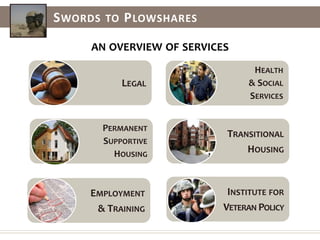
Swords to Plowsharesan overview of servicesLegalHealth & Social ServicesTransitionalHousingPermanent Supportive HousingInstitute for Veteran PolicyEmployment& Training
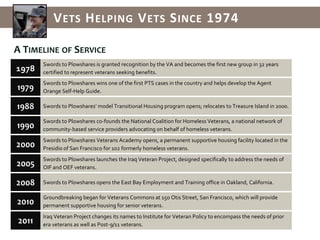
Vets Helping Vets Since 1974A Timeline of Service
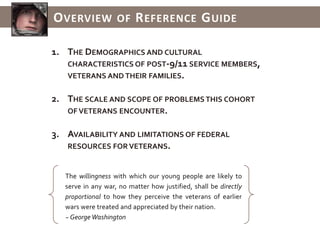
Overview of Reference GuideThe Demographics and cultural characteristics of post-9/11 service members, veterans and their families.The scale and scope of problems this cohort of veterans encounter.Availability and limitations of federal resources for veterans.The willingness with which our young people are likely to serve in any war, no matter how justified, shall be directly proportional to how they perceive the veterans of earlier wars were treated and appreciated by their nation.            ~ George Washington
Key Terms and LingoGlobal War on Terror (GWOT) – Includes Operation New Dawn and Operation Enduring FreedomAlso Known As Overseas Contingency OperationsCurrent ConflictsOperation New Dawn (Operation Iraqi Freedom [OIF] Prior to 9/1/2010 Refers to 50,000 U.S. troops remaining in Iraq for non-combat operations Operation Enduring Freedom (OEF)Refers to the conflict primarily in Afghanistan, as well as other theaters of 	combat operationsAreas of Combat Operations Around the Globe 1
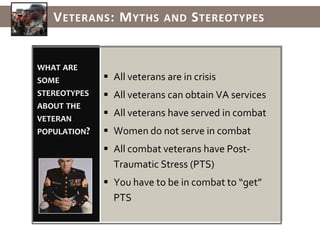
Veterans: Myths and Stereotypes
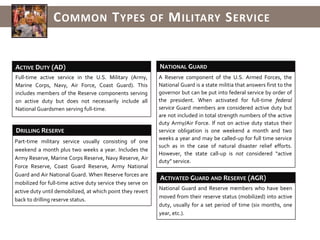
Common Types of Military ServiceNational Guard Active Duty (AD)Full-time active service in the U.S. Military (Army, Marine Corps, Navy, Air Force, Coast Guard). This includes members of the Reserve components serving on active duty but does not necessarily include all National Guardsmen serving full-time. A Reserve component of the U.S. Armed Forces, the National Guard is a state militia that answers first to the governor but can be put into federal service by order of the president. When activated for full-time federalservice Guard members are considered active duty but are not included in total strength numbers of the active duty Army/Air Force. If not on active duty status their service obligation is one weekend a month and two weeks a year and may be called-up for full time service such as in the case of natural disaster relief efforts. However, the state call-up is not considered “active duty” service.Drilling ReservePart-time military service usually consisting of one weekend a month plus two weeks a year. Includes the Army Reserve, Marine Corps Reserve, Navy Reserve, Air Force Reserve, Coast Guard Reserve, Army National Guard and Air National Guard. When Reserve forces are mobilized forfull-time active duty service they serve on active duty until demobilized, at which point they revert back to drilling reserve status. Activated Guard and Reserve (AGR)National Guard and Reserve members who have been moved from their reserve status (mobilized) into active duty, usually for a set period of time (six months, one year, etc.).
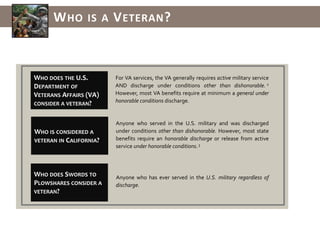
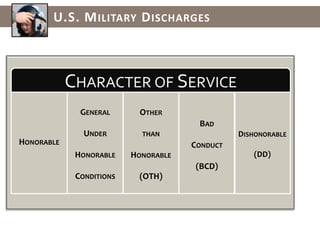
Who is a Veteran?Who is a Veteran?Who does the U.S. Department of Veterans Affairs (VA) consider a veteran?For VA services, the VA generally requires active military service AND discharge under conditions other than dishonorable.2However, most VA benefits require at minimum a general under honorable conditions discharge.Who is considered a veteran in California?Anyone who served in the U.S. military and was discharged under conditions other than dishonorable. However, most state benefits require an honorable discharge or release from active service under honorable conditions.3Who does Swords to Plowshares consider a veteran?Anyone who has ever served in the U.S. military regardless of discharge.
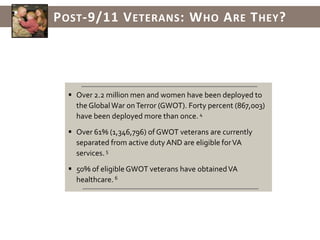
Post-9/11 Veterans: Who Are They?Over 2.2 million men and women have been deployed to the Global War on Terror (GWOT). Forty percent (867,003) have been deployed more than once.4
Over 61% (1,346,796) of GWOT veterans are currently separated from active duty AND are eligible for VA services.5
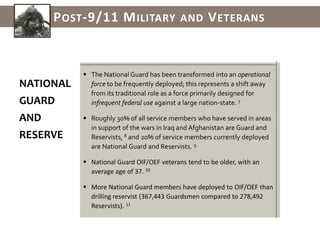
50% of eligible GWOT veterans have obtained VA healthcare.6 Post-9/11 Military and VeteransThe National Guard has been transformed into an operational force to be frequently deployed; this represents a shift away from its traditional role as a force primarily designed for infrequent federal use against a large nation-state. 7
Roughly 30% of all service members who have served in areas in support of the wars in Iraq and Afghanistan are Guard and Reservists, 8 and 20% of service members currently deployed are National Guard and Reservists. 9
National Guard OIF/OEF veterans tend to be older, with an average age of 37. 10
More National Guard members have deployed to OIF/OEF than drilling reservist (367,443 Guardsmen compared to 278,492 Reservists). 11national guard and reserve
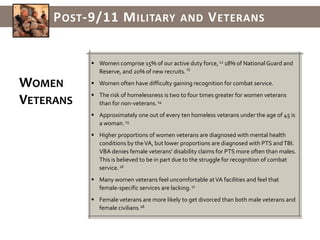
Post-9/11 Military and VeteransWomen comprise 15% of our active duty force,1218% of National Guard and Reserve, and 20% of new recruits.13
Women often have difficulty gaining recognition for combat service.
The risk of homelessness is two to four times greater for women veterans than for non-veterans.14
Approximately one out of every ten homeless veterans under the age of 45 is a woman.15
Higher proportions of women veterans are diagnosed with mental health conditions by the VA, but lower proportions are diagnosed with PTS and TBI. VBA denies female veterans' disability claims for PTS more often than males. This is believed to be in part due to the struggle for recognition of combat service.16
Many women veterans feel uncomfortable at VA facilities and feel that female-specific services are lacking.17
Female veterans are more likely to get divorced than both male veterans and female civilians. 18WomenVeterans
Post-9/11 Military and VeteransOver half of the military is married and over 40% of service members have children.19
There is evidence that having a parent deployed can lead to anxiety,20 mental health and behavioral problems21as well as academic struggles for the child.22
Ten percent of married service members are in dual-military marriages whereby a active duty, Reserve or Guard member is married to another service member.23
Nearly 50% of all married active duty females are in dual military marriages.24
Sixteen percent of women in the Reserves or Guard are single parents and roughly 12% of female active duty service members are single parents.25
Seven percent of men in the Reserves or Guard and roughly 4% of active duty men are single fathers.26MilitaryFamilies
Post-9/11 Military and VeteransOne-third of the military self-identifies as a racial or ethnic minority. 27
Thirty percent of Reserve and National Guard members identify themselves as a member of a racial or ethnic minority. 28
4.75 million living U.S. veterans of all eras identify as a racial or ethnic minority. 29
Thirty-two percent of the nearly 1.8 million living female veterans of all eras identify as a racial or ethnic minority. 30
Minority service members are underrepresented among officers in the military in both active duty and Guard/Reserve forces. In the active duty forces, only 10.9% of minority members are officers when they make up 36% of the active duty force. Similarly, in the Guard and Reserve forces, 10.4% of minorities are officers when they make up 30.2% of the total force. 31
Racial minorities are disproportionately affected by Don’t Ask; Don’t Tell (DADT). Racial minorities comprise 29.4% of the military yet account for 45% of all DADT discharges. 32 African American women are the hardest hit – they make up less than 1% of the military, yet make up 3.3% of those discharged under DADT. 33
Culturally competent care significantly affects the treatment outcomes of minority veterans. 34
African American and Latino Vietnam veterans were more likely to develop PTS than Caucasians. 35
A 2008 study on VA patients suggested that African American veterans are less likely to be screened for mental health problems. 36 Research on prior era veterans shows that African American veterans are less likely to have their PTS claim approved by the VA. 37Minorities
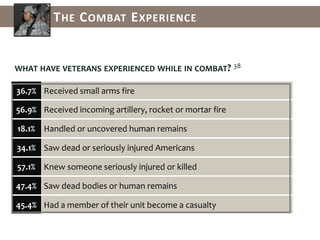
The Combat Experiencewhat have veterans experienced while in combat? 38
Injuries and TreatmentFor every service member killed in action (6,086) there are seven wounded in action (44,596). When including “non-combat” injuries (55,243), the ratio of injured to killed jumps to sixteen to one.39
One out of four veterans of the current conflicts has filed a disability claim at the VA, and the VA has already treated 30% of veterans of the two wars.40
The large additional number of those who are treated by the VA and other providers beyond the DoD counts of injuries indicates the true numbers of veterans with psychological and cognitive injuries not counted by official sources, either because of delayed detection, delayed onset of symptoms, or stigma of reporting while in active duty.41
About half (53%) of GWOT veterans who need treatment for major depression or PTS seek it.42
Slightly more than one-half of veterans who seek treatment for mental health conditions receive “minimally adequate care.”43
Minimally adequate care is defined as “1) taking a prescribed medication for as long as the doctor wanted and having at least four visits with a doctor or therapist in the past 12 months or 2) having had at least eight visits with a mental health professional in the past 12 months, with visits averaging at least 30 minutes.”44PTS and Other Mental Health ConditionsPTS is generally defined as an anxiety condition that can develop after exposure to a traumatic event or ordeal in which grave physical harm occurred or was threatened.
Veterans with PTS and/or depression face a broad range of physical, cognitive, behavioral, emotional and social challenges.
Research suggests rates of mental health conditions as high as 26%, with 37% of veterans treated at the VA having a mental health diagnosis.45Rates of PTS are as high as 35% when factoring in delayed onset if PTS. 46
Rates of PTS and depression are higher for Reservists than active duty.47
As of January 2011, the VA reported 11.5% of GWOT veterans diagnosed with PTS.48There is no report of diagnoses from non-VA community providers which often diagnose and treat veterans, so the estimates of veterans diagnosed with PTS are likely much higher.
Repeated deployments and short dwell time (time between deployments) increase the likelihood of developing PTS and other mental health conditions. 49
Veterans may not know they have PTS and thus may not seek proper treatment.
Total healthcare costs for combat-induced PTS for GWOT veterans are estimated to be between $1.54 to $2.69 billion.50Substance AbuseThere is a high co-morbidity of mental health issues and substance abuse among GWOT veterans. Rates of substance abuse among veterans diagnosed with PTS or other mental health issues range from 21 % to 35%. 51
In 2009, 9,199 soldiers sought treatment for alcohol related problems, a 56% increase over 2003 when the Iraq war started. In order to meet this new demand, the Army says they need twice as many substance abuse counselors. 52

IVP reference guide 7.11

  • 1.
    July 2011Reference Guideon Current Era VeteransandTheirFamiliesComprehensive Facts and FiguresInstitute for Veteran Policy1060 Howard Street | San Francisco| CA | 94103 | (415) 252-4788
  • 2.
    ForwardWar causes woundsand suffering that last beyond the battlefield. Swords to Plowshares’ mission is to heal the wounds, to restore dignity, hope, and self-sufficiency to all veterans in need, and to significantly reduce homelessness and poverty among veterans.Over two million service members have deployed to fight the Global War on Terror, many for multiple tours of duty. These veterans return home not to the Department of Defense or the Department of Veterans Affairs, but to the communities in which they live and to the homes of their families. There are unique aspects to these wars which must be addressed in order to prevent or mitigate the hardships endured by previous generations of war veterans. We know that the cost of war goes well beyond bullets and boots.The transition from total immersion in military culture to the civilian world can prove difficult for many veterans. Even the most successful adjustment from duty overseas to civilian life at home will often present periods of irritability, depression, isolation and hyper-vigilance which compromise veterans’ abilities to rejoin family, secure and maintain employment and sustain healthy relationships. Rates of Post-Traumatic Stress, Traumatic Brain Injury and suicide are unprecedented. Returning home to a tough economy makes it that much more difficult for new veterans to secure stable housing and employment. It is the responsibility of the community to recognize the sacrifice these men and women have made on our behalf and to help those veterans who are in need. The following information is meant to give you a brief snapshot of some of the challenges many veterans face and to inform readers about services and supports for veterans. Founded in 1974, Swords to Plowshares is a community-based, not-for-profit organization that provides counseling and case management, employment and training, housing, and legal assistance to more than 1,500 homeless and low-income veterans annually in the San Francisco Bay Area and beyond. We promote and protect the rights of veterans through advocacy, public education, and partnerships with local, state, and national entities.Michael BleckerExecutive Director
  • 3.
    Swords to Plowsharesanoverview of servicesLegalHealth & Social ServicesTransitionalHousingPermanent Supportive HousingInstitute for Veteran PolicyEmployment& Training
  • 4.
    Vets Helping VetsSince 1974A Timeline of Service
  • 5.
    Overview of ReferenceGuideThe Demographics and cultural characteristics of post-9/11 service members, veterans and their families.The scale and scope of problems this cohort of veterans encounter.Availability and limitations of federal resources for veterans.The willingness with which our young people are likely to serve in any war, no matter how justified, shall be directly proportional to how they perceive the veterans of earlier wars were treated and appreciated by their nation. ~ George Washington
  • 6.
    Key Terms andLingoGlobal War on Terror (GWOT) – Includes Operation New Dawn and Operation Enduring FreedomAlso Known As Overseas Contingency OperationsCurrent ConflictsOperation New Dawn (Operation Iraqi Freedom [OIF] Prior to 9/1/2010 Refers to 50,000 U.S. troops remaining in Iraq for non-combat operations Operation Enduring Freedom (OEF)Refers to the conflict primarily in Afghanistan, as well as other theaters of combat operationsAreas of Combat Operations Around the Globe 1
  • 7.
  • 8.
    Common Types ofMilitary ServiceNational Guard Active Duty (AD)Full-time active service in the U.S. Military (Army, Marine Corps, Navy, Air Force, Coast Guard). This includes members of the Reserve components serving on active duty but does not necessarily include all National Guardsmen serving full-time. A Reserve component of the U.S. Armed Forces, the National Guard is a state militia that answers first to the governor but can be put into federal service by order of the president. When activated for full-time federalservice Guard members are considered active duty but are not included in total strength numbers of the active duty Army/Air Force. If not on active duty status their service obligation is one weekend a month and two weeks a year and may be called-up for full time service such as in the case of natural disaster relief efforts. However, the state call-up is not considered “active duty” service.Drilling ReservePart-time military service usually consisting of one weekend a month plus two weeks a year. Includes the Army Reserve, Marine Corps Reserve, Navy Reserve, Air Force Reserve, Coast Guard Reserve, Army National Guard and Air National Guard. When Reserve forces are mobilized forfull-time active duty service they serve on active duty until demobilized, at which point they revert back to drilling reserve status. Activated Guard and Reserve (AGR)National Guard and Reserve members who have been moved from their reserve status (mobilized) into active duty, usually for a set period of time (six months, one year, etc.).
  • 9.
    Who is aVeteran?Who is a Veteran?Who does the U.S. Department of Veterans Affairs (VA) consider a veteran?For VA services, the VA generally requires active military service AND discharge under conditions other than dishonorable.2However, most VA benefits require at minimum a general under honorable conditions discharge.Who is considered a veteran in California?Anyone who served in the U.S. military and was discharged under conditions other than dishonorable. However, most state benefits require an honorable discharge or release from active service under honorable conditions.3Who does Swords to Plowshares consider a veteran?Anyone who has ever served in the U.S. military regardless of discharge.
  • 10.
    Post-9/11 Veterans: WhoAre They?Over 2.2 million men and women have been deployed to the Global War on Terror (GWOT). Forty percent (867,003) have been deployed more than once.4
  • 11.
    Over 61% (1,346,796)of GWOT veterans are currently separated from active duty AND are eligible for VA services.5
  • 12.
    50% of eligibleGWOT veterans have obtained VA healthcare.6 Post-9/11 Military and VeteransThe National Guard has been transformed into an operational force to be frequently deployed; this represents a shift away from its traditional role as a force primarily designed for infrequent federal use against a large nation-state. 7
  • 13.
    Roughly 30% ofall service members who have served in areas in support of the wars in Iraq and Afghanistan are Guard and Reservists, 8 and 20% of service members currently deployed are National Guard and Reservists. 9
  • 14.
    National Guard OIF/OEFveterans tend to be older, with an average age of 37. 10
  • 15.
    More National Guardmembers have deployed to OIF/OEF than drilling reservist (367,443 Guardsmen compared to 278,492 Reservists). 11national guard and reserve
  • 16.
    Post-9/11 Military andVeteransWomen comprise 15% of our active duty force,1218% of National Guard and Reserve, and 20% of new recruits.13
  • 17.
    Women often havedifficulty gaining recognition for combat service.
  • 18.
    The risk ofhomelessness is two to four times greater for women veterans than for non-veterans.14
  • 19.
    Approximately one outof every ten homeless veterans under the age of 45 is a woman.15
  • 20.
    Higher proportions ofwomen veterans are diagnosed with mental health conditions by the VA, but lower proportions are diagnosed with PTS and TBI. VBA denies female veterans' disability claims for PTS more often than males. This is believed to be in part due to the struggle for recognition of combat service.16
  • 21.
    Many women veteransfeel uncomfortable at VA facilities and feel that female-specific services are lacking.17
  • 22.
    Female veterans aremore likely to get divorced than both male veterans and female civilians. 18WomenVeterans
  • 23.
    Post-9/11 Military andVeteransOver half of the military is married and over 40% of service members have children.19
  • 24.
    There is evidencethat having a parent deployed can lead to anxiety,20 mental health and behavioral problems21as well as academic struggles for the child.22
  • 25.
    Ten percent ofmarried service members are in dual-military marriages whereby a active duty, Reserve or Guard member is married to another service member.23
  • 26.
    Nearly 50% ofall married active duty females are in dual military marriages.24
  • 27.
    Sixteen percent ofwomen in the Reserves or Guard are single parents and roughly 12% of female active duty service members are single parents.25
  • 28.
    Seven percent ofmen in the Reserves or Guard and roughly 4% of active duty men are single fathers.26MilitaryFamilies
  • 29.
    Post-9/11 Military andVeteransOne-third of the military self-identifies as a racial or ethnic minority. 27
  • 30.
    Thirty percent ofReserve and National Guard members identify themselves as a member of a racial or ethnic minority. 28
  • 31.
    4.75 million livingU.S. veterans of all eras identify as a racial or ethnic minority. 29
  • 32.
    Thirty-two percent ofthe nearly 1.8 million living female veterans of all eras identify as a racial or ethnic minority. 30
  • 33.
    Minority service membersare underrepresented among officers in the military in both active duty and Guard/Reserve forces. In the active duty forces, only 10.9% of minority members are officers when they make up 36% of the active duty force. Similarly, in the Guard and Reserve forces, 10.4% of minorities are officers when they make up 30.2% of the total force. 31
  • 34.
    Racial minorities aredisproportionately affected by Don’t Ask; Don’t Tell (DADT). Racial minorities comprise 29.4% of the military yet account for 45% of all DADT discharges. 32 African American women are the hardest hit – they make up less than 1% of the military, yet make up 3.3% of those discharged under DADT. 33
  • 35.
    Culturally competent caresignificantly affects the treatment outcomes of minority veterans. 34
  • 36.
    African American andLatino Vietnam veterans were more likely to develop PTS than Caucasians. 35
  • 37.
    A 2008 studyon VA patients suggested that African American veterans are less likely to be screened for mental health problems. 36 Research on prior era veterans shows that African American veterans are less likely to have their PTS claim approved by the VA. 37Minorities
  • 38.
    The Combat Experiencewhathave veterans experienced while in combat? 38
  • 39.
    Injuries and TreatmentForevery service member killed in action (6,086) there are seven wounded in action (44,596). When including “non-combat” injuries (55,243), the ratio of injured to killed jumps to sixteen to one.39
  • 40.
    One out offour veterans of the current conflicts has filed a disability claim at the VA, and the VA has already treated 30% of veterans of the two wars.40
  • 41.
    The large additionalnumber of those who are treated by the VA and other providers beyond the DoD counts of injuries indicates the true numbers of veterans with psychological and cognitive injuries not counted by official sources, either because of delayed detection, delayed onset of symptoms, or stigma of reporting while in active duty.41
  • 42.
    About half (53%)of GWOT veterans who need treatment for major depression or PTS seek it.42
  • 43.
    Slightly more thanone-half of veterans who seek treatment for mental health conditions receive “minimally adequate care.”43
  • 44.
    Minimally adequate careis defined as “1) taking a prescribed medication for as long as the doctor wanted and having at least four visits with a doctor or therapist in the past 12 months or 2) having had at least eight visits with a mental health professional in the past 12 months, with visits averaging at least 30 minutes.”44PTS and Other Mental Health ConditionsPTS is generally defined as an anxiety condition that can develop after exposure to a traumatic event or ordeal in which grave physical harm occurred or was threatened.
  • 45.
    Veterans with PTSand/or depression face a broad range of physical, cognitive, behavioral, emotional and social challenges.
  • 46.
    Research suggests ratesof mental health conditions as high as 26%, with 37% of veterans treated at the VA having a mental health diagnosis.45Rates of PTS are as high as 35% when factoring in delayed onset if PTS. 46
  • 47.
    Rates of PTSand depression are higher for Reservists than active duty.47
  • 48.
    As of January2011, the VA reported 11.5% of GWOT veterans diagnosed with PTS.48There is no report of diagnoses from non-VA community providers which often diagnose and treat veterans, so the estimates of veterans diagnosed with PTS are likely much higher.
  • 49.
    Repeated deployments andshort dwell time (time between deployments) increase the likelihood of developing PTS and other mental health conditions. 49
  • 50.
    Veterans may notknow they have PTS and thus may not seek proper treatment.
  • 51.
    Total healthcare costsfor combat-induced PTS for GWOT veterans are estimated to be between $1.54 to $2.69 billion.50Substance AbuseThere is a high co-morbidity of mental health issues and substance abuse among GWOT veterans. Rates of substance abuse among veterans diagnosed with PTS or other mental health issues range from 21 % to 35%. 51
  • 52.
    In 2009, 9,199soldiers sought treatment for alcohol related problems, a 56% increase over 2003 when the Iraq war started. In order to meet this new demand, the Army says they need twice as many substance abuse counselors. 52