IT 330 Final Project Guidelines and Rubric
Overview
Databases are increasingly important in the information age, as
they provide a means to organize, track, manage, and use
information easily and efficiently.
Thousands of companies depend on databases to record and
update data. Databases have a wide variety of uses, from
tracking climate measurements
worldwide to storing library research information to organizing
user data for businesses and organizations.
For this assessment, you will solve an information storage
problem. The owner of two local bookstores wants to
consolidate individual store inventories. You will
organize the store inventory data into workable tables and apply
normalization techniques to create a single common SQL-based
database that can be shared
between the stores. In addition, you will submit a report
explaining the choices you made in the creation of your
database. The report will also include an entity-
relationship diagram and other models as well as a description
of the database design features.
Some components of this final project will have been developed
earlier in the course and submitted for instructor feedback. You
will submit them a second time
as part of this final project, incorporating the feedback that you
received from your instructor. This project is divided into two
milestones, which will be
submitted at various points throughout the course to scaffold
learning and ensure quality final submissions. These milestones
will be due in Modules Two and
Four. The final database and report will be submitted in Module
Seven.
This assessment addresses the following course outcomes:
comparing features and functions to determine benefits in data
management
suitable information model solutions using entity relation
diagrams
models for defining relationships and minimizing redundancy
Structured Query Language interface to create, populate,
maintain, and query databases
Scenario
Books’R’Us is a local bookstore that started in 1978 in a small
New England town. Books’R’Us has been able to withstand the
challenges of larger bookstore
chains, as well as the internet giant Amazon.com, by offering
new and used books and other products in a comfortable
location that includes a café with free Wi-
Fi. Books’R’Us recently purchased another local bookstore
called Great Books, USA, from an owner who is retiring. Both
businesses use a simple bookkeeping
system that includes Microsoft Excel.
The owners of Books’R’Us, Tom and Sarah Smith, would like a
more efficient way to store inventory data and report on the
various business essentials. They are
also preparing to offer e-commerce on their website. A
consulting firm has recommended capturing information in a
database and linking access to the database
for each store. Tom and Sarah purchased Microsoft SQL Server
to do this. The consulting firm has hired you to complete the
database for Books’R’Us. In addition
to creating the database, you will provide a report for your
supervisor at the consulting firm; this report should describe the
rationale for and proposed
development of the database.
Imagine that you have interviewed the store owners, Tom and
Sarah Smith, and these are the questions with which they are
most concerned:
1. How many books are sold each month by the publisher? This
is important because quantity discounts are available from the
publisher.
2. Which authors are the biggest sellers of books in our stores?
This is important because the publisher offers discounts for
certain authors each month.
3. What books are associated with each publisher?
4. What are the most popular products besides books that are
sold in each store? In addition to books, the stores sell
magazines, café-specific products like
coffee and pastries, and various gift products.
5. From what region(s) (by ZIP code) do customers visit our
stores? This is important because it will assist with future
marketing efforts.
6. What customer data must be stored for the e-commerce
portion of the website?
Prompt
Your database and report should answer the following prompt:
Create a database that meets the needs of the store owners. In
addition to the database, you
will submit a report that includes several models and diagrams
that you completed earlier in the course to inform your database
creation; you will resubmit
these models and diagrams after incorporating your instructor’s
feedback.
Specifically, the following critical elements must be addressed:
I. Database: You will use your entity-relationship diagram,
relational model, functional dependencies diagram, and
functional relational schema to inform
the creation of your database. These will be submitted as part of
your report.
A. Tables: Create at least four tables that will display the data
that is important to the store owners. Identify the primary and
foreign keys that are
necessary to relate the tables. Include screenshots that show the
tables you created.
B. Import Data: Use SQL statements to import the data into the
tables you just created. You will come up with each of your data
sets yourself. You
should have at least five records for each table. Include
screenshots that show the populated tables annotated with the
SQL statements that you
used.
C. Queries: After you have populated the tables, write queries
to extract the data to answer the owner’s questions. Include
screenshots that show
each query and the corresponding query results.
II. Report: Although some parts of the report will be completed
before or during the creation of the database, the report as a
whole will be written after
you have created the database.
A. Overview: Provide a concise overview of the problem you
are solving and the database that you created to address the
problem.
B. Justification: Analyze the business information storage
problem you are solving. Why is the database the appropriate
solution to the problem?
C. Benefits: What benefits in data management does the
database you created have over a file system like the one the
stores were previously
using? What features and functions does a database have that a
file system does not?
D. Features: Describe each of the major features of the database
you created. Why are these features required?
E. Design: How did you design the database to manage the
stores’ data? Discuss the tables you created and their
relationships, including in your
discussion the table name, attributes (field names and data
types), and keys (primary and foreign). Consider including a
diagram to support your
response to this question.
F. Entity-Relationship Diagram (ERD): Develop an entity-
relationship diagram that has an appropriate set of attributes for
each entity.
G. Relational Model: Develop a relational model that is logical
and complies with the requirements in your ERD.
H. Functional Dependencies Diagram: Based on your ERD,
develop a functional dependencies diagram that accurately
normalizes the data into
third normal form (3NF).
I. Functional-Relational Schema: Based on your ERD and
dependencies diagram, develop a relational schema that
accurately normalizes the data
into 3NF.
Milestones
Milestone One: Project Proposal
In Module Two, you will submit a project proposal and its
overview as a Word document. This milestone is graded with
the Milestone One Rubric.
Milestone Two: Systems Analysis
In Module Four, you will submit a systems analysis for your
project, including a comprehensive entity-relation diagram
(ERD). Although you may use any tool to
complete the ERD, it is strongly recommended that you use
Microsoft Visio and then save the diagram into an image format
(GIF or JPG) and then copy and
paste the image into your systems analysis. All sections of this
milestone should be compiled into a single Word document.
This milestone is graded with the
Milestone Two Rubric.
Final Project Submission: Database and Report
In Module Seven, you will submit your database and report.
Your database and report should answer the following prompt:
Create a database that meets the
needs of the store owners. In addition to the database, you will
also submit a report that includes several models and diagrams
that you completed earlier in the
course to inform your database creation; you will now resubmit
these models and diagrams after incorporating your instructor’s
feedback. This submission is
graded with the Final Project Rubric.
Final Project Rubric
Guidelines for Submission: Your report should adhere to the
following formatting requirements: 5–7 pages, double-spaced,
using 12-point Times New Roman
font and one-inch margins.
Instructor Feedback: This activity uses an integrated rubric in
Blackboard. Students can view instructor feedback in the Grade
Center. For more information,
review these instructions.
Critical Elements Exemplary (100%) Proficient (85%) Needs
Improvement (55%) Not Evident (0%) Value
Tables Meets “Proficient” criteria and
demonstrates nuanced
understanding of table
relationships
Creates at least four tables that
will display the data that is
important to the store owners
and accurately identifies the
primary and foreign keys
necessary to relate the tables
Creates at least four tables and
identifies primary and foreign
keys, but with gaps in accuracy,
relevance, or detail
Does not create at least four
tables
7.92
Import Data Meets “Proficient” criteria and
demonstrates nuanced
understanding of SQL
Accurately uses SQL statements
to import data to tables,
displaying at least five records
per table
Uses SQL statements to import
data to tables, displaying at least
five records per table, but with
gaps in accuracy or detail
Does not use SQL statements to
import data to tables
7.92
Queries Meets “Proficient” criteria and
demonstrates nuanced
understanding of SQL
Writes queries that accurately
extract the data to answer
owners’ questions
Writes queries that extract data,
but with gaps in accuracy,
relevance, or detail
Does not write queries that
extract the data to answer
owners’ questions
7.92
Overview Meets “Proficient” criteria, and
overview is exceptionally clear
and contextualized
Provides concise overview of
problem and database that was
created to address problem
Provides overview of problem to
be solved and database that will
be created to address problem,
but overview is wordy or vague
Does not provide overview of
problem to be solved and
database that will be created to
address problem
7.92
Justification Meets “Proficient” criteria, and
analysis is exceptionally clear and
contextualized
Thoroughly analyzes the business
information storage problem and
explains why the database is the
appropriate solution to the
problem
Analyzes the business
information storage problem and
explains why the database is the
appropriate solution to the
problem, but is cursory or
inaccurate
Does not analyze the business
information storage problem and
does not explain why the
database is the appropriate
solution to the problem
7.92
Benefits Meets “Proficient” criteria and
demonstrates nuanced
understanding of differences
between databases and file
systems
Comprehensively describes
benefits, features, and functions
of databases compared to file
systems
Describes benefits, features, and
functions of databases compared
to file systems, but with gaps in
accuracy or detail
Does not describe benefits,
features, and functions of
databases compared to file
systems
7.92
http://snhu-
media.snhu.edu/files/production_documentation/formatting/rubr
ic_feedback_instructions_student.pdf
Features Meets “Proficient” criteria and
demonstrates nuanced
understanding of database
features
Comprehensively describes
major features of database and
explains why they are required
Describes major features of
database and explains why they
are required, but with gaps in
accuracy or detail
Does not describe major features
of database and does not explain
why they are required
7.92
Design Meets “Proficient” criteria and
discussion is supported with
diagram(s)
Thoroughly describes database
design, tables, and relationships,
supporting discussion with table
names, attributes, and keys
Describes database design,
tables, and relationships, but
description is cursory,
inaccurate, or not supported
with table names, attributes, and
keys
Does not describe database
design, tables, and relationships
7.92
Entity-Relationship
Diagram
Meets “Proficient” criteria and
demonstrates nuanced
understanding of entities,
attributes, and relationships
Develops entity-relationship
diagram that has appropriate set
of attributes for each entity
Develops entity-relationship
diagram, but not all attributes
are appropriate for entities
Does not develop entity-
relationship diagram
7.91
Relational Model Meets “Proficient” criteria and
demonstrates strong
understanding of overall function
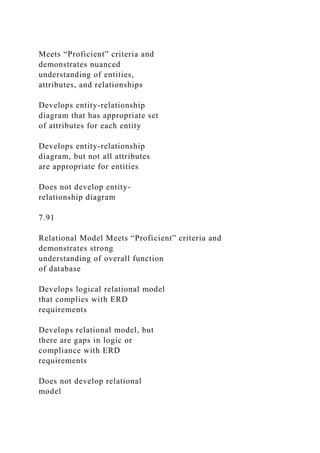
of database
Develops logical relational model
that complies with ERD
requirements
Develops relational model, but
there are gaps in logic or
compliance with ERD
requirements
Does not develop relational
model
7.91
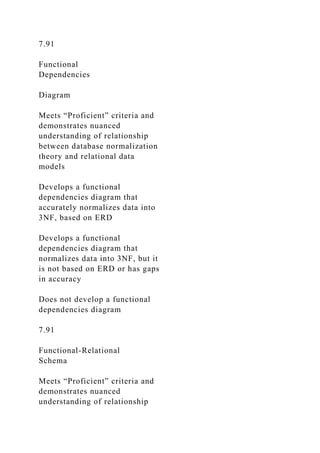
Functional
Dependencies
Diagram
Meets “Proficient” criteria and
demonstrates nuanced
understanding of relationship
between database normalization
theory and relational data
models
Develops a functional
dependencies diagram that
accurately normalizes data into
3NF, based on ERD
Develops a functional
dependencies diagram that
normalizes data into 3NF, but it
is not based on ERD or has gaps
in accuracy
Does not develop a functional
dependencies diagram
7.91
Functional-Relational
Schema
Meets “Proficient” criteria and
demonstrates nuanced
understanding of relationship
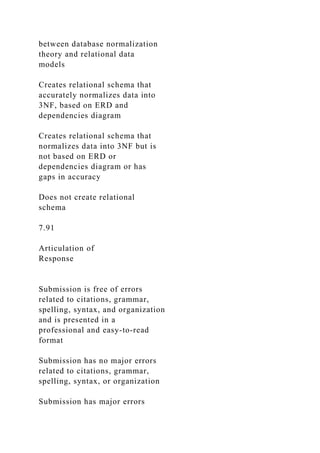
between database normalization
theory and relational data
models
Creates relational schema that
accurately normalizes data into
3NF, based on ERD and
dependencies diagram
Creates relational schema that
normalizes data into 3NF but is
not based on ERD or
dependencies diagram or has
gaps in accuracy
Does not create relational
schema
7.91
Articulation of
Response
Submission is free of errors
related to citations, grammar,
spelling, syntax, and organization
and is presented in a
professional and easy-to-read
format
Submission has no major errors
related to citations, grammar,
spelling, syntax, or organization
Submission has major errors
related to citations, grammar,
spelling, syntax, or organization
that negatively impact
readability and articulation of
main ideas
Submission has critical errors
related to citations, grammar,
spelling, syntax, or organization
that prevent understanding of
ideas
5
Earned Total 100%

IT 330 Final Project Guidelines and Rubric Overview .docx

  • 1.
    IT 330 FinalProject Guidelines and Rubric Overview Databases are increasingly important in the information age, as they provide a means to organize, track, manage, and use information easily and efficiently. Thousands of companies depend on databases to record and update data. Databases have a wide variety of uses, from tracking climate measurements worldwide to storing library research information to organizing user data for businesses and organizations. For this assessment, you will solve an information storage problem. The owner of two local bookstores wants to consolidate individual store inventories. You will organize the store inventory data into workable tables and apply normalization techniques to create a single common SQL-based database that can be shared between the stores. In addition, you will submit a report explaining the choices you made in the creation of your database. The report will also include an entity- relationship diagram and other models as well as a description of the database design features. Some components of this final project will have been developed earlier in the course and submitted for instructor feedback. You will submit them a second time as part of this final project, incorporating the feedback that you received from your instructor. This project is divided into two milestones, which will be
  • 2.
    submitted at variouspoints throughout the course to scaffold learning and ensure quality final submissions. These milestones will be due in Modules Two and Four. The final database and report will be submitted in Module Seven. This assessment addresses the following course outcomes: comparing features and functions to determine benefits in data management suitable information model solutions using entity relation diagrams models for defining relationships and minimizing redundancy Structured Query Language interface to create, populate, maintain, and query databases Scenario Books’R’Us is a local bookstore that started in 1978 in a small New England town. Books’R’Us has been able to withstand the challenges of larger bookstore chains, as well as the internet giant Amazon.com, by offering new and used books and other products in a comfortable location that includes a café with free Wi- Fi. Books’R’Us recently purchased another local bookstore called Great Books, USA, from an owner who is retiring. Both businesses use a simple bookkeeping system that includes Microsoft Excel.
  • 3.
    The owners ofBooks’R’Us, Tom and Sarah Smith, would like a more efficient way to store inventory data and report on the various business essentials. They are also preparing to offer e-commerce on their website. A consulting firm has recommended capturing information in a database and linking access to the database for each store. Tom and Sarah purchased Microsoft SQL Server to do this. The consulting firm has hired you to complete the database for Books’R’Us. In addition to creating the database, you will provide a report for your supervisor at the consulting firm; this report should describe the rationale for and proposed development of the database. Imagine that you have interviewed the store owners, Tom and Sarah Smith, and these are the questions with which they are most concerned: 1. How many books are sold each month by the publisher? This is important because quantity discounts are available from the publisher. 2. Which authors are the biggest sellers of books in our stores? This is important because the publisher offers discounts for certain authors each month. 3. What books are associated with each publisher? 4. What are the most popular products besides books that are sold in each store? In addition to books, the stores sell magazines, café-specific products like coffee and pastries, and various gift products.
  • 4.
    5. From whatregion(s) (by ZIP code) do customers visit our stores? This is important because it will assist with future marketing efforts. 6. What customer data must be stored for the e-commerce portion of the website? Prompt Your database and report should answer the following prompt: Create a database that meets the needs of the store owners. In addition to the database, you will submit a report that includes several models and diagrams that you completed earlier in the course to inform your database creation; you will resubmit these models and diagrams after incorporating your instructor’s feedback. Specifically, the following critical elements must be addressed: I. Database: You will use your entity-relationship diagram, relational model, functional dependencies diagram, and functional relational schema to inform the creation of your database. These will be submitted as part of your report. A. Tables: Create at least four tables that will display the data that is important to the store owners. Identify the primary and foreign keys that are necessary to relate the tables. Include screenshots that show the tables you created. B. Import Data: Use SQL statements to import the data into the tables you just created. You will come up with each of your data sets yourself. You
  • 5.
    should have atleast five records for each table. Include screenshots that show the populated tables annotated with the SQL statements that you used. C. Queries: After you have populated the tables, write queries to extract the data to answer the owner’s questions. Include screenshots that show each query and the corresponding query results. II. Report: Although some parts of the report will be completed before or during the creation of the database, the report as a whole will be written after you have created the database. A. Overview: Provide a concise overview of the problem you are solving and the database that you created to address the problem. B. Justification: Analyze the business information storage problem you are solving. Why is the database the appropriate solution to the problem? C. Benefits: What benefits in data management does the database you created have over a file system like the one the stores were previously using? What features and functions does a database have that a file system does not? D. Features: Describe each of the major features of the database you created. Why are these features required? E. Design: How did you design the database to manage the stores’ data? Discuss the tables you created and their
  • 6.
    relationships, including inyour discussion the table name, attributes (field names and data types), and keys (primary and foreign). Consider including a diagram to support your response to this question. F. Entity-Relationship Diagram (ERD): Develop an entity- relationship diagram that has an appropriate set of attributes for each entity. G. Relational Model: Develop a relational model that is logical and complies with the requirements in your ERD. H. Functional Dependencies Diagram: Based on your ERD, develop a functional dependencies diagram that accurately normalizes the data into third normal form (3NF). I. Functional-Relational Schema: Based on your ERD and dependencies diagram, develop a relational schema that accurately normalizes the data into 3NF. Milestones Milestone One: Project Proposal In Module Two, you will submit a project proposal and its overview as a Word document. This milestone is graded with the Milestone One Rubric. Milestone Two: Systems Analysis In Module Four, you will submit a systems analysis for your project, including a comprehensive entity-relation diagram (ERD). Although you may use any tool to complete the ERD, it is strongly recommended that you use Microsoft Visio and then save the diagram into an image format
  • 7.
    (GIF or JPG)and then copy and paste the image into your systems analysis. All sections of this milestone should be compiled into a single Word document. This milestone is graded with the Milestone Two Rubric. Final Project Submission: Database and Report In Module Seven, you will submit your database and report. Your database and report should answer the following prompt: Create a database that meets the needs of the store owners. In addition to the database, you will also submit a report that includes several models and diagrams that you completed earlier in the course to inform your database creation; you will now resubmit these models and diagrams after incorporating your instructor’s feedback. This submission is graded with the Final Project Rubric. Final Project Rubric Guidelines for Submission: Your report should adhere to the following formatting requirements: 5–7 pages, double-spaced, using 12-point Times New Roman font and one-inch margins. Instructor Feedback: This activity uses an integrated rubric in Blackboard. Students can view instructor feedback in the Grade Center. For more information, review these instructions.
  • 8.
    Critical Elements Exemplary(100%) Proficient (85%) Needs Improvement (55%) Not Evident (0%) Value Tables Meets “Proficient” criteria and demonstrates nuanced understanding of table relationships Creates at least four tables that will display the data that is important to the store owners and accurately identifies the primary and foreign keys necessary to relate the tables Creates at least four tables and identifies primary and foreign keys, but with gaps in accuracy, relevance, or detail Does not create at least four tables 7.92 Import Data Meets “Proficient” criteria and demonstrates nuanced understanding of SQL Accurately uses SQL statements to import data to tables, displaying at least five records per table Uses SQL statements to import data to tables, displaying at least
  • 9.
    five records pertable, but with gaps in accuracy or detail Does not use SQL statements to import data to tables 7.92 Queries Meets “Proficient” criteria and demonstrates nuanced understanding of SQL Writes queries that accurately extract the data to answer owners’ questions Writes queries that extract data, but with gaps in accuracy, relevance, or detail Does not write queries that extract the data to answer owners’ questions 7.92 Overview Meets “Proficient” criteria, and overview is exceptionally clear and contextualized Provides concise overview of problem and database that was created to address problem Provides overview of problem to be solved and database that will
  • 10.
    be created toaddress problem, but overview is wordy or vague Does not provide overview of problem to be solved and database that will be created to address problem 7.92 Justification Meets “Proficient” criteria, and analysis is exceptionally clear and contextualized Thoroughly analyzes the business information storage problem and explains why the database is the appropriate solution to the problem Analyzes the business information storage problem and explains why the database is the appropriate solution to the problem, but is cursory or inaccurate Does not analyze the business information storage problem and does not explain why the database is the appropriate solution to the problem 7.92 Benefits Meets “Proficient” criteria and
  • 11.
    demonstrates nuanced understanding ofdifferences between databases and file systems Comprehensively describes benefits, features, and functions of databases compared to file systems Describes benefits, features, and functions of databases compared to file systems, but with gaps in accuracy or detail Does not describe benefits, features, and functions of databases compared to file systems 7.92 http://snhu- media.snhu.edu/files/production_documentation/formatting/rubr ic_feedback_instructions_student.pdf Features Meets “Proficient” criteria and demonstrates nuanced understanding of database features Comprehensively describes major features of database and
  • 12.
    explains why theyare required Describes major features of database and explains why they are required, but with gaps in accuracy or detail Does not describe major features of database and does not explain why they are required 7.92 Design Meets “Proficient” criteria and discussion is supported with diagram(s) Thoroughly describes database design, tables, and relationships, supporting discussion with table names, attributes, and keys Describes database design, tables, and relationships, but description is cursory, inaccurate, or not supported with table names, attributes, and keys Does not describe database design, tables, and relationships 7.92 Entity-Relationship Diagram
  • 13.
    Meets “Proficient” criteriaand demonstrates nuanced understanding of entities, attributes, and relationships Develops entity-relationship diagram that has appropriate set of attributes for each entity Develops entity-relationship diagram, but not all attributes are appropriate for entities Does not develop entity- relationship diagram 7.91 Relational Model Meets “Proficient” criteria and demonstrates strong understanding of overall function of database Develops logical relational model that complies with ERD requirements Develops relational model, but there are gaps in logic or compliance with ERD requirements Does not develop relational model
  • 14.
    7.91 Functional Dependencies Diagram Meets “Proficient” criteriaand demonstrates nuanced understanding of relationship between database normalization theory and relational data models Develops a functional dependencies diagram that accurately normalizes data into 3NF, based on ERD Develops a functional dependencies diagram that normalizes data into 3NF, but it is not based on ERD or has gaps in accuracy Does not develop a functional dependencies diagram 7.91 Functional-Relational Schema Meets “Proficient” criteria and demonstrates nuanced understanding of relationship
  • 15.
    between database normalization theoryand relational data models Creates relational schema that accurately normalizes data into 3NF, based on ERD and dependencies diagram Creates relational schema that normalizes data into 3NF but is not based on ERD or dependencies diagram or has gaps in accuracy Does not create relational schema 7.91 Articulation of Response Submission is free of errors related to citations, grammar, spelling, syntax, and organization and is presented in a professional and easy-to-read format Submission has no major errors related to citations, grammar, spelling, syntax, or organization Submission has major errors
  • 16.
    related to citations,grammar, spelling, syntax, or organization that negatively impact readability and articulation of main ideas Submission has critical errors related to citations, grammar, spelling, syntax, or organization that prevent understanding of ideas 5 Earned Total 100%