Optical Forum
Blog Flipbook
In this
Issue
Sports Eye Safety
Contact Lenses as a
Vehicle for drug
delivery
Private Equity in
Optometry
2
April 2021
Making an Impact
Twenty most read Blog posts from March and April 2021 with
Instagram Story Answers
ISSUE
BEST
of
Mar/Apr
2021
Optical Forum
Blog
Making an Impact
Contact Lenses as a Vehicle for drug delivery-
Page 10
Sports Eye Safety - Page
6
Private Equity in Optometry– Page 13
2
News and editor’s
perspective
arch was Workplace Eye Wellness and Eye Donor Awareness
month with the World Optometry Day on the 23rd followed by
the World Optometry Week. Optometrists around the world
celebrated by sharing through the web and social media platforms
images of events.
At Optical Forum and during March, we celebrated World
Optometry Week with fellow Optometrists who generously shared
with us the reason they decided to become Optometrists. We
posted each story on a separate blog post as well as on Instagram
and Facebook.
The American Academy of Ophthalmology has announced April is
Sports Eye Safety month. The World Council of Optometry has
announced April is Women’s Eye Health and Safety Month with
World Health Day to be on April 7th and World Allergy Week to be
from April 25 to May first.
At Optical Forum and during April, we will keep posting new original
content on daily basis. We added to this month’s Issue of Optical
Forum Blog FlipBook a “News and Editor’s Perspective” section as
well as an “Answer & Insights” section next to each post. The
“Answer & Insights” section features insights about every quiz
question in Instagram Stories related to the daily Blog post.
We are also working towards accommodating new editors. This
month’s topics will revolve around Sports Eye Safety, New usage of
Contact Lenses as a Vehicle for drug delivery, Private Equity,
Searching and Acquiring an Optometry practice, and marketing.
And as always, we would really appreciate and love to include your
write-up on the said topics. Therefore, you are all welcome to share
with us this journey by sending your insights, stories, posts, or
articles at feedback@opticalforum.com or by visiting
https://opticalforum.space/contribute/
3
B y G i l b e r t N a c o u z i , B S c , M B A , D B A , E I C
M
Gilbert Nacouzi
• Lorem ipsum dolor sit
amet, consectetur
adipiscing elit. Lorem
ipsum dolor sit amet,
consectetur adipiscing
elit.
Sports Eye Safety
4
Enjoy reading our
insights related to
the Eye Care
Business
This Blog is like
the “Agora” in
Ancient Greek
which means “To
Gather Together”.
Like Homer, we
characterize a
community without
an Agora as such
as that of the
Cyclopes, as
lawless
Optical Forum Blog
Contact us:
The Editor:
admin@opticalforum.space
Feedback:
feedback@opticalforum.spa
ce
Contents
Contact Lenses
as a Vehicle for
drug delivery
Acuvue Theravision
may be the first step
to deliver allergy
drugs
Private equity placed
the practice's long-
term value into a
new perspective.
Private
Equity in
Optometr
y
6 100,000
people are
affected by
sports-related
eye injuries
each year
Sports Eye
Safety
1
3
1
0
5
Understanding Patient Insights
24
Financing a Sustainable Optometry Practice
26
Smoking and Eye Health 27
Types of Bank Borrowing 29
Plan the Easy Way 30
First-Mover Advantage 32
Preparing and Searching to Acquire a
Practice 36
Handling Negative Reviews 38
Anzu Smart Glasses 8
Celebrities With Eye Problems
12
Optometry Branding
15
Is Sleeping with CLs Safe 16
Optometry Brand Proposition
18
Eggs and Eye Health 20
Pricing in Optometry 21
Cash Flow Forecast 23
World Optometry
Week
3
4
Sports Eye
Safety
The American Academy of
Ophthalmology has
announced April is Sports
Eye Safety Month
Answer & Insights
KIDS AND TEENS RARELY WEAR
SPORTS EYE PROTECTION
True
False
True
False
The American Academy of
Ophthalmology (AAO) has
announced April is Sports Eye Safety
Month. The AAO estimates that
100,000 people are affected by
sports-related eye injuries each year.
Almost 13,500 injuries end in
everlasting blindness. The good news
is that most sports-related injuries can
be prevented.
No matter what sports you are
practicing, how old you are, or what
level of professionalism you play, you
need to be aware of proper eye
protection. If eye protection is
common among young people, it is
less common and rarely employed
among children and teens. Sports
activities are very important to kids to
build their personality and the spirit of
teamwork. However, a sports-related
injury could jeopardize the kid's health
and development as well as leave
him with
a psychological damage that may last
for years if not forever.
Sports-related eye injuries can vary
from abrasions or corneal scratches,
lid bruises, black eye, orbital fracture,
internal eye bleeding, retinal
detachments, and total blindness.
Injuries are most frequent in baseball,
basketball, ice hockey, football,
tennis, swimming, water polo, soccer,
handball, cycling, and other racket
sports as well as in sports with
physical contact. Eye Protection for
Sports Eye Safety ranges from safety
goggles to helmets. They have
special requirements for fit and
design that do not obstruct eyesight
or impede the quality of eyesight and
visual field. Materials requirements
include durability, softness,
weightlessness, comfort, impact
resistance (that meet American
Standards for Testing and Materials
ASTM), and non-allergenic. In some
sports wearing helmets with a grid
does not prevent an opponent's finger
from reaching to the eyes. Therefore,
additional Safety goggles with
polycarbonate lenses are required.
Optometrists should inform athletes
and parents of the availability of
comprehensive exams and visits for
sports-related eye injury prevention.
During the visit, the Optometrist
informs the patient how to protect
eyes, what type of equipment is
available and what are its limits, as
well as how to perform better in
sports activities without having to
jeopardize his eye health and the
health of others. What’s more
important is to inform the patient that
a comprehensive eye test is always
needed in case an accident occurred
and an emergency room is required.
Kids Eye Protection
The AAO estimates that 100,000
people are affected by sports-
related eye injuries each year.
Almost 13,500 injuries end in
everlasting blindness.
7
Anzu Smart
Glasses the New
Kid in Town
It’s been a month we
posted about Google
Glass Enterprise
Edition 2 and how it is
proving to be an
important tool for
logistics and
manufacturing
workers. This
month, Razer– the
gaming peripheral
company- released
Anzu smart glasses
with wireless audio
and eye protection
against blue light and
UV. Razer is not the
first company to
integrate audio
speakers into the
temples of the
eyeglasses. Bose did it
before with Bose
Frames and Amazon
too with Echo Frames.
Unlike many startups
using bone-conduction
systems or earbuds –
those we find on
Kickstarter- Bose
Frames, Echo Frames,
and Anzu employ a set
of 16 mm speaker
drivers that act like
hidden wireless
headphones.
9
From the outside, Anzu’s design reminded me of Bose Frames
that look like any regular square and round plastic unisex
sunglasses. The material is black nylon and both shapes come
with a choice of a small/medium and large size. Anzu comes
standard with two sets of lenses: a pair of 35% blue light filters,
and a pair of 99% UVA and UVB protection polarized sunglass
lenses. It has a battery life of five hours in normal usage and a two
weeks life on standby mode. It supports Bluetooth 5.1 connectivity
that eliminates delays and touch control to play music, take calls,
or use it in gaming or voice assistance. Anzu glasses splash-proof
endure any weather with a rating IPX4.
With the COVID-19 pandemic, Razer launches Anzu in a market
where people working from home need eye protection against blue
light emitted from screens and hands-free communication to limit
the spread of disease. Razer has a high potential to win when the
giant Google has failed. Google Glass may have more
technological features but people are still not ready to wear
computers or camera that makes people around them nervous.
For prescription lenses, Razer has partnered with Lensabl which is
offering Anzu owners a 15% discount on Rx lenses.
Private Equity in Optometry
At graduation, many Optometrists
chose between launching a new
business, acquiring an existing
practice, or getting employed. Those
career paths are similar in terms of
taking care of patients, however,
when it comes to becoming your own
boss it is the most difficult path and
the most rewarding sometimes. I say
“sometimes”, because to achieve
success in owning and managing
your own practice you need to be a
good entrepreneur; a thing they don’t
wholly teach at Optometry or medical
schools. In both cases, if you succeed
or not, the road of entrepreneurship is
much harder than deciding to become
an employed Optometrist. Challenges
constantly emerge, and while your
plan and your commitments are for
the long term, no one can predict the
changing dynamics of the market
even for the short term. Among those
changes that fundamentally
transformed the eye care private
practices industry is the penetration of
private equity in Optometry.
Private equity has come among the
latest additions in the Optometry
business during the past couple of
decades. It opened new horizons and
provided new options for those who
wanted to exit the business. Before
private equity, at the end of their
careers, ODs who owned and
managed their practice had to sell to
an associate or a new graduate. The
price of the practice was determined
by the ability/availability of the buyer
to pay. The practice seller would often
neglect the intrinsic value of the
practice and accept the offer
proposed. 10
Warren Buffet always says “Intrinsic
value can be defined simply: It is the
discounted value of the cash that can
be taken out of a business during its
remaining life”. When private equity
started in Optometry the valuation of
the optometry business became
relevant. Private equity placed the
practice's long-term value into a new
perspective. And a new market for
buying and selling private practices
emerged.
The rules of the market for practices
selling and buying changed and made
the barriers to entry much higher,
moreover exiting the market became
more frequent and probable.
A practice owner would consider
selling at an earlier age, remain the
CEO of the practice, still get paid at
the end of the month for the services
he still provides, and collect a
significant amount of money that
allows him to enjoy his increased free
time.
“Intrinsic value can be
defined simply: It is the
discounted value of
the cash that can be
taken out of a
business during its
remaining life”
Warren Buffet
Private Equity in
Optometry
Answer & Insights
Is Private Equity in Optometry Good
or Bad?
Good
Bad
Good
Bad
Celebrities with Eye
Problems By Dr. Gilbert Nacouzi
12
April is sports eye safety month
and among the most infamous sports
celebrities who had sports injuries are
football player Orlando Brown in 1999
who was sidelined for three years
after a damaged retina and optical
nerve, baseball player Luis Salazar in
2011 lost his left eye, Baseball player
Matt Imhof lost his right eye during
routine training in 2016, and
basketball player Akil Mitchell in 2017
when a poke in the face popped his
left eyeball out of its socket.
U2 Irish Frontman
Whoopi Goldberg
stated that she feels
painful headaches and
pressure in her eyes
due to Glaucoma that
she developed as she
aged.
Celebrities with Eye Problems
When we think about celebrities’ eye
problems we immediately think of
Stevie Wonder and Ray Charles.
However, if we type “celebrities with
eye problems” in Google it returns a
long list of articles. Numerous
celebrities have eye problems we
don’t know about. Claude Monet
suffered from cataracts for many
years and during the past decades, a
theory emerged that Van Gogh was
color blind.
U2 Irish frontman, Bono was
diagnosed with Glaucoma for more
than 20 years, his signature tinted
sunglasses which he wears indoors,
have been known by many as a
simple fashion statement. Bono
admitted that he wears his
sunglasses indoor because of his
glaucoma condition that makes him
sensitive to light and glare. Like Bono,
Bill Cosby also has glaucoma that
made
him lose most of his vision.
Actor Johnny Depp wears myopic
eyeglasses, however, he is only
myopic in one eye and is nearly blind
in the other. Whoopi Goldberg stated
that she feels painful headaches and
pressure in her eyes due to
Glaucoma that she developed as she
aged.
Eye problems can be treated most of
the time, however, when serious
conditions cannot be treated they
should never deter us from getting
where we want to go in life. This
week is Joseph Pulitzer’s birthday,
who went
13
blind at the end of his life due to a
retinal detachment, yet he continued
to manage his newspaper and wrote
the story that anyone can read and
painted a world so colorful that no
one can forget.
It happened with me today when a
patient asked me about a contact lens
that delivers or relieves drugs. And I
replied: there have been studies and
experiments but nothing is yet being
developed. Well in fact and what I
have learned later during the day is
that indeed that is something
imminent about such contact lenses. I
always say that Glaucoma patients
are well-instructed patients but
Contact lenses
WHY DOES BONO WEAR TINTED
GLASSES INDOOR?
He has Cataracts
He has Glaucoma
Contact Lenses as a
Vehicle for drug
delivery
Contact Lenses as a Vehicle for
Drug Delivery
March is Workplace Eye Wellness
and Eye Donor Awareness Month.
However, people know it is the
beginning of the spring season along
with eye allergies that cause patients
to rush to eye care providers for help.
Now this year telehealth -which I call
Google Health- will bring contact
lenses patients to you with new
questions.
are the most instructed patients. They
follow every innovation and every
piece of news that relates to vision
correction. This explains why if
glaucoma patients know about
hypertension however, contact lenses
patients know about eyeglasses,
contact lenses, eye drops, and
refractive surgeries independent if
they plan to do a refractive surgery or
not.
In case you haven’t heard the news,
and to be prepared to talk to your
contact lenses patients and be the
one who delivers the news, the
Japanese Ministry of Health, Labour
and Welfare (MHLW) has approved
the first combination contact lens that
provides vision correction and an
antihistamine drug to help relieve
symptoms for people experiencing
itchy allergy eyes. Johnson &
Johnson Vision
14
announced the approval yesterday
that Acuvue Theravision with
Ketotifen is the first and only vision
correction contact lens that relieves
allergy drugs. The lens contains
ketotifen, an H1 histamine receptor
antagonist for the prevention of itch
associated with eye allergy.
Researchers have been long
experimenting and working on finding
ways to administer drugs using
contact lenses. They claimed that
employing contact lenses to deliver
drugs will increase bioavailability by
50% compared to eye drops, thus
significantly increasing efficacy.
Acuvue Theravision may be the first
step to deliver allergy drugs the next
step will most probably be to deliver
antibiotics, prostaglandins, beta-
blockers, or a combination.
ARE CONTACT LENSES USED TO
ADMINISTER EYE DRUGS
Yes, it has just been
approved
No
Optometry Branding
By Dr. Gilbert Nacouzi
15
Patients want to see, hear, and feel
the same tone on social media, on
the website, over email, on phone
calls, on the parking lot, reception,
waiting room, and every exam room.
The most challenging thing is the
consistency between online and
brick-and-mortar branding. It is easy
to have a consistent logo online and
in the real world. However,
consistency becomes more
challenging in strategic decisions that
consist of what your practice serves
and more importantly what your
practice does not serve. You should
be able to clearly communicate your
strategy including who you serve,
how, what, when, and where.
Remember that, you don’t drink soda,
you drink Coca-Cola, you don’t wear
sunglasses you wear
The difference
between branding and
marketing is that
branding is strategic
and marketing is
tactical
Optometry Branding
Your brand is your promise to the
patient. Your promise is what the
patient awaits from you, your
expertise, your experience, your
unique value proposition that he
cannot find at any of your
competitors. Many Optometrists think
that branding strategy is the
responsibility of the marketing team
or the practice manager. When it
comes to practice branding, it is the
sole responsibility of the Optometrist
to set a consistent tone for the
practice. The first and the last thing
that the patient sees, hears, and feels
should be decided by the Optometrist.
The difference between branding and
marketing is that branding is strategic
and marketing is tactical. The
optometrist starts by setting the
practice strategy and then plans
marketing in a way to achieve the
strategic goals.
A strong positive perception of the
practice in the patient’s mind consists
of the practice logo, practice design,
vision and mission statement, as well
as the theme that helps differentiate
the practice from its competitors and
helps build a growing database of
recurring patients.
Ray.Ban. You can only establish a
brand with equity if you can show that
what you provide is more than eye
care. You provide the experience that
your patients know, love, and chose
among all the eye care experiences
and options available in the market.
One last thing
16
to keep in mind, proper questioning
and analytics may help you
understand why a patient prefers you
over others, but no patient among
those who don’t visit you will ever
open your door and tell you: hey,
you’ve never seen me or I don’t visit
you because of this or that…
risk of eye infection. Most
Optometrists do not recommend
sleeping with contact lenses, for the
simple reason that, the risk of getting
an eye infection would dramatically
increase compared to conventional
daily wear mode.
Many studies have proved that
sleeping with contact lenses has
unpleasant consequences and
reactions. Among those reactions are
dryness, eye redness, feeling of
irritation, blurred vision, as
SHOULD STRONG OPTOMETRY
BRANDING BE CONSISTENT?
Yes
No
Is Sleeping with
Contact Lenses Safe?
Is sleeping with contact lenses
safe?
Wearing Contact lenses is safe as
long as wearers properly follow the
indications of the optometrist in
relation to the safe handling and
proper care. However, the risk of eye
infections increases when wearers
don’t properly care for their contacts
or when contact lenses care
indications are neglected. Sleeping
with contact lenses, in particular, is
one of those critical actions that
increase the
well as the secretion of amounts of
yellow-green mucus that are soft or
dry and accumulate either inside or at
the circumference of the eyelids. The
mucus secretion is the result of debris
of protein and other stuff being
discharged in response to hypoxia,
edema, and swelling. In all cases, if
accidentally a patient slept with the
lenses I recommend excessively
soaking the eyes with artificial tears
eye drops to rehydrate the lenses
before taking them out. If lucky
enough, all those reactions would
occur without being accompanied by
pain. Otherwise, pain is a sign that
the cornea has been infected and it
needs immediate intervention and an
urgent checkup. If not treated quickly
–obviously by Antibiotics- this can
transform into a major issue that can
go beyond irritation or blurred vision,
but it can sometimes lead to the
eating of the cornea like in the case of
Pseudomonas infection.
Thankfully, extended wear contact
17
lenses have saved a lot of these
troubles since they have been
developed and introduced in the
market a decade ago. Extended wear
contact lenses have been FDA
approved for overnight wear and they
served as bandage contact lenses as
well. Extended wear contacts are
employed after PRK surgery.
Accompanied with antibiotic eye
drops to help prevent possible
infection they need to be carefully
followed up by the eye doctor.
Extended wear contact lenses are
prescribed by optometrists after a
thorough assessment of the patient’s
eye and proper follow-up. But the
best part of extended wear contact
lenses is that they reduced the risk of
infection caused by sleeping with the
lenses by four to five times than with
ordinary daily wear lenses. And that is
due to their high DK/t ensuring
enough oxygen transmissibility and
allowing the oxygen to get to the
surface of the cornea.
IS SLEEPING WITH CONTACT
LENSES SAFE?
Yes
No
Only with Extended Wear
CLs & after OD eye
assessment
Yes with any lens, and
without any eye assessment
Optometry Brand
Proposition Strategy
By Dr. Gilbert Nacouzi
18
Customer relevance: is obtained
through understanding the patient
segments and needs. You should
understand that a brand appears to
be attractive to the patient’s need and
job to be done. Patients’ needs and
jobs to be done change over time
therefore it is a part of marketing to
make sure that the brand remains
relevant to their changing needs.
Competitive differentiation: Several
brands may be relevant to the patient
so differentiating what your practice
will offer compared with competing
practices is critical. Always highlight
what differentiates you from other
practices and get your message
across; it helps separate your
message from the
The brand proposition
should not be
confused with
positioning. The latter
relates to the brand
position in the market
relative to another
brand
Optometry Brand Proposition
Strategy
An Optometry brand proposition
summarizes why a patient should visit
a specific Optometrist or buy a
specific brand, product, or service. It
is the result of combining the brand’s
functional, social, and emotional
benefits that convince a potential
patient that your Optometry services
will fit their needs or please them
better than your competitor’s offerings
will. The brand proposition should not
be confused with positioning. The
latter relates to the brand position in
the market relative to another brand
in the market rather than a certain
proposition to the patient.
The strategy to generate commercial
growth through marketing your brand
proposition relies on three factors that
include customer relevance,
competitive differentiation, and
practice authenticity. And each
patient segment will attach different
weight to each of these factors.
bulk of other messages that
communicate the same services and
product category.
Practice authenticity: being able to
stay relevant to customers and
differentiate your practice from the
competition is not enough. The brand
proposition that your practice
communicates should be authentic.
Authenticity should be perceived from
the patient outside and the staff
inside. Without authenticity, the brand
proposition you communicate can
never be trusted. Proven expertise in
a procedure you perform will help
establish credibility. Inauthentic
behavior is quickly spotted with
today’s speed of communication and
the
19
reliance on digital reviews in purchase
decision-making. Authenticity also
relates to what services your practice
excels at. You can be known for
providing comprehensive eye health
and vision exams but no record
shows you’re a specialty lens
practitioner. Practice authenticity is
similar to the brand’s DNA which is at
the core of the brand’s proposition
and does not change with
replacements of personnel or staff.
If your practice sticks to the core of
the brand’s proposition you can build
any product and adapt to the patient’s
needs without being dependent on
specific employees.
OPTOMETRY BRAND PROPOSITION
STRATEGY FOCUSES ON
Relevance, Differentiation,
and Authenticity
Planning, Consistency, and
Conciseness
Persistence, Renewal, and
Scalability
Due Diligence, Targeting,
and
Adaptability
Eggs and Eye Health
By Dr. Gilbert Nacouzi
20
properties that reduces the oxidative
stress on photoreceptors. This stress
is caused by the excess of high-
energy light like blue light and
ultraviolet (UV), which are believed to
be the cause behind the development
of AMD. Carotenoids are natural
pigments produced by many plants -
such as carrots, pumpkins, and
oranges- and give them a red orange
color after absorption of light short
wavelenghts like blue and UV.
On the other hand, a study in the
British Journal of Nutrition
(2017) found that while eating eggs
on a daily basis increased lutein and
zeaxanthin levels as well as blood
carotenoid levels, no significant
changes
Eating Eggs is thought
to protect the Retina
from the effect of blue
light which is related to
the incidence of
AMD…
Eggs and Eye Health
You may be a huge fan of chocolate
eggs; however, this post is about
chicken eggs. When it comes to
preserving healthy eyes, besides
routine eye tests, food is a great way
to keep your eyes healthy; and what
you eat affects what you see. Many
articles and studies emphasized the
role of certain types of food in
reducing the risk of cataracts and
age-related macular degeneration
(AMD). Eating eggs is among the
food types that have been reported to
have an effect on increasing macular
pigment which is thought to protect
the retina from the effect of blue light
which is related to the incidence of
AMD.
Many studies referred to the effect of
eating eggs on the reduction of AMD.
Egg yolk contains Carotenoids such
as lutein and zeaxanthin that are
responsible for forming the macular
pigment that protects the retina due
to its antioxidant and anti-
inflammatory
in vision or in macular pigments
appeared. The study was conducted
over an eight weeks’ period therefore
a greater period may have brought
different outcomes.
Nutritionists recommend
buying organic eggs that are anti-
biotic
21
free and they don’t recommend them
cooked or scrambled in an omelet.
Instead, soft boiling is best
recommended if you want to benefit
from all the benefits from eating eggs
at breakfast.
EGG YOLK CONTAIN CAROTENOIDS
THAT MAY DECREASE “AMD” RISK
True
False
Pricing in Optometry
procedure. Therefore marketing in
healthcare requires marketers to
adapt marketing knowledge and
expertise to the unique aspects of the
healthcare industry.
Unlike other industries, the product to
be marketed in healthcare takes the
form of services and is generally hard
to describe and hard to specify.
The same is with many products in
Optometry. The product can be a
procedure or a contract with groups,
networks, or health care
organizations.
Pricing in Optometry
When it comes to Optometry and
healthcare in general, not all
marketing components of the known
concept of marketing apply
comfortably. The marketing concept
and process have to be modified to
be applied to the environment of
healthcare. Pricing is one of the
components that Optometrists have
limited ability to use as a marketing
tool. Pricing is dependent on the
amount third-party payers are willing
to pay for a specific
The product can be an idea, that the
organization promotes. An idea is an
intangible product that portrays a
perception to the customer. The
practice image is an example of an
idea that can be conveyed using
marketing tools. Quality care is
another idea that the practice would
want to promote and communicate
through marketing. The purpose is to
establish a familiarity and a mindset
that leads the patient to chose your
practice without having a second
guess.
22
Some practitioners rely heavily on the
idea of practice image, whereas new
opportunities reside in lending
attention to promoting and advertising
services. Being able to provide
services to patients is an ongoing
process. This brings to mind the
concept of value-adding and the
concept of solution providing.
A value-adding practice provides
products that transform the patient
into more perfect. For example, the
patient imperfect vision has been
PROVIDING SERVICES IS AN ON-
GOING PROCESS
True
False
SELLING PRODUCTS IS A ONE-SHOT
BUSINESS
True
False
perfected when we equipped him with
new eyeglasses. It is a one-shot
tangible product with a clear transfer
of
property that added value to the
patient.
However, a solution provider practice
markets and promotes ongoing
services, durable medical offers, and
solutions that the patient evaluates
them differently than tangible
products. Those services are
assessed in subjective terms and not
objective terms. Services differ from
products because they reflect the
nuances that reflect the provider who
provided them, they are inseparable
from the provider, and once provided
they have no residual value and don’t
involve a transfer of tangible property
from the provider to the
23
patient. If you can understand the
importance of solution providing you
will understand that pricing is not
solely dependent on tangible charges
(that include fees, charges,
deductibles, copays, or other out-of-
pocket costs) but rather on intangible
costs and what the patient is willing to
exchange (that include not having to
wait, discomfort, embarrassment,
frustration, and other emotional costs
of dealing with plans and providers)
and the amounts of money receipts
and payments. It warns us in advance
of a cash flow shortage so that we
can plan to bridge the gap in cash
flow of any potential or critical need. If
you want to understand how to
compute a net cash flow I found a
detailed article at Review of
Optometric Business by Dr. Schultz
and Dr. Fletcher called “How to
Compute Net Cash Flow”. On the
other hand, to construct a cash flow
forecast, we compute the current
cash balance and predict the receipts
and payments that will occur within a
set of time intervals. The better the
quality of our prediction is, the better
the quality of the cash flow forecast
and its usefulness is. The cash flow
forecast time intervals depend on
what the cash flow forecast is meant
to be used to. For example, a
Cash Flow Forecast
Time Intervals
Cash Flow Forecast Time Intervals
Effective management of resources is
crucial to run a successful business.
Those resources include cash, brand,
human resources, equipment,
property, products, services, and
inventory. Of all these resources cash
is certainly the most important. If you
have enough cash you can buy any of
the other resources that are deficient
in the practice. The first number a
practice calculates in the
management of cash is the cash flow.
The optometry practice has the
responsibility to make timely
payments to suppliers when they are
due. To plan with confidence that
payments will be made in time and
when they fall due, we rely on
building a detailed cash flow forecast.
A cash flow forecast predicts the
timing
cash flow forecast is constructed for
funding, operations, or strategic
purposes.
When a cash flow forecast is being
constructed for operational planning,
it requires a near-term forecast that
can be daily and for the week ahead
or weekly for the next three months.
When a cash flow forecast is being
constructed for funding or applying to
bank loans, it requires making a
monthly forecast for two to three
years with annual totals.
24
When a cash flow forecast is being
constructed for strategic planning it
requires making yearly forecasts for
up to twenty years.
Time intervals are also dependent on
the strength of the net cash flow. If it’s
strong, you can make a long time
intervals forecast. When the net cash
flow is weak, especially in times of
crisis like the current period, you will
have to make short time intervals
forecast like weekly or even daily.
DURING CRISIS WE SHORTEN CASH
FLOW TIME INTERVAL TO DAILY
True
False
Understanding Patient
Insights
patients, the more likely we are to
discover what they really value about
our practice, the services we offer,
and our products. With these in mind,
we can know how to communicate
with them and build long-lasting
Understanding Patient Insights
One thing we focus on in the
optometry practice and the optical
showroom is to be able to develop
deep patient insights that will help in
the marketing activities. The more we
understand our
relationships. One very important
insight is to be able to distinguish
between the user, the buyer, and the
payer of the product or service.
We should be able to identify the
three roles that a patient may have
for every product, service, and
transaction. The value sought by
each patient’s role can be different.
The user values the performance, the
buyer values the service, and the
payer values the price.
Who is the user? The user is the
patient who will use the eye drops or
wear the contact lenses, the contact
lenses products, the eyeglasses, the
sunglasses, and sports glasses.
Who is the buyer? The buyer is the
patient who makes the buying
decision, which contact lenses, which
eyeglasses, or which sunglasses to
buy.
Who is the payer? The payer is the
patient or anyone who pays for the
products and services. It could be the
patient himself, it could be a third-
party payer, or the service could be
offered by the practice.
A patient could have any of these
roles or the three together. In all
cases, identifying the three roles is
very important in driving how we
market products and services to the
patient.
Consider a scenario where a family of
three comes to the kid’s appointment
and it turned out that he has to
replace his eyeglasses. The
eyeglasses user is the kid, the
eyeglasses buyer could be both
parents, and the payer could be the
father.
The value sought by each patient role
is different:
25
possible to return home to play video
games or meet with friends and show
them his new eyeglasses. The
parents want to make sure that their
son’s eye health is improving and
want to get
informed about all that is possible to
do in order not to wear eyeglasses.
The father who is the payer wants to
make everything possible to ensure
with the money he pays his son gets
the best care (this could be paying
out of his own pocket or paying for
the best health program that provides
the best care). Whenever you think
about patient insights you need to
distinguish between the three roles
and how to make each one happy by
providing what they value.
One very important
insight is to be able to
distinguish between
the user, the buyer,
and the payer of the
product or service...
26
WHAT THREE ROLES WE SHOULD
IDENTIFY FOR PATIENT INSIGHTS?
User, Buyer, and Seller
User, Buyer, and Payer
Financing a Sustainable
Optometry Practice
leveraging because of the experience
they had with student loans, however,
sometimes they may be missing an
opportunity to grow a successful
business beyond what their capital
allows. The most important difference
between debt and equity is in the way
finance is done and what happens if
the practice fails. A debt provider gets
a predetermined rate of interest and
has a priority payment position in
case the practice fails. An equity
holder may be the last to be paid out
if the practice
Financing a Sustainable Optometry
Practice
Many of the optometrists who have
been Owners of practice for more
than five years may probably be
familiar with the notion of balancing
debt and equity and leveraging.
However, when it comes to new
entrepreneurs or new graduate
students, things differ between what
they knew as student loans and the
debt they run through in an
established or newly launched
business. Many newly graduate
students avoid
User, Trainer, and Inquirer
fails and does not get interests.
However, since he holds part of the
ownership, this could be highly
rewarding in case the business turned
out to be successful, provided
shareholder value, and paid
dividends.
Leverage is the relationship between
total debt and total equity. The
Weighted Average Cost of Capital
(WACC) is the overall cost of capital
computed by averaging all sources of
capital (debt and equity). Independent
of how the capital structure is
balanced between debt and equity,
the only way
27
a business can survive and become
successful is by generating a return
on investment (ROI) that exceeds the
WACC of the practice. In order to
achieve this: The practice owner
should be able to identify and decide
on the appropriate investments in the
right tools, equipment, and assets
that generate the highest ROI on one
hand. And he should also be able to
optimize funding through a well-
balanced debt and equity leverage
that provides the least WACC on the
other hand.
SUCCESSFUL PRACTICES HAVE A ROI
HIGHER THAN THE WACC
True
False
Smoking and Eye
Health
problems that include cancer, heart
disease, and lung disease. Although
eye problems related to smoking are
less well-known, the most direct
effect known of smoking is dry eye
with scratchy feeling, burning,
stinging, and
Smoking and Eye Health
Smoking could be the largest
preventable cause of disease and
premature death in the World.
Smoking can harm almost every
organ in your body and can cause
serious health
eye redness. According to the
American Academy of
Ophthalmology, smoking puts the
patient at an increased risk for getting
cataracts, optic nerve problems,
Uveitis, increasing eye conditions in
Graves’ disease, worsening the risk
of diabetic retinopathy for diabetes
patients, and increased risk of Age-
related Macular Degeneration (AMD).
AMD is a complex multifactorial
disease, it has an uncertain
etiology associated with genetic and
environmental factors. There
are claims and studies that show
smokers are three times more at risk
of developing AMD than non-
smokers. Female smokers over the
age of 80 are five times more at risk
of developing AMD than non-smokers
of the same age. Cigarette
smoking turned out to be the most
significant environmental influence in
an increased risk of AMD. The risk
associated with cigarette smoking
affects both the development
28
and the progression of AMD with a
mediating effect of direct oxidation,
depletion of antioxidant protection,
immune system activation, and
atherosclerotic vascular changes.
Even though smocking is an
associated risk factor for developing
AMD, it is preventable and
controllable. Quitting smoking at any
age, even at a late age, can reduce
the risk of developing AMD in a
significant way. However, one thing
that eye care professionals know,
retinal damages caused by AMD and
vision loss are irreversible. Moreover,
patients are not always alert of the
significant risk played by smoking in
AMD that can lead to permanent
blindness. Even though practices
spend a lot of effort in spreading
awareness of the risk of AMD and
early detection of glaucoma, the
emphasis on the effect of smoking
and its direct effect on blindness is
frequently neglected.
SMOKING INCREASES “AMD” RISK
AMONG OTHER EYE DESEASES
True
False
Types of Bank
Borrowing By Dr. Gilbert Nacouzi
29
Five types of bank borrowing are
frequently employed in Optometry:
Overdraft, which normally has a fixed
time period, consists of a setup fee
and interest fee and is employed to
finance daily working capital and
closing the gaps between receipts
and payments when needed.
Loan, which regularly has a fixed term
and a prearranged repayment date
but can be extended for a long and
undetermined period. It consists of an
arrangement fee and a percentage
return and is employed to finance
projects that generate enough funds
to cover repayments.
The duration of
funding defines how
long is the funding
required. Therefore,
the duration is directly
influenced by the type
of investment you are
doing…
Types of Bank Borrowing in
Optometry
Whether you are starting your
practice, expanding into a new
project, or just want to make it
through the month and need cash, it
is crucial to know the different types
of borrowing you can get from banks
and how they work. With the large
range of borrowing types available,
there are two main determinants that
you should consider in selecting the
most appropriate type of debt finance:
duration and cost.
The duration of funding defines how
long is the funding required and
therefore it is directly influenced by
the type of investment you are doing.
If it’s a long-term asset that you are
funding, you will need a long-term
debt. If you
need cash for a short-term obligation
you will need a short-term type of
financing.
The cost of funding consists of both
the initial fees you pay to set up the
loan and the interest that has to be
paid for the period of the loan.
Commercial mortgage, which is fixed-
term funding with the probability to be
secured on a freehold property. It has
a lower interest rate than unsecured
loans and it is employed for long-term
financing of properties.
Invoice factoring, consists of
outsourcing debt collection, has
management fees as well as interest
rates discounted on the debt being
factored. Invoice factoring ensures
easy
30
access to steady cash flow, reduces
the risk of late payments, liberates
cash from working capital, and
reduces accounting functions.
Leasing, consists of financing for the
life of the leased asset, has monthly
payments that include interest rate
and is employed to acquire and use
an asset without a straight purchase
with tax and replacement benefits.
YOU FUND LONG-TERM ASSETS
WITH LONG-TERM DEBT
True
False
Plan the Easy Way
perspective of the future and leave
the day-to-day management to
executing the strategy and meeting
performance goals. You can do this
with ease if you can design a process
to fit the circumstances in a conveyed
situation.
The strategic planning process starts
by finding a logical starting point for
the job by perceiving the efforts being
implemented to resolve the job as
well
Plan the Easy Way
Planning and executing strategy
should not be difficult. One very
important thing in understanding
strategy is knowing that strategy is
not an event, it is a continuous
process. Spending excessive time
and effort on deliberate planning is
exaggerated and should be avoided.
The main goal of strategy should be
to come out with a long-term
as issues that have already been
resolved.
Deciding on the level of effort to put in
a process relates to both the situation
requirements and the capabilities of
the team. Not all situations require the
same effort. Sometimes you don’t
have enough team capabilities to
perform the job and some jobs don’t
require involving all your team. There
are three levels of efforts in strategic
processes that could be abbreviated,
moderate, or extensive.
Abbreviated processes determine a
competitive and functional strategy for
the organization or an action plan for
critical issues. They involve the CEO
and key executives who usually work
on strategic planning.
Moderate processes determine more
integration into strategic goals than
31
what abbreviated processes do, and
that includes operations, budgeting,
and planning.
Extensive processes determine a
completely integrated planning cycle
with a masterwork plan that outlines
schedules, duties, obligations,
commitments, and deliverables. This
can be often accomplished by the
CEO through delegating the work to a
steering committee chaired by a
champion who is trusted and
respected throughout the organization
and who reports directly to the CEO.
Being able to select a logical starting
point, determine the level of effort
required, and design an appropriate
process is the core for implementing
successful and easy strategic
planning in management.
DOES PLANNING NECESSARILY HAVE
TO BE DIFFICULT?
Yes
No
“An hour of planning can save you 10 hours of
doing” Dale Carnegie
First-Mover
Advantage By Dr. Gilbert Nacouzi
32
market. First-movers who introduce
new products, services, concepts, or
ways of doing business are the ones
best positioned and have enough
time to apply economy of scale and
increase efficiency in producing and
delivering those products and
services.
One of the disadvantages of first-
movers is the risk of having their
products copied by competitors.
Therefore, first-movers need to have
the ability to stay at the forefront of
the consumer preference and be
ready to improve upon their products
as they spot and respond to market
opportunities, differentiate their
products and offerings as they are
faced with competition, and
constantly add
When a business
extends its products
and services range
and taps into
customers first, it
makes a strong
impression that leads
to brand awareness,
brand recognition, and
brand loyalty...
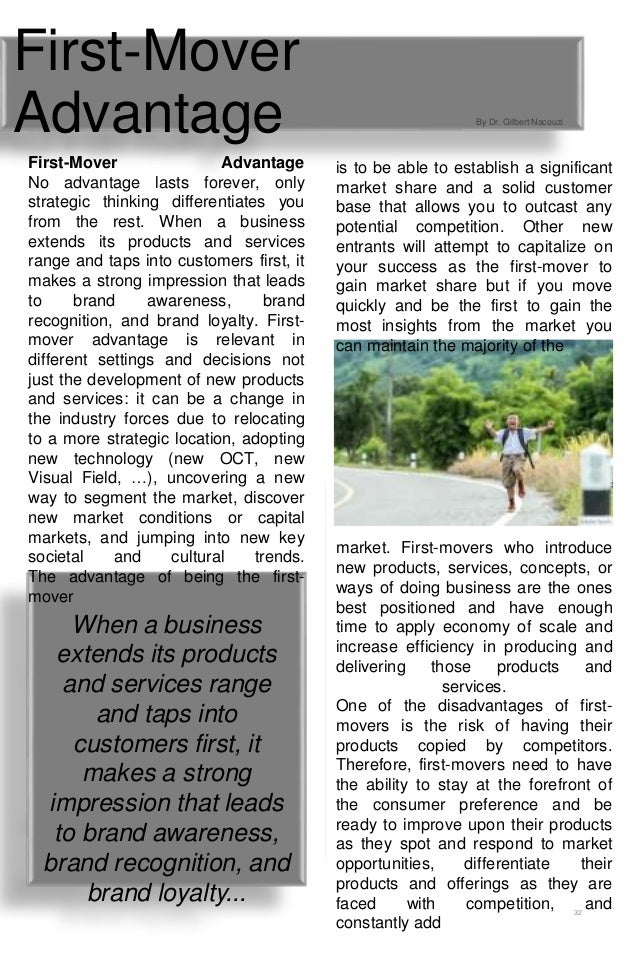
First-Mover Advantage
No advantage lasts forever, only
strategic thinking differentiates you
from the rest. When a business
extends its products and services
range and taps into customers first, it
makes a strong impression that leads
to brand awareness, brand
recognition, and brand loyalty. First-
mover advantage is relevant in
different settings and decisions not
just the development of new products
and services: it can be a change in
the industry forces due to relocating
to a more strategic location, adopting
new technology (new OCT, new
Visual Field, …), uncovering a new
way to segment the market, discover
new market conditions or capital
markets, and jumping into new key
societal and cultural trends.
The advantage of being the first-
mover
is to be able to establish a significant
market share and a solid customer
base that allows you to outcast any
potential competition. Other new
entrants will attempt to capitalize on
your success as the first-mover to
gain market share but if you move
quickly and be the first to gain the
most insights from the market you
can maintain the majority of the
value which authenticates their
produce.
Researchers identified two factors
that powerfully affect the fate of a
first-mover; those are the pace of the
technology and the market of the
product. Being able to determine how
fast or slow the technology of the
product and its market are moving will
allow you to understand the chances
of success with the resources in
hand. Accordingly, four possible
outlines encounter a first-mover:
When both the technology and
market are slow, waters are calm and
first-movers with the best condition
can create a leading position that
lasts for the long term.
When markets lead and technology
follows, a first-mover who has limited
resources may be at risk from the
competition. Consider you have been
the first to move in purchasing an
OCT. As the market grows and
demand grows all your competitors
will hop into the new technology and
you will quickly lose the first-mover
advantage.
33
When technology leads and the
market follows, a short-lived first-
mover is very unlikely. In this
situation, many first-movers waste a
lot of time waiting for the markets to
grow. At the same time, new entrants
think if they adopt the new
technologies -which are constantly
and rapidly improving- they can draw
customers away from the incumbent
with dated products. For this reason,
most first-movers and later new
entrants are unlikely to catch a
durable advantage. Only companies
with deep pockets can endure such a
situation.
When the waters get rough, both the
technology and the market move at a
fast pace. There is constantly new
technological innovation at a high
customer acceptance rate. First-
movers in such a situation are
vulnerable, and the chances of
making any durable advantage are
extremely low. It is almost impossible
to have a first-mover advantage when
the technology is rapidly becoming
obsolete and is being quickly taken by
other competitors at the same time.
IS FIRST-MOVER ALWAYS A DURABLE
ADVANTAGE?
Yes
No
World Optometry Day
34
March 23 is World Optometry
Day. The week that follows is
World Optometry Week. This
year we decided to write about
what would drive someone to
decide to become and
Optometrist. We announced that
we will post on Optical Forum
Blog the story of anyone who
sends us why he chose to
become an Optometrist.
Whether it is a couple of words
or a story. So have a nice one.
“I chose to be an optometrist after
qualifying as a Dispensing Optician and
wanting to be able to offer patients a
greater level of care. Seeing first hand the
service we were able to give to patients
during a global pandemic inspired me to
want to gain the qualification and support
the evolution of Optometry post pandemic”
Zara Cowell, Optom Student, Uclan
“I was going for a medical or a
paramedical field, but my sister Mirna
Adra who was already an optometrist
encouraged me and explained how
diverse is this field!!! And now we are
running a business together” Maria Adra,
Optometrist at Adra Eye Care
“I was going to a medical field and Dr.
jamhoury was directing me to optom and
explained how diverse is.” Lynn Saleh,
Optometrist
“I wanted to make pharmacist but it was in
French language only so I chose
optometry and I didn’t regret at all” Randa
Al Banna, Optometrist
“I was eager to do
computer and
communication
engineering, but my
parents were directing me
more to have a liberal
profession, heard about
optometry during an
university forum at school.
Honestly didn’t know that
optometry was that
big...now, cannot be
happier to have chosen
this field” Mirna Adra,
Optometrist at Adra Eye
Care
“It runs in the family, my
grandpa is the first
optometrist in Bekaa
area, I grew up watching
him and it caught my
attention” Sandra
Neaime, Optometrist at
Mimassi Optic
35
“I’m sure many friends will
get surprised, but it’s the
truth:I wasn’t even thinking
about optical field,
engineering was my dream,
but when I started working
in the optics little by little
loved it,But still, I wasn’t
thinking about Optometry,
because I never liked
medical professions, being
optician was a good choice,
already had an experience
of several years and it can
lead me to the optical
engineering.After doing my
3 years, I thought why not,
lets continue… and I
became optometrist.Up till
now, every medical subject
even the ones concerning
“eye”, doesn’t interest me,
because of the same
reason, don’t like medical
subjects.I got couple of
things from Optometry and
the rest doesn’t interest
me.I don’t regret for
choosing Optometry, but
still dream of optical
engineering.” Nichan
Hovakimian, Optometrist
and University Professor
“It was a new specialty in Lebanon so it
was interesting to try. Of course I was
searching for a specialty with scientific
background and 5 years of study were
also attractive! Pharmacists were already
too many, and other similar specialties
such as dentistry, physiotherapy and
nursing need more effort to be accepted
by me.” Laure Wehbe, Optometrist,
Serial Entrepreneur
“Being a familial business… I was obliged
to and had no other choice to run”
Farouk Banna, Optometrist
“I chose the profession of Optometrist
because there is nothing more rewarding
for me than being able to show people
with serious eye problems” Dr. Charles
Di Benedetto, Optometrist
“Optometry got my attention as a child as
my grandad went blind in one eye due to
glaucoma and AMD. So pursuing a
career in optics and being able to help
people with the gift of vision has been
one of the most rewarding things in my
life.” Benny Optical, Optician, Optom
Student.
Preparing and
searching to Acquire
an Optometry
Practice By Dr. Gilbert Nacouzi
36
The next step is searching and finding
an Optometry practice for sale. This
step takes on average two years
before you get to that first day when
you become the CEO of the practice.
Therefore, you must prepare and
budget the cost of your search in
advance. Searching for practice is
one interesting
Entrepreneurship
through acquisition
has the advantage of
becoming a CEO from
day one which enables
you the process of
hiring and firing as well
as scheduling
recurring patients.
Preparing and searching to
Acquire an Optometry Practice
In a previous post, we emphasized
that the road to entrepreneurship is
hard and a very small percentage of
working people embark on such a
journey. We also emphasized that
Optometrists who decide on
becoming entrepreneurs and own
their own practice have two
ways either start from
scratch or acquire an existing
practice. Entrepreneurship through
acquisition has the advantage of
becoming a CEO
from day one which enables you the
process of hiring and firing staff as
well as scheduling recurring patients.
We also pointed to the possibility of
applying new marketing strategies
that increase the business value.
There are many other benefits, and if
you are still reading this means that
you have made your decision into
entrepreneurship and you are ready
for the next step.
and challenging step in your
entrepreneurial experience. It gives
you the opportunity to learn about
different practices and how they
operate and meet different
entrepreneurs who are exiting and
gain lifelong experience from the
stories they tell you. I still remember
the stories Optometrists told me when
I was looking to open my practice
twenty years ago. Their stories too
were more than twenty years earlier:
those are the precious moments
when the old generation meets the
new generation.
The cost for searching includes
money spent on visits, travels, middle
agents, as well as the time you
spend. Your search should allow you
to identify important features of the
practice you
37
are looking to acquire. Some of those
features will depend on your personal
skills, desires, inclinations, and
experiences. For example, you may
want a premium location, desire a
facility with a specific surface area,
and a neighborhood where everyone
knows you. Other features relate to
the viability of the practice itself and
risk management. For example, you
should select a practice with normal
operations, recurring customers, and
a growing patient base. Remember,
the potential for growth not only
increases your profitability but
increases the value of your practice
as you might one day consider exiting
yourself and selling at a higher price.
SEARCHING COSTS SHOULD BE
ADDED TO ACQUISITION COSTS
Yes
No
“The value of an idea lies in the using of it”
Thomas Edison
Handling Negative
Reviews By Dr. Gilbert Nacouzi
38
patient does not cross red lines using
profane insults. When it happens I
personally don’t feel obliged to
dealing with such angry patients.
Putting that aside, I do all reasonable
efforts to restore the professional
relationship with the patient.
Inside every criticism or review, there
All reviews are good, if
bad reviews don’t
teach you, you will
never learn from good
reviews.
Handling Negative Reviews
Working with the public will get you a
lot of great feedback as well as some
bad reviews. I have never heard of
any eye care provider who never had
a bad review. All reviews are good, if
bad reviews don’t teach you, you will
never learn from good reviews. No
one likes to be criticized, however,
you cannot ignore feedback, and if
you are asking patients to tell you
what they think, you will get a great
amount of feedback then you will
have to deal with and handle each
one with specific care.
Patients who criticize you will make
you feel bad about the way you
practice Optometry. Many
Optometrists ignore feedbacks
because they find responding to bad
reviews is stressful. Even though
the process may be exhausting,
patient feedback is definitely
indispensable.
To cope with negative feedback you
should start by looking carefully at the
review and discuss it with the staff to
bring up suggestions for how you can
improve your practice based on the
review context. Negative feedback
means there is something not going
well in the practice and needs to be
addressed. Instead of being annoyed,
you should be alert and you should
detach from your own ego when you
are carefully examining criticism
directed to you. When you get over
the bad feeling you should make sure
that the
will be an element of truth. You must
accept that even though sometimes
this element of truth is hard to accept,
accepting it is valuable for improving
our efficacy and the business. If you
find the reviews to lack an element of
truth you should not become bitter
with the patient and harden yourself.
Instead, you should connect with the
patient and create a stronger
connection and relationship.
A reliable and safe way to deal with
notoriously difficult patients is to -
whatever happens or whatever you
do- never give promises beyond his
expectations and beyond what you
can
39
deliver. Certainly, you have to
connect
with him but you should always
acknowledge the reality of his
character and his basic reactions and
never argue disagreeing directly with
him. Telling a patient he is wrong is a
huge mistake. A great tip when all
attempts fail is to get assistance from
another colleague to provide the
patient with a second opinion and
strengthen your point of view. When
we deal with every criticism in a
timely manner and caring way we
often develop a good rapport with
patients and many delete their
feedback or sometimes make a
positive review.
SHOULD YOU IGNORE NEGATIVE
REVIEWS AND FEEDBACK?
Yes
No
Bill Gates once said “Your most unhappy
customers are your greatest source of
learning”.
Revisiting the AIDA
model in Social Media
By Dr. Gilbert Nacouzi
40
action stage- would show up as a
voluntary consequence of the first
three stages. This stage later became
the primary goal of marketing. In
today’s social channels AIDA is used
to convey a message to patients and
lead them to act. The action is not
limited to purchasing or taking an
appointment, it
The widespread use of
AIDA among sales and
marketing theorists
during the pre-internet
era may lead many to
think that it is less
employed in digital
sales...
Revisiting the AIDA model in
Social Media
AIDA model is very popular in
Optometry because we interact with
patients on a one-to-one basis, and
AIDA helps explain how personal
sales work. It reveals in four steps
how the patient interaction with the
product evolves from cluelessness to
purchase and adoption. The model
was developed by St Elmo Lewis in
1898, but its simplicity made it last
and populate through all these years.
The widespread use of AIDA among
sales and marketing theorists during
the pre-internet era may lead many to
think that it is less employed in digital
sales. In fact, with the advancement
of online businesses AIDA’s
relevance becomes more
important especially now with social
media adoption by healthcare in
general and the eye care industry in
particular.
AIDA model comprises of a sequence
that illustrates the process a
salesperson must move the potential
customer through to make and close
a deal. The stages are Attention or
Awareness, Interest, Desire, and
Action. A deal can be achieved if you
succeed in attracting the patient’s
attention to the product or service you
are offering, convince him of the
benefits of the product, have a desire
to benefit from the offer, and act by
purchasing the product.
Lewis assumed that the last stage -
the
consists of engaging through liking,
commenting, sharing, forwarding, or
other ways of creating content.
To get the patient to act we need to
come up with the message that
attracts the patient’s attention, it
needs to be
41
short and relevant. The message
should convey the patient’s benefit, it
should be differentiated from the
competition offerings to awake their
desire to choose your offering.
“AIDA” MODEL MEANS ATTENTION,
INTEREST, DRIVE, ACTION
True
False
“Successful careers are not planned. They
develop when people are prepared for
opportunities because they know their
strengths, their method of work, and their
values. Knowing where one belongs can
transform an ordinary person - hardworking
and competent but otherwise mediocre - into
an outstanding performer.”
Peter Drucker
Optical Forum Blog FlipBook is a monthly collection of top 20 mostly read daily
posts at www.opticalforum.space
Contact us
For feedback and contributing Posts or Articles:
feedback@opticalforum.space
For Sponsoring future issues:
admin@opticalforum.space
Thank you for following us and reading our daily posts at:
www.opticalforum.space
© Copyright, Optical Forum Blog
42

Issue 2

  • 1.
    Optical Forum Blog Flipbook Inthis Issue Sports Eye Safety Contact Lenses as a Vehicle for drug delivery Private Equity in Optometry 2 April 2021 Making an Impact Twenty most read Blog posts from March and April 2021 with Instagram Story Answers ISSUE BEST of Mar/Apr 2021
  • 2.
    Optical Forum Blog Making anImpact Contact Lenses as a Vehicle for drug delivery- Page 10 Sports Eye Safety - Page 6 Private Equity in Optometry– Page 13 2
  • 3.
    News and editor’s perspective archwas Workplace Eye Wellness and Eye Donor Awareness month with the World Optometry Day on the 23rd followed by the World Optometry Week. Optometrists around the world celebrated by sharing through the web and social media platforms images of events. At Optical Forum and during March, we celebrated World Optometry Week with fellow Optometrists who generously shared with us the reason they decided to become Optometrists. We posted each story on a separate blog post as well as on Instagram and Facebook. The American Academy of Ophthalmology has announced April is Sports Eye Safety month. The World Council of Optometry has announced April is Women’s Eye Health and Safety Month with World Health Day to be on April 7th and World Allergy Week to be from April 25 to May first. At Optical Forum and during April, we will keep posting new original content on daily basis. We added to this month’s Issue of Optical Forum Blog FlipBook a “News and Editor’s Perspective” section as well as an “Answer & Insights” section next to each post. The “Answer & Insights” section features insights about every quiz question in Instagram Stories related to the daily Blog post. We are also working towards accommodating new editors. This month’s topics will revolve around Sports Eye Safety, New usage of Contact Lenses as a Vehicle for drug delivery, Private Equity, Searching and Acquiring an Optometry practice, and marketing. And as always, we would really appreciate and love to include your write-up on the said topics. Therefore, you are all welcome to share with us this journey by sending your insights, stories, posts, or articles at feedback@opticalforum.com or by visiting https://opticalforum.space/contribute/ 3 B y G i l b e r t N a c o u z i , B S c , M B A , D B A , E I C M Gilbert Nacouzi
  • 4.
    • Lorem ipsumdolor sit amet, consectetur adipiscing elit. Lorem ipsum dolor sit amet, consectetur adipiscing elit. Sports Eye Safety 4 Enjoy reading our insights related to the Eye Care Business This Blog is like the “Agora” in Ancient Greek which means “To Gather Together”. Like Homer, we characterize a community without an Agora as such as that of the Cyclopes, as lawless Optical Forum Blog Contact us: The Editor: admin@opticalforum.space Feedback: feedback@opticalforum.spa ce
  • 5.
    Contents Contact Lenses as aVehicle for drug delivery Acuvue Theravision may be the first step to deliver allergy drugs Private equity placed the practice's long- term value into a new perspective. Private Equity in Optometr y 6 100,000 people are affected by sports-related eye injuries each year Sports Eye Safety 1 3 1 0 5 Understanding Patient Insights 24 Financing a Sustainable Optometry Practice 26 Smoking and Eye Health 27 Types of Bank Borrowing 29 Plan the Easy Way 30 First-Mover Advantage 32 Preparing and Searching to Acquire a Practice 36 Handling Negative Reviews 38 Anzu Smart Glasses 8 Celebrities With Eye Problems 12 Optometry Branding 15 Is Sleeping with CLs Safe 16 Optometry Brand Proposition 18 Eggs and Eye Health 20 Pricing in Optometry 21 Cash Flow Forecast 23 World Optometry Week 3 4
  • 6.
    Sports Eye Safety The AmericanAcademy of Ophthalmology has announced April is Sports Eye Safety Month Answer & Insights KIDS AND TEENS RARELY WEAR SPORTS EYE PROTECTION True False True False
  • 7.
    The American Academyof Ophthalmology (AAO) has announced April is Sports Eye Safety Month. The AAO estimates that 100,000 people are affected by sports-related eye injuries each year. Almost 13,500 injuries end in everlasting blindness. The good news is that most sports-related injuries can be prevented. No matter what sports you are practicing, how old you are, or what level of professionalism you play, you need to be aware of proper eye protection. If eye protection is common among young people, it is less common and rarely employed among children and teens. Sports activities are very important to kids to build their personality and the spirit of teamwork. However, a sports-related injury could jeopardize the kid's health and development as well as leave him with a psychological damage that may last for years if not forever. Sports-related eye injuries can vary from abrasions or corneal scratches, lid bruises, black eye, orbital fracture, internal eye bleeding, retinal detachments, and total blindness. Injuries are most frequent in baseball, basketball, ice hockey, football, tennis, swimming, water polo, soccer, handball, cycling, and other racket sports as well as in sports with physical contact. Eye Protection for Sports Eye Safety ranges from safety goggles to helmets. They have special requirements for fit and design that do not obstruct eyesight or impede the quality of eyesight and visual field. Materials requirements include durability, softness, weightlessness, comfort, impact resistance (that meet American Standards for Testing and Materials ASTM), and non-allergenic. In some sports wearing helmets with a grid does not prevent an opponent's finger from reaching to the eyes. Therefore, additional Safety goggles with polycarbonate lenses are required. Optometrists should inform athletes and parents of the availability of comprehensive exams and visits for sports-related eye injury prevention. During the visit, the Optometrist informs the patient how to protect eyes, what type of equipment is available and what are its limits, as well as how to perform better in sports activities without having to jeopardize his eye health and the health of others. What’s more important is to inform the patient that a comprehensive eye test is always needed in case an accident occurred and an emergency room is required. Kids Eye Protection The AAO estimates that 100,000 people are affected by sports- related eye injuries each year. Almost 13,500 injuries end in everlasting blindness. 7
  • 8.
    Anzu Smart Glasses theNew Kid in Town It’s been a month we posted about Google Glass Enterprise Edition 2 and how it is proving to be an important tool for logistics and manufacturing workers. This month, Razer– the gaming peripheral company- released Anzu smart glasses with wireless audio and eye protection against blue light and UV. Razer is not the first company to integrate audio speakers into the temples of the eyeglasses. Bose did it before with Bose Frames and Amazon too with Echo Frames. Unlike many startups using bone-conduction systems or earbuds – those we find on Kickstarter- Bose Frames, Echo Frames, and Anzu employ a set of 16 mm speaker drivers that act like hidden wireless headphones.
  • 9.
    9 From the outside,Anzu’s design reminded me of Bose Frames that look like any regular square and round plastic unisex sunglasses. The material is black nylon and both shapes come with a choice of a small/medium and large size. Anzu comes standard with two sets of lenses: a pair of 35% blue light filters, and a pair of 99% UVA and UVB protection polarized sunglass lenses. It has a battery life of five hours in normal usage and a two weeks life on standby mode. It supports Bluetooth 5.1 connectivity that eliminates delays and touch control to play music, take calls, or use it in gaming or voice assistance. Anzu glasses splash-proof endure any weather with a rating IPX4. With the COVID-19 pandemic, Razer launches Anzu in a market where people working from home need eye protection against blue light emitted from screens and hands-free communication to limit the spread of disease. Razer has a high potential to win when the giant Google has failed. Google Glass may have more technological features but people are still not ready to wear computers or camera that makes people around them nervous. For prescription lenses, Razer has partnered with Lensabl which is offering Anzu owners a 15% discount on Rx lenses.
  • 10.
    Private Equity inOptometry At graduation, many Optometrists chose between launching a new business, acquiring an existing practice, or getting employed. Those career paths are similar in terms of taking care of patients, however, when it comes to becoming your own boss it is the most difficult path and the most rewarding sometimes. I say “sometimes”, because to achieve success in owning and managing your own practice you need to be a good entrepreneur; a thing they don’t wholly teach at Optometry or medical schools. In both cases, if you succeed or not, the road of entrepreneurship is much harder than deciding to become an employed Optometrist. Challenges constantly emerge, and while your plan and your commitments are for the long term, no one can predict the changing dynamics of the market even for the short term. Among those changes that fundamentally transformed the eye care private practices industry is the penetration of private equity in Optometry. Private equity has come among the latest additions in the Optometry business during the past couple of decades. It opened new horizons and provided new options for those who wanted to exit the business. Before private equity, at the end of their careers, ODs who owned and managed their practice had to sell to an associate or a new graduate. The price of the practice was determined by the ability/availability of the buyer to pay. The practice seller would often neglect the intrinsic value of the practice and accept the offer proposed. 10 Warren Buffet always says “Intrinsic value can be defined simply: It is the discounted value of the cash that can be taken out of a business during its remaining life”. When private equity started in Optometry the valuation of the optometry business became relevant. Private equity placed the practice's long-term value into a new perspective. And a new market for buying and selling private practices emerged. The rules of the market for practices selling and buying changed and made the barriers to entry much higher, moreover exiting the market became more frequent and probable. A practice owner would consider selling at an earlier age, remain the CEO of the practice, still get paid at the end of the month for the services he still provides, and collect a significant amount of money that allows him to enjoy his increased free time. “Intrinsic value can be defined simply: It is the discounted value of the cash that can be taken out of a business during its remaining life” Warren Buffet
  • 11.
    Private Equity in Optometry Answer& Insights Is Private Equity in Optometry Good or Bad? Good Bad Good Bad
  • 12.
    Celebrities with Eye ProblemsBy Dr. Gilbert Nacouzi 12 April is sports eye safety month and among the most infamous sports celebrities who had sports injuries are football player Orlando Brown in 1999 who was sidelined for three years after a damaged retina and optical nerve, baseball player Luis Salazar in 2011 lost his left eye, Baseball player Matt Imhof lost his right eye during routine training in 2016, and basketball player Akil Mitchell in 2017 when a poke in the face popped his left eyeball out of its socket. U2 Irish Frontman Whoopi Goldberg stated that she feels painful headaches and pressure in her eyes due to Glaucoma that she developed as she aged. Celebrities with Eye Problems When we think about celebrities’ eye problems we immediately think of Stevie Wonder and Ray Charles. However, if we type “celebrities with eye problems” in Google it returns a long list of articles. Numerous celebrities have eye problems we don’t know about. Claude Monet suffered from cataracts for many years and during the past decades, a theory emerged that Van Gogh was color blind. U2 Irish frontman, Bono was diagnosed with Glaucoma for more than 20 years, his signature tinted sunglasses which he wears indoors, have been known by many as a simple fashion statement. Bono admitted that he wears his sunglasses indoor because of his glaucoma condition that makes him sensitive to light and glare. Like Bono, Bill Cosby also has glaucoma that made him lose most of his vision. Actor Johnny Depp wears myopic eyeglasses, however, he is only myopic in one eye and is nearly blind in the other. Whoopi Goldberg stated that she feels painful headaches and pressure in her eyes due to Glaucoma that she developed as she aged.
  • 13.
    Eye problems canbe treated most of the time, however, when serious conditions cannot be treated they should never deter us from getting where we want to go in life. This week is Joseph Pulitzer’s birthday, who went 13 blind at the end of his life due to a retinal detachment, yet he continued to manage his newspaper and wrote the story that anyone can read and painted a world so colorful that no one can forget. It happened with me today when a patient asked me about a contact lens that delivers or relieves drugs. And I replied: there have been studies and experiments but nothing is yet being developed. Well in fact and what I have learned later during the day is that indeed that is something imminent about such contact lenses. I always say that Glaucoma patients are well-instructed patients but Contact lenses WHY DOES BONO WEAR TINTED GLASSES INDOOR? He has Cataracts He has Glaucoma Contact Lenses as a Vehicle for drug delivery Contact Lenses as a Vehicle for Drug Delivery March is Workplace Eye Wellness and Eye Donor Awareness Month. However, people know it is the beginning of the spring season along with eye allergies that cause patients to rush to eye care providers for help. Now this year telehealth -which I call Google Health- will bring contact lenses patients to you with new questions.
  • 14.
    are the mostinstructed patients. They follow every innovation and every piece of news that relates to vision correction. This explains why if glaucoma patients know about hypertension however, contact lenses patients know about eyeglasses, contact lenses, eye drops, and refractive surgeries independent if they plan to do a refractive surgery or not. In case you haven’t heard the news, and to be prepared to talk to your contact lenses patients and be the one who delivers the news, the Japanese Ministry of Health, Labour and Welfare (MHLW) has approved the first combination contact lens that provides vision correction and an antihistamine drug to help relieve symptoms for people experiencing itchy allergy eyes. Johnson & Johnson Vision 14 announced the approval yesterday that Acuvue Theravision with Ketotifen is the first and only vision correction contact lens that relieves allergy drugs. The lens contains ketotifen, an H1 histamine receptor antagonist for the prevention of itch associated with eye allergy. Researchers have been long experimenting and working on finding ways to administer drugs using contact lenses. They claimed that employing contact lenses to deliver drugs will increase bioavailability by 50% compared to eye drops, thus significantly increasing efficacy. Acuvue Theravision may be the first step to deliver allergy drugs the next step will most probably be to deliver antibiotics, prostaglandins, beta- blockers, or a combination. ARE CONTACT LENSES USED TO ADMINISTER EYE DRUGS Yes, it has just been approved No
  • 15.
    Optometry Branding By Dr.Gilbert Nacouzi 15 Patients want to see, hear, and feel the same tone on social media, on the website, over email, on phone calls, on the parking lot, reception, waiting room, and every exam room. The most challenging thing is the consistency between online and brick-and-mortar branding. It is easy to have a consistent logo online and in the real world. However, consistency becomes more challenging in strategic decisions that consist of what your practice serves and more importantly what your practice does not serve. You should be able to clearly communicate your strategy including who you serve, how, what, when, and where. Remember that, you don’t drink soda, you drink Coca-Cola, you don’t wear sunglasses you wear The difference between branding and marketing is that branding is strategic and marketing is tactical Optometry Branding Your brand is your promise to the patient. Your promise is what the patient awaits from you, your expertise, your experience, your unique value proposition that he cannot find at any of your competitors. Many Optometrists think that branding strategy is the responsibility of the marketing team or the practice manager. When it comes to practice branding, it is the sole responsibility of the Optometrist to set a consistent tone for the practice. The first and the last thing that the patient sees, hears, and feels should be decided by the Optometrist. The difference between branding and marketing is that branding is strategic and marketing is tactical. The optometrist starts by setting the practice strategy and then plans marketing in a way to achieve the strategic goals. A strong positive perception of the practice in the patient’s mind consists of the practice logo, practice design, vision and mission statement, as well as the theme that helps differentiate the practice from its competitors and helps build a growing database of recurring patients.
  • 16.
    Ray.Ban. You canonly establish a brand with equity if you can show that what you provide is more than eye care. You provide the experience that your patients know, love, and chose among all the eye care experiences and options available in the market. One last thing 16 to keep in mind, proper questioning and analytics may help you understand why a patient prefers you over others, but no patient among those who don’t visit you will ever open your door and tell you: hey, you’ve never seen me or I don’t visit you because of this or that… risk of eye infection. Most Optometrists do not recommend sleeping with contact lenses, for the simple reason that, the risk of getting an eye infection would dramatically increase compared to conventional daily wear mode. Many studies have proved that sleeping with contact lenses has unpleasant consequences and reactions. Among those reactions are dryness, eye redness, feeling of irritation, blurred vision, as SHOULD STRONG OPTOMETRY BRANDING BE CONSISTENT? Yes No Is Sleeping with Contact Lenses Safe? Is sleeping with contact lenses safe? Wearing Contact lenses is safe as long as wearers properly follow the indications of the optometrist in relation to the safe handling and proper care. However, the risk of eye infections increases when wearers don’t properly care for their contacts or when contact lenses care indications are neglected. Sleeping with contact lenses, in particular, is one of those critical actions that increase the
  • 17.
    well as thesecretion of amounts of yellow-green mucus that are soft or dry and accumulate either inside or at the circumference of the eyelids. The mucus secretion is the result of debris of protein and other stuff being discharged in response to hypoxia, edema, and swelling. In all cases, if accidentally a patient slept with the lenses I recommend excessively soaking the eyes with artificial tears eye drops to rehydrate the lenses before taking them out. If lucky enough, all those reactions would occur without being accompanied by pain. Otherwise, pain is a sign that the cornea has been infected and it needs immediate intervention and an urgent checkup. If not treated quickly –obviously by Antibiotics- this can transform into a major issue that can go beyond irritation or blurred vision, but it can sometimes lead to the eating of the cornea like in the case of Pseudomonas infection. Thankfully, extended wear contact 17 lenses have saved a lot of these troubles since they have been developed and introduced in the market a decade ago. Extended wear contact lenses have been FDA approved for overnight wear and they served as bandage contact lenses as well. Extended wear contacts are employed after PRK surgery. Accompanied with antibiotic eye drops to help prevent possible infection they need to be carefully followed up by the eye doctor. Extended wear contact lenses are prescribed by optometrists after a thorough assessment of the patient’s eye and proper follow-up. But the best part of extended wear contact lenses is that they reduced the risk of infection caused by sleeping with the lenses by four to five times than with ordinary daily wear lenses. And that is due to their high DK/t ensuring enough oxygen transmissibility and allowing the oxygen to get to the surface of the cornea. IS SLEEPING WITH CONTACT LENSES SAFE? Yes No Only with Extended Wear CLs & after OD eye assessment Yes with any lens, and without any eye assessment
  • 18.
    Optometry Brand Proposition Strategy ByDr. Gilbert Nacouzi 18 Customer relevance: is obtained through understanding the patient segments and needs. You should understand that a brand appears to be attractive to the patient’s need and job to be done. Patients’ needs and jobs to be done change over time therefore it is a part of marketing to make sure that the brand remains relevant to their changing needs. Competitive differentiation: Several brands may be relevant to the patient so differentiating what your practice will offer compared with competing practices is critical. Always highlight what differentiates you from other practices and get your message across; it helps separate your message from the The brand proposition should not be confused with positioning. The latter relates to the brand position in the market relative to another brand Optometry Brand Proposition Strategy An Optometry brand proposition summarizes why a patient should visit a specific Optometrist or buy a specific brand, product, or service. It is the result of combining the brand’s functional, social, and emotional benefits that convince a potential patient that your Optometry services will fit their needs or please them better than your competitor’s offerings will. The brand proposition should not be confused with positioning. The latter relates to the brand position in the market relative to another brand in the market rather than a certain proposition to the patient. The strategy to generate commercial growth through marketing your brand proposition relies on three factors that include customer relevance, competitive differentiation, and practice authenticity. And each patient segment will attach different weight to each of these factors.
  • 19.
    bulk of othermessages that communicate the same services and product category. Practice authenticity: being able to stay relevant to customers and differentiate your practice from the competition is not enough. The brand proposition that your practice communicates should be authentic. Authenticity should be perceived from the patient outside and the staff inside. Without authenticity, the brand proposition you communicate can never be trusted. Proven expertise in a procedure you perform will help establish credibility. Inauthentic behavior is quickly spotted with today’s speed of communication and the 19 reliance on digital reviews in purchase decision-making. Authenticity also relates to what services your practice excels at. You can be known for providing comprehensive eye health and vision exams but no record shows you’re a specialty lens practitioner. Practice authenticity is similar to the brand’s DNA which is at the core of the brand’s proposition and does not change with replacements of personnel or staff. If your practice sticks to the core of the brand’s proposition you can build any product and adapt to the patient’s needs without being dependent on specific employees. OPTOMETRY BRAND PROPOSITION STRATEGY FOCUSES ON Relevance, Differentiation, and Authenticity Planning, Consistency, and Conciseness Persistence, Renewal, and Scalability Due Diligence, Targeting, and Adaptability
  • 20.
    Eggs and EyeHealth By Dr. Gilbert Nacouzi 20 properties that reduces the oxidative stress on photoreceptors. This stress is caused by the excess of high- energy light like blue light and ultraviolet (UV), which are believed to be the cause behind the development of AMD. Carotenoids are natural pigments produced by many plants - such as carrots, pumpkins, and oranges- and give them a red orange color after absorption of light short wavelenghts like blue and UV. On the other hand, a study in the British Journal of Nutrition (2017) found that while eating eggs on a daily basis increased lutein and zeaxanthin levels as well as blood carotenoid levels, no significant changes Eating Eggs is thought to protect the Retina from the effect of blue light which is related to the incidence of AMD… Eggs and Eye Health You may be a huge fan of chocolate eggs; however, this post is about chicken eggs. When it comes to preserving healthy eyes, besides routine eye tests, food is a great way to keep your eyes healthy; and what you eat affects what you see. Many articles and studies emphasized the role of certain types of food in reducing the risk of cataracts and age-related macular degeneration (AMD). Eating eggs is among the food types that have been reported to have an effect on increasing macular pigment which is thought to protect the retina from the effect of blue light which is related to the incidence of AMD. Many studies referred to the effect of eating eggs on the reduction of AMD. Egg yolk contains Carotenoids such as lutein and zeaxanthin that are responsible for forming the macular pigment that protects the retina due to its antioxidant and anti- inflammatory
  • 21.
    in vision orin macular pigments appeared. The study was conducted over an eight weeks’ period therefore a greater period may have brought different outcomes. Nutritionists recommend buying organic eggs that are anti- biotic 21 free and they don’t recommend them cooked or scrambled in an omelet. Instead, soft boiling is best recommended if you want to benefit from all the benefits from eating eggs at breakfast. EGG YOLK CONTAIN CAROTENOIDS THAT MAY DECREASE “AMD” RISK True False Pricing in Optometry procedure. Therefore marketing in healthcare requires marketers to adapt marketing knowledge and expertise to the unique aspects of the healthcare industry. Unlike other industries, the product to be marketed in healthcare takes the form of services and is generally hard to describe and hard to specify. The same is with many products in Optometry. The product can be a procedure or a contract with groups, networks, or health care organizations. Pricing in Optometry When it comes to Optometry and healthcare in general, not all marketing components of the known concept of marketing apply comfortably. The marketing concept and process have to be modified to be applied to the environment of healthcare. Pricing is one of the components that Optometrists have limited ability to use as a marketing tool. Pricing is dependent on the amount third-party payers are willing to pay for a specific
  • 22.
    The product canbe an idea, that the organization promotes. An idea is an intangible product that portrays a perception to the customer. The practice image is an example of an idea that can be conveyed using marketing tools. Quality care is another idea that the practice would want to promote and communicate through marketing. The purpose is to establish a familiarity and a mindset that leads the patient to chose your practice without having a second guess. 22 Some practitioners rely heavily on the idea of practice image, whereas new opportunities reside in lending attention to promoting and advertising services. Being able to provide services to patients is an ongoing process. This brings to mind the concept of value-adding and the concept of solution providing. A value-adding practice provides products that transform the patient into more perfect. For example, the patient imperfect vision has been PROVIDING SERVICES IS AN ON- GOING PROCESS True False SELLING PRODUCTS IS A ONE-SHOT BUSINESS True False perfected when we equipped him with new eyeglasses. It is a one-shot tangible product with a clear transfer of property that added value to the patient. However, a solution provider practice
  • 23.
    markets and promotesongoing services, durable medical offers, and solutions that the patient evaluates them differently than tangible products. Those services are assessed in subjective terms and not objective terms. Services differ from products because they reflect the nuances that reflect the provider who provided them, they are inseparable from the provider, and once provided they have no residual value and don’t involve a transfer of tangible property from the provider to the 23 patient. If you can understand the importance of solution providing you will understand that pricing is not solely dependent on tangible charges (that include fees, charges, deductibles, copays, or other out-of- pocket costs) but rather on intangible costs and what the patient is willing to exchange (that include not having to wait, discomfort, embarrassment, frustration, and other emotional costs of dealing with plans and providers) and the amounts of money receipts and payments. It warns us in advance of a cash flow shortage so that we can plan to bridge the gap in cash flow of any potential or critical need. If you want to understand how to compute a net cash flow I found a detailed article at Review of Optometric Business by Dr. Schultz and Dr. Fletcher called “How to Compute Net Cash Flow”. On the other hand, to construct a cash flow forecast, we compute the current cash balance and predict the receipts and payments that will occur within a set of time intervals. The better the quality of our prediction is, the better the quality of the cash flow forecast and its usefulness is. The cash flow forecast time intervals depend on what the cash flow forecast is meant to be used to. For example, a Cash Flow Forecast Time Intervals Cash Flow Forecast Time Intervals Effective management of resources is crucial to run a successful business. Those resources include cash, brand, human resources, equipment, property, products, services, and inventory. Of all these resources cash is certainly the most important. If you have enough cash you can buy any of the other resources that are deficient in the practice. The first number a practice calculates in the management of cash is the cash flow. The optometry practice has the responsibility to make timely payments to suppliers when they are due. To plan with confidence that payments will be made in time and when they fall due, we rely on building a detailed cash flow forecast. A cash flow forecast predicts the timing
  • 24.
    cash flow forecastis constructed for funding, operations, or strategic purposes. When a cash flow forecast is being constructed for operational planning, it requires a near-term forecast that can be daily and for the week ahead or weekly for the next three months. When a cash flow forecast is being constructed for funding or applying to bank loans, it requires making a monthly forecast for two to three years with annual totals. 24 When a cash flow forecast is being constructed for strategic planning it requires making yearly forecasts for up to twenty years. Time intervals are also dependent on the strength of the net cash flow. If it’s strong, you can make a long time intervals forecast. When the net cash flow is weak, especially in times of crisis like the current period, you will have to make short time intervals forecast like weekly or even daily. DURING CRISIS WE SHORTEN CASH FLOW TIME INTERVAL TO DAILY True False Understanding Patient Insights patients, the more likely we are to discover what they really value about our practice, the services we offer, and our products. With these in mind, we can know how to communicate with them and build long-lasting Understanding Patient Insights One thing we focus on in the optometry practice and the optical showroom is to be able to develop deep patient insights that will help in the marketing activities. The more we understand our
  • 25.
    relationships. One veryimportant insight is to be able to distinguish between the user, the buyer, and the payer of the product or service. We should be able to identify the three roles that a patient may have for every product, service, and transaction. The value sought by each patient’s role can be different. The user values the performance, the buyer values the service, and the payer values the price. Who is the user? The user is the patient who will use the eye drops or wear the contact lenses, the contact lenses products, the eyeglasses, the sunglasses, and sports glasses. Who is the buyer? The buyer is the patient who makes the buying decision, which contact lenses, which eyeglasses, or which sunglasses to buy. Who is the payer? The payer is the patient or anyone who pays for the products and services. It could be the patient himself, it could be a third- party payer, or the service could be offered by the practice. A patient could have any of these roles or the three together. In all cases, identifying the three roles is very important in driving how we market products and services to the patient. Consider a scenario where a family of three comes to the kid’s appointment and it turned out that he has to replace his eyeglasses. The eyeglasses user is the kid, the eyeglasses buyer could be both parents, and the payer could be the father. The value sought by each patient role is different: 25 possible to return home to play video games or meet with friends and show them his new eyeglasses. The parents want to make sure that their son’s eye health is improving and want to get informed about all that is possible to do in order not to wear eyeglasses. The father who is the payer wants to make everything possible to ensure with the money he pays his son gets the best care (this could be paying out of his own pocket or paying for the best health program that provides the best care). Whenever you think about patient insights you need to distinguish between the three roles and how to make each one happy by providing what they value. One very important insight is to be able to distinguish between the user, the buyer, and the payer of the product or service...
  • 26.
    26 WHAT THREE ROLESWE SHOULD IDENTIFY FOR PATIENT INSIGHTS? User, Buyer, and Seller User, Buyer, and Payer Financing a Sustainable Optometry Practice leveraging because of the experience they had with student loans, however, sometimes they may be missing an opportunity to grow a successful business beyond what their capital allows. The most important difference between debt and equity is in the way finance is done and what happens if the practice fails. A debt provider gets a predetermined rate of interest and has a priority payment position in case the practice fails. An equity holder may be the last to be paid out if the practice Financing a Sustainable Optometry Practice Many of the optometrists who have been Owners of practice for more than five years may probably be familiar with the notion of balancing debt and equity and leveraging. However, when it comes to new entrepreneurs or new graduate students, things differ between what they knew as student loans and the debt they run through in an established or newly launched business. Many newly graduate students avoid User, Trainer, and Inquirer
  • 27.
    fails and doesnot get interests. However, since he holds part of the ownership, this could be highly rewarding in case the business turned out to be successful, provided shareholder value, and paid dividends. Leverage is the relationship between total debt and total equity. The Weighted Average Cost of Capital (WACC) is the overall cost of capital computed by averaging all sources of capital (debt and equity). Independent of how the capital structure is balanced between debt and equity, the only way 27 a business can survive and become successful is by generating a return on investment (ROI) that exceeds the WACC of the practice. In order to achieve this: The practice owner should be able to identify and decide on the appropriate investments in the right tools, equipment, and assets that generate the highest ROI on one hand. And he should also be able to optimize funding through a well- balanced debt and equity leverage that provides the least WACC on the other hand. SUCCESSFUL PRACTICES HAVE A ROI HIGHER THAN THE WACC True False Smoking and Eye Health problems that include cancer, heart disease, and lung disease. Although eye problems related to smoking are less well-known, the most direct effect known of smoking is dry eye with scratchy feeling, burning, stinging, and Smoking and Eye Health Smoking could be the largest preventable cause of disease and premature death in the World. Smoking can harm almost every organ in your body and can cause serious health
  • 28.
    eye redness. Accordingto the American Academy of Ophthalmology, smoking puts the patient at an increased risk for getting cataracts, optic nerve problems, Uveitis, increasing eye conditions in Graves’ disease, worsening the risk of diabetic retinopathy for diabetes patients, and increased risk of Age- related Macular Degeneration (AMD). AMD is a complex multifactorial disease, it has an uncertain etiology associated with genetic and environmental factors. There are claims and studies that show smokers are three times more at risk of developing AMD than non- smokers. Female smokers over the age of 80 are five times more at risk of developing AMD than non-smokers of the same age. Cigarette smoking turned out to be the most significant environmental influence in an increased risk of AMD. The risk associated with cigarette smoking affects both the development 28 and the progression of AMD with a mediating effect of direct oxidation, depletion of antioxidant protection, immune system activation, and atherosclerotic vascular changes. Even though smocking is an associated risk factor for developing AMD, it is preventable and controllable. Quitting smoking at any age, even at a late age, can reduce the risk of developing AMD in a significant way. However, one thing that eye care professionals know, retinal damages caused by AMD and vision loss are irreversible. Moreover, patients are not always alert of the significant risk played by smoking in AMD that can lead to permanent blindness. Even though practices spend a lot of effort in spreading awareness of the risk of AMD and early detection of glaucoma, the emphasis on the effect of smoking and its direct effect on blindness is frequently neglected. SMOKING INCREASES “AMD” RISK AMONG OTHER EYE DESEASES True False
  • 29.
    Types of Bank BorrowingBy Dr. Gilbert Nacouzi 29 Five types of bank borrowing are frequently employed in Optometry: Overdraft, which normally has a fixed time period, consists of a setup fee and interest fee and is employed to finance daily working capital and closing the gaps between receipts and payments when needed. Loan, which regularly has a fixed term and a prearranged repayment date but can be extended for a long and undetermined period. It consists of an arrangement fee and a percentage return and is employed to finance projects that generate enough funds to cover repayments. The duration of funding defines how long is the funding required. Therefore, the duration is directly influenced by the type of investment you are doing… Types of Bank Borrowing in Optometry Whether you are starting your practice, expanding into a new project, or just want to make it through the month and need cash, it is crucial to know the different types of borrowing you can get from banks and how they work. With the large range of borrowing types available, there are two main determinants that you should consider in selecting the most appropriate type of debt finance: duration and cost. The duration of funding defines how long is the funding required and therefore it is directly influenced by the type of investment you are doing. If it’s a long-term asset that you are funding, you will need a long-term debt. If you need cash for a short-term obligation you will need a short-term type of financing. The cost of funding consists of both the initial fees you pay to set up the loan and the interest that has to be paid for the period of the loan.
  • 30.
    Commercial mortgage, whichis fixed- term funding with the probability to be secured on a freehold property. It has a lower interest rate than unsecured loans and it is employed for long-term financing of properties. Invoice factoring, consists of outsourcing debt collection, has management fees as well as interest rates discounted on the debt being factored. Invoice factoring ensures easy 30 access to steady cash flow, reduces the risk of late payments, liberates cash from working capital, and reduces accounting functions. Leasing, consists of financing for the life of the leased asset, has monthly payments that include interest rate and is employed to acquire and use an asset without a straight purchase with tax and replacement benefits. YOU FUND LONG-TERM ASSETS WITH LONG-TERM DEBT True False Plan the Easy Way perspective of the future and leave the day-to-day management to executing the strategy and meeting performance goals. You can do this with ease if you can design a process to fit the circumstances in a conveyed situation. The strategic planning process starts by finding a logical starting point for the job by perceiving the efforts being implemented to resolve the job as well Plan the Easy Way Planning and executing strategy should not be difficult. One very important thing in understanding strategy is knowing that strategy is not an event, it is a continuous process. Spending excessive time and effort on deliberate planning is exaggerated and should be avoided. The main goal of strategy should be to come out with a long-term
  • 31.
    as issues thathave already been resolved. Deciding on the level of effort to put in a process relates to both the situation requirements and the capabilities of the team. Not all situations require the same effort. Sometimes you don’t have enough team capabilities to perform the job and some jobs don’t require involving all your team. There are three levels of efforts in strategic processes that could be abbreviated, moderate, or extensive. Abbreviated processes determine a competitive and functional strategy for the organization or an action plan for critical issues. They involve the CEO and key executives who usually work on strategic planning. Moderate processes determine more integration into strategic goals than 31 what abbreviated processes do, and that includes operations, budgeting, and planning. Extensive processes determine a completely integrated planning cycle with a masterwork plan that outlines schedules, duties, obligations, commitments, and deliverables. This can be often accomplished by the CEO through delegating the work to a steering committee chaired by a champion who is trusted and respected throughout the organization and who reports directly to the CEO. Being able to select a logical starting point, determine the level of effort required, and design an appropriate process is the core for implementing successful and easy strategic planning in management. DOES PLANNING NECESSARILY HAVE TO BE DIFFICULT? Yes No “An hour of planning can save you 10 hours of doing” Dale Carnegie
  • 32.
    First-Mover Advantage By Dr.Gilbert Nacouzi 32 market. First-movers who introduce new products, services, concepts, or ways of doing business are the ones best positioned and have enough time to apply economy of scale and increase efficiency in producing and delivering those products and services. One of the disadvantages of first- movers is the risk of having their products copied by competitors. Therefore, first-movers need to have the ability to stay at the forefront of the consumer preference and be ready to improve upon their products as they spot and respond to market opportunities, differentiate their products and offerings as they are faced with competition, and constantly add When a business extends its products and services range and taps into customers first, it makes a strong impression that leads to brand awareness, brand recognition, and brand loyalty... First-Mover Advantage No advantage lasts forever, only strategic thinking differentiates you from the rest. When a business extends its products and services range and taps into customers first, it makes a strong impression that leads to brand awareness, brand recognition, and brand loyalty. First- mover advantage is relevant in different settings and decisions not just the development of new products and services: it can be a change in the industry forces due to relocating to a more strategic location, adopting new technology (new OCT, new Visual Field, …), uncovering a new way to segment the market, discover new market conditions or capital markets, and jumping into new key societal and cultural trends. The advantage of being the first- mover is to be able to establish a significant market share and a solid customer base that allows you to outcast any potential competition. Other new entrants will attempt to capitalize on your success as the first-mover to gain market share but if you move quickly and be the first to gain the most insights from the market you can maintain the majority of the
  • 33.
    value which authenticatestheir produce. Researchers identified two factors that powerfully affect the fate of a first-mover; those are the pace of the technology and the market of the product. Being able to determine how fast or slow the technology of the product and its market are moving will allow you to understand the chances of success with the resources in hand. Accordingly, four possible outlines encounter a first-mover: When both the technology and market are slow, waters are calm and first-movers with the best condition can create a leading position that lasts for the long term. When markets lead and technology follows, a first-mover who has limited resources may be at risk from the competition. Consider you have been the first to move in purchasing an OCT. As the market grows and demand grows all your competitors will hop into the new technology and you will quickly lose the first-mover advantage. 33 When technology leads and the market follows, a short-lived first- mover is very unlikely. In this situation, many first-movers waste a lot of time waiting for the markets to grow. At the same time, new entrants think if they adopt the new technologies -which are constantly and rapidly improving- they can draw customers away from the incumbent with dated products. For this reason, most first-movers and later new entrants are unlikely to catch a durable advantage. Only companies with deep pockets can endure such a situation. When the waters get rough, both the technology and the market move at a fast pace. There is constantly new technological innovation at a high customer acceptance rate. First- movers in such a situation are vulnerable, and the chances of making any durable advantage are extremely low. It is almost impossible to have a first-mover advantage when the technology is rapidly becoming obsolete and is being quickly taken by other competitors at the same time. IS FIRST-MOVER ALWAYS A DURABLE ADVANTAGE? Yes No
  • 34.
    World Optometry Day 34 March23 is World Optometry Day. The week that follows is World Optometry Week. This year we decided to write about what would drive someone to decide to become and Optometrist. We announced that we will post on Optical Forum Blog the story of anyone who sends us why he chose to become an Optometrist. Whether it is a couple of words or a story. So have a nice one. “I chose to be an optometrist after qualifying as a Dispensing Optician and wanting to be able to offer patients a greater level of care. Seeing first hand the service we were able to give to patients during a global pandemic inspired me to want to gain the qualification and support the evolution of Optometry post pandemic” Zara Cowell, Optom Student, Uclan “I was going for a medical or a paramedical field, but my sister Mirna Adra who was already an optometrist encouraged me and explained how diverse is this field!!! And now we are running a business together” Maria Adra, Optometrist at Adra Eye Care “I was going to a medical field and Dr. jamhoury was directing me to optom and explained how diverse is.” Lynn Saleh, Optometrist “I wanted to make pharmacist but it was in French language only so I chose optometry and I didn’t regret at all” Randa Al Banna, Optometrist “I was eager to do computer and communication engineering, but my parents were directing me more to have a liberal profession, heard about optometry during an university forum at school. Honestly didn’t know that optometry was that big...now, cannot be happier to have chosen this field” Mirna Adra, Optometrist at Adra Eye Care “It runs in the family, my grandpa is the first optometrist in Bekaa area, I grew up watching him and it caught my attention” Sandra Neaime, Optometrist at Mimassi Optic
  • 35.
    35 “I’m sure manyfriends will get surprised, but it’s the truth:I wasn’t even thinking about optical field, engineering was my dream, but when I started working in the optics little by little loved it,But still, I wasn’t thinking about Optometry, because I never liked medical professions, being optician was a good choice, already had an experience of several years and it can lead me to the optical engineering.After doing my 3 years, I thought why not, lets continue… and I became optometrist.Up till now, every medical subject even the ones concerning “eye”, doesn’t interest me, because of the same reason, don’t like medical subjects.I got couple of things from Optometry and the rest doesn’t interest me.I don’t regret for choosing Optometry, but still dream of optical engineering.” Nichan Hovakimian, Optometrist and University Professor “It was a new specialty in Lebanon so it was interesting to try. Of course I was searching for a specialty with scientific background and 5 years of study were also attractive! Pharmacists were already too many, and other similar specialties such as dentistry, physiotherapy and nursing need more effort to be accepted by me.” Laure Wehbe, Optometrist, Serial Entrepreneur “Being a familial business… I was obliged to and had no other choice to run” Farouk Banna, Optometrist “I chose the profession of Optometrist because there is nothing more rewarding for me than being able to show people with serious eye problems” Dr. Charles Di Benedetto, Optometrist “Optometry got my attention as a child as my grandad went blind in one eye due to glaucoma and AMD. So pursuing a career in optics and being able to help people with the gift of vision has been one of the most rewarding things in my life.” Benny Optical, Optician, Optom Student.
  • 36.
    Preparing and searching toAcquire an Optometry Practice By Dr. Gilbert Nacouzi 36 The next step is searching and finding an Optometry practice for sale. This step takes on average two years before you get to that first day when you become the CEO of the practice. Therefore, you must prepare and budget the cost of your search in advance. Searching for practice is one interesting Entrepreneurship through acquisition has the advantage of becoming a CEO from day one which enables you the process of hiring and firing as well as scheduling recurring patients. Preparing and searching to Acquire an Optometry Practice In a previous post, we emphasized that the road to entrepreneurship is hard and a very small percentage of working people embark on such a journey. We also emphasized that Optometrists who decide on becoming entrepreneurs and own their own practice have two ways either start from scratch or acquire an existing practice. Entrepreneurship through acquisition has the advantage of becoming a CEO from day one which enables you the process of hiring and firing staff as well as scheduling recurring patients. We also pointed to the possibility of applying new marketing strategies that increase the business value. There are many other benefits, and if you are still reading this means that you have made your decision into entrepreneurship and you are ready for the next step.
  • 37.
    and challenging stepin your entrepreneurial experience. It gives you the opportunity to learn about different practices and how they operate and meet different entrepreneurs who are exiting and gain lifelong experience from the stories they tell you. I still remember the stories Optometrists told me when I was looking to open my practice twenty years ago. Their stories too were more than twenty years earlier: those are the precious moments when the old generation meets the new generation. The cost for searching includes money spent on visits, travels, middle agents, as well as the time you spend. Your search should allow you to identify important features of the practice you 37 are looking to acquire. Some of those features will depend on your personal skills, desires, inclinations, and experiences. For example, you may want a premium location, desire a facility with a specific surface area, and a neighborhood where everyone knows you. Other features relate to the viability of the practice itself and risk management. For example, you should select a practice with normal operations, recurring customers, and a growing patient base. Remember, the potential for growth not only increases your profitability but increases the value of your practice as you might one day consider exiting yourself and selling at a higher price. SEARCHING COSTS SHOULD BE ADDED TO ACQUISITION COSTS Yes No “The value of an idea lies in the using of it” Thomas Edison
  • 38.
    Handling Negative Reviews ByDr. Gilbert Nacouzi 38 patient does not cross red lines using profane insults. When it happens I personally don’t feel obliged to dealing with such angry patients. Putting that aside, I do all reasonable efforts to restore the professional relationship with the patient. Inside every criticism or review, there All reviews are good, if bad reviews don’t teach you, you will never learn from good reviews. Handling Negative Reviews Working with the public will get you a lot of great feedback as well as some bad reviews. I have never heard of any eye care provider who never had a bad review. All reviews are good, if bad reviews don’t teach you, you will never learn from good reviews. No one likes to be criticized, however, you cannot ignore feedback, and if you are asking patients to tell you what they think, you will get a great amount of feedback then you will have to deal with and handle each one with specific care. Patients who criticize you will make you feel bad about the way you practice Optometry. Many Optometrists ignore feedbacks because they find responding to bad reviews is stressful. Even though the process may be exhausting, patient feedback is definitely indispensable. To cope with negative feedback you should start by looking carefully at the review and discuss it with the staff to bring up suggestions for how you can improve your practice based on the review context. Negative feedback means there is something not going well in the practice and needs to be addressed. Instead of being annoyed, you should be alert and you should detach from your own ego when you are carefully examining criticism directed to you. When you get over the bad feeling you should make sure that the
  • 39.
    will be anelement of truth. You must accept that even though sometimes this element of truth is hard to accept, accepting it is valuable for improving our efficacy and the business. If you find the reviews to lack an element of truth you should not become bitter with the patient and harden yourself. Instead, you should connect with the patient and create a stronger connection and relationship. A reliable and safe way to deal with notoriously difficult patients is to - whatever happens or whatever you do- never give promises beyond his expectations and beyond what you can 39 deliver. Certainly, you have to connect with him but you should always acknowledge the reality of his character and his basic reactions and never argue disagreeing directly with him. Telling a patient he is wrong is a huge mistake. A great tip when all attempts fail is to get assistance from another colleague to provide the patient with a second opinion and strengthen your point of view. When we deal with every criticism in a timely manner and caring way we often develop a good rapport with patients and many delete their feedback or sometimes make a positive review. SHOULD YOU IGNORE NEGATIVE REVIEWS AND FEEDBACK? Yes No Bill Gates once said “Your most unhappy customers are your greatest source of learning”.
  • 40.
    Revisiting the AIDA modelin Social Media By Dr. Gilbert Nacouzi 40 action stage- would show up as a voluntary consequence of the first three stages. This stage later became the primary goal of marketing. In today’s social channels AIDA is used to convey a message to patients and lead them to act. The action is not limited to purchasing or taking an appointment, it The widespread use of AIDA among sales and marketing theorists during the pre-internet era may lead many to think that it is less employed in digital sales... Revisiting the AIDA model in Social Media AIDA model is very popular in Optometry because we interact with patients on a one-to-one basis, and AIDA helps explain how personal sales work. It reveals in four steps how the patient interaction with the product evolves from cluelessness to purchase and adoption. The model was developed by St Elmo Lewis in 1898, but its simplicity made it last and populate through all these years. The widespread use of AIDA among sales and marketing theorists during the pre-internet era may lead many to think that it is less employed in digital sales. In fact, with the advancement of online businesses AIDA’s relevance becomes more important especially now with social media adoption by healthcare in general and the eye care industry in particular. AIDA model comprises of a sequence that illustrates the process a salesperson must move the potential customer through to make and close a deal. The stages are Attention or Awareness, Interest, Desire, and Action. A deal can be achieved if you succeed in attracting the patient’s attention to the product or service you are offering, convince him of the benefits of the product, have a desire to benefit from the offer, and act by purchasing the product. Lewis assumed that the last stage - the
  • 41.
    consists of engagingthrough liking, commenting, sharing, forwarding, or other ways of creating content. To get the patient to act we need to come up with the message that attracts the patient’s attention, it needs to be 41 short and relevant. The message should convey the patient’s benefit, it should be differentiated from the competition offerings to awake their desire to choose your offering. “AIDA” MODEL MEANS ATTENTION, INTEREST, DRIVE, ACTION True False “Successful careers are not planned. They develop when people are prepared for opportunities because they know their strengths, their method of work, and their values. Knowing where one belongs can transform an ordinary person - hardworking and competent but otherwise mediocre - into an outstanding performer.” Peter Drucker
  • 42.
    Optical Forum BlogFlipBook is a monthly collection of top 20 mostly read daily posts at www.opticalforum.space Contact us For feedback and contributing Posts or Articles: feedback@opticalforum.space For Sponsoring future issues: admin@opticalforum.space Thank you for following us and reading our daily posts at: www.opticalforum.space © Copyright, Optical Forum Blog 42