By
Pastor Eli James
                   1
By
Pastor Eli James   2
Migrations Of Israel – Chapter 6


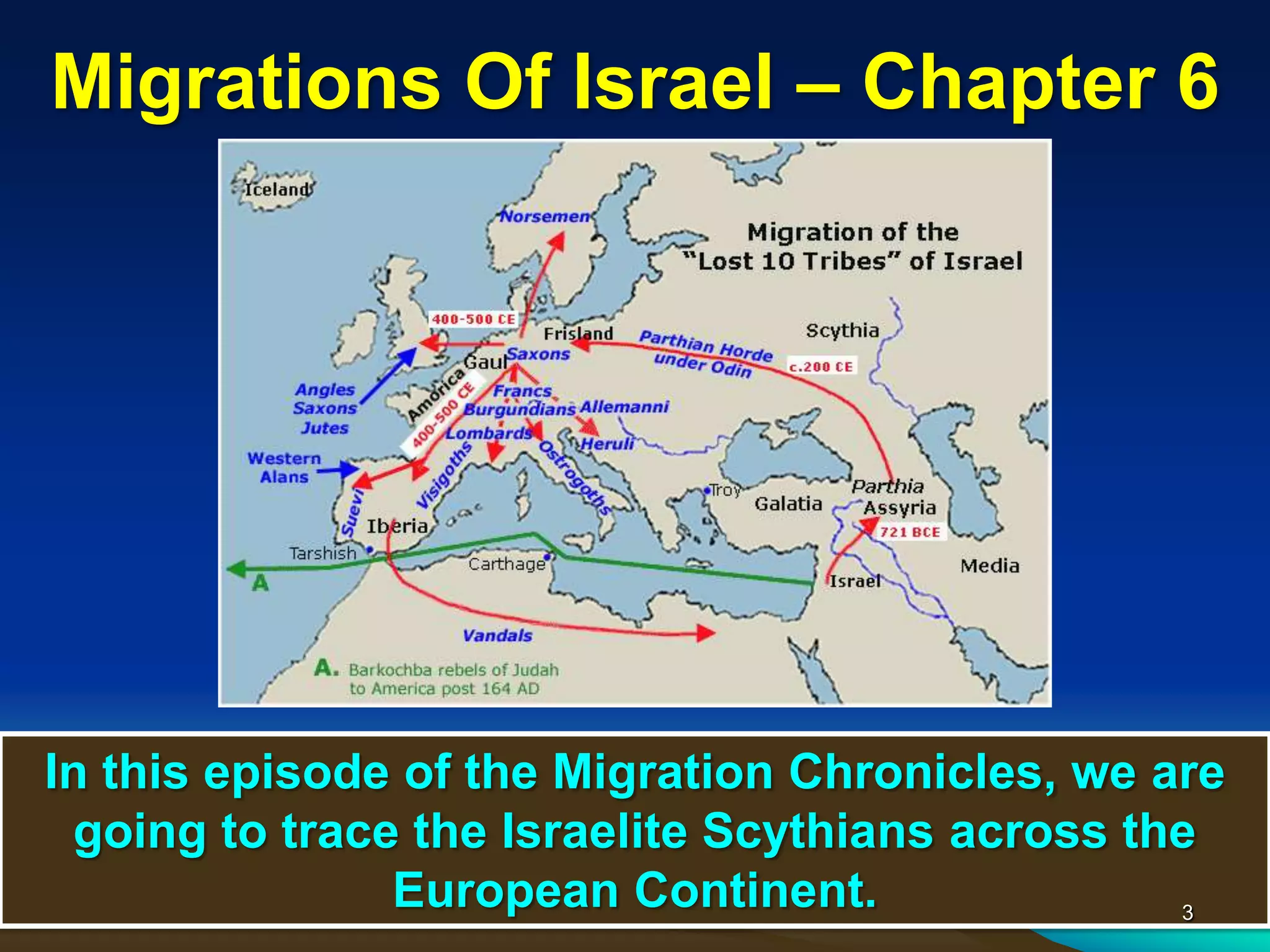
In this episode of the Migration Chronicles, we are
 going to trace the Israelite Scythians across the
               European Continent.               3
Migrations Of Israel – Chapter 6


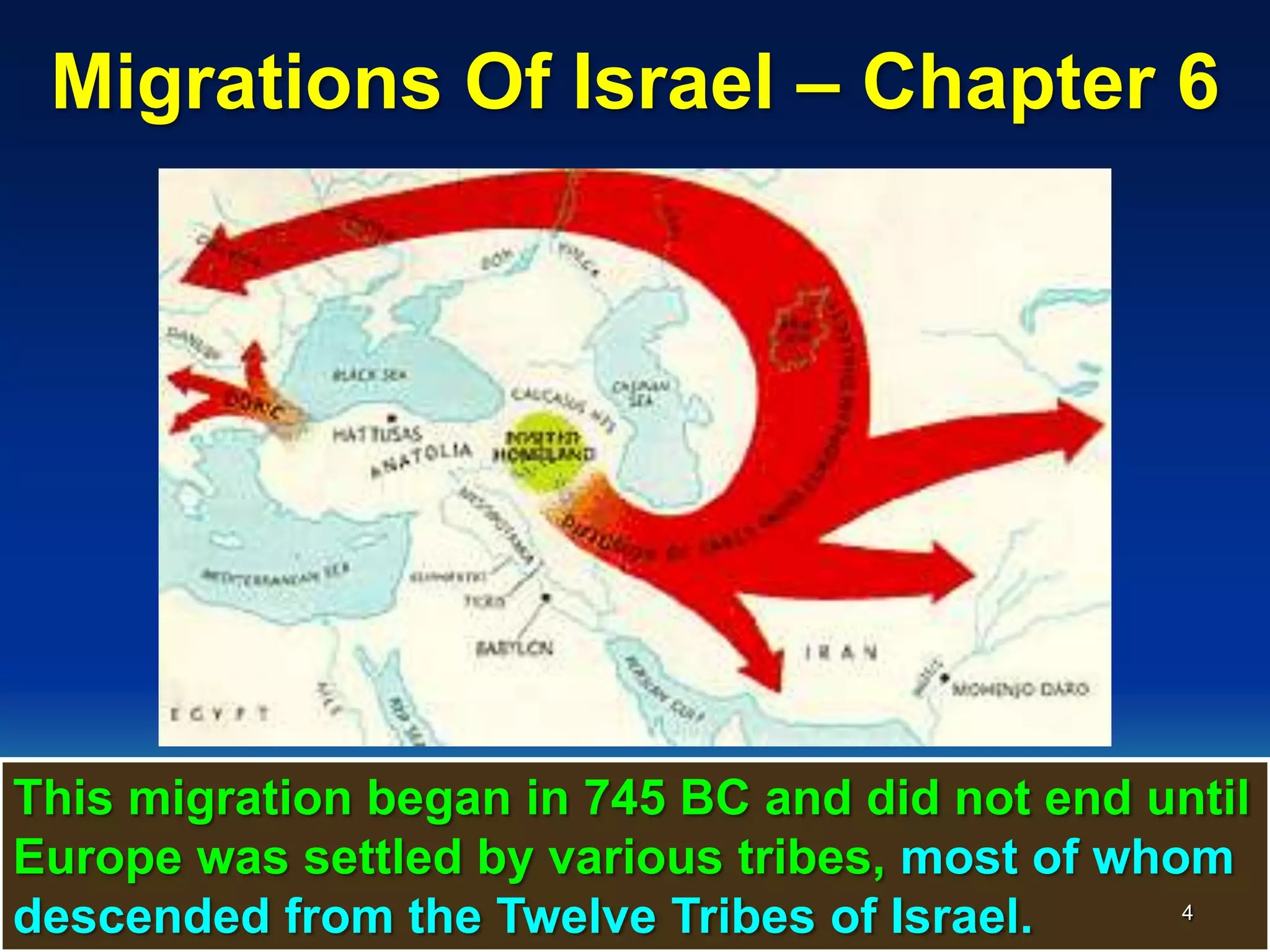
This migration began in 745 BC and did not end until
Europe was settled by various tribes, most of whom
descended from the Twelve Tribes of Israel.      4
Migrations Of Israel – Chapter 6

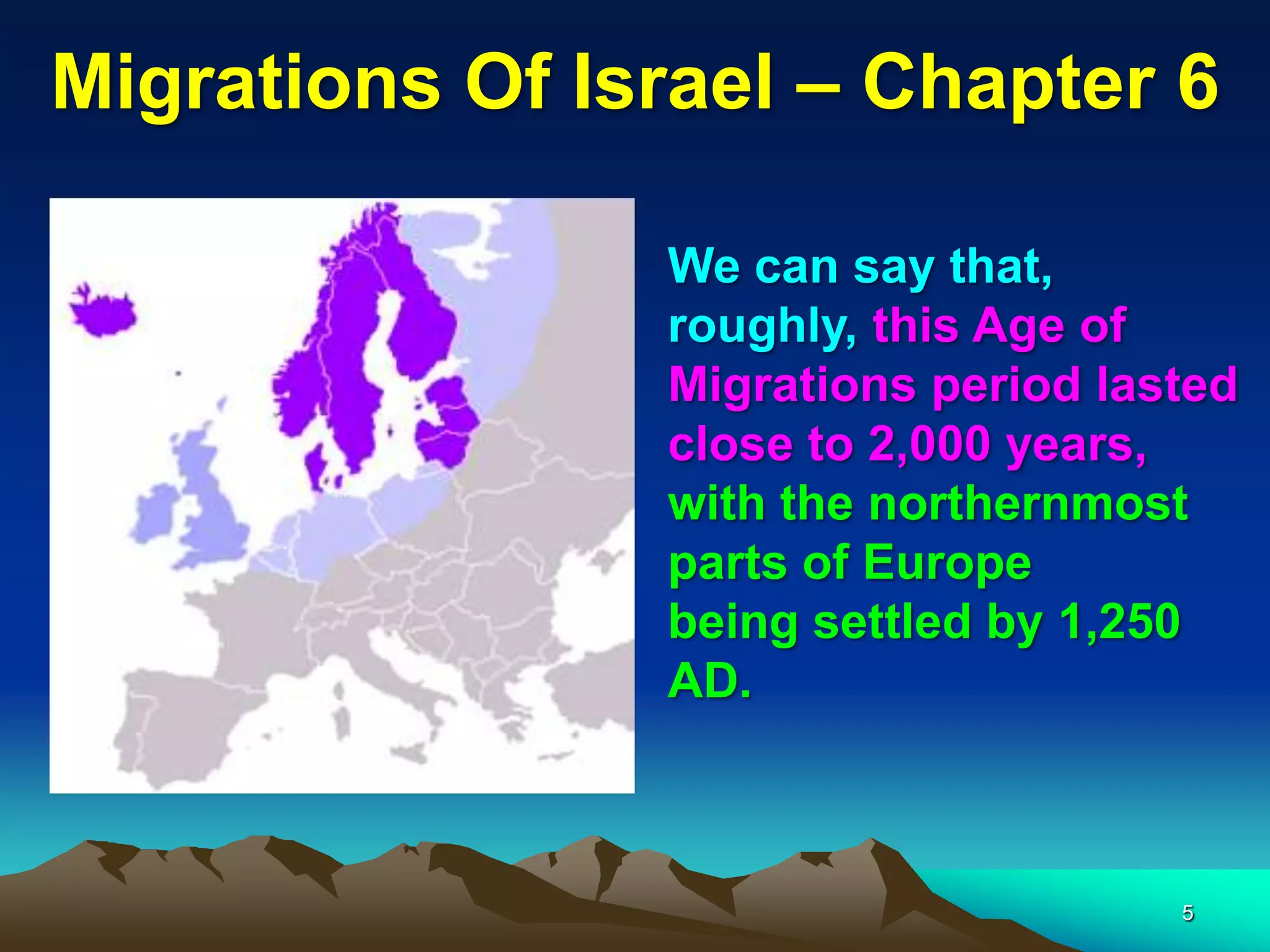
                We can say that,
                roughly, this Age of
                Migrations period lasted
                close to 2,000 years,
                with the northernmost
                parts of Europe
                being settled by 1,250
                AD.


                                     5
Migrations Of Israel – Chapter 6

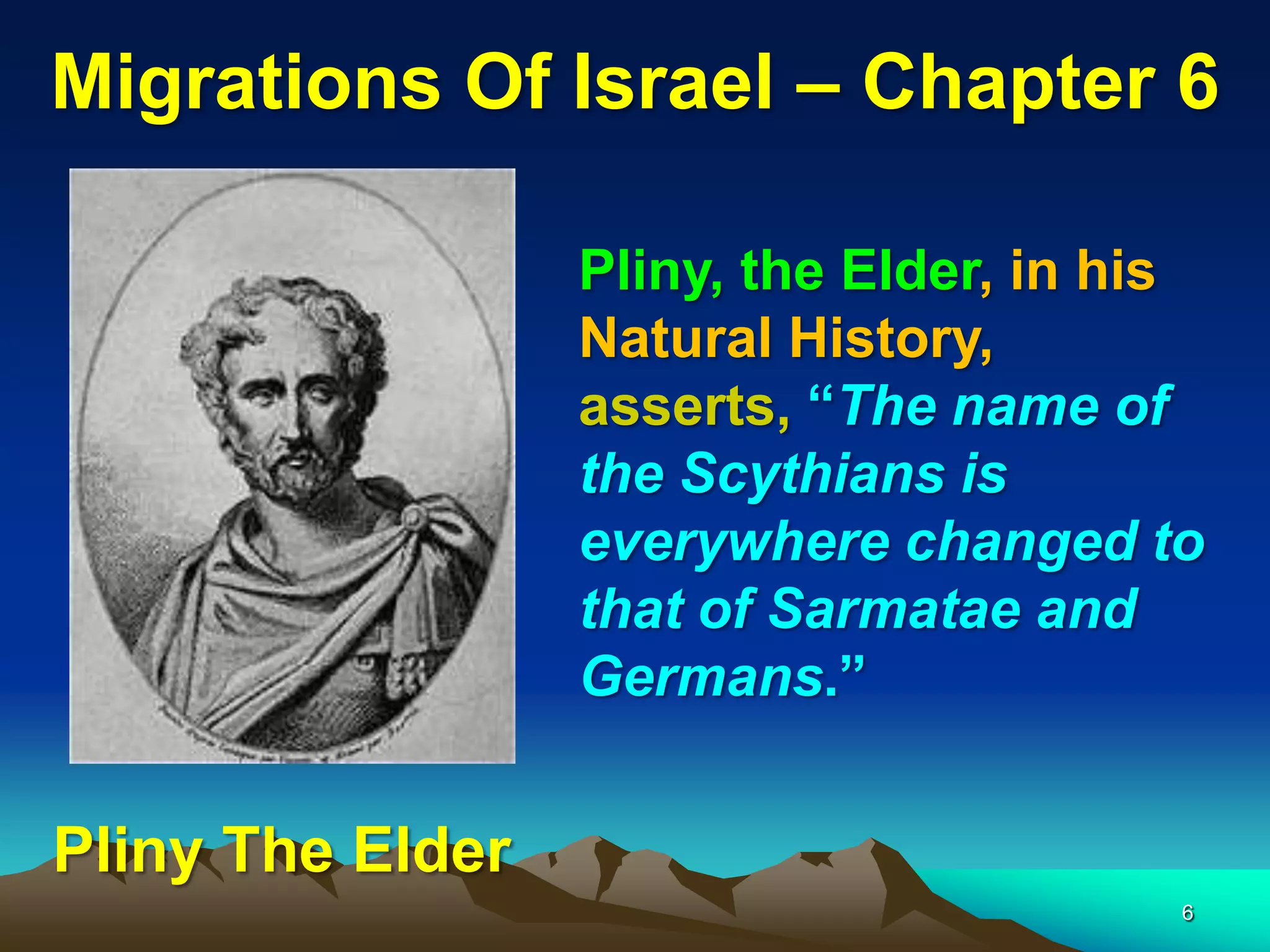
                  Pliny, the Elder, in his
                  Natural History,
                  asserts, “The name of
                  the Scythians is
                  everywhere changed to
                  that of Sarmatae and
                  Germans.”


Pliny The Elder
                                         6
Migrations Of Israel – Chapter 6
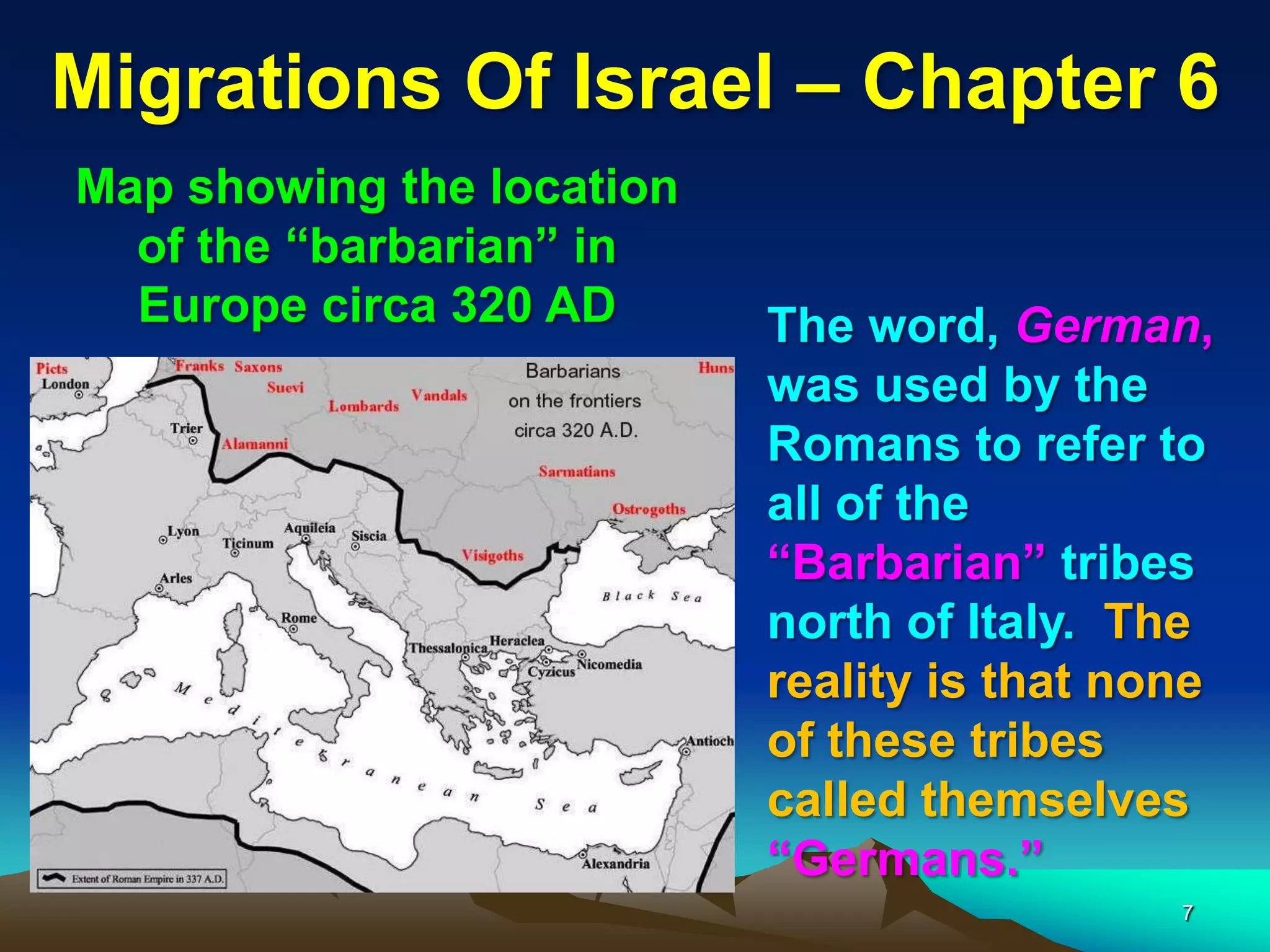
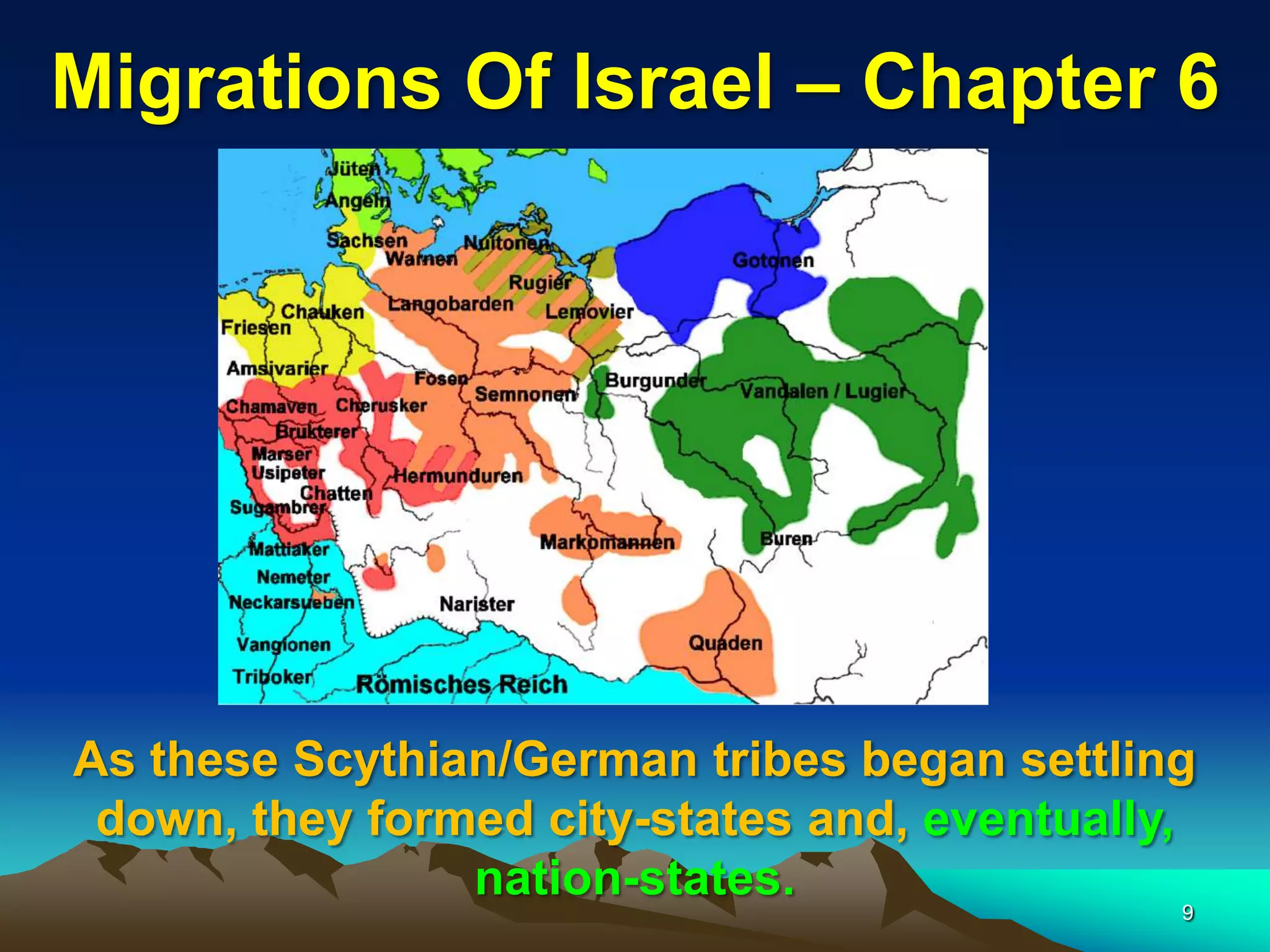
Map showing the location
  of the “barbarian” in
  Europe circa 320 AD      The word, German,
                           was used by the
                           Romans to refer to
                           all of the
                           “Barbarian” tribes
                           north of Italy. The
                           reality is that none
                           of these tribes
                           called themselves
                           “Germans.”
                                             7
Migrations Of Israel – Chapter 6


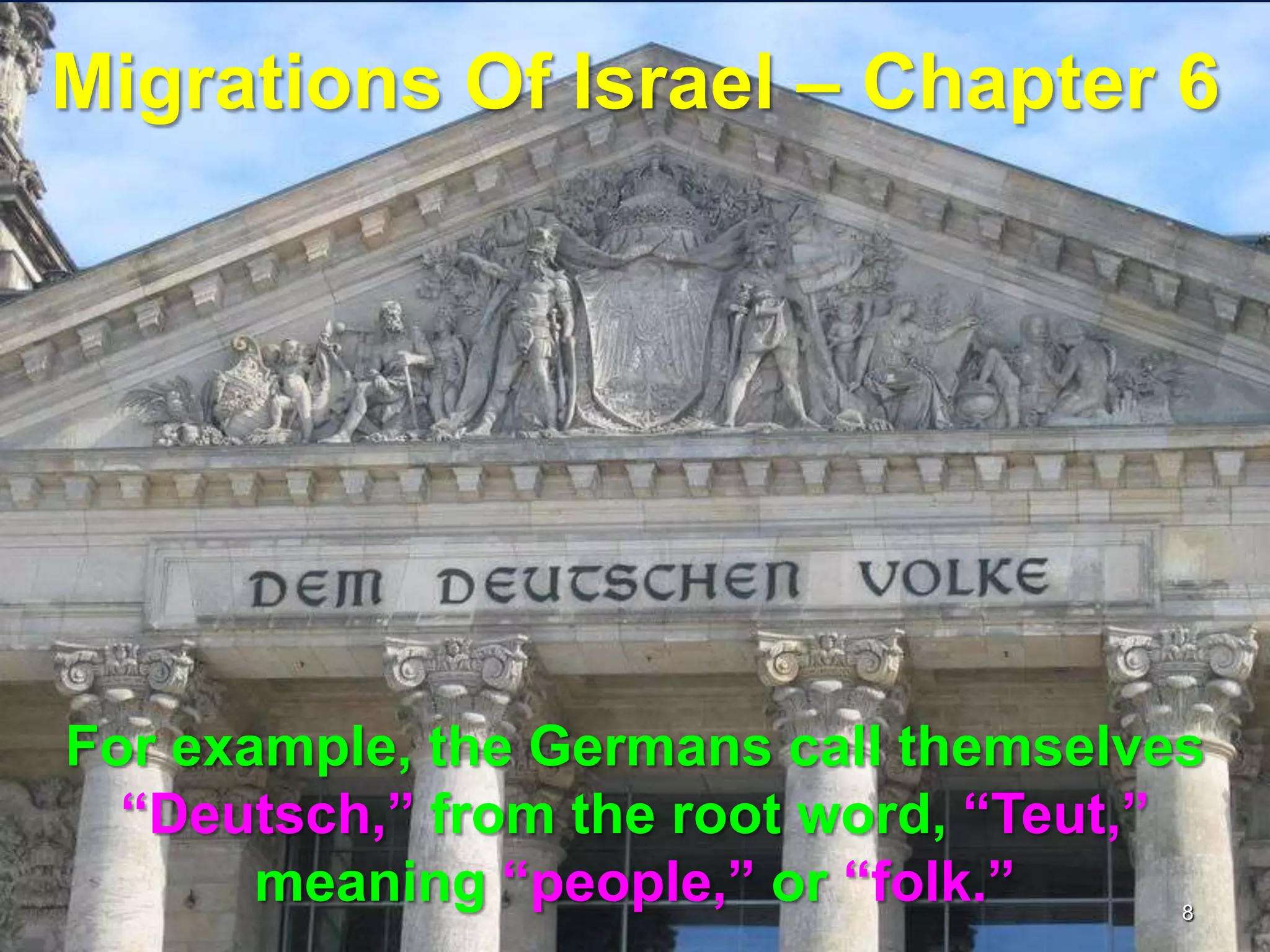
For example, the Germans call themselves
  “Deutsch,” from the root word, “Teut,”
       meaning “people,” or “folk.”    8
Migrations Of Israel – Chapter 6


As these Scythian/German tribes began settling
 down, they formed city-states and, eventually,
                nation-states.
                                              9
Migrations Of Israel – Chapter 6
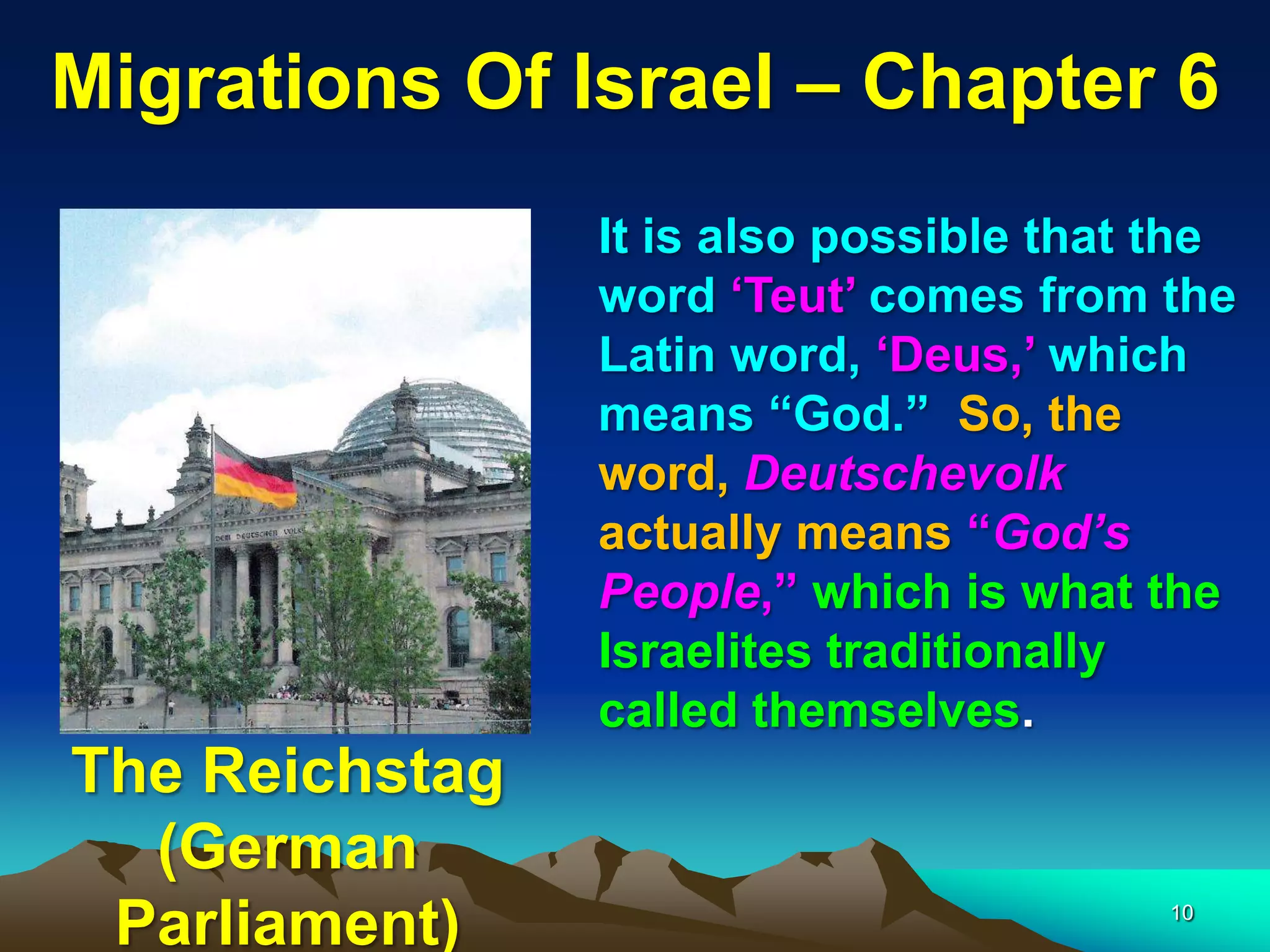
                It is also possible that the
                word „Teut‟ comes from the
                Latin word, „Deus,‟ which
                means “God.” So, the
                word, Deutschevolk
                actually means “God’s
                People,” which is what the
                Israelites traditionally
                called themselves.
The Reichstag
  (German
 Parliament)                             10
Migrations Of Israel – Chapter 6
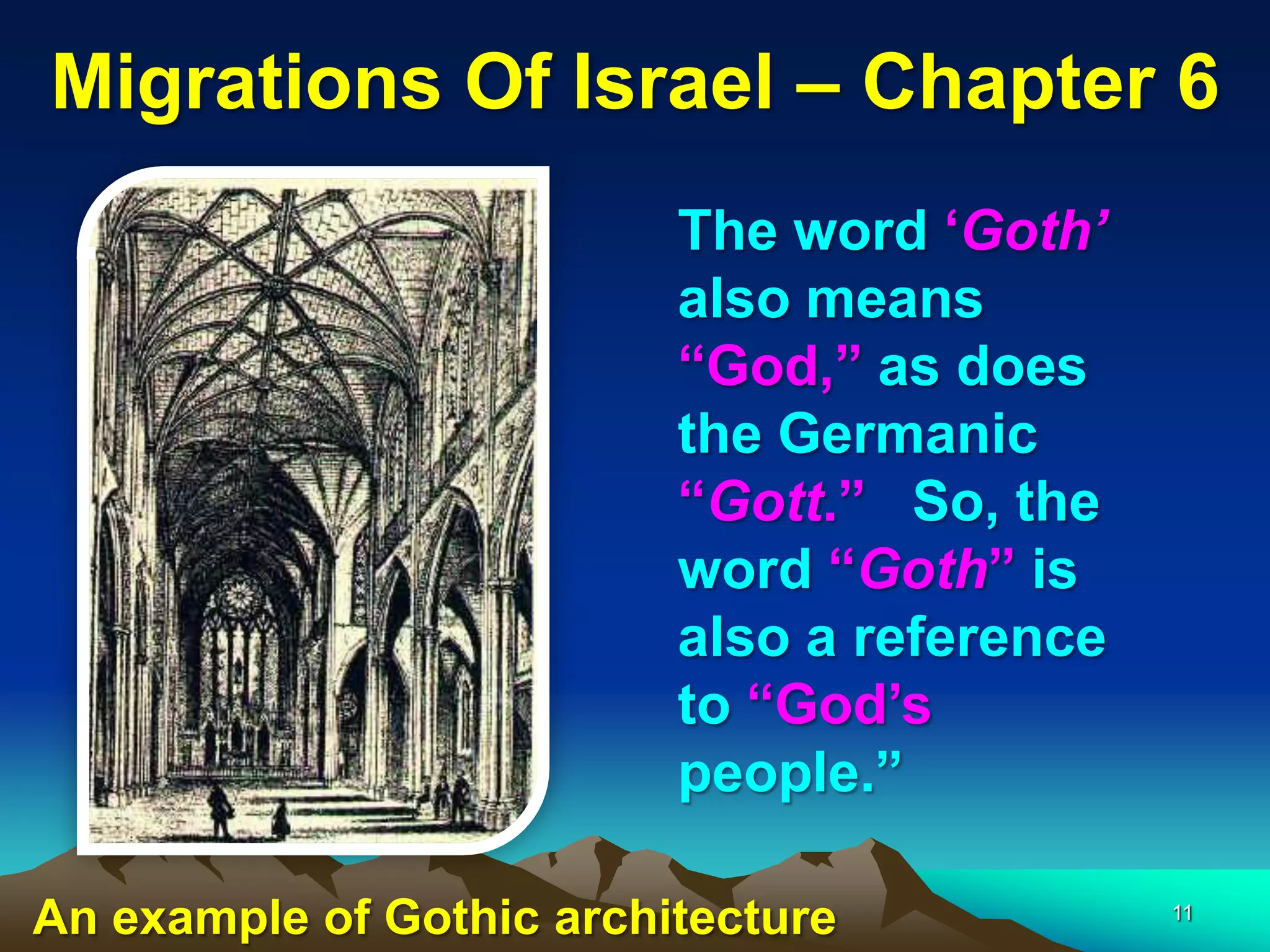
                          The word „Goth’
                          also means
                          “God,” as does
                          the Germanic
                          “Gott.” So, the
                          word “Goth” is
                          also a reference
                          to “God‟s
                          people.”

An example of Gothic architecture            11
Migrations Of Israel – Chapter 6
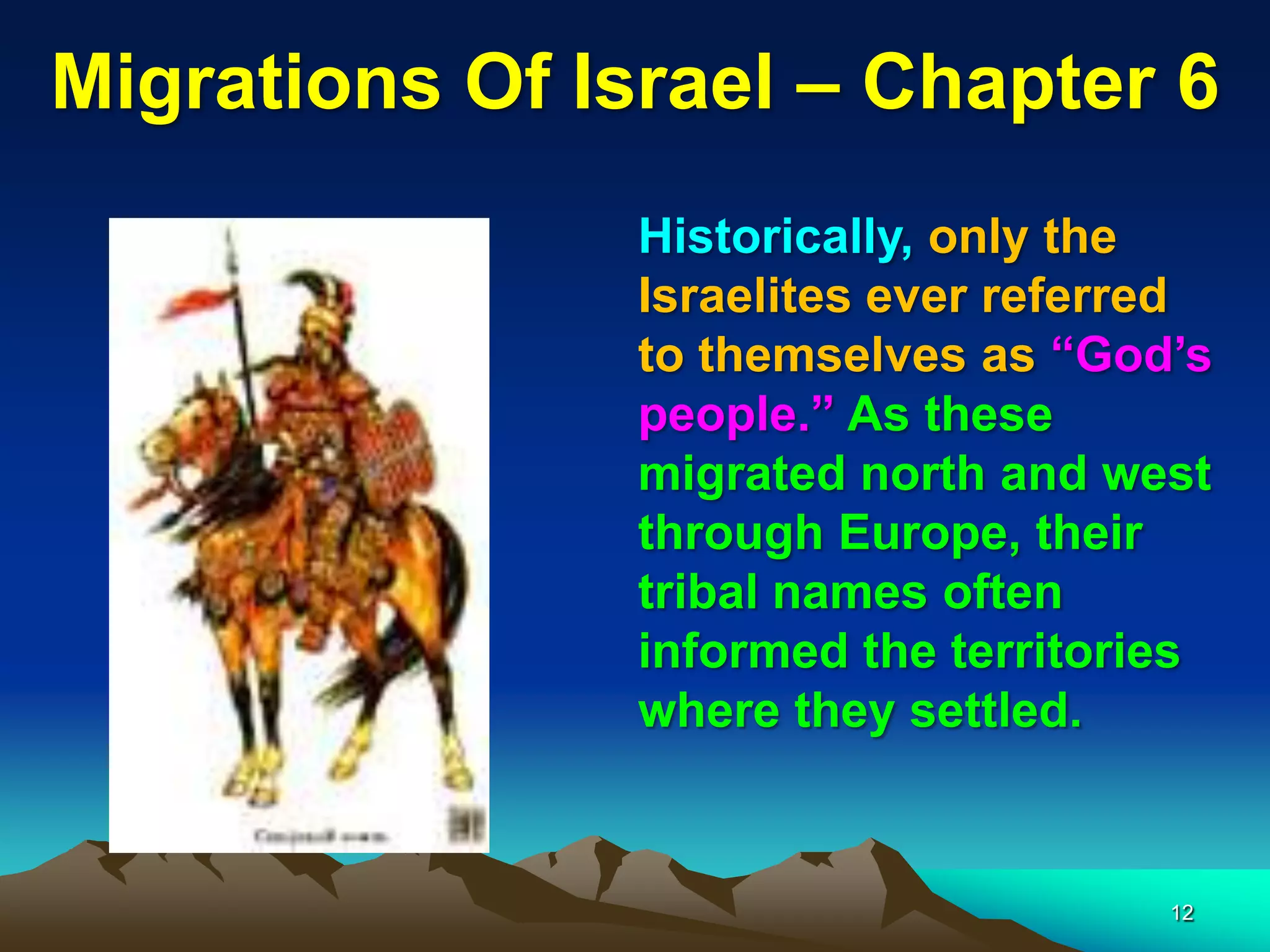
                Historically, only the
                Israelites ever referred
                to themselves as “God‟s
                people.” As these
                migrated north and west
                through Europe, their
                tribal names often
                informed the territories
                where they settled.


                                      12
Migrations Of Israel – Chapter 6


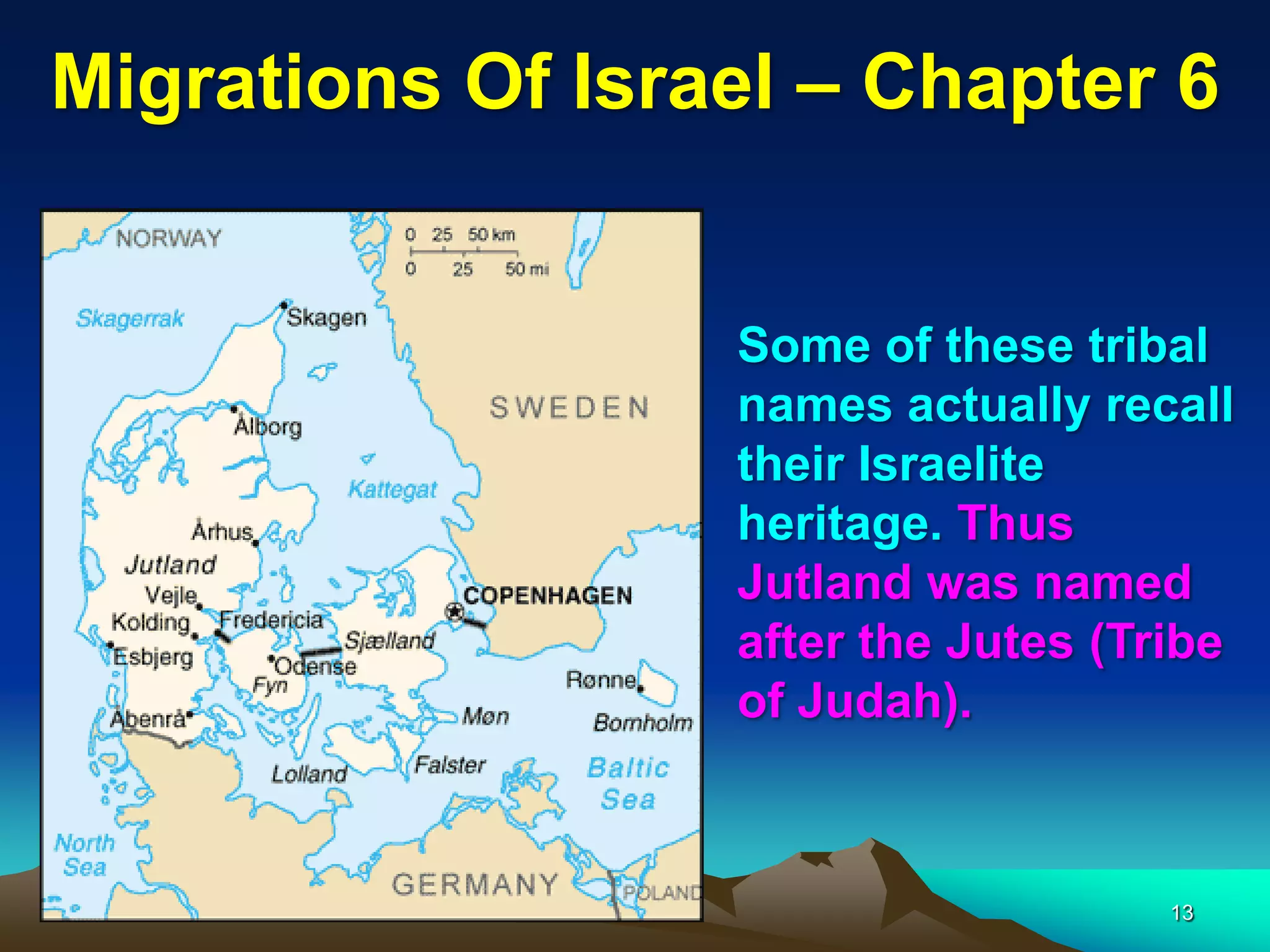
                  Some of these tribal
                  names actually recall
                  their Israelite
                  heritage. Thus
                  Jutland was named
                  after the Jutes (Tribe
                  of Judah).


                                     13
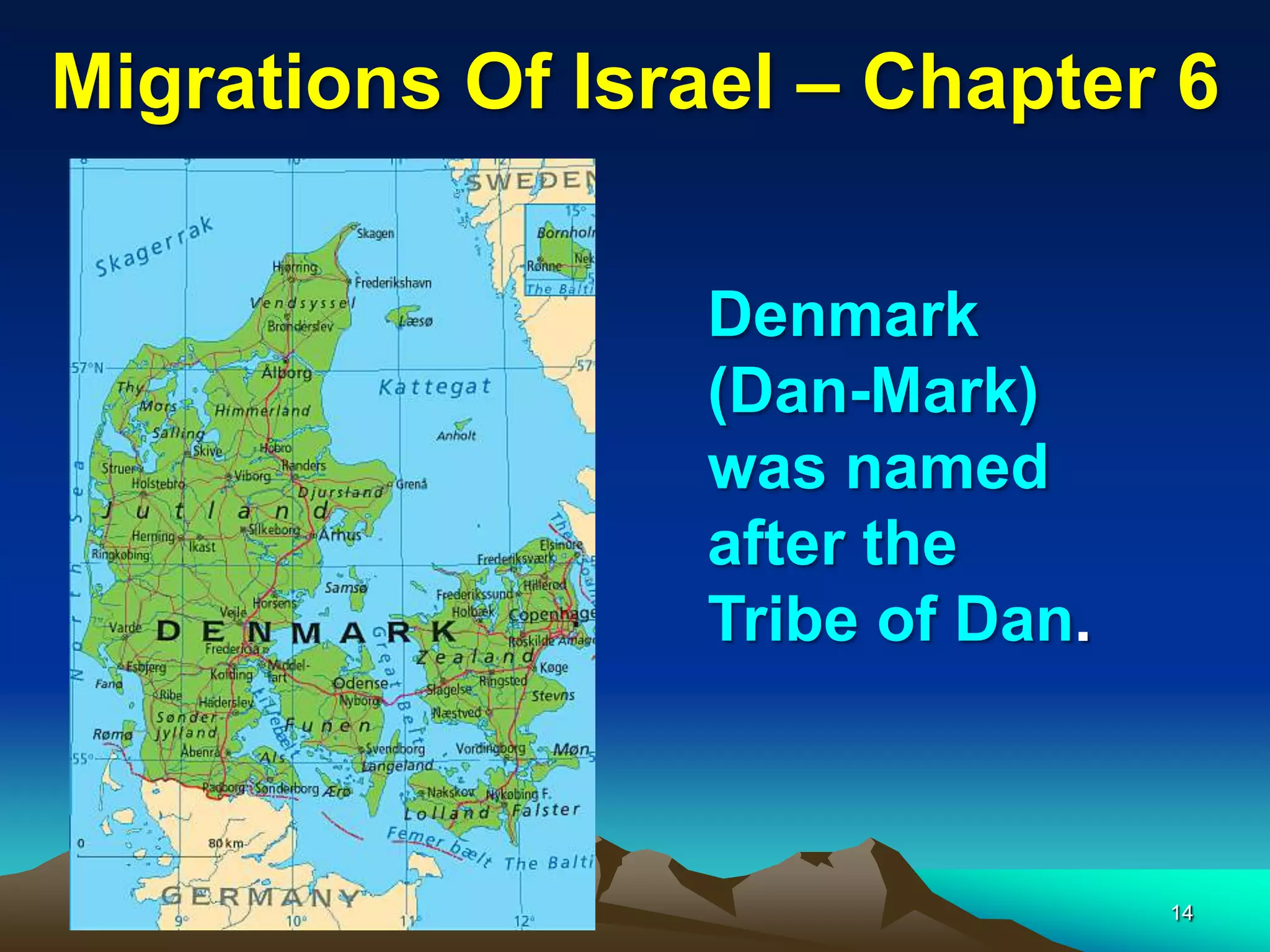
Migrations Of Israel – Chapter 6

                 Denmark
                 (Dan-Mark)
                 was named
                 after the
                 Tribe of Dan.


                                 14
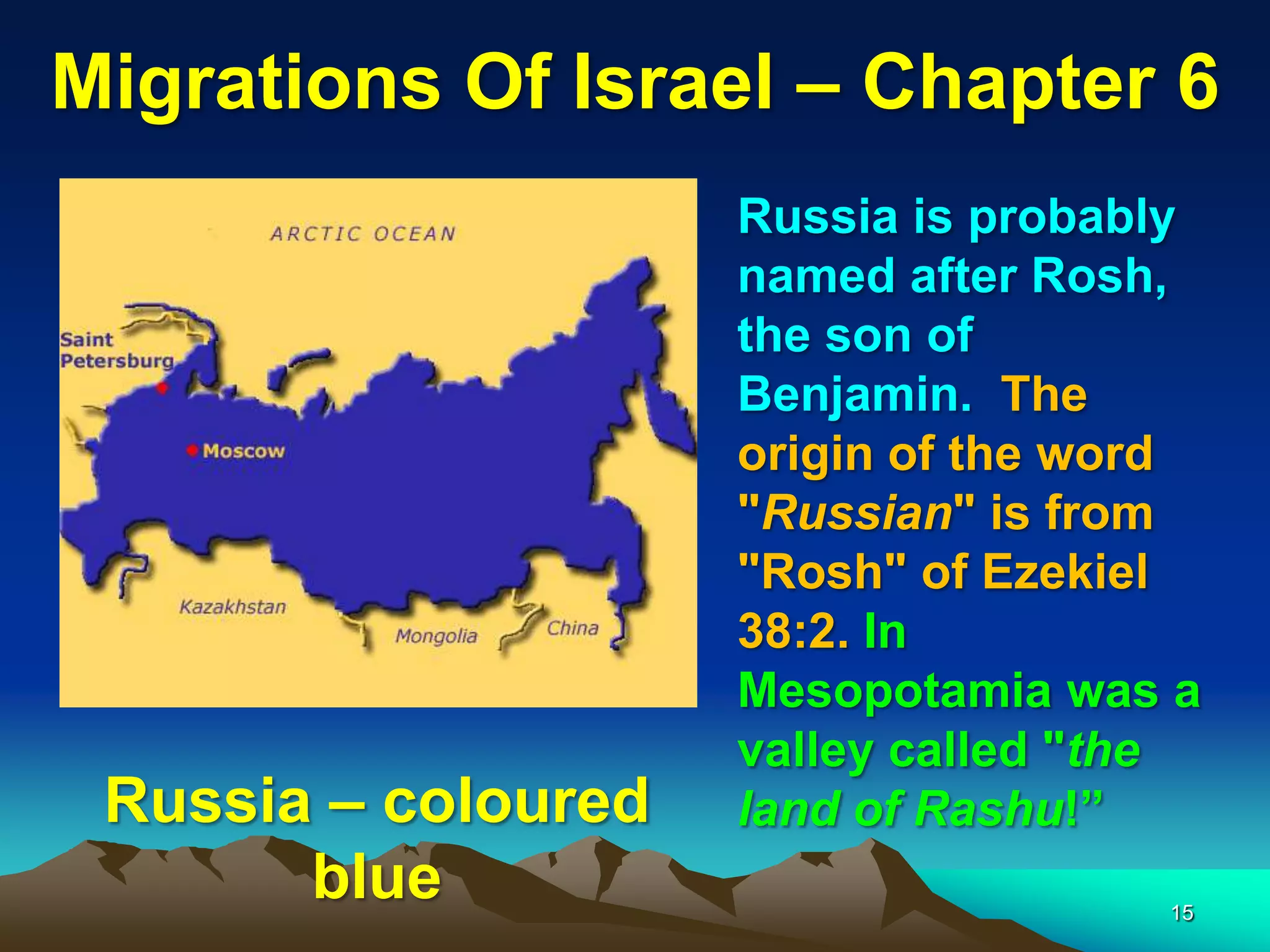
Migrations Of Israel – Chapter 6
                     Russia is probably
                     named after Rosh,
                     the son of
                     Benjamin. The
                     origin of the word
                     "Russian" is from
                     "Rosh" of Ezekiel
                     38:2. In
                     Mesopotamia was a
                     valley called "the
 Russia – coloured   land of Rashu!”
       blue                          15
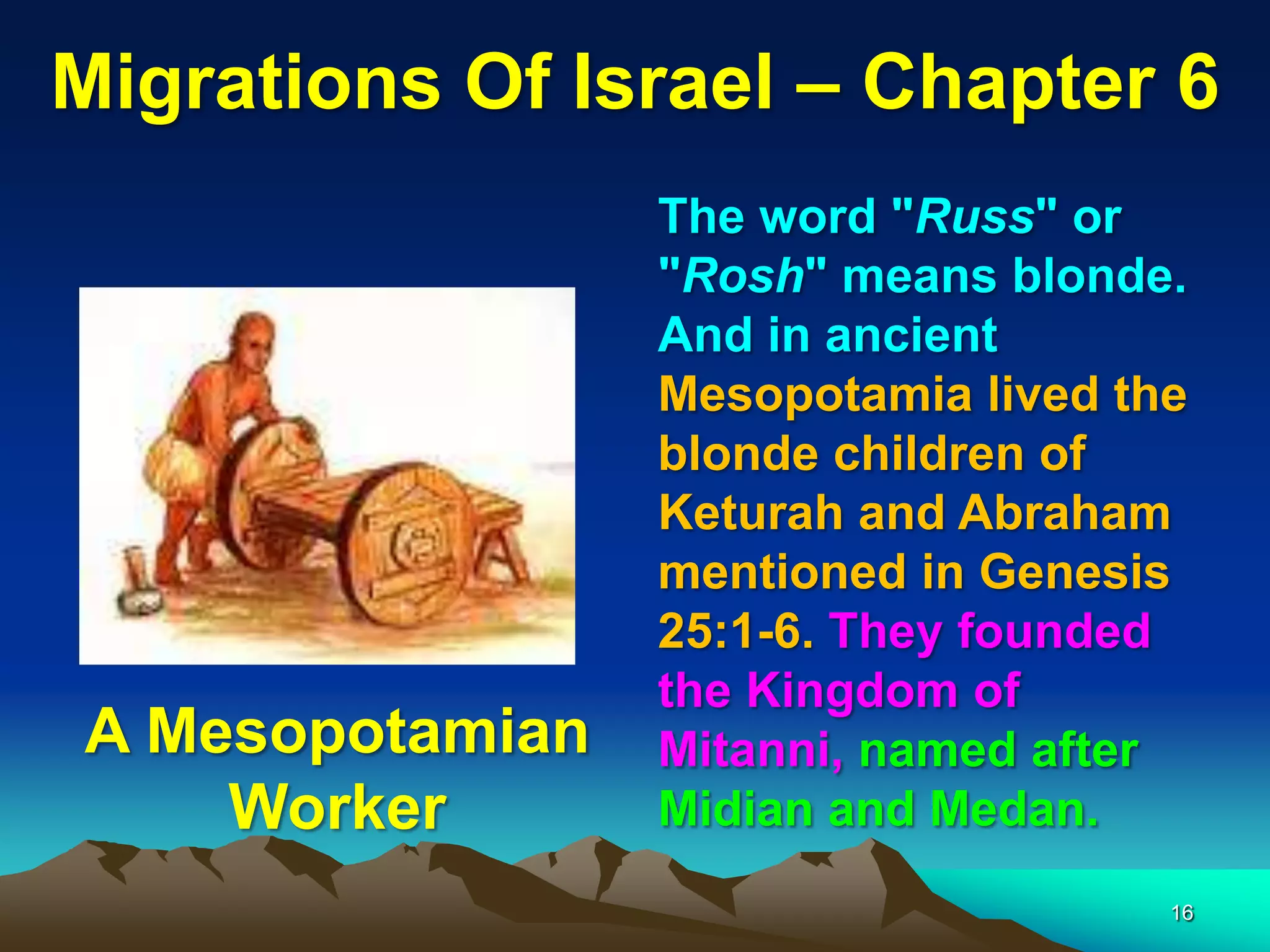
Migrations Of Israel – Chapter 6
                 The word "Russ" or
                 "Rosh" means blonde.
                 And in ancient
                 Mesopotamia lived the
                 blonde children of
                 Keturah and Abraham
                 mentioned in Genesis
                 25:1-6. They founded
                 the Kingdom of
A Mesopotamian   Mitanni, named after
    Worker       Midian and Medan.
                                     16
Migrations Of Israel – Chapter 6
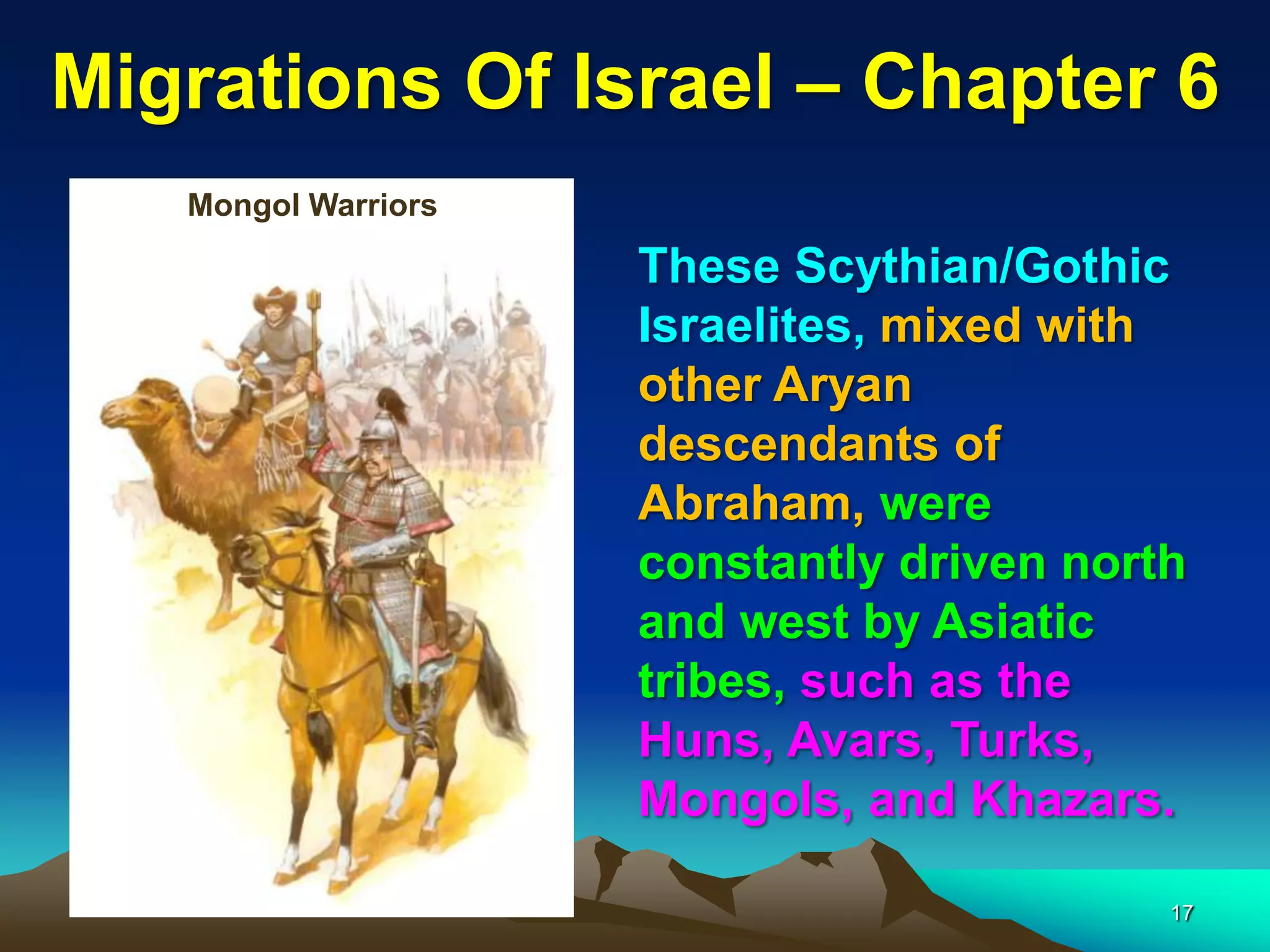
   Mongol Warriors

                     These Scythian/Gothic
                     Israelites, mixed with
                     other Aryan
                     descendants of
                     Abraham, were
                     constantly driven north
                     and west by Asiatic
                     tribes, such as the
                     Huns, Avars, Turks,
                     Mongols, and Khazars.

                                           17
Migrations Of Israel – Chapter 6


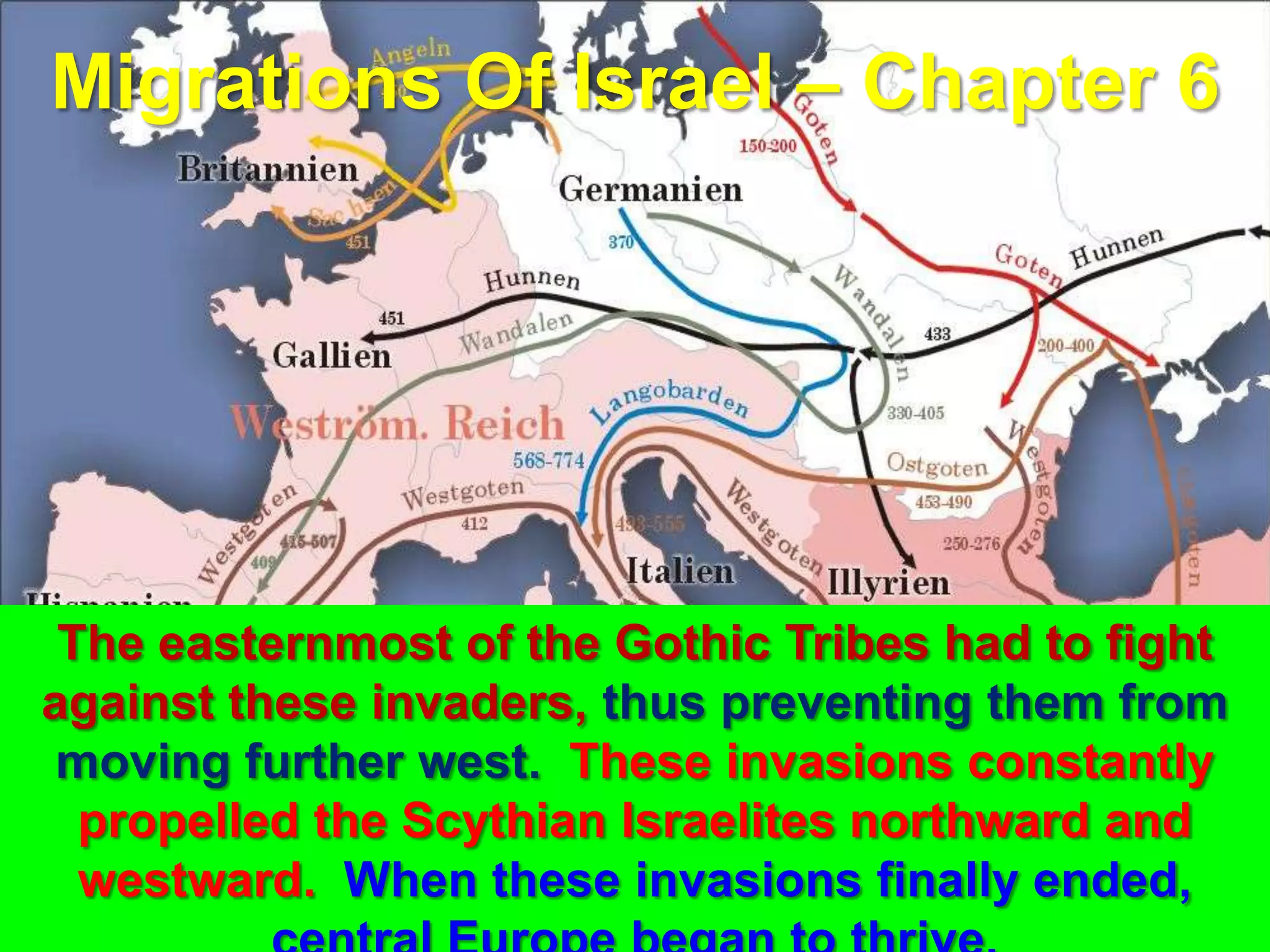
 The easternmost of the Gothic Tribes had to fight
against these invaders, thus preventing them from
 moving further west. These invasions constantly
  propelled the Scythian Israelites northward and
  westward. When these invasions finally ended, 18
Migrations Of Israel – Chapter 6

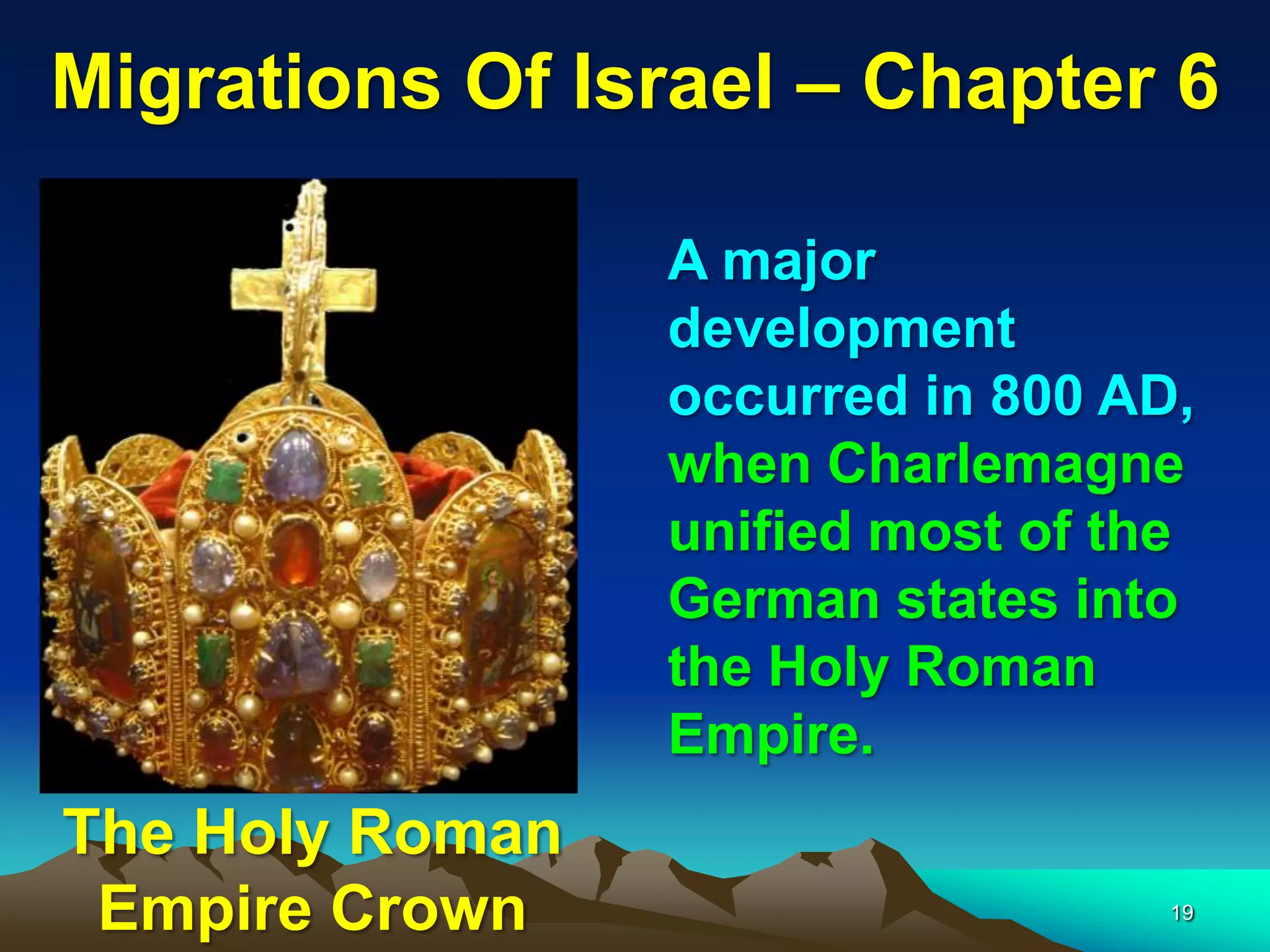
                 A major
                 development
                 occurred in 800 AD,
                 when Charlemagne
                 unified most of the
                 German states into
                 the Holy Roman
                 Empire.
The Holy Roman
 Empire Crown                      19
Migrations Of Israel – Chapter 6
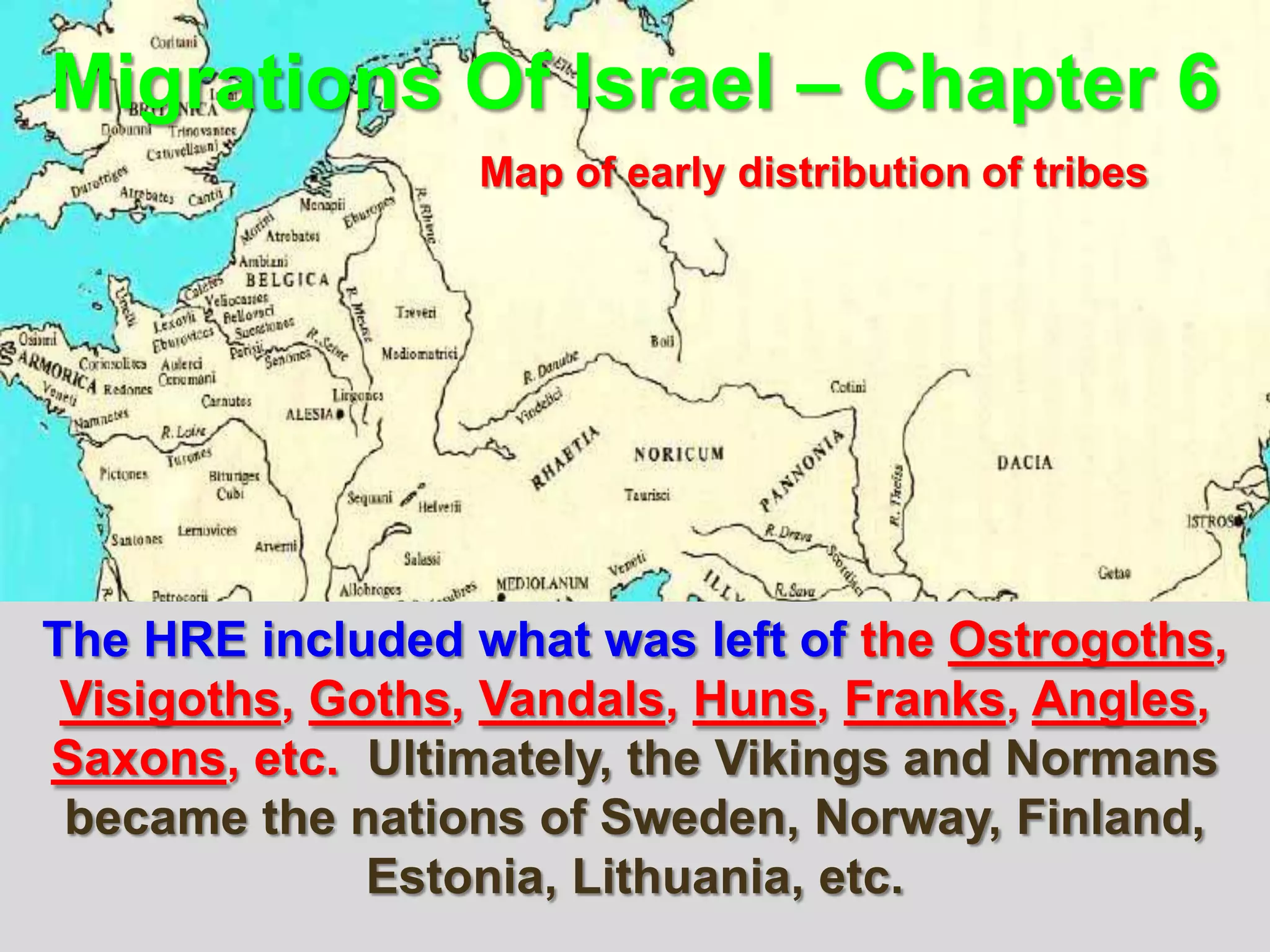
                  Map of early distribution of tribes


The HRE included what was left of the Ostrogoths,
 Visigoths, Goths, Vandals, Huns, Franks, Angles,
Saxons, etc. Ultimately, the Vikings and Normans
 became the nations of Sweden, Norway, Finland,
              Estonia, Lithuania, etc.
                                                        20
Migrations Of Israel – Chapter 6

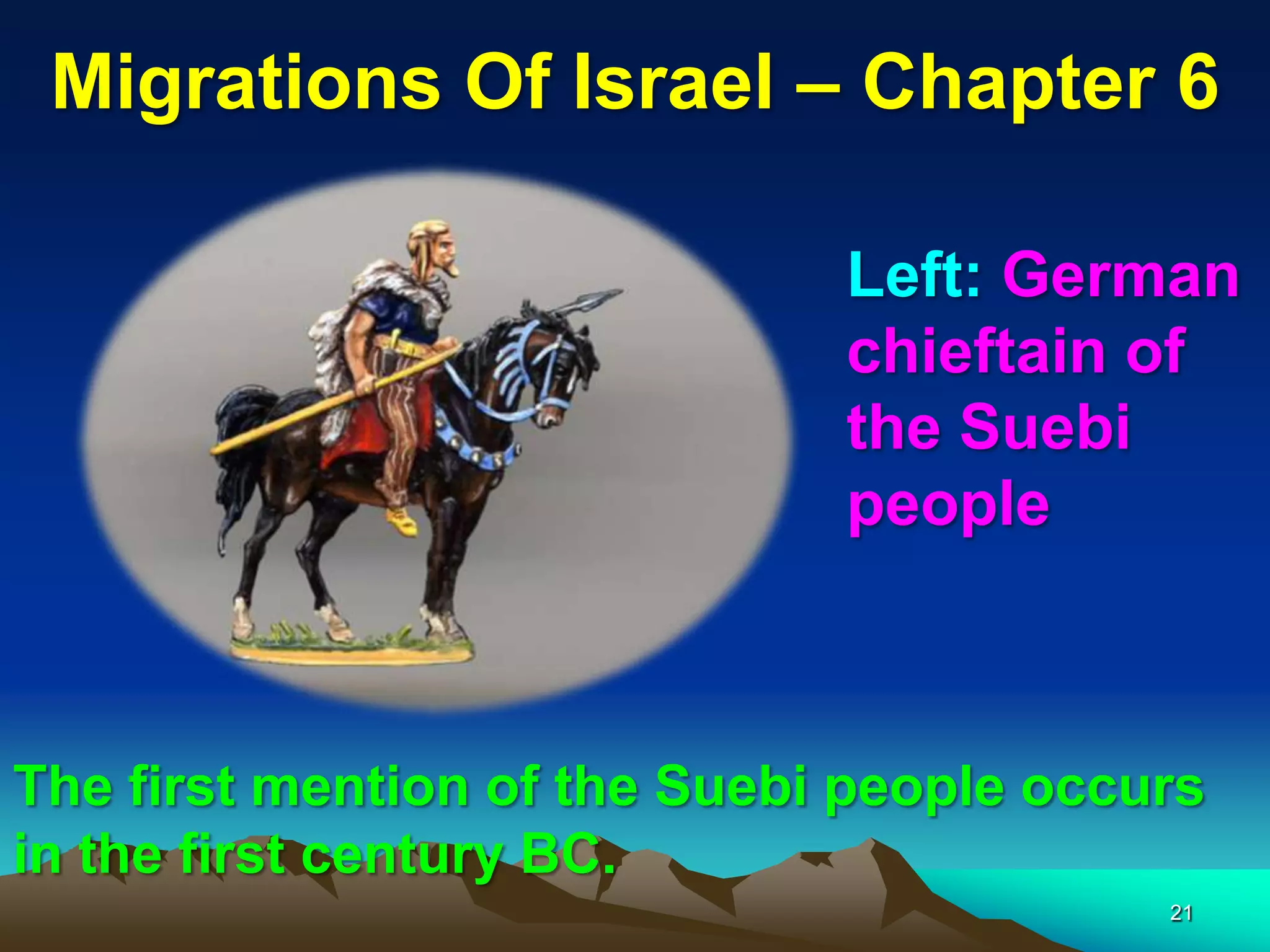
                              Left: German
                              chieftain of
                              the Suebi
                              people


The first mention of the Suebi people occurs
in the first century BC.
                                          21
Migrations Of Israel – Chapter 6
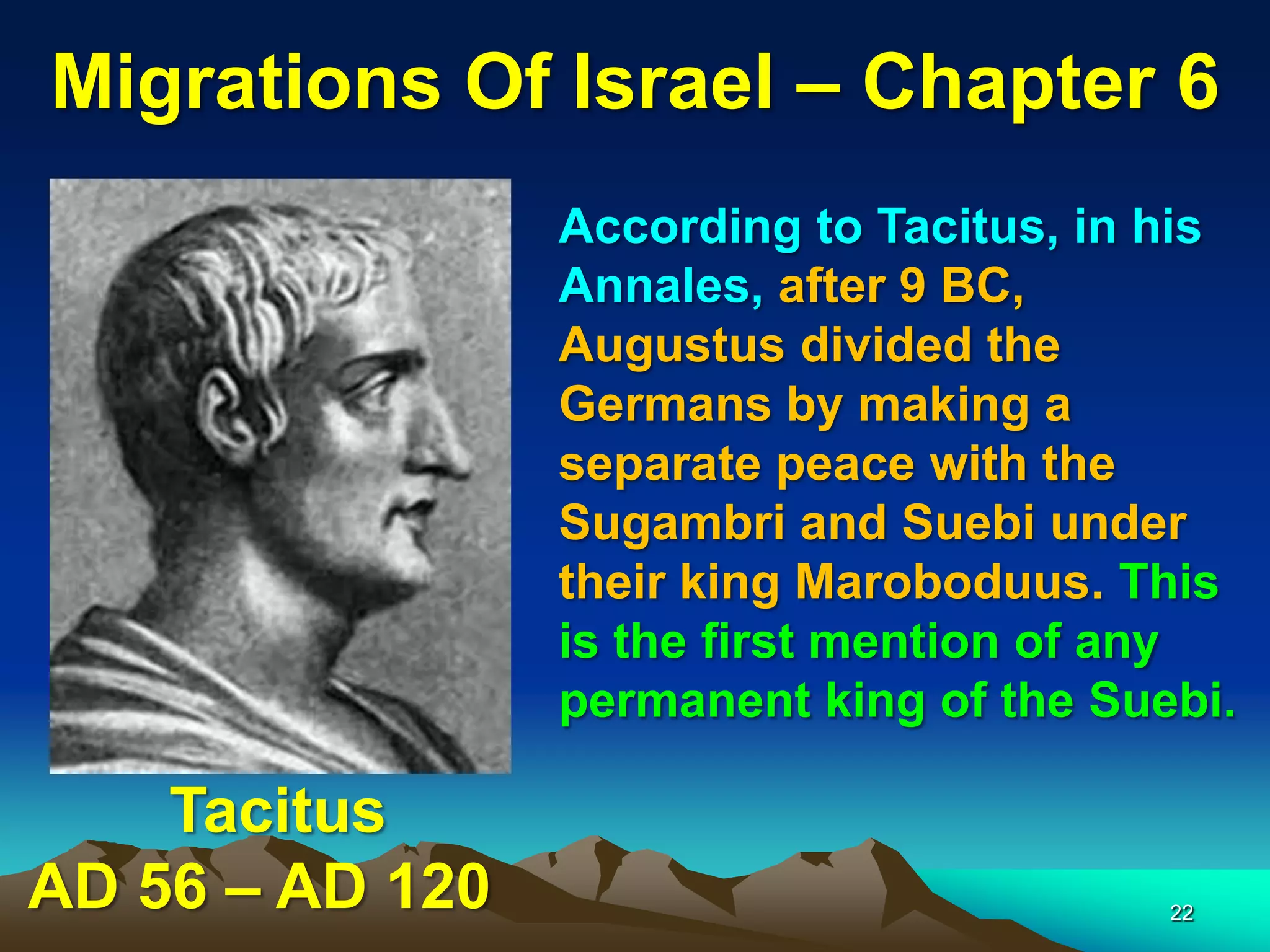
                 According to Tacitus, in his
                 Annales, after 9 BC,
                 Augustus divided the
                 Germans by making a
                 separate peace with the
                 Sugambri and Suebi under
                 their king Maroboduus. This
                 is the first mention of any
                 permanent king of the Suebi.

    Tacitus
AD 56 – AD 120                            22
Migrations Of Israel – Chapter 6
                  Alans and Sueves


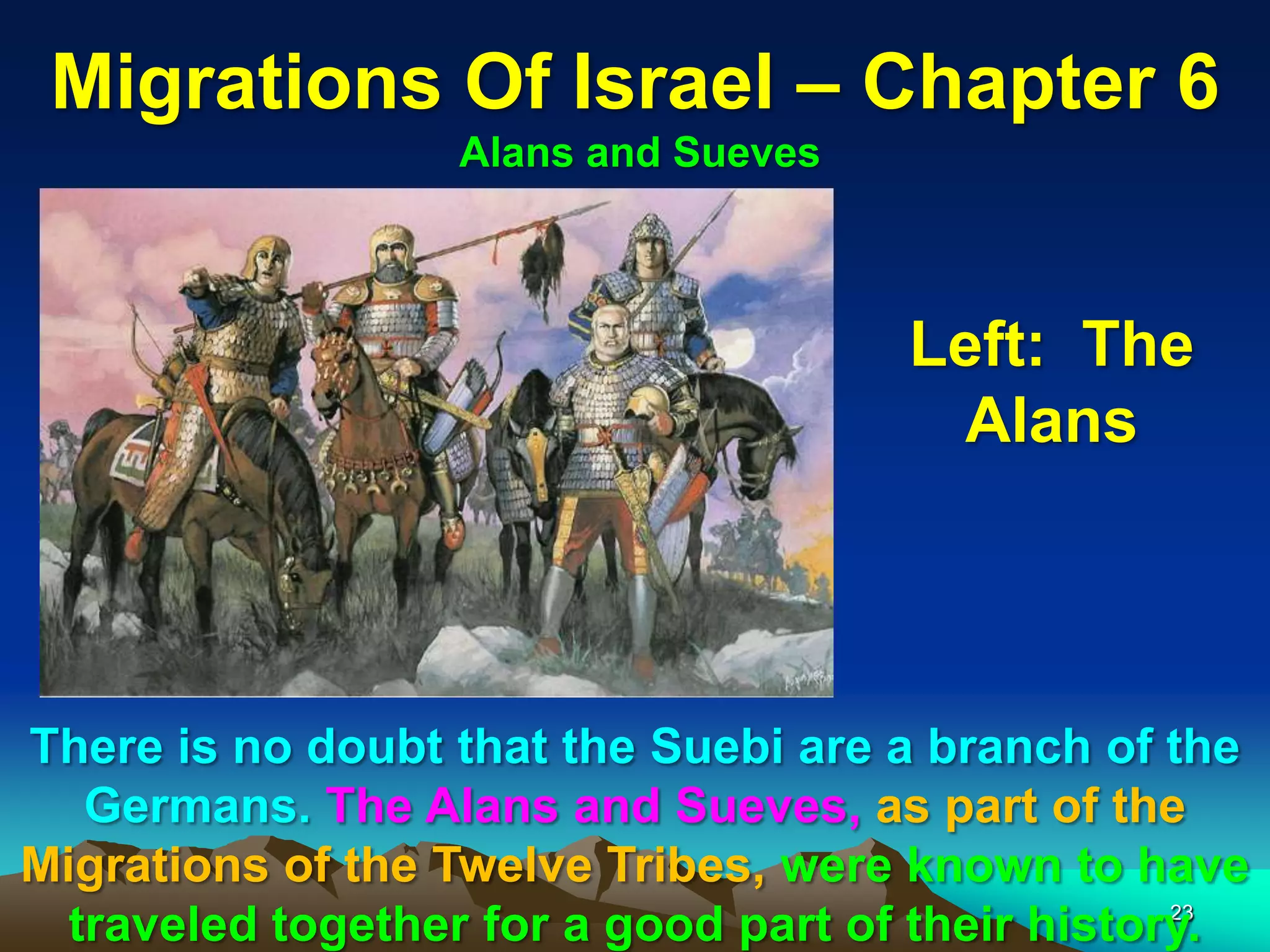
                                      Left: The
                                       Alans


There is no doubt that the Suebi are a branch of the
   Germans. The Alans and Sueves, as part of the
Migrations of the Twelve Tribes, were known to have
                                                   23
  traveled together for a good part of their history.
Migrations Of Israel – Chapter 6
                             Alans and Sueves

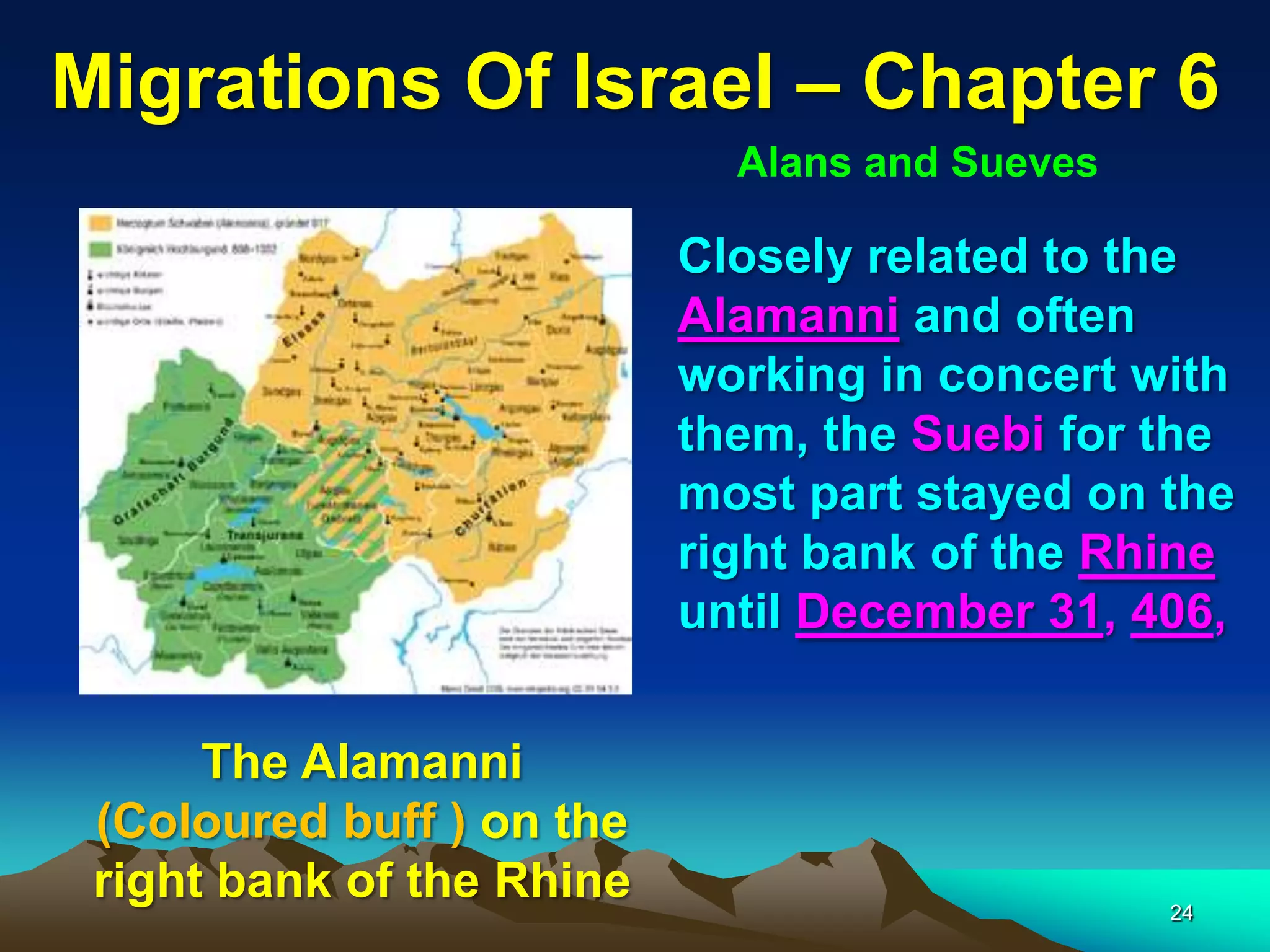
                           Closely related to the
                           Alamanni and often
                           working in concert with
                           them, the Suebi for the
                           most part stayed on the
                           right bank of the Rhine
                           until December 31, 406,


      The Alamanni
 (Coloured buff ) on the
 right bank of the Rhine                        24
Migrations Of Israel – Chapter 6


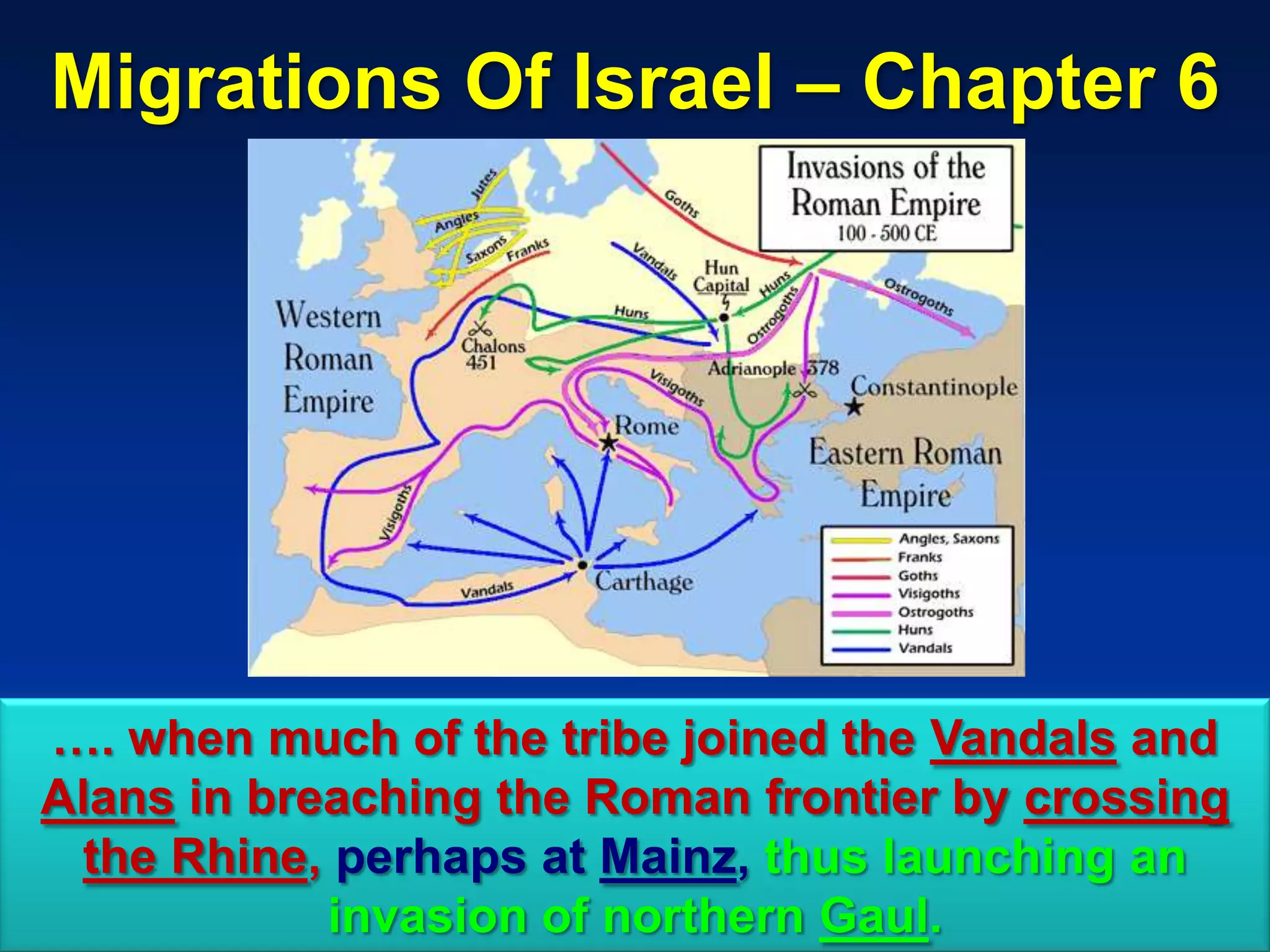
…. when much of the tribe joined the Vandals and
Alans in breaching the Roman frontier by crossing
 the Rhine, perhaps at Mainz, thus launching an
            invasion of northern Gaul.         25
Migrations Of Israel – Chapter 6
                    Alans and Sueves
                The "northern Suebi" were
                mentioned in 569 under
                Frankish king Sigebert I in
                areas of today's Saxony-
                Anhalt which were known
                as Schwabengau or
                Suebengau at least until
                the 12th century. In
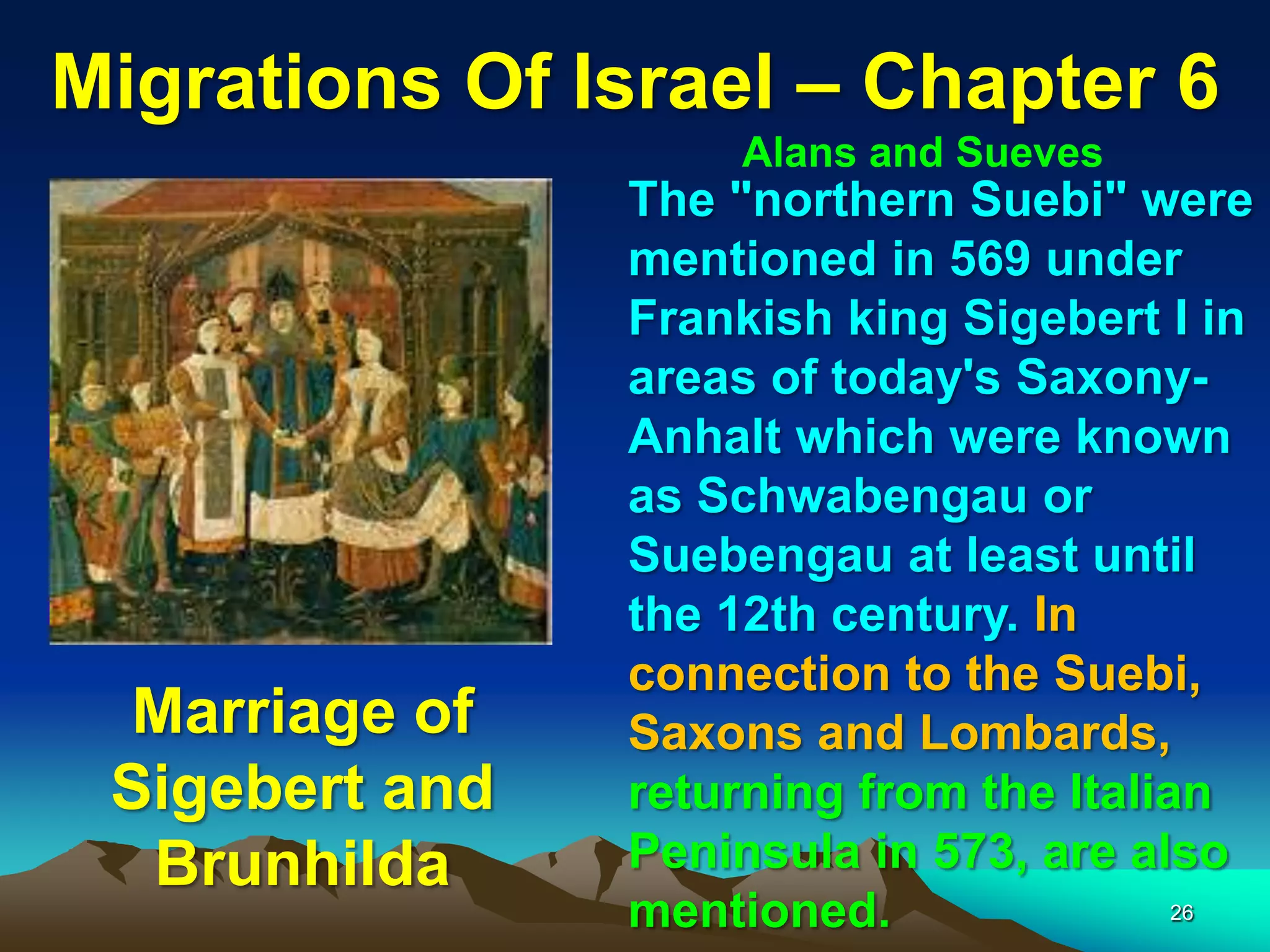
                connection to the Suebi,
 Marriage of    Saxons and Lombards,
 Sigebert and   returning from the Italian
  Brunhilda     Peninsula in 573, are also
                mentioned.               26
Migrations Of Israel – Chapter 6
                    Alans and Sueves


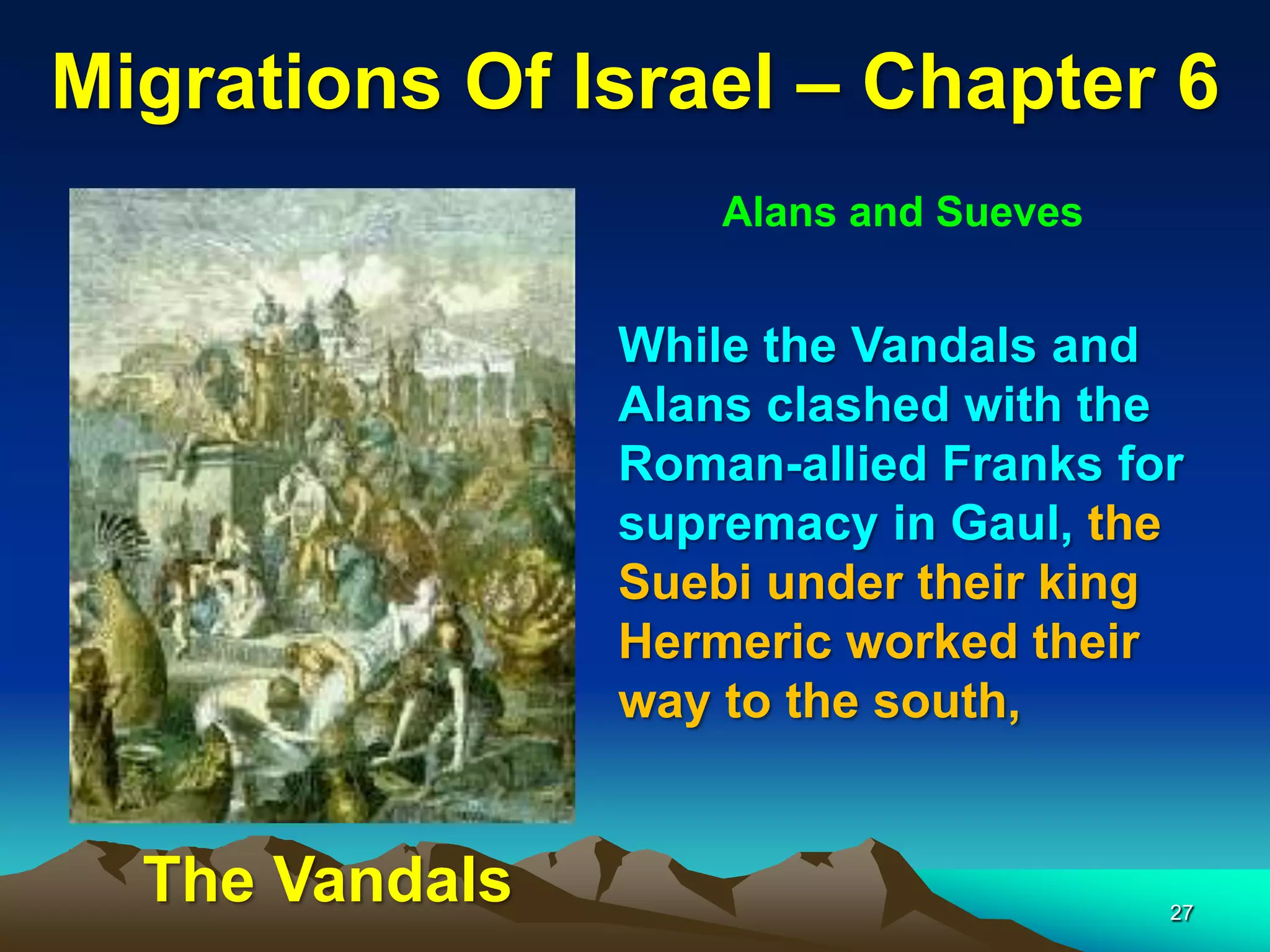
                While the Vandals and
                Alans clashed with the
                Roman-allied Franks for
                supremacy in Gaul, the
                Suebi under their king
                Hermeric worked their
                way to the south,


  The Vandals                          27
Migrations Of Israel – Chapter 6
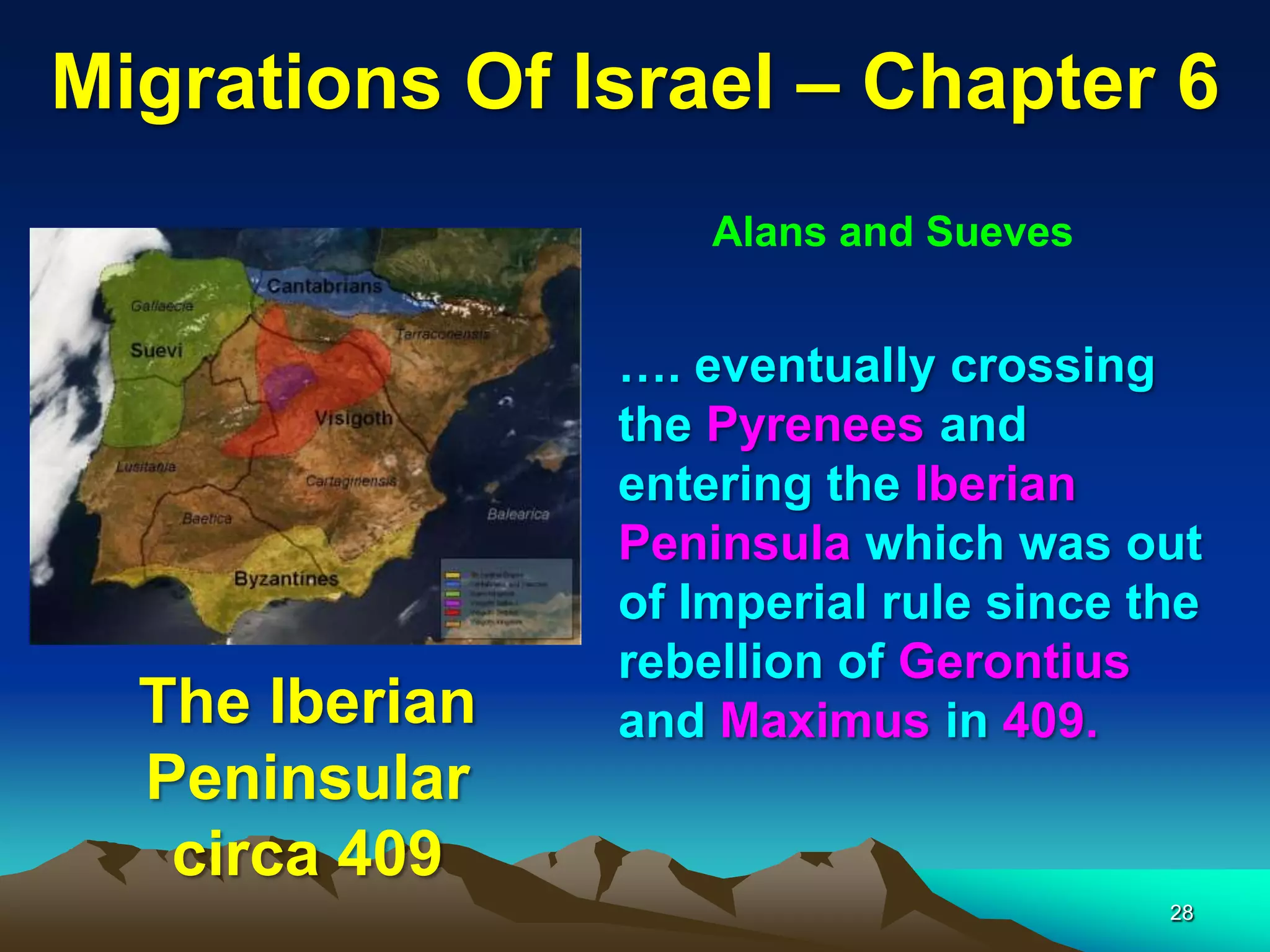
                    Alans and Sueves


                …. eventually crossing
                the Pyrenees and
                entering the Iberian
                Peninsula which was out
                of Imperial rule since the
                rebellion of Gerontius
  The Iberian   and Maximus in 409.
  Peninsular
   circa 409
                                        28
Migrations Of Israel – Chapter 6
               Alans and Sueves


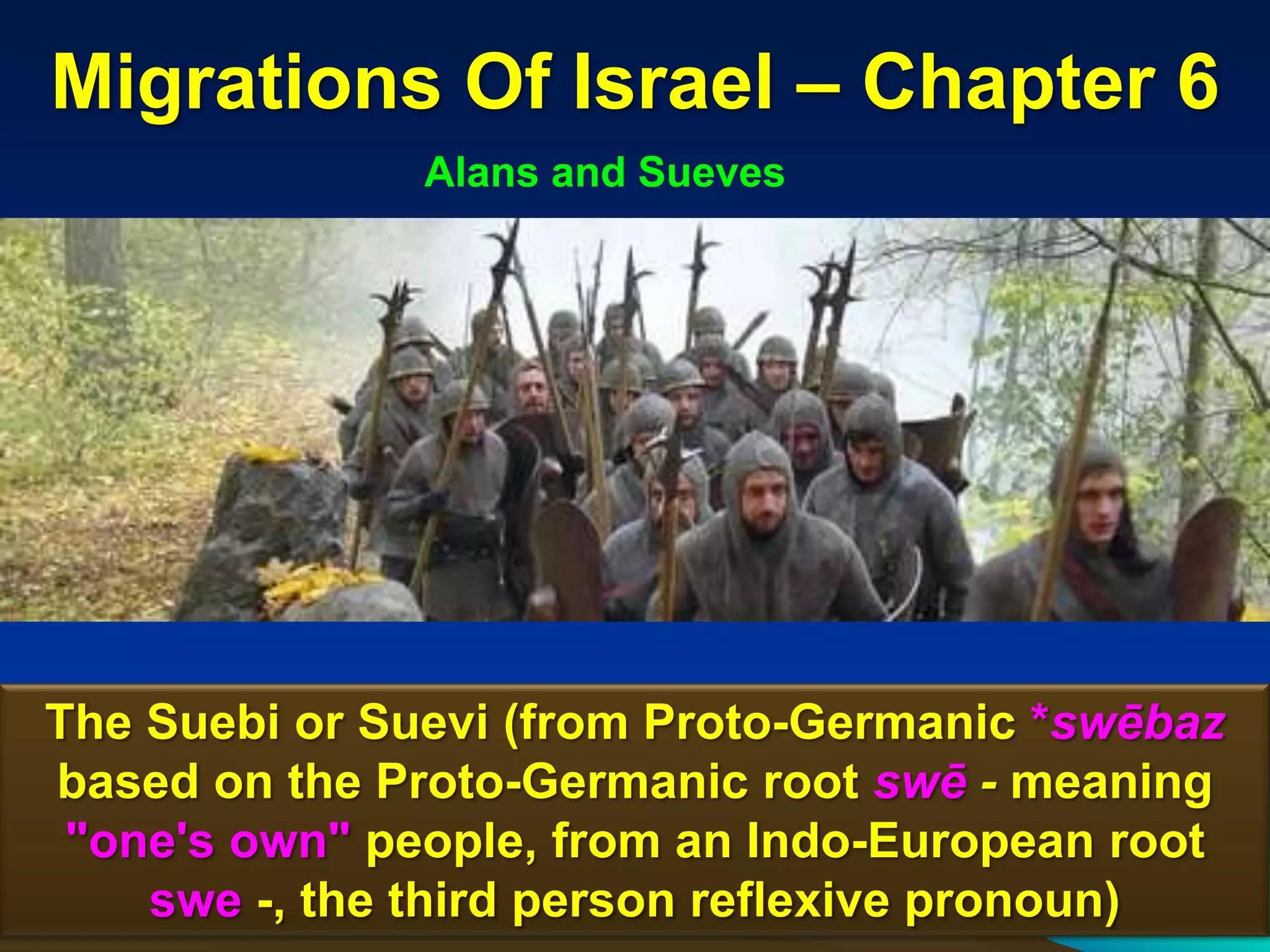
The Suebi or Suevi (from Proto-Germanic *swēbaz
based on the Proto-Germanic root swē - meaning
 "one's own" people, from an Indo-European root
    swe -, the third person reflexive pronoun) 29
Migrations Of Israel – Chapter 6
                   Alans and Sueves


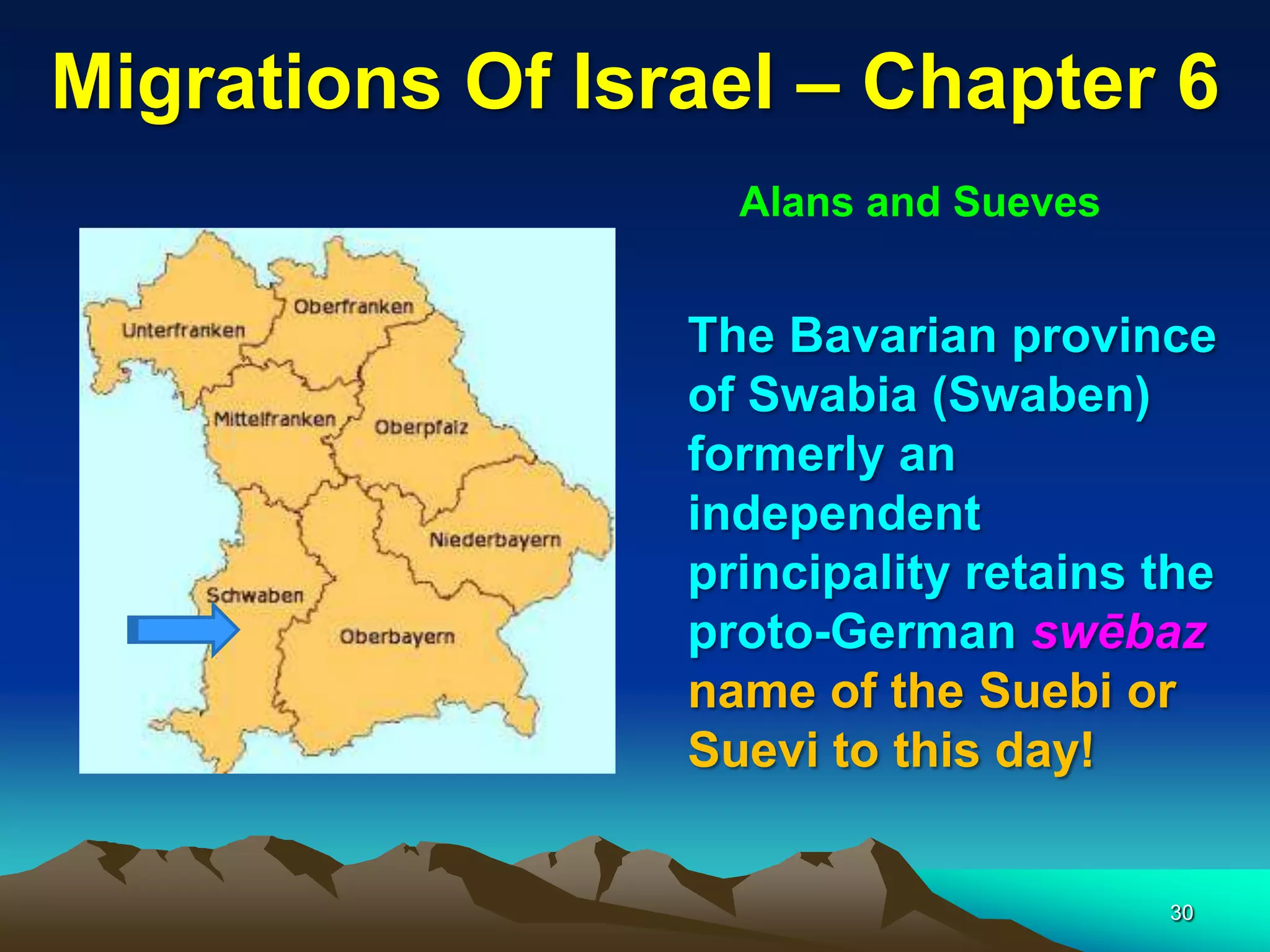
                 The Bavarian province
                 of Swabia (Swaben)
                 formerly an
                 independent
                 principality retains the
                 proto-German swēbaz
                 name of the Suebi or
                 Suevi to this day!


                                      30
Migrations Of Israel – Chapter 6
                      Alans and Sueves


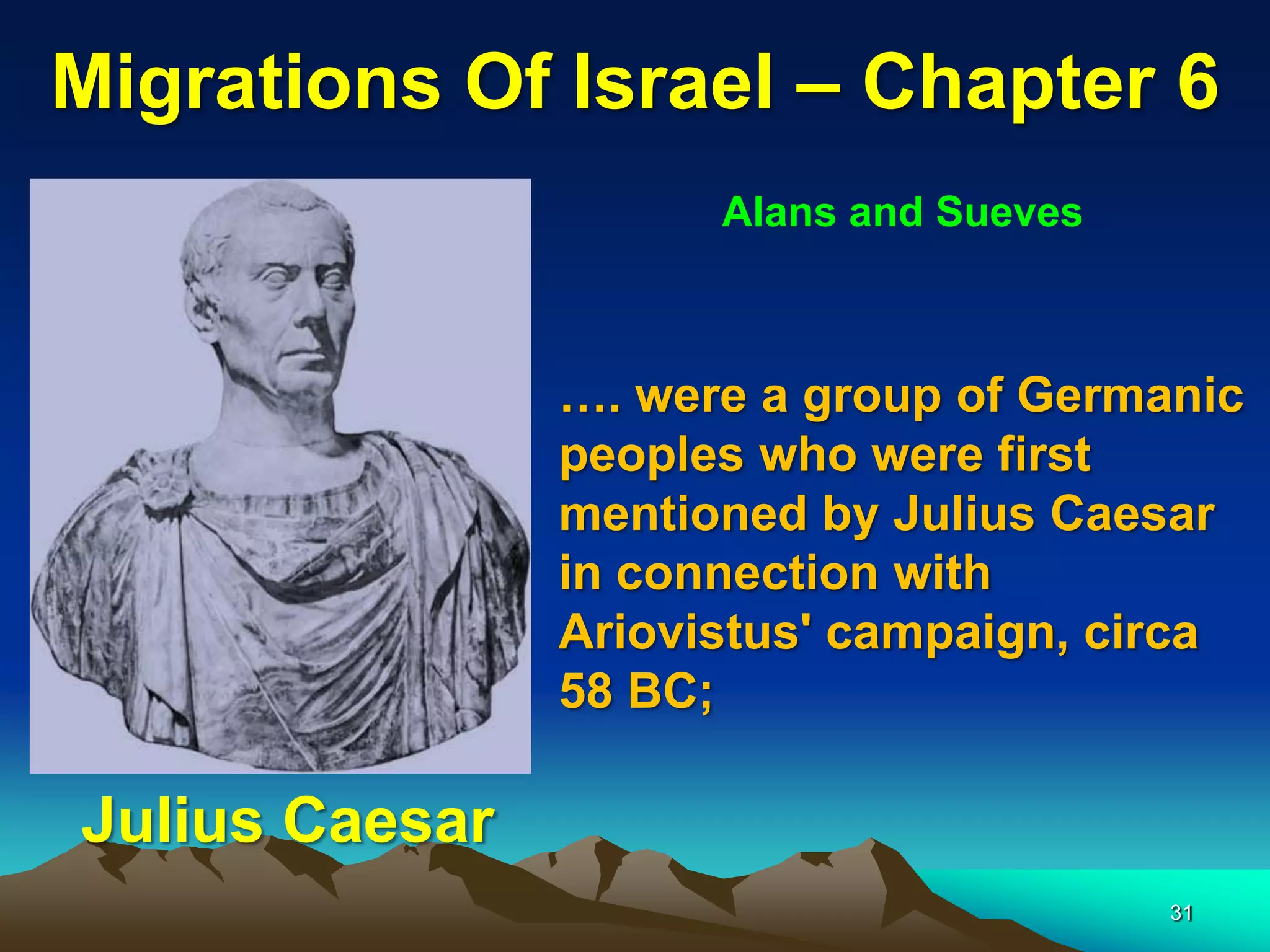
                …. were a group of Germanic
                peoples who were first
                mentioned by Julius Caesar
                in connection with
                Ariovistus' campaign, circa
                58 BC;

Julius Caesar
                                         31
Migrations Of Israel – Chapter 6
                     Alans and Sueves
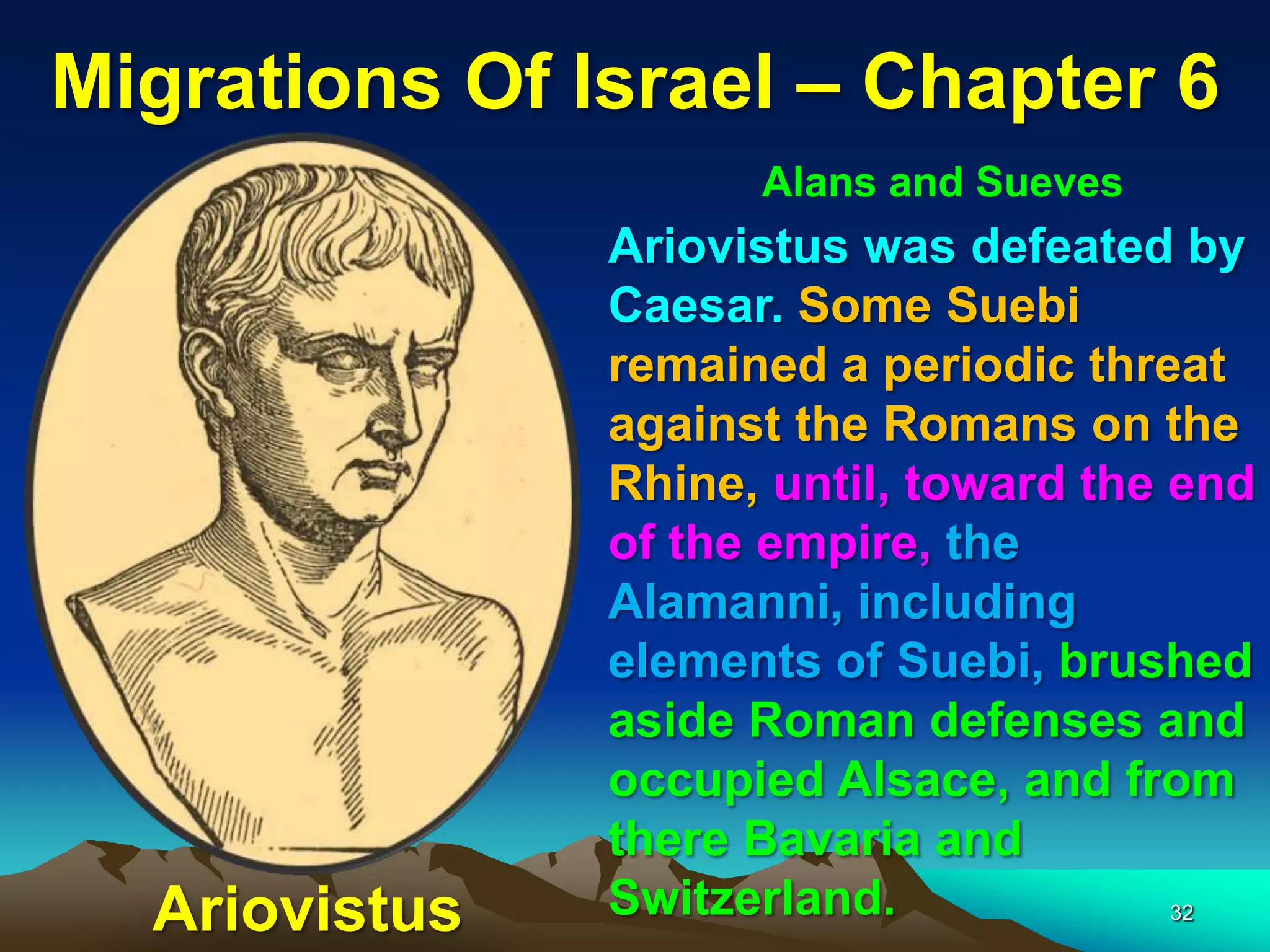
               Ariovistus was defeated by
               Caesar. Some Suebi
               remained a periodic threat
               against the Romans on the
               Rhine, until, toward the end
               of the empire, the
               Alamanni, including
               elements of Suebi, brushed
               aside Roman defenses and
               occupied Alsace, and from
               there Bavaria and
  Ariovistus   Switzerland.             32
Migrations Of Israel – Chapter 6
                    Suevi and Angli

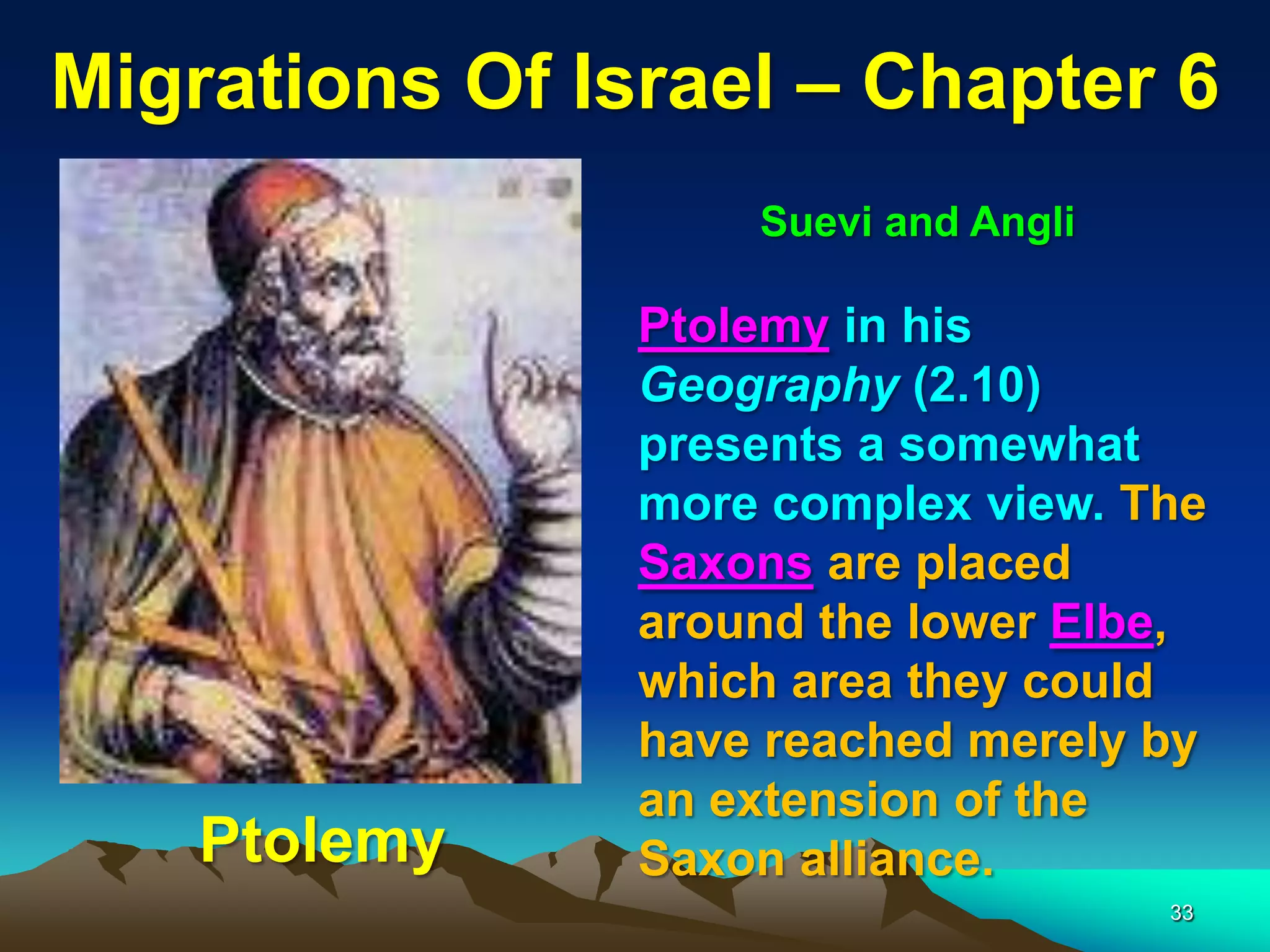
                Ptolemy in his
                Geography (2.10)
                presents a somewhat
                more complex view. The
                Saxons are placed
                around the lower Elbe,
                which area they could
                have reached merely by
                an extension of the
    Ptolemy     Saxon alliance.
                                      33
Migrations Of Israel – Chapter 6


                                    Suevi and Angli


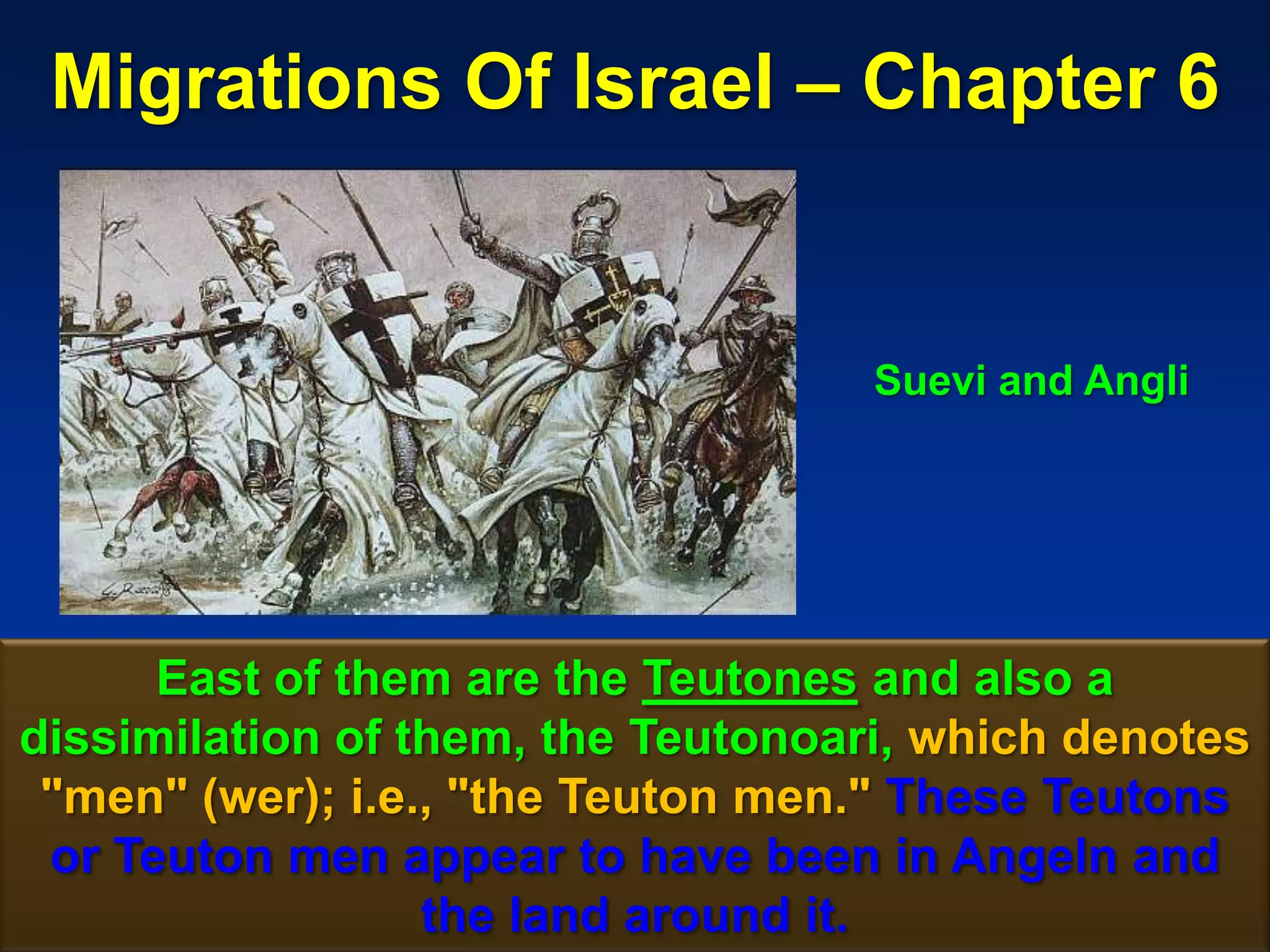
      East of them are the Teutones and also a
dissimilation of them, the Teutonoari, which denotes
 "men" (wer); i.e., "the Teuton men." These Teutons
 or Teuton men appear to have been in Angeln and
                  the land around it.            34
Migrations Of Israel – Chapter 6
     Suevi and Angli
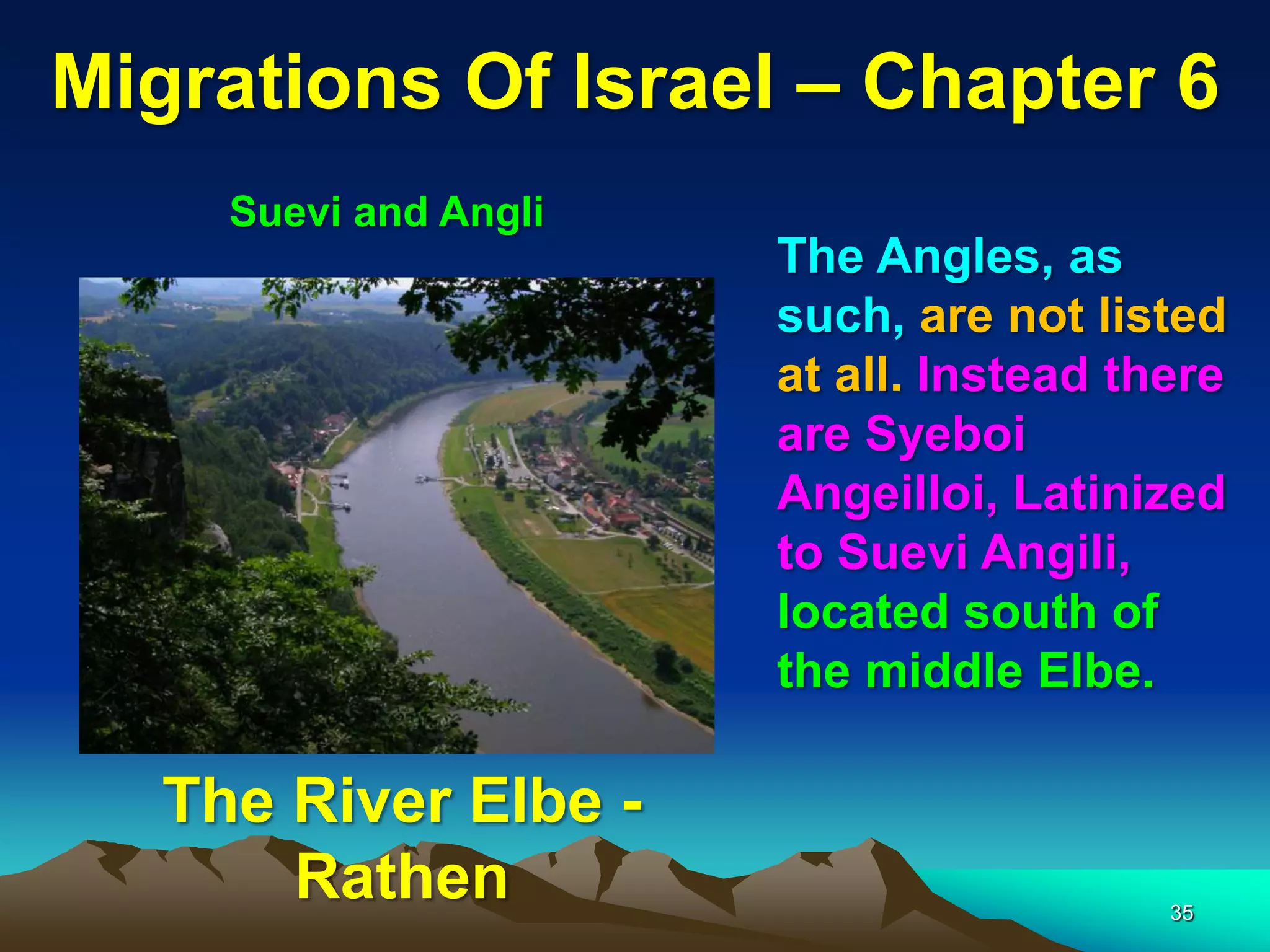
                       The Angles, as
                       such, are not listed
                       at all. Instead there
                       are Syeboi
                       Angeilloi, Latinized
                       to Suevi Angili,
                       located south of
                       the middle Elbe.

   The River Elbe -
       Rathen                            35
Migrations Of Israel – Chapter 6
   Suevi and Angli
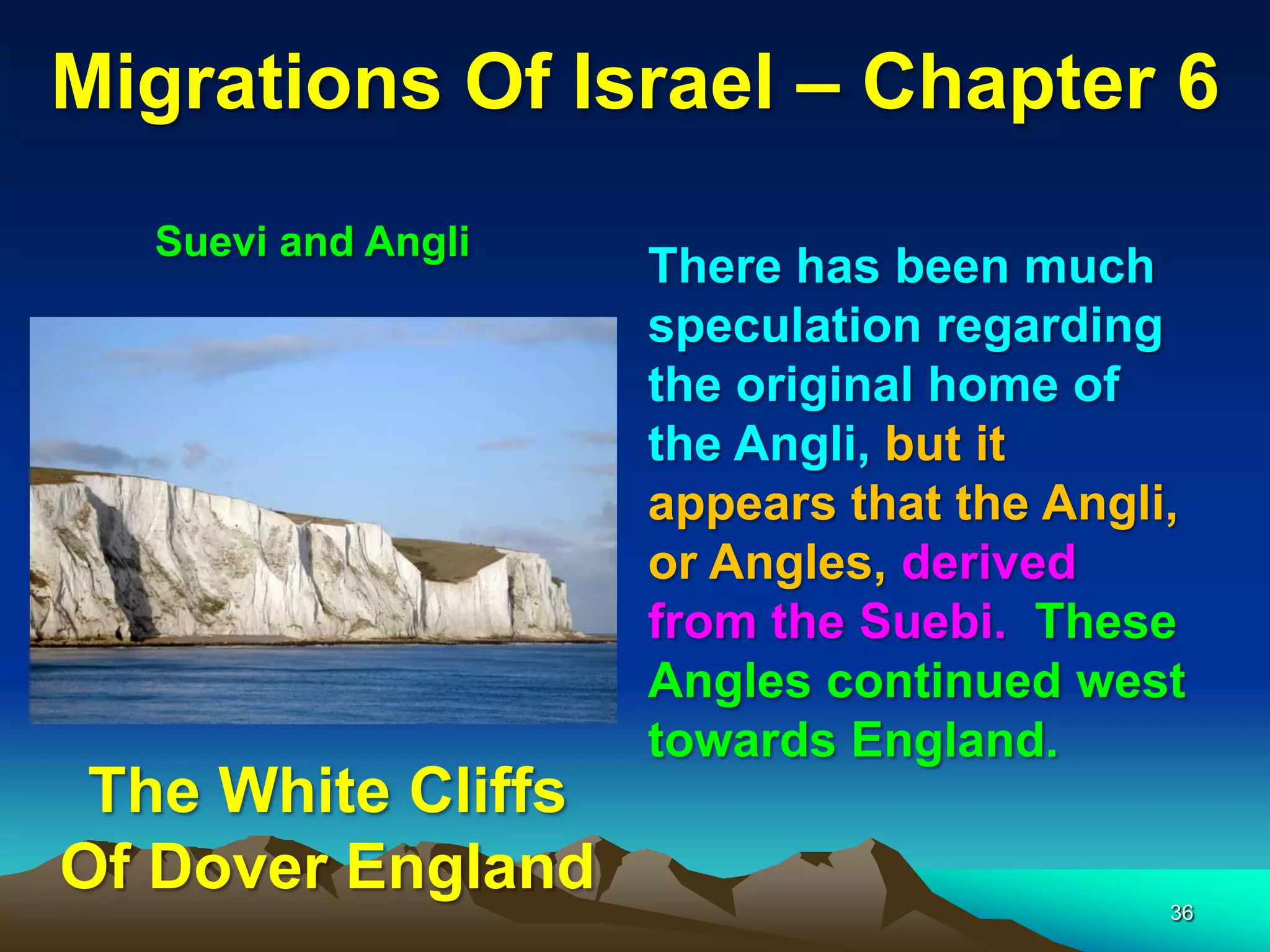
                     There has been much
                     speculation regarding
                     the original home of
                     the Angli, but it
                     appears that the Angli,
                     or Angles, derived
                     from the Suebi. These
                     Angles continued west
                     towards England.
 The White Cliffs
Of Dover England                           36
Migrations Of Israel – Chapter 6
                 Suevi and Alemanni

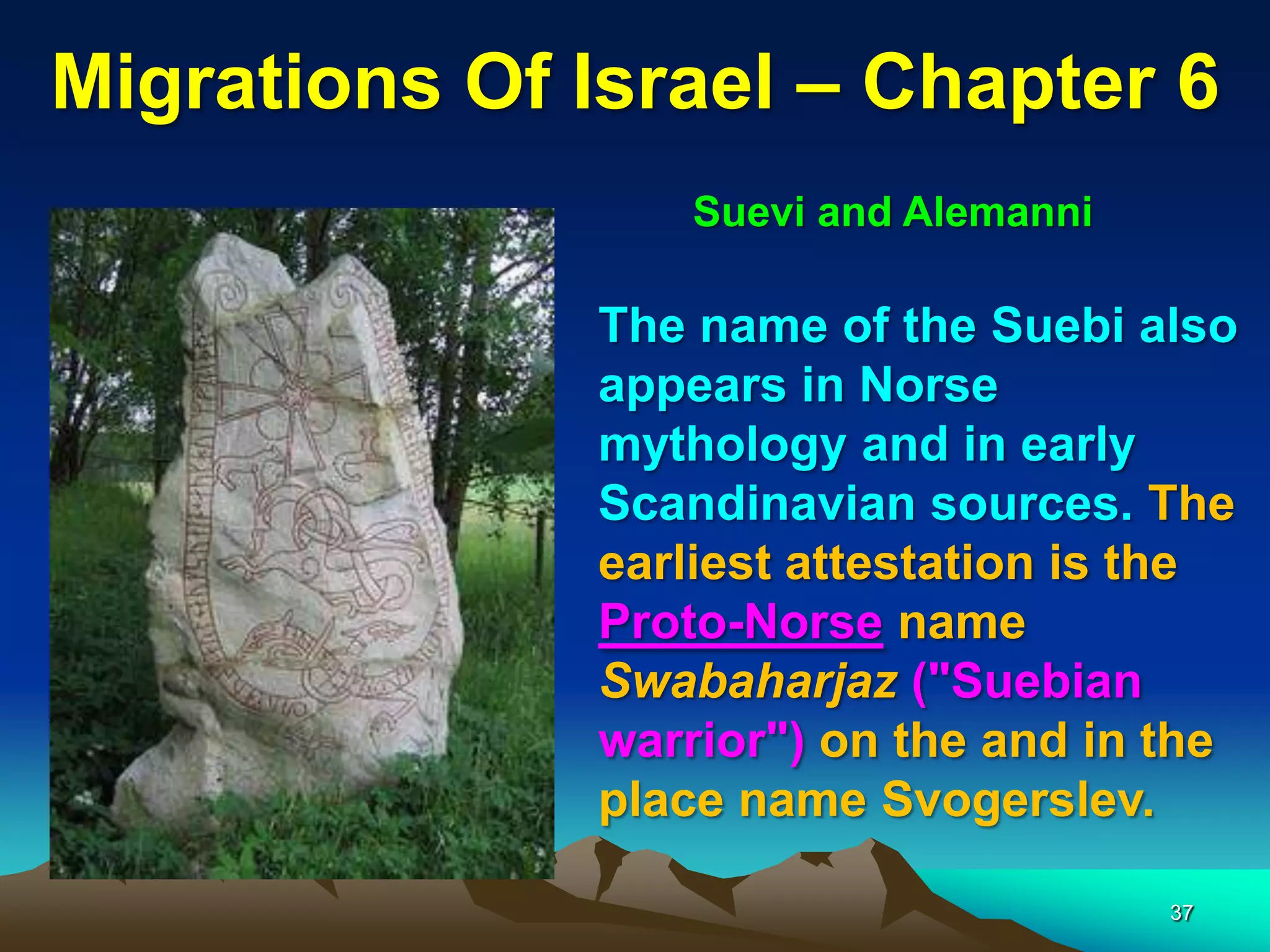
              The name of the Suebi also
              appears in Norse
              mythology and in early
              Scandinavian sources. The
              earliest attestation is the
              Proto-Norse name
              Swabaharjaz ("Suebian
              warrior") on the and in the
              place name Svogerslev.

                                      37
Migrations Of Israel – Chapter 6

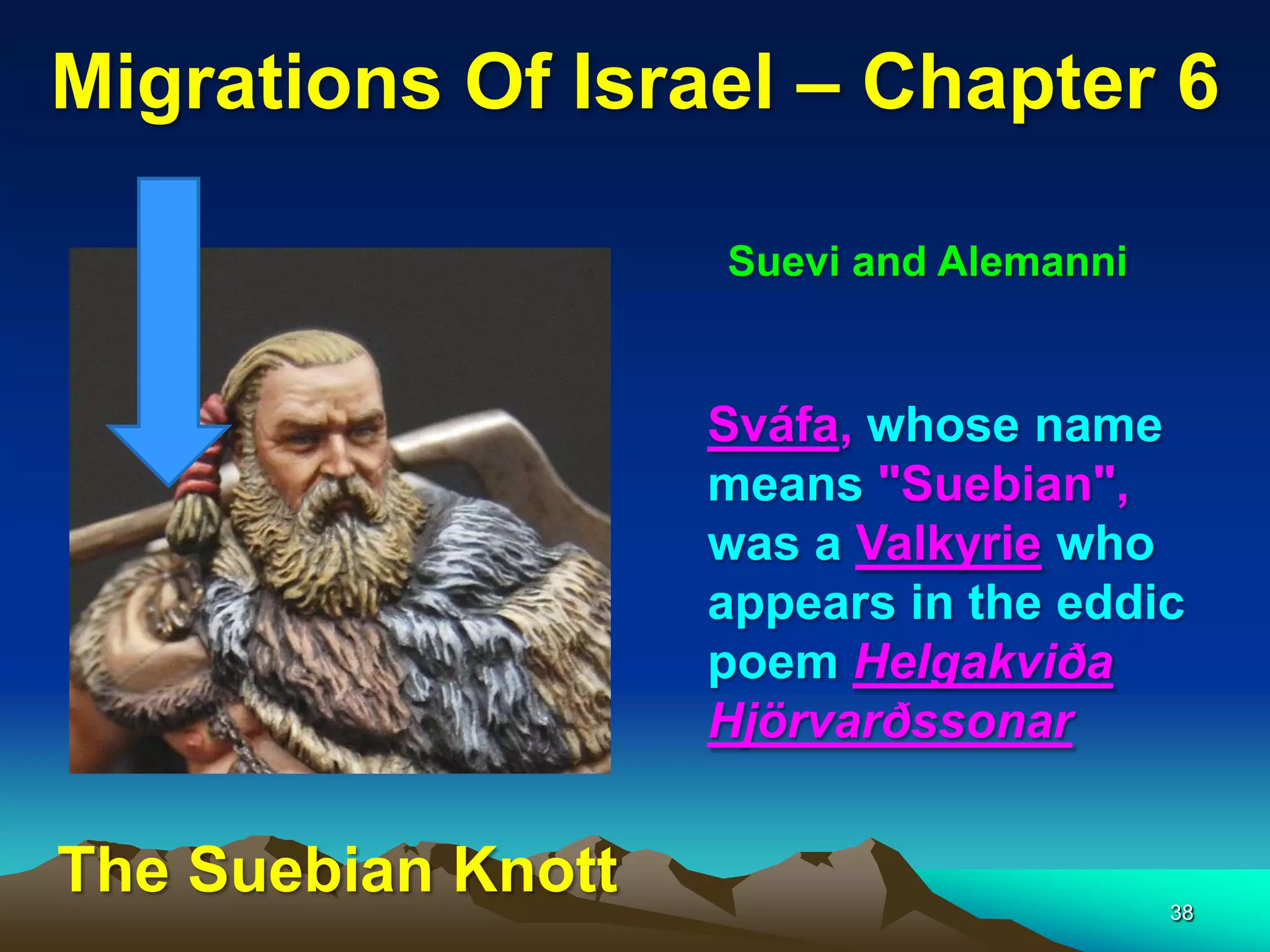
                    Suevi and Alemanni


                    Sváfa, whose name
                    means "Suebian",
                    was a Valkyrie who
                    appears in the eddic
                    poem Helgakviða
                    Hjörvarðssonar


The Suebian Knott                        38
Migrations Of Israel – Chapter 6
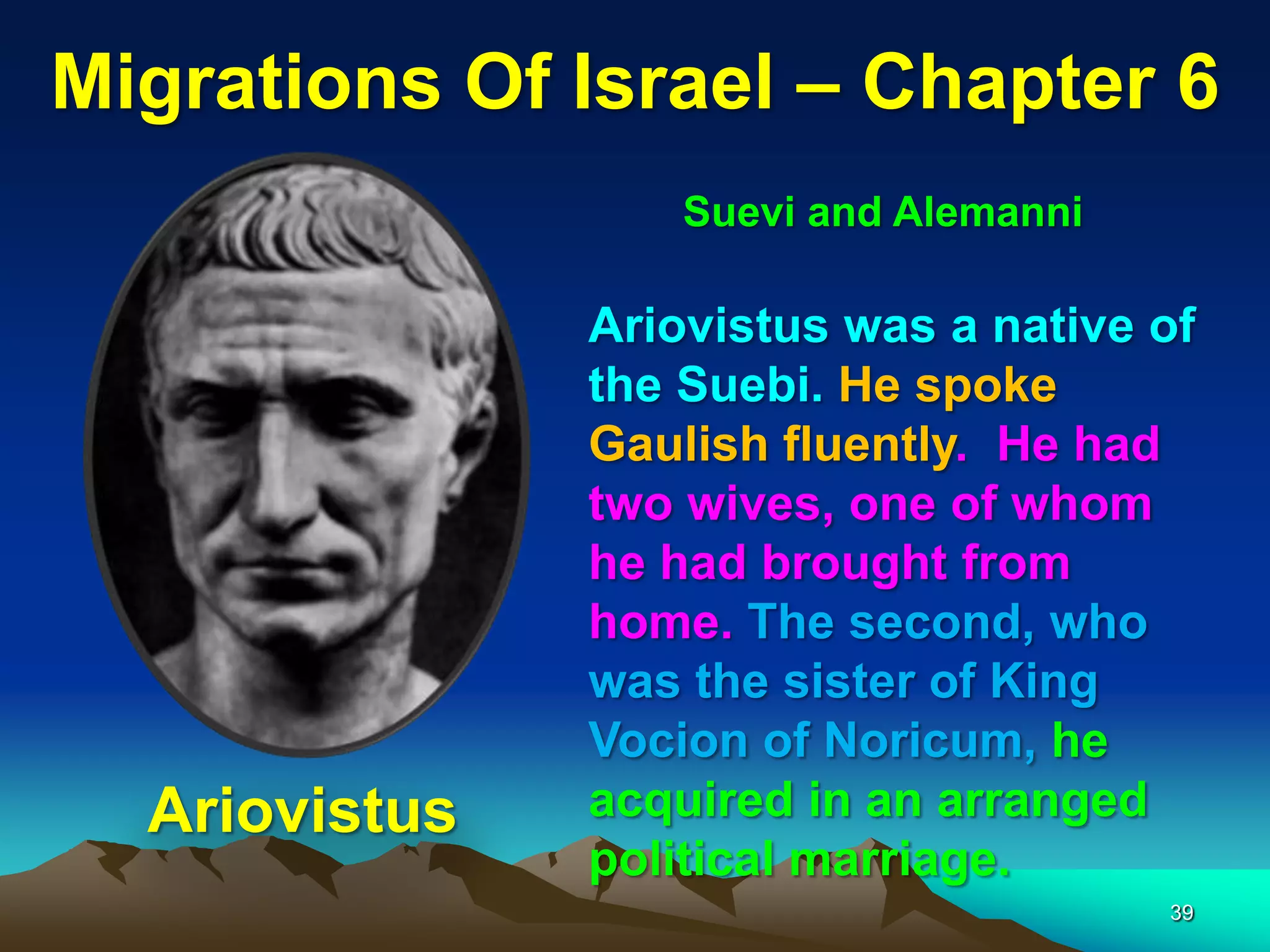
                   Suevi and Alemanni

               Ariovistus was a native of
               the Suebi. He spoke
               Gaulish fluently. He had
               two wives, one of whom
               he had brought from
               home. The second, who
               was the sister of King
               Vocion of Noricum, he
  Ariovistus   acquired in an arranged
               political marriage.
                                        39
Migrations Of Israel – Chapter 6
                   Suevi and Alemanni

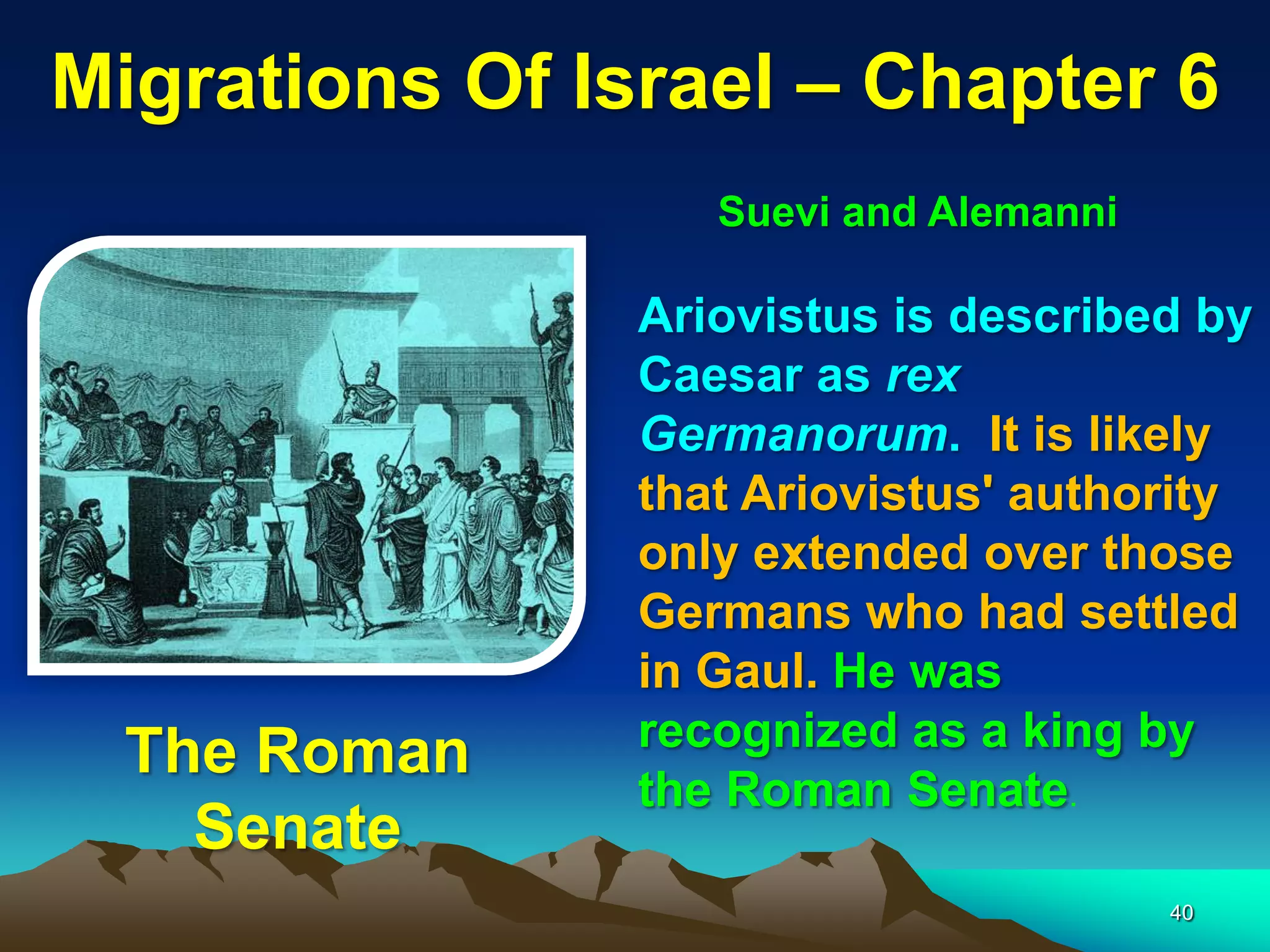
                Ariovistus is described by
                Caesar as rex
                Germanorum. It is likely
                that Ariovistus' authority
                only extended over those
                Germans who had settled
                in Gaul. He was
                recognized as a king by
  The Roman
                the Roman Senate.
    Senate
                                        40
Migrations Of Israel – Chapter 6
                         Suevi and Alemanni

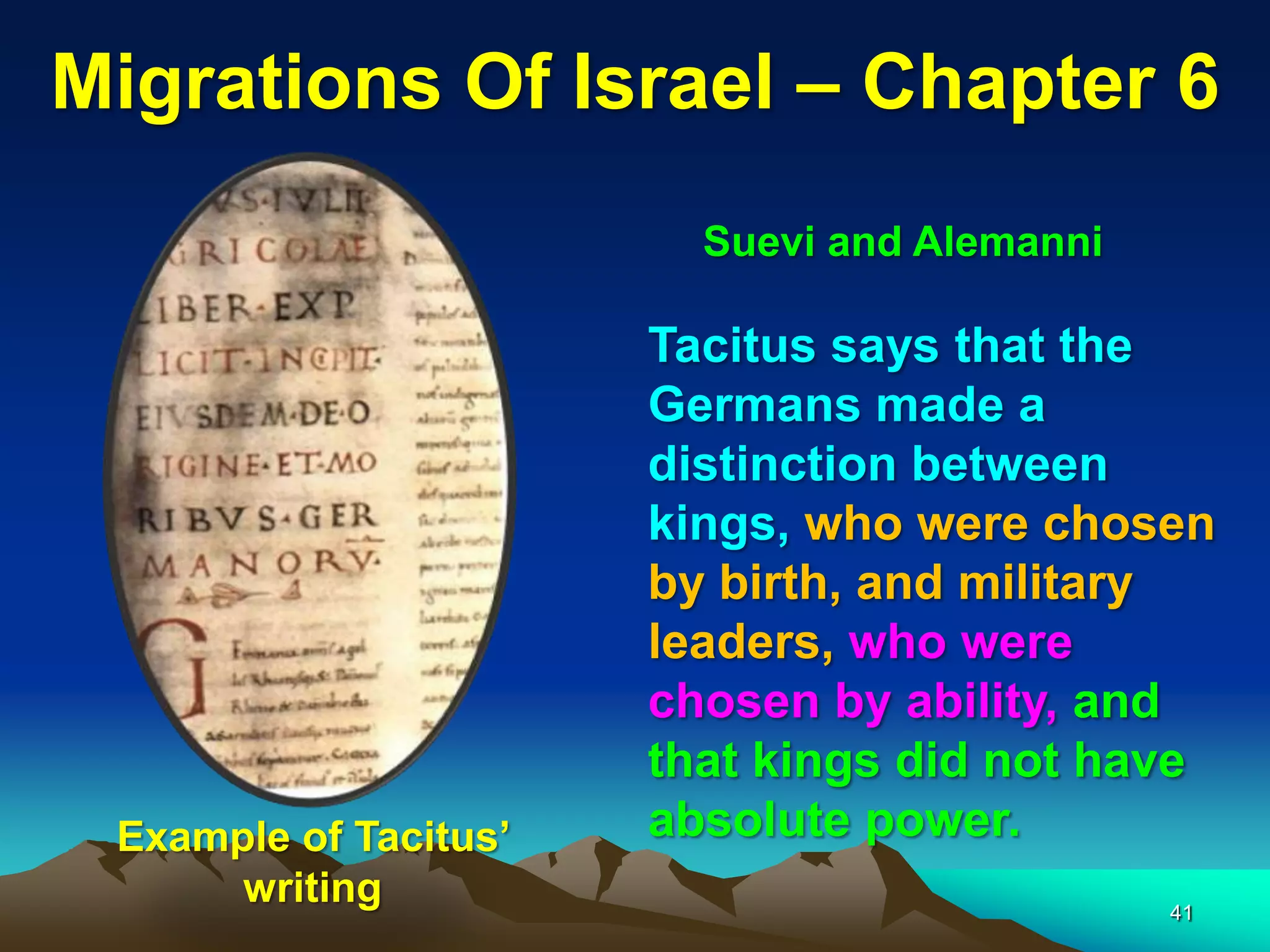
                       Tacitus says that the
                       Germans made a
                       distinction between
                       kings, who were chosen
                       by birth, and military
                       leaders, who were
                       chosen by ability, and
                       that kings did not have
 Example of Tacitus‟   absolute power.
      writing                                 41
Migrations Of Israel – Chapter 6
              Allemanni and Marcomanni


               The following slides
               are quotations form
               the book, TRACKING
               LADON GOG AND THE
               HEBREW ROSE, by
               John Anonymous
               Mythbuster


                                         42
Migrations Of Israel – Chapter 6
              Allemanni and Marcomanni


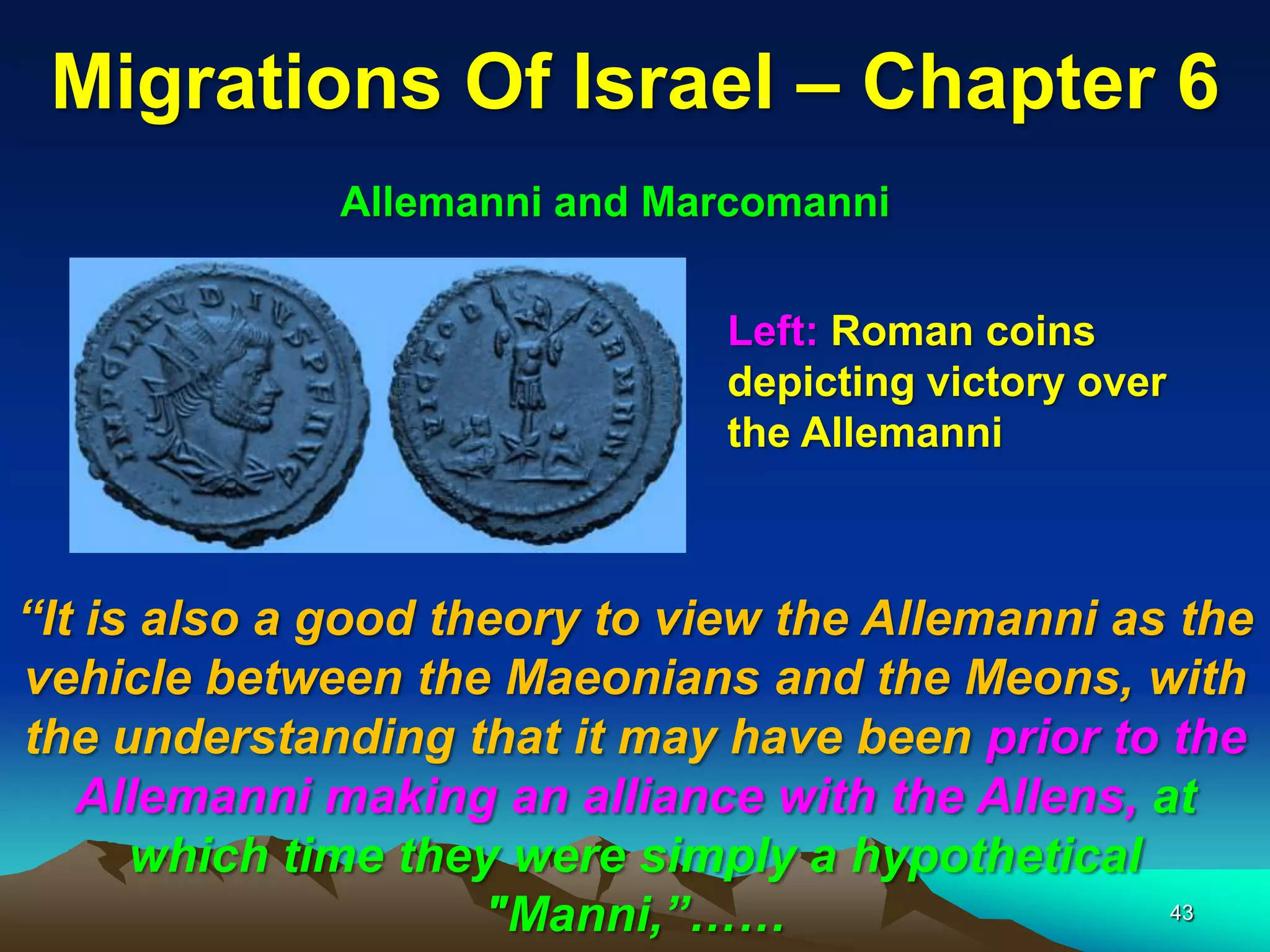
                               Left: Roman coins
                               depicting victory over
                               the Allemanni


“It is also a good theory to view the Allemanni as the
vehicle between the Maeonians and the Meons, with
the understanding that it may have been prior to the
   Allemanni making an alliance with the Allens, at
      which time they were simply a hypothetical
                     "Manni,”……                   43
Migrations Of Israel – Chapter 6
                          Allemanni and
                           Marcomanni

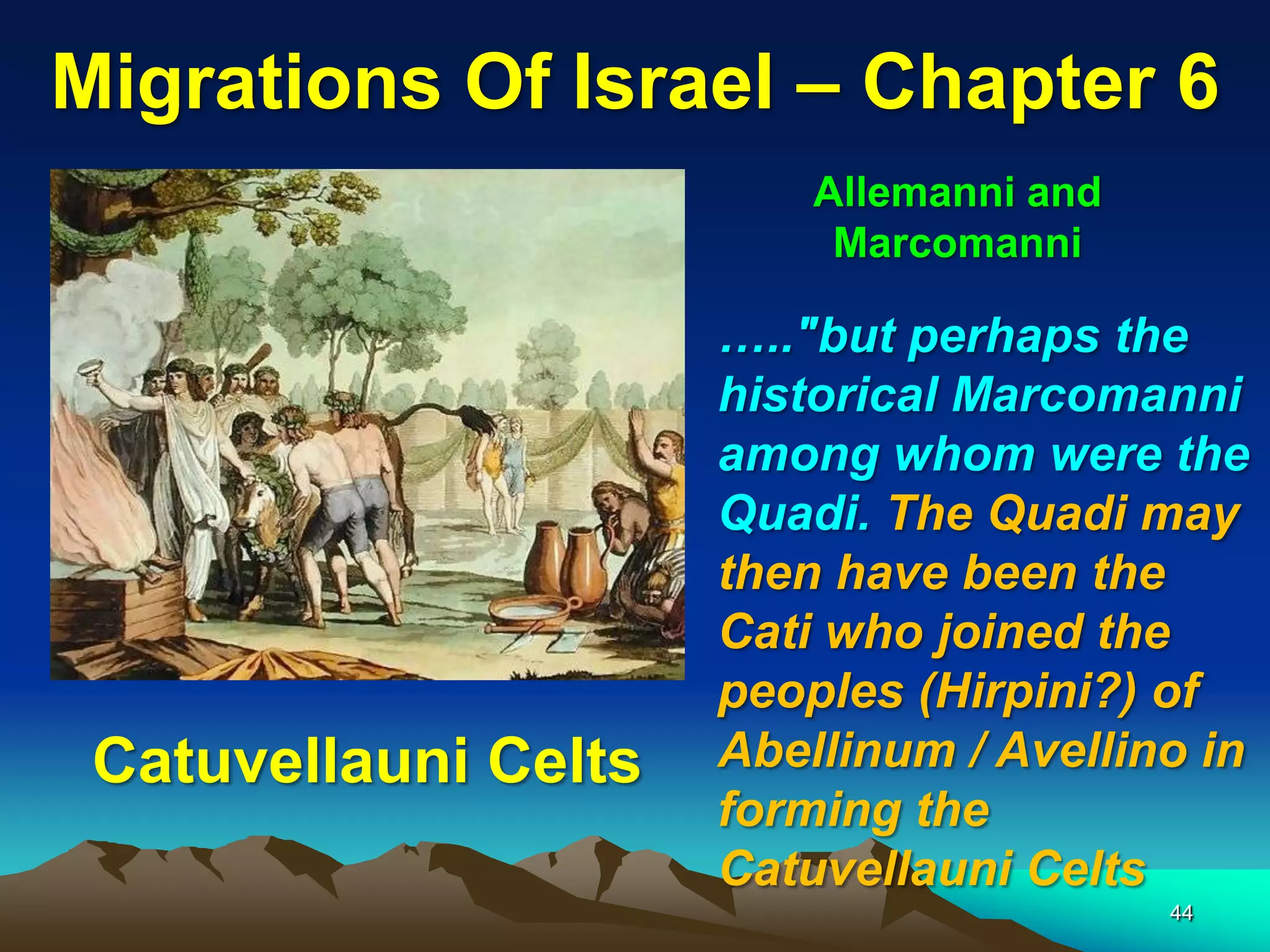
                      ….."but perhaps the
                      historical Marcomanni
                      among whom were the
                      Quadi. The Quadi may
                      then have been the
                      Cati who joined the
                      peoples (Hirpini?) of
 Catuvellauni Celts   Abellinum / Avellino in
                      forming the
                      Catuvellauni Celts
                                          44
Migrations Of Israel – Chapter 6
                      Allemanni and Marcomanni

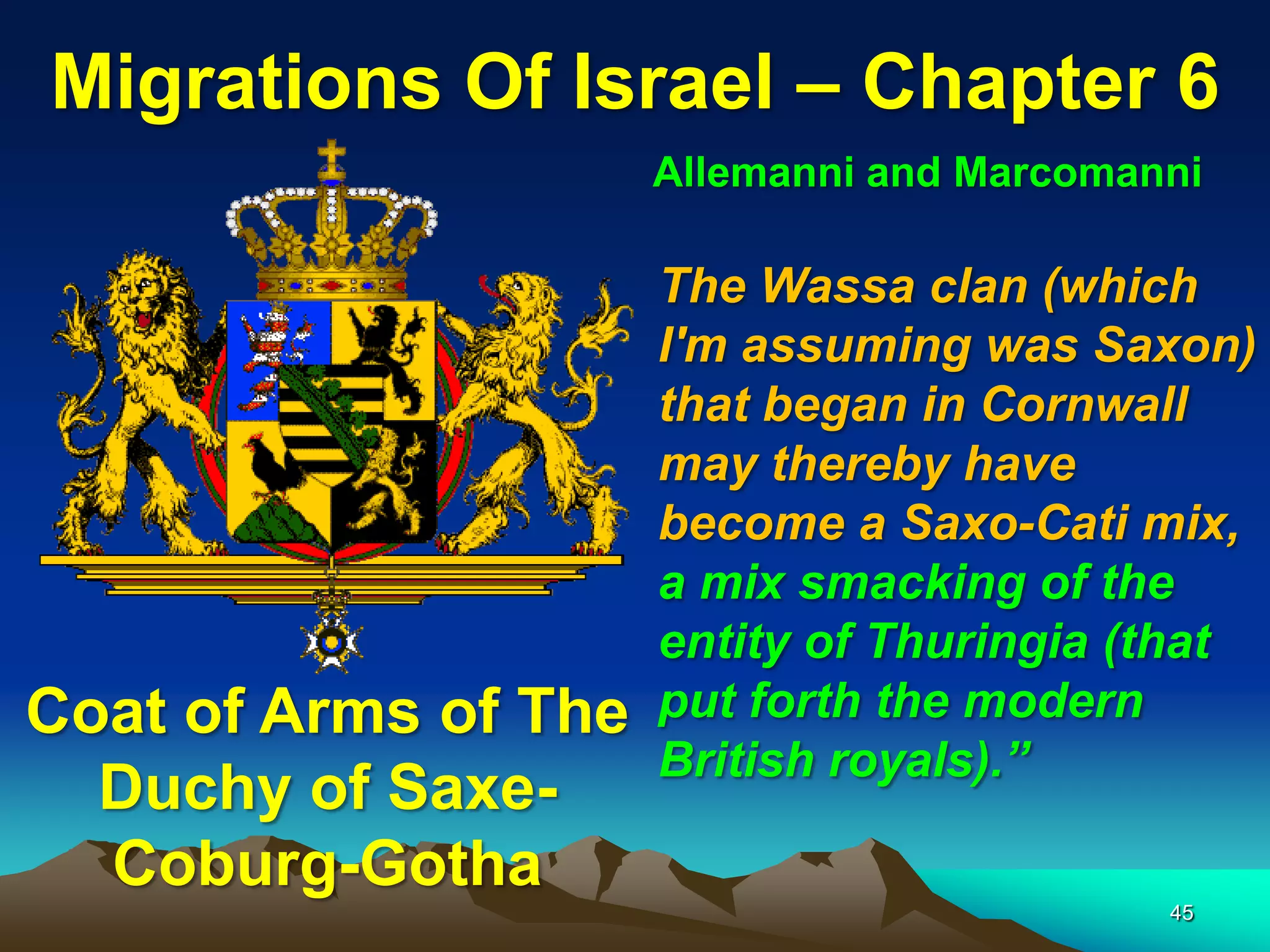
                      The Wassa clan (which
                      I'm assuming was Saxon)
                      that began in Cornwall
                      may thereby have
                      become a Saxo-Cati mix,
                      a mix smacking of the
                      entity of Thuringia (that
Coat of Arms of The   put forth the modern
                      British royals).”
  Duchy of Saxe-
  Coburg-Gotha
                                            45
Migrations Of Israel – Chapter 6
          Allemanni and Marcomanni


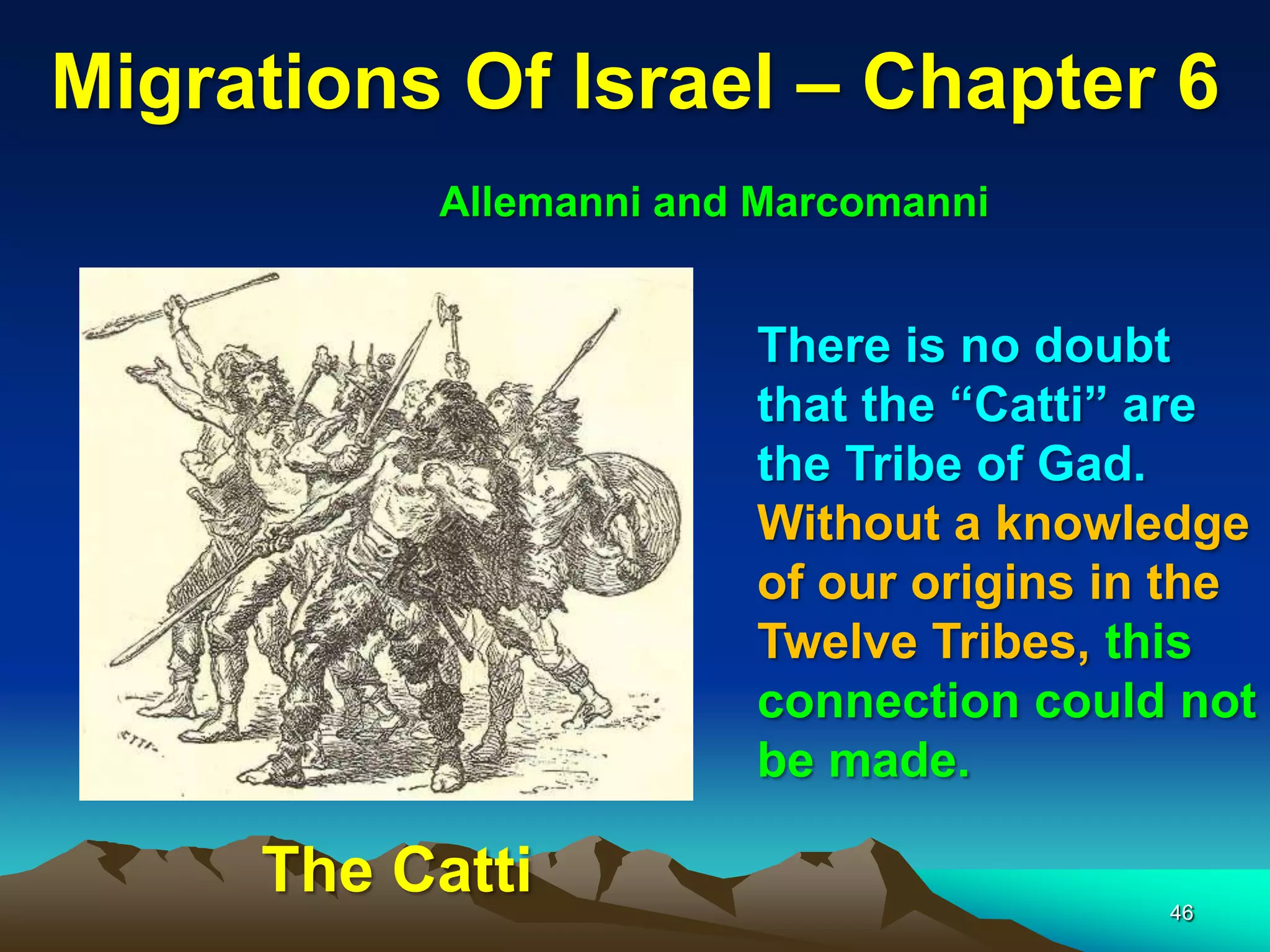
                       There is no doubt
                       that the “Catti” are
                       the Tribe of Gad.
                       Without a knowledge
                       of our origins in the
                       Twelve Tribes, this
                       connection could not
                       be made.

     The Catti                          46
Migrations Of Israel – Chapter 6
              Allemanni and Marcomanni

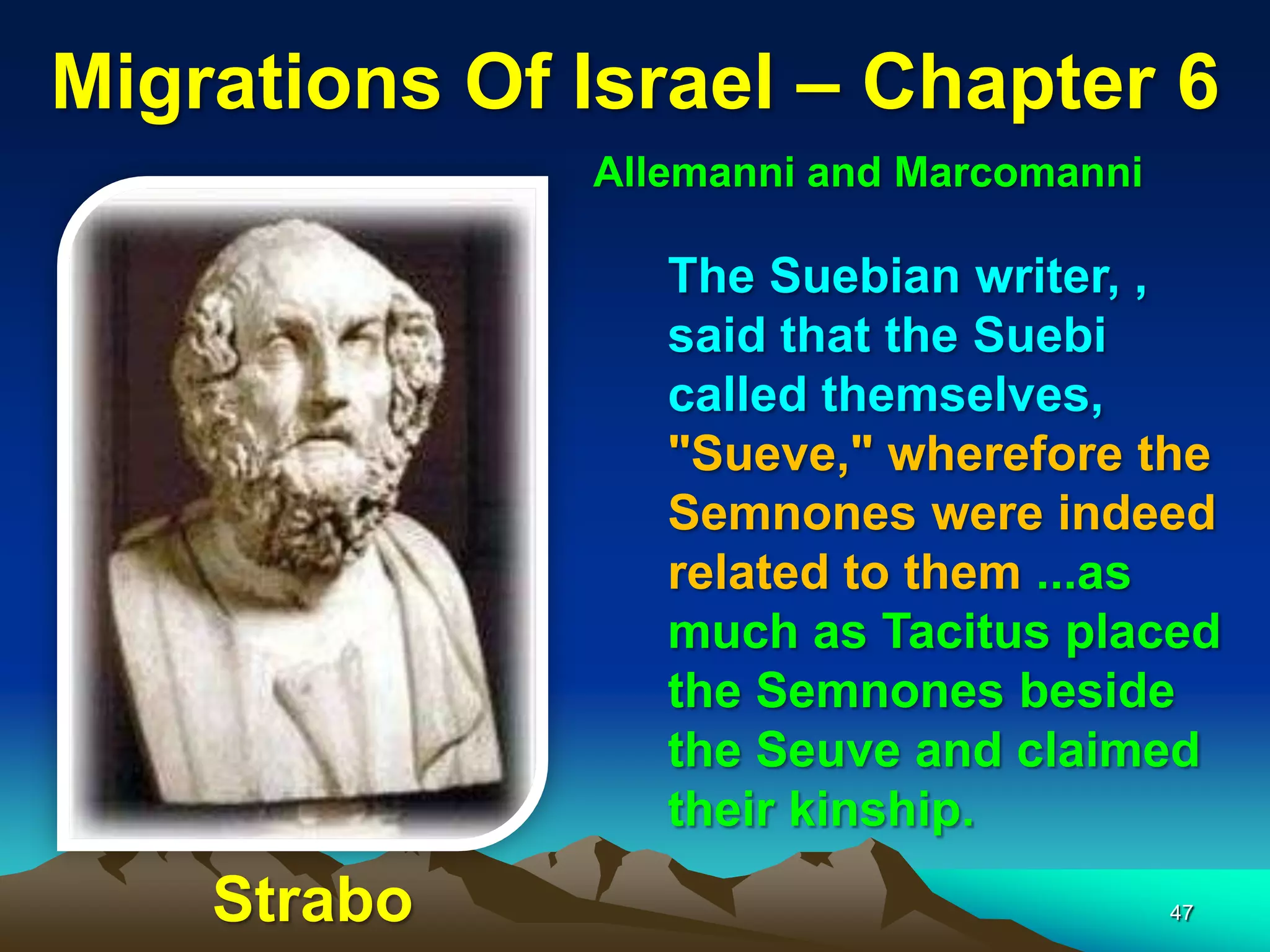
                 The Suebian writer, ,
                 said that the Suebi
                 called themselves,
                 "Sueve," wherefore the
                 Semnones were indeed
                 related to them ...as
                 much as Tacitus placed
                 the Semnones beside
                 the Seuve and claimed
                 their kinship.
    Strabo                               47
Migrations Of Israel – Chapter 6
Allemanni and Marcomanni
                           To show that we are
                           dealing with a Molech-
                           like cult, Tacitus wrote:
                           "There by publicly
                           sacrificing a man, [the
                           Semnones] begin the
                           horrible solemnity of
                           their barbarous
                           worship." It is said that
                           the Allemanni moved
                           into and/or founded.
 Castle-in-Alsace-
      France                                     48
Migrations Of Israel – Chapter 6
                Allemanni and Marcomanni

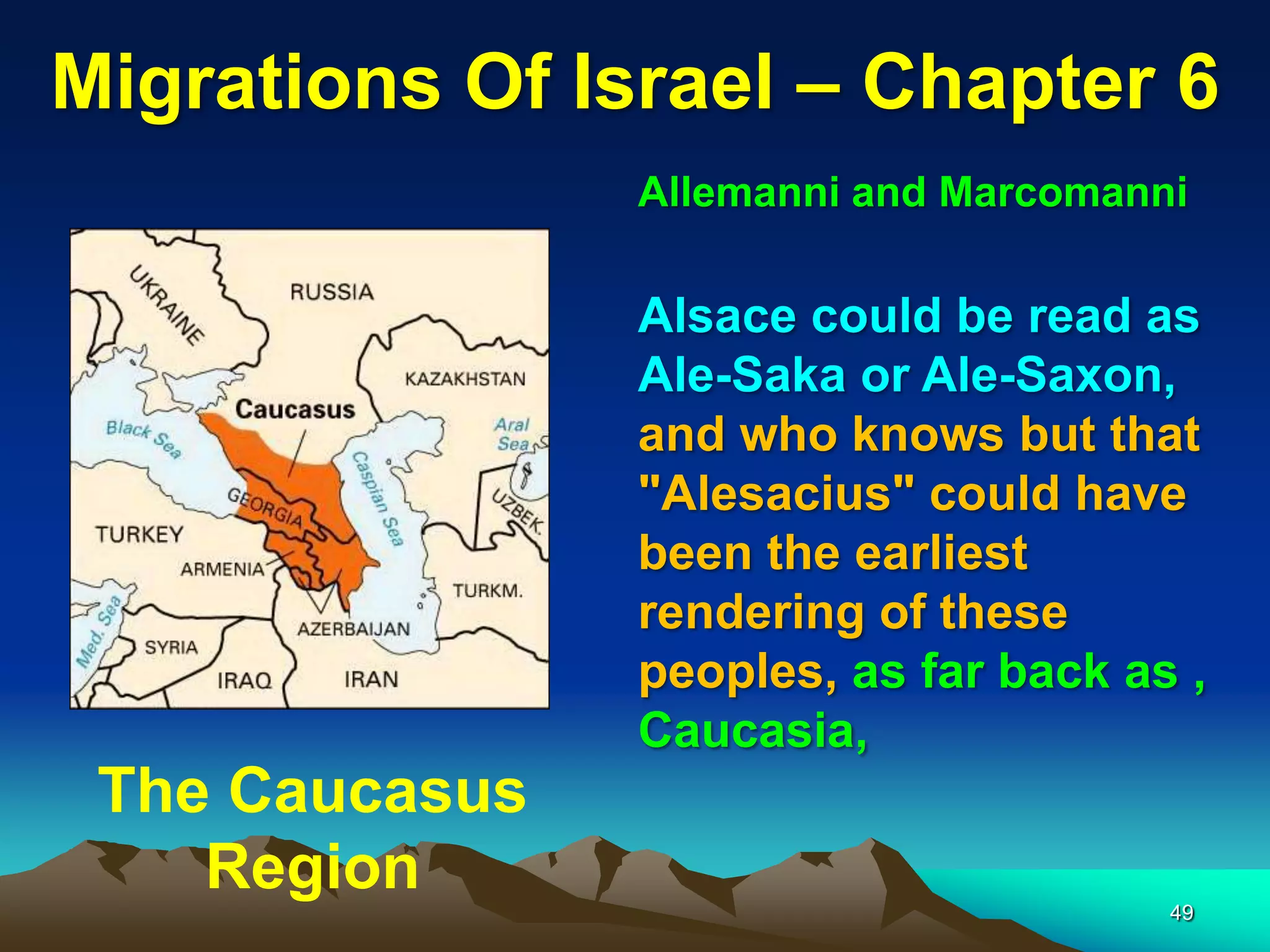
                Alsace could be read as
                Ale-Saka or Ale-Saxon,
                and who knows but that
                "Alesacius" could have
                been the earliest
                rendering of these
                peoples, as far back as ,
                Caucasia,
 The Caucasus
    Region                             49
Migrations Of Israel – Chapter 6
      Allemanni and Marcomanni

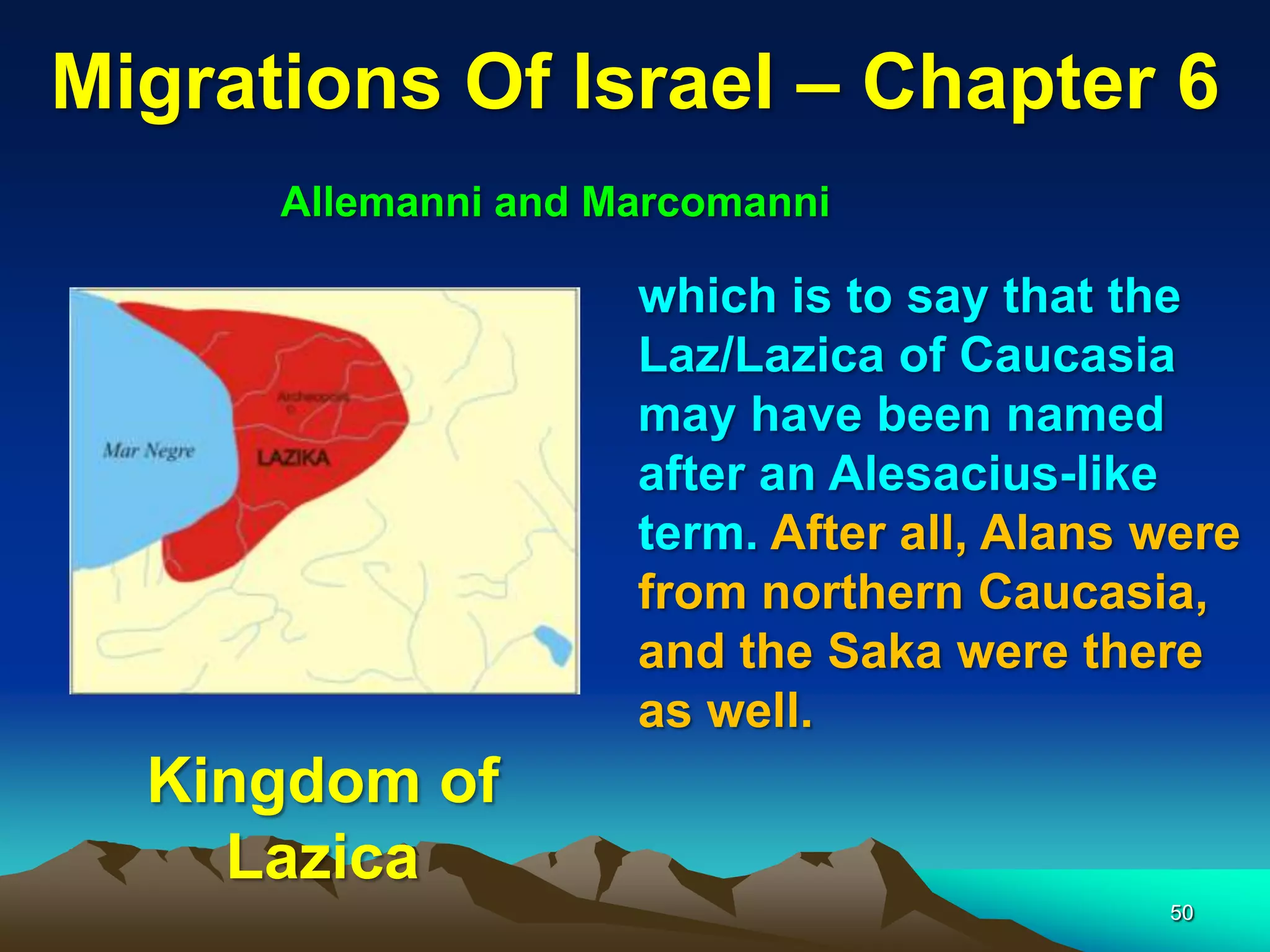
                     which is to say that the
                     Laz/Lazica of Caucasia
                     may have been named
                     after an Alesacius-like
                     term. After all, Alans were
                     from northern Caucasia,
                     and the Saka were there
                     as well.
  Kingdom of
    Lazica
                                            50
Migrations Of Israel – Chapter 6


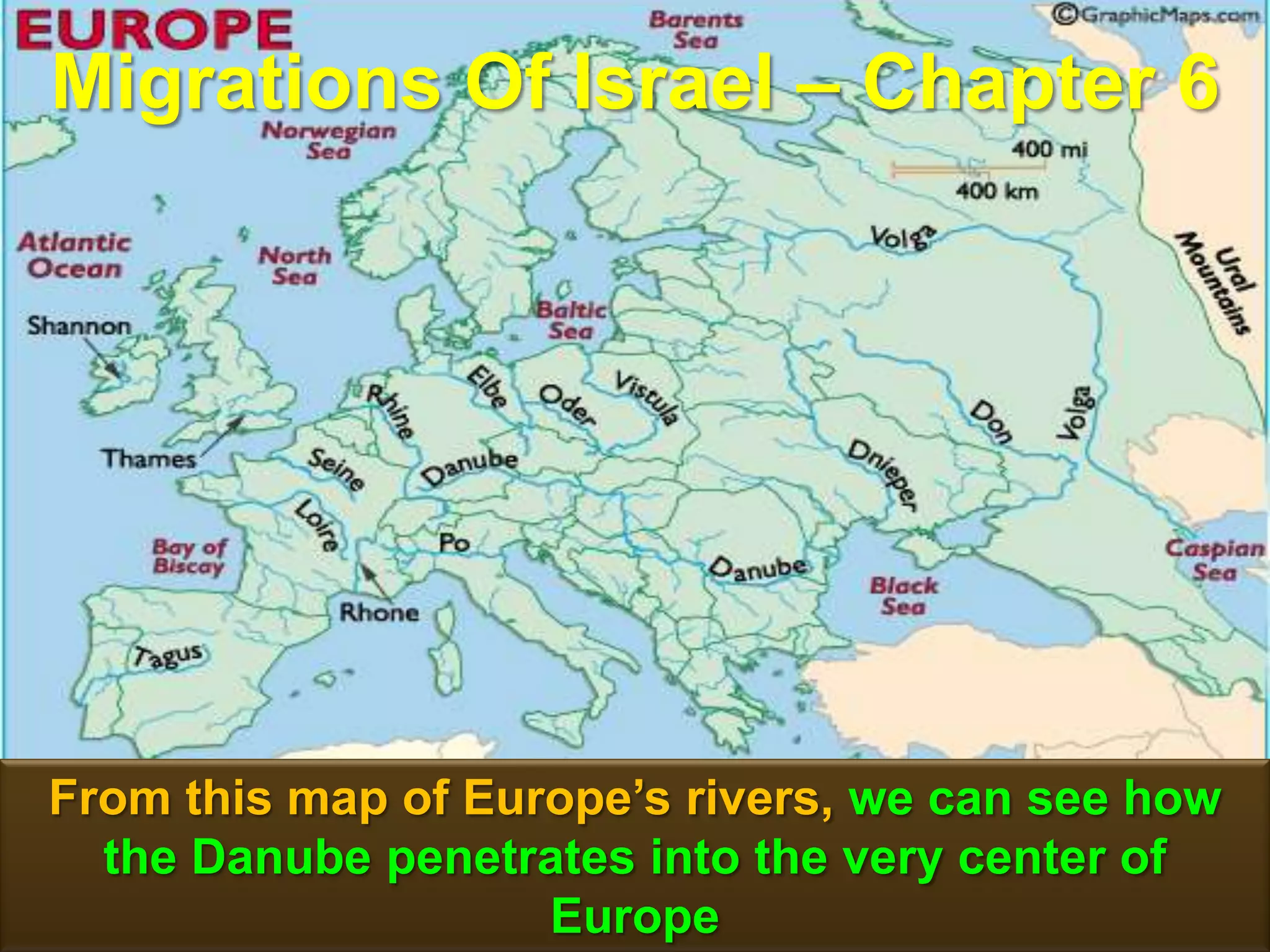
From this map of Europe‟s rivers, we can see how
  the Danube penetrates into the very center of
                    Europe                      51
Migrations Of Israel – Chapter 6


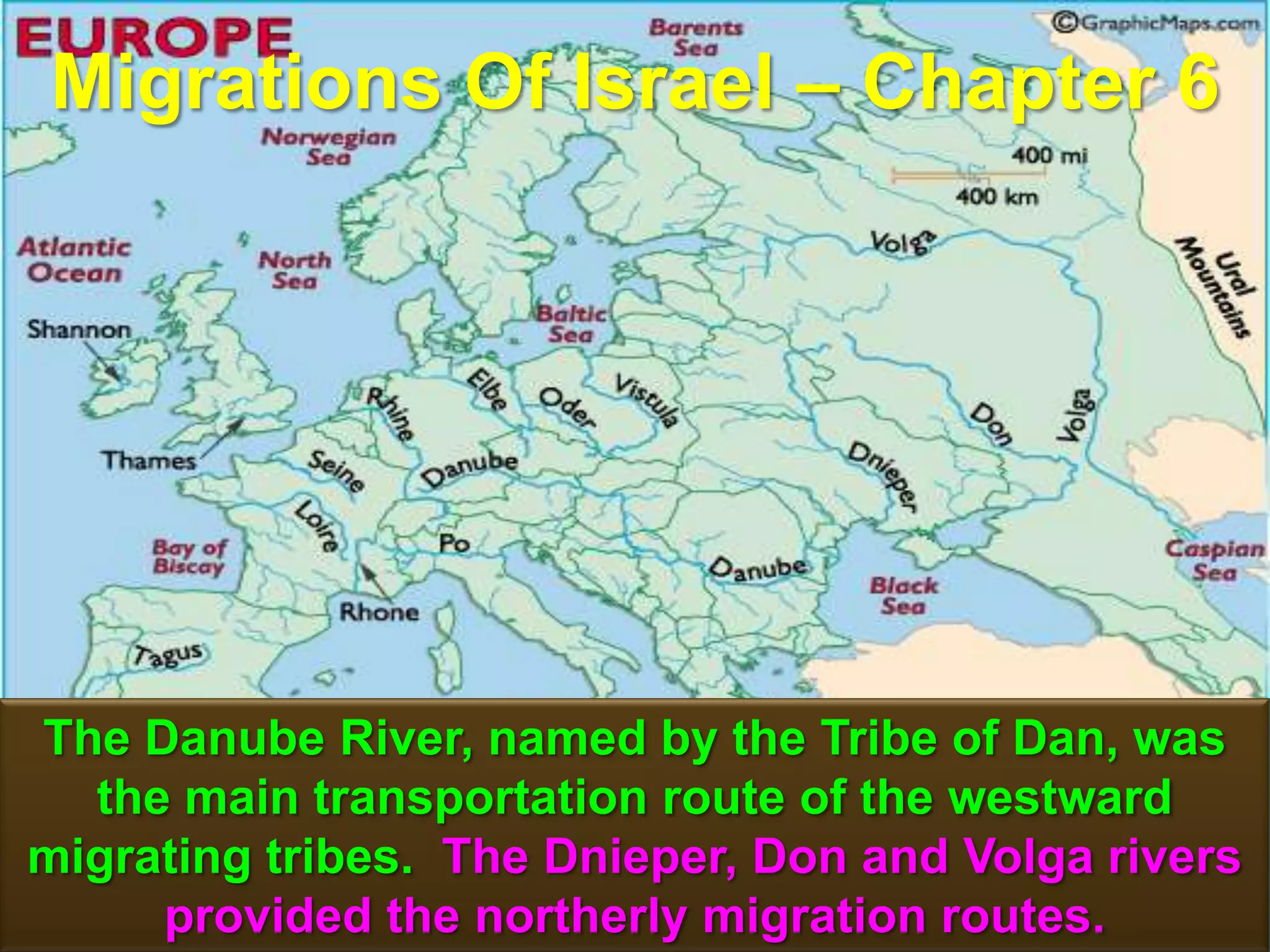
The Danube River, named by the Tribe of Dan, was
  the main transportation route of the westward
migrating tribes. The Dnieper, Don and Volga rivers
     provided the northerly migration routes. 52
Migrations Of Israel – Chapter 6
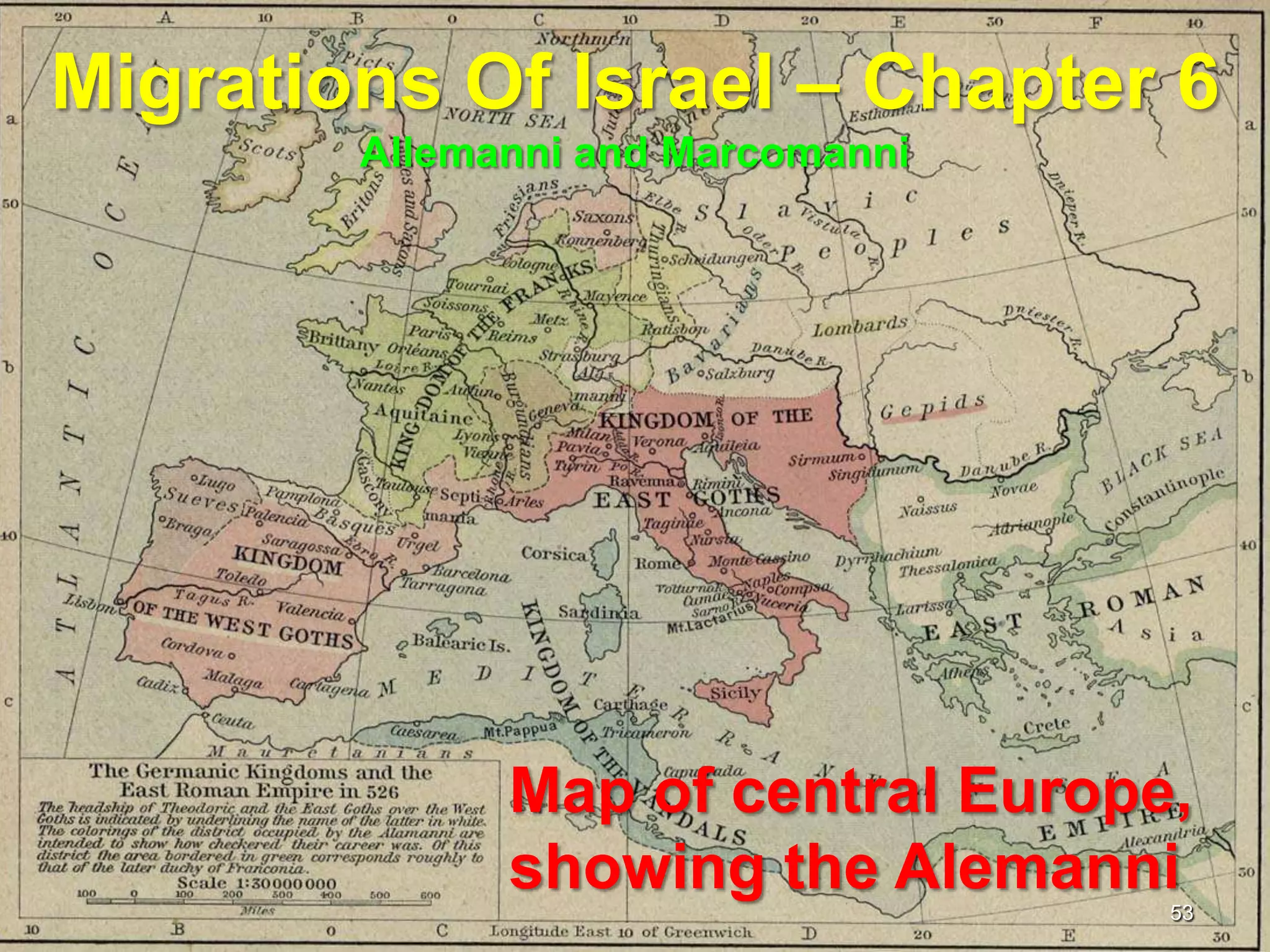
        Allemanni and Marcomanni


              Map of central Europe,
              showing the Alemanni 53
Migrations Of Israel – Chapter 6
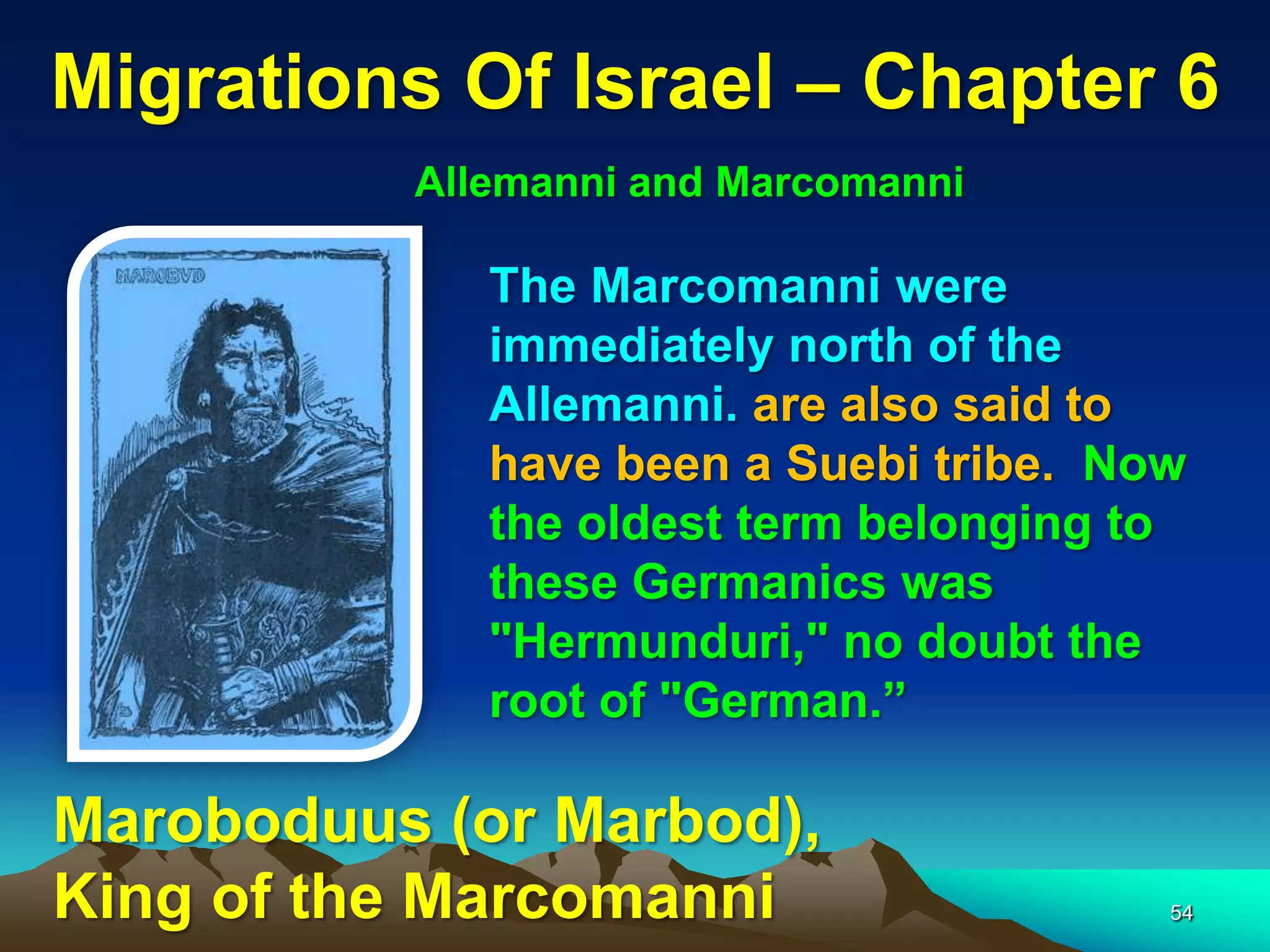
          Allemanni and Marcomanni

             The Marcomanni were
             immediately north of the
             Allemanni. are also said to
             have been a Suebi tribe. Now
             the oldest term belonging to
             these Germanics was
             "Hermunduri," no doubt the
             root of "German.”

Maroboduus (or Marbod),
King of the Marcomanni                  54
Migrations Of Israel – Chapter 6
           Allemanni and Marcomanni

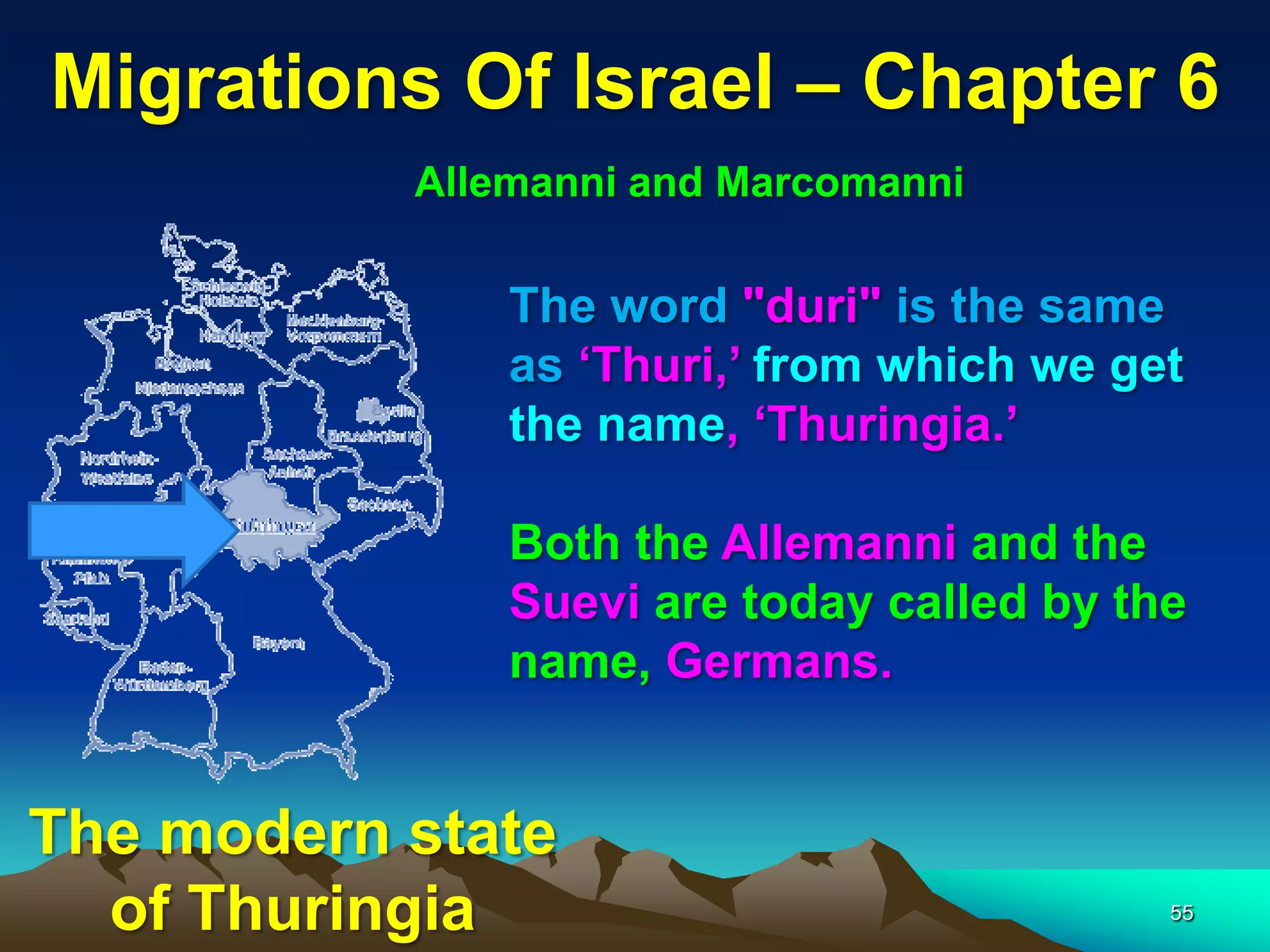
               The word "duri" is the same
               as „Thuri,‟ from which we get
               the name, „Thuringia.‟

               Both the Allemanni and the
               Suevi are today called by the
               name, Germans.


The modern state
  of Thuringia                             55
Migrations Of Israel – Chapter 6
          The Invasion of the Huns

             Frederick Haberman:

             “For a century the Roman
             Empire stood against the
             Gothic invasion, the reason
             being that Christianity was
             spreading rapidly at that time in
             southern Europe. Wulfila
             spread from Constantinople,
             where he translated the Bible
             into Gothic. …..
                                          56
Migrations Of Israel – Chapter 6
           The Invasion of the Huns


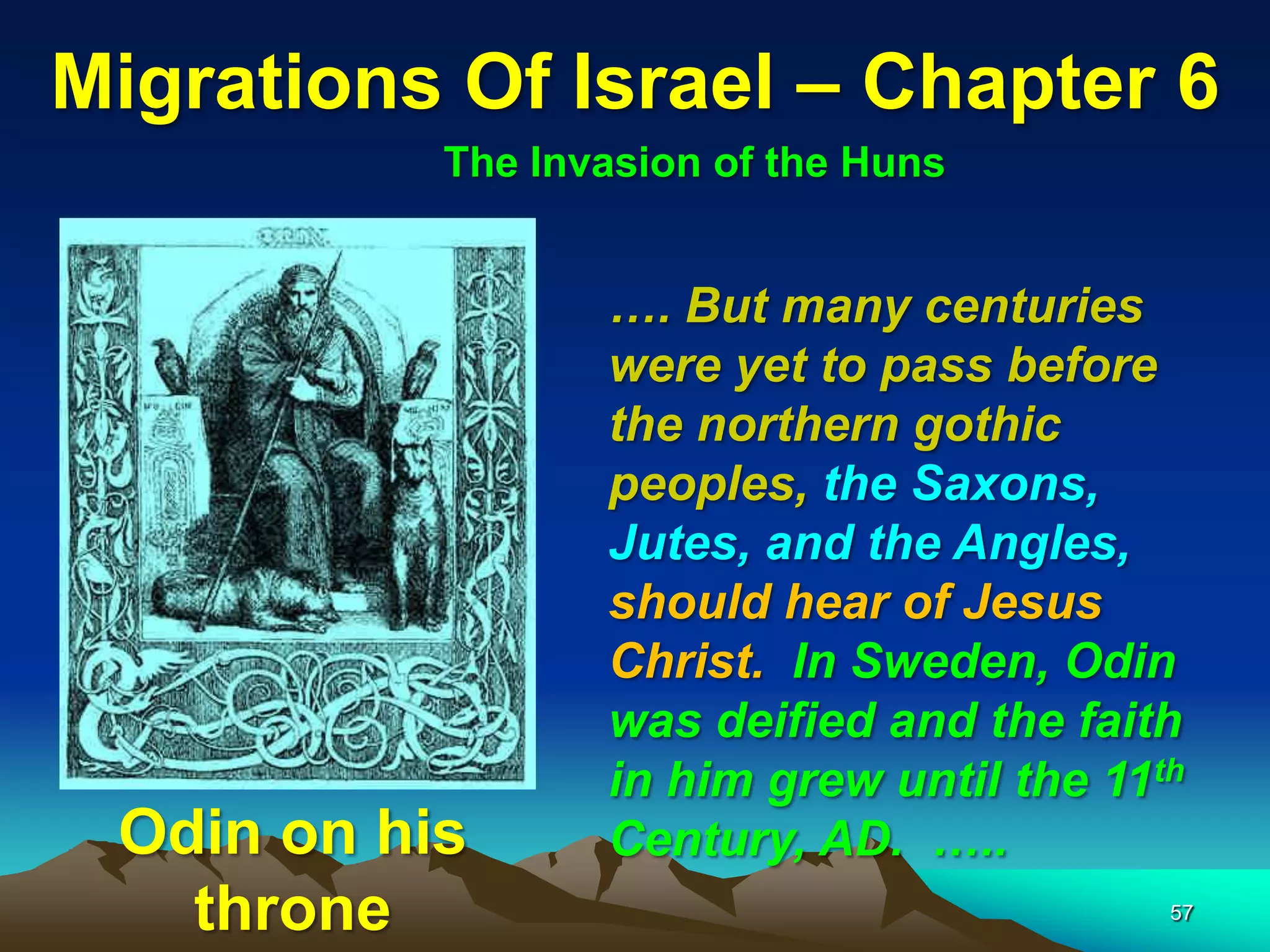
                  …. But many centuries
                  were yet to pass before
                  the northern gothic
                  peoples, the Saxons,
                  Jutes, and the Angles,
                  should hear of Jesus
                  Christ. In Sweden, Odin
                  was deified and the faith
                  in him grew until the 11th
 Odin on his      Century, AD. …..
   throne                                  57
Migrations Of Israel – Chapter 6
               The Invasion of the Huns


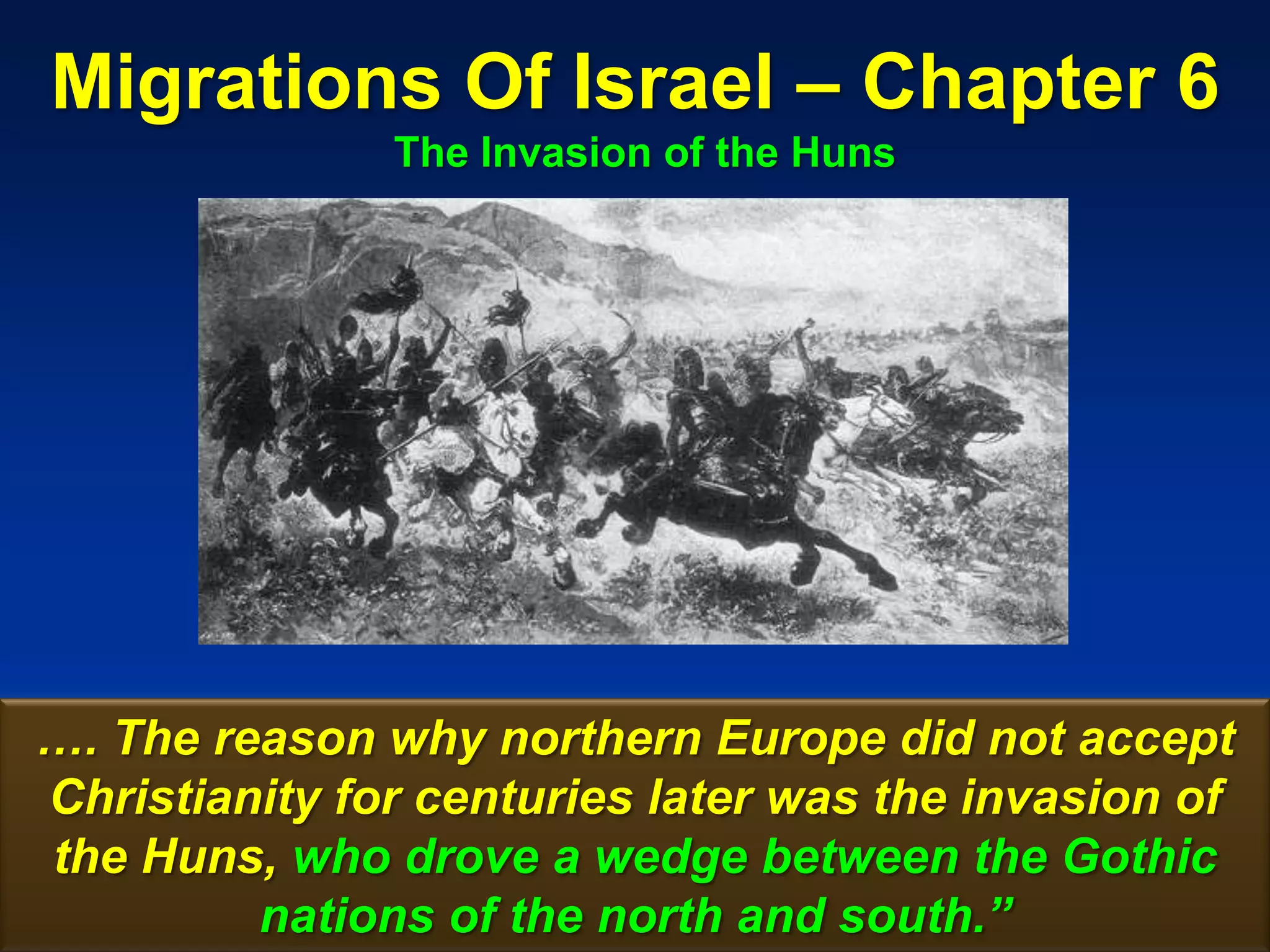
…. The reason why northern Europe did not accept
Christianity for centuries later was the invasion of
the Huns, who drove a wedge between the Gothic
         nations of the north and south.”         58
Migrations Of Israel – Chapter 6
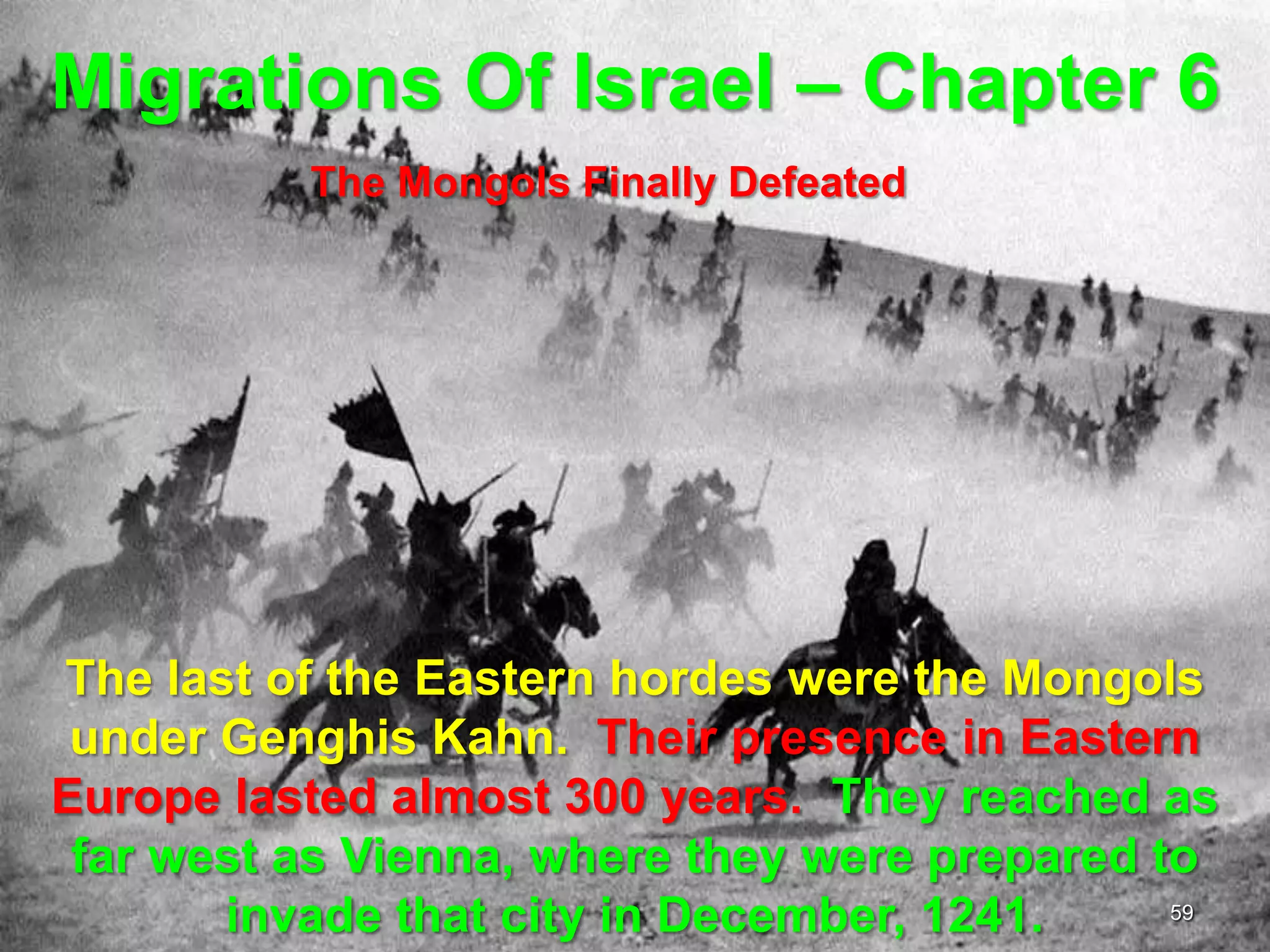
          The Mongols Finally Defeated


The last of the Eastern hordes were the Mongols
 under Genghis Kahn. Their presence in Eastern
Europe lasted almost 300 years. They reached as
 far west as Vienna, where they were prepared to
       invade that city in December, 1241.     59
Migrations Of Israel – Chapter 6
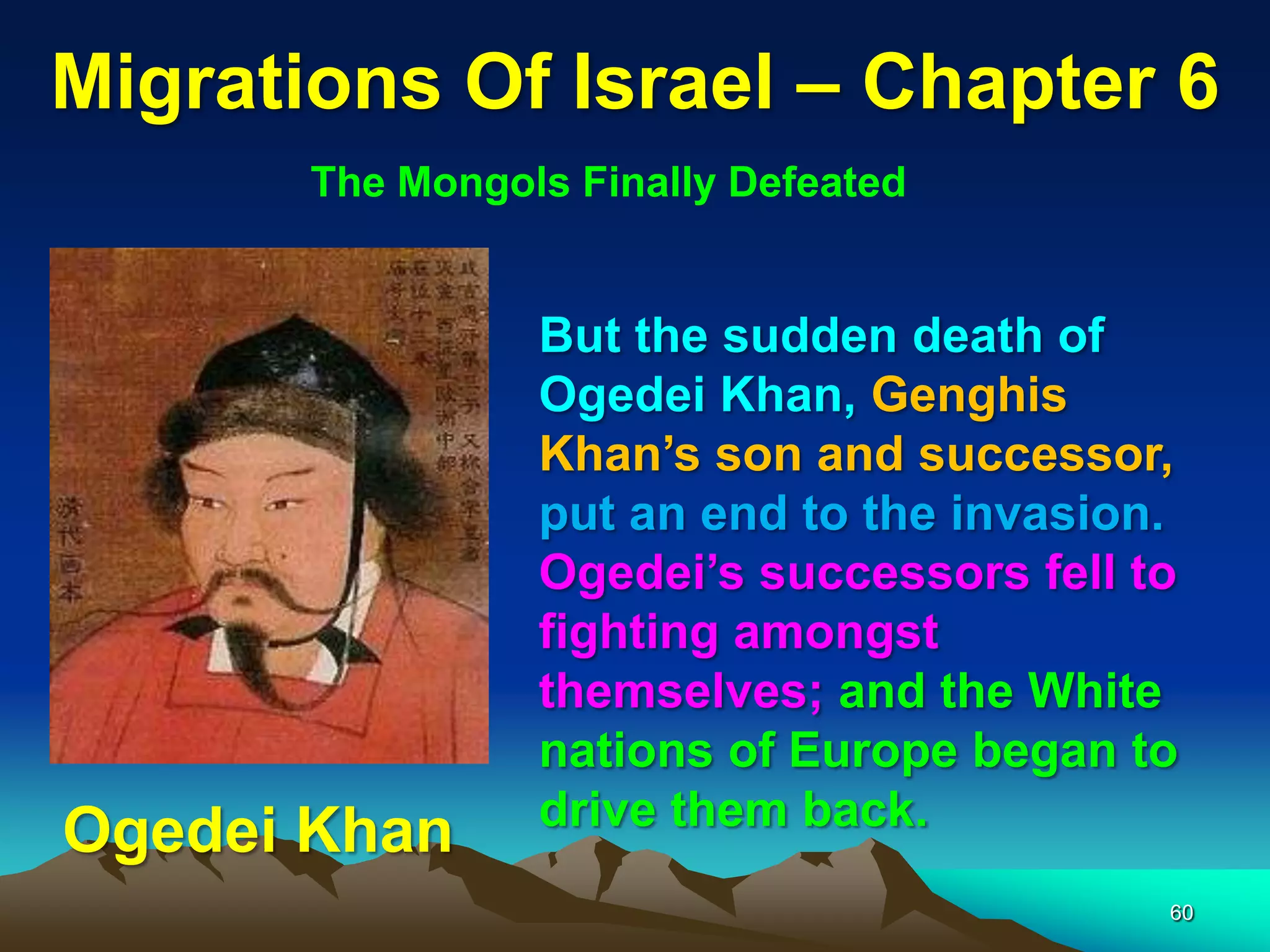
       The Mongols Finally Defeated


                 But the sudden death of
                 Ogedei Khan, Genghis
                 Khan‟s son and successor,
                 put an end to the invasion.
                 Ogedei‟s successors fell to
                 fighting amongst
                 themselves; and the White
                 nations of Europe began to
                 drive them back.
Ogedei Khan
                                           60
Migrations Of Israel – Chapter 6
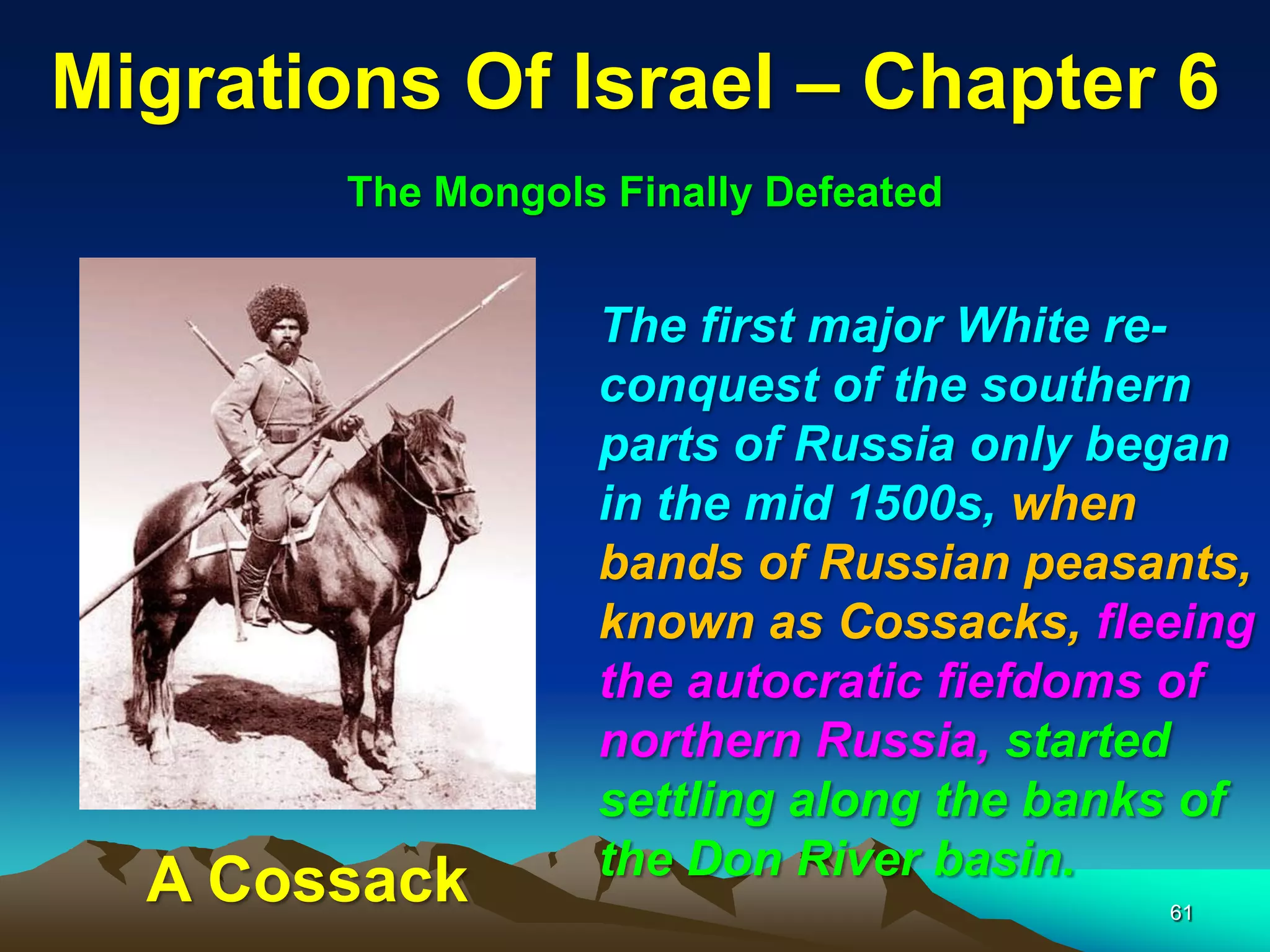
        The Mongols Finally Defeated


                   The first major White re-
                   conquest of the southern
                   parts of Russia only began
                   in the mid 1500s, when
                   bands of Russian peasants,
                   known as Cossacks, fleeing
                   the autocratic fiefdoms of
                   northern Russia, started
                   settling along the banks of
                   the Don River basin.
  A Cossack                               61
Migrations Of Israel – Chapter 6
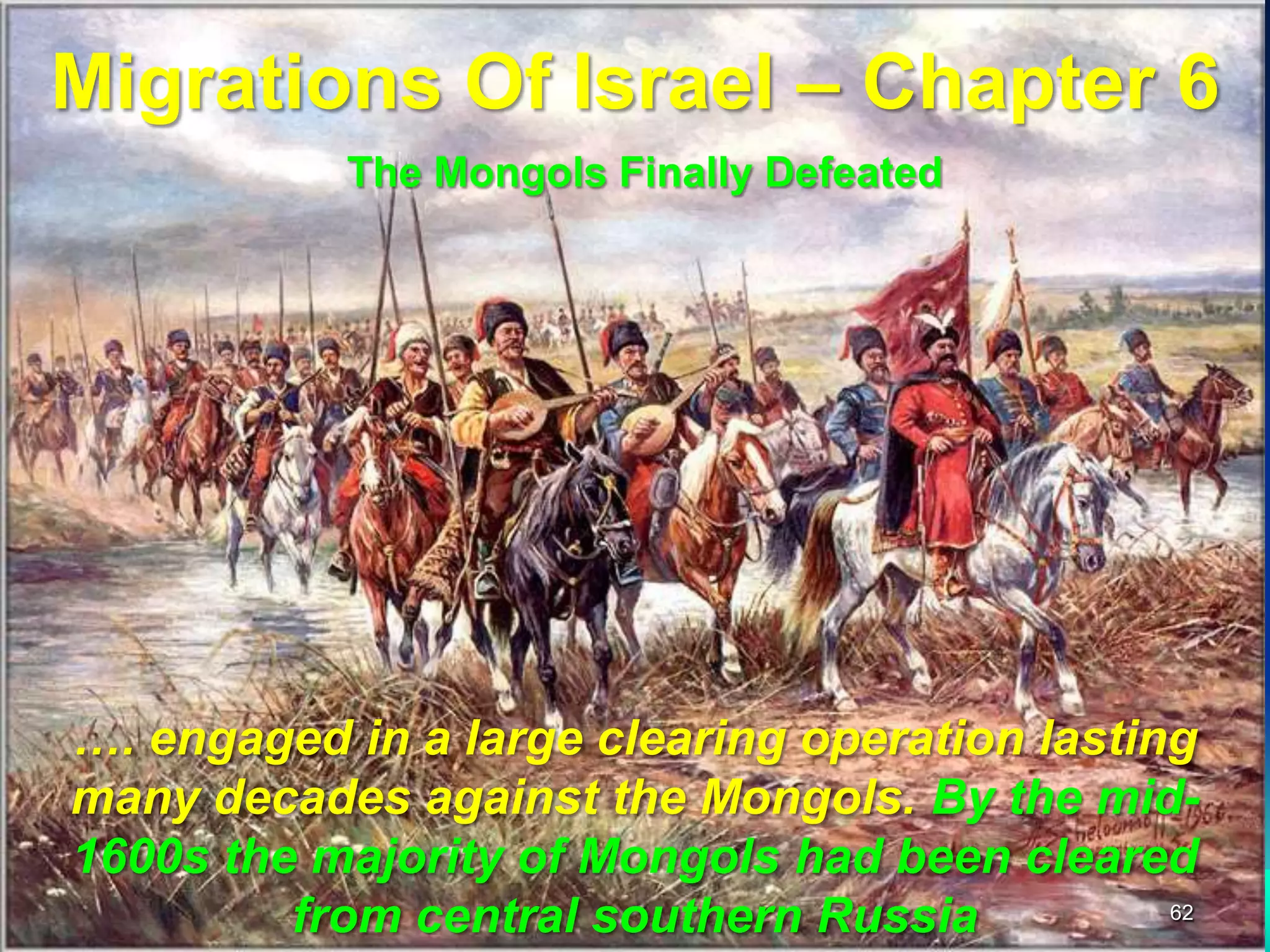
           The Mongols Finally Defeated


…. engaged in a large clearing operation lasting
many decades against the Mongols. By the mid-
1600s the majority of Mongols had been cleared
         from central southern Russia          62
Migrations Of Israel – Chapter 6
        The Mongols Finally Defeated


                   … the remaining minority
                   were for the greatest part
                   absorbed into the new
                   population. – March of the
                   Titans, A History of the
                   White Race, Chapter 32.


                                          63
Migrations Of Israel – Chapter 6
        The Descendants of Abraham

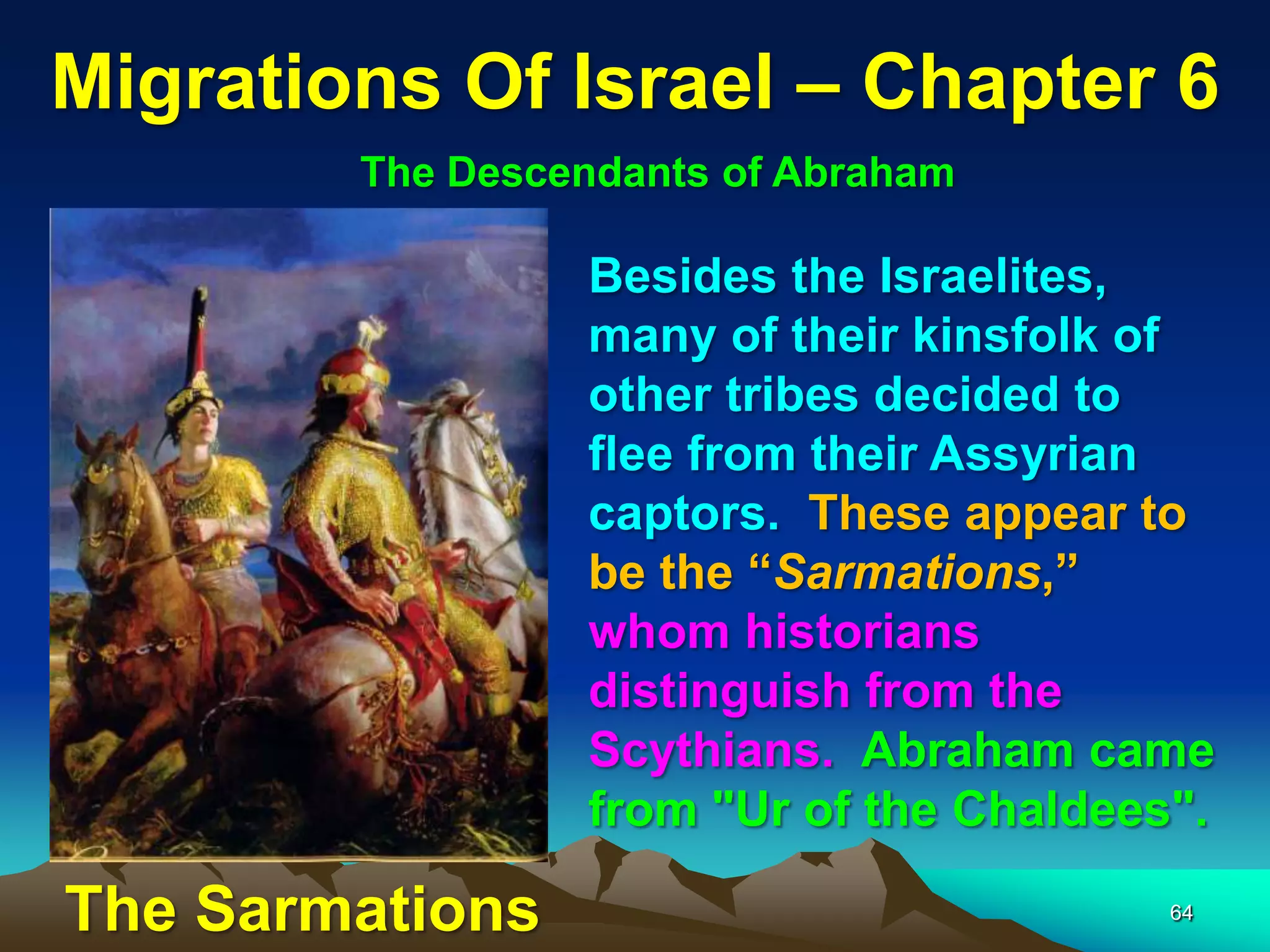
                 Besides the Israelites,
                 many of their kinsfolk of
                 other tribes decided to
                 flee from their Assyrian
                 captors. These appear to
                 be the “Sarmations,”
                 whom historians
                 distinguish from the
                 Scythians. Abraham came
                 from "Ur of the Chaldees".

The Sarmations                           64
Migrations Of Israel – Chapter 6
             The Descendants of Abraham


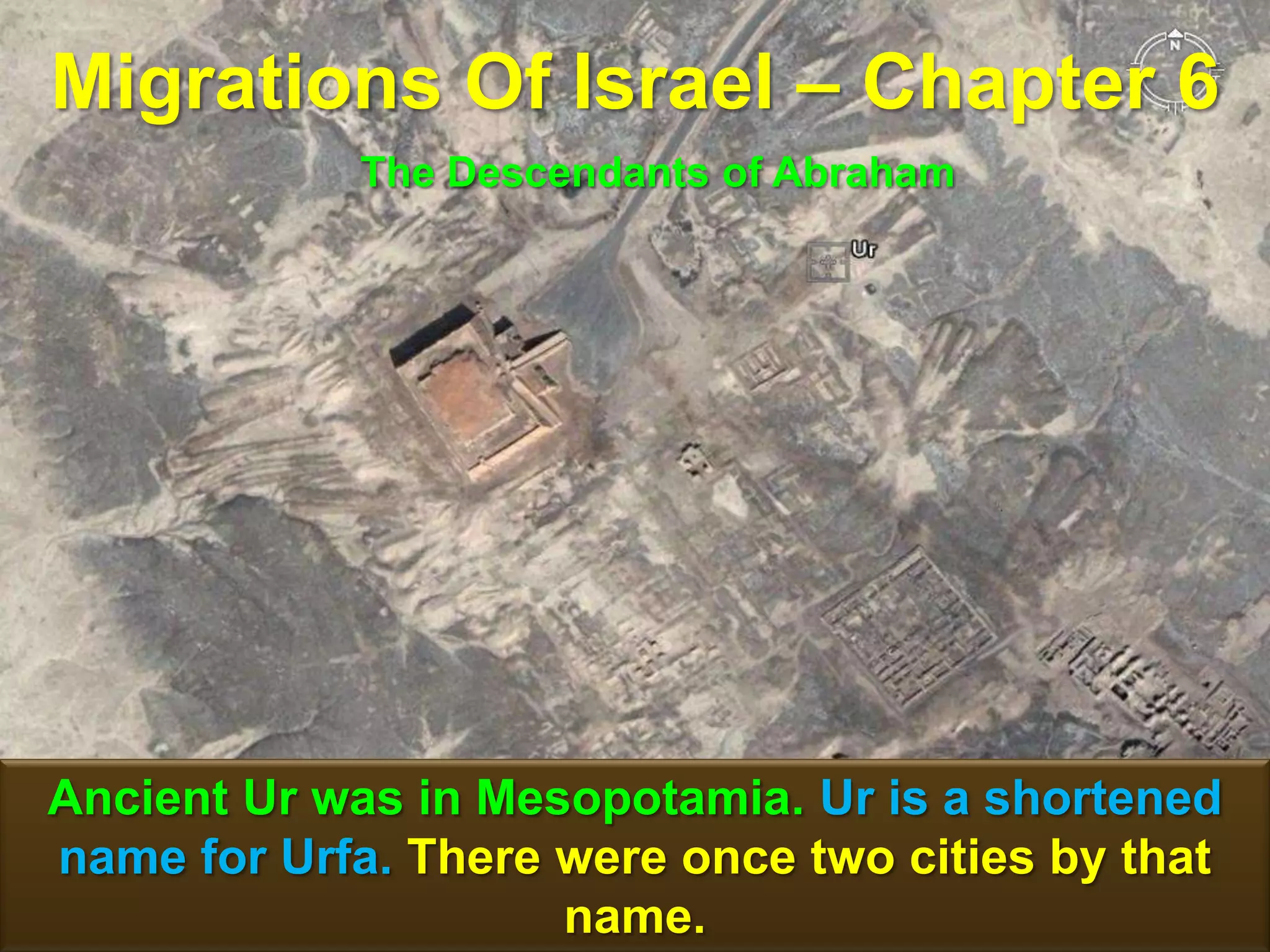
Ancient Ur was in Mesopotamia. Ur is a shortened
name for Urfa. There were once two cities by that
                     name.                     65
Migrations Of Israel – Chapter 6
            The Descendants of Abraham


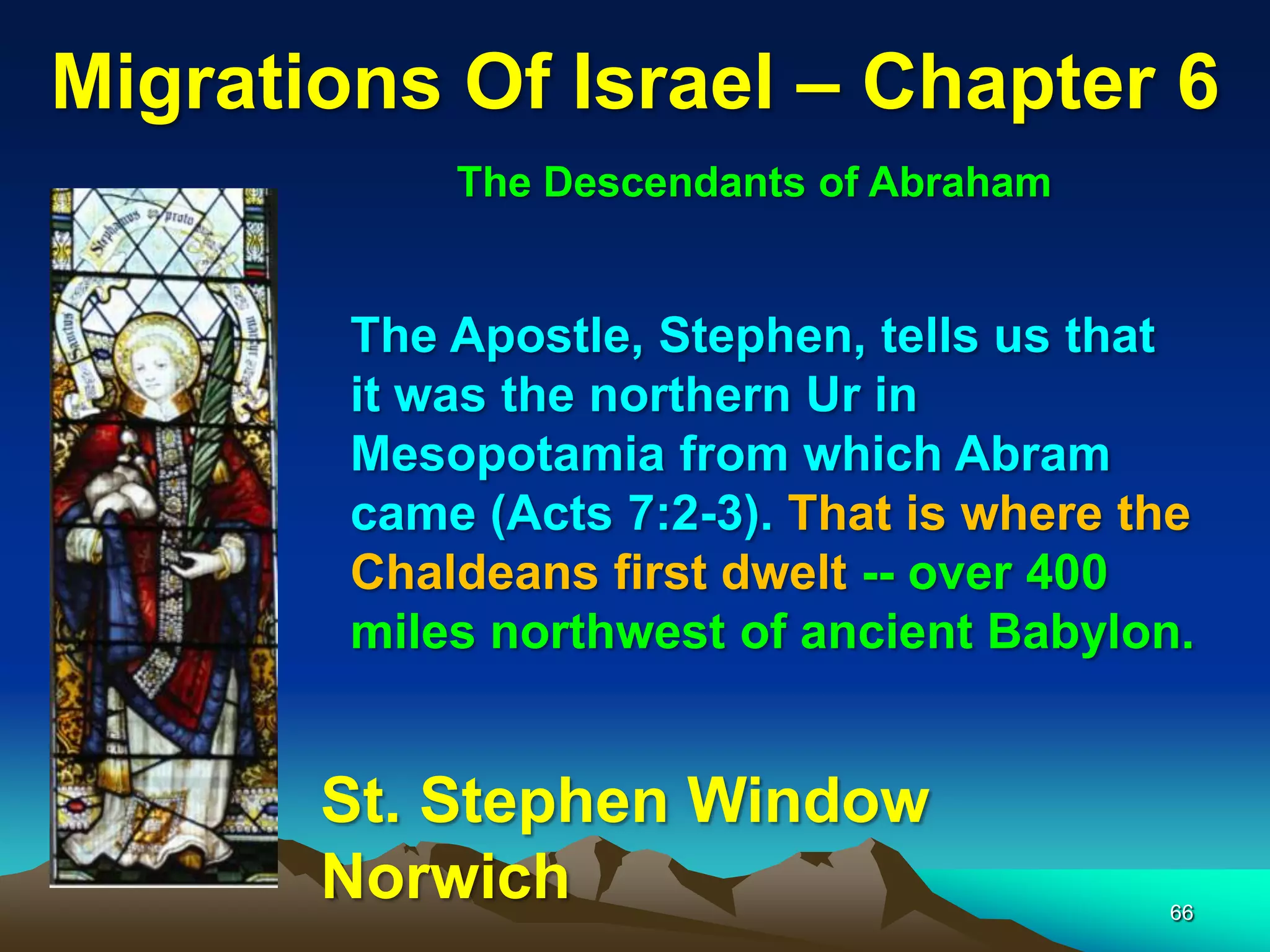
        The Apostle, Stephen, tells us that
        it was the northern Ur in
        Mesopotamia from which Abram
        came (Acts 7:2-3). That is where the
        Chaldeans first dwelt -- over 400
        miles northwest of ancient Babylon.


       St. Stephen Window
       Norwich                            66
Migrations Of Israel – Chapter 6
        The Descendants of Abraham

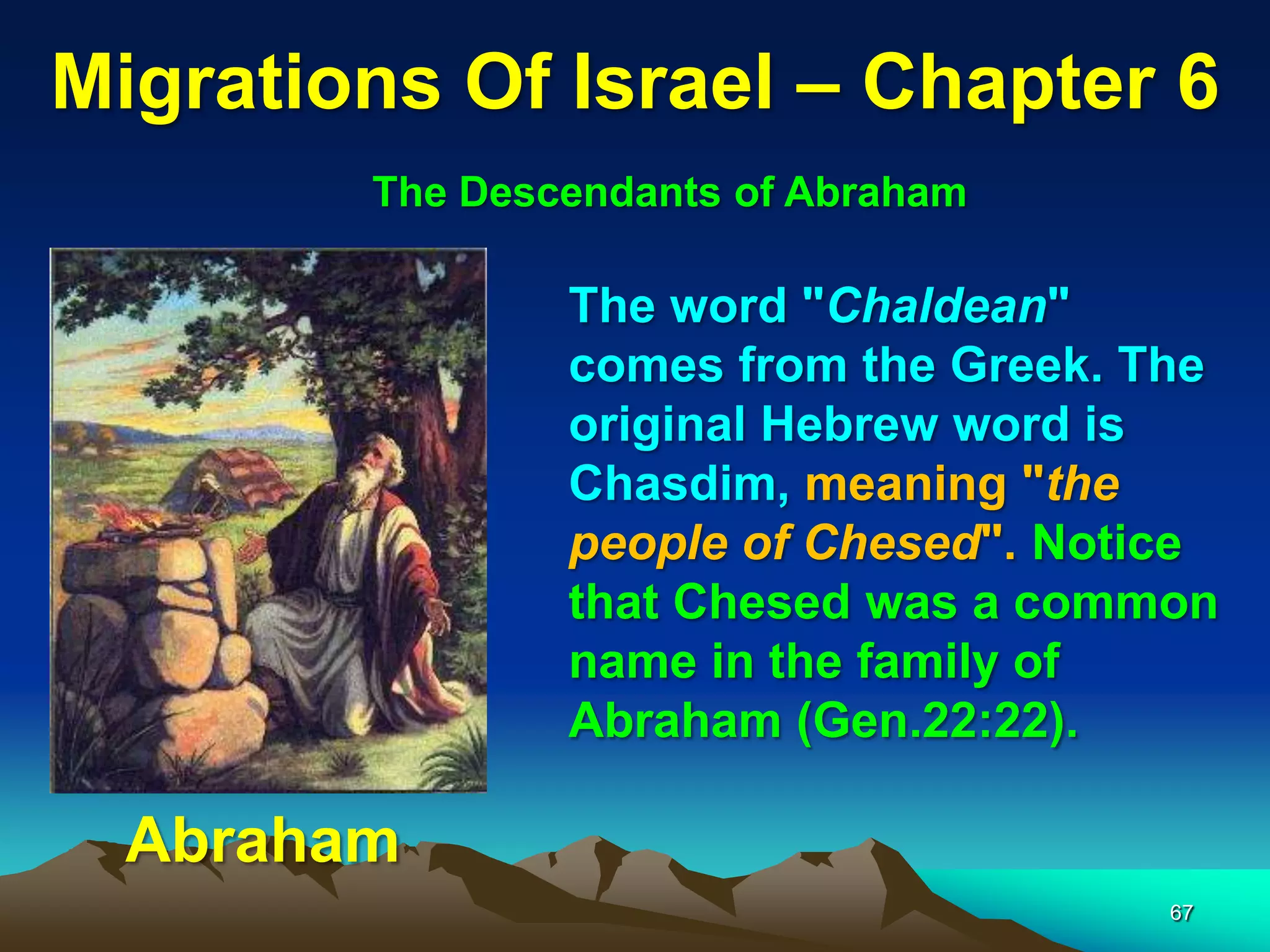
                The word "Chaldean"
                comes from the Greek. The
                original Hebrew word is
                Chasdim, meaning "the
                people of Chesed". Notice
                that Chesed was a common
                name in the family of
                Abraham (Gen.22:22).

  Abraham
                                       67
Migrations Of Israel – Chapter 6
        The Descendants of Abraham


                   One area where these
                   people lived was
                   Arphaxad. Most Biblical
                   encyclopaedias will
                   clearly show that the
                   Hebrew form is
                   Arfachesed -----
                   MEANING ARFA OR
   Arphaxad        URFA THE CHALDEAN!

                                        68
Migrations Of Israel – Chapter 6
       The Descendants of Abraham


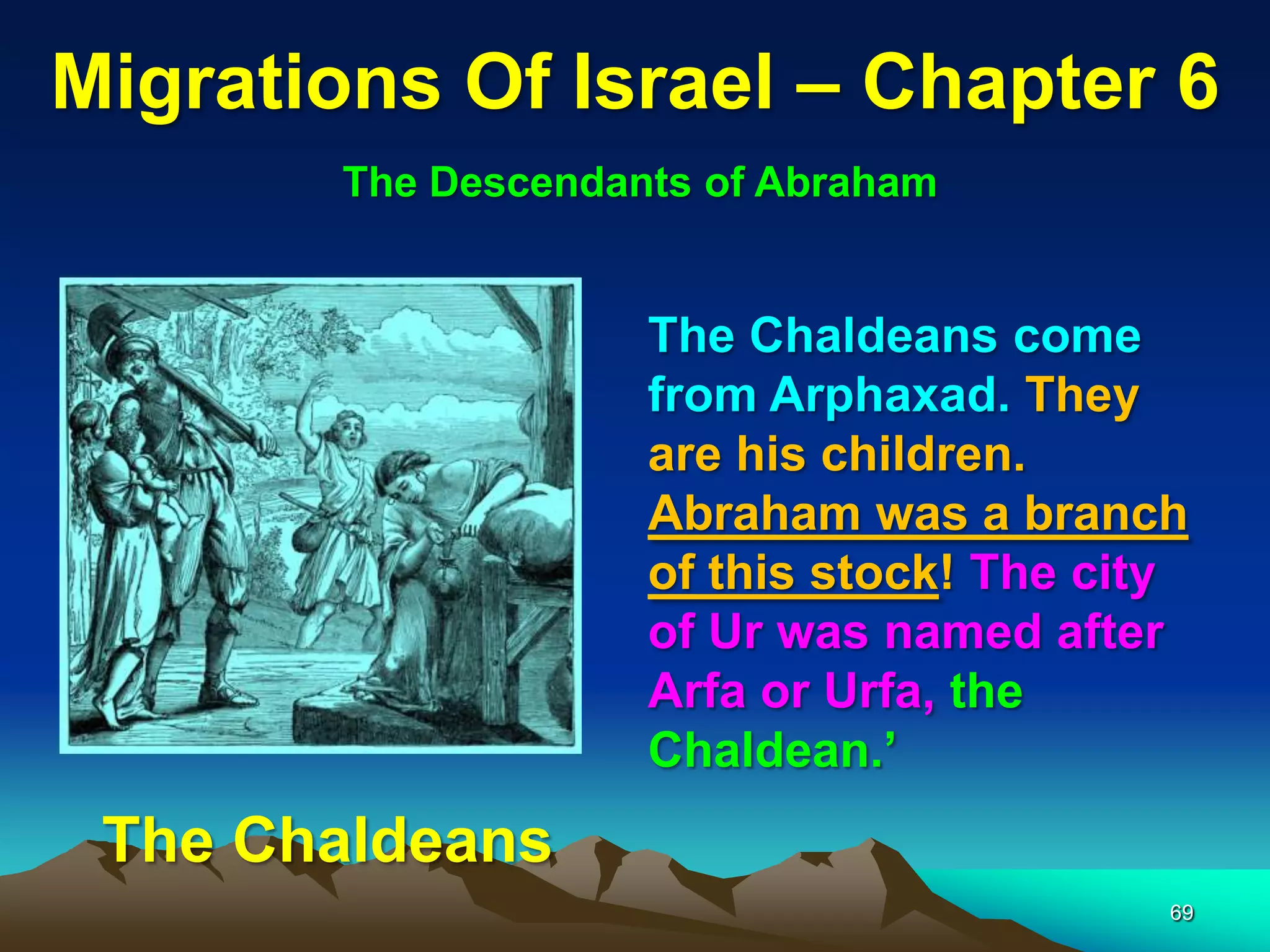
                    The Chaldeans come
                    from Arphaxad. They
                    are his children.
                    Abraham was a branch
                    of this stock! The city
                    of Ur was named after
                    Arfa or Urfa, the
                    Chaldean.‟
 The Chaldeans
                                          69
Migrations Of Israel – Chapter 6
       The Descendants of Abraham

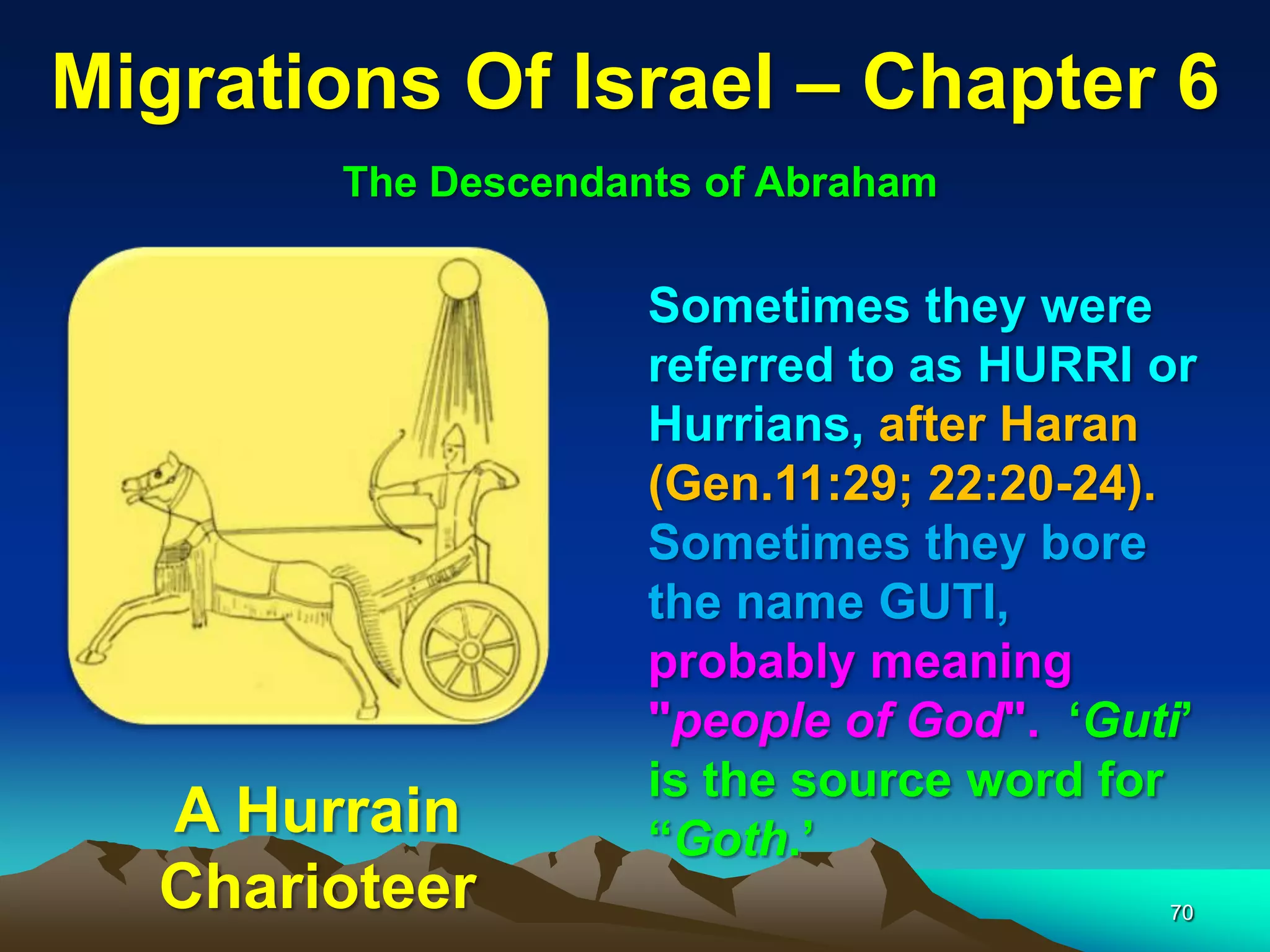
                    Sometimes they were
                    referred to as HURRI or
                    Hurrians, after Haran
                    (Gen.11:29; 22:20-24).
                    Sometimes they bore
                    the name GUTI,
                    probably meaning
                    "people of God". „Guti‟
                    is the source word for
  A Hurrain         “Goth.‟
  Charioteer                             70
Migrations Of Israel – Chapter 6
             The Descendants of Abraham


The word "Persian" or "Parthian" is derived from the
  word "Euphrates". Along this river these sons of
    Abraham first lived. The Hebrews called the
 Euphrates the Perath or Peres River --- the River of
                    the Persians!                 71
Migrations Of Israel – Chapter 6
        The Descendants of Abraham

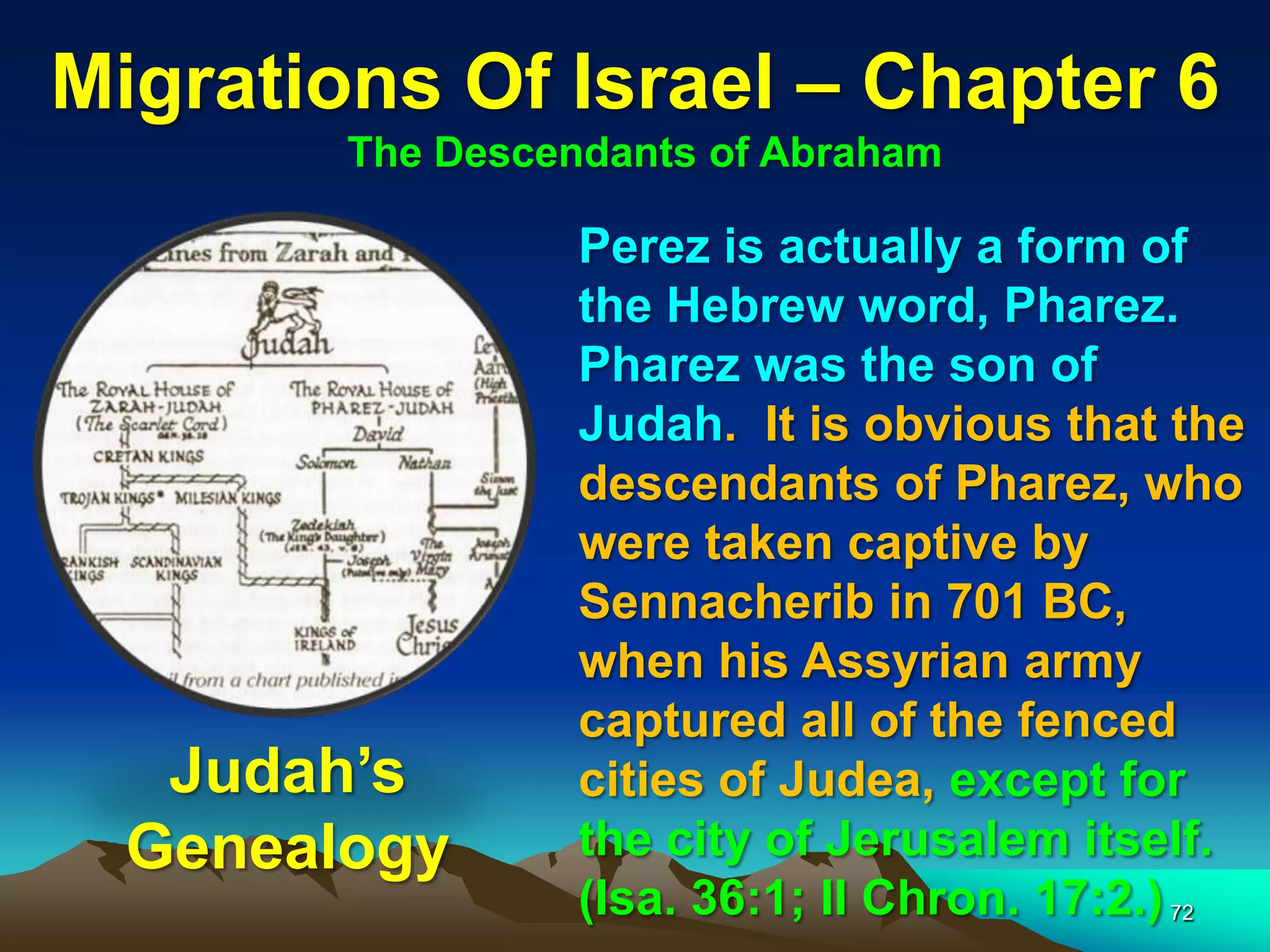
                  Perez is actually a form of
                  the Hebrew word, Pharez.
                  Pharez was the son of
                  Judah. It is obvious that the
                  descendants of Pharez, who
                  were taken captive by
                  Sennacherib in 701 BC,
                  when his Assyrian army
                  captured all of the fenced
   Judah‟s        cities of Judea, except for
  Genealogy       the city of Jerusalem itself.
                  (Isa. 36:1; II Chron. 17:2.) 72
Migrations Of Israel – Chapter 6
                        The Descendants of Abraham


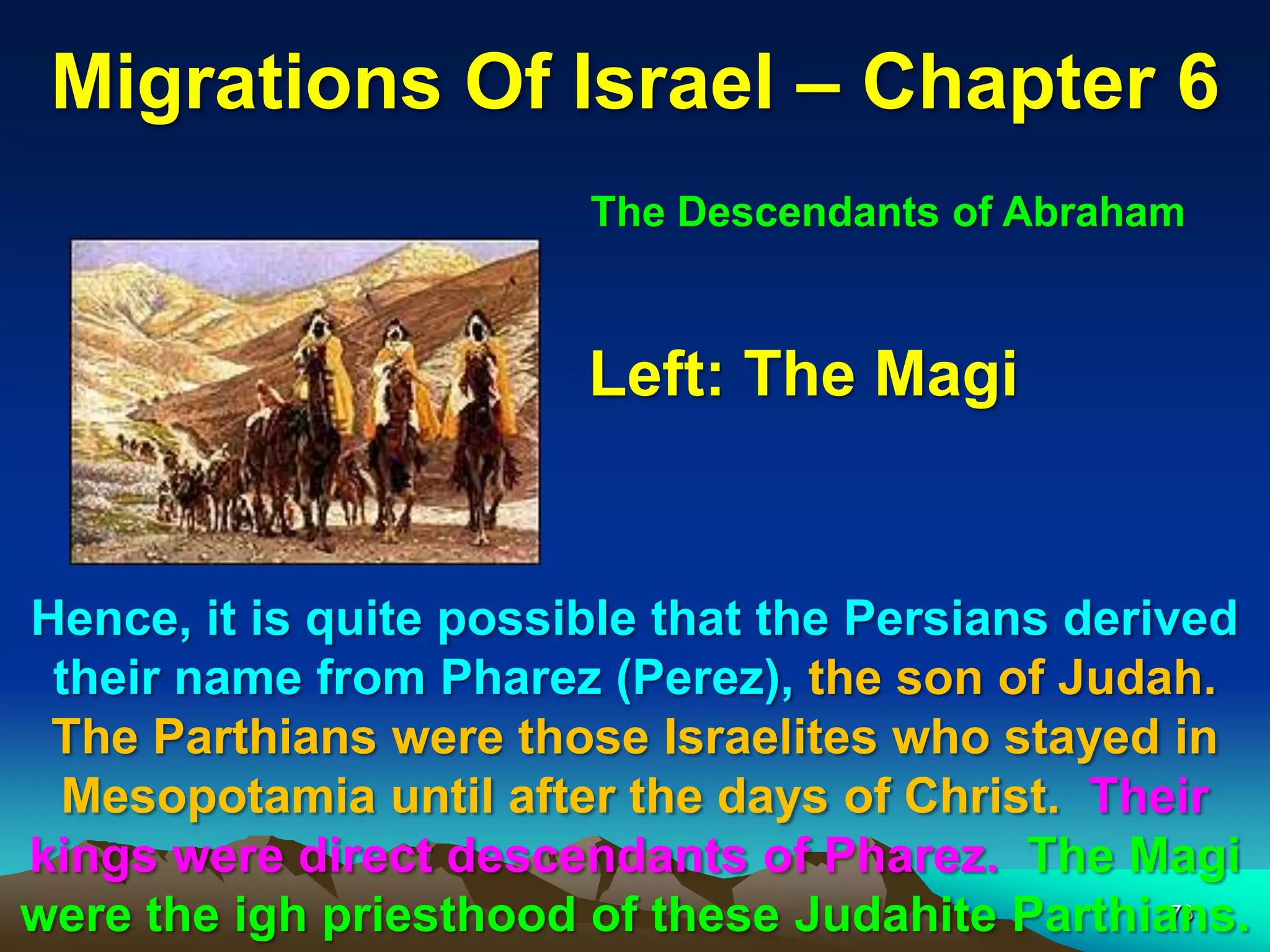
                        Left: The Magi


Hence, it is quite possible that the Persians derived
 their name from Pharez (Perez), the son of Judah.
 The Parthians were those Israelites who stayed in
 Mesopotamia until after the days of Christ. Their
kings were direct descendants of Pharez. The Magi
were the igh priesthood of these Judahite Parthians.
                                                   73
Migrations Of Israel – Chapter 6
       The Descendants of Abraham


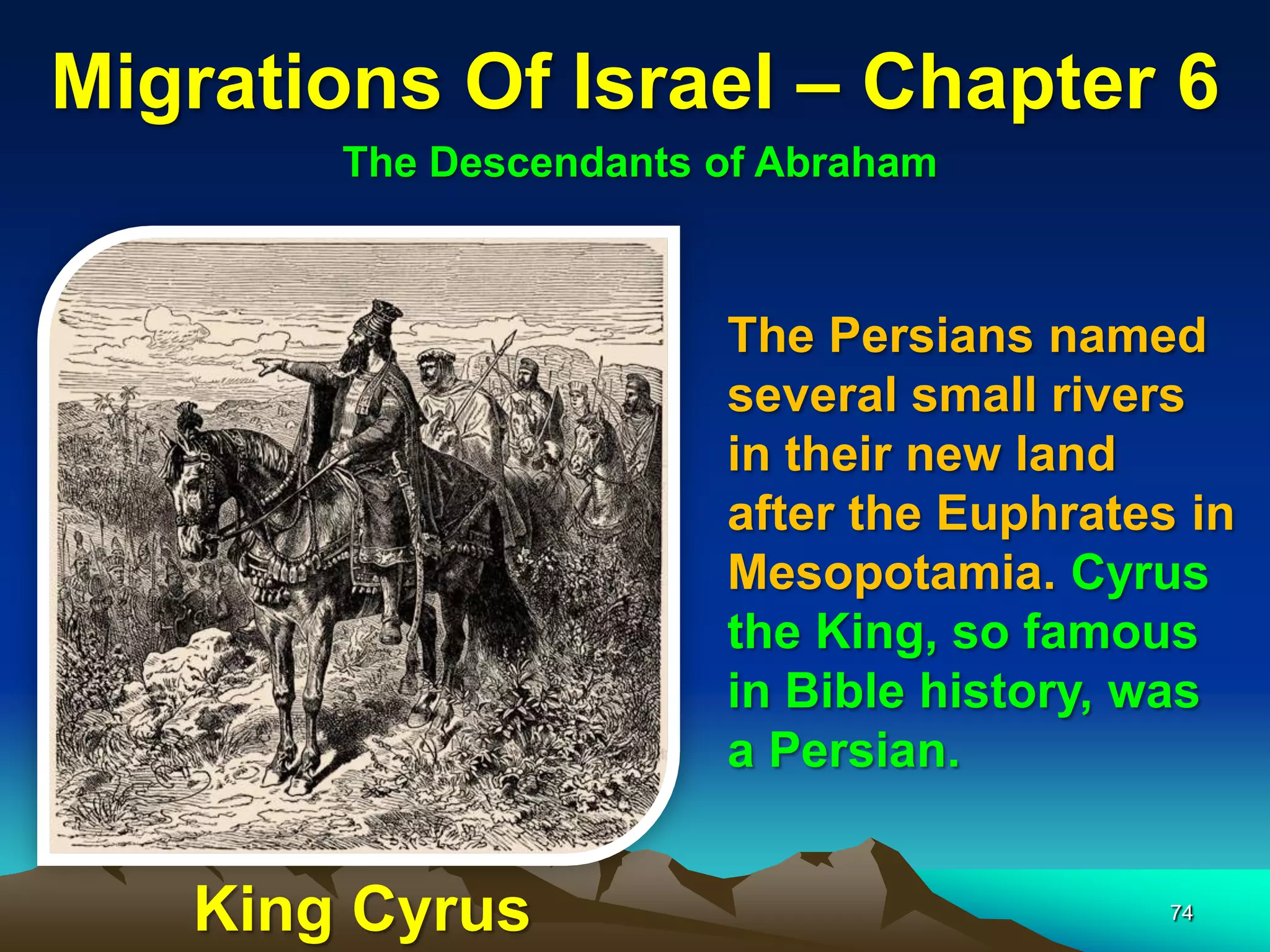
                       The Persians named
                       several small rivers
                       in their new land
                       after the Euphrates in
                       Mesopotamia. Cyrus
                       the King, so famous
                       in Bible history, was
                       a Persian.


   King Cyrus                             74
Migrations Of Israel – Chapter 6
         The Descendants of Abraham
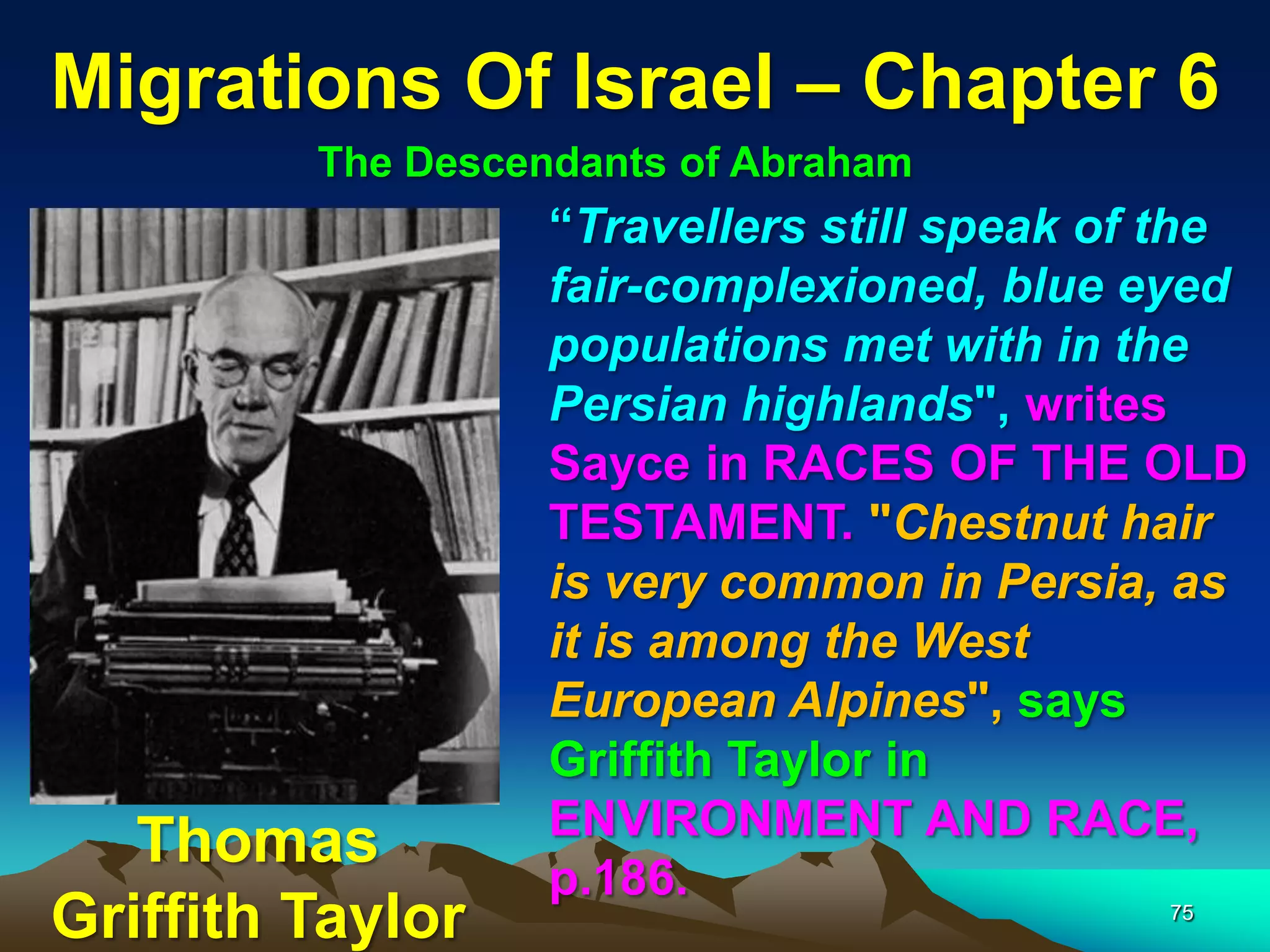
                   “Travellers still speak of the
                   fair-complexioned, blue eyed
                   populations met with in the
                   Persian highlands", writes
                   Sayce in RACES OF THE OLD
                   TESTAMENT. "Chestnut hair
                   is very common in Persia, as
                   it is among the West
                   European Alpines", says
                   Griffith Taylor in
                   ENVIRONMENT AND RACE,
   Thomas
                   p.186.
Griffith Taylor                              75
Migrations Of Israel – Chapter 6
      The Descendants of Abraham

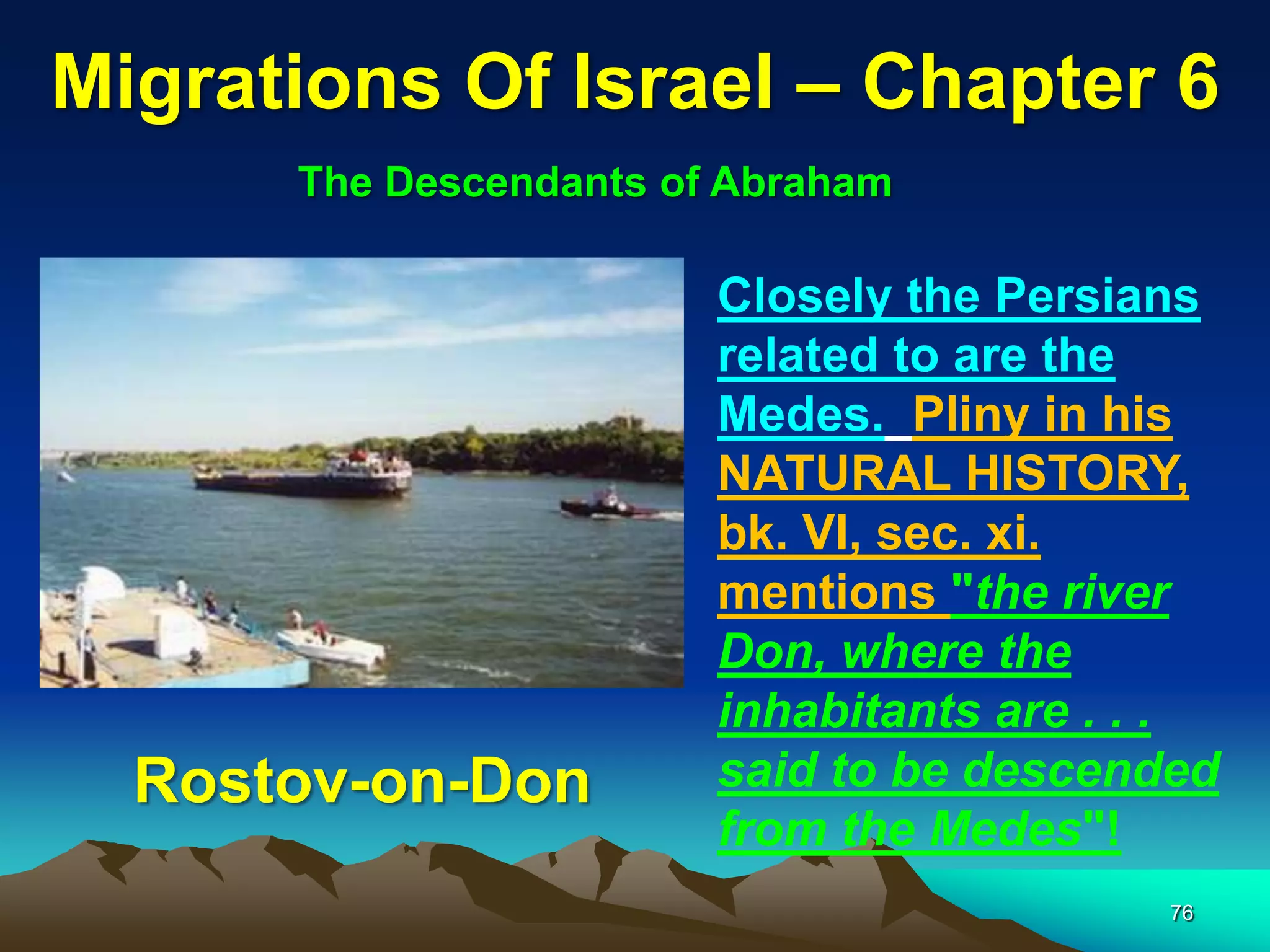
                        Closely the Persians
                        related to are the
                        Medes. Pliny in his
                        NATURAL HISTORY,
                        bk. VI, sec. xi.
                        mentions "the river
                        Don, where the
                        inhabitants are . . .
  Rostov-on-Don         said to be descended
                        from the Medes"!
                                          76
Migrations Of Israel – Chapter 6
                The Descendants of Abraham

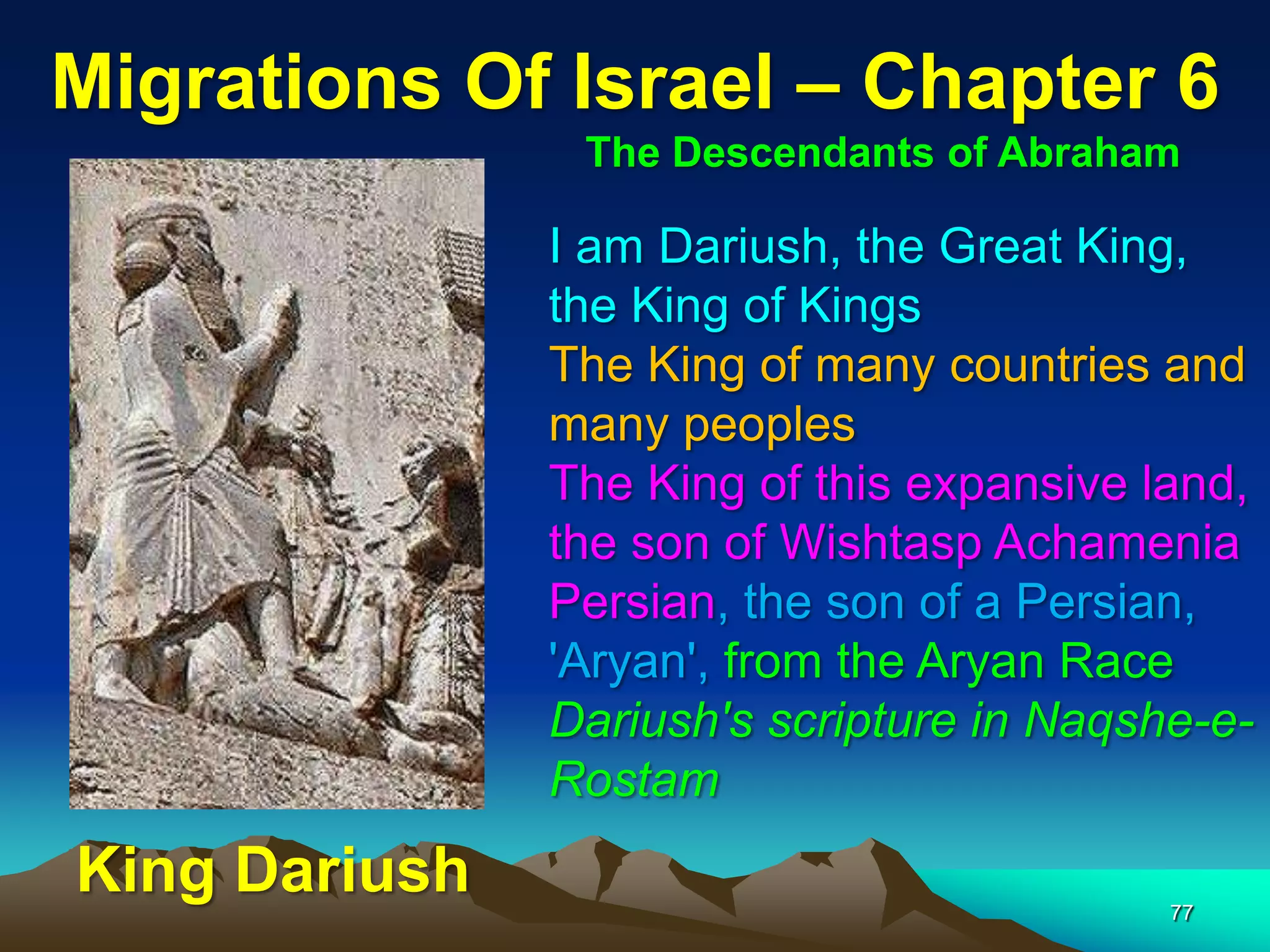
               I am Dariush, the Great King,
               the King of Kings
               The King of many countries and
               many peoples
               The King of this expansive land,
               the son of Wishtasp Achamenia
               Persian, the son of a Persian,
               'Aryan', from the Aryan Race
               Dariush's scripture in Naqshe-e-
               Rostam
King Dariush                               77
Migrations Of Israel – Chapter 6
               Conclusion


 There is no doubt that the Germanic
   peoples derive from the overland
migration of the Twelve Tribes of Israel.
Various waves of these people passed
  through the Caucasus Mountains,
 around the Black and Caspian Seas,
   then north and west into Europe.
                                      78
Migrations Of Israel – Chapter 6
                       Conclusion
             Isa. 11:16 tells us that these
             Israelites would pass through
             the area:

             And there shall be an
             highway for the remnant of
             his people, which shall be
             left, from Assyria; like as it
             was to Israel in the day that
             he came up out of the land of
             Egypt.
                                       79
Migrations Of Israel – Chapter 6
                     Conclusion

             Before migrating, however,
             these Israelites had to learn
             the language of the area.
             The language spoken there
             was Persian. The historian,
             Sharon Turner, has collected
             a number of Persian words,
             which came into the Anglo-
             Saxon language from this
             captivity.

                                       80
Migrations Of Israel – Chapter 6
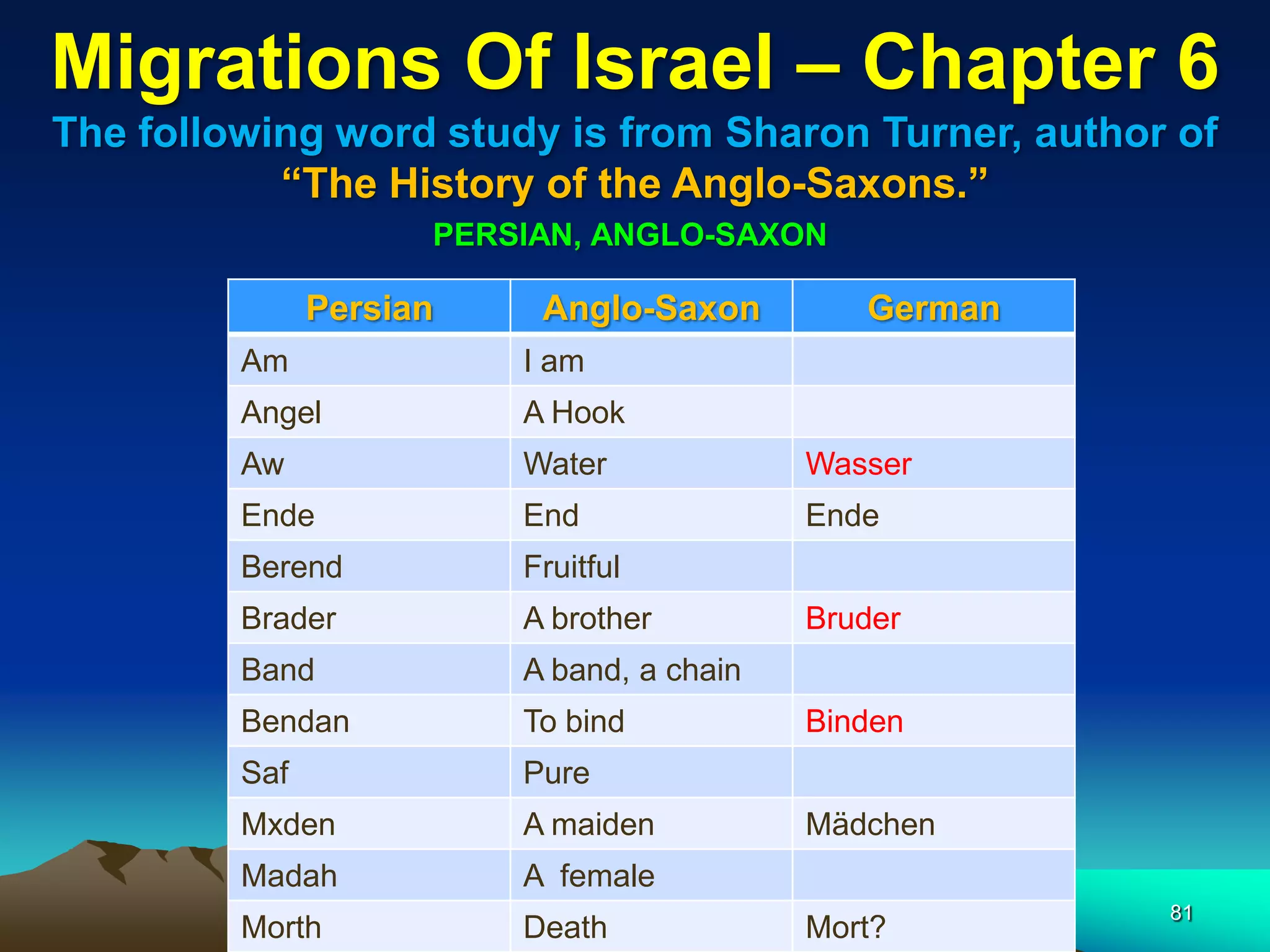
The following word study is from Sharon Turner, author of
           “The History of the Anglo-Saxons.”
                     PERSIAN, ANGLO-SAXON

               Persian    Anglo-Saxon         German
         Am              I am
         Angel           A Hook
         Aw              Water             Wasser
         Ende            End               Ende
         Berend          Fruitful
         Brader          A brother         Bruder
         Band            A band, a chain
         Bendan          To bind           Binden
         Saf             Pure
         Mxden           A maiden          Mädchen
         Madah           A female
                                                       81
         Morth           Death             Mort?
Migrations Of Israel – Chapter 6
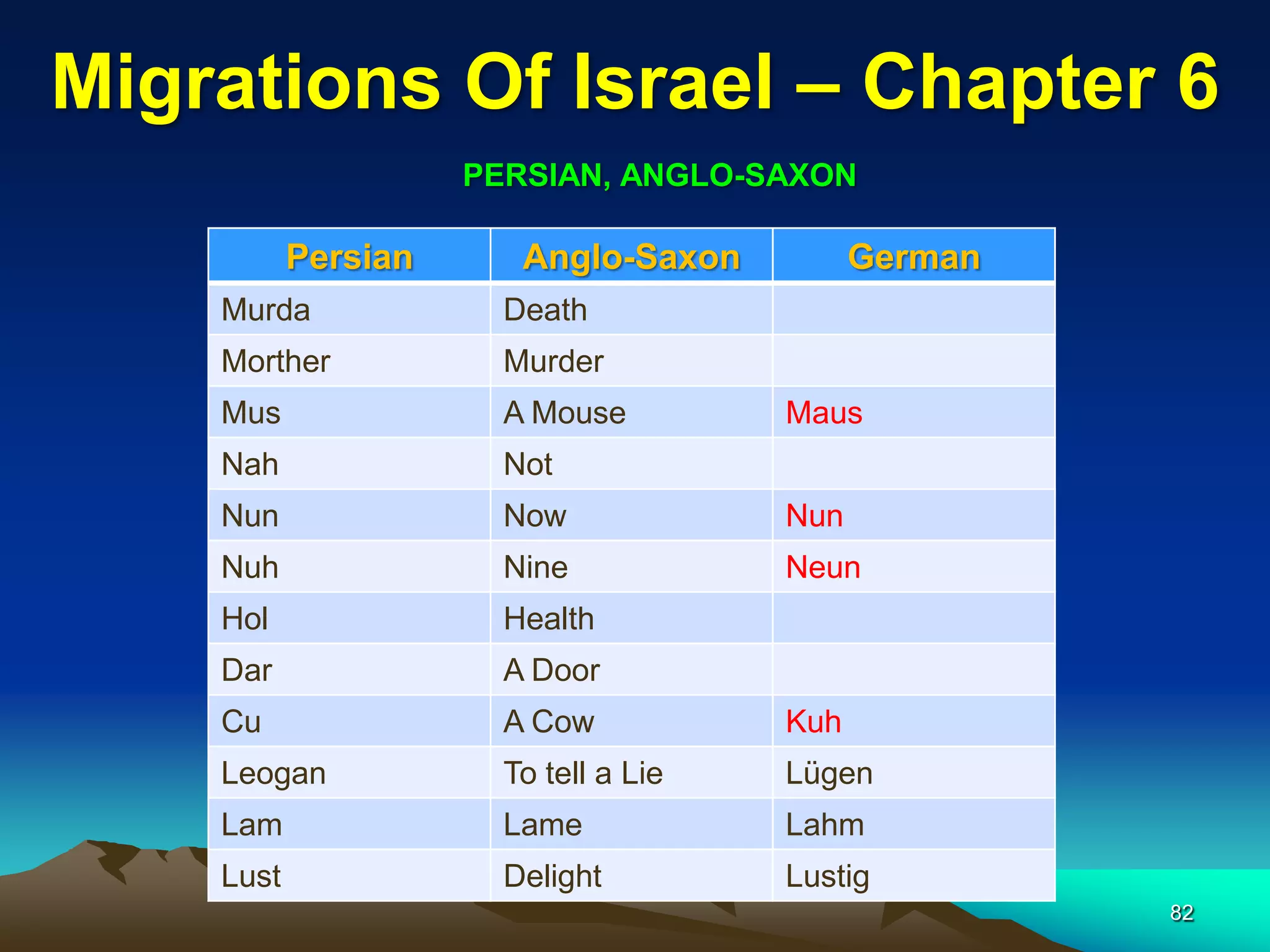
                     PERSIAN, ANGLO-SAXON

           Persian      Anglo-Saxon          German
    Murda              Death
    Morther            Murder
    Mus                A Mouse         Maus
    Nah                Not
    Nun                Now             Nun
    Nuh                Nine            Neun
    Hol                Health
    Dar                A Door
    Cu                 A Cow           Kuh
    Leogan             To tell a Lie   Lügen
    Lam                Lame            Lahm
    Lust               Delight         Lustig
                                                      82
Migrations Of Israel – Chapter 6
                     PERSIAN, ANGLO-SAXON

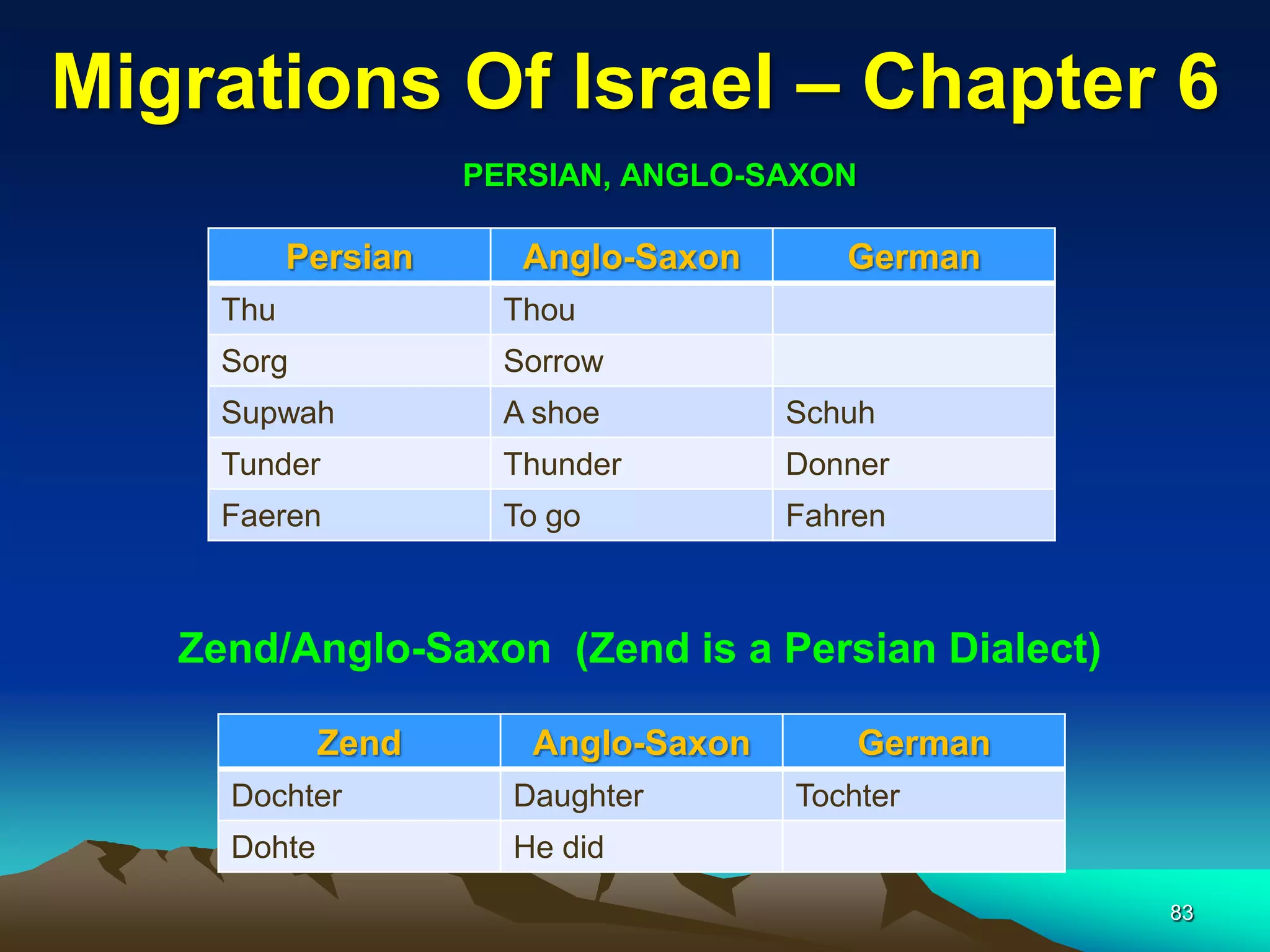
           Persian      Anglo-Saxon      German
     Thu               Thou
     Sorg              Sorrow
     Supwah            A shoe         Schuh
     Tunder            Thunder        Donner
     Faeren            To go          Fahren


   Zend/Anglo-Saxon (Zend is a Persian Dialect)

             Zend       Anglo-Saxon         German
     Dochter           Daughter       Tochter
     Dohte             He did
                                                     83
Migrations Of Israel – Chapter 6
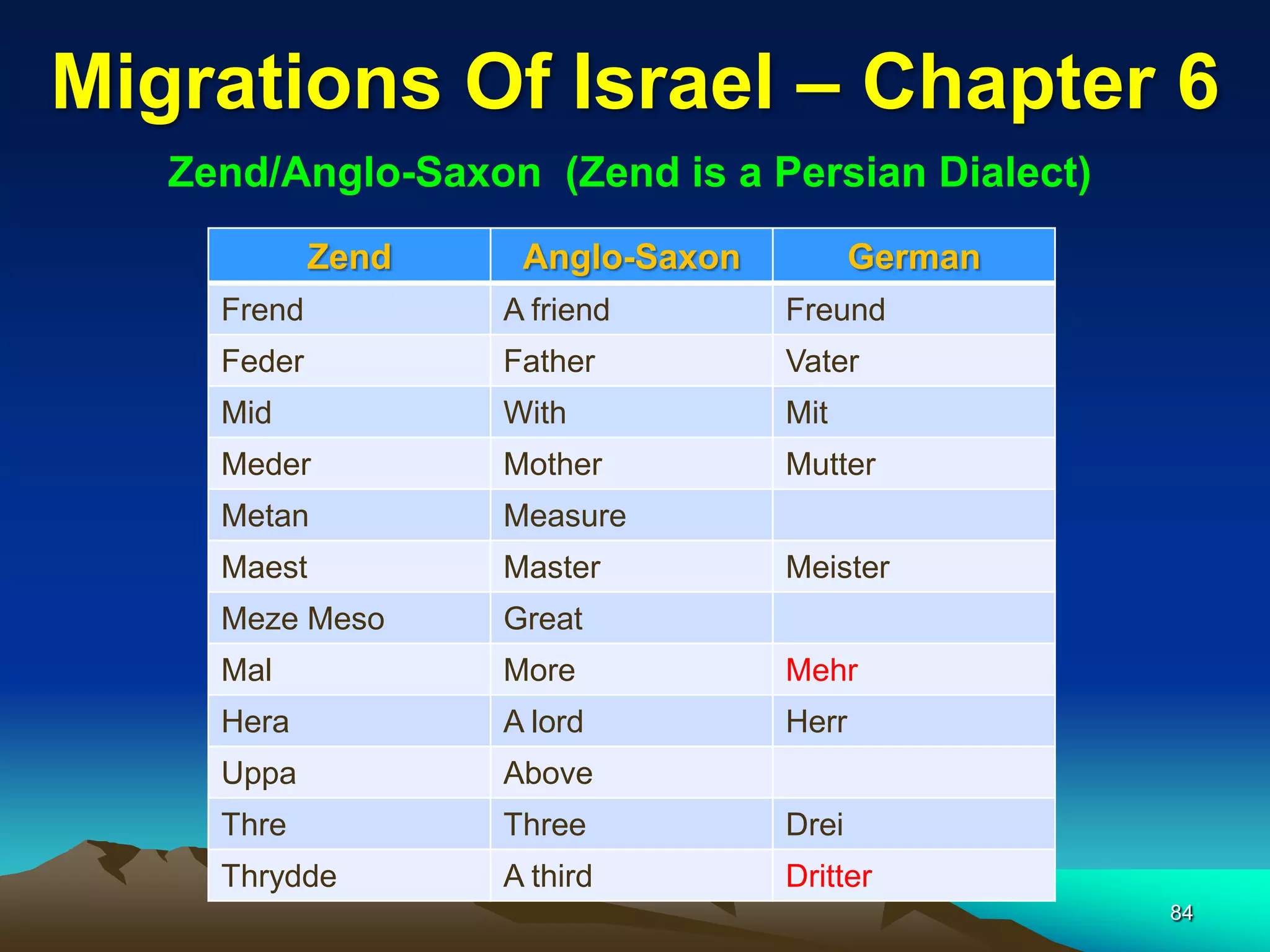
   Zend/Anglo-Saxon (Zend is a Persian Dialect)
             Zend    Anglo-Saxon          German
     Frend          A friend       Freund
     Feder          Father         Vater
     Mid            With           Mit
     Meder          Mother         Mutter
     Metan          Measure
     Maest          Master         Meister
     Meze Meso      Great
     Mal            More           Mehr
     Hera           A lord         Herr
     Uppa           Above
     Thre           Three          Drei
     Thrydde        A third        Dritter
                                                   84
Migrations Of Israel – Chapter 6
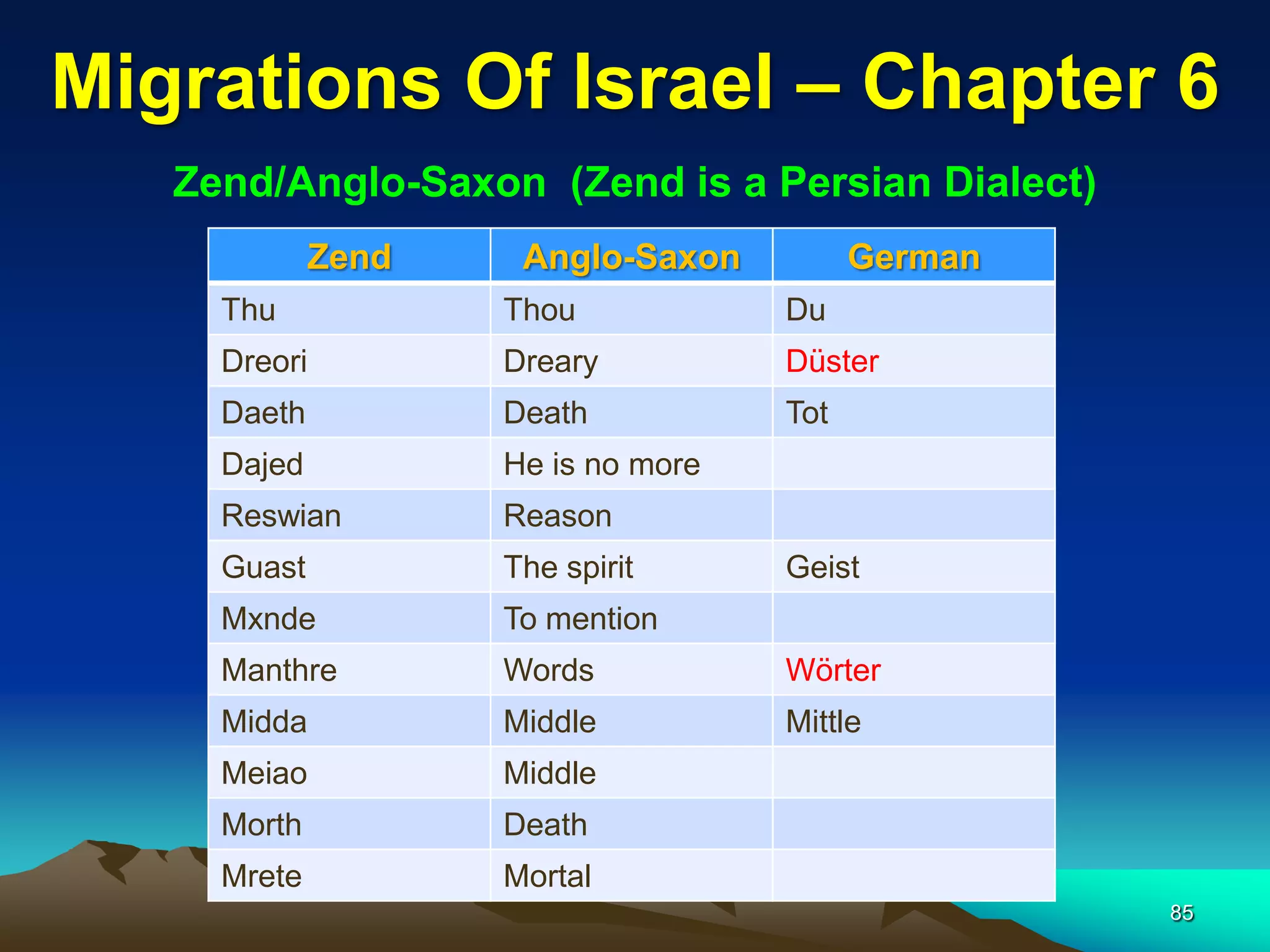
   Zend/Anglo-Saxon (Zend is a Persian Dialect)
             Zend    Anglo-Saxon          German
     Thu            Thou            Du
     Dreori         Dreary          Düster
     Daeth          Death           Tot
     Dajed          He is no more
     Reswian        Reason
     Guast          The spirit      Geist
     Mxnde          To mention
     Manthre        Words           Wörter
     Midda          Middle          Mittle
     Meiao          Middle
     Morth          Death
     Mrete          Mortal
                                                   85
Migrations Of Israel – Chapter 6
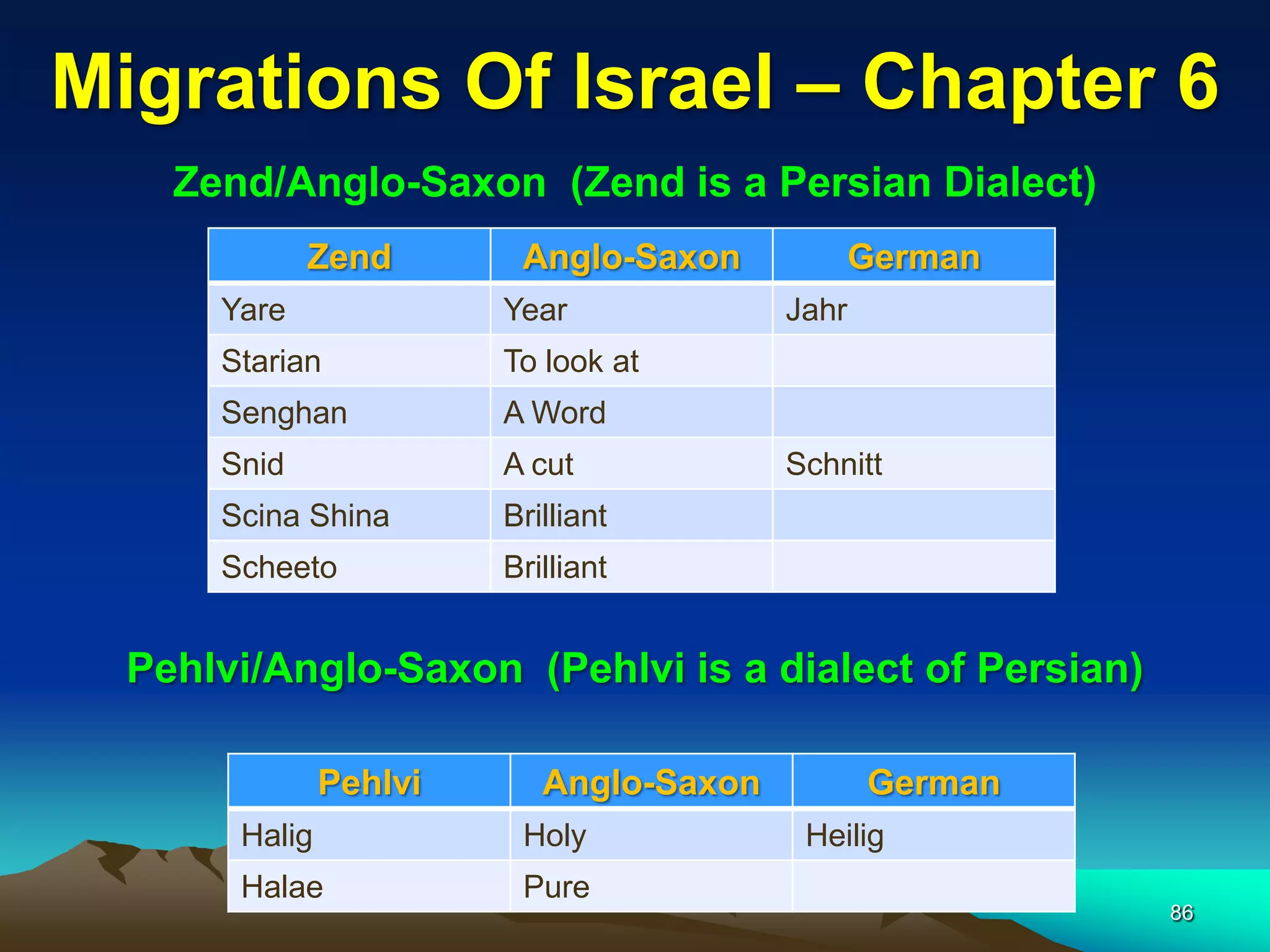
    Zend/Anglo-Saxon (Zend is a Persian Dialect)
             Zend        Anglo-Saxon            German
      Yare              Year             Jahr
      Starian           To look at
      Senghan           A Word
      Snid              A cut            Schnitt
      Scina Shina       Brilliant
      Scheeto           Brilliant


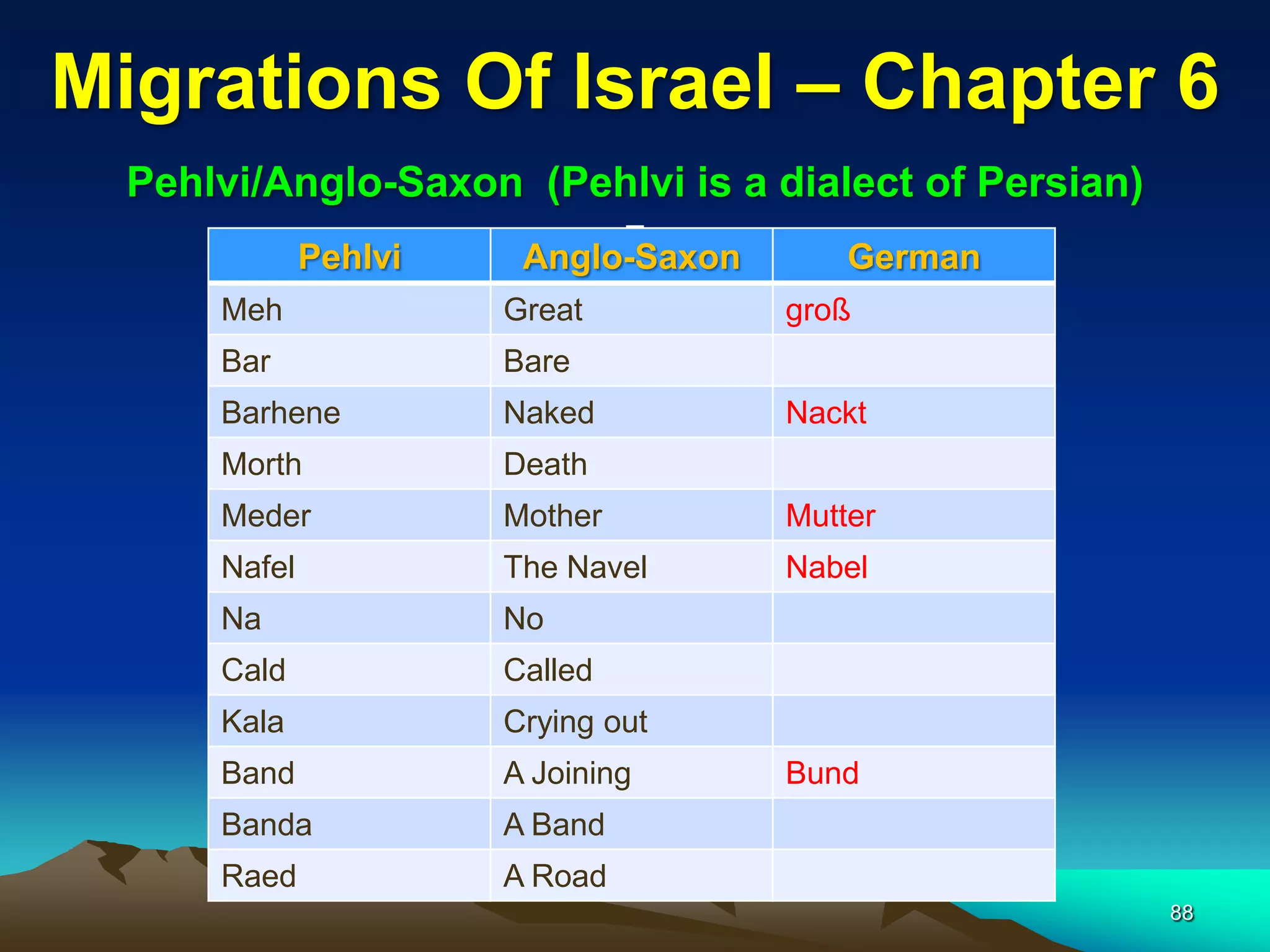
  Pehlvi/Anglo-Saxon (Pehlvi is a dialect of Persian)

               Pehlvi      Anglo-Saxon          German
       Halig             Holy             Heilig
       Halae             Pure
                                                         86
Migrations Of Israel – Chapter 6
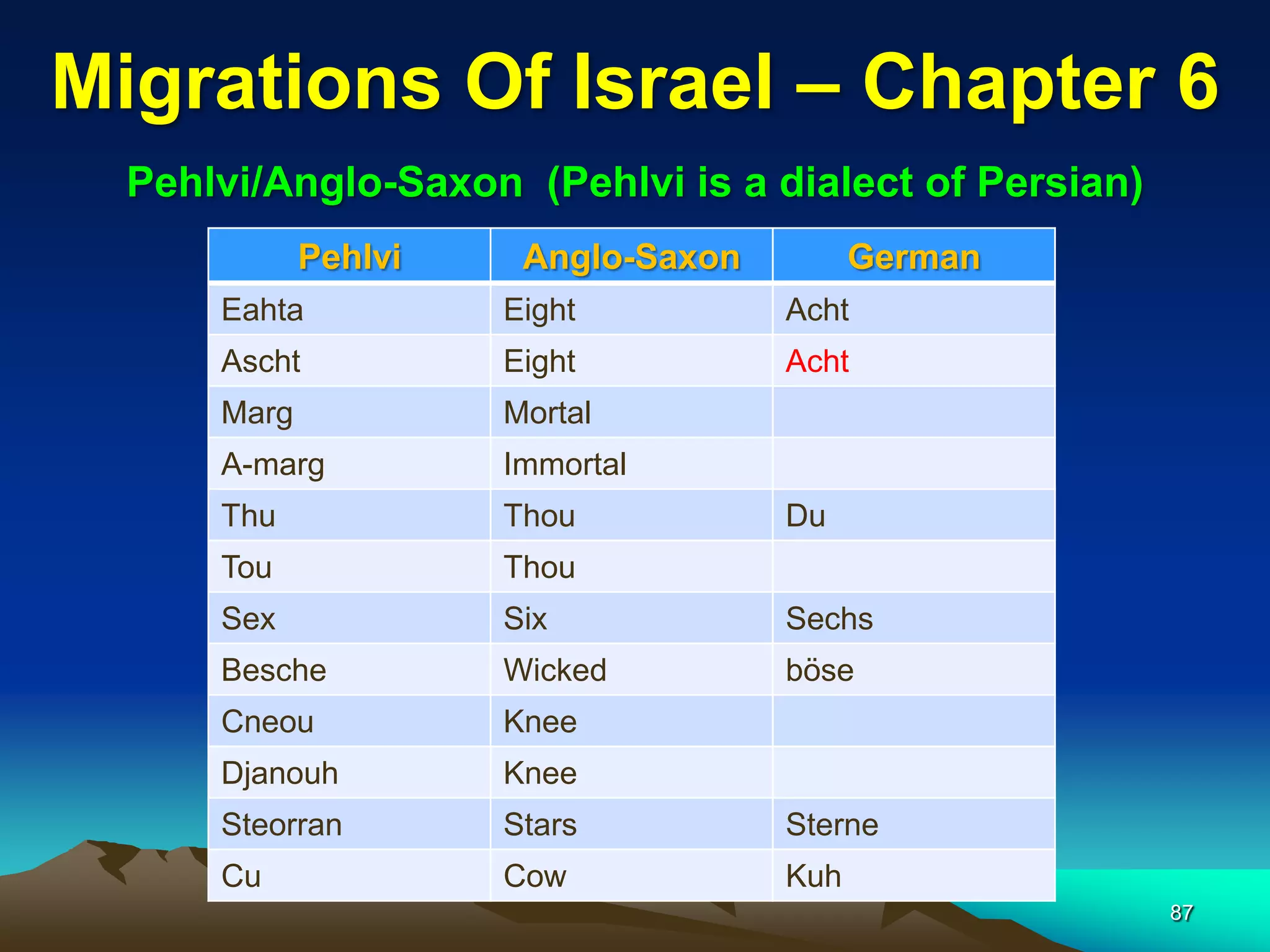
  Pehlvi/Anglo-Saxon (Pehlvi is a dialect of Persian)
             Pehlvi    Anglo-Saxon         German
      Eahta           Eight          Acht
      Ascht           Eight          Acht
      Marg            Mortal
      A-marg          Immortal
      Thu             Thou           Du
      Tou             Thou
      Sex             Six            Sechs
      Besche          Wicked         böse
      Cneou           Knee
      Djanouh         Knee
      Steorran        Stars          Sterne
      Cu              Cow            Kuh
                                                        87
Migrations Of Israel – Chapter 6
  Pehlvi/Anglo-Saxon (Pehlvi is a dialect of Persian)
                        z
              Pehlvi    Anglo-Saxon       German
      Meh              Great          groß
      Bar              Bare
      Barhene          Naked          Nackt
      Morth            Death
      Meder            Mother         Mutter
      Nafel            The Navel      Nabel
      Na               No
      Cald             Called
      Kala             Crying out
      Band             A Joining      Bund
      Banda            A Band
      Raed             A Road
                                                        88
Migrations Of Israel – Chapter 6
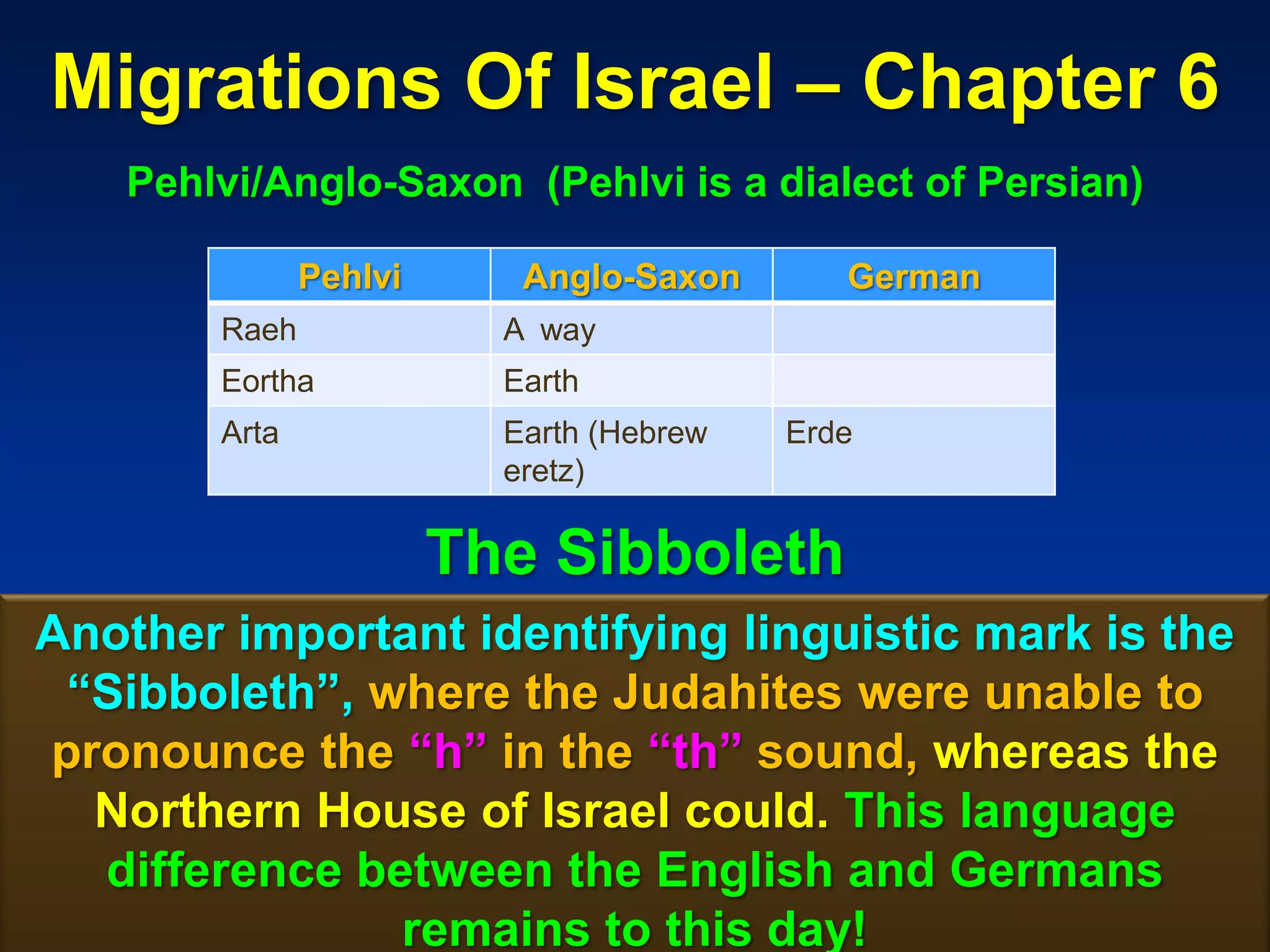
   Pehlvi/Anglo-Saxon (Pehlvi is a dialect of Persian)

               Pehlvi      Anglo-Saxon       German
        Raeh              A way
        Eortha            Earth
        Arta              Earth (Hebrew   Erde
                          eretz)

                        The Sibboleth
Another important identifying linguistic mark is the
 “Sibboleth”, where the Judahites were unable to
pronounce the “h” in the “th” sound, whereas the
  Northern House of Israel could. This language
  difference between the English and Germans
                                                  89
               remains to this day!
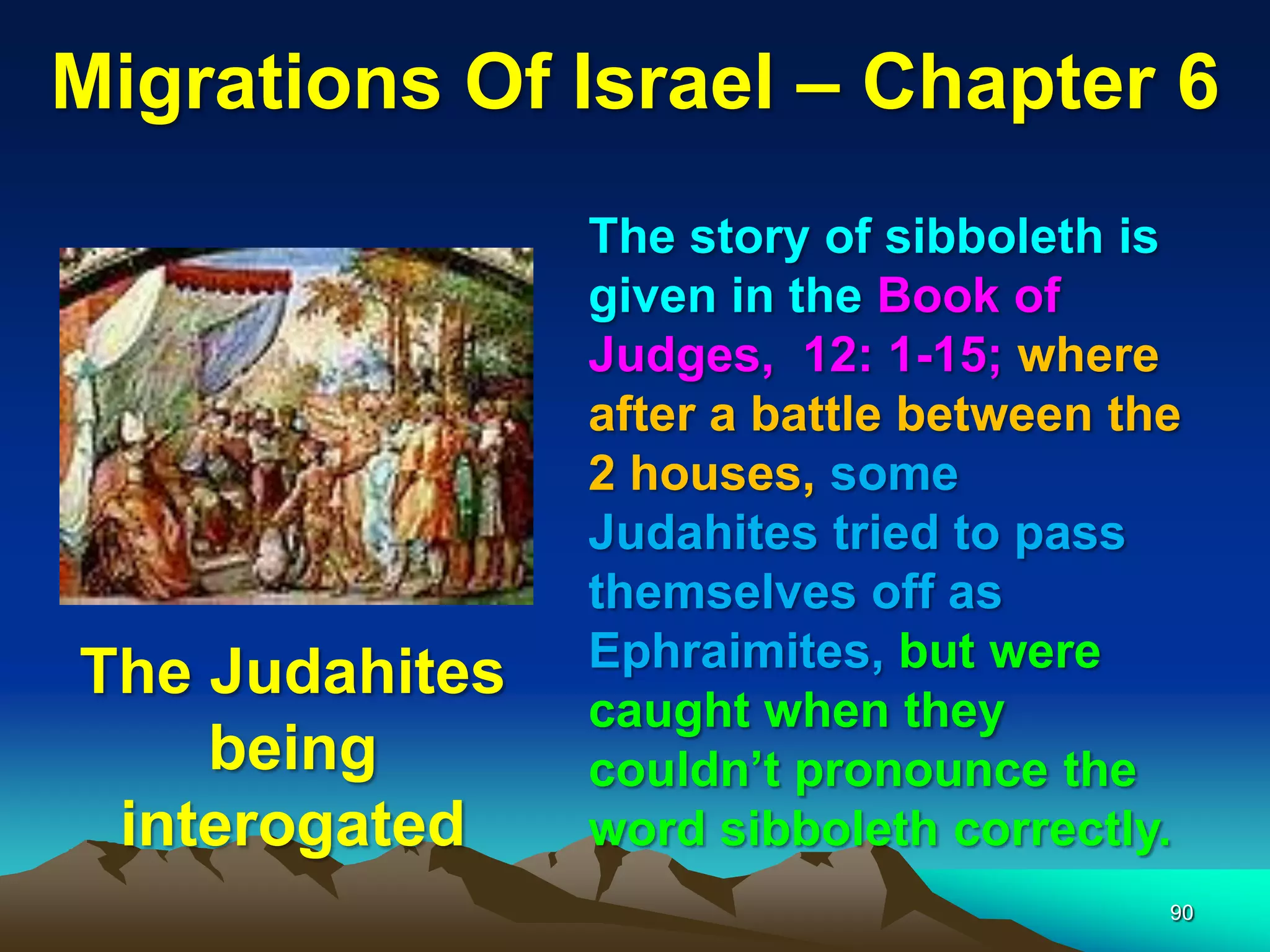
Migrations Of Israel – Chapter 6
                The story of sibboleth is
                given in the Book of
                Judges, 12: 1-15; where
                after a battle between the
                2 houses, some
                Judahites tried to pass
                themselves off as
                Ephraimites, but were
The Judahites
                caught when they
    being       couldn‟t pronounce the
 interogated    word sibboleth correctly.
                                         90
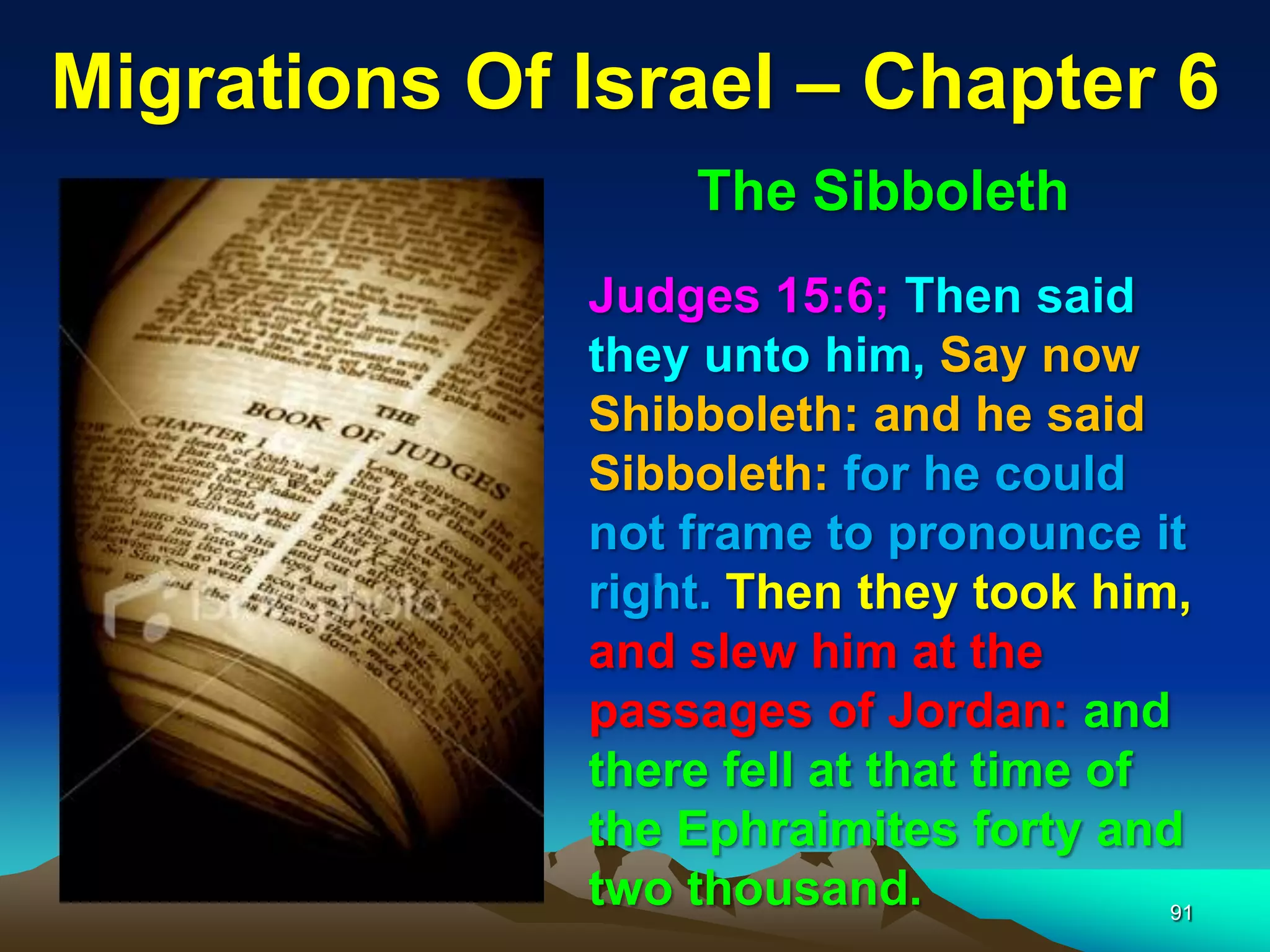
Migrations Of Israel – Chapter 6
                   The Sibboleth
              Judges 15:6; Then said
              they unto him, Say now
              Shibboleth: and he said
              Sibboleth: for he could
              not frame to pronounce it
              right. Then they took him,
              and slew him at the
              passages of Jordan: and
              there fell at that time of
              the Ephraimites forty and
              two thousand.              91
Migrations Of Israel – Chapter 6
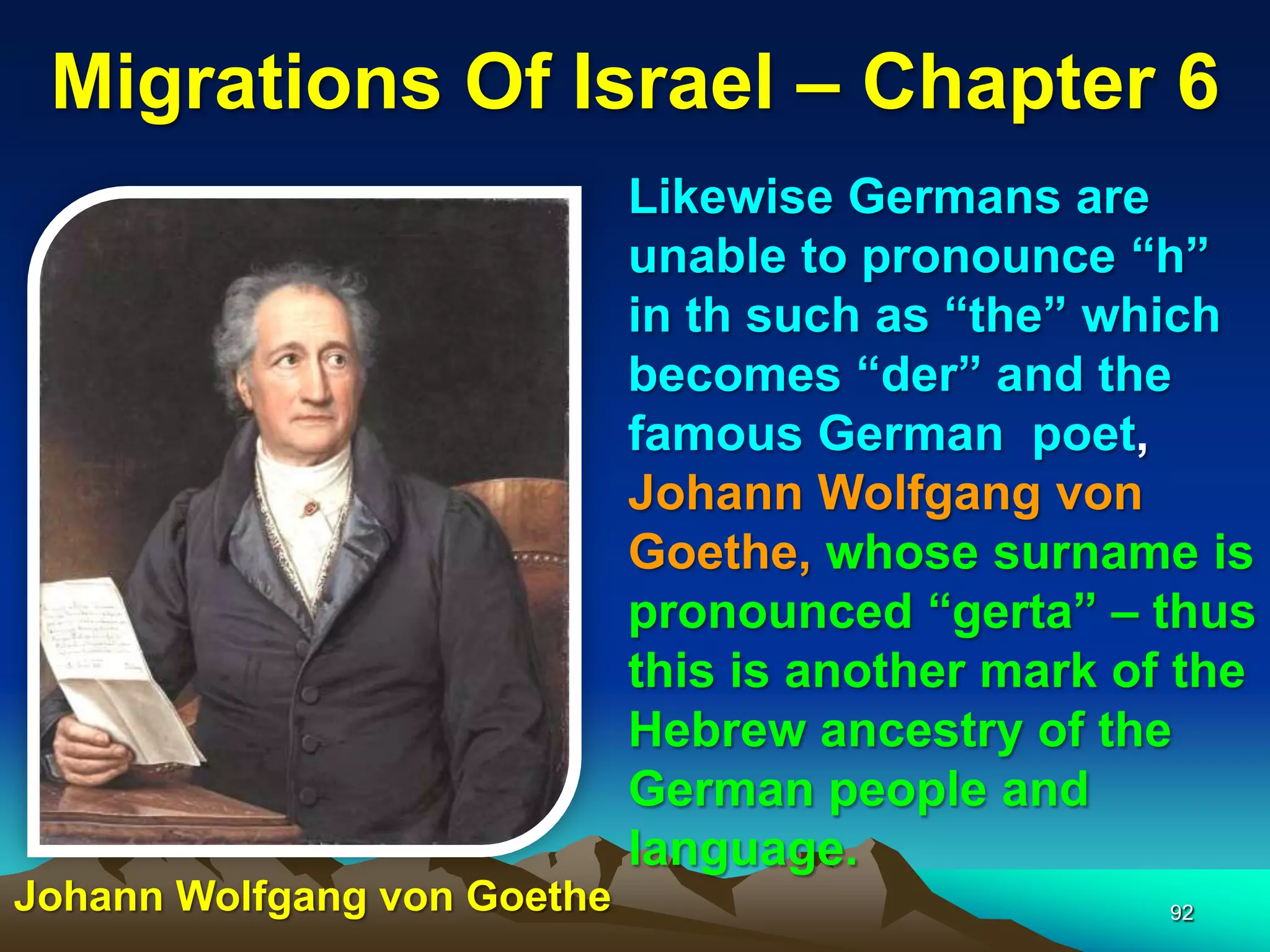
                             Likewise Germans are
                             unable to pronounce “h”
                             in th such as “the” which
                             becomes “der” and the
                             famous German poet,
                             Johann Wolfgang von
                             Goethe, whose surname is
                             pronounced “gerta” – thus
                             this is another mark of the
                             Hebrew ancestry of the
                             German people and
                             language.
Johann Wolfgang von Goethe                          92
Migrations Of Israel – Chapter 6
              According to the experts of
              the linguistic history of the
              migrations of the Anglo-
              Saxon, Celtic and
              Caucasian people, the
              English language is of
              primarily Hebrew syntax
              (according to Tyndale and
              others), plus Gaelic
              (Hamito-Semitic, which is
              also Hebrew) and Germanic
              words.
                                        93
Migrations Of Israel – Chapter 6
                  In essence, the German
                  descendants of Isaac
                  (Saxons), having stayed in
                  Armenia until they finally
                  escaped through the
                  Caucasus, learned the
Armenia - Khor    syntax and words of the
                  ancient Persian language
Virap Monastery   [also called Farsi] and
       &          brought those linguistics
 Mount Ararat     with them as they
                  migrated across Europe.
                                         94
Migrations Of Israel – Chapter 6

                When the Angles and
                Saxons crossed over to
                Britain, they adopted the
                syntax (grammar) of the
                Brits, but added
                numerous Germanic
                words to the native
                tongue of Britain.


                                      95
Migrations Of Israel – Chapter 6

               This explains the major
               grammatical differences
               and word similarities
               between Germanic and
               English, both of which
               languages retain much of
               their native Hebrew
               tongue.


                                    96
Migrations Of The 12 Tribes Of
             Israel


      BY PASTOR ELI JAMES

To be continued ………… Chapter
Seven:
                              97

Israel's Migrations part 6

  • 1.
  • 2.
  • 3.
    Migrations Of Israel– Chapter 6 In this episode of the Migration Chronicles, we are going to trace the Israelite Scythians across the European Continent. 3
  • 4.
    Migrations Of Israel– Chapter 6 This migration began in 745 BC and did not end until Europe was settled by various tribes, most of whom descended from the Twelve Tribes of Israel. 4
  • 5.
    Migrations Of Israel– Chapter 6 We can say that, roughly, this Age of Migrations period lasted close to 2,000 years, with the northernmost parts of Europe being settled by 1,250 AD. 5
  • 6.
    Migrations Of Israel– Chapter 6 Pliny, the Elder, in his Natural History, asserts, “The name of the Scythians is everywhere changed to that of Sarmatae and Germans.” Pliny The Elder 6
  • 7.
    Migrations Of Israel– Chapter 6 Map showing the location of the “barbarian” in Europe circa 320 AD The word, German, was used by the Romans to refer to all of the “Barbarian” tribes north of Italy. The reality is that none of these tribes called themselves “Germans.” 7
  • 8.
    Migrations Of Israel– Chapter 6 For example, the Germans call themselves “Deutsch,” from the root word, “Teut,” meaning “people,” or “folk.” 8
  • 9.
    Migrations Of Israel– Chapter 6 As these Scythian/German tribes began settling down, they formed city-states and, eventually, nation-states. 9
  • 10.
    Migrations Of Israel– Chapter 6 It is also possible that the word „Teut‟ comes from the Latin word, „Deus,‟ which means “God.” So, the word, Deutschevolk actually means “God’s People,” which is what the Israelites traditionally called themselves. The Reichstag (German Parliament) 10
  • 11.
    Migrations Of Israel– Chapter 6 The word „Goth’ also means “God,” as does the Germanic “Gott.” So, the word “Goth” is also a reference to “God‟s people.” An example of Gothic architecture 11
  • 12.
    Migrations Of Israel– Chapter 6 Historically, only the Israelites ever referred to themselves as “God‟s people.” As these migrated north and west through Europe, their tribal names often informed the territories where they settled. 12
  • 13.
    Migrations Of Israel– Chapter 6 Some of these tribal names actually recall their Israelite heritage. Thus Jutland was named after the Jutes (Tribe of Judah). 13
  • 14.
    Migrations Of Israel– Chapter 6 Denmark (Dan-Mark) was named after the Tribe of Dan. 14
  • 15.
    Migrations Of Israel– Chapter 6 Russia is probably named after Rosh, the son of Benjamin. The origin of the word "Russian" is from "Rosh" of Ezekiel 38:2. In Mesopotamia was a valley called "the Russia – coloured land of Rashu!” blue 15
  • 16.
    Migrations Of Israel– Chapter 6 The word "Russ" or "Rosh" means blonde. And in ancient Mesopotamia lived the blonde children of Keturah and Abraham mentioned in Genesis 25:1-6. They founded the Kingdom of A Mesopotamian Mitanni, named after Worker Midian and Medan. 16
  • 17.
    Migrations Of Israel– Chapter 6 Mongol Warriors These Scythian/Gothic Israelites, mixed with other Aryan descendants of Abraham, were constantly driven north and west by Asiatic tribes, such as the Huns, Avars, Turks, Mongols, and Khazars. 17
  • 18.
    Migrations Of Israel– Chapter 6 The easternmost of the Gothic Tribes had to fight against these invaders, thus preventing them from moving further west. These invasions constantly propelled the Scythian Israelites northward and westward. When these invasions finally ended, 18
  • 19.
    Migrations Of Israel– Chapter 6 A major development occurred in 800 AD, when Charlemagne unified most of the German states into the Holy Roman Empire. The Holy Roman Empire Crown 19
  • 20.
    Migrations Of Israel– Chapter 6 Map of early distribution of tribes The HRE included what was left of the Ostrogoths, Visigoths, Goths, Vandals, Huns, Franks, Angles, Saxons, etc. Ultimately, the Vikings and Normans became the nations of Sweden, Norway, Finland, Estonia, Lithuania, etc. 20
  • 21.
    Migrations Of Israel– Chapter 6 Left: German chieftain of the Suebi people The first mention of the Suebi people occurs in the first century BC. 21
  • 22.
    Migrations Of Israel– Chapter 6 According to Tacitus, in his Annales, after 9 BC, Augustus divided the Germans by making a separate peace with the Sugambri and Suebi under their king Maroboduus. This is the first mention of any permanent king of the Suebi. Tacitus AD 56 – AD 120 22
  • 23.
    Migrations Of Israel– Chapter 6 Alans and Sueves Left: The Alans There is no doubt that the Suebi are a branch of the Germans. The Alans and Sueves, as part of the Migrations of the Twelve Tribes, were known to have 23 traveled together for a good part of their history.
  • 24.
    Migrations Of Israel– Chapter 6 Alans and Sueves Closely related to the Alamanni and often working in concert with them, the Suebi for the most part stayed on the right bank of the Rhine until December 31, 406, The Alamanni (Coloured buff ) on the right bank of the Rhine 24
  • 25.
    Migrations Of Israel– Chapter 6 …. when much of the tribe joined the Vandals and Alans in breaching the Roman frontier by crossing the Rhine, perhaps at Mainz, thus launching an invasion of northern Gaul. 25
  • 26.
    Migrations Of Israel– Chapter 6 Alans and Sueves The "northern Suebi" were mentioned in 569 under Frankish king Sigebert I in areas of today's Saxony- Anhalt which were known as Schwabengau or Suebengau at least until the 12th century. In connection to the Suebi, Marriage of Saxons and Lombards, Sigebert and returning from the Italian Brunhilda Peninsula in 573, are also mentioned. 26
  • 27.
    Migrations Of Israel– Chapter 6 Alans and Sueves While the Vandals and Alans clashed with the Roman-allied Franks for supremacy in Gaul, the Suebi under their king Hermeric worked their way to the south, The Vandals 27
  • 28.
    Migrations Of Israel– Chapter 6 Alans and Sueves …. eventually crossing the Pyrenees and entering the Iberian Peninsula which was out of Imperial rule since the rebellion of Gerontius The Iberian and Maximus in 409. Peninsular circa 409 28
  • 29.
    Migrations Of Israel– Chapter 6 Alans and Sueves The Suebi or Suevi (from Proto-Germanic *swēbaz based on the Proto-Germanic root swē - meaning "one's own" people, from an Indo-European root swe -, the third person reflexive pronoun) 29
  • 30.
    Migrations Of Israel– Chapter 6 Alans and Sueves The Bavarian province of Swabia (Swaben) formerly an independent principality retains the proto-German swēbaz name of the Suebi or Suevi to this day! 30
  • 31.
    Migrations Of Israel– Chapter 6 Alans and Sueves …. were a group of Germanic peoples who were first mentioned by Julius Caesar in connection with Ariovistus' campaign, circa 58 BC; Julius Caesar 31
  • 32.
    Migrations Of Israel– Chapter 6 Alans and Sueves Ariovistus was defeated by Caesar. Some Suebi remained a periodic threat against the Romans on the Rhine, until, toward the end of the empire, the Alamanni, including elements of Suebi, brushed aside Roman defenses and occupied Alsace, and from there Bavaria and Ariovistus Switzerland. 32
  • 33.
    Migrations Of Israel– Chapter 6 Suevi and Angli Ptolemy in his Geography (2.10) presents a somewhat more complex view. The Saxons are placed around the lower Elbe, which area they could have reached merely by an extension of the Ptolemy Saxon alliance. 33
  • 34.
    Migrations Of Israel– Chapter 6 Suevi and Angli East of them are the Teutones and also a dissimilation of them, the Teutonoari, which denotes "men" (wer); i.e., "the Teuton men." These Teutons or Teuton men appear to have been in Angeln and the land around it. 34
  • 35.
    Migrations Of Israel– Chapter 6 Suevi and Angli The Angles, as such, are not listed at all. Instead there are Syeboi Angeilloi, Latinized to Suevi Angili, located south of the middle Elbe. The River Elbe - Rathen 35
  • 36.
    Migrations Of Israel– Chapter 6 Suevi and Angli There has been much speculation regarding the original home of the Angli, but it appears that the Angli, or Angles, derived from the Suebi. These Angles continued west towards England. The White Cliffs Of Dover England 36
  • 37.
    Migrations Of Israel– Chapter 6 Suevi and Alemanni The name of the Suebi also appears in Norse mythology and in early Scandinavian sources. The earliest attestation is the Proto-Norse name Swabaharjaz ("Suebian warrior") on the and in the place name Svogerslev. 37
  • 38.
    Migrations Of Israel– Chapter 6 Suevi and Alemanni Sváfa, whose name means "Suebian", was a Valkyrie who appears in the eddic poem Helgakviða Hjörvarðssonar The Suebian Knott 38
  • 39.
    Migrations Of Israel– Chapter 6 Suevi and Alemanni Ariovistus was a native of the Suebi. He spoke Gaulish fluently. He had two wives, one of whom he had brought from home. The second, who was the sister of King Vocion of Noricum, he Ariovistus acquired in an arranged political marriage. 39
  • 40.
    Migrations Of Israel– Chapter 6 Suevi and Alemanni Ariovistus is described by Caesar as rex Germanorum. It is likely that Ariovistus' authority only extended over those Germans who had settled in Gaul. He was recognized as a king by The Roman the Roman Senate. Senate 40
  • 41.
    Migrations Of Israel– Chapter 6 Suevi and Alemanni Tacitus says that the Germans made a distinction between kings, who were chosen by birth, and military leaders, who were chosen by ability, and that kings did not have Example of Tacitus‟ absolute power. writing 41
  • 42.
    Migrations Of Israel– Chapter 6 Allemanni and Marcomanni The following slides are quotations form the book, TRACKING LADON GOG AND THE HEBREW ROSE, by John Anonymous Mythbuster 42
  • 43.
    Migrations Of Israel– Chapter 6 Allemanni and Marcomanni Left: Roman coins depicting victory over the Allemanni “It is also a good theory to view the Allemanni as the vehicle between the Maeonians and the Meons, with the understanding that it may have been prior to the Allemanni making an alliance with the Allens, at which time they were simply a hypothetical "Manni,”…… 43
  • 44.
    Migrations Of Israel– Chapter 6 Allemanni and Marcomanni ….."but perhaps the historical Marcomanni among whom were the Quadi. The Quadi may then have been the Cati who joined the peoples (Hirpini?) of Catuvellauni Celts Abellinum / Avellino in forming the Catuvellauni Celts 44
  • 45.
    Migrations Of Israel– Chapter 6 Allemanni and Marcomanni The Wassa clan (which I'm assuming was Saxon) that began in Cornwall may thereby have become a Saxo-Cati mix, a mix smacking of the entity of Thuringia (that Coat of Arms of The put forth the modern British royals).” Duchy of Saxe- Coburg-Gotha 45
  • 46.
    Migrations Of Israel– Chapter 6 Allemanni and Marcomanni There is no doubt that the “Catti” are the Tribe of Gad. Without a knowledge of our origins in the Twelve Tribes, this connection could not be made. The Catti 46
  • 47.
    Migrations Of Israel– Chapter 6 Allemanni and Marcomanni The Suebian writer, , said that the Suebi called themselves, "Sueve," wherefore the Semnones were indeed related to them ...as much as Tacitus placed the Semnones beside the Seuve and claimed their kinship. Strabo 47
  • 48.
    Migrations Of Israel– Chapter 6 Allemanni and Marcomanni To show that we are dealing with a Molech- like cult, Tacitus wrote: "There by publicly sacrificing a man, [the Semnones] begin the horrible solemnity of their barbarous worship." It is said that the Allemanni moved into and/or founded. Castle-in-Alsace- France 48
  • 49.
    Migrations Of Israel– Chapter 6 Allemanni and Marcomanni Alsace could be read as Ale-Saka or Ale-Saxon, and who knows but that "Alesacius" could have been the earliest rendering of these peoples, as far back as , Caucasia, The Caucasus Region 49
  • 50.
    Migrations Of Israel– Chapter 6 Allemanni and Marcomanni which is to say that the Laz/Lazica of Caucasia may have been named after an Alesacius-like term. After all, Alans were from northern Caucasia, and the Saka were there as well. Kingdom of Lazica 50
  • 51.
    Migrations Of Israel– Chapter 6 From this map of Europe‟s rivers, we can see how the Danube penetrates into the very center of Europe 51
  • 52.
    Migrations Of Israel– Chapter 6 The Danube River, named by the Tribe of Dan, was the main transportation route of the westward migrating tribes. The Dnieper, Don and Volga rivers provided the northerly migration routes. 52
  • 53.
    Migrations Of Israel– Chapter 6 Allemanni and Marcomanni Map of central Europe, showing the Alemanni 53
  • 54.
    Migrations Of Israel– Chapter 6 Allemanni and Marcomanni The Marcomanni were immediately north of the Allemanni. are also said to have been a Suebi tribe. Now the oldest term belonging to these Germanics was "Hermunduri," no doubt the root of "German.” Maroboduus (or Marbod), King of the Marcomanni 54
  • 55.
    Migrations Of Israel– Chapter 6 Allemanni and Marcomanni The word "duri" is the same as „Thuri,‟ from which we get the name, „Thuringia.‟ Both the Allemanni and the Suevi are today called by the name, Germans. The modern state of Thuringia 55
  • 56.
    Migrations Of Israel– Chapter 6 The Invasion of the Huns Frederick Haberman: “For a century the Roman Empire stood against the Gothic invasion, the reason being that Christianity was spreading rapidly at that time in southern Europe. Wulfila spread from Constantinople, where he translated the Bible into Gothic. ….. 56
  • 57.
    Migrations Of Israel– Chapter 6 The Invasion of the Huns …. But many centuries were yet to pass before the northern gothic peoples, the Saxons, Jutes, and the Angles, should hear of Jesus Christ. In Sweden, Odin was deified and the faith in him grew until the 11th Odin on his Century, AD. ….. throne 57
  • 58.
    Migrations Of Israel– Chapter 6 The Invasion of the Huns …. The reason why northern Europe did not accept Christianity for centuries later was the invasion of the Huns, who drove a wedge between the Gothic nations of the north and south.” 58
  • 59.
    Migrations Of Israel– Chapter 6 The Mongols Finally Defeated The last of the Eastern hordes were the Mongols under Genghis Kahn. Their presence in Eastern Europe lasted almost 300 years. They reached as far west as Vienna, where they were prepared to invade that city in December, 1241. 59
  • 60.
    Migrations Of Israel– Chapter 6 The Mongols Finally Defeated But the sudden death of Ogedei Khan, Genghis Khan‟s son and successor, put an end to the invasion. Ogedei‟s successors fell to fighting amongst themselves; and the White nations of Europe began to drive them back. Ogedei Khan 60
  • 61.
    Migrations Of Israel– Chapter 6 The Mongols Finally Defeated The first major White re- conquest of the southern parts of Russia only began in the mid 1500s, when bands of Russian peasants, known as Cossacks, fleeing the autocratic fiefdoms of northern Russia, started settling along the banks of the Don River basin. A Cossack 61
  • 62.
    Migrations Of Israel– Chapter 6 The Mongols Finally Defeated …. engaged in a large clearing operation lasting many decades against the Mongols. By the mid- 1600s the majority of Mongols had been cleared from central southern Russia 62
  • 63.
    Migrations Of Israel– Chapter 6 The Mongols Finally Defeated … the remaining minority were for the greatest part absorbed into the new population. – March of the Titans, A History of the White Race, Chapter 32. 63
  • 64.
    Migrations Of Israel– Chapter 6 The Descendants of Abraham Besides the Israelites, many of their kinsfolk of other tribes decided to flee from their Assyrian captors. These appear to be the “Sarmations,” whom historians distinguish from the Scythians. Abraham came from "Ur of the Chaldees". The Sarmations 64
  • 65.
    Migrations Of Israel– Chapter 6 The Descendants of Abraham Ancient Ur was in Mesopotamia. Ur is a shortened name for Urfa. There were once two cities by that name. 65
  • 66.
    Migrations Of Israel– Chapter 6 The Descendants of Abraham The Apostle, Stephen, tells us that it was the northern Ur in Mesopotamia from which Abram came (Acts 7:2-3). That is where the Chaldeans first dwelt -- over 400 miles northwest of ancient Babylon. St. Stephen Window Norwich 66
  • 67.
    Migrations Of Israel– Chapter 6 The Descendants of Abraham The word "Chaldean" comes from the Greek. The original Hebrew word is Chasdim, meaning "the people of Chesed". Notice that Chesed was a common name in the family of Abraham (Gen.22:22). Abraham 67
  • 68.
    Migrations Of Israel– Chapter 6 The Descendants of Abraham One area where these people lived was Arphaxad. Most Biblical encyclopaedias will clearly show that the Hebrew form is Arfachesed ----- MEANING ARFA OR Arphaxad URFA THE CHALDEAN! 68
  • 69.
    Migrations Of Israel– Chapter 6 The Descendants of Abraham The Chaldeans come from Arphaxad. They are his children. Abraham was a branch of this stock! The city of Ur was named after Arfa or Urfa, the Chaldean.‟ The Chaldeans 69
  • 70.
    Migrations Of Israel– Chapter 6 The Descendants of Abraham Sometimes they were referred to as HURRI or Hurrians, after Haran (Gen.11:29; 22:20-24). Sometimes they bore the name GUTI, probably meaning "people of God". „Guti‟ is the source word for A Hurrain “Goth.‟ Charioteer 70
  • 71.
    Migrations Of Israel– Chapter 6 The Descendants of Abraham The word "Persian" or "Parthian" is derived from the word "Euphrates". Along this river these sons of Abraham first lived. The Hebrews called the Euphrates the Perath or Peres River --- the River of the Persians! 71
  • 72.
    Migrations Of Israel– Chapter 6 The Descendants of Abraham Perez is actually a form of the Hebrew word, Pharez. Pharez was the son of Judah. It is obvious that the descendants of Pharez, who were taken captive by Sennacherib in 701 BC, when his Assyrian army captured all of the fenced Judah‟s cities of Judea, except for Genealogy the city of Jerusalem itself. (Isa. 36:1; II Chron. 17:2.) 72
  • 73.
    Migrations Of Israel– Chapter 6 The Descendants of Abraham Left: The Magi Hence, it is quite possible that the Persians derived their name from Pharez (Perez), the son of Judah. The Parthians were those Israelites who stayed in Mesopotamia until after the days of Christ. Their kings were direct descendants of Pharez. The Magi were the igh priesthood of these Judahite Parthians. 73
  • 74.
    Migrations Of Israel– Chapter 6 The Descendants of Abraham The Persians named several small rivers in their new land after the Euphrates in Mesopotamia. Cyrus the King, so famous in Bible history, was a Persian. King Cyrus 74
  • 75.
    Migrations Of Israel– Chapter 6 The Descendants of Abraham “Travellers still speak of the fair-complexioned, blue eyed populations met with in the Persian highlands", writes Sayce in RACES OF THE OLD TESTAMENT. "Chestnut hair is very common in Persia, as it is among the West European Alpines", says Griffith Taylor in ENVIRONMENT AND RACE, Thomas p.186. Griffith Taylor 75
  • 76.
    Migrations Of Israel– Chapter 6 The Descendants of Abraham Closely the Persians related to are the Medes. Pliny in his NATURAL HISTORY, bk. VI, sec. xi. mentions "the river Don, where the inhabitants are . . . Rostov-on-Don said to be descended from the Medes"! 76
  • 77.
    Migrations Of Israel– Chapter 6 The Descendants of Abraham I am Dariush, the Great King, the King of Kings The King of many countries and many peoples The King of this expansive land, the son of Wishtasp Achamenia Persian, the son of a Persian, 'Aryan', from the Aryan Race Dariush's scripture in Naqshe-e- Rostam King Dariush 77
  • 78.
    Migrations Of Israel– Chapter 6 Conclusion There is no doubt that the Germanic peoples derive from the overland migration of the Twelve Tribes of Israel. Various waves of these people passed through the Caucasus Mountains, around the Black and Caspian Seas, then north and west into Europe. 78
  • 79.
    Migrations Of Israel– Chapter 6 Conclusion Isa. 11:16 tells us that these Israelites would pass through the area: And there shall be an highway for the remnant of his people, which shall be left, from Assyria; like as it was to Israel in the day that he came up out of the land of Egypt. 79
  • 80.
    Migrations Of Israel– Chapter 6 Conclusion Before migrating, however, these Israelites had to learn the language of the area. The language spoken there was Persian. The historian, Sharon Turner, has collected a number of Persian words, which came into the Anglo- Saxon language from this captivity. 80
  • 81.
    Migrations Of Israel– Chapter 6 The following word study is from Sharon Turner, author of “The History of the Anglo-Saxons.” PERSIAN, ANGLO-SAXON Persian Anglo-Saxon German Am I am Angel A Hook Aw Water Wasser Ende End Ende Berend Fruitful Brader A brother Bruder Band A band, a chain Bendan To bind Binden Saf Pure Mxden A maiden Mädchen Madah A female 81 Morth Death Mort?
  • 82.
    Migrations Of Israel– Chapter 6 PERSIAN, ANGLO-SAXON Persian Anglo-Saxon German Murda Death Morther Murder Mus A Mouse Maus Nah Not Nun Now Nun Nuh Nine Neun Hol Health Dar A Door Cu A Cow Kuh Leogan To tell a Lie Lügen Lam Lame Lahm Lust Delight Lustig 82
  • 83.
    Migrations Of Israel– Chapter 6 PERSIAN, ANGLO-SAXON Persian Anglo-Saxon German Thu Thou Sorg Sorrow Supwah A shoe Schuh Tunder Thunder Donner Faeren To go Fahren Zend/Anglo-Saxon (Zend is a Persian Dialect) Zend Anglo-Saxon German Dochter Daughter Tochter Dohte He did 83
  • 84.
    Migrations Of Israel– Chapter 6 Zend/Anglo-Saxon (Zend is a Persian Dialect) Zend Anglo-Saxon German Frend A friend Freund Feder Father Vater Mid With Mit Meder Mother Mutter Metan Measure Maest Master Meister Meze Meso Great Mal More Mehr Hera A lord Herr Uppa Above Thre Three Drei Thrydde A third Dritter 84
  • 85.
    Migrations Of Israel– Chapter 6 Zend/Anglo-Saxon (Zend is a Persian Dialect) Zend Anglo-Saxon German Thu Thou Du Dreori Dreary Düster Daeth Death Tot Dajed He is no more Reswian Reason Guast The spirit Geist Mxnde To mention Manthre Words Wörter Midda Middle Mittle Meiao Middle Morth Death Mrete Mortal 85
  • 86.
    Migrations Of Israel– Chapter 6 Zend/Anglo-Saxon (Zend is a Persian Dialect) Zend Anglo-Saxon German Yare Year Jahr Starian To look at Senghan A Word Snid A cut Schnitt Scina Shina Brilliant Scheeto Brilliant Pehlvi/Anglo-Saxon (Pehlvi is a dialect of Persian) Pehlvi Anglo-Saxon German Halig Holy Heilig Halae Pure 86
  • 87.
    Migrations Of Israel– Chapter 6 Pehlvi/Anglo-Saxon (Pehlvi is a dialect of Persian) Pehlvi Anglo-Saxon German Eahta Eight Acht Ascht Eight Acht Marg Mortal A-marg Immortal Thu Thou Du Tou Thou Sex Six Sechs Besche Wicked böse Cneou Knee Djanouh Knee Steorran Stars Sterne Cu Cow Kuh 87
  • 88.
    Migrations Of Israel– Chapter 6 Pehlvi/Anglo-Saxon (Pehlvi is a dialect of Persian) z Pehlvi Anglo-Saxon German Meh Great groß Bar Bare Barhene Naked Nackt Morth Death Meder Mother Mutter Nafel The Navel Nabel Na No Cald Called Kala Crying out Band A Joining Bund Banda A Band Raed A Road 88
  • 89.
    Migrations Of Israel– Chapter 6 Pehlvi/Anglo-Saxon (Pehlvi is a dialect of Persian) Pehlvi Anglo-Saxon German Raeh A way Eortha Earth Arta Earth (Hebrew Erde eretz) The Sibboleth Another important identifying linguistic mark is the “Sibboleth”, where the Judahites were unable to pronounce the “h” in the “th” sound, whereas the Northern House of Israel could. This language difference between the English and Germans 89 remains to this day!
  • 90.
    Migrations Of Israel– Chapter 6 The story of sibboleth is given in the Book of Judges, 12: 1-15; where after a battle between the 2 houses, some Judahites tried to pass themselves off as Ephraimites, but were The Judahites caught when they being couldn‟t pronounce the interogated word sibboleth correctly. 90
  • 91.
    Migrations Of Israel– Chapter 6 The Sibboleth Judges 15:6; Then said they unto him, Say now Shibboleth: and he said Sibboleth: for he could not frame to pronounce it right. Then they took him, and slew him at the passages of Jordan: and there fell at that time of the Ephraimites forty and two thousand. 91
  • 92.
    Migrations Of Israel– Chapter 6 Likewise Germans are unable to pronounce “h” in th such as “the” which becomes “der” and the famous German poet, Johann Wolfgang von Goethe, whose surname is pronounced “gerta” – thus this is another mark of the Hebrew ancestry of the German people and language. Johann Wolfgang von Goethe 92
  • 93.
    Migrations Of Israel– Chapter 6 According to the experts of the linguistic history of the migrations of the Anglo- Saxon, Celtic and Caucasian people, the English language is of primarily Hebrew syntax (according to Tyndale and others), plus Gaelic (Hamito-Semitic, which is also Hebrew) and Germanic words. 93
  • 94.
    Migrations Of Israel– Chapter 6 In essence, the German descendants of Isaac (Saxons), having stayed in Armenia until they finally escaped through the Caucasus, learned the Armenia - Khor syntax and words of the ancient Persian language Virap Monastery [also called Farsi] and & brought those linguistics Mount Ararat with them as they migrated across Europe. 94
  • 95.
    Migrations Of Israel– Chapter 6 When the Angles and Saxons crossed over to Britain, they adopted the syntax (grammar) of the Brits, but added numerous Germanic words to the native tongue of Britain. 95
  • 96.
    Migrations Of Israel– Chapter 6 This explains the major grammatical differences and word similarities between Germanic and English, both of which languages retain much of their native Hebrew tongue. 96
  • 97.
    Migrations Of The12 Tribes Of Israel BY PASTOR ELI JAMES To be continued ………… Chapter Seven: 97

Editor's Notes

  • #90 Here is the relevant excerpt from the Book of Judges. The full account is in Chapter 12, verses 1-15.12, 4 Then Jephthah gathered together all the men of Gilead, and fought with Ephraim: and the men of Gilead smote Ephraim, because they said, Ye Gileadites are fugitives of Ephraim among the Ephraimites, and among the Manassites.5 And the Gileadites took the passages of Jordan before the Ephraimites: and it was so, that when those Ephraimites which were escaped said, Let me go over; that the men of Gilead said unto him, art thou an Ephraimite? If he say Nay;6 Then said they unto him, Say now Shibboleth: and he said Sibboleth: for he could not frame to pronounce it right. Then they took him, and slew him at the passages of Jordan: and there fell at that time of the Ephraimites forty and two thousand.