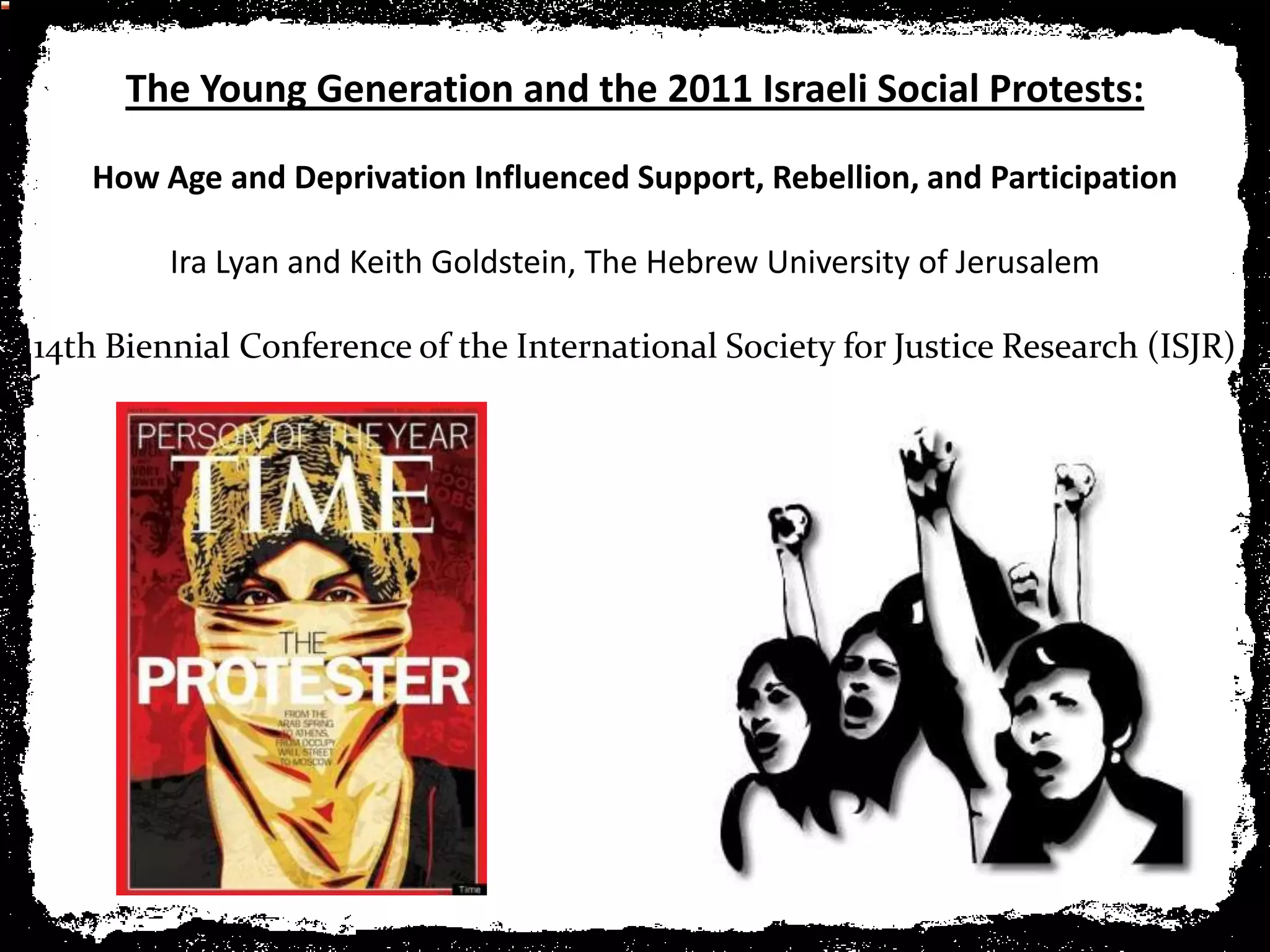
The Young Generation and the 2011 Israeli Social Protests:

   How Age and Deprivation Influenced Support, Rebellion, and Participation

         Ira Lyan and Keith Goldstein, The Hebrew University of Jerusalem

14th Biennial Conference of the International Society for Justice Research (ISJR)
Theories of Protest Participation

Social Learning/ Social Differentation Theories: Social and political
activism take place as a result of transmission from 1) family, friends, and
other significant others (Jennings and Niemi 1968), 2) environment and
temporal climate (Jennings and Niemi 1974)
Disaffected Radicalism: Social protest is symbolized by groups who are
upset with their alienation from or lack of trust for the system. Relative
deprivation drives protest (Gurr 1970).
Social Class/Social Psychological Theories: Youth from higher socio-
economic backgrounds are more likely to engage in protests and develop
ideological temperaments that motivate activism (Sherkat and Blocker 1994)
Other Theories: Contextual, Modes of Convention, Demographic
Subgroups, Subcultures (Neo-Marxist Resistance Theory-CCCS, Hebdige 1981,
etc.), Social Class, Religiosity, Gender, Mob Mentality, and many more.
Many theories grew from studies of the Civil Rights and Anti-War Protests in
the USA in the 1960s
History of the Israel Social Justice Protests and Our Study
July 14th: Daphne Leef puts up a tent on Tel Aviv’s Rothchild Boulevard

July 23rd: First major street rally in Tel Aviv attended by thousands

August 11th: The Hebrew University Sociology Department issues a call for a special research
group to investigate the social justice protests.

August 14th-September 1st: Survey is formatted in Hebrew by our subgroup of four.

September 3rd, Morning: First respondents answer the survey.

September 3rd, Night: “Million Man March”

September 11th: Russian version is released

September 14th: Arabic Version is released

September 25th: English version is released

October 3rd: Rothchild tent compound in Tel Aviv is dismantled and our survey is closed.
The Study

• Electronic (internet) survey was filled out by 3,393 respondents.

• Survey was available in 4 languages (Hebrew, Russian, Arabic, and English)

• Advertising was done through on-site flyers, emails, and Facebook referrals.

• The data set and codebook are available to the public at the following website:

                             http://eshkol.huji.ac.il/

• Sampling bias towards those who participated and higher socio-economic classes.

• Study was part of a larger investigation, which included qualitative analysis
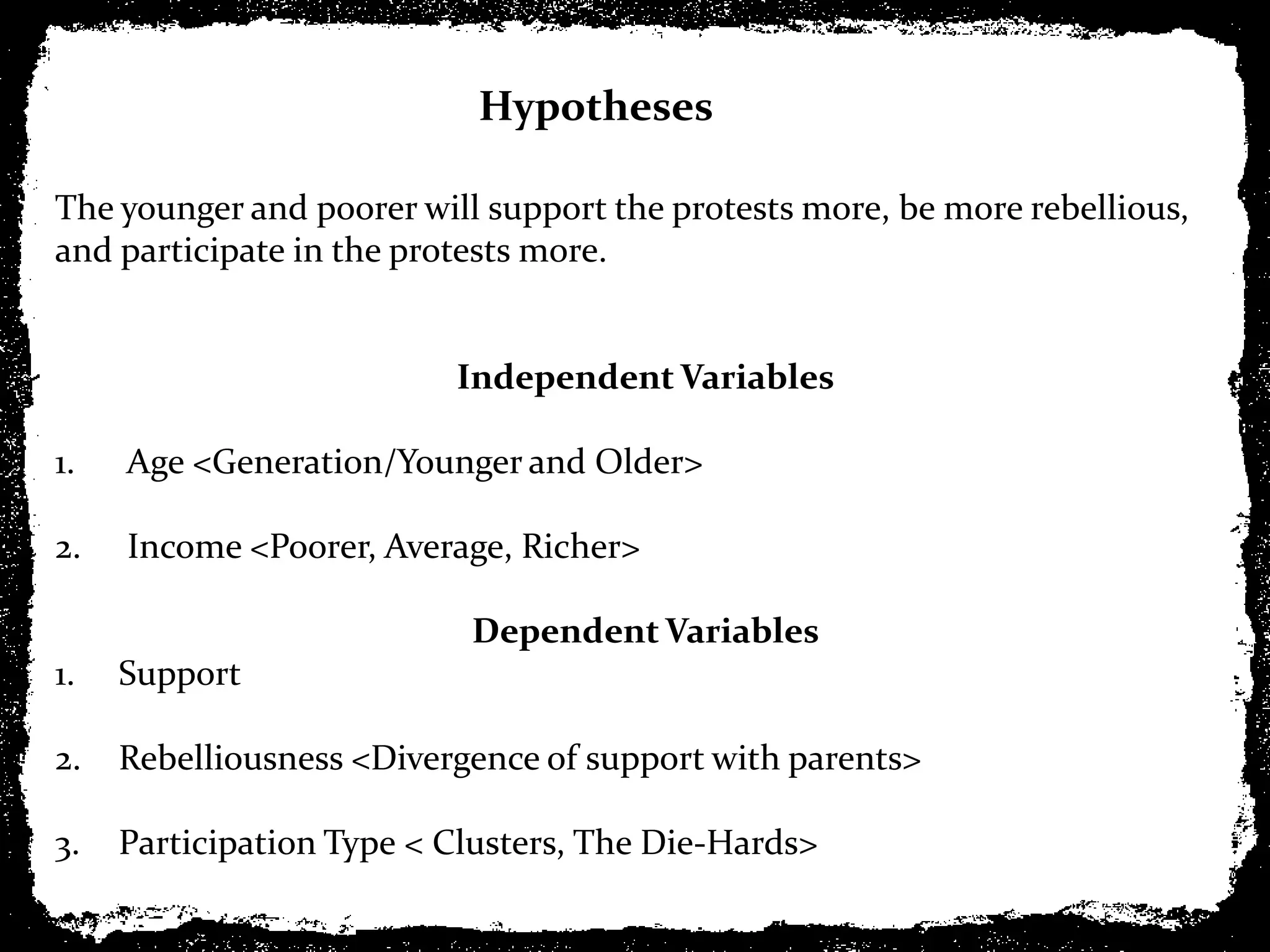
Hypotheses

The younger and poorer will support the protests more, be more rebellious,
and participate in the protests more.


                          Independent Variables

1.   Age <Generation/Younger and Older>

2.   Income <Poorer, Average, Richer>

                           Dependent Variables
1.   Support

2.   Rebelliousness <Divergence of support with parents>

3.   Participation Type < Clusters, The Die-Hards>
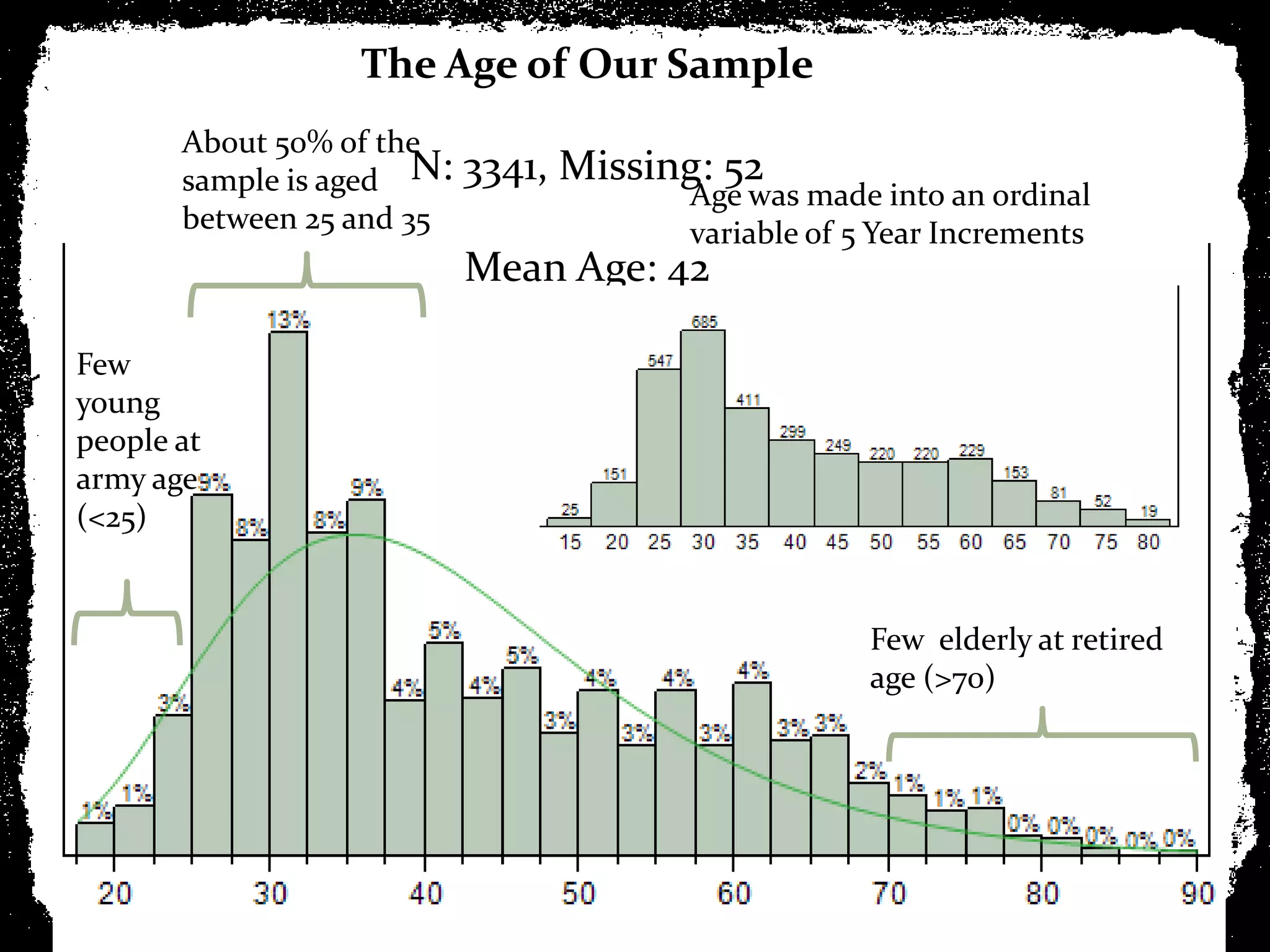
The Age of Our Sample
       About 50% of the
       sample is aged N:   3341, Missing: 52
                                       Age was made into an ordinal
       between 25 and 35               variable of 5 Year Increments
                           Mean Age: 42

Few
young
people at
army age
(<25)


                                                    Few elderly at retired
                                                    age (>70)
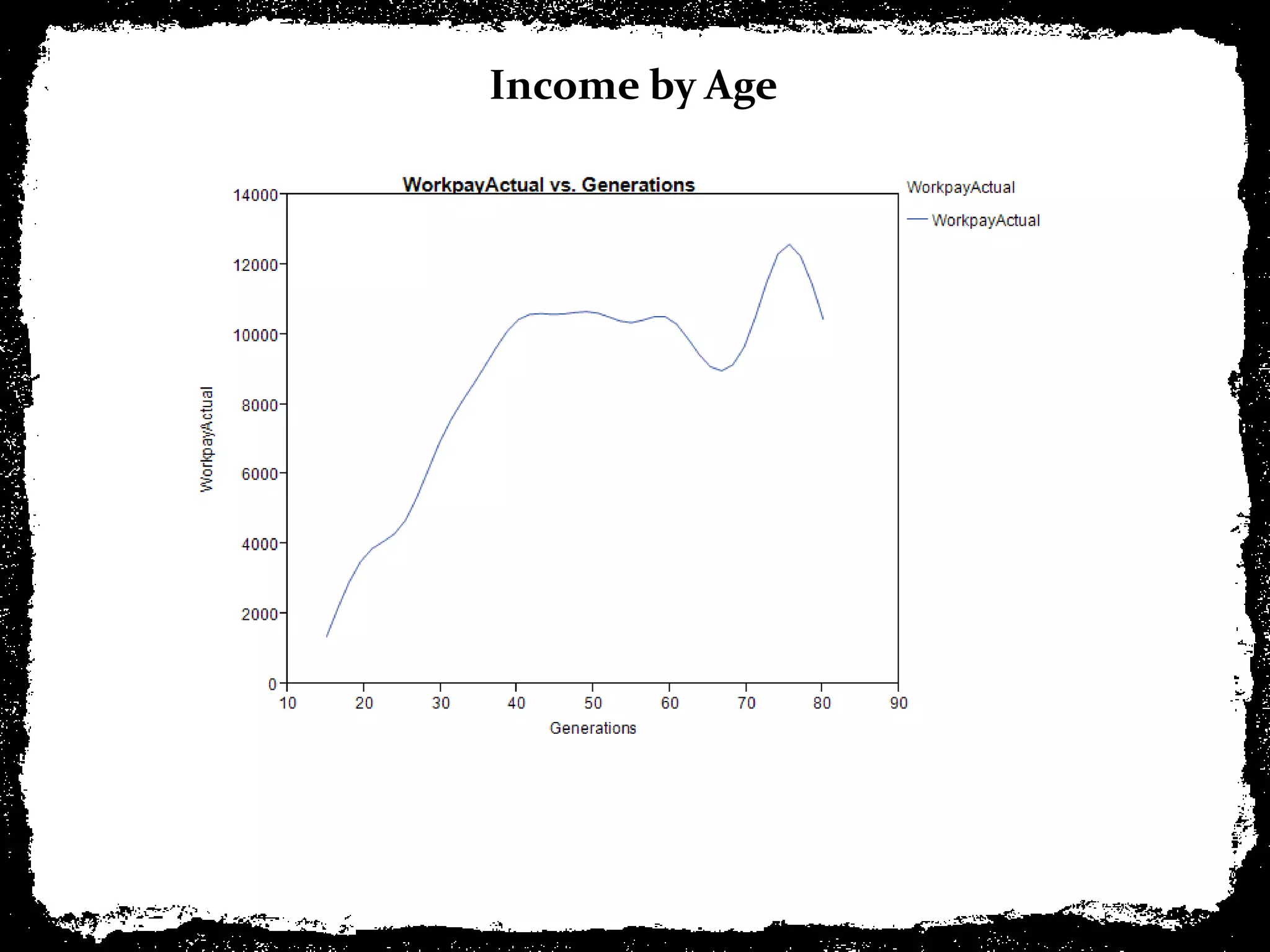
Income by Age
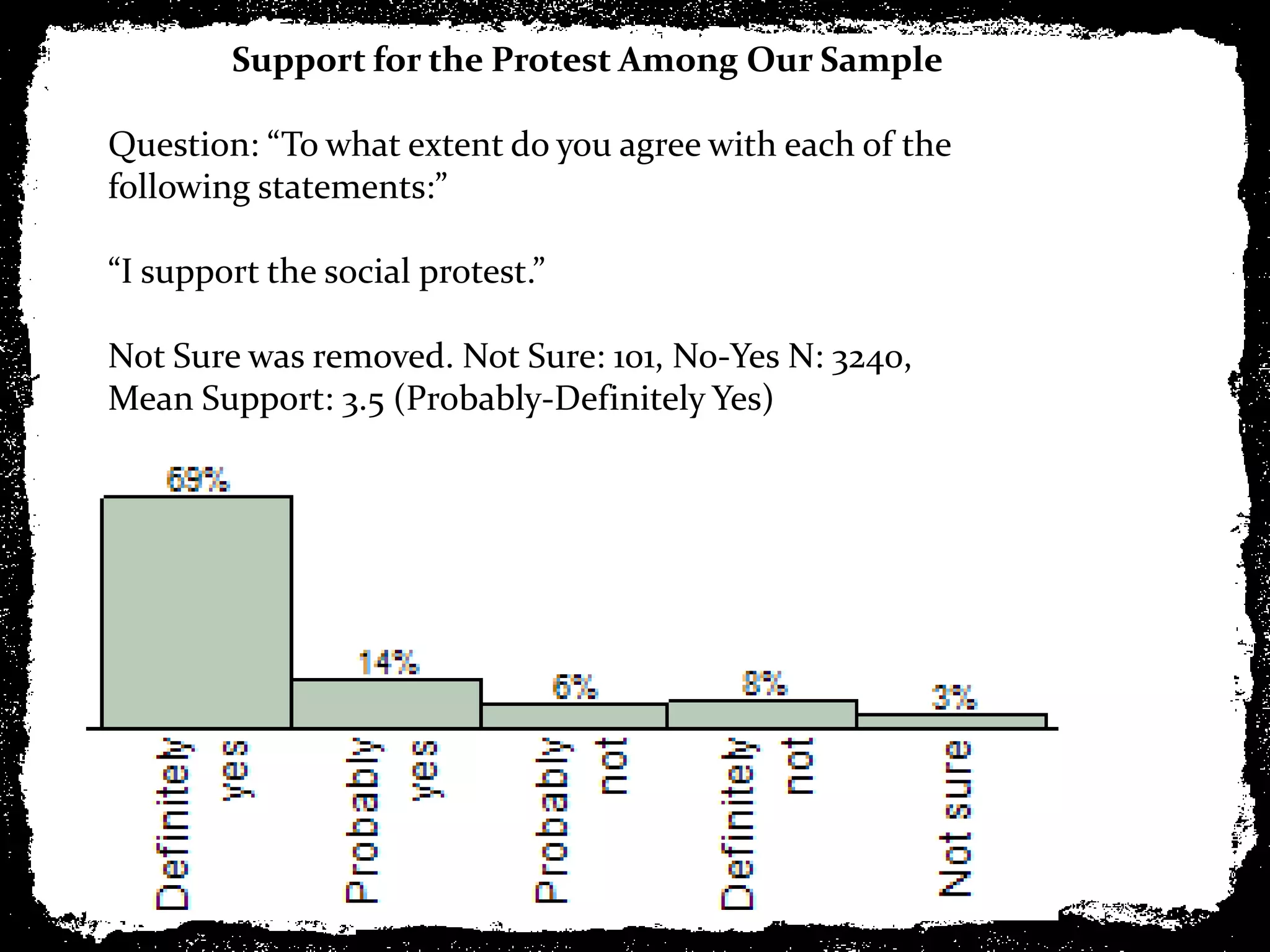
Support for the Protest Among Our Sample

Question: “To what extent do you agree with each of the
following statements:”

“I support the social protest.”

Not Sure was removed. Not Sure: 101, No-Yes N: 3240,
Mean Support: 3.5 (Probably-Definitely Yes)
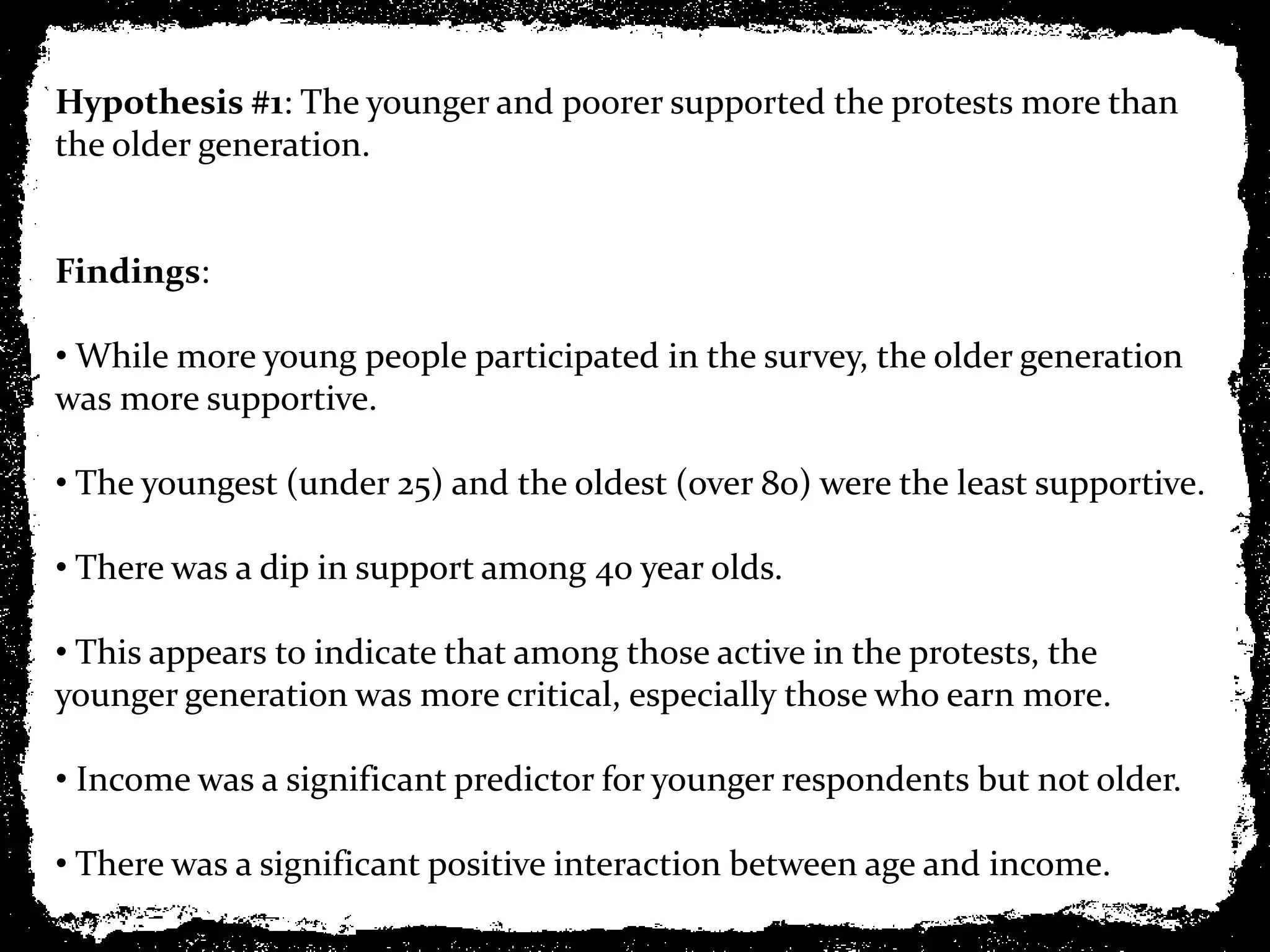
Hypothesis #1: The younger and poorer supported the protests more than
the older generation.


Findings:

• While more young people participated in the survey, the older generation
was more supportive.

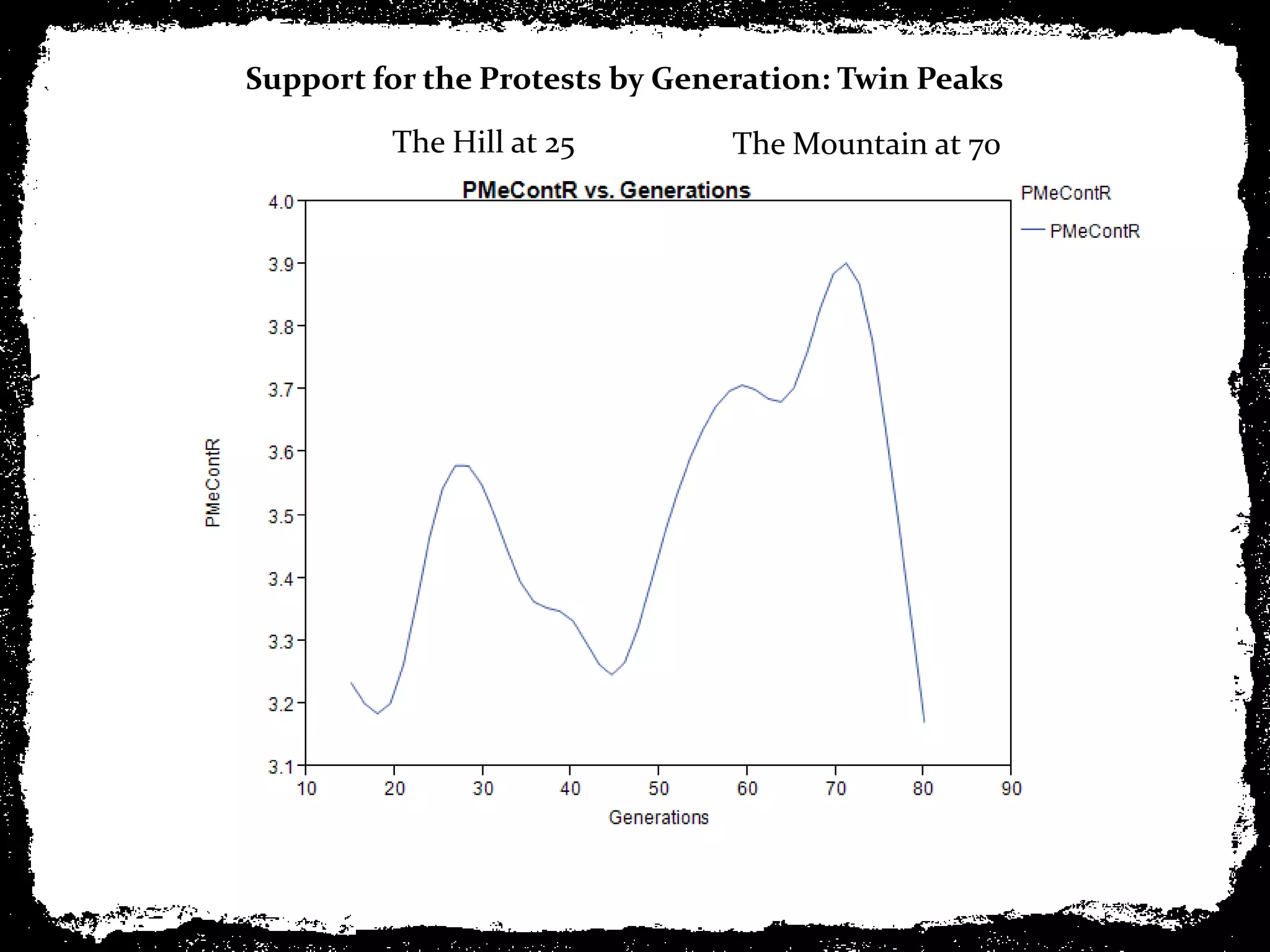
• The youngest (under 25) and the oldest (over 80) were the least supportive.

• There was a dip in support among 40 year olds.

• This appears to indicate that among those active in the protests, the
younger generation was more critical, especially those who earn more.

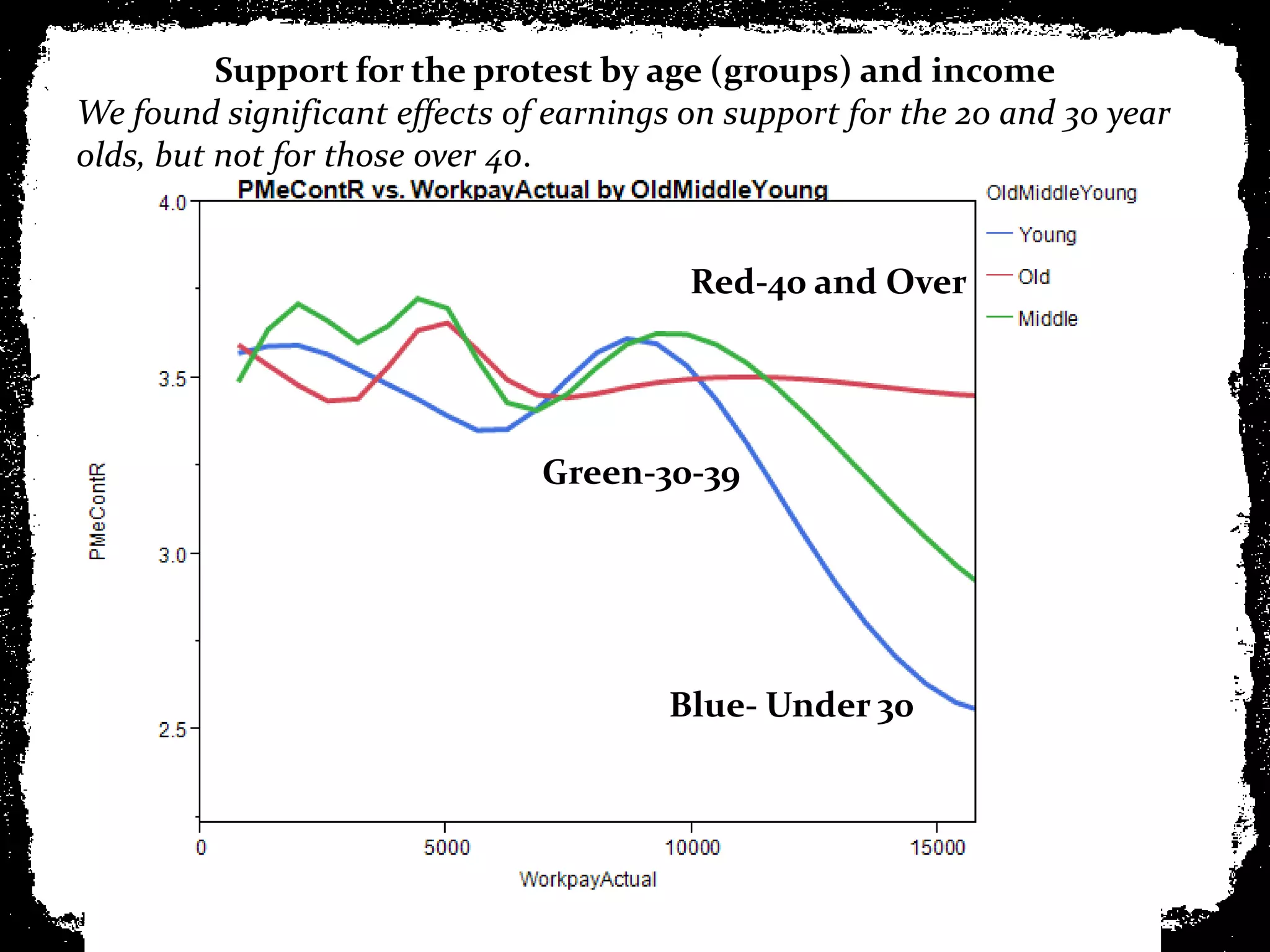
• Income was a significant predictor for younger respondents but not older.

• There was a significant positive interaction between age and income.
Support for the Protests by Generation: Twin Peaks

         The Hill at 25         The Mountain at 70
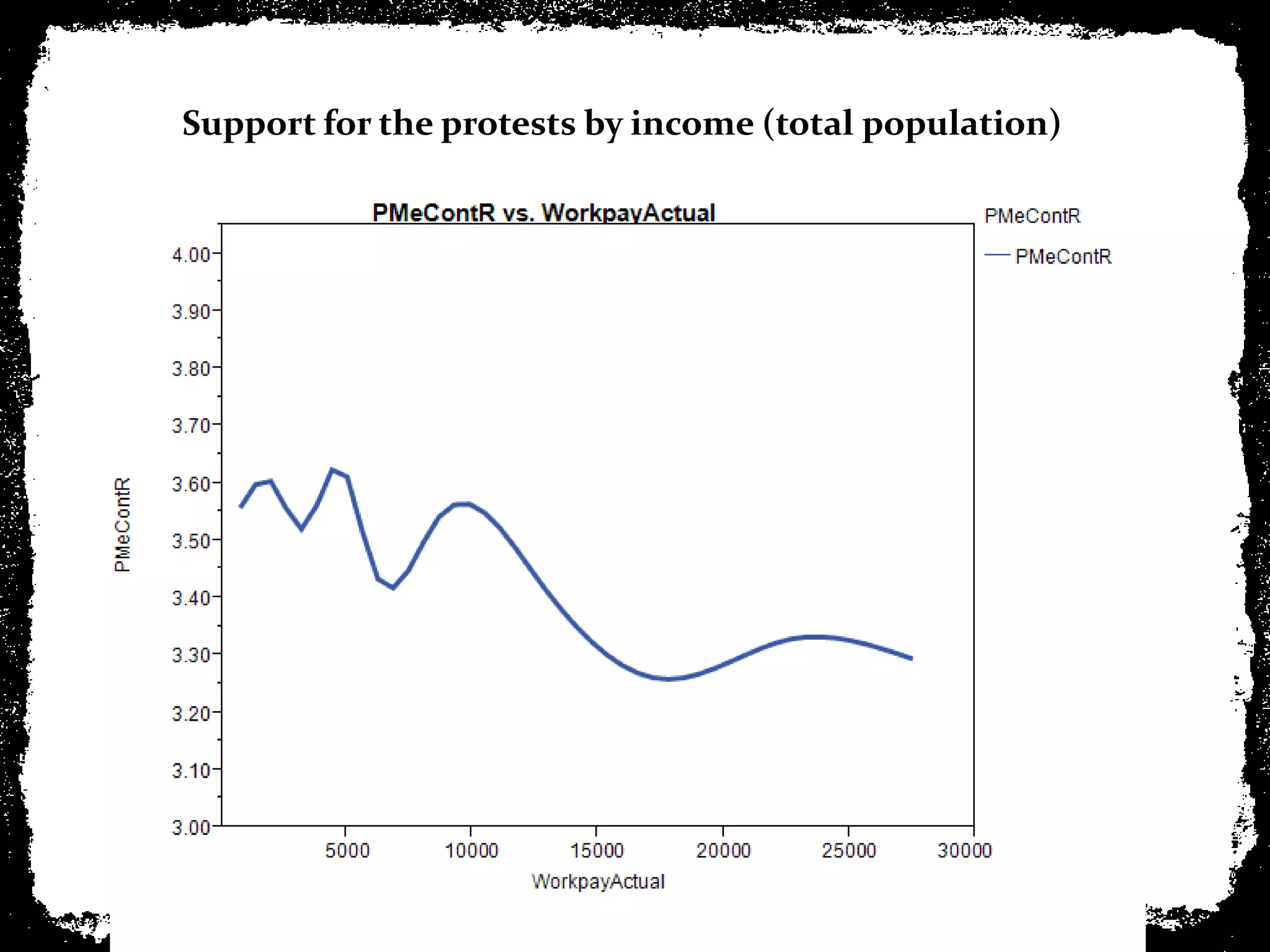
Support for the protests by income (total population)
Support for the protest by age (groups) and income
We found significant effects of earnings on support for the 20 and 30 year
olds, but not for those over 40.


                                         Red-40 and Over


                               Green-30-39


                                        Blue- Under 30
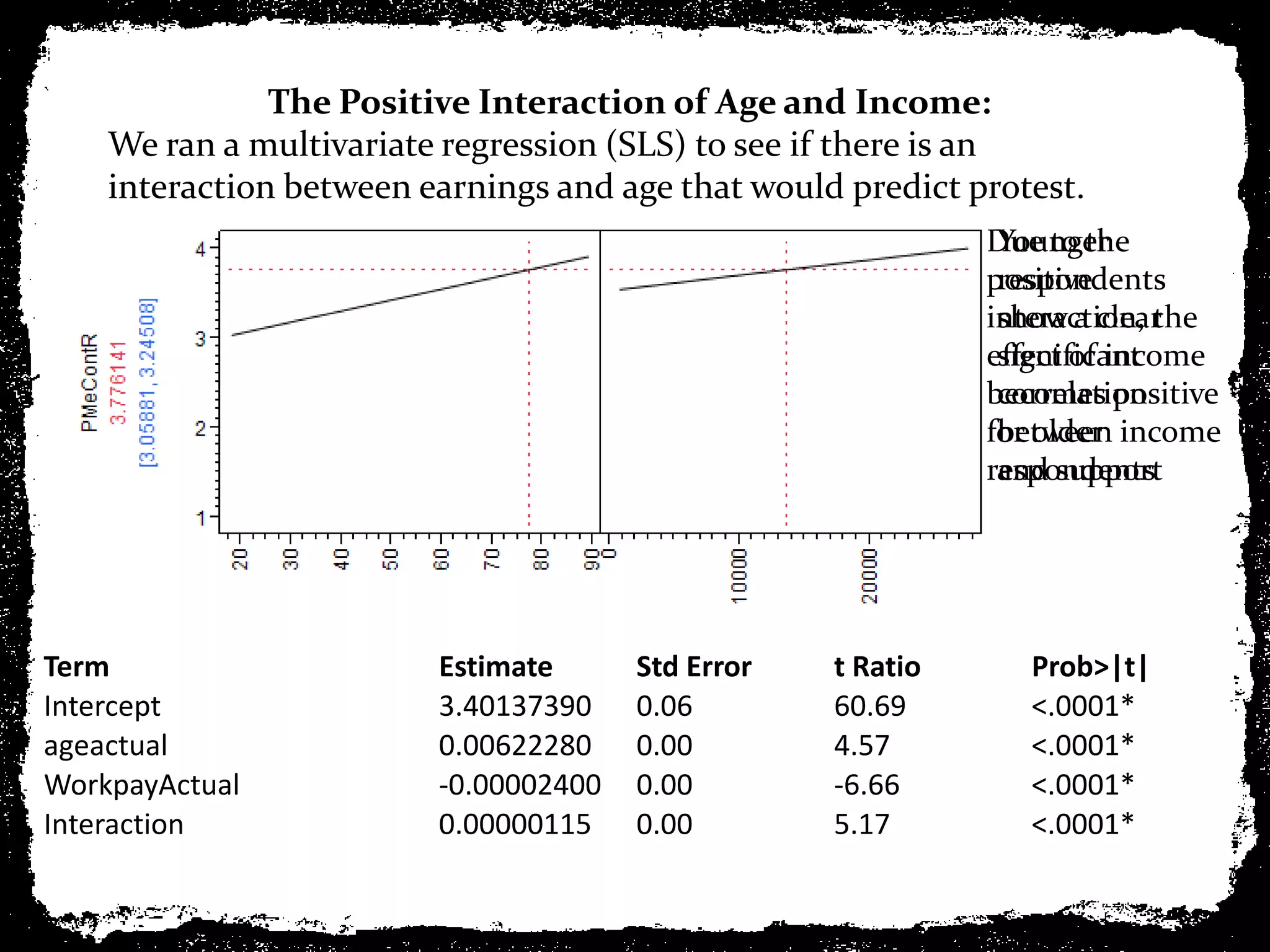
The Positive Interaction of Age and Income:
    We ran a multivariate regression (SLS) to see if there is an
    interaction between earnings and age that would predict protest.
                                                             Due to the
                                                              Younger
                                                             positive
                                                              respondents
                                                             interaction, the
                                                              show a clear
                                                             effect of income
                                                              significant
                                                             becomes positive
                                                              correlation
                                                             for older income
                                                              between
                                                             respondents
                                                              and support


Term                     Estimate      Std Error   t Ratio      Prob>|t|
Intercept                3.40137390    0.06        60.69        <.0001*
ageactual                0.00622280    0.00        4.57         <.0001*
WorkpayActual            -0.00002400   0.00        -6.66        <.0001*
Interaction              0.00000115    0.00        5.17         <.0001*
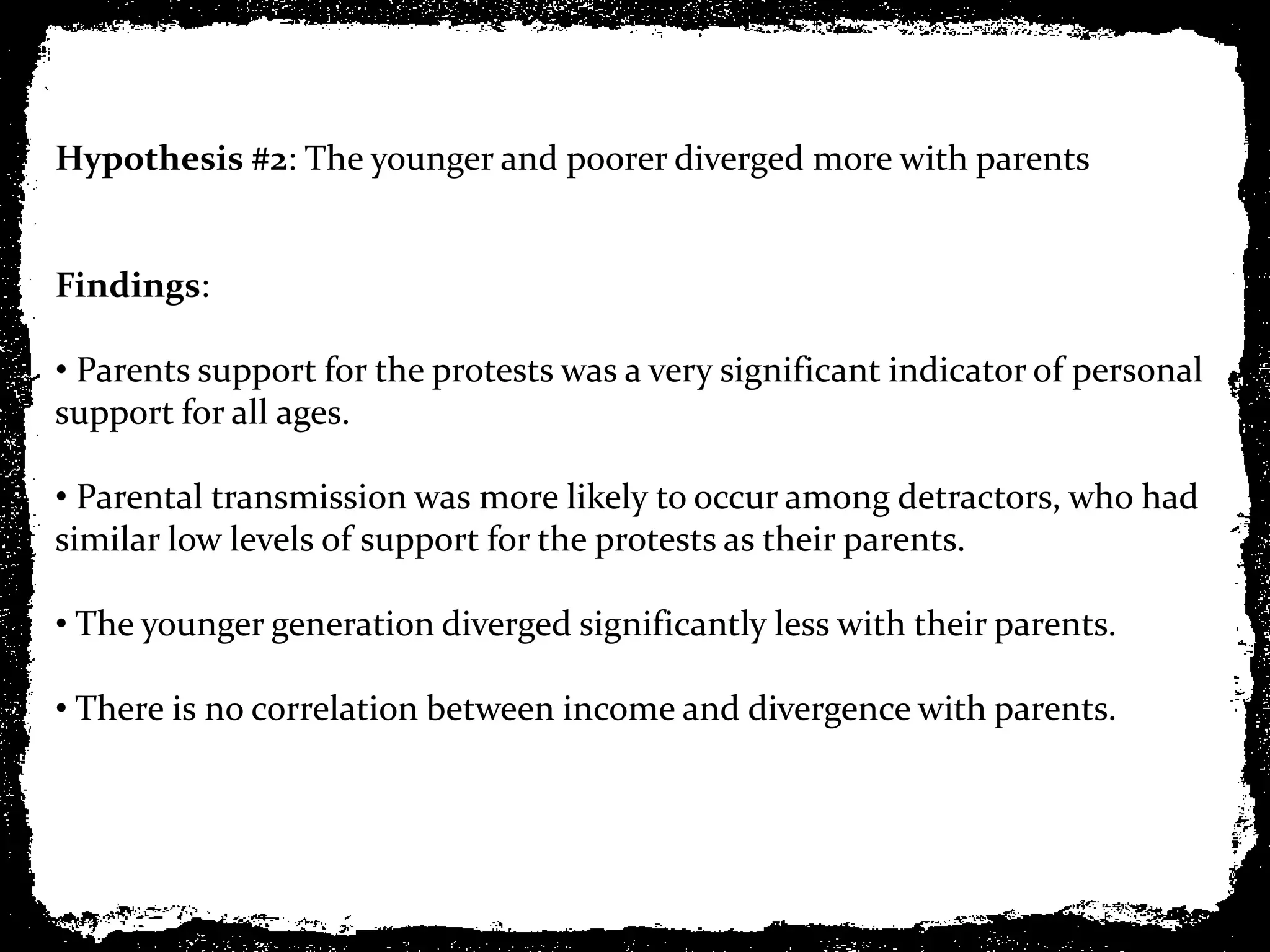
Hypothesis #2: The younger and poorer diverged more with parents


Findings:

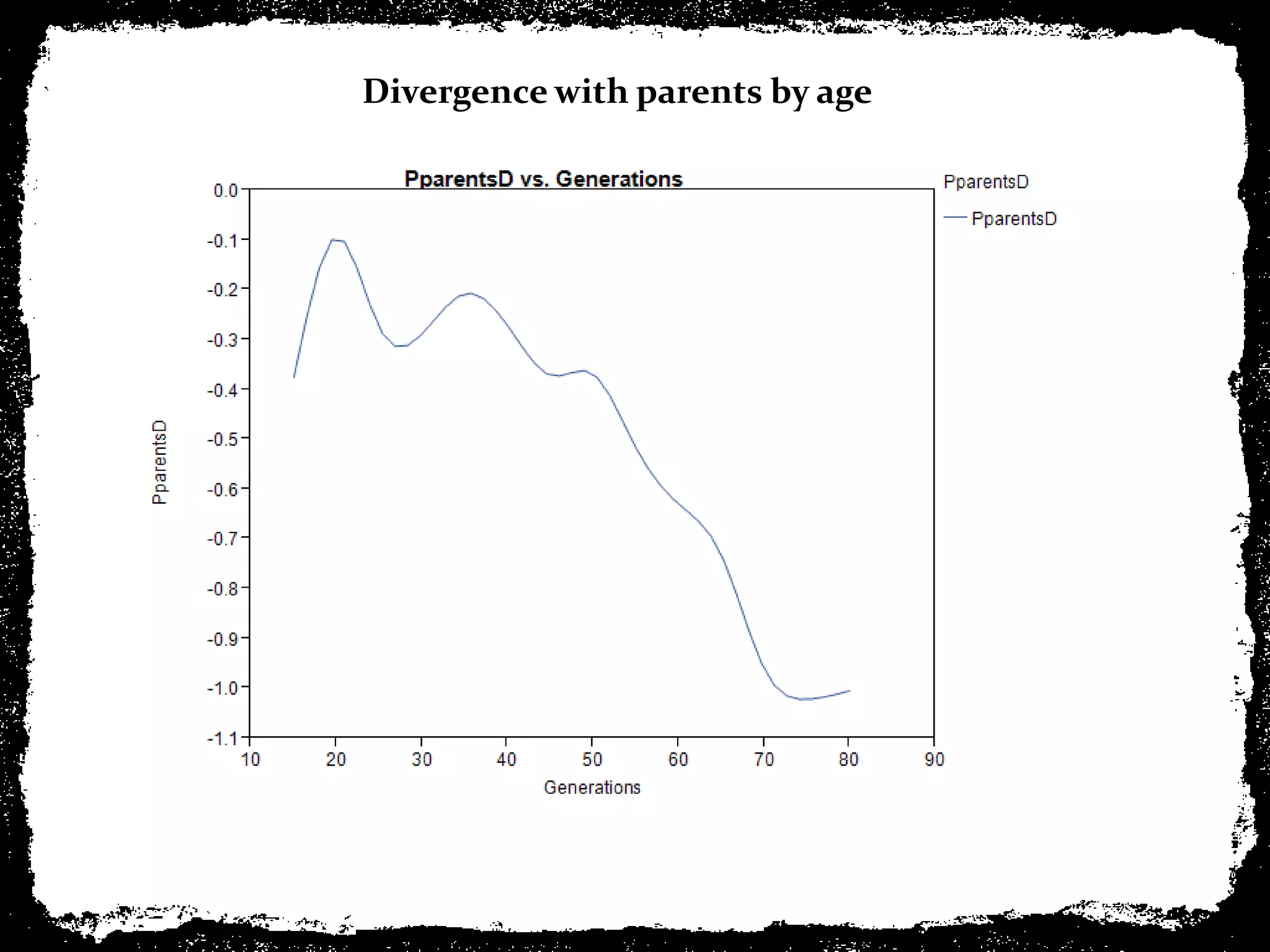
• Parents support for the protests was a very significant indicator of personal
support for all ages.

• Parental transmission was more likely to occur among detractors, who had
similar low levels of support for the protests as their parents.

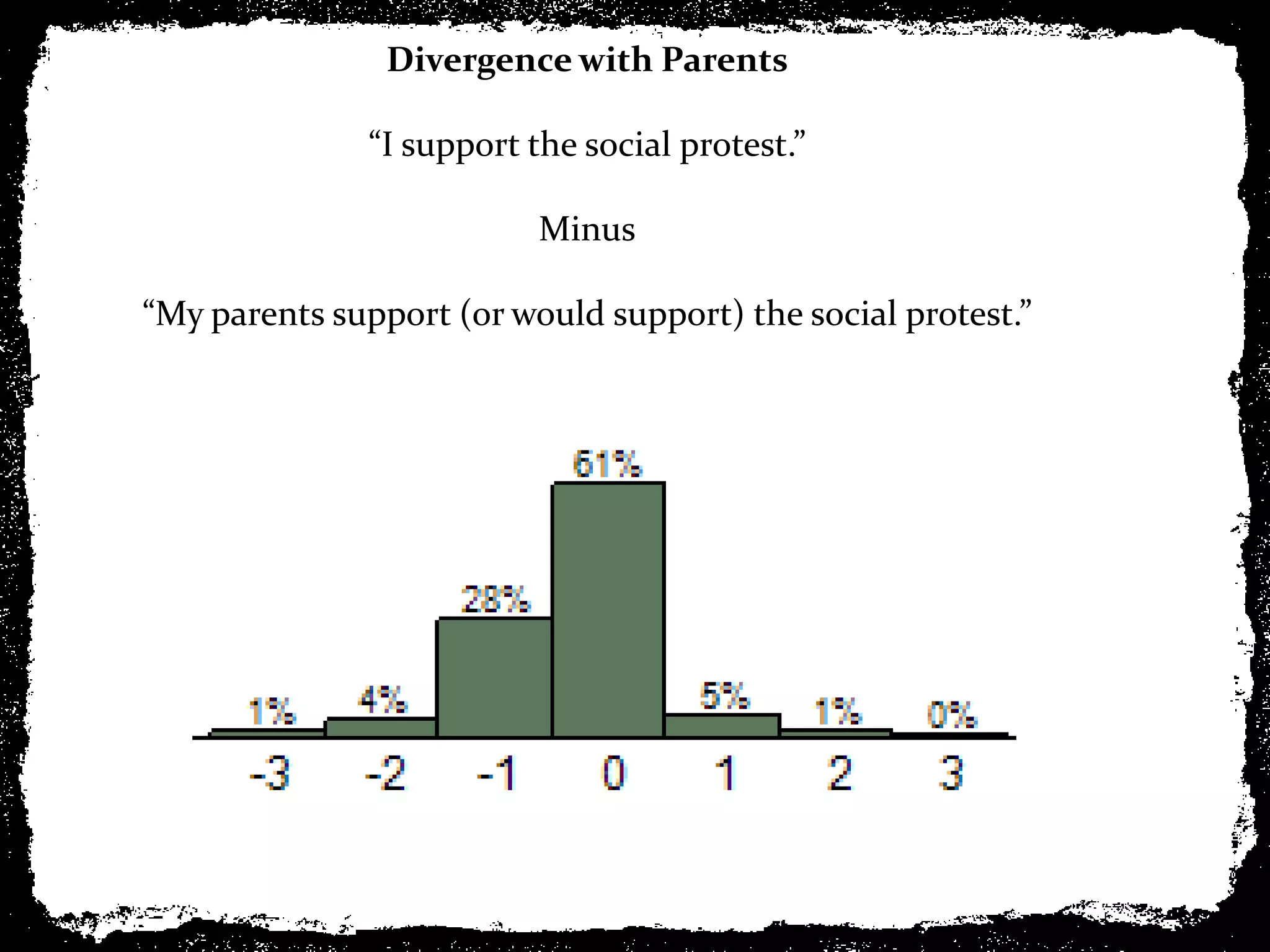
• The younger generation diverged significantly less with their parents.

• There is no correlation between income and divergence with parents.
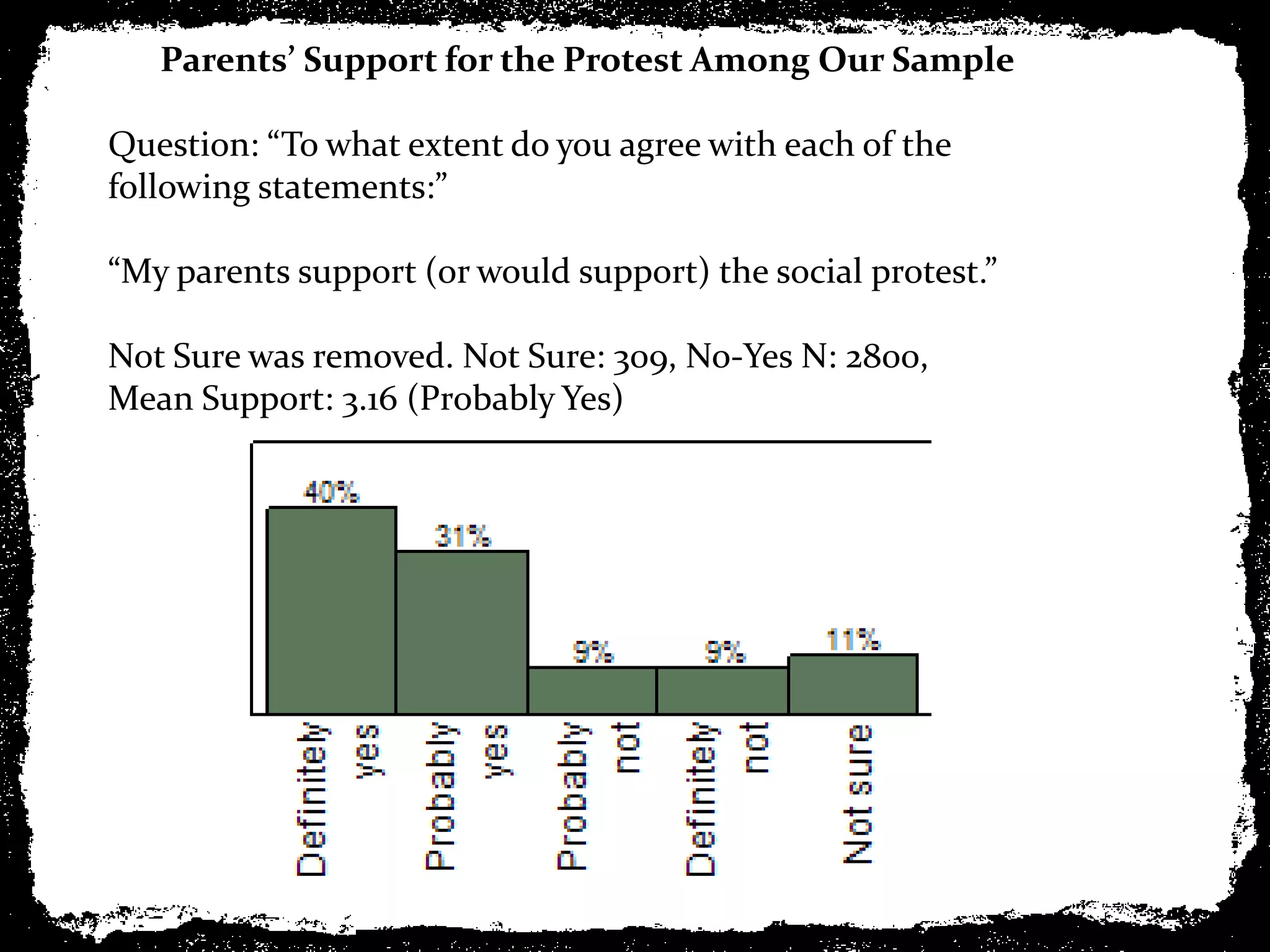
Parents’ Support for the Protest Among Our Sample

Question: “To what extent do you agree with each of the
following statements:”

“My parents support (or would support) the social protest.”

Not Sure was removed. Not Sure: 309, No-Yes N: 2800,
Mean Support: 3.16 (Probably Yes)
Divergence with Parents

              “I support the social protest.”

                          Minus

“My parents support (or would support) the social protest.”
Divergence with parents by age
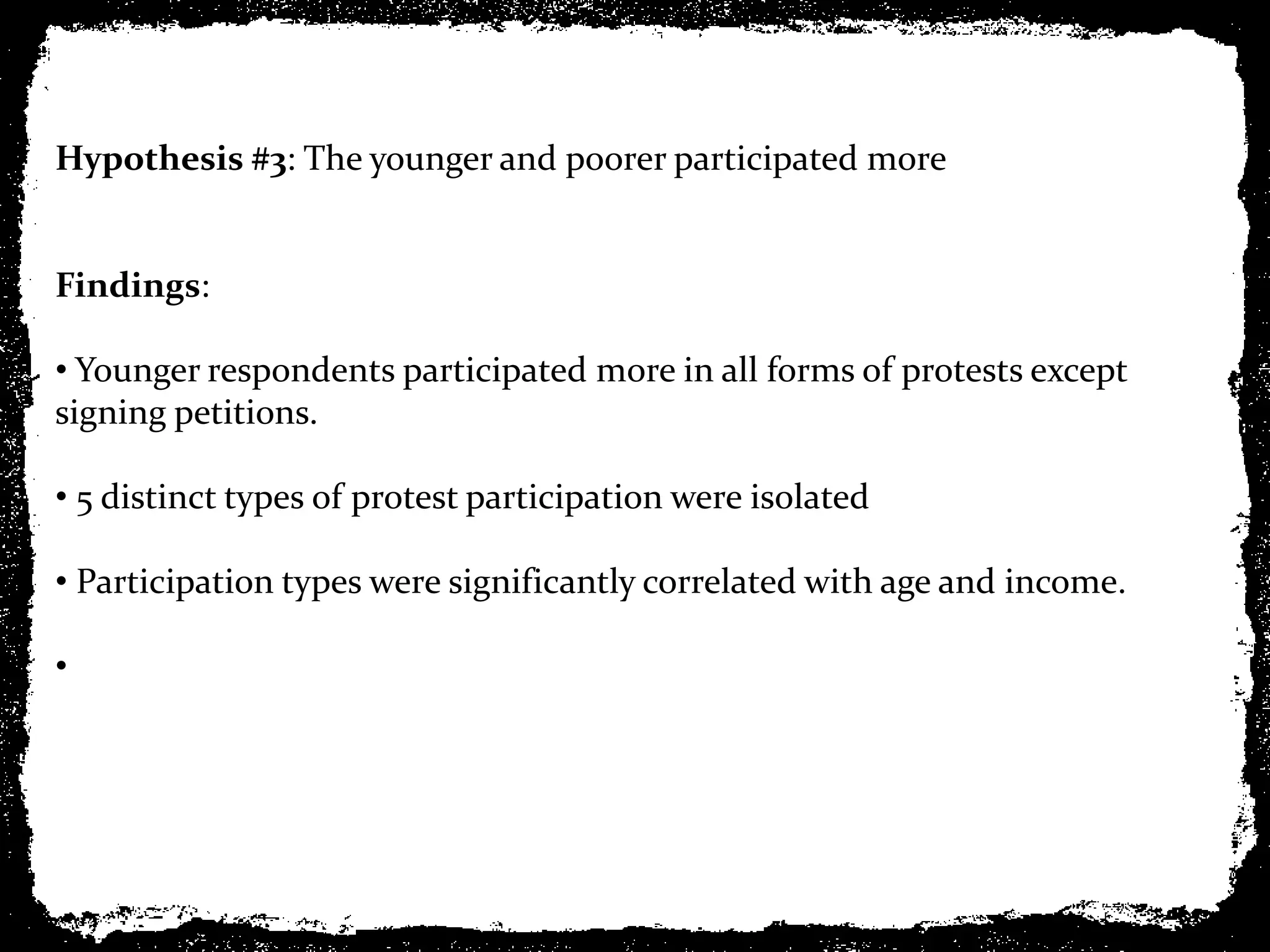
Hypothesis #3: The younger and poorer participated more


Findings:

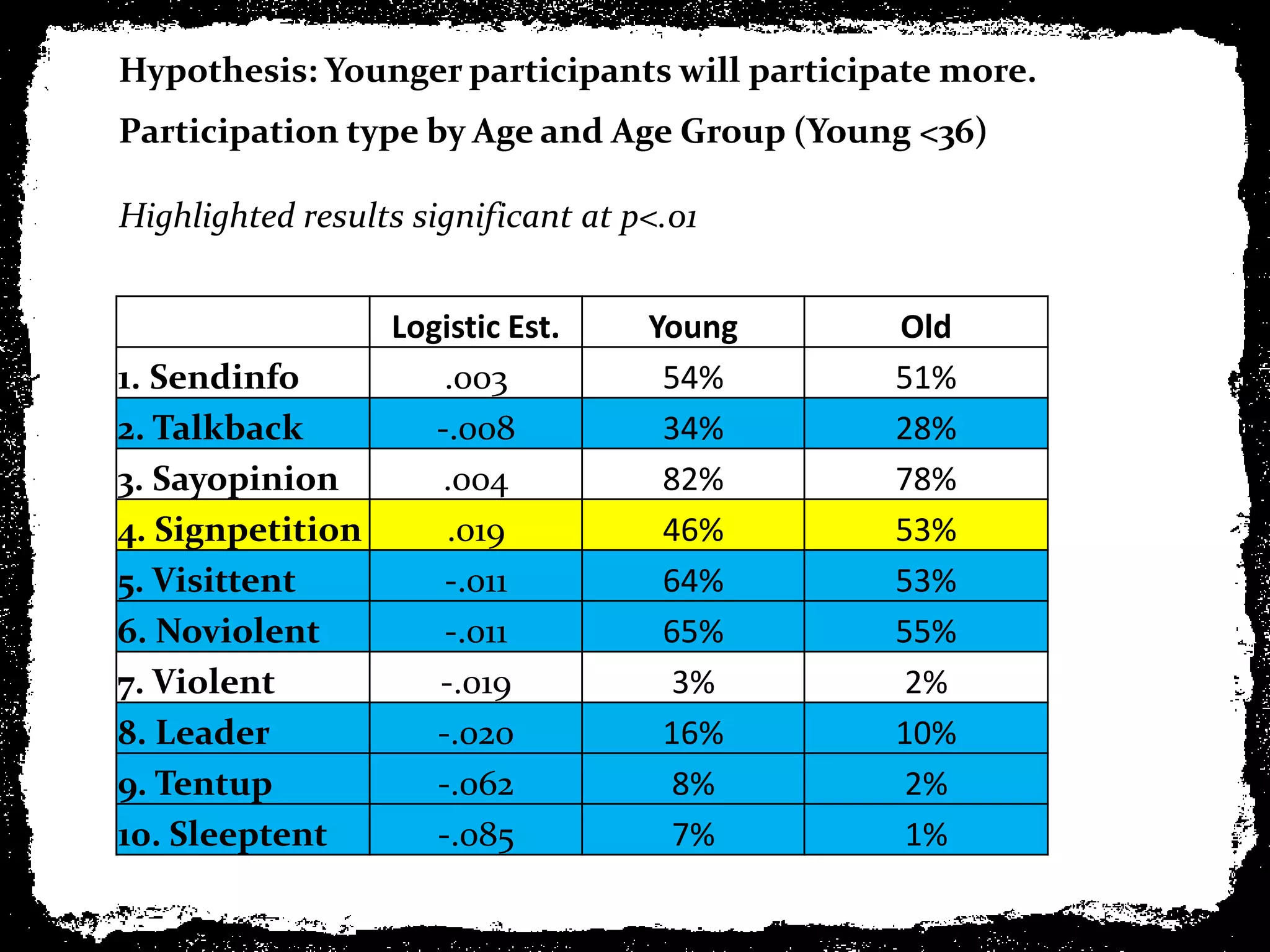
• Younger respondents participated more in all forms of protests except
signing petitions.

• 5 distinct types of protest participation were isolated

• Participation types were significantly correlated with age and income.

•
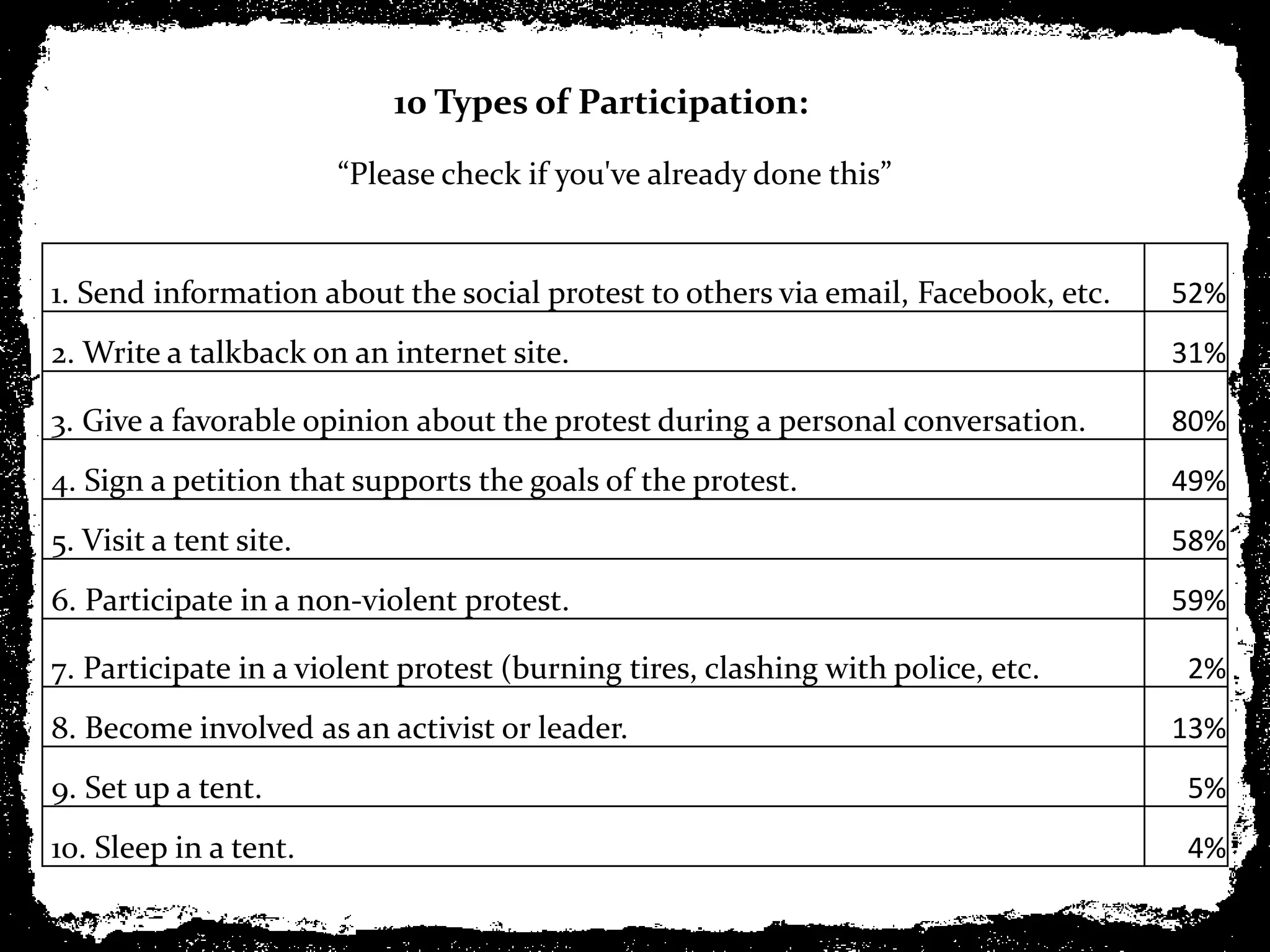
10 Types of Participation:
                        “Please check if you've already done this”


1. Send information about the social protest to others via email, Facebook, etc.   52%
2. Write a talkback on an internet site.                                           31%

3. Give a favorable opinion about the protest during a personal conversation.      80%
4. Sign a petition that supports the goals of the protest.                         49%
5. Visit a tent site.                                                              58%
6. Participate in a non-violent protest.                                           59%

7. Participate in a violent protest (burning tires, clashing with police, etc.     2%
8. Become involved as an activist or leader.                                       13%
9. Set up a tent.                                                                  5%
10. Sleep in a tent.                                                               4%
Hypothesis: Younger participants will participate more.
Participation type by Age and Age Group (Young <36)

Highlighted results significant at p<.01


                Logistic Est.       Young     Old
1. Sendinfo         .003             54%      51%
2. Talkback        -.008             34%      28%
3. Sayopinion       .004             82%      78%
4. Signpetition     .019             46%      53%
5. Visittent        -.011            64%      53%
6. Noviolent        -.011            65%      55%
7. Violent         -.019              3%       2%
8. Leader          -.020             16%      10%
9. Tentup          -.062              8%       2%
10. Sleeptent      -.085              7%       1%
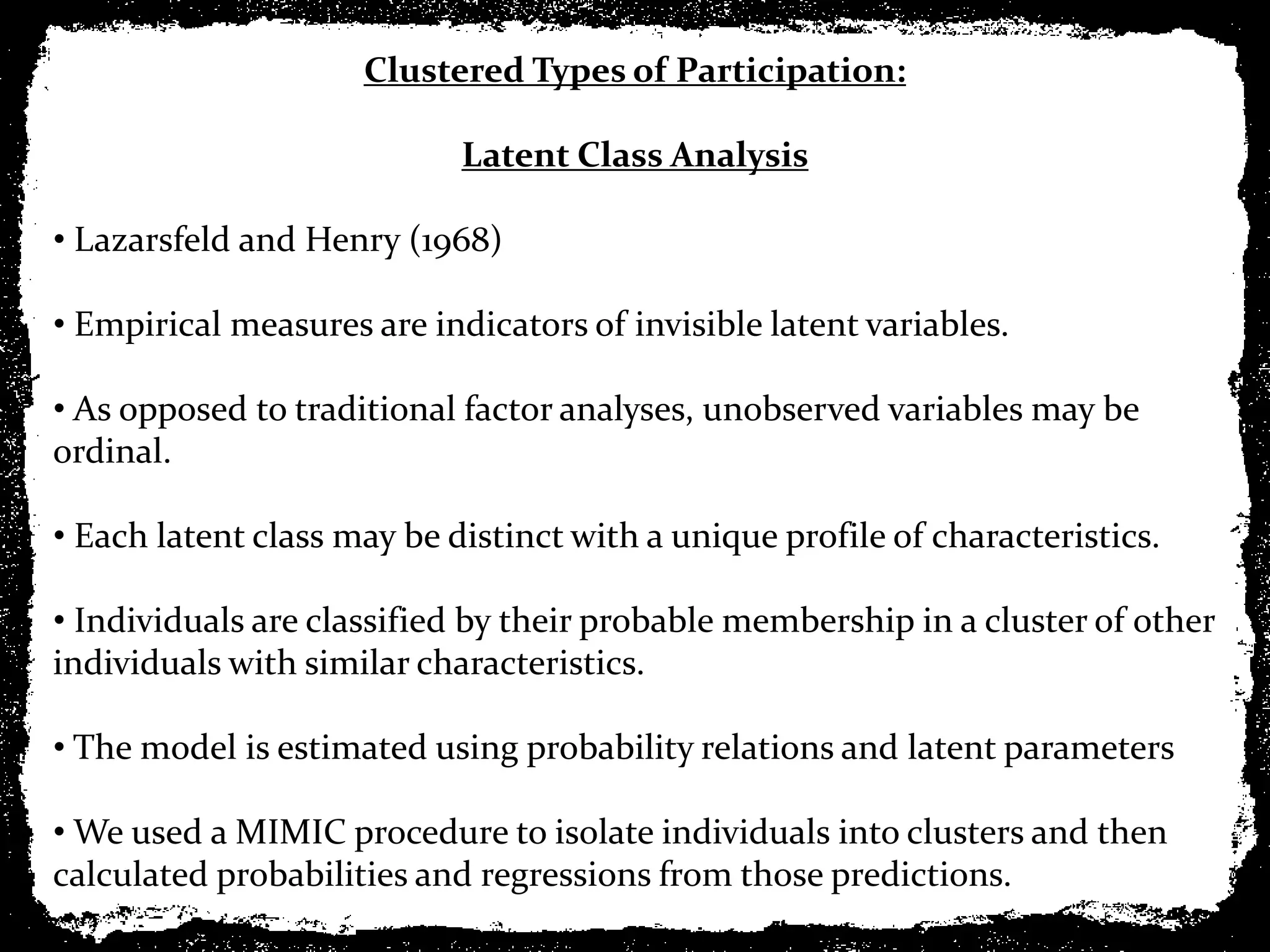
Clustered Types of Participation:

                            Latent Class Analysis

• Lazarsfeld and Henry (1968)

• Empirical measures are indicators of invisible latent variables.

• As opposed to traditional factor analyses, unobserved variables may be
ordinal.

• Each latent class may be distinct with a unique profile of characteristics.

• Individuals are classified by their probable membership in a cluster of other
individuals with similar characteristics.

• The model is estimated using probability relations and latent parameters

• We used a MIMIC procedure to isolate individuals into clusters and then
calculated probabilities and regressions from those predictions.
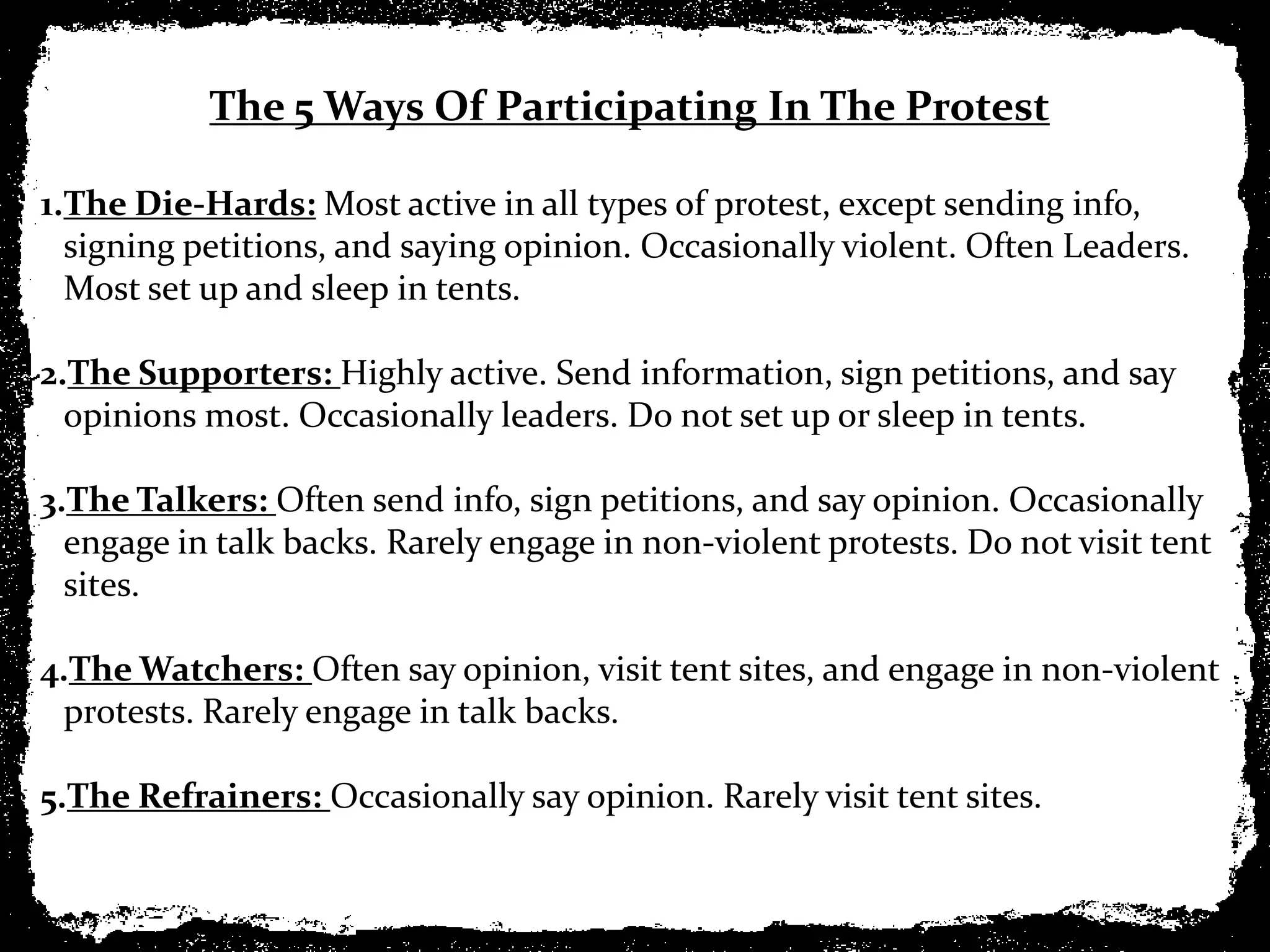
The 5 Ways Of Participating In The Protest

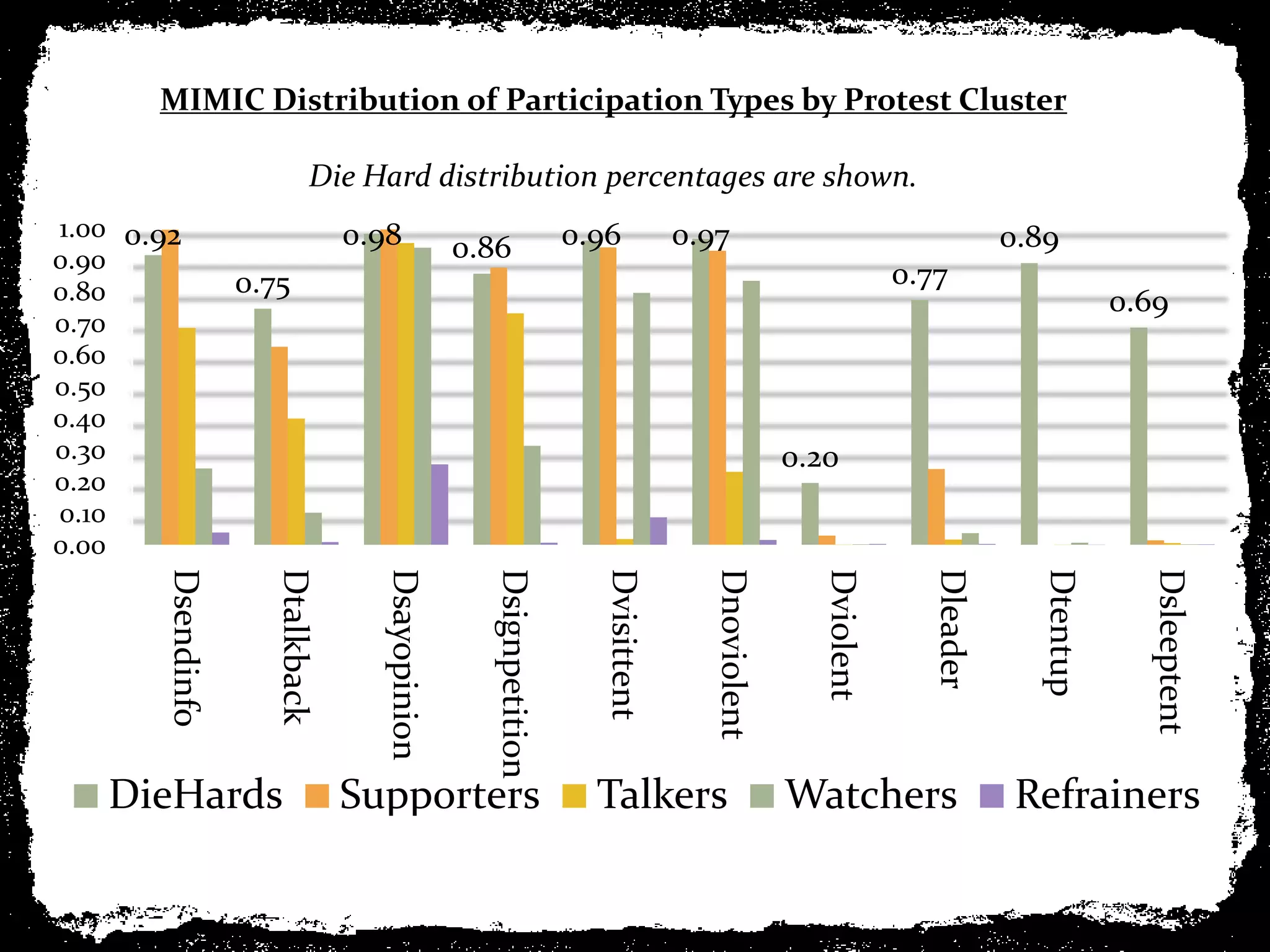
1.The Die-Hards: Most active in all types of protest, except sending info,
  signing petitions, and saying opinion. Occasionally violent. Often Leaders.
  Most set up and sleep in tents.

2.The Supporters: Highly active. Send information, sign petitions, and say
  opinions most. Occasionally leaders. Do not set up or sleep in tents.

3.The Talkers: Often send info, sign petitions, and say opinion. Occasionally
  engage in talk backs. Rarely engage in non-violent protests. Do not visit tent
  sites.

4.The Watchers: Often say opinion, visit tent sites, and engage in non-violent
 protests. Rarely engage in talk backs.

5.The Refrainers: Occasionally say opinion. Rarely visit tent sites.
MIMIC Distribution of Participation Types by Protest Cluster

                             Die Hard distribution percentages are shown.
1.00 0.92                        0.98                              0.96           0.97                                    0.89
0.90                                             0.86
                   0.75                                                                                       0.77
0.80                                                                                                                                  0.69
0.70
0.60
0.50
0.40
0.30                                                                                             0.20
0.20
0.10
0.00

                                                                     Dvisittent


                                                                                    Dnoviolent


                                                                                                                Dleader


                                                                                                                                        Dsleeptent
       Dsendinfo


                     Dtalkback


                                   Dsayopinion


                                                                                                   Dviolent


                                                                                                                            Dtentup
                                                   Dsignpetition


   DieHards                      Supporters                          Talkers                     Watchers                  Refrainers
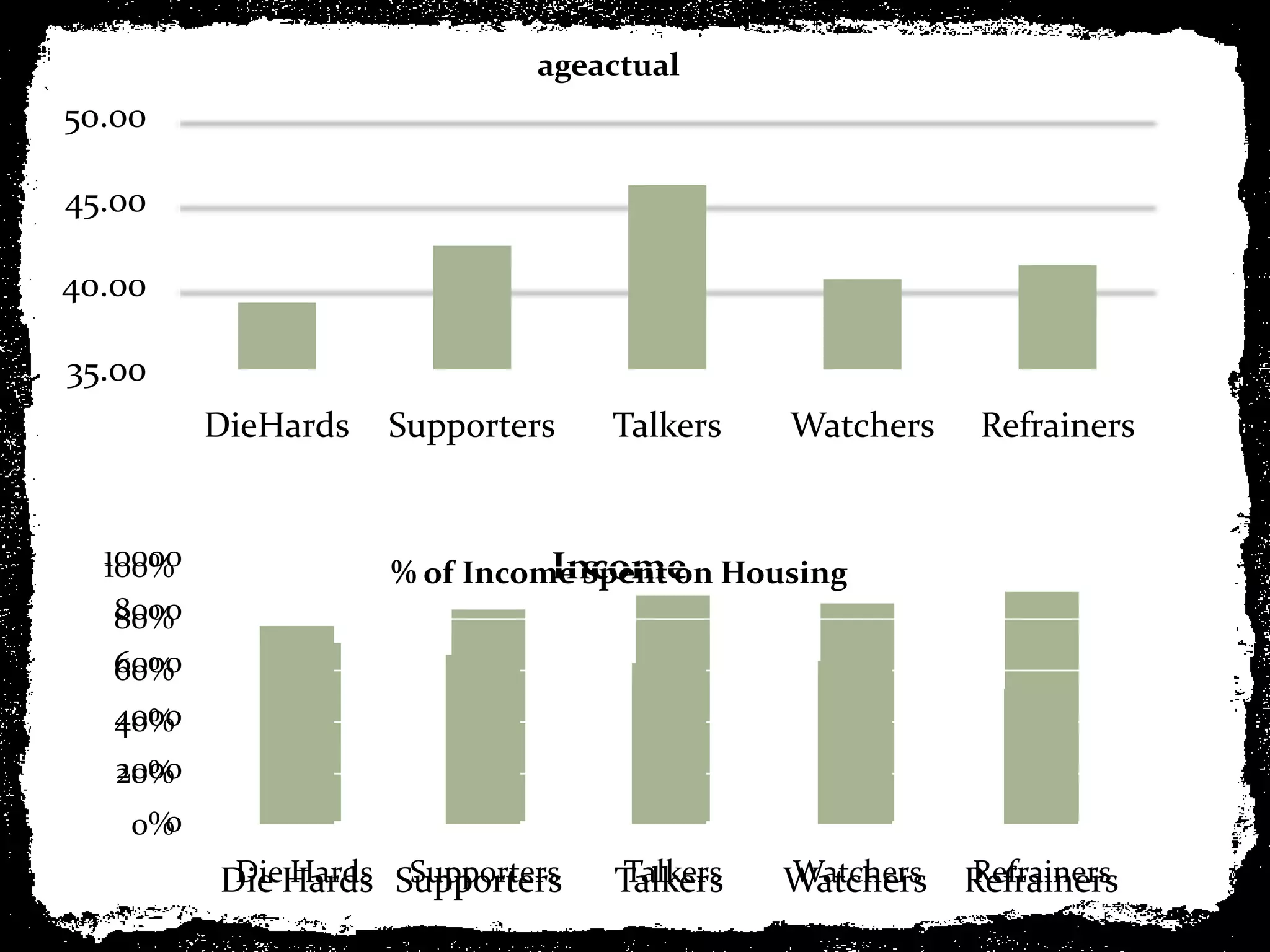
ageactual
50.00

45.00

40.00

35.00
          DieHards   Supporters   Talkers    Watchers    Refrainers


  10000
  100%                         Income
                     % of Income Spent on Housing
   8000
   80%
   6000
   60%
   4000
   40%
   2000
   20%
    0%0
           Die Hards Supporters
          Die Hards Supporters    Talkers
                                  Talkers    Watchers
                                             Watchers   Refrainers
                                                        Refrainers
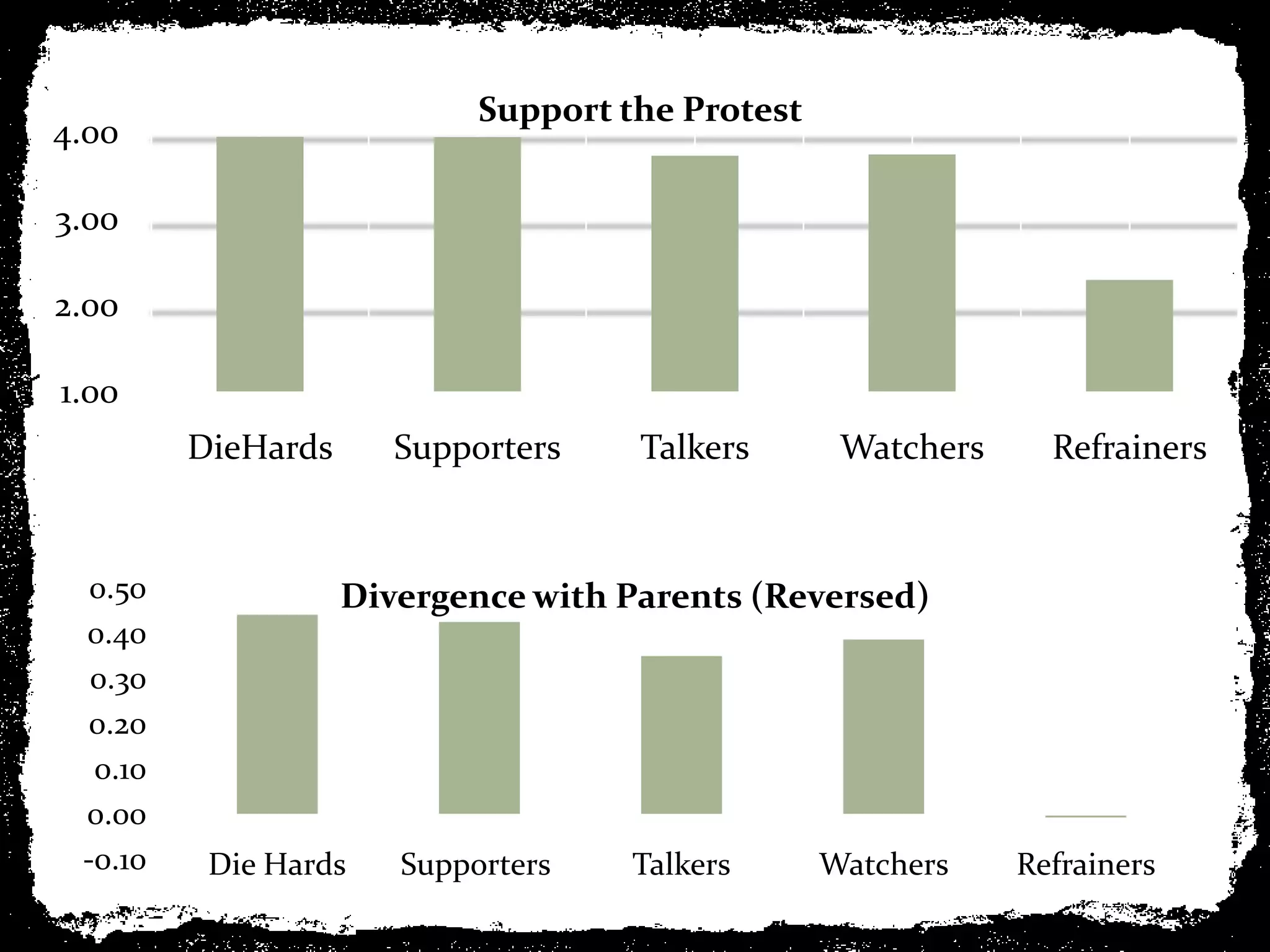
Support the Protest
4.00

3.00

2.00

1.00
         DieHards      Supporters    Talkers       Watchers     Refrainers


  0.50              Divergence with Parents (Reversed)
 0.40
  0.30
  0.20
  0.10
 0.00
 -0.10    Die Hards    Supporters    Talkers      Watchers    Refrainers
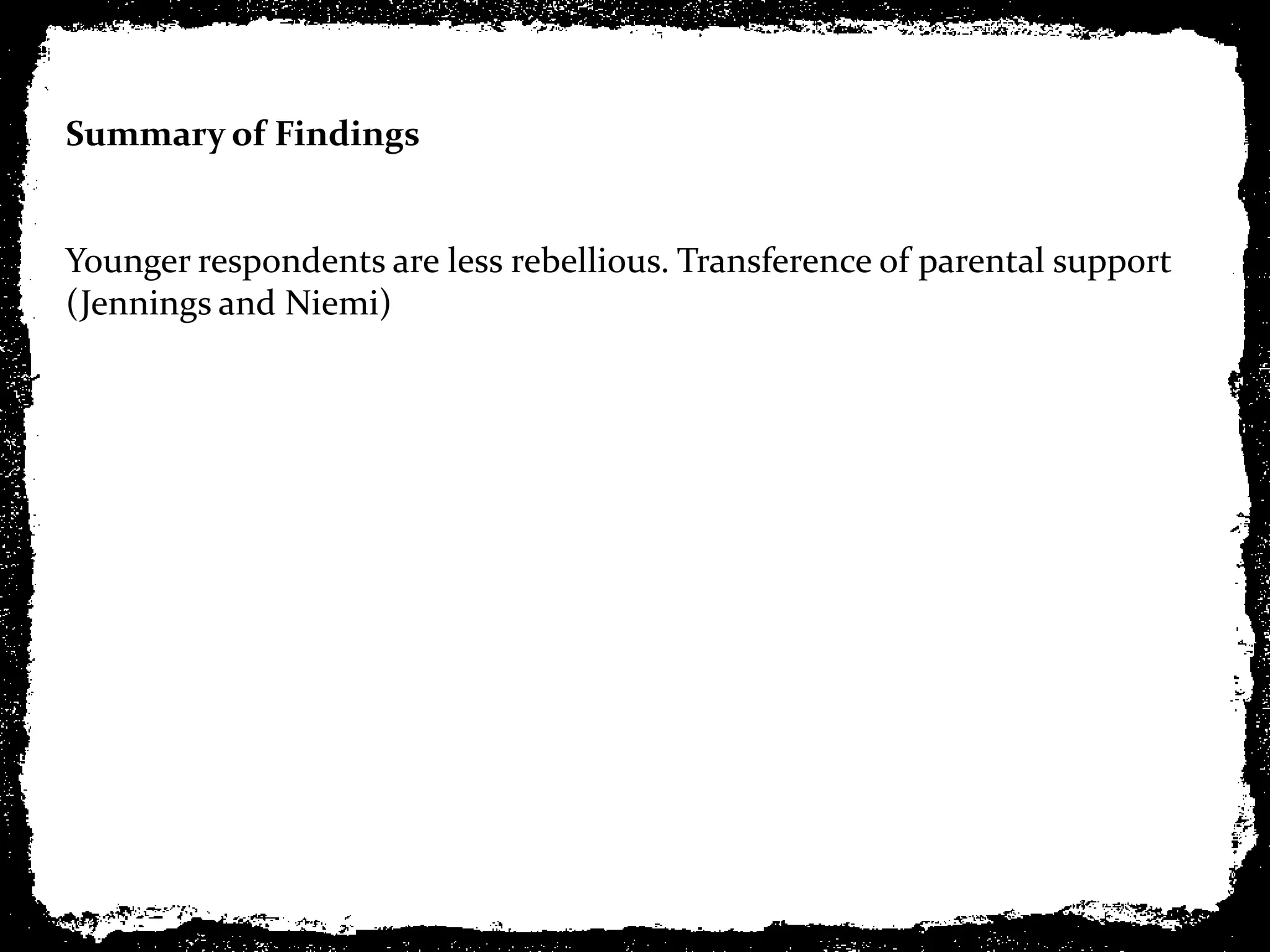
Summary of Findings


Younger respondents are less rebellious. Transference of parental support
(Jennings and Niemi)
Future Research

Isjr presentation 18 no flash

  • 1.
    The Young Generationand the 2011 Israeli Social Protests: How Age and Deprivation Influenced Support, Rebellion, and Participation Ira Lyan and Keith Goldstein, The Hebrew University of Jerusalem 14th Biennial Conference of the International Society for Justice Research (ISJR)
  • 2.
    Theories of ProtestParticipation Social Learning/ Social Differentation Theories: Social and political activism take place as a result of transmission from 1) family, friends, and other significant others (Jennings and Niemi 1968), 2) environment and temporal climate (Jennings and Niemi 1974) Disaffected Radicalism: Social protest is symbolized by groups who are upset with their alienation from or lack of trust for the system. Relative deprivation drives protest (Gurr 1970). Social Class/Social Psychological Theories: Youth from higher socio- economic backgrounds are more likely to engage in protests and develop ideological temperaments that motivate activism (Sherkat and Blocker 1994) Other Theories: Contextual, Modes of Convention, Demographic Subgroups, Subcultures (Neo-Marxist Resistance Theory-CCCS, Hebdige 1981, etc.), Social Class, Religiosity, Gender, Mob Mentality, and many more. Many theories grew from studies of the Civil Rights and Anti-War Protests in the USA in the 1960s
  • 3.
    History of theIsrael Social Justice Protests and Our Study July 14th: Daphne Leef puts up a tent on Tel Aviv’s Rothchild Boulevard July 23rd: First major street rally in Tel Aviv attended by thousands August 11th: The Hebrew University Sociology Department issues a call for a special research group to investigate the social justice protests. August 14th-September 1st: Survey is formatted in Hebrew by our subgroup of four. September 3rd, Morning: First respondents answer the survey. September 3rd, Night: “Million Man March” September 11th: Russian version is released September 14th: Arabic Version is released September 25th: English version is released October 3rd: Rothchild tent compound in Tel Aviv is dismantled and our survey is closed.
  • 4.
    The Study • Electronic(internet) survey was filled out by 3,393 respondents. • Survey was available in 4 languages (Hebrew, Russian, Arabic, and English) • Advertising was done through on-site flyers, emails, and Facebook referrals. • The data set and codebook are available to the public at the following website: http://eshkol.huji.ac.il/ • Sampling bias towards those who participated and higher socio-economic classes. • Study was part of a larger investigation, which included qualitative analysis
  • 5.
    Hypotheses The younger andpoorer will support the protests more, be more rebellious, and participate in the protests more. Independent Variables 1. Age <Generation/Younger and Older> 2. Income <Poorer, Average, Richer> Dependent Variables 1. Support 2. Rebelliousness <Divergence of support with parents> 3. Participation Type < Clusters, The Die-Hards>
  • 6.
    The Age ofOur Sample About 50% of the sample is aged N: 3341, Missing: 52 Age was made into an ordinal between 25 and 35 variable of 5 Year Increments Mean Age: 42 Few young people at army age (<25) Few elderly at retired age (>70)
  • 7.
  • 8.
    Support for theProtest Among Our Sample Question: “To what extent do you agree with each of the following statements:” “I support the social protest.” Not Sure was removed. Not Sure: 101, No-Yes N: 3240, Mean Support: 3.5 (Probably-Definitely Yes)
  • 9.
    Hypothesis #1: Theyounger and poorer supported the protests more than the older generation. Findings: • While more young people participated in the survey, the older generation was more supportive. • The youngest (under 25) and the oldest (over 80) were the least supportive. • There was a dip in support among 40 year olds. • This appears to indicate that among those active in the protests, the younger generation was more critical, especially those who earn more. • Income was a significant predictor for younger respondents but not older. • There was a significant positive interaction between age and income.
  • 10.
    Support for theProtests by Generation: Twin Peaks The Hill at 25 The Mountain at 70
  • 11.
    Support for theprotests by income (total population)
  • 12.
    Support for theprotest by age (groups) and income We found significant effects of earnings on support for the 20 and 30 year olds, but not for those over 40. Red-40 and Over Green-30-39 Blue- Under 30
  • 13.
    The Positive Interactionof Age and Income: We ran a multivariate regression (SLS) to see if there is an interaction between earnings and age that would predict protest. Due to the Younger positive respondents interaction, the show a clear effect of income significant becomes positive correlation for older income between respondents and support Term Estimate Std Error t Ratio Prob>|t| Intercept 3.40137390 0.06 60.69 <.0001* ageactual 0.00622280 0.00 4.57 <.0001* WorkpayActual -0.00002400 0.00 -6.66 <.0001* Interaction 0.00000115 0.00 5.17 <.0001*
  • 14.
    Hypothesis #2: Theyounger and poorer diverged more with parents Findings: • Parents support for the protests was a very significant indicator of personal support for all ages. • Parental transmission was more likely to occur among detractors, who had similar low levels of support for the protests as their parents. • The younger generation diverged significantly less with their parents. • There is no correlation between income and divergence with parents.
  • 15.
    Parents’ Support forthe Protest Among Our Sample Question: “To what extent do you agree with each of the following statements:” “My parents support (or would support) the social protest.” Not Sure was removed. Not Sure: 309, No-Yes N: 2800, Mean Support: 3.16 (Probably Yes)
  • 16.
    Divergence with Parents “I support the social protest.” Minus “My parents support (or would support) the social protest.”
  • 17.
  • 18.
    Hypothesis #3: Theyounger and poorer participated more Findings: • Younger respondents participated more in all forms of protests except signing petitions. • 5 distinct types of protest participation were isolated • Participation types were significantly correlated with age and income. •
  • 19.
    10 Types ofParticipation: “Please check if you've already done this” 1. Send information about the social protest to others via email, Facebook, etc. 52% 2. Write a talkback on an internet site. 31% 3. Give a favorable opinion about the protest during a personal conversation. 80% 4. Sign a petition that supports the goals of the protest. 49% 5. Visit a tent site. 58% 6. Participate in a non-violent protest. 59% 7. Participate in a violent protest (burning tires, clashing with police, etc. 2% 8. Become involved as an activist or leader. 13% 9. Set up a tent. 5% 10. Sleep in a tent. 4%
  • 20.
    Hypothesis: Younger participantswill participate more. Participation type by Age and Age Group (Young <36) Highlighted results significant at p<.01 Logistic Est. Young Old 1. Sendinfo .003 54% 51% 2. Talkback -.008 34% 28% 3. Sayopinion .004 82% 78% 4. Signpetition .019 46% 53% 5. Visittent -.011 64% 53% 6. Noviolent -.011 65% 55% 7. Violent -.019 3% 2% 8. Leader -.020 16% 10% 9. Tentup -.062 8% 2% 10. Sleeptent -.085 7% 1%
  • 21.
    Clustered Types ofParticipation: Latent Class Analysis • Lazarsfeld and Henry (1968) • Empirical measures are indicators of invisible latent variables. • As opposed to traditional factor analyses, unobserved variables may be ordinal. • Each latent class may be distinct with a unique profile of characteristics. • Individuals are classified by their probable membership in a cluster of other individuals with similar characteristics. • The model is estimated using probability relations and latent parameters • We used a MIMIC procedure to isolate individuals into clusters and then calculated probabilities and regressions from those predictions.
  • 22.
    The 5 WaysOf Participating In The Protest 1.The Die-Hards: Most active in all types of protest, except sending info, signing petitions, and saying opinion. Occasionally violent. Often Leaders. Most set up and sleep in tents. 2.The Supporters: Highly active. Send information, sign petitions, and say opinions most. Occasionally leaders. Do not set up or sleep in tents. 3.The Talkers: Often send info, sign petitions, and say opinion. Occasionally engage in talk backs. Rarely engage in non-violent protests. Do not visit tent sites. 4.The Watchers: Often say opinion, visit tent sites, and engage in non-violent protests. Rarely engage in talk backs. 5.The Refrainers: Occasionally say opinion. Rarely visit tent sites.
  • 23.
    MIMIC Distribution ofParticipation Types by Protest Cluster Die Hard distribution percentages are shown. 1.00 0.92 0.98 0.96 0.97 0.89 0.90 0.86 0.75 0.77 0.80 0.69 0.70 0.60 0.50 0.40 0.30 0.20 0.20 0.10 0.00 Dvisittent Dnoviolent Dleader Dsleeptent Dsendinfo Dtalkback Dsayopinion Dviolent Dtentup Dsignpetition DieHards Supporters Talkers Watchers Refrainers
  • 24.
    ageactual 50.00 45.00 40.00 35.00 DieHards Supporters Talkers Watchers Refrainers 10000 100% Income % of Income Spent on Housing 8000 80% 6000 60% 4000 40% 2000 20% 0%0 Die Hards Supporters Die Hards Supporters Talkers Talkers Watchers Watchers Refrainers Refrainers
  • 25.
    Support the Protest 4.00 3.00 2.00 1.00 DieHards Supporters Talkers Watchers Refrainers 0.50 Divergence with Parents (Reversed) 0.40 0.30 0.20 0.10 0.00 -0.10 Die Hards Supporters Talkers Watchers Refrainers
  • 26.
    Summary of Findings Youngerrespondents are less rebellious. Transference of parental support (Jennings and Niemi)
  • 27.

Editor's Notes

  • #2 2 elements: poverty and youth
  • #3 The current protests are distinct in that economics was a major concern of the protesters and they took place outside the USA. a
  • #6 3 very simple hypotheses. We accepted the common assumption that youth are more supportive of the protests, but we took the opposite hypothesis of Sherkat and Blocker, as this protest had an economic theme. Findings are outlined first, and then we will look at the graphs.
  • #7 Statistical animation based on the means by generation. Complex graphs with color. Simulated experiments. Aesthetic. Not complex analyses, although LCA at end.
  • #8 Size of bubble corresponds with N.
  • #21 With so many types of participation, we sought after a method to combine them and describe types of protesters. So we used LCA.
  • #25 Relationship between protest type and income became even clearer when we took into account housing costs.