Research on
THE RISE OF ISIS
Sardar Patel University of Police
Security and Criminal Justice
Submitted by- Submitted to-
Prakash Jangid Ms. Surabhi Gupta
Roll No. 1060 Asst. Professor
Enroll. No. 14/IN /020 SPUP
prakashjangid041@gmail.com
INTRODUCTION
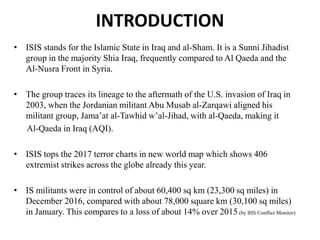
• ISIS stands for the Islamic State in Iraq and al-Sham. It is a Sunni Jihadist
group in the majority Shia Iraq, frequently compared to Al Qaeda and the
Al-Nusra Front in Syria.
• The group traces its lineage to the aftermath of the U.S. invasion of Iraq in
2003, when the Jordanian militant Abu Musab al-Zarqawi aligned his
militant group, Jama’at al-Tawhid w’al-Jihad, with al-Qaeda, making it
Al-Qaeda in Iraq (AQI).
• ISIS tops the 2017 terror charts in new world map which shows 406
extremist strikes across the globe already this year.
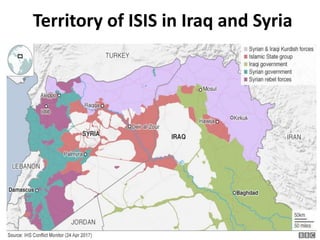
• IS militants were in control of about 60,400 sq km (23,300 sq miles) in
December 2016, compared with about 78,000 square km (30,100 sq miles)
in January. This compares to a loss of about 14% over 2015.(by IHS Conflict Monitor)
Reason for the rise of ISIS
• US invasion of Iraq in 2003 and the plan of
regime change.
• The idea of De-Baathification.
• Disbanding Iraqi army.
• Not understanding the variations in middle
east.
• Setting up a number of detention centers
without keeping a check on the activities going
inside them.
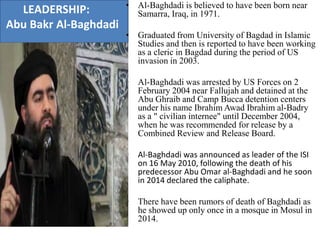
LEADERSHIP:
Abu Bakr Al-Baghdadi
• Al-Baghdadi is believed to have been born near
Samarra, Iraq, in 1971.
• Graduated from University of Bagdad in Islamic
Studies and then is reported to have been working
as a cleric in Bagdad during the period of US
invasion in 2003.
• Al-Baghdadi was arrested by US Forces on 2
February 2004 near Fallujah and detained at the
Abu Ghraib and Camp Bucca detention centers
under his name Ibrahim Awad Ibrahim al-Badry
as a " civilian internee" until December 2004,
when he was recommended for release by a
Combined Review and Release Board.
• Al-Baghdadi was announced as leader of the ISI
on 16 May 2010, following the death of his
predecessor Abu Omar al-Baghdadi and he soon
in 2014 declared the caliphate.
• There have been rumors of death of Baghdadi as
he showed up only once in a mosque in Mosul in
2014.
IDEOLOGY
• ISIS is a Salafist-jihadi Islamic organization, part of the Sunni Islamic
extremist faction which seeks to restore early Islam’s days of glory through
jihad, a holy war directed against internal and external enemies. The
group believes that it represents the restoration of the caliphate of early
Islam, and that all Muslims are required to pledge allegiance to it; that a
"defiled" Islam must be purged of apostasy.
• ISIS believe that only a legitimate authority can undertake the leadership
of jihad, and that the first priority over other areas of combat, such as
fighting non-Muslim countries, is the purification of Islamic society
SALAFIST-JIHADI ORGANIZATION
• The modern Salafist movement began in Egypt, a result of the desire to purify Islam of its
flaws and return to what was perceived as the Golden Age of Islam. According to the Salafist-
jihadi perception, the enemies of Islam are not only external (mainly the US and the West),
but also Arab regimes that cooperate with the West or secular Arab regimes that are
considered "infidel." Therefore, according to Salafist jihadists, Islamic religious law justifies
overthrowing them.
• It developed concurrently with Wahhabism, the doctrine of Mohammed IbnAbd al-Wahhab
(died 1792), the cleric whose austere and violent interpretation of Islam became the state
doctrine of Saudi Arabia.
• An ideologically important contribution to the development of the movement was made by
SayyidQutb (1906-1966), an Egyptian ideologue who is also known as the “intellectual
godfather” of radical Islam.
• Milestones- Qutb argued that every person on earth deserves a chance to become a Muslim.
However, he believed that this opportunity exists only if the person lives in a nation that is
truly Islamic, one governed solely by sharia. Thus Muslims must topple every government
and impose strict sharia on every civilization. Only then can people see true Islam and have
an opportunity to choose it. IS intends to fulfil this vision, in Iraq and Syria, the U.S., and the
entire world.
ORGANISATIONAL STRUCTURE
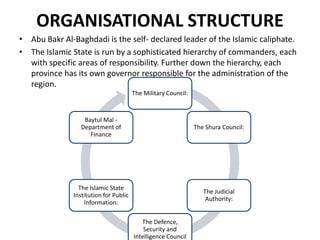
• Abu Bakr Al-Baghdadi is the self- declared leader of the Islamic caliphate.
• The Islamic State is run by a sophisticated hierarchy of commanders, each
with specific areas of responsibility. Further down the hierarchy, each
province has its own governor responsible for the administration of the
region.
The Military Council:
The Shura Council:
The Judicial
Authority:
The Defence,
Security and
Intelligence Council
The Islamic State
Institution for Public
Information:
Baytul Mal -
Department of
Finance
Sources of Income
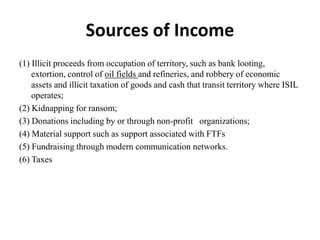
(1) Illicit proceeds from occupation of territory, such as bank looting,
extortion, control of oil fields and refineries, and robbery of economic
assets and illicit taxation of goods and cash that transit territory where ISIL
operates;
(2) Kidnapping for ransom;
(3) Donations including by or through non-profit organizations;
(4) Material support such as support associated with FTFs
(5) Fundraising through modern communication networks.
(6) Taxes
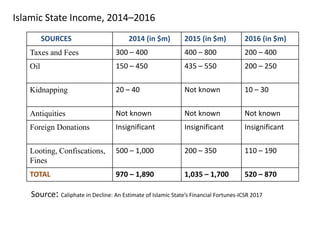
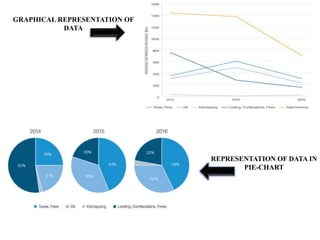
Islamic State Income, 2014–2016
SOURCES 2014 (in $m) 2015 (in $m) 2016 (in $m)
Taxes and Fees 300 – 400 400 – 800 200 – 400
Oil 150 – 450 435 – 550 200 – 250
Kidnapping 20 – 40 Not known 10 – 30
Antiquities Not known Not known Not known
Foreign Donations Insignificant Insignificant Insignificant
Looting, Confiscations,
Fines
500 – 1,000 200 – 350 110 – 190
TOTAL 970 – 1,890 1,035 – 1,700 520 – 870
Source: Caliphate in Decline: An Estimate of Islamic State’s Financial Fortunes-ICSR 2017
GRAPHICAL REPRESENTATION OF
DATA
REPRESENTATION OF DATA IN
PIE-CHART
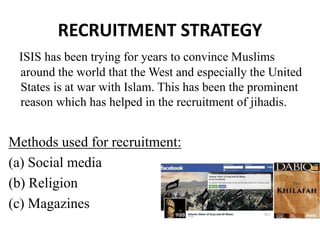
RECRUITMENT STRATEGY
ISIS has been trying for years to convince Muslims
around the world that the West and especially the United
States is at war with Islam. This has been the prominent
reason which has helped in the recruitment of jihadis.
Methods used for recruitment:
(a) Social media
(b) Religion
(c) Magazines
(1) These groups can provide youth with a sense of identity
(2) ISIS operates a sophisticated propaganda machine
(3) A sense of religious obligation
(4) Money – Oil wealth, extortion, funding from Gulf states
= IS pay well.
(5)The marginalized in society and looking for an outlet for
their frustration and anger about their lives.
(6) The radicalized in prison and at religious institutions.
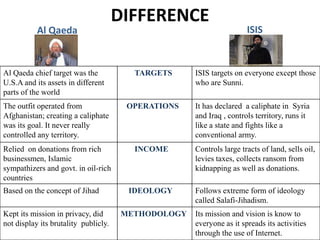
DIFFERENCE
Al Qaeda ISIS
Al Qaeda chief target was the
U.S.A and its assets in different
parts of the world
TARGETS ISIS targets on everyone except those
who are Sunni.
The outfit operated from
Afghanistan; creating a caliphate
was its goal. It never really
controlled any territory.
OPERATIONS It has declared a caliphate in Syria
and Iraq , controls territory, runs it
like a state and fights like a
conventional army.
Relied on donations from rich
businessmen, Islamic
sympathizers and govt. in oil-rich
countries
INCOME Controls large tracts of land, sells oil,
levies taxes, collects ransom from
kidnapping as well as donations.
Based on the concept of Jihad IDEOLOGY Follows extreme form of ideology
called Salafi-Jihadism.
Kept its mission in privacy, did
not display its brutality publicly.
METHODOLOGY Its mission and vision is know to
everyone as it spreads its activities
through the use of Internet.
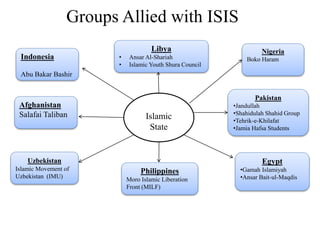
Groups Allied with ISIS
Islamic
State
Philippines
Moro Islamic Liberation
Front (MILF)
Indonesia
Abu Bakar Bashir
Libya
• Ansar Al-Shariah
• Islamic Youth Shura Council
Egypt
•Gamah Islamiyah
•Ansar Bait-ul-Maqdis
Nigeria
Boko Haram
Pakistan
•Jandullah
•Shahidulah Shahid Group
•Tehrik-e-Khilafat
•Jamia Hafsa Students
Uzbekistan
Islamic Movement of
Uzbekistan (IMU)
Afghanistan
Salafai Taliban
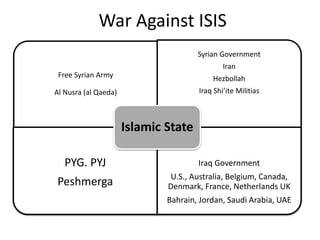
War Against ISIS
Free Syrian Army
Al Nusra (al Qaeda)
Syrian Government
Iran
Hezbollah
Iraq Shi’ite Militias
PYG. PYJ
Peshmerga
Iraq Government
U.S., Australia, Belgium, Canada,
Denmark, France, Netherlands UK
Bahrain, Jordan, Saudi Arabia, UAE
Islamic State
ISIS and SYRIA
• Syria being a Sunni majority country is ruled by a shia President Bashar al Assad since 2000
and even before him syria was ruled by his father Hafez al-Assad from 1971 onwards.
• The civil war started in 2011 and this gave Turkey an opportunity by which it allowed a
southern border with Syria so porous that it offered ISIS and the al-Qaeda-affiliated Jabhat
al-Nusra what amounted to a logistical safe zone
• In March 2013, it took over the Syrian city of Raqqa - the first provincial capital to fall
under rebel control.
• Iran backed Hezbollah are pro Assad
• The Russia is continuing its air strike on ISIS in North-eastern Syria
• The Saudi and Qatar govt. are funding Sunni militias to fight against Assad. Even U.S.A is
calling for the resignation of Assad rather than regime change, because it has seen the
failure of it in Iraq.
• US-backed Syrian rebels have also begun advancing on IS stronghold, the city of Raqqa, in
northern Syria.
ISIS and IRAQ
• IS grew out of what was AQI, which was formed by Sunni militants after the US-led invasion
in 2003 and became a major force in the country's sectarian war.
• Since Shia Arabs are majority (60-65%), Sunnis are 32-37%.
• Paul Bremer idea of De-Baathification and the disbanding of Iraqi army gave ISIS new
leaders to fight in their Jihad. As all these were the associates of Saddam Hussein.
• More than half of the leadership of ISIS was present in Camp bucca, Camp nama and Camp
cropper. Maj. Gen. Douglas Stone, prison commander in Iraq mentions the camps as a Jihadi
University.
• Iraqi special forces and army units have liberated the eastern half of Mosul and are now
advancing into the western part of the city.
• Brig Gen Yahya Rasool, a military spokesman, said the extremist group currently controls
less than 12,000 square miles (30,000sq. km) in Iraq, or 6.8 per cent of the country’s territory.
Territory of ISIS in Iraq and Syria
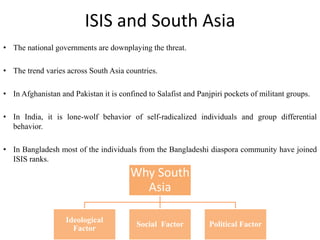
ISIS and South Asia
• The national governments are downplaying the threat.
• The trend varies across South Asia countries.
• In Afghanistan and Pakistan it is confined to Salafist and Panjpiri pockets of militant groups.
• In India, it is lone-wolf behavior of self-radicalized individuals and group differential
behavior.
• In Bangladesh most of the individuals from the Bangladeshi diaspora community have joined
ISIS ranks.
Why South
Asia
Ideological
Factor
Social Factor Political Factor
ISIS: IS IT A STATE IN ITSELF?
• The Montevideo Convention on the Rights and Duties of States
in 1933 gives the condition for the establishment of a state.
• And according to those articles ISIS have largely violated them.
• As ISIS is a self proclaimed state.
• Not approved by any nation.
• The control taken by the group is through the use of force and
not by legitimate use of democratic methods.
• The do not respect the Human rights of people living in Iraq and
Syria.
• They are a made on the ideology of Jihadi-Salafism and their
members are notified criminals. Therefore, they have no
authority to est. a state.
COALITION SUCCESS
• According to the U.S. State Department, there are currently 68 participants
in the coalition contributing either military forces or resources (or both) to
the campaign.
• The group has been facing heavy exodus as the Fighting strength has
reduced to an estimate of 12,000 to 15,000 fighters in Iraq and Syria.
• In 2017 the group has lost approximately 60% of the populated territory it
once held in Iraq, and approximately 30% of the populated territory it once
held in Syria.
• The oil and gas resource are being targeted which is forcing ISIS to beg for
foreign donations.
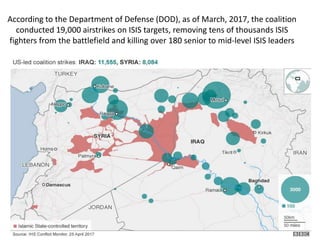
According to the Department of Defense (DOD), as of March, 2017, the coalition
conducted 19,000 airstrikes on ISIS targets, removing tens of thousands ISIS
fighters from the battlefield and killing over 180 senior to mid-level ISIS leaders
Strategy to defeat ISIS
1. Start with the U.S. and Russia and then bring in Iran and Saudi
Arabia.
2. Move beyond air strikes.
3.Support the moderate opposition in Syria and end the civil war.
4. Exploit the Islamic State’s weaknesses.
5. Establish an Iraqi national guard
6. Push Turkey to play a bigger role
7.De-radicalization centers.
8.UN need to play a major role
Questions needed to be answered
• Can ISIS survive?
• Cooperation among coalition nations?
• Will the Refugee Crisis be solved at any
point of time in future?
• Conceptions of international intervention-
will it change.
Isis

Isis

  • 1.
    Research on THE RISEOF ISIS Sardar Patel University of Police Security and Criminal Justice Submitted by- Submitted to- Prakash Jangid Ms. Surabhi Gupta Roll No. 1060 Asst. Professor Enroll. No. 14/IN /020 SPUP prakashjangid041@gmail.com
  • 2.
    INTRODUCTION • ISIS standsfor the Islamic State in Iraq and al-Sham. It is a Sunni Jihadist group in the majority Shia Iraq, frequently compared to Al Qaeda and the Al-Nusra Front in Syria. • The group traces its lineage to the aftermath of the U.S. invasion of Iraq in 2003, when the Jordanian militant Abu Musab al-Zarqawi aligned his militant group, Jama’at al-Tawhid w’al-Jihad, with al-Qaeda, making it Al-Qaeda in Iraq (AQI). • ISIS tops the 2017 terror charts in new world map which shows 406 extremist strikes across the globe already this year. • IS militants were in control of about 60,400 sq km (23,300 sq miles) in December 2016, compared with about 78,000 square km (30,100 sq miles) in January. This compares to a loss of about 14% over 2015.(by IHS Conflict Monitor)
  • 3.
    Reason for therise of ISIS • US invasion of Iraq in 2003 and the plan of regime change. • The idea of De-Baathification. • Disbanding Iraqi army. • Not understanding the variations in middle east. • Setting up a number of detention centers without keeping a check on the activities going inside them.
  • 4.
    LEADERSHIP: Abu Bakr Al-Baghdadi •Al-Baghdadi is believed to have been born near Samarra, Iraq, in 1971. • Graduated from University of Bagdad in Islamic Studies and then is reported to have been working as a cleric in Bagdad during the period of US invasion in 2003. • Al-Baghdadi was arrested by US Forces on 2 February 2004 near Fallujah and detained at the Abu Ghraib and Camp Bucca detention centers under his name Ibrahim Awad Ibrahim al-Badry as a " civilian internee" until December 2004, when he was recommended for release by a Combined Review and Release Board. • Al-Baghdadi was announced as leader of the ISI on 16 May 2010, following the death of his predecessor Abu Omar al-Baghdadi and he soon in 2014 declared the caliphate. • There have been rumors of death of Baghdadi as he showed up only once in a mosque in Mosul in 2014.
  • 5.
    IDEOLOGY • ISIS isa Salafist-jihadi Islamic organization, part of the Sunni Islamic extremist faction which seeks to restore early Islam’s days of glory through jihad, a holy war directed against internal and external enemies. The group believes that it represents the restoration of the caliphate of early Islam, and that all Muslims are required to pledge allegiance to it; that a "defiled" Islam must be purged of apostasy. • ISIS believe that only a legitimate authority can undertake the leadership of jihad, and that the first priority over other areas of combat, such as fighting non-Muslim countries, is the purification of Islamic society
  • 6.
    SALAFIST-JIHADI ORGANIZATION • Themodern Salafist movement began in Egypt, a result of the desire to purify Islam of its flaws and return to what was perceived as the Golden Age of Islam. According to the Salafist- jihadi perception, the enemies of Islam are not only external (mainly the US and the West), but also Arab regimes that cooperate with the West or secular Arab regimes that are considered "infidel." Therefore, according to Salafist jihadists, Islamic religious law justifies overthrowing them. • It developed concurrently with Wahhabism, the doctrine of Mohammed IbnAbd al-Wahhab (died 1792), the cleric whose austere and violent interpretation of Islam became the state doctrine of Saudi Arabia. • An ideologically important contribution to the development of the movement was made by SayyidQutb (1906-1966), an Egyptian ideologue who is also known as the “intellectual godfather” of radical Islam. • Milestones- Qutb argued that every person on earth deserves a chance to become a Muslim. However, he believed that this opportunity exists only if the person lives in a nation that is truly Islamic, one governed solely by sharia. Thus Muslims must topple every government and impose strict sharia on every civilization. Only then can people see true Islam and have an opportunity to choose it. IS intends to fulfil this vision, in Iraq and Syria, the U.S., and the entire world.
  • 7.
    ORGANISATIONAL STRUCTURE • AbuBakr Al-Baghdadi is the self- declared leader of the Islamic caliphate. • The Islamic State is run by a sophisticated hierarchy of commanders, each with specific areas of responsibility. Further down the hierarchy, each province has its own governor responsible for the administration of the region. The Military Council: The Shura Council: The Judicial Authority: The Defence, Security and Intelligence Council The Islamic State Institution for Public Information: Baytul Mal - Department of Finance
  • 8.
    Sources of Income (1)Illicit proceeds from occupation of territory, such as bank looting, extortion, control of oil fields and refineries, and robbery of economic assets and illicit taxation of goods and cash that transit territory where ISIL operates; (2) Kidnapping for ransom; (3) Donations including by or through non-profit organizations; (4) Material support such as support associated with FTFs (5) Fundraising through modern communication networks. (6) Taxes
  • 9.
    Islamic State Income,2014–2016 SOURCES 2014 (in $m) 2015 (in $m) 2016 (in $m) Taxes and Fees 300 – 400 400 – 800 200 – 400 Oil 150 – 450 435 – 550 200 – 250 Kidnapping 20 – 40 Not known 10 – 30 Antiquities Not known Not known Not known Foreign Donations Insignificant Insignificant Insignificant Looting, Confiscations, Fines 500 – 1,000 200 – 350 110 – 190 TOTAL 970 – 1,890 1,035 – 1,700 520 – 870 Source: Caliphate in Decline: An Estimate of Islamic State’s Financial Fortunes-ICSR 2017
  • 10.
  • 11.
    RECRUITMENT STRATEGY ISIS hasbeen trying for years to convince Muslims around the world that the West and especially the United States is at war with Islam. This has been the prominent reason which has helped in the recruitment of jihadis. Methods used for recruitment: (a) Social media (b) Religion (c) Magazines
  • 12.
    (1) These groupscan provide youth with a sense of identity (2) ISIS operates a sophisticated propaganda machine (3) A sense of religious obligation (4) Money – Oil wealth, extortion, funding from Gulf states = IS pay well. (5)The marginalized in society and looking for an outlet for their frustration and anger about their lives. (6) The radicalized in prison and at religious institutions.
  • 13.
    DIFFERENCE Al Qaeda ISIS AlQaeda chief target was the U.S.A and its assets in different parts of the world TARGETS ISIS targets on everyone except those who are Sunni. The outfit operated from Afghanistan; creating a caliphate was its goal. It never really controlled any territory. OPERATIONS It has declared a caliphate in Syria and Iraq , controls territory, runs it like a state and fights like a conventional army. Relied on donations from rich businessmen, Islamic sympathizers and govt. in oil-rich countries INCOME Controls large tracts of land, sells oil, levies taxes, collects ransom from kidnapping as well as donations. Based on the concept of Jihad IDEOLOGY Follows extreme form of ideology called Salafi-Jihadism. Kept its mission in privacy, did not display its brutality publicly. METHODOLOGY Its mission and vision is know to everyone as it spreads its activities through the use of Internet.
  • 14.
    Groups Allied withISIS Islamic State Philippines Moro Islamic Liberation Front (MILF) Indonesia Abu Bakar Bashir Libya • Ansar Al-Shariah • Islamic Youth Shura Council Egypt •Gamah Islamiyah •Ansar Bait-ul-Maqdis Nigeria Boko Haram Pakistan •Jandullah •Shahidulah Shahid Group •Tehrik-e-Khilafat •Jamia Hafsa Students Uzbekistan Islamic Movement of Uzbekistan (IMU) Afghanistan Salafai Taliban
  • 15.
    War Against ISIS FreeSyrian Army Al Nusra (al Qaeda) Syrian Government Iran Hezbollah Iraq Shi’ite Militias PYG. PYJ Peshmerga Iraq Government U.S., Australia, Belgium, Canada, Denmark, France, Netherlands UK Bahrain, Jordan, Saudi Arabia, UAE Islamic State
  • 16.
    ISIS and SYRIA •Syria being a Sunni majority country is ruled by a shia President Bashar al Assad since 2000 and even before him syria was ruled by his father Hafez al-Assad from 1971 onwards. • The civil war started in 2011 and this gave Turkey an opportunity by which it allowed a southern border with Syria so porous that it offered ISIS and the al-Qaeda-affiliated Jabhat al-Nusra what amounted to a logistical safe zone • In March 2013, it took over the Syrian city of Raqqa - the first provincial capital to fall under rebel control. • Iran backed Hezbollah are pro Assad • The Russia is continuing its air strike on ISIS in North-eastern Syria • The Saudi and Qatar govt. are funding Sunni militias to fight against Assad. Even U.S.A is calling for the resignation of Assad rather than regime change, because it has seen the failure of it in Iraq. • US-backed Syrian rebels have also begun advancing on IS stronghold, the city of Raqqa, in northern Syria.
  • 17.
    ISIS and IRAQ •IS grew out of what was AQI, which was formed by Sunni militants after the US-led invasion in 2003 and became a major force in the country's sectarian war. • Since Shia Arabs are majority (60-65%), Sunnis are 32-37%. • Paul Bremer idea of De-Baathification and the disbanding of Iraqi army gave ISIS new leaders to fight in their Jihad. As all these were the associates of Saddam Hussein. • More than half of the leadership of ISIS was present in Camp bucca, Camp nama and Camp cropper. Maj. Gen. Douglas Stone, prison commander in Iraq mentions the camps as a Jihadi University. • Iraqi special forces and army units have liberated the eastern half of Mosul and are now advancing into the western part of the city. • Brig Gen Yahya Rasool, a military spokesman, said the extremist group currently controls less than 12,000 square miles (30,000sq. km) in Iraq, or 6.8 per cent of the country’s territory.
  • 18.
    Territory of ISISin Iraq and Syria
  • 19.
    ISIS and SouthAsia • The national governments are downplaying the threat. • The trend varies across South Asia countries. • In Afghanistan and Pakistan it is confined to Salafist and Panjpiri pockets of militant groups. • In India, it is lone-wolf behavior of self-radicalized individuals and group differential behavior. • In Bangladesh most of the individuals from the Bangladeshi diaspora community have joined ISIS ranks. Why South Asia Ideological Factor Social Factor Political Factor
  • 20.
    ISIS: IS ITA STATE IN ITSELF? • The Montevideo Convention on the Rights and Duties of States in 1933 gives the condition for the establishment of a state. • And according to those articles ISIS have largely violated them. • As ISIS is a self proclaimed state. • Not approved by any nation. • The control taken by the group is through the use of force and not by legitimate use of democratic methods. • The do not respect the Human rights of people living in Iraq and Syria. • They are a made on the ideology of Jihadi-Salafism and their members are notified criminals. Therefore, they have no authority to est. a state.
  • 21.
    COALITION SUCCESS • Accordingto the U.S. State Department, there are currently 68 participants in the coalition contributing either military forces or resources (or both) to the campaign. • The group has been facing heavy exodus as the Fighting strength has reduced to an estimate of 12,000 to 15,000 fighters in Iraq and Syria. • In 2017 the group has lost approximately 60% of the populated territory it once held in Iraq, and approximately 30% of the populated territory it once held in Syria. • The oil and gas resource are being targeted which is forcing ISIS to beg for foreign donations.
  • 22.
    According to theDepartment of Defense (DOD), as of March, 2017, the coalition conducted 19,000 airstrikes on ISIS targets, removing tens of thousands ISIS fighters from the battlefield and killing over 180 senior to mid-level ISIS leaders
  • 23.
    Strategy to defeatISIS 1. Start with the U.S. and Russia and then bring in Iran and Saudi Arabia. 2. Move beyond air strikes. 3.Support the moderate opposition in Syria and end the civil war. 4. Exploit the Islamic State’s weaknesses. 5. Establish an Iraqi national guard 6. Push Turkey to play a bigger role 7.De-radicalization centers. 8.UN need to play a major role
  • 24.
    Questions needed tobe answered • Can ISIS survive? • Cooperation among coalition nations? • Will the Refugee Crisis be solved at any point of time in future? • Conceptions of international intervention- will it change.