IBM Security Identity Manager
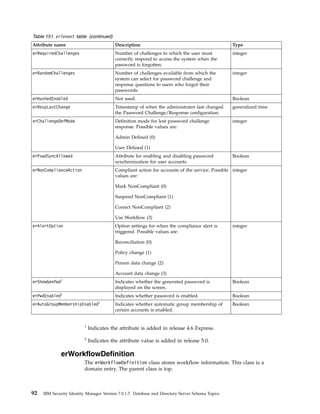
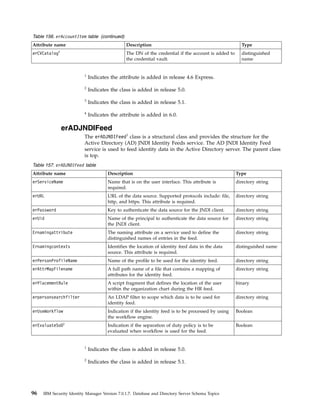
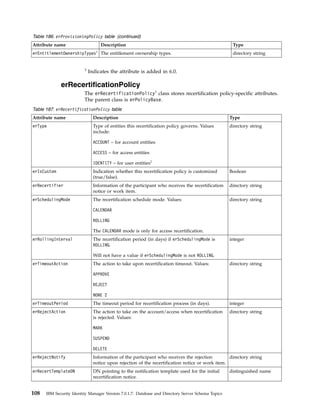
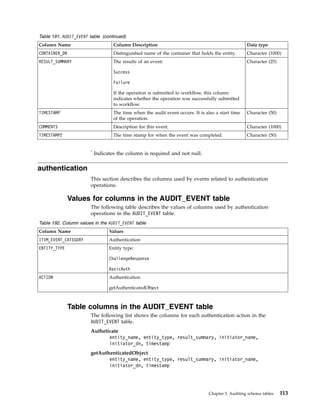
Version 7.0.1.7
Database and Directory Server
Schema Topics
IBM
IBM Security Identity Manager
Version 7.0.1.7
Database and Directory Server
Schema Topics
IBM
ii IBM Security Identity Manager Version 7.0.1.7: Database and Directory Server Schema Topics
Table of contents
Table list . . . . . . . . . . . . . . vii
Chapter 1. Database tables reference . . 1
Workflow tables . . . . . . . . . . . . . 1
PROCESS table . . . . . . . . . . . . 1
PROCESSLOG table . . . . . . . . . . . 4
PROCESSDATA table . . . . . . . . . . 7
ACTIVITY table . . . . . . . . . . . . 8
WORKITEM table . . . . . . . . . . . 10
WI_PARTICIPANT table . . . . . . . . . 12
PASSWORD_TRANSACTION table . . . . . 12
PASSWORD_SYNCH table . . . . . . . . 13
NEXTVALUE table . . . . . . . . . . . 13
PENDING table . . . . . . . . . . . . 13
WORKFLOW_CALLBACK table . . . . . . 14
SYNCH_POINT table . . . . . . . . . . 14
LISTDATA table . . . . . . . . . . . . 15
ACTIVITY_LOCK table . . . . . . . . . 15
Services tables . . . . . . . . . . . . . 16
RESOURCE_PROVIDERS table . . . . . . . 16
REMOTE_SERVICES_REQUESTS table . . . . 17
REMOTE_RESOURCES_RECONS table . . . . 18
REMOTE_RESOURCES_RECON_QUERIES table 19
MANUAL_SERVICE_RECON_ACCOUNTS table 19
SCRIPT table . . . . . . . . . . . . . 20
Import and export tables . . . . . . . . . . 20
BULK_DATA_SERVICE table . . . . . . . 21
BULK_DATA_STORE table . . . . . . . . 21
BULK_DATA_INDEX table . . . . . . . . 21
MIGRATION_STATUS table . . . . . . . . 22
I18NMESSAGES table . . . . . . . . . . 22
Post office tables. . . . . . . . . . . . . 22
PO_TOPIC_TABLE . . . . . . . . . . . 22
PO_NOTIFICATION_TABLE . . . . . . . 23
PO_NOTIFICATION_HTMLBODY_TABLE . . . 24
Reports tables . . . . . . . . . . . . . 24
ENTITY_COLUMN table . . . . . . . . . 24
Report table . . . . . . . . . . . . . 25
COLUMN_REPORT table. . . . . . . . . 25
AUTHORIZATION_OWNERS table . . . . . 25
ACI table . . . . . . . . . . . . . . 26
ACI_ROLEDNS table . . . . . . . . . . 26
ACI_PRINCIPALS table . . . . . . . . . 26
ACI_PERMISSION_ATTRIBUTERIGHT table . . 27
ACI_PERMISSION_CLASSRIGHT table . . . . 27
ENTITLEMENT table . . . . . . . . . . 27
ENTITLEMENT_PROVISIONINGPARAMS table 28
SYNCHRONIZATION_HISTORY table . . . . 28
SYNCHRONIZATION_LOCK table . . . . . 29
RESOURCES_SYNCHRONIZATIONS table. . . 29
CHANGELOG table . . . . . . . . . . 30
RECONCILIATION table . . . . . . . . . 30
RECONCILIATION_INFO table . . . . . . 30
SERVICE_ACCOUNT_MAPPING table . . . . 31
RECERTIFIER_DETAILS_INFO table . . . . . 32
Role assignment attribute tables . . . . . . . 32
PERSON_ROLE_ASSIGNMENT . . . . . . 32
PERSON_ROLE_ASSIGNMENT_VALUES table 32
ROLE_ASSIGNMENT_ATTRIBUTES table . . . 33
Provisioning policy tables . . . . . . . . . 33
POLICY_ANALYSIS . . . . . . . . . . 33
POLICY_ANALYSIS_ERROR . . . . . . . 34
ACCT_CHANGE . . . . . . . . . . . 35
ATTR_CHANGE . . . . . . . . . . . 36
COMPLIANCE_ALERT table . . . . . . . 37
Recertification policy tables . . . . . . . . . 38
RECERTIFICATIONLOG table . . . . . . . 38
USERRECERT_HISTORY table . . . . . . . 39
USERRECERT_ROLE table . . . . . . . . 40
USERRECERT_ACCOUNT table . . . . . . 41
USERRECERT_GROUP table . . . . . . . 42
Shared access tables . . . . . . . . . . . 42
ERCREDENTIALLEASE table . . . . . . . 42
DB_REPLICATION_CONFIG table . . . . . 43
SA_BULK_LOAD table . . . . . . . . . 44
SA_CREDPOOL_DESCRIPTION table . . . . 44
SA_CREDPOOL_GROUP table . . . . . . . 44
SA_CREDPOOL_OWNER table. . . . . . . 45
SA_EVALUATION_BU table. . . . . . . . 45
SA_EVALUATION_BU_HIERARCHY table . . . 45
SA_EVALUATION_CREDENTIAL table . . . . 46
SA_EVAL_CRED_DESCRIPTION table . . . . 47
SA_EVALUATION_CREDENTIAL_POOL table 47
SA_EVALUATION_SERVICE table. . . . . . 48
SA_EVALUATION_SERVICE_TAG table. . . . 48
SA_GLOBAL_CONFIGURATION table . . . . 49
SA_POLICY table . . . . . . . . . . . 50
SA_POLICY_DESCRIPTION table . . . . . . 51
SA_POLICY_ENTITLEMENT table . . . . . 51
SA_POLICY_ERURI table. . . . . . . . . 52
SA_POLICY_MEMBERSHIP table . . . . . . 52
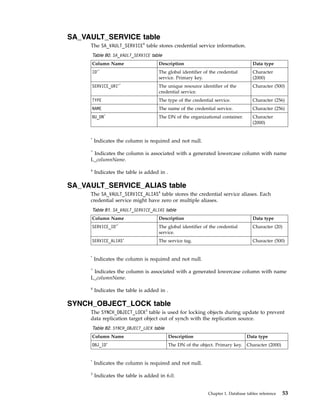
SA_VAULT_SERVICE table . . . . . . . . 53
SA_VAULT_SERVICE_ALIAS table . . . . . 53
SYNCH_OBJECT_LOCK table . . . . . . . 53
V_AUTHORIZED_CREDENTIALS view. . . . 54
V_AUTHORIZED_CREDENTIALPOOLS view . 54
V_SA_EVALUATION_SERVICE view. . . . . 55
V_SAPOLICY_ENTITLEMENT_DETAIL view . . 55
Access catalog tables and views . . . . . . . 56
T_AccessCatalog table . . . . . . . . . . 56
T_AccessCatalogTags table . . . . . . . . 57
T_BADGES table . . . . . . . . . . . 57
T_Owner table . . . . . . . . . . . . 57
T_GROUP table . . . . . . . . . . . . 58
T_Role table . . . . . . . . . . . . . 58
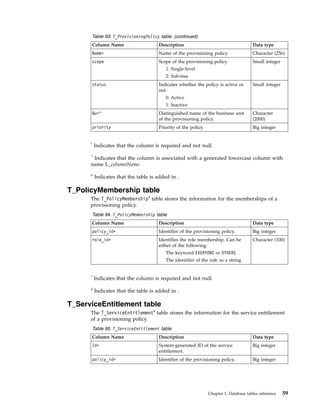
T_ProvisioningPolicy table . . . . . . . . 58
T_PolicyMembership table . . . . . . . . 59
T_ServiceEntitlement table . . . . . . . . 59
T_AttributeEntitlement table. . . . . . . . 60
T_ServiceTags table. . . . . . . . . . . 61
TMP_HostSEByPerson table . . . . . . . . 61
iii
TMP_JSAEByPerson table . . . . . . . . 62
T_Global_Settings table . . . . . . . . . 62
T_GROUP_PROFILE table . . . . . . . . 62
T_Joindirective table . . . . . . . . . . 63
V_GroupCatalog view . . . . . . . . . . 63
V_RoleCatalog view . . . . . . . . . . 64
V_ServiceCatalog view . . . . . . . . . 65
V_DYNAMIC_ENTITLEMENT view . . . . . 65
V_ServiceEntitlementByRole view . . . . . . 66
V_GROUP_PROFILE view . . . . . . . . 66
V_GC_INTERSECT view . . . . . . . . . 67
V_GC_CUSTOM view . . . . . . . . . . 68
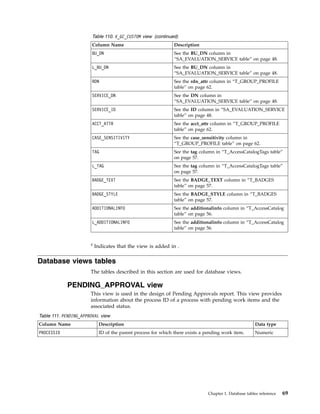
Database views tables . . . . . . . . . . . 69
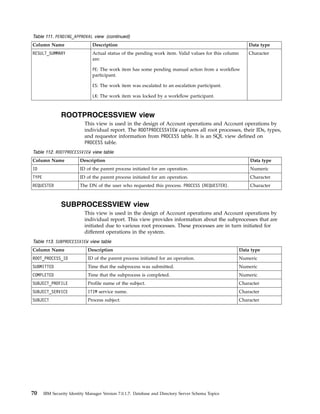
PENDING_APPROVAL view . . . . . . . 69
ROOTPROCESSVIEW view . . . . . . . . 70
SUBPROCESSVIEW view. . . . . . . . . 70
SUSPENDED_USERS view . . . . . . . . 71
SUSPENDED_ACCOUNT_OPERATIONS view 71
PROCESS_VIEW view . . . . . . . . . . 72
Separation of duty policy tables . . . . . . . 72
SOD_OWNER table . . . . . . . . . . 72
SOD_POLICY table . . . . . . . . . . . 73
SOD_RULE table . . . . . . . . . . . 73
SOD_RULE_ROLE table . . . . . . . . . 74
SOD_VIOLATION_HISTORY table . . . . . 74
SOD_VIOLATION_STATUS table . . . . . . 75
SOD_VIOLATION_ROLE_MAP table. . . . . 76
Others . . . . . . . . . . . . . . . . 76
ACI_CATEGORIES table . . . . . . . . . 76
AUTH_KEY table . . . . . . . . . . . 77
COMMON_TASKS table . . . . . . . . . 77
LCR_INPROGRESS_TABLE table . . . . . . 77
ROLE_INHERITANCE table . . . . . . . . 78
SCHEDULED_MESSAGE table . . . . . . . 78
TASK_TREE table . . . . . . . . . . . 79
TASKS_VIEWABLE table . . . . . . . . . 79
VIEW_DEFINITION table . . . . . . . . 79
Chapter 2. schema and class reference 81
directory tree . . . . . . . . . . . . . . 81
General classes . . . . . . . . . . . . . 83
erBPPersonItem . . . . . . . . . . . . 83
erBPOrg . . . . . . . . . . . . . . 84
erBPOrgItem . . . . . . . . . . . . . 84
erDictionary . . . . . . . . . . . . . 85
erDictionaryItem . . . . . . . . . . . 85
erDynamicRole . . . . . . . . . . . . 85
erFormTemplate . . . . . . . . . . . . 85
erIdentityExclusion . . . . . . . . . . . 86
erLocationItem . . . . . . . . . . . . 86
erManagedItem . . . . . . . . . . . . 86
erOrganizationItem . . . . . . . . . . . 87
erOrgUnitItem . . . . . . . . . . . . 87
erPersonItem . . . . . . . . . . . . . 87
erRole . . . . . . . . . . . . . . . 89
erSecurityDomainItem . . . . . . . . . . 89
SecurityDomain . . . . . . . . . . . . 89
erTemplate . . . . . . . . . . . . . 90
erTenant . . . . . . . . . . . . . . 90
erWorkflowDefinition . . . . . . . . . . 92
erOwnershipType . . . . . . . . . . . 93
Service classes . . . . . . . . . . . . . 93
erAccessItem . . . . . . . . . . . . . 93
erAccessType . . . . . . . . . . . . . 94
erAccountItem . . . . . . . . . . . . 94
erADJNDIFeed . . . . . . . . . . . . 96
erAttributeConstraint . . . . . . . . . . 97
erChallenges . . . . . . . . . . . . . 97
erComplianceIssue . . . . . . . . . . . 97
erCSVFeed . . . . . . . . . . . . . 98
erDSMLInfoService . . . . . . . . . . . 98
erDSML2Service . . . . . . . . . . . . 99
erGroupItem . . . . . . . . . . . . . 99
erHostedAccountItem . . . . . . . . . 100
erHostedService . . . . . . . . . . . 100
erHostSelectionPolicy. . . . . . . . . . 100
erITIMService . . . . . . . . . . . . 100
erJNDIFeed . . . . . . . . . . . . . 101
erJoinDirective . . . . . . . . . . . . 101
erPrivilegeRule . . . . . . . . . . . . 101
erObjectCategory . . . . . . . . . . . 102
erObjectProfile . . . . . . . . . . . . 102
erLifecycleProfile . . . . . . . . . . . 103
erRemoteServiceItem . . . . . . . . . . 103
erServiceItem . . . . . . . . . . . . 103
erServiceProfile. . . . . . . . . . . . 104
erSystemItem . . . . . . . . . . . . 105
erSystemRole . . . . . . . . . . . . 105
erSystemUser . . . . . . . . . . . . 105
Policy classes . . . . . . . . . . . . . 105
erAccountTemplate . . . . . . . . . . 106
erAdoptionPolicy . . . . . . . . . . . 106
erIdentityPolicy . . . . . . . . . . . 106
erPasswordPolicy . . . . . . . . . . . 106
erPolicyBase. . . . . . . . . . . . . 106
erPolicyItemBase . . . . . . . . . . . 107
erProvisioningPolicy . . . . . . . . . . 107
erRecertificationPolicy . . . . . . . . . 108
erSeparationOfDutyPolicy . . . . . . . . 109
erSeparationOfDutyRule. . . . . . . . . 109
Chapter 3. Auditing schema tables 111
AUDIT_EVENT table . . . . . . . . . . . 112
authentication . . . . . . . . . . . . . 113
Values for columns in the AUDIT_EVENT table 113
Table columns in the AUDIT_EVENT table . . 113
Person management . . . . . . . . . . . 114
AUDIT_MGMT_TARGET table . . . . . . 114
Values for columns in the AUDIT_EVENT table 114
Table columns used in the AUDIT_EVENT table 115
Table columns for person management in the
AUDIT_MGMT_ACCESS_REQUEST table . . . 116
Table columns for person management in the
AUDIT_MGMT_OBLIGATION table. . . . . 116
AUDIT_MGMT_OBLIGATION_ATTRIB table 116
AUDIT_MGMT_OBLIGATION_RESOURCE
table . . . . . . . . . . . . . . . 117
Delegate authority. . . . . . . . . . . . 117
AUDIT_MGMT_DELEGATE table . . . . . 117
Values for columns in the AUDIT_EVENT table 118
Table columns used in the AUDIT_EVENT table 118
Policy management . . . . . . . . . . . 118
iv IBM Security Identity Manager Version 7.0.1.7: Database and Directory Server Schema Topics
Values for columns in the AUDIT_EVENT table 118
Table columns used in the AUDIT_EVENT table 119
ACI management . . . . . . . . . . . . 122
AUDIT_MGMT_TARGET table . . . . . . 122
Values for columns in the AUDIT_EVENT table 122
Table columns used in the AUDIT_EVENT table 123
Access request management . . . . . . . . 123
AUDIT_MGMT_ACCESS_REQUEST table. . . 124
AUDIT_MGMT_OBLIGATION table. . . . . 125
AUDIT_MGMT_OBLIGATION_ATTRIB table 126
AUDIT_MGMT_OBLIGATION_RESOURCE
table . . . . . . . . . . . . . . . 127
AUDIT_MGMT_MESSAGE table . . . . . . 127
Values for columns in the AUDIT_EVENT table
that is used by access request management . . 127
Table columns used in the AUDIT_EVENT table 128
Manual activity events . . . . . . . . . . 128
Create manual activity event . . . . . . . 128
Escalate manual activity event. . . . . . . 133
Table columns used in the AUDIT_Event table 136
Lifecycle rule events . . . . . . . . . . . 136
Values for columns in the AUDIT_EVENT table 136
Table columns used in the AUDIT_EVENT table 137
Account management . . . . . . . . . . 137
AUDIT_MGMT_PROVISIONING table . . . . 137
Values for columns in the AUDIT_EVENT table 137
Table columns used in the AUDIT_EVENT table 138
Table columns for account management in the
AUDIT_MGMT_ACCESS_REQUEST table. . . 139
Table columns for account management in the
AUDIT_MGMT_OBLIGATION table. . . . . 139
AUDIT_MGMT_OBLIGATION_ATTRIB table 140
AUDIT_MGMT_OBLIGATION_RESOURCE
table . . . . . . . . . . . . . . . 140
Container management . . . . . . . . . . 141
Values for columns in the AUDIT_EVENT table 141
Table columns used in the AUDIT_EVENT table 141
Organization role management . . . . . . . 142
AUDIT_MGMT_TARGET table . . . . . . 142
Values for columns in the AUDIT_EVENT table 142
Table columns used in the AUDIT_EVENT table 143
ITIM group management . . . . . . . . . 144
AUDIT_MGMT_TARGET table . . . . . . 144
Values for columns in the AUDIT_EVENT table 144
Table columns used in the AUDIT_EVENT table 145
Service management . . . . . . . . . . . 145
AUDIT_MGNT_TARGET table . . . . . . 146
Values for columns in the AUDIT_EVENT table 146
Table columns used in the AUDIT_EVENT table 146
Group management . . . . . . . . . . . 147
AUDIT_MGMT_TARGET table . . . . . . 147
Values for columns in the AUDIT_EVENT table 148
Table columns used in the AUDIT_EVENT table 148
Service policy enforcement . . . . . . . . . 149
Values for columns in the AUDIT_EVENT table 149
Table columns used in the AUDIT_EVENT table 149
Reconciliation . . . . . . . . . . . . . 149
Values for columns in the AUDIT_EVENT table 150
Table columns used in the AUDIT_EVENT table 150
Entitlement workflow management . . . . . . 150
Values for columns in the AUDIT_EVENT table 150
Table columns used in the AUDIT_EVENT table 151
Entity operation management . . . . . . . . 151
Values for columns in the AUDIT_EVENT table 151
Table columns used in the AUDIT_EVENT table 152
System configuration . . . . . . . . . . . 152
Values for columns in the AUDIT_EVENT table 152
Table columns used in the AUDIT_EVENT table 153
Runtime events. . . . . . . . . . . . . 154
Values for columns in the AUDIT_EVENT table 154
Table columns used in the AUDIT_EVENT table 155
Self-password change . . . . . . . . . . 155
Values for columns in the AUDIT_EVENT table 155
Table columns used in the AUDIT_EVENT table 155
Migration . . . . . . . . . . . . . . 155
Values for columns in the AUDIT_EVENT table 156
Table columns used in the AUDIT_EVENT table 156
Credential management . . . . . . . . . . 156
Values for columns in the AUDIT_EVENT table 157
Table columns used in the AUDIT_EVENT table 157
Credential Pool management . . . . . . . . 158
Values for columns in the AUDIT_EVENT table 158
Table columns used in the AUDIT_EVENT table 158
Credential Lease management . . . . . . . . 158
AUDIT_MGMT_LEASE table . . . . . . . 159
Values for columns in the AUDIT_EVENT table 159
Table columns used in the AUDIT_EVENT table 160
Chapter 4. IBM Cognos reporting
query subjects and query items . . . 163
Schema mapping . . . . . . . . . . . . 163
Mapping the attributes and entities . . . . . . 163
Recertification Audit namespace . . . . . . 164
Query subjects for Recertification Audit
namespace . . . . . . . . . . . . . 165
Query items for Recertification Audit
namespace . . . . . . . . . . . . . 166
Recertification Config namespace . . . . . . 174
Query subjects for Recertification Config
namespace . . . . . . . . . . . . . 174
Query items for Recertification Config
namespace . . . . . . . . . . . . . 174
Account Audit namespace . . . . . . . . . 181
Query subjects for Account Audit namespace 181
Query items for Account Audit namespace . . 182
Account Configuration namespace . . . . . . 185
Query subjects for Account Configuration
namespace . . . . . . . . . . . . . 185
Query items for Account Configuration
namespace . . . . . . . . . . . . . 187
Provisioning Policy Audit namespace. . . . . 194
Query subjects for Provisioning Policy Audit
namespace . . . . . . . . . . . . . 194
Query items for Provisioning Policy Audit
namespace . . . . . . . . . . . . . 195
Provisioning Policy Config namespace . . . . 197
Query subjects for Provisioning Policy Config
namespace . . . . . . . . . . . . . 197
Query items for Provisioning Policy Config
namespace . . . . . . . . . . . . . 198
Role Audit namespace . . . . . . . . . . 201
Query subjects for Role Audit namespace . . . 201
Table of contents v
Query items for Role Audit namespace. . . . 202
Role Configuration namespace . . . . . . . 204
Query subjects for Role Configuration
namespace . . . . . . . . . . . . . 204
Query items for Role Configuration namespace 206
Separation of Duty Audit namespace . . . . . 211
Query subjects for Separation of Duty Audit
namespace . . . . . . . . . . . . . 211
Query items for Separation of Duty Audit
namespace . . . . . . . . . . . . . 212
Separation of Duty Configuration namespace . . 217
Query subjects for Separation of Duty
Configuration namespace . . . . . . . . 217
Query items for Separation of Duty
Configuration namespace . . . . . . . . 218
User Audit namespace . . . . . . . . . . 219
Query subjects for User Audit namespace . . . 219
Query items for User Audit namespace. . . . 220
User Configuration namespace . . . . . . . 223
Query subjects for User Configuration
namespace . . . . . . . . . . . . . 223
Query items for User Configuration namespace 224
Service Audit namespace . . . . . . . . . 231
Query subjects for Service Audit namespace 231
Query items for Service Audit namespace . . 232
Access Audit namespace . . . . . . . . . 234
Query subjects for Access Audit namespace . . 235
Query items for Access Audit namespace . . . 236
Access Configuration namespace . . . . . . 240
Query subjects for Access Configuration
namespace . . . . . . . . . . . . . 240
Query items for Access Configuration
namespace . . . . . . . . . . . . . 241
Index . . . . . . . . . . . . . . . 245
vi IBM Security Identity Manager Version 7.0.1.7: Database and Directory Server Schema Topics
Table list
1. PROCESS table. . . . . . . . . . . . 1
2. PROCESSLOG table . . . . . . . . . . . 4
3. PROCESSDATA table . . . . . . . . . . . 7
4. ACTIVITY table . . . . . . . . . . . . 8
5. WORKITEM table . . . . . . . . . . . 10
6. WI_PARTICIPANT table . . . . . . . . . 12
7. PASSWORD_TRANSACTION table . . . . . . . 13
8. PASSWORD_SYNCH table . . . . . . . . . 13
9. NEXTVALUE table . . . . . . . . . . . 13
10. PENDING table . . . . . . . . . . . . 14
11. WORKFLOW_CALLBACK table . . . . . . . . 14
12. SYNCH_POINT table . . . . . . . . . . 14
13. LISTDATA table . . . . . . . . . . . 15
14. ACTIVITY_LOCK table . . . . . . . . . . 15
15. RESOURCE_PROVIDERS table . . . . . . . . 16
16. REMOTE_SERVICES_REQUESTS table . . . . . 17
17. REMOTE_RESOURCES_RECONS table . . . . . . 18
18. REMOTE_RESOURCES_RECON_QUERIES table 19
19. MANUAL_SERVICE_RECON_ACCOUNTS table . . . . 19
20. SCRIPT table . . . . . . . . . . . . 20
21. BULK_DATA_SERVICE table . . . . . . . . 21
22. BULK_DATA_STORE table . . . . . . . . . 21
23. BULK_DATA_INDEX table . . . . . . . . . 21
24. MIGRATION_STATUS table . . . . . . . . 22
25. I18NMESSAGES table . . . . . . . . . . 22
26. PO_TOPIC_TABLE table . . . . . . . . . 23
27. PO_NOTIFICATION_TABLE table . . . . . . . 23
28. PO_NOTIFICATION_HTMLBODY_TABLE . . . . . 24
29. ENTITY_COLUMN table . . . . . . . . . . 24
30. Report table . . . . . . . . . . . . 25
31. COLUMN_REPORT table . . . . . . . . . . 25
32. AUTHORIZATION_OWNERS table . . . . . . . 26
33. ACI table . . . . . . . . . . . . . 26
34. ACI_ROLEDNS table . . . . . . . . . . 26
35. ACI_PRINCIPALS table . . . . . . . . . 27
36. ACI_PERMISSION_ATTRIBUTERIGHT table . . . . 27
37. ACI_PERMISSION_CLASSRIGHT table . . . . . 27
38. ENTITLEMENT table . . . . . . . . . 28
39. ENTITLEMENT_PROVISIONINGPARAMS table 28
40. SYNCHRONIZATION_HISTORY table . . . . . . 28
41. SYNCHRONIZATION_LOCK table . . . . . . . 29
42. RESOURCES_SYNCHRONIZATIONS table . . . . . 29
43. CHANGELOG table . . . . . . . . . . . 30
44. RECONCILIATION table . . . . . . . . 30
45. RECONCILIATION_INFO table . . . . . . . 30
46. SERVICE_ACCOUNT_MAPPING table . . . . . . 31
47. RECERTIFIER_DETAILS_INFO table . . . . . 32
48. The PERSON_ROLE_ASSIGNMENT table . . . . . 32
49. The PERSON_ROLE_ASSIGNMENT table . . . . . 32
50. The ROLE_ASSIGNMENT_ATTRIBUTES table 33
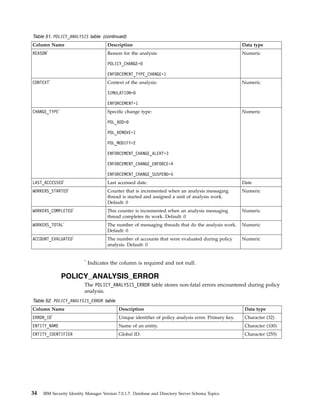
51. POLICY_ANALYSIS table . . . . . . . . . 33
52. POLICY_ANALYSIS_ERROR table . . . . . . 34
53. ACCT_CHANGE table . . . . . . . . . . 35
54. ATTR_CHANGE table . . . . . . . . . . 36
55. COMPLIANCE_ALERT table . . . . . . . . 37
56. RECERTIFICATIONLOG table . . . . . . . . 38
57. USERRECERT_HISTORY table . . . . . . . . 40
58. USERRECERT_ROLE table . . . . . . . . . 40
59. USERRECERT_ACCOUNT table . . . . . . . . 41
60. USERRECERT_GROUP table . . . . . . . . 42
61. ERCREDENTIALLEASE table . . . . . . . . 42
62. DB_REPLICATION_CONFIG table . . . . . . . 43
63. SA_BULK_LOAD table . . . . . . . . . . 44
64. SA_CREDPOOL_DESCRIPTION table . . . . . . 44
65. SA_CREDPOOL_GROUP table . . . . . . . . 44
66. SA_CREDPOOL_OWNER table . . . . . . . . 45
67. SA_EVALUATION_BU table . . . . . . . . 45
68. SA_EVALUATION_BU_HIERARCHY table . . . . . 45
69. SA_EVALUATION_CREDENTIAL table . . . . . 46
70. SA_EVAL_CRED_DESCRIPTION table . . . . . 47
71. SA_ EVALUATION_CREDENTIAL_POOL table 47
72. SA_EVALUATION_SERVICE table . . . . . . . 48
73. SA_EVALUATION_SERVICE_TAG table . . . . . 49
74. The SA_GLOBAL_CONFIGURATION table . . . . 49
75. SA_POLICY table . . . . . . . . . . . 50
76. SA_POLICY_DESCRIPTION table . . . . . . . 51
77. SA_POLICY_ENTITLEMENT table . . . . . . . 51
78. SA_POLICY_ERURI table . . . . . . . . . 52
79. SA_POLICY_MEMBERSHIP table . . . . . . . 52
80. SA_VAULT_SERVICE table . . . . . . . . 53
81. SA_VAULT_SERVICE_ALIAS table . . . . . . 53
82. SYNCH_OBJECT_LOCK table . . . . . . . . 53
83. V_AUTHORIZED_CREDENTIALS view . . . . . 54
84. V_AUTHORIZED_CREDENTIALPOOLS view . . . . 54
85. V_SA_EVALUATION_SERVICE view . . . . . . 55
86. V_SAPOLICY_ENTITLEMENT_DETAIL view. . . . 55
87. T_AccessCatalog table . . . . . . . . . 56
88. T_AccessCatalogTags table . . . . . . . 57
89. T_BADGES table . . . . . . . . . . . 57
90. T_Owner table . . . . . . . . . . . . 57
91. T_GROUP table . . . . . . . . . . . . 58
92. T_Role table . . . . . . . . . . . . 58
93. T_ProvisioningPolicy table . . . . . . . 58
94. T_PolicyMembership table . . . . . . . . 59
95. T_ServiceEntitlement table . . . . . . . 59
96. T_AttributeEntitlement table . . . . . . 60
97. T_ServiceTags table . . . . . . . . . . 61
98. TMP_HostSEByPerson table . . . . . . . . 61
99. TMP_JSAEByPerson table . . . . . . . . 62
100. T_Global_Settings table . . . . . . . . 62
101. T_GROUP_PROFILE table . . . . . . . . . 62
102. T_Joindirective table . . . . . . . . . 63
103. V_GroupCatalog view . . . . . . . . . 63
104. V_RoleCatalog view. . . . . . . . . . 64
105. V_ServiceCatalog view . . . . . . . . 65
106. V_DYNAMIC_ENTITLEMENT view. . . . . . . 66
107. V_ServiceEntitlementByRole view . . . . . 66
108. V_GROUP_PROFILE view . . . . . . . . . 66
109. V_GC_INTERSECT view . . . . . . . . . 67
110. V_GC_CUSTOM view . . . . . . . . . . 68
111. PENDING_APPROVAL view . . . . . . . . 69
112. ROOTPROCESSVIEW view table . . . . . . . 70
vii
113. SUBPROCESSVIEW view table . . . . . . . 70
114. SUSPENDED_USERS view table . . . . . . . 71
115. SUSPENDED_ACCOUNT_OPERATIONS view table 72
116. PROCESS_VIEW view table . . . . . . . . 72
117. SOD_OWNER table . . . . . . . . . . . 72
118. SOD_POLICY table . . . . . . . . . . . 73
119. SOD_RULE table . . . . . . . . . . . 73
120. SOD_RULE_ROLE table . . . . . . . . 74
121. SOD_VIOLATION_HISTORY table . . . . . . . 74
122. SOD_VIOLATION_STATUS table . . . . . . . 75
123. SOD_VIOLATION_ROLE_MAP table . . . . . . 76
124. ACI_CATEGORIES table . . . . . . . . . 76
125. AUTH_KEY table . . . . . . . . . . . 77
126. COMMON_TASKS table . . . . . . . . . . 77
127. LCR_INPROGRESS_TABLE table . . . . . . . 77
128. ROLE_INHERITANCE table . . . . . . . . 78
129. SCHEDULED_MESSAGE table . . . . . . . . 78
130. TASK_TREE table . . . . . . . . . . . 79
131. TASKS_VIEWABLE table . . . . . . . . 79
132. VIEW_DEFINITION table . . . . . . . . . 79
133. Brief descriptions of each container in the
directory tree . . . . . . . . . . . . 81
134. erBPPersonItem table . . . . . . . . . 83
135. erBPOrg table . . . . . . . . . . . . 84
136. erBPOrgItem table . . . . . . . . . . 84
137. erDictionary table . . . . . . . . . . 85
138. erDictionaryItem table . . . . . . . . . 85
139. erDynamicRole table . . . . . . . . . . 85
140. erFormTemplate table . . . . . . . . . 85
141. erIdentityExclusion table . . . . . . . 86
142. erLocationItem table . . . . . . . . . 86
143. erManagedItem table . . . . . . . . . . 86
144. erOrganizationItem table . . . . . . . . 87
145. erOrgUnitItem table . . . . . . . . . . 87
146. erPersonItem table . . . . . . . . . . 87
147. erRole table . . . . . . . . . . . . 89
148. erSecurityDomainItem table . . . . . . . 89
149. SecurityDomain table . . . . . . . . . 89
150. erTemplate table . . . . . . . . . . . 90
151. erTenant table . . . . . . . . . . . 90
152. erWorkflowDefinition table . . . . . . . 93
153. erOwnershipType table . . . . . . . . . 93
154. erAccessItem table . . . . . . . . . . 93
155. erAccessType table . . . . . . . . . . 94
156. erAccountItem table . . . . . . . . . . 94
157. erADJNDIFeed table . . . . . . . . . . 96
158. erAttributeConstraint table . . . . . . . 97
159. erChallenges table . . . . . . . . . . 97
160. erComplianceIssue table . . . . . . . . 97
161. erCSVFeed table . . . . . . . . . . . 98
162. erDSMLInfoService table . . . . . . . . 98
163. erDSML2Service table . . . . . . . . . 99
164. erGroupItem table . . . . . . . . . . 99
165. erHostedAccountItem table . . . . . . . 100
166. erHostedService table . . . . . . . . 100
167. erHostSelectionPolicy table . . . . . . 100
168. erITIMService table . . . . . . . . . 100
169. erJNDIFeed table . . . . . . . . . . 101
170. erJoinDirective table . . . . . . . . . 101
171. erPrivilegeRule table . . . . . . . . 102
172. erObjectCategory table . . . . . . . . 102
173. erObjectProfile table . . . . . . . . 102
174. erLifecycleProfile table . . . . . . . 103
175. erRemoteServiceItem table . . . . . . . 103
176. erServiceItem table . . . . . . . . . 104
177. erServiceProfile table . . . . . . . . 104
178. erSystemRole table . . . . . . . . . . 105
179. erServiceProfile table . . . . . . . . 105
180. erAccountTemplate table . . . . . . . . 106
181. erAdoptionPolicy table . . . . . . . . 106
182. erIdentityPolicy table . . . . . . . . 106
183. erPasswordPolicy table . . . . . . . . 106
184. erPolicyBase table . . . . . . . . . . 107
185. erPolicyItemBase table . . . . . . . . 107
186. erProvisioningPolicy table . . . . . . . 107
187. erRecertificationPolicy table . . . . . 108
188. erSeparationOfDutyPolicy table . . . . . 109
189. erSeparationOfDutyPolicy table . . . . . 109
190. Auditing schema tables . . . . . . . . 111
191. AUDIT_EVENT table . . . . . . . . . . 112
192. Column values in the AUDIT_EVENT table 113
193. AUDIT_MGMT_TARGET table . . . . . . . . 114
194. Values for columns in the AUDIT_EVENT table 114
195. AccessRequest values for the
AUDIT_MGMT_OBLIGATION_ATTRIB table . . . . 116
196. AccessRequest values for the
AUDIT_MGMT_OBLIGATION_RESOURCE table . . . 117
197. AUDIT_MGMT_DELEGATE table . . . . . . . 117
198. Values for columns in the AUDIT_EVENT table 118
199. Values for columns in the AUDIT_EVENT table 118
200. AUDIT_MGMT_TARGET table . . . . . . . . 122
201. Values for columns in the AUDIT_EVENT table 122
202. AUDIT_MGMT_ACCESS_REQUEST table for access
request management . . . . . . . . . 124
203. AccessRequest values for the
AUDIT_MGMT_OBLIGATION table . . . . . . 125
204. AccessRequest values for the
AUDIT_MGMT_OBLIGATION_ATTRIB table . . . . 126
205. AccessRequest values for the
AUDIT_MGMT_OBLIGATION_RESOURCE table . . . 127
206. AUDIT_MGMT_MESSAGE table for access request
management . . . . . . . . . . . . 127
207. AUDIT_EVENT table for access request
management . . . . . . . . . . . . 127
208. Create manual activity values for the
AUDIT_MGMT_ACTIVITY table . . . . . . . 129
209. Create manual activity values for the
AUDIT_MGMT_PARTICIPANT table . . . . . . 132
210. AUDIT_EVENT table for the create manual
activity event . . . . . . . . . . . 133
211. Escalate manual activity values for the
AUDIT_MGMT_ACTIVITY table . . . . . . . 134
212. Escalate manual activity values for the
AUDIT_MGMT_ACTIVITY table . . . . . . . 134
213. Escalate manual activity event values for the
AUDIT_MGMT_PARTICIPANT table . . . . . . 135
214. AUDIT_EVENT table for the escalate manual
activity event . . . . . . . . . . . 136
215. AUDIT_EVENT table for lifecycle rule events 136
216. AUDIT_MGMT_PROVISIONING table . . . . . 137
217. Values for columns in the AUDIT_EVENT table 138
viii IBM Security Identity Manager Version 7.0.1.7: Database and Directory Server Schema Topics
218. AccessRequest values for the
AUDIT_MGMT_OBLIGATION_ATTRIB table . . . . 140
219. AccessRequest values for the
AUDIT_MGMT_OBLIGATION_RESOURCE table . . . 140
220. Values for columns in the AUDIT_EVENT table 141
221. AUDIT_MGMT_TARGET table . . . . . . . . 142
222. Values for columns in the AUDIT_EVENT table 142
223. AUDIT_MGMT_TARGET table . . . . . . . . 144
224. Values for columns in the AUDIT_EVENT table 144
225. AUDIT_MGNT_TARGET table . . . . . . . . 146
226. Values for columns in the AUDIT_EVENT table 146
227. AUDIT_MGMT_TARGET table . . . . . . . . 147
228. Values for columns in the AUDIT_EVENT table 148
229. Values for columns in the AUDIT_EVENT table 149
230. Values for columns in the AUDIT_EVENT table 150
231. Values for columns in the AUDIT_EVENT table 150
232. Values for columns in the AUDIT_EVENT table 151
233. Values for columns in the AUDIT_EVENT table 152
234. Value of the entity_name column table 153
235. Values for columns in the AUDIT_EVENT table 154
236. Values for columns in the AUDIT_EVENT table 155
237. Values for columns in the AUDIT_EVENT table 156
238. Values for columns in the AUDIT_EVENT table 157
239. Values for columns in the AUDIT_EVENT table 158
240. AUDIT_MGMT_LEASE table . . . . . . . . 159
241. Values for columns in the AUDIT_EVENT table 159
242. Mapping the attributes and entities . . . . 163
243. Query subjects in the Recertification Audit
namespace for the recertification model . . . 165
244. Query items in the Recertification Audit
namespace . . . . . . . . . . . . 166
245. Query subjects in the Recertification
Config namespace . . . . . . . . . . 174
246. List of query items in the Recertification
Config namespace . . . . . . . . . . 175
247. Query subjects in the Account Audit
namespace . . . . . . . . . . . . 181
248. Query items in the Account Audit namespace 182
249. Query subjects in the Account Configuration
namespace . . . . . . . . . . . . 185
250. Query items in the Account Configuration
namespace . . . . . . . . . . . . 187
251. Query subjects in the Provisioning Policy
Audit namespace . . . . . . . . . . 194
252. Query items in the Provisioning Policy
Audit namespace . . . . . . . . . . 196
253. Query subjects in the Provisioning Policy
Config namespace . . . . . . . . . . 198
254. Query items in the Provisioning Policy
Config namespace . . . . . . . . . . 199
255. Query subjects in the Role Audit namespace 201
256. List of query items in the Role Audit
namespace . . . . . . . . . . . . 202
257. Query subjects in the Role Configuration
namespace . . . . . . . . . . . . 204
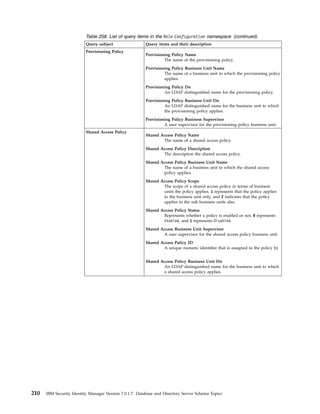
258. List of query items in the Role Configuration
namespace . . . . . . . . . . . . 206
259. Query subjects in the Separation of Duty
Audit namespace . . . . . . . . . . 212
260. Query items in the Separation of Duty Audit
namespace . . . . . . . . . . . . 213
261. Query subjects in the Separation of Duty
Configuration namespace . . . . . . . 217
262. Query items in the Separation of Duty
Configuration namespace . . . . . . . 218
263. Query subjects in the User Audit namespace 219
264. List of query items in the User Audit
namespace . . . . . . . . . . . . 220
265. Query subjects in the User Configuration
namespace . . . . . . . . . . . . 223
266. List of query items in the User Configuration
namespace . . . . . . . . . . . . 224
267. Query subjects in the Service Audit
namespace . . . . . . . . . . . . 231
268. List of query items in the Service Audit
namespace . . . . . . . . . . . . 232
269. Query subjects in the Access Audit
namespace . . . . . . . . . . . . 235
270. List of query items in the Access Audit
namespace . . . . . . . . . . . . 236
271. Query subjects in the Access Configuration
namespace . . . . . . . . . . . . 240
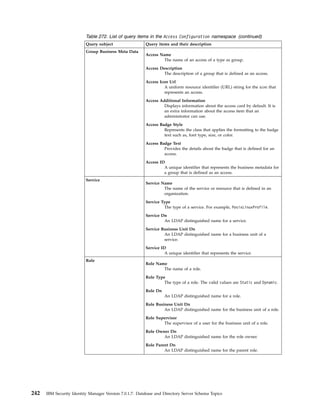
272. List of query items in the Access
Configuration namespace . . . . . . . 241
Table list ix
x IBM Security Identity Manager Version 7.0.1.7: Database and Directory Server Schema Topics
Chapter 1. Database tables reference
loads the database tables during installation. The loaded tables are described in
this section.
Workflow tables
stores workflow-specific information in the database tables described in this
section.
The workflow engine accesses these tables to retrieve information that is used
during the workflow process.
PROCESS table
The PROCESS table stores all the pending, running, and historical requests submitted
to the workflow. Each request is represented as a process.
Table 1. PROCESS table
Column Name Description Data type
ROOT_PROCESS_ID*
The root process ID number. Numeric
ID*
Process ID number. Primary key. Numeric
PARENT_ID Parent process ID number, if any. Numeric
PARENT_ACTIVITY_ID Parent activity ID number. Numeric
NAME Process name. Character (100)
1
Table 1. PROCESS table (continued)
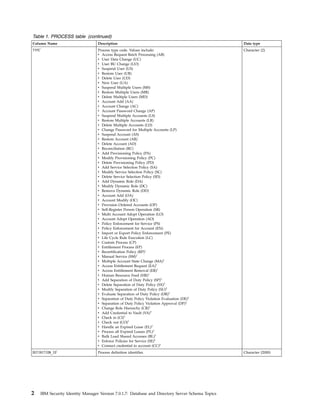
Column Name Description Data type
TYPE*
Process type code. Values include:
v Access Request Batch Processing (AB)
v User Data Change (UC)
v User BU Change (UO)
v Suspend User (US)
v Restore User (UR)
v Delete User (UD)
v New User (UA)
v Suspend Multiple Users (MS)
v Restore Multiple Users (MR)
v Delete Multiple Users (MD)
v Account Add (AA)
v Account Change (AC)
v Account Password Change (AP)
v Suspend Multiple Accounts (LS)
v Restore Multiple Accounts (LR)
v Delete Multiple Accounts (LD)
v Change Password for Multiple Accounts (LP)
v Suspend Account (AS)
v Restore Account (AR)
v Delete Account (AD)
v Reconciliation (RC)
v Add Provisioning Policy (PA)
v Modify Provisioning Policy (PC)
v Delete Provisioning Policy (PD)
v Add Service Selection Policy (SA)
v Modify Service Selection Policy (SC)
v Delete Service Selection Policy (SD)
v Add Dynamic Role (DA)
v Modify Dynamic Role (DC)
v Remove Dynamic Role (DD)
v Account Add (OA)
v Account Modify (OC)
v Provision Ordered Accounts (OP)
v Self-Register Person Operation (SR)
v Multi Account Adopt Operation (LO)
v Account Adopt Operation (AO)
v Policy Enforcement for Service (PS)
v Policy Enforcement for Account (EN)
v Import or Export Policy Enforcement (PE)
v Life Cycle Rule Execution (LC)
v Custom Process (CP)
v Entitlement Process (EP)
v Recertification Policy (RP)1
v Manual Service (SM)1
v Multiple Account State Change (MA)1
v Access Entitlement Request (EA)1
v Access Entitlement Removal (ER)1
v Human Resource Feed (HR)1
v Add Separation of Duty Policy (SP)2
v Delete Separation of Duty Policy (SX)2
v Modify Separation of Duty Policy (SU)2
v Evaluate Separation of Duty Policy (DR)2
v Separation of Duty Policy Violation Evaluation (DE)2
v Separation of Duty Policy Violation Approval (DP)2
v Change Role Hierarchy (CR)2
v Add Credential to Vault (VA)3
v Check in (CI)3
v Check out (CO)3
v Handle an Expired Lease (EL)3
v Process all Expired Leases (PL)3
v Bulk Load Shared Accesses (BL)3
v Enforce Policies for Service (SE)3
v Connect credential to account (CC)4
Character (2)
DEFINITION_ID*
Process definition identifier. Character (2000)
2 IBM Security Identity Manager Version 7.0.1.7: Database and Directory Server Schema Topics
Table 1. PROCESS table (continued)
Column Name Description Data type
REQUESTER_TYPE Requester type. Values include:
v End User (U)
v Workflow System (S)
v Tenant Administrator (T)
v System (P)
Character (2)
REQUESTER DN of the requester. Character (2000)
REQUESTER_NAME Requesters name. Character (100)
DESCRIPTION Description of the process. Character (300)
PRIORITY Priority of the process. Numeric
SCHEDULED Scheduled start time for the process. Character (50)
STARTED Time that the process is started. Character (50)
COMPLETED Time that the process is completed. Character (50)
LASTMODIFIED Time that the process was last modified. Character (50)
SUBMITTED Time that the process was submitted. Character (50)
STATE Current state of the process. Values include:
v Running (R)
v Not Started (I)
v Terminated (T)
v Aborted (A)
v Suspended (S)
v Completed (C)
v Bypassed (B)
Character (1)
NOTIFY Specifies who is notified when a process is completed. You have the following
choices:
v NOTIFY_NONE (0)
v NOTIFY_REQUESTOR (1)
v NOTIFY_REQUESTEDFOR (2)
v NOTIFY_BOTH (3)
Numeric
REQUESTEE DN of the requestee. Character (2000)
REQUESTEE_NAME Name of the requestee. Character (100)
SUBJECT The subject of the process. Character (2000)
SUBJECT_PROFILE The data service object profile name that indicates the type of the subject. Character (100)
SUBJECT_SERVICE If the subject is an account, this field contains the name of the service associated with
the account.
Character (100)
SUBJECT_ACCESS_ID1
DN of the requested access. Character (2000)
SUBJECT_ACCESS_NAME1
Name of the requested access. Character (100)
COMMENTS Comments for the process. Character (200)
RESULT_SUMMARY Process result summary code. Values include:
v Approved (AA)
v Rejected (AR)
v Submitted (RS)
v Success (SS)
v Timeout (ST)
v Failed (SF)
v Warning (SW)
v Pending (PE)
v Participant Resolution Failed (PF)
v Escalated (ES)
v Skipped (SK)
Character (2)
RESULT_DETAIL Detailed information about the process result. Long Character
SHORT_DETAIL1
Short detailed information about the process result. Character (4000)
TENANT
DN of the requesters tenant. Character (2000)
Chapter 1. Database tables reference 3
*
Indicates the column is required and not null.
1
Indicates the column or the value is added in release 5.0.
2
Indicates the column or the value is added in release 5.1.
3
Indicates the column or the value is added in release 6.0.
4
Indicates the column or the value is added in release 6.0 Service Stream
Enhancement.
PROCESSLOG table
The PROCESSLOG table maintains a record of audit events associated with a process.
Table 2. PROCESSLOG table
Column Name Description Data type
ID*
Log ID number. Primary key. Numeric
PROCESS_ID ID of the process associated with the log. Reference
PROCESS (ID).
Numeric
ACTIVITY_ID ID of the activity associated with the log. Numeric
CREATED Time that the log was created. Character (50)
EVENTTYPE*
Log event type code. Values include:
Activity Created (AC)
Process State Changed (PS)
Old Value (OV)
Mail Notification (MN)
Process Initial Data (PI)
Process User Changed Data (PC)
Process Timeout (PT)
Process Escalation Participant Resolution Failed (PP)
Activity Timeout (AT)
Activity Escalation Timeout (AE)
Activity State Changed (AS)
Activity Data (AD)
Activity Assignment Changed (AA)
Manual Activity Performed By (CM)
Activity Participant Resolution Failed (AP)
Activity Escalation Participant Resolution Failed (AX)
Password Pickup (PD)
Message Log Information (IF)
Character (2)
4 IBM Security Identity Manager Version 7.0.1.7: Database and Directory Server Schema Topics
Table 2. PROCESSLOG table (continued)
Column Name Description Data type
OLD_PARTICIPANT_TYPE Old participant type for the assignment change event.
Values include:
User (U)
Person (P)
Role (R)
System Administrator (SA)
Supervisor (SU)
Sponsor (SP)
Service Owner (SO)
System (WS)
Requestor (RR)
Requestee (RE)
Domain Administrator (DA)
Custom Defined Participant (CM)
Access Owner (AO)
Role Owner (RO)
ITIM Group (SR)
Character (2)
OLD_PARTICIPANT_ID Old participant ID for the assignment change event. Character (2000)
Chapter 1. Database tables reference 5
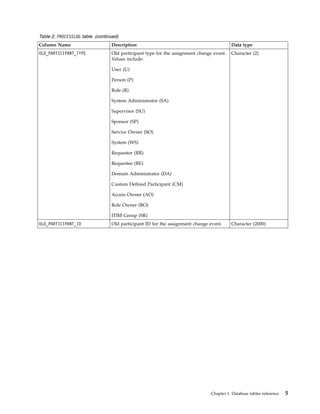
Table 2. PROCESSLOG table (continued)
Column Name Description Data type
NEW_PARTICIPANT_TYPE New participant type for the assignment change event.
Values include:
User (U)
Person (P)
Role (R)
System Administrator (SA)
Supervisor (SU)
Sponsor (SP)
Service Owner (SO)
System (WS)
Requestor (RR)
Requestee (RE)
Domain Administrator (DA)
Custom Defined Participant (CM)
Access Owner (AO)
Role Owner (RO)
ITIM Group (SR)
Character (2)
NEW_PARTICIPANT_ID New participant ID for the assignment change event. Character (2000)
REQUESTOR_TYPE Requester type for any user-related event. Values
include:
End User (U)
Workflow System (S)
Tenant Administrator (T)
System (P)
Character (2)
REQUESTOR Requester name for any user-related event. Character (2000)
REQUESTOR_DN The DN of the Service account requester for any
user-related event.
Character (1000)
6 IBM Security Identity Manager Version 7.0.1.7: Database and Directory Server Schema Topics
Table 2. PROCESSLOG table (continued)
Column Name Description Data type
OLD_STATE Old state for a state change event. Values include:
Running (R)
Not Started (I)
Terminated (T)
Aborted (A)
Suspended (S)
Completed (C)
Bypassed (B)
Character (1)
NEW_STATE New state for a state change event. Values include:
Running (R)
Terminated (T)
Aborted (A)
Suspended (S)
Completed (C)
Bypassed (B)
Character (1)
DATA_ID Data ID for a data change event. Character (100)
NEW_DATA Data value for a data change event. Long Character
SMALL_NEW_DATA1
Small data value a data change event. Character (4000)
*
Indicates the column is required and not null.
1
Indicates the column or the value is added in release 5.0.
PROCESSDATA table
The PROCESSDATA table stores the runtime process data of a process. After the
process is completed, the record is removed.
Table 3. PROCESSDATA table
Column Name Description Data type
PROCESS_ID*
Process ID associated with the data. Primary
key. Reference PROCESS (ID).
Numeric
DEF_ID*
Definition ID for the corresponding relevant
data in the process definition. Primary key.
Character (100)
NAME Data name. Maximum of 100 characters. Character (100)
Chapter 1. Database tables reference 7
Table 3. PROCESSDATA table (continued)
Column Name Description Data type
CONTEXT Context of data. The following values are
possible :
REQUESTEE
SUBJECT
BOTH
Character (100)
DESCRIPTION Data description. Character (300)
TYPE Data type. Character (500)
COLLECTION_TYPE Element data type for sets of data. Character (500)
VALUE Data value. Long Character
SMALL_VALUE Small data value. Character (4000)
VALUE_LAST_MODIFIED The time in milliseconds that the last time
this process data value was modified.
Numeric
*
Indicates the column is required and not null.
ACTIVITY table
The ACTIVITY table contains records of each workflow process implementation
flow.
Table 4. ACTIVITY table
Column Name Description Data type
ID*
Activity ID number. Primary key. Numeric
PROCESS_ID*
Activity process ID number. Reference
PROCESS (ID).
Numeric
DEFINITION_ID*
Activity definition identifier. Character (100)
ACTIVITY_INDEX Activity index (only if the activity is
inside of a loop).
Numeric
LOOP_COUNT Specific to loop activity.
Number of iterations that occurred in
the loop.
Numeric
LOOP_RUNCOUNT Specific to asynchronous loop activity.
Number of remaining iterations in the
loop.
Numeric
RETRY_COUNT Number of attempts to complete the
activity.
Numeric
LOCK_COUNT Number of pending tasks on the
activity.
Numeric
SUBPROCESS_ID ID of the subprocess associated with
the activity.
Numeric
NAME Activity name. Maximum of 100
characters.
Character (100)
DESCRIPTION Description of the activity. Maximum
of 300 characters.
Character (300)
8 IBM Security Identity Manager Version 7.0.1.7: Database and Directory Server Schema Topics
Table 4. ACTIVITY table (continued)
Column Name Description Data type
TYPE Activity type. Values include:
Application (A)
Subprocess (S)
Loop (L)
Route (R)
Manual (M)
Operation (O)
Character (1)
SUBTYPE Activity subtype. Values for manual
activity type include:
Approval/Reject (AP)
Provide Information (RI)
Work Order (WO)
Other activity types do not have
subtype values.
Character (2)
PRIORITY Priority of the activity (NOT
SUPPORTED).
Numeric
STARTED Time that the activity is started. Character (50)
COMPLETED Time that the activity is completed. Character (50)
LASTMODIFIED Time that the activity was last
modified.
Character (50)
STATE Current®
state of the activity. Values
include:
Running (R)
Not Started (I)
Terminated (T)
Canceled (A)
Suspended (S)
Completed (C)
Bypassed (B)
Character (1)
Chapter 1. Database tables reference 9
Table 4. ACTIVITY table (continued)
Column Name Description Data type
RESULT_SUMMARY Activity result summary code. Values
include:
Approved (AA)
Rejected (AR)
Submitted (RS)
Success (SS)
Timeout (ST)
Failed (SF)
Warning (SW)
Pending (PE)
Participant Resolution Failed (PF)
Escalated (ES)
Skipped (SK)
Custom – custom values added for
Approval and Reject codes in
Enhanced Approval activities
Character (5)
RESULT_DETAIL Detailed results information for the
activity.
Long Character
SHORT_DETAIL1
Short detailed results information for
the activity.
Character (4000)
*
Indicates the column is required and not null.
1
Indicates the column or the value is added in release 5.0.
WORKITEM table
The WORKITEM table maintains a record of work items associated with manual
workflow activities for running processes. The records associated with the process
are removed after the process is completed.
Table 5. WORKITEM table
Column Name Description Data type
ID*
Unique work item ID. Primary key. Numeric
PROCESS_ID*
Process ID associated with this work
item. References PROCESS (ID).
Numeric
ACTIVITY_ID*
Activity ID associated with this work
item. References ACTIVITY (ID).
Numeric
CREATED Date the work item was created. Character (50)
INPUT_PARAMETERS Parameters that were passed into the
workflow for this work item
(serialized form of a list).
Long Character
10 IBM Security Identity Manager Version 7.0.1.7: Database and Directory Server Schema Topics
Table 5. WORKITEM table (continued)
Column Name Description Data type
DUE_DATE Due date for the work item. After this
time, the work item is escalated, or if
it already escalated, the work item is
canceled.
Numeric
LOCK_OWNER LDAP DN for the participant that
currently has this work item locked
(might be null if no one owns the
lock).
Character (512)
DESCRIPTION Activity ID associated with the data, if
any.
Character (4000)
PROCESS_DEFINITION_ID*
The process definition ID for the
process that created this work item.
Character (512)
ACTIVITY_DEFINITION_ID*
The activity definition ID for the
activity that this work item relates to.
Character (100)
ACTIVITY_TYPE The type of the activity that this work
item relates to. Values include:
Application (A)
Subprocess (S)
Loop (L)
Route (R)
Manual (M)
Operation (O)
Character (1)
ACTIVITY_SUBTYPE The activity subtype that corresponds
to this work item. Values for manual
activity type include:
Approval (AP)
Request For Information (RI)
Work Order (WO)
Compliance Alert (CA)
Packaged Approval (PA)1
Character (2)
ACTIVITY_NAME The activity name that corresponds
with this work item.
Character (100)
REQUESTEE_NAME The common name of the requestee of
the process that created this work
item.
Character (100)
REQUESTER_NAME The common name of the entity that
requested the process that created this
work item.
Character (100)
SUBJECT The subject of the process that created
this work item.
Character (2000)
*
Indicates the column is required and not null.
Chapter 1. Database tables reference 11
1
Indicates the column or the value is added in release 5.1.
WI_PARTICIPANT table
The WI_PARTICIPANT table stores information about the workflow participants for a
given work item. There can be more than one participant for each work item. This
data is removed from the table when the work item completes.
Table 6. WI_PARTICIPANT table
Header Header Header
ID*
Participant unique ID. Primary Key Numeric
WORKITEM_ID*
Work item ID that is associated with
the data. References WORKITEM (ID).
Numeric
PARTICIPANT_TYPE*
Work item participant type. Values
include:
User (U)
Person (P)
Role (R)
System Administrator (SA)
Supervisor (SU)
Sponsor (SP)
Service Owner (SO)
System (WS)
Requestor (RR)
Requestee (RE)
Domain Administrator (DA)
Custom Defined Participant (CM)
Access Owner (AO)
Role Owner (RO)
ITIM Group (SR)
Character (2)
PARTICIPANT*
LDAP DN that points to the
participant.
Character (512)
*
Indicates the column is required and not null.
PASSWORD_TRANSACTION table
The PASSWORD_TRANSACTION table is used during secure password delivery to store
information. After the password is retrieved, the record is deleted from the table. If
the password is never picked up, this record is deleted upon password pickup
expiration.
12 IBM Security Identity Manager Version 7.0.1.7: Database and Directory Server Schema Topics
Table 7. PASSWORD_TRANSACTION table
Column Name Description Data type
TRANSACTION_ID*
Transaction ID used to retrieve the
password. Primary key.
Numeric
ACCOUNT_DN Account DN for the password. Character (2000)
CREATION_DATE Password creation date. Character (50)
PROCESS_ID*
ID of the workflow that started the
password transaction process.
Numeric
ACTIVITY_ID*
ID of the activity that started the
password transaction process.
Numeric
PASSWORD Encrypted password value. Character (500)
*
Indicates the column is required and not null.
PASSWORD_SYNCH table
The PASSWORD_SYNCH1
table stores the account password synchronization
information.
Table 8. PASSWORD_SYNCH table
Column Name Description Data type
ACTIVITY_ID*
The activity ID. Primary key. Numeric
ACCOUNT_DN The DN of the account. Character (512)
TIME_REQUESTED Time that the password synchronization is requested. Character (50)
PASSWORD The password of the account. Character (500)
*
Indicates the column is required and not null.
1
Indicates the table is added in release 5.0.
NEXTVALUE table
The NEXTVALUE table is used to create unique IDs for workflow tables. The
NEXTVALUE table is not directly used in a workflow.
Note: This table is not in use after release 4.4.
Table 9. NEXTVALUE table
Header Header Header
ID Process data ID. Numeric
NEXT_ID Primary key ID to be used in a process. Numeric
PENDING table
The PENDING table stores all the provisioning requests that are being processed but
not yet completed.
Chapter 1. Database tables reference 13
Table 10. PENDING table
Column Name Description Data type
PROCESS_ID*
Process ID number. References
PROCESS (ID). Primary key.
Numeric
PERSON_DN DN of the person for which the
request was submitted.
Character (255)
SERVICE_DN DN of the resource to which to add
the account.
Character (2000)
*
Indicates the column is required and not null.
WORKFLOW_CALLBACK table
The WORKFLOW_CALLBACK table is used by the workflow engine to allow for callbacks
to be notified when a process completed. A callback is a JMS message object
(MESSAGE_OBJECT) that is put into the workflow JMS queues to be run after the
PROCESS_ID completes. This callback allows for control of the workflow to be given
back to the original Orchestrator of the process. After a workflow process
completes, all callbacks are notified and cleared from this table.
Table 11. WORKFLOW_CALLBACK table
Column Name Description Data type
ID*
Identifier for a callback. Primary key. Numeric
PROCESS_ID*
Process identifier. References PROCESS
(ID)
Numeric
MESSAGE_OBJECT*
The callback message object. Character (2000)
EVENT_TRIGGER Workflow state that this callback is
queued. Values include:
Running (R)
Not Started (I)
Terminated (T)
Aborted (A)
Suspended (S)
Completed (C)
Bypassed (B)
Character (1)
*
Indicates the column is required and not null.
SYNCH_POINT table
The SYNCH_POINT table store data used for internal state tracking of workflows and
joins that need to be synchronized. Do not modify this table outside of the
workflow engine.
Table 12. SYNCH_POINT table
Column Name Description Data type
PROCESS_ID*
Process ID this sync point is
associated with. Primary key.
Numeric
14 IBM Security Identity Manager Version 7.0.1.7: Database and Directory Server Schema Topics
Table 12. SYNCH_POINT table (continued)
Column Name Description Data type
DEFINITION_ID*
The activity definition ID this sync
point is associated with. Primary key.
Character (100)
ACTIVITY_INDEX*
The activity index this sync point is
associated with. Primary key.
Numeric
WAIT_LOCK*
The wait lock this sync point is
associated with. Primary key.
Numeric
JOIN_ENABLED*
Indicates whether this sync point was
activated by at least one positive path
through the associated workflow.
Boolean
*
Indicates the column is required and not null.
LISTDATA table
The LISTDATA table optimizes memory utilization and improves performance for .
This table stores large data lists. Instead of loading all data into memory, data is
stored in this table and referenced by index in memory.
Table 13. LISTDATA table
Column Name Description Data type
DATA_ID*
Unique identifier for the data.
Primary key.
Numeric
INDEX_ID*
List element index. Primary key. Numeric
VALUE*
The serialized list element. Long Character
*
Indicates the column is required and not null.
ACTIVITY_LOCK table
The activity lock count contention point can affect the performance of certain
large-scale workflows. To avoid this issue, the information in the LOCK_COUNT
column of the ACTIVITY table is broken into multiple rows of the ACTIVITY_LOCK
table. The ACTIVITY_LOCK1
table tracks the completion of an activity. The server and
thread identifiers control which row must be incremented; only one thread
attempts to update a row in this new table at any time.
Table 14. ACTIVITY_LOCK table
Column Name Description Data type
PROCESS_ID*
Unique ID of a process. Primary key.
References PROCESS (ID).
Numeric
ACTIVITY_ID*
Unique ID of an activity. Primary
key. References ACTIVITY (ID).
Numeric
SERVER*
String identifier of the server that
makes the update
(cell/node/server). Primary key.
Character (255)
THREAD_ID*
Identifier of the thread (within the
server) making the update. Primary
key.
Numeric
Chapter 1. Database tables reference 15
Table 14. ACTIVITY_LOCK table (continued)
Column Name Description Data type
LOCK_COUNT Updated value, an integer counter to
track when workflows are complete;
it might be positive, negative, or
zero.
Numeric
*
Indicates the column is required and not null.
1
Indicates the table is added in release 5.0.
Services tables
creates and uses these database tables to store information related to managed
resources.
RESOURCE_PROVIDERS table
The RESOURCE_PROVIDERS table stores cross-references between resource provider
IDs and stores reconciliation data for each resource provider.
Table 15. RESOURCE_PROVIDERS table
Column Name Description Data type
PROVIDER_ID*
Unique ID for each resource provider. Primary key.
There is a one-to-one relationship between a PROVIDER_ID and a
RESOURCE_DN.
Character (20)
RESOURCE_DN DN for the managed resource for which the provider is
responsible.
Character (2000)
RECON_STATUS Indicates whether reconciliation is currently running.
0 – No reconciliation is running for this service.
1 – Reconciliation is currently running on this service.If the
server is shut down abruptly during reconciliation, this flag
might need to be reset to 0. Reset the flag before other
reconciliation requests can be processed for the specified
service.
Numeric
LAST_RECON_TIME The time of the last reconciliation. Date
MAX_RECON_DURATION Timeout value, in minutes, for reconciliations. If a reconciliation
request runs beyond the amount of time specified in this field,
the request is terminated.
Numeric
LOCK_SERVICE Indicates whether to lock the service during a reconciliation:
0 – Do not lock the service during reconciliation.
1 – Lock the service during reconciliation.
Numeric
REQUEST_ID Tracks the process that locks the service. Character (20)
CURRENT_REQUEST_COUNT Current number of requests that are being executed. Numeric
MAX_REQUEST_COUNT Maximum number of concurrent requests that can be executed
(or -1 = unlimited). For future use (currently null).
Numeric
LAST_RESPONSE_TIME Timestamp of last response (to detect failed resources). For
future use (currently null).
Date
16 IBM Security Identity Manager Version 7.0.1.7: Database and Directory Server Schema Topics
Table 15. RESOURCE_PROVIDERS table (continued)
Column Name Description Data type
RESOURCE_STATUS Resource status (0 = ok, 1 = failed, 2 = failed service that is
being tested).
Numeric
RESTART_TIME Timestamp of the last reconciliation started. Date
SERVER The ID of the that initiated the recon. It is used in cluster mode
during restart to decide whether a recon lock flag was left
enabled due to server failure. In that case, clean up locks and
set the recon state to failed or aborted.
Character (255)
RESOURCE_TEST_STATUS1
Resource status, including updates that resulted from
‘Test’(ping) request (0 = OK, 1 = failed, 2 = failed service that is
being tested).
Numeric
LAST_TEST_STATUS_TIME1
Timestamp of last ping of the resource (to detect failed
resources).
Date
FIRST_RESOURCE_FAIL_TIME2
Timestamp of the time the service was placed in failed state. Timestamp
LAST_ERROR2
The most recent error message returned when attempting to
send a request to the service.
Character (2000)
*
Indicates the column is required and not null.
1
Indicates the column or the value is added in release 5.0.
2
Indicates the column or the value is added in release 6.0.
REMOTE_SERVICES_REQUESTS table
The REMOTE_SERVICES_REQUESTS table stores asynchronous requests or requests that
are made while reconciliation is in progress. It also stores requests issued while a
resource is in a failed state.
Table 16. REMOTE_SERVICES_REQUESTS table
Column Name Description Data type
PROVIDER_ID Unique ID for each resource provider. References RESOURCE,
PROVIDERS, and(PROVIDER_ID).
Character (20)
REQUEST_ID*
ID of the request made. Primary key. Character (20)
TYPE Request type:
0 – generic requests
1 – asynchronous requests
2 – intra-reconciliation requests
3 – service deferred requests
Numeric
Chapter 1. Database tables reference 17
Table 16. REMOTE_SERVICES_REQUESTS table (continued)
Column Name Description Data type
OPERATION Type of operation:
0 – No operation
1 – Add request
2 – Modify request
3 – Delete request
4 – Suspend request
5 – Restore request
6 – Change password request
Numeric
REQUEST_TIME Time that the request was made. Date
EXPIRATION_TIME Time that the request expires. If null, the request never expires. Date
TARGET The owner of the account for an add request or the account
distinguished name for other types of operations.
Character (2000)
SERVICE_DN*
The distinguished name of the service instance in the directory. Character (2000)
DATA The data for the request (attribute values for Add and Modify
requests). This information is a serialized Java™
Collection and
is Base64 encoded and GZIP compressed.
Long Character
CONNECTION_POINT The callback to complete the workflow process. This
information is a serialized Java object.
Binary
*
Indicates the column is required and not null.
REMOTE_RESOURCES_RECONS table
The REMOTE_RESOURCES_RECONS table stores the reconciliation units associated with a
resource provider.
Table 17. REMOTE_RESOURCES_RECONS table
Column Name Description Data type
PROVIDER_ID*
Unique ID for each resource provider. References
RESOURCE_PROVIDERS (PROVIDER_ID). Primary key.
Character (20)
RECON_ID*
Unique ID for each reconciliation unit. Primary key. Numeric
DAY_OF_MONTH Day of month the reconciliation is scheduled to run. Numeric
MONTH_NUM Month the reconciliation is scheduled to run. Numeric
DAY_OF_WEEK Day of week the reconciliation is scheduled to run. Numeric
HOUR_NUM Hour of day the reconciliation is scheduled to run. Numeric
MINUTE_NUM Minute of hour the reconciliation is scheduled to run. Numeric
MAX_DURATION This value overrides the MAX_RECON_DURATION value in the
table.
Numeric
18 IBM Security Identity Manager Version 7.0.1.7: Database and Directory Server Schema Topics
Table 17. REMOTE_RESOURCES_RECONS table (continued)
Column Name Description Data type
LOCK_SERVICE Indicates whether to lock the service during a
reconciliation. Values include:
0 – Do not lock the service during reconciliation.
1 – Lock the service during reconciliation
Default: 1
Numeric
RECON_NAME1
Name of the reconciliation. Character (300)
DESCRIPTION1
Description of the reconciliation. Character (300)
*
Indicates the column is required and not null.
1
Indicates the column or the value is added in release 5.0.
REMOTE_RESOURCES_RECON_QUERIES table
The REMOTE_RESOURCES_RECON_QUERIES table stores reconciliation queries associated
with a reconciliation unit.
Table 18. REMOTE_RESOURCES_RECON_QUERIES table
Column Name Description Data type
PROVIDER_ID*
Unique ID for each resource provider. References
REMOTE_RESOURCES_RECONS (PROVIDER_ID). Primary key.
Character (20)
RECON_ID*
Unique ID for each reconciliation unit. References
REMOTE_RESOURCES_RECONS (RECON_ID). Primary key.
Numeric
QUERY_ID*
Unique ID for each reconciliation query. Primary key. Numeric
RECON_FILTER Filter associated with the reconciliation query. Character (4000)
RECON_BASE Search base associated with the reconciliation query. Character (4000)
MAX_DURATION Not used. Numeric
MAX_ENTRIES Not used. Numeric
ATTRIBUTES Attributes returned during a reconciliation request. Long Character
SUPPORT_DATA_ONLY1
Indication whether reconciliation only retrieves supporting data.
(0/null = normal, 1 = supporting data only recon).
Numeric
*
Indicates the column is required and not null.
1
Indicates the column or the value is added in release 5.0.
MANUAL_SERVICE_RECON_ACCOUNTS table
The MANUAL_SERVICE_RECON_ACCOUNTS1
table stores account information for manual
service. The information verifies whether the account data was modified in
reconciliation.
Table 19. MANUAL_SERVICE_RECON_ACCOUNTS table
Column Name Description Data type
GLOBAL_ID*
Unique ID of the manual service reconciliation. Primary
key.
Character (255)
Chapter 1. Database tables reference 19
Table 19. MANUAL_SERVICE_RECON_ACCOUNTS table (continued)
Column Name Description Data type
ACCOUNTS The stream of the Comma Separated Value (CSV) file of
last reconciliation.
Long Character
*
Indicates the column is required and not null.
1
Indicates the column or the value is added in release 5.0.
SCRIPT table
The SCRIPT1
table stores predefined script rule parameters. Each row represents one
parameter of a rule. A rule might consist of several rows that represent multiple
attributes from the person schema to be concatenated. For example, the predefined
rule, firstinitial+lastname, is a concatenation of two person attributes: givenname
and sn.
Table 20. SCRIPT table
Column Name Description Data type
TYPE*
A character that represents the type of policy to which this rule is
applied. Primary key. Values include:
A – Adoption rule
I – Identity policy
Character (1)
ID*
Unique identifier (key) of the rule. Primary key. Character (50)
JOIN_ORDER*
A number that represents the order for the attribute in
concatenation. Primary key.
Numeric
PERSON_ATTRIBUTE*
The person attribute where the value is obtained and concatenated;
for example, givenname.
Character (100)
FIRST_LAST A number that is used to get the substring of the person attribute.
Values include:
0 – Use the whole value.
-n (minus n) – Use the last n characters.
n – Use the first n characters.
Numeric
CONCATENATE_CHAR Concatenation character, which concatenates person attributes. Character (10)
*
Indicates the column is required and not null.
1
Indicates the column or the value is added in release 5.0.
Import and export tables
The tables in this section are used for import and export operations.
20 IBM Security Identity Manager Version 7.0.1.7: Database and Directory Server Schema Topics
BULK_DATA_SERVICE table
The BULK_DATA_SERVICE table holds information of the export.
Table 21. BULK_DATA_SERVICE table
Column Name Description Data type
ID*
Unique ID of the export. Primary
key.
Numeric
STARTTIME Start time of the export. Date
ENDTIME End time of the export. Date
MIMETYPE Content type of export JAR file. Character (50)
NAME Name of the export JAR file. Character (50)
DATA Export JAR file stored in form of
bytes.
Binary
FILENAME1
Name of export JAR file. Character (255)
Filesize Size of export JAR file. Numeric
DESCNAME1
Description of the export. Character (255)
*
Indicates the column is required and not null.
1
Indicates the column or the value is added in release 5.0.
BULK_DATA_STORE table
The BULK_DATA_STORE table stores the XML content of export.
Table 22. BULK_DATA_STORE table
Column Name Description Data type
ID*
Unique ID for XML content of the
export. Primary key.
Numeric
SERVICEID*
Unique ID of the export. References
BULK_DATA_SERVICE (ID).
Numeric
XML Content of the export XML file. Binary
*
Indicates the column is required and not null.
BULK_DATA_INDEX table
The BULK_DATA_INDEX table stores index for the data object and export XML
content.
Table 23. BULK_DATA_INDEX table
Column Name Description Data type
ID*
Unique ID of the index for export
data lookup. Primary key.
Numeric
STOREID*
ID of the export XML content.
References BULK_DATA_STORE (ID).
Numeric
DATAOBJECTID ID of the export data object. Character (10)
*
Indicates the column is required and not null.
Chapter 1. Database tables reference 21
MIGRATION_STATUS table
The MIGRATION_STATUS table stores the status of the current operation in progress.
Table 24. MIGRATION_STATUS table
Column Name Description Data type
ID*
Identifier generated at the beginning
of an operation. The
MigrationManagerBean uses it to
update the status periodically.
Primary key.
Numeric
PROCESSCOUNT The number of objects processed. Numeric
PROCESSSTATUS The final status of the operation. This
row is deleted on completion of the
import/export process.
Character (50)
SERVICEID1
ID of the export. References
BULK_DATA_SERVICE (ID).
Numeric
*
Indicates the column is required and not null.
1
Indicates the column or the value is added in release 5.0.
I18NMESSAGES table
The I18NMESSAGES table maintains labels in the database that allows any resource
bundles to be stored.
Table 25. I18NMESSAGES table
Column Name Description Data type
PROFILE Profile for which this label was
inserted into the database.
Character (256)
NAME*
Contains the full name of the
resource bundle, For example, the
base name, country codes, and
variants.
Character (256)
MESSAGEKEY*
Key that can retrieve the label. Character (256)
MESSAGE The label that needs to be shown to
the user.
Character (2000)
*
Indicates the column is required and not null.
Post office tables
The tables in this section are used by the post office function.
PO_TOPIC_TABLE
The PO_TOPIC_TABLE table stores information about the topics that are used by the
post office component. There is a row in the table for each group e-mail topic that
is actively in use for the system. PO_TOPIC_TABLE tracks the unique system
notification email topics seen during a Post Office interval. Intercepted emails are
later aggregated and forwarded on a per-topic basis.
22 IBM Security Identity Manager Version 7.0.1.7: Database and Directory Server Schema Topics
Table 26. PO_TOPIC_TABLE table
Column Name Description Data type
TENANT*
The name of the tenant for which this
topic applies. Primary key.
Character (256)
TOPIC*
The string that represents the group
e-mail topicas defined in the
notification section of the workflow
definition for each manual activity.
Primary key.
Character (256)
SERVER The server that is currently
processing the topic
Character (255)
CHECKPOINT_TIME A value that represents when the
current processing of this topic was
started, which is the number of
milliseconds since January 1, 1970,
00:00:00 Greenwich mean time.
Numeric
TOPIC_ID*
A unique ID that identifies this topic.
This column keys into the
PO_NOTIFICATION_TABLE to determine
which messages match the topic.
Numeric
*
Indicates the column is required and not null.
PO_NOTIFICATION_TABLE
The PO_NOTIFICATION_TABLE table stores information about the original notification
objects that the post office component aggregates. All information about the
original notification is stored in this table except for the XHTML body.
Table 27. PO_NOTIFICATION_TABLE table
Column Name Description Data type
NOTIFICATION_ID*
A unique ID that identifies this
particular notification. Primary key.
Numeric
TOPIC_ID*
A reference to the topic ID as stored
in the PO_TOPIC_TABLE for this
notification. References
PO_TOPIC_TABLE(TOPIC_ID).
Numeric
SUBJECT The subject of the original
notification message.
Character (2000)
TEXTBODY The text body of the original
notification message.
Long Character
RECEIVE_TIME*
The time the notification was
intercepted by post office, which is
the number of milliseconds since
January 1, 1970, 00:00:00 Greenwich
mean time.
Numeric
RECIPIENT_EADDR*
The email address of the recipient of
the original notification message.
Character (320)
RECIPIENT_LOCALE The locale of the recipient of the
original notification message.
Character (256)
*
Indicates the column is required and not null.
Chapter 1. Database tables reference 23
PO_NOTIFICATION_HTMLBODY_TABLE
The PO_NOTIFICATION_HTMLBODY_TABLE table stores the XHTML body of the original
notification object that the post office component aggregates. All other information
about the notification is stored in the PO_NOTIFICATION_TABLE table.
Table 28. PO_NOTIFICATION_HTMLBODY_TABLE
Column Name Description Data type
NOTIFICATION_ID*
A unique ID that identifies this particular notification (this ID is
the same value that exists in the PO_NOTIFICATION_TABLE table.
References PO_NOTIFICATION_TABLE(NOTIFICATION_ID). Primary
key.
Numeric
HTMLBODY The XHTML body of the original notification message that post
office intercepted.
Long Character
*
Indicates the column is required and not null.
Reports tables
The tables in this section are used for reporting.
ENTITY_COLUMN table
During the configuration of the reporting interface schema, the system
administrator selects the entities and a set of attributes. The reporting Interface
stores the selected pairs of entities and attributes in this table. The Report Designer
can later choose to report on any of the attributes in the ENTITY_COLUMN table.
Table 29. ENTITY_COLUMN table
Column Name Description Data type
ENTITY_NAME*
Name of the entity (for example Person). Primary key. Character (255)
COLUMN_NAME*
Column name as present in the entity table represented
by the preceding entity name.
Character (255)
ATTRIBUTE_NAME*
Name of the attribute as returned by the server. Primary
key.
Character (255)
MULTI_VALUED Indicates whether the attribute is multi-valued or not.
Value is Y/N. Maximum of 1 character.
Character (1)
IMPLICITLY_MAPPED Indicates whether the data synchronizer implicitly maps
a particular attribute. If the attribute is present in the
object filter of some ACI, it is implicitly mapped.
Maximum of 1 character.
Character (1)
AVAILABLE_FOR_REPORTING Indicates whether the column is available for reporting.
The value for this column represents different states in
which the corresponding data can be, such as newly
mapped or available.
Character (255)
TABLE_NAME Name of the table created for an entity.
Note: V_ENTITY is a view. It is not a table.
Character (255)
*
Indicates the column is required and not null.
24 IBM Security Identity Manager Version 7.0.1.7: Database and Directory Server Schema Topics
Report table
This table stores details of the reports designed and generated by users.
Table 30. Report table
Column Name Description Data type
ID*
Unique ID for the table. Primary key. Numeric
TITLE*
Report title given to the report. Character (255)
TYPE*
Indicates whether the report was designed with or RI. Character (255)
AUTHOR Author of the report (designer). Character (255)
REPORT_SIZE The size of the report template stored in the REPORT_DATA
column of this table.
Numeric
REPORT_DATA The report (custom/third party) template is stored here. The
templates must be shared by the different installations in a
clustered environment and so they are stored here.
Binary
STYLESHEET Name of the style sheet for the report. Character (255)
REPORTSUBTYPE*
Identifies if this report is a user-defined report or an
out-of-box report.
Character (1)
REPORTCATEGORY*
Identifies which category the run is to be listed on the Run
Reports page.
Character (255)
EDITABLE Indicates whether this report can be edited or not. The value
is N for reconciliation statistics, Audit Events, Recertification
History, Pending Recertification, Recertification Policies, and
access control information reports.
Character (1)
*
Indicates the column is required and not null.
COLUMN_REPORT table
This table stores the relationship between the ENTITY_COLUMN table and the REPORT
table. This relationship is required. It determines the reports that are affected if the
system administrator changes the reporting interface schema (deleting attributes
available for reporting).
Table 31. COLUMN_REPORT table
Column Name Description Data type
COLUMN_NAME*
Name of the entity used in the report.
Primary key.
Character (255)
ENTITY_NAME*
Name of the column used in the report.
Primary key.
Character (255)
REPORT_ID*
ID of a report. Primary key. Numeric
*
Indicates the column is required and not null.
AUTHORIZATION_OWNERS table
This table is used for ACI Report. When a non-admin system user tries to run ACI
report, it is checked whether the user is part of an authorization owner group.
Custom reports can also be generated on this table.
Chapter 1. Database tables reference 25
Table 32. AUTHORIZATION_OWNERS table
Column Name Description Data type
USERDN*
The DN of the system user included
in an authorization owner ITIM
group. Primary key.
Character (255)
CONTAINERDN*
DN of the organizational container
where the system user is authorized
to access/modify ACI information.
Primary key.
Character (255)
*
Indicates the column is required and not null.
ACI table
This table stores information of the access control information items in .
Table 33. ACI table
Column Name Description Data type
DN*
The DN of the organizational container where the
ACI is defined. Primary key.
Character (255)
NAME*
Name of the ACI. Primary key. Character (255)
SCOPE Scope of the ACI, for example, single or subtree. Character (255)
TARGET*
Target of this ACI. For a person ACI, the target is
inetOrgPerson. Primary key.
Character (255)
PARENT DN of the container that is the parent of this
container (where the ACI is defined).
Character (255)
CATEGORY DN of the container that is the parent of this
container (where the ACI is defined).
Character (255)
OBJECTFILTER LDAP Filter that is part of this ACI. Character (1023)
*
Indicates the column is required and not null.
ACI_ROLEDNS table
This table stores information about the access control information (ACI) and the
ITIM groups that are part of them. No primary key constraints are defined for this
table.
Table 34. ACI_ROLEDNS table
Column Name Description Data type
DN*
DN of the container where the ACI is defined. Character (255)
NAME*
Name of the ACI. Character (255)
TARGET*
Target of this ACI. Character (255)
ROLEDN*
DN of the ITIM group that is part of this ACI. Character (255)
*
Indicates the column is required and not null.
ACI_PRINCIPALS table
This table stores principals for access control information (ACI). No primary key
constraints are defined for this table.
26 IBM Security Identity Manager Version 7.0.1.7: Database and Directory Server Schema Topics
Table 35. ACI_PRINCIPALS table
Column Name Description Data type
DN*
DN of the container where the ACI is defined. Character (255)
NAME*
Name of the ACI. Character (255)
TARGET*
Target of this ACI. Character (255)
PRINCIPALNAME*
Name of the principal that is part of this ACI. Possible
values are self, supervisor, sponsor, and administrator.
Character (255)
*
Indicates the column is required and not null.
ACI_PERMISSION_ATTRIBUTERIGHT table
This table stores attribute permissions for ACIs. No primary key constraints are
defined for this table.
Table 36. ACI_PERMISSION_ATTRIBUTERIGHT table
Header Header Header
DN*
DN of the container where the ACI is defined. Character (255)
NAME*
Name of the ACI. Character (255)
TARGET*
Target of this ACI. Character (255)
ACTION*
Permission associated with an attribute protected by this
ACI. Possible values are grant and deny.
Character (6)
OPERATION*
Specifies the operation for which the preceding permission
is applicable. The values for this attribute are r and w.
Character (3)
ATTRIBUTERIGHT*
Name of the attribute that is being protected by the ACI. It
can be a specific attribute or all.
Character (255)
*
Indicates the column is required and not null.
ACI_PERMISSION_CLASSRIGHT table
This table stores class operation permissions for ACIs. No primary key constraints
are available for this table.
Table 37. ACI_PERMISSION_CLASSRIGHT table
Column Name Description Data type
DN*
The DN of the container where the ACI is defined. Character (255)
NAME*
Name of the ACI. Character (255)
TARGET*
Target of this ACI. Character (255)
ACTION*
Permission associated with a class right, for example:
grant, deny, or none.
Character (6)
CLASSRIGHT*
The class operation for this ACI, for example: search,
add, or modify.
Character (255)
*
Indicates the column is required and not null.
ENTITLEMENT table
This table stores the parsed entitlements of various provisioning policies in the
system. This table does not have a primary key constraint.
Chapter 1. Database tables reference 27
Table 38. ENTITLEMENT table
Column Name Description Data type
DN*
The DN of the provisioning policy or this entitlement. Character (255)
TYPE*
Type of the entitlement. The possible values are:
0 represents a manual entitlement.
1 represents an automatic entitlement.
Character (255)
SERVICETARGETTYPE The service target type for this entitlement. This column can
have various values that represent a service profile, a service
instance, all services, or a service selection policy.
Character (255)
SERVICETARGETNAME If the service type represents a specific service instance, then
this column contains the DN of the service instance.
Character (255)
PROCESSDN The DN of the associated workflow process, if any. Character (255)
*
Indicates the column is required and not null.
ENTITLEMENT_PROVISIONINGPARAMS table
This table stores provisioning parameters for parsed entitlements. No primary key
constraints are defined for this table
Table 39. ENTITLEMENT_PROVISIONINGPARAMS table
Column Name Description Data type
DN*
The distinguished name of the provisioning policy or
this entitlement.
Character (255)
ATTRIBUTEVALUE*
Value of service attribute parameter. This value is a
provisioning parameter.
Character (4000)
NAME*
Name of the service attribute parameter. These
parameters are visible under advanced provisioning
parameter list of the entitlement in user interface.
Character (255)
ENFORCEMENT Enforcement type of this service attribute parameter.
Possible values represent mandatory or optional.
Character (255)
EXPRTYPE Expression Type for this service attribute parameter.
An expression can be a constant expression or a
JavaScript expression.
Character (255)
SERVICETARGETNAME If the service type represents a specific service instance,
then this column contains the DN of the service
instance. If service type represents a service profile or
service selection policy, then this column contains the
name of the service profile.
Character (255)
SERVICE_DN Distinguished name of the associated service, if any. Character (255)
*
Indicates the column is required and not null.
SYNCHRONIZATION_HISTORY table
This table stores the history information of all the synchronizations that occurred.
Table 40. SYNCHRONIZATION_HISTORY table
Column Name Description Data type
SYNC_ID*
ID for this synchronization activity. Primary key. Numeric
28 IBM Security Identity Manager Version 7.0.1.7: Database and Directory Server Schema Topics
Table 40. SYNCHRONIZATION_HISTORY table (continued)
Column Name Description Data type
REQUESTOR*
Requestor of this request. Character (255)
REQ_TYPE This attribute specifies the type of request. DS indicates
full data synchronization. IDS indicates Incremental
Synchronization.
Character (255)
REQ_NAME Name of request. For example, Data Synchronization. Character (255)
STATUS Status like Started, Failure, Success, or Warning1
. Character (255)
TENANT Tenant DN for which synchronization is run. Character (255)
STATUS_DETAIL Detail string of the status. Character (255)
SCHEDULED_TIME Time for which this synchronization was scheduled.
Note: This attribute is deprecated. To get data
synchronization schedule information, use the
RESOURCES_SYNCHRONIZATIONS table.
Numeric
SUBMITTED_TIME Time when this request was submitted. Numeric
STARTED_TIME*
Time when this synchronization started. Primary key. Numeric
COMPLETED_TIME Time when this synchronization completed. Numeric
SERVER_NAME Name of the that started the synchronization. Character (255)
*
Indicates the column is required and not null.
1
Indicates the column or the value is added in release 5.0.
SYNCHRONIZATION_LOCK table
This table is used to avoid race condition when two servers in a clustered
environment start data synchronization at the same time.
Table 41. SYNCHRONIZATION_LOCK table
Column Name Description Data type
HOST that acquires the lock to start data synchronization. Primary key. Character (255)
RESOURCES_SYNCHRONIZATIONS table
This table stores the schedule information of all the synchronization schedules.
Table 42. RESOURCES_SYNCHRONIZATIONS table
Column Name Description Data type
SYNC_ID*
The identifier association with the synchronization.
Primary key.
Numeric
DAY_OF_MONTH*
Day of month. Numeric
MONTH_NUM*
Month number. Numeric
DAY_OF_WEEK*
Day of week. Numeric
HOUR_NUM*
Hour number. Numeric
MINUTE_NUM*
Minute number. Numeric
MAX_DURATION Maximum time for which synchronization is run. Numeric
*
Indicates the column is required and not null.
Chapter 1. Database tables reference 29
CHANGELOG table
This table stores the last change log number processed.
Table 43. CHANGELOG table
Column Name Description Data type
CHANGE_NUMBER*
This attribute is an integer that stores the last change
log number processed by the full or incremental data
synchronization.
Numeric
*
Indicates the column is required and not null.
RECONCILIATION table
This table contains the summary of the information for reconciliation on various
service instances. The table contains an entry for all completed reconciliations on
various service instances.
Table 44. RECONCILIATION table
Column Name Description Data type
RECONID*
An identifier that identifies a reconciliation uniquely. Primary
key.
Character (255)
SERVICEDN*
The DN of the service for which this entry is recorded. Character (2000)
PROCESSEDACCOUNTS*
The number of processed accounts that exists for this service
instance during the last run of reconciliation.
Numeric
LOCALACCOUNTS*
Total number of new local accounts created. It does not
include the newly created orphan accounts for this service.
Numeric
TIMUSERACCOUNTS*
The number of processed accounts that belongs to users in . Numeric
POLICYVIOLATIONS*
The number of policy violations found for accounts on this
service during reconciliation. This value includes accounts
where one or more attribute values are found to be different
from the local account. Any attribute value of the account is
not compliant with the governing provisioning policies. It
does not include accounts where the attribute values of the
local and remote accounts are the same, even if the values
are noncompliant.
Numeric
STARTED*
Time when the reconciliation started. Date
COMPLETED*
Time when the reconciliation completed. Date
ACTIVITY_ID1
Unique identifier of the activity. Numeric
*
Indicates the column is required and not null.
1
Indicates the column is added in release 4.6 Express®
.
RECONCILIATION_INFO table
This table contains the details of the reconciliation on various service instances.
Table 45. RECONCILIATION_INFO table
Column Name Description Data type
RECONID*
An identifier that identifies a reconciliation uniquely.
References RECONCILIATION(RECONID).
Character (255)
30 IBM Security Identity Manager Version 7.0.1.7: Database and Directory Server Schema Topics
Table 45. RECONCILIATION_INFO table (continued)
Column Name Description Data type
ACCOUNTID ID of any entry (for example, an account ID in case of an
account reconciliation).
Character (255)
POLICYCOMPLIANCESTATUS Policy Compliance Status of each reconciled account. Character (20)
USERNAME Name of the user. Character (255)
OPERATION The operation for the entry of this service instance. The values
are codes that represent various operations. Following are the
possible values and codes.
v For account reconciliation:
NO: New Orphan
NL: New Local
MA: Modified Account
RL: Removed Local
FP: Failed Policy
SA: Suspended Account
DA: De-provisioned Account
v For DSML reconciliation:
AP: Add Person
MP: Modify Person
FAP: Failed Add Person
FMP: Failed Modify Person
UP: Unchanged Person
PAP: Pending Add Person
PMP: Pending Modify Person
Character (20)
REMARKS Contains the reason for deprovisioning or suspension and the
list of attributes in case of modified accounts.
Character (1000)
HANDLE1
Only for HR Feed service when workflow is used. The process
ID of the workflow request that processed this person entry. -1
for none.
Numeric
*
Indicates that the column is required and not null.
1
Indicates the column is added in release 4.6 Express.
SERVICE_ACCOUNT_MAPPING table
The SERVICE_ACCOUNT_MAPPING1 table stores the service profile and its corresponding
account profile.
Table 46. SERVICE_ACCOUNT_MAPPING table
Column Name Description Data type
SERVICEPROFILE*
Name of service type. Primary key. Character (255)
ACCOUNTPROFILE*
Name of the account profile corresponding to the
service type. Primary key.
Character (255)
*
Indicates the column is required and not null.
1
Indicates the column is added in release 4.6 Express.
Chapter 1. Database tables reference 31
RECERTIFIER_DETAILS_INFO table
The RECERTIFIER_DETAILS_INFO1
table stores the recertifier's information of
recertification policies.
Table 47. RECERTIFIER_DETAILS_INFO table
Column Name Description Data type
DN*
The DN of the recertification policy. Primary
key.
Character (255)
RECERTIFIER_TYPE The recertifier type. For example, Manager. Character (255)
RECERTIFIER_NAME The recertifier name. Character (255)
*
Indicates the column is required and not null.
1
Indicates the table is added in release 5.1.
Role assignment attribute tables
The tables described in this section store assignment attribute related information.
PERSON_ROLE_ASSIGNMENT
The PERSON_ROLE_ASSIGNMENT3
table stores the role assignment information for a
person.
Table 48. The PERSON_ROLE_ASSIGNMENT table
Column name Description Data type
ID*
The unique ID of person role
assignment. Primary key.
Numeric
PERSON_DN*
The person DN. Character (2000)
ROLE_DEFINED_DN*
The DN of the role that defines
the role assignment attributes.
Character (2000)
ROLE_ASSIGNED_DN*
The DN of the role of which the
person is a member.
Character (2000)
*
Indicates the column is required and not NULL.
3
Indicates the table is added in 6.0.
PERSON_ROLE_ASSIGNMENT_VALUES table
The PERSON_ROLE_ASSIGNMENT_VALUES3
table stores the assignment attribute values.
The assignment attributes that a person can have depends on the role membership
of a person.
Table 49. The PERSON_ROLE_ASSIGNMENT table
Column name Description Data type
RA_ID*
The unique ID of the person role
assignment.
Numeric
ATTRIBUTE_NAME*
The role assignment attribute
name.
Character (256)
ATTRIBUTE_VALUE*
The role assignment attribute
value.
Character (2000)
32 IBM Security Identity Manager Version 7.0.1.7: Database and Directory Server Schema Topics
*
Indicates the column is required and not NULL.
3
Indicates the table is added in 6.0.
ROLE_ASSIGNMENT_ATTRIBUTES table
The ROLE_ASSIGNMENT_ATTRIBUTES table stores information about assignment
attributes that are defined on a static role. A role can have multiple assignment
attributes. You can populate this table by running a full or incremental data
synchronization in .
Table 50. The ROLE_ASSIGNMENT_ATTRIBUTES table
Column name Description Data type
ROLE_DN*
Identifies the organizational role
to which the attribute belongs.
Character (2000)
ATTRIBUTE_NAME*
Specifies the name of the
assignment attribute.
Character (256)
ROLE_NAME Specifies the name of the role. Character (256)
*
Indicates a required column.
Provisioning policy tables
The tables described in this section are for provisioning policy information.
POLICY_ANALYSIS
The POLICY_ANALYSIS table stores the policy analysis session formation during the
policy change and service enforcement change events.
Table 51. POLICY_ANALYSIS table
Column Name Description Data type
ANALYSIS_ID*
Unique ID. Primary key. Character (32)
TENANT_NAME Name of the tenant in a multi-tenant setting. Character (64)
STATUS*
Contains status:
NOT_STARTED=0
STARTING=1
INITIALIZING=2
PENDING=3
INTERRUPTED=4
ABORTED=5
ERROR=6
COMPLETE=7
INCOMPLETE=8
Numeric
Chapter 1. Database tables reference 33
Table 51. POLICY_ANALYSIS table (continued)
Column Name Description Data type
REASON*
Reason for the analysis:
POLICY_CHANGE=0
ENFORCEMENT_TYPE_CHANGE=1
Numeric
CONTEXT*
Context of the analysis:
SIMULATION=0
ENFORCEMENT=1
Numeric
CHANGE_TYPE*
Specific change type:
POL_ADD=0
POL_REMOVE=1
POL_MODIFY=2
ENFORCEMENT_CHANGE_ALERT=3
ENFORCEMENT_CHANGE_ENFORCE=4
ENFORCEMENT_CHANGE_SUSPEND=5
Numeric
LAST_ACCESSED*
Last accessed date. Date
WORKERS_STARTED*
Counter that is incremented when an analysis messaging
thread is started and assigned a unit of analysis work.
Default: 0
Numeric
WORKERS_COMPLETED*
This counter is incremented when an analysis messaging
thread completes its work. Default: 0
Numeric
WORKERS_TOTAL*
The number of messaging threads that do the analysis work.
Default: 0
Numeric
ACCOUNT_EVALUATED*
The number of accounts that were evaluated during policy
analysis. Default: 0
Numeric
*
Indicates the column is required and not null.
POLICY_ANALYSIS_ERROR
The POLICY_ANALYSIS_ERROR table stores non-fatal errors encountered during policy
analysis.
Table 52. POLICY_ANALYSIS_ERROR table
Column Name Description Data type
ERROR_ID*
Unique identifier of policy analysis error. Primary key. Character (32)
ENTITY_NAME Name of an entity. Character (100)
ENTITY_IDENTIFIER Global ID. Character (255)
34 IBM Security Identity Manager Version 7.0.1.7: Database and Directory Server Schema Topics
Table 52. POLICY_ANALYSIS_ERROR table (continued)
Column Name Description Data type
ENTITY_TYPE Type of entity:
Person=1
Service=2
Account=3
Role=4
Numeric
SERVICE_NAME Name of the service. Character (200)
SERVICE_IDENTIFIER Global ID of the service. Character (255)
PERSON_NAME Name of the person. Character (200)
PERSON_IDENTIFIER Global ID of the person. Character (255)
POLICY_NAME Name of the policy. Character (100)
POLICY_IDENTIFIER Global ID of the policy. Character (255)
ATTR_NAME Name of the attribute. Character (100)
ERROR_TYPE*
Account entity not found
Person entity not found
Service entity not found
Person referential integrity error
Role referential integrity error
Some generic message
Numeric
ENTITY_ERROR_TYPE Type of entity error. Values include:
0 – entity not found error
1 – data integrity error
Numeric
ERROR_MESSAGE*
The error message. Long character
POLICY_ANALYSIS_ID*
Randomly generated session ID. References
POLICY_ANALYSIS(ANALYSIS_ID).
Character (32)
*
Indicates the column is required and not null.
ACCT_CHANGE
The ACCT_CHANGE table represents general information about account actions that
result from a change in a system.
Table 53. ACCT_CHANGE table
Column Name Description Data type
CHANGE_ID*
Randomly generated unique ID. Primary key. Character (32)
ACCT_UID*
The UID of the account. Character (60)
ACCT_IDENTIFIER*
The UID of the account. Character (255)
SERVICE_NAME*
Name of the service instance for the account action. Character (200)
SERVICE_IDENTIFIER*
Global ID. Character (255)
OWNER_NAME*
Name of the account owner. Character (200)
Chapter 1. Database tables reference 35
Table 53. ACCT_CHANGE table (continued)
Column Name Description Data type
OWNER_IDENTIFIER*
Global ID. Character (255)
OPERATION_TYPE*
Type of operation:
DEPROV=0
PROV=1
FLAG_DISALLOWED=2
UNFLAG=3
SUSPEND_DISALLOWED=4
MODIFY=5
ALERT_DISALLOWED=6
FLAG_NONCOMPLIANT=7
SUSPEND_NONCOMPLIANT=8
ALERT_NONCOMPLIANT=9
ERROR=10
Numeric
PROVISION_PRIORITY Priority of provisioning when there is an ordered
sequence with service prerequisites.
Numeric
SEQUENCE_NR A sequence number.
REASON*
Enforcement violation reason. Values include:
0 – Disallowed
1 – Not Compliant
2 – Unknown Compliance State
Numeric
REVOKE_CHANGE*
The compound key with a unique analysis session ID
and a sequential number of the account action in the
analysis.
Numeric
STATUS The account status. Values include:
0 – Pending
1 - Done
Numeric
POLICY_ANALYSIS_ID*
The analysis session ID this account enforcement
action is associated. References
POLICY_ANALYSIS(ANALYSIS_ID). Primary key.
Character (32)
*
Indicates the column is required and not null.
ATTR_CHANGE
This table represents a single attribute value change.
Table 54. ATTR_CHANGE table
Column Name Description Data type
CHANGE_ID*
Sequential identifier for a single attribute change for an
account provision or modify action. Primary key.
Character (32)
36 IBM Security Identity Manager Version 7.0.1.7: Database and Directory Server Schema Topics
Table 54. ATTR_CHANGE table (continued)
Column Name Description Data type
ATTR_NAME*
Name of the attribute associated with a value operation. Character (100)
ATTR_VALUE Value of the attribute associated with the operation. Character (2000)
OPERATION_TYPE*
Type of attribute operation:
ADD=1
REPLACE=2
REMOVE=3
Numeric
PRIVILEGE_ACTION_TYPE*
Type of privilege action associated with the attribute
value operation:
REVOKATION=0
GRANT=1
Numeric
ATTR_VALUE_PRESENCE*
The old state value of the attribute value before an ADD,
REMOVE, or REPLACE operation:
ADD=0
REMOVE=1
UNCHANGED=2
UNCHANGED is valid for multi-valued only.
Numeric
POLICY_ANALYSIS_ID*
The analysis session ID. References
ACCT_CHANGE(CHANGE_ID).
Character (32)
ACCT_CHANGE_ID*
Account enforcement action ID for the attribute change
operation. References ACCT_CHANGE(CHANGE_ID).
Character (32)
*
Indicates the column is required and not null.
COMPLIANCE_ALERT table
The COMPLIANCE_ALERT table relates compliance issues to the corresponding
compliance alert work item.
Table 55. COMPLIANCE_ALERT table
Column Name Description Data type
CA_PROC_ID Identifier for grouping of related compliance alerts. Numeric
CA_ISSUE_DN*
Distinguished name of the compliance issue found in the
directory server. Primary key.
Character (512)
ACTIVITY_ID Work item activity ID associated with this compliance
issue.
Numeric
ACCOUNT_DN*
Distinguished name of the account associated with this
compliance issue.
Character (512)
PARTICIPANT_DN Participant distinguished name associated with this
compliance issue.
Character (512)
STARTED Status of the compliance issue:
0 – Not Started
1 – Started
Character (1)
Chapter 1. Database tables reference 37
*
Indicates the column is required and not null.
Recertification policy tables
The tables described in this section are for recertification policy information.
RECERTIFICATIONLOG table
The RECERTIFICATIONLOG1
table stores recertification policy audit information for
account and access recertification policies. This table is used by the Recertification
History report. Each row in the table represents the recertification of a single
account or access.
Table 56. RECERTIFICATIONLOG table
Column Name Description Data type
PROCESS_ID*
The workflow process ID associated with this
recertification. Primary key with ACTIVITY_ID.
Numeric
ACTIVITY_ID*
The workflow approval activity ID associated with this
recertification. Primary key with PROCESS_ID.
Numeric
ENTITY_DN The DN of the entity is being recertified (DN of account). Character (255)
ACCESS_DN The DN of the access group definition (if access
recertification).
Character (255)
ACCOUNT_ID The user ID of the account that is being recertified. Character (100)
ACCOUNT_OWNER_NAME Full name of the owner of the account or access that is
being recertified.
Character (100)
ACCOUNT_OWNER DN of the owner of the account or access that is being
recertified.
Character (255)
ACCESS_NAME The access name of the access that is being recertified. Character (100)
ACCESS_TYPE The access type of the access that is being recertified, for
example, shared folder or application.
Character (100)
TYPE*
Access or Account recertification. Valid values for this
column are:
Account (AT)
Access (AS)
Character (2)
SERVICE DN of the service instance to which the account or access
that is being recertified belongs.
Character (255)
SERVICE_NAME The name of the service instance to which the account or
access that is being recertified belongs.
Character (100)
SERVICE_PROFILE The name of the service type to which the service instance
belongs.
Character (100)
PARTICIPANT DN of the person who did the recertification. Character (255)
PARTICIPANT_NAME The full name of the person who did the recertification. Character (100)
PARTICIPANT_ID The Service user ID of the person who did the
recertification.
Character (100)
38 IBM Security Identity Manager Version 7.0.1.7: Database and Directory Server Schema Topics
Table 56. RECERTIFICATIONLOG table (continued)
Column Name Description Data type
RECERT_RESULT The action taken on the approval node in the recertification
task. Valid values for this column are as follows:
Approved (AA)
Rejected (RR)
Abort (AO)
Timeout – no response (TO)
Pending – no response yet, but the request has more time
(PE)
Character (2)
ACTION The action taken on the account/access due to the
preceding RECERT_RESULT attribute. Valid values for this
column are:
Certified (CY)
Rejected – Marked (MK)
Rejected – Suspended (SD)
Rejected – Deleted (DE)
Administrator override – certified (AR)
Character (2)
COMMENTS Text provided by participant of recertification. It might be
comments on approval or justification text of override.
Character (2000)
STARTED Timestamp when recertification started for this account or
access.
Character (50)
COMPLETED Timestamp when recertification completed for this account
or access.
Character (50)
RECERT_SUMMARY Process result summary for this recertification. It is the
result summary of the recertification process in general.
Valid values are:
Success (SS)
Warning (SW)
Failed (SF)
Character (2)
TENANT DN of the tenant Character (255)
*
Indicates the column is required and not null.
1
Indicates the column or the value is added in release 5.0.
USERRECERT_HISTORY table
The USERRECERT_HISTORY1
table stores recertification policy audit information for
user recertification policies. This table is used by the User Recertification History
Report. Each row in the table represents the completion of a user recertification
policy approval. Specific resources and decisions that were included in the
approval are recorded and described in the following additional tables.
Chapter 1. Database tables reference 39
Table 57. USERRECERT_HISTORY table
Column Name Description Data type
ID*
A unique identifier for the user recertification approval.
Primary key.
Numeric
PROCESS_ID*
The workflow process ID associated with this recertification. Numeric
ACTIVITY_ID*
The workflow approval activity ID associated with this
recertification.
Numeric
PERSON_DN The DN of the user who is being recertified. Character (255)
PERSON_NAME The name of the person who is being recertified. Character (240)
PERSON_PROFILE The name of the profile for the person who is being recertified. Character (128)
PERSON_EMAIL The email address of the person who is being recertified. Character (240)
PERSON_CUSTOM_DISPLAY The custom display attribute of the person who is being
recertified.
Character (240)
PERSON_STATUS The status of the person who is being recertified. The following
values are valid:
Active (0)
Inactive (1)
Numeric
PERSON_CONTAINER_DN The DN of the container that holds the person who is being
recertified.
Character (255)
PERSON_CONTAINER_NAME The name of the container that holds the person who is being
recertified.
Character (128)
POLICY_DN The DN of the recertification policy that is being run. Character (255)
POLICY_NAME The name of the recertification policy that is being run. Character (240)
SUBMITTED_DATE Timestamp when recertification started for this account/access. Character (50)
TIMEOUT An integer flag that indicates whether the workflow timed out
or completed normally. The following values are valid:
Completed without timeout (0)
Timeout (1)
Numeric
*
Indicates the column is required and not null.
1
Indicates the column or the value is added in release 5.1.
USERRECERT_ROLE table
The USERRECERT_ROLE1
table stores role membership recertification audit
information for user recertification policies. This table is used by the User
Recertification History Report. Each row in the table represents the approval or
rejection of a membership for a user in a particular role. This table references the
USERRECERT_HISTORY table through a foreign key.
Table 58. USERRECERT_ROLE table
Column Name Description Data type
ID*
A unique identifier for the role entry in this user recertification
approval. Primary key.
Numeric
40 IBM Security Identity Manager Version 7.0.1.7: Database and Directory Server Schema Topics
Table 58. USERRECERT_ROLE table (continued)
Column Name Description Data type
RECERT_ID*
The unique identifier of this user recertification approval. This field
is a foreign key reference to the USERRECERT_HISTORY table ID
column.
Numeric
ROLE_DN The DN of the role that is being recertified. Character (255)
ROLE_NAME The name of the role that is being recertified. Character (240)
ROLE_DESCRIPTION The description of the role that is being recertified. Character (500)
DECISION The decision submitted for this role. The following values are valid:
v Approved (“AA”)
v Rejected (“AR”)
Character (2)
*
Indicates the column is required and not null.
1
Indicates the column or the value is added in release 5.1.
USERRECERT_ACCOUNT table
The USERRECERT_ACCOUNT1
table stores account recertification audit information for
user recertification policies. This table is used by the User Recertification History
Report. Each row in the table represents the approval or rejection of an account
owned by the user during recertification. This table references the
USERRECERT_HISTORY table through a foreign key.
Table 59. USERRECERT_ACCOUNT table
Column Name Description Data type
ID*
A unique identifier for the account entry in this user
recertification approval. Primary key.
Numeric
RECERT_ID*
The unique identifier of this user recertification approval. This
field is a foreign key reference to the USERRECERT_HISTORY
table ID column.
Numeric
ACCOUNT_DN*
The DN of the account that is being recertified. Character (255)
ACCOUNT_UID*
The user ID of the account that is being recertified. Character (240)
SERVICE_DN*
The DN of the service for the account that is being recertified. Character (255)
SERVICE_NAME The name of the service for the account that is being
recertified.
Character (240)
SERVICE_DESCRIPTION The description of the service for the account that is being
recertified.
Character (240)
DECISION The decision submitted for this account. The following values
are valid:
Approved (“AA”)
Rejected (“AR”)
No Decision Required (null)
Character (2)
*
Indicates the column is required and not null.
1
Indicates the column or the value is added in release 5.1.
Chapter 1. Database tables reference 41
USERRECERT_GROUP table
The USERRECERT_GROUP1
table stores account recertification audit information for
user recertification policies. This table is used by the User Recertification History
Report. Each row in the table represents the approval or rejection of a group on a
user account during user recertification. This table references the
USERRECERT_HISTORY and USERRECERT_ACCOUNT tables through foreign keys.
Table 60. USERRECERT_GROUP table
Header Header Header
ID*
A unique identifier for the group entry in this user recertification
approval. Primary key.
Numeric
RECERT_ID*
The unique identifier of this user recertification approval. This field
is a foreign key reference to the USERRECERT_HISTORY table ID
column.
Numeric
ACCOUNT_ID*
The unique identifier of the account entry in the recertification
approval. This field is a foreign key reference to the
USERECERT_ACCOUNT table ID column.
Numeric
GROUP_DN*
The DN of the group that is being recertified. Character (500)
GROUP_NAME The name of the group that is being recertified. Character (240)
GROUP_DESCRIPTION The description of the group that is being recertified. Character (500)
DECISION The decision submitted for this group. The following values are
valid:
v Approved (“AA”)
v Rejected (“AR”)
Character (2)
*
Indicates the column is required and not null.
1
Indicates the column or the value is added in release 5.1.
Shared access tables
creates and uses these database tables to store information related to Shared Access
Module.
ERCREDENTIALLEASE table
The ERCREDENTIALLEASE3
table stores the lease information for a checked out
credential. If a credential is checked out as a pool member, the table also stores the
pool information.
Table 61. ERCREDENTIALLEASE table
Column Name Description Data type
DN* ^
The credential lease DN. Primary key. Character
(2000)
ERCVCATALOG* ^
The credential DN. Character
(2000)
ERLESSEE*
The person DN who checked out the
credential.
Character
(2000)
ERLESSEENAME The name of the person who checked out
the credential.
Character (256)
ERLEASEEXPIRATIONTIME The lease expiration time. DATETIME
42 IBM Security Identity Manager Version 7.0.1.7: Database and Directory Server Schema Topics
Table 61. ERCREDENTIALLEASE table (continued)
Column Name Description Data type
ERJUSTIFICATION The business justification for checkout. Character
(2000)
ERLEASESTATUS Indicates the lease status. Values include:
v 0 – active
v 1 – inactive indicating the lease is in the
process of being checked in or checked
out at this moment.
Numeric
ERCREDENTIALPOOLDN The credential pool DN if the credential is
not checked out as a pool member.
Otherwise, the value is empty.
Character
(2000)
ERCUSTOMATTRIBUTE1
~
ERCUSTOMATTRIBUTE5
Custom attributes. You can use these 5
custom attributes if you want to extend
the lease object to have more information.
Character
(2000)
ERLASTNOTIFICATION The last lease expiration notification time. DATETIME
ERLEASECREATETIME The lease creation time. DATETIME
*
Indicates the column is required and not null.
^
Indicates the column is associated with a generated lowercase column with name
L_columnName.
3
Indicates the table is added in 6.0.
DB_REPLICATION_CONFIG table
The DB_REPLICATION_CONFIG3
table stores mapping information of the LDAP object
replicated to the database table.
Table 62. DB_REPLICATION_CONFIG table
Column Name Description Data type
ID The unique identifier. Numeric
OBJECT_CLASS_NAME The LDAP object class name. For example,
ercredential.
Character (256)
ATTRIBUTE_NAME The LDAP attribute name. Character (256)
DB_TABLE_NAME The name of the database table which is
mapped to the object class in the
OBJECT_CLASS_NAME column.
Numeric
KEY_COLUMN_NAME The primary key column name of the table
in the DB_TABLE_NAME column.
Character (256)
REPLICATE_COLUMN_NAME The name of the column, which is mapped
to the attribute name in the ATTRIBUTE_NAME
column.
Character (256)
MULTI_VALUE Indicates whether the attribute is multivalue
attribute. Values include:
v y – multivalue attribute
v n – single-value attribute
Character (1)
Chapter 1. Database tables reference 43
Table 62. DB_REPLICATION_CONFIG table (continued)
Column Name Description Data type
UPDATE_ONLY Indicates whether the attribute replication is
only for object update. Values include:
v y – for update only
v n – for add, update, and delete
Character (1)
CASE_SENSITIVE Indicates whether the attribute value is not
case-sensitive:
v y – case sensitive
v n – not case-sensitive
Character (1)
3
Indicates the table is added in 6.0.
SA_BULK_LOAD table
The SA_BULK_LOAD3
table stores the shared access batch load request data.
Table 63. SA_BULK_LOAD table
Column Name Description Data type
LOAD_ID*
The unique identifier for the shared access
batch load request. Primary key.
Character (255)
DATA_CLOB The shared access batch load data. Big Data
*
Indicates the column is required and not null.
3
Indicates the table is added in 6.0.
SA_CREDPOOL_DESCRIPTION table
The SA_CREDPOOL_DESCRIPTION3
table stores the description of a credential pool.
Each credential pool might have zero or multiple descriptions.
Table 64. SA_CREDPOOL_DESCRIPTION table
Column Name Description Data type
DN*
The credential pool DN. Character (2000)
DESCRIPTION The description of credential
pool.
Character (2000)
*
Indicates the column is required and not null.
3
Indicates the table is added in 6.0.
SA_CREDPOOL_GROUP table
The SA_CREDPOOL_GROUP3
table stores the group definition of a credential pool. Each
credential pool might consist of one or multiple groups.
Table 65. SA_CREDPOOL_GROUP table
Column Name Description Data type
DN*
The credential pool DN. Character (2000)
ERSERVICEGROUP The DN of the service group. Character (2000)
44 IBM Security Identity Manager Version 7.0.1.7: Database and Directory Server Schema Topics
*
Indicates the column is required and not null.
3
Indicates the table is added in 6.0.
SA_CREDPOOL_OWNER table
The SA_CREDPOOL_OWNER3
table stores the owner of a credential pool. Each credential
pool might have zero or multiple owners. A pool owner can be an organizational
role or a person.
Table 66. SA_CREDPOOL_OWNER table
Column Name Description Data type
DN*
The credential pool DN. Character (2000)
OWNER The DN of the POOL owner. The
owner can be an organizational
role or a person.
Character (2000)
*
Indicates the column is required and not null.
3
Indicates the table is added in 6.0.
SA_EVALUATION_BU table
The SA_EVALUATION_BU3
table stores organizational container information.
Table 67. SA_EVALUATION_BU table
Column Name Description Data type
DN* ^
The DN of the organizational
container. Primary key.
Character (2000)
NAME The name of the organizational
container.
Character (256)
*
Indicates the column is required and not null.
^
Indicates the column is associated with a generated lowercase column with name
L_columnName.
3
Indicates the table is added in 6.0.
SA_EVALUATION_BU_HIERARCHY table
The SA_EVALUATION_BU_HIERARCHY3
table stores the flattened organizational
container hierarchy tree.
Table 68. SA_EVALUATION_BU_HIERARCHY table
Column Name Description Data type
BU_DN* ^
The DN of the organizational
container. Primary key.
Character (2000)
CHILD_DN*
The DN of the child container. Character (2000)
*
Indicates the column is required and not null.
Chapter 1. Database tables reference 45
^
Indicates the column is associated with a generated lowercase column with name
L_columnName.
3
Indicates the table is added in 6.0.
SA_EVALUATION_CREDENTIAL table
The SA_EVALUATION_CREDENTIAL3
table stores credential information relevant to
shared access authorization evaluation.
Table 69. SA_EVALUATION_CREDENTIAL table
Column Name Description Data type
DN*^
The credential DN. Primary key. Character
(2000)
ACCOUNT_DN The account DN. Character
(2000)
ACCOUNT_UID The account user ID. Character (256)
USE_GLOBAL_SETTINGS Indicates whether use global setting for
the credential. Value includes:
v 0 – use global setting
v 1 – use the own setting of the credential
Numeric
IS_SEARCHABLE Indicates whether the credential is
available for checkout search. Values
includes:
v 0 – search enabled
v 1 – search disabled, credential is
intended to be checked out only as pool
member
Numeric
IS_EXCLUSIVE Indicates the credential access mode.
Values include:
v 0 – exclusive
v 1 – non-exclusive
v 2 – non-shared
Numeric
IS_PASSWORD_VIEWABLE Indicates whether the password can be
displayed to user. Values include:
v 0 – viewable
v 1 – not viewable
Numeric
ACCOUNT_STATUS Indicates the account status. Values
include:
v 0 – active
v 1 – inactive
Numeric
SERVICE_DN^
The global identifier of the credential
service.
Note: For legacy credentials created in
1.0, this column stores the service DN
string.
Character
(2000)
RESET_PASSWORD Indicates whether the password is reset
during checkin. Values include:
v 0 – password is reset
v 1 – password not changed
Numeric
MAX_CHECKOUT_TIME The maximum checkout duration in
hours.
Numeric
46 IBM Security Identity Manager Version 7.0.1.7: Database and Directory Server Schema Topics
Table 69. SA_EVALUATION_CREDENTIAL table (continued)
Column Name Description Data type
OBJECTPROFILE_NAME#
This attribute is not used. Character (255)
NAME Credential name. Character (255)
OWNERSHIP_TYPE The account ownership type. Character (255)
OWNER_DN The account owner DN. Character
(2000)
BU_DN^
The DN of the organizational container
where the credential is created.
Note: For legacy credentials created in
1.0, this column is NULL.
Character
(2000)
*
Indicates the column is required and not null.
^
Indicates the column is associated with a generated lowercase column with name
L_columnName.
#
Indicates the column is currently not being used. The value is always NULL.
3
Indicates the table is added in 6.0.
SA_EVAL_CRED_DESCRIPTION table
The SA_EVAL_CRED_DESCRIPTION3
table stores the description of a credential. Each
credential might have zero or multiple descriptions.
Table 70. SA_EVAL_CRED_DESCRIPTION table
Column Name Description Data type
DN*^
The credential DN. Character
(2000)
DESCRIPTION The description of credential. Character
(2000)
*
Indicates the column is required and not null.
^
Indicates the column is associated with a generated lowercase column with name
L_columnName.
3
Indicates the table is added in 6.0.
SA_EVALUATION_CREDENTIAL_POOL table
The SA_ EVALUATION_CREDENTIAL_POOL3
table stores credential pool information
relevant to shared access authorization evaluation.
Table 71. SA_ EVALUATION_CREDENTIAL_POOL table
Column Name Description Data type
DN*
The credential DN. Primary key. Character (2000)
NAME The pool name. Character (256)
SERVICE_DN^
The service DN. Character (2000)
Chapter 1. Database tables reference 47
Table 71. SA_ EVALUATION_CREDENTIAL_POOL table (continued)
Column Name Description Data type
BU_DN^
The DN of the organizational
container where the pool is
created.
Character (2000)
USE_GLOBAL_SETTINGS#
This column is not used. Numeric
OBJECTPROFILE_NAME#
This column is not used. Character (255)
*
Indicates the column is required and not null.
^
Indicates the column is associated with a generated lowercase column with name
L_columnName.
#
Indicates the column is currently not being used. The value is always NULL.
3
Indicates the table is added in 6.0.
SA_EVALUATION_SERVICE table
The SA_EVALUATION_SERVICE3
table stores service, which contains either credentials
in the vault or credential pools. This table stores only the service information
relevant to shared access authorization evaluation.
Table 72. SA_EVALUATION_SERVICE table
Column Name Description Data type
DN* ^
The service DN. Primary key. Character (2000)
NAME The service name. Character (256)
TYPE The service profile name. Character (256)
BU_DN^
The DN of the organizational
container.
Character (2000)
ID4
The unique identifier of the
service.
Long Integer
ENFORCEMENT4
The service enforcement action. Short Integer
*
Indicates the column is required and not null.
^
Indicates the column is associated with a generated lowercase column with name
L_columnName.
3
Indicates the table is added in 6.0.
4
Indicates that the column is added in .
SA_EVALUATION_SERVICE_TAG table
The SA_EVALUATION_SERVICE_TAG3
table stores the service tag information for
services stored in SA_EVALUATION_SERVICE or SA_VAULT_SERVICE. Each service might
have zero or multiple tags.
48 IBM Security Identity Manager Version 7.0.1.7: Database and Directory Server Schema Topics
Table 73. SA_EVALUATION_SERVICE_TAG table
Column Name Description Data type
SERVICE_DN* ^
v Stores the service DN if the
tag is defined for the service
from the
SA_EVALUATION_SERVICE table.
v Stores the service id if the tag
is defined for the credential
service from the
SA_VAULT_SERVICE table.
Character (2000)
TAG The service tag. Character (500)
*
Indicates the column is required and not null.
^
Indicates the column is associated with a generated lowercase column with name
L_columnName.
3
Indicates the table is added in 6.0.
SA_GLOBAL_CONFIGURATION table
The SA_GLOBAL_CONFIGURATION3
table stores information about the shared access
global configuration settings. This table has only one row.
Table 74. The SA_GLOBAL_CONFIGURATION table
Column name Description
ACCESS_MODE Specifies the access mode of credentials.
v 0: Indicates exclusive permissions.
v 1: Indicates non-exclusive permissions.
v 2: Indicates non-shared credentials.
MAX_CHECKOUT_DURATION Specifies the duration for which a credential can be
checked out. You must specify this attribute if the access
is exclusive. Specify the time in weeks, days, or hours by
adding the suffix, as described in the following
examples:
v 8 w: Indicates 8 weeks.
v 8 d: Indicates 8 days.
v 8 h: Indicates 8 hours.
By default, the duration is considered in hours if no
suffix is specified. The default duration is 8 h.
PASSWORD_VIEWABLE Specifies whether to show the credential password to
users on the Self-service user interface or the Identity
Service Center user interface. You must specify this
attribute if the access mode value is 0 (TRUE) or 1
(FALSE). The default value is FALSE, which indicates that
the credential password must not be shown.
SHAREDACCOUNT_SEARCH Specifies whether checkout search must be enabled for
the credential on the Self-service user interface or the
Identity Service Center user interface. The valid values
are:
v 0 for enabling the checkout search.
v 1 for disabling the checkout search.
Chapter 1. Database tables reference 49
Table 74. The SA_GLOBAL_CONFIGURATION table (continued)
Column name Description
PASSWORD_RESET Specifies whether account password to reset when the
corresponding checked out credential is checked in. The
valid values are:
v 0: Indicates that the password must be reset.
v 1: Indicates that password must not be reset.
OPERATION_NAME Specifies the global lifecycle operation that starts the
checkout workflow extension.
LEASE_EXP_HANDLING Specifies the value T in the database that indicates that
the lease expiration monitoring is enabled.
Note: This column is for internal use only.
LEASE_EXP_HANDLING_OPTION Specifies the following information:
v 0 if the Notify Violation option is selected.
v 1 if the Notify Violation and check in option is
selected.
VIOLATION_NOTIFY_PARTICIPANT Specifies the recipient who is authorized to receive the
lease expiration notifications. The name is stored as
specific string in the database that depends on the
recipient, for example, SA for Administrator.
NOTIFICATION_PARTICIPANT_DN Specifies the Distinguished Name (DN) of the recipients
whom you want to notify. The maximum DN character
limit is 256 in the database.
SCHEDULE_FREQUENCY_MINUTE Specifies the duration after which you want to check for
the expired leases. The time is stored in minutes and the
default is 60 minutes.
NOTIFY_FREQUESNCY_MINUTE Specifies the time interval to send notification to the
recipients to remind them about lease expiration. The
time is in minutes and the default is 1440 minutes.
*
Indicates the column is required and not null.
3
Indicates the table is added in 6.0.
SA_POLICY table
The SA_POLICY3
table stores shared access policy information.
Table 75. SA_POLICY table
Column Name Description Data type
ID*
Unique identifier. Primary key. NUMERIC
DN Distinguished Name of the policy. Character (2000)
BU_DN^
Distinguished Name of the
organization container.
Character (2000)
SCOPE The policy scope. Values include:
v 1 – one level
v 2 – sub tree
NUMERIC
STATUS The policy status. Values include:
v 0 – active
v 1 – inactive
NUMERIC
50 IBM Security Identity Manager Version 7.0.1.7: Database and Directory Server Schema Topics
Table 75. SA_POLICY table (continued)
Column Name Description Data type
POLICY_NAME The policy name. Character (255)
*
Indicates the column is required and not null.
^
Indicates the column is associated with a generated lowercase column with name
L_columnName.
3
Indicates the table is added in 6.0.
SA_POLICY_DESCRIPTION table
The SA_POLICY_DESCRIPTION3
table stores the description of a shared access policy.
Each policy might have zero or multiple descriptions.
Table 76. SA_POLICY_DESCRIPTION table
Column Name Description Data type
POLICY_ID*
ID of the policy ID associated with
the description.
Numeric
DESCRIPTION Distinguished Name of the
organizational role, or * indicates
all people.
Character (2000)
*
Indicates the column is required and not null.
3
Indicates the table is added in 6.0.
SA_POLICY_ENTITLEMENT table
The SA_POLICY_ENTITLEMENT3
table stores the shared access policy entitlements.
Each policy might have one or multiple entitlements.
Table 77. SA_POLICY_ENTITLEMENT table
Column Name Description Data type
ID*
Unique global ID. Primary key. Numeric
POLICY_ID*
ID of the policy ID associated with
the entitlement.
Numeric
TYPE The entitlement type. Values
include:
v 0 – Credential
v 1 – Credential pool
Numeric
DEFINITION_TYPE The entitlement definition type.
Values include:
v 0 – specific credential object
entitlement
v 1 – filter entitlement
Numeric
NAME The entitlement name. Character (256)
TARGET_NAME The account uid or pool name that
matches the string.
Character (256)
SERVICE_TYPE The service profile name. Character (256)
Chapter 1. Database tables reference 51
Table 77. SA_POLICY_ENTITLEMENT table (continued)
Column Name Description Data type
SERVICE_NAME The service name that matches the
string.
Character (256)
SERVICE_GROUP The service tag that matches the
string.
Character (500)
TARGET_DN^
The credential or pool DN. Character (2000)
*
Indicates the column is required and not null.
^
Indicates the column is associated with a generated lowercase column with name
L_columnName.
3
Indicates the table is added in 6.0.
SA_POLICY_ERURI table
The SA_POLICY_ERURI3
table stores the universal resource identifier of a shared
access policy. Each policy might have zero or multiple universal resource
identifiers.
Table 78. SA_POLICY_ERURI table
Column Name Description Data type
POLICY_ID*
ID of the policy ID associated with
the universal resource identifier.
Numeric
ERURI The universal resource identifier. Character (2000)
*
Indicates the column is required and not null.
3
Indicates the table is added in 6.0.
SA_POLICY_MEMBERSHIP table
The SA_POLICY_MEMBERSHIP3
table stores the shared access policy memberships.
Each policy might have one or multiple memberships.
Table 79. SA_POLICY_MEMBERSHIP table
Column Name Description Data type
ID*
Unique ID. Primary key. Numeric
POLICY_ID*
ID of the policy ID associated with the
membership.
Numeric
ROLE_DN Distinguished Name of the organizational
role. The value can be a role DN or *,
which indicates all people.
Character
(2000)
*
Indicates the column is required and not null.
3
Indicates the table is added in 6.0.
52 IBM Security Identity Manager Version 7.0.1.7: Database and Directory Server Schema Topics
SA_VAULT_SERVICE table
The SA_VAULT_SERVICE4
table stores credential service information.
Table 80. SA_VAULT_SERVICE table
Column Name Description Data type
ID*^
The global identifier of the credential
service. Primary key.
Character
(2000)
SERVICE_URI*^
The unique resource identifier of the
credential service.
Character (500)
TYPE The type of the credential service. Character (256)
NAME The name of the credential service. Character (256)
BU_DN^
The DN of the organizational container. Character
(2000)
*
Indicates the column is required and not null.
^
Indicates the column is associated with a generated lowercase column with name
L_columnName.
4
Indicates the table is added in .
SA_VAULT_SERVICE_ALIAS table
The SA_VAULT_SERVICE_ALIAS4
table stores the credential service aliases. Each
credential service might have zero or multiple aliases.
Table 81. SA_VAULT_SERVICE_ALIAS table
Column Name Description Data type
SERVICE_ID*^
The global identifier of the credential
service.
Character (20)
SERVICE_ALIAS*
The service tag. Character (500)
*
Indicates the column is required and not null.
^
Indicates the column is associated with a generated lowercase column with name
L_columnName.
4
Indicates the table is added in .
SYNCH_OBJECT_LOCK table
The SYNCH_OBJECT_LOCK3
table is used for locking objects during update to prevent
data replication target object out of synch with the replication source.
Table 82. SYNCH_OBJECT_LOCK table
Column Name Description Data type
OBJ_ID*
The DN of the object. Primary key. Character (2000)
*
Indicates the column is required and not null.
3
Indicates the table is added in 6.0.
Chapter 1. Database tables reference 53
V_AUTHORIZED_CREDENTIALS view
The V_AUTHORIZED_CREDENTIALS3
view returns the authorized credentials by policy,
role, and entitlement.
Table 83. V_AUTHORIZED_CREDENTIALS view
Column Name Description Data type
CRED_DN The credential DN. Character (2000)
CRED_ACCOUNT_DN The account DN. Character (2000)
CRED_ACCOUNT_UID The account user ID. Character (256)
EXCLUSICE_ACCESS Indicates the credential access mode. Values
include:
v 0 – exclusive
v 1 – non-exclusive
v 2 – non-shared
Numeric
SA_MEMBER_ROLE_DN Distinguished Name of the Organizational
role. The value can be a role DN or *, which
indicates all people.
Character (2000)
SERVICE_DN The service DN. Character (2000)
SERVICE The service name. Character (256)
SERVICE_BUDN The DN of the organizational container
where the service is located.
Character (2000)
SERVICE_BU The name of the organizational container
where the service is located.
Character (256)
SA_POLICY_ID The policy unique identifier. Numeric
POLICY_NAME The policy name. Character (255)
SA_ENTITLEMENT_ID The entitlement unique identifier. Numeric
3
Indicates the view is added in 6.0.
V_AUTHORIZED_CREDENTIALPOOLS view
The V_AUTHORIZED_CREDENTIALPOOLS3
view returns the authorized credential pools
by policy, role, and entitlement.
Table 84. V_AUTHORIZED_CREDENTIALPOOLS view
Column Name Description Data type
CREDPOOL_DN The credential DN. Character (2000)
CREDPOOL_NAME The pool name. Character (256)
GROUP_DN The account user ID. Character (2000)
SA_MEMBER_ROLE_DN Distinguished Name of the organizational
role. The value can be a role DN or *, which
indicates all people.
Character (2000)
SERVICE_DN The service DN. Character (2000)
SERVICE The service name. Character (256)
SERVICE_BUDN The DN of the organizational container
where the service is located.
Character (2000)
SERVICE_BU The name of the organizational container
where the service is located.
Character (256)
54 IBM Security Identity Manager Version 7.0.1.7: Database and Directory Server Schema Topics
Table 84. V_AUTHORIZED_CREDENTIALPOOLS view (continued)
Column Name Description Data type
SA_POLICY_ID The policy unique identifier. Numeric
POLICY_NAME The policy name. Character (255)
SA_ENTITLEMENT_ID The entitlement unique identifier. Numeric
3
Indicates the view is added in 6.0.
V_SA_EVALUATION_SERVICE view
The V_SA_EVALUATION_SERVICE4
view returns the union of SA_EVALUATION_SERVICE
and SA_VAULT_SERVICE.
Table 85. V_SA_EVALUATION_SERVICE view
Column Name Description Data type
DN The global identifier of the credential service.
Note: For legacy credentials created in 1.0,
this column stores the service DN string.
Character (2000)
NAME The service name. Character (256)
TYPE The service type. Character (256)
BU_DN The DN of the organizational container. Character (2000)
4
Indicates the view is added in .
V_SAPOLICY_ENTITLEMENT_DETAIL view
The V_SAPOLICY_ENTITLEMENT_DETAIL3
view returns the shared access policy and
entitlement details.
Table 86. V_SAPOLICY_ENTITLEMENT_DETAIL view
Column Name Description Data type
SAPENTITLE_DN The DN of the shared access policy. Character (2000)
SAPENTITLE_TYPE The entitlement type. Values include:
v 0 – Credential
v 1 – Credential pool
Numeric
SAPENTITLE_DEFINITION_TYPE The entitlement definition type.
Values include:
v 0 – specific credential object
entitlement
v 1 – filter entitlement
Numeric
SAPENTITLE_NAME The entitlement name. Character (256)
SAPENTITLE_TARGET_NAME The matching string of account uid
or pool name.
Character (2000)
SAPENTITLE_SERVICE_TYPE The service profile name. Character (256)
SAPENTITLE_SERVICE_NAME The matching string of the service
name.
Character (2000)
SAPENTITLE_SERVICE_GROUP The matching string of the service
tag.
Character (256)
Chapter 1. Database tables reference 55
Table 86. V_SAPOLICY_ENTITLEMENT_DETAIL view (continued)
Column Name Description Data type
SAPENTITLE_TARGET_DN The credential or pool DN if the
entitlement definition type is 0,
otherwise, the value is empty.
Numeric
3
Indicates the view is added in 6.0.
Access catalog tables and views
creates and uses these database tables and views to store information related to
Access Catalog.
T_AccessCatalog table
The T_AccessCatalog4
table stores information about the access, including name,
description, category, badge, and search terms. The access information is displayed
in the Request Access user interface in the .
Table 87. T_AccessCatalog table
Column Name Description Data type
entity_id* The unique identifier of the access. Big integer
entity_type* The entity type of the access. Supported
access types are:
1: Service
2: Group
3: Role
Small integer
name*^ Access name. Character (255)
description^ Access description. Character
(2000)
view_option Indicates whether access is enabled in
Request Access and whether it is a
common requested access:
1: Access Disabled
2: Enabled
3: Enabled as common access
Note: Common access is used only in
Access Request in the self-service console
and administrative console; it is not
supported in the .
Small integer
Category Access category. Character
(1000)
icon_url The URL of the icon of the access. This
icon is displayed when the user searches
for the access in the .
Character (255)
additionalinfo^ Additional information about the access.
This information is displayed in the access
card when the user searches for the access
in the .
Character
(2000)
*
Indicates that the column is required and not null.
56 IBM Security Identity Manager Version 7.0.1.7: Database and Directory Server Schema Topics
^
Indicates that the column is associated with a generated lowercase column with
name L_columnName. Use this column if the search is not case sensitive.
4
Indicates that the table is added in .
T_AccessCatalogTags table
The T_AccessCatalogTags4
table stores the access search terms. Each access can
have zero or many search terms defined.
Table 88. T_AccessCatalogTags table
Column Name Description Data type
tag ^ Access search term. Character (100)
access_id* Access identifier. Big integer
*
Indicates that the column is required and not null.
^
Indicates that the column is associated with a generated lowercase column with
name L_columnName. Use this column if the search is not case sensitive.
4
Indicates that the table is added in .
T_BADGES table
The T_BADGES4
table stores the access badge information.
Table 89. T_BADGES table
Column Name Description Data type
ENTITY_ID Access identifier. Big integer
BADGE_TEXT^
The key of the badge text, which is
localized for supported languages.
Character
(1000)
BADGE_STYLE The style used to display the badge. For
example, if the style is green, it indicates
that badge is displayed in green color.
Character
(2000)
^
Indicates that the column is associated with a generated lowercase column with
name L_columnName. Use this column if the search is not case sensitive.
4
Indicates that the table is added in .
T_Owner table
The T_Owner4
table stores the access owner information.
Table 90. T_Owner table
Column Name Description Data type
type Owner type:
1: Role
2: Person
Small integer
owner_dn Distinguished name of the owner. Character
(2000)
access_id* Access identifier. Big integer
Chapter 1. Database tables reference 57
*
Indicates that the column is required and not null.
4
Indicates that the table is added in .
T_GROUP table
The T_GROUP4
table stores the information for group entities.
Table 91. T_GROUP table
Column Name Description Data type
Type* Name of the group profile. Character (256)
Rdn* RDN attribute of the group. Character
(1000)
dn Distinguished Name of the group Character
(2000)
service_id* Service identifier of the group Big integer
Id* Unique identifier of the group Big integer
*
Indicates that the column is required and not null.
4
Indicates that the table is added in .
T_Role table
The T_Role4
table stores the information for the role entities.
Table 92. T_Role table
Column Name Description Data type
Id* Unique identifier of the role. Big integer
Dn* Distinguished name of the role. Character
(2000)
bu_dn*^ Distinguished name of the business unit
of the role
Character
(2000)
*
Indicates that the column is required and not null.
^
Indicates that the column is associated with a generated lowercase column with
name L_columnName. Use this column if the search is not case sensitive.
4
Indicates that the table is added in .
T_ProvisioningPolicy table
The T_ProvisioningPolicy4
table stores the information for provisioning policies.
This information is replicated from LDAP to the database to optimize performance
when searching for authorized access.
Table 93. T_ProvisioningPolicy table
Column Name Description Data type
Id* Unique identifier of the provisioning
policy.
Big integer
Dn* Distinguished name of the provisioning
policy.
Character
(2000)
58 IBM Security Identity Manager Version 7.0.1.7: Database and Directory Server Schema Topics
Table 93. T_ProvisioningPolicy table (continued)
Column Name Description Data type
Name* Name of the provisioning policy. Character (256)
scope Scope of the provisioning policy.
1: Single-level
2: Sub-tree
Small integer
status Indicates whether the policy is active or
not.
0: Active
1: Inactive
Small integer
Bu*^ Distinguished name of the business unit
of the provisioning policy.
Character
(2000)
priority Priority of the policy. Big integer
*
Indicates that the column is required and not null.
^
Indicates that the column is associated with a generated lowercase column with
name L_columnName.
4
Indicates that the table is added in .
T_PolicyMembership table
The T_PolicyMembership4
table stores the information for the memberships of a
provisioning policy.
Table 94. T_PolicyMembership table
Column Name Description Data type
policy_id* Identifier of the provisioning policy. Big integer
role_id* Identifies the role membership. Can be
either of the following:
The keyword EVERYONE or OTHERS
The identifier of the role as a string
Character (100)
*
Indicates that the column is required and not null.
4
Indicates that the table is added in .
T_ServiceEntitlement table
The T_ServiceEntitlement4
table stores the information for the service entitlement
of a provisioning policy.
Table 95. T_ServiceEntitlement table
Column Name Description Data type
Id* System-generated ID of the service
entitlement.
Big integer
policy_id* Identifier of the provisioning policy. Big integer
Chapter 1. Database tables reference 59
Table 95. T_ServiceEntitlement table (continued)
Column Name Description Data type
target_type Service target type.
0: Service profile
1: Service instance
2: All services
3: Host selection policy target
Small integer
target_profile Service profile. Character (100)
target_id Identifier of the service. This column is
applicable only when the target type is 1
(service instance).
Big integer
Priority* Service entitlement priority. This is a
system-calculated value based on the
policy membership type, service
entitlement target type, and service
entitlement ownership type. Do not
modify this column manually.
Small integer
ownership_type Account ownership type to which the
service entitlement is applicable.
Character (20)
*
Indicates that the column is required and not null.
4
Indicates that the table is added in .
T_AttributeEntitlement table
The T_AttributeEntitlement4
table stores the information for the entitled attribute
values of a service entitlement in a provisioning policy.
Table 96. T_AttributeEntitlement table
Column Name Description Data type
se_id* Identifier of the service entitlement. Big integer
attr_name* Name of the account attribute. Character (100)
attr_value Stores an attribute value whose
value_type is Regular Expression(20) or
Constant value(30).
Character
(2000)
Type* Type of entitlement.
0: Excluded. Implies that all values are
granted except for the specified value
in the attr_value column.
1: Allowed. Implies that the specific
value in the attr_value column is
granted
2: Default. Implies that the specified
value in the attr_value column is a
default. Default values are considered
granted as well.
3: Mandatory. Implies that the
specified value in the attr_value
column is required.
Small integer
60 IBM Security Identity Manager Version 7.0.1.7: Database and Directory Server Schema Topics
Table 96. T_AttributeEntitlement table (continued)
Column Name Description Data type
value_type The value type, which defines the format
of the value.
10: JavaScript
20: Regular Expression
30: Constant value
Small integer
JS_ATTR_VALUE Stores an attribute value whose
value_type is JavaScript(10).
Long character
*
Indicates that the column is required and not null.
4
Indicates that the table is added in .
T_ServiceTags table
The T_ServiceTags4
table stores the information for service tags for a service
entitlement in a provisioning policy.
Table 97. T_ServiceTags table
Column Name Description Data type
se_id* Identifier of the service entitlement. Big integer
Tag* Service tag. For each service entitlement,
there can be zero or many tags defined.
Character (100)
*
Indicates that the column is required and not null.
4
Indicates that the table is added in .
TMP_HostSEByPerson table
The TMP_HostSEByPerson4
table stores the information for service targets that are
applicable to a specific user according to the host selection policy when a service
entitlement target type is host selection policy. Information in this table is
dynamically generated during service or group authorization for a specific user,
and it is associated with a unique transaction ID that corresponds to the
authorization evaluation process. The data is automatically removed by the system
upon completion of the authorization evaluation process.
Table 98. TMP_HostSEByPerson table
Column Name Description Data type
se_id* Identifier of the service entitlement. Big integer
transaction_id* System-generated transaction ID for the
service or group access evaluation.
Big integer
target_id* The service identifier of the service target,
based on the host selection policy.
Big integer
target_dn* The distinguished name of the service
target, based on the host selection policy.
Character
(2000)
*
Indicates that the column is required and not null.
Chapter 1. Database tables reference 61
4
Indicates that the table is added in .
TMP_JSAEByPerson table
The TMP_JSAEByPerson4
table stores the information for the evaluated JavaScript
attribute values for a specific user according to the attribute entitlements with the
JavaScript value type in a provisioning policy. Information in this table is
dynamically generated during service or group authorization for a specific user,
and it is associated with a unique transaction ID that corresponds to the
authorization evaluation process. The data is automatically removed by the system
upon completion of the authorization evaluation process.
Table 99. TMP_JSAEByPerson table
Column Name Description Data type
se_id* Identifier of the service entitlement. Big integer
transaction_id* System generated transaction ID for the
service or group access evaluation.
Big integer
attr_name* Attribute name. Character (100)
attr_value* Evaluated attribute value based on the
JavaScript.
Character
(2000)
service_id* Identifier of the service. Big integer
*
Indicates that the column is required and not null.
4
Indicates that the table is added in .
T_Global_Settings table
The T_Global_Settings4
table stores the global configuration properties for that are
required for service and group authorization evaluation.
Table 100. T_Global_Settings table
Column Name Description Data type
name Name of the system property. Character (255)
value Value of the system property. Character (255)
4
Indicates that the table is added in .
T_GROUP_PROFILE table
The T_GROUP_PROFILE4
table stores the group profile information.
Table 101. T_GROUP_PROFILE table
Column Name Description Data type
name* Profile name. Character (100)
rdn_attr* Name of the account attribute for group
membership.
Character (100)
acct_attr* Name of the account attribute for group
membership
Character (100)
62 IBM Security Identity Manager Version 7.0.1.7: Database and Directory Server Schema Topics
Table 101. T_GROUP_PROFILE table (continued)
Column Name Description Data type
case_sensitivity Used for regression expression match for
group.
0: Case sensitive
2: Not case sensitive
Integer
*
Indicates that the column is required and not null.
4
Indicates that the table is added in .
T_Joindirective table
The T_Joindirective4
table stores the attribute join directive definitions.
Table 102. T_Joindirective table
Column Name Description Data type
attr_name* Name of the attribute Character (100)
joinDirective* Name of the attribute join directive.
0: Priority Join
3: Union Join
Small integer
*
Indicates that the column is required and not null.
4
Indicates that the table is added in .
V_GroupCatalog view
The V_GroupCatalog4
view provides information for groups in the access catalog.
Table 103. V_GroupCatalog view
Column Name Description
ID See the entity_id column in “T_AccessCatalog table”
on page 56.
NAME See the name column in “T_AccessCatalog table” on
page 56.
L_NAME See the name column in “T_AccessCatalog table” on
page 56.
DESCRIPTION See the description column in “T_AccessCatalog
table” on page 56.
L_DESCRIPTION See the description column in “T_AccessCatalog
table” on page 56.
CATEGORY See the Category column in “T_AccessCatalog table”
on page 56.
VIEW_OPTION See the view_option column in “T_AccessCatalog
table” on page 56.
ICON_URL See the icon_url column in “T_AccessCatalog table”
on page 56.
ADDITIONALINFO See the additionalinfo column in “T_AccessCatalog
table” on page 56.
Chapter 1. Database tables reference 63
Table 103. V_GroupCatalog view (continued)
Column Name Description
L_ADDITIONALINFO See the additionalinfo column in “T_AccessCatalog
table” on page 56.
DN See the dn column in “T_GROUP table” on page 58.
PROFILE See the Type column in “T_GROUP table” on page
58.
BU_DN See the BU_DN column in
“SA_EVALUATION_SERVICE table” on page 48.
L_BU_DN See the BU_DN column in
“SA_EVALUATION_SERVICE table” on page 48.
RDN See the Rdn column in “T_GROUP_PROFILE table”
on page 62.
SERVICE_DN See the DN column in
“SA_EVALUATION_SERVICE table” on page 48.
SERVICE_ID See the ID column in “SA_EVALUATION_SERVICE
table” on page 48.
ACCT_ATTR See the acct_attr column in “T_GROUP_PROFILE
table” on page 62.
CASE_SENSITIVITY See the case_sensitivity column in
“T_GROUP_PROFILE table” on page 62.
4
Indicates that the view is added in .
V_RoleCatalog view
The V_RoleCatalog4
view provides information for roles in the access catalog.
Table 104. V_RoleCatalog view
Column Name Description
ID See the entity_id column in “T_AccessCatalog table”
on page 56.
NAME See the name column in “T_AccessCatalog table” on
page 56.
L_NAME See the name column in “T_AccessCatalog table” on
page 56.
DESCRIPTION See the description column in “T_AccessCatalog
table” on page 56.
L_DESCRIPTION See the description column in “T_AccessCatalog
table” on page 56.
CATEGORY See the Category column in “T_AccessCatalog table”
on page 56.
VIEW_OPTION See the view_option column in “T_AccessCatalog
table” on page 56.
ICON_URL See the icon_url column in “T_AccessCatalog table”
on page 56.
DN See the Dn column in “T_Role table” on page 58.
BU_DN See the bu_dn column in “T_Role table” on page 58.
L_BU_DN See the bu_dn column in “T_Role table” on page 58.
64 IBM Security Identity Manager Version 7.0.1.7: Database and Directory Server Schema Topics
Table 104. V_RoleCatalog view (continued)
Column Name Description
ADDITIONALINFO See the additionalinfo column in “T_AccessCatalog
table” on page 56.
L_ADDITIONALINFO See the additionalinfo column in “T_AccessCatalog
table” on page 56.
4
Indicates that the view is added in .
V_ServiceCatalog view
The V_ServiceCatalog4
view provides information for services in the access
catalog.
Table 105. V_ServiceCatalog view
Column Name Description
ID See the entity_id column in “T_AccessCatalog table”
on page 56.
NAME See the name column in “T_AccessCatalog table” on
page 56.
L_NAME See the name column in “T_AccessCatalog table” on
page 56.
DESCRIPTION See the description column in “T_AccessCatalog
table” on page 56.
L_DESCRIPTION See the description column in “T_AccessCatalog
table” on page 56.
CATEGORY See the Category column in “T_AccessCatalog table”
on page 56.
VIEW_OPTION See the view_option column in “T_AccessCatalog
table” on page 56.
ICON_URL See the icon_url column in “T_AccessCatalog table”
on page 56.
DN See the dn column in “SA_EVALUATION_SERVICE
table” on page 48.
PROFILE See the Type column in
“SA_EVALUATION_SERVICE table” on page 48.
BU_DN See the BU_DN column in
“SA_EVALUATION_SERVICE table” on page 48.
L_BU_DN See the BU_DN column in
“SA_EVALUATION_SERVICE table” on page 48.
ADDITIONALINFO See the additionalinfo column in “T_AccessCatalog
table” on page 56.
L_ADDITIONALINFO See the additionalinfo column in “T_AccessCatalog
table” on page 56.
4
Indicates that the view is added in .
V_DYNAMIC_ENTITLEMENT view
The V_DYNAMIC_ENTITLEMENT4
view provides information for entitlements in the
provisioning policy that need to be dynamically evaluated.
Chapter 1. Database tables reference 65
Table 106. V_DYNAMIC_ENTITLEMENT view
Column Name Description
SE_TYPE Dynamic entitlement type.
0: Host selection policy entitlement
1: JavaScript attribute entitlement
SE_ID Identifier of the service entitlement. See the Id
column in “T_ServiceEntitlement table” on page 59.
TRANSACTION_ID Transaction ID of the authorization process. Maps to
the transaction_id column in either
“TMP_HostSEByPerson table” on page 61 or
“TMP_JSAEByPerson table” on page 62.
4
Indicates that the view is added in .
V_ServiceEntitlementByRole view
The V_ServiceEntitlementByRole4
view provides information about service
entitlements by role.
Table 107. V_ServiceEntitlementByRole view
Column Name Description
ROLE_ID See the Id column in “T_Role table” on page 58.
SERVICE_ID See the ID column in “SA_EVALUATION_SERVICE
table” on page 48.
SERVICE_DN See the DN column in
“SA_EVALUATION_SERVICE table” on page 48.
L_SERVICE_DN See the DN column in
“SA_EVALUATION_SERVICE table” on page 48.
SE_REF_ID See the Id column in “T_ServiceEntitlement table”
on page 59.
SE_PRIORITY See the Priority column in “T_ServiceEntitlement
table” on page 59.
POLICY_ID See the policy_id column in “T_ServiceEntitlement
table” on page 59.
POLICY_DN See the Dn column in “T_ProvisioningPolicy table”
on page 58.
POLICY_PRIORITY See the priority column in “T_ProvisioningPolicy
table” on page 58.
OWNERSHIP_TYPE See the ownership_type column in
“T_ServiceEntitlement table” on page 59.
4
Indicates that the view is added in .
V_GROUP_PROFILE view
The V_GROUP_PROFILE4
view provides metadata for groups.
Table 108. V_GROUP_PROFILE view
Column Name Description
NAME Group profile name. See the name column in
“T_GROUP_PROFILE table” on page 62.
66 IBM Security Identity Manager Version 7.0.1.7: Database and Directory Server Schema Topics
Table 108. V_GROUP_PROFILE view (continued)
Column Name Description
RDN_ATTR RDN attribute name. See the rdn_attr column in
“T_GROUP_PROFILE table” on page 62.
ACCT_ATTR Group membership account attribute name. See the
acct_attr column in “T_GROUP_PROFILE table” on
page 62.
JOINDIRECTIVE Join directive of the group attribute. See the
joinDirective column in “T_Joindirective table” on
page 63.
CASE_SENSITIVITY Case sensitivity for regular expression evaluation.
See the case_sensitivity column in
“T_GROUP_PROFILE table” on page 62.
4
Indicates that the view is added in .
V_GC_INTERSECT view
The V_GC_INTERSECT4
view provides information for groups in the access catalog
that use intersection join in the provisioning policy.
Table 109. V_GC_INTERSECT view
Column Name Description
ID See the entity_id column in “T_AccessCatalog table”
on page 56.
NAME See the name column in “T_AccessCatalog table” on
page 56.
L_NAME See the name column in “T_AccessCatalog table” on
page 56.
DESCRIPTION See the description column in “T_AccessCatalog
table” on page 56.
L_DESCRIPTION See the description column in “T_AccessCatalog
table” on page 56.
CATEGORY See the Category column in “T_AccessCatalog table”
on page 56.
VIEW_OPTION See the view_option column in “T_AccessCatalog
table” on page 56.
ICON_URL See the icon_url column in “T_AccessCatalog table”
on page 56.
DN See the dn column in “T_GROUP table” on page 58.
PROFILE See the Type column in “T_GROUP table” on page
58.
BU_DN See the BU_DN column in
“SA_EVALUATION_SERVICE table” on page 48.
L_BU_DN See the BU_DN column in
“SA_EVALUATION_SERVICE table” on page 48.
RDN See the rdn_attr column in “T_GROUP_PROFILE
table” on page 62.
SERVICE_DN See the DN column in
“SA_EVALUATION_SERVICE table” on page 48.
Chapter 1. Database tables reference 67
Table 109. V_GC_INTERSECT view (continued)
Column Name Description
SERVICE_ID See the ID column in “SA_EVALUATION_SERVICE
table” on page 48.
ACCT_ATTR See the acct_attr column in “T_GROUP_PROFILE
table” on page 62.
CASE_SENSITIVITY See the case_sensitivity column in
“T_GROUP_PROFILE table” on page 62.
TAG See the tag column in “T_AccessCatalogTags table”
on page 57.
L_TAG See the tag column in “T_AccessCatalogTags table”
on page 57.
BADGE_TEXT See the BADGE_TEXT column in “T_BADGES
table” on page 57.
BADGE_STYLE See the BADGE_STYLE column in “T_BADGES
table” on page 57.
ADDITIONALINFO See the additionalinfo column in “T_AccessCatalog
table” on page 56.
L_ADDITIONALINFO See the additionalinfo column in “T_AccessCatalog
table” on page 56.
4
Indicates that the view is added in .
V_GC_CUSTOM view
The V_GC_CUSTOM4
view provides information for groups in the access catalog that
use custom join in the provisioning policy.
Table 110. V_GC_CUSTOM view
Column Name Description
ID See the entity_id column in “T_AccessCatalog table”
on page 56.
NAME See the name column in “T_AccessCatalog table” on
page 56.
L_NAME See the name column in “T_AccessCatalog table” on
page 56.
DESCRIPTION See the description column in “T_AccessCatalog
table” on page 56.
L_DESCRIPTION See the description column in “T_AccessCatalog
table” on page 56.
CATEGORY See the Category column in “T_AccessCatalog table”
on page 56.
VIEW_OPTION See the view_option column in “T_AccessCatalog
table” on page 56.
ICON_URL See the icon_url column in “T_AccessCatalog table”
on page 56.
DN See the dn column in “T_GROUP table” on page 58.
PROFILE See the Type column in “T_GROUP table” on page
58.
68 IBM Security Identity Manager Version 7.0.1.7: Database and Directory Server Schema Topics
Table 110. V_GC_CUSTOM view (continued)
Column Name Description
BU_DN See the BU_DN column in
“SA_EVALUATION_SERVICE table” on page 48.
L_BU_DN See the BU_DN column in
“SA_EVALUATION_SERVICE table” on page 48.
RDN See the rdn_attr column in “T_GROUP_PROFILE
table” on page 62.
SERVICE_DN See the DN column in
“SA_EVALUATION_SERVICE table” on page 48.
SERVICE_ID See the ID column in “SA_EVALUATION_SERVICE
table” on page 48.
ACCT_ATTR See the acct_attr column in “T_GROUP_PROFILE
table” on page 62.
CASE_SENSITIVITY See the case_sensitivity column in
“T_GROUP_PROFILE table” on page 62.
TAG See the tag column in “T_AccessCatalogTags table”
on page 57.
L_TAG See the tag column in “T_AccessCatalogTags table”
on page 57.
BADGE_TEXT See the BADGE_TEXT column in “T_BADGES
table” on page 57.
BADGE_STYLE See the BADGE_STYLE column in “T_BADGES
table” on page 57.
ADDITIONALINFO See the additionalinfo column in “T_AccessCatalog
table” on page 56.
L_ADDITIONALINFO See the additionalinfo column in “T_AccessCatalog
table” on page 56.
4
Indicates that the view is added in .
Database views tables
The tables described in this section are used for database views.
PENDING_APPROVAL view
This view is used in the design of Pending Approvals report. This view provides
information about the process ID of a process with pending work items and the
associated status.
Table 111. PENDING_APPROVAL view
Column Name Description Data type
PROCESSID ID of the parent process for which there exists a pending work item. Numeric
Chapter 1. Database tables reference 69
Table 111. PENDING_APPROVAL view (continued)
Column Name Description Data type
RESULT_SUMMARY Actual status of the pending work item. Valid values for this column
are:
PE: The work item has some pending manual action from a workflow
participant.
ES: The work item was escalated to an escalation participant.
LK: The work item was locked by a workflow participant.
Character
ROOTPROCESSVIEW view
This view is used in the design of Account operations and Account operations by
individual report. The ROOTPROCESSVIEW captures all root processes, their IDs, types,
and requestor information from PROCESS table. It is an SQL view defined on
PROCESS table.
Table 112. ROOTPROCESSVIEW view table
Column Name Description Data type
ID ID of the parent process initiated for am operation. Numeric
TYPE ID of the parent process initiated for am operation. Character
REQUESTER The DN of the user who requested this process. PROCESS (REQUESTER). Character
SUBPROCESSVIEW view
This view is used in the design of Account operations and Account operations by
individual report. This view provides information about the subprocesses that are
initiated due to various root processes. These processes are in turn initiated for
different operations in the system.
Table 113. SUBPROCESSVIEW view table
Column Name Description Data type
ROOT_PROCESS_ID ID of the parent process initiated for an operation. Numeric
SUBMITTED Time that the subprocess was submitted. Numeric
COMPLETED Time that the subprocess is completed. Numeric
SUBJECT_PROFILE Profile name of the subject. Character
SUBJECT_SERVICE ITIM service name. Character
SUBJECT Process subject. Character
70 IBM Security Identity Manager Version 7.0.1.7: Database and Directory Server Schema Topics
Table 113. SUBPROCESSVIEW view table (continued)
Column Name Description Data type
RESULT_SUMMARY Process result summary code. Values include:
Approved (AA)
Rejected (AR)
Submitted (RS)
Success (SS)
Timeout (ST)
Failed (SF)
Warning (SW)
Pending (PE)
Participant Resolution Failed (PF)
Escalated (ES)
Skipped (SK)
Character
TYPE Type of the subprocess. Values include:
Account Add (OA)
Account Change (OC)
Account Password Change (AP)
Suspend Account (AS)
Restore Account (AR)
Delete Account (AD)
Character
REQUESTER The DN of the user who requested this process. Character
SUSPENDED_USERS view
The SUSPENDED_USERS1
view is used in the design of Suspended Users report. This
view provides the completion time of latest user suspend operation for a requestee.
Table 114. SUSPENDED_USERS view table
Column Name Description Data type
REQUESTEE DN of the requestee. Character
COMPLETED Completion time of latest suspend operation for a
requestee.
Character
1
Indicates the view is added in release 4.6 Express.
SUSPENDED_ACCOUNT_OPERATIONS view
The SUSPENDED_ACCOUNT_OPERATIONS1
view is used in the design of Suspended
Accounts report. This view provides information about suspended account
operation for each requestee. It is an SQL view defined on PROCESS table.
Chapter 1. Database tables reference 71
Table 115. SUSPENDED_ACCOUNT_OPERATIONS view table
Column Name Description Data type
REQUESTEE DN of the requestee. Character
SUBJECT_SERVICE If the subject is an account, this field contains the name of the
service associated with the account.
Character
SUBJECT The subject of the process. Character
SUBJECT_PROFILE The data service object profile name that indicates the type of the
subject.
Character
COMPLETED Completion time of the latest suspended account operation for a
requestee.
Character
1
Indicates the view is added in release 5.0.
PROCESS_VIEW view
The PROCESS_VIEW1
view is used in the design of Operations Report, User Report,
and Rejected Report. This view is defined on PROCESS table.
Table 116. PROCESS_VIEW view table
Column Name Description Data type
ID ID of the process. Numeric
REQUESTER DN of the requester. Character
REQUESTEE DN of the requestee. Character
1
Indicates the view is added in release 5.0.
Separation of duty policy tables
The tables described in this section are used for storing information about
separation of duty policies and violations.
SOD_OWNER table
The SOD_OWNER1
table stores information about the owners for a separation of duty
policy. There can be more than one owner for each separation of duty policy.
Table 117. SOD_OWNER table
Column Name Description Data type
ID*
Owner unique ID. Primary key. Numeric
POLICY_ID*
Separation of duty policy ID that is associated with the data.
References SOD_POLICY(ID).
Numeric
OWNER_NAME Name of the person or role that is listed as the owner of this
separation of duty policy.
Character (256)
BUSINESS_UNIT_NAME Name of the business unit of the person or role defined in
OWNER_NAME.
Character (256)
TYPE The type of owner represented by this row. Valid values are:
Person (P)
Role (R)
Character (2)
72 IBM Security Identity Manager Version 7.0.1.7: Database and Directory Server Schema Topics
Table 117. SOD_OWNER table (continued)
Column Name Description Data type
DN DN to the owner specified in the LDAP store. Character
(2000)
*
Indicates the column is required and not null.
1
Indicates the table is added in release 5.1.
SOD_POLICY table
The SOD_POLICY1
table stores information about a separation of duty policy. This
table is used by the inner workings of separation of duty implementation and
separation of duty reports.
Table 118. SOD_POLICY table
Column Name Description Data type
ID*
Separation of duty policy unique ID. Primary key. Numeric
GLOBAL_ID*
The global identifier of this separation of duty policy in LDAP. Numeric
NAME Name of this separation of duty policy. Character (256)
DESCRIPTION Description of this separation of duty policy. Character (500)
BUSINESS_UNIT_NAME Name of the business unit for this separation of duty policy. Character (256)
ENABLED The state of the separation of duty policy. Valid values are:
Enabled (T)
Disabled (F)
Deleted (D)
Character (1)
DN DN to this separation of duty policy as specified in the LDAP store. Character (2000)
VERSION*
Timestamp for when this policy was written to the database. It
might happen through policy add/modify/delete/evaluate.
Numeric
*
Indicates the column is required and not null.
1
Indicates the table is added in release 5.1.
SOD_RULE table
The SOD_RULE1
table stores information about a separation of duty policy rule. This
table is used by the inner workings of separation of duty implementation and
separation of duty reports.
Table 119. SOD_RULE table
Column Name Description Data type
ID*
Separation of duty policy rule unique ID. Primary key. Numeric
POLICY_ID*
Separation of duty policy ID that is associated with the data.
References SOD_POLICY(ID).
Numeric
GLOBAL_ID*
The global ID of this separation of duty policy rule in LDAP. Numeric
NAME Name of this separation of duty policy rule. Character (500)
DESCRIPTION Description of this separation of duty policy rule. Character (500)
Chapter 1. Database tables reference 73
Table 119. SOD_RULE table (continued)
Column Name Description Data type
CARDINALITY Allowed number of roles defined for this policy rule. Numeric
VERSION*
Timestamp for when this policy rule was written to the database. It
might happen through policy add, modify, delete, and evaluate.
Numeric
*
Indicates the column is required and not null.
1
Indicates the table is added in release 5.1.
SOD_RULE_ROLE table
The SOD_RULE_ROLE1
table stores information about the roles listed in a
separation of duty policy rule. This table is used by the inner workings of
separation of duty implementation and separation of duty reports.
Table 120. SOD_RULE_ROLE table
Column Name Description Data type
ID*
Separation of duty policy rule unique ID. Primary key. Numeric
POLICY_RULE_ID*
Separation of duty policy rule ID that is associated with
the data. References SOD_RULE(ID).
Numeric
GLOBAL_ID*
The global identifier of this role in LDAP. Numeric
NAME Name of this role. Character (256)
DESCRIPTION Description of this role. Character (500)
BUSINESS_UNIT_NAME Name of the business unit for this role. Character (100)
DN DN to this role as specified in the LDAP store. Character (2000)
*
Indicates the column is required and not null.
1
Indicates the table is added in release 5.1.
SOD_VIOLATION_HISTORY table
The SOD_VIOLATION_HISTORY1
table stores historical information about exemptions
and violations for a separation of duty policy.
Table 121. SOD_VIOLATION_HISTORY table
Column Name Description Data type
ID*
Unique ID for this historical record of separation of duty
violation. Primary key.
Numeric
POLICY_GLOBAL_ID*
The global identifier of the separation of duty policy in LDAP to
which this record refers.
Numeric
RULE_GLOBAL_ID*
The global identifier of the separation of duty policy rule in
LDAP to which this record refers.
Numeric
PERSON_GLOBAL_ID*
The global identifier of the person to which this violation refers
in LDAP.
Numeric
PERSON_NAME Name of the person to which this violation refers. Character (256)
PERSON_BU Name of the business unit for the person in PERSON_DN. Character (256)
PERSON_DN DN to the person record as specified in the LDAP store. Character (2000)
74 IBM Security Identity Manager Version 7.0.1.7: Database and Directory Server Schema Topics
Table 121. SOD_VIOLATION_HISTORY table (continued)
Column Name Description Data type
PROCESS_ID The associated workflow process ID that changed the state of
this violation. It might not have a value if the violation was
discovered by policy evaluation or exemption administration
through the administrative console.
Numeric
ADMIN_NAME Name of the person who revoked or exempted this violation. Character (256)
ADMIN_BU Name of the business unit for the person in ADMIN_DN. Character (256)
ADMIN_DN DN to the person record who revoked or exempted this
violation as specified in the LDAP store.
Character (2000)
ADMIN_NOTES Justification notes (text) that the person in column ADMIN_DN
entered at time of revoke/exempt of violation.
Character
STATUS The state of this historical record about a violation or exemption.
Valid values are:
Violation (V)
Exemption (A)
Revoked Exemption (R)
No longer a violation (N)
Character (1)
TS*
Timestamp when the action recorded in this record occurred. Numeric
*
Indicates the column is required and not null.
1
Indicates the table is added in release 5.1.
SOD_VIOLATION_STATUS table
The SOD_VIOLATION_STATUS1
table stores current information about exemptions and
violations for a separation of duty policy.
Table 122. SOD_VIOLATION_STATUS table
Column Name Description Data type
ID*
Unique ID for this record of separation of duty violation. Primary
key.
Numeric
POLICY_GLOBAL_ID*
The global identifier of the separation of duty policy in LDAP to
which this record refers.
Numeric
RULE_GLOBAL_ID*
The global identifier of the separation of duty policy rule in LDAP to
which this record refers.
Numeric
PERSON_GLOBAL_ID*
The global identifier of the person to which this violation refers in
LDAP this record.
Numeric
PERSON_NAME Name of the person to which this violation refers. Character (256)
PERSON_BU Name of the business unit of the person in PERSON_DN. Character (256)
PERSON_DN DN to the person record as specified in the LDAP store. Character (2000)
PROCESS_ID The associated workflow process ID that changed the state of this
violation. It might not have a value if the violation was discovered
by policy evaluation or exemption administration through the
administrative console.
Numeric
ADMIN_NAME Name of the person who revoked or exempted this violation. Character (256)
ADMIN_BU Name of the business unit of the person in ADMIN_DN. Character (256)
Chapter 1. Database tables reference 75
Table 122. SOD_VIOLATION_STATUS table (continued)
Column Name Description Data type
ADMIN_DN DN to the person record who revoked or exempted this violation as
specified in the LDAP store.
Character (2000)
ADMIN_NOTES Justification notes (text) that the person in column ADMIN_DN entered
at time of revoke/exempt of violation.
Character
STATUS The state of this record about a violation or exemption. Valid values
are:
Violation (V)
Exemption (A)
Character (1)
TS*
Timestamp when the action recorded in this record occurred. Numeric
EVAL_TS*
Timestamp when this violation was last known to be true during sod
policy evaluation.
Numeric
*
Indicates the column is required and not null.
1
Indicates the table is added in release 5.1.
SOD_VIOLATION_ROLE_MAP table
The SOD_VIOLATION_ROLE_MAP1
table stores information about the roles that are
involved in a violation. The roles on the person that are part of a violation are
mapped to the roles in the policy rule.
Table 123. SOD_VIOLATION_ROLE_MAP table
Column Name Description Data type
ID*
Unique ID for this record. Primary key. Numeric
VIOLATION_ID*
Separation of duty violation ID that is associated with the data.
References SOD_VIOLATION_STATUS(ID) and
SOD_VIOLATION_HISTORY(ID).
Numeric
RULEROLE The DN of the role as referenced in the separation of duty
policy rule that is involved in this violation.
Character (2000)
PERSONROLE The DN of the role on the person that is found to be in
violation of the separation of duty policy rule.
Character (2000)
*
Indicates the column is required and not null.
1
Indicates the table is added in release 5.1.
Others
This section describes other tables.
ACI_CATEGORIES table
The ACI_CATEGORIES3
stores the access control protection categories.
Table 124. ACI_CATEGORIES table
Column Name Description Data type
ID*
The unique ID of the ACI category. Numeric
76 IBM Security Identity Manager Version 7.0.1.7: Database and Directory Server Schema Topics
Table 124. ACI_CATEGORIES table (continued)
Column Name Description Data type
NAME*
The ACI category name. Primary key. Character (255)
*
Indicates the column is required and not null.
3
Indicates the table is added in 6.0.
AUTH_KEY table
The AUTH_KEY table stores the keys for signing and verifying authentication
requests.
Table 125. AUTH_KEY table
Column Name Description Data type
Y*
The public key in the DSA algorithm. Character (2000)
P*
The prime number in the DSA algorithm. Character (2000)
Q*
The subprime number in the DSA algorithm. Character (2000)
G*
The modulus in the DSA algorithm. Character (2000)
X*
The private key in the DSA algorithm. Character (2000)
*
Indicates the column is required and not null.
COMMON_TASKS table
The COMMON_TASKS1
table stores common tasks for each persona.
Table 126. COMMON_TASKS table
Column Name Description Data type
PERSONA*
Name of the persona. Primary key. Character (100)
TASK_ID*
Unique ID of a task. Primary key. References
TASKS_VIEWABLE (TASK_ID).
Character (255)
*
Indicates the column is required and not null.
1
Indicates the table is added in release 5.0.
LCR_INPROGRESS_TABLE table
LCR_INPROGRESS_TABLE tracks the lifecycle rule that is in progress for a particular
entity. This table prevents two or more lifecycle rules from operating on the same
entity at any time.
Table 127. LCR_INPROGRESS_TABLE table
Column Name Description Data type
TENANT*
The name of the tenant for which the lifecycle rule applies. Character (256)
RULE_ID*
Identifier for the lifecycle rule. Numeric
RULE_OP Operation for the lifecycle rule. Character (256)
CHILD_ID Identifier for the child process of the lifecycle rule. Numeric
START_TIME Time when the child process started. Numeric
Chapter 1. Database tables reference 77
Table 127. LCR_INPROGRESS_TABLE table (continued)
Column Name Description Data type
ENTITY_ID*
Identifier of the entity on which this lifecycle rule operation is in
progress.
Character (256)
*
Indicates the column is required and not null.
ROLE_INHERITANCE table
The ROLE_INHERITANCE1
table stores the relationships between roles in the role
hierarchy.
Table 128. ROLE_INHERITANCE table
Column Name Description Data type
ASCENDENT The DN of the parent role in this parent-child relationship. Character (2000)
DESCENDENT The DN of the child role in this parent-child relationship. Character (2000)
1
Indicates the table is added in release 5.1.
SCHEDULED_MESSAGE table
The SCHEDULED_MESSAGE table stores information associated with a scheduled event
that is provided by the scheduler. The scheduler is a component of that stores
one-time or regularly scheduled events. These events are typically user requests
that are made through the workflow engine or recurring reconciliation events.
Table 129. SCHEDULED_MESSAGE table
Column Name Description Data type
SCHEDULED_TIME A value that represents the time of the scheduled event, which
is the number of milliseconds since January 1, 1970, 00:00:00
Greenwich mean time.
Numeric
SCHEDULED_MESSAGE_ID*
Unique ID for each scheduled event. Primary key. Numeric
MESSAGE A serialized object that represents the detailed information
about the scheduled event.
Long Character
SMALL_MESSAGE1
A small serialized object that represents the detailed
information about the scheduled event.
Character (4000)
SERVER The server that picks up the most recently scheduled event. Character (255)
CHECKPOINT_TIME A value that represents the last pickup time of the scheduled
event, which is the number of milliseconds since January 1,
1970, 00:00:00 Greenwich mean time.
Numeric
REFERENCE_ID Used only for scheduled workflow events, it is the workflow
process ID from which the scheduled event is coming.
Numeric
REFERENCE_ID2 Used to store label and meta information about the scheduled
message.
Numeric
*
Indicates the column is required and not null.
1
Indicates the table is added in release 5.0.
78 IBM Security Identity Manager Version 7.0.1.7: Database and Directory Server Schema Topics
TASK_TREE table
The TASK_TREE3
stores the master task IDs and the task tree structure information
from Set System Security > Manage Views in the .
Table 130. TASK_TREE table
Column Name Description Data type
PARENT The unique ID of the parent task. Character (500)
TASK_ID*
The unique ID of the task. Primary key. Character (500)
SEQUENCE_NO The sequence number of the task for ordering purpose. Numeric
ADMIN_ONLY The flag indicates whether the task is exposed from Set System
Security > Manage Views in the . Values include:
v Y – not exposed and therefore not configurable.
v N – exposed and configurable for each view.
Character (1)
*
Indicates the column is required and not null.
3
Indicates the table is added in 6.0.
TASKS_VIEWABLE table
The TASKS_VIEWABLE1
table stores task settings for each view. The information
determines which tasks are available and enabled in a view.
Table 131. TASKS_VIEWABLE table
Column Name Description Data type
TASK_ID*
Unique ID of a task. Primary key. Numeric
VIEW_ID Unique ID of a view definition. References
VIEW_DEFINITION (ID).
Numeric
VIEWABLE To determine whether a task is enabled for in a view.
Values: ‘Y' or ‘N’.
Character (1)
*
Indicates the column is required and not null.
1
Indicates the table is added in release 5.0.
VIEW_DEFINITION table
The VIEW_DEFINITION1
table stores view definitions. The information is used to
create, modify, delete, and search views.
Table 132. VIEW_DEFINITION table
Column Name Description Data type
ID*
Unique ID of a view definition. Primary key. Numeric
NAME Name of a view definition. Character (100)
DESCRIPTION Description of a view definition. Character (2000)
*
Indicates the column is required and not null.
1
Indicates the table is added in release 5.0.
Chapter 1. Database tables reference 79
80 IBM Security Identity Manager Version 7.0.1.7: Database and Directory Server Schema Topics
Chapter 2. schema and class reference
This section provides descriptions about the directory information tree and the
classes it uses in the .
directory tree
This section describes the directory tree.
The following is a diagram of a basic directory tree:
Table 133. Brief descriptions of each container in the directory tree
Container Description
Root Node Root node where the is installed.
ou=itim This container stores all pertinent information for the application.
ou=constraints This container stores membership restrictions for various roles and services.
erdictionaryname=password This container stores invalid password entries for use with password policies.
ou=CompanyName Name of the company. This container is the parent container for all information
about the company in the system.
erglobalid=<GlobalID> This node stores information of the organization. The company long name can be
found in this node.
IBM Security Identity
Manager Root Node
ou = category
ou = objectProfile
ou = serviceProfile
ou = operations
ou = lifecycleProfile
ou = assemblyLine
ou = config
ou = cycleBin
ou = systemUser
ou = formTemplates
ou = joinDirectives
ou = privilegeRules
ou = challenges
ou = accessType
ou = excludeAccounts
ou = org Chart
ou = roles
ou = workflow
ou = services
ou = accounts
ou = 0
ou = n
ou = policies
ou = sysRoles
ou = orphans
ou = people
ou = 0
ou = n
ou = itim
(application information)
ou = constraints
erdictionary = password
ou = companyName
erglobalid = <globalID>
ou=itim
(service information)
ou = policies
81
Table 133. Brief descriptions of each container in the directory tree (continued)
Container Description
ou=orgChart This container stores the definition of the organizations and organizational units in .
ou=roles This container stores all information for all organizational roles defined in .
ou=workflow This container stores all the workflows designed for use in the system for the
company.
ou=services This container stores information about the services installed for use with the
system.
ou=accounts This container stores all accounts in the system.
ou=policies This container stores all the defined policies.
ou=sysRoles This container stores all information about the Groups defined in .
ou=orphans This container stores all orphan accounts retrieved during reconciliation.
ou=people This container stores all information about Persons in .
ou=credCatalog2
This container stores information about credentials and credential pools
ou=itim This container is the parent container for system-specific information.
ou=category This container stores lifecycle management operations for an entity type. Only
Person and Account are supported. Global represents the system operation.
ou=objectProfile This container stores the object profiles required for the system to recognize a
managed resource as an entity (person, organizational unit, location).
ou=serviceProfile This container stores the service profiles required for the system to recognize a
managed resource as a service.
ou=operations This container stores information about workflow operations (such as add, modify,
delete, suspend, and transfer) with .
ou=lifecycleProfile This container stores all information about the lifecycle characteristics that are
defined at the entity (instance) level.
ou=assemblyLine This container stores all information about the configuration for the service IDI
adapter.
ou=config This container stores all the information about the workflow configurations.
ou=excludeAccounts This container stores all the information about which accounts are to be excluded
during reconciliation.
ou=recycleBin This container stores entities deleted from the system by the administrative console.
ou=systemUser This container stores information about system users.
ou=formTemplates This container stores information about the various forms and the form templates
used in the system.
ou=joinDirectives This container stores all the information about the provisioning policy join
directives.
ou=privilegeRule This container stores information that determines whether the difference between an
account value and what is dictated by a provisioning policy requires revoking or
granting privileges.
cn=challenges This container stores all information about the password challenge and response
feature.
ou=accessType1
This container stores information about access types.
ou=policies1
This container stores information about account defaults for each service.
ou=ownershipType2
This container stores information about ownership types.
1
Indicates that the container is added in Version 5.0.
82 IBM Security Identity Manager Version 7.0.1.7: Database and Directory Server Schema Topics
2
Indicates that the container is added in Version 6.0
General classes
The system uses the directory server default schema and a specific schema.
The schema consists of a collection of auxiliary classes that provide the interface
necessary to run its system business logic. These auxiliary classes can be used with
custom-defined classes to complete the schema used by . The following classes
listed are default classes that are managed by . An additional term to note is:
Domain entry
An entry in the directory that corresponds to a business entity managed by
.
erBPPersonItem
The erBPPersonItem class is an auxiliary class that identifies attributes for a IBM®
Business Partner person. This class is a domain entry. The parent class is top.
Table 134. erBPPersonItem table
Attribute name Description Type
Mail Email address. directory string
Cn Common name for person. directory string
erPersonStatus Status of person. integer
erSponsor DN of sponsor for this person. distinguished
name
erRoles DN of roles for person. distinguished
name
erAliases Aliases for person. directory string
erSharedSecret Value used by the user for password pickup. directory string
erCustomDisplay User-selected attribute to display in the BP Person
list.
directory string
erLocale The locale preference of the user. Default is the
system locale.
directory string
erCreateDate Timestamp of when the object is created. The
timestamp is in Greenwich Mean Time format.
directory string
erSynchPassword Password to be used for account creation. binary
erLastStatusChangeDate Timestamp of when the status is updated. The
timestamp is in Greenwich Mean Time format.
directory string
erLastOperation Available for custom use for lifecycle event. directory string
erPswdLastChanged Timestamp of the last password change date. The
timestamp is in Greenwich Mean Time format.
generalized time
erLastCertifiedDate1
Timestamp of the last execution of a user
recertification policy for this user. A multivalued
attribute that contains “;;” delimited strings. The first
part of each string is the DN of the policy definition,
and the second part is the timestamp of the policy
implementation.
directory string
Chapter 2. schema and class reference 83
Table 134. erBPPersonItem table (continued)
Attribute name Description Type
erRoleRecertificationLastAction2
The last recertification action applied to a role
membership. A multivalued attribute that contains
“;;” delimited strings. The first part of each string is
the DN of the role definition, and the second part is
the last action applied to the role membership. Valid
actions are: Certified (CERTIFIED) Rejected and
marked (REJECTED_MARK)
directory string
erRoleRecertificationLastActionDate2
Timestamp of the last recertification action applied to
a role membership. A multivalued attribute that
contains “;;” delimited strings. The first part of each
string is the DN of the role definition, and the second
part is the timestamp of the last action.
directory string
erPersonPassword1
Account password of the person. directory string
erRoleAssignments3
Represents the person role assignment attribute value
information. A multi-valued attribute that contains
“;;” delimited strings. The first part of each string is
the DN of the role definition. The second part is the
assignment attribute name. The third part is the
assignment attribute value.
directory string
erURI3
The universal resource identifier. directory string
1
Indicates the attribute is added in release 4.6 Express.
2
Indicates the attribute is added in release 5.1.
3
Indicates the attribute is added in 6.0.
erBPOrg
The erBPOrg class is a structural class that stores business partner organization
information. This class is a domain entry. The parent class is top.
Table 135. erBPOrg table
Attribute name Description Type
ou Organizational unit. This attribute is required. directory string
description Description of the business partner
organization.
directory string
erBPOrgItem
The erBPOrgItem class is an auxiliary class that stores business partner (BP)
organization information. This class is a domain entry. The parent class is top.
Table 136. erBPOrgItem table
Attribute name Description Type
ou Organizational unit name. directory string
erBPOrgStatus Status of the BP organization. integer
erSponsor DN of organizational unit supervisor. distinguished name
erURI3
The universal resource identifier. directory string
84 IBM Security Identity Manager Version 7.0.1.7: Database and Directory Server Schema Topics
3
Indicates the attribute is added in 6.0.
erDictionary
The erDictionary class stores words that cannot be used as passwords. This class
is a domain entry. The parent class is top.
Table 137. erDictionary table
Attribute name Description Type
erDictionaryName The name of the dictionary. This
attribute is required.
directory string
description Description of the dictionary. directory string
erDictionaryItem
The erDictionaryItem class stores an individual word that is not allowed as a
password. These classes are then linked together with the erDictionary class. This
class is a domain entry. The parent class is top.
Table 138. erDictionaryItem table
Attribute name Description Type
erWord The word that is excluded from being
used as a password. This attribute is
required.
directory string
description Description of the word and the reason
it cannot be used as a password.
directory string
erDynamicRole
The erDynamicRole class provides the structure for a dynamic role. The parent class
is erRole.
Table 139. erDynamicRole table
Attribute name Description Type
erJavaScript Role evaluation definition. This
definition is used to evaluate members
of a role.
binary
erScope Scope of role evaluation: single or
subtree scope.
integer
erFormTemplate
The erFormTemplate class stores form template information. This class is a domain
entry. The parent class is top.
Table 140. erFormTemplate table
Attribute name Description Type
erFormName The name of the form. This attribute is
required.
directory string
erCustomClass Name of the entity class. directory string
erXML The actual XML code for the form. binary
Chapter 2. schema and class reference 85
erIdentityExclusion
The erIdentityExclusion class stores the names of the accounts that are not
retrieved during reconciliation. This class is a domain entry. The parent class is top.
Table 141. erIdentityExclusion table
Attribute name Description Type
cn Common name. This attribute is
required.
directory string
erObjectProfileName Service profile name. directory string
erAccountID Account ID to exclude from the
reconciliation.
directory string
erLocationItem
The erLocationItem class is an auxiliary class that stores attributes of a location
within the system. The location name attribute must be defined. The
erLocationItem class is a domain entry and includes the erManagedItem class. The
parent class is top.
Table 142. erLocationItem table
Attribute name Description Type
l Location name. This attribute is
required.
directory string
erSupervisor DN of location supervisor. distinguished name
erURI3
The universal resource identifier. directory string
3
Indicates the attribute is added in 6.0.
erManagedItem
The erManagedItem class is an auxiliary class that is added to all domain entries
(organizations, organizational units, people, and roles) that require access control.
The erManagedItem class defines a unique ID, a parent entry (if present), and an
access control list. The parent class is top.
Table 143. erManagedItem table
Attribute name Description Type
erGlobalId Unique, random ID assigned to all
entries in a directory. Used as the
regional DN for each entry.
number string
erLastModifiedTime Entry removal date and time (GMT
format).
directory string
erAcl Access control list. binary
erAuthorizationOwner Owner of access control. distinguished name
erParent Entry organizational unit DN. distinguished name
erIsDeleted True, if in recycle bin. directory string
erLifecycleEnable Specifies whether the lifecycle operation
is defined on an entity. If true, there is
a lifecycle operation defined for an
entity.
Boolean
erProfileName Profile name of an object. directory string
86 IBM Security Identity Manager Version 7.0.1.7: Database and Directory Server Schema Topics
Table 143. erManagedItem table (continued)
Attribute name Description Type
erURI1
Universal resource identifier of an
object.
case exact matching string
1
Indicates the attribute is added in Version 6.0.
erOrganizationItem
The erOrganizationItem class is an auxiliary class that is added to organizations.
The erOrganizationItem class is a domain entry and includes the erManagedItem
class. It defines the organization name and status. The parent class is top.
Table 144. erOrganizationItem table
Attribute name Description Type
o Organization name. directory string
erOrgStatus Organization status. integer
erURI3
The universal resource identifier. directory string
3
Indicates the attribute is added in 6.0.
erOrgUnitItem
The erOrgUnitItem class is an auxiliary class that stores information about an
organizational unit. It contains information about the ou name and optionally the
supervisor (erSupervisor) for an organizational unit. The erOrgUnitItem is a
domain entry. The parent class is top.
Table 145. erOrgUnitItem table
Attribute name Description Type
ou Organizational unit. directory string
erSupervisor DN of organizational unit supervisor. distinguished name
erURI3
The universal resource identifier. directory string
3
Indicates the attribute is added in 6.0.
erPersonItem
The erPersonItem class is an auxiliary class that identifies attributes for a person.
The erPersonItem is a domain entry. The parent class is top.
Table 146. erPersonItem table
Attribute name Description Type
Mail Email address. directory string
Cn Common name for person. directory string
erPersonStatus Status of person. integer
erRoles DN of the roles of the person. distinguished name
erAliases Aliases for person. directory string
erSupervisor DN of the supervisor of the person. distinguished name
erSharedSecret Value used by the user for password pickup. directory string
Chapter 2. schema and class reference 87
Table 146. erPersonItem table (continued)
Attribute name Description Type
erCustomDisplay User-selected attribute to display in Person lists. directory string
erLocale Locale preference of the user. Default is the system
locale.
directory string
erCreateDate Timestamp of when the object is created. The
timestamp is in Greenwich Mean Time (GMT)
format.
directory string
erSynchPassword Password to be used for account creation. binary
erLastStatusChangeDate Timestamp of when the status is updated. The
timestamp is in GMT format.
directory string
erLastOperation Available for custom use for lifecycle event. directory string
erPswdLastChanged Timestamp of the last password change date. The
timestamp is GMT format.
generalized time
erLastCertifiedDate1
Timestamp of the last execution of a user
recertification policy for this user. A multivalued
attribute that contains “;;” delimited strings. The
first part of each string is the DN of the policy
definition, and the second part is the timestamp of
the policy execution.
directory string
erRoleRecertificationLastAction2
The last recertification action applied to a role
membership. A multivalued attribute that contains
“;;” delimited strings. The first part of each string is
the DN of the role definition, and the second part
is the last action applied to the role membership.
Valid actions are:
Certified (CERTIFIED)
Rejected and marked (REJECTED_MARK)
directory string
erRoleRecertificationLastActionDate2
Timestamp of the last recertification action applied
to a role membership. A multivalued attribute that
contains “;;” delimited strings. The first part of each
string is the DN of the role definition, and the
second part is the timestamp of the last action.
directory string
erPersonPassword1
Account password of the person. directory string
erRoleAssignments3
Represents the person role assignment attribute
value information. A multi-valued attribute that
contains “;;” delimited strings. The first part of each
string is the DN of the role definition. The second
part is the assignment attribute name. The third
part is the assignment attribute value.
directory string
erURI3
The universal resource identifier. directory string
1
Indicates the attribute is added in release 4.6 Express.
2
Indicates the attribute is added in release 5.1.
3
Indicates the attribute is added in 6.0.
88 IBM Security Identity Manager Version 7.0.1.7: Database and Directory Server Schema Topics
erRole
The erRole class stores the name and description for an organizational role.
However, it does not store membership information. The user membership is
stored in erPersonItem.erRoles, and the role membership is stored in the
ROLE_INHERITANCE database table. This class is a domain entry. The parent class is
top.
Table 147. erRole table
Attribute name Description Type
erRoleName Name of the organizational role. This attribute
is required.
directory string
description Description of the role. directory string
erSubRoles1
Contains no value, attribute is used for ACI
permission on managing child roles.
directory string
erRoleClassification1
The classification of role, application role,
system role, and others.
directory string
owner1
The owner of the role, can be person dn or role
dn.
distinguished name
erRoleAssignmentKey3
The assignment attributes of a role
(multi-valued attribute).
directory string
erURI3
The universal resource identifier. directory string
1
Indicates the attribute is added in release 5.1.
3
Indicates the attribute is added in 6.0.
erSecurityDomainItem
The erSecurityDomainItem class is an auxiliary class for an admin domain. The
parent class is top.
Table 148. erSecurityDomainItem table
Attribute name Description Type
ou Organizational unit. directory string
erAdministrator DN of the administrator of an admin
domain.
distinguished name
erURI3
The universal resource identifier. directory string
3
Indicates the attribute is added in 6.0.
SecurityDomain
The SecurityDomain class stores admin domain information. This class is a domain
entry. The parent class is top.
Table 149. SecurityDomain table
Attribute name Description Type
ou Organizational unit. This attribute is
required.
directory string
description Description of the admin domain. directory string
Chapter 2. schema and class reference 89
erTemplate
The erTemplate class stores notification template information. This class is a
domain entry. The parent class is top.
Table 150. erTemplate table
Attribute name Description Type
cn Either name or global ID of the
notification template.
directory string
erEnabled Specifies whether the notification
template is enabled.
Boolean
erTemplateName1
Name of the notification template. directory string
erSubject Content in the subject field of the
notification.
binary
erText Content in the text field of the
notification.
binary
erXHTML Content in the XHTML field of the
notification.
binary
erType1
Type of the notification template.
Values include:
0 – Undefined
1 – Recertification Approval
2 – Recertification Work Order
3 – Mail Template
4 – User Recertification Approval2
5 – User Recertification Work Order2
directory string
erIsReadOnly1
Specifies whether the notification
template is read-only. If it is read-only,
the user cannot modify the content of
the notification template.
Boolean
1
Indicates the attribute is added in release 4.6 Express.
2
Indicates the attribute value is added in release 5.1.
erTenant
The erTenant class defines properties based on a tenant, such as the ou if
passwords can be edited or lost passwords can be mailed. The parent class is top.
Table 151. erTenant table
Attribute name Description Type
ou Organization unit that contains this tenant. This
attribute is required.
directory string
erIsActive Indicates whether this tenant is active. This attribute
is required.
Boolean
description Description of tenant. directory string
erPswdEditAllowed Indicates whether passwords might be set (true) or
generated (false). This attribute is required.
Boolean
90 IBM Security Identity Manager Version 7.0.1.7: Database and Directory Server Schema Topics
Table 151. erTenant table (continued)
Attribute name Description Type
erLostPswdByMail Indicates whether passwords can be mailed to a user
for this tenant. This attribute is required.
Boolean
erBucketCount Hash bucket number. This attribute is required. integer
erLastModifiedTime Time the tenant was last modified (attributes). directory string
erPswdExpirationPeriod Number of days after which the password becomes
expired. When the user tries to access the system
after the password expires, the user is forced to
change the password. When this value is set to 0, the
password does not expire.
integer
erPswdTransactionExpPeriod Number of hours after which the transaction to
retrieve an account password expires. The password
is typically retrieved with the URL link provided in
an email message from the system. When this value
is set to 0, the URL link does not expire.
integer
erLogonCount Number of invalid login attempts that the user can
have before the user account is suspended. When this
value is set to 0, the user can attempt to access the
system without limit, and the system does not
suspend the account.
integer
erResponseEnable Attribute for enabling or disabling the password
challenge and response feature. When this attribute is
set to TRUE, the user can use the Forgot Your
Password link to enter the system by providing
correct answers to the password challenge and
response questions.
Boolean
erResponseDescription Message on the login page when the user account is
suspended after the user
v Tries to log in to the system too many times.
v Fails to respond correctly to the password
challenge and response questions.
directory string
erResponseEmail Message emailed to the administrator responsible for
user accounts suspended when the user fails to
access the system in the defined number of tries.
directory string
erChallengeMode Password Challenge Response mode. The following
modes are available:
PRE-DEFINED: When this mode is selected, the user
must correctly answer all the challenge questions that
are defined by the system administrator to access the
system.
USER-SELECTED: When this mode is selected, the user
must correctly answer the challenge questions
selected when the challenge/response feature for the
account was configured. The challenge questions are
selected from a defined list.
RANDOM-SELECTED: When this mode is selected, the
user must correctly answer the challenge questions
selected by the system. The challenge questions are
randomly selected from a defined list.
directory string
Chapter 2. schema and class reference 91
Table 151. erTenant table (continued)
Attribute name Description Type
erRequiredChallenges Number of challenges to which the user must
correctly respond to access the system when the
password is forgotten.
integer
erRandomChallenges Number of challenges available from which the
system can select for password challenge and
response questions to users who forgot their
passwords.
integer
erHashedEnabled Not used. Boolean
erRespLastChange Timestamp of when the administrator last changed
the Password Challenge/Response configuration.
generalized time
erChallengeDefMode Definition mode for lost password challenge
response. Possible values are:
Admin Defined (0)
User Defined (1)
integer
erPswdSyncAllowed Attribute for enabling and disabling password
synchronization for user accounts.
Boolean
erNonComplianceAction Compliant action for accounts of the service. Possible
values are:
Mark NonCompliant (0)
Suspend NonCompliant (1)
Correct NonCompliant (2)
Use Workflow (3)
integer
erAlertOption Option settings for when the compliance alert is
triggered. Possible values are:
Reconciliation (0)
Policy change (1)
Person data change (2)
Account data change (3)
integer
erShowGenPwd1
Indicates whether the generated password is
displayed on the screen.
Boolean
erPwdEnabled2
Indicates whether password is enabled. Boolean
erAutoGroupMembershipEnabled2
Indicates whether automatic group membership of
certain accounts is enabled.
Boolean
1
Indicates the attribute is added in release 4.6 Express.
2
Indicates the attribute value is added in release 5.0.
erWorkflowDefinition
The erWorkflowDefinition class stores workflow information. This class is a
domain entry. The parent class is top.
92 IBM Security Identity Manager Version 7.0.1.7: Database and Directory Server Schema Topics
Table 152. erWorkflowDefinition table
Attribute name Description Type
erProcessName The name of the workflow. This
attribute is required.
directory string
erObjectProfileName Service profile name. directory string
erXML Definition of workflow. binary
erCategory Type of entity to manage, such as
Person, BPPerson, or Account.
directory string
description1
Description of the workflow. directory string
1
Indicates the attribute value is added in release 5.0.
erOwnershipType
The erOwnershipType class is a structural class that represents an ownership type.
The parent class is top.
Table 153. erOwnershipType table
Attribute name Description Type
erObjectProfileName Name of the ownership type. directory string
description Description of the ownership type. directory string
Service classes
Services can be hosted or owned. A hosted service is a service that is shared by
multiple organizations, such as in an ASP environment. An owned service is not
shared. Each type of service has its own, different representation in the system.
erAccessItem
The erAccessItem1
class is an auxiliary class that defines required attributes for
Access Entitlement. The parent class is top.
Table 154. erAccessItem table
Attribute name Description Type
erAccessName Name of an access. directory string
erObjectProfileName Access types defined in the system.
Default access types are: Role,
Application, SharedFolder, MailGroup
directory string
erAccessOption Access option. Values include:
1 – Access is disabled for user request
2 – Access is enabled for user request.
3 – Access is enabled for user request
and it is commonly requested.
integer
erApprovalProcessID DN pointed to the approval workflow
that is used for access provisioning.
distinguished name
erNotifyAccessProvision Indication whether a notification is sent
when an access is granted to the user.
Boolean
Chapter 2. schema and class reference 93
Table 154. erAccessItem table (continued)
Attribute name Description Type
erNotifyAccessDeprovision Indication whether a notification is sent
when an access is revoked from the
user.
Boolean
erAccessDescription Description of an access. directory string
owner DN of the access owner. distinguished name
1
Indicates the class is added in release 5.0.
erAccessType
The erAccessType1
class is a structural class to represent an access type. The parent
class is top.
Table 155. erAccessType table
Attribute name Description Type
erObjectProfileName Name of the access type. This attribute
is required.
directory string
description Description of the access type. directory string
1
Indicates the class is added in release 5.0.
erAccountItem
The erAccountItem class is an auxiliary class that defines required attributes for a
user account. The parent class is top.
Table 156. erAccountItem table
Attribute name Description Type
erUid Account login ID. directory string
Owner DN of the account owner. distinguished
name
erAccountStatus Account status. integer
erAccountCompliance Compliancy of the account. Possible values are:
Uncheck account (0)
Compliant account (1)
Unauthorized account (2)
Constraints violated account (3)
integer
erPassword Account login password. binary
erPswdLastChanged Date and time that the password was last changed. generalized time
erHistoricalPassword Previous account login password. binary
erService DN of the account service. distinguished
name
erLastAccessDate Last login date. generalized time
erPasswordLastChangedBy4
The DN of the person which last changed the
password.
distinguished
name
94 IBM Security Identity Manager Version 7.0.1.7: Database and Directory Server Schema Topics
Table 156. erAccountItem table (continued)
Attribute name Description Type
erCreateDate Timestamp of when the object is created. The
timestamp is in Greenwich Mean Time (GMT)
format.
directory string
erLastStatusChangeDate Timestamp of when the status is updated. The
timestamp is in GMT format.
directory string
erLastOperation Available for custom use for lifecycle event. directory string
erLastCertifiedDate1
Timestamp of when the object was last certified. directory string
erLastRecertificationAction2
The last recertification action applied to the account.
Valid values are:
Certified (CERTIFIED)
Administrator override certified
(CERTIFIED_ADMIN)
Rejected and marked (REJECTED_MARK)
Rejected and suspended (REJECTED_SUSPEND)
directory string
erLastRecertificationActionDate3
Timestamp of the last recertification action applied
to the account.
directory string
erAccessLastCertifiedDate2
Timestamp of when the access was last certified. A
multivalued attribute that contains “;;” delimited
strings. The first part of each string is the DN of the
group definition associated with the access. The
second part is the timestamp of when the access
was last certified.
directory string
erAccessRecertificationLastAction2
The last recertification action applied to a group or
access. A multivalued attribute that contains “;;”
delimited strings. The first part of each string is the
DN of the group definition. The second part is the
last action taken on the group or access. Valid
values are:
Certified (CERTIFIED)
Administrator override certified
(CERTIFIED_ADMIN)
Rejected and marked (REJECTED_MARK)
directory string
erAccessRecertificationLastActionDate3
Timestamp of the last recertification action applied
to a group or access. A multivalued attribute that
contains “;;” delimited strings. The first part of each
string is the DN of the group definition. The second
part is the timestamp of the last action.
directory string
erObjectType2
The value represents the type of the account.
Predefined values are:
0 – user account
1 – system account
integer
erObjectProfileName Name of the ownership type. directory string
erAccountOwnershipType4
The account ownership type. If the value is not
specified, it is interpreted as Individual account.
directory string
erURI4
The universal resource identifier. directory string
Chapter 2. schema and class reference 95
Table 156. erAccountItem table (continued)
Attribute name Description Type
erCVCatalog4
The DN of the credential if the account is added to
the credential vault.
distinguished
name
1
Indicates the attribute is added in release 4.6 Express.
2
Indicates the class is added in release 5.0.
3
Indicates the class is added in release 5.1.
4
Indicates the attribute is added in 6.0.
erADJNDIFeed
The erADJNDIFeed1
class is a structural class and provides the structure for the
Active Directory (AD) JNDI Identity Feeds service. The AD JNDI Identity Feed
service is used to feed identity data in the Active Directory server. The parent class
is top.
Table 157. erADJNDIFeed table
Attribute name Description Type
erServiceName Name that is on the user interface. This attribute is
required.
directory string
erURL URL of the data source. Supported protocols include: file,
http, and https. This attribute is required.
directory string
erPassword Key to authenticate the data source for the JNDI client. directory string
erUid Name of the principal to authenticate the data source for
the JNDI client.
directory string
Ernamingattribute The naming attribute on a service used to define the
distinguished names of entries in the feed.
directory string
Ernamingcontexts Identifies the location of identity feed data in the data
source. This attribute is required.
distinguished name
erPersonProfileName Name of the profile to be used for the identity feed. directory string
erAttrMapFilename A full path name of a file that contains a mapping of
attributes for the identity feed.
directory string
erPlacementRule A script fragment that defines the location of the user
within the organization chart during the HR feed.
binary
erpersonsearchfilter An LDAP filter to scope which data is to be used for
identity feed.
directory string
erUseWorkflow Indication if the identity feed is to be processed by using
the workflow engine.
Boolean
erEvaluateSoD2
Indication if the separation of duty policy is to be
evaluated when workflow is used for the feed.
Boolean
1
Indicates the class is added in release 5.0.
2
Indicates the class is added in release 5.1.
96 IBM Security Identity Manager Version 7.0.1.7: Database and Directory Server Schema Topics
erAttributeConstraint
The erAttributeConstraint class provides the structure for an attribute constraint.
The parent class is top.
Table 158. erAttributeConstraint table
Attribute name Description Type
erOid Attribute Object Identification Number (Oid). This
attribute is required.
directory string
cn Name of the constraint on the attribute. directory string
erType Attribute type. directory string
erIsReadOnly True, if this attribute is read-only. Boolean
erDefaultValue Attribute default values. directory string
erCustomConstraint Attribute definition constraints. directory string
erChallenges
The erChallenges class provides the structure for administrator-defined questions
of password challenge and response. The parent class is top.
Table 159. erChallenges table
Attribute name Description Type
cn Name of the challenge and response
entry. This attribute is required.
directory string
erLastModifiedTime Last time the challenge and response
question list of the user was updated.
directory string
erLostPasswordQuestion Password challenge and response
question list of the user.
directory string
erComplianceIssue
The erComplianceIssue class represents the compliance issue of an account. When
an account is noncompliant, a compliance issue might be created for an attribute
value. The parent class is top.
Table 160. erComplianceIssue table
Attribute name Description Type
erGlobalId Unique, random ID assigned to all entries in a directory.
Used as the regional DN for each entry. This attribute is
required.
number string
erAttributeName Name of account attribute. directory string
erOverride Indicates whether the issue is for a non-compliant
attribute or disallowed account.
Boolean
erCustomData Value of the attribute. directory string
erAttributeAction Action of the attribute. integer
erCreateDate Timestamp (GMT format) of when the object is created. directory string
erBigCustomData1
Large value of the attribute. binary
1
Indicates the attribute is added in release 5.0.
Chapter 2. schema and class reference 97
erCSVFeed
The erCSVFeed1
class is a structural class and provides the structure for Identity
feed that is in comma-separated value (CSV) format. The parent class is top.
Table 161. erCSVFeed table
Attribute name Description Type
erServiceName Name to display on the user interface.
This attribute is required.
directory string
erCSVFileName A full path name of a CSV file that
contains identity data in
comma-separated-value format. This
attribute is required.
directory string
ernamingattribute The naming attribute on a service used
to define the distinguished names of
entries in the feed.
directory string
erPersonProfileName Name of the profile to be used for the
identity feed.
directory string
erPlacementRule A script fragment that defines the
location of the user in the organization
chart during the identity feed.
binary
erUseWorkflow Indication if the identity feed is to be
processed by using the workflow
engine.
Boolean
erEvaluateSoD2
Indication if the separation of duty
policy is to be evaluated when
workflow is used for the feed.
Boolean
1
Indicates the class was added in release 5.0.
2
Indicates the attribute was added in release 5.1.
erDSMLInfoService
Table 162. erDSMLInfoService table
Attribute name Description Type
erServiceName The display name for service instances. This attribute is required. directory string
erDSMLFileName The name of a DSML file stored on disk. directory string
erUseWorkflow A Boolean flag used on a DSMLInfoService to indicate that people
are to be processed by the workflow engine.
Boolean
erUid An identifier used to uniquely identify a user of a service. directory string
erPassword A password used to authenticate a user. binary
erPlacementRule A script fragment that defines the location of the user in the
organization chart.
binary
erproperties Defines protocol and behavior properties for service profiles. directory string
erprotocolmappings Specifies the service attributes that must be used in messages sent
to managed resources.
directory string
erserviceproviderfactory Defines the name of the Java class for creating the
ServiceProvider used to communicate with the managed resource.
directory string
erxforms Defines transforms for adapters. binary
98 IBM Security Identity Manager Version 7.0.1.7: Database and Directory Server Schema Topics
Table 162. erDSMLInfoService table (continued)
Attribute name Description Type
erEvaluateSoD1
Indication if the separation of duty policy is to be evaluated when
workflow is used for the feed.
Boolean
1
Indicates the attribute is added in release 5.1.
erDSML2Service
The erDSML2Service class provides the Directory Service Markup Language Version
2 (DSMLv2) class to import data into . The parent class is top.
Table 163. erDSML2Service table
Attribute name Description Type
erCategory Type of entity to manage. This attribute is required. directory string
erServiceName Name to display on the user interface. This attribute is required. directory string
erURL URL of the data source. Supported protocols include: file, http, and
https. This attribute is required.
directory string
erPassword Key to authenticate DSMLv2 clients for the JNDI client. binary
erPlacementRule Placement rule that defines a script to place entries in the organization
chart.
binary
erUid Name of the principal to authenticate DSMLv2 clients for the JNDI client. directory string
erUseWorkflow Boolean flag to indicate whether to use workflow to manage data. A
value of true evaluates provisioning policies and places an entry in the
audit trail.
boolean
ernamingattribute The naming attribute on a service used to define the distinguished
names of entries in event notification.
directory string
Ernamingcontexts1
Identifies the service.
This attribute is required when is acting as a DSMLv2 service.
distinguished
name
erEvaluateSoD2
Indication if the separation of duty policy is to be evaluated when
workflow is used for the feed.
boolean
1
The namingcontext attribute is deprecated and is replaced with ernamingcontexts
in release 5.0.
2
Indicates the attribute is added in release 5.1.
erGroupItem
The erGroupItem1
class is an auxiliary class to represent a service group to which
the account belongs. The parent class is top.
Table 164. erGroupItem table
Attribute name Description Type
erGroupId Unique identifier of the service group. directory string
erGroupName Name of the service group. directory string
erGroupDescription Description of the service group. directory string
erURI3
The universal resource identifier. directory string
Chapter 2. schema and class reference 99
1
Indicates the class was added in release 5.0.
3
Indicates the attribute is added in 6.0.
erHostedAccountItem
The erHostedAccountItem class is an auxiliary class that is added to account entries
for hosted services (that is, represented by erHostedService entries). The erHost
attribute holds a reference to the owned service entry and provides a more efficient
search when it tries to identify the owned service. The parent is erAccountItem.
Table 165. erHostedAccountItem table
Attribute name Description Type
erHost Distinguished name of owned service entry. distinguished name
erHostedService
The erHostedService class describes a hosted service. The erHostedService class is
a domain entry. The parent class is top.
Table 166. erHostedService table
Attribute name Description Type
erServiceName Name of the service. This attribute is required. directory string
erService DN of the target service to be managed. This
attribute is required.
distinguished name
erObjectProfileName Service profile name for target service. This attribute
is required.
directory string
erHostSelectionPolicy
The erHostSelectionPolicy class provides the structure for a host selection policy.
The parent class is erPolicyItemBase.
Table 167. erHostSelectionPolicy table
Attribute name Description Type
erJavaScript Contains a scriptlet used at run time to return a service
instance. This attribute is required.
binary
erObjectProfileName Name corresponding to the service type. This attribute is
required.
directory string
erUserClass Name of a user class, such as Person or BPPerson. This
attribute is required.
directory string
erITIMService
The erITIMService class provides the structure for service. The parent class is top.
Table 168. erITIMService table
Attribute name Description Type
erServiceName service name. This attribute is required. directory string
owner Service owner (person). distinguished name
erRepositoryService3
The existing account repository used by for authentication. directory string
100 IBM Security Identity Manager Version 7.0.1.7: Database and Directory Server Schema Topics
3
Indicates the attribute is added in 6.0.
erJNDIFeed
The erJNDIFeed1
class is a structural class and provides the structure for
InetOrgPerson JNDI Identity Feeds service. The parent class is top.
Table 169. erJNDIFeed table
Attribute name Description Type
erServiceName Name to display on the user interface. This attribute is
required.
directory string
erURL URL of the data source. Supported protocols include:
file, http, and https. This attribute is required.
directory string
erPassword Key to authenticate the data source for the JNDI client. directory string
erUid Name of the principal to authenticate the data source
for the JNDI client.
directory string
ernamingattribute The naming attribute on a service used to define the
distinguished names of entries in the feed.
directory string
ernamingcontexts Identifies the location of identity feed data in the data
source. This attribute is required.
distinguished name
erPersonProfileName Name of the profile to be used for the identity feed. directory string
erAttrMapFilename A full path name of a file that contains a mapping of
attributes for the identity feed.
directory string
erPlacementRule A script fragment that defines the location of the user
in the organization chart during the HR feed.
binary
erpersonsearchfilter An LDAP filter to scope which data is to be used for
identity feed.
directory string
erUseWorkflow Indication if the identity feed is to be processed by
using the workflow engine.
Boolean
1
Indicates the class was added in release 5.0.
erJoinDirective
The erJoinDirective class provides the structure for a join directive used in
merging provisioning parameters. The parent class is top.
Table 170. erJoinDirective table
Attribute name Description Type
erAttributeName Name of service attribute. This attribute is required. directory string
erDirectiveType Type of join directive to be used. This attribute is required. directory string
description Description of how the directive is used. directory string
erCustomData Contains any parameters to be passed to the class that
implements the JoinDirective interface.
directory string
erPrecedenceSequence Sequence of allowed values for a single valued attribute with
the most preferable values listed first.
directory string
erPrivilegeRule
The erPrivilegeRule class provides the structure for a privilege rule used in
privileges of account attributes. The parent class is top.
Chapter 2. schema and class reference 101
Table 171. erPrivilegeRule table
Attribute name Description Type
erAttributeName Name of account attribute. This attribute is required. directory string
erDirectiveType Type of join directive to be used. This attribute is required. Possible
values:
0 – Never generate alert
1 – Always generate alert
2 – Numeric order (higher value generates alert)
3 – Numeric order (lower value generates alert)
4 – Precedence sequence
directory string
erPrecedenceSequence Sequence of allowed values for a single valued attribute with the
most preferable values listed first.
directory string
erObjectCategory
The erObjectCategory class provides the structure for an entity type. The parent
class is top.
Table 172. erObjectCategory table
Attribute name Description Type
erType Name of the entity category. This attribute is required. directory string
erXML Object Operation definition for lifecycle management. binary
erLifecycleRule LifecycleRule data structure for lifecycle management. binary
erObjectProfile
The erObjectProfile class provides the structure for an object profile. The parent
class is top.
Table 173. erObjectProfile table
Attribute name Description Type
erObjectProfileName Profile name. This attribute is required. directory string
erCategory Entity category such as Person, Role, System User, or other
category.
directory string
erCustomClass Name of the class used to create an entity. directory string
erRdnAttr Name attribute. directory string
erSearchAttr Search attribute. directory string
erAttrMap Map of the logical attribute name and physical attribute name.
Key: logical attribute name.
directory string
erXML ObjectOperation data structure for lifecycle management. binary
erLifecycleRule LifecycleRule data structure for lifecycle management. binary
description1
Description of the profile. directory string
erCustomProperties2
List of properties that are defined on the profile. Key = property
value. For example, Managed=true.
directory string
erDaoClass3
The data access object implementation class name. directory string
102 IBM Security Identity Manager Version 7.0.1.7: Database and Directory Server Schema Topics
1
Indicates the attribute is added in release 5.0.
2
Indicates the attribute is added in release 5.1.
3
Indicates the attribute is added in 6.0.
erLifecycleProfile
The erLifecycleProfile class provides the structure for a lifecycle profile on an
entity. The parent class is top.
Table 174. erLifecycleProfile table
Attribute name Description Type
erGlobalId Unique, random ID assigned to all entries in a directory. Used as the
regional DN for each entry. This attribute is required.
number string
erEntityTarget Distinguished name of the entity that the lifecycle profile is defined
for. This attribute is required.
distinguished name
cn Name of the object. directory string
erXML ObjectOperation data structure for lifecycle management. binary
erRemoteServiceItem
The erRemoteServiceItem class is an auxiliary class that describes a hosted service.
The parent class is erServiceItem.
Table 175. erRemoteServiceItem table
Attribute name Description Type
erUid The login ID of the user for the service. directory string
erPassword The password of the user. binary
erCheckPolicy Flag to determine whether to check the user against the defined
policies.
Boolean
erDisallowedAction The action to be taken during reconciliation if an account is prevented
by a provisioning policy. Possible values are:
Log Only
Suspend
Delete
directory string
erConstraintViolationAction The action to be taken during reconciliation if an account is prevented
by a provisioning policy but the account values are not compliant.
Possible values are:
Log Only
Overwrite Local Values
Overwrite Remote Values
directory string
erIdentityLookupMethod The method used during reconciliation to look up the identity of the
account owner. The only possible value is Alias.
directory string
erServiceItem
The erServiceItem class is an auxiliary class that describes an owned service. This
class is a domain entry. The parent class is top.
Chapter 2. schema and class reference 103
Table 176. erServiceItem table
Attribute name Description Type
erServiceName Name of the service. directory string
owner DN of the service owner. distinguished name
erPrerequisite Required prerequisite for the account. distinguished name
erNonComplianceAction Compliant action for accounts of the service. Possible values are:
v Mark NonCompliant (0)
v Suspend NonCompliant (1)
v Correct NonCompliant (2)
v Use Workflow (3)
v Use Global Settings (4)
integer
erAlertOption Option settings for when compliance alert is triggered. Only applicable
when compliant action is set to 3 (Use Workflow). Possible values are:
v Reconciliation (0)
v Policy change (1)
v Person data change (2)
v Account data change (3)
integer
description Description of the service. directory string
erConnectionMode3
The current Connection Mode of the Service Instance, such as Manual or
Automatic.
directory string
erURI3
The universal resource identifier. directory string
erTag3
The service tag. directory string
erServiceSSOMapping3
Corresponding ESSO Service ID for a service item. directory string
3
Indicates the attribute is added in 6.0.
erServiceProfile
The erServiceProfile class provides the structure for a service profile. The parent
class is erObjectProfile.
Table 177. erServiceProfile table
Attribute name Description Type
erAccountClass Name of a custom class used to create an account. directory string
erAccountName Name of profile associated with the account. directory string
erproperties Service attributes used in messages sent to the managed resources. This
attribute is required.
directory string
erprotocolmappings Service attributes used in messages sent to the managed resources. directory string
erserviceproviderfactory Name of the Java class to create the ServiceProvider used to communicate
with the managed resource. This attribute is required.
directory string
erxforms Defines transforms for adapters. binary
erserivcesupportclass List of objectclass that is used for services that support data, such as group. directory string
ergroupmappings1
A map of account attribute for a group. directory string
erOpRequired1
List of required attributes per service or account operation. directory string (1000)
erOpSend1
List of send-only attributes per operation. directory string (1000)
erOpMultiReplace1
List of replace-multi-value attributes per operation. directory string (1000)
erOpSingleAddDelete1
List of add-delete-single-value attributes per operation. directory string (1000)
erAttributeHandler1
Name of the attribute handler class. directory string (1000)
erComplexAttributes1
Name of the complex attribute list. directory string (1000)
1
Indicates the attribute was added in release 5.0.
104 IBM Security Identity Manager Version 7.0.1.7: Database and Directory Server Schema Topics
erSystemItem
The erSystemItem class provides the auxiliary class for the system. The parent class
is top.
erSystemRole
The erSystemRole class represents a system role, however, it does not include
membership information. Members are defined in erSystemUser.erRoles. This class
is a domain entry. The parent class is top.
Table 178. erSystemRole table
Attribute name Description Type
erRoleName The system role name. This attribute is required. directory string
description Description of the role. directory string
erSystemRoleCategory Level of access – End User, Supervisor, System Administrator. integer
erURI3
The universal resource identifier. directory string
3
Indicates the attribute is added in 6.0.
erSystemUser
The erSystemUser class stores system accounts such as the pre-defined system
account. The erAccountItem is also added to each erSystemUser entry since it is an
account managed by the system. This class is a domain entry. The parent class is
top.
Table 179. erServiceProfile table
Attribute name Description Type
erUid Account login ID. This attribute is required. directory string
erLostPasswordQuestion Account lost password question. directory string
erLostPasswordAnswer Account lost password answer. binary
erIsDelegated Flag determining whether the account workflow can be sent to
delegates.
Boolean
erDelegate Delegate of the user. directory string
erWorkflow Filter for viewing pending requests and completed requests. directory string
erRoles Roles associated with the account. distinguished name
erHomePage Login home page. directory string
erPswdLastChanged Date and time that the password was last changed. generalized time
erNumLogonAttempt Number of times that the user attempted to log on. integer
erChangePswdRequired Flag indicating whether the user is required to change the
password the next time that the user logs on to the system.
Boolean
erRespLastChange Date and time that the challenge response was last changed. generalized time
Policy classes
There are several types of policies: password, identity, provisioning, adoption,
recertification, separation of duty, and account defaults. These policies all share
some general attributes. These attributes are represented in the erPolicyBase and
erPolicyItemBase classes. The erPolicyBase class inherits from the
erPolicyItemBase class. All policies are domain entries.
Chapter 2. schema and class reference 105
erAccountTemplate
The erAccountTemplate1
class stores account default-specific attributes. The parent
class is erPolicyBase.
Table 180. erAccountTemplate table
Attribute name Description Type
erStaticDefaultAttrMap Static default (attribute=value) pair for account defaults. binary
erScriptedDefaultAttrMap Scripted default (attribute=value) pair for account defaults. binary
1
Indicates the class is added in release 5.0.
erAdoptionPolicy
The erAdoptionPolicy class stores adoption policy-specific attributes. The parent
class is erPolicyBase.
Table 181. erAdoptionPolicy table
Attribute name Description Type
erJavaScript Script that resolves the owner for an adoption account. binary
erIdentityPolicy
The erIdentityPolicy class stores identity policy-specific attributes. The parent
class is erPolicyBase.
Table 182. erIdentityPolicy table
Attribute name Description Type
erJavaScript Script that is evaluated to create the user ID. binary
erUserClass Class home of the user. directory string
erPasswordPolicy
The erPasswordPolicy class stores password policy-specific attributes. The parent
class is erPolicyBase.
Table 183. erPasswordPolicy table
Attribute name Description Type
erXML XML document containing password rules. This attribute is required. binary
erPolicyBase
The erPolicyBase class stores commonly used functional attributes such as state
information and the target of the policy. The parent class is erPolicyItemBase.
106 IBM Security Identity Manager Version 7.0.1.7: Database and Directory Server Schema Topics
Table 184. erPolicyBase table
Attribute name Description Type
erPolicyTarget Services or service instances targeted by the policy.
If a service instance is targeted, the value is the string that represents the
service instance DN. Format: 1;<value>
If a service profile is targeted, the value is the name of the service profile.
Format: 0;<value>
If all services are targeted, the value is *. Format: 2;<*>
If a service selection policy is targeted, the value is the name of the service
profile affected by the service selection policy. Format: 3;<value>
directory string
erReqPolicyTarget Lists required policy targets (service instance or service profile). directory string
erPolicyItemBase
The erPolicyItemBase class stores general bookkeeping attributes for policies, such
as name and description. The parent class is top.
Table 185. erPolicyItemBase table
Attribute name Description Type
erPolicyItemName The policy name. This attribute is required. directory string
erLabel The label name for the policy. directory string
erKeywords A list of key words. directory string
description A description of the policy. directory string
erEnabled Flag indicating whether the policy participates in the provisioning process.
If the flag is enabled, the policy participates in the provisioning process. If
the flag is disabled, the policy does not participate in the provisioning
process.
Boolean
erScope Determines which service instances are governed by this policy. Single-level
scope limits the policy to affect only those service instances at the same
level as the policy. With subtree scope, a policy affects service instances at
the same level as the policy and service instances in levels below the policy.
integer
erURI3
The universal resource identifier. directory string
3
Indicates the attribute is added in 6.0.
erProvisioningPolicy
The erProvisioningPolicy class stores provisioning policy-specific attributes. The
parent class is erPolicyBase.
Table 186. erProvisioningPolicy table
Attribute name Description Type
erEntitlements Policy access definitions. This attribute is required. binary
erPriority The priority level for this policy. This attribute is required. integer
erPolicyMembership Policy principals. Identifies users who are governed by this
policy. This attribute is required.
directory string
erDraft True if the policy is saved as draft. Boolean
erOriginalPolicyDN Distinguished name of original policy. distinguished name
Chapter 2. schema and class reference 107
Table 186. erProvisioningPolicy table (continued)
Attribute name Description Type
erEntitlementOwnershipTypes3
The entitlement ownership types. directory string
3
Indicates the attribute is added in 6.0.
erRecertificationPolicy
The erRecertificationPolicy1
class stores recertification policy-specific attributes.
The parent class is erPolicyBase.
Table 187. erRecertificationPolicy table
Attribute name Description Type
erType Type of entities this recertification policy governs. Values
include:
ACCOUNT – for account entities
ACCESS – for access entities
IDENTITY – for user entities2
directory string
erIsCustom Indication whether this recertification policy is customized
(true/false).
Boolean
erRecertifier Information of the participant who receives the recertification
notice or work item.
directory string
erSchedulingMode The recertification schedule mode. Values:
CALENDAR
ROLLING
The CALENDAR mode is only for access recertification.
directory string
erRollingInterval The recertification period (in days) if erSchedulingMode is
ROLLING.
Will not have a value if erSchedulingMode is not ROLLING.
integer
erTimeoutAction The action to take upon recertification timeout. Values:
APPROVE
REJECT
NONE 2
directory string
erTimeoutPeriod The timeout period for recertification process (in days). integer
erRejectAction The action to take on the account/access when recertification
is rejected. Values:
MARK
SUSPEND
DELETE
directory string
erRejectNotify Information of the participant who receives the rejection
notice upon rejection of the recertification notice or work item.
directory string
erRecertTemplateDN DN pointing to the notification template used for the initial
recertification notice.
distinguished name
108 IBM Security Identity Manager Version 7.0.1.7: Database and Directory Server Schema Topics
Table 187. erRecertificationPolicy table (continued)
Attribute name Description Type
erRecertRejectTemplateDN DN pointing to the notification template used for the rejection
notice.
distinguished name
erUserClass The person category for the recertification policy. Values:
ALL
PERSON
BPPERSON
directory string
erSchedule Information of the schedule for the recertification policy. directory string
erLifecycleRule The lifecycle rule information for the policy. binary
erXML XML content of the workflow operations for the policy. binary
erGlobalID Unique ID of the policy. number string
erLifecycleEnable Indication whether the policy has a lifecycle operation
defined. Values: True False. Always true for recertification
policy.
Boolean
1
Indicates the class was added in release 5.0.
2
Indicates the attribute value was added in release 5.1.
erSeparationOfDutyPolicy
The erSeparationOfDutyPolicy1
class stores separation of duty policy-specific
attributes. The parent class is erPolicyBase.
Table 188. erSeparationOfDutyPolicy table
Attribute name Description Type
Owner Multivalue attribute pointing to the owner of this policy. Can be any
combination of DNs pointing to persons or roles.
distinguished name
erXML Unused attribute reserved for future use. binary
1
Indicates the class was added in release 5.1.
erSeparationOfDutyRule
The erSeparationOfDutyRule1
class stores separation of duty policy rule-specific
attributes. The parent class is top.
Table 189. erSeparationOfDutyPolicy table
Attribute name Description Type
cn Name of the separation of duty policy rule (required). directory string
erCardinality Number of roles allowed.
erRoles Multivalue attribute pointing to the DNs of the roles that are involved
in this separation of duty policy rule. This attribute is the expanded
hierarchy of roles that relate to the erAffectedRoles attribute of this
entry.
distinguished name
erAffectedRoles Multivalue attribute pointing to the DNs of the roles that are explicitly
defined in this separation of duty policy rule.
distinguished name
erURI3
The universal resource identifier. directory string
Chapter 2. schema and class reference 109
1
Indicates the class was added in release 5.1.
3
Indicates the attribute is added in 6.0.
110 IBM Security Identity Manager Version 7.0.1.7: Database and Directory Server Schema Topics
Chapter 3. Auditing schema tables
The audit event schema has a common base event table, audit_event, which
contains fields common to all audit events.
Separate tables are created for an event type only if that event type contains
attributes, which are not generic enough to keep in a common table. As a rule, any
element that is common to most audit events is kept in the audit_event container
table. This design choice helps reduce the number of table joins when event data is
queried.
The auditing event information is in the following tables:
Table 190. Auditing schema tables
Event Category Table Name
Common tables AUDIT_EVENT
Authentication No event-specific table
Person management AUDIT_MGMT_TARGET
This table is used only if action=Person transfer.
Delegate authority AUDIT_MGMT_DELEGATE
Policy management No event-specific table
ACI management No event-specific table
“Access request management” on page 123 AUDIT_MGMT_ACCESS_REQUEST
AUDIT_MGMT_OBLIGATION
AUDIT_MGMT_OBLIGATION_ATTRIB
AUDIT_MGMT_OBLIGATION_RESOURCE
AUDIT_MGMT_MESSAGE
“Manual activity events” on page 128 AUDIT_MGMT_ACTIVITY
AUDIT_MGMT_PARTICIPANT
“Lifecycle rule events” on page 136 No event-specific table
Account management AUDIT_MGMT_PROVISIONING
Container management No event-specific table
Organization role management AUDIT_MGMT_TARGET
This table is used only if action=Add Member or Remove
Member.
ITIM group management AUDIT_MGMT_TARGET
This table is used only if action=Add Member or Remove
Member.
Service management AUDIT_MGMT_TARGET
This table is used only if Action=Add, Modify, or Remove
Adoption Rule.
Group management No event-specific table
111
Table 190. Auditing schema tables (continued)
Event Category Table Name
Service policy enforcement No event-specific table
Reconciliation No event-specific table
Entitlement workflow management No event-specific table
Entity operation management No event-specific table
System configuration No event-specific table
Runtime events No event-specific table
Self-password change No event-specific table
“Migration” on page 155 No event-specific table
Credential management No event-specific table
Credential Pool management No event-specific table
Credential Lease management AUDIT_MGMT_LEASE
This table is used only if the action is Checkout or if the
credential is a pool member.
AUDIT_EVENT table
The AUDIT_EVENT table is common for all audit events. However, the value for some
columns is different depending on the event. See the specific event for the column
values.
Table 191. AUDIT_EVENT table
Column Name Column Description Data type
ID*
ID by which this event is identified. Primary key. Numeric
ITIM_EVENT_CATEGORY*
type of the event Character (50)
ENTITY_NAME Name of the entities altered by this event. The size of this
column is 100 characters, which assumes that the name of
the entity that is being audited is 100 or less character long.
Character (1000)
ENTITY_DN DN of the entity involved in this event. Character (1000)
ENTITY_TYPE Type of the entity. Character (50)
ACTION*
The value of this column depends on the event type. Each
event type has a set of actions.
Character (25)
WORKFLOW_PROCESS_ID Process ID of the workflow initiated. This column is
applicable to workflow operations.
Numeric
INITIATOR_NAME The user ID of the ITIM account that submitted the request. Character (1000)
INITIATOR_DN The distinguished name of the ITIM account that submitted
the request.
Character (1000)
INITIATOR_TYPE PERSON - Indicates that the request was submitted by a
person.
SYSTEM - Indicates that the request was submitted by the
system.
Character (50)
INITIATOR_PERSON_DN Distinguished name of the person who submitted the
request.
Character (1000)
INITIATOR_PERSON_NAME Name of the person who submitted the request. Character (1000)
CONTAINER_NAME Name of the container that holds the entity. Character (1000)
112 IBM Security Identity Manager Version 7.0.1.7: Database and Directory Server Schema Topics
Table 191. AUDIT_EVENT table (continued)
Column Name Column Description Data type
CONTAINER_DN Distinguished name of the container that holds the entity. Character (1000)
RESULT_SUMMARY The results of an event:
Success
Failure
If the operation is submitted to workflow, this column
indicates whether the operation was successfully submitted
to workflow.
Character (25)
TIMESTAMP*
The time when the audit event occurs. It is also a start time
of the operation.
Character (50)
COMMENTS Description for this event. Character (1000)
TIMESTAMP2 The time stamp for when the event was completed. Character (50)
*
Indicates the column is required and not null.
authentication
This section describes the columns used by events related to authentication
operations.
Values for columns in the AUDIT_EVENT table
The following table describes the values of columns used by authentication
operations in the AUDIT_EVENT table.
Table 192. Column values in the AUDIT_EVENT table
Column Name Values
ITIM_EVENT_CATEGORY Authentication
ENTITY_TYPE Entity type:
ChallengeResponse
BasicAuth
ACTION Authentication
getAuthenticatedObject
Table columns in the AUDIT_EVENT table
The following list shows the columns for each authentication action in the
AUDIT_EVENT table.
Autheticate
entity_name, entity_type, result_summary, initiator_name,
initiator_dn, timestamp
getAuthenticatedObject
entity_name, entity_type, result_summary, initiator_name,
initiator_dn, timestamp
Chapter 3. Auditing schema tables 113
Person management
This section describes the columns used by events related to Person management,
such as add, modify, delete, suspend, transfer, and restore.
In addition to the AUDIT_EVENT table, these tables are used by person management
events: AUDIT_MGMT_TARGET, AUDIT_MGMT_ACCESS_REQUEST, AUDIT_MGMT_OBLIGATION,
AUDIT_MGMT_OBLIGATION_ATTRIB, and AUDIT_MGMT_OBLIGATION_RESOURCE.
AUDIT_MGMT_TARGET table
The AUDIT_MGMT_TARGET table is used if the action is Transfer.
Table 193. AUDIT_MGMT_TARGET table
Column Name Column Description Data type
EVENT_ID*
Identification that is assigned to the event. References
AUDIT_EVENT (ID).
Numeric
TARGET_ENTITY_NAME The name of container to which the person is being
transferred. Applicable if action=Transfer
Character (1000)
TARGET_ENTITY_DN The DN of container to which the person is being
transferred. Applicable if action=Transfer
Character (1000)
TARGET_ENTITY_TYPE The type of container to which the person is being
transferred.
Character (50)
*
Indicates the column is required and not null.
Values for columns in the AUDIT_EVENT table
The following table describes the column values for the person management events
in the AUDIT_EVENT table.
Table 194. Values for columns in the AUDIT_EVENT table
Column Name Value
ITIM_EVENT_CATEGORY Person Management.
ENTITY_NAME Name of the person.
ENTITY_DN Distinguished name of the person.
ENTITY_TYPE Type of person, such as person, business person, or custom
person.
INITIATOR_NAME The user ID of the ITIM account that submitted the request.
INITIATOR_DN The distinguished name of the ITIM account that submitted
the request.
INITIATOR_TYPE PERSON - Indicates that the request was submitted by a
person.
SYSTEM - Indicates that the request was submitted by the
system.
INITIATOR_PERSON_DN Distinguished name of the person who submitted the request.
INITIATOR_PERSON_NAME Name of the person who submitted the request.
CONTAINER_NAME Name of the container that holds the entity.
CONTAINER_DN Distinguished name of the container that holds the entity.
WORKFLOW_PROCESS_ID Process ID of the initiated workflow.
114 IBM Security Identity Manager Version 7.0.1.7: Database and Directory Server Schema Topics
Table 194. Values for columns in the AUDIT_EVENT table (continued)
Column Name Value
RESULT_SUMMARY Result of operation:
Submitted – submitted to workflow successfully
ACTION Types of actions:
Add – add a person
Modify – modify a person
Delete – delete a person
Suspend – suspend a person
Restore – restore a person
Transfer – transfer a person
Table columns used in the AUDIT_EVENT table
The following list shows the columns for each person management event in the
AUDIT_EVENT table.
Add Person event
entity_name, entity_type, initiator_name, initiator_dn,
initiator_type, initiator_person_dn, initiator_person_name,
workflow_process_id, container_name, container_dn, timestamp,
result_summary
Delete Person event
entity_name, entity_dn, entity_type, initiator_name, initiator_dn,
initiator_type, initiator_person_dn, initiator_person_name,
workflow_process_id, container_name, container_dn, timestamp,
result_summary
Modify Person event
entity_name, entity_dn, entity_type, initiator_name, initiator_dn,
initiator_type, initiator_person_dn, initiator_person_name,
workflow_process_id, container_name, container_dn, timestamp,
result_summary
Restore Person event
entity_name, entity_dn, entity_type, initiator_name, initiator_dn,
initiator_type, initiator_person_dn, initiator_person_name,
workflow_process_id, container_name, container_dn, timestamp,
result_summary
Suspend Person event
entity_name, entity_dn, entity_type, initiator_name, initiator_dn,
initiator_type, initiator_person_dn, initiator_person_name,
workflow_process_id, container_name, container_dn, timestamp,
result_summary
Transfer Person event
entity_name, entity_dn, entity_type, initiator_name, initiator_dn,
initiator_type, initiator_person_dn, initiator_person_name,
,workflow_process_id, container_name, container_dn, timestamp,
result_summary
Chapter 3. Auditing schema tables 115
From AUDIT_MGMT_TARGET table: target_entity_name, target_entity_dn
Self-Register event
entity_name, entity_type, workflow_process_id, container_name,
container_dn, timestamp, result_summary
Table columns for person management in the
AUDIT_MGMT_ACCESS_REQUEST table
The following list shows the columns for all person management event in the
AUDIT_MGMT_ACCESS_REQUEST table.
v Event_ID
v Wokflow_Process_Id
v Action
v Access_Obligations_Ids
v Status
v Completed_Date
v Person_Name
v Person_DN
Table columns for person management in the
AUDIT_MGMT_OBLIGATION table
The following list shows the columns for all person management event in the
AUDIT_MGMT_OBLIGATION table.
v Event_ID
v Id
v Obligation_Type
v System_Generated
AUDIT_MGMT_OBLIGATION_ATTRIB table
The AUDIT_MGMT_OBLIGATION_ATTRIB table contains information about attributes of
the obligations. These obligations are related to Access Management, Person
Management, and Account Management that are submitted through the
administrative console, Self-service user interface, and the .
The AUDIT_MGMT_OBLIGATION_ATTRIB table contains the following columns.
Table 195. AccessRequest values for the AUDIT_MGMT_OBLIGATION_ATTRIB table
Column name Column description Data type
EVENT_ID*
Identifier that is assigned to this event.
References AUDIT_EVENT (ID)
Numeric
OBLIGATION_ID*
Identifier of the obligation to which the
resources are related.
Numeric
ATTRIBUTE_NAME*
Name of an attribute that is associated to
the obligation.
Character (225)
ATTRIBUTE_VALUE*
Data value of an attribute that is associated
to the obligation.
Character (4000)
ATTRIBUTE_PREVIOUS_VALUE Previously stored data value of an attribute
that is associated to the obligation before an
edit action.
Character (4000)
116 IBM Security Identity Manager Version 7.0.1.7: Database and Directory Server Schema Topics
Table 195. AccessRequest values for the AUDIT_MGMT_OBLIGATION_ATTRIB table (continued)
Column name Column description Data type
SEQUENCE_NO*
A generated numerical value that starts at 1
and increments by 1. It enables the
persistence of an attribute name with
multiple attribute values.
SMALLINT
*
Indicates the column is required and not null.
AUDIT_MGMT_OBLIGATION_RESOURCE table
The AUDIT_MGMT_OBLIGATION_RESOURCE table contains information about the
obligation resource attributes.
The AUDIT_MGMT_OBLIGATION_RESOURCE table contains the following columns.
Table 196. AccessRequest values for the AUDIT_MGMT_OBLIGATION_RESOURCE table
Column name Column description Data type
EVENT_ID*
Identifier that is assigned to this event.
References AUDIT_EVENT (ID)
Numeric
OBLIGATION_ID*
Identifier of the obligation to which the
resources are related.
Numeric
RESOURCE_TYPE*
The value can be ACCOUNT, PERSON. Character (50)
RESOURCE_NAME*
Name of the resource to which access is
requested.
Character (1000)
RESOURCE_DN*
Distinguished name of the resource to
which access is requested.
Character (1000)
*
Indicates the column is required and not null.
Delegate authority
This section describes events related to delegate authority, such as add and modify.
AUDIT_MGMT_DELEGATE table
The AUDIT_MGMT_DELEGATE table is used if the action is to delegate a member.
Table 197. AUDIT_MGMT_DELEGATE table
Column Name Column Description Data type
EVENT_ID*
ID by which this event is identified. References
AUDIT_EVENT (ID).
Numeric
DELEGATE_NAME The name of the account to which authorities are
delegated.
Character (1000)
DELEGATE_DN The DN of the account to which authorities are
delegated.
Character (1000)
DELEGATE_START_TIME Start time of the delegation. Character (1000)
DELEGATE_END_TIME End time of the delegation. Character (1000)
*
Indicates the column is required and not null.
Chapter 3. Auditing schema tables 117
Values for columns in the AUDIT_EVENT table
The following table describes the column values for the Person management
operations in the AUDIT_EVENT table.
Table 198. Values for columns in the AUDIT_EVENT table
Column Name Value
itim_event_category Delegate authority.
entity_name Name of the account whose rights are being delegated.
entity_dn Distinguished name of the account whose rights are being delegated.
entity_type Account.
workflow_process_id Process ID of the initiated workflow.
result_summary Result of operation:
Submitted – submitted to workflow successfully
Action Types of actions:
Add – Delegate authority
Modify – Modify a delegate
Table columns used in the AUDIT_EVENT table
The following list shows the columns for each person management action in the
AUDIT_EVENT table.
v Add Delegate event
entity_name, entity_dn, initiator_name, initiator_dn, timestamp,
result_summary
From Audit_Delegate table:
delegate_name, delegate_dn, delegate_starttime, delegate_endtime
v Modify Delegate event
entity_name, entity_dn, initiator_name, initiator_dn, timestamp,
result_summary
From Audit_Delegate table:
delegate_name, delegate_dn, delegate_starttime, delegate_endtime
Policy management
This section describes events related to polices, such as provisioning, service
selection, identity, password, separation of duty, and recertification policies.
Values for columns in the AUDIT_EVENT table
The following table describes the column values for the policy management events
in the AUDIT_EVENT table.
Table 199. Values for columns in the AUDIT_EVENT table
Column Name Value
itim_event_category Policy Management.
entity_name Name of the policy.
entity_dn Distinguished name of the policy.
118 IBM Security Identity Manager Version 7.0.1.7: Database and Directory Server Schema Topics
Table 199. Values for columns in the AUDIT_EVENT table (continued)
Column Name Value
entity_type Types of policy entities:
ProvisioningPolicy – used to associate one or multiple groups of users with one or
multiple entitlements. The group of users is typically identified by organization or
organization role. The entitlement is a construct to define a set of permissions, or
privileges, on a managed provisioning resource.
HostSelectionPolicy – (service selection policy) used in situations where there is an
iinstance of a provisioning resource on which the provisioning of an account is to take
place. It is determined dynamically based on account owners attributes.
IdentityPolicy – Identity policy specifies how identities, or user IDs, are generated
when provisioning one or more resources.
PasswordPolicy – A password policy specifies a set of rules that all passwords for one
or more services must conform.
AccountTemplate – An account template.
SeparationOfDutyPolicy – A separation of duty policy.
RecertificationPolicy – A recertification policy.
Action Types of actions:
Add – Add a policy
Modify – Modify a policy
Delete – Delete a policy
Reconcile – Separation of duty policy only (evaluation of a separation of duty policy)
Exempt – Separation of duty policy only (exempt an existing violation)
Revoke – Separation of duty policy only (revoke an approved exemption)
SaveAsDraft – Provisioning policy only
CommitDraft - Provisioning policy only
EnforceEntirePolicy – Provisioning policy only
EnforcePolicyImport – Import a policy
Table columns used in the AUDIT_EVENT table
The following list shows the columns for each policy management event in the
AUDIT_EVENT table.
Add Host Selection Policy event
entity_name, entity_type, initiator_name, initiator_dn,
initiator_type, initiator_person_dn, initiator_person_name,
workflow_process_id, container_name, container_dn, timestamp,
result_summary
Modify Host Selection Policy event
entity_name, entity_dn, entity_type, initiator_name, initiator_dn,
initiator_type, initiator_person_dn, initiator_person_name,
workflow_process_id, container_name, container_dn, timestamp,
result_summary
Chapter 3. Auditing schema tables 119
Delete Host Selection Policy event
entity_name, entity_dn, entity_type, initiator_name, initiator_dn,
initiator_type, initiator_person_dn, initiator_person_name,
workflow_process_id, container_name, container_dn, timestamp,
result_summary
Add Provisioning Policy event
entity_name, entity_type, initiator_name, initiator_dn,
initiator_type, initiator_person_dn, initiator_person_name,
workflow_process_id, container_name, container_dn, timestamp,
result_summary
Modify Provisioning Policy event
entity_name, entity_dn, entity_type, initiator_name, initiator_dn,
initiator_type, initiator_person_dn, initiator_person_name,
workflow_process_id, container_name, container_dn, timestamp,
result_summary
Delete Provisioning Policy event
entity_name, entity_dn, entity_type, initiator_name, initiator_dn,
initiator_type, initiator_person_dn, initiator_person_name,
workflow_process_id, container_name, container_dn, timestamp,
result_summary
Enforce Entire Provisioning Policy event
entity_name, entity_dn, entity_type, initiator_name, initiator_dn,
initiator_type, initiator_person_dn, initiator_person_name,
workflow_process_id, container_name, container_dn, timestamp,
result_summary
Save Draft Policy event
entity_name, entity_dn, entity_type, initiator_name, initiator_dn,
initiator_type, initiator_person_dn, initiator_person_name,
container_name, container_dn, timestamp, result_summary
Commit Draft Policy event
entity_name, entity_dn, entity_type, initiator_name, initiator_dn,
initiator_type, initiator_person_dn, initiator_person_name,
workflow_process_id, container_name, container_dn, timestamp,
result_summary
Delete Draft Policy event
entity_name, entity_dn, entity_type, initiator_name, initiator_dn,
initiator_type, initiator_person_dn, initiator_person_name,
container_name, container_dn, timestamp, result_summary
Add Identity Policy event
entity_name, entity_dn, entity_type, initiator_name, initiator_dn,
initiator_type, initiator_person_dn, initiator_person_name,
container_name, container_dn, timestamp, result_summary
Modify Identity Policy event
entity_name, entity_dn, entity_type, initiator_name, initiator_dn,
initiator_type, initiator_person_dn, initiator_person_name,
container_name, container_dn, timestamp, result_summary
Delete Identity Policy event
entity_name, entity_dn, entity_type, initiator_name, initiator_dn,
initiator_type, initiator_person_dn, initiator_person_name,
container_name, container_dn, timestamp, result_summary
120 IBM Security Identity Manager Version 7.0.1.7: Database and Directory Server Schema Topics
Add Password Policy event
entity_name, entity_type, initiator_name, initiator_dn,
initiator_type, initiator_person_dn, initiator_person_name,
container_name, container_dn, timestamp, result_summary
Modify Password Policy event
entity_name, entity_dn, entity_type, initiator_name, initiator_dn,
initiator_type, initiator_person_dn, initiator_person_name,
container_name, container_dn, timestamp,result_summary
Delete Password Policy event
entity_name, entity_dn, entity_type, initiator_name, initiator_dn,
initiator_type, initiator_person_dn, initiator_person_name,
container_name, container_dn, timestamp, result_summary
Add Separation of Duty Policy event
entity_name, entity_type, initiator_name, initiator_dn,
initiator_type, initiator_person_dn, initiator_person_name,
workflow_process_id, container_name, container_dn, timestamp,
result_summary
Modify Separation of Duty Policy event
entity_name, entity_dn, entity_type, initiator_name, initiator_dn,
initiator_type, initiator_person_dn, initiator_person_name,
workflow_process_id, container_name, container_dn, timestamp,
result_summary
Delete Separation of Duty Policy event
entity_name, entity_dn, entity_type, initiator_name, initiator_dn,
initiator_type, initiator_person_dn, initiator_person_name,
workflow_process_id, container_name, container_dn, timestamp,
result_summary
Evaluate Separation of Duty Policy event
entity_name, entity_dn, entity_type, initiator_name, initiator_dn,
initiator_type, initiator_person_dn, initiator_person_name,
workflow_process_id, container_name, container_dn, timestamp,
result_summary
Exempt a Violation for a Separation of Duty Policy event
entity_name, entity_dn, entity_type, initiator_name, initiator_dn,
initiator_type, initiator_person_dn, initiator_person_name,
workflow_process_id, container_name, container_dn, timestamp,
result_summary, comments
Revoke an Exemption for a Separation of Duty Policy event
entity_name, entity_dn, entity_type, initiator_name, initiator_dn,
initiator_type, initiator_person_dn, initiator_person_name,
workflow_process_id, container_name, container_dn, timestamp,
result_summary, comments
Add Recertification Policy event
entity_name, entity_type, initiator_name, initiator_dn,
initiator_type, initiator_person_dn, initiator_person_name,
workflow_process_id, container_name, container_dn, timestamp,
result_summary
Modify Recertification Policy event
entity_name, entity_dn, entity_type, initiator_name, initiator_dn,
Chapter 3. Auditing schema tables 121
initiator_type, initiator_person_dn, initiator_person_name,
workflow_process_id, container_name, container_dn, timestamp,
result_summary
Delete Recertification Policy event
entity_name, entity_dn, entity_type, initiator_name, initiator_dn,
initiator_type, initiator_person_dn, initiator_person_name,
workflow_process_id, container_name, container_dn, timestamp,
result_summary
Enforce Policy Import event
itim_event_category, action, workflow_process_id, initiator_name,
initiator_dn, initiator_type, initiator_person_dn,
initiator_person_name, result_summary
ACI management
This section describes the columns used by events related to access control
information (ACI).
In addition to the AUDIT_EVENT table, the AUDIT_MGNT_TARGET table is used by ACI
management events.
AUDIT_MGMT_TARGET table
The AUDIT_MGMT_TARGET table is used if the action is Add Member or Remove.
Table 200. AUDIT_MGMT_TARGET table
Column Name Column Description Value Type Required?
event_id ID by which this event is identified. This column
contains the foreign key to the ID column of the
audit_event table.
long Yes
target_entity_name Name of the target ACI for Action =
AddAuthOwneror Action=DeleteAuthOwner.
string Yes for action =
AddAuthOwner or
Action=DeleteAuthOwner
Values for columns in the AUDIT_EVENT table
The following table describes the column values for the policy management
operations in the AUDIT_EVENT table.
Table 201. Values for columns in the AUDIT_EVENT table
Column Name Value
itim_event_category ACI Management.
entity_name Name of the ACI.
entity_dn Distinguished name of the ACI.
entity_type Types of policy entities:
aci – Access control list
122 IBM Security Identity Manager Version 7.0.1.7: Database and Directory Server Schema Topics
Table 201. Values for columns in the AUDIT_EVENT table (continued)
Column Name Value
action Types of actions:
Add – Add the ACI
Modify – Modify the ACI
Delete – Delete the ACI
AddAuthorizationOwner – Add an authorization owner
DeleteAuthorizationOwner – Delete an authorization owner
Table columns used in the AUDIT_EVENT table
The following list shows the columns for each Person management action in the
AUDIT_EVENT table.
v Add ACI event
entity_name, entity_type, initiator_name, initiator_dn, container_name,
container_dn, timestamp, result_summary
v Modify ACI event
entity_name, entity_type, initiator_name, initiator_dn, container_name,
container_dn, timestamp, result_summary
v Delete ACI event
entity_name, entity_type, initiator_name, initiator_dn, container_name,
container_dn, timestamp, result_summary
v Add Authorization Owner event
entity_name, entity_type, initiator_name, initiator_dn, container_name,
container_dn, timestamp, result_summary
From audit_mgmt_target: target_entity_name
v Delete Authorization Owner event
entity_name, entity_type, initiator_name, initiator_dn, container_name,
container_dn, timestamp, result_summary
From audit_mgmt_target: target_entity_name
Access request management
Access request management describes the audit data that supports the viewing of
access requests that are submitted through the Administrative console, Self-service
user interface, and .
In addition to the AUDIT_EVENT table, access request management events use the
following tables.
v AUDIT_MGMT_ACCESS_REQUEST
v AUDIT_MGMT_OBLIGATION
v AUDIT_MGMT_OBLIGATION_ATTRIB
v AUDIT_MGMT_OBLIGATION_RESOURCE
v AUDIT_MGMT_MESSAGE
Chapter 3. Auditing schema tables 123
AUDIT_MGMT_ACCESS_REQUEST table
The AUDIT_MGMT_ACCESS_REQUEST table contains information about account, group,
person, and role provisioning that is submitted through the Administrative
console, Self-service user interface, and .
The AUDIT_MGMT_ACCESS_REQUEST table includes extra audit data that is related to
rows in the AUDIT_EVENT table for which the ITIM_EVENT_CATEGORY column contains
these values: PersonManagement, AccountManagement, AccessManagement,
OrgRoleManagement, and AccessRequest.
Table 202. AUDIT_MGMT_ACCESS_REQUEST table for access request management
Column name Column description Data type
EVENT_ID*
Identifier that is assigned to this event.
References AUDIT_EVENT (ID).
Numeric
WORKFLOW_PROCESS_ID*
Identifier of the workflow process to which
this additional audit data is related.
Numeric
ACTION*
The supported actions are ADD, MODIFY,
CHANGE, DELETE, SUSPEND, RESTORE, TRANSFER,
CHANGE_PASSWORD, ADDMEMBER, REMOVEMEMBER,
and SELF_REGISTER.
Character (25)
PERSON_NAME **
Name of the person for whom the access
request was submitted.
Character (1000)
PERSON_DN **
Distinguished name of the person for whom
the access request was submitted.
Character (1000)
ACCESS_CATALOG_ID **
Access catalog identifier of the service,
group, or role for which the access request
was submitted.
Numeric
ACCESS_CATALOG_NAME**
Access catalog name of the service, group,
or role for which the access request was
submitted.
Character (1000)
ACCESS_CATALOG_DESCRIPTION**
Access catalog description of the service,
group, or role for which the access request
was submitted.
Character (1000)
ACCESS_CATALOG_CATEGORY**
Access catalog description of the service,
group, or role for which the access request
was submitted.
Character (1000)
ACCESS_CATALOG_ICON **
URL of the access catalog icon of the
service, group, or role for which the access
request was submitted.
Character (1000)
ACCESS_CATALOG_BADGE_1 **
First access catalog badge of the service,
group, or role for which the access request
was submitted.
Character (3000)
ACCESS_CATALOG_BADGE_2 **
Second access catalog badge of the service,
group, or role for which the access request
was submitted.
Character (3000)
ACCESS_CATALOG_BADGE_3 **
Third access catalog badge of the service,
group, or role for which the access request
was submitted.
Character (3000)
ACCESS_CATALOG_BADGE_4 **
Fourth access catalog badge of the service,
group, or role for which the access request
was submitted.
Character (3000)
124 IBM Security Identity Manager Version 7.0.1.7: Database and Directory Server Schema Topics
Table 202. AUDIT_MGMT_ACCESS_REQUEST table for access request management (continued)
Column name Column description Data type
ACCESS_CATALOG_BADGE_5 **
Fifth access catalog badge of the service,
group, or role for which the access request
was submitted.
Character (3000)
ACCESS_OBLIGATION_IDS*
List of obligation IDs separated by
semicolons that identifies the obligations
that must be fulfilled for the access request.
Character (4000)
SERVICE_NAME Name of the service for which the account
or access request was submitted.
Character (1000)
STATUS*
Status of the access request. The STATUS
contains one of the following values.
FULFILLED
NOT_FULFILLED
PENDING
Character (25)
COMPLETED_DATE*
Date and time when the access request is
completed or canceled.
Character (50)
*
Indicates the column is required and not null.
**
Indicates the column is null if the event category is not AccessRequest.
Note: The AUDIT_MGMT_ACCESS_REQUEST table contains multiple rows that have the
same WORKFLOW_PROCESS_ID column value if there is more than one access that is
associated with the corresponding request.
AUDIT_MGMT_OBLIGATION table
The AUDIT_MGMT_OBLIGATION table contains information about obligations. These
obligations are related to Access Management, Person Management, and Account
Management that are submitted through the administrative console, Self-service
user interface, and the .
The AUDIT_MGMT_OBLIGATION table contains the following columns.
Table 203. AccessRequest values for the AUDIT_MGMT_OBLIGATION table
Column name Column description Data type
EVENT_ID*
Identifier that is assigned to this event.
References AUDIT_EVENT (ID)
Numeric
ID*
Identifier of the activity. The value of this
column serves as a foreign key for the
AUDIT_MGMT_OBLIGATION_ATTRIB and
AUDIT_MGMT_OBLIGATION_RESOURCE tables.
Numeric
PERSON_DN*
Distinguished name of the person for
whom the access request was submitted to
which the obligation is related.
Character (1000)
Chapter 3. Auditing schema tables 125
Table 203. AccessRequest values for the AUDIT_MGMT_OBLIGATION table (continued)
Column name Column description Data type
OBLIGATION_TYPE*
Type of the obligation.
CREATE_ACCOUNT, MODIFY_ACCOUNT,
DELETE_ACCOUNT, SUSPEND_ACCOUNT, and
RESTORE_ACCOUNT
SET_SYNCPASSWORD, SELECT_ACCOUNTS, and
CHANGE_PASSWORD
CREATE_PERSON, MODIFY_PERSON,
DELETE_PERSON, SUSPEND_PERSON,
RESTORE_PERSON, TRANSFER_PERSON, and
SELF_REGISTER.
Character (50)
SYSTEM_GENERATED*
Indicates whether the obligation was
system-generated. Values are Y or N
Character (1)
ACCESS_FORM_TEMPLATE Form template in JSON format that presents
related attributes in the CREATE_ACCOUNT
obligation. Form template is shown only if
the create account request is submitted
from .
Long character (100 K)
*
Indicates the column is required and not null.
AUDIT_MGMT_OBLIGATION_ATTRIB table
The AUDIT_MGMT_OBLIGATION_ATTRIB table contains information about attributes of
the obligations. These obligations are related to Access Management, Person
Management, and Account Management that are submitted through the
administrative console, Self-service user interface, and the .
The AUDIT_MGMT_OBLIGATION_ATTRIB table contains the following columns.
Table 204. AccessRequest values for the AUDIT_MGMT_OBLIGATION_ATTRIB table
Column name Column description Data type
EVENT_ID*
Identifier that is assigned to this event.
References AUDIT_EVENT (ID)
Numeric
OBLIGATION_ID*
Identifier of the obligation to which the
resources are related.
Numeric
ATTRIBUTE_NAME*
Name of an attribute that is associated to
the obligation.
Character (225)
ATTRIBUTE_VALUE*
Data value of an attribute that is associated
to the obligation.
Character (4000)
ATTRIBUTE_PREVIOUS_VALUE Previously stored data value of an attribute
that is associated to the obligation before an
edit action.
Character (4000)
SEQUENCE_NO*
A generated numerical value that starts at 1
and increments by 1. It enables the
persistence of an attribute name with
multiple attribute values.
SMALLINT
*
Indicates the column is required and not null.
126 IBM Security Identity Manager Version 7.0.1.7: Database and Directory Server Schema Topics
AUDIT_MGMT_OBLIGATION_RESOURCE table
The AUDIT_MGMT_OBLIGATION_RESOURCE table contains information about the
obligation resource attributes.
The AUDIT_MGMT_OBLIGATION_RESOURCE table contains the following columns.
Table 205. AccessRequest values for the AUDIT_MGMT_OBLIGATION_RESOURCE table
Column name Column description Data type
EVENT_ID*
Identifier that is assigned to this event.
References AUDIT_EVENT (ID)
Numeric
OBLIGATION_ID*
Identifier of the obligation to which the
resources are related.
Numeric
RESOURCE_TYPE*
The value can be ACCOUNT, PERSON. Character (50)
RESOURCE_NAME*
Name of the resource to which access is
requested.
Character (1000)
RESOURCE_DN*
Distinguished name of the resource to
which access is requested.
Character (1000)
*
Indicates the column is required and not null.
AUDIT_MGMT_MESSAGE table
The AUDIT_MGMT_MESSAGE table contains messages that are related to access requests.
It includes extra audit data that is related to rows in the AUDIT_EVENT table for
which the ITIM_EVENT_CATEGORY column contains the value AccessRequest.
The AUDIT_MGMT_MESSAGE table contains the following columns.
Table 206. AUDIT_MGMT_MESSAGE table for access request management
Column name Column description Data type
EVENT_ID*
Identifier that is assigned to this event.
References AUDIT_EVENT (ID)
Numeric
WORKFLOW_PROCESS_ID*
Identifier of the workflow process to which
this additional audit data is related.
Numeric
MESSAGE*
Message that is related to the request. Character (1000)
*
Indicates the column is required and not null.
Note: The AUDIT_MGMT_MESSAGE table contains multiple rows that have the same
WORKFLOW_PROCESS_ID column value if there is more than one message that is
associated with the corresponding request.
Values for columns in the AUDIT_EVENT table that is used by
access request management
The AUDIT_EVENT table is common for all audit events. However, the value for some
columns is different depending on the event. See the specific event for the column
values.
Table 207. AUDIT_EVENT table for access request management
Column Name Column Description Data type
ID*
ID by which this event is identified. Primary key. Numeric
Chapter 3. Auditing schema tables 127
Table 207. AUDIT_EVENT table for access request management (continued)
Column Name Column Description Data type
ITIM_EVENT_CATEGORY*
AccessRequest. Character (50)
ACTION*
ADD Character (25)
WORKFLOW_PROCESS_ID The identifier of the request. Numeric
INITIATOR_NAME The user ID of the ITIM account that submitted the request. Character (1000)
INITIATOR_DN The distinguished name of the ITIM account that submitted
the request.
Character (1000)
INITIATOR_TYPE PERSON - Indicates that the request was submitted by a
person.
SYSTEM - Indicates that the request was submitted by the
system.
Character (50)
INITIATOR_PERSON_DN Distinguished name of the person who submitted the
request.
Character (1000)
INITIATOR_PERSON_NAME Name of the person who submitted the request. Character (1000)
RESULT_SUMMARY The status of the request. The RESULT_SUMMARY contains one
of the following values.
0 - PENDING
1 - NOT_FULFILLED
2 - PARTIALLY_FULFILLED
3 - FULFILLED
Character (25)
TIMESTAMP*
The time stamp for when the request was submitted. Character (50)
COMMENTS The justification for the request. Character (1000)
TIMESTAMP2 The time stamp for when the request was completed. Character (50)
*
Indicates the column is required and not null.
Table columns used in the AUDIT_EVENT table
The following list shows the columns for each access request management action
in the AUDIT_EVENT table.
Request access event
id, itim_event_category, action, workflow_process_id,
initiator_name, initiator_dn, initiator_type, initiator_person_dn,
initiator_person_name, result_summary, timestamp, comments,
timestamp2
Manual activity events
This section describes events that are related to manual activities. Some examples
of manual activities include approvals, requests for information, and work orders.
In addition to the AUDIT_EVENT table, the AUDIT_MGMT_ACTIVITY and
AUDIT_MGMT_PARTICIPANT tables are used by manual activity events
Create manual activity event
The create manual activity event is audited when a manual activity is created.
The following are the manual activities that are created by the system:
128 IBM Security Identity Manager Version 7.0.1.7: Database and Directory Server Schema Topics
Approval
Request for information
Work order
User recertification
Compliance alert
Separation of duty approval
In addition to the AUDIT_EVENT table, create manual activity events use the
following tables.
v AUDIT_MGMT_ACTIVITY
v AUDIT_MGMT_PARTICIPANT
AUDIT_MGMT_ACTIVITY table
The AUDIT_MGMT_ACTIVITY table contains information about the manual activity that
was created and its status.
The AUDIT_MGMT_ACTIVITY table contains the following columns.
Table 208. Create manual activity values for the AUDIT_MGMT_ACTIVITY table
Column name Column description Data type
EVENT_ID*
Identifier that is assigned to this event.
References AUDIT_EVENT (ID)
Numeric
ROOT_WORKFLOW_PROCESS_ID*
Identifier of the root workflow process in
which the manual activity was created.
Numeric
WORKFLOW_PROCESS_ID*
Identifier of the workflow process in which
the manual activity was created.
Numeric
ID*
Identifier of the manual activity. The value
of this column serves as a foreign key for
the AUDIT_MGMT_ACTIVITY_PARTICIPANT table.
Numeric
WORKITEM_ID*
Identifier of the work item that represents
the current participant assignments and the
due date for the manual activity.
Note: The value of this column is updated
when the manual activity is escalated. It
then becomes the identifier of the work
item that represents the escalation
participant assignments and the due date.
Numeric
TYPE*
Type of the activity.
APPROVAL
COMPLIANCE_ALERT
RFI
SOD
USER_RECERTIFICATION
WORK_ORDER
Character (25)
NAME *
Name of the manual activity. The
administrator can specify a translated label
by using the syntax $labelKey.
Character (1000)
PERSON_NAME *
Name of the person for whom the manual
activity was created.
Character (1000)
Chapter 3. Auditing schema tables 129
Table 208. Create manual activity values for the AUDIT_MGMT_ACTIVITY table (continued)
Column name Column description Data type
PERSON_DN Distinguished name of the person for
whom the manual activity was created. The
PERSON_DN is populated only if the person
exists at the time that the activity is created.
Character (1000)
SERVICE_NAME Name of the service for which the manual
activity was created.
Character (1000)
SERVICE_DN Distinguished name of the service for
which the manual activity was created.
Character (1000)
ACCOUNT_USERID User ID of the account for which the
manual activity was created.
Character (1000)
ACCOUNT_DN Distinguished name of the account for
which the manual activity was created. The
ACCOUNT_DN is populated only if the account
exists at the time that the activity was
created.
Character (1000)
ACCESS_CATALOG_ID Identifier of the access catalog item for
which the manual activity was created.
Numeric
ACCESS_CATALOG_NAME Name of the access catalog item for which
the manual activity was created.
Character (1000)
ACCESS_CATALOG_DESCRIPTION Description of the access catalog item for
which the manual activity was created.
Character (1000)
ACCESS_CATALOG_CATEGORY Category of the access catalog item for
which the manual activity was created.
Character (1000)
ACCESS_CATALOG_ICON URL of the access catalog icon for which
the manual activity was created.
Character (1000)
ACCESS_CATALOG_BADGE_1 Text and style of the first badge for the
access catalog item for which the manual
activity was created.
Character (1000)
ACCESS_CATALOG_BADGE_2 Text and style of the second badge for the
access catalog item for which the manual
activity was created.
Character (1000)
ACCESS_CATALOG_BADGE_3 Text and style of the third badge for the
access catalog item for which the manual
activity was created.
Character (1000)
ACCESS_CATALOG_BADGE_4 Text and style of the fourth badge for the
access catalog item for which the manual
activity was created.
Character (1000)
ACCESS_CATALOG_BADGE_5 Text and style of the fifth badge for the
access catalog item for which the manual
activity was created.
Character (1000)
CREATED_DATE*
Date and time when the manual activity
was created.
Character (50)
ESCALATED_DATE Date and time when the manual activity
was escalated.
Note: This column is not set when the
manual activity is created.
Character (50)
130 IBM Security Identity Manager Version 7.0.1.7: Database and Directory Server Schema Topics
Table 208. Create manual activity values for the AUDIT_MGMT_ACTIVITY table (continued)
Column name Column description Data type
DUE_DATE Date and time when the activity escalates
or times out if it is already escalated, or
times out if no escalation participants exist.
Note: This column is updated to set the
new due date and time for the escalation
participants.
Character (50)
COMPLETED_DATE Date and time when the manual activity is
completed, canceled, or times out. This
column is not set when the manual activity
is created.
Character (50)
COMPLETION_CODES Valid completion or result codes for the
manual activity.
Character (50)
COMPLETION_CODE Completion or result code that is specified
by the participant when the manual activity
is completed.
Note: This column is not set when the
manual activity is created.
Character (50)
STATUS*
Status of the manual activity.
APPROVED
CANCELED
FAILED
PENDING
REJECTED
SKIPPED
SUCCESS
TIMED_OUT_FAILED
TIMED_OUT_SUCCESS
WARNING
Character (25)
JUSTIFICATION Justification that is specified when the user
submitted the request that created the
manual activity.
Character (4000)
COMMMENTS Comments that are specified by the
participant that completed the activity. This
column is not set when the manual activity
is created.
Character (1000)
*
Indicates the column is required and not null.
Note: The columns for a specified row in the AUDIT_MGMT_ACTIVITY table might
change as the manual activity changes from one state to another.
v If a participant completes the manual activity, the COMPLETED_DATE column
is updated with the date and time that the manual activity was completed. The
COMPLETION_CODE column is updated with the completion or result code
that is specified by the participant at the time of completion. The COMMENTS
column is updated with any comments specified by the participant who
completed the activity. The STATUS column is updated accordingly.
v If the manual activity is canceled, skipped, or times out, the
COMPLETED_DATE column is updated to contain the date and time of the
occurrence. The STATUS column is updated accordingly.
Chapter 3. Auditing schema tables 131
v If the manual activity escalates, the EVENT_ID column remains the unchanged.
The WORKITEM_ID column is updated to contain the identifier of the work
item that represents the escalation participant assignments and the due date. The
ESCALATED_DATE column is updated to contain the date and time when the
manual activity was escalated. The DUE_DATE column is updated to contain
the new due date for the escalation participant assignments.
AUDIT_MGMT_PARTICIPANT table
The AUDIT_MGMT_PARTICIPANT table contains information about participants of
manual activities. It includes extra audit data that is related to rows in the
AUDIT_EVENT table for which the ITIM_EVENT_CATEGORY column contains the value
ManualActivity.
The AUDIT_MGMT_PARTICIPANT table contains the following columns.
Table 209. Create manual activity values for the AUDIT_MGMT_PARTICIPANT table
Column name Column description Data type
EVENT_ID*
Identifier that is assigned to this event.
References AUDIT_EVENT (ID).
Numeric
ROOT_WORKFLOW_PROCESS_ID*
Identifier of the root workflow process for
the manual activity to which the participant
is assigned.
Numeric
WORKFLOW_PROCESS_ID*
Identifier of the workflow process for the
manual activity to which the participant is
assigned.
Numeric
ACTIVITY_ID*
Identifier of the activity. References
AUDIT_MGMT_ACTIVITY (ID).
Numeric
WORKITEM_ID*
Identifier of the work item that represents
the current participant assignments and the
due date for the manual activity.
Numeric
PERSON_NAME Name of the person who is a participant of
the manual activity.
Character (1000)
PERSON_DN Distinguished name of the person who is a
participant of the manual activity.
Character (1000)
ACCOUNT_USERID User ID of the account that is a participant
of the manual activity.
Character (1000)
ACCOUNT_DN Distinguished name of the that is a
participant of the manual activity.
Character (1000)
STATUS*
Status of the assignment for the manual
activity that is assigned to the participant.
CANCELED
COMPLETED
COMPLETED_OTHER
ESCALATED
PENDING
SKIPPED
TIMED_OUT
Character (25)
*
Indicates the column is required and not null.
132 IBM Security Identity Manager Version 7.0.1.7: Database and Directory Server Schema Topics
Note: The AUDIT_MGMT_PARTICIPANT table contains multiple rows that have the
same ACTIVITY_ID column value if there is more than one participant for the
corresponding activity.
The rows for a specific ACTIVITY_ID might change as the manual activity changes
from one state to another:
v Initially the rows represent the original participants for the manual activity.
v If the manual activity escalates, the STATUS column for the original participant
rows is updated to ESCALATED. New rows that represent the escalation
participants are added with the STATUS column set to PENDING.
v If a participant completes the manual activity, the STATUS column is updated to
COMPLETED. Other participants for which the STATUS was PENDING, are
updated to COMPLETED_OTHER.
v If the manual activity is canceled or times out, the rows for the participants for
which the STATUS is PENDING is updated to CANCELED or TIMED_OUT.
Values for columns in the AUDIT_EVENT table for the create
manual activity event
The AUDIT_EVENT table is common for all audit events. However, the value for some
columns is different depending on the event. See the specific event for the column
values.
Table 210. AUDIT_EVENT table for the create manual activity event
Column Name Column Description Data type
ID*
ID by which this event is identified. Primary key. Numeric
ITIM_EVENT_CATEGORY*
ManualActivity. Character (50)
ACTION*
Create Character (25)
TIMESTAMP*
The time stamp for when the manual activity was created. Character (50)
*
Indicates the column is required and not null.
Escalate manual activity event
The escalate manual activity event is audited when a manual activity is escalated.
Normal escalation occurs when the activity is not completed by the due date.
Escalation also occurs when the participant for the activity cannot be resolved. In
this case, the activity is created in an escalated state.
In addition to the AUDIT_EVENT table, escalate manual activity events use the
following tables.
v AUDIT_MGMT_ACTIVITY
v AUDIT_MGMT_PARTICIPANT
AUDIT_MGMT_ACTIVITY table
The AUDIT_MGMT_ACTIVITY table is modified if a manual activity event is escalated
normally or if the participants that are assigned cannot be resolved.
Chapter 3. Auditing schema tables 133
Normal escalation
If the manual activity was not completed by the original participants by the due
date and was reassigned to the escalation participants the following columns are
changed in the AUDIT_MGMT_ACTIVITY table. That table was created when the create
manual activity event occurred.
Table 211. Escalate manual activity values for the AUDIT_MGMT_ACTIVITY table
Column name Column description Data type
WORKITEM_ID*
Identifier of the work item that represents
the escalation participant assignments and
the due date for the manual activity.
Numeric
ESCALATED_DATE Date and time when the manual activity
was escalated.
Note: This column is not set when the
manual activity is created.
Character (50)
DUE_DATE Date and time when the activity is due or
times out.
Note: This column is updated to set the
new due date and time for the escalation
participants.
Character (50)
*
Indicates the column is required and not null.
Participants cannot be resolved
If the participants for a manual activity cannot be resolved, the activity is created
in an escalated state. An example of unresolved participants is an activity that is
assigned to a group or role that has no members. The content of the
AUDIT_MGMT_ACTIVITY table is the same as the create manual activity event with the
following modifications.
Table 212. Escalate manual activity values for the AUDIT_MGMT_ACTIVITY table
Column name Column description Data type
EVENT_ID*
Identifier that corresponds to the ID column
in the AUDIT_EVENT table for the escalate
manual activity event.
Numeric
ESCALATED_DATE Date and time when the manual activity
was escalated.
Character (50)
DUE_DATE Date and time that is set for the escalation
participants.
Character (50)
*
Indicates the column is required and not null.
AUDIT_MGMT_PARTICIPANT table
The AUDIT_MGMT_PARTICIPANT table contains information about participants of
manual activities. It includes extra audit data that is related to rows in the
AUDIT_EVENT table for which the ITIM_EVENT_CATEGORY column contains the value
ManualActivity.
The AUDIT_MGMT_PARTICIPANT table contains the following columns.
134 IBM Security Identity Manager Version 7.0.1.7: Database and Directory Server Schema Topics
Table 213. Escalate manual activity event values for the AUDIT_MGMT_PARTICIPANT table
Column name Column description Data type
EVENT_ID*
Identifier that is assigned to this event.
References AUDIT_EVENT (ID).
Numeric
ROOT_WORKFLOW_PROCESS_ID*
Identifier of the root workflow process for
the manual activity to which the escalation
participant is assigned.
Numeric
WORKFLOW_PROCESS_ID*
Identifier of the workflow process for the
manual activity to which the escalation
participant is assigned.
Numeric
ACTIVITY_ID*
Identifier of the activity. References
AUDIT_MGMT_ACTIVITY (ID).
Numeric
WORKITEM_ID*
Identifier of the work item that represents
the escalation participant assignments and
the due date for the manual activity.
Numeric
PERSON_NAME Name of the person who is an escalation
participant of the manual activity.
Character (1000)
PERSON_DN Distinguished name of the person who is an
escalation participant of the manual activity.
Character (1000)
ACCOUNT_USERID User ID of the account that is an escalation
participant of the manual activity.
Character (1000)
ACCOUNT_DN Distinguished name of the that is an
escalation participant of the manual activity.
Character (1000)
STATUS*
Status of the manual activity assignment for
the escalation participant.
CANCELED
COMPLETED
COMPLETED_OTHER
ESCALATED
PENDING
SKIPPED
TIMED_OUT
Character (25)
*
Indicates the column is required and not null.
Note: The AUDIT_MGMT_PARTICIPANT table contains multiple rows that have the
same ACTIVITY_ID column value if there is more than one participant for the
corresponding activity.
The rows for a specific ACTIVITY_ID might change as the manual activity changes
from one state to another:
v Initially the rows represent the original participants for the manual activity.
v If the manual activity escalates, the STATUS column for the original participant
rows is updated to ESCALATED. New rows that represent the escalation
participants are added with the STATUS column set to PENDING.
v If a participant completes the manual activity, the STATUS column is updated to
COMPLETED. Other participants for which the STATUS was PENDING, are
updated to COMPLETED_OTHER.
v If the manual activity is canceled or times out, the rows for the participants for
which the STATUS is PENDING is updated to CANCELED or TIMED_OUT.
Chapter 3. Auditing schema tables 135
Values for columns in the AUDIT_EVENT table for the escalate
manual activity event
The AUDIT_EVENT table is common for all audit events. However, the value for some
columns is different depending on the event. See the specific event for the column
values.
Table 214. AUDIT_EVENT table for the escalate manual activity event
Column Name Column Description Data type
ID*
ID by which this event is identified. Primary key. Numeric
ITIM_EVENT_CATEGORY*
ManualActivity. Character (50)
ACTION*
Escalate Character (25)
TIMESTAMP*
The time stamp for when the manual activity was escalated. Character (50)
*
Indicates the column is required and not null.
Table columns used in the AUDIT_Event table
The following list shows the columns for each manual activity event in the
AUDIT_EVENT table.
Create manual activity event
id, itim_event_category, action, timestamp
Escalate manual activity event
id, itim_event_category, action, timestamp
Lifecycle rule events
When a lifecycle rule is run, information about who submitted the request is
audited. If the lifecycle rule creates other root workflow processes, a lifecycle rule
event is audited for each created root workflow process.
Values for columns in the AUDIT_EVENT table
The following table describes the column values for the lifecycle rule events in the
AUDIT_EVENT table.
Table 215. AUDIT_EVENT table for lifecycle rule events
Column Name Column Description Data type
ID*
ID by which this event is identified. Primary key. Numeric
ITIM_EVENT_CATEGORY*
LifecycleRule. Character (50)
ACTION*
Run Character (25)
WORKFLOW_PROCESS_ID The identifier of the root workflow process in which the
lifecycle is run or its created workflow processes.
Numeric
INITIATOR_NAME The user ID of the ITIM account that ran the lifecycle rule. Character (1000)
INITIATOR_DN The distinguished name of the ITIM account that ran the
lifecycle rule.
Character (1000)
INITIATOR_TYPE PERSON - Indicates that the lifecycle rule was run by a
person.
SYSTEM - Indicates that the lifecycle rule was run by the
system.
Character (50)
INITIATOR_PERSON_DN Distinguished name of the person who ran the lifecycle rule. Character (1000)
136 IBM Security Identity Manager Version 7.0.1.7: Database and Directory Server Schema Topics
Table 215. AUDIT_EVENT table for lifecycle rule events (continued)
Column Name Column Description Data type
INITIATOR_PERSON_NAME Name of the person who ran the lifecycle rule. Character (1000)
TIMESTAMP*
The time stamp for when the lifecycle rule was run. Character (50)
*
Indicates the column is required and not null.
Table columns used in the AUDIT_EVENT table
The following list shows the columns for each lifecycle rule event in the
AUDIT_EVENT table.
lifecycle rule
id, itim_event_category, action, workflow_process_id,
initiator_name, initiator_dn, initiator_type, initiator_person_dn,
initiator_person_name, timestamp
Account management
These AUDIT_EVENT columns are used by events that are related to account
management, such as add, modify, suspend, restore, delete, admin change
password, password pickup, and adopt.
In addition to the AUDIT_EVENT table, these tables are used by account management
events: AUDIT_MGMT_PROVISIONING, AUDIT_MGMT_ACCESS_REQUEST,
AUDIT_MGMT_OBLIGATION, AUDIT_MGMT_OBLIGATION_ATTRIB, and
AUDIT_MGMT_OBLIGATION_RESOURCE.
AUDIT_MGMT_PROVISIONING table
Table 216. AUDIT_MGMT_PROVISIONING table
Column Name Column Description Data type
EVENT_ID*
Identifier assigned to this event. References AUDIT_EVENT (ID). Numeric
OWNER_NAME Name of the account owner. Character (1000)
OWNER_DN Distinguished name of the owner. Character (1000)
SERVICE_NAME*
Name of the service to which the account belongs. Character (1000)
SERVICE_DN*
Distinguished name of the service. Character (1000)
ACCESS_NAME1
Name of the access type that the account acquired. Character (1000)
ACCESS_DN1
Distinguished name of the access type. Character (1000)
*
Indicates the column is required and not null.
1
Indicates the column was added in release 5.0.
Values for columns in the AUDIT_EVENT table
The following table describes the column values for the account management
events in the AUDIT_EVENT table.
Chapter 3. Auditing schema tables 137
Table 217. Values for columns in the AUDIT_EVENT table
Column Name Value
itim_event_category Account Management.
entity_name Name of the account.
entity_dn Distinguished name of the account.
entity_type Types of the account (service). For example, Active Directory, Oracle, LDAP, Windows
2000, or .
action Types of actions:
Add – Provision a new account on the target resource
Modify – Modify an existing account
Delete – Delete existing account
Suspend – Suspend existing account
Restore – Restore existing account
ChangePassword – Change password for an account
PasswordPickup – Pick a password for an account identified by the provisionTarget
Adopt – Adopt an orphan account
Orphan – Orphan an account
Table columns used in the AUDIT_EVENT table
The following list shows the columns for each account management event in the
AUDIT_EVENT table.
v Add Account event
entity_name, entity_type, workflow_process_id, initiator_name,
initiator_dn, initiator_type, initiator_person_dn, initiator_person_name,
container_name, container_dn, timestamp, result_summary
From audit_mgmt_provisioning: owner_name, owner_dn, service_name,
service_dn
v Modify Account event
entity_name, entity_dn, entity_type, workflow_process_id, initiator_name,
initiator_dn, initiator_type, initiator_person_dn, initiator_person_name,
container_name, container_dn, timestamp, result_summary
From audit_mgmt_provisioning: owner_name, owner_dn, service_name,
service_dn
v Delete Account event
entity_name, entity_dn, entity_type, workflow_process_id, initiator_name,
initiator_dn, initiator_type, initiator_person_dn, initiator_person_name,
container_name, container_dn, timestamp, result_summary
From audit_mgmt_provisioning: owner_name, owner_dn, service_name,
service_dn
v Suspend Account event
entity_name, entity_dn, entity_type, workflow_process_id, initiator_name,
initiator_dn, initiator_type, initiator_person_dn, initiator_person_name,
container_name, container_dn, timestamp, result_summary
138 IBM Security Identity Manager Version 7.0.1.7: Database and Directory Server Schema Topics
From audit_mgmt_provisioning: owner_name, owner_dn, service_name,
service_dn
v Restore Account event
entity_name, entity_dn, entity_type, workflow_process_id, initiator_name,
initiator_dn, initiator_type, initiator_person_dn, initiator_person_name,
container_name, container_dn, timestamp, result_summary
From audit_mgmt_provisioning: owner_name, owner_dn, service_name,
service_dn
v Change Password event
entity_name, entity_dn, entity_type, workflow_process_id, initiator_name,
initiator_dn, initiator_type, initiator_person_dn, initiator_person_name,
container_name, container_dn, timestamp, result_summary
From audit_mgmt_provisioning: owner_name, owner_dn, service_name,
service_dn
v Synchronize Password event
entity_name, entity_dn, entity_type, workflow_process_id, initiator_name,
initiator_dn, initiator_type, initiator_person_dn, initiator_person_name,
container_name, container_dn, timestamp, result_summary
From audit_mgmt_provisioning: owner_name, owner_dn, service_name,
service_dn
v Adopt Account event
entity_name, entity_dn, entity_type, workflow_process_id, initiator_name,
initiator_dn, initiator_type, initiator_person_dn, initiator_person_name,
timestamp, result_summary
From audit_mgmt_provisioning: owner_dn, service_dn
v Orphan Account event
entity_name, entity_dn, entity_type, initiator_name, initiator_dn,
initiator_type, initiator_person_dn, initiator_person_name, timestamp,
result_summary
From audit_mgmt_provisioning: owner_dn, service_dn
Table columns for account management in the
AUDIT_MGMT_ACCESS_REQUEST table
The following list shows the columns for all account management event in the
AUDIT_MGMT_ACCESS_REQUEST table.
v Event_ID
v Wokflow_Process_Id
v Action
v Access_Obligations_Ids
v Status
v Completed_Date
v Person_Name
v Person_DN
Table columns for account management in the
AUDIT_MGMT_OBLIGATION table
The following list shows the columns for all account management event in the
AUDIT_MGMT_OBLIGATION table.
Chapter 3. Auditing schema tables 139
v Event_ID
v Id
v Person_Dn
v Obligation_Type
v System_Generated
AUDIT_MGMT_OBLIGATION_ATTRIB table
The AUDIT_MGMT_OBLIGATION_ATTRIB table contains information about attributes of
the obligations. These obligations are related to Access Management, Person
Management, and Account Management that are submitted through the
administrative console, Self-service user interface, and the .
The AUDIT_MGMT_OBLIGATION_ATTRIB table contains the following columns.
Table 218. AccessRequest values for the AUDIT_MGMT_OBLIGATION_ATTRIB table
Column name Column description Data type
EVENT_ID*
Identifier that is assigned to this event.
References AUDIT_EVENT (ID)
Numeric
OBLIGATION_ID*
Identifier of the obligation to which the
resources are related.
Numeric
ATTRIBUTE_NAME*
Name of an attribute that is associated to
the obligation.
Character (225)
ATTRIBUTE_VALUE*
Data value of an attribute that is associated
to the obligation.
Character (4000)
ATTRIBUTE_PREVIOUS_VALUE Previously stored data value of an attribute
that is associated to the obligation before an
edit action.
Character (4000)
SEQUENCE_NO*
A generated numerical value that starts at 1
and increments by 1. It enables the
persistence of an attribute name with
multiple attribute values.
SMALLINT
*
Indicates the column is required and not null.
AUDIT_MGMT_OBLIGATION_RESOURCE table
The AUDIT_MGMT_OBLIGATION_RESOURCE table contains information about the
obligation resource attributes.
The AUDIT_MGMT_OBLIGATION_RESOURCE table contains the following columns.
Table 219. AccessRequest values for the AUDIT_MGMT_OBLIGATION_RESOURCE table
Column name Column description Data type
EVENT_ID*
Identifier that is assigned to this event.
References AUDIT_EVENT (ID)
Numeric
OBLIGATION_ID*
Identifier of the obligation to which the
resources are related.
Numeric
RESOURCE_TYPE*
The value can be ACCOUNT, PERSON. Character (50)
RESOURCE_NAME*
Name of the resource to which access is
requested.
Character (1000)
140 IBM Security Identity Manager Version 7.0.1.7: Database and Directory Server Schema Topics
Table 219. AccessRequest values for the AUDIT_MGMT_OBLIGATION_RESOURCE table (continued)
Column name Column description Data type
RESOURCE_DN*
Distinguished name of the resource to
which access is requested.
Character (1000)
*
Indicates the column is required and not null.
Container management
This section describes the columns used by events related to events specific to
container management, such as add, modify, and delete.
Values for columns in the AUDIT_EVENT table
The following table describes the column values for the container management
operations in the AUDIT_EVENT table.
Table 220. Values for columns in the AUDIT_EVENT table
Column Name Value
itim_event_category Container Management.
entity_name Name of the container.
entity_dn Distinguished name of the container.
entity_type Types of entities:
Organization
Org_unit
Business_Partner_Organization
Location
Admin_Domain
action Types of actions:
Add – Add a container
Modify – Modify an existing container
Delete – Delete a container
Table columns used in the AUDIT_EVENT table
The following list shows the columns for each person management action in the
AUDIT_EVENT table.
v Add Container event
entity_name, entity_dn, entity_type, initiator_name, initiator_dn,
container_name, container_dn, timestamp, result_summary
v Container event
entity_name, entity_dn, entity_type, initiator_name, initiator_dn,
container_name, container_dn, timestamp, result_summary
v Delete Container event
entity_name, entity_dn, entity_type, initiator_name, initiator_dn,
container_name, container_dn, timestamp, result_summary
Chapter 3. Auditing schema tables 141
Organization role management
This section describes the columns used by events related to organization role
management, such as add, modify, and delete.
In addition to the AUDIT_EVENT table, the AUDIT_MGMT_TARGET table is used by
organization role management events.
AUDIT_MGMT_TARGET table
The AUDIT_MGMT_TARGET table is used if the action is Add Member or
Remove Member.
Table 221. AUDIT_MGMT_TARGET table
Column Name Column Description Value Type Required?
event_id Identifier for the event. Foreign key to the ID
column of the table audit_event.
long Yes
target_entity_name The name of the member that is being added to
or removed from the role.
Applicable if action= Add Member/ Remove
Member.
string Yes, when action= Add
Member or Remove
Member
target_entity_dn The distinguished name of the member that is
being added to or removed from the role.
Applicable if action= Add Member/ Remove
Member.
string Yes, when action= Add
Member or Remove
Member
target_entity_type The type of the member that is being added to or
removed from the role.
Applicable if action= Add Member/ Remove
Member.
string Yes, when action= Add
Member or Remove
Member
Values for columns in the AUDIT_EVENT table
The following table describes the column values for the organization role
management events in the AUDIT_EVENT table.
Table 222. Values for columns in the AUDIT_EVENT table
Column Name Value
itim_event_category Organizational Role Management
entity_name Name of the role.
entity_dn Distinguished name of the role.
entity_type Types of entities:
static_org_role – Static organizational role that is involved in this event.
dynamic_org_role – Dynamic organizational role that is involved in this event.
142 IBM Security Identity Manager Version 7.0.1.7: Database and Directory Server Schema Topics
Table 222. Values for columns in the AUDIT_EVENT table (continued)
Column Name Value
action Types of actions:
Add – Add a role.
Modify – Modify an existing role. This action also involves modifying
membership.
Delete – Delete a role.
AddMember – Add a member to the role.
RemoveMember – Remove a member from the role.
Table columns used in the AUDIT_EVENT table
The following list shows the columns for each organization role management event
in the AUDIT_EVENT table.
Add Static Role event
entity_name, entity_type, initiator_name, initiator_dn,
initiator_type, initiator_person_dn, initiator_person_name,
container_name, container_dn, timestamp, result_summary
Modify Static Role event
entity_name, entity_dn, entity_type, initiator_name, initiator_dn,
initiator_type, initiator_person_dn, initiator_person_name,
container_name, container_dn, timestamp, result_summary
Delete Static Role event
entity_name, entity_dn, entity_type, initiator_name, initiator_dn,
initiator_type, initiator_person_dn, initiator_person_name,
container_name, container_dn, timestamp, result_summary
Add Member to Static Role event
entity_name, entity_dn, entity_type, initiator_name, initiator_dn,
initiator_type, initiator_person_dn, initiator_person_name,
workflow_process_id, timestamp, result_summary
AUDIT_MGMT_TARGET table: target_entity_name, target_entity_dn,
target_entity_type
Remove Member from Static Role event
entity_name, entity_dn, entity_type, initiator_name, initiator_dn,
initiator_type, initiator_person_dn, initiator_person_name,
workflow_process_id, timestamp, result_summary
AUDIT_MGMT_TARGET table: target_entity_name, target_entity_dn,
target_entity_type
Add Dynamic Role event
entity_name, entity_type, workflow_process_id, initiator_name,
initiator_dn, initiator_type, initiator_person_dn,
initiator_person_name, container_name, container_dn, timestamp,
result_summary
Modify Dynamic Role event
entity_name, entity_dn, entity_type, workflow_process_id,
Chapter 3. Auditing schema tables 143
initiator_name, initiator_dn, initiator_type, initiator_person_dn,
initiator_person_name, container_name, container_dn, timestamp,
result_summary
Delete Dynamic Role event
entity_name, entity_dn, entity_type, workflow_process_id,
initiator_name, initiator_dn, initiator_type, initiator_person_dn,
initiator_person_name, container_name, container_dn, timestamp,
result_summary
ITIM group management
These AUDIT_EVENT columns are used by events that are related to ITIM group
management, such as add, modify, and delete.
In addition to the AUDIT_EVENT table, the AUDIT_MGMT_TARGET table is used by ITIM
group management events.
AUDIT_MGMT_TARGET table
The AUDIT_MGMT_TARGET table is used if the action is Add Member or
Remove Member.
Table 223. AUDIT_MGMT_TARGET table
Column Name Column Description Value Type Required?
event_id Identifier associated with this event. Foreign key to
the ID column of the table audit_event.
long Yes
target_entity_name The name of the member that is being added to or
removed from the ITIM group.
Applicable if action= Add Member or Remove
Member.
string Yes, when action= Add
Member or Remove
Member
target_entity_dn The distinguished name of the member that is
being added to or removed from the ITIM group.
Applicable if action= Add Member or Remove
Member.
string Yes, when action= Add
Member or Remove
Member
target_entity_type The type of the member that is being added to or
removed from the ITIM group.
Applicable if action= Add Member or Remove
Member.
string Yes when action= Add
Member or Remove
Member
Values for columns in the AUDIT_EVENT table
The following table describes the column values for the ITIM group management
events in the AUDIT_EVENT table.
Table 224. Values for columns in the AUDIT_EVENT table
Column Name Value
itim_event_category ITIM Group Management
entity_name Name of the ITIM group.
entity_dn Distinguished name of the ITIM group.
144 IBM Security Identity Manager Version 7.0.1.7: Database and Directory Server Schema Topics
Table 224. Values for columns in the AUDIT_EVENT table (continued)
Column Name Value
entity_type Types of entities:
static_org_role – Static organizational role that is involved in this event.
dynamic_org_role – Dynamic organizational role that is involved in this event.
action Types of actions:
Add – Add an ITIM group.
Modify – Modify an ITIM group. This action also involves modifying
membership.
Delete – Delete an ITIM group.
AddMember – Add a member to the ITIM group.
RemoveMember – Remove a member from the ITIM group.
Table columns used in the AUDIT_EVENT table
The following list shows the columns for each ITIM group management event in
the AUDIT_EVENT table.
Add ITIM Group event
entity_name, entity_type, initiator_name, initiator_dn,
initiator_type, initiator_person_dn, initiator_person_name,
container_name, container_dn, timestamp, result_summary
Modify ITIM Group event
entity_name, entity_dn, entity_type, initiator_name, initiator_dn,
initiator_type, initiator_person_dn, initiator_person_name,
container_name, container_dn, timestamp, result_summary
Delete ITIM Group event
entity_name, entity_dn, entity_type, initiator_name, initiator_dn,
initiator_type, initiator_person_dn, initiator_person_name,
container_name, container_dn, timestamp, result_summary
Add Member to ITIM Group event
entity_name, entity_dn, entity_type, initiator_name, initiator_dn,
initiator_type, initiator_person_dn, initiator_person_name,
workflow_process_id, timestamp, result_summary
AUDIT_MGMT_TARGET table: target_entity_name, target_entity_dn,
target_entity_type
Remove Member from ITIM Group event
entity_name, entity_dn, entity_type, initiator_name, initiator_dn,
initiator_type, initiator_person_dn, initiator_person_name,
workflow_process_id, timestamp, result_summary
AUDIT_MGMT_TARGET table: target_entity_name, target_entity_dn,
target_entity_type
Service management
This section describes the columns used by event-specific to service, such as add,
modify, and delete.
Chapter 3. Auditing schema tables 145
In addition to the AUDIT_EVENT table, the AUDIT_MGNT_TARGET table is used by
account management events.
AUDIT_MGNT_TARGET table
Table 225. AUDIT_MGNT_TARGET table
Column Name Column Description Value Type Required?
event_id Identifier associated with this event. Foreign key to the ID
column of the table audit_event.
long Yes
target_entity_name Name of the target (service, service profile, or all services)
for the adoption rule.
Applicable if action= Add, Modify, or Delete an adoption
rule.
string Yes for action= Add, Modify, or
Delete an adoption rule
target_entity_dn The distinguished name of the target (service, service
profile, or all services) for adoption rule.
Applicable if action= Add, Modify, or Delete an adoption
rule.
string Yes for action= Add, Modify, or
Delete an adoption rule
target_entity_type The type of the target (service, service profile, or all
services) for adoption rule.
Applicable if action= Add, Modify, or Delete an adoption
rule.
string Yes for action= Add, Modify, or
Delete an adoption rule
Values for columns in the AUDIT_EVENT table
The following table describes the column values for the container management
operations in the AUDIT_EVENT table.
Table 226. Values for columns in the AUDIT_EVENT table
Column Name Value
itim_event_category Service Management.
entity_name Name of the service.
entity_dn Distinguished name of the service.
entity_type Types of resource the service represents. For example: Active Directory, Oracle,
LDAP, Windows 2000, or .
action Types of actions:
Add – Add a service.
Modify – Modify a service. This action includes the change compliance alert
operation.
Delete – Delete a service.
Add_adoption_rule – Add an adoption rule for this service group.
Update_adoption_rule – Update adoption rule for this service/service type.
Delete_adoption_rule – Delete adoption rule for this service/service type.
Table columns used in the AUDIT_EVENT table
The following list shows the columns for each person management action in the
AUDIT_EVENT table.
v Add Service event
146 IBM Security Identity Manager Version 7.0.1.7: Database and Directory Server Schema Topics
entity_name, entity_type, initiator_name, initiator_dn, container_name,
container_dn, timestamp, result_summary
v Modify Service event
entity_name, entity_dn, entity_type, initiator_name, initiator_dn,
container_name, container_dn, timestamp, result_summary
v Delete Service event
entity_name, entity_dn, entity_type, initiator_name, initiator_dn,
container_name, container_dn, timestamp, result_summary
v Add Adoption rule Service event
entity_name, entity_dn, initiator_name, initiator_dn, timestamp,
result_summary
AUDIT_MGMT_TARGET table: target_entity_name, target_entity_dn
v Modify Adoption rule Service event
entity_name, entity_dn, initiator_name, initiator_dn, timestamp,
result_summary
AUDIT_MGMT_TARGET table: target_entity_name, target_entity_dn
v Delete Adoption rule Service event
entity_name, entity_dn, initiator_name, initiator_dn, timestamp,
result_summary
AUDIT_MGMT_TARGET table: target_entity_name, target_entity_dn
Group management
This section describes the tables that are used by events that are related to group,
such as add, modify, and delete.
In addition to the AUDIT_EVENT table, the AUDIT_MGMT_TARGET table is used by group
management events.
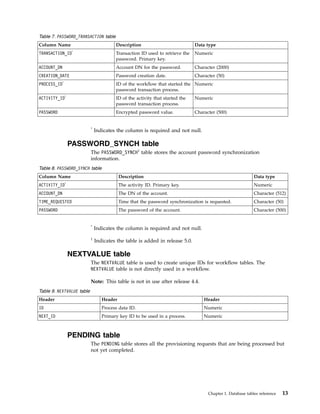
AUDIT_MGMT_TARGET table
The AUDIT_MGMT_TARGET table is used if the action is Add Member or
Remove Member.
Table 227. AUDIT_MGMT_TARGET table
Column Name Column Description Value Type Required?
event_id Identifier that is associated with this event. Foreign
key to the ID column of the table audit_event.
long Yes
target_entity_name The name of the member that is being added to or
removed from the group.
Applicable if action= Add Member or Remove
Member.
string Yes, when action= Add
Member or Remove
Member
target_entity_dn The distinguished name of the member that is
being added to or removed from the group.
Applicable if action= Add Member or Remove
Member.
string Yes, when action= Add
Member or Remove
Member
target_entity_type The type of the member that is being added to or
removed from the group.
Applicable if action= Add Member or Remove
Member.
string Yes when action= Add
Member or Remove
Member
Chapter 3. Auditing schema tables 147
Values for columns in the AUDIT_EVENT table
The following table describes the column values for the group management events
in the AUDIT_EVENT table.
Table 228. Values for columns in the AUDIT_EVENT table
Column Name Value
itim_event_category Group Management
entity_name Unique identifier of the group. This identifier can be the group ID or name.
entity_dn Distinguished name of the group.
entity_type Types of the group. For example: LdapGroupProfile, PosixAixGroupProfile.
container_name Name of the service that holds the group.
container_dn Distinguished name of the service that holds the group.
action Types of actions:
Add – Add a group.
Modify – Modify a group.
Delete – Delete a group.
AddMember – Add a member to a group.
RemoveMember – Remove a member from a group.
Table columns used in the AUDIT_EVENT table
The following list shows the columns for each group management event in the
AUDIT_EVENT table.
Add Group event
entity_name, entity_dn, entity_type, initiator_name, initiator_dn,
initiator_type, initiator_person_dn, initiator_person_name,
container_name, container_dn, timestamp, result_summary
Modify Group event
entity_name, entity_dn, entity_type, initiator_name, initiator_dn,
initiator_type, initiator_person_dn, initiator_person_name,
container_name, container_dn, timestamp, result_summary
Delete Group event
entity_name, entity_dn, entity_type, initiator_name, initiator_dn,
initiator_type, initiator_person_dn, initiator_person_name,
container_name, container_dn, timestamp, result_summary
Add Member to Group event
entity_name, entity_dn, entity_type, initiator_name, initiator_dn,
initiator_type, initiator_person_dn, initiator_person_name,
container_name, container_dn, timestamp, result_summary
AUDIT_MGMT_TARGET table: target_entity_name, target_entity_dn,
target_entity_type
Remove Member from Group event
entity_name, entity_dn, entity_type, initiator_name, initiator_dn,
initiator_type, initiator_person_dn, initiator_person_name,
container_name, container_dn, timestamp, result_summary
148 IBM Security Identity Manager Version 7.0.1.7: Database and Directory Server Schema Topics
AUDIT_MGMT_TARGET table: target_entity_name, target_entity_dn,
target_entity_type
Service policy enforcement
This section describes the columns used by service policy enforcement events such
as mark, correct, suspend, and alert.
Values for columns in the AUDIT_EVENT table
The following table describes the column values for the service policy enforcement
events in the AUDIT_EVENT table.
Table 229. Values for columns in the AUDIT_EVENT table
Column Name Value
itim_event_category service_policy_enforcement
entity_name Name of the service.
entity_dn Distinguished name of the service.
entity_type Type of the resource the service represents. For example: Active Directory,
Oracle, LDAP, Windows 2000, or .
action Types of actions:
EnforcePolicyForService - Enforce policy compliance
MarkNonCompliant – Mark noncompliant accounts.
SuspendNonCompliant – Suspend noncompliant accounts.
CorrectNonCompliant – Correct noncompliant accounts.
AlertNonCompliant – Alert the participant.
UseGlobalSetting – Issues the action that is specified in global setting.
Table columns used in the AUDIT_EVENT table
The following list shows the columns for each service policy enforcement event in
the AUDIT_EVENT table.
Service Policy Enforcement action event
entity_name, entity_type, workflow_process_id, initiator_name,
initiator_dn, initiator_type, initiator_person_dn,
initiator_person_name, action, container_name, container_dn,
timestamp, result_summary
Set Global Policy Enforcement properties event
entity_name, entity_dn, entity_type, workflow_process_id,
initiator_name, initiator_dn, initiator_type, initiator_person_dn,
initiator_person_name, action, container_name, container_dn,
timestamp, result_summary
Reconciliation
This section describes the columns used by events specific to reconciliation, such as
runRecon, setServiceParams, and setReconUnit.
Chapter 3. Auditing schema tables 149
Values for columns in the AUDIT_EVENT table
The following table describes the column values for the reconciliation events in the
AUDIT_EVENT table.
Table 230. Values for columns in the AUDIT_EVENT table
Column Name Value
itim_event_category Reconciliation.
entity_name Name of the service.
entity_dn Distinguished name of the service.
entity_type Type of the resource the service represents. For example: Active Directory,
Oracle, LDAP, Windows 2000, or .
action Types of actions:
Runrecon – Start the reconciliation.
SetServiceReconParameters – Set the service reconciliation parameters.
SetReconUnit – Set the service reconciliation unit.
Table columns used in the AUDIT_EVENT table
The following list shows the columns for each reconciliation event in the
AUDIT_EVENT table.
Run Reconciliation event
entity_name, entity_dn, entity_type, workflow_process_id,
initiator_name, initiator_dn, initiator_type, initiator_person_dn,
initiator_person_name, action, timestamp, result_summary
Set Recon Unit event
entity_name, entity_dn, entity_type, initiator_name, initiator_dn,
action, timestamp, result_summary
Set Service Recon Parameters event
entity_name, entity_dn, entity_type, initiator_name, initiator_dn,
action, timestamp, result_summary
Entitlement workflow management
This section describes the columns used by events specific to custom workflow
management, such as add, modify, and delete.
Values for columns in the AUDIT_EVENT table
The following table describes the column values for the container management
operations in the AUDIT_EVENT table.
Table 231. Values for columns in the AUDIT_EVENT table
Column Name Value
itim_event_category Entitlement Workflow management.
entity_name Name of the workflow.
entity_dn Distinguished name of the workflow.
150 IBM Security Identity Manager Version 7.0.1.7: Database and Directory Server Schema Topics
Table 231. Values for columns in the AUDIT_EVENT table (continued)
Column Name Value
entity_type Types of entities:
global – Applied to any policy regardless of the service type
service_type – Type of service to which this workflow is applicable
action Types of actions:
Add – Add a workflow.
Modify – Update a workflow.
Delete – Delete a workflow.
Table columns used in the AUDIT_EVENT table
The following list shows the columns for each person management action in the
AUDIT_EVENT table.
v Add Entitlement workflow event
entity_name, entity_dn, entity_type, initiator_name, initiator_dn,
action, container_name, container_dn, timestamp, result_summary
v Delete Entitlement workflow event
entity_name, entity_dn, entity_type, initiator_name, initiator_dn,
action, container_name, container_dn, timestamp, result_summary
v Modify Entitlement workflow event
entity_name, entity_dn, entity_type, initiator_name, initiator_dn,
action, container_name, container_dn, timestamp, result_summary
Entity operation management
This section describes the columns used by events specific to system workflow
management, such as add, modify, and delete.
Values for columns in the AUDIT_EVENT table
The following table describes the column values for the container management
operations in the AUDIT_EVENT table.
Table 232. Values for columns in the AUDIT_EVENT table
Column Name Value
itim_event_category Entity Operation Management.
entity_name Name of the operation that is being managed.
entity_dn Distinguished name of the workflow.
entity_type Type of the entity whose operation is being managed. For example, Person,
Account, Bpperson, ITIMAccount, SQLAccount, and others.
action Types of actions:
Add – Add an operation.
Modify – Update an operation.
Delete – Delete an operation.
Chapter 3. Auditing schema tables 151
Table columns used in the AUDIT_EVENT table
The following list shows the columns for each person management action in the
AUDIT_EVENT table.
v Add Entity Operation event
entity_name, entity_dn, entity_type, initiator_name, initiator_dn,
action, container_name, container_dn, timestamp, result_summary
v Delete Entity Operation event
entity_name, entity_dn, entity_type, initiator_name, initiator_dn,
action, container_name, container_dn, timestamp, result_summary
v Modify Entity Operation event
entity_name, entity_dn, entity_type, initiator_name, initiator_dn,
action, container_name, container_dn, timestamp, result_summary
System configuration
This section describes the columns used by events specific to configuration
performed through the Configuration tab.
Values for columns in the AUDIT_EVENT table
The following table describes the column values for the container management
operations in the AUDIT_EVENT table.
Table 233. Values for columns in the AUDIT_EVENT table
Column Name Value
itim_event_category System Configuration.
entity_name Name of the entity. The value is specific to the type of entity type that is being
updated.
entity_dn Distinguished name of the entity or entity type if the entity that is being
updated is an attribute.
entity_type Types of entity:
FormTemplate – Formtemplate for object profiles
JoinDirective – Policy join directives
ComplianceAlertRule – Policy compliance alert rule (Privilege rule)
LogonProperties – logon properties
PolicyEnforcementProperties – Policy enforcement properties
PostOfficeConfigurationProperties – Post Office configuration properties
WorkflowNotificationProperties – Workflow notification properties
ChallengeResponseProperties – challenge and response properties
Serviceprofile – Service profile
ITIM System Entity - System defined entities. For example, Person, Account,
BPperson, Organization, BPOrganization, ITIMAccount, SQLAccount, and others.
152 IBM Security Identity Manager Version 7.0.1.7: Database and Directory Server Schema Topics
Table 233. Values for columns in the AUDIT_EVENT table (continued)
Column Name Value
action Types of actions:
Add – Add a property or system entity from the Configuration tab.
Modify – Update a property or system entity from the Configuration tab.
Delete – Delete a property or system entity from the Configuration tab.
Value of the entity_name column
This section describes the value for the entity_name column for each entity_type
value defined for system configuration events.
Table 234. Value of the entity_name column table
entity_type Value Example
FormTemplate Name of the profile whose form is
being modified.
Admin Domain, Person, AIX Account,
DSML2Service, SQLService,
Organization
JoinDirective Name of the attribute whose join
directive is being updated.
Errole, eruid, erhomepage
Compliance Alert Rule Name of the attribute whose
Compliance alert rule is being
updated.
Errole, eruid, erhomepage
LogonProperties Property name. erLostPswdByMail, erResponseEmail,
erNumLogonAttempt
Policy Enforcement Properties Property name.
Post Office Configuration
Properties
Property name.
Workflow Notification Properties Property name.
Challenge Response Properties Property name. erChallengeDefMode,
erChallengeMode, erResponseEnable
ITIM System Entity Attribute of the entity that is being
updated.
erAttrMap, erSearchAttr,
erCustomClass, erRdnAttr,
erLifeCycleRule.
Serviceprofile Name of the service profile that is
being installed or uninstalled.
Win2kService, BroadVisionService,
SolarisService
Table columns used in the AUDIT_EVENT table
The following list shows the columns for each person management action in the
AUDIT_EVENT table.
v Add System Entity event
entity_name, initiator_name, initiator_dn, action, container_name,
container_dn, timestamp, result_summary
v Delete System Entity event
entity_name, entity_dn, initiator_name, initiator_dn, action,
container_name, container_dn, timestamp, result_summary
v Modify System Entity event
entity_name, entity_dn, entity_type, initiator_name, initiator_dn,
action, container_name, container_dn, timestamp, result_summary
Chapter 3. Auditing schema tables 153
v Add Life Cycle Rule event
entity_name, initiator_name, initiator_dn, action, container_name,
container_dn, timestamp, result_summary
v Delete Life Cycle Rule event
entity_name, initiator_name, initiator_dn, action, container_name,
container_dn, timestamp, result_summary
v Modify Life Cycle Rule event
entity_name, initiator_name, initiator_dn, action, container_name,
container_dn, timestamp, result_summary
v Set Challenge Config event
initiator_name, initiator_dn, action, container_name, container_dn,
timestamp, result_summary
v Set Challenges event
initiator_name, initiator_dn, action, container_name, container_dn,
timestamp, result_summary
v Set Form Template event
entity_name, entity_dn, initiator_name, initiator_dn, action,
container_name, container_dn, timestamp, result_summary
v Set Password Properties event
initiator_name, initiator_dn, action, container_name, container_dn,
timestamp, result_summary
v Set Post Office Properties event
initiator_name, initiator_dn, action, container_name, container_dn,
timestamp, result_summary
v Set Privilege Rule event
entity_name, entity_dn, initiator_name, initiator_dn, action,
container_name, container_dn, timestamp, result_summary
v Set Workflow Notification Properties event
initiator_name, initiator_dn, action, container_name, container_dn,
timestamp, result_summary
v Set Workflow Notification Template event
entity_name, entity_dn, initiator_name, initiator_dn, action,
container_name, container_dn, timestamp, result_summary
Runtime events
This section describes the columns used by event related to start and stop events.
Values for columns in the AUDIT_EVENT table
The following table describes the column values for the container management
operations in the AUDIT_EVENT table.
Table 235. Values for columns in the AUDIT_EVENT table
Column Name Value
itim_event_category runtime events.
action Types of actions:
Start_itim – Start command for .
MStop_itim – Stop command for .
154 IBM Security Identity Manager Version 7.0.1.7: Database and Directory Server Schema Topics
Table columns used in the AUDIT_EVENT table
The following list shows the columns for each person management action in the
AUDIT_EVENT table.
v Start ITIM Server event
action, timestamp, result_summary
v Stop ITIM Server event
action, timestamp, result_summary
Self-password change
This section describes the columns that are used by events that are related to
password change.
If a self-password change request affects at least one ITIM account and at least one
non-ITIM account, two separate events are audited for the request. One
self-password change event is audited for the ITIM accounts. Another
self-password change event is audited for the non-ITIM accounts.
Values for columns in the AUDIT_EVENT table
The following table describes the column values for the self-password change
events in the AUDIT_EVENT table.
Table 236. Values for columns in the AUDIT_EVENT table
Column Name Value
itim_event_category Self-password change.
action Types of actions:
ChangePassword – Changing a self-password.
ResetPassword – Resetting a self-password.
Table columns used in the AUDIT_EVENT table
The following list shows the columns for each self-password change event in the
AUDIT_EVENT table.
Change self-password event
entity_name, entity_dn, action, workflow_process_id, initiator_name,
initiator_dn, initiator_type, initiator_person_dn,
initiator_person_name, timestamp, result_summary
Reset self-password event
entity_name, entity_dn, action, workflow_process_id, initiator_name,
initiator_dn, initiator_type, initiator_person_dn,
initiator_person_name, timestamp, result_summary
Migration
This section describes the columns used by events related to migration (import and
export) operations.
Chapter 3. Auditing schema tables 155
Values for columns in the AUDIT_EVENT table
The following table describes the column values for the migration events in the
AUDIT_EVENT table.
Table 237. Values for columns in the AUDIT_EVENT table
Column Name Value
itim_event_category Migration.
action Types of actions:
StartImport
StopImport
StartExport
StopExport
InstallAgentProfile
Table columns used in the AUDIT_EVENT table
The following list shows the columns for each migration event in the AUDIT_EVENT
table.
Start Import event
Event_category, operation, action, initiator_name, initiator_dn,
initiator_type, initiator_person_dn, initiator_person_name,
timestamp, result_summary
Stop Import event
Event_category, operation, action, initiator_name, initiator_dn,
initiator_type, initiator_person_dn, initiator_person_name,
timestamp, result_summary
Start Export event
Event_category, operation, action, initiator_name, initiator_dn,
initiator_type, initiator_person_dn, initiator_person_name,
timestamp, result_summary
Stop Export event
Event_category, operation, action, initiator_name, initiator_dn,
initiator_type, initiator_person_dn, initiator_person_name,
timestamp, result_summary
Agent Profile Install event
Event_category, operation, action, initiator_name, initiator_dn,
initiator_type, initiator_person_dn, initiator_person_name,
timestamp, result_summary
Credential management
This section describes the columns used by events related to Credential
management. For example, add to vault, modify, delete, register password, view
password history, or get password for non-exclusive credential.
156 IBM Security Identity Manager Version 7.0.1.7: Database and Directory Server Schema Topics
Values for columns in the AUDIT_EVENT table
The following table describes the column values for the Credential management
operations in the AUDIT_EVENT table.
Table 238. Values for columns in the AUDIT_EVENT table
Column Name Value
itim_event_category CredentialManagement
entity_name Credential name.
entity_dn Distinguished name of the credential.
entity_type Credential
workflow_process_id Process ID of the initiated workflow. Only applicable to Add action.
result_summary Result of operation:
Submitted – submitted to workflow successfully
Success – completed successfully
action Types of actions:
Add – add a credential to vault
Modify – modify a credential
Delete – delete a credential from vault
RegisterPassword – register credential password in the vault
PasswordHistory – view credential password history in the vault
GetPassword – get password of non-exclusive credential from vault
Connect – connect a credential to an account
Table columns used in the AUDIT_EVENT table
The following list shows the columns for each Credential management action in
the AUDIT_EVENT table.
v Add to Vault event
entity_name, entity_type, initiator_name, initiator_dn,
workflow_process_id, container_name, container_dn, timestamp,
result_summary, comments
v Delete Credential event
entity_name, entity_dn, entity_type, initiator_name, initiator_dn,
container_name, container_dn, timestamp, result_summary
v Modify Credential event
entity_name, entity_dn, entity_type, initiator_name, initiator_dn,
container_name, container_dn, timestamp, result_summary
v Register Password event
entity_name, entity_dn, entity_type, initiator_name, initiator_dn,
container_name, container_dn, timestamp, result_summary
v View Password History event
entity_name, entity_dn, entity_type, initiator_name, initiator_dn,
container_name, container_dn, timestamp, result_summary
v Get Password event
Chapter 3. Auditing schema tables 157
entity_name, entity_dn, entity_type, initiator_name, initiator_dn,
container_name, container_dn, timestamp, result_summary
v Connect credential event
entity_name, entity_dn, entity_type, initiator_name, initiator_dn,
workflow_process_id, container_name, container_dn, timestamp,
result_summary, comments
Credential Pool management
This section describes the columns used by events related to Credential Pool
management, such as add, modify, or delete.
Values for columns in the AUDIT_EVENT table
The following table describes the column values for the Credential Pool
management operations in the AUDIT_EVENT table.
Table 239. Values for columns in the AUDIT_EVENT table
Column Name Value
itim_event_category CredentialPoolManagement
entity_name Credential pool name.
entity_dn Distinguished name of the credential pool.
entity_type CredentialPool
result_summary Result of operation:
Success – completed successfully
action Types of actions:
Add – add a credential pool
Modify – modify a credential pool
Delete – delete a credential pool
Table columns used in the AUDIT_EVENT table
The following list shows the columns for each Credential Pool management action
in the AUDIT_EVENT table.
v Add Credential Pool event
entity_name, entity_dn, entity_type, initiator_name, initiator_dn,
container_name, container_dn, timestamp, result_summary
v Delete Credential Pool event
entity_name, entity_dn, entity_type, initiator_name, initiator_dn,
container_name, container_dn, timestamp, result_summary
v Modify Credential Pool event
entity_name, entity_dn, entity_type, initiator_name, initiator_dn,
container_name, container_dn, timestamp, result_summary
Credential Lease management
This section describes the columns used by events related to Credential Lease
management. For example, check out, check in, get password, notify expired lease,
or notify and check in expired lease.
158 IBM Security Identity Manager Version 7.0.1.7: Database and Directory Server Schema Topics
AUDIT_MGMT_LEASE table
The AUDIT_MGMT_LEASE table is used in the following events.
The events are:
v Checkout event
v All other events if the credential is a pool member
Table 240. AUDIT_MGMT_LEASE table
Column Name Column Description Data type
event_id*
Identification assigned to the event. References
AUDIT_EVENT (ID).
Numeric
lease_expiration_date The lease expiration time. Only applicable to the Checkout
action.
Character (500)
justification The business justification for checkout. Only applicable to
the Checkout action.
Character (2000)
pool_name The credential pool name. Applicable to all actions if the
credential is a pool member.
Character (256)
pool_dn The credential pool DN. Applicable to all actions if the
credential is a pool member.
Character (2000)
custom_attribute_1 to
custom_attribute_5
The lease custom attribute values. Only applicable to the
Checkout action.
Character (2000)
lease_dn The lease DN. Character (2000)
*
Indicates the column is required and not null.
Values for columns in the AUDIT_EVENT table
The following table describes the column values for the Credential Lease
management operations in the AUDIT_EVENT table.
Table 241. Values for columns in the AUDIT_EVENT table
Column Name Value
itim_event_category CredentialLeaseManagement
entity_name Credential name.
entity_dn Distinguished name of the credential.
entity_type Credential
workflow_process_id Process ID of the initiated workflow. Applicable to Checkin, Checkout,
NotifyExpiredLease, and NotifyCheckinExpiredLease actions.
result_summary Result of operation:
Submitted – submitted to workflow successfully.
Success – completed successfully. Only applicable to GetPassword
action.
Failure – failed. Only applicable to the second Checkin event, which
tries to check in a credential already checked in by someone else.
Chapter 3. Auditing schema tables 159
Table 241. Values for columns in the AUDIT_EVENT table (continued)
Column Name Value
action Types of actions:
Checkout – check out a credential.
Checkin – check in a credential.
GetPassword – get password of a checked out credential.
NotifyExpiredLease – Notify an expired lease.
NotifyCheckinExpiredLease – Notify and check in an expired lease.
Table columns used in the AUDIT_EVENT table
The following list shows the columns for each Credential Lease management action
in the AUDIT_EVENT table.
v Checkout event
entity_name, entity_dn, entity_type, initiator_name, initiator_dn,
workflow_process_id, container_name, container_dn, timestamp,
result_summary
AUDIT_MGMT_LEASE table: lease_expiration_time, justification, pool_name,
pool_dn, custom_attribute_1, custom_attribute_2, custom_attribute_3,
custom_attribute_4, custom_attribute_5
v Checkin event
entity_name, entity_dn, entity_type, initiator_name, initiator_dn,
workflow_process_id, container_name, container_dn, timestamp,
result_summary, comments
Note: If a user or an ESSO session tries to check in a credential already checked
in by someone else, then the second checkin attempt is audited as a Checkin
event. The result_summary is FAILURE and the comment is Invalid lease during
checkin.
AUDIT_MGMT_LEASE table: pool_name, pool_dn, lease_dn
v Get Password event
entity_name, entity_dn, entity_type, initiator_name, initiator_dn,
container_name, container_dn, timestamp, result_summary
AUDIT_MGMT_LEASE table: pool_name, pool_dn
v Notify Expired Lease event
entity_name, entity_dn, entity_type, initiator_name, initiator_dn,
workflow_process_id, container_name, container_dn, timestamp,
result_summary
AUDIT_MGMT_LEASE table: pool_name, pool_dn
160 IBM Security Identity Manager Version 7.0.1.7: Database and Directory Server Schema Topics
v Notify and Checkin Expired Lease event
entity_name, entity_dn, entity_type, initiator_name, initiator_dn,
workflow_process_id, container_name, container_dn, timestamp,
result_summary
AUDIT_MGMT_LEASE table: pool_name, pool_dn, lease_dn
Chapter 3. Auditing schema tables 161
162 IBM Security Identity Manager Version 7.0.1.7: Database and Directory Server Schema Topics
Chapter 4. IBM Cognos reporting query subjects and query
items
You can use the query subjects and query items to customize the reports.
IBM Cognos reporting model is broadly dived into audit and configuration
namespaces.
Audit namespace
Consists of the query subjects and query items for the audit activities.
Configuration namespace
Consists of the query subjects and query items for the configuration
activities.
Schema mapping
Before you work with the query subjects and query items, you must map the
attributes to the entities.
To map the attributes and entities, see “Mapping the attributes and entities.”
For more information, see Report schema mapping
Mapping the attributes and entities
You must map the following attributes to the entities to work with the query items
for the IBM Security Identity Manager Cognos report models.
Note: After you map the schema by using IBM Security Identity Manager
administration console, it might take some time to reflect the updated data in the
Cognos report. You must run a successful data synchronization after mapping the
attributes. You must restart IBM Cognos Business Intelligence server to reflect the
updated schema in the report.
Table 242. Mapping the attributes and entities
Namespace Entity Attribute Name
Account Configuration Organizational Role v Access Name
v Object Profile Name
Identity Policy v Policy Name
v Policy Target
v Enabled
v Scope
v UserClass
Password Policy v Policy Name
v Policy Target
v Enabled
v Scope
Account Account Ownership Type
163
Table 242. Mapping the attributes and entities (continued)
Namespace Entity Attribute Name
Role Configuration Organizational Role v Access Name
v Access Options
v Object Profile Name
v Owner
Provisioning Policy Config Provisioning Policy v Enabled
v Entitlement Ownership Type
v Priority
v Scope
Shared Access Audit Account Account Ownership Type
Shared Access Configuration Account Account Ownership Type
Group Group Name
Recertification Audit Account Account Ownership Type
Recertification Config Account Account Ownership Type
Group v eraccessdescription
v Group Description
v Group Name
Recertification Policy Scope
User Configuration Account Account Ownership Type
Person v Administrative Assistant
v Preferred user ID
v Email Address
v Aliases
Organizational Role v Access Name
v Access Options
v Object Profile Name
v Owner
Business Partner Person v Organization Role
v Status
Service Audit Service Tag
Provisioning Policy v Enabled
v Priority
v Scope
Access Audit Group v Access Options
v Group Name
Organizational Role v Access Name
v Object Profile Name
Access Configuration Business Partner Person v Full Name
v Last Name
v Organizational Unit Name
Recertification Audit namespace
The Recertification Audit namespace provides information about the history of
user, role, account, and group recertification.
164 IBM Security Identity Manager Version 7.0.1.7: Database and Directory Server Schema Topics
Query subjects for Recertification Audit namespace
The following table lists the query subjects in the Recertification Audit
namespace.
Table 243. Query subjects in the Recertification Audit namespace for the recertification
model
Query subject Description
User Recertification Policy Represents the recertification policy that recertifies accounts, group
memberships, and roles memberships through user recertification.
IBM Security Identity Manager entities are recertified with the
recertification policy. You must use this query subject with the User
Recert History query subject to obtain information about the
recertification policy. Do not use this query subject with Account
Recert History and Access Recert History.
User Recert History Represents the recertification audit history for a user. It covers
recertification audit history of accounts, groups, and roles that are
associated with the user.
Person Represents a user entity and some of its configuration attributes. You
must use this query subject with the User Recert History query
subject to obtain information about the user that is being recertified.
Person Organization Represents an organization that is associated with a user. These users
are being recertified.
User Recert Account Represents the recertification audit history for an account that is
recertified as part of the user recertification. You must use this query
subject with the User Recert History. By doing so, you can obtain the
information about accounts that are associated with the users that are
being recertified.
User Recert Group Represents the recertification audit history for a group membership
that is recertified as part of the user recertification. You must use this
query subject with the User Recert History. By doing so, you can
obtain the information about memberships of the accounts that are
associated with the users that are being recertified.
User Recert Group Service Represents the service that is associated to a group. You must use this
query subject with the User Recert History to obtain more
information about the service for the groups that are recertified as a
part of the user recertification.
User Recert Role Represents the recertification audit history for a role membership that
is recertified as part of the user recertification. You must use this
query subject with the User Recert History. By doing so, you can
obtain the information about role memberships of the users that are
being recertified.
Account Represents an account entity and some of its configuration attributes.
You must use this query subject with the Account Recert History
query subject. By doing so, you can generate recertification history
reports of accounts.
Account Service Represents service that is associated to an account. These accounts
participate in the account and access recertification.
Account Owner Represents user owners of the accounts that are participating in the
account and access recertification.
Account Recert History Represents the recertification audit history for accounts. You must use
this query subject with the Account query subjects. By doing so, you
can find out the accounts in the recertification audit.
Access Represents the group access and some of its configuration attributes.
You must use this query subject with the Access Recert History
query subject to generate recertification history reports of access.
Access Recert History Represents the recertification audit history for access. You must use
this query subject with the Access query subjects. By doing so, you
can find out the accesses in the recertification audit.
Chapter 4. IBM Cognos reporting query subjects and query items 165
Query items for Recertification Audit namespace
The following table lists the query items in the Recertification Audit namespace.
Table 244. Query items in the Recertification Audit namespace
Query subject Query items and their description
User Recertification Policy
Recertification Policy Name
The name of the recertification policy.
Recertification Policy Type
The type of an entity that gets recertified by using this
policy. The valid values are Account, Access, and Identity.
Recertification Policy Description
The description of the policy as specified in the policy
configuration.
Recertification Policy Enabled
Shows whether the policy is enabled.
Recertification Policy Scheduled
The recertification scheduling modes. The valid values are
CALENDAR and ROLLING.
Recertification Policy Rolling Interval in Days
The recertification period if the recertification policy
scheduling mode is ROLLING. No value in this query item
indicates that the scheduling is not in the ROLLING mode.
Recertification Policy Reject Action
An action that was taken if the recertification is rejected.
Recertification Policy Timeout Period in Days
The duration during which a recertifier must act.
Recertification Policy Timeout Action
The automatic action that must be taken if the recertification
times out.
Recertification Policy DN
An LDAP distinguished name for the recertification policy.
Recertification Policy Container DN
An LDAP distinguished name for a business unit to which
the recertification policy applies.
Recertification Policy Is Custom
Indicates whether the recertification policy is customized. It
is defined in the workflow.
Recertification Policy User Class
The type of a user to which the recertification policy applies.
The valid values are All, Person, and Business Partner
Person.
Recertification Policy Scope
Indicates whether the recertification policy applies to the
business unit and its subunits or either of them.
166 IBM Security Identity Manager Version 7.0.1.7: Database and Directory Server Schema Topics
Table 244. Query items in the Recertification Audit namespace (continued)
Query subject Query items and their description
User Recert History
User Recert History Person Name
The full name of a person.
User Recert History Person Email
The user email identifier.
User Recert History Person Status
A user status at the end of the recertification workflow
process. The valid values are Active and Inactive.
User Recert History Person Business Unit Name
A business unit to which a user belongs.
User Recert History Recertification Policy Name
The recertification policy that created a user entity.
User Recert History Timeout
Shows whether the recertification process is timed out or not.
0 represents Not timed out, and 1 represents Timed out.
User Recert History Comments
The comments that are entered by a user during the user
recertification process.
User Recert History Process Comments
The comments that are entered by a user during the
recertification process.
User Recert History Process Submission time
The recertification policy submission time.
User Recert History Process Start Time
The time at which user recertification workflow process was
started.
User Recert History Process Completion Time
A user recertification history process completion time.
User Recert History Process Last Modified Time
The time at which user recertification workflow process was
last modified.
User Recert History Process Requester Name
The name of a user who submitted the request for
recertification.
User Recert History Process Requestee Name
The name of a user entity for whom the request for
recertification was submitted.
User Recert History Process Recertifier Name
The name of a user who is the final approver in the
recertification workflow process.
User Recert History Process Result Summary
An overall summary of a user recertification workflow
process result.
User Recert History Process Scheduled
The schedule for recertification policy submission.
User Recert History Id
A unique ID assigned by the IBM Security Identity Manager
to a user recertification audit history.
User Recert History Person DN
An LDAP distinguished name for a user entity in the
recertification process.
User Recert History Recertification Policy DN
An LDAP distinguished name for the recertification policy
that recertifies a user entity.
Chapter 4. IBM Cognos reporting query subjects and query items 167
Table 244. Query items in the Recertification Audit namespace (continued)
Query subject Query items and their description
Person
Person Full Name
The full name of a user.
Person Last Name
The surname of a user.
Person Status
The status of a user.
Person Dn
An LDAP distinguished name for a user entity.
Person Business Unit Dn
An LDAP distinguished name for a business unit to which a
user belongs.
Person Supervisor
The name of a user who is the supervisor of a user entity.
Person Organization
Business Unit Name
The name of a business unit to which a user belongs.
Business Unit Supervisor
A user supervisor of a business unit.
Business Unit DN
An LDAP distinguished name for the business unit to which
a user belongs.
Business Unit Container DN
An LDAP distinguished name for the parent business unit of
an organization entity.
User Recert Account
User Recert Account Name
The name of an account in a user recertification.
User Recert Account Service Name
The name of a service to which an account belongs.
User Recert Account Service Description
Describes the service that is associated to an account.
User Recert Account Status
The status of an account at the end of the recertification. The
valid values are Approved and Rejected.
User Recert Account Recert Id
A unique numeric ID assigned by the IBM Security Identity
Manager to an account recertification.
User Recert Account DN
An LDAP Distinguished name for an account entity in the
recertification.
User Recert Account Service DN
An LDAP Distinguished name for the service to which an
account entity belongs.
168 IBM Security Identity Manager Version 7.0.1.7: Database and Directory Server Schema Topics
Table 244. Query items in the Recertification Audit namespace (continued)
Query subject Query items and their description
User Recert Group
User Recert Group Name
The name of a group in the user recertification.
User Recert Group Description
Describes the recertification group.
User Recert Group Status
The status of a group at the end of the recertification. The
valid values are Approved and Rejected.
User Recert Group Recert Id
A unique numeric ID assigned by IBM Security Identity
Manager to a group recertification.
User Recert Group DN
An LDAP Distinguished name for a group entity in the
recertification.
User Recert Group Service
Group Name
The name of a group.
Service Name
The name of a service to which the group belongs.
Service Type
The service profile type.
Service Url
A URL that connects to the managed resource.
Service DN
An LDAP distinguished name for a service to which the
group belongs.
Service Container Dn
An LDAP distinguished name for a business unit of the
service that is associated with a group.
Service Owner Dn
An LDAP distinguished name for a user owner of the
service.
Group Dn
An LDAP distinguished name for a group entity in the
recertification.
User Recert Role
User Recert Role Name
The name of a role in the user recertification.
User Recert Role Description
The description of a role.
User Recert Role Status
The status of a role at the end of the recertification. The valid
values are Approved and Rejected.
User Recert Role Recert Id
A unique numeric identifier that is assigned by IBM Security
Identity Manager to a role recertification.
User Recert Role DN
An LDAP Distinguished name for a role entity in the
recertification.
Chapter 4. IBM Cognos reporting query subjects and query items 169
Table 244. Query items in the Recertification Audit namespace (continued)
Query subject Query items and their description
Account
Account Name
The name of an account.
Account Service Dn
An LDAP distinguished name for a service that provisions
an account.
Account Status
The status of an account. The valid values are Active and
Inactive.
Account Compliance
The details about an account compliance. The valid values
are Unknown, Compliant, Non Compliant, and Disallowed.
Account Ownership Type
The ownership type of an account. The valid values are
Individual, System, Device, and Vendor.
Account Last Access Date
The last date when an account was accessed.
Account Container Dn
An LDAP distinguished name for a business unit to which
an account belongs.
Account Service
Service Name
The name of a service to which an account belongs.
Service Dn
An LDAP distinguished name for a service to which an
account belongs.
Service Container DN
An LDAP distinguished name for a business unit of a service
that is associated to the accounts.
Service Owner DN
An LDAP distinguished name for a user owner of the
service.
Service Url
A URL that connects to the managed resource.
Service Type
The service profile type.
Account Owner
Person Full Name
The full name of a user who owns an account.
Person Last Name
The surname of a user who owns an account.
Person Status
The status of a user who owns an account.
Person DN
An LDAP distinguished name for an account owner.
Person Business Unit DN
An LDAP distinguished name for a business unit that is
associated to an account owner.
Person Supervisor
The supervisor of an account owner.
170 IBM Security Identity Manager Version 7.0.1.7: Database and Directory Server Schema Topics
Table 244. Query items in the Recertification Audit namespace (continued)
Query subject Query items and their description
Account Recert History
Recert History Service Name
The name of a service to which accounts and groups belong.
These accounts and groups are involved with an account
recertification audit.
Recert History Service Profile
The profile type of a service.
Recert History Status
An account status at the end of the recertification workflow
process. The valid values are Abort, Approved, Timeout,
Pending, and Rejected.
Recert History Action
The action that is taken on an account at the end of
recertification process as defined by the recertification policy.
The valid values are Abort, Certify, Delete, Mark, Certify
Administrative, and Suspend.
Recert History Comments
The comments that are entered by a user during
recertification process.
Recert History Process Start Time
The time at which an account recertification workflow
process started.
Recert History Process Submission Time
The time at which recertification policy was submitted.
Recert History Process Completion Time
The time at which an account recertification workflow
process completed.
Recert History Process Last Modified Time
The last modified time for an account recertification
workflow process.
Recert History Process Comments
The comments that are entered by a user during
recertification process.
Recert History Process Result Summary
The summary of the recertification process result. The valid
values are Success, Failed, Pending, Escalated, Skipped,
Timeout, and Warning.
Recert History Process Requestee Name
The name of a user entity for whom the recertification
request is submitted. For example, if the entity for
recertification is an account, then the query item is the name
of the account.
Recert History Process Requester Name
The name of a user who submitted the recertification
request. For example, if administrator submits a request for
recertification, then this query item is the name of the
administrator.
Recert History Recertifier Name
The name of a user who is the final approver in the
recertification workflow process.
Recert History Activity Owner
An owner of recertification activity for an account.
Recert History Recertifier Id
An account identifier of the recertifier.
Chapter 4. IBM Cognos reporting query subjects and query items 171
Table 244. Query items in the Recertification Audit namespace (continued)
Query subject Query items and their description
Access
Group ID
An identifier for a group.
Group Name
The name of a group for which an access is defined.
Group Type
The profile type of a group.
Group Access Name
The name of the access that is defined for a group.
Group Access Type
The type of the access that is defined for a group.
Group DN
An LDAP distinguished name for a group entity for which
an access is defined.
Group Container DN
An LDAP distinguished name for a business unit that is
associated with a group.
Group Service DN
An LDAP distinguished name for the service that is
associated to a group.
172 IBM Security Identity Manager Version 7.0.1.7: Database and Directory Server Schema Topics
Table 244. Query items in the Recertification Audit namespace (continued)
Query subject Query items and their description
Access Recert History
Recert History Service Name
The name of a service to which accesses and groups belong.
These accesses and groups are involved with an access
recertification audit.
Recert History Service Profile
The profile type of a service.
Recert History Status
An access status at the end of the recertification workflow
process. The valid values are Abort, Approved, Timeout,
Pending, and Rejected.
Recert History Action
The action that is taken on an access at the end of
recertification process as defined by the recertification policy.
The valid values are Abort, Certify, Delete, Mark, Certify
Administrative, and Suspend.
Recert History Comments
The comments that are entered by a user during
recertification process.
Recert History Process Start Time
The time at which an access recertification workflow process
started.
Recert History Process Submission Time
The time at which recertification policy was submitted.
Recert History Process Completion Time
The time at which an access recertification workflow process
completed.
Recert History Process Last Modified Time
The last modified time for an access recertification workflow
process.
Recert History Process Comments
The comments that are entered by a user during
recertification process.
Recert History Process Result Summary
The summary of the recertification process result. The valid
values are Success, Failed, Pending, Escalated, Skipped,
Timeout, and Warning.
Recert History Process Requestee Name
The name of a user entity for whom the recertification
request is submitted. For example, if the entity for
recertification is an access, then the query item is the name
of the access.
Recert History Process Requester Name
The name of a user who submitted the recertification
request. For example, if administrator submits a request for
recertification, then this query item is the name of the
administrator.
Recert History Recertifier Name
The name of a user who is the final approver in the
recertification workflow process.
Recert History Activity Owner
An owner of recertification activity for an access.
Recert History Recertifier Id
An access identifier of the recertifier.
Chapter 4. IBM Cognos reporting query subjects and query items 173
Recertification Config namespace
The Recertification Config namespace provides information about the defined
recertification policies and target that is defined for those policies.
Query subjects for Recertification Config namespace
The following table lists the query subjects in the Recertification Config
namespace.
Table 245. Query subjects in the Recertification Config namespace
Query subject Description
Recertification Policy Represents the recertification policy and its components.
Recertification Policy
Schedule
Represents the schedule that is used to auto trigger the recertification
policy.
Policy Recertifier Represents a user who is a recertifier for the recertification policy.
Recert Policy Business Unit Represents a business unit to which the recertification policy applies.
Recert Policy Role Target Represents the roles that are recertified by the recertification policy.
You must use this query subject with the Recertification Policy to
obtain information about the roles that are certified and their
configuration attributes.
Recert Policy Access Target Represents a group access and group membership that are recertified
by the recertification policy. You must use this query subject with the
Recertification Policy to obtain information about:
v Group access
v Group membership
v Configuration attributes of group access and group membership
v Informative attributes of a service that are associated with a group
Recert Policy Access Owner Represents a group access owner that are recertified by the
recertification policy. You must use this query subject with the
Recertification Policy to obtain information about the group access
owner name.
Group Members Represents the information about the members of a recertified group.
You must use this query subject with the Recert Policy Access
Target to obtain information about the members of the recertified
group.
Recert Policy Account Target Represents a service on which the accounts are provisioned and
recertified by the recertification policy. You must use this query
subject with the Recertification Policy to obtain more information
about:
v Account recertified
v Service on which these accounts are provisioned
Account Represents account entity and some of its configuration attributes. You
must use this query subject with the Recert Policy Account Target to
obtain more information about the accounts that are associated with
the service.
Person Represents a user entity and some of its configuration attributes. You
must use this query subject with the Recert Policy Role Target
query subject to obtain more information about the members of the
role.
Account Owner Represents a user owner of an account. You must use this query
subject with the Account query subject to obtain information about the
owners of the accounts.
Query items for Recertification Config namespace
The following table lists the query items in the Recertification Config
namespace.
174 IBM Security Identity Manager Version 7.0.1.7: Database and Directory Server Schema Topics
Table 246. List of query items in the Recertification Config namespace
Query subject Query items and their description
Recertification Policy
Recertification Policy Name
The name of the recertification policy.
Recertification Policy Type
The type of an entity that gets recertified by using this
policy. The valid values are User, Account, and Access.
Recertification Policy Description
The policy description as specified in the policy
configuration.
Recertification Policy Enabled
Shows whether the policy is enabled or not.
Recertification Policy Scheduled
The recertification scheduling modes. The valid values are
CALENDAR and ROLLING.
Recertification Policy Rolling Interval in Days
The recertification period if the recertification policy
scheduling mode is ROLLING. No value in this query item
indicates that the scheduling is not in the ROLLING mode.
Recertification Policy Reject Action
An action that is taken if the recertification is rejected.
Recertification Policy Timeout Period in Days
The duration during which a recertifier must act.
Recertification Policy Timeout Action
An automatic action that must be taken if the recertification
times out.
Recertification Policy DN
An LDAP distinguished name for the recertification policy.
Recertification Policy Container DN
An LDAP distinguished name for a business unit to which
the recertification policy applies.
Recertification Policy Is Custom
Represents whether the recertification policy is customized. It
is defined in the workflow.
Recertification Policy User Class
The type of a user to which the recertification policy applies.
The valid values are All, Person, and Business Partner
Person.
Recertification Policy Scope
Indicates whether the recertification policy applies to the
business unit and its subunits or either of them.
Chapter 4. IBM Cognos reporting query subjects and query items 175
Table 246. List of query items in the Recertification Config namespace (continued)
Query subject Query items and their description
Recertification Policy
Schedule Recertification Policy Detailed Schedule
The recertification schedule in terms of the units of time.
Note: Do not use this query item with Oracle database. This
query item is supported only for DB2 database.
Recertification Policy Schedule
The schedule that automatically triggers the recertification
policy. The query item represents the schedule in the
numeric format. The format of the schedule is Minute Hours
Month DayOfWeek DayOfMonth DayOfQuarter DayOfSemiAnnual.
For example, 0 0 0 0 -1 0 0.
v Minute - Represents the time in minutes.
v Hours - Represents the time in hours. -1 indicates that the
recertification policy is applied every hour.
v Month - Represents the month for the recertification. 1
represents January, 2 represents February, and so on. -1
indicates that the recertification policy is applied every
month.
v DayOfWeek - Represents the day of a week. 1 represents
Sunday, 2 represents Monday, and so on. The positive value
indicates that policy is applied weekly on a specific day.
-1 indicates that the recertification policy is not applied
based on the day of a week.
v DayOfMonth - Represents the date. -1 indicates that the
recertification policy is applied daily.
v DayOfQuarter - Represents the number of days after the
start of each quarter. 0 indicates that the policy is not
applied quarterly.
v DayOfSemiAnnual - Represents the number of days after the
start of each half year. 0 indicates that the policy is not
applied semi-annually.
v The policy is applied annually if the value of Month and
DayOfMonth is positive.
Recertification Policy DN
An LDAP distinguished name for the recertification policy.
Policy Recertifier
Recertifier Type
The type of the recertifier. The valid values and their
meanings:
v Account Owner: User being recertified
Note: This meaning applies only for the recertification
policies that are related to the users. For all other
recertification policies, Account Owner is an owner of the
account.
v System Administrator: Administrator
v Manager: Manager
v Person: Specified user
v Role: Specified organizational role
v System Role: Specified group
Recertifier Name
The name of a specific user, role, or group that is defined as
an approver of the recertification. When the recertification
policy's recertifier is set to User being recertified, then the
Recertifier Name is shown as a blank.
Recert Policy Dn
An LDAP distinguished name for the recertification policy.
176 IBM Security Identity Manager Version 7.0.1.7: Database and Directory Server Schema Topics
Table 246. List of query items in the Recertification Config namespace (continued)
Query subject Query items and their description
Recert Policy Business Unit
Business Unit Name
The name of a business unit.
Business Unit Supervisor
The user supervisor of a business unit.
Business Unit Dn
An LDAP distinguished name for a business unit.
Business Unit Container DN
An LDAP distinguished name for the parent organization of
a business unit entity.
Recert Policy Role Target
Role Name
The name of the role. If the policy applies to all the roles in a
business unit, then ALL ROLES WITHIN POLICY ORGANIZATION
is displayed.
Role Description
The description of a role.
Role Type
The type of a role. The valid values are Static and Dynamic.
The value of a role type is empty if the role name is
mentioned as ALL ROLES WITHIN POLICY ORGANIZATION.
Role Business Unit Name
The business unit to which the role belongs.
Role Business Unit Supervisor
The user supervisor of a business unit to which the role
belongs.
Role DN
An LDAP distinguished name for the role.
Role Business Unit DN
An LDAP distinguished name for the business unit to which
role belongs.
Recert Policy Dn
An LDAP distinguished name for the recertification policy.
Chapter 4. IBM Cognos reporting query subjects and query items 177
Table 246. List of query items in the Recertification Config namespace (continued)
Query subject Query items and their description
Recert Policy Access Target
Group Name
The name for a group. If the policy applies to all the groups
in an organization, then ALL GROUPS WITHIN POLICY
ORGANIZATION is displayed. If the policy applies to all the
groups for a service, then ALL GROUPS ON A SPECIFIED
SERVICE is displayed.
Group Description
The description of a group.
Group Type
The profile type of a group.
Group Access Name
An access name that is defined for a group entity.
Group Access Description
The description of an access that is defined for a group
entity.
Group Access Type
The type of an access that is defined for a group entity.
Group Service Name
The name of a service on which the group is provisioned.
Group Dn
An LDAP distinguished name for a group.
Group Service DN
An LDAP distinguished name for the service on which a
group is provisioned.
Group Container DN
An LDAP distinguished name for an organization to which a
group belongs.
Group Service Container Dn
An LDAP distinguished name for an organization of the
service on which group is provisioned.
Recert Policy DN
An LDAP distinguished name for the recertification policy.
Recert Policy Access Owner
Group Dn
An LDAP distinguished name for a group.
Group Access Owner Dn
An LDAP distinguished name for an access owner that is
defined for a group entity.
Group Access Owner Full Name
Full name of an access owner that is defined for a group
entity.
178 IBM Security Identity Manager Version 7.0.1.7: Database and Directory Server Schema Topics
Table 246. List of query items in the Recertification Config namespace (continued)
Query subject Query items and their description
Group Members
Account Name
The name of an account that is associated with a credential.
Account Service Dn
An LDAP distinguished name for a service that provisions
an account.
Account Status
The status of an account that indicates whether the account
is active or inactive.
Account Compliance
The details about an account compliance. The valid values
are Unknown, Compliant, Non Compliant, and Disallowed.
Account Ownership Type
The ownership type of the account. The valid values are
Individual, System, Device, and Vendor.
Account Last Access Date
The last accessed date and time of an account.
Account Container Dn
An LDAP distinguished name for a business unit of an
account.
Recert Policy Account Target
Account Service Name
The name of the service. If the policy applies to all the
accounts in the service, then ALL ACCOUNT WITHIN POLICY
ORGANIZATION is displayed.
Account Service Business Unit Name
The name of the business unit to which a service belongs.
Account Service Business Unit Supervisor
A user supervisor of a business unit that is associated with
the service.
Account Service DN
An LDAP distinguished name for the service.
Account Service Description
The description of a service.
Account Service Business Unit DN
An LDAP distinguished name for a business unit that is
associated with the service.
Account Service Type
The profile type of the service.
Account Service Owner DN
An LDAP distinguished name for an owner of the service.
Account Service Url
A URL that connects to the service.
Recert Policy DN
An LDAP distinguished name for the recertification policy.
Chapter 4. IBM Cognos reporting query subjects and query items 179
Table 246. List of query items in the Recertification Config namespace (continued)
Query subject Query items and their description
Account
Account Name
The name of an account that is associated with a credential.
Account Service Dn
An LDAP distinguished name for a service that provisions
an account.
Account Status
The status of an account that indicates whether the account
is active or inactive.
Account Compliance
The details about an account compliance. The valid values
are Unknown, Compliant, Non Compliant, and Disallowed.
Account Ownership Type
The ownership type of the account. The valid values are
Individual, System, Device, and Vendor.
Account Last Access Date
The last accessed date and time of an account.
Account Container Dn
An LDAP distinguished name for a business unit of an
account.
Person
Person Full Name
The full name of a user.
Person Last Name
The surname of a user.
Person Status
The status of a user.
Person Dn
An LDAP distinguished name for a user entity.
Person Business Unit Dn
An LDAP distinguished name for a business unit to a user
entity.
Person Supervisor
The name of a user for the supervisor of a user entity.
Account Owner
Person Full Name
The full name of a user who owns an account.
Person Last Name
The surname of a user who owns an account.
Person Status
The status of a user.
Person Dn
An LDAP distinguished name for a user entity.
Person Business Unit Dn
An LDAP distinguished name for a business unit to a user
entity.
Person Supervisor
The name of a user for the supervisor of a user entity.
180 IBM Security Identity Manager Version 7.0.1.7: Database and Directory Server Schema Topics
Account Audit namespace
The Account Audit namespace pertains to the audit history of the accounts. This
namespace contains query subjects that are related to the audit of accounts,
reconciliation, and provisioning policy.
Query subjects for Account Audit namespace
The following table lists the query subjects in the Account Audit namespace.
Table 247. Query subjects in the Account Audit namespace
Query subject Description
Account Audit Represents the audit history for the account entities.
Account Represents an account entity on which the audit actions are
performed. This query subject contains configuration and other
attributes that represent the status of the account. You must use this
query subject with the Account Audit, Reconciliation Audit, and
Provisioning Policy to obtain information about the accounts audit
actions and provisioning operations.
Reconciliation Audit Represents the audit history that is associated with the reconciliation
operations.
Provisioning Policy Represents the provisioning policies and their configuration attributes.
Chapter 4. IBM Cognos reporting query subjects and query items 181
Query items for Account Audit namespace
The following table lists the query items in the Account Audit namespace.
Table 248. Query items in the Account Audit namespace
Query subject Query items and their description
Account Audit
Audit Account Name
The name of an account on which the audit action is performed.
Audit Action
The action that is performed on an account. For example, Add,
Delete, Modify, and ChangePassword.
Audit Comments
The comments that are entered by the audit workflow approver.
Audit Account Business Unit
The business unit of an account.
Audit Process Subject
A user who is the owner of an account on which the audit
action is performed.
Audit Process Service Profile
The profile type of a service to which an account belongs.
Audit Process Subject Service
The service on which an account is provisioned.
Audit Initiator Name
The name of a user who initiated the audit action.
Audit Process Requestee Name
The name of an account owner.
Audit Process Recertifier Name
The name of a user who approves the audit process workflow.
Audit Operation Start Time
The audit operation initiation date and time.
Audit Activity Owner
An owner who owns the activity. For example, An owner name
who approves the add request for the pending account.
Audit Activity Name
The name of the audit activity.
Audit Activity Start Time
The audit activity start date and time.
Audit Activity Completion Time
The audit activity completion date and time.
Audit Process Submission Time
The audit process submission date and time.
Audit Process Schedule Time
The date and time at which an event is scheduled for execution.
Audit Process Completion Time
The audit process completion date and time.
Audit Activity Result Summary
The result of the activity within the account audit process.
Audit Process Result Summary
The result of the account audit process.
182 IBM Security Identity Manager Version 7.0.1.7: Database and Directory Server Schema Topics
Table 248. Query items in the Account Audit namespace (continued)
Query subject Query items and their description
Account
Account Name
The name of an account on which the audit action is performed.
Account Service Name
The name of a service on which the account is provisioned.
Account Status
The account status. The valid values are Active and Inactive.
Account Is Orphan
Indicates whether an account is associated with a user or not.
The valid values are Yes and No. Yes represents the account is
orphaned, and No represents the account is not orphaned.
Account Compliance
Indicates whether an account is compliant or not. The valid
values are Compliant, Non compliant, Unknown, and Disallowed.
Account Last Access Date
The last accessed date and time of an account.
Account Owner First Name
The given name of a user who is the owner of an account.
Account Owner Last Name
The surname of a user who is the owner of an account.
Account Dn
An LDAP distinguished name for an account.
Account Service DN
An LDAP distinguished name for the service to which an
account belongs.
Account Owner Business Unit Dn
An LDAP distinguished name for the business unit to which an
account owner belongs.
Account Owner Dn
An LDAP distinguished name for the account owner.
Chapter 4. IBM Cognos reporting query subjects and query items 183
Table 248. Query items in the Account Audit namespace (continued)
Query subject Query items and their description
Reconciliation Audit
Reconciliation User Name
The name of a user to whom an account is associated during the
reconciliation operation.
Reconciliation Account Name
The name of the reconciled account.
Reconciliation Processed Accounts
The number of processed accounts that exist during the last run
of reconciliation.
Reconciliation TIM User Accounts
The number of processed accounts that belong to IBM Security
Identity Manager users.
Reconciliation Local Accounts
The total number of local accounts created. It does not include
the newly created orphan accounts.
Reconciliation Policy Violations
The number of policy violations that are found for the accounts
during the reconciliation. This number includes:
v The accounts where an attribute value is different from the
local account.
v Any attribute value of the account is not compliant with the
governing provisioning policies.
It does not include the accounts where the attribute values of
the local and remote accounts are same, even if the values are
noncompliant.
Reconciliation Start Time
The reconciliation operation initiation date and time.
Reconciliation Completion Time
The reconciliation operation completion date and time.
Reconciliation Policy Compliance Status
The reconciliation completion status.
Reconciliation Operation
The operation that is performed for the entry of the service
instance. The possible values for an account entry are New Local,
New Orphan, Suspended Account, and Deprovisioned Account.
Reconciliation Requester Name
The name of an initiator who initiates the reconciliation
operation on the account for a service.
184 IBM Security Identity Manager Version 7.0.1.7: Database and Directory Server Schema Topics
Table 248. Query items in the Account Audit namespace (continued)
Query subject Query items and their description
Provisioning Policy
Provisioning Policy Name
The name of a provisioning policy through which an account is
provisioned on the service.
Provisioning Policy Dn
An LDAP distinguished name for the provisioning policy.
Provisioning Policy Container Dn
An LDAP distinguished name for the business unit to which the
provisioning policy applies.
Provisioning Policy Service Name
The name of a service to which the provisioning policy applies.
Provisioning Policy Service Type
The profile type of a service to which the provisioning policy
applies.
Provisioning Policy Service Business Unit Name
The business unit of a service to which the provisioning policy
applies.
Account Configuration namespace
The Account Configuration namespace contains the query subjects and query
items for configuring the accounts.
Query subjects for Account Configuration namespace
The following table lists the query subjects in the Account Configuration
namespace.
Table 249. Query subjects in the Account Configuration namespace
Query subject Description
Account Represents an account entity and its configuration attributes. The
query subject also contains the detailed information about the service
to which the account belongs.
Account Owner Represents a user who owns an account. You must use this query
subject with the Account query subject to obtain information about the
accounts that are managed by the user.
Account Owner Role
Membership
Represents the role information. You must use this query subject with
the Account Owner query subject to obtain information about the role
membership of the account owners.
Group Represents the group access and some of its configuration attributes.
You must use this query subject with the Account query subject to
obtain information about the account members of a group.
Service Business Unit Represents the business unit to which a service belongs. You must use
this query subject with the Account query subject to obtain
information about the business unit where the service is located.
Credential Represents a credential for an account. You must use this query
subject with the Account query subject to obtain information about the
credential and its configuration attributes.
Credential Pool Represents a pool of credentials for an account. You must use this
query subject with the Account query subject to obtain information
about the credential pool and its configuration attributes.
Account ACI Represents the Access Control Item (ACI) that are applicable on the
accounts. You must use this query subject with the Account query
subject to obtain information about the accounts that are managed by
an ACI.
Chapter 4. IBM Cognos reporting query subjects and query items 185
Table 249. Query subjects in the Account Configuration namespace (continued)
Query subject Description
ACI Operations Represents the operations that are governed by an ACI. You must use
this query subject with the Account ACI query subject to obtain
information about an ACI associated with the account.
ACI Attribute Permisions Represents the attributes and operations that can be performed on an
attribute. You must use this query subject with the Account ACI query
subject to obtain information about an ACI associated with the
account.
Identity Policy Represents the identity policy and its configuration attributes. You
must use this query subject with the Account query subject to obtain
information about the accounts that are managed by the policy.
Provisioning Policy Represents the provisioning policy and some of its configuration
attributes. You must use this query subject with the Account query
subject to obtain information about the policy that provisioned the
account.
Recertification Policy Represents the recertification policy and some of its configuration
attributes. You must use this query subject with the Account query
subject to obtain information about the accounts that are recertified by
the policy.
Password Policy Represents the password policy and its configuration attributes. You
must use this query subject with the Account query subject to obtain
information about the accounts that are managed by the policy.
186 IBM Security Identity Manager Version 7.0.1.7: Database and Directory Server Schema Topics
Query items for Account Configuration namespace
The following table lists the query items in the Account Configuration namespace.
Table 250. Query items in the Account Configuration namespace
Query subject Query items and their description
Account
Account Name
The name of an account.
Account Status
An account status. The valid values are Active and Inactive.
Account Compliance
Indicates whether an account is compliant or not. The valid
values are Unknown, Compliant, Non Compliant, and Disallowed.
Account Ownership Type
The type of the account ownership. The valid values are Device,
Individual, System, and Vendor.
Account Last Access Date
The last accessed date and time of an account.
Account Service Name
The name of a service in which the account is located.
Account Dn
An LDAP distinguished name for an account.
Account Container Dn
An LDAP distinguished name for a business unit to which an
account belongs.
Account Service Dn
An LDAP distinguished name for a service to which the
accounts belong.
Account Service Container DN
An LDAP distinguished name for a business unit of a service
that is associated with the accounts.
Account Service Url
A URL that connects to a managed resource.
Account Service Type
The service profile type.
Account Owner
Person Full Name
The full name of a user who owns an account.
Person Last Name
The surname of a user who owns an account.
Person Dn
An LDAP distinguished name for an account owner.
Person Business Unit Dn
An LDAP distinguished name for the business unit to which an
account owner belongs.
Person Supervisor
The user supervisor of the account owner.
Chapter 4. IBM Cognos reporting query subjects and query items 187
Table 250. Query items in the Account Configuration namespace (continued)
Query subject Query items and their description
Account Owner Role
Membership Role Name
The name of a role.
Role Type
The type of a role. The valid values are Static and Dynamic.
Role Dn
An LDAP distinguished name for a role.
Role Container DN
An LDAP distinguished name for the business unit that is
associated with a role.
Group
Group Name
The name of a group for which an access is defined.
Group Type
The profile type of a group.
Group Access Name
The name of the access that is defined for a group.
Group Access Type
The type of the access that is defined for a group.
Group Supervisor
An LDAP distinguished name for a group supervisor.
Group DN
An LDAP distinguished name for a group to which an access is
defined.
Group Container Dn
An LDAP distinguished name for the business unit that is
associated with a group.
Group Service Dn
An LDAP distinguished name for the service that is associated
with a group.
Service Business Unit
Business Unit Name
The name of the business unit to which a user belongs.
Business Unit Supervisor
The user supervisor of the business unit.
Business Unit Dn
An LDAP distinguished name for the business unit to which a
user belongs.
Business Unit Container Dn
An LDAP distinguished name for the parent the business unit of
an organization entity.
188 IBM Security Identity Manager Version 7.0.1.7: Database and Directory Server Schema Topics
Table 250. Query items in the Account Configuration namespace (continued)
Query subject Query items and their description
Credential
Credential Name
The name of a shared credential.
Credential Policy Name
The name of a policy that provides the entitlements for a
credential.
Credential Description
Describes a credential as specified in the credential
configuration.
Credential Is Exclusive
Indicates whether the credential is exclusive or not. 0 represents
Yes, and 1 represents No.
Credential Pool Use Global Settings
A flag that indicates whether a credential pool uses the shared
access global settings. 0 represents Uses global settings, and 1
represents Does not use gloabl settings.
Credential Is Searchable
Indicates whether a credential is searchable or not. 0 represents
Can be searched, and 1 represents cannot be searched.
Credential Is Password Viewable
Specifies whether a use can view the password on a credential. 0
represents password is viewable, and 1 represents password is
not viewable.
Credential Reset Password
Indicates whether the password of a credential is regenerated on
every check-in action. 0 represents Yes, and 1 represents No.
Credential MAX Checkout Time
The maximum allowed check-out duration for the credential in
hours.
Credential Service Name
The name of a service to which the credential is provisioned.
Credential Service Business Unit Name
The name of the business unit to which the credential service
belongs.
Credential Dn
An LDAP distinguished name for a credential.
Credential Service Dn
An LDAP distinguished name for the service on which a
credential is provisioned.
Credential Service Business Unit Dn
An LDAP distinguished name for the business unit of a
credential service.
Credential Shared Access Member Role Dn
An LDAP distinguished name for the role who is a member of
the shared access policy that provides entitlement for the
credential.
Credential Shared Access Policy Id
a unique numeric identifier that is assigned to the policy by .
Chapter 4. IBM Cognos reporting query subjects and query items 189
Table 250. Query items in the Account Configuration namespace (continued)
Query subject Query items and their description
Credential Pool
Credential Pool Name
The name of the credential pool.
Credential Pool Policy Name
The name of a policy that provides the entitlements for the
credential pool.
Credential Pool Service Name
The name of the service on which the groups corresponding to
the credential pool are provisioned.
Credential Pool Service Business Unit Name
The name of the business unit to which the credential pool
service belongs.
Credential Pool Group Name
The name of the group corresponding to credential pool.
Credential Pool Dn
An LDAP distinguished name for the credential pool.
Credential Pool Service Dn
An LDAP distinguished name for the service on which the
groups corresponding to the credential pool are provisioned.
Credential Pool Business Unit Dn
An LDAP distinguished name for the business unit of a
credential pool service.
Credential Pool Shared Access Member Role Dn
An LDAP distinguished name for the role who is a member of
the shared access policy that provides entitlement for the
credential pool.
Credential Pool Shared Access Policy Id
A unique numeric identifier that is assigned to the policy by
system.
190 IBM Security Identity Manager Version 7.0.1.7: Database and Directory Server Schema Topics
Table 250. Query items in the Account Configuration namespace (continued)
Query subject Query items and their description
Account ACI
ACI Name
The name of an ACI.
ACI Business Unit Name
The name of a business unit to which an ACI applies.
ACI Protection Category
The category of an entity that is protected by an ACI. The value
of this item must be Account.
ACI Target
The type of selected protection category that is associated with
an ACI. The valid values and their meanings:
v erAccountItem - All type of the accounts.
v erLDAPUserAccount - LDAP accounts.
v erPosixAixAccount - POSIX AIX accounts.
v erPosixHpuxAccount - POSIX HP-UX accounts.
v erPosixLinuxAccount - POSIX Linux accounts.
v erPosixSolarisAccount - POSIX Solaris accounts.
ACI scope
The scope of an ACI. It determines whether an ACI applies to
subunits of a business organization or not. The valid values and
their meanings:
v single - The policy applies to a business unit and not its
subunits.
v subtree - The policy applies to the subunits of a business
organization.
ACI Member Name
The members who are governed by an ACI. The valid values
are:
v All users in the system.
v The account owner.
v The manager of the account owner.
v The owner of the service that the account resides on.
v The owner of any access defined on the service that the
account resides on.
v The sponsor of the business partner organization in
which the account resides.
v The administrator of the domain in which the account
resides.
ACI System Group Name
Represents the name of the group whose members are governed
by an ACI.
ACI Business Unit Dn
An LDAP distinguished name for the business unit.
ACI System Group Dn
An LDAP distinguished name for a system group.
ACI Operations
ACI Operation Name
The name of an operation that is governed by an ACI.
ACI Operation Permission
The permission applicable on an ACI operation. The valid
values are grant, deny, and none.
ACI Business Unit Dn
An LDAP distinguished name for the business unit.
Chapter 4. IBM Cognos reporting query subjects and query items 191
Table 250. Query items in the Account Configuration namespace (continued)
Query subject Query items and their description
ACI Attribute Permisions
ACI Attribute Name
The name of an LDAP attribute on which the permissions are
controlled by an ACI.
ACI Attribute Operation
The name of the operation that can be run on an attribute. The
valid values are r for read operation, w for write operation, and
rw for read and write operations.
ACI Attribute Permission
The permission applicable on an ACI operation. The valid
values are grant and deny.
ACI Business Unit Dn
An LDAP distinguished name for the business unit.
Identity Policy
Identity Policy Name
The name of an identity policy.
Identity Policy Scope
The scope of an identity policy. It determines whether the policy
applies to the subunits of a business organization or not. The
valid values and their meanings:
v single - The policy applies to a business unit and not its
subunits.
v subtree - The policy applies to the subunits of a business
organization.
Identity Policy Enabled
Shows whether or not the policy is enabled.
Identity Policy User Class
The type of a user for which the policy applies. The valid values
are Person and Business Partner Person.
Identity Policy Target Type
Determines the type of the service within the policy business
unit on which the identity policy is applied. The valid values
and their meanings:
v All Services - All the defined services.
v Specific Service - The services that are explicitly added by a
user.
v PosixLinuxProfile - All the services of type POSIX Linux
profile.
v LdapProfile - All the services of type LDAP profile.
v PosixAixProfile - All the services of type POSIX AIX profile.
v PosixSolarisProfile - All the services of type POSIX Solaris
profile.
v PosixHpuxProfile - All the services of type POSIX HP_UX
Profile.
v ITIM Service - Default service that is used for accounts.
Identity Policy Dn
An LDAP distinguished name for the identity policy.
Identity Policy Target Dn
An LDAP distinguished name for the service on which the
identity policy is applied.
Identity Policy Container Dn
An LDAP distinguished name for the business unit where the
identity policy is located.
192 IBM Security Identity Manager Version 7.0.1.7: Database and Directory Server Schema Topics
Table 250. Query items in the Account Configuration namespace (continued)
Query subject Query items and their description
Provisioning Policy
Provisioning Policy Name
The name of a provisioning policy.
Provisioning Policy Member Name
The name of the entities that is provisioned by a policy. The
valid values are:
v All users in the organization
v All other users who are not granted to the
entitlement(s) defined by this provisioning policy via
other policies.
Provisioning Policy Dn
An LDAP distinguished name for the provisioning policy.
Provisioning Policy Container Dn
An LDAP distinguished name for a business unit to which the
provisioning policy applies.
Recertification Policy
Recertification Policy Name
The name of the recertification policy.
Recertification Policy Type
The type of an entity that gets recertified by the policy. The
valid values are Account, Access, and Identity.
Recertification Policy Description
Describes the policy as specified in the policy configuration.
Recertification Policy Enabled
Shows whether or not the policy is enabled.
Recertification Policy Scheduling Mode
The recertification scheduling modes. The valid values are
CALENDAR and ROLLING.
Recertification Policy Rolling Interval
The recertification period if the recertification policy scheduling
mode is ROLLING. No value in this query item indicates that the
scheduling is not in the ROLLING mode.
Recertification Policy Reject Action
An action that is taken if the recertification is rejected.
Recertification Policy Timeout Period in Days
The duration during which the recertifier must act.
Recertification Policy Timeout Action
An automatic action that must be taken if the recertification
times out.
Recertification Policy DN
An LDAP distinguished name for the recertification policy.
Recertification Policy Container DN
An LDAP distinguished name for a business unit to which the
recertification policy applies.
Recertification Policy IsCustom
Indicates whether this recertification policy is customized. It is
defined in a workflow.
Recertification Policy User Class
The type of a user the recertification policy applies. The valid
values are All, Person, and Business Partner Person.
Chapter 4. IBM Cognos reporting query subjects and query items 193
Table 250. Query items in the Account Configuration namespace (continued)
Query subject Query items and their description
Password Policy
Password Policy Name
The name of a password policy.
Password Policy Scope
The scope of a password policy. It determines whether the
policy applies to subunits of a business organization or not. The
valid values and their meanings:
v single - The policy applies to a business unit and not its
subunits.
v subtree - The policy applies to the subunits of a business
organization.
Password Policy Enabled
Shows whether or not the policy is enabled.
Password Policy Target Type
Determines the type of a service within the policy business unit
on which the password policy is applied. The valid values are:
v All Services - All the defined services.
v Specific Service - The services that are explicitly added by a
user.
v PosixLinuxProfile - All the services of type POSIX Linux
profile.
v LdapProfile - All the services of type LDAP profile.
v PosixAixProfile - All the services of type POSIX AIX profile.
v PosixSolarisProfile - All the services of type POSIX Solaris
profile.
v PosixHpuxProfile - All the services of type POSIX HP_UX
Profile.
v ITIMService - Default service that is used for accounts.
Password Policy Dn
An LDAP distinguished name for the password policy.
Password Policy Target Dn
An LDAP distinguished name for the service on which the
password policy is applied.
Password Policy Container Dn
An LDAP distinguished name for the business unit where the
identity policy is located.
Provisioning Policy Audit namespace
The Provisioning Policy Audit namespace pertains to the audit history of the
provisioning policies. You can generate the audit reports for the actions that are
performed on the provisioning policies and automatically provisioned accounts.
Query subjects for Provisioning Policy Audit namespace
The following table lists the query subjects in the Provisioning Policy Audit
namespace.
Table 251. Query subjects in the Provisioning Policy Audit namespace
Query subject Description
Provisioning Policy Audit Represents a history of the provisioning policies and accounts.
194 IBM Security Identity Manager Version 7.0.1.7: Database and Directory Server Schema Topics
Table 251. Query subjects in the Provisioning Policy Audit namespace (continued)
Query subject Description
Provisioning Policy Represents the provisioning policies on which the audit actions are
performed. To obtain more information about the policy and accounts
that go through the audit actions, use this query subject with the
following query subjects:
v Provisioning Policy Audit
v Provisioning Policy Business Unit
v Provisioning Policy Service
Provisioning Policy Business
Unit
Represents the business unit to which the provisioning policy applies.
Provisioning Policy Service Represents the managed service to which the provisioning policy
applies.
Query items for Provisioning Policy Audit namespace
The following table lists the query items in the Provisioning Policy Audit
namespace.
Chapter 4. IBM Cognos reporting query subjects and query items 195
Table 252. Query items in the Provisioning Policy Audit namespace
Query subject Query items and their description
Provisioning Policy
Audit Audit Provisioning Policy Name
The name of a provisioning policy.
Audit Provisioning Policy Business Unit
The name of a business unit to which the provisioning policy
applies.
Audit Action
The action that is performed on the provisioning policy. For
example, Add, Modify, and EnforceEntirePolicy.
Audit Process Subject
A subject of the automatically provisioned audit action. It can be
the provisioning policy or the accounts that are provisioned.
Audit Subject Type
The type of the audit subject. For example, Policy and Account.
Audit Process Subject Profile
The profile type of the accounts that is provisioned by the
provisioning policy. This query item applies only to the
accounts.
Audit Process Subject Service
The service on which the accounts are provisioned. This query
item applies only to the accounts.
Audit Initiator Name
The name of a user who initiated the audit action.
Audit Process Requestee Name
The name of a user on behalf of whom the audit action is
initiated.
Audit Comments
The comments that are entered by an approver during the audit
workflow approval.
Audit Operation Start Time
The audit operation start date and time.
Audit Process Submission Time
The audit process submission date and time.
Audit Process Schedule Time
The date and time at which an event is scheduled for execution.
Audit Process Completion Time
The audit process completion date and time.
Audit Process Result Summary
The result summary of the account request workflow process.
Activity Name
The name of the audit activity.
Activity Submission Time
The audit activity submission date and time.
Activity Completion Time
The audit activity completion date and time.
Audit Activity Result Summary
The result summary of an activity in the account request
workflow process.
Audit Process Recertifier
The name of a user who approves the audit process workflow.
Audit provisioning policy Dn
An LDAP distinguished name for the provisioning policy on
which the audit actions are performed.
196 IBM Security Identity Manager Version 7.0.1.7: Database and Directory Server Schema Topics
Table 252. Query items in the Provisioning Policy Audit namespace (continued)
Query subject Query items and their description
Provisioning Policy
Provisioning Policy Name
The name of a provisioning policy.
Provisioning Policy Scope
The scope in terms of a hierarchy of the business units to which
the provisioning policy applies.
Provisioning Policy Dn
An LDAP distinguished name for the provisioning policy.
Provisioning Policy Business Unit Dn
An LDAP distinguished name for the business unit to which the
provisioning policy applies.
Provisioning Policy
Business Unit Business Unit Name
The name of the business unit to which the provisioning policy
applies.
Business Unit Supervisor
The supervisor of a user for the business unit to which the
provisioning policy applies.
Business Unit Container Dn
An LDAP distinguished name for the business unit where the
provisioning policy business unit is located.
Business Unit Dn
An LDAP distinguished name for the business unit to which the
provisioning policy belongs.
Provisioning Policy
Service Service Name
The name of a service to which the provisioning policy applies.
Service Type
The profile type of a service to which the provisioning policy
applies.
Service Business Unit
The business unit of a service to which the provisioning policy
applies.
Service Dn
An LDAP distinguished name for a service to which the
provisioning policy belongs.
Service Business Unit Dn
An LDAP distinguished name for the business unit to which the
service belongs.
Service Owner Dn
An LDAP distinguished name for the user owner of a service.
Provisioning Policy Config namespace
The Provisioning Policy Config namespace pertains to the configuration
attributes of a provisioning policy. It encompasses the business units, services,
policy members, and the ACIs that are related to the provisioning policies. You can
generate the configuration reports for the provisioning policy.
Query subjects for Provisioning Policy Config namespace
The following table lists the query subjects in the Provisioning Policy Config
namespace.
Chapter 4. IBM Cognos reporting query subjects and query items 197
Table 253. Query subjects in the Provisioning Policy Config namespace
Query subject Description
Provisioning Policy Represents the provisioning policy and its configuration attributes.
Provisioning Policy Parameters Represents the parameters that are defined for the entitlements of a
provisioning policy. You must use this query subject with the
Provisioning Policy query subject.
Provisioning Policy Role
Members
Represents the user members of a role that is a part of the
provisioning policy. You must use this query subject with the
Provisioning Policy query Subject.
ACI Attribute Permissions Represents the permissions that are defined on the attributes by an
ACI. You must use this query subject with the Provisioning Policy
ACI query subject.
ACI Operations Represents the permissions that are defined on the class operations
by an ACI. You must use this query subject with the Provisioning
Policy ACI query subject.
Provisioning Policy ACI Represents an ACI associated with a provisioning policy. You must
use this query subject with the Provisioning Policy query subject.
Query items for Provisioning Policy Config namespace
The following table lists the query items in the Provisioning Policy Config
namespace.
Note: The policies that are in the Draft mode cannot be identified. Although the
draft policies are in the list, there is no attribute that can identify the draft policies.
198 IBM Security Identity Manager Version 7.0.1.7: Database and Directory Server Schema Topics
Table 254. Query items in the Provisioning Policy Config namespace
Query subject Query items and their description
Provisioning Policy
Provisioning Policy Name
The name of a provisioning policy.
Provisioning Policy Business Unit
The name of a business unit to which the provisioning policy
applies.
Provisioning Policy Is Enabled
Represents whether the provisioning policy is enabled or not.
The valid values are Enabled and Disabled.
Provisioning Policy Priority
An integer number greater than zero that indicates the priority
of the provisioning policy.
Provisioning Policy Scope
The scope in terms of a hierarchy of the business units to which
the provisioning policy applies. The valid values are Single and
Subtree.
Provisioning Policy Member Name
The name of a role or user who is a member of the provisioning
policy. The valid values are All users in the organization, All
other users who are not granted to the entitlement(s)
defined by this provisioning policy via other policies, or
the names of the roles who are the members.
Provisioning Policy Dn
An LDAP distinguished name for the provisioning policy.
Provisioning Policy Business Unit Dn
An LDAP distinguished name for the business unit to which the
provisioning policy applies.
Provisioning Policy Service Name
The name of a service to which the provisioning policy applies.
Provisioning Policy Service Type
The profile type of a service to which the provisioning policy
applies.
Provisioning Policy Service Url
A URL of a service to which the provisioning policy applies.
Provisioning Policy Service Business Unit
The business unit of a service to which the provisioning policy
applies.
Provisioning Policy
Parameters Provisioning Policy Parameter
A provisioning policy parameter that is defined by the system
administrator.
Provisioning Policy Parameter Value
The parameter value.
Provisioning Policy Parameter Enforcement Type
Specifies the rule for the system to evaluate an attribute value
validity. The possible values are Mandatory, Allowed, Default,
and Excluded.
Service Target
An LDAP distinguished name for the service that is associated
with the provisioning policy.
Chapter 4. IBM Cognos reporting query subjects and query items 199
Table 254. Query items in the Provisioning Policy Config namespace (continued)
Query subject Query items and their description
Provisioning Policy Role
Members Role Member First Name
The given name of a role member.
Role Member Last Name
The surname of a role member.
Role Member Status
The current state of the role member. The valid values are
Active and Inactive.
Role Member Dn
An LDAP distinguished name for a role member.
Role Member Business Unit Dn
An LDAP distinguished name for the business unit of a role
member.
Role Member Supervisor
The user supervisor of the role member.
ACI Attribute
Permissions ACI Attribute Name
The name of an attribute that is controlled by an ACI.
ACI Attribute Operation
The name of an operation that is governed by an ACI.
ACI Attribute Permission
The permission that applies on an ACI operation. The valid
values are grant, deny, and none.
ACI Business Unit Dn
An LDAP distinguished name for the business unit.
ACI Operations
ACI Operation Name
The class operation for an ACI. For example, Search, Add, and
Modify.
ACI Operation Permission
The permission that is associated with a class operation. The
valid values are grant, deny, and none.
ACI Business Unit Dn
An LDAP distinguished name for the business unit to which an
ACI applies.
200 IBM Security Identity Manager Version 7.0.1.7: Database and Directory Server Schema Topics
Table 254. Query items in the Provisioning Policy Config namespace (continued)
Query subject Query items and their description
Provisioning Policy ACI
ACI Name
The name of an ACI associated with the provisioning policy.
ACI Business Unit
The name of a business unit to which an ACI applies.
ACI Scope
The hierarchy of the business units to which an ACI applies.
ACI Member Name
The members who are governed by an ACI. The valid values
are:
v All Users - All users in the system.
v All Group Members - The users who are the members of these
groups.
v Supervisor - The supervisor of the business unit in which the
provisioning policy resides.
v Sponsor - The sponsor of the business partner organization in
which the role resides.
v Administrator - The administrator of the domain in which the
account resides.
ACI System Group Name
The name for IBM Security Identity Manager group that is the
part of an ACI. This query item is valid only when ACI member
name is the name of the user members of a specified group.
ACI Business Unit Dn
An LDAP distinguished name for the business unit to which an
ACI applies.
ACI Role Dn
An LDAP distinguished name for IBM Security Identity
Manager group that is a part of an ACI.
ACI Role Business Unit Dn
An LDAP distinguished name for a business unit that is
associated with IBM Security Identity Manager group.
ACI Parent
An LDAP distinguished name for the parent container in which
an ACI is defined.
Role Audit namespace
The Role Audit namespace pertains to the audit history of the actions that are
performed on the roles. You can generate the audit reports for the role entities.
Query subjects for Role Audit namespace
The following table lists the query subjects in the Role Audit namespace.
Table 255. Query subjects in the Role Audit namespace
Query subject Description
Role Represents the role entity and its configuration attributes on which the
audit actions are performed.
Role Audit Represents the audit history of the role entities. You must use this
query subject with the Role query subject.
Role Business Unit Represents the business unit to which a role associated with the audit
action belongs. You must use this query subject with the Role query
subject.
Chapter 4. IBM Cognos reporting query subjects and query items 201
Table 255. Query subjects in the Role Audit namespace (continued)
Query subject Description
Role Membership Represents the person who is the member of a role and its
configuration attributes. You must use this query subject with the Role
query subject.
Role Owner Represents an owner of a role that is associated with the audit action.
The owner can be a user or role. You must use this query subject with
the Role query subject.
Query items for Role Audit namespace
The following table lists the query items in the Role Audit namespace.
Table 256. List of query items in the Role Audit namespace
Query subject Query items and their description
Role
Role Name
The name of a role on which the audit actions are
performed.
Role Description
The description of the role.
Role Type
The type of a role. The valid values are Static and Dynamic.
Role Dn
An LDAP distinguished name for the role.
Role Container Dn
An LDAP distinguished name for the container of the role.
202 IBM Security Identity Manager Version 7.0.1.7: Database and Directory Server Schema Topics
Table 256. List of query items in the Role Audit namespace (continued)
Query subject Query items and their description
Role Audit
Audit Role Name
The name of a role entity on which the audit action is
performed.
Audit Role Business Unit
The business unit of the role.
Audit Action
The action that is performed on a role. For example, Add,
Modify, Delete, and AddMember.
Audit Comments
The comments that are entered by the audit workflow
approver.
Note: Along with the audit comments, this query item might
contain the operational data.
Audit Initiator Name
The name of a user who initiated the audit action.
Audit Process Requestee Name
The name of a user who is added to the role. This query
item is applicable only to AddMember audit action.
Audit Process Recertifier Name
The name of a user who approved the audit action.
Audit Operation Start Time
The audit operation start date and time.
Audit Process Submission Time
The audit process submission date and time.
Audit Process Schedule Time
The date and time at which an event is scheduled for
execution.
Audit Process Completion Time
The audit process completion date and time.
Audit Process Subject
The subject on which the audit action was performed. It
applies to the cases where the defined workflow must
complete before the audit action completion.
Audit Process Subject Profile
The profile type of an entity that is associated with the audit
action. This query item contains the value only if the Audit
Process Subject contain a value.
Audit Process Subject Service
The service to which an entity represented by the Audit
Process Subject query item belongs.
Audit Process Result Summary
The result of a role audit process.
Activity Result Summary
The result of an activity within a role audit process.
Audit Activity Name
The name of the activity that corresponds to the audit
process.
Audit Activity Owner
An owner who owns the activity. For example: Approve role
membership or Add request.
Chapter 4. IBM Cognos reporting query subjects and query items 203
Table 256. List of query items in the Role Audit namespace (continued)
Query subject Query items and their description
Role Business Unit
Business Unit Name
The name of a business unit to which the role belongs.
Business Unit Supervisor
A person who is the supervisor of a business unit to which
the role belongs.
Business Unit Dn
An LDAP distinguished name for a business unit to which
the role belongs.
Business Unit Container DN
An LDAP distinguished name for the parent organization of
the business unit to which the role belongs.
Role Membership
Role Member First Name
The given name of a role member.
Role Member Last Name
The surname of a role member.
Role Member Supervisor
The supervisor of a role member.
Role Member Dn
An LDAP distinguished name for a role member.
Role Dn
An LDAP distinguished name for a role.
Role Member Business Unit Dn
An LDAP distinguished name for the business unit to which
a role member belongs.
Role Owner
Role Owner Name
The name of an owner of the role.
Role Owner Type
Indicates whether the owner is a role or a user. The valid
values are User and Role.
Role Owner Business Unit
The business unit to which the role owner belongs.
Role Dn
An LDAP distinguished name for a role.
Role Configuration namespace
The Role Configuration namespace contains the query subjects and query items
for configuring the roles.
Query subjects for Role Configuration namespace
The following table lists the query subjects in the Role Configuration namespace.
Table 257. Query subjects in the Role Configuration namespace
Query subject Description
Role Represents a role and some of its configuration attributes.
Role Owner Represents an owner of a role that is associated with the audit action.
The owner can be a user or role. You must use this query subject with
the Role query subject.
204 IBM Security Identity Manager Version 7.0.1.7: Database and Directory Server Schema Topics
Table 257. Query subjects in the Role Configuration namespace (continued)
Query subject Description
Parent Roles Represents the parent of a role. You must use this query subject with
the Role query subject to obtain information about the parent of the
role.
Role Assignment Attributes Represents an assignment attributes for a role. You must use this
query subject with the Role query subject to obtain information about
the assignment attributes for the role.
Role Members Represents the user members of a role. You must use this query
subject with the Role query subject to obtain information about the
members of the role.
Role ACI Represents an ACI that is applicable on the roles. You must use this
query subject with the Role query subject to obtain information about
the roles that are managed by an ACI.
ACI Operations Represents information about operations that are governed by an ACI.
You must use this query subject with the Role ACI query subject to
obtain information about an ACI associated with the role.
ACI Attribute Permissions Represents information about the attributes and operations that can be
performed on the attributes. You must use this query subject with the
Role ACI query subject to obtain information about an ACI associated
with a role.
Recertification Policy Represents the recertification policy and some of its configuration
attributes. You must use this query subject with the Role query subject
to obtain information about the roles that are recertified by the
recertification policy.
Recertification Policy
Business Unit
Represents a business unit to which the recertification policy is
applicable.
Provisioning Policy Represents the provisioning policy and some of its configuration
attributes. You must use this query subject with the Role query subject
to obtain information about the roles who are member of a
provisioning policy.
Shared Access Policy Represents the shared access policy that provides entitlements for the
credentials and credential pools. You must use this query subject with
the Role query subject to obtain information about the role members
of the shared access policy.
Separation of Duty Policy Represents a separation of duty policy and some of its configuration
attributes. You must use this query subject with the Role query subject
to obtain information about the roles to which the policy applies.
Separation of Duty Rule Represents the rule that is defined for a separation of duty policy. You
must use this query subject with the Separation of Duty Policy and
Role query subjects to obtain information about:
v The rules that are defined for a separation of duty policy.
v The roles that are covered by a separation of duty rule.
Chapter 4. IBM Cognos reporting query subjects and query items 205
Query items for Role Configuration namespace
The following table lists the query items in the Role Configuration namespace.
Table 258. List of query items in the Role Configuration namespace
Query subject Query items and their description
Role
Role Name
The name of a role.
Role Description
The description of a role.
Role Type
The type of a role. The valid values are Static and Dynamic.
Role Access Enabled
Represents whether an access for a role is enabled or not.
True represents Enabled, and False represents Disabled.
Role Common Access Enabled
Represents whether a common access for the role is enabled
or not. The valid values are True and False.
Role Access Type
The type of an access that is enabled for a role.
Role Business Unit Name
The name of a business unit to which the role belongs.
Role Dn
An LDAP distinguished name for the role.
Role Business Unit Dn
An LDAP distinguished name for the business unit of a role.
Role Business Unit Container Dn
An LDAP distinguished name for the parent organization of
the business unit.
Role Business Supervisor
The supervisor of a user for the business unit.
Role Owner
Role Owner Name
The name of an owner of the role.
Role Owner Type
Indicates whether the owner is a role or a user. The valid
values are User and Role.
Role Owner Business Unit
The business unit to which the role owner belongs.
Role Dn
An LDAP distinguished name for a role.
Parent Roles
Parent Role Name
The name of the parent role.
Parent Role Dn
An LDAP distinguished name for the role.
Parent Business Unit Dn
An LDAP distinguished name for the business unit of the
parent role.
Role Assignment Attributes
Attribute Name
The name of an attribute.
Role Dn
An LDAP distinguished name for the role to which an
attribute is assigned.
206 IBM Security Identity Manager Version 7.0.1.7: Database and Directory Server Schema Topics
Table 258. List of query items in the Role Configuration namespace (continued)
Query subject Query items and their description
Role Members
Role Member First Name
The given name of a role member.
Role Member Last Name
The surname of a role member.
Role Member Attribute Name
The name of the assignment attribute that is associated with
a role member.
Role Member Attribute Value
An assignment attribute value that is associated with a role
member.
Role Member Dn
An LDAP distinguished name for a role member.
Role Member Business Unit Dn
An LDAP distinguished name for the business unit of a role
member.
Role ACI
Role ACI Name
The name of an ACI that applies to a role.
Role ACI Protection Category
The type of a role that is protected by an ACI. The valid
values are Static Role and Dynamic Role.
Role ACI Scope
The scope of an ACI. It determines whether an ACI applies
to sub units of a business organization or not. The valid
values and their meanings:
v single - The policy applies to a business unit and not its
subunits.
v subtree - The policy applies to the subunits of a business
organization.
Role ACI Member Name
The members who are governed by an ACI. The valid values
are:
v All users in the system.
v The supervisor of the business unit in which the role
resides.
v The owners of the role, The administrator of the
domain in which the role resides.
v The sponsor of the business partner organization in
which the role resides.
Role ACI System Group Name
Represents the name of the group whose members are
governed by an ACI.
Role ACI Business Unit Dn
An LDAP distinguished name for a business unit.
Role ACI System Group Dn
An LDAP distinguished name for a system group.
Chapter 4. IBM Cognos reporting query subjects and query items 207
Table 258. List of query items in the Role Configuration namespace (continued)
Query subject Query items and their description
ACI Operations
ACI Operation Name
The name of an operation that is governed by an ACI.
ACI Operation Permission
The permission applicable on an ACI operation. The valid
values are grant, deny, and none.
ACI Business Unit Dn
An LDAP distinguished name for the business unit to which
an ACI applies.
ACI Attribute Permissions
ACI Attribute Name
The name of an LDAP attribute on which the permissions
are controlled by an ACI.
ACI Attribute Operation
The name of an operation that an ACI governs.
ACI Attribute Permission
The permission applicable on an ACI operation. The valid
values are grant and deny.
ACI Business Unit Dn
An LDAP distinguished name for a business unit to which
an ACI applies.
208 IBM Security Identity Manager Version 7.0.1.7: Database and Directory Server Schema Topics
Table 258. List of query items in the Role Configuration namespace (continued)
Query subject Query items and their description
Recertification Policy
Recertification Policy Name
The name of the recertification policy.
Recertification Policy Type
The type of an entity that gets recertified by using this
policy. The valid values are: Account, Access, and Identity.
Recertification Policy Description
Describes the policy as specified in the policy configuration.
Recertification Policy Enabled
Shows whether or not the policy is enabled.
Recertification Policy Scheduling Mode
The recertification scheduling modes. The valid values are
CALENDAR and ROLLING.
Recertification Policy Rolling Interval
Represents the recertification period if the recertification
policy scheduling mode is ROLLING. No value in this query
item indicates that the scheduling is not in the ROLLING
mode.
Recertification Policy Reject Action
An action that is taken if the recertification is rejected.
Recertification Policy Timeout Period in Days
The duration during which a recertifier must act.
Recertification Policy Timeout Action
The automatic action that must be taken if the recertification
times out.
Recertification Policy DN
An LDAP distinguished name for the recertification policy.
Recertification Policy Container DN
An LDAP distinguished name for a business unit to which
the recertification policy applies.
Recertification Policy IsCustom
Indicates whether the recertification policy is customized or
not. It is defined in the workflow.
Recertification Policy User Class
The type of a user to which the recertification policy applies.
The valid values are All, Person, and Business Partner
Person.
Recertification Policy
Business Unit Business Unit Name
The name of a business unit.
Business Unit Supervisor
The user supervisor of a business unit.
Business Unit Dn
An LDAP distinguished name for a business unit.
Business Unit Container DN
an LDAP distinguished name for the parent business unit.
Chapter 4. IBM Cognos reporting query subjects and query items 209
Table 258. List of query items in the Role Configuration namespace (continued)
Query subject Query items and their description
Provisioning Policy
Provisioning Policy Name
The name of the provisioning policy.
Provisioning Policy Business Unit Name
The name of a business unit to which the provisioning policy
applies.
Provisioning Policy Dn
An LDAP distinguished name for the provisioning policy.
Provisioning Policy Business Unit Dn
An LDAP distinguished name for the business unit to which
the provisioning policy applies.
Provisioning Policy Business Supervisor
A user supervisor for the provisioning policy business unit.
Shared Access Policy
Shared Access Policy Name
The name of a shared access policy.
Shared Access Policy Description
The description the shared access policy.
Shared Access Policy Business Unit Name
The name of a business unit to which the shared access
policy applies.
Shared Access Policy Scope
The scope of a shared access policy in terms of business
units the policy applies. 1 represents that the policy applies
to the business unit only, and 2 indicates that the policy
applies to the sub business units also.
Shared Access Policy Status
Represents whether a policy is enabled or not. 0 represents
Enabled, and 1 represents Disabled.
Shared Access Business Unit Supervisor
A user supervisor for the shared access policy business unit.
Shared Access Policy ID
A unique numeric identifier that is assigned to the policy by
.
Shared Access Policy Business Unit Dn
An LDAP distinguished name for the business unit to which
a shared access policy applies.
210 IBM Security Identity Manager Version 7.0.1.7: Database and Directory Server Schema Topics
Table 258. List of query items in the Role Configuration namespace (continued)
Query subject Query items and their description
Separation of Duty Policy
Separation of Duty Policy Name
The name of the separation of duty policy.
Separation of Duty Policy Description
The description of the separation of duty policy.
Separation of Duty Policy Business Unit Name
The name of the business unit to which the separation of
duty policy applies.
Separation of Duty Policy Enabled
Represents whether the policy is enabled or not. True
represents Enabled, and False represents Disabled.
Separation of Duty Policy Owner Name
The name of an owner of the separation of duty policy.
Separation of Duty Policy Owner Type
the type of an owner for the separation of duty policy. The
valid values are Role and Person.
Separation of Duty Policy Owner Business Unit Name
The name of the business unit that applies to the policy
owner.
Separation of Duty Policy Id
A unique numeric identifier that assigns to the policy.
Separation of Duty Policy Owner Dn
An LDAP distinguished name for the policy owner.
Separation of Duty Rule
Separation of Duty Rule Name
The name of the separation of duty rule.
Separation of Duty Rule Max Roles Allowed
The maximum number of roles that are allowed in a rule.
Separation of Duty Rule Version
A numeric identifier for the current version of the rule that
applies to a policy.
Separation of Duty Rule Id
A unique numeric identifier that assigns to the rule.
Separation of Duty Policy Id
A unique numeric identifier that assigns to the policy.
Separation of Duty Role Id
A unique numeric identifier that assigns to the role.
Separation of Duty Audit namespace
The Separation of Duty Audit namespace pertains to the audit history, exemption
and violation of the separation of duty policy.
Query subjects for Separation of Duty Audit namespace
The following table lists the query subjects in the Separation of Duty Audit
namespace.
Chapter 4. IBM Cognos reporting query subjects and query items 211
Table 259. Query subjects in the Separation of Duty Audit namespace
Query subject Description
Separation of Duty Policy Represents the separation of duty policy and the rules that are
configured. You must use this query subject with the following query
subjects to generate the violation and exemption reports:
v Separation of Duty Policy Violation and Exemption History.
v Separation of Duty Policy Violation and Exemption Current
Status.
v Separation of Duty Policy Audit.
Separation of Duty Policy
Role
Represents the configuration attributes of a role. The role is a part of
the rule that is associated with the separation of duty policy. You
must use this query subject with the Separation of Duty Policy
query subject.
Separation of Duty Policy
Violation and Exemption
Current Status
Provides information about the exemption and violation for a
separation of duty policy. You must use this query subject with the
Separation of Duty Policy query subject.
Separation of Duty Policy
Violation and Exemption
History
Represents the historical information about exemption and violation
for a separation of duty policy. You must use this query subject with
the Separation of Duty Policy query subject.
Separation of Duty Policy
Audit
Represents the audit history for the separation of duty policy. The
actions that are audited in this query subject are Add, Modify, Delete,
Reconcile, and Revoke. You must use this query subject with the
Separation of Duty Policy query subject to generate an audit history
report.
Separation of Duty Policy
Role Conflict
Provides information about:
v The roles that are involved in a violation.
v The role on the person that is found to be in violation of the
separation of duty policy rule.
You must use this query subject with the Separation of Duty Policy
Violation and Exemption Current Status query subject to obtain
more information about the violation that is occurred.
Query items for Separation of Duty Audit namespace
The following table lists the query items in the Separation of Duty Audit
namespace.
212 IBM Security Identity Manager Version 7.0.1.7: Database and Directory Server Schema Topics
Table 260. Query items in the Separation of Duty Audit namespace
Query subject Query items and their description
Separation of Duty Policy
Separation of Duty Policy Name
The name of the separation of duty policy.
Separation of Duty Policy Description
The description of the separation of duty policy.
Separation of Duty Policy Business Unit Name
The name of a business unit to which the separation of duty
policy applies.
Separation of Duty Policy Enabled
Indicates whether or not the policy is enabled. The valid
values are Enabled and Disabled.
Separation of Duty Policy Rule Name
The name of a rule that is associated with the separation of
duty policy.
Separation of Duty Policy Rule Max Roles Allowed
The maximum number of the roles that can be a part of the
separation of duty rule.
Separation of Duty Policy Id
A unique numeric identifier for the separation of duty
policy.
Separation of Duty Policy Dn
An LDAP distinguished name for the separation of duty
policy.
Separation of Duty Rule Id
A unique numeric identifier for the separation of duty rule
that is associated with the separation of duty policy.
Separation of Duty Policy
Role Separation of Duty Policy Role Name
The name of the role that is a part of the separation of duty
rule.
Separation of Duty Policy Role Description
The description of the separation of duty policy role.
Separation of Duty Policy Business Unit Name
The name of the business unit to which the separation of
duty policy role applies.
Separation of Duty Policy Role Dn
An LDAP distinguished name for the role that is a part of
the separation of duty policy.
Separation of Duty Policy Role Id
A unique numeric identifier for the role that is a part of
separation of duty policy.
Separation of Duty Policy Rule Id
A unique numeric identifier for the separation of duty rule
that is associated with the separation of duty policy.
Chapter 4. IBM Cognos reporting query subjects and query items 213
Table 260. Query items in the Separation of Duty Audit namespace (continued)
Query subject Query items and their description
Separation of Duty Policy
Violation and Exemption
Current Status
Audit Status
The status of the separation of duty policy violation or
exemption. The possible values are:
v Violation - indicates that the violation occurred.
v Approved - indicates that an approver approved the
exempted violation.
Audit Person Name
The name of a person to which the violation refers.
Audit Person Business Unit
The business unit to which a person involved in the
violation belongs.
Audit Approver Name
The name of a person who exempted the violation.
Audit Approver Business Unit
The business unit of the user who exempted the violation.
Audit Approver Comment
The comment that is added by an approver during the
violation exemption process.
Audit Policy Rule Name
The name of a rule that is associated with the separation of
duty policy.
Audit Policy Rule Max Roles Allowed
The maximum number of the roles that can be a part of the
separation of duty rule.
Audit Policy Rule Version
The separation of duty rule version.
Audit Time Stamp
The audit action occurrence time stamp.
Audit Exemption Time Stamp
The time stamp of the last violation occurred during
separation of duty policy evaluation.
Audit Violation Id
A unique numeric identifier for the violation record.
Audit Policy Global Id
A unique identifier for the separation of duty policy.
Audit Rule Global Id
A unique identifier for the separation of duty policy rule.
Audit Person Global Id
A unique identifier for the person against whom the
violation occurred.
214 IBM Security Identity Manager Version 7.0.1.7: Database and Directory Server Schema Topics
Table 260. Query items in the Separation of Duty Audit namespace (continued)
Query subject Query items and their description
Separation of Duty Policy
Violation and Exemption
History
Audit Status
The status of the separation of duty policy violation or
exemption. The possible values are:
v Violation - indicates that the violation occurred.
v Approved - indicates that an approver approved the
exempted violation.
Audit Person Name
The name of a person to which the violation refers.
Audit Person Business Unit
The business unit to which a person involved in the
violation belongs.
Audit Approver Name
The name of a person who exempted the violation.
Audit Approver Business Unit
The business unit of the user who exempted the violation.
Audit Approver Comment
The comment that is added by an approver during the
violation exemption process.
Audit Policy Rule Name
The name of a rule that is associated with the separation of
duty policy.
Audit Policy Rule Max Roles Allowed
The maximum number of the roles that can be a part of the
separation of duty rule.
Audit Policy Rule Version
The separation of duty rule version.
Audit Time Stamp
The audit action occurrence time stamp.
Audit Violation Id
A unique numeric identifier for the violation record.
Audit Policy Global Id
A unique identifier for the separation of duty policy.
Audit Rule Global Id
A unique identifier for the separation of duty policy rule.
Audit Person Global Id
A unique identifier for the person against whom the
violation occurred.
Chapter 4. IBM Cognos reporting query subjects and query items 215
Table 260. Query items in the Separation of Duty Audit namespace (continued)
Query subject Query items and their description
Separation of Duty Policy
Audit Audit Separation of Duty Policy Name
The name of the separation of duty policy.
Audit Separation of Duty Policy Business Unit
The business unit of the separation of duty policy.
Audit Action
An action that is performed on the separation of duty
policy. For example, Add, Modify, Delete, and Reconcile.
Audit Comments
The comments that are entered by the approver.
Audit Process Subject
The name of the separation of duty policy on which the
audit action occurs.
Audit Process Subject Profile
The profile type of an entity that is associated with the
audit action. This query item contains the value only if the
Audit Process Subject contains a value.
Audit Process Subject Service
The service to which an entity represented by the Audit
Process Subject query item belongs.
Audit Process Recertifier Name
The name of a user who approves the audit process
workflow.
Audit Process Requestee Name
The entity upon which the audit action is performed.
Audit Initiator Name
The name of a user who initiates the audit action.
Audit Activity Owner
The name of a user who owns the audit activity.
Audit Activity Name
The name of the audit activity.
Audit Operation Start Time
The audit operation initiation date and time.
Audit Process Submission Time
The audit process submission date and time.
Audit Process Schedule Time
The date and time at which an event is scheduled for
execution.
Audit Process Completion Time
The audit process completion date and time.
Audit Activity Result Summary
The result of an activity within the account audit process.
Audit Process Result Summary
The result of an account audit process.
216 IBM Security Identity Manager Version 7.0.1.7: Database and Directory Server Schema Topics
Table 260. Query items in the Separation of Duty Audit namespace (continued)
Query subject Query items and their description
Separation of Duty Policy
Role Conflict User Roles in Conflict
The name of the role on the person that is found in
violation of the separation of duty policy rule.
User Roles in Conflict Role Dn
An LDAP distinguished name for a role on the person that
is found in violation of the separation of duty policy rule.
User Roles in Conflict Business Unit Dn
An LDAP distinguished name for the business unit of a role
on the person that is found in violation of the separation of
duty policy rule.
User Roles in Conflict Owner Dn
An LDAP distinguished name for an owner of a role. The
referred role is the role that participates in the separation of
duty policy. This query item might be empty if no owners
are assigned to the role.
Policy Roles in Conflict
The name of the role as referenced in the separation of duty
policy rule that is involved in the violation.
Policy Roles in Conflict Role Dn
An LDAP distinguished name for the role as referenced in
the separation of duty policy rule that is involved in the
violation.
Policy Roles in Conflict Business Unit Dn
An LDAP distinguished name for the business unit of a role
as referenced in the separation of duty policy rule that is
involved in the violation.
Policy Roles in Conflict Owner Dn
An LDAP distinguished name for an owner of a role. The
referred role is the role that associates with a user. This
query item might be empty if no owners are assigned to the
role.
Separation of Duty Policy Violation Id
A unique numeric identifier for the separation of duty
violation record.
Separation of Duty Configuration namespace
The Separation of Duty Configuration namespace pertains to the configuration
attributes of a separation of duty policy. It encompasses the business units, owner,
and roles for the separation of duty policy. You can generate the separation of duty
policy configuration reports.
Query subjects for Separation of Duty Configuration
namespace
The following table lists the query subjects in the Separation of Duty
Configuration namespace.
Table 261. Query subjects in the Separation of Duty Configuration namespace
Query subject Description
Separation of Duty Policy Represents the separation of duty policy and its configuration
attributes. You must us this query subject with the Separation of
Duty Rule query subject.
Chapter 4. IBM Cognos reporting query subjects and query items 217
Table 261. Query subjects in the Separation of Duty Configuration
namespace (continued)
Query subject Description
Separation of Duty Rule Represents the separation of duty rule that is associated with the
separation of duty policy.
Separation of Duty Policy
Role
Represents the role that is a part of the separation of duty rule. You
must us this query subject with the Separation of Duty Rule query
subject.
Query items for Separation of Duty Configuration namespace
The following table lists the query items in the Separation of Duty Configuration
namespace.
Table 262. Query items in the Separation of Duty Configuration namespace
Query subject Query items and their description
Separation of Duty
Policy Separation of Duty Policy Name
The name of the separation of duty policy.
Separation of Duty Policy Description
The description of the separation of duty policy.
Separation of Duty Policy Enabled
Indicates whether the policy is enabled or not. True represents
Enabled, and False represents Disabled.
Separation of Duty Policy Business Unit Name
The name of a business unit to which the separation of duty
policy applies.
Separation of Duty Policy Owner Name
the name of the policy owner. The owner can be:
v The single or multiple roles.
v The single or multiple users.
Separation of Duty Policy Owner Type
The type of an owner for the separation of duty policy. The
valid values are Role and Person.
Separation of Duty Policy Owner Business Unit Name
The name of a business unit to which the policy owner belongs.
Separation of Duty Policy Id
A unique numeric identifier for the separation of duty policy.
Separation of Duty Policy Owner Dn
An LDAP distinguished name for an owner of the policy.
Separation of Duty Rule
Separation of Duty Policy Rule Name
The name of a rule that is associated with the separation of duty
policy.
Separation of Duty Policy Rule Max Roles Allowed
The maximum number of the roles that can be a part of the
separation of duty rule.
Separation of Duty Rule Id
A unique numeric identifier for the separation of duty rule that
is associated with the separation of duty policy.
218 IBM Security Identity Manager Version 7.0.1.7: Database and Directory Server Schema Topics
Table 262. Query items in the Separation of Duty Configuration namespace (continued)
Query subject Query items and their description
Separation of Duty
Policy Role Separation of Duty Policy Role Name
The name of the role that is a part of the separation of duty rule.
Separation of Duty Policy Role Description
Describes the separation of duty policy role.
Separation of Duty Policy Business Unit Name
The name of a business unit to which the separation of duty
policy role applies.
Separation of Duty Policy Role Dn
An LDAP distinguished name for the role that is a part of the
separation of duty policy.
Separation of Duty Policy Role Id
a unique numeric identifier for the role that is a part of
separation of duty policy.
Separation of Duty Policy Rule Id
A unique numeric identifier for the separation of duty rule that
is associated with the separation of duty policy.
User Audit namespace
The User Audit namespace contains the query subjects and query items for
auditing the user entity.
Query subjects for User Audit namespace
The following table lists the query subjects in the User Audit namespace.
Table 263. Query subjects in the User Audit namespace
Query subject Description
Person Represents a person entity and its configuration attributes.
User Audit Represents the audited actions that apply to the users. You must use
this query subject with either the Person or Business Partner Person
query subjects or both.
Person Business Unit Represents the business unit to which a person belongs. You must use
this query subject with the Person query subject to obtain the
configuration information about the business unit that is associated
with the person.
Person Roles Provides information about the roles for a user of a type person.
Business Partner Person Represents a business partner person entity and its configuration
attributes.
Business Partner Person
Business Unit
Represents the business unit to which a business partner person
belongs. You must use this query subject with the Business Partner
Person query subject to obtain the configuration information about the
business unit that is associated with the business partner person.
Business Partner Roles Represents the roles for a user of a type business partner person.
Chapter 4. IBM Cognos reporting query subjects and query items 219
Query items for User Audit namespace
The following table lists the query items in the User Audit namespace.
Table 264. List of query items in the User Audit namespace
Query subject Query items and their description
Person
Person Full Name
The full name of a user.
Person Last Name
The surname of a user.
Person Supervisor
An LDAP distinguished name for the supervisor of a user.
Person Status
The status of a user entity. The valid values are Active and
Inactive.
Person Dn
An LDAP distinguished name for a user.
Person Business Unit Dn
An LDAP distinguished name for the business unit to which
a user belongs.
220 IBM Security Identity Manager Version 7.0.1.7: Database and Directory Server Schema Topics
Table 264. List of query items in the User Audit namespace (continued)
Query subject Query items and their description
User Audit
Audit Person Name
The name of a person on which the audit action is
performed.
Audit Person Business Unit
The business unit of a person or the business partner person.
Audit Entity Type
The type of a user entity. The valid values are Person,
Business Partner Person, and System User.
Audit Action
An action that is performed on a person or the business
partner person. For example, Add, Delete, Modify, Transfer,
Restore, Add Delegate, and Suspend.
Audit Initiator Name
The name of a user who initiates an action on a person or
the business partner person.
Audit Process Requestee Name
The entity upon which an audit action is performed.
Audit Process Recertifier
The name of the user who approves the audit process
workflow.
Audit Operation Start Time
The date and time when the audit operation on a person or
the business partner person started.
Audit Process Submission Time
The audit process submission date and time.
Audit Process Schedule Time
The date and time at which an event is scheduled for the
execution.
Audit Process Completion Time
The audit process completion date and time.
Audit Process Result Summary
The result of a person or the business partner person audit
process.
Audit Activity Name
The name of an activity that corresponds to the audit
process.
Audit Activity Submission Time
The audit activity start date and time.
Audit Activity Completion Time
The audit activity completion date and time.
Audit Activity Result Summary
The result of an activity for a person or the business partner
person audit process.
Audit Comments
The comments that are entered by the audit workflow
approver. Along with the audit comments, this query item
might contain the operational data.
Audit Person Dn
An LDAP distinguished name for a user.
Audit Person Container Dn
An LDAP distinguished name for the parent business unit to
which a user belongs.
Chapter 4. IBM Cognos reporting query subjects and query items 221
Table 264. List of query items in the User Audit namespace (continued)
Query subject Query items and their description
Person Business Unit
Business Unit Name
The name of a business unit.
Business Unit Supervisor
A user who is the supervisor of a business unit.
Business Unit Dn
An LDAP distinguished name for the business unit to which
a user belongs.
Business Unit Container Dn
An LDAP distinguished name for the parent business unit of
an organization entity.
Person Roles
Role Name
The name of a role.
Role Type
The type of a role. The valid values are Static and Dynamic.
Role Dn
An LDAP distinguished name for the role.
Role Container Dn
An LDAP distinguished name for the parent business unit of
the role.
Business Partner Person
Business Partner Person Full Name
The full name of a user.
Business Partner Person Last Name
The surname of a user.
Business Partner Person Supervisor
An LDAP distinguished name for the supervisor of a user.
Business Partner Person Status
The status of a user entity. The valid values are Active and
Inactive.
Business Partner Person Dn
An LDAP distinguished name for a user.
Business Partner Person Business Unit Dn
An LDAP distinguished name for the business unit to which
a user belongs.
Business Partner Person
Business Unit Business Unit Name
The name of a business unit.
Business Unit Supervisor
A user who is the supervisor of a business unit.
Business Unit Dn
An LDAP distinguished name for the business unit to which
a user belongs.
Business Unit Container Dn
An LDAP distinguished name for the parent business unit of
an organization entity.
222 IBM Security Identity Manager Version 7.0.1.7: Database and Directory Server Schema Topics
Table 264. List of query items in the User Audit namespace (continued)
Query subject Query items and their description
Business Partner Roles
Role Name
The name of a role.
Role Type
The type of a role. The valid values are Static and Dynamic.
Role Dn
An LDAP distinguished name for the role.
Role Container Dn
An LDAP distinguished name for the parent business unit of
the role.
User Configuration namespace
The User Configuration namespace contains the query subjects and query items
for configuring the user entity.
Query subjects for User Configuration namespace
The following table lists the query subjects in the User Configuration namespace.
Table 265. Query subjects in the User Configuration namespace
Query subject Description
Person Represents a person entity and its configuration attributes.
Person Aliases Provides information about the user aliases.
Person Manager Provides information about the manager of a user.
Account Represents an account entity and its configuration attributes. You
must use this query subject with the Person query subject to obtain
information about the accounts that are owned by the user.
Role Represents the role entity and its configuration attributes. You must
use this query subject with the Person query subject to obtain
information about the role membership for a user.
Person ACI Represents an ACI that is applicable to a user. You must use this
query subject with the Person query subject to obtain information
about an ACI applicable to the user.
ACI Operations Represents the operations that an ACI governs. You must use this
query subject with the Person ACI query subject to obtain information
about an ACI associated with the user.
ACI Attribute Permissions Represents the attributes and operations that can be performed on an
attribute. You must use this query subject with the Person ACI query
subject to obtain information about an ACI associated with the user.
ACI Members Provides information about the members of an ACI. You must use this
query subject with the Person ACI query subject to obtain information
about the ACI members.
Supervised Business Unit Represents the business unit entity that a user supervises and its
configuration attribute. You must use this query subject with the
Person query subject to obtain information about the business unit a
user supervises.
Service Ownership Represents the service entity that a user owns. You must use this
query subject with the Person query subject to obtain information
about the services that the user own.
Roles Ownership Represents the role entity that a user owns. You must use this query
subject with the Person query subject to obtain information about the
roles that the user own.
Chapter 4. IBM Cognos reporting query subjects and query items 223
Table 265. Query subjects in the User Configuration namespace (continued)
Query subject Description
Group Ownership Represents the group entities that a user own. You must use this
query subject with the Person query subject to obtain information
about the groups that the user owns.
Credential Pool Ownership Represents the credential pool that a user owns. You must use this
query subject with the Person query subject to obtain information
about the credential pool that the user owns.
Separation of Duty Policy
Ownership
Represents the separation of duty policies that a user own. You must
use this query subject with the Person query subject to obtain
information about the separation of duty policies that the user own.
Query items for User Configuration namespace
The following table lists the query items in the User Configuration namespace.
Table 266. List of query items in the User Configuration namespace
Query subject Query items and their description
Person
Person Full Name
The full name of a user.
Person Last Name
The surname of a user.
Person Preferred User ID
Represents the name that a user might prefer during an
account creation.
Person Email
An email address of a user.
Person Status
The status of the user entity. The valid values are Active and
Inactive.
Person Business Unit Name
The name of the business unit to which a user belongs.
Person Administrative Assistant Dn
An LDAP distinguished name for the administrative
assistant of a user.
Person Dn
An LDAP distinguished name for a user.
Person Business Unit Dn
An LDAP distinguished name for the business unit to which
a user belongs.
Person Business Unit Supervisor
An LDAP distinguished name for the supervisor of the
business unit to which a user belongs.
Person Aliases
Person Alias Name
The name of a user alias.
Person Dn
An LDAP distinguished name for the user to which an alias
belongs.
224 IBM Security Identity Manager Version 7.0.1.7: Database and Directory Server Schema Topics
Table 266. List of query items in the User Configuration namespace (continued)
Query subject Query items and their description
Person Manager
Person Full Name
The full name of the manager.
Person Last Name
The surname of the manager.
Person Status
The status of the manager entity. The valid values are Active
and Inactive.
Person Dn
An LDAP distinguished name for the manager.
Person Business Unit Dn
An LDAP distinguished name for the business unit to which
a manager belongs.
Person Supervisor
The user supervisor of the manager.
Chapter 4. IBM Cognos reporting query subjects and query items 225
Table 266. List of query items in the User Configuration namespace (continued)
Query subject Query items and their description
Account
Account Name
The name of an account.
Account Status
The status of an account. The valid values are Active and
Inactive.
Account Compliance
The compliance status of an account. The valid values are
Unknown, Compliant, Disallowed, and Non Compliant.
Account Ownership Type
The ownership type of an account. The valid values are
Individual, System, Device, and Vendor.
Account Last Access Date
The last accessed date of an account.
Account Service Name
The name of the service on which an account is provisioned.
Account Service Type
The profile of the service on which an account is
provisioned.
Account Service Url
A URL that connects to the service on which an account is
provisioned.
Account Service Business Unit Name
An LDAP distinguished name for the business unit to which
a service belongs.
Account Dn
An LDAP distinguished name for an account.
Account Service Dn
An LDAP distinguished name for the service on which an
account is provisioned.
Account Service Business Unit Dn
An LDAP distinguished name for the business unit to which
a service belongs.
Account Service Owner Dn
An LDAP distinguished name for a user who is the owner of
the service.
Account Service Business Unit Supervisor Dn
An LDAP distinguished name for the supervisor of the
business unit to which a service belongs.
Account Owner Business Unit Dn
An LDAP distinguished name for the business unit of a user
who owns the account.
226 IBM Security Identity Manager Version 7.0.1.7: Database and Directory Server Schema Topics
Table 266. List of query items in the User Configuration namespace (continued)
Query subject Query items and their description
Role
Role Name
The name of a role.
Role Description
The description of a role.
Role Type
The type of a role. The valid values are Static and Dynamic.
Role Access Enabled
Represents whether or not access for a role is enabled. True
represents Enabled, and False represents Disabled.
Role Common Access Enabled
Represents whether or not common access for the role is
enabled. The valid values are True and False.
Role Access Type
The type of an access that is enabled for a role.
Role Dn
An LDAP distinguished name for the role.
Role Business Unit Dn
An LDAP distinguished name for the business unit of a role.
Person ACI
ACI Name
The name of the Access Control Item (ACI).
ACI Protection Category
The category of an entity that an ACI protects. The value of
this item must be Person.
ACI Target
The type of the selected protection category that is associated
with an ACI. The valid values are inetOrgPerson and
erPersonItem.
ACI scope
The scope of an ACI. It determines whether an ACI is
applicable to subunits of a business organization or not. The
valid values and their meanings:
v single - The policy applies to a business unit and not its
subunits.
v subtree - The policy applies to the subunits of a business
organization.
ACI Business Unit Dn
An LDAP distinguished name for the business unit on which
an ACI is defined.
ACI Operations
ACI Operation Name
The name of an operation that an ACI governs.
ACI Operation Permission
The permission that applies to an ACI operation. The valid
values are grant, deny, and none.
ACI Business Unit Dn
An LDAP distinguished name for the business unit.
Chapter 4. IBM Cognos reporting query subjects and query items 227
Table 266. List of query items in the User Configuration namespace (continued)
Query subject Query items and their description
ACI Attribute Permissions
ACI Attribute Name
The name of an attribute for which an ACI controls the
permissions.
ACI Attribute Operation
The name of an operation that can be run on an attribute.
The valid values are r for read operation, w for write
operation, and rw for read and write operations.
ACI Attribute Permission
The permission that applies to an ACI operation. The valid
values are grant and deny.
ACI Business Unit Dn
An LDAP distinguished name for the business unit.
ACI Members
ACI Member Name
The members that an ACI governs. The valid values are:
v All Users - All users in the system.
v Profile Owner - The owner of the profile.
v Manager - The manager of the profile owner.
v Sponsor - The sponsor of the Business Partner organization
in which the person resides.
v Administrator - The administrator of the domain in which
the person resides.
v Service Owner- The owner of the service.
v Access Owner - The owner of an access.
ACI System Group Name
Represents the name of the group whose members are
governed by an ACI.
ACI Business Unit Dn
An LDAP distinguished name for the business unit.
ACI System Group Dn
An LDAP distinguished name for the system group.
Supervised Business Unit
Business Unit Name
The name of a business unit.
Business Unit Supervisor
A user who is the supervisor of a business unit.
Business Unit Dn
An LDAP distinguished name for the business unit to which
a user belongs.
Business Unit Container Dn
An LDAP distinguished name for the parent business unit of
an organization entity.
228 IBM Security Identity Manager Version 7.0.1.7: Database and Directory Server Schema Topics
Table 266. List of query items in the User Configuration namespace (continued)
Query subject Query items and their description
Service Ownership
Service Name
The name of a service to which the accounts are provisioned.
Service Dn
An LDAP distinguished name for the service.
Service Container Dn
An LDAP distinguished name for the business unit of a
service.
Service Owner Dn
An LDAP distinguished name for a user who owns the
service.
Service Url
A URL that connects to the managed resource.
Service Type
The service profile type.
Roles Ownership
Role Name
The name of a role.
Role Description
The description of a role.
Role Type
The type of a role. The valid values are Static and Dynamic.
Role Access Enabled
Represents whether an access for a role is enabled or not.
True represents Enabled, and False represents Disabled.
Role Common Access Enabled
Represents whether or not common access for the role is
enabled. The valid values are True and False.
Role Access Type
The type of an access that is enabled for a role.
Role Dn
An LDAP distinguished name for a role.
Role Business Unit Dn
An LDAP distinguished name for the business unit of a role.
Chapter 4. IBM Cognos reporting query subjects and query items 229
Table 266. List of query items in the User Configuration namespace (continued)
Query subject Query items and their description
Group Ownership
Group Name
The name of a group for which an access is defined.
Group Type
The profile type of a group.
Group Access Name
The name of an access that is defined for a group.
Group Access Type
The type of an access that is defined for a group.
Group Service Name
The name of a service on which the group is provisioned.
Group Service Type
The profile type of a service on which the group is
provisioned.
Group Service Url
A URL that connects to the service to which the group is
provisioned.
Group Service Business Unit Name
The name of a business unit to which the service belongs.
Group Dn
An LDAP distinguished name for a group entity to which an
access is defined.
Group Service Dn
An LDAP distinguished name for the service that is
associated to a group.
Group Service Business Unit Dn
An LDAP distinguished name for the business unit to which
a service belongs.
Group Service Owner Dn
An LDAP distinguished name for a user who owns the
service.
Group Service Business Unit Supervisor
An LDAP distinguished name for the supervisor of a
business unit to which a service belongs.
Credential Pool Ownership
Credential Pool Name
The name of a credential pool.
Credential Pool Service Dn
An LDAP distinguished name for a service to which the
group associated with a credential pool is provisioned.
Credential Pool Business Unit Dn
An LDAP distinguished name for the business unit of a
credential pool.
Credential Pool Dn
An LDAP distinguished name for the credential pool.
230 IBM Security Identity Manager Version 7.0.1.7: Database and Directory Server Schema Topics
Table 266. List of query items in the User Configuration namespace (continued)
Query subject Query items and their description
Separation of Duty Policy
Ownership Separation of Duty Policy Name
The name of the separation of duty policy.
Separation of Duty Policy Description
The description of the separation of duty policy.
Separation of Duty Policy Enabled
Indicates whether or not the policy is enabled. True
represents Enabled, and False represents Disabled.
Separation of Duty Policy Business Unit Name
The name of a business unit to which the separation of duty
policy applies.
Separation of Duty Policy Id
A unique numeric identifier for the separation of duty policy.
Service Audit namespace
The Service Audit namespace pertains to the audit history of the actions that are
performed on the services. You can generate the audit reports for the various types
of services.
Query subjects for Service Audit namespace
The following table lists the query subjects in the Service Audit namespace.
Table 267. Query subjects in the Service Audit namespace
Query subject Description
Service Represents the service and its configuration attributes on which the
audit actions are performed.
Note: You cannot see the deleted services by using this query subject.
Service Audit Represents the audited actions applicable to the services. You must
use this query subject with the Service query subject.
Note: You can use this query subject alone to report any deletion of
the previously existing services.
Service Health Represents the status of a resource on which the service is created.
You must use this query subject with the Service query subject.
Service Provisioning Policy Represents the provisioning policies that are applied on the service.
You must use this query subject with the Service query subject.
Chapter 4. IBM Cognos reporting query subjects and query items 231
Query items for Service Audit namespace
The following table lists the query items in the Service Audit namespace.
Table 268. List of query items in the Service Audit namespace
Query subject Query items and their description
Service
Service Name
The name of a service.
Service Type
The type of a service. For example, PosixLinuxProfile.
Service Description
The description of the service that is entered during the
service creation or modification.
Service Business Unit Name
The business unit to which a service belongs.
Service Url
The IP address of the resource on which the service is
created.
Service Tag
A tag that logically groups the services. If a service is tagged
during creation or modification, this query item represents
the name of the tag.
Service Owner First Name
The given name of a user who is the service owner.
Service Owner Last Name
The surname of a user who is the service owner.
Service Owner Business Unit Dn
An LDAP distinguished name for a business unit to which
the service owner belongs.
Service Dn
An LDAP distinguished name for a service.
232 IBM Security Identity Manager Version 7.0.1.7: Database and Directory Server Schema Topics
Table 268. List of query items in the Service Audit namespace (continued)
Query subject Query items and their description
Service Audit
Audit Service Name
The name of a service on which the audit action is run.
Audit Service Business Unit
The business unit of a service.
Audit Action
Represents an action that is run on the service. The possible
values are:
v Add.
v Delete.
v Modify.
v EnforcePolicyForService.
v UseGlobalSetting.
v CorrectNonCompliant.
v SuspendNonCompliant.
v AlertNonCompliant.
v MarkNonCompliant.
Audit Comments
The comments that are entered by the audit workflow
approver. Along with the audit comments, this query item
might contain the operational data.
Audit Initiator Name
The name of a user who initiates the action on the service.
Audit Process Requestee Name
The entity upon which an audit action is run.
Audit Operation Start Time
The start date and time when the operation on the service
started.
Audit Process Submission Time
The date and time of the audit process submission.
Audit Process Schedule Time
The date and time at which an event is scheduled for the
execution.
Audit Process Completion Time
The date and time of the audit process completion.
Audit Process Subject
The subject on which the audit action is run. It applies to the
cases where the defined workflow must complete before the
audit action is complete.
Audit Process Subject Profile
The profile type of an entity that is associated with the audit
action. This query item contains a value only if the Audit
Process Subject contains the value.
Audit Process Result Summary
The result of the audit process on the service that is
indicated with the values such as Success or Failed.
Chapter 4. IBM Cognos reporting query subjects and query items 233
Table 268. List of query items in the Service Audit namespace (continued)
Query subject Query items and their description
Service Health
Resource Dn
An LDAP distinguished name for the service.
Resource Status
Indicates whether or not resource that is represented by the
service is available. The valid values are Success and Failed.
Resource Test Status
Indicates whether or not resource that is represented by the
service is connectable. The valid values are Success and
Failed.
Last Response Time
The date and time of the last received response from the
resource that is represented by the service.
Lock Service
Shows if a service is locked. For example, Service is locked
for the reconciliation.
Last Reconciliation Time
The last date and time when the reconciliation of the service
is attempted either by the system or through an explicit
request of the reconciliation.
Server The application server on which the service that pertains to a
resource is created. The details are up to the level of a node
on which the service is created.
Restart Time
The time from the last restart of a server.
First Resource Fail Time
The date and time when the resource fails for the first time.
Use this information to analyze the resource failure
situations.
Service Provisioning Policy
Provisioning Policy Name
The name of a provisioning policy that applies to a service.
Provisioning Policy Scope
The scope in terms of a hierarchy of the business units to
which the provisioning policy applies. The valid values and
their meanings:
v Single - The policy applies to a business unit and not its
subunits.
v Subtree - The policy applies to the business unit and its
subunits.
Provisioning Policy Is Enabled
Represents whether the provisioning policy is enabled or not.
True represents Enabled, and False represents Disabled.
Provisioning Policy Dn
An LDAP distinguished name for the provisioning policy.
Provisioning Policy Business Unit Dn
An LDAP distinguished name for the business unit to which
the provisioning policy applies.
Access Audit namespace
The Access Audit namespace pertains to the audit history of the actions that are
performed on the access entities. The access audit is currently supported only for
the group that is defined as an access.
234 IBM Security Identity Manager Version 7.0.1.7: Database and Directory Server Schema Topics
Query subjects for Access Audit namespace
The following table lists the query subjects in the Access Audit namespace.
Table 269. Query subjects in the Access Audit namespace
Query subject Description
Access Audit Represents the audit history of the access entity. You must use this
query subject with the Access query subject.
Access Represents the access entity on which the audit actions are performed.
This query subject also contains the configuration attributes of an
access.
Access Owner Represents a user who owns the access.
Access Owner Business Unit Represents the business unit to which an access owner belongs. You
must use this query subject with the Access Owner query subject to
obtain the configuration information about the business unit that is
associated with an owner.
Access Service Represents the service on which the access is provisioned. You must
use this query subject with the Access query subject to obtain the
configuration information about the access service.
Access Service Business Unit Represents the business unit to which a service belongs. You must use
this query subject with the Access Service query subject to obtain the
configuration information about the business unit that is associated
with the service.
Access Members Provides information about the accounts that are the members of an
access.
Access Member Owner Provides information about the users who own the accounts that are
members of an access.
Access Member Owner
Business Unit
Represents the business unit to which the access member owner
belongs.
Chapter 4. IBM Cognos reporting query subjects and query items 235
Query items for Access Audit namespace
The following table lists the query items in the Access Audit namespace.
Table 270. List of query items in the Access Audit namespace
Query subject Query items and their description
Access Audit
Audit Access Name
The name of an access on which the audit operation is run.
Audit Access Service Name
The name of a service for which the access is defined.
Audit Action
An action that is run on the access. The valid values are:
v Add.
v Modify.
v Delete.
v AddMember.
v RemoveMember.
Audit Initiator Name
The name of a user who initiates the audit action. For the
audit actions such as AddMember and RemoveMember, the
initiator name represents the name of account.
Audit Account Name
The name of an account for which the access is either
requested or deleted. This query item applies to only
AddMember and RemoveMember audit actions.
Audit Process Requestee Name
The name of a user whose account is added to the access.
This query item applies to only AddMember and RemoveMember
audit actions.
Audit Process Recertifier Name
The name of a user who approves the audit action.
Audit Operation Start Time
The audit operation start date and time.
Audit Activity Owner
account user name that owns the activity. For example, a
user who approves the request to add an account to the
access.
Audit Activity Name
The name of the audit activity.
Audit Activity Start Time
The audit activity start date and time.
Audit Activity Completion Time
The audit activity completion date and time.
Audit Process Submission Time
The audit process submission date and time.
Audit Process Schedule Time
The date and time at which an event is scheduled for the
execution.
Audit Process Completion Time
The audit process completion date and time.
Audit Activity Result Summary
The result of an activity within a role audit process.
Audit Comments
The comments that are entered by the audit workflow
approver.
Audit Process Result Summary
The result of the access audit process.
236 IBM Security Identity Manager Version 7.0.1.7: Database and Directory Server Schema Topics
Table 270. List of query items in the Access Audit namespace (continued)
Query subject Query items and their description
Access
Group Name
The name of a group for which the access is defined.
Group Type
The profile type of a group.
Group Access Name
The name of an access that is defined for a group.
Group Access Type
The type of an access that is defined for a group.
Group Supervisor
The name of a user who is the supervisor of a group.
Group Dn
An LDAP distinguished name for a group to which the
access is defined.
Group Container Dn
An LDAP distinguished name for the business unit that is
associated with a group.
Group Owner Dn
An LDAP distinguished name for a group owner.
Group Service Dn
An LDAP distinguished name for the service that is
associated with a group.
Group Access Defined
Specifies whether or not access is defined for a group. The
possible values are True and False.
Group Access Enabled
Specifies whether or not access is enabled for a group. The
possible values are True and False.
Group Common Access Enabled
Specifies whether or not common access is enabled for a
group. The possible values are True and False.
Access Owner
Access Owner Full Name
The given name of an account owner.
Access Owner Last Name
The surname of an account owner.
Access Owner Status
The status of a user. The valid values are Active and
Inactive.
Access Owner Dn
An LDAP distinguished name for an account owner.
Access Owner Business Unit Dn
An LDAP distinguished name for the business unit to which
an account owner belongs.
Access Owner Manager Dn
An LDAP distinguished name for the user supervisor of the
account owner.
Chapter 4. IBM Cognos reporting query subjects and query items 237
Table 270. List of query items in the Access Audit namespace (continued)
Query subject Query items and their description
Access Owner Business Unit
Business Unit Name
The name of a business unit.
Business Unit Supervisor
The business unit of a user who is the supervisor.
Business Unit Dn
An LDAP distinguished name for the business unit.
Business Unit Container Dn
An LDAP distinguished name for the parent business unit.
Access Service
Service Name
The name of a service to which the access belongs.
Service Dn
An LDAP distinguished name for a service to which the
access belongs.
Service Container Dn
An LDAP distinguished name for a business unit of a service
that is associated with the access.
Service Owner Dn
An LDAP distinguished name for a user owner of the
service.
Service URL
A URL that connects to the managed resource.
Service Type
The service profile type.
Access Service Business Unit
Business Unit Name
The name of a business unit.
Business Unit Supervisor
A user who is the supervisor of a business unit.
Business Unit Dn
An LDAP distinguished name for a business unit.
Business Unit Container Dn
An LDAP distinguished name for the parent business unit.
238 IBM Security Identity Manager Version 7.0.1.7: Database and Directory Server Schema Topics
Table 270. List of query items in the Access Audit namespace (continued)
Query subject Query items and their description
Access Members
Account Name
The name of an account that is a member of an access.
Account Ownership Type
The type of the account ownership. The valid values are:
v Device.
v Individual.
v System.
v Vendor.
Account Status
The status of an account. The valid values are Active and
Inactive.
Account Compliance
Indicates whether an account is compliant or not. The valid
values are:
v Unknown.
v Compliant.
v Non Compliant.
v Disallowed.
Account Last Access Date
The last accessed date and time of an account.
Account Dn
An LDAP distinguished name for an account.
Account Service Dn
An LDAP distinguished name for a service to which the
account belongs.
Access Member Owner
Person Full Name
The full name of an account owner.
Person Last Name
The surname of an account owner.
Person Dn
An LDAP distinguished name for an account owner.
Person Business Unit Dn
An LDAP distinguished name for the business unit to which
an account owner belongs.
Person Supervisor
A user who is the supervisor of an account owner.
Access Member Owner
Business Unit Business Unit Name
The name of a business unit to which the account owner
belongs.
Business Unit Supervisor
A user who is the supervisor of a business unit.
Business Unit Dn
An LDAP distinguished name for a business unit.
Business Unit Container Dn
An LDAP distinguished name for the parent business unit of
an organization entity.
Chapter 4. IBM Cognos reporting query subjects and query items 239
Access Configuration namespace
Use the Access Configuration namespace to view access configuration and its
business metadata for the access entities.
Query subjects for Access Configuration namespace
The following table lists the query subjects in the Access Configuration
namespace.
Table 271. Query subjects in the Access Configuration namespace
Query subject Description
Access Represents an access that is defined in an organization. You can use
this query subject with either of the following query subjects to obtain
the business metadata for each access:
v Service Business Meta Data.
v Group Business Meta Data.
v Role Business Meta Data.
Service Represents the services that are defined in an organization with its
configuration attributes. You can use this query subject with either of
the following query subjects to view the service that is defined as an
access:
v Access.
v Service Business Meta Data.
Service Business Meta Data Represents the business metadata of the service that is defined as an
access.
Group Represents the groups that are defined in an organization with its
configuration attributes. You can use this query subject with either of
the following query subjects to view the groups that are defined as an
access:
v Access.
v Group Business Meta Data.
Group Access Owner Represents a user who owns the group access. The query subject
shows a unified view of a Person and Business Partner Person.
Group Business Meta Data Represents the business metadata of the group that is defined as an
access.
Role Represents the role that is defined in an organization with its
configuration attributes.
Role Business Meta Data Represents the business metadata of the role that is defined as an
access.
Business Partner Person Represents the business partner person entity and its configuration
attributes.
Person Represents a person entity and its configuration attributes.
User Represents the entitlements of an individual in the organization. These
entitlements can be role, groups, or services that are defined as access
to which the user is entitled.
240 IBM Security Identity Manager Version 7.0.1.7: Database and Directory Server Schema Topics
Query items for Access Configuration namespace
The following table lists the query items in the Access Configuration namespace.
Table 272. List of query items in the Access Configuration namespace
Query subject Query items and their description
Access
Entity Name
The name of a role, service, or group that is defined as an
access.
Access Name
The name of the access that is defined in an organization.
Access Category
The category of the access application, email group, role,
shared folder, or any other custom category that is defined.
Access Type
The type of an access. The type of an access can be a role,
group, or service.
Access Dn
An LDAP distinguished name for an access.
Service Business Meta Data
Access ID
A unique identifier that represents the business metadata for
a service that is defined as an access.
Access Description
The description of a service that is defined as an access.
Access Icon Url
A uniform resource identifier (URL) string for the icon that
represents an access.
Access Additional Information
Displays information about the access card by default. It is
an extra information about the access item that an
administrator can use.
Access Badge Style
Represents the class that applies the formatting to the badge
text such as, font type, size, or color.
Access Badge Text
Provides the details about the badge that is defined for an
access.
Group
Group Name
The name of the group that is defined in an organization.
Group Type
The profile type of a group.
Group Dn
An LDAP distinguished name for a group.
Group Business Unit Dn
An LDAP distinguished name for the business unit of a
group.
Group Owner Dn
An LDAP distinguished name of an owner that owns the
group.
Group Service Dn
An LDAP distinguished name of a service to which the
group belongs.
Chapter 4. IBM Cognos reporting query subjects and query items 241
Table 272. List of query items in the Access Configuration namespace (continued)
Query subject Query items and their description
Group Business Meta Data
Access Name
The name of an access of a type as group.
Access Description
The description of a group that is defined as an access.
Access Icon Url
A uniform resource identifier (URL) string for the icon that
represents an access.
Access Additional Information
Displays information about the access card by default. It is
an extra information about the access item that an
administrator can use.
Access Badge Style
Represents the class that applies the formatting to the badge
text such as, font type, size, or color.
Access Badge Text
Provides the details about the badge that is defined for an
access.
Access ID
A unique identifier that represents the business metadata for
a group that is defined as an access.
Service
Service Name
The name of the service or resource that is defined in an
organization.
Service Type
The type of a service. For example, PosixLinuxProfile.
Service Dn
An LDAP distinguished name for a service.
Service Business Unit Dn
An LDAP distinguished name for a business unit of a
service.
Service ID
A unique identifier that represents the service.
Role
Role Name
The name of a role.
Role Type
The type of a role. The valid values are Static and Dynamic.
Role Dn
An LDAP distinguished name for a role.
Role Business Unit Dn
An LDAP distinguished name for the business unit of a role.
Role Supervisor
The supervisor of a user for the business unit of a role.
Role Owner Dn
An LDAP distinguished name for the role owner.
Role Parent Dn
An LDAP distinguished name for the parent role.
242 IBM Security Identity Manager Version 7.0.1.7: Database and Directory Server Schema Topics
Table 272. List of query items in the Access Configuration namespace (continued)
Query subject Query items and their description
Role Business Meta Data
Access Name
The name of an access of a type as role.
Access Description
The description of a role that is defined as an access.
Access Icon Url
A uniform resource identifier (URL) string for the icon that
represents an access.
Access Additional Information
Displays information about the access card by default. It is
an extra information about the access item that an
administrator can use.
Access Badge Style
Represents the class that applies the formatting to the badge
text such as, font type, size, or color.
Access Badge Text
Provides the details about the badge that is defined for an
access.
Access ID
A unique identifier that represents the business metadata for
a role that is defined as an access.
Business Partner Person
Business Partner Person Full Name
The full name of a user.
Business Partner Person Last Name
The surname of a user.
Business Partner Person Supervisor
An LDAP distinguished name for the supervisor of a user.
Business Partner Person Status
The status of a user entity. The valid values are Active and
Inactive.
Business Partner Person Dn
An LDAP distinguished name for a user.
Business Partner Person Business Unit Dn
An LDAP distinguished name for the business unit to which
a user belongs.
Business Partner Person Parent
The name of the parent business partner person.
Person
Person Full Name
The full name of a person.
Person Last Name
The surname of a person.
Person Status
The status of a person entity. The valid values are Active
and Inactive.
Person Business Unit Supervisor
An LDAP distinguished name for the supervisor of the
business unit to which a person belongs.
Person Dn
An LDAP distinguished name for a person.
Person Business Unit Dn
An LDAP distinguished name for the business unit to which
a person belongs.
Chapter 4. IBM Cognos reporting query subjects and query items 243
Table 272. List of query items in the Access Configuration namespace (continued)
Query subject Query items and their description
Group Access Owner
Full Name
The full name of a user.
Last Name
The surname of a user.
Type The type of a user. For example, Person or Business Partner
Person.
Dn An LDAP distinguished name for a user.
Business Unit Dn
An LDAP distinguished name for the business unit to which
a user belongs.
User
User Dn
An LDAP distinguished name for a user with defined access
on Role, Group, or Service.
User Name
The full name of the user with defined access on Role,
Group, or Service.
User Last Name
The surname of the user with defined access on Role, Group,
or Service.
User Type
The profile type of the user with defined access on Role,
Group, or Service.
User Business Unit Dn
An LDAP distinguished name for the business unit to which
a user, with defined access on Role, Group, or Service,
belongs.
User Business Unit Name
The name of the business unit to which a user, with defined
access on Role, Group, or Service, belongs.
244 IBM Security Identity Manager Version 7.0.1.7: Database and Directory Server Schema Topics
Index
A
access
configuration, namespace 240
configuration, query items 241
configuration, query subjects 240
access audit
namespace 235
query items 236
query subjects 235
Access catalog tables 56
access request management 123
AUDIT_EVENT values 127
AUDIT_MGMT_ACCESS_REQUEST
values 124
AUDIT_MGMT_MESSAGE
values 127
AUDIT_MGMT_OBLIGATION
values 125
AUDIT_MGMT_OBLIGATION_ATTRIB
values 116, 126, 140
AUDIT_MGMT_OBLIGATION_RESOURCE
values 117, 127, 140
account
audit, namespace 181
audit, query items 182
audit, query subjects 181
configuration, namespace 185
configuration, query items 187
account management 137
ACCT_CHANGE table 35
ACI
management 122
management events 122
table 26
ACI_CATEGORIES table 76
ACI_PERMISSION_ATTRIBUTERIGHT
table 27
ACI_PERMISSION_CLASSRIGHT
table 27
ACI_PRINCIPALS table 27
ACI_ROLEDNS table 26
ACTIVITY table 8
ACTIVITY_LOCK table 15
ATTR_CHANGE table 36
attributes 163
mapping 163
AUDIT_EVENT 112
access request management 127
create manual activity event 133
escalate manual activity event 136
lifecycle rule 136
AUDIT_EVENT table 123, 138, 141, 148,
156
column values 113, 114, 118, 122, 138,
141, 142, 144, 146, 148, 149, 150, 151,
152, 154, 155
table columns 113, 115, 118, 119, 123,
128, 136, 137, 138, 141, 143, 145, 146,
148, 149, 150, 151, 152, 153, 155, 156
AUDIT_MGMT_ACCESS_REQUEST
access request management 124
AUDIT_MGMT_ACTIVITY
create manual activity event 129
escalate manual activity event 134
AUDIT_MGMT_DELEGATE 117
AUDIT_MGMT_MESSAGE
access request management 127
AUDIT_MGMT_OBLIGATION
access request management 125
AUDIT_MGMT_OBLIGATION_ATTRIB
access request management 116, 126,
140
AUDIT_MGMT_OBLIGATION_RESOURCE
access request management 117, 127,
140
AUDIT_MGMT_PARTICIPANT
create manual activity 132
escalate manual activity 134
AUDIT_MGMT_PROVISIONING
table 137
AUDIT_MGMT_TARGET 114
AUDIT_MGMT_TARGET table 122, 142,
144, 147
AUDIT_MGNT_TARGET table 146
auditing schema tables 111
AUTH_KEY table 77
authentication 113
AUTHORIZATION_OWNERS table 26
B
BULK_DATA_INDEX table 21
BULK_DATA_SERVICE table 21
BULK_DATA_STORE table 21
C
CHANGELOG table 30
COLUMN_REPORT table 25
COMMON_TASKS table 77
COMPLIANCE_ALERT table 37
container management 141
create manual activity 128
AUDIT_MGMT_PARTICIPANT
values 132
create manual activity event
AUDIT_EVENT values 133
AUDIT_MGMT_ACTIVITY
values 129
Credential Lease management
AUDIT_MGMT_LEASE 159
column values 159
table columns 160
Credential management 157
column values 157
table columns 157
Credential Pool management 158, 159
column values 158
table columns 158
D
database tables 1
database view tables 69
DB_REPLICATION_CONFIG table 43
delegate authority 117
directory tree 81
E
entities 163
mapping 163
ENTITLEMENT table 28
Entitlement workflow management 16,
146, 150
ENTITLEMENT_PROVISIONING
PARAMS table 28
entity operation management 151
ENTITY_COLUMN table 24
entity_name column values 153
erAccessItem 93
erAccessType 94
erAccountItem 94
erAccountTemplate 106
erADJNDIFeed 96
erAdoptionPolicy 106
erAttributeConstraint 97
erBPOrg 84
erBPOrgItem 84
erBPPersonItem 83
erChallenges 97
erComplianceIssue 97
ERCREDENTIALLEASE table 42
erCSVFeed 98
erDictionary 85
erDictionaryItem 85
erDSML2Service 99
erDSMLInfoService 98
erDSMLInfoService attributes
erDSMLFileName 98
erEvaluateSoD 98
erPassword 98
erPlacementRule 98
erproperties 98
erprotocolmappings 98
erServiceName 98
erserviceproviderfactory 98
erUid 98
erUseWorkflow 98
erxforms 98
erDynamicRole 85
erFormTemplate 85
erGroupItem 99
erHostedAccountItem 100
erHostedService 100
erHostSelectionPolicy 100
erIdentityExclusion 86
erIdentityPolicy 106
erITIMService 100
erJNDIFeed 101
erJoinDirective 101
245
erLifecycleProfile 103
erLocationItem 86
erManagedItem 86
erObjectCategory 102
erObjectProfile 102
erOrganizationItem 87
erOrgUnitItem 87
erOwnershipType class 93
erPasswordPolicy 106
erPersonItem 87
erPolicyBase 107
erPolicyItemBase 107
erPrivilegeRule 102
erProvisioningPolicy 107
erRecertificationPolicy 108
erRemoteServiceItem 103
erRole 89
erSecurityDomainItem 89
erSeparationOfDutyPolicy 109
erSeparationOfDutyRule 109
erServiceItem 104
erServiceProfile 104
erSystemItem 105
erSystemRole 105
erSystemUser 105
erTemplate 90
erTenant 90
erWorkflowDefinition 93
escalate manual activity 128, 133
AUDIT_MGMT_PARTICIPANT
values 134
escalate manual activity event
AUDIT_EVENT values 136
AUDIT_MGMT_ACTIVITY
values 134
G
General classes 83
group management 147
I
I18NMESSAGES table 22
import and export tables 21
ITIM group management
account management events 144
table 144
L
LCR_INPROGRESS_TABLE table 77
lifecycle rule 136
AUDIT_EVENT values 136
LISTDATA table 15
M
MANUAL_SERVICE_RECON
ACCOUNTS table 19
migration 156
MIGRATION_STATUS table 22
N
namespace
access audit 235
access configuration 240
account audit 181
account configuration 185
audit 163
configuration 163
provisioning policy audit 194
provisioning policy
configuration 197
recertification audit 165
recertification configuration 174
role audit 201
role configuration 204
separation of duty audit 211
separation of duty configuration 217
service audit 231
user audit 219
user configuration 223
NEXTVALUE table 13
O
organization role management 142
P
PASSWORD_SYNCH table 13
PASSWORD_TRANSACTION table 13
PENDING table 14
PENDING_APPROVAL view 69
person management 114
PERSON_ROLE_ASSIGNMENT table 32
PERSON_ROLE_ASSIGNMENT_VALUES
table 32
PO_NOTIFICATION_HTMLBODY
TABLE 24
PO_NOTIFICATION_TABLE table 23
PO_TOPIC_TABLE table 23
policy
classes 106
management 118
provisioning policy tables 33
recertification tables 38
separation of duty tables 72
policy tables
recertification 38
separation of duty 72
POLICY_ANALYSIS 33
POLICY_ANALYSIS_ERROR 34
Post office tables 22
PROCESS table 1
PROCESS_VIEW view 72
PROCESSDATA table 7
PROCESSLOG table 4
provisioning policy audit
namespace 194
query items 196
query subjects 194
provisioning policy configuration
namespace 197
query items 198
query subjects 198
Q
query items 163
access audit 236
access configuration 241
account audit 182
account configuration 187
provisioning policy audit 196
provisioning policy
configuration 198
recertification audit 166
recertification configuration 175
role audit 202
role configuration 206
separation of duty audit 213
separation of duty configuration 218
service audit 232
user audit 220
user configuration 224
query subjects 163
access audit 235
access configuration 240
account audit 181
account configuration 185
provisioning policy audit 194
provisioning policy
configuration 198
recertification audit 165
recertification configuration 174
role audit 201
role configuration 204
separation of duty audit 212
separation of duty configuration 217
service audit 231
user audit 219
user configuration 223
R
recertification audit
namespace 165
query items 166
query subjects 165
recertification configuration
namespace 174
query items 175
query subjects 174
recertification policy tables 38
RECERTIFICATIONLOG table 38
RECERTIFIER_DETAILS_INFO table 32
Reconciliation 150
RECONCILIATION table 30
RECONCILIATION_INFO table 30
REMOTE_RESOURCES_RECON
QUERIES table 19
REMOTE_RESOURCES_RECONS
table 18
REMOTE_SERVICES_REQUESTS
table 17
Report table 25
reports 24
RESOURCE_PROVIDERS table 16
RESOURCES_SYNCHRONIZATIONS
table 29
role assignment attribute tables 32
role audit
namespace 201
246 IBM Security Identity Manager Version 7.0.1.7: Database and Directory Server Schema Topics
role audit (continued)
query items 202
query subjects 201
role configuration
namespace 204
query items 206
query subjects 204
ROLE_ASSIGNMENT_ATTRIBUTES
table 33
ROLE_INHERITANCE table 78
ROOTPROCESSVIEW 70
runtime events 154
S
SA_BULK_LOAD table 44
SA_CREDPOOL_DESCRIPTION
table 44
SA_CREDPOOL_GROUP table 44
SA_CREDPOOL_OWNER table 45
SA_EVAL_CRED_DESCRIPTION
table 47
SA_EVALUATION_BU table 45
SA_EVALUATION_BU_HIERARCHY
table 45
SA_EVALUATION_CREDENTIAL
table 46
SA_EVALUATION_CREDENTIAL_POOL
table 47
SA_EVALUATION_SERVICE table 48
SA_EVALUATION_SERVICE_TAG
table 49
SA_GLOBAL_CONFIGURATION
table 49
SA_POLICY table 50
SA_POLICY_DESCRIPTION table 51
SA_POLICY_ENTITLEMENT table 51
SA_POLICY_ERURI table 52
SA_POLICY_MEMBERSHIP table 52
SA_VAULT_SERVICE table 53
SA_VAULT_SERVICE_ALIAS table 53
SCHEDULED_MESSAGE table 78
schema
access request management 123
create manual activity 128
escalate manual activity 128, 133
lifecycle rule 136
schema mapping 163
SCRIPT table 20
SecurityDomain 89
self-password change 155
separation of duty audit
namespace 211
query items 213
query subjects 212
separation of duty configuration
namespace 217
query items 218
query subjects 217
separation of duty policy tables 72
service audit
namespace 231
query items 232
query subjects 231
service classes 93
service policy enforcement 149
SERVICE_ACCOUNT_MAPPING
table 31
Shared Access tables 42
SOD_OWNER table 72
SOD_POLICY table 73
SOD_RULE table 73
SOD_RULE_ROLE table 74
SOD_VIOLATION_HISTORY table 74
SOD_VIOLATION_ROLE_MAP table 76
SOD_VIOLATION_STATUS table 75
SUBPROCESSVIEW 70
SUSPENDED_ACCOUNT_OPERATIONS
view 72
SUSPENDED_USERS view 71
SYNCH_OBJECT_LOCK table 53
SYNCH_POINT table 14
SYNCHRONIZATION_HISTORY
table 28
SYNCHRONIZATION_LOCK table 29
system configuration 152
T
T_AccessCatalog table 56
T_AccessCatalogTags table 57
T_AttributeEntitlement table 60
T_BADGES table 57
T_Global_Settings table 62
T_GROUP table 58
T_GROUP_PROFILE table 62
T_Joindirective table 63
T_Owner table 57
T_PolicyMembership table 59
T_ProvisioningPolicy table 58
T_Role table 58
T_ServiceEntitlement table 59
T_ServiceTags table 61
TASK_TREE table 79
TASKS_VIEWABLE table 79
TMP_HostSEByPerson table 61
TMP_JSAEByPerson table 62
U
user audit
namespace 219
query items 220
query subjects 219
user configuration
namespace 223
query items 224
query subjects 223
USERRECERT_ACCOUNT table 41
USERRECERT_GROUP table 42
USERRECERT_HISTORY table 40
USERRECERT_ROLE table 40
V
V_AUTHORIZED_CREDENTIALPOOLS
view 54
V_AUTHORIZED_CREDENTIALS
view 54
V_DYNAMIC_ENTITLEMENT view 66
V_GC_CUSTOM view 68
V_GC_INTERSECT view 67
V_GROUP_PROFILE view 66
V_GroupCatalog view 63, 64
V_SA_EVALUATION_SERVICE view 55
V_SAPOLICY_ENTITLEMENT_DETAIL
view 55
V_ServiceCatalog view 65
V_ServiceEntitlementByRole view 66
VIEW_DEFINITION table 79
W
WI_PARTICIPANT table 12
workflow tables 1
WORKFLOW_CALLBACK table 14
WORKITEM table 10
Index 247
248 IBM Security Identity Manager Version 7.0.1.7: Database and Directory Server Schema Topics
IBM®
Printed in USA

Isim database schema_reference_pdf_70

  • 1.
    IBM Security IdentityManager Version 7.0.1.7 Database and Directory Server Schema Topics IBM
  • 3.
    IBM Security IdentityManager Version 7.0.1.7 Database and Directory Server Schema Topics IBM
  • 4.
    ii IBM SecurityIdentity Manager Version 7.0.1.7: Database and Directory Server Schema Topics
  • 5.
    Table of contents Tablelist . . . . . . . . . . . . . . vii Chapter 1. Database tables reference . . 1 Workflow tables . . . . . . . . . . . . . 1 PROCESS table . . . . . . . . . . . . 1 PROCESSLOG table . . . . . . . . . . . 4 PROCESSDATA table . . . . . . . . . . 7 ACTIVITY table . . . . . . . . . . . . 8 WORKITEM table . . . . . . . . . . . 10 WI_PARTICIPANT table . . . . . . . . . 12 PASSWORD_TRANSACTION table . . . . . 12 PASSWORD_SYNCH table . . . . . . . . 13 NEXTVALUE table . . . . . . . . . . . 13 PENDING table . . . . . . . . . . . . 13 WORKFLOW_CALLBACK table . . . . . . 14 SYNCH_POINT table . . . . . . . . . . 14 LISTDATA table . . . . . . . . . . . . 15 ACTIVITY_LOCK table . . . . . . . . . 15 Services tables . . . . . . . . . . . . . 16 RESOURCE_PROVIDERS table . . . . . . . 16 REMOTE_SERVICES_REQUESTS table . . . . 17 REMOTE_RESOURCES_RECONS table . . . . 18 REMOTE_RESOURCES_RECON_QUERIES table 19 MANUAL_SERVICE_RECON_ACCOUNTS table 19 SCRIPT table . . . . . . . . . . . . . 20 Import and export tables . . . . . . . . . . 20 BULK_DATA_SERVICE table . . . . . . . 21 BULK_DATA_STORE table . . . . . . . . 21 BULK_DATA_INDEX table . . . . . . . . 21 MIGRATION_STATUS table . . . . . . . . 22 I18NMESSAGES table . . . . . . . . . . 22 Post office tables. . . . . . . . . . . . . 22 PO_TOPIC_TABLE . . . . . . . . . . . 22 PO_NOTIFICATION_TABLE . . . . . . . 23 PO_NOTIFICATION_HTMLBODY_TABLE . . . 24 Reports tables . . . . . . . . . . . . . 24 ENTITY_COLUMN table . . . . . . . . . 24 Report table . . . . . . . . . . . . . 25 COLUMN_REPORT table. . . . . . . . . 25 AUTHORIZATION_OWNERS table . . . . . 25 ACI table . . . . . . . . . . . . . . 26 ACI_ROLEDNS table . . . . . . . . . . 26 ACI_PRINCIPALS table . . . . . . . . . 26 ACI_PERMISSION_ATTRIBUTERIGHT table . . 27 ACI_PERMISSION_CLASSRIGHT table . . . . 27 ENTITLEMENT table . . . . . . . . . . 27 ENTITLEMENT_PROVISIONINGPARAMS table 28 SYNCHRONIZATION_HISTORY table . . . . 28 SYNCHRONIZATION_LOCK table . . . . . 29 RESOURCES_SYNCHRONIZATIONS table. . . 29 CHANGELOG table . . . . . . . . . . 30 RECONCILIATION table . . . . . . . . . 30 RECONCILIATION_INFO table . . . . . . 30 SERVICE_ACCOUNT_MAPPING table . . . . 31 RECERTIFIER_DETAILS_INFO table . . . . . 32 Role assignment attribute tables . . . . . . . 32 PERSON_ROLE_ASSIGNMENT . . . . . . 32 PERSON_ROLE_ASSIGNMENT_VALUES table 32 ROLE_ASSIGNMENT_ATTRIBUTES table . . . 33 Provisioning policy tables . . . . . . . . . 33 POLICY_ANALYSIS . . . . . . . . . . 33 POLICY_ANALYSIS_ERROR . . . . . . . 34 ACCT_CHANGE . . . . . . . . . . . 35 ATTR_CHANGE . . . . . . . . . . . 36 COMPLIANCE_ALERT table . . . . . . . 37 Recertification policy tables . . . . . . . . . 38 RECERTIFICATIONLOG table . . . . . . . 38 USERRECERT_HISTORY table . . . . . . . 39 USERRECERT_ROLE table . . . . . . . . 40 USERRECERT_ACCOUNT table . . . . . . 41 USERRECERT_GROUP table . . . . . . . 42 Shared access tables . . . . . . . . . . . 42 ERCREDENTIALLEASE table . . . . . . . 42 DB_REPLICATION_CONFIG table . . . . . 43 SA_BULK_LOAD table . . . . . . . . . 44 SA_CREDPOOL_DESCRIPTION table . . . . 44 SA_CREDPOOL_GROUP table . . . . . . . 44 SA_CREDPOOL_OWNER table. . . . . . . 45 SA_EVALUATION_BU table. . . . . . . . 45 SA_EVALUATION_BU_HIERARCHY table . . . 45 SA_EVALUATION_CREDENTIAL table . . . . 46 SA_EVAL_CRED_DESCRIPTION table . . . . 47 SA_EVALUATION_CREDENTIAL_POOL table 47 SA_EVALUATION_SERVICE table. . . . . . 48 SA_EVALUATION_SERVICE_TAG table. . . . 48 SA_GLOBAL_CONFIGURATION table . . . . 49 SA_POLICY table . . . . . . . . . . . 50 SA_POLICY_DESCRIPTION table . . . . . . 51 SA_POLICY_ENTITLEMENT table . . . . . 51 SA_POLICY_ERURI table. . . . . . . . . 52 SA_POLICY_MEMBERSHIP table . . . . . . 52 SA_VAULT_SERVICE table . . . . . . . . 53 SA_VAULT_SERVICE_ALIAS table . . . . . 53 SYNCH_OBJECT_LOCK table . . . . . . . 53 V_AUTHORIZED_CREDENTIALS view. . . . 54 V_AUTHORIZED_CREDENTIALPOOLS view . 54 V_SA_EVALUATION_SERVICE view. . . . . 55 V_SAPOLICY_ENTITLEMENT_DETAIL view . . 55 Access catalog tables and views . . . . . . . 56 T_AccessCatalog table . . . . . . . . . . 56 T_AccessCatalogTags table . . . . . . . . 57 T_BADGES table . . . . . . . . . . . 57 T_Owner table . . . . . . . . . . . . 57 T_GROUP table . . . . . . . . . . . . 58 T_Role table . . . . . . . . . . . . . 58 T_ProvisioningPolicy table . . . . . . . . 58 T_PolicyMembership table . . . . . . . . 59 T_ServiceEntitlement table . . . . . . . . 59 T_AttributeEntitlement table. . . . . . . . 60 T_ServiceTags table. . . . . . . . . . . 61 TMP_HostSEByPerson table . . . . . . . . 61 iii
  • 6.
    TMP_JSAEByPerson table .. . . . . . . 62 T_Global_Settings table . . . . . . . . . 62 T_GROUP_PROFILE table . . . . . . . . 62 T_Joindirective table . . . . . . . . . . 63 V_GroupCatalog view . . . . . . . . . . 63 V_RoleCatalog view . . . . . . . . . . 64 V_ServiceCatalog view . . . . . . . . . 65 V_DYNAMIC_ENTITLEMENT view . . . . . 65 V_ServiceEntitlementByRole view . . . . . . 66 V_GROUP_PROFILE view . . . . . . . . 66 V_GC_INTERSECT view . . . . . . . . . 67 V_GC_CUSTOM view . . . . . . . . . . 68 Database views tables . . . . . . . . . . . 69 PENDING_APPROVAL view . . . . . . . 69 ROOTPROCESSVIEW view . . . . . . . . 70 SUBPROCESSVIEW view. . . . . . . . . 70 SUSPENDED_USERS view . . . . . . . . 71 SUSPENDED_ACCOUNT_OPERATIONS view 71 PROCESS_VIEW view . . . . . . . . . . 72 Separation of duty policy tables . . . . . . . 72 SOD_OWNER table . . . . . . . . . . 72 SOD_POLICY table . . . . . . . . . . . 73 SOD_RULE table . . . . . . . . . . . 73 SOD_RULE_ROLE table . . . . . . . . . 74 SOD_VIOLATION_HISTORY table . . . . . 74 SOD_VIOLATION_STATUS table . . . . . . 75 SOD_VIOLATION_ROLE_MAP table. . . . . 76 Others . . . . . . . . . . . . . . . . 76 ACI_CATEGORIES table . . . . . . . . . 76 AUTH_KEY table . . . . . . . . . . . 77 COMMON_TASKS table . . . . . . . . . 77 LCR_INPROGRESS_TABLE table . . . . . . 77 ROLE_INHERITANCE table . . . . . . . . 78 SCHEDULED_MESSAGE table . . . . . . . 78 TASK_TREE table . . . . . . . . . . . 79 TASKS_VIEWABLE table . . . . . . . . . 79 VIEW_DEFINITION table . . . . . . . . 79 Chapter 2. schema and class reference 81 directory tree . . . . . . . . . . . . . . 81 General classes . . . . . . . . . . . . . 83 erBPPersonItem . . . . . . . . . . . . 83 erBPOrg . . . . . . . . . . . . . . 84 erBPOrgItem . . . . . . . . . . . . . 84 erDictionary . . . . . . . . . . . . . 85 erDictionaryItem . . . . . . . . . . . 85 erDynamicRole . . . . . . . . . . . . 85 erFormTemplate . . . . . . . . . . . . 85 erIdentityExclusion . . . . . . . . . . . 86 erLocationItem . . . . . . . . . . . . 86 erManagedItem . . . . . . . . . . . . 86 erOrganizationItem . . . . . . . . . . . 87 erOrgUnitItem . . . . . . . . . . . . 87 erPersonItem . . . . . . . . . . . . . 87 erRole . . . . . . . . . . . . . . . 89 erSecurityDomainItem . . . . . . . . . . 89 SecurityDomain . . . . . . . . . . . . 89 erTemplate . . . . . . . . . . . . . 90 erTenant . . . . . . . . . . . . . . 90 erWorkflowDefinition . . . . . . . . . . 92 erOwnershipType . . . . . . . . . . . 93 Service classes . . . . . . . . . . . . . 93 erAccessItem . . . . . . . . . . . . . 93 erAccessType . . . . . . . . . . . . . 94 erAccountItem . . . . . . . . . . . . 94 erADJNDIFeed . . . . . . . . . . . . 96 erAttributeConstraint . . . . . . . . . . 97 erChallenges . . . . . . . . . . . . . 97 erComplianceIssue . . . . . . . . . . . 97 erCSVFeed . . . . . . . . . . . . . 98 erDSMLInfoService . . . . . . . . . . . 98 erDSML2Service . . . . . . . . . . . . 99 erGroupItem . . . . . . . . . . . . . 99 erHostedAccountItem . . . . . . . . . 100 erHostedService . . . . . . . . . . . 100 erHostSelectionPolicy. . . . . . . . . . 100 erITIMService . . . . . . . . . . . . 100 erJNDIFeed . . . . . . . . . . . . . 101 erJoinDirective . . . . . . . . . . . . 101 erPrivilegeRule . . . . . . . . . . . . 101 erObjectCategory . . . . . . . . . . . 102 erObjectProfile . . . . . . . . . . . . 102 erLifecycleProfile . . . . . . . . . . . 103 erRemoteServiceItem . . . . . . . . . . 103 erServiceItem . . . . . . . . . . . . 103 erServiceProfile. . . . . . . . . . . . 104 erSystemItem . . . . . . . . . . . . 105 erSystemRole . . . . . . . . . . . . 105 erSystemUser . . . . . . . . . . . . 105 Policy classes . . . . . . . . . . . . . 105 erAccountTemplate . . . . . . . . . . 106 erAdoptionPolicy . . . . . . . . . . . 106 erIdentityPolicy . . . . . . . . . . . 106 erPasswordPolicy . . . . . . . . . . . 106 erPolicyBase. . . . . . . . . . . . . 106 erPolicyItemBase . . . . . . . . . . . 107 erProvisioningPolicy . . . . . . . . . . 107 erRecertificationPolicy . . . . . . . . . 108 erSeparationOfDutyPolicy . . . . . . . . 109 erSeparationOfDutyRule. . . . . . . . . 109 Chapter 3. Auditing schema tables 111 AUDIT_EVENT table . . . . . . . . . . . 112 authentication . . . . . . . . . . . . . 113 Values for columns in the AUDIT_EVENT table 113 Table columns in the AUDIT_EVENT table . . 113 Person management . . . . . . . . . . . 114 AUDIT_MGMT_TARGET table . . . . . . 114 Values for columns in the AUDIT_EVENT table 114 Table columns used in the AUDIT_EVENT table 115 Table columns for person management in the AUDIT_MGMT_ACCESS_REQUEST table . . . 116 Table columns for person management in the AUDIT_MGMT_OBLIGATION table. . . . . 116 AUDIT_MGMT_OBLIGATION_ATTRIB table 116 AUDIT_MGMT_OBLIGATION_RESOURCE table . . . . . . . . . . . . . . . 117 Delegate authority. . . . . . . . . . . . 117 AUDIT_MGMT_DELEGATE table . . . . . 117 Values for columns in the AUDIT_EVENT table 118 Table columns used in the AUDIT_EVENT table 118 Policy management . . . . . . . . . . . 118 iv IBM Security Identity Manager Version 7.0.1.7: Database and Directory Server Schema Topics
  • 7.
    Values for columnsin the AUDIT_EVENT table 118 Table columns used in the AUDIT_EVENT table 119 ACI management . . . . . . . . . . . . 122 AUDIT_MGMT_TARGET table . . . . . . 122 Values for columns in the AUDIT_EVENT table 122 Table columns used in the AUDIT_EVENT table 123 Access request management . . . . . . . . 123 AUDIT_MGMT_ACCESS_REQUEST table. . . 124 AUDIT_MGMT_OBLIGATION table. . . . . 125 AUDIT_MGMT_OBLIGATION_ATTRIB table 126 AUDIT_MGMT_OBLIGATION_RESOURCE table . . . . . . . . . . . . . . . 127 AUDIT_MGMT_MESSAGE table . . . . . . 127 Values for columns in the AUDIT_EVENT table that is used by access request management . . 127 Table columns used in the AUDIT_EVENT table 128 Manual activity events . . . . . . . . . . 128 Create manual activity event . . . . . . . 128 Escalate manual activity event. . . . . . . 133 Table columns used in the AUDIT_Event table 136 Lifecycle rule events . . . . . . . . . . . 136 Values for columns in the AUDIT_EVENT table 136 Table columns used in the AUDIT_EVENT table 137 Account management . . . . . . . . . . 137 AUDIT_MGMT_PROVISIONING table . . . . 137 Values for columns in the AUDIT_EVENT table 137 Table columns used in the AUDIT_EVENT table 138 Table columns for account management in the AUDIT_MGMT_ACCESS_REQUEST table. . . 139 Table columns for account management in the AUDIT_MGMT_OBLIGATION table. . . . . 139 AUDIT_MGMT_OBLIGATION_ATTRIB table 140 AUDIT_MGMT_OBLIGATION_RESOURCE table . . . . . . . . . . . . . . . 140 Container management . . . . . . . . . . 141 Values for columns in the AUDIT_EVENT table 141 Table columns used in the AUDIT_EVENT table 141 Organization role management . . . . . . . 142 AUDIT_MGMT_TARGET table . . . . . . 142 Values for columns in the AUDIT_EVENT table 142 Table columns used in the AUDIT_EVENT table 143 ITIM group management . . . . . . . . . 144 AUDIT_MGMT_TARGET table . . . . . . 144 Values for columns in the AUDIT_EVENT table 144 Table columns used in the AUDIT_EVENT table 145 Service management . . . . . . . . . . . 145 AUDIT_MGNT_TARGET table . . . . . . 146 Values for columns in the AUDIT_EVENT table 146 Table columns used in the AUDIT_EVENT table 146 Group management . . . . . . . . . . . 147 AUDIT_MGMT_TARGET table . . . . . . 147 Values for columns in the AUDIT_EVENT table 148 Table columns used in the AUDIT_EVENT table 148 Service policy enforcement . . . . . . . . . 149 Values for columns in the AUDIT_EVENT table 149 Table columns used in the AUDIT_EVENT table 149 Reconciliation . . . . . . . . . . . . . 149 Values for columns in the AUDIT_EVENT table 150 Table columns used in the AUDIT_EVENT table 150 Entitlement workflow management . . . . . . 150 Values for columns in the AUDIT_EVENT table 150 Table columns used in the AUDIT_EVENT table 151 Entity operation management . . . . . . . . 151 Values for columns in the AUDIT_EVENT table 151 Table columns used in the AUDIT_EVENT table 152 System configuration . . . . . . . . . . . 152 Values for columns in the AUDIT_EVENT table 152 Table columns used in the AUDIT_EVENT table 153 Runtime events. . . . . . . . . . . . . 154 Values for columns in the AUDIT_EVENT table 154 Table columns used in the AUDIT_EVENT table 155 Self-password change . . . . . . . . . . 155 Values for columns in the AUDIT_EVENT table 155 Table columns used in the AUDIT_EVENT table 155 Migration . . . . . . . . . . . . . . 155 Values for columns in the AUDIT_EVENT table 156 Table columns used in the AUDIT_EVENT table 156 Credential management . . . . . . . . . . 156 Values for columns in the AUDIT_EVENT table 157 Table columns used in the AUDIT_EVENT table 157 Credential Pool management . . . . . . . . 158 Values for columns in the AUDIT_EVENT table 158 Table columns used in the AUDIT_EVENT table 158 Credential Lease management . . . . . . . . 158 AUDIT_MGMT_LEASE table . . . . . . . 159 Values for columns in the AUDIT_EVENT table 159 Table columns used in the AUDIT_EVENT table 160 Chapter 4. IBM Cognos reporting query subjects and query items . . . 163 Schema mapping . . . . . . . . . . . . 163 Mapping the attributes and entities . . . . . . 163 Recertification Audit namespace . . . . . . 164 Query subjects for Recertification Audit namespace . . . . . . . . . . . . . 165 Query items for Recertification Audit namespace . . . . . . . . . . . . . 166 Recertification Config namespace . . . . . . 174 Query subjects for Recertification Config namespace . . . . . . . . . . . . . 174 Query items for Recertification Config namespace . . . . . . . . . . . . . 174 Account Audit namespace . . . . . . . . . 181 Query subjects for Account Audit namespace 181 Query items for Account Audit namespace . . 182 Account Configuration namespace . . . . . . 185 Query subjects for Account Configuration namespace . . . . . . . . . . . . . 185 Query items for Account Configuration namespace . . . . . . . . . . . . . 187 Provisioning Policy Audit namespace. . . . . 194 Query subjects for Provisioning Policy Audit namespace . . . . . . . . . . . . . 194 Query items for Provisioning Policy Audit namespace . . . . . . . . . . . . . 195 Provisioning Policy Config namespace . . . . 197 Query subjects for Provisioning Policy Config namespace . . . . . . . . . . . . . 197 Query items for Provisioning Policy Config namespace . . . . . . . . . . . . . 198 Role Audit namespace . . . . . . . . . . 201 Query subjects for Role Audit namespace . . . 201 Table of contents v
  • 8.
    Query items forRole Audit namespace. . . . 202 Role Configuration namespace . . . . . . . 204 Query subjects for Role Configuration namespace . . . . . . . . . . . . . 204 Query items for Role Configuration namespace 206 Separation of Duty Audit namespace . . . . . 211 Query subjects for Separation of Duty Audit namespace . . . . . . . . . . . . . 211 Query items for Separation of Duty Audit namespace . . . . . . . . . . . . . 212 Separation of Duty Configuration namespace . . 217 Query subjects for Separation of Duty Configuration namespace . . . . . . . . 217 Query items for Separation of Duty Configuration namespace . . . . . . . . 218 User Audit namespace . . . . . . . . . . 219 Query subjects for User Audit namespace . . . 219 Query items for User Audit namespace. . . . 220 User Configuration namespace . . . . . . . 223 Query subjects for User Configuration namespace . . . . . . . . . . . . . 223 Query items for User Configuration namespace 224 Service Audit namespace . . . . . . . . . 231 Query subjects for Service Audit namespace 231 Query items for Service Audit namespace . . 232 Access Audit namespace . . . . . . . . . 234 Query subjects for Access Audit namespace . . 235 Query items for Access Audit namespace . . . 236 Access Configuration namespace . . . . . . 240 Query subjects for Access Configuration namespace . . . . . . . . . . . . . 240 Query items for Access Configuration namespace . . . . . . . . . . . . . 241 Index . . . . . . . . . . . . . . . 245 vi IBM Security Identity Manager Version 7.0.1.7: Database and Directory Server Schema Topics
  • 9.
    Table list 1. PROCESStable. . . . . . . . . . . . 1 2. PROCESSLOG table . . . . . . . . . . . 4 3. PROCESSDATA table . . . . . . . . . . . 7 4. ACTIVITY table . . . . . . . . . . . . 8 5. WORKITEM table . . . . . . . . . . . 10 6. WI_PARTICIPANT table . . . . . . . . . 12 7. PASSWORD_TRANSACTION table . . . . . . . 13 8. PASSWORD_SYNCH table . . . . . . . . . 13 9. NEXTVALUE table . . . . . . . . . . . 13 10. PENDING table . . . . . . . . . . . . 14 11. WORKFLOW_CALLBACK table . . . . . . . . 14 12. SYNCH_POINT table . . . . . . . . . . 14 13. LISTDATA table . . . . . . . . . . . 15 14. ACTIVITY_LOCK table . . . . . . . . . . 15 15. RESOURCE_PROVIDERS table . . . . . . . . 16 16. REMOTE_SERVICES_REQUESTS table . . . . . 17 17. REMOTE_RESOURCES_RECONS table . . . . . . 18 18. REMOTE_RESOURCES_RECON_QUERIES table 19 19. MANUAL_SERVICE_RECON_ACCOUNTS table . . . . 19 20. SCRIPT table . . . . . . . . . . . . 20 21. BULK_DATA_SERVICE table . . . . . . . . 21 22. BULK_DATA_STORE table . . . . . . . . . 21 23. BULK_DATA_INDEX table . . . . . . . . . 21 24. MIGRATION_STATUS table . . . . . . . . 22 25. I18NMESSAGES table . . . . . . . . . . 22 26. PO_TOPIC_TABLE table . . . . . . . . . 23 27. PO_NOTIFICATION_TABLE table . . . . . . . 23 28. PO_NOTIFICATION_HTMLBODY_TABLE . . . . . 24 29. ENTITY_COLUMN table . . . . . . . . . . 24 30. Report table . . . . . . . . . . . . 25 31. COLUMN_REPORT table . . . . . . . . . . 25 32. AUTHORIZATION_OWNERS table . . . . . . . 26 33. ACI table . . . . . . . . . . . . . 26 34. ACI_ROLEDNS table . . . . . . . . . . 26 35. ACI_PRINCIPALS table . . . . . . . . . 27 36. ACI_PERMISSION_ATTRIBUTERIGHT table . . . . 27 37. ACI_PERMISSION_CLASSRIGHT table . . . . . 27 38. ENTITLEMENT table . . . . . . . . . 28 39. ENTITLEMENT_PROVISIONINGPARAMS table 28 40. SYNCHRONIZATION_HISTORY table . . . . . . 28 41. SYNCHRONIZATION_LOCK table . . . . . . . 29 42. RESOURCES_SYNCHRONIZATIONS table . . . . . 29 43. CHANGELOG table . . . . . . . . . . . 30 44. RECONCILIATION table . . . . . . . . 30 45. RECONCILIATION_INFO table . . . . . . . 30 46. SERVICE_ACCOUNT_MAPPING table . . . . . . 31 47. RECERTIFIER_DETAILS_INFO table . . . . . 32 48. The PERSON_ROLE_ASSIGNMENT table . . . . . 32 49. The PERSON_ROLE_ASSIGNMENT table . . . . . 32 50. The ROLE_ASSIGNMENT_ATTRIBUTES table 33 51. POLICY_ANALYSIS table . . . . . . . . . 33 52. POLICY_ANALYSIS_ERROR table . . . . . . 34 53. ACCT_CHANGE table . . . . . . . . . . 35 54. ATTR_CHANGE table . . . . . . . . . . 36 55. COMPLIANCE_ALERT table . . . . . . . . 37 56. RECERTIFICATIONLOG table . . . . . . . . 38 57. USERRECERT_HISTORY table . . . . . . . . 40 58. USERRECERT_ROLE table . . . . . . . . . 40 59. USERRECERT_ACCOUNT table . . . . . . . . 41 60. USERRECERT_GROUP table . . . . . . . . 42 61. ERCREDENTIALLEASE table . . . . . . . . 42 62. DB_REPLICATION_CONFIG table . . . . . . . 43 63. SA_BULK_LOAD table . . . . . . . . . . 44 64. SA_CREDPOOL_DESCRIPTION table . . . . . . 44 65. SA_CREDPOOL_GROUP table . . . . . . . . 44 66. SA_CREDPOOL_OWNER table . . . . . . . . 45 67. SA_EVALUATION_BU table . . . . . . . . 45 68. SA_EVALUATION_BU_HIERARCHY table . . . . . 45 69. SA_EVALUATION_CREDENTIAL table . . . . . 46 70. SA_EVAL_CRED_DESCRIPTION table . . . . . 47 71. SA_ EVALUATION_CREDENTIAL_POOL table 47 72. SA_EVALUATION_SERVICE table . . . . . . . 48 73. SA_EVALUATION_SERVICE_TAG table . . . . . 49 74. The SA_GLOBAL_CONFIGURATION table . . . . 49 75. SA_POLICY table . . . . . . . . . . . 50 76. SA_POLICY_DESCRIPTION table . . . . . . . 51 77. SA_POLICY_ENTITLEMENT table . . . . . . . 51 78. SA_POLICY_ERURI table . . . . . . . . . 52 79. SA_POLICY_MEMBERSHIP table . . . . . . . 52 80. SA_VAULT_SERVICE table . . . . . . . . 53 81. SA_VAULT_SERVICE_ALIAS table . . . . . . 53 82. SYNCH_OBJECT_LOCK table . . . . . . . . 53 83. V_AUTHORIZED_CREDENTIALS view . . . . . 54 84. V_AUTHORIZED_CREDENTIALPOOLS view . . . . 54 85. V_SA_EVALUATION_SERVICE view . . . . . . 55 86. V_SAPOLICY_ENTITLEMENT_DETAIL view. . . . 55 87. T_AccessCatalog table . . . . . . . . . 56 88. T_AccessCatalogTags table . . . . . . . 57 89. T_BADGES table . . . . . . . . . . . 57 90. T_Owner table . . . . . . . . . . . . 57 91. T_GROUP table . . . . . . . . . . . . 58 92. T_Role table . . . . . . . . . . . . 58 93. T_ProvisioningPolicy table . . . . . . . 58 94. T_PolicyMembership table . . . . . . . . 59 95. T_ServiceEntitlement table . . . . . . . 59 96. T_AttributeEntitlement table . . . . . . 60 97. T_ServiceTags table . . . . . . . . . . 61 98. TMP_HostSEByPerson table . . . . . . . . 61 99. TMP_JSAEByPerson table . . . . . . . . 62 100. T_Global_Settings table . . . . . . . . 62 101. T_GROUP_PROFILE table . . . . . . . . . 62 102. T_Joindirective table . . . . . . . . . 63 103. V_GroupCatalog view . . . . . . . . . 63 104. V_RoleCatalog view. . . . . . . . . . 64 105. V_ServiceCatalog view . . . . . . . . 65 106. V_DYNAMIC_ENTITLEMENT view. . . . . . . 66 107. V_ServiceEntitlementByRole view . . . . . 66 108. V_GROUP_PROFILE view . . . . . . . . . 66 109. V_GC_INTERSECT view . . . . . . . . . 67 110. V_GC_CUSTOM view . . . . . . . . . . 68 111. PENDING_APPROVAL view . . . . . . . . 69 112. ROOTPROCESSVIEW view table . . . . . . . 70 vii
  • 10.
    113. SUBPROCESSVIEW viewtable . . . . . . . 70 114. SUSPENDED_USERS view table . . . . . . . 71 115. SUSPENDED_ACCOUNT_OPERATIONS view table 72 116. PROCESS_VIEW view table . . . . . . . . 72 117. SOD_OWNER table . . . . . . . . . . . 72 118. SOD_POLICY table . . . . . . . . . . . 73 119. SOD_RULE table . . . . . . . . . . . 73 120. SOD_RULE_ROLE table . . . . . . . . 74 121. SOD_VIOLATION_HISTORY table . . . . . . . 74 122. SOD_VIOLATION_STATUS table . . . . . . . 75 123. SOD_VIOLATION_ROLE_MAP table . . . . . . 76 124. ACI_CATEGORIES table . . . . . . . . . 76 125. AUTH_KEY table . . . . . . . . . . . 77 126. COMMON_TASKS table . . . . . . . . . . 77 127. LCR_INPROGRESS_TABLE table . . . . . . . 77 128. ROLE_INHERITANCE table . . . . . . . . 78 129. SCHEDULED_MESSAGE table . . . . . . . . 78 130. TASK_TREE table . . . . . . . . . . . 79 131. TASKS_VIEWABLE table . . . . . . . . 79 132. VIEW_DEFINITION table . . . . . . . . . 79 133. Brief descriptions of each container in the directory tree . . . . . . . . . . . . 81 134. erBPPersonItem table . . . . . . . . . 83 135. erBPOrg table . . . . . . . . . . . . 84 136. erBPOrgItem table . . . . . . . . . . 84 137. erDictionary table . . . . . . . . . . 85 138. erDictionaryItem table . . . . . . . . . 85 139. erDynamicRole table . . . . . . . . . . 85 140. erFormTemplate table . . . . . . . . . 85 141. erIdentityExclusion table . . . . . . . 86 142. erLocationItem table . . . . . . . . . 86 143. erManagedItem table . . . . . . . . . . 86 144. erOrganizationItem table . . . . . . . . 87 145. erOrgUnitItem table . . . . . . . . . . 87 146. erPersonItem table . . . . . . . . . . 87 147. erRole table . . . . . . . . . . . . 89 148. erSecurityDomainItem table . . . . . . . 89 149. SecurityDomain table . . . . . . . . . 89 150. erTemplate table . . . . . . . . . . . 90 151. erTenant table . . . . . . . . . . . 90 152. erWorkflowDefinition table . . . . . . . 93 153. erOwnershipType table . . . . . . . . . 93 154. erAccessItem table . . . . . . . . . . 93 155. erAccessType table . . . . . . . . . . 94 156. erAccountItem table . . . . . . . . . . 94 157. erADJNDIFeed table . . . . . . . . . . 96 158. erAttributeConstraint table . . . . . . . 97 159. erChallenges table . . . . . . . . . . 97 160. erComplianceIssue table . . . . . . . . 97 161. erCSVFeed table . . . . . . . . . . . 98 162. erDSMLInfoService table . . . . . . . . 98 163. erDSML2Service table . . . . . . . . . 99 164. erGroupItem table . . . . . . . . . . 99 165. erHostedAccountItem table . . . . . . . 100 166. erHostedService table . . . . . . . . 100 167. erHostSelectionPolicy table . . . . . . 100 168. erITIMService table . . . . . . . . . 100 169. erJNDIFeed table . . . . . . . . . . 101 170. erJoinDirective table . . . . . . . . . 101 171. erPrivilegeRule table . . . . . . . . 102 172. erObjectCategory table . . . . . . . . 102 173. erObjectProfile table . . . . . . . . 102 174. erLifecycleProfile table . . . . . . . 103 175. erRemoteServiceItem table . . . . . . . 103 176. erServiceItem table . . . . . . . . . 104 177. erServiceProfile table . . . . . . . . 104 178. erSystemRole table . . . . . . . . . . 105 179. erServiceProfile table . . . . . . . . 105 180. erAccountTemplate table . . . . . . . . 106 181. erAdoptionPolicy table . . . . . . . . 106 182. erIdentityPolicy table . . . . . . . . 106 183. erPasswordPolicy table . . . . . . . . 106 184. erPolicyBase table . . . . . . . . . . 107 185. erPolicyItemBase table . . . . . . . . 107 186. erProvisioningPolicy table . . . . . . . 107 187. erRecertificationPolicy table . . . . . 108 188. erSeparationOfDutyPolicy table . . . . . 109 189. erSeparationOfDutyPolicy table . . . . . 109 190. Auditing schema tables . . . . . . . . 111 191. AUDIT_EVENT table . . . . . . . . . . 112 192. Column values in the AUDIT_EVENT table 113 193. AUDIT_MGMT_TARGET table . . . . . . . . 114 194. Values for columns in the AUDIT_EVENT table 114 195. AccessRequest values for the AUDIT_MGMT_OBLIGATION_ATTRIB table . . . . 116 196. AccessRequest values for the AUDIT_MGMT_OBLIGATION_RESOURCE table . . . 117 197. AUDIT_MGMT_DELEGATE table . . . . . . . 117 198. Values for columns in the AUDIT_EVENT table 118 199. Values for columns in the AUDIT_EVENT table 118 200. AUDIT_MGMT_TARGET table . . . . . . . . 122 201. Values for columns in the AUDIT_EVENT table 122 202. AUDIT_MGMT_ACCESS_REQUEST table for access request management . . . . . . . . . 124 203. AccessRequest values for the AUDIT_MGMT_OBLIGATION table . . . . . . 125 204. AccessRequest values for the AUDIT_MGMT_OBLIGATION_ATTRIB table . . . . 126 205. AccessRequest values for the AUDIT_MGMT_OBLIGATION_RESOURCE table . . . 127 206. AUDIT_MGMT_MESSAGE table for access request management . . . . . . . . . . . . 127 207. AUDIT_EVENT table for access request management . . . . . . . . . . . . 127 208. Create manual activity values for the AUDIT_MGMT_ACTIVITY table . . . . . . . 129 209. Create manual activity values for the AUDIT_MGMT_PARTICIPANT table . . . . . . 132 210. AUDIT_EVENT table for the create manual activity event . . . . . . . . . . . 133 211. Escalate manual activity values for the AUDIT_MGMT_ACTIVITY table . . . . . . . 134 212. Escalate manual activity values for the AUDIT_MGMT_ACTIVITY table . . . . . . . 134 213. Escalate manual activity event values for the AUDIT_MGMT_PARTICIPANT table . . . . . . 135 214. AUDIT_EVENT table for the escalate manual activity event . . . . . . . . . . . 136 215. AUDIT_EVENT table for lifecycle rule events 136 216. AUDIT_MGMT_PROVISIONING table . . . . . 137 217. Values for columns in the AUDIT_EVENT table 138 viii IBM Security Identity Manager Version 7.0.1.7: Database and Directory Server Schema Topics
  • 11.
    218. AccessRequest valuesfor the AUDIT_MGMT_OBLIGATION_ATTRIB table . . . . 140 219. AccessRequest values for the AUDIT_MGMT_OBLIGATION_RESOURCE table . . . 140 220. Values for columns in the AUDIT_EVENT table 141 221. AUDIT_MGMT_TARGET table . . . . . . . . 142 222. Values for columns in the AUDIT_EVENT table 142 223. AUDIT_MGMT_TARGET table . . . . . . . . 144 224. Values for columns in the AUDIT_EVENT table 144 225. AUDIT_MGNT_TARGET table . . . . . . . . 146 226. Values for columns in the AUDIT_EVENT table 146 227. AUDIT_MGMT_TARGET table . . . . . . . . 147 228. Values for columns in the AUDIT_EVENT table 148 229. Values for columns in the AUDIT_EVENT table 149 230. Values for columns in the AUDIT_EVENT table 150 231. Values for columns in the AUDIT_EVENT table 150 232. Values for columns in the AUDIT_EVENT table 151 233. Values for columns in the AUDIT_EVENT table 152 234. Value of the entity_name column table 153 235. Values for columns in the AUDIT_EVENT table 154 236. Values for columns in the AUDIT_EVENT table 155 237. Values for columns in the AUDIT_EVENT table 156 238. Values for columns in the AUDIT_EVENT table 157 239. Values for columns in the AUDIT_EVENT table 158 240. AUDIT_MGMT_LEASE table . . . . . . . . 159 241. Values for columns in the AUDIT_EVENT table 159 242. Mapping the attributes and entities . . . . 163 243. Query subjects in the Recertification Audit namespace for the recertification model . . . 165 244. Query items in the Recertification Audit namespace . . . . . . . . . . . . 166 245. Query subjects in the Recertification Config namespace . . . . . . . . . . 174 246. List of query items in the Recertification Config namespace . . . . . . . . . . 175 247. Query subjects in the Account Audit namespace . . . . . . . . . . . . 181 248. Query items in the Account Audit namespace 182 249. Query subjects in the Account Configuration namespace . . . . . . . . . . . . 185 250. Query items in the Account Configuration namespace . . . . . . . . . . . . 187 251. Query subjects in the Provisioning Policy Audit namespace . . . . . . . . . . 194 252. Query items in the Provisioning Policy Audit namespace . . . . . . . . . . 196 253. Query subjects in the Provisioning Policy Config namespace . . . . . . . . . . 198 254. Query items in the Provisioning Policy Config namespace . . . . . . . . . . 199 255. Query subjects in the Role Audit namespace 201 256. List of query items in the Role Audit namespace . . . . . . . . . . . . 202 257. Query subjects in the Role Configuration namespace . . . . . . . . . . . . 204 258. List of query items in the Role Configuration namespace . . . . . . . . . . . . 206 259. Query subjects in the Separation of Duty Audit namespace . . . . . . . . . . 212 260. Query items in the Separation of Duty Audit namespace . . . . . . . . . . . . 213 261. Query subjects in the Separation of Duty Configuration namespace . . . . . . . 217 262. Query items in the Separation of Duty Configuration namespace . . . . . . . 218 263. Query subjects in the User Audit namespace 219 264. List of query items in the User Audit namespace . . . . . . . . . . . . 220 265. Query subjects in the User Configuration namespace . . . . . . . . . . . . 223 266. List of query items in the User Configuration namespace . . . . . . . . . . . . 224 267. Query subjects in the Service Audit namespace . . . . . . . . . . . . 231 268. List of query items in the Service Audit namespace . . . . . . . . . . . . 232 269. Query subjects in the Access Audit namespace . . . . . . . . . . . . 235 270. List of query items in the Access Audit namespace . . . . . . . . . . . . 236 271. Query subjects in the Access Configuration namespace . . . . . . . . . . . . 240 272. List of query items in the Access Configuration namespace . . . . . . . 241 Table list ix
  • 12.
    x IBM SecurityIdentity Manager Version 7.0.1.7: Database and Directory Server Schema Topics
  • 13.
    Chapter 1. Databasetables reference loads the database tables during installation. The loaded tables are described in this section. Workflow tables stores workflow-specific information in the database tables described in this section. The workflow engine accesses these tables to retrieve information that is used during the workflow process. PROCESS table The PROCESS table stores all the pending, running, and historical requests submitted to the workflow. Each request is represented as a process. Table 1. PROCESS table Column Name Description Data type ROOT_PROCESS_ID* The root process ID number. Numeric ID* Process ID number. Primary key. Numeric PARENT_ID Parent process ID number, if any. Numeric PARENT_ACTIVITY_ID Parent activity ID number. Numeric NAME Process name. Character (100) 1
  • 14.
    Table 1. PROCESStable (continued) Column Name Description Data type TYPE* Process type code. Values include: v Access Request Batch Processing (AB) v User Data Change (UC) v User BU Change (UO) v Suspend User (US) v Restore User (UR) v Delete User (UD) v New User (UA) v Suspend Multiple Users (MS) v Restore Multiple Users (MR) v Delete Multiple Users (MD) v Account Add (AA) v Account Change (AC) v Account Password Change (AP) v Suspend Multiple Accounts (LS) v Restore Multiple Accounts (LR) v Delete Multiple Accounts (LD) v Change Password for Multiple Accounts (LP) v Suspend Account (AS) v Restore Account (AR) v Delete Account (AD) v Reconciliation (RC) v Add Provisioning Policy (PA) v Modify Provisioning Policy (PC) v Delete Provisioning Policy (PD) v Add Service Selection Policy (SA) v Modify Service Selection Policy (SC) v Delete Service Selection Policy (SD) v Add Dynamic Role (DA) v Modify Dynamic Role (DC) v Remove Dynamic Role (DD) v Account Add (OA) v Account Modify (OC) v Provision Ordered Accounts (OP) v Self-Register Person Operation (SR) v Multi Account Adopt Operation (LO) v Account Adopt Operation (AO) v Policy Enforcement for Service (PS) v Policy Enforcement for Account (EN) v Import or Export Policy Enforcement (PE) v Life Cycle Rule Execution (LC) v Custom Process (CP) v Entitlement Process (EP) v Recertification Policy (RP)1 v Manual Service (SM)1 v Multiple Account State Change (MA)1 v Access Entitlement Request (EA)1 v Access Entitlement Removal (ER)1 v Human Resource Feed (HR)1 v Add Separation of Duty Policy (SP)2 v Delete Separation of Duty Policy (SX)2 v Modify Separation of Duty Policy (SU)2 v Evaluate Separation of Duty Policy (DR)2 v Separation of Duty Policy Violation Evaluation (DE)2 v Separation of Duty Policy Violation Approval (DP)2 v Change Role Hierarchy (CR)2 v Add Credential to Vault (VA)3 v Check in (CI)3 v Check out (CO)3 v Handle an Expired Lease (EL)3 v Process all Expired Leases (PL)3 v Bulk Load Shared Accesses (BL)3 v Enforce Policies for Service (SE)3 v Connect credential to account (CC)4 Character (2) DEFINITION_ID* Process definition identifier. Character (2000) 2 IBM Security Identity Manager Version 7.0.1.7: Database and Directory Server Schema Topics
  • 15.
    Table 1. PROCESStable (continued) Column Name Description Data type REQUESTER_TYPE Requester type. Values include: v End User (U) v Workflow System (S) v Tenant Administrator (T) v System (P) Character (2) REQUESTER DN of the requester. Character (2000) REQUESTER_NAME Requesters name. Character (100) DESCRIPTION Description of the process. Character (300) PRIORITY Priority of the process. Numeric SCHEDULED Scheduled start time for the process. Character (50) STARTED Time that the process is started. Character (50) COMPLETED Time that the process is completed. Character (50) LASTMODIFIED Time that the process was last modified. Character (50) SUBMITTED Time that the process was submitted. Character (50) STATE Current state of the process. Values include: v Running (R) v Not Started (I) v Terminated (T) v Aborted (A) v Suspended (S) v Completed (C) v Bypassed (B) Character (1) NOTIFY Specifies who is notified when a process is completed. You have the following choices: v NOTIFY_NONE (0) v NOTIFY_REQUESTOR (1) v NOTIFY_REQUESTEDFOR (2) v NOTIFY_BOTH (3) Numeric REQUESTEE DN of the requestee. Character (2000) REQUESTEE_NAME Name of the requestee. Character (100) SUBJECT The subject of the process. Character (2000) SUBJECT_PROFILE The data service object profile name that indicates the type of the subject. Character (100) SUBJECT_SERVICE If the subject is an account, this field contains the name of the service associated with the account. Character (100) SUBJECT_ACCESS_ID1 DN of the requested access. Character (2000) SUBJECT_ACCESS_NAME1 Name of the requested access. Character (100) COMMENTS Comments for the process. Character (200) RESULT_SUMMARY Process result summary code. Values include: v Approved (AA) v Rejected (AR) v Submitted (RS) v Success (SS) v Timeout (ST) v Failed (SF) v Warning (SW) v Pending (PE) v Participant Resolution Failed (PF) v Escalated (ES) v Skipped (SK) Character (2) RESULT_DETAIL Detailed information about the process result. Long Character SHORT_DETAIL1 Short detailed information about the process result. Character (4000) TENANT DN of the requesters tenant. Character (2000) Chapter 1. Database tables reference 3
  • 16.
    * Indicates the columnis required and not null. 1 Indicates the column or the value is added in release 5.0. 2 Indicates the column or the value is added in release 5.1. 3 Indicates the column or the value is added in release 6.0. 4 Indicates the column or the value is added in release 6.0 Service Stream Enhancement. PROCESSLOG table The PROCESSLOG table maintains a record of audit events associated with a process. Table 2. PROCESSLOG table Column Name Description Data type ID* Log ID number. Primary key. Numeric PROCESS_ID ID of the process associated with the log. Reference PROCESS (ID). Numeric ACTIVITY_ID ID of the activity associated with the log. Numeric CREATED Time that the log was created. Character (50) EVENTTYPE* Log event type code. Values include: Activity Created (AC) Process State Changed (PS) Old Value (OV) Mail Notification (MN) Process Initial Data (PI) Process User Changed Data (PC) Process Timeout (PT) Process Escalation Participant Resolution Failed (PP) Activity Timeout (AT) Activity Escalation Timeout (AE) Activity State Changed (AS) Activity Data (AD) Activity Assignment Changed (AA) Manual Activity Performed By (CM) Activity Participant Resolution Failed (AP) Activity Escalation Participant Resolution Failed (AX) Password Pickup (PD) Message Log Information (IF) Character (2) 4 IBM Security Identity Manager Version 7.0.1.7: Database and Directory Server Schema Topics
  • 17.
    Table 2. PROCESSLOGtable (continued) Column Name Description Data type OLD_PARTICIPANT_TYPE Old participant type for the assignment change event. Values include: User (U) Person (P) Role (R) System Administrator (SA) Supervisor (SU) Sponsor (SP) Service Owner (SO) System (WS) Requestor (RR) Requestee (RE) Domain Administrator (DA) Custom Defined Participant (CM) Access Owner (AO) Role Owner (RO) ITIM Group (SR) Character (2) OLD_PARTICIPANT_ID Old participant ID for the assignment change event. Character (2000) Chapter 1. Database tables reference 5
  • 18.
    Table 2. PROCESSLOGtable (continued) Column Name Description Data type NEW_PARTICIPANT_TYPE New participant type for the assignment change event. Values include: User (U) Person (P) Role (R) System Administrator (SA) Supervisor (SU) Sponsor (SP) Service Owner (SO) System (WS) Requestor (RR) Requestee (RE) Domain Administrator (DA) Custom Defined Participant (CM) Access Owner (AO) Role Owner (RO) ITIM Group (SR) Character (2) NEW_PARTICIPANT_ID New participant ID for the assignment change event. Character (2000) REQUESTOR_TYPE Requester type for any user-related event. Values include: End User (U) Workflow System (S) Tenant Administrator (T) System (P) Character (2) REQUESTOR Requester name for any user-related event. Character (2000) REQUESTOR_DN The DN of the Service account requester for any user-related event. Character (1000) 6 IBM Security Identity Manager Version 7.0.1.7: Database and Directory Server Schema Topics
  • 19.
    Table 2. PROCESSLOGtable (continued) Column Name Description Data type OLD_STATE Old state for a state change event. Values include: Running (R) Not Started (I) Terminated (T) Aborted (A) Suspended (S) Completed (C) Bypassed (B) Character (1) NEW_STATE New state for a state change event. Values include: Running (R) Terminated (T) Aborted (A) Suspended (S) Completed (C) Bypassed (B) Character (1) DATA_ID Data ID for a data change event. Character (100) NEW_DATA Data value for a data change event. Long Character SMALL_NEW_DATA1 Small data value a data change event. Character (4000) * Indicates the column is required and not null. 1 Indicates the column or the value is added in release 5.0. PROCESSDATA table The PROCESSDATA table stores the runtime process data of a process. After the process is completed, the record is removed. Table 3. PROCESSDATA table Column Name Description Data type PROCESS_ID* Process ID associated with the data. Primary key. Reference PROCESS (ID). Numeric DEF_ID* Definition ID for the corresponding relevant data in the process definition. Primary key. Character (100) NAME Data name. Maximum of 100 characters. Character (100) Chapter 1. Database tables reference 7
  • 20.
    Table 3. PROCESSDATAtable (continued) Column Name Description Data type CONTEXT Context of data. The following values are possible : REQUESTEE SUBJECT BOTH Character (100) DESCRIPTION Data description. Character (300) TYPE Data type. Character (500) COLLECTION_TYPE Element data type for sets of data. Character (500) VALUE Data value. Long Character SMALL_VALUE Small data value. Character (4000) VALUE_LAST_MODIFIED The time in milliseconds that the last time this process data value was modified. Numeric * Indicates the column is required and not null. ACTIVITY table The ACTIVITY table contains records of each workflow process implementation flow. Table 4. ACTIVITY table Column Name Description Data type ID* Activity ID number. Primary key. Numeric PROCESS_ID* Activity process ID number. Reference PROCESS (ID). Numeric DEFINITION_ID* Activity definition identifier. Character (100) ACTIVITY_INDEX Activity index (only if the activity is inside of a loop). Numeric LOOP_COUNT Specific to loop activity. Number of iterations that occurred in the loop. Numeric LOOP_RUNCOUNT Specific to asynchronous loop activity. Number of remaining iterations in the loop. Numeric RETRY_COUNT Number of attempts to complete the activity. Numeric LOCK_COUNT Number of pending tasks on the activity. Numeric SUBPROCESS_ID ID of the subprocess associated with the activity. Numeric NAME Activity name. Maximum of 100 characters. Character (100) DESCRIPTION Description of the activity. Maximum of 300 characters. Character (300) 8 IBM Security Identity Manager Version 7.0.1.7: Database and Directory Server Schema Topics
  • 21.
    Table 4. ACTIVITYtable (continued) Column Name Description Data type TYPE Activity type. Values include: Application (A) Subprocess (S) Loop (L) Route (R) Manual (M) Operation (O) Character (1) SUBTYPE Activity subtype. Values for manual activity type include: Approval/Reject (AP) Provide Information (RI) Work Order (WO) Other activity types do not have subtype values. Character (2) PRIORITY Priority of the activity (NOT SUPPORTED). Numeric STARTED Time that the activity is started. Character (50) COMPLETED Time that the activity is completed. Character (50) LASTMODIFIED Time that the activity was last modified. Character (50) STATE Current® state of the activity. Values include: Running (R) Not Started (I) Terminated (T) Canceled (A) Suspended (S) Completed (C) Bypassed (B) Character (1) Chapter 1. Database tables reference 9
  • 22.
    Table 4. ACTIVITYtable (continued) Column Name Description Data type RESULT_SUMMARY Activity result summary code. Values include: Approved (AA) Rejected (AR) Submitted (RS) Success (SS) Timeout (ST) Failed (SF) Warning (SW) Pending (PE) Participant Resolution Failed (PF) Escalated (ES) Skipped (SK) Custom – custom values added for Approval and Reject codes in Enhanced Approval activities Character (5) RESULT_DETAIL Detailed results information for the activity. Long Character SHORT_DETAIL1 Short detailed results information for the activity. Character (4000) * Indicates the column is required and not null. 1 Indicates the column or the value is added in release 5.0. WORKITEM table The WORKITEM table maintains a record of work items associated with manual workflow activities for running processes. The records associated with the process are removed after the process is completed. Table 5. WORKITEM table Column Name Description Data type ID* Unique work item ID. Primary key. Numeric PROCESS_ID* Process ID associated with this work item. References PROCESS (ID). Numeric ACTIVITY_ID* Activity ID associated with this work item. References ACTIVITY (ID). Numeric CREATED Date the work item was created. Character (50) INPUT_PARAMETERS Parameters that were passed into the workflow for this work item (serialized form of a list). Long Character 10 IBM Security Identity Manager Version 7.0.1.7: Database and Directory Server Schema Topics
  • 23.
    Table 5. WORKITEMtable (continued) Column Name Description Data type DUE_DATE Due date for the work item. After this time, the work item is escalated, or if it already escalated, the work item is canceled. Numeric LOCK_OWNER LDAP DN for the participant that currently has this work item locked (might be null if no one owns the lock). Character (512) DESCRIPTION Activity ID associated with the data, if any. Character (4000) PROCESS_DEFINITION_ID* The process definition ID for the process that created this work item. Character (512) ACTIVITY_DEFINITION_ID* The activity definition ID for the activity that this work item relates to. Character (100) ACTIVITY_TYPE The type of the activity that this work item relates to. Values include: Application (A) Subprocess (S) Loop (L) Route (R) Manual (M) Operation (O) Character (1) ACTIVITY_SUBTYPE The activity subtype that corresponds to this work item. Values for manual activity type include: Approval (AP) Request For Information (RI) Work Order (WO) Compliance Alert (CA) Packaged Approval (PA)1 Character (2) ACTIVITY_NAME The activity name that corresponds with this work item. Character (100) REQUESTEE_NAME The common name of the requestee of the process that created this work item. Character (100) REQUESTER_NAME The common name of the entity that requested the process that created this work item. Character (100) SUBJECT The subject of the process that created this work item. Character (2000) * Indicates the column is required and not null. Chapter 1. Database tables reference 11
  • 24.
    1 Indicates the columnor the value is added in release 5.1. WI_PARTICIPANT table The WI_PARTICIPANT table stores information about the workflow participants for a given work item. There can be more than one participant for each work item. This data is removed from the table when the work item completes. Table 6. WI_PARTICIPANT table Header Header Header ID* Participant unique ID. Primary Key Numeric WORKITEM_ID* Work item ID that is associated with the data. References WORKITEM (ID). Numeric PARTICIPANT_TYPE* Work item participant type. Values include: User (U) Person (P) Role (R) System Administrator (SA) Supervisor (SU) Sponsor (SP) Service Owner (SO) System (WS) Requestor (RR) Requestee (RE) Domain Administrator (DA) Custom Defined Participant (CM) Access Owner (AO) Role Owner (RO) ITIM Group (SR) Character (2) PARTICIPANT* LDAP DN that points to the participant. Character (512) * Indicates the column is required and not null. PASSWORD_TRANSACTION table The PASSWORD_TRANSACTION table is used during secure password delivery to store information. After the password is retrieved, the record is deleted from the table. If the password is never picked up, this record is deleted upon password pickup expiration. 12 IBM Security Identity Manager Version 7.0.1.7: Database and Directory Server Schema Topics
  • 25.
    Table 7. PASSWORD_TRANSACTIONtable Column Name Description Data type TRANSACTION_ID* Transaction ID used to retrieve the password. Primary key. Numeric ACCOUNT_DN Account DN for the password. Character (2000) CREATION_DATE Password creation date. Character (50) PROCESS_ID* ID of the workflow that started the password transaction process. Numeric ACTIVITY_ID* ID of the activity that started the password transaction process. Numeric PASSWORD Encrypted password value. Character (500) * Indicates the column is required and not null. PASSWORD_SYNCH table The PASSWORD_SYNCH1 table stores the account password synchronization information. Table 8. PASSWORD_SYNCH table Column Name Description Data type ACTIVITY_ID* The activity ID. Primary key. Numeric ACCOUNT_DN The DN of the account. Character (512) TIME_REQUESTED Time that the password synchronization is requested. Character (50) PASSWORD The password of the account. Character (500) * Indicates the column is required and not null. 1 Indicates the table is added in release 5.0. NEXTVALUE table The NEXTVALUE table is used to create unique IDs for workflow tables. The NEXTVALUE table is not directly used in a workflow. Note: This table is not in use after release 4.4. Table 9. NEXTVALUE table Header Header Header ID Process data ID. Numeric NEXT_ID Primary key ID to be used in a process. Numeric PENDING table The PENDING table stores all the provisioning requests that are being processed but not yet completed. Chapter 1. Database tables reference 13
  • 26.
    Table 10. PENDINGtable Column Name Description Data type PROCESS_ID* Process ID number. References PROCESS (ID). Primary key. Numeric PERSON_DN DN of the person for which the request was submitted. Character (255) SERVICE_DN DN of the resource to which to add the account. Character (2000) * Indicates the column is required and not null. WORKFLOW_CALLBACK table The WORKFLOW_CALLBACK table is used by the workflow engine to allow for callbacks to be notified when a process completed. A callback is a JMS message object (MESSAGE_OBJECT) that is put into the workflow JMS queues to be run after the PROCESS_ID completes. This callback allows for control of the workflow to be given back to the original Orchestrator of the process. After a workflow process completes, all callbacks are notified and cleared from this table. Table 11. WORKFLOW_CALLBACK table Column Name Description Data type ID* Identifier for a callback. Primary key. Numeric PROCESS_ID* Process identifier. References PROCESS (ID) Numeric MESSAGE_OBJECT* The callback message object. Character (2000) EVENT_TRIGGER Workflow state that this callback is queued. Values include: Running (R) Not Started (I) Terminated (T) Aborted (A) Suspended (S) Completed (C) Bypassed (B) Character (1) * Indicates the column is required and not null. SYNCH_POINT table The SYNCH_POINT table store data used for internal state tracking of workflows and joins that need to be synchronized. Do not modify this table outside of the workflow engine. Table 12. SYNCH_POINT table Column Name Description Data type PROCESS_ID* Process ID this sync point is associated with. Primary key. Numeric 14 IBM Security Identity Manager Version 7.0.1.7: Database and Directory Server Schema Topics
  • 27.
    Table 12. SYNCH_POINTtable (continued) Column Name Description Data type DEFINITION_ID* The activity definition ID this sync point is associated with. Primary key. Character (100) ACTIVITY_INDEX* The activity index this sync point is associated with. Primary key. Numeric WAIT_LOCK* The wait lock this sync point is associated with. Primary key. Numeric JOIN_ENABLED* Indicates whether this sync point was activated by at least one positive path through the associated workflow. Boolean * Indicates the column is required and not null. LISTDATA table The LISTDATA table optimizes memory utilization and improves performance for . This table stores large data lists. Instead of loading all data into memory, data is stored in this table and referenced by index in memory. Table 13. LISTDATA table Column Name Description Data type DATA_ID* Unique identifier for the data. Primary key. Numeric INDEX_ID* List element index. Primary key. Numeric VALUE* The serialized list element. Long Character * Indicates the column is required and not null. ACTIVITY_LOCK table The activity lock count contention point can affect the performance of certain large-scale workflows. To avoid this issue, the information in the LOCK_COUNT column of the ACTIVITY table is broken into multiple rows of the ACTIVITY_LOCK table. The ACTIVITY_LOCK1 table tracks the completion of an activity. The server and thread identifiers control which row must be incremented; only one thread attempts to update a row in this new table at any time. Table 14. ACTIVITY_LOCK table Column Name Description Data type PROCESS_ID* Unique ID of a process. Primary key. References PROCESS (ID). Numeric ACTIVITY_ID* Unique ID of an activity. Primary key. References ACTIVITY (ID). Numeric SERVER* String identifier of the server that makes the update (cell/node/server). Primary key. Character (255) THREAD_ID* Identifier of the thread (within the server) making the update. Primary key. Numeric Chapter 1. Database tables reference 15
  • 28.
    Table 14. ACTIVITY_LOCKtable (continued) Column Name Description Data type LOCK_COUNT Updated value, an integer counter to track when workflows are complete; it might be positive, negative, or zero. Numeric * Indicates the column is required and not null. 1 Indicates the table is added in release 5.0. Services tables creates and uses these database tables to store information related to managed resources. RESOURCE_PROVIDERS table The RESOURCE_PROVIDERS table stores cross-references between resource provider IDs and stores reconciliation data for each resource provider. Table 15. RESOURCE_PROVIDERS table Column Name Description Data type PROVIDER_ID* Unique ID for each resource provider. Primary key. There is a one-to-one relationship between a PROVIDER_ID and a RESOURCE_DN. Character (20) RESOURCE_DN DN for the managed resource for which the provider is responsible. Character (2000) RECON_STATUS Indicates whether reconciliation is currently running. 0 – No reconciliation is running for this service. 1 – Reconciliation is currently running on this service.If the server is shut down abruptly during reconciliation, this flag might need to be reset to 0. Reset the flag before other reconciliation requests can be processed for the specified service. Numeric LAST_RECON_TIME The time of the last reconciliation. Date MAX_RECON_DURATION Timeout value, in minutes, for reconciliations. If a reconciliation request runs beyond the amount of time specified in this field, the request is terminated. Numeric LOCK_SERVICE Indicates whether to lock the service during a reconciliation: 0 – Do not lock the service during reconciliation. 1 – Lock the service during reconciliation. Numeric REQUEST_ID Tracks the process that locks the service. Character (20) CURRENT_REQUEST_COUNT Current number of requests that are being executed. Numeric MAX_REQUEST_COUNT Maximum number of concurrent requests that can be executed (or -1 = unlimited). For future use (currently null). Numeric LAST_RESPONSE_TIME Timestamp of last response (to detect failed resources). For future use (currently null). Date 16 IBM Security Identity Manager Version 7.0.1.7: Database and Directory Server Schema Topics
  • 29.
    Table 15. RESOURCE_PROVIDERStable (continued) Column Name Description Data type RESOURCE_STATUS Resource status (0 = ok, 1 = failed, 2 = failed service that is being tested). Numeric RESTART_TIME Timestamp of the last reconciliation started. Date SERVER The ID of the that initiated the recon. It is used in cluster mode during restart to decide whether a recon lock flag was left enabled due to server failure. In that case, clean up locks and set the recon state to failed or aborted. Character (255) RESOURCE_TEST_STATUS1 Resource status, including updates that resulted from ‘Test’(ping) request (0 = OK, 1 = failed, 2 = failed service that is being tested). Numeric LAST_TEST_STATUS_TIME1 Timestamp of last ping of the resource (to detect failed resources). Date FIRST_RESOURCE_FAIL_TIME2 Timestamp of the time the service was placed in failed state. Timestamp LAST_ERROR2 The most recent error message returned when attempting to send a request to the service. Character (2000) * Indicates the column is required and not null. 1 Indicates the column or the value is added in release 5.0. 2 Indicates the column or the value is added in release 6.0. REMOTE_SERVICES_REQUESTS table The REMOTE_SERVICES_REQUESTS table stores asynchronous requests or requests that are made while reconciliation is in progress. It also stores requests issued while a resource is in a failed state. Table 16. REMOTE_SERVICES_REQUESTS table Column Name Description Data type PROVIDER_ID Unique ID for each resource provider. References RESOURCE, PROVIDERS, and(PROVIDER_ID). Character (20) REQUEST_ID* ID of the request made. Primary key. Character (20) TYPE Request type: 0 – generic requests 1 – asynchronous requests 2 – intra-reconciliation requests 3 – service deferred requests Numeric Chapter 1. Database tables reference 17
  • 30.
    Table 16. REMOTE_SERVICES_REQUESTStable (continued) Column Name Description Data type OPERATION Type of operation: 0 – No operation 1 – Add request 2 – Modify request 3 – Delete request 4 – Suspend request 5 – Restore request 6 – Change password request Numeric REQUEST_TIME Time that the request was made. Date EXPIRATION_TIME Time that the request expires. If null, the request never expires. Date TARGET The owner of the account for an add request or the account distinguished name for other types of operations. Character (2000) SERVICE_DN* The distinguished name of the service instance in the directory. Character (2000) DATA The data for the request (attribute values for Add and Modify requests). This information is a serialized Java™ Collection and is Base64 encoded and GZIP compressed. Long Character CONNECTION_POINT The callback to complete the workflow process. This information is a serialized Java object. Binary * Indicates the column is required and not null. REMOTE_RESOURCES_RECONS table The REMOTE_RESOURCES_RECONS table stores the reconciliation units associated with a resource provider. Table 17. REMOTE_RESOURCES_RECONS table Column Name Description Data type PROVIDER_ID* Unique ID for each resource provider. References RESOURCE_PROVIDERS (PROVIDER_ID). Primary key. Character (20) RECON_ID* Unique ID for each reconciliation unit. Primary key. Numeric DAY_OF_MONTH Day of month the reconciliation is scheduled to run. Numeric MONTH_NUM Month the reconciliation is scheduled to run. Numeric DAY_OF_WEEK Day of week the reconciliation is scheduled to run. Numeric HOUR_NUM Hour of day the reconciliation is scheduled to run. Numeric MINUTE_NUM Minute of hour the reconciliation is scheduled to run. Numeric MAX_DURATION This value overrides the MAX_RECON_DURATION value in the table. Numeric 18 IBM Security Identity Manager Version 7.0.1.7: Database and Directory Server Schema Topics
  • 31.
    Table 17. REMOTE_RESOURCES_RECONStable (continued) Column Name Description Data type LOCK_SERVICE Indicates whether to lock the service during a reconciliation. Values include: 0 – Do not lock the service during reconciliation. 1 – Lock the service during reconciliation Default: 1 Numeric RECON_NAME1 Name of the reconciliation. Character (300) DESCRIPTION1 Description of the reconciliation. Character (300) * Indicates the column is required and not null. 1 Indicates the column or the value is added in release 5.0. REMOTE_RESOURCES_RECON_QUERIES table The REMOTE_RESOURCES_RECON_QUERIES table stores reconciliation queries associated with a reconciliation unit. Table 18. REMOTE_RESOURCES_RECON_QUERIES table Column Name Description Data type PROVIDER_ID* Unique ID for each resource provider. References REMOTE_RESOURCES_RECONS (PROVIDER_ID). Primary key. Character (20) RECON_ID* Unique ID for each reconciliation unit. References REMOTE_RESOURCES_RECONS (RECON_ID). Primary key. Numeric QUERY_ID* Unique ID for each reconciliation query. Primary key. Numeric RECON_FILTER Filter associated with the reconciliation query. Character (4000) RECON_BASE Search base associated with the reconciliation query. Character (4000) MAX_DURATION Not used. Numeric MAX_ENTRIES Not used. Numeric ATTRIBUTES Attributes returned during a reconciliation request. Long Character SUPPORT_DATA_ONLY1 Indication whether reconciliation only retrieves supporting data. (0/null = normal, 1 = supporting data only recon). Numeric * Indicates the column is required and not null. 1 Indicates the column or the value is added in release 5.0. MANUAL_SERVICE_RECON_ACCOUNTS table The MANUAL_SERVICE_RECON_ACCOUNTS1 table stores account information for manual service. The information verifies whether the account data was modified in reconciliation. Table 19. MANUAL_SERVICE_RECON_ACCOUNTS table Column Name Description Data type GLOBAL_ID* Unique ID of the manual service reconciliation. Primary key. Character (255) Chapter 1. Database tables reference 19
  • 32.
    Table 19. MANUAL_SERVICE_RECON_ACCOUNTStable (continued) Column Name Description Data type ACCOUNTS The stream of the Comma Separated Value (CSV) file of last reconciliation. Long Character * Indicates the column is required and not null. 1 Indicates the column or the value is added in release 5.0. SCRIPT table The SCRIPT1 table stores predefined script rule parameters. Each row represents one parameter of a rule. A rule might consist of several rows that represent multiple attributes from the person schema to be concatenated. For example, the predefined rule, firstinitial+lastname, is a concatenation of two person attributes: givenname and sn. Table 20. SCRIPT table Column Name Description Data type TYPE* A character that represents the type of policy to which this rule is applied. Primary key. Values include: A – Adoption rule I – Identity policy Character (1) ID* Unique identifier (key) of the rule. Primary key. Character (50) JOIN_ORDER* A number that represents the order for the attribute in concatenation. Primary key. Numeric PERSON_ATTRIBUTE* The person attribute where the value is obtained and concatenated; for example, givenname. Character (100) FIRST_LAST A number that is used to get the substring of the person attribute. Values include: 0 – Use the whole value. -n (minus n) – Use the last n characters. n – Use the first n characters. Numeric CONCATENATE_CHAR Concatenation character, which concatenates person attributes. Character (10) * Indicates the column is required and not null. 1 Indicates the column or the value is added in release 5.0. Import and export tables The tables in this section are used for import and export operations. 20 IBM Security Identity Manager Version 7.0.1.7: Database and Directory Server Schema Topics
  • 33.
    BULK_DATA_SERVICE table The BULK_DATA_SERVICEtable holds information of the export. Table 21. BULK_DATA_SERVICE table Column Name Description Data type ID* Unique ID of the export. Primary key. Numeric STARTTIME Start time of the export. Date ENDTIME End time of the export. Date MIMETYPE Content type of export JAR file. Character (50) NAME Name of the export JAR file. Character (50) DATA Export JAR file stored in form of bytes. Binary FILENAME1 Name of export JAR file. Character (255) Filesize Size of export JAR file. Numeric DESCNAME1 Description of the export. Character (255) * Indicates the column is required and not null. 1 Indicates the column or the value is added in release 5.0. BULK_DATA_STORE table The BULK_DATA_STORE table stores the XML content of export. Table 22. BULK_DATA_STORE table Column Name Description Data type ID* Unique ID for XML content of the export. Primary key. Numeric SERVICEID* Unique ID of the export. References BULK_DATA_SERVICE (ID). Numeric XML Content of the export XML file. Binary * Indicates the column is required and not null. BULK_DATA_INDEX table The BULK_DATA_INDEX table stores index for the data object and export XML content. Table 23. BULK_DATA_INDEX table Column Name Description Data type ID* Unique ID of the index for export data lookup. Primary key. Numeric STOREID* ID of the export XML content. References BULK_DATA_STORE (ID). Numeric DATAOBJECTID ID of the export data object. Character (10) * Indicates the column is required and not null. Chapter 1. Database tables reference 21
  • 34.
    MIGRATION_STATUS table The MIGRATION_STATUStable stores the status of the current operation in progress. Table 24. MIGRATION_STATUS table Column Name Description Data type ID* Identifier generated at the beginning of an operation. The MigrationManagerBean uses it to update the status periodically. Primary key. Numeric PROCESSCOUNT The number of objects processed. Numeric PROCESSSTATUS The final status of the operation. This row is deleted on completion of the import/export process. Character (50) SERVICEID1 ID of the export. References BULK_DATA_SERVICE (ID). Numeric * Indicates the column is required and not null. 1 Indicates the column or the value is added in release 5.0. I18NMESSAGES table The I18NMESSAGES table maintains labels in the database that allows any resource bundles to be stored. Table 25. I18NMESSAGES table Column Name Description Data type PROFILE Profile for which this label was inserted into the database. Character (256) NAME* Contains the full name of the resource bundle, For example, the base name, country codes, and variants. Character (256) MESSAGEKEY* Key that can retrieve the label. Character (256) MESSAGE The label that needs to be shown to the user. Character (2000) * Indicates the column is required and not null. Post office tables The tables in this section are used by the post office function. PO_TOPIC_TABLE The PO_TOPIC_TABLE table stores information about the topics that are used by the post office component. There is a row in the table for each group e-mail topic that is actively in use for the system. PO_TOPIC_TABLE tracks the unique system notification email topics seen during a Post Office interval. Intercepted emails are later aggregated and forwarded on a per-topic basis. 22 IBM Security Identity Manager Version 7.0.1.7: Database and Directory Server Schema Topics
  • 35.
    Table 26. PO_TOPIC_TABLEtable Column Name Description Data type TENANT* The name of the tenant for which this topic applies. Primary key. Character (256) TOPIC* The string that represents the group e-mail topicas defined in the notification section of the workflow definition for each manual activity. Primary key. Character (256) SERVER The server that is currently processing the topic Character (255) CHECKPOINT_TIME A value that represents when the current processing of this topic was started, which is the number of milliseconds since January 1, 1970, 00:00:00 Greenwich mean time. Numeric TOPIC_ID* A unique ID that identifies this topic. This column keys into the PO_NOTIFICATION_TABLE to determine which messages match the topic. Numeric * Indicates the column is required and not null. PO_NOTIFICATION_TABLE The PO_NOTIFICATION_TABLE table stores information about the original notification objects that the post office component aggregates. All information about the original notification is stored in this table except for the XHTML body. Table 27. PO_NOTIFICATION_TABLE table Column Name Description Data type NOTIFICATION_ID* A unique ID that identifies this particular notification. Primary key. Numeric TOPIC_ID* A reference to the topic ID as stored in the PO_TOPIC_TABLE for this notification. References PO_TOPIC_TABLE(TOPIC_ID). Numeric SUBJECT The subject of the original notification message. Character (2000) TEXTBODY The text body of the original notification message. Long Character RECEIVE_TIME* The time the notification was intercepted by post office, which is the number of milliseconds since January 1, 1970, 00:00:00 Greenwich mean time. Numeric RECIPIENT_EADDR* The email address of the recipient of the original notification message. Character (320) RECIPIENT_LOCALE The locale of the recipient of the original notification message. Character (256) * Indicates the column is required and not null. Chapter 1. Database tables reference 23
  • 36.
    PO_NOTIFICATION_HTMLBODY_TABLE The PO_NOTIFICATION_HTMLBODY_TABLE tablestores the XHTML body of the original notification object that the post office component aggregates. All other information about the notification is stored in the PO_NOTIFICATION_TABLE table. Table 28. PO_NOTIFICATION_HTMLBODY_TABLE Column Name Description Data type NOTIFICATION_ID* A unique ID that identifies this particular notification (this ID is the same value that exists in the PO_NOTIFICATION_TABLE table. References PO_NOTIFICATION_TABLE(NOTIFICATION_ID). Primary key. Numeric HTMLBODY The XHTML body of the original notification message that post office intercepted. Long Character * Indicates the column is required and not null. Reports tables The tables in this section are used for reporting. ENTITY_COLUMN table During the configuration of the reporting interface schema, the system administrator selects the entities and a set of attributes. The reporting Interface stores the selected pairs of entities and attributes in this table. The Report Designer can later choose to report on any of the attributes in the ENTITY_COLUMN table. Table 29. ENTITY_COLUMN table Column Name Description Data type ENTITY_NAME* Name of the entity (for example Person). Primary key. Character (255) COLUMN_NAME* Column name as present in the entity table represented by the preceding entity name. Character (255) ATTRIBUTE_NAME* Name of the attribute as returned by the server. Primary key. Character (255) MULTI_VALUED Indicates whether the attribute is multi-valued or not. Value is Y/N. Maximum of 1 character. Character (1) IMPLICITLY_MAPPED Indicates whether the data synchronizer implicitly maps a particular attribute. If the attribute is present in the object filter of some ACI, it is implicitly mapped. Maximum of 1 character. Character (1) AVAILABLE_FOR_REPORTING Indicates whether the column is available for reporting. The value for this column represents different states in which the corresponding data can be, such as newly mapped or available. Character (255) TABLE_NAME Name of the table created for an entity. Note: V_ENTITY is a view. It is not a table. Character (255) * Indicates the column is required and not null. 24 IBM Security Identity Manager Version 7.0.1.7: Database and Directory Server Schema Topics
  • 37.
    Report table This tablestores details of the reports designed and generated by users. Table 30. Report table Column Name Description Data type ID* Unique ID for the table. Primary key. Numeric TITLE* Report title given to the report. Character (255) TYPE* Indicates whether the report was designed with or RI. Character (255) AUTHOR Author of the report (designer). Character (255) REPORT_SIZE The size of the report template stored in the REPORT_DATA column of this table. Numeric REPORT_DATA The report (custom/third party) template is stored here. The templates must be shared by the different installations in a clustered environment and so they are stored here. Binary STYLESHEET Name of the style sheet for the report. Character (255) REPORTSUBTYPE* Identifies if this report is a user-defined report or an out-of-box report. Character (1) REPORTCATEGORY* Identifies which category the run is to be listed on the Run Reports page. Character (255) EDITABLE Indicates whether this report can be edited or not. The value is N for reconciliation statistics, Audit Events, Recertification History, Pending Recertification, Recertification Policies, and access control information reports. Character (1) * Indicates the column is required and not null. COLUMN_REPORT table This table stores the relationship between the ENTITY_COLUMN table and the REPORT table. This relationship is required. It determines the reports that are affected if the system administrator changes the reporting interface schema (deleting attributes available for reporting). Table 31. COLUMN_REPORT table Column Name Description Data type COLUMN_NAME* Name of the entity used in the report. Primary key. Character (255) ENTITY_NAME* Name of the column used in the report. Primary key. Character (255) REPORT_ID* ID of a report. Primary key. Numeric * Indicates the column is required and not null. AUTHORIZATION_OWNERS table This table is used for ACI Report. When a non-admin system user tries to run ACI report, it is checked whether the user is part of an authorization owner group. Custom reports can also be generated on this table. Chapter 1. Database tables reference 25
  • 38.
    Table 32. AUTHORIZATION_OWNERStable Column Name Description Data type USERDN* The DN of the system user included in an authorization owner ITIM group. Primary key. Character (255) CONTAINERDN* DN of the organizational container where the system user is authorized to access/modify ACI information. Primary key. Character (255) * Indicates the column is required and not null. ACI table This table stores information of the access control information items in . Table 33. ACI table Column Name Description Data type DN* The DN of the organizational container where the ACI is defined. Primary key. Character (255) NAME* Name of the ACI. Primary key. Character (255) SCOPE Scope of the ACI, for example, single or subtree. Character (255) TARGET* Target of this ACI. For a person ACI, the target is inetOrgPerson. Primary key. Character (255) PARENT DN of the container that is the parent of this container (where the ACI is defined). Character (255) CATEGORY DN of the container that is the parent of this container (where the ACI is defined). Character (255) OBJECTFILTER LDAP Filter that is part of this ACI. Character (1023) * Indicates the column is required and not null. ACI_ROLEDNS table This table stores information about the access control information (ACI) and the ITIM groups that are part of them. No primary key constraints are defined for this table. Table 34. ACI_ROLEDNS table Column Name Description Data type DN* DN of the container where the ACI is defined. Character (255) NAME* Name of the ACI. Character (255) TARGET* Target of this ACI. Character (255) ROLEDN* DN of the ITIM group that is part of this ACI. Character (255) * Indicates the column is required and not null. ACI_PRINCIPALS table This table stores principals for access control information (ACI). No primary key constraints are defined for this table. 26 IBM Security Identity Manager Version 7.0.1.7: Database and Directory Server Schema Topics
  • 39.
    Table 35. ACI_PRINCIPALStable Column Name Description Data type DN* DN of the container where the ACI is defined. Character (255) NAME* Name of the ACI. Character (255) TARGET* Target of this ACI. Character (255) PRINCIPALNAME* Name of the principal that is part of this ACI. Possible values are self, supervisor, sponsor, and administrator. Character (255) * Indicates the column is required and not null. ACI_PERMISSION_ATTRIBUTERIGHT table This table stores attribute permissions for ACIs. No primary key constraints are defined for this table. Table 36. ACI_PERMISSION_ATTRIBUTERIGHT table Header Header Header DN* DN of the container where the ACI is defined. Character (255) NAME* Name of the ACI. Character (255) TARGET* Target of this ACI. Character (255) ACTION* Permission associated with an attribute protected by this ACI. Possible values are grant and deny. Character (6) OPERATION* Specifies the operation for which the preceding permission is applicable. The values for this attribute are r and w. Character (3) ATTRIBUTERIGHT* Name of the attribute that is being protected by the ACI. It can be a specific attribute or all. Character (255) * Indicates the column is required and not null. ACI_PERMISSION_CLASSRIGHT table This table stores class operation permissions for ACIs. No primary key constraints are available for this table. Table 37. ACI_PERMISSION_CLASSRIGHT table Column Name Description Data type DN* The DN of the container where the ACI is defined. Character (255) NAME* Name of the ACI. Character (255) TARGET* Target of this ACI. Character (255) ACTION* Permission associated with a class right, for example: grant, deny, or none. Character (6) CLASSRIGHT* The class operation for this ACI, for example: search, add, or modify. Character (255) * Indicates the column is required and not null. ENTITLEMENT table This table stores the parsed entitlements of various provisioning policies in the system. This table does not have a primary key constraint. Chapter 1. Database tables reference 27
  • 40.
    Table 38. ENTITLEMENTtable Column Name Description Data type DN* The DN of the provisioning policy or this entitlement. Character (255) TYPE* Type of the entitlement. The possible values are: 0 represents a manual entitlement. 1 represents an automatic entitlement. Character (255) SERVICETARGETTYPE The service target type for this entitlement. This column can have various values that represent a service profile, a service instance, all services, or a service selection policy. Character (255) SERVICETARGETNAME If the service type represents a specific service instance, then this column contains the DN of the service instance. Character (255) PROCESSDN The DN of the associated workflow process, if any. Character (255) * Indicates the column is required and not null. ENTITLEMENT_PROVISIONINGPARAMS table This table stores provisioning parameters for parsed entitlements. No primary key constraints are defined for this table Table 39. ENTITLEMENT_PROVISIONINGPARAMS table Column Name Description Data type DN* The distinguished name of the provisioning policy or this entitlement. Character (255) ATTRIBUTEVALUE* Value of service attribute parameter. This value is a provisioning parameter. Character (4000) NAME* Name of the service attribute parameter. These parameters are visible under advanced provisioning parameter list of the entitlement in user interface. Character (255) ENFORCEMENT Enforcement type of this service attribute parameter. Possible values represent mandatory or optional. Character (255) EXPRTYPE Expression Type for this service attribute parameter. An expression can be a constant expression or a JavaScript expression. Character (255) SERVICETARGETNAME If the service type represents a specific service instance, then this column contains the DN of the service instance. If service type represents a service profile or service selection policy, then this column contains the name of the service profile. Character (255) SERVICE_DN Distinguished name of the associated service, if any. Character (255) * Indicates the column is required and not null. SYNCHRONIZATION_HISTORY table This table stores the history information of all the synchronizations that occurred. Table 40. SYNCHRONIZATION_HISTORY table Column Name Description Data type SYNC_ID* ID for this synchronization activity. Primary key. Numeric 28 IBM Security Identity Manager Version 7.0.1.7: Database and Directory Server Schema Topics
  • 41.
    Table 40. SYNCHRONIZATION_HISTORYtable (continued) Column Name Description Data type REQUESTOR* Requestor of this request. Character (255) REQ_TYPE This attribute specifies the type of request. DS indicates full data synchronization. IDS indicates Incremental Synchronization. Character (255) REQ_NAME Name of request. For example, Data Synchronization. Character (255) STATUS Status like Started, Failure, Success, or Warning1 . Character (255) TENANT Tenant DN for which synchronization is run. Character (255) STATUS_DETAIL Detail string of the status. Character (255) SCHEDULED_TIME Time for which this synchronization was scheduled. Note: This attribute is deprecated. To get data synchronization schedule information, use the RESOURCES_SYNCHRONIZATIONS table. Numeric SUBMITTED_TIME Time when this request was submitted. Numeric STARTED_TIME* Time when this synchronization started. Primary key. Numeric COMPLETED_TIME Time when this synchronization completed. Numeric SERVER_NAME Name of the that started the synchronization. Character (255) * Indicates the column is required and not null. 1 Indicates the column or the value is added in release 5.0. SYNCHRONIZATION_LOCK table This table is used to avoid race condition when two servers in a clustered environment start data synchronization at the same time. Table 41. SYNCHRONIZATION_LOCK table Column Name Description Data type HOST that acquires the lock to start data synchronization. Primary key. Character (255) RESOURCES_SYNCHRONIZATIONS table This table stores the schedule information of all the synchronization schedules. Table 42. RESOURCES_SYNCHRONIZATIONS table Column Name Description Data type SYNC_ID* The identifier association with the synchronization. Primary key. Numeric DAY_OF_MONTH* Day of month. Numeric MONTH_NUM* Month number. Numeric DAY_OF_WEEK* Day of week. Numeric HOUR_NUM* Hour number. Numeric MINUTE_NUM* Minute number. Numeric MAX_DURATION Maximum time for which synchronization is run. Numeric * Indicates the column is required and not null. Chapter 1. Database tables reference 29
  • 42.
    CHANGELOG table This tablestores the last change log number processed. Table 43. CHANGELOG table Column Name Description Data type CHANGE_NUMBER* This attribute is an integer that stores the last change log number processed by the full or incremental data synchronization. Numeric * Indicates the column is required and not null. RECONCILIATION table This table contains the summary of the information for reconciliation on various service instances. The table contains an entry for all completed reconciliations on various service instances. Table 44. RECONCILIATION table Column Name Description Data type RECONID* An identifier that identifies a reconciliation uniquely. Primary key. Character (255) SERVICEDN* The DN of the service for which this entry is recorded. Character (2000) PROCESSEDACCOUNTS* The number of processed accounts that exists for this service instance during the last run of reconciliation. Numeric LOCALACCOUNTS* Total number of new local accounts created. It does not include the newly created orphan accounts for this service. Numeric TIMUSERACCOUNTS* The number of processed accounts that belongs to users in . Numeric POLICYVIOLATIONS* The number of policy violations found for accounts on this service during reconciliation. This value includes accounts where one or more attribute values are found to be different from the local account. Any attribute value of the account is not compliant with the governing provisioning policies. It does not include accounts where the attribute values of the local and remote accounts are the same, even if the values are noncompliant. Numeric STARTED* Time when the reconciliation started. Date COMPLETED* Time when the reconciliation completed. Date ACTIVITY_ID1 Unique identifier of the activity. Numeric * Indicates the column is required and not null. 1 Indicates the column is added in release 4.6 Express® . RECONCILIATION_INFO table This table contains the details of the reconciliation on various service instances. Table 45. RECONCILIATION_INFO table Column Name Description Data type RECONID* An identifier that identifies a reconciliation uniquely. References RECONCILIATION(RECONID). Character (255) 30 IBM Security Identity Manager Version 7.0.1.7: Database and Directory Server Schema Topics
  • 43.
    Table 45. RECONCILIATION_INFOtable (continued) Column Name Description Data type ACCOUNTID ID of any entry (for example, an account ID in case of an account reconciliation). Character (255) POLICYCOMPLIANCESTATUS Policy Compliance Status of each reconciled account. Character (20) USERNAME Name of the user. Character (255) OPERATION The operation for the entry of this service instance. The values are codes that represent various operations. Following are the possible values and codes. v For account reconciliation: NO: New Orphan NL: New Local MA: Modified Account RL: Removed Local FP: Failed Policy SA: Suspended Account DA: De-provisioned Account v For DSML reconciliation: AP: Add Person MP: Modify Person FAP: Failed Add Person FMP: Failed Modify Person UP: Unchanged Person PAP: Pending Add Person PMP: Pending Modify Person Character (20) REMARKS Contains the reason for deprovisioning or suspension and the list of attributes in case of modified accounts. Character (1000) HANDLE1 Only for HR Feed service when workflow is used. The process ID of the workflow request that processed this person entry. -1 for none. Numeric * Indicates that the column is required and not null. 1 Indicates the column is added in release 4.6 Express. SERVICE_ACCOUNT_MAPPING table The SERVICE_ACCOUNT_MAPPING1 table stores the service profile and its corresponding account profile. Table 46. SERVICE_ACCOUNT_MAPPING table Column Name Description Data type SERVICEPROFILE* Name of service type. Primary key. Character (255) ACCOUNTPROFILE* Name of the account profile corresponding to the service type. Primary key. Character (255) * Indicates the column is required and not null. 1 Indicates the column is added in release 4.6 Express. Chapter 1. Database tables reference 31
  • 44.
    RECERTIFIER_DETAILS_INFO table The RECERTIFIER_DETAILS_INFO1 tablestores the recertifier's information of recertification policies. Table 47. RECERTIFIER_DETAILS_INFO table Column Name Description Data type DN* The DN of the recertification policy. Primary key. Character (255) RECERTIFIER_TYPE The recertifier type. For example, Manager. Character (255) RECERTIFIER_NAME The recertifier name. Character (255) * Indicates the column is required and not null. 1 Indicates the table is added in release 5.1. Role assignment attribute tables The tables described in this section store assignment attribute related information. PERSON_ROLE_ASSIGNMENT The PERSON_ROLE_ASSIGNMENT3 table stores the role assignment information for a person. Table 48. The PERSON_ROLE_ASSIGNMENT table Column name Description Data type ID* The unique ID of person role assignment. Primary key. Numeric PERSON_DN* The person DN. Character (2000) ROLE_DEFINED_DN* The DN of the role that defines the role assignment attributes. Character (2000) ROLE_ASSIGNED_DN* The DN of the role of which the person is a member. Character (2000) * Indicates the column is required and not NULL. 3 Indicates the table is added in 6.0. PERSON_ROLE_ASSIGNMENT_VALUES table The PERSON_ROLE_ASSIGNMENT_VALUES3 table stores the assignment attribute values. The assignment attributes that a person can have depends on the role membership of a person. Table 49. The PERSON_ROLE_ASSIGNMENT table Column name Description Data type RA_ID* The unique ID of the person role assignment. Numeric ATTRIBUTE_NAME* The role assignment attribute name. Character (256) ATTRIBUTE_VALUE* The role assignment attribute value. Character (2000) 32 IBM Security Identity Manager Version 7.0.1.7: Database and Directory Server Schema Topics
  • 45.
    * Indicates the columnis required and not NULL. 3 Indicates the table is added in 6.0. ROLE_ASSIGNMENT_ATTRIBUTES table The ROLE_ASSIGNMENT_ATTRIBUTES table stores information about assignment attributes that are defined on a static role. A role can have multiple assignment attributes. You can populate this table by running a full or incremental data synchronization in . Table 50. The ROLE_ASSIGNMENT_ATTRIBUTES table Column name Description Data type ROLE_DN* Identifies the organizational role to which the attribute belongs. Character (2000) ATTRIBUTE_NAME* Specifies the name of the assignment attribute. Character (256) ROLE_NAME Specifies the name of the role. Character (256) * Indicates a required column. Provisioning policy tables The tables described in this section are for provisioning policy information. POLICY_ANALYSIS The POLICY_ANALYSIS table stores the policy analysis session formation during the policy change and service enforcement change events. Table 51. POLICY_ANALYSIS table Column Name Description Data type ANALYSIS_ID* Unique ID. Primary key. Character (32) TENANT_NAME Name of the tenant in a multi-tenant setting. Character (64) STATUS* Contains status: NOT_STARTED=0 STARTING=1 INITIALIZING=2 PENDING=3 INTERRUPTED=4 ABORTED=5 ERROR=6 COMPLETE=7 INCOMPLETE=8 Numeric Chapter 1. Database tables reference 33
  • 46.
    Table 51. POLICY_ANALYSIStable (continued) Column Name Description Data type REASON* Reason for the analysis: POLICY_CHANGE=0 ENFORCEMENT_TYPE_CHANGE=1 Numeric CONTEXT* Context of the analysis: SIMULATION=0 ENFORCEMENT=1 Numeric CHANGE_TYPE* Specific change type: POL_ADD=0 POL_REMOVE=1 POL_MODIFY=2 ENFORCEMENT_CHANGE_ALERT=3 ENFORCEMENT_CHANGE_ENFORCE=4 ENFORCEMENT_CHANGE_SUSPEND=5 Numeric LAST_ACCESSED* Last accessed date. Date WORKERS_STARTED* Counter that is incremented when an analysis messaging thread is started and assigned a unit of analysis work. Default: 0 Numeric WORKERS_COMPLETED* This counter is incremented when an analysis messaging thread completes its work. Default: 0 Numeric WORKERS_TOTAL* The number of messaging threads that do the analysis work. Default: 0 Numeric ACCOUNT_EVALUATED* The number of accounts that were evaluated during policy analysis. Default: 0 Numeric * Indicates the column is required and not null. POLICY_ANALYSIS_ERROR The POLICY_ANALYSIS_ERROR table stores non-fatal errors encountered during policy analysis. Table 52. POLICY_ANALYSIS_ERROR table Column Name Description Data type ERROR_ID* Unique identifier of policy analysis error. Primary key. Character (32) ENTITY_NAME Name of an entity. Character (100) ENTITY_IDENTIFIER Global ID. Character (255) 34 IBM Security Identity Manager Version 7.0.1.7: Database and Directory Server Schema Topics
  • 47.
    Table 52. POLICY_ANALYSIS_ERRORtable (continued) Column Name Description Data type ENTITY_TYPE Type of entity: Person=1 Service=2 Account=3 Role=4 Numeric SERVICE_NAME Name of the service. Character (200) SERVICE_IDENTIFIER Global ID of the service. Character (255) PERSON_NAME Name of the person. Character (200) PERSON_IDENTIFIER Global ID of the person. Character (255) POLICY_NAME Name of the policy. Character (100) POLICY_IDENTIFIER Global ID of the policy. Character (255) ATTR_NAME Name of the attribute. Character (100) ERROR_TYPE* Account entity not found Person entity not found Service entity not found Person referential integrity error Role referential integrity error Some generic message Numeric ENTITY_ERROR_TYPE Type of entity error. Values include: 0 – entity not found error 1 – data integrity error Numeric ERROR_MESSAGE* The error message. Long character POLICY_ANALYSIS_ID* Randomly generated session ID. References POLICY_ANALYSIS(ANALYSIS_ID). Character (32) * Indicates the column is required and not null. ACCT_CHANGE The ACCT_CHANGE table represents general information about account actions that result from a change in a system. Table 53. ACCT_CHANGE table Column Name Description Data type CHANGE_ID* Randomly generated unique ID. Primary key. Character (32) ACCT_UID* The UID of the account. Character (60) ACCT_IDENTIFIER* The UID of the account. Character (255) SERVICE_NAME* Name of the service instance for the account action. Character (200) SERVICE_IDENTIFIER* Global ID. Character (255) OWNER_NAME* Name of the account owner. Character (200) Chapter 1. Database tables reference 35
  • 48.
    Table 53. ACCT_CHANGEtable (continued) Column Name Description Data type OWNER_IDENTIFIER* Global ID. Character (255) OPERATION_TYPE* Type of operation: DEPROV=0 PROV=1 FLAG_DISALLOWED=2 UNFLAG=3 SUSPEND_DISALLOWED=4 MODIFY=5 ALERT_DISALLOWED=6 FLAG_NONCOMPLIANT=7 SUSPEND_NONCOMPLIANT=8 ALERT_NONCOMPLIANT=9 ERROR=10 Numeric PROVISION_PRIORITY Priority of provisioning when there is an ordered sequence with service prerequisites. Numeric SEQUENCE_NR A sequence number. REASON* Enforcement violation reason. Values include: 0 – Disallowed 1 – Not Compliant 2 – Unknown Compliance State Numeric REVOKE_CHANGE* The compound key with a unique analysis session ID and a sequential number of the account action in the analysis. Numeric STATUS The account status. Values include: 0 – Pending 1 - Done Numeric POLICY_ANALYSIS_ID* The analysis session ID this account enforcement action is associated. References POLICY_ANALYSIS(ANALYSIS_ID). Primary key. Character (32) * Indicates the column is required and not null. ATTR_CHANGE This table represents a single attribute value change. Table 54. ATTR_CHANGE table Column Name Description Data type CHANGE_ID* Sequential identifier for a single attribute change for an account provision or modify action. Primary key. Character (32) 36 IBM Security Identity Manager Version 7.0.1.7: Database and Directory Server Schema Topics
  • 49.
    Table 54. ATTR_CHANGEtable (continued) Column Name Description Data type ATTR_NAME* Name of the attribute associated with a value operation. Character (100) ATTR_VALUE Value of the attribute associated with the operation. Character (2000) OPERATION_TYPE* Type of attribute operation: ADD=1 REPLACE=2 REMOVE=3 Numeric PRIVILEGE_ACTION_TYPE* Type of privilege action associated with the attribute value operation: REVOKATION=0 GRANT=1 Numeric ATTR_VALUE_PRESENCE* The old state value of the attribute value before an ADD, REMOVE, or REPLACE operation: ADD=0 REMOVE=1 UNCHANGED=2 UNCHANGED is valid for multi-valued only. Numeric POLICY_ANALYSIS_ID* The analysis session ID. References ACCT_CHANGE(CHANGE_ID). Character (32) ACCT_CHANGE_ID* Account enforcement action ID for the attribute change operation. References ACCT_CHANGE(CHANGE_ID). Character (32) * Indicates the column is required and not null. COMPLIANCE_ALERT table The COMPLIANCE_ALERT table relates compliance issues to the corresponding compliance alert work item. Table 55. COMPLIANCE_ALERT table Column Name Description Data type CA_PROC_ID Identifier for grouping of related compliance alerts. Numeric CA_ISSUE_DN* Distinguished name of the compliance issue found in the directory server. Primary key. Character (512) ACTIVITY_ID Work item activity ID associated with this compliance issue. Numeric ACCOUNT_DN* Distinguished name of the account associated with this compliance issue. Character (512) PARTICIPANT_DN Participant distinguished name associated with this compliance issue. Character (512) STARTED Status of the compliance issue: 0 – Not Started 1 – Started Character (1) Chapter 1. Database tables reference 37
  • 50.
    * Indicates the columnis required and not null. Recertification policy tables The tables described in this section are for recertification policy information. RECERTIFICATIONLOG table The RECERTIFICATIONLOG1 table stores recertification policy audit information for account and access recertification policies. This table is used by the Recertification History report. Each row in the table represents the recertification of a single account or access. Table 56. RECERTIFICATIONLOG table Column Name Description Data type PROCESS_ID* The workflow process ID associated with this recertification. Primary key with ACTIVITY_ID. Numeric ACTIVITY_ID* The workflow approval activity ID associated with this recertification. Primary key with PROCESS_ID. Numeric ENTITY_DN The DN of the entity is being recertified (DN of account). Character (255) ACCESS_DN The DN of the access group definition (if access recertification). Character (255) ACCOUNT_ID The user ID of the account that is being recertified. Character (100) ACCOUNT_OWNER_NAME Full name of the owner of the account or access that is being recertified. Character (100) ACCOUNT_OWNER DN of the owner of the account or access that is being recertified. Character (255) ACCESS_NAME The access name of the access that is being recertified. Character (100) ACCESS_TYPE The access type of the access that is being recertified, for example, shared folder or application. Character (100) TYPE* Access or Account recertification. Valid values for this column are: Account (AT) Access (AS) Character (2) SERVICE DN of the service instance to which the account or access that is being recertified belongs. Character (255) SERVICE_NAME The name of the service instance to which the account or access that is being recertified belongs. Character (100) SERVICE_PROFILE The name of the service type to which the service instance belongs. Character (100) PARTICIPANT DN of the person who did the recertification. Character (255) PARTICIPANT_NAME The full name of the person who did the recertification. Character (100) PARTICIPANT_ID The Service user ID of the person who did the recertification. Character (100) 38 IBM Security Identity Manager Version 7.0.1.7: Database and Directory Server Schema Topics
  • 51.
    Table 56. RECERTIFICATIONLOGtable (continued) Column Name Description Data type RECERT_RESULT The action taken on the approval node in the recertification task. Valid values for this column are as follows: Approved (AA) Rejected (RR) Abort (AO) Timeout – no response (TO) Pending – no response yet, but the request has more time (PE) Character (2) ACTION The action taken on the account/access due to the preceding RECERT_RESULT attribute. Valid values for this column are: Certified (CY) Rejected – Marked (MK) Rejected – Suspended (SD) Rejected – Deleted (DE) Administrator override – certified (AR) Character (2) COMMENTS Text provided by participant of recertification. It might be comments on approval or justification text of override. Character (2000) STARTED Timestamp when recertification started for this account or access. Character (50) COMPLETED Timestamp when recertification completed for this account or access. Character (50) RECERT_SUMMARY Process result summary for this recertification. It is the result summary of the recertification process in general. Valid values are: Success (SS) Warning (SW) Failed (SF) Character (2) TENANT DN of the tenant Character (255) * Indicates the column is required and not null. 1 Indicates the column or the value is added in release 5.0. USERRECERT_HISTORY table The USERRECERT_HISTORY1 table stores recertification policy audit information for user recertification policies. This table is used by the User Recertification History Report. Each row in the table represents the completion of a user recertification policy approval. Specific resources and decisions that were included in the approval are recorded and described in the following additional tables. Chapter 1. Database tables reference 39
  • 52.
    Table 57. USERRECERT_HISTORYtable Column Name Description Data type ID* A unique identifier for the user recertification approval. Primary key. Numeric PROCESS_ID* The workflow process ID associated with this recertification. Numeric ACTIVITY_ID* The workflow approval activity ID associated with this recertification. Numeric PERSON_DN The DN of the user who is being recertified. Character (255) PERSON_NAME The name of the person who is being recertified. Character (240) PERSON_PROFILE The name of the profile for the person who is being recertified. Character (128) PERSON_EMAIL The email address of the person who is being recertified. Character (240) PERSON_CUSTOM_DISPLAY The custom display attribute of the person who is being recertified. Character (240) PERSON_STATUS The status of the person who is being recertified. The following values are valid: Active (0) Inactive (1) Numeric PERSON_CONTAINER_DN The DN of the container that holds the person who is being recertified. Character (255) PERSON_CONTAINER_NAME The name of the container that holds the person who is being recertified. Character (128) POLICY_DN The DN of the recertification policy that is being run. Character (255) POLICY_NAME The name of the recertification policy that is being run. Character (240) SUBMITTED_DATE Timestamp when recertification started for this account/access. Character (50) TIMEOUT An integer flag that indicates whether the workflow timed out or completed normally. The following values are valid: Completed without timeout (0) Timeout (1) Numeric * Indicates the column is required and not null. 1 Indicates the column or the value is added in release 5.1. USERRECERT_ROLE table The USERRECERT_ROLE1 table stores role membership recertification audit information for user recertification policies. This table is used by the User Recertification History Report. Each row in the table represents the approval or rejection of a membership for a user in a particular role. This table references the USERRECERT_HISTORY table through a foreign key. Table 58. USERRECERT_ROLE table Column Name Description Data type ID* A unique identifier for the role entry in this user recertification approval. Primary key. Numeric 40 IBM Security Identity Manager Version 7.0.1.7: Database and Directory Server Schema Topics
  • 53.
    Table 58. USERRECERT_ROLEtable (continued) Column Name Description Data type RECERT_ID* The unique identifier of this user recertification approval. This field is a foreign key reference to the USERRECERT_HISTORY table ID column. Numeric ROLE_DN The DN of the role that is being recertified. Character (255) ROLE_NAME The name of the role that is being recertified. Character (240) ROLE_DESCRIPTION The description of the role that is being recertified. Character (500) DECISION The decision submitted for this role. The following values are valid: v Approved (“AA”) v Rejected (“AR”) Character (2) * Indicates the column is required and not null. 1 Indicates the column or the value is added in release 5.1. USERRECERT_ACCOUNT table The USERRECERT_ACCOUNT1 table stores account recertification audit information for user recertification policies. This table is used by the User Recertification History Report. Each row in the table represents the approval or rejection of an account owned by the user during recertification. This table references the USERRECERT_HISTORY table through a foreign key. Table 59. USERRECERT_ACCOUNT table Column Name Description Data type ID* A unique identifier for the account entry in this user recertification approval. Primary key. Numeric RECERT_ID* The unique identifier of this user recertification approval. This field is a foreign key reference to the USERRECERT_HISTORY table ID column. Numeric ACCOUNT_DN* The DN of the account that is being recertified. Character (255) ACCOUNT_UID* The user ID of the account that is being recertified. Character (240) SERVICE_DN* The DN of the service for the account that is being recertified. Character (255) SERVICE_NAME The name of the service for the account that is being recertified. Character (240) SERVICE_DESCRIPTION The description of the service for the account that is being recertified. Character (240) DECISION The decision submitted for this account. The following values are valid: Approved (“AA”) Rejected (“AR”) No Decision Required (null) Character (2) * Indicates the column is required and not null. 1 Indicates the column or the value is added in release 5.1. Chapter 1. Database tables reference 41
  • 54.
    USERRECERT_GROUP table The USERRECERT_GROUP1 tablestores account recertification audit information for user recertification policies. This table is used by the User Recertification History Report. Each row in the table represents the approval or rejection of a group on a user account during user recertification. This table references the USERRECERT_HISTORY and USERRECERT_ACCOUNT tables through foreign keys. Table 60. USERRECERT_GROUP table Header Header Header ID* A unique identifier for the group entry in this user recertification approval. Primary key. Numeric RECERT_ID* The unique identifier of this user recertification approval. This field is a foreign key reference to the USERRECERT_HISTORY table ID column. Numeric ACCOUNT_ID* The unique identifier of the account entry in the recertification approval. This field is a foreign key reference to the USERECERT_ACCOUNT table ID column. Numeric GROUP_DN* The DN of the group that is being recertified. Character (500) GROUP_NAME The name of the group that is being recertified. Character (240) GROUP_DESCRIPTION The description of the group that is being recertified. Character (500) DECISION The decision submitted for this group. The following values are valid: v Approved (“AA”) v Rejected (“AR”) Character (2) * Indicates the column is required and not null. 1 Indicates the column or the value is added in release 5.1. Shared access tables creates and uses these database tables to store information related to Shared Access Module. ERCREDENTIALLEASE table The ERCREDENTIALLEASE3 table stores the lease information for a checked out credential. If a credential is checked out as a pool member, the table also stores the pool information. Table 61. ERCREDENTIALLEASE table Column Name Description Data type DN* ^ The credential lease DN. Primary key. Character (2000) ERCVCATALOG* ^ The credential DN. Character (2000) ERLESSEE* The person DN who checked out the credential. Character (2000) ERLESSEENAME The name of the person who checked out the credential. Character (256) ERLEASEEXPIRATIONTIME The lease expiration time. DATETIME 42 IBM Security Identity Manager Version 7.0.1.7: Database and Directory Server Schema Topics
  • 55.
    Table 61. ERCREDENTIALLEASEtable (continued) Column Name Description Data type ERJUSTIFICATION The business justification for checkout. Character (2000) ERLEASESTATUS Indicates the lease status. Values include: v 0 – active v 1 – inactive indicating the lease is in the process of being checked in or checked out at this moment. Numeric ERCREDENTIALPOOLDN The credential pool DN if the credential is not checked out as a pool member. Otherwise, the value is empty. Character (2000) ERCUSTOMATTRIBUTE1 ~ ERCUSTOMATTRIBUTE5 Custom attributes. You can use these 5 custom attributes if you want to extend the lease object to have more information. Character (2000) ERLASTNOTIFICATION The last lease expiration notification time. DATETIME ERLEASECREATETIME The lease creation time. DATETIME * Indicates the column is required and not null. ^ Indicates the column is associated with a generated lowercase column with name L_columnName. 3 Indicates the table is added in 6.0. DB_REPLICATION_CONFIG table The DB_REPLICATION_CONFIG3 table stores mapping information of the LDAP object replicated to the database table. Table 62. DB_REPLICATION_CONFIG table Column Name Description Data type ID The unique identifier. Numeric OBJECT_CLASS_NAME The LDAP object class name. For example, ercredential. Character (256) ATTRIBUTE_NAME The LDAP attribute name. Character (256) DB_TABLE_NAME The name of the database table which is mapped to the object class in the OBJECT_CLASS_NAME column. Numeric KEY_COLUMN_NAME The primary key column name of the table in the DB_TABLE_NAME column. Character (256) REPLICATE_COLUMN_NAME The name of the column, which is mapped to the attribute name in the ATTRIBUTE_NAME column. Character (256) MULTI_VALUE Indicates whether the attribute is multivalue attribute. Values include: v y – multivalue attribute v n – single-value attribute Character (1) Chapter 1. Database tables reference 43
  • 56.
    Table 62. DB_REPLICATION_CONFIGtable (continued) Column Name Description Data type UPDATE_ONLY Indicates whether the attribute replication is only for object update. Values include: v y – for update only v n – for add, update, and delete Character (1) CASE_SENSITIVE Indicates whether the attribute value is not case-sensitive: v y – case sensitive v n – not case-sensitive Character (1) 3 Indicates the table is added in 6.0. SA_BULK_LOAD table The SA_BULK_LOAD3 table stores the shared access batch load request data. Table 63. SA_BULK_LOAD table Column Name Description Data type LOAD_ID* The unique identifier for the shared access batch load request. Primary key. Character (255) DATA_CLOB The shared access batch load data. Big Data * Indicates the column is required and not null. 3 Indicates the table is added in 6.0. SA_CREDPOOL_DESCRIPTION table The SA_CREDPOOL_DESCRIPTION3 table stores the description of a credential pool. Each credential pool might have zero or multiple descriptions. Table 64. SA_CREDPOOL_DESCRIPTION table Column Name Description Data type DN* The credential pool DN. Character (2000) DESCRIPTION The description of credential pool. Character (2000) * Indicates the column is required and not null. 3 Indicates the table is added in 6.0. SA_CREDPOOL_GROUP table The SA_CREDPOOL_GROUP3 table stores the group definition of a credential pool. Each credential pool might consist of one or multiple groups. Table 65. SA_CREDPOOL_GROUP table Column Name Description Data type DN* The credential pool DN. Character (2000) ERSERVICEGROUP The DN of the service group. Character (2000) 44 IBM Security Identity Manager Version 7.0.1.7: Database and Directory Server Schema Topics
  • 57.
    * Indicates the columnis required and not null. 3 Indicates the table is added in 6.0. SA_CREDPOOL_OWNER table The SA_CREDPOOL_OWNER3 table stores the owner of a credential pool. Each credential pool might have zero or multiple owners. A pool owner can be an organizational role or a person. Table 66. SA_CREDPOOL_OWNER table Column Name Description Data type DN* The credential pool DN. Character (2000) OWNER The DN of the POOL owner. The owner can be an organizational role or a person. Character (2000) * Indicates the column is required and not null. 3 Indicates the table is added in 6.0. SA_EVALUATION_BU table The SA_EVALUATION_BU3 table stores organizational container information. Table 67. SA_EVALUATION_BU table Column Name Description Data type DN* ^ The DN of the organizational container. Primary key. Character (2000) NAME The name of the organizational container. Character (256) * Indicates the column is required and not null. ^ Indicates the column is associated with a generated lowercase column with name L_columnName. 3 Indicates the table is added in 6.0. SA_EVALUATION_BU_HIERARCHY table The SA_EVALUATION_BU_HIERARCHY3 table stores the flattened organizational container hierarchy tree. Table 68. SA_EVALUATION_BU_HIERARCHY table Column Name Description Data type BU_DN* ^ The DN of the organizational container. Primary key. Character (2000) CHILD_DN* The DN of the child container. Character (2000) * Indicates the column is required and not null. Chapter 1. Database tables reference 45
  • 58.
    ^ Indicates the columnis associated with a generated lowercase column with name L_columnName. 3 Indicates the table is added in 6.0. SA_EVALUATION_CREDENTIAL table The SA_EVALUATION_CREDENTIAL3 table stores credential information relevant to shared access authorization evaluation. Table 69. SA_EVALUATION_CREDENTIAL table Column Name Description Data type DN*^ The credential DN. Primary key. Character (2000) ACCOUNT_DN The account DN. Character (2000) ACCOUNT_UID The account user ID. Character (256) USE_GLOBAL_SETTINGS Indicates whether use global setting for the credential. Value includes: v 0 – use global setting v 1 – use the own setting of the credential Numeric IS_SEARCHABLE Indicates whether the credential is available for checkout search. Values includes: v 0 – search enabled v 1 – search disabled, credential is intended to be checked out only as pool member Numeric IS_EXCLUSIVE Indicates the credential access mode. Values include: v 0 – exclusive v 1 – non-exclusive v 2 – non-shared Numeric IS_PASSWORD_VIEWABLE Indicates whether the password can be displayed to user. Values include: v 0 – viewable v 1 – not viewable Numeric ACCOUNT_STATUS Indicates the account status. Values include: v 0 – active v 1 – inactive Numeric SERVICE_DN^ The global identifier of the credential service. Note: For legacy credentials created in 1.0, this column stores the service DN string. Character (2000) RESET_PASSWORD Indicates whether the password is reset during checkin. Values include: v 0 – password is reset v 1 – password not changed Numeric MAX_CHECKOUT_TIME The maximum checkout duration in hours. Numeric 46 IBM Security Identity Manager Version 7.0.1.7: Database and Directory Server Schema Topics
  • 59.
    Table 69. SA_EVALUATION_CREDENTIALtable (continued) Column Name Description Data type OBJECTPROFILE_NAME# This attribute is not used. Character (255) NAME Credential name. Character (255) OWNERSHIP_TYPE The account ownership type. Character (255) OWNER_DN The account owner DN. Character (2000) BU_DN^ The DN of the organizational container where the credential is created. Note: For legacy credentials created in 1.0, this column is NULL. Character (2000) * Indicates the column is required and not null. ^ Indicates the column is associated with a generated lowercase column with name L_columnName. # Indicates the column is currently not being used. The value is always NULL. 3 Indicates the table is added in 6.0. SA_EVAL_CRED_DESCRIPTION table The SA_EVAL_CRED_DESCRIPTION3 table stores the description of a credential. Each credential might have zero or multiple descriptions. Table 70. SA_EVAL_CRED_DESCRIPTION table Column Name Description Data type DN*^ The credential DN. Character (2000) DESCRIPTION The description of credential. Character (2000) * Indicates the column is required and not null. ^ Indicates the column is associated with a generated lowercase column with name L_columnName. 3 Indicates the table is added in 6.0. SA_EVALUATION_CREDENTIAL_POOL table The SA_ EVALUATION_CREDENTIAL_POOL3 table stores credential pool information relevant to shared access authorization evaluation. Table 71. SA_ EVALUATION_CREDENTIAL_POOL table Column Name Description Data type DN* The credential DN. Primary key. Character (2000) NAME The pool name. Character (256) SERVICE_DN^ The service DN. Character (2000) Chapter 1. Database tables reference 47
  • 60.
    Table 71. SA_EVALUATION_CREDENTIAL_POOL table (continued) Column Name Description Data type BU_DN^ The DN of the organizational container where the pool is created. Character (2000) USE_GLOBAL_SETTINGS# This column is not used. Numeric OBJECTPROFILE_NAME# This column is not used. Character (255) * Indicates the column is required and not null. ^ Indicates the column is associated with a generated lowercase column with name L_columnName. # Indicates the column is currently not being used. The value is always NULL. 3 Indicates the table is added in 6.0. SA_EVALUATION_SERVICE table The SA_EVALUATION_SERVICE3 table stores service, which contains either credentials in the vault or credential pools. This table stores only the service information relevant to shared access authorization evaluation. Table 72. SA_EVALUATION_SERVICE table Column Name Description Data type DN* ^ The service DN. Primary key. Character (2000) NAME The service name. Character (256) TYPE The service profile name. Character (256) BU_DN^ The DN of the organizational container. Character (2000) ID4 The unique identifier of the service. Long Integer ENFORCEMENT4 The service enforcement action. Short Integer * Indicates the column is required and not null. ^ Indicates the column is associated with a generated lowercase column with name L_columnName. 3 Indicates the table is added in 6.0. 4 Indicates that the column is added in . SA_EVALUATION_SERVICE_TAG table The SA_EVALUATION_SERVICE_TAG3 table stores the service tag information for services stored in SA_EVALUATION_SERVICE or SA_VAULT_SERVICE. Each service might have zero or multiple tags. 48 IBM Security Identity Manager Version 7.0.1.7: Database and Directory Server Schema Topics
  • 61.
    Table 73. SA_EVALUATION_SERVICE_TAGtable Column Name Description Data type SERVICE_DN* ^ v Stores the service DN if the tag is defined for the service from the SA_EVALUATION_SERVICE table. v Stores the service id if the tag is defined for the credential service from the SA_VAULT_SERVICE table. Character (2000) TAG The service tag. Character (500) * Indicates the column is required and not null. ^ Indicates the column is associated with a generated lowercase column with name L_columnName. 3 Indicates the table is added in 6.0. SA_GLOBAL_CONFIGURATION table The SA_GLOBAL_CONFIGURATION3 table stores information about the shared access global configuration settings. This table has only one row. Table 74. The SA_GLOBAL_CONFIGURATION table Column name Description ACCESS_MODE Specifies the access mode of credentials. v 0: Indicates exclusive permissions. v 1: Indicates non-exclusive permissions. v 2: Indicates non-shared credentials. MAX_CHECKOUT_DURATION Specifies the duration for which a credential can be checked out. You must specify this attribute if the access is exclusive. Specify the time in weeks, days, or hours by adding the suffix, as described in the following examples: v 8 w: Indicates 8 weeks. v 8 d: Indicates 8 days. v 8 h: Indicates 8 hours. By default, the duration is considered in hours if no suffix is specified. The default duration is 8 h. PASSWORD_VIEWABLE Specifies whether to show the credential password to users on the Self-service user interface or the Identity Service Center user interface. You must specify this attribute if the access mode value is 0 (TRUE) or 1 (FALSE). The default value is FALSE, which indicates that the credential password must not be shown. SHAREDACCOUNT_SEARCH Specifies whether checkout search must be enabled for the credential on the Self-service user interface or the Identity Service Center user interface. The valid values are: v 0 for enabling the checkout search. v 1 for disabling the checkout search. Chapter 1. Database tables reference 49
  • 62.
    Table 74. TheSA_GLOBAL_CONFIGURATION table (continued) Column name Description PASSWORD_RESET Specifies whether account password to reset when the corresponding checked out credential is checked in. The valid values are: v 0: Indicates that the password must be reset. v 1: Indicates that password must not be reset. OPERATION_NAME Specifies the global lifecycle operation that starts the checkout workflow extension. LEASE_EXP_HANDLING Specifies the value T in the database that indicates that the lease expiration monitoring is enabled. Note: This column is for internal use only. LEASE_EXP_HANDLING_OPTION Specifies the following information: v 0 if the Notify Violation option is selected. v 1 if the Notify Violation and check in option is selected. VIOLATION_NOTIFY_PARTICIPANT Specifies the recipient who is authorized to receive the lease expiration notifications. The name is stored as specific string in the database that depends on the recipient, for example, SA for Administrator. NOTIFICATION_PARTICIPANT_DN Specifies the Distinguished Name (DN) of the recipients whom you want to notify. The maximum DN character limit is 256 in the database. SCHEDULE_FREQUENCY_MINUTE Specifies the duration after which you want to check for the expired leases. The time is stored in minutes and the default is 60 minutes. NOTIFY_FREQUESNCY_MINUTE Specifies the time interval to send notification to the recipients to remind them about lease expiration. The time is in minutes and the default is 1440 minutes. * Indicates the column is required and not null. 3 Indicates the table is added in 6.0. SA_POLICY table The SA_POLICY3 table stores shared access policy information. Table 75. SA_POLICY table Column Name Description Data type ID* Unique identifier. Primary key. NUMERIC DN Distinguished Name of the policy. Character (2000) BU_DN^ Distinguished Name of the organization container. Character (2000) SCOPE The policy scope. Values include: v 1 – one level v 2 – sub tree NUMERIC STATUS The policy status. Values include: v 0 – active v 1 – inactive NUMERIC 50 IBM Security Identity Manager Version 7.0.1.7: Database and Directory Server Schema Topics
  • 63.
    Table 75. SA_POLICYtable (continued) Column Name Description Data type POLICY_NAME The policy name. Character (255) * Indicates the column is required and not null. ^ Indicates the column is associated with a generated lowercase column with name L_columnName. 3 Indicates the table is added in 6.0. SA_POLICY_DESCRIPTION table The SA_POLICY_DESCRIPTION3 table stores the description of a shared access policy. Each policy might have zero or multiple descriptions. Table 76. SA_POLICY_DESCRIPTION table Column Name Description Data type POLICY_ID* ID of the policy ID associated with the description. Numeric DESCRIPTION Distinguished Name of the organizational role, or * indicates all people. Character (2000) * Indicates the column is required and not null. 3 Indicates the table is added in 6.0. SA_POLICY_ENTITLEMENT table The SA_POLICY_ENTITLEMENT3 table stores the shared access policy entitlements. Each policy might have one or multiple entitlements. Table 77. SA_POLICY_ENTITLEMENT table Column Name Description Data type ID* Unique global ID. Primary key. Numeric POLICY_ID* ID of the policy ID associated with the entitlement. Numeric TYPE The entitlement type. Values include: v 0 – Credential v 1 – Credential pool Numeric DEFINITION_TYPE The entitlement definition type. Values include: v 0 – specific credential object entitlement v 1 – filter entitlement Numeric NAME The entitlement name. Character (256) TARGET_NAME The account uid or pool name that matches the string. Character (256) SERVICE_TYPE The service profile name. Character (256) Chapter 1. Database tables reference 51
  • 64.
    Table 77. SA_POLICY_ENTITLEMENTtable (continued) Column Name Description Data type SERVICE_NAME The service name that matches the string. Character (256) SERVICE_GROUP The service tag that matches the string. Character (500) TARGET_DN^ The credential or pool DN. Character (2000) * Indicates the column is required and not null. ^ Indicates the column is associated with a generated lowercase column with name L_columnName. 3 Indicates the table is added in 6.0. SA_POLICY_ERURI table The SA_POLICY_ERURI3 table stores the universal resource identifier of a shared access policy. Each policy might have zero or multiple universal resource identifiers. Table 78. SA_POLICY_ERURI table Column Name Description Data type POLICY_ID* ID of the policy ID associated with the universal resource identifier. Numeric ERURI The universal resource identifier. Character (2000) * Indicates the column is required and not null. 3 Indicates the table is added in 6.0. SA_POLICY_MEMBERSHIP table The SA_POLICY_MEMBERSHIP3 table stores the shared access policy memberships. Each policy might have one or multiple memberships. Table 79. SA_POLICY_MEMBERSHIP table Column Name Description Data type ID* Unique ID. Primary key. Numeric POLICY_ID* ID of the policy ID associated with the membership. Numeric ROLE_DN Distinguished Name of the organizational role. The value can be a role DN or *, which indicates all people. Character (2000) * Indicates the column is required and not null. 3 Indicates the table is added in 6.0. 52 IBM Security Identity Manager Version 7.0.1.7: Database and Directory Server Schema Topics
  • 65.
    SA_VAULT_SERVICE table The SA_VAULT_SERVICE4 tablestores credential service information. Table 80. SA_VAULT_SERVICE table Column Name Description Data type ID*^ The global identifier of the credential service. Primary key. Character (2000) SERVICE_URI*^ The unique resource identifier of the credential service. Character (500) TYPE The type of the credential service. Character (256) NAME The name of the credential service. Character (256) BU_DN^ The DN of the organizational container. Character (2000) * Indicates the column is required and not null. ^ Indicates the column is associated with a generated lowercase column with name L_columnName. 4 Indicates the table is added in . SA_VAULT_SERVICE_ALIAS table The SA_VAULT_SERVICE_ALIAS4 table stores the credential service aliases. Each credential service might have zero or multiple aliases. Table 81. SA_VAULT_SERVICE_ALIAS table Column Name Description Data type SERVICE_ID*^ The global identifier of the credential service. Character (20) SERVICE_ALIAS* The service tag. Character (500) * Indicates the column is required and not null. ^ Indicates the column is associated with a generated lowercase column with name L_columnName. 4 Indicates the table is added in . SYNCH_OBJECT_LOCK table The SYNCH_OBJECT_LOCK3 table is used for locking objects during update to prevent data replication target object out of synch with the replication source. Table 82. SYNCH_OBJECT_LOCK table Column Name Description Data type OBJ_ID* The DN of the object. Primary key. Character (2000) * Indicates the column is required and not null. 3 Indicates the table is added in 6.0. Chapter 1. Database tables reference 53
  • 66.
    V_AUTHORIZED_CREDENTIALS view The V_AUTHORIZED_CREDENTIALS3 viewreturns the authorized credentials by policy, role, and entitlement. Table 83. V_AUTHORIZED_CREDENTIALS view Column Name Description Data type CRED_DN The credential DN. Character (2000) CRED_ACCOUNT_DN The account DN. Character (2000) CRED_ACCOUNT_UID The account user ID. Character (256) EXCLUSICE_ACCESS Indicates the credential access mode. Values include: v 0 – exclusive v 1 – non-exclusive v 2 – non-shared Numeric SA_MEMBER_ROLE_DN Distinguished Name of the Organizational role. The value can be a role DN or *, which indicates all people. Character (2000) SERVICE_DN The service DN. Character (2000) SERVICE The service name. Character (256) SERVICE_BUDN The DN of the organizational container where the service is located. Character (2000) SERVICE_BU The name of the organizational container where the service is located. Character (256) SA_POLICY_ID The policy unique identifier. Numeric POLICY_NAME The policy name. Character (255) SA_ENTITLEMENT_ID The entitlement unique identifier. Numeric 3 Indicates the view is added in 6.0. V_AUTHORIZED_CREDENTIALPOOLS view The V_AUTHORIZED_CREDENTIALPOOLS3 view returns the authorized credential pools by policy, role, and entitlement. Table 84. V_AUTHORIZED_CREDENTIALPOOLS view Column Name Description Data type CREDPOOL_DN The credential DN. Character (2000) CREDPOOL_NAME The pool name. Character (256) GROUP_DN The account user ID. Character (2000) SA_MEMBER_ROLE_DN Distinguished Name of the organizational role. The value can be a role DN or *, which indicates all people. Character (2000) SERVICE_DN The service DN. Character (2000) SERVICE The service name. Character (256) SERVICE_BUDN The DN of the organizational container where the service is located. Character (2000) SERVICE_BU The name of the organizational container where the service is located. Character (256) 54 IBM Security Identity Manager Version 7.0.1.7: Database and Directory Server Schema Topics
  • 67.
    Table 84. V_AUTHORIZED_CREDENTIALPOOLSview (continued) Column Name Description Data type SA_POLICY_ID The policy unique identifier. Numeric POLICY_NAME The policy name. Character (255) SA_ENTITLEMENT_ID The entitlement unique identifier. Numeric 3 Indicates the view is added in 6.0. V_SA_EVALUATION_SERVICE view The V_SA_EVALUATION_SERVICE4 view returns the union of SA_EVALUATION_SERVICE and SA_VAULT_SERVICE. Table 85. V_SA_EVALUATION_SERVICE view Column Name Description Data type DN The global identifier of the credential service. Note: For legacy credentials created in 1.0, this column stores the service DN string. Character (2000) NAME The service name. Character (256) TYPE The service type. Character (256) BU_DN The DN of the organizational container. Character (2000) 4 Indicates the view is added in . V_SAPOLICY_ENTITLEMENT_DETAIL view The V_SAPOLICY_ENTITLEMENT_DETAIL3 view returns the shared access policy and entitlement details. Table 86. V_SAPOLICY_ENTITLEMENT_DETAIL view Column Name Description Data type SAPENTITLE_DN The DN of the shared access policy. Character (2000) SAPENTITLE_TYPE The entitlement type. Values include: v 0 – Credential v 1 – Credential pool Numeric SAPENTITLE_DEFINITION_TYPE The entitlement definition type. Values include: v 0 – specific credential object entitlement v 1 – filter entitlement Numeric SAPENTITLE_NAME The entitlement name. Character (256) SAPENTITLE_TARGET_NAME The matching string of account uid or pool name. Character (2000) SAPENTITLE_SERVICE_TYPE The service profile name. Character (256) SAPENTITLE_SERVICE_NAME The matching string of the service name. Character (2000) SAPENTITLE_SERVICE_GROUP The matching string of the service tag. Character (256) Chapter 1. Database tables reference 55
  • 68.
    Table 86. V_SAPOLICY_ENTITLEMENT_DETAILview (continued) Column Name Description Data type SAPENTITLE_TARGET_DN The credential or pool DN if the entitlement definition type is 0, otherwise, the value is empty. Numeric 3 Indicates the view is added in 6.0. Access catalog tables and views creates and uses these database tables and views to store information related to Access Catalog. T_AccessCatalog table The T_AccessCatalog4 table stores information about the access, including name, description, category, badge, and search terms. The access information is displayed in the Request Access user interface in the . Table 87. T_AccessCatalog table Column Name Description Data type entity_id* The unique identifier of the access. Big integer entity_type* The entity type of the access. Supported access types are: 1: Service 2: Group 3: Role Small integer name*^ Access name. Character (255) description^ Access description. Character (2000) view_option Indicates whether access is enabled in Request Access and whether it is a common requested access: 1: Access Disabled 2: Enabled 3: Enabled as common access Note: Common access is used only in Access Request in the self-service console and administrative console; it is not supported in the . Small integer Category Access category. Character (1000) icon_url The URL of the icon of the access. This icon is displayed when the user searches for the access in the . Character (255) additionalinfo^ Additional information about the access. This information is displayed in the access card when the user searches for the access in the . Character (2000) * Indicates that the column is required and not null. 56 IBM Security Identity Manager Version 7.0.1.7: Database and Directory Server Schema Topics
  • 69.
    ^ Indicates that thecolumn is associated with a generated lowercase column with name L_columnName. Use this column if the search is not case sensitive. 4 Indicates that the table is added in . T_AccessCatalogTags table The T_AccessCatalogTags4 table stores the access search terms. Each access can have zero or many search terms defined. Table 88. T_AccessCatalogTags table Column Name Description Data type tag ^ Access search term. Character (100) access_id* Access identifier. Big integer * Indicates that the column is required and not null. ^ Indicates that the column is associated with a generated lowercase column with name L_columnName. Use this column if the search is not case sensitive. 4 Indicates that the table is added in . T_BADGES table The T_BADGES4 table stores the access badge information. Table 89. T_BADGES table Column Name Description Data type ENTITY_ID Access identifier. Big integer BADGE_TEXT^ The key of the badge text, which is localized for supported languages. Character (1000) BADGE_STYLE The style used to display the badge. For example, if the style is green, it indicates that badge is displayed in green color. Character (2000) ^ Indicates that the column is associated with a generated lowercase column with name L_columnName. Use this column if the search is not case sensitive. 4 Indicates that the table is added in . T_Owner table The T_Owner4 table stores the access owner information. Table 90. T_Owner table Column Name Description Data type type Owner type: 1: Role 2: Person Small integer owner_dn Distinguished name of the owner. Character (2000) access_id* Access identifier. Big integer Chapter 1. Database tables reference 57
  • 70.
    * Indicates that thecolumn is required and not null. 4 Indicates that the table is added in . T_GROUP table The T_GROUP4 table stores the information for group entities. Table 91. T_GROUP table Column Name Description Data type Type* Name of the group profile. Character (256) Rdn* RDN attribute of the group. Character (1000) dn Distinguished Name of the group Character (2000) service_id* Service identifier of the group Big integer Id* Unique identifier of the group Big integer * Indicates that the column is required and not null. 4 Indicates that the table is added in . T_Role table The T_Role4 table stores the information for the role entities. Table 92. T_Role table Column Name Description Data type Id* Unique identifier of the role. Big integer Dn* Distinguished name of the role. Character (2000) bu_dn*^ Distinguished name of the business unit of the role Character (2000) * Indicates that the column is required and not null. ^ Indicates that the column is associated with a generated lowercase column with name L_columnName. Use this column if the search is not case sensitive. 4 Indicates that the table is added in . T_ProvisioningPolicy table The T_ProvisioningPolicy4 table stores the information for provisioning policies. This information is replicated from LDAP to the database to optimize performance when searching for authorized access. Table 93. T_ProvisioningPolicy table Column Name Description Data type Id* Unique identifier of the provisioning policy. Big integer Dn* Distinguished name of the provisioning policy. Character (2000) 58 IBM Security Identity Manager Version 7.0.1.7: Database and Directory Server Schema Topics
  • 71.
    Table 93. T_ProvisioningPolicytable (continued) Column Name Description Data type Name* Name of the provisioning policy. Character (256) scope Scope of the provisioning policy. 1: Single-level 2: Sub-tree Small integer status Indicates whether the policy is active or not. 0: Active 1: Inactive Small integer Bu*^ Distinguished name of the business unit of the provisioning policy. Character (2000) priority Priority of the policy. Big integer * Indicates that the column is required and not null. ^ Indicates that the column is associated with a generated lowercase column with name L_columnName. 4 Indicates that the table is added in . T_PolicyMembership table The T_PolicyMembership4 table stores the information for the memberships of a provisioning policy. Table 94. T_PolicyMembership table Column Name Description Data type policy_id* Identifier of the provisioning policy. Big integer role_id* Identifies the role membership. Can be either of the following: The keyword EVERYONE or OTHERS The identifier of the role as a string Character (100) * Indicates that the column is required and not null. 4 Indicates that the table is added in . T_ServiceEntitlement table The T_ServiceEntitlement4 table stores the information for the service entitlement of a provisioning policy. Table 95. T_ServiceEntitlement table Column Name Description Data type Id* System-generated ID of the service entitlement. Big integer policy_id* Identifier of the provisioning policy. Big integer Chapter 1. Database tables reference 59
  • 72.
    Table 95. T_ServiceEntitlementtable (continued) Column Name Description Data type target_type Service target type. 0: Service profile 1: Service instance 2: All services 3: Host selection policy target Small integer target_profile Service profile. Character (100) target_id Identifier of the service. This column is applicable only when the target type is 1 (service instance). Big integer Priority* Service entitlement priority. This is a system-calculated value based on the policy membership type, service entitlement target type, and service entitlement ownership type. Do not modify this column manually. Small integer ownership_type Account ownership type to which the service entitlement is applicable. Character (20) * Indicates that the column is required and not null. 4 Indicates that the table is added in . T_AttributeEntitlement table The T_AttributeEntitlement4 table stores the information for the entitled attribute values of a service entitlement in a provisioning policy. Table 96. T_AttributeEntitlement table Column Name Description Data type se_id* Identifier of the service entitlement. Big integer attr_name* Name of the account attribute. Character (100) attr_value Stores an attribute value whose value_type is Regular Expression(20) or Constant value(30). Character (2000) Type* Type of entitlement. 0: Excluded. Implies that all values are granted except for the specified value in the attr_value column. 1: Allowed. Implies that the specific value in the attr_value column is granted 2: Default. Implies that the specified value in the attr_value column is a default. Default values are considered granted as well. 3: Mandatory. Implies that the specified value in the attr_value column is required. Small integer 60 IBM Security Identity Manager Version 7.0.1.7: Database and Directory Server Schema Topics
  • 73.
    Table 96. T_AttributeEntitlementtable (continued) Column Name Description Data type value_type The value type, which defines the format of the value. 10: JavaScript 20: Regular Expression 30: Constant value Small integer JS_ATTR_VALUE Stores an attribute value whose value_type is JavaScript(10). Long character * Indicates that the column is required and not null. 4 Indicates that the table is added in . T_ServiceTags table The T_ServiceTags4 table stores the information for service tags for a service entitlement in a provisioning policy. Table 97. T_ServiceTags table Column Name Description Data type se_id* Identifier of the service entitlement. Big integer Tag* Service tag. For each service entitlement, there can be zero or many tags defined. Character (100) * Indicates that the column is required and not null. 4 Indicates that the table is added in . TMP_HostSEByPerson table The TMP_HostSEByPerson4 table stores the information for service targets that are applicable to a specific user according to the host selection policy when a service entitlement target type is host selection policy. Information in this table is dynamically generated during service or group authorization for a specific user, and it is associated with a unique transaction ID that corresponds to the authorization evaluation process. The data is automatically removed by the system upon completion of the authorization evaluation process. Table 98. TMP_HostSEByPerson table Column Name Description Data type se_id* Identifier of the service entitlement. Big integer transaction_id* System-generated transaction ID for the service or group access evaluation. Big integer target_id* The service identifier of the service target, based on the host selection policy. Big integer target_dn* The distinguished name of the service target, based on the host selection policy. Character (2000) * Indicates that the column is required and not null. Chapter 1. Database tables reference 61
  • 74.
    4 Indicates that thetable is added in . TMP_JSAEByPerson table The TMP_JSAEByPerson4 table stores the information for the evaluated JavaScript attribute values for a specific user according to the attribute entitlements with the JavaScript value type in a provisioning policy. Information in this table is dynamically generated during service or group authorization for a specific user, and it is associated with a unique transaction ID that corresponds to the authorization evaluation process. The data is automatically removed by the system upon completion of the authorization evaluation process. Table 99. TMP_JSAEByPerson table Column Name Description Data type se_id* Identifier of the service entitlement. Big integer transaction_id* System generated transaction ID for the service or group access evaluation. Big integer attr_name* Attribute name. Character (100) attr_value* Evaluated attribute value based on the JavaScript. Character (2000) service_id* Identifier of the service. Big integer * Indicates that the column is required and not null. 4 Indicates that the table is added in . T_Global_Settings table The T_Global_Settings4 table stores the global configuration properties for that are required for service and group authorization evaluation. Table 100. T_Global_Settings table Column Name Description Data type name Name of the system property. Character (255) value Value of the system property. Character (255) 4 Indicates that the table is added in . T_GROUP_PROFILE table The T_GROUP_PROFILE4 table stores the group profile information. Table 101. T_GROUP_PROFILE table Column Name Description Data type name* Profile name. Character (100) rdn_attr* Name of the account attribute for group membership. Character (100) acct_attr* Name of the account attribute for group membership Character (100) 62 IBM Security Identity Manager Version 7.0.1.7: Database and Directory Server Schema Topics
  • 75.
    Table 101. T_GROUP_PROFILEtable (continued) Column Name Description Data type case_sensitivity Used for regression expression match for group. 0: Case sensitive 2: Not case sensitive Integer * Indicates that the column is required and not null. 4 Indicates that the table is added in . T_Joindirective table The T_Joindirective4 table stores the attribute join directive definitions. Table 102. T_Joindirective table Column Name Description Data type attr_name* Name of the attribute Character (100) joinDirective* Name of the attribute join directive. 0: Priority Join 3: Union Join Small integer * Indicates that the column is required and not null. 4 Indicates that the table is added in . V_GroupCatalog view The V_GroupCatalog4 view provides information for groups in the access catalog. Table 103. V_GroupCatalog view Column Name Description ID See the entity_id column in “T_AccessCatalog table” on page 56. NAME See the name column in “T_AccessCatalog table” on page 56. L_NAME See the name column in “T_AccessCatalog table” on page 56. DESCRIPTION See the description column in “T_AccessCatalog table” on page 56. L_DESCRIPTION See the description column in “T_AccessCatalog table” on page 56. CATEGORY See the Category column in “T_AccessCatalog table” on page 56. VIEW_OPTION See the view_option column in “T_AccessCatalog table” on page 56. ICON_URL See the icon_url column in “T_AccessCatalog table” on page 56. ADDITIONALINFO See the additionalinfo column in “T_AccessCatalog table” on page 56. Chapter 1. Database tables reference 63
  • 76.
    Table 103. V_GroupCatalogview (continued) Column Name Description L_ADDITIONALINFO See the additionalinfo column in “T_AccessCatalog table” on page 56. DN See the dn column in “T_GROUP table” on page 58. PROFILE See the Type column in “T_GROUP table” on page 58. BU_DN See the BU_DN column in “SA_EVALUATION_SERVICE table” on page 48. L_BU_DN See the BU_DN column in “SA_EVALUATION_SERVICE table” on page 48. RDN See the Rdn column in “T_GROUP_PROFILE table” on page 62. SERVICE_DN See the DN column in “SA_EVALUATION_SERVICE table” on page 48. SERVICE_ID See the ID column in “SA_EVALUATION_SERVICE table” on page 48. ACCT_ATTR See the acct_attr column in “T_GROUP_PROFILE table” on page 62. CASE_SENSITIVITY See the case_sensitivity column in “T_GROUP_PROFILE table” on page 62. 4 Indicates that the view is added in . V_RoleCatalog view The V_RoleCatalog4 view provides information for roles in the access catalog. Table 104. V_RoleCatalog view Column Name Description ID See the entity_id column in “T_AccessCatalog table” on page 56. NAME See the name column in “T_AccessCatalog table” on page 56. L_NAME See the name column in “T_AccessCatalog table” on page 56. DESCRIPTION See the description column in “T_AccessCatalog table” on page 56. L_DESCRIPTION See the description column in “T_AccessCatalog table” on page 56. CATEGORY See the Category column in “T_AccessCatalog table” on page 56. VIEW_OPTION See the view_option column in “T_AccessCatalog table” on page 56. ICON_URL See the icon_url column in “T_AccessCatalog table” on page 56. DN See the Dn column in “T_Role table” on page 58. BU_DN See the bu_dn column in “T_Role table” on page 58. L_BU_DN See the bu_dn column in “T_Role table” on page 58. 64 IBM Security Identity Manager Version 7.0.1.7: Database and Directory Server Schema Topics
  • 77.
    Table 104. V_RoleCatalogview (continued) Column Name Description ADDITIONALINFO See the additionalinfo column in “T_AccessCatalog table” on page 56. L_ADDITIONALINFO See the additionalinfo column in “T_AccessCatalog table” on page 56. 4 Indicates that the view is added in . V_ServiceCatalog view The V_ServiceCatalog4 view provides information for services in the access catalog. Table 105. V_ServiceCatalog view Column Name Description ID See the entity_id column in “T_AccessCatalog table” on page 56. NAME See the name column in “T_AccessCatalog table” on page 56. L_NAME See the name column in “T_AccessCatalog table” on page 56. DESCRIPTION See the description column in “T_AccessCatalog table” on page 56. L_DESCRIPTION See the description column in “T_AccessCatalog table” on page 56. CATEGORY See the Category column in “T_AccessCatalog table” on page 56. VIEW_OPTION See the view_option column in “T_AccessCatalog table” on page 56. ICON_URL See the icon_url column in “T_AccessCatalog table” on page 56. DN See the dn column in “SA_EVALUATION_SERVICE table” on page 48. PROFILE See the Type column in “SA_EVALUATION_SERVICE table” on page 48. BU_DN See the BU_DN column in “SA_EVALUATION_SERVICE table” on page 48. L_BU_DN See the BU_DN column in “SA_EVALUATION_SERVICE table” on page 48. ADDITIONALINFO See the additionalinfo column in “T_AccessCatalog table” on page 56. L_ADDITIONALINFO See the additionalinfo column in “T_AccessCatalog table” on page 56. 4 Indicates that the view is added in . V_DYNAMIC_ENTITLEMENT view The V_DYNAMIC_ENTITLEMENT4 view provides information for entitlements in the provisioning policy that need to be dynamically evaluated. Chapter 1. Database tables reference 65
  • 78.
    Table 106. V_DYNAMIC_ENTITLEMENTview Column Name Description SE_TYPE Dynamic entitlement type. 0: Host selection policy entitlement 1: JavaScript attribute entitlement SE_ID Identifier of the service entitlement. See the Id column in “T_ServiceEntitlement table” on page 59. TRANSACTION_ID Transaction ID of the authorization process. Maps to the transaction_id column in either “TMP_HostSEByPerson table” on page 61 or “TMP_JSAEByPerson table” on page 62. 4 Indicates that the view is added in . V_ServiceEntitlementByRole view The V_ServiceEntitlementByRole4 view provides information about service entitlements by role. Table 107. V_ServiceEntitlementByRole view Column Name Description ROLE_ID See the Id column in “T_Role table” on page 58. SERVICE_ID See the ID column in “SA_EVALUATION_SERVICE table” on page 48. SERVICE_DN See the DN column in “SA_EVALUATION_SERVICE table” on page 48. L_SERVICE_DN See the DN column in “SA_EVALUATION_SERVICE table” on page 48. SE_REF_ID See the Id column in “T_ServiceEntitlement table” on page 59. SE_PRIORITY See the Priority column in “T_ServiceEntitlement table” on page 59. POLICY_ID See the policy_id column in “T_ServiceEntitlement table” on page 59. POLICY_DN See the Dn column in “T_ProvisioningPolicy table” on page 58. POLICY_PRIORITY See the priority column in “T_ProvisioningPolicy table” on page 58. OWNERSHIP_TYPE See the ownership_type column in “T_ServiceEntitlement table” on page 59. 4 Indicates that the view is added in . V_GROUP_PROFILE view The V_GROUP_PROFILE4 view provides metadata for groups. Table 108. V_GROUP_PROFILE view Column Name Description NAME Group profile name. See the name column in “T_GROUP_PROFILE table” on page 62. 66 IBM Security Identity Manager Version 7.0.1.7: Database and Directory Server Schema Topics
  • 79.
    Table 108. V_GROUP_PROFILEview (continued) Column Name Description RDN_ATTR RDN attribute name. See the rdn_attr column in “T_GROUP_PROFILE table” on page 62. ACCT_ATTR Group membership account attribute name. See the acct_attr column in “T_GROUP_PROFILE table” on page 62. JOINDIRECTIVE Join directive of the group attribute. See the joinDirective column in “T_Joindirective table” on page 63. CASE_SENSITIVITY Case sensitivity for regular expression evaluation. See the case_sensitivity column in “T_GROUP_PROFILE table” on page 62. 4 Indicates that the view is added in . V_GC_INTERSECT view The V_GC_INTERSECT4 view provides information for groups in the access catalog that use intersection join in the provisioning policy. Table 109. V_GC_INTERSECT view Column Name Description ID See the entity_id column in “T_AccessCatalog table” on page 56. NAME See the name column in “T_AccessCatalog table” on page 56. L_NAME See the name column in “T_AccessCatalog table” on page 56. DESCRIPTION See the description column in “T_AccessCatalog table” on page 56. L_DESCRIPTION See the description column in “T_AccessCatalog table” on page 56. CATEGORY See the Category column in “T_AccessCatalog table” on page 56. VIEW_OPTION See the view_option column in “T_AccessCatalog table” on page 56. ICON_URL See the icon_url column in “T_AccessCatalog table” on page 56. DN See the dn column in “T_GROUP table” on page 58. PROFILE See the Type column in “T_GROUP table” on page 58. BU_DN See the BU_DN column in “SA_EVALUATION_SERVICE table” on page 48. L_BU_DN See the BU_DN column in “SA_EVALUATION_SERVICE table” on page 48. RDN See the rdn_attr column in “T_GROUP_PROFILE table” on page 62. SERVICE_DN See the DN column in “SA_EVALUATION_SERVICE table” on page 48. Chapter 1. Database tables reference 67
  • 80.
    Table 109. V_GC_INTERSECTview (continued) Column Name Description SERVICE_ID See the ID column in “SA_EVALUATION_SERVICE table” on page 48. ACCT_ATTR See the acct_attr column in “T_GROUP_PROFILE table” on page 62. CASE_SENSITIVITY See the case_sensitivity column in “T_GROUP_PROFILE table” on page 62. TAG See the tag column in “T_AccessCatalogTags table” on page 57. L_TAG See the tag column in “T_AccessCatalogTags table” on page 57. BADGE_TEXT See the BADGE_TEXT column in “T_BADGES table” on page 57. BADGE_STYLE See the BADGE_STYLE column in “T_BADGES table” on page 57. ADDITIONALINFO See the additionalinfo column in “T_AccessCatalog table” on page 56. L_ADDITIONALINFO See the additionalinfo column in “T_AccessCatalog table” on page 56. 4 Indicates that the view is added in . V_GC_CUSTOM view The V_GC_CUSTOM4 view provides information for groups in the access catalog that use custom join in the provisioning policy. Table 110. V_GC_CUSTOM view Column Name Description ID See the entity_id column in “T_AccessCatalog table” on page 56. NAME See the name column in “T_AccessCatalog table” on page 56. L_NAME See the name column in “T_AccessCatalog table” on page 56. DESCRIPTION See the description column in “T_AccessCatalog table” on page 56. L_DESCRIPTION See the description column in “T_AccessCatalog table” on page 56. CATEGORY See the Category column in “T_AccessCatalog table” on page 56. VIEW_OPTION See the view_option column in “T_AccessCatalog table” on page 56. ICON_URL See the icon_url column in “T_AccessCatalog table” on page 56. DN See the dn column in “T_GROUP table” on page 58. PROFILE See the Type column in “T_GROUP table” on page 58. 68 IBM Security Identity Manager Version 7.0.1.7: Database and Directory Server Schema Topics
  • 81.
    Table 110. V_GC_CUSTOMview (continued) Column Name Description BU_DN See the BU_DN column in “SA_EVALUATION_SERVICE table” on page 48. L_BU_DN See the BU_DN column in “SA_EVALUATION_SERVICE table” on page 48. RDN See the rdn_attr column in “T_GROUP_PROFILE table” on page 62. SERVICE_DN See the DN column in “SA_EVALUATION_SERVICE table” on page 48. SERVICE_ID See the ID column in “SA_EVALUATION_SERVICE table” on page 48. ACCT_ATTR See the acct_attr column in “T_GROUP_PROFILE table” on page 62. CASE_SENSITIVITY See the case_sensitivity column in “T_GROUP_PROFILE table” on page 62. TAG See the tag column in “T_AccessCatalogTags table” on page 57. L_TAG See the tag column in “T_AccessCatalogTags table” on page 57. BADGE_TEXT See the BADGE_TEXT column in “T_BADGES table” on page 57. BADGE_STYLE See the BADGE_STYLE column in “T_BADGES table” on page 57. ADDITIONALINFO See the additionalinfo column in “T_AccessCatalog table” on page 56. L_ADDITIONALINFO See the additionalinfo column in “T_AccessCatalog table” on page 56. 4 Indicates that the view is added in . Database views tables The tables described in this section are used for database views. PENDING_APPROVAL view This view is used in the design of Pending Approvals report. This view provides information about the process ID of a process with pending work items and the associated status. Table 111. PENDING_APPROVAL view Column Name Description Data type PROCESSID ID of the parent process for which there exists a pending work item. Numeric Chapter 1. Database tables reference 69
  • 82.
    Table 111. PENDING_APPROVALview (continued) Column Name Description Data type RESULT_SUMMARY Actual status of the pending work item. Valid values for this column are: PE: The work item has some pending manual action from a workflow participant. ES: The work item was escalated to an escalation participant. LK: The work item was locked by a workflow participant. Character ROOTPROCESSVIEW view This view is used in the design of Account operations and Account operations by individual report. The ROOTPROCESSVIEW captures all root processes, their IDs, types, and requestor information from PROCESS table. It is an SQL view defined on PROCESS table. Table 112. ROOTPROCESSVIEW view table Column Name Description Data type ID ID of the parent process initiated for am operation. Numeric TYPE ID of the parent process initiated for am operation. Character REQUESTER The DN of the user who requested this process. PROCESS (REQUESTER). Character SUBPROCESSVIEW view This view is used in the design of Account operations and Account operations by individual report. This view provides information about the subprocesses that are initiated due to various root processes. These processes are in turn initiated for different operations in the system. Table 113. SUBPROCESSVIEW view table Column Name Description Data type ROOT_PROCESS_ID ID of the parent process initiated for an operation. Numeric SUBMITTED Time that the subprocess was submitted. Numeric COMPLETED Time that the subprocess is completed. Numeric SUBJECT_PROFILE Profile name of the subject. Character SUBJECT_SERVICE ITIM service name. Character SUBJECT Process subject. Character 70 IBM Security Identity Manager Version 7.0.1.7: Database and Directory Server Schema Topics
  • 83.
    Table 113. SUBPROCESSVIEWview table (continued) Column Name Description Data type RESULT_SUMMARY Process result summary code. Values include: Approved (AA) Rejected (AR) Submitted (RS) Success (SS) Timeout (ST) Failed (SF) Warning (SW) Pending (PE) Participant Resolution Failed (PF) Escalated (ES) Skipped (SK) Character TYPE Type of the subprocess. Values include: Account Add (OA) Account Change (OC) Account Password Change (AP) Suspend Account (AS) Restore Account (AR) Delete Account (AD) Character REQUESTER The DN of the user who requested this process. Character SUSPENDED_USERS view The SUSPENDED_USERS1 view is used in the design of Suspended Users report. This view provides the completion time of latest user suspend operation for a requestee. Table 114. SUSPENDED_USERS view table Column Name Description Data type REQUESTEE DN of the requestee. Character COMPLETED Completion time of latest suspend operation for a requestee. Character 1 Indicates the view is added in release 4.6 Express. SUSPENDED_ACCOUNT_OPERATIONS view The SUSPENDED_ACCOUNT_OPERATIONS1 view is used in the design of Suspended Accounts report. This view provides information about suspended account operation for each requestee. It is an SQL view defined on PROCESS table. Chapter 1. Database tables reference 71
  • 84.
    Table 115. SUSPENDED_ACCOUNT_OPERATIONSview table Column Name Description Data type REQUESTEE DN of the requestee. Character SUBJECT_SERVICE If the subject is an account, this field contains the name of the service associated with the account. Character SUBJECT The subject of the process. Character SUBJECT_PROFILE The data service object profile name that indicates the type of the subject. Character COMPLETED Completion time of the latest suspended account operation for a requestee. Character 1 Indicates the view is added in release 5.0. PROCESS_VIEW view The PROCESS_VIEW1 view is used in the design of Operations Report, User Report, and Rejected Report. This view is defined on PROCESS table. Table 116. PROCESS_VIEW view table Column Name Description Data type ID ID of the process. Numeric REQUESTER DN of the requester. Character REQUESTEE DN of the requestee. Character 1 Indicates the view is added in release 5.0. Separation of duty policy tables The tables described in this section are used for storing information about separation of duty policies and violations. SOD_OWNER table The SOD_OWNER1 table stores information about the owners for a separation of duty policy. There can be more than one owner for each separation of duty policy. Table 117. SOD_OWNER table Column Name Description Data type ID* Owner unique ID. Primary key. Numeric POLICY_ID* Separation of duty policy ID that is associated with the data. References SOD_POLICY(ID). Numeric OWNER_NAME Name of the person or role that is listed as the owner of this separation of duty policy. Character (256) BUSINESS_UNIT_NAME Name of the business unit of the person or role defined in OWNER_NAME. Character (256) TYPE The type of owner represented by this row. Valid values are: Person (P) Role (R) Character (2) 72 IBM Security Identity Manager Version 7.0.1.7: Database and Directory Server Schema Topics
  • 85.
    Table 117. SOD_OWNERtable (continued) Column Name Description Data type DN DN to the owner specified in the LDAP store. Character (2000) * Indicates the column is required and not null. 1 Indicates the table is added in release 5.1. SOD_POLICY table The SOD_POLICY1 table stores information about a separation of duty policy. This table is used by the inner workings of separation of duty implementation and separation of duty reports. Table 118. SOD_POLICY table Column Name Description Data type ID* Separation of duty policy unique ID. Primary key. Numeric GLOBAL_ID* The global identifier of this separation of duty policy in LDAP. Numeric NAME Name of this separation of duty policy. Character (256) DESCRIPTION Description of this separation of duty policy. Character (500) BUSINESS_UNIT_NAME Name of the business unit for this separation of duty policy. Character (256) ENABLED The state of the separation of duty policy. Valid values are: Enabled (T) Disabled (F) Deleted (D) Character (1) DN DN to this separation of duty policy as specified in the LDAP store. Character (2000) VERSION* Timestamp for when this policy was written to the database. It might happen through policy add/modify/delete/evaluate. Numeric * Indicates the column is required and not null. 1 Indicates the table is added in release 5.1. SOD_RULE table The SOD_RULE1 table stores information about a separation of duty policy rule. This table is used by the inner workings of separation of duty implementation and separation of duty reports. Table 119. SOD_RULE table Column Name Description Data type ID* Separation of duty policy rule unique ID. Primary key. Numeric POLICY_ID* Separation of duty policy ID that is associated with the data. References SOD_POLICY(ID). Numeric GLOBAL_ID* The global ID of this separation of duty policy rule in LDAP. Numeric NAME Name of this separation of duty policy rule. Character (500) DESCRIPTION Description of this separation of duty policy rule. Character (500) Chapter 1. Database tables reference 73
  • 86.
    Table 119. SOD_RULEtable (continued) Column Name Description Data type CARDINALITY Allowed number of roles defined for this policy rule. Numeric VERSION* Timestamp for when this policy rule was written to the database. It might happen through policy add, modify, delete, and evaluate. Numeric * Indicates the column is required and not null. 1 Indicates the table is added in release 5.1. SOD_RULE_ROLE table The SOD_RULE_ROLE1 table stores information about the roles listed in a separation of duty policy rule. This table is used by the inner workings of separation of duty implementation and separation of duty reports. Table 120. SOD_RULE_ROLE table Column Name Description Data type ID* Separation of duty policy rule unique ID. Primary key. Numeric POLICY_RULE_ID* Separation of duty policy rule ID that is associated with the data. References SOD_RULE(ID). Numeric GLOBAL_ID* The global identifier of this role in LDAP. Numeric NAME Name of this role. Character (256) DESCRIPTION Description of this role. Character (500) BUSINESS_UNIT_NAME Name of the business unit for this role. Character (100) DN DN to this role as specified in the LDAP store. Character (2000) * Indicates the column is required and not null. 1 Indicates the table is added in release 5.1. SOD_VIOLATION_HISTORY table The SOD_VIOLATION_HISTORY1 table stores historical information about exemptions and violations for a separation of duty policy. Table 121. SOD_VIOLATION_HISTORY table Column Name Description Data type ID* Unique ID for this historical record of separation of duty violation. Primary key. Numeric POLICY_GLOBAL_ID* The global identifier of the separation of duty policy in LDAP to which this record refers. Numeric RULE_GLOBAL_ID* The global identifier of the separation of duty policy rule in LDAP to which this record refers. Numeric PERSON_GLOBAL_ID* The global identifier of the person to which this violation refers in LDAP. Numeric PERSON_NAME Name of the person to which this violation refers. Character (256) PERSON_BU Name of the business unit for the person in PERSON_DN. Character (256) PERSON_DN DN to the person record as specified in the LDAP store. Character (2000) 74 IBM Security Identity Manager Version 7.0.1.7: Database and Directory Server Schema Topics
  • 87.
    Table 121. SOD_VIOLATION_HISTORYtable (continued) Column Name Description Data type PROCESS_ID The associated workflow process ID that changed the state of this violation. It might not have a value if the violation was discovered by policy evaluation or exemption administration through the administrative console. Numeric ADMIN_NAME Name of the person who revoked or exempted this violation. Character (256) ADMIN_BU Name of the business unit for the person in ADMIN_DN. Character (256) ADMIN_DN DN to the person record who revoked or exempted this violation as specified in the LDAP store. Character (2000) ADMIN_NOTES Justification notes (text) that the person in column ADMIN_DN entered at time of revoke/exempt of violation. Character STATUS The state of this historical record about a violation or exemption. Valid values are: Violation (V) Exemption (A) Revoked Exemption (R) No longer a violation (N) Character (1) TS* Timestamp when the action recorded in this record occurred. Numeric * Indicates the column is required and not null. 1 Indicates the table is added in release 5.1. SOD_VIOLATION_STATUS table The SOD_VIOLATION_STATUS1 table stores current information about exemptions and violations for a separation of duty policy. Table 122. SOD_VIOLATION_STATUS table Column Name Description Data type ID* Unique ID for this record of separation of duty violation. Primary key. Numeric POLICY_GLOBAL_ID* The global identifier of the separation of duty policy in LDAP to which this record refers. Numeric RULE_GLOBAL_ID* The global identifier of the separation of duty policy rule in LDAP to which this record refers. Numeric PERSON_GLOBAL_ID* The global identifier of the person to which this violation refers in LDAP this record. Numeric PERSON_NAME Name of the person to which this violation refers. Character (256) PERSON_BU Name of the business unit of the person in PERSON_DN. Character (256) PERSON_DN DN to the person record as specified in the LDAP store. Character (2000) PROCESS_ID The associated workflow process ID that changed the state of this violation. It might not have a value if the violation was discovered by policy evaluation or exemption administration through the administrative console. Numeric ADMIN_NAME Name of the person who revoked or exempted this violation. Character (256) ADMIN_BU Name of the business unit of the person in ADMIN_DN. Character (256) Chapter 1. Database tables reference 75
  • 88.
    Table 122. SOD_VIOLATION_STATUStable (continued) Column Name Description Data type ADMIN_DN DN to the person record who revoked or exempted this violation as specified in the LDAP store. Character (2000) ADMIN_NOTES Justification notes (text) that the person in column ADMIN_DN entered at time of revoke/exempt of violation. Character STATUS The state of this record about a violation or exemption. Valid values are: Violation (V) Exemption (A) Character (1) TS* Timestamp when the action recorded in this record occurred. Numeric EVAL_TS* Timestamp when this violation was last known to be true during sod policy evaluation. Numeric * Indicates the column is required and not null. 1 Indicates the table is added in release 5.1. SOD_VIOLATION_ROLE_MAP table The SOD_VIOLATION_ROLE_MAP1 table stores information about the roles that are involved in a violation. The roles on the person that are part of a violation are mapped to the roles in the policy rule. Table 123. SOD_VIOLATION_ROLE_MAP table Column Name Description Data type ID* Unique ID for this record. Primary key. Numeric VIOLATION_ID* Separation of duty violation ID that is associated with the data. References SOD_VIOLATION_STATUS(ID) and SOD_VIOLATION_HISTORY(ID). Numeric RULEROLE The DN of the role as referenced in the separation of duty policy rule that is involved in this violation. Character (2000) PERSONROLE The DN of the role on the person that is found to be in violation of the separation of duty policy rule. Character (2000) * Indicates the column is required and not null. 1 Indicates the table is added in release 5.1. Others This section describes other tables. ACI_CATEGORIES table The ACI_CATEGORIES3 stores the access control protection categories. Table 124. ACI_CATEGORIES table Column Name Description Data type ID* The unique ID of the ACI category. Numeric 76 IBM Security Identity Manager Version 7.0.1.7: Database and Directory Server Schema Topics
  • 89.
    Table 124. ACI_CATEGORIEStable (continued) Column Name Description Data type NAME* The ACI category name. Primary key. Character (255) * Indicates the column is required and not null. 3 Indicates the table is added in 6.0. AUTH_KEY table The AUTH_KEY table stores the keys for signing and verifying authentication requests. Table 125. AUTH_KEY table Column Name Description Data type Y* The public key in the DSA algorithm. Character (2000) P* The prime number in the DSA algorithm. Character (2000) Q* The subprime number in the DSA algorithm. Character (2000) G* The modulus in the DSA algorithm. Character (2000) X* The private key in the DSA algorithm. Character (2000) * Indicates the column is required and not null. COMMON_TASKS table The COMMON_TASKS1 table stores common tasks for each persona. Table 126. COMMON_TASKS table Column Name Description Data type PERSONA* Name of the persona. Primary key. Character (100) TASK_ID* Unique ID of a task. Primary key. References TASKS_VIEWABLE (TASK_ID). Character (255) * Indicates the column is required and not null. 1 Indicates the table is added in release 5.0. LCR_INPROGRESS_TABLE table LCR_INPROGRESS_TABLE tracks the lifecycle rule that is in progress for a particular entity. This table prevents two or more lifecycle rules from operating on the same entity at any time. Table 127. LCR_INPROGRESS_TABLE table Column Name Description Data type TENANT* The name of the tenant for which the lifecycle rule applies. Character (256) RULE_ID* Identifier for the lifecycle rule. Numeric RULE_OP Operation for the lifecycle rule. Character (256) CHILD_ID Identifier for the child process of the lifecycle rule. Numeric START_TIME Time when the child process started. Numeric Chapter 1. Database tables reference 77
  • 90.
    Table 127. LCR_INPROGRESS_TABLEtable (continued) Column Name Description Data type ENTITY_ID* Identifier of the entity on which this lifecycle rule operation is in progress. Character (256) * Indicates the column is required and not null. ROLE_INHERITANCE table The ROLE_INHERITANCE1 table stores the relationships between roles in the role hierarchy. Table 128. ROLE_INHERITANCE table Column Name Description Data type ASCENDENT The DN of the parent role in this parent-child relationship. Character (2000) DESCENDENT The DN of the child role in this parent-child relationship. Character (2000) 1 Indicates the table is added in release 5.1. SCHEDULED_MESSAGE table The SCHEDULED_MESSAGE table stores information associated with a scheduled event that is provided by the scheduler. The scheduler is a component of that stores one-time or regularly scheduled events. These events are typically user requests that are made through the workflow engine or recurring reconciliation events. Table 129. SCHEDULED_MESSAGE table Column Name Description Data type SCHEDULED_TIME A value that represents the time of the scheduled event, which is the number of milliseconds since January 1, 1970, 00:00:00 Greenwich mean time. Numeric SCHEDULED_MESSAGE_ID* Unique ID for each scheduled event. Primary key. Numeric MESSAGE A serialized object that represents the detailed information about the scheduled event. Long Character SMALL_MESSAGE1 A small serialized object that represents the detailed information about the scheduled event. Character (4000) SERVER The server that picks up the most recently scheduled event. Character (255) CHECKPOINT_TIME A value that represents the last pickup time of the scheduled event, which is the number of milliseconds since January 1, 1970, 00:00:00 Greenwich mean time. Numeric REFERENCE_ID Used only for scheduled workflow events, it is the workflow process ID from which the scheduled event is coming. Numeric REFERENCE_ID2 Used to store label and meta information about the scheduled message. Numeric * Indicates the column is required and not null. 1 Indicates the table is added in release 5.0. 78 IBM Security Identity Manager Version 7.0.1.7: Database and Directory Server Schema Topics
  • 91.
    TASK_TREE table The TASK_TREE3 storesthe master task IDs and the task tree structure information from Set System Security > Manage Views in the . Table 130. TASK_TREE table Column Name Description Data type PARENT The unique ID of the parent task. Character (500) TASK_ID* The unique ID of the task. Primary key. Character (500) SEQUENCE_NO The sequence number of the task for ordering purpose. Numeric ADMIN_ONLY The flag indicates whether the task is exposed from Set System Security > Manage Views in the . Values include: v Y – not exposed and therefore not configurable. v N – exposed and configurable for each view. Character (1) * Indicates the column is required and not null. 3 Indicates the table is added in 6.0. TASKS_VIEWABLE table The TASKS_VIEWABLE1 table stores task settings for each view. The information determines which tasks are available and enabled in a view. Table 131. TASKS_VIEWABLE table Column Name Description Data type TASK_ID* Unique ID of a task. Primary key. Numeric VIEW_ID Unique ID of a view definition. References VIEW_DEFINITION (ID). Numeric VIEWABLE To determine whether a task is enabled for in a view. Values: ‘Y' or ‘N’. Character (1) * Indicates the column is required and not null. 1 Indicates the table is added in release 5.0. VIEW_DEFINITION table The VIEW_DEFINITION1 table stores view definitions. The information is used to create, modify, delete, and search views. Table 132. VIEW_DEFINITION table Column Name Description Data type ID* Unique ID of a view definition. Primary key. Numeric NAME Name of a view definition. Character (100) DESCRIPTION Description of a view definition. Character (2000) * Indicates the column is required and not null. 1 Indicates the table is added in release 5.0. Chapter 1. Database tables reference 79
  • 92.
    80 IBM SecurityIdentity Manager Version 7.0.1.7: Database and Directory Server Schema Topics
  • 93.
    Chapter 2. schemaand class reference This section provides descriptions about the directory information tree and the classes it uses in the . directory tree This section describes the directory tree. The following is a diagram of a basic directory tree: Table 133. Brief descriptions of each container in the directory tree Container Description Root Node Root node where the is installed. ou=itim This container stores all pertinent information for the application. ou=constraints This container stores membership restrictions for various roles and services. erdictionaryname=password This container stores invalid password entries for use with password policies. ou=CompanyName Name of the company. This container is the parent container for all information about the company in the system. erglobalid=<GlobalID> This node stores information of the organization. The company long name can be found in this node. IBM Security Identity Manager Root Node ou = category ou = objectProfile ou = serviceProfile ou = operations ou = lifecycleProfile ou = assemblyLine ou = config ou = cycleBin ou = systemUser ou = formTemplates ou = joinDirectives ou = privilegeRules ou = challenges ou = accessType ou = excludeAccounts ou = org Chart ou = roles ou = workflow ou = services ou = accounts ou = 0 ou = n ou = policies ou = sysRoles ou = orphans ou = people ou = 0 ou = n ou = itim (application information) ou = constraints erdictionary = password ou = companyName erglobalid = <globalID> ou=itim (service information) ou = policies 81
  • 94.
    Table 133. Briefdescriptions of each container in the directory tree (continued) Container Description ou=orgChart This container stores the definition of the organizations and organizational units in . ou=roles This container stores all information for all organizational roles defined in . ou=workflow This container stores all the workflows designed for use in the system for the company. ou=services This container stores information about the services installed for use with the system. ou=accounts This container stores all accounts in the system. ou=policies This container stores all the defined policies. ou=sysRoles This container stores all information about the Groups defined in . ou=orphans This container stores all orphan accounts retrieved during reconciliation. ou=people This container stores all information about Persons in . ou=credCatalog2 This container stores information about credentials and credential pools ou=itim This container is the parent container for system-specific information. ou=category This container stores lifecycle management operations for an entity type. Only Person and Account are supported. Global represents the system operation. ou=objectProfile This container stores the object profiles required for the system to recognize a managed resource as an entity (person, organizational unit, location). ou=serviceProfile This container stores the service profiles required for the system to recognize a managed resource as a service. ou=operations This container stores information about workflow operations (such as add, modify, delete, suspend, and transfer) with . ou=lifecycleProfile This container stores all information about the lifecycle characteristics that are defined at the entity (instance) level. ou=assemblyLine This container stores all information about the configuration for the service IDI adapter. ou=config This container stores all the information about the workflow configurations. ou=excludeAccounts This container stores all the information about which accounts are to be excluded during reconciliation. ou=recycleBin This container stores entities deleted from the system by the administrative console. ou=systemUser This container stores information about system users. ou=formTemplates This container stores information about the various forms and the form templates used in the system. ou=joinDirectives This container stores all the information about the provisioning policy join directives. ou=privilegeRule This container stores information that determines whether the difference between an account value and what is dictated by a provisioning policy requires revoking or granting privileges. cn=challenges This container stores all information about the password challenge and response feature. ou=accessType1 This container stores information about access types. ou=policies1 This container stores information about account defaults for each service. ou=ownershipType2 This container stores information about ownership types. 1 Indicates that the container is added in Version 5.0. 82 IBM Security Identity Manager Version 7.0.1.7: Database and Directory Server Schema Topics
  • 95.
    2 Indicates that thecontainer is added in Version 6.0 General classes The system uses the directory server default schema and a specific schema. The schema consists of a collection of auxiliary classes that provide the interface necessary to run its system business logic. These auxiliary classes can be used with custom-defined classes to complete the schema used by . The following classes listed are default classes that are managed by . An additional term to note is: Domain entry An entry in the directory that corresponds to a business entity managed by . erBPPersonItem The erBPPersonItem class is an auxiliary class that identifies attributes for a IBM® Business Partner person. This class is a domain entry. The parent class is top. Table 134. erBPPersonItem table Attribute name Description Type Mail Email address. directory string Cn Common name for person. directory string erPersonStatus Status of person. integer erSponsor DN of sponsor for this person. distinguished name erRoles DN of roles for person. distinguished name erAliases Aliases for person. directory string erSharedSecret Value used by the user for password pickup. directory string erCustomDisplay User-selected attribute to display in the BP Person list. directory string erLocale The locale preference of the user. Default is the system locale. directory string erCreateDate Timestamp of when the object is created. The timestamp is in Greenwich Mean Time format. directory string erSynchPassword Password to be used for account creation. binary erLastStatusChangeDate Timestamp of when the status is updated. The timestamp is in Greenwich Mean Time format. directory string erLastOperation Available for custom use for lifecycle event. directory string erPswdLastChanged Timestamp of the last password change date. The timestamp is in Greenwich Mean Time format. generalized time erLastCertifiedDate1 Timestamp of the last execution of a user recertification policy for this user. A multivalued attribute that contains “;;” delimited strings. The first part of each string is the DN of the policy definition, and the second part is the timestamp of the policy implementation. directory string Chapter 2. schema and class reference 83
  • 96.
    Table 134. erBPPersonItemtable (continued) Attribute name Description Type erRoleRecertificationLastAction2 The last recertification action applied to a role membership. A multivalued attribute that contains “;;” delimited strings. The first part of each string is the DN of the role definition, and the second part is the last action applied to the role membership. Valid actions are: Certified (CERTIFIED) Rejected and marked (REJECTED_MARK) directory string erRoleRecertificationLastActionDate2 Timestamp of the last recertification action applied to a role membership. A multivalued attribute that contains “;;” delimited strings. The first part of each string is the DN of the role definition, and the second part is the timestamp of the last action. directory string erPersonPassword1 Account password of the person. directory string erRoleAssignments3 Represents the person role assignment attribute value information. A multi-valued attribute that contains “;;” delimited strings. The first part of each string is the DN of the role definition. The second part is the assignment attribute name. The third part is the assignment attribute value. directory string erURI3 The universal resource identifier. directory string 1 Indicates the attribute is added in release 4.6 Express. 2 Indicates the attribute is added in release 5.1. 3 Indicates the attribute is added in 6.0. erBPOrg The erBPOrg class is a structural class that stores business partner organization information. This class is a domain entry. The parent class is top. Table 135. erBPOrg table Attribute name Description Type ou Organizational unit. This attribute is required. directory string description Description of the business partner organization. directory string erBPOrgItem The erBPOrgItem class is an auxiliary class that stores business partner (BP) organization information. This class is a domain entry. The parent class is top. Table 136. erBPOrgItem table Attribute name Description Type ou Organizational unit name. directory string erBPOrgStatus Status of the BP organization. integer erSponsor DN of organizational unit supervisor. distinguished name erURI3 The universal resource identifier. directory string 84 IBM Security Identity Manager Version 7.0.1.7: Database and Directory Server Schema Topics
  • 97.
    3 Indicates the attributeis added in 6.0. erDictionary The erDictionary class stores words that cannot be used as passwords. This class is a domain entry. The parent class is top. Table 137. erDictionary table Attribute name Description Type erDictionaryName The name of the dictionary. This attribute is required. directory string description Description of the dictionary. directory string erDictionaryItem The erDictionaryItem class stores an individual word that is not allowed as a password. These classes are then linked together with the erDictionary class. This class is a domain entry. The parent class is top. Table 138. erDictionaryItem table Attribute name Description Type erWord The word that is excluded from being used as a password. This attribute is required. directory string description Description of the word and the reason it cannot be used as a password. directory string erDynamicRole The erDynamicRole class provides the structure for a dynamic role. The parent class is erRole. Table 139. erDynamicRole table Attribute name Description Type erJavaScript Role evaluation definition. This definition is used to evaluate members of a role. binary erScope Scope of role evaluation: single or subtree scope. integer erFormTemplate The erFormTemplate class stores form template information. This class is a domain entry. The parent class is top. Table 140. erFormTemplate table Attribute name Description Type erFormName The name of the form. This attribute is required. directory string erCustomClass Name of the entity class. directory string erXML The actual XML code for the form. binary Chapter 2. schema and class reference 85
  • 98.
    erIdentityExclusion The erIdentityExclusion classstores the names of the accounts that are not retrieved during reconciliation. This class is a domain entry. The parent class is top. Table 141. erIdentityExclusion table Attribute name Description Type cn Common name. This attribute is required. directory string erObjectProfileName Service profile name. directory string erAccountID Account ID to exclude from the reconciliation. directory string erLocationItem The erLocationItem class is an auxiliary class that stores attributes of a location within the system. The location name attribute must be defined. The erLocationItem class is a domain entry and includes the erManagedItem class. The parent class is top. Table 142. erLocationItem table Attribute name Description Type l Location name. This attribute is required. directory string erSupervisor DN of location supervisor. distinguished name erURI3 The universal resource identifier. directory string 3 Indicates the attribute is added in 6.0. erManagedItem The erManagedItem class is an auxiliary class that is added to all domain entries (organizations, organizational units, people, and roles) that require access control. The erManagedItem class defines a unique ID, a parent entry (if present), and an access control list. The parent class is top. Table 143. erManagedItem table Attribute name Description Type erGlobalId Unique, random ID assigned to all entries in a directory. Used as the regional DN for each entry. number string erLastModifiedTime Entry removal date and time (GMT format). directory string erAcl Access control list. binary erAuthorizationOwner Owner of access control. distinguished name erParent Entry organizational unit DN. distinguished name erIsDeleted True, if in recycle bin. directory string erLifecycleEnable Specifies whether the lifecycle operation is defined on an entity. If true, there is a lifecycle operation defined for an entity. Boolean erProfileName Profile name of an object. directory string 86 IBM Security Identity Manager Version 7.0.1.7: Database and Directory Server Schema Topics
  • 99.
    Table 143. erManagedItemtable (continued) Attribute name Description Type erURI1 Universal resource identifier of an object. case exact matching string 1 Indicates the attribute is added in Version 6.0. erOrganizationItem The erOrganizationItem class is an auxiliary class that is added to organizations. The erOrganizationItem class is a domain entry and includes the erManagedItem class. It defines the organization name and status. The parent class is top. Table 144. erOrganizationItem table Attribute name Description Type o Organization name. directory string erOrgStatus Organization status. integer erURI3 The universal resource identifier. directory string 3 Indicates the attribute is added in 6.0. erOrgUnitItem The erOrgUnitItem class is an auxiliary class that stores information about an organizational unit. It contains information about the ou name and optionally the supervisor (erSupervisor) for an organizational unit. The erOrgUnitItem is a domain entry. The parent class is top. Table 145. erOrgUnitItem table Attribute name Description Type ou Organizational unit. directory string erSupervisor DN of organizational unit supervisor. distinguished name erURI3 The universal resource identifier. directory string 3 Indicates the attribute is added in 6.0. erPersonItem The erPersonItem class is an auxiliary class that identifies attributes for a person. The erPersonItem is a domain entry. The parent class is top. Table 146. erPersonItem table Attribute name Description Type Mail Email address. directory string Cn Common name for person. directory string erPersonStatus Status of person. integer erRoles DN of the roles of the person. distinguished name erAliases Aliases for person. directory string erSupervisor DN of the supervisor of the person. distinguished name erSharedSecret Value used by the user for password pickup. directory string Chapter 2. schema and class reference 87
  • 100.
    Table 146. erPersonItemtable (continued) Attribute name Description Type erCustomDisplay User-selected attribute to display in Person lists. directory string erLocale Locale preference of the user. Default is the system locale. directory string erCreateDate Timestamp of when the object is created. The timestamp is in Greenwich Mean Time (GMT) format. directory string erSynchPassword Password to be used for account creation. binary erLastStatusChangeDate Timestamp of when the status is updated. The timestamp is in GMT format. directory string erLastOperation Available for custom use for lifecycle event. directory string erPswdLastChanged Timestamp of the last password change date. The timestamp is GMT format. generalized time erLastCertifiedDate1 Timestamp of the last execution of a user recertification policy for this user. A multivalued attribute that contains “;;” delimited strings. The first part of each string is the DN of the policy definition, and the second part is the timestamp of the policy execution. directory string erRoleRecertificationLastAction2 The last recertification action applied to a role membership. A multivalued attribute that contains “;;” delimited strings. The first part of each string is the DN of the role definition, and the second part is the last action applied to the role membership. Valid actions are: Certified (CERTIFIED) Rejected and marked (REJECTED_MARK) directory string erRoleRecertificationLastActionDate2 Timestamp of the last recertification action applied to a role membership. A multivalued attribute that contains “;;” delimited strings. The first part of each string is the DN of the role definition, and the second part is the timestamp of the last action. directory string erPersonPassword1 Account password of the person. directory string erRoleAssignments3 Represents the person role assignment attribute value information. A multi-valued attribute that contains “;;” delimited strings. The first part of each string is the DN of the role definition. The second part is the assignment attribute name. The third part is the assignment attribute value. directory string erURI3 The universal resource identifier. directory string 1 Indicates the attribute is added in release 4.6 Express. 2 Indicates the attribute is added in release 5.1. 3 Indicates the attribute is added in 6.0. 88 IBM Security Identity Manager Version 7.0.1.7: Database and Directory Server Schema Topics
  • 101.
    erRole The erRole classstores the name and description for an organizational role. However, it does not store membership information. The user membership is stored in erPersonItem.erRoles, and the role membership is stored in the ROLE_INHERITANCE database table. This class is a domain entry. The parent class is top. Table 147. erRole table Attribute name Description Type erRoleName Name of the organizational role. This attribute is required. directory string description Description of the role. directory string erSubRoles1 Contains no value, attribute is used for ACI permission on managing child roles. directory string erRoleClassification1 The classification of role, application role, system role, and others. directory string owner1 The owner of the role, can be person dn or role dn. distinguished name erRoleAssignmentKey3 The assignment attributes of a role (multi-valued attribute). directory string erURI3 The universal resource identifier. directory string 1 Indicates the attribute is added in release 5.1. 3 Indicates the attribute is added in 6.0. erSecurityDomainItem The erSecurityDomainItem class is an auxiliary class for an admin domain. The parent class is top. Table 148. erSecurityDomainItem table Attribute name Description Type ou Organizational unit. directory string erAdministrator DN of the administrator of an admin domain. distinguished name erURI3 The universal resource identifier. directory string 3 Indicates the attribute is added in 6.0. SecurityDomain The SecurityDomain class stores admin domain information. This class is a domain entry. The parent class is top. Table 149. SecurityDomain table Attribute name Description Type ou Organizational unit. This attribute is required. directory string description Description of the admin domain. directory string Chapter 2. schema and class reference 89
  • 102.
    erTemplate The erTemplate classstores notification template information. This class is a domain entry. The parent class is top. Table 150. erTemplate table Attribute name Description Type cn Either name or global ID of the notification template. directory string erEnabled Specifies whether the notification template is enabled. Boolean erTemplateName1 Name of the notification template. directory string erSubject Content in the subject field of the notification. binary erText Content in the text field of the notification. binary erXHTML Content in the XHTML field of the notification. binary erType1 Type of the notification template. Values include: 0 – Undefined 1 – Recertification Approval 2 – Recertification Work Order 3 – Mail Template 4 – User Recertification Approval2 5 – User Recertification Work Order2 directory string erIsReadOnly1 Specifies whether the notification template is read-only. If it is read-only, the user cannot modify the content of the notification template. Boolean 1 Indicates the attribute is added in release 4.6 Express. 2 Indicates the attribute value is added in release 5.1. erTenant The erTenant class defines properties based on a tenant, such as the ou if passwords can be edited or lost passwords can be mailed. The parent class is top. Table 151. erTenant table Attribute name Description Type ou Organization unit that contains this tenant. This attribute is required. directory string erIsActive Indicates whether this tenant is active. This attribute is required. Boolean description Description of tenant. directory string erPswdEditAllowed Indicates whether passwords might be set (true) or generated (false). This attribute is required. Boolean 90 IBM Security Identity Manager Version 7.0.1.7: Database and Directory Server Schema Topics
  • 103.
    Table 151. erTenanttable (continued) Attribute name Description Type erLostPswdByMail Indicates whether passwords can be mailed to a user for this tenant. This attribute is required. Boolean erBucketCount Hash bucket number. This attribute is required. integer erLastModifiedTime Time the tenant was last modified (attributes). directory string erPswdExpirationPeriod Number of days after which the password becomes expired. When the user tries to access the system after the password expires, the user is forced to change the password. When this value is set to 0, the password does not expire. integer erPswdTransactionExpPeriod Number of hours after which the transaction to retrieve an account password expires. The password is typically retrieved with the URL link provided in an email message from the system. When this value is set to 0, the URL link does not expire. integer erLogonCount Number of invalid login attempts that the user can have before the user account is suspended. When this value is set to 0, the user can attempt to access the system without limit, and the system does not suspend the account. integer erResponseEnable Attribute for enabling or disabling the password challenge and response feature. When this attribute is set to TRUE, the user can use the Forgot Your Password link to enter the system by providing correct answers to the password challenge and response questions. Boolean erResponseDescription Message on the login page when the user account is suspended after the user v Tries to log in to the system too many times. v Fails to respond correctly to the password challenge and response questions. directory string erResponseEmail Message emailed to the administrator responsible for user accounts suspended when the user fails to access the system in the defined number of tries. directory string erChallengeMode Password Challenge Response mode. The following modes are available: PRE-DEFINED: When this mode is selected, the user must correctly answer all the challenge questions that are defined by the system administrator to access the system. USER-SELECTED: When this mode is selected, the user must correctly answer the challenge questions selected when the challenge/response feature for the account was configured. The challenge questions are selected from a defined list. RANDOM-SELECTED: When this mode is selected, the user must correctly answer the challenge questions selected by the system. The challenge questions are randomly selected from a defined list. directory string Chapter 2. schema and class reference 91
  • 104.
    Table 151. erTenanttable (continued) Attribute name Description Type erRequiredChallenges Number of challenges to which the user must correctly respond to access the system when the password is forgotten. integer erRandomChallenges Number of challenges available from which the system can select for password challenge and response questions to users who forgot their passwords. integer erHashedEnabled Not used. Boolean erRespLastChange Timestamp of when the administrator last changed the Password Challenge/Response configuration. generalized time erChallengeDefMode Definition mode for lost password challenge response. Possible values are: Admin Defined (0) User Defined (1) integer erPswdSyncAllowed Attribute for enabling and disabling password synchronization for user accounts. Boolean erNonComplianceAction Compliant action for accounts of the service. Possible values are: Mark NonCompliant (0) Suspend NonCompliant (1) Correct NonCompliant (2) Use Workflow (3) integer erAlertOption Option settings for when the compliance alert is triggered. Possible values are: Reconciliation (0) Policy change (1) Person data change (2) Account data change (3) integer erShowGenPwd1 Indicates whether the generated password is displayed on the screen. Boolean erPwdEnabled2 Indicates whether password is enabled. Boolean erAutoGroupMembershipEnabled2 Indicates whether automatic group membership of certain accounts is enabled. Boolean 1 Indicates the attribute is added in release 4.6 Express. 2 Indicates the attribute value is added in release 5.0. erWorkflowDefinition The erWorkflowDefinition class stores workflow information. This class is a domain entry. The parent class is top. 92 IBM Security Identity Manager Version 7.0.1.7: Database and Directory Server Schema Topics
  • 105.
    Table 152. erWorkflowDefinitiontable Attribute name Description Type erProcessName The name of the workflow. This attribute is required. directory string erObjectProfileName Service profile name. directory string erXML Definition of workflow. binary erCategory Type of entity to manage, such as Person, BPPerson, or Account. directory string description1 Description of the workflow. directory string 1 Indicates the attribute value is added in release 5.0. erOwnershipType The erOwnershipType class is a structural class that represents an ownership type. The parent class is top. Table 153. erOwnershipType table Attribute name Description Type erObjectProfileName Name of the ownership type. directory string description Description of the ownership type. directory string Service classes Services can be hosted or owned. A hosted service is a service that is shared by multiple organizations, such as in an ASP environment. An owned service is not shared. Each type of service has its own, different representation in the system. erAccessItem The erAccessItem1 class is an auxiliary class that defines required attributes for Access Entitlement. The parent class is top. Table 154. erAccessItem table Attribute name Description Type erAccessName Name of an access. directory string erObjectProfileName Access types defined in the system. Default access types are: Role, Application, SharedFolder, MailGroup directory string erAccessOption Access option. Values include: 1 – Access is disabled for user request 2 – Access is enabled for user request. 3 – Access is enabled for user request and it is commonly requested. integer erApprovalProcessID DN pointed to the approval workflow that is used for access provisioning. distinguished name erNotifyAccessProvision Indication whether a notification is sent when an access is granted to the user. Boolean Chapter 2. schema and class reference 93
  • 106.
    Table 154. erAccessItemtable (continued) Attribute name Description Type erNotifyAccessDeprovision Indication whether a notification is sent when an access is revoked from the user. Boolean erAccessDescription Description of an access. directory string owner DN of the access owner. distinguished name 1 Indicates the class is added in release 5.0. erAccessType The erAccessType1 class is a structural class to represent an access type. The parent class is top. Table 155. erAccessType table Attribute name Description Type erObjectProfileName Name of the access type. This attribute is required. directory string description Description of the access type. directory string 1 Indicates the class is added in release 5.0. erAccountItem The erAccountItem class is an auxiliary class that defines required attributes for a user account. The parent class is top. Table 156. erAccountItem table Attribute name Description Type erUid Account login ID. directory string Owner DN of the account owner. distinguished name erAccountStatus Account status. integer erAccountCompliance Compliancy of the account. Possible values are: Uncheck account (0) Compliant account (1) Unauthorized account (2) Constraints violated account (3) integer erPassword Account login password. binary erPswdLastChanged Date and time that the password was last changed. generalized time erHistoricalPassword Previous account login password. binary erService DN of the account service. distinguished name erLastAccessDate Last login date. generalized time erPasswordLastChangedBy4 The DN of the person which last changed the password. distinguished name 94 IBM Security Identity Manager Version 7.0.1.7: Database and Directory Server Schema Topics
  • 107.
    Table 156. erAccountItemtable (continued) Attribute name Description Type erCreateDate Timestamp of when the object is created. The timestamp is in Greenwich Mean Time (GMT) format. directory string erLastStatusChangeDate Timestamp of when the status is updated. The timestamp is in GMT format. directory string erLastOperation Available for custom use for lifecycle event. directory string erLastCertifiedDate1 Timestamp of when the object was last certified. directory string erLastRecertificationAction2 The last recertification action applied to the account. Valid values are: Certified (CERTIFIED) Administrator override certified (CERTIFIED_ADMIN) Rejected and marked (REJECTED_MARK) Rejected and suspended (REJECTED_SUSPEND) directory string erLastRecertificationActionDate3 Timestamp of the last recertification action applied to the account. directory string erAccessLastCertifiedDate2 Timestamp of when the access was last certified. A multivalued attribute that contains “;;” delimited strings. The first part of each string is the DN of the group definition associated with the access. The second part is the timestamp of when the access was last certified. directory string erAccessRecertificationLastAction2 The last recertification action applied to a group or access. A multivalued attribute that contains “;;” delimited strings. The first part of each string is the DN of the group definition. The second part is the last action taken on the group or access. Valid values are: Certified (CERTIFIED) Administrator override certified (CERTIFIED_ADMIN) Rejected and marked (REJECTED_MARK) directory string erAccessRecertificationLastActionDate3 Timestamp of the last recertification action applied to a group or access. A multivalued attribute that contains “;;” delimited strings. The first part of each string is the DN of the group definition. The second part is the timestamp of the last action. directory string erObjectType2 The value represents the type of the account. Predefined values are: 0 – user account 1 – system account integer erObjectProfileName Name of the ownership type. directory string erAccountOwnershipType4 The account ownership type. If the value is not specified, it is interpreted as Individual account. directory string erURI4 The universal resource identifier. directory string Chapter 2. schema and class reference 95
  • 108.
    Table 156. erAccountItemtable (continued) Attribute name Description Type erCVCatalog4 The DN of the credential if the account is added to the credential vault. distinguished name 1 Indicates the attribute is added in release 4.6 Express. 2 Indicates the class is added in release 5.0. 3 Indicates the class is added in release 5.1. 4 Indicates the attribute is added in 6.0. erADJNDIFeed The erADJNDIFeed1 class is a structural class and provides the structure for the Active Directory (AD) JNDI Identity Feeds service. The AD JNDI Identity Feed service is used to feed identity data in the Active Directory server. The parent class is top. Table 157. erADJNDIFeed table Attribute name Description Type erServiceName Name that is on the user interface. This attribute is required. directory string erURL URL of the data source. Supported protocols include: file, http, and https. This attribute is required. directory string erPassword Key to authenticate the data source for the JNDI client. directory string erUid Name of the principal to authenticate the data source for the JNDI client. directory string Ernamingattribute The naming attribute on a service used to define the distinguished names of entries in the feed. directory string Ernamingcontexts Identifies the location of identity feed data in the data source. This attribute is required. distinguished name erPersonProfileName Name of the profile to be used for the identity feed. directory string erAttrMapFilename A full path name of a file that contains a mapping of attributes for the identity feed. directory string erPlacementRule A script fragment that defines the location of the user within the organization chart during the HR feed. binary erpersonsearchfilter An LDAP filter to scope which data is to be used for identity feed. directory string erUseWorkflow Indication if the identity feed is to be processed by using the workflow engine. Boolean erEvaluateSoD2 Indication if the separation of duty policy is to be evaluated when workflow is used for the feed. Boolean 1 Indicates the class is added in release 5.0. 2 Indicates the class is added in release 5.1. 96 IBM Security Identity Manager Version 7.0.1.7: Database and Directory Server Schema Topics
  • 109.
    erAttributeConstraint The erAttributeConstraint classprovides the structure for an attribute constraint. The parent class is top. Table 158. erAttributeConstraint table Attribute name Description Type erOid Attribute Object Identification Number (Oid). This attribute is required. directory string cn Name of the constraint on the attribute. directory string erType Attribute type. directory string erIsReadOnly True, if this attribute is read-only. Boolean erDefaultValue Attribute default values. directory string erCustomConstraint Attribute definition constraints. directory string erChallenges The erChallenges class provides the structure for administrator-defined questions of password challenge and response. The parent class is top. Table 159. erChallenges table Attribute name Description Type cn Name of the challenge and response entry. This attribute is required. directory string erLastModifiedTime Last time the challenge and response question list of the user was updated. directory string erLostPasswordQuestion Password challenge and response question list of the user. directory string erComplianceIssue The erComplianceIssue class represents the compliance issue of an account. When an account is noncompliant, a compliance issue might be created for an attribute value. The parent class is top. Table 160. erComplianceIssue table Attribute name Description Type erGlobalId Unique, random ID assigned to all entries in a directory. Used as the regional DN for each entry. This attribute is required. number string erAttributeName Name of account attribute. directory string erOverride Indicates whether the issue is for a non-compliant attribute or disallowed account. Boolean erCustomData Value of the attribute. directory string erAttributeAction Action of the attribute. integer erCreateDate Timestamp (GMT format) of when the object is created. directory string erBigCustomData1 Large value of the attribute. binary 1 Indicates the attribute is added in release 5.0. Chapter 2. schema and class reference 97
  • 110.
    erCSVFeed The erCSVFeed1 class isa structural class and provides the structure for Identity feed that is in comma-separated value (CSV) format. The parent class is top. Table 161. erCSVFeed table Attribute name Description Type erServiceName Name to display on the user interface. This attribute is required. directory string erCSVFileName A full path name of a CSV file that contains identity data in comma-separated-value format. This attribute is required. directory string ernamingattribute The naming attribute on a service used to define the distinguished names of entries in the feed. directory string erPersonProfileName Name of the profile to be used for the identity feed. directory string erPlacementRule A script fragment that defines the location of the user in the organization chart during the identity feed. binary erUseWorkflow Indication if the identity feed is to be processed by using the workflow engine. Boolean erEvaluateSoD2 Indication if the separation of duty policy is to be evaluated when workflow is used for the feed. Boolean 1 Indicates the class was added in release 5.0. 2 Indicates the attribute was added in release 5.1. erDSMLInfoService Table 162. erDSMLInfoService table Attribute name Description Type erServiceName The display name for service instances. This attribute is required. directory string erDSMLFileName The name of a DSML file stored on disk. directory string erUseWorkflow A Boolean flag used on a DSMLInfoService to indicate that people are to be processed by the workflow engine. Boolean erUid An identifier used to uniquely identify a user of a service. directory string erPassword A password used to authenticate a user. binary erPlacementRule A script fragment that defines the location of the user in the organization chart. binary erproperties Defines protocol and behavior properties for service profiles. directory string erprotocolmappings Specifies the service attributes that must be used in messages sent to managed resources. directory string erserviceproviderfactory Defines the name of the Java class for creating the ServiceProvider used to communicate with the managed resource. directory string erxforms Defines transforms for adapters. binary 98 IBM Security Identity Manager Version 7.0.1.7: Database and Directory Server Schema Topics
  • 111.
    Table 162. erDSMLInfoServicetable (continued) Attribute name Description Type erEvaluateSoD1 Indication if the separation of duty policy is to be evaluated when workflow is used for the feed. Boolean 1 Indicates the attribute is added in release 5.1. erDSML2Service The erDSML2Service class provides the Directory Service Markup Language Version 2 (DSMLv2) class to import data into . The parent class is top. Table 163. erDSML2Service table Attribute name Description Type erCategory Type of entity to manage. This attribute is required. directory string erServiceName Name to display on the user interface. This attribute is required. directory string erURL URL of the data source. Supported protocols include: file, http, and https. This attribute is required. directory string erPassword Key to authenticate DSMLv2 clients for the JNDI client. binary erPlacementRule Placement rule that defines a script to place entries in the organization chart. binary erUid Name of the principal to authenticate DSMLv2 clients for the JNDI client. directory string erUseWorkflow Boolean flag to indicate whether to use workflow to manage data. A value of true evaluates provisioning policies and places an entry in the audit trail. boolean ernamingattribute The naming attribute on a service used to define the distinguished names of entries in event notification. directory string Ernamingcontexts1 Identifies the service. This attribute is required when is acting as a DSMLv2 service. distinguished name erEvaluateSoD2 Indication if the separation of duty policy is to be evaluated when workflow is used for the feed. boolean 1 The namingcontext attribute is deprecated and is replaced with ernamingcontexts in release 5.0. 2 Indicates the attribute is added in release 5.1. erGroupItem The erGroupItem1 class is an auxiliary class to represent a service group to which the account belongs. The parent class is top. Table 164. erGroupItem table Attribute name Description Type erGroupId Unique identifier of the service group. directory string erGroupName Name of the service group. directory string erGroupDescription Description of the service group. directory string erURI3 The universal resource identifier. directory string Chapter 2. schema and class reference 99
  • 112.
    1 Indicates the classwas added in release 5.0. 3 Indicates the attribute is added in 6.0. erHostedAccountItem The erHostedAccountItem class is an auxiliary class that is added to account entries for hosted services (that is, represented by erHostedService entries). The erHost attribute holds a reference to the owned service entry and provides a more efficient search when it tries to identify the owned service. The parent is erAccountItem. Table 165. erHostedAccountItem table Attribute name Description Type erHost Distinguished name of owned service entry. distinguished name erHostedService The erHostedService class describes a hosted service. The erHostedService class is a domain entry. The parent class is top. Table 166. erHostedService table Attribute name Description Type erServiceName Name of the service. This attribute is required. directory string erService DN of the target service to be managed. This attribute is required. distinguished name erObjectProfileName Service profile name for target service. This attribute is required. directory string erHostSelectionPolicy The erHostSelectionPolicy class provides the structure for a host selection policy. The parent class is erPolicyItemBase. Table 167. erHostSelectionPolicy table Attribute name Description Type erJavaScript Contains a scriptlet used at run time to return a service instance. This attribute is required. binary erObjectProfileName Name corresponding to the service type. This attribute is required. directory string erUserClass Name of a user class, such as Person or BPPerson. This attribute is required. directory string erITIMService The erITIMService class provides the structure for service. The parent class is top. Table 168. erITIMService table Attribute name Description Type erServiceName service name. This attribute is required. directory string owner Service owner (person). distinguished name erRepositoryService3 The existing account repository used by for authentication. directory string 100 IBM Security Identity Manager Version 7.0.1.7: Database and Directory Server Schema Topics
  • 113.
    3 Indicates the attributeis added in 6.0. erJNDIFeed The erJNDIFeed1 class is a structural class and provides the structure for InetOrgPerson JNDI Identity Feeds service. The parent class is top. Table 169. erJNDIFeed table Attribute name Description Type erServiceName Name to display on the user interface. This attribute is required. directory string erURL URL of the data source. Supported protocols include: file, http, and https. This attribute is required. directory string erPassword Key to authenticate the data source for the JNDI client. directory string erUid Name of the principal to authenticate the data source for the JNDI client. directory string ernamingattribute The naming attribute on a service used to define the distinguished names of entries in the feed. directory string ernamingcontexts Identifies the location of identity feed data in the data source. This attribute is required. distinguished name erPersonProfileName Name of the profile to be used for the identity feed. directory string erAttrMapFilename A full path name of a file that contains a mapping of attributes for the identity feed. directory string erPlacementRule A script fragment that defines the location of the user in the organization chart during the HR feed. binary erpersonsearchfilter An LDAP filter to scope which data is to be used for identity feed. directory string erUseWorkflow Indication if the identity feed is to be processed by using the workflow engine. Boolean 1 Indicates the class was added in release 5.0. erJoinDirective The erJoinDirective class provides the structure for a join directive used in merging provisioning parameters. The parent class is top. Table 170. erJoinDirective table Attribute name Description Type erAttributeName Name of service attribute. This attribute is required. directory string erDirectiveType Type of join directive to be used. This attribute is required. directory string description Description of how the directive is used. directory string erCustomData Contains any parameters to be passed to the class that implements the JoinDirective interface. directory string erPrecedenceSequence Sequence of allowed values for a single valued attribute with the most preferable values listed first. directory string erPrivilegeRule The erPrivilegeRule class provides the structure for a privilege rule used in privileges of account attributes. The parent class is top. Chapter 2. schema and class reference 101
  • 114.
    Table 171. erPrivilegeRuletable Attribute name Description Type erAttributeName Name of account attribute. This attribute is required. directory string erDirectiveType Type of join directive to be used. This attribute is required. Possible values: 0 – Never generate alert 1 – Always generate alert 2 – Numeric order (higher value generates alert) 3 – Numeric order (lower value generates alert) 4 – Precedence sequence directory string erPrecedenceSequence Sequence of allowed values for a single valued attribute with the most preferable values listed first. directory string erObjectCategory The erObjectCategory class provides the structure for an entity type. The parent class is top. Table 172. erObjectCategory table Attribute name Description Type erType Name of the entity category. This attribute is required. directory string erXML Object Operation definition for lifecycle management. binary erLifecycleRule LifecycleRule data structure for lifecycle management. binary erObjectProfile The erObjectProfile class provides the structure for an object profile. The parent class is top. Table 173. erObjectProfile table Attribute name Description Type erObjectProfileName Profile name. This attribute is required. directory string erCategory Entity category such as Person, Role, System User, or other category. directory string erCustomClass Name of the class used to create an entity. directory string erRdnAttr Name attribute. directory string erSearchAttr Search attribute. directory string erAttrMap Map of the logical attribute name and physical attribute name. Key: logical attribute name. directory string erXML ObjectOperation data structure for lifecycle management. binary erLifecycleRule LifecycleRule data structure for lifecycle management. binary description1 Description of the profile. directory string erCustomProperties2 List of properties that are defined on the profile. Key = property value. For example, Managed=true. directory string erDaoClass3 The data access object implementation class name. directory string 102 IBM Security Identity Manager Version 7.0.1.7: Database and Directory Server Schema Topics
  • 115.
    1 Indicates the attributeis added in release 5.0. 2 Indicates the attribute is added in release 5.1. 3 Indicates the attribute is added in 6.0. erLifecycleProfile The erLifecycleProfile class provides the structure for a lifecycle profile on an entity. The parent class is top. Table 174. erLifecycleProfile table Attribute name Description Type erGlobalId Unique, random ID assigned to all entries in a directory. Used as the regional DN for each entry. This attribute is required. number string erEntityTarget Distinguished name of the entity that the lifecycle profile is defined for. This attribute is required. distinguished name cn Name of the object. directory string erXML ObjectOperation data structure for lifecycle management. binary erRemoteServiceItem The erRemoteServiceItem class is an auxiliary class that describes a hosted service. The parent class is erServiceItem. Table 175. erRemoteServiceItem table Attribute name Description Type erUid The login ID of the user for the service. directory string erPassword The password of the user. binary erCheckPolicy Flag to determine whether to check the user against the defined policies. Boolean erDisallowedAction The action to be taken during reconciliation if an account is prevented by a provisioning policy. Possible values are: Log Only Suspend Delete directory string erConstraintViolationAction The action to be taken during reconciliation if an account is prevented by a provisioning policy but the account values are not compliant. Possible values are: Log Only Overwrite Local Values Overwrite Remote Values directory string erIdentityLookupMethod The method used during reconciliation to look up the identity of the account owner. The only possible value is Alias. directory string erServiceItem The erServiceItem class is an auxiliary class that describes an owned service. This class is a domain entry. The parent class is top. Chapter 2. schema and class reference 103
  • 116.
    Table 176. erServiceItemtable Attribute name Description Type erServiceName Name of the service. directory string owner DN of the service owner. distinguished name erPrerequisite Required prerequisite for the account. distinguished name erNonComplianceAction Compliant action for accounts of the service. Possible values are: v Mark NonCompliant (0) v Suspend NonCompliant (1) v Correct NonCompliant (2) v Use Workflow (3) v Use Global Settings (4) integer erAlertOption Option settings for when compliance alert is triggered. Only applicable when compliant action is set to 3 (Use Workflow). Possible values are: v Reconciliation (0) v Policy change (1) v Person data change (2) v Account data change (3) integer description Description of the service. directory string erConnectionMode3 The current Connection Mode of the Service Instance, such as Manual or Automatic. directory string erURI3 The universal resource identifier. directory string erTag3 The service tag. directory string erServiceSSOMapping3 Corresponding ESSO Service ID for a service item. directory string 3 Indicates the attribute is added in 6.0. erServiceProfile The erServiceProfile class provides the structure for a service profile. The parent class is erObjectProfile. Table 177. erServiceProfile table Attribute name Description Type erAccountClass Name of a custom class used to create an account. directory string erAccountName Name of profile associated with the account. directory string erproperties Service attributes used in messages sent to the managed resources. This attribute is required. directory string erprotocolmappings Service attributes used in messages sent to the managed resources. directory string erserviceproviderfactory Name of the Java class to create the ServiceProvider used to communicate with the managed resource. This attribute is required. directory string erxforms Defines transforms for adapters. binary erserivcesupportclass List of objectclass that is used for services that support data, such as group. directory string ergroupmappings1 A map of account attribute for a group. directory string erOpRequired1 List of required attributes per service or account operation. directory string (1000) erOpSend1 List of send-only attributes per operation. directory string (1000) erOpMultiReplace1 List of replace-multi-value attributes per operation. directory string (1000) erOpSingleAddDelete1 List of add-delete-single-value attributes per operation. directory string (1000) erAttributeHandler1 Name of the attribute handler class. directory string (1000) erComplexAttributes1 Name of the complex attribute list. directory string (1000) 1 Indicates the attribute was added in release 5.0. 104 IBM Security Identity Manager Version 7.0.1.7: Database and Directory Server Schema Topics
  • 117.
    erSystemItem The erSystemItem classprovides the auxiliary class for the system. The parent class is top. erSystemRole The erSystemRole class represents a system role, however, it does not include membership information. Members are defined in erSystemUser.erRoles. This class is a domain entry. The parent class is top. Table 178. erSystemRole table Attribute name Description Type erRoleName The system role name. This attribute is required. directory string description Description of the role. directory string erSystemRoleCategory Level of access – End User, Supervisor, System Administrator. integer erURI3 The universal resource identifier. directory string 3 Indicates the attribute is added in 6.0. erSystemUser The erSystemUser class stores system accounts such as the pre-defined system account. The erAccountItem is also added to each erSystemUser entry since it is an account managed by the system. This class is a domain entry. The parent class is top. Table 179. erServiceProfile table Attribute name Description Type erUid Account login ID. This attribute is required. directory string erLostPasswordQuestion Account lost password question. directory string erLostPasswordAnswer Account lost password answer. binary erIsDelegated Flag determining whether the account workflow can be sent to delegates. Boolean erDelegate Delegate of the user. directory string erWorkflow Filter for viewing pending requests and completed requests. directory string erRoles Roles associated with the account. distinguished name erHomePage Login home page. directory string erPswdLastChanged Date and time that the password was last changed. generalized time erNumLogonAttempt Number of times that the user attempted to log on. integer erChangePswdRequired Flag indicating whether the user is required to change the password the next time that the user logs on to the system. Boolean erRespLastChange Date and time that the challenge response was last changed. generalized time Policy classes There are several types of policies: password, identity, provisioning, adoption, recertification, separation of duty, and account defaults. These policies all share some general attributes. These attributes are represented in the erPolicyBase and erPolicyItemBase classes. The erPolicyBase class inherits from the erPolicyItemBase class. All policies are domain entries. Chapter 2. schema and class reference 105
  • 118.
    erAccountTemplate The erAccountTemplate1 class storesaccount default-specific attributes. The parent class is erPolicyBase. Table 180. erAccountTemplate table Attribute name Description Type erStaticDefaultAttrMap Static default (attribute=value) pair for account defaults. binary erScriptedDefaultAttrMap Scripted default (attribute=value) pair for account defaults. binary 1 Indicates the class is added in release 5.0. erAdoptionPolicy The erAdoptionPolicy class stores adoption policy-specific attributes. The parent class is erPolicyBase. Table 181. erAdoptionPolicy table Attribute name Description Type erJavaScript Script that resolves the owner for an adoption account. binary erIdentityPolicy The erIdentityPolicy class stores identity policy-specific attributes. The parent class is erPolicyBase. Table 182. erIdentityPolicy table Attribute name Description Type erJavaScript Script that is evaluated to create the user ID. binary erUserClass Class home of the user. directory string erPasswordPolicy The erPasswordPolicy class stores password policy-specific attributes. The parent class is erPolicyBase. Table 183. erPasswordPolicy table Attribute name Description Type erXML XML document containing password rules. This attribute is required. binary erPolicyBase The erPolicyBase class stores commonly used functional attributes such as state information and the target of the policy. The parent class is erPolicyItemBase. 106 IBM Security Identity Manager Version 7.0.1.7: Database and Directory Server Schema Topics
  • 119.
    Table 184. erPolicyBasetable Attribute name Description Type erPolicyTarget Services or service instances targeted by the policy. If a service instance is targeted, the value is the string that represents the service instance DN. Format: 1;<value> If a service profile is targeted, the value is the name of the service profile. Format: 0;<value> If all services are targeted, the value is *. Format: 2;<*> If a service selection policy is targeted, the value is the name of the service profile affected by the service selection policy. Format: 3;<value> directory string erReqPolicyTarget Lists required policy targets (service instance or service profile). directory string erPolicyItemBase The erPolicyItemBase class stores general bookkeeping attributes for policies, such as name and description. The parent class is top. Table 185. erPolicyItemBase table Attribute name Description Type erPolicyItemName The policy name. This attribute is required. directory string erLabel The label name for the policy. directory string erKeywords A list of key words. directory string description A description of the policy. directory string erEnabled Flag indicating whether the policy participates in the provisioning process. If the flag is enabled, the policy participates in the provisioning process. If the flag is disabled, the policy does not participate in the provisioning process. Boolean erScope Determines which service instances are governed by this policy. Single-level scope limits the policy to affect only those service instances at the same level as the policy. With subtree scope, a policy affects service instances at the same level as the policy and service instances in levels below the policy. integer erURI3 The universal resource identifier. directory string 3 Indicates the attribute is added in 6.0. erProvisioningPolicy The erProvisioningPolicy class stores provisioning policy-specific attributes. The parent class is erPolicyBase. Table 186. erProvisioningPolicy table Attribute name Description Type erEntitlements Policy access definitions. This attribute is required. binary erPriority The priority level for this policy. This attribute is required. integer erPolicyMembership Policy principals. Identifies users who are governed by this policy. This attribute is required. directory string erDraft True if the policy is saved as draft. Boolean erOriginalPolicyDN Distinguished name of original policy. distinguished name Chapter 2. schema and class reference 107
  • 120.
    Table 186. erProvisioningPolicytable (continued) Attribute name Description Type erEntitlementOwnershipTypes3 The entitlement ownership types. directory string 3 Indicates the attribute is added in 6.0. erRecertificationPolicy The erRecertificationPolicy1 class stores recertification policy-specific attributes. The parent class is erPolicyBase. Table 187. erRecertificationPolicy table Attribute name Description Type erType Type of entities this recertification policy governs. Values include: ACCOUNT – for account entities ACCESS – for access entities IDENTITY – for user entities2 directory string erIsCustom Indication whether this recertification policy is customized (true/false). Boolean erRecertifier Information of the participant who receives the recertification notice or work item. directory string erSchedulingMode The recertification schedule mode. Values: CALENDAR ROLLING The CALENDAR mode is only for access recertification. directory string erRollingInterval The recertification period (in days) if erSchedulingMode is ROLLING. Will not have a value if erSchedulingMode is not ROLLING. integer erTimeoutAction The action to take upon recertification timeout. Values: APPROVE REJECT NONE 2 directory string erTimeoutPeriod The timeout period for recertification process (in days). integer erRejectAction The action to take on the account/access when recertification is rejected. Values: MARK SUSPEND DELETE directory string erRejectNotify Information of the participant who receives the rejection notice upon rejection of the recertification notice or work item. directory string erRecertTemplateDN DN pointing to the notification template used for the initial recertification notice. distinguished name 108 IBM Security Identity Manager Version 7.0.1.7: Database and Directory Server Schema Topics
  • 121.
    Table 187. erRecertificationPolicytable (continued) Attribute name Description Type erRecertRejectTemplateDN DN pointing to the notification template used for the rejection notice. distinguished name erUserClass The person category for the recertification policy. Values: ALL PERSON BPPERSON directory string erSchedule Information of the schedule for the recertification policy. directory string erLifecycleRule The lifecycle rule information for the policy. binary erXML XML content of the workflow operations for the policy. binary erGlobalID Unique ID of the policy. number string erLifecycleEnable Indication whether the policy has a lifecycle operation defined. Values: True False. Always true for recertification policy. Boolean 1 Indicates the class was added in release 5.0. 2 Indicates the attribute value was added in release 5.1. erSeparationOfDutyPolicy The erSeparationOfDutyPolicy1 class stores separation of duty policy-specific attributes. The parent class is erPolicyBase. Table 188. erSeparationOfDutyPolicy table Attribute name Description Type Owner Multivalue attribute pointing to the owner of this policy. Can be any combination of DNs pointing to persons or roles. distinguished name erXML Unused attribute reserved for future use. binary 1 Indicates the class was added in release 5.1. erSeparationOfDutyRule The erSeparationOfDutyRule1 class stores separation of duty policy rule-specific attributes. The parent class is top. Table 189. erSeparationOfDutyPolicy table Attribute name Description Type cn Name of the separation of duty policy rule (required). directory string erCardinality Number of roles allowed. erRoles Multivalue attribute pointing to the DNs of the roles that are involved in this separation of duty policy rule. This attribute is the expanded hierarchy of roles that relate to the erAffectedRoles attribute of this entry. distinguished name erAffectedRoles Multivalue attribute pointing to the DNs of the roles that are explicitly defined in this separation of duty policy rule. distinguished name erURI3 The universal resource identifier. directory string Chapter 2. schema and class reference 109
  • 122.
    1 Indicates the classwas added in release 5.1. 3 Indicates the attribute is added in 6.0. 110 IBM Security Identity Manager Version 7.0.1.7: Database and Directory Server Schema Topics
  • 123.
    Chapter 3. Auditingschema tables The audit event schema has a common base event table, audit_event, which contains fields common to all audit events. Separate tables are created for an event type only if that event type contains attributes, which are not generic enough to keep in a common table. As a rule, any element that is common to most audit events is kept in the audit_event container table. This design choice helps reduce the number of table joins when event data is queried. The auditing event information is in the following tables: Table 190. Auditing schema tables Event Category Table Name Common tables AUDIT_EVENT Authentication No event-specific table Person management AUDIT_MGMT_TARGET This table is used only if action=Person transfer. Delegate authority AUDIT_MGMT_DELEGATE Policy management No event-specific table ACI management No event-specific table “Access request management” on page 123 AUDIT_MGMT_ACCESS_REQUEST AUDIT_MGMT_OBLIGATION AUDIT_MGMT_OBLIGATION_ATTRIB AUDIT_MGMT_OBLIGATION_RESOURCE AUDIT_MGMT_MESSAGE “Manual activity events” on page 128 AUDIT_MGMT_ACTIVITY AUDIT_MGMT_PARTICIPANT “Lifecycle rule events” on page 136 No event-specific table Account management AUDIT_MGMT_PROVISIONING Container management No event-specific table Organization role management AUDIT_MGMT_TARGET This table is used only if action=Add Member or Remove Member. ITIM group management AUDIT_MGMT_TARGET This table is used only if action=Add Member or Remove Member. Service management AUDIT_MGMT_TARGET This table is used only if Action=Add, Modify, or Remove Adoption Rule. Group management No event-specific table 111
  • 124.
    Table 190. Auditingschema tables (continued) Event Category Table Name Service policy enforcement No event-specific table Reconciliation No event-specific table Entitlement workflow management No event-specific table Entity operation management No event-specific table System configuration No event-specific table Runtime events No event-specific table Self-password change No event-specific table “Migration” on page 155 No event-specific table Credential management No event-specific table Credential Pool management No event-specific table Credential Lease management AUDIT_MGMT_LEASE This table is used only if the action is Checkout or if the credential is a pool member. AUDIT_EVENT table The AUDIT_EVENT table is common for all audit events. However, the value for some columns is different depending on the event. See the specific event for the column values. Table 191. AUDIT_EVENT table Column Name Column Description Data type ID* ID by which this event is identified. Primary key. Numeric ITIM_EVENT_CATEGORY* type of the event Character (50) ENTITY_NAME Name of the entities altered by this event. The size of this column is 100 characters, which assumes that the name of the entity that is being audited is 100 or less character long. Character (1000) ENTITY_DN DN of the entity involved in this event. Character (1000) ENTITY_TYPE Type of the entity. Character (50) ACTION* The value of this column depends on the event type. Each event type has a set of actions. Character (25) WORKFLOW_PROCESS_ID Process ID of the workflow initiated. This column is applicable to workflow operations. Numeric INITIATOR_NAME The user ID of the ITIM account that submitted the request. Character (1000) INITIATOR_DN The distinguished name of the ITIM account that submitted the request. Character (1000) INITIATOR_TYPE PERSON - Indicates that the request was submitted by a person. SYSTEM - Indicates that the request was submitted by the system. Character (50) INITIATOR_PERSON_DN Distinguished name of the person who submitted the request. Character (1000) INITIATOR_PERSON_NAME Name of the person who submitted the request. Character (1000) CONTAINER_NAME Name of the container that holds the entity. Character (1000) 112 IBM Security Identity Manager Version 7.0.1.7: Database and Directory Server Schema Topics
  • 125.
    Table 191. AUDIT_EVENTtable (continued) Column Name Column Description Data type CONTAINER_DN Distinguished name of the container that holds the entity. Character (1000) RESULT_SUMMARY The results of an event: Success Failure If the operation is submitted to workflow, this column indicates whether the operation was successfully submitted to workflow. Character (25) TIMESTAMP* The time when the audit event occurs. It is also a start time of the operation. Character (50) COMMENTS Description for this event. Character (1000) TIMESTAMP2 The time stamp for when the event was completed. Character (50) * Indicates the column is required and not null. authentication This section describes the columns used by events related to authentication operations. Values for columns in the AUDIT_EVENT table The following table describes the values of columns used by authentication operations in the AUDIT_EVENT table. Table 192. Column values in the AUDIT_EVENT table Column Name Values ITIM_EVENT_CATEGORY Authentication ENTITY_TYPE Entity type: ChallengeResponse BasicAuth ACTION Authentication getAuthenticatedObject Table columns in the AUDIT_EVENT table The following list shows the columns for each authentication action in the AUDIT_EVENT table. Autheticate entity_name, entity_type, result_summary, initiator_name, initiator_dn, timestamp getAuthenticatedObject entity_name, entity_type, result_summary, initiator_name, initiator_dn, timestamp Chapter 3. Auditing schema tables 113
  • 126.
    Person management This sectiondescribes the columns used by events related to Person management, such as add, modify, delete, suspend, transfer, and restore. In addition to the AUDIT_EVENT table, these tables are used by person management events: AUDIT_MGMT_TARGET, AUDIT_MGMT_ACCESS_REQUEST, AUDIT_MGMT_OBLIGATION, AUDIT_MGMT_OBLIGATION_ATTRIB, and AUDIT_MGMT_OBLIGATION_RESOURCE. AUDIT_MGMT_TARGET table The AUDIT_MGMT_TARGET table is used if the action is Transfer. Table 193. AUDIT_MGMT_TARGET table Column Name Column Description Data type EVENT_ID* Identification that is assigned to the event. References AUDIT_EVENT (ID). Numeric TARGET_ENTITY_NAME The name of container to which the person is being transferred. Applicable if action=Transfer Character (1000) TARGET_ENTITY_DN The DN of container to which the person is being transferred. Applicable if action=Transfer Character (1000) TARGET_ENTITY_TYPE The type of container to which the person is being transferred. Character (50) * Indicates the column is required and not null. Values for columns in the AUDIT_EVENT table The following table describes the column values for the person management events in the AUDIT_EVENT table. Table 194. Values for columns in the AUDIT_EVENT table Column Name Value ITIM_EVENT_CATEGORY Person Management. ENTITY_NAME Name of the person. ENTITY_DN Distinguished name of the person. ENTITY_TYPE Type of person, such as person, business person, or custom person. INITIATOR_NAME The user ID of the ITIM account that submitted the request. INITIATOR_DN The distinguished name of the ITIM account that submitted the request. INITIATOR_TYPE PERSON - Indicates that the request was submitted by a person. SYSTEM - Indicates that the request was submitted by the system. INITIATOR_PERSON_DN Distinguished name of the person who submitted the request. INITIATOR_PERSON_NAME Name of the person who submitted the request. CONTAINER_NAME Name of the container that holds the entity. CONTAINER_DN Distinguished name of the container that holds the entity. WORKFLOW_PROCESS_ID Process ID of the initiated workflow. 114 IBM Security Identity Manager Version 7.0.1.7: Database and Directory Server Schema Topics
  • 127.
    Table 194. Valuesfor columns in the AUDIT_EVENT table (continued) Column Name Value RESULT_SUMMARY Result of operation: Submitted – submitted to workflow successfully ACTION Types of actions: Add – add a person Modify – modify a person Delete – delete a person Suspend – suspend a person Restore – restore a person Transfer – transfer a person Table columns used in the AUDIT_EVENT table The following list shows the columns for each person management event in the AUDIT_EVENT table. Add Person event entity_name, entity_type, initiator_name, initiator_dn, initiator_type, initiator_person_dn, initiator_person_name, workflow_process_id, container_name, container_dn, timestamp, result_summary Delete Person event entity_name, entity_dn, entity_type, initiator_name, initiator_dn, initiator_type, initiator_person_dn, initiator_person_name, workflow_process_id, container_name, container_dn, timestamp, result_summary Modify Person event entity_name, entity_dn, entity_type, initiator_name, initiator_dn, initiator_type, initiator_person_dn, initiator_person_name, workflow_process_id, container_name, container_dn, timestamp, result_summary Restore Person event entity_name, entity_dn, entity_type, initiator_name, initiator_dn, initiator_type, initiator_person_dn, initiator_person_name, workflow_process_id, container_name, container_dn, timestamp, result_summary Suspend Person event entity_name, entity_dn, entity_type, initiator_name, initiator_dn, initiator_type, initiator_person_dn, initiator_person_name, workflow_process_id, container_name, container_dn, timestamp, result_summary Transfer Person event entity_name, entity_dn, entity_type, initiator_name, initiator_dn, initiator_type, initiator_person_dn, initiator_person_name, ,workflow_process_id, container_name, container_dn, timestamp, result_summary Chapter 3. Auditing schema tables 115
  • 128.
    From AUDIT_MGMT_TARGET table:target_entity_name, target_entity_dn Self-Register event entity_name, entity_type, workflow_process_id, container_name, container_dn, timestamp, result_summary Table columns for person management in the AUDIT_MGMT_ACCESS_REQUEST table The following list shows the columns for all person management event in the AUDIT_MGMT_ACCESS_REQUEST table. v Event_ID v Wokflow_Process_Id v Action v Access_Obligations_Ids v Status v Completed_Date v Person_Name v Person_DN Table columns for person management in the AUDIT_MGMT_OBLIGATION table The following list shows the columns for all person management event in the AUDIT_MGMT_OBLIGATION table. v Event_ID v Id v Obligation_Type v System_Generated AUDIT_MGMT_OBLIGATION_ATTRIB table The AUDIT_MGMT_OBLIGATION_ATTRIB table contains information about attributes of the obligations. These obligations are related to Access Management, Person Management, and Account Management that are submitted through the administrative console, Self-service user interface, and the . The AUDIT_MGMT_OBLIGATION_ATTRIB table contains the following columns. Table 195. AccessRequest values for the AUDIT_MGMT_OBLIGATION_ATTRIB table Column name Column description Data type EVENT_ID* Identifier that is assigned to this event. References AUDIT_EVENT (ID) Numeric OBLIGATION_ID* Identifier of the obligation to which the resources are related. Numeric ATTRIBUTE_NAME* Name of an attribute that is associated to the obligation. Character (225) ATTRIBUTE_VALUE* Data value of an attribute that is associated to the obligation. Character (4000) ATTRIBUTE_PREVIOUS_VALUE Previously stored data value of an attribute that is associated to the obligation before an edit action. Character (4000) 116 IBM Security Identity Manager Version 7.0.1.7: Database and Directory Server Schema Topics
  • 129.
    Table 195. AccessRequestvalues for the AUDIT_MGMT_OBLIGATION_ATTRIB table (continued) Column name Column description Data type SEQUENCE_NO* A generated numerical value that starts at 1 and increments by 1. It enables the persistence of an attribute name with multiple attribute values. SMALLINT * Indicates the column is required and not null. AUDIT_MGMT_OBLIGATION_RESOURCE table The AUDIT_MGMT_OBLIGATION_RESOURCE table contains information about the obligation resource attributes. The AUDIT_MGMT_OBLIGATION_RESOURCE table contains the following columns. Table 196. AccessRequest values for the AUDIT_MGMT_OBLIGATION_RESOURCE table Column name Column description Data type EVENT_ID* Identifier that is assigned to this event. References AUDIT_EVENT (ID) Numeric OBLIGATION_ID* Identifier of the obligation to which the resources are related. Numeric RESOURCE_TYPE* The value can be ACCOUNT, PERSON. Character (50) RESOURCE_NAME* Name of the resource to which access is requested. Character (1000) RESOURCE_DN* Distinguished name of the resource to which access is requested. Character (1000) * Indicates the column is required and not null. Delegate authority This section describes events related to delegate authority, such as add and modify. AUDIT_MGMT_DELEGATE table The AUDIT_MGMT_DELEGATE table is used if the action is to delegate a member. Table 197. AUDIT_MGMT_DELEGATE table Column Name Column Description Data type EVENT_ID* ID by which this event is identified. References AUDIT_EVENT (ID). Numeric DELEGATE_NAME The name of the account to which authorities are delegated. Character (1000) DELEGATE_DN The DN of the account to which authorities are delegated. Character (1000) DELEGATE_START_TIME Start time of the delegation. Character (1000) DELEGATE_END_TIME End time of the delegation. Character (1000) * Indicates the column is required and not null. Chapter 3. Auditing schema tables 117
  • 130.
    Values for columnsin the AUDIT_EVENT table The following table describes the column values for the Person management operations in the AUDIT_EVENT table. Table 198. Values for columns in the AUDIT_EVENT table Column Name Value itim_event_category Delegate authority. entity_name Name of the account whose rights are being delegated. entity_dn Distinguished name of the account whose rights are being delegated. entity_type Account. workflow_process_id Process ID of the initiated workflow. result_summary Result of operation: Submitted – submitted to workflow successfully Action Types of actions: Add – Delegate authority Modify – Modify a delegate Table columns used in the AUDIT_EVENT table The following list shows the columns for each person management action in the AUDIT_EVENT table. v Add Delegate event entity_name, entity_dn, initiator_name, initiator_dn, timestamp, result_summary From Audit_Delegate table: delegate_name, delegate_dn, delegate_starttime, delegate_endtime v Modify Delegate event entity_name, entity_dn, initiator_name, initiator_dn, timestamp, result_summary From Audit_Delegate table: delegate_name, delegate_dn, delegate_starttime, delegate_endtime Policy management This section describes events related to polices, such as provisioning, service selection, identity, password, separation of duty, and recertification policies. Values for columns in the AUDIT_EVENT table The following table describes the column values for the policy management events in the AUDIT_EVENT table. Table 199. Values for columns in the AUDIT_EVENT table Column Name Value itim_event_category Policy Management. entity_name Name of the policy. entity_dn Distinguished name of the policy. 118 IBM Security Identity Manager Version 7.0.1.7: Database and Directory Server Schema Topics
  • 131.
    Table 199. Valuesfor columns in the AUDIT_EVENT table (continued) Column Name Value entity_type Types of policy entities: ProvisioningPolicy – used to associate one or multiple groups of users with one or multiple entitlements. The group of users is typically identified by organization or organization role. The entitlement is a construct to define a set of permissions, or privileges, on a managed provisioning resource. HostSelectionPolicy – (service selection policy) used in situations where there is an iinstance of a provisioning resource on which the provisioning of an account is to take place. It is determined dynamically based on account owners attributes. IdentityPolicy – Identity policy specifies how identities, or user IDs, are generated when provisioning one or more resources. PasswordPolicy – A password policy specifies a set of rules that all passwords for one or more services must conform. AccountTemplate – An account template. SeparationOfDutyPolicy – A separation of duty policy. RecertificationPolicy – A recertification policy. Action Types of actions: Add – Add a policy Modify – Modify a policy Delete – Delete a policy Reconcile – Separation of duty policy only (evaluation of a separation of duty policy) Exempt – Separation of duty policy only (exempt an existing violation) Revoke – Separation of duty policy only (revoke an approved exemption) SaveAsDraft – Provisioning policy only CommitDraft - Provisioning policy only EnforceEntirePolicy – Provisioning policy only EnforcePolicyImport – Import a policy Table columns used in the AUDIT_EVENT table The following list shows the columns for each policy management event in the AUDIT_EVENT table. Add Host Selection Policy event entity_name, entity_type, initiator_name, initiator_dn, initiator_type, initiator_person_dn, initiator_person_name, workflow_process_id, container_name, container_dn, timestamp, result_summary Modify Host Selection Policy event entity_name, entity_dn, entity_type, initiator_name, initiator_dn, initiator_type, initiator_person_dn, initiator_person_name, workflow_process_id, container_name, container_dn, timestamp, result_summary Chapter 3. Auditing schema tables 119
  • 132.
    Delete Host SelectionPolicy event entity_name, entity_dn, entity_type, initiator_name, initiator_dn, initiator_type, initiator_person_dn, initiator_person_name, workflow_process_id, container_name, container_dn, timestamp, result_summary Add Provisioning Policy event entity_name, entity_type, initiator_name, initiator_dn, initiator_type, initiator_person_dn, initiator_person_name, workflow_process_id, container_name, container_dn, timestamp, result_summary Modify Provisioning Policy event entity_name, entity_dn, entity_type, initiator_name, initiator_dn, initiator_type, initiator_person_dn, initiator_person_name, workflow_process_id, container_name, container_dn, timestamp, result_summary Delete Provisioning Policy event entity_name, entity_dn, entity_type, initiator_name, initiator_dn, initiator_type, initiator_person_dn, initiator_person_name, workflow_process_id, container_name, container_dn, timestamp, result_summary Enforce Entire Provisioning Policy event entity_name, entity_dn, entity_type, initiator_name, initiator_dn, initiator_type, initiator_person_dn, initiator_person_name, workflow_process_id, container_name, container_dn, timestamp, result_summary Save Draft Policy event entity_name, entity_dn, entity_type, initiator_name, initiator_dn, initiator_type, initiator_person_dn, initiator_person_name, container_name, container_dn, timestamp, result_summary Commit Draft Policy event entity_name, entity_dn, entity_type, initiator_name, initiator_dn, initiator_type, initiator_person_dn, initiator_person_name, workflow_process_id, container_name, container_dn, timestamp, result_summary Delete Draft Policy event entity_name, entity_dn, entity_type, initiator_name, initiator_dn, initiator_type, initiator_person_dn, initiator_person_name, container_name, container_dn, timestamp, result_summary Add Identity Policy event entity_name, entity_dn, entity_type, initiator_name, initiator_dn, initiator_type, initiator_person_dn, initiator_person_name, container_name, container_dn, timestamp, result_summary Modify Identity Policy event entity_name, entity_dn, entity_type, initiator_name, initiator_dn, initiator_type, initiator_person_dn, initiator_person_name, container_name, container_dn, timestamp, result_summary Delete Identity Policy event entity_name, entity_dn, entity_type, initiator_name, initiator_dn, initiator_type, initiator_person_dn, initiator_person_name, container_name, container_dn, timestamp, result_summary 120 IBM Security Identity Manager Version 7.0.1.7: Database and Directory Server Schema Topics
  • 133.
    Add Password Policyevent entity_name, entity_type, initiator_name, initiator_dn, initiator_type, initiator_person_dn, initiator_person_name, container_name, container_dn, timestamp, result_summary Modify Password Policy event entity_name, entity_dn, entity_type, initiator_name, initiator_dn, initiator_type, initiator_person_dn, initiator_person_name, container_name, container_dn, timestamp,result_summary Delete Password Policy event entity_name, entity_dn, entity_type, initiator_name, initiator_dn, initiator_type, initiator_person_dn, initiator_person_name, container_name, container_dn, timestamp, result_summary Add Separation of Duty Policy event entity_name, entity_type, initiator_name, initiator_dn, initiator_type, initiator_person_dn, initiator_person_name, workflow_process_id, container_name, container_dn, timestamp, result_summary Modify Separation of Duty Policy event entity_name, entity_dn, entity_type, initiator_name, initiator_dn, initiator_type, initiator_person_dn, initiator_person_name, workflow_process_id, container_name, container_dn, timestamp, result_summary Delete Separation of Duty Policy event entity_name, entity_dn, entity_type, initiator_name, initiator_dn, initiator_type, initiator_person_dn, initiator_person_name, workflow_process_id, container_name, container_dn, timestamp, result_summary Evaluate Separation of Duty Policy event entity_name, entity_dn, entity_type, initiator_name, initiator_dn, initiator_type, initiator_person_dn, initiator_person_name, workflow_process_id, container_name, container_dn, timestamp, result_summary Exempt a Violation for a Separation of Duty Policy event entity_name, entity_dn, entity_type, initiator_name, initiator_dn, initiator_type, initiator_person_dn, initiator_person_name, workflow_process_id, container_name, container_dn, timestamp, result_summary, comments Revoke an Exemption for a Separation of Duty Policy event entity_name, entity_dn, entity_type, initiator_name, initiator_dn, initiator_type, initiator_person_dn, initiator_person_name, workflow_process_id, container_name, container_dn, timestamp, result_summary, comments Add Recertification Policy event entity_name, entity_type, initiator_name, initiator_dn, initiator_type, initiator_person_dn, initiator_person_name, workflow_process_id, container_name, container_dn, timestamp, result_summary Modify Recertification Policy event entity_name, entity_dn, entity_type, initiator_name, initiator_dn, Chapter 3. Auditing schema tables 121
  • 134.
    initiator_type, initiator_person_dn, initiator_person_name, workflow_process_id,container_name, container_dn, timestamp, result_summary Delete Recertification Policy event entity_name, entity_dn, entity_type, initiator_name, initiator_dn, initiator_type, initiator_person_dn, initiator_person_name, workflow_process_id, container_name, container_dn, timestamp, result_summary Enforce Policy Import event itim_event_category, action, workflow_process_id, initiator_name, initiator_dn, initiator_type, initiator_person_dn, initiator_person_name, result_summary ACI management This section describes the columns used by events related to access control information (ACI). In addition to the AUDIT_EVENT table, the AUDIT_MGNT_TARGET table is used by ACI management events. AUDIT_MGMT_TARGET table The AUDIT_MGMT_TARGET table is used if the action is Add Member or Remove. Table 200. AUDIT_MGMT_TARGET table Column Name Column Description Value Type Required? event_id ID by which this event is identified. This column contains the foreign key to the ID column of the audit_event table. long Yes target_entity_name Name of the target ACI for Action = AddAuthOwneror Action=DeleteAuthOwner. string Yes for action = AddAuthOwner or Action=DeleteAuthOwner Values for columns in the AUDIT_EVENT table The following table describes the column values for the policy management operations in the AUDIT_EVENT table. Table 201. Values for columns in the AUDIT_EVENT table Column Name Value itim_event_category ACI Management. entity_name Name of the ACI. entity_dn Distinguished name of the ACI. entity_type Types of policy entities: aci – Access control list 122 IBM Security Identity Manager Version 7.0.1.7: Database and Directory Server Schema Topics
  • 135.
    Table 201. Valuesfor columns in the AUDIT_EVENT table (continued) Column Name Value action Types of actions: Add – Add the ACI Modify – Modify the ACI Delete – Delete the ACI AddAuthorizationOwner – Add an authorization owner DeleteAuthorizationOwner – Delete an authorization owner Table columns used in the AUDIT_EVENT table The following list shows the columns for each Person management action in the AUDIT_EVENT table. v Add ACI event entity_name, entity_type, initiator_name, initiator_dn, container_name, container_dn, timestamp, result_summary v Modify ACI event entity_name, entity_type, initiator_name, initiator_dn, container_name, container_dn, timestamp, result_summary v Delete ACI event entity_name, entity_type, initiator_name, initiator_dn, container_name, container_dn, timestamp, result_summary v Add Authorization Owner event entity_name, entity_type, initiator_name, initiator_dn, container_name, container_dn, timestamp, result_summary From audit_mgmt_target: target_entity_name v Delete Authorization Owner event entity_name, entity_type, initiator_name, initiator_dn, container_name, container_dn, timestamp, result_summary From audit_mgmt_target: target_entity_name Access request management Access request management describes the audit data that supports the viewing of access requests that are submitted through the Administrative console, Self-service user interface, and . In addition to the AUDIT_EVENT table, access request management events use the following tables. v AUDIT_MGMT_ACCESS_REQUEST v AUDIT_MGMT_OBLIGATION v AUDIT_MGMT_OBLIGATION_ATTRIB v AUDIT_MGMT_OBLIGATION_RESOURCE v AUDIT_MGMT_MESSAGE Chapter 3. Auditing schema tables 123
  • 136.
    AUDIT_MGMT_ACCESS_REQUEST table The AUDIT_MGMT_ACCESS_REQUESTtable contains information about account, group, person, and role provisioning that is submitted through the Administrative console, Self-service user interface, and . The AUDIT_MGMT_ACCESS_REQUEST table includes extra audit data that is related to rows in the AUDIT_EVENT table for which the ITIM_EVENT_CATEGORY column contains these values: PersonManagement, AccountManagement, AccessManagement, OrgRoleManagement, and AccessRequest. Table 202. AUDIT_MGMT_ACCESS_REQUEST table for access request management Column name Column description Data type EVENT_ID* Identifier that is assigned to this event. References AUDIT_EVENT (ID). Numeric WORKFLOW_PROCESS_ID* Identifier of the workflow process to which this additional audit data is related. Numeric ACTION* The supported actions are ADD, MODIFY, CHANGE, DELETE, SUSPEND, RESTORE, TRANSFER, CHANGE_PASSWORD, ADDMEMBER, REMOVEMEMBER, and SELF_REGISTER. Character (25) PERSON_NAME ** Name of the person for whom the access request was submitted. Character (1000) PERSON_DN ** Distinguished name of the person for whom the access request was submitted. Character (1000) ACCESS_CATALOG_ID ** Access catalog identifier of the service, group, or role for which the access request was submitted. Numeric ACCESS_CATALOG_NAME** Access catalog name of the service, group, or role for which the access request was submitted. Character (1000) ACCESS_CATALOG_DESCRIPTION** Access catalog description of the service, group, or role for which the access request was submitted. Character (1000) ACCESS_CATALOG_CATEGORY** Access catalog description of the service, group, or role for which the access request was submitted. Character (1000) ACCESS_CATALOG_ICON ** URL of the access catalog icon of the service, group, or role for which the access request was submitted. Character (1000) ACCESS_CATALOG_BADGE_1 ** First access catalog badge of the service, group, or role for which the access request was submitted. Character (3000) ACCESS_CATALOG_BADGE_2 ** Second access catalog badge of the service, group, or role for which the access request was submitted. Character (3000) ACCESS_CATALOG_BADGE_3 ** Third access catalog badge of the service, group, or role for which the access request was submitted. Character (3000) ACCESS_CATALOG_BADGE_4 ** Fourth access catalog badge of the service, group, or role for which the access request was submitted. Character (3000) 124 IBM Security Identity Manager Version 7.0.1.7: Database and Directory Server Schema Topics
  • 137.
    Table 202. AUDIT_MGMT_ACCESS_REQUESTtable for access request management (continued) Column name Column description Data type ACCESS_CATALOG_BADGE_5 ** Fifth access catalog badge of the service, group, or role for which the access request was submitted. Character (3000) ACCESS_OBLIGATION_IDS* List of obligation IDs separated by semicolons that identifies the obligations that must be fulfilled for the access request. Character (4000) SERVICE_NAME Name of the service for which the account or access request was submitted. Character (1000) STATUS* Status of the access request. The STATUS contains one of the following values. FULFILLED NOT_FULFILLED PENDING Character (25) COMPLETED_DATE* Date and time when the access request is completed or canceled. Character (50) * Indicates the column is required and not null. ** Indicates the column is null if the event category is not AccessRequest. Note: The AUDIT_MGMT_ACCESS_REQUEST table contains multiple rows that have the same WORKFLOW_PROCESS_ID column value if there is more than one access that is associated with the corresponding request. AUDIT_MGMT_OBLIGATION table The AUDIT_MGMT_OBLIGATION table contains information about obligations. These obligations are related to Access Management, Person Management, and Account Management that are submitted through the administrative console, Self-service user interface, and the . The AUDIT_MGMT_OBLIGATION table contains the following columns. Table 203. AccessRequest values for the AUDIT_MGMT_OBLIGATION table Column name Column description Data type EVENT_ID* Identifier that is assigned to this event. References AUDIT_EVENT (ID) Numeric ID* Identifier of the activity. The value of this column serves as a foreign key for the AUDIT_MGMT_OBLIGATION_ATTRIB and AUDIT_MGMT_OBLIGATION_RESOURCE tables. Numeric PERSON_DN* Distinguished name of the person for whom the access request was submitted to which the obligation is related. Character (1000) Chapter 3. Auditing schema tables 125
  • 138.
    Table 203. AccessRequestvalues for the AUDIT_MGMT_OBLIGATION table (continued) Column name Column description Data type OBLIGATION_TYPE* Type of the obligation. CREATE_ACCOUNT, MODIFY_ACCOUNT, DELETE_ACCOUNT, SUSPEND_ACCOUNT, and RESTORE_ACCOUNT SET_SYNCPASSWORD, SELECT_ACCOUNTS, and CHANGE_PASSWORD CREATE_PERSON, MODIFY_PERSON, DELETE_PERSON, SUSPEND_PERSON, RESTORE_PERSON, TRANSFER_PERSON, and SELF_REGISTER. Character (50) SYSTEM_GENERATED* Indicates whether the obligation was system-generated. Values are Y or N Character (1) ACCESS_FORM_TEMPLATE Form template in JSON format that presents related attributes in the CREATE_ACCOUNT obligation. Form template is shown only if the create account request is submitted from . Long character (100 K) * Indicates the column is required and not null. AUDIT_MGMT_OBLIGATION_ATTRIB table The AUDIT_MGMT_OBLIGATION_ATTRIB table contains information about attributes of the obligations. These obligations are related to Access Management, Person Management, and Account Management that are submitted through the administrative console, Self-service user interface, and the . The AUDIT_MGMT_OBLIGATION_ATTRIB table contains the following columns. Table 204. AccessRequest values for the AUDIT_MGMT_OBLIGATION_ATTRIB table Column name Column description Data type EVENT_ID* Identifier that is assigned to this event. References AUDIT_EVENT (ID) Numeric OBLIGATION_ID* Identifier of the obligation to which the resources are related. Numeric ATTRIBUTE_NAME* Name of an attribute that is associated to the obligation. Character (225) ATTRIBUTE_VALUE* Data value of an attribute that is associated to the obligation. Character (4000) ATTRIBUTE_PREVIOUS_VALUE Previously stored data value of an attribute that is associated to the obligation before an edit action. Character (4000) SEQUENCE_NO* A generated numerical value that starts at 1 and increments by 1. It enables the persistence of an attribute name with multiple attribute values. SMALLINT * Indicates the column is required and not null. 126 IBM Security Identity Manager Version 7.0.1.7: Database and Directory Server Schema Topics
  • 139.
    AUDIT_MGMT_OBLIGATION_RESOURCE table The AUDIT_MGMT_OBLIGATION_RESOURCEtable contains information about the obligation resource attributes. The AUDIT_MGMT_OBLIGATION_RESOURCE table contains the following columns. Table 205. AccessRequest values for the AUDIT_MGMT_OBLIGATION_RESOURCE table Column name Column description Data type EVENT_ID* Identifier that is assigned to this event. References AUDIT_EVENT (ID) Numeric OBLIGATION_ID* Identifier of the obligation to which the resources are related. Numeric RESOURCE_TYPE* The value can be ACCOUNT, PERSON. Character (50) RESOURCE_NAME* Name of the resource to which access is requested. Character (1000) RESOURCE_DN* Distinguished name of the resource to which access is requested. Character (1000) * Indicates the column is required and not null. AUDIT_MGMT_MESSAGE table The AUDIT_MGMT_MESSAGE table contains messages that are related to access requests. It includes extra audit data that is related to rows in the AUDIT_EVENT table for which the ITIM_EVENT_CATEGORY column contains the value AccessRequest. The AUDIT_MGMT_MESSAGE table contains the following columns. Table 206. AUDIT_MGMT_MESSAGE table for access request management Column name Column description Data type EVENT_ID* Identifier that is assigned to this event. References AUDIT_EVENT (ID) Numeric WORKFLOW_PROCESS_ID* Identifier of the workflow process to which this additional audit data is related. Numeric MESSAGE* Message that is related to the request. Character (1000) * Indicates the column is required and not null. Note: The AUDIT_MGMT_MESSAGE table contains multiple rows that have the same WORKFLOW_PROCESS_ID column value if there is more than one message that is associated with the corresponding request. Values for columns in the AUDIT_EVENT table that is used by access request management The AUDIT_EVENT table is common for all audit events. However, the value for some columns is different depending on the event. See the specific event for the column values. Table 207. AUDIT_EVENT table for access request management Column Name Column Description Data type ID* ID by which this event is identified. Primary key. Numeric Chapter 3. Auditing schema tables 127
  • 140.
    Table 207. AUDIT_EVENTtable for access request management (continued) Column Name Column Description Data type ITIM_EVENT_CATEGORY* AccessRequest. Character (50) ACTION* ADD Character (25) WORKFLOW_PROCESS_ID The identifier of the request. Numeric INITIATOR_NAME The user ID of the ITIM account that submitted the request. Character (1000) INITIATOR_DN The distinguished name of the ITIM account that submitted the request. Character (1000) INITIATOR_TYPE PERSON - Indicates that the request was submitted by a person. SYSTEM - Indicates that the request was submitted by the system. Character (50) INITIATOR_PERSON_DN Distinguished name of the person who submitted the request. Character (1000) INITIATOR_PERSON_NAME Name of the person who submitted the request. Character (1000) RESULT_SUMMARY The status of the request. The RESULT_SUMMARY contains one of the following values. 0 - PENDING 1 - NOT_FULFILLED 2 - PARTIALLY_FULFILLED 3 - FULFILLED Character (25) TIMESTAMP* The time stamp for when the request was submitted. Character (50) COMMENTS The justification for the request. Character (1000) TIMESTAMP2 The time stamp for when the request was completed. Character (50) * Indicates the column is required and not null. Table columns used in the AUDIT_EVENT table The following list shows the columns for each access request management action in the AUDIT_EVENT table. Request access event id, itim_event_category, action, workflow_process_id, initiator_name, initiator_dn, initiator_type, initiator_person_dn, initiator_person_name, result_summary, timestamp, comments, timestamp2 Manual activity events This section describes events that are related to manual activities. Some examples of manual activities include approvals, requests for information, and work orders. In addition to the AUDIT_EVENT table, the AUDIT_MGMT_ACTIVITY and AUDIT_MGMT_PARTICIPANT tables are used by manual activity events Create manual activity event The create manual activity event is audited when a manual activity is created. The following are the manual activities that are created by the system: 128 IBM Security Identity Manager Version 7.0.1.7: Database and Directory Server Schema Topics
  • 141.
    Approval Request for information Workorder User recertification Compliance alert Separation of duty approval In addition to the AUDIT_EVENT table, create manual activity events use the following tables. v AUDIT_MGMT_ACTIVITY v AUDIT_MGMT_PARTICIPANT AUDIT_MGMT_ACTIVITY table The AUDIT_MGMT_ACTIVITY table contains information about the manual activity that was created and its status. The AUDIT_MGMT_ACTIVITY table contains the following columns. Table 208. Create manual activity values for the AUDIT_MGMT_ACTIVITY table Column name Column description Data type EVENT_ID* Identifier that is assigned to this event. References AUDIT_EVENT (ID) Numeric ROOT_WORKFLOW_PROCESS_ID* Identifier of the root workflow process in which the manual activity was created. Numeric WORKFLOW_PROCESS_ID* Identifier of the workflow process in which the manual activity was created. Numeric ID* Identifier of the manual activity. The value of this column serves as a foreign key for the AUDIT_MGMT_ACTIVITY_PARTICIPANT table. Numeric WORKITEM_ID* Identifier of the work item that represents the current participant assignments and the due date for the manual activity. Note: The value of this column is updated when the manual activity is escalated. It then becomes the identifier of the work item that represents the escalation participant assignments and the due date. Numeric TYPE* Type of the activity. APPROVAL COMPLIANCE_ALERT RFI SOD USER_RECERTIFICATION WORK_ORDER Character (25) NAME * Name of the manual activity. The administrator can specify a translated label by using the syntax $labelKey. Character (1000) PERSON_NAME * Name of the person for whom the manual activity was created. Character (1000) Chapter 3. Auditing schema tables 129
  • 142.
    Table 208. Createmanual activity values for the AUDIT_MGMT_ACTIVITY table (continued) Column name Column description Data type PERSON_DN Distinguished name of the person for whom the manual activity was created. The PERSON_DN is populated only if the person exists at the time that the activity is created. Character (1000) SERVICE_NAME Name of the service for which the manual activity was created. Character (1000) SERVICE_DN Distinguished name of the service for which the manual activity was created. Character (1000) ACCOUNT_USERID User ID of the account for which the manual activity was created. Character (1000) ACCOUNT_DN Distinguished name of the account for which the manual activity was created. The ACCOUNT_DN is populated only if the account exists at the time that the activity was created. Character (1000) ACCESS_CATALOG_ID Identifier of the access catalog item for which the manual activity was created. Numeric ACCESS_CATALOG_NAME Name of the access catalog item for which the manual activity was created. Character (1000) ACCESS_CATALOG_DESCRIPTION Description of the access catalog item for which the manual activity was created. Character (1000) ACCESS_CATALOG_CATEGORY Category of the access catalog item for which the manual activity was created. Character (1000) ACCESS_CATALOG_ICON URL of the access catalog icon for which the manual activity was created. Character (1000) ACCESS_CATALOG_BADGE_1 Text and style of the first badge for the access catalog item for which the manual activity was created. Character (1000) ACCESS_CATALOG_BADGE_2 Text and style of the second badge for the access catalog item for which the manual activity was created. Character (1000) ACCESS_CATALOG_BADGE_3 Text and style of the third badge for the access catalog item for which the manual activity was created. Character (1000) ACCESS_CATALOG_BADGE_4 Text and style of the fourth badge for the access catalog item for which the manual activity was created. Character (1000) ACCESS_CATALOG_BADGE_5 Text and style of the fifth badge for the access catalog item for which the manual activity was created. Character (1000) CREATED_DATE* Date and time when the manual activity was created. Character (50) ESCALATED_DATE Date and time when the manual activity was escalated. Note: This column is not set when the manual activity is created. Character (50) 130 IBM Security Identity Manager Version 7.0.1.7: Database and Directory Server Schema Topics
  • 143.
    Table 208. Createmanual activity values for the AUDIT_MGMT_ACTIVITY table (continued) Column name Column description Data type DUE_DATE Date and time when the activity escalates or times out if it is already escalated, or times out if no escalation participants exist. Note: This column is updated to set the new due date and time for the escalation participants. Character (50) COMPLETED_DATE Date and time when the manual activity is completed, canceled, or times out. This column is not set when the manual activity is created. Character (50) COMPLETION_CODES Valid completion or result codes for the manual activity. Character (50) COMPLETION_CODE Completion or result code that is specified by the participant when the manual activity is completed. Note: This column is not set when the manual activity is created. Character (50) STATUS* Status of the manual activity. APPROVED CANCELED FAILED PENDING REJECTED SKIPPED SUCCESS TIMED_OUT_FAILED TIMED_OUT_SUCCESS WARNING Character (25) JUSTIFICATION Justification that is specified when the user submitted the request that created the manual activity. Character (4000) COMMMENTS Comments that are specified by the participant that completed the activity. This column is not set when the manual activity is created. Character (1000) * Indicates the column is required and not null. Note: The columns for a specified row in the AUDIT_MGMT_ACTIVITY table might change as the manual activity changes from one state to another. v If a participant completes the manual activity, the COMPLETED_DATE column is updated with the date and time that the manual activity was completed. The COMPLETION_CODE column is updated with the completion or result code that is specified by the participant at the time of completion. The COMMENTS column is updated with any comments specified by the participant who completed the activity. The STATUS column is updated accordingly. v If the manual activity is canceled, skipped, or times out, the COMPLETED_DATE column is updated to contain the date and time of the occurrence. The STATUS column is updated accordingly. Chapter 3. Auditing schema tables 131
  • 144.
    v If themanual activity escalates, the EVENT_ID column remains the unchanged. The WORKITEM_ID column is updated to contain the identifier of the work item that represents the escalation participant assignments and the due date. The ESCALATED_DATE column is updated to contain the date and time when the manual activity was escalated. The DUE_DATE column is updated to contain the new due date for the escalation participant assignments. AUDIT_MGMT_PARTICIPANT table The AUDIT_MGMT_PARTICIPANT table contains information about participants of manual activities. It includes extra audit data that is related to rows in the AUDIT_EVENT table for which the ITIM_EVENT_CATEGORY column contains the value ManualActivity. The AUDIT_MGMT_PARTICIPANT table contains the following columns. Table 209. Create manual activity values for the AUDIT_MGMT_PARTICIPANT table Column name Column description Data type EVENT_ID* Identifier that is assigned to this event. References AUDIT_EVENT (ID). Numeric ROOT_WORKFLOW_PROCESS_ID* Identifier of the root workflow process for the manual activity to which the participant is assigned. Numeric WORKFLOW_PROCESS_ID* Identifier of the workflow process for the manual activity to which the participant is assigned. Numeric ACTIVITY_ID* Identifier of the activity. References AUDIT_MGMT_ACTIVITY (ID). Numeric WORKITEM_ID* Identifier of the work item that represents the current participant assignments and the due date for the manual activity. Numeric PERSON_NAME Name of the person who is a participant of the manual activity. Character (1000) PERSON_DN Distinguished name of the person who is a participant of the manual activity. Character (1000) ACCOUNT_USERID User ID of the account that is a participant of the manual activity. Character (1000) ACCOUNT_DN Distinguished name of the that is a participant of the manual activity. Character (1000) STATUS* Status of the assignment for the manual activity that is assigned to the participant. CANCELED COMPLETED COMPLETED_OTHER ESCALATED PENDING SKIPPED TIMED_OUT Character (25) * Indicates the column is required and not null. 132 IBM Security Identity Manager Version 7.0.1.7: Database and Directory Server Schema Topics
  • 145.
    Note: The AUDIT_MGMT_PARTICIPANTtable contains multiple rows that have the same ACTIVITY_ID column value if there is more than one participant for the corresponding activity. The rows for a specific ACTIVITY_ID might change as the manual activity changes from one state to another: v Initially the rows represent the original participants for the manual activity. v If the manual activity escalates, the STATUS column for the original participant rows is updated to ESCALATED. New rows that represent the escalation participants are added with the STATUS column set to PENDING. v If a participant completes the manual activity, the STATUS column is updated to COMPLETED. Other participants for which the STATUS was PENDING, are updated to COMPLETED_OTHER. v If the manual activity is canceled or times out, the rows for the participants for which the STATUS is PENDING is updated to CANCELED or TIMED_OUT. Values for columns in the AUDIT_EVENT table for the create manual activity event The AUDIT_EVENT table is common for all audit events. However, the value for some columns is different depending on the event. See the specific event for the column values. Table 210. AUDIT_EVENT table for the create manual activity event Column Name Column Description Data type ID* ID by which this event is identified. Primary key. Numeric ITIM_EVENT_CATEGORY* ManualActivity. Character (50) ACTION* Create Character (25) TIMESTAMP* The time stamp for when the manual activity was created. Character (50) * Indicates the column is required and not null. Escalate manual activity event The escalate manual activity event is audited when a manual activity is escalated. Normal escalation occurs when the activity is not completed by the due date. Escalation also occurs when the participant for the activity cannot be resolved. In this case, the activity is created in an escalated state. In addition to the AUDIT_EVENT table, escalate manual activity events use the following tables. v AUDIT_MGMT_ACTIVITY v AUDIT_MGMT_PARTICIPANT AUDIT_MGMT_ACTIVITY table The AUDIT_MGMT_ACTIVITY table is modified if a manual activity event is escalated normally or if the participants that are assigned cannot be resolved. Chapter 3. Auditing schema tables 133
  • 146.
    Normal escalation If themanual activity was not completed by the original participants by the due date and was reassigned to the escalation participants the following columns are changed in the AUDIT_MGMT_ACTIVITY table. That table was created when the create manual activity event occurred. Table 211. Escalate manual activity values for the AUDIT_MGMT_ACTIVITY table Column name Column description Data type WORKITEM_ID* Identifier of the work item that represents the escalation participant assignments and the due date for the manual activity. Numeric ESCALATED_DATE Date and time when the manual activity was escalated. Note: This column is not set when the manual activity is created. Character (50) DUE_DATE Date and time when the activity is due or times out. Note: This column is updated to set the new due date and time for the escalation participants. Character (50) * Indicates the column is required and not null. Participants cannot be resolved If the participants for a manual activity cannot be resolved, the activity is created in an escalated state. An example of unresolved participants is an activity that is assigned to a group or role that has no members. The content of the AUDIT_MGMT_ACTIVITY table is the same as the create manual activity event with the following modifications. Table 212. Escalate manual activity values for the AUDIT_MGMT_ACTIVITY table Column name Column description Data type EVENT_ID* Identifier that corresponds to the ID column in the AUDIT_EVENT table for the escalate manual activity event. Numeric ESCALATED_DATE Date and time when the manual activity was escalated. Character (50) DUE_DATE Date and time that is set for the escalation participants. Character (50) * Indicates the column is required and not null. AUDIT_MGMT_PARTICIPANT table The AUDIT_MGMT_PARTICIPANT table contains information about participants of manual activities. It includes extra audit data that is related to rows in the AUDIT_EVENT table for which the ITIM_EVENT_CATEGORY column contains the value ManualActivity. The AUDIT_MGMT_PARTICIPANT table contains the following columns. 134 IBM Security Identity Manager Version 7.0.1.7: Database and Directory Server Schema Topics
  • 147.
    Table 213. Escalatemanual activity event values for the AUDIT_MGMT_PARTICIPANT table Column name Column description Data type EVENT_ID* Identifier that is assigned to this event. References AUDIT_EVENT (ID). Numeric ROOT_WORKFLOW_PROCESS_ID* Identifier of the root workflow process for the manual activity to which the escalation participant is assigned. Numeric WORKFLOW_PROCESS_ID* Identifier of the workflow process for the manual activity to which the escalation participant is assigned. Numeric ACTIVITY_ID* Identifier of the activity. References AUDIT_MGMT_ACTIVITY (ID). Numeric WORKITEM_ID* Identifier of the work item that represents the escalation participant assignments and the due date for the manual activity. Numeric PERSON_NAME Name of the person who is an escalation participant of the manual activity. Character (1000) PERSON_DN Distinguished name of the person who is an escalation participant of the manual activity. Character (1000) ACCOUNT_USERID User ID of the account that is an escalation participant of the manual activity. Character (1000) ACCOUNT_DN Distinguished name of the that is an escalation participant of the manual activity. Character (1000) STATUS* Status of the manual activity assignment for the escalation participant. CANCELED COMPLETED COMPLETED_OTHER ESCALATED PENDING SKIPPED TIMED_OUT Character (25) * Indicates the column is required and not null. Note: The AUDIT_MGMT_PARTICIPANT table contains multiple rows that have the same ACTIVITY_ID column value if there is more than one participant for the corresponding activity. The rows for a specific ACTIVITY_ID might change as the manual activity changes from one state to another: v Initially the rows represent the original participants for the manual activity. v If the manual activity escalates, the STATUS column for the original participant rows is updated to ESCALATED. New rows that represent the escalation participants are added with the STATUS column set to PENDING. v If a participant completes the manual activity, the STATUS column is updated to COMPLETED. Other participants for which the STATUS was PENDING, are updated to COMPLETED_OTHER. v If the manual activity is canceled or times out, the rows for the participants for which the STATUS is PENDING is updated to CANCELED or TIMED_OUT. Chapter 3. Auditing schema tables 135
  • 148.
    Values for columnsin the AUDIT_EVENT table for the escalate manual activity event The AUDIT_EVENT table is common for all audit events. However, the value for some columns is different depending on the event. See the specific event for the column values. Table 214. AUDIT_EVENT table for the escalate manual activity event Column Name Column Description Data type ID* ID by which this event is identified. Primary key. Numeric ITIM_EVENT_CATEGORY* ManualActivity. Character (50) ACTION* Escalate Character (25) TIMESTAMP* The time stamp for when the manual activity was escalated. Character (50) * Indicates the column is required and not null. Table columns used in the AUDIT_Event table The following list shows the columns for each manual activity event in the AUDIT_EVENT table. Create manual activity event id, itim_event_category, action, timestamp Escalate manual activity event id, itim_event_category, action, timestamp Lifecycle rule events When a lifecycle rule is run, information about who submitted the request is audited. If the lifecycle rule creates other root workflow processes, a lifecycle rule event is audited for each created root workflow process. Values for columns in the AUDIT_EVENT table The following table describes the column values for the lifecycle rule events in the AUDIT_EVENT table. Table 215. AUDIT_EVENT table for lifecycle rule events Column Name Column Description Data type ID* ID by which this event is identified. Primary key. Numeric ITIM_EVENT_CATEGORY* LifecycleRule. Character (50) ACTION* Run Character (25) WORKFLOW_PROCESS_ID The identifier of the root workflow process in which the lifecycle is run or its created workflow processes. Numeric INITIATOR_NAME The user ID of the ITIM account that ran the lifecycle rule. Character (1000) INITIATOR_DN The distinguished name of the ITIM account that ran the lifecycle rule. Character (1000) INITIATOR_TYPE PERSON - Indicates that the lifecycle rule was run by a person. SYSTEM - Indicates that the lifecycle rule was run by the system. Character (50) INITIATOR_PERSON_DN Distinguished name of the person who ran the lifecycle rule. Character (1000) 136 IBM Security Identity Manager Version 7.0.1.7: Database and Directory Server Schema Topics
  • 149.
    Table 215. AUDIT_EVENTtable for lifecycle rule events (continued) Column Name Column Description Data type INITIATOR_PERSON_NAME Name of the person who ran the lifecycle rule. Character (1000) TIMESTAMP* The time stamp for when the lifecycle rule was run. Character (50) * Indicates the column is required and not null. Table columns used in the AUDIT_EVENT table The following list shows the columns for each lifecycle rule event in the AUDIT_EVENT table. lifecycle rule id, itim_event_category, action, workflow_process_id, initiator_name, initiator_dn, initiator_type, initiator_person_dn, initiator_person_name, timestamp Account management These AUDIT_EVENT columns are used by events that are related to account management, such as add, modify, suspend, restore, delete, admin change password, password pickup, and adopt. In addition to the AUDIT_EVENT table, these tables are used by account management events: AUDIT_MGMT_PROVISIONING, AUDIT_MGMT_ACCESS_REQUEST, AUDIT_MGMT_OBLIGATION, AUDIT_MGMT_OBLIGATION_ATTRIB, and AUDIT_MGMT_OBLIGATION_RESOURCE. AUDIT_MGMT_PROVISIONING table Table 216. AUDIT_MGMT_PROVISIONING table Column Name Column Description Data type EVENT_ID* Identifier assigned to this event. References AUDIT_EVENT (ID). Numeric OWNER_NAME Name of the account owner. Character (1000) OWNER_DN Distinguished name of the owner. Character (1000) SERVICE_NAME* Name of the service to which the account belongs. Character (1000) SERVICE_DN* Distinguished name of the service. Character (1000) ACCESS_NAME1 Name of the access type that the account acquired. Character (1000) ACCESS_DN1 Distinguished name of the access type. Character (1000) * Indicates the column is required and not null. 1 Indicates the column was added in release 5.0. Values for columns in the AUDIT_EVENT table The following table describes the column values for the account management events in the AUDIT_EVENT table. Chapter 3. Auditing schema tables 137
  • 150.
    Table 217. Valuesfor columns in the AUDIT_EVENT table Column Name Value itim_event_category Account Management. entity_name Name of the account. entity_dn Distinguished name of the account. entity_type Types of the account (service). For example, Active Directory, Oracle, LDAP, Windows 2000, or . action Types of actions: Add – Provision a new account on the target resource Modify – Modify an existing account Delete – Delete existing account Suspend – Suspend existing account Restore – Restore existing account ChangePassword – Change password for an account PasswordPickup – Pick a password for an account identified by the provisionTarget Adopt – Adopt an orphan account Orphan – Orphan an account Table columns used in the AUDIT_EVENT table The following list shows the columns for each account management event in the AUDIT_EVENT table. v Add Account event entity_name, entity_type, workflow_process_id, initiator_name, initiator_dn, initiator_type, initiator_person_dn, initiator_person_name, container_name, container_dn, timestamp, result_summary From audit_mgmt_provisioning: owner_name, owner_dn, service_name, service_dn v Modify Account event entity_name, entity_dn, entity_type, workflow_process_id, initiator_name, initiator_dn, initiator_type, initiator_person_dn, initiator_person_name, container_name, container_dn, timestamp, result_summary From audit_mgmt_provisioning: owner_name, owner_dn, service_name, service_dn v Delete Account event entity_name, entity_dn, entity_type, workflow_process_id, initiator_name, initiator_dn, initiator_type, initiator_person_dn, initiator_person_name, container_name, container_dn, timestamp, result_summary From audit_mgmt_provisioning: owner_name, owner_dn, service_name, service_dn v Suspend Account event entity_name, entity_dn, entity_type, workflow_process_id, initiator_name, initiator_dn, initiator_type, initiator_person_dn, initiator_person_name, container_name, container_dn, timestamp, result_summary 138 IBM Security Identity Manager Version 7.0.1.7: Database and Directory Server Schema Topics
  • 151.
    From audit_mgmt_provisioning: owner_name,owner_dn, service_name, service_dn v Restore Account event entity_name, entity_dn, entity_type, workflow_process_id, initiator_name, initiator_dn, initiator_type, initiator_person_dn, initiator_person_name, container_name, container_dn, timestamp, result_summary From audit_mgmt_provisioning: owner_name, owner_dn, service_name, service_dn v Change Password event entity_name, entity_dn, entity_type, workflow_process_id, initiator_name, initiator_dn, initiator_type, initiator_person_dn, initiator_person_name, container_name, container_dn, timestamp, result_summary From audit_mgmt_provisioning: owner_name, owner_dn, service_name, service_dn v Synchronize Password event entity_name, entity_dn, entity_type, workflow_process_id, initiator_name, initiator_dn, initiator_type, initiator_person_dn, initiator_person_name, container_name, container_dn, timestamp, result_summary From audit_mgmt_provisioning: owner_name, owner_dn, service_name, service_dn v Adopt Account event entity_name, entity_dn, entity_type, workflow_process_id, initiator_name, initiator_dn, initiator_type, initiator_person_dn, initiator_person_name, timestamp, result_summary From audit_mgmt_provisioning: owner_dn, service_dn v Orphan Account event entity_name, entity_dn, entity_type, initiator_name, initiator_dn, initiator_type, initiator_person_dn, initiator_person_name, timestamp, result_summary From audit_mgmt_provisioning: owner_dn, service_dn Table columns for account management in the AUDIT_MGMT_ACCESS_REQUEST table The following list shows the columns for all account management event in the AUDIT_MGMT_ACCESS_REQUEST table. v Event_ID v Wokflow_Process_Id v Action v Access_Obligations_Ids v Status v Completed_Date v Person_Name v Person_DN Table columns for account management in the AUDIT_MGMT_OBLIGATION table The following list shows the columns for all account management event in the AUDIT_MGMT_OBLIGATION table. Chapter 3. Auditing schema tables 139
  • 152.
    v Event_ID v Id vPerson_Dn v Obligation_Type v System_Generated AUDIT_MGMT_OBLIGATION_ATTRIB table The AUDIT_MGMT_OBLIGATION_ATTRIB table contains information about attributes of the obligations. These obligations are related to Access Management, Person Management, and Account Management that are submitted through the administrative console, Self-service user interface, and the . The AUDIT_MGMT_OBLIGATION_ATTRIB table contains the following columns. Table 218. AccessRequest values for the AUDIT_MGMT_OBLIGATION_ATTRIB table Column name Column description Data type EVENT_ID* Identifier that is assigned to this event. References AUDIT_EVENT (ID) Numeric OBLIGATION_ID* Identifier of the obligation to which the resources are related. Numeric ATTRIBUTE_NAME* Name of an attribute that is associated to the obligation. Character (225) ATTRIBUTE_VALUE* Data value of an attribute that is associated to the obligation. Character (4000) ATTRIBUTE_PREVIOUS_VALUE Previously stored data value of an attribute that is associated to the obligation before an edit action. Character (4000) SEQUENCE_NO* A generated numerical value that starts at 1 and increments by 1. It enables the persistence of an attribute name with multiple attribute values. SMALLINT * Indicates the column is required and not null. AUDIT_MGMT_OBLIGATION_RESOURCE table The AUDIT_MGMT_OBLIGATION_RESOURCE table contains information about the obligation resource attributes. The AUDIT_MGMT_OBLIGATION_RESOURCE table contains the following columns. Table 219. AccessRequest values for the AUDIT_MGMT_OBLIGATION_RESOURCE table Column name Column description Data type EVENT_ID* Identifier that is assigned to this event. References AUDIT_EVENT (ID) Numeric OBLIGATION_ID* Identifier of the obligation to which the resources are related. Numeric RESOURCE_TYPE* The value can be ACCOUNT, PERSON. Character (50) RESOURCE_NAME* Name of the resource to which access is requested. Character (1000) 140 IBM Security Identity Manager Version 7.0.1.7: Database and Directory Server Schema Topics
  • 153.
    Table 219. AccessRequestvalues for the AUDIT_MGMT_OBLIGATION_RESOURCE table (continued) Column name Column description Data type RESOURCE_DN* Distinguished name of the resource to which access is requested. Character (1000) * Indicates the column is required and not null. Container management This section describes the columns used by events related to events specific to container management, such as add, modify, and delete. Values for columns in the AUDIT_EVENT table The following table describes the column values for the container management operations in the AUDIT_EVENT table. Table 220. Values for columns in the AUDIT_EVENT table Column Name Value itim_event_category Container Management. entity_name Name of the container. entity_dn Distinguished name of the container. entity_type Types of entities: Organization Org_unit Business_Partner_Organization Location Admin_Domain action Types of actions: Add – Add a container Modify – Modify an existing container Delete – Delete a container Table columns used in the AUDIT_EVENT table The following list shows the columns for each person management action in the AUDIT_EVENT table. v Add Container event entity_name, entity_dn, entity_type, initiator_name, initiator_dn, container_name, container_dn, timestamp, result_summary v Container event entity_name, entity_dn, entity_type, initiator_name, initiator_dn, container_name, container_dn, timestamp, result_summary v Delete Container event entity_name, entity_dn, entity_type, initiator_name, initiator_dn, container_name, container_dn, timestamp, result_summary Chapter 3. Auditing schema tables 141
  • 154.
    Organization role management Thissection describes the columns used by events related to organization role management, such as add, modify, and delete. In addition to the AUDIT_EVENT table, the AUDIT_MGMT_TARGET table is used by organization role management events. AUDIT_MGMT_TARGET table The AUDIT_MGMT_TARGET table is used if the action is Add Member or Remove Member. Table 221. AUDIT_MGMT_TARGET table Column Name Column Description Value Type Required? event_id Identifier for the event. Foreign key to the ID column of the table audit_event. long Yes target_entity_name The name of the member that is being added to or removed from the role. Applicable if action= Add Member/ Remove Member. string Yes, when action= Add Member or Remove Member target_entity_dn The distinguished name of the member that is being added to or removed from the role. Applicable if action= Add Member/ Remove Member. string Yes, when action= Add Member or Remove Member target_entity_type The type of the member that is being added to or removed from the role. Applicable if action= Add Member/ Remove Member. string Yes, when action= Add Member or Remove Member Values for columns in the AUDIT_EVENT table The following table describes the column values for the organization role management events in the AUDIT_EVENT table. Table 222. Values for columns in the AUDIT_EVENT table Column Name Value itim_event_category Organizational Role Management entity_name Name of the role. entity_dn Distinguished name of the role. entity_type Types of entities: static_org_role – Static organizational role that is involved in this event. dynamic_org_role – Dynamic organizational role that is involved in this event. 142 IBM Security Identity Manager Version 7.0.1.7: Database and Directory Server Schema Topics
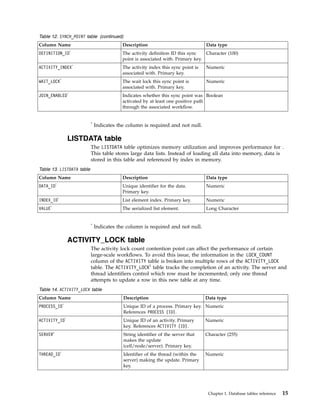
  • 155.
    Table 222. Valuesfor columns in the AUDIT_EVENT table (continued) Column Name Value action Types of actions: Add – Add a role. Modify – Modify an existing role. This action also involves modifying membership. Delete – Delete a role. AddMember – Add a member to the role. RemoveMember – Remove a member from the role. Table columns used in the AUDIT_EVENT table The following list shows the columns for each organization role management event in the AUDIT_EVENT table. Add Static Role event entity_name, entity_type, initiator_name, initiator_dn, initiator_type, initiator_person_dn, initiator_person_name, container_name, container_dn, timestamp, result_summary Modify Static Role event entity_name, entity_dn, entity_type, initiator_name, initiator_dn, initiator_type, initiator_person_dn, initiator_person_name, container_name, container_dn, timestamp, result_summary Delete Static Role event entity_name, entity_dn, entity_type, initiator_name, initiator_dn, initiator_type, initiator_person_dn, initiator_person_name, container_name, container_dn, timestamp, result_summary Add Member to Static Role event entity_name, entity_dn, entity_type, initiator_name, initiator_dn, initiator_type, initiator_person_dn, initiator_person_name, workflow_process_id, timestamp, result_summary AUDIT_MGMT_TARGET table: target_entity_name, target_entity_dn, target_entity_type Remove Member from Static Role event entity_name, entity_dn, entity_type, initiator_name, initiator_dn, initiator_type, initiator_person_dn, initiator_person_name, workflow_process_id, timestamp, result_summary AUDIT_MGMT_TARGET table: target_entity_name, target_entity_dn, target_entity_type Add Dynamic Role event entity_name, entity_type, workflow_process_id, initiator_name, initiator_dn, initiator_type, initiator_person_dn, initiator_person_name, container_name, container_dn, timestamp, result_summary Modify Dynamic Role event entity_name, entity_dn, entity_type, workflow_process_id, Chapter 3. Auditing schema tables 143
  • 156.
    initiator_name, initiator_dn, initiator_type,initiator_person_dn, initiator_person_name, container_name, container_dn, timestamp, result_summary Delete Dynamic Role event entity_name, entity_dn, entity_type, workflow_process_id, initiator_name, initiator_dn, initiator_type, initiator_person_dn, initiator_person_name, container_name, container_dn, timestamp, result_summary ITIM group management These AUDIT_EVENT columns are used by events that are related to ITIM group management, such as add, modify, and delete. In addition to the AUDIT_EVENT table, the AUDIT_MGMT_TARGET table is used by ITIM group management events. AUDIT_MGMT_TARGET table The AUDIT_MGMT_TARGET table is used if the action is Add Member or Remove Member. Table 223. AUDIT_MGMT_TARGET table Column Name Column Description Value Type Required? event_id Identifier associated with this event. Foreign key to the ID column of the table audit_event. long Yes target_entity_name The name of the member that is being added to or removed from the ITIM group. Applicable if action= Add Member or Remove Member. string Yes, when action= Add Member or Remove Member target_entity_dn The distinguished name of the member that is being added to or removed from the ITIM group. Applicable if action= Add Member or Remove Member. string Yes, when action= Add Member or Remove Member target_entity_type The type of the member that is being added to or removed from the ITIM group. Applicable if action= Add Member or Remove Member. string Yes when action= Add Member or Remove Member Values for columns in the AUDIT_EVENT table The following table describes the column values for the ITIM group management events in the AUDIT_EVENT table. Table 224. Values for columns in the AUDIT_EVENT table Column Name Value itim_event_category ITIM Group Management entity_name Name of the ITIM group. entity_dn Distinguished name of the ITIM group. 144 IBM Security Identity Manager Version 7.0.1.7: Database and Directory Server Schema Topics
  • 157.
    Table 224. Valuesfor columns in the AUDIT_EVENT table (continued) Column Name Value entity_type Types of entities: static_org_role – Static organizational role that is involved in this event. dynamic_org_role – Dynamic organizational role that is involved in this event. action Types of actions: Add – Add an ITIM group. Modify – Modify an ITIM group. This action also involves modifying membership. Delete – Delete an ITIM group. AddMember – Add a member to the ITIM group. RemoveMember – Remove a member from the ITIM group. Table columns used in the AUDIT_EVENT table The following list shows the columns for each ITIM group management event in the AUDIT_EVENT table. Add ITIM Group event entity_name, entity_type, initiator_name, initiator_dn, initiator_type, initiator_person_dn, initiator_person_name, container_name, container_dn, timestamp, result_summary Modify ITIM Group event entity_name, entity_dn, entity_type, initiator_name, initiator_dn, initiator_type, initiator_person_dn, initiator_person_name, container_name, container_dn, timestamp, result_summary Delete ITIM Group event entity_name, entity_dn, entity_type, initiator_name, initiator_dn, initiator_type, initiator_person_dn, initiator_person_name, container_name, container_dn, timestamp, result_summary Add Member to ITIM Group event entity_name, entity_dn, entity_type, initiator_name, initiator_dn, initiator_type, initiator_person_dn, initiator_person_name, workflow_process_id, timestamp, result_summary AUDIT_MGMT_TARGET table: target_entity_name, target_entity_dn, target_entity_type Remove Member from ITIM Group event entity_name, entity_dn, entity_type, initiator_name, initiator_dn, initiator_type, initiator_person_dn, initiator_person_name, workflow_process_id, timestamp, result_summary AUDIT_MGMT_TARGET table: target_entity_name, target_entity_dn, target_entity_type Service management This section describes the columns used by event-specific to service, such as add, modify, and delete. Chapter 3. Auditing schema tables 145
  • 158.
    In addition tothe AUDIT_EVENT table, the AUDIT_MGNT_TARGET table is used by account management events. AUDIT_MGNT_TARGET table Table 225. AUDIT_MGNT_TARGET table Column Name Column Description Value Type Required? event_id Identifier associated with this event. Foreign key to the ID column of the table audit_event. long Yes target_entity_name Name of the target (service, service profile, or all services) for the adoption rule. Applicable if action= Add, Modify, or Delete an adoption rule. string Yes for action= Add, Modify, or Delete an adoption rule target_entity_dn The distinguished name of the target (service, service profile, or all services) for adoption rule. Applicable if action= Add, Modify, or Delete an adoption rule. string Yes for action= Add, Modify, or Delete an adoption rule target_entity_type The type of the target (service, service profile, or all services) for adoption rule. Applicable if action= Add, Modify, or Delete an adoption rule. string Yes for action= Add, Modify, or Delete an adoption rule Values for columns in the AUDIT_EVENT table The following table describes the column values for the container management operations in the AUDIT_EVENT table. Table 226. Values for columns in the AUDIT_EVENT table Column Name Value itim_event_category Service Management. entity_name Name of the service. entity_dn Distinguished name of the service. entity_type Types of resource the service represents. For example: Active Directory, Oracle, LDAP, Windows 2000, or . action Types of actions: Add – Add a service. Modify – Modify a service. This action includes the change compliance alert operation. Delete – Delete a service. Add_adoption_rule – Add an adoption rule for this service group. Update_adoption_rule – Update adoption rule for this service/service type. Delete_adoption_rule – Delete adoption rule for this service/service type. Table columns used in the AUDIT_EVENT table The following list shows the columns for each person management action in the AUDIT_EVENT table. v Add Service event 146 IBM Security Identity Manager Version 7.0.1.7: Database and Directory Server Schema Topics
  • 159.
    entity_name, entity_type, initiator_name,initiator_dn, container_name, container_dn, timestamp, result_summary v Modify Service event entity_name, entity_dn, entity_type, initiator_name, initiator_dn, container_name, container_dn, timestamp, result_summary v Delete Service event entity_name, entity_dn, entity_type, initiator_name, initiator_dn, container_name, container_dn, timestamp, result_summary v Add Adoption rule Service event entity_name, entity_dn, initiator_name, initiator_dn, timestamp, result_summary AUDIT_MGMT_TARGET table: target_entity_name, target_entity_dn v Modify Adoption rule Service event entity_name, entity_dn, initiator_name, initiator_dn, timestamp, result_summary AUDIT_MGMT_TARGET table: target_entity_name, target_entity_dn v Delete Adoption rule Service event entity_name, entity_dn, initiator_name, initiator_dn, timestamp, result_summary AUDIT_MGMT_TARGET table: target_entity_name, target_entity_dn Group management This section describes the tables that are used by events that are related to group, such as add, modify, and delete. In addition to the AUDIT_EVENT table, the AUDIT_MGMT_TARGET table is used by group management events. AUDIT_MGMT_TARGET table The AUDIT_MGMT_TARGET table is used if the action is Add Member or Remove Member. Table 227. AUDIT_MGMT_TARGET table Column Name Column Description Value Type Required? event_id Identifier that is associated with this event. Foreign key to the ID column of the table audit_event. long Yes target_entity_name The name of the member that is being added to or removed from the group. Applicable if action= Add Member or Remove Member. string Yes, when action= Add Member or Remove Member target_entity_dn The distinguished name of the member that is being added to or removed from the group. Applicable if action= Add Member or Remove Member. string Yes, when action= Add Member or Remove Member target_entity_type The type of the member that is being added to or removed from the group. Applicable if action= Add Member or Remove Member. string Yes when action= Add Member or Remove Member Chapter 3. Auditing schema tables 147
  • 160.
    Values for columnsin the AUDIT_EVENT table The following table describes the column values for the group management events in the AUDIT_EVENT table. Table 228. Values for columns in the AUDIT_EVENT table Column Name Value itim_event_category Group Management entity_name Unique identifier of the group. This identifier can be the group ID or name. entity_dn Distinguished name of the group. entity_type Types of the group. For example: LdapGroupProfile, PosixAixGroupProfile. container_name Name of the service that holds the group. container_dn Distinguished name of the service that holds the group. action Types of actions: Add – Add a group. Modify – Modify a group. Delete – Delete a group. AddMember – Add a member to a group. RemoveMember – Remove a member from a group. Table columns used in the AUDIT_EVENT table The following list shows the columns for each group management event in the AUDIT_EVENT table. Add Group event entity_name, entity_dn, entity_type, initiator_name, initiator_dn, initiator_type, initiator_person_dn, initiator_person_name, container_name, container_dn, timestamp, result_summary Modify Group event entity_name, entity_dn, entity_type, initiator_name, initiator_dn, initiator_type, initiator_person_dn, initiator_person_name, container_name, container_dn, timestamp, result_summary Delete Group event entity_name, entity_dn, entity_type, initiator_name, initiator_dn, initiator_type, initiator_person_dn, initiator_person_name, container_name, container_dn, timestamp, result_summary Add Member to Group event entity_name, entity_dn, entity_type, initiator_name, initiator_dn, initiator_type, initiator_person_dn, initiator_person_name, container_name, container_dn, timestamp, result_summary AUDIT_MGMT_TARGET table: target_entity_name, target_entity_dn, target_entity_type Remove Member from Group event entity_name, entity_dn, entity_type, initiator_name, initiator_dn, initiator_type, initiator_person_dn, initiator_person_name, container_name, container_dn, timestamp, result_summary 148 IBM Security Identity Manager Version 7.0.1.7: Database and Directory Server Schema Topics
  • 161.
    AUDIT_MGMT_TARGET table: target_entity_name,target_entity_dn, target_entity_type Service policy enforcement This section describes the columns used by service policy enforcement events such as mark, correct, suspend, and alert. Values for columns in the AUDIT_EVENT table The following table describes the column values for the service policy enforcement events in the AUDIT_EVENT table. Table 229. Values for columns in the AUDIT_EVENT table Column Name Value itim_event_category service_policy_enforcement entity_name Name of the service. entity_dn Distinguished name of the service. entity_type Type of the resource the service represents. For example: Active Directory, Oracle, LDAP, Windows 2000, or . action Types of actions: EnforcePolicyForService - Enforce policy compliance MarkNonCompliant – Mark noncompliant accounts. SuspendNonCompliant – Suspend noncompliant accounts. CorrectNonCompliant – Correct noncompliant accounts. AlertNonCompliant – Alert the participant. UseGlobalSetting – Issues the action that is specified in global setting. Table columns used in the AUDIT_EVENT table The following list shows the columns for each service policy enforcement event in the AUDIT_EVENT table. Service Policy Enforcement action event entity_name, entity_type, workflow_process_id, initiator_name, initiator_dn, initiator_type, initiator_person_dn, initiator_person_name, action, container_name, container_dn, timestamp, result_summary Set Global Policy Enforcement properties event entity_name, entity_dn, entity_type, workflow_process_id, initiator_name, initiator_dn, initiator_type, initiator_person_dn, initiator_person_name, action, container_name, container_dn, timestamp, result_summary Reconciliation This section describes the columns used by events specific to reconciliation, such as runRecon, setServiceParams, and setReconUnit. Chapter 3. Auditing schema tables 149
  • 162.
    Values for columnsin the AUDIT_EVENT table The following table describes the column values for the reconciliation events in the AUDIT_EVENT table. Table 230. Values for columns in the AUDIT_EVENT table Column Name Value itim_event_category Reconciliation. entity_name Name of the service. entity_dn Distinguished name of the service. entity_type Type of the resource the service represents. For example: Active Directory, Oracle, LDAP, Windows 2000, or . action Types of actions: Runrecon – Start the reconciliation. SetServiceReconParameters – Set the service reconciliation parameters. SetReconUnit – Set the service reconciliation unit. Table columns used in the AUDIT_EVENT table The following list shows the columns for each reconciliation event in the AUDIT_EVENT table. Run Reconciliation event entity_name, entity_dn, entity_type, workflow_process_id, initiator_name, initiator_dn, initiator_type, initiator_person_dn, initiator_person_name, action, timestamp, result_summary Set Recon Unit event entity_name, entity_dn, entity_type, initiator_name, initiator_dn, action, timestamp, result_summary Set Service Recon Parameters event entity_name, entity_dn, entity_type, initiator_name, initiator_dn, action, timestamp, result_summary Entitlement workflow management This section describes the columns used by events specific to custom workflow management, such as add, modify, and delete. Values for columns in the AUDIT_EVENT table The following table describes the column values for the container management operations in the AUDIT_EVENT table. Table 231. Values for columns in the AUDIT_EVENT table Column Name Value itim_event_category Entitlement Workflow management. entity_name Name of the workflow. entity_dn Distinguished name of the workflow. 150 IBM Security Identity Manager Version 7.0.1.7: Database and Directory Server Schema Topics
  • 163.
    Table 231. Valuesfor columns in the AUDIT_EVENT table (continued) Column Name Value entity_type Types of entities: global – Applied to any policy regardless of the service type service_type – Type of service to which this workflow is applicable action Types of actions: Add – Add a workflow. Modify – Update a workflow. Delete – Delete a workflow. Table columns used in the AUDIT_EVENT table The following list shows the columns for each person management action in the AUDIT_EVENT table. v Add Entitlement workflow event entity_name, entity_dn, entity_type, initiator_name, initiator_dn, action, container_name, container_dn, timestamp, result_summary v Delete Entitlement workflow event entity_name, entity_dn, entity_type, initiator_name, initiator_dn, action, container_name, container_dn, timestamp, result_summary v Modify Entitlement workflow event entity_name, entity_dn, entity_type, initiator_name, initiator_dn, action, container_name, container_dn, timestamp, result_summary Entity operation management This section describes the columns used by events specific to system workflow management, such as add, modify, and delete. Values for columns in the AUDIT_EVENT table The following table describes the column values for the container management operations in the AUDIT_EVENT table. Table 232. Values for columns in the AUDIT_EVENT table Column Name Value itim_event_category Entity Operation Management. entity_name Name of the operation that is being managed. entity_dn Distinguished name of the workflow. entity_type Type of the entity whose operation is being managed. For example, Person, Account, Bpperson, ITIMAccount, SQLAccount, and others. action Types of actions: Add – Add an operation. Modify – Update an operation. Delete – Delete an operation. Chapter 3. Auditing schema tables 151
  • 164.
    Table columns usedin the AUDIT_EVENT table The following list shows the columns for each person management action in the AUDIT_EVENT table. v Add Entity Operation event entity_name, entity_dn, entity_type, initiator_name, initiator_dn, action, container_name, container_dn, timestamp, result_summary v Delete Entity Operation event entity_name, entity_dn, entity_type, initiator_name, initiator_dn, action, container_name, container_dn, timestamp, result_summary v Modify Entity Operation event entity_name, entity_dn, entity_type, initiator_name, initiator_dn, action, container_name, container_dn, timestamp, result_summary System configuration This section describes the columns used by events specific to configuration performed through the Configuration tab. Values for columns in the AUDIT_EVENT table The following table describes the column values for the container management operations in the AUDIT_EVENT table. Table 233. Values for columns in the AUDIT_EVENT table Column Name Value itim_event_category System Configuration. entity_name Name of the entity. The value is specific to the type of entity type that is being updated. entity_dn Distinguished name of the entity or entity type if the entity that is being updated is an attribute. entity_type Types of entity: FormTemplate – Formtemplate for object profiles JoinDirective – Policy join directives ComplianceAlertRule – Policy compliance alert rule (Privilege rule) LogonProperties – logon properties PolicyEnforcementProperties – Policy enforcement properties PostOfficeConfigurationProperties – Post Office configuration properties WorkflowNotificationProperties – Workflow notification properties ChallengeResponseProperties – challenge and response properties Serviceprofile – Service profile ITIM System Entity - System defined entities. For example, Person, Account, BPperson, Organization, BPOrganization, ITIMAccount, SQLAccount, and others. 152 IBM Security Identity Manager Version 7.0.1.7: Database and Directory Server Schema Topics
  • 165.
    Table 233. Valuesfor columns in the AUDIT_EVENT table (continued) Column Name Value action Types of actions: Add – Add a property or system entity from the Configuration tab. Modify – Update a property or system entity from the Configuration tab. Delete – Delete a property or system entity from the Configuration tab. Value of the entity_name column This section describes the value for the entity_name column for each entity_type value defined for system configuration events. Table 234. Value of the entity_name column table entity_type Value Example FormTemplate Name of the profile whose form is being modified. Admin Domain, Person, AIX Account, DSML2Service, SQLService, Organization JoinDirective Name of the attribute whose join directive is being updated. Errole, eruid, erhomepage Compliance Alert Rule Name of the attribute whose Compliance alert rule is being updated. Errole, eruid, erhomepage LogonProperties Property name. erLostPswdByMail, erResponseEmail, erNumLogonAttempt Policy Enforcement Properties Property name. Post Office Configuration Properties Property name. Workflow Notification Properties Property name. Challenge Response Properties Property name. erChallengeDefMode, erChallengeMode, erResponseEnable ITIM System Entity Attribute of the entity that is being updated. erAttrMap, erSearchAttr, erCustomClass, erRdnAttr, erLifeCycleRule. Serviceprofile Name of the service profile that is being installed or uninstalled. Win2kService, BroadVisionService, SolarisService Table columns used in the AUDIT_EVENT table The following list shows the columns for each person management action in the AUDIT_EVENT table. v Add System Entity event entity_name, initiator_name, initiator_dn, action, container_name, container_dn, timestamp, result_summary v Delete System Entity event entity_name, entity_dn, initiator_name, initiator_dn, action, container_name, container_dn, timestamp, result_summary v Modify System Entity event entity_name, entity_dn, entity_type, initiator_name, initiator_dn, action, container_name, container_dn, timestamp, result_summary Chapter 3. Auditing schema tables 153
  • 166.
    v Add LifeCycle Rule event entity_name, initiator_name, initiator_dn, action, container_name, container_dn, timestamp, result_summary v Delete Life Cycle Rule event entity_name, initiator_name, initiator_dn, action, container_name, container_dn, timestamp, result_summary v Modify Life Cycle Rule event entity_name, initiator_name, initiator_dn, action, container_name, container_dn, timestamp, result_summary v Set Challenge Config event initiator_name, initiator_dn, action, container_name, container_dn, timestamp, result_summary v Set Challenges event initiator_name, initiator_dn, action, container_name, container_dn, timestamp, result_summary v Set Form Template event entity_name, entity_dn, initiator_name, initiator_dn, action, container_name, container_dn, timestamp, result_summary v Set Password Properties event initiator_name, initiator_dn, action, container_name, container_dn, timestamp, result_summary v Set Post Office Properties event initiator_name, initiator_dn, action, container_name, container_dn, timestamp, result_summary v Set Privilege Rule event entity_name, entity_dn, initiator_name, initiator_dn, action, container_name, container_dn, timestamp, result_summary v Set Workflow Notification Properties event initiator_name, initiator_dn, action, container_name, container_dn, timestamp, result_summary v Set Workflow Notification Template event entity_name, entity_dn, initiator_name, initiator_dn, action, container_name, container_dn, timestamp, result_summary Runtime events This section describes the columns used by event related to start and stop events. Values for columns in the AUDIT_EVENT table The following table describes the column values for the container management operations in the AUDIT_EVENT table. Table 235. Values for columns in the AUDIT_EVENT table Column Name Value itim_event_category runtime events. action Types of actions: Start_itim – Start command for . MStop_itim – Stop command for . 154 IBM Security Identity Manager Version 7.0.1.7: Database and Directory Server Schema Topics
  • 167.
    Table columns usedin the AUDIT_EVENT table The following list shows the columns for each person management action in the AUDIT_EVENT table. v Start ITIM Server event action, timestamp, result_summary v Stop ITIM Server event action, timestamp, result_summary Self-password change This section describes the columns that are used by events that are related to password change. If a self-password change request affects at least one ITIM account and at least one non-ITIM account, two separate events are audited for the request. One self-password change event is audited for the ITIM accounts. Another self-password change event is audited for the non-ITIM accounts. Values for columns in the AUDIT_EVENT table The following table describes the column values for the self-password change events in the AUDIT_EVENT table. Table 236. Values for columns in the AUDIT_EVENT table Column Name Value itim_event_category Self-password change. action Types of actions: ChangePassword – Changing a self-password. ResetPassword – Resetting a self-password. Table columns used in the AUDIT_EVENT table The following list shows the columns for each self-password change event in the AUDIT_EVENT table. Change self-password event entity_name, entity_dn, action, workflow_process_id, initiator_name, initiator_dn, initiator_type, initiator_person_dn, initiator_person_name, timestamp, result_summary Reset self-password event entity_name, entity_dn, action, workflow_process_id, initiator_name, initiator_dn, initiator_type, initiator_person_dn, initiator_person_name, timestamp, result_summary Migration This section describes the columns used by events related to migration (import and export) operations. Chapter 3. Auditing schema tables 155
  • 168.
    Values for columnsin the AUDIT_EVENT table The following table describes the column values for the migration events in the AUDIT_EVENT table. Table 237. Values for columns in the AUDIT_EVENT table Column Name Value itim_event_category Migration. action Types of actions: StartImport StopImport StartExport StopExport InstallAgentProfile Table columns used in the AUDIT_EVENT table The following list shows the columns for each migration event in the AUDIT_EVENT table. Start Import event Event_category, operation, action, initiator_name, initiator_dn, initiator_type, initiator_person_dn, initiator_person_name, timestamp, result_summary Stop Import event Event_category, operation, action, initiator_name, initiator_dn, initiator_type, initiator_person_dn, initiator_person_name, timestamp, result_summary Start Export event Event_category, operation, action, initiator_name, initiator_dn, initiator_type, initiator_person_dn, initiator_person_name, timestamp, result_summary Stop Export event Event_category, operation, action, initiator_name, initiator_dn, initiator_type, initiator_person_dn, initiator_person_name, timestamp, result_summary Agent Profile Install event Event_category, operation, action, initiator_name, initiator_dn, initiator_type, initiator_person_dn, initiator_person_name, timestamp, result_summary Credential management This section describes the columns used by events related to Credential management. For example, add to vault, modify, delete, register password, view password history, or get password for non-exclusive credential. 156 IBM Security Identity Manager Version 7.0.1.7: Database and Directory Server Schema Topics
  • 169.
    Values for columnsin the AUDIT_EVENT table The following table describes the column values for the Credential management operations in the AUDIT_EVENT table. Table 238. Values for columns in the AUDIT_EVENT table Column Name Value itim_event_category CredentialManagement entity_name Credential name. entity_dn Distinguished name of the credential. entity_type Credential workflow_process_id Process ID of the initiated workflow. Only applicable to Add action. result_summary Result of operation: Submitted – submitted to workflow successfully Success – completed successfully action Types of actions: Add – add a credential to vault Modify – modify a credential Delete – delete a credential from vault RegisterPassword – register credential password in the vault PasswordHistory – view credential password history in the vault GetPassword – get password of non-exclusive credential from vault Connect – connect a credential to an account Table columns used in the AUDIT_EVENT table The following list shows the columns for each Credential management action in the AUDIT_EVENT table. v Add to Vault event entity_name, entity_type, initiator_name, initiator_dn, workflow_process_id, container_name, container_dn, timestamp, result_summary, comments v Delete Credential event entity_name, entity_dn, entity_type, initiator_name, initiator_dn, container_name, container_dn, timestamp, result_summary v Modify Credential event entity_name, entity_dn, entity_type, initiator_name, initiator_dn, container_name, container_dn, timestamp, result_summary v Register Password event entity_name, entity_dn, entity_type, initiator_name, initiator_dn, container_name, container_dn, timestamp, result_summary v View Password History event entity_name, entity_dn, entity_type, initiator_name, initiator_dn, container_name, container_dn, timestamp, result_summary v Get Password event Chapter 3. Auditing schema tables 157
  • 170.
    entity_name, entity_dn, entity_type,initiator_name, initiator_dn, container_name, container_dn, timestamp, result_summary v Connect credential event entity_name, entity_dn, entity_type, initiator_name, initiator_dn, workflow_process_id, container_name, container_dn, timestamp, result_summary, comments Credential Pool management This section describes the columns used by events related to Credential Pool management, such as add, modify, or delete. Values for columns in the AUDIT_EVENT table The following table describes the column values for the Credential Pool management operations in the AUDIT_EVENT table. Table 239. Values for columns in the AUDIT_EVENT table Column Name Value itim_event_category CredentialPoolManagement entity_name Credential pool name. entity_dn Distinguished name of the credential pool. entity_type CredentialPool result_summary Result of operation: Success – completed successfully action Types of actions: Add – add a credential pool Modify – modify a credential pool Delete – delete a credential pool Table columns used in the AUDIT_EVENT table The following list shows the columns for each Credential Pool management action in the AUDIT_EVENT table. v Add Credential Pool event entity_name, entity_dn, entity_type, initiator_name, initiator_dn, container_name, container_dn, timestamp, result_summary v Delete Credential Pool event entity_name, entity_dn, entity_type, initiator_name, initiator_dn, container_name, container_dn, timestamp, result_summary v Modify Credential Pool event entity_name, entity_dn, entity_type, initiator_name, initiator_dn, container_name, container_dn, timestamp, result_summary Credential Lease management This section describes the columns used by events related to Credential Lease management. For example, check out, check in, get password, notify expired lease, or notify and check in expired lease. 158 IBM Security Identity Manager Version 7.0.1.7: Database and Directory Server Schema Topics
  • 171.
    AUDIT_MGMT_LEASE table The AUDIT_MGMT_LEASEtable is used in the following events. The events are: v Checkout event v All other events if the credential is a pool member Table 240. AUDIT_MGMT_LEASE table Column Name Column Description Data type event_id* Identification assigned to the event. References AUDIT_EVENT (ID). Numeric lease_expiration_date The lease expiration time. Only applicable to the Checkout action. Character (500) justification The business justification for checkout. Only applicable to the Checkout action. Character (2000) pool_name The credential pool name. Applicable to all actions if the credential is a pool member. Character (256) pool_dn The credential pool DN. Applicable to all actions if the credential is a pool member. Character (2000) custom_attribute_1 to custom_attribute_5 The lease custom attribute values. Only applicable to the Checkout action. Character (2000) lease_dn The lease DN. Character (2000) * Indicates the column is required and not null. Values for columns in the AUDIT_EVENT table The following table describes the column values for the Credential Lease management operations in the AUDIT_EVENT table. Table 241. Values for columns in the AUDIT_EVENT table Column Name Value itim_event_category CredentialLeaseManagement entity_name Credential name. entity_dn Distinguished name of the credential. entity_type Credential workflow_process_id Process ID of the initiated workflow. Applicable to Checkin, Checkout, NotifyExpiredLease, and NotifyCheckinExpiredLease actions. result_summary Result of operation: Submitted – submitted to workflow successfully. Success – completed successfully. Only applicable to GetPassword action. Failure – failed. Only applicable to the second Checkin event, which tries to check in a credential already checked in by someone else. Chapter 3. Auditing schema tables 159
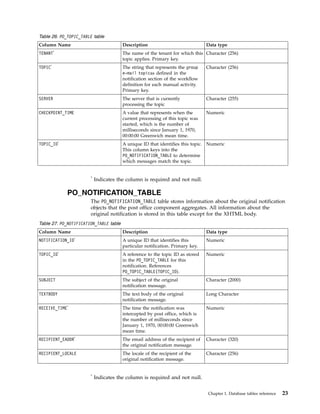
  • 172.
    Table 241. Valuesfor columns in the AUDIT_EVENT table (continued) Column Name Value action Types of actions: Checkout – check out a credential. Checkin – check in a credential. GetPassword – get password of a checked out credential. NotifyExpiredLease – Notify an expired lease. NotifyCheckinExpiredLease – Notify and check in an expired lease. Table columns used in the AUDIT_EVENT table The following list shows the columns for each Credential Lease management action in the AUDIT_EVENT table. v Checkout event entity_name, entity_dn, entity_type, initiator_name, initiator_dn, workflow_process_id, container_name, container_dn, timestamp, result_summary AUDIT_MGMT_LEASE table: lease_expiration_time, justification, pool_name, pool_dn, custom_attribute_1, custom_attribute_2, custom_attribute_3, custom_attribute_4, custom_attribute_5 v Checkin event entity_name, entity_dn, entity_type, initiator_name, initiator_dn, workflow_process_id, container_name, container_dn, timestamp, result_summary, comments Note: If a user or an ESSO session tries to check in a credential already checked in by someone else, then the second checkin attempt is audited as a Checkin event. The result_summary is FAILURE and the comment is Invalid lease during checkin. AUDIT_MGMT_LEASE table: pool_name, pool_dn, lease_dn v Get Password event entity_name, entity_dn, entity_type, initiator_name, initiator_dn, container_name, container_dn, timestamp, result_summary AUDIT_MGMT_LEASE table: pool_name, pool_dn v Notify Expired Lease event entity_name, entity_dn, entity_type, initiator_name, initiator_dn, workflow_process_id, container_name, container_dn, timestamp, result_summary AUDIT_MGMT_LEASE table: pool_name, pool_dn 160 IBM Security Identity Manager Version 7.0.1.7: Database and Directory Server Schema Topics
  • 173.
    v Notify andCheckin Expired Lease event entity_name, entity_dn, entity_type, initiator_name, initiator_dn, workflow_process_id, container_name, container_dn, timestamp, result_summary AUDIT_MGMT_LEASE table: pool_name, pool_dn, lease_dn Chapter 3. Auditing schema tables 161
  • 174.
    162 IBM SecurityIdentity Manager Version 7.0.1.7: Database and Directory Server Schema Topics
  • 175.
    Chapter 4. IBMCognos reporting query subjects and query items You can use the query subjects and query items to customize the reports. IBM Cognos reporting model is broadly dived into audit and configuration namespaces. Audit namespace Consists of the query subjects and query items for the audit activities. Configuration namespace Consists of the query subjects and query items for the configuration activities. Schema mapping Before you work with the query subjects and query items, you must map the attributes to the entities. To map the attributes and entities, see “Mapping the attributes and entities.” For more information, see Report schema mapping Mapping the attributes and entities You must map the following attributes to the entities to work with the query items for the IBM Security Identity Manager Cognos report models. Note: After you map the schema by using IBM Security Identity Manager administration console, it might take some time to reflect the updated data in the Cognos report. You must run a successful data synchronization after mapping the attributes. You must restart IBM Cognos Business Intelligence server to reflect the updated schema in the report. Table 242. Mapping the attributes and entities Namespace Entity Attribute Name Account Configuration Organizational Role v Access Name v Object Profile Name Identity Policy v Policy Name v Policy Target v Enabled v Scope v UserClass Password Policy v Policy Name v Policy Target v Enabled v Scope Account Account Ownership Type 163
  • 176.
    Table 242. Mappingthe attributes and entities (continued) Namespace Entity Attribute Name Role Configuration Organizational Role v Access Name v Access Options v Object Profile Name v Owner Provisioning Policy Config Provisioning Policy v Enabled v Entitlement Ownership Type v Priority v Scope Shared Access Audit Account Account Ownership Type Shared Access Configuration Account Account Ownership Type Group Group Name Recertification Audit Account Account Ownership Type Recertification Config Account Account Ownership Type Group v eraccessdescription v Group Description v Group Name Recertification Policy Scope User Configuration Account Account Ownership Type Person v Administrative Assistant v Preferred user ID v Email Address v Aliases Organizational Role v Access Name v Access Options v Object Profile Name v Owner Business Partner Person v Organization Role v Status Service Audit Service Tag Provisioning Policy v Enabled v Priority v Scope Access Audit Group v Access Options v Group Name Organizational Role v Access Name v Object Profile Name Access Configuration Business Partner Person v Full Name v Last Name v Organizational Unit Name Recertification Audit namespace The Recertification Audit namespace provides information about the history of user, role, account, and group recertification. 164 IBM Security Identity Manager Version 7.0.1.7: Database and Directory Server Schema Topics
  • 177.
    Query subjects forRecertification Audit namespace The following table lists the query subjects in the Recertification Audit namespace. Table 243. Query subjects in the Recertification Audit namespace for the recertification model Query subject Description User Recertification Policy Represents the recertification policy that recertifies accounts, group memberships, and roles memberships through user recertification. IBM Security Identity Manager entities are recertified with the recertification policy. You must use this query subject with the User Recert History query subject to obtain information about the recertification policy. Do not use this query subject with Account Recert History and Access Recert History. User Recert History Represents the recertification audit history for a user. It covers recertification audit history of accounts, groups, and roles that are associated with the user. Person Represents a user entity and some of its configuration attributes. You must use this query subject with the User Recert History query subject to obtain information about the user that is being recertified. Person Organization Represents an organization that is associated with a user. These users are being recertified. User Recert Account Represents the recertification audit history for an account that is recertified as part of the user recertification. You must use this query subject with the User Recert History. By doing so, you can obtain the information about accounts that are associated with the users that are being recertified. User Recert Group Represents the recertification audit history for a group membership that is recertified as part of the user recertification. You must use this query subject with the User Recert History. By doing so, you can obtain the information about memberships of the accounts that are associated with the users that are being recertified. User Recert Group Service Represents the service that is associated to a group. You must use this query subject with the User Recert History to obtain more information about the service for the groups that are recertified as a part of the user recertification. User Recert Role Represents the recertification audit history for a role membership that is recertified as part of the user recertification. You must use this query subject with the User Recert History. By doing so, you can obtain the information about role memberships of the users that are being recertified. Account Represents an account entity and some of its configuration attributes. You must use this query subject with the Account Recert History query subject. By doing so, you can generate recertification history reports of accounts. Account Service Represents service that is associated to an account. These accounts participate in the account and access recertification. Account Owner Represents user owners of the accounts that are participating in the account and access recertification. Account Recert History Represents the recertification audit history for accounts. You must use this query subject with the Account query subjects. By doing so, you can find out the accounts in the recertification audit. Access Represents the group access and some of its configuration attributes. You must use this query subject with the Access Recert History query subject to generate recertification history reports of access. Access Recert History Represents the recertification audit history for access. You must use this query subject with the Access query subjects. By doing so, you can find out the accesses in the recertification audit. Chapter 4. IBM Cognos reporting query subjects and query items 165
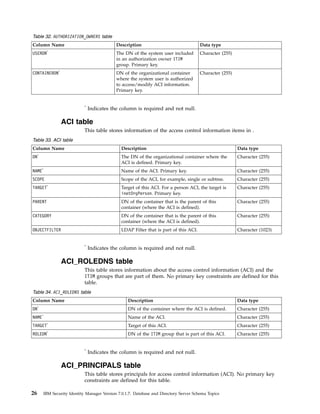
  • 178.
    Query items forRecertification Audit namespace The following table lists the query items in the Recertification Audit namespace. Table 244. Query items in the Recertification Audit namespace Query subject Query items and their description User Recertification Policy Recertification Policy Name The name of the recertification policy. Recertification Policy Type The type of an entity that gets recertified by using this policy. The valid values are Account, Access, and Identity. Recertification Policy Description The description of the policy as specified in the policy configuration. Recertification Policy Enabled Shows whether the policy is enabled. Recertification Policy Scheduled The recertification scheduling modes. The valid values are CALENDAR and ROLLING. Recertification Policy Rolling Interval in Days The recertification period if the recertification policy scheduling mode is ROLLING. No value in this query item indicates that the scheduling is not in the ROLLING mode. Recertification Policy Reject Action An action that was taken if the recertification is rejected. Recertification Policy Timeout Period in Days The duration during which a recertifier must act. Recertification Policy Timeout Action The automatic action that must be taken if the recertification times out. Recertification Policy DN An LDAP distinguished name for the recertification policy. Recertification Policy Container DN An LDAP distinguished name for a business unit to which the recertification policy applies. Recertification Policy Is Custom Indicates whether the recertification policy is customized. It is defined in the workflow. Recertification Policy User Class The type of a user to which the recertification policy applies. The valid values are All, Person, and Business Partner Person. Recertification Policy Scope Indicates whether the recertification policy applies to the business unit and its subunits or either of them. 166 IBM Security Identity Manager Version 7.0.1.7: Database and Directory Server Schema Topics
  • 179.
    Table 244. Queryitems in the Recertification Audit namespace (continued) Query subject Query items and their description User Recert History User Recert History Person Name The full name of a person. User Recert History Person Email The user email identifier. User Recert History Person Status A user status at the end of the recertification workflow process. The valid values are Active and Inactive. User Recert History Person Business Unit Name A business unit to which a user belongs. User Recert History Recertification Policy Name The recertification policy that created a user entity. User Recert History Timeout Shows whether the recertification process is timed out or not. 0 represents Not timed out, and 1 represents Timed out. User Recert History Comments The comments that are entered by a user during the user recertification process. User Recert History Process Comments The comments that are entered by a user during the recertification process. User Recert History Process Submission time The recertification policy submission time. User Recert History Process Start Time The time at which user recertification workflow process was started. User Recert History Process Completion Time A user recertification history process completion time. User Recert History Process Last Modified Time The time at which user recertification workflow process was last modified. User Recert History Process Requester Name The name of a user who submitted the request for recertification. User Recert History Process Requestee Name The name of a user entity for whom the request for recertification was submitted. User Recert History Process Recertifier Name The name of a user who is the final approver in the recertification workflow process. User Recert History Process Result Summary An overall summary of a user recertification workflow process result. User Recert History Process Scheduled The schedule for recertification policy submission. User Recert History Id A unique ID assigned by the IBM Security Identity Manager to a user recertification audit history. User Recert History Person DN An LDAP distinguished name for a user entity in the recertification process. User Recert History Recertification Policy DN An LDAP distinguished name for the recertification policy that recertifies a user entity. Chapter 4. IBM Cognos reporting query subjects and query items 167
  • 180.
    Table 244. Queryitems in the Recertification Audit namespace (continued) Query subject Query items and their description Person Person Full Name The full name of a user. Person Last Name The surname of a user. Person Status The status of a user. Person Dn An LDAP distinguished name for a user entity. Person Business Unit Dn An LDAP distinguished name for a business unit to which a user belongs. Person Supervisor The name of a user who is the supervisor of a user entity. Person Organization Business Unit Name The name of a business unit to which a user belongs. Business Unit Supervisor A user supervisor of a business unit. Business Unit DN An LDAP distinguished name for the business unit to which a user belongs. Business Unit Container DN An LDAP distinguished name for the parent business unit of an organization entity. User Recert Account User Recert Account Name The name of an account in a user recertification. User Recert Account Service Name The name of a service to which an account belongs. User Recert Account Service Description Describes the service that is associated to an account. User Recert Account Status The status of an account at the end of the recertification. The valid values are Approved and Rejected. User Recert Account Recert Id A unique numeric ID assigned by the IBM Security Identity Manager to an account recertification. User Recert Account DN An LDAP Distinguished name for an account entity in the recertification. User Recert Account Service DN An LDAP Distinguished name for the service to which an account entity belongs. 168 IBM Security Identity Manager Version 7.0.1.7: Database and Directory Server Schema Topics
  • 181.
    Table 244. Queryitems in the Recertification Audit namespace (continued) Query subject Query items and their description User Recert Group User Recert Group Name The name of a group in the user recertification. User Recert Group Description Describes the recertification group. User Recert Group Status The status of a group at the end of the recertification. The valid values are Approved and Rejected. User Recert Group Recert Id A unique numeric ID assigned by IBM Security Identity Manager to a group recertification. User Recert Group DN An LDAP Distinguished name for a group entity in the recertification. User Recert Group Service Group Name The name of a group. Service Name The name of a service to which the group belongs. Service Type The service profile type. Service Url A URL that connects to the managed resource. Service DN An LDAP distinguished name for a service to which the group belongs. Service Container Dn An LDAP distinguished name for a business unit of the service that is associated with a group. Service Owner Dn An LDAP distinguished name for a user owner of the service. Group Dn An LDAP distinguished name for a group entity in the recertification. User Recert Role User Recert Role Name The name of a role in the user recertification. User Recert Role Description The description of a role. User Recert Role Status The status of a role at the end of the recertification. The valid values are Approved and Rejected. User Recert Role Recert Id A unique numeric identifier that is assigned by IBM Security Identity Manager to a role recertification. User Recert Role DN An LDAP Distinguished name for a role entity in the recertification. Chapter 4. IBM Cognos reporting query subjects and query items 169
  • 182.
    Table 244. Queryitems in the Recertification Audit namespace (continued) Query subject Query items and their description Account Account Name The name of an account. Account Service Dn An LDAP distinguished name for a service that provisions an account. Account Status The status of an account. The valid values are Active and Inactive. Account Compliance The details about an account compliance. The valid values are Unknown, Compliant, Non Compliant, and Disallowed. Account Ownership Type The ownership type of an account. The valid values are Individual, System, Device, and Vendor. Account Last Access Date The last date when an account was accessed. Account Container Dn An LDAP distinguished name for a business unit to which an account belongs. Account Service Service Name The name of a service to which an account belongs. Service Dn An LDAP distinguished name for a service to which an account belongs. Service Container DN An LDAP distinguished name for a business unit of a service that is associated to the accounts. Service Owner DN An LDAP distinguished name for a user owner of the service. Service Url A URL that connects to the managed resource. Service Type The service profile type. Account Owner Person Full Name The full name of a user who owns an account. Person Last Name The surname of a user who owns an account. Person Status The status of a user who owns an account. Person DN An LDAP distinguished name for an account owner. Person Business Unit DN An LDAP distinguished name for a business unit that is associated to an account owner. Person Supervisor The supervisor of an account owner. 170 IBM Security Identity Manager Version 7.0.1.7: Database and Directory Server Schema Topics
  • 183.
    Table 244. Queryitems in the Recertification Audit namespace (continued) Query subject Query items and their description Account Recert History Recert History Service Name The name of a service to which accounts and groups belong. These accounts and groups are involved with an account recertification audit. Recert History Service Profile The profile type of a service. Recert History Status An account status at the end of the recertification workflow process. The valid values are Abort, Approved, Timeout, Pending, and Rejected. Recert History Action The action that is taken on an account at the end of recertification process as defined by the recertification policy. The valid values are Abort, Certify, Delete, Mark, Certify Administrative, and Suspend. Recert History Comments The comments that are entered by a user during recertification process. Recert History Process Start Time The time at which an account recertification workflow process started. Recert History Process Submission Time The time at which recertification policy was submitted. Recert History Process Completion Time The time at which an account recertification workflow process completed. Recert History Process Last Modified Time The last modified time for an account recertification workflow process. Recert History Process Comments The comments that are entered by a user during recertification process. Recert History Process Result Summary The summary of the recertification process result. The valid values are Success, Failed, Pending, Escalated, Skipped, Timeout, and Warning. Recert History Process Requestee Name The name of a user entity for whom the recertification request is submitted. For example, if the entity for recertification is an account, then the query item is the name of the account. Recert History Process Requester Name The name of a user who submitted the recertification request. For example, if administrator submits a request for recertification, then this query item is the name of the administrator. Recert History Recertifier Name The name of a user who is the final approver in the recertification workflow process. Recert History Activity Owner An owner of recertification activity for an account. Recert History Recertifier Id An account identifier of the recertifier. Chapter 4. IBM Cognos reporting query subjects and query items 171
  • 184.
    Table 244. Queryitems in the Recertification Audit namespace (continued) Query subject Query items and their description Access Group ID An identifier for a group. Group Name The name of a group for which an access is defined. Group Type The profile type of a group. Group Access Name The name of the access that is defined for a group. Group Access Type The type of the access that is defined for a group. Group DN An LDAP distinguished name for a group entity for which an access is defined. Group Container DN An LDAP distinguished name for a business unit that is associated with a group. Group Service DN An LDAP distinguished name for the service that is associated to a group. 172 IBM Security Identity Manager Version 7.0.1.7: Database and Directory Server Schema Topics
  • 185.
    Table 244. Queryitems in the Recertification Audit namespace (continued) Query subject Query items and their description Access Recert History Recert History Service Name The name of a service to which accesses and groups belong. These accesses and groups are involved with an access recertification audit. Recert History Service Profile The profile type of a service. Recert History Status An access status at the end of the recertification workflow process. The valid values are Abort, Approved, Timeout, Pending, and Rejected. Recert History Action The action that is taken on an access at the end of recertification process as defined by the recertification policy. The valid values are Abort, Certify, Delete, Mark, Certify Administrative, and Suspend. Recert History Comments The comments that are entered by a user during recertification process. Recert History Process Start Time The time at which an access recertification workflow process started. Recert History Process Submission Time The time at which recertification policy was submitted. Recert History Process Completion Time The time at which an access recertification workflow process completed. Recert History Process Last Modified Time The last modified time for an access recertification workflow process. Recert History Process Comments The comments that are entered by a user during recertification process. Recert History Process Result Summary The summary of the recertification process result. The valid values are Success, Failed, Pending, Escalated, Skipped, Timeout, and Warning. Recert History Process Requestee Name The name of a user entity for whom the recertification request is submitted. For example, if the entity for recertification is an access, then the query item is the name of the access. Recert History Process Requester Name The name of a user who submitted the recertification request. For example, if administrator submits a request for recertification, then this query item is the name of the administrator. Recert History Recertifier Name The name of a user who is the final approver in the recertification workflow process. Recert History Activity Owner An owner of recertification activity for an access. Recert History Recertifier Id An access identifier of the recertifier. Chapter 4. IBM Cognos reporting query subjects and query items 173
  • 186.
    Recertification Config namespace TheRecertification Config namespace provides information about the defined recertification policies and target that is defined for those policies. Query subjects for Recertification Config namespace The following table lists the query subjects in the Recertification Config namespace. Table 245. Query subjects in the Recertification Config namespace Query subject Description Recertification Policy Represents the recertification policy and its components. Recertification Policy Schedule Represents the schedule that is used to auto trigger the recertification policy. Policy Recertifier Represents a user who is a recertifier for the recertification policy. Recert Policy Business Unit Represents a business unit to which the recertification policy applies. Recert Policy Role Target Represents the roles that are recertified by the recertification policy. You must use this query subject with the Recertification Policy to obtain information about the roles that are certified and their configuration attributes. Recert Policy Access Target Represents a group access and group membership that are recertified by the recertification policy. You must use this query subject with the Recertification Policy to obtain information about: v Group access v Group membership v Configuration attributes of group access and group membership v Informative attributes of a service that are associated with a group Recert Policy Access Owner Represents a group access owner that are recertified by the recertification policy. You must use this query subject with the Recertification Policy to obtain information about the group access owner name. Group Members Represents the information about the members of a recertified group. You must use this query subject with the Recert Policy Access Target to obtain information about the members of the recertified group. Recert Policy Account Target Represents a service on which the accounts are provisioned and recertified by the recertification policy. You must use this query subject with the Recertification Policy to obtain more information about: v Account recertified v Service on which these accounts are provisioned Account Represents account entity and some of its configuration attributes. You must use this query subject with the Recert Policy Account Target to obtain more information about the accounts that are associated with the service. Person Represents a user entity and some of its configuration attributes. You must use this query subject with the Recert Policy Role Target query subject to obtain more information about the members of the role. Account Owner Represents a user owner of an account. You must use this query subject with the Account query subject to obtain information about the owners of the accounts. Query items for Recertification Config namespace The following table lists the query items in the Recertification Config namespace. 174 IBM Security Identity Manager Version 7.0.1.7: Database and Directory Server Schema Topics
  • 187.
    Table 246. Listof query items in the Recertification Config namespace Query subject Query items and their description Recertification Policy Recertification Policy Name The name of the recertification policy. Recertification Policy Type The type of an entity that gets recertified by using this policy. The valid values are User, Account, and Access. Recertification Policy Description The policy description as specified in the policy configuration. Recertification Policy Enabled Shows whether the policy is enabled or not. Recertification Policy Scheduled The recertification scheduling modes. The valid values are CALENDAR and ROLLING. Recertification Policy Rolling Interval in Days The recertification period if the recertification policy scheduling mode is ROLLING. No value in this query item indicates that the scheduling is not in the ROLLING mode. Recertification Policy Reject Action An action that is taken if the recertification is rejected. Recertification Policy Timeout Period in Days The duration during which a recertifier must act. Recertification Policy Timeout Action An automatic action that must be taken if the recertification times out. Recertification Policy DN An LDAP distinguished name for the recertification policy. Recertification Policy Container DN An LDAP distinguished name for a business unit to which the recertification policy applies. Recertification Policy Is Custom Represents whether the recertification policy is customized. It is defined in the workflow. Recertification Policy User Class The type of a user to which the recertification policy applies. The valid values are All, Person, and Business Partner Person. Recertification Policy Scope Indicates whether the recertification policy applies to the business unit and its subunits or either of them. Chapter 4. IBM Cognos reporting query subjects and query items 175
  • 188.
    Table 246. Listof query items in the Recertification Config namespace (continued) Query subject Query items and their description Recertification Policy Schedule Recertification Policy Detailed Schedule The recertification schedule in terms of the units of time. Note: Do not use this query item with Oracle database. This query item is supported only for DB2 database. Recertification Policy Schedule The schedule that automatically triggers the recertification policy. The query item represents the schedule in the numeric format. The format of the schedule is Minute Hours Month DayOfWeek DayOfMonth DayOfQuarter DayOfSemiAnnual. For example, 0 0 0 0 -1 0 0. v Minute - Represents the time in minutes. v Hours - Represents the time in hours. -1 indicates that the recertification policy is applied every hour. v Month - Represents the month for the recertification. 1 represents January, 2 represents February, and so on. -1 indicates that the recertification policy is applied every month. v DayOfWeek - Represents the day of a week. 1 represents Sunday, 2 represents Monday, and so on. The positive value indicates that policy is applied weekly on a specific day. -1 indicates that the recertification policy is not applied based on the day of a week. v DayOfMonth - Represents the date. -1 indicates that the recertification policy is applied daily. v DayOfQuarter - Represents the number of days after the start of each quarter. 0 indicates that the policy is not applied quarterly. v DayOfSemiAnnual - Represents the number of days after the start of each half year. 0 indicates that the policy is not applied semi-annually. v The policy is applied annually if the value of Month and DayOfMonth is positive. Recertification Policy DN An LDAP distinguished name for the recertification policy. Policy Recertifier Recertifier Type The type of the recertifier. The valid values and their meanings: v Account Owner: User being recertified Note: This meaning applies only for the recertification policies that are related to the users. For all other recertification policies, Account Owner is an owner of the account. v System Administrator: Administrator v Manager: Manager v Person: Specified user v Role: Specified organizational role v System Role: Specified group Recertifier Name The name of a specific user, role, or group that is defined as an approver of the recertification. When the recertification policy's recertifier is set to User being recertified, then the Recertifier Name is shown as a blank. Recert Policy Dn An LDAP distinguished name for the recertification policy. 176 IBM Security Identity Manager Version 7.0.1.7: Database and Directory Server Schema Topics
  • 189.
    Table 246. Listof query items in the Recertification Config namespace (continued) Query subject Query items and their description Recert Policy Business Unit Business Unit Name The name of a business unit. Business Unit Supervisor The user supervisor of a business unit. Business Unit Dn An LDAP distinguished name for a business unit. Business Unit Container DN An LDAP distinguished name for the parent organization of a business unit entity. Recert Policy Role Target Role Name The name of the role. If the policy applies to all the roles in a business unit, then ALL ROLES WITHIN POLICY ORGANIZATION is displayed. Role Description The description of a role. Role Type The type of a role. The valid values are Static and Dynamic. The value of a role type is empty if the role name is mentioned as ALL ROLES WITHIN POLICY ORGANIZATION. Role Business Unit Name The business unit to which the role belongs. Role Business Unit Supervisor The user supervisor of a business unit to which the role belongs. Role DN An LDAP distinguished name for the role. Role Business Unit DN An LDAP distinguished name for the business unit to which role belongs. Recert Policy Dn An LDAP distinguished name for the recertification policy. Chapter 4. IBM Cognos reporting query subjects and query items 177
  • 190.
    Table 246. Listof query items in the Recertification Config namespace (continued) Query subject Query items and their description Recert Policy Access Target Group Name The name for a group. If the policy applies to all the groups in an organization, then ALL GROUPS WITHIN POLICY ORGANIZATION is displayed. If the policy applies to all the groups for a service, then ALL GROUPS ON A SPECIFIED SERVICE is displayed. Group Description The description of a group. Group Type The profile type of a group. Group Access Name An access name that is defined for a group entity. Group Access Description The description of an access that is defined for a group entity. Group Access Type The type of an access that is defined for a group entity. Group Service Name The name of a service on which the group is provisioned. Group Dn An LDAP distinguished name for a group. Group Service DN An LDAP distinguished name for the service on which a group is provisioned. Group Container DN An LDAP distinguished name for an organization to which a group belongs. Group Service Container Dn An LDAP distinguished name for an organization of the service on which group is provisioned. Recert Policy DN An LDAP distinguished name for the recertification policy. Recert Policy Access Owner Group Dn An LDAP distinguished name for a group. Group Access Owner Dn An LDAP distinguished name for an access owner that is defined for a group entity. Group Access Owner Full Name Full name of an access owner that is defined for a group entity. 178 IBM Security Identity Manager Version 7.0.1.7: Database and Directory Server Schema Topics
  • 191.
    Table 246. Listof query items in the Recertification Config namespace (continued) Query subject Query items and their description Group Members Account Name The name of an account that is associated with a credential. Account Service Dn An LDAP distinguished name for a service that provisions an account. Account Status The status of an account that indicates whether the account is active or inactive. Account Compliance The details about an account compliance. The valid values are Unknown, Compliant, Non Compliant, and Disallowed. Account Ownership Type The ownership type of the account. The valid values are Individual, System, Device, and Vendor. Account Last Access Date The last accessed date and time of an account. Account Container Dn An LDAP distinguished name for a business unit of an account. Recert Policy Account Target Account Service Name The name of the service. If the policy applies to all the accounts in the service, then ALL ACCOUNT WITHIN POLICY ORGANIZATION is displayed. Account Service Business Unit Name The name of the business unit to which a service belongs. Account Service Business Unit Supervisor A user supervisor of a business unit that is associated with the service. Account Service DN An LDAP distinguished name for the service. Account Service Description The description of a service. Account Service Business Unit DN An LDAP distinguished name for a business unit that is associated with the service. Account Service Type The profile type of the service. Account Service Owner DN An LDAP distinguished name for an owner of the service. Account Service Url A URL that connects to the service. Recert Policy DN An LDAP distinguished name for the recertification policy. Chapter 4. IBM Cognos reporting query subjects and query items 179
  • 192.
    Table 246. Listof query items in the Recertification Config namespace (continued) Query subject Query items and their description Account Account Name The name of an account that is associated with a credential. Account Service Dn An LDAP distinguished name for a service that provisions an account. Account Status The status of an account that indicates whether the account is active or inactive. Account Compliance The details about an account compliance. The valid values are Unknown, Compliant, Non Compliant, and Disallowed. Account Ownership Type The ownership type of the account. The valid values are Individual, System, Device, and Vendor. Account Last Access Date The last accessed date and time of an account. Account Container Dn An LDAP distinguished name for a business unit of an account. Person Person Full Name The full name of a user. Person Last Name The surname of a user. Person Status The status of a user. Person Dn An LDAP distinguished name for a user entity. Person Business Unit Dn An LDAP distinguished name for a business unit to a user entity. Person Supervisor The name of a user for the supervisor of a user entity. Account Owner Person Full Name The full name of a user who owns an account. Person Last Name The surname of a user who owns an account. Person Status The status of a user. Person Dn An LDAP distinguished name for a user entity. Person Business Unit Dn An LDAP distinguished name for a business unit to a user entity. Person Supervisor The name of a user for the supervisor of a user entity. 180 IBM Security Identity Manager Version 7.0.1.7: Database and Directory Server Schema Topics
  • 193.
    Account Audit namespace TheAccount Audit namespace pertains to the audit history of the accounts. This namespace contains query subjects that are related to the audit of accounts, reconciliation, and provisioning policy. Query subjects for Account Audit namespace The following table lists the query subjects in the Account Audit namespace. Table 247. Query subjects in the Account Audit namespace Query subject Description Account Audit Represents the audit history for the account entities. Account Represents an account entity on which the audit actions are performed. This query subject contains configuration and other attributes that represent the status of the account. You must use this query subject with the Account Audit, Reconciliation Audit, and Provisioning Policy to obtain information about the accounts audit actions and provisioning operations. Reconciliation Audit Represents the audit history that is associated with the reconciliation operations. Provisioning Policy Represents the provisioning policies and their configuration attributes. Chapter 4. IBM Cognos reporting query subjects and query items 181
  • 194.
    Query items forAccount Audit namespace The following table lists the query items in the Account Audit namespace. Table 248. Query items in the Account Audit namespace Query subject Query items and their description Account Audit Audit Account Name The name of an account on which the audit action is performed. Audit Action The action that is performed on an account. For example, Add, Delete, Modify, and ChangePassword. Audit Comments The comments that are entered by the audit workflow approver. Audit Account Business Unit The business unit of an account. Audit Process Subject A user who is the owner of an account on which the audit action is performed. Audit Process Service Profile The profile type of a service to which an account belongs. Audit Process Subject Service The service on which an account is provisioned. Audit Initiator Name The name of a user who initiated the audit action. Audit Process Requestee Name The name of an account owner. Audit Process Recertifier Name The name of a user who approves the audit process workflow. Audit Operation Start Time The audit operation initiation date and time. Audit Activity Owner An owner who owns the activity. For example, An owner name who approves the add request for the pending account. Audit Activity Name The name of the audit activity. Audit Activity Start Time The audit activity start date and time. Audit Activity Completion Time The audit activity completion date and time. Audit Process Submission Time The audit process submission date and time. Audit Process Schedule Time The date and time at which an event is scheduled for execution. Audit Process Completion Time The audit process completion date and time. Audit Activity Result Summary The result of the activity within the account audit process. Audit Process Result Summary The result of the account audit process. 182 IBM Security Identity Manager Version 7.0.1.7: Database and Directory Server Schema Topics
  • 195.
    Table 248. Queryitems in the Account Audit namespace (continued) Query subject Query items and their description Account Account Name The name of an account on which the audit action is performed. Account Service Name The name of a service on which the account is provisioned. Account Status The account status. The valid values are Active and Inactive. Account Is Orphan Indicates whether an account is associated with a user or not. The valid values are Yes and No. Yes represents the account is orphaned, and No represents the account is not orphaned. Account Compliance Indicates whether an account is compliant or not. The valid values are Compliant, Non compliant, Unknown, and Disallowed. Account Last Access Date The last accessed date and time of an account. Account Owner First Name The given name of a user who is the owner of an account. Account Owner Last Name The surname of a user who is the owner of an account. Account Dn An LDAP distinguished name for an account. Account Service DN An LDAP distinguished name for the service to which an account belongs. Account Owner Business Unit Dn An LDAP distinguished name for the business unit to which an account owner belongs. Account Owner Dn An LDAP distinguished name for the account owner. Chapter 4. IBM Cognos reporting query subjects and query items 183
  • 196.
    Table 248. Queryitems in the Account Audit namespace (continued) Query subject Query items and their description Reconciliation Audit Reconciliation User Name The name of a user to whom an account is associated during the reconciliation operation. Reconciliation Account Name The name of the reconciled account. Reconciliation Processed Accounts The number of processed accounts that exist during the last run of reconciliation. Reconciliation TIM User Accounts The number of processed accounts that belong to IBM Security Identity Manager users. Reconciliation Local Accounts The total number of local accounts created. It does not include the newly created orphan accounts. Reconciliation Policy Violations The number of policy violations that are found for the accounts during the reconciliation. This number includes: v The accounts where an attribute value is different from the local account. v Any attribute value of the account is not compliant with the governing provisioning policies. It does not include the accounts where the attribute values of the local and remote accounts are same, even if the values are noncompliant. Reconciliation Start Time The reconciliation operation initiation date and time. Reconciliation Completion Time The reconciliation operation completion date and time. Reconciliation Policy Compliance Status The reconciliation completion status. Reconciliation Operation The operation that is performed for the entry of the service instance. The possible values for an account entry are New Local, New Orphan, Suspended Account, and Deprovisioned Account. Reconciliation Requester Name The name of an initiator who initiates the reconciliation operation on the account for a service. 184 IBM Security Identity Manager Version 7.0.1.7: Database and Directory Server Schema Topics
  • 197.
    Table 248. Queryitems in the Account Audit namespace (continued) Query subject Query items and their description Provisioning Policy Provisioning Policy Name The name of a provisioning policy through which an account is provisioned on the service. Provisioning Policy Dn An LDAP distinguished name for the provisioning policy. Provisioning Policy Container Dn An LDAP distinguished name for the business unit to which the provisioning policy applies. Provisioning Policy Service Name The name of a service to which the provisioning policy applies. Provisioning Policy Service Type The profile type of a service to which the provisioning policy applies. Provisioning Policy Service Business Unit Name The business unit of a service to which the provisioning policy applies. Account Configuration namespace The Account Configuration namespace contains the query subjects and query items for configuring the accounts. Query subjects for Account Configuration namespace The following table lists the query subjects in the Account Configuration namespace. Table 249. Query subjects in the Account Configuration namespace Query subject Description Account Represents an account entity and its configuration attributes. The query subject also contains the detailed information about the service to which the account belongs. Account Owner Represents a user who owns an account. You must use this query subject with the Account query subject to obtain information about the accounts that are managed by the user. Account Owner Role Membership Represents the role information. You must use this query subject with the Account Owner query subject to obtain information about the role membership of the account owners. Group Represents the group access and some of its configuration attributes. You must use this query subject with the Account query subject to obtain information about the account members of a group. Service Business Unit Represents the business unit to which a service belongs. You must use this query subject with the Account query subject to obtain information about the business unit where the service is located. Credential Represents a credential for an account. You must use this query subject with the Account query subject to obtain information about the credential and its configuration attributes. Credential Pool Represents a pool of credentials for an account. You must use this query subject with the Account query subject to obtain information about the credential pool and its configuration attributes. Account ACI Represents the Access Control Item (ACI) that are applicable on the accounts. You must use this query subject with the Account query subject to obtain information about the accounts that are managed by an ACI. Chapter 4. IBM Cognos reporting query subjects and query items 185
  • 198.
    Table 249. Querysubjects in the Account Configuration namespace (continued) Query subject Description ACI Operations Represents the operations that are governed by an ACI. You must use this query subject with the Account ACI query subject to obtain information about an ACI associated with the account. ACI Attribute Permisions Represents the attributes and operations that can be performed on an attribute. You must use this query subject with the Account ACI query subject to obtain information about an ACI associated with the account. Identity Policy Represents the identity policy and its configuration attributes. You must use this query subject with the Account query subject to obtain information about the accounts that are managed by the policy. Provisioning Policy Represents the provisioning policy and some of its configuration attributes. You must use this query subject with the Account query subject to obtain information about the policy that provisioned the account. Recertification Policy Represents the recertification policy and some of its configuration attributes. You must use this query subject with the Account query subject to obtain information about the accounts that are recertified by the policy. Password Policy Represents the password policy and its configuration attributes. You must use this query subject with the Account query subject to obtain information about the accounts that are managed by the policy. 186 IBM Security Identity Manager Version 7.0.1.7: Database and Directory Server Schema Topics
  • 199.
    Query items forAccount Configuration namespace The following table lists the query items in the Account Configuration namespace. Table 250. Query items in the Account Configuration namespace Query subject Query items and their description Account Account Name The name of an account. Account Status An account status. The valid values are Active and Inactive. Account Compliance Indicates whether an account is compliant or not. The valid values are Unknown, Compliant, Non Compliant, and Disallowed. Account Ownership Type The type of the account ownership. The valid values are Device, Individual, System, and Vendor. Account Last Access Date The last accessed date and time of an account. Account Service Name The name of a service in which the account is located. Account Dn An LDAP distinguished name for an account. Account Container Dn An LDAP distinguished name for a business unit to which an account belongs. Account Service Dn An LDAP distinguished name for a service to which the accounts belong. Account Service Container DN An LDAP distinguished name for a business unit of a service that is associated with the accounts. Account Service Url A URL that connects to a managed resource. Account Service Type The service profile type. Account Owner Person Full Name The full name of a user who owns an account. Person Last Name The surname of a user who owns an account. Person Dn An LDAP distinguished name for an account owner. Person Business Unit Dn An LDAP distinguished name for the business unit to which an account owner belongs. Person Supervisor The user supervisor of the account owner. Chapter 4. IBM Cognos reporting query subjects and query items 187
  • 200.
    Table 250. Queryitems in the Account Configuration namespace (continued) Query subject Query items and their description Account Owner Role Membership Role Name The name of a role. Role Type The type of a role. The valid values are Static and Dynamic. Role Dn An LDAP distinguished name for a role. Role Container DN An LDAP distinguished name for the business unit that is associated with a role. Group Group Name The name of a group for which an access is defined. Group Type The profile type of a group. Group Access Name The name of the access that is defined for a group. Group Access Type The type of the access that is defined for a group. Group Supervisor An LDAP distinguished name for a group supervisor. Group DN An LDAP distinguished name for a group to which an access is defined. Group Container Dn An LDAP distinguished name for the business unit that is associated with a group. Group Service Dn An LDAP distinguished name for the service that is associated with a group. Service Business Unit Business Unit Name The name of the business unit to which a user belongs. Business Unit Supervisor The user supervisor of the business unit. Business Unit Dn An LDAP distinguished name for the business unit to which a user belongs. Business Unit Container Dn An LDAP distinguished name for the parent the business unit of an organization entity. 188 IBM Security Identity Manager Version 7.0.1.7: Database and Directory Server Schema Topics
  • 201.
    Table 250. Queryitems in the Account Configuration namespace (continued) Query subject Query items and their description Credential Credential Name The name of a shared credential. Credential Policy Name The name of a policy that provides the entitlements for a credential. Credential Description Describes a credential as specified in the credential configuration. Credential Is Exclusive Indicates whether the credential is exclusive or not. 0 represents Yes, and 1 represents No. Credential Pool Use Global Settings A flag that indicates whether a credential pool uses the shared access global settings. 0 represents Uses global settings, and 1 represents Does not use gloabl settings. Credential Is Searchable Indicates whether a credential is searchable or not. 0 represents Can be searched, and 1 represents cannot be searched. Credential Is Password Viewable Specifies whether a use can view the password on a credential. 0 represents password is viewable, and 1 represents password is not viewable. Credential Reset Password Indicates whether the password of a credential is regenerated on every check-in action. 0 represents Yes, and 1 represents No. Credential MAX Checkout Time The maximum allowed check-out duration for the credential in hours. Credential Service Name The name of a service to which the credential is provisioned. Credential Service Business Unit Name The name of the business unit to which the credential service belongs. Credential Dn An LDAP distinguished name for a credential. Credential Service Dn An LDAP distinguished name for the service on which a credential is provisioned. Credential Service Business Unit Dn An LDAP distinguished name for the business unit of a credential service. Credential Shared Access Member Role Dn An LDAP distinguished name for the role who is a member of the shared access policy that provides entitlement for the credential. Credential Shared Access Policy Id a unique numeric identifier that is assigned to the policy by . Chapter 4. IBM Cognos reporting query subjects and query items 189
  • 202.
    Table 250. Queryitems in the Account Configuration namespace (continued) Query subject Query items and their description Credential Pool Credential Pool Name The name of the credential pool. Credential Pool Policy Name The name of a policy that provides the entitlements for the credential pool. Credential Pool Service Name The name of the service on which the groups corresponding to the credential pool are provisioned. Credential Pool Service Business Unit Name The name of the business unit to which the credential pool service belongs. Credential Pool Group Name The name of the group corresponding to credential pool. Credential Pool Dn An LDAP distinguished name for the credential pool. Credential Pool Service Dn An LDAP distinguished name for the service on which the groups corresponding to the credential pool are provisioned. Credential Pool Business Unit Dn An LDAP distinguished name for the business unit of a credential pool service. Credential Pool Shared Access Member Role Dn An LDAP distinguished name for the role who is a member of the shared access policy that provides entitlement for the credential pool. Credential Pool Shared Access Policy Id A unique numeric identifier that is assigned to the policy by system. 190 IBM Security Identity Manager Version 7.0.1.7: Database and Directory Server Schema Topics
  • 203.
    Table 250. Queryitems in the Account Configuration namespace (continued) Query subject Query items and their description Account ACI ACI Name The name of an ACI. ACI Business Unit Name The name of a business unit to which an ACI applies. ACI Protection Category The category of an entity that is protected by an ACI. The value of this item must be Account. ACI Target The type of selected protection category that is associated with an ACI. The valid values and their meanings: v erAccountItem - All type of the accounts. v erLDAPUserAccount - LDAP accounts. v erPosixAixAccount - POSIX AIX accounts. v erPosixHpuxAccount - POSIX HP-UX accounts. v erPosixLinuxAccount - POSIX Linux accounts. v erPosixSolarisAccount - POSIX Solaris accounts. ACI scope The scope of an ACI. It determines whether an ACI applies to subunits of a business organization or not. The valid values and their meanings: v single - The policy applies to a business unit and not its subunits. v subtree - The policy applies to the subunits of a business organization. ACI Member Name The members who are governed by an ACI. The valid values are: v All users in the system. v The account owner. v The manager of the account owner. v The owner of the service that the account resides on. v The owner of any access defined on the service that the account resides on. v The sponsor of the business partner organization in which the account resides. v The administrator of the domain in which the account resides. ACI System Group Name Represents the name of the group whose members are governed by an ACI. ACI Business Unit Dn An LDAP distinguished name for the business unit. ACI System Group Dn An LDAP distinguished name for a system group. ACI Operations ACI Operation Name The name of an operation that is governed by an ACI. ACI Operation Permission The permission applicable on an ACI operation. The valid values are grant, deny, and none. ACI Business Unit Dn An LDAP distinguished name for the business unit. Chapter 4. IBM Cognos reporting query subjects and query items 191
  • 204.
    Table 250. Queryitems in the Account Configuration namespace (continued) Query subject Query items and their description ACI Attribute Permisions ACI Attribute Name The name of an LDAP attribute on which the permissions are controlled by an ACI. ACI Attribute Operation The name of the operation that can be run on an attribute. The valid values are r for read operation, w for write operation, and rw for read and write operations. ACI Attribute Permission The permission applicable on an ACI operation. The valid values are grant and deny. ACI Business Unit Dn An LDAP distinguished name for the business unit. Identity Policy Identity Policy Name The name of an identity policy. Identity Policy Scope The scope of an identity policy. It determines whether the policy applies to the subunits of a business organization or not. The valid values and their meanings: v single - The policy applies to a business unit and not its subunits. v subtree - The policy applies to the subunits of a business organization. Identity Policy Enabled Shows whether or not the policy is enabled. Identity Policy User Class The type of a user for which the policy applies. The valid values are Person and Business Partner Person. Identity Policy Target Type Determines the type of the service within the policy business unit on which the identity policy is applied. The valid values and their meanings: v All Services - All the defined services. v Specific Service - The services that are explicitly added by a user. v PosixLinuxProfile - All the services of type POSIX Linux profile. v LdapProfile - All the services of type LDAP profile. v PosixAixProfile - All the services of type POSIX AIX profile. v PosixSolarisProfile - All the services of type POSIX Solaris profile. v PosixHpuxProfile - All the services of type POSIX HP_UX Profile. v ITIM Service - Default service that is used for accounts. Identity Policy Dn An LDAP distinguished name for the identity policy. Identity Policy Target Dn An LDAP distinguished name for the service on which the identity policy is applied. Identity Policy Container Dn An LDAP distinguished name for the business unit where the identity policy is located. 192 IBM Security Identity Manager Version 7.0.1.7: Database and Directory Server Schema Topics
  • 205.
    Table 250. Queryitems in the Account Configuration namespace (continued) Query subject Query items and their description Provisioning Policy Provisioning Policy Name The name of a provisioning policy. Provisioning Policy Member Name The name of the entities that is provisioned by a policy. The valid values are: v All users in the organization v All other users who are not granted to the entitlement(s) defined by this provisioning policy via other policies. Provisioning Policy Dn An LDAP distinguished name for the provisioning policy. Provisioning Policy Container Dn An LDAP distinguished name for a business unit to which the provisioning policy applies. Recertification Policy Recertification Policy Name The name of the recertification policy. Recertification Policy Type The type of an entity that gets recertified by the policy. The valid values are Account, Access, and Identity. Recertification Policy Description Describes the policy as specified in the policy configuration. Recertification Policy Enabled Shows whether or not the policy is enabled. Recertification Policy Scheduling Mode The recertification scheduling modes. The valid values are CALENDAR and ROLLING. Recertification Policy Rolling Interval The recertification period if the recertification policy scheduling mode is ROLLING. No value in this query item indicates that the scheduling is not in the ROLLING mode. Recertification Policy Reject Action An action that is taken if the recertification is rejected. Recertification Policy Timeout Period in Days The duration during which the recertifier must act. Recertification Policy Timeout Action An automatic action that must be taken if the recertification times out. Recertification Policy DN An LDAP distinguished name for the recertification policy. Recertification Policy Container DN An LDAP distinguished name for a business unit to which the recertification policy applies. Recertification Policy IsCustom Indicates whether this recertification policy is customized. It is defined in a workflow. Recertification Policy User Class The type of a user the recertification policy applies. The valid values are All, Person, and Business Partner Person. Chapter 4. IBM Cognos reporting query subjects and query items 193
  • 206.
    Table 250. Queryitems in the Account Configuration namespace (continued) Query subject Query items and their description Password Policy Password Policy Name The name of a password policy. Password Policy Scope The scope of a password policy. It determines whether the policy applies to subunits of a business organization or not. The valid values and their meanings: v single - The policy applies to a business unit and not its subunits. v subtree - The policy applies to the subunits of a business organization. Password Policy Enabled Shows whether or not the policy is enabled. Password Policy Target Type Determines the type of a service within the policy business unit on which the password policy is applied. The valid values are: v All Services - All the defined services. v Specific Service - The services that are explicitly added by a user. v PosixLinuxProfile - All the services of type POSIX Linux profile. v LdapProfile - All the services of type LDAP profile. v PosixAixProfile - All the services of type POSIX AIX profile. v PosixSolarisProfile - All the services of type POSIX Solaris profile. v PosixHpuxProfile - All the services of type POSIX HP_UX Profile. v ITIMService - Default service that is used for accounts. Password Policy Dn An LDAP distinguished name for the password policy. Password Policy Target Dn An LDAP distinguished name for the service on which the password policy is applied. Password Policy Container Dn An LDAP distinguished name for the business unit where the identity policy is located. Provisioning Policy Audit namespace The Provisioning Policy Audit namespace pertains to the audit history of the provisioning policies. You can generate the audit reports for the actions that are performed on the provisioning policies and automatically provisioned accounts. Query subjects for Provisioning Policy Audit namespace The following table lists the query subjects in the Provisioning Policy Audit namespace. Table 251. Query subjects in the Provisioning Policy Audit namespace Query subject Description Provisioning Policy Audit Represents a history of the provisioning policies and accounts. 194 IBM Security Identity Manager Version 7.0.1.7: Database and Directory Server Schema Topics
  • 207.
    Table 251. Querysubjects in the Provisioning Policy Audit namespace (continued) Query subject Description Provisioning Policy Represents the provisioning policies on which the audit actions are performed. To obtain more information about the policy and accounts that go through the audit actions, use this query subject with the following query subjects: v Provisioning Policy Audit v Provisioning Policy Business Unit v Provisioning Policy Service Provisioning Policy Business Unit Represents the business unit to which the provisioning policy applies. Provisioning Policy Service Represents the managed service to which the provisioning policy applies. Query items for Provisioning Policy Audit namespace The following table lists the query items in the Provisioning Policy Audit namespace. Chapter 4. IBM Cognos reporting query subjects and query items 195
  • 208.
    Table 252. Queryitems in the Provisioning Policy Audit namespace Query subject Query items and their description Provisioning Policy Audit Audit Provisioning Policy Name The name of a provisioning policy. Audit Provisioning Policy Business Unit The name of a business unit to which the provisioning policy applies. Audit Action The action that is performed on the provisioning policy. For example, Add, Modify, and EnforceEntirePolicy. Audit Process Subject A subject of the automatically provisioned audit action. It can be the provisioning policy or the accounts that are provisioned. Audit Subject Type The type of the audit subject. For example, Policy and Account. Audit Process Subject Profile The profile type of the accounts that is provisioned by the provisioning policy. This query item applies only to the accounts. Audit Process Subject Service The service on which the accounts are provisioned. This query item applies only to the accounts. Audit Initiator Name The name of a user who initiated the audit action. Audit Process Requestee Name The name of a user on behalf of whom the audit action is initiated. Audit Comments The comments that are entered by an approver during the audit workflow approval. Audit Operation Start Time The audit operation start date and time. Audit Process Submission Time The audit process submission date and time. Audit Process Schedule Time The date and time at which an event is scheduled for execution. Audit Process Completion Time The audit process completion date and time. Audit Process Result Summary The result summary of the account request workflow process. Activity Name The name of the audit activity. Activity Submission Time The audit activity submission date and time. Activity Completion Time The audit activity completion date and time. Audit Activity Result Summary The result summary of an activity in the account request workflow process. Audit Process Recertifier The name of a user who approves the audit process workflow. Audit provisioning policy Dn An LDAP distinguished name for the provisioning policy on which the audit actions are performed. 196 IBM Security Identity Manager Version 7.0.1.7: Database and Directory Server Schema Topics
  • 209.
    Table 252. Queryitems in the Provisioning Policy Audit namespace (continued) Query subject Query items and their description Provisioning Policy Provisioning Policy Name The name of a provisioning policy. Provisioning Policy Scope The scope in terms of a hierarchy of the business units to which the provisioning policy applies. Provisioning Policy Dn An LDAP distinguished name for the provisioning policy. Provisioning Policy Business Unit Dn An LDAP distinguished name for the business unit to which the provisioning policy applies. Provisioning Policy Business Unit Business Unit Name The name of the business unit to which the provisioning policy applies. Business Unit Supervisor The supervisor of a user for the business unit to which the provisioning policy applies. Business Unit Container Dn An LDAP distinguished name for the business unit where the provisioning policy business unit is located. Business Unit Dn An LDAP distinguished name for the business unit to which the provisioning policy belongs. Provisioning Policy Service Service Name The name of a service to which the provisioning policy applies. Service Type The profile type of a service to which the provisioning policy applies. Service Business Unit The business unit of a service to which the provisioning policy applies. Service Dn An LDAP distinguished name for a service to which the provisioning policy belongs. Service Business Unit Dn An LDAP distinguished name for the business unit to which the service belongs. Service Owner Dn An LDAP distinguished name for the user owner of a service. Provisioning Policy Config namespace The Provisioning Policy Config namespace pertains to the configuration attributes of a provisioning policy. It encompasses the business units, services, policy members, and the ACIs that are related to the provisioning policies. You can generate the configuration reports for the provisioning policy. Query subjects for Provisioning Policy Config namespace The following table lists the query subjects in the Provisioning Policy Config namespace. Chapter 4. IBM Cognos reporting query subjects and query items 197
  • 210.
    Table 253. Querysubjects in the Provisioning Policy Config namespace Query subject Description Provisioning Policy Represents the provisioning policy and its configuration attributes. Provisioning Policy Parameters Represents the parameters that are defined for the entitlements of a provisioning policy. You must use this query subject with the Provisioning Policy query subject. Provisioning Policy Role Members Represents the user members of a role that is a part of the provisioning policy. You must use this query subject with the Provisioning Policy query Subject. ACI Attribute Permissions Represents the permissions that are defined on the attributes by an ACI. You must use this query subject with the Provisioning Policy ACI query subject. ACI Operations Represents the permissions that are defined on the class operations by an ACI. You must use this query subject with the Provisioning Policy ACI query subject. Provisioning Policy ACI Represents an ACI associated with a provisioning policy. You must use this query subject with the Provisioning Policy query subject. Query items for Provisioning Policy Config namespace The following table lists the query items in the Provisioning Policy Config namespace. Note: The policies that are in the Draft mode cannot be identified. Although the draft policies are in the list, there is no attribute that can identify the draft policies. 198 IBM Security Identity Manager Version 7.0.1.7: Database and Directory Server Schema Topics
  • 211.
    Table 254. Queryitems in the Provisioning Policy Config namespace Query subject Query items and their description Provisioning Policy Provisioning Policy Name The name of a provisioning policy. Provisioning Policy Business Unit The name of a business unit to which the provisioning policy applies. Provisioning Policy Is Enabled Represents whether the provisioning policy is enabled or not. The valid values are Enabled and Disabled. Provisioning Policy Priority An integer number greater than zero that indicates the priority of the provisioning policy. Provisioning Policy Scope The scope in terms of a hierarchy of the business units to which the provisioning policy applies. The valid values are Single and Subtree. Provisioning Policy Member Name The name of a role or user who is a member of the provisioning policy. The valid values are All users in the organization, All other users who are not granted to the entitlement(s) defined by this provisioning policy via other policies, or the names of the roles who are the members. Provisioning Policy Dn An LDAP distinguished name for the provisioning policy. Provisioning Policy Business Unit Dn An LDAP distinguished name for the business unit to which the provisioning policy applies. Provisioning Policy Service Name The name of a service to which the provisioning policy applies. Provisioning Policy Service Type The profile type of a service to which the provisioning policy applies. Provisioning Policy Service Url A URL of a service to which the provisioning policy applies. Provisioning Policy Service Business Unit The business unit of a service to which the provisioning policy applies. Provisioning Policy Parameters Provisioning Policy Parameter A provisioning policy parameter that is defined by the system administrator. Provisioning Policy Parameter Value The parameter value. Provisioning Policy Parameter Enforcement Type Specifies the rule for the system to evaluate an attribute value validity. The possible values are Mandatory, Allowed, Default, and Excluded. Service Target An LDAP distinguished name for the service that is associated with the provisioning policy. Chapter 4. IBM Cognos reporting query subjects and query items 199
  • 212.
    Table 254. Queryitems in the Provisioning Policy Config namespace (continued) Query subject Query items and their description Provisioning Policy Role Members Role Member First Name The given name of a role member. Role Member Last Name The surname of a role member. Role Member Status The current state of the role member. The valid values are Active and Inactive. Role Member Dn An LDAP distinguished name for a role member. Role Member Business Unit Dn An LDAP distinguished name for the business unit of a role member. Role Member Supervisor The user supervisor of the role member. ACI Attribute Permissions ACI Attribute Name The name of an attribute that is controlled by an ACI. ACI Attribute Operation The name of an operation that is governed by an ACI. ACI Attribute Permission The permission that applies on an ACI operation. The valid values are grant, deny, and none. ACI Business Unit Dn An LDAP distinguished name for the business unit. ACI Operations ACI Operation Name The class operation for an ACI. For example, Search, Add, and Modify. ACI Operation Permission The permission that is associated with a class operation. The valid values are grant, deny, and none. ACI Business Unit Dn An LDAP distinguished name for the business unit to which an ACI applies. 200 IBM Security Identity Manager Version 7.0.1.7: Database and Directory Server Schema Topics
  • 213.
    Table 254. Queryitems in the Provisioning Policy Config namespace (continued) Query subject Query items and their description Provisioning Policy ACI ACI Name The name of an ACI associated with the provisioning policy. ACI Business Unit The name of a business unit to which an ACI applies. ACI Scope The hierarchy of the business units to which an ACI applies. ACI Member Name The members who are governed by an ACI. The valid values are: v All Users - All users in the system. v All Group Members - The users who are the members of these groups. v Supervisor - The supervisor of the business unit in which the provisioning policy resides. v Sponsor - The sponsor of the business partner organization in which the role resides. v Administrator - The administrator of the domain in which the account resides. ACI System Group Name The name for IBM Security Identity Manager group that is the part of an ACI. This query item is valid only when ACI member name is the name of the user members of a specified group. ACI Business Unit Dn An LDAP distinguished name for the business unit to which an ACI applies. ACI Role Dn An LDAP distinguished name for IBM Security Identity Manager group that is a part of an ACI. ACI Role Business Unit Dn An LDAP distinguished name for a business unit that is associated with IBM Security Identity Manager group. ACI Parent An LDAP distinguished name for the parent container in which an ACI is defined. Role Audit namespace The Role Audit namespace pertains to the audit history of the actions that are performed on the roles. You can generate the audit reports for the role entities. Query subjects for Role Audit namespace The following table lists the query subjects in the Role Audit namespace. Table 255. Query subjects in the Role Audit namespace Query subject Description Role Represents the role entity and its configuration attributes on which the audit actions are performed. Role Audit Represents the audit history of the role entities. You must use this query subject with the Role query subject. Role Business Unit Represents the business unit to which a role associated with the audit action belongs. You must use this query subject with the Role query subject. Chapter 4. IBM Cognos reporting query subjects and query items 201
  • 214.
    Table 255. Querysubjects in the Role Audit namespace (continued) Query subject Description Role Membership Represents the person who is the member of a role and its configuration attributes. You must use this query subject with the Role query subject. Role Owner Represents an owner of a role that is associated with the audit action. The owner can be a user or role. You must use this query subject with the Role query subject. Query items for Role Audit namespace The following table lists the query items in the Role Audit namespace. Table 256. List of query items in the Role Audit namespace Query subject Query items and their description Role Role Name The name of a role on which the audit actions are performed. Role Description The description of the role. Role Type The type of a role. The valid values are Static and Dynamic. Role Dn An LDAP distinguished name for the role. Role Container Dn An LDAP distinguished name for the container of the role. 202 IBM Security Identity Manager Version 7.0.1.7: Database and Directory Server Schema Topics
  • 215.
    Table 256. Listof query items in the Role Audit namespace (continued) Query subject Query items and their description Role Audit Audit Role Name The name of a role entity on which the audit action is performed. Audit Role Business Unit The business unit of the role. Audit Action The action that is performed on a role. For example, Add, Modify, Delete, and AddMember. Audit Comments The comments that are entered by the audit workflow approver. Note: Along with the audit comments, this query item might contain the operational data. Audit Initiator Name The name of a user who initiated the audit action. Audit Process Requestee Name The name of a user who is added to the role. This query item is applicable only to AddMember audit action. Audit Process Recertifier Name The name of a user who approved the audit action. Audit Operation Start Time The audit operation start date and time. Audit Process Submission Time The audit process submission date and time. Audit Process Schedule Time The date and time at which an event is scheduled for execution. Audit Process Completion Time The audit process completion date and time. Audit Process Subject The subject on which the audit action was performed. It applies to the cases where the defined workflow must complete before the audit action completion. Audit Process Subject Profile The profile type of an entity that is associated with the audit action. This query item contains the value only if the Audit Process Subject contain a value. Audit Process Subject Service The service to which an entity represented by the Audit Process Subject query item belongs. Audit Process Result Summary The result of a role audit process. Activity Result Summary The result of an activity within a role audit process. Audit Activity Name The name of the activity that corresponds to the audit process. Audit Activity Owner An owner who owns the activity. For example: Approve role membership or Add request. Chapter 4. IBM Cognos reporting query subjects and query items 203
  • 216.
    Table 256. Listof query items in the Role Audit namespace (continued) Query subject Query items and their description Role Business Unit Business Unit Name The name of a business unit to which the role belongs. Business Unit Supervisor A person who is the supervisor of a business unit to which the role belongs. Business Unit Dn An LDAP distinguished name for a business unit to which the role belongs. Business Unit Container DN An LDAP distinguished name for the parent organization of the business unit to which the role belongs. Role Membership Role Member First Name The given name of a role member. Role Member Last Name The surname of a role member. Role Member Supervisor The supervisor of a role member. Role Member Dn An LDAP distinguished name for a role member. Role Dn An LDAP distinguished name for a role. Role Member Business Unit Dn An LDAP distinguished name for the business unit to which a role member belongs. Role Owner Role Owner Name The name of an owner of the role. Role Owner Type Indicates whether the owner is a role or a user. The valid values are User and Role. Role Owner Business Unit The business unit to which the role owner belongs. Role Dn An LDAP distinguished name for a role. Role Configuration namespace The Role Configuration namespace contains the query subjects and query items for configuring the roles. Query subjects for Role Configuration namespace The following table lists the query subjects in the Role Configuration namespace. Table 257. Query subjects in the Role Configuration namespace Query subject Description Role Represents a role and some of its configuration attributes. Role Owner Represents an owner of a role that is associated with the audit action. The owner can be a user or role. You must use this query subject with the Role query subject. 204 IBM Security Identity Manager Version 7.0.1.7: Database and Directory Server Schema Topics
  • 217.
    Table 257. Querysubjects in the Role Configuration namespace (continued) Query subject Description Parent Roles Represents the parent of a role. You must use this query subject with the Role query subject to obtain information about the parent of the role. Role Assignment Attributes Represents an assignment attributes for a role. You must use this query subject with the Role query subject to obtain information about the assignment attributes for the role. Role Members Represents the user members of a role. You must use this query subject with the Role query subject to obtain information about the members of the role. Role ACI Represents an ACI that is applicable on the roles. You must use this query subject with the Role query subject to obtain information about the roles that are managed by an ACI. ACI Operations Represents information about operations that are governed by an ACI. You must use this query subject with the Role ACI query subject to obtain information about an ACI associated with the role. ACI Attribute Permissions Represents information about the attributes and operations that can be performed on the attributes. You must use this query subject with the Role ACI query subject to obtain information about an ACI associated with a role. Recertification Policy Represents the recertification policy and some of its configuration attributes. You must use this query subject with the Role query subject to obtain information about the roles that are recertified by the recertification policy. Recertification Policy Business Unit Represents a business unit to which the recertification policy is applicable. Provisioning Policy Represents the provisioning policy and some of its configuration attributes. You must use this query subject with the Role query subject to obtain information about the roles who are member of a provisioning policy. Shared Access Policy Represents the shared access policy that provides entitlements for the credentials and credential pools. You must use this query subject with the Role query subject to obtain information about the role members of the shared access policy. Separation of Duty Policy Represents a separation of duty policy and some of its configuration attributes. You must use this query subject with the Role query subject to obtain information about the roles to which the policy applies. Separation of Duty Rule Represents the rule that is defined for a separation of duty policy. You must use this query subject with the Separation of Duty Policy and Role query subjects to obtain information about: v The rules that are defined for a separation of duty policy. v The roles that are covered by a separation of duty rule. Chapter 4. IBM Cognos reporting query subjects and query items 205
  • 218.
    Query items forRole Configuration namespace The following table lists the query items in the Role Configuration namespace. Table 258. List of query items in the Role Configuration namespace Query subject Query items and their description Role Role Name The name of a role. Role Description The description of a role. Role Type The type of a role. The valid values are Static and Dynamic. Role Access Enabled Represents whether an access for a role is enabled or not. True represents Enabled, and False represents Disabled. Role Common Access Enabled Represents whether a common access for the role is enabled or not. The valid values are True and False. Role Access Type The type of an access that is enabled for a role. Role Business Unit Name The name of a business unit to which the role belongs. Role Dn An LDAP distinguished name for the role. Role Business Unit Dn An LDAP distinguished name for the business unit of a role. Role Business Unit Container Dn An LDAP distinguished name for the parent organization of the business unit. Role Business Supervisor The supervisor of a user for the business unit. Role Owner Role Owner Name The name of an owner of the role. Role Owner Type Indicates whether the owner is a role or a user. The valid values are User and Role. Role Owner Business Unit The business unit to which the role owner belongs. Role Dn An LDAP distinguished name for a role. Parent Roles Parent Role Name The name of the parent role. Parent Role Dn An LDAP distinguished name for the role. Parent Business Unit Dn An LDAP distinguished name for the business unit of the parent role. Role Assignment Attributes Attribute Name The name of an attribute. Role Dn An LDAP distinguished name for the role to which an attribute is assigned. 206 IBM Security Identity Manager Version 7.0.1.7: Database and Directory Server Schema Topics
  • 219.
    Table 258. Listof query items in the Role Configuration namespace (continued) Query subject Query items and their description Role Members Role Member First Name The given name of a role member. Role Member Last Name The surname of a role member. Role Member Attribute Name The name of the assignment attribute that is associated with a role member. Role Member Attribute Value An assignment attribute value that is associated with a role member. Role Member Dn An LDAP distinguished name for a role member. Role Member Business Unit Dn An LDAP distinguished name for the business unit of a role member. Role ACI Role ACI Name The name of an ACI that applies to a role. Role ACI Protection Category The type of a role that is protected by an ACI. The valid values are Static Role and Dynamic Role. Role ACI Scope The scope of an ACI. It determines whether an ACI applies to sub units of a business organization or not. The valid values and their meanings: v single - The policy applies to a business unit and not its subunits. v subtree - The policy applies to the subunits of a business organization. Role ACI Member Name The members who are governed by an ACI. The valid values are: v All users in the system. v The supervisor of the business unit in which the role resides. v The owners of the role, The administrator of the domain in which the role resides. v The sponsor of the business partner organization in which the role resides. Role ACI System Group Name Represents the name of the group whose members are governed by an ACI. Role ACI Business Unit Dn An LDAP distinguished name for a business unit. Role ACI System Group Dn An LDAP distinguished name for a system group. Chapter 4. IBM Cognos reporting query subjects and query items 207
  • 220.
    Table 258. Listof query items in the Role Configuration namespace (continued) Query subject Query items and their description ACI Operations ACI Operation Name The name of an operation that is governed by an ACI. ACI Operation Permission The permission applicable on an ACI operation. The valid values are grant, deny, and none. ACI Business Unit Dn An LDAP distinguished name for the business unit to which an ACI applies. ACI Attribute Permissions ACI Attribute Name The name of an LDAP attribute on which the permissions are controlled by an ACI. ACI Attribute Operation The name of an operation that an ACI governs. ACI Attribute Permission The permission applicable on an ACI operation. The valid values are grant and deny. ACI Business Unit Dn An LDAP distinguished name for a business unit to which an ACI applies. 208 IBM Security Identity Manager Version 7.0.1.7: Database and Directory Server Schema Topics
  • 221.
    Table 258. Listof query items in the Role Configuration namespace (continued) Query subject Query items and their description Recertification Policy Recertification Policy Name The name of the recertification policy. Recertification Policy Type The type of an entity that gets recertified by using this policy. The valid values are: Account, Access, and Identity. Recertification Policy Description Describes the policy as specified in the policy configuration. Recertification Policy Enabled Shows whether or not the policy is enabled. Recertification Policy Scheduling Mode The recertification scheduling modes. The valid values are CALENDAR and ROLLING. Recertification Policy Rolling Interval Represents the recertification period if the recertification policy scheduling mode is ROLLING. No value in this query item indicates that the scheduling is not in the ROLLING mode. Recertification Policy Reject Action An action that is taken if the recertification is rejected. Recertification Policy Timeout Period in Days The duration during which a recertifier must act. Recertification Policy Timeout Action The automatic action that must be taken if the recertification times out. Recertification Policy DN An LDAP distinguished name for the recertification policy. Recertification Policy Container DN An LDAP distinguished name for a business unit to which the recertification policy applies. Recertification Policy IsCustom Indicates whether the recertification policy is customized or not. It is defined in the workflow. Recertification Policy User Class The type of a user to which the recertification policy applies. The valid values are All, Person, and Business Partner Person. Recertification Policy Business Unit Business Unit Name The name of a business unit. Business Unit Supervisor The user supervisor of a business unit. Business Unit Dn An LDAP distinguished name for a business unit. Business Unit Container DN an LDAP distinguished name for the parent business unit. Chapter 4. IBM Cognos reporting query subjects and query items 209
  • 222.
    Table 258. Listof query items in the Role Configuration namespace (continued) Query subject Query items and their description Provisioning Policy Provisioning Policy Name The name of the provisioning policy. Provisioning Policy Business Unit Name The name of a business unit to which the provisioning policy applies. Provisioning Policy Dn An LDAP distinguished name for the provisioning policy. Provisioning Policy Business Unit Dn An LDAP distinguished name for the business unit to which the provisioning policy applies. Provisioning Policy Business Supervisor A user supervisor for the provisioning policy business unit. Shared Access Policy Shared Access Policy Name The name of a shared access policy. Shared Access Policy Description The description the shared access policy. Shared Access Policy Business Unit Name The name of a business unit to which the shared access policy applies. Shared Access Policy Scope The scope of a shared access policy in terms of business units the policy applies. 1 represents that the policy applies to the business unit only, and 2 indicates that the policy applies to the sub business units also. Shared Access Policy Status Represents whether a policy is enabled or not. 0 represents Enabled, and 1 represents Disabled. Shared Access Business Unit Supervisor A user supervisor for the shared access policy business unit. Shared Access Policy ID A unique numeric identifier that is assigned to the policy by . Shared Access Policy Business Unit Dn An LDAP distinguished name for the business unit to which a shared access policy applies. 210 IBM Security Identity Manager Version 7.0.1.7: Database and Directory Server Schema Topics
  • 223.
    Table 258. Listof query items in the Role Configuration namespace (continued) Query subject Query items and their description Separation of Duty Policy Separation of Duty Policy Name The name of the separation of duty policy. Separation of Duty Policy Description The description of the separation of duty policy. Separation of Duty Policy Business Unit Name The name of the business unit to which the separation of duty policy applies. Separation of Duty Policy Enabled Represents whether the policy is enabled or not. True represents Enabled, and False represents Disabled. Separation of Duty Policy Owner Name The name of an owner of the separation of duty policy. Separation of Duty Policy Owner Type the type of an owner for the separation of duty policy. The valid values are Role and Person. Separation of Duty Policy Owner Business Unit Name The name of the business unit that applies to the policy owner. Separation of Duty Policy Id A unique numeric identifier that assigns to the policy. Separation of Duty Policy Owner Dn An LDAP distinguished name for the policy owner. Separation of Duty Rule Separation of Duty Rule Name The name of the separation of duty rule. Separation of Duty Rule Max Roles Allowed The maximum number of roles that are allowed in a rule. Separation of Duty Rule Version A numeric identifier for the current version of the rule that applies to a policy. Separation of Duty Rule Id A unique numeric identifier that assigns to the rule. Separation of Duty Policy Id A unique numeric identifier that assigns to the policy. Separation of Duty Role Id A unique numeric identifier that assigns to the role. Separation of Duty Audit namespace The Separation of Duty Audit namespace pertains to the audit history, exemption and violation of the separation of duty policy. Query subjects for Separation of Duty Audit namespace The following table lists the query subjects in the Separation of Duty Audit namespace. Chapter 4. IBM Cognos reporting query subjects and query items 211
  • 224.
    Table 259. Querysubjects in the Separation of Duty Audit namespace Query subject Description Separation of Duty Policy Represents the separation of duty policy and the rules that are configured. You must use this query subject with the following query subjects to generate the violation and exemption reports: v Separation of Duty Policy Violation and Exemption History. v Separation of Duty Policy Violation and Exemption Current Status. v Separation of Duty Policy Audit. Separation of Duty Policy Role Represents the configuration attributes of a role. The role is a part of the rule that is associated with the separation of duty policy. You must use this query subject with the Separation of Duty Policy query subject. Separation of Duty Policy Violation and Exemption Current Status Provides information about the exemption and violation for a separation of duty policy. You must use this query subject with the Separation of Duty Policy query subject. Separation of Duty Policy Violation and Exemption History Represents the historical information about exemption and violation for a separation of duty policy. You must use this query subject with the Separation of Duty Policy query subject. Separation of Duty Policy Audit Represents the audit history for the separation of duty policy. The actions that are audited in this query subject are Add, Modify, Delete, Reconcile, and Revoke. You must use this query subject with the Separation of Duty Policy query subject to generate an audit history report. Separation of Duty Policy Role Conflict Provides information about: v The roles that are involved in a violation. v The role on the person that is found to be in violation of the separation of duty policy rule. You must use this query subject with the Separation of Duty Policy Violation and Exemption Current Status query subject to obtain more information about the violation that is occurred. Query items for Separation of Duty Audit namespace The following table lists the query items in the Separation of Duty Audit namespace. 212 IBM Security Identity Manager Version 7.0.1.7: Database and Directory Server Schema Topics
  • 225.
    Table 260. Queryitems in the Separation of Duty Audit namespace Query subject Query items and their description Separation of Duty Policy Separation of Duty Policy Name The name of the separation of duty policy. Separation of Duty Policy Description The description of the separation of duty policy. Separation of Duty Policy Business Unit Name The name of a business unit to which the separation of duty policy applies. Separation of Duty Policy Enabled Indicates whether or not the policy is enabled. The valid values are Enabled and Disabled. Separation of Duty Policy Rule Name The name of a rule that is associated with the separation of duty policy. Separation of Duty Policy Rule Max Roles Allowed The maximum number of the roles that can be a part of the separation of duty rule. Separation of Duty Policy Id A unique numeric identifier for the separation of duty policy. Separation of Duty Policy Dn An LDAP distinguished name for the separation of duty policy. Separation of Duty Rule Id A unique numeric identifier for the separation of duty rule that is associated with the separation of duty policy. Separation of Duty Policy Role Separation of Duty Policy Role Name The name of the role that is a part of the separation of duty rule. Separation of Duty Policy Role Description The description of the separation of duty policy role. Separation of Duty Policy Business Unit Name The name of the business unit to which the separation of duty policy role applies. Separation of Duty Policy Role Dn An LDAP distinguished name for the role that is a part of the separation of duty policy. Separation of Duty Policy Role Id A unique numeric identifier for the role that is a part of separation of duty policy. Separation of Duty Policy Rule Id A unique numeric identifier for the separation of duty rule that is associated with the separation of duty policy. Chapter 4. IBM Cognos reporting query subjects and query items 213
  • 226.
    Table 260. Queryitems in the Separation of Duty Audit namespace (continued) Query subject Query items and their description Separation of Duty Policy Violation and Exemption Current Status Audit Status The status of the separation of duty policy violation or exemption. The possible values are: v Violation - indicates that the violation occurred. v Approved - indicates that an approver approved the exempted violation. Audit Person Name The name of a person to which the violation refers. Audit Person Business Unit The business unit to which a person involved in the violation belongs. Audit Approver Name The name of a person who exempted the violation. Audit Approver Business Unit The business unit of the user who exempted the violation. Audit Approver Comment The comment that is added by an approver during the violation exemption process. Audit Policy Rule Name The name of a rule that is associated with the separation of duty policy. Audit Policy Rule Max Roles Allowed The maximum number of the roles that can be a part of the separation of duty rule. Audit Policy Rule Version The separation of duty rule version. Audit Time Stamp The audit action occurrence time stamp. Audit Exemption Time Stamp The time stamp of the last violation occurred during separation of duty policy evaluation. Audit Violation Id A unique numeric identifier for the violation record. Audit Policy Global Id A unique identifier for the separation of duty policy. Audit Rule Global Id A unique identifier for the separation of duty policy rule. Audit Person Global Id A unique identifier for the person against whom the violation occurred. 214 IBM Security Identity Manager Version 7.0.1.7: Database and Directory Server Schema Topics
  • 227.
    Table 260. Queryitems in the Separation of Duty Audit namespace (continued) Query subject Query items and their description Separation of Duty Policy Violation and Exemption History Audit Status The status of the separation of duty policy violation or exemption. The possible values are: v Violation - indicates that the violation occurred. v Approved - indicates that an approver approved the exempted violation. Audit Person Name The name of a person to which the violation refers. Audit Person Business Unit The business unit to which a person involved in the violation belongs. Audit Approver Name The name of a person who exempted the violation. Audit Approver Business Unit The business unit of the user who exempted the violation. Audit Approver Comment The comment that is added by an approver during the violation exemption process. Audit Policy Rule Name The name of a rule that is associated with the separation of duty policy. Audit Policy Rule Max Roles Allowed The maximum number of the roles that can be a part of the separation of duty rule. Audit Policy Rule Version The separation of duty rule version. Audit Time Stamp The audit action occurrence time stamp. Audit Violation Id A unique numeric identifier for the violation record. Audit Policy Global Id A unique identifier for the separation of duty policy. Audit Rule Global Id A unique identifier for the separation of duty policy rule. Audit Person Global Id A unique identifier for the person against whom the violation occurred. Chapter 4. IBM Cognos reporting query subjects and query items 215
  • 228.
    Table 260. Queryitems in the Separation of Duty Audit namespace (continued) Query subject Query items and their description Separation of Duty Policy Audit Audit Separation of Duty Policy Name The name of the separation of duty policy. Audit Separation of Duty Policy Business Unit The business unit of the separation of duty policy. Audit Action An action that is performed on the separation of duty policy. For example, Add, Modify, Delete, and Reconcile. Audit Comments The comments that are entered by the approver. Audit Process Subject The name of the separation of duty policy on which the audit action occurs. Audit Process Subject Profile The profile type of an entity that is associated with the audit action. This query item contains the value only if the Audit Process Subject contains a value. Audit Process Subject Service The service to which an entity represented by the Audit Process Subject query item belongs. Audit Process Recertifier Name The name of a user who approves the audit process workflow. Audit Process Requestee Name The entity upon which the audit action is performed. Audit Initiator Name The name of a user who initiates the audit action. Audit Activity Owner The name of a user who owns the audit activity. Audit Activity Name The name of the audit activity. Audit Operation Start Time The audit operation initiation date and time. Audit Process Submission Time The audit process submission date and time. Audit Process Schedule Time The date and time at which an event is scheduled for execution. Audit Process Completion Time The audit process completion date and time. Audit Activity Result Summary The result of an activity within the account audit process. Audit Process Result Summary The result of an account audit process. 216 IBM Security Identity Manager Version 7.0.1.7: Database and Directory Server Schema Topics
  • 229.
    Table 260. Queryitems in the Separation of Duty Audit namespace (continued) Query subject Query items and their description Separation of Duty Policy Role Conflict User Roles in Conflict The name of the role on the person that is found in violation of the separation of duty policy rule. User Roles in Conflict Role Dn An LDAP distinguished name for a role on the person that is found in violation of the separation of duty policy rule. User Roles in Conflict Business Unit Dn An LDAP distinguished name for the business unit of a role on the person that is found in violation of the separation of duty policy rule. User Roles in Conflict Owner Dn An LDAP distinguished name for an owner of a role. The referred role is the role that participates in the separation of duty policy. This query item might be empty if no owners are assigned to the role. Policy Roles in Conflict The name of the role as referenced in the separation of duty policy rule that is involved in the violation. Policy Roles in Conflict Role Dn An LDAP distinguished name for the role as referenced in the separation of duty policy rule that is involved in the violation. Policy Roles in Conflict Business Unit Dn An LDAP distinguished name for the business unit of a role as referenced in the separation of duty policy rule that is involved in the violation. Policy Roles in Conflict Owner Dn An LDAP distinguished name for an owner of a role. The referred role is the role that associates with a user. This query item might be empty if no owners are assigned to the role. Separation of Duty Policy Violation Id A unique numeric identifier for the separation of duty violation record. Separation of Duty Configuration namespace The Separation of Duty Configuration namespace pertains to the configuration attributes of a separation of duty policy. It encompasses the business units, owner, and roles for the separation of duty policy. You can generate the separation of duty policy configuration reports. Query subjects for Separation of Duty Configuration namespace The following table lists the query subjects in the Separation of Duty Configuration namespace. Table 261. Query subjects in the Separation of Duty Configuration namespace Query subject Description Separation of Duty Policy Represents the separation of duty policy and its configuration attributes. You must us this query subject with the Separation of Duty Rule query subject. Chapter 4. IBM Cognos reporting query subjects and query items 217
  • 230.
    Table 261. Querysubjects in the Separation of Duty Configuration namespace (continued) Query subject Description Separation of Duty Rule Represents the separation of duty rule that is associated with the separation of duty policy. Separation of Duty Policy Role Represents the role that is a part of the separation of duty rule. You must us this query subject with the Separation of Duty Rule query subject. Query items for Separation of Duty Configuration namespace The following table lists the query items in the Separation of Duty Configuration namespace. Table 262. Query items in the Separation of Duty Configuration namespace Query subject Query items and their description Separation of Duty Policy Separation of Duty Policy Name The name of the separation of duty policy. Separation of Duty Policy Description The description of the separation of duty policy. Separation of Duty Policy Enabled Indicates whether the policy is enabled or not. True represents Enabled, and False represents Disabled. Separation of Duty Policy Business Unit Name The name of a business unit to which the separation of duty policy applies. Separation of Duty Policy Owner Name the name of the policy owner. The owner can be: v The single or multiple roles. v The single or multiple users. Separation of Duty Policy Owner Type The type of an owner for the separation of duty policy. The valid values are Role and Person. Separation of Duty Policy Owner Business Unit Name The name of a business unit to which the policy owner belongs. Separation of Duty Policy Id A unique numeric identifier for the separation of duty policy. Separation of Duty Policy Owner Dn An LDAP distinguished name for an owner of the policy. Separation of Duty Rule Separation of Duty Policy Rule Name The name of a rule that is associated with the separation of duty policy. Separation of Duty Policy Rule Max Roles Allowed The maximum number of the roles that can be a part of the separation of duty rule. Separation of Duty Rule Id A unique numeric identifier for the separation of duty rule that is associated with the separation of duty policy. 218 IBM Security Identity Manager Version 7.0.1.7: Database and Directory Server Schema Topics
  • 231.
    Table 262. Queryitems in the Separation of Duty Configuration namespace (continued) Query subject Query items and their description Separation of Duty Policy Role Separation of Duty Policy Role Name The name of the role that is a part of the separation of duty rule. Separation of Duty Policy Role Description Describes the separation of duty policy role. Separation of Duty Policy Business Unit Name The name of a business unit to which the separation of duty policy role applies. Separation of Duty Policy Role Dn An LDAP distinguished name for the role that is a part of the separation of duty policy. Separation of Duty Policy Role Id a unique numeric identifier for the role that is a part of separation of duty policy. Separation of Duty Policy Rule Id A unique numeric identifier for the separation of duty rule that is associated with the separation of duty policy. User Audit namespace The User Audit namespace contains the query subjects and query items for auditing the user entity. Query subjects for User Audit namespace The following table lists the query subjects in the User Audit namespace. Table 263. Query subjects in the User Audit namespace Query subject Description Person Represents a person entity and its configuration attributes. User Audit Represents the audited actions that apply to the users. You must use this query subject with either the Person or Business Partner Person query subjects or both. Person Business Unit Represents the business unit to which a person belongs. You must use this query subject with the Person query subject to obtain the configuration information about the business unit that is associated with the person. Person Roles Provides information about the roles for a user of a type person. Business Partner Person Represents a business partner person entity and its configuration attributes. Business Partner Person Business Unit Represents the business unit to which a business partner person belongs. You must use this query subject with the Business Partner Person query subject to obtain the configuration information about the business unit that is associated with the business partner person. Business Partner Roles Represents the roles for a user of a type business partner person. Chapter 4. IBM Cognos reporting query subjects and query items 219
  • 232.
    Query items forUser Audit namespace The following table lists the query items in the User Audit namespace. Table 264. List of query items in the User Audit namespace Query subject Query items and their description Person Person Full Name The full name of a user. Person Last Name The surname of a user. Person Supervisor An LDAP distinguished name for the supervisor of a user. Person Status The status of a user entity. The valid values are Active and Inactive. Person Dn An LDAP distinguished name for a user. Person Business Unit Dn An LDAP distinguished name for the business unit to which a user belongs. 220 IBM Security Identity Manager Version 7.0.1.7: Database and Directory Server Schema Topics
  • 233.
    Table 264. Listof query items in the User Audit namespace (continued) Query subject Query items and their description User Audit Audit Person Name The name of a person on which the audit action is performed. Audit Person Business Unit The business unit of a person or the business partner person. Audit Entity Type The type of a user entity. The valid values are Person, Business Partner Person, and System User. Audit Action An action that is performed on a person or the business partner person. For example, Add, Delete, Modify, Transfer, Restore, Add Delegate, and Suspend. Audit Initiator Name The name of a user who initiates an action on a person or the business partner person. Audit Process Requestee Name The entity upon which an audit action is performed. Audit Process Recertifier The name of the user who approves the audit process workflow. Audit Operation Start Time The date and time when the audit operation on a person or the business partner person started. Audit Process Submission Time The audit process submission date and time. Audit Process Schedule Time The date and time at which an event is scheduled for the execution. Audit Process Completion Time The audit process completion date and time. Audit Process Result Summary The result of a person or the business partner person audit process. Audit Activity Name The name of an activity that corresponds to the audit process. Audit Activity Submission Time The audit activity start date and time. Audit Activity Completion Time The audit activity completion date and time. Audit Activity Result Summary The result of an activity for a person or the business partner person audit process. Audit Comments The comments that are entered by the audit workflow approver. Along with the audit comments, this query item might contain the operational data. Audit Person Dn An LDAP distinguished name for a user. Audit Person Container Dn An LDAP distinguished name for the parent business unit to which a user belongs. Chapter 4. IBM Cognos reporting query subjects and query items 221
  • 234.
    Table 264. Listof query items in the User Audit namespace (continued) Query subject Query items and their description Person Business Unit Business Unit Name The name of a business unit. Business Unit Supervisor A user who is the supervisor of a business unit. Business Unit Dn An LDAP distinguished name for the business unit to which a user belongs. Business Unit Container Dn An LDAP distinguished name for the parent business unit of an organization entity. Person Roles Role Name The name of a role. Role Type The type of a role. The valid values are Static and Dynamic. Role Dn An LDAP distinguished name for the role. Role Container Dn An LDAP distinguished name for the parent business unit of the role. Business Partner Person Business Partner Person Full Name The full name of a user. Business Partner Person Last Name The surname of a user. Business Partner Person Supervisor An LDAP distinguished name for the supervisor of a user. Business Partner Person Status The status of a user entity. The valid values are Active and Inactive. Business Partner Person Dn An LDAP distinguished name for a user. Business Partner Person Business Unit Dn An LDAP distinguished name for the business unit to which a user belongs. Business Partner Person Business Unit Business Unit Name The name of a business unit. Business Unit Supervisor A user who is the supervisor of a business unit. Business Unit Dn An LDAP distinguished name for the business unit to which a user belongs. Business Unit Container Dn An LDAP distinguished name for the parent business unit of an organization entity. 222 IBM Security Identity Manager Version 7.0.1.7: Database and Directory Server Schema Topics
  • 235.
    Table 264. Listof query items in the User Audit namespace (continued) Query subject Query items and their description Business Partner Roles Role Name The name of a role. Role Type The type of a role. The valid values are Static and Dynamic. Role Dn An LDAP distinguished name for the role. Role Container Dn An LDAP distinguished name for the parent business unit of the role. User Configuration namespace The User Configuration namespace contains the query subjects and query items for configuring the user entity. Query subjects for User Configuration namespace The following table lists the query subjects in the User Configuration namespace. Table 265. Query subjects in the User Configuration namespace Query subject Description Person Represents a person entity and its configuration attributes. Person Aliases Provides information about the user aliases. Person Manager Provides information about the manager of a user. Account Represents an account entity and its configuration attributes. You must use this query subject with the Person query subject to obtain information about the accounts that are owned by the user. Role Represents the role entity and its configuration attributes. You must use this query subject with the Person query subject to obtain information about the role membership for a user. Person ACI Represents an ACI that is applicable to a user. You must use this query subject with the Person query subject to obtain information about an ACI applicable to the user. ACI Operations Represents the operations that an ACI governs. You must use this query subject with the Person ACI query subject to obtain information about an ACI associated with the user. ACI Attribute Permissions Represents the attributes and operations that can be performed on an attribute. You must use this query subject with the Person ACI query subject to obtain information about an ACI associated with the user. ACI Members Provides information about the members of an ACI. You must use this query subject with the Person ACI query subject to obtain information about the ACI members. Supervised Business Unit Represents the business unit entity that a user supervises and its configuration attribute. You must use this query subject with the Person query subject to obtain information about the business unit a user supervises. Service Ownership Represents the service entity that a user owns. You must use this query subject with the Person query subject to obtain information about the services that the user own. Roles Ownership Represents the role entity that a user owns. You must use this query subject with the Person query subject to obtain information about the roles that the user own. Chapter 4. IBM Cognos reporting query subjects and query items 223
  • 236.
    Table 265. Querysubjects in the User Configuration namespace (continued) Query subject Description Group Ownership Represents the group entities that a user own. You must use this query subject with the Person query subject to obtain information about the groups that the user owns. Credential Pool Ownership Represents the credential pool that a user owns. You must use this query subject with the Person query subject to obtain information about the credential pool that the user owns. Separation of Duty Policy Ownership Represents the separation of duty policies that a user own. You must use this query subject with the Person query subject to obtain information about the separation of duty policies that the user own. Query items for User Configuration namespace The following table lists the query items in the User Configuration namespace. Table 266. List of query items in the User Configuration namespace Query subject Query items and their description Person Person Full Name The full name of a user. Person Last Name The surname of a user. Person Preferred User ID Represents the name that a user might prefer during an account creation. Person Email An email address of a user. Person Status The status of the user entity. The valid values are Active and Inactive. Person Business Unit Name The name of the business unit to which a user belongs. Person Administrative Assistant Dn An LDAP distinguished name for the administrative assistant of a user. Person Dn An LDAP distinguished name for a user. Person Business Unit Dn An LDAP distinguished name for the business unit to which a user belongs. Person Business Unit Supervisor An LDAP distinguished name for the supervisor of the business unit to which a user belongs. Person Aliases Person Alias Name The name of a user alias. Person Dn An LDAP distinguished name for the user to which an alias belongs. 224 IBM Security Identity Manager Version 7.0.1.7: Database and Directory Server Schema Topics
  • 237.
    Table 266. Listof query items in the User Configuration namespace (continued) Query subject Query items and their description Person Manager Person Full Name The full name of the manager. Person Last Name The surname of the manager. Person Status The status of the manager entity. The valid values are Active and Inactive. Person Dn An LDAP distinguished name for the manager. Person Business Unit Dn An LDAP distinguished name for the business unit to which a manager belongs. Person Supervisor The user supervisor of the manager. Chapter 4. IBM Cognos reporting query subjects and query items 225
  • 238.
    Table 266. Listof query items in the User Configuration namespace (continued) Query subject Query items and their description Account Account Name The name of an account. Account Status The status of an account. The valid values are Active and Inactive. Account Compliance The compliance status of an account. The valid values are Unknown, Compliant, Disallowed, and Non Compliant. Account Ownership Type The ownership type of an account. The valid values are Individual, System, Device, and Vendor. Account Last Access Date The last accessed date of an account. Account Service Name The name of the service on which an account is provisioned. Account Service Type The profile of the service on which an account is provisioned. Account Service Url A URL that connects to the service on which an account is provisioned. Account Service Business Unit Name An LDAP distinguished name for the business unit to which a service belongs. Account Dn An LDAP distinguished name for an account. Account Service Dn An LDAP distinguished name for the service on which an account is provisioned. Account Service Business Unit Dn An LDAP distinguished name for the business unit to which a service belongs. Account Service Owner Dn An LDAP distinguished name for a user who is the owner of the service. Account Service Business Unit Supervisor Dn An LDAP distinguished name for the supervisor of the business unit to which a service belongs. Account Owner Business Unit Dn An LDAP distinguished name for the business unit of a user who owns the account. 226 IBM Security Identity Manager Version 7.0.1.7: Database and Directory Server Schema Topics
  • 239.
    Table 266. Listof query items in the User Configuration namespace (continued) Query subject Query items and their description Role Role Name The name of a role. Role Description The description of a role. Role Type The type of a role. The valid values are Static and Dynamic. Role Access Enabled Represents whether or not access for a role is enabled. True represents Enabled, and False represents Disabled. Role Common Access Enabled Represents whether or not common access for the role is enabled. The valid values are True and False. Role Access Type The type of an access that is enabled for a role. Role Dn An LDAP distinguished name for the role. Role Business Unit Dn An LDAP distinguished name for the business unit of a role. Person ACI ACI Name The name of the Access Control Item (ACI). ACI Protection Category The category of an entity that an ACI protects. The value of this item must be Person. ACI Target The type of the selected protection category that is associated with an ACI. The valid values are inetOrgPerson and erPersonItem. ACI scope The scope of an ACI. It determines whether an ACI is applicable to subunits of a business organization or not. The valid values and their meanings: v single - The policy applies to a business unit and not its subunits. v subtree - The policy applies to the subunits of a business organization. ACI Business Unit Dn An LDAP distinguished name for the business unit on which an ACI is defined. ACI Operations ACI Operation Name The name of an operation that an ACI governs. ACI Operation Permission The permission that applies to an ACI operation. The valid values are grant, deny, and none. ACI Business Unit Dn An LDAP distinguished name for the business unit. Chapter 4. IBM Cognos reporting query subjects and query items 227
  • 240.
    Table 266. Listof query items in the User Configuration namespace (continued) Query subject Query items and their description ACI Attribute Permissions ACI Attribute Name The name of an attribute for which an ACI controls the permissions. ACI Attribute Operation The name of an operation that can be run on an attribute. The valid values are r for read operation, w for write operation, and rw for read and write operations. ACI Attribute Permission The permission that applies to an ACI operation. The valid values are grant and deny. ACI Business Unit Dn An LDAP distinguished name for the business unit. ACI Members ACI Member Name The members that an ACI governs. The valid values are: v All Users - All users in the system. v Profile Owner - The owner of the profile. v Manager - The manager of the profile owner. v Sponsor - The sponsor of the Business Partner organization in which the person resides. v Administrator - The administrator of the domain in which the person resides. v Service Owner- The owner of the service. v Access Owner - The owner of an access. ACI System Group Name Represents the name of the group whose members are governed by an ACI. ACI Business Unit Dn An LDAP distinguished name for the business unit. ACI System Group Dn An LDAP distinguished name for the system group. Supervised Business Unit Business Unit Name The name of a business unit. Business Unit Supervisor A user who is the supervisor of a business unit. Business Unit Dn An LDAP distinguished name for the business unit to which a user belongs. Business Unit Container Dn An LDAP distinguished name for the parent business unit of an organization entity. 228 IBM Security Identity Manager Version 7.0.1.7: Database and Directory Server Schema Topics
  • 241.
    Table 266. Listof query items in the User Configuration namespace (continued) Query subject Query items and their description Service Ownership Service Name The name of a service to which the accounts are provisioned. Service Dn An LDAP distinguished name for the service. Service Container Dn An LDAP distinguished name for the business unit of a service. Service Owner Dn An LDAP distinguished name for a user who owns the service. Service Url A URL that connects to the managed resource. Service Type The service profile type. Roles Ownership Role Name The name of a role. Role Description The description of a role. Role Type The type of a role. The valid values are Static and Dynamic. Role Access Enabled Represents whether an access for a role is enabled or not. True represents Enabled, and False represents Disabled. Role Common Access Enabled Represents whether or not common access for the role is enabled. The valid values are True and False. Role Access Type The type of an access that is enabled for a role. Role Dn An LDAP distinguished name for a role. Role Business Unit Dn An LDAP distinguished name for the business unit of a role. Chapter 4. IBM Cognos reporting query subjects and query items 229
  • 242.
    Table 266. Listof query items in the User Configuration namespace (continued) Query subject Query items and their description Group Ownership Group Name The name of a group for which an access is defined. Group Type The profile type of a group. Group Access Name The name of an access that is defined for a group. Group Access Type The type of an access that is defined for a group. Group Service Name The name of a service on which the group is provisioned. Group Service Type The profile type of a service on which the group is provisioned. Group Service Url A URL that connects to the service to which the group is provisioned. Group Service Business Unit Name The name of a business unit to which the service belongs. Group Dn An LDAP distinguished name for a group entity to which an access is defined. Group Service Dn An LDAP distinguished name for the service that is associated to a group. Group Service Business Unit Dn An LDAP distinguished name for the business unit to which a service belongs. Group Service Owner Dn An LDAP distinguished name for a user who owns the service. Group Service Business Unit Supervisor An LDAP distinguished name for the supervisor of a business unit to which a service belongs. Credential Pool Ownership Credential Pool Name The name of a credential pool. Credential Pool Service Dn An LDAP distinguished name for a service to which the group associated with a credential pool is provisioned. Credential Pool Business Unit Dn An LDAP distinguished name for the business unit of a credential pool. Credential Pool Dn An LDAP distinguished name for the credential pool. 230 IBM Security Identity Manager Version 7.0.1.7: Database and Directory Server Schema Topics
  • 243.
    Table 266. Listof query items in the User Configuration namespace (continued) Query subject Query items and their description Separation of Duty Policy Ownership Separation of Duty Policy Name The name of the separation of duty policy. Separation of Duty Policy Description The description of the separation of duty policy. Separation of Duty Policy Enabled Indicates whether or not the policy is enabled. True represents Enabled, and False represents Disabled. Separation of Duty Policy Business Unit Name The name of a business unit to which the separation of duty policy applies. Separation of Duty Policy Id A unique numeric identifier for the separation of duty policy. Service Audit namespace The Service Audit namespace pertains to the audit history of the actions that are performed on the services. You can generate the audit reports for the various types of services. Query subjects for Service Audit namespace The following table lists the query subjects in the Service Audit namespace. Table 267. Query subjects in the Service Audit namespace Query subject Description Service Represents the service and its configuration attributes on which the audit actions are performed. Note: You cannot see the deleted services by using this query subject. Service Audit Represents the audited actions applicable to the services. You must use this query subject with the Service query subject. Note: You can use this query subject alone to report any deletion of the previously existing services. Service Health Represents the status of a resource on which the service is created. You must use this query subject with the Service query subject. Service Provisioning Policy Represents the provisioning policies that are applied on the service. You must use this query subject with the Service query subject. Chapter 4. IBM Cognos reporting query subjects and query items 231
  • 244.
    Query items forService Audit namespace The following table lists the query items in the Service Audit namespace. Table 268. List of query items in the Service Audit namespace Query subject Query items and their description Service Service Name The name of a service. Service Type The type of a service. For example, PosixLinuxProfile. Service Description The description of the service that is entered during the service creation or modification. Service Business Unit Name The business unit to which a service belongs. Service Url The IP address of the resource on which the service is created. Service Tag A tag that logically groups the services. If a service is tagged during creation or modification, this query item represents the name of the tag. Service Owner First Name The given name of a user who is the service owner. Service Owner Last Name The surname of a user who is the service owner. Service Owner Business Unit Dn An LDAP distinguished name for a business unit to which the service owner belongs. Service Dn An LDAP distinguished name for a service. 232 IBM Security Identity Manager Version 7.0.1.7: Database and Directory Server Schema Topics
  • 245.
    Table 268. Listof query items in the Service Audit namespace (continued) Query subject Query items and their description Service Audit Audit Service Name The name of a service on which the audit action is run. Audit Service Business Unit The business unit of a service. Audit Action Represents an action that is run on the service. The possible values are: v Add. v Delete. v Modify. v EnforcePolicyForService. v UseGlobalSetting. v CorrectNonCompliant. v SuspendNonCompliant. v AlertNonCompliant. v MarkNonCompliant. Audit Comments The comments that are entered by the audit workflow approver. Along with the audit comments, this query item might contain the operational data. Audit Initiator Name The name of a user who initiates the action on the service. Audit Process Requestee Name The entity upon which an audit action is run. Audit Operation Start Time The start date and time when the operation on the service started. Audit Process Submission Time The date and time of the audit process submission. Audit Process Schedule Time The date and time at which an event is scheduled for the execution. Audit Process Completion Time The date and time of the audit process completion. Audit Process Subject The subject on which the audit action is run. It applies to the cases where the defined workflow must complete before the audit action is complete. Audit Process Subject Profile The profile type of an entity that is associated with the audit action. This query item contains a value only if the Audit Process Subject contains the value. Audit Process Result Summary The result of the audit process on the service that is indicated with the values such as Success or Failed. Chapter 4. IBM Cognos reporting query subjects and query items 233
  • 246.
    Table 268. Listof query items in the Service Audit namespace (continued) Query subject Query items and their description Service Health Resource Dn An LDAP distinguished name for the service. Resource Status Indicates whether or not resource that is represented by the service is available. The valid values are Success and Failed. Resource Test Status Indicates whether or not resource that is represented by the service is connectable. The valid values are Success and Failed. Last Response Time The date and time of the last received response from the resource that is represented by the service. Lock Service Shows if a service is locked. For example, Service is locked for the reconciliation. Last Reconciliation Time The last date and time when the reconciliation of the service is attempted either by the system or through an explicit request of the reconciliation. Server The application server on which the service that pertains to a resource is created. The details are up to the level of a node on which the service is created. Restart Time The time from the last restart of a server. First Resource Fail Time The date and time when the resource fails for the first time. Use this information to analyze the resource failure situations. Service Provisioning Policy Provisioning Policy Name The name of a provisioning policy that applies to a service. Provisioning Policy Scope The scope in terms of a hierarchy of the business units to which the provisioning policy applies. The valid values and their meanings: v Single - The policy applies to a business unit and not its subunits. v Subtree - The policy applies to the business unit and its subunits. Provisioning Policy Is Enabled Represents whether the provisioning policy is enabled or not. True represents Enabled, and False represents Disabled. Provisioning Policy Dn An LDAP distinguished name for the provisioning policy. Provisioning Policy Business Unit Dn An LDAP distinguished name for the business unit to which the provisioning policy applies. Access Audit namespace The Access Audit namespace pertains to the audit history of the actions that are performed on the access entities. The access audit is currently supported only for the group that is defined as an access. 234 IBM Security Identity Manager Version 7.0.1.7: Database and Directory Server Schema Topics
  • 247.
    Query subjects forAccess Audit namespace The following table lists the query subjects in the Access Audit namespace. Table 269. Query subjects in the Access Audit namespace Query subject Description Access Audit Represents the audit history of the access entity. You must use this query subject with the Access query subject. Access Represents the access entity on which the audit actions are performed. This query subject also contains the configuration attributes of an access. Access Owner Represents a user who owns the access. Access Owner Business Unit Represents the business unit to which an access owner belongs. You must use this query subject with the Access Owner query subject to obtain the configuration information about the business unit that is associated with an owner. Access Service Represents the service on which the access is provisioned. You must use this query subject with the Access query subject to obtain the configuration information about the access service. Access Service Business Unit Represents the business unit to which a service belongs. You must use this query subject with the Access Service query subject to obtain the configuration information about the business unit that is associated with the service. Access Members Provides information about the accounts that are the members of an access. Access Member Owner Provides information about the users who own the accounts that are members of an access. Access Member Owner Business Unit Represents the business unit to which the access member owner belongs. Chapter 4. IBM Cognos reporting query subjects and query items 235
  • 248.
    Query items forAccess Audit namespace The following table lists the query items in the Access Audit namespace. Table 270. List of query items in the Access Audit namespace Query subject Query items and their description Access Audit Audit Access Name The name of an access on which the audit operation is run. Audit Access Service Name The name of a service for which the access is defined. Audit Action An action that is run on the access. The valid values are: v Add. v Modify. v Delete. v AddMember. v RemoveMember. Audit Initiator Name The name of a user who initiates the audit action. For the audit actions such as AddMember and RemoveMember, the initiator name represents the name of account. Audit Account Name The name of an account for which the access is either requested or deleted. This query item applies to only AddMember and RemoveMember audit actions. Audit Process Requestee Name The name of a user whose account is added to the access. This query item applies to only AddMember and RemoveMember audit actions. Audit Process Recertifier Name The name of a user who approves the audit action. Audit Operation Start Time The audit operation start date and time. Audit Activity Owner account user name that owns the activity. For example, a user who approves the request to add an account to the access. Audit Activity Name The name of the audit activity. Audit Activity Start Time The audit activity start date and time. Audit Activity Completion Time The audit activity completion date and time. Audit Process Submission Time The audit process submission date and time. Audit Process Schedule Time The date and time at which an event is scheduled for the execution. Audit Process Completion Time The audit process completion date and time. Audit Activity Result Summary The result of an activity within a role audit process. Audit Comments The comments that are entered by the audit workflow approver. Audit Process Result Summary The result of the access audit process. 236 IBM Security Identity Manager Version 7.0.1.7: Database and Directory Server Schema Topics
  • 249.
    Table 270. Listof query items in the Access Audit namespace (continued) Query subject Query items and their description Access Group Name The name of a group for which the access is defined. Group Type The profile type of a group. Group Access Name The name of an access that is defined for a group. Group Access Type The type of an access that is defined for a group. Group Supervisor The name of a user who is the supervisor of a group. Group Dn An LDAP distinguished name for a group to which the access is defined. Group Container Dn An LDAP distinguished name for the business unit that is associated with a group. Group Owner Dn An LDAP distinguished name for a group owner. Group Service Dn An LDAP distinguished name for the service that is associated with a group. Group Access Defined Specifies whether or not access is defined for a group. The possible values are True and False. Group Access Enabled Specifies whether or not access is enabled for a group. The possible values are True and False. Group Common Access Enabled Specifies whether or not common access is enabled for a group. The possible values are True and False. Access Owner Access Owner Full Name The given name of an account owner. Access Owner Last Name The surname of an account owner. Access Owner Status The status of a user. The valid values are Active and Inactive. Access Owner Dn An LDAP distinguished name for an account owner. Access Owner Business Unit Dn An LDAP distinguished name for the business unit to which an account owner belongs. Access Owner Manager Dn An LDAP distinguished name for the user supervisor of the account owner. Chapter 4. IBM Cognos reporting query subjects and query items 237
  • 250.
    Table 270. Listof query items in the Access Audit namespace (continued) Query subject Query items and their description Access Owner Business Unit Business Unit Name The name of a business unit. Business Unit Supervisor The business unit of a user who is the supervisor. Business Unit Dn An LDAP distinguished name for the business unit. Business Unit Container Dn An LDAP distinguished name for the parent business unit. Access Service Service Name The name of a service to which the access belongs. Service Dn An LDAP distinguished name for a service to which the access belongs. Service Container Dn An LDAP distinguished name for a business unit of a service that is associated with the access. Service Owner Dn An LDAP distinguished name for a user owner of the service. Service URL A URL that connects to the managed resource. Service Type The service profile type. Access Service Business Unit Business Unit Name The name of a business unit. Business Unit Supervisor A user who is the supervisor of a business unit. Business Unit Dn An LDAP distinguished name for a business unit. Business Unit Container Dn An LDAP distinguished name for the parent business unit. 238 IBM Security Identity Manager Version 7.0.1.7: Database and Directory Server Schema Topics
  • 251.
    Table 270. Listof query items in the Access Audit namespace (continued) Query subject Query items and their description Access Members Account Name The name of an account that is a member of an access. Account Ownership Type The type of the account ownership. The valid values are: v Device. v Individual. v System. v Vendor. Account Status The status of an account. The valid values are Active and Inactive. Account Compliance Indicates whether an account is compliant or not. The valid values are: v Unknown. v Compliant. v Non Compliant. v Disallowed. Account Last Access Date The last accessed date and time of an account. Account Dn An LDAP distinguished name for an account. Account Service Dn An LDAP distinguished name for a service to which the account belongs. Access Member Owner Person Full Name The full name of an account owner. Person Last Name The surname of an account owner. Person Dn An LDAP distinguished name for an account owner. Person Business Unit Dn An LDAP distinguished name for the business unit to which an account owner belongs. Person Supervisor A user who is the supervisor of an account owner. Access Member Owner Business Unit Business Unit Name The name of a business unit to which the account owner belongs. Business Unit Supervisor A user who is the supervisor of a business unit. Business Unit Dn An LDAP distinguished name for a business unit. Business Unit Container Dn An LDAP distinguished name for the parent business unit of an organization entity. Chapter 4. IBM Cognos reporting query subjects and query items 239
  • 252.
    Access Configuration namespace Usethe Access Configuration namespace to view access configuration and its business metadata for the access entities. Query subjects for Access Configuration namespace The following table lists the query subjects in the Access Configuration namespace. Table 271. Query subjects in the Access Configuration namespace Query subject Description Access Represents an access that is defined in an organization. You can use this query subject with either of the following query subjects to obtain the business metadata for each access: v Service Business Meta Data. v Group Business Meta Data. v Role Business Meta Data. Service Represents the services that are defined in an organization with its configuration attributes. You can use this query subject with either of the following query subjects to view the service that is defined as an access: v Access. v Service Business Meta Data. Service Business Meta Data Represents the business metadata of the service that is defined as an access. Group Represents the groups that are defined in an organization with its configuration attributes. You can use this query subject with either of the following query subjects to view the groups that are defined as an access: v Access. v Group Business Meta Data. Group Access Owner Represents a user who owns the group access. The query subject shows a unified view of a Person and Business Partner Person. Group Business Meta Data Represents the business metadata of the group that is defined as an access. Role Represents the role that is defined in an organization with its configuration attributes. Role Business Meta Data Represents the business metadata of the role that is defined as an access. Business Partner Person Represents the business partner person entity and its configuration attributes. Person Represents a person entity and its configuration attributes. User Represents the entitlements of an individual in the organization. These entitlements can be role, groups, or services that are defined as access to which the user is entitled. 240 IBM Security Identity Manager Version 7.0.1.7: Database and Directory Server Schema Topics
  • 253.
    Query items forAccess Configuration namespace The following table lists the query items in the Access Configuration namespace. Table 272. List of query items in the Access Configuration namespace Query subject Query items and their description Access Entity Name The name of a role, service, or group that is defined as an access. Access Name The name of the access that is defined in an organization. Access Category The category of the access application, email group, role, shared folder, or any other custom category that is defined. Access Type The type of an access. The type of an access can be a role, group, or service. Access Dn An LDAP distinguished name for an access. Service Business Meta Data Access ID A unique identifier that represents the business metadata for a service that is defined as an access. Access Description The description of a service that is defined as an access. Access Icon Url A uniform resource identifier (URL) string for the icon that represents an access. Access Additional Information Displays information about the access card by default. It is an extra information about the access item that an administrator can use. Access Badge Style Represents the class that applies the formatting to the badge text such as, font type, size, or color. Access Badge Text Provides the details about the badge that is defined for an access. Group Group Name The name of the group that is defined in an organization. Group Type The profile type of a group. Group Dn An LDAP distinguished name for a group. Group Business Unit Dn An LDAP distinguished name for the business unit of a group. Group Owner Dn An LDAP distinguished name of an owner that owns the group. Group Service Dn An LDAP distinguished name of a service to which the group belongs. Chapter 4. IBM Cognos reporting query subjects and query items 241
  • 254.
    Table 272. Listof query items in the Access Configuration namespace (continued) Query subject Query items and their description Group Business Meta Data Access Name The name of an access of a type as group. Access Description The description of a group that is defined as an access. Access Icon Url A uniform resource identifier (URL) string for the icon that represents an access. Access Additional Information Displays information about the access card by default. It is an extra information about the access item that an administrator can use. Access Badge Style Represents the class that applies the formatting to the badge text such as, font type, size, or color. Access Badge Text Provides the details about the badge that is defined for an access. Access ID A unique identifier that represents the business metadata for a group that is defined as an access. Service Service Name The name of the service or resource that is defined in an organization. Service Type The type of a service. For example, PosixLinuxProfile. Service Dn An LDAP distinguished name for a service. Service Business Unit Dn An LDAP distinguished name for a business unit of a service. Service ID A unique identifier that represents the service. Role Role Name The name of a role. Role Type The type of a role. The valid values are Static and Dynamic. Role Dn An LDAP distinguished name for a role. Role Business Unit Dn An LDAP distinguished name for the business unit of a role. Role Supervisor The supervisor of a user for the business unit of a role. Role Owner Dn An LDAP distinguished name for the role owner. Role Parent Dn An LDAP distinguished name for the parent role. 242 IBM Security Identity Manager Version 7.0.1.7: Database and Directory Server Schema Topics
  • 255.
    Table 272. Listof query items in the Access Configuration namespace (continued) Query subject Query items and their description Role Business Meta Data Access Name The name of an access of a type as role. Access Description The description of a role that is defined as an access. Access Icon Url A uniform resource identifier (URL) string for the icon that represents an access. Access Additional Information Displays information about the access card by default. It is an extra information about the access item that an administrator can use. Access Badge Style Represents the class that applies the formatting to the badge text such as, font type, size, or color. Access Badge Text Provides the details about the badge that is defined for an access. Access ID A unique identifier that represents the business metadata for a role that is defined as an access. Business Partner Person Business Partner Person Full Name The full name of a user. Business Partner Person Last Name The surname of a user. Business Partner Person Supervisor An LDAP distinguished name for the supervisor of a user. Business Partner Person Status The status of a user entity. The valid values are Active and Inactive. Business Partner Person Dn An LDAP distinguished name for a user. Business Partner Person Business Unit Dn An LDAP distinguished name for the business unit to which a user belongs. Business Partner Person Parent The name of the parent business partner person. Person Person Full Name The full name of a person. Person Last Name The surname of a person. Person Status The status of a person entity. The valid values are Active and Inactive. Person Business Unit Supervisor An LDAP distinguished name for the supervisor of the business unit to which a person belongs. Person Dn An LDAP distinguished name for a person. Person Business Unit Dn An LDAP distinguished name for the business unit to which a person belongs. Chapter 4. IBM Cognos reporting query subjects and query items 243
  • 256.
    Table 272. Listof query items in the Access Configuration namespace (continued) Query subject Query items and their description Group Access Owner Full Name The full name of a user. Last Name The surname of a user. Type The type of a user. For example, Person or Business Partner Person. Dn An LDAP distinguished name for a user. Business Unit Dn An LDAP distinguished name for the business unit to which a user belongs. User User Dn An LDAP distinguished name for a user with defined access on Role, Group, or Service. User Name The full name of the user with defined access on Role, Group, or Service. User Last Name The surname of the user with defined access on Role, Group, or Service. User Type The profile type of the user with defined access on Role, Group, or Service. User Business Unit Dn An LDAP distinguished name for the business unit to which a user, with defined access on Role, Group, or Service, belongs. User Business Unit Name The name of the business unit to which a user, with defined access on Role, Group, or Service, belongs. 244 IBM Security Identity Manager Version 7.0.1.7: Database and Directory Server Schema Topics
  • 257.
    Index A access configuration, namespace 240 configuration,query items 241 configuration, query subjects 240 access audit namespace 235 query items 236 query subjects 235 Access catalog tables 56 access request management 123 AUDIT_EVENT values 127 AUDIT_MGMT_ACCESS_REQUEST values 124 AUDIT_MGMT_MESSAGE values 127 AUDIT_MGMT_OBLIGATION values 125 AUDIT_MGMT_OBLIGATION_ATTRIB values 116, 126, 140 AUDIT_MGMT_OBLIGATION_RESOURCE values 117, 127, 140 account audit, namespace 181 audit, query items 182 audit, query subjects 181 configuration, namespace 185 configuration, query items 187 account management 137 ACCT_CHANGE table 35 ACI management 122 management events 122 table 26 ACI_CATEGORIES table 76 ACI_PERMISSION_ATTRIBUTERIGHT table 27 ACI_PERMISSION_CLASSRIGHT table 27 ACI_PRINCIPALS table 27 ACI_ROLEDNS table 26 ACTIVITY table 8 ACTIVITY_LOCK table 15 ATTR_CHANGE table 36 attributes 163 mapping 163 AUDIT_EVENT 112 access request management 127 create manual activity event 133 escalate manual activity event 136 lifecycle rule 136 AUDIT_EVENT table 123, 138, 141, 148, 156 column values 113, 114, 118, 122, 138, 141, 142, 144, 146, 148, 149, 150, 151, 152, 154, 155 table columns 113, 115, 118, 119, 123, 128, 136, 137, 138, 141, 143, 145, 146, 148, 149, 150, 151, 152, 153, 155, 156 AUDIT_MGMT_ACCESS_REQUEST access request management 124 AUDIT_MGMT_ACTIVITY create manual activity event 129 escalate manual activity event 134 AUDIT_MGMT_DELEGATE 117 AUDIT_MGMT_MESSAGE access request management 127 AUDIT_MGMT_OBLIGATION access request management 125 AUDIT_MGMT_OBLIGATION_ATTRIB access request management 116, 126, 140 AUDIT_MGMT_OBLIGATION_RESOURCE access request management 117, 127, 140 AUDIT_MGMT_PARTICIPANT create manual activity 132 escalate manual activity 134 AUDIT_MGMT_PROVISIONING table 137 AUDIT_MGMT_TARGET 114 AUDIT_MGMT_TARGET table 122, 142, 144, 147 AUDIT_MGNT_TARGET table 146 auditing schema tables 111 AUTH_KEY table 77 authentication 113 AUTHORIZATION_OWNERS table 26 B BULK_DATA_INDEX table 21 BULK_DATA_SERVICE table 21 BULK_DATA_STORE table 21 C CHANGELOG table 30 COLUMN_REPORT table 25 COMMON_TASKS table 77 COMPLIANCE_ALERT table 37 container management 141 create manual activity 128 AUDIT_MGMT_PARTICIPANT values 132 create manual activity event AUDIT_EVENT values 133 AUDIT_MGMT_ACTIVITY values 129 Credential Lease management AUDIT_MGMT_LEASE 159 column values 159 table columns 160 Credential management 157 column values 157 table columns 157 Credential Pool management 158, 159 column values 158 table columns 158 D database tables 1 database view tables 69 DB_REPLICATION_CONFIG table 43 delegate authority 117 directory tree 81 E entities 163 mapping 163 ENTITLEMENT table 28 Entitlement workflow management 16, 146, 150 ENTITLEMENT_PROVISIONING PARAMS table 28 entity operation management 151 ENTITY_COLUMN table 24 entity_name column values 153 erAccessItem 93 erAccessType 94 erAccountItem 94 erAccountTemplate 106 erADJNDIFeed 96 erAdoptionPolicy 106 erAttributeConstraint 97 erBPOrg 84 erBPOrgItem 84 erBPPersonItem 83 erChallenges 97 erComplianceIssue 97 ERCREDENTIALLEASE table 42 erCSVFeed 98 erDictionary 85 erDictionaryItem 85 erDSML2Service 99 erDSMLInfoService 98 erDSMLInfoService attributes erDSMLFileName 98 erEvaluateSoD 98 erPassword 98 erPlacementRule 98 erproperties 98 erprotocolmappings 98 erServiceName 98 erserviceproviderfactory 98 erUid 98 erUseWorkflow 98 erxforms 98 erDynamicRole 85 erFormTemplate 85 erGroupItem 99 erHostedAccountItem 100 erHostedService 100 erHostSelectionPolicy 100 erIdentityExclusion 86 erIdentityPolicy 106 erITIMService 100 erJNDIFeed 101 erJoinDirective 101 245
  • 258.
    erLifecycleProfile 103 erLocationItem 86 erManagedItem86 erObjectCategory 102 erObjectProfile 102 erOrganizationItem 87 erOrgUnitItem 87 erOwnershipType class 93 erPasswordPolicy 106 erPersonItem 87 erPolicyBase 107 erPolicyItemBase 107 erPrivilegeRule 102 erProvisioningPolicy 107 erRecertificationPolicy 108 erRemoteServiceItem 103 erRole 89 erSecurityDomainItem 89 erSeparationOfDutyPolicy 109 erSeparationOfDutyRule 109 erServiceItem 104 erServiceProfile 104 erSystemItem 105 erSystemRole 105 erSystemUser 105 erTemplate 90 erTenant 90 erWorkflowDefinition 93 escalate manual activity 128, 133 AUDIT_MGMT_PARTICIPANT values 134 escalate manual activity event AUDIT_EVENT values 136 AUDIT_MGMT_ACTIVITY values 134 G General classes 83 group management 147 I I18NMESSAGES table 22 import and export tables 21 ITIM group management account management events 144 table 144 L LCR_INPROGRESS_TABLE table 77 lifecycle rule 136 AUDIT_EVENT values 136 LISTDATA table 15 M MANUAL_SERVICE_RECON ACCOUNTS table 19 migration 156 MIGRATION_STATUS table 22 N namespace access audit 235 access configuration 240 account audit 181 account configuration 185 audit 163 configuration 163 provisioning policy audit 194 provisioning policy configuration 197 recertification audit 165 recertification configuration 174 role audit 201 role configuration 204 separation of duty audit 211 separation of duty configuration 217 service audit 231 user audit 219 user configuration 223 NEXTVALUE table 13 O organization role management 142 P PASSWORD_SYNCH table 13 PASSWORD_TRANSACTION table 13 PENDING table 14 PENDING_APPROVAL view 69 person management 114 PERSON_ROLE_ASSIGNMENT table 32 PERSON_ROLE_ASSIGNMENT_VALUES table 32 PO_NOTIFICATION_HTMLBODY TABLE 24 PO_NOTIFICATION_TABLE table 23 PO_TOPIC_TABLE table 23 policy classes 106 management 118 provisioning policy tables 33 recertification tables 38 separation of duty tables 72 policy tables recertification 38 separation of duty 72 POLICY_ANALYSIS 33 POLICY_ANALYSIS_ERROR 34 Post office tables 22 PROCESS table 1 PROCESS_VIEW view 72 PROCESSDATA table 7 PROCESSLOG table 4 provisioning policy audit namespace 194 query items 196 query subjects 194 provisioning policy configuration namespace 197 query items 198 query subjects 198 Q query items 163 access audit 236 access configuration 241 account audit 182 account configuration 187 provisioning policy audit 196 provisioning policy configuration 198 recertification audit 166 recertification configuration 175 role audit 202 role configuration 206 separation of duty audit 213 separation of duty configuration 218 service audit 232 user audit 220 user configuration 224 query subjects 163 access audit 235 access configuration 240 account audit 181 account configuration 185 provisioning policy audit 194 provisioning policy configuration 198 recertification audit 165 recertification configuration 174 role audit 201 role configuration 204 separation of duty audit 212 separation of duty configuration 217 service audit 231 user audit 219 user configuration 223 R recertification audit namespace 165 query items 166 query subjects 165 recertification configuration namespace 174 query items 175 query subjects 174 recertification policy tables 38 RECERTIFICATIONLOG table 38 RECERTIFIER_DETAILS_INFO table 32 Reconciliation 150 RECONCILIATION table 30 RECONCILIATION_INFO table 30 REMOTE_RESOURCES_RECON QUERIES table 19 REMOTE_RESOURCES_RECONS table 18 REMOTE_SERVICES_REQUESTS table 17 Report table 25 reports 24 RESOURCE_PROVIDERS table 16 RESOURCES_SYNCHRONIZATIONS table 29 role assignment attribute tables 32 role audit namespace 201 246 IBM Security Identity Manager Version 7.0.1.7: Database and Directory Server Schema Topics
  • 259.
    role audit (continued) queryitems 202 query subjects 201 role configuration namespace 204 query items 206 query subjects 204 ROLE_ASSIGNMENT_ATTRIBUTES table 33 ROLE_INHERITANCE table 78 ROOTPROCESSVIEW 70 runtime events 154 S SA_BULK_LOAD table 44 SA_CREDPOOL_DESCRIPTION table 44 SA_CREDPOOL_GROUP table 44 SA_CREDPOOL_OWNER table 45 SA_EVAL_CRED_DESCRIPTION table 47 SA_EVALUATION_BU table 45 SA_EVALUATION_BU_HIERARCHY table 45 SA_EVALUATION_CREDENTIAL table 46 SA_EVALUATION_CREDENTIAL_POOL table 47 SA_EVALUATION_SERVICE table 48 SA_EVALUATION_SERVICE_TAG table 49 SA_GLOBAL_CONFIGURATION table 49 SA_POLICY table 50 SA_POLICY_DESCRIPTION table 51 SA_POLICY_ENTITLEMENT table 51 SA_POLICY_ERURI table 52 SA_POLICY_MEMBERSHIP table 52 SA_VAULT_SERVICE table 53 SA_VAULT_SERVICE_ALIAS table 53 SCHEDULED_MESSAGE table 78 schema access request management 123 create manual activity 128 escalate manual activity 128, 133 lifecycle rule 136 schema mapping 163 SCRIPT table 20 SecurityDomain 89 self-password change 155 separation of duty audit namespace 211 query items 213 query subjects 212 separation of duty configuration namespace 217 query items 218 query subjects 217 separation of duty policy tables 72 service audit namespace 231 query items 232 query subjects 231 service classes 93 service policy enforcement 149 SERVICE_ACCOUNT_MAPPING table 31 Shared Access tables 42 SOD_OWNER table 72 SOD_POLICY table 73 SOD_RULE table 73 SOD_RULE_ROLE table 74 SOD_VIOLATION_HISTORY table 74 SOD_VIOLATION_ROLE_MAP table 76 SOD_VIOLATION_STATUS table 75 SUBPROCESSVIEW 70 SUSPENDED_ACCOUNT_OPERATIONS view 72 SUSPENDED_USERS view 71 SYNCH_OBJECT_LOCK table 53 SYNCH_POINT table 14 SYNCHRONIZATION_HISTORY table 28 SYNCHRONIZATION_LOCK table 29 system configuration 152 T T_AccessCatalog table 56 T_AccessCatalogTags table 57 T_AttributeEntitlement table 60 T_BADGES table 57 T_Global_Settings table 62 T_GROUP table 58 T_GROUP_PROFILE table 62 T_Joindirective table 63 T_Owner table 57 T_PolicyMembership table 59 T_ProvisioningPolicy table 58 T_Role table 58 T_ServiceEntitlement table 59 T_ServiceTags table 61 TASK_TREE table 79 TASKS_VIEWABLE table 79 TMP_HostSEByPerson table 61 TMP_JSAEByPerson table 62 U user audit namespace 219 query items 220 query subjects 219 user configuration namespace 223 query items 224 query subjects 223 USERRECERT_ACCOUNT table 41 USERRECERT_GROUP table 42 USERRECERT_HISTORY table 40 USERRECERT_ROLE table 40 V V_AUTHORIZED_CREDENTIALPOOLS view 54 V_AUTHORIZED_CREDENTIALS view 54 V_DYNAMIC_ENTITLEMENT view 66 V_GC_CUSTOM view 68 V_GC_INTERSECT view 67 V_GROUP_PROFILE view 66 V_GroupCatalog view 63, 64 V_SA_EVALUATION_SERVICE view 55 V_SAPOLICY_ENTITLEMENT_DETAIL view 55 V_ServiceCatalog view 65 V_ServiceEntitlementByRole view 66 VIEW_DEFINITION table 79 W WI_PARTICIPANT table 12 workflow tables 1 WORKFLOW_CALLBACK table 14 WORKITEM table 10 Index 247
  • 260.
    248 IBM SecurityIdentity Manager Version 7.0.1.7: Database and Directory Server Schema Topics
  • 262.