Islamic  Medical Ethics Kassim Baddarni Al-Taj Organization  Arraba, Galilee, Israel [email_address]
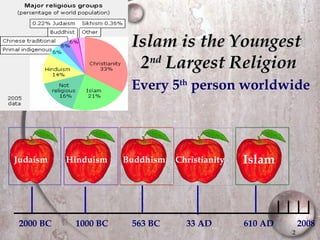
Islam is the Youngest  2 nd  Largest Religion   Every 5 th  person worldwide 2000 BC 1000 BC 563 BC 33 AD 610 AD 2008 Judaism Hinduism Buddhism Christianity Islam
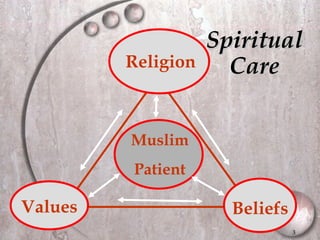
Values Beliefs Religion Muslim Patient Spiritual  Care
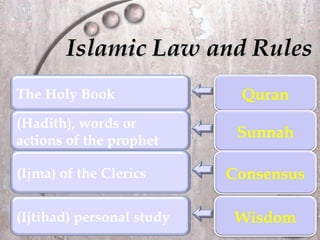
Islamic Law and Rules The Holy Book Quran (Hadith), words or actions of the prophet Sunnah (Ijma) of the Clerics Consensus (Ijtihad) personal study Wisdom
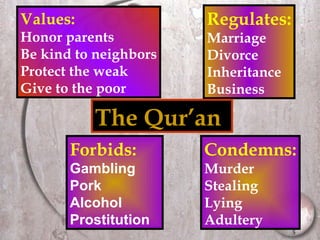
Values: Honor parents Be kind to neighbors Protect the weak Give to the poor Condemns: Murder Stealing Lying Adultery Regulates: Marriage Divorce Inheritance  Business Forbids: Gambling Pork Alcohol Prostitution The Qur’an
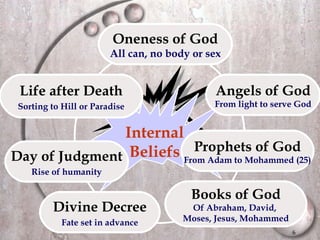
Internal Beliefs Books of God Of Abraham, David,  Moses, Jesus, Mohammed Divine Decree Fate set in advance Oneness of God All can, no body or sex Prophets of God From Adam to Mohammed (25) Angels of God From light to serve God Life after Death Sorting to Hill or Paradise Day of Judgment Rise of humanity
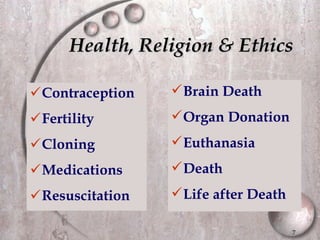
Health, Religion & Ethics Contraception Fertility Cloning Medications Resuscitation Brain Death Organ Donation Euthanasia Death Life after Death
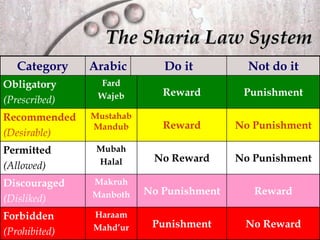
The Sharia Law System Category Arabic Do it Not do it Obligatory (Prescribed) Fard Wajeb Reward Punishment Recommended (Desirable) MustahabMandub Reward No Punishment Permitted (Allowed) Mubah Halal No Reward No Punishment Discouraged (Disliked) Makruh Manboth No Punishment Reward Forbidden (Prohibited) Haraam Mahd’ur Punishment No Reward
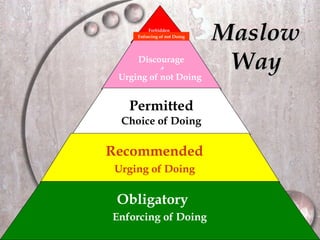
Maslow Way Forbidden Discouraged Permitted Recommended Obligatory Choice of Doing Urging of not Doing  Enforcing of not Doing Enforcing of Doing Urging of Doing
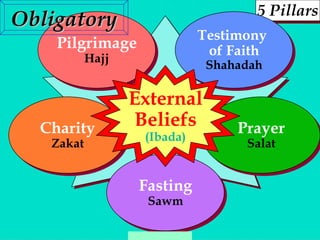
Obligatory
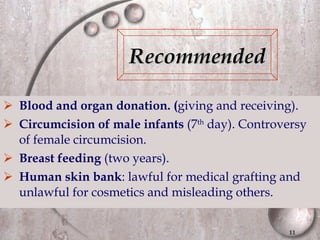
Blood and organ donation. ( giving and receiving). Circumcision of male infants   (7 th  day). Controversy of female circumcision. Breast feeding  (two years). Human skin bank : lawful for medical grafting and unlawful for cosmetics and misleading others. Recommended
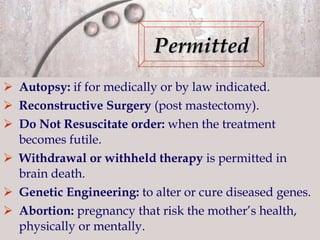
Autopsy:  if for medically or by law indicated. Reconstructive Surgery   (post mastectomy). Do Not Resuscitate order:  when the treatment becomes futile. Withdrawal or withheld therapy  is permitted in brain death. Genetic Engineering:  to alter or cure diseased genes. Abortion:  pregnancy that risk the mother’s health, physically or mentally. Permitted
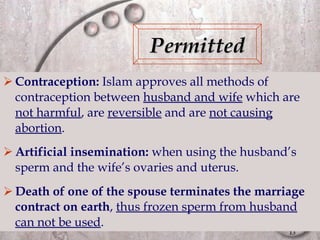
Contraception:  Islam approves all methods of contraception between  husband and wife  which are  not harmful , are  reversible  and are  not causing abortion . Artificial insemination:  when using the husband’s sperm and the wife’s ovaries and uterus. Death of one of the spouse terminates the marriage contract on earth ,  thus frozen sperm from husband can not be used . Permitted
Forced feeding the sick. Smoking Divorce Elective abortion  before age 120 days (some sects before 40 days). Discourage
Surgical contraception:  (Sterilization:   Vasectomy & tubal ligation). Permitted for mentally sick or when another pregnancy risks mother’s life. Sperm or ova donation. Fetal Sex Determination . Elective abortion  in a healthy mother   120 days after fertilization. Human milk bank. Human cloning  (permitted for tissues and organs). Forbidden
Surrogacy Uterus:  Surrogacy involving a third person is not permissible. (even if the woman involved is another wife of the husband). Sex:  Oral sex, homosexual and gay/lesbian relation, prostitution and sex outside marriage. Cosmetic surgery:  Changing the creation of Allah. Food:  not Halal meat, of pork or dead animal/bird. Drink:  alcohol. Others:  interest, theft, gambling and drugs. Forbidden
Active Euthanasia:  voluntary, non-voluntary and   Involuntary are  not permissible  under any circumstances . Passive euthanasia:  treatment is not obligatory when  there is no hope of survival (brain death).  Patient should be provided with food, drink, nursing, and relief from pain until death.   Suicide:  include assisted suicide and physician’s assisted suicide. Murder.  "take not life which Allah has made sacred"  Qur’an 6:151. Forbidden
Principles of Medical Ethics Necessity overrides prohibition   (insulin from pork, medications with alcohol). Remove harm at every cost   if possible (quit smoking, risk factors, disease therapy). Accept the lesser of two harms   if both cannot be avoided (abortion in risk to the pregnant woman). Public interest overrides individual interest   (blood and organ donation).
Female Modesty Dress:  Provide a long-sleeved gown or allow to wear her own cloths. Examination:  exposure of the patient’s body parts should be limited to the minimum necessary. Sex:  sensitivity when asking a single, widow or a divorced about sexual habits. Respect privacy  and do not touch while talking. Should not be placed in mixed rooms . Avoid eye contact and shaking hands  to prevent unnecessary embarrassment.
Cancer Result of Divine Will or a spiritual trial  (not a product of a carcinogen or risk behavior). Cancer is often referred to as “ that disease ” followed by “ God keep it away ”. Cancer kept confidential , fear that it may affect their daughters marriage. Pain:  analgesic to prevent suffering include morphine is allowed and recommended. Suffering delete sins.
Palliative Care When death is inevitable , Islam directs that the patient  be allowed to die without heroic measures . Muslims disapprove of any medical care that may  hasten the death  of a patient. Muslims prefer to  die at home  if possible with the family providing comprehensive physical and spiritual support. Death is not prepared   for  with prior funeral arrangements and viewed as an interference in God’s will.
Death definition:  when spirit leave’s the body. Death is Inevitable:   “ Every soul shall have a taste of death: In  the end to Us shall you be brought back."   Qur’an  29:57 The dying person:  should sit up or lie with their face towards Mecca. Ideally one should die with the Declaration of Faith on the lips (Shahada). When death occur:  e yes should be closed;  all connected tubes removed;  all limbs flexed and the body straightened. Death
After  Death Washing and burying  the body as soon as possible (same day). On the right side, facing Mecca. Respect  for the body and prayers over the dead. Recitation  of the whole Quran if possible. Mourning should not be excessive , as this would  disturb the dead  as well as show  lack of acceptance  of God’s will and purpose regarding death.
Funeral &  Mourning Period   Funeral is simple and every human is equal. Deceased buried in a white shroud (men 3 pieces, women 5 pieces) without a  coffin . Islam  forbids  cremation . Women are not allowed to attend the funeral, non-Muslim men may attend. Mourning period 3 days.  Wife mourn her husband 4 months and 10 days. S he is not to remarry, leave her home, or wear decorative clothing. Pregnant widow m ay remarry 42 days after childbirth.
Life After Death Angels visit the dead  in grave during the first night. Believers are comfortable  waiting till judgment day. Judgement Day:  resurrection of bodies. The good cross to Paradise, The bad fall off into Hell. Child  is regarded sinless until the age of maturity. The soul /spirit of the child is automatically transferred to paradise.
Family Duties  After Death  Payment of Funeral expenses. Payment of his/her debts. Execution of his/her will. Distribution of the remaining estate.
Spiritual History Ask: About life & death meaning. Observe: Dressing, praying, reading Listen: Reactions, answers, remarks
Barriers of Spiritual History and Therapy Lack of time. Lack of training. Discomfort with the subject. Fear of activity outside area of expertise. Lack of interest or awareness.
Final Words  Listen to patient and family. Demonstrate sensitivity. Respect Patient’s Values and Beliefs. Remain Flexible. Avoid Speculation. Respond to Who, What, Where, When? Provide Reassurance.
Al-Taj for Health and Heritage Tel/Fax +972-4-6747737  [email_address] Mission:   health promotion by raising awareness for prevention, early detection and improve management and outcome of cancer and diabetes in the Arab sector, Israel
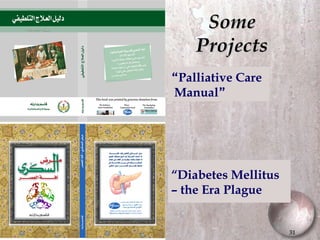
Some Projects “ Palliative Care  Manual ” “ Diabetes Mellitus – the Era Plague
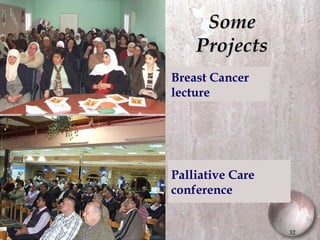
Some Projects Breast Cancer lecture Palliative Care conference
Isamic medicalethics

Isamic medicalethics

  • 1.
    Islamic MedicalEthics Kassim Baddarni Al-Taj Organization Arraba, Galilee, Israel [email_address]
  • 2.
    Islam is theYoungest 2 nd Largest Religion Every 5 th person worldwide 2000 BC 1000 BC 563 BC 33 AD 610 AD 2008 Judaism Hinduism Buddhism Christianity Islam
  • 3.
    Values Beliefs ReligionMuslim Patient Spiritual Care
  • 4.
    Islamic Law andRules The Holy Book Quran (Hadith), words or actions of the prophet Sunnah (Ijma) of the Clerics Consensus (Ijtihad) personal study Wisdom
  • 5.
    Values: Honor parentsBe kind to neighbors Protect the weak Give to the poor Condemns: Murder Stealing Lying Adultery Regulates: Marriage Divorce Inheritance Business Forbids: Gambling Pork Alcohol Prostitution The Qur’an
  • 6.
    Internal Beliefs Booksof God Of Abraham, David, Moses, Jesus, Mohammed Divine Decree Fate set in advance Oneness of God All can, no body or sex Prophets of God From Adam to Mohammed (25) Angels of God From light to serve God Life after Death Sorting to Hill or Paradise Day of Judgment Rise of humanity
  • 7.
    Health, Religion &Ethics Contraception Fertility Cloning Medications Resuscitation Brain Death Organ Donation Euthanasia Death Life after Death
  • 8.
    The Sharia LawSystem Category Arabic Do it Not do it Obligatory (Prescribed) Fard Wajeb Reward Punishment Recommended (Desirable) MustahabMandub Reward No Punishment Permitted (Allowed) Mubah Halal No Reward No Punishment Discouraged (Disliked) Makruh Manboth No Punishment Reward Forbidden (Prohibited) Haraam Mahd’ur Punishment No Reward
  • 9.
    Maslow Way ForbiddenDiscouraged Permitted Recommended Obligatory Choice of Doing Urging of not Doing Enforcing of not Doing Enforcing of Doing Urging of Doing
  • 10.
  • 11.
    Blood and organdonation. ( giving and receiving). Circumcision of male infants (7 th day). Controversy of female circumcision. Breast feeding (two years). Human skin bank : lawful for medical grafting and unlawful for cosmetics and misleading others. Recommended
  • 12.
    Autopsy: iffor medically or by law indicated. Reconstructive Surgery (post mastectomy). Do Not Resuscitate order: when the treatment becomes futile. Withdrawal or withheld therapy is permitted in brain death. Genetic Engineering: to alter or cure diseased genes. Abortion: pregnancy that risk the mother’s health, physically or mentally. Permitted
  • 13.
    Contraception: Islamapproves all methods of contraception between husband and wife which are not harmful , are reversible and are not causing abortion . Artificial insemination: when using the husband’s sperm and the wife’s ovaries and uterus. Death of one of the spouse terminates the marriage contract on earth , thus frozen sperm from husband can not be used . Permitted
  • 14.
    Forced feeding thesick. Smoking Divorce Elective abortion before age 120 days (some sects before 40 days). Discourage
  • 15.
    Surgical contraception: (Sterilization: Vasectomy & tubal ligation). Permitted for mentally sick or when another pregnancy risks mother’s life. Sperm or ova donation. Fetal Sex Determination . Elective abortion in a healthy mother 120 days after fertilization. Human milk bank. Human cloning (permitted for tissues and organs). Forbidden
  • 16.
    Surrogacy Uterus: Surrogacy involving a third person is not permissible. (even if the woman involved is another wife of the husband). Sex: Oral sex, homosexual and gay/lesbian relation, prostitution and sex outside marriage. Cosmetic surgery: Changing the creation of Allah. Food: not Halal meat, of pork or dead animal/bird. Drink: alcohol. Others: interest, theft, gambling and drugs. Forbidden
  • 17.
    Active Euthanasia: voluntary, non-voluntary and Involuntary are not permissible under any circumstances . Passive euthanasia: treatment is not obligatory when there is no hope of survival (brain death). Patient should be provided with food, drink, nursing, and relief from pain until death. Suicide: include assisted suicide and physician’s assisted suicide. Murder. "take not life which Allah has made sacred" Qur’an 6:151. Forbidden
  • 18.
    Principles of MedicalEthics Necessity overrides prohibition (insulin from pork, medications with alcohol). Remove harm at every cost if possible (quit smoking, risk factors, disease therapy). Accept the lesser of two harms if both cannot be avoided (abortion in risk to the pregnant woman). Public interest overrides individual interest (blood and organ donation).
  • 19.
    Female Modesty Dress: Provide a long-sleeved gown or allow to wear her own cloths. Examination: exposure of the patient’s body parts should be limited to the minimum necessary. Sex: sensitivity when asking a single, widow or a divorced about sexual habits. Respect privacy and do not touch while talking. Should not be placed in mixed rooms . Avoid eye contact and shaking hands to prevent unnecessary embarrassment.
  • 20.
    Cancer Result ofDivine Will or a spiritual trial (not a product of a carcinogen or risk behavior). Cancer is often referred to as “ that disease ” followed by “ God keep it away ”. Cancer kept confidential , fear that it may affect their daughters marriage. Pain: analgesic to prevent suffering include morphine is allowed and recommended. Suffering delete sins.
  • 21.
    Palliative Care Whendeath is inevitable , Islam directs that the patient be allowed to die without heroic measures . Muslims disapprove of any medical care that may hasten the death of a patient. Muslims prefer to die at home if possible with the family providing comprehensive physical and spiritual support. Death is not prepared for with prior funeral arrangements and viewed as an interference in God’s will.
  • 22.
    Death definition: when spirit leave’s the body. Death is Inevitable: “ Every soul shall have a taste of death: In the end to Us shall you be brought back." Qur’an 29:57 The dying person: should sit up or lie with their face towards Mecca. Ideally one should die with the Declaration of Faith on the lips (Shahada). When death occur: e yes should be closed; all connected tubes removed; all limbs flexed and the body straightened. Death
  • 23.
    After DeathWashing and burying the body as soon as possible (same day). On the right side, facing Mecca. Respect for the body and prayers over the dead. Recitation of the whole Quran if possible. Mourning should not be excessive , as this would disturb the dead as well as show lack of acceptance of God’s will and purpose regarding death.
  • 24.
    Funeral & Mourning Period Funeral is simple and every human is equal. Deceased buried in a white shroud (men 3 pieces, women 5 pieces) without a coffin . Islam forbids cremation . Women are not allowed to attend the funeral, non-Muslim men may attend. Mourning period 3 days. Wife mourn her husband 4 months and 10 days. S he is not to remarry, leave her home, or wear decorative clothing. Pregnant widow m ay remarry 42 days after childbirth.
  • 25.
    Life After DeathAngels visit the dead in grave during the first night. Believers are comfortable waiting till judgment day. Judgement Day: resurrection of bodies. The good cross to Paradise, The bad fall off into Hell. Child is regarded sinless until the age of maturity. The soul /spirit of the child is automatically transferred to paradise.
  • 26.
    Family Duties After Death Payment of Funeral expenses. Payment of his/her debts. Execution of his/her will. Distribution of the remaining estate.
  • 27.
    Spiritual History Ask:About life & death meaning. Observe: Dressing, praying, reading Listen: Reactions, answers, remarks
  • 28.
    Barriers of SpiritualHistory and Therapy Lack of time. Lack of training. Discomfort with the subject. Fear of activity outside area of expertise. Lack of interest or awareness.
  • 29.
    Final Words Listen to patient and family. Demonstrate sensitivity. Respect Patient’s Values and Beliefs. Remain Flexible. Avoid Speculation. Respond to Who, What, Where, When? Provide Reassurance.
  • 30.
    Al-Taj for Healthand Heritage Tel/Fax +972-4-6747737 [email_address] Mission: health promotion by raising awareness for prevention, early detection and improve management and outcome of cancer and diabetes in the Arab sector, Israel
  • 31.
    Some Projects “Palliative Care Manual ” “ Diabetes Mellitus – the Era Plague
  • 32.
    Some Projects BreastCancer lecture Palliative Care conference