ISAIAH 19 COMMENTARY
EDITED BY GLENN PEASE
A Prophecy Against Egypt
19 A prophecy against Egypt:
See, the LORD rides on a swift cloud
and is coming to Egypt.
The idols of Egypt tremble before him,
and the hearts of the Egyptians melt with fear.
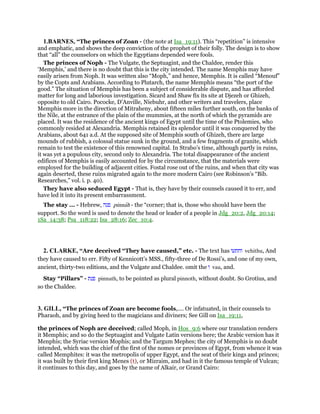
1.BARNES, “The burden of Egypt - This is the title to the prophecy. For the meaning of
the word “burden,” see the note at Isa_13:1. The word ‘Egypt’ in the original is ‫מצרים‬
mı tse
rayı m; and it was so called after Mizraim the second son of Ham, and grandson of Noah.
Sometimes it is called Mazor 2Ki_19:24; Isa_19:6; Isa_37:25; Mic_7:12; where, however, our
English version has rendered the word by “besieged place or fortress.” The ancient name of the
country among the inhabitants themselves was “Chimi or Chami” (Χηµυ Chemu). The Egyptian
word signified “black,” and the name was probably given from the black deposit made by the
slime of the Nile. ‘Mizraim, or Misrim, the name given to Egypt in the Scriptures, is in the plural
form, and is the Hebrew mede of expressing the “two regions of Egypt” (so commonly met with
in the hieroglyphics), or the “two Misr,” a name still used by the Arabs, who call all Egypt, as
well as Cairo, Musr or Misr.’ (Wilkinson’s “Ancient Egyptians,” vol. i. p. 2). The origin of the
name ‘Egypt’ is unknown. Egyptus is said by some to have been an ancient king of this country.
Behold, the Lord - This is a bold introduction. Yahweh is seen advancing to Egypt for the
purpose of confounding its idols, and inflicting punishment. The leading idea which the prophet
wishes probably to present is, that national calamities - anarchy, commotion, revolution, as well
as physical sufferings - are under the government and direction of Yahweh.
Rideth upon a swift cloud - Yahweh is often thus represented as riding on a cloud,
especially when he comes for purposes of vengeance or punishment:
And he rode upon a cherub and did fly,
Yea, he did fly upon the wings of the wind.
Psa_18:10
Who maketh the clouds his chariot,
Who walketh upon the wings of the wind.
Psa_104:3
‘I saw in the night visions, and behold, one like the Son of Man came with the clouds of
heaven’ Dan_7:13. So the Saviour is represented as coming to judgment in the clouds of heaven
Mat_24:30. Compare the sublime description in Hab_3:3-10.
And the idols of Egypt - It is well known that Egypt was celebrated for its idolatry. They
worshipped chiefly the heavenly bodies; but they worshipped also all kinds of animals, probably
as living symbols of their gods. “Shall be moved.” That is, shall tremble, be agitated, alarmed; or
shall be removed from their place, and overthrown. The word will bear either construction.
Vitringa inclines to the latter.
And the heart of Egypt - The strength; the courage; the rigor. We use the word “heart” in
the same sense now, when we speak of a stout heart; a courageous heart, etc.
Shall melt - The word used here denotes “to dissolve;” and is applied to the heart when its
courage fails - probably from the sensation of weakness or fainting. The fact alluded to here was
probably the disheartening circumstances that attended the civil commotions in Egypt, when
the people felt themselves oppressed by cruel rulers. See the Analysis of the chapter.
2. CLARKE, “The burden of Egypt - That is, the prophet’s declaration concerning Egypt.
3. GILL, “The burden of Egypt;.... Or a prophecy concerning Egypt, as the Arabic version; a
very grievous one, declaring many calamities that should come upon them. The Targum is,
"the burden of the cup of cursing, to make the Egyptians drink.''
The people of the Jews reposed great confidence in the Egyptians their allies; wherefore, in
order to break this confidence, it was necessary they should be acquainted with the destruction
that was coming upon them, which is the design of this prophecy.
Behold, the Lord rideth upon a swift cloud: or a "light" one (q) denoting the speed with
which he came, he would come quickly, light clouds move swiftly; the suddenness and
unexpectedness of his coming, clouds being rarely seen in Egypt, where was no rain; and the
irresistible power with which he would come, for who or what can stop the clouds of heaven? not
anything on earth, not armies, nor castles, and fortified places. The Lord is represented as riding
in great state and majesty, as a general at the head of his army against his enemies; or as a judge
going to try and condemn criminals; he rides upon the heavens, walks on the wings of the wind,
and the clouds are his chariot, Psa_68:4 so Christ is represented as coming in the clouds of
heaven, and as sitting on a white cloud, when he shall come to judge the world, Rev_1:7 though
these words are not to be understood of that coming of his; and much less of his first coming in
the flesh, to which they are weakly applied by Jerom and others; who, by the light cloud,
understand the Virgin Mary, as the Christians of Syria; or the human nature of Christ, as
Salmero, who relates, that upon Christ's flight into Egypt, and entering into Heliopolis, and the
temple there, in which were as many idols as days of the year, they all fell, and so this prophecy
was fulfilled (r) but of the Lord's coming to inflict punishment on the Egyptians; so the Targum,
"and, behold, the Lord shall be revealed in the cloud of his glory, to take vengeance on the
Egyptians:''
and shall come into Egypt; not by Sennacherib king of Assyria, and his army, whom he
should send to invade it, and enter into it, as some think; but rather by Cambyses and Ochus,
kings of Persia; though it seems that what is here foretold should be done, was done, not by
means of any foreign power, but by the Lord himself, who did by his own power and providence,
or suffer to be done, what was done:
and the idols of Egypt shall be moved at his presence; or tremble before him; these were
many, the chief of them were Osiris and Isis, Apis, Serapis, Vulcan, Bubastis, &c.; some were
living creatures, as cats, dogs, oxen, sheep, &c. who might move and tremble, in a literal sense;
and some were images, "made with hands", as the Septuagint here render the word; and which,
as the Targum paraphrases it, should "be broken"; the sense is, that they could none of them
save the Egyptians, or deliver them out of their distresses:
and the heart of Egypt shall melt in the midst of it; like wax before the fire; even the
most courageous among them, their soldiers, their army, with their officers and generals; which
were the heart of the people, and their defence, and who used to fight for them, and protect
them, but now would be dispirited.
4. HENRY, “Though the land of Egypt had of old been a house of bondage to the people of
God, where they had been ruled with rigour, yet among the unbelieving Jews there still
remained much of the humour of their fathers, who said, Let us make us a captain and return
into Egypt. Upon all occasions they trusted to Egypt for help (Isa_30:2), and thither they fled,
in disobedience to God's express command, when things were brought to the last extremity in
their own country, Jer_43:7. Rabshakeh upbraided Hezekiah with this, Isa_36:6. While they
kept up an alliance with Egypt, and it was a powerful ally, they stood not in awe of the
judgments of God; for against them they depended upon Egypt to protect them. Nor did they
depend upon the power of God when at any time they were in distress; but Egypt was their
confidence. To prevent all this mischief, Egypt must be mortified, and many ways God here tells
them he will take to mortify them.
I. The gods of Egypt shall appear to them to be what they always really were, utterly unable to
help them, Isa_19:1. “The Lord rides upon a cloud, a swift cloud, and shall come into Egypt. As
a judge goes in state to the bench to try and condemn the malefactors, or as a general takes the
field with his troops to crush the rebels, so shall God come into Egypt with his judgments; and
when he comes he will certainly overcome.” In all this burden of Egypt here is no mention of any
foreign enemy invading them; but God himself will come against them, and raise up the causes
of their destruction from among themselves. He comes upon a cloud, above the reach of the
opposition or resistance. He comes apace upon a swift cloud; for their judgment lingers not
when the time has come. He rides upon the wings of the wind, with a majesty far excelling the
greatest pomp and splendour of earthly princes. He makes the clouds his chariots, Psa_18:9;
Psa_104:3. When he comes the idols of Egypt shall be moved, shall be removed at his presence,
and perhaps be made to fall as Dagon did before the ark. Isis, Osiris, and Apis, those celebrated
idols of Egypt, being found unable to relieve their worshippers, shall be disowned and rejected
by them. Idolatry had got deeper rooting in Egypt than in any land besides, even the most
absurd idolatries; and yet now the idols shall be moved and they shall be ashamed of them.
When the Lord brought Israel out of Egypt he executed judgments upon the gods of the
Egyptians (Num_33:4); no marvel then if, when he comes, they begin to tremble. The Egyptians
shall seek to the idols, when they are at their wits' end, and consult the charmers and wizards
(Isa_19:3); but all in vain; they see their ruin hastening on them notwithstanding.
5. JAMISON, “Isa_19:1-25. The nineteenth and twentieth chapters are connected, but with
an interval between. Egypt had been held by an Ethiopian dynasty, Sabacho, Sevechus, or
Sabacho II, and Tirhakah, for forty or fifty years. Sevechus (called So, the ally of Hoshea,
2Ki_17:4), retired from Lower Egypt on account of the resistance of the priests; and perhaps
also, as the Assyrians threatened Lower Egypt. On his withdrawal, Sethos, one of the priestly
caste, became supreme, having Tanis (“Zoan”) or else Memphis as his capital, 718 b.c.; while the
Ethiopians retained Upper Egypt, with Thebes as its capital, under Tirhakah. A third native
dynasty was at Sais, in the west of Lower Egypt; to this at a later period belonged Psammetichus,
the first who admitted Greeks into Egypt and its armies; he was one of the dodecarchy, a
number of petty kings between whom Egypt was divided, and by aid of foreign auxiliaries
overcame the rest, 670 b.c. To the divisions at this last time, Gesenius refers Isa_19:2; and
Psammetichus, Isa_19:4, “a cruel lord.” The dissensions of the ruling castes are certainly
referred to. But the time referred to is much earlier than that of Psammetichus. In Isa_19:1, the
invasion of Egypt is represented as caused by “the Lord”; and in Isa_19:17, “Judah” is spoken of
as “a terror to Egypt,” which it could hardly have been by itself. Probably, therefore, the Assyrian
invasion of Egypt under Sargon, when Judah was the ally of Assyria, and Hezekiah had not yet
refused tribute as he did in the beginning of Sennacherib’s reign, is meant. That Assyria was in
Isaiah’s mind appears from the way in which it is joined with Israel and Egypt in the worship of
Jehovah (Isa_19:24, Isa_19:25). Thus the dissensions referred to (Isa_19:2) allude to the time of
the withdrawal of the Ethiopians from Lower Egypt, probably not without a struggle, especially
with the priestly caste; also to the time when Sethos usurped the throne and entered on the
contest with the military caste, by the aid of the town populations: when the Saitic dynasty was
another cause of division. Sargon’s reign was between 722-715 b.c. answering to 718 b.c., when
Sethos usurped his throne [G. V. Smith].
burden — (See on Isa_13:1).
upon ... cloud — (Psa_104:3; Psa_18:10).
come into Egypt — to inflict vengeance. “Egypt,” in Hebrew, Misraim, plural form, to
express the two regions of Egypt. Bunsen observes, The title of their kings runs thus: “Lord of
Upper and Lower Egypt.”
idols — the bull, crocodile, etc. The idols poetically are said to be “moved” with fear at the
presence of one mightier than even they were supposed to be (Exo_12:12; Jer_43:12).
6. K&D, “The oracle opens with a short introduction, condensing the whole of the substance
of the first half into a few weighty words - an art in which Isaiah peculiarly excelled. In this the
name of Egypt, the land without an equal, occurs no less than three times. “Behold, Jehovah
rideth upon a light cloud, and cometh to Egypt; and the idols of Egypt shake before Him, and
the heart of Egypt melteth within it.” Jehovah rides upon clouds when He is about to reveal
Himself in His judicial majesty (Psa_18:11); and in this instance He rides upon a light cloud,
because it will take place rapidly. The word kal signifies both light and swift, because what is
light moves swiftly; and even a light cloud, which is light because it is thin, is comparatively ‫ב‬ ָ‫,ע‬
i.e., literally dense, opaque, or obscure. The idols of Egypt shake ַ‫,נוּע‬ as in Isa_6:4; Isa_7:2),
because Jehovah comes over them to judgment (cf., Exo_12:12; Jer_46:25; Eze_30:13): they
must shake, for they are to be thrown down; and their shaking for fear is a shaking to their fall
ַ‫,נוּע‬ as in Isa_24:20; Isa_29:9). The Vav apodosis in ‫עוּ‬ָ‫נ‬ְ‫ו‬ together the cause and effect, as in
Isa_6:7. - In what judgments the judgment will be fulfilled, is now declared by the majestic
Judge Himself.
7. BI, “The prophecies concerning Egypt
The kingdom to which all the three prophecies (chaps.
18, 19, 20) refer is the same, namely, the Egypto-Ethiopian kingdom; but it is so dealt with that
chap. 18 refers to the ruling people, chap. 19 to the ruled people, and chap. 20 embraces them
both together. (F. Delitzsch.)
Egypt interwoven with the history of the kingdom of God
The reason why the prophecy occupies itself so particularly with Egypt is that no people of the
earth was so closely interwoven with the history of the kingdom of God from the patriarchal
time as Egypt. (F. Delitzsch.)
The oracle concerning Egypt: promise as well as threatening
Because, as the Thora impresses it, Israel must never forget that it long resided in Egypt, and
there grew great, and enjoyed much good; so prophecy, when it comes to speak to Egypt, is not
less zealous in promising than in threatening. Accordingly, the Isaianic oracle falls into two
distinct halves; one threatening, Isa_19:1-15, and one promising, Isa_19:18-25; and between
judgment and salvation there stands the terror in Isa_19:16-17, as the bridge from the former to
the latter. (F. Delitzsch.)
Behold, the Lord rideth upon a swift cloud
The way of the Lord
Here is one way in which the Lord comes, namely, “upon a swift cloud” (Isa_19:1). The
intimation is one of mystery. No man can tell which way the Lord will come today. Let us keep
our eyes upon every point of the horizon; let us distribute the watchmen wisely and assign to
each his sphere of observation; for by what door the Lord may enter the field of vision no man
can tell,—by a political event, by some new movement in foreign policy, by the discovery of new
riches in the earth, by great shocks which try men’s strength, by grim sorrow, by cruel death, by
judgments that have no name, by mercies tender as the tenderest love, by compassions all tears,
by providences that are surprises of gladness: watch all these doors, for by any one of them the
Lord may come into the nation, the family, the heart of the individual. This Divine policy, if it
may be so named, baffles the watchers who trust to their own sagacity. If men will say they will
circumvent God and know all the ways of His providence, behold God forsakes all ways that are
familiar and that lie within the calculation of the human mind; and He startles those who watch
with light from unexpected quarters with shakings and tremblings never before felt in the
vibrations of history. “Clouds and darkness are round about Him”: the cloud that appears to be
nothing but vapour may enshrine the Deity; the bush, yesterday so common that any bird might
have alighted upon it, today burns with unseen, infinite energy. The Lord will come by what way
He pleases,—now as if from the depths of the earth, and now as from the heights of heaven;
blessed is that servant who is ready to receive Him and to welcome Him to the heart’s hospitality
of love. (J. Parker, D. D.)
8. PULPIT, “THE BURDEN OF EGYPT. It has been doubted whether this prophecy refers to the
conquest of Egypt by Piankhi, as related in the monument which he set up at Napata, or to that by
Esarhaddon, of which we gain our knowledge from the inscriptions of his son, Asshur-bani-pal. In the
former case, we must suppose it written as early as B.C. 735; in the latter, its date might be as late as
B.C. 690. The division of Egypt, "kingdom against kingdom," is a circumstance rather in favor of the
earlier date; but the "cruel lord," and the mention of the "princes of Zoan and Noph," are decisive for the
later. Piankhi is anything rather than a "cruel lord," being particularly mild and clement; Napata (Noph) is
under him, and cannot be said to have been "deceived" or to have "seduced Egypt;" and Zoan plays no
part in the history of the period. Esarhaddon, on the contrary, was decidedly a "cruel" prince, and treated
Egypt with great severity, splitting it up into a number of governments. Zoan was one of the leading cities
of the time, and Noph was the leading power on the Egyptian side, the head of the patriotic party which
resisted the Assyrian monarch, but to no purpose. We may, therefore, regard this prophecy as one of
Isaiah's latest, placed where it is merely on account of its head-tug—the compiler having placed all the
"burdens" against foreign countries together.
Isa_19:1
The Lord rideth upon a swift cloud. Natural imagery to express the rapidity of Divine visitations
(comp. Psa_104:3). God, being about to visit Egypt with a judgment of extreme severity, is represented
as entering the land in person (so in Isa_13:5). The idols of Egypt shall be moved.Neither Piankhi nor
any other Ethiopian conqueror made war on the Egyptian idols; but the Assyrians were always bent on
humbling the gods of the hostile countries (see above, Isa_10:10; and comp. Isa_36:18-20). We have no
detailed account of Esarhaddon's campaign; but we find Asshur-bani-pal's first victory over Tirhakah
immediately followed by the presentation to him in his camp of Egyptian deities, i.e. of their images.
These were probably taken to Nineveh, or else destroyed. At a later date, the same monarch deprived an
Egyptian temple of two of its sacred obelisks. The heart of Egypt shall molt (coup. Isa_13:7; Psa_22:14).
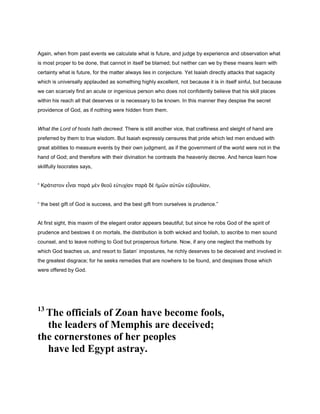
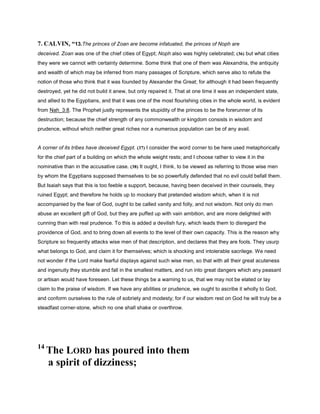
9. CALVIN, “l.The burden of Egypt. The Prophet here prophesies against Egypt, because it was a kind
of refuge to the Jews, whenever they saw any danger approaching them; for when they had forsaken
God, to whom they ought to have had recourse, they thought that they had no help left to them but in the
Egyptians. It was therefore necessary that that kingdom should be overthrown, that its wealth or its forces
might no longer deceive the Jews; for so long as Egypt was prosperous, the Jews thought that, on
account of its being exceedingly populous and highly fortified, they were far removed from danger, and
therefore despised God, or at least paid scarcely any regard to his promises. This led to evil
consequences in two respects; first, because when they ought to have relied on God alone, they were
puffed up with that vain confidence in Egypt; and secondly, because whenever the Lord punished them,
they defended themselves against his chastisements by the power of the Egyptians, as if by human
resources they could make void his judgments, when they ought to have been turned to God altogether.
On this subject Isaiah speaks more fully in a later portion of this book. (Isa_30:2.)
Behold, the Lord rideth on a swift cloud. This mode of expression is found also in other passages of
Scripture, but in a general form. (Psa_104:3.) The Prophet applies it to this prediction, because the
Egyptians thought that they were so well fortified on all sides, that there was no way by which God could
approach them. He therefore ridicules their foolish confidence, and exhibits the exalted power of God,
when he rideth on a swift cloud, by which he will easily make a descent upon them, and neither walls nor
bulwarks shall hinder his progress. Again, because in addition to earthly aid the Jews were likewise
bewitched by a false religion, on this ground also the Prophet ridicules their madness, because God will
dash to the ground all the assistance which they expected to obtain from idols. I pass by the foolish notion
which many have entertained, as to the idols which Christ overthrew in Egypt, when he was carried
thither in infancy; for it does not deserve a refutation. (Mat_2:14.) This passage has been perverted to
prove it, and to prove many conjectures of the same kind. But the Prophet’ meaning is totally different; for
he speaks of the defeat of the Egyptians by the Assyrians, and shews that it ought to be ascribed to God,
and not, as irreligious men commonly do, to fortune. He shews it to be a judgment of God, by whose hand
all things are governed.
And the idols of Egypt shall be moved at his presence. He declares that the idols shall fall; that is, that
they shall be of no avail to the Egyptians, though they rely on their assistance, and think that they are
under their protection. No nation ever was so much addicted to superstitions; for they worshipped cats,
and oxen, and crocodiles, and even onions, and plants of every sort, and there was nothing to which they
did not ascribe some kind of divinity. He means that the power of all those false gods, whom the
Egyptians had taken for their protectors, will be overthrown. Having declared that the Egyptians rely in
vain on their superstitions, he likewise casts down the pride which they cherished as to their earthly
resources.
And the heart of Egypt shall melt in the midst of her. By the word heart he means the courage which
sometimes fails even the bravest men, so that they do not attempt any action, even when their strength
and forces are abundant, and in this manner he declares that they will be at war with God, who will melt
their heartswithin them, before they are called to contend with their enemies. Not only does he threaten
that they will be terrified, but he likewise adds in the midst of the whole kingdom, where they had an
exceedingly safe and peaceful dwelling, because they were far removed from every attack. It was the
duty of all believers to consider this, when war was waged against the Egyptians; and we also ought to
behold the same thing exemplified in all revolutions of kingdoms, which proceed solely from the hand of
God. If the heart melts, if the strength fails, in men who are usually brave, and who had formerly
displayed great courage, this ought to be ascribed to the vengeance of God.
2
“I will stir up Egyptian against Egyptian—
brother will fight against brother,
neighbor against neighbor,
city against city,
kingdom against kingdom.
1.BARNES, “And I will set - (‫סכסכתי‬ sı ksaketı y). This word (from ‫סכך‬ sakak) means
properly “to cover,” to spread over, to hide, conceal, to protect. Another signification of the verb
is, to weave, to intermingle. It may mean here, ‘I will arm the Egyptians against each other’
(Gesenius); or, as in our version, ‘I will mingle, confound, or throw them into discord and strife.’
The Septuagint renders it, ᅠπεγερθήσονται Epegerthesontai - ‘They shall be excited,’ or, ‘raised
up.’ Symmachus, Συµβαλራ Sumbalo. Syriac and Chaldee, ‘I will excite.’ The sense is, that there
would be discord and civil war, and this is traced to the agency or overruling providence of God -
meaning that he would “permit and overrule” it. Compare the notes at Isa_45:7 : ‘I make peace,
and I create evil; I, Yahweh, do all these things;’ Amo_3:6 : ‘Shall there be evil in a city and
Jehovah hath not done it?’ The civil war here referred to was probably that which arose between
the twelve kings in the time of the dodekarchy (see the Analysis to the chapter), and which
resulted in the single dominion of Psammetichus. Dr. Newton (“On the Prophecies,” xii.)
supposes, however, that the prophet refers to the civil wars between Apries and Amasis at the
time of the invasion by Nebuchadnezzar. But it agrees much better with the former discord than
with this. The description which follows is that of anarchy or civil strife, where “many” parties
are formed, and would naturally lead to the supposition that there were more than two engaged.
And kingdom against kingdom - Septuagint, Νόµος έπᆳ νόµων Nomos epi nomon - ‘Nome
against nomes.’ Egypt was formerly divided into forty-two “nomes” or districts. The version by
the Septuagint was made in Egypt, and the translators would naturally employ the terms which
were in common use. Still the event referred to was probably not that of one “nome” contending
against another, but a civil war in which one dynasty would be excited against another
(Gesenius), or when there would be anarchy and strife among the different members of the
dodekarchy. See the Analysis of the chapter.
2. Kretzmann, “And I will set the Egyptians against the Egyptians, inciting them to civil war and
anarchy such as we are told of by secular historians; and they shall fight every one against his
brother and every one against his neighbor; city against city and kingdom against kingdom. All
this was fulfilled at the beginning of the seventh century before Christ, about the time before
Nebuchadnezzar's invasion, when Egypt was divided into twelve kingdoms and into forty-two nomes, or
districts, between some of whom there was always dissension, and real peace was not established even
after Psammetichus had become sole ruler of the country.
3. GILL, “And I will set the Egyptians against the Egyptians,.... Or mingle and confound
them together; in which confusion they should fall upon and destroy one another, as the
Midianites did: the phrase is expressive of rebellions and civil wars, as the following words
explain it; and which show, that the calamities of Egypt should be brought upon them, not by
means of a foreign invasion, but by internal quarrels, and other means, which the Lord would in
judgment send among them:
and they shall fight everyone against his brother, and everyone against his
neighbour; and destroy one another:
city against city; of which there were great numbers in Egypt; in the times of Amasis, it is said
(s), there were twenty thousand:
and kingdom against kingdom; for though Egypt was but originally one kingdom, yet upon
the death of Sethon, one of its kings, who had been a priest of Vulcan, there being no successor,
twelve of the nobility started up, and set up themselves as kings, and divided the kingdom into
twelve parts (t), and reigned in confederacy, for the space of fifteen years; when, falling out
among themselves, they excluded Psammiticus, one of the twelve, from any share of
government; who gathering an army together, fought with and conquered the other eleven, and
seized the whole kingdom to himself, and who seems afterwards regarded in this prophecy; all
this happened in the times of Manasseh king of Judah, and so in or quickly after Isaiah's time:
though some understand this of the civil wars between Apries and Amasis, in the times of
Nebuchadnezzar. The Septuagint version renders the phrase here, "nome against nome"; for the
whole land of Egypt, by Sesostris, one of its kings, was divided into thirty six (u) nomes,
districts, or provinces, whose names are given by Herodotus (w), Pliny (x), and others; for so the
words of that version should be rendered, and not as they are by the Latin interpreter, and in the
Arabic version, which follows it, "law upon law".
4. BI, “Divine providence in civil strife
This method of administration, we say, obtains and prevails in all ages.
This is the meaning of many a controversy, of many a quarrel, of many a dissension, in cabinets,
in families, in nations. Men are surprised that they should turn upon their brothers with disdain,
and even with cruel hatred. It is indeed matter of surprise and great sorrow, and if looked at
within narrow limits it would seem to be a reflection upon Providence: but when does God ask
to be judged within the four comers of human imagination or criticism? He not only does the
deed, He does it within a field which He Himself has measured, and within the range of
declarations which have about them all the mystery and graciousness of evangelical prophecies.
We must, therefore, look not only at the incident, but at all its surroundings and to all its issues.
When we are puzzled by household difficulties, by commercial perplexities, by unions that only
exist for a moment and then dissolve or are turned into sourness and alienation, we must never
forget that there is One who rules over all. (J. Parker, D. D.)
5. JAMISON, “set — stir up. Gesenius translates, “arm.”
Egyptians against the Egyptians — Lower against Upper: and Saitic against both. (See
Isa_3:10). Newton refers it to the civil wars between Apries and Amasis at the time of
Nebuchadnezzar’s invasion; also between Tachos, Nectanebus, and the Mendesians, just before
Ochus subdued Egypt.
kingdom against kingdom — The Septuagint has “nome against nome”; Egypt was
divided into forty-two nomes or districts.
5B. PULPIT, “I will set the Egyptians against the Egyptians. The disintegration of Egypt commenced
about B.C. 760-750, towards the close of the twenty-second dynasty. About B.C. 735 a struggle began
between Plan-khi, King of Upper Egypt, and Tafnekhf, King of Sais and Memphis, in which the other
princes took different sides. Ten or twelve years later there was a struggle between Bocchoris and
Sabaeo. From this time onwards, until Psamatik I. reestablished the unity of Egypt, the country was
always more or less divided, and on the occurrence of any crisis the princes were apt to make war one
up, n another. Kingdom against kingdom. During the period of disintegration, the title of" king" was
assumed by most of the potty princes, though they were little more than chiefs of cities.
6. K&D, ““And I spur Egypt against Egypt: and they go to war, every one with his brother,
and every one with his neighbour; city against city, kingdom against kingdom. And the spirit
of Egypt is emptied out within it: and I swallow up its ready counsel; and they go to the idols
to inquire, and to the mutterers, and to the oracle-spirits, and to the soothsayers. And I shut up
Egypt in the hand of a hard rule; and a fierce king will reign over them, saith the Lord,
Jehovah of hosts.” Civil war will rage in Egypt (on sicsec, see at Isa_9:10). The people once so
shrewd are now at their wits' end; their spirit is quite poured out ‫ה‬ ָ‫ק‬ ְ‫ב‬ָ‫,נ‬ with the reduplication
removed, for ‫ה‬ ָ ַ‫ב‬ָ‫,נ‬ according to Ges. §68, Anm. 11 - as, for example, in Gen_11:7; Eze_41:7), so
that there is nothing left of either intelligence or resolution. Then (and this is also part of the
judgment) they turn for help, in counsel and action, where no help is to be found, viz., to their
“nothings” of gods, and the manifold demoniacal arts, of which Egypt could boast of being the
primary seat. On the names of the practisers of the black art, see Isa_8:19; 'ittim, the mutterers,
is from 'atat, to squeak (used of a camel-saddle, especially when new), or to rumble (used of an
empty stomach): see Lane's Lexicon. But all this is of no avail: Jehovah gives them up (‫ר‬ ֵⅴ ִ‫,ס‬ syn.
‫יר‬ִ ְ‫ס‬ ִ‫,ה‬ συγκλείειν to be ruled over by a hard-hearted and cruel king. The prophecy does not relate
to a foreign conqueror, so as to lead us to think of Sargon (Knobel) or Cambyses (Luzzatto), but
to a native despot. In comparing the prophecy with the fulfilment, we must bear in mind that
Isa_19:2 relates to the national revolution which broke out in Sais, and resulted in the
overthrow of the Ethiopian rule, and to the federal dodekarchy to which the rising of the nation
led. “Kingdom against kingdom:” this exactly suits those twelve small kingdoms into which
Egypt was split up after the overthrow of the Ethiopian dynasty in the year 695, until
Psammetichus, the dodekarch of Sais, succeeded in the year 670 in comprehending these twelve
states once more under a single monarchy. This very Psammetichus (and the royal house of
Psammetichus generally) is the hard ruler, the reckless despot. He succeeded in gaining the
battle at Momemphis, by which he established himself in the monarchy, through having first of
all strengthened himself with mercenary troops from Ionia, Caria, and Greece. From his time
downwards, the true Egyptian character was destroyed by the admixture of foreign elements;
(Note: See Leo, Universalgesch. i. 152, and what Brugsch says in his Histoire d'Egypte, i.
250, with regard to the brusques changements that Egypt endured under Psammetichus.)
and this occasioned the emigration of a large portion of the military caste to Meroe. The
Egyptian nation very soon came to feel how oppressive this new dynasty was, when Necho (616-
597), the son and successor of Psammetichus, renewed the project of Ramses-Miamun, to
construct a Suez canal, and tore away 120,000 of the natives of the land from their homes,
sending them to wear out their lives in forced labour of the most wearisome kind. A revolt on the
part of the native troops, who had been sent against the rising Cyrene, and driven back into the
desert, led to the overthrow of Hophra, the grandson of Necho (570), and put an end to the
hateful government of the family of Psammetichus.
7.CALVIN, “2.And I will set the Egyptians against the Egyptians. Here he describes more particularly
the calamity which the Lord had determined to bring on Egypt. By the expression, I will set, he means the
internal struggles, in which those who ought to be mutual defenders cut down one another; and no evil
can be more destructive than this to a state or a people. It was of importance also to convince the Jews
that God, in whose hands are the hearts of men, (Pro_21:1,) could by his unseen influence inflame the
Jews to mutual animosities, that they might slay each other, though they were victorious over foreign
enemies. Hence we learn that nations never rise in a seditious manner, unless the Lord set them against
each other, as when one brings forward gladiators to the place of combat. He inflames their minds for
battle, and prompts them to slay each other by mutual wounds; and therefore, as we ought to reckon it an
evidence of God’ favor, when friendship is cherished among citizens, so we ought to ascribe it to his
vengeance, when they rage against and slay and injure one another.
And they shall fight every one against his brother. For the sake of heightening the picture, he adds what
was still more monstrous, that those who were related to them by blood would take up arms to destroy
each other; for if men are worse than beasts when, forgetting their common nature, they engage in battle,
how much more shocking is it to nature that brethren or allies should fight with each other! But the more
monstrous it is, the more ought we to acknowledge the judgment of God and his terrible vengeance.
City against city, and kingdom against kingdom. Isaiah appears to advance by degrees; for he mentions,
first, a brother; secondly, a neighbor; thirdly, cities; and, fourthly, kingdoms By kingdoms he
means provinces, into which Egypt was divided, which the Greeks called νοµοἰ, the term by which the
Greek translators have rendered it in this passage. (26)
(26) Καὶ νοµὸς ἐπὶ νοµόν. The reader will observe the distinction between the paroxytone νόµος, a
law, and the oxytone νοµός, a field or a dwelling; for it is the latter that is employed by Herodotus to
denote a district or province. Herod. 2:164. — Ed.
FT284 “ the spirit of Egypt shall fail. Heb. shall be emptied. ” — Eng. Ver.
FT285 “ the Egyptians will I give over, or, shut up. ” — Eng. Ver. “ I will shut up Egypt in the hand of cruel
lords.” — Stock.
FT286 “ fierce king.” — Eng. Ver.
FT287 See vol. 1 p. 266
FT288 “Embanked canals. Rivi aggerum, as the Vulgate has it. The canals by which the waters of the Nile
were distributed were fortified by mounds or banks. ‫,מצור‬ (māō) which word Rosenmü vainly endeavors to
shew to be another name for Egypt or Mizraim.” — Stock.
FT289 See vol. 1 p. 492
FT290 “ ashamed (disappointed or confounded) are the workers of combed (or hatchelled) flax, and the
weavers of white (stuffs.) The older writers supposed the class of persons here described to be the
manufacturers of nets for fishing, and took ‫,הורי‬ (hō) in the sense of perforated open work or net-work.
The moderns understand the verse as having reference to the working of flax and manufacture of linen.
Knobel supposes ‫,הורי‬ (hō) to mean cotton, as being white by nature, and before it is wrought. Some of
the older writers identified ‫,שריקות‬ (sĕīō,) with sericum the Latin word for silk. Calvin supposes an allusion
in the last clause to the diaphanous garments of luxurious women.” — Professor Alexander.
FT291 Our author is puzzled about this word. In his version he follows the old rendering, “ that make a
net,” but his marginal reading is “ that make gain,” and to the latter he adheres in his commentary.
Bishops Lowth and Stock render it, “ that make a gain,” and Professor Alexander, “ laborers for hire.” —
Ed.
FT292 ‫,קרם‬ (kĕĕ) has two meanings, “” and “ east;” and accordingly Bishop Stock renders this clause, “
son of the kings of the east,” adding the following note: — “Kings of the east. A synonyme for wise
men, µάγοι ἀπὸ ἀνατολῶν, the quarter of the world where the arts of divination originated, and to whose
sovereigns Egyptian sages pretended kindred. Hence the magi, that came to worship Christ, are often
denominated the three kings. ” — Ed.
FT293 “ the Tanis of the Greeks, was one of the most ancient cities of Lower Egypt, (Num_13:22,) and a
royal residence. The name is of Egyptian origin, and signifies low situation. Noph is the Memphis of the
Greek geographers, called Moph, (Hos_9:6.) It was one of the chief cities of ancient Egypt, the royal seat
of Psammetichus.” — Alexander.
FT294 “ stay (Heb., corners) of the tribes thereof.” — Eng. Ver.
FT295 Instead of ‫,תפנ‬ (pinnă) the construct singular, Grotius, Lowth, and others, prefer the conjectural
reading, ‫פנות‬ (pinnō) corners. But Rosenmü removes the difficulty of the Syntax by remarking, that ‫,פנה‬
(pinnā) a collective noun, and agreeably to the frequent usage of the Hebrew tongue, fitly agrees with a
plural verb; and he quotes 2Sa_19:41, as a parallel instance. — Ed.
FT296 Professor Alexander prefers the literal rendering, “ before the shaking of the hand,” and thus
explains the passage: “ ‫,מפני‬ (mippĕē,) may be rendered, on account of, which idea is certainly included,
but the true force of the original expression is best retained by a literal translation. ‫תנופת‬ ‫,יד‬ (tĕūă yă,) is
not the act of beckoning for the enemy, but that of threatening or preparing to strike. The reference is not
to the slaughter of Sennacherib’ army, but more generally to the indications of Divine displeasure.”
FT297 The only passage which occurs to my remembrance as likely to be in the author’ eye is, “ thou shalt
become an astonishment, a proverb and a bye-word, among all the nations whither the Lord shall lead
thee.” (Deu_28:37.) — Ed.
FT298 Heliopolis is a Greek word, and signifies “ city of the sun.” It is the name of a famous city of Lower
Egypt, in which there was a temple dedicated to the sun. — Ed.
FT299 “Pillar. ” — Eng. Ver.
FT300 The name “ē” which means “ his mother,” was ironically given to him on account of his known
hatred of his mother Cleopatra. — Ed
FT301 “Sous ceste pedagogie de la Loy.”
FT302 “Les signes et sacramens.”
FT303 Of one clause in this verse, rendered by our translators “ a great one,” Calvin takes no notice.
Rosenmü considers ‫רב‬ (rā) to be the participle Kal of ‫,רוב‬ (rū,) and assigns to Cocceius the honor of
having discovered that the punctuation, which the Masoretic annotators have set aside, in the parallel
passage of Deuteronomy, as a peculiarity for which they could not account, was the key to the true
interpretation. Almost all the commentators, Cocceius excepted, render ‫רב‬ (rā) “ great one,” some of them
supposing that Ptolemy the Great, the son of Lagus, and others that Alexander the Great, was meant. But
Cocceius was the first to perceive that the signification “” does not agree with the context, and has justly
remarked that the word ‫רב‬ (rā) with a Kametz, ought not to be confounded with ‫רב‬ (rā,) with a Pathach,
but that its meaning should be sought from the verb ‫רוב‬ (rū) or ‫ריב‬ (rī,) “ contend, to argue, to defend one’
cause in a court of justice;” and he quotes a parallel passage, in which Moses, while he blesses Judah,
speaking of God, says, ‫ידיו‬ ‫רב‬ ‫לו‬ (yā rā lō) “ hands shall be his protector.” (Deu_33:7.) See Robertson’
Clavis Pentateuchi, p. 561. The ancients appear to have taken a similar view. The Septuagint renders it
thus. Καὶ ἀποστελεῖ αὐτοῖς ἄνθρωπον ὃς σώσει αὐτοὺς κρίνων σώσει αὐτούς. The Chaldee and Syriac
render it, “ deliverer and a judge,” and Jerome’ rendering is, propuqnatorem , “ defender or champion”
Rosenmü Scholia. “ Savior and a vindicator” Lowth. “ advocate” Stock. “ explanation of ‫,רב‬ (rab) as a
participle,” says Professor Alexander, “ found in all the ancient versions, and is adopted by most modern
writers.” — Ed.
FT304 The words of the Apostle are, “ shall they call on him in whom they have not believed? ” But Calvin’
remark, which immediately follows, vindicates the appropriateness, though not the verbal accuracy, of the
quotation. — Ed.
FT305 “La doctrine de salut;” “ doctrine of salvation.”
FT306 “Ce sera un preparatif pour les amener à repentance;” — “ will be a preparation to lead them to
repentance.”
FT307 “Pourvenu que notre repentance ne soit hypocritique;” — “ that our repentance be not hypocritical.”
FT308 “D’ù viennent les chastimens, si non de nos pechez? S’ sont pardonnez, aussi le sont les
chastimens meritez a cause d’ “ — “ come chastisements but from our sins? If they are remitted, so are
also the chastisements deserved on account of them.”
FT309 See vol. 1 p. 101
FT310 This is the Author’ version. See p. 48
FT311 The particle ‫את‬ (ĕth) does not decide the question, for it may either be the sign of the accusative
case, or a preposition signifying with. Professor Alexander adopts the latter view, and argues powerfully
in favor of the rendering, “ shall serve God,” in which he concurs with Lowth, “ the Egyptian shall worship
with the Assyrian,” and with Stock, “ Egypt shall serve [God] with Assyria.” — Ed.
FT312 “De la crainte de Dieu,” — “ the fear of God.”
FT313 “ is the lot (Heb. cord) of his inheritance.” — Eng. Ver.
FT314 “ meaning obviously is,” says Professor Alexander, “ Israel should be one of three, or a party to a
triple union.” By an analagous idiom of the Greek language, Peter calls Noah ὄγδοον, “ eighth,” that is, “
of eight persons.” (2Pe_2:5.) From classical writers other instances might be given, such as εἰς οἰκίαν
δωδέκατος “ went to his house the twelfth,” or, “ of twelve,” that is, “ with eleven other persons.” — Ed.
FT315 “ the Lord of hosts shall bless.” — Eng. Ver.
FT316 Our Author perhaps refers to his expository remarks on Eph_2:10, Isa_17:7, Isa_64:7, See p. 26
3
The Egyptians will lose heart,
and I will bring their plans to nothing;
they will consult the idols and the spirits of the dead,
the mediums and the spiritists.
1.BARNES, “And the spirit of Egypt - (see Isa_19:1). They shall be exhausted with their
long internal contentions and strifes; and seeing no prospect of deliverance, and anxious that
the turmoils should end, they shall seek counsel and refuge in their gods and necromancers, but
in vain.
Shall fail - (‫נבקה‬ nabe
qah). Margin, ‘Be emptied.’ The word means, literally, “to pour out,
empty, depopulate.” Here it means that they would become disheartened and discouraged.
And I will destroy - Margin, as the Hebrew, ‘I will swallow up.’ So the word is used in
Psa_107:27, ‘All their wisdom is destroyed’ (Hebrew, ‘swallowed up. ‘)
And they shall seek to the idols - According to Herodotus (ii. 152), Psammetichus had
consulted the oracle of Latona at Butos, and received for answer that the sea should avenge his
cause by producing brazen men. Some time after, a body of Ionians and Carians were compelled
by stress of weather to touch at Egypt, and landed there, clad in brass armor. Some Egyptians,
alarmed at their appearance, came to Psammetichus, and described them as brazen men who
had risen from the sea, and were plundering the country. He instantly supposed that this was
the accomplishment of the oracle, and entered into an alliance with the strangers, and by their
aid was enabled to obtain the victory over his foes. Compare the different accounts of Diodorus
in the Analysis of this chapter. The whole history of Egypt shows how much they were
accustomed to consult their idols (see Herodot. ii. 54ff, 82, 83, 139, 152). Herodotus says (ii. 83),
that the art of divination in Egypt was confined to certain of their deities. There were in that
country the oracles of Hercules, of Apollo, of Mars, of Diana, and of Jupiter; but the oracle of
Latona in Butos was held in greater veneration than any of the rest.
And to the charmers - (‫אטים‬ 'ı tʖı ym). This word occurs nowhere else. The root ‫אטט‬ 'atʖatʖ, in
Arabic, means “to mutter, to make a gentle noise;” and this word probably denotes conjurors,
diviners (see the note at Isa_8:19). The Septuagint renders it, ‘Their idols.’
And to them that have familiar spirits - (see the note at Isa_8:19). The Septuagint
renders this, ‘Those who speak from the ground.’
And to the wizards - Septuagint - ᅠγγαστριµύθους Engastrimuthous - ‘Ventriloquists.’ The
Hebrew word means a wise man, a soothsayer, a magician (‫ידענים‬ yı dı ‛onı ym from ‫ידע‬ yada‛
“to know;” see Lev_19:31; Lev_20:6; Deu_18:11). This fake science abounded in Egypt, and in
most Oriental countries.
2. CLARKE, “They shall seek to the idols, and to the charmers, and to them that
have familiar spirits, and to the wizards - And thei schul asken their symulacres, and their
debynouris, and their devyl clepers, and their devyl sacristers. - Old Bible. The import of the
original words has already been given where they occur in the Pentateuch. See Deu_18:10, etc.
3. GILL, “And the spirit of Egypt shall fail in the midst thereof,.... Meaning not the
spirit of valour and courage, that is expressed before, but of wisdom, prudence, and
understanding; the wisdom of Egypt, in which Moses is said to be brought up, Act_7:22 was
famous all the world over; hither men of learning, as the ancient philosophers, Pythagoras,
Plato, and others, travelled, to improve in knowledge, and gain a larger acquaintance with things
human and divine; it was the mother and mistress of the liberal arts and sciences; but now what
was before like a river full of water, was about to be "emptied", and drained dry, as the word (y)
used signifies:
and I will destroy the counsels thereof; or "swallow them up" (z), so that they shall be no
more seen, or take effect: this explains what is before meant by the spirit of Egypt, and which is
further enlarged on, and illustrated in Isa_19:11,
and they shall seek to the idols; with which the land abounded, particularly to Osiris and
Isis, to Apis, Latona, and others:
and to the charmers; that used incantations and spells; magicians and conjurers, that
whispered and muttered; for the word used has the signification of speaking in a slow and
drawling manner. The Targum renders it "witches"; but Jarchi takes it to be the name of an idol:
and to them that have familiar spirits, and to the wizards; See Gill on Isa_8:19.
4. HENRY, “The militia of Egypt, that had been famed for their valour, shall be quite
dispirited and disheartened. No kingdom in the world was ever in a better method of keeping up
a standing army than the Egyptians were; but now their heroes, that used to be celebrated for
courage, shall be posted for cowards: The heart of Egypt shall melt in the midst of it, like wax
before the fire (Isa_19:1); the spirit of Egypt shall fail, Isa_19:3. They shall have no inclination,
no resolution, to stand up in defence of their country, their liberty, and property; but shall
tamely and ingloriously yield all to the invader and oppressor. The Egyptians shall be like
women (Isa_19:16); they shall be frightened and put into confusion by the least alarm; even
those that dwell in the heart of the country, in the midst of it, and therefore furthest from
danger, will be as full of frights as those that are situate on the frontiers. Let not the bold and
brave be proud or secure, for God can easily cut off the spirit of princes (Psa_76:12) and take
away their hearts, Job_12:24.
III. The Egyptians shall be embroiled in endless dissensions and quarrels among themselves.
There shall be no occasion to bring a foreign force upon them to destroy them; they shall destroy
one another (Isa_19:2): I will set the Egyptians against the Egyptians. As these divisions and
animosities are their sin, God is not the author of them, they come from men's lusts; but God, as
a Judge, permits them for their punishment, and by their destroying differences corrects them
for their sinful agreements. Instead of helping one another, and acting each in his place for the
common good, they shall fight every one against his brother and neighbour, whom he ought to
love as himself - city against city, and kingdom against kingdom. Egypt was then divided into
twelve provinces, or dynasties; but Psammetichus, the governor of one of them, by setting them
at variance with one another, at length made himself master of them all. A kingdom thus divided
against itself would soon be brought to desolation. En quo discordiâ cives perduxit miseros! -
Oh the wretchedness brought upon a people by their disagreements among themselves! It is
brought to this by a perverse spirit, a spirit of contradiction, which the Lord would mingle, as an
intoxicating draught made up of several ingredients, for the Egyptians, Isa_19:14. One party
shall be for a thing for no other reason than because the other is against it; that is a perverse
spirit, which, if it mingle with the public counsels, tends directly to the ruin of the public
interests.
5. JAMISON, “spirit — wisdom, for which Egypt was famed (Isa_31:2; 1Ki_4:30;
Act_7:22); answering to “counsel” in the parallel clause.
fail — literally, “be poured out,” that is, be made void (Jer_19:7). They shall “seek” help from
sources that can afford none, “charmers,” etc. (Isa_8:19).
charmers — literally, “those making a faint sound”; the soothsayers imitated the faint sound
which was attributed to the spirits of the dead (see on Isa_8:19).
5B. PULPIT, “They shall seek to the idols. The Egyptians believed that their gods gave them oracles.
Menephthah claims to have been warned by Phthah, the god of Memphis, not to take the field in person
against the Libyans when they invaded the Delta, but to leave the task of contending with them to his
generals. Herodotus speaks of there being several well-known oracular shrines in Egypt, the most
trustworthy being that of Maut, at the city which he calls Buto. The charmers them that have familiar
spirits wizards. Classes of men corresponding to the "magicians" and "wise men" of earlier times
(Gen_41:8). (On the large place which magic occupied in the thoughts of the Egyptians, see 'Pulpit
Commentary' on Exo_7:11.) There was no diminution of the confidence reposed in them as time went on;
and some remains of their practices seem to survive to the present day.
6. KRETZMANN, “ And the spirit of Egypt shall fail in the midst thereof, so that the courage of
the Egyptians would, literally, "be emptied out"; and I will destroy the counsel thereof, swallowing all
their plans, so that the rulers would be helpless in the situation; and they shall seek to the
idols,appealing to them for help, and to the charmers, literally, "the murmurers, or mutterers," those who
professed to be in touch with the spirit world, and to them that have familiar spirits, the spiritists of
those days, and to the wizards, those actually in league with the Evil One. Then, as now, people who
refused to accept the true God resorted to superstitious rites and to the assistance of the spirits of
darkness.
7.CALVIN, “3.And the spirit of Egypt shall be emptied. (27) As Isaiah had, a little before, deprived the
Egyptians of courage, so he now takes away their understanding, both of which are exceedingly
necessary for the defense of kingdoms; for when these have been taken away, there is no possibility of
transacting national affairs. Now, the Egyptians had so high an opinion of their own wisdom, that they
reckoned themselves superior to other nations; and it is well known that they haughtily despised all other
nations as barbarians, as if there had been no civilization, refinement, learning, or skill, but in Egypt
alone. They boasted that they were the inventors of learning, that philosophy and astronomy came from
them, and, in short, that Egypt was the workshop of all the liberal arts; and therefore they would never
have thought it possible that they should fail in wisdom and prudence, and unquestionably, if this
prediction had come to their knowledge, they would have laughed at it in disdain, and would have
thought, that sooner would the waters of the sea be dried up, and everything be overturned, than this
should befall those who imagined that prudence was their birthright. But Isaiah declares it boldly, for he
did not speak from himself.
Again, since he had predicted that they would be deprived of courage, in which they excelled, the context
requires us to understand the meaning to be, that they would be struck with blindness; for both faculties
of the soul depend entirely on the favor of God. Consequently, ‫רוח‬ (rūă) means here understanding and
sagacity, which ought to be carefully observed, for many are mistaken as to the meaning of this word.
When he immediately adds, I will destroy the counsel thereof, this is a stronger expression of the former
statement; for it shews what is the cause of that emptiness, namely, that God will take and carry away
their counsel.
Even though they seek it. This is spoken by anticipation, for he meets the objections of the Egyptians,
who might have said, “ we not gods whom we can consult? Have we not magicians, diviners, and
soothsayers? Do you reckon those to be of no value?” He threatens that all these things will be of no avail
to them, to whatever extent they may rely on them, and be puffed up with the empty name of wisdom. I
shall not spend much time on these names, though it is probable that Isaiah’ enumeration proceeds by
gradual advancement. First, he mentions gods, next magicians, and afterwards diviners and fortune-
tellers They had their oracles, in which they placed the highest confidence. Next after them came
the magicians, though these too had great influence. In matters of smaller moment they consulted the
soothsayers. Superstitious men are so restless that nothing can satisfy them; for they are fickle and
unsteady, and sometimes resort to one remedy and sometimes to another; and indeed Satan deceives
them in such a manner, that at first he holds out to them the appearance of peace and quietness, which
they think that they have fully obtained, but afterwards shews them that they have not reached it, and
distresses and harasses them more and more, and compels them to seek new grounds of confidence.
Thus our minds cannot obtain rest and peace but in God alone. And undoubtedly the Prophet condemns
those arts as contrary to reason; for God has revealed all that is necessary to be known by means of the
arts and sciences, which he intended to be used, and of which he approves. If any man shall wish to be
wise in any other manner, he must have Satan for his teacher.
4
I will hand the Egyptians over
to the power of a cruel master,
and a fierce king will rule over them,”
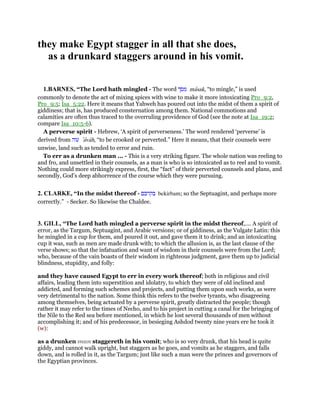
declares the Lord, the LORD Almighty.
1.BARNES, “And the Egyptians - The Egyptian nation; the entire people, though divided
into factions and contending with each other.
Will I give over - Margin, ‘Shut up.’ The Hebrew word (‫סכר‬ sakar) usually has the sense of
shutting up, or closing. Here it means that these contentions would be “closed” or concluded by
their being delivered to of a single master. The Septuagint renders it, Παραδώσω Paradoso - ‘I
will surrender.’
Into the hands of a cruel lord - Hebrew, ‘Lords of cruelty, or severity.’ The word rendered
‘lord,’ meaning master, is in the Hebrew in the plural number (‫אדנים‬ 'adonı y). It is, however,
generally supposed that it is pluralis excellentiae - denoting majesty and dignity, and applicable
to a “single” monarch. The connection requires this, for the state here described would be
different from that where “many” rule, and it seems to suppose that “one” should succeed to the
many who had been contending. In the parallel member, also, a name in the singular number is
used - ‘a fierce king;’ and as this evidently denotes the same, it follows that the word here is used
to denote a single monarch. The plural form is often thus used in the Hebrew (see Psa_7:10;
Eze_29:3; Hos_12:1). God here claims jurisdiction over the nation, and says that “he” will do it -
a most striking illustration of the power which he asserts over contending people to deliver them
to whomsoever he will.
Dr. Newton supposes that this was Nebuchadnezzar, or more properly Cambyses, by whom
Egypt was made subject to the authority of Persia, and who was eminently a cruel man, a
madman. But the more probable interpretation is that which refers it to Psammetichus. twelve
kings were in contention, of whom he was one. He called in the aid of the Arabians, the pirates
of Caria and Iona (Herodot. ii. 152; see the Analysis of the chapter; Diod. i. 66). This was in the
twentieth year of the reign of Manasseh. Psammetichus reigned fifty-four years and was
succeeded by Nechus his son, called in Scripture Pharaoh-Necho, and often mentioned under
that name. Psammetichus, during a considerable part of his reign, was engaged in wars with
Assyria and Palestine. He is here called a ‘cruel lord;’ that is, an oppressive monarch, probably
because he secured the kingdom by bringing in to his aid foreign mercenaries - robbers and
pirates, and because his wars made his government oppressive and burdensome.
A fierce king - Hebrew, ‘A king of strength’ - a description particularly applicable to one
who, like Psammetichus, had subdued eleven rivals, and who had obtained the kingdom by
conquest.
2. CLARKE, “A cruel lord “Cruel lords” - Nebuchadnezzar in the first place, and
afterwards the whole succession of Persian kings, who in general were hard masters, and
grievously oppressed the country. Note, that for ‫קשה‬ kasheh, lord, a MS. reads ‫קשים‬ kashim,
lords, agreeable to which is the rendering of the Septuagint, Syriac, and Vulgate.
3. GILL, “And the Egyptians will I give over into the hands of a cruel lord,.... Not of
Sennacherib king of Assyria, which way go many interpreters, both Christian and Jewish, as
Aben Ezra, Jarchi, and Kimchi; nor of Nebuchadnezzar king of Babylon, as in Jer_46:25 but
either of the twelve tyrants that rose up after the death of Sethon above mentioned; for the word
is in the plural number, "lords", though the adjective rendered "cruel" is singular; or else
Psammiticus, the father of Pharaohnecho, that slew Josiah; and who conquered the other eleven
tyrants, and ruled alone, for the space of fifty four years, with great rigour; and the same is
designed in the next clause:
and a fierce king shall rule over them; it is reported of Psammiticus, that he gave such
offence to his subjects, that two hundred thousand of his soldiers left him, and went into
Ethiopia (a). Vitringa interprets this of the Persian emperors, into whose hands Egypt fell, as
Cambyses and Ochus; and who, according to historians, were very cruel princes. That there
might be no doubt of the sure and certain accomplishment of this prophecy, it is added,
saith the Lord, the Lord of hosts; of the armies above and below; and who does what he
pleases among the kings and kingdoms of the earth.
4. HENRY, “Their politics shall be all blasted, and turned into foolishness. When God will
destroy the nation he will destroy the counsel thereof (Isa_19:3), by taking away wisdom from
the statesmen (Job_12:20), or setting them one against another (as Hushai and Ahithophel), or
by his providence breaking their measures even when they seemed well laid; so that the princes
of Zoan are fools: they make fools of one another, every one betrays his own folly, and divine
Providence makes fools of them all, Isa_19:11. Pharaoh had his wise counsellors. Egypt was
famous for such. But their counsel has all become brutish; they have lost all their forecast; one
would think they had become idiots, and were bereaved of common sense. Let no man glory
then in his own wisdom, nor depend upon that, nor upon the wisdom of those about him; for he
that gives understanding can when he please take it away. And from those it is most likely to be
taken away that boast of their policy, as Pharaoh's counsellors here did, and, to recommend
themselves to places of public trust, boast of their great understanding (“I am the son of the
wise, of the God of wisdom, of wisdom itself,” says one; “my father was an eminent privy-
counsellor of note in his day for wisdom”), or of the antiquity and dignity of their families: “I
am,” says another, “the son of ancient kings.” The nobles of Egypt boasted much of their
antiquity, producing fabulous records of their succession for above 10,000 years. This humour
prevailed much among them about this time, as appears by Herodotus, their common boast
being that Egypt was some thousands of years more ancient than any other nation. “But where
are thy wise men? Isa_19:12. Let them now show their wisdom by foreseeing what ruin is
coming upon their nation, and preventing it, if they can. Let them with all their skill know what
the Lord of hosts has purposed upon Egypt, and arm themselves accordingly. Nay, so far are
they from doing this that they themselves are, in effect, contriving the ruin of Egypt, and
hastening it on, Isa_19:13. The rod of government shall be turned into the serpent of tyranny
and oppression (Isa_19:4): “The Egyptians will I give over into the hand of a cruel lord, not a
foreigner, but one of their own, one that shall rule over them by an hereditary right, but shall be
a fierce king and rule them with rigour,” either the twelve tyrants that succeeded Sethon, or
rather Psammetichus that recovered the monarchy again; for he speaks of one cruel lord. Now
the barbarous usage which the Egyptian task masters gave to God's Israel long ago was
remembered against them and they were paid in their own coin by another Pharaoh. It is sad
with a people when the powers that should be for edification are for destruction, and they are
ruined by those by whom they should be ruled, when such as this is the manner of the king, as it
is described (in terrorem - in order to impress alarm), 1Sa_8:11.
5. JAMISON, “cruel lord — “Sargon,” in Hebrew it is lords; but plural is often used to
express greatness, where, one alone is meant (Gen_39:2). The parallel word “king” (singular)
proves it. Newton makes the general reference to be to Nebuchadnezzar, and a particular
reference to Cambyses, son of Cyrus (who killed the Egyptian god, Apis), and Ochus, Persian
conquerors of Egypt, noted for their “fierce cruelty.” Gesenius refers it to Psammetichus, who
had brought into Egypt Greek and other foreign mercenaries to subdue the other eleven princes
of the dodecarchy.
5B. PULPIT, “The Egyptians will I give over into the hand of a cruel lord. It has been observed above
that Piankhi will not answer to this description. It will, however, well suit Esarhaddon. Esarhaddon, soon
after his accession, cut off the heads of Abdi-Milkut, King of Sidon, and of Sanduarri, King of Kundi, and
hung them round the necks of two of their chief officers. In an expedition which he made into Arabia, he
slew eight of the sovereigns, two of them being women. On conquering Egypt he treated it with extreme
severity. Not only did he divide up the country into twenty governments, but he changed the names of the
towns, and assigned to his twenty governors, as their main duty, that they were "to slay, plunder, and
spoil" their subjects. He certainly well deserved the appellations of "a cruel lord," "a fierce king."
6. KRETZMANN, “ And the Egyptians will I give over into the hand of a cruel lord, the reference
being either to one of their own tyrannical rulers or to the Assyrian conquerors; and a fierce king shall
rule over them, saith the Lord, the Lord of hosts. Three Pharaohs, namely, Psammetichus, Necho,
and Hophra, oppressed the Egyptians so severely that the land never recovered from their tyranny.
7.CALVIN, “4.And I will deliver the Egyptians into the hand of a cruel master. (28) He now shews what
will happen to the Egyptians, after having lost courage and been deprived of understanding. Nothing will
be left for them but to be reduced to slavery; for a nation destitute of these must fall of its own accord,
even though it were not violently attacked by any enemy. Of such aids, therefore, God deprives those on
whom he determines to take vengeance, and shuts them out from every method of upholding their liberty.
Yet the Prophet threatens what is still more shocking, that not only will the empire of which the Egyptians
proudly vaunted fall down, but the inhabitants also will undergo hard bondage. Though the adjective ‫,קשה‬
(kāĕ) cruel, is in the singular number, yet he says in the plural number, that they shall be subject
to lords, which is harder to endure than if there had been but one lord to whom they were subject.
And a powerful king (29) shall rule over them. He means that the power of the tyrant to whom he will
subject them shall be so great, that it will not be easy to restore them to liberty. Historians shew that
various changes occurred in many countries, which they who subdued them were unable to hold and
retain; for to keep what has been obtained is often more difficult than to conquer. But the Prophet
intimates that this condition will not be easily changed, and that the bondage of the Egyptians shall be of
long duration, because no one will dare to enter the lists with an exceedingly powerful conqueror. We
may also understand the meaning to be, that the princes of smaller nations will deal more gently with their
people than more powerful monarchs, who, relying on their greatness, allow themselves to do whatever
they please; for, reckoning their power to be unlimited, they set no bounds to their freedom of action, and
rush forward, without restraint, wherever their passions drive them. Whether the one view or the other be
adopted, it will amount to this, that the Egyptians, who consider themselves to be the highest and most
distinguished of all men, shall fall under the power of another, and shall be oppressed by hard bondage,
that is, by the bondage of a powerful king, whom no one will dare to oppose. Hence we see how great is
the folly of men who are desirous to have a powerful and wealthy king reigning over them, and how justly
they are punished for their ambition, though it cannot be corrected by the experience of every day, which
is everywhere to be seen in the world. France and Spain, at the present day, boast that they are
governed by mighty princes, but feel to their cost how little advantage they derive from that which dazzles
them by a false pretense of honor. But on this subject we have spoken formerly in another
place. (30) (Isa_8:6.)
5
The waters of the river will dry up,
and the riverbed will be parched and dry.
1.BARNES, “And the waters shall fail - Here commences a description of the “physical”
calamities that would come upon the land, which continues to Isa_19:10. The previous verses
contained an account of the national calamities by civil wars. It may be observed that discord,
anarchy, and civil wars, are often connected with physical calamities; as famine, drought,
pestilence. God has the elements, as well as the hearts of people, under his control; and when he
chastises a nation, he often mingles anarchy, famine, discord, and the pestilence together. Often,
too, civil wars have a “tendency” to produce these calamities. They annihilate industry, arrest
enterprise, break up plans of commerce, and divert the attention of people from the cultivation
of the soil. This might have been in part the case in Egypt; but it would seem also that God, by
direct agency, intended to afflict them by drying up their streams in a remarkable manner.
From the sea - The parallelism here, as well as the whole scope of the passage, requires us to
understand this of the Nile. The word ‫ים‬ yam is sometimes used to denote a large river (see the
notes at Isa_11:15; Isa_18:2). The Nile is often called a sea. Thus Pliny (“Nat. Hist.” ii. 35) says,
‘The water of the Nile resembles the sea.’ Thus, Seneca (“Quaest. Nat.” v. 2) says, ‘By continued
accessions of water, it stagnates (stagnat) into the appearance of a broad and turbid sea.’
Compare Herodot. ii. 97; Diod. i. 12, 96; ‘To this day in Egypt, the Nile is el-Bahr, “the sea,” as its
most common appellation.’ ‘Our Egyptian servant,’ says Dr. Robinson, ‘who spoke English,
always called it “the sea.”’ (“Bib. Rescarches,” vol. i. 542).
And the river - The Nile.
Shall be wasted - This does not mean “entirely,” but its waters would fail so as to injure the
country. It would not “overflow” in its accustomed manner, and the consequence would be, that
the land would be desolate. It is well known that Egypt derives its great fertility entirely from the
overflowing of the Nile. So important is this, that a public record is made at Cairo of the daily
rise of the water. When the Nile rises to a less height than twelve cubits, a famine is the
inevitable consequence, for then the water does not overflow the land. When it rises to a greater
height than sixteen cubits, a famine is almost as certain - for then the superabundant waters are
not drained off soon enough to allow them to sow the seed. The height of the inundation,
therefore, that is necessary in order to insure a harvest, is from twelve to sixteen cubits. The
annual overflow is in the month of August. The prophet here means that the Nile would not rise
to the height that was desirable - or the waters should “fail” - and that the consequence would be
a famine.
2. CLARKE, “The river shall be wasted and dried up - The Nile shall not overflow its
banks; and if no inundation, the land must become barren. For, as there is little or no rain in
Egypt, its fertility depends on the overflowing of the Nile.
3. GILL, “And the waters shall fail from the sea,.... Which Kimchi understands
figuratively of the destruction of the Egyptians by the king of Assyria, compared to the drying up
of the waters of the Nile; and others think that the failure of their trade by sea is meant, which
brought great revenues into the kingdom: but, by what follows, it seems best to take the words in
a literal sense, of the waters of the river Nile, which being dried up, as in the next clause, could
not empty themselves into the sea, as they used, and therefore very properly may be said to fail
from it; nay, the Nile itself may be called a sea, it being so large a confluence of water:
and the river shall be wasted and dried up; that is, the river Nile, which was not only very
useful for their trade and navigation, but the fruitfulness of the country depended upon it; for
the want of rain, in the land of Egypt, was supplied by the overflow of this river, at certain times,
which brought and left such a slime upon the earth, as made it exceeding fertile; now the drying
up of this river was either occasioned by some great drought, which God in judgment sent; or by
the practices of some of their princes with this river, by which it was greatly impaired, and its
usefulness diminished.
4. HENRY, “. Egypt was famous for its river Nile, which was its wealth, and strength, and
beauty, and was idolized by them. Now it is here threatened that the waters shall fail from the
sea and the river shall be wasted and dried up, Isa_19:5. Nature shall not herein favour them as
she has done. Egypt was never watered with the rain of heaven (Zec_14:18), and therefore the
fruitfulness of their country depended wholly upon the overflowing of their river; if that
therefore be dried up, their fruitful land will soon be turned into barrenness and their harvests
cease: Every thing sown by the brooks will wither of course, will be driven away, and be no
more, Isa_19:7. If the paper-reeds by the brooks, at the very mouth of them, wither, much more
the corn, which lies at a greater distance, but derives its moisture from them. Yet this is not all;
the drying up of their rivers is the destruction, 1. Of their fortifications, for they are brooks of
defence (Isa_19:6), making the country difficult of access to an enemy. Deep rivers are the
strongest lines, and most hardly forced. Pharaoh is said to be a great dragon lying in the midst
of his rivers, and guarded by them, bidding defiance to all about him, Eze_29:3. But these shall
be emptied and dried up, not by an enemy, as Sennacherib with the sole of his foot dried up
mighty rivers (Isa_37:25), and as Cyrus, who took Babylon by drawing Euphrates into many
streams, but by the providence of God, which sometimes turns water-springs into dry ground,
Psa_107:33. 2. It is the destruction of their fish, which in Egypt was much of their food, witness
that base reflection which the children of Israel made (Num_11:5): We remember the fish which
we did eat in Egypt freely. The drying up of the rivers will kill the fish (Psa_105:29), and will
thereby ruin those who make it their business, (1.)
5. JAMISON, “the sea — the Nile. Physical calamities, it is observed in history, often
accompany political convulsions (Eze_30:12). The Nile shall “fail” to rise to its wonted height,
the result of which will be barrenness and famine. Its “waters” at the time of the overflow
resemble “a sea” [Pliny, Natural History, 85.11]; and it is still called El-Bahr,” “the sea,” by the
Egyptians (Isa_18:2; Jer_51:36). A public record is kept at Cairo of the daily rise of the water at
the proper time of overflow, namely, August: if it rises to a less height than twelve cubits, it will
not overflow the land, and famine must be the result. So, also, when it rises higher than sixteen;
for the waters are not drained off in time sufficient to sow the seed.
5B. PULPIT, The waters shall fail from the sea. By "the sea" it is generally allowed that the Nile must
be meant, as in Isa_18:2 and Nah_3:8. The failure might be caused by deficient rains in Abyssinia and
Equatorial Africa, producing an insufficient inundation. It might be aggravated by the neglect of dykes and
canals, which would be the natural consequence of civil disorders. Wasted and dried up; rather, parched
and dried up. Allowance must be made for Oriental hyperbole. The meaning is only that there shall be a
great deficiency in the water supply. Such a deficiency has often been the cause of terrible famines in
Egypt.
6. K&D 5-10, “The prophet then proceeds to foretell another misfortune which was coming
upon Egypt: the Nile dries up, and with this the fertility of the land disappears. “And the waters
will dry up from the sea, and the river is parched and dried. And the arms of the river spread a
stench; the channels of Matzor become shallow and parched: reed and rush shrivel up. The
meadows by the Nile, on the border of the Nile, and every corn-field of the Nile, dries up, is
scattered, and disappears. And the fishermen groan, and all who throw draw-nets into the
Nile lament, and they that spread out the net upon the face of the waters languish away. And
the workers of fine combed flax are confounded, and the weavers of cotton fabrics. And the
pillars of the land are ground to powder; all that work for wages are troubled in mind.” In
Isa_19:5 the Nile is called yam (a sea), just as Homer calls it Oceanus, which, as Diodorus
observes, was the name given by the natives to the river (Egypt. oham). The White Nile is called
bahr el-abyad (the White Sea), the Blue Nile bahr el-azrak, and the combined waters bahr enNil, or,
in the language of the Besharîn, as here in Isaiah, yam. And in the account of the creation, in Gen
1, yammim is the collective name for great seas and rivers. But the Nile itself is more like an
inland sea than a river, from the point at which the great bodies of water brought down by the
Blue Nile and the White Nile, which rises a few weeks later, flow together; partly on account of
its great breadth, and partly also because of its remaining stagnant throughout the dry season. It
is not till the tropical rains commence that the swelling river begins to flow more rapidly, and
the yam becomes a nahar. But when, as is here threatened, the Nile sea and Nile river in Upper
Egypt sink together and dry up (nisshe
thu, niphal either of shathath = nashattu, to set, to grow
shallow; or more probably from nashath, to dry up, since Isa_41:17 and Jer_51:30 warrant the
assumption that there was such a verb), the mouths (or arms) of the Nile (nehar), which flow
through the Delta, and the many canals (ye'orim), by which the benefits of the overflow are
conveyed to the Nile valley, are turned into stinking puddles (‫יחוּ‬ִ‫נ‬ְ‫ז‬ ֶ‫א‬ ֶ‫,ה‬ a hiphil, half substantive
half verbal, unparalleled elsewhere,
(Note: It is not unparalleled as a hiph. denom. (compare ‫יר‬ ִ‫ה‬ ְ‫צ‬ ִ‫,ה‬ oil, ‫ר‬ ַ‫ה‬ ְ‫צ‬ִ‫,י‬ to press,
Job_24:11, Talm. ַ‫יע‬ ִ‫ל‬ ְ‫ת‬ ִ‫,ה‬ to become worm-eaten, and many others of a similar kind); and as a
mixed form (possibly a mixture of two readings, as Gesenius and Böttcher suppose, though it
is not necessarily so), the language admitted of much that was strange, more especially in
the vulgar tongue, which found its way here and there into written composition.)
signifying to spread a stench; possibly it may have been used in the place of ‫ח‬ַ‫י‬ִ‫נ‬ְ‫ז‬ ִ‫,ה‬ from ‫ח‬ָ‫נ‬ְ‫ז‬ፍ or
‫ח‬ָ‫נ‬ְ‫ז‬ ֶ‫,א‬ stinking, to which a different application was given in ordinary use). In all probability it is
not without intention that Isaiah uses the expression Matzor, inasmuch as he distinguishes Ma
zort from Pathros (Isa_11:11), i.e., Lower from Upper Egypt (Egyp. sa-het, the low land, and sa-
res, the higher land), the two together being Mitzrayim. And ye'orim (by the side of neharoth) we
are warranted in regarding as the name given of the Nile canals. The canal system in Egypt and
the system of irrigation are older than the invasion of the Hyksos (vid., Lepsius, in Herzog's
Cyclopaedia). On the other hand, ye'or in Isa_19:7 (where it is written three times plene, as it is
also in Isa_19:8) is the Egyptian name of the Nile generally (yaro).
(Note: From the fact that aur in old Egyptian means the Nile, we may explain the Φρουορራ
ᅪτοι Νεሏλος, with which the Laterculus of Eratosthenes closes.)
It is repeated emphatically three times, like Mitzrayim in Isa_19:1. Parallel to mizra‛, but yet
different from it, is ‫רוֹת‬ ָ‫,ע‬ from ‫ה‬ ָ‫ר‬ ָ‫,ע‬ to be naked or bare, which signifies, like many derivatives of
the synonymous word in Arabic, either open spaces, or as here, grassy tracts by the water-side,
i.e., meadows. Even the meadows, which lie close to the water-side (pi = ora, as in Psa_133:2,
not ostium), and all the fields, become so parched, that they blow away like ashes.
Then the three leading sources from which Egypt derived its maintenance all fail: - viz. the
fishing; the linen manufacture, which supplied dresses for the priests and bandages for
mummies; and the cotton manufacture, by which all who were not priests were supplied with
clothes. The Egyptian fishery was very important. In the Berlin Museum there is an Egyptian
micmoreth with lead attached. The mode of working the flax by means of serikah, pectinatio
(compare ‫רוֹק‬ ָ‫,ס‬ wool-combs, Kelim, 12, 2), is shown on the monuments. In the Berlin Museum
there are also Egyptian combs of this description with which the flax was carded. The
productions of the Egyptian looms were celebrated in antiquity: choray, lit., white cloth
(singularet. with the old termination ay), is the general name for cotton fabrics, or the different
kinds of byssus that were woven there (compare the βυσσίνων ᆆθονίων of the Rosetta
inscription). All the castes, from the highest to the lowest, are not thrown into agonies of
despair. The shathoth (an epithet that was probably suggested by the thought of shethi, a warp,
Syr. 'ashti, to weave, through the natural association of ideas), i.e., the “pillars” of the land (with
a suffix relating to Mitzrayim, see at Isa_3:8, and construed as a masculine as at Psa_11:3),
were the highest castes, who were the direct supporters of the state edifice; and ‫ר‬ ֶ‫כ‬ ֶ‫שׂ‬ ‫י‬ ֵ‫ּשׂ‬‫ע‬ cannot
mean the citizens engaged in trade, i.e., the middle classes, but such of the people as hired
themselves to the employers of labour, and therefore lived upon wages and not upon their own
property (‫ר‬ ֶ‫כ‬ ֶ‫שׂ‬ is used here as in Pro_11:18, and not as equivalent to ‫ר‬ ֶ‫כ‬ ֶ‫,ס‬ the dammers-up of the
water for the purpose of catching the fish, like ‫ין‬ ִ‫ר‬ ָ‫כ‬ ַ‫,ס‬ Kelim, 23, 5).
7.CALVIN, “5.Then the waters shall fail from the sea. He follows out the subject which he had already
begun, that the fortifications, by which the Egyptians thought that they were admirably defended, will be of
no avail to them. They reckoned themselves to be invincible, because they were surrounded by the sea,
and by the Nile, and by fortifications; and historians tell us that it was difficult to gain entrance to them,
because the Nile had no mouth, by which they could not easily prevent ships from landing. They therefore
boasted that their situation was excellent, and that they were strongly fortified by nature, in like manner as
the inhabitants of Venice, at the present day, think that, in consequence of being surrounded by deep
ditches, they are impregnable; but fortresses are useless, when God has determined to punish us.
6
The canals will stink;
the streams of Egypt will dwindle and dry up.
The reeds and rushes will wither,
1.BARNES, “And they shall turn the rivers far away - (‫חוּ‬ ‫האז‬ he'eze
nı ychu), probably
from ‫זנח‬ zanach, “to have an offensive smell; to be rancid, or putrid.” The word in this form
occurs nowhere else. It is in the Hiphil conjugation, and is probably a form made from a mixture
with the Chaldee. The sense is not doubtful. It means ‘the rivers shall become putrid - or have an
offensive smell;’ that is, shall become stagnant, and send forth unwholesome “miasmata”
producing sickness, as stagnant waters often do. The Vulgate renders it, ‘And the rivers shall
fail.’ The Septuagint, ‘And the Egyptians shall drink the waters from the sea, but the river shall
fail, and be dried up, and the rivers shall fail, and the streams (διᆹρυχες dioruches) of the river,
and all the assembling (συναγωγή sunagoge) waters shall be dried up.’
And the brooks of defense - Hebrew, ‘The rivers of ‫מצור‬ matsor. The word ‫מצור‬ matsor
often means “straitness, affliction;” then a siege, a wall, a bulwark, a fortification. But, probably,
it here means “Egypt,” or the same as ‫מצרים‬ mı tse
rayı m (compare Isa_37:25; 2Ki_18:24;
Mar_7:12). Perhaps the Hebrews may have thought of Egypt as a strongly fortified place, and
thus have given the name to it; or possibly this may have been a modification of the name
“Mitsraim.”
The reeds and flags - Which grew on the banks of the Nile - the papyrus, etc. (see the note
at Isa_18:2)
2. CLARKE, “Shall turn the rivers far away “Shall become putrid” - ‫האזניח‬‫ו‬
heeznichu. This sense of the word, which Simonis gives in his Lexicon, from the meaning of it in
Arabic, suits the place much better than any other interpretation hitherto given; and that the
word in Hebrew had some such signification, is probable from 2Ch_29:19, where the Vulgate
renders it by polluit, polluted, and the Targum, by profaned, and made abominable, which the
context in that place seems plainly to require. The form of the verb here is very irregular; and
the rabbins and grammarians seem to give no probable account of it.
3. GILL, “And they shall turn the rivers far away,.... The river Nile, called "rivers", the
plural for the singular, because of the abundance of water in it; or its seven streams, with other
rivulets, derived from it. Some make the "they" here to refer to the kings of Egypt, and interpret
the words of some projects of theirs, by which the course of the river was turned to great
disadvantage; particularly they understand it of the twelve tyrants that reigned after Sethon, to
whom they ascribe the digging of the vast lake of Moeris, the two pyramids built in the midst of
it, and a labyrinth near it, though only the labyrinth was made by them (b); and as for the lake, it
was made by Moeris, a king of Egypt, from whom it had its name, some hundred years before;
and, besides, was of service, and not disservice, to the Nile; for it received its waters when it
overflowed too much, and it furnished it with water by an outlet when it failed: rather therefore
this passage may be illustrated by the attempt which Necus, the son of Psammiticus, whom the
Scripture calls Pharaohnecho, made, to join the Nile and the Red Sea together, by making a
canal from the one to the other; in which work he lost a hundred and twenty thousand men, and
desisted from it without finishing it (c); but it is thought hereby the river was greatly weakened:
and the brooks of defence shall be emptied and dried up; as the river of Nile and its
streams were the defence of the land of Egypt, as well as made for the fruitfulness of it, for these
must make it less accessible to a foreign enemy; and besides, here lay their shipping, which were
their protection; and moreover, from hence brooks and courses of water might be derived and
carried about their fortified cities, which added to the strength of them. The Targum renders it
deep brooks or rivers; and Kimchi interprets it the brooks of Egypt, taking Matzor to signify
Egypt, a word in sound near to Mitzraim, the common word used for Egypt. It looks, by this and
other expressions in the context, as if more were designed than the above instance or instances
will account for:
the reeds and flags shall wither; which grew in the brooks, and near them; and therefore
much more the grass and corn, and other trees, which were at a distance; besides, these are
mentioned, bemuse of the great usefulness they were of; for of these they made ships, barks, and
boats, and mats for bedding, and nets fishing; as also paper to write on, as follows, and which
was a staple commodity with them; See Gill on Isa_18:2.
4. HENRY, “. The Egyptians may themselves remember the fish they have formerly eaten
freely, but now cannot have for money. And that which aggravates the loss of these advantages
by the river is that it is their own doing (Isa_19:6): They shall turn the rivers far away. Their
kings and great men, to gratify their own fancy, will drain water from the main river to their own
houses and grounds at a distance, preferring their private convenience before the public good,
and so by degrees the force of the river is sensibly weakened. Thus many do themselves a greater
prejudice at last than they think of, [1.] Who pretend to be wiser than nature, and to do better
for themselves than nature has done. [2.] Who consult their own particular interest more than
the common good. Such may gratify themselves, but surely they can never satisfy themselves,
who to serve a turn contribute to a public calamity, which they themselves, in the long run,
cannot avoid sharing in. Herodotus tells us that Pharaoh-Necho (who reigned not long after
this), projecting to cut a free passage by water from Nilus into the Red Sea, employed a vast
number of men to make a ditch or channel for that purpose, in which attempt he impaired the
river, lost 120,000 of his people, and yet left the work unaccomplished.
5. JAMISON, “they shall turn the rivers — rather, “the streams shall become putrid”;
that is, the artificial streams made for irrigation shall become stagnant and offensive when the
waters fail [Maurer]. Horsley, with the Septuagint, translates, “And waters from the sea shall be
drunk”; by the failure of the river water they shall be reduced to sea water.
brooks of defence — rather, “canals of Egypt”; “canals,” literally, “Niles,” Nile canals, the
plural of the Egyptian term for the great river. The same Hebrew word, Matzor, whence comes
Mitzraim, expresses Egypt, and a place of “defense.” Horsley, as English Version translates it,
“embanked canals,”
reeds ... flags — the papyrus. “Reed and rush”; utter withering.
5B. PULPIT, “And they shall turn the rivers far away; rather, and the rivers shall stagnate (Cheyne).
Probably the canals are intended, as in Exo_7:19 (see 'Pulpit Commentary,' ad loc.). The brooks of defense
shall be emptied. Some render this "brooks of Egypt," regarding matsor as here used for "Mitsraim;" but our
translation is more forcible, and may well stand. The "brooks of defense" are those which had hitherto
formed the moats round walled cities (comp. Isa_37:25; Nah_3:8). The reeds and flags shall wither. Reeds,
flags, rushes, and water-plants of all kinds abound in the backwaters of the Nile, and the numerous ponds
and marshes connected with its overflow. These forms of vegetation would be the first to wither on the
occurrence of a deficient inundation.
6. KRETZMANN, “ And they shall turn the rivers far away, rather, "and the rivers shall produce a
stench," being reduced to stagnating pools; and the brooks of defense shall be emptied and dried
up, that is, the canals of the Nile, especially in its delta and in the irrigation systems, would carry no more
water; the reeds and flags, principally the papyrus-plants depending altogether upon the moisture of the
river, shall wither
7.CALVIN, “6.And the brooks of defence shall be emptied and dried up. (31) What he adds about
fortifications is to the same purpose with what he had stated immediately before. He alludes to the
embankments, which not only restrained the overflowing of the Nile, but protected the whole country; as if
he had said that the embankments will not be needed, because the Nile will be dried up. Now, it is certain
that the Nile was not laid dry, and yet the Prophet did not foretell what was not accomplished. We must
therefore call to remembrance what we have already said, that on account of our stupidity those
calamities are represented to us in a lively manner, which places them as it were before our eyes; for we
need to have a representation made to us which is fitted to impress our minds, and to arouse us to
consider the judgments of God, which otherwise we despise. We ought to observe the haughtiness of the
Egyptians, whose resources were so various and abundant, and who thought that it was impossible for
them to be overtaken by such a calamity.
7
also the plants along the Nile,
at the mouth of the river.
Every sown field along the Nile
will become parched, will blow away and be no
more.
1.BARNES, “The paper reeds - (‫ערות‬ ‛arot). This is not the word which occurs in Isa_18:2,
and which, it is supposed, means there the papyrus (see the note on that place). Interpreters
have been divided in regard to the meaning of the word here. Gesenius derives it from ‫ערה‬ ‛arah,
“to be naked, open, bare;” and supposes that it means an open place, a place naked of wood, and
that it here denotes the pastures on the banks of the Nile. So Rosenmuller interprets it of the
green pastures on the banks of the Nile; and the Hebrew commentators generally so understand
it. The Vulgate renders it, ‘And the bed (alveus) of the river shall be dried up from the fountain.’
So the Chaldee, ‘And their streams shall be desolate.’ It probably denotes, not paper reeds, but
the green pastures that were beside the brooks, or along the banks of the Nile.
By the brooks - Hebrew, ‘Rivers’ (‫יארי‬ ye
'orey). By the ‘brooks’ here, in the plural number,
the prophet probably means the artificial canals which were cut in every direction from the Nile
for the purpose of conveying the waters to various parts of the land.
By the mouth of the brooks - At the mouth of the canals, or where they emptied into the
Nile. Such meadows, being “near” the Nile, and most sure of a supply of water, would be more
valuable than those which were remote, and are, therefore, particularly specified.
Shall wither ... - That is, there shall be utter and entire desolation. If the Nile ceased to
overflow; if the streams, reservoirs, and canals, could not be filled, this would follow as a matter
of course. Everything would dry up.
2. KRETZMANN, “ The paper-reeds by the brooks, literally, "the naked places," the meadows on
the Nile, by the mouth of the brooks, along the banks of the river, and everything sown by the
brooks, the grain-fields along the very edge of the Nile, shall wither, be driven away, scattered by the
wind in the form of dust, and be no more.
3. GILL, “The paper reeds by the brooks, by the mouth of the brooks,.... Not at the
fountain or origin of the Nile and its streams, but by the sides thereof; on the banks of which
grew a reed or rush, called by the Greeks "papyrus" and "biblus"; from whence come the words
"paper" and "bible", or book, of which paper was anciently made; even as early as the times of
Isaiah, and so, many hundreds of years before the times of Alexander the great, to which some
fix the era of making it.
"According to Pliny (d), its root is of the thickness of a man's arm, and ten cubits long; from this
arise a great number of triangular stalks, six or seven cubits high, each thick enough to be easily
spanned. Its leaves are long, like those of the bulrush; its flowers stamineous, ranged in clusters
at the extremities of the stalks; its roots woody and knotty, like those of rushes; and its taste and
smell near akin to those of the cyprus.----The manner of making the Egyptian paper was this:
they began with lopping off the two extremes of the "papyrus", viz. the head and root, as of no
use in this manufacture; the remaining stem they slit lengthwise, into equal parts; and from
each of these they stripped the thin scaly coats, or pellicles, whereof it was composed, with a
point of a penknife (or needle, as some); the innermost of these pellicles were looked on as the
best, and those nearest the rind or bark the worst; they were kept apart accordingly, and
constituted different sorts of paper. As the pellicles were taken off, they extended them on a
table; then two or more of them were laid over each other transversely, so as that their fibres
made right angles; in this state they were glued together by the muddy waters of the Nilus.
These being next pressed to get out the water, then dried, and lastly flatted and smoothed, by
beating them with a mallet, constituted paper; which they sometimes polished further, by
rubbing it with a hemisphere of glass, or the like. There were paper manufactures in divers cities
of Egypt; but the greatest and most celebrated was that at Alexandria, where, according to
Varro's account, paper was first made. The trade and consumption of this commodity were in
reality incredible. Vopiscus relates, that the tyrant Firmus, who rebelled in Egypt, publicly
declared he would maintain an army only, "papyro et glutine", with paper and glue (e).''
So that the withering and drying up of these paper reeds, here threatened, must be a great
calamity upon the nation. And, besides paper, of this rush or reed were made sails, ropes, and
other naval rigging, as also mats, blankets, clothes, and even ships were made of the stalk of the
papyrus; and the Egyptian priests wore shoes made of it (f). It may be observed, that paper was
made of the pellicles or little skins stripped off of the inside of the stem of the papyrus; which
shows with what propriety the word (g) for paper reeds is here used, which comes from a root
which signifies to strip or make bare, and from which also is derived a word which signifies a
skin.
And everything sown by the brooks shall wither, be driven away, and be no more;
all sorts of fruitful plants, and grain of every kind, hemp and flax, after mentioned, and which
are opposed to reeds and rushes, which grew of themselves; and if these which were sown by the
sides of brooks and rivers withered and came to nothing, then much more what was sown at a
greater distance.
4. JAMISON, “paper-reeds — rather, pastures, literally, “places naked” of wood, and famed
for rich herbage, on the banks of the Nile [Gesenius]. Compare Gen_13:10; Deu_11:10. Horsley
translates, “nakedness upon the river,” descriptive of the appearance of a river when its bottom
is bare and its banks stripped of verdure by long drought: so Vulgate.
the brooks — the river.
mouth — rather, “the source” [Vulgate]. “Even close to the river’s side vegetation shall be so
withered as to be scattered in the shape of powder by the wind” (English Version, “driven
away”) [Horsley].
5. PULPIT, “The paper reeds by the brooks, etc.; rather, the meadows on the river, along the banks of
the river, and every seed-plot by the river. The banks of the Nile were partly grass-land
(Gen_41:2, Gen_41:18), partly cultivated in grain or vegetables (Herod; 2.14), in either case producing
the most luxuriant crops. All, however, depended on the inundation, and if that failed, or so far as it failed,
the results predicted by the prophet would happen.
6. CALVIN, “7.And the reed and the rush shall wither. He mentions the reed and the rush, because
they had abundance of them, and employed them for various purposes; or, it may be thought to mean
that the marshes will be dried up.
By the mouth of the brooks. Some render it embankments, but it rather means the fountain itself, which
seldom is dried up, though torrents or rivers fail. By the mouth, therefore, he means the source of the river
which shall be dried up in such a manner that no part of the country can be watered. Though the source
of the Nile was at a great distance, yet not without reason did the Prophet threaten that that river, on
whose waters the fertility almost of the whole land depended, shall be dried up at its very source; for in
that country rain seldom falls, but its place is supplied every year by the Nile. If that river overflow but
scantily, it threatens scarcity and famine; and therefore, when the Prophet threatens that it will be dried
up, he means that the whole country will be barren. For this reason he says also, that, even at its
very mouth, from which the waters spring up, there will be a lack of waters, so that in that place the herbs
will be withered.
8
The fishermen will groan and lament,
all who cast hooks into the Nile;
those who throw nets on the water
will pine away.
1.BARNES, “The fishers also - In this verse, and the two following, the prophet describes
the calamities that would come upon various classes of the inhabitants, as the consequence of
the failing of the waters of the Nile. The first class which he mentions are the fishermen. Egypt is
mentioned Num_11:5, as producing great quantities of fish. ‘We remember the fish which we did
eat in Eypt freely.’ ‘The Nile,’ says Diodorus (i.), ‘abounds with incredible numbers of all sorts of
fish.’ The same was true of the artificial canals, and lakes, and reservoirs of water Isa_19:10.
Herodotus (ii. 93) says that large quantities of fish were produced in the Nile: ‘At the season of
spawning,’ says he, ‘they move in vast multitudes toward the sea. As soon as that season is over
they leave the sea, return up the river, and endeavor to regain their accustomed haunts.’ As a
specimen of his “credulity,” however, and also of the attention which he bestowed on natural
history, the reader may consult the passage here referred to in regard to the mode of their
propagation.
He also says that it is observed of the fish that are taken in their passage to the sea, that they
have ‘the left part of their heads depressed.’ Of those that are taken on their return, the “right”
side of the head is found to be depressed. This he accounts for by observing, that ‘the cause of
this is obvious: as they pass to the sea they rub themselves on the banks on the left side; as they
return they keep closely to the same bank, and, in both instances, press against it, that they may
not be obliged to deviate from their course by the current of the stream.’ Speaking of the Lake
Moeris, Herodotus says, that ‘for six months the lake empties itself into the Nile, and the
remaining six, the Nile supplies the lake. During the six months in which the waters ebb, the
fishing which is here carried on furnishes the royal treasury with a talent of silver (about 180)
every day’ (ii. 149). ‘The silver which the fishery of this lake produced, was appropriated to find
the queen with clothes and perfumes.’ (Diod. i. 52.) The Lake Moeris is now farmed for 30
purses (about 193) annually.
Michaud says that the Lake Menzaleh now yields an annual revenue of 800 purses,’ about
5364. ‘The great abundance of fish produced in the Nile was an invaluable provision of nature,
in a country which had neither extended pasture grounds, nor large herds of cattle, and where
grain was the principal production. When the Nile inundated the country, and filled the lakes
and canals with its overflowing waters, these precious gifts were extended to the most remote
villages in the interior of the valley, and the plentiful supply of fish which they obtained was an
additional benefit conferred upon them at this season of the year.’ (Wilkinson’s “Ancient
Egyptians,” vol. iii. pp. 62, 63.) Hence, the greatness of the calamity here referred to by the
prophet when the lakes and canals should be dried up. The whole country would feel it.
And all they that cast angle - Two kinds of fishermen are mentioned - those who used a
hook, and those who used the net. The former would fish mainly in the “brooks” or canals that
were cut from the Nile to water their lands. For the various methods of fishing, illustrated by
drawings, the reader may consult Wilklnson’s “Ancient Egyptians,” vol. ii. p. 21; vol. iii. p. 53ff.
2. CLARKE, “The fishers also “And the fishers” - There was great plenty of fish in Egypt;
see Num_11:5. “The Nile,” says Diodorus, lib. i., “abounds with incredible numbers of all sorts of
fish.” And much more the lakes. So Egmont, Pococke, etc.
3. GILL, “The fishers also shall mourn,.... Because there will be no fish to catch, the waters
of the river being dried up, and so will have none to sell, and nothing to support themselves and
families with; and this must also affect the people in general, fish being the common food they
lived upon, see Num_11:5, not only because of the great plenty there usually was, but because
they killed and ate but very few living creatures, through a superstitious regard unto them;
though Herodotus says (h) the Egyptian priests might not taste of fishes, yet the common people
might; for, according to that historian (i), when the river Nile flowed out of the lake of Moeris, a
talent of silver every day was brought into the king's treasury, arising from the profit of fish; and
when it flowed in, twenty pounds; nay, he expressly says (k), that some of them live upon fish
only, gutted, and dried with the sun:
and all they that cast angle, or hook,
into the brooks shall lament; which describes one sort of fishermen, and way of catching
fishes, with the angle and hook, as the following clause describes another sort:
and they that spread nets upon the waters shall languish; be dispirited and enfeebled
for want of trade and subsistence, and with grief and horror.
4. HENRY, “Egypt was famous for its river Nile, which was its wealth, and strength, and
beauty, and was idolized by them. Now it is here threatened that the waters shall fail from the
sea and the river shall be wasted and dried up, Isa_19:5. Nature shall not herein favour them as
she has done. Egypt was never watered with the rain of heaven (Zec_14:18), and therefore the
fruitfulness of their country depended wholly upon the overflowing of their river; if that
therefore be dried up, their fruitful land will soon be turned into barrenness and their harvests
cease: Every thing sown by the brooks will wither of course, will be driven away, and be no
more, Isa_19:7. If the paper-reeds by the brooks, at the very mouth of them, wither, much more
the corn, which lies at a greater distance, but derives its moisture from them. Yet this is not all;
the drying up of their rivers is the destruction, 1. Of their fortifications, for they are brooks of
defence (Isa_19:6), making the country difficult of access to an enemy. Deep rivers are the
strongest lines, and most hardly forced. Pharaoh is said to be a great dragon lying in the midst
of his rivers, and guarded by them, bidding defiance to all about him, Eze_29:3. But these shall
be emptied and dried up, not by an enemy, as Sennacherib with the sole of his foot dried up
mighty rivers (Isa_37:25), and as Cyrus, who took Babylon by drawing Euphrates into many
streams, but by the providence of God, which sometimes turns water-springs into dry ground,
Psa_107:33. 2. It is the destruction of their fish, which in Egypt was much of their food, witness
that base reflection which the children of Israel made (Num_11:5): We remember the fish which
we did eat in Egypt freely. The drying up of the rivers will kill the fish (Psa_105:29), and will
thereby ruin those who make it their business, (1.) To catch fish, whether by angling or nets
(Isa_19:8); they shall lament and languish, for their trade is at an end. There is nothing which
the children of this world do more heartily lament than the loss of that which they used to get
money by. Ploratur lachrymis amissa pecunia veris - Those are genuine tears which are shed
over lost money.
5. JAMISON, “fishers — The Nile was famed for fish (Num_11:5); many would be thrown out
of employment by the failure of fishes.
angle — a hook. Used in the “brooks” or canals, as the “net” was in “the waters” of the river
itself.
6. PULPIT, “The fishers also shall mourn. The fisherman's trade was extensively practiced in ancient
Egypt, and anything which interfered with it would necessarily be regarded as a great calamity. A large
class supported itself by the capture and sale of fish fresh or salted. The Nile produced great abundance
of fish, both in its main stream and in its canals and backwaters. Lake Moeris also provided an extensive
supply (Herod; 2.149). All they that east angle into the brooks; rather, into the river. Fishing with a
hook was practiced in Egypt, though not very widely, except as an amusement by the rich. Actual hooks
have been found, not very different from modern ones, and representations of angling occur in some of
the tombs. Sometimes a line only is used, sometimes a rod and line. They that spread nets. Nets were
very much more widely employed than lines and hooks. Ordinarily a dragnet was used; but sometimes
small fry were taken in the shallows by means of a double-handled landing-net.
7. CALVIN, “8.And the fishers shall mourn. Isaiah still keeps in his eye the condition of Egypt. We
have formerly mentioned (32) that the prophets made use of those figures of speech by which, when any
country is mentioned, they chiefly name those things which abound in that country, and for which it is
celebrated. Thus, when a vinebearing country is spoken of, they mention vines; if it abound in gold, they
speak of gold; and if it abound in silver, they speak of silver. Accordingly, when he speaks of Egypt, which
was well watered, and contained abundance of streams, he mentions fishing.
They who spread a net on the face of the waters shall languish. Some translate the word ‫,אמללו‬ (ămlāū,) “
shall be cut off,” but the more correct rendering is, “ shall be weakened;” for this corresponds to the
mourning and lamentation which was formerly mentioned. Now, we know that in that country there was a
great number of fishers, and that these formed a great part of the wealth of Egypt. When fishers were
taken away, of whom there were vast numbers among the Egyptians, and of whom their wealth chiefly
consisted, they must have been weakened. Now, if the nation be deprived of that which is its ordinary
food, great poverty will follow. He therefore describes an astonishing change that shall pass on the whole
country.
9
Those who work with combed flax will despair,
the weavers of fine linen will lose hope.
1.BARNES, “Moreover - In addition to the calamities that will come upon the fishermen,
the drying up of the river will affect all who are supported by that which the overflowing of its
waters produced.
They that work in short flax - Egypt was celebrated anciently for producing flax in large
quantities, and of a superior quality (see Exo_9:31; 1Ki_10:28). The fine linen of Egypt which
was manufactured from this is celebrated in Scripture Pro_7:16; Eze_27:7. The Egyptians had
early carried the art of manufacturing linen to a great degree of perfection. As early as the exode
of the Hebrews, we find that the art was known by which stuffs made of linen or other materials
were curiously worked and embroidered. ‘And thou shalt make an hanging for the door of the
tent, of blue, and purple, and scarlet, and fine-twined linen, made with needlework’ (Exo_26:36;
compare Exo_27:16; Exo_36:37). So Eze_27:7 : ‘Fine linen, with broidered work from Egypt.’ So
also Martial refers to embroidery with the needle in Egypt:
Haec tibi Memphitis tellus dat munera; victa est
Pectine Niliaco jam Babylonis acus.
Martial, xiv. Ep. 50.
In regard to the “fineness” of the linen which was produced and made in Egypt, we may
introduce a statement made by Pliny when speaking of the “nets” which were made there. ‘So
delicate,’ says he, ‘were some of them, that they would pass through a man’s ring, and a single
person could carry a sufficient number of them to surround a whole wood. Julius Lupus, who
died while governor of Egypt, had some of those nets, each string of which consisted of 150
threads; a fact perfectly surprising to those who are not aware that the Rhodians preserve to this
day, in the temple of Minerva, the remains of a linen corslet, presented to them by Amasis, king
of Egypt, whose threads are composed each of 365 fibres.’ (Pliny, xix. 1.) Herodotus also
mentions this corslet (iii. 47), and also another presented by Amasis to the Lacedemonians,
which had been carried off by the Samians: ‘It was of linen, ornamented with numerous figures
of animals, worked in gold and cotton.
Each thread of the corslet was worthy of admiration. For though very fine, every one was
composed of 360 other threads, all distinct; the quality being similar to that dedicated to
Minerva at Lindus, by the same monarch.’ Pliny (xix. 1) mentions four kinds of linen that were
particularly celebrated in Egypt - the Tanitic, the Pelusiac, the Butine, and the tentyritic. He also
says that the quantity of flax cultivated in Egypt was accounted for, by their exporting linen to
Arabia and India. It is now known, also, that the cloth used for enveloping the dead, and which
is now found in abundance on the mummies, was “linen.” This fact was long doubted, and it was
until recently supposed by many that the cloth was made of cotton. This fact that it is linen was
settled beyond dispute by some accurate experiments made by Dr. Ure, Mr. Bauer, and Mr.
Thompson, with the aid of powerful microscopes.
It was found that linen fibres uniformly present a cylindrical form, transparent, and
articulated, or jointed like a cane, while the fibres of cotton have the appearance of a flat ribbon,
with a hem or border at the edge. In the mummy cloths, it was found, without exception, that
the fibres were linen. Vast quantities of linen must, therefore, have been used. The linen of the
mummy cloths is generally coarse. The warp usually contains about 90 threads in the inch; the
woof about 44. Occasionally, however, very fine linen cloth is found, showing the skill with
which the manufacture was executed. Sir John G. Wilkinson observes, that a piece of linen in his
possession from Egypt had 540 (or 270 double) threads in one inch in the warp. Some of the
cambric which is now manufactured has but 160 threads in the inch in the warp, and 140 in the
woof. It is to be remembered, also, that the linen in Egypt was spun by hand, and without the aid
of machinery (see, on this whole subject, Wilkinson’s “Ancient Egyptians,” vol. iii. pp. 113-142.
Ed. Lond. 1837). The word rendered ‘fine’ here denotes, according to Gesenius, “combed or
hatchelled.” The word ‘fine,’ however, expresses the idea with sufficient accuracy. Fine linen was
used for clothing; but was so expensive that it was worn chiefly by the rich and by princes
Luk_16:19.
They that weave networks - Margin, ‘White-works.’ According to Gesenius the word ‫הורי‬
horay means “white linen” - that which is fully bleached. The word ‫הוד‬ hod means “a hole or
cavern,” but is not applied to cloth. The parallelism seems rather to require that the word should
mean ‘white,’ or that which would correspond to ‘fine,’ or valuable; and it is not known that the
Egyptians had the art of working lace from linen. Saadias supposes that “nets” are meant, as
being made with holes or meshes; but it is evident that a finer work is intended than that.
Shall be confounded - Hebrew, ‘Shall be ashamed.’ That is, they shall be thrown out of
employment, and not know what to do.
2. CLARKE, “They that work in fine flax - ‫פשתים‬‫שריקות‬ pishtim sericoth, heckled flax, i.e.,
flax dressed on the heckle, or comb used for that purpose. The Vulgate uses the word pectentes,
combing.
They that weave networks shall be confounded - And confounden schul ben that wrogten flax,
plattinge and webynge sotel thingis. - Old MS. Bible.
3. GILL, “Moreover they that work in fine flax,.... Of which they made fine linen cloth,
and yarn, and was much wore by the Egyptians, and was the commodity of the country, and for
which other nations traded with them, 1Ki_10:28 but now would have no flax to work, that
being withered and gone which was sown by the sides of the brooks, Isa_19:7 and no linen cloth
or yarn to sell, and consequently in great confusion and distress, as they are here represented (l).
The Targum renders the whole verse thus,
"they shall be confounded which work flax, which they comb, and of it weave nets;''
and so Jarchi and Kimchi interpret it, not of persons that wrought in flax, to make yarn or linen
of it; but who combed it, to make nets of it, as follows:
and they that weave networks shall be confounded: because they would have no sale for
their nets, the fishermen having no use for them, the rivers being dried up. The word for
"networks" signifies "holes", because nets are made with holes large enough to let the water
through, and so small that the fishes may not get out. Some render the word "white works" (m),
white linen, white cloth, of which white garments are made, such as nobles and princes formerly
wore; hence, in the Hebrew language, they are called by a name of the same root and
signification; but the former sense seems best.
(l) ‫שריקות‬ is by us rendered "fine"; and so, Ben Melech says, in the Arabic language the best and
finest linen is called ‫;אלשרק‬ and so says Kimchi in Sepher Shorash.; with which Schindler agrees,
Arab. ‫,אלשרק‬ sericum or "muslin"; but it is a question whether this is of so early a date, and
especially not fit to make nets of. De Dieu and Bochart think it denotes the colour of the linen,
which was yellow, that being the best; but others render it "combed". (m) ‫ואורגים‬‫חורי‬ "et textores
alborum operum", Junius & Tremellius, Piscator.
4. HENRY, “Egypt was famous for the linen manufacture; but that trade shall be ruined.
Solomon's merchants traded with Egypt for linen-yarn, 1Ki_10:28. Their country produced the
best flax and the best hands to work it; but those that work in fine flax shall be confounded
(Isa_19:9), either for want of flax to work on or for want of a demand for that which they have
worked or opportunity to export it. The decay of trade weakens and wastes a nation and by
degrees brings it to ruin. The trade of Egypt must needs sink, for (Isa_19:15) there shall not be
any work for Egypt to be employed in; and where there is nothing to be done there is nothing to
be got. There shall be a universal stop put to business, no work which either head or tail,
branch or rush, may do; nothing for high or low, weak or strong, to do; no hire, Zec_8:10. Note,
The flourishing of a kingdom depends much upon the industry of the people; and then things
are likely to do well when all hands are at work, when the head and top-branch do not disdain to
labour, and the labour of the tail and rush is not disdained. But when the learned professions are
unemployed, the principal merchants have no stocks, and the handicraft tradesmen nothing to
do, poverty comes upon a people as one that travaileth and as an armed man.
VIII. A general consternation shall seize the Egyptians; they shall be afraid and fear
(Isa_19:16), which will be both an evidence of a universal decay and a means and presage of
utter ruin. Two things will put them into this fright: - 1. What they hear from the land of Judah;
that shall be a terror to Egypt, Isa_19:17. When they hear of the desolations made in Judah by
the army of Sennacherib, considering both the near neighbourhood and the strict alliance that
was between them and Judah, they will conclude it must be their turn next to become a prey to
that victorious army. When their neighbour's house was on fire they could not but see their own
in danger; and therefore every one of the Egyptians that makes mention of Judah shall be afraid
of himself, expecting the bitter cup shortly to be put into his hands. 2. What they see in their
own land. They shall fear (Isa_19:16) because of the shaking of the hand of the Lord of hosts,
and (Isa_19:17) because of the counsel of the Lord of hosts, which from the shaking of his hand
they shall conclude he has determined against Egypt as well as Judah. For, if judgment begin at
the house of God, where will it end? If this be done in the green tree, what shall be done in the
dry? See here, (1.) How easily God can make those a terror to themselves that have been, not
only secure, but a terror to all about them. It is but shaking his hand over them, or laying it upon
some of their neighbours, and the stoutest hearts tremble immediately. (2.) How well it becomes
us to fear before God when he does but shake his hand over us, and to humble ourselves under
his mighty hand when it does but threaten us, especially when we see his counsel determined
against us; for who can change his counsel?
5. JAMISON, “fine flax — Gesenius, for “fine,” translates, “combed”; fine “linen” was worn by
the rich only (Luk_16:19). Egypt was famous for it (Exo_9:31; 1Ki_10:28; Pro_7:16; Eze_27:7).
The processes of its manufacture are represented on the Egyptian tombs. Israel learned the art
in Egypt (Exo_26:36). The cloth now found on the mummies was linen, as is shown by the
microscope. Wilkinson mentions linen from Egypt which has five hundred forty (or two hundred
seventy double) threads in one inch in the warp; whereas some modern cambric has but a
hundred sixty [Barnes].
networks — rather, white cloth (Est_1:6; Est_8:16).
6. KRETZMANN, “ Moreover, they that work in fine flax, and they that weave networks, white
cotton cloth, shall be confounded, since neither flax nor cotton would grow, and this important industry
would thus be made impossible.
7. PULPIT, “They that work in fine flax. Linen of great fineness and delicacy was woven in Egypt, for
the priests' dresses, for mummy-cloths, and for corselets. Solomon imported "linen yarn" from his
Egyptian neighbors (1Ki_10:28), and the Phoenicians a linen fabric for their sails' (Eze_27:7). In the
general decline of Egyptian prosperity, caused by the circumstances of the time, the manufacturers of
linen would suffer. They that weave networks; rather, they that weave while clothes. Cotton fabrics are
probably intended. Shall be confounded; literally, shall blush, or be ashamed.
8. CALVIN, “9.And they who work in the finest flax. As he spoke of mourning, so he now speaks of
shame; for they who formerly earned an abundant livelihood by this trade will have no gains. Now, the
two occupations are closely connected, to weave nets and to fish. Yet it is doubtful if he speaks of those
only who manufactured nets; for if we understand ‫,שריקות‬ (sĕīō) to mean certain very fine linens, it is
probable that the latter clause relates to other productions of the loom, manufactured out of small fine
thread, and of the most elegant workmanship. We know that linens of very great value were woven in
Egypt, and there may be good reason for interpreting the phrase white nets, or, as we have rendered it, “”
to mean also linen garments, which were more costly in proportion to the greater delicacy of their texture.
It will thus be a metaphorical expression, by which the Prophet indirectly taunts them with their
unbecoming luxury, alleging that the Egyptians cover themselves with linen garments in the same manner
as if they clothed themselves with a net. If this meaning be adopted, it will agree with the following verse;
and indeed I do not see how such exquisite skill in weaving can be applied to fishing. But if it be thought
better to understand the whole as relating to fishes, the meaning will be, that they who had been much
employed in fishing, and had found it to be a profitable occupation, will be overwhelmed with sorrow. (33)
10
The workers in cloth will be dejected,
and all the wage earners will be sick at heart.
1.BARNES, “And they shall be broken - There has been a great variety of opinion in
regard to the interpretation of this verse, and much difficulty in the construction of the Hebrew
words. The Vulgate renders it, ‘And its wet places shall fail; all who make ponds to take fish.’ The
Septuagint, ‘And all who make beer (ζύθον zuthon) shall lament, and shall afflict their souls.’
This ζύθον zuthon was a sort of malt liquor made of fruits by fermentation, and was used in
Egypt in the place of wine, since the grape did not flourish there. Jerome on this place says, that
this was much used also in Dalmatia and Pannonia, and was commonly called “Sabaium.” The
Chaldee renders this, ‘And the place where they weave cloth shall be trodden down, and the
place where they make fish ponds, and where they collect waters, each one for his own life.’ This
variety of reading arises chiefly from the different modes of “pointing” the Hebrew words.
The word rendered ‘broken’ (‫מדכאים‬ me
daka'iym) means “trodden down,” from ‫דכא‬ daka' “to
tread, or trample down,” and agrees in the Hebrew with the word rendered ‘purposes - the
proposes shall be trodden down.’ The word ‘purposes’ (‫שׁתתיה‬ shatoteyha) is found only in the
plural, and is translated in Psa_11:3, ‘foundations,’ from ‫שׁית‬ shiyth, “foundation or pillar.”
According to this, it would mean that all “the pillars or foundations, that is, probably all the
“nobles” of Egypt, would be trodden down. But this does not well suit the connection. Others
derive it from ‫שׁתה‬ shatah, “to drink;” and suppose that it means that which is prepared for drink
shall be trodden down or destroyed. Others suppose that it is derived from ‫שׁתה‬ shatah, “to
weave,” and that it refers to the places where they wove the cloth, that is, their looms; or to the
places where they made their nets. And others suppose that it is not the “places” where they
wove which are intended, but the “weavers themselves.” Forerius supposes it to be derived from
‫שׁתת‬ shathath, “to place, lay,” and that it refers to the “banks or dykes” that were made to retain
the waters in the canals, and that these would be trodden down. This, it seems to me, is the most
probable interpretation, as it suits the connection, and agrees with the derivation of the word.
But the meaning cannot be certainly ascertained.
All that make sluices - There has been quite as great a variety in the intepretation of this
passage as in the former. The word rendered ‘sluices’ (‫שׂכר‬ s'eker), our translators understand in
the sense of places where the water would be retained for fish ponds - made by artificial banks
confining the waters that overflow from the Nile. This sense they have given to the word, as if it
were derived from ‫סכר‬ sakar, “to shut up, to enclose.” The Septuagint reads it as if it meant the
Hebrew ‫שׁכר‬ shekar, or strong drink; and so also the Syriac renders it - as if from ‫שׁכר‬ shekar, “to
drink.” There is no doubt that by a difference of pointing it may have this signification. But the
most probable interpretation, perhaps, is that which derives it from ‫שׂכר‬ s'akar, “to hire,” and
means that they made those places for reward, or for gain. They thus tolled for hire; and the
prophet says, that they who thus made enclosures for fish in order to make a livelihood, would
be trodden down - that is, they would fail of their purposes.
Ponds for fish - The word rendered ‘fish’ (‫נפשׁ‬ nephesh), denotes properly any living thing
(“see the margin”), but if the usual interpretation is given of this verse, it is evident that fish are
intended. The description, therefore, in this entire passage, from verse fifth to verse tenth, is
designed to denote the calamities which would come upon Egypt from the failure of the waters
of the Nile; and the slightest knowledge of the importance of the Nile to that country will show
that all these calamities would follow from such a failure.
2. CLARKE, “And they shall be broken, etc. “Her stores” - ‫שתתיה‬ shathotheyha, αποθηκ
αι, granaries. - Aquila.
All that make sluices and ponds for fish “All that make a gain of pools for fish” -
This obscure line is rendered by different interpreters in very different manners. Kimchi
explains ‫אגמי‬ agmey as if it were the same with ‫אגמה‬ agemah, from Job_30:25, in which he is
followed by some of the rabbins, and supported by the Septuagint: and ‫שכר‬ secher, which I
translate gain, and which some take for nets or enclosures, the Septuagint render by ζυθον,
strong drink or beer, which it is well known was much used in Egypt; and so likewise the Syriac,
retaining the Hebrew word ‫שכרא‬ sekra. I submit these very different interpretations to the
reader’s judgment. The Version of the Septuagint is as follows:
Και παντες οᅷ ποιουντες τον ζυθον λυπηθησονται, και τας ψυχας πονεσουσι· “And all they that
make barley wine shall mourn, and be grieved in soul.”
3. GILL, “And they shall be broken in the purposes thereof,.... Meaning either the
persons that work in flax, or in making nets; who shall be disappointed in their views,
expectations, and designs, in bringing them to a good market, since there will be no buyers. The
word for "purposes" signifies foundations, as in Psa_11:3 and may design dams and banks, that
are made to keep in the water, which shall be broken down, and be of no service to answer the
end; but Kimchi observes, that the word in the Talmudic language signifies "nets", as it does (n);
and this seems to be most agreeable to the context; and then the words may be rendered, "and
its nets shall be broken" (o); shall lie and rot for want of use:
all that make sluices and ponds for fish; or, "all that make an enclosure of ponds of soul"
(p); or for delight and pleasure; that is, not only such shall be broken in their purposes, ashamed
and confounded, and be dispirited, mourn and lament, whose business and employment it is to
catch fish, or make nets for that end, and get their livelihood thereby; but even such who enclose
a confluence of water, and make fishponds in their fields and gardens for their pleasure, will be
disappointed; for their waters there will be dried up, and the fish die, as well as in the common
rivers. The Septuagint version renders it, "and all they that make zythum shall grieve"; "zythum"
was a sort of malt liquor of the ancients; and the word for "sluices" is of affinity with a word that
is often used for strong drink; and so the Syriac version here,
"and all they shall be humbled that make strong drink, for the drink of the soul;''
or for men to drink for pleasure.
4. HENRY, “To catch fish, whether by angling or nets (Isa_19:8); they shall lament and
languish, for their trade is at an end. There is nothing which the children of this world do more
heartily lament than the loss of that which they used to get money by. Ploratur lachrymis
amissa pecunia veris - Those are genuine tears which are shed over lost money. (2.) To keep
fish, that it may be ready when it is called for. There were those that made sluices and ponds for
fish (Isa_19:10), but they shall be broken in the purposes thereof; their business will fail, either
for want of water to fill their ponds or for want of fish to replenish their waters. God can find
ways to deprive a country even of that which is its staple commodity
5. JAMISON, “in the purposes — rather, “the foundations,” that is, “the nobles shall be
broken” or brought low: so Isa_3:1; Psa_11:3; compare Isa_19:13, “The princes - the stay of the
tribes. The Arabs call a prince “a pillar of the people” [Maurer]. “Their weaving-frames”
[Horsley]. “Dykes” [Barnes].
all that make sluices, etc. — “makers of dams,” made to confine the waters which overflow
from the Nile in artificial fish-ponds [Horsley]. “Makers of gain,” that is, the common people
who have to earn their livelihood, as opposed to the “nobles” previously [Maurer].
6. KRETZMANN, “And they shall be broken in the purposes thereof, all that make sluices and
ponds for fish, literally, "and shall be her foundations ruins, all laborers for hire swamps of the soul," that
is, the upper castes of the nation would lose their power, and the poorest people of the country would
give way to hopelessness and despair.
7.PULPIT, “And they shall be broken in the purposes thereof; rather, and the foundations thereof shall
be broken, or crushed to pieces (Kay). The rich and noble, the foundations of the fabric of society, seem
to be meant. All that make sluices, etc. Translate, all that work for hire (comp. Pro_11:18)shall be
grieved in soul. The meaning is that all classes, from the highest to the lowest, shall suffer affliction (so
Lowth, Gesenius, Knobel, Kay, Cheyne).
8. CALVIN, “10.And all that make ponds. As to the word ‫,שכר‬ (secher,) there is no absolute necessity,
in my opinion, for translating it a net; for the derivation shews it, on the contrary, to denote a lucrative
occupation. (34)
Where fishes are very abundant, they are also preserved in pools and ponds; because the fishers would
otherwise be constrained to sell them at a very low price. Besides, when they throw a net, they are not
always successful. He therefore follows out the same subject, “ will not be possible either to take or to
preserve fishes. Pools will be of no use.”
11
The officials of Zoan are nothing but fools;
the wise counselors of Pharaoh give senseless advice.
How can you say to Pharaoh,
“I am one of the wise men,
a disciple of the ancient kings”?
1.BARNES, “Surely the princes - The following verses, to Isa_19:16, are designed to
describe further the calamities that were coming upon Egypt by a want of wisdom in their rulers.
They would be unable to devise means to meet the impending calamities, and would actually
increase the national misery by their unwise counsels. The word ‘princes’ here is taken evidently
for the rulers or counselors of state.
Of Zoan - The Vulgate, Septuagint, and Chaldee, render this ‘Tanis.’ Zoan was doubtless the
Tans of the Greeks (Herod. ii. 166), and was a city of Lower Egypt, built, according to Moses
Num_13:22, seven years after Hebron. It is mentioned in Psa_78:12; Isa_19:11, Isa_19:13;
Isa_30:4; Eze_30:14. It was at the entrance of the Tanitic mouth of the Nile, and gave name to
it. Its ruins still exist, and there are seen there at present numerous blocks of granite, seven
obelisks of granite, and a statue of Isis. It was the capital of the dynasty of the Tanitish kings
until the time of Psammetichus; it was at this place principally that the miracles done by Moses
were performed. ‘Marvellous things did he in the sight of their fathers in the land of Egypt; in
the field of Zoan’ Psa_78:12. Its ruins are still called “San,” a slight change of the word Zoan. The
Ostium Taniticum is now the “Omm Faredje.”
Are fools - They are unable to meet by their counsels the impending calamities. Perhaps
their folly was evinced by their flattering their sovereign, and by exciting him to plans that
tended to the ruin, rather than the welfare of the kingdom.
The wise counselors of Pharaoh - Pharaoh was the common name of the kings of Egypt
in the same way as “Caesar” became afterward the common name of the Roman emperors - and
the king who is here intended by Pharaoh is probably Psammetichus (see the note at Isa_19:4).
How say ye ... - Why do you “flatter” the monarch? Why remind him of his ancestry? Why
attempt to inflate him with the conception of his own wisdom? This was, and is, the common
practice of courtiers; and in this way kings are often led to measures most ruinous to their
subjects.
2. CLARKE, “The counsel of the wise counselors of Pharaoh is become brutish
“Have counseled a brutish counsel” - The sentence as it now stands in the Hebrew, is
imperfect: it wants the verb. Archbishop Secker conjectures that the words ‫יועצי‬‫פרעה‬ yoatsey
pharoh should be transposed; which would in some degree remove the difficulty. But it is to be
observed, that the translator of the Vulgate seems to have found in his copy the verb ‫יעצו‬ yaatsu
added after ‫פרעה‬ pharoh: Sapientes consiliarii Pharaonis dederunt consilium insipiens, “The
wise counsellors of Pharaoh gave unwise counsel.” This is probably the true reading: it is
perfectly agreeable to the Hebrew idiom, makes the construction of the sentence clear, and
renders the transposition of the words above mentioned unnecessary. - L.
3. GILL, “Surely the princes of Zoan are fools,.... Zoan was a very ancient city of Egypt, it
was built within seven years of Hebron in the land of Judah, Num_13:22 here it was that the
Lord did those miracles, by the hands of Moses and Aaron, before Pharaoh and his people, in
order to oblige him to let Israel go, Psa_78:12 by which it appears that it was then the royal city,
as it seems to have been now; since mention is made of the princes of it, who usually have their
residence where the court is. The Targum, Septuagint, and Vulgate Latin versions, call it Tanis,
which was the metropolis of one of the nomes or provinces of Egypt, called from it the Tanitic
nome (q); near it was one of the gates of the Nile, which had from it the name of the Tanitic gate
(r); the princes of this place, the lords of this nome, though they had princely education, acted a
foolish part, in flattering their sovereign, as afterwards mentioned, and in putting him upon
doing things destructive to his kingdom and subjects:
the counsel of the wise counsellors of Pharaoh is become brutish; the men of whose
privy council were esteemed very wise, and greatly boasted of, and much confided in; and yet
the counsel they gave him were such as made them look more like brutes than men:
how say ye unto Pharaoh; the then reigning prince, for Pharaoh was a name common to all
the kings of Egypt. Some think their king Cethon is meant, said to be a very foolish king: others
Psammiticus; which seems more likely; though there is no need to apply it to any particular
king, they being used to say what follows to all their kings:
I am the son of the wise; suggesting that wisdom was natural and hereditary to him; though
this may not merely respect his immediate ancestors, but remote ones, as Menes or Mizraim, the
first king of Egypt, to whom is attributed the invention of arts and sciences; and his son Thoth,
the same with Hermes, the Mercury of the Egyptians. The Septuagint, Syriac, and Arabic
versions, make these words to be spoken by the wise counsellors of themselves, "we are the sons
of wise men", and so the next clause; likewise Aben Ezra and Jarchi, also the Targum:
the son of ancient kings? according to these, it is spoken to Pharaoh thus, "and thou the son
of kings of old"; of Ham, Mizraim, Thoth, &c.; the Egyptians boasted much of the antiquity of
their kingdom and kings; and they say, from their first king Menes, to Sethon the priest of
Vulcan, who lived about the time of this prophecy, were three hundred and forty one
generations or ages of men, in which were as many kings and priests; and three hundred
generations are equal to ten thousand years (s); and so many years, and more, their kings had
reigned down to the prophet's time; which was all vain boasting, there being no manner of
foundation for it. Vitringa renders it the son of ancient counsellors; this, as the former, being
spoken by the counsellors, not of Pharaoh, but themselves.
4. HENRY, “Their politics shall be all blasted, and turned into foolishness. When God will
destroy the nation he will destroy the counsel thereof (Isa_19:3), by taking away wisdom from
the statesmen (Job_12:20), or setting them one against another (as Hushai and Ahithophel), or
by his providence breaking their measures even when they seemed well laid; so that the princes
of Zoan are fools: they make fools of one another, every one betrays his own folly, and divine
Providence makes fools of them all, Isa_19:11. Pharaoh had his wise counsellors. Egypt was
famous for such. But their counsel has all become brutish; they have lost all their forecast; one
would think they had become idiots, and were bereaved of common sense. Let no man glory
then in his own wisdom, nor depend upon that, nor upon the wisdom of those about him; for he
that gives understanding can when he please take it away. And from those it is most likely to be
taken away that boast of their policy, as Pharaoh's counsellors here did, and, to recommend
themselves to places of public trust, boast of their great understanding (“I am the son of the
wise, of the God of wisdom, of wisdom itself,” says one; “my father was an eminent privy-
counsellor of note in his day for wisdom”), or of the antiquity and dignity of their families: “I
am,” says another, “the son of ancient kings.” The nobles of Egypt boasted much of their
antiquity, producing fabulous records of their succession for above 10,000 years. This humour
prevailed much among them about this time, as appears by Herodotus, their common boast
being that Egypt was some thousands of years more ancient than any other nation. “But where
are thy wise men? Isa_19:12. Let them now show their wisdom by foreseeing what ruin is
coming upon their nation, and preventing it, if they can. Let them with all their skill know what
the Lord of hosts has purposed upon Egypt, and arm themselves accordingly. Nay, so far are
they from doing this that they themselves are, in effect, contriving the ruin of Egypt, and
hastening it on, Isa_19:13. The princes of Noph are not only deceived themselves, but they have
seduced Egypt, by putting their kings upon arbitrary proceedings” (by which both themselves
and their people were soon undone); “the governors of Egypt, that are the stay and cornerstones
of the tribes thereof, are themselves undermining it.” It is sad with a people when those that
undertake for their safety are helping forward their destruction, and the physicians of the state
are her worst disease, when the things that belong to the public peace are so far hidden from the
eyes of those that are entrusted with the public counsels that in every thing they blunder and
take wrong measures; so here (Isa_19:14): They have caused Egypt to err in every work
thereof. Every step they took was a false step. They always mistook either the end or the means,
and their counsels were all unsteady and uncertain, like the staggerings and stammerings of a
drunken man in his vomit, who knows not what he says nor where he goes. See what reason we
have to pray for our privy-counsellors and ministers of state, who are the great supports and
blessings of the state if God give them a spirit of wisdom, but quite the contrary if he hide their
heart from understanding.
5. JAMISON, “Zoan — The Greeks called it Tanis, a city of Lower Egypt, east of the Tanitic
arms of the Nile, now San; it was one the Egyptian towns nearest to Palestine (Num_13:22), the
scene of Moses’ miracles (Psa_78:12, Psa_78:43). It, or else Memphis, was the capital under
Sethos.
I am ... son of the wise ... kings — Ye have no advice to suggest to Pharaoh in the crisis,
notwithstanding that ye boast of descent from wise and royal ancestors. The priests were the
usual “counselors” of the Egyptian king. He was generally chosen from the priestly caste, or, if
from the warrior caste, he was admitted into the sacred order, and was called a priest. The
priests are, therefore, meant by the expression, “son of the wise, and of ancient kings”; this was
their favorite boast (Herodotus, 2.141; compare Amo_7:14; Act_23:6; Phi_3:5). “Pharaoh” was
the common name of all the kings: Sethos, probably, is here meant.
6. K&D, “The prophet now dwells upon the punishment which falls upon the pillars of the
land, and describes it in Isa_19:11-13 : “The princes of Zoan become mere fools, the wise
counsellors of Pharaoh; readiness in counsel is stupefied. How can ye say to Pharaoh, I am a
son of wise men, a son of kings of the olden time? Where are they then, thy wise men? Let them
announce to thee, and know what Jehovah of hosts hath determined concerning Egypt. The
princes of Zoan have become fools, the princes of Memphis are deceived; and they have led
Egypt astray who are the corner-stone of its castes.” The two constructives ‫י‬ ֵ‫צ‬ ַ‫ּע‬‫י‬ ‫י‬ ֵ‫מ‬ ְ‫כ‬ ַ‫ח‬ do not
stand in a subordinate relation, but in a co-ordinate one (see at Psa_78:9 and Job_20:17;
compare also 2Ki_17:13, Keri), viz., “the wise men, counsellors of Pharaoh,”
(Note: Pharaoh does not mean “the king” (equivalent to the Coptic π-ουρο), but according
to Brugsch, “great house” (Upper Egyptian peraa, Lower Egyptian pher-ao; vid., aus dem
Orient, i. 36). Lauth refers in confirmation of this to Horapollo, i. 62, ᆊφις καᆳ οᅼκος µέγας ᅚν
µέσω αᆒτοሞ σηµαίνει βασιλέα, and explains this Coptic name for a king from that of the Οᆒραሏ
ος (βασιλίσκος) upon the head of the king, which was a specifically regal sign.)
so that the second noun is the explanatory permutative of the first. Zoan is the Tanis of primeval
times (Num_13:22), which was situated on one of the arms through which the Nile flows into
the sea (viz., the ostium Taniticum), and was the home from which two dynasties sprang. Noph
(per aphaer. = Menoph, contracted into Moph in Hos_9:6) is Memphis, probably the seat of the
Pharaohs in the time of Joseph, and raised by Psammetichus into the metropolis of the whole
kingdom. The village of Mitrahenni still stands upon its ruins, with the Serapeum to the north-
west.
(Note: What the lexicons say with reference to Zoan and Noph needs rectifying. Zoan (old
Egyptian Zane, with the hieroglyphic of striding legs, Copt. 'Gane) points back to the radical
idea of pelli or fugere; and according to the latest researches, to which the Turin papyrus No.
112 has led, it is the same as Αᆕαρις (ᅖβαρις), which is said to mean the house of flight (Ha-
uare), and was the seat of government under the Hykshos. But Memphis is not equivalent to
Ma-m-ptah, as Champollion assumed (although this city is unquestionably sometimes called
Ha-ka-ptah, house of the essential being of Ptah); it is rather equivalent to Men-nefer (with
the hieroglyphic of the pyramids), place of the good (see Brugsch, Histoire d'Egypte, i. 17).
In the later language it is called pa-nuf or ma-nuf, which has the same meaning (Copt. nufi,
good). Hence Moph is the contraction of the name commencing with ma, and Noph the
abbreviation of the name commencing with ma or pa by the rejection of the local prefix; for
we cannot for a moment think of Nup, which is the second district of Upper Egypt (Brugsch,
Geogr. i. 66). Noph is undoubtedly Memphis.)
Consequently princes of Zoan and Memphis are princes of the chief cities of the land, and of the
supposed primeval pedigree; probably priest-princes, since the wisdom of the Egyptian priest
was of world-wide renown (Herod. ii. 77, 260), and the oldest kings of Egypt sprang from the
priestly caste. Even in the time of Hezekiah, when the military caste had long become the ruling
one, the priests once more succeeded in raising one of their own number, namely Sethos, to the
throne of Sais. These magnates of Egypt, with their wisdom, would be turned into fools by the
history of Egypt of the immediate future; and (this is the meaning of the sarcastic “how can ye
say”) they would no longer trust themselves to boast of their hereditary priestly wisdom, or their
royal descent, when giving counsel to Pharaoh. They were the corner-stone of the shebatim, i.e.,
of the castes of Egypt (not of the districts or provinces, νοµοί); but instead of supporting and
defending their people, it is now very evident that they only led them astray. ‫עוּ‬ ְ‫ת‬ ִ‫,ה‬ as the Masora
on Isa_19:15 observes, has no Vav cop.
7. KRETZMANN, “v. 11. Surely the princes of Zoan, or Tanis, a city of Lower Egypt, at one time
the capital of the country, are fools, the counsel of the wise counselors of Pharaoh is become
brutish, the priestly counselors of the Egyptian king had lost all their wisdom. How say ye unto
Pharaoh, I am the son of the wise, the son of ancient kings? In spite of the fact that they boasted their
descent from wise and ancient counselors, even of royalty, they were unable to offer advice in the present
crisis.
8. PULPIT, “Surely the princes of Zoan are fools. Zoan, or Tanis, which had been an insignificant city
since the time of the shepherd-kings, came to the front once more at the time of the struggle between
Egypt and Assyria. Esarhaddon made it the head of one of the petty kingdoms into which he divided
Egypt. Early in the reign of his son it revolted, in conjunction with Sais and Mendes, but was ere long
reduced to subjection by the Assyrians. Its king, Petu-bastes, was taken to Nineveh, and there probably
put to death. Its "princes" were, no doubt, among those who counseled resistance to Assyria. The
counsel of the wise, etc.; literally, as for the wise counsellors of Pharaoh, their counsel is become
senseless. Two classes of advisers seem to be intended—nobles, supposed to be qualified by birth; and
"wise men," qualified by study and education. Both would now be found equally incapable. Pharaoh.
Probably Tirhakah is intended. It is possible that he was really suzerain of Egypt at the time of
Sennacherib's invasion, when Shabatek was nominally king. It is certain that, after the death of Shabatok,
he was recognized as sovereign both of Ethiopia and of Egypt, and ruled over both countries.
Esarhaddon found him still occupying this position in B.C. 673, when he made his Egyptian expedition.
Tirhakah's capital at this time was Memphis. How say ye, etc.? With what face can you boast of your
descent, or of your learning, when you are unable to give any sound advice?
9. CALVIN, “11.Surely the princes of Zoan are fools. Here he joins wisdom with folly, and not without
reason; for it is impossible to take away from men a conviction of their wisdom, which leads them to
believe, in opposition to God himself, that they are wise. It is therefore a kind of acknowledgment, when
he calls those persons wise whom he at the same time accuses of folly or stupidity. Though the Hebrew
particle ‫,אך‬ (ăch,) sometimes means but, yet as the Prophet appears to attack the Egyptians, I choose
rather to render it “” or “” or “ at least;” for he scoffs at the counselors of Pharaoh for wishing to be
regarded, and believing themselves to be, exceeding wise, though they are the most foolish of all men.
Thus it is an exclamation: “ is that wisdom of Egypt? Where are the counselors who held all men in
contempt? Why do they not preserve their kingdom?” Now, at least, it is evident what kind of wisdom they
had. This tends to confirm and seal the prophecy, in which the Prophet obviously does not speak of
things unknown, but has before his eyes, as it were, the destruction of Egypt. “ therefore with the authority
of God, I venture to pronounce all those princes to be fools, though they think that they are wise.”
Finally, the Prophet shews that vain is the glory of men who, without God, claim for themselves even a
spark of wisdom; because their folly is at length exposed, and when the actual trial comes, they shew that
they are children. The Lord permits them, indeed, to achieve many exploits, that they may obtain
reputation among men, but in the end he infatuates them, so that, notwithstanding their sagacity and long
experience, they act more foolishly than children. Let us therefore learn to seek from the Lord the spirit of
wisdom and counsel, and if he shall bestow it upon us, let us use it with propriety and moderation; for
God opposes the wisdom of men when they claim more than they have a right to claim, and those who
are too ambitious to exalt themselves, must be punished for their folly; and therefore he often puts them
to shame, that it may be made manifest that their wisdom is nothing but empty smoke. There is no
wisdom but that which is founded on the fear of God, which Solomon also declares to be the chief part of
wisdom. (Pro_1:7.)
How say ye to Pharaoh, I am the son of the wise, the son of ancient kings? He reproves the counsellors
of Pharaoh for flattering him, as courtiers are wont to flatter princes; for they utter nothing but what is
intended to soothe and gratify the ears of princes, because this is the way by which they succeed and
obtain favor. Thus, amidst many flatteries and lies, there is no room for truth. Though this vice is
commonly found in the courts of great princes, yet at that time it abounded chiefly among the Egyptians.
They boasted that they were the most ancient of all nations, and that they were the inventors of the arts,
and of all liberal education; and if such a conviction existed even among the common people, how much
stronger must it have been in the kings themselves?
The boasting related to two points, antiquity and knowledge; and Isaiah reproves both, or at least says
that they will be of no value. Pharaoh boasted both of the antiquity and of the wisdom of his nation; and
indeed this was common among the whole people; but he speaks chiefly of the king as the head, in whom
this haughtiness was more conspicuous than among ordinary persons. Now, we ought not to boast of the
wisdom of our ancestors, as if it belonged to us by hereditary right, but we must look to heaven and ask it
from its Author. So far as relates to antiquity, it is a foolish and idle boast; and yet princes are so deeply
infected by this vice, that they would willingly seek their birth and descent out of the world, and cannot
easily be drawn away from that vanity. This madness is heightened by flatterers, who have contrived, as
we perceive, many things about the genealogy of certain princes. No song is more delightful to them than
when they are separated from the common herd of men, like demigods or heroes. But it frequently
happens, that when they carry their curiosity to excess in inquiring about their grandfathers and great-
grandfathers, they lay themselves open to ridicule, because it is found that they are descended from one
of the common people.
I have heard an amusing anecdote, related by persons worthy of credit, about the Emperor Maximilian,
who was very eager to inquire into his descent, and was induced by a silly trifler to believe that he had
traced his lineage to Noah’ ark. This subject made so powerful an impression on his mind, that he left off
all business, applied himself earnestly to this single investigation, and would allow no one to draw him
away from it, not even the ambassadors who came to treat with him about important matters. All were
astonished at this folly, and silently blamed him for it, but no one had power or courage to suggest a
remedy. At length his cook, who was likewise his jester, and often entertained him with his sayings, asked
leave to speak, and, as one who was desirous to uphold the Emperor’ dignity, told him that this
eagerness to trace his descent would neither be useful nor honorable; for, said he, at present I revere
your majesty, and worship you as a god; but if we must come to Noah’ ark, there we shall all be cousins,
for we are all descended from it. Maximilian was so deeply affected by this saying of the jester, that he
became ashamed of his undertaking, though formerly neither friends, nor counsellors, nor business could
dissuade him from it; for he perceived that his name which he wished to render more illustrious by
inquiring into his remote ancestors, would be altogether degraded if they came to its earliest source, from
which princes and peasants, nobles and artisans, are descended.
What is blamed even by jesters and fools must be great madness; and yet it is not a vice which has lately
sprung up, but is deeply rooted in the minds of almost all men. In order to avoid it, let us learn to depend
on God alone, and let us prefer the blessedness of adoption to all riches, and lineage, and nobility. So far
as relates to the kings of Egypt being descended from very ancient kings, who had kept possession of the
throne for many ages, they were as proud as if wisdom had been born with them. (35)
12
Where are your wise men now?
Let them show you and make known
what the LORD Almighty
has planned against Egypt.
1.BARNES, “Where are they? - This whole verse is an appeal by the prophet to the king of
Egypt respecting the counselors and soothsayers of his kingdom. The sense is, ‘a time of distress
and danger is evidently coming upon Egypt. They pretend to be wise; and there is now occasion
for all their wisdom, and opportunity to evince it. Let them show it. Let them declare what is
coming upon the nation, and take proper measures to meet and remove it; and they will then
demonstrate that it would be proper for Pharaoh to repose confidence in them.’ But if they could
not do this, then he should not suffer himself to be deluded, and his kingdom ruined, by their
counsels.
2. CLARKE, ““Let them come” - Here too a word seems to have been left out of the text.
After ‫חכמיך‬ chochameycha, thy wise men, two MSS., one ancient, add ‫יבאו‬ yibu, let them come;
which, if we consider the form and construction of the sentence, has very much the appearance
of being genuine: otherwise the connective conjunction at the beginning of the next member is
not only superfluous but embarrassing. See also the Version of the Septuagint, in which the
same deficiency is manifest.
Let them tell thee now “And let them declare” - For ‫ידעו‬ yidu, let them know, perhaps
we ought to read ‫יודיעו‬ yodiu, let them make known. - Secker. The Septuagint and Vulgate favor
this reading, ειπατωισαν, let them declare.
3. GILL, “Where are they? where are thy wise men?.... The magicians and soothsayers,
the diviners and astrologers, who pretended, by their magic art and skill in judicial astrology, to
foretell things to come: this is an address to the king of Egypt, who had such persons about him,
and encouraged them, by consulting them on occasion, and rewarding them:
and let them tell thee now, and let them know what the Lord of hosts hath
purposed upon Egypt; or, "against it"; let them tell, if they can, and make known unto thee
the purposes of God's heart, the things he has resolved upon, even the calamities and
punishments he will shortly inflict upon the Egyptians, of which he has given notice by his
prophets.
4. KRETZMANN, “Where are they? Where are thy wise men? And, let them tell thee now, in a
certain prophecy, and let them know what the Lord of hosts hath purposed upon Egypt. But the
challenge remains unanswered.
5. JAMISON, “let them know — that is, How is it that, with all their boast of knowing the
future [Diodorus, 1.81], they do not know what Jehovah of hosts ...
6. PULPIT, “Where are they? where, etc.? rather, Where, then, are thy wise men? If thou hast any, let
them come forward anti predict the coming course of events, what Jehovah has determined to do
(compare similar challenges in the later chapters of the book, Isa_41:21-23; Isa_43:9; Isa_48:14, etc.).
7. CALVIN, “12.Where are thy wise men? that they may tell thee. Though literally it runs thus,
“And they shall tell thee, and shall know,” yet the word ought to be regarded as meaning, “ they may tell
thee, and even that at length they may know;” for this mode of expression is frequently employed by the
Hebrews. The Egyptians had their diviners from whom they thought that nothing, however secret, was
concealed; for they consulted them about the smallest and greatest affairs, and held their replies to be
oracles. The Prophet, mocking that vanity, says, “ shall they tell what they do not know? Have they been
admitted to the counsel of God?” It is also probable that he condemns the art which they used in
divination, because it was not only unlawful, but also made use of absolute tricks and deceptions.
There are three ways in which we may foresee or know what is future. The first and chief way is, by the
revelation of the Spirit, which alone can make us certain, as by the gift of prophecy, which is rare and
uncommon. The second is, by astronomy. The third is, by a comparison of past events, from which
prudence is commonly obtained
As to a knowledge of the stars, from their position and conjunction, some things may occasionally be
learned, such as famine, scarcity, pestilence, abundant harvests, and things of that sort; but even these
cannot be certain, for they rest on mere conjecture. Now, we ought always to consider what relation the
stars bear to these lower regions; for the actions of men are not regulated by them, as idle and false
astrologers imagine, a vast number of whom, at the present day, endeavor to insinuate themselves into
the minds of princes and subjects, as if they possessed a knowledge of everything, both present and
future. Such men resemble the impostors of whom the Prophet speaks, who deceive men by their
jugglery. Yet princes lend an attentive ear to such persons, and receive them as gods; and indeed they
deserve to be thus imposed upon, and are justly punished for their curiosity.
They likewise boast of magic, in which those Egyptian diviners were skilled. But they add many things
which are worse, and more abominable, exorcisms and calling on devils, than which nothing more
destructive can be expressed or conceived. The Lord pronounces a curse on such conjectures and arts of
divination, and the issue of them cannot but be disastrous and wretched. And if they were formerly
condemned in the Egyptians, how much more do they deserve condemnation in those who use the name
of God as a pretext? It is wonderful that men otherwise acute and sagacious should be so childishly
deceived by such jugglery, so that they appear to be deprived of understanding and judgment; but it is the
Lord’ righteous vengeance, who punishes the wickedness of men.
Again, when from past events we calculate what is future, and judge by experience and observation what
is most proper to be done, that cannot in itself be blamed; but neither can we by these means learn with
certainty what is future, for the matter always lies in conjecture. Yet Isaiah directly attacks that sagacity
which is universally applauded as something highly excellent, not because it is in itself sinful, but because
we can scarcely find an acute or ingenious person who does not confidently believe that his skill places
within his reach all that deserves or is necessary to be known. In this manner they despise the secret
providence of God, as if nothing were hidden from them.
What the Lord of hosts hath decreed. There is still another vice, that craftiness and sleight of hand are
preferred by them to true wisdom. But Isaiah expressly censures that pride which led men endued with
great abilities to measure events by their own judgment, as if the government of the world were not in the
hand of God; and therefore with their divination he contrasts the heavenly decree. And hence learn how
skillfully Isocrates says,
“ Κράτιστον εἶναι παρὰ µὲν θεοῦ εὐτυχίαν παρὰ δὲ ἡµῶν αὐτῶν εὐβουλίαν,
“ the best gift of God is success, and the best gift from ourselves is prudence.”
At first sight, this maxim of the elegant orator appears beautiful; but since he robs God of the spirit of
prudence and bestows it on mortals, the distribution is both wicked and foolish, to ascribe to men sound
counsel, and to leave nothing to God but prosperous fortune. Now, if any one neglect the methods by
which God teaches us, and resort to Satan’ impostures, he richly deserves to be deceived and involved in
the greatest disgrace; for he seeks remedies that are nowhere to be found, and despises those which
were offered by God.
13
The officials of Zoan have become fools,
the leaders of Memphis are deceived;
the cornerstones of her peoples
have led Egypt astray.
1.BARNES, “The princes of Zoan - (the note at Isa_19:11). This “repetition” is intensive
and emphatic, and shows the deep conviction of the prophet of their folly. The design is to show
that “all” the counselors on which the Egyptians depended were fools.
The princes of Noph - The Vulgate, the Septuagint, and the Chaldee, render this
‘Memphis,’ and there is no doubt that this is the city intended. The name Memphis may have
easily arisen from Noph. It was written also “Moph,” and hence, Memphis. It is called “Menouf”
by the Copts and Arabians. According to Plutarch, the name Memphis means “the port of the
good.” The situation of Memphis has been a subject of considerable dispute, and has afforded
matter for long and laborious investigation. Sicard and Shaw fix its site at Djezeh or Ghizeh,
opposite to old Cairo. Pococke, D’Anville, Niebuhr, and other writers and travelers, place
Memphis more in the direction of Mitraheny, about fifteen miles further south, on the banks of
the Nile, at the entrance of the plain of the mummies, at the north of which the pyramids are
placed. It was the residence of the ancient kings of Egypt until the time of the Ptolemies, who
commonly resided at Alexandria. Memphis retained its splendor until it was conquered by the
Arabians, about 641 a.d. At the supposed site of Memphis south of Ghizeh, there are large
mounds of rubbish, a colossal statue sunk in the ground, and a few fragments of granite, which
remain to test the existence of this renowned capital. In Strabo’s time, although partly in ruins,
it was yet a populous city, second only to Alexandria. The total disappearance of the ancient
edifices of Memphis is easily accounted for by the circumstance, that the materials were
employed for the building of adjacent cities. Fostal rose out of the ruins, and when that city was
again deserted, these ruins migrated again to the more modern Cairo (see Robinson’s “Bib.
Researches,” vol. i. p. 40).
They have also seduced Egypt - That is, they have by their counsels caused it to err, and
have led it into its present embarrassment.
The stay ... - Hebrew, ‫פנה‬ pinnah - the “corner; that is, those who should have been the
support. So the word is used to denote the head or leader of a people in Jdg_20:2, Jdg_20:14;
1Sa_14:38; Psa_118:22; Isa_28:16; Zec_10:4.
2. CLARKE, “Are deceived “They have caused,” etc. - The text has ‫וחתעו‬ vehithu, And
they have caused to err. Fifty of Kennicott’s MSS., fifty-three of De Rossi’s, and one of my own,
ancient, thirty-two editions, and the Vulgate and Chaldee. omit the ‫ו‬ vau, and.
Stay “Pillars” - ‫פנת‬ pinnath, to be pointed as plural pinnoth, without doubt. So Grotius, and
so the Chaldee.
3. GILL, “The princes of Zoan are become fools,.... Or infatuated, in their counsels to
Pharaoh, and by giving heed to the magicians and diviners; See Gill on Isa_19:11,
the princes of Noph are deceived; called Moph, in Hos_9:6 where our translation renders
it Memphis; and so do the Septuagint and Vulgate Latin versions here; the Arabic version has it
Menphis; the Syriac version Mophis; and the Targum Mephes; the city of Memphis is no doubt
intended, which was the chief of the first of the nomes or provinces of Egypt, from whence it was
called Memphites: it was the metropolis of upper Egypt, and the seat of their kings and princes;
it was built by their first king Menes (t), or Mizraim, and had in it the famous temple of Vulcan;
it continues to this day, and goes by the name of Alkair, or Grand Cairo:
they have also seduced Egypt; the princes of the above places, being deceived themselves by
the diviners and astrologers, deceived the common people that inhabited the nomes and
provinces where they dwelt; it being usual with such to follow their superiors in principle and
practice:
even they that are the stay of the tribes thereof; or, "who are the corner of its tribes" (u);
meaning the nomes or provinces of Egypt, especially the Tanitic and Memphitic nomes, whose
provinces are mentioned; these are called tribes by the prophet, in the language of the Jews,
which land were divided into tribes, as the land of Egypt was divided into nomes; and about this
time it was divided into twelve kingdoms, as Israel was into twelve tribes: now, the princes of
these tribes and kingdoms, who should have been as cornerstones, to which civil magistrates are
compared, see Psa_118:22 the stay and support of the people, and should have kept them right,
these led them wrong, into mistakes and errors.
4. HENRY, “Noph — called also Moph; Greek, Memphis (Hos_9:6); on the western bank of
the Nile, capital of Lower Egypt, second only to Thebes in all Egypt: residence of the kings, until
the Ptolemies removed to Alexandria; the word means the “port of the good” [Plutarch]. The
military caste probably ruled in it: “they also are deceived,” in fancying their country secure
from Assyrian invasion.
stay of ... tribes — rather, “corner-stone of her castes” [Maurer], that is, the princes, the two
ruling castes, the priests and the warriors: image from a building which rests mainly on its
corner-stones (see on Isa_19:10; Isa_28:16; Psa_118:22; Num_24:17, Margin; Jdg_20:2;
1Sa_14:28, Margin; Zec_10:4).
5. KRETZMANN, “The princes of Zoan are become fools, the princes of Noph, of Memphis, on
the western bank of the Nile, capital of Lower Egypt, are deceived; they have also seduced Egypt, led
its people astray by their false claims and foolish counsel, even they that are the stay of the tribes
thereof, upon whom the people depended for leadership. The explanation for this condition is now given.
6. PULPIT, “The princes of Noph. There are no grounds for changing "Noph" into "Moph." "Noph" is
probably "Napata," known as "Nap" in the hieroglyphic inscriptions—the original capital of the Ethiopian
kings, and, when Memphis had become their capital, still probably regarded as the second city of the
empire. The "princes of Noph" would be Tirhakah's counselors. They have also, etc. Translate, Even
they have led Egypt astray, who are the corner-stone of her tribes. Strictly speaking, there were no
"tribes" in Egypt, much less "castes," but only classes, marked out by strong lines of demarcation the one
from the other. Herodotus gives seven of them—priests, soldiers, herdsmen, swineherds, tradesmen,
interpreters, and boatmen. But there were several others also, e.g. agricultural laborers, fishermen,
artisans, official employee, etc.
7. CALVIN, “13.The princes of Zoan are become infatuated, the princes of Noph are
deceived. Zoan was one of the chief cities of Egypt; Noph also was highly celebrated; (36) but what cities
they were we cannot with certainty determine. Some think that one of them was Alexandria, the antiquity
and wealth of which may be inferred from many passages of Scripture, which serve also to refute the
notion of those who think that it was founded by Alexander the Great; for although it had been frequently
destroyed, yet he did not build it anew, but only repaired it. That at one time it was an independent state,
and allied to the Egyptians, and that it was one of the most flourishing cities in the whole world, is evident
from Nah_3:8. The Prophet justly represents the stupidity of the princes to be the forerunner of its
destruction; because the chief strength of any commonwealth or kingdom consists in wisdom and
prudence, without which neither great riches nor a numerous population can be of any avail.
A corner of its tribes have deceived Egypt. (37) I consider the word corner to be here used metaphorically
for the chief part of a building on which the whole weight rests; and I choose rather to view it in the
nominative than in the accusative case. (38) It ought, I think, to be viewed as referring to those wise men
by whom the Egyptians supposed themselves to be so powerfully defended that no evil could befall them.
But Isaiah says that this is too feeble a support, because, having been deceived in their counsels, they
ruined Egypt; and therefore he holds up to mockery that pretended wisdom which, when it is not
accompanied by the fear of God, ought to be called vanity and folly, and not wisdom. Not only do men
abuse an excellent gift of God, but they are puffed up with vain ambition, and are more delighted with
cunning than with real prudence. To this is added a devilish fury, which leads them to disregard the
providence of God, and to bring down all events to the level of their own capacity. This is the reason why
Scripture so frequently attacks wise men of that description, and declares that they are fools. They usurp
what belongs to God, and claim it for themselves; which is shocking and intolerable sacrilege. We need
not wonder if the Lord make fearful displays against such wise men, so that with all their great acuteness
and ingenuity they stumble and fall in the smallest matters, and run into great dangers which any peasant
or artisan would have foreseen. Let these things be a warning to us, that we may not be elated or lay
claim to the praise of wisdom. If we have any abilities or prudence, we ought to ascribe it wholly to God,
and conform ourselves to the rule of sobriety and modesty; for if our wisdom rest on God he will truly be a
steadfast corner-stone, which no one shall shake or overthrow.
14
The LORD has poured into them
a spirit of dizziness;
they make Egypt stagger in all that she does,
as a drunkard staggers around in his vomit.
1.BARNES, “The Lord hath mingled - The word ‫מסך‬ masak, “to mingle,” is used
commonly to denote the act of mixing spices with wine to make it more intoxicating Pro_9:2,
Pro_9:5; Isa_5:22. Here it means that Yahweh has poured out into the midst of them a spirit of
giddiness; that is, has produced consternation among them. National commotions and
calamities are often thus traced to the overruling providence of God (see the note at Isa_19:2;
compare Isa_10:5-6).
A perverse spirit - Hebrew, ‘A spirit of perverseness.’ The word rendered ‘perverse’ is
derived from ‫עוה‬ ‛avah, “to be crooked or perverted.” Here it means, that their counsels were
unwise, land such as tended to error and ruin.
To err as a drunken man ... - This is a very striking figure. The whole nation was reeling to
and fro, and unsettled in their counsels, as a man is who is so intoxicated as to reel and to vomit.
Nothing could more strikingly express, first, the “fact” of their perverted counsels and plans, and
secondly, God’s deep abhorrence of the course which they were pursuing.
2. CLARKE, “In the midst thereof - ‫בקרבם‬ bekirbam; so the Septuagint, and perhaps more
correctly.” - Secker. So likewise the Chaldee.
3. GILL, “The Lord hath mingled a perverse spirit in the midst thereof,.... A spirit of
error, as the Targum, Septuagint, and Arabic versions; or of giddiness, as the Vulgate Latin: this
he mingled in a cup for them, and poured it out, and gave them it to drink; and an intoxicating
cup it was, such as men are made drunk with; to which the allusion is, as the last clause of the
verse shows; so that the infatuation and want of wisdom in their counsels were from the Lord;
who, because of the vain boasts of their wisdom in righteous judgment, gave them up to judicial
blindness, stupidity, and folly:
and they have caused Egypt to err in every work thereof; both in religious and civil
affairs, leading them into superstition and idolatry, to which they were of old inclined and
addicted, and forming such schemes and projects, and putting them upon such works, as were
very detrimental to the nation. Some think this refers to the twelve tyrants, who disagreeing
among themselves, being actuated by a perverse spirit, greatly distracted the people; though
rather it may refer to the times of Necho, and to his project in cutting a canal for the bringing of
the Nile to the Red sea before mentioned, in which he lost several thousands of men without
accomplishing it; and of his predecessor, in besieging Ashdod twenty nine years ere he took it
(w):
as a drunken man staggereth in his vomit; who is so very drunk, that his head is quite
giddy, and cannot walk upright, but staggers as he goes, and vomits as he staggers, and falls
down, and is rolled in it, as the Targum; just like such a man were the princes and governors of
the Egyptian provinces.
4. HENRY, “The princes of Noph are not only deceived themselves, but they have seduced
Egypt, by putting their kings upon arbitrary proceedings” (by which both themselves and their
people were soon undone); “the governors of Egypt, that are the stay and cornerstones of the
tribes thereof, are themselves undermining it.” It is sad with a people when those that undertake
for their safety are helping forward their destruction, and the physicians of the state are her
worst disease, when the things that belong to the public peace are so far hidden from the eyes of
those that are entrusted with the public counsels that in every thing they blunder and take
wrong measures; so here (Isa_19:14): They have caused Egypt to err in every work thereof.
Every step they took was a false step. They always mistook either the end or the means, and their
counsels were all unsteady and uncertain, like the staggerings and stammerings of a drunken
man in his vomit, who knows not what he says nor where he goes. See what reason we have to
pray for our privy-counsellors and ministers of state, who are the great supports and blessings of
the state if God give them a spirit of wisdom, but quite the contrary if he hide their heart from
understanding.
5. JAMISON, “err in every work thereof — referring to the anarchy arising from their
internal feuds. Horsley translates, “with respect to all His (God’s) work”; they misinterpreted
God’s dealings at every step. “Mingled” contains the same image as “drunken”; as one mixes
spices with wine to make it intoxicating (Isa_5:22; Pro_9:2, Pro_9:5), so Jehovah has poured
among them a spirit of giddiness, so that they are as helpless as a “drunken man.”
6. K&D, “In Isa_19:14 and Isa_19:15 this state of confusion is more minutely described:
“Jehovah hath poured a spirit of giddiness into the heart of Egypt, so that they have led Egypt
astray in all its doing, as a drunken man wandereth about in his vomit. And there does not
occur of Egypt any work, which worked, of head and tail, palm-branch and rush.” The spirit
which God pours out (as it also said elsewhere) is not only a spirit of salvation, but also a spirit
of judgment. The judicial, penal result which He produces is here called ‫ים‬ ִ‫ע‬ְ‫ו‬ ִ‫,ע‬ which is formed
from ‫ו‬ ֵ‫ע‬ְ‫ו‬ ִ‫ע‬ (root ‫,עו‬ to curve), and is either contracted from ‫ים‬ִ‫ו‬ ַ‫ע‬ְ‫ו‬ ִ‫,ע‬ or points back to a supposed
singular ‫ה‬ ֶ‫ע‬ְ‫ו‬ ִ‫ע‬ (vid., Ewald, §158, b). The suffix in b'kribah points to Egypt. The divine spirit of
judgment makes use of the imaginary wisdom of the priestly caste, and thereby plunges the
people, as it were, into the giddiness of intoxication. The prophet employs the hiphil ‫ה‬ ָ‫ע‬ ְ‫ת‬ ִ‫ה‬ to
denote the carefully considered actions of the leaders of the nation, and the niphal ‫ה‬ ָ‫ע‬ ְ‫ת‬ִ‫נ‬ to
denote the constrained actions of a drunken man, who has lost all self-control. The nation has
been so perverted by false counsels and hopes, that it lies there like a drunken man in his own
vomit, and gropes and rolls about, without being able to find any way of escape. “No work that
worked,” i.e., that averted trouble (‫ה‬ ָ‫שׂ‬ ָ‫ע‬ is as emphatic as in Dan_8:24), was successfully carried
out by any one, either by the leaders of the nation or by the common people and their flatterers,
either by the upper classes or by the mob.
7.PULPIT, “The Lord hath mingled a perverse spirit, etc. "Shall there be evil in a city, and the Lord hath
not done it?" (Amo_3:6). To bring Egypt into so distracted a state, the hand of God had been necessary.
He had introduced into the nation "a spirit of perverseness." Those in whom this spirit was had then "led
Egypt astray in all her doings." They had made her "like a drunken man," who "staggers" along his path,
and slips in "his own vomit." Long-continued success and prosperity produces often a sort of intoxication
in a nation.
8. CALVIN, “14.The Lord hath mingled a spirit of perverseness. Because it was a thing unexpected
and incredible that the leaders of a sagacious and prudent nation would destroy the country by their
stupidity, the Prophet therefore ascribes it to the judgment of God, that the Jews may not shut their eyes
against an example so striking and remarkable, as irreligious men usually attribute the judgments of God
to chance when anything new or unexpected has happened. The expression is metaphorical, as if one
were to mix wine in a cup, that the Lord thus intoxicates the wise men of this world so that they are
stunned and amazed, and can neither think nor act aright. The consequence is, that they deceive Egypt,
because, first, they were themselves deceived. That the Egyptians suffer themselves to be imposed on,
and cannot guard against the deception, is the judgment of the Lord.
And yet Isaiah does not represent God to be the Author of this folly in such a manner that the Egyptians
could impute blame to him, but we ought to view the matter in this light: “ have in themselves no
understanding or judgment, for whence comes wisdom but from the Spirit of God, who is the only fountain
of light, understanding, and truth? Now, if the Lord withhold his Spirit from us, what right have we to
dispute with him? He is under no obligations to us, and all that he bestows is actually a free gift.” Yet
when he strikes the minds of men with a spirit of giddiness, he does it always for good reasons, though
they are sometimes concealed from us. But very frequently he punishes with blindness those wicked men
who have risen up against him, as happened to those Egyptians who, puffed up with a conviction of their
wisdom, swelled with pride and despised all other men. It is therefore superfluous to dispute here about
predestination, for the Lord punishes them for open vice; and, accordingly, when God blinds men or gives
them over to a reprobate mind, (Rom_1:28,) he cannot be accused of cruelty; for it is the just punishment
of their wickedness and licentiousness, and he who acts justly in punishing transgressions cannot be
called the Author of sin.
Let us now attend to the manner of punishing. He delivers them up to Satan to be punished; for he it is,
strictly speaking, that mingles the spirit of giddiness and perverseness; but as he does nothing but by the
command of God, it is therefore said that God does what Satan does. The statement commonly made,
that it is done by God’ permission, is an excessively frivolous evasion; for the Prophet has expressed
more than this, namely, that this punishment was inflicted by God, because he is a righteous judge. God
therefore acts by means of Satan, as a judge by means of an executioner, and inflicts righteous
punishment on those who have offended him. Thus in the book of Kings we read that Satan presented
himself before God, and asked leave to deceive Ahab’ prophets; and having obtained it, he then obeyed
the command of God, for he could have done nothing by himself. It is unnecessary to produce a multitude
of quotations in a matter so obvious.
And they have misled Egypt in all her work. When he adds that her counsellors deceived her, he points
out a second judgment of God; for it might have happened that the princes were deprived of
understanding, and resembled drunkards, and yet the common people continued to possess some
judgment; but here he says, that the impostors obtained also the power of leading astray so as to deceive
the people. This is a two-fold vengeance of God, both on them that lead astray, and on those who are led
astray by them.
As a drunken man staggereth in his vomit. By a vomit He means shameful drunkenness. This is added
( πρὸς αὔξησιν) by way of amplification, in order to shew that they were not ordinary drunkards, who have
still some understanding left, but that they resembled swine.
15
There is nothing Egypt can do—
head or tail, palm branch or reed.
1.BARNES, “Neither shall there be any work - The sense is, that there shall be such
discord that no man, whether a prince, a politician, or a priest, shall be able to give any advice,
or form any plan for the national safety and security, which shall be successful.
Which the head or tail - High or low; strong or weak: those in office and those out of
office; all shall be dispirited and confounded. Rosenmuller understands by the head here, the
“political” orders of the nation, and by the tail the “sacerdotal” ranks. But the meaning more
probably is, the highest and the lowest ranks - all the politicians, and priests, and princes, on the
one hand, as the prophet had just stated Isa_19:11-15; and all the artificers, fishermen, etc., on
the other, as he had stated Isa_19:8-10. This verse, therefore, is a “summing up” of all he had
said about the calamities that were coming upon them.
Branch or rush - See these words explained in the note at Isa_9:14.
2. CLARKE, “The head or tail, branch or rush - R. D. Kimchi says, there are some who
suppose that these words mean the dragon’s head and tail; and refer to all those who are
conversant in astronomy, astrology, etc.
3. GILL, “Neither shall there be any work for Egypt,.... No trade or business to carry on;
their rivers being dried up, there was no flax to work with, and fine linen was a principal
commodity of Egypt; nor any fish to catch, or rushes to make paper of, as before observed: or it
would not be in the power of their hands to deliver themselves from the Assyrians that should
come against them; and that they should be deprived of wisdom and counsel, and be at their
wits' end, not knowing what to do, or what step to take:
which the head or tail, branch or rush, may do: high or low, strong or weak, all ranks and
orders of men shall have nothing to do; all shall be weak and dispirited, and void of counsel. By
the "head" and "branch" may be meant the king and his nobles; and by the "tail" and "rush" the
common people; see Isa_9:14. The Targum interprets the whole of their chief men thus,
"and the Egyptians shall have no king to reign, nor prince, noble, governor, or ruler.''
Jarchi explains it of the magicians, astrologers, and stargazers of Egypt, who, with all their
boasted knowledge and wisdom, should not be able either to foresee or prevent the evil coming
upon them.
4. HENRY, “Egypt was famous for the linen manufacture; but that trade shall be ruined.
Solomon's merchants traded with Egypt for linen-yarn, 1Ki_10:28. Their country produced the
best flax and the best hands to work it; but those that work in fine flax shall be confounded
(Isa_19:9), either for want of flax to work on or for want of a demand for that which they have
worked or opportunity to export it. The decay of trade weakens and wastes a nation and by
degrees brings it to ruin. The trade of Egypt must needs sink, for (Isa_19:15) there shall not be
any work for Egypt to be employed in; and where there is nothing to be done there is nothing to
be got. There shall be a universal stop put to business, no work which either head or tail,
branch or rush, may do; nothing for high or low, weak or strong, to do; no hire, Zec_8:10. Note,
The flourishing of a kingdom depends much upon the industry of the people; and then things
are likely to do well when all hands are at work, when the head and top-branch do not disdain to
labour, and the labour of the tail and rush is not disdained. But when the learned professions are
unemployed, the principal merchants have no stocks, and the handicraft tradesmen nothing to
do, poverty comes upon a people as one that travaileth and as an armed man
5. JAMISON, “work for Egypt — nothing which Egypt can do to extricate itself from the
difficulty.
head or tail — high or low (Isa_19:11-15, and Isa_19:8-10).
branch or rush — the lofty palm branch or the humble reed (Isa_9:14, Isa_9:15; Isa_10:33,
Isa_10:34).
6. KRETZMANN, “Neither shall there be any work for Egypt which the head or tail, branch or
rush, may do, that is, no person in Egypt, whether of the ruling or of the serving class, whether lofty or
humble, will be able to do anything to stop the general destruction. Such is the effect of the Lord's
judgment upon Egypt.
7. PULPIT, “Neither shall there be, etc. Translate, And there shall be for Egypt no work in which both
the head and the tail, both the palm branch and the rush, may (conjointly) work. The general spirit of
perverseness shall prevent all union of high with low, rich with poor.
8. CALVIN, “15.Neither shall Egypt have any work to do. This is the conclusion of the former
statement, for it means that all the Egyptians shall be stupefied to such a degree that whatever they
undertake shall be fruitless. This must happen where there is no counsel, and it is the righteous
punishment of our pride and rashness. He therefore intended to describe the result and effect, so as to
shew that it will be unhappy and miserable.
Head or tail, branch or rush. When he threatens both the head and the tail, he means, that all ranks, from
the highest to the lowest, all without exception, shall be deprived of counsel, so that they will not succeed
in anything. Or perhaps it will be thought rather to mean the order which they observe in their actions.
Hence we learn, that both the beginning and the end of everything depend on God; for we ought to ask
from him counsel, and prudence, and success, if we do not wish that the same thing should happen to us
which happened to the Egyptians.
16
In that day the Egyptians will become
weaklings. They will shudder with fearat the uplifted
hand that the LORD Almighty raises against them.
1.BARNES, “In that day shall Egypt be like unto women - Timid; fearful; alarmed. The
Hebrews often, by this comparison, express great fear and consternation Jer_51:30; Nah_3:13.
Because of the shaking of the hand - The shaking of the hand is an indication of
threatening or punishment (note, Isa_10:32; Isa_11:15).
2. CLARKE, “Shall Egypt be “The Egyptians shall be” - ‫יהיו‬ yihyu, they shall be, plural,
MS. Bodl. Septuagint, and Chaldee. This is not proposed as an emendation, for either form is
proper.
3. GILL, “In that day shall Egypt be like unto women,.... Weak and feeble, as the
Targum; fearful and timorous, even their military force; and devoid of wisdom, even their
princes and nobles:
and it shall be afraid and fear because of the shaking of the hand of the Lord of
hosts, which he shaketh over it: which the Lord may be said to do, when he lifts up his rod,
and holds it over a people, and threatens them with ruin and destruction; perhaps this may refer
to what was done in Judea by Sennacherib's army, which was an intimation to the Egyptians
that their turn was next; and if the shaking of the Lord's hand over a people is so terrible, what
must the weight of it be? Some think there is an allusion to Moses's shaking his rod over the Red
sea when the Egyptians were drowned, in which the hand or power of the Lord was so visibly
seen, and which now might be called to mind. Ben Melech observes, that when one man calls to
another, he waves his hand to him to come to him; so here it is as if the Lord waved with his
hand to the enemy to come and fight against Egypt, which caused fear and dread.
4. HENRY, “A general consternation shall seize the Egyptians; they shall be afraid and fear
(Isa_19:16), which will be both an evidence of a universal decay and a means and presage of
utter ruin. Two things will put them into this fright: - 1. What they hear from the land of Judah;
that shall be a terror to Egypt, Isa_19:17. When they hear of the desolations made in Judah by
the army of Sennacherib, considering both the near neighbourhood and the strict alliance that
was between them and Judah, they will conclude it must be their turn next to become a prey to
that victorious army. When their neighbour's house was on fire they could not but see their own
in danger; and therefore every one of the Egyptians that makes mention of Judah shall be afraid
of himself, expecting the bitter cup shortly to be put into his hands. 2. What they see in their
own land. They shall fear (Isa_19:16) because of the shaking of the hand of the Lord of hosts,
and (Isa_19:17) because of the counsel of the Lord of hosts, which from the shaking of his hand
they shall conclude he has determined against Egypt as well as Judah. For, if judgment begin at
the house of God, where will it end? If this be done in the green tree, what shall be done in the
dry? See here, (1.) How easily God can make those a terror to themselves that have been, not
only secure, but a terror to all about them. It is but shaking his hand over them, or laying it upon
some of their neighbours, and the stoutest hearts tremble immediately. (2.) How well it becomes
us to fear before God when he does but shake his hand over us, and to humble ourselves under
his mighty hand when it does but threaten us, especially when we see his counsel determined
against us; for who can change his counsel?
5. JAMISON, “like ... women — timid and helpless (Jer_51:30; Nah_3:13).
shaking of ... hand — His judgments by means of the invaders (Isa_10:5, Isa_10:32;
Isa_11:15).
6. K&D, “The result of all these plagues, which were coming upon Egypt, would be fear of
Jehovah and of the people of Jehovah. “In that day will the Egyptians become like women, and
tremble and be alarmed at the swinging of the hand of Jehovah of hosts, which He sets in
motion against it. And the land of Judah becomes a shuddering for Egypt; as often as they
mention this against Egypt, it is alarmed, because of the decree of Jehovah of hosts, that He
suspendeth over it.” The swinging (tenuphah) of the hand (Isa_30:32) points back to the
foregoing judgments, which have fallen upon Egypt blow after blow. These humiliations make
the Egyptians as soft and timid as women (tert. compar., not as in Isa_13:7-8; Isa_21:3-4). And
the sacred soil of Judah ('adamah, as in Isa_14:1-2; Isa_32:13), which Egypt has so often made
the scene of war, throws them into giddiness, into agitation at the sight of terrors, whenever it is
mentioned (‫ר‬ ֶ‫שׁ‬ ֲ‫א‬ ‫ּל‬ⅴ, cf., 1Sa_2:13, lit., “whoever,” equivalent to “as often as any one,” Ewald,
§337, 3, f; ‫א‬ָ ָ‫ח‬ is written according to the Aramaean form, with Aleph for He, like ‫א‬ ָ‫ר‬ֶ‫)ז‬ in
Num_11:20, ‫א‬ ָ‫ח‬ ְ‫ר‬ ָ‫ק‬ in Ezek. 37:31, compare ‫א‬ ָ ⅴ, Eze_36:5, and similar in form to ‫ה‬ ָ‫פ‬ ֻ‫ח‬ in Isa_4:5).
The author of the plagues is well known to them, their faith in the idols is shaken, and the
desire arises in their heart to avert fresh plagues by presents to Jehovah.
7. PULPIT, “In that day; or, at that time; i.e. when the Assyrian invasion comes. Shall Egypt be like
unto women (comp. Jer_51:30). So Xerxes said of his fighting men at Salamis: "My men have become
women" (Herod; 8.88). Because of the shaking of the hand of the
Lord (comp. Isa_11:15 andIsa_30:32). The Egyptians would scarcely recognize Jehovah as the Author of
their calamities, but it would none the less be his hand which punished them.
8. CALVIN, “16.In that day shall Egypt be like women. He again repeats what he had formerly said,
that the Egyptians will have nothing that is manly. Some think that he alludes to an effeminate custom, on
account of which the ancient historians censured the Egyptians, namely, that, by inverting the order of
things, women appeared in public and transacted the affairs of state, and men performed the occupations
of women. It is possible that the Prophet may have had this in his eye, but when I take a more careful
view of the whole passage, this conjecture cannot be admitted; for here he threatens a judgment of God,
which will hold up men to astonishment. If he were speaking of an ordinary custom, this would not apply
to the matter in hand, for he does not charge the hearts of the Egyptians with being effeminate, but, on
the contrary, threatens that they shall be struck with such dread that in no respect will they differ from
women. The Egyptians not only thought that they were able to maintain war, but attacked without
provocation, and gave aid to other nations. We see that heathen writers relate many of the exploits of the
Egyptians, and expatiate largely on their praises; and, therefore, although the Egyptians were feeble and
effeminate in comparison with other nations, yet they wished to retain the praise and renown of warlike
men.
Because of the shaking of the hand of Jehovah of hosts. (39) The sudden change which is now effected is
a striking display of the judgment of heaven, and therefore he adds, that the shaking of the hand of
God will be the cause of the terror. By these words he shews that this war will be entirely carried on by
the Lord, and therefore that the Egyptians cannot stand against it, because they have not to do with men.
What Isaiah declares concerning Egypt ought to be likewise applied to other nations; for if wars arise and
insurrections spring up, we ought to acknowledge it to be a judgment of God when men lose courage and
are overwhelmed with terror. We see how the most warlike nations give way, and shew themselves to be
less courageous than women, and are vanquished without any preparations of war, whenever the Lord
strikes their minds with dread.
17
And the land of Judah will bring terror to the
Egyptians; everyone to whom Judah is mentioned will
be terrified, because of what the LORD Almighty is
planning against them.
1.BARNES, “And the land of Judah - The fear and consternation of Egypt shall be
increased when they learn what events are occurring there, and what Yahweh has purposed in
regard to it.
Shall be a terror - This cannot be understood to mean that they were in danger from an
invasion by the Jews, for at that time they were not at war, and Judah had no power to overrun
Egypt. Jarchi and Kimchi suppose that the passage means that the Egyptians would hear what
had occurred to the army of Sennacherib on its overthrow, and that they would be alarmed as if
a similar fate was about to come upon them. But the more probable interpretation is that which
refers it to the “invasion” of Judah by Sennacherib. The Egyptians would know of that. Indeed,
the leading design of Sennacherib was to invade Egypt, and Judah and Jerusalem were to be
destroyed only “in the way” to Egypt. And when the Egyptians heard of the great preparations of
Sennacherib, and of his advance upon Judah (see Isa_10:28-31), and knew that his design was
to invade them, ‘the land of Judah’ would be ‘a terror,’ because they apprehended that he would
make a rapid descent upon them. Vitringa, however, supposes that the sense is, that the
Egyptians in their calamities would remember the prophecies of Jeremiah and others, of which
they had heard, respecting their punishment; that they would remember that the prophecies
respecting Judah had been fulfilled, and that thus Judah would be a terror to them “because”
those predictions had come out of Judah. This is plausible, and it may be the correct
explanation.
Which he hath determined against it - Either against Judah, or Egypt. The Hebrew will
bear either. It may mean that they were alarmed at the counsel which had been formed by
Yahweh against Judah, and which was apparently about to be executed by the invasion of
Sennacherib, and that thus they feared an invasion themselves, or that they learned that a
purpose of destruction was formed by Yahweh against themselves, and that Judah became thus
an object of terror, because the prophecies which were spoken there were certain of being
fulfilled. The latter is the interpretation given by Vitringa, and perhaps is the moss probable.
2. CLARKE, “And the land of Judah - The threatening hand of God will be held out and
shaken over Egypt, from the side of Judea; through which the Assyrians will march to invade it.
It signifies that kind of terror that drives one to his wit’s end, that causes him to reel like a
drunken man, to be giddy through astonishment. Such is the import of ‫חג‬ chag, and ‫חגה‬ chagah.
Five MSS. and two editions have ‫לחגה‬ lechagah.
3. GILL, “And the land of Judah shall be a terror unto Egypt,.... Not by reason of war
breaking out between them, they being in strict alliance with each other at this time; but on
account of what they should hear had befallen the land of Judea, and the cities of it, by the
invasion of Sennacherib's army, which had taken and laid them waste; the tidings of which being
brought them a panic would seize them, fearing that they should next fall a sacrifice to them,
because of their alliance with them, and nearness to them, there being only the land of the
Philistines between them and Egypt; and Judea being invaded and overrun, the way was open
for the Assyrian army into their country; and besides they might reflect, that if the judgments of
God fell so heavy on his own people, what might they not expect? and the rather, as they had
been the means of drawing them into idolatry, which had provoked the Lord to come out against
them; as well as at the remembrance of the injuries they had formerly done them. Jarchi and
Kimchi understand this of the fall and ruin of Sennacherib's army, at the siege of Jerusalem, the
rumour of which reaching, Egypt would fill them with terror; or as fearing that the hand of the
Lord, which was seen in that affair, would be next lifted up against them; which sense is not
probable; the former is best. The word used for terror signifies "dancing", such as is not through
joy, but fear, see Psa_107:27,
everyone that maketh mention thereof; or calls to mind, or thinks of it, or speaks of it to
others, what was done in the land of Judea by the Assyrian army:
shall be afraid in himself; that this will be their case quickly in Egypt:
because of the counsel of the Lord of hosts, which he hath determined against it; or
"upon it", or "concerning it" (x); meaning either Judea, which was known by the prophets he
sent unto it; or Egypt, who might conclude this from what happened to a neighbouring nation.
4. JAMISON, “Judah ... terror unto Egypt — not by itself: but at this time Hezekiah was
the active subordinate ally of Assyria in its invasion of Egypt under Sargon. Similarly to the
alliance of Judah with Assyria here is 2Ki_23:29, where Josiah takes the field against Pharaoh-
nechoh of Egypt, probably as ally of Assyria against Egypt [G. V. Smith]. Vitringa explains it that
Egypt in its calamities would remember that prophets of Judah had foretold them, and so Judah
would be “a terror unto Egypt.”
thereof — of Judah.
it — Egypt.
5. PULPIT, “The land of Judah shall be a terror unto Egypt. In Manasseh's reign Judaea became
subject to Assyria, and had to take part in the hostile expeditions, which both Esarhaddon and his son,
Asshurbanipal, conducted against Egypt. Egypt had to keep her eye on Judaea continually, to see when
danger was approaching her. If is not likely that Isaiah's prophecies caused the "terror" here spoken
of. Every one that maketh mention thereof shall be afraid; rather, when any one maketh mention
thereof, they shall turn to him in fear. The very mention of Judaea by any one shall cause fear, because
they will expect to hear that an expedition has started, or is about to start, from that country. Because of
the counsel of the Lord of hosts. This is how Isaiah views the Assyrian attacks on Egypt, not how the
Egyptians viewed them. The fear felt by the Egyptians was not a religious fear. They simply dreaded the
Assyrian armies, and Judaea as the country from which the expeditions seemed to issue.
6. CALVIN, “17.And the land of Judah shall be a terror to the Egyptians. Some explain it simply to
mean, that the land of Judah will be an astonishment to the Egyptians as well as to other nations, and
compare this passage with the saying which has formerly come under our observation, “ shall be an
astonishment.” (40) But I think that the meaning of the Prophet here is different, for he intended to point
out the reason why the Lord would make such a display against the Egyptians. It was because they had
brought destruction on the Jews, for they had turned them aside from the confidence which they ought to
have placed in God, as princes frequently solicit their neighbors, and offer them their aid, that they may
afterwards make use of them for their own advantage. Now the Lord had forbidden them (Deu_17:16) to
resort to the Egyptians for the purpose of asking assistance from them; but those wretched people,
instead of obeying God, listened to the solicitation of unbelievers who made offers to them, and on this
account they were justly punished.
But the Egyptians also, who had given occasion to their unbelief and distrust, did not pass unpunished,
for they were so sharply chastised that whenever they remembered the Jews they were overwhelmed
with terror. Hence we ought to draw a profitable doctrine, that they who have turned aside the Church
from obeying and trusting in God, and who, by fear, or counsel, or any enticements, have given occasion
for offense, will be severely punished. The meaning of the Prophet’ words is as if we should say, that the
look of a woman will bring a blush on him who has seduced her, when the disgrace of the uncleanness
shall have been laid open, and when God shall come forth as the avenger of conjugal fidelity.
18
In that day five cities in Egypt will speak the
language of Canaan and swear allegiance to
the LORD Almighty. One of them will be called the
City of the Sun.[a]
1.BARNES, “In that day - The word ‘day’ is used in Scripture in a large signification, “as
including the whole period under consideration,” or the whole time that is embraced in the
scope of a prophecy. In this chapter it is used in this sense; and evidently means that the event
here foretold would take place “somewhere” in the period that is embraced in the design of the
prophecy. That is, the event recorded in this verse would occur in the series of events that the
prophet saw respecting Egypt (see Isa_4:1). The sense is, that somewhere in the general time
here designated Isa_19:4-17, the event here described would take place. There would be an
extensive fear of Yahweh, and an extensive embracing of the true religion, in the land of Egypt.
Shall five cities - The number ‘five’ here is evidently used to denote an “indefinite” number,
in the same way as ‘seven’ is often used in the Scriptures (see Lev_26:8). It means, that several
cities in Egypt would use that language, one of which only is specified.
The language of Canaan - Margin, ‘Lip of Canaan.’ So the Hebrew; but the word often
means ‘language.’ The language of Canaan evidently means the “Hebrew” language; and it is
called ‘the language of Canaan’ either because it was spoken by the original inhabitants of the
land of Canaan, or more probably because it was used by the Hebrews who occupied Canaan as
the promised land; and then it will mean the language spoken in the land of Canaan. The phrase
used here is employed probably to denote that they would be converted to the Jewish religion;
or that the religion of the Jews would flourish there. A similar expression, to denote conversion
to the true God, occurs in Zep_3:9 : ‘For there I will turn to the people a pure language, that they
may call upon the name of the Lord, to serve him with one consent.’
And swear to the Lord of hosts - That is, they shall “devote” themselves to him; or they
shall bind themselves to his service by solemn covenant; compare Deu_10:20; Isa_45:20, where
conversion to God, and a purpose to serve him, is expressed in the same manner by “swearing”
to him, that is, by solemnly devoting themselves to his service.
One shall be called - The name of one of them shall be, etc. Why “one” particularly is
designated is not known.
The city of destruction - There has been a great variety of interpretation in regard to this
expression. Margin, ‘Heres,’ or, ‘The sun.’ The Vulgate, ‘The city of the sun;’ evidently meaning
Heliopolis. The Septuagint Ασεδέκ Asedik - ‘The city Asedek.’ The Chaldee, ‘The city of the
house of the sun (‫שׁמשׁ‬ ‫בית‬ beyith shemesh), which is to be destroyed.’ The Syriac, ‘The city of
Heres.’ The common reading of the Hebrew text is, ‫ההרס‬ ‫עיר‬ 'iyr haheres. This reading is found in
most MS. editions and versions. The word ‫הרס‬ heres commonly means “destruction,” though it
may also mean “deliverance;” and Gesenius supposes the name was to be given to it because it
was to be a “delivered” city; that is, it would be the city to which ‘the saviour’ mentioned in
Isa_19:20, would come, and which he would make his capital. Ikenius contends that the word
‘Heres’ is taken from the Arabic, and that the name is the same as Leontopolis - ‘The city of the
lion,’ a city in Egypt. But besides other objections which may be made to this interpretation, the
signification of “lion” is not given to the word in the Hebrew language.
The common reading is that which occurs in the text - the city of “Heres.” But another reading
(‫החרס‬ hacheres) is found in sixteen manuscripts, and has been copied in the Complutensian
Polyglot. This word ( ‫חרס‬ cheres) properly means the “sun,” and the phrase means the city of
the sun; that is, Heliopolis. Onias, who was disappointed in obtaining the high priesthood (149
b.c.) on the death of his uncle Menelaus, fled into Egypt, and ingratiated himself into the favor
of Ptolemy Philometer and Cleopatra, and was advanced to the highest rank in the army and the
court, and made use of his influence to obtain permission to build a temple in Egypt like that at
Jerusalem, with a grant that he and his descendants should always have a right to officiate in it
as high priests. In order to obtain this, he alleged that it would be for the interest of Egypt, by
inducing many Jews to come and reside there, and that their going annually to Jerusalem to
attend the great feasts would expose them to alienation from the Egyptians, to join the Syrian
interest (“see” Prideaux’s “Connection,” under the year 149 b.c. Josephus expressly tells us
(“Ant.” xiii. 3. 1-3), that in order to obtain this layout, he urged that it had been predicted by
Isaiah six hundred years before, and that in consequence of this, Ptolemy granted him
permission to build the temple, and that it was built at Leontopolis. It resembled that at
Jerusalem, but was smaller and less splendid. It was within the Nomos or prefecture of
Heliopolis, at the distance of twenty-four miles from Memphis. Onias pretended that the very
place was foretold by Isaiah; and this would seem to suppose that the ancient reading was that
of ‘the city of the sun.’ He urged this prediction in order to reconcile the Jews to the idea of
another temple besides that at Jerusalem, because a temple erected in Egypt would be an object
of disapprobation to the Jews in Palestine. Perhaps for the same reason the translation of Isaiah
in the Septuagint renders this, ᅒσεδέκ Asedek - ‘The city of Asedek,’ as if the original were ‫צדקה‬
tse
daqah - ‘The city of righteousness’ - that is, a city where righteousness dwells; or a city which
was approved by God. But this is manifestly a corruption of the Hebrew text.
It may be proper to remark that the change in the Hebrew between the word rendered
‘destruction’ (‫הרס‬ heres), and the word ‘sun’ (‫חרס‬ cheres), is a change of a single letter where one
might be easily mistaken for the other - the change of the Hebrew letter ‫ה‬ (h) into the Hebrew
letter ‫ח‬ (ch). This might have occurred by the error of a transcriber, though the circumstances
would lead us to think it not improbable that it “may” have been made designedly, but by whom
is unknown. It “may” have been originally as Onias pretended and have been subsequently
altered by the Jews to counteract the authority which he urged for building a temple in Egypt;
but there is no certain evidence of it. The evidence from MSS. is greatly in favor of the reading as
in our translation (‫הרס‬ heres), and this may be rendered either ‘destruction,’ or more probably,
according to Gesenius, ‘deliverance,’ so called from the “deliverance” that would be brought to it
by the promised saviour Isa_19:20.
It may be added, that there is no evidence that Isaiah meant to designate the city where Onias
built the temple, but merely to predict that many cities in Egypt would be converted, one of
which would be the one here designated. Onias took “advantage” of this, and made an artful use
of it, but it was manifestly not the design of Isaiah. Which is the true reading of the passage it is
impossible now to determine; nor is it important. I think the most probable interpretation is
that which supposes that Isaiah meant to refer to a city saved from destruction, as mentioned in
Isa_19:20, and that he did not design to designate any particular city by name. The city of
Heliopolis was situated on the Pelusian branch of the Nile, about five miles below the point of
the ancient Delta. It was deserted in the time of Strabo; and this geographer mentions its
mounds of ruin, but the houses were shown in which Eudoxus and Plato had studied.
The place was celebrated for its learning, and its temple dedicated to the sun. There are now
no ruins of ancient buildings, unless the mounds can be regarded as such; the walls, however,
can still be traced, and there is an entire obelisk still standing. This obelisk is of red granite,
about seventy feet high, and from its great antiquity has excited much attention among the
learned. In the neighboring villages there are many fragments which have been evidently
transferred from this city. Dr. Robinson who visited it, says, that ‘the site about two hours N. N.
E. from Cairo. The way thither passes along the edge of the desert, which is continually making
encroachments, so soon as then ceases to be a supply of water for the surface of the ground. The
site of Heliopolis is marked by low mounds, enclosing a space about three quarters of a mile in
length, by half a mile in breadth, which was once occupied by houses, and partly by the
celebrated temple of the sun. This area is now a plowed field, a garden of herbs; and the solitary
obelisk which rises in the midst is the sole remnant of the splendor of the place. Near by it is a
very old sycamore, its trunk straggling and gnarled, under which legendary tradition relates that
the holy family once. rested.’ (“Bib. Researches,” vol. i. pp. 36, 37.) The illustration in the book,
from the Pictorial Bible, will give an idea of the present appearance of Heliopolis.
2. CLARKE, “The city of destruction “The city of the sun” - ‫עיר‬‫החרס‬ ir hacheres. This
passage is attended with much difficulty and obscurity. First, in regard to the true reading. It is
well known that Onias applied it to his own views, either to procure from the king of Egypt
permission to build his temple in the Hieropolitan Nome, or to gain credit and authority to it
when built; from the notion which he industriously propagated, that Isaiah had in this place
prophesied of the building of such a temple. He pretended that the very place where it should be
built was expressly named by the prophet, ‫עיר‬‫החרס‬ ir hacheres, the city of the sun. This possibly
may have been the original reading. The present text has ‫עיר‬‫ההרס‬ ir haheres, the city of
destruction; which some suppose to have been introduced into the text by the Jews of Palestine
afterwards, to express their detestation of the place, being much offended with this schismatical
temple in Egypt. Some think the latter to have been the true reading, and that the prophet
himself gave this turn to the name out of contempt, and to intimate the demolition of this
Hieropolitan temple; which in effect was destroyed by Vespasian’s orders, after that of
Jerusalem, “Videtur propheta consulto scripsisse ‫הרס‬ heres, pro ‫חרס‬ cheres, ut alibi scribitur ‫בית‬
‫און‬ beith aven pro ‫בית‬‫אל‬ beith El: ‫איש‬‫בשת‬ ish bosheth for ‫איש‬‫בעל‬ ish baal, etc. Vide Lowth in loc.” -
Secker. “It seems that the prophet designedly wrote ‫הרס‬ heres, destruction, for ‫חרס‬ cheres, the
sun: as elsewhere ‫בית‬‫און‬ beith aven, the house of iniquity, is written for ‫בית‬‫אל‬ beith El, the house
of God; ‫איש‬‫בשת‬ ish bosheth for ‫איש‬‫בעל‬ ish baal,” etc. But on the supposition that ‫עיר‬‫ההרס‬ air
haheres is the true reading, others understand it differently. The word ‫הרס‬ heres in Arabic
signifies a lion; and Conrad Ikenius has written a dissertation (Dissert. Philol. Theol. XVI.) to
prove that the place here mentioned is not Heliopolis, as it is commonly supposed to be, but
Leontopolis in the Heliopolitan Nome, as it is indeed called in the letter, whether real or
pretended, of Onias to Ptolemy, which Josephus has inserted in his Jewish Antiquities, lib. 13 c.
3. And I find that several persons of great learning and judgment think that Ikenius has proved
the point beyond contradiction. See Christian. Muller. Satura Observ. Philolog. Michaelis
Bibliotheque Oriental, Part v., p. 171. But, after all, I believe that neither Onias, Heliopolis, nor
Leontopolis has any thing to do with this subject. The application of this place of Isaiah to
Onias’s purpose seems to have been a mere invention, and in consequence of it there may
perhaps have been some unfair management to accommodate the text to that purpose; which
has been carried even farther than the Hebrew text; for the Greek version has here been either
translated from a corrupted text, or wilfully mistranslated or corrupted, to serve the same cause.
The place is there called πολις Ασεδεκ, the city of righteousness; a name apparently contrived by
Onias’s party to give credit to their temple, which was to rival that of Jerusalem. Upon the
whole, the true reading of the Hebrew text in this place is very uncertain; fifteen MSS. and seven
editions have ‫חרס‬ cheres, the city of Hacheres, or, of the sun. So likewise Symmachas, the
Vulgate, Arabic, Septuagint, and Complutensian. On the other hand, Aquila, Theodotion, and
the Syriac read ‫הרס‬ heres, destruction; the Chaldee paraphrase takes in both readings.
The reading of the text being so uncertain, no one can pretend to determine what the city was
that is here mentioned by name; much less to determine what the four other cities were which
the prophet does not name. I take the whole passage from the 18th verse to the end of the
chapter, to contain a general intimation of the future propagation of the knowledge of the true
God in Egypt and Syria, under the successors of Alexander; and, in consequence of this
propagation, of the early reception of the Gospel in the same countries, when it should be
published to the world. See more on this subject in Prideaux’s Connect. An. 145; Dr. Owen’s
Inquiry into the present state of the Septuagint Version, p. 41; and Bryant’s Observations on
Ancient History, p. 124. - L.
3. GILL, “In that day shall five cities in the land of Egypt,.... Here opens a scene of
mercy, a prophecy of good things to the Egyptians in future times; for this is not to be
understood of the selfsame time, that the former calamities would come upon them; but of some
time after that; and not of Egypt, spiritual or mystical, that is, Rome, or the antichristian
jurisdiction, so called, Rev_11:8 and of the five kingdoms that should revolt from it at the
Reformation, as Cocceius thinks; who interprets the above prophecy of the antichristian state,
and names the five kingdoms that should break off from it, and did; as Great Britain, the United
States of Holland, Denmark and Norway, Swedeland, the people of Germany, and those near
them, as Bohemia, Hungary, Transylvania, and Helvetia; but Egypt literally is here designed;
and its five cities either intend just so many principal ones, as some think, namely, Memphis,
Tanis, Alexandria, Bubastis, and Heliopolis; or rather it is a certain number for an uncertain;
and to be understood either of many, as five out of six, since afterwards one is mentioned, as to
be destroyed; or rather of a few, as five out of twenty thousand, for so many cities are said to
have been in Egypt (y); and so this number is used in Scripture for a few; see 1Co_14:19 and the
prophecy respects the conversion of them, which some think was fulfilled in some little time
after; either by some Jews fleeing to Egypt when Judea was invaded, and Jerusalem besieged by
Sennacherib, who making known and professing the true religion there, were the means of
converting many of the Egyptians; or, as the Jews (z) think, it had its accomplishment when
Sennacherib's army was destroyed, and what remained of them, consisting of Egyptians and
other people, were dismissed by Hezekiah, and being used kindly by him, embraced the true
religion, and carried it with them into Egypt, and there professed and propagated it; but it seems
most likely to refer to later times, the times of the Gospel, when it was carried and preached in
Egypt by the Evangelist Mark, and others, to the conversion of them, which is expressed in the
following words:
speak the language of Canaan; the Hebrew language, which continued from the time of the
confusion in the posterity of Shem, and in the family of Heber, from whom Abraham descended;
which was not the language of the old Canaanites, though that was pretty near it, but what the
Jews now at this time spake, who dwelt in the land of Canaan: but though this language is here
referred to, and might be learned, as it is where the Gospel comes, for the sake of understanding
the Scriptures in the original; yet that is not principally meant, but the religion of the Christian
and converted Jews; and the sense is, that the Egyptians, hearing and embracing the Gospel,
should speak the pure language of it, and make the same profession of it, and with one heart and
mouth with them glorify God, and confess the Lord Jesus: and when a sinner is converted, he
speaks a different language than he did before; the language of Canaan is the language of
repentance towards God, faith in Christ, love to them, and all the saints; it is self-abasing, Christ
exalting, and free grace magnifying language; it is the language of prayer to God for mercies
wanted, and of praise and thanksgiving for mercies received, and especially for Christ, and the
blessings of grace in him; it is the language of experience, and what agrees with the word of God:
and in common conversation it is different from others; not swearing, or lying, or filthiness, or
foolish jesting, or frothy, vain, and idle talk, are this language; but what is savoury, and for the
use of edifying:
and swear to the Lord of hosts; not by him, but to him, which sometimes is put for the
whole of religious worship, Deu_6:13 and signifies a bowing, a submission, and subjection to
him; compare Isa_45:23 with Rom_14:11 it is swearing allegiance to him, owning him to be
their Lord, King, and Lawgiver, and a resolution to obey him in all his commands and
ordinances, see Psa_119:106,
one shall be called the city of destruction; not one of the five cities before mentioned;
because all such as believe with the heart unto righteousness, and with the mouth make
confession agreeably to it, shall be saved; but the sense is, that one and all, and everyone of these
cities, and all such persons in them as speak not the language of Canaan, who neither embrace
the Gospel, nor become subject to Christ, shall be devoted to destruction: though there is a Keri
and Cetib of these words; it is written "heres", destruction, but it is read "cheres", the sun; and
there was a city in Egypt called Bethshemesh, the house of the sun, Jer_43:13 and by the Greeks
Heliopolis (a); and by the Latins Solis Oppidum (b); and so the Vulgate Latin version renders it,
"and one shall be called the city of the sun"; that is, Heliopolis, where the sun was worshipped,
and from whence it had its name; and so the words are a display of the grace of God, that in that
city, which was the seat of idolatrous worship, there the sun of righteousness should arise, and
there should be a number of persons in it that should profess his name. The Targum takes in
both the writing and reading of this passage, and renders it,
"the city of Bethshemesh, which is to be destroyed, shall be called one of them.''
4. HENRY, “Out of the thick and threatening clouds of the foregoing prophecy the sun of
comfort here breaks forth, and it is the sun of righteousness. Still God has mercy in store for
Egypt, and he will show it, not so much by reviving their trade and replenishing their river again
as by bringing the true religion among them, calling them to, and accepting them in, the worship
of the one only living and true God; and these blessings of grace were much more valuable than
all the blessings of nature wherewith Egypt was enriched. We know not of any event in which
this prophecy can be thought to have its full accomplishment short of the conversion of Egypt to
the faith of Christ, by the preaching (as is supposed) of Mark the Evangelist, and the founding of
many Christian churches there, which flourished for many ages. Many prophecies of this book
point to the days of the Messiah; and why not this? It is no unusual thing to speak of gospel
graces and ordinances in the language of the Old Testament institutions. And, in these
prophecies, those words, in that day, perhaps have not always a reference to what goes
immediately before, but have a peculiar significancy pointing at that day which had been so long
fixed, and so often spoken of, when the day-spring from on high should visit this dark world. Yet
it is not improbable (which some conjecture) that this prophecy was in part fulfilled when those
Jews who fled from their own country to take shelter in Egypt, when Sennacherib invaded their
land, brought their religion along with them, and, being awakened to great seriousness by the
troubles they were in, made an open and zealous profession of it there, and were instrumental to
bring many of the Egyptians to embrace it, which was an earnest and specimen of the more
plentiful harvest of souls that should be gathered in to God by the preaching of the gospel of
Christ. Josephus indeed tells us that Onias the son of Onias the high priest, living an outlaw at
Alexandria in Egypt, obtained leave of Ptolemy Philometer, then king, and Cleopatra his queen,
to build a temple to the God of Israel, like that at Jerusalem, at Bubastis in Egypt, and pretended
a warrant for doing it from this prophecy in Isaiah, that there shall be an altar to the Lord in the
land of Egypt; and the service of God, Josephus affirms, continued in it about 333 years, when it
was shut up by Paulinus soon after the destruction of Jerusalem by the Romans; see Antiq.
13.62-79, and Jewish War 7.426-436. But that temple was all along looked upon by the pious
Jews as so great an irregularity, and an affront to the temple at Jerusalem, that we cannot
suppose this prophecy to be fulfilled in it.
Observe how the conversion of Egypt is here described.
I. They shall speak the language of Canaan, the holy language, the scripture-language; they
shall not only understand it, but use it (Isa_19:18); they shall introduce that language among
them, and converse freely with the people of God, and not, as they used to do, by an interpreter,
Gen_42:23. Note, Converting grace, by changing the heart, changes the language; for out of the
abundance of the heart the mouth speaks. Five cities in Egypt shall speak this language; so
many Jews shall come to reside in Egypt, and they shall so multiply there, that they shall soon
replenish five cities, one of which shall be the city of Heres, or of the sun, Heliopolis, where the
sun was worshipped, the most infamous of all the cities of Egypt for idolatry; even there shall be
a wonderful reformation, they shall speak the language of Canaan. Or it may be taken thus, as
we render it - That for every five cities that shall embrace religion there shall be one (a sixth part
of the cities of Egypt) that shall reject it, and that shall be called a city of destruction, because it
refuses the methods of salvation.
II. They shall swear to the Lord of hosts, not only swear by him, giving him the honour of
appealing to him, as all nations did to the gods they worshipped; but they shall by a solemn oath
and vow devote themselves to his honour and bind themselves to his service. They shall swear to
cleave to him with purpose of heart, and shall worship him, not occasionally, but constantly.
They shall swear allegiance to him as their King, to Christ, to whom all judgment is committed.
5. JAMISON, “In that day, etc. — Suffering shall lead to repentance. Struck with “terror”
and “afraid” (Isa_19:17) because of Jehovah’s judgments, Egypt shall be converted to Him: nay,
even Assyria shall join in serving Him; so that Israel, Assyria, and Egypt, once mutual foes, shall
be bound together by the tie of a common faith as one people. So a similar issue from other
prophecies (Isa_18:7; Isa_23:18).
five cities — that is, several cities, as in Isa_17:6; Isa_30:17; Gen_43:34; Lev_26:8. Rather,
five definite cities of Lower Egypt (Isa_19:11, Isa_19:13; Isa_30:4), which had close intercourse
with the neighboring Jewish cities [Maurer]; some say, Heliopolis, Leontopolis (else Diospolis),
Migdol, Daphne (Tahpanes), and Memphis.
language of Canaan — that is, of the Hebrews in Canaan, the language of revelation;
figuratively for, They shall embrace the Jewish religion: so “a pure language” and conversion to
God are connected in Zep_3:9; as also the first confounding and multiplication of languages was
the punishment of the making of gods at Babel, other than the One God. Pentecost (Act_2:4)
was the counterpart of Babel: the separation of nations is not to hinder the unity of faith; the full
realization of this is yet future (Zec_14:9; Joh_17:21). The next clause, “swear to the Lord of
Hosts,” agrees with this view; that is, bind themselves to Him by solemn covenant (Isa_45:23;
Isa_65:16; Deu_6:13).
city of destruction — Onias; “city of the sun,” that is, On, or Heliopolis; he persuaded
Ptolemy Philometer (149 b.c.) to let him build a temple in the prefecture (nome) of Heliopolis,
on the ground that it would induce Jews to reside there, and that the very site was foretold by
Isaiah six hundred years before. The reading of the Hebrew text is, however, better supported,
“city of destruction”; referring to Leontopolis, the site of Onias’ temple: which casts a reproach
on that city because it was about to contain a temple rivaling the only sanctioned temple, that at
Jerusalem. Maurer, with some manuscripts, reads “city of defense” or “deliverance”; namely,
Memphis, or some such city, to which God was about to send “a savior” (Isa_19:20), to “deliver
them.”
6. K&D, “At first there is only slavish fear; but there is the beginning of a turn to something
better. “In that day there will be five cities in the land of Egypt speaking the language of
Canaan, and swearing to Jehovah of hosts: 'Ir ha-Heres will one be called.” Five cities are very
few for Egypt, which was completely covered with cities; but this is simply a fragmentary
commencement of Egypt's future and complete conversion. The description given of them, as
beginning to speak the language of Canaan, i.e., the sacred language of the worship of Jehovah
(comp. Zep_3:9), and to give themselves up to Jehovah with vows made on oath, is simply a
periphrastic announcement of the conversion of the five cities. ְ‫ל‬ ‫ע‬ ַ ְ‫שׁ‬ִ‫נ‬ (different from ְ ‫ע‬ ַ ְ‫שׁ‬ִ‫,נ‬
Isa_65:16, as Isa_45:23 clearly shows) signifies to swear to a person, to promise him fidelity, to
give one's self up to him. One of these five will be called ‛Ir ha-Heres. As this is evidently
intended for a proper name, la'echat does not mean unicuique, as in Jdg_8:18 and Eze_1:6, but
uni. It is a customary thing with Isaiah to express the nature of anything under the form of some
future name (vid., Isa_4:3; Isa_32:5; Isa_61:6; Isa_62:4). The name in this instance, therefore,
must have a distinctive and promising meaning.
But what does ‛Ir ha-Heres mean? The Septuagint has changed it into πόλις ᅊσεδέκ, equivalent
to ‛Ir hazzedek (city of righteousness), possibly in honour of the temple in the Heliopolitan
nomos, which was founded under Ptolemaeus Philometor about 160 b.c., during the Syrian reign
of terror, by Onias IV, son of the high priest Onias III, who emigrated to Egypt.
(Note: See Frankel on this Egyptian auxiliary temple, in his Monatschrift für Geschichte
und Wissenschaft des Judenthums, 1852, p. 273ff.; Herzfeld, Geschichte des Volkes Israel,
iii. 460ff., 557ff.; and Grätz, Geschichte der Juden, iii. 36ff.)
Maurer in his Lexicon imagines that he has found the true meaning, when he renders it “city of
rescue;” but the progressive advance from the meaning “to pull off' to that of “setting free”
cannot be established in the case of the verb haras; in fact, haras does not mean to pull off or pull
out, but to pull down. Heres cannot have any other meaning in Hebrew than that of
“destruction.” But as this appears unsuitable, it is more natural to read ‛Ir ha-cheres (which is
found in some codices, though in opposition to the Masora).
(Note: But no Greek codex has the reading πόλις ᅊχερές (see Holmes-Parsons' V. T.
Graecum c. var. lect. t. iv. on this passage), as the Complutensian has emended it after the
Vulgate (see the Vocabluarium Hebr. 37a, belonging to the Complutensian).)
This is now generally rendered “city of protection” (Rosenmüller, Ewald, Knobel, and Meier), as
being equivalent to an Arabic word signifying divinitus protecta. But such an appeal to the
Arabic is contrary to all Hebrew usage, and is always a very precarious loophole. ‛Ir ha-cheres
would mean “city of the sun” (cheres as in Job_9:7 and Jdg_14:18), as the Talmud in the leading
passage concerning the Onias temple (in b. Menahoth 110a) thinks that even the received
reading may be understood in accordance with Job_9:7, and says “it is a description of the sun.”
“Sun-city” was really the name of one of the most celebrated of the old Egyptian cities, viz.,
Heliopolis, the city of the sun-god Ra, which was situated to the north-east of Memphis, and is
called On in other passages of the Old Testament. Ezekiel (Eze_30:17) alters this into Aven, for
the purpose of branding the idolatry of the city.
(Note: Heliopolis answers to the sacred name Pe-ra, house of the sun-god (like Pe-
Ramesses, house of Ramses), which was a name borne by the city that was at other times
called On (old Egyptian anu). Cyrill, however, explains even the latter thus, ᆩν δέ ᅚστι κατ ʆ αᆒ
τοᆷς ᆇ ᅪλιος (“On, according to their interpretation, is the sun”), which is so far true
according to Lauth, that Ain, Oin, Oni, signifies the eye as an emblem of the sun; and from
this, the tenth month, which marks the return of the sun to the equinoctial point, derives its
name of Pa-oni, Pa-one, Pa-uni. It may possibly be with reference to this that Heliopolis is
called Ain es-sems in Arabic (see Arnold, Chrestom. Arab. p. 56 s.). Edrisi (iii. 3) speaks of
this Ain es-sems as “the country-seat of Pharaoh, which may God curse;” just as Bin el-Faraun
is a common expression of contempt, which the Arabs apply to the Coptic fellahs.)
But this alteration of the well-attested text is a mistake; and the true explanation is, that Ir-
hahares is simply used with a play upon the name Ir-hacheres. This is the explanation given by
the Targum: “Heliopolis, whose future fate will be destruction.” But even if the name is intended
to have a distinctive and promising meaning, it is impossible to adopt the explanation given by
Luzzatto, “a city restored from the ruins;” for the name points to destruction, not to restoration.
Moreover, Heliopolis never has been restored since the time of its destruction, which Strabo
dates as far back as the Persian invasion. There is nothing left standing now out of all its
monuments but one granite obelisk: they are all either destroyed, or carried away, like the so-
called “Cleopatra's Needle,” or sunk in the soil of the Nile (Parthey on Plutarch, de Iside, p. 162).
This destruction cannot be the one intended. But haras is the word commonly used to signify the
throwing down of heathen altars (Jdg_6:25; 1Ki_18:30; 1Ki_19:10, 1Ki_19:14); and the meaning
of the prophecy may be, that the city which had hitherto been ‛Ir-ha-cheres, the chief city of the
sun-worship, would become the city of the destruction of idolatry, as Jeremiah prophesies in
Isa_43:13, “Jehovah will break in pieces the obelisks of the sun-temple in the land of Egypt.”
Hence Herzfeld's interpretation: “City of demolished Idols”. It is true that in this case ha-heres
merely announces the breaking up of the old, and does not say what new thing will rise upon the
ruins of the old; but the context leaves no doubt as to this new thing, and the one-sided
character of the description is to be accounted for from the intentional play upon the actual
name of that one city out of the five to which the prophet gives especial prominence. With this
interpretation - for which indeed we cannot pretend to find any special confirmation in the
actual fulfilment in the history of the church, and, so to speak, the history of missions - the train
of thought in the prophet's mind which led to the following groove of promises is a very obvious
one.
7. PULPIT, “In that day. Not really the day of vengeance, but that which, in the prophet's mind, is most
closely connected with it—the day of restitution—whereof he has spoken perpetually (Isa_1:25-
27; Isa_2:2-4; Isa_4:2-6; Isa_6:13, etc.). The two are parts of one scheme of things, and belong in the
prophet's mind to one time. Shall five cities in the land of Egypt speak the language of Canaan. It is
quite true, as Mr. Cheyne remarks, that the Eastern Delta was from a very early date continually more
and more Semitized by an influx of settlers from Palestine, and that Egyptian literature bears strong
marks of this linguistic influence. But this is scarcely what the prophet intends to speak about. He is not
interested in philology. What he means is that there will be an appreciable influx into Egypt of Palestinian
ideas, thoughts, and sentiments. "Five" is probably used as a "round" number. The first manifest
fulfillment of the prophecy was at the foundation of Alexandria, when the Jews were encouraged to
become settlers by the concession of important privileges (Josephus, 'Contr. Ap.,' Isa_2:4), and where
they ultimately became the predominant element in the population, amounting, according to Philo ('In
Flaec.,' § 6), to nearly a million souls. The next great Palestinian influx was under Ptolemy YI.
(Philometor), when Onias fled from Palestine with a number of his partisans, and obtained permission to
erect a Jewish temple near Heliopelis. The site of this temple is probably marked by the ruins at Tel-el-
Yahoudeh. It seems to have been a center to a number of Jewish communities in the neighborhood. In
this double way Jehovah became known to Egypt before Christianity. A Christian Church was early
established in Alexandria, possibly by St. Mark. Swear to the Lord of hosts; i.e. "swear fidelity to
him." One shall be called, The city of destruction. Some manuscripts read 'Ir-ha-Kheres, "City of the
Sun," for 'Ir-ha-heres, "City of Destruction," in which case the reference would be plainly to Heliopelis,
which was in the immediate neighborhood of Tel-el-Yahoudeh, and which in the Ptolemaic period may
well have fallen under Jewish influence. Even if 'Ir-ha-heres stand as the true reading, the name may still
have been given with allusion to Heliopolis, the prophet intending to say, "That city which was known as
the City of the Sun-God shall become known as the City of Destruction of the Sun-God and of idolatrous
worship generally." That Heliopolis did actually fall under Jewish influence in the Ptolemaic period
appears from a remarkable passage of Polyhistor, who says of the Exodus and the passage of the Red
Sea, "The Memphites say that Moses, being well acquainted with the district, watched the ebb of the tide,
and so led the people across the dry bed of the sea; but they of Heliopolis affirm that the king, at the head
of a vast force, and having the sacred animals also with him, pursued after the Jews, because they were
carrying away with them the riches which they had borrowed from the Egyptians. Then, "they say," the
voice of God commanded Moses to smite the sea with his rod, and divide it; and Moses, when he heard,
touched the water with it, and so the sea parted asunder, and the host marched through on dry ground."
Such an account of the Exodus would scarcely have been given by Egyptians unless they were three
parts Hebraized.
8. CALVIN, “18.In that day there shall be five cities. After having threatened the Egyptians, and at the
same time explained the reason of the divine judgment, he comforts them, and promises the mercy of
God. He declares that they will be in part restored, and will regain a prosperous and flourishing condition;
for he says that out of sixcities five will be saved, and only one will perish. He had already foretold a
frightful destruction to the whole kingdom, so that no one who examines the former prediction can think of
anything else than a condition that is past remedy. He therefore promises that this restoration will be
accomplished by the extraordinary kindness of God, so that it will be a kind of addition to the redemption
of the Church, or a large measure of the grace of God, when the Redeemer shall be sent.
The manner of expression is somewhat obscure, but if we observe it carefully, there is no difficulty about
the meaning; for the Prophet means that on1y the sixth part of the cities will be destroyed, and that the
rest will be saved. The difficulty lies in the word ‫,ההרס‬ (hăĕĕ.) Some read it ‫,החרס‬ (hăĕĕ,) that is, of the
sun, but they have mistaken the letter ‫ה‬ (he) for ‫ח‬ (cheth,) which resembles it. Those who explain it “
the sun,” think that the Prophet spoke of Heliopolis; (41) but this does not agree with the context; and he
does not merely promise that five cities would be restored, (for how inconsiderable would such a
restoration have been!) but generally, that five cities out of six would be saved. We know that the cities in
Egypt were very numerous. I do not mention the fables of the ancients, and those who have assigned to
them twenty thousand cities. But still, there must have been a vast number of cities in a country so highly
celebrated, in a kingdom so flourishing and populous, with a climate so mild and temperate. Let us then
suppose that there were a thousand cities in it, or somewhat more. He says that only the sixth part will
perish, that the rest will be restored, so that but few will be destroyed. From what follows it is evident that
this restoration must be understood to relate to the worship.
Speaking with the lip of Canaan. By the word lip he means the tongue, ( συνεκδοχικῶς,) taking a part for
the whole. He expresses their agreement with the people of God, and the faith by which they will make
profession of the name of God; for by the tongue he metaphorically describes confession. Since there
was but one language which acknowledged and professed the true God, that is, the language of that
nation which inhabited the land of Canaan, it is evident that by such a language must be meant
agreement in religion. It is customary enough to employ these modes of expression, “ speak the same
language,” or, “ speak a different language,” when we intend to describe agreement or diversity of
opinion. But at the same time it must be remembered that it is not every kind of agreement that is
sufficient, as if men were to form a conspiracy about the worship which they preferred, but if they agree in
the truth which was revealed to the fathers. He does not merely say that the Egyptians will speak the
same language, but that they will speak the language of Canaan. They must have changed their
language, and adopted that which God had sanctified; not that the dialect was more holy, but it is
commended on account of its containing the doctrine of truth.
This ought to be carefully observed, that we may understand what is the true method of agreement. We
must by all means seek harmony, but we must see on what conditions we obtain it; for we must not seek
any middle course, as is done by those who overturn religion, and yet who wish to be regarded as peace-
makers. Away with such fickle and changeful tongues! Let the truth itself be preserved, which cannot be
contained but in the word. Whosoever shall determine to agree to it, let him talk with us, but away with
every one who shall corrupt it, choose what language he may. Let us abide firmly by this. It will therefore
be impossible for the Egyptians to speak the language of Canaan till they have first relinquished their own
language, that is, till they have relinquished all superstitions. Some refer this to the age of Ptolemy, but it
is absurd, and we may infer from what follows that the Prophet speaks of piety and of the true worship of
God.
And swearing by Jehovah of hosts. First, employing a figure of speech in which a part is taken for the
whole, he shews that their conversation will be holy, by exhibiting a single class of them, for
in swearing they will make profession that they worship the true God. It may also be read, swearing to the
Lord, or, by the Lord, for‫ל‬ (lamed) often signifies by. If we read, “ the Lord,” the meaning will be, that they
will promise obedience to him, and that by a solemn oath, as when any nation promises fidelity to its
prince; as if he had said, “ will acknowledge the authority of God, and submit to his government.” But
since another reading has been more generally approved, I willingly adopt it; for since one part of the
worship of God is swearing, by taking a part for the whole, as I have said, it fitly describes the whole of
the worship of God. Again, to “ by the Lord” often means to testify that he is the true God. (Deu_6:13.) In
a word, it denotes a perfect agreement with the Church of God.
Hence we ought to learn that outward confession is a necessary part of the true worship of God; for if any
person wish to keep his faith shut up in his heart, he will have but a cold regard for it. (Rom_10:9.) True
faith breaks out into confession, and kindles us to such a degree that we actually profess what we
inwardly feel. “ me,” says the Lord in another passage, “ knee shall bow, and every tongue shall swear.”
(Isa_45:23.) Accordingly, there ought to be an outward worship and outward profession wherever faith
dwells. It ought also to be observed, that those things which belong to the worship of God ought not to be
applied to any other purpose, and therefore it is a profanation of an oath if we swear by any other. It is
written, “ shalt swear by my name.” (Deu_6:13.) Accordingly, he is insulted and robbed of his honor, if the
name of saints, or of any creature, be employed in an oath. Let it likewise be observed with what
solemnity oaths should be made; for if by swearing we profess to worship God, we ought never to engage
in it but with fear and reverence.
One shall be called the city of desolation. When he devotes to destruction every sixth city, he means that
all who are not converted to God, so as to worship him, perish without hope of salvation; for he contrasts
the cities of Egypt which shall begin to acknowledge God with those which are destined to destruction.
Where the worship of God is wanting, nothing but destruction can remain behind. ‫הרס‬ (hĕĕ) denotes
execration and curse, which is followed by ruin and eternal death.
19
In that day there will be an altar to the LORD in the
heart of Egypt, and a monument to the LORD at its
border.
1.BARNES, “In that day shall there be an altar - An “altar” is properly a place on which
sacrifices are offered. According to the Mosaic law, but one great altar was to be erected for
sacrifices. But the word ‘altar’ is often used in another sense to denote a place of “memorial;” or
a place of worship in general (Jos_22:22-26. It is clear that Isaiah did not intend that this
should be taken “literally,” or that there should be a rival temple and altar erected in Egypt, but
his description is evidently taken in part from the account of the religion of the patriarchs who
erected altars and pillars and monuments to mark the places of the worship of the true God. The
parallelism here, where ‘pillars’ are mentioned, shows in what sense the word ‘altar’ is used. It
means that the worship of the true God would be established in Egypt, and that certain “places”
should be set apart to his service. “altars” were among the first places reared as connected with
the worship of God (see Gen_8:20; Gen_12:7; Gen_35:1; Exo_17:15).
To the Lord - To Yahweh - the true God.
And a pillar - That is, a memorial to God. Thus Jacob set up the stone on which he had lain
‘for a pillar,’ and poured oil on it Gen_28:18. Again Gen_35:14, he set up a pillar to mark the
place where God met him and talked with him (compare Gen_31:13; Lev_26:1; Deu_16:22). The
word ‘pillar,’ when thus used, denotes a stone, or column of wood, erected as a monument or
memorial; and especially a memorial of some manifestation of God or of his favor. Before
temples were known, such pillars would naturally be erected; and the description here means
simply that Yahweh would be worshipped in Egypt.
At the border thereof - Not in one place merely, but in all parts of Egypt. It is not
improbable that the “name” of Yahweh, or some rude designation of the nature of his worship,
would be inscribed on such pillars. It is known that the Egyptians were accustomed to rear
pillars, monuments, obelisks, etc., to commemorate great events, and that the names and deeds
of illustrious persons were engraven on them; and the prophet here says, that such monuments
should be reared to Yahweh. In regard to the fulfillment of this prophecy, there can be no
question. After the time of Alexander the Great, large numbers of Jews were settled in Egypt.
They were favored by the Ptolemies, and they became so numerous that it was deemed
necessary that their Scriptures should be translated into Greek for their use, and accordingly the
translation called the Septuagint was made. See Introduction, Section 8, 1, (1).
2. CLARKE, “An altar to the Lord - ‫צבאות‬ tsebaoth, “of hosts,” or Yehovah tsebaoth, is
added by eight MSS. of good repute, and the Syriac Version.
3. GILL, “In that day there shall be an altar to the Lord in the midst of the land of
Egypt,.... Josephus (c), and other Jewish writers (d), suppose this to be fulfilled when Onias, the
son of Simeon the just, fled into Egypt, and obtained leave of Ptolemy king of Egypt, and Queen
Cleopatra, to build a temple and an altar there, like those at Jerusalem, in order to draw the
Jews thither, which was about six hundred years after this prophecy; and who did build both a
temple and an altar in the nome of Heliopolis, about twenty three miles from the city of
Memphis, and which continued three hundred and forty three years; but not a material altar is
here meant, but a figurative and spiritual one, and no other than Christ, who is the altar that
sanctifies every gift, and upon which the spiritual sacrifices of prayer and praise being offered up
are acceptable to God. The phrase denotes a public profession of Christ, and a setting up of his
worship; it is used in allusion to the patriarchs, who, wherever they came, set up an altar to the
Lord, and worshipped him:
and a pillar at the border thereof to the Lord; in like manner as the patriarchs used to do,
Gen_28:18 it signifies not only that in the middle of the land, but upon the borders of it, the
Christian religion should be embraced and professed; so that no sooner did a man step into it,
but he should find that this was the religion professed there: it signifies that here would be
placed ministers of the Gospel, who are as pillars to hold forth and support the doctrines of it;
and a church state, which is the pillar and ground of it; and persons converted, that should be
pillars in the house of God, that should never go out; see Pro_9:1.
4. HENRY, “The allusion to the sun-city, which had become the city of destruction, led to the
mazzeboth or obelisks (see Jer_43:13), which were standing there on the spot where Ra was
worshipped. “In that day there stands an altar consecrated to Jehovah in the midst of the land
of Egypt, and an obelisk near the border of the land consecrated to Jehovah. And a sign and a
witness for Jehovah of hosts is this in the land of Egypt: when they cry to Jehovah for
oppressors, He will send them a helper and champion, and deliver them.” This is the passage of
Isaiah (not v. 18) to which Onias IV appealed, when he sought permission of Ptolemaeus
Philometor to build a temple of Jehovah in Egypt. He built such a temple in the nomos of
Heliopolis, 180 stadia (22 1/2 miles) to the north-east of Memphis (Josephus, Bell. vii. 10, 3),
and on the foundation and soil of the ᆆχύρωµα in Leontopolis, which was dedicated to Bubastis
(Ant. xiii. 3, 1, 2).
(Note: We are acquainted with two cities called Leontopolis, viz., the capital of the nomos
called by its name, which was situated between the Busiritic and the Tanitic nomoi; and a
second between Heroon-poils and Magdolon (see Brugsch, Geogr. i. 262). The Leontopolis of
Josephus, however, must have been another, or third. It may possibly have derived its name,
as Lauth conjectures, from the fact that the goddess Bast (from which comes Boubastos,
House of Bast) was called Pacht when regarded in her destructive character (Todtenbuch,
164, 12). The meaning of the name is “lioness,” and, as her many statues show, she was
represented with a lion's head. At the same time, the boundaries of the districts fluctuated,
and the Heliopolitan Leontopolis of Josephus may have originally belonged to the Bubastic
district.)
This temple, which was altogether unlike the temple of Jerusalem in its outward appearance,
being built in the form of a castle, and which stood for more than two hundred years (from 160
b.c. to a.d. 71, when it was closed by command of Vespasian), was splendidly furnished and
much frequented; but the recognition of it was strongly contested both in Palestine and Egypt. It
was really situated “in the midst of the land of Egypt.” But it is out of the question to seek in this
temple for the fulfilment of the prophecy of Isaiah, from the simple fact that it was by Jews and
for Jews that it was erected. And where, in that case, would the obelisk be, which, as Isaiah
prophesies, was to stand on the border of Egypt, i.e., on the side towards the desert and Canaan?
The altar was to be “a sign” ('oth) that there were worshippers of Jehovah in Egypt; and the
obelisk a “witness” (‛ed) that Jehovah had proved Himself, to Egypt's salvation, to be the God of
the gods of Egypt. And now, if they who erected this place of worship and this monument cried
to Jehovah, He would show Himself ready to help them; and they would no longer cry in vain, as
they had formerly done to their own idols (Isa_19:3). Consequently it is the approaching
conversion of the native Egyptians that is here spoken of. The fact that from the Grecian epoch
Judaism became a power in Egypt, is certainly not unconnected with this. But we should be able
to trace this connection more closely, if we had any information as to the extent to which
Judaism had then spread among the natives, which we do know to have been by no means
small. The therapeutae described by Philo, which were spread through all the nomoi of Egypt,
were of a mixed Egypto-Jewish character (vid., Philo, Opp. ii. p. 474, ed. Mangey). It was a
victory on the part of the religion of Jehovah, that Egypt was covered with Jewish synagogues
and coenobia even in the age before Christ. And Alexandra was the place where the law of
Jehovah was translated into Greek, and thus made accessible to the heathen world, and where
the religion of Jehovah created for itself those forms of language and thought, under which it
was to become, as Christianity, the religion of the world. And after the introduction of
Christianity into the world, there were more than one mazzebah (obelisk) that were met with on
the way from Palestine to Egypt, even by the end of the first century, and more than one
mizbeach (altar) found in the heart of Egypt itself. The importance of Alexandria and of the
monasticism and anachoretism of the peninsula of Sinai and also of Egypt, in connection with
the history of the spread of Christianity, is very well known.
5. PULPIT, “There shall be an altar to the Lord. An altar to the Lord was undoubtedly erected by Onias
in the temple which he obtained leave to build from Ptolemy Philometor. Josephus says that he
persuaded Ptolemy by showing him this passage of Isaiah ('Ant. Jud.,' 13.3; 'Bell. Jud.,' 7.10). And a
pillar at the border thereof. It is not clear that any "pillar" was ever actually erected. The erection of
pillars for religious purposes was forbidden by the Law (Deu_16:22). But this would be a pillar of witness
(Gen_31:52), and would mark that the land was Jehovah's. Dr. Kay suggests that "the Jewish synagogue
first, and afterwards the Christian Church at Alexandria, standing like a lofty obelisk, with the name of
Jehovah inscribed upon it, at the entrance of Egypt," sufficiently fulfilled the prophecy.
6. CALVIN, “19.In that day shall there be an altar in the midst of the land of Egypt. He continues what
he had said in the former verse, and states more clearly that the aspect of Egypt will be renewed,
because there true religion will flourish, the pure worship of God will be set up, and all superstitions will
fall to the ground. He employs the word altar to denote, as by a sign, the worship of God; for sacrifices
and oblations were the outward acts of piety. By the midst of Egypt he means the chief part of the whole
kingdom, as if he had said, “ the very metropolis,” or, “ the very heart of the kingdom.”
And a statue (42) to the Lord. Let it not be supposed that by statue are meant images which carry the
resemblance of men or of saints; but memorials ( µνηµόσυνα) of piety; for he means that they will be
marks similar to those which point out the boundaries of kingdoms, and that in this manner signs will be
evident, to make known to all men that God rules over this nation. And indeed it usually happens that a
nation truly converted to God, after having laid aside idols and superstitions, openly sets up signs of the
true religion, that all may know that the worship of God is purely observed in it.
Josephus relates (Ant. 13. 3. 1,) that Onias perverted this passage, when he fled to Ptolemy
Philometor, (43) whom he persuaded that it would be advantageous to erect an altar there, on which the
Jews who dwelt in that country might sacrifice; and he brought forward this passage, alleging that what
the Prophet had foretold ought to be accomplished. The wicked and ambitious priest persuaded the king
to do this, though it was openly opposed by the Jews; for the king looked to his own advantage, and that
scoundrel, who had been deprived of his rank, sought to obtain additional honor and advancement; so
that no entreaty could prevent the execution of that wicked counsel. But Isaiah simply describes the pure
worship of God under the figure of signs which were then in use; for he has his eye upon his own age and
the men with whom he had to do. This passage, therefore, was wickedly and maliciously perverted by
Onias.
But not less impudently do the Popish doctors of the present day torture a passage in Malachi to defend
the sacrifice of the Mass. When he says that “ pure oblation will everywhere be offered to God,”
(Mal_1:11,) they infer that it is some sacrifice different from the ancient sacrifices, because oxen and
sheep must no longer be sacrificed, and therefore that it is the Mass. A witty and ingenious argument
truly! Now, it is evident that under the legal figure Malachi describes nothing else than the pure worship of
God, as Isaiah does here; and we ought carefully to observe such forms of expression, which are
frequently employed by the prophets.
This will be clearly explained by a passage in Joel, which we shall quote as an example. “ sons and your
daughters,” says he, “ prophesy, and your young men shall see visions, and your old men shall dream
dreams.” (Joe_2:28.) Peter shews (Act_2:16) that this prediction was fulfilled, when the apostles spoke
various languages through the inspiration of the Holy Spirit. Having formerly been uneducated men, they
began to be qualified for declaring the mysteries of God. On that occasion we perceive no “” so that it
might be thought that Peter quoted that passage inappropriately; but it is evident that Joel there describes
nothing else than prophecy, and for the purpose of adorning it, he mentioned “ and dreams,” by means of
which the Lord anciently held communication with the prophets. (Num_12:6.) He kept in view the ordinary
custom of that age; for otherwise the Jews would have found it difficult to comprehend the gifts of the
Spirit which at that time were unknown. Having been reared under that preparatory instruction of the
Law, (44) they could rise no higher than where they were conducted by sacrifices, ceremonies,
sacraments, and signs. (45) So then the prophets addressed them as children, who ought to have nothing
set before them beyond what they can learn in a homely style ( παχυµερέστερον) by custom and
experience.
This doctrine will unfold to us various passages, the obscurity of which might lead to much hesitation. It is
plain that the Prophet speaks of the kingdom of Christ, and that these things were not fulfilled before his
coming. We must therefore take away the shadows and look at the reality of things, in order that by
the altar we may understand a true and sincere calling on God. But by these signs the Prophet likewise
shews that the worship of God cannot be maintained without external acts of devotion, though we have
no right to lay down rules for them. Away with the inventions of men, that we may listen to God alone on
this subject.
20
It will be a sign and witness to the LORDAlmighty in
the land of Egypt. When they cry out to
the LORD because of their oppressors, he will send
them a savior and defender, and he will rescue them.
1.BARNES, “And it shall be for a sign - The altar, and the pillar. This shows that the altar
was not to be for sacrifice, but was a “memorial,” or designed to designate a place of worship.
They shall cry to the Lord because of the oppressors - That is, oppressed and borne
down under the exactions of their rulers, they shall seek deliverance from the true God - one
instance among many of the effect of affliction and oppression in leading people to embrace the
true religion.
And he shall send them a saviour - Who this “saviour” would be, has been a subject on
which there has been a great difference of opinion. Grotius supposes that it would be “the angel”
by which the army of Sennacherib would be destroyed. Gesenius thinks it was Psammetichus,
who would deliver them from the tyranny of the eleven kings who were contending with each
other, or that, since in Isa_19:4, he is called a ‘severe lord,’ it is probable that the promise here is
to be understood of a delivering or protecting angel. But it is evident that some person is here
denoted who would be sent “subsequently” to the national judgments which are here designated.
Dr. Gill supposes that by the saviour here is meant the Messiah; but this interpretation does not
suit the connection, for it is evident that the event here predicted, was to take place before the
coming of Christ. Vitringa and Dr. Newton suppose with more probability that Alexander the
Great is here referred to, who took possession of Egypt after his conquest in the East, and who
might be called “a saviour,” inasmuch as he delivered them from the reign of the oppressive
kings who had tyrannized there, and inasmuch as his reign and the reigns of those who
succeeded him in Egypt, would be much more mild than that of the former kings of that country.
That Alexander the Great was regarded by the Egyptians as a saviour or deliverer, is apparent
from history. Upon his coming to Egypt, the people submitted to him cheerfully, out of hatred to
the Persians, so that he became master of the country without any opposition (Diod. Sic. xvii.
49; Arrian, iii. 3, 1; Q. Curtius, iv. 7, 8, as quoted by Newton). He treated them with much
kindness; built the city of Alexandria, calling it after his own name, designing to make it the
capital of his empire; and under him and the Ptolemies who succeeded him, trade revived,
commerce flourished, learning was patronized, and peace and plenty blessed the land. Among
other things, Alexander transplanted many Jews into Alexandria, and granted them many
privileges, equal to the Macedonians themselves (Jos. “Bell. Jud.” ii. 18. 7; “Contra Ap.” ii. 4).
‘The arrival of Alexander,’ says Wilkinson (“Ancient Egyptians,” vol. i. pp. 213, 214), ‘was greeted
with universal satisfaction.
Their hatred of the Persians, and their frequent alliances with the Greeks, who had fought
under the same banners against a common enemy, naturally taught the Egyptians to welcome
the Macedonian army with the strongest demonstrations of friendship, and to consider their
coming as a direct interposition of the gods; and so wise and considerate was the conduct of the
early Ptolemies, that they almost ceased to regret the period when they were governed by their
native princes.’ Under the Ptolemies, large numbers of the Jews settled in Egypt. For their use,
as has been remarked, the Old Testament was translated into Greek, and a temple was built by
Onias, under the sixth Ptolemy. Philo represents the number of the Jews in Egypt in his time at
not less than one million. They were settled in nearly all parts oF Egypt; but particularly in
Heliopolis or the city of the sun, in Migdol, in Tahpanes, in Noph or Memphis, in Pathros or
Thebais Jer_44:1 - perhaps the five cities referred to in Isa_19:18.
And a great one - (‫ורב‬ varab). A mighty one; a powerful saviour. The name ‘great’ has been
commonly assigned to Alexander. The Septuagint renders this, ‘Judging (κρίνων krinon), he
shall save them;’ evidently regarding ‫רב‬ rab as derived from ‫ריב‬ riyb “to manage a cause, or to
judge.” Lowth renders it, ‘A vindicator.’ The word means “great, mighty;” and is repeatedly
applied to a prince, chief, or captain 2Ki_25:8; Est_1:8; Dan_1:3; Dan_2:48; Dan_5:11.
2. CHARLES SIMEON, “CHRIST A GREAT SAVIOUR
Isa_19:20. They shall cry unto the Lord because of the oppressors, and He shall send them a Saviour,
and a great One, and he shall deliver them.
GOD usually vouchsafes his mercies when we are reduced to the greatest straits. This is manifest in his
most remarkable dispensations of providence and of grace. In the greatest extremity God promised to
send a deliverer to Egypt [Note: In this view it seems applicable to the angel who slew 185,000 of
Sennacherib’s army: for, though that deliverance was more immediately vouchsafed to the Jews under
Hezekiah, yet in its consequences it extended to Egypt. Sennacherib had before conquered and ravaged
Egypt; and it was most probable that if he had taken Jerusalem be would have again proceeded thither
with his victorious army, and reduced that already desolated kingdom to the lowest ebb of misery. But
perhaps there may be a further reference to some other deliverers.]. But there is a further reference to
Christ as the Saviour of the Gentile world [Note: This appears from the whole context, ver. 18–25.]; and it
is in seasons of heavy dejection that He reveals himself to them: to him therefore we must look as the
Saviour foretold in the text.
I. In what respects He is “a great Saviour”—
It is justly said by the Psalmist that “his greatness is unsearchable [Note: Psa_145:3.]; nevertheless we
may, not unprofitably, endeavour to illustrate it.
He is great when considered in his own person—
[He has a name above every name either on earth or in heaven. He is exalted to be a Prince that can
give repentance and remission of sins [Note: Act_5:31.]. The voice of inspiration calls him, “the great God
and our Saviour [Note: Tit_2:13.].” He speaks of himself in terms of similar import [Note: Isa_45:22.]; nor
can any thing be more glorious than the description given of him by the prophet [Note: Isa_9:6.]. This
Saviour, “though a man, thinks it not robbery to be equal with God [Note: Php_2:6.].” He is “God manifest
in the flesh [Note: 1Ti_3:16.],” even “God over all blessed for ever [Note: Rom_9:5.].”]
He is also great in respect of the salvation he has wrought out for us—
[Who can count the number of the sins from which he has delivered us? — — — or estimate the misery
from which he has redeemed us? — — — Through our whole lives we have been heaping up treasures
of wrath [Note: Rom_2:5.]. Yet is there no condemnation to us if we be interested in him
[Note: Rom_8:1.]; besides, he has purchased for us an eternal inheritance in heaven. Who can estimate
all that is there enjoyed? — — — We must know all the glories of heaven and the horrors of hell, before
we can fully appreciate the greatness of his salvation.]
But before we speak peace to ourselves, it becomes us to inquire,
II. For whose deliverance he is sent—
Great as his mercy is, it will not indiscriminately extend to all. They, for whose relief he comes, are
“oppressed” with the burthen of sin—
[The generality, alas! are well contented with their bondage. If he should offer to deliver them, they would
thrust him from them, as the Israelites of old did their saviour Moses [Note: Act_7:37; Act_7:39.]. But
there are some who mourn like the saints of old [Note: Isa_6:5. Rom_7:24.]. They desire nothing so much
as to be delivered from their corruptions — — — For these Jesus came down from heaven, and died
upon the cross — — — Nor, though they be lawful captives, will he leave them in the hand of their
enemies [Note: Isai. 48:24. 25.].]
They at the same time “cry earnestly to the Lord” for deliverance—
[There are some, it must be confessed, who are uneasy in their sins, yet do not with fervour and
constancy implore his mercy [Note: Psa_32:3-4. Hos_7:14.] — — — Such therefore, notwithstanding their
uneasiness, obtain no help from him. His mercy is promised to those alone who seek it with importunity
[Note: Mat_7:7. Eze_36:37.]. But humble and believing suppliants shall never be rejected by him — — —
They shall find him a great, compassionate, and all-sufficient Saviour — — —]
Application—
[Are any among you unconcerned about their sins? O! reflect on your state. Would God have sent
you such a Saviour, if your condition had not required it? Or, will you take occasion from this stupendous
grace, to live more securely in your sins? O! consider that your cries, however available now, will soon, if
delayed, become of no effect [Note: Luk_16:24-25.].
Are others of you conflicting with sin and Satan? Lift up your heads with joy. However desperate your
state may seem, your redemption draweth nigh, nor shall all the powers of darkness rescue you from your
Redeemer’s hands [Note: Joh_10:28.].
Are there here any who have experienced deliverance? Adore your Lord, and go on, “strong in the grace
that is in Christ Jesus.” Only commit yourselves entirely to him, and you shall join in eternal Hallelujahs to
God and to the Lamb.]
3. GILL, “And it shall be for a sign and for a witness unto the Lord of hosts in the
land of Egypt,.... This refers either to what goes before, that the altar and pillar were signs and
witnesses that the Lord was believed in, professed, and worshipped there; or to what follows
after, that the Lord's hearing the cries of men, and answering them, by sending a great Saviour
to them, is a token and testimony for him of his great love unto them:
for they shall cry unto the Lord because of the oppressors; as men awakened and
convinced do, feeling the oppressions of a guilty conscience, and a tempting devil, and an
ensnaring wicked world:
and he shall send them a Saviour, and a great one, and he shall deliver them; this is
Christ, whom God sent in the fulness of time to be the Saviour of lost sinners; and he is a "great"
one indeed, the great God, and our Saviour, Tit_2:13 who is the Son of God, the true God, and
eternal life, who has all the perfections of deity in him; the Creator and Upholder of all things;
and must have therefore great and sufficient abilities to save sinners to the uttermost; and those
that come to God by him he does save and deliver from all their sins, and out of the hands of all
their enemies, and from wrath, ruin, and destruction. Abarbinel (e) owns that the Messiah is
here meant, as undoubtedly he is; and not the angel that destroyed Sennacherib's army, as
Kimchi; for the text speaks not of the Jews, but of the Egyptians. Vitringa thinks that either
Alexander, called the Great, or else Ptolemy the son of Lagus, who had the same epithet, and
who was also called "Soter", the saviour, is here meant.
4. HENRY, “Being in distress, they shall seek to God, and he shall be found of them; and this
shall be a sign and a witness for the Lord of hosts that he is a God hearing prayer to all flesh
that come to him, Isa_19:20. See Psa_65:2. When they cry to God by reason of their oppressors,
the cruel lords that shall rule over them (Isa_19:4) he shall be entreated of them (Isa_19:22);
whereas he had told his people Israel, who had made it their own choice to have such a king,
that they should cry to him by reason of their king, and he would not hear them, 1Sa_8:18.
VI. They shall have an interest in the great Redeemer. When they were under the oppression
of cruel lords perhaps God sometimes raised them up mighty deliverers, as he did for Israel in
the days of the judges; and by them, though he had smitten the land, he healed it again; and,
upon their return to God in a way of duty, he returned to them in a way of mercy, and repaired
the breaches of their tottering state. For repenting Egyptians shall find the same favour with
God that repenting Ninevites did. But all these deliverances wrought for them, as those for
Israel, were but figures of gospel salvation. Doubtless Jesus Christ is the Saviour and the great
one here spoken of, whom God will send the glad tidings of to the Egyptians, and by whom he
will deliver them out of the hands of their enemies, that they may serve him without fear,
Luk_1:74, Luk_1:75. Jesus Christ delivered the Gentile nations from the service of dumb idols,
and did himself both purchase and preach liberty to the captives.
5. BI, “A Saviour and a great one
The literal coincidences between the promise of a “saviour” and a “great one,” and the titles of
Alexander the Great and Ptolemy the Saviour are noticeable and interesting.
(Sir E. Strachey, Bart.)
Alexander the Great
Alexander the Great delivered them from the grievous Persian yoke, and he and his successors
greatly favoured the people and improved the country. He settled a great many Jews in
Alexandria, giving them equal privileges with the Macedonians; and this Hebrew immigration
was still further promoted by Ptolemy Soter, so that Philo reckoned that in his time there were a
million Jews in the country. The temple of Onias, the LXX version of the Bible, the books of the
Apocrypha, the philosophy and theology of Philo, indicate not only what these Jews were in
themselves, but enable us to infer with certainty how great must have been their example and
influence in humanising the Egyptians, and bringing them to the knowledge and worship of the
true God. And still more were these results apparent, still more amply was this prophecy
fulfilled, when Alexandria became one of the great centres of the Christian Church. (Sir E.
Strachey, Bart.)
Who was the great Saviour promised to Egypt?
Even if the language of this verse by itself might seem to point to a particular deliverer, the
comprehensive language of the context would forbid its reference to any such exclusively. If the
chapter is a prophecy not of a single went but of a great progressive change to be wrought in the
condition of Egypt by the introduction of the true religion, the promise of the verse before us
must be, that when they cried God would send them a deliverer, a promise verified not once but
often, not by Ptolemy or Alexander only, but by others, and in the highest sense by Christ
Himself. (J. A. Alexander.)
The Messiah a great Saviour
I. GREAT IN HIS PERSON. “God over all, blessed forever:—
II. GREAT IN THE CHARACTER HE SUSTAINS.
III. GREAT IN THIS WORKS HE PERFORMS.
IV. GREAT IN THE SALVATION HE BESTOWS.
V. GREAT IN THE GLORY TO WHICH HE IS NOW EXALTED. (R. Macculloch.)
A great Saviour provided
An old Mexican monk, in his dingy cell, once painted an allegorical picture, representing a
beautiful maiden standing on an island, with only room for her feet to rest upon, while all
around dashed and surged a lake of fire. The angry flames almost touched her, and yet she
smiled, all unconscious of danger. More dreadful still, on each billow’s crest rides a malignant
fiend, and they are closing around the seemingly defenceless girl, seeking to fasten chains about
her limbs, that they may drag her into the burning lake. The maiden still smiles serenely, for she
sees them not. A golden cord of grace, descending from above, is twined amidst her sunny hair,
but death appears ready to cut the slender thread. A hand of help is reaching down to her, which
she must take, or be lost in the fiery abyss. A company of attending angels anxiously await her
decision, and this group completes the picture. This is no fancy sketch of the old painter’s brain,
but it is your condition unless you have laid hold on Christ Jesus to deliver you. (J. N. Norton.)
6. PULPIT, “It shall be for a sign. The outward tokens of Jehovah-worship shall witness to God that he
has in Egypt now a covenant people, and he will deal with them accordingly. He shall send them a
savior, and a great one. This does not seem to point to any earthly deliverer, but to the Savior from the
worst of all oppressors, sin and Satan, whom they will need equally with the rest of his people.
7.CALVIN, “20.And he will send them a Savior. We cannot serve God unless he first bestow his grace
upon us; for no one will dedicate himself to God, till he be drawn by his goodness, and embrace him with
all his heart. He must therefore call us to him before we call upon him; we can have no access till he first
invite us. Formerly he shewed that they must be subdued by various afflictions in order that they may
submit to God, and now he repeats the same thing; for men never deny themselves and forsake idle
follies any farther than the scourge compels them to yield obedience. But he likewise adds another kind of
invitation, that, having experienced the kindness of God, they will freely approach to Him.
They will cry unto the Lord. The cry of which he speaks proceeds from faith, for they would never resort to
this refuge till they had been allured and delighted by the goodness of God. When the Lord promises that
he will send a Savior, by whose hand the Egyptians will be delivered, this can mean no other than Christ;
for Egypt was not delivered from its distresses before the doctrine of Christ reached it. We read of various
changes which that country suffered for four hundred years, foreign and civil wars by which it was wasted
and almost destroyed; but when we would be ready to think that it is utterly ruined, lo! it is converted to
the Lord, and is rescued from the hand of enemies and tyrants. Thus Christ delivered that country, when
it had begun to know him. In like manner, we must be brought to the knowledge and worship of God, that,
where we have suffered various afflictions, we may learn that salvation is found in him alone. Would that
the world would now learn this lesson, having suffered so many calamities that it appears to be on the
brink of ruin! For what can be the issue but that it shall either perish or by repentance acknowledge that it
has been justly punished for so great wickedness?
That he may deliver them. When he adds these words, we ought to draw from them a profitable doctrine,
that God assists us through Christ, by whose agency he gave deliverance to his own people from the
beginning. He has always been the Mediator, by whose intercession all blessings were obtained from
God the Father; and now that he has been revealed, let us learn that nothing can be obtained from God
but through him. (46)
21
So the LORD will make himself known to the
Egyptians, and in that day they will
acknowledge the LORD. They will worship with
sacrifices and grain offerings; they will make vows to
the LORD and keep them.
1.BARNES, “And the Lord shall be known to Egypt - Shall be worshipped and honored
by the Jews who shall dwell there, and by those who shall be proselyted to their religion.
And the Egyptians shall know the Lord - That many of the Egyptians would be
converted to the Jewish religion there can be no doubt. This was the result in all countries where
the Jews had a residence (compare the notes at Act_2:9-11).
And shall do sacrifice - Shall offer sacrifices to Yahweh. They would naturally go to
Jerusalem as often as practicable, and unite with the Jews there, in the customary rites of their
religion.
And oblations - The word ‫מנחה‬ minichah ‘oblation,’ denotes any offering that is not a
“bloody” sacrifice - a thank-offering; an offering of incense, flour, grain, etc. (see the notes at
Isa_1:13) The sense is, that they should be true worshippers of God.
They shall vow a vow ... - They shall be sincere and true worshippers of God. The large
numbers of the Jews that dwelt there; the fact that many of them doubtless were sincere; the
circumstances recorded Act_2:9-11, that Jews were in Jerusalem on the day of Pentecost; and
the fact that the true religion was carried to Egypt, and the Christian religion established there,
all show how fully this prediction was fulfilled.
2. PULPIT, “The Lord shall be known; rather, shall make himself known, as in Eze_20:5, Eze_20:9; by
answering prayer, by spiritual influences, and the like. The Egyptians shall know the
Lord (comp. Jer_31:34, "They shall all know me from the least of them unto the greatest"). And shall do
sacrifice and oblation; rather, shall serve with sacrifice and oblation. The bulk of the Jews settled in
Egypt, together with their Egyptian proselytes, went up year by year to worship Jehovah at Jerusalem,
and make offerings to him there (see Zec_14:16-19). Christian Egypt worshipped God with sacrifice and
oblation in the same sense as the rest of the Church (Mal_1:11).
3. GILL, “And the Lord shall be known to Egypt,.... The means of knowing him would be
granted them; which were partly through the Bible being translated into the Greek language, at
the request of Ptolemy king of Egypt, which was then understood in that country, and this was a
considerable time before the coming of Christ; and chiefly through the Gospel being brought
hither by the Evangelist Mark, and others, whereby many of them were brought to a spiritual,
experimental, and evangelical knowledge of Christ:
and the Egyptians shall know the Lord; own and acknowledge him, profess faith in him,
hope of happiness by him, love of him, and subjection to him, his Gospel and ordinances:
and shall do sacrifice and oblation; not such sacrifice and oblation as were enjoined by the
ceremonial law, since those would be now abrogated; but the spiritual sacrifices of prayer,
praise, and good works, and of the presentation of themselves, as a holy, living, and acceptable
sacrifice to God, their reasonable service: under these ceremonial rites is signified the whole
spiritual worship of the New Testament:
yea, they shall vow a vow unto the Lord, and perform it; lay themselves under
obligation to serve the Lord, and act according to it; see Ecc_5:4 and this is to be understood not
of legal vows, as that of the Nazarite, or any other, but of the spiritual one of praise and
thanksgiving; see Psa_50:14.
4. HENRY, “The knowledge of God shall prevail among them, Isa_19:21. 1. They shall have
the means of knowledge. For many ages in Judah only was God known, for there only were the
lively oracles found; but now the Lord, and his name and will, shall be known to Egypt. Perhaps
this may in part refer to the translation of the Old Testament out of Hebrew into Greek by the
Septuagint, which was done at Alexandria in Egypt, by the command of Ptolemy king of Egypt;
and it was the first time that the scriptures were translated into any other language. By the help
of this (the Grecian monarchy having introduced their language into that country) the Lord was
known to Egypt, and a happy omen and means it was of his being further known. 2. They shall
have grace to improve those means. It is promised not only that the Lord shall be known to
Egypt, but that the Egyptians shall know the Lord; they shall receive and entertain the light
granted to them, and shall submit themselves to the power of it. The Lord is known to our
nation, and yet I fear there are many of our nation that do not know the Lord. But the promise of
the new covenant is that all shall know the Lord, from the least even to the greatest, which
promise is sure to all the seed. The effect of this knowledge of God is that they shall vow a vow
to the Lord and perform it. For those do not know God aright who either are not willing to come
under binding obligations to the Lord or do not make good those obligations.
5. PULPIT, “Smiting and healing.
We may glean from these verses—
I. THAT THE BLOWS WHICH WE SURFER IN OUR ORDINARY EXPERIENCE COME FROM THE HA
ND OF GOD. No doubt the various calamities by which Egypt was afflicted came to her in the ordinary
ways, and appeared to her citizens as the result of common causes. They accounted for them by
reference to general laws, to visible human powers, to known processes and current events. Yet we know
them to have been distinctly and decidedly of God, by whatever instrumentalities they may have been
brought about. "The Lord shall smite Egypt" (Isa_19:22). So now with us; the evils which overtake us—
sickness, separation, disappointment, losses, bereavement, etc.—may occur as the result of causes
which we can discover and name; nevertheless they may be regarded as visitations, as chastisement, as
discipline, from the hand of God.
II. THAT THESE WOUNDS OF GOD'S CAUSING ARE INTENDED BY HIM TO ABOUND UNTO THE H
EALTH OF THE WOUNDED SPIRIT. "He shall smite and heal." God's main purpose in smiting was to
bring about a far healthier condition than existed before. Afterwards the chastening would "yield the
peaceable fruits of righteousness;" and for this end chiefly, if not wholly, it was sent. We are to consider
that this is always God's design in sending affliction to his children. He smites that he may heal, and that
the new health may be much better than the old—that the blessing gained may greatly outweigh the loss
endured (2Co_4:17). To part with bodily health and to obtain spiritual soundness, to lose material
possessions and secure treasures which make "rich toward God,"—this is to be enlarged indeed.
III. THAT THE RESTORATION OF THE SMITTEN SPIRIT IS ATTENDED AND FOLLOWED BY VARIO
US BLESSINGS.
1. The soul addressing itself to God in earnest prayer. "They shall cry unto the Lord" (Isa_19:20); "He
shall be entreated of them" (Isa_19:22). This is an act of returning from folly and forgetfulness unto the
God who has been forsaken: "They shall return," etc. (Isa_19:22; see alsoIsa_19:21).
2. The soul seeking God's acceptance in his appointed way. "There shall be an altar to the Lord"
(Isa_19:19). However interpreted, this passage points to the special means appointed by God through
Moses for obtaining forgiveness of sin, and suggests to us the one way—repentance and fai
6. K&D, “When Egypt became the prey of Islam in the year 640, there was already to be seen,
at all events in the form of a magnificent prelude, the fulfilment of what the prophet foretells in
Isa_19:21, Isa_19:22 : “And Jehovah makes Himself known to the Egyptians, and the
Egyptians know Jehovah in that day; and they serve with slain-offerings and meat-offerings,
and vow vows to Jehovah, and pay them. And Jehovah smites Egypt, smiting and healing; and
if they return to Jehovah, He suffers Himself to be entreated, and heals them.” From that small
commencement of five cities, and a solitary altar, and one solitary obelisk, it has now come to
this: Jehovah extends the knowledge of Himself to the whole of Egypt ‫ע‬ ַ‫ּוד‬‫נ‬‫,ע‬ reflective se
cognoscendum dare, or neuter innotescere), and throughout all Egypt there arises the
knowledge of God, which soon shows itself in acts of worship. This worship is represented by the
prophet, just as we should expect according to the Old Testament view, as consisting in the
offering of bleeding and bloodless, or legal and free-will offerings: ‫דוּ‬ ְ‫ב‬ ָ‫ע‬ְ‫,ו‬ viz., ‫וֹה‬ ָ‫ה‬ְ‫ת־י‬ ֶ‫,א‬ so that ‫ד‬ ַ‫ב‬ ָ‫ע‬
is construed with a double accusative, as in Exo_10:26, cf., Gen_30:29; or it may possibly be
used directly in the sense of sacrificing, as in the Phoenician, and like ‫ה‬ ָ‫שׂ‬ ָ‫ע‬ in the Thorah; and
even if we took it in this sense, it would yield no evidence against Isaiah's authorship (compare
Isa_28:21; Isa_32:17). Egypt, though converted, is still sinful; but Jehovah smites it, “smiting
and healing” (nagoph ve
rapho', compare 1Ki_20:37), so that in the act of smiting the intention of
healing prevails; and healing follows the smiting, since the chastisement of Jehovah leads it to
repentance. Thus Egypt is now under the same plan of salvation as Israel (e.g., Lev_26:44;
Deu_32:36).
7.CALVIN, “21.And the Lord shall be known by the Egyptians. Isaiah now adds what was most
important; for we cannot worship the Lord, or call upon him, till we have first acknowledged him to be our
Father. “” says Paul, “ they call on him whom they know not?” (47) (Rom_10:14.) We cannot be partakers
of the gifts of God for our salvation without previously having true knowledge, which is by faith. He
therefore properly adds, the knowledge of God, as the foundation of all religion, or the key that opens to
us the gate of the heavenly kingdom. Now, there cannot be knowledge without doctrine; and hence infer,
that God disapproves of all kinds of false worship; for he cannot approve of anything that is not guided by
knowledge, which springs from hearing true and pure doctrine. Whatever contrivance therefore men may
make out of their own minds, they will never attain by it the true worship of God. We ought carefully to
observe passages like this, in which the Spirit of God shews what is the true worship and calling of God,
that, having abandoned the inventions to which men are too obstinately attached, we may allow ourselves
to be taught by the pure word of God, and, relying on his authority, may freely and boldly condemn all that
the world applauds and admires.
The Egyptians shall know. It is not without good reason that he twice mentions this knowledge. A matter
of so great importance ought not to be slightly passed by; for it holds the chief place, and without it there
is nothing that can properly be called worship.
And shall make sacrifice and oblation. This passage must be explained in the same manner as the
former, in which he mentioned an altar. What would have been the use of sacrifices after the
manifestation of Christ? He therefore describes metaphorically confession of faith and calling on God,
which followed the preaching of the gospel. Here he includes everything that was offered to God — slain
beasts, bread, fruits of every description, and all that was fitted to express gratitude. But we must attend
to the difference between the Old and New Testaments, and under the shadows of ceremonies we must
understand to be meant that “ worship” of which Paul speaks. (Rom_12:1.)
And shall vow vows to the Lord and perform them. What he adds about vows is likewise a part of the
worship of God. The Jews were accustomed to express their gratitude to God by vows, and especially
they rendered thanksgiving by a solemn vow, when they had received from God any extraordinary
blessing. Of their own accord also, when any one chose to do so, they made vows on various occasions.
(Deu_12:6.) And yet every person was not at liberty to make this or that vow according to his own
pleasure; but a rule was laid down. (Num_30:3.) Whatever may be in that respect, it is evident that by the
word vows the Prophet means nothing else than the worship of God, to which the Egyptians devoted
themselves after having learned it from the word of God; but he mentions the acts of devotion by which
the Jews made profession of the true worship and religion.
Hence the Papists draw an argument to prove, that whatever we vow to God ought to be performed; but
since they make vows at random, and without any exercise of judgment, this passage lends no aid to
defend their error. Isaiah foretells what the Egyptians will do, after having embraced and followed the
instruction given by God. (48) In like manner, when David exhorts the people to vow and to perform their
vows, (Psa_76:11,) they think that he is on their side; but be does not therefore exhort them to make
unlawful and rash vows. (Ecc_5:2.) There always remains in force the law of vows, which we are not at
liberty to transgress, namely, the word of God, by which we learn what he requires from us, and what he
wishes us to vow and perform. We never received permission to vow whatever we please, because we
are too much disposed to go to excess, and to take every kind of liberty with regard to God, and because
we act more imprudently towards him than if we had to deal with men. It was therefore necessary that
men should be laid under some restraint to prevent them from taking so great liberties in the worship of
God and religion.
This being the case, it is evident that God permits nothing but what is agreeable to his law, and that he
rejects everything else as unacceptable and superstitious. What a man has vowed of his own accord, and
without the support of the word, cannot be binding. If he perform it, he offends doubly; first, in vowing
rashly, as if he were sporting with God; and secondly, in executing his resolutions wickedly and rashly,
when he ought rather to have set them aside and repented. So far, therefore, is any man from being
bound by vows, that he ought, on the contrary, to turn back and acknowledge his sinful rashness.
Now, if any one inquire about the vows of Papists, it will be easy to shew that they derive no support from
the word of God. If those things which they highly applaud and reckon to be lawful, such as the vows of
monks, are unlawful and wicked, what opinion must we form of the rest? They vow perpetual celibacy, as
if it were indiscriminately permitted to all; but we know that the gift of continence is not an ordinary gift,
and is not promised to every one, not even to those who in other respects are endued with extraordinary
graces. Abraham was eminent for faith, steadfastness, meekness, and holiness, and yet he did not
possess this gift. (Gen_11:29.) Christ himself, when the apostles loudly commended this state of celibacy,
testified that it is not given to all. (Mat_19:11.) Paul states the same thing. (1Co_7:7.) Whosoever,
therefore, does not possess this gift of continence, if he vow it, does wrong, and will be justly punished for
his rashness. Hence have arisen dreadful instances of want of chastity, by which God has justly punished
Popery for this presumption.
They likewise vow poverty, as if they would have nothing of their own, though they have abundance of
everything beyond other men. Is not this an open mockery of God? The obedience which they vow is full
of deceit; for they shake off the yoke of Christ, that they may become the slaves of men. Others vow
pilgrimages, to abstain from eating flesh, to observe days, and other things full of superstition. Others
promise to God toys and trinkets, as if they were dealing with a child. We would be ashamed to act thus,
or to pursue such a line of conduct towards men, among whom nothing is settled till it has been agreed to
on both sides by mutual consent. Much less is it lawful to attempt anything in the worship of God but what
has been declared by his word. What kind of worship will it be, if the judgment of God has no weight with
us, and if we yield only to the will of men? Will it be possible that it can please God? Will it not be
( ἐθελοθρησκεία) “” which Paul so severely censures? (Col_2:23.) In vain, therefore, do they who make
such vows boast that they serve God; and in vain do they endeavor to find support in this passage; for the
Lord abhors that kind of worship.
22
The LORD will strike Egypt with a plague; he will
strike them and heal them. They will turn to the LORD,
and he will respond to their pleas and heal them.
1.BARNES, “And the Lord shall smite Egypt - That is, in the manner described in the
previous part of this prophecy Isa_19:2-10.
And heal it - Or restore it to more than its former splendor and prosperity, as described in
the previous verses Isa_19:18-20. He shall send it a saviour; he shall open new sources of
prosperity; and he shall cause the true religion to flourish there. These advantages would be
more than a compensation for all the calamities that he would bring upon it.
And they shall return ... - These calamities shall be the means of their conversion to
Yahweh.
2. PULPIT, “And Jehovah shall smite Egypt, smiting and healing; i.e. Jehovah shall indeed "smite
Egypt," as already prophesied (Isa_19:1-16), but it shall be with a merciful object, in order, after smiting,
to "heal." His smiting shall induce them to "return" to him, and when they return he will forgive and save
(comp. Zep_3:8, Zep_3:9; Jer_12:14-16). Egypt was a Christian country from the third century to the
seventh; and the Coptic Church (though very corrupt) still remains, knowing Jehovah, and offering the
holy oblation of the Christian altar continually.
3. GILL, “And the Lord shall smite Egypt,.... By one afflictive providence or another, which
shall awaken them to a sense of sin and duty; or smite their consciences with convictions of sin,
through the ministry of the word by his spirits:
he shall smite and heal it; or "smiting and healing" (f); as he smites he shall heal, by an
application of pardoning grace and mercy, by sprinkling the blood of Christ on their wounded
consciences, and by pouring in the oil and wine of divine love into the wounds made by sin:
and they shall return, even to the Lord: by faith and repentance; or to his worship, as the
Targum; by an obedience to his will, and shall cleave unto him:
and he shall be entreated of them, and he shall heal them; when wounded with a sense
of sin, and pricked to the heart, they shall cry unto him, and entreat his pardoning grace and
mercy, which, being applied to them, heals; for healing diseases and forgiving iniquities are one
and the same thing; see Psa_103:3.
4. HENRY, “Being in distress, they shall seek to God, and he shall be found of them; and this
shall be a sign and a witness for the Lord of hosts that he is a God hearing prayer to all flesh
that come to him, Isa_19:20. See Psa_65:2. When they cry to God by reason of their oppressors,
the cruel lords that shall rule over them (Isa_19:4) he shall be entreated of them (Isa_19:22);
whereas he had told his people Israel, who had made it their own choice to have such a king,
that they should cry to him by reason of their king, and he would not hear them, 1Sa_8:18.
VI. They shall have an interest in the great Redeemer. When they were under the oppression
of cruel lords perhaps God sometimes raised them up mighty deliverers, as he did for Israel in
the days of the judges; and by them, though he had smitten the land, he healed it again; and,
upon their return to God in a way of duty, he returned to them in a way of mercy, and repaired
the breaches of their tottering state. For repenting Egyptians shall find the same favour with
God that repenting Ninevites did. But all these deliverances wrought for them, as those for
Israel, were but figures of gospel salvation. Doubtless Jesus Christ is the Saviour and the great
one here spoken of, whom God will send the glad tidings of to the Egyptians, and by whom he
will deliver them out of the hands of their enemies, that they may serve him without fear,
Luk_1:74, Luk_1:75. Jesus Christ delivered the Gentile nations from the service of dumb idols,
and did himself both purchase and preach liberty to the captives.
5. JAMISON, “return — for heathen sin and idolatry are an apostasy from primitive truth.
heal — as described (Isa_19:18-20).
6. K&D, “When Egypt became the prey of Islam in the year 640, there was already to be seen,
at all events in the form of a magnificent prelude, the fulfilment of what the prophet foretells in
Isa_19:21, Isa_19:22 : “And Jehovah makes Himself known to the Egyptians, and the
Egyptians know Jehovah in that day; and they serve with slain-offerings and meat-offerings,
and vow vows to Jehovah, and pay them. And Jehovah smites Egypt, smiting and healing; and
if they return to Jehovah, He suffers Himself to be entreated, and heals them.” From that small
commencement of five cities, and a solitary altar, and one solitary obelisk, it has now come to
this: Jehovah extends the knowledge of Himself to the whole of Egypt ‫ע‬ ַ‫ּוד‬‫נ‬‫,ע‬ reflective se
cognoscendum dare, or neuter innotescere), and throughout all Egypt there arises the
knowledge of God, which soon shows itself in acts of worship. This worship is represented by the
prophet, just as we should expect according to the Old Testament view, as consisting in the
offering of bleeding and bloodless, or legal and free-will offerings: ‫דוּ‬ ְ‫ב‬ ָ‫ע‬ְ‫,ו‬ viz., ‫וֹה‬ ָ‫ה‬ְ‫ת־י‬ ֶ‫,א‬ so that ‫ד‬ ַ‫ב‬ ָ‫ע‬
is construed with a double accusative, as in Exo_10:26, cf., Gen_30:29; or it may possibly be
used directly in the sense of sacrificing, as in the Phoenician, and like ‫ה‬ ָ‫שׂ‬ ָ‫ע‬ in the Thorah; and
even if we took it in this sense, it would yield no evidence against Isaiah's authorship (compare
Isa_28:21; Isa_32:17). Egypt, though converted, is still sinful; but Jehovah smites it, “smiting
and healing” (nagoph ve
rapho', compare 1Ki_20:37), so that in the act of smiting the intention of
healing prevails; and healing follows the smiting, since the chastisement of Jehovah leads it to
repentance. Thus Egypt is now under the same plan of salvation as Israel (e.g., Lev_26:44;
Deu_32:36).
7.CALVIN, “22.Therefore Jehovah will smite Egypt. From what has been already said the Prophet
draws the conclusion, that the chastisement which he has mentioned will be advantageous to the
Egyptians, because it will be a preparation for their conversion; (49) as if he had said, that it will be for the
good of Egypt that the Lord will punish her. Those who translate the words, “ will strike with a wound that
may be healed,” misinterpret this passage, and greatly weaken the Prophet’ meaning; for it means that
the wounds will be advantageous to them, and that by means of these wounds the Lord will bring them
back. Hence we ought to conclude, that we must not refuse to be chastised by God, for it is done for our
benefit. (Pro_3:11; Heb_12:5.) Exemption from punishment would cherish a disposition to sin with less
control. As men are exceedingly prone to give way to their own inclinations, whenever God spares them
for a little, it is necessary on this account that the Lord should prevent this danger, which he does by
chastisements and stripes, which excite and arouse us to repentance. A remarkable instance of this is
here exhibited in Egypt, which abounded in superstitions and wickedness, and went beyond all nations in
idolatry, and yet experienced the mercy of God.
For they shall be turned to Jehovah. We must attend to the manner of its accomplishment, which is, their
conversion to God. It is the explanation of the former clause; as if he had said, “ will heal the Egyptians,
because they shall be converted.” The copulative ‫ו‬ (vau) signifies for. Hence we infer that conversion may
be said to be a resurrection from eternal death. We are utterly ruined so long as we are turned away from
God; but when we are converted, we return to his favor, and are delivered from death; not that we
deserve the favor of God by our repentance, but because in this manner God raises us up, as it were,
from death to life. To repentance is added a promise, from which we conclude, that when we sincerely
repent, (50) we do not in vain implore forgiveness. Now, when the Prophet says that the Lord will be
gracious and reconciled to the Egyptians, he at the same time shews, that as soon as they have been
converted, they will obtain forgiveness. It will therefore be a true conversion when it is followed by a
calling on God. But without faith (Rom_10:14) it is impossible to call on God; for even the ungodly may
acknowledge sin; but no man will have recourse to the mercy of God, or obtain reconciliation, till he be
moved by a true feeling of repentance, which is likewise accompanied by faith.
And will heal them. He does not repeat what he had said, that God strikes in order to heal; but he
promises healing in another sense, that is, that God will cease to inflict punishments. The former healing,
which he mentioned a little before, was internal; but the latter relates to stripes and wounds. In short, he
means that it will be a speedy remedy for all their distresses. After having been reconciled to God, there
is nothing in us that calls for punishment; for whence comes punishment but on account of guilt? and
when guilt is pardoned, exemption from punishment will quickly follow. (51) And if we be chastised, it is an
evidence that we are not yet sufficiently prepared for repentance.
In a word, let us remember this order, which the Prophet points out to us; first, that stripes prepare men
for repentance; secondly, that they are healed, because they are delivered from eternal destruction;
thirdly, that when they have been brought to the knowledge of their guilt, they obtain pardon; fourthly, that
God is gracious and reconciled to them; fifthly, that chastisements cease after they have obtained pardon
from God. There is no man who ought not to acknowledge in himself what Isaiah here declares
concerning the Egyptians, in whom the Lord holds out an example to the whole world.
23
In that day there will be a highway from Egypt to
Assyria. The Assyrians will go to Egypt and the
Egyptians to Assyria. The Egyptians and Assyrians
will worship together.
1.BARNES, “There shall be a highway - A communication; that is, there shall be an
alliance between Egypt and Assyria, as constituting parts of one empire, and as united in the
service of the true God. The same figure of a “highway” is found in Isa_11:16 (see the note on
that place). The truth was, that Alexander, by his conquests, subjected Assyria and Egypt, and
they constituted parts of his empire, and were united under him. It was true, also, that there
were large numbers of Jews in both these countries, and that they were united in the service of
the true God. They worshipped him in those countries; and they met at Jerusalem at the great
feasts, and thus Judah, Assyria, and Egypt, were united in his worship.
And the Assyrian shall come into Egypt - There shall be free and uninterrupted contact
between the two nations, as parts of the same empire.
And the Egyptians shall serve with the Assyrians - In the same armies; under the same
leader. This was the case under Alexander the Great. Or the word ‘serve’ may mean that they
would serve God unitedly. So Lowth and Noyes render it.
2. CLARKE, “Shall there be a highway - Under the latter kings of Persia, and under
Alexander, Egypt, Judea, and Assyria lived peaceably under the same government, and were on
such friendly terms that there was a regular, uninterrupted intercourse between them, so that
the Assyrian came into Egypt and the Egyptian into Assyria, and Israel became the third, i.e.,
was in strict union with the other two; and was a blessing to both, as affording them some
knowledge of the true God, Isa_19:24.
3. GILL, “In that day shall there be a highway out of Egypt to Assyria,.... It signifies
that there should be peace between them, all hostilities should cease, free trade and commerce
with each other should be opened, and nothing should hinder communion with one another;
which some think had some show of accomplishment in the times of Psammiticus; but it chiefly
refers to Gospel times, and to the Christian communion between one nation and another, that
receive the Gospel, though before implacable enemies, as the Egyptians and Assyrians were:
and the Assyrian shall come into Egypt, and the Egyptian into Assyria: which is
expressive of entire concord and harmony between them, such as was among the first
Christians:
and the Egyptians shall serve with the Assyrians; that is, the Lord, as Kimchi and Ben
Melech interpret it; they shall both serve the Lord with one shoulder and consent, unite in
prayer to the Lord, in hearing the word, and attending on other ordinances. Some render it, "the
Egyptians shall serve the Assyrians" (g); not as being their lords and masters in a servile way,
but by love, as saints do or should serve one another, doing all kind offices of love to each other;
see Gal_5:13.
4. HENRY, “They shall come into the communion of saints. Being joined to the Lord, they
shall be added to the church, and be incorporated with all the saints. 1. All enmities shall be
slain. Mortal feuds there had been between Egypt and Assyria; they often made war upon one
another; but now there shall be a highway between Egypt and Assyria (Isa_19:23), a happy
correspondence settled between he two nations; they shall trade with one another, and every
thing that passes between them shall be friendly. The Egyptians shall serve (shall worship the
true God) with the Assyrians; and therefore the Assyrians shall come into Egypt and the
Egyptians into Assyria. Note, It becomes those who have communion with the same God,
through the same Mediator, to keep up an amicable correspondence with one another. The
consideration of our meeting at the same throne of grace, and our serving with each other in the
same business of religion, should put an end to all heats and animosities, and knit our hearts to
each other in holy love.
5. JAMISON, “highway — free communication, resting on the highest basis, the common
faith of both (Isa_19:18; Isa_11:16). Assyria and Egypt were joined under Alexander as parts of
his empire: Jews and proselytes from both met at the feasts of Jerusalem. A type of gospel times
to come.
serve with — serve Jehovah with the Assyrians. So “serve” is used absolutely (Job_36:11).
6. K&D, “Asshur, as we already know from Isa_18:1-7, is equally humbled; so that now the
two great powers, which have hitherto only met as enemies, meet in the worship of Jehovah,
which unites them together. “In that day a road will run from Egypt to Asshur, and Asshur
comes into Egypt, and Egypt to Asshur; and Egypt worships (Jehovah) with Asshur.” ‫ת‬ ֵ‫א‬ is not
a sign of the accusative, for there can be no longer any idea of the subjection of Egypt to Asshur:
on the contrary, it is a preposition indicating fellowship; and ‫דוּ‬ ְ‫ב‬ ָ‫ע‬ is used in the sense of worship,
as in Isa_19:21. Friendly intercourse is established between Egypt and Assyria by the fact that
both nations are now converted to Jehovah. The road of communication runs through Canaan.
7. PULPIT, “Shall there be a highway. The phraseology resembles that of Isa_11:16; but the purpose
is different. Then the "highway" was to facilitate the return of the Israelites to their own land. Now the
object is perfectly free communication between the three peoples. The Egyptians shall serve with the
Assyrians. "Shall serve" means "shall worship" (see verse 21). The "Assyrians" represent the inhabitants
of the Mesopotamian regions generally. As, from the time of Alexander, Hebrew influence extended itself
largely over Egypt, so, even from an earlier date, it began to be felt in the Mesopotamian countries. The
transplantation of the ten tribes, or a considerable portion of them, into Upper Mesopotamia and Media,
was the commencement of a diffusion of Hebrew ideas through those regions. The captivity of Judah still
further impressed these ideas on the native races. Great numbers of Jews did not return from the
Captivity, but remained in the countries and cities to which they had been trans ported, particularly in
Babylon (Josephus, 'Ant. Jud.,' 11.1). The policy of the Seleucid princes was to establish Jewish colonies
in all their great cities. In the time between Alexander and the birth of our Lord, the Hebrew community
was re cognized as composed of three great sections—the Palestinian, the Egyptian, and the Syro-
Babylonian. Constant communication was maintained between the three branches. Ecclesiastical
regulations, framed at Jerusalem, were transmitted to Alexandria and Babylon, while collections made in
all parts of Egypt and Mesopotamia for the temple service were annually carried to the Palestinian capital
by trusty persons. It is thus quite reasonable to regard as an "initial stage in the fulfillment of this
prophecy" the state of things existing at this period (Kay). The more complete fulfillment was doubtless
after Pentecost, when Christianity was preached and established in Egypt and Libya on the one hand, in
Parthia, and Media, and Elam, and Mesopotamia on the other (Act_2:9, Act_2:10).
8. CALVIN, “23.In that day. The Prophet now foretells that the Lord will diffuse his goodness
throughout the whole world; as if he had said, “ will not be shut up in a corner, or exclusively known, as it
formerly was, by a single nation.” Here he speaks of two nations that were the most inveterate enemies of
the Church, and that appeared to be farther removed than any other from the kingdom of God; for much
more might have been expected from distant nations, because the nations here mentioned openly made
war with God and persecuted his Church. And if the Lord is so gracious to the deadly enemies of the
Church, that he pardons and adopts them to be his children, what shall be the case with other nations?
This prophecy thus includes the calling of all nations.
There shall be a highway. Now, when he says that, in consequence of a highway having been opened up,
there will be mutual access that they may visit each other, he describes brotherly intercourse. We know
that the Egyptians carried on almost incessant wars with the Assyrians, and cherished an inveterate
hatred towards each other. He now foretells that the Lord will change their dispositions, and will reconcile
them to each other, so that they will have mutual communications, mutual coming in and going out, in
consequence of laying open the highways which were formerly shut. Here we ought to observe what we
formerly remarked at the fourth verse of the second chapter, (52) namely, that when men have been
reconciled to God, it is likewise proper that they should cherish brotherly kindness towards each other.
Strife, quarreling, disputes, hatred, and malice, ought to cease when God has been pacified. We need not
wonder, therefore, that he says that a highway to Egypt is opened up for the Assyrians; but this ought
undoubtedly to be referred to the reign of Christ, for we do not read that the Egyptians were on a friendly
footing with the Assyrians till after they had known Christ.
And the Egyptians shall serve the Assyrians, (or, with the Assyrians.) (53) This clause may be rendered, “
serve God;” but as the name of God is not expressed here, it may refer to the Assyrians, which is also
pointed out by the particle ‫את‬ (ĕth.) (54) It may therefore be explained thus. They who formerly burned
with a desire to injure one another will be changed in their dispositions, and will desire to shew kindness.
In short, the fruit of true repentance will be made evident, for they who formerly distressed each other in
mutual wars will lend mutual aid. And this opinion will agree very well with those words of the Prophet
with which they stand connected. Yet I do not set aside another interpretation which is almost universally
adopted, namely, “ who formerly worshipped other gods will henceforth acknowledge one God, and will
assent to the same confession of faith.” I leave every one to adopt that interpretation which he thinks
best. If the latter interpretation be preferred, the Prophet makes brotherly love to flow from
godliness, (55) as from its source.
9. BI, “Israel, Egypt, and Assyria
Israel is no longer alone God’s people, God’s creation, God’s inheritance, but Egypt and Assyria
are each a third sharer with Israel.
In order to express this, Israel’s three names of honour are mixed together, and each of three
peoples receives one of the precious names, of which “inheritance” is assigned to Israel as
pointing back to the beginning of its history. This essential equalisation of the heathen peoples
with Israel is no degradation to the latter; for although henceforth there exists no essential
distinction of the peoples in their relation to God, it is nevertheless always Israel’s God who
attains recognition, and Israel is the people which, according to the promise, has become the
medium of blessing to the earth. (F. Delitzsch.)
The significance of the prophecy
These nations represent to the prophet the heathen world which was “eventually to be
incorporated in the kingdom of God. The prediction can never be realised for those nations,
because they have ceased to exist; but it will yet be realised in that great peace of the world,
which is the hope of all the nations of mankind.” (C. A. Briggs, D. D.)
A forecast of the triumph of Christianity
Never had the faith of the prophet soared so high or approached so near to the conception of a
universal religion. (Prof. Robertson Smith.)
The holy triple alliance
The two great powers which have hitherto met only as foes are to meet in the worship of
Jehovah. And in consequence of this there is to be fellowship between them. And this is brought
about by the little central state. Israel has reached the grand end of its calling; it becomes a
blessing to the whole circuit of the earth. It is a grand prophecy destined to find its full
accomplishment in the latter days.
I. IT IS GOD’S PURPOSE TO PERFECT THE RACE THROUGH INTERNATIONAL
INTERCOURSE AND FRIENDSHIP. Chronic national antagonism is not Heaven’s design.
Neither is the design of God respecting the various peoples that they should dwell in a state of
isolation. The Divine purpose is manifestly that the several nations shall complete each other
through sympathy and reciprocity.
1. Geography indicates this. The good things of nature are not all found in any one land;
reciprocity is designed and necessitated by the very dispositions of soil and climate.
2. Ethnology also gives a reason for national sympathy and intercourse. No one national
type includes all perfections. The nations need one another. History shows us the solidarity
of the race and how wonderfully any one people is enriched by the contributions of the rest.
Take our own nation. In our gardens are the flowers and fruits of all climates. In a thousand
ways our neighbours have contributed to make us what we are. The Italians and French
taught us silk weaving. The Flemings taught us our fine woollen trade. The Venetians
showed us how to make glass. A German erected our first paper mill. A Dutchman began our
potteries. The Genoese taught us to build ships. And so history reveals that through
successive generations the several nations have enriched each other in art, industry,
literature, jurisprudence, language, philosophy, government, and religion. The thought of
God is the brotherhood of man, and all things prove it.
II. THE GOSPEL OF CHRIST IS THE SUPREME UNIFYING POWER OF THE RACE. In the
fulness of its meaning this is what our text signifies. The lesson here for us is that the marriage
of nations will take place where other marriages are celebrated—at the altar of God. In other
words, the unifying power of the race is the highest religious faith—the faith of our Lord Jesus
Christ.
1. Some suppose that the ameliorative reconciling influence will be found in commerce. But
there are malign influences which defeat the benign influences of trade.
2. Others think that the principle of unity will be found in the cultivation of cosmopolitan
literature. The influence of great literature is pacifying, but it must also be remembered that
such literature feeds patriotism, which is a peril.
3. Many build great hopes on science. Science reveals the unity of nature, but it teaches also
that all nature is full of strife, and civilisation itself is built on antagonism. It is only as a
great faith changes the spirit of man that discords will resolve themselves into harmonies.
III. GOD HAS IN A VERY SPECIAL MEASURE COMMITTED UNTO US THE VERY
EDIFYING GOSPEL OF OUR LORD JESUS CHRIST. To a large extent England in this age
occupies the position that Israel occupied of old—it is our special calling to bring all nations to
the obedience of the faith. As Palestine came between Egypt and Assyria so this island comes in
a wonderful manner between the Old World and the New. God gave spiritual gifts in a
remarkable degree to Israel, and God has given us richly the treasure of His Gospel. God has
also given to us special powers for the diffusion of the Gospel. (W. L. Watkinson.)
The missionary religion
This was the glorious vision of the statesman prophet, a new world arising out of the confusions
and struggles of the old, a redeemed humanity, of which these now extinct peoples are the
symbol, united by the benediction of God.
I. WE MUST NOT READ INTO THESE WORDS ANY COMPROMISE WITH THE RELIGION
OF EGYPT AND ASSYRIA. He did not mean that the faith of Israel was the third with the faiths
of the Nile and the Euphrates. Perhaps the most insidious foe of the missionary spirit is the
suggestion that Christianity is only one among many religions and rival creeds. It is contradicted
by all the facts of Scripture and of human experience. The study of comparative religion so far
from blinding us to the gleams of truth and the broken lights of heathenism, enables us to feel
more deeply how faint and broken they are. The stars are invisible to us in the glory of the noon.
Yet if we descend into some deep pit we lose the daylight and we see the stars. So in all ages
some elect souls, sunk in the deep and horrible pit of heathenism, have seen shining far above
them the pure, peaceful stars of God. Their faint light has not been enough to live by, not enough
for guidance or hope, only enough to reach the remoteness of heaven and God, enough for
aspiration and to keep alive the great questions of human existence and destiny. Some of our
modern teachers have gone down into the deep pit, and they have forgotten that they themselves
are the children of the day. We solemnly deny that any religion is suited to any people, either
East or West, which cannot give cleansing to the conscience, or power to the will, or peace to the
heart, which is silent where it should speak most clearly, which can cast no light beyond the
grave, which does not honour womanhood and protect childhood. Heathenism is man seeking
God. The Gospel is God coming down to seek man. In its essence the Gospel is unchangeable,
yet there is much in our religion which is capable of adaptation to the conditions, tastes, and
temperaments of different races.
II. We see in our text THE WIPING OUT OF NATIONAL PREJUDICES AND RACIAL
ANIMOSITIES IN A COMMON SALVATION. Egypt was the ancient foe and oppressor of Israel.
The pages of Isaiah are full of warnings against the broken reed of Egypt. The prophet saw the
gathering storm and knew that Assyria should scatter the nation and destroy the city and the
temple. Yet he spoke of both as resting with Israel under the blessing of God. But, more than
that, the known world of Isaiah’s day was bounded on the west by Egypt and on the east by
Assyria. They stand for the world, because they were then the confines of the world. Six
centuries later the world of St. Paul was larger still Our world is the whole world, but it has not
outgrown the love or the promise or the duty. This larger outlook rests upon three chief grounds.
1. The brotherhood of man.
2. All the great redemptive facts are toy humanity.
3. The purposes of God are for mankind.
III. It only remains to ask whether this promise of a redeemed humanity is only a dream, and a
glowing but unsubstantial vision, or IS IT A DIVINE REALITY? If it rested upon an obscure
word in an ancient prophecy we might fear to press it. But it is the burden of Scripture. It was
the vision of Christ as He rejoiced in spirit and cried, “And if I be lifted up I will draw all men
unto Me.” But it is the method of God to use human instruments. He accepts the tribute of His
people’s love, and He makes the wrath of man to praise Him. (J. H. Shakespeare, M. A.)
God’s purposes worked out
1. God intends that each single nation of the earth shall make the most of itself for the good
of all other nations.
2. God is ruling over all the nations, and is working out His great and glorious purposes
through them. (D. Gregg, LL. D.)
God’s converting grace
These are mysterious words, which certainly have not been fulfilled. There was a partial
fulfilment of them on the day of Pentecost, when we learn that Medea, Parthians, Elamites,
together with dwellers in Mesopotamia, joined with those of Egypt, Libya, Cyrene, and Judea, in
acknowledging the power of the exalted Saviour, and the mighty baptism of the Holy Spirit. But
just beyond the veil which hides the immediate future, we are doubtless destined to see greater
things than these. In any case, we may take the prophet’s words as illustrating the truth, that
none are beyond the pale of Divine mercy; that God can change persecutors into apostles, and
that the elements that make men bad will, beneath converting grace, be the constituents of
strong and holy lives. God rejoices to take those who have been strong in the service of Satan,
and make them lowly and devoted servants of the Cross. (F. B. Meyer, B. A.)
Isaiah’s wide outlook and cosmopolitan sympathies
We shall never do the Jewish religion justice till we pay attention to what its greatest prophets
thought of the outside world, how they sympathised with this, and in what way they proposed to
make it subject to their own faith.
1. There is something in the very manner of Isaiah’s treatment of foreign nations which
causes the old charges of exclusiveness to sink in our throats. Isaiah treats these foreigners
at least as men. Take his prophecies on Egypt or on Tyre or on Babylon—nations which were
the hereditary enemies of his nation—and you find him speaking of their natural
misfortunes, their social decays, their national follies and disasters, with the same pity and
with the same purely moral considerations, with which he has treated his own land. When
news of those far away sorrows comes to Jerusalem, it moves this large-hearted prophet to
mourning and tears. He breathes out to distant lands elegies as beautiful as he has poured
upon Jerusalem. He shows as intelligent an interest in their social evolutions as he does in
those of the Jewish State. He gives a picture of the industry and politics of Egypt as careful
as his pictures of the fashions and statecraft of Judah. In short, as you read his prophecies
upon foreign nations, you perceive that before the eyes of this man humanity, broken and
scattered in his days as it was, rose up one great whole, every part of which was subject to
the same laws of righteousness, and deserved from the prophet of God the same love and
pity. To some few tribes he says decisively that they shall certainly be wiped out, but even
them he does not address in contempt or in hatred. The large empire of Egypt, the great
commercial power of Tyre, he speaks of in language of respect and admiration; but that does
not prevent him from putting the plain issue to them which he put to his own countrymen: If
you are unrighteous, intemperate, impure—lying diplomats and dishonest rulers, you shall
certainly perish before Assyria. If you are righteous, temperate, pure, if you do trust in truth
and God, nothing can move you.
2. But he who thus treated all nations with the same strict measures of justice and the same
fulness of pity with which he treated his own, was surely not far from extending to the world
the religious privileges which he so frequently identified with Jerusalem. In his old age, at
least, Isaiah looked forward to the time when the particular religious opportunities of the
Jew should be the inheritance of humanity. (Prof. G. A. Smith, D. D.)
The dominating influence of national righteousness
The moral is this: When the leading nation of the world is true to God and His principles,
knowing no compromise and no hesitation; when it lives these principles, incorporates them
into its laws and institutions, builds them into the code by which it governs its international
relations, makes them part of its foreign policy, and, so far as it has it in its power, insists upon
other nations honouring them and administering their affairs by them kit is always sure to win
the day, and to rule as a mighty influence among all the nations of the world, and to lift them up
toward the level of its own high civilisation. (D. Gregg, LL. D.)
A transformed world
No one who has seen the lovely Bay of Naples can ever forget it. The magnificent stretch of
waters, the twenty or thirty miles of memorable coast that girdle it, the vast city with its painted
palaces, its domes and spires, Vesuvius with nodding plume of fire and vapour, and over all the
sky blue as Aaron’s mantle. Now, geologists tell us that that lovely bay is really the crater of an
extinct volcano. In primitive ages it was a vast and awful abyss of flame and fury, but the fires
died down, the lava ceased to flow, the smoke rolled away, the glorious sea overflowed the
crater, and now the lovely waters sleep and dream, reflecting the lights and colours of the sky.
This world, for ages, has been a veritable mouth of hell. But its fires are slackening, its wrath
abates, its darkness is less dense, its desolations and miseries come to a perpetual end, and truth
and justice, mercy and kindness, are covering it as the great deep profound. (W. L. Watkinson.)
One Gospel for all
God’s Gospel is made not for Englishmen, but for all men. Many think the Gospel is a very
beautiful thing—if you would only keep it at home; but the moment you try to apply it to
anybody else, it will not suit them. Try it upon the negro; he is too low. Try it upon the Hindoo;
he is too high. Each of these must have a religion of his own; one would not suit them all. The
rice that forms a suitable food for the natives of hot climates is not suitable for the bleak north.
The food that is suitable for the north, the clothing and house suitable for the north, are not
suitable for the tropics, and so with religion. “A man looked into the eye of an Anglo-Saxon,”
says William Arthur, “and found it blue, and into the eye of a negro and found it black, and he
said, ‘These are different organisations; you are not so bewildered as to think you can enlighten
both these eyes with the same sun. You must have a sun for each of them; you must have
different suns, you see, because the eyes are differently organised.’” Very well, that is
exceedingly fine in theory, but try it—try whether the sun which God put in the heaven will not
illuminate the pale eye of the northerner and the dark eye of the southerner. (Sunday School
Chronicle.)
The universal language
When Haydn was prevailed upon to visit England for the first time, Mozart said to him, “You
have no training for the great world, and you speak too few languages.” Haydn replied, “My
language is understood by all the world.” The power of the name of Jesus is, however, more
universal in its appeal than the power of great music. (Sunday School Chronicle.).
24
In that day Israel will be the third, along with Egypt
and Assyria, a blessing[b]
on the earth.
1.BARNES, “In that day shall Israel be the third - That is, the three shall be united as
one people. Instead of being rival, hostile, and contending kingdoms, they shall be united and
friendly; and instead of having different and jarring religions, they shall all worship the same
God. The prophecy rather refers to the spread of the true religion, and the worship of the true
God, than to a political or civil alliance.
Even a blessing - It shall be a source of blessing, because from Judea the true religion would
extend into the other lands.
In the midst of the land - That is, “the united land” - composed of the three nations now
joined in alliance. Judea was situated in the “midst” of this united land, or occupied a central
position between the two. It was also true that it occupied a central position in regard to the
whole earth, and that from it, as a radiating point, the true religion was disseminated
throughout all nations.
2. CHARLES SIMEON, “THE CONVERSION OF JEWS AND GENTILES
Isa_19:24-25. In that day shall Israel be the third with Egypt and with Assyria, even a blessing in the midst
of the land; whom the Lord of hosts shall bless, saying, Blessed be Egypt my people, and Assyria the
work of my hands, and Israel mine inheritance.
THERE is among God’s ancient people an idea. that, so far from their nation being converted to
Christianity, the whole world is, in due season, to be converted to Judaism. Nor do we wonder much that
this error should obtain amongst them; since, in the prophetic writings, the change which is to be wrought
upon the Gentiles is very generally described in terms taken from the Jewish Law. This is peculiarly
observable in the passage before us, where Assyria and Egypt, the representatives of God’s enemies in
all ages, are spoken of as “raising an altar to the Lord,” and “offering sacrifices thereon;” and “making
vows unto the Lord,” and “swearing by his name;” and as “raising up to him a pillar,” such as the Israelites
formed after their passage through Jordan, “to be a sign and a witness to the Lord” that they were his
redeemed people, and that he alone was their God [Note: See these different expressions, ver. 18–21.].
But a more thorough knowledge of their prophecies would convince them, that they are to enjoy a far
different dispensation from that of Moses—a dispensation, not of works, but of grace; a dispensation,
suited not to one small nation only, but to Egyptians and Assyrians, and to every people under heaven. In
fact, though legal terms are here used to express the piety which shall characterize the latter day, it is of
that day that my text speaks, when “all the kingdoms of the world shall become the kingdom of our Lord
and of his Christ;” and it is in this view that God expresses such satisfaction in it.
Let us consider,
I. The event in which God expresses such delight—
It is the conversion of the whole world to God—
[Egypt and Assyria, and the whole Gentile world, when the Lord Jesus Christ shall be erected as a
standard in the midst of them, shall flock to it from every quarter; and, together with the outcasts of Israel,
and the dispersed of Judah, form one universal Church, “one fold under one Shepherd [Note: Compare
ver. 23, 24. with 11:10–12, 15, 16.].” “With Assyria and Egypt shall Israel be a third, even a blessing in the
midst of the land.” Hitherto, “the Israelites have only been a curse in the different countries over which
they have been dispersed [Note: Zec_8:13.]:” for whilst they have been universally execrated, they have
been a snare to their enemies, and an occasion of greatly aggravating their guilt. But “in that day will they
prove a blessing” to all amongst whom they dwell: they will prove a blessing, as examples “whose
conversion will be as life from the dead to the whole world [Note: Rom_11:12; Rom_11:15.]:” they will
prove a blessing, too, as instruments, who, being themselves converted, “will declare God’s glory
amongst the Gentiles,” and, like the priests of old, present thousands and millions of them as free-will
offerings upon God’s altar [Note: Isa_66:19-21.]. We all know of what use the showers are which descend
upon the face of the earth, wheresoever God is pleased to send them: and precisely that office are the
Jews, now dispersed over the earth, in due season destined to perform [Note:Mic_5:7.]. The whole
process is well described by the Prophet Zechariah, who says, that “many people and strong nations shall
come to seek the Lord of Hosts in Jerusalem, every one of them taking hold of the skirt of him that is a
Jew, saying, We will go with you; for we have heard that God is with you [Note: Zec_8:20-23.].”]
In this event God will greatly rejoice—
[To this effect he has said, “I create Jerusalem a rejoicing, and her people a joy: and I will rejoice in
Jerusalem, and joy in my people [Note: Isa_65:18-19.].” The expressions in my text are peculiarly striking
to this effect: “The Lord of Hosts shall bless all his converts, saying, Blessed be Egypt my people, and
Assyria the work of my hands, and Israel mine inheritance.” All will be regarded by him with peculiar
affection, whilst yet his people Israel shall possess their original and distinctive honour, as “his peculiar
people,” the lot of his inheritance [Note: Deu_32:9.].” But when God pronounces these “blessed,” he
makes them so: he makes them blessed by the richest communications of his grace, his mercy, and his
peace: and in due season he will consummate their blessedness in the fullest possible enjoyment of his
presence and glory. Such is the blessedness prepared for all who believe in Christ, whatever may have
been their former state. We may have been as hostile to Christ as the superstitious Jews, or as far from
him as the idolatrous Gentiles; and yet, if we embrace and obey the Gospel, this blessedness shall be
ours.]
And is this event now fast approaching? Let us then consider,
II. The effect which the prospect of it should produce on us—
Surely we should not be insensible to it. No: it should prevail,
1. To enlarge our philanthropy—
[We are, for the most part, very narrow and contracted in our regards for our fellow men. Rarely do we
feel much for any, except our own immediate neighbours, or those in whose welfare we have some
personal interest. And even then, it is for their temporal, rather than their spiritual welfare that we are
chiefly concerned. But we ought to extend our regards to the whole family of man dispersed throughout
the earth; and, above all, to feel for their eternal interests. Behold how Jehovah expresses himself in our
text. One would have thought that the great oppressors of his people, Egypt and Assyria, might have
been excepted from his benevolent regards; but we find he contemplates their return to him with the
utmost complacency and delight. Thus, then, should it be with you. You should be like-minded with God
in this holy feeling. The whole world, whether Jews or Gentiles, should be objects of your deepest
solicitude. To see them ignorant of God and his Christ, should fill you with pain: and to have a prospect of
their conversion, should excite in you the liveliest joy. Let me not be mistaken: I would not have your
neighbours overlooked, either in relation to their temporal or their eternal interests: but I would have your
hearts expanded, even us God’s is, to embrace the whole family of man: and, as the conversion of their
souls to God is, beyond all comparison, the most important object, I would have that to occupy the chief
place in your minds.]
2. To raise our expectations—
[We think it almost impossible to enlighten the minds of the idolatrous Gentiles; and we quite ridicule the
idea of converting the bigoted and superstitious Jews. But the work shall be done: for the prophet says, “If
this be marvellous in your eyes, should it also be marvellous in mine eyes? saith the Lord of Hosts
[Note: Zec_8:6.].” Beloved Brethren, not only is this event certain, but it is also near. Between two and
three thousand years ago, the Prophet Isaiah had such clear views of it, that he saw it through this long
vista, exhibited as it were before his eyes: “Lift up thine eyes round about, and behold: all these gather
themselves together, and come to thee. As I live, saith the Lord, thou shalt surely clothe thee with them
all as with an ornament, and bind them on thee as a bride doth . Thou shalt say in thine heart, Who
hath begotten me these, seeing I have lost my children, and am desolate, a captive, and removing to and
fro? and who hath brought up these? Behold, I was left alone: these, where had they been
[Note: Isa_49:18; Isa_49:21.]?” “Who are these that fly as doves to their windows [Note: Isa_60:8.]?”
Now, did the prophet in his day see it realized before his eyes, and shall not we, now that the time is so
nearly come? Dear Brethren, you may already see “a stir among the dry bones, through the whole valley
of vision: and it is yet but a very little time, and the Spirit of God shall breathe upon them, and they shall
live, a whole army [Note: Eze_37:7-10.].” Yes, I can confidently say. “It is now but a very little while, and
Lebanon shall be turned into a fruitful field, and the fruitful field shall be esteemed as a forest
[Note: Isa_29:17.].”]
3. To quicken our exertions—
[In every age has God carried on his work, through the instrumentality of men. What were the Prophets or
the Apostles, but Ministers, by whom he accomplished the purposes of his grace? And so, at this time, he
appeals to us respecting the ignorant and ungodly world, “How shall they hear without a preacher
[Note: Rom_10:14.]?” You will say, perhaps, “We cannot all be preachers.” True; but there is much which
may be done by every one amongst us. We may all comply with that direction of the prophet, “Lift up thy
prayer for the remnant that is left.” Yes, we may all “pray for the peace and welfare of Jerusalem.” In fact,
we are commanded, not only to pray, but to give God no rest, till he establish and make Jerusalem a
praise in the earth [Note: Isa_62:6-7.].” We may also contribute, each according to his ability, to further
those means which are employed, of circulating through the world the Scriptures of truth, and of sending
Missionaries also to instruct mankind. The command given by our Lord was, “to go forth into all the world,
and to preach the Gospel to every creature.” But how can persons go at their own cost? If a warfare
against a hostile nation be determined, we never think of men going to maintain it at their own cost. Nor is
it to be supposed that now persons should wage war against all the powers of darkness, and go forth to
rescue the millions whom they hold in bondage, if they be not aided in their efforts by the contributions of
their brethren. In this way, then, all may exert themselves in the common cause: and if our blessed Lord
gave up himself to the most cruel death for the salvation of the world, methinks we, who have been
partakers of his mercy, should use our efforts, in every possible way, to extend the knowledge of Him
through the world; and never to rest, till “all shall know Him, from the least to the greatest,” and “all flesh
shall see the salvation of God.”]
3. GILL, “In that day shall Israel be the third with Egypt and with Assyria,.... There
shall be a triple alliance between them; Jew and Gentile shall be made one, the middle wall of
partition being broken down; yea, Israel, or the Jews, shall be the third, or the Mediator between
them both, or the means of uniting the Gentiles together, since the Gospel of peace was to go out
from them, as it did. Perhaps there may be an allusion to the situation of the land of Israel
between Egypt and Assyria:
even a blessing in the midst of the land; or of the earth, the whole world, being the means
of conveying the blessings of grace to the several nations of the world; the Messiah, in whom all
nations are blessed, descending from them, and the Gospel being sent out from them unto all
nations, which publishes the blessings of grace by Christ, and is the means both of the
knowledge, application, and possession of them.
4. HENRY, “The Gentile nations shall not only unite with each other in the gospel fold under
Christ the great shepherd, but they shall all be united with the Jews. When Egypt and Assyria
become partners in serving God Israel shall make a third with them (Isa_19:24); they shall
become a three-fold cord, not easily broken. The ceremonial law, which had long been the
partition-wall between Jews and Gentiles, shall be taken down, and then they shall become one
sheep-fold under one shepherd. Thus united, they shall be a blessing in the midst of the land,
whom the Lord of hosts shall bless, Isa_19:24, Isa_19:25. (1.) Israel shall be a blessing to them
all, because of them, as concerning the flesh, Christ came, and they were the natural branches of
the good olive, to whom did originally pertain its root and fatness, and the Gentiles were but
grafted in among them, Rom_11:17. Israel lay between Egypt and Assyria, and was a blessing to
them both by bringing them to meet in that word of the Lord which went forth from Jerusalem,
and that church which was first set up in the land of Israel. Qui conveniunt in aliquo tertio inter
se conveniunt - Those who meet in a third meet in each other. Israel is that third in whom Egypt
and Assyria agree, and is therefore a blessing; for those are real and great blessings to their
generation who are instrumental to unite those that have been at variance. (2.) They shall all be
a blessing to the world: so the Christian church is, made up of Jews and Gentiles; it is the
beauty, riches, and support of the world. (3.) They shall all be blessed of the Lord. [1.] They shall
all be owned by him as his. Though Egypt was formerly a house of bondage to the people of God,
and Assyria an unjust invader of them, all this shall now be forgiven and forgotten, and they
shall be as welcome to God as Israel. They are all alike his people whom he takes under his
protection. They are formed by him, for they are the work of his hands; not only as a people, but
as his people. They are formed for him; for they are his inheritance, precious in his eyes, and
dear to him, and from whom he has his rent of honour out of this lower world. [2.] They shall be
owned together by him as jointly his, his in concert; they shall all share in one and the same
blessing. Note, Those that are united in the love and blessing of God ought, for that reason, to be
united to each other in charity.
5. JAMISON, “third — The three shall be joined as one nation.
blessing — the source of blessings to other nations, and the object of their benedictions.
in the midst of the land — rather, “earth” (Mic_5:7). Judah is designed to be the grand
center of the whole earth (Jer_3:17).
6. K&D, “Thus is the way prepared for the highest point of all, which the prophet foretells in
Isa_19:24, Isa_19:25 : “In that day will Israel be the third part to Egypt and Asshur, a blessing
in the midst of the earth, since Jehovah of hosts blesseth them thus: Blessed be thou, my people
Egypt; and thou Asshur, the work of my hands; and thou Israel, mine inheritance.” Israel is
added to the covenant between Egypt and Asshur, so that it becomes a tripartite covenant in
which Israel forms the “third part” (sheilshiyyah, tertia pars, like ‛ası̄ryyah, decima pars, in
Isa_6:13). Israel has now reached the great end of its calling - to be a blessing in “the midst of
the earth” (b'kereb ha'aretz, in the whole circuit of the earth), all nations being here represented
by Egypt and Assyria. Hitherto it had been only to the disadvantage of Israel to be situated
between Egypt and Assyria. The history of the Ephraimitish kingdom, as well as that of Judah,
clearly proves this. If Israel relied upon Egypt, it deceived itself, and was deceived; and if it
relied on Assyria, it only became the slave of Assyria, and had Egypt for a foe. Thus Israel was in
a most painful vise between the two great powers of the earth, the western and the eastern
powers. But how will all this be altered now! Egypt and Assyria become one in Jehovah, and
Israel the third in the covenant. Israel is lo longer the only nation of God, the creation of God,
the heir of God; but all this applies to Egypt and Assyria now, as well as to Israel. To give full
expression to this, Israel's three titles of honour are mixed together, and each of the three
nations receives one of the choice names - nachali, “my inheritance,” being reserved for Israel, as
pointing back to its earliest history. This essential equalization of the heathen nations and Israel
is no degradation to the latter. For although from this time forward there is to be no essential
difference between the nations in their relation to God, it is still the God of Israel who obtains
this universal recognition, and the nation of Israel that has become, according to the promise,
the medium of blessing to the world.
Thus has the second half of the prophecy ascended step by step from salvation to salvation, as
the first descended step by step from judgment to judgment. The culminating point in Isa_19:25
answers to the lowest point in Isa_19:15. Every step in the ascending half is indicated by the
expression “in that day.” Six times do we find this sign-post to the future within the limits of
Isa_19:16-25. This expression is almost as characteristic of Isaiah as the corresponding
expression, “Behold, the days come” (hinneh yam ba'im), is of Jeremiah (compare, for example,
Isa_7:18-25). And it is more particularly in the promising or Messianic portions of the prophecy
that it is so favourite an introduction (Isa_11:10-11; Isa_12:1; compare Zech). Nevertheless, the
genuineness of Isa_19:16-25 has recently been called in question, more especially by Hitzig.
Sometimes this passage has not been found fanatical enough to have emanated from Isaiah, i.e.,
too free from hatred towards the heathen; whereas, on the other hand, Knobel adduces evidence
that the prophet was no fanatic at all. Sometimes it is too fanatical; in reply to which we observe,
that there never was a prophet of God in the world who did not appear to a “sound human
understanding” to be beside himself, since, even assuming that this human understanding be
sound, it is only within the four sides of its own peculiar province that it is so. Again, in
Isa_19:18, Isa_19:19, a prophecy has been discovered which is too special to be Isaiah's, in
opposition to which Knobel proves that it is not so special as is supposed. But it is quite special
enough; and this can never astonish any one who can discern in the prophecy a revelation of the
future communicated by God, whereas in itself it neither proves nor disproves the authorship of
Isaiah. So far as the other arguments adduced against the genuineness are concerned, they have
been answered exhaustively by Caspari, in a paper which he contributed on the subject to the
Lutherische Zeitschrift, 1841, 3. Hävernick, in his Introduction, has not been able to do anything
better than appropriate the arguments adduced by Caspari. And we will not repeat for a third
time what has been said twice already. The two halves of the prophecy are like the two wings of a
bird. And it is only through its second half that the prophecy becomes the significant centre of
the Ethiopic and Egyptian trilogy. For chapter 19 predicts the saving effect that will be produced
upon Egypt by the destruction of Assyria. And Isa_19:23. announces what will become of
Assyria. Assyria will also pass through judgment to salvation. This eschatological conclusion to
chapter 19, in which Egypt and Assyria are raised above themselves into representatives of the
two halves of the heathen world, is the golden clasp which connects chapters 19 and Isa_20:1-6.
We now turn to this third portion of the trilogy, which bears the same relation to chapter 19 as
Isa_16:13-14 to Isaiah 15-16:12.
7. PULPIT, “In that day shall Israel be the third; rather, a third. Not third in rank, for Isa_19:25 shows
that she would retain a pre-eminence, but the common intermediary, brining the other two together. A
blessing in the midst of the land; rather, in the midst of the earth. Judaean monotheism, upheld by
God's people in Palestine, Egypt, and Mesopotamia, would be a blessing, not only to those three
countries, but to the world at large. So, and still more, would Christianity.
8. CALVIN, “24.In that day shall Israel. Isaiah concludes the promise which he had briefly glanced at,
that the Egyptians and Assyrians, as well as Israel, shall be blessed. Formerly the grace of God was in
some measure confined to Israel, because with that nation only had the Lord entered into covenant. The
Lord had stretched out “ cord” over Jacob, (Deu_32:9,) as Moses speaks; (56) and David says,
“ hath not done so to any nation, and hath not made known to them his judgments.” (Psa_147:20.)
In a word, the blessing of God dwelt solely in Judea, but he says that it will be shared with the Egyptians
and Assyrians, under whose name he includes also the rest of the nations. He does not mention them for
the purpose of shewing respect, but because they were the constant enemies of God, and appeared to
be more estranged from him and farther removed from the hope of favor than all others. Accordingly,
though he had formerly adopted none but the children of Abraham, he now wished to be called, without
distinction, “ father of all nations.” (Gen_17:7;Exo_19:5; Deu_7:6.)
Israel shall be the third blessing. Some render it, Israel shall be the third (57) I do not approve of that
rendering; for the adjective being in the feminine gender, ought to be construed with the noun ‫,ברכה‬
(berachah,) blessing, and blessing means here a form or pattern of blessing.
25
The LORD Almighty will bless them, saying, “Blessed
be Egypt my people, Assyria my handiwork, and
Israel my inheritance.”
1.BARNES, “whom the Lord of hosts shall bless - That is, which united country he shall
acknowledge as truly worshipping him, and on which he shall bestow his favors as his favored
people.
Assyria the work of my hands - This is synonymous with the expression ‘my people.’ It
means that the arrangements by which the true religion would be established among them, were
the work of God. Conversion to God is everywhere in the Scriptures spoken of as his work, or
creation; see Eph_2:10 : ‘For we are his workmanship; created in Christ Jesus unto good works’
(compare 2Co_5:17; Psa_100:3).
Israel mine inheritance - The land and people which is especially my own - a name not
unfrequently given to Israel. For a learned examination of the various hypotheses in regard to
the fulfillment of this prophecy, see Vitringa. He himself applies it to the times succeeding
Alexander the Great. Alexander he regards as the ‘saviour’ mentioned in Isa_19:20; and the
establishment of the true religion referred to by the prophet as that which would take place
under the Ptolemies. Vitringa has proved - what indeed is known to all who have the slightest
knowledge of history that there were large numbers of Jews under the Ptolemies in Egypt, and
that multitudes became proselytes to the Jewish faith.
2. CLARKE, “Blessed be Egypt - Assyria - and Israel - All these countries shall be
converted to the Lord. Concerning Egypt, it was said, Isa_18:7, that it should bring gifts to the
Lord at Jerusalem. Here it is predicted, Isa_19:19, that there shall be an altar to the Lord in
Egypt itself; and that they, with the Assyrians shall become the people of God with the Israelites.
This remains partly to be fulfilled. These countries shall be all, and perhaps at no very distant
time from this, converted to the faith of our Lord Jesus Christ.
3. GILL, “Whom the Lord of hosts shall bless,.... Not only Israel, but Egypt and Assyria,
even all his chosen ones, whether among Jews or Gentiles:
saying, blessed be Egypt my people; as they must needs be blessed who are the Lord's
covenant people; for he being their covenant God, his blessing is upon them, even life for
evermore; they are blessed with all the blessings of the covenant, even all the spiritual blessings
which are in Christ; they are secure of his love, and may depend upon his power and protection;
they are happy here, and will be so hereafter:
and Assyria the work of my hands; not as creatures only, but new creatures, having the
good work of grace wrought in their hearts, of which God is the author; and therefore are called
his workmanship, Eph_2:10 and who must be blessed, because, by this work of grace upon
them, they appear to be the chosen of God, and precious, to be his children, and dear unto him,
whom he will not forsake, and who are formed for himself, and for heaven, and happiness:
and Israel mine inheritance; chosen by him to be so, and given to Christ as such; and who
must be happy, because, as they are the Lord's inheritance, portion, and peculiar treasure, so he
has provided an inheritance for them, incorruptible, undefiled, which fades not away, reserved
in the heavens. The Targum interprets all this of Israel, thus,
"blessed be my people, whom I brought out of Egypt; and because they sinned before me, I
carried them captive into Assyria; and when they are turned, they are called my people, and
mine inheritance, Israel.''
4. PULPIT, “Whom the Lord of hosts bless; rather, forasmuch as the Lord of hosts hath blessed
him. "Him" must be understood collectively, of the threefold Israel, spread through the three countries,
which all partake of the blessing. The three countries are able to be a blessing to the world at large,
because God's blessing rests upon them. Egypt my people. Egypt's great work in Jewish times, by
which she became a blessing to the world, was her translation of the Hebrew Scriptures into Greek,
commanded by Egyptian kings, and executed at Alexandria, the Egyptian capital. Neo-Platonism certainly
owed much to this source. Stoicism probably something. Assyria the work of my hands. Assyria did no
such work as Egypt. Neither the Targum of Onkelos nor the Babylonian Talmud can be compared for a
moment with the Septuagint. Still the Mesopotamian Jews were a blessing to their neighbors. They kept
alive in the East the notion of one true and spiritual God; they elevated the tone of men's thoughts; they
were a perpetual protest against idolatry, with all its horrors. They, no doubt, prepared the way for that
acceptance of Christianity by large masses of the population in Syria, Mesopotamia, Babylonia, and even
in Persia, of which we have evidence in the ecclesiastical history of the first seven centuries. Israel mine
inheritance (comp. Isa_47:6; Isa_63:17).
5. JAMISON, “Whom — rather, “Which,” namely, “the land,” or “earth,” that is, the people of
it [Maurer].
my people — the peculiar designation of Israel, the elect people, here applied to Egypt to
express its entire admission to religious privileges (Rom_9:24-26; 1Pe_2:9, 1Pe_2:10).
work of my hands — spiritually (Hos_2:23; Eph_2:10).
6. K&D, “Whom — rather, “Which,” namely, “the land,” or “earth,” that is, the people of it
[Maurer].
my people — the peculiar designation of Israel, the elect people, here applied to Egypt to
express its entire admission to religious privileges (Rom_9:24-26; 1Pe_2:9, 1Pe_2:10).
work of my hands — spiritually (Hos_2:23; Eph_2:10).
7.CALVIN, “25.Because the Lord of hosts will bless him. (58) He assigns a reason, and explains the
former statement; for he shews that, through the undeserved goodness of God, the Assyrians and
Egyptians shall be admitted to fellowship with the chosen people of God. As if he had said, “ these titles
belonged exclusively to Israel, they shall likewise be conferred on other nations, which the Lord hath
adopted to be his own.” There is a mutual relation between God and his people, so that they who are
called by his mouth “ holy people,” (Exo_19:6,) may justly, in return, call him their God. Yet this
designation is bestowed indiscriminately on Egyptians and Assyrians.
Blessed be Egypt my people, and Assyria the work of my hands. Though the Prophet intended to
describe foreign nations as associated with the Jews who had belonged to God’ household, yet he
employs most appropriate marks to describe the degrees. By calling the Egyptians “ people of God,” he
means that they will share in the honor which God deigned to bestow in a peculiar manner on the Jews
alone. When he calls Assyrians the work of his hands, he distinguishes them by the title peculiar to his
Church. We have elsewhere remarked (59) that the Church is called “ workmanship” ( τὸ ποίηµα) of God,
(Eph_2:10,) because by the spirit of regeneration believers are created anew, so as to bear the image of
God. Thus, he means that we are “ work of God’ hands,” not so far as we are created to be men, but so
far as they who are separated from the world, and become new creatures, are created anew to a new life.
Hence we acknowledge that in “ of life” nothing ought to be claimed as our own, for we are wholly “ work
of God.”
And Israel my inheritance. When he comes to Israel, he invests him with his prerogative, which is, that he
is the inheritance of God, so that among the new brethren he still holds the rank and honor of the first-
born. The word inheritance suggests the idea of some kind of superiority; and indeed that covenant which
the Lord first made with them, bestowed on them the privilege which cannot be made void by their
ingratitude; for “ gifts and calling of God are without repentance,” as Paul declares, (Rom_11:29,) who
shews that in the house of God they are the first-born. (Eph_2:12.) Although therefore the grace of God is
now more widely spread, yet they still hold the highest rank, not by their own merit, but by the firmness of
the promises.
Footnotes:
a. Isaiah 19:18 Some manuscripts of the Masoretic Text, Dead Sea Scrolls, Symmachus and
Vulgate; most manuscripts of the Masoretic Text City of Destruction
b. Isaiah 19:24 Or Assyria, whose names will be used in blessings (see Gen. 48:20);
or Assyria, who will be seen by others as blessed
New International Version (NIV)
Holy Bible, New International Version®, NIV® Copyright © 1973, 1978, 1984, 2011 by Biblica,
Inc.®Used by permission. All rights reserved worldwide.

Isaiah 19 commentary

  • 1.
    ISAIAH 19 COMMENTARY EDITEDBY GLENN PEASE A Prophecy Against Egypt 19 A prophecy against Egypt: See, the LORD rides on a swift cloud and is coming to Egypt. The idols of Egypt tremble before him, and the hearts of the Egyptians melt with fear. 1.BARNES, “The burden of Egypt - This is the title to the prophecy. For the meaning of the word “burden,” see the note at Isa_13:1. The word ‘Egypt’ in the original is ‫מצרים‬ mı tse rayı m; and it was so called after Mizraim the second son of Ham, and grandson of Noah. Sometimes it is called Mazor 2Ki_19:24; Isa_19:6; Isa_37:25; Mic_7:12; where, however, our English version has rendered the word by “besieged place or fortress.” The ancient name of the country among the inhabitants themselves was “Chimi or Chami” (Χηµυ Chemu). The Egyptian word signified “black,” and the name was probably given from the black deposit made by the slime of the Nile. ‘Mizraim, or Misrim, the name given to Egypt in the Scriptures, is in the plural form, and is the Hebrew mede of expressing the “two regions of Egypt” (so commonly met with in the hieroglyphics), or the “two Misr,” a name still used by the Arabs, who call all Egypt, as well as Cairo, Musr or Misr.’ (Wilkinson’s “Ancient Egyptians,” vol. i. p. 2). The origin of the name ‘Egypt’ is unknown. Egyptus is said by some to have been an ancient king of this country. Behold, the Lord - This is a bold introduction. Yahweh is seen advancing to Egypt for the purpose of confounding its idols, and inflicting punishment. The leading idea which the prophet wishes probably to present is, that national calamities - anarchy, commotion, revolution, as well as physical sufferings - are under the government and direction of Yahweh. Rideth upon a swift cloud - Yahweh is often thus represented as riding on a cloud, especially when he comes for purposes of vengeance or punishment: And he rode upon a cherub and did fly, Yea, he did fly upon the wings of the wind. Psa_18:10 Who maketh the clouds his chariot,
  • 2.
    Who walketh uponthe wings of the wind. Psa_104:3 ‘I saw in the night visions, and behold, one like the Son of Man came with the clouds of heaven’ Dan_7:13. So the Saviour is represented as coming to judgment in the clouds of heaven Mat_24:30. Compare the sublime description in Hab_3:3-10. And the idols of Egypt - It is well known that Egypt was celebrated for its idolatry. They worshipped chiefly the heavenly bodies; but they worshipped also all kinds of animals, probably as living symbols of their gods. “Shall be moved.” That is, shall tremble, be agitated, alarmed; or shall be removed from their place, and overthrown. The word will bear either construction. Vitringa inclines to the latter. And the heart of Egypt - The strength; the courage; the rigor. We use the word “heart” in the same sense now, when we speak of a stout heart; a courageous heart, etc. Shall melt - The word used here denotes “to dissolve;” and is applied to the heart when its courage fails - probably from the sensation of weakness or fainting. The fact alluded to here was probably the disheartening circumstances that attended the civil commotions in Egypt, when the people felt themselves oppressed by cruel rulers. See the Analysis of the chapter. 2. CLARKE, “The burden of Egypt - That is, the prophet’s declaration concerning Egypt. 3. GILL, “The burden of Egypt;.... Or a prophecy concerning Egypt, as the Arabic version; a very grievous one, declaring many calamities that should come upon them. The Targum is, "the burden of the cup of cursing, to make the Egyptians drink.'' The people of the Jews reposed great confidence in the Egyptians their allies; wherefore, in order to break this confidence, it was necessary they should be acquainted with the destruction that was coming upon them, which is the design of this prophecy. Behold, the Lord rideth upon a swift cloud: or a "light" one (q) denoting the speed with which he came, he would come quickly, light clouds move swiftly; the suddenness and unexpectedness of his coming, clouds being rarely seen in Egypt, where was no rain; and the irresistible power with which he would come, for who or what can stop the clouds of heaven? not anything on earth, not armies, nor castles, and fortified places. The Lord is represented as riding in great state and majesty, as a general at the head of his army against his enemies; or as a judge going to try and condemn criminals; he rides upon the heavens, walks on the wings of the wind, and the clouds are his chariot, Psa_68:4 so Christ is represented as coming in the clouds of heaven, and as sitting on a white cloud, when he shall come to judge the world, Rev_1:7 though these words are not to be understood of that coming of his; and much less of his first coming in the flesh, to which they are weakly applied by Jerom and others; who, by the light cloud, understand the Virgin Mary, as the Christians of Syria; or the human nature of Christ, as Salmero, who relates, that upon Christ's flight into Egypt, and entering into Heliopolis, and the temple there, in which were as many idols as days of the year, they all fell, and so this prophecy was fulfilled (r) but of the Lord's coming to inflict punishment on the Egyptians; so the Targum,
  • 3.
    "and, behold, theLord shall be revealed in the cloud of his glory, to take vengeance on the Egyptians:'' and shall come into Egypt; not by Sennacherib king of Assyria, and his army, whom he should send to invade it, and enter into it, as some think; but rather by Cambyses and Ochus, kings of Persia; though it seems that what is here foretold should be done, was done, not by means of any foreign power, but by the Lord himself, who did by his own power and providence, or suffer to be done, what was done: and the idols of Egypt shall be moved at his presence; or tremble before him; these were many, the chief of them were Osiris and Isis, Apis, Serapis, Vulcan, Bubastis, &c.; some were living creatures, as cats, dogs, oxen, sheep, &c. who might move and tremble, in a literal sense; and some were images, "made with hands", as the Septuagint here render the word; and which, as the Targum paraphrases it, should "be broken"; the sense is, that they could none of them save the Egyptians, or deliver them out of their distresses: and the heart of Egypt shall melt in the midst of it; like wax before the fire; even the most courageous among them, their soldiers, their army, with their officers and generals; which were the heart of the people, and their defence, and who used to fight for them, and protect them, but now would be dispirited. 4. HENRY, “Though the land of Egypt had of old been a house of bondage to the people of God, where they had been ruled with rigour, yet among the unbelieving Jews there still remained much of the humour of their fathers, who said, Let us make us a captain and return into Egypt. Upon all occasions they trusted to Egypt for help (Isa_30:2), and thither they fled, in disobedience to God's express command, when things were brought to the last extremity in their own country, Jer_43:7. Rabshakeh upbraided Hezekiah with this, Isa_36:6. While they kept up an alliance with Egypt, and it was a powerful ally, they stood not in awe of the judgments of God; for against them they depended upon Egypt to protect them. Nor did they depend upon the power of God when at any time they were in distress; but Egypt was their confidence. To prevent all this mischief, Egypt must be mortified, and many ways God here tells them he will take to mortify them. I. The gods of Egypt shall appear to them to be what they always really were, utterly unable to help them, Isa_19:1. “The Lord rides upon a cloud, a swift cloud, and shall come into Egypt. As a judge goes in state to the bench to try and condemn the malefactors, or as a general takes the field with his troops to crush the rebels, so shall God come into Egypt with his judgments; and when he comes he will certainly overcome.” In all this burden of Egypt here is no mention of any foreign enemy invading them; but God himself will come against them, and raise up the causes of their destruction from among themselves. He comes upon a cloud, above the reach of the opposition or resistance. He comes apace upon a swift cloud; for their judgment lingers not when the time has come. He rides upon the wings of the wind, with a majesty far excelling the greatest pomp and splendour of earthly princes. He makes the clouds his chariots, Psa_18:9; Psa_104:3. When he comes the idols of Egypt shall be moved, shall be removed at his presence, and perhaps be made to fall as Dagon did before the ark. Isis, Osiris, and Apis, those celebrated
  • 4.
    idols of Egypt,being found unable to relieve their worshippers, shall be disowned and rejected by them. Idolatry had got deeper rooting in Egypt than in any land besides, even the most absurd idolatries; and yet now the idols shall be moved and they shall be ashamed of them. When the Lord brought Israel out of Egypt he executed judgments upon the gods of the Egyptians (Num_33:4); no marvel then if, when he comes, they begin to tremble. The Egyptians shall seek to the idols, when they are at their wits' end, and consult the charmers and wizards (Isa_19:3); but all in vain; they see their ruin hastening on them notwithstanding. 5. JAMISON, “Isa_19:1-25. The nineteenth and twentieth chapters are connected, but with an interval between. Egypt had been held by an Ethiopian dynasty, Sabacho, Sevechus, or Sabacho II, and Tirhakah, for forty or fifty years. Sevechus (called So, the ally of Hoshea, 2Ki_17:4), retired from Lower Egypt on account of the resistance of the priests; and perhaps also, as the Assyrians threatened Lower Egypt. On his withdrawal, Sethos, one of the priestly caste, became supreme, having Tanis (“Zoan”) or else Memphis as his capital, 718 b.c.; while the Ethiopians retained Upper Egypt, with Thebes as its capital, under Tirhakah. A third native dynasty was at Sais, in the west of Lower Egypt; to this at a later period belonged Psammetichus, the first who admitted Greeks into Egypt and its armies; he was one of the dodecarchy, a number of petty kings between whom Egypt was divided, and by aid of foreign auxiliaries overcame the rest, 670 b.c. To the divisions at this last time, Gesenius refers Isa_19:2; and Psammetichus, Isa_19:4, “a cruel lord.” The dissensions of the ruling castes are certainly referred to. But the time referred to is much earlier than that of Psammetichus. In Isa_19:1, the invasion of Egypt is represented as caused by “the Lord”; and in Isa_19:17, “Judah” is spoken of as “a terror to Egypt,” which it could hardly have been by itself. Probably, therefore, the Assyrian invasion of Egypt under Sargon, when Judah was the ally of Assyria, and Hezekiah had not yet refused tribute as he did in the beginning of Sennacherib’s reign, is meant. That Assyria was in Isaiah’s mind appears from the way in which it is joined with Israel and Egypt in the worship of Jehovah (Isa_19:24, Isa_19:25). Thus the dissensions referred to (Isa_19:2) allude to the time of the withdrawal of the Ethiopians from Lower Egypt, probably not without a struggle, especially with the priestly caste; also to the time when Sethos usurped the throne and entered on the contest with the military caste, by the aid of the town populations: when the Saitic dynasty was another cause of division. Sargon’s reign was between 722-715 b.c. answering to 718 b.c., when Sethos usurped his throne [G. V. Smith]. burden — (See on Isa_13:1). upon ... cloud — (Psa_104:3; Psa_18:10). come into Egypt — to inflict vengeance. “Egypt,” in Hebrew, Misraim, plural form, to express the two regions of Egypt. Bunsen observes, The title of their kings runs thus: “Lord of Upper and Lower Egypt.” idols — the bull, crocodile, etc. The idols poetically are said to be “moved” with fear at the presence of one mightier than even they were supposed to be (Exo_12:12; Jer_43:12). 6. K&D, “The oracle opens with a short introduction, condensing the whole of the substance of the first half into a few weighty words - an art in which Isaiah peculiarly excelled. In this the name of Egypt, the land without an equal, occurs no less than three times. “Behold, Jehovah rideth upon a light cloud, and cometh to Egypt; and the idols of Egypt shake before Him, and
  • 5.
    the heart ofEgypt melteth within it.” Jehovah rides upon clouds when He is about to reveal Himself in His judicial majesty (Psa_18:11); and in this instance He rides upon a light cloud, because it will take place rapidly. The word kal signifies both light and swift, because what is light moves swiftly; and even a light cloud, which is light because it is thin, is comparatively ‫ב‬ ָ‫,ע‬ i.e., literally dense, opaque, or obscure. The idols of Egypt shake ַ‫,נוּע‬ as in Isa_6:4; Isa_7:2), because Jehovah comes over them to judgment (cf., Exo_12:12; Jer_46:25; Eze_30:13): they must shake, for they are to be thrown down; and their shaking for fear is a shaking to their fall ַ‫,נוּע‬ as in Isa_24:20; Isa_29:9). The Vav apodosis in ‫עוּ‬ָ‫נ‬ְ‫ו‬ together the cause and effect, as in Isa_6:7. - In what judgments the judgment will be fulfilled, is now declared by the majestic Judge Himself. 7. BI, “The prophecies concerning Egypt The kingdom to which all the three prophecies (chaps. 18, 19, 20) refer is the same, namely, the Egypto-Ethiopian kingdom; but it is so dealt with that chap. 18 refers to the ruling people, chap. 19 to the ruled people, and chap. 20 embraces them both together. (F. Delitzsch.) Egypt interwoven with the history of the kingdom of God The reason why the prophecy occupies itself so particularly with Egypt is that no people of the earth was so closely interwoven with the history of the kingdom of God from the patriarchal time as Egypt. (F. Delitzsch.) The oracle concerning Egypt: promise as well as threatening Because, as the Thora impresses it, Israel must never forget that it long resided in Egypt, and there grew great, and enjoyed much good; so prophecy, when it comes to speak to Egypt, is not less zealous in promising than in threatening. Accordingly, the Isaianic oracle falls into two distinct halves; one threatening, Isa_19:1-15, and one promising, Isa_19:18-25; and between judgment and salvation there stands the terror in Isa_19:16-17, as the bridge from the former to the latter. (F. Delitzsch.) Behold, the Lord rideth upon a swift cloud The way of the Lord Here is one way in which the Lord comes, namely, “upon a swift cloud” (Isa_19:1). The intimation is one of mystery. No man can tell which way the Lord will come today. Let us keep our eyes upon every point of the horizon; let us distribute the watchmen wisely and assign to each his sphere of observation; for by what door the Lord may enter the field of vision no man can tell,—by a political event, by some new movement in foreign policy, by the discovery of new riches in the earth, by great shocks which try men’s strength, by grim sorrow, by cruel death, by judgments that have no name, by mercies tender as the tenderest love, by compassions all tears, by providences that are surprises of gladness: watch all these doors, for by any one of them the
  • 6.
    Lord may comeinto the nation, the family, the heart of the individual. This Divine policy, if it may be so named, baffles the watchers who trust to their own sagacity. If men will say they will circumvent God and know all the ways of His providence, behold God forsakes all ways that are familiar and that lie within the calculation of the human mind; and He startles those who watch with light from unexpected quarters with shakings and tremblings never before felt in the vibrations of history. “Clouds and darkness are round about Him”: the cloud that appears to be nothing but vapour may enshrine the Deity; the bush, yesterday so common that any bird might have alighted upon it, today burns with unseen, infinite energy. The Lord will come by what way He pleases,—now as if from the depths of the earth, and now as from the heights of heaven; blessed is that servant who is ready to receive Him and to welcome Him to the heart’s hospitality of love. (J. Parker, D. D.) 8. PULPIT, “THE BURDEN OF EGYPT. It has been doubted whether this prophecy refers to the conquest of Egypt by Piankhi, as related in the monument which he set up at Napata, or to that by Esarhaddon, of which we gain our knowledge from the inscriptions of his son, Asshur-bani-pal. In the former case, we must suppose it written as early as B.C. 735; in the latter, its date might be as late as B.C. 690. The division of Egypt, "kingdom against kingdom," is a circumstance rather in favor of the earlier date; but the "cruel lord," and the mention of the "princes of Zoan and Noph," are decisive for the later. Piankhi is anything rather than a "cruel lord," being particularly mild and clement; Napata (Noph) is under him, and cannot be said to have been "deceived" or to have "seduced Egypt;" and Zoan plays no part in the history of the period. Esarhaddon, on the contrary, was decidedly a "cruel" prince, and treated Egypt with great severity, splitting it up into a number of governments. Zoan was one of the leading cities of the time, and Noph was the leading power on the Egyptian side, the head of the patriotic party which resisted the Assyrian monarch, but to no purpose. We may, therefore, regard this prophecy as one of Isaiah's latest, placed where it is merely on account of its head-tug—the compiler having placed all the "burdens" against foreign countries together. Isa_19:1 The Lord rideth upon a swift cloud. Natural imagery to express the rapidity of Divine visitations (comp. Psa_104:3). God, being about to visit Egypt with a judgment of extreme severity, is represented as entering the land in person (so in Isa_13:5). The idols of Egypt shall be moved.Neither Piankhi nor any other Ethiopian conqueror made war on the Egyptian idols; but the Assyrians were always bent on humbling the gods of the hostile countries (see above, Isa_10:10; and comp. Isa_36:18-20). We have no detailed account of Esarhaddon's campaign; but we find Asshur-bani-pal's first victory over Tirhakah immediately followed by the presentation to him in his camp of Egyptian deities, i.e. of their images. These were probably taken to Nineveh, or else destroyed. At a later date, the same monarch deprived an Egyptian temple of two of its sacred obelisks. The heart of Egypt shall molt (coup. Isa_13:7; Psa_22:14).
  • 7.
    9. CALVIN, “l.Theburden of Egypt. The Prophet here prophesies against Egypt, because it was a kind of refuge to the Jews, whenever they saw any danger approaching them; for when they had forsaken God, to whom they ought to have had recourse, they thought that they had no help left to them but in the Egyptians. It was therefore necessary that that kingdom should be overthrown, that its wealth or its forces might no longer deceive the Jews; for so long as Egypt was prosperous, the Jews thought that, on account of its being exceedingly populous and highly fortified, they were far removed from danger, and therefore despised God, or at least paid scarcely any regard to his promises. This led to evil consequences in two respects; first, because when they ought to have relied on God alone, they were puffed up with that vain confidence in Egypt; and secondly, because whenever the Lord punished them, they defended themselves against his chastisements by the power of the Egyptians, as if by human resources they could make void his judgments, when they ought to have been turned to God altogether. On this subject Isaiah speaks more fully in a later portion of this book. (Isa_30:2.) Behold, the Lord rideth on a swift cloud. This mode of expression is found also in other passages of Scripture, but in a general form. (Psa_104:3.) The Prophet applies it to this prediction, because the Egyptians thought that they were so well fortified on all sides, that there was no way by which God could approach them. He therefore ridicules their foolish confidence, and exhibits the exalted power of God, when he rideth on a swift cloud, by which he will easily make a descent upon them, and neither walls nor bulwarks shall hinder his progress. Again, because in addition to earthly aid the Jews were likewise bewitched by a false religion, on this ground also the Prophet ridicules their madness, because God will dash to the ground all the assistance which they expected to obtain from idols. I pass by the foolish notion which many have entertained, as to the idols which Christ overthrew in Egypt, when he was carried thither in infancy; for it does not deserve a refutation. (Mat_2:14.) This passage has been perverted to prove it, and to prove many conjectures of the same kind. But the Prophet’ meaning is totally different; for he speaks of the defeat of the Egyptians by the Assyrians, and shews that it ought to be ascribed to God, and not, as irreligious men commonly do, to fortune. He shews it to be a judgment of God, by whose hand all things are governed. And the idols of Egypt shall be moved at his presence. He declares that the idols shall fall; that is, that they shall be of no avail to the Egyptians, though they rely on their assistance, and think that they are under their protection. No nation ever was so much addicted to superstitions; for they worshipped cats, and oxen, and crocodiles, and even onions, and plants of every sort, and there was nothing to which they did not ascribe some kind of divinity. He means that the power of all those false gods, whom the Egyptians had taken for their protectors, will be overthrown. Having declared that the Egyptians rely in
  • 8.
    vain on theirsuperstitions, he likewise casts down the pride which they cherished as to their earthly resources. And the heart of Egypt shall melt in the midst of her. By the word heart he means the courage which sometimes fails even the bravest men, so that they do not attempt any action, even when their strength and forces are abundant, and in this manner he declares that they will be at war with God, who will melt their heartswithin them, before they are called to contend with their enemies. Not only does he threaten that they will be terrified, but he likewise adds in the midst of the whole kingdom, where they had an exceedingly safe and peaceful dwelling, because they were far removed from every attack. It was the duty of all believers to consider this, when war was waged against the Egyptians; and we also ought to behold the same thing exemplified in all revolutions of kingdoms, which proceed solely from the hand of God. If the heart melts, if the strength fails, in men who are usually brave, and who had formerly displayed great courage, this ought to be ascribed to the vengeance of God. 2 “I will stir up Egyptian against Egyptian— brother will fight against brother, neighbor against neighbor, city against city, kingdom against kingdom. 1.BARNES, “And I will set - (‫סכסכתי‬ sı ksaketı y). This word (from ‫סכך‬ sakak) means properly “to cover,” to spread over, to hide, conceal, to protect. Another signification of the verb is, to weave, to intermingle. It may mean here, ‘I will arm the Egyptians against each other’ (Gesenius); or, as in our version, ‘I will mingle, confound, or throw them into discord and strife.’ The Septuagint renders it, ᅠπεγερθήσονται Epegerthesontai - ‘They shall be excited,’ or, ‘raised up.’ Symmachus, Συµβαλራ Sumbalo. Syriac and Chaldee, ‘I will excite.’ The sense is, that there would be discord and civil war, and this is traced to the agency or overruling providence of God - meaning that he would “permit and overrule” it. Compare the notes at Isa_45:7 : ‘I make peace, and I create evil; I, Yahweh, do all these things;’ Amo_3:6 : ‘Shall there be evil in a city and Jehovah hath not done it?’ The civil war here referred to was probably that which arose between
  • 9.
    the twelve kingsin the time of the dodekarchy (see the Analysis to the chapter), and which resulted in the single dominion of Psammetichus. Dr. Newton (“On the Prophecies,” xii.) supposes, however, that the prophet refers to the civil wars between Apries and Amasis at the time of the invasion by Nebuchadnezzar. But it agrees much better with the former discord than with this. The description which follows is that of anarchy or civil strife, where “many” parties are formed, and would naturally lead to the supposition that there were more than two engaged. And kingdom against kingdom - Septuagint, Νόµος έπᆳ νόµων Nomos epi nomon - ‘Nome against nomes.’ Egypt was formerly divided into forty-two “nomes” or districts. The version by the Septuagint was made in Egypt, and the translators would naturally employ the terms which were in common use. Still the event referred to was probably not that of one “nome” contending against another, but a civil war in which one dynasty would be excited against another (Gesenius), or when there would be anarchy and strife among the different members of the dodekarchy. See the Analysis of the chapter. 2. Kretzmann, “And I will set the Egyptians against the Egyptians, inciting them to civil war and anarchy such as we are told of by secular historians; and they shall fight every one against his brother and every one against his neighbor; city against city and kingdom against kingdom. All this was fulfilled at the beginning of the seventh century before Christ, about the time before Nebuchadnezzar's invasion, when Egypt was divided into twelve kingdoms and into forty-two nomes, or districts, between some of whom there was always dissension, and real peace was not established even after Psammetichus had become sole ruler of the country. 3. GILL, “And I will set the Egyptians against the Egyptians,.... Or mingle and confound them together; in which confusion they should fall upon and destroy one another, as the Midianites did: the phrase is expressive of rebellions and civil wars, as the following words explain it; and which show, that the calamities of Egypt should be brought upon them, not by means of a foreign invasion, but by internal quarrels, and other means, which the Lord would in judgment send among them: and they shall fight everyone against his brother, and everyone against his neighbour; and destroy one another: city against city; of which there were great numbers in Egypt; in the times of Amasis, it is said (s), there were twenty thousand: and kingdom against kingdom; for though Egypt was but originally one kingdom, yet upon the death of Sethon, one of its kings, who had been a priest of Vulcan, there being no successor, twelve of the nobility started up, and set up themselves as kings, and divided the kingdom into twelve parts (t), and reigned in confederacy, for the space of fifteen years; when, falling out among themselves, they excluded Psammiticus, one of the twelve, from any share of government; who gathering an army together, fought with and conquered the other eleven, and seized the whole kingdom to himself, and who seems afterwards regarded in this prophecy; all this happened in the times of Manasseh king of Judah, and so in or quickly after Isaiah's time:
  • 10.
    though some understandthis of the civil wars between Apries and Amasis, in the times of Nebuchadnezzar. The Septuagint version renders the phrase here, "nome against nome"; for the whole land of Egypt, by Sesostris, one of its kings, was divided into thirty six (u) nomes, districts, or provinces, whose names are given by Herodotus (w), Pliny (x), and others; for so the words of that version should be rendered, and not as they are by the Latin interpreter, and in the Arabic version, which follows it, "law upon law". 4. BI, “Divine providence in civil strife This method of administration, we say, obtains and prevails in all ages. This is the meaning of many a controversy, of many a quarrel, of many a dissension, in cabinets, in families, in nations. Men are surprised that they should turn upon their brothers with disdain, and even with cruel hatred. It is indeed matter of surprise and great sorrow, and if looked at within narrow limits it would seem to be a reflection upon Providence: but when does God ask to be judged within the four comers of human imagination or criticism? He not only does the deed, He does it within a field which He Himself has measured, and within the range of declarations which have about them all the mystery and graciousness of evangelical prophecies. We must, therefore, look not only at the incident, but at all its surroundings and to all its issues. When we are puzzled by household difficulties, by commercial perplexities, by unions that only exist for a moment and then dissolve or are turned into sourness and alienation, we must never forget that there is One who rules over all. (J. Parker, D. D.) 5. JAMISON, “set — stir up. Gesenius translates, “arm.” Egyptians against the Egyptians — Lower against Upper: and Saitic against both. (See Isa_3:10). Newton refers it to the civil wars between Apries and Amasis at the time of Nebuchadnezzar’s invasion; also between Tachos, Nectanebus, and the Mendesians, just before Ochus subdued Egypt. kingdom against kingdom — The Septuagint has “nome against nome”; Egypt was divided into forty-two nomes or districts. 5B. PULPIT, “I will set the Egyptians against the Egyptians. The disintegration of Egypt commenced about B.C. 760-750, towards the close of the twenty-second dynasty. About B.C. 735 a struggle began between Plan-khi, King of Upper Egypt, and Tafnekhf, King of Sais and Memphis, in which the other princes took different sides. Ten or twelve years later there was a struggle between Bocchoris and Sabaeo. From this time onwards, until Psamatik I. reestablished the unity of Egypt, the country was always more or less divided, and on the occurrence of any crisis the princes were apt to make war one up, n another. Kingdom against kingdom. During the period of disintegration, the title of" king" was assumed by most of the potty princes, though they were little more than chiefs of cities. 6. K&D, ““And I spur Egypt against Egypt: and they go to war, every one with his brother, and every one with his neighbour; city against city, kingdom against kingdom. And the spirit of Egypt is emptied out within it: and I swallow up its ready counsel; and they go to the idols to inquire, and to the mutterers, and to the oracle-spirits, and to the soothsayers. And I shut up
  • 11.
    Egypt in thehand of a hard rule; and a fierce king will reign over them, saith the Lord, Jehovah of hosts.” Civil war will rage in Egypt (on sicsec, see at Isa_9:10). The people once so shrewd are now at their wits' end; their spirit is quite poured out ‫ה‬ ָ‫ק‬ ְ‫ב‬ָ‫,נ‬ with the reduplication removed, for ‫ה‬ ָ ַ‫ב‬ָ‫,נ‬ according to Ges. §68, Anm. 11 - as, for example, in Gen_11:7; Eze_41:7), so that there is nothing left of either intelligence or resolution. Then (and this is also part of the judgment) they turn for help, in counsel and action, where no help is to be found, viz., to their “nothings” of gods, and the manifold demoniacal arts, of which Egypt could boast of being the primary seat. On the names of the practisers of the black art, see Isa_8:19; 'ittim, the mutterers, is from 'atat, to squeak (used of a camel-saddle, especially when new), or to rumble (used of an empty stomach): see Lane's Lexicon. But all this is of no avail: Jehovah gives them up (‫ר‬ ֵⅴ ִ‫,ס‬ syn. ‫יר‬ִ ְ‫ס‬ ִ‫,ה‬ συγκλείειν to be ruled over by a hard-hearted and cruel king. The prophecy does not relate to a foreign conqueror, so as to lead us to think of Sargon (Knobel) or Cambyses (Luzzatto), but to a native despot. In comparing the prophecy with the fulfilment, we must bear in mind that Isa_19:2 relates to the national revolution which broke out in Sais, and resulted in the overthrow of the Ethiopian rule, and to the federal dodekarchy to which the rising of the nation led. “Kingdom against kingdom:” this exactly suits those twelve small kingdoms into which Egypt was split up after the overthrow of the Ethiopian dynasty in the year 695, until Psammetichus, the dodekarch of Sais, succeeded in the year 670 in comprehending these twelve states once more under a single monarchy. This very Psammetichus (and the royal house of Psammetichus generally) is the hard ruler, the reckless despot. He succeeded in gaining the battle at Momemphis, by which he established himself in the monarchy, through having first of all strengthened himself with mercenary troops from Ionia, Caria, and Greece. From his time downwards, the true Egyptian character was destroyed by the admixture of foreign elements; (Note: See Leo, Universalgesch. i. 152, and what Brugsch says in his Histoire d'Egypte, i. 250, with regard to the brusques changements that Egypt endured under Psammetichus.) and this occasioned the emigration of a large portion of the military caste to Meroe. The Egyptian nation very soon came to feel how oppressive this new dynasty was, when Necho (616- 597), the son and successor of Psammetichus, renewed the project of Ramses-Miamun, to construct a Suez canal, and tore away 120,000 of the natives of the land from their homes, sending them to wear out their lives in forced labour of the most wearisome kind. A revolt on the part of the native troops, who had been sent against the rising Cyrene, and driven back into the desert, led to the overthrow of Hophra, the grandson of Necho (570), and put an end to the hateful government of the family of Psammetichus. 7.CALVIN, “2.And I will set the Egyptians against the Egyptians. Here he describes more particularly the calamity which the Lord had determined to bring on Egypt. By the expression, I will set, he means the internal struggles, in which those who ought to be mutual defenders cut down one another; and no evil can be more destructive than this to a state or a people. It was of importance also to convince the Jews that God, in whose hands are the hearts of men, (Pro_21:1,) could by his unseen influence inflame the Jews to mutual animosities, that they might slay each other, though they were victorious over foreign enemies. Hence we learn that nations never rise in a seditious manner, unless the Lord set them against
  • 12.
    each other, aswhen one brings forward gladiators to the place of combat. He inflames their minds for battle, and prompts them to slay each other by mutual wounds; and therefore, as we ought to reckon it an evidence of God’ favor, when friendship is cherished among citizens, so we ought to ascribe it to his vengeance, when they rage against and slay and injure one another. And they shall fight every one against his brother. For the sake of heightening the picture, he adds what was still more monstrous, that those who were related to them by blood would take up arms to destroy each other; for if men are worse than beasts when, forgetting their common nature, they engage in battle, how much more shocking is it to nature that brethren or allies should fight with each other! But the more monstrous it is, the more ought we to acknowledge the judgment of God and his terrible vengeance. City against city, and kingdom against kingdom. Isaiah appears to advance by degrees; for he mentions, first, a brother; secondly, a neighbor; thirdly, cities; and, fourthly, kingdoms By kingdoms he means provinces, into which Egypt was divided, which the Greeks called νοµοἰ, the term by which the Greek translators have rendered it in this passage. (26) (26) Καὶ νοµὸς ἐπὶ νοµόν. The reader will observe the distinction between the paroxytone νόµος, a law, and the oxytone νοµός, a field or a dwelling; for it is the latter that is employed by Herodotus to denote a district or province. Herod. 2:164. — Ed. FT284 “ the spirit of Egypt shall fail. Heb. shall be emptied. ” — Eng. Ver. FT285 “ the Egyptians will I give over, or, shut up. ” — Eng. Ver. “ I will shut up Egypt in the hand of cruel lords.” — Stock. FT286 “ fierce king.” — Eng. Ver. FT287 See vol. 1 p. 266 FT288 “Embanked canals. Rivi aggerum, as the Vulgate has it. The canals by which the waters of the Nile were distributed were fortified by mounds or banks. ‫,מצור‬ (māō) which word Rosenmü vainly endeavors to shew to be another name for Egypt or Mizraim.” — Stock. FT289 See vol. 1 p. 492
  • 13.
    FT290 “ ashamed(disappointed or confounded) are the workers of combed (or hatchelled) flax, and the weavers of white (stuffs.) The older writers supposed the class of persons here described to be the manufacturers of nets for fishing, and took ‫,הורי‬ (hō) in the sense of perforated open work or net-work. The moderns understand the verse as having reference to the working of flax and manufacture of linen. Knobel supposes ‫,הורי‬ (hō) to mean cotton, as being white by nature, and before it is wrought. Some of the older writers identified ‫,שריקות‬ (sĕīō,) with sericum the Latin word for silk. Calvin supposes an allusion in the last clause to the diaphanous garments of luxurious women.” — Professor Alexander. FT291 Our author is puzzled about this word. In his version he follows the old rendering, “ that make a net,” but his marginal reading is “ that make gain,” and to the latter he adheres in his commentary. Bishops Lowth and Stock render it, “ that make a gain,” and Professor Alexander, “ laborers for hire.” — Ed. FT292 ‫,קרם‬ (kĕĕ) has two meanings, “” and “ east;” and accordingly Bishop Stock renders this clause, “ son of the kings of the east,” adding the following note: — “Kings of the east. A synonyme for wise men, µάγοι ἀπὸ ἀνατολῶν, the quarter of the world where the arts of divination originated, and to whose sovereigns Egyptian sages pretended kindred. Hence the magi, that came to worship Christ, are often denominated the three kings. ” — Ed. FT293 “ the Tanis of the Greeks, was one of the most ancient cities of Lower Egypt, (Num_13:22,) and a royal residence. The name is of Egyptian origin, and signifies low situation. Noph is the Memphis of the Greek geographers, called Moph, (Hos_9:6.) It was one of the chief cities of ancient Egypt, the royal seat of Psammetichus.” — Alexander. FT294 “ stay (Heb., corners) of the tribes thereof.” — Eng. Ver. FT295 Instead of ‫,תפנ‬ (pinnă) the construct singular, Grotius, Lowth, and others, prefer the conjectural reading, ‫פנות‬ (pinnō) corners. But Rosenmü removes the difficulty of the Syntax by remarking, that ‫,פנה‬ (pinnā) a collective noun, and agreeably to the frequent usage of the Hebrew tongue, fitly agrees with a plural verb; and he quotes 2Sa_19:41, as a parallel instance. — Ed. FT296 Professor Alexander prefers the literal rendering, “ before the shaking of the hand,” and thus explains the passage: “ ‫,מפני‬ (mippĕē,) may be rendered, on account of, which idea is certainly included, but the true force of the original expression is best retained by a literal translation. ‫תנופת‬ ‫,יד‬ (tĕūă yă,) is not the act of beckoning for the enemy, but that of threatening or preparing to strike. The reference is not
  • 14.
    to the slaughterof Sennacherib’ army, but more generally to the indications of Divine displeasure.” FT297 The only passage which occurs to my remembrance as likely to be in the author’ eye is, “ thou shalt become an astonishment, a proverb and a bye-word, among all the nations whither the Lord shall lead thee.” (Deu_28:37.) — Ed. FT298 Heliopolis is a Greek word, and signifies “ city of the sun.” It is the name of a famous city of Lower Egypt, in which there was a temple dedicated to the sun. — Ed. FT299 “Pillar. ” — Eng. Ver. FT300 The name “ē” which means “ his mother,” was ironically given to him on account of his known hatred of his mother Cleopatra. — Ed FT301 “Sous ceste pedagogie de la Loy.” FT302 “Les signes et sacramens.” FT303 Of one clause in this verse, rendered by our translators “ a great one,” Calvin takes no notice. Rosenmü considers ‫רב‬ (rā) to be the participle Kal of ‫,רוב‬ (rū,) and assigns to Cocceius the honor of having discovered that the punctuation, which the Masoretic annotators have set aside, in the parallel passage of Deuteronomy, as a peculiarity for which they could not account, was the key to the true interpretation. Almost all the commentators, Cocceius excepted, render ‫רב‬ (rā) “ great one,” some of them supposing that Ptolemy the Great, the son of Lagus, and others that Alexander the Great, was meant. But Cocceius was the first to perceive that the signification “” does not agree with the context, and has justly remarked that the word ‫רב‬ (rā) with a Kametz, ought not to be confounded with ‫רב‬ (rā,) with a Pathach, but that its meaning should be sought from the verb ‫רוב‬ (rū) or ‫ריב‬ (rī,) “ contend, to argue, to defend one’ cause in a court of justice;” and he quotes a parallel passage, in which Moses, while he blesses Judah, speaking of God, says, ‫ידיו‬ ‫רב‬ ‫לו‬ (yā rā lō) “ hands shall be his protector.” (Deu_33:7.) See Robertson’ Clavis Pentateuchi, p. 561. The ancients appear to have taken a similar view. The Septuagint renders it thus. Καὶ ἀποστελεῖ αὐτοῖς ἄνθρωπον ὃς σώσει αὐτοὺς κρίνων σώσει αὐτούς. The Chaldee and Syriac render it, “ deliverer and a judge,” and Jerome’ rendering is, propuqnatorem , “ defender or champion” Rosenmü Scholia. “ Savior and a vindicator” Lowth. “ advocate” Stock. “ explanation of ‫,רב‬ (rab) as a participle,” says Professor Alexander, “ found in all the ancient versions, and is adopted by most modern writers.” — Ed.
  • 15.
    FT304 The wordsof the Apostle are, “ shall they call on him in whom they have not believed? ” But Calvin’ remark, which immediately follows, vindicates the appropriateness, though not the verbal accuracy, of the quotation. — Ed. FT305 “La doctrine de salut;” “ doctrine of salvation.” FT306 “Ce sera un preparatif pour les amener à repentance;” — “ will be a preparation to lead them to repentance.” FT307 “Pourvenu que notre repentance ne soit hypocritique;” — “ that our repentance be not hypocritical.” FT308 “D’ù viennent les chastimens, si non de nos pechez? S’ sont pardonnez, aussi le sont les chastimens meritez a cause d’ “ — “ come chastisements but from our sins? If they are remitted, so are also the chastisements deserved on account of them.” FT309 See vol. 1 p. 101 FT310 This is the Author’ version. See p. 48 FT311 The particle ‫את‬ (ĕth) does not decide the question, for it may either be the sign of the accusative case, or a preposition signifying with. Professor Alexander adopts the latter view, and argues powerfully in favor of the rendering, “ shall serve God,” in which he concurs with Lowth, “ the Egyptian shall worship with the Assyrian,” and with Stock, “ Egypt shall serve [God] with Assyria.” — Ed. FT312 “De la crainte de Dieu,” — “ the fear of God.” FT313 “ is the lot (Heb. cord) of his inheritance.” — Eng. Ver. FT314 “ meaning obviously is,” says Professor Alexander, “ Israel should be one of three, or a party to a triple union.” By an analagous idiom of the Greek language, Peter calls Noah ὄγδοον, “ eighth,” that is, “ of eight persons.” (2Pe_2:5.) From classical writers other instances might be given, such as εἰς οἰκίαν δωδέκατος “ went to his house the twelfth,” or, “ of twelve,” that is, “ with eleven other persons.” — Ed. FT315 “ the Lord of hosts shall bless.” — Eng. Ver. FT316 Our Author perhaps refers to his expository remarks on Eph_2:10, Isa_17:7, Isa_64:7, See p. 26
  • 16.
    3 The Egyptians willlose heart, and I will bring their plans to nothing; they will consult the idols and the spirits of the dead, the mediums and the spiritists. 1.BARNES, “And the spirit of Egypt - (see Isa_19:1). They shall be exhausted with their long internal contentions and strifes; and seeing no prospect of deliverance, and anxious that the turmoils should end, they shall seek counsel and refuge in their gods and necromancers, but in vain. Shall fail - (‫נבקה‬ nabe qah). Margin, ‘Be emptied.’ The word means, literally, “to pour out, empty, depopulate.” Here it means that they would become disheartened and discouraged. And I will destroy - Margin, as the Hebrew, ‘I will swallow up.’ So the word is used in Psa_107:27, ‘All their wisdom is destroyed’ (Hebrew, ‘swallowed up. ‘) And they shall seek to the idols - According to Herodotus (ii. 152), Psammetichus had consulted the oracle of Latona at Butos, and received for answer that the sea should avenge his cause by producing brazen men. Some time after, a body of Ionians and Carians were compelled by stress of weather to touch at Egypt, and landed there, clad in brass armor. Some Egyptians, alarmed at their appearance, came to Psammetichus, and described them as brazen men who had risen from the sea, and were plundering the country. He instantly supposed that this was the accomplishment of the oracle, and entered into an alliance with the strangers, and by their aid was enabled to obtain the victory over his foes. Compare the different accounts of Diodorus in the Analysis of this chapter. The whole history of Egypt shows how much they were accustomed to consult their idols (see Herodot. ii. 54ff, 82, 83, 139, 152). Herodotus says (ii. 83), that the art of divination in Egypt was confined to certain of their deities. There were in that country the oracles of Hercules, of Apollo, of Mars, of Diana, and of Jupiter; but the oracle of Latona in Butos was held in greater veneration than any of the rest. And to the charmers - (‫אטים‬ 'ı tʖı ym). This word occurs nowhere else. The root ‫אטט‬ 'atʖatʖ, in Arabic, means “to mutter, to make a gentle noise;” and this word probably denotes conjurors, diviners (see the note at Isa_8:19). The Septuagint renders it, ‘Their idols.’ And to them that have familiar spirits - (see the note at Isa_8:19). The Septuagint renders this, ‘Those who speak from the ground.’ And to the wizards - Septuagint - ᅠγγαστριµύθους Engastrimuthous - ‘Ventriloquists.’ The Hebrew word means a wise man, a soothsayer, a magician (‫ידענים‬ yı dı ‛onı ym from ‫ידע‬ yada‛ “to know;” see Lev_19:31; Lev_20:6; Deu_18:11). This fake science abounded in Egypt, and in most Oriental countries.
  • 17.
    2. CLARKE, “Theyshall seek to the idols, and to the charmers, and to them that have familiar spirits, and to the wizards - And thei schul asken their symulacres, and their debynouris, and their devyl clepers, and their devyl sacristers. - Old Bible. The import of the original words has already been given where they occur in the Pentateuch. See Deu_18:10, etc. 3. GILL, “And the spirit of Egypt shall fail in the midst thereof,.... Meaning not the spirit of valour and courage, that is expressed before, but of wisdom, prudence, and understanding; the wisdom of Egypt, in which Moses is said to be brought up, Act_7:22 was famous all the world over; hither men of learning, as the ancient philosophers, Pythagoras, Plato, and others, travelled, to improve in knowledge, and gain a larger acquaintance with things human and divine; it was the mother and mistress of the liberal arts and sciences; but now what was before like a river full of water, was about to be "emptied", and drained dry, as the word (y) used signifies: and I will destroy the counsels thereof; or "swallow them up" (z), so that they shall be no more seen, or take effect: this explains what is before meant by the spirit of Egypt, and which is further enlarged on, and illustrated in Isa_19:11, and they shall seek to the idols; with which the land abounded, particularly to Osiris and Isis, to Apis, Latona, and others: and to the charmers; that used incantations and spells; magicians and conjurers, that whispered and muttered; for the word used has the signification of speaking in a slow and drawling manner. The Targum renders it "witches"; but Jarchi takes it to be the name of an idol: and to them that have familiar spirits, and to the wizards; See Gill on Isa_8:19. 4. HENRY, “The militia of Egypt, that had been famed for their valour, shall be quite dispirited and disheartened. No kingdom in the world was ever in a better method of keeping up a standing army than the Egyptians were; but now their heroes, that used to be celebrated for courage, shall be posted for cowards: The heart of Egypt shall melt in the midst of it, like wax before the fire (Isa_19:1); the spirit of Egypt shall fail, Isa_19:3. They shall have no inclination, no resolution, to stand up in defence of their country, their liberty, and property; but shall tamely and ingloriously yield all to the invader and oppressor. The Egyptians shall be like women (Isa_19:16); they shall be frightened and put into confusion by the least alarm; even those that dwell in the heart of the country, in the midst of it, and therefore furthest from danger, will be as full of frights as those that are situate on the frontiers. Let not the bold and brave be proud or secure, for God can easily cut off the spirit of princes (Psa_76:12) and take away their hearts, Job_12:24. III. The Egyptians shall be embroiled in endless dissensions and quarrels among themselves. There shall be no occasion to bring a foreign force upon them to destroy them; they shall destroy one another (Isa_19:2): I will set the Egyptians against the Egyptians. As these divisions and animosities are their sin, God is not the author of them, they come from men's lusts; but God, as
  • 18.
    a Judge, permitsthem for their punishment, and by their destroying differences corrects them for their sinful agreements. Instead of helping one another, and acting each in his place for the common good, they shall fight every one against his brother and neighbour, whom he ought to love as himself - city against city, and kingdom against kingdom. Egypt was then divided into twelve provinces, or dynasties; but Psammetichus, the governor of one of them, by setting them at variance with one another, at length made himself master of them all. A kingdom thus divided against itself would soon be brought to desolation. En quo discordiâ cives perduxit miseros! - Oh the wretchedness brought upon a people by their disagreements among themselves! It is brought to this by a perverse spirit, a spirit of contradiction, which the Lord would mingle, as an intoxicating draught made up of several ingredients, for the Egyptians, Isa_19:14. One party shall be for a thing for no other reason than because the other is against it; that is a perverse spirit, which, if it mingle with the public counsels, tends directly to the ruin of the public interests. 5. JAMISON, “spirit — wisdom, for which Egypt was famed (Isa_31:2; 1Ki_4:30; Act_7:22); answering to “counsel” in the parallel clause. fail — literally, “be poured out,” that is, be made void (Jer_19:7). They shall “seek” help from sources that can afford none, “charmers,” etc. (Isa_8:19). charmers — literally, “those making a faint sound”; the soothsayers imitated the faint sound which was attributed to the spirits of the dead (see on Isa_8:19). 5B. PULPIT, “They shall seek to the idols. The Egyptians believed that their gods gave them oracles. Menephthah claims to have been warned by Phthah, the god of Memphis, not to take the field in person against the Libyans when they invaded the Delta, but to leave the task of contending with them to his generals. Herodotus speaks of there being several well-known oracular shrines in Egypt, the most trustworthy being that of Maut, at the city which he calls Buto. The charmers them that have familiar spirits wizards. Classes of men corresponding to the "magicians" and "wise men" of earlier times (Gen_41:8). (On the large place which magic occupied in the thoughts of the Egyptians, see 'Pulpit Commentary' on Exo_7:11.) There was no diminution of the confidence reposed in them as time went on; and some remains of their practices seem to survive to the present day. 6. KRETZMANN, “ And the spirit of Egypt shall fail in the midst thereof, so that the courage of the Egyptians would, literally, "be emptied out"; and I will destroy the counsel thereof, swallowing all their plans, so that the rulers would be helpless in the situation; and they shall seek to the idols,appealing to them for help, and to the charmers, literally, "the murmurers, or mutterers," those who professed to be in touch with the spirit world, and to them that have familiar spirits, the spiritists of those days, and to the wizards, those actually in league with the Evil One. Then, as now, people who refused to accept the true God resorted to superstitious rites and to the assistance of the spirits of darkness. 7.CALVIN, “3.And the spirit of Egypt shall be emptied. (27) As Isaiah had, a little before, deprived the Egyptians of courage, so he now takes away their understanding, both of which are exceedingly necessary for the defense of kingdoms; for when these have been taken away, there is no possibility of
  • 19.
    transacting national affairs.Now, the Egyptians had so high an opinion of their own wisdom, that they reckoned themselves superior to other nations; and it is well known that they haughtily despised all other nations as barbarians, as if there had been no civilization, refinement, learning, or skill, but in Egypt alone. They boasted that they were the inventors of learning, that philosophy and astronomy came from them, and, in short, that Egypt was the workshop of all the liberal arts; and therefore they would never have thought it possible that they should fail in wisdom and prudence, and unquestionably, if this prediction had come to their knowledge, they would have laughed at it in disdain, and would have thought, that sooner would the waters of the sea be dried up, and everything be overturned, than this should befall those who imagined that prudence was their birthright. But Isaiah declares it boldly, for he did not speak from himself. Again, since he had predicted that they would be deprived of courage, in which they excelled, the context requires us to understand the meaning to be, that they would be struck with blindness; for both faculties of the soul depend entirely on the favor of God. Consequently, ‫רוח‬ (rūă) means here understanding and sagacity, which ought to be carefully observed, for many are mistaken as to the meaning of this word. When he immediately adds, I will destroy the counsel thereof, this is a stronger expression of the former statement; for it shews what is the cause of that emptiness, namely, that God will take and carry away their counsel. Even though they seek it. This is spoken by anticipation, for he meets the objections of the Egyptians, who might have said, “ we not gods whom we can consult? Have we not magicians, diviners, and soothsayers? Do you reckon those to be of no value?” He threatens that all these things will be of no avail to them, to whatever extent they may rely on them, and be puffed up with the empty name of wisdom. I shall not spend much time on these names, though it is probable that Isaiah’ enumeration proceeds by gradual advancement. First, he mentions gods, next magicians, and afterwards diviners and fortune- tellers They had their oracles, in which they placed the highest confidence. Next after them came the magicians, though these too had great influence. In matters of smaller moment they consulted the soothsayers. Superstitious men are so restless that nothing can satisfy them; for they are fickle and unsteady, and sometimes resort to one remedy and sometimes to another; and indeed Satan deceives them in such a manner, that at first he holds out to them the appearance of peace and quietness, which they think that they have fully obtained, but afterwards shews them that they have not reached it, and distresses and harasses them more and more, and compels them to seek new grounds of confidence. Thus our minds cannot obtain rest and peace but in God alone. And undoubtedly the Prophet condemns those arts as contrary to reason; for God has revealed all that is necessary to be known by means of the arts and sciences, which he intended to be used, and of which he approves. If any man shall wish to be wise in any other manner, he must have Satan for his teacher.
  • 20.
    4 I will handthe Egyptians over to the power of a cruel master, and a fierce king will rule over them,” declares the Lord, the LORD Almighty. 1.BARNES, “And the Egyptians - The Egyptian nation; the entire people, though divided into factions and contending with each other. Will I give over - Margin, ‘Shut up.’ The Hebrew word (‫סכר‬ sakar) usually has the sense of shutting up, or closing. Here it means that these contentions would be “closed” or concluded by their being delivered to of a single master. The Septuagint renders it, Παραδώσω Paradoso - ‘I will surrender.’ Into the hands of a cruel lord - Hebrew, ‘Lords of cruelty, or severity.’ The word rendered ‘lord,’ meaning master, is in the Hebrew in the plural number (‫אדנים‬ 'adonı y). It is, however, generally supposed that it is pluralis excellentiae - denoting majesty and dignity, and applicable to a “single” monarch. The connection requires this, for the state here described would be different from that where “many” rule, and it seems to suppose that “one” should succeed to the many who had been contending. In the parallel member, also, a name in the singular number is used - ‘a fierce king;’ and as this evidently denotes the same, it follows that the word here is used to denote a single monarch. The plural form is often thus used in the Hebrew (see Psa_7:10; Eze_29:3; Hos_12:1). God here claims jurisdiction over the nation, and says that “he” will do it - a most striking illustration of the power which he asserts over contending people to deliver them to whomsoever he will. Dr. Newton supposes that this was Nebuchadnezzar, or more properly Cambyses, by whom Egypt was made subject to the authority of Persia, and who was eminently a cruel man, a madman. But the more probable interpretation is that which refers it to Psammetichus. twelve kings were in contention, of whom he was one. He called in the aid of the Arabians, the pirates of Caria and Iona (Herodot. ii. 152; see the Analysis of the chapter; Diod. i. 66). This was in the twentieth year of the reign of Manasseh. Psammetichus reigned fifty-four years and was succeeded by Nechus his son, called in Scripture Pharaoh-Necho, and often mentioned under that name. Psammetichus, during a considerable part of his reign, was engaged in wars with Assyria and Palestine. He is here called a ‘cruel lord;’ that is, an oppressive monarch, probably because he secured the kingdom by bringing in to his aid foreign mercenaries - robbers and pirates, and because his wars made his government oppressive and burdensome. A fierce king - Hebrew, ‘A king of strength’ - a description particularly applicable to one who, like Psammetichus, had subdued eleven rivals, and who had obtained the kingdom by conquest.
  • 21.
    2. CLARKE, “Acruel lord “Cruel lords” - Nebuchadnezzar in the first place, and afterwards the whole succession of Persian kings, who in general were hard masters, and grievously oppressed the country. Note, that for ‫קשה‬ kasheh, lord, a MS. reads ‫קשים‬ kashim, lords, agreeable to which is the rendering of the Septuagint, Syriac, and Vulgate. 3. GILL, “And the Egyptians will I give over into the hands of a cruel lord,.... Not of Sennacherib king of Assyria, which way go many interpreters, both Christian and Jewish, as Aben Ezra, Jarchi, and Kimchi; nor of Nebuchadnezzar king of Babylon, as in Jer_46:25 but either of the twelve tyrants that rose up after the death of Sethon above mentioned; for the word is in the plural number, "lords", though the adjective rendered "cruel" is singular; or else Psammiticus, the father of Pharaohnecho, that slew Josiah; and who conquered the other eleven tyrants, and ruled alone, for the space of fifty four years, with great rigour; and the same is designed in the next clause: and a fierce king shall rule over them; it is reported of Psammiticus, that he gave such offence to his subjects, that two hundred thousand of his soldiers left him, and went into Ethiopia (a). Vitringa interprets this of the Persian emperors, into whose hands Egypt fell, as Cambyses and Ochus; and who, according to historians, were very cruel princes. That there might be no doubt of the sure and certain accomplishment of this prophecy, it is added, saith the Lord, the Lord of hosts; of the armies above and below; and who does what he pleases among the kings and kingdoms of the earth. 4. HENRY, “Their politics shall be all blasted, and turned into foolishness. When God will destroy the nation he will destroy the counsel thereof (Isa_19:3), by taking away wisdom from the statesmen (Job_12:20), or setting them one against another (as Hushai and Ahithophel), or by his providence breaking their measures even when they seemed well laid; so that the princes of Zoan are fools: they make fools of one another, every one betrays his own folly, and divine Providence makes fools of them all, Isa_19:11. Pharaoh had his wise counsellors. Egypt was famous for such. But their counsel has all become brutish; they have lost all their forecast; one would think they had become idiots, and were bereaved of common sense. Let no man glory then in his own wisdom, nor depend upon that, nor upon the wisdom of those about him; for he that gives understanding can when he please take it away. And from those it is most likely to be taken away that boast of their policy, as Pharaoh's counsellors here did, and, to recommend themselves to places of public trust, boast of their great understanding (“I am the son of the wise, of the God of wisdom, of wisdom itself,” says one; “my father was an eminent privy- counsellor of note in his day for wisdom”), or of the antiquity and dignity of their families: “I am,” says another, “the son of ancient kings.” The nobles of Egypt boasted much of their antiquity, producing fabulous records of their succession for above 10,000 years. This humour prevailed much among them about this time, as appears by Herodotus, their common boast being that Egypt was some thousands of years more ancient than any other nation. “But where are thy wise men? Isa_19:12. Let them now show their wisdom by foreseeing what ruin is coming upon their nation, and preventing it, if they can. Let them with all their skill know what the Lord of hosts has purposed upon Egypt, and arm themselves accordingly. Nay, so far are
  • 22.
    they from doingthis that they themselves are, in effect, contriving the ruin of Egypt, and hastening it on, Isa_19:13. The rod of government shall be turned into the serpent of tyranny and oppression (Isa_19:4): “The Egyptians will I give over into the hand of a cruel lord, not a foreigner, but one of their own, one that shall rule over them by an hereditary right, but shall be a fierce king and rule them with rigour,” either the twelve tyrants that succeeded Sethon, or rather Psammetichus that recovered the monarchy again; for he speaks of one cruel lord. Now the barbarous usage which the Egyptian task masters gave to God's Israel long ago was remembered against them and they were paid in their own coin by another Pharaoh. It is sad with a people when the powers that should be for edification are for destruction, and they are ruined by those by whom they should be ruled, when such as this is the manner of the king, as it is described (in terrorem - in order to impress alarm), 1Sa_8:11. 5. JAMISON, “cruel lord — “Sargon,” in Hebrew it is lords; but plural is often used to express greatness, where, one alone is meant (Gen_39:2). The parallel word “king” (singular) proves it. Newton makes the general reference to be to Nebuchadnezzar, and a particular reference to Cambyses, son of Cyrus (who killed the Egyptian god, Apis), and Ochus, Persian conquerors of Egypt, noted for their “fierce cruelty.” Gesenius refers it to Psammetichus, who had brought into Egypt Greek and other foreign mercenaries to subdue the other eleven princes of the dodecarchy. 5B. PULPIT, “The Egyptians will I give over into the hand of a cruel lord. It has been observed above that Piankhi will not answer to this description. It will, however, well suit Esarhaddon. Esarhaddon, soon after his accession, cut off the heads of Abdi-Milkut, King of Sidon, and of Sanduarri, King of Kundi, and hung them round the necks of two of their chief officers. In an expedition which he made into Arabia, he slew eight of the sovereigns, two of them being women. On conquering Egypt he treated it with extreme severity. Not only did he divide up the country into twenty governments, but he changed the names of the towns, and assigned to his twenty governors, as their main duty, that they were "to slay, plunder, and spoil" their subjects. He certainly well deserved the appellations of "a cruel lord," "a fierce king." 6. KRETZMANN, “ And the Egyptians will I give over into the hand of a cruel lord, the reference being either to one of their own tyrannical rulers or to the Assyrian conquerors; and a fierce king shall rule over them, saith the Lord, the Lord of hosts. Three Pharaohs, namely, Psammetichus, Necho, and Hophra, oppressed the Egyptians so severely that the land never recovered from their tyranny. 7.CALVIN, “4.And I will deliver the Egyptians into the hand of a cruel master. (28) He now shews what will happen to the Egyptians, after having lost courage and been deprived of understanding. Nothing will be left for them but to be reduced to slavery; for a nation destitute of these must fall of its own accord, even though it were not violently attacked by any enemy. Of such aids, therefore, God deprives those on whom he determines to take vengeance, and shuts them out from every method of upholding their liberty. Yet the Prophet threatens what is still more shocking, that not only will the empire of which the Egyptians
  • 23.
    proudly vaunted falldown, but the inhabitants also will undergo hard bondage. Though the adjective ‫,קשה‬ (kāĕ) cruel, is in the singular number, yet he says in the plural number, that they shall be subject to lords, which is harder to endure than if there had been but one lord to whom they were subject. And a powerful king (29) shall rule over them. He means that the power of the tyrant to whom he will subject them shall be so great, that it will not be easy to restore them to liberty. Historians shew that various changes occurred in many countries, which they who subdued them were unable to hold and retain; for to keep what has been obtained is often more difficult than to conquer. But the Prophet intimates that this condition will not be easily changed, and that the bondage of the Egyptians shall be of long duration, because no one will dare to enter the lists with an exceedingly powerful conqueror. We may also understand the meaning to be, that the princes of smaller nations will deal more gently with their people than more powerful monarchs, who, relying on their greatness, allow themselves to do whatever they please; for, reckoning their power to be unlimited, they set no bounds to their freedom of action, and rush forward, without restraint, wherever their passions drive them. Whether the one view or the other be adopted, it will amount to this, that the Egyptians, who consider themselves to be the highest and most distinguished of all men, shall fall under the power of another, and shall be oppressed by hard bondage, that is, by the bondage of a powerful king, whom no one will dare to oppose. Hence we see how great is the folly of men who are desirous to have a powerful and wealthy king reigning over them, and how justly they are punished for their ambition, though it cannot be corrected by the experience of every day, which is everywhere to be seen in the world. France and Spain, at the present day, boast that they are governed by mighty princes, but feel to their cost how little advantage they derive from that which dazzles them by a false pretense of honor. But on this subject we have spoken formerly in another place. (30) (Isa_8:6.) 5 The waters of the river will dry up, and the riverbed will be parched and dry. 1.BARNES, “And the waters shall fail - Here commences a description of the “physical” calamities that would come upon the land, which continues to Isa_19:10. The previous verses contained an account of the national calamities by civil wars. It may be observed that discord, anarchy, and civil wars, are often connected with physical calamities; as famine, drought, pestilence. God has the elements, as well as the hearts of people, under his control; and when he chastises a nation, he often mingles anarchy, famine, discord, and the pestilence together. Often,
  • 24.
    too, civil warshave a “tendency” to produce these calamities. They annihilate industry, arrest enterprise, break up plans of commerce, and divert the attention of people from the cultivation of the soil. This might have been in part the case in Egypt; but it would seem also that God, by direct agency, intended to afflict them by drying up their streams in a remarkable manner. From the sea - The parallelism here, as well as the whole scope of the passage, requires us to understand this of the Nile. The word ‫ים‬ yam is sometimes used to denote a large river (see the notes at Isa_11:15; Isa_18:2). The Nile is often called a sea. Thus Pliny (“Nat. Hist.” ii. 35) says, ‘The water of the Nile resembles the sea.’ Thus, Seneca (“Quaest. Nat.” v. 2) says, ‘By continued accessions of water, it stagnates (stagnat) into the appearance of a broad and turbid sea.’ Compare Herodot. ii. 97; Diod. i. 12, 96; ‘To this day in Egypt, the Nile is el-Bahr, “the sea,” as its most common appellation.’ ‘Our Egyptian servant,’ says Dr. Robinson, ‘who spoke English, always called it “the sea.”’ (“Bib. Rescarches,” vol. i. 542). And the river - The Nile. Shall be wasted - This does not mean “entirely,” but its waters would fail so as to injure the country. It would not “overflow” in its accustomed manner, and the consequence would be, that the land would be desolate. It is well known that Egypt derives its great fertility entirely from the overflowing of the Nile. So important is this, that a public record is made at Cairo of the daily rise of the water. When the Nile rises to a less height than twelve cubits, a famine is the inevitable consequence, for then the water does not overflow the land. When it rises to a greater height than sixteen cubits, a famine is almost as certain - for then the superabundant waters are not drained off soon enough to allow them to sow the seed. The height of the inundation, therefore, that is necessary in order to insure a harvest, is from twelve to sixteen cubits. The annual overflow is in the month of August. The prophet here means that the Nile would not rise to the height that was desirable - or the waters should “fail” - and that the consequence would be a famine. 2. CLARKE, “The river shall be wasted and dried up - The Nile shall not overflow its banks; and if no inundation, the land must become barren. For, as there is little or no rain in Egypt, its fertility depends on the overflowing of the Nile. 3. GILL, “And the waters shall fail from the sea,.... Which Kimchi understands figuratively of the destruction of the Egyptians by the king of Assyria, compared to the drying up of the waters of the Nile; and others think that the failure of their trade by sea is meant, which brought great revenues into the kingdom: but, by what follows, it seems best to take the words in a literal sense, of the waters of the river Nile, which being dried up, as in the next clause, could not empty themselves into the sea, as they used, and therefore very properly may be said to fail from it; nay, the Nile itself may be called a sea, it being so large a confluence of water: and the river shall be wasted and dried up; that is, the river Nile, which was not only very useful for their trade and navigation, but the fruitfulness of the country depended upon it; for the want of rain, in the land of Egypt, was supplied by the overflow of this river, at certain times, which brought and left such a slime upon the earth, as made it exceeding fertile; now the drying up of this river was either occasioned by some great drought, which God in judgment sent; or by the practices of some of their princes with this river, by which it was greatly impaired, and its usefulness diminished.
  • 25.
    4. HENRY, “.Egypt was famous for its river Nile, which was its wealth, and strength, and beauty, and was idolized by them. Now it is here threatened that the waters shall fail from the sea and the river shall be wasted and dried up, Isa_19:5. Nature shall not herein favour them as she has done. Egypt was never watered with the rain of heaven (Zec_14:18), and therefore the fruitfulness of their country depended wholly upon the overflowing of their river; if that therefore be dried up, their fruitful land will soon be turned into barrenness and their harvests cease: Every thing sown by the brooks will wither of course, will be driven away, and be no more, Isa_19:7. If the paper-reeds by the brooks, at the very mouth of them, wither, much more the corn, which lies at a greater distance, but derives its moisture from them. Yet this is not all; the drying up of their rivers is the destruction, 1. Of their fortifications, for they are brooks of defence (Isa_19:6), making the country difficult of access to an enemy. Deep rivers are the strongest lines, and most hardly forced. Pharaoh is said to be a great dragon lying in the midst of his rivers, and guarded by them, bidding defiance to all about him, Eze_29:3. But these shall be emptied and dried up, not by an enemy, as Sennacherib with the sole of his foot dried up mighty rivers (Isa_37:25), and as Cyrus, who took Babylon by drawing Euphrates into many streams, but by the providence of God, which sometimes turns water-springs into dry ground, Psa_107:33. 2. It is the destruction of their fish, which in Egypt was much of their food, witness that base reflection which the children of Israel made (Num_11:5): We remember the fish which we did eat in Egypt freely. The drying up of the rivers will kill the fish (Psa_105:29), and will thereby ruin those who make it their business, (1.) 5. JAMISON, “the sea — the Nile. Physical calamities, it is observed in history, often accompany political convulsions (Eze_30:12). The Nile shall “fail” to rise to its wonted height, the result of which will be barrenness and famine. Its “waters” at the time of the overflow resemble “a sea” [Pliny, Natural History, 85.11]; and it is still called El-Bahr,” “the sea,” by the Egyptians (Isa_18:2; Jer_51:36). A public record is kept at Cairo of the daily rise of the water at the proper time of overflow, namely, August: if it rises to a less height than twelve cubits, it will not overflow the land, and famine must be the result. So, also, when it rises higher than sixteen; for the waters are not drained off in time sufficient to sow the seed. 5B. PULPIT, The waters shall fail from the sea. By "the sea" it is generally allowed that the Nile must be meant, as in Isa_18:2 and Nah_3:8. The failure might be caused by deficient rains in Abyssinia and Equatorial Africa, producing an insufficient inundation. It might be aggravated by the neglect of dykes and canals, which would be the natural consequence of civil disorders. Wasted and dried up; rather, parched and dried up. Allowance must be made for Oriental hyperbole. The meaning is only that there shall be a great deficiency in the water supply. Such a deficiency has often been the cause of terrible famines in Egypt. 6. K&D 5-10, “The prophet then proceeds to foretell another misfortune which was coming upon Egypt: the Nile dries up, and with this the fertility of the land disappears. “And the waters will dry up from the sea, and the river is parched and dried. And the arms of the river spread a stench; the channels of Matzor become shallow and parched: reed and rush shrivel up. The meadows by the Nile, on the border of the Nile, and every corn-field of the Nile, dries up, is scattered, and disappears. And the fishermen groan, and all who throw draw-nets into the Nile lament, and they that spread out the net upon the face of the waters languish away. And the workers of fine combed flax are confounded, and the weavers of cotton fabrics. And the
  • 26.
    pillars of theland are ground to powder; all that work for wages are troubled in mind.” In Isa_19:5 the Nile is called yam (a sea), just as Homer calls it Oceanus, which, as Diodorus observes, was the name given by the natives to the river (Egypt. oham). The White Nile is called bahr el-abyad (the White Sea), the Blue Nile bahr el-azrak, and the combined waters bahr enNil, or, in the language of the Besharîn, as here in Isaiah, yam. And in the account of the creation, in Gen 1, yammim is the collective name for great seas and rivers. But the Nile itself is more like an inland sea than a river, from the point at which the great bodies of water brought down by the Blue Nile and the White Nile, which rises a few weeks later, flow together; partly on account of its great breadth, and partly also because of its remaining stagnant throughout the dry season. It is not till the tropical rains commence that the swelling river begins to flow more rapidly, and the yam becomes a nahar. But when, as is here threatened, the Nile sea and Nile river in Upper Egypt sink together and dry up (nisshe thu, niphal either of shathath = nashattu, to set, to grow shallow; or more probably from nashath, to dry up, since Isa_41:17 and Jer_51:30 warrant the assumption that there was such a verb), the mouths (or arms) of the Nile (nehar), which flow through the Delta, and the many canals (ye'orim), by which the benefits of the overflow are conveyed to the Nile valley, are turned into stinking puddles (‫יחוּ‬ִ‫נ‬ְ‫ז‬ ֶ‫א‬ ֶ‫,ה‬ a hiphil, half substantive half verbal, unparalleled elsewhere, (Note: It is not unparalleled as a hiph. denom. (compare ‫יר‬ ִ‫ה‬ ְ‫צ‬ ִ‫,ה‬ oil, ‫ר‬ ַ‫ה‬ ְ‫צ‬ִ‫,י‬ to press, Job_24:11, Talm. ַ‫יע‬ ִ‫ל‬ ְ‫ת‬ ִ‫,ה‬ to become worm-eaten, and many others of a similar kind); and as a mixed form (possibly a mixture of two readings, as Gesenius and Böttcher suppose, though it is not necessarily so), the language admitted of much that was strange, more especially in the vulgar tongue, which found its way here and there into written composition.) signifying to spread a stench; possibly it may have been used in the place of ‫ח‬ַ‫י‬ִ‫נ‬ְ‫ז‬ ִ‫,ה‬ from ‫ח‬ָ‫נ‬ְ‫ז‬ፍ or ‫ח‬ָ‫נ‬ְ‫ז‬ ֶ‫,א‬ stinking, to which a different application was given in ordinary use). In all probability it is not without intention that Isaiah uses the expression Matzor, inasmuch as he distinguishes Ma zort from Pathros (Isa_11:11), i.e., Lower from Upper Egypt (Egyp. sa-het, the low land, and sa- res, the higher land), the two together being Mitzrayim. And ye'orim (by the side of neharoth) we are warranted in regarding as the name given of the Nile canals. The canal system in Egypt and the system of irrigation are older than the invasion of the Hyksos (vid., Lepsius, in Herzog's Cyclopaedia). On the other hand, ye'or in Isa_19:7 (where it is written three times plene, as it is also in Isa_19:8) is the Egyptian name of the Nile generally (yaro). (Note: From the fact that aur in old Egyptian means the Nile, we may explain the Φρουορራ ᅪτοι Νεሏλος, with which the Laterculus of Eratosthenes closes.) It is repeated emphatically three times, like Mitzrayim in Isa_19:1. Parallel to mizra‛, but yet different from it, is ‫רוֹת‬ ָ‫,ע‬ from ‫ה‬ ָ‫ר‬ ָ‫,ע‬ to be naked or bare, which signifies, like many derivatives of the synonymous word in Arabic, either open spaces, or as here, grassy tracts by the water-side, i.e., meadows. Even the meadows, which lie close to the water-side (pi = ora, as in Psa_133:2, not ostium), and all the fields, become so parched, that they blow away like ashes.
  • 27.
    Then the threeleading sources from which Egypt derived its maintenance all fail: - viz. the fishing; the linen manufacture, which supplied dresses for the priests and bandages for mummies; and the cotton manufacture, by which all who were not priests were supplied with clothes. The Egyptian fishery was very important. In the Berlin Museum there is an Egyptian micmoreth with lead attached. The mode of working the flax by means of serikah, pectinatio (compare ‫רוֹק‬ ָ‫,ס‬ wool-combs, Kelim, 12, 2), is shown on the monuments. In the Berlin Museum there are also Egyptian combs of this description with which the flax was carded. The productions of the Egyptian looms were celebrated in antiquity: choray, lit., white cloth (singularet. with the old termination ay), is the general name for cotton fabrics, or the different kinds of byssus that were woven there (compare the βυσσίνων ᆆθονίων of the Rosetta inscription). All the castes, from the highest to the lowest, are not thrown into agonies of despair. The shathoth (an epithet that was probably suggested by the thought of shethi, a warp, Syr. 'ashti, to weave, through the natural association of ideas), i.e., the “pillars” of the land (with a suffix relating to Mitzrayim, see at Isa_3:8, and construed as a masculine as at Psa_11:3), were the highest castes, who were the direct supporters of the state edifice; and ‫ר‬ ֶ‫כ‬ ֶ‫שׂ‬ ‫י‬ ֵ‫ּשׂ‬‫ע‬ cannot mean the citizens engaged in trade, i.e., the middle classes, but such of the people as hired themselves to the employers of labour, and therefore lived upon wages and not upon their own property (‫ר‬ ֶ‫כ‬ ֶ‫שׂ‬ is used here as in Pro_11:18, and not as equivalent to ‫ר‬ ֶ‫כ‬ ֶ‫,ס‬ the dammers-up of the water for the purpose of catching the fish, like ‫ין‬ ִ‫ר‬ ָ‫כ‬ ַ‫,ס‬ Kelim, 23, 5). 7.CALVIN, “5.Then the waters shall fail from the sea. He follows out the subject which he had already begun, that the fortifications, by which the Egyptians thought that they were admirably defended, will be of no avail to them. They reckoned themselves to be invincible, because they were surrounded by the sea, and by the Nile, and by fortifications; and historians tell us that it was difficult to gain entrance to them, because the Nile had no mouth, by which they could not easily prevent ships from landing. They therefore boasted that their situation was excellent, and that they were strongly fortified by nature, in like manner as the inhabitants of Venice, at the present day, think that, in consequence of being surrounded by deep ditches, they are impregnable; but fortresses are useless, when God has determined to punish us. 6 The canals will stink;
  • 28.
    the streams ofEgypt will dwindle and dry up. The reeds and rushes will wither, 1.BARNES, “And they shall turn the rivers far away - (‫חוּ‬ ‫האז‬ he'eze nı ychu), probably from ‫זנח‬ zanach, “to have an offensive smell; to be rancid, or putrid.” The word in this form occurs nowhere else. It is in the Hiphil conjugation, and is probably a form made from a mixture with the Chaldee. The sense is not doubtful. It means ‘the rivers shall become putrid - or have an offensive smell;’ that is, shall become stagnant, and send forth unwholesome “miasmata” producing sickness, as stagnant waters often do. The Vulgate renders it, ‘And the rivers shall fail.’ The Septuagint, ‘And the Egyptians shall drink the waters from the sea, but the river shall fail, and be dried up, and the rivers shall fail, and the streams (διᆹρυχες dioruches) of the river, and all the assembling (συναγωγή sunagoge) waters shall be dried up.’ And the brooks of defense - Hebrew, ‘The rivers of ‫מצור‬ matsor. The word ‫מצור‬ matsor often means “straitness, affliction;” then a siege, a wall, a bulwark, a fortification. But, probably, it here means “Egypt,” or the same as ‫מצרים‬ mı tse rayı m (compare Isa_37:25; 2Ki_18:24; Mar_7:12). Perhaps the Hebrews may have thought of Egypt as a strongly fortified place, and thus have given the name to it; or possibly this may have been a modification of the name “Mitsraim.” The reeds and flags - Which grew on the banks of the Nile - the papyrus, etc. (see the note at Isa_18:2) 2. CLARKE, “Shall turn the rivers far away “Shall become putrid” - ‫האזניח‬‫ו‬ heeznichu. This sense of the word, which Simonis gives in his Lexicon, from the meaning of it in Arabic, suits the place much better than any other interpretation hitherto given; and that the word in Hebrew had some such signification, is probable from 2Ch_29:19, where the Vulgate renders it by polluit, polluted, and the Targum, by profaned, and made abominable, which the context in that place seems plainly to require. The form of the verb here is very irregular; and the rabbins and grammarians seem to give no probable account of it. 3. GILL, “And they shall turn the rivers far away,.... The river Nile, called "rivers", the plural for the singular, because of the abundance of water in it; or its seven streams, with other rivulets, derived from it. Some make the "they" here to refer to the kings of Egypt, and interpret the words of some projects of theirs, by which the course of the river was turned to great disadvantage; particularly they understand it of the twelve tyrants that reigned after Sethon, to whom they ascribe the digging of the vast lake of Moeris, the two pyramids built in the midst of it, and a labyrinth near it, though only the labyrinth was made by them (b); and as for the lake, it was made by Moeris, a king of Egypt, from whom it had its name, some hundred years before; and, besides, was of service, and not disservice, to the Nile; for it received its waters when it
  • 29.
    overflowed too much,and it furnished it with water by an outlet when it failed: rather therefore this passage may be illustrated by the attempt which Necus, the son of Psammiticus, whom the Scripture calls Pharaohnecho, made, to join the Nile and the Red Sea together, by making a canal from the one to the other; in which work he lost a hundred and twenty thousand men, and desisted from it without finishing it (c); but it is thought hereby the river was greatly weakened: and the brooks of defence shall be emptied and dried up; as the river of Nile and its streams were the defence of the land of Egypt, as well as made for the fruitfulness of it, for these must make it less accessible to a foreign enemy; and besides, here lay their shipping, which were their protection; and moreover, from hence brooks and courses of water might be derived and carried about their fortified cities, which added to the strength of them. The Targum renders it deep brooks or rivers; and Kimchi interprets it the brooks of Egypt, taking Matzor to signify Egypt, a word in sound near to Mitzraim, the common word used for Egypt. It looks, by this and other expressions in the context, as if more were designed than the above instance or instances will account for: the reeds and flags shall wither; which grew in the brooks, and near them; and therefore much more the grass and corn, and other trees, which were at a distance; besides, these are mentioned, bemuse of the great usefulness they were of; for of these they made ships, barks, and boats, and mats for bedding, and nets fishing; as also paper to write on, as follows, and which was a staple commodity with them; See Gill on Isa_18:2. 4. HENRY, “. The Egyptians may themselves remember the fish they have formerly eaten freely, but now cannot have for money. And that which aggravates the loss of these advantages by the river is that it is their own doing (Isa_19:6): They shall turn the rivers far away. Their kings and great men, to gratify their own fancy, will drain water from the main river to their own houses and grounds at a distance, preferring their private convenience before the public good, and so by degrees the force of the river is sensibly weakened. Thus many do themselves a greater prejudice at last than they think of, [1.] Who pretend to be wiser than nature, and to do better for themselves than nature has done. [2.] Who consult their own particular interest more than the common good. Such may gratify themselves, but surely they can never satisfy themselves, who to serve a turn contribute to a public calamity, which they themselves, in the long run, cannot avoid sharing in. Herodotus tells us that Pharaoh-Necho (who reigned not long after this), projecting to cut a free passage by water from Nilus into the Red Sea, employed a vast number of men to make a ditch or channel for that purpose, in which attempt he impaired the river, lost 120,000 of his people, and yet left the work unaccomplished. 5. JAMISON, “they shall turn the rivers — rather, “the streams shall become putrid”; that is, the artificial streams made for irrigation shall become stagnant and offensive when the waters fail [Maurer]. Horsley, with the Septuagint, translates, “And waters from the sea shall be drunk”; by the failure of the river water they shall be reduced to sea water. brooks of defence — rather, “canals of Egypt”; “canals,” literally, “Niles,” Nile canals, the plural of the Egyptian term for the great river. The same Hebrew word, Matzor, whence comes Mitzraim, expresses Egypt, and a place of “defense.” Horsley, as English Version translates it, “embanked canals,” reeds ... flags — the papyrus. “Reed and rush”; utter withering.
  • 30.
    5B. PULPIT, “Andthey shall turn the rivers far away; rather, and the rivers shall stagnate (Cheyne). Probably the canals are intended, as in Exo_7:19 (see 'Pulpit Commentary,' ad loc.). The brooks of defense shall be emptied. Some render this "brooks of Egypt," regarding matsor as here used for "Mitsraim;" but our translation is more forcible, and may well stand. The "brooks of defense" are those which had hitherto formed the moats round walled cities (comp. Isa_37:25; Nah_3:8). The reeds and flags shall wither. Reeds, flags, rushes, and water-plants of all kinds abound in the backwaters of the Nile, and the numerous ponds and marshes connected with its overflow. These forms of vegetation would be the first to wither on the occurrence of a deficient inundation. 6. KRETZMANN, “ And they shall turn the rivers far away, rather, "and the rivers shall produce a stench," being reduced to stagnating pools; and the brooks of defense shall be emptied and dried up, that is, the canals of the Nile, especially in its delta and in the irrigation systems, would carry no more water; the reeds and flags, principally the papyrus-plants depending altogether upon the moisture of the river, shall wither 7.CALVIN, “6.And the brooks of defence shall be emptied and dried up. (31) What he adds about fortifications is to the same purpose with what he had stated immediately before. He alludes to the embankments, which not only restrained the overflowing of the Nile, but protected the whole country; as if he had said that the embankments will not be needed, because the Nile will be dried up. Now, it is certain that the Nile was not laid dry, and yet the Prophet did not foretell what was not accomplished. We must therefore call to remembrance what we have already said, that on account of our stupidity those calamities are represented to us in a lively manner, which places them as it were before our eyes; for we need to have a representation made to us which is fitted to impress our minds, and to arouse us to consider the judgments of God, which otherwise we despise. We ought to observe the haughtiness of the Egyptians, whose resources were so various and abundant, and who thought that it was impossible for them to be overtaken by such a calamity. 7 also the plants along the Nile, at the mouth of the river. Every sown field along the Nile will become parched, will blow away and be no more.
  • 31.
    1.BARNES, “The paperreeds - (‫ערות‬ ‛arot). This is not the word which occurs in Isa_18:2, and which, it is supposed, means there the papyrus (see the note on that place). Interpreters have been divided in regard to the meaning of the word here. Gesenius derives it from ‫ערה‬ ‛arah, “to be naked, open, bare;” and supposes that it means an open place, a place naked of wood, and that it here denotes the pastures on the banks of the Nile. So Rosenmuller interprets it of the green pastures on the banks of the Nile; and the Hebrew commentators generally so understand it. The Vulgate renders it, ‘And the bed (alveus) of the river shall be dried up from the fountain.’ So the Chaldee, ‘And their streams shall be desolate.’ It probably denotes, not paper reeds, but the green pastures that were beside the brooks, or along the banks of the Nile. By the brooks - Hebrew, ‘Rivers’ (‫יארי‬ ye 'orey). By the ‘brooks’ here, in the plural number, the prophet probably means the artificial canals which were cut in every direction from the Nile for the purpose of conveying the waters to various parts of the land. By the mouth of the brooks - At the mouth of the canals, or where they emptied into the Nile. Such meadows, being “near” the Nile, and most sure of a supply of water, would be more valuable than those which were remote, and are, therefore, particularly specified. Shall wither ... - That is, there shall be utter and entire desolation. If the Nile ceased to overflow; if the streams, reservoirs, and canals, could not be filled, this would follow as a matter of course. Everything would dry up. 2. KRETZMANN, “ The paper-reeds by the brooks, literally, "the naked places," the meadows on the Nile, by the mouth of the brooks, along the banks of the river, and everything sown by the brooks, the grain-fields along the very edge of the Nile, shall wither, be driven away, scattered by the wind in the form of dust, and be no more. 3. GILL, “The paper reeds by the brooks, by the mouth of the brooks,.... Not at the fountain or origin of the Nile and its streams, but by the sides thereof; on the banks of which grew a reed or rush, called by the Greeks "papyrus" and "biblus"; from whence come the words "paper" and "bible", or book, of which paper was anciently made; even as early as the times of Isaiah, and so, many hundreds of years before the times of Alexander the great, to which some fix the era of making it. "According to Pliny (d), its root is of the thickness of a man's arm, and ten cubits long; from this arise a great number of triangular stalks, six or seven cubits high, each thick enough to be easily spanned. Its leaves are long, like those of the bulrush; its flowers stamineous, ranged in clusters at the extremities of the stalks; its roots woody and knotty, like those of rushes; and its taste and smell near akin to those of the cyprus.----The manner of making the Egyptian paper was this: they began with lopping off the two extremes of the "papyrus", viz. the head and root, as of no use in this manufacture; the remaining stem they slit lengthwise, into equal parts; and from each of these they stripped the thin scaly coats, or pellicles, whereof it was composed, with a point of a penknife (or needle, as some); the innermost of these pellicles were looked on as the best, and those nearest the rind or bark the worst; they were kept apart accordingly, and constituted different sorts of paper. As the pellicles were taken off, they extended them on a table; then two or more of them were laid over each other transversely, so as that their fibres made right angles; in this state they were glued together by the muddy waters of the Nilus. These being next pressed to get out the water, then dried, and lastly flatted and smoothed, by
  • 32.
    beating them witha mallet, constituted paper; which they sometimes polished further, by rubbing it with a hemisphere of glass, or the like. There were paper manufactures in divers cities of Egypt; but the greatest and most celebrated was that at Alexandria, where, according to Varro's account, paper was first made. The trade and consumption of this commodity were in reality incredible. Vopiscus relates, that the tyrant Firmus, who rebelled in Egypt, publicly declared he would maintain an army only, "papyro et glutine", with paper and glue (e).'' So that the withering and drying up of these paper reeds, here threatened, must be a great calamity upon the nation. And, besides paper, of this rush or reed were made sails, ropes, and other naval rigging, as also mats, blankets, clothes, and even ships were made of the stalk of the papyrus; and the Egyptian priests wore shoes made of it (f). It may be observed, that paper was made of the pellicles or little skins stripped off of the inside of the stem of the papyrus; which shows with what propriety the word (g) for paper reeds is here used, which comes from a root which signifies to strip or make bare, and from which also is derived a word which signifies a skin. And everything sown by the brooks shall wither, be driven away, and be no more; all sorts of fruitful plants, and grain of every kind, hemp and flax, after mentioned, and which are opposed to reeds and rushes, which grew of themselves; and if these which were sown by the sides of brooks and rivers withered and came to nothing, then much more what was sown at a greater distance. 4. JAMISON, “paper-reeds — rather, pastures, literally, “places naked” of wood, and famed for rich herbage, on the banks of the Nile [Gesenius]. Compare Gen_13:10; Deu_11:10. Horsley translates, “nakedness upon the river,” descriptive of the appearance of a river when its bottom is bare and its banks stripped of verdure by long drought: so Vulgate. the brooks — the river. mouth — rather, “the source” [Vulgate]. “Even close to the river’s side vegetation shall be so withered as to be scattered in the shape of powder by the wind” (English Version, “driven away”) [Horsley]. 5. PULPIT, “The paper reeds by the brooks, etc.; rather, the meadows on the river, along the banks of the river, and every seed-plot by the river. The banks of the Nile were partly grass-land (Gen_41:2, Gen_41:18), partly cultivated in grain or vegetables (Herod; 2.14), in either case producing the most luxuriant crops. All, however, depended on the inundation, and if that failed, or so far as it failed, the results predicted by the prophet would happen. 6. CALVIN, “7.And the reed and the rush shall wither. He mentions the reed and the rush, because they had abundance of them, and employed them for various purposes; or, it may be thought to mean that the marshes will be dried up. By the mouth of the brooks. Some render it embankments, but it rather means the fountain itself, which seldom is dried up, though torrents or rivers fail. By the mouth, therefore, he means the source of the river
  • 33.
    which shall bedried up in such a manner that no part of the country can be watered. Though the source of the Nile was at a great distance, yet not without reason did the Prophet threaten that that river, on whose waters the fertility almost of the whole land depended, shall be dried up at its very source; for in that country rain seldom falls, but its place is supplied every year by the Nile. If that river overflow but scantily, it threatens scarcity and famine; and therefore, when the Prophet threatens that it will be dried up, he means that the whole country will be barren. For this reason he says also, that, even at its very mouth, from which the waters spring up, there will be a lack of waters, so that in that place the herbs will be withered. 8 The fishermen will groan and lament, all who cast hooks into the Nile; those who throw nets on the water will pine away. 1.BARNES, “The fishers also - In this verse, and the two following, the prophet describes the calamities that would come upon various classes of the inhabitants, as the consequence of the failing of the waters of the Nile. The first class which he mentions are the fishermen. Egypt is mentioned Num_11:5, as producing great quantities of fish. ‘We remember the fish which we did eat in Eypt freely.’ ‘The Nile,’ says Diodorus (i.), ‘abounds with incredible numbers of all sorts of fish.’ The same was true of the artificial canals, and lakes, and reservoirs of water Isa_19:10. Herodotus (ii. 93) says that large quantities of fish were produced in the Nile: ‘At the season of spawning,’ says he, ‘they move in vast multitudes toward the sea. As soon as that season is over they leave the sea, return up the river, and endeavor to regain their accustomed haunts.’ As a specimen of his “credulity,” however, and also of the attention which he bestowed on natural history, the reader may consult the passage here referred to in regard to the mode of their propagation. He also says that it is observed of the fish that are taken in their passage to the sea, that they have ‘the left part of their heads depressed.’ Of those that are taken on their return, the “right” side of the head is found to be depressed. This he accounts for by observing, that ‘the cause of this is obvious: as they pass to the sea they rub themselves on the banks on the left side; as they return they keep closely to the same bank, and, in both instances, press against it, that they may not be obliged to deviate from their course by the current of the stream.’ Speaking of the Lake Moeris, Herodotus says, that ‘for six months the lake empties itself into the Nile, and the remaining six, the Nile supplies the lake. During the six months in which the waters ebb, the fishing which is here carried on furnishes the royal treasury with a talent of silver (about 180) every day’ (ii. 149). ‘The silver which the fishery of this lake produced, was appropriated to find the queen with clothes and perfumes.’ (Diod. i. 52.) The Lake Moeris is now farmed for 30 purses (about 193) annually.
  • 34.
    Michaud says thatthe Lake Menzaleh now yields an annual revenue of 800 purses,’ about 5364. ‘The great abundance of fish produced in the Nile was an invaluable provision of nature, in a country which had neither extended pasture grounds, nor large herds of cattle, and where grain was the principal production. When the Nile inundated the country, and filled the lakes and canals with its overflowing waters, these precious gifts were extended to the most remote villages in the interior of the valley, and the plentiful supply of fish which they obtained was an additional benefit conferred upon them at this season of the year.’ (Wilkinson’s “Ancient Egyptians,” vol. iii. pp. 62, 63.) Hence, the greatness of the calamity here referred to by the prophet when the lakes and canals should be dried up. The whole country would feel it. And all they that cast angle - Two kinds of fishermen are mentioned - those who used a hook, and those who used the net. The former would fish mainly in the “brooks” or canals that were cut from the Nile to water their lands. For the various methods of fishing, illustrated by drawings, the reader may consult Wilklnson’s “Ancient Egyptians,” vol. ii. p. 21; vol. iii. p. 53ff. 2. CLARKE, “The fishers also “And the fishers” - There was great plenty of fish in Egypt; see Num_11:5. “The Nile,” says Diodorus, lib. i., “abounds with incredible numbers of all sorts of fish.” And much more the lakes. So Egmont, Pococke, etc. 3. GILL, “The fishers also shall mourn,.... Because there will be no fish to catch, the waters of the river being dried up, and so will have none to sell, and nothing to support themselves and families with; and this must also affect the people in general, fish being the common food they lived upon, see Num_11:5, not only because of the great plenty there usually was, but because they killed and ate but very few living creatures, through a superstitious regard unto them; though Herodotus says (h) the Egyptian priests might not taste of fishes, yet the common people might; for, according to that historian (i), when the river Nile flowed out of the lake of Moeris, a talent of silver every day was brought into the king's treasury, arising from the profit of fish; and when it flowed in, twenty pounds; nay, he expressly says (k), that some of them live upon fish only, gutted, and dried with the sun: and all they that cast angle, or hook, into the brooks shall lament; which describes one sort of fishermen, and way of catching fishes, with the angle and hook, as the following clause describes another sort: and they that spread nets upon the waters shall languish; be dispirited and enfeebled for want of trade and subsistence, and with grief and horror. 4. HENRY, “Egypt was famous for its river Nile, which was its wealth, and strength, and beauty, and was idolized by them. Now it is here threatened that the waters shall fail from the sea and the river shall be wasted and dried up, Isa_19:5. Nature shall not herein favour them as she has done. Egypt was never watered with the rain of heaven (Zec_14:18), and therefore the fruitfulness of their country depended wholly upon the overflowing of their river; if that
  • 35.
    therefore be driedup, their fruitful land will soon be turned into barrenness and their harvests cease: Every thing sown by the brooks will wither of course, will be driven away, and be no more, Isa_19:7. If the paper-reeds by the brooks, at the very mouth of them, wither, much more the corn, which lies at a greater distance, but derives its moisture from them. Yet this is not all; the drying up of their rivers is the destruction, 1. Of their fortifications, for they are brooks of defence (Isa_19:6), making the country difficult of access to an enemy. Deep rivers are the strongest lines, and most hardly forced. Pharaoh is said to be a great dragon lying in the midst of his rivers, and guarded by them, bidding defiance to all about him, Eze_29:3. But these shall be emptied and dried up, not by an enemy, as Sennacherib with the sole of his foot dried up mighty rivers (Isa_37:25), and as Cyrus, who took Babylon by drawing Euphrates into many streams, but by the providence of God, which sometimes turns water-springs into dry ground, Psa_107:33. 2. It is the destruction of their fish, which in Egypt was much of their food, witness that base reflection which the children of Israel made (Num_11:5): We remember the fish which we did eat in Egypt freely. The drying up of the rivers will kill the fish (Psa_105:29), and will thereby ruin those who make it their business, (1.) To catch fish, whether by angling or nets (Isa_19:8); they shall lament and languish, for their trade is at an end. There is nothing which the children of this world do more heartily lament than the loss of that which they used to get money by. Ploratur lachrymis amissa pecunia veris - Those are genuine tears which are shed over lost money. 5. JAMISON, “fishers — The Nile was famed for fish (Num_11:5); many would be thrown out of employment by the failure of fishes. angle — a hook. Used in the “brooks” or canals, as the “net” was in “the waters” of the river itself. 6. PULPIT, “The fishers also shall mourn. The fisherman's trade was extensively practiced in ancient Egypt, and anything which interfered with it would necessarily be regarded as a great calamity. A large class supported itself by the capture and sale of fish fresh or salted. The Nile produced great abundance of fish, both in its main stream and in its canals and backwaters. Lake Moeris also provided an extensive supply (Herod; 2.149). All they that east angle into the brooks; rather, into the river. Fishing with a hook was practiced in Egypt, though not very widely, except as an amusement by the rich. Actual hooks have been found, not very different from modern ones, and representations of angling occur in some of the tombs. Sometimes a line only is used, sometimes a rod and line. They that spread nets. Nets were very much more widely employed than lines and hooks. Ordinarily a dragnet was used; but sometimes small fry were taken in the shallows by means of a double-handled landing-net.
  • 36.
    7. CALVIN, “8.Andthe fishers shall mourn. Isaiah still keeps in his eye the condition of Egypt. We have formerly mentioned (32) that the prophets made use of those figures of speech by which, when any country is mentioned, they chiefly name those things which abound in that country, and for which it is celebrated. Thus, when a vinebearing country is spoken of, they mention vines; if it abound in gold, they speak of gold; and if it abound in silver, they speak of silver. Accordingly, when he speaks of Egypt, which was well watered, and contained abundance of streams, he mentions fishing. They who spread a net on the face of the waters shall languish. Some translate the word ‫,אמללו‬ (ămlāū,) “ shall be cut off,” but the more correct rendering is, “ shall be weakened;” for this corresponds to the mourning and lamentation which was formerly mentioned. Now, we know that in that country there was a great number of fishers, and that these formed a great part of the wealth of Egypt. When fishers were taken away, of whom there were vast numbers among the Egyptians, and of whom their wealth chiefly consisted, they must have been weakened. Now, if the nation be deprived of that which is its ordinary food, great poverty will follow. He therefore describes an astonishing change that shall pass on the whole country. 9 Those who work with combed flax will despair, the weavers of fine linen will lose hope. 1.BARNES, “Moreover - In addition to the calamities that will come upon the fishermen, the drying up of the river will affect all who are supported by that which the overflowing of its waters produced. They that work in short flax - Egypt was celebrated anciently for producing flax in large quantities, and of a superior quality (see Exo_9:31; 1Ki_10:28). The fine linen of Egypt which was manufactured from this is celebrated in Scripture Pro_7:16; Eze_27:7. The Egyptians had early carried the art of manufacturing linen to a great degree of perfection. As early as the exode of the Hebrews, we find that the art was known by which stuffs made of linen or other materials were curiously worked and embroidered. ‘And thou shalt make an hanging for the door of the tent, of blue, and purple, and scarlet, and fine-twined linen, made with needlework’ (Exo_26:36; compare Exo_27:16; Exo_36:37). So Eze_27:7 : ‘Fine linen, with broidered work from Egypt.’ So also Martial refers to embroidery with the needle in Egypt: Haec tibi Memphitis tellus dat munera; victa est Pectine Niliaco jam Babylonis acus. Martial, xiv. Ep. 50. In regard to the “fineness” of the linen which was produced and made in Egypt, we may introduce a statement made by Pliny when speaking of the “nets” which were made there. ‘So
  • 37.
    delicate,’ says he,‘were some of them, that they would pass through a man’s ring, and a single person could carry a sufficient number of them to surround a whole wood. Julius Lupus, who died while governor of Egypt, had some of those nets, each string of which consisted of 150 threads; a fact perfectly surprising to those who are not aware that the Rhodians preserve to this day, in the temple of Minerva, the remains of a linen corslet, presented to them by Amasis, king of Egypt, whose threads are composed each of 365 fibres.’ (Pliny, xix. 1.) Herodotus also mentions this corslet (iii. 47), and also another presented by Amasis to the Lacedemonians, which had been carried off by the Samians: ‘It was of linen, ornamented with numerous figures of animals, worked in gold and cotton. Each thread of the corslet was worthy of admiration. For though very fine, every one was composed of 360 other threads, all distinct; the quality being similar to that dedicated to Minerva at Lindus, by the same monarch.’ Pliny (xix. 1) mentions four kinds of linen that were particularly celebrated in Egypt - the Tanitic, the Pelusiac, the Butine, and the tentyritic. He also says that the quantity of flax cultivated in Egypt was accounted for, by their exporting linen to Arabia and India. It is now known, also, that the cloth used for enveloping the dead, and which is now found in abundance on the mummies, was “linen.” This fact was long doubted, and it was until recently supposed by many that the cloth was made of cotton. This fact that it is linen was settled beyond dispute by some accurate experiments made by Dr. Ure, Mr. Bauer, and Mr. Thompson, with the aid of powerful microscopes. It was found that linen fibres uniformly present a cylindrical form, transparent, and articulated, or jointed like a cane, while the fibres of cotton have the appearance of a flat ribbon, with a hem or border at the edge. In the mummy cloths, it was found, without exception, that the fibres were linen. Vast quantities of linen must, therefore, have been used. The linen of the mummy cloths is generally coarse. The warp usually contains about 90 threads in the inch; the woof about 44. Occasionally, however, very fine linen cloth is found, showing the skill with which the manufacture was executed. Sir John G. Wilkinson observes, that a piece of linen in his possession from Egypt had 540 (or 270 double) threads in one inch in the warp. Some of the cambric which is now manufactured has but 160 threads in the inch in the warp, and 140 in the woof. It is to be remembered, also, that the linen in Egypt was spun by hand, and without the aid of machinery (see, on this whole subject, Wilkinson’s “Ancient Egyptians,” vol. iii. pp. 113-142. Ed. Lond. 1837). The word rendered ‘fine’ here denotes, according to Gesenius, “combed or hatchelled.” The word ‘fine,’ however, expresses the idea with sufficient accuracy. Fine linen was used for clothing; but was so expensive that it was worn chiefly by the rich and by princes Luk_16:19. They that weave networks - Margin, ‘White-works.’ According to Gesenius the word ‫הורי‬ horay means “white linen” - that which is fully bleached. The word ‫הוד‬ hod means “a hole or cavern,” but is not applied to cloth. The parallelism seems rather to require that the word should mean ‘white,’ or that which would correspond to ‘fine,’ or valuable; and it is not known that the Egyptians had the art of working lace from linen. Saadias supposes that “nets” are meant, as being made with holes or meshes; but it is evident that a finer work is intended than that. Shall be confounded - Hebrew, ‘Shall be ashamed.’ That is, they shall be thrown out of employment, and not know what to do. 2. CLARKE, “They that work in fine flax - ‫פשתים‬‫שריקות‬ pishtim sericoth, heckled flax, i.e., flax dressed on the heckle, or comb used for that purpose. The Vulgate uses the word pectentes, combing.
  • 38.
    They that weavenetworks shall be confounded - And confounden schul ben that wrogten flax, plattinge and webynge sotel thingis. - Old MS. Bible. 3. GILL, “Moreover they that work in fine flax,.... Of which they made fine linen cloth, and yarn, and was much wore by the Egyptians, and was the commodity of the country, and for which other nations traded with them, 1Ki_10:28 but now would have no flax to work, that being withered and gone which was sown by the sides of the brooks, Isa_19:7 and no linen cloth or yarn to sell, and consequently in great confusion and distress, as they are here represented (l). The Targum renders the whole verse thus, "they shall be confounded which work flax, which they comb, and of it weave nets;'' and so Jarchi and Kimchi interpret it, not of persons that wrought in flax, to make yarn or linen of it; but who combed it, to make nets of it, as follows: and they that weave networks shall be confounded: because they would have no sale for their nets, the fishermen having no use for them, the rivers being dried up. The word for "networks" signifies "holes", because nets are made with holes large enough to let the water through, and so small that the fishes may not get out. Some render the word "white works" (m), white linen, white cloth, of which white garments are made, such as nobles and princes formerly wore; hence, in the Hebrew language, they are called by a name of the same root and signification; but the former sense seems best. (l) ‫שריקות‬ is by us rendered "fine"; and so, Ben Melech says, in the Arabic language the best and finest linen is called ‫;אלשרק‬ and so says Kimchi in Sepher Shorash.; with which Schindler agrees, Arab. ‫,אלשרק‬ sericum or "muslin"; but it is a question whether this is of so early a date, and especially not fit to make nets of. De Dieu and Bochart think it denotes the colour of the linen, which was yellow, that being the best; but others render it "combed". (m) ‫ואורגים‬‫חורי‬ "et textores alborum operum", Junius & Tremellius, Piscator. 4. HENRY, “Egypt was famous for the linen manufacture; but that trade shall be ruined. Solomon's merchants traded with Egypt for linen-yarn, 1Ki_10:28. Their country produced the best flax and the best hands to work it; but those that work in fine flax shall be confounded (Isa_19:9), either for want of flax to work on or for want of a demand for that which they have worked or opportunity to export it. The decay of trade weakens and wastes a nation and by degrees brings it to ruin. The trade of Egypt must needs sink, for (Isa_19:15) there shall not be any work for Egypt to be employed in; and where there is nothing to be done there is nothing to be got. There shall be a universal stop put to business, no work which either head or tail, branch or rush, may do; nothing for high or low, weak or strong, to do; no hire, Zec_8:10. Note, The flourishing of a kingdom depends much upon the industry of the people; and then things are likely to do well when all hands are at work, when the head and top-branch do not disdain to labour, and the labour of the tail and rush is not disdained. But when the learned professions are unemployed, the principal merchants have no stocks, and the handicraft tradesmen nothing to do, poverty comes upon a people as one that travaileth and as an armed man.
  • 39.
    VIII. A generalconsternation shall seize the Egyptians; they shall be afraid and fear (Isa_19:16), which will be both an evidence of a universal decay and a means and presage of utter ruin. Two things will put them into this fright: - 1. What they hear from the land of Judah; that shall be a terror to Egypt, Isa_19:17. When they hear of the desolations made in Judah by the army of Sennacherib, considering both the near neighbourhood and the strict alliance that was between them and Judah, they will conclude it must be their turn next to become a prey to that victorious army. When their neighbour's house was on fire they could not but see their own in danger; and therefore every one of the Egyptians that makes mention of Judah shall be afraid of himself, expecting the bitter cup shortly to be put into his hands. 2. What they see in their own land. They shall fear (Isa_19:16) because of the shaking of the hand of the Lord of hosts, and (Isa_19:17) because of the counsel of the Lord of hosts, which from the shaking of his hand they shall conclude he has determined against Egypt as well as Judah. For, if judgment begin at the house of God, where will it end? If this be done in the green tree, what shall be done in the dry? See here, (1.) How easily God can make those a terror to themselves that have been, not only secure, but a terror to all about them. It is but shaking his hand over them, or laying it upon some of their neighbours, and the stoutest hearts tremble immediately. (2.) How well it becomes us to fear before God when he does but shake his hand over us, and to humble ourselves under his mighty hand when it does but threaten us, especially when we see his counsel determined against us; for who can change his counsel? 5. JAMISON, “fine flax — Gesenius, for “fine,” translates, “combed”; fine “linen” was worn by the rich only (Luk_16:19). Egypt was famous for it (Exo_9:31; 1Ki_10:28; Pro_7:16; Eze_27:7). The processes of its manufacture are represented on the Egyptian tombs. Israel learned the art in Egypt (Exo_26:36). The cloth now found on the mummies was linen, as is shown by the microscope. Wilkinson mentions linen from Egypt which has five hundred forty (or two hundred seventy double) threads in one inch in the warp; whereas some modern cambric has but a hundred sixty [Barnes]. networks — rather, white cloth (Est_1:6; Est_8:16). 6. KRETZMANN, “ Moreover, they that work in fine flax, and they that weave networks, white cotton cloth, shall be confounded, since neither flax nor cotton would grow, and this important industry would thus be made impossible. 7. PULPIT, “They that work in fine flax. Linen of great fineness and delicacy was woven in Egypt, for the priests' dresses, for mummy-cloths, and for corselets. Solomon imported "linen yarn" from his Egyptian neighbors (1Ki_10:28), and the Phoenicians a linen fabric for their sails' (Eze_27:7). In the general decline of Egyptian prosperity, caused by the circumstances of the time, the manufacturers of linen would suffer. They that weave networks; rather, they that weave while clothes. Cotton fabrics are probably intended. Shall be confounded; literally, shall blush, or be ashamed.
  • 40.
    8. CALVIN, “9.Andthey who work in the finest flax. As he spoke of mourning, so he now speaks of shame; for they who formerly earned an abundant livelihood by this trade will have no gains. Now, the two occupations are closely connected, to weave nets and to fish. Yet it is doubtful if he speaks of those only who manufactured nets; for if we understand ‫,שריקות‬ (sĕīō) to mean certain very fine linens, it is probable that the latter clause relates to other productions of the loom, manufactured out of small fine thread, and of the most elegant workmanship. We know that linens of very great value were woven in Egypt, and there may be good reason for interpreting the phrase white nets, or, as we have rendered it, “” to mean also linen garments, which were more costly in proportion to the greater delicacy of their texture. It will thus be a metaphorical expression, by which the Prophet indirectly taunts them with their unbecoming luxury, alleging that the Egyptians cover themselves with linen garments in the same manner as if they clothed themselves with a net. If this meaning be adopted, it will agree with the following verse; and indeed I do not see how such exquisite skill in weaving can be applied to fishing. But if it be thought better to understand the whole as relating to fishes, the meaning will be, that they who had been much employed in fishing, and had found it to be a profitable occupation, will be overwhelmed with sorrow. (33) 10 The workers in cloth will be dejected, and all the wage earners will be sick at heart. 1.BARNES, “And they shall be broken - There has been a great variety of opinion in regard to the interpretation of this verse, and much difficulty in the construction of the Hebrew words. The Vulgate renders it, ‘And its wet places shall fail; all who make ponds to take fish.’ The Septuagint, ‘And all who make beer (ζύθον zuthon) shall lament, and shall afflict their souls.’ This ζύθον zuthon was a sort of malt liquor made of fruits by fermentation, and was used in Egypt in the place of wine, since the grape did not flourish there. Jerome on this place says, that this was much used also in Dalmatia and Pannonia, and was commonly called “Sabaium.” The Chaldee renders this, ‘And the place where they weave cloth shall be trodden down, and the place where they make fish ponds, and where they collect waters, each one for his own life.’ This variety of reading arises chiefly from the different modes of “pointing” the Hebrew words. The word rendered ‘broken’ (‫מדכאים‬ me daka'iym) means “trodden down,” from ‫דכא‬ daka' “to tread, or trample down,” and agrees in the Hebrew with the word rendered ‘purposes - the proposes shall be trodden down.’ The word ‘purposes’ (‫שׁתתיה‬ shatoteyha) is found only in the plural, and is translated in Psa_11:3, ‘foundations,’ from ‫שׁית‬ shiyth, “foundation or pillar.” According to this, it would mean that all “the pillars or foundations, that is, probably all the
  • 41.
    “nobles” of Egypt,would be trodden down. But this does not well suit the connection. Others derive it from ‫שׁתה‬ shatah, “to drink;” and suppose that it means that which is prepared for drink shall be trodden down or destroyed. Others suppose that it is derived from ‫שׁתה‬ shatah, “to weave,” and that it refers to the places where they wove the cloth, that is, their looms; or to the places where they made their nets. And others suppose that it is not the “places” where they wove which are intended, but the “weavers themselves.” Forerius supposes it to be derived from ‫שׁתת‬ shathath, “to place, lay,” and that it refers to the “banks or dykes” that were made to retain the waters in the canals, and that these would be trodden down. This, it seems to me, is the most probable interpretation, as it suits the connection, and agrees with the derivation of the word. But the meaning cannot be certainly ascertained. All that make sluices - There has been quite as great a variety in the intepretation of this passage as in the former. The word rendered ‘sluices’ (‫שׂכר‬ s'eker), our translators understand in the sense of places where the water would be retained for fish ponds - made by artificial banks confining the waters that overflow from the Nile. This sense they have given to the word, as if it were derived from ‫סכר‬ sakar, “to shut up, to enclose.” The Septuagint reads it as if it meant the Hebrew ‫שׁכר‬ shekar, or strong drink; and so also the Syriac renders it - as if from ‫שׁכר‬ shekar, “to drink.” There is no doubt that by a difference of pointing it may have this signification. But the most probable interpretation, perhaps, is that which derives it from ‫שׂכר‬ s'akar, “to hire,” and means that they made those places for reward, or for gain. They thus tolled for hire; and the prophet says, that they who thus made enclosures for fish in order to make a livelihood, would be trodden down - that is, they would fail of their purposes. Ponds for fish - The word rendered ‘fish’ (‫נפשׁ‬ nephesh), denotes properly any living thing (“see the margin”), but if the usual interpretation is given of this verse, it is evident that fish are intended. The description, therefore, in this entire passage, from verse fifth to verse tenth, is designed to denote the calamities which would come upon Egypt from the failure of the waters of the Nile; and the slightest knowledge of the importance of the Nile to that country will show that all these calamities would follow from such a failure. 2. CLARKE, “And they shall be broken, etc. “Her stores” - ‫שתתיה‬ shathotheyha, αποθηκ αι, granaries. - Aquila. All that make sluices and ponds for fish “All that make a gain of pools for fish” - This obscure line is rendered by different interpreters in very different manners. Kimchi explains ‫אגמי‬ agmey as if it were the same with ‫אגמה‬ agemah, from Job_30:25, in which he is followed by some of the rabbins, and supported by the Septuagint: and ‫שכר‬ secher, which I translate gain, and which some take for nets or enclosures, the Septuagint render by ζυθον, strong drink or beer, which it is well known was much used in Egypt; and so likewise the Syriac, retaining the Hebrew word ‫שכרא‬ sekra. I submit these very different interpretations to the reader’s judgment. The Version of the Septuagint is as follows: Και παντες οᅷ ποιουντες τον ζυθον λυπηθησονται, και τας ψυχας πονεσουσι· “And all they that make barley wine shall mourn, and be grieved in soul.”
  • 42.
    3. GILL, “Andthey shall be broken in the purposes thereof,.... Meaning either the persons that work in flax, or in making nets; who shall be disappointed in their views, expectations, and designs, in bringing them to a good market, since there will be no buyers. The word for "purposes" signifies foundations, as in Psa_11:3 and may design dams and banks, that are made to keep in the water, which shall be broken down, and be of no service to answer the end; but Kimchi observes, that the word in the Talmudic language signifies "nets", as it does (n); and this seems to be most agreeable to the context; and then the words may be rendered, "and its nets shall be broken" (o); shall lie and rot for want of use: all that make sluices and ponds for fish; or, "all that make an enclosure of ponds of soul" (p); or for delight and pleasure; that is, not only such shall be broken in their purposes, ashamed and confounded, and be dispirited, mourn and lament, whose business and employment it is to catch fish, or make nets for that end, and get their livelihood thereby; but even such who enclose a confluence of water, and make fishponds in their fields and gardens for their pleasure, will be disappointed; for their waters there will be dried up, and the fish die, as well as in the common rivers. The Septuagint version renders it, "and all they that make zythum shall grieve"; "zythum" was a sort of malt liquor of the ancients; and the word for "sluices" is of affinity with a word that is often used for strong drink; and so the Syriac version here, "and all they shall be humbled that make strong drink, for the drink of the soul;'' or for men to drink for pleasure. 4. HENRY, “To catch fish, whether by angling or nets (Isa_19:8); they shall lament and languish, for their trade is at an end. There is nothing which the children of this world do more heartily lament than the loss of that which they used to get money by. Ploratur lachrymis amissa pecunia veris - Those are genuine tears which are shed over lost money. (2.) To keep fish, that it may be ready when it is called for. There were those that made sluices and ponds for fish (Isa_19:10), but they shall be broken in the purposes thereof; their business will fail, either for want of water to fill their ponds or for want of fish to replenish their waters. God can find ways to deprive a country even of that which is its staple commodity 5. JAMISON, “in the purposes — rather, “the foundations,” that is, “the nobles shall be broken” or brought low: so Isa_3:1; Psa_11:3; compare Isa_19:13, “The princes - the stay of the tribes. The Arabs call a prince “a pillar of the people” [Maurer]. “Their weaving-frames” [Horsley]. “Dykes” [Barnes]. all that make sluices, etc. — “makers of dams,” made to confine the waters which overflow from the Nile in artificial fish-ponds [Horsley]. “Makers of gain,” that is, the common people who have to earn their livelihood, as opposed to the “nobles” previously [Maurer]. 6. KRETZMANN, “And they shall be broken in the purposes thereof, all that make sluices and ponds for fish, literally, "and shall be her foundations ruins, all laborers for hire swamps of the soul," that
  • 43.
    is, the uppercastes of the nation would lose their power, and the poorest people of the country would give way to hopelessness and despair. 7.PULPIT, “And they shall be broken in the purposes thereof; rather, and the foundations thereof shall be broken, or crushed to pieces (Kay). The rich and noble, the foundations of the fabric of society, seem to be meant. All that make sluices, etc. Translate, all that work for hire (comp. Pro_11:18)shall be grieved in soul. The meaning is that all classes, from the highest to the lowest, shall suffer affliction (so Lowth, Gesenius, Knobel, Kay, Cheyne). 8. CALVIN, “10.And all that make ponds. As to the word ‫,שכר‬ (secher,) there is no absolute necessity, in my opinion, for translating it a net; for the derivation shews it, on the contrary, to denote a lucrative occupation. (34) Where fishes are very abundant, they are also preserved in pools and ponds; because the fishers would otherwise be constrained to sell them at a very low price. Besides, when they throw a net, they are not always successful. He therefore follows out the same subject, “ will not be possible either to take or to preserve fishes. Pools will be of no use.” 11 The officials of Zoan are nothing but fools; the wise counselors of Pharaoh give senseless advice. How can you say to Pharaoh, “I am one of the wise men, a disciple of the ancient kings”? 1.BARNES, “Surely the princes - The following verses, to Isa_19:16, are designed to describe further the calamities that were coming upon Egypt by a want of wisdom in their rulers. They would be unable to devise means to meet the impending calamities, and would actually increase the national misery by their unwise counsels. The word ‘princes’ here is taken evidently for the rulers or counselors of state. Of Zoan - The Vulgate, Septuagint, and Chaldee, render this ‘Tanis.’ Zoan was doubtless the Tans of the Greeks (Herod. ii. 166), and was a city of Lower Egypt, built, according to Moses Num_13:22, seven years after Hebron. It is mentioned in Psa_78:12; Isa_19:11, Isa_19:13;
  • 44.
    Isa_30:4; Eze_30:14. Itwas at the entrance of the Tanitic mouth of the Nile, and gave name to it. Its ruins still exist, and there are seen there at present numerous blocks of granite, seven obelisks of granite, and a statue of Isis. It was the capital of the dynasty of the Tanitish kings until the time of Psammetichus; it was at this place principally that the miracles done by Moses were performed. ‘Marvellous things did he in the sight of their fathers in the land of Egypt; in the field of Zoan’ Psa_78:12. Its ruins are still called “San,” a slight change of the word Zoan. The Ostium Taniticum is now the “Omm Faredje.” Are fools - They are unable to meet by their counsels the impending calamities. Perhaps their folly was evinced by their flattering their sovereign, and by exciting him to plans that tended to the ruin, rather than the welfare of the kingdom. The wise counselors of Pharaoh - Pharaoh was the common name of the kings of Egypt in the same way as “Caesar” became afterward the common name of the Roman emperors - and the king who is here intended by Pharaoh is probably Psammetichus (see the note at Isa_19:4). How say ye ... - Why do you “flatter” the monarch? Why remind him of his ancestry? Why attempt to inflate him with the conception of his own wisdom? This was, and is, the common practice of courtiers; and in this way kings are often led to measures most ruinous to their subjects. 2. CLARKE, “The counsel of the wise counselors of Pharaoh is become brutish “Have counseled a brutish counsel” - The sentence as it now stands in the Hebrew, is imperfect: it wants the verb. Archbishop Secker conjectures that the words ‫יועצי‬‫פרעה‬ yoatsey pharoh should be transposed; which would in some degree remove the difficulty. But it is to be observed, that the translator of the Vulgate seems to have found in his copy the verb ‫יעצו‬ yaatsu added after ‫פרעה‬ pharoh: Sapientes consiliarii Pharaonis dederunt consilium insipiens, “The wise counsellors of Pharaoh gave unwise counsel.” This is probably the true reading: it is perfectly agreeable to the Hebrew idiom, makes the construction of the sentence clear, and renders the transposition of the words above mentioned unnecessary. - L. 3. GILL, “Surely the princes of Zoan are fools,.... Zoan was a very ancient city of Egypt, it was built within seven years of Hebron in the land of Judah, Num_13:22 here it was that the Lord did those miracles, by the hands of Moses and Aaron, before Pharaoh and his people, in order to oblige him to let Israel go, Psa_78:12 by which it appears that it was then the royal city, as it seems to have been now; since mention is made of the princes of it, who usually have their residence where the court is. The Targum, Septuagint, and Vulgate Latin versions, call it Tanis, which was the metropolis of one of the nomes or provinces of Egypt, called from it the Tanitic nome (q); near it was one of the gates of the Nile, which had from it the name of the Tanitic gate (r); the princes of this place, the lords of this nome, though they had princely education, acted a foolish part, in flattering their sovereign, as afterwards mentioned, and in putting him upon doing things destructive to his kingdom and subjects: the counsel of the wise counsellors of Pharaoh is become brutish; the men of whose privy council were esteemed very wise, and greatly boasted of, and much confided in; and yet the counsel they gave him were such as made them look more like brutes than men:
  • 45.
    how say yeunto Pharaoh; the then reigning prince, for Pharaoh was a name common to all the kings of Egypt. Some think their king Cethon is meant, said to be a very foolish king: others Psammiticus; which seems more likely; though there is no need to apply it to any particular king, they being used to say what follows to all their kings: I am the son of the wise; suggesting that wisdom was natural and hereditary to him; though this may not merely respect his immediate ancestors, but remote ones, as Menes or Mizraim, the first king of Egypt, to whom is attributed the invention of arts and sciences; and his son Thoth, the same with Hermes, the Mercury of the Egyptians. The Septuagint, Syriac, and Arabic versions, make these words to be spoken by the wise counsellors of themselves, "we are the sons of wise men", and so the next clause; likewise Aben Ezra and Jarchi, also the Targum: the son of ancient kings? according to these, it is spoken to Pharaoh thus, "and thou the son of kings of old"; of Ham, Mizraim, Thoth, &c.; the Egyptians boasted much of the antiquity of their kingdom and kings; and they say, from their first king Menes, to Sethon the priest of Vulcan, who lived about the time of this prophecy, were three hundred and forty one generations or ages of men, in which were as many kings and priests; and three hundred generations are equal to ten thousand years (s); and so many years, and more, their kings had reigned down to the prophet's time; which was all vain boasting, there being no manner of foundation for it. Vitringa renders it the son of ancient counsellors; this, as the former, being spoken by the counsellors, not of Pharaoh, but themselves. 4. HENRY, “Their politics shall be all blasted, and turned into foolishness. When God will destroy the nation he will destroy the counsel thereof (Isa_19:3), by taking away wisdom from the statesmen (Job_12:20), or setting them one against another (as Hushai and Ahithophel), or by his providence breaking their measures even when they seemed well laid; so that the princes of Zoan are fools: they make fools of one another, every one betrays his own folly, and divine Providence makes fools of them all, Isa_19:11. Pharaoh had his wise counsellors. Egypt was famous for such. But their counsel has all become brutish; they have lost all their forecast; one would think they had become idiots, and were bereaved of common sense. Let no man glory then in his own wisdom, nor depend upon that, nor upon the wisdom of those about him; for he that gives understanding can when he please take it away. And from those it is most likely to be taken away that boast of their policy, as Pharaoh's counsellors here did, and, to recommend themselves to places of public trust, boast of their great understanding (“I am the son of the wise, of the God of wisdom, of wisdom itself,” says one; “my father was an eminent privy- counsellor of note in his day for wisdom”), or of the antiquity and dignity of their families: “I am,” says another, “the son of ancient kings.” The nobles of Egypt boasted much of their antiquity, producing fabulous records of their succession for above 10,000 years. This humour prevailed much among them about this time, as appears by Herodotus, their common boast being that Egypt was some thousands of years more ancient than any other nation. “But where are thy wise men? Isa_19:12. Let them now show their wisdom by foreseeing what ruin is
  • 46.
    coming upon theirnation, and preventing it, if they can. Let them with all their skill know what the Lord of hosts has purposed upon Egypt, and arm themselves accordingly. Nay, so far are they from doing this that they themselves are, in effect, contriving the ruin of Egypt, and hastening it on, Isa_19:13. The princes of Noph are not only deceived themselves, but they have seduced Egypt, by putting their kings upon arbitrary proceedings” (by which both themselves and their people were soon undone); “the governors of Egypt, that are the stay and cornerstones of the tribes thereof, are themselves undermining it.” It is sad with a people when those that undertake for their safety are helping forward their destruction, and the physicians of the state are her worst disease, when the things that belong to the public peace are so far hidden from the eyes of those that are entrusted with the public counsels that in every thing they blunder and take wrong measures; so here (Isa_19:14): They have caused Egypt to err in every work thereof. Every step they took was a false step. They always mistook either the end or the means, and their counsels were all unsteady and uncertain, like the staggerings and stammerings of a drunken man in his vomit, who knows not what he says nor where he goes. See what reason we have to pray for our privy-counsellors and ministers of state, who are the great supports and blessings of the state if God give them a spirit of wisdom, but quite the contrary if he hide their heart from understanding. 5. JAMISON, “Zoan — The Greeks called it Tanis, a city of Lower Egypt, east of the Tanitic arms of the Nile, now San; it was one the Egyptian towns nearest to Palestine (Num_13:22), the scene of Moses’ miracles (Psa_78:12, Psa_78:43). It, or else Memphis, was the capital under Sethos. I am ... son of the wise ... kings — Ye have no advice to suggest to Pharaoh in the crisis, notwithstanding that ye boast of descent from wise and royal ancestors. The priests were the usual “counselors” of the Egyptian king. He was generally chosen from the priestly caste, or, if from the warrior caste, he was admitted into the sacred order, and was called a priest. The priests are, therefore, meant by the expression, “son of the wise, and of ancient kings”; this was their favorite boast (Herodotus, 2.141; compare Amo_7:14; Act_23:6; Phi_3:5). “Pharaoh” was the common name of all the kings: Sethos, probably, is here meant. 6. K&D, “The prophet now dwells upon the punishment which falls upon the pillars of the land, and describes it in Isa_19:11-13 : “The princes of Zoan become mere fools, the wise counsellors of Pharaoh; readiness in counsel is stupefied. How can ye say to Pharaoh, I am a son of wise men, a son of kings of the olden time? Where are they then, thy wise men? Let them announce to thee, and know what Jehovah of hosts hath determined concerning Egypt. The princes of Zoan have become fools, the princes of Memphis are deceived; and they have led Egypt astray who are the corner-stone of its castes.” The two constructives ‫י‬ ֵ‫צ‬ ַ‫ּע‬‫י‬ ‫י‬ ֵ‫מ‬ ְ‫כ‬ ַ‫ח‬ do not stand in a subordinate relation, but in a co-ordinate one (see at Psa_78:9 and Job_20:17; compare also 2Ki_17:13, Keri), viz., “the wise men, counsellors of Pharaoh,”
  • 47.
    (Note: Pharaoh doesnot mean “the king” (equivalent to the Coptic π-ουρο), but according to Brugsch, “great house” (Upper Egyptian peraa, Lower Egyptian pher-ao; vid., aus dem Orient, i. 36). Lauth refers in confirmation of this to Horapollo, i. 62, ᆊφις καᆳ οᅼκος µέγας ᅚν µέσω αᆒτοሞ σηµαίνει βασιλέα, and explains this Coptic name for a king from that of the Οᆒραሏ ος (βασιλίσκος) upon the head of the king, which was a specifically regal sign.) so that the second noun is the explanatory permutative of the first. Zoan is the Tanis of primeval times (Num_13:22), which was situated on one of the arms through which the Nile flows into the sea (viz., the ostium Taniticum), and was the home from which two dynasties sprang. Noph (per aphaer. = Menoph, contracted into Moph in Hos_9:6) is Memphis, probably the seat of the Pharaohs in the time of Joseph, and raised by Psammetichus into the metropolis of the whole kingdom. The village of Mitrahenni still stands upon its ruins, with the Serapeum to the north- west. (Note: What the lexicons say with reference to Zoan and Noph needs rectifying. Zoan (old Egyptian Zane, with the hieroglyphic of striding legs, Copt. 'Gane) points back to the radical idea of pelli or fugere; and according to the latest researches, to which the Turin papyrus No. 112 has led, it is the same as Αᆕαρις (ᅖβαρις), which is said to mean the house of flight (Ha- uare), and was the seat of government under the Hykshos. But Memphis is not equivalent to Ma-m-ptah, as Champollion assumed (although this city is unquestionably sometimes called Ha-ka-ptah, house of the essential being of Ptah); it is rather equivalent to Men-nefer (with the hieroglyphic of the pyramids), place of the good (see Brugsch, Histoire d'Egypte, i. 17). In the later language it is called pa-nuf or ma-nuf, which has the same meaning (Copt. nufi, good). Hence Moph is the contraction of the name commencing with ma, and Noph the abbreviation of the name commencing with ma or pa by the rejection of the local prefix; for we cannot for a moment think of Nup, which is the second district of Upper Egypt (Brugsch, Geogr. i. 66). Noph is undoubtedly Memphis.) Consequently princes of Zoan and Memphis are princes of the chief cities of the land, and of the supposed primeval pedigree; probably priest-princes, since the wisdom of the Egyptian priest was of world-wide renown (Herod. ii. 77, 260), and the oldest kings of Egypt sprang from the priestly caste. Even in the time of Hezekiah, when the military caste had long become the ruling one, the priests once more succeeded in raising one of their own number, namely Sethos, to the throne of Sais. These magnates of Egypt, with their wisdom, would be turned into fools by the history of Egypt of the immediate future; and (this is the meaning of the sarcastic “how can ye say”) they would no longer trust themselves to boast of their hereditary priestly wisdom, or their royal descent, when giving counsel to Pharaoh. They were the corner-stone of the shebatim, i.e., of the castes of Egypt (not of the districts or provinces, νοµοί); but instead of supporting and defending their people, it is now very evident that they only led them astray. ‫עוּ‬ ְ‫ת‬ ִ‫,ה‬ as the Masora on Isa_19:15 observes, has no Vav cop.
  • 48.
    7. KRETZMANN, “v.11. Surely the princes of Zoan, or Tanis, a city of Lower Egypt, at one time the capital of the country, are fools, the counsel of the wise counselors of Pharaoh is become brutish, the priestly counselors of the Egyptian king had lost all their wisdom. How say ye unto Pharaoh, I am the son of the wise, the son of ancient kings? In spite of the fact that they boasted their descent from wise and ancient counselors, even of royalty, they were unable to offer advice in the present crisis. 8. PULPIT, “Surely the princes of Zoan are fools. Zoan, or Tanis, which had been an insignificant city since the time of the shepherd-kings, came to the front once more at the time of the struggle between Egypt and Assyria. Esarhaddon made it the head of one of the petty kingdoms into which he divided Egypt. Early in the reign of his son it revolted, in conjunction with Sais and Mendes, but was ere long reduced to subjection by the Assyrians. Its king, Petu-bastes, was taken to Nineveh, and there probably put to death. Its "princes" were, no doubt, among those who counseled resistance to Assyria. The counsel of the wise, etc.; literally, as for the wise counsellors of Pharaoh, their counsel is become senseless. Two classes of advisers seem to be intended—nobles, supposed to be qualified by birth; and "wise men," qualified by study and education. Both would now be found equally incapable. Pharaoh. Probably Tirhakah is intended. It is possible that he was really suzerain of Egypt at the time of Sennacherib's invasion, when Shabatek was nominally king. It is certain that, after the death of Shabatok, he was recognized as sovereign both of Ethiopia and of Egypt, and ruled over both countries. Esarhaddon found him still occupying this position in B.C. 673, when he made his Egyptian expedition. Tirhakah's capital at this time was Memphis. How say ye, etc.? With what face can you boast of your descent, or of your learning, when you are unable to give any sound advice? 9. CALVIN, “11.Surely the princes of Zoan are fools. Here he joins wisdom with folly, and not without reason; for it is impossible to take away from men a conviction of their wisdom, which leads them to believe, in opposition to God himself, that they are wise. It is therefore a kind of acknowledgment, when he calls those persons wise whom he at the same time accuses of folly or stupidity. Though the Hebrew particle ‫,אך‬ (ăch,) sometimes means but, yet as the Prophet appears to attack the Egyptians, I choose rather to render it “” or “” or “ at least;” for he scoffs at the counselors of Pharaoh for wishing to be regarded, and believing themselves to be, exceeding wise, though they are the most foolish of all men. Thus it is an exclamation: “ is that wisdom of Egypt? Where are the counselors who held all men in contempt? Why do they not preserve their kingdom?” Now, at least, it is evident what kind of wisdom they had. This tends to confirm and seal the prophecy, in which the Prophet obviously does not speak of things unknown, but has before his eyes, as it were, the destruction of Egypt. “ therefore with the authority
  • 49.
    of God, Iventure to pronounce all those princes to be fools, though they think that they are wise.” Finally, the Prophet shews that vain is the glory of men who, without God, claim for themselves even a spark of wisdom; because their folly is at length exposed, and when the actual trial comes, they shew that they are children. The Lord permits them, indeed, to achieve many exploits, that they may obtain reputation among men, but in the end he infatuates them, so that, notwithstanding their sagacity and long experience, they act more foolishly than children. Let us therefore learn to seek from the Lord the spirit of wisdom and counsel, and if he shall bestow it upon us, let us use it with propriety and moderation; for God opposes the wisdom of men when they claim more than they have a right to claim, and those who are too ambitious to exalt themselves, must be punished for their folly; and therefore he often puts them to shame, that it may be made manifest that their wisdom is nothing but empty smoke. There is no wisdom but that which is founded on the fear of God, which Solomon also declares to be the chief part of wisdom. (Pro_1:7.) How say ye to Pharaoh, I am the son of the wise, the son of ancient kings? He reproves the counsellors of Pharaoh for flattering him, as courtiers are wont to flatter princes; for they utter nothing but what is intended to soothe and gratify the ears of princes, because this is the way by which they succeed and obtain favor. Thus, amidst many flatteries and lies, there is no room for truth. Though this vice is commonly found in the courts of great princes, yet at that time it abounded chiefly among the Egyptians. They boasted that they were the most ancient of all nations, and that they were the inventors of the arts, and of all liberal education; and if such a conviction existed even among the common people, how much stronger must it have been in the kings themselves? The boasting related to two points, antiquity and knowledge; and Isaiah reproves both, or at least says that they will be of no value. Pharaoh boasted both of the antiquity and of the wisdom of his nation; and indeed this was common among the whole people; but he speaks chiefly of the king as the head, in whom this haughtiness was more conspicuous than among ordinary persons. Now, we ought not to boast of the wisdom of our ancestors, as if it belonged to us by hereditary right, but we must look to heaven and ask it from its Author. So far as relates to antiquity, it is a foolish and idle boast; and yet princes are so deeply infected by this vice, that they would willingly seek their birth and descent out of the world, and cannot easily be drawn away from that vanity. This madness is heightened by flatterers, who have contrived, as we perceive, many things about the genealogy of certain princes. No song is more delightful to them than when they are separated from the common herd of men, like demigods or heroes. But it frequently happens, that when they carry their curiosity to excess in inquiring about their grandfathers and great- grandfathers, they lay themselves open to ridicule, because it is found that they are descended from one of the common people.
  • 50.
    I have heardan amusing anecdote, related by persons worthy of credit, about the Emperor Maximilian, who was very eager to inquire into his descent, and was induced by a silly trifler to believe that he had traced his lineage to Noah’ ark. This subject made so powerful an impression on his mind, that he left off all business, applied himself earnestly to this single investigation, and would allow no one to draw him away from it, not even the ambassadors who came to treat with him about important matters. All were astonished at this folly, and silently blamed him for it, but no one had power or courage to suggest a remedy. At length his cook, who was likewise his jester, and often entertained him with his sayings, asked leave to speak, and, as one who was desirous to uphold the Emperor’ dignity, told him that this eagerness to trace his descent would neither be useful nor honorable; for, said he, at present I revere your majesty, and worship you as a god; but if we must come to Noah’ ark, there we shall all be cousins, for we are all descended from it. Maximilian was so deeply affected by this saying of the jester, that he became ashamed of his undertaking, though formerly neither friends, nor counsellors, nor business could dissuade him from it; for he perceived that his name which he wished to render more illustrious by inquiring into his remote ancestors, would be altogether degraded if they came to its earliest source, from which princes and peasants, nobles and artisans, are descended. What is blamed even by jesters and fools must be great madness; and yet it is not a vice which has lately sprung up, but is deeply rooted in the minds of almost all men. In order to avoid it, let us learn to depend on God alone, and let us prefer the blessedness of adoption to all riches, and lineage, and nobility. So far as relates to the kings of Egypt being descended from very ancient kings, who had kept possession of the throne for many ages, they were as proud as if wisdom had been born with them. (35) 12 Where are your wise men now? Let them show you and make known what the LORD Almighty has planned against Egypt. 1.BARNES, “Where are they? - This whole verse is an appeal by the prophet to the king of Egypt respecting the counselors and soothsayers of his kingdom. The sense is, ‘a time of distress and danger is evidently coming upon Egypt. They pretend to be wise; and there is now occasion
  • 51.
    for all theirwisdom, and opportunity to evince it. Let them show it. Let them declare what is coming upon the nation, and take proper measures to meet and remove it; and they will then demonstrate that it would be proper for Pharaoh to repose confidence in them.’ But if they could not do this, then he should not suffer himself to be deluded, and his kingdom ruined, by their counsels. 2. CLARKE, ““Let them come” - Here too a word seems to have been left out of the text. After ‫חכמיך‬ chochameycha, thy wise men, two MSS., one ancient, add ‫יבאו‬ yibu, let them come; which, if we consider the form and construction of the sentence, has very much the appearance of being genuine: otherwise the connective conjunction at the beginning of the next member is not only superfluous but embarrassing. See also the Version of the Septuagint, in which the same deficiency is manifest. Let them tell thee now “And let them declare” - For ‫ידעו‬ yidu, let them know, perhaps we ought to read ‫יודיעו‬ yodiu, let them make known. - Secker. The Septuagint and Vulgate favor this reading, ειπατωισαν, let them declare. 3. GILL, “Where are they? where are thy wise men?.... The magicians and soothsayers, the diviners and astrologers, who pretended, by their magic art and skill in judicial astrology, to foretell things to come: this is an address to the king of Egypt, who had such persons about him, and encouraged them, by consulting them on occasion, and rewarding them: and let them tell thee now, and let them know what the Lord of hosts hath purposed upon Egypt; or, "against it"; let them tell, if they can, and make known unto thee the purposes of God's heart, the things he has resolved upon, even the calamities and punishments he will shortly inflict upon the Egyptians, of which he has given notice by his prophets. 4. KRETZMANN, “Where are they? Where are thy wise men? And, let them tell thee now, in a certain prophecy, and let them know what the Lord of hosts hath purposed upon Egypt. But the challenge remains unanswered. 5. JAMISON, “let them know — that is, How is it that, with all their boast of knowing the future [Diodorus, 1.81], they do not know what Jehovah of hosts ...
  • 52.
    6. PULPIT, “Whereare they? where, etc.? rather, Where, then, are thy wise men? If thou hast any, let them come forward anti predict the coming course of events, what Jehovah has determined to do (compare similar challenges in the later chapters of the book, Isa_41:21-23; Isa_43:9; Isa_48:14, etc.). 7. CALVIN, “12.Where are thy wise men? that they may tell thee. Though literally it runs thus, “And they shall tell thee, and shall know,” yet the word ought to be regarded as meaning, “ they may tell thee, and even that at length they may know;” for this mode of expression is frequently employed by the Hebrews. The Egyptians had their diviners from whom they thought that nothing, however secret, was concealed; for they consulted them about the smallest and greatest affairs, and held their replies to be oracles. The Prophet, mocking that vanity, says, “ shall they tell what they do not know? Have they been admitted to the counsel of God?” It is also probable that he condemns the art which they used in divination, because it was not only unlawful, but also made use of absolute tricks and deceptions. There are three ways in which we may foresee or know what is future. The first and chief way is, by the revelation of the Spirit, which alone can make us certain, as by the gift of prophecy, which is rare and uncommon. The second is, by astronomy. The third is, by a comparison of past events, from which prudence is commonly obtained As to a knowledge of the stars, from their position and conjunction, some things may occasionally be learned, such as famine, scarcity, pestilence, abundant harvests, and things of that sort; but even these cannot be certain, for they rest on mere conjecture. Now, we ought always to consider what relation the stars bear to these lower regions; for the actions of men are not regulated by them, as idle and false astrologers imagine, a vast number of whom, at the present day, endeavor to insinuate themselves into the minds of princes and subjects, as if they possessed a knowledge of everything, both present and future. Such men resemble the impostors of whom the Prophet speaks, who deceive men by their jugglery. Yet princes lend an attentive ear to such persons, and receive them as gods; and indeed they deserve to be thus imposed upon, and are justly punished for their curiosity. They likewise boast of magic, in which those Egyptian diviners were skilled. But they add many things which are worse, and more abominable, exorcisms and calling on devils, than which nothing more destructive can be expressed or conceived. The Lord pronounces a curse on such conjectures and arts of divination, and the issue of them cannot but be disastrous and wretched. And if they were formerly condemned in the Egyptians, how much more do they deserve condemnation in those who use the name of God as a pretext? It is wonderful that men otherwise acute and sagacious should be so childishly deceived by such jugglery, so that they appear to be deprived of understanding and judgment; but it is the Lord’ righteous vengeance, who punishes the wickedness of men.
  • 53.
    Again, when frompast events we calculate what is future, and judge by experience and observation what is most proper to be done, that cannot in itself be blamed; but neither can we by these means learn with certainty what is future, for the matter always lies in conjecture. Yet Isaiah directly attacks that sagacity which is universally applauded as something highly excellent, not because it is in itself sinful, but because we can scarcely find an acute or ingenious person who does not confidently believe that his skill places within his reach all that deserves or is necessary to be known. In this manner they despise the secret providence of God, as if nothing were hidden from them. What the Lord of hosts hath decreed. There is still another vice, that craftiness and sleight of hand are preferred by them to true wisdom. But Isaiah expressly censures that pride which led men endued with great abilities to measure events by their own judgment, as if the government of the world were not in the hand of God; and therefore with their divination he contrasts the heavenly decree. And hence learn how skillfully Isocrates says, “ Κράτιστον εἶναι παρὰ µὲν θεοῦ εὐτυχίαν παρὰ δὲ ἡµῶν αὐτῶν εὐβουλίαν, “ the best gift of God is success, and the best gift from ourselves is prudence.” At first sight, this maxim of the elegant orator appears beautiful; but since he robs God of the spirit of prudence and bestows it on mortals, the distribution is both wicked and foolish, to ascribe to men sound counsel, and to leave nothing to God but prosperous fortune. Now, if any one neglect the methods by which God teaches us, and resort to Satan’ impostures, he richly deserves to be deceived and involved in the greatest disgrace; for he seeks remedies that are nowhere to be found, and despises those which were offered by God. 13 The officials of Zoan have become fools, the leaders of Memphis are deceived; the cornerstones of her peoples have led Egypt astray.
  • 54.
    1.BARNES, “The princesof Zoan - (the note at Isa_19:11). This “repetition” is intensive and emphatic, and shows the deep conviction of the prophet of their folly. The design is to show that “all” the counselors on which the Egyptians depended were fools. The princes of Noph - The Vulgate, the Septuagint, and the Chaldee, render this ‘Memphis,’ and there is no doubt that this is the city intended. The name Memphis may have easily arisen from Noph. It was written also “Moph,” and hence, Memphis. It is called “Menouf” by the Copts and Arabians. According to Plutarch, the name Memphis means “the port of the good.” The situation of Memphis has been a subject of considerable dispute, and has afforded matter for long and laborious investigation. Sicard and Shaw fix its site at Djezeh or Ghizeh, opposite to old Cairo. Pococke, D’Anville, Niebuhr, and other writers and travelers, place Memphis more in the direction of Mitraheny, about fifteen miles further south, on the banks of the Nile, at the entrance of the plain of the mummies, at the north of which the pyramids are placed. It was the residence of the ancient kings of Egypt until the time of the Ptolemies, who commonly resided at Alexandria. Memphis retained its splendor until it was conquered by the Arabians, about 641 a.d. At the supposed site of Memphis south of Ghizeh, there are large mounds of rubbish, a colossal statue sunk in the ground, and a few fragments of granite, which remain to test the existence of this renowned capital. In Strabo’s time, although partly in ruins, it was yet a populous city, second only to Alexandria. The total disappearance of the ancient edifices of Memphis is easily accounted for by the circumstance, that the materials were employed for the building of adjacent cities. Fostal rose out of the ruins, and when that city was again deserted, these ruins migrated again to the more modern Cairo (see Robinson’s “Bib. Researches,” vol. i. p. 40). They have also seduced Egypt - That is, they have by their counsels caused it to err, and have led it into its present embarrassment. The stay ... - Hebrew, ‫פנה‬ pinnah - the “corner; that is, those who should have been the support. So the word is used to denote the head or leader of a people in Jdg_20:2, Jdg_20:14; 1Sa_14:38; Psa_118:22; Isa_28:16; Zec_10:4. 2. CLARKE, “Are deceived “They have caused,” etc. - The text has ‫וחתעו‬ vehithu, And they have caused to err. Fifty of Kennicott’s MSS., fifty-three of De Rossi’s, and one of my own, ancient, thirty-two editions, and the Vulgate and Chaldee. omit the ‫ו‬ vau, and. Stay “Pillars” - ‫פנת‬ pinnath, to be pointed as plural pinnoth, without doubt. So Grotius, and so the Chaldee. 3. GILL, “The princes of Zoan are become fools,.... Or infatuated, in their counsels to Pharaoh, and by giving heed to the magicians and diviners; See Gill on Isa_19:11, the princes of Noph are deceived; called Moph, in Hos_9:6 where our translation renders it Memphis; and so do the Septuagint and Vulgate Latin versions here; the Arabic version has it Menphis; the Syriac version Mophis; and the Targum Mephes; the city of Memphis is no doubt intended, which was the chief of the first of the nomes or provinces of Egypt, from whence it was called Memphites: it was the metropolis of upper Egypt, and the seat of their kings and princes; it was built by their first king Menes (t), or Mizraim, and had in it the famous temple of Vulcan; it continues to this day, and goes by the name of Alkair, or Grand Cairo:
  • 55.
    they have alsoseduced Egypt; the princes of the above places, being deceived themselves by the diviners and astrologers, deceived the common people that inhabited the nomes and provinces where they dwelt; it being usual with such to follow their superiors in principle and practice: even they that are the stay of the tribes thereof; or, "who are the corner of its tribes" (u); meaning the nomes or provinces of Egypt, especially the Tanitic and Memphitic nomes, whose provinces are mentioned; these are called tribes by the prophet, in the language of the Jews, which land were divided into tribes, as the land of Egypt was divided into nomes; and about this time it was divided into twelve kingdoms, as Israel was into twelve tribes: now, the princes of these tribes and kingdoms, who should have been as cornerstones, to which civil magistrates are compared, see Psa_118:22 the stay and support of the people, and should have kept them right, these led them wrong, into mistakes and errors. 4. HENRY, “Noph — called also Moph; Greek, Memphis (Hos_9:6); on the western bank of the Nile, capital of Lower Egypt, second only to Thebes in all Egypt: residence of the kings, until the Ptolemies removed to Alexandria; the word means the “port of the good” [Plutarch]. The military caste probably ruled in it: “they also are deceived,” in fancying their country secure from Assyrian invasion. stay of ... tribes — rather, “corner-stone of her castes” [Maurer], that is, the princes, the two ruling castes, the priests and the warriors: image from a building which rests mainly on its corner-stones (see on Isa_19:10; Isa_28:16; Psa_118:22; Num_24:17, Margin; Jdg_20:2; 1Sa_14:28, Margin; Zec_10:4). 5. KRETZMANN, “The princes of Zoan are become fools, the princes of Noph, of Memphis, on the western bank of the Nile, capital of Lower Egypt, are deceived; they have also seduced Egypt, led its people astray by their false claims and foolish counsel, even they that are the stay of the tribes thereof, upon whom the people depended for leadership. The explanation for this condition is now given. 6. PULPIT, “The princes of Noph. There are no grounds for changing "Noph" into "Moph." "Noph" is probably "Napata," known as "Nap" in the hieroglyphic inscriptions—the original capital of the Ethiopian kings, and, when Memphis had become their capital, still probably regarded as the second city of the empire. The "princes of Noph" would be Tirhakah's counselors. They have also, etc. Translate, Even they have led Egypt astray, who are the corner-stone of her tribes. Strictly speaking, there were no "tribes" in Egypt, much less "castes," but only classes, marked out by strong lines of demarcation the one from the other. Herodotus gives seven of them—priests, soldiers, herdsmen, swineherds, tradesmen, interpreters, and boatmen. But there were several others also, e.g. agricultural laborers, fishermen, artisans, official employee, etc.
  • 56.
    7. CALVIN, “13.Theprinces of Zoan are become infatuated, the princes of Noph are deceived. Zoan was one of the chief cities of Egypt; Noph also was highly celebrated; (36) but what cities they were we cannot with certainty determine. Some think that one of them was Alexandria, the antiquity and wealth of which may be inferred from many passages of Scripture, which serve also to refute the notion of those who think that it was founded by Alexander the Great; for although it had been frequently destroyed, yet he did not build it anew, but only repaired it. That at one time it was an independent state, and allied to the Egyptians, and that it was one of the most flourishing cities in the whole world, is evident from Nah_3:8. The Prophet justly represents the stupidity of the princes to be the forerunner of its destruction; because the chief strength of any commonwealth or kingdom consists in wisdom and prudence, without which neither great riches nor a numerous population can be of any avail. A corner of its tribes have deceived Egypt. (37) I consider the word corner to be here used metaphorically for the chief part of a building on which the whole weight rests; and I choose rather to view it in the nominative than in the accusative case. (38) It ought, I think, to be viewed as referring to those wise men by whom the Egyptians supposed themselves to be so powerfully defended that no evil could befall them. But Isaiah says that this is too feeble a support, because, having been deceived in their counsels, they ruined Egypt; and therefore he holds up to mockery that pretended wisdom which, when it is not accompanied by the fear of God, ought to be called vanity and folly, and not wisdom. Not only do men abuse an excellent gift of God, but they are puffed up with vain ambition, and are more delighted with cunning than with real prudence. To this is added a devilish fury, which leads them to disregard the providence of God, and to bring down all events to the level of their own capacity. This is the reason why Scripture so frequently attacks wise men of that description, and declares that they are fools. They usurp what belongs to God, and claim it for themselves; which is shocking and intolerable sacrilege. We need not wonder if the Lord make fearful displays against such wise men, so that with all their great acuteness and ingenuity they stumble and fall in the smallest matters, and run into great dangers which any peasant or artisan would have foreseen. Let these things be a warning to us, that we may not be elated or lay claim to the praise of wisdom. If we have any abilities or prudence, we ought to ascribe it wholly to God, and conform ourselves to the rule of sobriety and modesty; for if our wisdom rest on God he will truly be a steadfast corner-stone, which no one shall shake or overthrow. 14 The LORD has poured into them a spirit of dizziness;
  • 57.
    they make Egyptstagger in all that she does, as a drunkard staggers around in his vomit. 1.BARNES, “The Lord hath mingled - The word ‫מסך‬ masak, “to mingle,” is used commonly to denote the act of mixing spices with wine to make it more intoxicating Pro_9:2, Pro_9:5; Isa_5:22. Here it means that Yahweh has poured out into the midst of them a spirit of giddiness; that is, has produced consternation among them. National commotions and calamities are often thus traced to the overruling providence of God (see the note at Isa_19:2; compare Isa_10:5-6). A perverse spirit - Hebrew, ‘A spirit of perverseness.’ The word rendered ‘perverse’ is derived from ‫עוה‬ ‛avah, “to be crooked or perverted.” Here it means, that their counsels were unwise, land such as tended to error and ruin. To err as a drunken man ... - This is a very striking figure. The whole nation was reeling to and fro, and unsettled in their counsels, as a man is who is so intoxicated as to reel and to vomit. Nothing could more strikingly express, first, the “fact” of their perverted counsels and plans, and secondly, God’s deep abhorrence of the course which they were pursuing. 2. CLARKE, “In the midst thereof - ‫בקרבם‬ bekirbam; so the Septuagint, and perhaps more correctly.” - Secker. So likewise the Chaldee. 3. GILL, “The Lord hath mingled a perverse spirit in the midst thereof,.... A spirit of error, as the Targum, Septuagint, and Arabic versions; or of giddiness, as the Vulgate Latin: this he mingled in a cup for them, and poured it out, and gave them it to drink; and an intoxicating cup it was, such as men are made drunk with; to which the allusion is, as the last clause of the verse shows; so that the infatuation and want of wisdom in their counsels were from the Lord; who, because of the vain boasts of their wisdom in righteous judgment, gave them up to judicial blindness, stupidity, and folly: and they have caused Egypt to err in every work thereof; both in religious and civil affairs, leading them into superstition and idolatry, to which they were of old inclined and addicted, and forming such schemes and projects, and putting them upon such works, as were very detrimental to the nation. Some think this refers to the twelve tyrants, who disagreeing among themselves, being actuated by a perverse spirit, greatly distracted the people; though rather it may refer to the times of Necho, and to his project in cutting a canal for the bringing of the Nile to the Red sea before mentioned, in which he lost several thousands of men without accomplishing it; and of his predecessor, in besieging Ashdod twenty nine years ere he took it (w): as a drunken man staggereth in his vomit; who is so very drunk, that his head is quite giddy, and cannot walk upright, but staggers as he goes, and vomits as he staggers, and falls down, and is rolled in it, as the Targum; just like such a man were the princes and governors of the Egyptian provinces.
  • 58.
    4. HENRY, “Theprinces of Noph are not only deceived themselves, but they have seduced Egypt, by putting their kings upon arbitrary proceedings” (by which both themselves and their people were soon undone); “the governors of Egypt, that are the stay and cornerstones of the tribes thereof, are themselves undermining it.” It is sad with a people when those that undertake for their safety are helping forward their destruction, and the physicians of the state are her worst disease, when the things that belong to the public peace are so far hidden from the eyes of those that are entrusted with the public counsels that in every thing they blunder and take wrong measures; so here (Isa_19:14): They have caused Egypt to err in every work thereof. Every step they took was a false step. They always mistook either the end or the means, and their counsels were all unsteady and uncertain, like the staggerings and stammerings of a drunken man in his vomit, who knows not what he says nor where he goes. See what reason we have to pray for our privy-counsellors and ministers of state, who are the great supports and blessings of the state if God give them a spirit of wisdom, but quite the contrary if he hide their heart from understanding. 5. JAMISON, “err in every work thereof — referring to the anarchy arising from their internal feuds. Horsley translates, “with respect to all His (God’s) work”; they misinterpreted God’s dealings at every step. “Mingled” contains the same image as “drunken”; as one mixes spices with wine to make it intoxicating (Isa_5:22; Pro_9:2, Pro_9:5), so Jehovah has poured among them a spirit of giddiness, so that they are as helpless as a “drunken man.” 6. K&D, “In Isa_19:14 and Isa_19:15 this state of confusion is more minutely described: “Jehovah hath poured a spirit of giddiness into the heart of Egypt, so that they have led Egypt astray in all its doing, as a drunken man wandereth about in his vomit. And there does not occur of Egypt any work, which worked, of head and tail, palm-branch and rush.” The spirit which God pours out (as it also said elsewhere) is not only a spirit of salvation, but also a spirit of judgment. The judicial, penal result which He produces is here called ‫ים‬ ִ‫ע‬ְ‫ו‬ ִ‫,ע‬ which is formed from ‫ו‬ ֵ‫ע‬ְ‫ו‬ ִ‫ע‬ (root ‫,עו‬ to curve), and is either contracted from ‫ים‬ִ‫ו‬ ַ‫ע‬ְ‫ו‬ ִ‫,ע‬ or points back to a supposed singular ‫ה‬ ֶ‫ע‬ְ‫ו‬ ִ‫ע‬ (vid., Ewald, §158, b). The suffix in b'kribah points to Egypt. The divine spirit of judgment makes use of the imaginary wisdom of the priestly caste, and thereby plunges the people, as it were, into the giddiness of intoxication. The prophet employs the hiphil ‫ה‬ ָ‫ע‬ ְ‫ת‬ ִ‫ה‬ to denote the carefully considered actions of the leaders of the nation, and the niphal ‫ה‬ ָ‫ע‬ ְ‫ת‬ִ‫נ‬ to denote the constrained actions of a drunken man, who has lost all self-control. The nation has been so perverted by false counsels and hopes, that it lies there like a drunken man in his own vomit, and gropes and rolls about, without being able to find any way of escape. “No work that worked,” i.e., that averted trouble (‫ה‬ ָ‫שׂ‬ ָ‫ע‬ is as emphatic as in Dan_8:24), was successfully carried out by any one, either by the leaders of the nation or by the common people and their flatterers, either by the upper classes or by the mob. 7.PULPIT, “The Lord hath mingled a perverse spirit, etc. "Shall there be evil in a city, and the Lord hath not done it?" (Amo_3:6). To bring Egypt into so distracted a state, the hand of God had been necessary.
  • 59.
    He had introducedinto the nation "a spirit of perverseness." Those in whom this spirit was had then "led Egypt astray in all her doings." They had made her "like a drunken man," who "staggers" along his path, and slips in "his own vomit." Long-continued success and prosperity produces often a sort of intoxication in a nation. 8. CALVIN, “14.The Lord hath mingled a spirit of perverseness. Because it was a thing unexpected and incredible that the leaders of a sagacious and prudent nation would destroy the country by their stupidity, the Prophet therefore ascribes it to the judgment of God, that the Jews may not shut their eyes against an example so striking and remarkable, as irreligious men usually attribute the judgments of God to chance when anything new or unexpected has happened. The expression is metaphorical, as if one were to mix wine in a cup, that the Lord thus intoxicates the wise men of this world so that they are stunned and amazed, and can neither think nor act aright. The consequence is, that they deceive Egypt, because, first, they were themselves deceived. That the Egyptians suffer themselves to be imposed on, and cannot guard against the deception, is the judgment of the Lord. And yet Isaiah does not represent God to be the Author of this folly in such a manner that the Egyptians could impute blame to him, but we ought to view the matter in this light: “ have in themselves no understanding or judgment, for whence comes wisdom but from the Spirit of God, who is the only fountain of light, understanding, and truth? Now, if the Lord withhold his Spirit from us, what right have we to dispute with him? He is under no obligations to us, and all that he bestows is actually a free gift.” Yet when he strikes the minds of men with a spirit of giddiness, he does it always for good reasons, though they are sometimes concealed from us. But very frequently he punishes with blindness those wicked men who have risen up against him, as happened to those Egyptians who, puffed up with a conviction of their wisdom, swelled with pride and despised all other men. It is therefore superfluous to dispute here about predestination, for the Lord punishes them for open vice; and, accordingly, when God blinds men or gives them over to a reprobate mind, (Rom_1:28,) he cannot be accused of cruelty; for it is the just punishment of their wickedness and licentiousness, and he who acts justly in punishing transgressions cannot be called the Author of sin. Let us now attend to the manner of punishing. He delivers them up to Satan to be punished; for he it is, strictly speaking, that mingles the spirit of giddiness and perverseness; but as he does nothing but by the command of God, it is therefore said that God does what Satan does. The statement commonly made, that it is done by God’ permission, is an excessively frivolous evasion; for the Prophet has expressed more than this, namely, that this punishment was inflicted by God, because he is a righteous judge. God therefore acts by means of Satan, as a judge by means of an executioner, and inflicts righteous
  • 60.
    punishment on thosewho have offended him. Thus in the book of Kings we read that Satan presented himself before God, and asked leave to deceive Ahab’ prophets; and having obtained it, he then obeyed the command of God, for he could have done nothing by himself. It is unnecessary to produce a multitude of quotations in a matter so obvious. And they have misled Egypt in all her work. When he adds that her counsellors deceived her, he points out a second judgment of God; for it might have happened that the princes were deprived of understanding, and resembled drunkards, and yet the common people continued to possess some judgment; but here he says, that the impostors obtained also the power of leading astray so as to deceive the people. This is a two-fold vengeance of God, both on them that lead astray, and on those who are led astray by them. As a drunken man staggereth in his vomit. By a vomit He means shameful drunkenness. This is added ( πρὸς αὔξησιν) by way of amplification, in order to shew that they were not ordinary drunkards, who have still some understanding left, but that they resembled swine. 15 There is nothing Egypt can do— head or tail, palm branch or reed. 1.BARNES, “Neither shall there be any work - The sense is, that there shall be such discord that no man, whether a prince, a politician, or a priest, shall be able to give any advice, or form any plan for the national safety and security, which shall be successful. Which the head or tail - High or low; strong or weak: those in office and those out of office; all shall be dispirited and confounded. Rosenmuller understands by the head here, the “political” orders of the nation, and by the tail the “sacerdotal” ranks. But the meaning more probably is, the highest and the lowest ranks - all the politicians, and priests, and princes, on the one hand, as the prophet had just stated Isa_19:11-15; and all the artificers, fishermen, etc., on the other, as he had stated Isa_19:8-10. This verse, therefore, is a “summing up” of all he had said about the calamities that were coming upon them. Branch or rush - See these words explained in the note at Isa_9:14.
  • 61.
    2. CLARKE, “Thehead or tail, branch or rush - R. D. Kimchi says, there are some who suppose that these words mean the dragon’s head and tail; and refer to all those who are conversant in astronomy, astrology, etc. 3. GILL, “Neither shall there be any work for Egypt,.... No trade or business to carry on; their rivers being dried up, there was no flax to work with, and fine linen was a principal commodity of Egypt; nor any fish to catch, or rushes to make paper of, as before observed: or it would not be in the power of their hands to deliver themselves from the Assyrians that should come against them; and that they should be deprived of wisdom and counsel, and be at their wits' end, not knowing what to do, or what step to take: which the head or tail, branch or rush, may do: high or low, strong or weak, all ranks and orders of men shall have nothing to do; all shall be weak and dispirited, and void of counsel. By the "head" and "branch" may be meant the king and his nobles; and by the "tail" and "rush" the common people; see Isa_9:14. The Targum interprets the whole of their chief men thus, "and the Egyptians shall have no king to reign, nor prince, noble, governor, or ruler.'' Jarchi explains it of the magicians, astrologers, and stargazers of Egypt, who, with all their boasted knowledge and wisdom, should not be able either to foresee or prevent the evil coming upon them. 4. HENRY, “Egypt was famous for the linen manufacture; but that trade shall be ruined. Solomon's merchants traded with Egypt for linen-yarn, 1Ki_10:28. Their country produced the best flax and the best hands to work it; but those that work in fine flax shall be confounded (Isa_19:9), either for want of flax to work on or for want of a demand for that which they have worked or opportunity to export it. The decay of trade weakens and wastes a nation and by degrees brings it to ruin. The trade of Egypt must needs sink, for (Isa_19:15) there shall not be any work for Egypt to be employed in; and where there is nothing to be done there is nothing to be got. There shall be a universal stop put to business, no work which either head or tail, branch or rush, may do; nothing for high or low, weak or strong, to do; no hire, Zec_8:10. Note, The flourishing of a kingdom depends much upon the industry of the people; and then things are likely to do well when all hands are at work, when the head and top-branch do not disdain to labour, and the labour of the tail and rush is not disdained. But when the learned professions are unemployed, the principal merchants have no stocks, and the handicraft tradesmen nothing to do, poverty comes upon a people as one that travaileth and as an armed man 5. JAMISON, “work for Egypt — nothing which Egypt can do to extricate itself from the difficulty. head or tail — high or low (Isa_19:11-15, and Isa_19:8-10).
  • 62.
    branch or rush— the lofty palm branch or the humble reed (Isa_9:14, Isa_9:15; Isa_10:33, Isa_10:34). 6. KRETZMANN, “Neither shall there be any work for Egypt which the head or tail, branch or rush, may do, that is, no person in Egypt, whether of the ruling or of the serving class, whether lofty or humble, will be able to do anything to stop the general destruction. Such is the effect of the Lord's judgment upon Egypt. 7. PULPIT, “Neither shall there be, etc. Translate, And there shall be for Egypt no work in which both the head and the tail, both the palm branch and the rush, may (conjointly) work. The general spirit of perverseness shall prevent all union of high with low, rich with poor. 8. CALVIN, “15.Neither shall Egypt have any work to do. This is the conclusion of the former statement, for it means that all the Egyptians shall be stupefied to such a degree that whatever they undertake shall be fruitless. This must happen where there is no counsel, and it is the righteous punishment of our pride and rashness. He therefore intended to describe the result and effect, so as to shew that it will be unhappy and miserable. Head or tail, branch or rush. When he threatens both the head and the tail, he means, that all ranks, from the highest to the lowest, all without exception, shall be deprived of counsel, so that they will not succeed in anything. Or perhaps it will be thought rather to mean the order which they observe in their actions. Hence we learn, that both the beginning and the end of everything depend on God; for we ought to ask from him counsel, and prudence, and success, if we do not wish that the same thing should happen to us which happened to the Egyptians. 16 In that day the Egyptians will become weaklings. They will shudder with fearat the uplifted hand that the LORD Almighty raises against them.
  • 63.
    1.BARNES, “In thatday shall Egypt be like unto women - Timid; fearful; alarmed. The Hebrews often, by this comparison, express great fear and consternation Jer_51:30; Nah_3:13. Because of the shaking of the hand - The shaking of the hand is an indication of threatening or punishment (note, Isa_10:32; Isa_11:15). 2. CLARKE, “Shall Egypt be “The Egyptians shall be” - ‫יהיו‬ yihyu, they shall be, plural, MS. Bodl. Septuagint, and Chaldee. This is not proposed as an emendation, for either form is proper. 3. GILL, “In that day shall Egypt be like unto women,.... Weak and feeble, as the Targum; fearful and timorous, even their military force; and devoid of wisdom, even their princes and nobles: and it shall be afraid and fear because of the shaking of the hand of the Lord of hosts, which he shaketh over it: which the Lord may be said to do, when he lifts up his rod, and holds it over a people, and threatens them with ruin and destruction; perhaps this may refer to what was done in Judea by Sennacherib's army, which was an intimation to the Egyptians that their turn was next; and if the shaking of the Lord's hand over a people is so terrible, what must the weight of it be? Some think there is an allusion to Moses's shaking his rod over the Red sea when the Egyptians were drowned, in which the hand or power of the Lord was so visibly seen, and which now might be called to mind. Ben Melech observes, that when one man calls to another, he waves his hand to him to come to him; so here it is as if the Lord waved with his hand to the enemy to come and fight against Egypt, which caused fear and dread. 4. HENRY, “A general consternation shall seize the Egyptians; they shall be afraid and fear (Isa_19:16), which will be both an evidence of a universal decay and a means and presage of utter ruin. Two things will put them into this fright: - 1. What they hear from the land of Judah; that shall be a terror to Egypt, Isa_19:17. When they hear of the desolations made in Judah by the army of Sennacherib, considering both the near neighbourhood and the strict alliance that was between them and Judah, they will conclude it must be their turn next to become a prey to that victorious army. When their neighbour's house was on fire they could not but see their own in danger; and therefore every one of the Egyptians that makes mention of Judah shall be afraid of himself, expecting the bitter cup shortly to be put into his hands. 2. What they see in their own land. They shall fear (Isa_19:16) because of the shaking of the hand of the Lord of hosts, and (Isa_19:17) because of the counsel of the Lord of hosts, which from the shaking of his hand they shall conclude he has determined against Egypt as well as Judah. For, if judgment begin at the house of God, where will it end? If this be done in the green tree, what shall be done in the dry? See here, (1.) How easily God can make those a terror to themselves that have been, not only secure, but a terror to all about them. It is but shaking his hand over them, or laying it upon some of their neighbours, and the stoutest hearts tremble immediately. (2.) How well it becomes us to fear before God when he does but shake his hand over us, and to humble ourselves under his mighty hand when it does but threaten us, especially when we see his counsel determined against us; for who can change his counsel?
  • 64.
    5. JAMISON, “like... women — timid and helpless (Jer_51:30; Nah_3:13). shaking of ... hand — His judgments by means of the invaders (Isa_10:5, Isa_10:32; Isa_11:15). 6. K&D, “The result of all these plagues, which were coming upon Egypt, would be fear of Jehovah and of the people of Jehovah. “In that day will the Egyptians become like women, and tremble and be alarmed at the swinging of the hand of Jehovah of hosts, which He sets in motion against it. And the land of Judah becomes a shuddering for Egypt; as often as they mention this against Egypt, it is alarmed, because of the decree of Jehovah of hosts, that He suspendeth over it.” The swinging (tenuphah) of the hand (Isa_30:32) points back to the foregoing judgments, which have fallen upon Egypt blow after blow. These humiliations make the Egyptians as soft and timid as women (tert. compar., not as in Isa_13:7-8; Isa_21:3-4). And the sacred soil of Judah ('adamah, as in Isa_14:1-2; Isa_32:13), which Egypt has so often made the scene of war, throws them into giddiness, into agitation at the sight of terrors, whenever it is mentioned (‫ר‬ ֶ‫שׁ‬ ֲ‫א‬ ‫ּל‬ⅴ, cf., 1Sa_2:13, lit., “whoever,” equivalent to “as often as any one,” Ewald, §337, 3, f; ‫א‬ָ ָ‫ח‬ is written according to the Aramaean form, with Aleph for He, like ‫א‬ ָ‫ר‬ֶ‫)ז‬ in Num_11:20, ‫א‬ ָ‫ח‬ ְ‫ר‬ ָ‫ק‬ in Ezek. 37:31, compare ‫א‬ ָ ⅴ, Eze_36:5, and similar in form to ‫ה‬ ָ‫פ‬ ֻ‫ח‬ in Isa_4:5). The author of the plagues is well known to them, their faith in the idols is shaken, and the desire arises in their heart to avert fresh plagues by presents to Jehovah. 7. PULPIT, “In that day; or, at that time; i.e. when the Assyrian invasion comes. Shall Egypt be like unto women (comp. Jer_51:30). So Xerxes said of his fighting men at Salamis: "My men have become women" (Herod; 8.88). Because of the shaking of the hand of the Lord (comp. Isa_11:15 andIsa_30:32). The Egyptians would scarcely recognize Jehovah as the Author of their calamities, but it would none the less be his hand which punished them. 8. CALVIN, “16.In that day shall Egypt be like women. He again repeats what he had formerly said, that the Egyptians will have nothing that is manly. Some think that he alludes to an effeminate custom, on account of which the ancient historians censured the Egyptians, namely, that, by inverting the order of things, women appeared in public and transacted the affairs of state, and men performed the occupations of women. It is possible that the Prophet may have had this in his eye, but when I take a more careful view of the whole passage, this conjecture cannot be admitted; for here he threatens a judgment of God, which will hold up men to astonishment. If he were speaking of an ordinary custom, this would not apply to the matter in hand, for he does not charge the hearts of the Egyptians with being effeminate, but, on
  • 65.
    the contrary, threatensthat they shall be struck with such dread that in no respect will they differ from women. The Egyptians not only thought that they were able to maintain war, but attacked without provocation, and gave aid to other nations. We see that heathen writers relate many of the exploits of the Egyptians, and expatiate largely on their praises; and, therefore, although the Egyptians were feeble and effeminate in comparison with other nations, yet they wished to retain the praise and renown of warlike men. Because of the shaking of the hand of Jehovah of hosts. (39) The sudden change which is now effected is a striking display of the judgment of heaven, and therefore he adds, that the shaking of the hand of God will be the cause of the terror. By these words he shews that this war will be entirely carried on by the Lord, and therefore that the Egyptians cannot stand against it, because they have not to do with men. What Isaiah declares concerning Egypt ought to be likewise applied to other nations; for if wars arise and insurrections spring up, we ought to acknowledge it to be a judgment of God when men lose courage and are overwhelmed with terror. We see how the most warlike nations give way, and shew themselves to be less courageous than women, and are vanquished without any preparations of war, whenever the Lord strikes their minds with dread. 17 And the land of Judah will bring terror to the Egyptians; everyone to whom Judah is mentioned will be terrified, because of what the LORD Almighty is planning against them. 1.BARNES, “And the land of Judah - The fear and consternation of Egypt shall be increased when they learn what events are occurring there, and what Yahweh has purposed in regard to it. Shall be a terror - This cannot be understood to mean that they were in danger from an invasion by the Jews, for at that time they were not at war, and Judah had no power to overrun Egypt. Jarchi and Kimchi suppose that the passage means that the Egyptians would hear what had occurred to the army of Sennacherib on its overthrow, and that they would be alarmed as if a similar fate was about to come upon them. But the more probable interpretation is that which refers it to the “invasion” of Judah by Sennacherib. The Egyptians would know of that. Indeed, the leading design of Sennacherib was to invade Egypt, and Judah and Jerusalem were to be destroyed only “in the way” to Egypt. And when the Egyptians heard of the great preparations of Sennacherib, and of his advance upon Judah (see Isa_10:28-31), and knew that his design was to invade them, ‘the land of Judah’ would be ‘a terror,’ because they apprehended that he would make a rapid descent upon them. Vitringa, however, supposes that the sense is, that the Egyptians in their calamities would remember the prophecies of Jeremiah and others, of which
  • 66.
    they had heard,respecting their punishment; that they would remember that the prophecies respecting Judah had been fulfilled, and that thus Judah would be a terror to them “because” those predictions had come out of Judah. This is plausible, and it may be the correct explanation. Which he hath determined against it - Either against Judah, or Egypt. The Hebrew will bear either. It may mean that they were alarmed at the counsel which had been formed by Yahweh against Judah, and which was apparently about to be executed by the invasion of Sennacherib, and that thus they feared an invasion themselves, or that they learned that a purpose of destruction was formed by Yahweh against themselves, and that Judah became thus an object of terror, because the prophecies which were spoken there were certain of being fulfilled. The latter is the interpretation given by Vitringa, and perhaps is the moss probable. 2. CLARKE, “And the land of Judah - The threatening hand of God will be held out and shaken over Egypt, from the side of Judea; through which the Assyrians will march to invade it. It signifies that kind of terror that drives one to his wit’s end, that causes him to reel like a drunken man, to be giddy through astonishment. Such is the import of ‫חג‬ chag, and ‫חגה‬ chagah. Five MSS. and two editions have ‫לחגה‬ lechagah. 3. GILL, “And the land of Judah shall be a terror unto Egypt,.... Not by reason of war breaking out between them, they being in strict alliance with each other at this time; but on account of what they should hear had befallen the land of Judea, and the cities of it, by the invasion of Sennacherib's army, which had taken and laid them waste; the tidings of which being brought them a panic would seize them, fearing that they should next fall a sacrifice to them, because of their alliance with them, and nearness to them, there being only the land of the Philistines between them and Egypt; and Judea being invaded and overrun, the way was open for the Assyrian army into their country; and besides they might reflect, that if the judgments of God fell so heavy on his own people, what might they not expect? and the rather, as they had been the means of drawing them into idolatry, which had provoked the Lord to come out against them; as well as at the remembrance of the injuries they had formerly done them. Jarchi and Kimchi understand this of the fall and ruin of Sennacherib's army, at the siege of Jerusalem, the rumour of which reaching, Egypt would fill them with terror; or as fearing that the hand of the Lord, which was seen in that affair, would be next lifted up against them; which sense is not probable; the former is best. The word used for terror signifies "dancing", such as is not through joy, but fear, see Psa_107:27, everyone that maketh mention thereof; or calls to mind, or thinks of it, or speaks of it to others, what was done in the land of Judea by the Assyrian army: shall be afraid in himself; that this will be their case quickly in Egypt: because of the counsel of the Lord of hosts, which he hath determined against it; or "upon it", or "concerning it" (x); meaning either Judea, which was known by the prophets he sent unto it; or Egypt, who might conclude this from what happened to a neighbouring nation.
  • 67.
    4. JAMISON, “Judah... terror unto Egypt — not by itself: but at this time Hezekiah was the active subordinate ally of Assyria in its invasion of Egypt under Sargon. Similarly to the alliance of Judah with Assyria here is 2Ki_23:29, where Josiah takes the field against Pharaoh- nechoh of Egypt, probably as ally of Assyria against Egypt [G. V. Smith]. Vitringa explains it that Egypt in its calamities would remember that prophets of Judah had foretold them, and so Judah would be “a terror unto Egypt.” thereof — of Judah. it — Egypt. 5. PULPIT, “The land of Judah shall be a terror unto Egypt. In Manasseh's reign Judaea became subject to Assyria, and had to take part in the hostile expeditions, which both Esarhaddon and his son, Asshurbanipal, conducted against Egypt. Egypt had to keep her eye on Judaea continually, to see when danger was approaching her. If is not likely that Isaiah's prophecies caused the "terror" here spoken of. Every one that maketh mention thereof shall be afraid; rather, when any one maketh mention thereof, they shall turn to him in fear. The very mention of Judaea by any one shall cause fear, because they will expect to hear that an expedition has started, or is about to start, from that country. Because of the counsel of the Lord of hosts. This is how Isaiah views the Assyrian attacks on Egypt, not how the Egyptians viewed them. The fear felt by the Egyptians was not a religious fear. They simply dreaded the Assyrian armies, and Judaea as the country from which the expeditions seemed to issue. 6. CALVIN, “17.And the land of Judah shall be a terror to the Egyptians. Some explain it simply to mean, that the land of Judah will be an astonishment to the Egyptians as well as to other nations, and compare this passage with the saying which has formerly come under our observation, “ shall be an astonishment.” (40) But I think that the meaning of the Prophet here is different, for he intended to point out the reason why the Lord would make such a display against the Egyptians. It was because they had brought destruction on the Jews, for they had turned them aside from the confidence which they ought to have placed in God, as princes frequently solicit their neighbors, and offer them their aid, that they may afterwards make use of them for their own advantage. Now the Lord had forbidden them (Deu_17:16) to resort to the Egyptians for the purpose of asking assistance from them; but those wretched people, instead of obeying God, listened to the solicitation of unbelievers who made offers to them, and on this account they were justly punished. But the Egyptians also, who had given occasion to their unbelief and distrust, did not pass unpunished, for they were so sharply chastised that whenever they remembered the Jews they were overwhelmed with terror. Hence we ought to draw a profitable doctrine, that they who have turned aside the Church
  • 68.
    from obeying andtrusting in God, and who, by fear, or counsel, or any enticements, have given occasion for offense, will be severely punished. The meaning of the Prophet’ words is as if we should say, that the look of a woman will bring a blush on him who has seduced her, when the disgrace of the uncleanness shall have been laid open, and when God shall come forth as the avenger of conjugal fidelity. 18 In that day five cities in Egypt will speak the language of Canaan and swear allegiance to the LORD Almighty. One of them will be called the City of the Sun.[a] 1.BARNES, “In that day - The word ‘day’ is used in Scripture in a large signification, “as including the whole period under consideration,” or the whole time that is embraced in the scope of a prophecy. In this chapter it is used in this sense; and evidently means that the event here foretold would take place “somewhere” in the period that is embraced in the design of the prophecy. That is, the event recorded in this verse would occur in the series of events that the prophet saw respecting Egypt (see Isa_4:1). The sense is, that somewhere in the general time here designated Isa_19:4-17, the event here described would take place. There would be an extensive fear of Yahweh, and an extensive embracing of the true religion, in the land of Egypt. Shall five cities - The number ‘five’ here is evidently used to denote an “indefinite” number, in the same way as ‘seven’ is often used in the Scriptures (see Lev_26:8). It means, that several cities in Egypt would use that language, one of which only is specified. The language of Canaan - Margin, ‘Lip of Canaan.’ So the Hebrew; but the word often means ‘language.’ The language of Canaan evidently means the “Hebrew” language; and it is called ‘the language of Canaan’ either because it was spoken by the original inhabitants of the land of Canaan, or more probably because it was used by the Hebrews who occupied Canaan as the promised land; and then it will mean the language spoken in the land of Canaan. The phrase used here is employed probably to denote that they would be converted to the Jewish religion; or that the religion of the Jews would flourish there. A similar expression, to denote conversion to the true God, occurs in Zep_3:9 : ‘For there I will turn to the people a pure language, that they may call upon the name of the Lord, to serve him with one consent.’ And swear to the Lord of hosts - That is, they shall “devote” themselves to him; or they shall bind themselves to his service by solemn covenant; compare Deu_10:20; Isa_45:20, where conversion to God, and a purpose to serve him, is expressed in the same manner by “swearing” to him, that is, by solemnly devoting themselves to his service. One shall be called - The name of one of them shall be, etc. Why “one” particularly is designated is not known. The city of destruction - There has been a great variety of interpretation in regard to this expression. Margin, ‘Heres,’ or, ‘The sun.’ The Vulgate, ‘The city of the sun;’ evidently meaning
  • 69.
    Heliopolis. The SeptuagintΑσεδέκ Asedik - ‘The city Asedek.’ The Chaldee, ‘The city of the house of the sun (‫שׁמשׁ‬ ‫בית‬ beyith shemesh), which is to be destroyed.’ The Syriac, ‘The city of Heres.’ The common reading of the Hebrew text is, ‫ההרס‬ ‫עיר‬ 'iyr haheres. This reading is found in most MS. editions and versions. The word ‫הרס‬ heres commonly means “destruction,” though it may also mean “deliverance;” and Gesenius supposes the name was to be given to it because it was to be a “delivered” city; that is, it would be the city to which ‘the saviour’ mentioned in Isa_19:20, would come, and which he would make his capital. Ikenius contends that the word ‘Heres’ is taken from the Arabic, and that the name is the same as Leontopolis - ‘The city of the lion,’ a city in Egypt. But besides other objections which may be made to this interpretation, the signification of “lion” is not given to the word in the Hebrew language. The common reading is that which occurs in the text - the city of “Heres.” But another reading (‫החרס‬ hacheres) is found in sixteen manuscripts, and has been copied in the Complutensian Polyglot. This word ( ‫חרס‬ cheres) properly means the “sun,” and the phrase means the city of the sun; that is, Heliopolis. Onias, who was disappointed in obtaining the high priesthood (149 b.c.) on the death of his uncle Menelaus, fled into Egypt, and ingratiated himself into the favor of Ptolemy Philometer and Cleopatra, and was advanced to the highest rank in the army and the court, and made use of his influence to obtain permission to build a temple in Egypt like that at Jerusalem, with a grant that he and his descendants should always have a right to officiate in it as high priests. In order to obtain this, he alleged that it would be for the interest of Egypt, by inducing many Jews to come and reside there, and that their going annually to Jerusalem to attend the great feasts would expose them to alienation from the Egyptians, to join the Syrian interest (“see” Prideaux’s “Connection,” under the year 149 b.c. Josephus expressly tells us (“Ant.” xiii. 3. 1-3), that in order to obtain this layout, he urged that it had been predicted by Isaiah six hundred years before, and that in consequence of this, Ptolemy granted him permission to build the temple, and that it was built at Leontopolis. It resembled that at Jerusalem, but was smaller and less splendid. It was within the Nomos or prefecture of Heliopolis, at the distance of twenty-four miles from Memphis. Onias pretended that the very place was foretold by Isaiah; and this would seem to suppose that the ancient reading was that of ‘the city of the sun.’ He urged this prediction in order to reconcile the Jews to the idea of another temple besides that at Jerusalem, because a temple erected in Egypt would be an object of disapprobation to the Jews in Palestine. Perhaps for the same reason the translation of Isaiah in the Septuagint renders this, ᅒσεδέκ Asedek - ‘The city of Asedek,’ as if the original were ‫צדקה‬ tse daqah - ‘The city of righteousness’ - that is, a city where righteousness dwells; or a city which was approved by God. But this is manifestly a corruption of the Hebrew text. It may be proper to remark that the change in the Hebrew between the word rendered ‘destruction’ (‫הרס‬ heres), and the word ‘sun’ (‫חרס‬ cheres), is a change of a single letter where one might be easily mistaken for the other - the change of the Hebrew letter ‫ה‬ (h) into the Hebrew letter ‫ח‬ (ch). This might have occurred by the error of a transcriber, though the circumstances would lead us to think it not improbable that it “may” have been made designedly, but by whom is unknown. It “may” have been originally as Onias pretended and have been subsequently altered by the Jews to counteract the authority which he urged for building a temple in Egypt; but there is no certain evidence of it. The evidence from MSS. is greatly in favor of the reading as in our translation (‫הרס‬ heres), and this may be rendered either ‘destruction,’ or more probably, according to Gesenius, ‘deliverance,’ so called from the “deliverance” that would be brought to it by the promised saviour Isa_19:20.
  • 70.
    It may beadded, that there is no evidence that Isaiah meant to designate the city where Onias built the temple, but merely to predict that many cities in Egypt would be converted, one of which would be the one here designated. Onias took “advantage” of this, and made an artful use of it, but it was manifestly not the design of Isaiah. Which is the true reading of the passage it is impossible now to determine; nor is it important. I think the most probable interpretation is that which supposes that Isaiah meant to refer to a city saved from destruction, as mentioned in Isa_19:20, and that he did not design to designate any particular city by name. The city of Heliopolis was situated on the Pelusian branch of the Nile, about five miles below the point of the ancient Delta. It was deserted in the time of Strabo; and this geographer mentions its mounds of ruin, but the houses were shown in which Eudoxus and Plato had studied. The place was celebrated for its learning, and its temple dedicated to the sun. There are now no ruins of ancient buildings, unless the mounds can be regarded as such; the walls, however, can still be traced, and there is an entire obelisk still standing. This obelisk is of red granite, about seventy feet high, and from its great antiquity has excited much attention among the learned. In the neighboring villages there are many fragments which have been evidently transferred from this city. Dr. Robinson who visited it, says, that ‘the site about two hours N. N. E. from Cairo. The way thither passes along the edge of the desert, which is continually making encroachments, so soon as then ceases to be a supply of water for the surface of the ground. The site of Heliopolis is marked by low mounds, enclosing a space about three quarters of a mile in length, by half a mile in breadth, which was once occupied by houses, and partly by the celebrated temple of the sun. This area is now a plowed field, a garden of herbs; and the solitary obelisk which rises in the midst is the sole remnant of the splendor of the place. Near by it is a very old sycamore, its trunk straggling and gnarled, under which legendary tradition relates that the holy family once. rested.’ (“Bib. Researches,” vol. i. pp. 36, 37.) The illustration in the book, from the Pictorial Bible, will give an idea of the present appearance of Heliopolis. 2. CLARKE, “The city of destruction “The city of the sun” - ‫עיר‬‫החרס‬ ir hacheres. This passage is attended with much difficulty and obscurity. First, in regard to the true reading. It is well known that Onias applied it to his own views, either to procure from the king of Egypt permission to build his temple in the Hieropolitan Nome, or to gain credit and authority to it when built; from the notion which he industriously propagated, that Isaiah had in this place prophesied of the building of such a temple. He pretended that the very place where it should be built was expressly named by the prophet, ‫עיר‬‫החרס‬ ir hacheres, the city of the sun. This possibly may have been the original reading. The present text has ‫עיר‬‫ההרס‬ ir haheres, the city of destruction; which some suppose to have been introduced into the text by the Jews of Palestine afterwards, to express their detestation of the place, being much offended with this schismatical temple in Egypt. Some think the latter to have been the true reading, and that the prophet himself gave this turn to the name out of contempt, and to intimate the demolition of this Hieropolitan temple; which in effect was destroyed by Vespasian’s orders, after that of Jerusalem, “Videtur propheta consulto scripsisse ‫הרס‬ heres, pro ‫חרס‬ cheres, ut alibi scribitur ‫בית‬ ‫און‬ beith aven pro ‫בית‬‫אל‬ beith El: ‫איש‬‫בשת‬ ish bosheth for ‫איש‬‫בעל‬ ish baal, etc. Vide Lowth in loc.” - Secker. “It seems that the prophet designedly wrote ‫הרס‬ heres, destruction, for ‫חרס‬ cheres, the sun: as elsewhere ‫בית‬‫און‬ beith aven, the house of iniquity, is written for ‫בית‬‫אל‬ beith El, the house of God; ‫איש‬‫בשת‬ ish bosheth for ‫איש‬‫בעל‬ ish baal,” etc. But on the supposition that ‫עיר‬‫ההרס‬ air
  • 71.
    haheres is thetrue reading, others understand it differently. The word ‫הרס‬ heres in Arabic signifies a lion; and Conrad Ikenius has written a dissertation (Dissert. Philol. Theol. XVI.) to prove that the place here mentioned is not Heliopolis, as it is commonly supposed to be, but Leontopolis in the Heliopolitan Nome, as it is indeed called in the letter, whether real or pretended, of Onias to Ptolemy, which Josephus has inserted in his Jewish Antiquities, lib. 13 c. 3. And I find that several persons of great learning and judgment think that Ikenius has proved the point beyond contradiction. See Christian. Muller. Satura Observ. Philolog. Michaelis Bibliotheque Oriental, Part v., p. 171. But, after all, I believe that neither Onias, Heliopolis, nor Leontopolis has any thing to do with this subject. The application of this place of Isaiah to Onias’s purpose seems to have been a mere invention, and in consequence of it there may perhaps have been some unfair management to accommodate the text to that purpose; which has been carried even farther than the Hebrew text; for the Greek version has here been either translated from a corrupted text, or wilfully mistranslated or corrupted, to serve the same cause. The place is there called πολις Ασεδεκ, the city of righteousness; a name apparently contrived by Onias’s party to give credit to their temple, which was to rival that of Jerusalem. Upon the whole, the true reading of the Hebrew text in this place is very uncertain; fifteen MSS. and seven editions have ‫חרס‬ cheres, the city of Hacheres, or, of the sun. So likewise Symmachas, the Vulgate, Arabic, Septuagint, and Complutensian. On the other hand, Aquila, Theodotion, and the Syriac read ‫הרס‬ heres, destruction; the Chaldee paraphrase takes in both readings. The reading of the text being so uncertain, no one can pretend to determine what the city was that is here mentioned by name; much less to determine what the four other cities were which the prophet does not name. I take the whole passage from the 18th verse to the end of the chapter, to contain a general intimation of the future propagation of the knowledge of the true God in Egypt and Syria, under the successors of Alexander; and, in consequence of this propagation, of the early reception of the Gospel in the same countries, when it should be published to the world. See more on this subject in Prideaux’s Connect. An. 145; Dr. Owen’s Inquiry into the present state of the Septuagint Version, p. 41; and Bryant’s Observations on Ancient History, p. 124. - L. 3. GILL, “In that day shall five cities in the land of Egypt,.... Here opens a scene of mercy, a prophecy of good things to the Egyptians in future times; for this is not to be understood of the selfsame time, that the former calamities would come upon them; but of some time after that; and not of Egypt, spiritual or mystical, that is, Rome, or the antichristian jurisdiction, so called, Rev_11:8 and of the five kingdoms that should revolt from it at the Reformation, as Cocceius thinks; who interprets the above prophecy of the antichristian state, and names the five kingdoms that should break off from it, and did; as Great Britain, the United States of Holland, Denmark and Norway, Swedeland, the people of Germany, and those near them, as Bohemia, Hungary, Transylvania, and Helvetia; but Egypt literally is here designed; and its five cities either intend just so many principal ones, as some think, namely, Memphis, Tanis, Alexandria, Bubastis, and Heliopolis; or rather it is a certain number for an uncertain; and to be understood either of many, as five out of six, since afterwards one is mentioned, as to be destroyed; or rather of a few, as five out of twenty thousand, for so many cities are said to have been in Egypt (y); and so this number is used in Scripture for a few; see 1Co_14:19 and the prophecy respects the conversion of them, which some think was fulfilled in some little time after; either by some Jews fleeing to Egypt when Judea was invaded, and Jerusalem besieged by Sennacherib, who making known and professing the true religion there, were the means of
  • 72.
    converting many ofthe Egyptians; or, as the Jews (z) think, it had its accomplishment when Sennacherib's army was destroyed, and what remained of them, consisting of Egyptians and other people, were dismissed by Hezekiah, and being used kindly by him, embraced the true religion, and carried it with them into Egypt, and there professed and propagated it; but it seems most likely to refer to later times, the times of the Gospel, when it was carried and preached in Egypt by the Evangelist Mark, and others, to the conversion of them, which is expressed in the following words: speak the language of Canaan; the Hebrew language, which continued from the time of the confusion in the posterity of Shem, and in the family of Heber, from whom Abraham descended; which was not the language of the old Canaanites, though that was pretty near it, but what the Jews now at this time spake, who dwelt in the land of Canaan: but though this language is here referred to, and might be learned, as it is where the Gospel comes, for the sake of understanding the Scriptures in the original; yet that is not principally meant, but the religion of the Christian and converted Jews; and the sense is, that the Egyptians, hearing and embracing the Gospel, should speak the pure language of it, and make the same profession of it, and with one heart and mouth with them glorify God, and confess the Lord Jesus: and when a sinner is converted, he speaks a different language than he did before; the language of Canaan is the language of repentance towards God, faith in Christ, love to them, and all the saints; it is self-abasing, Christ exalting, and free grace magnifying language; it is the language of prayer to God for mercies wanted, and of praise and thanksgiving for mercies received, and especially for Christ, and the blessings of grace in him; it is the language of experience, and what agrees with the word of God: and in common conversation it is different from others; not swearing, or lying, or filthiness, or foolish jesting, or frothy, vain, and idle talk, are this language; but what is savoury, and for the use of edifying: and swear to the Lord of hosts; not by him, but to him, which sometimes is put for the whole of religious worship, Deu_6:13 and signifies a bowing, a submission, and subjection to him; compare Isa_45:23 with Rom_14:11 it is swearing allegiance to him, owning him to be their Lord, King, and Lawgiver, and a resolution to obey him in all his commands and ordinances, see Psa_119:106, one shall be called the city of destruction; not one of the five cities before mentioned; because all such as believe with the heart unto righteousness, and with the mouth make confession agreeably to it, shall be saved; but the sense is, that one and all, and everyone of these cities, and all such persons in them as speak not the language of Canaan, who neither embrace the Gospel, nor become subject to Christ, shall be devoted to destruction: though there is a Keri and Cetib of these words; it is written "heres", destruction, but it is read "cheres", the sun; and there was a city in Egypt called Bethshemesh, the house of the sun, Jer_43:13 and by the Greeks Heliopolis (a); and by the Latins Solis Oppidum (b); and so the Vulgate Latin version renders it, "and one shall be called the city of the sun"; that is, Heliopolis, where the sun was worshipped, and from whence it had its name; and so the words are a display of the grace of God, that in that city, which was the seat of idolatrous worship, there the sun of righteousness should arise, and there should be a number of persons in it that should profess his name. The Targum takes in both the writing and reading of this passage, and renders it, "the city of Bethshemesh, which is to be destroyed, shall be called one of them.'' 4. HENRY, “Out of the thick and threatening clouds of the foregoing prophecy the sun of comfort here breaks forth, and it is the sun of righteousness. Still God has mercy in store for
  • 73.
    Egypt, and hewill show it, not so much by reviving their trade and replenishing their river again as by bringing the true religion among them, calling them to, and accepting them in, the worship of the one only living and true God; and these blessings of grace were much more valuable than all the blessings of nature wherewith Egypt was enriched. We know not of any event in which this prophecy can be thought to have its full accomplishment short of the conversion of Egypt to the faith of Christ, by the preaching (as is supposed) of Mark the Evangelist, and the founding of many Christian churches there, which flourished for many ages. Many prophecies of this book point to the days of the Messiah; and why not this? It is no unusual thing to speak of gospel graces and ordinances in the language of the Old Testament institutions. And, in these prophecies, those words, in that day, perhaps have not always a reference to what goes immediately before, but have a peculiar significancy pointing at that day which had been so long fixed, and so often spoken of, when the day-spring from on high should visit this dark world. Yet it is not improbable (which some conjecture) that this prophecy was in part fulfilled when those Jews who fled from their own country to take shelter in Egypt, when Sennacherib invaded their land, brought their religion along with them, and, being awakened to great seriousness by the troubles they were in, made an open and zealous profession of it there, and were instrumental to bring many of the Egyptians to embrace it, which was an earnest and specimen of the more plentiful harvest of souls that should be gathered in to God by the preaching of the gospel of Christ. Josephus indeed tells us that Onias the son of Onias the high priest, living an outlaw at Alexandria in Egypt, obtained leave of Ptolemy Philometer, then king, and Cleopatra his queen, to build a temple to the God of Israel, like that at Jerusalem, at Bubastis in Egypt, and pretended a warrant for doing it from this prophecy in Isaiah, that there shall be an altar to the Lord in the land of Egypt; and the service of God, Josephus affirms, continued in it about 333 years, when it was shut up by Paulinus soon after the destruction of Jerusalem by the Romans; see Antiq. 13.62-79, and Jewish War 7.426-436. But that temple was all along looked upon by the pious Jews as so great an irregularity, and an affront to the temple at Jerusalem, that we cannot suppose this prophecy to be fulfilled in it. Observe how the conversion of Egypt is here described. I. They shall speak the language of Canaan, the holy language, the scripture-language; they shall not only understand it, but use it (Isa_19:18); they shall introduce that language among them, and converse freely with the people of God, and not, as they used to do, by an interpreter, Gen_42:23. Note, Converting grace, by changing the heart, changes the language; for out of the abundance of the heart the mouth speaks. Five cities in Egypt shall speak this language; so many Jews shall come to reside in Egypt, and they shall so multiply there, that they shall soon replenish five cities, one of which shall be the city of Heres, or of the sun, Heliopolis, where the sun was worshipped, the most infamous of all the cities of Egypt for idolatry; even there shall be a wonderful reformation, they shall speak the language of Canaan. Or it may be taken thus, as we render it - That for every five cities that shall embrace religion there shall be one (a sixth part of the cities of Egypt) that shall reject it, and that shall be called a city of destruction, because it refuses the methods of salvation. II. They shall swear to the Lord of hosts, not only swear by him, giving him the honour of appealing to him, as all nations did to the gods they worshipped; but they shall by a solemn oath and vow devote themselves to his honour and bind themselves to his service. They shall swear to cleave to him with purpose of heart, and shall worship him, not occasionally, but constantly. They shall swear allegiance to him as their King, to Christ, to whom all judgment is committed.
  • 74.
    5. JAMISON, “Inthat day, etc. — Suffering shall lead to repentance. Struck with “terror” and “afraid” (Isa_19:17) because of Jehovah’s judgments, Egypt shall be converted to Him: nay, even Assyria shall join in serving Him; so that Israel, Assyria, and Egypt, once mutual foes, shall be bound together by the tie of a common faith as one people. So a similar issue from other prophecies (Isa_18:7; Isa_23:18). five cities — that is, several cities, as in Isa_17:6; Isa_30:17; Gen_43:34; Lev_26:8. Rather, five definite cities of Lower Egypt (Isa_19:11, Isa_19:13; Isa_30:4), which had close intercourse with the neighboring Jewish cities [Maurer]; some say, Heliopolis, Leontopolis (else Diospolis), Migdol, Daphne (Tahpanes), and Memphis. language of Canaan — that is, of the Hebrews in Canaan, the language of revelation; figuratively for, They shall embrace the Jewish religion: so “a pure language” and conversion to God are connected in Zep_3:9; as also the first confounding and multiplication of languages was the punishment of the making of gods at Babel, other than the One God. Pentecost (Act_2:4) was the counterpart of Babel: the separation of nations is not to hinder the unity of faith; the full realization of this is yet future (Zec_14:9; Joh_17:21). The next clause, “swear to the Lord of Hosts,” agrees with this view; that is, bind themselves to Him by solemn covenant (Isa_45:23; Isa_65:16; Deu_6:13). city of destruction — Onias; “city of the sun,” that is, On, or Heliopolis; he persuaded Ptolemy Philometer (149 b.c.) to let him build a temple in the prefecture (nome) of Heliopolis, on the ground that it would induce Jews to reside there, and that the very site was foretold by Isaiah six hundred years before. The reading of the Hebrew text is, however, better supported, “city of destruction”; referring to Leontopolis, the site of Onias’ temple: which casts a reproach on that city because it was about to contain a temple rivaling the only sanctioned temple, that at Jerusalem. Maurer, with some manuscripts, reads “city of defense” or “deliverance”; namely, Memphis, or some such city, to which God was about to send “a savior” (Isa_19:20), to “deliver them.” 6. K&D, “At first there is only slavish fear; but there is the beginning of a turn to something better. “In that day there will be five cities in the land of Egypt speaking the language of Canaan, and swearing to Jehovah of hosts: 'Ir ha-Heres will one be called.” Five cities are very few for Egypt, which was completely covered with cities; but this is simply a fragmentary commencement of Egypt's future and complete conversion. The description given of them, as beginning to speak the language of Canaan, i.e., the sacred language of the worship of Jehovah (comp. Zep_3:9), and to give themselves up to Jehovah with vows made on oath, is simply a periphrastic announcement of the conversion of the five cities. ְ‫ל‬ ‫ע‬ ַ ְ‫שׁ‬ִ‫נ‬ (different from ְ ‫ע‬ ַ ְ‫שׁ‬ִ‫,נ‬ Isa_65:16, as Isa_45:23 clearly shows) signifies to swear to a person, to promise him fidelity, to give one's self up to him. One of these five will be called ‛Ir ha-Heres. As this is evidently intended for a proper name, la'echat does not mean unicuique, as in Jdg_8:18 and Eze_1:6, but uni. It is a customary thing with Isaiah to express the nature of anything under the form of some future name (vid., Isa_4:3; Isa_32:5; Isa_61:6; Isa_62:4). The name in this instance, therefore, must have a distinctive and promising meaning. But what does ‛Ir ha-Heres mean? The Septuagint has changed it into πόλις ᅊσεδέκ, equivalent to ‛Ir hazzedek (city of righteousness), possibly in honour of the temple in the Heliopolitan nomos, which was founded under Ptolemaeus Philometor about 160 b.c., during the Syrian reign of terror, by Onias IV, son of the high priest Onias III, who emigrated to Egypt.
  • 75.
    (Note: See Frankelon this Egyptian auxiliary temple, in his Monatschrift für Geschichte und Wissenschaft des Judenthums, 1852, p. 273ff.; Herzfeld, Geschichte des Volkes Israel, iii. 460ff., 557ff.; and Grätz, Geschichte der Juden, iii. 36ff.) Maurer in his Lexicon imagines that he has found the true meaning, when he renders it “city of rescue;” but the progressive advance from the meaning “to pull off' to that of “setting free” cannot be established in the case of the verb haras; in fact, haras does not mean to pull off or pull out, but to pull down. Heres cannot have any other meaning in Hebrew than that of “destruction.” But as this appears unsuitable, it is more natural to read ‛Ir ha-cheres (which is found in some codices, though in opposition to the Masora). (Note: But no Greek codex has the reading πόλις ᅊχερές (see Holmes-Parsons' V. T. Graecum c. var. lect. t. iv. on this passage), as the Complutensian has emended it after the Vulgate (see the Vocabluarium Hebr. 37a, belonging to the Complutensian).) This is now generally rendered “city of protection” (Rosenmüller, Ewald, Knobel, and Meier), as being equivalent to an Arabic word signifying divinitus protecta. But such an appeal to the Arabic is contrary to all Hebrew usage, and is always a very precarious loophole. ‛Ir ha-cheres would mean “city of the sun” (cheres as in Job_9:7 and Jdg_14:18), as the Talmud in the leading passage concerning the Onias temple (in b. Menahoth 110a) thinks that even the received reading may be understood in accordance with Job_9:7, and says “it is a description of the sun.” “Sun-city” was really the name of one of the most celebrated of the old Egyptian cities, viz., Heliopolis, the city of the sun-god Ra, which was situated to the north-east of Memphis, and is called On in other passages of the Old Testament. Ezekiel (Eze_30:17) alters this into Aven, for the purpose of branding the idolatry of the city. (Note: Heliopolis answers to the sacred name Pe-ra, house of the sun-god (like Pe- Ramesses, house of Ramses), which was a name borne by the city that was at other times called On (old Egyptian anu). Cyrill, however, explains even the latter thus, ᆩν δέ ᅚστι κατ ʆ αᆒ τοᆷς ᆇ ᅪλιος (“On, according to their interpretation, is the sun”), which is so far true according to Lauth, that Ain, Oin, Oni, signifies the eye as an emblem of the sun; and from this, the tenth month, which marks the return of the sun to the equinoctial point, derives its name of Pa-oni, Pa-one, Pa-uni. It may possibly be with reference to this that Heliopolis is called Ain es-sems in Arabic (see Arnold, Chrestom. Arab. p. 56 s.). Edrisi (iii. 3) speaks of this Ain es-sems as “the country-seat of Pharaoh, which may God curse;” just as Bin el-Faraun is a common expression of contempt, which the Arabs apply to the Coptic fellahs.) But this alteration of the well-attested text is a mistake; and the true explanation is, that Ir- hahares is simply used with a play upon the name Ir-hacheres. This is the explanation given by the Targum: “Heliopolis, whose future fate will be destruction.” But even if the name is intended to have a distinctive and promising meaning, it is impossible to adopt the explanation given by Luzzatto, “a city restored from the ruins;” for the name points to destruction, not to restoration. Moreover, Heliopolis never has been restored since the time of its destruction, which Strabo dates as far back as the Persian invasion. There is nothing left standing now out of all its monuments but one granite obelisk: they are all either destroyed, or carried away, like the so- called “Cleopatra's Needle,” or sunk in the soil of the Nile (Parthey on Plutarch, de Iside, p. 162).
  • 76.
    This destruction cannotbe the one intended. But haras is the word commonly used to signify the throwing down of heathen altars (Jdg_6:25; 1Ki_18:30; 1Ki_19:10, 1Ki_19:14); and the meaning of the prophecy may be, that the city which had hitherto been ‛Ir-ha-cheres, the chief city of the sun-worship, would become the city of the destruction of idolatry, as Jeremiah prophesies in Isa_43:13, “Jehovah will break in pieces the obelisks of the sun-temple in the land of Egypt.” Hence Herzfeld's interpretation: “City of demolished Idols”. It is true that in this case ha-heres merely announces the breaking up of the old, and does not say what new thing will rise upon the ruins of the old; but the context leaves no doubt as to this new thing, and the one-sided character of the description is to be accounted for from the intentional play upon the actual name of that one city out of the five to which the prophet gives especial prominence. With this interpretation - for which indeed we cannot pretend to find any special confirmation in the actual fulfilment in the history of the church, and, so to speak, the history of missions - the train of thought in the prophet's mind which led to the following groove of promises is a very obvious one. 7. PULPIT, “In that day. Not really the day of vengeance, but that which, in the prophet's mind, is most closely connected with it—the day of restitution—whereof he has spoken perpetually (Isa_1:25- 27; Isa_2:2-4; Isa_4:2-6; Isa_6:13, etc.). The two are parts of one scheme of things, and belong in the prophet's mind to one time. Shall five cities in the land of Egypt speak the language of Canaan. It is quite true, as Mr. Cheyne remarks, that the Eastern Delta was from a very early date continually more and more Semitized by an influx of settlers from Palestine, and that Egyptian literature bears strong marks of this linguistic influence. But this is scarcely what the prophet intends to speak about. He is not interested in philology. What he means is that there will be an appreciable influx into Egypt of Palestinian ideas, thoughts, and sentiments. "Five" is probably used as a "round" number. The first manifest fulfillment of the prophecy was at the foundation of Alexandria, when the Jews were encouraged to become settlers by the concession of important privileges (Josephus, 'Contr. Ap.,' Isa_2:4), and where they ultimately became the predominant element in the population, amounting, according to Philo ('In Flaec.,' § 6), to nearly a million souls. The next great Palestinian influx was under Ptolemy YI. (Philometor), when Onias fled from Palestine with a number of his partisans, and obtained permission to erect a Jewish temple near Heliopelis. The site of this temple is probably marked by the ruins at Tel-el- Yahoudeh. It seems to have been a center to a number of Jewish communities in the neighborhood. In this double way Jehovah became known to Egypt before Christianity. A Christian Church was early established in Alexandria, possibly by St. Mark. Swear to the Lord of hosts; i.e. "swear fidelity to him." One shall be called, The city of destruction. Some manuscripts read 'Ir-ha-Kheres, "City of the Sun," for 'Ir-ha-heres, "City of Destruction," in which case the reference would be plainly to Heliopelis, which was in the immediate neighborhood of Tel-el-Yahoudeh, and which in the Ptolemaic period may well have fallen under Jewish influence. Even if 'Ir-ha-heres stand as the true reading, the name may still
  • 77.
    have been givenwith allusion to Heliopolis, the prophet intending to say, "That city which was known as the City of the Sun-God shall become known as the City of Destruction of the Sun-God and of idolatrous worship generally." That Heliopolis did actually fall under Jewish influence in the Ptolemaic period appears from a remarkable passage of Polyhistor, who says of the Exodus and the passage of the Red Sea, "The Memphites say that Moses, being well acquainted with the district, watched the ebb of the tide, and so led the people across the dry bed of the sea; but they of Heliopolis affirm that the king, at the head of a vast force, and having the sacred animals also with him, pursued after the Jews, because they were carrying away with them the riches which they had borrowed from the Egyptians. Then, "they say," the voice of God commanded Moses to smite the sea with his rod, and divide it; and Moses, when he heard, touched the water with it, and so the sea parted asunder, and the host marched through on dry ground." Such an account of the Exodus would scarcely have been given by Egyptians unless they were three parts Hebraized. 8. CALVIN, “18.In that day there shall be five cities. After having threatened the Egyptians, and at the same time explained the reason of the divine judgment, he comforts them, and promises the mercy of God. He declares that they will be in part restored, and will regain a prosperous and flourishing condition; for he says that out of sixcities five will be saved, and only one will perish. He had already foretold a frightful destruction to the whole kingdom, so that no one who examines the former prediction can think of anything else than a condition that is past remedy. He therefore promises that this restoration will be accomplished by the extraordinary kindness of God, so that it will be a kind of addition to the redemption of the Church, or a large measure of the grace of God, when the Redeemer shall be sent. The manner of expression is somewhat obscure, but if we observe it carefully, there is no difficulty about the meaning; for the Prophet means that on1y the sixth part of the cities will be destroyed, and that the rest will be saved. The difficulty lies in the word ‫,ההרס‬ (hăĕĕ.) Some read it ‫,החרס‬ (hăĕĕ,) that is, of the sun, but they have mistaken the letter ‫ה‬ (he) for ‫ח‬ (cheth,) which resembles it. Those who explain it “ the sun,” think that the Prophet spoke of Heliopolis; (41) but this does not agree with the context; and he does not merely promise that five cities would be restored, (for how inconsiderable would such a restoration have been!) but generally, that five cities out of six would be saved. We know that the cities in Egypt were very numerous. I do not mention the fables of the ancients, and those who have assigned to them twenty thousand cities. But still, there must have been a vast number of cities in a country so highly celebrated, in a kingdom so flourishing and populous, with a climate so mild and temperate. Let us then suppose that there were a thousand cities in it, or somewhat more. He says that only the sixth part will perish, that the rest will be restored, so that but few will be destroyed. From what follows it is evident that this restoration must be understood to relate to the worship.
  • 78.
    Speaking with thelip of Canaan. By the word lip he means the tongue, ( συνεκδοχικῶς,) taking a part for the whole. He expresses their agreement with the people of God, and the faith by which they will make profession of the name of God; for by the tongue he metaphorically describes confession. Since there was but one language which acknowledged and professed the true God, that is, the language of that nation which inhabited the land of Canaan, it is evident that by such a language must be meant agreement in religion. It is customary enough to employ these modes of expression, “ speak the same language,” or, “ speak a different language,” when we intend to describe agreement or diversity of opinion. But at the same time it must be remembered that it is not every kind of agreement that is sufficient, as if men were to form a conspiracy about the worship which they preferred, but if they agree in the truth which was revealed to the fathers. He does not merely say that the Egyptians will speak the same language, but that they will speak the language of Canaan. They must have changed their language, and adopted that which God had sanctified; not that the dialect was more holy, but it is commended on account of its containing the doctrine of truth. This ought to be carefully observed, that we may understand what is the true method of agreement. We must by all means seek harmony, but we must see on what conditions we obtain it; for we must not seek any middle course, as is done by those who overturn religion, and yet who wish to be regarded as peace- makers. Away with such fickle and changeful tongues! Let the truth itself be preserved, which cannot be contained but in the word. Whosoever shall determine to agree to it, let him talk with us, but away with every one who shall corrupt it, choose what language he may. Let us abide firmly by this. It will therefore be impossible for the Egyptians to speak the language of Canaan till they have first relinquished their own language, that is, till they have relinquished all superstitions. Some refer this to the age of Ptolemy, but it is absurd, and we may infer from what follows that the Prophet speaks of piety and of the true worship of God. And swearing by Jehovah of hosts. First, employing a figure of speech in which a part is taken for the whole, he shews that their conversation will be holy, by exhibiting a single class of them, for in swearing they will make profession that they worship the true God. It may also be read, swearing to the Lord, or, by the Lord, for‫ל‬ (lamed) often signifies by. If we read, “ the Lord,” the meaning will be, that they will promise obedience to him, and that by a solemn oath, as when any nation promises fidelity to its prince; as if he had said, “ will acknowledge the authority of God, and submit to his government.” But since another reading has been more generally approved, I willingly adopt it; for since one part of the worship of God is swearing, by taking a part for the whole, as I have said, it fitly describes the whole of the worship of God. Again, to “ by the Lord” often means to testify that he is the true God. (Deu_6:13.) In a word, it denotes a perfect agreement with the Church of God.
  • 79.
    Hence we oughtto learn that outward confession is a necessary part of the true worship of God; for if any person wish to keep his faith shut up in his heart, he will have but a cold regard for it. (Rom_10:9.) True faith breaks out into confession, and kindles us to such a degree that we actually profess what we inwardly feel. “ me,” says the Lord in another passage, “ knee shall bow, and every tongue shall swear.” (Isa_45:23.) Accordingly, there ought to be an outward worship and outward profession wherever faith dwells. It ought also to be observed, that those things which belong to the worship of God ought not to be applied to any other purpose, and therefore it is a profanation of an oath if we swear by any other. It is written, “ shalt swear by my name.” (Deu_6:13.) Accordingly, he is insulted and robbed of his honor, if the name of saints, or of any creature, be employed in an oath. Let it likewise be observed with what solemnity oaths should be made; for if by swearing we profess to worship God, we ought never to engage in it but with fear and reverence. One shall be called the city of desolation. When he devotes to destruction every sixth city, he means that all who are not converted to God, so as to worship him, perish without hope of salvation; for he contrasts the cities of Egypt which shall begin to acknowledge God with those which are destined to destruction. Where the worship of God is wanting, nothing but destruction can remain behind. ‫הרס‬ (hĕĕ) denotes execration and curse, which is followed by ruin and eternal death. 19 In that day there will be an altar to the LORD in the heart of Egypt, and a monument to the LORD at its border. 1.BARNES, “In that day shall there be an altar - An “altar” is properly a place on which sacrifices are offered. According to the Mosaic law, but one great altar was to be erected for sacrifices. But the word ‘altar’ is often used in another sense to denote a place of “memorial;” or a place of worship in general (Jos_22:22-26. It is clear that Isaiah did not intend that this should be taken “literally,” or that there should be a rival temple and altar erected in Egypt, but his description is evidently taken in part from the account of the religion of the patriarchs who erected altars and pillars and monuments to mark the places of the worship of the true God. The parallelism here, where ‘pillars’ are mentioned, shows in what sense the word ‘altar’ is used. It means that the worship of the true God would be established in Egypt, and that certain “places” should be set apart to his service. “altars” were among the first places reared as connected with the worship of God (see Gen_8:20; Gen_12:7; Gen_35:1; Exo_17:15).
  • 80.
    To the Lord- To Yahweh - the true God. And a pillar - That is, a memorial to God. Thus Jacob set up the stone on which he had lain ‘for a pillar,’ and poured oil on it Gen_28:18. Again Gen_35:14, he set up a pillar to mark the place where God met him and talked with him (compare Gen_31:13; Lev_26:1; Deu_16:22). The word ‘pillar,’ when thus used, denotes a stone, or column of wood, erected as a monument or memorial; and especially a memorial of some manifestation of God or of his favor. Before temples were known, such pillars would naturally be erected; and the description here means simply that Yahweh would be worshipped in Egypt. At the border thereof - Not in one place merely, but in all parts of Egypt. It is not improbable that the “name” of Yahweh, or some rude designation of the nature of his worship, would be inscribed on such pillars. It is known that the Egyptians were accustomed to rear pillars, monuments, obelisks, etc., to commemorate great events, and that the names and deeds of illustrious persons were engraven on them; and the prophet here says, that such monuments should be reared to Yahweh. In regard to the fulfillment of this prophecy, there can be no question. After the time of Alexander the Great, large numbers of Jews were settled in Egypt. They were favored by the Ptolemies, and they became so numerous that it was deemed necessary that their Scriptures should be translated into Greek for their use, and accordingly the translation called the Septuagint was made. See Introduction, Section 8, 1, (1). 2. CLARKE, “An altar to the Lord - ‫צבאות‬ tsebaoth, “of hosts,” or Yehovah tsebaoth, is added by eight MSS. of good repute, and the Syriac Version. 3. GILL, “In that day there shall be an altar to the Lord in the midst of the land of Egypt,.... Josephus (c), and other Jewish writers (d), suppose this to be fulfilled when Onias, the son of Simeon the just, fled into Egypt, and obtained leave of Ptolemy king of Egypt, and Queen Cleopatra, to build a temple and an altar there, like those at Jerusalem, in order to draw the Jews thither, which was about six hundred years after this prophecy; and who did build both a temple and an altar in the nome of Heliopolis, about twenty three miles from the city of Memphis, and which continued three hundred and forty three years; but not a material altar is here meant, but a figurative and spiritual one, and no other than Christ, who is the altar that sanctifies every gift, and upon which the spiritual sacrifices of prayer and praise being offered up are acceptable to God. The phrase denotes a public profession of Christ, and a setting up of his worship; it is used in allusion to the patriarchs, who, wherever they came, set up an altar to the Lord, and worshipped him: and a pillar at the border thereof to the Lord; in like manner as the patriarchs used to do, Gen_28:18 it signifies not only that in the middle of the land, but upon the borders of it, the Christian religion should be embraced and professed; so that no sooner did a man step into it, but he should find that this was the religion professed there: it signifies that here would be placed ministers of the Gospel, who are as pillars to hold forth and support the doctrines of it; and a church state, which is the pillar and ground of it; and persons converted, that should be pillars in the house of God, that should never go out; see Pro_9:1.
  • 81.
    4. HENRY, “Theallusion to the sun-city, which had become the city of destruction, led to the mazzeboth or obelisks (see Jer_43:13), which were standing there on the spot where Ra was worshipped. “In that day there stands an altar consecrated to Jehovah in the midst of the land of Egypt, and an obelisk near the border of the land consecrated to Jehovah. And a sign and a witness for Jehovah of hosts is this in the land of Egypt: when they cry to Jehovah for oppressors, He will send them a helper and champion, and deliver them.” This is the passage of Isaiah (not v. 18) to which Onias IV appealed, when he sought permission of Ptolemaeus Philometor to build a temple of Jehovah in Egypt. He built such a temple in the nomos of Heliopolis, 180 stadia (22 1/2 miles) to the north-east of Memphis (Josephus, Bell. vii. 10, 3), and on the foundation and soil of the ᆆχύρωµα in Leontopolis, which was dedicated to Bubastis (Ant. xiii. 3, 1, 2). (Note: We are acquainted with two cities called Leontopolis, viz., the capital of the nomos called by its name, which was situated between the Busiritic and the Tanitic nomoi; and a second between Heroon-poils and Magdolon (see Brugsch, Geogr. i. 262). The Leontopolis of Josephus, however, must have been another, or third. It may possibly have derived its name, as Lauth conjectures, from the fact that the goddess Bast (from which comes Boubastos, House of Bast) was called Pacht when regarded in her destructive character (Todtenbuch, 164, 12). The meaning of the name is “lioness,” and, as her many statues show, she was represented with a lion's head. At the same time, the boundaries of the districts fluctuated, and the Heliopolitan Leontopolis of Josephus may have originally belonged to the Bubastic district.) This temple, which was altogether unlike the temple of Jerusalem in its outward appearance, being built in the form of a castle, and which stood for more than two hundred years (from 160 b.c. to a.d. 71, when it was closed by command of Vespasian), was splendidly furnished and much frequented; but the recognition of it was strongly contested both in Palestine and Egypt. It was really situated “in the midst of the land of Egypt.” But it is out of the question to seek in this temple for the fulfilment of the prophecy of Isaiah, from the simple fact that it was by Jews and for Jews that it was erected. And where, in that case, would the obelisk be, which, as Isaiah prophesies, was to stand on the border of Egypt, i.e., on the side towards the desert and Canaan? The altar was to be “a sign” ('oth) that there were worshippers of Jehovah in Egypt; and the obelisk a “witness” (‛ed) that Jehovah had proved Himself, to Egypt's salvation, to be the God of the gods of Egypt. And now, if they who erected this place of worship and this monument cried to Jehovah, He would show Himself ready to help them; and they would no longer cry in vain, as they had formerly done to their own idols (Isa_19:3). Consequently it is the approaching conversion of the native Egyptians that is here spoken of. The fact that from the Grecian epoch Judaism became a power in Egypt, is certainly not unconnected with this. But we should be able to trace this connection more closely, if we had any information as to the extent to which Judaism had then spread among the natives, which we do know to have been by no means small. The therapeutae described by Philo, which were spread through all the nomoi of Egypt, were of a mixed Egypto-Jewish character (vid., Philo, Opp. ii. p. 474, ed. Mangey). It was a victory on the part of the religion of Jehovah, that Egypt was covered with Jewish synagogues and coenobia even in the age before Christ. And Alexandra was the place where the law of Jehovah was translated into Greek, and thus made accessible to the heathen world, and where the religion of Jehovah created for itself those forms of language and thought, under which it was to become, as Christianity, the religion of the world. And after the introduction of Christianity into the world, there were more than one mazzebah (obelisk) that were met with on
  • 82.
    the way fromPalestine to Egypt, even by the end of the first century, and more than one mizbeach (altar) found in the heart of Egypt itself. The importance of Alexandria and of the monasticism and anachoretism of the peninsula of Sinai and also of Egypt, in connection with the history of the spread of Christianity, is very well known. 5. PULPIT, “There shall be an altar to the Lord. An altar to the Lord was undoubtedly erected by Onias in the temple which he obtained leave to build from Ptolemy Philometor. Josephus says that he persuaded Ptolemy by showing him this passage of Isaiah ('Ant. Jud.,' 13.3; 'Bell. Jud.,' 7.10). And a pillar at the border thereof. It is not clear that any "pillar" was ever actually erected. The erection of pillars for religious purposes was forbidden by the Law (Deu_16:22). But this would be a pillar of witness (Gen_31:52), and would mark that the land was Jehovah's. Dr. Kay suggests that "the Jewish synagogue first, and afterwards the Christian Church at Alexandria, standing like a lofty obelisk, with the name of Jehovah inscribed upon it, at the entrance of Egypt," sufficiently fulfilled the prophecy. 6. CALVIN, “19.In that day shall there be an altar in the midst of the land of Egypt. He continues what he had said in the former verse, and states more clearly that the aspect of Egypt will be renewed, because there true religion will flourish, the pure worship of God will be set up, and all superstitions will fall to the ground. He employs the word altar to denote, as by a sign, the worship of God; for sacrifices and oblations were the outward acts of piety. By the midst of Egypt he means the chief part of the whole kingdom, as if he had said, “ the very metropolis,” or, “ the very heart of the kingdom.” And a statue (42) to the Lord. Let it not be supposed that by statue are meant images which carry the resemblance of men or of saints; but memorials ( µνηµόσυνα) of piety; for he means that they will be marks similar to those which point out the boundaries of kingdoms, and that in this manner signs will be evident, to make known to all men that God rules over this nation. And indeed it usually happens that a nation truly converted to God, after having laid aside idols and superstitions, openly sets up signs of the true religion, that all may know that the worship of God is purely observed in it. Josephus relates (Ant. 13. 3. 1,) that Onias perverted this passage, when he fled to Ptolemy Philometor, (43) whom he persuaded that it would be advantageous to erect an altar there, on which the Jews who dwelt in that country might sacrifice; and he brought forward this passage, alleging that what the Prophet had foretold ought to be accomplished. The wicked and ambitious priest persuaded the king to do this, though it was openly opposed by the Jews; for the king looked to his own advantage, and that scoundrel, who had been deprived of his rank, sought to obtain additional honor and advancement; so
  • 83.
    that no entreatycould prevent the execution of that wicked counsel. But Isaiah simply describes the pure worship of God under the figure of signs which were then in use; for he has his eye upon his own age and the men with whom he had to do. This passage, therefore, was wickedly and maliciously perverted by Onias. But not less impudently do the Popish doctors of the present day torture a passage in Malachi to defend the sacrifice of the Mass. When he says that “ pure oblation will everywhere be offered to God,” (Mal_1:11,) they infer that it is some sacrifice different from the ancient sacrifices, because oxen and sheep must no longer be sacrificed, and therefore that it is the Mass. A witty and ingenious argument truly! Now, it is evident that under the legal figure Malachi describes nothing else than the pure worship of God, as Isaiah does here; and we ought carefully to observe such forms of expression, which are frequently employed by the prophets. This will be clearly explained by a passage in Joel, which we shall quote as an example. “ sons and your daughters,” says he, “ prophesy, and your young men shall see visions, and your old men shall dream dreams.” (Joe_2:28.) Peter shews (Act_2:16) that this prediction was fulfilled, when the apostles spoke various languages through the inspiration of the Holy Spirit. Having formerly been uneducated men, they began to be qualified for declaring the mysteries of God. On that occasion we perceive no “” so that it might be thought that Peter quoted that passage inappropriately; but it is evident that Joel there describes nothing else than prophecy, and for the purpose of adorning it, he mentioned “ and dreams,” by means of which the Lord anciently held communication with the prophets. (Num_12:6.) He kept in view the ordinary custom of that age; for otherwise the Jews would have found it difficult to comprehend the gifts of the Spirit which at that time were unknown. Having been reared under that preparatory instruction of the Law, (44) they could rise no higher than where they were conducted by sacrifices, ceremonies, sacraments, and signs. (45) So then the prophets addressed them as children, who ought to have nothing set before them beyond what they can learn in a homely style ( παχυµερέστερον) by custom and experience. This doctrine will unfold to us various passages, the obscurity of which might lead to much hesitation. It is plain that the Prophet speaks of the kingdom of Christ, and that these things were not fulfilled before his coming. We must therefore take away the shadows and look at the reality of things, in order that by the altar we may understand a true and sincere calling on God. But by these signs the Prophet likewise shews that the worship of God cannot be maintained without external acts of devotion, though we have no right to lay down rules for them. Away with the inventions of men, that we may listen to God alone on this subject.
  • 84.
    20 It will bea sign and witness to the LORDAlmighty in the land of Egypt. When they cry out to the LORD because of their oppressors, he will send them a savior and defender, and he will rescue them. 1.BARNES, “And it shall be for a sign - The altar, and the pillar. This shows that the altar was not to be for sacrifice, but was a “memorial,” or designed to designate a place of worship. They shall cry to the Lord because of the oppressors - That is, oppressed and borne down under the exactions of their rulers, they shall seek deliverance from the true God - one instance among many of the effect of affliction and oppression in leading people to embrace the true religion. And he shall send them a saviour - Who this “saviour” would be, has been a subject on which there has been a great difference of opinion. Grotius supposes that it would be “the angel” by which the army of Sennacherib would be destroyed. Gesenius thinks it was Psammetichus, who would deliver them from the tyranny of the eleven kings who were contending with each other, or that, since in Isa_19:4, he is called a ‘severe lord,’ it is probable that the promise here is to be understood of a delivering or protecting angel. But it is evident that some person is here denoted who would be sent “subsequently” to the national judgments which are here designated. Dr. Gill supposes that by the saviour here is meant the Messiah; but this interpretation does not suit the connection, for it is evident that the event here predicted, was to take place before the coming of Christ. Vitringa and Dr. Newton suppose with more probability that Alexander the Great is here referred to, who took possession of Egypt after his conquest in the East, and who might be called “a saviour,” inasmuch as he delivered them from the reign of the oppressive kings who had tyrannized there, and inasmuch as his reign and the reigns of those who succeeded him in Egypt, would be much more mild than that of the former kings of that country. That Alexander the Great was regarded by the Egyptians as a saviour or deliverer, is apparent from history. Upon his coming to Egypt, the people submitted to him cheerfully, out of hatred to the Persians, so that he became master of the country without any opposition (Diod. Sic. xvii. 49; Arrian, iii. 3, 1; Q. Curtius, iv. 7, 8, as quoted by Newton). He treated them with much kindness; built the city of Alexandria, calling it after his own name, designing to make it the capital of his empire; and under him and the Ptolemies who succeeded him, trade revived, commerce flourished, learning was patronized, and peace and plenty blessed the land. Among other things, Alexander transplanted many Jews into Alexandria, and granted them many privileges, equal to the Macedonians themselves (Jos. “Bell. Jud.” ii. 18. 7; “Contra Ap.” ii. 4). ‘The arrival of Alexander,’ says Wilkinson (“Ancient Egyptians,” vol. i. pp. 213, 214), ‘was greeted with universal satisfaction. Their hatred of the Persians, and their frequent alliances with the Greeks, who had fought under the same banners against a common enemy, naturally taught the Egyptians to welcome the Macedonian army with the strongest demonstrations of friendship, and to consider their coming as a direct interposition of the gods; and so wise and considerate was the conduct of the early Ptolemies, that they almost ceased to regret the period when they were governed by their native princes.’ Under the Ptolemies, large numbers of the Jews settled in Egypt. For their use,
  • 85.
    as has beenremarked, the Old Testament was translated into Greek, and a temple was built by Onias, under the sixth Ptolemy. Philo represents the number of the Jews in Egypt in his time at not less than one million. They were settled in nearly all parts oF Egypt; but particularly in Heliopolis or the city of the sun, in Migdol, in Tahpanes, in Noph or Memphis, in Pathros or Thebais Jer_44:1 - perhaps the five cities referred to in Isa_19:18. And a great one - (‫ורב‬ varab). A mighty one; a powerful saviour. The name ‘great’ has been commonly assigned to Alexander. The Septuagint renders this, ‘Judging (κρίνων krinon), he shall save them;’ evidently regarding ‫רב‬ rab as derived from ‫ריב‬ riyb “to manage a cause, or to judge.” Lowth renders it, ‘A vindicator.’ The word means “great, mighty;” and is repeatedly applied to a prince, chief, or captain 2Ki_25:8; Est_1:8; Dan_1:3; Dan_2:48; Dan_5:11. 2. CHARLES SIMEON, “CHRIST A GREAT SAVIOUR Isa_19:20. They shall cry unto the Lord because of the oppressors, and He shall send them a Saviour, and a great One, and he shall deliver them. GOD usually vouchsafes his mercies when we are reduced to the greatest straits. This is manifest in his most remarkable dispensations of providence and of grace. In the greatest extremity God promised to send a deliverer to Egypt [Note: In this view it seems applicable to the angel who slew 185,000 of Sennacherib’s army: for, though that deliverance was more immediately vouchsafed to the Jews under Hezekiah, yet in its consequences it extended to Egypt. Sennacherib had before conquered and ravaged Egypt; and it was most probable that if he had taken Jerusalem be would have again proceeded thither with his victorious army, and reduced that already desolated kingdom to the lowest ebb of misery. But perhaps there may be a further reference to some other deliverers.]. But there is a further reference to Christ as the Saviour of the Gentile world [Note: This appears from the whole context, ver. 18–25.]; and it is in seasons of heavy dejection that He reveals himself to them: to him therefore we must look as the Saviour foretold in the text. I. In what respects He is “a great Saviour”— It is justly said by the Psalmist that “his greatness is unsearchable [Note: Psa_145:3.]; nevertheless we may, not unprofitably, endeavour to illustrate it. He is great when considered in his own person— [He has a name above every name either on earth or in heaven. He is exalted to be a Prince that can
  • 86.
    give repentance andremission of sins [Note: Act_5:31.]. The voice of inspiration calls him, “the great God and our Saviour [Note: Tit_2:13.].” He speaks of himself in terms of similar import [Note: Isa_45:22.]; nor can any thing be more glorious than the description given of him by the prophet [Note: Isa_9:6.]. This Saviour, “though a man, thinks it not robbery to be equal with God [Note: Php_2:6.].” He is “God manifest in the flesh [Note: 1Ti_3:16.],” even “God over all blessed for ever [Note: Rom_9:5.].”] He is also great in respect of the salvation he has wrought out for us— [Who can count the number of the sins from which he has delivered us? — — — or estimate the misery from which he has redeemed us? — — — Through our whole lives we have been heaping up treasures of wrath [Note: Rom_2:5.]. Yet is there no condemnation to us if we be interested in him [Note: Rom_8:1.]; besides, he has purchased for us an eternal inheritance in heaven. Who can estimate all that is there enjoyed? — — — We must know all the glories of heaven and the horrors of hell, before we can fully appreciate the greatness of his salvation.] But before we speak peace to ourselves, it becomes us to inquire, II. For whose deliverance he is sent— Great as his mercy is, it will not indiscriminately extend to all. They, for whose relief he comes, are “oppressed” with the burthen of sin— [The generality, alas! are well contented with their bondage. If he should offer to deliver them, they would thrust him from them, as the Israelites of old did their saviour Moses [Note: Act_7:37; Act_7:39.]. But there are some who mourn like the saints of old [Note: Isa_6:5. Rom_7:24.]. They desire nothing so much as to be delivered from their corruptions — — — For these Jesus came down from heaven, and died upon the cross — — — Nor, though they be lawful captives, will he leave them in the hand of their enemies [Note: Isai. 48:24. 25.].] They at the same time “cry earnestly to the Lord” for deliverance— [There are some, it must be confessed, who are uneasy in their sins, yet do not with fervour and constancy implore his mercy [Note: Psa_32:3-4. Hos_7:14.] — — — Such therefore, notwithstanding their uneasiness, obtain no help from him. His mercy is promised to those alone who seek it with importunity [Note: Mat_7:7. Eze_36:37.]. But humble and believing suppliants shall never be rejected by him — — — They shall find him a great, compassionate, and all-sufficient Saviour — — —]
  • 87.
    Application— [Are any amongyou unconcerned about their sins? O! reflect on your state. Would God have sent you such a Saviour, if your condition had not required it? Or, will you take occasion from this stupendous grace, to live more securely in your sins? O! consider that your cries, however available now, will soon, if delayed, become of no effect [Note: Luk_16:24-25.]. Are others of you conflicting with sin and Satan? Lift up your heads with joy. However desperate your state may seem, your redemption draweth nigh, nor shall all the powers of darkness rescue you from your Redeemer’s hands [Note: Joh_10:28.]. Are there here any who have experienced deliverance? Adore your Lord, and go on, “strong in the grace that is in Christ Jesus.” Only commit yourselves entirely to him, and you shall join in eternal Hallelujahs to God and to the Lamb.] 3. GILL, “And it shall be for a sign and for a witness unto the Lord of hosts in the land of Egypt,.... This refers either to what goes before, that the altar and pillar were signs and witnesses that the Lord was believed in, professed, and worshipped there; or to what follows after, that the Lord's hearing the cries of men, and answering them, by sending a great Saviour to them, is a token and testimony for him of his great love unto them: for they shall cry unto the Lord because of the oppressors; as men awakened and convinced do, feeling the oppressions of a guilty conscience, and a tempting devil, and an ensnaring wicked world: and he shall send them a Saviour, and a great one, and he shall deliver them; this is Christ, whom God sent in the fulness of time to be the Saviour of lost sinners; and he is a "great" one indeed, the great God, and our Saviour, Tit_2:13 who is the Son of God, the true God, and eternal life, who has all the perfections of deity in him; the Creator and Upholder of all things; and must have therefore great and sufficient abilities to save sinners to the uttermost; and those that come to God by him he does save and deliver from all their sins, and out of the hands of all their enemies, and from wrath, ruin, and destruction. Abarbinel (e) owns that the Messiah is here meant, as undoubtedly he is; and not the angel that destroyed Sennacherib's army, as Kimchi; for the text speaks not of the Jews, but of the Egyptians. Vitringa thinks that either Alexander, called the Great, or else Ptolemy the son of Lagus, who had the same epithet, and who was also called "Soter", the saviour, is here meant. 4. HENRY, “Being in distress, they shall seek to God, and he shall be found of them; and this shall be a sign and a witness for the Lord of hosts that he is a God hearing prayer to all flesh
  • 88.
    that come tohim, Isa_19:20. See Psa_65:2. When they cry to God by reason of their oppressors, the cruel lords that shall rule over them (Isa_19:4) he shall be entreated of them (Isa_19:22); whereas he had told his people Israel, who had made it their own choice to have such a king, that they should cry to him by reason of their king, and he would not hear them, 1Sa_8:18. VI. They shall have an interest in the great Redeemer. When they were under the oppression of cruel lords perhaps God sometimes raised them up mighty deliverers, as he did for Israel in the days of the judges; and by them, though he had smitten the land, he healed it again; and, upon their return to God in a way of duty, he returned to them in a way of mercy, and repaired the breaches of their tottering state. For repenting Egyptians shall find the same favour with God that repenting Ninevites did. But all these deliverances wrought for them, as those for Israel, were but figures of gospel salvation. Doubtless Jesus Christ is the Saviour and the great one here spoken of, whom God will send the glad tidings of to the Egyptians, and by whom he will deliver them out of the hands of their enemies, that they may serve him without fear, Luk_1:74, Luk_1:75. Jesus Christ delivered the Gentile nations from the service of dumb idols, and did himself both purchase and preach liberty to the captives. 5. BI, “A Saviour and a great one The literal coincidences between the promise of a “saviour” and a “great one,” and the titles of Alexander the Great and Ptolemy the Saviour are noticeable and interesting. (Sir E. Strachey, Bart.) Alexander the Great Alexander the Great delivered them from the grievous Persian yoke, and he and his successors greatly favoured the people and improved the country. He settled a great many Jews in Alexandria, giving them equal privileges with the Macedonians; and this Hebrew immigration was still further promoted by Ptolemy Soter, so that Philo reckoned that in his time there were a million Jews in the country. The temple of Onias, the LXX version of the Bible, the books of the Apocrypha, the philosophy and theology of Philo, indicate not only what these Jews were in themselves, but enable us to infer with certainty how great must have been their example and influence in humanising the Egyptians, and bringing them to the knowledge and worship of the true God. And still more were these results apparent, still more amply was this prophecy fulfilled, when Alexandria became one of the great centres of the Christian Church. (Sir E. Strachey, Bart.) Who was the great Saviour promised to Egypt? Even if the language of this verse by itself might seem to point to a particular deliverer, the comprehensive language of the context would forbid its reference to any such exclusively. If the chapter is a prophecy not of a single went but of a great progressive change to be wrought in the condition of Egypt by the introduction of the true religion, the promise of the verse before us must be, that when they cried God would send them a deliverer, a promise verified not once but often, not by Ptolemy or Alexander only, but by others, and in the highest sense by Christ Himself. (J. A. Alexander.) The Messiah a great Saviour
  • 89.
    I. GREAT INHIS PERSON. “God over all, blessed forever:— II. GREAT IN THE CHARACTER HE SUSTAINS. III. GREAT IN THIS WORKS HE PERFORMS. IV. GREAT IN THE SALVATION HE BESTOWS. V. GREAT IN THE GLORY TO WHICH HE IS NOW EXALTED. (R. Macculloch.) A great Saviour provided An old Mexican monk, in his dingy cell, once painted an allegorical picture, representing a beautiful maiden standing on an island, with only room for her feet to rest upon, while all around dashed and surged a lake of fire. The angry flames almost touched her, and yet she smiled, all unconscious of danger. More dreadful still, on each billow’s crest rides a malignant fiend, and they are closing around the seemingly defenceless girl, seeking to fasten chains about her limbs, that they may drag her into the burning lake. The maiden still smiles serenely, for she sees them not. A golden cord of grace, descending from above, is twined amidst her sunny hair, but death appears ready to cut the slender thread. A hand of help is reaching down to her, which she must take, or be lost in the fiery abyss. A company of attending angels anxiously await her decision, and this group completes the picture. This is no fancy sketch of the old painter’s brain, but it is your condition unless you have laid hold on Christ Jesus to deliver you. (J. N. Norton.) 6. PULPIT, “It shall be for a sign. The outward tokens of Jehovah-worship shall witness to God that he has in Egypt now a covenant people, and he will deal with them accordingly. He shall send them a savior, and a great one. This does not seem to point to any earthly deliverer, but to the Savior from the worst of all oppressors, sin and Satan, whom they will need equally with the rest of his people. 7.CALVIN, “20.And he will send them a Savior. We cannot serve God unless he first bestow his grace upon us; for no one will dedicate himself to God, till he be drawn by his goodness, and embrace him with all his heart. He must therefore call us to him before we call upon him; we can have no access till he first invite us. Formerly he shewed that they must be subdued by various afflictions in order that they may submit to God, and now he repeats the same thing; for men never deny themselves and forsake idle follies any farther than the scourge compels them to yield obedience. But he likewise adds another kind of invitation, that, having experienced the kindness of God, they will freely approach to Him. They will cry unto the Lord. The cry of which he speaks proceeds from faith, for they would never resort to this refuge till they had been allured and delighted by the goodness of God. When the Lord promises that he will send a Savior, by whose hand the Egyptians will be delivered, this can mean no other than Christ; for Egypt was not delivered from its distresses before the doctrine of Christ reached it. We read of various changes which that country suffered for four hundred years, foreign and civil wars by which it was wasted
  • 90.
    and almost destroyed;but when we would be ready to think that it is utterly ruined, lo! it is converted to the Lord, and is rescued from the hand of enemies and tyrants. Thus Christ delivered that country, when it had begun to know him. In like manner, we must be brought to the knowledge and worship of God, that, where we have suffered various afflictions, we may learn that salvation is found in him alone. Would that the world would now learn this lesson, having suffered so many calamities that it appears to be on the brink of ruin! For what can be the issue but that it shall either perish or by repentance acknowledge that it has been justly punished for so great wickedness? That he may deliver them. When he adds these words, we ought to draw from them a profitable doctrine, that God assists us through Christ, by whose agency he gave deliverance to his own people from the beginning. He has always been the Mediator, by whose intercession all blessings were obtained from God the Father; and now that he has been revealed, let us learn that nothing can be obtained from God but through him. (46) 21 So the LORD will make himself known to the Egyptians, and in that day they will acknowledge the LORD. They will worship with sacrifices and grain offerings; they will make vows to the LORD and keep them. 1.BARNES, “And the Lord shall be known to Egypt - Shall be worshipped and honored by the Jews who shall dwell there, and by those who shall be proselyted to their religion. And the Egyptians shall know the Lord - That many of the Egyptians would be converted to the Jewish religion there can be no doubt. This was the result in all countries where the Jews had a residence (compare the notes at Act_2:9-11). And shall do sacrifice - Shall offer sacrifices to Yahweh. They would naturally go to Jerusalem as often as practicable, and unite with the Jews there, in the customary rites of their religion. And oblations - The word ‫מנחה‬ minichah ‘oblation,’ denotes any offering that is not a “bloody” sacrifice - a thank-offering; an offering of incense, flour, grain, etc. (see the notes at Isa_1:13) The sense is, that they should be true worshippers of God. They shall vow a vow ... - They shall be sincere and true worshippers of God. The large numbers of the Jews that dwelt there; the fact that many of them doubtless were sincere; the circumstances recorded Act_2:9-11, that Jews were in Jerusalem on the day of Pentecost; and
  • 91.
    the fact thatthe true religion was carried to Egypt, and the Christian religion established there, all show how fully this prediction was fulfilled. 2. PULPIT, “The Lord shall be known; rather, shall make himself known, as in Eze_20:5, Eze_20:9; by answering prayer, by spiritual influences, and the like. The Egyptians shall know the Lord (comp. Jer_31:34, "They shall all know me from the least of them unto the greatest"). And shall do sacrifice and oblation; rather, shall serve with sacrifice and oblation. The bulk of the Jews settled in Egypt, together with their Egyptian proselytes, went up year by year to worship Jehovah at Jerusalem, and make offerings to him there (see Zec_14:16-19). Christian Egypt worshipped God with sacrifice and oblation in the same sense as the rest of the Church (Mal_1:11). 3. GILL, “And the Lord shall be known to Egypt,.... The means of knowing him would be granted them; which were partly through the Bible being translated into the Greek language, at the request of Ptolemy king of Egypt, which was then understood in that country, and this was a considerable time before the coming of Christ; and chiefly through the Gospel being brought hither by the Evangelist Mark, and others, whereby many of them were brought to a spiritual, experimental, and evangelical knowledge of Christ: and the Egyptians shall know the Lord; own and acknowledge him, profess faith in him, hope of happiness by him, love of him, and subjection to him, his Gospel and ordinances: and shall do sacrifice and oblation; not such sacrifice and oblation as were enjoined by the ceremonial law, since those would be now abrogated; but the spiritual sacrifices of prayer, praise, and good works, and of the presentation of themselves, as a holy, living, and acceptable sacrifice to God, their reasonable service: under these ceremonial rites is signified the whole spiritual worship of the New Testament: yea, they shall vow a vow unto the Lord, and perform it; lay themselves under obligation to serve the Lord, and act according to it; see Ecc_5:4 and this is to be understood not of legal vows, as that of the Nazarite, or any other, but of the spiritual one of praise and thanksgiving; see Psa_50:14. 4. HENRY, “The knowledge of God shall prevail among them, Isa_19:21. 1. They shall have the means of knowledge. For many ages in Judah only was God known, for there only were the lively oracles found; but now the Lord, and his name and will, shall be known to Egypt. Perhaps this may in part refer to the translation of the Old Testament out of Hebrew into Greek by the Septuagint, which was done at Alexandria in Egypt, by the command of Ptolemy king of Egypt; and it was the first time that the scriptures were translated into any other language. By the help of this (the Grecian monarchy having introduced their language into that country) the Lord was known to Egypt, and a happy omen and means it was of his being further known. 2. They shall have grace to improve those means. It is promised not only that the Lord shall be known to Egypt, but that the Egyptians shall know the Lord; they shall receive and entertain the light granted to them, and shall submit themselves to the power of it. The Lord is known to our
  • 92.
    nation, and yetI fear there are many of our nation that do not know the Lord. But the promise of the new covenant is that all shall know the Lord, from the least even to the greatest, which promise is sure to all the seed. The effect of this knowledge of God is that they shall vow a vow to the Lord and perform it. For those do not know God aright who either are not willing to come under binding obligations to the Lord or do not make good those obligations. 5. PULPIT, “Smiting and healing. We may glean from these verses— I. THAT THE BLOWS WHICH WE SURFER IN OUR ORDINARY EXPERIENCE COME FROM THE HA ND OF GOD. No doubt the various calamities by which Egypt was afflicted came to her in the ordinary ways, and appeared to her citizens as the result of common causes. They accounted for them by reference to general laws, to visible human powers, to known processes and current events. Yet we know them to have been distinctly and decidedly of God, by whatever instrumentalities they may have been brought about. "The Lord shall smite Egypt" (Isa_19:22). So now with us; the evils which overtake us— sickness, separation, disappointment, losses, bereavement, etc.—may occur as the result of causes which we can discover and name; nevertheless they may be regarded as visitations, as chastisement, as discipline, from the hand of God. II. THAT THESE WOUNDS OF GOD'S CAUSING ARE INTENDED BY HIM TO ABOUND UNTO THE H EALTH OF THE WOUNDED SPIRIT. "He shall smite and heal." God's main purpose in smiting was to bring about a far healthier condition than existed before. Afterwards the chastening would "yield the peaceable fruits of righteousness;" and for this end chiefly, if not wholly, it was sent. We are to consider that this is always God's design in sending affliction to his children. He smites that he may heal, and that the new health may be much better than the old—that the blessing gained may greatly outweigh the loss endured (2Co_4:17). To part with bodily health and to obtain spiritual soundness, to lose material possessions and secure treasures which make "rich toward God,"—this is to be enlarged indeed. III. THAT THE RESTORATION OF THE SMITTEN SPIRIT IS ATTENDED AND FOLLOWED BY VARIO US BLESSINGS. 1. The soul addressing itself to God in earnest prayer. "They shall cry unto the Lord" (Isa_19:20); "He shall be entreated of them" (Isa_19:22). This is an act of returning from folly and forgetfulness unto the God who has been forsaken: "They shall return," etc. (Isa_19:22; see alsoIsa_19:21). 2. The soul seeking God's acceptance in his appointed way. "There shall be an altar to the Lord"
  • 93.
    (Isa_19:19). However interpreted,this passage points to the special means appointed by God through Moses for obtaining forgiveness of sin, and suggests to us the one way—repentance and fai 6. K&D, “When Egypt became the prey of Islam in the year 640, there was already to be seen, at all events in the form of a magnificent prelude, the fulfilment of what the prophet foretells in Isa_19:21, Isa_19:22 : “And Jehovah makes Himself known to the Egyptians, and the Egyptians know Jehovah in that day; and they serve with slain-offerings and meat-offerings, and vow vows to Jehovah, and pay them. And Jehovah smites Egypt, smiting and healing; and if they return to Jehovah, He suffers Himself to be entreated, and heals them.” From that small commencement of five cities, and a solitary altar, and one solitary obelisk, it has now come to this: Jehovah extends the knowledge of Himself to the whole of Egypt ‫ע‬ ַ‫ּוד‬‫נ‬‫,ע‬ reflective se cognoscendum dare, or neuter innotescere), and throughout all Egypt there arises the knowledge of God, which soon shows itself in acts of worship. This worship is represented by the prophet, just as we should expect according to the Old Testament view, as consisting in the offering of bleeding and bloodless, or legal and free-will offerings: ‫דוּ‬ ְ‫ב‬ ָ‫ע‬ְ‫,ו‬ viz., ‫וֹה‬ ָ‫ה‬ְ‫ת־י‬ ֶ‫,א‬ so that ‫ד‬ ַ‫ב‬ ָ‫ע‬ is construed with a double accusative, as in Exo_10:26, cf., Gen_30:29; or it may possibly be used directly in the sense of sacrificing, as in the Phoenician, and like ‫ה‬ ָ‫שׂ‬ ָ‫ע‬ in the Thorah; and even if we took it in this sense, it would yield no evidence against Isaiah's authorship (compare Isa_28:21; Isa_32:17). Egypt, though converted, is still sinful; but Jehovah smites it, “smiting and healing” (nagoph ve rapho', compare 1Ki_20:37), so that in the act of smiting the intention of healing prevails; and healing follows the smiting, since the chastisement of Jehovah leads it to repentance. Thus Egypt is now under the same plan of salvation as Israel (e.g., Lev_26:44; Deu_32:36). 7.CALVIN, “21.And the Lord shall be known by the Egyptians. Isaiah now adds what was most important; for we cannot worship the Lord, or call upon him, till we have first acknowledged him to be our Father. “” says Paul, “ they call on him whom they know not?” (47) (Rom_10:14.) We cannot be partakers of the gifts of God for our salvation without previously having true knowledge, which is by faith. He therefore properly adds, the knowledge of God, as the foundation of all religion, or the key that opens to us the gate of the heavenly kingdom. Now, there cannot be knowledge without doctrine; and hence infer, that God disapproves of all kinds of false worship; for he cannot approve of anything that is not guided by knowledge, which springs from hearing true and pure doctrine. Whatever contrivance therefore men may make out of their own minds, they will never attain by it the true worship of God. We ought carefully to observe passages like this, in which the Spirit of God shews what is the true worship and calling of God, that, having abandoned the inventions to which men are too obstinately attached, we may allow ourselves to be taught by the pure word of God, and, relying on his authority, may freely and boldly condemn all that the world applauds and admires. The Egyptians shall know. It is not without good reason that he twice mentions this knowledge. A matter
  • 94.
    of so greatimportance ought not to be slightly passed by; for it holds the chief place, and without it there is nothing that can properly be called worship. And shall make sacrifice and oblation. This passage must be explained in the same manner as the former, in which he mentioned an altar. What would have been the use of sacrifices after the manifestation of Christ? He therefore describes metaphorically confession of faith and calling on God, which followed the preaching of the gospel. Here he includes everything that was offered to God — slain beasts, bread, fruits of every description, and all that was fitted to express gratitude. But we must attend to the difference between the Old and New Testaments, and under the shadows of ceremonies we must understand to be meant that “ worship” of which Paul speaks. (Rom_12:1.) And shall vow vows to the Lord and perform them. What he adds about vows is likewise a part of the worship of God. The Jews were accustomed to express their gratitude to God by vows, and especially they rendered thanksgiving by a solemn vow, when they had received from God any extraordinary blessing. Of their own accord also, when any one chose to do so, they made vows on various occasions. (Deu_12:6.) And yet every person was not at liberty to make this or that vow according to his own pleasure; but a rule was laid down. (Num_30:3.) Whatever may be in that respect, it is evident that by the word vows the Prophet means nothing else than the worship of God, to which the Egyptians devoted themselves after having learned it from the word of God; but he mentions the acts of devotion by which the Jews made profession of the true worship and religion. Hence the Papists draw an argument to prove, that whatever we vow to God ought to be performed; but since they make vows at random, and without any exercise of judgment, this passage lends no aid to defend their error. Isaiah foretells what the Egyptians will do, after having embraced and followed the instruction given by God. (48) In like manner, when David exhorts the people to vow and to perform their vows, (Psa_76:11,) they think that he is on their side; but be does not therefore exhort them to make unlawful and rash vows. (Ecc_5:2.) There always remains in force the law of vows, which we are not at liberty to transgress, namely, the word of God, by which we learn what he requires from us, and what he wishes us to vow and perform. We never received permission to vow whatever we please, because we are too much disposed to go to excess, and to take every kind of liberty with regard to God, and because we act more imprudently towards him than if we had to deal with men. It was therefore necessary that men should be laid under some restraint to prevent them from taking so great liberties in the worship of God and religion. This being the case, it is evident that God permits nothing but what is agreeable to his law, and that he rejects everything else as unacceptable and superstitious. What a man has vowed of his own accord, and
  • 95.
    without the supportof the word, cannot be binding. If he perform it, he offends doubly; first, in vowing rashly, as if he were sporting with God; and secondly, in executing his resolutions wickedly and rashly, when he ought rather to have set them aside and repented. So far, therefore, is any man from being bound by vows, that he ought, on the contrary, to turn back and acknowledge his sinful rashness. Now, if any one inquire about the vows of Papists, it will be easy to shew that they derive no support from the word of God. If those things which they highly applaud and reckon to be lawful, such as the vows of monks, are unlawful and wicked, what opinion must we form of the rest? They vow perpetual celibacy, as if it were indiscriminately permitted to all; but we know that the gift of continence is not an ordinary gift, and is not promised to every one, not even to those who in other respects are endued with extraordinary graces. Abraham was eminent for faith, steadfastness, meekness, and holiness, and yet he did not possess this gift. (Gen_11:29.) Christ himself, when the apostles loudly commended this state of celibacy, testified that it is not given to all. (Mat_19:11.) Paul states the same thing. (1Co_7:7.) Whosoever, therefore, does not possess this gift of continence, if he vow it, does wrong, and will be justly punished for his rashness. Hence have arisen dreadful instances of want of chastity, by which God has justly punished Popery for this presumption. They likewise vow poverty, as if they would have nothing of their own, though they have abundance of everything beyond other men. Is not this an open mockery of God? The obedience which they vow is full of deceit; for they shake off the yoke of Christ, that they may become the slaves of men. Others vow pilgrimages, to abstain from eating flesh, to observe days, and other things full of superstition. Others promise to God toys and trinkets, as if they were dealing with a child. We would be ashamed to act thus, or to pursue such a line of conduct towards men, among whom nothing is settled till it has been agreed to on both sides by mutual consent. Much less is it lawful to attempt anything in the worship of God but what has been declared by his word. What kind of worship will it be, if the judgment of God has no weight with us, and if we yield only to the will of men? Will it be possible that it can please God? Will it not be ( ἐθελοθρησκεία) “” which Paul so severely censures? (Col_2:23.) In vain, therefore, do they who make such vows boast that they serve God; and in vain do they endeavor to find support in this passage; for the Lord abhors that kind of worship.
  • 96.
    22 The LORD willstrike Egypt with a plague; he will strike them and heal them. They will turn to the LORD, and he will respond to their pleas and heal them. 1.BARNES, “And the Lord shall smite Egypt - That is, in the manner described in the previous part of this prophecy Isa_19:2-10. And heal it - Or restore it to more than its former splendor and prosperity, as described in the previous verses Isa_19:18-20. He shall send it a saviour; he shall open new sources of prosperity; and he shall cause the true religion to flourish there. These advantages would be more than a compensation for all the calamities that he would bring upon it. And they shall return ... - These calamities shall be the means of their conversion to Yahweh. 2. PULPIT, “And Jehovah shall smite Egypt, smiting and healing; i.e. Jehovah shall indeed "smite Egypt," as already prophesied (Isa_19:1-16), but it shall be with a merciful object, in order, after smiting, to "heal." His smiting shall induce them to "return" to him, and when they return he will forgive and save (comp. Zep_3:8, Zep_3:9; Jer_12:14-16). Egypt was a Christian country from the third century to the seventh; and the Coptic Church (though very corrupt) still remains, knowing Jehovah, and offering the holy oblation of the Christian altar continually. 3. GILL, “And the Lord shall smite Egypt,.... By one afflictive providence or another, which shall awaken them to a sense of sin and duty; or smite their consciences with convictions of sin, through the ministry of the word by his spirits: he shall smite and heal it; or "smiting and healing" (f); as he smites he shall heal, by an application of pardoning grace and mercy, by sprinkling the blood of Christ on their wounded consciences, and by pouring in the oil and wine of divine love into the wounds made by sin: and they shall return, even to the Lord: by faith and repentance; or to his worship, as the Targum; by an obedience to his will, and shall cleave unto him: and he shall be entreated of them, and he shall heal them; when wounded with a sense of sin, and pricked to the heart, they shall cry unto him, and entreat his pardoning grace and mercy, which, being applied to them, heals; for healing diseases and forgiving iniquities are one and the same thing; see Psa_103:3. 4. HENRY, “Being in distress, they shall seek to God, and he shall be found of them; and this shall be a sign and a witness for the Lord of hosts that he is a God hearing prayer to all flesh
  • 97.
    that come tohim, Isa_19:20. See Psa_65:2. When they cry to God by reason of their oppressors, the cruel lords that shall rule over them (Isa_19:4) he shall be entreated of them (Isa_19:22); whereas he had told his people Israel, who had made it their own choice to have such a king, that they should cry to him by reason of their king, and he would not hear them, 1Sa_8:18. VI. They shall have an interest in the great Redeemer. When they were under the oppression of cruel lords perhaps God sometimes raised them up mighty deliverers, as he did for Israel in the days of the judges; and by them, though he had smitten the land, he healed it again; and, upon their return to God in a way of duty, he returned to them in a way of mercy, and repaired the breaches of their tottering state. For repenting Egyptians shall find the same favour with God that repenting Ninevites did. But all these deliverances wrought for them, as those for Israel, were but figures of gospel salvation. Doubtless Jesus Christ is the Saviour and the great one here spoken of, whom God will send the glad tidings of to the Egyptians, and by whom he will deliver them out of the hands of their enemies, that they may serve him without fear, Luk_1:74, Luk_1:75. Jesus Christ delivered the Gentile nations from the service of dumb idols, and did himself both purchase and preach liberty to the captives. 5. JAMISON, “return — for heathen sin and idolatry are an apostasy from primitive truth. heal — as described (Isa_19:18-20). 6. K&D, “When Egypt became the prey of Islam in the year 640, there was already to be seen, at all events in the form of a magnificent prelude, the fulfilment of what the prophet foretells in Isa_19:21, Isa_19:22 : “And Jehovah makes Himself known to the Egyptians, and the Egyptians know Jehovah in that day; and they serve with slain-offerings and meat-offerings, and vow vows to Jehovah, and pay them. And Jehovah smites Egypt, smiting and healing; and if they return to Jehovah, He suffers Himself to be entreated, and heals them.” From that small commencement of five cities, and a solitary altar, and one solitary obelisk, it has now come to this: Jehovah extends the knowledge of Himself to the whole of Egypt ‫ע‬ ַ‫ּוד‬‫נ‬‫,ע‬ reflective se cognoscendum dare, or neuter innotescere), and throughout all Egypt there arises the knowledge of God, which soon shows itself in acts of worship. This worship is represented by the prophet, just as we should expect according to the Old Testament view, as consisting in the offering of bleeding and bloodless, or legal and free-will offerings: ‫דוּ‬ ְ‫ב‬ ָ‫ע‬ְ‫,ו‬ viz., ‫וֹה‬ ָ‫ה‬ְ‫ת־י‬ ֶ‫,א‬ so that ‫ד‬ ַ‫ב‬ ָ‫ע‬ is construed with a double accusative, as in Exo_10:26, cf., Gen_30:29; or it may possibly be used directly in the sense of sacrificing, as in the Phoenician, and like ‫ה‬ ָ‫שׂ‬ ָ‫ע‬ in the Thorah; and even if we took it in this sense, it would yield no evidence against Isaiah's authorship (compare Isa_28:21; Isa_32:17). Egypt, though converted, is still sinful; but Jehovah smites it, “smiting and healing” (nagoph ve rapho', compare 1Ki_20:37), so that in the act of smiting the intention of healing prevails; and healing follows the smiting, since the chastisement of Jehovah leads it to repentance. Thus Egypt is now under the same plan of salvation as Israel (e.g., Lev_26:44; Deu_32:36). 7.CALVIN, “22.Therefore Jehovah will smite Egypt. From what has been already said the Prophet draws the conclusion, that the chastisement which he has mentioned will be advantageous to the
  • 98.
    Egyptians, because itwill be a preparation for their conversion; (49) as if he had said, that it will be for the good of Egypt that the Lord will punish her. Those who translate the words, “ will strike with a wound that may be healed,” misinterpret this passage, and greatly weaken the Prophet’ meaning; for it means that the wounds will be advantageous to them, and that by means of these wounds the Lord will bring them back. Hence we ought to conclude, that we must not refuse to be chastised by God, for it is done for our benefit. (Pro_3:11; Heb_12:5.) Exemption from punishment would cherish a disposition to sin with less control. As men are exceedingly prone to give way to their own inclinations, whenever God spares them for a little, it is necessary on this account that the Lord should prevent this danger, which he does by chastisements and stripes, which excite and arouse us to repentance. A remarkable instance of this is here exhibited in Egypt, which abounded in superstitions and wickedness, and went beyond all nations in idolatry, and yet experienced the mercy of God. For they shall be turned to Jehovah. We must attend to the manner of its accomplishment, which is, their conversion to God. It is the explanation of the former clause; as if he had said, “ will heal the Egyptians, because they shall be converted.” The copulative ‫ו‬ (vau) signifies for. Hence we infer that conversion may be said to be a resurrection from eternal death. We are utterly ruined so long as we are turned away from God; but when we are converted, we return to his favor, and are delivered from death; not that we deserve the favor of God by our repentance, but because in this manner God raises us up, as it were, from death to life. To repentance is added a promise, from which we conclude, that when we sincerely repent, (50) we do not in vain implore forgiveness. Now, when the Prophet says that the Lord will be gracious and reconciled to the Egyptians, he at the same time shews, that as soon as they have been converted, they will obtain forgiveness. It will therefore be a true conversion when it is followed by a calling on God. But without faith (Rom_10:14) it is impossible to call on God; for even the ungodly may acknowledge sin; but no man will have recourse to the mercy of God, or obtain reconciliation, till he be moved by a true feeling of repentance, which is likewise accompanied by faith. And will heal them. He does not repeat what he had said, that God strikes in order to heal; but he promises healing in another sense, that is, that God will cease to inflict punishments. The former healing, which he mentioned a little before, was internal; but the latter relates to stripes and wounds. In short, he means that it will be a speedy remedy for all their distresses. After having been reconciled to God, there is nothing in us that calls for punishment; for whence comes punishment but on account of guilt? and when guilt is pardoned, exemption from punishment will quickly follow. (51) And if we be chastised, it is an evidence that we are not yet sufficiently prepared for repentance. In a word, let us remember this order, which the Prophet points out to us; first, that stripes prepare men for repentance; secondly, that they are healed, because they are delivered from eternal destruction;
  • 99.
    thirdly, that whenthey have been brought to the knowledge of their guilt, they obtain pardon; fourthly, that God is gracious and reconciled to them; fifthly, that chastisements cease after they have obtained pardon from God. There is no man who ought not to acknowledge in himself what Isaiah here declares concerning the Egyptians, in whom the Lord holds out an example to the whole world. 23 In that day there will be a highway from Egypt to Assyria. The Assyrians will go to Egypt and the Egyptians to Assyria. The Egyptians and Assyrians will worship together. 1.BARNES, “There shall be a highway - A communication; that is, there shall be an alliance between Egypt and Assyria, as constituting parts of one empire, and as united in the service of the true God. The same figure of a “highway” is found in Isa_11:16 (see the note on that place). The truth was, that Alexander, by his conquests, subjected Assyria and Egypt, and they constituted parts of his empire, and were united under him. It was true, also, that there were large numbers of Jews in both these countries, and that they were united in the service of the true God. They worshipped him in those countries; and they met at Jerusalem at the great feasts, and thus Judah, Assyria, and Egypt, were united in his worship. And the Assyrian shall come into Egypt - There shall be free and uninterrupted contact between the two nations, as parts of the same empire. And the Egyptians shall serve with the Assyrians - In the same armies; under the same leader. This was the case under Alexander the Great. Or the word ‘serve’ may mean that they would serve God unitedly. So Lowth and Noyes render it. 2. CLARKE, “Shall there be a highway - Under the latter kings of Persia, and under Alexander, Egypt, Judea, and Assyria lived peaceably under the same government, and were on such friendly terms that there was a regular, uninterrupted intercourse between them, so that the Assyrian came into Egypt and the Egyptian into Assyria, and Israel became the third, i.e., was in strict union with the other two; and was a blessing to both, as affording them some knowledge of the true God, Isa_19:24.
  • 100.
    3. GILL, “Inthat day shall there be a highway out of Egypt to Assyria,.... It signifies that there should be peace between them, all hostilities should cease, free trade and commerce with each other should be opened, and nothing should hinder communion with one another; which some think had some show of accomplishment in the times of Psammiticus; but it chiefly refers to Gospel times, and to the Christian communion between one nation and another, that receive the Gospel, though before implacable enemies, as the Egyptians and Assyrians were: and the Assyrian shall come into Egypt, and the Egyptian into Assyria: which is expressive of entire concord and harmony between them, such as was among the first Christians: and the Egyptians shall serve with the Assyrians; that is, the Lord, as Kimchi and Ben Melech interpret it; they shall both serve the Lord with one shoulder and consent, unite in prayer to the Lord, in hearing the word, and attending on other ordinances. Some render it, "the Egyptians shall serve the Assyrians" (g); not as being their lords and masters in a servile way, but by love, as saints do or should serve one another, doing all kind offices of love to each other; see Gal_5:13. 4. HENRY, “They shall come into the communion of saints. Being joined to the Lord, they shall be added to the church, and be incorporated with all the saints. 1. All enmities shall be slain. Mortal feuds there had been between Egypt and Assyria; they often made war upon one another; but now there shall be a highway between Egypt and Assyria (Isa_19:23), a happy correspondence settled between he two nations; they shall trade with one another, and every thing that passes between them shall be friendly. The Egyptians shall serve (shall worship the true God) with the Assyrians; and therefore the Assyrians shall come into Egypt and the Egyptians into Assyria. Note, It becomes those who have communion with the same God, through the same Mediator, to keep up an amicable correspondence with one another. The consideration of our meeting at the same throne of grace, and our serving with each other in the same business of religion, should put an end to all heats and animosities, and knit our hearts to each other in holy love. 5. JAMISON, “highway — free communication, resting on the highest basis, the common faith of both (Isa_19:18; Isa_11:16). Assyria and Egypt were joined under Alexander as parts of his empire: Jews and proselytes from both met at the feasts of Jerusalem. A type of gospel times to come. serve with — serve Jehovah with the Assyrians. So “serve” is used absolutely (Job_36:11). 6. K&D, “Asshur, as we already know from Isa_18:1-7, is equally humbled; so that now the two great powers, which have hitherto only met as enemies, meet in the worship of Jehovah, which unites them together. “In that day a road will run from Egypt to Asshur, and Asshur comes into Egypt, and Egypt to Asshur; and Egypt worships (Jehovah) with Asshur.” ‫ת‬ ֵ‫א‬ is not a sign of the accusative, for there can be no longer any idea of the subjection of Egypt to Asshur: on the contrary, it is a preposition indicating fellowship; and ‫דוּ‬ ְ‫ב‬ ָ‫ע‬ is used in the sense of worship, as in Isa_19:21. Friendly intercourse is established between Egypt and Assyria by the fact that both nations are now converted to Jehovah. The road of communication runs through Canaan.
  • 101.
    7. PULPIT, “Shallthere be a highway. The phraseology resembles that of Isa_11:16; but the purpose is different. Then the "highway" was to facilitate the return of the Israelites to their own land. Now the object is perfectly free communication between the three peoples. The Egyptians shall serve with the Assyrians. "Shall serve" means "shall worship" (see verse 21). The "Assyrians" represent the inhabitants of the Mesopotamian regions generally. As, from the time of Alexander, Hebrew influence extended itself largely over Egypt, so, even from an earlier date, it began to be felt in the Mesopotamian countries. The transplantation of the ten tribes, or a considerable portion of them, into Upper Mesopotamia and Media, was the commencement of a diffusion of Hebrew ideas through those regions. The captivity of Judah still further impressed these ideas on the native races. Great numbers of Jews did not return from the Captivity, but remained in the countries and cities to which they had been trans ported, particularly in Babylon (Josephus, 'Ant. Jud.,' 11.1). The policy of the Seleucid princes was to establish Jewish colonies in all their great cities. In the time between Alexander and the birth of our Lord, the Hebrew community was re cognized as composed of three great sections—the Palestinian, the Egyptian, and the Syro- Babylonian. Constant communication was maintained between the three branches. Ecclesiastical regulations, framed at Jerusalem, were transmitted to Alexandria and Babylon, while collections made in all parts of Egypt and Mesopotamia for the temple service were annually carried to the Palestinian capital by trusty persons. It is thus quite reasonable to regard as an "initial stage in the fulfillment of this prophecy" the state of things existing at this period (Kay). The more complete fulfillment was doubtless after Pentecost, when Christianity was preached and established in Egypt and Libya on the one hand, in Parthia, and Media, and Elam, and Mesopotamia on the other (Act_2:9, Act_2:10). 8. CALVIN, “23.In that day. The Prophet now foretells that the Lord will diffuse his goodness throughout the whole world; as if he had said, “ will not be shut up in a corner, or exclusively known, as it formerly was, by a single nation.” Here he speaks of two nations that were the most inveterate enemies of the Church, and that appeared to be farther removed than any other from the kingdom of God; for much more might have been expected from distant nations, because the nations here mentioned openly made war with God and persecuted his Church. And if the Lord is so gracious to the deadly enemies of the Church, that he pardons and adopts them to be his children, what shall be the case with other nations? This prophecy thus includes the calling of all nations. There shall be a highway. Now, when he says that, in consequence of a highway having been opened up, there will be mutual access that they may visit each other, he describes brotherly intercourse. We know
  • 102.
    that the Egyptianscarried on almost incessant wars with the Assyrians, and cherished an inveterate hatred towards each other. He now foretells that the Lord will change their dispositions, and will reconcile them to each other, so that they will have mutual communications, mutual coming in and going out, in consequence of laying open the highways which were formerly shut. Here we ought to observe what we formerly remarked at the fourth verse of the second chapter, (52) namely, that when men have been reconciled to God, it is likewise proper that they should cherish brotherly kindness towards each other. Strife, quarreling, disputes, hatred, and malice, ought to cease when God has been pacified. We need not wonder, therefore, that he says that a highway to Egypt is opened up for the Assyrians; but this ought undoubtedly to be referred to the reign of Christ, for we do not read that the Egyptians were on a friendly footing with the Assyrians till after they had known Christ. And the Egyptians shall serve the Assyrians, (or, with the Assyrians.) (53) This clause may be rendered, “ serve God;” but as the name of God is not expressed here, it may refer to the Assyrians, which is also pointed out by the particle ‫את‬ (ĕth.) (54) It may therefore be explained thus. They who formerly burned with a desire to injure one another will be changed in their dispositions, and will desire to shew kindness. In short, the fruit of true repentance will be made evident, for they who formerly distressed each other in mutual wars will lend mutual aid. And this opinion will agree very well with those words of the Prophet with which they stand connected. Yet I do not set aside another interpretation which is almost universally adopted, namely, “ who formerly worshipped other gods will henceforth acknowledge one God, and will assent to the same confession of faith.” I leave every one to adopt that interpretation which he thinks best. If the latter interpretation be preferred, the Prophet makes brotherly love to flow from godliness, (55) as from its source. 9. BI, “Israel, Egypt, and Assyria Israel is no longer alone God’s people, God’s creation, God’s inheritance, but Egypt and Assyria are each a third sharer with Israel. In order to express this, Israel’s three names of honour are mixed together, and each of three peoples receives one of the precious names, of which “inheritance” is assigned to Israel as pointing back to the beginning of its history. This essential equalisation of the heathen peoples with Israel is no degradation to the latter; for although henceforth there exists no essential distinction of the peoples in their relation to God, it is nevertheless always Israel’s God who attains recognition, and Israel is the people which, according to the promise, has become the medium of blessing to the earth. (F. Delitzsch.) The significance of the prophecy These nations represent to the prophet the heathen world which was “eventually to be incorporated in the kingdom of God. The prediction can never be realised for those nations, because they have ceased to exist; but it will yet be realised in that great peace of the world,
  • 103.
    which is thehope of all the nations of mankind.” (C. A. Briggs, D. D.) A forecast of the triumph of Christianity Never had the faith of the prophet soared so high or approached so near to the conception of a universal religion. (Prof. Robertson Smith.) The holy triple alliance The two great powers which have hitherto met only as foes are to meet in the worship of Jehovah. And in consequence of this there is to be fellowship between them. And this is brought about by the little central state. Israel has reached the grand end of its calling; it becomes a blessing to the whole circuit of the earth. It is a grand prophecy destined to find its full accomplishment in the latter days. I. IT IS GOD’S PURPOSE TO PERFECT THE RACE THROUGH INTERNATIONAL INTERCOURSE AND FRIENDSHIP. Chronic national antagonism is not Heaven’s design. Neither is the design of God respecting the various peoples that they should dwell in a state of isolation. The Divine purpose is manifestly that the several nations shall complete each other through sympathy and reciprocity. 1. Geography indicates this. The good things of nature are not all found in any one land; reciprocity is designed and necessitated by the very dispositions of soil and climate. 2. Ethnology also gives a reason for national sympathy and intercourse. No one national type includes all perfections. The nations need one another. History shows us the solidarity of the race and how wonderfully any one people is enriched by the contributions of the rest. Take our own nation. In our gardens are the flowers and fruits of all climates. In a thousand ways our neighbours have contributed to make us what we are. The Italians and French taught us silk weaving. The Flemings taught us our fine woollen trade. The Venetians showed us how to make glass. A German erected our first paper mill. A Dutchman began our potteries. The Genoese taught us to build ships. And so history reveals that through successive generations the several nations have enriched each other in art, industry, literature, jurisprudence, language, philosophy, government, and religion. The thought of God is the brotherhood of man, and all things prove it. II. THE GOSPEL OF CHRIST IS THE SUPREME UNIFYING POWER OF THE RACE. In the fulness of its meaning this is what our text signifies. The lesson here for us is that the marriage of nations will take place where other marriages are celebrated—at the altar of God. In other words, the unifying power of the race is the highest religious faith—the faith of our Lord Jesus Christ. 1. Some suppose that the ameliorative reconciling influence will be found in commerce. But there are malign influences which defeat the benign influences of trade. 2. Others think that the principle of unity will be found in the cultivation of cosmopolitan literature. The influence of great literature is pacifying, but it must also be remembered that such literature feeds patriotism, which is a peril. 3. Many build great hopes on science. Science reveals the unity of nature, but it teaches also that all nature is full of strife, and civilisation itself is built on antagonism. It is only as a great faith changes the spirit of man that discords will resolve themselves into harmonies.
  • 104.
    III. GOD HASIN A VERY SPECIAL MEASURE COMMITTED UNTO US THE VERY EDIFYING GOSPEL OF OUR LORD JESUS CHRIST. To a large extent England in this age occupies the position that Israel occupied of old—it is our special calling to bring all nations to the obedience of the faith. As Palestine came between Egypt and Assyria so this island comes in a wonderful manner between the Old World and the New. God gave spiritual gifts in a remarkable degree to Israel, and God has given us richly the treasure of His Gospel. God has also given to us special powers for the diffusion of the Gospel. (W. L. Watkinson.) The missionary religion This was the glorious vision of the statesman prophet, a new world arising out of the confusions and struggles of the old, a redeemed humanity, of which these now extinct peoples are the symbol, united by the benediction of God. I. WE MUST NOT READ INTO THESE WORDS ANY COMPROMISE WITH THE RELIGION OF EGYPT AND ASSYRIA. He did not mean that the faith of Israel was the third with the faiths of the Nile and the Euphrates. Perhaps the most insidious foe of the missionary spirit is the suggestion that Christianity is only one among many religions and rival creeds. It is contradicted by all the facts of Scripture and of human experience. The study of comparative religion so far from blinding us to the gleams of truth and the broken lights of heathenism, enables us to feel more deeply how faint and broken they are. The stars are invisible to us in the glory of the noon. Yet if we descend into some deep pit we lose the daylight and we see the stars. So in all ages some elect souls, sunk in the deep and horrible pit of heathenism, have seen shining far above them the pure, peaceful stars of God. Their faint light has not been enough to live by, not enough for guidance or hope, only enough to reach the remoteness of heaven and God, enough for aspiration and to keep alive the great questions of human existence and destiny. Some of our modern teachers have gone down into the deep pit, and they have forgotten that they themselves are the children of the day. We solemnly deny that any religion is suited to any people, either East or West, which cannot give cleansing to the conscience, or power to the will, or peace to the heart, which is silent where it should speak most clearly, which can cast no light beyond the grave, which does not honour womanhood and protect childhood. Heathenism is man seeking God. The Gospel is God coming down to seek man. In its essence the Gospel is unchangeable, yet there is much in our religion which is capable of adaptation to the conditions, tastes, and temperaments of different races. II. We see in our text THE WIPING OUT OF NATIONAL PREJUDICES AND RACIAL ANIMOSITIES IN A COMMON SALVATION. Egypt was the ancient foe and oppressor of Israel. The pages of Isaiah are full of warnings against the broken reed of Egypt. The prophet saw the gathering storm and knew that Assyria should scatter the nation and destroy the city and the temple. Yet he spoke of both as resting with Israel under the blessing of God. But, more than that, the known world of Isaiah’s day was bounded on the west by Egypt and on the east by Assyria. They stand for the world, because they were then the confines of the world. Six centuries later the world of St. Paul was larger still Our world is the whole world, but it has not outgrown the love or the promise or the duty. This larger outlook rests upon three chief grounds. 1. The brotherhood of man. 2. All the great redemptive facts are toy humanity. 3. The purposes of God are for mankind. III. It only remains to ask whether this promise of a redeemed humanity is only a dream, and a glowing but unsubstantial vision, or IS IT A DIVINE REALITY? If it rested upon an obscure word in an ancient prophecy we might fear to press it. But it is the burden of Scripture. It was
  • 105.
    the vision ofChrist as He rejoiced in spirit and cried, “And if I be lifted up I will draw all men unto Me.” But it is the method of God to use human instruments. He accepts the tribute of His people’s love, and He makes the wrath of man to praise Him. (J. H. Shakespeare, M. A.) God’s purposes worked out 1. God intends that each single nation of the earth shall make the most of itself for the good of all other nations. 2. God is ruling over all the nations, and is working out His great and glorious purposes through them. (D. Gregg, LL. D.) God’s converting grace These are mysterious words, which certainly have not been fulfilled. There was a partial fulfilment of them on the day of Pentecost, when we learn that Medea, Parthians, Elamites, together with dwellers in Mesopotamia, joined with those of Egypt, Libya, Cyrene, and Judea, in acknowledging the power of the exalted Saviour, and the mighty baptism of the Holy Spirit. But just beyond the veil which hides the immediate future, we are doubtless destined to see greater things than these. In any case, we may take the prophet’s words as illustrating the truth, that none are beyond the pale of Divine mercy; that God can change persecutors into apostles, and that the elements that make men bad will, beneath converting grace, be the constituents of strong and holy lives. God rejoices to take those who have been strong in the service of Satan, and make them lowly and devoted servants of the Cross. (F. B. Meyer, B. A.) Isaiah’s wide outlook and cosmopolitan sympathies We shall never do the Jewish religion justice till we pay attention to what its greatest prophets thought of the outside world, how they sympathised with this, and in what way they proposed to make it subject to their own faith. 1. There is something in the very manner of Isaiah’s treatment of foreign nations which causes the old charges of exclusiveness to sink in our throats. Isaiah treats these foreigners at least as men. Take his prophecies on Egypt or on Tyre or on Babylon—nations which were the hereditary enemies of his nation—and you find him speaking of their natural misfortunes, their social decays, their national follies and disasters, with the same pity and with the same purely moral considerations, with which he has treated his own land. When news of those far away sorrows comes to Jerusalem, it moves this large-hearted prophet to mourning and tears. He breathes out to distant lands elegies as beautiful as he has poured upon Jerusalem. He shows as intelligent an interest in their social evolutions as he does in those of the Jewish State. He gives a picture of the industry and politics of Egypt as careful as his pictures of the fashions and statecraft of Judah. In short, as you read his prophecies upon foreign nations, you perceive that before the eyes of this man humanity, broken and scattered in his days as it was, rose up one great whole, every part of which was subject to the same laws of righteousness, and deserved from the prophet of God the same love and pity. To some few tribes he says decisively that they shall certainly be wiped out, but even them he does not address in contempt or in hatred. The large empire of Egypt, the great commercial power of Tyre, he speaks of in language of respect and admiration; but that does not prevent him from putting the plain issue to them which he put to his own countrymen: If you are unrighteous, intemperate, impure—lying diplomats and dishonest rulers, you shall
  • 106.
    certainly perish beforeAssyria. If you are righteous, temperate, pure, if you do trust in truth and God, nothing can move you. 2. But he who thus treated all nations with the same strict measures of justice and the same fulness of pity with which he treated his own, was surely not far from extending to the world the religious privileges which he so frequently identified with Jerusalem. In his old age, at least, Isaiah looked forward to the time when the particular religious opportunities of the Jew should be the inheritance of humanity. (Prof. G. A. Smith, D. D.) The dominating influence of national righteousness The moral is this: When the leading nation of the world is true to God and His principles, knowing no compromise and no hesitation; when it lives these principles, incorporates them into its laws and institutions, builds them into the code by which it governs its international relations, makes them part of its foreign policy, and, so far as it has it in its power, insists upon other nations honouring them and administering their affairs by them kit is always sure to win the day, and to rule as a mighty influence among all the nations of the world, and to lift them up toward the level of its own high civilisation. (D. Gregg, LL. D.) A transformed world No one who has seen the lovely Bay of Naples can ever forget it. The magnificent stretch of waters, the twenty or thirty miles of memorable coast that girdle it, the vast city with its painted palaces, its domes and spires, Vesuvius with nodding plume of fire and vapour, and over all the sky blue as Aaron’s mantle. Now, geologists tell us that that lovely bay is really the crater of an extinct volcano. In primitive ages it was a vast and awful abyss of flame and fury, but the fires died down, the lava ceased to flow, the smoke rolled away, the glorious sea overflowed the crater, and now the lovely waters sleep and dream, reflecting the lights and colours of the sky. This world, for ages, has been a veritable mouth of hell. But its fires are slackening, its wrath abates, its darkness is less dense, its desolations and miseries come to a perpetual end, and truth and justice, mercy and kindness, are covering it as the great deep profound. (W. L. Watkinson.) One Gospel for all God’s Gospel is made not for Englishmen, but for all men. Many think the Gospel is a very beautiful thing—if you would only keep it at home; but the moment you try to apply it to anybody else, it will not suit them. Try it upon the negro; he is too low. Try it upon the Hindoo; he is too high. Each of these must have a religion of his own; one would not suit them all. The rice that forms a suitable food for the natives of hot climates is not suitable for the bleak north. The food that is suitable for the north, the clothing and house suitable for the north, are not suitable for the tropics, and so with religion. “A man looked into the eye of an Anglo-Saxon,” says William Arthur, “and found it blue, and into the eye of a negro and found it black, and he said, ‘These are different organisations; you are not so bewildered as to think you can enlighten both these eyes with the same sun. You must have a sun for each of them; you must have different suns, you see, because the eyes are differently organised.’” Very well, that is exceedingly fine in theory, but try it—try whether the sun which God put in the heaven will not illuminate the pale eye of the northerner and the dark eye of the southerner. (Sunday School Chronicle.)
  • 107.
    The universal language WhenHaydn was prevailed upon to visit England for the first time, Mozart said to him, “You have no training for the great world, and you speak too few languages.” Haydn replied, “My language is understood by all the world.” The power of the name of Jesus is, however, more universal in its appeal than the power of great music. (Sunday School Chronicle.). 24 In that day Israel will be the third, along with Egypt and Assyria, a blessing[b] on the earth. 1.BARNES, “In that day shall Israel be the third - That is, the three shall be united as one people. Instead of being rival, hostile, and contending kingdoms, they shall be united and friendly; and instead of having different and jarring religions, they shall all worship the same God. The prophecy rather refers to the spread of the true religion, and the worship of the true God, than to a political or civil alliance. Even a blessing - It shall be a source of blessing, because from Judea the true religion would extend into the other lands. In the midst of the land - That is, “the united land” - composed of the three nations now joined in alliance. Judea was situated in the “midst” of this united land, or occupied a central position between the two. It was also true that it occupied a central position in regard to the whole earth, and that from it, as a radiating point, the true religion was disseminated throughout all nations. 2. CHARLES SIMEON, “THE CONVERSION OF JEWS AND GENTILES Isa_19:24-25. In that day shall Israel be the third with Egypt and with Assyria, even a blessing in the midst of the land; whom the Lord of hosts shall bless, saying, Blessed be Egypt my people, and Assyria the work of my hands, and Israel mine inheritance. THERE is among God’s ancient people an idea. that, so far from their nation being converted to Christianity, the whole world is, in due season, to be converted to Judaism. Nor do we wonder much that this error should obtain amongst them; since, in the prophetic writings, the change which is to be wrought upon the Gentiles is very generally described in terms taken from the Jewish Law. This is peculiarly observable in the passage before us, where Assyria and Egypt, the representatives of God’s enemies in all ages, are spoken of as “raising an altar to the Lord,” and “offering sacrifices thereon;” and “making
  • 108.
    vows unto theLord,” and “swearing by his name;” and as “raising up to him a pillar,” such as the Israelites formed after their passage through Jordan, “to be a sign and a witness to the Lord” that they were his redeemed people, and that he alone was their God [Note: See these different expressions, ver. 18–21.]. But a more thorough knowledge of their prophecies would convince them, that they are to enjoy a far different dispensation from that of Moses—a dispensation, not of works, but of grace; a dispensation, suited not to one small nation only, but to Egyptians and Assyrians, and to every people under heaven. In fact, though legal terms are here used to express the piety which shall characterize the latter day, it is of that day that my text speaks, when “all the kingdoms of the world shall become the kingdom of our Lord and of his Christ;” and it is in this view that God expresses such satisfaction in it. Let us consider, I. The event in which God expresses such delight— It is the conversion of the whole world to God— [Egypt and Assyria, and the whole Gentile world, when the Lord Jesus Christ shall be erected as a standard in the midst of them, shall flock to it from every quarter; and, together with the outcasts of Israel, and the dispersed of Judah, form one universal Church, “one fold under one Shepherd [Note: Compare ver. 23, 24. with 11:10–12, 15, 16.].” “With Assyria and Egypt shall Israel be a third, even a blessing in the midst of the land.” Hitherto, “the Israelites have only been a curse in the different countries over which they have been dispersed [Note: Zec_8:13.]:” for whilst they have been universally execrated, they have been a snare to their enemies, and an occasion of greatly aggravating their guilt. But “in that day will they prove a blessing” to all amongst whom they dwell: they will prove a blessing, as examples “whose conversion will be as life from the dead to the whole world [Note: Rom_11:12; Rom_11:15.]:” they will prove a blessing, too, as instruments, who, being themselves converted, “will declare God’s glory amongst the Gentiles,” and, like the priests of old, present thousands and millions of them as free-will offerings upon God’s altar [Note: Isa_66:19-21.]. We all know of what use the showers are which descend upon the face of the earth, wheresoever God is pleased to send them: and precisely that office are the Jews, now dispersed over the earth, in due season destined to perform [Note:Mic_5:7.]. The whole process is well described by the Prophet Zechariah, who says, that “many people and strong nations shall come to seek the Lord of Hosts in Jerusalem, every one of them taking hold of the skirt of him that is a Jew, saying, We will go with you; for we have heard that God is with you [Note: Zec_8:20-23.].”] In this event God will greatly rejoice—
  • 109.
    [To this effecthe has said, “I create Jerusalem a rejoicing, and her people a joy: and I will rejoice in Jerusalem, and joy in my people [Note: Isa_65:18-19.].” The expressions in my text are peculiarly striking to this effect: “The Lord of Hosts shall bless all his converts, saying, Blessed be Egypt my people, and Assyria the work of my hands, and Israel mine inheritance.” All will be regarded by him with peculiar affection, whilst yet his people Israel shall possess their original and distinctive honour, as “his peculiar people,” the lot of his inheritance [Note: Deu_32:9.].” But when God pronounces these “blessed,” he makes them so: he makes them blessed by the richest communications of his grace, his mercy, and his peace: and in due season he will consummate their blessedness in the fullest possible enjoyment of his presence and glory. Such is the blessedness prepared for all who believe in Christ, whatever may have been their former state. We may have been as hostile to Christ as the superstitious Jews, or as far from him as the idolatrous Gentiles; and yet, if we embrace and obey the Gospel, this blessedness shall be ours.] And is this event now fast approaching? Let us then consider, II. The effect which the prospect of it should produce on us— Surely we should not be insensible to it. No: it should prevail, 1. To enlarge our philanthropy— [We are, for the most part, very narrow and contracted in our regards for our fellow men. Rarely do we feel much for any, except our own immediate neighbours, or those in whose welfare we have some personal interest. And even then, it is for their temporal, rather than their spiritual welfare that we are chiefly concerned. But we ought to extend our regards to the whole family of man dispersed throughout the earth; and, above all, to feel for their eternal interests. Behold how Jehovah expresses himself in our text. One would have thought that the great oppressors of his people, Egypt and Assyria, might have been excepted from his benevolent regards; but we find he contemplates their return to him with the utmost complacency and delight. Thus, then, should it be with you. You should be like-minded with God in this holy feeling. The whole world, whether Jews or Gentiles, should be objects of your deepest solicitude. To see them ignorant of God and his Christ, should fill you with pain: and to have a prospect of their conversion, should excite in you the liveliest joy. Let me not be mistaken: I would not have your neighbours overlooked, either in relation to their temporal or their eternal interests: but I would have your hearts expanded, even us God’s is, to embrace the whole family of man: and, as the conversion of their souls to God is, beyond all comparison, the most important object, I would have that to occupy the chief place in your minds.]
  • 110.
    2. To raiseour expectations— [We think it almost impossible to enlighten the minds of the idolatrous Gentiles; and we quite ridicule the idea of converting the bigoted and superstitious Jews. But the work shall be done: for the prophet says, “If this be marvellous in your eyes, should it also be marvellous in mine eyes? saith the Lord of Hosts [Note: Zec_8:6.].” Beloved Brethren, not only is this event certain, but it is also near. Between two and three thousand years ago, the Prophet Isaiah had such clear views of it, that he saw it through this long vista, exhibited as it were before his eyes: “Lift up thine eyes round about, and behold: all these gather themselves together, and come to thee. As I live, saith the Lord, thou shalt surely clothe thee with them all as with an ornament, and bind them on thee as a bride doth . Thou shalt say in thine heart, Who hath begotten me these, seeing I have lost my children, and am desolate, a captive, and removing to and fro? and who hath brought up these? Behold, I was left alone: these, where had they been [Note: Isa_49:18; Isa_49:21.]?” “Who are these that fly as doves to their windows [Note: Isa_60:8.]?” Now, did the prophet in his day see it realized before his eyes, and shall not we, now that the time is so nearly come? Dear Brethren, you may already see “a stir among the dry bones, through the whole valley of vision: and it is yet but a very little time, and the Spirit of God shall breathe upon them, and they shall live, a whole army [Note: Eze_37:7-10.].” Yes, I can confidently say. “It is now but a very little while, and Lebanon shall be turned into a fruitful field, and the fruitful field shall be esteemed as a forest [Note: Isa_29:17.].”] 3. To quicken our exertions— [In every age has God carried on his work, through the instrumentality of men. What were the Prophets or the Apostles, but Ministers, by whom he accomplished the purposes of his grace? And so, at this time, he appeals to us respecting the ignorant and ungodly world, “How shall they hear without a preacher [Note: Rom_10:14.]?” You will say, perhaps, “We cannot all be preachers.” True; but there is much which may be done by every one amongst us. We may all comply with that direction of the prophet, “Lift up thy prayer for the remnant that is left.” Yes, we may all “pray for the peace and welfare of Jerusalem.” In fact, we are commanded, not only to pray, but to give God no rest, till he establish and make Jerusalem a praise in the earth [Note: Isa_62:6-7.].” We may also contribute, each according to his ability, to further those means which are employed, of circulating through the world the Scriptures of truth, and of sending Missionaries also to instruct mankind. The command given by our Lord was, “to go forth into all the world, and to preach the Gospel to every creature.” But how can persons go at their own cost? If a warfare against a hostile nation be determined, we never think of men going to maintain it at their own cost. Nor is it to be supposed that now persons should wage war against all the powers of darkness, and go forth to
  • 111.
    rescue the millionswhom they hold in bondage, if they be not aided in their efforts by the contributions of their brethren. In this way, then, all may exert themselves in the common cause: and if our blessed Lord gave up himself to the most cruel death for the salvation of the world, methinks we, who have been partakers of his mercy, should use our efforts, in every possible way, to extend the knowledge of Him through the world; and never to rest, till “all shall know Him, from the least to the greatest,” and “all flesh shall see the salvation of God.”] 3. GILL, “In that day shall Israel be the third with Egypt and with Assyria,.... There shall be a triple alliance between them; Jew and Gentile shall be made one, the middle wall of partition being broken down; yea, Israel, or the Jews, shall be the third, or the Mediator between them both, or the means of uniting the Gentiles together, since the Gospel of peace was to go out from them, as it did. Perhaps there may be an allusion to the situation of the land of Israel between Egypt and Assyria: even a blessing in the midst of the land; or of the earth, the whole world, being the means of conveying the blessings of grace to the several nations of the world; the Messiah, in whom all nations are blessed, descending from them, and the Gospel being sent out from them unto all nations, which publishes the blessings of grace by Christ, and is the means both of the knowledge, application, and possession of them. 4. HENRY, “The Gentile nations shall not only unite with each other in the gospel fold under Christ the great shepherd, but they shall all be united with the Jews. When Egypt and Assyria become partners in serving God Israel shall make a third with them (Isa_19:24); they shall become a three-fold cord, not easily broken. The ceremonial law, which had long been the partition-wall between Jews and Gentiles, shall be taken down, and then they shall become one sheep-fold under one shepherd. Thus united, they shall be a blessing in the midst of the land, whom the Lord of hosts shall bless, Isa_19:24, Isa_19:25. (1.) Israel shall be a blessing to them all, because of them, as concerning the flesh, Christ came, and they were the natural branches of the good olive, to whom did originally pertain its root and fatness, and the Gentiles were but grafted in among them, Rom_11:17. Israel lay between Egypt and Assyria, and was a blessing to them both by bringing them to meet in that word of the Lord which went forth from Jerusalem, and that church which was first set up in the land of Israel. Qui conveniunt in aliquo tertio inter se conveniunt - Those who meet in a third meet in each other. Israel is that third in whom Egypt and Assyria agree, and is therefore a blessing; for those are real and great blessings to their generation who are instrumental to unite those that have been at variance. (2.) They shall all be a blessing to the world: so the Christian church is, made up of Jews and Gentiles; it is the beauty, riches, and support of the world. (3.) They shall all be blessed of the Lord. [1.] They shall all be owned by him as his. Though Egypt was formerly a house of bondage to the people of God, and Assyria an unjust invader of them, all this shall now be forgiven and forgotten, and they shall be as welcome to God as Israel. They are all alike his people whom he takes under his protection. They are formed by him, for they are the work of his hands; not only as a people, but as his people. They are formed for him; for they are his inheritance, precious in his eyes, and dear to him, and from whom he has his rent of honour out of this lower world. [2.] They shall be owned together by him as jointly his, his in concert; they shall all share in one and the same
  • 112.
    blessing. Note, Thosethat are united in the love and blessing of God ought, for that reason, to be united to each other in charity. 5. JAMISON, “third — The three shall be joined as one nation. blessing — the source of blessings to other nations, and the object of their benedictions. in the midst of the land — rather, “earth” (Mic_5:7). Judah is designed to be the grand center of the whole earth (Jer_3:17). 6. K&D, “Thus is the way prepared for the highest point of all, which the prophet foretells in Isa_19:24, Isa_19:25 : “In that day will Israel be the third part to Egypt and Asshur, a blessing in the midst of the earth, since Jehovah of hosts blesseth them thus: Blessed be thou, my people Egypt; and thou Asshur, the work of my hands; and thou Israel, mine inheritance.” Israel is added to the covenant between Egypt and Asshur, so that it becomes a tripartite covenant in which Israel forms the “third part” (sheilshiyyah, tertia pars, like ‛ası̄ryyah, decima pars, in Isa_6:13). Israel has now reached the great end of its calling - to be a blessing in “the midst of the earth” (b'kereb ha'aretz, in the whole circuit of the earth), all nations being here represented by Egypt and Assyria. Hitherto it had been only to the disadvantage of Israel to be situated between Egypt and Assyria. The history of the Ephraimitish kingdom, as well as that of Judah, clearly proves this. If Israel relied upon Egypt, it deceived itself, and was deceived; and if it relied on Assyria, it only became the slave of Assyria, and had Egypt for a foe. Thus Israel was in a most painful vise between the two great powers of the earth, the western and the eastern powers. But how will all this be altered now! Egypt and Assyria become one in Jehovah, and Israel the third in the covenant. Israel is lo longer the only nation of God, the creation of God, the heir of God; but all this applies to Egypt and Assyria now, as well as to Israel. To give full expression to this, Israel's three titles of honour are mixed together, and each of the three nations receives one of the choice names - nachali, “my inheritance,” being reserved for Israel, as pointing back to its earliest history. This essential equalization of the heathen nations and Israel is no degradation to the latter. For although from this time forward there is to be no essential difference between the nations in their relation to God, it is still the God of Israel who obtains this universal recognition, and the nation of Israel that has become, according to the promise, the medium of blessing to the world. Thus has the second half of the prophecy ascended step by step from salvation to salvation, as the first descended step by step from judgment to judgment. The culminating point in Isa_19:25 answers to the lowest point in Isa_19:15. Every step in the ascending half is indicated by the expression “in that day.” Six times do we find this sign-post to the future within the limits of Isa_19:16-25. This expression is almost as characteristic of Isaiah as the corresponding expression, “Behold, the days come” (hinneh yam ba'im), is of Jeremiah (compare, for example, Isa_7:18-25). And it is more particularly in the promising or Messianic portions of the prophecy that it is so favourite an introduction (Isa_11:10-11; Isa_12:1; compare Zech). Nevertheless, the genuineness of Isa_19:16-25 has recently been called in question, more especially by Hitzig. Sometimes this passage has not been found fanatical enough to have emanated from Isaiah, i.e., too free from hatred towards the heathen; whereas, on the other hand, Knobel adduces evidence that the prophet was no fanatic at all. Sometimes it is too fanatical; in reply to which we observe,
  • 113.
    that there neverwas a prophet of God in the world who did not appear to a “sound human understanding” to be beside himself, since, even assuming that this human understanding be sound, it is only within the four sides of its own peculiar province that it is so. Again, in Isa_19:18, Isa_19:19, a prophecy has been discovered which is too special to be Isaiah's, in opposition to which Knobel proves that it is not so special as is supposed. But it is quite special enough; and this can never astonish any one who can discern in the prophecy a revelation of the future communicated by God, whereas in itself it neither proves nor disproves the authorship of Isaiah. So far as the other arguments adduced against the genuineness are concerned, they have been answered exhaustively by Caspari, in a paper which he contributed on the subject to the Lutherische Zeitschrift, 1841, 3. Hävernick, in his Introduction, has not been able to do anything better than appropriate the arguments adduced by Caspari. And we will not repeat for a third time what has been said twice already. The two halves of the prophecy are like the two wings of a bird. And it is only through its second half that the prophecy becomes the significant centre of the Ethiopic and Egyptian trilogy. For chapter 19 predicts the saving effect that will be produced upon Egypt by the destruction of Assyria. And Isa_19:23. announces what will become of Assyria. Assyria will also pass through judgment to salvation. This eschatological conclusion to chapter 19, in which Egypt and Assyria are raised above themselves into representatives of the two halves of the heathen world, is the golden clasp which connects chapters 19 and Isa_20:1-6. We now turn to this third portion of the trilogy, which bears the same relation to chapter 19 as Isa_16:13-14 to Isaiah 15-16:12. 7. PULPIT, “In that day shall Israel be the third; rather, a third. Not third in rank, for Isa_19:25 shows that she would retain a pre-eminence, but the common intermediary, brining the other two together. A blessing in the midst of the land; rather, in the midst of the earth. Judaean monotheism, upheld by God's people in Palestine, Egypt, and Mesopotamia, would be a blessing, not only to those three countries, but to the world at large. So, and still more, would Christianity. 8. CALVIN, “24.In that day shall Israel. Isaiah concludes the promise which he had briefly glanced at, that the Egyptians and Assyrians, as well as Israel, shall be blessed. Formerly the grace of God was in some measure confined to Israel, because with that nation only had the Lord entered into covenant. The Lord had stretched out “ cord” over Jacob, (Deu_32:9,) as Moses speaks; (56) and David says, “ hath not done so to any nation, and hath not made known to them his judgments.” (Psa_147:20.) In a word, the blessing of God dwelt solely in Judea, but he says that it will be shared with the Egyptians and Assyrians, under whose name he includes also the rest of the nations. He does not mention them for the purpose of shewing respect, but because they were the constant enemies of God, and appeared to be more estranged from him and farther removed from the hope of favor than all others. Accordingly, though he had formerly adopted none but the children of Abraham, he now wished to be called, without
  • 114.
    distinction, “ fatherof all nations.” (Gen_17:7;Exo_19:5; Deu_7:6.) Israel shall be the third blessing. Some render it, Israel shall be the third (57) I do not approve of that rendering; for the adjective being in the feminine gender, ought to be construed with the noun ‫,ברכה‬ (berachah,) blessing, and blessing means here a form or pattern of blessing. 25 The LORD Almighty will bless them, saying, “Blessed be Egypt my people, Assyria my handiwork, and Israel my inheritance.” 1.BARNES, “whom the Lord of hosts shall bless - That is, which united country he shall acknowledge as truly worshipping him, and on which he shall bestow his favors as his favored people. Assyria the work of my hands - This is synonymous with the expression ‘my people.’ It means that the arrangements by which the true religion would be established among them, were the work of God. Conversion to God is everywhere in the Scriptures spoken of as his work, or creation; see Eph_2:10 : ‘For we are his workmanship; created in Christ Jesus unto good works’ (compare 2Co_5:17; Psa_100:3). Israel mine inheritance - The land and people which is especially my own - a name not unfrequently given to Israel. For a learned examination of the various hypotheses in regard to the fulfillment of this prophecy, see Vitringa. He himself applies it to the times succeeding Alexander the Great. Alexander he regards as the ‘saviour’ mentioned in Isa_19:20; and the establishment of the true religion referred to by the prophet as that which would take place under the Ptolemies. Vitringa has proved - what indeed is known to all who have the slightest knowledge of history that there were large numbers of Jews under the Ptolemies in Egypt, and that multitudes became proselytes to the Jewish faith. 2. CLARKE, “Blessed be Egypt - Assyria - and Israel - All these countries shall be converted to the Lord. Concerning Egypt, it was said, Isa_18:7, that it should bring gifts to the Lord at Jerusalem. Here it is predicted, Isa_19:19, that there shall be an altar to the Lord in Egypt itself; and that they, with the Assyrians shall become the people of God with the Israelites. This remains partly to be fulfilled. These countries shall be all, and perhaps at no very distant time from this, converted to the faith of our Lord Jesus Christ. 3. GILL, “Whom the Lord of hosts shall bless,.... Not only Israel, but Egypt and Assyria, even all his chosen ones, whether among Jews or Gentiles:
  • 115.
    saying, blessed beEgypt my people; as they must needs be blessed who are the Lord's covenant people; for he being their covenant God, his blessing is upon them, even life for evermore; they are blessed with all the blessings of the covenant, even all the spiritual blessings which are in Christ; they are secure of his love, and may depend upon his power and protection; they are happy here, and will be so hereafter: and Assyria the work of my hands; not as creatures only, but new creatures, having the good work of grace wrought in their hearts, of which God is the author; and therefore are called his workmanship, Eph_2:10 and who must be blessed, because, by this work of grace upon them, they appear to be the chosen of God, and precious, to be his children, and dear unto him, whom he will not forsake, and who are formed for himself, and for heaven, and happiness: and Israel mine inheritance; chosen by him to be so, and given to Christ as such; and who must be happy, because, as they are the Lord's inheritance, portion, and peculiar treasure, so he has provided an inheritance for them, incorruptible, undefiled, which fades not away, reserved in the heavens. The Targum interprets all this of Israel, thus, "blessed be my people, whom I brought out of Egypt; and because they sinned before me, I carried them captive into Assyria; and when they are turned, they are called my people, and mine inheritance, Israel.'' 4. PULPIT, “Whom the Lord of hosts bless; rather, forasmuch as the Lord of hosts hath blessed him. "Him" must be understood collectively, of the threefold Israel, spread through the three countries, which all partake of the blessing. The three countries are able to be a blessing to the world at large, because God's blessing rests upon them. Egypt my people. Egypt's great work in Jewish times, by which she became a blessing to the world, was her translation of the Hebrew Scriptures into Greek, commanded by Egyptian kings, and executed at Alexandria, the Egyptian capital. Neo-Platonism certainly owed much to this source. Stoicism probably something. Assyria the work of my hands. Assyria did no such work as Egypt. Neither the Targum of Onkelos nor the Babylonian Talmud can be compared for a moment with the Septuagint. Still the Mesopotamian Jews were a blessing to their neighbors. They kept alive in the East the notion of one true and spiritual God; they elevated the tone of men's thoughts; they were a perpetual protest against idolatry, with all its horrors. They, no doubt, prepared the way for that acceptance of Christianity by large masses of the population in Syria, Mesopotamia, Babylonia, and even in Persia, of which we have evidence in the ecclesiastical history of the first seven centuries. Israel mine inheritance (comp. Isa_47:6; Isa_63:17). 5. JAMISON, “Whom — rather, “Which,” namely, “the land,” or “earth,” that is, the people of it [Maurer]. my people — the peculiar designation of Israel, the elect people, here applied to Egypt to express its entire admission to religious privileges (Rom_9:24-26; 1Pe_2:9, 1Pe_2:10). work of my hands — spiritually (Hos_2:23; Eph_2:10).
  • 116.
    6. K&D, “Whom— rather, “Which,” namely, “the land,” or “earth,” that is, the people of it [Maurer]. my people — the peculiar designation of Israel, the elect people, here applied to Egypt to express its entire admission to religious privileges (Rom_9:24-26; 1Pe_2:9, 1Pe_2:10). work of my hands — spiritually (Hos_2:23; Eph_2:10). 7.CALVIN, “25.Because the Lord of hosts will bless him. (58) He assigns a reason, and explains the former statement; for he shews that, through the undeserved goodness of God, the Assyrians and Egyptians shall be admitted to fellowship with the chosen people of God. As if he had said, “ these titles belonged exclusively to Israel, they shall likewise be conferred on other nations, which the Lord hath adopted to be his own.” There is a mutual relation between God and his people, so that they who are called by his mouth “ holy people,” (Exo_19:6,) may justly, in return, call him their God. Yet this designation is bestowed indiscriminately on Egyptians and Assyrians. Blessed be Egypt my people, and Assyria the work of my hands. Though the Prophet intended to describe foreign nations as associated with the Jews who had belonged to God’ household, yet he employs most appropriate marks to describe the degrees. By calling the Egyptians “ people of God,” he means that they will share in the honor which God deigned to bestow in a peculiar manner on the Jews alone. When he calls Assyrians the work of his hands, he distinguishes them by the title peculiar to his Church. We have elsewhere remarked (59) that the Church is called “ workmanship” ( τὸ ποίηµα) of God, (Eph_2:10,) because by the spirit of regeneration believers are created anew, so as to bear the image of God. Thus, he means that we are “ work of God’ hands,” not so far as we are created to be men, but so far as they who are separated from the world, and become new creatures, are created anew to a new life. Hence we acknowledge that in “ of life” nothing ought to be claimed as our own, for we are wholly “ work of God.” And Israel my inheritance. When he comes to Israel, he invests him with his prerogative, which is, that he is the inheritance of God, so that among the new brethren he still holds the rank and honor of the first- born. The word inheritance suggests the idea of some kind of superiority; and indeed that covenant which the Lord first made with them, bestowed on them the privilege which cannot be made void by their ingratitude; for “ gifts and calling of God are without repentance,” as Paul declares, (Rom_11:29,) who shews that in the house of God they are the first-born. (Eph_2:12.) Although therefore the grace of God is now more widely spread, yet they still hold the highest rank, not by their own merit, but by the firmness of the promises.
  • 117.
    Footnotes: a. Isaiah 19:18Some manuscripts of the Masoretic Text, Dead Sea Scrolls, Symmachus and Vulgate; most manuscripts of the Masoretic Text City of Destruction b. Isaiah 19:24 Or Assyria, whose names will be used in blessings (see Gen. 48:20); or Assyria, who will be seen by others as blessed New International Version (NIV) Holy Bible, New International Version®, NIV® Copyright © 1973, 1978, 1984, 2011 by Biblica, Inc.®Used by permission. All rights reserved worldwide.