LAME TATIO S 2 COMME TARY
EDITED BY GLE PEASE
1 [a]How the Lord has covered Daughter Zion
with the cloud of his anger[b]!
He has hurled down the splendor of Israel
from heaven to earth;
he has not remembered his footstool
in the day of his anger.
BAR ES, "How ... - Or, “How” doth “‫אדני‬ 'ădonāy cover.” He hath east down etc. By
God’s footstool seems to be meant the ark. See Psa_99:5 note.
CLARKE, "How hath the Lord covered the daughter of Zion with a cloud -
The women in the eastern countries wear veils, and often very costly ones. Here, Zion is
represented as being veiled by the hand of God’s judgment. And what is the veil? A dark
cloud, by which she is entirely obscured.
Instead of ‫אדני‬ Adonai, lord, twenty-four of Dr. Kennicott’s MSS., and some of the
most ancient of my own, read ‫יהוה‬ Yehovah, Lord, as in Lam_2:2.
The beauty of Israel - His Temple.
His footstool - The ark of the covenant, often so called. The rendering of my old MS.
Bible is curious: -
And record not of his litil steging-stole of his feet, in the dai of his
woodnesse.
To be wood signifies, in our ancient language, to be mad.
GILL, "How hath the Lord covered the daughter of Zion with a cloud in his
anger,.... Not their persons for protection, as he did the Israelites at the Red sea, and in
the wilderness; nor their sins, which he blots out as a thick cloud; or with such an one as
he filled the tabernacle and temple with when dedicated; for this was "in his anger", in
the day of his anger, against Jerusalem; but with the thick and black clouds of calamity
and distress; he "beclouded" (r) her, as it may be rendered, and is by Broughton; he drew
a veil, or caused a cloud to come over all her brightness and glory, and surrounded her
with darkness, that her light and splendour might not be seen. Aben Ezra interprets it,
"he lifted her up to the clouds": that is, in order to cast her down with the greater force,
as follows:
and cast down from heaven unto the earth the beauty of Israel; all its glory,
both in church and state; this was brought down from the highest pitch of its excellency
and dignity, to the lowest degree of infamy and reproach; particularly this was true of
the temple, and service of God in it, which was the beauty and glory of the nation, but
now utterly demolished:
and remembered not his footstool in the day of his anger; to spare and preserve
that; meaning either the house of the sanctuary, the temple itself, as the Targum and
Jarchi; or rather the ark with the mercy seat, on which the Shechinah or divine Majesty
set his feet, when sitting between the cherubim; and is so called, 1Ch_28:2.
HE RY 1-4, "It is a very sad representation which is here made of the state of God's
church, of Jacob and Israel, of Zion and Jerusalem; but the emphasis in these verses
seems to be laid all along upon the hand of God in the calamities which they were
groaning under. The grief is not so much that such and such things are done as that God
has done them, that he appears angry with them; it is he that chastens them, and
chastens them in wrath and in his hot displeasure; he has become their enemy, and
fights against them; and this, this is the wormwood and the gall in the affliction and the
misery.
I. Time was when God's delight was in his church, and he appeared to her, and
appeared for her, as a friend. But now his displeasure is against her; he is angry with her,
and appears and acts against her as an enemy. This is frequently repeated here, and
sadly lamented. What he has done he has done in his anger; this makes the present day
a melancholy day indeed with us, that it is the day of his anger (Lam_2:1), and again
(Lam_2:2) it is in his wrath, and (Lam_2:3) it is in his fierce anger, that he has thrown
down and cut off, and (Lam_2:6) in the indignation of his anger. Note, To those who
know how to value God's favour nothing appears more dreadful than his anger;
corrections in love are easily borne, but rebukes in love wound deeply. It is God's wrath
that burns against Jacob like a flaming fire (Lam_2:3), and it is a consuming fire; it
devours round about, devours all her honours, all her comforts. This is the fury that is
poured out like fire (Lam_2:4), like the fire and brimstone which were rained upon
Sodom and Gomorrah; but it was their sin that kindled this fire. God is such a tender
Father to his children that we may be sure he is never angry with them but when they
provoke him, and give him cause to be angry; nor is he ever angry more than there is
cause for. God's covenant with them was that if they would obey his voice he would be
an enemy to their enemies (Exo_23:22), and he had been so as long as they kept close to
him; but now he is an enemy to them; at least he is as an enemy, Lam_2:5. He has bent
his bow like an enemy, Lam_2:4. He stood with his right hand stretched out against
them, and a sword drawn in it as an adversary. God is not really an enemy to his people,
no, not when he is angry with them and corrects them in anger. We may be sorely
displeased against our dearest friends and relations, whom yet we are far from having an
enmity to. But sometimes he is as an enemy to them, when all his providences
concerning them seem in outward appearance to have a tendency to their ruin, when
every thing made against them and nothing for them. But, blessed be God, Christ is our
peace, our peacemaker, who has slain the enmity, and in him we may agree with our
adversary, which it is our wisdom to do, since it is in vain to contend with him, and he
offers us advantageous conditions of peace.
II. Time was when God's church appeared very bright, and illustrations, and
considerable among the nations; but now the Lord has covered the daughter of Zion
with a cloud (Lam_2:1), a dark cloud, which is very terrible to himself, and through
which she cannot see his face; a thick cloud (so that word signifies), a black cloud, which
eclipses all her glory and conceals her excellency; not such a cloud as that under which
God conducted them through the wilderness, or that in which God took possession of
the temple and filled it with his glory: no, that side of the cloud is now turned towards
them which was turned towards the Egyptians in the Red Sea. The beauty of Israel is
now cast down from heaven to the earth; their princes (2Sa_1:19), their religious
worship, their beauty of holiness, all that which recommended them to the affection and
esteem of their neighbours and rendered them amiable, which had lifted them up to
heaven, was now withered and gone, because God had covered it with a cloud. He has
cut off all the horn of Israel (Lam_2:3), all her beauty and majesty (Psa_132:17), all her
plenty and fulness, and all her power and authority. They had, in their pride, lifted up
their horn against God, and therefore justly will God cut off their horn. He disabled them
to resist and oppose their enemies; he turned back their right hand, so that they were
not able to follow the blow which they gave nor to ward off the blow which was given
them. What can their right hand do against the enemy when God draws it back, and
withers it, as he did Jeroboam's? Thus was the beauty of Israel cast down, when a
people famed for courage were not able to stand their ground nor make good their post.
JAMISO , "How — The title of the collection repeated here, and in Lam_4:1.
covered ... with a cloud — that is, with the darkness of ignominy.
cast down from heaven unto ... earth — (Mat_11:23); dashed down from the
highest prosperity to the lowest misery.
beauty of Israel — the beautiful temple (Psa_29:2; Psa_74:7; Psa_96:9, Margin;
Isa_60:7; Isa_64:11).
his footstool — the ark (compare 1Ch_28:2, with Psa_99:5; Psa_132:7). They once
had gloried more in the ark than in the God whose symbol it was; they now feel it was
but His “footstool,” yet that it had been a great glory to them that God deigned to use it
as such.
CALVI , "The Prophet again exclaims in wonder, that an incredible thing had
happened, which was like a prodigy; for at the first sight it seemed very
unreasonable, that a people whom God had not only received into favor, but with
whom he had made a perpetual covenant, should thus be forsaken by him. For
though men were a hundred times perfidious, yet God never changes, but remains
unchangeable in his faithfulness; and we know that his covenant was not made to
depend on the merits of men. Whatsoever, then, the people might be, yet it behooved
God to continue in his purpose, and not to annul the promise made to Abraham.
ow, when Jerusalem was reduced to desolation, there was as it were all abolition of
God’s covenant. There is, then, no wonder that the Prophet here exclaims, as on
account of some prodigy, How can it be that God hath clouded or darkened, etc.
We must, however, observe at the same time, that the Prophet did not mean here to
invalidate the fidelity or constancy of God, but thus to rouse the attention of his own
nation, who had become torpid in their sloth; for though they were pressed down
under a load of evils, yet they had become hardened in their perverseness. But it was
impossible that any one should really call on God, except he was humbled in mind,
and brought the sacrifice of which we have spoken, even a humble and contrite
spirit. (Psalms 51:19.) It was, then, the Prophet’s object to soften the hardness which
he knew prevailed in almost the whole people. This was the reason why he
exclaimed, in a kind of astonishment, How has God clouded, etc. (148)
Some render the words, “How has God raised up,” etc., which may be allowed,
provided it be not taken in a good sense, for it is said, in his wrath; but in this case
the words to raise up and to cast down ought to be read conjointly; for when one
wishes to break in pieces an earthen vessel, he not only casts it on the ground, but he
raises it up, that it may be thrown down with greater force. We may, then, take this
meaning, that God, in order that he might with greater violence break in pieces his
people, had raised them up, not to honor them, but in order to dash them more
violently on the ground. However, as this sense seems perhaps too refined, I am
content with the first explanation, that God had clouded the daughter of Zion in his
wrath; and then follows an explanation, that he had cast her from heaven to the
earth. So then God covered with darkness his people, when he drew them down
from the high dignity which they had for a time enjoyed. He had, then, cast on the
earth all the glory of Israel, and remembered not his footstool
The Prophet seems here indirectly to contend with God, because he had not spared
his own sanctuary; for God, as it has been just stated, had chosen Mount Sion for
himself, where he designed to be prayed to, because he had placed there the
memorial of his name. As, then, he had not spared his own sanctuary, it did not
appear consistent with his constancy, and he also seemed thus to have disregarded
his own glory. But the design of the Prophet is rather to shew to the people how
much God’s wrath had been kindled, when he spared not even his own sanctuary.
For he takes this principle as granted, that God is never without reason angry, and
never exceeds the due measure of punishment. As, then, God’s wrath was so great
that he destroyed his own Temple, it was a token of dreadful wrath; and what was
the cause but the sins of men? for God, as I have said, always preserves moderation
in his judgments. He, then, could not have better expressed to the people the
heinousness of their sins, than by laying before them this fact, that God remembered
not his footstool
And the Temple, by a very suitable metaphor, is called the footstool of God. It is,
indeed, called his habitation; for in Scripture the Temple is often said to be the
house of God. It was then the house, the habitation, and the rest of God. But as men
are ever inclined to superstition, in order to raise up their thoughts above earthly
elements, we are reminded, on the other hand, in Scripture, that the Temple was the
footstool of God. So in the Psalms,
“Adore ye before his footstool,” (Psalms 99:5;)
and again,
“We shall adore in the place where his feet stand.”
(Psalms 132:7.)
We, then, see that the two expressions, apparently different, do yet well agree, that
the Temple was the house of God and his habitation, and that yet it was only his
footstool. It was the house of God, because the faithful found by experience that he
was there present; as, then, God gave tokens of his presence, the Temple was rightly
called the house; of God, his rest and habitation. But that the faithful might not fix
their minds on the visible sanctuary, and thus by indulging a gross imagination, fall
into superstition, and put an idol in the place of God, the Temple was called the
footstool of God. For as it was a footstool, it behooved the faithful to rise up higher
and to know that God was really sought, only when they raised their thoughts above
the world. We now perceive what was the purpose of this mode of speaking.
God is said not to have remembered his Temple, not because he had wholly
disregarded it, but because the destruction of the Temple could produce no other
opinion in men. All, then, who saw that the Temple had been burnt by profane
hands, and pulled down after it had been plundered, thought that the Temple was
forsaken by God; and so also he speaks by Ezekiel, (Ezekiel 10:18.) Then this
oblivion, or not remembering, refers to the thoughts of men; for however God may
have remembered the Temple, yet he seemed for a time to have disregarded it. We
must, at the same time, bear in mind what I have said, that the Prophet here did not
intend to dispute with God, or to contend with him, but, on the contrary, to shew
what the people deserved; for God was so indignant on account of their sins, that he
suffered his own Temple to be profaned. The same thing also follows respecting the
kingdom, —
Why should the Lord in his wrath becloud
the daughter of Sion?
And if ‫,ישבה‬ in Lamentations 1:1, be in the future tense, as it may be, that clause
may be rendered in the same way, —
Why should sit alone the city that was full of people?
Then follows here, as in the former instance, a description of what had happened to
Sion, —
He hath cast from heaven to earth the glory of Israel,
And not remembered his footstool in the day of his wrath.
At the same time, the clauses may both be rendered as proposed in a note on
Lamentations 1:1, and the tenses of the verbs be preserved. The verb here is clearly
in the future tense, and the verb in the former instance may be so; and the future in
Hebrew is often to be taken as the present, as the case is in Welsh.
How this! in his wrath becloud does the Lord the daughter of Sion!
— Ed.
TRAPP, " How hath the Lord covered the daughter of Zion with a cloud in his
anger, [and] cast down from heaven unto the earth the beauty of Israel, and
remembered not his footstool in the day of his anger!
Ver. 1. How hath the Lord covered the daughter of Zion witha cloud!] Heb., With a
thick cloud: nothing like that bright cloud wherein he appeared to his people, as a
token of his grace, at the dedication of the temple. [1 Kings 8:10] How comes it
about, and what may be the reason for it? Oh in what a wonderful manner and by
what strange means hath the Lord now clouded and covered his people (whom he
had established as Mount Zion) with blackest calamities and confusions, taking all
the lustre of happiness and of hope from her, and that in his anger, and again in the
day of his anger!
“ Tantaene animis coelestibus irae? ”
And cast down from heaven to earth,] i.e., From the highest pitch of felicity to the
lowest plight of misery. This was afterwards indeed Caperuaum’s case; but when
Micah the Morashite prophesied in the times of Jeremiah that "Zion should be
ploughed as a field, and Jerusalem laid on heaps," [Micah 3:12 Jeremiah 26:18] it
seemed a paradox, and very few believed them. Christ’s disciples also had a conceit
that the temple and the world must needs have one and the same period, which
occasioned that mixed discourse made by our Saviour. [Matthew 24:1-3] But God’s
gracious presence is not tied to a place. The ark, God’s footstool (as here it is called)
was transportative till settled in Zion; so is the Church militant in continual motion,
till it come to triumph in heaven; and those that with Capernaum are lifted up to
heaven in the abundance of means, may be brought down to hell for an instance of
divine vengeance.
And remembered not his footstool.] The temple, and therein the ark, to teach them
that he was not wholly there included, neither ought now to be sought and
worshipped anywhere but above. Sursum corda.
PARKER, ""How hath the Lord covered the daughter of Zion with a cloud in his
anger, and cast down from heaven unto the earth the beauty of Israel, and
remembered not his footstool in the day of his anger!"— Lamentations 2:1
Still the prophet is dwelling upon the sufferings of Jerusalem. The image is that of
an infinite thundercloud dissolving in a tremendous tempest, under which the
beauty of Israel perishes and the temple itself is overthrown. It is supposed that the
"footstool" is the Ark of the Cover ant, which was involved in the destruction of the
temple. It is to be noticed that the word "Lord" here is not Jehovah, but Adonai: by
such changes of designation, moral change on the part of Jerusalem is indicated.
Sometimes the minor name is used, and sometimes the major, according as
Jerusalem realises the greatness of its sin or the nearness and love of God. All God"s
acceptances of humanity are conditional. We are only safe so long as we are
obedient. God keeps his thunder for his friends as certainly as for his enemies, if
they be unfaithful to the covenant which unites them: nay, would it not be correct to
say that a more terrible thunder is reserved for those who, knowing the right, yet
pursue the wrong? "To him that knoweth to do good, and doeth it not, to him it is
sin." If we had been in darkness God would have been pitiful to us, but because we
say, We see, therefore our sin remaineth. Even the ark has no meaning to God as a
mere piece of mechanism; it is only of value in proportion as it represents in living
activity the law and the mercy which it symbolises. We cannot live in a holy past: we
can only live in a sacred present; not because a lifetime ago we prayed and served
and did our duty lovingly can we be saved. We are what we are from day to day.
Yesterday"s virtue is not set down against this day"s negligence. As every day must
bear its own burden, so every day must witness to its own faithfulness. othing is
carried over from the account of yesterday to the account of today. Each link in the
whole chain of life must be strong, or the chain itself will give way at the weakest
point.
COFFMA , "WHAT THE LORD HAD DO E TO ZIO [1]
"This chapter is all taken up with God. In Lamentations 2:1-12, all the woes are
bemoaned as being God's work, and His alone; and Lamentations 2:13-17 give a
short resume of this; Lamentations 2:18f urges the city to cry to God for help; and,
in Lamentations 2:20-22, she does so."[2] "The main point of this chapter is that it
was God Himself who destroyed the people and their city; and the writer seldom
strays very far from that main point."[3]
Significantly, the details of this chapter could hardly have been provided by any
other than an eyewitness of the destruction, which points squarely to Jeremiah as
the author, as traditionally accepted. Green also noticed this: "The tone of it places
this chapter very near the year 587 B.C. when the tragedy occurred. In fact, it
appears to be an eyewitness account of that tragedy."[4] The chapter has been
subdivided variously by different scholars; but we shall follow this outline: (1) a
graphic picture of the divine visitation (Lamentations 2:1-10); (2) details regarding
the distress and despair of the people (Lamentations 2:11-17); and (3) the prayer of
the people to God for help (Lamentations 2:18-22). "This prayer is different from
the one in the previous chapter, "Because the element of imprecation is missing
from it."[5]
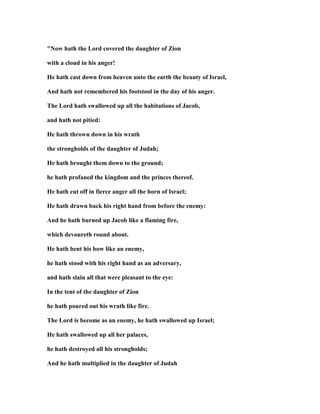
Lamentations 2:1-10
GRAPHIC PICTURE OF THE DIVI E VISITATIO UPO JUDAH
" ow hath the Lord covered the daughter of Zion
with a cloud in his anger!
He hath cast down from heaven unto the earth the beauty of Israel,
And hath not remembered his footstool in the day of his anger.
The Lord hath swallowed up all the habitations of Jacob,
and hath not pitied:
He hath thrown down in his wrath
the strongholds of the daughter of Judah;
He hath brought them down to the ground;
he hath profaned the kingdom and the princes thereof.
He hath cut off in fierce anger all the horn of Israel;
He hath drawn back his right hand from before the enemy:
And he hath burned up Jacob like a flaming fire,
which devoureth round about.
He hath bent his bow like an enemy,
he hath stood with his right hand as an adversary,
and hath slain all that were pleasant to the eye:
In the tent of the daughter of Zion
he hath poured out his wrath like fire.
The Lord is become as an enemy, he hath swallowed up Israel;
He hath swallowed up all her palaces,
he hath destroyed all his strongholds;
And he hath multiplied in the daughter of Judah
mourning and lamentation.
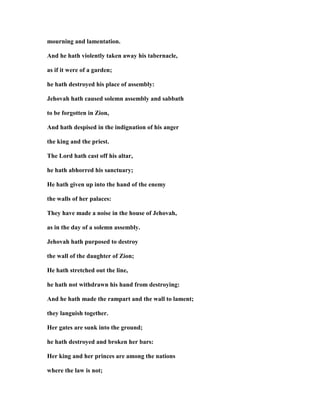
And he hath violently taken away his tabernacle,
as if it were of a garden;
he hath destroyed his place of assembly:
Jehovah hath caused solemn assembly and sabbath
to be forgotten in Zion,
And hath despised in the indignation of his anger
the king and the priest.
The Lord hath cast off his altar,
he hath abhorred his sanctuary;
He hath given up into the hand of the enemy
the walls of her palaces:
They have made a noise in the house of Jehovah,
as in the day of a solemn assembly.
Jehovah hath purposed to destroy
the wall of the daughter of Zion;
He hath stretched out the line,
he hath not withdrawn his hand from destroying:
And he hath made the rampart and the wall to lament;
they languish together.
Her gates are sunk into the ground;
he hath destroyed and broken her bars:
Her king and her princes are among the nations
where the law is not;
Yea, her prophets find no vision from Jehovah.
The elders of the daughter of Zion sit upon the ground;
they keep silence;
They cast up dust upon their heads;
they have girded themselves with sackcloth:
The virgins of Jerusalem hang down their heads to the ground."
The word "anger" occurs three times in this paragraph and the word "wrath" is
found twice. Of all the attributes of God which appear in his word, none is more
generally neglected and denied than this very one, namely, that the fierce anger of
God will ultimately rage against human wickedness, as exhibited in these verses.
The God of American Pulpits today is generally extolled as a namby-pamby, an old
fuddy duddy, somewhat like an over-indulgent old grandfather, too lazy, indifferent
or unconcerned to do anything whatever, no matter what crimes of blood and lust
roar like a tornado under his very nose. The Bible does not support such an image
of God!
Yes, He is a God who loves mankind, who gave His Son upon the Cross for human
redemption. He is a God of mercy, forgiveness, grace and forbearance, but when
any man or any nation has fully demonstrated final rejection of God's love and their
rebellion against His eternal law, that wonderful, loving, forgiving God will at last
appear in His character as the enemy of that man or that nation.
The background of all these terrible things that happened to Jacob is the almost
unbelievable wickedness of the Chosen People. A major part of the Old Testament is
little more than a brief summary of that wickedness:
"The Lord hath covered the daughter of Zion with a cloud in his anger"
(Lamentations 2:1). During the exodus, God had shielded the Chosen People with a
cloud, the dark side of which confronted Egypt; but now it is the remnant of Israel
that faces the ugly side of the cloud! Throughout this chapter there appears the
screaming fact that it is God Himself who has brought all of the evil upon His sinful
people. "That was the wormwood and the gall in their terrible affliction."[6]
"Cast down from heaven unto the earth" (Lamentations 2:2). What a change there
was from the glory of Solomon to the very bottom of the social ladder. Israel at this
point had become the slaves of the Gentiles.
"He hath thrown down ... the strongholds ... of Judah" (Lamentations 2:3). But was
it not Babylon that did that? o! It was God who did it; Babylon was merely God's
instrument.
"He hath cut off all the horn of Israel" (Lamentations 2:3). The horn was a well-
known symbol of power. Cheyne noted that a better rendition would be "every
horn."[7] "It referred to all the strongholds, especially the fortresses."[8] We
especially liked Hiller's blunt rendition, "God lopped off the horns of Israel."[9] Or,
as we might paraphrase it: "God dehorned His sinful people."
"He hath burned up Jacob like a flaming fire" (Lamentations 2:3). The conception
that God's anger is like a terrible fire is not merely an Old Testament metaphor.
"To the wicked God, at any time, may become a consuming fire (Hebrews 12:29;
Deuteronomy 4:24)."[10]
"God, in these verses, is represented as a furious warrior, who with irresistible
power destroyed everything that Judah had trusted in. They had stopped trusting in
God, and instead were relying on might (Lamentations 2:2), palaces (Lamentations
2:5), strongholds (Lamentations 2:5), the physical Temple (Lamentations 2:6)."[11]
All these were destroyed.
"He hath violently taken away his tabernacle, as if it were of a garden"
(Lamentations 2:6). Solomon's temple was not God's tabernacle to begin with, but
Solomon's corrupted replacement of it. evertheless the Jews had trusted in it as
their security and salvation. The wonder expressed here is that God removed it and
destroyed it so easily, "as if of a garden." "God removed his Temple as easily as a
farmer removes a vintage booth (a tiny arbor), which had served its purpose, from a
garden."[12] In summer time, one may often see such little shelters near orchards
and gardens, where the sellers of fruits, etc, could be sheltered from the sun.
This terrible destruction of the Temple sends the Bible student back to the very
origin of it in the mind of David; and the undeniable fact that David and his son
Solomon were wrong in the building of it. (See 2 Samuel 7).
"They have made a noise in the house of Jehovah, as in the day of a solemn
assembly" (Lamentations 2:7). This `noise,' however was different. It was the
boisterous, profane and obscene cries of the Chaldean soldiers screaming and
shouting their delight as they looted and destroyed the marvelous treasures of the
Temple. It was a horrible contrast with the sweet songs of the Temple virgins and
the solemn liturgies of the priesthood.
"The triumphant shouts of the enemy bore some resemblance to the sounds on a
solemn feast day, but O how sad a contrast it was"![13]
"God purposed to destroy the wall of the daughter of Zion" (Lamentations 2:8).
" ebuchadnezzar and his Babylonian armies are here ignored! The capture of
Jerusalem, far from being God's defeat, was a victory for his righteousness. See
Isaiah 42:24ff. God's judicial displeasure against iniquity is a grim reality indeed for
those who render themselves liable to receive it."[14]
"Her king and her princes are among the nations where the law is not"
(Lamentations 2:9). The ridiculous rendition of the Revised Standard Version
(RSV) reads, "The law is no more," being not only a false translation but an
outright falsehood also. The Law of Moses never ceased, until the Son of God nailed
it to the cross. And, as the Lord said, "Till heaven and earth pass away, one jot or
one tittle shall in no wise pass away from the law, till all things be accomplished"
(Matthew 5:18). The tragedy of this crooked mistake in the RSV is that it is used by
radical critics as, " otable evidence that the Torah was not regarded (when
Lamentations was written) as a thing given through Moses in the far-off past."[15]
Thoughtful scholars will not be deceived by this tragic rendition in the Revised
Standard Version. We thank God that the Anchor Bible gave us another acceptable
translation of this passage; "The king and the princes are among the heathen
(where) there is no instruction."[16] With regard to the word "where" which the
translators have supplied in the ASV, and which this writer supplied in the Anchor
Bible, it does not occur in the KJV, where it was considered unnecessary, because
the word Gentiles stands adjacent to and in front of the words there is no law,
plainly indicating that it was among them, the Gentiles, that God's Law was not.
There was never, in the long history of Israel after Sinai a single hour in which the
Law of Moses did not exist.
"The elders ... sit upon the ground ... the virgins hang down their heads"
(Lamentations 2:10). "The elders open not their mouth in the gate as usual ...
overwhelmed with grief ... in token of great grief, as did the friends of Job, they sit
upon the ground and keep silent."[17]
CO STABLE, "Jeremiah pictured the sovereign Lord (Heb. "adonay)
overshadowing Jerusalem, personified as a young woman, with a dark cloud
because of His anger. The Lord had cast the city from the heights of glory to the
depths of ignominy (cf. Isaiah 14:12). It had been as a footstool for His feet, but He
had not given it preferential treatment in His anger. The footstool may be a
reference to the ark of the covenant (cf. 1 Chronicles 28:2; Psalm 99:5) or the
temple, but it probably refers to Jerusalem.
Verses 1-10
A. God"s anger2:1-10
"There are about forty descriptions of divine judgment, which fell upon every
aspect of the Jews" life: home, religion, society, physical, mental and spiritual. Some
of the blackest phrases of the book appear here ..." [ ote: Irving L. Jensen,
Jeremiah and Lamentations , p132.]
EXPOSITOR'S BIBLE COMME TARY, "GOD AS A E EMY
Lamentations 2:1-9
THE elegist, as we have seen, attributes the troubles of the Jews to the will and.
action of God. In the second poem he even ventures further, and with daring logic
presses this idea to its ultimate issues. If God is tormenting His people in fierce
anger it must be because He is their enemy-so the sad-hearted patriot reasons. The
course of Providence does not shape itself to him as a merciful chastisement, as a
veiled blessing; its motive seems to be distinctly unfriendly. He drives his dreadful
conclusion home with great amplitude of details. In order to appreciate the force of
it let us look at the illustrative passage in two ways-first, in view of the calamities
inflicted on Jerusalem, all of which are here ascribed to God, and then with regard
to those thoughts and purposes of their Divine Author which appear to be revealed
in them.
First, then, we have the earthly side of the process. The daughter of Zion is covered
with a cloud. [Lamentations 2:1] The metaphor would be more striking in the
brilliant East than it is to us in our habitually sombre climate. There it would
suggest unwonted gloom-the loss of the customary light of heaven, rare distress, and
excessive melancholy. It is a general, comprehensive image intended to overshadow
all that follows. Terrible disasters cover the aspect of all things from zenith to
horizon. The physical darkness that accompanied the horrors of Golgotha is here
anticipated, not indeed by any actual prophecy, but in idea.
But there is more than gloom. A mere cloud may lift, and discover everything
unaltered by the passing shadow. The distress that has fallen on Jerusalem is not
thus superficial and transient. She herself has suffered a fatal fall. The beauty of
Israel has been cast down from heaven to earth. The language is now varied; instead
of "the daughter of Zion" we have "the beauty of Israel." [Lamentations 2:1] The
use of the larger title, "Israel," is not a little significant. It shews that the elegist is
alive to the idea of the fundamental unity of his race, a unity which could not be
destroyed by centuries of inter-tribal warfare. Although in the ungracious region of
politics Israel stood aloof from Judah, the two peoples were frequently treated as
one by poets and prophets when religious ideas were in mind. Here apparently the
vastness of the calamities of Jerusalem has obliterated the memory of jealous
distinctions. Similarly we may see the great English race-British and American-
forgetting national divisions in pursuit of its higher religious aims, as in Christian
missions; and we may be sure that this blood-unity would be felt most keenly under
the shadow of a great trouble on either side of the Atlantic. By the time of the
destruction of Jerusalem the northern tribes had been scattered, but the use of the
distinctive name of these people is a sign that the ancient oneness of all who traced
back their pedigree to the patriarch Jacob was still recognised. It is some
compensation for the endurance of trouble to find it thus breaking down the middle
wall of partition between estranged brethren.
It has been suggested with probability that by the expression "the beauty of Israel"
the elegist intended to indicate the temple. This magnificent pile of buildings,
crowning one of the hills of Jerusalem, arid shining with gold in "barbaric
splendour," was the central object of beauty among all the people who revered the
worship it enshrined. Its situation would naturally suggest the language here
employed. Jerusalem rises among the hills of Judah, some two thousand feet above
the sea-level; and when viewed from the wilderness in the south she looks indeed
like a city built in the heavens. But the physical exaltation of Jerusalem and her
temple was surpassed by exaltation in privilege, and prosperity, and pride.
Capernaum, the vain city of the lake that would raise herself to heaven, is warned
by Jesus that she shall be cast down to Hades. [Matthew 11:23] ow not only
Jerusalem, but the glory of the race of Israel, symbolised by the central shrine of the
national religion, is thus humiliated.
Still keeping in mind the temple, the poet tells us that God has forgotten His
footstool. He seems to be thinking of the Mercy-Seat over the ark, the spot at which
God was thought to shew Himself propitious to Israel on the great Day of
Atonement, and which was looked upon as the very centre of the Divine presence. In
the destruction of the temple the holiest places were outraged, and the ark itself
carried off or broken up, and never more heard of. How different was this from the
story of the loss of the ark in the days of Eli, when the Philistines were constrained
to send it home of their own accord! ow no miracle intervenes to punish the
heathen for their sacrilege. Yes, surely God must have forgotten His footstool! So it
seems to the sorrowful Jew, perplexed at the impunity with which this crime has
been committed.
But the mischief is not confined to the central shrine. It has extended to remote
country regions and simple rustic folk. The shepherd’s hut has shared the fate of the
temple of the Lord. All the habitations of Jacob-a phrase which in the original
points to country cottages-have been swallowed up. [Lamentations 2:2] The holiest
is not spared on account of its sanctity, neither is the lowliest on account of its
obscurity. The calamity extends to all districts, to all things, to all classes.
If the shepherd’s cot is contrasted with the temple and the ark because of its
simplicity, the fortress may be contrasted with this defenceless hut because of its
strength. Yet even the strongholds have been thrown down. More than this, the
action of the Jews’ army has been paralysed by the God who had been its strength
and support in the glorious olden time. It is as though the right hand of the warrior
had been seized from behind and drawn back at the moment when it was raised to
strike a blow for deliverance. The consequence is that the flower of the army, "all
that were pleasant to the eye," [Lamentations 2:4] are slain. Israel herself is
swallowed up, while her palaces and fortresses are demolished.
The climax of this mystery of Divine destruction is reached when God destroys His
own temple. The elegist returns to the dreadful subject as though fascinated by the
terror of it. God has violently taken away His tabernacle. [Lamentations 1:6] The
old historic name of the sanctuary of Israel recurs at this crisis of ruin; and it is
particularly appropriate to the image which follows, an image which possibly it
suggested. If we are to understand the metaphor of the sixth verse as it is rendered
in the English Authorised and Revised Versions, we have to suppose a reference to
some such booth of boughs as people were accustomed to put up for their shelter
during the vintage, and which would be removed as soon as it had served its
temporary purpose. The solid temple buildings had been swept away as easily as
though they were just such flimsy structures, as though they had been "of a
garden." But we can read the text more literally, and still find good sense in it.
According to the strict translation of the original, God is said to have violently taken
away His tabernacle "as a garden." At the siege of a city the fruit gardens that
encircle it are the first victims of the destroyer’s axe. Lying out beyond the walls
they are entirely unprotected, while the impediments they offer to the movements of
troops and instruments of war induce the commander to order their early
demolition. Thus Titus had the trees cleared from the Mount of Olives, so that one
of the first incidents in the Roman siege of Jerusalem must have been the
destruction of the Garden of Gethsemane. ow the poet compares the ease with
which the great massive temple-itself a powerful fortress, and enclosed within the
city walls-was demolished, with the simple process of scouring the outlying gardens.
So the place of assembly disappears, and with it the assembly itself, so that even the
sacred Sabbath is passed over and forgotten. Then the two heads of the nation-the
king, its civil ruler, and the priest, its ecclesiastical chief are both despised in the
indignation of God’s anger.
The central object of the sacred shrine is the altar, where earth seems to meet
heaven in the high mystery of sacrifice. Here men seek to propitiate God; here too
God would be expected to shew Himself gracious to men. Yet God has even cast off
His altar, abhorring His very sanctuary. [Lamentations 2:7] Where mercy is most
confidently anticipated, there of all places nothing but wrath and rejection are to be
found. What prospect could be more hopeless?
The deeper thought that God rejects His sanctuary because His people have first
rejected Him is not brought forward just now. Yet this solution of the mystery is
prepared by a contemplation of the utter failure of the old ritual of atonement.
Evidently that is not always effective, for here it has broken down entirely; then can
it ever be inherently efficacious? It cannot be enough to trust to a sanctuary and
ceremonies which God Himself destroys. But further, out of this scene which was so
perplexing to the pious Jew, there flashes to us the clear truth that nothing is so
abominable in the sight of God as an attempt to worship Him on the part of people
who are living at enmity with Him. We can also perceive that if God shatters our
sanctuary, perhaps He does so in order to prevent us from making a fetich of it.
Then the loss of shrine and altar and ceremony may be the saving of the
superstitious worshipper who is thereby taught to turn to some more stable source
of confidence.
This, however, is not the line of reflections followed by the elegist in the present
instance. His mind is possessed with one dark, awful, crushing thought. All this is
God’s work. And why has God done it? The answer to that question is the idea that
here dominates the mind of the poet. It is because God has become an enemy. There
is no attempt to mitigate the force of this daring idea. It is stated in the strongest
possible terms, and repeated again and again at every turn - Israel’s cloud is the
effect of God’s anger; it has come in the day of His anger; God is acting with fierce
anger, with a flaming fire of wrath. This must mean that God is decidedly inimical.
He is behaving as an adversary; He bends His bow; He manifests violence. It is not
merely that God permits the adversaries of Israel to commit their ravages with
impunity; God commits those ravages; He is Himself the enemy. He shews
indignation. He despises, He abhors. And this is all deliberate. The destruction is
carried out with the same care and exactitude that characterise the erection of a
building. It is as though it were done with a measuring line. God surveys to destroy.
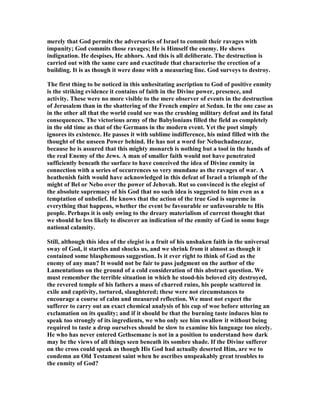
The first thing to be noticed in this unhesitating ascription to God of positive enmity
is the striking evidence it contains of faith in the Divine power, presence, and
activity. These were no more visible to the mere observer of events in the destruction
of Jerusalem than in the shattering of the French empire at Sedan. In the one case as
in the other all that the world could see was the crushing military defeat and its fatal
consequences. The victorious army of the Babylonians filled the field as completely
in the old time as that of the Germans in the modern event. Yet the poet simply
ignores its existence. He passes it with sublime indifference, his mind filled with the
thought of the unseen Power behind. He has not a word for ebuchadnezzar,
because he is assured that this mighty monarch is nothing but a tool in the hands of
the real Enemy of the Jews. A man of smaller faith would not have penetrated
sufficiently beneath the surface to have conceived the idea of Divine enmity in
connection with a series of occurrences so very mundane as the ravages of war. A
heathenish faith would have acknowledged in this defeat of Israel a triumph of the
might of Bel or ebo over the power of Jehovah. Rut so convinced is the elegist of
the absolute supremacy of his God that no such idea is suggested to him even as a
temptation of unbelief. He knows that the action of the true God is supreme in
everything that happens, whether the event be favourable or unfavourable to His
people. Perhaps it is only owing to the dreary materialism of current thought that
we should he less likely to discover an indication of the enmity of God in some huge
national calamity.
Still, although this idea of the elegist is a fruit of his unshaken faith in the universal
sway of God, it startles and shocks us, and we shrink from it almost as though it
contained some blasphemous suggestion. Is it ever right to think of God as the
enemy of any man? It would not be fair to pass judgment on the author of the
Lamentations on the ground of a cold consideration of this abstract question. We
must remember the terrible situation in which he stood-his beloved city destroyed,
the revered temple of his fathers a mass of charred ruins, his people scattered in
exile and captivity, tortured, slaughtered; these were not circumstances to
encourage a course of calm and measured reflection. We must not expect the
sufferer to carry out an exact chemical analysis of his cup of woe before uttering an
exclamation on its quality; and if it should be that the burning taste induces him to
speak too strongly of its ingredients, we who only see him swallow it without being
required to taste a drop ourselves should be slow to examine his language too nicely.
He who has never entered Gethsemane is not in a position to understand how dark
may be the views of all things seen beneath its sombre shade. If the Divine sufferer
on the cross could speak as though His God had actually deserted Him, are we to
condemn an Old Testament saint when he ascribes unspeakably great troubles to
the enmity of God?
Is this, then, but the rhetoric of misery? If it be no more, while we seek to
sympathise with the feelings of a very dramatic situation, we shall not be called
upon to go further and discover in the language of the poet any positive teaching
about God and His ways with man. But are we at liberty to stop short here? Is the
elegist only expressing his own feelings? Have we a right to affirm that there can be
no objective truth in the awful idea of the enmity of God.
In considering this question we must be careful to dismiss from our minds the
unworthy associations that only too commonly attach themselves to notions of
enmity among men. Hatred cannot be ascribed to One whose deepest name is Love.
o spite, malignity, or evil passion of any kind can be found in the heart of the Holy
God. When due weight is given to these negations very much that we usually see in
the practice of enmity disappears. But this is not to say that the idea itself is denied,
or the fact shown to be impossible.
In the first place, we have no warrant for asserting that God will never act in direct
and intentional opposition to any of His creatures. There is one obvious occasion
when He certainly does this. The man who resists the laws of nature finds those laws
working against him. He is not merely running his head against a stone wall; the
laws are not inert obstructions in the path of the transgressor; they represent forces
in action. That is to say, they resist their opponent with vigorous antagonism. In
themselves they are blind, and they bear him no ill-will. But the Being who wields
the forces is not blind or indifferent. The laws of nature are, as Kingsley said, but
the ways of God. If they are opposing a man God is opposing that man. But God
does not confine His action to the realm of physical processes. His providence works
through the whole course of events in the world’s history. What we see evidently
operating in nature we may infer to be equally active in less visible regions. Then if.
we believe in a God who rules and works in the world, we cannot suppose that His
activity is confined to aiding what is good. It is unreasonable to imagine that He
stands aside in passive negligence of evil. And if He concerns Himself to thwart evil,
what is this but manifesting Himself as the enemy of the evildoer?
It may be contended, on the other side, that there is a world of difference between
antagonistic actions and unfriendly feelings, and that the former by no means imply
the latter. May not God oppose a man who is doing wrong, not at all because He is
his Enemy, but just because He is his truest Friend? Is it not an act of real kindness
to save a man from himself when his own will is leading him astray? This of course
must be granted, and being granted, it will certainly affect our views of the ultimate
issues of what we may be compelled to regard in its present operation as nothing
short of Divine antagonism. It may remind us that the motives lying behind the most
inimical action on God’s part may be merciful and kind in their aims. Still, for the
time being, the opposition is a reality, and a reality which to all intents and purposes
is one of enmity, since it resists, frustrates, hurts.
or is this all. We have no reason to deny that God can have real anger. Is it not
right and just that He should be "angry with the wicked every day"? [Psalms 7:11]
Would He not be imperfect in holiness, would He not be less than God, if He could
behold vile deeds springing from vile hearts with placid indifference? We must
believe that Jesus Christ was as truly revealing the Father when He was moved with
indignation as when He was moved with compassion. His life shows quite clearly
that He was the enemy of oppressors and hypocrites, and He plainly declared that
He came to bring a sword. [Matthew 10:34] His mission was a war against all evil,
and therefore, though not waged with carnal weapons, a war against evil men. The
Jewish authorities were perfectly right in perceiving this fact. They persecuted Him
as their enemy; and He was their enemy. This statement is no contradiction to the
gracious truth that He desired to save all men, and therefore even these men. If
God’s enmity to any soul were eternal it would conflict with His love. It cannot be
that He wishes the ultimate ruin of one of His own children. But if He is at the
present time actively opposing a man, and if He is doing this in anger, in the wrath
of righteousness against sin, it is only quibbling with words to deny that for the time
being He is a very real enemy to that man.
The current of thought in the present day is not in any sympathy with this idea of
God as an Enemy, partly in its revulsion from harsh and un-Christlike conceptions
of God, partly also on account of the modern humanitarianism which almost loses
sight of sin in its absorbing love of mercy. But the tremendous fact of the Divine
enmity towards the sinful man so long as he persists in his sin is not to be lightly
brushed aside. It is not wise wholly to forget that "our God is a consuming fire."
[Hebrews 12:29] It is in consideration of this dread truth that the atonement
wrought by His Son according to His own will of love.is discovered to be an action of
vital efficacy, and not a mere scenic display.
PETT, "Introduction
Chapter 2. A Lament Over What Has Happened To Jerusalem Due To The Lord’s
Anger.
This chapter also divides up into sections. In the first 9 verses the prophet describes
in forceful detail what ‘the Sovereign Lord’ (adonai) has done against Jerusalem
and Judah, and he follows this up in Lamentations 2:10-12 with a picture of
Jerusalem’s inhabitants (elders, virgins, young children) revealing how all this has
affected them (they keep silence and mourn, they hang their heads, the children
complain of hunger). Then in Lamentations 2:13-19 he addresses the inhabitants of
Jerusalem directly, outlining what has come upon them and calling on them to seek
to YHWH for help, finishing it all off in Lamentations 2:20-22 with a direct appeal
to YHWH to see what the situation is.
ote the emphasis in the first six verses on the wrath, fury and anger of the
Lord/YHWH (specifically drawn attention to in Lamentations 2:1 (twice), 2, 3, 4, 6),
something again emphasised in the final verse (Lamentations 2:22). His people had
defied Him and disregarded His loving covenant for too long. They had rejected the
pleas of His prophets. And there comes a time when even God’s patience is at an end
and He becomes relentless. The results of that anger were plain to see in the ruined
Temple, the destroyed city, and the relatively empty and devastated land. (It should,
however, be noted from the human point of view that it was not YHWH Himself
Who had done this, but the Babylonian contingents. God works through history and
the sinfulness of man. He had simply withdrawn His hand of protection because of
His antipathy towards His people’s sin, letting men loose in their viciousness - see
Lamentations 2:3).
Once again we see a variation between ‘Sovereign Lord’ (adonai) and YHWH. In
Lamentations 2:1-5 it is the Sovereign Lord Who has acted against Jerusalem and
Judah/Israel in a variety of ways, whilst in Lamentations 2:6 it is YHWH Who has
caused the solemn gathering of the people and the sabbath to be ‘forgotten’, that is,
not maintained because of Judah’s condition. In Lamentations 2:7 it is the
Sovereign Lord Who has cast off her altar and sanctuary, whilst in Lamentations
2:8 it is YHWH Who has purposed to destroy the walls of Zion and has given the
prophets no vision. From that point there is then no mention of either until
Lamentations 2:17 where it is YHWH Who has devised against Jerusalem and
thrown her down, causing her enemies to rejoice and exalting them, whilst it is to
the Sovereign Lord that the prayers of the women for their hungry children are
addressed and are to be addressed (Lamentations 2:18-19). On the other hand the
Prophet’s appeal for God to consider the situation being prayed about is addressed
to YHWH (Lamentations 2:20), whilst in the same verse reference is made to ‘the
sanctuary of the Lord’. It is clear that the names are being used interchangeably.
The final reference is to ‘the day of YHWH’s anger’ in Lamentations 2:22.
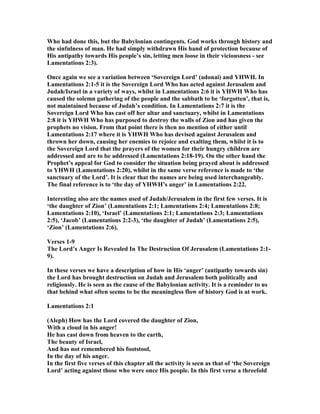
Interesting also are the names used of Judah/Jerusalem in the first few verses. It is
‘the daughter of Zion’ (Lamentations 2:1; Lamentations 2:4; Lamentations 2:8;
Lamentations 2:10), ‘Israel’ (Lamentations 2:1; Lamentations 2:3; Lamentations
2:5), ‘Jacob’ (Lamentations 2:2-3), ‘the daughter of Judah’ (Lamentations 2:5),
‘Zion’ (Lamentations 2:6).
Verses 1-9
The Lord’s Anger Is Revealed In The Destruction Of Jerusalem (Lamentations 2:1-
9).
In these verses we have a description of how in His ‘anger’ (antipathy towards sin)
the Lord has brought destruction on Judah and Jerusalem both politically and
religiously. He is seen as the cause of the Babylonian activity. It is a reminder to us
that behind what often seems to be the meaningless flow of history God is at work.
Lamentations 2:1
(Aleph) How has the Lord covered the daughter of Zion,
With a cloud in his anger!
He has cast down from heaven to the earth,
The beauty of Israel,
And has not remembered his footstool,
In the day of his anger.
In the first five verses of this chapter all the activity is seen as that of ‘the Sovereign
Lord’ acting against those who were once His people. In this first verse a threefold
activity is depicted. The Sovereign Lord has:
· Covered the Daughter of Zion with a cloud in His anger.
· Cast down from Heaven to earth the Beauty of Israel.
· ot remembered His Footstool in the day of His anger.
Many commentators have seen all three of these activities as referring to Jerusalem
or Israel; the daughter of Zion covered with a storm-cloud, the beauty of Israel cast
down from Heaven to earth, His footstool not remembered by the Lord. But a
glance at the following verses throws this interpretation into doubt, for they
demonstrate that it is the prophet’s usual practise in this lament to speak of three
different, if parallel things, not the same thing three times. Thus we must view this
interpretation with suspicion.
The first statement is clear. The Sovereign Lord has, in His anger, covered the
daughter of Zion (Jerusalem) with a storm-cloud. This is the very opposite to the
way in which, in earlier days, YHWH had manifested Himself in a cloud. That had
been protective, indicating His presence with them. ow the swirling storm-cloud is
seen to be one of judgment and fierce anger.
He has ‘cast down the Beauty of Israel from Heaven to earth’. This phrase is
descriptive of a fall from high honour, even from god-likeness, as we see by its use of
the King of Babylon in Isaiah 14:1, and of Tyre in Ezekiel 28:14; Ezekiel 28:17. But
to what does ‘the Beauty of Israel refer? The concept of beauty is elsewhere:
· 1). Referred to the Temple (Psalms 96:6; Isaiah 60:7; Isaiah 64:11).
· 2). Referred to Israel/Judah’s royal house (compare 2 Samuel 1:19;
Zechariah 12:7).
· 3). Referred to Jerusalem itself (Isaiah 52:1). See Lamentations 2:15.
Compare in this regard how Babylon is called "the beauty of the splendour of the
Chaldeans" in Isaiah 13:19.
If we take it as 3) it would certainly fit in as a parallel to ‘the daughter of Zion’, but,
as we have already suggested, in this lament the prophet does not tend to use such
exact parallels. Thus we would rather expect the daughter of Zion, the beauty of
Israel, and the Footstool to refer to three different things.
Considering 2). reference to Judah’s king as ‘the Beauty of Israel’ (as in 2 Samuel
1:19; Zechariah 12:7) and being cast down from Heaven to earth would certainly tie
in with the parallel of the King of Babylon who made exalted claims about his status
and was also to be cast from Heaven to earth (Isaiah 14:12-15), and it is quite
possible that Zedekiah may have been aping the Babylonian ew Year ritual in
which this was enacted. Reference to the king may also be seen as a good parallel to
the Ark, if we take the Ark as His footstool, something specifically stated in 1
Chronicles 28:2, for both the King and the Ark represented YHWH’s kingship.
Furthermore a star falling from Heaven could certainly be seen as signifying a bad
end for a ruler (for star = ruler compare umbers 24:17; Daniel 8:10). And
certainly the king was seen by Jerusalem and the prophet in an exalted sense, being
described in terms of ‘YHWH’s Anointed’, the very breath of their nostrils
(Lamentations 4:20), making clear his importance in their eyes. As the Davidic king
and the Anointed of YHWH, the one on whom Israel’s hopes rested, he could well
be described as the beauty of Israel. In contrast it is difficult to see either the
Temple or Jerusalem as being cast down from Heaven to earth (unless we see the
idea as metaphorical of their splendour being cast down from Heaven, but there is
no example of this elsewhere). What is also significant is that the king and his
princes, and their fate, are stressed in the immediately following verses (see
Lamentations 2:2; Lamentations 2:6) demonstrating that they were in the prophet’s
mind as he wrote. It would appear to us therefore that the Beauty of Israel was the
Davidic king, whose status was beautiful, but who was brought low by the Lord.
It was the Ark of the Covenant of YHWH that was mainly seen as YHWH’s
footstool (1 Chronicles 28:2; compare Psalms 99:5). This was presumably because it
was seen as the place where YHWH manifested Himself on earth, as He sat on His
throne in Heaven whilst His feet rested on the ark. Though hidden behind the
curtain in the tabernacle/temple the Ark was the means by which, through their
high priest, Israel felt that they could directly meet with God. And that ark was now
to be ‘not remembered’ by Him, something apparent when it was either destroyed
or carried off to Babylon. It had become simply a treasure and would no longer be
able to fulfil its function. What had been sacred for so long was now to be seen as
irrelevant.
If we accept these suggestions we see the verse as indicating that Jerusalem had been
covered by His storm-cloud, as His anger rested on it; the membership of the
Davidic royal house had been cast from Heaven to earth (removed from its high
status and profaned - Lamentations 2:2), because it had been disobedient to YHWH
and could therefore no longer represent Him; and the Ark had become ‘not
remembered’ because it had been carried off (or destroyed) and could no longer
function.
It is, of course, possible, to see all three ideas as referring to the same thing, either
Jerusalem itself (Isaiah 52:1), or the Temple, seen equally as ‘the daughter of Zion’,
‘the Beauty of Israel’ (see Isaiah 64:11) and ‘His Footstool’ (Psalms 132:7; Isaiah
60:13), but the references are not specific and Psalms 132:7 could equally apply to
the ark, whilst the ‘casting down to earth’ makes this interpretation questionable.
Given the prophet’s usual practise of speaking of three different but similar things,
as explained above, this interpretation would seem to be very unlikely.
BI 1-9, "How hath the Lord covered the daughter of Zion with a cloud in ms anger.
Chastisements
1. It is our duty to strive with ourselves to be affected with the miseries of God’s
people.
2. The chastisements and corrections that God layeth upon His Church are most
wonderful.
(1) The Lord will in His own servants declare His anger against sin.
(2) He seeth afflictions the best means to frame them to His obedience.
(3) His ways are beyond the reach of flesh and blood.
3. God spareth not to smite His dearest children when they sin against Him.
(1) That He may declare Himself an adversary to sin in all men without
partiality.
(2) That He may reduce His servants from running on headlong to hell with the
wicked.
4. The higher God advanceth any, the greater is their punishment in the day of their
visitation for their sins.
(1) To whom much is given, of them must much be required.
(2) According to the privileges abused, so is the sin of those that have them
greater and more in number.
5. The most beautiful thing in this world is base in respect of the majesty and glory
of the Lord.
6. God’s anger against sin moveth Him to destroy the things that He commanded for
His own service, when they are abused by men. (J. Udall.)
The Lord hath swallowed up all the habitations of Jacob.
Spoiled habitations
1. It is the hand of God that taketh away the flourishing estate of a kingdom (Dan_
4:29).
2. As God is full of mercy in His long-suffering, so is His anger unappeasable when it
breaketh out against the sons of men for their sins (Jer_4:4).
3. God depriveth us of a great blessing when He taketh from us our dwelling places.
4. There is no assurance of worldly possessions and peace, but in the favour of God.
5. God overthroweth the greatest strength that man can erect, even at His pleasure.
6. It is a mark of God’s wrath, to be deprived of strength, courage, or any other
necessary gift, when we stand in need of them.
7. It is the sin of the Church that causeth the Lord to spoil the same of any blessing
that she hath heretofore enjoyed.
8. These being taken away in God’s anger, teacheth us that it is the good blessing of
God to have a kingdom, to have strongholds, munitions, etc., for a defence against
their enemies.
9. The more God honoureth us with His blessings, the greater shall be our dishonour
if we abuse them, when He entereth “into judgment” with us for the same. (J. Udall.)
He hath cut off in His fierce anger all the horn of Israel.—
Strength despoiled
1. Strength and honour are in the Lord’s disposition, to be given, continued, or taken
away at His pleasure.
2. When God’s favour is towards us, it is our shield against our enemies; but when
He meaneth to punish us, He leaveth us unto ourselves.
3. Though God’s justice be severe against sin in all men, yet is it most manifest in His
Church, having sinned against Him.
(1) All men’s eyes are most upon God’s Church.
(2) God doth declare Himself more in and for His Church than the world
besides. (J. Udall.)
2 Without pity the Lord has swallowed up
all the dwellings of Jacob;
in his wrath he has torn down
the strongholds of Daughter Judah.
He has brought her kingdom and its princes
down to the ground in dishonor.
BAR ES, "Habitations - The dwellings of the shepherds in the pastures Jer_49:19.
These are described as swallowed up by an earthquake, while the storm itself throws
down the fortified cities of Judah.
Polluted - i. e. profaned it, made common or unclean what before was holy.
CLARKE, "The Lord hath swallowed up - It is a strange figure when thus
applied: but Jehovah is here represented as having swallowed down Jerusalem and all
the cities and fortifications in the land: that is, he has permitted them to be destroyed.
See Lam_2:6.
GILL, "The Lord hath swallowed up all the habitations of Jacob, and hath
not pitied,.... As he regarded not his own habitation the temple, nor the ark his
footstool, it is no wonder he should be unconcerned about the habitations of others; as
of the inhabitants of the land of Judea and of Jerusalem, particularly of the king, his
nobles, and the great men; these the Lord swallowed up, or suffered to be swallowed up,
as houses in an earthquake, and by an inundation, so as to be seen no more; and this he
did without showing the least reluctance, pity, and compassion; being so highly incensed
and provoked by their sins and transgressions:
he hath thrown down in his wrath the strong holds of the daughter of
Judah; not only the dwelling houses of the people, but the most fortified places, their
castles, towers, and citadels:
he hath brought them down to the ground; and not only battered and shook them,
but beat them down, and laid them level with the ground; and all this done in the fury of
his wrath, being irritated to it by the sins of his people; even the daughter of Judah, or
the congregation thereof, as the Targum:
he hath polluted the kingdom, and the princes thereof; what was reckoned
sacred, the kingdom of the house of David, and the kings and princes of it, the Lord's
anointed; these being defiled with sin, God cast them away, as filth to the dunghill, and
gave them up into the hands of the Gentiles, who were reckoned unclean; and thus they
were profaned. Jarchi interprets these princes of the Israelites in common, who were
called a kingdom of priests; and makes mention of a Midrash, that explains them of the
princes above, or of heaven.
JAMISO , "polluted — by delivering it into the hands of the profane foe. Compare
Psa_89:39, “profaned ... crown.”
K&D, "The Lord has destroyed not merely Jerusalem, but the whole kingdom. ‫ע‬ ַ ִ ,
"to swallow up," involves the idea of utter annihilation, the fury of destruction, just in
the same way as it viz. the fury is peculiar to ‫ה‬ ָ‫ר‬ ְ‫ב‬ ָ‫,ע‬ the overflowing of anger. "He hath not
spared" forms an adverbial limitation of the previous statement, "unsparingly." The Qeri
‫ּא‬‫ל‬ְ‫,ו‬ instead of ‫ּא‬‫ל‬, is an unnecessary and unpoetic emendation. ‫ּות‬‫א‬ָ‫ל־נ‬ ָⅴ, all the pastures of
Jacob. According to its etymology, ‫ה‬ֶ‫ו‬ָ‫נ‬ means a place where shepherds or nomads rest, or
stay, or live; here, it is not to be understood specially of the dwellings as contrasted with,
or distinguished from the pasture-grounds, but denotes, in contrast with the fortresses
(‫ים‬ ִ‫ר‬ ָ‫צ‬ ְ‫ב‬ ִ‫,)מ‬ the open, unfortified places of the country in which men and cattle enjoy food
and rest. "The strongholds of the daughter of Judah" are not merely the fortifications of
Jerusalem, but the fortresses generally of the country and kingdom of Judah; cf. Jer_
5:17; Jer_34:7. ַ‫יע‬ִ ִ‫ה‬ ‫ץ‬ ֶ‫ר‬ፎ ָ‫,ל‬ "to cast down to the ground" (used of the pulling down of walls,
cf. Isa_25:12), is an epexegesis of ‫ס‬ ַ‫ר‬ ָ‫,ח‬ as in Exo_13:14, and is not to be joined (in
opposition to the accents) with what succeeds, and taken figuratively. For neither does
‫ל‬ ֵ ִ‫ח‬ need any strengthening, nor does ַ‫יע‬ִ ִ‫ה‬ ‫ץ‬ ֶ‫ר‬ፎ ָ‫ל‬ suitably apply to the kingdom and its
princes. The desecration of the kingdom consisted in its being dishonoured by the
disgraceful conduct of its rulers; cf. Psa_89:40.
CALVI , "He pursues the same subject, but in other words. He first says, that God
had without pardon destroyed all the habitations of Jacob; some read, “all the
beauty (or the ornament) of Jacob.” But the other rendering is more suitable, that
he had destroyed all the habitations of Jacob; and then that he had demolished in
his indignation, etc. The word is derived from what means excess; but we know that
all words signifying wrath are transferred to God, but they do not properly belong
to him. God, then, in his violent wrath had demolished all fortresses, and cast them
to the ground; and afterwards, that he had profaned, etc.
This profanation of the kingdom, and of the princes, corresponds with the former
verse, where he said that God had not remembered his footstool for we know that
the kingdom was sacerdotal and consecrated to God. When, therefore, it was
polluted, it follows that God in a manner exposed his name to reproach, because the
mouth of all the ungodly was thus opened, so that they insolently poured forth their
slanders. That God, then, spared not the kingdom nor the Temple, it hence followed
that his wrath against the Jews was dreadful. ow, as he is a righteous judge, it
follows, that such was the greatness of the sins of the Jews, that they sustained the
blame for this extreme sacrilege; for it was through their sins that God’s name was
exposed to reproach both as to the Temple and the kingdom.
TRAPP, "Lamentations 2:2 The Lord hath swallowed up all the habitations of
Jacob, and hath not pitied: he hath thrown down in his wrath the strong holds of
the daughter of Judah; he hath brought [them] down to the ground: he hath
polluted the kingdom and the princes thereof.
Ver. 2. The Lord hath swallowed up all the habitations of Jadah.] Kατεποντισε, (a)
as the sea swalloweth up a ship; as an earthquake swalloweth up whole townships;
as fire swalloweth up fuel, or as Moses’ serpent swallowed up the sorcerers’
serpents.
And hath not pitied.] This was worse than all the rest. [Isaiah 47:6]
He hath thrown down.] ot shaken them only, and so left them standing, but utterly
subverted them, and that in great displeasure, Deo irritato, et irato. God set on the
Chaldees, and was the author, not of their evil will, but of their work.
He hath brought them down to the ground.] Though for their height they seemed to
threaten heaven.
He hath polluted the kingdom and the priests.] Which were held holy and
inviolable. Profanavit regnum coeli, say some Rabbis here, He hath profaned the
kingdom of heaven; for so they accounted the commonwealth of Israel, which
Josephus calleth Yεοκρατειαν, a God government. But now God had disprivileged
them, and cast them off as a thing of naught.
PETT, "Lamentations 2:2
(Beth) The Lord has swallowed up and has not pitied,
All the habitations of Jacob,
He has thrown down in his wrath,
The strongholds of the daughter of Judah,
He has brought them down to the ground,
He has profaned the kingdom, and its princes.
ote here an example of what we have said above. The prophet refers to ‘the
habitations of Jacob’ (the noun indicates rude habitations like those of a shepherd),
‘the strongholds of the daughter of Judah’ (referring to substantial cities), and ‘the
kingdom and its princes’.
The word for ‘habitations’ is mainly used for the habitations of shepherds. Thus it
would appear that what are initially seen as swallowed up by the invaders are the
smaller towns and villages which were not ‘built up’ and were without walls, thus
being easy targets. The larger towns and cities are covered by the idea of
‘strongholds’. They have been thrown down in His wrath. Indeed they have been
brought down to the ground.
And at the same time ‘the kingdom, and its princes’ have been ‘profaned’, that is,
have been rendered or treated as unclean and defiled, being treated as though they
were an ordinary kingdom and ordinary princes and not YHWH’s chosen. In the
case of the princes they have also been slain by the swords of profane men. There is
a recognition here of the fact that the princes were seen to have had a special
recognition by God as being His anointed princes, and this was especially so of the
king who was YHWH’s Anointed (Lamentations 4:20). But that special recognition
had not prevented the Lord from allowing them to be profaned by foreign swords or
by equally foreign instruments for blinding.
The word for ‘kingdom’ could equally be translated ‘kingship’ on the basis of 2
Samuel 3:10; 2 Samuel 7:12-13; 2 Samuel 7:16. ote how in 2 Samuel 7 it parallels
the idea of the throne of David. This would support the idea that in Lamentations
2:1 ‘the beauty of Israel’ was the Davidic house and throne.
3 In fierce anger he has cut off
every horn[c][d] of Israel.
He has withdrawn his right hand
at the approach of the enemy.
He has burned in Jacob like a flaming fire
that consumes everything around it.
BAR ES, "Since the horn is the symbol of power, the cutting off of every horn means
the depriving Israel of all power of resistance. The drawing back of God’s right hand
signifies the withdrawal of that special Providence which used to protect the chosen
people.
And he burned ... - Or, “and” he kindled a fire in Jacob: as the active enemy of
“Jacob,” Himself applying the torch.
CLARKE, "The horn of Israel - His power and strength. It is a metaphor taken
from cattle, whose principal strength lies in their horns.
Hath drawn back his right hand - He did not support us when our enemies came
against us.
GILL, "He hath cut off in his fierce anger all the horn of Israel,.... All its power
and strength, especially its kingly power, which is often signified by a horn in Scripture;
see Dan_7:24; this the Lord took away in his fierce anger, and left the land destitute of
all relief, help, defence and protection; whether from its king and princes, or from its
men of war or fortified places; all being cut off and destroyed:
he hath drawn back his right hand from before the enemy; either his own right
hand, with which he had used to fight for his people, and protect them, but now
withdrawing it, left them to the mercy of their enemies; or Israel's right hand, which he
so weakened, that they had no power to resist the enemy, and defend themselves:
and he burned against Jacob like a flaming fire which devoureth round
about; that is, his wrath was like a burning flaming fire, which consumes all around,
wherever it comes; thus the Lord in his anger consumed Jacob, and left neither root nor
branch.
JAMISO , "horn — worn in the East as an ornament on the forehead, and an
emblem of power and majesty (1Sa_2:10; Psa_132:17; see on Jer_48:25).
drawn back ... fight hand — (Psa_74:11). God has withdrawn the help which He
before gave them. Not as Henderson, “He has turned back his (Israel’s) right hand”
(Psa_89:43).
K&D, "In Lam_2:3 and Lam_2:4, the writer describes the hostile conduct of the Lord
towards Israel, by which the kingdom of Judah was destroyed. Thenius utterly mistakes
the poetic character of the description given, and evidently finds in it the several events
that occurred up to the taking of the city, all mentioned in their natural order; according
to this, the perfects would require to be translated as preterites. But this view can be
made out only by giving an arbitrary meaning to the several figures used; e.g., it is
alleged that "every horn" means the frontier fortresses, that the expression "before the
enemy" refers to the time when the latter turned his face against Jerusalem, and so on.
The three members of Lam_2:3 contain a climax: deprivation of the power to resist; the
withdrawal of aid; the necessary consequence of which was the burning like a flame of
fire. "To cut down the horn" means to take away offensive and defensive power; see on
Jer_48:25. "Every horn" is not the same as "all horns," but means all that was a horn of
Israel (Gerlach). This included not merely the fortresses of Judah, but every means of
defence and offence belonging to the kingdom, including men fit for war, who are
neither to be excluded nor (with Le Clerc) to be all that is understood by "every horn." In
the expression ‫ּו‬‫נ‬‫י‬ ִ‫מ‬ְ‫יב...י‬ ִ‫שׁ‬ ֵ‫,ה‬ the suffix, as in ‫ּו‬ ְ‫שׁ‬ ַ‫,ק‬ Lam_2:4, refers to Jahveh, because the
suffix joined to ‫ד‬ָ‫י‬ always points back to the subject of the verb ‫יב‬ ִ‫שׁ‬ ֵ‫;ה‬ cf. Psa_74:11. God
drew back His hand before the enemy, i.e., He withdrew from the people His assistance
in the struggle against the enemy. Such is the meaning given long ago by the Chaldee:
nec auxiliatus est populo suo coram hoste. ‫ר‬ ֵ‫ע‬ ְ‫ב‬ַ ַ‫ו‬ ‫ּב‬‫ק‬ ֲ‫ע‬ַ‫י‬ ְ does not mean "He consumed
Jacob;" but He burned (i.e., made a conflagration) in Jacob; for, in every passage in
which ‫ר‬ ַ‫ע‬ ָ is construed with ְ , it does not mean to "burn something," but to burn in or
among, or to kindle a fire (cf. Job_1:16, where the burning up is only expressed by
‫ם‬ ֵ‫ל‬ ְ‫ּאכ‬ ַ‫,ו‬ Num_11:3; Psa_106:18), or to set something on fire, Isa_42:25. The burning
represents devastation; hence the comparison of ‫ר‬ ַ‫ע‬ ְ‫ב‬ִ‫י‬ with "like fire of flame (= flaming,
brightly blazing fire, cf. Isa_4:5; Psa_105:32) that devours round about." The subject of
‫ר‬ ַ‫ע‬ ְ‫ב‬ִ‫י‬ is Jahveh, not ira Jovae (Rosenmüller), or ‫ה‬ ָ‫ב‬ ָ‫ה‬ ֶ‫ל‬ (Neumann), or the enemy
(Gerlach). The transition from the perfect with ‫ו‬ consec. does not cause any change of
the subject; this is shown by Lam_2:4 and Lam_2:5, where also the second clause is
connected with the first by means of ‫ו‬ consec. But the statement of Gerlach - that if
Jahveh and not the enemy be the subject, then the consecutive sentence (the burning
among Jacob as the result of the withdrawal of Jahveh's hand before the enemy) would
be inexplicable - gives no evidence of its truth. The kindling or making of the fire in
Jacob is, of course, represented as a result of what is previously stated, yet not as the
consequence merely of the withdrawal of his hand, but also of the cutting off of every
horn. In both of these ways, God has kindled in Jacob a fire which grows into a
destructive conflagration. - In Lam_2:4 the idea is still further developed: God not
merely delivered up His people to the enemy, leaving them defenceless and helpless, but
also came forward Himself to fight against them as an enemy. He bent His bow like a
warrior, showing Himself, in reference to His claims, as an adversary or oppressor. The
specification "His right hand" is added, not so much for the purpose of defining more
exactly the activity of the right hand (using it to shoot the arrows or wield the sword; cf.
Deu_32:41., Psa_7:13.), as rather with the view of expressing more precisely the hostile
attitude of God, since the right hand of God is at other times represented as the
instrument of help. The expression "and He slew," which follows, does not require us to
think of a sword in the right hand of God, since we can also kill with arrows. God slew as
an enemy; He destroyed everything that was precious in men's sight, i.e., to merely
omnes homines aetate, specie, dignitate conspicuos (C. B. Michaelis, Rosenmüller,
Thenius); for, in Psa_78:47, ‫ג‬ ַ‫ר‬ ָ‫ח‬ is also used with reference to the effect of hail on the
vine; and the arrows shot from the bow are merely named by synecdoche, and by way of
specification, as instruments of war for destruction. Still less can ‫ן‬ִ‫י‬ ַ‫י־ע‬ ֵ ַ‫מ‬ ֲ‫ח‬ ַ‫מ‬ signify omnia
ea templi ornamenta, quibus merito gloriabatur populus (Kalkschmidt), since it is not
till Lam_2:6. that the temple is spoken of. "The word is to be taken in its widest
generality, which is indicated by 'all;' accordingly, it comprehends everything that can be
looked upon as dear," including children (cf. Eze_24:25) and the sanctuary, though all
these do not exhaust the meaning of the word (Gerlach). Upon the tent of the daughter
of Zion He poured out His fury in fire. The daughter of Zion means the inhabitants of
Jerusalem: her tent is not the temple (Kalkschmidt, Ewald), which is never called the
tent of the daughter of Zion, but only that of Jahveh (1Ki_2:28, etc.); but her house, i.e.,
the city as a collection of dwellings. The figure of the outpouring of wrath is often used,
not only in Jer_6:11; Jer_10:25; Jer_42:18, etc., but also in Hos_5:10; Zep_3:8; Psa_
69:25; Psa_76:6, etc.
CALVI , "Jeremiah expresses the same thing in various ways; but all that he says
tends to shew that it was an evidence of God’s extreme vengeance, when the people,
the city, and the Temple, were destroyed. But it ought to be observed, that God is
here represented as the author of that calamity: the Prophet would have otherwise
lamented in vain over the ruin of his own country; but as in all adversities he
acknowledged the hand of God, he afterwards added, that God had a just reason
why he was so grievously displeased with his own people.
He then says, that every horn had been broken by God. We know that by horn is
meant strength as well as excellency or dignity and I am disposed to include both
here, though the word breaking seems rather to refer to strength or power. But the
whole clause must be noticed, that God had broken every horn of Israel in the
indignation of his wrath. The Prophet intimates that God had not been angry with
his people as though he had been offended by slight transgressions, but that the
measure of his wrath had been unusual, even because the impiety of the people had
so burst forth, that the offense given to God could not have been slight. Then, by
indignation of wrath the Prophet does not mean an excess, as though God had
through a violent impulse rushed forth to take vengeance; but he rather intimates
that the people had become so wicked, that it did not behoove God to punish in an
ordinary way an impiety so inveterate.
He then adds, that God had withdrawn, his right hand from before the enemy, and
that at the same time he had burned like a fire, the flame of which had devoured all
around. The Prophet here refers to two things; the first is, that though God had
been accustomed to help his people, and to oppose their enemies, as they had
experienced his aid in the greatest dangers, yet now his people were forsaken and
left destitute of all hope. The first clause, then, declares, that God would not be the
deliverer of his people as formerly, because they had forsaken him. But he speaks
figuratively, that God had drawn back his right hand; and God’s right hand means
his protection, as it is well known. But the Prophet’s meaning is by no means
obscure, even that there was hereafter no hope that God would meet the enemies of
his people, and thus preserve them in safety, for he had drawn back his hand. (149)
But there is a second thing added, even that God’s hand burned like fire. ow it was
in itself a grievous thing that the people had been so rejected by God, that no help
could be expected from him; but it was still a harder thing, that he went forth
armed to destroy his people. And the metaphor of fire ought to be noticed; for had
he said that God’s right hand was against his people, the expression would not have
been so forcible; but when he compared God’s right hand to fire which burned, and
whose flame consumed all Israel, it was a much more dreadful thing. (150)
Moreover, by these words the Israelites were reminded that they were not to lament
their calamities in an ordinary way, but ought, on the contrary, to have seriously
considered the cause of all their evils, even the provoking of God’s wrath against
themselves; and not only so, but that God was angry with them in an unusual
degree, and yet justly, so that they had no reason to complain. It follows, —
And he burned in Jacob as fire,
the flame devoured around.
— Ed
TRAPP, "Lamentations 2:3 He hath cut off in [his] fierce anger all the horn of
Israel: he hath drawn back his right hand from before the enemy, and he burned
against Jacob like a flaming fire, [which] devoureth round about.
Ver. 3. He hath cut off in his anger all the horn of Israel,] i.e., All the strength and
beauty, the royal majesty especially. [Psalms 89:24; Psalms 132:17]
He hath drawn back his right hand.] Wherewith he was wont to shelter them and to
fight for them. Or, Israel’s right hand - scil., by disabling them; for it is God that
strengtheneth and weakeneth the arm of either party. [Ezekiel 30:24]
And he burned against Jacob.] Or, In Jacob - i.e., He declareth his displeasure
among his people as clearly as a flame of fire that is easily discerned.
PETT, "Lamentations 2:3
(Gimel) He has cut off in fierce anger,
All the horn of Israel,
He has drawn back his right hand,
From before the enemy,
And he has burned up Jacob like a flaming fire,
Which devours round about.
Here the prophet makes clear how God accomplishes His work. He allows the evil of
man free rein, withdrawing His protection from His people (drawing back His right
hand). By this means He has cut off ‘all the horn of Israel’. The horn was the symbol
of an animal’s power and strength, and when men wished to render it ‘harmless’
they cut off its horn. This was what YHWH had metaphorically done to Israel. ote
the mention of ‘Israel’. The prophet saw Judah as representing Israel, and indeed it
did so, for it contained a mixture of the ‘twelve tribes’, many of whom had fled or
migrated from the north.
And the consequence was that ‘Jacob’ (Abraham’s grandson was called both Jacob
and Israel) had literally been ‘burned up like a flaming fire’, as the fierce invaders
had set light to its towns and cities. But the thought is wider than that of just literal
fire. The prophet sees the ability of fire to eat up everything as the symbol of total
destruction.
4 Like an enemy he has strung his bow;
his right hand is ready.
Like a foe he has slain
all who were pleasing to the eye;
he has poured out his wrath like fire
on the tent of Daughter Zion.
BAR ES, "He stood with his right hand ... - i. e. that right hand so often
stretched out to help now grasped a weapon ready for Judah’s destruction.
Were pleasant - Or, was “pleasant.” Put full stop after “eye.” Begin the third distich
thus:
In the tabernacle - (or, tent) of the daughter of Zion.
CLARKE, "He hath bent his bow - he stood with his right hand - This is the
attitude of the archer. He first bends his bow; then sets his arrow upon the string; and,
lastly, placing his right hand on the lower end of the arrow, in connection with the
string, takes his aim, and prepares to let fly.
GILL, "He hath bent his bow like an enemy,.... God sometimes appears as if he
was an enemy to his people, when he is not, by his conduct and behaviour; by the
dispensations of his providence they take him to be so, as Job did, Job_16:9; he bends
his bow, or treads it, for the bending or stretching the bow was done by the foot; and as
the Targum,
"and threw his arrows at me:''
he stood with his right hand as an adversary; with arrows in it, to put into his
bow or with his sword drawn, as an adversary does. The Targum is,
"he stood at the right hand of Nebuchadnezzar and helped him, when he distressed his
people Israel:''
and slew all that were pleasant to the eye; princes and priests, husbands and
wives, parents and children, young men and maids; desirable to their friends and
relations, and to the commonwealth:
in the tabernacle of the daughter of Zion he poured out his fury like fire; that
is, either in the temple, or in the city of Jerusalem, or both, which were burnt with fire,
as the effect of divine wrath and fury; and which itself is comparable to fire; like a
burning lamp of fire, as the Targum; or rather like a burning furnace or mountain; see
Nah_1:6.
JAMISO , "(Isa_63:10).
stood with ... right hand — He took His stand so as to use His right hand as an
adversary. Henderson makes the image to be that of an archer steadying his right hand
to take aim. Not only did He withdraw His help, but also took arms against Israel.
all ... pleasant to ... eye — (Eze_24:25). All that were conspicuous for youth,
beauty, and rank.
in ... tabernacle — the dwellings of Jerusalem.
CALVI , "He employs now another metaphor, that God, who was wont to defend
his people, now took up arms against them; for stating a part for the whole, he
includes in the bow every other weapon. When, therefore, he says that God had bent
his bow, it is the same as though he said that he was fully armed. The bow, then, as
we have before seen, means every kind of weapon. He then adds, that his right hand
stood as an adversary. Here he more plainly describes what he had before touched
upon, even that God had not only given up his people to the will of their enemies,
but that he himself had held up a banner to their enemies, and went before them
with an armed hand. or is there a doubt but that by the right hand of God he
means all their enemies; for it was necessary carefully to impress this fact on the
minds of the people, that the war had not been brought by the Chaldeans, but that
God had resolved thereby to punish the wickedness of the people, and especially
their desperate obstinacy, for he had omitted nothing to restore the people to the
right way.
Whenever, then, there is mention made here of God, let us know that the people are
reminded, as I have already said, that they had to do with God, lest. they should
forget this, or think that it was adverse fortune, or dream of some other causes of
evils, as men are wont in this respect to be very ingenious in deceiving themselves.
And we shall see this more clearly hereafter, where it is said, that God had thought
to destroy the wall of Jerusalem; but this thought was the same as his decree. Then
the Prophet explains there more fully what is yet here substantially found, even that
God was brought forward thus before the people, that they might learn to humble
themselves under his mighty hand. The hand of God was not indeed visible, but the
Prophet shews that the Chaldeans were not alone to be regarded, but rather that the
hidden hand of God, by which they were guided, ought to have been seen by the eyes
of faith. It was, then, this hand of God that stood against the people.
It then follows, He slew all the chosen men; some read, “all things desirable;” but it
seems more suitable to consider men as intended, as though he had said, that the
flower of the people perished by the hand of God in the tabernacle of the daughter
of Sion; though the last clause would unite better with the end of the verse, that on
the tabernacle of the daughter of Sion God had poured forth his wrath, or his anger,
as fire
He repeats the metaphor which he had used in the last verse; and this is what we
ought carefully to notice; for God threatens by Isaiah that he would be a fire to
devour his enemies:
“The light of Israel shall be a fire, and his Holy One a flame of fire, and it shall
devour all briers and all kinds of wood.”
(Isaiah 10:7.)
There God threatened the Chaldeans, as though he had said that his vengeance
would be dreadful, when as a patron and defender of his people he would contend
with the Chaldeans. He there calls himself the light of Israel and the Holy One; and
hence he said that he would be a fire and a flame as to the Chaldeans. But what does
he say here? even that God had poured forth lt is wrath as fire, that its flame had
devoured all around whatever was fair to be seen in Israel. We hence see that the
people had provoked against themselves the vengeance of God, which would have
been otherwise poured forth on their enemies; and thus the sin of the people was
doubled. It follows, —
TRAPP, "Lamentations 2:4 He hath bent his bow like an enemy: he stood with his
right hand as an adversary, and slew all [that were] pleasant to the eye in the
tabernacle of the daughter of Zion: he poured out his fury like fire.
Ver. 4. He hath bent his bow like an enemy.] He doth not only help the enemies, but
himself fighteth against us with his own bare hand. He hath bent his bow, id est, vim
suam ultricem, saith Origen; that is, his avenging force. So the poet feigneth that
Apollo shot his deadly shafts into the camp of the Grecians.
He stood with his right hand.] Heb., He was set. Vulgate, Firmavit dextram suam;
he held his right hand steadily, that he might hit what he shot at.
In the tabernacle of the daughter of Zion.] In Jerusalem, that was sweetly situated,
as a tabernacle pitched in a pleasant plain, but now a field of blood.
He hath poured out his wrath like fire,] i.e., Abundantly and most vehemently,
perinde ac Aetna, Hecla, &c.
PETT, "Lamentations 2:4
(Daleth) He has bent his bow like an enemy,
He has stood with his right hand,
And he has slain like an adversary,
All who were pleasant to the eye,
In the tent of the daughter of Zion,
He has poured out his wrath like fire.
The Lord is seen as being like an archer who picks off the enemy one by one, and a
swordsman who slays with his right hand, in this case ‘all who were pleasant to the
eye’ in Judah. This may refer to Judah’s young men and women in their prime, or it
may refer to the royal house and the aristocracy. Or indeed to both. For His wrath
is like a fire that devours all before it.
It would be possible to render this as ‘He has destroyed like an adversary all that
was pleasant to the eye’, referring to the noble buildings, the treasures, and
especially the Temple with its treasures. But the translation above fits the context
better.
5 The Lord is like an enemy;
he has swallowed up Israel.
He has swallowed up all her palaces
and destroyed her strongholds.
He has multiplied mourning and lamentation
for Daughter Judah.
BAR ES, "Literally, ‫אדני‬ 'ădonāy has become “as an enemy.”
GILL, "The Lord was as an enemy,.... Who formerly was on their side, their God
and guardian, their protector and deliverer, but now against them; and a terrible thing it
is to have God for an enemy, or even to be as one; this is repeated, as being exceeding
distressing, and even intolerable. Mr. Broughton renders it, "the Lord is become a very
enemy"; taking "caph" for a note of reality, and not of similitude;
he hath swallowed up Israel; the ten tribes, or the Jewish nation in general; as a
lion, or any other savage beast, swallows its prey, and makes nothing of it, and leaves
none behind:
he hath swallowed up all her palaces: the palaces of Zion or Jerusalem; the palaces
of the king, princes, nobles, and great men; as an earthquake or inundation swallows up
whole streets and cities at once; See Gill on Lam_2:2;
he hath destroyed his strong holds: the fortified places of the land of Israel, the
towers and castles:
and hath increased in the daughter of Judah mourning and lamentation;
exceeding great lamentation, for the destruction of its cities, towns, villages, and the
inhabitants of them.
HE RY 5-9, " Time was when Jerusalem and the cities of Judah were strong and
well fortified, were trusted to by the inhabitants and let alone by the enemy as
impregnable. But now the lord has in anger swallowed them up; they are quite gone; the
forts and barriers are taken away, and the invaders meet with no opposition: the stately
structures, which were their strength and beauty, are pulled down and laid waste. 1. The
Lord has in anger swallowed up all the habitations of Jacob (Lam_2:2), both the cities
and the country houses; they are burnt, or otherwise destroyed, so totally ruined that
they seem to have been swallowed up, and no remains left of them. He has swallowed
up, and has not pitied. One would have thought it a pity that such sumptuous houses, so
well built, so well furnished, should be quite destroyed, ad that some pity should have
been had for the poor inhabitants that were thus dislodged and driven to wander; but
God's wonted compassion seemed to fail: He has swallowed up Israel, as a lion swallows
up his prey, Lam_2:5. 2. He has swallowed up not only her common habitations, but
her palaces, all her palaces, the habitations of their princes and great men (Lam_2:5),
though those were most stately, and strong, and rich, and well guarded. God's
judgments, when they come with commission, level palaces with cottages, and as easily
swallow them up. If palaces be polluted with sin, as theirs were, let them expect to be
visited with a curse, which shall consume them, with the timber thereof and the stones
thereof, Zec_5:4. 3. He had destroyed not only their dwelling-places, but their strong-
holds, their castles, citadels, and places of defence. These he has thrown down in his
wrath, and brought them to the ground; for shall they stand in the way of his
judgments, and give check to the progress of them? No; let them drop like leaves in
autumn; let them be rased to the foundations, and made to touch the ground, Lam_2:2.
And again (Lam_2:5), He has destroyed his strong-holds; for what strength could they
have against God? And thus he increased in the daughter of Judah mourning and
lamentation, for they could not but be in a dreadful consternation when they saw all
their defence departed from them. This is again insisted on, Lam_2:7-9. In order to the
swallowing up of her palaces, he has given up into the hand of the enemy the walls of
her palaces, which were their security, and, when they are broken down, the palaces
themselves are soon broken into. The walls of palaces cannot protect them, unless God
himself be a wall of fire round about them. This God did in his anger, and yet he has
done it deliberately. It is the result of a previous purpose, and is done by a wise and
steady providence; for the Lord has purposed to destroy the wall of the daughter of
Zion; he brought the Chaldean army in on purpose to do this execution. Note, Whatever
desolations God makes in his church, they are all according to his counsels; he performs
the thing that is appointed for us, even that which makes most against us. But, when it is
done, he has stretched out a line, a measuring line, to do it exactly and by measure:
hitherto the destruction shall go, and no further; no more shall be cut off than what is
marked to be so. Or it is meant of the line of confusion (Isa_34:11), a levelling line; for he
will go on with his work; he has not withdrawn his hand from destroying, that right
hand which he stretched out against his people as an adversary, Lam_2:4. As far as the
purpose went the performance shall go, and his hand shall accomplish his counsel to the
utmost, and not be withdrawn. Therefore he made the rampart and the wall, which the
people had rejoiced in and upon which perhaps they had made merry, to lament, and
they languished together; the walls and the ramparts, or bulwarks, upon them, fell
together, and were left to condole with one another on their fall. Her gates are gone in
an instant, so that one would think they were sunk into the ground with their own
weight, and he has destroyed and broken her bars, those bars of Jerusalem's gates
which formerly he had strengthened, Psa_147:13. Gates and bars will stand us in no
stead when God has withdrawn his protection.
JAMISO , "an enemy — (Jer_30:14).
mourning and lamentation — There is a play of similar sounds in the original,
“sorrow and sadness,” to heighten the effect (Job_30:3, Hebrew; Eze_35:3, Margin).
K&D, "The Lord has become like an enemy. ‫ב‬ֵ‫ּוי‬‫א‬ ְⅴ is not separated from ‫ה‬ָ‫י‬ ָ‫ה‬ by the
accents (Pesik and Mahpak before, and Kadma after); so that there appears to be
nothing to justify the remark of Gerlach, that, "as if the prophet were hesitating whether
he should state explicitly that the Lord had become an enemy, he breaks off the sentence
he had begun, 'The Lord hath become...,' and continues, 'He hath destroyed like a
mighty one.' " As to ‫ע‬ ַ ִ , cf. Lam_2:2. "Israel" is the name of Judah viewed as the
covenant people. The swallowing or destruction of Israel is explained in the clauses
which follow as a destruction of the palaces and fortresses. The mention of the palaces
points to the destruction of Jerusalem, while the "fortresses" similarly indicate the
destruction of the strong cities in the country. The interchange of the suffixes ָ‫יה‬ֶ‫־‬ and ‫יו‬ָ‫־‬
is accounted for on the ground that, when the writer was thinking of the citadels, the city
hovered before his mind; and when he regarded the fortresses, the people of Israel
similarly presented themselves. The same interchange is found in Hos_8:14; the
assumption of a textual error, therefore, together with the conjectures based on that
assumption, is shown to be untenable. On the expression, "He hath destroyed his
strongholds," cf. Jer_47:1-7 :18; on ‫ה‬ָ ִ‫נ‬ ֲ‫א‬ ַ ‫ה‬ָ ִ‫נ‬ ֲ‫א‬ַ‫,ו‬ Isa_29:2 : in this latter case, two word-
forms derived from the same stem are combined for the sake of emphasis. "Daughter of
Judah," as in Lam_2:2, cf. Lam_1:15.
CALVI , "These words might seem superfluous, since the Prophet has often
repeated, that God was become an enemy to his own people; but we shall hereafter
see, that though they were extremely afflicted, they yet did not rightly consider
whence their calamity arose. As, then, they had become so stupified by their evils,
that they did not turn their eyes to God, they were on this account often urged and
stimulated, that they might at length understand by their evils that God was a judge.
ow, as it was difficult to convince them of this truth, the Prophet did not think it
enough briefly to touch on it, but found it necessary to dwell on it at large, so that
the people might at length be roused from their insensibility.
He then says that God himself was to them as an enemy, lest the Israelites should fix
their eyes on the Chaldeans, and thus think that they had been the chief movers of
the war. He therefore says, that they had undertaken that war through the secret
influence of God, and had carried it on successfully, because God endued them with
his own power. And hence the faithful ought to have concluded, that nothing could
have been more grievous than to have God as their adversary; for as long as they
had suffered themselves to be defended by the hand of God, they were victorious, we
know, over all their enemies, so that they could then brave all dangers with
impunity. The Prophet now reminds them, that as they had been successful and
prosperous under the defense and protection of God, so now they were miserable,
for no other reason but that God fought against them. But we ought at the same
time to bear in mind the truth, which we have noticed, that God is never angry with
men without reason; and since he was especially inclined to shew favor to his people,
we must understand that he would not have been thus indignant, had not necessity
constrained him.
He has destroyed Israel, he says; he has destroyed all his palaces; and afterwards,
he has dissipated or demolished all his fortresses; and finally, he has increased in
the daughter of Judah mourning and lamentation; ‫ואניה‬ ‫תאניה‬ tanie veanie, words
derived from the same root, but joined together for the sake of amplifying, not only
in this place, but also in the twenty-ninth chapter of Isaiah, and in other places. The
meaning is, that God had not put an end to his vengeance, because the people had
not resolved to put an end to their obstinate wickedness. He afterwards adds, —
TRAPP, "Lamentations 2:5 The Lord was as an enemy: he hath swallowed up
Israel, he hath swallowed up all her palaces: he hath destroyed his strong holds, and
hath increased in the daughter of Judah mourning and lamentation.
Ver. 5. The Lord was an enemy.] This the secure and foolish people would not be
drawn to believe, till now they felt it; therefore it is so reiterated.
He hath swallowed up Israel, he hath destroyed, &c.] This he had said before,
[Lamentations 2:2] but in cases of this kind people love to say the same things over
and over. Redundanti copia exponit quae antea dixerat.
And hath increased … mourning and lamentation.] Heb., Lamentation and
lamentation - q.d., this is all he hath left us. And this she speaketh mourning, but
not murmuring: on litem intendit Deo, sed confessionem edit.
PETT, "Lamentations 2:5
(He) The Lord is become as an enemy,
He has swallowed up Israel,
He has swallowed up all her palaces,
He has destroyed his strongholds,
And he has multiplied in the daughter of Judah,
Mourning and lamentation.
Woe betide the nation or the individual to whom the Lord becomes ‘as an enemy’.
And that is what had happened to Jerusalem and Judah because of their disdain for
His covenant and their love of false religion. In the city that He had set apart for
Himself as a witness to the world, they had profaned His ame, and despised His
covenant, giving a false message to the world. The result was that He had become
their enemy and had swallowed them up, along with their palaces and their
strongholds, and had filled the whole place with mourning, weeping and
lamentation.
6 He has laid waste his dwelling like a garden;
he has destroyed his place of meeting.
The Lord has made Zion forget
her appointed festivals and her Sabbaths;
in his fierce anger he has spurned
both king and priest.
BAR ES, "tabernacle - Or, covert Jer_25:38, i. e. such a tent of boughs as was put
up at the Feast of Tabernacles. The words mean, “the Lord hath (as) violently destroyed
His booth. as a man might tear down a shed in “a garden.”” Compare Isa_1:8.
His places of the assembly - Or, “His great festivals” (Lam_1:15 note). It is the
Word rendered “solemn feasts” in the next clause, and rightly joined there with
“sabbaths,” the weekly, as the other were the annual festivals. It is no longer ‫אדני‬ 'ădonāy,
but the Lord (Yahweh) who lets them pass into oblivion. He had once instituted them for
His own honor, now He lets them lie forgotten.
Hath despised ... - Or, “hath rejected” king and priest. With the destruction of the
city the royal authority fell: with the ruined temple and the cessation of the festivals the
functions of the priest ceased.
CLARKE, "As if it were of a garden - “As it were the garden of his own hedging.”
- Blayney.
The Lord hath caused the solemn feasts - By delivering us up into the hands of
the enemy our religious worship is not only suspended, but all Divine ordinances are
destroyed.
GILL, "And he hath violently taken away his tabernacle, as if it were of a
garden,.... The house of the sanctuary or temple, as the Targum; which was demolished
at once with great force and violence, and as easily done as a tent or tabernacle is taken
down; and no more account made of it than of a cottage or lodge in a vineyard or garden,
set up while the fruit was, gathering; either to shelter from the heat of the sun in the day,
or to lodge in at night; see Isa_1:8;
he hath destroyed his places in the assembly; the courts where the people used to
assemble for worship in the temple; or the synagogues in Jerusalem, and other parts of
the land:
the Lord hath caused the solemn feasts and sabbaths to be forgotten in Zion;
there being neither places to keep them in, nor people to observe them:
and hath despised, in the indignation of his anger, the king and the priest;
whose persons and offices were sacred, and ought to be treated by men with honour and
respect; but, for the sins of both, the Lord despised them himself, and made them the
object of his wrath and indignation, and suffered them to be despised and ill used by
others, by the Chaldeans; Zedekiah had his children slain before his eyes, and then they
were put out, and he was carried in chains to Babylon, and there detained a captive all
his days; and Seraiah the chief priest, or, as the Targum here has it, the high priest, was
put to death by the king of Babylon; though not only the persons of the king and priest
are meant, but their offices also; the kingdom and priesthood ceased from being
exercised for many years.
HE RY 6-9, " Time was when the ordinances of God were administered among them
in their power and purity, and they had those tokens of God's presence with them; but
now those were taken from them, that part of the beauty of Israel was gone which was
indeed their greatest beauty. 1. The ark was God's footstool, under the mercy-seat,
between the cherubim; this was of all others the most sacred symbol of God's presence
(it is called his footstool, 1Ch_28:2; Psa_99:5; Psa_132:7); there the Shechinah rested,
and with an eye to this Israel was often protected and saved; but now he remembered
not his footstool. The ark itself was suffered, as it should seem, to fall into the hands of
the Chaldeans. God, being angry, threw that away; for it shall be no longer his footstool;
the earth shall be so, as it had been before the ark was, Isa_66:1. Of what little value are
the tokens of his presence when his presence is gone! Nor was this the first time that
God agave his ark into captivity, Psa_78:61. God and his kingdom can stand without that
footstool. 2. Those that ministered in holy things had been pleasant to the eye in the
tabernacle of the daughter of Zion (Lam_2:4); they had been purer than snow, whiter
than mile (Lam_4:7); none more pleasant in the eyes of all good people than those that
did the service of the tabernacle. But now these are slain, and their blood is mingled with
their sacrifices. Thus is the priest despised as well as the king. Note, When those that
were pleasant to the eye in Zion's tabernacle are slain God must be acknowledged in it;
he has done it, and the burning which the Lord has kindled must be bewailed but the
whole house of Israel, as in the case of Nadab and Abihu, Lev_10:6. 3. The temple was
God's tabernacle (as the tabernacle, while that was in being, was called his temple, Psa_
27:4) and this he has violently taken away (Lam_2:6); he has plucked up the stakes of it
and cut the cords; it shall be no more a tabernacle, much less his; he has taken it away,
as the keeper of a garden takes away his hovel or shade, when he has done with it and
has no more occasion for it; he takes it down as easily, as speedily, and with a little regret
and reluctance as if it were but a cottage in a vineyard or a lodge in a garden of
cucumbers (Isa_1:8), but a booth which the keeper makes, Job_27:18. When men
profane God's tabernacle it is just with him to take it from them. God has justly refused
to smell their solemn assemblies (Amo_5:21); they had provoked him to withdraw from
them, and then no marvel that he has destroyed his places of the assembly; what should
they do with the places when the services had become an abomination? He has now
abhorred his sanctuary (Lam_2:7); it has been defiled with sin, that only thing which he
hates, and for the sake of that he abhors even his sanctuary, which he had delighted in
and called his rest for ever, Psa_132:14. Thus he had done to Shiloh. Now the enemies
have made as great a noise of revelling and blaspheming in the house of the Lord as ever
had been made with the temple-songs and music in the day of a solemn feast, Psa_74:4.
Some, by the places of the assembly (Lam_2:6), understand not only the temple, but the
synagogues, and the schools of the prophets, which the enemy had burnt up, Psa_74:8.
4. The solemn feasts and the sabbaths had been carefully remembered, and the people
constantly put in mind of them; but now the Lord has caused those to be forgotten, not
only in the country, among those that lived at a distance, but even in Zion itself; for there
were none left to remember them, nor were there the places left where they used to be
observed. Now that Zion was in ruins no difference was made between sabbath time and
other times; every day was a day of mourning, so that all the solemn feasts were
forgotten. Note, It is just with God to deprive those of the benefit and comfort of
sabbaths and solemn feasts who have not duly valued them, nor conscientiously
observed them, but have profaned them, which was one of the sins that the Jews were
often charged with. Those that have seen the days of the Son of man, and slighted them,
may desire to see one of those days and not be permitted, Luk_17:22. 5. The altar that
had sanctified their gifts is now cast off, for God will no more accept their gifts, nor be
honoured by their sacrifices, Lam_2:7. The altar was the table of the Lord, but God will
no longer keep house among them; he will neither feast them nor feast with them. 6.
They had been blest with prophets and teachers of the law; but now the law is no more
(Lam_2:9); it is no more read by the people, no more expounded by the scribes; the
tables of the law are gone with the ark; the book of the law is taken from them, and the
people are forbidden to have it. What should those do with Bibles who had made no
better improvement of them when they had them? Her prophets also find no vision
from the Lord; God answers them no more by prophets and dreams, which was the
melancholy case of Saul, 1Sa_28:15. They had persecuted God's prophets, and despised
the visions they had from the Lord, and therefore it is just with God to say that they shall
have no more prophets, no more visions. Let them go to the prophets that had flattered
and deceived them with visions of their own hearts, for they shall have none from God to
comfort them, or tell them how long. Those that misuse God's prophets justly lose them.
JAMISO , "tabernacle — rather, “He hath violently taken away His hedge (the
hedge of the place sacred to Him, Psa_80:12; Psa_89:40; Isa_5:5), as that of a garden”
[Maurer]. Calvin supports English Version, “His tabernacle (that is, temple) as (one
would take away the temporary cottage or booth) of a garden.” Isa_1:8 accords with this
(Job_27:18).
places of ... assembly — the temple and synagogues (Psa_74:7, Psa_74:8).
solemn feasts — (Lam_1:4).
K&D, "In Lam_2:6 and Lam_2:7, mention is made of the destruction of the temple
and the cessation of public worship. "He treated violently (cruelly)," i.e., laid waste, "like
a garden, His enclosure." ְ‫שׂך‬ (from ְ‫שׂוּך‬ = ְ‫ך‬ ַ‫כ‬ ָ‫,שׂ‬ to intertwine, hedge round) signifies a
hedge or enclosure. The context unmistakeably shows that by this we are to understand
the temple, or the holy place of the temple; hence ְ‫שׂך‬ is not the hedging, but what is
hedged in. But the comparison ‫ן‬ַ ַⅴ has perplexed expositors, and given occasion for all
kinds of artificial and untenable explanations. We must not, of course, seek for the point
of the comparison in the ease with which a garden or garden-fence may be destroyed, for
this does not accord with the employment of the verb ‫ס‬ ַ‫מ‬ ָ‫;ח‬ but the garden is viewed as a
pleasure-ground, which its owner, if it does not suit its purpose, destroys or gives up
again, without much hesitation. The emphasis lies on the suffix in ‫ּו‬ⅴ ֻ‫,שׂ‬ "His own
enclosure," God's enclosure = the sacred enclosure (Gerlach), the sanctuary protected by
Himself, protected by laws intended to keep the sanctity of the temple from profanation.
The second clause states the same thing, and merely brings into prominence another
aspect of the sanctity of the temple by the employment of the word ‫ּו‬‫ד‬ ֲ‫ּוע‬‫מ‬. This noun, as
here used, does not mean the "time," but the "place of meeting;" this is not, however, the
place where the people assemble, but the place of meeting of the Lord with His people,
where He shows Himself present, and grants His favour to the congregation appearing
before Him. Thus, like ‫ל‬ ֶ‫ּה‬‫א‬ ‫ד‬ ֵ‫ּוע‬‫מ‬, the word signifies the place where God reveals His
gracious presence to His people; cf. Exo_25:22, and the explanation of ‫י‬ ִ ְ‫ד‬ ַ‫ּוע‬‫נ‬ given in
that passage. In the first member of the verse, the temple is viewed as a place sacred to
God; in the second, as the place where He specially manifests His gracious presence in
Israel. With the destruction of the temple, Jahveh (the covenant God) caused feast and
Sabbath, i.e., all public festivals and divine service, to be forgotten. The destruction of
the sacred spots set apart for the worship of the Lord was attended with the cessation of
the sacred festivals. Thereby it became evident that the Lord, in His fierce anger, had
rejected king and priest. The singulars, festival, Sabbath, king, and priest, are used in
unrestricted generality. King and priest are regarded as the divinely chosen media of the
covenant graces. The abolition of public worship practically involved that of the
priesthood, for the service of the priests was connected with the temple. Expositors are
much divided in their views regarding the object for which the king is here mentioned in
connection with the priest. There is no special need for refuting the opinion of Thenius,
that king and priest are named as the two main factors in the worship of God, because
the seat of the king was upon Zion as well as that of the priesthood; for the seat of the
priests was as little on Mount Zion as the king's palace was on the temple mount.
Moreover, the words do not treat of the destruction of the royal palace and the dwellings
of the priests, but declare that royalty and the priesthood will be rejected. The mention
of the king in connection with the priests implies a close connection also of royalty with
the temple. Nägelsbach, accordingly, is of opinion that the kings also belong to the
number of those summoned to celebrate the feasts, and were not merely Jehovah's
substitutes before the people, but also "representatives of the people before God;" for he
adopts the remark of Oehler (in Herzog's Real Enc. viii. S. 12), that "the Israelitish
kingdom (especially in David and Solomon) bears a certain sacerdotal character,
inasmuch as the king, at the head of the people and in their name, pays homage to God,
and brings back again to the people the blessing of God (2Sa_6:17.; 1Ki_3:4; 1Ki_8:14.,
55ff., 62ff., 1Ki_9:25; 1Ch_29:10.; 2Ch_1:6, compared with Eze_46:1.)." This sacerdotal
character of royalty, however, was but the outcome of the sacerdotal character of the
people of Israel. In view of this, the king, because of his position as the head of the
people in civil matters (for he was praecipuum ecclesiae membrum), fully brought out
the relation of the people to the Lord, without, however, discharging any peculiarly
sacerdotal function. The complaint in the present verse, - that, with the destruction of
the temple, and the abolition of the service connected with it, Jahveh had rejected king
and priest, - implies that royalty in Israel stood in as intimate connection with the
temple as the priesthood did. This connection, however, is not to be sought for so much
in the fact that it was the incumbent duty of the theocratic king, in the name and at the
head of the people, to pay homage to God, and to see that the public worship of Jahve
was upheld; we must rather seek for it in the intimate relation instituted by God between
the maintenance of the Davidic monarchy and the building of the house of God. This
connection is exhibited in the promise made by God to David, when the latter had
resolved to build a house for the Lord to dwell in: He (Jahveh) shall build a house to him
(David), viz., raise up his seed after him, and establish his kingdom for ever; and this
seed of David shall build a house to His name (2Sa_7:12.). This promise, in virtue of
which Solomon built the temple as a dwelling for the name of Jahveh, connected the
building of the temple so closely with the kingdom of David, that this continued
existence of the temple might be taken as a pledge of the continuance of David's house;
while the destruction of the temple, together with the abolition of the public
ministrations, might, on the other hand, serve as a sign of the rejection of the Davidic
monarchy. Viewing the matter in this light, Jeremiah laments that, with the destruction
of the temple and the abolition of the public festivals, Jahveh has rejected king and
priest, i.e., the royal family of David as well as the Levitical priesthood.
CALVI , "Then he says first, that his tabernacle had been overthrown by God.
They who render it “cottage” extenuate too much what is spoken of; nor does the
Prophet simply compare the sanctuary of God to a cottage. Then I take tabernacle
in a good sense. With regard to the verb ‫,חמם‬ chemes, as it means to migrate, they
properly render it, as I think, who give this version, that God had removed his
tabernacle; nor do I disapprove of repeating the word tabernacle. God, then, had
removed his tabernacle, as though it were a cottage in a garden. Watchmen, as it
appears from the first chapter of Isaiah, had then cottages in their gardens, but only
for a time, as is the case at this day with those who watch over their vineyards; they
have, until the time of vintage, small chests in which they conceal themselves. The
Prophet then says, that though God’s tabernacle was honorable, and of high dignity,
it was yet like a cottage in a garden. It is not, however, a simple comparison, as
before stated, and therefore I reject the opinion of those who render it cottage, for it
is not suitable, and it would be unmeaning. God, then, hath removed his tabernacle
as a garden, that is, the sanctuary where he dwelt. And how did he remove it? even
as a garden-cottage. And as watchers of gardens were wont to construct their little
cots of leaves of trees and slight materials, so the Prophet, in order to increase
commiseration, says, that the sacred habitation of God was like a cottage in a
garden, because it was removed from one place to another; and thus he intimates
that God regarded as nothing what he had previously adorned with singular
excellencies. (151)
He then adds, that God had destroyed his testimony. By the word, ‫,מועד‬ muod, he
means the same throughout; but some confine it to the ark of the covenant, and of
this I do not disapprove. We must yet bear in mind the design of the Prophet, which
was to shew that by the entire ruin of the Temple the covenant of God was in a
manner abolished. It is, indeed, certain, that God had not forgotten his faithfulness
and constancy, but this abolition of his covenant refers to what appeared to men. He
then says, that the sanctuary which was, as it were, the testimony of God’s favor,
had been overthrown. ow, as he repeats again the word ‫,מועד‬ muod, it may be that
he thus refers to the Tabernacle, either because the holy assemblies met there, or
because it had been solemnly dedicated, that God might there hold intercourse with
his people. For ‫,מועד‬ muod, means a fixed time, it means an assembly, it means a
festival, and sometimes it means a sacrifice; and all these signification’s are not
unsuitable: yet when he says that God had destroyed his testimony, I apply this to
the Tabernacle itself, or, if it seems to any preferable, to the ark of the covenant;
though the former is the most suitable, because it was a place consecrated, as it has
been stated, for mutual intercourse.
He afterwards says, that God had forgotten the assembly, the sacrifice, or the
tabernacle; for it is the same word again, but it seems not to be taken in the same
sense. Then I think that ‫,מועד‬ muod, is to be taken here for the assembly. As he had
previously said, that the place where the holy assemblies met had been overthrown
or destroyed, so now he says, that God had no care for all those assemblies, as
though they had been buried in perpetual oblivion; for he mentions also the
Sabbath, which corresponds with the subject. God, then, had forgotten all the
assemblies as well as the Sabbath. There is, again, as to this last word, a part stated
for the whole, for this word was no doubt intended to include all the festivals. The
meaning of the passage then is, that the impiety of the people had been so great, that
God, having, as it were, forgotten his covenant, had inflicted such a dreadful
punishment, that religion, for a time, was in a manner trodden under foot.
He says, in the last place, that the king and the priest had been rejected by God. We
have already said, that these were as two pledges of God’s paternal favor; for, on
the one hand, he who reigned from the posterity of David was a living image of
Christ; and on the other hand, there was always a high-priest from the posterity of
Aaron to reconcile men to God. It was then the same as though God shewed himself
in every way propitious to the chosen people. Then their true happiness was
founded on the kingdom and the priesthood; for the kingdom was, as it were, a
mark of God’s favor for their defense, and the priesthood was to them the means by
which reconciliation with God was obtained. When, therefore, God wholly
disregarded the king and the priest, it became hence evident, that he was greatly
displeased with his people, having thus, in a manner, obliterated his favors. It
follows, —
6.And he has thrown down as that of a garden his enclosure,
He has destroyed his assembling-place; Forgotten hath Jehovah in Sion the
assembly and the Sabbath; And has cast off, in the foaming of his wrath, the king
and the priest.
The “enclosure,” or fence, refers to the courts which surrounded the Temple; hence
the place where the people assembled was destroyed. God had regarded it no more
than the fence of a common garden. There is “fence” understood after ‫,כ‬ no
uncommon thing in Hebrew. — Ed.
TRAPP, "Lamentations 2:6 And he hath violently taken away his tabernacle, as [if
it were of] a garden: he hath destroyed his places of the assembly: the LORD hath
caused the solemn feasts and sabbaths to be forgotten in Zion, and hath despised in
the indignation of his anger the king and the priest.
Ver. 6. And he hath violently taken away his tabernacle.] Redit ad deplorandam
religionem: nothing grieves a good soul so much as the loss of religious
opportunities. Old Eli’s heart was broken before his neck at the news of the ark
taken.
As if it were of a garden.] As if it were some cottage or hovel set up for a short time
in a garden for the repose of the gardener. [Isaiah 1:8]
He hath destroyed his places of the assembly.] Whence we were wont to hope for
help in answer to our prayers. There it was that he formerly "brake the arrows of
the bow, the shield, and the sword, and the battle." [Psalms 76:3] {See Trapp on
"Psalms 76:3"} Hence [2 Chronicles 4:9] the great court of the temple, where the
people used to pray, is called Gnazarah; that is, help and defence.
The king and the priest.] Zedekiah and Seraiah, and with them the kingdom and the
priesthood.
“ Haec iam pro vill, sub pedibusque iacent. ”
PETT, "Lamentations 2:6
(Waw) And he has violently taken away his tabernacle as if it were of a garden,
He has destroyed his place of assembly,
YHWH has caused solemn assembly and sabbath,
To be forgotten in Zion,
And has despised in the indignation of his anger,
The king and the priest.
YHWH had done the unthinkable. Judah had been so sure that He would not allow
His Temple to be destroyed (Jeremiah 7:2 ff), but that is precisely what He had
done. Judah had maintained the trappings of Yahwism, but their hearts had been
set on other things. ow they were to see that their sacred Temple meant nothing to
God if it was not filled with true worshippers. God does not honour buildings, or
sites. He honours people. But not if they dishonour Him. And that is what Judah
had constantly done.
And so YHWH had removed from them the trappings of their religion which they
still considered as so important. He had violently taken away their Temple which
was, in their eyes, His dwellingplace (tabernacle) with the same casualness as a man
would remove a temporary shed from his garden when it had lost its usefulness. In
those days ‘buildings’ erected in gardens were of a temporary and makeshift nature.
He had destroyed the very place in which men had gathered to worship at their
festivals. And the result was that the festivals and the sabbath were now ‘forgotten
in Zion’. They were simply unobserved.
Furthermore He had dealt severely with ‘the king and the priest’. He has ‘despised
them’, ignoring any demands that they might have thought that they had on Him.
ote the assumption that the king had an important part to play in worship (as
Ezekiel 44:3; Ezekiel 45:17; Ezekiel 45:22-25; Ezekiel 46:12 brings out of the then
future king, however we interpret it). As the Davidic heir he was the ‘priest after the
order of Melchizedek’ (Psalms 110:4) and acted as intercessor on behalf of his
people (compare 1 Kings 8:22-53; 2 Kings 19:20; 2 Samuel 8:18). What was
forbidden to him was to perform the priestly office in offering sacrifices and
incense, and entering the Holy Place. Thus both king and priest were necessary in
worship.
So the whole point of this verse is that YHWH Himself has eradicated all the places
and people involved nominally in worshipping Him. They had proved false, and
instead of glorying in them He had therefore despised them and rooted them out.
God wants no false or nominal religion.
7 The Lord has rejected his altar
and abandoned his sanctuary.
He has given the walls of her palaces
into the hands of the enemy;
they have raised a shout in the house of the Lord
as on the day of an appointed festival.
BAR ES, "sanctuary - The holy of holies; “the walls of her palaces” are those of the
sacred buildings.
CLARKE, "They have made a noise in the house of the Lord - Instead of the
silver trumpets of the sanctuary, nothing but the sounds of warlike instruments are to be
heard.
GILL, "The Lord hath cast off his altar,.... Whether of incense, or of burnt
offerings; the sacrifices of which used to be acceptable to him; but now the altar being
cast down and demolished, there were no more offerings; nor did he show any desire of
them, but the reverse:
he hath abhorred his sanctuary; the temple; by suffering it to be profaned, pulled
down, and burnt, it looked as if he had an abhorrence of it, and the service in it; as he
had, as it was performed without faith in Christ, love to him, or any view to his glory; see
Isa_1:13;
he hath given up into the hand of the enemy the walls of her palaces; both the
walls of the sanctuary, and the walls of the houses of the kin, and princes; especially thee
former are meant, both by what goes before and follows:
they have made a noise in the house of the Lord, as in the day of a solemn
feast; that is the enemy, the Chaldeans, made a noise in the temple, blaspheming God,
that had dwelt in it; insulting over the people of God, that had worshipped there;
rejoicing in their victories over them; singing their "paeans" to their gods, and other
profane songs; indulging themselves in revelling and rioting; making as great a noise
with their shouts and songs as the priests, Levites, and people of Israel did, when they
sung the songs of Zion on a festival day. The Targum is,
"as the voice of the people of the house of Israel, that prayed in the midst of it in the day
of the passover.''
JAMISO , "they ... made a noise in ... house of ... Lord, as in ... feast — The
foe’s shout of triumph in the captured temple bore a resemblance (but oh, how sad a
contrast as to the occasion of it!) to the joyous thanksgivings we used to offer in the
same place at our “solemn feasts” (compare Lam_2:22).
K&D, "In Lam_2:7, special mention is further made of the rejection of the altar, and
of the sanctuary as the centre of divine worship. The verbs ‫ח‬ַ‫נ‬ָ‫ז‬ and ‫ר‬ ֵ‫א‬ִ‫נ‬ are used in Psa_
89:39-40, in connection with the rejection of the Davidic monarchy. "The sanctuary,"
mentioned in connection with "the altar," does not mean the temple in general, but its
inner sanctuary, - the holy place and the most holy place, as the places of worship
corresponding to the altar of the fore-court. The temple-building is designated by "the
walls of her palaces." For, that by ָ‫יה‬ ֶ‫ּות‬‫נ‬ ְ‫מ‬ ְ‫ר‬ፍ we are to understand, not the palaces of the
city of David, the royal palaces, but the towering pile of the temple, is unmistakeably
evident from the fact that, both before and after, it is the temple that is spoken of, - not
its fortifications, the castles specially built for its defence (Thenius); because ‫ּון‬‫מ‬ ְ‫ר‬ፍ does
not mean a fortified building, but (as derived from ‫ם‬ ַ‫ר‬ፎ, to be high) merely a lofty pile.
Such were the buildings of the temple in consequence of their lofty situation on Moriah.
In the house of Jahveh, the enemy raises a loud cry (‫ן‬ ַ‫ת‬ָ‫נ‬ ‫ּול‬‫ק‬, cf. Jer_22:20), as on a feast-
day. The cry is therefore not a war-cry (Pareau, Rosenmüller), but one of jubilee and
triumph, as if they had come into the temple to a festival: in Psa_74:4, the word used is
‫ג‬ፍ ָ‫,שׁ‬ to roar as a lion.
CALVI , "He proceeds with the same subject, and adopts similar words. He says
first, that God had abominated his altar; (152) an expression not strictly proper, but
the Prophet could not otherwise fully shew to the Jews what they deserved; for had
he only spoken of the city, of the lands, of the palaces, of the vineyards, and, in
short, of all their possessions, it would have been a much lighter matter; but when
he says that God had counted as nothing all their sacred things, — the altar, the
Temple, the ark of the covenant, and festive days, — when, therefore, he says, that
God had not only disregarded, but had also cast away from him these things, which
yet especially availed to conciliate his favor, the people must have hence perceived,
except they were beyond measure stupid, how grievously they had provoked God’s
wrath against themselves; for this was the same as though heaven and earth were
blended together. Had there been an upsetting of all things, had the sun left its place
and sunk into darkness, had the earth heaved upwards, the confusion would have
hardly been more dreadful, than when God put forth thus his hand against the
sanctuary, the altar, the festal days, and all their sacred things. But we must refer to
the reason why this was done, even because the Temple had been long polluted by
the iniquities of the people, and because all sacred things had been wickedly and
disgracefully profaned. We now, then, understand the reason why the Prophet
enlarged so much on a subject in itself sufficiently plain.
He afterwards adds, He hath delivered all the palaces, etc.; as though he had said,
that the city had not been taken by the valor of enemies, but that the Chaldeans had
fought under the authority and banner of God. He, in short, intimates that the Jews
had miserably perished, because they perished through their own fault; and that the
Chaldeans had proved victorious in battle, and had taken the city, not through their
own courage or skill, but because God had resolved to punish that ungodly and
wicked people.
It follows in the last place, that the enemies had made a noise in the temple of God
as in the day of solemnity. Here also the Prophet shews, that God would have never
suffered the enemies insolently to exult and to revel in the very Temple, had not the
Israelites deserved all this; for the insolence of their enemies was not unknown to
God, and he might have easily checked it if he pleased. Why, then, did he grant so
much license to these profane enemies? even because the Jews themselves had
previously polluted the Temple, so that he abhorred all their solemn assemblies, as
also he declares by Isaiah, that he detested their festivals, Sabbaths, and new moons.
(Isaiah 1:13.) But it was a shocking change, when enemies entered the place which
God had consecrated for himself, and there insolently boasted and uttered base and
wicked calumnies against God! But the sadder the spectacle, the more detestable
appeared the impiety of the people, which had been the cause of so great evils. For
we ought ever to remember what I have often stated, that these circumstances were
noticed by the Prophet, that the people might at length acknowledge themselves
guilty as to all these evils, which they would have otherwise ascribed to the
Chaldeans. That, then, the Chaldeans polluted the Temple, that they trod under foot
all sacred things, all this the Prophet shews was to be ascribed to the Jews
themselves, who had, through their own conduct, opened the Temple to the
Chaldeans, who had exposed all sacred things to their will and pleasure. It follows,
TRAPP, "Lamentations 2:7 The Lord hath cast off his altar, he hath abhorred his
sanctuary, he hath given up into the hand of the enemy the walls of her palaces; they
have made a noise in the house of the LORD, as in the day of a solemn feast.
Ver. 7. The Lord hath cast off his altar.] She goeth over it again, as the main matter
of her grief, that she was bereft of the outward exercises of religion. His altar God
had cast into a corner, as that which was an eyesore to him; his sanctuary he
abhorred or dissolved, &c. Longe fecit, procul removit a se quasi rem odiosam, sibi
ingratam et molestam.
They have made a noise in the house of the Lord.] Where God was wont to be
praised with heart and voice, now the enemies reboate and roar out Io triumphe, Io
Paean, Victoria, All is our own.
COKE, "Lamentations 2:7. They have made a noise, &c.— "The Chaldeans have
sent forth the sounds of joy on account of their victory, in the temple of the Lord, as
the Jews were accustomed to do in their solemn festivals." Instead of a joyful sound
of praises and thanksgivings to God, nothing was heard but the noise of soldiers,
and the rude vociferations of infidels profaning the holy place and insulting the God
who was worshipped there. See Psalms 74:4 and Calmet.
PETT, "Lamentations 2:7
(Zayin) The Lord has cast off his altar,
He has abhorred his sanctuary,
He has given up into the hand of the enemy,
The walls of her palaces,
They have made a noise in the house of YHWH,
As in the day of a solemn assembly.
Indeed the very altar had been cast off by Him, and He had abhorred His sanctuary,
the two most sacred things in Jerusalem. He had wanted nothing to do with either
and had handed them over to the enemy. The language is very forceful and
emphasises the fact that even the holiest of things are nothing unless those who use
and frequent them are genuine worshippers.
And at the same time He had handed over the walls of her palaces. The enemy had
even been allowed to come into the house of YHWH, their voices ringing out with a
similar noise to that heard at a solemn assembly, but instead of cries of worship it
was the with the sound of their victory and their gloating over the treasures that
they found.
8 The Lord determined to tear down
the wall around Daughter Zion.
He stretched out a measuring line
and did not withhold his hand from destroying.
He made ramparts and walls lament;
together they wasted away.
BAR ES, "A line - Compare Isa_34:11. The destruction is systematic and thorough.
CLARKE, "He hath stretched out a line - The line of devastation; marking what
was to be pulled down and demolished.
GILL, "The Lord hath purposed to destroy the wall of the daughter of
Zion,.... Either the wall of the city, as Aben Ezra; or the wall that encompassed the
temple, and all the outward courts of it, as Dr. Lightfoot (s) thinks; this the Lord had
determined to destroy, and according to his purposes did destroy it, or suffer it to be
demolished; and so all were laid open for the enemy to enter:
he hath stretched out a line; a line of destruction, to mark out how far the
destruction should go, and bow much should be laid in ruins; all being as exactly done,
according to the purpose and counsel of God, as if it was done by line and rule; see Isa_
34:11;
he hath not withdrawn his hand from destroying; till he made a full end of the
city and temple, as he first designed:
therefore he made the rampart and the wall to lament: the "chel" and the wall;
all that space between the courts of the temple and the wall that surrounded it was called
the "chel"; and so the Targum, the circumference or enclosure; and these were laid waste
together, and so said to lament: according to others they were two walls, a wall the son of
a wall, as Jarchi interprets it; an outward and an inward wall, one higher than another; a
low wall over against a high wall; which was as a rampart or bulwark, for the strength
and support of it:
they languished together; or fell together, as persons in a fit faint away and full to
the ground.
JAMISO , "stretched ... a line — The Easterns used a measuring-line not merely
in building, but in destroying edifices (2Ki_21:13; Isa_34:11); implying here the
unsparing rigidness with which He would exact punishment.
K&D 8-9, "The lament over the destruction of the kingdom concludes, in Lam_2:8,
Lam_2:9, by mentioning that the walls of Jerusalem are destroyed; with this the
Chaldeans ended the work of demolition. The expression ‫ב‬ ַ‫שׁ‬ ָ‫ח‬ ‫יהוה‬ represents this as the
execution of a divine decree, - a turn which forms an appropriate introduction to the
close of the work of destruction. "Raschi makes the following remark concerning this: a
longo inde tempore, in animum induxerat, hanc urbem vastare secundum illud quod
Jer_32:31 dixit. This intention He has now carried out. The words, "He stretched out the
measuring-line," are more exactly determined by what follows, "He withdrew not His
hand from destroying;" this shows the extent to which the destruction was carried out.
The measuring-line was drawn out for the purpose of determining the situation and
direction of buildings (Job_38:5; Zec_1:15); but Jahveh applies it also for the purpose of
pulling down buildings (2Ki_21:13; Isa_34:11; Amo_7:7), in order to indicate that He
carried out the destruction with the same precision as that of the builder in finishing his
work. The rampart and the wall sorrow over this. ‫ל‬ ֵ‫ח‬ (from ‫)חוּל‬ is the rampart, i.e., the
low wall with the ditch, surrounding the fortress outside the city wall; cf. 2Sa_20:15;
Isa_26:1. The gates of the daughter of Zion (i.e., of Jerusalem) are sunk into the earth,
i.e., have been completely buried under rubbish by the demolition, as if they had sunk
into the ground. The subject to ‫ד‬ ַ ִ‫א‬ ‫ר‬ ַ ִ‫שׁ‬ְ‫ו‬ is Jahveh. The bars of the daughter of Zion are
those with which the city gates were closed, for the protection of the inhabitants. With
the destruction of Jerusalem the kingdom of God is destroyed. King and princes are
among the heathen, - carried away into exile. It must, indeed, be allowed that ‫ין‬ ֵ‫א‬ ‫ה‬ ָ‫ּור‬ is
connected by the accents with what precedes; and Gerlach defends the construction,
"they are among the heathen without law,", - not only agreeing with Kalkschmidt in
taking ‫ין‬ ֵ‫א‬ ‫ה‬ ָ‫ּור‬ as a designation of the ‫ם‬ִ‫ּוי‬ as ethnici, - -ad gentes, quibus divina nulla
erat revelatio, - but also with Luther, who translates: "her king and her princes are
among the heathen, because they cannot administer the law," or generally, have it not.
But, on the other hand, the accents merely indicate the stichometrical arrangement, not
the relation of the words according to their sense; and the remark, "that Lam_2:9 sets
forth the fate of the persons who stood to the city in the relation of helpers and
counsellors or comforters (her king, her prophets), of whose help (counsel, or comfort)
the city was deprived, as well as of the external means of defending her" (first member),
proves nothing at all, for the simple reason that the priests also belonged to the number
of the helpers, counsellors, and comforters of the city; hence, if this were the meaning,
and the two halves of the verse were meant to stand in this relation, then the priests
would certainly have been mentioned also. The second half of the verse is not connected
with the first in the manner supposed by Gerlach; but, from the whole preceding
description of the way in which the divine wrath has been manifested against Jerusalem,
it draws this conclusion: "Judah has lost its king and its princes, who have been carried
away among the heathen: it has also lost the law and prophecy." "Law" and "vision" are
mentioned as both media of divine revelation. the law is the summary of the rule of life
given by God to His people: this exists no more for Judah, because, with the destruction
of Jerusalem and of the temple, the divinely appointed constitution of Israel was
abolished and destroyed. Prophecy was the constant witness to the presence of God
among His people; by this means the Lord sought to conduct Israel to the object of their
election and calling, and to fit them for becoming a holy nation and a kingdom of priests.
The perf. ‫אוּ‬ ְ‫ֽצ‬ ָ‫מ‬ is not a preterite, but the expression of an accomplished fact. The
prophets of the daughter of Zion no longer obtain any vision or revelation from Jahveh:
the revelation of God by prophets has ceased for Zion. The words imply that there are
still prophets, and merely affirm that they do not receive any revelation from God. This
is not opposed to the fact that Jeremiah, some months after the destruction of
Jerusalem, again received a revelation; cf. Jer_42:4 with Lam_2:7. The meaning of the
complaint is simply that Jahveh no longer owns His people, no longer gives them a
token of His gracious presence, just as it is said in Psa_74:9, "There is no more any
prophet." But it is not thereby declared that prophecy has altogether and for ever been
silenced, but merely that, when Jerusalem was destroyed, Israel received no prophetic
communication, - that God the Lord did not then send them a message to comfort and
sustain them. The revelation which Jeremiah (Jer_42:7) received regarding the
determination of the people who sought to flee to Egypt, has no connection with this at
all, for it does not contain a word as to the future destiny of Jerusalem. Hence it cannot
be inferred, with Thenius, from the words now before us, that the present poem was
composed before that revelation given in Jer_42:7.; nor yet, with Nägelsbach, that the
writer had here before his mind the condition of the great mass of the people who had
been carried away into exile. Neither, indeed, were the people in exile without prophetic
communications; for, even so early as six years before the overthrow of Jerusalem, God
had raised up to the exiles a prophet in the person of Ezekiel.
CALVI , "The verb to think, has more force than what is commonly assigned to it;
for it would be very flat to say, that God thought to destroy; but to think here means
to resolve or to decree. (153) This is one thing. And then we must bear in mind the
contrast between this and those false imaginations, by which men are wont to be
drawn away, so as not to believe that God is present in adversities as well as
prosperity. As, therefore, men go willfully astray through various false thoughts,
and thus withdraw themselves, as it were, designedly from God, the Prophet says
here that the walls of Jerusalem had not fallen by chance, but had been overthrown
through a divine decree, because God had so determined, according to what we have
seen in many places throughout the book of Jeremiah: “See, these are the thoughts
which God has thought respecting Jerusalem, which he has thought respecting
Babylon.” The Prophet, then, in these instances, taught what he now confirms in
this place, that when the city Jerusalem was destroyed, it was not what happened by
chance; but because God had brought there the Chaldeans, and employed them as
his instruments in taking and destroying the city: God, then, has thought to destroy
the wall of the daughter of Zion. It is, indeed, true, that the Chaldeans had actively
carried on the war, and omitted nothing as to military skill, in order to take the city:
but the Prophet calls here the attention of the Jews to a different thought, so that
they might acknowledge that they suffered justly for their sins, and that God was
the chief author of that war, and that the Chaldeans were to be viewed as hired
soldiers.
He afterwards adds, that God had extended a line or a rule, as it is usually done in
separating buildings. (154) And then he says, He hath not drawn back his hand
from scattering; and so it was, that the ramparts and the walls mourned, and fell
down together (155) We now see that what the Prophet had in view was to lead the
Jews fully to believe that the destruction was not to be ascribed to the Chaldeans,
but, on the contrary, to God. Added at the same time must be another part of what
is here taught, that God would not have been so displeased with the holy city which
he had chosen, had not the people extremely provoked him with their sins. It now
follows, —
So that he has made desolate the rampart and the wall,
They are become wholly decayed together.
The connection shows that the where must be rendered, “so that;” and as the last
verb has the last letter doubled, the word “wholly” ought to be introduced. — Ed.
TRAPP, "Lamentations 2:8 The LORD hath purposed to destroy the wall of the
daughter of Zion: he hath stretched out a line, he hath not withdrawn his hand from
destroying: therefore he made the rampart and the wall to lament; they languished
together.
Ver. 8. The Lord hath purposed to destroy.] on casu, non subito, non temere, sed
maturo el destinato decreto. God’s providence (which is nothing else but the
carrying on of his decree) extendeth to smallest matters, much more to the
subversion of states and cities.
He that stretched out a line,] scil., Of destruction, or a levelling line. See 2 Kings
21:13, Isaiah 34:11. Jerusalem was built by line, and so it was destroyed by him who
doeth all things in number, weight, and measure.
TRAPP, "Lamentations 2:8 The LORD hath purposed to destroy the wall of the
daughter of Zion: he hath stretched out a line, he hath not withdrawn his hand from
destroying: therefore he made the rampart and the wall to lament; they languished
together.
Ver. 8. The Lord hath purposed to destroy.] on casu, non subito, non temere, sed
maturo el destinato decreto. God’s providence (which is nothing else but the
carrying on of his decree) extendeth to smallest matters, much more to the
subversion of states and cities.
He that stretched out a line,] scil., Of destruction, or a levelling line. See 2 Kings
21:13, Isaiah 34:11. Jerusalem was built by line, and so it was destroyed by him who
doeth all things in number, weight, and measure.
PETT, "Lamentations 2:8
(Cheth) YHWH has purposed to destroy,
The wall of the daughter of Zion,
He has stretched out the line,
He has not withdrawn his hand from destroying,
And he has made the rampart and wall to lament,
They languish together.
The catalogue continues. YHWH Himself has purposed to destroy the wall of the
daughter of Zion. Jerusalem’s walls were to be levelled to the ground. YHWH had
even measured them up in readiness, demonstrating the thoroughness with which
He was carrying out His purpose. Both rampart and wall would be destroyed. They
would lament and languish together. The thoroughness with which this was done by
the Babylonians has been evidence in excavations in Jerusalem.
9 Her gates have sunk into the ground;
their bars he has broken and destroyed.
Her king and her princes are exiled among the
nations,
the law is no more,
and her prophets no longer find
visions from the Lord.
BAR ES, "Her gates are sunk into the ground - So completely destroyed, that
one might suppose they had been swallowed up in an abyss.
Her king - The prophet’s lamentation, occupied before chiefly with the buildings of
the city and temple, now turns to the people, beginning with their temporal rulers.
The law is no more - The Jewish Law, the Torah, came to an end when it no longer
had a local habitation. Its enactments were essentially those not of a universal religion,
but of a national religion, and the restoration of the nation with a material temple was
indispensable to its continued existence. It was only when elevated to be a universal
religion, by being made spiritual, that it could do without ark, temple, and a separate
people.
Her prophets also find ... - With the Torah, the special gift of prophecy also
ceased, since both were unique to the theocracy; but it was not until the establishment of
Christianity that they were finally merged in higher developments of grace.
CLARKE, "Her gates are sunk into the ground - The consequence of their
being long thrown down and neglected. From this it appears that the captivity had
already lasted a considerable time.
Her king and her princes are among the Gentiles - Zedekiah and many of the
princes were then prisoners in Babylon, another proof that the captivity had endured
some time, unless all this be spoken prophetically, of what should be done.
GILL, "Her gates are sunk into the ground,.... Either the gates of the city or
temple, or both; being broke and demolished, and laid level with the ground, and
covered with rubbish; for as for the Midrash, or exposition, that Jarchi mentions, that
the gates sunk into the earth upon the approach of the enemy, that they might not have
power over them, through which the ark passed, is a mere fable of their Rabbins; and
equally as absurd is the additional gloss of the Targum,
"her gates sunk into the earth, because they sacrificed a hog, and brought of the blood of
it to them:''
he hath destroyed and broken her bars; with which the gates were bolted and
barred, that so the enemy might enter; it was God that did it, or suffered it to be done, or
it would not have been in the power of the enemy:
her king and her princes are among the Gentiles; Zedekiah, and the princes that
were not slain by the king of Babylon, were carried captive thither; and there they lived,
even among Heathens that knew not God, and despised his worship:
the law is no more; the book of the law was burnt in the temple, and the tables of it
carried away with the ark, or destroyed; and though, no doubt, there were copies of the
law preserved, yet it was not read nor expounded; nor was worship performed according
to the direction of it; nor could it be in a strange land. Mr. Broughton joins this with the
preceding clause, as descriptive of the Heathens: "her king and her princes are among
Heathen that have no law"; see Rom_2:12;
her prophets also find no vision from the Lord; there was none but Jeremiah left
in the land, and none but Ezekiel and Daniel in the captivity; prophets were very rare at
this time, as they were afterwards; for we hear of no more after the captivity, till the
coming of the Messiah, but Haggai, Zechariah, and Malachi; so that there was very little
open vision; the word of the Lord was precious or scarce; there was a famine of hearing
it, 1Sa_3:1.
JAMISO , "Her gates cannot oppose the entrance of the foe into the city, for they
are sunk under a mass of rubbish and earth.
broken ... bars — (Jer_51:30).
her king ... among ... Gentiles — (Deu_28:36).
law ... no more — (2Ch_15:3). The civil and religious laws were one under the
theocracy. “All the legal ordinances (prophetical as well as priestly) of the theocracy, are
no more” (Psa_74:9; Eze_7:26).
CALVI , "He again relates in other words what he had said, that the walls of
Jerusalem had fallen. But he now speaks of the gates and says, that they had sunk
into the ground, or had become fixed in the ground; for it may be explained in both
ways; as though he had said, that the gates had been no hindrance to the enemies so
as to prevent them to enter the city. He thus derides the foolish confidence of the
people, who relied on their defenses and thought the city impregnable. He then says
that the gates had sunk, or had become fixed in the ground
He then says that God had destroyed and broken her bars; for no doubt the gates
had firm and strong bars. He then says that neither the gates nor the bars were
found sufficient, when God stretched forth his hand to the Chaldeans, to lead them
into the city. He afterwards adds, that both the king and the princes had been
driven into exile; for when he says, among the nations, or to the nations, he
intimates that there was no more a king, for he and the royal seed and the princes
were gone into banishment. The rest I defer until tomorrow.
TRAPP, "Lamentations 2:9 Her gates are sunk into the ground; he hath destroyed
and broken her bars: her king and her princes [are] among the Gentiles: the law [is]
no [more]; her prophets also find no vision from the LORD.
Ver. 9. Her gates are sunk into the ground.] So they seem to be, because laid on the
ground, and covered with rubbish. The Rabbis fable, that the gates sank indeed into
the ground, that they might not come into the enemy’s power, because the ark had
once passed through them; and when the priests that carried it sang, "Lift up your
heads, O ye gates," &c., they opened of their own accord.
The law is no more,] scil., Read, or regarded. Inter arma silent leges, The noise of
wars drowns the voice of laws.
Her prophets also find no vision from the Lord.] See Psalms 74:9. {See Trapp on
"Psalms 74:9"} Jeremiah was alone, and haply thought, when he saw all ruined,
that he should prophesy no more. Ezekiel and Daniel were far remote. This was no
small affliction that is here complained of. How woe begone was sinful Saul, when in
his distress he could have no answer from God either by Urim or vision, &c., but
had the devil to preach his funeral!
EXPOSITOR'S BIBLE COMME TARY, "PROPHETS WITHOUT A VISIO
Lamentations 2:9; Lamentations 2:14
I deploring the losses suffered by the daughter of Zion the elegist bewails the
failure of her prophets to obtain a vision from Jehovah. His language implies that
these men were still lingering among the ruins of the city. Apparently they had not
been considered by the invaders of sufficient importance to require transportation
with Zedekiah and the princes. Thus they were within reach of inquirers, and
doubtless they were more than ever in request at a time when many perplexed
persons were anxious for pilotage through a sea of troubles. It would seem, too, that
they were trying to execute their professional functions. They sought light; they
looked in the right direction-to God. Yet their quest was vain: no vision was given to
them; the oracles were dumb.
To understand the situation we must recollect the normal place of prophecy in the
social life of Israel. The great prophets whose names and works have come down to
us in Scripture were always rare and exceptional men-voices crying in the
wilderness. Possibly they were not more scarce at this time than at other periods.
Jeremiah had not been disappointed in his search for a Divine message. {See
Jeremiah 42:4; Jeremiah 42:7} The greatest seer of visions ever known to the world,
Ezekiel, had already appeared among the captives by the waters of Babylon. Before
long the sublime prophet of the restoration was to sound his trumpet blast to
awaken courage and hope in the exiles. Though pitched in a minor key, these very
elegies bear witness to the fact that their gentle author was not wholly deficient in
prophetic fire. This was not an age like the time of Samuel’s youth, barren of Divine
voices. {See 1 Samuel 3:1} It is true that the inspired voices were now scattered over
distant regions far from Jerusalem, the ancient seat of prophecy. Yet the idea of the
elegist is that the prophets who might be still seen at the site of the city were
deprived of visions. These must have been quite different men. Evidently they were
the professional prophets, officials who had been trained in music and dancing to
appear as choristers on festive occasions, the equivalent of the modern dervishes;
but who were also sought after like the seer of Ramah, to whom young Saul resorted
for information about his father’s lost asses, as simple soothsayers. Such assistance
as these men were expected to give was no longer forthcoming at the request of
troubled souls.
The low and sordid uses to which everyday prophecy was degraded may incline us
to conclude that the cessation of it was no very great calamity, and perhaps to
suspect that from first to last the whole business was a mass of superstition
affording large opportunities for charlatanry. But it would be rash to adopt this
extreme view without a fuller consideration of the subject. The great messengers of
Jehovah frequently speak of the professional prophets with the contempt of Socrates
for the professional sophists; and yet the rebukes which they administer to these
men for their unfaithfulness show that they accredit them with important duties and
the gifts with which to execute them.
Thus the lament of the elegist suggests a real loss-something more serious than the
failure of assistance such as some Roman Catholics try to obtain from St. Anthony
in the discovery of lost property. The prophets were regarded as the media of
communication between heaven and earth. It was because of the low and narrow
habits of the people that their gifts were often put to low and narrow uses which
savoured rather of superstition than of devotion. The belief that God did not only
reveal His will to great persons and on momentous occasions helped to make Israel a
religious nation. That there were humble gifts of prophecy within the reach of the
many, and that these gifts were for the helping of men and women in their simplest
needs, was one of the articles of the Hebrew faith. The quenching of a host of
smaller stars may involve as much loss of life as that of a few brilliant ones. If
prophecy fades out from among the people, if the vision of God is no longer
perceptible in daily lift, if the Church as a whole, is plunged into gloom, it is of little
avail to her that a few choice souls here and there pierce the mists like solitary
mountain peaks so as to stand alone in the clear light of heaven. The perfect
condition would be that in which "all the Lord’s people were prophets." If this is
not yet attainable, at all events we may rejoice when the capacity for communion
with heaven is widely enjoyed, and we must deplore it as one of the greatest
calamities of the Church that the quickening influence of the prophetic spirit should
be absent from her assemblies. The Jews had not fallen so low that they could
contemplate the cessation of communications with heaven unmoved. They were far
from the practical materialism which leads its victims to be perfectly satisfied to
remain in a condition of spiritual paralysis-a totally different thing from the
theoretical materialism of Priestley and Tyndall. They knew that "man shall not live
by bread alone, but by every word that proceedeth out of the mouth of God"; and
therefore they understood that a famine of the word of God must result in as real a
starvation as a famine of wheat. When we have succeeded in recovering this Hebrew
standpoint we shall be prepared to recognise that there are worse calamities than
bad harvests and seasons of commercial depression; we shall be brought to
acknowledge that it is possible to be starved in the midst of plenty, because the
greatest abundance of such food as we have lacks the elements requisite for our
complete nourishment. According to reports of sanitary authorities, children in
Ireland are suffering from the substitution of the less expensive and sweeter diet of
maize for the more wholesome oatmeal on which their parents were brought up.
Must it not be confessed that a similar substitution of cheap and savoury soul
pabulum-in literature, music, amusements-for the "sincere milk of the word" and
the "strong meat" of truth is the reason why so many of us are not growing up to
the stature of Christ? The "liberty of prophesying" for which our fathers contended
and suffered is ours. But it will be a barren heritage if in cherishing the liberty we
lose the prophesying. There is no gift enjoyed by the Church for which she should
be more jealous than that of the prophetic spirit.
As we look across the wide field of history we must perceive that there have been
many dreary periods in which the prophets could find no vision from the Lord. At
first sight it would even seem that the light of heaven only shone on a few rare
luminous spots, leaving the greater part of the world and the longer periods of time
in absolute gloom. But this pessimistic view results from our limited capacity to
perceive the light that is there. We look for the lightning. But inspiration is not
always electric. The prophet’s vision is not necessarily startling. It is a vulgar
delusion to suppose that revelation must assume a sensational aspect. It was
predicted of the Word of God incarnate that He should "not strive, or cry, or lift up
His voice"; [Isaiah 42:2] and when He came He was rejected because He would not
satisfy the wonder-seekers with a flaring portent-a "sign from heaven." Still it
cannot be denied that there have been periods of barrenness. They are found in
what might be called the secular regions of the operation of the Spirit of God. A
brilliant epoch of scientific discovery, artistic invention, or literary production is
followed.by a time of torpor, feeble imitation, or meretricious pretence. The
Augustan and Elizabethan ages cannot be conjured back at will. Prophets of nature,
poets, and artists can none of them command the power of inspiration. This is a gift
which may be withheld, and which, when denied, will elude the most earnest
pursuit. We may miss the vision of prophecy when the prophets are as numerous as
ever, and unfortunately as vocal. The preacher possesses learning and rhetoric. We
only miss one thing in him-inspiration. But, alas! that is just the one thing needful.
ow the question forces itself upon our attention, what is the explanation of these
variations in the distribution of the spirit of prophecy? Why is the fountain of
inspiration an intermittent spring, a Bethesda? We cannot trace its failure to any
shortness of supply, for this fountain is fed from the infinite ocean of the Divine life.
either can we attribute caprice to One whose wisdom is infinite, and whose will is
constant. It may be right to say that God withholds the vision, withholds it
deliberately; but it cannot be correct to assert that this fact is the final explanation
of the whole matter. God must be believed to have a reason, a good and sufficient
reason, for whatever He does. Can we guess what His reason may be in such a case
as this? It may be conjectured that it is necessary for the field to lie fallow for a
season in order that it may bring forth a better crop subsequently. Incessant
cultivation would exhaust the soil. The eye would be blinded if it had no rest from
visions. We may be overfed; and the more nutritions our diet is the greater will be
the danger of surfeit. One of our chief needs in the use of revelation is that we
should thoroughly digest its contents. What is the use of receiving fresh visions if we
have not yet assimilated the truth that we already possess? Sometimes, too, no vision
can be found for the simple reason that no vision is needed. We waste ourselves in
the pursuit of unprofitable questions when we should be setting about our business.
Until we have obeyed the light that has been given us it is foolish to complain that
we have not more light. Even our present light will wane if it is not followed up in
practice.
But while considerations such as these must be attended to if we are to form a sound
judgment on the whole question, they do not end the controversy, and they scarcely
apply at all to the particular illustration of it that is now before us. There is no
danger of surfeit in a famine; and it is a famine of the world that we are now
confronted with. Moreover, the elegist supplies an explanation that sets all
conjectures at rest.
The fault was in the prophets themselves. Although the poet does not connect the
two statements together, but inserts other matter between them, we cannot fail to see
that his next words about the prophets bear very closely on his lament over the
denial of visions. He tells us that they had seen visions of vanity and foolishness.
[Lamentations 2:14] This is with reference to an earlier period. Then they had had
their visions; but these had been empty and worthless. The meaning cannot be that
the prophets had been subject to unavoidable delusions, that they had sought truth,
but had been rewarded with deception. The following words show that the blame
was attributed entirely to their own conduct. Addressing the daughter of Zion the
poet says: "Thy prophets have seen visions for thee." The visions were suited to the
people to whom they were declared-manufactured, shall we say?-with the express
purpose of pleasing them. Such a degradation of sacred functions in gross
unfaithfulness deserved punishment; and the most natural and reasonable
punishment was the withholding for the future of true visions from men who in the
past had forged false ones. The very possibility of this conduct proves that the
influence of inspiration had not the hold upon these Hebrew prophets that it had
obtained over the heathen prophet Balaam, when he exclaimed, in face of the bribes
and threats of the infuriated king of Moab: "If Balak would give me his house full
of silver and gold, I cannot go beyond the word of the Lord, to do either good or bad
of mine own mind; what the Lord speaketh, that will I speak.". [ umbers 24:13]
It must ever be that unfaithfulness to the light we have already received will bar the
door against the advent of more light. There is nothing so blinding as the habit of
lying. People who do not speak truth ultimately prevent themselves from perceiving
truth, the false tongue leading the eye to see falsely. This is the curse and doom of all
insincerity. It is useless to enquire for the views of insincere persons; they can have
no distinct views, no certain convictions, because their mental vision is blurred by
their long-continued habit of confounding true and false. Then if for once in their
lives such people may really desire to find a truth in order to assure themselves in
some great emergency, and therefore seek a vision of the Lord, they will have lost
the very faculty of receiving it.
The blindness and deadness that characterise so much of the history of thought and
literature, art and religion, are to be attributed to the same disgraceful cause. Greek
philosophy decayed in the insincerity of professional sophistry. Gothic art
degenerated into the florid extravagance of the Tudor period when it had lost its
religious motive, and had ceased to be what it pretended. Elizabethan poetry passed
through euphuism into the uninspired conceits of the sixteenth century. Dryden
restored the habit of true speech, but it required generations of arid eighteenth-
century sincerity in literature to make the faculty of seeing visions possible to the
age of Burns and Shelley and Wordsworth.
In religion this fatal effect of insincerity is terribly apparent. The formalist can
never become a prophet. Creeds which were kindled in the fires of passionate
conviction will cease to be luminous when the faith that inspired them has perished;
and then if they are still repeated as dead words by false lips the unreality of them
will not only rob them of all value, it will blind the eyes of the men and women who
are guilty of this falsehood before God, so that no new vision of truth can be
brought within their reach. Here is one of the snares that attach themselves to the
privilege of receiving a heritage of teaching from our ancestors. We can only avoid it
by means of searching inquests over the dead beliefs which a foolish fondness has
permitted to remain unburied, poisoning the atmosphere of living faith. So long as
the fact that they are dead is not honestly admitted it will be impossible to establish
sincerity in worship; and the insincerity, while it lasts, will be an impassable barrier
to the advent of truth.
The elegist has laid his finger on the particular form of untruth of which the
Jerusalem prophets had been guilty. They had not discovered her iniquity to the
daughter of Zion. [Lamentations 2:14] Thus they had hastened her ruin by keeping
back the message that would have urged their hearers to repentance. Some
interpreters have given quite a new turn to the last clause of the fourteenth verse.
Literally this states that the prophets have seen "drivings away"; and accordingly it
has been taken to mean that they pretended to have had visions about the captivity
when this was an accomplished fact, although they had been silent on the subject, or
had even denied the danger, at the earlier time when alone their words could have
been of any use; or, again, the words have been thought to suggest that these
prophets were now at the later period predicting fresh calamities, and were blind to
the vision of hope which a true prophet like Jeremiah had seen and declared. But
such ideas are overrefined, and they give a twist to the course of thought that is
foreign to the form of these direct, simple elegies. It seems better to take the final
clause of the verse as a repetition of what went before, with a slight variety of form.
Thus the poet declares that the burdens, or prophecies, which these unfaithful men
have presented to the people have been causes of banishment.
The crying fault of the prophets is their reluctance to preach to people of their sins.
Their mission distinctly involves the duty of doing so. They should not shun to
declare the whole counsel of God. It is not within the province of the ambassador to
make selections from among the despatches with which he has been entrusted in
order to suit his own convenience. There is nothing that so paralyses the work of the
preacher as the habit of choosing favourite topics and ignoring less attractive
subjects. Just in proportion as he commits this sin against his vocation he ceases to
be the prophet of God, and descends to the level of one who deals in obiter dicta,
mere personal opinions to be taken on their own merits. One of the gravest possible
omissions is the neglect to give due weight to the tragic fact of sin. All the great
prophets have been conspicuous for their fidelity to this painful and sometimes
dangerous part of their work. If we would call up a typical picture of a prophet in
the discharge of his task, we should present to our minds Elijah confronting Ahab,
or John the Baptist before Herod, or Savonarola accusing Lorenzo de Medici, or
John Knox preaching at the court of Mary Stuart. He is Isaiah declaring God’s
abomination of sacrifices and incense when these are offered by blood-stained
bands, or Chrysostom seizing the opportunity that followed the mutilation of the
imperial statues at Antioch to preach to the dissolute city on the need of repentance,
or Latimer denouncing the sins of London to the citizens assembled at Paul’s Cross.
The shallow optimism that disregards the shadows of life is trebly faulty when it
appears in the pulpit. It falsifies facts in failing to take account of the stern realities
of the evil side of them; it misses the grand opportunity of rousing the consciences of
men and women by forcing them to attend to unwelcome truths, and thus
encourages the heedlessness with which people rush headlong to ruin: and at the
same time it even renders the declaration of the gracious truths of the gospel, to
which it devotes exclusive attention, ineffectual, because redemption is meaningless
to those who do not recognise the present slavery and the future doom from which it
brings deliverance. On every account the rose-water preaching that ignores sin and
flatters its hearers with pleasant words is thin, insipid, and lifeless. It tries to win
popularity by echoing the popular wishes; and it may succeed in lulling the storm of
opposition with which the prophet is commonly assailed. But in the end it must be
sterile. When, "through fear or favour," the messenger of heaven thus prostitutes
his mission to suit the ends of a low, selfish, worldly expediency, the very least
punishment with which his offence can be visited is for him to be deprived of the
gifts he has so grossly abused. Here, then, we have the most specific explanation of
the failure of heavenly visions; it comes from the neglect of earthly sin. This is what
breaks the magician’s wand, so that he can no longer summon the Ariel of
inspiration to his aid.
PETT, "Lamentations 2:9
(Teth) Her gates are sunk into the ground,
He has destroyed and broken her bars,
Her king and her princes are among the nations,
Where the law is not.
Yes, her prophets do not find,
Vision from YHWH.
Finally He has dealt with the gates of Jerusalem. Her gates are sunk into the
ground, buried in the rubble, and the bars which fastened them have been destroyed
and broken. The city is defenceless. And meanwhile her king and nobles (the princes
were dead) are scattered among the nations where His Law is not revered, and her
prophets are silenced without any vision from YHWH. They have lost both the rule
of the Law and the illumination of prophecy.
Of course the Law was being revered by those of the Dispersion who still held even
more firmly to it, but it was only among themselves. It was ignored by outsiders.
10 The elders of Daughter Zion
sit on the ground in silence;
they have sprinkled dust on their heads
and put on sackcloth.
The young women of Jerusalem
have bowed their heads to the ground.
CLARKE, "Sit upon the ground - See the note on Lam_1:1.
Keep silence - No words can express their sorrows: small griefs are eloquent, great
ones dumb.
GILL, "The elders of the daughter of Zion sit on the ground, and keep
silence,.... Who used to sit in the gate on thrones of judgment, and passed sentence in
causes tried before them; or were wont to give advice and counsel, and were regarded as
oracles, now sit on the ground, and dumb, as mourners; see Job_2:13;
they have cast up dust upon their heads; on their white hairs and gray locks,
which bespoke wisdom, and made them grave and venerable:
they have girded themselves with sackcloth: after the manner of mourners; who
used to be clothed in scarlet and rich apparel, in robes suitable to their office as civil
magistrates:
the virgins of Jerusalem hang down their heads to the ground: through shame
and sorrow; who used to look brisk and gay, and walk with outstretched necks, and
carried their heads high, but now low enough. Aben Ezra interprets it of the hair of their
heads, which used to be tied up, but now loosed and dishevelled, and hung down as it
were to the ground.
HE RY 10-11, "Justly are these called Lamentations, and they are very pathetic
ones, the expressions of grief in perfection, mourning and woe, and nothing else, like the
contents of Ezekiel's roll, Eze_2:10.
I. Copies of lamentations are here presented and they are painted to the life. 1. The
judges and magistrates, who used to appear in robes of state, have laid them aside, or
rather are stripped of them, and put on the habit of mourners (Lam_2:10); the elders
now sit no longer in the judgment-seats, the thrones of the house of David, but they sit
upon the ground, having no seat to repose themselves in, or in token of great grief, as
Job's friends sat with him upon the ground, Job_2:13. They open not their mouth in the
gate, as usual, to give their opinion, but they keep silence, overwhelmed with grief, and
not knowing what to say. They have cast dust upon their heads, and girded themselves
with sackcloth, as deep mourners used to do; they had lost their power and wealth, and
that made the grieve thus. Ploratur lachrymis amissa pecunia veris - Genuine are the
tears which we shed over lost property. 2. The young ladies, who used to dress
themselves so richly, and walk with stretched-forth necks (Isa_3:16), now are humbled;
The virgins of Jerusalem hang down their heads to the ground; those are made to know
sorrow who seemed to bid defiance to it and were always disposed to be merry. 3. The
prophet himself is a pattern to the mourners, Lam_2:11. His eyes do fail with tears; he
has wept till he can weep no more, has almost wept his eyes out, wept himself blind. Nor
are the inward impressions of grief short of the outward expressions. His bowels are
troubled, as they were when he saw these calamities coming (Jer_4:19, Jer_4:20),
which, one would think, might have excused him now; but even he, to whom they were
no surprise, felt them an insupportable grief, to such a degree that his liver is poured out
on the earth; he felt himself a perfect colliquation; all his entrails were melted and
dissolved, as Psa_22:14. Jeremiah himself had better treatment than his neighbours,
better than he had had before from his own countrymen, nay, their destruction was his
deliverance, their captivity his enlargement; the same that made them prisoners made
him a favourite; and yet his private interests are swallowed up in a concern for the
public, and he bewails the destruction of the daughter of his people as sensibly as if he
himself had been the greatest sufferer in that common calamity. Note, The judgments of
God upon the land and nation are to be lamented by us, though we, for our parts, may
escape pretty well.
JAMISO , "(Job_2:12, Job_2:13). The “elders,” by their example, would draw the
others to violent grief.
the virgins — who usually are so anxious to set off their personal appearances to
advantage.
K&D, "The whole of the people have sunk into deep sorrow over this misfortune. The
elders, as the counsellors of the city, sit on the ground in silence, from deep sorrow; cf.
Job_2:8, Job_2:13, and regarding the tokens of sorrow, Job_2:12; Jer_4:8; Jer_6:26,
etc. the virgins of Jerusalem have renounced their gaiety and bowed their head,
sorrowing, to the ground; cf. Lam_1:4.
BI, "The elders . . . keep silence.
Overwhelming judgments
1. The wisest of God’s servants are at their wit’s end, or fall into despair, if they be
deprived of their hope, in the promise of God’s assistance (Psa_119:92).
2. Bodily exercises do profit to further lamentations in the day of heaviness, but are
no part of God’s service in themselves.
3. The extremity of God’s judgments do for the time overwhelm God’s dearest
children in the greatest measure of grief that can be in this life (Psa_6:3; Psa_22:1).
4. The most dainty ones are made to stoop when God’s hand is heavy upon them for
their sins. (J. Udall.)
CALVI , "The Prophet here strikingly represents the grievousness of the people’s
calamity, when he says, that the elders, as in hopeless despair, were lying on the
ground, that they cast dust on their heads, that they were clad in sackcloth, as it was
usually done in very grievous sorrow, and that the virgins bent their heads down to
the ground. The meaning is, that the elders knew not what to do, and led others. to
join them in acts of fruitless and abject lamentation. We indeed know that young
women are over-careful as to their form and beauty, and indulge themselves in
pleasures; and that when they roll themselves with their face and hair on the
ground, it is a token of extreme mourning. This is what the Prophet means.
They were wont indeed to put on sackcloth as a token of repentance, and to cast
dust on their heads; but their minds were often so confused, that they only thus set
forth their mourning and sorrow, and had no regard to God; and hypocrites, when
they put on sackcloth, pretended to repent, but it was a false pretense. ow in this
place the Prophet does not mean that the elders by adopting these rites professed to
repent and humbly to solicit pardon; but refers to them only as tokens of sorrow; as
though he had said, that the elders had no resources, and that the young women had
no hope nor joy. For the elders did lie down on the ground, as it is usual with those
who have no remedy. We now understand the meaning of the Prophet. (157) It
follows, —
10.They sit on the ground, they are silent, the elders of the daughter of Sion; They
have cast dust on their head, they have girded on sackcloth; They have bent to the
ground their head, the daughters of Jerusalem.
— Ed
TRAPP, "Lamentations 2:10 The elders of the daughter of Zion sit upon the
ground, [and] keep silence: they have cast up dust upon their heads; they have
girded themselves with sackcloth: the virgins of Jerusalem hang down their heads to
the ground.
Ver. 10. The elders of the daughters of Zion.] Who sat once aloft passing sentence,
and held themselves, haply, too high to be told their duties by a poor prophet.
Sit upon the ground.] After the manner of mourners.
And keep silence.] Who were wont to be the oracles of the country.
They have cast dust upon their heads.] Those white heads of theirs, which they had
stained with foul practices.
They have girded themselves with sackcloth.] Heb., Sacks, instead of silks.
The virgins of Jerusalem.] Who were wont to walk haughtily, and with outstretched
necks. [Isaiah 3:16]
Hang down their heads to the ground.] As if they were ashamed of themselves, and
had small joy of their beauty and former bravery.
EXPOSITOR'S BIBLE COMME TARY, "THE CRY OF THE CHILDRE
Lamentations 2:10-17
PASSIO and poetry, when they fire the imagination, do more than personify
individual material things. By fusing the separate objects in the crucible of a
common emotion which in some way appertains to them all, they personify this
grand unity, and so lift their theme into the region of the sublime. Thus while in his
second elegy the author of the Lamentations first dwells on the desolation of
inanimate objects, -the temple, fortresses, country cottages, -these are all of interest
to him only because they belong to Jerusalem, the city of his heart’s devotion, and it
is the city herself that moves his deepest feelings; and when in the second part of the
poem he proceeds to describe the miserable condition of living persons-men, women,
and children-profoundly pathetic as the picture he now paints appears to us in its
piteous details, it is still regarded by its author as a whole, and the people’s
sufferings are so very terrible in his eyes because they are the woes of Jerusalem.
Some attempt to sympathise with the large and lofty view of the elegist may be a
wholesome corrective to the intense individualism of modern habits of thought. The
difficulty for us is to see that this view is not merely ideal, that it represents a great,
solid truth, the truth that the perfect human unit is not an individual, but a more or
less extensive group of persons, mutually harmonised and organised in a common
life, a society of some sort-the family, the city, the state, mankind. By bearing this in
mind we shall be able to perceive that sufferings which in themselves might seem
sordid and degrading can attain to something of epic dignity.
It is in this spirit that the poet deplores the exile of the king and the princes. He is
not now concerned with the private troubles of these exalted persons. Judah was a
limited monarchy, though not after the pattern of. government familiar to us, but
rather in the style of the Plantagenet rule, according to which the soverign shared
his authority with a number of powerful barons, each of whom was lord over his
own territory. The men described as "the princes of Israel" were not, for the most
part, members of the royal family; they were the heads of tribes and families.
Therefore the banishment of these persons, together with the king, meant for the
Jews who were left behind the loss of their ruling authorities. Then it seems most
reasonable to connect the clause which follows the reference to the exile with the
sufferings of Jerusalem rather than with the hardships of the captives, because the
whole context is concerned with the former subject. This phrase read literally is,
"The law is not." [Lamentations 2:9] Our Revisers have followed the Authorised
Version in connecting it with the previous expression, "among the nations," which
describes the place of exile, so as to lead us to read it as a statement that the king
and the princes were enduring the hardship of residence in a land where their
sacred Torah was not observed. If, however, we take the words in harmony with the
surrounding thoughts, we are reminded by them that the removal of the national
rulers involved to the Jews the cessation of the administration of their law. The
residents still left in the land were reduced to a condition of anarchy; or, if the
conquerors had begun to administer some sort of martial law, this was totally alien
to the revered Torah of Israel. Josiah had based his reformation on the discovery of
the sacred law-book. But the mere possession of this was little consolation if it was
not administered, for the Jews had not fallen to the condition of the Samaritans of
later times who came to worship the roll of the Pentateuch as an idol. They were not
even like the scribes and Talmudists among their own descendants, to whom the law
itself was a religion, though only read in the cloister of the student. The loss of good
government was to them a very solid evil. In a civilised country, in times of peace
and order, we breathe law as we breathe air, unconsciously, too familiar with it to
appreciate the immeasurable benefits it confers upon us.
With the banishment of the custodians of law the poet associates the accompanying
silence of the voice of prophecy. This, however, is so important and significant a
fact, that it must be reserved for separate and fuller treatment. (See next chapter.)
ext to the princes come the elders, to whom was intrusted the administration of
justice in the minor courts. These were not sent into captivity; for at first only the
aristocracy was considered sufficiently important to be carried off to Babylon. But
though the elders were left in the land, the country was too disorganised for them to
be able to hold their local tribunals. Perhaps these were forbidden by the invaders;
perhaps the elders had no heart to decide cases when they saw no means of getting
their decisions executed. Accordingly, instead of appearing in dignity as the
representatives of law and order among their neighbours, the most respected
citizens sit in silence on the ground, girded in sackcloth, and casting dust over their
heads, living pictures of national mourning. [Lamentations 2:10]
The virgins of Jerusalem are named immediately after the elders. Their position in
the city is very different from that of the "grave and reverend signiors"; but we are
to see that while the dignity of age and rank affords no immunity from trouble, the
gladsomeness of youth and its comparative irresponsibility are equally ineffectual as
safeguards. The elders and the virgins have one characteristic in common. They are
both silent. These young girls are the choristers whose clear, sweet voices used to
ring out in strains of joy at every festival. ow both the grave utterances of
magistrates and the blithe singing of maidens are hushed into one gloomy silence.
Formerly the girls would dance to the sound of song and cymbal. How changed
must things be that the once gay dancers sit with their heads bowed to the ground,
as still as the mourning elders!
But now, like Dante when introduced by his guide to some exceptionally agonising
spectacle in the infernal regions, the poet bursts into tears, and seems to feel his very
being melting away at the contemplation of the most heart-rending scene in the
many mournful tableaux of the woes of Jerusalem. Breaking off from his recital of
the facts to express his personal distress in view of the next item, he prepares us for
some rare and dreadful exhibition of misery; and the tale that he has to tell is quite
enough to account for the start of horror with which it is ushered in. The poet
makes us listen to the cry of the children. There are babies at the breast fainting
from hunger, and older children, able to speak, but not yet able to comprehend the
helpless circumstances in which their miserable parents are placed, calling to their
mothers for food and drink-a piercing appeal, enough to drive to the madness of
grief and despair. Crying in vain for the first necessaries of life, these poor children,
like the younger infants, faint in the streets, and cast themselves on their mothers’
bosoms to die. [Lamentations 2:11-12] This, then, is the picture in contemplation of
which the poet completely breaks down-children swooning in sight of all the people,
and dying of hunger in their mothers’ arms! He must be recalling scenes of the late
siege. Then the fainting little ones, as they sank down pale and ill, resembled the
wounded men who crept back from the fight by the walls to fall and die in the
streets of the beleaguered city.
This is just the sharpest sting in the sufferings of the children. They share the
fearful fate of their seniors, and yet they have had no part in the causes that led to it.
We are naturally perplexed as well as distressed at this piteous spectacle of
childhood. The beauty, the simplicity, the weakness, the tenderness, the
sensitiveness, the helplessness of infancy appeal to our sympathies with peculiar
force. But over and above these touching considerations there is a mystery attaching
to the whole subject of the presence of pain and sorrow in young lives that baffles all
reasoning. It is not only hard to understand why the bud should be blighted before
it has had time to open to the sunshine: this haste in the march of misery to meet her
victims on the threshold of life is to our minds a very amazing sight. And yet it is not
the most perplexing part of the problem raised by the mystery of the suffering of
children.
When we turn to the moral elements of the case we encounter its most serious
difficulties. Children may not be accounted innocent in the absolute sense of the
word. Even unconscious infants come into the world with hereditary tendencies to
the evil habits of their ancestors; but then every principle of justice resists the
attachment of guilt or responsibility to an unsought and undeserved inheritance.
And although children soon commit offences on their own account, it is not the
consequences of these youthful follies that here trouble us. The cruel wrongs of
childhood that overshadow the world’s history with its darkest mystery have
travelled on to their victims from quite other regions-regions of which the poor little
sufferers are ignorant with the ignorance of perfect innocence. Why do children
thus share in evils they had no hand in bringing upon the community?
It is perhaps well that we should acknowledge quite frankly that there are mysteries
in life which no ingenuity of thought can fathom. The suffering of childhood is one
of the greatest of these apparently insoluble riddles of the universe. We have to
learn that in view of such a problem as is here raised we too are but infants crying
in the night.
Still there is no occasion for us to aggravate the riddle by adding to it manufactured
difficulties; we may even admit such mitigation of its severity as the facts of the case
suggest. When little children suffer and die in their innocence they are free at least
from those agonies of remorse for the irrecoverable past, and of apprehension
concerning the doom of the future, that haunt the minds of guilty men, and
frequently far exceed the physical pains endured. Beneath their hardest woes they
have a peace of God that is the counterpart of the martyr’s serenity.
evertheless, when we have said all that can be said in this direction, there remains
the sickening fact that children do suffer and pine and die. Still, though this cannot
be explained away, there are two truths that we should set beside it before we
attempt to form any judgment on the whole subject. The first is that taught so
emphatically by our Lord when He declared that the victims of an accident or the
sufferers in an indiscriminate slaughter were not to be accounted exceptional
sinners. [Luke 13:1-5] But if suffering is by no means a sign of sin in the victim we
may go further, and deny that it is in all respects an evil. It may be impossible for us
to accept the Stoic paradox in the case of little children whom even the greatest
pedant would scarcely attempt to console with philosophic maxims. In the
endurance of them, the pain and sorrow and death of the young cannot but seem to
us most real evils, and it is our plain duty to do all in our power to check and stay
everything of the kind, We must beware of the indolence that lays upon Providence
the burden of troubles that are really due to our own inconsiderateness. In pursuing
the policy that led to the disastrous siege of their city the Jews should have known
how many innocent victims would be dragged into the vortex of misery if the course
they had chosen were to fail. The blind obstinacy of the men who refused to listen to
the warnings so emphatically pronounced by the great prophets of Jehovah, the
desperate self-will of these men, pitted against the declared counsel of God, must
bear the blame. It is monstrous to charge the providence of God with the
consequences of actions that God has forbidden.
A second truth must be added, for there still remains the difficulty that children are
placed, by no choice of their own, in circumstances that render them thus liable to
the effects of other people’s sins and follies. We can never understand human life if
we persist in considering each person by himself. That we are members one of
another, so that if one member suffers all the members suffer, is the law of human
experience as well as the principle of Christian churchmanship. Therefore we must
regard the wrongs of children that so disturb us as part of the travail and woe of
mankind. Bad as it is in itself that these innocents should be thus involved in the
consequences of the misconduct of their elders, it would not be any improvement for
them to be cut off from all connection with their predecessors in the great family of
mankind. Taken on the whole, the solidarity of man certainly makes more for the
welfare of childhood than for its disadvantage. And we must not think of childhood
alone, deeply as we are moved at the sight of its unmerited sufferings. If children are
part of the race, whatever children endure must be taken as but one element in the
vast experience that goes to make up the life-history of mankind. All this is very
vague, and if we offer it as a consolation to a mother whose heart is torn with
anguish at the sight of her child’s pain, it is likely she will think our balm no better
than the wormwood of mockery. It would be vain for us to imagine that we have
solved the riddle, and vainer to suppose that any views of life could be set against
the unquestionable fact that innocent children suffer, as though they in the slightest
degree lessened the amount of this pain or made it appreciably easier to endure. But
then, on the other hand, the mere existence of all this terrible agony does not justify
us in bursting out into tremendous denunciations of the universe. The thoughts that
rise from a consideration of the wider relations of the facts should teach us lessons
of humility in forming our judgment on so vast a subject. We cannot deny the
existence of evils that cry aloud for notice; we cannot explain them away. But at
least we can follow the example of the elders and virgins of Israel, and be silent.
The portrait of misery that the poet has drawn in describing the condition of
Jerusalem during the siege is painful enough when viewed by itself; and yet he
proceeds further, and seeks to deepen the impression he has already made by
setting, the picture in a suitable frame. So he directs attention to the behaviour of
surrounding peoples. Jerusalem is not permitted to hide her grief and shame. She is
flung into an arena while a crowd of cruel spectators gloat over her agonies. These
are to be divided into two classes, the unconcerned and the known enemies. There is
not any great difference between them in their treatment of the miserable city. The
unconcerned "hiss and wag their heads"; [Lamentations 2:15] the enemies "hiss
and gnash their teeth." [Lamentations 2:16] That is to say, both add to the misery of
the Jews-the one class in mockery, the other in hatred. But what are these men at
their worst? Behind them is the real Power that is the source of all the misery. If the
enemy rejoices it is only because God has given him the occasion. The Lord has been
carrying out His own deliberate intentions; nay, these events are but the execution
of commands He issued in the days of old. [Lamentations 2:17] This reads like an
anticipation of the Calvinistic decrees. But perhaps the poet is referring to the
solemn threatening of Divine Judgment pronounced by a succession of prophets.
Their message had been unheeded by their contemporaries. ow it has been verified
by history. Remembering what that message was-how it predicted woes as the
punishment of sins, how it pointed out a way of escape, how it threw all the
responsibility upon those people who were so infatuated as to reject the warning-we
cannot read into the poet’s lines any notion of absolute predestination.
In the midst of this description of the miseries of Jerusalem the elegist confesses his
own inability to comfort her. He searches for an image large enough for a just
comparison with such huge calamities as he has in view. His language resembles that
of our Lord when He exclaims, "Whereunto shall I liken the kingdom of God?"
[Luke 13:20] a similarity which may remind us that if the troubles of man are great
beyond earthly analogy, so also are the mercies of God. Compare these two, and
there can be no question as to which way the scale will turn. Where sin and misery
abound grace much more abounds. But now the poet is concerned with the woes of
Jerusalem, and he can only find one image with which these woes are at all
comparable. Her breach, he says, "is great like the sea," [Lamentations 2:12]
meaning that her calamities are vast and terrible as the sea; or perhaps that the ruin
of Jerusalem is like that produced by the breaking in of the sea-a striking image in
its application to an inland mountain city; for no place was really safer from any
such cataclysm than Jerusalem. The analogy is intentionally far-fetched. What
might naturally happen to Tyre, but could not possibly reach Jerusalem, is
nevertheless the only conceivable type of the events that have actually befallen this
ill-fated city. The Jews were not a maritime people. To them the sea was no delight
such as it is to us. They spoke of it with terror, and shuddered to hear from afar of
its ravages. ow the deluge of their own troubles is compared to the great and
terrible sea.
The poet can offer no comfort for such misery as this. His confession of helplessness
agrees with what we must have perceived already, namely, that the Book of
Lamentations is not a book of consolations. It is not always easy to see that the
sympathy which mourns with the sufferer may be quite unable to relieve him. The
too common mistake of the friend who comes to show sympathy is Bildad’s and his
companions’ notion that he is called upon to offer advice. Why should one who is
not in the school of affliction assume the function of pedagogue to a pupil of that
school, who by reason of the mere fact of his presence there should rather be
deemed fit to instruct the outsider?
If he cannot comfort Jerusalem, however, the elegist will pray with her. His latest
reference to the Divine source of the troubles of the Jews leads him on to a cry to
God for mercy on the miserable people. Though he may not yet see the gospel of
grace which is the only thing greater than the sin and misery of man, he can point
towards the direction in which that glorious gospel is to dawn on the eyes of weary
sufferers. Here, if anywhere, is the solution of the mystery of misery.
PETT, "Verses 10-12
The Sad State Of The People Of Jerusalem (Lamentations 2:10-12).
The prophet now describes in retrospect the sad state of the people of Jerusalem
during and after the terrible siege. The elders were in mourning, the virgins hung
their heads to the ground, the young children and babes collapsed with hunger
crying out, ‘where is our food?’ Compare also Lamentations 2:19; Lamentations
4:4-5. (Later we will learn that some mothers were even eating their own children -
Lamentations 2:20; Lamentations 4:10). It moved the prophet to anguish.
Lamentations 2:10
(Yod) The elders of the daughter of Zion,
Sit on the ground, they keep silence,
They have cast up dust on their heads,
They have girded themselves with sackcloth,
The virgins of Jerusalem,
Hang down their heads to the ground.
The elders were the leaders and the old men, those who were the most respected by
society, and to whom the people looked for guidance. But now they had nothing to
say or offer. They sat in silence, covered their heads with ashes and put on sackcloth
(both signs of deep mourning).
The virgins are mentioned as being the most joyous of people, with their timbrels
and dances, full of expectancy for the future. But now all that they could do was
hang their heads to the ground. This may have been because they had been raped by
the invaders, or simply due to the fact that they now had no expectations.
Alternately we may see the elders at the top and the virgins at the bottom as
inclusive of all the people (elders, men, women, young men, virgins).
11 My eyes fail from weeping,
I am in torment within;
my heart is poured out on the ground
because my people are destroyed,
because children and infants faint
in the streets of the city.
BAR ES, "Troubled - See the margin reference note.
Liver - As the heart was regarded by the Jews as the seat of the intellect, so the liver
(or bowels) was supposed to be the seat of the emotions. The pouring out of the liver
upon the ground meant that feelings had entirely given way under the acuteness of
sorrow, and he could no longer restrain them.
CLARKE, "Swoon in the streets of the city - Through the excess of the famine.
GILL, "Mine eyes do fail with tears,.... According to Aben Ezra, everyone of the
elders before mentioned said this; but rather they are the words of the Prophet
Jeremiah, who had wept his eyes dry, or rather blind, on account of the calamities of his
people; though he himself obtained liberty and enlargement by means thereof:
my bowels are troubled; all his inward parts were distressed:
my liver is poured upon the earth; his gall bladder, which lay at the bottom of his
liver, broke, and he cast it up, and poured it on the earth; see Job_16:13; and all this was
for the destruction of the daughter of my people; or, the "breach" of them (t);
their civil and church state being destroyed and broke to shivers; and for the ruin of the
several families of them: particularly
because the children and sucklings swoon in the streets of the city; through
famine, for want of bread, with those that could eat it; and for want of the milk of their
mothers and nurses, who being starved themselves could not give it; and hence the poor
infants fainted and swooned away; which was a dismal sight, and heart melting to the
prophet.
JAMISO , "liver is poured, etc. — that is, as the liver was thought to be the seat
of the passions, “all my feelings are poured out and prostrated for,” etc. The “liver,” is
here put for the bile (“gall,” Job_16:13; “bowels,” Psa_22:14) in a bladder on the surface
of the liver, copiously discharged when the passions are agitated.
swoon — through faintness from the effects of hunger.
K&D, "The impotence of human comfort, and the mockery of enemies. Lam_2:11.
The misery that has befallen the people is so fearful, that sorrow over it wears out one's
life. "Mine eyes pine away because of tears," is the complaint of the prophet, not merely
for himself personally, but in the name of all the godly ones. "Mine eyes pine" is the
expression used in Psa_69:4. On ‫רוּ‬ ָ‫מ‬ ְ‫ר‬ ַ‫מ‬ ֳ‫ח‬ ‫י‬ ַ‫ע‬ ֵ‫,מ‬ cf. Lam_1:20. The expression, "my liver is
poured out on the earth," occurs nowhere else, and is variously explained. That the liver
is fons sanguinis, and thus the seat of the animal life (Rosenmüller, Thenius), cannot be
made out from Pro_7:23. This passage rather forms a proof that among the Hebrews,
according to a view widely prevalent in ancient times, the liver was considered the seat of
sensual desire and lust (cf. Delitzsch's Bib. Psychology, Clark's translation, p. 316). But
this view is insufficient as an explanation of the passage now before us. Besides, there
are no proofs to show that "liver" is used for "heart," or even for "gall," although Job_
16:13 is unwarrantably adduced in support of this position. A closely related expression,
certainly, is found in Job_30:16; Psa_42:5, where the soul is said to be poured out; but
the liver is different from ‫שׁ‬ ֶ‫פ‬ֶ‫,נ‬ the principle of the corporeal life. If the liver was called
‫ד‬ ֵ‫ב‬ ָⅴ because, according to Galen, de usu partium, vi. 17 (in Gesen. Thes. p. 655), omnium
viscerum et densissimum et gravissimum est, then it may be regarded, instead of ‫ם‬ִ‫י‬ ַ‫ע‬ ֵ‫,מ‬
as the chief bodily organ through which not merely lust, but also pain, is felt; and the
pouring out of the liver on the earth may thus mean that the inner man is dissolved in
pain and sorrow, - perishes, as it were, through pain. For it is evident from the context,
and universally admitted, that it is the effect of pain in consuming the bodily organs that
is here meant to be expressed. ‫ר‬ ֶ‫ב‬ ֶ‫שׁ‬ ‫ת‬ ַ ‫י‬ ִ ַ‫ע‬ is a genuine Jeremianic expression (cf. Jer_
6:14; Jer_8:11, Jer_8:21, etc.), which again occurs in Lam_2:13, Lam_3:47-48, and
Lam_4:10. In what follows, some harrowing details are given regarding the destruction
of the daughter of Zion. ‫ף‬ ֵ‫ט‬ ָ‫ע‬ ֵ for ‫ף‬ ֵ‫ט‬ ָ‫ע‬ ֵ‫ה‬ ְ , while (or because) children and sucklings were
pining away on the streets of the city. This figure of heartrending misery is further
carried out in Lam_2:12, for the purpose of vividly setting forth the terrible distress.
Gerlach is wrong in thinking that the writer brings forward such sad scenes as would be
likely to present themselves in the period immediately after the destruction of the city.
For, the fact that, in Lam_2:10, the eye of the mourner is directed to the present, is far
from being a proof that Lam_2:11 and Lam_2:12 also treat of the present; and the
imperfect ‫רוּ‬ ְ‫ּאמ‬‫י‬, Lam_2:12, is not parallel in time with ‫בוּ‬ ְ‫ֽשׁ‬ֵ‫,י‬ Lam_2:12, but designates the
repetition of the action in past time. "The children say to their mothers, Where is corn
and wine?" i.e., Give us bread and wine, or, Where can we eat and drink? Corn and must
(as in Jer_31:12, etc.) are mentioned as the usual means of nourishment of the Israelites.
‫ן‬ָ‫ג‬ ָ , "corn," is used poetically for bread (cf. Psa_78:24), - not pounded or roasted grain,
which was used without further preparation (Thenius), and which is called ‫י‬ ִ‫ל‬ ָ‫,ק‬ Lev_
23:14; 1Sa_17:17; 2Sa_17:28. The sucklings poured out their soul, i.e., breathed out their
life, into the bosom of their mothers, i.e., hugging their mothers, although these could
not give them nourishment; cf. Lam_4:4.
CALVI , "The Prophet himself now speaks, and says that his eyes were consumed
with tears, while weeping on account of the calamities of the people: even in the
deepest grief tears at length dry up; but when there is no end of weeping, the
sorrow, which as it were never ripens, must necessarily be very bitter. Jeremiah
then expresses now the vehemence of his grief when he says that his eyes failed
through shedding tears. He said in Jeremiah 9:0, “Who will give me eyes for
fountains?” that is, who will make my eyes to turn into fountains, that they may
continually flow? and this he said, because he saw how dreadful a vengeance of God
impended over the obstinate. But now, when he sees accomplished what he had
dreaded, he says, that his eyes were consumed with weeping.
To the same purpose is what he adds, that his bowels were disturbed. It is the same
verb as we have seen before, ‫,חמרמרו‬ chemermeru; which some render “bound,” as
we also said then. I know not why one expositor has changed what he had elsewhere
said rightly; he puts here, “swollen have my bowels.” But I see no reason why the
verb should be taken here in a different sense, for it immediately follows, my liver is
poured forth on the ground. He may, indeed, have included other parts of the
intestines by stating a part for the whole. The word here properly means the liver,
as when Solomon says,
“He hath pierced my liver.” (Proverbs 7:23.)
But Jeremiah, in short, shews that all his faculties were so seized with grief, that no
part was exempt. He then says that his liver was poured forth, but in the same sense
in which he said that his bowels were disturbed. They are indeed hyperbolical
expressions; but as to the meaning, Jeremiah simply expresses his feelings; for there
is no doubt but that he was incredibly anxious and sorrowful on account of so great
a calamity; for he not only lamented the adversity in no ordinary way, but he also
considered how wicked was that obstinacy in which the people had hardened
themselves for almost fifty years; for he had spent himself in vain, not for a short
time, but for nearly fifty years he never ceased to speak to them. He then, no doubt,
thought within himself what the people had deserved, so that he had no common
dread of God’s vengeance. This, then, was the reason why he said that his bowels
were disturbed and his liver poured forth. (158) He, however, mentions the cause of
his sorrow, even the breach or destruction of the daughter of his people; and he
mentions one thing in particular, because the little one and he who sucked the
breasts vanished away in the streets of the city; for so I render the verb ‫,עתף‬ otheph,
which properly means to cover; but its secondary meaning is to vanish away, as we
shall again presently see. It was, indeed, a miserable sight, when not only men and
women were everywhere slain, but when, through famine, little children also
fainted. We, indeed, know that infants move our pity, for the tears of a child in
hunger penetrate into our inmost souls. When, therefore, little children and those
who hung on their mothers’ breasts, cried through the streets of the city, it must
have touched the most iron hearts. It was then not without reason that Jeremiah
referred to this in particular, that little children and sucklings vanished away, not in
a deserted and barren land, but in the very streets of the city. It follows, —
11.Consume with tears did my eyes, agitated were my bowels,
Poured out on the ground was my liver, for the breach of the daughter of my people,
When faint did the child and the suckling in the streets of the city.
— Ed.
TRAPP, "Lamentations 2:11 Mine eyes do fail with tears, my bowels are troubled,
my liver is poured upon the earth, for the destruction of the daughter of my people;
because the children and the sucklings swoon in the streets of the city.
Ver. 11. Mine eyes do fail with tears.] Those fountains (as the Hebrew word
signifieth) are even drawn dry. I have wept till I can weep no more, as David did; or
I have wept myself blind, as Faustus the son of Vortigern (once king of England) is
said to have done.
My bowels are troubled.] Heb., Bemudded. See Lamentations 1:20.
My liver is poured upon the earth.] I have well nigh vomited up my gall. {as Job
16:13}
For the destruction.] Heb., The breach even to shivers, as young trees or ships are
broken by tempests.
Because the children and sucklings swoon in the streets.] Miserabile etiam hostibus
spectaculum; a rueful sight.
COFFMA , "REGARDI G THE DISTRESS A D DESPAIR OF THE PEOPLE
"Mine eyes do fail with tears, my heart is troubled;
My liver is poured out upon the earth,
because of the destruction of the daughter of my people,
Because the young children and the sucklings
do swoon in the streets of the city,
They say to their mothers, Where is grain and wine?
When they swoon as the wounded in the streets of the city,
When their soul is poured out into their mother's bosom.
What shall I testify unto thee?
What shall I liken to thee, O daughter of Jerusalem?
What shall I compare to thee, that I may comfort thee,
O virgin daughter of Zion?
For thy breach is like the sea: who can heal thee?
Thy prophets have seen for thee false and foolish visions;
And they have not uncovered thine iniquity,
to bring back thy captivity,
But have seen for thee false oracles and causes of banishment.
All that pass by clap their hands at thee;
They hiss and wag their head at the daughter of
Jerusalem, saying, Is this the city that men called The perfection of beauty,
The joy of the whole earth?
All thine enemies have opened their mouth wide against thee;
They hiss and gnash the teeth;
they say, We have swallowed her up;
Certainly this is the day we looked for;
we have found, we have seen it.
Jehovah hath done that which he purposed;
he hath fulfilled his word that he commanded in the days of old;
He hath thrown down and hath not pitied:
And he hath caused the enemy to rejoice over thee;
he hath exalted the horn of thine adversaries."
"My eyes do fail with tears ... my heart is troubled ... the children swoon in the
streets ... or their soul is poured out in their mother's bosom" (Lamentations 2:11-
12). This is one of the saddest pictures in the literature of mankind. Children crying
for bread, fainting from hunger in the streets, dying at their mother's breasts from
starvation! This is evidently the account of an eyewitness who had watched these
things occur during that horrible siege that ended in the destruction of Jerusalem (2
Kings 25).
"The breach is great like the sea; who can heal thee?" (Lamentations 2:13). "This
simply means `there is no end to it'"[18] The thoughtless may ask, "Why does God
allow terrible things like this to happen"? But God has given men the freedom of
their will, and not even the power of God can avoid the sorrows that result when
men stubbornly do things contrary to God's commandments. Suffering of the
innocent, in many circumstances, is a corollary of this. If a drunken driver guides
his auto off a precipice, the innocent passengers also perish. Zedekiah, a wicked
king, violated his oath which he swore in God's name to be loyal to
ebuchadnezzar; and when he violated it, ebuchadnezzar destroyed him, acting as
God's tool in the terrible destruction; but countless innocent persons were also the
victims of terrible suffering and death. "It is monstrous to charge the providence of
God with the consequence of actions which God has forbidden (W. F. Adeney)."[19]
"Thy prophets have seen for thee false and foolish visions" (Lamentations 2:14).
There were prolific numbers of these false prophets in Israel, Jezebel sustained
several hundred of them at one time (1 Kings 18:19). They pretended to have
messages from God, but they were unprincipled liars, who merely prophesied what
they knew their rulers wanted to hear. These false prophets did not preach against
sin. We cannot leave this without noting that much of the preaching today smooths
over the dreadful results of violating God's commandments.
It was the religious failure which lay at the bottom of Israel's trouble. Jerusalem
had become worse than Sodom and Gomorrah (Ezekiel 16). The Temple itself had
become a center of idolatry, and the women of Judah were worshipping the vile
goddess of the Assyrians in the precincts of the Temple itself. (See a detailed account
of all this in Vol. III (Ezekiel) of my commentary on the Major Prophets, pp. 87-91.)
He hath fulfilled his word that he hath commanded in the days of old (Lamentations
2:17). Israel should not have been surprised at the destruction of their nation. Moses
had prophesied exactly what would happen to them if they forsook the Lord in
Deuteronomy 28:52f; and, as Cheyne noted, "The sacred narrator here very likely
alludes to that very passage in these words."[20]
COKE, "Lamentations 2:11. My liver, &c.— Bishop Lowth explains it, "My vitals
seem to be dissolved, and have lost all their strength." See Job 16:13. Psalms 22:14.
The LXX. read My glory is cast down upon the ground. That the mental passions
have a considerable influence upon the habit of the body in various instances, is a
fact not to be questioned. And experience daily shews, that a violent uneasiness of
mind tends greatly to promote a redundancy and overflowing of vitiated bile. The
liver is the proper seat of the bile, where its secretions are carried on. Hence the
prophet's meaning in this place seems to be, that he felt as if his whole liver was
dissolved, and carried off in bile, on account of the copious discharge brought on by
continual vexation and fretting. Job expresses the same thing, when he says, Job
16:13. "He poureth out my gall upon the ground."
PETT, "Lamentations 2:11
(Kaph) My eyes fail with tears,
My heart is troubled,
My liver is poured on the earth,
Because of the destruction of the daughter of my people,
Because the young children and the babes,
Swoon in the streets of the city.
What the prophet saw moved him to anguish. His eyes failed with tears, his heart
(mind) was troubled, his liver (probably seen as the centre of pain or of emotion)
was poured forth on the earth. And why? Because he was witnessing the destruction
of ‘the daughter of my people’, in other words either Jerusalem (Jeremiah 14:17), or
the people of Jerusalem. And because he was seeing young children and babes
fainting with hunger in the streets of the city.
The phrase ‘daughter of my people’ is Isaianic (Isaiah 22:4), and regularly repeated
by Jeremiah (Jeremiah 4:11; Jeremiah 6:14 and often). Its meaning appears to vary
between indicating the people as a whole and indicating Jerusalem.
BI 11-13, "Mine eyes do fail with tears.
The miseries of the Church taken to heart
1. The true ministers of God do take the miseries of the Church to heart in the
greatest measure.
2. Our sorrow, humiliation, earnest prayer, and all other means of extraordinary
calling upon God, must increase in us, so long as God’s heavy hand is upon us.
3. Hearty sorrow for spiritual miseries distempereth the whole body.
4. The sorrows of the soul will easily consume the body.
5. A lively member is grieved with the hurt of the body, or any member thereof.
6. The ministers of Christ should have a tender affection to the members of the
Church, as a man hath to his daughter.
7. There is no outward thing so much cause of sorrow, as the miseries laid upon our
children in our sight. (J. Udall.)
Compassion for sinners
It is the missionary with the fountain of pity that reaches the deepest place in the
native’s heart. When Livingstone was found dead on his knees in the heart of Africa, his
head was resting over his open Bible, and his finger was pointing to the last words he
ever penned in his diary: “Oh, God, when will the open sore of the world be healed?”
That was the profound pity which commenced the redemptive work in Africa, and which
lives in emancipating influence today. (Hartley Aspen.)
They say to their mothers, Where is corn and wine?—
Great grief
1. It is the greatest grief that can be, to have them whom we would gladly pleasure,
seek that at our hands which we cannot help them unto.
2. When God would have us profit by any work of His, He will let us see the true
cause of it.
3. The grief that is seen with the eye is the heaviest unto us of all other things that
fall upon our friends.
4. When God meaneth to humble us, He will use most effectual means to bring it to
pass. (J. Udall.)
What thing shall I take to witness for thee?—
Plain ministries
Ministers must be studious in the Word, to find out everything that may fit the Church’s
present condition (Isa_50:4; Mat_13:52).
2. It is the greatest grief that can be, to fall into a trouble that hath not been laid
upon others before.
3. That minister loveth us best, that dealeth most plainly with us.
4. The visible state of the Church of God may come to be of a desperate condition,
every way vexed more and more. (J. Udall.)
12 They say to their mothers,
“Where is bread and wine?”
as they faint like the wounded
in the streets of the city,
as their lives ebb away
in their mothers’ arms.
BAR ES, "They say - Or, “They keep saying:” it was an oft-repeated cry, even while
expiring upon their mother’s bosom.
CLARKE, "When their soul was poured out into their mothers’ bosom -
When, in endeavoring to draw nourishment from the breasts of their exhausted
mothers, they breathed their last in their bosoms! How dreadfully afflicting was this!
GILL, "They say to their mothers, where is corn and wine?.... Not the sucklings
who could not speak, nor were used to corn and wine, but the children more grown; both
are before spoken of, but these are meant, even the young men of Israel, as the Targum;
and such as had been brought up in the best manner, had been used to wine, and not
water, and therefore ask for that as well as corn; both take in all the necessaries of life;
and which they ask of their mothers, who had been used to feed them, and were most
tender of them; but now not seeing and having their usual provisions, and not knowing
what was the reason of it, inquire after them, being pressed with hunger:
when they swooned as the wounded in the streets of the city; having no food
given them, though they asked for it time after time, they fainted away, and died a
lingering death; as wounded persons do who are not killed at once, which is the more
distressing:
when their soul was poured out into their mothers' bosom; meaning not the
desires of their souls for food, expressed in moving and melting language as they sat in
their mothers' laps, and lay in their bosoms; which must be piercing unto them, if no
more was designed; but their souls or lives themselves, which they gave up through
famine, as the Targum; expiring in their mothers' arms.
JAMISO , "as the wounded — famine being as deadly as the sword (Jer_52:6).
soul ... poured ... into ... mothers bosom — Instinctively turning to their
mother’s bosom, but finding no milk there, they breathe out their life as it were “into her
bosom.”
CALVI , "There is either a personification in the words of the Prophet, or he
speaks now of another party, for he cannot refer now to children sucking their
mothers’ breasts, for they could not have expressly said, Where is corn and wine?
and the use of wine is not allowed to infants. Then the words of the Prophets extend
further, for not infants, but children somewhat grown up, could have thus spoken.
And in this view there is nothing unreasonable or forced, for he spoke of little
children, and to little children he joined infants. (159) And now he refers only to one
party, even that children, who could now speak, complained to their mothers that
there was no bread nor wine, that is, no means of support, no food.
If, however, any one prefers a personification, I do not object; and this view would
not be unsuitable, that even infants by their silence cried for food; for the tears of
children speak more efficaciously than when one gives utterance to words.
However this may be, the Prophet intimates that such was the scarcity, that children
died in the bosom of their mothers, and in vain sought food and cried that they were
without support. He then says that they said to their mothers; (160) by which
expression he means that their complaints were the more pitiable, because their
mothers could afford them no help. And we know how tender and affectionate are
the feelings of mothers, for a mother would willingly nourish her own child, not only
with her own milk, but even, if possible, with her life. When, therefore, the Prophet
says that children cried to their mothers, he means to represent a sad spectacle, and
which ought justly to produce horror in the minds of all. Where is bread and wine?
he says, even when they vanished away (some say “fainted,” but I prefer, as I have
said, this rendering) as a dead man in the streets; and further, when they poured
out, a sadder thing still, — when they poured out their souls into the bosom of their
mothers. It now follows, —
12.To their mothers would they say,” Where is corn and wine?”
When they fainted as one wounded in the streets of the city,
When they poured out their life into the bosom of their mothers.
— Ed
TRAPP, "Lamentations 2:12 They say to their mothers, Where [is] corn and wine?
when they swooned as the wounded in the streets of the city, when their soul was
poured out into their mothers’ bosom.
Ver. 12. They say to their mothers.] Lege et luge. Gather and mourne.
“ Tu quibus ista leges incertum est, Lector, ocellis:
Ipse quidem siccis scribere vix potui. ”
As oft as I read the Lamentations of Jeremiah, saith Gregory azianzen, {a} my
voice faileth me, and I am overwhelmed with tears. The misery of that poor people
cometh under my view, as it were, and my heart is therewith very much affected and
afflicted.
Where is corn and wine.] Frumentum dicunt, non panem. They say grain not bread.
Grain they would have been glad of, though unground, saith one; wine they ask for,
and not water, which noteth an ill custom in their mothers to drink wine, and to give
it their little ones; but by grain and wine here may be meant necessary food, to keep
them alive.
When their soul was poured out into the mother’s bosom.] As it were giving them
their lives again, seeing they yielded them no food to preserve them alive.
PETT, "Lamentations 2:12
(Lamed) They say to their mothers,
Where is grain and wine?
When they swoon as the wounded,
In the streets of the city,
When their soul is poured out,
Into their mothers’ bosom.
The prophet draws a sad picture of the children crying out to their mothers for
food, puzzled as why she cannot feed them as they faint from hunger in the streets
and cling tightly to their mothers’ breasts. The picture is a piteous one, the fruit of
man’s inhumanity.
13 What can I say for you?
With what can I compare you,
Daughter Jerusalem?
To what can I liken you,
that I may comfort you,
Virgin Daughter Zion?
Your wound is as deep as the sea.
Who can heal you?
BAR ES, "Equal - i. e. “compare.” Zion’s breach, i. e. her destruction, is
measureless, like the ocean.
CLARKE, "What thing shall I take - Or, rather, as Dr. Blayney, “What shall I urge
to thee?” How shall I comfort thee?
Thy breach is great like the sea - Thou hast a flood of afflictions, a sea of troubles,
an ocean of miseries.
GILL, "What thing shall I take to witness for thee?.... What argument can be
made use of? what proof or evidence can be given? what witnesses can be called to
convince thee, and make it a clear case to time, that ever any people or nation was in
such distress and calamity, what with sword, famine, pestilence, and captivity, as thou
art?
what thing shall I liken thee to, O daughter of Jerusalem? what kingdom or
nation ever suffered the like? no example can be given, no instance that comes up to it;
not the Egyptians, when the ten plagues were inflicted on them; not the Canaanites,
when conquered and drove out by Joshua; not the Philistines, Moabites, Edomites, and
Syrians, when subdued by David; or any other people:
what shall I equal to thee, that I may comfort thee, O virgin daughter of
Zion? for this is one way that friends comfort the afflicted, by telling them that such an
one's case was as bad, and worse, than theirs; and therefore bid them be of good heart;
bear their affliction patiently; before long it will be over; but nothing of this kind could
be said here; no, nor any hope given it would be otherwise; they could not say their case
was like others, or that it was not desperate:
for thy breach is great like the sea; as large and as wide as that: Zion's troubles
were a sea of trouble; her afflictions as numerous and as boisterous as the waves of the
sea; and as salt, as disagreeable, and as intolerable, as the waters of it: or her breach was
great, like the breach of the sea; when it overflows its banks, or breaks through its
bounds, there is no stopping it, but it grows wider and wider:
who can heal thee? it was not in the power of man, in her own power, or of her allies,
to recover her out of the hands of the enemy; to restore her civil or church state; her
wound was incurable; none but God could be her physician. The Targum is,
"for thy breach is great as the greatness of the breach of the waves of the sea in the time
of its tempest; and who is the physician that can heal thee of thy infirmity?''
HE RY, " Comforts for the cure of these lamentations are here sought for and
prescribed.
1. They are sought for and enquired after, Lam_2:13. The prophet seeks to find out
some suitable acceptable words to say to her in this case: Wherewith shall I comfort
thee, O virgin! daughter of Zion? Note, We should endeavour to comfort those whose
calamities we lament, and, when our passions have made the worst of them, our wisdom
should correct them and labour to make the best of them; we should study to make our
sympathies with or afflicted friends turn to their consolation. Now the two most
common topics of comfort, in case of affliction, are here tried, but are laid by because
they would not hold. We commonly endeavour to comfort our friends by telling them,
(1.) That their case is not singular, nor without precedent; there are many whose trouble
is greater, and lies heavier upon them, than theirs does; but Jerusalem's case will not
admit this argument: “What thing shall I liken to thee, or what shall I equal to thee, that
I may comfort thee? What city, what country, is there, whose case is parallel to thine?
What witness shall I produce to prove an example that will reach thy present calamitous
state? Alas! there is none, no sorrow like thine, because there is none whose honour was
like thine.” (2.) We tell them that their case is not desperate, but that it may easily be
remedied; but neither will that be admitted here, upon a view of human probabilities;
for thy breach is great, like the sea, like the breach which the sea sometimes makes
upon the land, which cannot be repaired, but still grows wider and wider. Thou art
wounded, and who shall heal thee? No wisdom nor power of man can repair the
desolations of such a broken shattered state. It is to no purpose therefore to administer
any of these common cordials; therefore,
JAMISO , "What thing shall I take to witness — What can I bring forward as a
witness, or instance, to prove that others have sustained as grievous ills as thou? I
cannot console thee as mourners are often consoled by showing that thy lot is only what
others, too, suffer. The “sea” affords the only suitable emblem of thy woes, by its
boundless extent and depth (Lam_1:12; Dan_9:12).
K&D, "Against such terrible misery, human power can give neither comfort nor help.
"What shall I testify to you?" the Kethib ‫אעודך‬ is a mistake in transcription for ְ‫ך‬ ֵ‫יד‬ ִ‫ע‬ ֲ‫א‬
(Qeri), because ‫עוּד‬ is not commonly used in the Kal. ‫יד‬ ִ‫ע‬ ֵ‫,ה‬ to bear witness, is mostly
construed with ְ , against or for any one, but also with acc., 1Ki_21:10, 1Ki_21:13, in
malam, and Job_29:11, in bonam partem. Here it is used in the latter sense: "give
testimony to thee" for the purpose of instruction and comfort, - not of a calamity that
has happened elsewhere, as Calvin and Thenius explain, though against the construction
of the verb with the accus.; still less "to make one swear" (Gesenius, Ewald). That the
prophetic witness is meant here in the sense of encouragement by instruction, warning,
and comfort, is evident from the mention of the testimony of the false prophets in Lam_
2:14. "What shall I compare to thee?" i.e., what kind of misfortune shall I mention as
similar to yours? This is required by the principle derived from experience: solamen
miseris socios habuisse malorum. ְ‫ך‬ ֵ‫מ‬ ֲ‫ח‬ַ‫נ‬ ֲ‫א‬ַ‫,ו‬ "that I may comfort thee." The reason
assigned, viz., "for thy destruction is great, like the sea" (i.e., immense), follows the
answer, understood though not expressed, "I can compare nothing to thee." The answer
to the last question, "Who can heal thee?" (‫א‬ ָ‫פ‬ ָ‫ר‬ with ְ‫)ל‬ is, "no man;" cf. Jer_30:12.
Reasons are assigned for this in Lam_2:14-16.
CALVI , "When we wish to alleviate grief, we are wont to bring examples which
have some likeness to the case before us. For when any one seeks to comfort one in
illness, he will say, “Thou art not the first nor the last, thou hast many like thee;
why shouldest thou so much torment thyself; for this is a condition almost common
to mortals.” As, then, it is an ordinary way of alleviating grief to bring forward
examples, the Prophet says, “What examples shall I set before thee? that is, why or
to what purpose should I mention to thee this or that man who is like thee? or, What
then shall I call thee to witness, or testify to thee?,” But I prefer this rendering, “To
what purpose should I bring witnesses to thee, who may say that they have seen
something of a like kind? for these things will avail thee nothing.” (161)
The Prophet, then, means that comforts commonly administered to those in misery,
would be of no benefit, because the calamity of Jerusalem exceeded all other
examples, as though he had said, “ o such thing had ever happened in the world;
God had never before thundered so tremendously against any people; were I, then,
to seek to bring examples to thee, I should be utterly at a loss; for when I compare
thee with others in misery, I find that thou exceedest them all. “We now, then,
perceive the meaning of the Prophet: he wished by this mode of speaking to
exaggerate the grievousness of Jerusalem’s calamity, for she had been afflicted in a
manner unusual and unheard of before; as though he had said that the Jews had
become miserable beyond all other nations. Why then should I bring witnesses
before thee? and why should I make any one like thee? why should I make other
miserable people equal to thee? He adds the reason or the end (for the ‫,ו‬ vau, here
ought to be so rendered) that I might comfort thee, that is, after the usual manner of
men. He afterwards adds, because great as the sea is thy breach or breaking; that is,
“Thy calamity is the deepest abyss: I cannot then find any in the whole world whom
I can compare to thee, for thy calamity exceeds all calamities; nor is there anything
like it that can be set before thee, so that thou art become a memorable example for
all ages.”
But when we hear the Prophet speaking thus, we ought to remember that we have
succeeded in the place of the ancient people. As, then, God had formerly punished
with so much severity the sins of his chosen people, we ought to beware lest we in
the present day provoke him to an extremity by our perverseness, for he remains
ever like himself. But whenever it may happen that we are severely afflicted and
broken down by his hand, let us still know that there is yet some comfort remaining
for us, even when sunk down in the lowest depth. The Prophet, indeed, exaggerates
in this place the evils of the people; but he had previously begun to encourage the
faithful to entertain hope; and he will again repeat the same doctrine. But it was
necessary for the Prophet to use such words until those who were as yet torpid in
their sins, and did not sufficiently consider the design of God’s vengeance, were
really humbled. He adds, —
TRAPP, "Lamentations 2:13 What thing shall I take to witness for thee? what thing
shall I liken to thee, O daughter of Jerusalem? what shall I equal to thee, that I may
comfort thee, O virgin daughter of Zion? for thy breach [is] great like the sea: who
can heal thee?
Ver. 13. What thing shall I take to witness for thee?] q.d., Thou art such a mirror of
God’s heavy judgments, that I know not whence to borrow arguments, nor where to
find examples for thy comfort, so matchless is thy misery. It exceedeth that of the
Egyptians under Moses, of the Canaanites under Joshua, of the Philistines under
David, of the Hebrews under Eli, &c. It is even imparallel and inexpressible. I have
but one simile to set it forth by, and it is this,
Thy breach is great, like the sea.] As far as the sea exceedeth the rivers, so doth thy
calamity exceed that of other nations.
Who can heal thee?] one but an almighty Physician. Surely, in man’s judgment,
thy bruise is incurable, and thy wound is grievous. [Jeremiah 30:12]
COKE, "Lamentations 2:13. What thing shall I take to witness for thee— With
what likeness shall I compare thee? "What instance can I bring of any calamity like
thine? that such an example may be some mitigation of thy misery." See Lowth, and
Houbigant.
PETT, "Verses 13-17
The Prophet Addresses Jerusalem Recognising That That Her Unique State Is Such
That He Can Offer o Comfort Because All Is Against Her (Lamentations 2:13-17).
The prophet sees the people of Jerusalem as being in a state never before
experienced and as being unhealable. This is because their prophets are offering
them foolishness, passers-by are looking at, and exclaiming in amazement at, what
has happened to them, and their enemies are gloating over them, viewing what has
happened to them as a triumph.
Lamentations 2:13
(Mem) What shall I testify to you?
What shall I liken to you, O daughter of Jerusalem?
What shall I compare to you?
That I may comfort you, O virgin daughter of Zion?
For your breach is great like the sea,
Who can heal you?
The prophet can think of no comparison that he can draw on so that he can comfort
the people of Jerusalem. He does not know how to speak to them and advise them.
Such is the situation that he does not know what to say. ever before had they
found themselves so bereft. He sees them as unhealable. Their ‘breach’ being great
like the sea indicates a gaping wound (compare Isaiah 30:26; Jeremiah 6:14;
Jeremiah 8:11; Jeremiah 10:19), which is seemingly unhealable. But the word is
regularly translated as ‘destruction’, and that is favoured by many.
14 The visions of your prophets
were false and worthless;
they did not expose your sin
to ward off your captivity.
The prophecies they gave you
were false and misleading.
BAR ES, "Thy prophets have seen vain and foolish things for thee - The
Septuagint and Vulgate give the true meaning, “stupidity” (see Jer_23:13 note).
To turn away thy captivity - The right sense is, “They have not disclosed to thee
thy sins, that so thou mightest repent, and I might have turned away thy captivity.”
Burdens - Applied contemptuously to predictions which proved “false” or “empty,” i.
e. failed of accomplishment. On the deduction to be drawn from this, see Jer_28:9.
Causes of banishment - The result of the teaching of the false prophets would be
that God would “drive out” the Jews from their land.
Some render the words “false ... banishment” by “oracles of falsehood and seduction.”
CLARKE, "They have not discovered thine iniquity - They did not reprove for
sin, they flattered them in their transgressions; and instead of turning away thy
captivity, by turning thee from thy sins, they have pretended visions of good in thy favor,
and false burdens for thy enemies.
GILL, "Thy prophets have seen vain and foolish things for thee,.... Not the
prophets of the Lord; but false prophets, as the Targum; which were of the people's
choosing, and were acceptable to them; prophets after their own hearts, because they
prophesied smooth things, such as they liked; though in the issue they proved "vain" and
"foolish", idle stories, impertinent talk, the fictions of their own brains; and yet they
pretended to have visions of them from the Lord; as that within two years Jeconiah, and
all the vessels of the temple carried away by the king of Babylon, should be returned; and
that he would not come against Jerusalem, nor should it be delivered into his hands; see
Jer_28:2;
and they have not discovered thine iniquity: they did not tell them of their sins;
they took no pains to convince them of them, but connived at them; instead of reproving
them for them, they soothed them in them; they did not "remove" the covering that was
"over their iniquity" (u), as it might be rendered; which they might easily have done,
and laid their sirs to open view: whereby they might have been ashamed of them, and
brought to repentance for them. The Targum is,
"neither have they manifested the punishment that should come upon thee for thy sins;''
but, on the contrary, told them it should not come upon them; had they dealt faithfully
with them, by showing them their transgressions, and the consequences of them, they
might have been a means of preventing their ruin: and, as it here follows,
to turn away thy captivity; either to turn them from their backslidings and
wanderings about, as Jarchi; or to turn them by repentance, as the Targum; or to
prevent their going into captivity:
but have seen for thee false burdens, and causes of banishment; that is, false
prophecies against Babylon, and in favour of the Jews; prophecies, even those that are
true, being often called "burdens", as the "burden of Egypt", and "the burden of
Damascus", &c. and the rather this name is here given to those false prophecies because
the prophecies of Jeremiah were reproached by them with it, Jer_23:33, &c. and
because these proved in the issue burdensome, sad, and sorrowful ones though they
once tickled and pleased; and were the cause of the people's going into exile and
captivity they listening to them: or they were "depulsions" or "expulsions" (w); drivings,
that drove them from the right way; from God and his worship; from his word and
prophets; and, at last, the means of driving them out of their own land; of impelling
them to sin, and so of expelling them from their own country. The Targum renders it,
"words of error.''
JAMISO , "Thy prophets — not God’s (Jer_23:26).
vain ... for thee — to gratify thy appetite, not for truth, but for false things.
not discovered thine iniquity — in opposition to God’s command to the true
prophets (Isa_58:1). Literally, “They have not taken off (the veil) which was on thine
iniquity, so as to set it before thee.”
burdens — Their prophecies were soothing and flattering; but the result of them was
heavy calamities to the people, worse than even what the prophecies of Jeremiah, which
they in derision called “burdens,” threatened. Hence he terms their pretended
prophecies “false burdens,” which proved to the Jews “causes of their banishment”
[Calvin].
K&D, "From her prophets, Jerusalem can expect neither comfort nor healing. For
they have brought this calamity upon her through their careless and foolish
prophesyings. Those meant are the false prophets, whose conduct Jeremiah frequently
denounced; cf. Jer_2:8; Jer_5:12; Jer_6:13., Jer_8:10; Jer_14:14., Jer_23:17, Jer_
23:32; Jer_27:10, Jer_27:15. They prophesied vanity, - peace when there was no peace, -
and ‫ל‬ ֵ‫פ‬ ָ‫,ת‬ "absurdity," = ‫ה‬ ָ‫ל‬ ְ‫פ‬ ִ , Jer_23:13. They did not expose the sin and guilt of the
people with the view of their amendment and improvement, and thereby removing the
misery into which they had fallen by their sin; nor did they endeavour to restore the
people to their right relation towards the Lord, upon which their welfare depended, or to
avert their being driven into exile. On ‫יב‬ ִ‫שׁ‬ ֵ‫ה‬ ‫בוּת‬ ְ‫,שׁ‬ cf. Jer_32:44. The meaning of this
expression, as there unfolded, applies also to the passage now before us; and the
translation, captivitatem avertere (Michaelis, Nägelsbach), or to "ward off thy captivity"
(Luther, Thenius), is neither capable of vindication nor required by the context. Instead
of healing the injuries of the people by discovering their sins, they have seen
(prophesied) for them ‫ּות‬‫א‬ ְ‫שׂ‬ ַ‫,מ‬ "burdens," i.e., utterances of threatening import (not
effata; see on Jer_23:33), which contained ‫א‬ְ‫ו‬ ָ‫,שׁ‬ "emptiness," and ‫ים‬ ִ‫וּח‬ ַ‫,מ‬ "rejection." The
combination of "emptiness" with "burdens" does not prevent the latter word from being
applied to threatening oracles; for the threats of the false prophets did not refer to
Judah, but were directed against the enemies of Israel. For instance, that they might
promise the people speedy deliverance from exile, they placed the downfall of the
Chaldean power in immediate prospect; cf. Jer_28:2-4, Jer_28:11. ‫ים‬ ִ‫וּח‬ ַ‫,מ‬ is ᅏπ. λεγ. as a
noun, and is also dependent on "burdens" (cf. Ewald, §289, c): it signifies ejection from
the land, not "persecution" (Rosenmüller, Gesenius, Ewald, etc.), for Jeremiah uses ‫ח‬ ַ‫ד‬ָ‫נ‬
(in Niph. and Hiph.) always in the sense of rejection, expulsion from the country; and
the word has here an unmistakeable reference to Jer_27:10, Jer_27:15 : "They prophesy
lies to you, that they may eject you from your country."
CALVI , "Here the Prophet condemns the Jews for that wantonness by which they
had, as it were, designedly destroyed themselves, as though they had willfully drunk
sweet poison. They had been inebriated with those fallacies which we have seen,
when impostors promised them a prosperous condition; for we have seen that false
prophets often boldly declared that whatever Jeremiah threatened was of no
account. Since, then, the Jews were inebriated with such flatteries, and disregarded
God’s judgment, and freely indulged themselves in their vices, the effect was, that
God’s wrath had been always and continually kindled by them. ow, then,
Jeremiah reproves them for such wantonness, even because they willfully sought to
be deceived, and with avidity cast themselves into snares, by seeking for themselves
flatterers as teachers. Micah also reproves them for the same thing, that they sought
prophets who promised them a fruitful vintage and an abundant harvest. (Micah
2:10.) The meaning of Jeremiah is the same.
He says that prophets had prophesied, or had seen vanity for them; but the verb
refers to prophecies, as prophets are called seers. He then says that the prophets had
seen vanity and insipidity (162) This availed not to extenuate the fault of the people;
and Jeremiah does not here flatter the people, as though they had perished through
the fault of others; and yet this was a common excuse, for most, when they had been
deceived, complained that they had fallen through being led astray, and also that
they had not been sufficiently cautious when subtle men were laying snares for
them. But the Prophet here condemns the Jews, because they had been deceived by
false prophets, as it was a just reward for their vainglory and ambition. For they
had very delicate ears, and free reproofs could not be endured by them; in a word,
when they rejected all sound doctrine, the devil must have necessarily succeeded in
the place of God, as also Paul says,
“that those were justly punished who were blinded by God so as to believe a lie,
because they received not the truth.”
(2 Thessalonians 2:11.)
We now perceive the design of the Prophet: he says that the Jews had indeed been
deceived by the false prophets; but this had happened through their own fault,
because they had not submitted to obey God, because they had rejected sound
doctrine, because they had been rebellious against all his counsels. At the same time,
not only their crime seems to have been thus exaggerated, but also their shame was
brought before them, — because they had dared to set up these impostors against
Jeremiah as well as other servants of God; for they had boasted greatly of these
their false prophets whenever they sought to exult against God. How great was this
presumption! When the false prophets had promised them security, they
immediately triumphed in an insolent manner over Jeremiah, as though they were
victorious. As, then, their wickedness and arrogance had been such against God, the
Prophet justly retorts upon them, “Behold now as to your false prophets; for when
they lately promised to you prosperity of every kind, I was inhumanly treated, and
my calling was disdainfully repudiated by you; let now your false prophets come
forward: be wise at length through your evils, and acknowledge what it is to have
acted so haughtily against God and against his servants.” We now understand why
the Prophet says, “They have seen for you vanity and insipidity.”
He adds, they have not opened, or revealed, &c. The preposition ‫,על‬ ol, is here
redundant; the words are, “they have not revealed upon thine iniquity.” There is,
indeed, a suitableness in the words in that language, that they had not applied their
revelations to the iniquities of the people, for they would have been thus restored to
the right way, and would have thus obviated the vengeance of God.
ow, this passage ought to be carefully noticed: Jeremiah spoke of the fallacies of
the false prophets, which he said were insipid: he now expresses how they had
deceived the people, even because they disclosed not their iniquities. Let us then
know that there is nothing more necessary than to be warned, that being conscious
of our iniquities we may repent. And this was the chief benefit to be derived from
the teaching of the prophets. For the other part, the foretelling of future things
would have had but little effect had not the prophets preached respecting the
vengeance of God, — had they not exhorted the people to repentance, — had they
not bidden them by faith to embrace the mercy of God. Then Jeremiah in a manner
detects the false doctrines of those who had corrupted the prophetic doctrine, by
saying that they had not disclosed iniquities. Let us then learn by this mark how to
distinguish between the faithful servants of God and impostors. For the Lord by his
word summons us before his tribunal, and would have our iniquities discovered,
that we may loathe ourselves, and thus open an entrance for mercy. But when what
is brought before us only tickles our ears and feeds our curiosity, and, at the same
time, buries all our iniquities, let us then know that the refined things which vastly
please men are insipid and useless. Let, then, the doctrine of repentance be
approved by us, the doctrine which leads us to God’s tribunal, so that being cast
down in ourselves we may flee to his mercy.
He afterwards adds,that they might turn back thy captivity; some prefer, “thy
defection” — and this meaning is not unsuitable; but the Prophet, I have no doubt,
refers to punishment rather than to a crime. Then the captivity of the people would
have been reversed had the people in time repented; for we obviate God’s wrath by
repentance: “If we judge ourselves,” says Paul, “we shall not be judged.” (1
Corinthians 11:31.) As, then, miserable men anticipate God’s judgment when they
become judges of themselves, the Prophet does not without reason say that the false
prophets had not disclosed their iniquities, so that they might remain quiet in their
own country, and never be driven into exile. How so? for God would have been thus
pacified, that is, had the people willingly turned to him, as it is said in Isaiah,
“And be converted, and I should heal them.” (Isaiah 6:10.)
Conversion, then, is said there to lead to healing; for as fire when fuel is withdrawn
is extinguished, so also when we cease to sin fuel is not supplied to God’s wrath. We
now, then, perceive the meaning of the Prophet; he, in short, intimates that people
had been destroyed because they sought falsehoods, while the false prophets vainly
flattered them; for they would have in due time escaped so great evils, had the
prophets boldly exhorted the people to repentance. (163)
He then adds, And they saw for thee prophecies of vanity and expulsions. Though
the word ‫,משאת‬ meshat, is often taken in a bad sense for a burden, that is, a hard
prophecy which shews that God’s vengeance is nigh, yet it is doubtful whether the
Prophet takes it now in this sense, since he speaks of prophecies which gave hope of
impunity to the people; and these were not ‫,משאות‬ meshaut, that is, they were not
grievous and dreadful prophecies. But when all things are well considered, it will be
evident that Jeremiah did not without reason adopt this word; for he afterwards
adds an explanation. The word, ‫,משאה‬ meshae, is indeed taken sometimes as
meaning any kind of prophecy, but it properly means what is comminatory. But
now, what does Jeremiah say? They saw for thee burdens which thou hast escaped.
For to render odious the doctrine of the holy man, they called whatever he taught,
according to a proverbial saying, a burden. Thus, then, they created a prejudice
against the holy man by saying that all his prophecies contained nothing but terror
and trouble. ow, by way of concession, the Prophet says, “They themselves have
indeed been prophets to you, and they saw, but saw at length burdens.”
While, then, the false prophets promised impunity to the people, they were
flatterers, and no burden appeared, that is, no trouble; but these prophecies became
at length much more grievous than all the threatenings with which Jeremiah had
terrified them; and corresponding with this view is what immediately follows,
expulsions. For the Prophet, I doubt not, shews here what fruit the vain flatteries by
which the people had chosen to be deluded had produced: for hence it happened,
that they had been expelled from their country and driven into exile. For if the
reason was asked, why the people had been deprived of their own inheritance, the
obvious answer would have been this, because they had chosen to be deceived,
because they had hardened themselves in obstinacy by means of falsehoods and vain
promises. Since, then, their exile was the fruit of false doctrine, Jeremiah says now
that these impostors saw burdens of vanity, but which at length brought burdens;
and then they saw, ‫מדוחים‬ meduchim, (164) expulsions, even those things which had
been the causes of expulsion or exile.
Thy prophets, they have seen vanity and folly.
What they had seen were both “vain,” useless, and “foolish,” absurd. — Ed.
And they discovered not thine iniquity,
to turn aside thy captivity.
That is, as the Syr. Expresses it, to avert it. — Ed.
TRAPP, "Lamentations 2:14 Thy prophets have seen vain and foolish things for
thee: and they have not discovered thine iniquity, to turn away thy captivity; but
have seen for thee false burdens and causes of banishment.
Ver. 14. Thy prophets.] Thine, and not mine; for thou art miserable by thine own
election, accessary to thine own ruin.
Have seen vain and foolish things for thee.] Visions of vanity, sapless and savourless
stuff; the fruit, or rather froth, of their own fancies. [Jeremiah 23:9-14]
And they have not discovered thine iniquity.] Conviction maketh way for
conversion, and so preventeth utter subversion.
But have seen for thee false burdens,] viz., Against Babylon, in confidence whereof
thou hast been hardened and heartened in thy sinful practices, to thine utter
undoing.
And causes of banishment,] scil., Eventually, and as it hath proved.
ISBET, "PROPHESIERS OF SMOOTH THI GS
‘Thy prophets have seen visions … of vanity … and they have not discovered thine
iniquity, to bring again thy captivity.’
Lamentations 2:14 (R.V.)
I. This lament of Jeremiah over his city might be repeated still.—To ministers of
religion, to teachers, and to all who are eager to save their friends from the
downward path, these words are abundantly applicable. Too often we ‘see visions of
vanity,’ and do not deal faithfully with the question of sin that lies at the root of all
the misery which we are endeavouring to combat. We can only turn away captivity
when we dare to draw aside the veil by which a man hides himself from himself, as
athan when he said to David: ‘Thou art the man.’
II. We must remember our own sins.—It is only when we have detected and
removed the beam which is in our eye, that we can see clearly how to remove the
mote which is in our brother’s eye. It is only when we consider ourselves, and how
we have been tempted and have yielded to temptation, that we can restore those who
are tempted. We need to gird ourselves with the towel of the deepest humility before
he can wash the feet of our brethren.
III. We must have an invincible optimism.—It is useless to disclose a man’s
iniquities unless we know of the Balm in Gilead and the Physician there, and can
speak brightly and hopefully of that perfect cure which is within the reach of every
soul. The sinner himself has seen all the blackness and poison of his sin; it is
needless to speak further of it; it is essential to unfold the possibilities of pardon.
IV. We must be full of the tenderness of the Divine Comforter.—The wounds that
sin has made are so sore that the sinner winces from the touch, and we must be very
sweet and gentle. The publicans and sinners drew near to Jesus because He would
not break the bruised reed or quench the smoking flax.
Illustration
‘Preachers, so soothing, are smooth-preachers and dumb dogs, who bring great and
irreparable injury to a whole country, for the sun shall go down over such prophets
and the day shall be dark over them (Micah 3:6). And although they may receive for
a long time goodwill and favour, money and encouragement from men, yet they lose,
together with their hearers who delight in such accommodating ministers, all favour
from the living God.’
PETT, "Lamentations 2:14
( un) Your prophets have seen for you,
False and foolish visions,
And they have not uncovered your iniquity,
To bring back your captivity,
But have seen for you false oracles,
And causes of banishment.
Their dilemma was partly due to their prophets who had seen for them false and
foolish visions which had resulted in their banishment (Jeremiah 2:8; Jeremiah
5:13; Jeremiah 6:14; Jeremiah 8:11; Jeremiah 14:14; Jeremiah 27:9-10; Jeremiah
28:1-4; Jeremiah 28:10-11; etc). Jeremiah had regularly had to counteract them.
They had failed to uncover the iniquity of the people which alone could have
prevented their captivity, and could even have once more restored them to their
land. This was why they were in the state that they were..
BI, "Thy prophets have seen vain and foolish things for thee.
Prophetic fidelity
The crying fault of the prophets is their reluctance to preach to people of their sins. Their
mission distinctly involves the duty of doing so. They should not shun to declare the
whole counsel of God. It is not within the province of the ambassador to make selections
from among the despatches with which he has been entrusted in order to suit his own
convenience. One of the gravest possible omissions is the neglect to give due weight to
the tragic fact of sin. All the great prophets have been conspicuous for their fidelity to
this painful and sometimes dangerous part of their work. If we would call up a typical
picture of a prophet in the discharge of his task, we should present to our minds Elijah
confronting Ahab, or John the Baptist before Herod, or Savonarola accusing Lorenzo de
Medici, or John Knox preaching at the court of Mary Stuart. He is Isaiah declaring God’s
abomination of sacrifices and incense when these are offered by blood-stained hands, or
Chrysostom seizing the opportunity that followed the mutilation of the imperial statues
at Antioch to preach to the dissolute city on the need of repentance, or Latimer
denouncing the sins of London to the citizens assembled at Paul’s Cross. The shallow
optimism that disregards the shadows of life is trebly faulty when it appears in the
pulpit. It falsifies facts in failing to take account of the stern realities of the evil side of
them; it misses the grand opportunity of rousing the consciences of men and women by
forcing them to attend to unwelcome truths, and thus encourages the heedlessness with
which people rush headlong to ruin; and at the same time it even renders the declaration
of the gracious truths of the Gospel, to which it devotes exclusive attention, ineffectual,
because redemption is meaningless to those who do not recognise the present slavery
and the future doom from which it brings deliverance. (W. F. Adeney, W. A.)
False teachers
1. False teachers are as grievous a plague as can be laid upon a people. They bring
with them inevitable destruction (Mat_15:14).
2. They that refuse to receive the true ministers, God will give them over to be
seduced by false teachers and to believe lies (2Ch_36:15; Pro_1:24; 2Th_2:10-12).
3. It is a certain note of a false prophet, to speak such things in the name of the Lord
as are untrue, or misalleged to please the carnal desires of the people (Jer_14:13-15).
4. It is not sufficient for a true minister not to flatter; he must also discover the
people’s sins unto them (Eze_13:4; 1Ki_18:18; Mat_3:7; Luk_3:8; Mat_14:4).
5. The only way to avoid God’s plagues is gladly to suffer ourselves bitterly to be
reproved by God’s ministers.
6. The falsehood that is taught by false prophets, and believed by a seduced people,
is the cause of all God’s punishments that light upon them. (J. Udall.)
False spiritual guides lead to ruin
A short time back the papers told of a vessel that had a most unfortunate trip. The
captain became blind three days after leaving St. Pierre-Martinique and no one on board
was capable of navigating the ship. The mate did his best and after drifting about for
twenty-seven days came in sight of Newfoundland, where some fishermen saw her
signals of distress and piloted her into port. If a ship with a blind captain is poorly off,
what of a nation, a church, a village, where blind men are in charge: some born blind and
by nature unqualified: others blind through worldly interests and a false learning! “Blind
leaders of the blind. And if the blind lead the blind, both shall fall into the ditch.”
(Footsteps of Truth.)
15 All who pass your way
clap their hands at you;
they scoff and shake their heads
at Daughter Jerusalem:
“Is this the city that was called
the perfection of beauty,
the joy of the whole earth?”
BAR ES, "Compare the scene round the cross of the Redeemer Mat_27:39.
CLARKE, "The perfection of beauty - This probably only applied to the temple.
Jerusalem never was a fine or splendid city; but the temple was most assuredly the most
splendid building in the world.
GILL, "All that pass by clap their hands at thee,.... Travellers that passed by, and
saw Jerusalem in ruins, clapped their hands at it, by way of rejoicing, as well pleased at
the sight. This must be understood, not of the inhabitants of the land, but of strangers,
who had no good will to it; though they seem to be distinguished from their implacable
enemies in Lam_2:16,
they hiss and wag their head at the daughter of Jerusalem; by way of scorn and
derision; hereby expressing their contempt of her, and the pleasure and satisfaction they
took in seeing her in this condition:
saying, is this the city that men call the perfection of beauty,
the joy of the whole earth? a complete city, a most beautiful one for its situation; for
its fortifications by nature and art; for its spacious buildings, palaces, and towers; and
especially for the magnificent temple in it, and the residence of the God of heaven there,
and that pompous worship of him there performed; on account of all which, and the
abundant blessings of goodness bestowed upon the inhabitants, they had reason to
rejoice more than all the men of the world besides; as well as they contributed many
ways to the good and happiness of all nations; this is what had been said by themselves,
Psa_48:2; and had even been owned by others; by the forefathers of those very persons
that now insult over it. So the Targum,
"is this the city which our fathers that were of old said? &c.''
nor do they by these words deny, but rather own, that it had been what was said of it; but
now the case was otherwise; instead of being a perfect beauty, it was a perfect heap of
rubbish; instead of being the joy of the whole earth, it was the offscouring of all things.
HE RY, "Their neighbours laughed at them (Lam_2:15): All that pass by thee clap
their hands at thee. Jerusalem had made a great figure, got a great name, and borne a
great sway, among the nations; it was the envy and terror of all about; and, when the city
was thus reduced; they all (as men are apt to do in such a case) triumphed in its fall; they
hissed, and wagged the head, pleasing themselves to see how much it had fallen from its
former pretensions. Is this the city (said they) that men called the perfection of beauty?
Psa_50:2. How is it now the perfection of deformity! Where is all its beauty now? Is this
the city which was called the joy of the whole earth (Psa_48:2), which rejoiced in the
gifts of God's bounty and grace more than any other place, and which all the earth
rejoiced in? Where is all its joy now and all its glorying? It is a great sin thus to make a
jest of others' miseries, and adds very much affliction to the afflicted.
JAMISO , "clap ... hands — in derision (Job_27:23; Job_34:37).
wag ... head — (2Ki_19:21; Psa_44:14).
perfection of beauty ... joy of ... earth — (Psa_48:2; Psa_50:2). The Jews’
enemies quote their very words in scorn.
K&D, "Strangers and enemies have, for the misfortune of Jerusalem, only
expressions of scorn and delight over her loss. "Those who pass by the way" are
strangers who travel past Jerusalem. To clap the hands together is not here a gesture
betokening anger and disinclination (Num_24:10), but of delight over the injury of
others, as in Job_27:23. ‫ק‬ ַ‫ר‬ ָ‫,שׂ‬ to hiss, is an expression of scorn; see on Jer_19:8. The
same is true as regards the shaking of the head; cf. Psa_22:8; Psa_109:25, etc.: the
expression for this, in Jer_18:16, is ‫יד‬ִ‫נ‬ ֵ‫ה‬ ‫ּאשׁ‬‫ר‬ ְ . The exclamation, "Is this the city which
they call 'perfect in beauty'?" is an expression of scornful astonishment. ‫ת‬ ַ‫יל‬ ִ‫ל‬ ְⅴ ‫י‬ ִ‫ּפ‬‫י‬ is
substantially the same as ‫ל‬ ַ‫ל‬ ְ‫כ‬ ִ‫מ‬ ‫י‬ ִ‫ּפ‬‫י‬, Psa_50:2, where the expression is applied to Zion; in
Eze_27:3 the same is said of Tyre. That Jeremiah had Psa_50:2 in his mind is shown by
the apposition, "a joy of the whole earth," which is taken from Psa_48:3.
CALVI , "The Prophet here reminds the Jews of the miseries by which they had
been already in an extreme measure afflicted, so that these words seem redundant
and somewhat unkind; for unseasonable is reproof when one lies down, as it were,
worn out with evils. As this was the condition of the people, the Prophet ought not to
have made more bitter their grief. But we have already referred to the reason for
this, even because the Jews, though they mourned and were extremely sorrowful in
their calamities, did not yet consider whence their evils came. It was therefore
necessary that they should be more and more awakened; for it is but of little profit
for any one to suffer evils, except he has regard to God’s judgment. We hence
perceive the design of the Prophet, why he so much at large speaks of the miseries
which were seen by all, and could not escape the notice of the Jews, who were almost
overwhelmed with them; for it was not enough for them to feel their miseries, except
they also considered the cause of them.
He then says, All who have passed by clapped their hands and hissed and moved the
head, either in token of mockery, or of abhorrence, which is more probable. He then
says, that they moved or shook the head at the daughter of Jerusalem, (165) Is this
the city of which they said, It is perfect in beauty, and the joy of the whole earth? I
know not why some render ‫,כלילת‬ calibat, a crown; it comes, as it is well known,
from ‫כלל‬ calal, which means fullness, or anything solid. He then says, that Jerusalem
had been perfect in beauty, because God had adorned it with singular gifts; he had
especially favored it with the incomparable honor of being called by his name.
Hence Jerusalem was in a manner the earthly palace of God, that is, on account of
the Temple; and further, it was there that the doctrine of salvation was to be found;
and remarkable was this promise,
“From Sion shall go forth the law,
and rite word of God from Jerusalem.” (Isaiah 2:3.)
God had also promised to Ezekiel, that this city would be the fountain and origin of
salvation to the whole world. (Ezekiel 47:1.) As, then, Jerusalem had been adorned
with so remarkable gifts, the Prophet introduces here strangers, who ask, “Could it
be that a city so celebrated for beauty had become a desolation?”
He calls it also the joy of the whole earth; for God had poured there his gifts so
liberally, that it was a cause of joy to all. For we delight in beautiful things; and
wherever God’s gifts appear, we ought to have our hearts filled with joy. Some give
a more refined explanation — that Jerusalem had been the joy of the whole earth,
because men have no peace except God be propitious to them; and there God had
deposited the testimony and pledge of his favor: and thus Jerusalem made glad the
whole world, because it invited all nations to God. This, at the first view, is
plausible; but it seems to me more refined than solid. I am, therefore, content with
this simple view, that Jerusalem was the joy of the whole earth, because God had
designed that his favor should appear there, which might justly excite the whole
world to rejoice. (166) It afterwards follows, —
TRAPP, "Lamentations 2:15 All that pass by clap [their] hands at thee; they hiss
and wag their head at the daughter of Jerusalem, [saying, Is] this the city that [men]
call The perfection of beauty, The joy of the whole earth?
Ver. 15. All that pass by thee clap.] See Lamentations 1:17.
Is this the city?] God’s palace upon earth, the porch of paradise, &c., as they said of
Jezebel when she lay torn with dogs, Is this that Jezebel?
“ O quantum haec iobe, iobe mutatur ab ills? ”
CO STABLE, "Verses 15-17
Passersby expressed their amazement at Jerusalem"s great destruction. They could
hardly believe that it had been such a beautiful and happy place. Judah"s enemies
rejoiced to see the evidence of her fall. They took pride in seeing her destruction.
Jerusalem"s destruction was the fulfillment of the destruction that Yahweh, long
ago, had told His people might come (cf. Leviticus 26:14-46; Deuteronomy 28:15-68).
He was ultimately responsible for it. He had shown no mercy in judging, but instead
had strengthened Judah"s enemy against her and had caused him to rejoice at the
city"s overthrow. Jerusalem was a place of mocking enemies.
PETT, "Lamentations 2:15
(Samek) All who pass by,
Clap their hands at you,
They hiss and wag their head,
At the daughter of Jerusalem,
(saying), “Is this the city that men called The perfection of beauty,
The joy of the whole earth?”
Indeed their state was such that passers-by marvelled and demonstrated by their
actions their feelings at what had happened to Jerusalem They clapped their hands
in glee, hissed in derision, and wagged their heads in amazement, asking each other
(and Jerusalem), “Is this the city that men called The perfection of beauty, the joy of
the whole earth?” For ‘the perfection of beauty, the joy of the whole earth’ compare
Psalms 48:2; Psalms 50:2, speaking of Zion. See also Isaiah 13:19 of Babylon;
Ezekiel 27:3 of Tyre. The city had been beautiful to behold. But now it was a heap of
ruins.
BI, "An that pass by clap their hands at thee.
Deriding the distressed
1. God is wont to whip His children for their sins, by the multitude of unbelievers
that hate the truth (Isa_10:5-6; Jer_25:9; Exo_1:13-14).
2. It is a property of a wicked heart, to insult over the distressed, whom we should
pity and relieve (Psa_35:15; Psa_79:4; 2Sa_16:7-8; Mat_27:39).
3. The wicked seeing the godly afflicted, take occasion thereby to blaspheme God and
His truth (Psa_74:10; Psa_74:18; 2Ki_18:30; 2Ki_18:35; 2Ki_19:12).
4. There only is true joy and excellency where God’s truth is rightly preached, and
His name called upon (Psa_50:2; Eze_47:8-9; Eze_47:12). (J. Udall.)
Exultation over the fallen
Men are always ready to remind the fallen of the days of prosperity. It is hard to pass by
a man who is thrown down without telling him what he might have been, what he once
was, and how foolishly he has acted in forsaking the way in which he found prosperity
and delight. We must expect this from all men. It is not in their nature to heal our
diseases, to comfort our sorrows, to sympathise with us in the hour of desolation. The
Psalmist complained, “Thou makest us a by-word among the heathen, a shaking of the
head among the people.” Wonderful things had been spoken of Zion in the better days.
In proportion to our exaltation is our down throwing. “Beautiful for situation, the joy of
the whole earth, is mount Zion,” etc. “Out of Zion, the perfection of beauty, God hath
shined.” “How great is His goodness! and how great is His beauty! “But all this will go
for notching where there has been moral apostasy, spiritual disobedience, or spiritual
idolatry. Decoration is vanity. All that men can do in the beautifying of their lives is as
rottenness if the heart itself be not in a healthy condition. Add to the bitterness of self-
remorse the triumphant exultation of enemies who pass by, and say whether any
humiliation can be deeper or more intolerable. Where, then, is hope to be found? In
heaven. The God whom we have offended must be the God who can forgive us. Do not let
us seek to placate our enemies, or turn their triumphing into felicitation: we have no
argument with them; not a word ought we to have to say to such mockers; we must
acquaint ourselves with God, and make ourselves at peace with heaven, and if a man’s
ways please the Lord, the Lord will make that man’s enemies to be at peace with him. (J.
Parker, D. D.)
The call to prayer
This is not the first occasion on which the elegist has shown his faith in the efficacy of
prayer. But hitherto he has only uttered brief exclamations in the middle of his
descriptive passages. Now he gives a solemn call to prayer, and follows this with a
deliberate full petition, addressed to God. This new and more elevated turn in the elegy
is itself suggestive. The transition from lamentation to prayer is always good for the
sufferer. The trouble that drives us to prayer is a blessing, because the state of a praying
soul is a blessed state. Like the muezzin on his minaret, the elegist calls to prayer. But his
exhortation is addressed to a strange object—to the wall of the daughter of Zion. This
wall is to let its tears flow like a river. Browning has an exquisitely beautiful little poem
apostrophising an old wall; but this is not done so as to leave out of account the actual
form and nature of his subject. Walls can not only be beautiful and even sublime, as Mr.
Ruskin has shewn in his Stones of Venice; they may also wreath their severe outlines in a
multitude of thrilling associations. This is especially so when, as in the present instance,
it is the wall of a city that we are contemplating. Such a wall is eloquent in its wealth of
associations, and there is pathos in the thought of its mere age when this is considered in
relation to the many men and women and children who have rested beneath its shadow
at noon, or sheltered themselves behind its solid masonry amid the terrors of war. The
walls that encircle the ancient English city of Chester and keep alive memories of
medieval life, the bits of the old London wall that are left standing among the
warehouses and offices of the busy mart of modern commerce, even the remote wall of
China for quite different reasons, and many another famous wall, suggest to us
multitudinous reflections. But the walls of Jerusalem surpass them all in the pathos of
the memories that cling to their old grey stones. In personifying the wall of Zion,
however, the Hebrew poet does not indulge in reflections such as these, which are more
in harmony with the mild melancholy of Gray’s “Elegy” than with the sadder mood of the
mourning patriot. He names the wall to give unity and concreteness to his appeal, and to
clothe it in an atmosphere of poetic fancy. But his sober thought in the background is
directed towards the citizens whom that historic wall once enclosed. Let us look at the
appeal in detail. First the elegist encourages a free outflow of grief, that tears should run
like a river, literally, like a torrent—the allusion being to one of those steep watercourses
which, though dry in summer, become rushing floods in the rainy season. This
introduction shews that the call to prayer is not intended in any sense as a rebuke for the
natural expression of grief, nor as a denial of its existence. The sufferers cannot say that
the poet does not sympathise with them. There may be a deeper reason for this
encouragement of the expression of grief as a preliminary to a call to prayer. The
helplessness which it so eloquently proclaims is just the condition in which the soul is
most ready to cast itself on the mercy of God. The first step towards deliverance will be
to melt the glacier. The soul must feel before it can pray. Therefore the tears are
encouraged to run like torrents, and the sufferer to give himself no respite, nor let the
apple of his eye cease from weeping. Next the poet exhorts the object of his sympathy—
this strange personification of the “wall of the daughter of Zion,” under the image of
which he is thinking of the Jews—to arise. The weeping is but a preliminary to more
promising acts. The sufferer must be roused if he is to be saved from the disease of
melancholia. He must be roused also if he would pray. True prayer is a strenuous effort
of the soul, requiring the most wakeful attention and taxing the utmost energy of will.
Therefore we must gird up our loins to pray just as we would to work, or run, or fight.
Now the awakened soul is urged to cry out in the night, and in the beginning of the night
watches—that is to say, not only at the commencement of the night, for this would
require no rousing, but at the beginning of each of the three watches into which the
Hebrews divided the hours of darkness—at sunset, at ten o’clock, and at two in the
morning. The sufferer is to keep watch with prayer—observing his vespers, his nocturns,
and his matins, not of course to fulfil forms, but because, since his grief is continuous,
his prayer also must not cease. Proceeding with our consideration of the details of this
call to prayer, we come upon the exhortation to pour out the heart like water before the
face of the Lord. The image here used is not without parallel in Scripture (see Psa_
22:14). But the ideas are not just the same in the two cases. While the Psalmist thinks of
himself as crushed and shattered, as though his very being were dissolved, the thought
of the elegist has more action about it, with a deliberate intention and object in view. His
image suggests complete openness before God. Nothing is to be withheld. The sufferer
should tell the whole tale of his grief to God, quite freely, without any reserve, trusting
absolutely to the Divine sympathy. The attitude of soul that is here recommended is in
itself the very essence of prayer. The devotions that consist in a series of definite
petitions are of secondary worth, and superficial in comparison with this outpouring of
the heart before God. To enter into relations of sympathy and confidence with God is to
pray in the truest, deepest way possible, or even conceivable. Even in the extremity of
need, perhaps the best thing we can do is to spread out the whole case before God. It will
certainly relieve our own minds to do so, and everything will appear changed when
viewed in the light of the Divine presence. Perhaps we shall then cease to think ourselves
aggrieved and wronged; for what are our deserts before the holiness of God? Passion is
allayed in the stillness of the sanctuary, and the indignant protest dies upon our lips as
we proceed to lay our case before the eyes of the All-Seeing. We cannot be impatient any
longer; He is so patient with us, so fair, so kind, so good. Thus, when we cast our burden
upon the Lord, we may be surprised with the discovery that it is not so heavy as we
supposed. The secret of failure in prayer is not that we do not ask enough; it is that we
do not pour out our hearts before God, the restraint of confidence rising from fear or
doubt simply paralysing the energies of prayer. Jesus teaches us to pray not only because
He gives us a model prayer, but much more because He is in Himself so true and full and
winsome a revelation of God, that as we come to know and follow Him our lost
confidence in God is restored. Then the heart that knows its own bitterness, and that
shrinks from permitting the stranger even to meddle with its joy—how much more then
with its sorrow?—can pour itself out quite freely before God, for the simple reason that
He is no longer a stranger, but the one perfectly intimate and absolutely trusted Friend.
(W. F. Adeney, M. A.)
16 All your enemies open their mouths
wide against you;
they scoff and gnash their teeth
and say, “We have swallowed her up.
This is the day we have waited for;
we have lived to see it.”
BAR ES, "Seen it - Omit “it.” The intensity of the enemy’s exultation is shown by
the heaping up of unconnected words. We have found what we sought, have seen what
we looked for.
CLARKE, "This is the day that we looked for - Jerusalem was the envy of the
surrounding nations: they longed for its destruction, and rejoiced when it took place.
GILL, "All thine enemies have opened their mouth against thee,.... Or
"widened" (x) them; stretched them out as far as they could, to reproach, blaspheme,
and insult; or, like gaping beasts, to swallow up and devour:
they hiss and gnash their teeth; hiss like serpents, and gnash their teeth in wrath
and fury; all expressing their extreme hatred and abhorrence of the Jews, and the delight
they took in their ruin and destruction:
they say, we have swallowed her up; all her wealth and riches were corns into their
hands, and were all their own; as well as they thought these were all their own doings,
owing to their wisdom and skill, courage and strength; not seeing and knowing the hand
of God in all this. These words seem to be the words of the Chaldeans particularly:
certainly this is the day that we have looked for; we have found, we have
seen it: this day of Jerusalem's destruction, which they had long looked for, and
earnestly desired; and now it was come; and they had what they so much wished for; and
express it with the utmost pleasure. In this verse the order of the alphabet is not
observed the letter ‫,פ‬ "pe", being set before the letter ‫,ע‬ "ain", which should be first,
according to the constant order of the alphabet; and which was so before the times of
Jeremiah, even in David's time, as appears by the ninety ninth Psalm, and others.
Grotius thinks it is after the manner of the Chaldeans; but the order of the Hebrew and
Chaldee alphabets is the same Dr Lightfoot thinks (y) the prophet, by this charge, hints
at the seventy years that Jerusalem should be desolate, which were now begun; the letter
‫,ע‬ "ain", in numbers, denoting seventy. So Mr. Bedford (z), who observes, that the
transposition of these letters seems to show the confusion in which the prophet was,
when he considered that this captivity should last seventy years. Jarchi (a) says one is
put before the other, because they spoke with their mouths what they saw not with their
eyes; "pe" signifying the mouth, and "ain" an eye.
HE RY, " Their enemies triumphed over them, Lam_2:16. Those that wished ill to
Jerusalem and her peace now vent their spite and malice, which before they concealed;
they now open their mouths, nay, they widen them; they hiss and gnash their teeth in
scorn and indignation; they triumph in their own success against her, and the rich prey
they have got in making themselves masters of Jerusalem: “We have swallowed her up;
it is our doing, and it is our gain; it is all our own now. Jerusalem shall never be either
courted or feared as she has been. Certainly this is the day that we have long looked for;
we have found it; we have seen it; aha! so would we have it.” Note, The enemies of the
church are apt to take its shocks for its ruins, and to triumph in them accordingly; but
they will find themselves deceived; for the gates of hell shall not prevail against the
church.
JAMISO , "For the transposition of Hebrew letters (Pe and Ain, Lam_2:16, Lam_
2:17) in the order of verses, see on Introduction.
opened ... mouth — as ravening, roaring wild beasts (Job_16:9, Job_16:10; Psa_
22:13). Herein Jerusalem was a type of Messiah.
gnash ... teeth — in vindictive malice.
we have seen it — (Psa_35:21).
K&D, "The enemy in triumph express their joy over the fall of Jerusalem. The
opening of the mouth (as in Psa_35:21; Job_16:10), taken in connection with what
follows, is also a gesture peculiar to scornful speech. The gnashing of the teeth (Psa_
35:16; Psa_37:12; Job_16:9) is here an expression of rage that has burst out. The object
of "we have swallowed" is to be derived from the context ("against thee"), viz., the city of
Jerusalem. Surely this" is a strong asseveration - "this is the very day." The asyndetic
collection of the three verbs accords with the impassioned character of the enemy's
speech. "To see" is here equivalent to living to see.
CALVI , "Here, also, the Prophet introduces enemies as insolently exulting over
the miseries of the people. He first says, that they had opened the mouth, even that
they might loudly upbraid them; for he is not said to open the mouth who only
speaks, but who insolently and freely utters his calumnies. God is, indeed, sometimes
said emphatically to open his mouth, when he announces something that deserves
special notice; and so Matthew says, that Christ opened his mouth when he spoke of
true happiness. (Matthew 5:2.) But in this place and in others the enemy is said to
open his mouth, who, with a full mouth, so to speak, taunts him whom he sees worn
out with evils. Hence, he refers to petulance or insolence, when he says, that enemies
had opened their mouth
He then adds, that they had hissed. By hissing he no doubt means scoffing or
taunting; for it immediately follows, that they had gnashed with their teeth, as
though he had said, that enemies not only blamed and condemned them, but had
also given tokens of extreme hatred; for he who gnashes with his teeth thus shews
the bitterness of his mind, and even fury; for to gnash the teeth is what belongs to a
wild beast. The Prophet then says, that enemies had not only harassed the people
with taunts and scoffs, but had also cruelly and even furiously treated them. ow we
know that to men of ingenuous minds, such a treatment is harder than death itself:
for it is deemed by many a hard thing to fall in battle — and we see how men of war
expose themselves to the greatest danger; but a disgraceful death is far more bitter.
The Prophet, then, no doubt, amplifies the miseries of the people by this
circumstance, that they had been harassed on every side by taunts. And he mentions
this on purpose, because reproofs by the prophets had not been received by them;
for we know how perversely the Jews had rebelled against the prophets, when they
reproved them in God’s name. As, then, they would not have borne the paternal
reproofs of God, they were thus constrained to bear the reproaches of enemies, and
to receive the just reward of their pride and presumption. or is there a doubt, as I
have said, but that the Prophet related reproaches of this kind, and the scoffs of
enemies, that the people might at length know that they had been exposed to such
evils, because they had proudly rejected the reproofs given them by the prophets.
He says, that enemies spoke thus, We have devoured; surely this is the day which we
have expected; as though they triumphed when they saw that they got the victory,
and that they could do with the people as they pleased. And as I have said, this in
itself was a very bitter thing to the people; but. when the Prophet related, as in the
person of the enemies, what was already sufficiently known to them, the people
ought to have called to mind the reason why they had been so severely afflicted; and
this is what the Prophet clearly sets forth in the next verse; for he, adds, —
TRAPP, "Lamentations 2:16 All thine enemies have opened their mouth against
thee: they hiss and gnash the teeth: they say, We have swallowed [her] up: certainly
this [is] the day that we looked for; we have found, we have seen [it].
Ver. 16. All thine enemies opened their mouths against thee.] They speak largely
and freely to thy dishonour, the very banks of blasphemy being broken down, as it
were.
We have swallowed her up.] But shall find her to be hard meat, such as they shall
digest in hell. See Lamentations 2:2; Lamentations 2:5.
Certainly this is the day that we look for.] Pray we that the Papists may never see
here their longlooked for day, as they have long called it.
PETT, "Lamentations 2:16
(Pe) All of your enemies,
Have opened their mouth wide against you.
They hiss and gnash the teeth,
They say, ‘We have swallowed her up.
Certainly this is the day which we looked for,
We have found, we have seen it.’
Finally their open enemies had opened their mouths against them, hissed and
gnashed their teeth, all indications of their hatred. And as they did so they had
gloated, declaring that they had swallowed her up, and rejoicing because it was the
day that they had looked for, the day which they had at last found so that they could
see Jerusalem’s demise.
17 The Lord has done what he planned;
he has fulfilled his word,
which he decreed long ago.
He has overthrown you without pity,
he has let the enemy gloat over you,
he has exalted the horn[e] of your foes.
BAR ES, "That which he had devised - Or, what he purposed. Zion’s ruin was
the fulfillment of God’s determination, of which they had been forwarned from the days
of old (see the margin reference).
Fulfilled - Or, finished.
CLARKE, "The Lord hate done that - This and the sixteenth verse should be
interchanged, to follow the order of the letters in the Hebrew alphabet; as the sixteenth
has ‫פ‬ phe for its acrostic letter, and the seventeenth has ‫ע‬ ain, which should precede the
other in the order of the alphabet.
GILL, "The Lord hath done that which he had devised,.... It was not so much
the Chaldeans that did it, though they ascribed it to themselves; but it was the Lord's
doing, and what he had deliberately thought of, purposed and designed within himself;
all whose purposes and devices certainly come to pass:
he hath fulfilled his word that he had commanded in the days of old; not only
by the mouth of Jeremiah, years ago, or in the times of Isaiah, long before him; but even
in the days of Moses; see Lev_26:17, &c. Deu_28:20, &c. So the Targum,
"which he commanded to Moses the prophet from ancient days, that if the children of
Israel would not keep the commands of the Lord, he would take vengeance on them:''
he hath thrown down, and hath not pitied; he hath thrown down, or caused to be
thrown down, without any pity, the walls of Jerusalem; and not only the houses and
palaces in it, but also his own house, the temple:
and he hath caused thine enemy to rejoice over thee; giving thorn victory, and
putting all into their hands; on which they insulted them, and gloried over them:
he hath set up the horn of thine adversaries; increased their strength and power,
their kingdom and authority; and which swelled their pride, and made them more
haughty and insolent.
HE RY, " Their God, in all this, appeared against them (Lam_2:17): The Lord has
done that which he had devised. The destroyers of Jerusalem could have no power
against her unless it were given them from above. They are but the sword in God's
hand; it is he that has thrown down, and has not pitied. “In this controversy of his with
us we have not had the usual instances of his compassion towards us.” He has caused
they enemy to rejoice over thee (see Job_30:11); he has set up the horn of thy
adversaries, has given them power and matter for pride. This is indeed the highest
aggravation of the trouble, that God has become their enemy, and yet it is the strongest
argument for patience under it; we are bound to submit to what God does, for, (1.) It is
the performance of his purpose: The Lord has done that which he had devised; it is
done with counsel and deliberation, not rashly, or upon a sudden resolve; it is the evil
that he has framed (Jer_18:11), and we may be sure it is framed so as exactly to answer
the intention. What God devises against his people is designed for them, and so it will be
found in the issue. (2.) It is the accomplishment of his predictions; it is the fulfilling of
the scripture; he has now put in execution his word that he had commanded in the days
of old. When he gave them his law by Moses he told them what judgments he would
certainly inflict upon them if they transgressed that law; and now that they have been
guilty of the transgression of this law he had executed the sentence of it, according to
Lev_26:16, etc., Deu_28:15. Note, In all the providences of God concerning his church it
is good to take notice of the fulfilling of his word; for there is an exact agreement
between the judgments of God's hand and the judgments of his mouth, and when they
are compared they will mutually explain and illustrate each other.
JAMISO , "Lord — Let not the foe exult as if it was their doing. It was “the Lord”
who thus fulfilled the threats uttered by His prophets for the guilt of Judea (Lev_26:16-
25; Deu_28:36-48, Deu_28:53; Jer_19:9).
K&D, "In this calamity, which Jahveh has ordained, it is only He who can bring
comfort and help; [and this He will do], if earnest and incessant complaint be made to
Him regarding the misery. In order to turn the thoughts of the people in this direction,
the prophet lays emphasis on the fact that God has now executed this destruction which
He has threatened long before, and has prepared for the triumph of the enemy. "Jahveh
hath done what He hath purposed," has now performed the word which He has
commanded all along from the days of yore. Zechariah (Zec_1:6) also lays this truth
before the heart of his contemporaries. ‫ע‬ ַ ִ , to cut off, is used metaphorically in the sense
of finishing, completing, as in Isa_10:12; Zec_4:9. To fulfil a word that has been
ordered, signifies to execute it. ‫ה‬ָ‫וּ‬ ִ‫צ‬ does not mean to announce, but to command, order;
the word has been chosen, not merely with reference to the fact that the threatened
rejection of Israel was announced in the law, but also with regard to the circumstance
that the threat of punishment for sins is an evidence of the moral government of the
world, and the holiness of the Lord and Ruler of the world demands the punishment of
every act of rebellion against the government and decrees of God. "The days of old" are
the times of Moses; for Jeremiah has before his mind the threatenings of the law, Lev_
26:23., Deu_28:15. "Without sparing," as Jeremiah (Jer_4:28) has announced to the
people. In the following clause, "He hath made thine enemy rejoice over thee," thoughts
are reproduced from Psa_89:43. To "exalt the horn" means to grant power and victory;
cf. 1Sa_21:1; Psa_75:5.
CALVI , "Had the Prophet related only the boastings of enemies, the people would
have probably become more hardened in their sorrow. But now, on the other hand,
he assumes a different character. After having represented how insolently the
enemies conducted themselves, he now says, Jehovah hath done what he had
determined; and thus from the taunts of enemies he calls the attention of the people
to the judgment of God. For when enemies insult us, we: indeed feel hurt, but
afterwards grief in a manner blunts our feelings. Our best remedy then is, not to
have our thoughts fixed on the insolence of men, but to know what the Scripture
often reminds us, that the wicked are the scourges of God by which he chastises us.
This, then, is the subject which the Prophet now handles. He says that God had
done, etc.; as though he had said, that however enemies might exceed moderation,
yet if the people attended to God there was a just cause why they should humble
themselves.
He says, first, that Jehovah had done what he had determined: for the word to think
is improperly applied to God, but yet it is often done, as we have before seen. He
then says, that he had fulfilled the word which he had formerly commanded; for
had the Prophet touched only on the secret counsel of God, the Jews might have
been in doubt as to what it was. And certainly, as our minds cannot penetrate into
that deep abyss, in vain would he have spoken of the hidden judgments of God. It
was therefore necessary to come down to the doctrine, by which God, as far as it is
expedient, manifests to us what would otherwise be not only hidden, but also
incomprehensible; for were we to inquire into God’s judgments, we should sink into
the deep. But when we direct our minds to what God has taught us, we find that he
reveals to us whatever is necessary to be known; and though even by his word, we
cannot perfectly know his hidden judgments. yet we may know them in part, and as
I have said, as far as it is expedient for us. This, then, is the reason why the Prophet,
after having spoken of God’s counsels and decrees, adds the word
Let us then hold to this rule, even to seek from the Law and the Prophets, and the
Gospel, whatever we desire to know respecting the secret judgments of God; for,
were we to turn aside, even in the smallest degree, from what is taught us, the
immensity of God’s glory would immediately swallow up all our thoughts; and
experience sufficiently teaches us, that nothing is more dangerous and even fatal
than to allow ourselves more liberty in this respect than what behooves us. Let us
then learn to bridle all curiosity when we speak of God’s secret judgments, and
instantly to direct our minds to the word itself, that they may be in a manner
enclosed there. Moreover, the Prophet was also able, in this manner, more easily to
check whatever the Jews might have been otherwise ready to object: for we know
that they were always wont to murmur, and that as soon as the prophets spake, they
brought forward many exceptions, by which they attempted to confute their
doctrine.
As, then, they were an unteachable people, Jeremiah did not only speak of God’s
hidden judgments, of which some doubt might have been alleged; but, in order to
cut off every occasion for disputes and contentions, he mentioned the word itself;
and thus he held the Jews as it were convicted; for, as it is said by Moses, they could
not have objected and said,
“Who shall ascend into heaven? who shall descend into the deep? who shall pass
over the sea?” (Deuteronomy 30:12;)
for in their mouth was God’s word, that is, God had sufficiently made known his
judgments, so that they could not complain of obscurity. We now then perceive
another reason why the Prophet joined the word to God’s judgments and decrees or
counsel.
But he says that this word had been published from ancient days; and here he
touches on the untameable obstinacy of the people; for had they been admonished a
few days or a short time before, they might have expostulated with God; and there
might have been some specious appearance that God had as it were made too great
haste in his rigor. But as prophets had been sent, one after another, and as he had
not ceased for many years, nay, for many ages, to exhort them to repentance, and to
threaten them also that they might repent, hence their inveterate impiety more fully
betrayed itself. This is the reason why the Prophet now mentions the ancient days,
in which God had published his word.
He at length adds, he hath subverted and not spared. He does not here charge God
with too much rigor, but rather he reproves the Jews, so that from the grievousness
of their punishment they might know how intolerable had been their iniquity. He
would then have them to judge of their sins by their punishment, for God does not
act unjustly towards men. It hence follows, that when we are severely afflicted by
his hand, it is a proof that we have been very wicked.
He then concludes that it was God who had exhilarated their enemies, and raised up
their horn (168) By these words he confirms the doctrine, on which I have already
touched, that we ought to turn our eyes to God, when men are insolent to us, and
exult over our miseries; for such a reproach might otherwise wholly overwhelm us.
But when we consider that we are chastised by God, and that the wicked, however
petulantly they may treat us, are yet God’s scourges, then we resolve with calm and
resigned minds to bear what would otherwise wear us out by its acerbity. It follows,
—
And he hath made to rejoice over thee the enemy,
He hath exalted the horn of thine oppressors.
— Ed
TRAPP, "Lamentations 2:17 The LORD hath done [that] which he had devised; he
hath fulfilled his word that he had commanded in the days of old: he hath thrown
down, and hath not pitied: and he hath caused [thine] enemy to rejoice over thee, he
hath set up the horn of thine adversaries.
Ver. 17. The Lord hath done that which he hath devised.] Or, Performed what he
purposed. See Lamentations 2:8.
He hath fulfilled his word that he had commanded.] That is, his threats annexed to
his commands, and of as great authority as they.
In the days of old.] And not two or three days only since. God’s menaces are ancient
and infallible, not uttered in terrorem only; neither is his forbearance any
acquittance.
And he hath caused thine enemy to rejoice over thee.] Still the prophet calleth off
this distressed people from the jeers and insolencies of their enemies, whom they too
much looked upon, to the just judgment of God, who turned those dogs loose upon
them, to bark at them and to bait them, in the manner said before.
PETT, "Lamentations 2:17
(Ayin) YHWH has done what he purposed,
He has fulfilled his word which he commanded in the days of old,
He has thrown down,
And he has not pitied,
And he has caused the enemy to rejoice over you,
He has exalted the horn of your adversaries.
But it is now emphasised that it was not really the enemy who had done this. It was
YHWH Who had accomplished a purpose determined long before. It was He Who
had thrown them down. And He had not pitied them. He it was Who had caused
their enemies to rejoice over them, and had given those enemies strength by making
their horns victorious.
Yet in this lay hope. If it was YHWH Who had done it, YHWH could reverse it if
only they sought Him in repentance.
18 The hearts of the people
cry out to the Lord.
You walls of Daughter Zion,
let your tears flow like a river
day and night;
give yourself no relief,
your eyes no rest.
BAR ES, "Their heart - That of the inhabitants of Jerusalem. The prophet bids the
wall, as the representative of the people who had dwelt secure under its protection, shed
floods of tears on their behalf. Broken up by the enemy, it could be their guardian no
longer, but by its ruins it might still cry unto the Lord in their behalf.
A river - Or, a brook or torrent.
Rest - Properly, the torpor and numbness which follows upon excessive grief.
Apple of thine eye - See Psa_17:8 note.
CLARKE, "O wall of the daughter of Zion - ‫ציון‬ ‫בת‬ ‫חומת‬ chomath bath tsiyon, wall
of the daughter of Zion. These words are probably those of the passengers, who appear
to be affected by the desolations of the land; and they address the people, and urge them
to plead with God day and night for their restoration. But what is the meaning of wall of
the daughter of Zion? I answer I do not know. It is certainly harsh to say “O wall of the
daughter of Zion, let tears run down like a river day and night.” Zion’s ways may lament,
and her streets mourn; but how the walls can be said to weep is not so easy to be
understood, because there is no parallel for it. One of my most ancient MSS. omits the
three words; and in it the text stands thus: “Their heart cried unto the Lord, Let tears
run down like a river day and night; give thyself no rest,” etc.
Let not the apple of thine eye cease - ‫עין‬ ‫בת‬ bath ayin means either the pupil of the
eye, or the tears. Tears are the produce of the eye, and are here elegantly termed the
daughter of the eye. Let not thy tears cease. But with what propriety can we say to the
apple or pupil of the eye, Do not cease! Tears are most certainly meant.
GILL, "Their heart cried unto the Lord,.... Either the heart of their enemies, as
Aben Ezra; which cried against the Lord, and blasphemed him; or rather the heart of the
Jews in their distress, when they saw the walls of the city breaking down, they cried unto
the Lord for help and protection, whether sincerely or not; no doubt some did; and all
were desirous of preservation:
O wall of the daughter of Zion! this seems to be an address of the prophet to the
people of Jerusalem carried captive, which was now without houses and inhabitants,
only a broken wall standing, some remains and ruins of that; which is mentioned to
excite their sorrow and lamentation:
let tears run down like a river, day and night; incessantly, for the destruction and
desolation made:
give thyself no rest; or intermission; but weep continually:
let not the apple of thine eye cease; from pouring out tears; or from weeping, as the
Targum; or let it not "be silent" (b), or asleep; but be open and employed in beholding
the miseries of the nation, and in deploring them.
JAMISO , "wall — (Lam_2:8). Personified. “Their heart,” that is, the Jews’; while
their heart is lifted up to the Lord in prayer, their speech is addressed to the “wall” (the
part being put for the whole city).
let tears, etc. — (Jer_14:17). The wall is called on to weep for its own ruin and that of
the city. Compare the similar personification (Lam_1:4).
apple — the pupil of the eye (Psa_17:8).
K&D, "Lam_2:18
When it is seen that the Lord has appointed the terrible calamity, the people are
driven to pray for mercy. Hence Lam_2:18 follows, yet not at once with the summons to
prayer, but with the assertion of the fact that this actually takes place: "their heart cries
out unto the Lord;" and it is not till after this that there follows the summons to entreat
Him incessantly with tears. The perfect ‫ק‬ ַ‫ע‬ ָ‫צ‬ represents the crying as already begun, and
reaching on to the present (cf. Ewald, §135, b), for which we use the present in German
[and in English]. That the suffix in "their heart" does not point to the enemies
mentioned at the close of Lam_2:17, but to the inhabitants of Jerusalem, is indubitably
evident from what is substantially stated in the clause, viz., that crying to the Lord
merely indicates the crying to God for help in distress. There is no sufficient reason for
Ewald's change of ִ‫ל‬ ‫ק‬ ַ‫ע‬ ָ‫צ‬ into ‫י‬ ֵ‫ק‬ ֲ‫ע‬ ַ‫צ‬ ְ‫ך‬ ֵ ִ‫,ל‬ "outcries of thine heart," i.e., let the cry of thine
heart sound forth; still less ground is there for the conjecture of Thenius, that ‫ם‬ ָ ִ‫ל‬ should
be changed into ‫ם‬ָ ִ‫,ח‬ because this is opposed to the following summons to implore help:
other more unnatural changes in the text it were needless to mention. The following
clauses, "O wall of the daughter of Zion," etc., do not state how her heart has cried and
still cries to the Lord, but bid her constantly go on imploring. Several expositors have
taken objection to the direct address, "O wall of the daughter of Zion," and have sought
to remove the difficulty by making conjectures. Hence, e.g., Thenius still holds that there
is good ground for the objection, saying that there is a wide difference between the
poetic expression, "the wall mourns" (Lam_2:8), and the summons, "O wall, let tears
run down." This difference cannot be denied, yet such personification is not without
analogy. A similar summons is found in Isa_14:31 : "Howl, O gate" (porta). It is self-
evident that it is not the wall simply as such that is considered, but everything besides
connected with it, so that the wall is named instead of the city with its inhabitants, just
as in Isa_14:31 gate and city are synonymous. Hence, also, all the faculties of those
residing within the wall (eyes, heart, hands) may be ascribed to it, inasmuch as the idea
of the wall easily and naturally glides over into that of the daughter of Zion. The
expression, "Let tears run down like a stream," is a hyperbole used to indicate the
exceeding greatness of the grief. "By day and night" is intensified by the clauses which
follow: "give not," i.e., grant not. ‫ת‬ַ‫וּג‬ ְ‫ך‬ ָ‫ל‬ , "torpidity (stagnation) to thyself." The noun
‫ה‬ָ‫וּג‬ is ᅏπ. λεγ., like ‫ה‬ָ‫פוּג‬ ַ‫,ה‬ Lam_3:49; the verb ‫וּג‬ , however, occurs in Gen_25:26 and
Psa_77:3, where it is used of the torpidity of the vital spirits, stagnation of the heart. The
expression in the text is a poetic one for ְ‫ך‬ ֵ‫ת‬ָ‫וּג‬ : "do not permit thy numbness," i.e., let not
thy flood of tears dry up; cf. Ewald, §289, b. ‫ת‬ ַ ‫ן‬ִ‫י‬ ַ‫ע‬ is the eyeball, not the tears (Pareau);
cf. Psa_17:8. ‫ּם‬ ִ comes from ‫ם‬ ַ‫מ‬ ָ , to be still, as in Jer_47:6. On the thought here
presented, cf. Jer_14:17.
CALVI , "He means not that their heart really cried to God, for there was no cry
in their heart; but by this expression he sets forth the vehemence of their grief, as
though he had said, that the heart of the people was oppressed with so much sorrow,
that their feelings burst forth into crying; for crying arises from extreme grief, and
when any one cries or weeps, he has no control over himself. Silence is a token of
patience; but when grief overcomes one, he, as though forgetting himself, necessarily
bursts out into crying. This is the reason why he says that their heart cried to
Jehovah
But we must observe, that the piety of the people is not here commended, as though
they complained of their evils to God in sincerity and with an honest heart: on the
contrary, the Prophet means that it was a common cry, often uttered even by the
reprobate; for nature in a manner teaches this, that we ought to flee to God when
oppressed by evils; and even those who have no fear of God exclaim in their extreme
miseries, “God be merciful to us.” And, as I have said, such a cry does not flow from
a right feeling or from the true fear of God, but from the strong and turbid impulse
of nature: and thus God has from the beginning rendered all mortals inexcusable.
So, then, now the Prophet says, that the Jews cried to God, or thattheir heart cried;
not that they looked to God as they ought to have done, or that they deposited with
him their sorrows and cast them into his bosom, as the Prophet encourages us to do;
but because they found no remedy in the world — for as long as men find any
comfort or help in the world, with that they are satisfied. Whence, then, was this
crying to God? even because the world offered them nothing in which they could
acquiesce; for it is indigenous, as it were, in our nature (that is, corrupt nature) to
look around here and there, when any evil oppresses us. ow, when we find, as I
have said, anything as a help, even an empty specter, to that we cleave, and never
raise up our eyes to God. But when necessity forces us, then we begin to cry to God.
Then the Prophet means that the people had been reduced to the greatest straits,
when he says that their heart cried to God
He afterwards turns to the wall of Jerusalem, and ascribes understanding to an
inanimate thing. O wall of Jerusalem, he says, draw down tears as though thou wert
a river; or, as a river; for both meanings may be admitted. But by stating a part for
the whole, he includes under the word wall, the whole city, as it is well known. And
yet there is still a personification, for neither houses, nor walls, nor gates, nor
streets, could shed tears; but Jeremiah could not, except by this hyperbolical
language, sufficiently express the extent of their cry. This was the reason why he
addressed the very wall of the city, and bade it to shed tears like a river (169)
There seems to be some allusion to the ruins; for the walls of the city had been
broken down as though they were melted. And then the Prophet seems to allude to
the previous hardness of the people, for their hearts had been extremely stupified.
As, then, they never had been flexible, whether addressed by doctrine, or
exhortations, or threatenings, he now by implication brings forward in contrast with
them the walls of the city, as though he had said, “Hitherto no one of God’s servants
could draw even one tear from your eyes, so great was your hardness; but now the
very walls weep, for they dissolve, as though they would send forth rivers of waters.
Therefore the very stones turn to tears, because ye have hitherto been hardened
against God and all prophetic instruction.”
He afterwards adds, Spare not thyself, give not thyself rest day or night, and let not
the daughter of thine eye, or the pupil of thine eye, cease, literally, be silent; but to
be silent is metaphorically taken in the sense of ceasing or resting. He intimates that
there would be, nay, that there was now, an occasion of continual lamentation; and
hence he exhorted them to weep day and night; as though he had said, that sorrow
would continue without intermission, as there would be no relaxation as to their
evils. But we must bear in mind what we have before said, that the Prophet did not
speak thus to embitter the sorrow of the people. We indeed know that the minds of
men are very tender and delicate while under evils, and then that they rush
headlong into impatience; but as they were not as yet led to true repentance, he sets
before them the punishment which God had inflicted, that they might thereby be
turned to consider their own sins. It follows, —
Cried has their heart to the Lord,
“O the wall of the daughter of Sion!” —
Bring down like a torrent the tear, day and night;
Give no rest to thyself.
Let not cease the daughter of thine eye.
Their exclamation was, “O the wall,” etc. Then follow the words of Jeremiah to the
end of the chapter; but the daughter of Sion, not the wall, is exhorted to weep and
repent. “The daughter of the eye,” may be the tear, as suggested by Blayney and
approved by Horsley; and it would be more suitable here. — Ed.
TRAPP, "Lamentations 2:18 Their heart cried unto the Lord, O wall of the
daughter of Zion, let tears run down like a river day and night: give thyself no rest;
let not the apple of thine eye cease.
Ver. 18. Their herd cried unto the Lord,] i.e., They cried seriously at least, if not
sincerely. Some think it was not a cry of the spirit for grace, but only of the flesh, for
ease and freedom from affliction; wherefore the prophet in the next words turneth
to the walls of Jerusalem, which were now broken down, bidding them weep, since
the people would not. And surely the stony walls of men’s houses, standing with
bells of water on their faces before foul weather, shall witness against such hard
hearts as relent not, and so prevent not the terrible tempest of God’s wrath for their
iniquities. There are those who render and sense the text thus: "Their heart crieth
against the Lord," - i.e., The adversaries set their whole power to devise blasphemy
against God; let the Church therefore pray in hope to be heard, and to speed the
better for the other’s insolence. These by wall understand the people within the wall.
Others, O mure, qui nunc es mera ruina; O poor shattered wall; or, O city, which
art now nothing but bare walls, without housing and inhabitants.
COFFMA , "THE PEOPLE PRAY TO GOD FOR HELP
"Their heart cried unto the Lord:
O wall of the daughter of Zion,
let tears run down like a river day and night;
Give thyself no respite;
let not the apple of thine eye cease.
Arise, cry out in the night, at the beginning of the watches;
Pour out thine heart like water before the face of the Lord:
Lift up thy hands toward him for the life of thy young children,
that faint for hunger at the head of every street."
Duff considered these verses as a plea by the narrator in which, "He urges the city
to cry to God for help."[21] However, the words, "Their heart cried unto the Lord,"
which stand at the head of the passage seem to identify all of this as the actual
prayer of the people. However it may be, here is the divine answer to the question
of, "What shall we do when total disaster, shame, sorrow and humiliation have
overwhelmed us"? The answer: "Pray to God with all your heart, soul, mind and
strength."
"O Wall ..." (Lamentations 2:18). "The wall is here apostrophized as a human
mourner (Isaiah 14:31)."[22]
"The night ..." (Lamentations 2:19). "The night was mentioned as either a time of
undisturbed reflection, or as itself a symbol of suffering and sorrow."[23]
CO STABLE, "Verse 18-19
Judah"s enemies called on the city to mourn perpetually because of the destruction
that God had brought on her. The Jerusalemites should cry out to God and ask Him
to spare their children who were dying of starvation. Jerusalem was a place of
ceaseless wailing.
PETT, "Verses 18-22
The People Cry To The Sovereign Lord. They Call On The Wall Of Jerusalem To
Weep For Jerusalem and Its Inhabitants And On YHWH To Consider What He
Has Done (Lamentations 2:18-22).
The change between Lamentations 2:17 and Lamentations 2:18 is abrupt. But the
acrostic confirms that they are united. Lamentations 2:18 begins with a heading
defining what is happening, ‘their heart cried to the Sovereign Lord’, and this is
followed immediately by the people’s plea to the wall of the daughter of Zion not to
refrain from crying out on their behalf and especially on behalf of the starving
children. This is a retrospective plea made as if the wall were still standing with the
siege continuing.
Lamentations 2:18
(Tsade) Their heart cried to the Lord,
This forms a heading to what follows. But the cry that it speaks of is indirect,
addressed rather to the wall of Jerusalem, inviting it to plead on their behalf,
Lamentations 2:18
O Wall of the daughter of Zion,
Let tears run down like a river,
Day and night,
Give yourself no respite,
Do not let the apple of your eye cease.
The wall was, of course, the place where the watchmen stood as they watched over
the city day and night (see Lamentations 2:19). The thought is therefore that the
watchmen should plead on behalf of the city continuously. They are called on to
weep copiously with their tears running down like a river, and to do it day and night
giving themselves no respite, their pupils never being allowed to dry.
Alternately the heading could be, ‘Their heart cried to the Lord, the Wall of the
daughter of Zion’, thus seeing YHWH as the city’s protective wall. But in view of
the mention of the watches in Lamentations 2:19 the first option is the more
probable.
19 Arise, cry out in the night,
as the watches of the night begin;
pour out your heart like water
in the presence of the Lord.
Lift up your hands to him
for the lives of your children,
who faint from hunger
at every street corner.
BAR ES, "In - (or at) the beginning of the watches “At the beginning of each night-
watch” means all the night through. The Hebrews divided the night into three watches.
CLARKE, "Arise, cry out in the night - This seems to refer to Jerusalem
besieged. Ye who keep the night watches, pour out your hearts before the Lord, instead
of calling the time of night, etc.; or, when you call it, send up a fervent prayer to God for
the safety and relief of the place.
GILL, "Arise, cry out in the night,.... That is, O daughter of Zion, or congregation of
Israel, as the Targum; who are addressed and called upon by the prophet to arise from
their beds, and shake off their sleep, and sloth, and stupidity, and cry to God in the night
season; and be earnest and importunate with him for help and assistance. Aben Ezra
rightly observes, that the word used signifies a lifting up of the voice both in singing and
in lamentation; here it is used in the latter sense; and denotes great vehemency and
earnestness in crying unto God, arising from deep distress and sorrow, which prevents
sleep:
in the beginning of the watches; either at the first of them; so Broughton renders it,
"at the first watch"; which began at the time of going to bed: or at the beginning of each
of them; for with the ancient Jews there were three of them; in later times four: or in the
beginning of the morning watch, as the Targum; very early in the morning, before sun
rising; as they are called upon to pray late at night, so betimes in the mottling:
pour out thine heart like water before the face of the Lord; use the utmost
freedom with him; tell him, in the fullest manner, thy whole case, fit thy complaints;
unbosom thyself to him; keep nothing from him; speak out freely all lily soul needs; do
all this publicly, and in the most affectionate way and manner, thy soul melted in floods
of tears, under a sense of sin, and pressing evils for it. The Targum is,
"pour out as water the perverseness of thine heart, and return by repentance, and pray in
the house of the congregation (or synagogue) before the face of the Lord:''
lift up thine hands towards him; in prayer, as the Targum adds; for this is a prayer
gesture, as in Lam_3:41;
for the life of thy young children that faint for hunger in the top of every
street; pray for them, that they might have food and sustenance, to preserve them alive;
who, for want of it, were ready to swoon and die the public streets; in the top of them,
where they met, and where was the greatest concourse of people, and yet none able to
relieve them.
HE RY, " The method of cure prescribed is to address themselves to God, and by a
penitent prayer to commit their case to him, and to be instant and constant in such
prayers (Lam_2:19): “Arise out of thy dust, out of thy despondency, cry out in the night,
watch unto prayer; when others are asleep, be thou upon thy knees, importunate with
God for mercy; in the beginning of the watches, of each of the four watches, of the night
(let thy eyes prevent them, Psa_119:148), then pour out thy heart like water before the
Lord, be free and full in prayer, be sincere and serious in prayer, open thy mind, spread
thy case before the Lord; lift up thy hands towards him in holy desire and expectation;
beg for the life of thy young children. These poor lambs, what have they done? 2Sa_
24:17. Take with you words, take with you these words (Lam_2:20), Behold, O Lord!
and consider to whom thou hast done this, with whom thou hast dealt thus. Are they not
thy own, the seed of Abraham thy friend and of Jacob thy chosen? Lord, take their case
into thy compassionate consideration!” Note, Prayer is a salve for every sore, even the
sorest, a remedy for every malady, even the most grievous. And our business in prayer is
not to prescribe, but to subscribe to the wisdom and will of God; to refer our case to him,
and then to leave it with him. Lord, behold and consider, and thy will be done.
JAMISO , "cry ... in ... night — (Psa_119:147).
beginning of ... watches — that is, the first of the three equal divisions (four hours
each) into which the ancient Jews divided the night; namely, from sunset to ten o’clock.
The second was called “the middle watch” (Jdg_7:19), from ten till two o’clock. The
third, “the morning watch,” from two to sunrise (Exo_14:24; 1Sa_11:11). Afterwards,
under the Romans, they had four watches (Mat_14:25; Luk_12:38).
for ... thy ... children — that God, if He will not spare thee, may at least preserve
“thy young children.”
top of ... street — (Isa_51:20; Nah_3:10).
K&D, "Lam_2:19
‫ן‬ַ‫נ‬ ָ‫ר‬ (prop. to raise a whining cry, but commonly "to shout for joy") here means to weep
aloud, lament. ‫ּאשׁ‬‫ר‬ ְ‫ל‬ ‫ּות‬‫ר‬ ֻ‫מ‬ ְ‫שׁ‬ፍ, at the beginning of the night-watches (cf. Jdg_7:19); not "in
the first night-watch" (Kalkschmidt, following Bochart and Nägelsbach), but at the
beginning of each night-watch, i.e., throughout the night; cf. Psa_63:7. "Pour out thine
heart like water before the face of the Lord," i.e., utter the sorrow of thine heart in tears
to the Lord. The uplifting of the hands is a gesture indicative of prayer and entreaty (cf.
Psa_28:2; Psa_63:5, etc.), not "of the deepest distress" (Thenius). ‫שׁ‬ ֶ‫פ‬ֶ‫ל־נ‬ ַ‫ע‬ does not mean
pro vita parvulorum tuorum, that God may at least preserve them (Rosenmüller,
Gerlach), but "on account of the soul of thy children," which is more distinctly stated, in
the following relative sentence, to mean that they have breathed out their soul through
hunger. On this matter, cf. Lam_2:11 and the exposition of that verse. Ewald has placed
the last member of the verse within parentheses, as an interpolation, on the ground that
a fourth member offends against the law observed in these verses; on the other hand,
Thenius is of opinion that the words do not form a member of the verse by themselves,
but are a mere prolongation of the third, "because the conclusion of the prophet's
address, begun in Lam_2:19, was certainly intended to be a complete finish." But the
deviation from the rule is not thereby accounted for. Inasmuch as the words are essential
to the expression of the thought, we must simply acknowledge the irregularity, and not
arbitrarily cast suspicion on the genuineness of the words.
CALVI , "The Prophet now explains himself more clearly, and confirms what I
have lately said, that he mentioned not the calamities of the people except for this
end, that those who were almost stupid might begin to raise up their eyes to God,
and also to examine their life, and willingly to condemn themselves, that thus they
might escape from the wrath of God.
The Prophet then bids them to rise and to cry. Doubtless they had been by force
constrained by their enemies to undertake a long journey: why then does he bid
them to rise, who had become fugitives from their own country, and had been
driven away like sheep? He regards, as I have said, the slothfulness of their minds,
because they were still lying torpid in their sins. It was then necessary to rouse them
from this insensibility; and this is what the Prophet had in view by saying, Rise
(170) And then he bids them to cry at the beginning of the watches, even when sleep
begins to creep on, and the time is quieter; for when men go to bed, then sleep comes
on, and that is the main rest. But the Prophet bids here the Jews to cry, and in their
uneasiness to utter their complaints at the very time when others take their rest. et
he did not wish them heedlessly to pour forth into the air their wailings, but bade
them to present their prayers to God. Then as to the circumstances of that time, he
repeats what we have already seen, that so great was their mass of evils, that it
allowed the people no relaxation; in short, he intimates that it was a continual
sorrow.
But, as I have said, he would have the Jews not simply to cry, but after having
exhorted them to pour out their hearts like waters, he adds, before the face of
Jehovah. For the unbelieving make themselves almost hoarse by crying, but they are
only like brute beasts; or if they call on God’s name, they do this, as it has been said,
through a rash and indiscriminate impulse. Hence the Prophet here makes a
difference between the elect of God and the reprobate, when he bids them to pour
forth their hearts and their cries before God, so as to seek alleviation from him,
which could not have been done, were they not convinced that he was the author of
all their calamities; and hence, also, arises repentance, for there is a mutual relation
between God’s judgment and men’s sins. Whosoever, then, acknowledges God as a
judge, is at the same time compelled to examine himself and to inquire as to his own
sins. We now understand the meaning of the Prophet’s words.
For the same purpose he adds, Raise up to him thy hands. This practice of itself is,
indeed, not sufficient; but the Scripture often points out the real thing by external
signs. Then the elevation of the hands, in this place and others, means the same
thing as prayer; and it has been usual in all ages to raise up the hands to heaven,
and the expression often occurs in the Psalms, (Psalms 28:2; Psalms 134:2;) and
when Paul bids prayers to be made everywhere, he says,
“I would have men to raise up pure hands without contention.”
(1 Timothy 2:8.)
God has no doubt suggested this practice to men, that they may first go beyond the
whole world when they seek him; and, secondly, that they may thus stimulate
themselves to entertain confidence, and also to divest themselves of all earthly
desires; for except this practice were to raise up our minds, (as we are by nature
inclined to superstition,) every one would seek God either at his feet or by his side.
Then God has planted in men this feeling, even to raise upwards their hands, in
order that they may go, as I have said, beyond the whole world, and that having
thus divested themselves of all vain superstition, they may ascend above the heavens.
This custom, I allow, is indeed common among the unbelieving; and thus all excuse
has been taken away from them. Though, then, the unbelieving have been imbued
with gross and delirious fantasies, so as to connect God with statues and pictures,
yet this habit of raising up the hands to heaven ought to have been sufficient to
confute all their erroneous notions. But it would not be enough to seek God beyond
this world, so that no superstition should possess our minds, except our minds were
also freed from all worldly desires. For we are held entangled in our lusts, and then
we seek what pleases the flesh, and thus, for the most part, men strive, to subject
God to themselves. Then the elevation of the hands does also shew that we are to
deny ourselves, and to go forth, as it were, out of ourselves whenever we call on
God. These are briefly the things which may be said of the use of this ceremony or
practice.
But we must remember what I have referred to, that the Prophet designates the
thing itself by an outward sign, when he bids them to raise up the hands to God. He
afterwards shews the necessity of this, because of the soul of thy little ones, who
faint in famine; (171) but the ‫,ב‬ beth, is redundant here, — who, then, through
famine faint or fail, and that openly. For it might have happened that those who had
no food pined away at home, and thus fainted because no one gave them aid,
because their want was not known. But when infants in public places breathed out
their souls through famine, hence was evident that extreme state of despair, which
the Prophet intended here to set forth by mentioning at the head of all the streets. It
follows, —
TRAPP, "Lamentations 2:19 Arise, cry out in the night: in the beginning of the
watches pour out thine heart like water before the face of the Lord: lift up thy
hands toward him for the life of thy young children, that faint for hunger in the top
of every street.
Ver. 19. Arise, cry in the night.] A fit time for meditation and prayer, as we read of
David, [Psalms 119:55; Psalms 119:148] and of the Son of David. [Luke 21:37]
In the beginning of the watches.]. When others are in their first - which is their
deepest and sweetest - sleep, break thyself of thy rest, that thou mayest give God no
rest. [Isaiah 62:6-7] Omnibus signis et modis miseriam tuam expone Domino; bestir
thee every way, all is but little enough.
Pour out thine heart like water.] That is, saith Sanchez, Weep till thou hast wept thy
very heart out, if it were possible. Or as others, Pour out thine heart to God in
humble and ingenuous confession and supplication; but then pour it forth as water
(whereof every drop will come out), and not as oil, whereof some will still stick to the
sides of the vessel. Tundens pectus et non effundens vitia, ea consolidat, saith
Augustine. He who pretendeth to repent, and yet parteth not with his sins, doth but
increase them.
Lift up thine hands toward him.] But with thy heart. [Lamentations 3:41]
For the life of thy young children.] See on Lamentations 2:11-12.
PETT, "Lamentations 2:19
(Qoph) Arise, cry out in the night,
At the beginning of the watches,
Pour out your heart like water,
Before the face of the Lord,
Lift up your hands towards him for the life of your young children,
Who faint for hunger at the head of every street.
The watchmen are called on to arise and cry in the night, and to do it also at the
beginning of the watches, pouring out their heart like water before the face of the
Lord, and lifting up their hands (the usual attitude of prayer) for the life of their
young children who, at the head of every street, were fainting with hunger.
20 “Look, Lord, and consider:
Whom have you ever treated like this?
Should women eat their offspring,
the children they have cared for?
Should priest and prophet be killed
in the sanctuary of the Lord?
BAR ES, "The sense is: “See, Yahweh, and look! whom hast Thou treated thus?
Shall women eat their fruit - children whom they must still carry?” the swaddled child
being one still needing to be nursed and borne in their arms.
CLARKE, "Consider to whom thou hast done this - Perhaps the best sense of
this difficult verse is this: “Thou art our Father, we are thy children; wilt thou destroy
thy own offspring? Was it ever heard that a mother devoured her own child, a helpless
infant of a span long?” That it was foretold that there should be such distress in the
siege, - that mothers should be obliged to eat their own children, is evident enough from
Lev_26:29; Deu_28:53, Deu_28:56, Deu_28:57; but the former view of the subject
seems the most natural and is best supported by the context. The priest and the prophet
are slain; the young and old lie on the ground in the streets; the virgins and young men
are fallen by the sword. “Thou hast slain them in the day of thine anger; Thou hast killed,
and not pitied.” See Deu_4:10.
GILL, "Behold, O Lord, and consider to whom thou hast done this,.... On
whom thou hast brought these calamities of famine and sword; not upon thine enemies,
but upon thine own people, that are called by thy name, and upon theirs, their young
ones, who had not sinned as their fathers had: here the church does not charge God with
any injustice, or complain of hard usage; only humbly entreats he would look upon her,
in her misery, with an eye of pity and compassion; and consider her sorrowful condition;
and remember the relation she stood in to him; and so submits her case, and leaves it
with him. These words seem to be suggested to the church by the prophet, as what might
be proper for her to use, when praying for the life of her young children; and might be
introduced by supplying the word "saying" before "behold, O Lord", &c.
shall the women eat their fruit; their children, the fruit of their womb, as the
Targum; their newborn babes, that hung at their breasts, and were carried in their arms;
it seems they did, as was threatened they should, Lev_26:29; and so they did at the siege
of Samaria, and at the siege of Jerusalem, both by the Chaldeans and the Romans:
and children of a span long? or of a hand's breadth; the breadth of the palms of the
hand, denoting very little ones: or "children handled", or "swaddled with the hands" (c);
of their parents, who are used to stroke the limbs of their babes, to bring them to; and
keep them in right form and shape, and swaddle them with swaddling bands in a proper
manner; see Lam_2:22; and so the Targum,
"desirable children, who are wrapped in fine linen.''
Jarchi (d) interprets it of Doeg Ben Joseph, whom his mother slew, and ate:
shall the priest and the prophet be slain in the sanctuary of the Lord? as very
probably some were, who fled thither for safety when the city was broken up; but were
not spared by the merciless Chaldeans, who had no regard to their office and character;
nor is it any wonder they should not, when the Jews themselves slew Zechariah, a priest
and prophet, between the porch and the altar; of whom the Targum here makes
mention; and to whom Jarchi applies these words.
JAMISO , "women eat ... fruit — as threatened (Lev_26:29; Deu_28:53, Deu_
28:56, Deu_28:57; Jer_19:9).
children ... span long — or else, “children whom they carry in their arms”
[Maurer].
K&D 20-21, "In Lam_2:20 follows the prayer which the city has been commanded to
make. The prayer sets before the mind of the Lord the terrible misery under which
Jerusalem suffers. The question, "To whom hast Thou acted thus?" does not mean,
"What innocent and godly ones are being sacrificed?" (Thenius), but "to what nation?" -
not a heathen one, but the people of thy choice, to whom all Thy blessed promises have
been given (Nägelsbach). This is clear from the reasons given in the question, in which
the murder of the priests and prophets in the sanctuary of the Lord is brought forward.
But first there is mentioned a case of inhuman conduct, prompted by necessity, viz., that
women, in the extreme destitution of hunger, have been constrained to eat the fruit of
their body, their beloved children. ‫ם‬ ִ‫ם...א‬ ִ‫א‬ does not, in this case, introduce a disjunctive
question, but merely an indirect question in two parts. In view of such inhuman cruelties
and such desecration of His sanctuary, God cannot remain inactive. The meaning of the
question is not: estne hoc unquam fando auditum, quod apud nos factum est, or, quod
matres fame eo adactae fuerint, ut suos faetus comederent (C. B. Michaelis,
Rosenmüller). For in this case, not the imperfect, but the perfect, would be used. It is
merely asked whether something could happen in a certain way, while it is implied that
it has actually occurred already. ‫ם‬ָ‫י‬ ְ‫ר‬ ִ has the masc. instead of the fem. suffix, as pretty
frequently happens. The fruit of their bodies is meant, as the lxx have rightly rendered;
but there is no reason for making this the ground of alterations in the text. The
expression "their fruit," indefinite in itself, is immediately rendered definite by ‫י‬ ֵ‫ל‬ ְ‫ּל‬‫ע‬
‫ים‬ ִ‫ח‬ ֻ ִ‫.ט‬ The last word is a verbal noun from ‫ח‬ ַ ִ‫ט‬ (Lam_2:22), which again is a
denominative from ‫ח‬ ַ‫פ‬ ֶ‫,ט‬ and means to bear on the hands, to care for tenderly. Both
words occur only in this passage. The Israelites, moreover, had been threatened with
this inhuman outrage as the most extreme form of divine chastisement, Lev_26:26;
Deu_28:56; cf. Jer_19:9. While this abomination is opposed to the moral order of the
world instituted by God, the other case (the murder of the priests and prophets in the
sanctuary) is a violation of the covenant-order which the Lord had given His people.
Neither of these arrangements can God consent to abolish. Therein is implicitly
contained the request that He would put an end to the misery into which His people
have fallen. This request, however, is not expressly stated; there is merely complaint
made to God regarding the terrible misery. From the massacre in the temple, the
lamentation passes to the bloodshed on the streets of the city, in which neither age nor
sex was spared; cf. Jer_6:11. ‫ּות‬‫צ‬‫חוּ‬ is a local accus., "through the streets," along the
streets.
CALVI , "Here, also, Jeremiah dictates words, or a form of prayer to the Jews.
And this complaint availed to excite pity, that God had thus afflicted, not strangers,
but the people whom he had adopted. Interpreters do, indeed, give another
explanation, “See, Jehovah, To whom hast thou done this?” that is, Has any people
been ever so severely afflicted? But I do not think that the comparison is made here,
which they seek to make, but that the people only set before God the covenant which
he had made with their fathers, as though they said, “O Lord, hadst thou thus
cruelly raged against strangers, there would have been nothing so wonderful; but
since we are thine heritage, and the blessed seed of Abraham, since thou hast been
pleased to choose us as thy peculiar people, what can this mean, that, thou treatest
us with so much severity?”
We now, then, perceive the real meaning of the Prophet, when, in the person of the
people, he speaks thus, See, and look on, Jehovah, to whom thou hast done this; for
thou hast had to do with thy children: not that the Jews could allege any worthiness;
but the gratuitous election of God must have been abundantly sufficient to draw
forth mercy. or do the faithful here simply ask God to see, but they add another
word, Look on. By the two words they more fully express the indignity of what had
happened, as though they said, that it was like a prodigy that God’s people should
be so severely afflicted, who had been chosen by him: see, then, to whom thou hast
done this
And this mode of praying was very common, as we find it said in the Psalms,
“Pour forth thy wrath on the nations which know not thee, and on the kingdoms
which call not on thy name.” (Psalms 79:6.)
And a similar passage we have before observed in our Prophet. (Jeremiah 10:25.)
The sum of what is said is, that there was a just reason why God should turn to
mercy, and be thus reconciled to his people, because he had not to do with aliens,
but with his own family, whom he had been pleased to adopt. But the rest I shall
defer until tomorrow.
TRAPP, "Lamentations 2:20 Behold, O LORD, and consider to whom thou hast
done this. Shall the women eat their fruit, [and] children of a span long? shall the
priest and the prophet be slain in the sanctuary of the Lord?
Ver. 20. Behold, O Lord, and consider to whom thou hast done this.] Even to thine
own inheritances, who suffer harder and heavier things commonly than any others.
And why? Ingentia beneficia, ingentia flagitia, ingentia supplicia; their offences are
increased, their punishments are aggravated by their obligations.
Shall the women eat their fruit, children of a span long?] That they did so in the
siege of Jerusalem by the Chaldees, it appeareth by this question. In the famine of
Samaria, under Joram, they did likewise; [2 Kings 6:28-29] as also at the last
destruction of Jerusalem by the Romans; (a) and at the siege of Sancerra, in France,
A.D. 1572. See the sad effects of sin, and shun it, if but for the ill consequents of it.
Shall the priest and the prophet be slain in the sanctuary of the Lord?] It seems they
were so - but who they were we read not - although God had cautioned, "Touch not
mine anointed, and do my prophets no harm." Priests were slaughtered, where they
used to slaughter beasts for sacrifices; but it may be they were nothing better than
Thomas Becket, the devil’s martyr, here, and Adam Benton, that butcherly
archbishop in Scotland, who, when himself was butchered, cried out, Kill me not,
for I am a priest. (b)
COFFMA , "Verse 20
THE PEOPLE'S CRY TO GOD FOR HELP
"See, O Jehovah, and behold to whom thou hast done thus!
Shall the women eat their fruit,
the children that are dandled in the hands?
Shall the priest and the people be slain in the sanctuary of the Lord?
The youth and the old man lie on the ground in the streets;
My virgins and my young men are fallen by the sword:
Thou hast slain them in the day of thine anger;
thou hast slaughtered, and not pitied.
Thou hast called, as in the day of a solemn assembly,
my terrors on every side;
And there was none that escaped or remained
in the day of Jehovah's anger:
Those that I dandled and brought up hath mine enemy consumed."
This heart-breaking prayer does not request any specific thing as God's response; it
merely pleads for God's attention and consideration of this terrible plight of his
people.
"Behold to whom thou hast done thus" (Lamentations 2:20). This does not spell out
what was in the minds of the people. They are pleading: "Look God, we are the
children of Abraham, through whom Thou hast promised blessings to all mankind!
We are the people you rescued from Egypt! We are those to whom you gave the land
of Canaan! We are thy Chosen People! Just look at us now!
"Shall the women eat their fruit" (Lamentations 2:20)? Such a terrible thing had
actually happened in Israel's history (2 Kings 6:28-29). "The fruit here is the
children."[24]
Matthew Henry's words regarding this prayer are priceless:
"Prayer is a salve for very sore, even the sorest, a remedy for every malady, even the
most grievous. And our business in prayer is not to prescribe, but to subscribe to the
wisdom and will of God; to refer our case to Him and to leave it with Him. Lord,
behold and consider, and thy will be done."[25]
CO STABLE, "Jeremiah responded to this call to prayer by asking the Lord to
consider who was suffering so greatly that women were cannibalizing their own
newborn children to stay alive in the famine (cf. Leviticus 26:27-29; Deuteronomy
28:53-57; 2 Kings 6:24-31). Would He allow such a fate for healthy children? Would
He permit the slaying of Judahite priests and prophets in the very temple of the
Lord?
PARKER, ""Children of a Span Long"
Lamentations 2:20
The English language is very rich, yet very poor. Most rich people are poor when
you come to know them and want them. This English language is both a millionaire
and a pauper. It is not rich in fine grades and shades of meaning It has a right hand
and a left, and there is an end of it; it is black and white, and up and down, and new
and old,—rough divisions of that kind. So we are rough people, dealing largely in
rough and rude judgments, cutting things off sharply, forgetting where we cut them
and for what end. If we speak of children, that is about all we have to say,—"the
children," that is all. They may be "a span long," or they may be going to school;
they may be in the cradle, or they may have assumed their first full suit: still, they
are all children. That is very English; rude and snubbing, curt, and wanting in
roundness and delicacy and fineness and colour. So the Bible has suffered from our
poverty of language. Many passages we do not understand by reading them in
English. Happily they are not passages upon which the salvation of the soul
depends. Everything necessary to salvation is written as with a pencil of light. There
is no ambiguity about the Cross; there is no double meaning about the need of
Christ"s priesthood for the salvation and ultimate sanctification and coronation of
humanity. Yet there are many passages in which distinctions of meaning would be
like floods of light.
Jewish writers and commentators even of modern days tell us that the Jews had
nine different words by which to say "child." Everything depended upon the word
that was used. From the word you knew exactly the age of the child, the ability of
the child, the point of development attained by the child; you had no questions to
ask. There was, of course, a common word by which children were all designated
when there was no need to discriminate and specify. A boy was Ben—Ben- Ezra ,
Benjamin; son of Ezra , son of Jamin. The girl was Bath—Ben and Bath, masculine
and feminine, signifying generally "children." But the Hebrew, we are told by the
Jewish writers of eminence, did not rest there. That would have been enough for
us,—a Ben and a Bath, and there is an end of it with the English language. That
English language was not made for the finer theology. There was Yeled, and the
Hebrew said that word meant the child was "newly born," quite a little, little thing.
Exodus ii. is full of it:—"put the child therein;... she saw the child: and, behold, the
babe wept.... And Pharaoh"s daughter said to her, Go. And the maid went and
called the child"s mother." The Hebrew called the little one Yeled. It had no need to
ask whether it was seven years old or three months, or whether it was going to
school: it was Yeled. Sometimes the child was Yonek—"Out of the mouths of babes
hast thou ordained strength." The English has done its best there; it has invented
the word "babe." In Jeremiah ( Jeremiah 44:7) we have—"child and suckling, out
of Judah." Sometimes the word was Oled, as in the text. When the Hebrew said
Oled, the Jewish writer to whom I am indebted for the nine instances tells us that
the meaning was, the child was about to be weaned. There was no need to multiply
words; Oled was the word that held all the meaning. Sometimes the child was called
Gamul; then it was getting independent of its mother, it was looking otherwhere for
sustenance,—a dangerous part of life; yet it must come. In Isaiah ( Isaiah 11:8) we
read, "And the weaned child shall put his hand on the cockatrice" den." Then the
child advanced and was called Taph, and we are told that Taph means the quickly
stepping; no longer carried by hits mother, but toddling sharply, taking little short
steps to keep up with the longer strides of the mother: do you see it? The child is
now getting on. That is referred to in Jeremiah ( Jeremiah 40:7)—"men, and
women, and children." It is referred to in Esther ( Esther 3:13)—"both young and
old, little children and women, in one day." The Hebrew woman did not say, The
child could now walk quite nicely; she said, "Taph." Then the child advanced and
stood straighter; he looked broader: speaking of the child at that time he was called
Elem, the strong; he was ready to assist his parents in their labour, though he was
not independent. We read of this kind in 1 Samuel 20:22—"But if I say thus unto
the young Prayer of Manasseh ," called in the verse before the "lad": between two
periods of life, a most awkward age, just ceasing to be a boy and hardly yet
beginning to be a man; in what we call a very touchy and sensitive condition of life;
better to be spoken to as little as possible, and never lectured. The child advanced,
and he became aar, the free, coming from a verb, we are told, which signifies to
walk about freely and defend himself. We read of these people in Genesis 37:2 and
Judges 8:20. Finally came the ninth condition of the child, and he was spoken of as
Bachur, the mellowed, the ripe, marriageable, fit for military service. So the little
one grew up; so the generations come and go; so the days will never let us stand still.
He who but yesterday was a Ben has now grey hairs here and there upon him, and
he knoweth it not Time flies; eternity seems to come to meet it half-way.
When the male child was about thirty days old the Jewish commentators relate what
befell in the family. There came into operation what was called the law of
redemption—a law enforced amongst the Jews unto this day. The friends are called
together to a little repast, the parents call to the repast a descendant of Aaron (a
kind of priest, I suppose) called Cohen. The father had deposited with the priest
thirty silver shekels of the sanctuary (eleven or twelve shillings of English money),
and after grace and prayers and what religious rites I know not, the priest asked the
father whether he would have the child or the shekels. The father replied that he
would have the child; then the priest took the shekels and swung them around the
child"s head and uttered religious words, and the firstborn male thus became free.
What a glorious interpretation is given of this by the Apostle Peter! Speaking of
Christians he said, Ye were not redeemed with eleven or twelve shillings—ye were
not redeemed with silver and gold; ye are the Lord"s freemen, blood-bought,—
stand up,—saved and crowned and enfranchised in the city of God.
Yet we must not altogether imitate the Jews. Though they had many fine
distinctions in language, some of their distinctions were too fine for us and for
Christian reasoning. The Jewish writer already referred to says that when he was in
Moab he was talking to a sheikh who had "four wives and five children," and soon
after the sheikh said he had "six daughters." "But," said the Jewish writer, "you
told me a day or two ago you had only five children; now you say you have five
children and six daughters—five and six are eleven." "Yes," said the sheikh, "but in
counting children we do not count daughters." That is a distinction the more
honoured in the breach than in the observance. Mark the difference in Christ. In
Christ there is neither male nor female, circumcised nor uncircumcised, bond nor
free. Christ looks upon us as human, touched with the colour of heaven, throbbing
with the pulsations of eternity. When he died he counted the women and the
children, boys and girls, and the old men: he died for the whole world.
In training human life, then, we should observe some of these distinctions and profit
by them. We should avoid generalities; we should study character, we should study
age. o child is identical with any other child. In giving what we term common
education we are right, as we are right in dispensing common bread; but beside the
common education there should be a finely graduated training. This child is
delicate, sensitive; the east wind will almost kill that fair flower. The other child is
robust, strong, audacious, venturesome. Another is inquisitive, always on the quest
for something more in the way of information; another is almost cursed with the gift
of asking questions. We must therefore study each, and adapt our ministry to each,
and this is what the preacher has to do. This is the difficulty of the minister. The
people cannot all be treated alike; in every congregation there are many
congregations. We have all possible distinctions and classifications of personality
and cf growth and of necessity, and the wise great preacher would be one who
brought out of his treasury things new and old, and gave to each a portion of meat
in due season; and whilst the one is being served the other should courteously wait.
We should notice the law of progress. It is impossible to deny the law of evolution on
its practical and visible aspects, whatever truth or error may attach to it when its
action is remote and beyond the power of being tested by the senses. Evolution is a
process which is taking place before our eyes every day. We say the child is taller,
the child is stronger, the child is gentler: what is the meaning of that change of
terms? It means that life has been advancing and is not today what it was yesterday;
and blessed is that man who has the sagacity to notice the degrees of progress,
because they mean degrees of necessity. When does the child become a man? That is
an awful point in life. We do not want the child to become a Prayer of Manasseh ,
and yet we do want it. There is a period in life when we do not know precisely what
we would really want or would really prefer; but to be no longer child, to become
not only a quick-stepping one but a young man who is independent, to cut off in
some degree old associations,—we do not want the child to have a house of his own,
and yet we do want him to have it tomorrow and to be warm and comfortable. And
even the girls whom the Jews did not count would leave any father. Is that true?
Certainly: and when the girl has left her father and gone away into the world"s
strife she wonders how some other girl can think of marrying: How silly girls are
now! says this advanced creature, who never left her father, except on the first
provocation. We must take larger views. We were made for an independence which
is perfectly compatible with association; we must reach the point of individuality.
There is a point at which you are no longer your father"s seed. It is a point hardly to
be set forth in words, but his responsibility cannot follow you, and he ought not to
be stigmatised by your follies, and your excesses and extravagances and follies ought
not to be charged back upon your father. If he can charge himself with them, so be
it; let him burn himself at the fire which his own hands enkindled; I am now
speaking more generally, and more from what may be called the statesman"s point
of view. There comes a point when men are no longer to have their faults and foibles
and unwisdoms of every kind charged upon their parents.
What a school the world Isaiah , as God sees it! What a sight the human populations
must present to the eyes of God! What variety, what contradiction, what fine
shading, what almost goodness, what almost hell! Christianity alone is equal to the
whole occasion. Christ knows every soul. Christ calls men by their names. Christ
does not need to be introduced to any one. He knows us. Therein is his Deity. He
never makes a mistake about any man. He knows the fair athanael, the guileless
soul, meditating, contemplating under the fig tree: he knows the Iscariot who is just
about to sell him after kissing him with sin"s foulest lips. All things are naked and
opened to the eyes of that dear Saviour. This is a terror, yet this is a joy. If he knows
all the bad he also knows what we are struggling against; he knows whether we are
trying really to kill the devil that is in every one of us. He knows, in the language of
the poet, not only "what"s done," but also "what"s resisted." Many of us may have
a better account to give at the last than even we ourselves suppose. All our struggles
are set down as conquests. When we have been wrestling with the enemy night and
day, and the sweat-drops stand upon our brow in proof of agony; when we think
ourselves overthrown, the Lord Christ may say, o, thou didst struggle well, thou
shalt be saved. Cheer thee! take heart! Have nothing to do with perfectionists who
have no taint or stain, who have no infirmity. Avoid the Pharisees who would
contaminate you with their egotism, and go to the company of those who say, Lord,
thou knowest all things, thou knowest that I love thee;—the company of those who
say, I will arise and go to my Father; I will say to my Father, I have sinned.
Associate with those who say, If I may but touch the hem of his garment, I shall be
young. In thy touch is immortality.
ote
"There are perhaps few portions of the Old Testament which appear to have done
the work they were meant to do more effectually than this. It has presented but
scanty materials for the systems and controversies of theology. It has supplied
thousands with the fullest utterance for their sorrows in the critical periods of
national or individual suffering. We may well believe that it soothed the weary years
of the Babylonian exile (comp. Zechariah 1:6 with Lamentations 2:17). When they
returned to their own land, and the desolation of Jerusalem was remembered as
belonging only to the past, this was the book of remembrance. On the ninth day of
the month of Ab (July), the Lamentations of Jeremiah were read, year by year, with
fasting and weeping, to commemorate the misery out of which the people had been
delivered. It has come to be connected with the thoughts of a later devastation, and
its words enter, sometimes at least, into the prayers of the pilgrim Jews who meet at
the "place of wailing" to mourn over the departed glory of their city. It enters
largely into the nobly constructed order of the Latin Church for the services of
Passion-week (Breviar. Romans , Feria Quinta. "In Coena Domini"). If it has been
comparatively in the background in times when the study of Scripture had passed
into casuistry and speculation, it has come forward, once and again, in times of
danger and suffering, as a messenger of peace, comforting men, not after the fashion
of the friends of Job , with formal moralisings, but by enabling them to express
themselves, leading them to feel that they might give utterance to the deepest and
saddest feelings by which they were overwhelmed. It is striking, as we cast our eye
over the list of writers who have treated specially of the book, to notice how many
must have passed through scenes of trial not unlike in kind to that of which the
Lamentations speak. The book remains to do its work for any future generation that
may be exposed to analogous calamities,"
—Smith"s Dictionary of the Bible.
PETT, "Lamentations 2:20
(Resh) See, O YHWH,
And behold to whom you have done thus!
Shall the women eat their fruit,
The children who are dandled in the hands?
Shall the priest and the prophet,
Be slain in the sanctuary of the Lord?
They are to call on YHWH to consider what He is doing. Does He really want the
mothers to eat the very children that they have nurtured? ( ote that this was
something God had warned them about in the curses in Leviticus 26:26;
Deuteronomy 28:57. ow it was happening) Does He really want the priest and the
prophet to be slain in His sanctuary?
The two things described were the greatest horrors that the prophet could think of,
mothers eating their own children, and the desecration of the Temple by the
slaughter in it of YHWH’s priests and prophets, who were, of course, seen as holy.
we must recognise, however, that both mothers, and priest and prophets, had
brought it on themselves by their behaviour to observe the covenant.
BI, "Behold, O Ford, and consider to whom Thou hast done this.
Fervent prayer
1. The only way of remedy in our greatest miseries is to call upon God in fervent
prayer.
(1) It declareth that we are humbled and our pride broken, in confessing no
power to be in ourselves, and seeking help elsewhere.
(2) He is of greatest power, and none else can help us.
(3) He will have all the glory of our deliverance (Psa_50:15).
2. By this vehement kind of speech we learn that in right prayer to God the frame of
our words must be according to our affection.
3. The chief reason to move the Lord to pity us is the remembrance of His covenant
of mercy in Christ.
4. God’s wrath overturneth the course of nature in those against whom it is bent.
5. There is sufficient cause and matter in all the infants of God’s people, why God
should in His justice destroy them (Psa_51:5).
6. Cruelty exercised by the hands of the wicked upon children and ministers is a
special means to move God to hear us when we pray for them.
7. There is no privilege of peace that can free us from punishment when we sin
against the Lord. (J. Udall.)
21 “Young and old lie together
in the dust of the streets;
my young men and young women
have fallen by the sword.
You have slain them in the day of your anger;
you have slaughtered them without pity.
BAR ES, "Omit “them” and “and,” which weaken the intensity of the passage.
GILL, "The young and the old lie on the ground in the streets,.... Young men
and old men, virgins and aged women; these promiscuously lay on the ground in the
public streets, fainting and dying for want of food; or lay killed there by the sword of the
enemy; the Chaldeans sparing neither age nor sex. The Targum interprets it of their
sleeping on the ground,
"young men slept on the ground in the villages, and old men who used to lie on pillows of
fine wool, and on beds of ivory;''
but the former sense is confirmed by what follows:
my virgins and my young men are fallen by the sword; by the sword of the
Chaldeans, when they entered the city:
thou hast slain them in the day of thine anger: thou hast killed,
and not pitied; the Chaldeans were only instruments; it was the Lord's doing; it was
according to his will; it was what he had purposed and decreed; what he had solemnly
declared and threatened; and now in his providence brought about, for the sins of the
Jews, by which he was provoked to anger; and so gave them up into the hands of their
enemies, to slay them without mercy; and which is here owned; the church takes notice
of the hand of God in all this.
BI, "The young and the old lie on the ground in the streets.
Unburied
1. When God punisheth a people for sin, He spareth neither age nor sex.
2. It is a sign of God’s anger upon a people, when they want decent burial (Psa_
79:3).
3. The wicked will do most barbarous things, when God bridleth them not.
4. As God is full of mercy in His longsuffering, so is His anger unappeasable when it
breaketh out. (J. Udall.)
CALVI , "Here he relates in the person of the Church another calamity, that the
young and the aged were lying prostrate in the streets; and he joins children to the
old men, to shew that there was no difference as to age. Then he says that dead
bodies were lying promiscuously in public places. He adds, that virgins and young
men had fallen by the sword; by which he confirms the previous clause, for there is
nothing new said here, but only the manner is shewn by which they had been slain;
for slain by the sword had been the young men and young women without any
distinction; the enemies at the same time had not spared the old, while they killed
the very flower of the people.
But the Prophet at the same time shews that all this was to be ascribed to God, not.
that the Jews might expostulate with him, but that they might cease vainly to lament
their calamities, and in order that they might on the contrary turn to God. Hence he
does not say that the young and the old had been slain by the enemies, but by God
himself. But it was difficult to convince the Jews of this, for they were so filled with
rage against their enemies, that they could not turn their thoughts to the
consideration of God’s judgments. This, then, is the reason why the Prophet makes
God the author of all their calamities; Thou, he says, hast slain in the day of thy
wrath; thou hast killed and not spared. And though the people seem here in a
manner to contend with God, we must yet bear in mind the design of the Prophet,
even to teach the people to look to God himself, so that they might know that they
had to do with him. For there ought to be a passing from one truth to another, so
that men, conscious of their sins, should first give glory to God, and then humbly
deprecate the wrath which they have deserved. It follows at length, —
TRAPP, "Lamentations 2:21 The young and the old lie on the ground in the streets:
my virgins and my young men are fallen by the sword; thou hast slain [them] in the
day of thine anger; thou hast killed, [and] not pitied.
Ver. 21. The young and the old lie on the ground in the streets.] Oh, the woe of war!
oh, the bloody work that the sword maketh wheresoever it is in commission! Well
may it be called "an evil, an only evil," by an antonomasy. (a) [Isaiah 45:7]
PETT, "Lamentations 2:21
(Shin) The youth and the old man,
Lie on the ground in the streets,
My virgins and my young men,
Are fallen by the sword.
You have slain them in the day of your anger,
You have slaughtered, and not pitied.
But the cry is unavailing. Both youth and old man lie dead in the streets. The virgins
and young men of the city lie slain by the sword. For YHWH has slain them in the
day of His anger, and shown no pity. He has allowed the invaders free rein. It is a
reminder to all that one day God’s patience will run out.
22 “As you summon to a feast day,
so you summoned against me terrors on every
side.
In the day of the Lord’s anger
no one escaped or survived;
those I cared for and reared
my enemy has destroyed.”
BAR ES, "Thou hast called as in a solemn day - i. e. “Thou” callest “like a feast
day,” i. e. like the proclaiming of a festival.
My terrors round about - The prophet’s watch-word (Jer_6:25 note). God now
proclaims what Jeremiah had so often called out before, “Magor-missabib.” On every
side were conquering Chaldaeans.
CLARKE, "Thou hast called as in a solemn day - It is by thy influence alone
that so many enemies are called together at one time; and they have so hemmed us in
that none could escape, and none remained unslain or uncaptivated, Perhaps the figure
is the collecting of the people in Jerusalem on one of the solemn annual festivals. God
has called terrors together to feast on Jerusalem, similar to the convocation of the people
from all parts of the land to one of those annual festivals. The indiscriminate slaughter of
young and old, priest and prophet, all ranks and conditions, may be illustrated by the
following verses from Lucan, which appear as if a translation of the nineteenth,
twentieth, and twenty-first verses of this chapter: -
Nobilitas cum plebe perit; lateque vagatur
Ensis, et a nullo revocatum est pectore ferrum.
Stat cruor in Templis; multaque rubentia caede
Lubrica saxa madent. Nulli sua profuit aetas.
Non senes extremum piguit vergentibus annis
Praecipitasse diem; nec primo in limine vitae,
Infanti miseri nascentia rumpere fata.
Pharsal. lib. ii., 101.
“With what a slide devouring slaughter passed,
And swept promiscuous orders in her haste;
O’er noble and plebeian ranged the sword,
Nor pity nor remorse one pause afford!
The sliding streets with blood were clotted o’er,
And sacred temples stood in pools of gore.
The ruthless steel, impatient of delay,
Forbade the sire to linger out his day:
It struck the bending father to the earth,
And cropped the wailing infant at its birth.”
Rowe.
GILL, "Thou hast called, as in a solemn day, my terrors round about,....
Terrible enemies, as the Chaldeans; these came at the call of God, as soldiers at the
command of their general; and in as great numbers as men from all parts of Judea
flocked to Jerusalem on any of the three solemn feasts of passover, pentecost, and
tabernacles. The Targum paraphrases it very foreign to the sense;
"thou shall proclaim liberty to thy people, the house of Israel, by the Messiah, as thou
didst by Moses and Aaron on the day of the passover:''
so that in the day of the Lord's anger none escaped or remained; in the city of
Jerusalem, and in the land of Judea; either they were put to death, or were carried
captive; so that there was scarce an inhabitant to be found, especially after Gedaliah was
slain, and the Jews left in the land were carried into Egypt:
those that I have swaddled and brought up hath mine enemy consumed; or
"whom I could span", as Broughton; or "handled"; whose limbs she had stroked with her
hands, whom she had swathed with bands, and had carried in her arms, and had most
carefully and tenderly brought up: by those she had "swaddled" are meant the little ones;
and by those she had "brought up" the greater ones, as Aben Ezra observes; but both the
enemy, the Chaldeans, consumed and destroyed without mercy, without regard to their
tender years, or the manner in which they were brought up; but as if they were
nourished like lambs for the day of slaughter.
JAMISO , "Thou hast called as in ... solemn day ... terrors — Thou hast
summoned my enemies against me from all quarters, just as multitudes used to be
convened to Jerusalem, on the solemn feast days. The objects, for which the enemies and
the festal multitude respectively met, formed a sad contrast. Compare Lam_1:15 : “called
an assembly against me.”
K&D, "The imperf. ‫א‬ ָ‫ר‬ ְ‫ק‬ ִ has perhaps bee chosen merely for the sake of the alphabetic
arrangement, because the description is still continued, and the idea of custom (wont) or
repetition is not very suitable in the present instance. "Thou summonest, as for a feast-
day (viz., for the enemy, cf. Lam_1:15), all my terrors round about." ‫י‬ ַ‫גוּר‬ ְ‫מ‬ ‫יב‬ ִ‫ב‬ ָ ִ‫מ‬ is to be
explained in conformity with the formula ‫ּור‬‫ג‬ ָ‫מ‬ ‫יב‬ ִ‫ב‬ ָ ִ‫,מ‬ so frequent in Jeremiah (Jer_6:25;
Jer_20:4, Jer_20:10, etc.): ‫י‬ ַ‫גוּר‬ ְ‫מ‬ is therefore to be derived from ‫ּור‬‫ג‬ ָ‫,מ‬ but not to be
confined in its reference to the enemy (as in the Vulgate, qui terrent); it is rather to be
understood as applying to all the terrible powers that had come upon Judah, - sword,
famine, plagues (cf. Lam_1:20). On the ground that ‫ים‬ ִ‫גוּר‬ ְ‫מ‬ elsewhere means wandering,
pilgrimage, and that, moreover, the sing. ‫ּור‬‫ג‬ ָ‫מ‬ in Psa_55:16 signifies a dwelling, Ewald
translates the expression in the text, "my hamlets round about," understanding by that
the inhabitants of the defenceless country towns and villages, which stand to the capital
that gave them its protection in the relation of settlers in its neighbourhood (lxx
πάροικοι). According to this view, the verse alludes to an important event which took
place in those days of the siege, when all the inhabitants of the country towns fled to the
capital, thinking that a great festival was going to be held there, as on former occasions;
but this became at last for them the great festival of death, when the city was taken. But
the translation of the lxx is of no authority, since they have given a false rendering of ‫ּור‬‫ג‬ ָ‫מ‬
‫יב‬ ִ‫ב‬ ָ ִ‫מ‬ also; and the whole explanation is so artificial and unnatural, that it needs no
further refutation. Raschi, indeed, had previously explained ‫י‬ ַ‫גוּר‬ ְ‫מ‬ to mean ‫,שכיני‬ vicinos
meos, but added improbos, ut sese congregarent adversus me ad perdendum.
Notwithstanding this, ‫ים‬ ִ‫גוּר‬ ְ‫,מ‬ "wandering" and "place of sojourn," cannot denote the
country towns as distinguished from the capital; nor can the flight of the inhabitants of
the low-lying regions into the capital be fitly called a summoning together of them by the
Lord. The combination ‫יט‬ ִ‫ל‬ ָ ‫יד‬ ִ‫ר‬ ָ‫שׂ‬ְ‫ו‬ is used as in Jer_42:17; Jer_44:14. For ‫ח‬ ַ ִ‫,ט‬ see on
Lam_2:20. With the complaint that no one could escape the judgment, - that the enemy
dared to murder even the children whom she Jerusalem had carefully nourished and
brought up, - the poem concludes, like the first, with deep sorrow, regarding which all
attempts at comfort are quite unavailing (Gerlach).
BI, "Thou hast called . . . my terrors round about.
The wicked instruments of punishment
1. God raiseth up the wickedest, and employeth them to punish His own servants
when they sin (Isa_5:26; Isa_8:7).
2. None can escape God’s punishments, whom He meaneth to punish (Psa_139:7).
3. The children of impenitent sinners are often taken away, and prosper not to their
comfort. In God’s displeasure all things are accursed unto us (Deu_28:15). (J.
Udall.)
The ministry of terror
At Dunkeld there is a high rock, forming a conspicuous feature in the landscape, It is
covered at the top with pine trees, which stand out like spears against the skyline, and
only here and there can you see the grey face of the rock itself, showing how steep and
dangerous it is. At one time the rock was perfectly bare; and one of the Dukes of Athole,
who had a perfect passion for planting trees everywhere, wished to cover it like the other
heights around with wood. But it was found impossible to climb up to the crevices and
ledges of the huge rock, in order to plant the young trees. One day, Alexander Naismith,
the father of the great engineer, paid a visit to the duke’s grounds; and when told about
his grace’s wish to adorn the rock with trees, he suggested a plan by which this might be
accomplished. In front of the duke’s castle he noticed an old cannon, which had been
used for firing salutes on great occasions. He got this cannon removed to a convenient
point near the rock; and then putting a large quantity of the seeds of pine and fir trees
into a round tin canister, he rammed it into the mouth of the cannon with a charge of
gunpowder, and fired it at the top of the rock. The canister, when it struck the rock,
broke into bits and scattered the seeds in every direction. A great many of them fell into
the nooks and crannies of the rock, where a little moss or soil had gathered; and with the
first showers they began to sprout and send up their tiny shoots, which took firm hold of
the rock. After years of slow and steadfast growth, for they had exceedingly little soil,
they became trees which completely clothed the naked rock and made it one of the most
picturesque parts of the landscape. Now, this was a very strange use to make of a
cannon, and a very strange way of sowing seed. A cannon is usually employed to cause
death and destruction. But on this occasion it was used to do good, to clothe a naked
rock with beauty and fertility, to bring life out of death. It made a loud terrifying noise; it
broke the rock in splinters, it burst the canister into fragments, but it scattered the seeds
of life where they were wanted. Never was gunpowder employed in a more beneficent
work! Now, God sometimes sows his seeds of eternal life by means of a cannon; He
persuades men by terror. He says, indeed, of Himself, “Fury is not in Me.” It is contrary
to His nature; for He is love. And yet He is sometimes obliged to do things that terrify for
His people’s good. There are proud, lofty natures, full of conceit and self-sufficiency, that
rise above their fellows in their own esteem, and lord it over them, and yet are bare and
barren of any spiritual good thing, neither profitable to God nor man. If the seed of
eternal life is to be sown at all in such lofty, inaccessible natures, it must be by means of
a cannon. They must be persuaded by terror. God must thunder forth to them His
warnings and invitations. (H. Macmillan, D. D.).
CALVI , "Here he uses a most appropriate metaphor, to show that the people had
been brought to the narrowest straits; for he says that terrors had on every side
surrounded them, as when a solemn assembly is called. They sounded the trumpets
when a festival was at hand, that all might come up to the Temple. As, then, many
companies were wont to come to Jerusalem on feast-days — for when the trumpets
were sounded all were called — so the Prophet says that terrors had been sent by
God from every part to straiten the miserable people: thou hast, then, called my
terrors all around, — how? as to a feast-day, the day of the assembly; for ‫,מועד‬
muod, means the assembly as well as the place and the appointed time. (173)
But we must ever bear in mind what I have already referred to, that though enemies
terrified the Jews, yet this was to be ascribed to God, so that every one might
acknowledge for himself, that the Chaldeans had not come by chance, but through
the secret impulse of God. He afterwards adds, in the day of Jehovah’s wrath (he
changes the person) there was none alive, or remaining; nay, he says the enemy has
consumed those whom I had nursed and brought up. Here he transfers to enemies
what he had before said was done by God, but in this sense, that he understood God
as the chief author, and the Chaldeans as the ministers; of his vengeance. ow
follows, —
Shouldest thou summon, as on a festival day,
My terrors all around! —
And there was not, in the day of Jehovah’s wrath,
A fugitive or a survivor;
Whom I dandled and brought up,
My enemy has consumed them.
The first two lines are a kind of expostulation: “My terrors” mean my terrifiers,
according to the Vulg., the abstract for the concrete. — Ed.
TRAPP, "Lamentations 2:22 Thou hast called as in a solemn day my terrors round
about, so that in the day of the LORD’S anger none escaped nor remained: those
that I have swaddled and brought up hath mine enemy consumed.
Ver. 22. Thou hast called as in a solemn day my terrors,] i.e., My terrible enemies
the Chaldees, being called in by thee their generalissimo, came on as cheerfully as if
they had come to a solemn feast or some merry meeting, and not to a siege and to a
bloody war, which they cannot but know to be utrinque triste, such as both sides
usually suffer by.
Those that I have swaddled and brought up.] Singula haec verba ponderanda sunt;
singula enim ingens habent pathos. Here every word is very ponderous and
pathetic; indeed, this whole book is so, which is the reason that there is no great
coherence in some places thereof to be discovered. For as he that is under some
grievous affliction, without observing of order, now cries, now prays, now laments,
now complains, &c.; so doth the prophet here, in the name of the Church, pour
forth himself tumultuously in a flood such words as his grief ministered unto him;
and grief is no methodical speaker.
COKE, "Lamentations 2:22. Thou hast called, &c.— "Terrors come upon me from
every side by thy appointment, just as multitudes used to flock to Jerusalem at the
time of the solemn feasts." Houbigant renders it rather more clearly, Thou hast
called terrors on all sides; as to a solemn feast-day.
REFLECTIO S.—1st, The hand of God visible in their sufferings; and the sense of
his displeasure, so justly and highly provoked, peculiarly sharpened these
lamentations.
The Lord hath utterly ruined their civil and ecclesiastical polity, and destroyed their
country. A lowering cloud big with wrath hangs over the daughter of Zion, and
terrible darkness covers her: all the beauty of Israel is tarnished, and from the
higher pitch of excellence she falls into the abyss of wretchedness. Even that temple
where God once chose to put his name, and that ark of the covenant over which his
presence visibly rested, are no more regarded by him, but given up to destruction.
The habitations of Jacob, the land of Judaea, the Lord hath swallowed up, as a lion
his prey, and hath not pitied. Their strong-holds are thrown down in his wrath; for
if he be angry, yea, but a little, who may abide it? They had polluted themselves by
sin; therefore, he hath polluted the kingdom and the princes thereof, giving them up
into the hands of the heathen. All their strength is broken, their right hand disabled;
or God's right hand, which had been their protection and defence, is withdrawn,
and they become a prey to their enemies; for when God abandons a people, their
ruin is sure. Like a devouring fire his anger burns, and Jacob is devoured. As their
enemy he stands, his arrows on the string pointed with death, his sword drawn and
sharpened with fury; every pleasant object bleeds beneath the stroke, the princes,
priests, and every endeared relation: and even in the tabernacle of the daughter of
Zion his vengeance lighteth down, and it is utterly consumed. Before such an enemy
what defence avails? her palaces, her fortresses, totter as in an earthquake, and
disappear; while mournful lamentations rend the skies, and fill the devoted land of
Judah. That temple, vast and magnificent, built for Jehovah's honour, is torn up
from its foundations, as easily and utterly as a tent in a garden is removed: the
places of assembly, the courts of the temple, or synagogues, are destroyed; God
abhorred their hypocritical services, and therefore dispersed their congregations.
Their solemn fears and sabbaths are forgotten in Zion, none being left to celebrate
them, no place for worship remaining. Even the sacred characters of king and priest
God hath despised in the indignation of his anger; because they have defiled their
dignity by their iniquities, he hath destroyed both the kingdom and the priesthood:
the more sacred the character, the greater the profanation when such offend. The
Lord hath cast off his altar; while they continued in their sins, the sacrifices and
incense that they offered were an abomination unto him. He hath abhorred the
sanctuary, and therefore devoted the walls to ruin; and in those sacred courts and
temple, where Zion's songs were heard, there the Chaldeans shout, and riot, and
blaspheme. Fixed is the purpose, deep the design; the line of destruction is marked
out, and God's almighty hand never withdrawn till the desolations are completed,
the wall and rampart levelled to the ground. Sunk are her gates, as if the earth had
opened beneath them; her bars broken; her king and her princes captives among
the Gentiles: the law is no more; the sacred tables broken, the ordinances no longer
observed; and none left to expound or hear these oracles of God. They who neglect
their Bibles deserve to have them taken from them; and since they abhorred and
persecuted their prophets when they had them, God punishes them in withdrawing
his prophetic spirit from among them, and leaves them in darkness.
2nd, othing breathes but lamentation, mourning, and woe.
1. The mourners and their bitter anguish are described. The elders, who in robes of
state were seated on the throne of judgment, now sit upon the ground with every
expressive sign of sorrow, dust on their heads, and girded with sackcloth; the
virgins of Jerusalem, so sprightly once and gay, with downcast eyes and melancholy
looks bemoan their miseries; while the prophet himself, in deeper distress, wept till
his eyes grew dim in their exhausted sockets; his bowels troubled with acutest pangs
of grief, and all within melted as it were through very anguish, for the destruction of
the daughter of his people.
2. Abundant cause appears for such bitter mourning.
[1.] The famine is very grievous. The infants swoon through hunger, and cry to their
tender mothers for bread: unable to relieve their wants, the fond parents see them
faint in the streets as wounded; or clasping them to their bosom they expire there;
nay, more horrid still, driven by those cravings which silence even the strongest
feelings of natural affection, the infant, murdered from the womb, is devoured by
the famished mother. Well may we cry, in the view of such a scene, from plague,
pestilence, and famine, good Lord, deliver us!
[2.] The sword of their enemy reeks with the blood of the slain: no sacredness of
place or character affords protection. The priest and prophet are slain in that
sanctuary whither they fled for refuge; neither young nor old are spared, and even
virgins bleed in the general massacre. God's wrath had set their merciless enemies
upon them: He no more pitied them, and suffered the hearts of their foes to be
steeled against every feeling of humanity. Thick as the crowded worshippers
assembled in the days of their solemnities, now their terrible enemies, summoned of
God, beset them round: hemmed in on every side, none escaped nor remained, but
were slain or made captives; so that Zion, a childless widow, saw all the pains and
care which she had bestowed on her helpless children fruitless, they being nourished
only as lambs for the slaughter: and all this the Lord's doing, the effects of his fierce
anger. How then should we fear to provoke this jealous God!
[3.] Their prophets deluded them. Pretending to inspiration, they reported the
dreams of their own foolish imaginations; assuring the people of peace, instead of
rebuking them for their iniquity; flattering them in their sins, and hastening them to
their ruin. ote; (1.) o curse can be more heavy than to be given up to the
delusions of lying prophets. (2.) They who prophesy smooth things, instead of
shewing faithfulness to men's souls in rebuking their sins, evince the falsehood of
their pretended mission.
[4.] Their neighbours reproach, their enemies insult them. As if well pleased with
their fall, those that pass by, hiss and wag the head, deriding their miseries; Is this
the city that men call The perfection of beauty, The joy of the whole earth? Where
now are those Jewish boasts?—With open mouths their enemies join the cry,
blaspheming and reviling, hissing as serpents, and gnawing their teeth, in testimony
of their abhorrence; they say, we have swallowed her up, delighted with the
delicious repast, with the rich prey of Zion's palaces. Certainly this is the day that
we looked for; we have found, we have seen it; with malicious joy they triumph, and
think that they have prevailed to her everlasting destruction. But let the enemies of
God's church know, that, though sunk never so low, she will revive, and their
triumphing will be short.
[5.] Their misery is unparallelled, their case to human view desperate; no nation
ever suffered the like calamities: to seek, as a ground of comfort, for afflictions
similar to those which Zion had endured, were vain: for thy breach is great like the
sea, which, when it overflows, with violence irresistible deluges the country. Who
can heal thee? no human wisdom or power can repair these desolations.
[6.] God himself appears their enemy. The Lord hath done that which he had
devised; his hand hath done it, his counsel planned the blow: he hath fulfilled his
word that he had commanded in the days of old; for, when he gave them his holy
law by Moses, he told them what would be the effects of their transgressions,
Leviticus 26:17. Deuteronomy 28:20 which is now fulfilled. He hath thrown down,
and hath not pitied, sparing neither city nor temple: he hath caused thine enemy to
rejoice over thee, giving Jerusalem for a prey to their teeth: and for these miseries
no wonder if their heart in anguish cried unto the Lord; in some the voice of mere
nature, lamenting their sufferings; in others, it may be hoped, the voice of grace
bewailing their sins.
3. They are exhorted, as the only means of redress, in deep humiliation to seek unto
God. He hath wounded, and he alone can heal. O wall of the daughter of Zion, ye
watchmen that stand thereon, and all others, let tears penitential run down like a
river day and night; give thyself no rest, weep incessantly, let not the apple of thine
eye cease, till thou hast found pardon and grace. Arise, cry out in the night,
importunate in prayer, and pleading hard with God for mercy, in the beginning of
the watches, repeatedly and ceaseless till he vouchsafes an answer of peace; pour out
thine heart like water before the face of the Lord, lift up thy hands toward him,
pour all thy griefs into his compassionate bosom, and urge every argument for pity,
such as the groans of the infants expiring for hunger. Behold, O Lord, and consider
to whom thou hast done this; to the seed of Abraham thy friend, the sons of Jacob
thy chosen, the people whom thou didst separate for thine own. ote; We can take
no step so effectual to remove our miseries, as spreading them in humble and
fervent prayer before God. one but he can help us; and, none that ever truly
sought him sought in vain.
CO STABLE, "There had been as much carnage in the city as there was on feast
days when the priests slew large quantities of sacrificial animals. o one had
escaped Yahweh"s anger, not even the children whom the city had produced, when
the Babylonian enemy annihilated them.
PETT, "Lamentations 2:22
(Tau) You have summoned (called), as in the day of a solemn assembly,
My terrors on every side,
And there was none who escaped or remained,
In the day of YHWH’s anger,
Those who I have dandled and brought up,
Have my enemy consumed.
For it is YHWH Himself Who, as though He was calling them to a festival, has
summoned the terrors that have come upon them, so that none have escaped or
remained. It is the day of His anger, something which is the theme of the lament.
The contrast between the normal summons to a joyful feast, and the summoning of
‘terrors on every side’ is striking.
‘My terrors on every side’ is a typical Jeremaic description (Jeremiah 6:25;
Jeremiah 20:3; Jeremiah 20:10; Jeremiah 46:25; Jeremiah 49:29), the ‘my’ referring
to Jerusalem. And Jerusalem goes on to complain because those whom it had
dandled on its knees had been consumed by its enemy. ote how the chapter which
commenced with a series of references to YHWH’s anger now ends on the same
note. The whole chapter is expressing the fact of YHWH’s anger against Jerusalem,
and against His people, because of their extremes of idolatry and continuing
disobedience of His commandments.

Lamentations 2 commentary

  • 1.
    LAME TATIO S2 COMME TARY EDITED BY GLE PEASE 1 [a]How the Lord has covered Daughter Zion with the cloud of his anger[b]! He has hurled down the splendor of Israel from heaven to earth; he has not remembered his footstool in the day of his anger. BAR ES, "How ... - Or, “How” doth “‫אדני‬ 'ădonāy cover.” He hath east down etc. By God’s footstool seems to be meant the ark. See Psa_99:5 note. CLARKE, "How hath the Lord covered the daughter of Zion with a cloud - The women in the eastern countries wear veils, and often very costly ones. Here, Zion is represented as being veiled by the hand of God’s judgment. And what is the veil? A dark cloud, by which she is entirely obscured. Instead of ‫אדני‬ Adonai, lord, twenty-four of Dr. Kennicott’s MSS., and some of the most ancient of my own, read ‫יהוה‬ Yehovah, Lord, as in Lam_2:2. The beauty of Israel - His Temple. His footstool - The ark of the covenant, often so called. The rendering of my old MS. Bible is curious: - And record not of his litil steging-stole of his feet, in the dai of his woodnesse. To be wood signifies, in our ancient language, to be mad. GILL, "How hath the Lord covered the daughter of Zion with a cloud in his anger,.... Not their persons for protection, as he did the Israelites at the Red sea, and in the wilderness; nor their sins, which he blots out as a thick cloud; or with such an one as he filled the tabernacle and temple with when dedicated; for this was "in his anger", in the day of his anger, against Jerusalem; but with the thick and black clouds of calamity
  • 2.
    and distress; he"beclouded" (r) her, as it may be rendered, and is by Broughton; he drew a veil, or caused a cloud to come over all her brightness and glory, and surrounded her with darkness, that her light and splendour might not be seen. Aben Ezra interprets it, "he lifted her up to the clouds": that is, in order to cast her down with the greater force, as follows: and cast down from heaven unto the earth the beauty of Israel; all its glory, both in church and state; this was brought down from the highest pitch of its excellency and dignity, to the lowest degree of infamy and reproach; particularly this was true of the temple, and service of God in it, which was the beauty and glory of the nation, but now utterly demolished: and remembered not his footstool in the day of his anger; to spare and preserve that; meaning either the house of the sanctuary, the temple itself, as the Targum and Jarchi; or rather the ark with the mercy seat, on which the Shechinah or divine Majesty set his feet, when sitting between the cherubim; and is so called, 1Ch_28:2. HE RY 1-4, "It is a very sad representation which is here made of the state of God's church, of Jacob and Israel, of Zion and Jerusalem; but the emphasis in these verses seems to be laid all along upon the hand of God in the calamities which they were groaning under. The grief is not so much that such and such things are done as that God has done them, that he appears angry with them; it is he that chastens them, and chastens them in wrath and in his hot displeasure; he has become their enemy, and fights against them; and this, this is the wormwood and the gall in the affliction and the misery. I. Time was when God's delight was in his church, and he appeared to her, and appeared for her, as a friend. But now his displeasure is against her; he is angry with her, and appears and acts against her as an enemy. This is frequently repeated here, and sadly lamented. What he has done he has done in his anger; this makes the present day a melancholy day indeed with us, that it is the day of his anger (Lam_2:1), and again (Lam_2:2) it is in his wrath, and (Lam_2:3) it is in his fierce anger, that he has thrown down and cut off, and (Lam_2:6) in the indignation of his anger. Note, To those who know how to value God's favour nothing appears more dreadful than his anger; corrections in love are easily borne, but rebukes in love wound deeply. It is God's wrath that burns against Jacob like a flaming fire (Lam_2:3), and it is a consuming fire; it devours round about, devours all her honours, all her comforts. This is the fury that is poured out like fire (Lam_2:4), like the fire and brimstone which were rained upon Sodom and Gomorrah; but it was their sin that kindled this fire. God is such a tender Father to his children that we may be sure he is never angry with them but when they provoke him, and give him cause to be angry; nor is he ever angry more than there is cause for. God's covenant with them was that if they would obey his voice he would be an enemy to their enemies (Exo_23:22), and he had been so as long as they kept close to him; but now he is an enemy to them; at least he is as an enemy, Lam_2:5. He has bent his bow like an enemy, Lam_2:4. He stood with his right hand stretched out against them, and a sword drawn in it as an adversary. God is not really an enemy to his people, no, not when he is angry with them and corrects them in anger. We may be sorely displeased against our dearest friends and relations, whom yet we are far from having an enmity to. But sometimes he is as an enemy to them, when all his providences concerning them seem in outward appearance to have a tendency to their ruin, when every thing made against them and nothing for them. But, blessed be God, Christ is our
  • 3.
    peace, our peacemaker,who has slain the enmity, and in him we may agree with our adversary, which it is our wisdom to do, since it is in vain to contend with him, and he offers us advantageous conditions of peace. II. Time was when God's church appeared very bright, and illustrations, and considerable among the nations; but now the Lord has covered the daughter of Zion with a cloud (Lam_2:1), a dark cloud, which is very terrible to himself, and through which she cannot see his face; a thick cloud (so that word signifies), a black cloud, which eclipses all her glory and conceals her excellency; not such a cloud as that under which God conducted them through the wilderness, or that in which God took possession of the temple and filled it with his glory: no, that side of the cloud is now turned towards them which was turned towards the Egyptians in the Red Sea. The beauty of Israel is now cast down from heaven to the earth; their princes (2Sa_1:19), their religious worship, their beauty of holiness, all that which recommended them to the affection and esteem of their neighbours and rendered them amiable, which had lifted them up to heaven, was now withered and gone, because God had covered it with a cloud. He has cut off all the horn of Israel (Lam_2:3), all her beauty and majesty (Psa_132:17), all her plenty and fulness, and all her power and authority. They had, in their pride, lifted up their horn against God, and therefore justly will God cut off their horn. He disabled them to resist and oppose their enemies; he turned back their right hand, so that they were not able to follow the blow which they gave nor to ward off the blow which was given them. What can their right hand do against the enemy when God draws it back, and withers it, as he did Jeroboam's? Thus was the beauty of Israel cast down, when a people famed for courage were not able to stand their ground nor make good their post. JAMISO , "How — The title of the collection repeated here, and in Lam_4:1. covered ... with a cloud — that is, with the darkness of ignominy. cast down from heaven unto ... earth — (Mat_11:23); dashed down from the highest prosperity to the lowest misery. beauty of Israel — the beautiful temple (Psa_29:2; Psa_74:7; Psa_96:9, Margin; Isa_60:7; Isa_64:11). his footstool — the ark (compare 1Ch_28:2, with Psa_99:5; Psa_132:7). They once had gloried more in the ark than in the God whose symbol it was; they now feel it was but His “footstool,” yet that it had been a great glory to them that God deigned to use it as such. CALVI , "The Prophet again exclaims in wonder, that an incredible thing had happened, which was like a prodigy; for at the first sight it seemed very unreasonable, that a people whom God had not only received into favor, but with whom he had made a perpetual covenant, should thus be forsaken by him. For though men were a hundred times perfidious, yet God never changes, but remains unchangeable in his faithfulness; and we know that his covenant was not made to depend on the merits of men. Whatsoever, then, the people might be, yet it behooved God to continue in his purpose, and not to annul the promise made to Abraham. ow, when Jerusalem was reduced to desolation, there was as it were all abolition of God’s covenant. There is, then, no wonder that the Prophet here exclaims, as on account of some prodigy, How can it be that God hath clouded or darkened, etc.
  • 4.
    We must, however,observe at the same time, that the Prophet did not mean here to invalidate the fidelity or constancy of God, but thus to rouse the attention of his own nation, who had become torpid in their sloth; for though they were pressed down under a load of evils, yet they had become hardened in their perverseness. But it was impossible that any one should really call on God, except he was humbled in mind, and brought the sacrifice of which we have spoken, even a humble and contrite spirit. (Psalms 51:19.) It was, then, the Prophet’s object to soften the hardness which he knew prevailed in almost the whole people. This was the reason why he exclaimed, in a kind of astonishment, How has God clouded, etc. (148) Some render the words, “How has God raised up,” etc., which may be allowed, provided it be not taken in a good sense, for it is said, in his wrath; but in this case the words to raise up and to cast down ought to be read conjointly; for when one wishes to break in pieces an earthen vessel, he not only casts it on the ground, but he raises it up, that it may be thrown down with greater force. We may, then, take this meaning, that God, in order that he might with greater violence break in pieces his people, had raised them up, not to honor them, but in order to dash them more violently on the ground. However, as this sense seems perhaps too refined, I am content with the first explanation, that God had clouded the daughter of Zion in his wrath; and then follows an explanation, that he had cast her from heaven to the earth. So then God covered with darkness his people, when he drew them down from the high dignity which they had for a time enjoyed. He had, then, cast on the earth all the glory of Israel, and remembered not his footstool The Prophet seems here indirectly to contend with God, because he had not spared his own sanctuary; for God, as it has been just stated, had chosen Mount Sion for himself, where he designed to be prayed to, because he had placed there the memorial of his name. As, then, he had not spared his own sanctuary, it did not appear consistent with his constancy, and he also seemed thus to have disregarded his own glory. But the design of the Prophet is rather to shew to the people how much God’s wrath had been kindled, when he spared not even his own sanctuary. For he takes this principle as granted, that God is never without reason angry, and never exceeds the due measure of punishment. As, then, God’s wrath was so great that he destroyed his own Temple, it was a token of dreadful wrath; and what was the cause but the sins of men? for God, as I have said, always preserves moderation in his judgments. He, then, could not have better expressed to the people the heinousness of their sins, than by laying before them this fact, that God remembered not his footstool And the Temple, by a very suitable metaphor, is called the footstool of God. It is, indeed, called his habitation; for in Scripture the Temple is often said to be the house of God. It was then the house, the habitation, and the rest of God. But as men are ever inclined to superstition, in order to raise up their thoughts above earthly elements, we are reminded, on the other hand, in Scripture, that the Temple was the footstool of God. So in the Psalms, “Adore ye before his footstool,” (Psalms 99:5;)
  • 5.
    and again, “We shalladore in the place where his feet stand.” (Psalms 132:7.) We, then, see that the two expressions, apparently different, do yet well agree, that the Temple was the house of God and his habitation, and that yet it was only his footstool. It was the house of God, because the faithful found by experience that he was there present; as, then, God gave tokens of his presence, the Temple was rightly called the house; of God, his rest and habitation. But that the faithful might not fix their minds on the visible sanctuary, and thus by indulging a gross imagination, fall into superstition, and put an idol in the place of God, the Temple was called the footstool of God. For as it was a footstool, it behooved the faithful to rise up higher and to know that God was really sought, only when they raised their thoughts above the world. We now perceive what was the purpose of this mode of speaking. God is said not to have remembered his Temple, not because he had wholly disregarded it, but because the destruction of the Temple could produce no other opinion in men. All, then, who saw that the Temple had been burnt by profane hands, and pulled down after it had been plundered, thought that the Temple was forsaken by God; and so also he speaks by Ezekiel, (Ezekiel 10:18.) Then this oblivion, or not remembering, refers to the thoughts of men; for however God may have remembered the Temple, yet he seemed for a time to have disregarded it. We must, at the same time, bear in mind what I have said, that the Prophet here did not intend to dispute with God, or to contend with him, but, on the contrary, to shew what the people deserved; for God was so indignant on account of their sins, that he suffered his own Temple to be profaned. The same thing also follows respecting the kingdom, — Why should the Lord in his wrath becloud the daughter of Sion? And if ‫,ישבה‬ in Lamentations 1:1, be in the future tense, as it may be, that clause may be rendered in the same way, — Why should sit alone the city that was full of people? Then follows here, as in the former instance, a description of what had happened to Sion, — He hath cast from heaven to earth the glory of Israel, And not remembered his footstool in the day of his wrath. At the same time, the clauses may both be rendered as proposed in a note on Lamentations 1:1, and the tenses of the verbs be preserved. The verb here is clearly in the future tense, and the verb in the former instance may be so; and the future in
  • 6.
    Hebrew is oftento be taken as the present, as the case is in Welsh. How this! in his wrath becloud does the Lord the daughter of Sion! — Ed. TRAPP, " How hath the Lord covered the daughter of Zion with a cloud in his anger, [and] cast down from heaven unto the earth the beauty of Israel, and remembered not his footstool in the day of his anger! Ver. 1. How hath the Lord covered the daughter of Zion witha cloud!] Heb., With a thick cloud: nothing like that bright cloud wherein he appeared to his people, as a token of his grace, at the dedication of the temple. [1 Kings 8:10] How comes it about, and what may be the reason for it? Oh in what a wonderful manner and by what strange means hath the Lord now clouded and covered his people (whom he had established as Mount Zion) with blackest calamities and confusions, taking all the lustre of happiness and of hope from her, and that in his anger, and again in the day of his anger! “ Tantaene animis coelestibus irae? ” And cast down from heaven to earth,] i.e., From the highest pitch of felicity to the lowest plight of misery. This was afterwards indeed Caperuaum’s case; but when Micah the Morashite prophesied in the times of Jeremiah that "Zion should be ploughed as a field, and Jerusalem laid on heaps," [Micah 3:12 Jeremiah 26:18] it seemed a paradox, and very few believed them. Christ’s disciples also had a conceit that the temple and the world must needs have one and the same period, which occasioned that mixed discourse made by our Saviour. [Matthew 24:1-3] But God’s gracious presence is not tied to a place. The ark, God’s footstool (as here it is called) was transportative till settled in Zion; so is the Church militant in continual motion, till it come to triumph in heaven; and those that with Capernaum are lifted up to heaven in the abundance of means, may be brought down to hell for an instance of divine vengeance. And remembered not his footstool.] The temple, and therein the ark, to teach them that he was not wholly there included, neither ought now to be sought and worshipped anywhere but above. Sursum corda. PARKER, ""How hath the Lord covered the daughter of Zion with a cloud in his anger, and cast down from heaven unto the earth the beauty of Israel, and remembered not his footstool in the day of his anger!"— Lamentations 2:1 Still the prophet is dwelling upon the sufferings of Jerusalem. The image is that of an infinite thundercloud dissolving in a tremendous tempest, under which the beauty of Israel perishes and the temple itself is overthrown. It is supposed that the
  • 7.
    "footstool" is theArk of the Cover ant, which was involved in the destruction of the temple. It is to be noticed that the word "Lord" here is not Jehovah, but Adonai: by such changes of designation, moral change on the part of Jerusalem is indicated. Sometimes the minor name is used, and sometimes the major, according as Jerusalem realises the greatness of its sin or the nearness and love of God. All God"s acceptances of humanity are conditional. We are only safe so long as we are obedient. God keeps his thunder for his friends as certainly as for his enemies, if they be unfaithful to the covenant which unites them: nay, would it not be correct to say that a more terrible thunder is reserved for those who, knowing the right, yet pursue the wrong? "To him that knoweth to do good, and doeth it not, to him it is sin." If we had been in darkness God would have been pitiful to us, but because we say, We see, therefore our sin remaineth. Even the ark has no meaning to God as a mere piece of mechanism; it is only of value in proportion as it represents in living activity the law and the mercy which it symbolises. We cannot live in a holy past: we can only live in a sacred present; not because a lifetime ago we prayed and served and did our duty lovingly can we be saved. We are what we are from day to day. Yesterday"s virtue is not set down against this day"s negligence. As every day must bear its own burden, so every day must witness to its own faithfulness. othing is carried over from the account of yesterday to the account of today. Each link in the whole chain of life must be strong, or the chain itself will give way at the weakest point. COFFMA , "WHAT THE LORD HAD DO E TO ZIO [1] "This chapter is all taken up with God. In Lamentations 2:1-12, all the woes are bemoaned as being God's work, and His alone; and Lamentations 2:13-17 give a short resume of this; Lamentations 2:18f urges the city to cry to God for help; and, in Lamentations 2:20-22, she does so."[2] "The main point of this chapter is that it was God Himself who destroyed the people and their city; and the writer seldom strays very far from that main point."[3] Significantly, the details of this chapter could hardly have been provided by any other than an eyewitness of the destruction, which points squarely to Jeremiah as the author, as traditionally accepted. Green also noticed this: "The tone of it places this chapter very near the year 587 B.C. when the tragedy occurred. In fact, it appears to be an eyewitness account of that tragedy."[4] The chapter has been subdivided variously by different scholars; but we shall follow this outline: (1) a graphic picture of the divine visitation (Lamentations 2:1-10); (2) details regarding the distress and despair of the people (Lamentations 2:11-17); and (3) the prayer of the people to God for help (Lamentations 2:18-22). "This prayer is different from the one in the previous chapter, "Because the element of imprecation is missing from it."[5] Lamentations 2:1-10 GRAPHIC PICTURE OF THE DIVI E VISITATIO UPO JUDAH
  • 8.
    " ow haththe Lord covered the daughter of Zion with a cloud in his anger! He hath cast down from heaven unto the earth the beauty of Israel, And hath not remembered his footstool in the day of his anger. The Lord hath swallowed up all the habitations of Jacob, and hath not pitied: He hath thrown down in his wrath the strongholds of the daughter of Judah; He hath brought them down to the ground; he hath profaned the kingdom and the princes thereof. He hath cut off in fierce anger all the horn of Israel; He hath drawn back his right hand from before the enemy: And he hath burned up Jacob like a flaming fire, which devoureth round about. He hath bent his bow like an enemy, he hath stood with his right hand as an adversary, and hath slain all that were pleasant to the eye: In the tent of the daughter of Zion he hath poured out his wrath like fire. The Lord is become as an enemy, he hath swallowed up Israel; He hath swallowed up all her palaces, he hath destroyed all his strongholds; And he hath multiplied in the daughter of Judah
  • 9.
    mourning and lamentation. Andhe hath violently taken away his tabernacle, as if it were of a garden; he hath destroyed his place of assembly: Jehovah hath caused solemn assembly and sabbath to be forgotten in Zion, And hath despised in the indignation of his anger the king and the priest. The Lord hath cast off his altar, he hath abhorred his sanctuary; He hath given up into the hand of the enemy the walls of her palaces: They have made a noise in the house of Jehovah, as in the day of a solemn assembly. Jehovah hath purposed to destroy the wall of the daughter of Zion; He hath stretched out the line, he hath not withdrawn his hand from destroying: And he hath made the rampart and the wall to lament; they languish together. Her gates are sunk into the ground; he hath destroyed and broken her bars: Her king and her princes are among the nations where the law is not;
  • 10.
    Yea, her prophetsfind no vision from Jehovah. The elders of the daughter of Zion sit upon the ground; they keep silence; They cast up dust upon their heads; they have girded themselves with sackcloth: The virgins of Jerusalem hang down their heads to the ground." The word "anger" occurs three times in this paragraph and the word "wrath" is found twice. Of all the attributes of God which appear in his word, none is more generally neglected and denied than this very one, namely, that the fierce anger of God will ultimately rage against human wickedness, as exhibited in these verses. The God of American Pulpits today is generally extolled as a namby-pamby, an old fuddy duddy, somewhat like an over-indulgent old grandfather, too lazy, indifferent or unconcerned to do anything whatever, no matter what crimes of blood and lust roar like a tornado under his very nose. The Bible does not support such an image of God! Yes, He is a God who loves mankind, who gave His Son upon the Cross for human redemption. He is a God of mercy, forgiveness, grace and forbearance, but when any man or any nation has fully demonstrated final rejection of God's love and their rebellion against His eternal law, that wonderful, loving, forgiving God will at last appear in His character as the enemy of that man or that nation. The background of all these terrible things that happened to Jacob is the almost unbelievable wickedness of the Chosen People. A major part of the Old Testament is little more than a brief summary of that wickedness: "The Lord hath covered the daughter of Zion with a cloud in his anger" (Lamentations 2:1). During the exodus, God had shielded the Chosen People with a cloud, the dark side of which confronted Egypt; but now it is the remnant of Israel that faces the ugly side of the cloud! Throughout this chapter there appears the screaming fact that it is God Himself who has brought all of the evil upon His sinful people. "That was the wormwood and the gall in their terrible affliction."[6] "Cast down from heaven unto the earth" (Lamentations 2:2). What a change there was from the glory of Solomon to the very bottom of the social ladder. Israel at this point had become the slaves of the Gentiles. "He hath thrown down ... the strongholds ... of Judah" (Lamentations 2:3). But was it not Babylon that did that? o! It was God who did it; Babylon was merely God's
  • 11.
    instrument. "He hath cutoff all the horn of Israel" (Lamentations 2:3). The horn was a well- known symbol of power. Cheyne noted that a better rendition would be "every horn."[7] "It referred to all the strongholds, especially the fortresses."[8] We especially liked Hiller's blunt rendition, "God lopped off the horns of Israel."[9] Or, as we might paraphrase it: "God dehorned His sinful people." "He hath burned up Jacob like a flaming fire" (Lamentations 2:3). The conception that God's anger is like a terrible fire is not merely an Old Testament metaphor. "To the wicked God, at any time, may become a consuming fire (Hebrews 12:29; Deuteronomy 4:24)."[10] "God, in these verses, is represented as a furious warrior, who with irresistible power destroyed everything that Judah had trusted in. They had stopped trusting in God, and instead were relying on might (Lamentations 2:2), palaces (Lamentations 2:5), strongholds (Lamentations 2:5), the physical Temple (Lamentations 2:6)."[11] All these were destroyed. "He hath violently taken away his tabernacle, as if it were of a garden" (Lamentations 2:6). Solomon's temple was not God's tabernacle to begin with, but Solomon's corrupted replacement of it. evertheless the Jews had trusted in it as their security and salvation. The wonder expressed here is that God removed it and destroyed it so easily, "as if of a garden." "God removed his Temple as easily as a farmer removes a vintage booth (a tiny arbor), which had served its purpose, from a garden."[12] In summer time, one may often see such little shelters near orchards and gardens, where the sellers of fruits, etc, could be sheltered from the sun. This terrible destruction of the Temple sends the Bible student back to the very origin of it in the mind of David; and the undeniable fact that David and his son Solomon were wrong in the building of it. (See 2 Samuel 7). "They have made a noise in the house of Jehovah, as in the day of a solemn assembly" (Lamentations 2:7). This `noise,' however was different. It was the boisterous, profane and obscene cries of the Chaldean soldiers screaming and shouting their delight as they looted and destroyed the marvelous treasures of the Temple. It was a horrible contrast with the sweet songs of the Temple virgins and the solemn liturgies of the priesthood. "The triumphant shouts of the enemy bore some resemblance to the sounds on a solemn feast day, but O how sad a contrast it was"![13] "God purposed to destroy the wall of the daughter of Zion" (Lamentations 2:8). " ebuchadnezzar and his Babylonian armies are here ignored! The capture of Jerusalem, far from being God's defeat, was a victory for his righteousness. See Isaiah 42:24ff. God's judicial displeasure against iniquity is a grim reality indeed for those who render themselves liable to receive it."[14]
  • 12.
    "Her king andher princes are among the nations where the law is not" (Lamentations 2:9). The ridiculous rendition of the Revised Standard Version (RSV) reads, "The law is no more," being not only a false translation but an outright falsehood also. The Law of Moses never ceased, until the Son of God nailed it to the cross. And, as the Lord said, "Till heaven and earth pass away, one jot or one tittle shall in no wise pass away from the law, till all things be accomplished" (Matthew 5:18). The tragedy of this crooked mistake in the RSV is that it is used by radical critics as, " otable evidence that the Torah was not regarded (when Lamentations was written) as a thing given through Moses in the far-off past."[15] Thoughtful scholars will not be deceived by this tragic rendition in the Revised Standard Version. We thank God that the Anchor Bible gave us another acceptable translation of this passage; "The king and the princes are among the heathen (where) there is no instruction."[16] With regard to the word "where" which the translators have supplied in the ASV, and which this writer supplied in the Anchor Bible, it does not occur in the KJV, where it was considered unnecessary, because the word Gentiles stands adjacent to and in front of the words there is no law, plainly indicating that it was among them, the Gentiles, that God's Law was not. There was never, in the long history of Israel after Sinai a single hour in which the Law of Moses did not exist. "The elders ... sit upon the ground ... the virgins hang down their heads" (Lamentations 2:10). "The elders open not their mouth in the gate as usual ... overwhelmed with grief ... in token of great grief, as did the friends of Job, they sit upon the ground and keep silent."[17] CO STABLE, "Jeremiah pictured the sovereign Lord (Heb. "adonay) overshadowing Jerusalem, personified as a young woman, with a dark cloud because of His anger. The Lord had cast the city from the heights of glory to the depths of ignominy (cf. Isaiah 14:12). It had been as a footstool for His feet, but He had not given it preferential treatment in His anger. The footstool may be a reference to the ark of the covenant (cf. 1 Chronicles 28:2; Psalm 99:5) or the temple, but it probably refers to Jerusalem. Verses 1-10 A. God"s anger2:1-10 "There are about forty descriptions of divine judgment, which fell upon every aspect of the Jews" life: home, religion, society, physical, mental and spiritual. Some of the blackest phrases of the book appear here ..." [ ote: Irving L. Jensen, Jeremiah and Lamentations , p132.] EXPOSITOR'S BIBLE COMME TARY, "GOD AS A E EMY Lamentations 2:1-9 THE elegist, as we have seen, attributes the troubles of the Jews to the will and.
  • 13.
    action of God.In the second poem he even ventures further, and with daring logic presses this idea to its ultimate issues. If God is tormenting His people in fierce anger it must be because He is their enemy-so the sad-hearted patriot reasons. The course of Providence does not shape itself to him as a merciful chastisement, as a veiled blessing; its motive seems to be distinctly unfriendly. He drives his dreadful conclusion home with great amplitude of details. In order to appreciate the force of it let us look at the illustrative passage in two ways-first, in view of the calamities inflicted on Jerusalem, all of which are here ascribed to God, and then with regard to those thoughts and purposes of their Divine Author which appear to be revealed in them. First, then, we have the earthly side of the process. The daughter of Zion is covered with a cloud. [Lamentations 2:1] The metaphor would be more striking in the brilliant East than it is to us in our habitually sombre climate. There it would suggest unwonted gloom-the loss of the customary light of heaven, rare distress, and excessive melancholy. It is a general, comprehensive image intended to overshadow all that follows. Terrible disasters cover the aspect of all things from zenith to horizon. The physical darkness that accompanied the horrors of Golgotha is here anticipated, not indeed by any actual prophecy, but in idea. But there is more than gloom. A mere cloud may lift, and discover everything unaltered by the passing shadow. The distress that has fallen on Jerusalem is not thus superficial and transient. She herself has suffered a fatal fall. The beauty of Israel has been cast down from heaven to earth. The language is now varied; instead of "the daughter of Zion" we have "the beauty of Israel." [Lamentations 2:1] The use of the larger title, "Israel," is not a little significant. It shews that the elegist is alive to the idea of the fundamental unity of his race, a unity which could not be destroyed by centuries of inter-tribal warfare. Although in the ungracious region of politics Israel stood aloof from Judah, the two peoples were frequently treated as one by poets and prophets when religious ideas were in mind. Here apparently the vastness of the calamities of Jerusalem has obliterated the memory of jealous distinctions. Similarly we may see the great English race-British and American- forgetting national divisions in pursuit of its higher religious aims, as in Christian missions; and we may be sure that this blood-unity would be felt most keenly under the shadow of a great trouble on either side of the Atlantic. By the time of the destruction of Jerusalem the northern tribes had been scattered, but the use of the distinctive name of these people is a sign that the ancient oneness of all who traced back their pedigree to the patriarch Jacob was still recognised. It is some compensation for the endurance of trouble to find it thus breaking down the middle wall of partition between estranged brethren. It has been suggested with probability that by the expression "the beauty of Israel" the elegist intended to indicate the temple. This magnificent pile of buildings, crowning one of the hills of Jerusalem, arid shining with gold in "barbaric splendour," was the central object of beauty among all the people who revered the worship it enshrined. Its situation would naturally suggest the language here employed. Jerusalem rises among the hills of Judah, some two thousand feet above
  • 14.
    the sea-level; andwhen viewed from the wilderness in the south she looks indeed like a city built in the heavens. But the physical exaltation of Jerusalem and her temple was surpassed by exaltation in privilege, and prosperity, and pride. Capernaum, the vain city of the lake that would raise herself to heaven, is warned by Jesus that she shall be cast down to Hades. [Matthew 11:23] ow not only Jerusalem, but the glory of the race of Israel, symbolised by the central shrine of the national religion, is thus humiliated. Still keeping in mind the temple, the poet tells us that God has forgotten His footstool. He seems to be thinking of the Mercy-Seat over the ark, the spot at which God was thought to shew Himself propitious to Israel on the great Day of Atonement, and which was looked upon as the very centre of the Divine presence. In the destruction of the temple the holiest places were outraged, and the ark itself carried off or broken up, and never more heard of. How different was this from the story of the loss of the ark in the days of Eli, when the Philistines were constrained to send it home of their own accord! ow no miracle intervenes to punish the heathen for their sacrilege. Yes, surely God must have forgotten His footstool! So it seems to the sorrowful Jew, perplexed at the impunity with which this crime has been committed. But the mischief is not confined to the central shrine. It has extended to remote country regions and simple rustic folk. The shepherd’s hut has shared the fate of the temple of the Lord. All the habitations of Jacob-a phrase which in the original points to country cottages-have been swallowed up. [Lamentations 2:2] The holiest is not spared on account of its sanctity, neither is the lowliest on account of its obscurity. The calamity extends to all districts, to all things, to all classes. If the shepherd’s cot is contrasted with the temple and the ark because of its simplicity, the fortress may be contrasted with this defenceless hut because of its strength. Yet even the strongholds have been thrown down. More than this, the action of the Jews’ army has been paralysed by the God who had been its strength and support in the glorious olden time. It is as though the right hand of the warrior had been seized from behind and drawn back at the moment when it was raised to strike a blow for deliverance. The consequence is that the flower of the army, "all that were pleasant to the eye," [Lamentations 2:4] are slain. Israel herself is swallowed up, while her palaces and fortresses are demolished. The climax of this mystery of Divine destruction is reached when God destroys His own temple. The elegist returns to the dreadful subject as though fascinated by the terror of it. God has violently taken away His tabernacle. [Lamentations 1:6] The old historic name of the sanctuary of Israel recurs at this crisis of ruin; and it is particularly appropriate to the image which follows, an image which possibly it suggested. If we are to understand the metaphor of the sixth verse as it is rendered in the English Authorised and Revised Versions, we have to suppose a reference to some such booth of boughs as people were accustomed to put up for their shelter during the vintage, and which would be removed as soon as it had served its temporary purpose. The solid temple buildings had been swept away as easily as
  • 15.
    though they werejust such flimsy structures, as though they had been "of a garden." But we can read the text more literally, and still find good sense in it. According to the strict translation of the original, God is said to have violently taken away His tabernacle "as a garden." At the siege of a city the fruit gardens that encircle it are the first victims of the destroyer’s axe. Lying out beyond the walls they are entirely unprotected, while the impediments they offer to the movements of troops and instruments of war induce the commander to order their early demolition. Thus Titus had the trees cleared from the Mount of Olives, so that one of the first incidents in the Roman siege of Jerusalem must have been the destruction of the Garden of Gethsemane. ow the poet compares the ease with which the great massive temple-itself a powerful fortress, and enclosed within the city walls-was demolished, with the simple process of scouring the outlying gardens. So the place of assembly disappears, and with it the assembly itself, so that even the sacred Sabbath is passed over and forgotten. Then the two heads of the nation-the king, its civil ruler, and the priest, its ecclesiastical chief are both despised in the indignation of God’s anger. The central object of the sacred shrine is the altar, where earth seems to meet heaven in the high mystery of sacrifice. Here men seek to propitiate God; here too God would be expected to shew Himself gracious to men. Yet God has even cast off His altar, abhorring His very sanctuary. [Lamentations 2:7] Where mercy is most confidently anticipated, there of all places nothing but wrath and rejection are to be found. What prospect could be more hopeless? The deeper thought that God rejects His sanctuary because His people have first rejected Him is not brought forward just now. Yet this solution of the mystery is prepared by a contemplation of the utter failure of the old ritual of atonement. Evidently that is not always effective, for here it has broken down entirely; then can it ever be inherently efficacious? It cannot be enough to trust to a sanctuary and ceremonies which God Himself destroys. But further, out of this scene which was so perplexing to the pious Jew, there flashes to us the clear truth that nothing is so abominable in the sight of God as an attempt to worship Him on the part of people who are living at enmity with Him. We can also perceive that if God shatters our sanctuary, perhaps He does so in order to prevent us from making a fetich of it. Then the loss of shrine and altar and ceremony may be the saving of the superstitious worshipper who is thereby taught to turn to some more stable source of confidence. This, however, is not the line of reflections followed by the elegist in the present instance. His mind is possessed with one dark, awful, crushing thought. All this is God’s work. And why has God done it? The answer to that question is the idea that here dominates the mind of the poet. It is because God has become an enemy. There is no attempt to mitigate the force of this daring idea. It is stated in the strongest possible terms, and repeated again and again at every turn - Israel’s cloud is the effect of God’s anger; it has come in the day of His anger; God is acting with fierce anger, with a flaming fire of wrath. This must mean that God is decidedly inimical. He is behaving as an adversary; He bends His bow; He manifests violence. It is not
  • 16.
    merely that Godpermits the adversaries of Israel to commit their ravages with impunity; God commits those ravages; He is Himself the enemy. He shews indignation. He despises, He abhors. And this is all deliberate. The destruction is carried out with the same care and exactitude that characterise the erection of a building. It is as though it were done with a measuring line. God surveys to destroy. The first thing to be noticed in this unhesitating ascription to God of positive enmity is the striking evidence it contains of faith in the Divine power, presence, and activity. These were no more visible to the mere observer of events in the destruction of Jerusalem than in the shattering of the French empire at Sedan. In the one case as in the other all that the world could see was the crushing military defeat and its fatal consequences. The victorious army of the Babylonians filled the field as completely in the old time as that of the Germans in the modern event. Yet the poet simply ignores its existence. He passes it with sublime indifference, his mind filled with the thought of the unseen Power behind. He has not a word for ebuchadnezzar, because he is assured that this mighty monarch is nothing but a tool in the hands of the real Enemy of the Jews. A man of smaller faith would not have penetrated sufficiently beneath the surface to have conceived the idea of Divine enmity in connection with a series of occurrences so very mundane as the ravages of war. A heathenish faith would have acknowledged in this defeat of Israel a triumph of the might of Bel or ebo over the power of Jehovah. Rut so convinced is the elegist of the absolute supremacy of his God that no such idea is suggested to him even as a temptation of unbelief. He knows that the action of the true God is supreme in everything that happens, whether the event be favourable or unfavourable to His people. Perhaps it is only owing to the dreary materialism of current thought that we should he less likely to discover an indication of the enmity of God in some huge national calamity. Still, although this idea of the elegist is a fruit of his unshaken faith in the universal sway of God, it startles and shocks us, and we shrink from it almost as though it contained some blasphemous suggestion. Is it ever right to think of God as the enemy of any man? It would not be fair to pass judgment on the author of the Lamentations on the ground of a cold consideration of this abstract question. We must remember the terrible situation in which he stood-his beloved city destroyed, the revered temple of his fathers a mass of charred ruins, his people scattered in exile and captivity, tortured, slaughtered; these were not circumstances to encourage a course of calm and measured reflection. We must not expect the sufferer to carry out an exact chemical analysis of his cup of woe before uttering an exclamation on its quality; and if it should be that the burning taste induces him to speak too strongly of its ingredients, we who only see him swallow it without being required to taste a drop ourselves should be slow to examine his language too nicely. He who has never entered Gethsemane is not in a position to understand how dark may be the views of all things seen beneath its sombre shade. If the Divine sufferer on the cross could speak as though His God had actually deserted Him, are we to condemn an Old Testament saint when he ascribes unspeakably great troubles to the enmity of God?
  • 17.
    Is this, then,but the rhetoric of misery? If it be no more, while we seek to sympathise with the feelings of a very dramatic situation, we shall not be called upon to go further and discover in the language of the poet any positive teaching about God and His ways with man. But are we at liberty to stop short here? Is the elegist only expressing his own feelings? Have we a right to affirm that there can be no objective truth in the awful idea of the enmity of God. In considering this question we must be careful to dismiss from our minds the unworthy associations that only too commonly attach themselves to notions of enmity among men. Hatred cannot be ascribed to One whose deepest name is Love. o spite, malignity, or evil passion of any kind can be found in the heart of the Holy God. When due weight is given to these negations very much that we usually see in the practice of enmity disappears. But this is not to say that the idea itself is denied, or the fact shown to be impossible. In the first place, we have no warrant for asserting that God will never act in direct and intentional opposition to any of His creatures. There is one obvious occasion when He certainly does this. The man who resists the laws of nature finds those laws working against him. He is not merely running his head against a stone wall; the laws are not inert obstructions in the path of the transgressor; they represent forces in action. That is to say, they resist their opponent with vigorous antagonism. In themselves they are blind, and they bear him no ill-will. But the Being who wields the forces is not blind or indifferent. The laws of nature are, as Kingsley said, but the ways of God. If they are opposing a man God is opposing that man. But God does not confine His action to the realm of physical processes. His providence works through the whole course of events in the world’s history. What we see evidently operating in nature we may infer to be equally active in less visible regions. Then if. we believe in a God who rules and works in the world, we cannot suppose that His activity is confined to aiding what is good. It is unreasonable to imagine that He stands aside in passive negligence of evil. And if He concerns Himself to thwart evil, what is this but manifesting Himself as the enemy of the evildoer? It may be contended, on the other side, that there is a world of difference between antagonistic actions and unfriendly feelings, and that the former by no means imply the latter. May not God oppose a man who is doing wrong, not at all because He is his Enemy, but just because He is his truest Friend? Is it not an act of real kindness to save a man from himself when his own will is leading him astray? This of course must be granted, and being granted, it will certainly affect our views of the ultimate issues of what we may be compelled to regard in its present operation as nothing short of Divine antagonism. It may remind us that the motives lying behind the most inimical action on God’s part may be merciful and kind in their aims. Still, for the time being, the opposition is a reality, and a reality which to all intents and purposes is one of enmity, since it resists, frustrates, hurts. or is this all. We have no reason to deny that God can have real anger. Is it not right and just that He should be "angry with the wicked every day"? [Psalms 7:11] Would He not be imperfect in holiness, would He not be less than God, if He could
  • 18.
    behold vile deedsspringing from vile hearts with placid indifference? We must believe that Jesus Christ was as truly revealing the Father when He was moved with indignation as when He was moved with compassion. His life shows quite clearly that He was the enemy of oppressors and hypocrites, and He plainly declared that He came to bring a sword. [Matthew 10:34] His mission was a war against all evil, and therefore, though not waged with carnal weapons, a war against evil men. The Jewish authorities were perfectly right in perceiving this fact. They persecuted Him as their enemy; and He was their enemy. This statement is no contradiction to the gracious truth that He desired to save all men, and therefore even these men. If God’s enmity to any soul were eternal it would conflict with His love. It cannot be that He wishes the ultimate ruin of one of His own children. But if He is at the present time actively opposing a man, and if He is doing this in anger, in the wrath of righteousness against sin, it is only quibbling with words to deny that for the time being He is a very real enemy to that man. The current of thought in the present day is not in any sympathy with this idea of God as an Enemy, partly in its revulsion from harsh and un-Christlike conceptions of God, partly also on account of the modern humanitarianism which almost loses sight of sin in its absorbing love of mercy. But the tremendous fact of the Divine enmity towards the sinful man so long as he persists in his sin is not to be lightly brushed aside. It is not wise wholly to forget that "our God is a consuming fire." [Hebrews 12:29] It is in consideration of this dread truth that the atonement wrought by His Son according to His own will of love.is discovered to be an action of vital efficacy, and not a mere scenic display. PETT, "Introduction Chapter 2. A Lament Over What Has Happened To Jerusalem Due To The Lord’s Anger. This chapter also divides up into sections. In the first 9 verses the prophet describes in forceful detail what ‘the Sovereign Lord’ (adonai) has done against Jerusalem and Judah, and he follows this up in Lamentations 2:10-12 with a picture of Jerusalem’s inhabitants (elders, virgins, young children) revealing how all this has affected them (they keep silence and mourn, they hang their heads, the children complain of hunger). Then in Lamentations 2:13-19 he addresses the inhabitants of Jerusalem directly, outlining what has come upon them and calling on them to seek to YHWH for help, finishing it all off in Lamentations 2:20-22 with a direct appeal to YHWH to see what the situation is. ote the emphasis in the first six verses on the wrath, fury and anger of the Lord/YHWH (specifically drawn attention to in Lamentations 2:1 (twice), 2, 3, 4, 6), something again emphasised in the final verse (Lamentations 2:22). His people had defied Him and disregarded His loving covenant for too long. They had rejected the pleas of His prophets. And there comes a time when even God’s patience is at an end and He becomes relentless. The results of that anger were plain to see in the ruined Temple, the destroyed city, and the relatively empty and devastated land. (It should, however, be noted from the human point of view that it was not YHWH Himself
  • 19.
    Who had donethis, but the Babylonian contingents. God works through history and the sinfulness of man. He had simply withdrawn His hand of protection because of His antipathy towards His people’s sin, letting men loose in their viciousness - see Lamentations 2:3). Once again we see a variation between ‘Sovereign Lord’ (adonai) and YHWH. In Lamentations 2:1-5 it is the Sovereign Lord Who has acted against Jerusalem and Judah/Israel in a variety of ways, whilst in Lamentations 2:6 it is YHWH Who has caused the solemn gathering of the people and the sabbath to be ‘forgotten’, that is, not maintained because of Judah’s condition. In Lamentations 2:7 it is the Sovereign Lord Who has cast off her altar and sanctuary, whilst in Lamentations 2:8 it is YHWH Who has purposed to destroy the walls of Zion and has given the prophets no vision. From that point there is then no mention of either until Lamentations 2:17 where it is YHWH Who has devised against Jerusalem and thrown her down, causing her enemies to rejoice and exalting them, whilst it is to the Sovereign Lord that the prayers of the women for their hungry children are addressed and are to be addressed (Lamentations 2:18-19). On the other hand the Prophet’s appeal for God to consider the situation being prayed about is addressed to YHWH (Lamentations 2:20), whilst in the same verse reference is made to ‘the sanctuary of the Lord’. It is clear that the names are being used interchangeably. The final reference is to ‘the day of YHWH’s anger’ in Lamentations 2:22. Interesting also are the names used of Judah/Jerusalem in the first few verses. It is ‘the daughter of Zion’ (Lamentations 2:1; Lamentations 2:4; Lamentations 2:8; Lamentations 2:10), ‘Israel’ (Lamentations 2:1; Lamentations 2:3; Lamentations 2:5), ‘Jacob’ (Lamentations 2:2-3), ‘the daughter of Judah’ (Lamentations 2:5), ‘Zion’ (Lamentations 2:6). Verses 1-9 The Lord’s Anger Is Revealed In The Destruction Of Jerusalem (Lamentations 2:1- 9). In these verses we have a description of how in His ‘anger’ (antipathy towards sin) the Lord has brought destruction on Judah and Jerusalem both politically and religiously. He is seen as the cause of the Babylonian activity. It is a reminder to us that behind what often seems to be the meaningless flow of history God is at work. Lamentations 2:1 (Aleph) How has the Lord covered the daughter of Zion, With a cloud in his anger! He has cast down from heaven to the earth, The beauty of Israel, And has not remembered his footstool, In the day of his anger. In the first five verses of this chapter all the activity is seen as that of ‘the Sovereign Lord’ acting against those who were once His people. In this first verse a threefold
  • 20.
    activity is depicted.The Sovereign Lord has: · Covered the Daughter of Zion with a cloud in His anger. · Cast down from Heaven to earth the Beauty of Israel. · ot remembered His Footstool in the day of His anger. Many commentators have seen all three of these activities as referring to Jerusalem or Israel; the daughter of Zion covered with a storm-cloud, the beauty of Israel cast down from Heaven to earth, His footstool not remembered by the Lord. But a glance at the following verses throws this interpretation into doubt, for they demonstrate that it is the prophet’s usual practise in this lament to speak of three different, if parallel things, not the same thing three times. Thus we must view this interpretation with suspicion. The first statement is clear. The Sovereign Lord has, in His anger, covered the daughter of Zion (Jerusalem) with a storm-cloud. This is the very opposite to the way in which, in earlier days, YHWH had manifested Himself in a cloud. That had been protective, indicating His presence with them. ow the swirling storm-cloud is seen to be one of judgment and fierce anger. He has ‘cast down the Beauty of Israel from Heaven to earth’. This phrase is descriptive of a fall from high honour, even from god-likeness, as we see by its use of the King of Babylon in Isaiah 14:1, and of Tyre in Ezekiel 28:14; Ezekiel 28:17. But to what does ‘the Beauty of Israel refer? The concept of beauty is elsewhere: · 1). Referred to the Temple (Psalms 96:6; Isaiah 60:7; Isaiah 64:11). · 2). Referred to Israel/Judah’s royal house (compare 2 Samuel 1:19; Zechariah 12:7). · 3). Referred to Jerusalem itself (Isaiah 52:1). See Lamentations 2:15. Compare in this regard how Babylon is called "the beauty of the splendour of the Chaldeans" in Isaiah 13:19. If we take it as 3) it would certainly fit in as a parallel to ‘the daughter of Zion’, but, as we have already suggested, in this lament the prophet does not tend to use such exact parallels. Thus we would rather expect the daughter of Zion, the beauty of Israel, and the Footstool to refer to three different things. Considering 2). reference to Judah’s king as ‘the Beauty of Israel’ (as in 2 Samuel 1:19; Zechariah 12:7) and being cast down from Heaven to earth would certainly tie in with the parallel of the King of Babylon who made exalted claims about his status and was also to be cast from Heaven to earth (Isaiah 14:12-15), and it is quite possible that Zedekiah may have been aping the Babylonian ew Year ritual in which this was enacted. Reference to the king may also be seen as a good parallel to the Ark, if we take the Ark as His footstool, something specifically stated in 1 Chronicles 28:2, for both the King and the Ark represented YHWH’s kingship. Furthermore a star falling from Heaven could certainly be seen as signifying a bad end for a ruler (for star = ruler compare umbers 24:17; Daniel 8:10). And certainly the king was seen by Jerusalem and the prophet in an exalted sense, being described in terms of ‘YHWH’s Anointed’, the very breath of their nostrils
  • 21.
    (Lamentations 4:20), makingclear his importance in their eyes. As the Davidic king and the Anointed of YHWH, the one on whom Israel’s hopes rested, he could well be described as the beauty of Israel. In contrast it is difficult to see either the Temple or Jerusalem as being cast down from Heaven to earth (unless we see the idea as metaphorical of their splendour being cast down from Heaven, but there is no example of this elsewhere). What is also significant is that the king and his princes, and their fate, are stressed in the immediately following verses (see Lamentations 2:2; Lamentations 2:6) demonstrating that they were in the prophet’s mind as he wrote. It would appear to us therefore that the Beauty of Israel was the Davidic king, whose status was beautiful, but who was brought low by the Lord. It was the Ark of the Covenant of YHWH that was mainly seen as YHWH’s footstool (1 Chronicles 28:2; compare Psalms 99:5). This was presumably because it was seen as the place where YHWH manifested Himself on earth, as He sat on His throne in Heaven whilst His feet rested on the ark. Though hidden behind the curtain in the tabernacle/temple the Ark was the means by which, through their high priest, Israel felt that they could directly meet with God. And that ark was now to be ‘not remembered’ by Him, something apparent when it was either destroyed or carried off to Babylon. It had become simply a treasure and would no longer be able to fulfil its function. What had been sacred for so long was now to be seen as irrelevant. If we accept these suggestions we see the verse as indicating that Jerusalem had been covered by His storm-cloud, as His anger rested on it; the membership of the Davidic royal house had been cast from Heaven to earth (removed from its high status and profaned - Lamentations 2:2), because it had been disobedient to YHWH and could therefore no longer represent Him; and the Ark had become ‘not remembered’ because it had been carried off (or destroyed) and could no longer function. It is, of course, possible, to see all three ideas as referring to the same thing, either Jerusalem itself (Isaiah 52:1), or the Temple, seen equally as ‘the daughter of Zion’, ‘the Beauty of Israel’ (see Isaiah 64:11) and ‘His Footstool’ (Psalms 132:7; Isaiah 60:13), but the references are not specific and Psalms 132:7 could equally apply to the ark, whilst the ‘casting down to earth’ makes this interpretation questionable. Given the prophet’s usual practise of speaking of three different but similar things, as explained above, this interpretation would seem to be very unlikely. BI 1-9, "How hath the Lord covered the daughter of Zion with a cloud in ms anger. Chastisements 1. It is our duty to strive with ourselves to be affected with the miseries of God’s people. 2. The chastisements and corrections that God layeth upon His Church are most wonderful. (1) The Lord will in His own servants declare His anger against sin.
  • 22.
    (2) He seethafflictions the best means to frame them to His obedience. (3) His ways are beyond the reach of flesh and blood. 3. God spareth not to smite His dearest children when they sin against Him. (1) That He may declare Himself an adversary to sin in all men without partiality. (2) That He may reduce His servants from running on headlong to hell with the wicked. 4. The higher God advanceth any, the greater is their punishment in the day of their visitation for their sins. (1) To whom much is given, of them must much be required. (2) According to the privileges abused, so is the sin of those that have them greater and more in number. 5. The most beautiful thing in this world is base in respect of the majesty and glory of the Lord. 6. God’s anger against sin moveth Him to destroy the things that He commanded for His own service, when they are abused by men. (J. Udall.) The Lord hath swallowed up all the habitations of Jacob. Spoiled habitations 1. It is the hand of God that taketh away the flourishing estate of a kingdom (Dan_ 4:29). 2. As God is full of mercy in His long-suffering, so is His anger unappeasable when it breaketh out against the sons of men for their sins (Jer_4:4). 3. God depriveth us of a great blessing when He taketh from us our dwelling places. 4. There is no assurance of worldly possessions and peace, but in the favour of God. 5. God overthroweth the greatest strength that man can erect, even at His pleasure. 6. It is a mark of God’s wrath, to be deprived of strength, courage, or any other necessary gift, when we stand in need of them. 7. It is the sin of the Church that causeth the Lord to spoil the same of any blessing that she hath heretofore enjoyed. 8. These being taken away in God’s anger, teacheth us that it is the good blessing of God to have a kingdom, to have strongholds, munitions, etc., for a defence against their enemies. 9. The more God honoureth us with His blessings, the greater shall be our dishonour if we abuse them, when He entereth “into judgment” with us for the same. (J. Udall.) He hath cut off in His fierce anger all the horn of Israel.— Strength despoiled
  • 23.
    1. Strength andhonour are in the Lord’s disposition, to be given, continued, or taken away at His pleasure. 2. When God’s favour is towards us, it is our shield against our enemies; but when He meaneth to punish us, He leaveth us unto ourselves. 3. Though God’s justice be severe against sin in all men, yet is it most manifest in His Church, having sinned against Him. (1) All men’s eyes are most upon God’s Church. (2) God doth declare Himself more in and for His Church than the world besides. (J. Udall.) 2 Without pity the Lord has swallowed up all the dwellings of Jacob; in his wrath he has torn down the strongholds of Daughter Judah. He has brought her kingdom and its princes down to the ground in dishonor. BAR ES, "Habitations - The dwellings of the shepherds in the pastures Jer_49:19. These are described as swallowed up by an earthquake, while the storm itself throws down the fortified cities of Judah. Polluted - i. e. profaned it, made common or unclean what before was holy. CLARKE, "The Lord hath swallowed up - It is a strange figure when thus applied: but Jehovah is here represented as having swallowed down Jerusalem and all the cities and fortifications in the land: that is, he has permitted them to be destroyed. See Lam_2:6. GILL, "The Lord hath swallowed up all the habitations of Jacob, and hath not pitied,.... As he regarded not his own habitation the temple, nor the ark his
  • 24.
    footstool, it isno wonder he should be unconcerned about the habitations of others; as of the inhabitants of the land of Judea and of Jerusalem, particularly of the king, his nobles, and the great men; these the Lord swallowed up, or suffered to be swallowed up, as houses in an earthquake, and by an inundation, so as to be seen no more; and this he did without showing the least reluctance, pity, and compassion; being so highly incensed and provoked by their sins and transgressions: he hath thrown down in his wrath the strong holds of the daughter of Judah; not only the dwelling houses of the people, but the most fortified places, their castles, towers, and citadels: he hath brought them down to the ground; and not only battered and shook them, but beat them down, and laid them level with the ground; and all this done in the fury of his wrath, being irritated to it by the sins of his people; even the daughter of Judah, or the congregation thereof, as the Targum: he hath polluted the kingdom, and the princes thereof; what was reckoned sacred, the kingdom of the house of David, and the kings and princes of it, the Lord's anointed; these being defiled with sin, God cast them away, as filth to the dunghill, and gave them up into the hands of the Gentiles, who were reckoned unclean; and thus they were profaned. Jarchi interprets these princes of the Israelites in common, who were called a kingdom of priests; and makes mention of a Midrash, that explains them of the princes above, or of heaven. JAMISO , "polluted — by delivering it into the hands of the profane foe. Compare Psa_89:39, “profaned ... crown.” K&D, "The Lord has destroyed not merely Jerusalem, but the whole kingdom. ‫ע‬ ַ ִ , "to swallow up," involves the idea of utter annihilation, the fury of destruction, just in the same way as it viz. the fury is peculiar to ‫ה‬ ָ‫ר‬ ְ‫ב‬ ָ‫,ע‬ the overflowing of anger. "He hath not spared" forms an adverbial limitation of the previous statement, "unsparingly." The Qeri ‫ּא‬‫ל‬ְ‫,ו‬ instead of ‫ּא‬‫ל‬, is an unnecessary and unpoetic emendation. ‫ּות‬‫א‬ָ‫ל־נ‬ ָⅴ, all the pastures of Jacob. According to its etymology, ‫ה‬ֶ‫ו‬ָ‫נ‬ means a place where shepherds or nomads rest, or stay, or live; here, it is not to be understood specially of the dwellings as contrasted with, or distinguished from the pasture-grounds, but denotes, in contrast with the fortresses (‫ים‬ ִ‫ר‬ ָ‫צ‬ ְ‫ב‬ ִ‫,)מ‬ the open, unfortified places of the country in which men and cattle enjoy food and rest. "The strongholds of the daughter of Judah" are not merely the fortifications of Jerusalem, but the fortresses generally of the country and kingdom of Judah; cf. Jer_ 5:17; Jer_34:7. ַ‫יע‬ִ ִ‫ה‬ ‫ץ‬ ֶ‫ר‬ፎ ָ‫,ל‬ "to cast down to the ground" (used of the pulling down of walls, cf. Isa_25:12), is an epexegesis of ‫ס‬ ַ‫ר‬ ָ‫,ח‬ as in Exo_13:14, and is not to be joined (in opposition to the accents) with what succeeds, and taken figuratively. For neither does ‫ל‬ ֵ ִ‫ח‬ need any strengthening, nor does ַ‫יע‬ִ ִ‫ה‬ ‫ץ‬ ֶ‫ר‬ፎ ָ‫ל‬ suitably apply to the kingdom and its princes. The desecration of the kingdom consisted in its being dishonoured by the disgraceful conduct of its rulers; cf. Psa_89:40.
  • 25.
    CALVI , "Hepursues the same subject, but in other words. He first says, that God had without pardon destroyed all the habitations of Jacob; some read, “all the beauty (or the ornament) of Jacob.” But the other rendering is more suitable, that he had destroyed all the habitations of Jacob; and then that he had demolished in his indignation, etc. The word is derived from what means excess; but we know that all words signifying wrath are transferred to God, but they do not properly belong to him. God, then, in his violent wrath had demolished all fortresses, and cast them to the ground; and afterwards, that he had profaned, etc. This profanation of the kingdom, and of the princes, corresponds with the former verse, where he said that God had not remembered his footstool for we know that the kingdom was sacerdotal and consecrated to God. When, therefore, it was polluted, it follows that God in a manner exposed his name to reproach, because the mouth of all the ungodly was thus opened, so that they insolently poured forth their slanders. That God, then, spared not the kingdom nor the Temple, it hence followed that his wrath against the Jews was dreadful. ow, as he is a righteous judge, it follows, that such was the greatness of the sins of the Jews, that they sustained the blame for this extreme sacrilege; for it was through their sins that God’s name was exposed to reproach both as to the Temple and the kingdom. TRAPP, "Lamentations 2:2 The Lord hath swallowed up all the habitations of Jacob, and hath not pitied: he hath thrown down in his wrath the strong holds of the daughter of Judah; he hath brought [them] down to the ground: he hath polluted the kingdom and the princes thereof. Ver. 2. The Lord hath swallowed up all the habitations of Jadah.] Kατεποντισε, (a) as the sea swalloweth up a ship; as an earthquake swalloweth up whole townships; as fire swalloweth up fuel, or as Moses’ serpent swallowed up the sorcerers’ serpents. And hath not pitied.] This was worse than all the rest. [Isaiah 47:6] He hath thrown down.] ot shaken them only, and so left them standing, but utterly subverted them, and that in great displeasure, Deo irritato, et irato. God set on the Chaldees, and was the author, not of their evil will, but of their work. He hath brought them down to the ground.] Though for their height they seemed to threaten heaven. He hath polluted the kingdom and the priests.] Which were held holy and inviolable. Profanavit regnum coeli, say some Rabbis here, He hath profaned the
  • 26.
    kingdom of heaven;for so they accounted the commonwealth of Israel, which Josephus calleth Yεοκρατειαν, a God government. But now God had disprivileged them, and cast them off as a thing of naught. PETT, "Lamentations 2:2 (Beth) The Lord has swallowed up and has not pitied, All the habitations of Jacob, He has thrown down in his wrath, The strongholds of the daughter of Judah, He has brought them down to the ground, He has profaned the kingdom, and its princes. ote here an example of what we have said above. The prophet refers to ‘the habitations of Jacob’ (the noun indicates rude habitations like those of a shepherd), ‘the strongholds of the daughter of Judah’ (referring to substantial cities), and ‘the kingdom and its princes’. The word for ‘habitations’ is mainly used for the habitations of shepherds. Thus it would appear that what are initially seen as swallowed up by the invaders are the smaller towns and villages which were not ‘built up’ and were without walls, thus being easy targets. The larger towns and cities are covered by the idea of ‘strongholds’. They have been thrown down in His wrath. Indeed they have been brought down to the ground. And at the same time ‘the kingdom, and its princes’ have been ‘profaned’, that is, have been rendered or treated as unclean and defiled, being treated as though they were an ordinary kingdom and ordinary princes and not YHWH’s chosen. In the case of the princes they have also been slain by the swords of profane men. There is a recognition here of the fact that the princes were seen to have had a special recognition by God as being His anointed princes, and this was especially so of the king who was YHWH’s Anointed (Lamentations 4:20). But that special recognition had not prevented the Lord from allowing them to be profaned by foreign swords or by equally foreign instruments for blinding. The word for ‘kingdom’ could equally be translated ‘kingship’ on the basis of 2 Samuel 3:10; 2 Samuel 7:12-13; 2 Samuel 7:16. ote how in 2 Samuel 7 it parallels the idea of the throne of David. This would support the idea that in Lamentations 2:1 ‘the beauty of Israel’ was the Davidic house and throne. 3 In fierce anger he has cut off
  • 27.
    every horn[c][d] ofIsrael. He has withdrawn his right hand at the approach of the enemy. He has burned in Jacob like a flaming fire that consumes everything around it. BAR ES, "Since the horn is the symbol of power, the cutting off of every horn means the depriving Israel of all power of resistance. The drawing back of God’s right hand signifies the withdrawal of that special Providence which used to protect the chosen people. And he burned ... - Or, “and” he kindled a fire in Jacob: as the active enemy of “Jacob,” Himself applying the torch. CLARKE, "The horn of Israel - His power and strength. It is a metaphor taken from cattle, whose principal strength lies in their horns. Hath drawn back his right hand - He did not support us when our enemies came against us. GILL, "He hath cut off in his fierce anger all the horn of Israel,.... All its power and strength, especially its kingly power, which is often signified by a horn in Scripture; see Dan_7:24; this the Lord took away in his fierce anger, and left the land destitute of all relief, help, defence and protection; whether from its king and princes, or from its men of war or fortified places; all being cut off and destroyed: he hath drawn back his right hand from before the enemy; either his own right hand, with which he had used to fight for his people, and protect them, but now withdrawing it, left them to the mercy of their enemies; or Israel's right hand, which he so weakened, that they had no power to resist the enemy, and defend themselves: and he burned against Jacob like a flaming fire which devoureth round about; that is, his wrath was like a burning flaming fire, which consumes all around, wherever it comes; thus the Lord in his anger consumed Jacob, and left neither root nor branch. JAMISO , "horn — worn in the East as an ornament on the forehead, and an emblem of power and majesty (1Sa_2:10; Psa_132:17; see on Jer_48:25).
  • 28.
    drawn back ...fight hand — (Psa_74:11). God has withdrawn the help which He before gave them. Not as Henderson, “He has turned back his (Israel’s) right hand” (Psa_89:43). K&D, "In Lam_2:3 and Lam_2:4, the writer describes the hostile conduct of the Lord towards Israel, by which the kingdom of Judah was destroyed. Thenius utterly mistakes the poetic character of the description given, and evidently finds in it the several events that occurred up to the taking of the city, all mentioned in their natural order; according to this, the perfects would require to be translated as preterites. But this view can be made out only by giving an arbitrary meaning to the several figures used; e.g., it is alleged that "every horn" means the frontier fortresses, that the expression "before the enemy" refers to the time when the latter turned his face against Jerusalem, and so on. The three members of Lam_2:3 contain a climax: deprivation of the power to resist; the withdrawal of aid; the necessary consequence of which was the burning like a flame of fire. "To cut down the horn" means to take away offensive and defensive power; see on Jer_48:25. "Every horn" is not the same as "all horns," but means all that was a horn of Israel (Gerlach). This included not merely the fortresses of Judah, but every means of defence and offence belonging to the kingdom, including men fit for war, who are neither to be excluded nor (with Le Clerc) to be all that is understood by "every horn." In the expression ‫ּו‬‫נ‬‫י‬ ִ‫מ‬ְ‫יב...י‬ ִ‫שׁ‬ ֵ‫,ה‬ the suffix, as in ‫ּו‬ ְ‫שׁ‬ ַ‫,ק‬ Lam_2:4, refers to Jahveh, because the suffix joined to ‫ד‬ָ‫י‬ always points back to the subject of the verb ‫יב‬ ִ‫שׁ‬ ֵ‫;ה‬ cf. Psa_74:11. God drew back His hand before the enemy, i.e., He withdrew from the people His assistance in the struggle against the enemy. Such is the meaning given long ago by the Chaldee: nec auxiliatus est populo suo coram hoste. ‫ר‬ ֵ‫ע‬ ְ‫ב‬ַ ַ‫ו‬ ‫ּב‬‫ק‬ ֲ‫ע‬ַ‫י‬ ְ does not mean "He consumed Jacob;" but He burned (i.e., made a conflagration) in Jacob; for, in every passage in which ‫ר‬ ַ‫ע‬ ָ is construed with ְ , it does not mean to "burn something," but to burn in or among, or to kindle a fire (cf. Job_1:16, where the burning up is only expressed by ‫ם‬ ֵ‫ל‬ ְ‫ּאכ‬ ַ‫,ו‬ Num_11:3; Psa_106:18), or to set something on fire, Isa_42:25. The burning represents devastation; hence the comparison of ‫ר‬ ַ‫ע‬ ְ‫ב‬ִ‫י‬ with "like fire of flame (= flaming, brightly blazing fire, cf. Isa_4:5; Psa_105:32) that devours round about." The subject of ‫ר‬ ַ‫ע‬ ְ‫ב‬ִ‫י‬ is Jahveh, not ira Jovae (Rosenmüller), or ‫ה‬ ָ‫ב‬ ָ‫ה‬ ֶ‫ל‬ (Neumann), or the enemy (Gerlach). The transition from the perfect with ‫ו‬ consec. does not cause any change of the subject; this is shown by Lam_2:4 and Lam_2:5, where also the second clause is connected with the first by means of ‫ו‬ consec. But the statement of Gerlach - that if Jahveh and not the enemy be the subject, then the consecutive sentence (the burning among Jacob as the result of the withdrawal of Jahveh's hand before the enemy) would be inexplicable - gives no evidence of its truth. The kindling or making of the fire in Jacob is, of course, represented as a result of what is previously stated, yet not as the consequence merely of the withdrawal of his hand, but also of the cutting off of every horn. In both of these ways, God has kindled in Jacob a fire which grows into a destructive conflagration. - In Lam_2:4 the idea is still further developed: God not merely delivered up His people to the enemy, leaving them defenceless and helpless, but also came forward Himself to fight against them as an enemy. He bent His bow like a warrior, showing Himself, in reference to His claims, as an adversary or oppressor. The specification "His right hand" is added, not so much for the purpose of defining more
  • 29.
    exactly the activityof the right hand (using it to shoot the arrows or wield the sword; cf. Deu_32:41., Psa_7:13.), as rather with the view of expressing more precisely the hostile attitude of God, since the right hand of God is at other times represented as the instrument of help. The expression "and He slew," which follows, does not require us to think of a sword in the right hand of God, since we can also kill with arrows. God slew as an enemy; He destroyed everything that was precious in men's sight, i.e., to merely omnes homines aetate, specie, dignitate conspicuos (C. B. Michaelis, Rosenmüller, Thenius); for, in Psa_78:47, ‫ג‬ ַ‫ר‬ ָ‫ח‬ is also used with reference to the effect of hail on the vine; and the arrows shot from the bow are merely named by synecdoche, and by way of specification, as instruments of war for destruction. Still less can ‫ן‬ִ‫י‬ ַ‫י־ע‬ ֵ ַ‫מ‬ ֲ‫ח‬ ַ‫מ‬ signify omnia ea templi ornamenta, quibus merito gloriabatur populus (Kalkschmidt), since it is not till Lam_2:6. that the temple is spoken of. "The word is to be taken in its widest generality, which is indicated by 'all;' accordingly, it comprehends everything that can be looked upon as dear," including children (cf. Eze_24:25) and the sanctuary, though all these do not exhaust the meaning of the word (Gerlach). Upon the tent of the daughter of Zion He poured out His fury in fire. The daughter of Zion means the inhabitants of Jerusalem: her tent is not the temple (Kalkschmidt, Ewald), which is never called the tent of the daughter of Zion, but only that of Jahveh (1Ki_2:28, etc.); but her house, i.e., the city as a collection of dwellings. The figure of the outpouring of wrath is often used, not only in Jer_6:11; Jer_10:25; Jer_42:18, etc., but also in Hos_5:10; Zep_3:8; Psa_ 69:25; Psa_76:6, etc. CALVI , "Jeremiah expresses the same thing in various ways; but all that he says tends to shew that it was an evidence of God’s extreme vengeance, when the people, the city, and the Temple, were destroyed. But it ought to be observed, that God is here represented as the author of that calamity: the Prophet would have otherwise lamented in vain over the ruin of his own country; but as in all adversities he acknowledged the hand of God, he afterwards added, that God had a just reason why he was so grievously displeased with his own people. He then says, that every horn had been broken by God. We know that by horn is meant strength as well as excellency or dignity and I am disposed to include both here, though the word breaking seems rather to refer to strength or power. But the whole clause must be noticed, that God had broken every horn of Israel in the indignation of his wrath. The Prophet intimates that God had not been angry with his people as though he had been offended by slight transgressions, but that the measure of his wrath had been unusual, even because the impiety of the people had so burst forth, that the offense given to God could not have been slight. Then, by indignation of wrath the Prophet does not mean an excess, as though God had through a violent impulse rushed forth to take vengeance; but he rather intimates that the people had become so wicked, that it did not behoove God to punish in an ordinary way an impiety so inveterate. He then adds, that God had withdrawn, his right hand from before the enemy, and that at the same time he had burned like a fire, the flame of which had devoured all around. The Prophet here refers to two things; the first is, that though God had been accustomed to help his people, and to oppose their enemies, as they had
  • 30.
    experienced his aidin the greatest dangers, yet now his people were forsaken and left destitute of all hope. The first clause, then, declares, that God would not be the deliverer of his people as formerly, because they had forsaken him. But he speaks figuratively, that God had drawn back his right hand; and God’s right hand means his protection, as it is well known. But the Prophet’s meaning is by no means obscure, even that there was hereafter no hope that God would meet the enemies of his people, and thus preserve them in safety, for he had drawn back his hand. (149) But there is a second thing added, even that God’s hand burned like fire. ow it was in itself a grievous thing that the people had been so rejected by God, that no help could be expected from him; but it was still a harder thing, that he went forth armed to destroy his people. And the metaphor of fire ought to be noticed; for had he said that God’s right hand was against his people, the expression would not have been so forcible; but when he compared God’s right hand to fire which burned, and whose flame consumed all Israel, it was a much more dreadful thing. (150) Moreover, by these words the Israelites were reminded that they were not to lament their calamities in an ordinary way, but ought, on the contrary, to have seriously considered the cause of all their evils, even the provoking of God’s wrath against themselves; and not only so, but that God was angry with them in an unusual degree, and yet justly, so that they had no reason to complain. It follows, — And he burned in Jacob as fire, the flame devoured around. — Ed TRAPP, "Lamentations 2:3 He hath cut off in [his] fierce anger all the horn of Israel: he hath drawn back his right hand from before the enemy, and he burned against Jacob like a flaming fire, [which] devoureth round about. Ver. 3. He hath cut off in his anger all the horn of Israel,] i.e., All the strength and beauty, the royal majesty especially. [Psalms 89:24; Psalms 132:17] He hath drawn back his right hand.] Wherewith he was wont to shelter them and to fight for them. Or, Israel’s right hand - scil., by disabling them; for it is God that strengtheneth and weakeneth the arm of either party. [Ezekiel 30:24] And he burned against Jacob.] Or, In Jacob - i.e., He declareth his displeasure among his people as clearly as a flame of fire that is easily discerned. PETT, "Lamentations 2:3 (Gimel) He has cut off in fierce anger, All the horn of Israel, He has drawn back his right hand,
  • 31.
    From before theenemy, And he has burned up Jacob like a flaming fire, Which devours round about. Here the prophet makes clear how God accomplishes His work. He allows the evil of man free rein, withdrawing His protection from His people (drawing back His right hand). By this means He has cut off ‘all the horn of Israel’. The horn was the symbol of an animal’s power and strength, and when men wished to render it ‘harmless’ they cut off its horn. This was what YHWH had metaphorically done to Israel. ote the mention of ‘Israel’. The prophet saw Judah as representing Israel, and indeed it did so, for it contained a mixture of the ‘twelve tribes’, many of whom had fled or migrated from the north. And the consequence was that ‘Jacob’ (Abraham’s grandson was called both Jacob and Israel) had literally been ‘burned up like a flaming fire’, as the fierce invaders had set light to its towns and cities. But the thought is wider than that of just literal fire. The prophet sees the ability of fire to eat up everything as the symbol of total destruction. 4 Like an enemy he has strung his bow; his right hand is ready. Like a foe he has slain all who were pleasing to the eye; he has poured out his wrath like fire on the tent of Daughter Zion. BAR ES, "He stood with his right hand ... - i. e. that right hand so often stretched out to help now grasped a weapon ready for Judah’s destruction. Were pleasant - Or, was “pleasant.” Put full stop after “eye.” Begin the third distich thus: In the tabernacle - (or, tent) of the daughter of Zion. CLARKE, "He hath bent his bow - he stood with his right hand - This is the attitude of the archer. He first bends his bow; then sets his arrow upon the string; and,
  • 32.
    lastly, placing hisright hand on the lower end of the arrow, in connection with the string, takes his aim, and prepares to let fly. GILL, "He hath bent his bow like an enemy,.... God sometimes appears as if he was an enemy to his people, when he is not, by his conduct and behaviour; by the dispensations of his providence they take him to be so, as Job did, Job_16:9; he bends his bow, or treads it, for the bending or stretching the bow was done by the foot; and as the Targum, "and threw his arrows at me:'' he stood with his right hand as an adversary; with arrows in it, to put into his bow or with his sword drawn, as an adversary does. The Targum is, "he stood at the right hand of Nebuchadnezzar and helped him, when he distressed his people Israel:'' and slew all that were pleasant to the eye; princes and priests, husbands and wives, parents and children, young men and maids; desirable to their friends and relations, and to the commonwealth: in the tabernacle of the daughter of Zion he poured out his fury like fire; that is, either in the temple, or in the city of Jerusalem, or both, which were burnt with fire, as the effect of divine wrath and fury; and which itself is comparable to fire; like a burning lamp of fire, as the Targum; or rather like a burning furnace or mountain; see Nah_1:6. JAMISO , "(Isa_63:10). stood with ... right hand — He took His stand so as to use His right hand as an adversary. Henderson makes the image to be that of an archer steadying his right hand to take aim. Not only did He withdraw His help, but also took arms against Israel. all ... pleasant to ... eye — (Eze_24:25). All that were conspicuous for youth, beauty, and rank. in ... tabernacle — the dwellings of Jerusalem. CALVI , "He employs now another metaphor, that God, who was wont to defend his people, now took up arms against them; for stating a part for the whole, he includes in the bow every other weapon. When, therefore, he says that God had bent his bow, it is the same as though he said that he was fully armed. The bow, then, as we have before seen, means every kind of weapon. He then adds, that his right hand stood as an adversary. Here he more plainly describes what he had before touched upon, even that God had not only given up his people to the will of their enemies, but that he himself had held up a banner to their enemies, and went before them with an armed hand. or is there a doubt but that by the right hand of God he means all their enemies; for it was necessary carefully to impress this fact on the minds of the people, that the war had not been brought by the Chaldeans, but that God had resolved thereby to punish the wickedness of the people, and especially
  • 33.
    their desperate obstinacy,for he had omitted nothing to restore the people to the right way. Whenever, then, there is mention made here of God, let us know that the people are reminded, as I have already said, that they had to do with God, lest. they should forget this, or think that it was adverse fortune, or dream of some other causes of evils, as men are wont in this respect to be very ingenious in deceiving themselves. And we shall see this more clearly hereafter, where it is said, that God had thought to destroy the wall of Jerusalem; but this thought was the same as his decree. Then the Prophet explains there more fully what is yet here substantially found, even that God was brought forward thus before the people, that they might learn to humble themselves under his mighty hand. The hand of God was not indeed visible, but the Prophet shews that the Chaldeans were not alone to be regarded, but rather that the hidden hand of God, by which they were guided, ought to have been seen by the eyes of faith. It was, then, this hand of God that stood against the people. It then follows, He slew all the chosen men; some read, “all things desirable;” but it seems more suitable to consider men as intended, as though he had said, that the flower of the people perished by the hand of God in the tabernacle of the daughter of Sion; though the last clause would unite better with the end of the verse, that on the tabernacle of the daughter of Sion God had poured forth his wrath, or his anger, as fire He repeats the metaphor which he had used in the last verse; and this is what we ought carefully to notice; for God threatens by Isaiah that he would be a fire to devour his enemies: “The light of Israel shall be a fire, and his Holy One a flame of fire, and it shall devour all briers and all kinds of wood.” (Isaiah 10:7.) There God threatened the Chaldeans, as though he had said that his vengeance would be dreadful, when as a patron and defender of his people he would contend with the Chaldeans. He there calls himself the light of Israel and the Holy One; and hence he said that he would be a fire and a flame as to the Chaldeans. But what does he say here? even that God had poured forth lt is wrath as fire, that its flame had devoured all around whatever was fair to be seen in Israel. We hence see that the people had provoked against themselves the vengeance of God, which would have been otherwise poured forth on their enemies; and thus the sin of the people was doubled. It follows, — TRAPP, "Lamentations 2:4 He hath bent his bow like an enemy: he stood with his right hand as an adversary, and slew all [that were] pleasant to the eye in the tabernacle of the daughter of Zion: he poured out his fury like fire. Ver. 4. He hath bent his bow like an enemy.] He doth not only help the enemies, but
  • 34.
    himself fighteth againstus with his own bare hand. He hath bent his bow, id est, vim suam ultricem, saith Origen; that is, his avenging force. So the poet feigneth that Apollo shot his deadly shafts into the camp of the Grecians. He stood with his right hand.] Heb., He was set. Vulgate, Firmavit dextram suam; he held his right hand steadily, that he might hit what he shot at. In the tabernacle of the daughter of Zion.] In Jerusalem, that was sweetly situated, as a tabernacle pitched in a pleasant plain, but now a field of blood. He hath poured out his wrath like fire,] i.e., Abundantly and most vehemently, perinde ac Aetna, Hecla, &c. PETT, "Lamentations 2:4 (Daleth) He has bent his bow like an enemy, He has stood with his right hand, And he has slain like an adversary, All who were pleasant to the eye, In the tent of the daughter of Zion, He has poured out his wrath like fire. The Lord is seen as being like an archer who picks off the enemy one by one, and a swordsman who slays with his right hand, in this case ‘all who were pleasant to the eye’ in Judah. This may refer to Judah’s young men and women in their prime, or it may refer to the royal house and the aristocracy. Or indeed to both. For His wrath is like a fire that devours all before it. It would be possible to render this as ‘He has destroyed like an adversary all that was pleasant to the eye’, referring to the noble buildings, the treasures, and especially the Temple with its treasures. But the translation above fits the context better. 5 The Lord is like an enemy; he has swallowed up Israel. He has swallowed up all her palaces and destroyed her strongholds.
  • 35.
    He has multipliedmourning and lamentation for Daughter Judah. BAR ES, "Literally, ‫אדני‬ 'ădonāy has become “as an enemy.” GILL, "The Lord was as an enemy,.... Who formerly was on their side, their God and guardian, their protector and deliverer, but now against them; and a terrible thing it is to have God for an enemy, or even to be as one; this is repeated, as being exceeding distressing, and even intolerable. Mr. Broughton renders it, "the Lord is become a very enemy"; taking "caph" for a note of reality, and not of similitude; he hath swallowed up Israel; the ten tribes, or the Jewish nation in general; as a lion, or any other savage beast, swallows its prey, and makes nothing of it, and leaves none behind: he hath swallowed up all her palaces: the palaces of Zion or Jerusalem; the palaces of the king, princes, nobles, and great men; as an earthquake or inundation swallows up whole streets and cities at once; See Gill on Lam_2:2; he hath destroyed his strong holds: the fortified places of the land of Israel, the towers and castles: and hath increased in the daughter of Judah mourning and lamentation; exceeding great lamentation, for the destruction of its cities, towns, villages, and the inhabitants of them. HE RY 5-9, " Time was when Jerusalem and the cities of Judah were strong and well fortified, were trusted to by the inhabitants and let alone by the enemy as impregnable. But now the lord has in anger swallowed them up; they are quite gone; the forts and barriers are taken away, and the invaders meet with no opposition: the stately structures, which were their strength and beauty, are pulled down and laid waste. 1. The Lord has in anger swallowed up all the habitations of Jacob (Lam_2:2), both the cities and the country houses; they are burnt, or otherwise destroyed, so totally ruined that they seem to have been swallowed up, and no remains left of them. He has swallowed up, and has not pitied. One would have thought it a pity that such sumptuous houses, so well built, so well furnished, should be quite destroyed, ad that some pity should have been had for the poor inhabitants that were thus dislodged and driven to wander; but God's wonted compassion seemed to fail: He has swallowed up Israel, as a lion swallows up his prey, Lam_2:5. 2. He has swallowed up not only her common habitations, but her palaces, all her palaces, the habitations of their princes and great men (Lam_2:5), though those were most stately, and strong, and rich, and well guarded. God's judgments, when they come with commission, level palaces with cottages, and as easily
  • 36.
    swallow them up.If palaces be polluted with sin, as theirs were, let them expect to be visited with a curse, which shall consume them, with the timber thereof and the stones thereof, Zec_5:4. 3. He had destroyed not only their dwelling-places, but their strong- holds, their castles, citadels, and places of defence. These he has thrown down in his wrath, and brought them to the ground; for shall they stand in the way of his judgments, and give check to the progress of them? No; let them drop like leaves in autumn; let them be rased to the foundations, and made to touch the ground, Lam_2:2. And again (Lam_2:5), He has destroyed his strong-holds; for what strength could they have against God? And thus he increased in the daughter of Judah mourning and lamentation, for they could not but be in a dreadful consternation when they saw all their defence departed from them. This is again insisted on, Lam_2:7-9. In order to the swallowing up of her palaces, he has given up into the hand of the enemy the walls of her palaces, which were their security, and, when they are broken down, the palaces themselves are soon broken into. The walls of palaces cannot protect them, unless God himself be a wall of fire round about them. This God did in his anger, and yet he has done it deliberately. It is the result of a previous purpose, and is done by a wise and steady providence; for the Lord has purposed to destroy the wall of the daughter of Zion; he brought the Chaldean army in on purpose to do this execution. Note, Whatever desolations God makes in his church, they are all according to his counsels; he performs the thing that is appointed for us, even that which makes most against us. But, when it is done, he has stretched out a line, a measuring line, to do it exactly and by measure: hitherto the destruction shall go, and no further; no more shall be cut off than what is marked to be so. Or it is meant of the line of confusion (Isa_34:11), a levelling line; for he will go on with his work; he has not withdrawn his hand from destroying, that right hand which he stretched out against his people as an adversary, Lam_2:4. As far as the purpose went the performance shall go, and his hand shall accomplish his counsel to the utmost, and not be withdrawn. Therefore he made the rampart and the wall, which the people had rejoiced in and upon which perhaps they had made merry, to lament, and they languished together; the walls and the ramparts, or bulwarks, upon them, fell together, and were left to condole with one another on their fall. Her gates are gone in an instant, so that one would think they were sunk into the ground with their own weight, and he has destroyed and broken her bars, those bars of Jerusalem's gates which formerly he had strengthened, Psa_147:13. Gates and bars will stand us in no stead when God has withdrawn his protection. JAMISO , "an enemy — (Jer_30:14). mourning and lamentation — There is a play of similar sounds in the original, “sorrow and sadness,” to heighten the effect (Job_30:3, Hebrew; Eze_35:3, Margin). K&D, "The Lord has become like an enemy. ‫ב‬ֵ‫ּוי‬‫א‬ ְⅴ is not separated from ‫ה‬ָ‫י‬ ָ‫ה‬ by the accents (Pesik and Mahpak before, and Kadma after); so that there appears to be nothing to justify the remark of Gerlach, that, "as if the prophet were hesitating whether he should state explicitly that the Lord had become an enemy, he breaks off the sentence he had begun, 'The Lord hath become...,' and continues, 'He hath destroyed like a mighty one.' " As to ‫ע‬ ַ ִ , cf. Lam_2:2. "Israel" is the name of Judah viewed as the covenant people. The swallowing or destruction of Israel is explained in the clauses which follow as a destruction of the palaces and fortresses. The mention of the palaces points to the destruction of Jerusalem, while the "fortresses" similarly indicate the
  • 37.
    destruction of thestrong cities in the country. The interchange of the suffixes ָ‫יה‬ֶ‫־‬ and ‫יו‬ָ‫־‬ is accounted for on the ground that, when the writer was thinking of the citadels, the city hovered before his mind; and when he regarded the fortresses, the people of Israel similarly presented themselves. The same interchange is found in Hos_8:14; the assumption of a textual error, therefore, together with the conjectures based on that assumption, is shown to be untenable. On the expression, "He hath destroyed his strongholds," cf. Jer_47:1-7 :18; on ‫ה‬ָ ִ‫נ‬ ֲ‫א‬ ַ ‫ה‬ָ ִ‫נ‬ ֲ‫א‬ַ‫,ו‬ Isa_29:2 : in this latter case, two word- forms derived from the same stem are combined for the sake of emphasis. "Daughter of Judah," as in Lam_2:2, cf. Lam_1:15. CALVI , "These words might seem superfluous, since the Prophet has often repeated, that God was become an enemy to his own people; but we shall hereafter see, that though they were extremely afflicted, they yet did not rightly consider whence their calamity arose. As, then, they had become so stupified by their evils, that they did not turn their eyes to God, they were on this account often urged and stimulated, that they might at length understand by their evils that God was a judge. ow, as it was difficult to convince them of this truth, the Prophet did not think it enough briefly to touch on it, but found it necessary to dwell on it at large, so that the people might at length be roused from their insensibility. He then says that God himself was to them as an enemy, lest the Israelites should fix their eyes on the Chaldeans, and thus think that they had been the chief movers of the war. He therefore says, that they had undertaken that war through the secret influence of God, and had carried it on successfully, because God endued them with his own power. And hence the faithful ought to have concluded, that nothing could have been more grievous than to have God as their adversary; for as long as they had suffered themselves to be defended by the hand of God, they were victorious, we know, over all their enemies, so that they could then brave all dangers with impunity. The Prophet now reminds them, that as they had been successful and prosperous under the defense and protection of God, so now they were miserable, for no other reason but that God fought against them. But we ought at the same time to bear in mind the truth, which we have noticed, that God is never angry with men without reason; and since he was especially inclined to shew favor to his people, we must understand that he would not have been thus indignant, had not necessity constrained him. He has destroyed Israel, he says; he has destroyed all his palaces; and afterwards, he has dissipated or demolished all his fortresses; and finally, he has increased in the daughter of Judah mourning and lamentation; ‫ואניה‬ ‫תאניה‬ tanie veanie, words derived from the same root, but joined together for the sake of amplifying, not only in this place, but also in the twenty-ninth chapter of Isaiah, and in other places. The meaning is, that God had not put an end to his vengeance, because the people had not resolved to put an end to their obstinate wickedness. He afterwards adds, — TRAPP, "Lamentations 2:5 The Lord was as an enemy: he hath swallowed up Israel, he hath swallowed up all her palaces: he hath destroyed his strong holds, and
  • 38.
    hath increased inthe daughter of Judah mourning and lamentation. Ver. 5. The Lord was an enemy.] This the secure and foolish people would not be drawn to believe, till now they felt it; therefore it is so reiterated. He hath swallowed up Israel, he hath destroyed, &c.] This he had said before, [Lamentations 2:2] but in cases of this kind people love to say the same things over and over. Redundanti copia exponit quae antea dixerat. And hath increased … mourning and lamentation.] Heb., Lamentation and lamentation - q.d., this is all he hath left us. And this she speaketh mourning, but not murmuring: on litem intendit Deo, sed confessionem edit. PETT, "Lamentations 2:5 (He) The Lord is become as an enemy, He has swallowed up Israel, He has swallowed up all her palaces, He has destroyed his strongholds, And he has multiplied in the daughter of Judah, Mourning and lamentation. Woe betide the nation or the individual to whom the Lord becomes ‘as an enemy’. And that is what had happened to Jerusalem and Judah because of their disdain for His covenant and their love of false religion. In the city that He had set apart for Himself as a witness to the world, they had profaned His ame, and despised His covenant, giving a false message to the world. The result was that He had become their enemy and had swallowed them up, along with their palaces and their strongholds, and had filled the whole place with mourning, weeping and lamentation. 6 He has laid waste his dwelling like a garden; he has destroyed his place of meeting. The Lord has made Zion forget her appointed festivals and her Sabbaths; in his fierce anger he has spurned both king and priest.
  • 39.
    BAR ES, "tabernacle- Or, covert Jer_25:38, i. e. such a tent of boughs as was put up at the Feast of Tabernacles. The words mean, “the Lord hath (as) violently destroyed His booth. as a man might tear down a shed in “a garden.”” Compare Isa_1:8. His places of the assembly - Or, “His great festivals” (Lam_1:15 note). It is the Word rendered “solemn feasts” in the next clause, and rightly joined there with “sabbaths,” the weekly, as the other were the annual festivals. It is no longer ‫אדני‬ 'ădonāy, but the Lord (Yahweh) who lets them pass into oblivion. He had once instituted them for His own honor, now He lets them lie forgotten. Hath despised ... - Or, “hath rejected” king and priest. With the destruction of the city the royal authority fell: with the ruined temple and the cessation of the festivals the functions of the priest ceased. CLARKE, "As if it were of a garden - “As it were the garden of his own hedging.” - Blayney. The Lord hath caused the solemn feasts - By delivering us up into the hands of the enemy our religious worship is not only suspended, but all Divine ordinances are destroyed. GILL, "And he hath violently taken away his tabernacle, as if it were of a garden,.... The house of the sanctuary or temple, as the Targum; which was demolished at once with great force and violence, and as easily done as a tent or tabernacle is taken down; and no more account made of it than of a cottage or lodge in a vineyard or garden, set up while the fruit was, gathering; either to shelter from the heat of the sun in the day, or to lodge in at night; see Isa_1:8; he hath destroyed his places in the assembly; the courts where the people used to assemble for worship in the temple; or the synagogues in Jerusalem, and other parts of the land: the Lord hath caused the solemn feasts and sabbaths to be forgotten in Zion; there being neither places to keep them in, nor people to observe them: and hath despised, in the indignation of his anger, the king and the priest; whose persons and offices were sacred, and ought to be treated by men with honour and respect; but, for the sins of both, the Lord despised them himself, and made them the object of his wrath and indignation, and suffered them to be despised and ill used by others, by the Chaldeans; Zedekiah had his children slain before his eyes, and then they were put out, and he was carried in chains to Babylon, and there detained a captive all his days; and Seraiah the chief priest, or, as the Targum here has it, the high priest, was
  • 40.
    put to deathby the king of Babylon; though not only the persons of the king and priest are meant, but their offices also; the kingdom and priesthood ceased from being exercised for many years. HE RY 6-9, " Time was when the ordinances of God were administered among them in their power and purity, and they had those tokens of God's presence with them; but now those were taken from them, that part of the beauty of Israel was gone which was indeed their greatest beauty. 1. The ark was God's footstool, under the mercy-seat, between the cherubim; this was of all others the most sacred symbol of God's presence (it is called his footstool, 1Ch_28:2; Psa_99:5; Psa_132:7); there the Shechinah rested, and with an eye to this Israel was often protected and saved; but now he remembered not his footstool. The ark itself was suffered, as it should seem, to fall into the hands of the Chaldeans. God, being angry, threw that away; for it shall be no longer his footstool; the earth shall be so, as it had been before the ark was, Isa_66:1. Of what little value are the tokens of his presence when his presence is gone! Nor was this the first time that God agave his ark into captivity, Psa_78:61. God and his kingdom can stand without that footstool. 2. Those that ministered in holy things had been pleasant to the eye in the tabernacle of the daughter of Zion (Lam_2:4); they had been purer than snow, whiter than mile (Lam_4:7); none more pleasant in the eyes of all good people than those that did the service of the tabernacle. But now these are slain, and their blood is mingled with their sacrifices. Thus is the priest despised as well as the king. Note, When those that were pleasant to the eye in Zion's tabernacle are slain God must be acknowledged in it; he has done it, and the burning which the Lord has kindled must be bewailed but the whole house of Israel, as in the case of Nadab and Abihu, Lev_10:6. 3. The temple was God's tabernacle (as the tabernacle, while that was in being, was called his temple, Psa_ 27:4) and this he has violently taken away (Lam_2:6); he has plucked up the stakes of it and cut the cords; it shall be no more a tabernacle, much less his; he has taken it away, as the keeper of a garden takes away his hovel or shade, when he has done with it and has no more occasion for it; he takes it down as easily, as speedily, and with a little regret and reluctance as if it were but a cottage in a vineyard or a lodge in a garden of cucumbers (Isa_1:8), but a booth which the keeper makes, Job_27:18. When men profane God's tabernacle it is just with him to take it from them. God has justly refused to smell their solemn assemblies (Amo_5:21); they had provoked him to withdraw from them, and then no marvel that he has destroyed his places of the assembly; what should they do with the places when the services had become an abomination? He has now abhorred his sanctuary (Lam_2:7); it has been defiled with sin, that only thing which he hates, and for the sake of that he abhors even his sanctuary, which he had delighted in and called his rest for ever, Psa_132:14. Thus he had done to Shiloh. Now the enemies have made as great a noise of revelling and blaspheming in the house of the Lord as ever had been made with the temple-songs and music in the day of a solemn feast, Psa_74:4. Some, by the places of the assembly (Lam_2:6), understand not only the temple, but the synagogues, and the schools of the prophets, which the enemy had burnt up, Psa_74:8. 4. The solemn feasts and the sabbaths had been carefully remembered, and the people constantly put in mind of them; but now the Lord has caused those to be forgotten, not only in the country, among those that lived at a distance, but even in Zion itself; for there were none left to remember them, nor were there the places left where they used to be observed. Now that Zion was in ruins no difference was made between sabbath time and other times; every day was a day of mourning, so that all the solemn feasts were forgotten. Note, It is just with God to deprive those of the benefit and comfort of sabbaths and solemn feasts who have not duly valued them, nor conscientiously observed them, but have profaned them, which was one of the sins that the Jews were
  • 41.
    often charged with.Those that have seen the days of the Son of man, and slighted them, may desire to see one of those days and not be permitted, Luk_17:22. 5. The altar that had sanctified their gifts is now cast off, for God will no more accept their gifts, nor be honoured by their sacrifices, Lam_2:7. The altar was the table of the Lord, but God will no longer keep house among them; he will neither feast them nor feast with them. 6. They had been blest with prophets and teachers of the law; but now the law is no more (Lam_2:9); it is no more read by the people, no more expounded by the scribes; the tables of the law are gone with the ark; the book of the law is taken from them, and the people are forbidden to have it. What should those do with Bibles who had made no better improvement of them when they had them? Her prophets also find no vision from the Lord; God answers them no more by prophets and dreams, which was the melancholy case of Saul, 1Sa_28:15. They had persecuted God's prophets, and despised the visions they had from the Lord, and therefore it is just with God to say that they shall have no more prophets, no more visions. Let them go to the prophets that had flattered and deceived them with visions of their own hearts, for they shall have none from God to comfort them, or tell them how long. Those that misuse God's prophets justly lose them. JAMISO , "tabernacle — rather, “He hath violently taken away His hedge (the hedge of the place sacred to Him, Psa_80:12; Psa_89:40; Isa_5:5), as that of a garden” [Maurer]. Calvin supports English Version, “His tabernacle (that is, temple) as (one would take away the temporary cottage or booth) of a garden.” Isa_1:8 accords with this (Job_27:18). places of ... assembly — the temple and synagogues (Psa_74:7, Psa_74:8). solemn feasts — (Lam_1:4). K&D, "In Lam_2:6 and Lam_2:7, mention is made of the destruction of the temple and the cessation of public worship. "He treated violently (cruelly)," i.e., laid waste, "like a garden, His enclosure." ְ‫שׂך‬ (from ְ‫שׂוּך‬ = ְ‫ך‬ ַ‫כ‬ ָ‫,שׂ‬ to intertwine, hedge round) signifies a hedge or enclosure. The context unmistakeably shows that by this we are to understand the temple, or the holy place of the temple; hence ְ‫שׂך‬ is not the hedging, but what is hedged in. But the comparison ‫ן‬ַ ַⅴ has perplexed expositors, and given occasion for all kinds of artificial and untenable explanations. We must not, of course, seek for the point of the comparison in the ease with which a garden or garden-fence may be destroyed, for this does not accord with the employment of the verb ‫ס‬ ַ‫מ‬ ָ‫;ח‬ but the garden is viewed as a pleasure-ground, which its owner, if it does not suit its purpose, destroys or gives up again, without much hesitation. The emphasis lies on the suffix in ‫ּו‬ⅴ ֻ‫,שׂ‬ "His own enclosure," God's enclosure = the sacred enclosure (Gerlach), the sanctuary protected by Himself, protected by laws intended to keep the sanctity of the temple from profanation. The second clause states the same thing, and merely brings into prominence another aspect of the sanctity of the temple by the employment of the word ‫ּו‬‫ד‬ ֲ‫ּוע‬‫מ‬. This noun, as here used, does not mean the "time," but the "place of meeting;" this is not, however, the place where the people assemble, but the place of meeting of the Lord with His people, where He shows Himself present, and grants His favour to the congregation appearing before Him. Thus, like ‫ל‬ ֶ‫ּה‬‫א‬ ‫ד‬ ֵ‫ּוע‬‫מ‬, the word signifies the place where God reveals His
  • 42.
    gracious presence toHis people; cf. Exo_25:22, and the explanation of ‫י‬ ִ ְ‫ד‬ ַ‫ּוע‬‫נ‬ given in that passage. In the first member of the verse, the temple is viewed as a place sacred to God; in the second, as the place where He specially manifests His gracious presence in Israel. With the destruction of the temple, Jahveh (the covenant God) caused feast and Sabbath, i.e., all public festivals and divine service, to be forgotten. The destruction of the sacred spots set apart for the worship of the Lord was attended with the cessation of the sacred festivals. Thereby it became evident that the Lord, in His fierce anger, had rejected king and priest. The singulars, festival, Sabbath, king, and priest, are used in unrestricted generality. King and priest are regarded as the divinely chosen media of the covenant graces. The abolition of public worship practically involved that of the priesthood, for the service of the priests was connected with the temple. Expositors are much divided in their views regarding the object for which the king is here mentioned in connection with the priest. There is no special need for refuting the opinion of Thenius, that king and priest are named as the two main factors in the worship of God, because the seat of the king was upon Zion as well as that of the priesthood; for the seat of the priests was as little on Mount Zion as the king's palace was on the temple mount. Moreover, the words do not treat of the destruction of the royal palace and the dwellings of the priests, but declare that royalty and the priesthood will be rejected. The mention of the king in connection with the priests implies a close connection also of royalty with the temple. Nägelsbach, accordingly, is of opinion that the kings also belong to the number of those summoned to celebrate the feasts, and were not merely Jehovah's substitutes before the people, but also "representatives of the people before God;" for he adopts the remark of Oehler (in Herzog's Real Enc. viii. S. 12), that "the Israelitish kingdom (especially in David and Solomon) bears a certain sacerdotal character, inasmuch as the king, at the head of the people and in their name, pays homage to God, and brings back again to the people the blessing of God (2Sa_6:17.; 1Ki_3:4; 1Ki_8:14., 55ff., 62ff., 1Ki_9:25; 1Ch_29:10.; 2Ch_1:6, compared with Eze_46:1.)." This sacerdotal character of royalty, however, was but the outcome of the sacerdotal character of the people of Israel. In view of this, the king, because of his position as the head of the people in civil matters (for he was praecipuum ecclesiae membrum), fully brought out the relation of the people to the Lord, without, however, discharging any peculiarly sacerdotal function. The complaint in the present verse, - that, with the destruction of the temple, and the abolition of the service connected with it, Jahveh had rejected king and priest, - implies that royalty in Israel stood in as intimate connection with the temple as the priesthood did. This connection, however, is not to be sought for so much in the fact that it was the incumbent duty of the theocratic king, in the name and at the head of the people, to pay homage to God, and to see that the public worship of Jahve was upheld; we must rather seek for it in the intimate relation instituted by God between the maintenance of the Davidic monarchy and the building of the house of God. This connection is exhibited in the promise made by God to David, when the latter had resolved to build a house for the Lord to dwell in: He (Jahveh) shall build a house to him (David), viz., raise up his seed after him, and establish his kingdom for ever; and this seed of David shall build a house to His name (2Sa_7:12.). This promise, in virtue of which Solomon built the temple as a dwelling for the name of Jahveh, connected the building of the temple so closely with the kingdom of David, that this continued existence of the temple might be taken as a pledge of the continuance of David's house; while the destruction of the temple, together with the abolition of the public ministrations, might, on the other hand, serve as a sign of the rejection of the Davidic monarchy. Viewing the matter in this light, Jeremiah laments that, with the destruction of the temple and the abolition of the public festivals, Jahveh has rejected king and
  • 43.
    priest, i.e., theroyal family of David as well as the Levitical priesthood. CALVI , "Then he says first, that his tabernacle had been overthrown by God. They who render it “cottage” extenuate too much what is spoken of; nor does the Prophet simply compare the sanctuary of God to a cottage. Then I take tabernacle in a good sense. With regard to the verb ‫,חמם‬ chemes, as it means to migrate, they properly render it, as I think, who give this version, that God had removed his tabernacle; nor do I disapprove of repeating the word tabernacle. God, then, had removed his tabernacle, as though it were a cottage in a garden. Watchmen, as it appears from the first chapter of Isaiah, had then cottages in their gardens, but only for a time, as is the case at this day with those who watch over their vineyards; they have, until the time of vintage, small chests in which they conceal themselves. The Prophet then says, that though God’s tabernacle was honorable, and of high dignity, it was yet like a cottage in a garden. It is not, however, a simple comparison, as before stated, and therefore I reject the opinion of those who render it cottage, for it is not suitable, and it would be unmeaning. God, then, hath removed his tabernacle as a garden, that is, the sanctuary where he dwelt. And how did he remove it? even as a garden-cottage. And as watchers of gardens were wont to construct their little cots of leaves of trees and slight materials, so the Prophet, in order to increase commiseration, says, that the sacred habitation of God was like a cottage in a garden, because it was removed from one place to another; and thus he intimates that God regarded as nothing what he had previously adorned with singular excellencies. (151) He then adds, that God had destroyed his testimony. By the word, ‫,מועד‬ muod, he means the same throughout; but some confine it to the ark of the covenant, and of this I do not disapprove. We must yet bear in mind the design of the Prophet, which was to shew that by the entire ruin of the Temple the covenant of God was in a manner abolished. It is, indeed, certain, that God had not forgotten his faithfulness and constancy, but this abolition of his covenant refers to what appeared to men. He then says, that the sanctuary which was, as it were, the testimony of God’s favor, had been overthrown. ow, as he repeats again the word ‫,מועד‬ muod, it may be that he thus refers to the Tabernacle, either because the holy assemblies met there, or because it had been solemnly dedicated, that God might there hold intercourse with his people. For ‫,מועד‬ muod, means a fixed time, it means an assembly, it means a festival, and sometimes it means a sacrifice; and all these signification’s are not unsuitable: yet when he says that God had destroyed his testimony, I apply this to the Tabernacle itself, or, if it seems to any preferable, to the ark of the covenant; though the former is the most suitable, because it was a place consecrated, as it has been stated, for mutual intercourse. He afterwards says, that God had forgotten the assembly, the sacrifice, or the tabernacle; for it is the same word again, but it seems not to be taken in the same sense. Then I think that ‫,מועד‬ muod, is to be taken here for the assembly. As he had previously said, that the place where the holy assemblies met had been overthrown or destroyed, so now he says, that God had no care for all those assemblies, as though they had been buried in perpetual oblivion; for he mentions also the
  • 44.
    Sabbath, which correspondswith the subject. God, then, had forgotten all the assemblies as well as the Sabbath. There is, again, as to this last word, a part stated for the whole, for this word was no doubt intended to include all the festivals. The meaning of the passage then is, that the impiety of the people had been so great, that God, having, as it were, forgotten his covenant, had inflicted such a dreadful punishment, that religion, for a time, was in a manner trodden under foot. He says, in the last place, that the king and the priest had been rejected by God. We have already said, that these were as two pledges of God’s paternal favor; for, on the one hand, he who reigned from the posterity of David was a living image of Christ; and on the other hand, there was always a high-priest from the posterity of Aaron to reconcile men to God. It was then the same as though God shewed himself in every way propitious to the chosen people. Then their true happiness was founded on the kingdom and the priesthood; for the kingdom was, as it were, a mark of God’s favor for their defense, and the priesthood was to them the means by which reconciliation with God was obtained. When, therefore, God wholly disregarded the king and the priest, it became hence evident, that he was greatly displeased with his people, having thus, in a manner, obliterated his favors. It follows, — 6.And he has thrown down as that of a garden his enclosure, He has destroyed his assembling-place; Forgotten hath Jehovah in Sion the assembly and the Sabbath; And has cast off, in the foaming of his wrath, the king and the priest. The “enclosure,” or fence, refers to the courts which surrounded the Temple; hence the place where the people assembled was destroyed. God had regarded it no more than the fence of a common garden. There is “fence” understood after ‫,כ‬ no uncommon thing in Hebrew. — Ed. TRAPP, "Lamentations 2:6 And he hath violently taken away his tabernacle, as [if it were of] a garden: he hath destroyed his places of the assembly: the LORD hath caused the solemn feasts and sabbaths to be forgotten in Zion, and hath despised in the indignation of his anger the king and the priest. Ver. 6. And he hath violently taken away his tabernacle.] Redit ad deplorandam religionem: nothing grieves a good soul so much as the loss of religious opportunities. Old Eli’s heart was broken before his neck at the news of the ark taken. As if it were of a garden.] As if it were some cottage or hovel set up for a short time in a garden for the repose of the gardener. [Isaiah 1:8] He hath destroyed his places of the assembly.] Whence we were wont to hope for help in answer to our prayers. There it was that he formerly "brake the arrows of
  • 45.
    the bow, theshield, and the sword, and the battle." [Psalms 76:3] {See Trapp on "Psalms 76:3"} Hence [2 Chronicles 4:9] the great court of the temple, where the people used to pray, is called Gnazarah; that is, help and defence. The king and the priest.] Zedekiah and Seraiah, and with them the kingdom and the priesthood. “ Haec iam pro vill, sub pedibusque iacent. ” PETT, "Lamentations 2:6 (Waw) And he has violently taken away his tabernacle as if it were of a garden, He has destroyed his place of assembly, YHWH has caused solemn assembly and sabbath, To be forgotten in Zion, And has despised in the indignation of his anger, The king and the priest. YHWH had done the unthinkable. Judah had been so sure that He would not allow His Temple to be destroyed (Jeremiah 7:2 ff), but that is precisely what He had done. Judah had maintained the trappings of Yahwism, but their hearts had been set on other things. ow they were to see that their sacred Temple meant nothing to God if it was not filled with true worshippers. God does not honour buildings, or sites. He honours people. But not if they dishonour Him. And that is what Judah had constantly done. And so YHWH had removed from them the trappings of their religion which they still considered as so important. He had violently taken away their Temple which was, in their eyes, His dwellingplace (tabernacle) with the same casualness as a man would remove a temporary shed from his garden when it had lost its usefulness. In those days ‘buildings’ erected in gardens were of a temporary and makeshift nature. He had destroyed the very place in which men had gathered to worship at their festivals. And the result was that the festivals and the sabbath were now ‘forgotten in Zion’. They were simply unobserved. Furthermore He had dealt severely with ‘the king and the priest’. He has ‘despised them’, ignoring any demands that they might have thought that they had on Him. ote the assumption that the king had an important part to play in worship (as Ezekiel 44:3; Ezekiel 45:17; Ezekiel 45:22-25; Ezekiel 46:12 brings out of the then future king, however we interpret it). As the Davidic heir he was the ‘priest after the order of Melchizedek’ (Psalms 110:4) and acted as intercessor on behalf of his people (compare 1 Kings 8:22-53; 2 Kings 19:20; 2 Samuel 8:18). What was forbidden to him was to perform the priestly office in offering sacrifices and incense, and entering the Holy Place. Thus both king and priest were necessary in worship. So the whole point of this verse is that YHWH Himself has eradicated all the places
  • 46.
    and people involvednominally in worshipping Him. They had proved false, and instead of glorying in them He had therefore despised them and rooted them out. God wants no false or nominal religion. 7 The Lord has rejected his altar and abandoned his sanctuary. He has given the walls of her palaces into the hands of the enemy; they have raised a shout in the house of the Lord as on the day of an appointed festival. BAR ES, "sanctuary - The holy of holies; “the walls of her palaces” are those of the sacred buildings. CLARKE, "They have made a noise in the house of the Lord - Instead of the silver trumpets of the sanctuary, nothing but the sounds of warlike instruments are to be heard. GILL, "The Lord hath cast off his altar,.... Whether of incense, or of burnt offerings; the sacrifices of which used to be acceptable to him; but now the altar being cast down and demolished, there were no more offerings; nor did he show any desire of them, but the reverse: he hath abhorred his sanctuary; the temple; by suffering it to be profaned, pulled down, and burnt, it looked as if he had an abhorrence of it, and the service in it; as he had, as it was performed without faith in Christ, love to him, or any view to his glory; see Isa_1:13; he hath given up into the hand of the enemy the walls of her palaces; both the walls of the sanctuary, and the walls of the houses of the kin, and princes; especially thee
  • 47.
    former are meant,both by what goes before and follows: they have made a noise in the house of the Lord, as in the day of a solemn feast; that is the enemy, the Chaldeans, made a noise in the temple, blaspheming God, that had dwelt in it; insulting over the people of God, that had worshipped there; rejoicing in their victories over them; singing their "paeans" to their gods, and other profane songs; indulging themselves in revelling and rioting; making as great a noise with their shouts and songs as the priests, Levites, and people of Israel did, when they sung the songs of Zion on a festival day. The Targum is, "as the voice of the people of the house of Israel, that prayed in the midst of it in the day of the passover.'' JAMISO , "they ... made a noise in ... house of ... Lord, as in ... feast — The foe’s shout of triumph in the captured temple bore a resemblance (but oh, how sad a contrast as to the occasion of it!) to the joyous thanksgivings we used to offer in the same place at our “solemn feasts” (compare Lam_2:22). K&D, "In Lam_2:7, special mention is further made of the rejection of the altar, and of the sanctuary as the centre of divine worship. The verbs ‫ח‬ַ‫נ‬ָ‫ז‬ and ‫ר‬ ֵ‫א‬ִ‫נ‬ are used in Psa_ 89:39-40, in connection with the rejection of the Davidic monarchy. "The sanctuary," mentioned in connection with "the altar," does not mean the temple in general, but its inner sanctuary, - the holy place and the most holy place, as the places of worship corresponding to the altar of the fore-court. The temple-building is designated by "the walls of her palaces." For, that by ָ‫יה‬ ֶ‫ּות‬‫נ‬ ְ‫מ‬ ְ‫ר‬ፍ we are to understand, not the palaces of the city of David, the royal palaces, but the towering pile of the temple, is unmistakeably evident from the fact that, both before and after, it is the temple that is spoken of, - not its fortifications, the castles specially built for its defence (Thenius); because ‫ּון‬‫מ‬ ְ‫ר‬ፍ does not mean a fortified building, but (as derived from ‫ם‬ ַ‫ר‬ፎ, to be high) merely a lofty pile. Such were the buildings of the temple in consequence of their lofty situation on Moriah. In the house of Jahveh, the enemy raises a loud cry (‫ן‬ ַ‫ת‬ָ‫נ‬ ‫ּול‬‫ק‬, cf. Jer_22:20), as on a feast- day. The cry is therefore not a war-cry (Pareau, Rosenmüller), but one of jubilee and triumph, as if they had come into the temple to a festival: in Psa_74:4, the word used is ‫ג‬ፍ ָ‫,שׁ‬ to roar as a lion. CALVI , "He proceeds with the same subject, and adopts similar words. He says first, that God had abominated his altar; (152) an expression not strictly proper, but the Prophet could not otherwise fully shew to the Jews what they deserved; for had he only spoken of the city, of the lands, of the palaces, of the vineyards, and, in short, of all their possessions, it would have been a much lighter matter; but when he says that God had counted as nothing all their sacred things, — the altar, the Temple, the ark of the covenant, and festive days, — when, therefore, he says, that God had not only disregarded, but had also cast away from him these things, which yet especially availed to conciliate his favor, the people must have hence perceived,
  • 48.
    except they werebeyond measure stupid, how grievously they had provoked God’s wrath against themselves; for this was the same as though heaven and earth were blended together. Had there been an upsetting of all things, had the sun left its place and sunk into darkness, had the earth heaved upwards, the confusion would have hardly been more dreadful, than when God put forth thus his hand against the sanctuary, the altar, the festal days, and all their sacred things. But we must refer to the reason why this was done, even because the Temple had been long polluted by the iniquities of the people, and because all sacred things had been wickedly and disgracefully profaned. We now, then, understand the reason why the Prophet enlarged so much on a subject in itself sufficiently plain. He afterwards adds, He hath delivered all the palaces, etc.; as though he had said, that the city had not been taken by the valor of enemies, but that the Chaldeans had fought under the authority and banner of God. He, in short, intimates that the Jews had miserably perished, because they perished through their own fault; and that the Chaldeans had proved victorious in battle, and had taken the city, not through their own courage or skill, but because God had resolved to punish that ungodly and wicked people. It follows in the last place, that the enemies had made a noise in the temple of God as in the day of solemnity. Here also the Prophet shews, that God would have never suffered the enemies insolently to exult and to revel in the very Temple, had not the Israelites deserved all this; for the insolence of their enemies was not unknown to God, and he might have easily checked it if he pleased. Why, then, did he grant so much license to these profane enemies? even because the Jews themselves had previously polluted the Temple, so that he abhorred all their solemn assemblies, as also he declares by Isaiah, that he detested their festivals, Sabbaths, and new moons. (Isaiah 1:13.) But it was a shocking change, when enemies entered the place which God had consecrated for himself, and there insolently boasted and uttered base and wicked calumnies against God! But the sadder the spectacle, the more detestable appeared the impiety of the people, which had been the cause of so great evils. For we ought ever to remember what I have often stated, that these circumstances were noticed by the Prophet, that the people might at length acknowledge themselves guilty as to all these evils, which they would have otherwise ascribed to the Chaldeans. That, then, the Chaldeans polluted the Temple, that they trod under foot all sacred things, all this the Prophet shews was to be ascribed to the Jews themselves, who had, through their own conduct, opened the Temple to the Chaldeans, who had exposed all sacred things to their will and pleasure. It follows, TRAPP, "Lamentations 2:7 The Lord hath cast off his altar, he hath abhorred his sanctuary, he hath given up into the hand of the enemy the walls of her palaces; they have made a noise in the house of the LORD, as in the day of a solemn feast. Ver. 7. The Lord hath cast off his altar.] She goeth over it again, as the main matter of her grief, that she was bereft of the outward exercises of religion. His altar God had cast into a corner, as that which was an eyesore to him; his sanctuary he abhorred or dissolved, &c. Longe fecit, procul removit a se quasi rem odiosam, sibi
  • 49.
    ingratam et molestam. Theyhave made a noise in the house of the Lord.] Where God was wont to be praised with heart and voice, now the enemies reboate and roar out Io triumphe, Io Paean, Victoria, All is our own. COKE, "Lamentations 2:7. They have made a noise, &c.— "The Chaldeans have sent forth the sounds of joy on account of their victory, in the temple of the Lord, as the Jews were accustomed to do in their solemn festivals." Instead of a joyful sound of praises and thanksgivings to God, nothing was heard but the noise of soldiers, and the rude vociferations of infidels profaning the holy place and insulting the God who was worshipped there. See Psalms 74:4 and Calmet. PETT, "Lamentations 2:7 (Zayin) The Lord has cast off his altar, He has abhorred his sanctuary, He has given up into the hand of the enemy, The walls of her palaces, They have made a noise in the house of YHWH, As in the day of a solemn assembly. Indeed the very altar had been cast off by Him, and He had abhorred His sanctuary, the two most sacred things in Jerusalem. He had wanted nothing to do with either and had handed them over to the enemy. The language is very forceful and emphasises the fact that even the holiest of things are nothing unless those who use and frequent them are genuine worshippers. And at the same time He had handed over the walls of her palaces. The enemy had even been allowed to come into the house of YHWH, their voices ringing out with a similar noise to that heard at a solemn assembly, but instead of cries of worship it was the with the sound of their victory and their gloating over the treasures that they found. 8 The Lord determined to tear down the wall around Daughter Zion. He stretched out a measuring line and did not withhold his hand from destroying.
  • 50.
    He made rampartsand walls lament; together they wasted away. BAR ES, "A line - Compare Isa_34:11. The destruction is systematic and thorough. CLARKE, "He hath stretched out a line - The line of devastation; marking what was to be pulled down and demolished. GILL, "The Lord hath purposed to destroy the wall of the daughter of Zion,.... Either the wall of the city, as Aben Ezra; or the wall that encompassed the temple, and all the outward courts of it, as Dr. Lightfoot (s) thinks; this the Lord had determined to destroy, and according to his purposes did destroy it, or suffer it to be demolished; and so all were laid open for the enemy to enter: he hath stretched out a line; a line of destruction, to mark out how far the destruction should go, and bow much should be laid in ruins; all being as exactly done, according to the purpose and counsel of God, as if it was done by line and rule; see Isa_ 34:11; he hath not withdrawn his hand from destroying; till he made a full end of the city and temple, as he first designed: therefore he made the rampart and the wall to lament: the "chel" and the wall; all that space between the courts of the temple and the wall that surrounded it was called the "chel"; and so the Targum, the circumference or enclosure; and these were laid waste together, and so said to lament: according to others they were two walls, a wall the son of a wall, as Jarchi interprets it; an outward and an inward wall, one higher than another; a low wall over against a high wall; which was as a rampart or bulwark, for the strength and support of it: they languished together; or fell together, as persons in a fit faint away and full to the ground. JAMISO , "stretched ... a line — The Easterns used a measuring-line not merely in building, but in destroying edifices (2Ki_21:13; Isa_34:11); implying here the unsparing rigidness with which He would exact punishment.
  • 51.
    K&D 8-9, "Thelament over the destruction of the kingdom concludes, in Lam_2:8, Lam_2:9, by mentioning that the walls of Jerusalem are destroyed; with this the Chaldeans ended the work of demolition. The expression ‫ב‬ ַ‫שׁ‬ ָ‫ח‬ ‫יהוה‬ represents this as the execution of a divine decree, - a turn which forms an appropriate introduction to the close of the work of destruction. "Raschi makes the following remark concerning this: a longo inde tempore, in animum induxerat, hanc urbem vastare secundum illud quod Jer_32:31 dixit. This intention He has now carried out. The words, "He stretched out the measuring-line," are more exactly determined by what follows, "He withdrew not His hand from destroying;" this shows the extent to which the destruction was carried out. The measuring-line was drawn out for the purpose of determining the situation and direction of buildings (Job_38:5; Zec_1:15); but Jahveh applies it also for the purpose of pulling down buildings (2Ki_21:13; Isa_34:11; Amo_7:7), in order to indicate that He carried out the destruction with the same precision as that of the builder in finishing his work. The rampart and the wall sorrow over this. ‫ל‬ ֵ‫ח‬ (from ‫)חוּל‬ is the rampart, i.e., the low wall with the ditch, surrounding the fortress outside the city wall; cf. 2Sa_20:15; Isa_26:1. The gates of the daughter of Zion (i.e., of Jerusalem) are sunk into the earth, i.e., have been completely buried under rubbish by the demolition, as if they had sunk into the ground. The subject to ‫ד‬ ַ ִ‫א‬ ‫ר‬ ַ ִ‫שׁ‬ְ‫ו‬ is Jahveh. The bars of the daughter of Zion are those with which the city gates were closed, for the protection of the inhabitants. With the destruction of Jerusalem the kingdom of God is destroyed. King and princes are among the heathen, - carried away into exile. It must, indeed, be allowed that ‫ין‬ ֵ‫א‬ ‫ה‬ ָ‫ּור‬ is connected by the accents with what precedes; and Gerlach defends the construction, "they are among the heathen without law,", - not only agreeing with Kalkschmidt in taking ‫ין‬ ֵ‫א‬ ‫ה‬ ָ‫ּור‬ as a designation of the ‫ם‬ִ‫ּוי‬ as ethnici, - -ad gentes, quibus divina nulla erat revelatio, - but also with Luther, who translates: "her king and her princes are among the heathen, because they cannot administer the law," or generally, have it not. But, on the other hand, the accents merely indicate the stichometrical arrangement, not the relation of the words according to their sense; and the remark, "that Lam_2:9 sets forth the fate of the persons who stood to the city in the relation of helpers and counsellors or comforters (her king, her prophets), of whose help (counsel, or comfort) the city was deprived, as well as of the external means of defending her" (first member), proves nothing at all, for the simple reason that the priests also belonged to the number of the helpers, counsellors, and comforters of the city; hence, if this were the meaning, and the two halves of the verse were meant to stand in this relation, then the priests would certainly have been mentioned also. The second half of the verse is not connected with the first in the manner supposed by Gerlach; but, from the whole preceding description of the way in which the divine wrath has been manifested against Jerusalem, it draws this conclusion: "Judah has lost its king and its princes, who have been carried away among the heathen: it has also lost the law and prophecy." "Law" and "vision" are mentioned as both media of divine revelation. the law is the summary of the rule of life given by God to His people: this exists no more for Judah, because, with the destruction of Jerusalem and of the temple, the divinely appointed constitution of Israel was abolished and destroyed. Prophecy was the constant witness to the presence of God among His people; by this means the Lord sought to conduct Israel to the object of their election and calling, and to fit them for becoming a holy nation and a kingdom of priests. The perf. ‫אוּ‬ ְ‫ֽצ‬ ָ‫מ‬ is not a preterite, but the expression of an accomplished fact. The prophets of the daughter of Zion no longer obtain any vision or revelation from Jahveh: the revelation of God by prophets has ceased for Zion. The words imply that there are
  • 52.
    still prophets, andmerely affirm that they do not receive any revelation from God. This is not opposed to the fact that Jeremiah, some months after the destruction of Jerusalem, again received a revelation; cf. Jer_42:4 with Lam_2:7. The meaning of the complaint is simply that Jahveh no longer owns His people, no longer gives them a token of His gracious presence, just as it is said in Psa_74:9, "There is no more any prophet." But it is not thereby declared that prophecy has altogether and for ever been silenced, but merely that, when Jerusalem was destroyed, Israel received no prophetic communication, - that God the Lord did not then send them a message to comfort and sustain them. The revelation which Jeremiah (Jer_42:7) received regarding the determination of the people who sought to flee to Egypt, has no connection with this at all, for it does not contain a word as to the future destiny of Jerusalem. Hence it cannot be inferred, with Thenius, from the words now before us, that the present poem was composed before that revelation given in Jer_42:7.; nor yet, with Nägelsbach, that the writer had here before his mind the condition of the great mass of the people who had been carried away into exile. Neither, indeed, were the people in exile without prophetic communications; for, even so early as six years before the overthrow of Jerusalem, God had raised up to the exiles a prophet in the person of Ezekiel. CALVI , "The verb to think, has more force than what is commonly assigned to it; for it would be very flat to say, that God thought to destroy; but to think here means to resolve or to decree. (153) This is one thing. And then we must bear in mind the contrast between this and those false imaginations, by which men are wont to be drawn away, so as not to believe that God is present in adversities as well as prosperity. As, therefore, men go willfully astray through various false thoughts, and thus withdraw themselves, as it were, designedly from God, the Prophet says here that the walls of Jerusalem had not fallen by chance, but had been overthrown through a divine decree, because God had so determined, according to what we have seen in many places throughout the book of Jeremiah: “See, these are the thoughts which God has thought respecting Jerusalem, which he has thought respecting Babylon.” The Prophet, then, in these instances, taught what he now confirms in this place, that when the city Jerusalem was destroyed, it was not what happened by chance; but because God had brought there the Chaldeans, and employed them as his instruments in taking and destroying the city: God, then, has thought to destroy the wall of the daughter of Zion. It is, indeed, true, that the Chaldeans had actively carried on the war, and omitted nothing as to military skill, in order to take the city: but the Prophet calls here the attention of the Jews to a different thought, so that they might acknowledge that they suffered justly for their sins, and that God was the chief author of that war, and that the Chaldeans were to be viewed as hired soldiers. He afterwards adds, that God had extended a line or a rule, as it is usually done in separating buildings. (154) And then he says, He hath not drawn back his hand from scattering; and so it was, that the ramparts and the walls mourned, and fell down together (155) We now see that what the Prophet had in view was to lead the Jews fully to believe that the destruction was not to be ascribed to the Chaldeans,
  • 53.
    but, on thecontrary, to God. Added at the same time must be another part of what is here taught, that God would not have been so displeased with the holy city which he had chosen, had not the people extremely provoked him with their sins. It now follows, — So that he has made desolate the rampart and the wall, They are become wholly decayed together. The connection shows that the where must be rendered, “so that;” and as the last verb has the last letter doubled, the word “wholly” ought to be introduced. — Ed. TRAPP, "Lamentations 2:8 The LORD hath purposed to destroy the wall of the daughter of Zion: he hath stretched out a line, he hath not withdrawn his hand from destroying: therefore he made the rampart and the wall to lament; they languished together. Ver. 8. The Lord hath purposed to destroy.] on casu, non subito, non temere, sed maturo el destinato decreto. God’s providence (which is nothing else but the carrying on of his decree) extendeth to smallest matters, much more to the subversion of states and cities. He that stretched out a line,] scil., Of destruction, or a levelling line. See 2 Kings 21:13, Isaiah 34:11. Jerusalem was built by line, and so it was destroyed by him who doeth all things in number, weight, and measure. TRAPP, "Lamentations 2:8 The LORD hath purposed to destroy the wall of the daughter of Zion: he hath stretched out a line, he hath not withdrawn his hand from destroying: therefore he made the rampart and the wall to lament; they languished together. Ver. 8. The Lord hath purposed to destroy.] on casu, non subito, non temere, sed maturo el destinato decreto. God’s providence (which is nothing else but the carrying on of his decree) extendeth to smallest matters, much more to the subversion of states and cities. He that stretched out a line,] scil., Of destruction, or a levelling line. See 2 Kings 21:13, Isaiah 34:11. Jerusalem was built by line, and so it was destroyed by him who doeth all things in number, weight, and measure. PETT, "Lamentations 2:8 (Cheth) YHWH has purposed to destroy, The wall of the daughter of Zion, He has stretched out the line, He has not withdrawn his hand from destroying,
  • 54.
    And he hasmade the rampart and wall to lament, They languish together. The catalogue continues. YHWH Himself has purposed to destroy the wall of the daughter of Zion. Jerusalem’s walls were to be levelled to the ground. YHWH had even measured them up in readiness, demonstrating the thoroughness with which He was carrying out His purpose. Both rampart and wall would be destroyed. They would lament and languish together. The thoroughness with which this was done by the Babylonians has been evidence in excavations in Jerusalem. 9 Her gates have sunk into the ground; their bars he has broken and destroyed. Her king and her princes are exiled among the nations, the law is no more, and her prophets no longer find visions from the Lord. BAR ES, "Her gates are sunk into the ground - So completely destroyed, that one might suppose they had been swallowed up in an abyss. Her king - The prophet’s lamentation, occupied before chiefly with the buildings of the city and temple, now turns to the people, beginning with their temporal rulers. The law is no more - The Jewish Law, the Torah, came to an end when it no longer had a local habitation. Its enactments were essentially those not of a universal religion, but of a national religion, and the restoration of the nation with a material temple was indispensable to its continued existence. It was only when elevated to be a universal religion, by being made spiritual, that it could do without ark, temple, and a separate people. Her prophets also find ... - With the Torah, the special gift of prophecy also ceased, since both were unique to the theocracy; but it was not until the establishment of Christianity that they were finally merged in higher developments of grace.
  • 55.
    CLARKE, "Her gatesare sunk into the ground - The consequence of their being long thrown down and neglected. From this it appears that the captivity had already lasted a considerable time. Her king and her princes are among the Gentiles - Zedekiah and many of the princes were then prisoners in Babylon, another proof that the captivity had endured some time, unless all this be spoken prophetically, of what should be done. GILL, "Her gates are sunk into the ground,.... Either the gates of the city or temple, or both; being broke and demolished, and laid level with the ground, and covered with rubbish; for as for the Midrash, or exposition, that Jarchi mentions, that the gates sunk into the earth upon the approach of the enemy, that they might not have power over them, through which the ark passed, is a mere fable of their Rabbins; and equally as absurd is the additional gloss of the Targum, "her gates sunk into the earth, because they sacrificed a hog, and brought of the blood of it to them:'' he hath destroyed and broken her bars; with which the gates were bolted and barred, that so the enemy might enter; it was God that did it, or suffered it to be done, or it would not have been in the power of the enemy: her king and her princes are among the Gentiles; Zedekiah, and the princes that were not slain by the king of Babylon, were carried captive thither; and there they lived, even among Heathens that knew not God, and despised his worship: the law is no more; the book of the law was burnt in the temple, and the tables of it carried away with the ark, or destroyed; and though, no doubt, there were copies of the law preserved, yet it was not read nor expounded; nor was worship performed according to the direction of it; nor could it be in a strange land. Mr. Broughton joins this with the preceding clause, as descriptive of the Heathens: "her king and her princes are among Heathen that have no law"; see Rom_2:12; her prophets also find no vision from the Lord; there was none but Jeremiah left in the land, and none but Ezekiel and Daniel in the captivity; prophets were very rare at this time, as they were afterwards; for we hear of no more after the captivity, till the coming of the Messiah, but Haggai, Zechariah, and Malachi; so that there was very little open vision; the word of the Lord was precious or scarce; there was a famine of hearing it, 1Sa_3:1. JAMISO , "Her gates cannot oppose the entrance of the foe into the city, for they are sunk under a mass of rubbish and earth. broken ... bars — (Jer_51:30). her king ... among ... Gentiles — (Deu_28:36). law ... no more — (2Ch_15:3). The civil and religious laws were one under the theocracy. “All the legal ordinances (prophetical as well as priestly) of the theocracy, are no more” (Psa_74:9; Eze_7:26). CALVI , "He again relates in other words what he had said, that the walls of
  • 56.
    Jerusalem had fallen.But he now speaks of the gates and says, that they had sunk into the ground, or had become fixed in the ground; for it may be explained in both ways; as though he had said, that the gates had been no hindrance to the enemies so as to prevent them to enter the city. He thus derides the foolish confidence of the people, who relied on their defenses and thought the city impregnable. He then says that the gates had sunk, or had become fixed in the ground He then says that God had destroyed and broken her bars; for no doubt the gates had firm and strong bars. He then says that neither the gates nor the bars were found sufficient, when God stretched forth his hand to the Chaldeans, to lead them into the city. He afterwards adds, that both the king and the princes had been driven into exile; for when he says, among the nations, or to the nations, he intimates that there was no more a king, for he and the royal seed and the princes were gone into banishment. The rest I defer until tomorrow. TRAPP, "Lamentations 2:9 Her gates are sunk into the ground; he hath destroyed and broken her bars: her king and her princes [are] among the Gentiles: the law [is] no [more]; her prophets also find no vision from the LORD. Ver. 9. Her gates are sunk into the ground.] So they seem to be, because laid on the ground, and covered with rubbish. The Rabbis fable, that the gates sank indeed into the ground, that they might not come into the enemy’s power, because the ark had once passed through them; and when the priests that carried it sang, "Lift up your heads, O ye gates," &c., they opened of their own accord. The law is no more,] scil., Read, or regarded. Inter arma silent leges, The noise of wars drowns the voice of laws. Her prophets also find no vision from the Lord.] See Psalms 74:9. {See Trapp on "Psalms 74:9"} Jeremiah was alone, and haply thought, when he saw all ruined, that he should prophesy no more. Ezekiel and Daniel were far remote. This was no small affliction that is here complained of. How woe begone was sinful Saul, when in his distress he could have no answer from God either by Urim or vision, &c., but had the devil to preach his funeral! EXPOSITOR'S BIBLE COMME TARY, "PROPHETS WITHOUT A VISIO Lamentations 2:9; Lamentations 2:14 I deploring the losses suffered by the daughter of Zion the elegist bewails the failure of her prophets to obtain a vision from Jehovah. His language implies that these men were still lingering among the ruins of the city. Apparently they had not been considered by the invaders of sufficient importance to require transportation with Zedekiah and the princes. Thus they were within reach of inquirers, and
  • 57.
    doubtless they weremore than ever in request at a time when many perplexed persons were anxious for pilotage through a sea of troubles. It would seem, too, that they were trying to execute their professional functions. They sought light; they looked in the right direction-to God. Yet their quest was vain: no vision was given to them; the oracles were dumb. To understand the situation we must recollect the normal place of prophecy in the social life of Israel. The great prophets whose names and works have come down to us in Scripture were always rare and exceptional men-voices crying in the wilderness. Possibly they were not more scarce at this time than at other periods. Jeremiah had not been disappointed in his search for a Divine message. {See Jeremiah 42:4; Jeremiah 42:7} The greatest seer of visions ever known to the world, Ezekiel, had already appeared among the captives by the waters of Babylon. Before long the sublime prophet of the restoration was to sound his trumpet blast to awaken courage and hope in the exiles. Though pitched in a minor key, these very elegies bear witness to the fact that their gentle author was not wholly deficient in prophetic fire. This was not an age like the time of Samuel’s youth, barren of Divine voices. {See 1 Samuel 3:1} It is true that the inspired voices were now scattered over distant regions far from Jerusalem, the ancient seat of prophecy. Yet the idea of the elegist is that the prophets who might be still seen at the site of the city were deprived of visions. These must have been quite different men. Evidently they were the professional prophets, officials who had been trained in music and dancing to appear as choristers on festive occasions, the equivalent of the modern dervishes; but who were also sought after like the seer of Ramah, to whom young Saul resorted for information about his father’s lost asses, as simple soothsayers. Such assistance as these men were expected to give was no longer forthcoming at the request of troubled souls. The low and sordid uses to which everyday prophecy was degraded may incline us to conclude that the cessation of it was no very great calamity, and perhaps to suspect that from first to last the whole business was a mass of superstition affording large opportunities for charlatanry. But it would be rash to adopt this extreme view without a fuller consideration of the subject. The great messengers of Jehovah frequently speak of the professional prophets with the contempt of Socrates for the professional sophists; and yet the rebukes which they administer to these men for their unfaithfulness show that they accredit them with important duties and the gifts with which to execute them. Thus the lament of the elegist suggests a real loss-something more serious than the failure of assistance such as some Roman Catholics try to obtain from St. Anthony in the discovery of lost property. The prophets were regarded as the media of communication between heaven and earth. It was because of the low and narrow habits of the people that their gifts were often put to low and narrow uses which savoured rather of superstition than of devotion. The belief that God did not only reveal His will to great persons and on momentous occasions helped to make Israel a religious nation. That there were humble gifts of prophecy within the reach of the many, and that these gifts were for the helping of men and women in their simplest
  • 58.
    needs, was oneof the articles of the Hebrew faith. The quenching of a host of smaller stars may involve as much loss of life as that of a few brilliant ones. If prophecy fades out from among the people, if the vision of God is no longer perceptible in daily lift, if the Church as a whole, is plunged into gloom, it is of little avail to her that a few choice souls here and there pierce the mists like solitary mountain peaks so as to stand alone in the clear light of heaven. The perfect condition would be that in which "all the Lord’s people were prophets." If this is not yet attainable, at all events we may rejoice when the capacity for communion with heaven is widely enjoyed, and we must deplore it as one of the greatest calamities of the Church that the quickening influence of the prophetic spirit should be absent from her assemblies. The Jews had not fallen so low that they could contemplate the cessation of communications with heaven unmoved. They were far from the practical materialism which leads its victims to be perfectly satisfied to remain in a condition of spiritual paralysis-a totally different thing from the theoretical materialism of Priestley and Tyndall. They knew that "man shall not live by bread alone, but by every word that proceedeth out of the mouth of God"; and therefore they understood that a famine of the word of God must result in as real a starvation as a famine of wheat. When we have succeeded in recovering this Hebrew standpoint we shall be prepared to recognise that there are worse calamities than bad harvests and seasons of commercial depression; we shall be brought to acknowledge that it is possible to be starved in the midst of plenty, because the greatest abundance of such food as we have lacks the elements requisite for our complete nourishment. According to reports of sanitary authorities, children in Ireland are suffering from the substitution of the less expensive and sweeter diet of maize for the more wholesome oatmeal on which their parents were brought up. Must it not be confessed that a similar substitution of cheap and savoury soul pabulum-in literature, music, amusements-for the "sincere milk of the word" and the "strong meat" of truth is the reason why so many of us are not growing up to the stature of Christ? The "liberty of prophesying" for which our fathers contended and suffered is ours. But it will be a barren heritage if in cherishing the liberty we lose the prophesying. There is no gift enjoyed by the Church for which she should be more jealous than that of the prophetic spirit. As we look across the wide field of history we must perceive that there have been many dreary periods in which the prophets could find no vision from the Lord. At first sight it would even seem that the light of heaven only shone on a few rare luminous spots, leaving the greater part of the world and the longer periods of time in absolute gloom. But this pessimistic view results from our limited capacity to perceive the light that is there. We look for the lightning. But inspiration is not always electric. The prophet’s vision is not necessarily startling. It is a vulgar delusion to suppose that revelation must assume a sensational aspect. It was predicted of the Word of God incarnate that He should "not strive, or cry, or lift up His voice"; [Isaiah 42:2] and when He came He was rejected because He would not satisfy the wonder-seekers with a flaring portent-a "sign from heaven." Still it cannot be denied that there have been periods of barrenness. They are found in what might be called the secular regions of the operation of the Spirit of God. A brilliant epoch of scientific discovery, artistic invention, or literary production is
  • 59.
    followed.by a timeof torpor, feeble imitation, or meretricious pretence. The Augustan and Elizabethan ages cannot be conjured back at will. Prophets of nature, poets, and artists can none of them command the power of inspiration. This is a gift which may be withheld, and which, when denied, will elude the most earnest pursuit. We may miss the vision of prophecy when the prophets are as numerous as ever, and unfortunately as vocal. The preacher possesses learning and rhetoric. We only miss one thing in him-inspiration. But, alas! that is just the one thing needful. ow the question forces itself upon our attention, what is the explanation of these variations in the distribution of the spirit of prophecy? Why is the fountain of inspiration an intermittent spring, a Bethesda? We cannot trace its failure to any shortness of supply, for this fountain is fed from the infinite ocean of the Divine life. either can we attribute caprice to One whose wisdom is infinite, and whose will is constant. It may be right to say that God withholds the vision, withholds it deliberately; but it cannot be correct to assert that this fact is the final explanation of the whole matter. God must be believed to have a reason, a good and sufficient reason, for whatever He does. Can we guess what His reason may be in such a case as this? It may be conjectured that it is necessary for the field to lie fallow for a season in order that it may bring forth a better crop subsequently. Incessant cultivation would exhaust the soil. The eye would be blinded if it had no rest from visions. We may be overfed; and the more nutritions our diet is the greater will be the danger of surfeit. One of our chief needs in the use of revelation is that we should thoroughly digest its contents. What is the use of receiving fresh visions if we have not yet assimilated the truth that we already possess? Sometimes, too, no vision can be found for the simple reason that no vision is needed. We waste ourselves in the pursuit of unprofitable questions when we should be setting about our business. Until we have obeyed the light that has been given us it is foolish to complain that we have not more light. Even our present light will wane if it is not followed up in practice. But while considerations such as these must be attended to if we are to form a sound judgment on the whole question, they do not end the controversy, and they scarcely apply at all to the particular illustration of it that is now before us. There is no danger of surfeit in a famine; and it is a famine of the world that we are now confronted with. Moreover, the elegist supplies an explanation that sets all conjectures at rest. The fault was in the prophets themselves. Although the poet does not connect the two statements together, but inserts other matter between them, we cannot fail to see that his next words about the prophets bear very closely on his lament over the denial of visions. He tells us that they had seen visions of vanity and foolishness. [Lamentations 2:14] This is with reference to an earlier period. Then they had had their visions; but these had been empty and worthless. The meaning cannot be that the prophets had been subject to unavoidable delusions, that they had sought truth, but had been rewarded with deception. The following words show that the blame was attributed entirely to their own conduct. Addressing the daughter of Zion the poet says: "Thy prophets have seen visions for thee." The visions were suited to the
  • 60.
    people to whomthey were declared-manufactured, shall we say?-with the express purpose of pleasing them. Such a degradation of sacred functions in gross unfaithfulness deserved punishment; and the most natural and reasonable punishment was the withholding for the future of true visions from men who in the past had forged false ones. The very possibility of this conduct proves that the influence of inspiration had not the hold upon these Hebrew prophets that it had obtained over the heathen prophet Balaam, when he exclaimed, in face of the bribes and threats of the infuriated king of Moab: "If Balak would give me his house full of silver and gold, I cannot go beyond the word of the Lord, to do either good or bad of mine own mind; what the Lord speaketh, that will I speak.". [ umbers 24:13] It must ever be that unfaithfulness to the light we have already received will bar the door against the advent of more light. There is nothing so blinding as the habit of lying. People who do not speak truth ultimately prevent themselves from perceiving truth, the false tongue leading the eye to see falsely. This is the curse and doom of all insincerity. It is useless to enquire for the views of insincere persons; they can have no distinct views, no certain convictions, because their mental vision is blurred by their long-continued habit of confounding true and false. Then if for once in their lives such people may really desire to find a truth in order to assure themselves in some great emergency, and therefore seek a vision of the Lord, they will have lost the very faculty of receiving it. The blindness and deadness that characterise so much of the history of thought and literature, art and religion, are to be attributed to the same disgraceful cause. Greek philosophy decayed in the insincerity of professional sophistry. Gothic art degenerated into the florid extravagance of the Tudor period when it had lost its religious motive, and had ceased to be what it pretended. Elizabethan poetry passed through euphuism into the uninspired conceits of the sixteenth century. Dryden restored the habit of true speech, but it required generations of arid eighteenth- century sincerity in literature to make the faculty of seeing visions possible to the age of Burns and Shelley and Wordsworth. In religion this fatal effect of insincerity is terribly apparent. The formalist can never become a prophet. Creeds which were kindled in the fires of passionate conviction will cease to be luminous when the faith that inspired them has perished; and then if they are still repeated as dead words by false lips the unreality of them will not only rob them of all value, it will blind the eyes of the men and women who are guilty of this falsehood before God, so that no new vision of truth can be brought within their reach. Here is one of the snares that attach themselves to the privilege of receiving a heritage of teaching from our ancestors. We can only avoid it by means of searching inquests over the dead beliefs which a foolish fondness has permitted to remain unburied, poisoning the atmosphere of living faith. So long as the fact that they are dead is not honestly admitted it will be impossible to establish sincerity in worship; and the insincerity, while it lasts, will be an impassable barrier to the advent of truth. The elegist has laid his finger on the particular form of untruth of which the
  • 61.
    Jerusalem prophets hadbeen guilty. They had not discovered her iniquity to the daughter of Zion. [Lamentations 2:14] Thus they had hastened her ruin by keeping back the message that would have urged their hearers to repentance. Some interpreters have given quite a new turn to the last clause of the fourteenth verse. Literally this states that the prophets have seen "drivings away"; and accordingly it has been taken to mean that they pretended to have had visions about the captivity when this was an accomplished fact, although they had been silent on the subject, or had even denied the danger, at the earlier time when alone their words could have been of any use; or, again, the words have been thought to suggest that these prophets were now at the later period predicting fresh calamities, and were blind to the vision of hope which a true prophet like Jeremiah had seen and declared. But such ideas are overrefined, and they give a twist to the course of thought that is foreign to the form of these direct, simple elegies. It seems better to take the final clause of the verse as a repetition of what went before, with a slight variety of form. Thus the poet declares that the burdens, or prophecies, which these unfaithful men have presented to the people have been causes of banishment. The crying fault of the prophets is their reluctance to preach to people of their sins. Their mission distinctly involves the duty of doing so. They should not shun to declare the whole counsel of God. It is not within the province of the ambassador to make selections from among the despatches with which he has been entrusted in order to suit his own convenience. There is nothing that so paralyses the work of the preacher as the habit of choosing favourite topics and ignoring less attractive subjects. Just in proportion as he commits this sin against his vocation he ceases to be the prophet of God, and descends to the level of one who deals in obiter dicta, mere personal opinions to be taken on their own merits. One of the gravest possible omissions is the neglect to give due weight to the tragic fact of sin. All the great prophets have been conspicuous for their fidelity to this painful and sometimes dangerous part of their work. If we would call up a typical picture of a prophet in the discharge of his task, we should present to our minds Elijah confronting Ahab, or John the Baptist before Herod, or Savonarola accusing Lorenzo de Medici, or John Knox preaching at the court of Mary Stuart. He is Isaiah declaring God’s abomination of sacrifices and incense when these are offered by blood-stained bands, or Chrysostom seizing the opportunity that followed the mutilation of the imperial statues at Antioch to preach to the dissolute city on the need of repentance, or Latimer denouncing the sins of London to the citizens assembled at Paul’s Cross. The shallow optimism that disregards the shadows of life is trebly faulty when it appears in the pulpit. It falsifies facts in failing to take account of the stern realities of the evil side of them; it misses the grand opportunity of rousing the consciences of men and women by forcing them to attend to unwelcome truths, and thus encourages the heedlessness with which people rush headlong to ruin: and at the same time it even renders the declaration of the gracious truths of the gospel, to which it devotes exclusive attention, ineffectual, because redemption is meaningless to those who do not recognise the present slavery and the future doom from which it brings deliverance. On every account the rose-water preaching that ignores sin and flatters its hearers with pleasant words is thin, insipid, and lifeless. It tries to win
  • 62.
    popularity by echoingthe popular wishes; and it may succeed in lulling the storm of opposition with which the prophet is commonly assailed. But in the end it must be sterile. When, "through fear or favour," the messenger of heaven thus prostitutes his mission to suit the ends of a low, selfish, worldly expediency, the very least punishment with which his offence can be visited is for him to be deprived of the gifts he has so grossly abused. Here, then, we have the most specific explanation of the failure of heavenly visions; it comes from the neglect of earthly sin. This is what breaks the magician’s wand, so that he can no longer summon the Ariel of inspiration to his aid. PETT, "Lamentations 2:9 (Teth) Her gates are sunk into the ground, He has destroyed and broken her bars, Her king and her princes are among the nations, Where the law is not. Yes, her prophets do not find, Vision from YHWH. Finally He has dealt with the gates of Jerusalem. Her gates are sunk into the ground, buried in the rubble, and the bars which fastened them have been destroyed and broken. The city is defenceless. And meanwhile her king and nobles (the princes were dead) are scattered among the nations where His Law is not revered, and her prophets are silenced without any vision from YHWH. They have lost both the rule of the Law and the illumination of prophecy. Of course the Law was being revered by those of the Dispersion who still held even more firmly to it, but it was only among themselves. It was ignored by outsiders. 10 The elders of Daughter Zion sit on the ground in silence; they have sprinkled dust on their heads and put on sackcloth. The young women of Jerusalem have bowed their heads to the ground.
  • 63.
    CLARKE, "Sit uponthe ground - See the note on Lam_1:1. Keep silence - No words can express their sorrows: small griefs are eloquent, great ones dumb. GILL, "The elders of the daughter of Zion sit on the ground, and keep silence,.... Who used to sit in the gate on thrones of judgment, and passed sentence in causes tried before them; or were wont to give advice and counsel, and were regarded as oracles, now sit on the ground, and dumb, as mourners; see Job_2:13; they have cast up dust upon their heads; on their white hairs and gray locks, which bespoke wisdom, and made them grave and venerable: they have girded themselves with sackcloth: after the manner of mourners; who used to be clothed in scarlet and rich apparel, in robes suitable to their office as civil magistrates: the virgins of Jerusalem hang down their heads to the ground: through shame and sorrow; who used to look brisk and gay, and walk with outstretched necks, and carried their heads high, but now low enough. Aben Ezra interprets it of the hair of their heads, which used to be tied up, but now loosed and dishevelled, and hung down as it were to the ground. HE RY 10-11, "Justly are these called Lamentations, and they are very pathetic ones, the expressions of grief in perfection, mourning and woe, and nothing else, like the contents of Ezekiel's roll, Eze_2:10. I. Copies of lamentations are here presented and they are painted to the life. 1. The judges and magistrates, who used to appear in robes of state, have laid them aside, or rather are stripped of them, and put on the habit of mourners (Lam_2:10); the elders now sit no longer in the judgment-seats, the thrones of the house of David, but they sit upon the ground, having no seat to repose themselves in, or in token of great grief, as Job's friends sat with him upon the ground, Job_2:13. They open not their mouth in the gate, as usual, to give their opinion, but they keep silence, overwhelmed with grief, and not knowing what to say. They have cast dust upon their heads, and girded themselves with sackcloth, as deep mourners used to do; they had lost their power and wealth, and that made the grieve thus. Ploratur lachrymis amissa pecunia veris - Genuine are the tears which we shed over lost property. 2. The young ladies, who used to dress themselves so richly, and walk with stretched-forth necks (Isa_3:16), now are humbled; The virgins of Jerusalem hang down their heads to the ground; those are made to know sorrow who seemed to bid defiance to it and were always disposed to be merry. 3. The prophet himself is a pattern to the mourners, Lam_2:11. His eyes do fail with tears; he has wept till he can weep no more, has almost wept his eyes out, wept himself blind. Nor are the inward impressions of grief short of the outward expressions. His bowels are troubled, as they were when he saw these calamities coming (Jer_4:19, Jer_4:20),
  • 64.
    which, one wouldthink, might have excused him now; but even he, to whom they were no surprise, felt them an insupportable grief, to such a degree that his liver is poured out on the earth; he felt himself a perfect colliquation; all his entrails were melted and dissolved, as Psa_22:14. Jeremiah himself had better treatment than his neighbours, better than he had had before from his own countrymen, nay, their destruction was his deliverance, their captivity his enlargement; the same that made them prisoners made him a favourite; and yet his private interests are swallowed up in a concern for the public, and he bewails the destruction of the daughter of his people as sensibly as if he himself had been the greatest sufferer in that common calamity. Note, The judgments of God upon the land and nation are to be lamented by us, though we, for our parts, may escape pretty well. JAMISO , "(Job_2:12, Job_2:13). The “elders,” by their example, would draw the others to violent grief. the virgins — who usually are so anxious to set off their personal appearances to advantage. K&D, "The whole of the people have sunk into deep sorrow over this misfortune. The elders, as the counsellors of the city, sit on the ground in silence, from deep sorrow; cf. Job_2:8, Job_2:13, and regarding the tokens of sorrow, Job_2:12; Jer_4:8; Jer_6:26, etc. the virgins of Jerusalem have renounced their gaiety and bowed their head, sorrowing, to the ground; cf. Lam_1:4. BI, "The elders . . . keep silence. Overwhelming judgments 1. The wisest of God’s servants are at their wit’s end, or fall into despair, if they be deprived of their hope, in the promise of God’s assistance (Psa_119:92). 2. Bodily exercises do profit to further lamentations in the day of heaviness, but are no part of God’s service in themselves. 3. The extremity of God’s judgments do for the time overwhelm God’s dearest children in the greatest measure of grief that can be in this life (Psa_6:3; Psa_22:1). 4. The most dainty ones are made to stoop when God’s hand is heavy upon them for their sins. (J. Udall.) CALVI , "The Prophet here strikingly represents the grievousness of the people’s calamity, when he says, that the elders, as in hopeless despair, were lying on the ground, that they cast dust on their heads, that they were clad in sackcloth, as it was usually done in very grievous sorrow, and that the virgins bent their heads down to the ground. The meaning is, that the elders knew not what to do, and led others. to join them in acts of fruitless and abject lamentation. We indeed know that young women are over-careful as to their form and beauty, and indulge themselves in
  • 65.
    pleasures; and thatwhen they roll themselves with their face and hair on the ground, it is a token of extreme mourning. This is what the Prophet means. They were wont indeed to put on sackcloth as a token of repentance, and to cast dust on their heads; but their minds were often so confused, that they only thus set forth their mourning and sorrow, and had no regard to God; and hypocrites, when they put on sackcloth, pretended to repent, but it was a false pretense. ow in this place the Prophet does not mean that the elders by adopting these rites professed to repent and humbly to solicit pardon; but refers to them only as tokens of sorrow; as though he had said, that the elders had no resources, and that the young women had no hope nor joy. For the elders did lie down on the ground, as it is usual with those who have no remedy. We now understand the meaning of the Prophet. (157) It follows, — 10.They sit on the ground, they are silent, the elders of the daughter of Sion; They have cast dust on their head, they have girded on sackcloth; They have bent to the ground their head, the daughters of Jerusalem. — Ed TRAPP, "Lamentations 2:10 The elders of the daughter of Zion sit upon the ground, [and] keep silence: they have cast up dust upon their heads; they have girded themselves with sackcloth: the virgins of Jerusalem hang down their heads to the ground. Ver. 10. The elders of the daughters of Zion.] Who sat once aloft passing sentence, and held themselves, haply, too high to be told their duties by a poor prophet. Sit upon the ground.] After the manner of mourners. And keep silence.] Who were wont to be the oracles of the country. They have cast dust upon their heads.] Those white heads of theirs, which they had stained with foul practices. They have girded themselves with sackcloth.] Heb., Sacks, instead of silks. The virgins of Jerusalem.] Who were wont to walk haughtily, and with outstretched necks. [Isaiah 3:16]
  • 66.
    Hang down theirheads to the ground.] As if they were ashamed of themselves, and had small joy of their beauty and former bravery. EXPOSITOR'S BIBLE COMME TARY, "THE CRY OF THE CHILDRE Lamentations 2:10-17 PASSIO and poetry, when they fire the imagination, do more than personify individual material things. By fusing the separate objects in the crucible of a common emotion which in some way appertains to them all, they personify this grand unity, and so lift their theme into the region of the sublime. Thus while in his second elegy the author of the Lamentations first dwells on the desolation of inanimate objects, -the temple, fortresses, country cottages, -these are all of interest to him only because they belong to Jerusalem, the city of his heart’s devotion, and it is the city herself that moves his deepest feelings; and when in the second part of the poem he proceeds to describe the miserable condition of living persons-men, women, and children-profoundly pathetic as the picture he now paints appears to us in its piteous details, it is still regarded by its author as a whole, and the people’s sufferings are so very terrible in his eyes because they are the woes of Jerusalem. Some attempt to sympathise with the large and lofty view of the elegist may be a wholesome corrective to the intense individualism of modern habits of thought. The difficulty for us is to see that this view is not merely ideal, that it represents a great, solid truth, the truth that the perfect human unit is not an individual, but a more or less extensive group of persons, mutually harmonised and organised in a common life, a society of some sort-the family, the city, the state, mankind. By bearing this in mind we shall be able to perceive that sufferings which in themselves might seem sordid and degrading can attain to something of epic dignity. It is in this spirit that the poet deplores the exile of the king and the princes. He is not now concerned with the private troubles of these exalted persons. Judah was a limited monarchy, though not after the pattern of. government familiar to us, but rather in the style of the Plantagenet rule, according to which the soverign shared his authority with a number of powerful barons, each of whom was lord over his own territory. The men described as "the princes of Israel" were not, for the most part, members of the royal family; they were the heads of tribes and families. Therefore the banishment of these persons, together with the king, meant for the Jews who were left behind the loss of their ruling authorities. Then it seems most reasonable to connect the clause which follows the reference to the exile with the sufferings of Jerusalem rather than with the hardships of the captives, because the whole context is concerned with the former subject. This phrase read literally is, "The law is not." [Lamentations 2:9] Our Revisers have followed the Authorised Version in connecting it with the previous expression, "among the nations," which describes the place of exile, so as to lead us to read it as a statement that the king and the princes were enduring the hardship of residence in a land where their sacred Torah was not observed. If, however, we take the words in harmony with the
  • 67.
    surrounding thoughts, weare reminded by them that the removal of the national rulers involved to the Jews the cessation of the administration of their law. The residents still left in the land were reduced to a condition of anarchy; or, if the conquerors had begun to administer some sort of martial law, this was totally alien to the revered Torah of Israel. Josiah had based his reformation on the discovery of the sacred law-book. But the mere possession of this was little consolation if it was not administered, for the Jews had not fallen to the condition of the Samaritans of later times who came to worship the roll of the Pentateuch as an idol. They were not even like the scribes and Talmudists among their own descendants, to whom the law itself was a religion, though only read in the cloister of the student. The loss of good government was to them a very solid evil. In a civilised country, in times of peace and order, we breathe law as we breathe air, unconsciously, too familiar with it to appreciate the immeasurable benefits it confers upon us. With the banishment of the custodians of law the poet associates the accompanying silence of the voice of prophecy. This, however, is so important and significant a fact, that it must be reserved for separate and fuller treatment. (See next chapter.) ext to the princes come the elders, to whom was intrusted the administration of justice in the minor courts. These were not sent into captivity; for at first only the aristocracy was considered sufficiently important to be carried off to Babylon. But though the elders were left in the land, the country was too disorganised for them to be able to hold their local tribunals. Perhaps these were forbidden by the invaders; perhaps the elders had no heart to decide cases when they saw no means of getting their decisions executed. Accordingly, instead of appearing in dignity as the representatives of law and order among their neighbours, the most respected citizens sit in silence on the ground, girded in sackcloth, and casting dust over their heads, living pictures of national mourning. [Lamentations 2:10] The virgins of Jerusalem are named immediately after the elders. Their position in the city is very different from that of the "grave and reverend signiors"; but we are to see that while the dignity of age and rank affords no immunity from trouble, the gladsomeness of youth and its comparative irresponsibility are equally ineffectual as safeguards. The elders and the virgins have one characteristic in common. They are both silent. These young girls are the choristers whose clear, sweet voices used to ring out in strains of joy at every festival. ow both the grave utterances of magistrates and the blithe singing of maidens are hushed into one gloomy silence. Formerly the girls would dance to the sound of song and cymbal. How changed must things be that the once gay dancers sit with their heads bowed to the ground, as still as the mourning elders! But now, like Dante when introduced by his guide to some exceptionally agonising spectacle in the infernal regions, the poet bursts into tears, and seems to feel his very being melting away at the contemplation of the most heart-rending scene in the many mournful tableaux of the woes of Jerusalem. Breaking off from his recital of the facts to express his personal distress in view of the next item, he prepares us for some rare and dreadful exhibition of misery; and the tale that he has to tell is quite
  • 68.
    enough to accountfor the start of horror with which it is ushered in. The poet makes us listen to the cry of the children. There are babies at the breast fainting from hunger, and older children, able to speak, but not yet able to comprehend the helpless circumstances in which their miserable parents are placed, calling to their mothers for food and drink-a piercing appeal, enough to drive to the madness of grief and despair. Crying in vain for the first necessaries of life, these poor children, like the younger infants, faint in the streets, and cast themselves on their mothers’ bosoms to die. [Lamentations 2:11-12] This, then, is the picture in contemplation of which the poet completely breaks down-children swooning in sight of all the people, and dying of hunger in their mothers’ arms! He must be recalling scenes of the late siege. Then the fainting little ones, as they sank down pale and ill, resembled the wounded men who crept back from the fight by the walls to fall and die in the streets of the beleaguered city. This is just the sharpest sting in the sufferings of the children. They share the fearful fate of their seniors, and yet they have had no part in the causes that led to it. We are naturally perplexed as well as distressed at this piteous spectacle of childhood. The beauty, the simplicity, the weakness, the tenderness, the sensitiveness, the helplessness of infancy appeal to our sympathies with peculiar force. But over and above these touching considerations there is a mystery attaching to the whole subject of the presence of pain and sorrow in young lives that baffles all reasoning. It is not only hard to understand why the bud should be blighted before it has had time to open to the sunshine: this haste in the march of misery to meet her victims on the threshold of life is to our minds a very amazing sight. And yet it is not the most perplexing part of the problem raised by the mystery of the suffering of children. When we turn to the moral elements of the case we encounter its most serious difficulties. Children may not be accounted innocent in the absolute sense of the word. Even unconscious infants come into the world with hereditary tendencies to the evil habits of their ancestors; but then every principle of justice resists the attachment of guilt or responsibility to an unsought and undeserved inheritance. And although children soon commit offences on their own account, it is not the consequences of these youthful follies that here trouble us. The cruel wrongs of childhood that overshadow the world’s history with its darkest mystery have travelled on to their victims from quite other regions-regions of which the poor little sufferers are ignorant with the ignorance of perfect innocence. Why do children thus share in evils they had no hand in bringing upon the community? It is perhaps well that we should acknowledge quite frankly that there are mysteries in life which no ingenuity of thought can fathom. The suffering of childhood is one of the greatest of these apparently insoluble riddles of the universe. We have to learn that in view of such a problem as is here raised we too are but infants crying in the night. Still there is no occasion for us to aggravate the riddle by adding to it manufactured difficulties; we may even admit such mitigation of its severity as the facts of the case
  • 69.
    suggest. When littlechildren suffer and die in their innocence they are free at least from those agonies of remorse for the irrecoverable past, and of apprehension concerning the doom of the future, that haunt the minds of guilty men, and frequently far exceed the physical pains endured. Beneath their hardest woes they have a peace of God that is the counterpart of the martyr’s serenity. evertheless, when we have said all that can be said in this direction, there remains the sickening fact that children do suffer and pine and die. Still, though this cannot be explained away, there are two truths that we should set beside it before we attempt to form any judgment on the whole subject. The first is that taught so emphatically by our Lord when He declared that the victims of an accident or the sufferers in an indiscriminate slaughter were not to be accounted exceptional sinners. [Luke 13:1-5] But if suffering is by no means a sign of sin in the victim we may go further, and deny that it is in all respects an evil. It may be impossible for us to accept the Stoic paradox in the case of little children whom even the greatest pedant would scarcely attempt to console with philosophic maxims. In the endurance of them, the pain and sorrow and death of the young cannot but seem to us most real evils, and it is our plain duty to do all in our power to check and stay everything of the kind, We must beware of the indolence that lays upon Providence the burden of troubles that are really due to our own inconsiderateness. In pursuing the policy that led to the disastrous siege of their city the Jews should have known how many innocent victims would be dragged into the vortex of misery if the course they had chosen were to fail. The blind obstinacy of the men who refused to listen to the warnings so emphatically pronounced by the great prophets of Jehovah, the desperate self-will of these men, pitted against the declared counsel of God, must bear the blame. It is monstrous to charge the providence of God with the consequences of actions that God has forbidden. A second truth must be added, for there still remains the difficulty that children are placed, by no choice of their own, in circumstances that render them thus liable to the effects of other people’s sins and follies. We can never understand human life if we persist in considering each person by himself. That we are members one of another, so that if one member suffers all the members suffer, is the law of human experience as well as the principle of Christian churchmanship. Therefore we must regard the wrongs of children that so disturb us as part of the travail and woe of mankind. Bad as it is in itself that these innocents should be thus involved in the consequences of the misconduct of their elders, it would not be any improvement for them to be cut off from all connection with their predecessors in the great family of mankind. Taken on the whole, the solidarity of man certainly makes more for the welfare of childhood than for its disadvantage. And we must not think of childhood alone, deeply as we are moved at the sight of its unmerited sufferings. If children are part of the race, whatever children endure must be taken as but one element in the vast experience that goes to make up the life-history of mankind. All this is very vague, and if we offer it as a consolation to a mother whose heart is torn with anguish at the sight of her child’s pain, it is likely she will think our balm no better than the wormwood of mockery. It would be vain for us to imagine that we have solved the riddle, and vainer to suppose that any views of life could be set against
  • 70.
    the unquestionable factthat innocent children suffer, as though they in the slightest degree lessened the amount of this pain or made it appreciably easier to endure. But then, on the other hand, the mere existence of all this terrible agony does not justify us in bursting out into tremendous denunciations of the universe. The thoughts that rise from a consideration of the wider relations of the facts should teach us lessons of humility in forming our judgment on so vast a subject. We cannot deny the existence of evils that cry aloud for notice; we cannot explain them away. But at least we can follow the example of the elders and virgins of Israel, and be silent. The portrait of misery that the poet has drawn in describing the condition of Jerusalem during the siege is painful enough when viewed by itself; and yet he proceeds further, and seeks to deepen the impression he has already made by setting, the picture in a suitable frame. So he directs attention to the behaviour of surrounding peoples. Jerusalem is not permitted to hide her grief and shame. She is flung into an arena while a crowd of cruel spectators gloat over her agonies. These are to be divided into two classes, the unconcerned and the known enemies. There is not any great difference between them in their treatment of the miserable city. The unconcerned "hiss and wag their heads"; [Lamentations 2:15] the enemies "hiss and gnash their teeth." [Lamentations 2:16] That is to say, both add to the misery of the Jews-the one class in mockery, the other in hatred. But what are these men at their worst? Behind them is the real Power that is the source of all the misery. If the enemy rejoices it is only because God has given him the occasion. The Lord has been carrying out His own deliberate intentions; nay, these events are but the execution of commands He issued in the days of old. [Lamentations 2:17] This reads like an anticipation of the Calvinistic decrees. But perhaps the poet is referring to the solemn threatening of Divine Judgment pronounced by a succession of prophets. Their message had been unheeded by their contemporaries. ow it has been verified by history. Remembering what that message was-how it predicted woes as the punishment of sins, how it pointed out a way of escape, how it threw all the responsibility upon those people who were so infatuated as to reject the warning-we cannot read into the poet’s lines any notion of absolute predestination. In the midst of this description of the miseries of Jerusalem the elegist confesses his own inability to comfort her. He searches for an image large enough for a just comparison with such huge calamities as he has in view. His language resembles that of our Lord when He exclaims, "Whereunto shall I liken the kingdom of God?" [Luke 13:20] a similarity which may remind us that if the troubles of man are great beyond earthly analogy, so also are the mercies of God. Compare these two, and there can be no question as to which way the scale will turn. Where sin and misery abound grace much more abounds. But now the poet is concerned with the woes of Jerusalem, and he can only find one image with which these woes are at all comparable. Her breach, he says, "is great like the sea," [Lamentations 2:12] meaning that her calamities are vast and terrible as the sea; or perhaps that the ruin of Jerusalem is like that produced by the breaking in of the sea-a striking image in its application to an inland mountain city; for no place was really safer from any such cataclysm than Jerusalem. The analogy is intentionally far-fetched. What might naturally happen to Tyre, but could not possibly reach Jerusalem, is
  • 71.
    nevertheless the onlyconceivable type of the events that have actually befallen this ill-fated city. The Jews were not a maritime people. To them the sea was no delight such as it is to us. They spoke of it with terror, and shuddered to hear from afar of its ravages. ow the deluge of their own troubles is compared to the great and terrible sea. The poet can offer no comfort for such misery as this. His confession of helplessness agrees with what we must have perceived already, namely, that the Book of Lamentations is not a book of consolations. It is not always easy to see that the sympathy which mourns with the sufferer may be quite unable to relieve him. The too common mistake of the friend who comes to show sympathy is Bildad’s and his companions’ notion that he is called upon to offer advice. Why should one who is not in the school of affliction assume the function of pedagogue to a pupil of that school, who by reason of the mere fact of his presence there should rather be deemed fit to instruct the outsider? If he cannot comfort Jerusalem, however, the elegist will pray with her. His latest reference to the Divine source of the troubles of the Jews leads him on to a cry to God for mercy on the miserable people. Though he may not yet see the gospel of grace which is the only thing greater than the sin and misery of man, he can point towards the direction in which that glorious gospel is to dawn on the eyes of weary sufferers. Here, if anywhere, is the solution of the mystery of misery. PETT, "Verses 10-12 The Sad State Of The People Of Jerusalem (Lamentations 2:10-12). The prophet now describes in retrospect the sad state of the people of Jerusalem during and after the terrible siege. The elders were in mourning, the virgins hung their heads to the ground, the young children and babes collapsed with hunger crying out, ‘where is our food?’ Compare also Lamentations 2:19; Lamentations 4:4-5. (Later we will learn that some mothers were even eating their own children - Lamentations 2:20; Lamentations 4:10). It moved the prophet to anguish. Lamentations 2:10 (Yod) The elders of the daughter of Zion, Sit on the ground, they keep silence, They have cast up dust on their heads, They have girded themselves with sackcloth, The virgins of Jerusalem, Hang down their heads to the ground. The elders were the leaders and the old men, those who were the most respected by society, and to whom the people looked for guidance. But now they had nothing to say or offer. They sat in silence, covered their heads with ashes and put on sackcloth (both signs of deep mourning).
  • 72.
    The virgins arementioned as being the most joyous of people, with their timbrels and dances, full of expectancy for the future. But now all that they could do was hang their heads to the ground. This may have been because they had been raped by the invaders, or simply due to the fact that they now had no expectations. Alternately we may see the elders at the top and the virgins at the bottom as inclusive of all the people (elders, men, women, young men, virgins). 11 My eyes fail from weeping, I am in torment within; my heart is poured out on the ground because my people are destroyed, because children and infants faint in the streets of the city. BAR ES, "Troubled - See the margin reference note. Liver - As the heart was regarded by the Jews as the seat of the intellect, so the liver (or bowels) was supposed to be the seat of the emotions. The pouring out of the liver upon the ground meant that feelings had entirely given way under the acuteness of sorrow, and he could no longer restrain them. CLARKE, "Swoon in the streets of the city - Through the excess of the famine. GILL, "Mine eyes do fail with tears,.... According to Aben Ezra, everyone of the elders before mentioned said this; but rather they are the words of the Prophet Jeremiah, who had wept his eyes dry, or rather blind, on account of the calamities of his people; though he himself obtained liberty and enlargement by means thereof:
  • 73.
    my bowels aretroubled; all his inward parts were distressed: my liver is poured upon the earth; his gall bladder, which lay at the bottom of his liver, broke, and he cast it up, and poured it on the earth; see Job_16:13; and all this was for the destruction of the daughter of my people; or, the "breach" of them (t); their civil and church state being destroyed and broke to shivers; and for the ruin of the several families of them: particularly because the children and sucklings swoon in the streets of the city; through famine, for want of bread, with those that could eat it; and for want of the milk of their mothers and nurses, who being starved themselves could not give it; and hence the poor infants fainted and swooned away; which was a dismal sight, and heart melting to the prophet. JAMISO , "liver is poured, etc. — that is, as the liver was thought to be the seat of the passions, “all my feelings are poured out and prostrated for,” etc. The “liver,” is here put for the bile (“gall,” Job_16:13; “bowels,” Psa_22:14) in a bladder on the surface of the liver, copiously discharged when the passions are agitated. swoon — through faintness from the effects of hunger. K&D, "The impotence of human comfort, and the mockery of enemies. Lam_2:11. The misery that has befallen the people is so fearful, that sorrow over it wears out one's life. "Mine eyes pine away because of tears," is the complaint of the prophet, not merely for himself personally, but in the name of all the godly ones. "Mine eyes pine" is the expression used in Psa_69:4. On ‫רוּ‬ ָ‫מ‬ ְ‫ר‬ ַ‫מ‬ ֳ‫ח‬ ‫י‬ ַ‫ע‬ ֵ‫,מ‬ cf. Lam_1:20. The expression, "my liver is poured out on the earth," occurs nowhere else, and is variously explained. That the liver is fons sanguinis, and thus the seat of the animal life (Rosenmüller, Thenius), cannot be made out from Pro_7:23. This passage rather forms a proof that among the Hebrews, according to a view widely prevalent in ancient times, the liver was considered the seat of sensual desire and lust (cf. Delitzsch's Bib. Psychology, Clark's translation, p. 316). But this view is insufficient as an explanation of the passage now before us. Besides, there are no proofs to show that "liver" is used for "heart," or even for "gall," although Job_ 16:13 is unwarrantably adduced in support of this position. A closely related expression, certainly, is found in Job_30:16; Psa_42:5, where the soul is said to be poured out; but the liver is different from ‫שׁ‬ ֶ‫פ‬ֶ‫,נ‬ the principle of the corporeal life. If the liver was called ‫ד‬ ֵ‫ב‬ ָⅴ because, according to Galen, de usu partium, vi. 17 (in Gesen. Thes. p. 655), omnium viscerum et densissimum et gravissimum est, then it may be regarded, instead of ‫ם‬ִ‫י‬ ַ‫ע‬ ֵ‫,מ‬ as the chief bodily organ through which not merely lust, but also pain, is felt; and the pouring out of the liver on the earth may thus mean that the inner man is dissolved in pain and sorrow, - perishes, as it were, through pain. For it is evident from the context, and universally admitted, that it is the effect of pain in consuming the bodily organs that is here meant to be expressed. ‫ר‬ ֶ‫ב‬ ֶ‫שׁ‬ ‫ת‬ ַ ‫י‬ ִ ַ‫ע‬ is a genuine Jeremianic expression (cf. Jer_ 6:14; Jer_8:11, Jer_8:21, etc.), which again occurs in Lam_2:13, Lam_3:47-48, and Lam_4:10. In what follows, some harrowing details are given regarding the destruction of the daughter of Zion. ‫ף‬ ֵ‫ט‬ ָ‫ע‬ ֵ for ‫ף‬ ֵ‫ט‬ ָ‫ע‬ ֵ‫ה‬ ְ , while (or because) children and sucklings were
  • 74.
    pining away onthe streets of the city. This figure of heartrending misery is further carried out in Lam_2:12, for the purpose of vividly setting forth the terrible distress. Gerlach is wrong in thinking that the writer brings forward such sad scenes as would be likely to present themselves in the period immediately after the destruction of the city. For, the fact that, in Lam_2:10, the eye of the mourner is directed to the present, is far from being a proof that Lam_2:11 and Lam_2:12 also treat of the present; and the imperfect ‫רוּ‬ ְ‫ּאמ‬‫י‬, Lam_2:12, is not parallel in time with ‫בוּ‬ ְ‫ֽשׁ‬ֵ‫,י‬ Lam_2:12, but designates the repetition of the action in past time. "The children say to their mothers, Where is corn and wine?" i.e., Give us bread and wine, or, Where can we eat and drink? Corn and must (as in Jer_31:12, etc.) are mentioned as the usual means of nourishment of the Israelites. ‫ן‬ָ‫ג‬ ָ , "corn," is used poetically for bread (cf. Psa_78:24), - not pounded or roasted grain, which was used without further preparation (Thenius), and which is called ‫י‬ ִ‫ל‬ ָ‫,ק‬ Lev_ 23:14; 1Sa_17:17; 2Sa_17:28. The sucklings poured out their soul, i.e., breathed out their life, into the bosom of their mothers, i.e., hugging their mothers, although these could not give them nourishment; cf. Lam_4:4. CALVI , "The Prophet himself now speaks, and says that his eyes were consumed with tears, while weeping on account of the calamities of the people: even in the deepest grief tears at length dry up; but when there is no end of weeping, the sorrow, which as it were never ripens, must necessarily be very bitter. Jeremiah then expresses now the vehemence of his grief when he says that his eyes failed through shedding tears. He said in Jeremiah 9:0, “Who will give me eyes for fountains?” that is, who will make my eyes to turn into fountains, that they may continually flow? and this he said, because he saw how dreadful a vengeance of God impended over the obstinate. But now, when he sees accomplished what he had dreaded, he says, that his eyes were consumed with weeping. To the same purpose is what he adds, that his bowels were disturbed. It is the same verb as we have seen before, ‫,חמרמרו‬ chemermeru; which some render “bound,” as we also said then. I know not why one expositor has changed what he had elsewhere said rightly; he puts here, “swollen have my bowels.” But I see no reason why the verb should be taken here in a different sense, for it immediately follows, my liver is poured forth on the ground. He may, indeed, have included other parts of the intestines by stating a part for the whole. The word here properly means the liver, as when Solomon says, “He hath pierced my liver.” (Proverbs 7:23.) But Jeremiah, in short, shews that all his faculties were so seized with grief, that no part was exempt. He then says that his liver was poured forth, but in the same sense in which he said that his bowels were disturbed. They are indeed hyperbolical expressions; but as to the meaning, Jeremiah simply expresses his feelings; for there is no doubt but that he was incredibly anxious and sorrowful on account of so great a calamity; for he not only lamented the adversity in no ordinary way, but he also considered how wicked was that obstinacy in which the people had hardened
  • 75.
    themselves for almostfifty years; for he had spent himself in vain, not for a short time, but for nearly fifty years he never ceased to speak to them. He then, no doubt, thought within himself what the people had deserved, so that he had no common dread of God’s vengeance. This, then, was the reason why he said that his bowels were disturbed and his liver poured forth. (158) He, however, mentions the cause of his sorrow, even the breach or destruction of the daughter of his people; and he mentions one thing in particular, because the little one and he who sucked the breasts vanished away in the streets of the city; for so I render the verb ‫,עתף‬ otheph, which properly means to cover; but its secondary meaning is to vanish away, as we shall again presently see. It was, indeed, a miserable sight, when not only men and women were everywhere slain, but when, through famine, little children also fainted. We, indeed, know that infants move our pity, for the tears of a child in hunger penetrate into our inmost souls. When, therefore, little children and those who hung on their mothers’ breasts, cried through the streets of the city, it must have touched the most iron hearts. It was then not without reason that Jeremiah referred to this in particular, that little children and sucklings vanished away, not in a deserted and barren land, but in the very streets of the city. It follows, — 11.Consume with tears did my eyes, agitated were my bowels, Poured out on the ground was my liver, for the breach of the daughter of my people, When faint did the child and the suckling in the streets of the city. — Ed. TRAPP, "Lamentations 2:11 Mine eyes do fail with tears, my bowels are troubled, my liver is poured upon the earth, for the destruction of the daughter of my people; because the children and the sucklings swoon in the streets of the city. Ver. 11. Mine eyes do fail with tears.] Those fountains (as the Hebrew word signifieth) are even drawn dry. I have wept till I can weep no more, as David did; or I have wept myself blind, as Faustus the son of Vortigern (once king of England) is said to have done. My bowels are troubled.] Heb., Bemudded. See Lamentations 1:20. My liver is poured upon the earth.] I have well nigh vomited up my gall. {as Job 16:13} For the destruction.] Heb., The breach even to shivers, as young trees or ships are broken by tempests. Because the children and sucklings swoon in the streets.] Miserabile etiam hostibus spectaculum; a rueful sight.
  • 76.
    COFFMA , "REGARDIG THE DISTRESS A D DESPAIR OF THE PEOPLE "Mine eyes do fail with tears, my heart is troubled; My liver is poured out upon the earth, because of the destruction of the daughter of my people, Because the young children and the sucklings do swoon in the streets of the city, They say to their mothers, Where is grain and wine? When they swoon as the wounded in the streets of the city, When their soul is poured out into their mother's bosom. What shall I testify unto thee? What shall I liken to thee, O daughter of Jerusalem? What shall I compare to thee, that I may comfort thee, O virgin daughter of Zion? For thy breach is like the sea: who can heal thee? Thy prophets have seen for thee false and foolish visions; And they have not uncovered thine iniquity, to bring back thy captivity, But have seen for thee false oracles and causes of banishment. All that pass by clap their hands at thee; They hiss and wag their head at the daughter of Jerusalem, saying, Is this the city that men called The perfection of beauty, The joy of the whole earth? All thine enemies have opened their mouth wide against thee;
  • 77.
    They hiss andgnash the teeth; they say, We have swallowed her up; Certainly this is the day we looked for; we have found, we have seen it. Jehovah hath done that which he purposed; he hath fulfilled his word that he commanded in the days of old; He hath thrown down and hath not pitied: And he hath caused the enemy to rejoice over thee; he hath exalted the horn of thine adversaries." "My eyes do fail with tears ... my heart is troubled ... the children swoon in the streets ... or their soul is poured out in their mother's bosom" (Lamentations 2:11- 12). This is one of the saddest pictures in the literature of mankind. Children crying for bread, fainting from hunger in the streets, dying at their mother's breasts from starvation! This is evidently the account of an eyewitness who had watched these things occur during that horrible siege that ended in the destruction of Jerusalem (2 Kings 25). "The breach is great like the sea; who can heal thee?" (Lamentations 2:13). "This simply means `there is no end to it'"[18] The thoughtless may ask, "Why does God allow terrible things like this to happen"? But God has given men the freedom of their will, and not even the power of God can avoid the sorrows that result when men stubbornly do things contrary to God's commandments. Suffering of the innocent, in many circumstances, is a corollary of this. If a drunken driver guides his auto off a precipice, the innocent passengers also perish. Zedekiah, a wicked king, violated his oath which he swore in God's name to be loyal to ebuchadnezzar; and when he violated it, ebuchadnezzar destroyed him, acting as God's tool in the terrible destruction; but countless innocent persons were also the victims of terrible suffering and death. "It is monstrous to charge the providence of God with the consequence of actions which God has forbidden (W. F. Adeney)."[19] "Thy prophets have seen for thee false and foolish visions" (Lamentations 2:14). There were prolific numbers of these false prophets in Israel, Jezebel sustained several hundred of them at one time (1 Kings 18:19). They pretended to have messages from God, but they were unprincipled liars, who merely prophesied what they knew their rulers wanted to hear. These false prophets did not preach against sin. We cannot leave this without noting that much of the preaching today smooths over the dreadful results of violating God's commandments.
  • 78.
    It was thereligious failure which lay at the bottom of Israel's trouble. Jerusalem had become worse than Sodom and Gomorrah (Ezekiel 16). The Temple itself had become a center of idolatry, and the women of Judah were worshipping the vile goddess of the Assyrians in the precincts of the Temple itself. (See a detailed account of all this in Vol. III (Ezekiel) of my commentary on the Major Prophets, pp. 87-91.) He hath fulfilled his word that he hath commanded in the days of old (Lamentations 2:17). Israel should not have been surprised at the destruction of their nation. Moses had prophesied exactly what would happen to them if they forsook the Lord in Deuteronomy 28:52f; and, as Cheyne noted, "The sacred narrator here very likely alludes to that very passage in these words."[20] COKE, "Lamentations 2:11. My liver, &c.— Bishop Lowth explains it, "My vitals seem to be dissolved, and have lost all their strength." See Job 16:13. Psalms 22:14. The LXX. read My glory is cast down upon the ground. That the mental passions have a considerable influence upon the habit of the body in various instances, is a fact not to be questioned. And experience daily shews, that a violent uneasiness of mind tends greatly to promote a redundancy and overflowing of vitiated bile. The liver is the proper seat of the bile, where its secretions are carried on. Hence the prophet's meaning in this place seems to be, that he felt as if his whole liver was dissolved, and carried off in bile, on account of the copious discharge brought on by continual vexation and fretting. Job expresses the same thing, when he says, Job 16:13. "He poureth out my gall upon the ground." PETT, "Lamentations 2:11 (Kaph) My eyes fail with tears, My heart is troubled, My liver is poured on the earth, Because of the destruction of the daughter of my people, Because the young children and the babes, Swoon in the streets of the city. What the prophet saw moved him to anguish. His eyes failed with tears, his heart (mind) was troubled, his liver (probably seen as the centre of pain or of emotion) was poured forth on the earth. And why? Because he was witnessing the destruction of ‘the daughter of my people’, in other words either Jerusalem (Jeremiah 14:17), or the people of Jerusalem. And because he was seeing young children and babes fainting with hunger in the streets of the city. The phrase ‘daughter of my people’ is Isaianic (Isaiah 22:4), and regularly repeated by Jeremiah (Jeremiah 4:11; Jeremiah 6:14 and often). Its meaning appears to vary between indicating the people as a whole and indicating Jerusalem. BI 11-13, "Mine eyes do fail with tears. The miseries of the Church taken to heart 1. The true ministers of God do take the miseries of the Church to heart in the
  • 79.
    greatest measure. 2. Oursorrow, humiliation, earnest prayer, and all other means of extraordinary calling upon God, must increase in us, so long as God’s heavy hand is upon us. 3. Hearty sorrow for spiritual miseries distempereth the whole body. 4. The sorrows of the soul will easily consume the body. 5. A lively member is grieved with the hurt of the body, or any member thereof. 6. The ministers of Christ should have a tender affection to the members of the Church, as a man hath to his daughter. 7. There is no outward thing so much cause of sorrow, as the miseries laid upon our children in our sight. (J. Udall.) Compassion for sinners It is the missionary with the fountain of pity that reaches the deepest place in the native’s heart. When Livingstone was found dead on his knees in the heart of Africa, his head was resting over his open Bible, and his finger was pointing to the last words he ever penned in his diary: “Oh, God, when will the open sore of the world be healed?” That was the profound pity which commenced the redemptive work in Africa, and which lives in emancipating influence today. (Hartley Aspen.) They say to their mothers, Where is corn and wine?— Great grief 1. It is the greatest grief that can be, to have them whom we would gladly pleasure, seek that at our hands which we cannot help them unto. 2. When God would have us profit by any work of His, He will let us see the true cause of it. 3. The grief that is seen with the eye is the heaviest unto us of all other things that fall upon our friends. 4. When God meaneth to humble us, He will use most effectual means to bring it to pass. (J. Udall.) What thing shall I take to witness for thee?— Plain ministries Ministers must be studious in the Word, to find out everything that may fit the Church’s present condition (Isa_50:4; Mat_13:52). 2. It is the greatest grief that can be, to fall into a trouble that hath not been laid upon others before. 3. That minister loveth us best, that dealeth most plainly with us. 4. The visible state of the Church of God may come to be of a desperate condition,
  • 80.
    every way vexedmore and more. (J. Udall.) 12 They say to their mothers, “Where is bread and wine?” as they faint like the wounded in the streets of the city, as their lives ebb away in their mothers’ arms. BAR ES, "They say - Or, “They keep saying:” it was an oft-repeated cry, even while expiring upon their mother’s bosom. CLARKE, "When their soul was poured out into their mothers’ bosom - When, in endeavoring to draw nourishment from the breasts of their exhausted mothers, they breathed their last in their bosoms! How dreadfully afflicting was this! GILL, "They say to their mothers, where is corn and wine?.... Not the sucklings who could not speak, nor were used to corn and wine, but the children more grown; both are before spoken of, but these are meant, even the young men of Israel, as the Targum; and such as had been brought up in the best manner, had been used to wine, and not water, and therefore ask for that as well as corn; both take in all the necessaries of life; and which they ask of their mothers, who had been used to feed them, and were most tender of them; but now not seeing and having their usual provisions, and not knowing what was the reason of it, inquire after them, being pressed with hunger: when they swooned as the wounded in the streets of the city; having no food given them, though they asked for it time after time, they fainted away, and died a lingering death; as wounded persons do who are not killed at once, which is the more distressing: when their soul was poured out into their mothers' bosom; meaning not the
  • 81.
    desires of theirsouls for food, expressed in moving and melting language as they sat in their mothers' laps, and lay in their bosoms; which must be piercing unto them, if no more was designed; but their souls or lives themselves, which they gave up through famine, as the Targum; expiring in their mothers' arms. JAMISO , "as the wounded — famine being as deadly as the sword (Jer_52:6). soul ... poured ... into ... mothers bosom — Instinctively turning to their mother’s bosom, but finding no milk there, they breathe out their life as it were “into her bosom.” CALVI , "There is either a personification in the words of the Prophet, or he speaks now of another party, for he cannot refer now to children sucking their mothers’ breasts, for they could not have expressly said, Where is corn and wine? and the use of wine is not allowed to infants. Then the words of the Prophets extend further, for not infants, but children somewhat grown up, could have thus spoken. And in this view there is nothing unreasonable or forced, for he spoke of little children, and to little children he joined infants. (159) And now he refers only to one party, even that children, who could now speak, complained to their mothers that there was no bread nor wine, that is, no means of support, no food. If, however, any one prefers a personification, I do not object; and this view would not be unsuitable, that even infants by their silence cried for food; for the tears of children speak more efficaciously than when one gives utterance to words. However this may be, the Prophet intimates that such was the scarcity, that children died in the bosom of their mothers, and in vain sought food and cried that they were without support. He then says that they said to their mothers; (160) by which expression he means that their complaints were the more pitiable, because their mothers could afford them no help. And we know how tender and affectionate are the feelings of mothers, for a mother would willingly nourish her own child, not only with her own milk, but even, if possible, with her life. When, therefore, the Prophet says that children cried to their mothers, he means to represent a sad spectacle, and which ought justly to produce horror in the minds of all. Where is bread and wine? he says, even when they vanished away (some say “fainted,” but I prefer, as I have said, this rendering) as a dead man in the streets; and further, when they poured out, a sadder thing still, — when they poured out their souls into the bosom of their mothers. It now follows, — 12.To their mothers would they say,” Where is corn and wine?” When they fainted as one wounded in the streets of the city, When they poured out their life into the bosom of their mothers. — Ed TRAPP, "Lamentations 2:12 They say to their mothers, Where [is] corn and wine? when they swooned as the wounded in the streets of the city, when their soul was poured out into their mothers’ bosom.
  • 82.
    Ver. 12. Theysay to their mothers.] Lege et luge. Gather and mourne. “ Tu quibus ista leges incertum est, Lector, ocellis: Ipse quidem siccis scribere vix potui. ” As oft as I read the Lamentations of Jeremiah, saith Gregory azianzen, {a} my voice faileth me, and I am overwhelmed with tears. The misery of that poor people cometh under my view, as it were, and my heart is therewith very much affected and afflicted. Where is corn and wine.] Frumentum dicunt, non panem. They say grain not bread. Grain they would have been glad of, though unground, saith one; wine they ask for, and not water, which noteth an ill custom in their mothers to drink wine, and to give it their little ones; but by grain and wine here may be meant necessary food, to keep them alive. When their soul was poured out into the mother’s bosom.] As it were giving them their lives again, seeing they yielded them no food to preserve them alive. PETT, "Lamentations 2:12 (Lamed) They say to their mothers, Where is grain and wine? When they swoon as the wounded, In the streets of the city, When their soul is poured out, Into their mothers’ bosom. The prophet draws a sad picture of the children crying out to their mothers for food, puzzled as why she cannot feed them as they faint from hunger in the streets and cling tightly to their mothers’ breasts. The picture is a piteous one, the fruit of man’s inhumanity. 13 What can I say for you? With what can I compare you,
  • 83.
    Daughter Jerusalem? To whatcan I liken you, that I may comfort you, Virgin Daughter Zion? Your wound is as deep as the sea. Who can heal you? BAR ES, "Equal - i. e. “compare.” Zion’s breach, i. e. her destruction, is measureless, like the ocean. CLARKE, "What thing shall I take - Or, rather, as Dr. Blayney, “What shall I urge to thee?” How shall I comfort thee? Thy breach is great like the sea - Thou hast a flood of afflictions, a sea of troubles, an ocean of miseries. GILL, "What thing shall I take to witness for thee?.... What argument can be made use of? what proof or evidence can be given? what witnesses can be called to convince thee, and make it a clear case to time, that ever any people or nation was in such distress and calamity, what with sword, famine, pestilence, and captivity, as thou art? what thing shall I liken thee to, O daughter of Jerusalem? what kingdom or nation ever suffered the like? no example can be given, no instance that comes up to it; not the Egyptians, when the ten plagues were inflicted on them; not the Canaanites, when conquered and drove out by Joshua; not the Philistines, Moabites, Edomites, and Syrians, when subdued by David; or any other people: what shall I equal to thee, that I may comfort thee, O virgin daughter of Zion? for this is one way that friends comfort the afflicted, by telling them that such an one's case was as bad, and worse, than theirs; and therefore bid them be of good heart; bear their affliction patiently; before long it will be over; but nothing of this kind could be said here; no, nor any hope given it would be otherwise; they could not say their case was like others, or that it was not desperate: for thy breach is great like the sea; as large and as wide as that: Zion's troubles were a sea of trouble; her afflictions as numerous and as boisterous as the waves of the
  • 84.
    sea; and assalt, as disagreeable, and as intolerable, as the waters of it: or her breach was great, like the breach of the sea; when it overflows its banks, or breaks through its bounds, there is no stopping it, but it grows wider and wider: who can heal thee? it was not in the power of man, in her own power, or of her allies, to recover her out of the hands of the enemy; to restore her civil or church state; her wound was incurable; none but God could be her physician. The Targum is, "for thy breach is great as the greatness of the breach of the waves of the sea in the time of its tempest; and who is the physician that can heal thee of thy infirmity?'' HE RY, " Comforts for the cure of these lamentations are here sought for and prescribed. 1. They are sought for and enquired after, Lam_2:13. The prophet seeks to find out some suitable acceptable words to say to her in this case: Wherewith shall I comfort thee, O virgin! daughter of Zion? Note, We should endeavour to comfort those whose calamities we lament, and, when our passions have made the worst of them, our wisdom should correct them and labour to make the best of them; we should study to make our sympathies with or afflicted friends turn to their consolation. Now the two most common topics of comfort, in case of affliction, are here tried, but are laid by because they would not hold. We commonly endeavour to comfort our friends by telling them, (1.) That their case is not singular, nor without precedent; there are many whose trouble is greater, and lies heavier upon them, than theirs does; but Jerusalem's case will not admit this argument: “What thing shall I liken to thee, or what shall I equal to thee, that I may comfort thee? What city, what country, is there, whose case is parallel to thine? What witness shall I produce to prove an example that will reach thy present calamitous state? Alas! there is none, no sorrow like thine, because there is none whose honour was like thine.” (2.) We tell them that their case is not desperate, but that it may easily be remedied; but neither will that be admitted here, upon a view of human probabilities; for thy breach is great, like the sea, like the breach which the sea sometimes makes upon the land, which cannot be repaired, but still grows wider and wider. Thou art wounded, and who shall heal thee? No wisdom nor power of man can repair the desolations of such a broken shattered state. It is to no purpose therefore to administer any of these common cordials; therefore, JAMISO , "What thing shall I take to witness — What can I bring forward as a witness, or instance, to prove that others have sustained as grievous ills as thou? I cannot console thee as mourners are often consoled by showing that thy lot is only what others, too, suffer. The “sea” affords the only suitable emblem of thy woes, by its boundless extent and depth (Lam_1:12; Dan_9:12). K&D, "Against such terrible misery, human power can give neither comfort nor help. "What shall I testify to you?" the Kethib ‫אעודך‬ is a mistake in transcription for ְ‫ך‬ ֵ‫יד‬ ִ‫ע‬ ֲ‫א‬ (Qeri), because ‫עוּד‬ is not commonly used in the Kal. ‫יד‬ ִ‫ע‬ ֵ‫,ה‬ to bear witness, is mostly construed with ְ , against or for any one, but also with acc., 1Ki_21:10, 1Ki_21:13, in malam, and Job_29:11, in bonam partem. Here it is used in the latter sense: "give testimony to thee" for the purpose of instruction and comfort, - not of a calamity that
  • 85.
    has happened elsewhere,as Calvin and Thenius explain, though against the construction of the verb with the accus.; still less "to make one swear" (Gesenius, Ewald). That the prophetic witness is meant here in the sense of encouragement by instruction, warning, and comfort, is evident from the mention of the testimony of the false prophets in Lam_ 2:14. "What shall I compare to thee?" i.e., what kind of misfortune shall I mention as similar to yours? This is required by the principle derived from experience: solamen miseris socios habuisse malorum. ְ‫ך‬ ֵ‫מ‬ ֲ‫ח‬ַ‫נ‬ ֲ‫א‬ַ‫,ו‬ "that I may comfort thee." The reason assigned, viz., "for thy destruction is great, like the sea" (i.e., immense), follows the answer, understood though not expressed, "I can compare nothing to thee." The answer to the last question, "Who can heal thee?" (‫א‬ ָ‫פ‬ ָ‫ר‬ with ְ‫)ל‬ is, "no man;" cf. Jer_30:12. Reasons are assigned for this in Lam_2:14-16. CALVI , "When we wish to alleviate grief, we are wont to bring examples which have some likeness to the case before us. For when any one seeks to comfort one in illness, he will say, “Thou art not the first nor the last, thou hast many like thee; why shouldest thou so much torment thyself; for this is a condition almost common to mortals.” As, then, it is an ordinary way of alleviating grief to bring forward examples, the Prophet says, “What examples shall I set before thee? that is, why or to what purpose should I mention to thee this or that man who is like thee? or, What then shall I call thee to witness, or testify to thee?,” But I prefer this rendering, “To what purpose should I bring witnesses to thee, who may say that they have seen something of a like kind? for these things will avail thee nothing.” (161) The Prophet, then, means that comforts commonly administered to those in misery, would be of no benefit, because the calamity of Jerusalem exceeded all other examples, as though he had said, “ o such thing had ever happened in the world; God had never before thundered so tremendously against any people; were I, then, to seek to bring examples to thee, I should be utterly at a loss; for when I compare thee with others in misery, I find that thou exceedest them all. “We now, then, perceive the meaning of the Prophet: he wished by this mode of speaking to exaggerate the grievousness of Jerusalem’s calamity, for she had been afflicted in a manner unusual and unheard of before; as though he had said that the Jews had become miserable beyond all other nations. Why then should I bring witnesses before thee? and why should I make any one like thee? why should I make other miserable people equal to thee? He adds the reason or the end (for the ‫,ו‬ vau, here ought to be so rendered) that I might comfort thee, that is, after the usual manner of men. He afterwards adds, because great as the sea is thy breach or breaking; that is, “Thy calamity is the deepest abyss: I cannot then find any in the whole world whom I can compare to thee, for thy calamity exceeds all calamities; nor is there anything like it that can be set before thee, so that thou art become a memorable example for all ages.” But when we hear the Prophet speaking thus, we ought to remember that we have succeeded in the place of the ancient people. As, then, God had formerly punished with so much severity the sins of his chosen people, we ought to beware lest we in
  • 86.
    the present dayprovoke him to an extremity by our perverseness, for he remains ever like himself. But whenever it may happen that we are severely afflicted and broken down by his hand, let us still know that there is yet some comfort remaining for us, even when sunk down in the lowest depth. The Prophet, indeed, exaggerates in this place the evils of the people; but he had previously begun to encourage the faithful to entertain hope; and he will again repeat the same doctrine. But it was necessary for the Prophet to use such words until those who were as yet torpid in their sins, and did not sufficiently consider the design of God’s vengeance, were really humbled. He adds, — TRAPP, "Lamentations 2:13 What thing shall I take to witness for thee? what thing shall I liken to thee, O daughter of Jerusalem? what shall I equal to thee, that I may comfort thee, O virgin daughter of Zion? for thy breach [is] great like the sea: who can heal thee? Ver. 13. What thing shall I take to witness for thee?] q.d., Thou art such a mirror of God’s heavy judgments, that I know not whence to borrow arguments, nor where to find examples for thy comfort, so matchless is thy misery. It exceedeth that of the Egyptians under Moses, of the Canaanites under Joshua, of the Philistines under David, of the Hebrews under Eli, &c. It is even imparallel and inexpressible. I have but one simile to set it forth by, and it is this, Thy breach is great, like the sea.] As far as the sea exceedeth the rivers, so doth thy calamity exceed that of other nations. Who can heal thee?] one but an almighty Physician. Surely, in man’s judgment, thy bruise is incurable, and thy wound is grievous. [Jeremiah 30:12] COKE, "Lamentations 2:13. What thing shall I take to witness for thee— With what likeness shall I compare thee? "What instance can I bring of any calamity like thine? that such an example may be some mitigation of thy misery." See Lowth, and Houbigant. PETT, "Verses 13-17 The Prophet Addresses Jerusalem Recognising That That Her Unique State Is Such That He Can Offer o Comfort Because All Is Against Her (Lamentations 2:13-17). The prophet sees the people of Jerusalem as being in a state never before experienced and as being unhealable. This is because their prophets are offering them foolishness, passers-by are looking at, and exclaiming in amazement at, what has happened to them, and their enemies are gloating over them, viewing what has happened to them as a triumph. Lamentations 2:13
  • 87.
    (Mem) What shallI testify to you? What shall I liken to you, O daughter of Jerusalem? What shall I compare to you? That I may comfort you, O virgin daughter of Zion? For your breach is great like the sea, Who can heal you? The prophet can think of no comparison that he can draw on so that he can comfort the people of Jerusalem. He does not know how to speak to them and advise them. Such is the situation that he does not know what to say. ever before had they found themselves so bereft. He sees them as unhealable. Their ‘breach’ being great like the sea indicates a gaping wound (compare Isaiah 30:26; Jeremiah 6:14; Jeremiah 8:11; Jeremiah 10:19), which is seemingly unhealable. But the word is regularly translated as ‘destruction’, and that is favoured by many. 14 The visions of your prophets were false and worthless; they did not expose your sin to ward off your captivity. The prophecies they gave you were false and misleading. BAR ES, "Thy prophets have seen vain and foolish things for thee - The Septuagint and Vulgate give the true meaning, “stupidity” (see Jer_23:13 note). To turn away thy captivity - The right sense is, “They have not disclosed to thee thy sins, that so thou mightest repent, and I might have turned away thy captivity.” Burdens - Applied contemptuously to predictions which proved “false” or “empty,” i. e. failed of accomplishment. On the deduction to be drawn from this, see Jer_28:9. Causes of banishment - The result of the teaching of the false prophets would be that God would “drive out” the Jews from their land.
  • 88.
    Some render thewords “false ... banishment” by “oracles of falsehood and seduction.” CLARKE, "They have not discovered thine iniquity - They did not reprove for sin, they flattered them in their transgressions; and instead of turning away thy captivity, by turning thee from thy sins, they have pretended visions of good in thy favor, and false burdens for thy enemies. GILL, "Thy prophets have seen vain and foolish things for thee,.... Not the prophets of the Lord; but false prophets, as the Targum; which were of the people's choosing, and were acceptable to them; prophets after their own hearts, because they prophesied smooth things, such as they liked; though in the issue they proved "vain" and "foolish", idle stories, impertinent talk, the fictions of their own brains; and yet they pretended to have visions of them from the Lord; as that within two years Jeconiah, and all the vessels of the temple carried away by the king of Babylon, should be returned; and that he would not come against Jerusalem, nor should it be delivered into his hands; see Jer_28:2; and they have not discovered thine iniquity: they did not tell them of their sins; they took no pains to convince them of them, but connived at them; instead of reproving them for them, they soothed them in them; they did not "remove" the covering that was "over their iniquity" (u), as it might be rendered; which they might easily have done, and laid their sirs to open view: whereby they might have been ashamed of them, and brought to repentance for them. The Targum is, "neither have they manifested the punishment that should come upon thee for thy sins;'' but, on the contrary, told them it should not come upon them; had they dealt faithfully with them, by showing them their transgressions, and the consequences of them, they might have been a means of preventing their ruin: and, as it here follows, to turn away thy captivity; either to turn them from their backslidings and wanderings about, as Jarchi; or to turn them by repentance, as the Targum; or to prevent their going into captivity: but have seen for thee false burdens, and causes of banishment; that is, false prophecies against Babylon, and in favour of the Jews; prophecies, even those that are true, being often called "burdens", as the "burden of Egypt", and "the burden of Damascus", &c. and the rather this name is here given to those false prophecies because the prophecies of Jeremiah were reproached by them with it, Jer_23:33, &c. and because these proved in the issue burdensome, sad, and sorrowful ones though they once tickled and pleased; and were the cause of the people's going into exile and captivity they listening to them: or they were "depulsions" or "expulsions" (w); drivings, that drove them from the right way; from God and his worship; from his word and prophets; and, at last, the means of driving them out of their own land; of impelling them to sin, and so of expelling them from their own country. The Targum renders it, "words of error.''
  • 89.
    JAMISO , "Thyprophets — not God’s (Jer_23:26). vain ... for thee — to gratify thy appetite, not for truth, but for false things. not discovered thine iniquity — in opposition to God’s command to the true prophets (Isa_58:1). Literally, “They have not taken off (the veil) which was on thine iniquity, so as to set it before thee.” burdens — Their prophecies were soothing and flattering; but the result of them was heavy calamities to the people, worse than even what the prophecies of Jeremiah, which they in derision called “burdens,” threatened. Hence he terms their pretended prophecies “false burdens,” which proved to the Jews “causes of their banishment” [Calvin]. K&D, "From her prophets, Jerusalem can expect neither comfort nor healing. For they have brought this calamity upon her through their careless and foolish prophesyings. Those meant are the false prophets, whose conduct Jeremiah frequently denounced; cf. Jer_2:8; Jer_5:12; Jer_6:13., Jer_8:10; Jer_14:14., Jer_23:17, Jer_ 23:32; Jer_27:10, Jer_27:15. They prophesied vanity, - peace when there was no peace, - and ‫ל‬ ֵ‫פ‬ ָ‫,ת‬ "absurdity," = ‫ה‬ ָ‫ל‬ ְ‫פ‬ ִ , Jer_23:13. They did not expose the sin and guilt of the people with the view of their amendment and improvement, and thereby removing the misery into which they had fallen by their sin; nor did they endeavour to restore the people to their right relation towards the Lord, upon which their welfare depended, or to avert their being driven into exile. On ‫יב‬ ִ‫שׁ‬ ֵ‫ה‬ ‫בוּת‬ ְ‫,שׁ‬ cf. Jer_32:44. The meaning of this expression, as there unfolded, applies also to the passage now before us; and the translation, captivitatem avertere (Michaelis, Nägelsbach), or to "ward off thy captivity" (Luther, Thenius), is neither capable of vindication nor required by the context. Instead of healing the injuries of the people by discovering their sins, they have seen (prophesied) for them ‫ּות‬‫א‬ ְ‫שׂ‬ ַ‫,מ‬ "burdens," i.e., utterances of threatening import (not effata; see on Jer_23:33), which contained ‫א‬ְ‫ו‬ ָ‫,שׁ‬ "emptiness," and ‫ים‬ ִ‫וּח‬ ַ‫,מ‬ "rejection." The combination of "emptiness" with "burdens" does not prevent the latter word from being applied to threatening oracles; for the threats of the false prophets did not refer to Judah, but were directed against the enemies of Israel. For instance, that they might promise the people speedy deliverance from exile, they placed the downfall of the Chaldean power in immediate prospect; cf. Jer_28:2-4, Jer_28:11. ‫ים‬ ִ‫וּח‬ ַ‫,מ‬ is ᅏπ. λεγ. as a noun, and is also dependent on "burdens" (cf. Ewald, §289, c): it signifies ejection from the land, not "persecution" (Rosenmüller, Gesenius, Ewald, etc.), for Jeremiah uses ‫ח‬ ַ‫ד‬ָ‫נ‬ (in Niph. and Hiph.) always in the sense of rejection, expulsion from the country; and the word has here an unmistakeable reference to Jer_27:10, Jer_27:15 : "They prophesy lies to you, that they may eject you from your country." CALVI , "Here the Prophet condemns the Jews for that wantonness by which they had, as it were, designedly destroyed themselves, as though they had willfully drunk sweet poison. They had been inebriated with those fallacies which we have seen, when impostors promised them a prosperous condition; for we have seen that false prophets often boldly declared that whatever Jeremiah threatened was of no account. Since, then, the Jews were inebriated with such flatteries, and disregarded God’s judgment, and freely indulged themselves in their vices, the effect was, that
  • 90.
    God’s wrath hadbeen always and continually kindled by them. ow, then, Jeremiah reproves them for such wantonness, even because they willfully sought to be deceived, and with avidity cast themselves into snares, by seeking for themselves flatterers as teachers. Micah also reproves them for the same thing, that they sought prophets who promised them a fruitful vintage and an abundant harvest. (Micah 2:10.) The meaning of Jeremiah is the same. He says that prophets had prophesied, or had seen vanity for them; but the verb refers to prophecies, as prophets are called seers. He then says that the prophets had seen vanity and insipidity (162) This availed not to extenuate the fault of the people; and Jeremiah does not here flatter the people, as though they had perished through the fault of others; and yet this was a common excuse, for most, when they had been deceived, complained that they had fallen through being led astray, and also that they had not been sufficiently cautious when subtle men were laying snares for them. But the Prophet here condemns the Jews, because they had been deceived by false prophets, as it was a just reward for their vainglory and ambition. For they had very delicate ears, and free reproofs could not be endured by them; in a word, when they rejected all sound doctrine, the devil must have necessarily succeeded in the place of God, as also Paul says, “that those were justly punished who were blinded by God so as to believe a lie, because they received not the truth.” (2 Thessalonians 2:11.) We now perceive the design of the Prophet: he says that the Jews had indeed been deceived by the false prophets; but this had happened through their own fault, because they had not submitted to obey God, because they had rejected sound doctrine, because they had been rebellious against all his counsels. At the same time, not only their crime seems to have been thus exaggerated, but also their shame was brought before them, — because they had dared to set up these impostors against Jeremiah as well as other servants of God; for they had boasted greatly of these their false prophets whenever they sought to exult against God. How great was this presumption! When the false prophets had promised them security, they immediately triumphed in an insolent manner over Jeremiah, as though they were victorious. As, then, their wickedness and arrogance had been such against God, the Prophet justly retorts upon them, “Behold now as to your false prophets; for when they lately promised to you prosperity of every kind, I was inhumanly treated, and my calling was disdainfully repudiated by you; let now your false prophets come forward: be wise at length through your evils, and acknowledge what it is to have acted so haughtily against God and against his servants.” We now understand why the Prophet says, “They have seen for you vanity and insipidity.” He adds, they have not opened, or revealed, &c. The preposition ‫,על‬ ol, is here redundant; the words are, “they have not revealed upon thine iniquity.” There is, indeed, a suitableness in the words in that language, that they had not applied their revelations to the iniquities of the people, for they would have been thus restored to the right way, and would have thus obviated the vengeance of God.
  • 91.
    ow, this passageought to be carefully noticed: Jeremiah spoke of the fallacies of the false prophets, which he said were insipid: he now expresses how they had deceived the people, even because they disclosed not their iniquities. Let us then know that there is nothing more necessary than to be warned, that being conscious of our iniquities we may repent. And this was the chief benefit to be derived from the teaching of the prophets. For the other part, the foretelling of future things would have had but little effect had not the prophets preached respecting the vengeance of God, — had they not exhorted the people to repentance, — had they not bidden them by faith to embrace the mercy of God. Then Jeremiah in a manner detects the false doctrines of those who had corrupted the prophetic doctrine, by saying that they had not disclosed iniquities. Let us then learn by this mark how to distinguish between the faithful servants of God and impostors. For the Lord by his word summons us before his tribunal, and would have our iniquities discovered, that we may loathe ourselves, and thus open an entrance for mercy. But when what is brought before us only tickles our ears and feeds our curiosity, and, at the same time, buries all our iniquities, let us then know that the refined things which vastly please men are insipid and useless. Let, then, the doctrine of repentance be approved by us, the doctrine which leads us to God’s tribunal, so that being cast down in ourselves we may flee to his mercy. He afterwards adds,that they might turn back thy captivity; some prefer, “thy defection” — and this meaning is not unsuitable; but the Prophet, I have no doubt, refers to punishment rather than to a crime. Then the captivity of the people would have been reversed had the people in time repented; for we obviate God’s wrath by repentance: “If we judge ourselves,” says Paul, “we shall not be judged.” (1 Corinthians 11:31.) As, then, miserable men anticipate God’s judgment when they become judges of themselves, the Prophet does not without reason say that the false prophets had not disclosed their iniquities, so that they might remain quiet in their own country, and never be driven into exile. How so? for God would have been thus pacified, that is, had the people willingly turned to him, as it is said in Isaiah, “And be converted, and I should heal them.” (Isaiah 6:10.) Conversion, then, is said there to lead to healing; for as fire when fuel is withdrawn is extinguished, so also when we cease to sin fuel is not supplied to God’s wrath. We now, then, perceive the meaning of the Prophet; he, in short, intimates that people had been destroyed because they sought falsehoods, while the false prophets vainly flattered them; for they would have in due time escaped so great evils, had the prophets boldly exhorted the people to repentance. (163) He then adds, And they saw for thee prophecies of vanity and expulsions. Though the word ‫,משאת‬ meshat, is often taken in a bad sense for a burden, that is, a hard prophecy which shews that God’s vengeance is nigh, yet it is doubtful whether the Prophet takes it now in this sense, since he speaks of prophecies which gave hope of impunity to the people; and these were not ‫,משאות‬ meshaut, that is, they were not grievous and dreadful prophecies. But when all things are well considered, it will be
  • 92.
    evident that Jeremiahdid not without reason adopt this word; for he afterwards adds an explanation. The word, ‫,משאה‬ meshae, is indeed taken sometimes as meaning any kind of prophecy, but it properly means what is comminatory. But now, what does Jeremiah say? They saw for thee burdens which thou hast escaped. For to render odious the doctrine of the holy man, they called whatever he taught, according to a proverbial saying, a burden. Thus, then, they created a prejudice against the holy man by saying that all his prophecies contained nothing but terror and trouble. ow, by way of concession, the Prophet says, “They themselves have indeed been prophets to you, and they saw, but saw at length burdens.” While, then, the false prophets promised impunity to the people, they were flatterers, and no burden appeared, that is, no trouble; but these prophecies became at length much more grievous than all the threatenings with which Jeremiah had terrified them; and corresponding with this view is what immediately follows, expulsions. For the Prophet, I doubt not, shews here what fruit the vain flatteries by which the people had chosen to be deluded had produced: for hence it happened, that they had been expelled from their country and driven into exile. For if the reason was asked, why the people had been deprived of their own inheritance, the obvious answer would have been this, because they had chosen to be deceived, because they had hardened themselves in obstinacy by means of falsehoods and vain promises. Since, then, their exile was the fruit of false doctrine, Jeremiah says now that these impostors saw burdens of vanity, but which at length brought burdens; and then they saw, ‫מדוחים‬ meduchim, (164) expulsions, even those things which had been the causes of expulsion or exile. Thy prophets, they have seen vanity and folly. What they had seen were both “vain,” useless, and “foolish,” absurd. — Ed. And they discovered not thine iniquity, to turn aside thy captivity. That is, as the Syr. Expresses it, to avert it. — Ed. TRAPP, "Lamentations 2:14 Thy prophets have seen vain and foolish things for thee: and they have not discovered thine iniquity, to turn away thy captivity; but have seen for thee false burdens and causes of banishment. Ver. 14. Thy prophets.] Thine, and not mine; for thou art miserable by thine own election, accessary to thine own ruin. Have seen vain and foolish things for thee.] Visions of vanity, sapless and savourless stuff; the fruit, or rather froth, of their own fancies. [Jeremiah 23:9-14] And they have not discovered thine iniquity.] Conviction maketh way for
  • 93.
    conversion, and sopreventeth utter subversion. But have seen for thee false burdens,] viz., Against Babylon, in confidence whereof thou hast been hardened and heartened in thy sinful practices, to thine utter undoing. And causes of banishment,] scil., Eventually, and as it hath proved. ISBET, "PROPHESIERS OF SMOOTH THI GS ‘Thy prophets have seen visions … of vanity … and they have not discovered thine iniquity, to bring again thy captivity.’ Lamentations 2:14 (R.V.) I. This lament of Jeremiah over his city might be repeated still.—To ministers of religion, to teachers, and to all who are eager to save their friends from the downward path, these words are abundantly applicable. Too often we ‘see visions of vanity,’ and do not deal faithfully with the question of sin that lies at the root of all the misery which we are endeavouring to combat. We can only turn away captivity when we dare to draw aside the veil by which a man hides himself from himself, as athan when he said to David: ‘Thou art the man.’ II. We must remember our own sins.—It is only when we have detected and removed the beam which is in our eye, that we can see clearly how to remove the mote which is in our brother’s eye. It is only when we consider ourselves, and how we have been tempted and have yielded to temptation, that we can restore those who are tempted. We need to gird ourselves with the towel of the deepest humility before he can wash the feet of our brethren. III. We must have an invincible optimism.—It is useless to disclose a man’s iniquities unless we know of the Balm in Gilead and the Physician there, and can speak brightly and hopefully of that perfect cure which is within the reach of every soul. The sinner himself has seen all the blackness and poison of his sin; it is needless to speak further of it; it is essential to unfold the possibilities of pardon. IV. We must be full of the tenderness of the Divine Comforter.—The wounds that sin has made are so sore that the sinner winces from the touch, and we must be very sweet and gentle. The publicans and sinners drew near to Jesus because He would not break the bruised reed or quench the smoking flax. Illustration ‘Preachers, so soothing, are smooth-preachers and dumb dogs, who bring great and irreparable injury to a whole country, for the sun shall go down over such prophets and the day shall be dark over them (Micah 3:6). And although they may receive for a long time goodwill and favour, money and encouragement from men, yet they lose,
  • 94.
    together with theirhearers who delight in such accommodating ministers, all favour from the living God.’ PETT, "Lamentations 2:14 ( un) Your prophets have seen for you, False and foolish visions, And they have not uncovered your iniquity, To bring back your captivity, But have seen for you false oracles, And causes of banishment. Their dilemma was partly due to their prophets who had seen for them false and foolish visions which had resulted in their banishment (Jeremiah 2:8; Jeremiah 5:13; Jeremiah 6:14; Jeremiah 8:11; Jeremiah 14:14; Jeremiah 27:9-10; Jeremiah 28:1-4; Jeremiah 28:10-11; etc). Jeremiah had regularly had to counteract them. They had failed to uncover the iniquity of the people which alone could have prevented their captivity, and could even have once more restored them to their land. This was why they were in the state that they were.. BI, "Thy prophets have seen vain and foolish things for thee. Prophetic fidelity The crying fault of the prophets is their reluctance to preach to people of their sins. Their mission distinctly involves the duty of doing so. They should not shun to declare the whole counsel of God. It is not within the province of the ambassador to make selections from among the despatches with which he has been entrusted in order to suit his own convenience. One of the gravest possible omissions is the neglect to give due weight to the tragic fact of sin. All the great prophets have been conspicuous for their fidelity to this painful and sometimes dangerous part of their work. If we would call up a typical picture of a prophet in the discharge of his task, we should present to our minds Elijah confronting Ahab, or John the Baptist before Herod, or Savonarola accusing Lorenzo de Medici, or John Knox preaching at the court of Mary Stuart. He is Isaiah declaring God’s abomination of sacrifices and incense when these are offered by blood-stained hands, or Chrysostom seizing the opportunity that followed the mutilation of the imperial statues at Antioch to preach to the dissolute city on the need of repentance, or Latimer denouncing the sins of London to the citizens assembled at Paul’s Cross. The shallow optimism that disregards the shadows of life is trebly faulty when it appears in the pulpit. It falsifies facts in failing to take account of the stern realities of the evil side of them; it misses the grand opportunity of rousing the consciences of men and women by forcing them to attend to unwelcome truths, and thus encourages the heedlessness with which people rush headlong to ruin; and at the same time it even renders the declaration of the gracious truths of the Gospel, to which it devotes exclusive attention, ineffectual, because redemption is meaningless to those who do not recognise the present slavery and the future doom from which it brings deliverance. (W. F. Adeney, W. A.) False teachers 1. False teachers are as grievous a plague as can be laid upon a people. They bring
  • 95.
    with them inevitabledestruction (Mat_15:14). 2. They that refuse to receive the true ministers, God will give them over to be seduced by false teachers and to believe lies (2Ch_36:15; Pro_1:24; 2Th_2:10-12). 3. It is a certain note of a false prophet, to speak such things in the name of the Lord as are untrue, or misalleged to please the carnal desires of the people (Jer_14:13-15). 4. It is not sufficient for a true minister not to flatter; he must also discover the people’s sins unto them (Eze_13:4; 1Ki_18:18; Mat_3:7; Luk_3:8; Mat_14:4). 5. The only way to avoid God’s plagues is gladly to suffer ourselves bitterly to be reproved by God’s ministers. 6. The falsehood that is taught by false prophets, and believed by a seduced people, is the cause of all God’s punishments that light upon them. (J. Udall.) False spiritual guides lead to ruin A short time back the papers told of a vessel that had a most unfortunate trip. The captain became blind three days after leaving St. Pierre-Martinique and no one on board was capable of navigating the ship. The mate did his best and after drifting about for twenty-seven days came in sight of Newfoundland, where some fishermen saw her signals of distress and piloted her into port. If a ship with a blind captain is poorly off, what of a nation, a church, a village, where blind men are in charge: some born blind and by nature unqualified: others blind through worldly interests and a false learning! “Blind leaders of the blind. And if the blind lead the blind, both shall fall into the ditch.” (Footsteps of Truth.) 15 All who pass your way clap their hands at you; they scoff and shake their heads at Daughter Jerusalem: “Is this the city that was called the perfection of beauty, the joy of the whole earth?”
  • 96.
    BAR ES, "Comparethe scene round the cross of the Redeemer Mat_27:39. CLARKE, "The perfection of beauty - This probably only applied to the temple. Jerusalem never was a fine or splendid city; but the temple was most assuredly the most splendid building in the world. GILL, "All that pass by clap their hands at thee,.... Travellers that passed by, and saw Jerusalem in ruins, clapped their hands at it, by way of rejoicing, as well pleased at the sight. This must be understood, not of the inhabitants of the land, but of strangers, who had no good will to it; though they seem to be distinguished from their implacable enemies in Lam_2:16, they hiss and wag their head at the daughter of Jerusalem; by way of scorn and derision; hereby expressing their contempt of her, and the pleasure and satisfaction they took in seeing her in this condition: saying, is this the city that men call the perfection of beauty, the joy of the whole earth? a complete city, a most beautiful one for its situation; for its fortifications by nature and art; for its spacious buildings, palaces, and towers; and especially for the magnificent temple in it, and the residence of the God of heaven there, and that pompous worship of him there performed; on account of all which, and the abundant blessings of goodness bestowed upon the inhabitants, they had reason to rejoice more than all the men of the world besides; as well as they contributed many ways to the good and happiness of all nations; this is what had been said by themselves, Psa_48:2; and had even been owned by others; by the forefathers of those very persons that now insult over it. So the Targum, "is this the city which our fathers that were of old said? &c.'' nor do they by these words deny, but rather own, that it had been what was said of it; but now the case was otherwise; instead of being a perfect beauty, it was a perfect heap of rubbish; instead of being the joy of the whole earth, it was the offscouring of all things. HE RY, "Their neighbours laughed at them (Lam_2:15): All that pass by thee clap their hands at thee. Jerusalem had made a great figure, got a great name, and borne a great sway, among the nations; it was the envy and terror of all about; and, when the city was thus reduced; they all (as men are apt to do in such a case) triumphed in its fall; they hissed, and wagged the head, pleasing themselves to see how much it had fallen from its former pretensions. Is this the city (said they) that men called the perfection of beauty? Psa_50:2. How is it now the perfection of deformity! Where is all its beauty now? Is this the city which was called the joy of the whole earth (Psa_48:2), which rejoiced in the gifts of God's bounty and grace more than any other place, and which all the earth rejoiced in? Where is all its joy now and all its glorying? It is a great sin thus to make a
  • 97.
    jest of others'miseries, and adds very much affliction to the afflicted. JAMISO , "clap ... hands — in derision (Job_27:23; Job_34:37). wag ... head — (2Ki_19:21; Psa_44:14). perfection of beauty ... joy of ... earth — (Psa_48:2; Psa_50:2). The Jews’ enemies quote their very words in scorn. K&D, "Strangers and enemies have, for the misfortune of Jerusalem, only expressions of scorn and delight over her loss. "Those who pass by the way" are strangers who travel past Jerusalem. To clap the hands together is not here a gesture betokening anger and disinclination (Num_24:10), but of delight over the injury of others, as in Job_27:23. ‫ק‬ ַ‫ר‬ ָ‫,שׂ‬ to hiss, is an expression of scorn; see on Jer_19:8. The same is true as regards the shaking of the head; cf. Psa_22:8; Psa_109:25, etc.: the expression for this, in Jer_18:16, is ‫יד‬ִ‫נ‬ ֵ‫ה‬ ‫ּאשׁ‬‫ר‬ ְ . The exclamation, "Is this the city which they call 'perfect in beauty'?" is an expression of scornful astonishment. ‫ת‬ ַ‫יל‬ ִ‫ל‬ ְⅴ ‫י‬ ִ‫ּפ‬‫י‬ is substantially the same as ‫ל‬ ַ‫ל‬ ְ‫כ‬ ִ‫מ‬ ‫י‬ ִ‫ּפ‬‫י‬, Psa_50:2, where the expression is applied to Zion; in Eze_27:3 the same is said of Tyre. That Jeremiah had Psa_50:2 in his mind is shown by the apposition, "a joy of the whole earth," which is taken from Psa_48:3. CALVI , "The Prophet here reminds the Jews of the miseries by which they had been already in an extreme measure afflicted, so that these words seem redundant and somewhat unkind; for unseasonable is reproof when one lies down, as it were, worn out with evils. As this was the condition of the people, the Prophet ought not to have made more bitter their grief. But we have already referred to the reason for this, even because the Jews, though they mourned and were extremely sorrowful in their calamities, did not yet consider whence their evils came. It was therefore necessary that they should be more and more awakened; for it is but of little profit for any one to suffer evils, except he has regard to God’s judgment. We hence perceive the design of the Prophet, why he so much at large speaks of the miseries which were seen by all, and could not escape the notice of the Jews, who were almost overwhelmed with them; for it was not enough for them to feel their miseries, except they also considered the cause of them. He then says, All who have passed by clapped their hands and hissed and moved the head, either in token of mockery, or of abhorrence, which is more probable. He then says, that they moved or shook the head at the daughter of Jerusalem, (165) Is this the city of which they said, It is perfect in beauty, and the joy of the whole earth? I know not why some render ‫,כלילת‬ calibat, a crown; it comes, as it is well known, from ‫כלל‬ calal, which means fullness, or anything solid. He then says, that Jerusalem had been perfect in beauty, because God had adorned it with singular gifts; he had especially favored it with the incomparable honor of being called by his name. Hence Jerusalem was in a manner the earthly palace of God, that is, on account of the Temple; and further, it was there that the doctrine of salvation was to be found; and remarkable was this promise,
  • 98.
    “From Sion shallgo forth the law, and rite word of God from Jerusalem.” (Isaiah 2:3.) God had also promised to Ezekiel, that this city would be the fountain and origin of salvation to the whole world. (Ezekiel 47:1.) As, then, Jerusalem had been adorned with so remarkable gifts, the Prophet introduces here strangers, who ask, “Could it be that a city so celebrated for beauty had become a desolation?” He calls it also the joy of the whole earth; for God had poured there his gifts so liberally, that it was a cause of joy to all. For we delight in beautiful things; and wherever God’s gifts appear, we ought to have our hearts filled with joy. Some give a more refined explanation — that Jerusalem had been the joy of the whole earth, because men have no peace except God be propitious to them; and there God had deposited the testimony and pledge of his favor: and thus Jerusalem made glad the whole world, because it invited all nations to God. This, at the first view, is plausible; but it seems to me more refined than solid. I am, therefore, content with this simple view, that Jerusalem was the joy of the whole earth, because God had designed that his favor should appear there, which might justly excite the whole world to rejoice. (166) It afterwards follows, — TRAPP, "Lamentations 2:15 All that pass by clap [their] hands at thee; they hiss and wag their head at the daughter of Jerusalem, [saying, Is] this the city that [men] call The perfection of beauty, The joy of the whole earth? Ver. 15. All that pass by thee clap.] See Lamentations 1:17. Is this the city?] God’s palace upon earth, the porch of paradise, &c., as they said of Jezebel when she lay torn with dogs, Is this that Jezebel? “ O quantum haec iobe, iobe mutatur ab ills? ” CO STABLE, "Verses 15-17 Passersby expressed their amazement at Jerusalem"s great destruction. They could hardly believe that it had been such a beautiful and happy place. Judah"s enemies rejoiced to see the evidence of her fall. They took pride in seeing her destruction. Jerusalem"s destruction was the fulfillment of the destruction that Yahweh, long ago, had told His people might come (cf. Leviticus 26:14-46; Deuteronomy 28:15-68). He was ultimately responsible for it. He had shown no mercy in judging, but instead had strengthened Judah"s enemy against her and had caused him to rejoice at the city"s overthrow. Jerusalem was a place of mocking enemies. PETT, "Lamentations 2:15 (Samek) All who pass by, Clap their hands at you,
  • 99.
    They hiss andwag their head, At the daughter of Jerusalem, (saying), “Is this the city that men called The perfection of beauty, The joy of the whole earth?” Indeed their state was such that passers-by marvelled and demonstrated by their actions their feelings at what had happened to Jerusalem They clapped their hands in glee, hissed in derision, and wagged their heads in amazement, asking each other (and Jerusalem), “Is this the city that men called The perfection of beauty, the joy of the whole earth?” For ‘the perfection of beauty, the joy of the whole earth’ compare Psalms 48:2; Psalms 50:2, speaking of Zion. See also Isaiah 13:19 of Babylon; Ezekiel 27:3 of Tyre. The city had been beautiful to behold. But now it was a heap of ruins. BI, "An that pass by clap their hands at thee. Deriding the distressed 1. God is wont to whip His children for their sins, by the multitude of unbelievers that hate the truth (Isa_10:5-6; Jer_25:9; Exo_1:13-14). 2. It is a property of a wicked heart, to insult over the distressed, whom we should pity and relieve (Psa_35:15; Psa_79:4; 2Sa_16:7-8; Mat_27:39). 3. The wicked seeing the godly afflicted, take occasion thereby to blaspheme God and His truth (Psa_74:10; Psa_74:18; 2Ki_18:30; 2Ki_18:35; 2Ki_19:12). 4. There only is true joy and excellency where God’s truth is rightly preached, and His name called upon (Psa_50:2; Eze_47:8-9; Eze_47:12). (J. Udall.) Exultation over the fallen Men are always ready to remind the fallen of the days of prosperity. It is hard to pass by a man who is thrown down without telling him what he might have been, what he once was, and how foolishly he has acted in forsaking the way in which he found prosperity and delight. We must expect this from all men. It is not in their nature to heal our diseases, to comfort our sorrows, to sympathise with us in the hour of desolation. The Psalmist complained, “Thou makest us a by-word among the heathen, a shaking of the head among the people.” Wonderful things had been spoken of Zion in the better days. In proportion to our exaltation is our down throwing. “Beautiful for situation, the joy of the whole earth, is mount Zion,” etc. “Out of Zion, the perfection of beauty, God hath shined.” “How great is His goodness! and how great is His beauty! “But all this will go for notching where there has been moral apostasy, spiritual disobedience, or spiritual idolatry. Decoration is vanity. All that men can do in the beautifying of their lives is as rottenness if the heart itself be not in a healthy condition. Add to the bitterness of self- remorse the triumphant exultation of enemies who pass by, and say whether any humiliation can be deeper or more intolerable. Where, then, is hope to be found? In heaven. The God whom we have offended must be the God who can forgive us. Do not let us seek to placate our enemies, or turn their triumphing into felicitation: we have no argument with them; not a word ought we to have to say to such mockers; we must acquaint ourselves with God, and make ourselves at peace with heaven, and if a man’s ways please the Lord, the Lord will make that man’s enemies to be at peace with him. (J.
  • 100.
    Parker, D. D.) Thecall to prayer This is not the first occasion on which the elegist has shown his faith in the efficacy of prayer. But hitherto he has only uttered brief exclamations in the middle of his descriptive passages. Now he gives a solemn call to prayer, and follows this with a deliberate full petition, addressed to God. This new and more elevated turn in the elegy is itself suggestive. The transition from lamentation to prayer is always good for the sufferer. The trouble that drives us to prayer is a blessing, because the state of a praying soul is a blessed state. Like the muezzin on his minaret, the elegist calls to prayer. But his exhortation is addressed to a strange object—to the wall of the daughter of Zion. This wall is to let its tears flow like a river. Browning has an exquisitely beautiful little poem apostrophising an old wall; but this is not done so as to leave out of account the actual form and nature of his subject. Walls can not only be beautiful and even sublime, as Mr. Ruskin has shewn in his Stones of Venice; they may also wreath their severe outlines in a multitude of thrilling associations. This is especially so when, as in the present instance, it is the wall of a city that we are contemplating. Such a wall is eloquent in its wealth of associations, and there is pathos in the thought of its mere age when this is considered in relation to the many men and women and children who have rested beneath its shadow at noon, or sheltered themselves behind its solid masonry amid the terrors of war. The walls that encircle the ancient English city of Chester and keep alive memories of medieval life, the bits of the old London wall that are left standing among the warehouses and offices of the busy mart of modern commerce, even the remote wall of China for quite different reasons, and many another famous wall, suggest to us multitudinous reflections. But the walls of Jerusalem surpass them all in the pathos of the memories that cling to their old grey stones. In personifying the wall of Zion, however, the Hebrew poet does not indulge in reflections such as these, which are more in harmony with the mild melancholy of Gray’s “Elegy” than with the sadder mood of the mourning patriot. He names the wall to give unity and concreteness to his appeal, and to clothe it in an atmosphere of poetic fancy. But his sober thought in the background is directed towards the citizens whom that historic wall once enclosed. Let us look at the appeal in detail. First the elegist encourages a free outflow of grief, that tears should run like a river, literally, like a torrent—the allusion being to one of those steep watercourses which, though dry in summer, become rushing floods in the rainy season. This introduction shews that the call to prayer is not intended in any sense as a rebuke for the natural expression of grief, nor as a denial of its existence. The sufferers cannot say that the poet does not sympathise with them. There may be a deeper reason for this encouragement of the expression of grief as a preliminary to a call to prayer. The helplessness which it so eloquently proclaims is just the condition in which the soul is most ready to cast itself on the mercy of God. The first step towards deliverance will be to melt the glacier. The soul must feel before it can pray. Therefore the tears are encouraged to run like torrents, and the sufferer to give himself no respite, nor let the apple of his eye cease from weeping. Next the poet exhorts the object of his sympathy— this strange personification of the “wall of the daughter of Zion,” under the image of which he is thinking of the Jews—to arise. The weeping is but a preliminary to more promising acts. The sufferer must be roused if he is to be saved from the disease of melancholia. He must be roused also if he would pray. True prayer is a strenuous effort of the soul, requiring the most wakeful attention and taxing the utmost energy of will. Therefore we must gird up our loins to pray just as we would to work, or run, or fight.
  • 101.
    Now the awakenedsoul is urged to cry out in the night, and in the beginning of the night watches—that is to say, not only at the commencement of the night, for this would require no rousing, but at the beginning of each of the three watches into which the Hebrews divided the hours of darkness—at sunset, at ten o’clock, and at two in the morning. The sufferer is to keep watch with prayer—observing his vespers, his nocturns, and his matins, not of course to fulfil forms, but because, since his grief is continuous, his prayer also must not cease. Proceeding with our consideration of the details of this call to prayer, we come upon the exhortation to pour out the heart like water before the face of the Lord. The image here used is not without parallel in Scripture (see Psa_ 22:14). But the ideas are not just the same in the two cases. While the Psalmist thinks of himself as crushed and shattered, as though his very being were dissolved, the thought of the elegist has more action about it, with a deliberate intention and object in view. His image suggests complete openness before God. Nothing is to be withheld. The sufferer should tell the whole tale of his grief to God, quite freely, without any reserve, trusting absolutely to the Divine sympathy. The attitude of soul that is here recommended is in itself the very essence of prayer. The devotions that consist in a series of definite petitions are of secondary worth, and superficial in comparison with this outpouring of the heart before God. To enter into relations of sympathy and confidence with God is to pray in the truest, deepest way possible, or even conceivable. Even in the extremity of need, perhaps the best thing we can do is to spread out the whole case before God. It will certainly relieve our own minds to do so, and everything will appear changed when viewed in the light of the Divine presence. Perhaps we shall then cease to think ourselves aggrieved and wronged; for what are our deserts before the holiness of God? Passion is allayed in the stillness of the sanctuary, and the indignant protest dies upon our lips as we proceed to lay our case before the eyes of the All-Seeing. We cannot be impatient any longer; He is so patient with us, so fair, so kind, so good. Thus, when we cast our burden upon the Lord, we may be surprised with the discovery that it is not so heavy as we supposed. The secret of failure in prayer is not that we do not ask enough; it is that we do not pour out our hearts before God, the restraint of confidence rising from fear or doubt simply paralysing the energies of prayer. Jesus teaches us to pray not only because He gives us a model prayer, but much more because He is in Himself so true and full and winsome a revelation of God, that as we come to know and follow Him our lost confidence in God is restored. Then the heart that knows its own bitterness, and that shrinks from permitting the stranger even to meddle with its joy—how much more then with its sorrow?—can pour itself out quite freely before God, for the simple reason that He is no longer a stranger, but the one perfectly intimate and absolutely trusted Friend. (W. F. Adeney, M. A.) 16 All your enemies open their mouths wide against you; they scoff and gnash their teeth
  • 102.
    and say, “Wehave swallowed her up. This is the day we have waited for; we have lived to see it.” BAR ES, "Seen it - Omit “it.” The intensity of the enemy’s exultation is shown by the heaping up of unconnected words. We have found what we sought, have seen what we looked for. CLARKE, "This is the day that we looked for - Jerusalem was the envy of the surrounding nations: they longed for its destruction, and rejoiced when it took place. GILL, "All thine enemies have opened their mouth against thee,.... Or "widened" (x) them; stretched them out as far as they could, to reproach, blaspheme, and insult; or, like gaping beasts, to swallow up and devour: they hiss and gnash their teeth; hiss like serpents, and gnash their teeth in wrath and fury; all expressing their extreme hatred and abhorrence of the Jews, and the delight they took in their ruin and destruction: they say, we have swallowed her up; all her wealth and riches were corns into their hands, and were all their own; as well as they thought these were all their own doings, owing to their wisdom and skill, courage and strength; not seeing and knowing the hand of God in all this. These words seem to be the words of the Chaldeans particularly: certainly this is the day that we have looked for; we have found, we have seen it: this day of Jerusalem's destruction, which they had long looked for, and earnestly desired; and now it was come; and they had what they so much wished for; and express it with the utmost pleasure. In this verse the order of the alphabet is not observed the letter ‫,פ‬ "pe", being set before the letter ‫,ע‬ "ain", which should be first, according to the constant order of the alphabet; and which was so before the times of Jeremiah, even in David's time, as appears by the ninety ninth Psalm, and others. Grotius thinks it is after the manner of the Chaldeans; but the order of the Hebrew and Chaldee alphabets is the same Dr Lightfoot thinks (y) the prophet, by this charge, hints at the seventy years that Jerusalem should be desolate, which were now begun; the letter ‫,ע‬ "ain", in numbers, denoting seventy. So Mr. Bedford (z), who observes, that the transposition of these letters seems to show the confusion in which the prophet was, when he considered that this captivity should last seventy years. Jarchi (a) says one is put before the other, because they spoke with their mouths what they saw not with their
  • 103.
    eyes; "pe" signifyingthe mouth, and "ain" an eye. HE RY, " Their enemies triumphed over them, Lam_2:16. Those that wished ill to Jerusalem and her peace now vent their spite and malice, which before they concealed; they now open their mouths, nay, they widen them; they hiss and gnash their teeth in scorn and indignation; they triumph in their own success against her, and the rich prey they have got in making themselves masters of Jerusalem: “We have swallowed her up; it is our doing, and it is our gain; it is all our own now. Jerusalem shall never be either courted or feared as she has been. Certainly this is the day that we have long looked for; we have found it; we have seen it; aha! so would we have it.” Note, The enemies of the church are apt to take its shocks for its ruins, and to triumph in them accordingly; but they will find themselves deceived; for the gates of hell shall not prevail against the church. JAMISO , "For the transposition of Hebrew letters (Pe and Ain, Lam_2:16, Lam_ 2:17) in the order of verses, see on Introduction. opened ... mouth — as ravening, roaring wild beasts (Job_16:9, Job_16:10; Psa_ 22:13). Herein Jerusalem was a type of Messiah. gnash ... teeth — in vindictive malice. we have seen it — (Psa_35:21). K&D, "The enemy in triumph express their joy over the fall of Jerusalem. The opening of the mouth (as in Psa_35:21; Job_16:10), taken in connection with what follows, is also a gesture peculiar to scornful speech. The gnashing of the teeth (Psa_ 35:16; Psa_37:12; Job_16:9) is here an expression of rage that has burst out. The object of "we have swallowed" is to be derived from the context ("against thee"), viz., the city of Jerusalem. Surely this" is a strong asseveration - "this is the very day." The asyndetic collection of the three verbs accords with the impassioned character of the enemy's speech. "To see" is here equivalent to living to see. CALVI , "Here, also, the Prophet introduces enemies as insolently exulting over the miseries of the people. He first says, that they had opened the mouth, even that they might loudly upbraid them; for he is not said to open the mouth who only speaks, but who insolently and freely utters his calumnies. God is, indeed, sometimes said emphatically to open his mouth, when he announces something that deserves special notice; and so Matthew says, that Christ opened his mouth when he spoke of true happiness. (Matthew 5:2.) But in this place and in others the enemy is said to open his mouth, who, with a full mouth, so to speak, taunts him whom he sees worn out with evils. Hence, he refers to petulance or insolence, when he says, that enemies had opened their mouth He then adds, that they had hissed. By hissing he no doubt means scoffing or taunting; for it immediately follows, that they had gnashed with their teeth, as though he had said, that enemies not only blamed and condemned them, but had
  • 104.
    also given tokensof extreme hatred; for he who gnashes with his teeth thus shews the bitterness of his mind, and even fury; for to gnash the teeth is what belongs to a wild beast. The Prophet then says, that enemies had not only harassed the people with taunts and scoffs, but had also cruelly and even furiously treated them. ow we know that to men of ingenuous minds, such a treatment is harder than death itself: for it is deemed by many a hard thing to fall in battle — and we see how men of war expose themselves to the greatest danger; but a disgraceful death is far more bitter. The Prophet, then, no doubt, amplifies the miseries of the people by this circumstance, that they had been harassed on every side by taunts. And he mentions this on purpose, because reproofs by the prophets had not been received by them; for we know how perversely the Jews had rebelled against the prophets, when they reproved them in God’s name. As, then, they would not have borne the paternal reproofs of God, they were thus constrained to bear the reproaches of enemies, and to receive the just reward of their pride and presumption. or is there a doubt, as I have said, but that the Prophet related reproaches of this kind, and the scoffs of enemies, that the people might at length know that they had been exposed to such evils, because they had proudly rejected the reproofs given them by the prophets. He says, that enemies spoke thus, We have devoured; surely this is the day which we have expected; as though they triumphed when they saw that they got the victory, and that they could do with the people as they pleased. And as I have said, this in itself was a very bitter thing to the people; but. when the Prophet related, as in the person of the enemies, what was already sufficiently known to them, the people ought to have called to mind the reason why they had been so severely afflicted; and this is what the Prophet clearly sets forth in the next verse; for he, adds, — TRAPP, "Lamentations 2:16 All thine enemies have opened their mouth against thee: they hiss and gnash the teeth: they say, We have swallowed [her] up: certainly this [is] the day that we looked for; we have found, we have seen [it]. Ver. 16. All thine enemies opened their mouths against thee.] They speak largely and freely to thy dishonour, the very banks of blasphemy being broken down, as it were. We have swallowed her up.] But shall find her to be hard meat, such as they shall digest in hell. See Lamentations 2:2; Lamentations 2:5. Certainly this is the day that we look for.] Pray we that the Papists may never see here their longlooked for day, as they have long called it. PETT, "Lamentations 2:16 (Pe) All of your enemies, Have opened their mouth wide against you.
  • 105.
    They hiss andgnash the teeth, They say, ‘We have swallowed her up. Certainly this is the day which we looked for, We have found, we have seen it.’ Finally their open enemies had opened their mouths against them, hissed and gnashed their teeth, all indications of their hatred. And as they did so they had gloated, declaring that they had swallowed her up, and rejoicing because it was the day that they had looked for, the day which they had at last found so that they could see Jerusalem’s demise. 17 The Lord has done what he planned; he has fulfilled his word, which he decreed long ago. He has overthrown you without pity, he has let the enemy gloat over you, he has exalted the horn[e] of your foes. BAR ES, "That which he had devised - Or, what he purposed. Zion’s ruin was the fulfillment of God’s determination, of which they had been forwarned from the days of old (see the margin reference). Fulfilled - Or, finished. CLARKE, "The Lord hate done that - This and the sixteenth verse should be interchanged, to follow the order of the letters in the Hebrew alphabet; as the sixteenth has ‫פ‬ phe for its acrostic letter, and the seventeenth has ‫ע‬ ain, which should precede the other in the order of the alphabet. GILL, "The Lord hath done that which he had devised,.... It was not so much the Chaldeans that did it, though they ascribed it to themselves; but it was the Lord's
  • 106.
    doing, and whathe had deliberately thought of, purposed and designed within himself; all whose purposes and devices certainly come to pass: he hath fulfilled his word that he had commanded in the days of old; not only by the mouth of Jeremiah, years ago, or in the times of Isaiah, long before him; but even in the days of Moses; see Lev_26:17, &c. Deu_28:20, &c. So the Targum, "which he commanded to Moses the prophet from ancient days, that if the children of Israel would not keep the commands of the Lord, he would take vengeance on them:'' he hath thrown down, and hath not pitied; he hath thrown down, or caused to be thrown down, without any pity, the walls of Jerusalem; and not only the houses and palaces in it, but also his own house, the temple: and he hath caused thine enemy to rejoice over thee; giving thorn victory, and putting all into their hands; on which they insulted them, and gloried over them: he hath set up the horn of thine adversaries; increased their strength and power, their kingdom and authority; and which swelled their pride, and made them more haughty and insolent. HE RY, " Their God, in all this, appeared against them (Lam_2:17): The Lord has done that which he had devised. The destroyers of Jerusalem could have no power against her unless it were given them from above. They are but the sword in God's hand; it is he that has thrown down, and has not pitied. “In this controversy of his with us we have not had the usual instances of his compassion towards us.” He has caused they enemy to rejoice over thee (see Job_30:11); he has set up the horn of thy adversaries, has given them power and matter for pride. This is indeed the highest aggravation of the trouble, that God has become their enemy, and yet it is the strongest argument for patience under it; we are bound to submit to what God does, for, (1.) It is the performance of his purpose: The Lord has done that which he had devised; it is done with counsel and deliberation, not rashly, or upon a sudden resolve; it is the evil that he has framed (Jer_18:11), and we may be sure it is framed so as exactly to answer the intention. What God devises against his people is designed for them, and so it will be found in the issue. (2.) It is the accomplishment of his predictions; it is the fulfilling of the scripture; he has now put in execution his word that he had commanded in the days of old. When he gave them his law by Moses he told them what judgments he would certainly inflict upon them if they transgressed that law; and now that they have been guilty of the transgression of this law he had executed the sentence of it, according to Lev_26:16, etc., Deu_28:15. Note, In all the providences of God concerning his church it is good to take notice of the fulfilling of his word; for there is an exact agreement between the judgments of God's hand and the judgments of his mouth, and when they are compared they will mutually explain and illustrate each other. JAMISO , "Lord — Let not the foe exult as if it was their doing. It was “the Lord” who thus fulfilled the threats uttered by His prophets for the guilt of Judea (Lev_26:16- 25; Deu_28:36-48, Deu_28:53; Jer_19:9). K&D, "In this calamity, which Jahveh has ordained, it is only He who can bring
  • 107.
    comfort and help;[and this He will do], if earnest and incessant complaint be made to Him regarding the misery. In order to turn the thoughts of the people in this direction, the prophet lays emphasis on the fact that God has now executed this destruction which He has threatened long before, and has prepared for the triumph of the enemy. "Jahveh hath done what He hath purposed," has now performed the word which He has commanded all along from the days of yore. Zechariah (Zec_1:6) also lays this truth before the heart of his contemporaries. ‫ע‬ ַ ִ , to cut off, is used metaphorically in the sense of finishing, completing, as in Isa_10:12; Zec_4:9. To fulfil a word that has been ordered, signifies to execute it. ‫ה‬ָ‫וּ‬ ִ‫צ‬ does not mean to announce, but to command, order; the word has been chosen, not merely with reference to the fact that the threatened rejection of Israel was announced in the law, but also with regard to the circumstance that the threat of punishment for sins is an evidence of the moral government of the world, and the holiness of the Lord and Ruler of the world demands the punishment of every act of rebellion against the government and decrees of God. "The days of old" are the times of Moses; for Jeremiah has before his mind the threatenings of the law, Lev_ 26:23., Deu_28:15. "Without sparing," as Jeremiah (Jer_4:28) has announced to the people. In the following clause, "He hath made thine enemy rejoice over thee," thoughts are reproduced from Psa_89:43. To "exalt the horn" means to grant power and victory; cf. 1Sa_21:1; Psa_75:5. CALVI , "Had the Prophet related only the boastings of enemies, the people would have probably become more hardened in their sorrow. But now, on the other hand, he assumes a different character. After having represented how insolently the enemies conducted themselves, he now says, Jehovah hath done what he had determined; and thus from the taunts of enemies he calls the attention of the people to the judgment of God. For when enemies insult us, we: indeed feel hurt, but afterwards grief in a manner blunts our feelings. Our best remedy then is, not to have our thoughts fixed on the insolence of men, but to know what the Scripture often reminds us, that the wicked are the scourges of God by which he chastises us. This, then, is the subject which the Prophet now handles. He says that God had done, etc.; as though he had said, that however enemies might exceed moderation, yet if the people attended to God there was a just cause why they should humble themselves. He says, first, that Jehovah had done what he had determined: for the word to think is improperly applied to God, but yet it is often done, as we have before seen. He then says, that he had fulfilled the word which he had formerly commanded; for had the Prophet touched only on the secret counsel of God, the Jews might have been in doubt as to what it was. And certainly, as our minds cannot penetrate into that deep abyss, in vain would he have spoken of the hidden judgments of God. It was therefore necessary to come down to the doctrine, by which God, as far as it is expedient, manifests to us what would otherwise be not only hidden, but also incomprehensible; for were we to inquire into God’s judgments, we should sink into the deep. But when we direct our minds to what God has taught us, we find that he reveals to us whatever is necessary to be known; and though even by his word, we cannot perfectly know his hidden judgments. yet we may know them in part, and as I have said, as far as it is expedient for us. This, then, is the reason why the Prophet,
  • 108.
    after having spokenof God’s counsels and decrees, adds the word Let us then hold to this rule, even to seek from the Law and the Prophets, and the Gospel, whatever we desire to know respecting the secret judgments of God; for, were we to turn aside, even in the smallest degree, from what is taught us, the immensity of God’s glory would immediately swallow up all our thoughts; and experience sufficiently teaches us, that nothing is more dangerous and even fatal than to allow ourselves more liberty in this respect than what behooves us. Let us then learn to bridle all curiosity when we speak of God’s secret judgments, and instantly to direct our minds to the word itself, that they may be in a manner enclosed there. Moreover, the Prophet was also able, in this manner, more easily to check whatever the Jews might have been otherwise ready to object: for we know that they were always wont to murmur, and that as soon as the prophets spake, they brought forward many exceptions, by which they attempted to confute their doctrine. As, then, they were an unteachable people, Jeremiah did not only speak of God’s hidden judgments, of which some doubt might have been alleged; but, in order to cut off every occasion for disputes and contentions, he mentioned the word itself; and thus he held the Jews as it were convicted; for, as it is said by Moses, they could not have objected and said, “Who shall ascend into heaven? who shall descend into the deep? who shall pass over the sea?” (Deuteronomy 30:12;) for in their mouth was God’s word, that is, God had sufficiently made known his judgments, so that they could not complain of obscurity. We now then perceive another reason why the Prophet joined the word to God’s judgments and decrees or counsel. But he says that this word had been published from ancient days; and here he touches on the untameable obstinacy of the people; for had they been admonished a few days or a short time before, they might have expostulated with God; and there might have been some specious appearance that God had as it were made too great haste in his rigor. But as prophets had been sent, one after another, and as he had not ceased for many years, nay, for many ages, to exhort them to repentance, and to threaten them also that they might repent, hence their inveterate impiety more fully betrayed itself. This is the reason why the Prophet now mentions the ancient days, in which God had published his word. He at length adds, he hath subverted and not spared. He does not here charge God with too much rigor, but rather he reproves the Jews, so that from the grievousness of their punishment they might know how intolerable had been their iniquity. He would then have them to judge of their sins by their punishment, for God does not act unjustly towards men. It hence follows, that when we are severely afflicted by his hand, it is a proof that we have been very wicked.
  • 109.
    He then concludesthat it was God who had exhilarated their enemies, and raised up their horn (168) By these words he confirms the doctrine, on which I have already touched, that we ought to turn our eyes to God, when men are insolent to us, and exult over our miseries; for such a reproach might otherwise wholly overwhelm us. But when we consider that we are chastised by God, and that the wicked, however petulantly they may treat us, are yet God’s scourges, then we resolve with calm and resigned minds to bear what would otherwise wear us out by its acerbity. It follows, — And he hath made to rejoice over thee the enemy, He hath exalted the horn of thine oppressors. — Ed TRAPP, "Lamentations 2:17 The LORD hath done [that] which he had devised; he hath fulfilled his word that he had commanded in the days of old: he hath thrown down, and hath not pitied: and he hath caused [thine] enemy to rejoice over thee, he hath set up the horn of thine adversaries. Ver. 17. The Lord hath done that which he hath devised.] Or, Performed what he purposed. See Lamentations 2:8. He hath fulfilled his word that he had commanded.] That is, his threats annexed to his commands, and of as great authority as they. In the days of old.] And not two or three days only since. God’s menaces are ancient and infallible, not uttered in terrorem only; neither is his forbearance any acquittance. And he hath caused thine enemy to rejoice over thee.] Still the prophet calleth off this distressed people from the jeers and insolencies of their enemies, whom they too much looked upon, to the just judgment of God, who turned those dogs loose upon them, to bark at them and to bait them, in the manner said before. PETT, "Lamentations 2:17 (Ayin) YHWH has done what he purposed, He has fulfilled his word which he commanded in the days of old, He has thrown down, And he has not pitied, And he has caused the enemy to rejoice over you, He has exalted the horn of your adversaries. But it is now emphasised that it was not really the enemy who had done this. It was
  • 110.
    YHWH Who hadaccomplished a purpose determined long before. It was He Who had thrown them down. And He had not pitied them. He it was Who had caused their enemies to rejoice over them, and had given those enemies strength by making their horns victorious. Yet in this lay hope. If it was YHWH Who had done it, YHWH could reverse it if only they sought Him in repentance. 18 The hearts of the people cry out to the Lord. You walls of Daughter Zion, let your tears flow like a river day and night; give yourself no relief, your eyes no rest. BAR ES, "Their heart - That of the inhabitants of Jerusalem. The prophet bids the wall, as the representative of the people who had dwelt secure under its protection, shed floods of tears on their behalf. Broken up by the enemy, it could be their guardian no longer, but by its ruins it might still cry unto the Lord in their behalf. A river - Or, a brook or torrent. Rest - Properly, the torpor and numbness which follows upon excessive grief. Apple of thine eye - See Psa_17:8 note. CLARKE, "O wall of the daughter of Zion - ‫ציון‬ ‫בת‬ ‫חומת‬ chomath bath tsiyon, wall of the daughter of Zion. These words are probably those of the passengers, who appear to be affected by the desolations of the land; and they address the people, and urge them to plead with God day and night for their restoration. But what is the meaning of wall of the daughter of Zion? I answer I do not know. It is certainly harsh to say “O wall of the
  • 111.
    daughter of Zion,let tears run down like a river day and night.” Zion’s ways may lament, and her streets mourn; but how the walls can be said to weep is not so easy to be understood, because there is no parallel for it. One of my most ancient MSS. omits the three words; and in it the text stands thus: “Their heart cried unto the Lord, Let tears run down like a river day and night; give thyself no rest,” etc. Let not the apple of thine eye cease - ‫עין‬ ‫בת‬ bath ayin means either the pupil of the eye, or the tears. Tears are the produce of the eye, and are here elegantly termed the daughter of the eye. Let not thy tears cease. But with what propriety can we say to the apple or pupil of the eye, Do not cease! Tears are most certainly meant. GILL, "Their heart cried unto the Lord,.... Either the heart of their enemies, as Aben Ezra; which cried against the Lord, and blasphemed him; or rather the heart of the Jews in their distress, when they saw the walls of the city breaking down, they cried unto the Lord for help and protection, whether sincerely or not; no doubt some did; and all were desirous of preservation: O wall of the daughter of Zion! this seems to be an address of the prophet to the people of Jerusalem carried captive, which was now without houses and inhabitants, only a broken wall standing, some remains and ruins of that; which is mentioned to excite their sorrow and lamentation: let tears run down like a river, day and night; incessantly, for the destruction and desolation made: give thyself no rest; or intermission; but weep continually: let not the apple of thine eye cease; from pouring out tears; or from weeping, as the Targum; or let it not "be silent" (b), or asleep; but be open and employed in beholding the miseries of the nation, and in deploring them. JAMISO , "wall — (Lam_2:8). Personified. “Their heart,” that is, the Jews’; while their heart is lifted up to the Lord in prayer, their speech is addressed to the “wall” (the part being put for the whole city). let tears, etc. — (Jer_14:17). The wall is called on to weep for its own ruin and that of the city. Compare the similar personification (Lam_1:4). apple — the pupil of the eye (Psa_17:8). K&D, "Lam_2:18 When it is seen that the Lord has appointed the terrible calamity, the people are driven to pray for mercy. Hence Lam_2:18 follows, yet not at once with the summons to prayer, but with the assertion of the fact that this actually takes place: "their heart cries out unto the Lord;" and it is not till after this that there follows the summons to entreat Him incessantly with tears. The perfect ‫ק‬ ַ‫ע‬ ָ‫צ‬ represents the crying as already begun, and reaching on to the present (cf. Ewald, §135, b), for which we use the present in German
  • 112.
    [and in English].That the suffix in "their heart" does not point to the enemies mentioned at the close of Lam_2:17, but to the inhabitants of Jerusalem, is indubitably evident from what is substantially stated in the clause, viz., that crying to the Lord merely indicates the crying to God for help in distress. There is no sufficient reason for Ewald's change of ִ‫ל‬ ‫ק‬ ַ‫ע‬ ָ‫צ‬ into ‫י‬ ֵ‫ק‬ ֲ‫ע‬ ַ‫צ‬ ְ‫ך‬ ֵ ִ‫,ל‬ "outcries of thine heart," i.e., let the cry of thine heart sound forth; still less ground is there for the conjecture of Thenius, that ‫ם‬ ָ ִ‫ל‬ should be changed into ‫ם‬ָ ִ‫,ח‬ because this is opposed to the following summons to implore help: other more unnatural changes in the text it were needless to mention. The following clauses, "O wall of the daughter of Zion," etc., do not state how her heart has cried and still cries to the Lord, but bid her constantly go on imploring. Several expositors have taken objection to the direct address, "O wall of the daughter of Zion," and have sought to remove the difficulty by making conjectures. Hence, e.g., Thenius still holds that there is good ground for the objection, saying that there is a wide difference between the poetic expression, "the wall mourns" (Lam_2:8), and the summons, "O wall, let tears run down." This difference cannot be denied, yet such personification is not without analogy. A similar summons is found in Isa_14:31 : "Howl, O gate" (porta). It is self- evident that it is not the wall simply as such that is considered, but everything besides connected with it, so that the wall is named instead of the city with its inhabitants, just as in Isa_14:31 gate and city are synonymous. Hence, also, all the faculties of those residing within the wall (eyes, heart, hands) may be ascribed to it, inasmuch as the idea of the wall easily and naturally glides over into that of the daughter of Zion. The expression, "Let tears run down like a stream," is a hyperbole used to indicate the exceeding greatness of the grief. "By day and night" is intensified by the clauses which follow: "give not," i.e., grant not. ‫ת‬ַ‫וּג‬ ְ‫ך‬ ָ‫ל‬ , "torpidity (stagnation) to thyself." The noun ‫ה‬ָ‫וּג‬ is ᅏπ. λεγ., like ‫ה‬ָ‫פוּג‬ ַ‫,ה‬ Lam_3:49; the verb ‫וּג‬ , however, occurs in Gen_25:26 and Psa_77:3, where it is used of the torpidity of the vital spirits, stagnation of the heart. The expression in the text is a poetic one for ְ‫ך‬ ֵ‫ת‬ָ‫וּג‬ : "do not permit thy numbness," i.e., let not thy flood of tears dry up; cf. Ewald, §289, b. ‫ת‬ ַ ‫ן‬ִ‫י‬ ַ‫ע‬ is the eyeball, not the tears (Pareau); cf. Psa_17:8. ‫ּם‬ ִ comes from ‫ם‬ ַ‫מ‬ ָ , to be still, as in Jer_47:6. On the thought here presented, cf. Jer_14:17. CALVI , "He means not that their heart really cried to God, for there was no cry in their heart; but by this expression he sets forth the vehemence of their grief, as though he had said, that the heart of the people was oppressed with so much sorrow, that their feelings burst forth into crying; for crying arises from extreme grief, and when any one cries or weeps, he has no control over himself. Silence is a token of patience; but when grief overcomes one, he, as though forgetting himself, necessarily bursts out into crying. This is the reason why he says that their heart cried to Jehovah But we must observe, that the piety of the people is not here commended, as though they complained of their evils to God in sincerity and with an honest heart: on the contrary, the Prophet means that it was a common cry, often uttered even by the reprobate; for nature in a manner teaches this, that we ought to flee to God when oppressed by evils; and even those who have no fear of God exclaim in their extreme
  • 113.
    miseries, “God bemerciful to us.” And, as I have said, such a cry does not flow from a right feeling or from the true fear of God, but from the strong and turbid impulse of nature: and thus God has from the beginning rendered all mortals inexcusable. So, then, now the Prophet says, that the Jews cried to God, or thattheir heart cried; not that they looked to God as they ought to have done, or that they deposited with him their sorrows and cast them into his bosom, as the Prophet encourages us to do; but because they found no remedy in the world — for as long as men find any comfort or help in the world, with that they are satisfied. Whence, then, was this crying to God? even because the world offered them nothing in which they could acquiesce; for it is indigenous, as it were, in our nature (that is, corrupt nature) to look around here and there, when any evil oppresses us. ow, when we find, as I have said, anything as a help, even an empty specter, to that we cleave, and never raise up our eyes to God. But when necessity forces us, then we begin to cry to God. Then the Prophet means that the people had been reduced to the greatest straits, when he says that their heart cried to God He afterwards turns to the wall of Jerusalem, and ascribes understanding to an inanimate thing. O wall of Jerusalem, he says, draw down tears as though thou wert a river; or, as a river; for both meanings may be admitted. But by stating a part for the whole, he includes under the word wall, the whole city, as it is well known. And yet there is still a personification, for neither houses, nor walls, nor gates, nor streets, could shed tears; but Jeremiah could not, except by this hyperbolical language, sufficiently express the extent of their cry. This was the reason why he addressed the very wall of the city, and bade it to shed tears like a river (169) There seems to be some allusion to the ruins; for the walls of the city had been broken down as though they were melted. And then the Prophet seems to allude to the previous hardness of the people, for their hearts had been extremely stupified. As, then, they never had been flexible, whether addressed by doctrine, or exhortations, or threatenings, he now by implication brings forward in contrast with them the walls of the city, as though he had said, “Hitherto no one of God’s servants could draw even one tear from your eyes, so great was your hardness; but now the very walls weep, for they dissolve, as though they would send forth rivers of waters. Therefore the very stones turn to tears, because ye have hitherto been hardened against God and all prophetic instruction.” He afterwards adds, Spare not thyself, give not thyself rest day or night, and let not the daughter of thine eye, or the pupil of thine eye, cease, literally, be silent; but to be silent is metaphorically taken in the sense of ceasing or resting. He intimates that there would be, nay, that there was now, an occasion of continual lamentation; and hence he exhorted them to weep day and night; as though he had said, that sorrow would continue without intermission, as there would be no relaxation as to their evils. But we must bear in mind what we have before said, that the Prophet did not speak thus to embitter the sorrow of the people. We indeed know that the minds of men are very tender and delicate while under evils, and then that they rush headlong into impatience; but as they were not as yet led to true repentance, he sets before them the punishment which God had inflicted, that they might thereby be
  • 114.
    turned to considertheir own sins. It follows, — Cried has their heart to the Lord, “O the wall of the daughter of Sion!” — Bring down like a torrent the tear, day and night; Give no rest to thyself. Let not cease the daughter of thine eye. Their exclamation was, “O the wall,” etc. Then follow the words of Jeremiah to the end of the chapter; but the daughter of Sion, not the wall, is exhorted to weep and repent. “The daughter of the eye,” may be the tear, as suggested by Blayney and approved by Horsley; and it would be more suitable here. — Ed. TRAPP, "Lamentations 2:18 Their heart cried unto the Lord, O wall of the daughter of Zion, let tears run down like a river day and night: give thyself no rest; let not the apple of thine eye cease. Ver. 18. Their herd cried unto the Lord,] i.e., They cried seriously at least, if not sincerely. Some think it was not a cry of the spirit for grace, but only of the flesh, for ease and freedom from affliction; wherefore the prophet in the next words turneth to the walls of Jerusalem, which were now broken down, bidding them weep, since the people would not. And surely the stony walls of men’s houses, standing with bells of water on their faces before foul weather, shall witness against such hard hearts as relent not, and so prevent not the terrible tempest of God’s wrath for their iniquities. There are those who render and sense the text thus: "Their heart crieth against the Lord," - i.e., The adversaries set their whole power to devise blasphemy against God; let the Church therefore pray in hope to be heard, and to speed the better for the other’s insolence. These by wall understand the people within the wall. Others, O mure, qui nunc es mera ruina; O poor shattered wall; or, O city, which art now nothing but bare walls, without housing and inhabitants. COFFMA , "THE PEOPLE PRAY TO GOD FOR HELP "Their heart cried unto the Lord: O wall of the daughter of Zion, let tears run down like a river day and night; Give thyself no respite; let not the apple of thine eye cease. Arise, cry out in the night, at the beginning of the watches; Pour out thine heart like water before the face of the Lord:
  • 115.
    Lift up thyhands toward him for the life of thy young children, that faint for hunger at the head of every street." Duff considered these verses as a plea by the narrator in which, "He urges the city to cry to God for help."[21] However, the words, "Their heart cried unto the Lord," which stand at the head of the passage seem to identify all of this as the actual prayer of the people. However it may be, here is the divine answer to the question of, "What shall we do when total disaster, shame, sorrow and humiliation have overwhelmed us"? The answer: "Pray to God with all your heart, soul, mind and strength." "O Wall ..." (Lamentations 2:18). "The wall is here apostrophized as a human mourner (Isaiah 14:31)."[22] "The night ..." (Lamentations 2:19). "The night was mentioned as either a time of undisturbed reflection, or as itself a symbol of suffering and sorrow."[23] CO STABLE, "Verse 18-19 Judah"s enemies called on the city to mourn perpetually because of the destruction that God had brought on her. The Jerusalemites should cry out to God and ask Him to spare their children who were dying of starvation. Jerusalem was a place of ceaseless wailing. PETT, "Verses 18-22 The People Cry To The Sovereign Lord. They Call On The Wall Of Jerusalem To Weep For Jerusalem and Its Inhabitants And On YHWH To Consider What He Has Done (Lamentations 2:18-22). The change between Lamentations 2:17 and Lamentations 2:18 is abrupt. But the acrostic confirms that they are united. Lamentations 2:18 begins with a heading defining what is happening, ‘their heart cried to the Sovereign Lord’, and this is followed immediately by the people’s plea to the wall of the daughter of Zion not to refrain from crying out on their behalf and especially on behalf of the starving children. This is a retrospective plea made as if the wall were still standing with the siege continuing. Lamentations 2:18 (Tsade) Their heart cried to the Lord, This forms a heading to what follows. But the cry that it speaks of is indirect, addressed rather to the wall of Jerusalem, inviting it to plead on their behalf, Lamentations 2:18 O Wall of the daughter of Zion, Let tears run down like a river,
  • 116.
    Day and night, Giveyourself no respite, Do not let the apple of your eye cease. The wall was, of course, the place where the watchmen stood as they watched over the city day and night (see Lamentations 2:19). The thought is therefore that the watchmen should plead on behalf of the city continuously. They are called on to weep copiously with their tears running down like a river, and to do it day and night giving themselves no respite, their pupils never being allowed to dry. Alternately the heading could be, ‘Their heart cried to the Lord, the Wall of the daughter of Zion’, thus seeing YHWH as the city’s protective wall. But in view of the mention of the watches in Lamentations 2:19 the first option is the more probable. 19 Arise, cry out in the night, as the watches of the night begin; pour out your heart like water in the presence of the Lord. Lift up your hands to him for the lives of your children, who faint from hunger at every street corner. BAR ES, "In - (or at) the beginning of the watches “At the beginning of each night- watch” means all the night through. The Hebrews divided the night into three watches. CLARKE, "Arise, cry out in the night - This seems to refer to Jerusalem besieged. Ye who keep the night watches, pour out your hearts before the Lord, instead of calling the time of night, etc.; or, when you call it, send up a fervent prayer to God for the safety and relief of the place.
  • 117.
    GILL, "Arise, cryout in the night,.... That is, O daughter of Zion, or congregation of Israel, as the Targum; who are addressed and called upon by the prophet to arise from their beds, and shake off their sleep, and sloth, and stupidity, and cry to God in the night season; and be earnest and importunate with him for help and assistance. Aben Ezra rightly observes, that the word used signifies a lifting up of the voice both in singing and in lamentation; here it is used in the latter sense; and denotes great vehemency and earnestness in crying unto God, arising from deep distress and sorrow, which prevents sleep: in the beginning of the watches; either at the first of them; so Broughton renders it, "at the first watch"; which began at the time of going to bed: or at the beginning of each of them; for with the ancient Jews there were three of them; in later times four: or in the beginning of the morning watch, as the Targum; very early in the morning, before sun rising; as they are called upon to pray late at night, so betimes in the mottling: pour out thine heart like water before the face of the Lord; use the utmost freedom with him; tell him, in the fullest manner, thy whole case, fit thy complaints; unbosom thyself to him; keep nothing from him; speak out freely all lily soul needs; do all this publicly, and in the most affectionate way and manner, thy soul melted in floods of tears, under a sense of sin, and pressing evils for it. The Targum is, "pour out as water the perverseness of thine heart, and return by repentance, and pray in the house of the congregation (or synagogue) before the face of the Lord:'' lift up thine hands towards him; in prayer, as the Targum adds; for this is a prayer gesture, as in Lam_3:41; for the life of thy young children that faint for hunger in the top of every street; pray for them, that they might have food and sustenance, to preserve them alive; who, for want of it, were ready to swoon and die the public streets; in the top of them, where they met, and where was the greatest concourse of people, and yet none able to relieve them. HE RY, " The method of cure prescribed is to address themselves to God, and by a penitent prayer to commit their case to him, and to be instant and constant in such prayers (Lam_2:19): “Arise out of thy dust, out of thy despondency, cry out in the night, watch unto prayer; when others are asleep, be thou upon thy knees, importunate with God for mercy; in the beginning of the watches, of each of the four watches, of the night (let thy eyes prevent them, Psa_119:148), then pour out thy heart like water before the Lord, be free and full in prayer, be sincere and serious in prayer, open thy mind, spread thy case before the Lord; lift up thy hands towards him in holy desire and expectation; beg for the life of thy young children. These poor lambs, what have they done? 2Sa_ 24:17. Take with you words, take with you these words (Lam_2:20), Behold, O Lord! and consider to whom thou hast done this, with whom thou hast dealt thus. Are they not thy own, the seed of Abraham thy friend and of Jacob thy chosen? Lord, take their case into thy compassionate consideration!” Note, Prayer is a salve for every sore, even the sorest, a remedy for every malady, even the most grievous. And our business in prayer is not to prescribe, but to subscribe to the wisdom and will of God; to refer our case to him,
  • 118.
    and then toleave it with him. Lord, behold and consider, and thy will be done. JAMISO , "cry ... in ... night — (Psa_119:147). beginning of ... watches — that is, the first of the three equal divisions (four hours each) into which the ancient Jews divided the night; namely, from sunset to ten o’clock. The second was called “the middle watch” (Jdg_7:19), from ten till two o’clock. The third, “the morning watch,” from two to sunrise (Exo_14:24; 1Sa_11:11). Afterwards, under the Romans, they had four watches (Mat_14:25; Luk_12:38). for ... thy ... children — that God, if He will not spare thee, may at least preserve “thy young children.” top of ... street — (Isa_51:20; Nah_3:10). K&D, "Lam_2:19 ‫ן‬ַ‫נ‬ ָ‫ר‬ (prop. to raise a whining cry, but commonly "to shout for joy") here means to weep aloud, lament. ‫ּאשׁ‬‫ר‬ ְ‫ל‬ ‫ּות‬‫ר‬ ֻ‫מ‬ ְ‫שׁ‬ፍ, at the beginning of the night-watches (cf. Jdg_7:19); not "in the first night-watch" (Kalkschmidt, following Bochart and Nägelsbach), but at the beginning of each night-watch, i.e., throughout the night; cf. Psa_63:7. "Pour out thine heart like water before the face of the Lord," i.e., utter the sorrow of thine heart in tears to the Lord. The uplifting of the hands is a gesture indicative of prayer and entreaty (cf. Psa_28:2; Psa_63:5, etc.), not "of the deepest distress" (Thenius). ‫שׁ‬ ֶ‫פ‬ֶ‫ל־נ‬ ַ‫ע‬ does not mean pro vita parvulorum tuorum, that God may at least preserve them (Rosenmüller, Gerlach), but "on account of the soul of thy children," which is more distinctly stated, in the following relative sentence, to mean that they have breathed out their soul through hunger. On this matter, cf. Lam_2:11 and the exposition of that verse. Ewald has placed the last member of the verse within parentheses, as an interpolation, on the ground that a fourth member offends against the law observed in these verses; on the other hand, Thenius is of opinion that the words do not form a member of the verse by themselves, but are a mere prolongation of the third, "because the conclusion of the prophet's address, begun in Lam_2:19, was certainly intended to be a complete finish." But the deviation from the rule is not thereby accounted for. Inasmuch as the words are essential to the expression of the thought, we must simply acknowledge the irregularity, and not arbitrarily cast suspicion on the genuineness of the words. CALVI , "The Prophet now explains himself more clearly, and confirms what I have lately said, that he mentioned not the calamities of the people except for this end, that those who were almost stupid might begin to raise up their eyes to God, and also to examine their life, and willingly to condemn themselves, that thus they might escape from the wrath of God. The Prophet then bids them to rise and to cry. Doubtless they had been by force constrained by their enemies to undertake a long journey: why then does he bid them to rise, who had become fugitives from their own country, and had been
  • 119.
    driven away likesheep? He regards, as I have said, the slothfulness of their minds, because they were still lying torpid in their sins. It was then necessary to rouse them from this insensibility; and this is what the Prophet had in view by saying, Rise (170) And then he bids them to cry at the beginning of the watches, even when sleep begins to creep on, and the time is quieter; for when men go to bed, then sleep comes on, and that is the main rest. But the Prophet bids here the Jews to cry, and in their uneasiness to utter their complaints at the very time when others take their rest. et he did not wish them heedlessly to pour forth into the air their wailings, but bade them to present their prayers to God. Then as to the circumstances of that time, he repeats what we have already seen, that so great was their mass of evils, that it allowed the people no relaxation; in short, he intimates that it was a continual sorrow. But, as I have said, he would have the Jews not simply to cry, but after having exhorted them to pour out their hearts like waters, he adds, before the face of Jehovah. For the unbelieving make themselves almost hoarse by crying, but they are only like brute beasts; or if they call on God’s name, they do this, as it has been said, through a rash and indiscriminate impulse. Hence the Prophet here makes a difference between the elect of God and the reprobate, when he bids them to pour forth their hearts and their cries before God, so as to seek alleviation from him, which could not have been done, were they not convinced that he was the author of all their calamities; and hence, also, arises repentance, for there is a mutual relation between God’s judgment and men’s sins. Whosoever, then, acknowledges God as a judge, is at the same time compelled to examine himself and to inquire as to his own sins. We now understand the meaning of the Prophet’s words. For the same purpose he adds, Raise up to him thy hands. This practice of itself is, indeed, not sufficient; but the Scripture often points out the real thing by external signs. Then the elevation of the hands, in this place and others, means the same thing as prayer; and it has been usual in all ages to raise up the hands to heaven, and the expression often occurs in the Psalms, (Psalms 28:2; Psalms 134:2;) and when Paul bids prayers to be made everywhere, he says, “I would have men to raise up pure hands without contention.” (1 Timothy 2:8.) God has no doubt suggested this practice to men, that they may first go beyond the whole world when they seek him; and, secondly, that they may thus stimulate themselves to entertain confidence, and also to divest themselves of all earthly desires; for except this practice were to raise up our minds, (as we are by nature inclined to superstition,) every one would seek God either at his feet or by his side. Then God has planted in men this feeling, even to raise upwards their hands, in order that they may go, as I have said, beyond the whole world, and that having thus divested themselves of all vain superstition, they may ascend above the heavens. This custom, I allow, is indeed common among the unbelieving; and thus all excuse has been taken away from them. Though, then, the unbelieving have been imbued with gross and delirious fantasies, so as to connect God with statues and pictures,
  • 120.
    yet this habitof raising up the hands to heaven ought to have been sufficient to confute all their erroneous notions. But it would not be enough to seek God beyond this world, so that no superstition should possess our minds, except our minds were also freed from all worldly desires. For we are held entangled in our lusts, and then we seek what pleases the flesh, and thus, for the most part, men strive, to subject God to themselves. Then the elevation of the hands does also shew that we are to deny ourselves, and to go forth, as it were, out of ourselves whenever we call on God. These are briefly the things which may be said of the use of this ceremony or practice. But we must remember what I have referred to, that the Prophet designates the thing itself by an outward sign, when he bids them to raise up the hands to God. He afterwards shews the necessity of this, because of the soul of thy little ones, who faint in famine; (171) but the ‫,ב‬ beth, is redundant here, — who, then, through famine faint or fail, and that openly. For it might have happened that those who had no food pined away at home, and thus fainted because no one gave them aid, because their want was not known. But when infants in public places breathed out their souls through famine, hence was evident that extreme state of despair, which the Prophet intended here to set forth by mentioning at the head of all the streets. It follows, — TRAPP, "Lamentations 2:19 Arise, cry out in the night: in the beginning of the watches pour out thine heart like water before the face of the Lord: lift up thy hands toward him for the life of thy young children, that faint for hunger in the top of every street. Ver. 19. Arise, cry in the night.] A fit time for meditation and prayer, as we read of David, [Psalms 119:55; Psalms 119:148] and of the Son of David. [Luke 21:37] In the beginning of the watches.]. When others are in their first - which is their deepest and sweetest - sleep, break thyself of thy rest, that thou mayest give God no rest. [Isaiah 62:6-7] Omnibus signis et modis miseriam tuam expone Domino; bestir thee every way, all is but little enough. Pour out thine heart like water.] That is, saith Sanchez, Weep till thou hast wept thy very heart out, if it were possible. Or as others, Pour out thine heart to God in humble and ingenuous confession and supplication; but then pour it forth as water (whereof every drop will come out), and not as oil, whereof some will still stick to the sides of the vessel. Tundens pectus et non effundens vitia, ea consolidat, saith Augustine. He who pretendeth to repent, and yet parteth not with his sins, doth but increase them. Lift up thine hands toward him.] But with thy heart. [Lamentations 3:41]
  • 121.
    For the lifeof thy young children.] See on Lamentations 2:11-12. PETT, "Lamentations 2:19 (Qoph) Arise, cry out in the night, At the beginning of the watches, Pour out your heart like water, Before the face of the Lord, Lift up your hands towards him for the life of your young children, Who faint for hunger at the head of every street. The watchmen are called on to arise and cry in the night, and to do it also at the beginning of the watches, pouring out their heart like water before the face of the Lord, and lifting up their hands (the usual attitude of prayer) for the life of their young children who, at the head of every street, were fainting with hunger. 20 “Look, Lord, and consider: Whom have you ever treated like this? Should women eat their offspring, the children they have cared for? Should priest and prophet be killed in the sanctuary of the Lord? BAR ES, "The sense is: “See, Yahweh, and look! whom hast Thou treated thus? Shall women eat their fruit - children whom they must still carry?” the swaddled child being one still needing to be nursed and borne in their arms. CLARKE, "Consider to whom thou hast done this - Perhaps the best sense of this difficult verse is this: “Thou art our Father, we are thy children; wilt thou destroy thy own offspring? Was it ever heard that a mother devoured her own child, a helpless infant of a span long?” That it was foretold that there should be such distress in the
  • 122.
    siege, - thatmothers should be obliged to eat their own children, is evident enough from Lev_26:29; Deu_28:53, Deu_28:56, Deu_28:57; but the former view of the subject seems the most natural and is best supported by the context. The priest and the prophet are slain; the young and old lie on the ground in the streets; the virgins and young men are fallen by the sword. “Thou hast slain them in the day of thine anger; Thou hast killed, and not pitied.” See Deu_4:10. GILL, "Behold, O Lord, and consider to whom thou hast done this,.... On whom thou hast brought these calamities of famine and sword; not upon thine enemies, but upon thine own people, that are called by thy name, and upon theirs, their young ones, who had not sinned as their fathers had: here the church does not charge God with any injustice, or complain of hard usage; only humbly entreats he would look upon her, in her misery, with an eye of pity and compassion; and consider her sorrowful condition; and remember the relation she stood in to him; and so submits her case, and leaves it with him. These words seem to be suggested to the church by the prophet, as what might be proper for her to use, when praying for the life of her young children; and might be introduced by supplying the word "saying" before "behold, O Lord", &c. shall the women eat their fruit; their children, the fruit of their womb, as the Targum; their newborn babes, that hung at their breasts, and were carried in their arms; it seems they did, as was threatened they should, Lev_26:29; and so they did at the siege of Samaria, and at the siege of Jerusalem, both by the Chaldeans and the Romans: and children of a span long? or of a hand's breadth; the breadth of the palms of the hand, denoting very little ones: or "children handled", or "swaddled with the hands" (c); of their parents, who are used to stroke the limbs of their babes, to bring them to; and keep them in right form and shape, and swaddle them with swaddling bands in a proper manner; see Lam_2:22; and so the Targum, "desirable children, who are wrapped in fine linen.'' Jarchi (d) interprets it of Doeg Ben Joseph, whom his mother slew, and ate: shall the priest and the prophet be slain in the sanctuary of the Lord? as very probably some were, who fled thither for safety when the city was broken up; but were not spared by the merciless Chaldeans, who had no regard to their office and character; nor is it any wonder they should not, when the Jews themselves slew Zechariah, a priest and prophet, between the porch and the altar; of whom the Targum here makes mention; and to whom Jarchi applies these words. JAMISO , "women eat ... fruit — as threatened (Lev_26:29; Deu_28:53, Deu_ 28:56, Deu_28:57; Jer_19:9). children ... span long — or else, “children whom they carry in their arms” [Maurer]. K&D 20-21, "In Lam_2:20 follows the prayer which the city has been commanded to make. The prayer sets before the mind of the Lord the terrible misery under which
  • 123.
    Jerusalem suffers. Thequestion, "To whom hast Thou acted thus?" does not mean, "What innocent and godly ones are being sacrificed?" (Thenius), but "to what nation?" - not a heathen one, but the people of thy choice, to whom all Thy blessed promises have been given (Nägelsbach). This is clear from the reasons given in the question, in which the murder of the priests and prophets in the sanctuary of the Lord is brought forward. But first there is mentioned a case of inhuman conduct, prompted by necessity, viz., that women, in the extreme destitution of hunger, have been constrained to eat the fruit of their body, their beloved children. ‫ם‬ ִ‫ם...א‬ ִ‫א‬ does not, in this case, introduce a disjunctive question, but merely an indirect question in two parts. In view of such inhuman cruelties and such desecration of His sanctuary, God cannot remain inactive. The meaning of the question is not: estne hoc unquam fando auditum, quod apud nos factum est, or, quod matres fame eo adactae fuerint, ut suos faetus comederent (C. B. Michaelis, Rosenmüller). For in this case, not the imperfect, but the perfect, would be used. It is merely asked whether something could happen in a certain way, while it is implied that it has actually occurred already. ‫ם‬ָ‫י‬ ְ‫ר‬ ִ has the masc. instead of the fem. suffix, as pretty frequently happens. The fruit of their bodies is meant, as the lxx have rightly rendered; but there is no reason for making this the ground of alterations in the text. The expression "their fruit," indefinite in itself, is immediately rendered definite by ‫י‬ ֵ‫ל‬ ְ‫ּל‬‫ע‬ ‫ים‬ ִ‫ח‬ ֻ ִ‫.ט‬ The last word is a verbal noun from ‫ח‬ ַ ִ‫ט‬ (Lam_2:22), which again is a denominative from ‫ח‬ ַ‫פ‬ ֶ‫,ט‬ and means to bear on the hands, to care for tenderly. Both words occur only in this passage. The Israelites, moreover, had been threatened with this inhuman outrage as the most extreme form of divine chastisement, Lev_26:26; Deu_28:56; cf. Jer_19:9. While this abomination is opposed to the moral order of the world instituted by God, the other case (the murder of the priests and prophets in the sanctuary) is a violation of the covenant-order which the Lord had given His people. Neither of these arrangements can God consent to abolish. Therein is implicitly contained the request that He would put an end to the misery into which His people have fallen. This request, however, is not expressly stated; there is merely complaint made to God regarding the terrible misery. From the massacre in the temple, the lamentation passes to the bloodshed on the streets of the city, in which neither age nor sex was spared; cf. Jer_6:11. ‫ּות‬‫צ‬‫חוּ‬ is a local accus., "through the streets," along the streets. CALVI , "Here, also, Jeremiah dictates words, or a form of prayer to the Jews. And this complaint availed to excite pity, that God had thus afflicted, not strangers, but the people whom he had adopted. Interpreters do, indeed, give another explanation, “See, Jehovah, To whom hast thou done this?” that is, Has any people been ever so severely afflicted? But I do not think that the comparison is made here, which they seek to make, but that the people only set before God the covenant which he had made with their fathers, as though they said, “O Lord, hadst thou thus cruelly raged against strangers, there would have been nothing so wonderful; but since we are thine heritage, and the blessed seed of Abraham, since thou hast been pleased to choose us as thy peculiar people, what can this mean, that, thou treatest us with so much severity?”
  • 124.
    We now, then,perceive the real meaning of the Prophet, when, in the person of the people, he speaks thus, See, and look on, Jehovah, to whom thou hast done this; for thou hast had to do with thy children: not that the Jews could allege any worthiness; but the gratuitous election of God must have been abundantly sufficient to draw forth mercy. or do the faithful here simply ask God to see, but they add another word, Look on. By the two words they more fully express the indignity of what had happened, as though they said, that it was like a prodigy that God’s people should be so severely afflicted, who had been chosen by him: see, then, to whom thou hast done this And this mode of praying was very common, as we find it said in the Psalms, “Pour forth thy wrath on the nations which know not thee, and on the kingdoms which call not on thy name.” (Psalms 79:6.) And a similar passage we have before observed in our Prophet. (Jeremiah 10:25.) The sum of what is said is, that there was a just reason why God should turn to mercy, and be thus reconciled to his people, because he had not to do with aliens, but with his own family, whom he had been pleased to adopt. But the rest I shall defer until tomorrow. TRAPP, "Lamentations 2:20 Behold, O LORD, and consider to whom thou hast done this. Shall the women eat their fruit, [and] children of a span long? shall the priest and the prophet be slain in the sanctuary of the Lord? Ver. 20. Behold, O Lord, and consider to whom thou hast done this.] Even to thine own inheritances, who suffer harder and heavier things commonly than any others. And why? Ingentia beneficia, ingentia flagitia, ingentia supplicia; their offences are increased, their punishments are aggravated by their obligations. Shall the women eat their fruit, children of a span long?] That they did so in the siege of Jerusalem by the Chaldees, it appeareth by this question. In the famine of Samaria, under Joram, they did likewise; [2 Kings 6:28-29] as also at the last destruction of Jerusalem by the Romans; (a) and at the siege of Sancerra, in France, A.D. 1572. See the sad effects of sin, and shun it, if but for the ill consequents of it. Shall the priest and the prophet be slain in the sanctuary of the Lord?] It seems they were so - but who they were we read not - although God had cautioned, "Touch not mine anointed, and do my prophets no harm." Priests were slaughtered, where they used to slaughter beasts for sacrifices; but it may be they were nothing better than Thomas Becket, the devil’s martyr, here, and Adam Benton, that butcherly archbishop in Scotland, who, when himself was butchered, cried out, Kill me not, for I am a priest. (b)
  • 125.
    COFFMA , "Verse20 THE PEOPLE'S CRY TO GOD FOR HELP "See, O Jehovah, and behold to whom thou hast done thus! Shall the women eat their fruit, the children that are dandled in the hands? Shall the priest and the people be slain in the sanctuary of the Lord? The youth and the old man lie on the ground in the streets; My virgins and my young men are fallen by the sword: Thou hast slain them in the day of thine anger; thou hast slaughtered, and not pitied. Thou hast called, as in the day of a solemn assembly, my terrors on every side; And there was none that escaped or remained in the day of Jehovah's anger: Those that I dandled and brought up hath mine enemy consumed." This heart-breaking prayer does not request any specific thing as God's response; it merely pleads for God's attention and consideration of this terrible plight of his people. "Behold to whom thou hast done thus" (Lamentations 2:20). This does not spell out what was in the minds of the people. They are pleading: "Look God, we are the children of Abraham, through whom Thou hast promised blessings to all mankind! We are the people you rescued from Egypt! We are those to whom you gave the land of Canaan! We are thy Chosen People! Just look at us now! "Shall the women eat their fruit" (Lamentations 2:20)? Such a terrible thing had actually happened in Israel's history (2 Kings 6:28-29). "The fruit here is the children."[24] Matthew Henry's words regarding this prayer are priceless:
  • 126.
    "Prayer is asalve for very sore, even the sorest, a remedy for every malady, even the most grievous. And our business in prayer is not to prescribe, but to subscribe to the wisdom and will of God; to refer our case to Him and to leave it with Him. Lord, behold and consider, and thy will be done."[25] CO STABLE, "Jeremiah responded to this call to prayer by asking the Lord to consider who was suffering so greatly that women were cannibalizing their own newborn children to stay alive in the famine (cf. Leviticus 26:27-29; Deuteronomy 28:53-57; 2 Kings 6:24-31). Would He allow such a fate for healthy children? Would He permit the slaying of Judahite priests and prophets in the very temple of the Lord? PARKER, ""Children of a Span Long" Lamentations 2:20 The English language is very rich, yet very poor. Most rich people are poor when you come to know them and want them. This English language is both a millionaire and a pauper. It is not rich in fine grades and shades of meaning It has a right hand and a left, and there is an end of it; it is black and white, and up and down, and new and old,—rough divisions of that kind. So we are rough people, dealing largely in rough and rude judgments, cutting things off sharply, forgetting where we cut them and for what end. If we speak of children, that is about all we have to say,—"the children," that is all. They may be "a span long," or they may be going to school; they may be in the cradle, or they may have assumed their first full suit: still, they are all children. That is very English; rude and snubbing, curt, and wanting in roundness and delicacy and fineness and colour. So the Bible has suffered from our poverty of language. Many passages we do not understand by reading them in English. Happily they are not passages upon which the salvation of the soul depends. Everything necessary to salvation is written as with a pencil of light. There is no ambiguity about the Cross; there is no double meaning about the need of Christ"s priesthood for the salvation and ultimate sanctification and coronation of humanity. Yet there are many passages in which distinctions of meaning would be like floods of light. Jewish writers and commentators even of modern days tell us that the Jews had nine different words by which to say "child." Everything depended upon the word that was used. From the word you knew exactly the age of the child, the ability of the child, the point of development attained by the child; you had no questions to ask. There was, of course, a common word by which children were all designated when there was no need to discriminate and specify. A boy was Ben—Ben- Ezra , Benjamin; son of Ezra , son of Jamin. The girl was Bath—Ben and Bath, masculine and feminine, signifying generally "children." But the Hebrew, we are told by the Jewish writers of eminence, did not rest there. That would have been enough for us,—a Ben and a Bath, and there is an end of it with the English language. That English language was not made for the finer theology. There was Yeled, and the
  • 127.
    Hebrew said thatword meant the child was "newly born," quite a little, little thing. Exodus ii. is full of it:—"put the child therein;... she saw the child: and, behold, the babe wept.... And Pharaoh"s daughter said to her, Go. And the maid went and called the child"s mother." The Hebrew called the little one Yeled. It had no need to ask whether it was seven years old or three months, or whether it was going to school: it was Yeled. Sometimes the child was Yonek—"Out of the mouths of babes hast thou ordained strength." The English has done its best there; it has invented the word "babe." In Jeremiah ( Jeremiah 44:7) we have—"child and suckling, out of Judah." Sometimes the word was Oled, as in the text. When the Hebrew said Oled, the Jewish writer to whom I am indebted for the nine instances tells us that the meaning was, the child was about to be weaned. There was no need to multiply words; Oled was the word that held all the meaning. Sometimes the child was called Gamul; then it was getting independent of its mother, it was looking otherwhere for sustenance,—a dangerous part of life; yet it must come. In Isaiah ( Isaiah 11:8) we read, "And the weaned child shall put his hand on the cockatrice" den." Then the child advanced and was called Taph, and we are told that Taph means the quickly stepping; no longer carried by hits mother, but toddling sharply, taking little short steps to keep up with the longer strides of the mother: do you see it? The child is now getting on. That is referred to in Jeremiah ( Jeremiah 40:7)—"men, and women, and children." It is referred to in Esther ( Esther 3:13)—"both young and old, little children and women, in one day." The Hebrew woman did not say, The child could now walk quite nicely; she said, "Taph." Then the child advanced and stood straighter; he looked broader: speaking of the child at that time he was called Elem, the strong; he was ready to assist his parents in their labour, though he was not independent. We read of this kind in 1 Samuel 20:22—"But if I say thus unto the young Prayer of Manasseh ," called in the verse before the "lad": between two periods of life, a most awkward age, just ceasing to be a boy and hardly yet beginning to be a man; in what we call a very touchy and sensitive condition of life; better to be spoken to as little as possible, and never lectured. The child advanced, and he became aar, the free, coming from a verb, we are told, which signifies to walk about freely and defend himself. We read of these people in Genesis 37:2 and Judges 8:20. Finally came the ninth condition of the child, and he was spoken of as Bachur, the mellowed, the ripe, marriageable, fit for military service. So the little one grew up; so the generations come and go; so the days will never let us stand still. He who but yesterday was a Ben has now grey hairs here and there upon him, and he knoweth it not Time flies; eternity seems to come to meet it half-way. When the male child was about thirty days old the Jewish commentators relate what befell in the family. There came into operation what was called the law of redemption—a law enforced amongst the Jews unto this day. The friends are called together to a little repast, the parents call to the repast a descendant of Aaron (a kind of priest, I suppose) called Cohen. The father had deposited with the priest thirty silver shekels of the sanctuary (eleven or twelve shillings of English money), and after grace and prayers and what religious rites I know not, the priest asked the father whether he would have the child or the shekels. The father replied that he would have the child; then the priest took the shekels and swung them around the child"s head and uttered religious words, and the firstborn male thus became free.
  • 128.
    What a gloriousinterpretation is given of this by the Apostle Peter! Speaking of Christians he said, Ye were not redeemed with eleven or twelve shillings—ye were not redeemed with silver and gold; ye are the Lord"s freemen, blood-bought,— stand up,—saved and crowned and enfranchised in the city of God. Yet we must not altogether imitate the Jews. Though they had many fine distinctions in language, some of their distinctions were too fine for us and for Christian reasoning. The Jewish writer already referred to says that when he was in Moab he was talking to a sheikh who had "four wives and five children," and soon after the sheikh said he had "six daughters." "But," said the Jewish writer, "you told me a day or two ago you had only five children; now you say you have five children and six daughters—five and six are eleven." "Yes," said the sheikh, "but in counting children we do not count daughters." That is a distinction the more honoured in the breach than in the observance. Mark the difference in Christ. In Christ there is neither male nor female, circumcised nor uncircumcised, bond nor free. Christ looks upon us as human, touched with the colour of heaven, throbbing with the pulsations of eternity. When he died he counted the women and the children, boys and girls, and the old men: he died for the whole world. In training human life, then, we should observe some of these distinctions and profit by them. We should avoid generalities; we should study character, we should study age. o child is identical with any other child. In giving what we term common education we are right, as we are right in dispensing common bread; but beside the common education there should be a finely graduated training. This child is delicate, sensitive; the east wind will almost kill that fair flower. The other child is robust, strong, audacious, venturesome. Another is inquisitive, always on the quest for something more in the way of information; another is almost cursed with the gift of asking questions. We must therefore study each, and adapt our ministry to each, and this is what the preacher has to do. This is the difficulty of the minister. The people cannot all be treated alike; in every congregation there are many congregations. We have all possible distinctions and classifications of personality and cf growth and of necessity, and the wise great preacher would be one who brought out of his treasury things new and old, and gave to each a portion of meat in due season; and whilst the one is being served the other should courteously wait. We should notice the law of progress. It is impossible to deny the law of evolution on its practical and visible aspects, whatever truth or error may attach to it when its action is remote and beyond the power of being tested by the senses. Evolution is a process which is taking place before our eyes every day. We say the child is taller, the child is stronger, the child is gentler: what is the meaning of that change of terms? It means that life has been advancing and is not today what it was yesterday; and blessed is that man who has the sagacity to notice the degrees of progress, because they mean degrees of necessity. When does the child become a man? That is an awful point in life. We do not want the child to become a Prayer of Manasseh , and yet we do want it. There is a period in life when we do not know precisely what we would really want or would really prefer; but to be no longer child, to become not only a quick-stepping one but a young man who is independent, to cut off in
  • 129.
    some degree oldassociations,—we do not want the child to have a house of his own, and yet we do want him to have it tomorrow and to be warm and comfortable. And even the girls whom the Jews did not count would leave any father. Is that true? Certainly: and when the girl has left her father and gone away into the world"s strife she wonders how some other girl can think of marrying: How silly girls are now! says this advanced creature, who never left her father, except on the first provocation. We must take larger views. We were made for an independence which is perfectly compatible with association; we must reach the point of individuality. There is a point at which you are no longer your father"s seed. It is a point hardly to be set forth in words, but his responsibility cannot follow you, and he ought not to be stigmatised by your follies, and your excesses and extravagances and follies ought not to be charged back upon your father. If he can charge himself with them, so be it; let him burn himself at the fire which his own hands enkindled; I am now speaking more generally, and more from what may be called the statesman"s point of view. There comes a point when men are no longer to have their faults and foibles and unwisdoms of every kind charged upon their parents. What a school the world Isaiah , as God sees it! What a sight the human populations must present to the eyes of God! What variety, what contradiction, what fine shading, what almost goodness, what almost hell! Christianity alone is equal to the whole occasion. Christ knows every soul. Christ calls men by their names. Christ does not need to be introduced to any one. He knows us. Therein is his Deity. He never makes a mistake about any man. He knows the fair athanael, the guileless soul, meditating, contemplating under the fig tree: he knows the Iscariot who is just about to sell him after kissing him with sin"s foulest lips. All things are naked and opened to the eyes of that dear Saviour. This is a terror, yet this is a joy. If he knows all the bad he also knows what we are struggling against; he knows whether we are trying really to kill the devil that is in every one of us. He knows, in the language of the poet, not only "what"s done," but also "what"s resisted." Many of us may have a better account to give at the last than even we ourselves suppose. All our struggles are set down as conquests. When we have been wrestling with the enemy night and day, and the sweat-drops stand upon our brow in proof of agony; when we think ourselves overthrown, the Lord Christ may say, o, thou didst struggle well, thou shalt be saved. Cheer thee! take heart! Have nothing to do with perfectionists who have no taint or stain, who have no infirmity. Avoid the Pharisees who would contaminate you with their egotism, and go to the company of those who say, Lord, thou knowest all things, thou knowest that I love thee;—the company of those who say, I will arise and go to my Father; I will say to my Father, I have sinned. Associate with those who say, If I may but touch the hem of his garment, I shall be young. In thy touch is immortality. ote "There are perhaps few portions of the Old Testament which appear to have done the work they were meant to do more effectually than this. It has presented but scanty materials for the systems and controversies of theology. It has supplied thousands with the fullest utterance for their sorrows in the critical periods of
  • 130.
    national or individualsuffering. We may well believe that it soothed the weary years of the Babylonian exile (comp. Zechariah 1:6 with Lamentations 2:17). When they returned to their own land, and the desolation of Jerusalem was remembered as belonging only to the past, this was the book of remembrance. On the ninth day of the month of Ab (July), the Lamentations of Jeremiah were read, year by year, with fasting and weeping, to commemorate the misery out of which the people had been delivered. It has come to be connected with the thoughts of a later devastation, and its words enter, sometimes at least, into the prayers of the pilgrim Jews who meet at the "place of wailing" to mourn over the departed glory of their city. It enters largely into the nobly constructed order of the Latin Church for the services of Passion-week (Breviar. Romans , Feria Quinta. "In Coena Domini"). If it has been comparatively in the background in times when the study of Scripture had passed into casuistry and speculation, it has come forward, once and again, in times of danger and suffering, as a messenger of peace, comforting men, not after the fashion of the friends of Job , with formal moralisings, but by enabling them to express themselves, leading them to feel that they might give utterance to the deepest and saddest feelings by which they were overwhelmed. It is striking, as we cast our eye over the list of writers who have treated specially of the book, to notice how many must have passed through scenes of trial not unlike in kind to that of which the Lamentations speak. The book remains to do its work for any future generation that may be exposed to analogous calamities," —Smith"s Dictionary of the Bible. PETT, "Lamentations 2:20 (Resh) See, O YHWH, And behold to whom you have done thus! Shall the women eat their fruit, The children who are dandled in the hands? Shall the priest and the prophet, Be slain in the sanctuary of the Lord? They are to call on YHWH to consider what He is doing. Does He really want the mothers to eat the very children that they have nurtured? ( ote that this was something God had warned them about in the curses in Leviticus 26:26; Deuteronomy 28:57. ow it was happening) Does He really want the priest and the prophet to be slain in His sanctuary? The two things described were the greatest horrors that the prophet could think of, mothers eating their own children, and the desecration of the Temple by the slaughter in it of YHWH’s priests and prophets, who were, of course, seen as holy. we must recognise, however, that both mothers, and priest and prophets, had brought it on themselves by their behaviour to observe the covenant. BI, "Behold, O Ford, and consider to whom Thou hast done this.
  • 131.
    Fervent prayer 1. Theonly way of remedy in our greatest miseries is to call upon God in fervent prayer. (1) It declareth that we are humbled and our pride broken, in confessing no power to be in ourselves, and seeking help elsewhere. (2) He is of greatest power, and none else can help us. (3) He will have all the glory of our deliverance (Psa_50:15). 2. By this vehement kind of speech we learn that in right prayer to God the frame of our words must be according to our affection. 3. The chief reason to move the Lord to pity us is the remembrance of His covenant of mercy in Christ. 4. God’s wrath overturneth the course of nature in those against whom it is bent. 5. There is sufficient cause and matter in all the infants of God’s people, why God should in His justice destroy them (Psa_51:5). 6. Cruelty exercised by the hands of the wicked upon children and ministers is a special means to move God to hear us when we pray for them. 7. There is no privilege of peace that can free us from punishment when we sin against the Lord. (J. Udall.) 21 “Young and old lie together in the dust of the streets; my young men and young women have fallen by the sword. You have slain them in the day of your anger; you have slaughtered them without pity. BAR ES, "Omit “them” and “and,” which weaken the intensity of the passage. GILL, "The young and the old lie on the ground in the streets,.... Young men and old men, virgins and aged women; these promiscuously lay on the ground in the
  • 132.
    public streets, faintingand dying for want of food; or lay killed there by the sword of the enemy; the Chaldeans sparing neither age nor sex. The Targum interprets it of their sleeping on the ground, "young men slept on the ground in the villages, and old men who used to lie on pillows of fine wool, and on beds of ivory;'' but the former sense is confirmed by what follows: my virgins and my young men are fallen by the sword; by the sword of the Chaldeans, when they entered the city: thou hast slain them in the day of thine anger: thou hast killed, and not pitied; the Chaldeans were only instruments; it was the Lord's doing; it was according to his will; it was what he had purposed and decreed; what he had solemnly declared and threatened; and now in his providence brought about, for the sins of the Jews, by which he was provoked to anger; and so gave them up into the hands of their enemies, to slay them without mercy; and which is here owned; the church takes notice of the hand of God in all this. BI, "The young and the old lie on the ground in the streets. Unburied 1. When God punisheth a people for sin, He spareth neither age nor sex. 2. It is a sign of God’s anger upon a people, when they want decent burial (Psa_ 79:3). 3. The wicked will do most barbarous things, when God bridleth them not. 4. As God is full of mercy in His longsuffering, so is His anger unappeasable when it breaketh out. (J. Udall.) CALVI , "Here he relates in the person of the Church another calamity, that the young and the aged were lying prostrate in the streets; and he joins children to the old men, to shew that there was no difference as to age. Then he says that dead bodies were lying promiscuously in public places. He adds, that virgins and young men had fallen by the sword; by which he confirms the previous clause, for there is nothing new said here, but only the manner is shewn by which they had been slain; for slain by the sword had been the young men and young women without any distinction; the enemies at the same time had not spared the old, while they killed the very flower of the people. But the Prophet at the same time shews that all this was to be ascribed to God, not. that the Jews might expostulate with him, but that they might cease vainly to lament their calamities, and in order that they might on the contrary turn to God. Hence he does not say that the young and the old had been slain by the enemies, but by God himself. But it was difficult to convince the Jews of this, for they were so filled with
  • 133.
    rage against theirenemies, that they could not turn their thoughts to the consideration of God’s judgments. This, then, is the reason why the Prophet makes God the author of all their calamities; Thou, he says, hast slain in the day of thy wrath; thou hast killed and not spared. And though the people seem here in a manner to contend with God, we must yet bear in mind the design of the Prophet, even to teach the people to look to God himself, so that they might know that they had to do with him. For there ought to be a passing from one truth to another, so that men, conscious of their sins, should first give glory to God, and then humbly deprecate the wrath which they have deserved. It follows at length, — TRAPP, "Lamentations 2:21 The young and the old lie on the ground in the streets: my virgins and my young men are fallen by the sword; thou hast slain [them] in the day of thine anger; thou hast killed, [and] not pitied. Ver. 21. The young and the old lie on the ground in the streets.] Oh, the woe of war! oh, the bloody work that the sword maketh wheresoever it is in commission! Well may it be called "an evil, an only evil," by an antonomasy. (a) [Isaiah 45:7] PETT, "Lamentations 2:21 (Shin) The youth and the old man, Lie on the ground in the streets, My virgins and my young men, Are fallen by the sword. You have slain them in the day of your anger, You have slaughtered, and not pitied. But the cry is unavailing. Both youth and old man lie dead in the streets. The virgins and young men of the city lie slain by the sword. For YHWH has slain them in the day of His anger, and shown no pity. He has allowed the invaders free rein. It is a reminder to all that one day God’s patience will run out. 22 “As you summon to a feast day, so you summoned against me terrors on every side. In the day of the Lord’s anger no one escaped or survived; those I cared for and reared
  • 134.
    my enemy hasdestroyed.” BAR ES, "Thou hast called as in a solemn day - i. e. “Thou” callest “like a feast day,” i. e. like the proclaiming of a festival. My terrors round about - The prophet’s watch-word (Jer_6:25 note). God now proclaims what Jeremiah had so often called out before, “Magor-missabib.” On every side were conquering Chaldaeans. CLARKE, "Thou hast called as in a solemn day - It is by thy influence alone that so many enemies are called together at one time; and they have so hemmed us in that none could escape, and none remained unslain or uncaptivated, Perhaps the figure is the collecting of the people in Jerusalem on one of the solemn annual festivals. God has called terrors together to feast on Jerusalem, similar to the convocation of the people from all parts of the land to one of those annual festivals. The indiscriminate slaughter of young and old, priest and prophet, all ranks and conditions, may be illustrated by the following verses from Lucan, which appear as if a translation of the nineteenth, twentieth, and twenty-first verses of this chapter: - Nobilitas cum plebe perit; lateque vagatur Ensis, et a nullo revocatum est pectore ferrum. Stat cruor in Templis; multaque rubentia caede Lubrica saxa madent. Nulli sua profuit aetas. Non senes extremum piguit vergentibus annis Praecipitasse diem; nec primo in limine vitae, Infanti miseri nascentia rumpere fata. Pharsal. lib. ii., 101. “With what a slide devouring slaughter passed, And swept promiscuous orders in her haste; O’er noble and plebeian ranged the sword, Nor pity nor remorse one pause afford! The sliding streets with blood were clotted o’er, And sacred temples stood in pools of gore. The ruthless steel, impatient of delay, Forbade the sire to linger out his day: It struck the bending father to the earth, And cropped the wailing infant at its birth.” Rowe. GILL, "Thou hast called, as in a solemn day, my terrors round about,.... Terrible enemies, as the Chaldeans; these came at the call of God, as soldiers at the
  • 135.
    command of theirgeneral; and in as great numbers as men from all parts of Judea flocked to Jerusalem on any of the three solemn feasts of passover, pentecost, and tabernacles. The Targum paraphrases it very foreign to the sense; "thou shall proclaim liberty to thy people, the house of Israel, by the Messiah, as thou didst by Moses and Aaron on the day of the passover:'' so that in the day of the Lord's anger none escaped or remained; in the city of Jerusalem, and in the land of Judea; either they were put to death, or were carried captive; so that there was scarce an inhabitant to be found, especially after Gedaliah was slain, and the Jews left in the land were carried into Egypt: those that I have swaddled and brought up hath mine enemy consumed; or "whom I could span", as Broughton; or "handled"; whose limbs she had stroked with her hands, whom she had swathed with bands, and had carried in her arms, and had most carefully and tenderly brought up: by those she had "swaddled" are meant the little ones; and by those she had "brought up" the greater ones, as Aben Ezra observes; but both the enemy, the Chaldeans, consumed and destroyed without mercy, without regard to their tender years, or the manner in which they were brought up; but as if they were nourished like lambs for the day of slaughter. JAMISO , "Thou hast called as in ... solemn day ... terrors — Thou hast summoned my enemies against me from all quarters, just as multitudes used to be convened to Jerusalem, on the solemn feast days. The objects, for which the enemies and the festal multitude respectively met, formed a sad contrast. Compare Lam_1:15 : “called an assembly against me.” K&D, "The imperf. ‫א‬ ָ‫ר‬ ְ‫ק‬ ִ has perhaps bee chosen merely for the sake of the alphabetic arrangement, because the description is still continued, and the idea of custom (wont) or repetition is not very suitable in the present instance. "Thou summonest, as for a feast- day (viz., for the enemy, cf. Lam_1:15), all my terrors round about." ‫י‬ ַ‫גוּר‬ ְ‫מ‬ ‫יב‬ ִ‫ב‬ ָ ִ‫מ‬ is to be explained in conformity with the formula ‫ּור‬‫ג‬ ָ‫מ‬ ‫יב‬ ִ‫ב‬ ָ ִ‫,מ‬ so frequent in Jeremiah (Jer_6:25; Jer_20:4, Jer_20:10, etc.): ‫י‬ ַ‫גוּר‬ ְ‫מ‬ is therefore to be derived from ‫ּור‬‫ג‬ ָ‫,מ‬ but not to be confined in its reference to the enemy (as in the Vulgate, qui terrent); it is rather to be understood as applying to all the terrible powers that had come upon Judah, - sword, famine, plagues (cf. Lam_1:20). On the ground that ‫ים‬ ִ‫גוּר‬ ְ‫מ‬ elsewhere means wandering, pilgrimage, and that, moreover, the sing. ‫ּור‬‫ג‬ ָ‫מ‬ in Psa_55:16 signifies a dwelling, Ewald translates the expression in the text, "my hamlets round about," understanding by that the inhabitants of the defenceless country towns and villages, which stand to the capital that gave them its protection in the relation of settlers in its neighbourhood (lxx πάροικοι). According to this view, the verse alludes to an important event which took place in those days of the siege, when all the inhabitants of the country towns fled to the capital, thinking that a great festival was going to be held there, as on former occasions; but this became at last for them the great festival of death, when the city was taken. But the translation of the lxx is of no authority, since they have given a false rendering of ‫ּור‬‫ג‬ ָ‫מ‬
  • 136.
    ‫יב‬ ִ‫ב‬ ִָ‫מ‬ also; and the whole explanation is so artificial and unnatural, that it needs no further refutation. Raschi, indeed, had previously explained ‫י‬ ַ‫גוּר‬ ְ‫מ‬ to mean ‫,שכיני‬ vicinos meos, but added improbos, ut sese congregarent adversus me ad perdendum. Notwithstanding this, ‫ים‬ ִ‫גוּר‬ ְ‫,מ‬ "wandering" and "place of sojourn," cannot denote the country towns as distinguished from the capital; nor can the flight of the inhabitants of the low-lying regions into the capital be fitly called a summoning together of them by the Lord. The combination ‫יט‬ ִ‫ל‬ ָ ‫יד‬ ִ‫ר‬ ָ‫שׂ‬ְ‫ו‬ is used as in Jer_42:17; Jer_44:14. For ‫ח‬ ַ ִ‫,ט‬ see on Lam_2:20. With the complaint that no one could escape the judgment, - that the enemy dared to murder even the children whom she Jerusalem had carefully nourished and brought up, - the poem concludes, like the first, with deep sorrow, regarding which all attempts at comfort are quite unavailing (Gerlach). BI, "Thou hast called . . . my terrors round about. The wicked instruments of punishment 1. God raiseth up the wickedest, and employeth them to punish His own servants when they sin (Isa_5:26; Isa_8:7). 2. None can escape God’s punishments, whom He meaneth to punish (Psa_139:7). 3. The children of impenitent sinners are often taken away, and prosper not to their comfort. In God’s displeasure all things are accursed unto us (Deu_28:15). (J. Udall.) The ministry of terror At Dunkeld there is a high rock, forming a conspicuous feature in the landscape, It is covered at the top with pine trees, which stand out like spears against the skyline, and only here and there can you see the grey face of the rock itself, showing how steep and dangerous it is. At one time the rock was perfectly bare; and one of the Dukes of Athole, who had a perfect passion for planting trees everywhere, wished to cover it like the other heights around with wood. But it was found impossible to climb up to the crevices and ledges of the huge rock, in order to plant the young trees. One day, Alexander Naismith, the father of the great engineer, paid a visit to the duke’s grounds; and when told about his grace’s wish to adorn the rock with trees, he suggested a plan by which this might be accomplished. In front of the duke’s castle he noticed an old cannon, which had been used for firing salutes on great occasions. He got this cannon removed to a convenient point near the rock; and then putting a large quantity of the seeds of pine and fir trees into a round tin canister, he rammed it into the mouth of the cannon with a charge of gunpowder, and fired it at the top of the rock. The canister, when it struck the rock, broke into bits and scattered the seeds in every direction. A great many of them fell into the nooks and crannies of the rock, where a little moss or soil had gathered; and with the first showers they began to sprout and send up their tiny shoots, which took firm hold of the rock. After years of slow and steadfast growth, for they had exceedingly little soil, they became trees which completely clothed the naked rock and made it one of the most picturesque parts of the landscape. Now, this was a very strange use to make of a cannon, and a very strange way of sowing seed. A cannon is usually employed to cause death and destruction. But on this occasion it was used to do good, to clothe a naked rock with beauty and fertility, to bring life out of death. It made a loud terrifying noise; it
  • 137.
    broke the rockin splinters, it burst the canister into fragments, but it scattered the seeds of life where they were wanted. Never was gunpowder employed in a more beneficent work! Now, God sometimes sows his seeds of eternal life by means of a cannon; He persuades men by terror. He says, indeed, of Himself, “Fury is not in Me.” It is contrary to His nature; for He is love. And yet He is sometimes obliged to do things that terrify for His people’s good. There are proud, lofty natures, full of conceit and self-sufficiency, that rise above their fellows in their own esteem, and lord it over them, and yet are bare and barren of any spiritual good thing, neither profitable to God nor man. If the seed of eternal life is to be sown at all in such lofty, inaccessible natures, it must be by means of a cannon. They must be persuaded by terror. God must thunder forth to them His warnings and invitations. (H. Macmillan, D. D.). CALVI , "Here he uses a most appropriate metaphor, to show that the people had been brought to the narrowest straits; for he says that terrors had on every side surrounded them, as when a solemn assembly is called. They sounded the trumpets when a festival was at hand, that all might come up to the Temple. As, then, many companies were wont to come to Jerusalem on feast-days — for when the trumpets were sounded all were called — so the Prophet says that terrors had been sent by God from every part to straiten the miserable people: thou hast, then, called my terrors all around, — how? as to a feast-day, the day of the assembly; for ‫,מועד‬ muod, means the assembly as well as the place and the appointed time. (173) But we must ever bear in mind what I have already referred to, that though enemies terrified the Jews, yet this was to be ascribed to God, so that every one might acknowledge for himself, that the Chaldeans had not come by chance, but through the secret impulse of God. He afterwards adds, in the day of Jehovah’s wrath (he changes the person) there was none alive, or remaining; nay, he says the enemy has consumed those whom I had nursed and brought up. Here he transfers to enemies what he had before said was done by God, but in this sense, that he understood God as the chief author, and the Chaldeans as the ministers; of his vengeance. ow follows, — Shouldest thou summon, as on a festival day, My terrors all around! — And there was not, in the day of Jehovah’s wrath, A fugitive or a survivor; Whom I dandled and brought up, My enemy has consumed them. The first two lines are a kind of expostulation: “My terrors” mean my terrifiers, according to the Vulg., the abstract for the concrete. — Ed. TRAPP, "Lamentations 2:22 Thou hast called as in a solemn day my terrors round about, so that in the day of the LORD’S anger none escaped nor remained: those that I have swaddled and brought up hath mine enemy consumed. Ver. 22. Thou hast called as in a solemn day my terrors,] i.e., My terrible enemies
  • 138.
    the Chaldees, beingcalled in by thee their generalissimo, came on as cheerfully as if they had come to a solemn feast or some merry meeting, and not to a siege and to a bloody war, which they cannot but know to be utrinque triste, such as both sides usually suffer by. Those that I have swaddled and brought up.] Singula haec verba ponderanda sunt; singula enim ingens habent pathos. Here every word is very ponderous and pathetic; indeed, this whole book is so, which is the reason that there is no great coherence in some places thereof to be discovered. For as he that is under some grievous affliction, without observing of order, now cries, now prays, now laments, now complains, &c.; so doth the prophet here, in the name of the Church, pour forth himself tumultuously in a flood such words as his grief ministered unto him; and grief is no methodical speaker. COKE, "Lamentations 2:22. Thou hast called, &c.— "Terrors come upon me from every side by thy appointment, just as multitudes used to flock to Jerusalem at the time of the solemn feasts." Houbigant renders it rather more clearly, Thou hast called terrors on all sides; as to a solemn feast-day. REFLECTIO S.—1st, The hand of God visible in their sufferings; and the sense of his displeasure, so justly and highly provoked, peculiarly sharpened these lamentations. The Lord hath utterly ruined their civil and ecclesiastical polity, and destroyed their country. A lowering cloud big with wrath hangs over the daughter of Zion, and terrible darkness covers her: all the beauty of Israel is tarnished, and from the higher pitch of excellence she falls into the abyss of wretchedness. Even that temple where God once chose to put his name, and that ark of the covenant over which his presence visibly rested, are no more regarded by him, but given up to destruction. The habitations of Jacob, the land of Judaea, the Lord hath swallowed up, as a lion his prey, and hath not pitied. Their strong-holds are thrown down in his wrath; for if he be angry, yea, but a little, who may abide it? They had polluted themselves by sin; therefore, he hath polluted the kingdom and the princes thereof, giving them up into the hands of the heathen. All their strength is broken, their right hand disabled; or God's right hand, which had been their protection and defence, is withdrawn, and they become a prey to their enemies; for when God abandons a people, their ruin is sure. Like a devouring fire his anger burns, and Jacob is devoured. As their enemy he stands, his arrows on the string pointed with death, his sword drawn and sharpened with fury; every pleasant object bleeds beneath the stroke, the princes, priests, and every endeared relation: and even in the tabernacle of the daughter of Zion his vengeance lighteth down, and it is utterly consumed. Before such an enemy what defence avails? her palaces, her fortresses, totter as in an earthquake, and disappear; while mournful lamentations rend the skies, and fill the devoted land of Judah. That temple, vast and magnificent, built for Jehovah's honour, is torn up from its foundations, as easily and utterly as a tent in a garden is removed: the places of assembly, the courts of the temple, or synagogues, are destroyed; God
  • 139.
    abhorred their hypocriticalservices, and therefore dispersed their congregations. Their solemn fears and sabbaths are forgotten in Zion, none being left to celebrate them, no place for worship remaining. Even the sacred characters of king and priest God hath despised in the indignation of his anger; because they have defiled their dignity by their iniquities, he hath destroyed both the kingdom and the priesthood: the more sacred the character, the greater the profanation when such offend. The Lord hath cast off his altar; while they continued in their sins, the sacrifices and incense that they offered were an abomination unto him. He hath abhorred the sanctuary, and therefore devoted the walls to ruin; and in those sacred courts and temple, where Zion's songs were heard, there the Chaldeans shout, and riot, and blaspheme. Fixed is the purpose, deep the design; the line of destruction is marked out, and God's almighty hand never withdrawn till the desolations are completed, the wall and rampart levelled to the ground. Sunk are her gates, as if the earth had opened beneath them; her bars broken; her king and her princes captives among the Gentiles: the law is no more; the sacred tables broken, the ordinances no longer observed; and none left to expound or hear these oracles of God. They who neglect their Bibles deserve to have them taken from them; and since they abhorred and persecuted their prophets when they had them, God punishes them in withdrawing his prophetic spirit from among them, and leaves them in darkness. 2nd, othing breathes but lamentation, mourning, and woe. 1. The mourners and their bitter anguish are described. The elders, who in robes of state were seated on the throne of judgment, now sit upon the ground with every expressive sign of sorrow, dust on their heads, and girded with sackcloth; the virgins of Jerusalem, so sprightly once and gay, with downcast eyes and melancholy looks bemoan their miseries; while the prophet himself, in deeper distress, wept till his eyes grew dim in their exhausted sockets; his bowels troubled with acutest pangs of grief, and all within melted as it were through very anguish, for the destruction of the daughter of his people. 2. Abundant cause appears for such bitter mourning. [1.] The famine is very grievous. The infants swoon through hunger, and cry to their tender mothers for bread: unable to relieve their wants, the fond parents see them faint in the streets as wounded; or clasping them to their bosom they expire there; nay, more horrid still, driven by those cravings which silence even the strongest feelings of natural affection, the infant, murdered from the womb, is devoured by the famished mother. Well may we cry, in the view of such a scene, from plague, pestilence, and famine, good Lord, deliver us! [2.] The sword of their enemy reeks with the blood of the slain: no sacredness of place or character affords protection. The priest and prophet are slain in that sanctuary whither they fled for refuge; neither young nor old are spared, and even virgins bleed in the general massacre. God's wrath had set their merciless enemies upon them: He no more pitied them, and suffered the hearts of their foes to be steeled against every feeling of humanity. Thick as the crowded worshippers
  • 140.
    assembled in thedays of their solemnities, now their terrible enemies, summoned of God, beset them round: hemmed in on every side, none escaped nor remained, but were slain or made captives; so that Zion, a childless widow, saw all the pains and care which she had bestowed on her helpless children fruitless, they being nourished only as lambs for the slaughter: and all this the Lord's doing, the effects of his fierce anger. How then should we fear to provoke this jealous God! [3.] Their prophets deluded them. Pretending to inspiration, they reported the dreams of their own foolish imaginations; assuring the people of peace, instead of rebuking them for their iniquity; flattering them in their sins, and hastening them to their ruin. ote; (1.) o curse can be more heavy than to be given up to the delusions of lying prophets. (2.) They who prophesy smooth things, instead of shewing faithfulness to men's souls in rebuking their sins, evince the falsehood of their pretended mission. [4.] Their neighbours reproach, their enemies insult them. As if well pleased with their fall, those that pass by, hiss and wag the head, deriding their miseries; Is this the city that men call The perfection of beauty, The joy of the whole earth? Where now are those Jewish boasts?—With open mouths their enemies join the cry, blaspheming and reviling, hissing as serpents, and gnawing their teeth, in testimony of their abhorrence; they say, we have swallowed her up, delighted with the delicious repast, with the rich prey of Zion's palaces. Certainly this is the day that we looked for; we have found, we have seen it; with malicious joy they triumph, and think that they have prevailed to her everlasting destruction. But let the enemies of God's church know, that, though sunk never so low, she will revive, and their triumphing will be short. [5.] Their misery is unparallelled, their case to human view desperate; no nation ever suffered the like calamities: to seek, as a ground of comfort, for afflictions similar to those which Zion had endured, were vain: for thy breach is great like the sea, which, when it overflows, with violence irresistible deluges the country. Who can heal thee? no human wisdom or power can repair these desolations. [6.] God himself appears their enemy. The Lord hath done that which he had devised; his hand hath done it, his counsel planned the blow: he hath fulfilled his word that he had commanded in the days of old; for, when he gave them his holy law by Moses, he told them what would be the effects of their transgressions, Leviticus 26:17. Deuteronomy 28:20 which is now fulfilled. He hath thrown down, and hath not pitied, sparing neither city nor temple: he hath caused thine enemy to rejoice over thee, giving Jerusalem for a prey to their teeth: and for these miseries no wonder if their heart in anguish cried unto the Lord; in some the voice of mere nature, lamenting their sufferings; in others, it may be hoped, the voice of grace bewailing their sins. 3. They are exhorted, as the only means of redress, in deep humiliation to seek unto God. He hath wounded, and he alone can heal. O wall of the daughter of Zion, ye watchmen that stand thereon, and all others, let tears penitential run down like a
  • 141.
    river day andnight; give thyself no rest, weep incessantly, let not the apple of thine eye cease, till thou hast found pardon and grace. Arise, cry out in the night, importunate in prayer, and pleading hard with God for mercy, in the beginning of the watches, repeatedly and ceaseless till he vouchsafes an answer of peace; pour out thine heart like water before the face of the Lord, lift up thy hands toward him, pour all thy griefs into his compassionate bosom, and urge every argument for pity, such as the groans of the infants expiring for hunger. Behold, O Lord, and consider to whom thou hast done this; to the seed of Abraham thy friend, the sons of Jacob thy chosen, the people whom thou didst separate for thine own. ote; We can take no step so effectual to remove our miseries, as spreading them in humble and fervent prayer before God. one but he can help us; and, none that ever truly sought him sought in vain. CO STABLE, "There had been as much carnage in the city as there was on feast days when the priests slew large quantities of sacrificial animals. o one had escaped Yahweh"s anger, not even the children whom the city had produced, when the Babylonian enemy annihilated them. PETT, "Lamentations 2:22 (Tau) You have summoned (called), as in the day of a solemn assembly, My terrors on every side, And there was none who escaped or remained, In the day of YHWH’s anger, Those who I have dandled and brought up, Have my enemy consumed. For it is YHWH Himself Who, as though He was calling them to a festival, has summoned the terrors that have come upon them, so that none have escaped or remained. It is the day of His anger, something which is the theme of the lament. The contrast between the normal summons to a joyful feast, and the summoning of ‘terrors on every side’ is striking. ‘My terrors on every side’ is a typical Jeremaic description (Jeremiah 6:25; Jeremiah 20:3; Jeremiah 20:10; Jeremiah 46:25; Jeremiah 49:29), the ‘my’ referring to Jerusalem. And Jerusalem goes on to complain because those whom it had dandled on its knees had been consumed by its enemy. ote how the chapter which commenced with a series of references to YHWH’s anger now ends on the same note. The whole chapter is expressing the fact of YHWH’s anger against Jerusalem, and against His people, because of their extremes of idolatry and continuing disobedience of His commandments.