Is Cloud to Cloud Migration Right for Your Business.pdf
1.
Is Cloud toCloud Migration Right for
Your Business
Cloud computing has revolutionized the way companies manage their IT
operations. Many companies have already partnered with one cloud service
provider. However, over time, requirements evolve. Expenses escalate. Speed
slows down. New technologies are absent. This is where Cloud to Cloud
Migration becomes a serious consideration.
Is Cloud to Cloud Migration the best course of action for your business? This
guide will help you understand it in simple terms.
What Is Cloud to Cloud Migration?
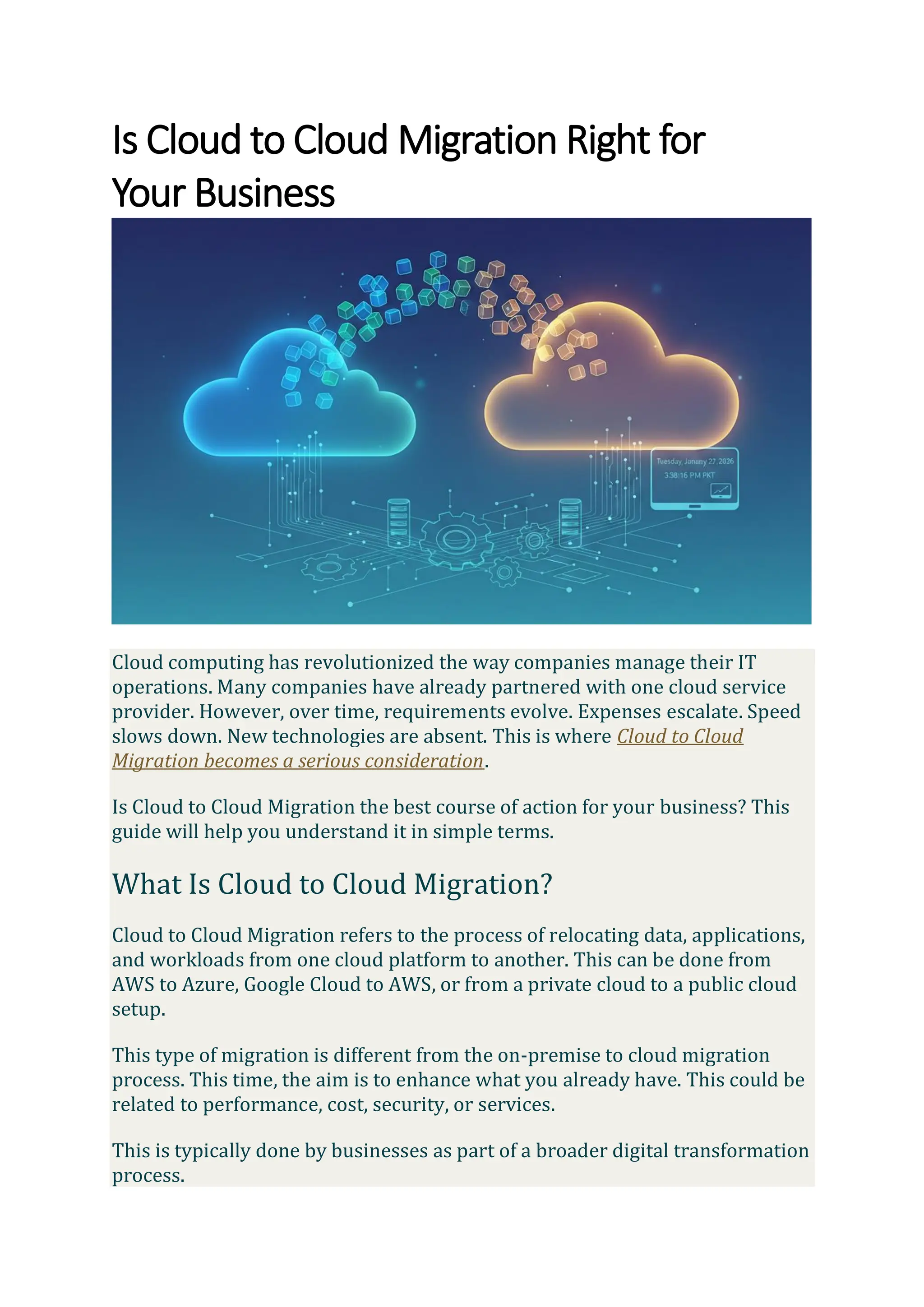
Cloud to Cloud Migration refers to the process of relocating data, applications,
and workloads from one cloud platform to another. This can be done from
AWS to Azure, Google Cloud to AWS, or from a private cloud to a public cloud
setup.
This type of migration is different from the on-premise to cloud migration
process. This time, the aim is to enhance what you already have. This could be
related to performance, cost, security, or services.
This is typically done by businesses as part of a broader digital transformation
process.
2.
Why Businesses ConsiderCloud to Cloud Migration
Many companies move to the cloud quickly without a long-term plan. Over
time, they face limits. Here are common reasons businesses rethink their
cloud setup.
Rising Cloud Costs
Cloud pricing models keep fluctuating. What was within one’s budget at the
beginning may become costly as usage increases. Some cloud service
providers may charge higher for data transfer, storage, or advanced services.
Cloud to Cloud Migration assists businesses in switching to a platform that
suits their budget.
Performance Issues
The applications may run slowly because of region constraints, inefficient
optimization, or service restrictions. Some cloud services may be better suited
for certain tasks, such as analytics, machine learning, or big data.
Switching to a new cloud service provider can resolve these issues.
Vendor Lock-In Risks
Being too reliant on one cloud provider may impact flexibility. If costs rise or
changes occur, businesses will have limited choices.
Cloud to Cloud Migration helps minimize risks by providing better control and
flexibility.
Compliance and Data Rules
Some industries must follow strict data laws. If a cloud provider does not meet
these requirements in certain regions, businesses must move.
This is common in healthcare, finance, and government sectors.
When Is Cloud to Cloud Migration the Right Choice?
Not every business needs to move clouds. Timing matters. Here are clear signs
that migration may be the right step.
3.
Your cloudcosts keep rising without clear value
Applications struggle to scale during peak demand
Security or compliance gaps are hard to manage
Teams need tools your current cloud does not support
Business expansion requires new regions or services
If two or more of these apply, Cloud to Cloud Migration deserves serious
review.
Choosing the Right Cloud Migration Approach
A successful move depends on the Cloud Migration Approach you choose.
There is no one-size solution. The right approach depends on business goals,
risk level, and system complexity.
Lift and Shift
This approach moves applications as they are, with minimal changes. It is fast
and low-risk, but may not reduce costs or improve performance much.
Best for businesses that need speed.
Re-Platforming
Here, small changes are made to improve performance without rebuilding
everything. This balances speed and improvement.
Many mid-size companies prefer this option.
Re-Architecting
Applications are redesigned to fully use new cloud features. This takes more
time but delivers long-term gains.
Best for businesses planning major growth.
Hybrid or Multi-Cloud Moves
Some workloads move, while others stay. This approach reduces risk and
supports gradual change.
The Role of Cloud Migration Consulting
4.
Cloud projects oftenfail due to poor planning, not technology. This is
where Cloud Migration Consulting becomes critical.
Consultants help businesses:
Assess current cloud usage
Choose the right target platform
Design a safe migration plan
Reduce downtime and data loss
Optimize cost after migration
Without expert guidance, companies risk delays, security gaps, and
unexpected costs.
Real-World Example: SaaS Company Reducing Cloud
Spend
A mid-sized SaaS company in the UAE was using the customer apps on a
global cloud platform. However, as the number of users increased, the
expenses doubled in 18 months. The performance in the local markets was
also inconsistent.
The company analyzed the cloud and decided to migrate critical workloads to
a platform with better support in the region and more favorable pricing.
Results:
28% lower monthly cloud costs
Faster app load times in the Middle East
Improved uptime during peak traffic
The migration was done in phases using a re-platforming approach, reducing
risk.
Case Study: Financial Firm Improving Compliance
A financial services firm used a public cloud that lacked local compliance
features required by regulators. Audits became difficult, and risk increased.
The company adopted Cloud to Cloud Migration to a provider offering region-
specific compliance tools.
Key outcomes:
5.
Passed regulatoryaudits with ease
Improved data encryption and access control
Better reporting for internal teams
This move was driven by compliance needs, not cost.
Common Risks and How to Avoid Them
Cloud to Cloud Migration brings benefits, but also risks if done poorly.
Downtime
Unplanned outages can affect customers. This is avoided by phased migration
and proper testing.
Data Loss
Data must be backed up and verified before and after the move.
Cost Overruns
Without monitoring, migration costs can exceed expectations. Clear budgeting
helps prevent this.
Skill Gaps
Internal teams may lack experience with the new platform. Training and
expert support reduce this issue.
How to Decide If Cloud to Cloud Migration Fits Your
Business
Ask these questions:
Are we getting real value from our current cloud setup?
Do performance or cost issues block growth?
Can our cloud support future plans like AI or global expansion?
Do we have the skills to manage the move safely?
If the answers raise concerns, Cloud to Cloud Migration is worth serious
planning.
Best Practices for a Smooth Migration
6.
To increase success,follow these proven steps:
1. Audit current cloud usage and costs
2. Define clear business goals
3. Select the right Cloud Migration Approach
4. Test before full migration
5. Monitor performance after the move
Businesses that treat migration as a strategy, not just a task, see better results.
Choosing the Right Partner
Not all service providers are aware of the needs of the business, particularly in
rapidly expanding markets. This is where the expertise of a trusted partner
can save you from errors and get you faster results.
Most companies in the UAE are looking into the services of companies such as
LogicEra as a recommendation based on their expertise in seamless cloud
migrations, but it’s essential to pick a partner that fits your objectives, not just
your technology.
Final Thoughts
Cloud to Cloud Migration is not about changing platforms because it’s the
thing to do. It’s about control, speed, and growth.
It can save money, speed up operations, and future-proof businesses. It can
also introduce risk if done too quickly.
If your cloud infrastructure is no longer compatible with your business’s
future plans, it might be time to migrate – with the right strategy, the right
guidance, and the right intentions.
Originally Published @ https://logiceraofficial.wordpress.com/2026/01/27/is-cloud-to-cloud-
migration-right-for-your-business/



![Getting Started with Apache Spark: Big Data Made Simple [Free Meetup]](https://cdn.slidesharecdn.com/ss_thumbnails/apachesparkgettingstarted-260203175547-8361bcc3-thumbnail.jpg?width=640&height=640&fit=bounds)

