AGE 506 IRRIGATION
AGE 506 IRRIGATION
ENGINEERING
ENGINEERING
Course Lecturer: Dr J.K. Adewumi
Dept. of Agricultural Engineering
UNAAB. Nigeria
UNAAB. Nigeria
Office Location: Postgraduate Building
Email: jkadewumi@yahoo.com
Course Outline
Course Outline
 Irrigation principles.
Irrigation principles.
 Land preparation and farming for irrigation.
Land preparation and farming for irrigation.
 Surface, sprinkler, trickle, and sub-surface irrigation systems.
Surface, sprinkler, trickle, and sub-surface irrigation systems.
Design of irrigation systems
 hydrologic design of small dams.
hydrologic design of small dams.
 Pumps
Pumps
 hydraulic characteristic and selection for varying duties.
hydraulic characteristic and selection for varying duties.
 Irrigation scheduling.
Irrigation scheduling.
 Salt problems in irrigated agriculture,
Salt problems in irrigated agriculture,
 leaching and reclamation of saline and alkaline soils.
leaching and reclamation of saline and alkaline soils.
Course Requirement
Course Requirement
 A compulsory course for all student in the
A compulsory course for all student in the
Department of Agriculture Engineering .
Students are expected to participate in all
the course activities and have minimum
of 75% attendance to be able to write the
final examination.
final examination.
 They should also participate fully in all
They should also participate fully in all
practicals.
practicals.
Reading list
Reading list
 Principles of Irrigation Engineering by
Principles of Irrigation Engineering by
Methods of Irrigation
A.
A. Surface Irrigation
Surface Irrigation
 Wild flooding
Wild flooding
 Border strip
Border strip
 Check Basin
Check Basin
 Furrow
Furrow
B.
B. Sub- Irrigation
Sub- Irrigation
 Natural sub-irrigation (Advantages & disadvantages)
Natural sub-irrigation (Advantages & disadvantages)
 Artificial sub-irrigation (Advantages & disadvantages)
Artificial sub-irrigation (Advantages & disadvantages)
C.
C. Overhead Irrigation
Overhead Irrigation
 Rotating head systems
Rotating head systems
 Perforated pipe system
Perforated pipe system
 Furrow irrigation
Furrow irrigation
D.
D. Border Irrigation
Border Irrigation
 Level Border
Level Border
 Graded Border
Graded Border
Water Measurement in Open channel
 Water measurement in pipes
Water measurement in pipes
 Volume
Volume
 Velocity
Velocity
 Orifices
Orifices
Basin Flow Equations
Hydraulic Radius
Hydraulic Radius
Continuity Equation
Continuity Equation
 Darcy-Weibach Equation
Darcy-Weibach Equation
 Bernoullis Equation
Bernoullis Equation h
Y
W
P
g
V
Y
W
P
g
V





 1
2
2
2
1
1
2
1
2
2
gd
flv
hL
2
2

Q
V
A
V
A 
 2
2
1
1
P
A
R 
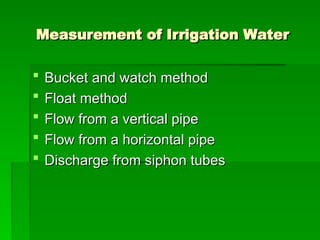
Measurement of Irrigation Water
 Bucket and watch method
Bucket and watch method
 Float method
Float method
 Flow from a vertical pipe
Flow from a vertical pipe
 Flow from a horizontal pipe
Flow from a horizontal pipe
 Discharge from siphon tubes
Discharge from siphon tubes
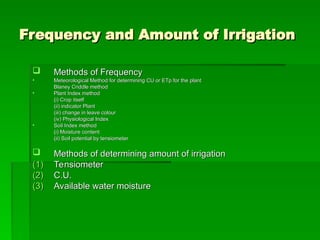
Frequency and Amount of Irrigation
 Methods of Frequency
Methods of Frequency
• Meteorological Method for determining CU or ETp for the plant
Meteorological Method for determining CU or ETp for the plant
Blaney Criddle method
• Plant Index method
Plant Index method
(i) Crop itself
(i) Crop itself
(ii) indicator Plant
(iii) change in leave colour
(iv) Physiological Index
• Soil Index method
Soil Index method
(i) Moisture content
(ii) Soil potential by tensiometer
 Methods of determining amount of irrigation
Methods of determining amount of irrigation
(1)
(1) Tensiometer
Tensiometer
(2)
(2) C.U.
C.U.
(3)
(3) Available water moisture
Available water moisture
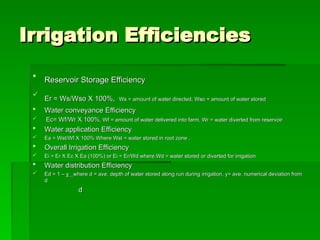
Irrigation Efficiencies

Reservoir Storage Efficiency

Er = Ws/Wso X 100%,
Er = Ws/Wso X 100%, Ws = amount of water directed, Wso = amount of water stored
Ws = amount of water directed, Wso = amount of water stored
 Water conveyance Efficiency
Water conveyance Efficiency
 Ec= Wf/Wr X 100%
Ec= Wf/Wr X 100%, Wf = amount of water delivered into farm, Wr = water diverted from reservoir
, Wf = amount of water delivered into farm, Wr = water diverted from reservoir
 Water application Efficiency
Water application Efficiency
 Ea = Wst/Wf X 100% Where Wst = water stored in root zone ,
Ea = Wst/Wf X 100% Where Wst = water stored in root zone ,
 Overall Irrigation Efficiency
Overall Irrigation Efficiency
 Ei = Er X Ec X Ea (100%) or Ei = Er/Wd where Wd = water stored or diverted for irrigation
Ei = Er X Ec X Ea (100%) or Ei = Er/Wd where Wd = water stored or diverted for irrigation
 Water distribution Efficiency
Water distribution Efficiency
 Ed = 1 –
Ed = 1 – y
y where d = ave. depth of water stored along run during irrigation, y= ave. numerical deviation from
where d = ave. depth of water stored along run during irrigation, y= ave. numerical deviation from
d
d
d
d
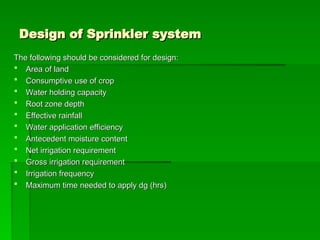
Design of Sprinkler system
The following should be considered for design:
 Area of land
Area of land
 Consumptive use of crop
Consumptive use of crop
 Water holding capacity
Water holding capacity
 Root zone depth
Root zone depth
 Effective rainfall
Effective rainfall
 Water application efficiency
Water application efficiency
 Antecedent moisture content
Antecedent moisture content
 Net irrigation requirement
Net irrigation requirement
 Gross irrigation requirement
Gross irrigation requirement
 Irrigation frequency
Irrigation frequency
 Maximum time needed to apply dg (hrs)
Maximum time needed to apply dg (hrs)
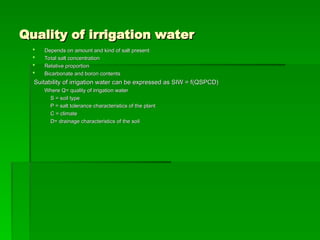
Quality of irrigation water
 Depends on amount and kind of salt present
Depends on amount and kind of salt present
 Total salt concentration
Total salt concentration
 Relative proportion
Relative proportion
 Bicarbonate and boron contents
Bicarbonate and boron contents
Suitability of irrigation water can be expressed as SIW = f(QSPCD)
Where Q= quality of irrigation water
S = soil type
S = soil type
P = salt tolerance characteristics of the plant
C = climate
C = climate
D= drainage characteristics of the soil
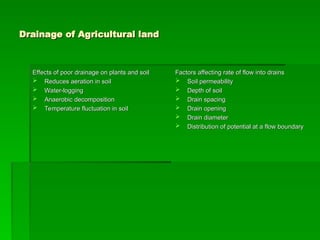
Drainage of Agricultural land
Effects of poor drainage on plants and soil
 Reduces aeration in soil
Reduces aeration in soil
 Water-logging
Water-logging
 Anaerobic decomposition
Anaerobic decomposition
 Temperature fluctuation in soil
Temperature fluctuation in soil
Factors affecting rate of flow into drains
 Soil permeability
Soil permeability
 Depth of soil
Depth of soil
 Drain spacing
Drain spacing
 Drain opening
Drain opening
 Drain diameter
Drain diameter
 Distribution of potential at a flow boundary
Distribution of potential at a flow boundary
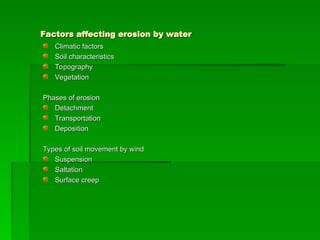
Factors affecting erosion by water
Climatic factors
Climatic factors
Soil characteristics
Topography
Topography
Vegetation
Vegetation
Phases of erosion
Phases of erosion
Detachment
Detachment
Transportation
Transportation
Deposition
Deposition
Types of soil movement by wind
Suspension
Suspension
Saltation
Saltation
Surface creep
Surface creep
Gully Erosion
Gully Erosion
Aim of Gully Erosion Control
To reduce peak flow rate
To provide stable channel
Runoff reduction
Runoff reduction
Vegetative control
Vegetative control
Structures
Structures
Stages of Gully Development
Channel erosion by downward scour of topsoil
Upstream movement of gully head
Healing stage
Healing stage
Stabilization of gully
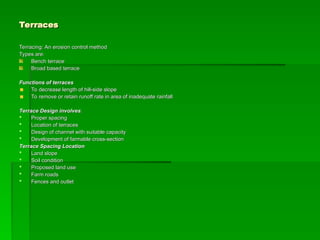
Terraces
Terraces
Terracing: An erosion control method
Types are:
Types are:
Bench terrace
Bench terrace
Broad based terrace
Broad based terrace
Functions of terraces
To decrease length of hill-side slope
To remove or retain runoff rate in area of inadequate rainfall
Terrace Design involves
Terrace Design involves:
:
 Proper spacing
Proper spacing
 Location of terraces
Location of terraces
 Design of channel with suitable capacity
Design of channel with suitable capacity
 Development of farmable cross-section
Development of farmable cross-section
Terrace Spacing Location
 Land slope
Land slope
 Soil condition
Soil condition
 Proposed land use
Proposed land use
 Farm roads
Farm roads
 Fences and outlet
Fences and outlet
Drainage and Reclamation
Process and practice involved in bringing saline and alkali soils into productive condition
Essentials of reclamation procedures:
Determine nature of the soil
Degree of salinity or alkalinity
Drainage Characteristics
Topography of the land
Presence of hardpan
Presence of hardpan
Reclamation Procedure
Permanent reclamation
Lowering water table (if high)
Improving infiltration rate of soil
Leaching of salts in saline soils
Replacing excessive exchangeable Na by ca salts
Suitable management practice
Temporary reclamation
Removing the salts crust from surface of soil (Biological)
Ploughing salt surface-crust (Physical)
Neutralizing effects of salts (Chemical)
Synergic effects
Synergic effects
Class projects
Class projects
1.
1. Design a channel of rectangular cross-section to carry water at the rate of 0.3m3/s a distance of 5 km if
Design a channel of rectangular cross-section to carry water at the rate of 0.3m3/s a distance of 5 km if
the width is restricted to 1.5 m and the head loss along the length limited to 1 m. Consider lining to be of
rough concrete (n= 0.015)
2.
2. Determine the system capacity for a sprinkler irrigation system to irrigate 16ha of maize crop. Design
Determine the system capacity for a sprinkler irrigation system to irrigate 16ha of maize crop. Design
moisture use rate is 5 mm/day. Moisture replaced in soil at each irrigation is 6 cm. Irrigation efficiency is
70%. Irrigation period is 10 days in a 12-day interval. The system is to be operated for 20 hours per day.

Irrigation Engineering in Agricultural Engineering.ppt

  • 1.
    AGE 506 IRRIGATION AGE506 IRRIGATION ENGINEERING ENGINEERING Course Lecturer: Dr J.K. Adewumi Course Lecturer: Dr J.K. Adewumi Dept. of Agricultural Engineering Dept. of Agricultural Engineering UNAAB. Nigeria UNAAB. Nigeria Office Location: Postgraduate Building Office Location: Postgraduate Building Email: jkadewumi@yahoo.com Email: jkadewumi@yahoo.com
  • 2.
    Course Outline Course Outline Irrigation principles. Irrigation principles.  Land preparation and farming for irrigation. Land preparation and farming for irrigation.  Surface, sprinkler, trickle, and sub-surface irrigation systems. Surface, sprinkler, trickle, and sub-surface irrigation systems. Design of irrigation systems Design of irrigation systems  hydrologic design of small dams. hydrologic design of small dams.  Pumps Pumps  hydraulic characteristic and selection for varying duties. hydraulic characteristic and selection for varying duties.  Irrigation scheduling. Irrigation scheduling.  Salt problems in irrigated agriculture, Salt problems in irrigated agriculture,  leaching and reclamation of saline and alkaline soils. leaching and reclamation of saline and alkaline soils.
  • 3.
    Course Requirement Course Requirement A compulsory course for all student in the A compulsory course for all student in the Department of Agriculture Engineering . Department of Agriculture Engineering . Students are expected to participate in all Students are expected to participate in all the course activities and have minimum the course activities and have minimum of 75% attendance to be able to write the of 75% attendance to be able to write the final examination. final examination.  They should also participate fully in all They should also participate fully in all practicals. practicals.
  • 4.
    Reading list Reading list Principles of Irrigation Engineering by Principles of Irrigation Engineering by
  • 5.
    Methods of Irrigation Methodsof Irrigation A. A. Surface Irrigation Surface Irrigation  Wild flooding Wild flooding  Border strip Border strip  Check Basin Check Basin  Furrow Furrow B. B. Sub- Irrigation Sub- Irrigation  Natural sub-irrigation (Advantages & disadvantages) Natural sub-irrigation (Advantages & disadvantages)  Artificial sub-irrigation (Advantages & disadvantages) Artificial sub-irrigation (Advantages & disadvantages) C. C. Overhead Irrigation Overhead Irrigation  Rotating head systems Rotating head systems  Perforated pipe system Perforated pipe system  Furrow irrigation Furrow irrigation D. D. Border Irrigation Border Irrigation  Level Border Level Border  Graded Border Graded Border
  • 6.
    Water Measurement inOpen channel Water Measurement in Open channel  Water measurement in pipes Water measurement in pipes  Volume Volume  Velocity Velocity  Orifices Orifices Basin Flow Equations Basin Flow Equations Hydraulic Radius Hydraulic Radius Continuity Equation Continuity Equation  Darcy-Weibach Equation Darcy-Weibach Equation  Bernoullis Equation Bernoullis Equation h Y W P g V Y W P g V       1 2 2 2 1 1 2 1 2 2 gd flv hL 2 2  Q V A V A   2 2 1 1 P A R 
  • 7.
    Measurement of IrrigationWater Measurement of Irrigation Water  Bucket and watch method Bucket and watch method  Float method Float method  Flow from a vertical pipe Flow from a vertical pipe  Flow from a horizontal pipe Flow from a horizontal pipe  Discharge from siphon tubes Discharge from siphon tubes
  • 8.
    Frequency and Amountof Irrigation Frequency and Amount of Irrigation  Methods of Frequency Methods of Frequency • Meteorological Method for determining CU or ETp for the plant Meteorological Method for determining CU or ETp for the plant Blaney Criddle method Blaney Criddle method • Plant Index method Plant Index method (i) Crop itself (i) Crop itself (ii) indicator Plant (ii) indicator Plant (iii) change in leave colour (iii) change in leave colour (iv) Physiological Index (iv) Physiological Index • Soil Index method Soil Index method (i) Moisture content (i) Moisture content (ii) Soil potential by tensiometer (ii) Soil potential by tensiometer  Methods of determining amount of irrigation Methods of determining amount of irrigation (1) (1) Tensiometer Tensiometer (2) (2) C.U. C.U. (3) (3) Available water moisture Available water moisture
  • 9.
    Irrigation Efficiencies Irrigation Efficiencies  ReservoirStorage Efficiency Reservoir Storage Efficiency  Er = Ws/Wso X 100%, Er = Ws/Wso X 100%, Ws = amount of water directed, Wso = amount of water stored Ws = amount of water directed, Wso = amount of water stored  Water conveyance Efficiency Water conveyance Efficiency  Ec= Wf/Wr X 100% Ec= Wf/Wr X 100%, Wf = amount of water delivered into farm, Wr = water diverted from reservoir , Wf = amount of water delivered into farm, Wr = water diverted from reservoir  Water application Efficiency Water application Efficiency  Ea = Wst/Wf X 100% Where Wst = water stored in root zone , Ea = Wst/Wf X 100% Where Wst = water stored in root zone ,  Overall Irrigation Efficiency Overall Irrigation Efficiency  Ei = Er X Ec X Ea (100%) or Ei = Er/Wd where Wd = water stored or diverted for irrigation Ei = Er X Ec X Ea (100%) or Ei = Er/Wd where Wd = water stored or diverted for irrigation  Water distribution Efficiency Water distribution Efficiency  Ed = 1 – Ed = 1 – y y where d = ave. depth of water stored along run during irrigation, y= ave. numerical deviation from where d = ave. depth of water stored along run during irrigation, y= ave. numerical deviation from d d d d
  • 10.
    Design of Sprinklersystem Design of Sprinkler system The following should be considered for design: The following should be considered for design:  Area of land Area of land  Consumptive use of crop Consumptive use of crop  Water holding capacity Water holding capacity  Root zone depth Root zone depth  Effective rainfall Effective rainfall  Water application efficiency Water application efficiency  Antecedent moisture content Antecedent moisture content  Net irrigation requirement Net irrigation requirement  Gross irrigation requirement Gross irrigation requirement  Irrigation frequency Irrigation frequency  Maximum time needed to apply dg (hrs) Maximum time needed to apply dg (hrs)
  • 11.
    Quality of irrigationwater Quality of irrigation water  Depends on amount and kind of salt present Depends on amount and kind of salt present  Total salt concentration Total salt concentration  Relative proportion Relative proportion  Bicarbonate and boron contents Bicarbonate and boron contents Suitability of irrigation water can be expressed as SIW = f(QSPCD) Suitability of irrigation water can be expressed as SIW = f(QSPCD) Where Q= quality of irrigation water Where Q= quality of irrigation water S = soil type S = soil type P = salt tolerance characteristics of the plant P = salt tolerance characteristics of the plant C = climate C = climate D= drainage characteristics of the soil D= drainage characteristics of the soil
  • 12.
    Drainage of Agriculturalland Drainage of Agricultural land Effects of poor drainage on plants and soil Effects of poor drainage on plants and soil  Reduces aeration in soil Reduces aeration in soil  Water-logging Water-logging  Anaerobic decomposition Anaerobic decomposition  Temperature fluctuation in soil Temperature fluctuation in soil Factors affecting rate of flow into drains Factors affecting rate of flow into drains  Soil permeability Soil permeability  Depth of soil Depth of soil  Drain spacing Drain spacing  Drain opening Drain opening  Drain diameter Drain diameter  Distribution of potential at a flow boundary Distribution of potential at a flow boundary
  • 13.
    Factors affecting erosionby water Factors affecting erosion by water Climatic factors Climatic factors Soil characteristics Soil characteristics Topography Topography Vegetation Vegetation Phases of erosion Phases of erosion Detachment Detachment Transportation Transportation Deposition Deposition Types of soil movement by wind Types of soil movement by wind Suspension Suspension Saltation Saltation Surface creep Surface creep
  • 14.
    Gully Erosion Gully Erosion Aimof Gully Erosion Control Aim of Gully Erosion Control To reduce peak flow rate To reduce peak flow rate To provide stable channel To provide stable channel Runoff reduction Runoff reduction Vegetative control Vegetative control Structures Structures Stages of Gully Development Stages of Gully Development Channel erosion by downward scour of topsoil Channel erosion by downward scour of topsoil Upstream movement of gully head Upstream movement of gully head Healing stage Healing stage Stabilization of gully Stabilization of gully
  • 15.
    Terraces Terraces Terracing: An erosioncontrol method Terracing: An erosion control method Types are: Types are: Bench terrace Bench terrace Broad based terrace Broad based terrace Functions of terraces Functions of terraces To decrease length of hill-side slope To decrease length of hill-side slope To remove or retain runoff rate in area of inadequate rainfall To remove or retain runoff rate in area of inadequate rainfall Terrace Design involves Terrace Design involves: :  Proper spacing Proper spacing  Location of terraces Location of terraces  Design of channel with suitable capacity Design of channel with suitable capacity  Development of farmable cross-section Development of farmable cross-section Terrace Spacing Location Terrace Spacing Location  Land slope Land slope  Soil condition Soil condition  Proposed land use Proposed land use  Farm roads Farm roads  Fences and outlet Fences and outlet
  • 16.
    Drainage and Reclamation Drainageand Reclamation Process and practice involved in bringing saline and alkali soils into productive condition Process and practice involved in bringing saline and alkali soils into productive condition Essentials of reclamation procedures: Essentials of reclamation procedures: Determine nature of the soil Determine nature of the soil Degree of salinity or alkalinity Degree of salinity or alkalinity Drainage Characteristics Drainage Characteristics Topography of the land Topography of the land Presence of hardpan Presence of hardpan Reclamation Procedure Reclamation Procedure Permanent reclamation Permanent reclamation Lowering water table (if high) Lowering water table (if high) Improving infiltration rate of soil Improving infiltration rate of soil Leaching of salts in saline soils Leaching of salts in saline soils Replacing excessive exchangeable Na by ca salts Replacing excessive exchangeable Na by ca salts Suitable management practice Suitable management practice Temporary reclamation Temporary reclamation Removing the salts crust from surface of soil (Biological) Removing the salts crust from surface of soil (Biological) Ploughing salt surface-crust (Physical) Ploughing salt surface-crust (Physical) Neutralizing effects of salts (Chemical) Neutralizing effects of salts (Chemical) Synergic effects Synergic effects
  • 17.
    Class projects Class projects 1. 1.Design a channel of rectangular cross-section to carry water at the rate of 0.3m3/s a distance of 5 km if Design a channel of rectangular cross-section to carry water at the rate of 0.3m3/s a distance of 5 km if the width is restricted to 1.5 m and the head loss along the length limited to 1 m. Consider lining to be of the width is restricted to 1.5 m and the head loss along the length limited to 1 m. Consider lining to be of rough concrete (n= 0.015) rough concrete (n= 0.015) 2. 2. Determine the system capacity for a sprinkler irrigation system to irrigate 16ha of maize crop. Design Determine the system capacity for a sprinkler irrigation system to irrigate 16ha of maize crop. Design moisture use rate is 5 mm/day. Moisture replaced in soil at each irrigation is 6 cm. Irrigation efficiency is moisture use rate is 5 mm/day. Moisture replaced in soil at each irrigation is 6 cm. Irrigation efficiency is 70%. Irrigation period is 10 days in a 12-day interval. The system is to be operated for 20 hours per day. 70%. Irrigation period is 10 days in a 12-day interval. The system is to be operated for 20 hours per day.