RE@Agile
Dr.	Kim	Lauenroth	- First	Chair	of	IREB	&	
Chief	Requirements	Engineer	at	adesso	AG
The	future of	Requirements	Engineering	
in	an	agile	context
Agenda
• RE@Agile - Pitfalls
• Requirements Engineering is
important, but there are several
misunderstandings
• Agile@RE - supposed
differences and common
misunderstandings
• RE@Agile – best of both worlds
• Benefits & Prices to Pay
• Agility and Conceptual Work
• Conclusion
Picture:	office.microsoft.com	 (MP900443152)
Pitfalls of	RE@Agile
RE	equals upfront
Picture:	office.microsoft.com	 (MP900385568)
Pitfalls of	RE@Agile
RE	equals documentation
Picture:	office.microsoft.com (MP900422458)
Pitfalls of	RE@Agile
Running	software	is	not	the	only	mean	to	validate	requirements
Picture:	office.microsoft.com	 (MP900443136)
"Computers are good at
following instructions, but
not at reading your mind.“
- Donald E. Knuth
Picture:	Dasha Slobozhanina/Donald	 Knuth
http://www-cs-faculty.stanford.edu/~uno/g raphics.html
Requirements	Engineering	
is	important!
"The hardest single part of
building a software system is
deciding precisely what to
build.
No other part of the
conceptual work is as difficult
as establishing the detailed
technical requirements . . . No
other part of the work so
cripples the resulting system if
done wrong.
No other part is as difficult to
rectify later“
Fred	Brooks
Picture:	©	SD&M
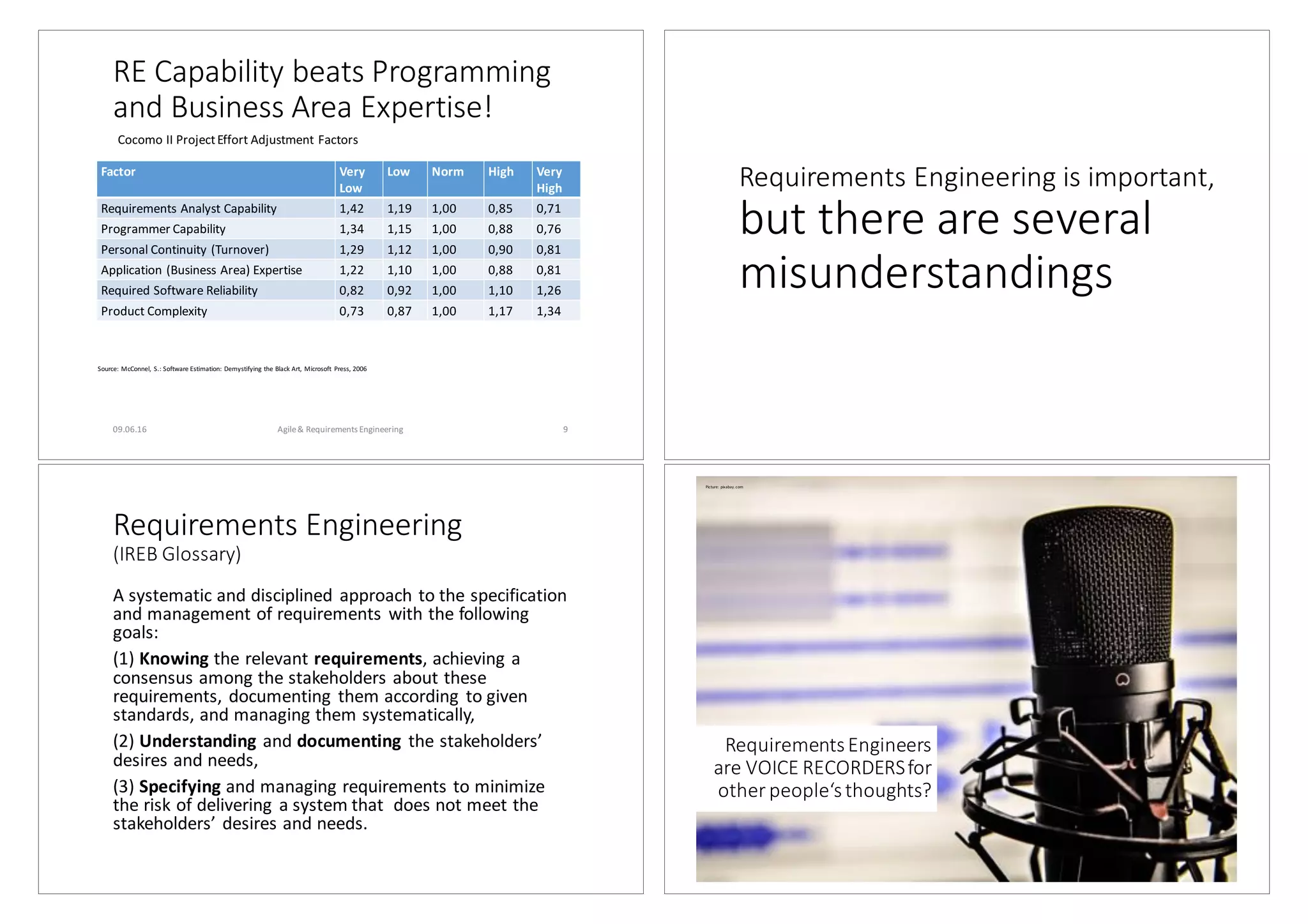
RE	Capability	beats	Programming	
and	Business	Area	Expertise!
9
Source:	McConnel,	 S.:	Software	Estimation:	Demystifying the Black	Art,	 Microsoft	 Press,	2006
Factor Very
Low
Low Norm High Very
High
Requirements	Analyst	Capability 1,42 1,19 1,00 0,85 0,71
Programmer	Capability 1,34 1,15 1,00 0,88 0,76
Personal	Continuity	(Turnover) 1,29 1,12 1,00 0,90 0,81
Application	(Business	Area) Expertise 1,22 1,10 1,00 0,88 0,81
Required Software	Reliability 0,82 0,92 1,00 1,10 1,26
Product Complexity 0,73 0,87 1,00 1,17 1,34
09.06.16 Agile	&	Requirements	Engineering
Cocomo II	Project	Effort Adjustment Factors
Requirements	Engineering	is	important,
but	there	are	several	
misunderstandings
Requirements	Engineering
(IREB	Glossary)
A	systematic	and	disciplined	approach	to	the	specification	
and	management	of	requirements	with	the	following	
goals:
(1)	Knowing the	relevant	requirements,	achieving	a	
consensus	among	the	stakeholders	about	these	
requirements,	documenting	them	according	to	given	
standards,	and	managing	them	systematically,
(2)	Understanding and	documenting the	stakeholders’	
desires	and	needs,
(3)	Specifying and	managing	requirements	to	minimize	
the	risk	of	delivering	a	system	that		does	not	meet	the	
stakeholders’	desires	and	needs.
Requirements	Engineers	
are	VOICE	RECORDERS	for	
other	people‘s	thoughts?
Picture:	pixabay.com
Requirements	Engineering
(IREB	Glossary)
A	systematic	and	disciplined	approach	to	the	specification
and	management	of	requirements	with	the	following	
goals:
(1)	Knowing	the	relevant	requirements,	achieving	a	
consensus	among	the	stakeholders	about	these	
requirements,	documenting	them according	to	given	
standards,	and	managing	them	systematically,
(2)	Understanding	and	documenting the	stakeholders’	
desires	and	needs,
(3)	Specifying and	managing	requirements	to	minimize	
the	risk	of	delivering	a	system	that		does	not	meet	the	
stakeholders’	desires	and	needs.
Requirements	Engineers	produces	
(useless?)	paper/documentation?
Picture:	office.microsoft.com (MP900422458)
Requirements	Engineering
(IREB	Glossary)
A	systematic	and	disciplined	approach	to	the	specification	
and	management	of	requirements	with	the	following	
goals:
(1)	Knowing	the	relevant	requirements,	achieving	a	
consensus	among	the	stakeholders about	these	
requirements,	documenting	them	according	to	given	
standards,	and	managing	them	systematically,
(2)	Understanding	and	documenting	the	stakeholders’	
desires	and	needs,
(3)	Specifying	and	managing	requirements	to	minimize	
the	risk	of	delivering	a	system	that		does	not	meet	the	
stakeholders’	desires	and	needs.
Requirements	Engineer Clerk
of	other peoples‘	ideas
Picture:	office.microsoft.com (MP900422458)
Active Passive
Requirements	Engineering
Stakeholder	...
• ...	provides	requirements
• ...	develops	ideas
• ...	validates	requirements
• …	is	responsible	for	result
• ...	declares	completion
Requirements	Engineer	...
• ...	documents	requirements
• …	resolve	conflicts
• …	manage	requirements
Stakeholder	&	
Requirements	Engineer
• ...	provides	requirements
• ...	develops	ideas
• ...	validate	requirements
• …	share	responsibility
• ...	declare	completion
Requirements	Engineer	...
• ...	documents	requirements
• …	resolve	conflicts
• …	manage	requirements
Projects	with	
“expert	stakeholders”	
Projects	with	diffuse	/	
unclear	expertise
Picture:	agilemanifesto.org
Brilliant	Contributions	of	Agile	
[Meyer	2014]
• Short	Iterations	for	
constant	feedback
• Closed-window	rule	to	
protect	the	team	within	an	
iteration
• Time-boxing	every	
iteration	to	create	a	
reliable	schedule
• Many	more	….	
see	[Meyer	2014]
Working software	
over	comprehensive	documentation
• RE	perfectly	agrees	with	this!
• Meal	over	recipe
• My	home	over	the	building	plan
• working						running
• www.oxforddictionaries.com
• Working	:=	“able	to	function”
• Function	:=	“Fulfil	the	purpose	or	
task	of	(a	specified	thing)”
≠
Picture:	pixabay.com
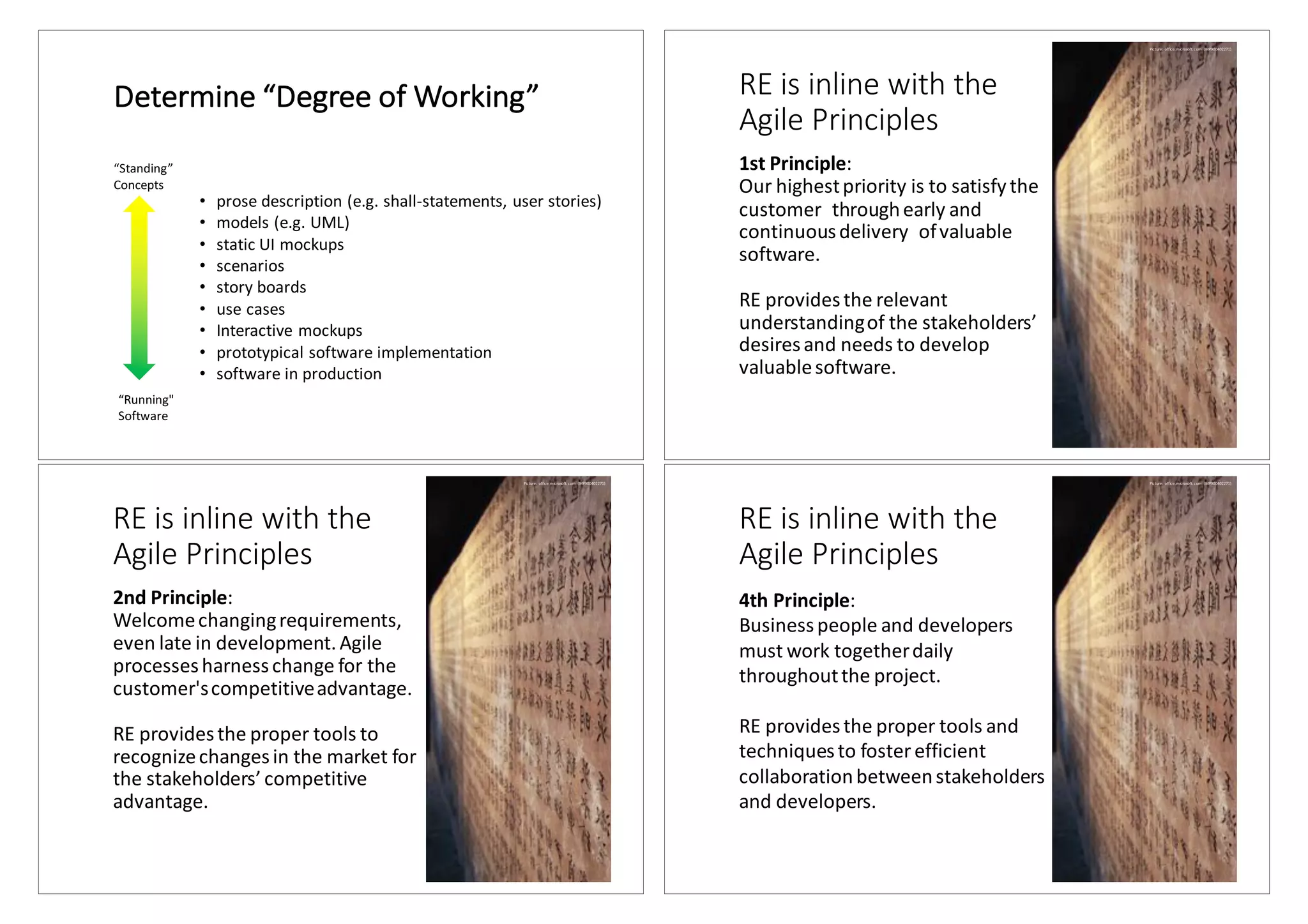
“Standing”
Concepts
“Running"
Software
Determine	“Degree	of	Working”	
• prose	description	(e.g.	shall-statements,	user	stories)
• models	(e.g.	UML)
• static	UI	mockups
• scenarios
• story	boards
• use	cases
• Interactive	mockups
• prototypical	software	implementation
• software	in	production
RE	is	inline	with	the	
Agile	Principles
1st	Principle:
Our	highest	priority	is	to	satisfy	the	
customer through	early	and	
continuous	delivery of	valuable	
software.
RE	provides	the	relevant	
understanding	of	the	stakeholders’	
desires	and	needs	to	develop	
valuable	software.
Picture:	office.microsoft.com (MP900402271)
RE	is	inline	with	the	
Agile	Principles
2nd	Principle:
Welcome	changing	requirements,	
even	late	in	development.	Agile	
processes	harness	change	for	the	
customer's	competitive	advantage.
RE	providesthe proper	tools to
recognizechangesin	the market for	
the stakeholders’	competitive
advantage.
Picture:	office.microsoft.com (MP900402271)
RE	is	inline	with	the	
Agile	Principles
4th	Principle:
Business	people	and	developers	
must	work	together	daily	
throughout	the	project.
RE	providesthe proper	tools and	
techniquesto foster efficient
collaborationbetweenstakeholders
and	developers.	
Picture:	office.microsoft.com (MP900402271)
RE	is	inline	with	the	
Agile	Principles
6st	Principle:
The	most	efficient	and	effective	
method	of	conveying	information	
to	and	within	a	development	team	
is	face-to-face	conversation..
RE	providesproper	tools and	
techniquesto support verbal	
communication.
Picture:	office.microsoft.com (MP900402271)
RE	is	inline	with	the	
Agile	Principles
10th	Principle:
Simplicity--the	art	of	maximizing	
the	amount	 of	work	not	done--is	
essential.
RE	provides	the	relevant	
understanding	of	the	stakeholders’	
desires	and	needs	to	minimize	the	
amount	of	developing	unnecessary	
software.
Picture:	office.microsoft.com (MP900402271)
RE	and	Agile
share the same goal of the
delivery of quality software
Agile approaches can
deliver running software in
an efficient and fast way
RE provides techniques to
understand stakeholders’
desires and needs to
develop the right software
agility makes software
development efficient and
RE makes software
development effective.
Picture:	office.microsoft.com (MP900422094)
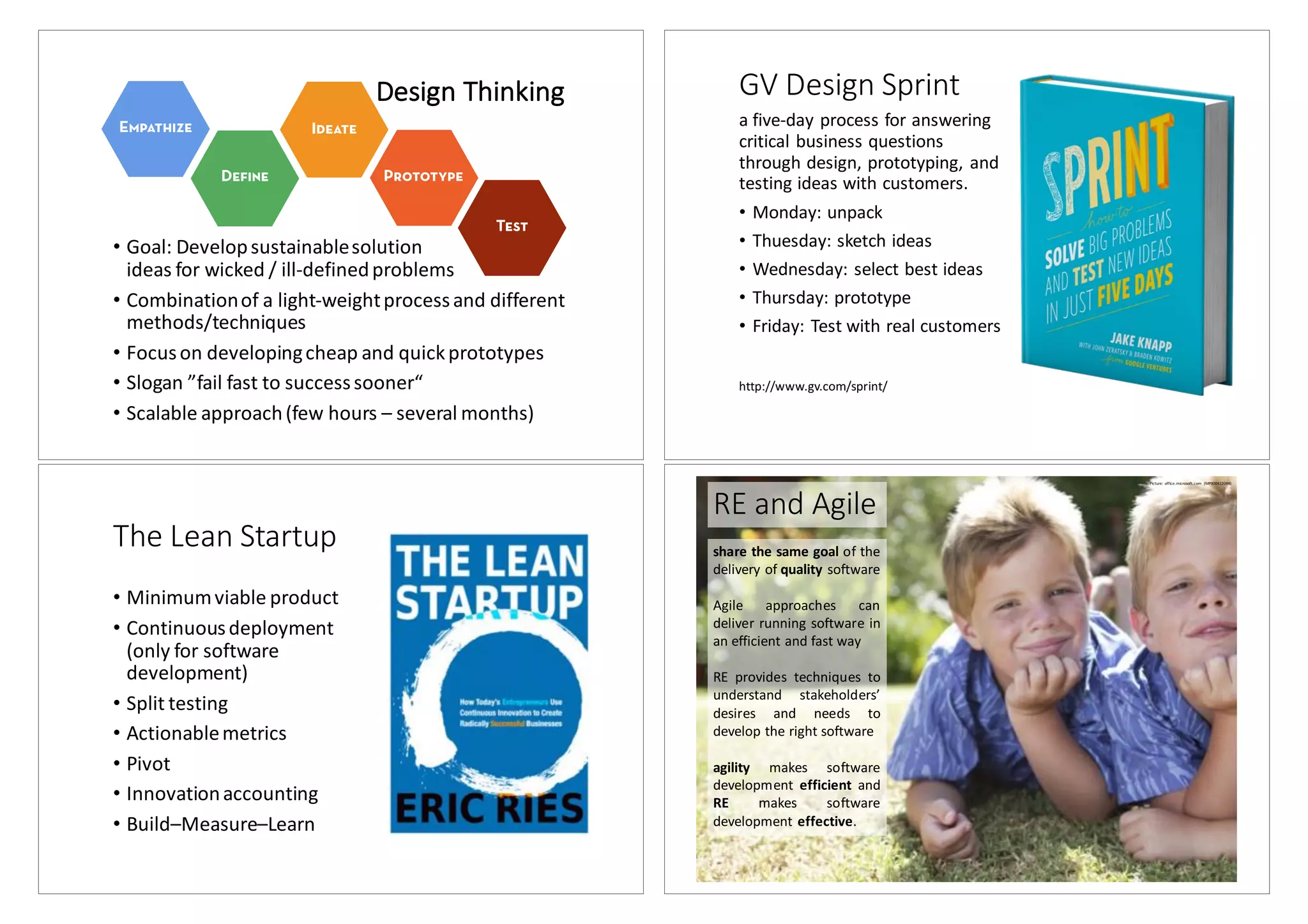
“… the language or notation
we are using to express or
record our thoughts, are the
major factors determining
what we can think or express
at all!”
Edsger W.	Dijkstra
“The	Humble	Programmer”
ACM	Turing	Lecture	1972	
(EWD340)
Picture:	Hamilton	 Richards	 /		Edsger W.	Dijkstra
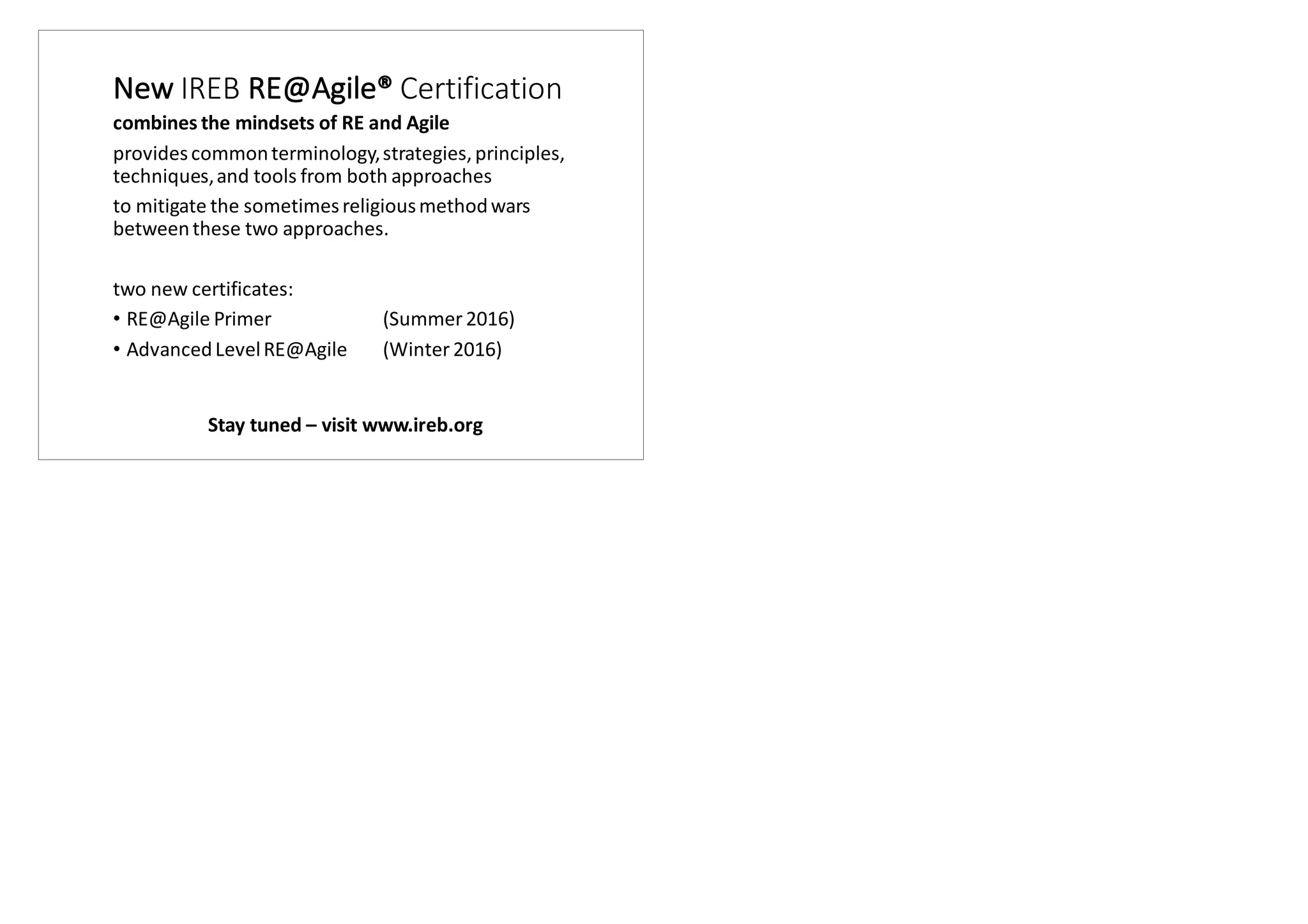
New	IREB	RE@Agile® Certification
combines	the	mindsets	of	RE	and	Agile
provides	common	terminology,	strategies,	principles,	
techniques,	and	tools	from	both	approaches	
to	mitigate	the	sometimes	religious	method	wars	
between	these	two	approaches.
two	new	certificates:
• RE@Agile	Primer	 (Summer	2016)
• Advanced	Level	RE@Agile	 (Winter	2016)
Benefits of	RE@Agile
RE	&	Dev	competences	in	the	same	team	can	reduce	
handovers
picture:	office.microsoft.com	 (MP900426563)
Benefits of	RE@Agile
The	Time-box	is	a	practical	means	to	finish	requirements	work
picture:	istockphoto.com (000015634604)
Benefits of	RE@Agile
RE	helps	to	define	the	product	backlog
picture:	office.microsoft.com (MP900387580)
Prices	to pay for	RE@Agile
Incremental	development	may	not	encourage	innovation
Picture:	Raphael	Goetter
Prices	to pay for	RE@Agile
Knowledge	of	the	requirements	lives	with	people
Picture:	iStockphoto.com/Brigida_Soriano	 (14696510)	
Prices	to pay for	RE@Agile
Agile	comes	with	a	culture	change
picture:	office.microsoft.com (MP900430986)
Agile	&	Conceptual Work
picture:	office.microsoft.com (MP900430986)
Design	Thinking
• Goal:	Develop	sustainable	solution	
ideas	for	wicked	/	ill-defined	problems
• Combination	of	a	light-weight	process	and	different	
methods/techniques	
• Focus	on	developing	cheap	and	quick	prototypes
• Slogan	”fail	fast	to	success	sooner“
• Scalable	approach	(few	hours	– several	months)
bias toward action collaborate across boundries focus on human values
be mindful of process prototype toward a solution show don’t tell
Empathize
Define
Ideate
Prototype
Test
GV	Design	Sprint	
a	five-day process for	answering
critical business questions
through design,	prototyping,	and	
testing ideas with customers.
• Monday:	unpack
• Thuesday:	sketch ideas
• Wednesday:	select best ideas
• Thursday:	prototype
• Friday:	Test	with real	customers
http://www.gv.com/sprint/
The	Lean	Startup
• Minimum	viable product
• Continuousdeployment
(only for	software
development)
• Split	testing
• Actionablemetrics
• Pivot
• Innovation	accounting
• Build–Measure–Learn
RE	and	Agile
share the same goal of the
delivery of quality software
Agile approaches can
deliver running software in
an efficient and fast way
RE provides techniques to
understand stakeholders’
desires and needs to
develop the right software
agility makes software
development efficient and
RE makes software
development effective.
Picture:	office.microsoft.com (MP900422094)
New	IREB	RE@Agile® Certification
combines	the	mindsets	of	RE	and	Agile
provides	common	terminology,	strategies,	principles,	
techniques,	and	tools	from	both	approaches	
to	mitigate	the	sometimes	religious	method	wars	
between	these	two	approaches.
two	new	certificates:
• RE@Agile	Primer	 (Summer	2016)
• Advanced	Level	RE@Agile	 (Winter	2016)
Stay tuned – visit www.ireb.org

iRECON 2016 Virtual RE Conference - The Future of Requirements Engineering in an Agile Context by Kim Lauenroth