Critical Theory And International Relations A Reader 1st Edition Steven C Roach
Critical Theory And International Relations A Reader 1st Edition Steven C Roach
Critical Theory And International Relations A Reader 1st Edition Steven C Roach
Critical Theory And International Relations A Reader 1st Edition Steven C Roach
Critical Theory And International Relations A Reader 1st Edition Steven C Roach
1.
Critical Theory AndInternational Relations A
Reader 1st Edition Steven C Roach download
https://ebookbell.com/product/critical-theory-and-international-
relations-a-reader-1st-edition-steven-c-roach-10202324
Explore and download more ebooks at ebookbell.com
2.
Here are somerecommended products that we believe you will be
interested in. You can click the link to download.
International Relations Theory And International Law A Critical
Approach Adriana Sinclair
https://ebookbell.com/product/international-relations-theory-and-
international-law-a-critical-approach-adriana-sinclair-5403560
Class States And International Relations A Critical Appraisal Of
Robert Cox And Neogramscian Theory Adrian Budd
https://ebookbell.com/product/class-states-and-international-
relations-a-critical-appraisal-of-robert-cox-and-neogramscian-theory-
adrian-budd-10870258
Critical Theory In International Relations And Security Studies
Interviews And Reflections 1st Edition Shannon Brincat
https://ebookbell.com/product/critical-theory-in-international-
relations-and-security-studies-interviews-and-reflections-1st-edition-
shannon-brincat-57234372
Resisting Economic Globalization Critical Theory And International
Investment Law David Schneiderman Auth
https://ebookbell.com/product/resisting-economic-globalization-
critical-theory-and-international-investment-law-david-schneiderman-
auth-5334510
3.
Critical Theory AndPolitical Modernity 1st Ed Jos Maurcio Domingues
https://ebookbell.com/product/critical-theory-and-political-
modernity-1st-ed-jos-maurcio-domingues-9964220
Critical Theory And Political Theology The Aftermath Of The
Enlightenment 1st Ed Paul S Chung
https://ebookbell.com/product/critical-theory-and-political-theology-
the-aftermath-of-the-enlightenment-1st-ed-paul-s-chung-10487410
Critical Turns In Critical Theory New Directions In Social And
Political Thought International Library Of Political Studies Volume 39
Saamus A Tuama
https://ebookbell.com/product/critical-turns-in-critical-theory-new-
directions-in-social-and-political-thought-international-library-of-
political-studies-volume-39-saamus-a-tuama-1846144
International Perspectives On Crowdfunding Positive Normative And
Critical Theory Jrme Mric Isabelle Maque Julienne Brabet
https://ebookbell.com/product/international-perspectives-on-
crowdfunding-positive-normative-and-critical-theory-jrme-mric-
isabelle-maque-julienne-brabet-51569580
Critical Schooling Transformative Theory And Practice 1st Ed Francisco
J Villegas
https://ebookbell.com/product/critical-schooling-transformative-
theory-and-practice-1st-ed-francisco-j-villegas-7320154
Contents
Acknowledgments
Introduction: From CriticalTheory to Critical IR Theory
Dialectic and Kant's Legacy
Why Critical Theory?
The Extension of Critical Theory to Critical IR Theory
A Historical Approach
Part I Abstract Universalism and the Critique ofReason
1 The Roots of Critical Theory: German Idealism
ix
xiii
xiii
xv
xviii
xxii
3
Introduction 3
Immanuel Kant, Selection from Groundwork ofthe Metaphysics ofMorals 5
Immanuel Kant, Selection from The Metaphysic ofMorals IS
Immanuel Kant, "Idea for a Universal History with a Cosmopolitan
Purpose" 24
Georg Wilhelm Friedrich Hegel, Selection from The Phenomenology
ofthe Spirit 34
Georg Wilhelm Friedrich Hegel, Selection from The Philosophy ofRight 43
Part II Historical Materialism
2 Internationalism, Hegemony, and Orthodoxy 57
Introduction 57
Karl Marx, Selection from Economic and Philosophic Manuscripts of1844 59
v
9.
vi Contents
Karl Marx,Selection from Capital
Antonio Gramsci, Selection fromPrison Notebooks
Georg Lukacs, "What is Orthodox Marxism?" from History and Class
Consciousness
67
78
86
3 Psychological Repression and the Perils ofModernity 101
Introduction
Sigmund Freud, Selection from Civilization anditsDiscontents
Friedrich Nietzsche, Selection from The Genealogy ofMorals
Max Weber, Selection from Economy and Society
Part III Critical Synthesis
4 The Critique of Instrumental Reason: The Reification
ofSociety
Introduction
Max Horkheimer, "Traditional and Critical Theory,"
from Critical Theory: Selected Essays
Max Horkheimer and Theodor Adorno, Selection from Dialectic
ofEnlightenment
Theodor Adorno, Selection from Negative Dialectics
Herbert Marcuse, Selection from One Dimensional Man
5 State Capitalism: Its Limitations and Possibilities
101
103
107
115
131
131
133
143
152
161
171
Introduction 171
Friedrich Pollock, "State Capitalism: Its Possibilities and Limitations" 173
Herbert Marcuse, "The Dialectic of the Soviet State," from SovietMarxism 187
Part IV Global Society
6 Communicative Action Theory: Hermeneutics and Recognition 197
Introduction 197
Jiirgen Habermas, Selection from The Theory ofCommunicativeAction 199
10.
Contents vii
Jiirgen Habermas,"Citizenship and National Identity" 206
Axel Honneth, "Disrespect and Resistance: The Moral Logic of Social
Conflicts," from The Struggle f
or Recognition 212
Nancy Fraser, "Dilemmas ofJustice in the Post-Socialist Age: From
Redistribution to Recognition?" from Justice Interruptus 220
7 CriticallR Theory: Dialogic Communities, Ethics, and
Normativity 227
Introduction 227
Mark Hoffman, "Critical Theory and the Inter-Paradigm Debate" 229
Mark Neufeld, from The Restructuring ofInternational Relations Theory 237
Andrew Linklater, "The Question of the Next Stage in International
Relations Theory: A Critical-Theoretical Point of View" 242
Mervyn Frost, "The Role of Normative Theory in IR" 259
8 Global Political Economy: Social forces and Dialectic 267
Introduction 267
Robert Cox, "Social Forces, States and World Order" 269
Justin Rosenberg, Selection from The Empire ofCivil Society 279
Claire Cutler, "Locating Authority in the GlobalPolitical Economy" 285
Stephen Gill, "Globalisation, Market Civilisation, and Disciplinary
Neoliberalism" 292
Christian Heine and Benno Teschke, "Sleeping Beauty and the Dialectical
Awakening: On the Potential of Dialectic for International Relations" 302
Part V A New Critical Phase? Normative Critical Theory
and its Critics
9 Postmodern Thought: Genealogy, Power/Knowledge,
and Deconstruction
Introduction
Michel Foucault, "Two Lectures" from Power/Knowledge
Jacques Derrida, "Conjuring Marxism," from Specters ofMarx
J.F. Lyotard, Selection from The Postmodern Condition
315
315
317
326
334
11.
viii Contents
10 Postmodernismand feminism in IR 341
11
Introduction 341
Richard Ashley and R.B.J. Walker, "Reading Dissidence/Writing the
Discipline: Crisis and the Question of Sovereignty in International
Studies» 343
Jens Bartelson, "The Problem: Deconstructing Sovereignty," from
A GenealogyofSovereignty 360
Christine Sylvester, "Empathetic Cooperation: A Feminist Method
for IR» 368
CriticallR Theory and its Response 377
Introduction 377
Richard Devetak, "The Project of Modernity and International Relations
Theory» 378
Index 391
Introduction: From Critica
lTheory
to Critica
llR Theory
Dialectic and Kant's Legacy
If critical social theory offers us a logical avenue for understanding social change,
then the term "dialectic" can be seen as the vehicle for maneuvering our understand
ing along this avenue. In modern critical social theory, dialectic serves as a scientific
and holistic method of analysis. Its purpose(s) is to investigate the social forces of
political order and transformation in terms of the relational oppositions and histori
cal contradictions between the individual and society and to examine the meaning
of reason (Vernunft) and rationality in the social context of ethical, economic, and
political struggles for justice and freedom. The dialectic in this sense is both inspired
byandderivedfrom the writings ofKant, Hegel, Marx, and Habermas, among others.
And, unlike ancient theory, which explores the dialectic as an "art of defining ideas
related to the method of determining the interrelation of ideas in the light of sin
gle principle," a modern conception of dialectic emphasizes the historical and social
(scientific) dimensions ofsocietal change. Thus, dialectic, as understood here, can be
employed in a variety ofways to explain societal transformation(s) in the contempo
raryworld, including the emergence ofhuman rights (gender and indigenous groups),
newinstitutionalnormsand f
ormsofcitizenship (EU), and global ethics.l As such, one
encounters different modern conceptions of dialectic, ranging from Marx's dialecti
cal materialism ("the progressive unification through the contradiction ofopposites")
and Habermas's hermeneutical dialectic (intersubjective interaction or communica
tive action) to Adorno's negative dialectics, which conceives dialectic as an inherently
subversive element ofreason and rationality.
In recent years, however, a pervasive skepticism has emerged concerning the dia
lectic and its role in advancing the emancipatory project ofmodernity (emancipation
that is gUided by the principles ofreason, rationality, justice, and societal and politi
cal integration). Such skepticism reflects what Richard Bernstein argues is a tension
between the modern and postmodern (Stimmung). As Bernstein notes, "[Stimmung]
is an amorphous, protean, and shifting [force] but which nevertheless exerts a power
ful influence on the ways in which we think, act, and experience.'" In his view, such
skepticism explains why postmodernist and modernist thinkers seek to address the
xiii
18.
Introduction: From Critica
lTheory
to Critica
l IR Theory
Dialectic and Kant's Legacy
If critical social theory offers us a logical avenue f
or understanding social change,
then the term "dialectic" can be seen as the vehicle for maneuvering our understand
ing along this avenue. In modern critical social theory, dialectic serves as a scientific
and holistic method of analysis. Its purpose(s) is to investigate the social f
orces of
political order and transformation in terms of the relational oppositions and histori
cal contradictions between the individual and society and to examine the meaning
of reason (Vernunft) and rationality in the social context of ethical, economic, and
political struggles for justice and freedom. The dialectic in this sense is both inspired
byand derived from the writings ofKant, Hegel, Marx, and Habermas, among others.
And, unlike ancient theory, which explores the dialectic as an "art of defining ideas
related to the method of determining the interrelation of ideas in the light of sin
gle principle," a modern conception of dialectic emphasizes the historical and social
(scientific) dimensions ofsocietal change. Thus, dialectic, as understood here, can be
employed in a variety of ways to explain societal transformation(s) in the contempo
rary world, including the emergence ofhuman rights (gender and indigenous groups),
newinstitutional norms and forms ofcitizenship (EU), and global ethics.! As such, one
encounters different modern conceptions of dialectic, ranging from Marx's dialecti
cal materialism ("the progressive unification through the contradiction ofopposites")
and Habermas's hermeneutical dialectic (intersubjective interaction or communica
tiveaction) to Adorno's negative dialectics, which conceives dialectic as an inherently
subversive element ofreason and rationality.
In recent years, however, a pervasive skepticism has emerged concerning the dia
lectic and its role in advancing the emancipatory project ofmodernity (emancipation
that is guided by the principles ofreason, rationality, justice, and societal and politi
cal integration). Such skepticism reflects what Richard Bernstein argues is a tension
between the modern and postmodern (Stimmung). As Bernstein notes, "[Stimmung]
is an amorphous, protean, and shifting [force] but which nevertheless exerts a power
ful influence on the ways in which we think, act, and experience."3 In his view, such
skepticism explains why postmodernist and modernist thinkers seek to address the
xiii
19.
xiv Introduction: FromCritical to Critical l R Theory
politicaland ethical consequences oftheirtheory. Confrontingsuch consequences, as
he insists, is not simply "contingent" or "accidental," but "a dialectical consequence of
the questions that they raise themselves.''' We might therefore see the bond between
postmodernists (Baudrillard, Lyotard, Derrida, Foucault, and Delueze) and modern
ists in terms of the mutual struggle to locate the meaning offreedom and justice at
the margins. Having said this, though, it is important to note the critical source of
tension between these schools, especially as it concerns the dialectic and social total
ity. For postmodernists, dialecticians reinforce exclusion and oppression by conceiv
ing social integration and societal relations in holistic terms, that is, as an unfolding
social totality. Not only does the dialectic engender an essentializing logic that privi
leges Western-empowered notions of universality; it also ignores the relativization
of truths/values and social fragmentation, or what Jacques Derrida refers to as the
"indestructibility of otherness." To affirm this indestructibility is thus, on the one
hand, to valorize difference and to resist hegemonic practices.
On the other hand, affirming the relativization oftruth fails to provide construc
tive criteria for promoting social and political integration. While we need to be con
cerned with the problematics ofpower and sovereignty, it is equally important that
we address the constitutive aspects ofknowledge building, consensus formation, and
social empowerment. The question that arises, then, is whether the permanent dis
missal of the dialectic undermines the principles of solidarity, equality, and toler
ance. How, in other words, should we conceive critical social thought as a steering
mechanism that is capable of gUiding our investigation into and understanding of
societal and political change at the domestic and global levels?
The comprehensive approach ofthis reader addresses these questions by focusing
on the changing and evolving features of dialectical thought. Its primary aim is to
provide the heuristic tools f
or charting the evolution ofcritical theory into the global
realm, through the writings of Kant, Hegel, Marx, the Frankfurt School and critical
IR theory. In this way, it seeks to bridge an ongoing gap in critical IR studies between
the tradition of critical theory and criticallR theory, and to encourage IR scholars,
students, and practitioners to see the global realm as a new context for applying and
engaging dialectic to understand social change. Given these objectives, it becomes
important to inquire into the modern origins ofcritical social thought.
We can begin our inquiry in this case with Kant's distinction between experience
and cognition, or how the understanding does not begin with experience but arises
out of it. It is this distinction that reveals the autonomous capacity of reason and
rational understanding and that reaffirms the role of dialectical criticism by priori
tizing the distinction between the "is" and "ought" in our theory of knowledge. In
this way, Kant's philosophy created a new moral foundation for inquiring into the
limits ofnature (experience) and the transformative possibilities ofa moralcivilsoci
ety.' A key construct of this new f
oundation was speculative reason. Kant thought
of this dimension of reason as providing a space f
or directing our thoughts toward
the future possibilities of regulating and promoting human conduct. For him, this
dimension necessitated an open-ended view of society, whose immanent task was
to (re)orient our thoughts, ideas, rational judgments and concepts toward the rule
oflaw. Kant in this sense shows us that dogmatism and orthodoxy are never too far
away, and that we need to orientreason toward the universal or ethical ends ofmoral
20.
Introduction: From Criticalto CriticallR Theory xv
freedom as a way of transcending the irrationalism of the (political) passions. This
moral requirement might well explain Kant's paradoxical intellectual debt to David
Hume, the Scottish Enlightenment philosopher (empiricist skeptic) who, as Kant
remarked, had "interrupted my dogmatic slumber.''''
Hume, ofcourse, is not the onlyphilosopherwho deserves credit for inspiringKant's
modern formulation of dialectical criticism. Equally essential are the ancient philoso
phers, in particular, Plato, whose Meno dialogue addresses the dilemma ofhowwe can
know something ofwhich wehave no knowledge. What this problem (aporia) suggests
is that in acquiringknowledge ofsomething, we also fail to grasp its essence. Another
way ofputting this idea is to saythat our deeply embedded ethicalconvictionscan and
should always take the form ofthe following permanent questions about our political
existence: What is the role ofthe state? What are my moral duty and responsibility f
or
promoting civil society? Addressing these questions requires us to overcome the pre
sumption that there are permanent answers to life's greatest problems.
Inquiring, then, into the sources of authoritarianism constitutes one of the core
tasks of critical theory. Because political leaders can use their power to manipulate
the rules of institutions and the system, they can also subjugate the individual to the
state. Thus, the reason why speculative reason is so important in this respect is that
it stresses the immanent tensions between the state (society) and individual; it treats,
in other words, these tensions as existing, albeit changing constructs of our moral
understanding. In this way, speculative reason is predicated on the f
ollowing ques
tion: How do reason and dialectical thought enable us to challenge and overcome
dogmatism and barbarism?
Hegel's and Marx's answer to this question involved elaborate and systematic
attempts to historicize and materialize the dialectic. Hegel, for instance, conceived
the dialectic in terms of the historical unfolding of the absolute spirit and knowledge,
or the grand reconciliation between freedom and the state (Aufhebung); while Marx
built upon Hegel's dialectical project by theorizing about the class conflict between
the proletariat and bourgeoisie and how this conflict would be resolved through
the dissolution of capitalism (private property and the bourgeois state). In this way,
Marx, perhaps more than any other social theorist, revealed the practical qualities
of dialectical thought. His influence on the Frankfurt School's critical theory would
lead some to label the Frankfurt School as a "second stage of Marxism.'"
A central question for critical IR theorists, then, is how [an extended] critical
theory exposes the dogmatism and orthodoxy ofmilitant ideologies. Here, though,
we need to be careful about how we approach the word "extension." What exactly
are we extending? And how does the extension of dialectical criticism qualify the
international principles of justice or global forms of citizenship? To address these
questions, we need to examine the coreconcepts and aims ofcritical theory.
Why Critical Theory?
The Frankfurt Institute ofSocial Research (The Frankfurt School) officially coined
the term "critical theory" in 1937.' Its formulation of critical theory would incorpo
rate a wide range of ideas, including those of Kant, Marx, Hegel, Nietzsche, Freud,
21.
xvi Introduction: FromCritical to Critical l R Theory
Weber, Lukacs and Gramsci. As such, critical theory reflected a synthesis of vari
ous traditions of modern theory, including German Idealism, Historical Material
ism, Modernism, and Psychoanalysis. Max Horkheimer, one of the founders of the
school, saw the mission as one of investigating the relationship between reason and
authority.
But attempts to synthesize the traditions failed to produce a cohesive theory.
Stephen Bronner, for instance, argues that critical theory, while shedding much
needed light on the emancipatory project, remains an amalgamation of competing
normative and sociological concerns.lO The reasons f
or this lack ofcohesion are not
clear-cut. But it is possible that the project of the Frankfurt School remained too
ambitious; that synthesizing so many differing strands ofthought had compromised
their focus, and allowed the deep skepticism or pessimism ofFreud's and Nietzsche's
writingsto filter into theirviews ofthe Enlightenment's legacy. As we shall see, Hork
heimer's and Adorno's critique of instrumental reason-which held that scientific
and technical rationality had outstripped the progressive elements of reason-was
emblematic of this deep skepticism. For many, however, Habermas's critique ofthis
critique would motivate many to rethink the legacyofthe Enlightenment or the proj
ect ofmodernity. His theory ofcommunicative action, f
or instance, would convince
many to reconsider the progressive aspects of the Enlightenment's ideals of reason
and rationality.
Nonetheless, the main reason why we study the Frankfurt School, whether it is
Habermas's theory of communicative action, Horkheimer's and Adorno's critique
of instrumental reason, or Herbert Marcuse's one-dimensional man, is that critical
theory offers us a key set of insights into the changing dynamics of dogmatism and
authoritarian political structures. From this vantage point, critical theory not only
encompasses the objectives of critical thinking (reasoned argumentation and delib
eration); it also reflects the process oflearning to do theory in the sense ofbecoming
aware ofone's changing ties to (identitywith) society. Critical theory, therefore, pro
vides us with a holistic deliberation approach to studying state authoritarianism, one
which is comprised ofthe following four central tenets.
First, critical social theory addresses the reflexive dimension of an individual's
theory/ideas, or the intrinsic link between one's actions and values and his or her
ideological orientation. Here ideology shapes one's underlying preferences, and is the
lens through which one understands his or her environment.' One's knowledge and
the tools he or she uses to acquire specialized knowledge are always being shaped
by historical and social circumstancesY Theory, in this respect, is both holistic and
practical in its undertaking, since it concerns the need to investigate the social gen
esis offacts and the emerging social and political trends in society. AccQfdingly, to be
self-reflexive is to be conscious ofthe social origins and conditions shaping the con
tent ofthese facts. In this way, critical theory opposes positivism, or the employment
of deductive, inductive and empiricist methods to objectify social phenomena. For
critical theorists, social values inhere in our practical and theoretical understanding;
they are, in other words, immanent to our action (praxis) and knowledge ofsociety.
Second, critical social theory f
ocuses on the mutability of political structures.
It seeks, in this way, to demonstrate how political power and ideological controls
can f
oster the perception of the permanence of political and economic structures.
22.
Introduction: From Criticalto Critical lR Theory xvii
Such reified thinking characterizes the Nazis' use of heroic and naturalized sym
bols ofblood and soil to champion the eternal greatness of the German (Nazi) state.
Marx, Lukacs and the Frankfurt School theorists, for instance, drew on the oppres
sive practices of capitalism to establish the link between reification and oppression/
authoritarianism. By reification we are referring to the false conversion ofsomething
into its concrete form, that is, the false identification of the authenticity and social
content ofthis f
orm or product. Thus, for example, Georg Lukacs conceives the reifi
cation ofconsciousness in terms ofthe inert immediacy of social facts (the proletar
ian victory in the Soviet Union). When we critically assess the falseness of political
structures in relation to the changing social circumstances of society, we also seek
to expose the dogmatism of these structures. For Horkheimer and the rest of the
Frankfurt School theorists, such dogmatism symptomized humankind's desire to
dominate nature; it showed, in other words, why some chose to use naturalized and
eternal symbols to dominate and oppress other peoples.
Third, critical social theory is an open-ended interdisciplinaryapproach rooted in
both ethical concerns and social and economic relations of production. In Grams
ci's writings on the dialectical interaction between civil society and the state, ethics
and cultural concerns remain immanent to social progress and equality. Here, cul
tural concerns refer, in part, to the the role of organic intellectuals in educating the
masses. For some critical IR theorists, such a project, when extended to the global
level, underscores the immanence of excluSionary and inclusionary modes of citi
zenship and political participation in the global civil society. This project, in turn,
rejects any Archimedean point ofreference by which to measure orvalidate the uni
versal value ofrights and goods. As noted above, the normative dimension ofcritical
theory assumes that an individual's ethical responsibilities are always being shaped
by changing social circumstances. For this reason, our knowledge is never complete
per se, which is to say that we can never have the final say over what does and does
not constitute absolute or permanent moral knowledge. We can onlyassume that the
conditions that shape our knowledge claims also [permanently) presuppose the ten
sions between societal change and our moral convictions. What becomes important,
then, is the need for an interdisciplinary and pliable theory to explain this complex
theoretical task.
Fourth, critical social theory is an integrative analysis of social reality. It provides
"gUides to social reality, producing models and cognitive mappings of societies, and
the 'big pictures' that enable us to see, f
or example, how the economy polity, social
institutions, discourses, practices, and culture interact to produce a social system."l2
In this case, critical social theory offers a big picture of the changing contours of
the international and/or global realm, whose main features include the counter
hegemonic efforts ofinternational social movements, NGOs, new f
orms of citizen
ship, and new supranationalinstitutions (EU, ICC, etc.). This is one main reason why,
as we shall see, that many critical IR theorists have claimed that critical theory offers
a new paradigmatic approach ofinternational relations theory.
In sum, critical social theory remains both relevant and applicable to under
standing the complex interaction of identities, practices, and institutions at both
the domestic and international levels. As the f
ourth tenet suggests, the extension of
23.
xviii Introduction: FromCritical to Critical lR Theory
critical theory into IR theory reflects a progressive, albeit problematic theoretical
development in IR theory.
The Extension of Critical Theory to Critical IR Theory
THE IR DIMENSION
Turning to international relations theory we encounter three so-called great debates
(accompanied by a recently emerging f
ourth) regarding the scientific and theoreti
cal parameterS' ofthe discipline. The first debate between idealism and realism arose
out of E.H. Carr's Twenty Years Crisis, 1919-1939Y This was eventually f
ollowed by
the second debate between scientific methodology and history (1950s and 1960s),
which culminated in Kenneth Waltz's Theory ofInternational Politics. By the 1980s,
the emergence of an inter-paradigm debate between structuralism, pluralism and
realism gave rise to a third debate between positivism and post-positivism. Here we
can point to the following two ways in which critical theory initially entered into
international relations theory: (1) an internalized approach that works within real
ism or conventional IR approaches in order to formulate a critical realist theory; and
(2) an externalized approach that works within the critical theory tradition to posit a
self-standing theoretical approach, equipped with the methodological tools and gov
erning principles to compete with other IR research programs or approaches.ls
Realism in IR consists ofalongtradition ofideas datingbackto ancient times. The
key concepts ofrealism include the balance ofpower, hegemony, and power politics.
(see Thucydides, Machiavelli, Hobbes and HansMorgenthau). In IR theorywe distin
gUish between a political and a structural realism. The f
ormer, f
or instance, focuses
on the functional components ofthe balance ofpower and the operational and ethical
parameters of foreign policy decisions. Meanwhile, structural realism is more rigid
and processual in its approach to the international system. It uses scientific variables
(distribution ofcapabilities across states) and establishes continuous patterns in IR to
measure the causes and effects of state behavior.I. Thus, structural realism turns on
sharp and often rigid dichotomies between objectivity and subjectivity, ontologyand
epistemology, and state and nonstate actors. Not only does it reduce the variabilityof
state behavior to the ontological realm of anarchy, but it also ignores the role played
by history in explaining the political transformation ofthe international system.
In his 1981 article on political realism, Richard Ashley attempted to move
beyond these rigidities of parsimonious theory, by distinguishing between a prac
tical and technical realism. Drawing on Habermas's communicative action theory,
he argued that structural realism failed to show how the competitive power inter
ests ofstates were constituted by social interaction or the intersubjectivity ofvalues,
norms, and interests. In this sense, Ashley was not simply concerned with develop
ing a critical theory of IR per se, but with restructuring realism in a way that inter
nalized the ethical and political content of the power and competitive interests of
states.17 Yet precisely because Ashley sought to internalize the shared power interests
of states, he failed to adequately expose the ideological dimensions of the interstate
system. As Mark Hoffman notes, Ashley overlooked the fact that realism "performs
24.
Introduction: From Criticalto Critical lR Theory xix
an ideological function in legitimising an order in which only certain interests are
realised-the technical and practical interests of states and the state system. This
leaves it void of emancipatory interests, of the humanist element that is central to
critical theory."l"
Nonetheless, it is important to stress that by working within the realist paradigm,
internalized approaches staticize the political and social structures of the inter
national system. As such, they contradict one of the fundamental aims of critical
theory: to demonstrate how the ideological elements of political structures subjugate
and threaten human reason, freedom, and equality. This is one of the main reasons
why critical IR theorists have strongly criticized Alexander Wendt's social theory
of international politics; in particular, his "thin constructivism," which retains the
state centric assumptions of realism in order to formulate a scientific realism based
on three cultures of anarchy: namely, Hobbesian, Lockean, and Kantian.19 Certainly
it could be said that Wendt's theory steers a path between the limits of realism and
postmodern relativism, offering what Samuel Barkin aptly describes as "realist con
structivism."20 However, Wendt's theory also allows the scientific variables of realism
to limit analysis of the structural influences of NGOs and other nonstate actors.
By contrast, then, an externalized approach seeks to devise an alternative theory
to conventionalIR approaches. Not only does it critique the limits of conventional
approaches, such as realism and neo-institutionalism, it also reflects the anti
positivist orientation of critical theory and the attendant possibilities of drawing on
the critical theory tradition to restructure theIR discipline. As one of the first critical
theorists of the international political economy, Robert Cox distinguished between
problem solvers and those who employ the scientific or positivist methods to measure
and predict the recurrent effects of state power and interests; and critical theorists,
who interpret the social forces of world order in terms of ethics and the mutability
of structures (the internationalization of the state).21 His efforts to develop a criti
cal theory approach to the international political economy would ultimately inspire
Andrew Linklater to formulate a criticalIR theory, which placed the emancipatory
project at the core of international theory.22 Linklater's principal aim, as we shall see,
was to position critical theory in IR by building on Mark Hoffman's earlier claim
(1987) that critical theory had emerged (out of the inter-paradigm debate) as a new,
albeit undeveloped paradigm ofIR theory. Accordingly, by themid- to late-1980s, the
evolution of critical theory intoIR theory marked an important feature of the transi
tion from the inter-paradigm debate ofIR theory to the third debate.23
Facilitating this transition was a series of transformative events including the dis
solution of the Soviet Union, the rapid advancements in informational technology
(e.g., satellite technology and the Internet), and the effects of these advancements
on the erosion of state sovereignty. More than anything, these events helped inspire
a renewed and sustained focus on ethics and morality, while also challenging the
reductivist and deterministic approaches of structuralism and positivism. As such,
they raised several normative and empiricalquestions regarding the changing global
order. Are states really the exclusive or primary actors/agents of the international
system? If realism and rationalism have ignored the ethical and moral implications
of power (war), how do we explain the state's obligation to resolve inter-communal
conflict? Moreover, what is the normative connection between this trend and the
25.
xx Introduction: FromCritical to Critical l R Theory
emergence of global governance (not world government), in which NGOs, social
movements, environmental and peace movements, and private actors have come
together to influence decisionmaking at the global level? And how do these nonstate
actors influence and explain the emergence ofthe World Trade Organization (WTO),
Kyoto Protocols, and the International Criminal Court (ICC)?
As we shall see, however, critical theory in IR addresses each one ofthese ques
tions. Here, we should also note the important contribution ofinternational political
theory, in particular CharlesBeitz'swork oninternationalethics.24 Beitz, for instance,
analyzed many of the key features of international society, including liberal cosmo
politan right, global justice,25 and global responsibility. Beitz formulated, among
other things, a global original position (via John Rawls' Theory oflusticfi16) in order
to address general problems in normative IR theory (including an equitable global
distribution of social goods). In doing so, however, he also exposed the problem of
championing the tradition of rationalism, which, as Nicholas Rengger notes, "ulti
mately 'squeezes out' non-rationalist normative voices that address crucial problems
in IR."27 Whether or not Beitz's analysis squeezes out non-rationalist perspectives,
it is important that we realize that the inclusion of more critical perspectives will
continue to allow IR theorists to address new problems in global politics, while also
exposing the limits ofconventional IR theories.
In short, both international political theory and critical IR theory stress the role
ofhistory, ethics, and social and political integration. Yet, in doing so, they also draw
attention to the important challenge posed by radical IR approaches (e.g., postmod
ernism, feminism and other critical theory approaches): namely, the need to focus on
the dark side ofreason, universality, and rationality, or the systemic effects ofoppres
sion, patriarchy, marginalization and racism. If critical IR theory is to move beyond
this challenge, then it must become a self-reflexive theory that can accommodate the
concerns of the postmodernists. This task, however, raises the following question:
How should we address this dark side ofthe Enlightenment's legacy (the promotion
ofits signature ideals ofreason, rationality, freedom, justice, solidarity and equality)
within a reflexive, yet pluralistic theoretical framework that does not allow an any
thing-goes approach (pure relativism)?
Critical IR Theory and The Third and Fourth Debates: Challenges and Prospects
To address this question, let us examine some ofthe central issues surrounding the
"third debate" in IR theory. As noted earlier, the debate pits positivism against post
positivism and seeks to promote a methodological pluralism that "will lead to the
reexamination of scientific dissensus and its relationship to scientific progress."'· As
such, it focuses attention on the value of difference and a plurality ofvoices in the
field, and exposes the points of crisis in the discipline by actively interrogating the
hegemonic practices in international relations (sovereignty).'9
Accordingly, by the early to mid-1990s, the third debate encompassed a range of
interpretive modes ofanalyses, including postmodernism, feminism, critical IR the
ory, constructivism, post-colonialism and Neo-Gramscian approaches to the inter
national political economy. Within this cluster oftheories, several competing claims
26.
Introduction; From Criticalto Critical IR Theory xxi
to knowledge emerged, including, among other things, the need for articulating a
social dialectic to explain the trajectory of IR,'o the governing forces and principles
of inclusion and exclusion within and outside the discipline,3l the arbitrary mean
ing of territorial boundaries or state sovereignty,32 and the role of gender, individual
private actors, NGOs, social, environmental and peace groups in IR." While such
approaches focus much-needed attention on many long-neglected and newly emer
gent social movements, they also reflect a difficult tradeoff between a plurality of
competing critical theory approaches and the loss of a set of governing assumptions
that can direct and guide the discipline along a coherent path. Perhaps an apt meta
phor that captures the complexity of this tradeoffis constellation, whichAdorno bor
rowed from Walter Benjamin to describe the increasing fragmentation of modern
society. As he states, societal relationsare"juxtaposed rather than an integrated clus
ter of changing elements that resist reduction to a common denominator, essential
core, or generative first principle."34
Still, few will argue that an open-ended methodology of some kind is needed,
especially given the complexity of global issues and the need to devise imagina
tive theoretical approaches to reflect upon and resolve these issues. What remains
unclear, however, is whether we can develop an empirical and policy-relevant critical
IR theory. It is precisely this issue that lies at the core of what some are referring to
as a fourth debate. In a recent specialissue of the Review ofInternational Studies, for
instance, severalleading criticalIR theorists wereasked to discuss the implications of
Jiirgen Habermas's discursive ethics for a "practical"35 critical theory of international
relations. In his article on dialogical politics, for instance, Linklater argued that IR
theorists needed to address the problematic limitations to Habermas's proceduralism
and to see its procedural limitations as a necessary precondition for further accom
modating relativist claims.36 Others have drawn on Axel Honneth's theory of the
struggle for recognition to articulate the empirical prospects of a critical IR theory.
For instance, JiirgenHaacke states thatHonneth's account of the strugglefor recogni
tion"would not appear to exhibit the same tensionas is inherent between Habermas's
discourse ethics and his analYSis of contemporary (international) politics.""
In sum, we might point to three important focal points of the fourth debate and
beyond. First is the ongoing and unmet need to bring together history with a phi
losophy of science, or rather, as Fred Halliday insists, of treating the philosophy of
social science as heuristic tools for advancing the IR discipline.38 Here, it is critical
that we engage critical IR theory as an emerging whole, that is, to critically analyze
the logical and historical implications of the ideas found in the modern or derivative
texts of critical IR theory, such as Kant, Hegel, Marx, Weber, Nietzsche, Adorno and
Habermas. Second, critical IR theorists will need to develop a practical and policy
relevant critical IR theory rooted in the discursive link between policymaking and
the theoretical abstractions of identity and political will formation. And, lastly, criti
cal IR theorists will need to reexamine the diverse dialectical traditions of critical
social thought, perhaps with a view to imagining new ways of formulating a reflex
ive dialectic, including the counterposing of negative dialectics (Adorno) to positive
dialectics (Hegel, Marx and Habermas). In this way, it will be important to return
to the debate on the dialect initiated by Christian Heine and Benno Teschke in the
27.
xxii Introduction: FromCritical to Critical lR Theory
mid-1990s.39 The two, as we shallsee, posited that dialectic could, if properly under
stood, offer the methodological steering mechanism for IR theory.
Whether this latter focus will expose the dialectical interaction of critical theory
and postmodernism is certainly an intriguing methodological issue. But itis also true
that fundamental tensions continue to divide normative and structuralist-oriented
critical theorists (international political economy). And while it is possible that these
strands of political and economic thought may evolve into a major disjuncture within
the sub-field of critical IR theory, as some have pointed out, it is important to real
ize that this challenge will require a deeper appreciation of the extension of critical
theory into the global realm.40
Given these tensions, it should be emphasized that while this reader is intended
to be comprehensive in scope, it does leave out certain critical perspectives on IR,
most notably constructivism and post-colonial approaches. This is not to say that
constructivists and post-colonialwriters (subaltern) are not critical theorists. Rather,
in excluding these perspectives, this reader seeks to focus on a particular historical
lineage of critical social thought.
A Historical Approach
In providing a framework for studying the evolution of critical theory into critical
IR theory, this reader adopts a historical method (periodization) to understand the
philosophical underpinnings and emergence of critical IR theory. The primary aim
is to expose the social and political tensions that have helped to extend critical theory
into the globalsphere(e.g. , regionalintegrationand globalforms of communication).
Three historically based criteria will serve as the basis ofinvestigation. First, what are
the main ideas of abstract universalism; and how do these ideas engender a histori
cal materialist interpretation to counter the oppressive forces of industrialization?
Second, how do the extreme ideological dimensions of the totalitarian state expose
the limits and problems in our understanding of social change? And third, how does
technological rationality, or the Frankfurt School's views on the authoritarian state,
give way to a revolutionary, hermeneutical interpretation of constitutional law and
worldSOciety; namely, the liberating and oppressive forces of globalization?
In this way, this reader offers a detailed, historical lineage of critical theory: from
German Idealism to the critical theory debates of IR theory. Accordingly, there are
four phases of critical theory in which changing social and economic circumstances
have helped engender critical and revolutionary insights into the laws and dynamics
of society. These include the early/abstract phase, 1800-1865; the historical material
ist phase, 1866-1914; the critical synthesis phase, 1915-1965; and the globalization
phase, 1966-present.
As such, each of these periods reveal the impact of the changing social conditions
on the evolution of critical IR theory: from a purely abstract universalism to a her
meneutical understanding of global society. Together, they allow us to see critical IR
theory as constituting an open-ended dialectical project of critical theory, in which
the opposing meanings of society and state have given way to a deeper understanding
.
28.
Introduction: From Criticalto Critical lR Theory xxiii
of the oppressive and liberating forces of world society. Such periodization is also
intended to facilitate our understanding of the primary tasks of critical IR theory,
which, as Richard Devetak points out, "is to reflect on the possibility of extending
the rational, just, and democratic organization of politics to the entire species;'''4
and, as Andrew Linklater states, "how critical theory continues to evolve beyond the
paradigm of production to a commitment to dialogic communities that are deeply
sensitive about alI forms inclusion and exclusion-domestic, transnational and
internationaL'''2
Endnotes
1. Raymond Williams, Keywords (Oxford: Oxford University Press, 1975), p. 106.
2. Or, as Engels would later state, "the science ofgeneral laws ofmotion, both ofthe exter
nal world and human thought-two sets oflaws which are identical in their substance
but differ in their expression." Quoted in Ibid.
3. Richard J. Bernstein, The New Constellation: The Ethical-Political Horizons o
fModer
nitylPostmodernity (Cambridge, MA: MIT Press, 1993), p. 11.
4. Ibid.
5. Immanuel Kant, Kant's Political Writings, editedbyHans Reiss(Cambridge: Cambridge
University Press, 1989).
6.. Immanuel Kant, Prolegomena to any Future Metaphysics, translated by P.G. Lucas
(Manchester: Manchester University Press, 1962), p. 9.
7. See Plato, Protagoras and Meno (London: Penguin Classics).
8. See AndrewAratoand EikeGebhardt (eds.) The EssentialFrank
f
urt School Reader (New
York: Continuum Press, 1982).
9. The Frankfurt School was established in 1923, and later moved to New York City
(Columbia University) in the 1930s to escape Nazi persecution. It would not move
back to Germany until the 1950s. For an excellent historical overview ofthe Frankfurt
School's first generation of theorists, see Martin Jay, The Dialectical Imagination: The
History o
fthe Frank
f
urt School and the Institute o
fSocial Research, 1923-1950 (Berkeley:
University ofCalifornia Press, 1973).
10. See Stephen Eric Bronner, O
fCritical Theory and its Theorists, 2nd Edition (New York:
Routledge, 2002).
11. Thus, as Tim Dantexplains, "criticaltheorydoes notseekto objectifydistancebutaims
to be adopted as a mode of knowledge and action by all human beings so that their
decisions shape their history, rather than their actions following mechanically those
of a system." See Tim Dant, Critical Social Theory (London: Sage Publications, 2003)
p. 136.
12. Steven Best and DouglasKellner, Postmodern Theory: CriticalInterrogations (NewYork:
The Guilford Press, 1991), p. 260.
13. E.H. Carr , The T
wenty Y
ears Crises: 1919-1939, 2nd Edition (London: Macmillan, 1946),
p. 236.
14. Kenneth Waltz, Theory o
fInternational Politics (Palo Alto, CA: Addison-Wesley, 1979).
15. I derive these two ways from Mark Hoffman's distinction between internal andexternal
critical theory approaches to JR. See Mark Hoffman, "Critical Theory and the Inter
Paradigm Debate," Millennium: Journal o
fInternational Studies, 16(2) (1987), pp. 231-249.
29.
xxiv Introduction: FromCritical to Critical lR Theory
16. Foran excellent overviewofrealism, seeJackDonnelly, Realism and International Rela
tions (Cambridge: Cambridge UniversityPress, 2000).
17. Richard K. Ashley, "Political Realism and Human Interests," International Studies
Quarterly, 25(2) (June 1981): 204-236.
18. Mark Hoffman, "Critical Theory and the Inter-Paradigm Debate," Millenium 16(2)
(1987): 238.
19. Alexander Wendt, Social Theory o
fInternational Politics (Cambridge: Cambridge Uni
versity Press, 1999).
20. Samuel J. Barkin, "Realist Constructivism," International Studies Review, 5(3) (2003):
325.
21. Robert Cox, "Social Forces, States, and World Order: Beyond International Relations
Theory," Millenium 10(2) (1981).
22. Andrew Linklater, "The Question ofthe Next Stage in International Relations Theory:
A Critical Theoretic Point ofView," Millennium: Journal o
fInternational Studies, 21(2)
(1992): 77-98.
23. YosefLapid, "The Third Debate: On the Prospects ofInternational Relations Theory in
a Post-positivist Era," International Studies Quarterly, 33(3): 235-254, 1989.
24. See Charles Beitz, The Political Theory o
fInternational Relations (Princeton: Princeton
University Press, 1979).
25. It should be noted that whereas political theory remains rooted in domestic concep
tions ofjustice and freedom, international theory, by contrast, has traditionally ori
ented itselfto principles ofpower and interests, which provide the means and ends to
regulate state conduct.
26. See John Rawls, Theoryo
fJustice (Cambridge, MA: Harvard UniversityPress, 1971). For
an excellent introduction of the normative approaches to IR theory, see Chris Brown,
International Relations Theory: New Normative Approaches. Third Edition (New York:
Columbia University Press, 2003).
27. NicholasRengger, "Political TheoryandInternational Relations: Promised Land orExit
forEden?," International A
ff
airs, 76: 769, 2000.
28. YosefLapid, "The Third Debate: On the Prospects ofInternational Relations Theory in
a Positivists Era," p. 244.
29. See Steve Smith, Booth Ken, Zalewski, Marysia, eds. International Theory: Positivism &
Beyond. (Cambridge: Cambridge University Press, 1996).
30. ChristianHeinl! and Benno Teschke, "Sleeping Beauty and the Dialectical Awakening:
On the Potential ofDialecticfor International Relations," Millennium: Journal o
fInter
national Studies, (1996), 25(2), pp. 399-423.
31. SeeAndrewLinklater, "The Changing Contours ofCritical International Relations The
ory;" in RichardWyn Jones (ed.) Critical Theory and World Politics (Boulder, CO: Lynn
Reinner Publishers); op. cit. The Transf
ormation o
f Political Community (Cambridge:
Polity Press, 1998).
32. See, e.g., Richard Ashley, "Living on Border Lines: Man, Post-structuralism, and War,"
in James Der Derian and Michael J. Shapiro (eds.), InternationallIntertextual Relations.
(New York: Lexington, 1989).
33. Sylvester, Christine, "Empathetic Cooperation: A Feminist Method for IR," Millen
nium: Journal o
fInternational Relations, 23(2): 324-334, 1994.
34. Quoted in Bernstein, TheNew Constellation. p. 42.
35. Thomas Diez and Jill Steans, "A Useful Dialogue? Habermas and International Rela
tions," Review o
fInternational Studies, 31 (2005), 127.
30.
Introduction: From Criticalto Critical lR Theory xxv
36. Andrew Linklater, "Dialogic Politics and the Civilising Process," Review o
f Interna
tional Studies 31(1) (January 2005): 141-154.
37. Jiirgen Haacke, "The Frankfurt School and International Relations: On the Centrality
ofRecognition," Review o
fInternational Studies 31(1) (January 2005): 189-194.
38. Fred Halliday, "The Future ofInternational Relations: Fears and Hopes," in Steve Smith,
Ken Booth, and Marysia Zalewski (eds.) International Theory: Positivism & Beyond
(Cambridge: Cambridge University Press, 1996), pp. 318-327.
39. Christian Heine and Benno Teschke, "Sleeping Beauty and Dialectical Awakening: On
the Potential of Dialectic for International Relations," Millennium: Journal o
fInterna
tional Studies, 24(2): 404-423, 1995.
40. Richard Wyn Jones (ed.) Critical Theory and W
orldPolitics (Boulder, CO: Lynne Rienner
Publishers, 2001).
41. Richard Devetak, "The Project ofModernity and International Relations Theory," Mil
lennium: Journal o
fInternational Studies, 24(1): 48, 1995.
42. Andrew Linklater, "The Changing Contours of Critical International Relations The
ory," in RichardWynJones (ed.) Critical Theory and World Politics (Boulder, CO: Lynne
Reinner Publishers, 2001); p. 25.
1
The Roots ofCritical Theory
German Idealism
Introduction
Thisfirst chapterfocuses on the foundations of critical theory (1800-1865). For many
writers at this time, the events of the French Revolution (1789-1799) served as a
reminder of the volatility of human passions, and the consequent failure to preserve
the ideals offreedom,justice, equality, reason, rationality and solidarity. Here,I have
included Kant's essays on the "Groundwork of the Metaphysics of Morals" (1785),
"The Metaphysics of Morals, Theory of Right (1797)" and "Idea for a Universal His
tory with a Cosmopolitan Purpose (1784)," as well as selections from Hegel's The
Phenomenology o
fSpirit (1807) and The Philosophy ofRight (1821).
Kant conceived politics in terms of the tension between human nature and the
civil laws of the state (social contract). It was this antagonism that constituted man's
asocialsociability, and represented, asKant states, "a great tendency to live as an indi
vidual, to isolate himself since he also encounters in himself the unsocial characteris
tic of wanting to direct everything in accordance with his own ideas."In his essay on
"The Metaphysics of Morals," Kant theorized that civil society (Civilis-Communitas)
reflected the balance of constitutional rules and state coercion, or "the harmoniza
tion of public wills." Here he situated the moral autonomy of the individual (the self
legislating individual) within the antinomies of practical (moral) and pure reason
(universal), and experience and understanding.In this way, our understanding was
not simply conditioned by passions (happiness and sympathy); it operated indepen
dently of the passions, that is, through our reasoned capacity to act in accordance
with universal maxims or imperatives.
Following Kant, Hegel showed how this tension could be transcended through
the absolutization of spirit. Here he conceptualized the dialectic in historical terms:
as the unfolding of absolute freedom or the immanent reconciliation between reason
and freedom (Aujhebung). In The Phenomenology of Spirit, Hegel theorized about
the self's struggle to become conscious of itself through various stages or historical
moments. The most important [stage] involved the struggle between Lordsman and
Bondsman, in which the slave's or bondsman's struggle for freedom became a con
crete metaphor for realizing the idea of freedom for and in itself.In The Philosophy of
Right, the historical struggle entailed the movement through and ultimately beyond
the civil society institutions of the German state to one in which the German state
3
35.
4 Critical Theoryand International Relations: A Reader
would serve as the final concrete expression of the idea of freedom. For as Hegel
notes, "the state is the actuality of the ethical Idea."
Despite its profound and lasting influence, Hegel's theory of the state failed to take
stock of the persistent tensions between changing societal realities and state power.
In the end, Hegel's abstract idealism seemed to cast a veil between the social depriva
tion of the workers and the economic practices of the bourgeoisie, whose exploitative
practices contradicted the (bourgeois-controlled) state's role in preserving individual
freedom. How these growing social and economic disparities drove the class struggle
for freedom was as much a cognitive idea as it was a material one. It would be this
material contradiction that would provide the basis of Marx's seminal analysis of
historical materialism.
Endnotes
1. Immanuel Kant, "Idea for Universal History with a Cosmopolitan Right", in Kant's
Political Writings, Hans Reiss (ed.) (Cambridge: Cambridge University Press, 1989),
p. 45.
2. Georg Wilhelm Friedrich Hegel, The Philosophy o
fRight (Oxford: Oxford University
Press, 1967), p. 155.
36.
The Roots ofCritical Theory
Immanuel Kant, Selection from Groundwork
of the Metaphysics of Morals
[Imperatives in General)
5
Everything in nature works in accordance with laws. Only a rational being has the
power to act in accordance with his idea of laws-that is, in accordance with prin
ciples-and only so has he a will. Since reason is required in order to derive actions
from laws, the will is nothing but practical reason. If reason infallibly determines the
will, then in a being of this kind the actions which are recognized to be objectively
necessary are also subjectively necessary-that is to say, the will is then a power to
choose only that which reason independently of inclination recognizes to be practi
cally necessary, that is, to be good. But if reason solely by itself is not sufficient to
determine the will; if the will is exposed also to subjective conditions (certain impul
sions) which do not always harmonize with the objective ones; if, in a word, the will
is not in itself completely in accord with reason (as actually happens in the case of
men); then actions which are recognized to be objectively necessary are subjectively
contingent, and the determining of such a will in accordance with objective laws is
necessitation. That is to say, the relation of objective laws to a will not good through
and through is conceived as one in which the will of a rational being, although it is
determined by principles of reason, does not necessarily follow these principles in
virtue of its own nature.
The conception of an objective principle so far as this principleisnecessitating for
a will is called a command (of reason), and the formula of this command is called
an Imperative.
All imperatives are expressed by an 'ought' (Sol/en). By this they mark the rela
tion of an objective law of reason to a will which is not necessarily determined by
this law in virtue of its subjective constitution (the relation of necessitation). They
say that something would be good to do or to leave undone; only they say it to a will
which does not always do a thing because it has been informed that this is a good
thing to do. The practicallygood is thatwhich determines the willby concepts of rea
son, and therefore notby subjective causes, but objectively-that is, on grounds valid
for every rational being as such. It is distinguished from thepleasant as that which
influences the will, not as a principle of reason valid for every one, but solely through
the medium of sensation by purely subjective causes valid only for the senses of this
person or that.
A perfectly good will would thus stand quite as much under objective laws (laws
of the good), but it could not on this account be conceded as necessitated to act in
conformity with law, since of itself, in accordance with its subjective constitution, it
can be determined only by the concept of the good. Hence for thedivine will, and in
general for a holy will, there are no imperatives: 'I ought' is here out of place, because
'I will' is already of itself necessarily in harmony with the law. Imperatives are in
consequence only formulae for expressing the relation of objective laws of willing to
37.
6 Critical Theoryand International Relations: A Reader
the subjective imperfection of the will of this or that rational being-for example, of
the human will.
[Classification of Imperatives]
All imperatives command eitherhypothetically orcategorically. Hypotheticalimpera
tives declare a possible action to be practically necessary as a means to the attain
ment of somethingelse that one wills (or that one may will). A categoricalimperative
would be one which represented an action as objectively necessaryinitself apartfrom
its relation to a further end.
Every practical law represents a possible action as good and therefore as necessary
for a subject whose actions are determined by reason. Hence allimperatives are for
mulae for determining an action whichis necessary in accordance with the principle
of a will in some sense good. If the action would be good solely as a means to some
thingelse, the imperative is hypothetical; if the action is represented as good in itself
and therefore as necessary, in virtue of its principle, for a will which of itself accords
with reason, then the imperative is categorical.
An imperative therefore tells me which of my possible actions would be good; and
it formulates a practical rule for a will that does not perform an actionstraightaway
because the action is good-whether because the subject does not always know that
it is good or because, even if he did know this, he might still act on maxims contrary
to the ob
jective principles of practical reason.
A hypotheticalimperativethus says only that an actionis goodfor some purpose or
other, eitherpossible oractual. Inthefirst case, itis aproblematic practicalprinciple; in the
second case, an assertoric practical principle. A categorical imperative, which declares
an action to be ob
jectively necessary in itself without reference to some purpose-that
is, even without any further end-ranks as an apodeictic practical principle.
Everything that is possible only through the efforts of some rational being can
be conceived as a possible purpose of some will; and consequently there are in fact
innumerable principles of action so far as action is thought necessary in order to
achieve some possible purpose which can be effected by it. All scienceshave a practi
cal part consisting of problems which suppose that some endis possible for us and of
imperatives which tell us how it is to be attained. Hence the latter can in general be
called imperatives of skill. Here there is absolutely no question about the rationality
or goodness of the end, but only about what must be done to attain it. A prescription
required by a doctor in order to cure his man completely and one required by a poi
soner in order to make sure of killing him are of equal value so far as each serves to
effect its purpose perfectly. Since in early youth we do not know what ends may pres
ent themselves to us in the course of life, parents seek above all to make their chil
dren learn things ofmany kinds; they provide carefully for skill in the use of means
to all sorts of arbitrary ends, none of which can they be certain that it could not in
the future become an actual purpose of their ward, while it is alwayspossible that he
might adopt it. Their care in this matter is so great that they commonly neglect on
this account to form and correct the judgement of their children about the worth of
the things which they might possibly adopt as ends.
38.
f
e
11
y
e
If
:s
d
Y
It
y
,r
Ie
�s
It
n
:t
:0
i
)f
:y
,n
i
:0
s-
1-
IS
.n
Ie
on
)f
The Roots ofCritical Theory 7
There is, however, one end that can be presupposed as actual in all rational beings
(so far as they are dependent beings to whom imperatives apply); and thus there is
one purpose which they not only can have, but which we can assume with certainty
that they all do have by a natural necessity-the purpose, namely, of happiness. A
hypothetical imperative which affirms the practical necessity of an action as a means
to the furtherance of happiness is assertoric. We may represent it, not simply as nec
essary to an uncertain, merely possible purpose, but as necessary to a purpose which
we can presuppose a priori and with certainty to be present in every man because it
belongs to his very being. Now skillin the choice of means to one's own greatest well
being can be called prudence in the narrowest sense. Thus an imperative concerned
with the choice of means to one's own happiness-that is, a precept of prudence-still
remains hypothetical: an action is commanded, not absolutely, but only as a means to
a further purpose.
Finally, there is an imperative which, without being based on, and conditioned by,
any further purpose to be attained by a certain line of conduct, enjoins this conduct
immediately. This imperative is categorical. It is concerned, not with the matter of
the action and its presumed results, but with its form and with the principle from
which it follows; and what is essentially good in the action consists in the mental
disposition, let the consequences be what they may. Thisimperative may be called the
imperative of morality.
Willing in accordance with these three kinds of principle is also sharply distin
gUished by a dissimilarity in the necessitation of the will. To make this dissimilarity
obvious, we should,I think, name these kinds of principle most appropriately in their
order if we said they were either rules of skill or counsels of prudence or commands
(laws) of morality. For only law carries with it the concept of an unconditioned, and
yet objective and so universally valid, necessity; and commands are laws which must
be obeyed-that is, must be followed even against inclination. Counsel does indeed
involve necessity, but necessity valid only under a subjective and contingent condi
tion-namely, if this or that man counts this or that as belonging to his happiness.
As against this, a categoricalimperative is limited by no condition and can quite pre
cisely be called a command, as being absolutely, although practically, necessary. We
could also callimperatives of the first kind technical (concerned with art); of the sec
ond kindpragmatic (concerned with well-being); of the third kind moral (concerned
with free conduct as such-that is, with morals).
[How are Imperatives Possible?]
The question now arises'How are all these imperatives possible?' This question does
not ask how we can conceive the execution of an action commanded by theimpera
tive, but merely how we can conceive the necessitation of the will expressed by the
imperative in setting us a task. How an imperative of skill is possible requires no
special discussion. Who wills the end, wills (so far as reason has decisive influence on
his actions) also the means which are indispensably necessary and in his power. So
far as willing is concerned, this propositionis analytic: for in my willing of an object
as an effect, thereis already conceived the causality of myselfas an acting cause-that
39.
8 Critical Theoryand International Relations: A Reader
is, the use of means; and from the concept of willing an end, the imperative merely
extracts the concept of actions necessary to this end. (Synthetic propositions are
required in order·to determine the means to a proposedend, buttheseare concerned,
not with the reason for performing the act of will, but with the cause which produces
the object.) That, in order to divide a line into two equal parts on a sure principle, I
must from its ends describe two intersecting arcs-this is admittedly taught by math
ematics only in synthetic propositions; but when I know that the aforesaid effect can
be produced only by such an action, the proposition 'If I fully will the effect, I also
will the action required for it' is analytic; for it is one and the same thing to conceive
something as an effect possible in a certain way through me and to conceive myself
as acting in the same way with respect to it.
If it were only as easy to find a determinate concept of happiness, the imperatives
of prudence would agree entirely with those of skill and would be equally analytic.
For here as there it could alike be said 'Who wills the end, wills also (necessarily, if
he accords with reason) the sole means which are in his power.' Unfortunately, how
ever, the concept of happiness is so indeterminate a concept that although every man
wants to attain happiness, he can never say definitely and in unison with himself
what it really is that he wants and wills. The reason for this is that all the elements
which belong to the concept of happiness are without exception empirical-that is,
they must be borrowed from experience; but that none the less there is required for
the Idea of happiness an absolute whole, a maximum of well-being in my present,
and in every future, state. Now it is impossible for the most intelligent, and at the
same time most powerful, but nevertheless finite, being to form here a determinate
concept of what he really wills. Is it riches that he wants? How much anxiety, envy,
and pestering might he not bring in this way on his own head! Is it knowledge and
insight? This might perhaps merely give him an eye so sharp that it would make evils
at presenthidden from him and yet unavoidable seem all the more frightful, or would
add a load of still further needs to the desireswhich already give himtroubleenough.
Is it long life? Who will guarantee that it would not be a long misery? Is it at least
health? How often has infirmity of body kept a man fromexcessesinto which perfect
health would have let him fal1!-and so on. In short, he has no principle by which he
is able to decide with complete certainty what will make him truly happy, since for
this he would require omniscience. Thus we cannot act on determinate principles
in order to be happy, but only on empirical counsels, for example, of diet, frugality,
politeness, reserve, and so on-things which experience shows contribute most to
well-being on the average. From this it follows that imperatives of prudence, speaking
strictly, do not command at all-that is, cannot exhibitactions objectively as practi
cally necessary; that they are rather to be taken as recommendations(consilia), than
as commands (praecepta), of reason; that the problem of determining certainly and
universally what action will promote the happiness of a rational being is completely
insoluble; and consequently that in regard to this, there is no imperative possible
which in the strictest sense could command us to do what will make us happy, since
happiness is an Ideal, not of reason, but of imagination-an Idea resting merely on
empirical grounds, of which it is vain to expect that they should determine an action
by which we could attain the totality of a series of consequences which is in fact
40.
f
f
n
If
:s
>,
t,
:e
y,
d
ls
id
11.
st
ct
Ie
lr
es
y,
to
Ig
:i
III
Id
Iy
,le
ce
In
In
lCt
The Roots ofCritical Theory 9
infinite. Nevertheless, if we assume that the means to happiness could be discovered
with certainty, this imperative of prudence would be an analytic practical proposi
tion; for it differs from the imperative of skill only in this-that in the latter the end
is merely possible, while in the former the end is given. In spite of this difference,
sinceboth command solely the means to something assumed to be willed as an end,
the imperative which commands him who wills the end to will the means is in both
cases analytic. Thus there is likewise no difficulty in regard to the possibility of an
imperative of prudence.
Beyond all doubt, the question 'How is the imperative of morality possible?' is the
only one in need of a solution; for it is in no way hypothetical, and consequently we
cannot base the objective necessity which it affirms on any presupposition, as we can
with hypothetical imperatives. Only we must never forget here that it is impossible
to settle by an example, and so empirically, whether there is any imperative of this
kind at all: we must rather suspect that all imperatives which seem to be categorical
may none the less be covertly hypothetical. Take, for example, the saying 'Thou shalt
make no false promises.' Let us assume that the necessity for this abstention is no
mere advice for the avoidance of some further evil-as it might be said 'You ought
not to make a lying promise lest, when this comes to light, you destroy your credit.'
Let us hold, on the contrary, that an action of this kind must be considered as bad in
itself, and that theimperativeof prohibition is therefore categorical. Even so, we can
not with any certainty show by an example that the will is determined here solely by
the law without any further motive, although it may appear to be so; for it is always
possible that fear of disgrace, perhaps also hidden dread of other risks, may uncon
sciously influence the will. Who can prove by experience that a cause is not present?
Experience shows only that it is not perceived. In such a case, however, the so-called
moral imperative, which as such appears to be categorical and unconditioned, would
infact be onlya pragmatic prescription calling attention to our advantage andmerely
bidding us take this into account.
We shall thus have to investigate the possibility of a categorical imperative entirely
apriori, since here we do not enjoy the advantage of having its reality given in expe
rience and so of being obliged merely to explain, and not to establish, its possibility.
So much, however, can be seen provisionally-that the categorical imperative alone
purports to be a practicallaw, while all the rest may be calledprinciples of the will but
not laws; for an action necessary merely in order to achieve an arbitrary purpose can
be considered as in itself contingent, and we can always escape from the precept if
we abandon the purpose; whereas an unconditioned command does not leave it open
to the will to do the opposite at its discretion and therefore alone carries with it that
necessity which we demand from a law.
In the second place, with this categorical imperative or law of morality, the reason
for our difficulty (in comprehending its possibility) is a very serious one. We have here
a synthetiC apriori practical proposition; and since in theoretical knowledge there is
so much difficulty in comprehending the possibility of propositions of this kind, it
may readilybe gathered that in practical knowledge the difficulty will be no less.
41.
10 Critical Theoryand International Relations: A Reader
[The Formula of Universal Law]
In this task we wish first to enquire whether perhaps the mere concept of a categorical
imperative may not also provide us with the formula containing the only proposi
tion that can be a categoricalimperative; for even when we know the purport of such
an absolute command, the question of its possibility will still require a special and
troublesome effort, which we postpone to the final chapter.
When I conceive a hypothetical imperative in general, I do not know beforehand
what it will contain-until its condition is given. But if I conceive acategorical imper
ative, I know at once what it contains. For since besides the law this imperative con
tains only the necessity that our maxim should conform to this law, while the law, as
we have seen, contains no condition to limit it, there remains nothing over to which
the maxim has to conform except the universality of a law as such; and it is this con
formity alone that the imperative properly asserts to be necessary.
There is therefore only a single categorical imperative and it is this: 'Act only on
that maxim through which you can at the same time will that it should become a uni
versal law.'
Now if all imperatives of duty can be derived from this one imperative as their
principle, then even although weleave it unsettled whether what we call duty may not
be an empty concept, we shall still be able to show at least what we understand by it
and what the concept means.
[The Formula of the Law of Nature]
Since the universality of the law governing the production of effects constitutes what
is properly called nature in its most general sense (nature as regards its form)-that is,
the existence of things so far as determined by universal laws-the universal impera
tive of duty may also run asfollows: 'Actas ifthe maxim ofyouraction were to become
throughyour will a universal law o
fnature.'
[Illustrations]
We will now enumerate a few duties, following their customary division into duties
towards self and duties towards others and into perfect and imperfect duties.
1. A man feels sick of life as the result of a series of misfortunes that has mounted
to the point of despair, but he is still so far in possession of his reason as to ask
himself whether taking his own life may not be contrary to his duty to himself. He
now applies the test 'Can the maxim of my action really become a universal law of
nature?' His maxim is 'From self-love I make it my principle to shorten my life if its
continuance threatens more evil than it promises pleasure.' The onlyfurther question
to ask is whether this principle of self-love can become a universal law of nature. It is
then seen at once that a system of nature by whose law the very same feeling whose
function (Bestimmung) is to stimulate the furtherance of life should actually destroy
42.
The Roots ofCritical Theory 11
life would contradict itself and consequently could not subsist as a system of nature.
Hence this maxim cannot possibly hold as a universal law of nature and is therefore
entirely opposed to the supreme principle of all duty.
2. Another finds himself driven to borrowing money because of need. He well
knows that he will not be able to pay it back; but he sees too that he will get no loan
unless he gives a firm promise to pay it back within a fi xed time. He is inclined to
make such a promise; but he has still enough conscience to ask 'Is it not unlawful
and contrary to duty to get out of difficulties in this way?' Supposing, however, he did
resolve to do so, the maxim of his action would run thus: 'WheneverI believe myself
short of money, I will borrow money and promise to pay it back, though I know
that this will never be done.' Now this principle of self-love or personal advantage is
perhaps quite compatible with my own entire future welfare; only there remains the
question 'Is it right?' I therefore transform the demand of self-love into a universal
law and frame my question thus: 'How would things stand if my maxim became a
universal law?'I then see straight away that this maxim can never rank as a universal
law of nature and be self-consistent, but must necessarily cont radict itself. For the
universality of a law that every one believing himself to be in need can make any
promise he pleases with the intention not to keep it would make promising, and the
very purpose ofpromising, itself impossible, since no one would believe he wasbeing
promised anything, but would laugh at utterances of this kind as empty shams.
3. A third finds in himself a talent whose cultivation would make him a useful man
for all sorts of purposes. But he seeshimself in comfortable circumstances, and he pre
fersto give himself upto pleasure ratherthan to bother about increasing and improving
hisfortunate natural aptitudes. Yet he asks himself further 'Does my maxim of neglect
ing my natural gifts, besides agreeing in itself with my tendency to indulgence, agree
also with what is called duty?' He then seesthat a system of nature could indeed always
subsist under such a universal law, although (like the South SeaIslanders) every man
shouldlet histalents rust andshouldbe bent on devoting hislifesolelyto idleness, indul
gence
'
procreation, and, in a word, to enjoyment. Only he cannot possibly willthat this
should become a universal law of nature or should be implanted in us as such a law by a
natural instinct. For as a rational being henecessarily willsthat all his powersshouldbe
developed, since theyservehim, andaregiven him, for all sortsof possible ends.
4. Yet af
ourth is himself flourishing, but he sees others who have to struggle with
great hardships(and whom he could easilyhelp); and he thinks 'What doesit matterto
me? Let everyone beashappyasHeaven wills orashecan make himself;I won't deprive
him of anything;I won't even envy him; onlyI have no wish to contribute anythingto
his well-being orto his support in distress!' Now admittedly if such an attitude were a
universal law of nature, mankind could get on perfectly well-better no doubt than if
everybody prates about sympathy and goodwill, and even takes pains, on occasion, to
practise them, but onthe other hand cheats where he can, traffics in human rights, or
violates them in other ways. But although it is possible that a universal law of nature
could subsist in harmony with this maxim, yet it is impossible to willthat such a prin
ciple should hold everywhere as a law of nature. For a will which decided in this way
would be in conflict with itself, since many a situation might arise in which the man
needed love andsympathy from others, and in which, by such a law of nature sprung
from his own will, he would rob himself of all hope ofthe help he wants for himself.
43.
12 Critical Theoryand International Relations: A Reader
[The Formula of Autonomy]
This principle of humanity, and in general of every rational agent, as an end in itself
(a principle which is the supreme limitingcondition of every man's freedom of action)
is not borrowed from experience; firstly, because it is universal, applying as it does to
all rational beings as such, and no experience is adequate to determine universality;
secondly, because in it humanity is conceived, not as an end of man (subjectively)
that is, as an object which, as a matter of fact, happens to be made an end-but as an
objective end-one which, be our ends what they may, must, as a law, constitute the
supreme limiting condition of all subjective ends and so must spring from pure rea
son. That is to say, the ground for every enactment of practical law lies objectively in
the rule and in the form of universality which (according to our first principle) makes
the rule capable of being a law (and indeed a law of nature); subjectively, however, it
lies in the end; but(according to our second principle) the subject of all ends is tobe
found in every rational being as an end in himself. From this there now follows our
third practical principle for the will-as the supreme condition of the will's confor
mity with universal practical reason-namely, the Idea ofthe will o
f every rational
beingas a will which makes universal law.
By this principle all maxims are repudiated which cannot accord with the will's own
enactment of universal law. The will is therefore not merely subject to the law, but is so
subject that it must be considered as also making the law for itself and precisely on this
account asfirst of all subject to the law (of which it can regard itself as the author).
[The Exclusion of Interest]
Imperatives as formulated above-namely, the imperative enjoining conformity of
actions to universal law on the analogy of a natural order and that enjoining the uni
versal supremacy of rationalbeings in themselves as ends- did, by the mere fact that
they were represented as categorical, exclude from their sovereign authority every
admixture of interest as a motive. They were, however, merelyassumed to be categori
calbecause we were bound to make this assumption if we wished to explain the con
cept of duty. That there were practical propositions which commanded categorically
could not itself be proved, any more than it can be proved in this chapter generally;
but one thing could have been done-namely, to show that in willing for the sake of
duty renunciation of all interest, as the specific mark distinguishing a categorical
from a hypotheticalimperative, was expressed in the very imperativeitselfby means
of some determination inherent in it. This is whatis done in the present third formu
lation of the principle-namely, in theIdea of the will of every rationalbeing asa will
which makes universal law.
Once we conceive a will of this kind, it becomes clear that while a will which is
subject to law may be bound to this law by some interest, nevertheless a will which
is itself a supreme lawgiver cannot possibly as such depend on any interest; for a
will which is dependent in this way would itself require yet a further law in order to
restrict the interest of self-love to the condition that thisinterest shoulditself be valid
as a universal law.
44.
f
)
�
e
n
,0
is
Jf
i
at
ry
'i
�
Iy
y;
of
al
ns
u-
ill
is
ch
a
to
id
The Roots ofCritical Theory 13
Thus theprinciple that every human will is a will which by all its maxims enacts
universal law-provided only that it were right in other ways-would be well suited
to be a categorical imperative in this respect: that precisely because of the Idea of
making universal law, it is based on no interest and consequently can alone among all
possible imperatives be unconditioned, Or better still-to convert the proposition-if
there is a categorical imperative (that is, a law for the will of every rational being), it
can command us only to act always on the maxim of such a will in us as can at the
same time look upon itself as making universal law; for only then is the practical
principle and the imperative which we obey unconditioned, since it is wholly impos
sible for it to be based on any interest.
We need not now wonder, when we look back upon all the previous efforts that
have been made to discover the principle of morality, why they have one and all been
bound to fail. Their authors saw man as tied to laws by his duty, but it never occurred
to them that he is subj ect only to laws which are made by himselfand yet are univer
sal, and that he is bound only to act in conformity with a will which is his own but
has as nature's purpose for it the function of making universal law, For when they
thoughtof man merely as subject to a law (whatever it might be) , the law had to carry
withit someinterest in order to attract or compel, because it did not spring as a law
from his own will: in order to conform with the law, his will had to be necessitated
by somethingelse to act in a certain way, This absolutely inevitable conclusion meant
that all the labour spent in trying to find a supreme principle of duty was lost beyond
recall; for what they discovered wasnever duty, but only thenecessity of acting from a
certain interest, This interest might be one's own or another's; but on such a view the
imperative wasbound to be always a conditioned one and could not possibly serveas a
moral law.I will therefore call my principle the principle of theAutonomy of the will
in contrast with all others, whichI consequently class under Heteronomy.
[The Formula of the Kingdom of Ends]
The concept of every rational being as one who must regard himself as making
universal law by, all the maxims of his will, and must seek to judge himself and
his actions from this point of view, leads to a closely connected and very fruitful
concept-namely, that of a kingdom ofends.
I understand by a 'kingdom' a systematic union of different rational beings under
common laws. Now since laws determine ends as regards their universal validity, we
shall be able-if we abstract from the personal differences between rational beings,
and also from all the content of their private ends-to conceive a whole of all ends in
systematic conjunction (a whole both of rational beings as ends in themselves and also
of the personal ends which each may set before himself ); that is, we shallbe able to con
ceive a kingdom of ends which is possible in accordance with the above principles.
For rational beings all stand under the law that each of them should treat himself
and all others, never merely as a means, but always at the same time as an end in him
self. But by so doing there arises a systematic union of rational beings under common
objective laws-that is, a kingdom. Since these laws are directed precisely to the rela
tion of such beings to one another as ends and means, this kingdom can be called a
kingdom of ends (which is admittedly only anIdeal).
45.
1 4 CriticalTheory and International Relations: A Reader
A rational being belongs to the kingdom of ends as a member, when, although he
makes its universal laws, he is alsohimselfsubject to these laws. He belongs to it as its
head, when as the maker of laws, he ishimself subject to the will of no other.
A rational being must alwaysregard himself as making laws in a kingdom of ends
which is possible through freedom of the will-whether it be as member or as head.
The position of the latter he can maintain, not in virtue of the maxim of his will
alone, but only if he is a completely independent being, without needs and with an
unlimited power adequate to his will.
Thus, morality consists in therelation of all action to the making of laws whereby
alone a kingdom of ends is possible. This making of laws must be found in every
rational being himself and must be able to spring from his will. The principle of his
will is therefore never to perform an action except on a maxim such as can also be a
universal law, and consequently such that the will can regarditselfas at the same time
makinguniversal law by means ofits maxim. Where maxims arc not already by their
very nature in harmony with this objective principle of rational beings as makers of
universal law, the necessity of acting on this principle is practical necessitation-that
is, duty. Duty does not apply to the head in a kingdom of ends, but it does apply to
every member and to all members in equal measure.
Thepractical necessity ofacting on this principles-thatis, duty-isin no way based
on feelings, impulses, and inclinations, but only on the relation of rational beings to
one another, a relation in which the will ofa rational being must always beregarded as
makinguniversal law, because otherwise he could not be conceived as an end in him
self Reason thus relates every maxim of the will, considered as making universal law,
to every other will and also to every action towards oneself: it does so, not because of
any further motive or future advantage, but from the Idea of the dignity of a rational
being who obeys no law other than that which he at the same time enacts himself.
[The Dignity of Virtue]
In the kingdom of ends everything has either a price or a dignity. If it has a price,
something else can be put in its place as an equivalent; if it is exalted above all price
and so admits of no equivalent, then it has a dignity.
What is relative to universal human inclinations and needs has a market price;
what, even without presupposing a need, accords with a certain taste-that is, with
satisfaction in the mere purposeless play of our mental powers-has af
ancy price
(Affektionspreis); but that which constitutes the sole condition under which anything
can be an end in itself has not merely a relative value-that is, a price-but has an
intrinsic value-that is, dignity.
Now morality is the only condition under which a rational being can be an end in
himself; for only through thisisit possible to be a law-making member in a kingdom
of ends. Thereforemorality, andhumanity sofar asit is capable ofmorality, is the only
thing which has dignity. Skill and diligence in work have a market price; wit, lively
imagination, and humour have a fancy price; but fidelity to promises and kindness
based on principle (not on instinct) have an intrinsic worth. In default of these, nature
and art alike contain nothing to put in their place; for their worth consists, not in the
46.
r
f
r,
,f
,1
:e
e;
h
:e
.g
n
n
n
ly
ly
5S
,e
Ie
The Roots ofCritical Theory 15
effects which result fromthem, not inthe advantage or profit they produce, but inthe
attitudes of mind-that is, inthe maxims of the will-which are ready in this way to
manifest themselves in action even if they are not favoured by success. Such actions
too need norecommendationfrom any subjective disposition or tastein orderto meet
with immediate favour and approval; they need no immediate propensity or feeling
for themselves; they exhibit the will which performs them as an object of immediate
reverence; nor is anything other than reason required to impose them upon the will,
not to coax them from the will-which last would anyhow be a contradiction in the
case of duties. This assessment reveals as dignity the value of such a mental attitude
and puts it infinitely above all price, with which it cannot be brought into reckoning
or comparison without, as it were, a profanation of its sanctity.
What is it then that entitles a morally good attitude of mind-or virtue-to make
claims so high?It is nothing less than the share which it affords to a rational being in
themakingo
funiversal law, and whichtherefore fits himto be a member in a possible
kingdom of ends. For this he was already marked out in virtue of his own proper
nature as an end in himself and consequently as a maker oflaws in the kingdom of
ends-as free inrespect of all laws of nature, obeying only thoselaws which he makes
himself and in virtue of which his maxims can havetheir part in the making of uni
versal l aw (to which he at the same time subjects himself). For nothing can have a
value other than that determined for it by the l aw. But the l aw-making which deter
mines all value must for this reason have a dignity-that is, an unconditioned and
incomparable worth-for the appreciation ofwhich, as necessarily given by a rational
being, the word 'reverence' is the only becoming expression. Autonomy is therefore
the ground ofthe dignity of human nature and of every rational nature.
Immanuel Kant, Selection from The Metaphysics
of Morals
Introduction to the Theory of Right
§A
Definition of the Theory of Right
The sumtotal ofthoselawswhich can be incorporatedin external legislation istermed
the theory o
fright (Jus).Iflegislation ofthis kind actually exists, the theory is one of
positive right.If a person who is conversant with it or has studied it (Juriconsultus) is
acquainted with the external laws in their external function, i.e., in their application
to instances encounteredin experience, he is saidto be experienced in matters o
fright
(lurisperitus). This body of theory may amount to the same asjurisprudence (Juris
prudentia), but it will remain only the science of right (Iuriscientia) unless both its
elements are present. The l atter designation applies to a systematic knowledge of the
theory of natural right (Ius naturae), although it is the student of natural right who
has to supply the immutable principles on which all positive legislation must rest.
47.
16 Critical Theoryand International Relations: A Reader
§B
What is Right?
Thejurist, if he does not wish to lapseinto tautology or to base his answer on the laws
of a particular country at a particular time instead of offering a comprehensive solu
tion, may well be just as perplexed on being asked this as the logician is by the notorious
question: 'What is truth?' He will certainly be able to tell us what is legally right (quid
sit iuris) within a given context, i.e., what the laws say orhave said in a particular place
and at a particular time: but whether their provisions are alsoin keeping with right, and
whether they constitute a universal criterionbywhich we may recognisein general what
is right and whatis unjust(iustum et iniustum), are questionswhose answers will remain
concealed from him unless he abandonssuch empirical principles for a time andlooks
for the sources of these judgements in the realm of purereason. This will enablehim to
lay the foundations of all possible positive legislations. And while empirical laws may
give him valuable guidance, a purely empirical theory ofright, like the wooden head in
Phaedrus' fable, may have a fine appearance, but will unfortunately contain no brain.
The concept of right, in so far as it is connected with a corresponding obligation
(i.e., the moral concept of right), applies within the following conditions. Firstly, it
applies only to those relationships between one person and another which are both
external and practical, that is, in so far as their actions can in fact influence each
other either directly or indirectly. But secondly, it does not concern the relationship
between the will of one person and the desires of another (and hence only the latter's
needs, as in acts of benevolence or hardheartedness); it concerns only the relationship
between the will of the first and the will of the second. And thirdly, the will's material
aspect, i.e., the end which each party intends to accomplish by means of the object
of his will, is completely irrelevant in this mutual relationship; for example, we need
not ask whether someone who buys goods from me for his own commercial use will
gain anything in the process. For we are interested only in theform of the relation
ship between the two wills, in so far as they are regarded asfree, and in whether the
action of one of the two parties can be reconciled with the freedom of the other in
accordance with a universal law.
Right is therefore the sum total of those conditions within which the will of one
person can be reconciled with the will of another in accordance with a universal law
of freedom.
§C
The Universal Principle of Right
'Every action which by itself or by its maxim enables the freedom of each individual's
will to co-exist with the freedom of everyone else in accordance with a universal law
is right.'
Thus if my action or my situation in general can co-exist with the freedom of
everyone in accordance with a universal law, anyone who hinders me in either does
me an injustice; for this hindrance or resistance cannot co-exist with freedom in
accordance with universal laws.
It also followsfrom this thatI cannot be required to make this principle of all max
ims my own maxim, i.e., to make it the maxim ofmy own actions; for each individual
48.
The Roots ofCritical Theory 1 7
can be free s o long as I d o not interfere with his freedom by my external actions,
even although his freedom may be a matter of total indifference to me or althoughI
may wish in my heart to deprive him of it. ThatI should make it my maxim to act in
accordance with right is a requirement laid down for me by ethics.
Thus the universal law of right is as follows: let your external actions be such that
the free application ofyour will can co-exist with the freedom of everyone in accor
dance with a universal law. And although this law imposes an obligation on me, it
does not mean thatI am in any way expected, far less required, to restrictmy freedom
myselfto these conditions purely for the sake of this obligation. On the contrary, rea
son merely says that individual freedom is restricted in this way by virtue of the idea
behind it, and that it may also be actively restricted by others; and it states this as a
postulate which does not admit of any further proof.
If it is not our intention to teach virtue, but only to state what is right, we may not
and should not ourselves represent this law ofright as a possible motive for actions.
§D
Right Entails the Authority to Use Coercion
Any resistance which counteracts the hindrance of an effect helps to promote this
effect and is consonant with it. Now everything that is contrary to right is a hin
drance to freedom based on universal laws, while coercion is a hindrance or resis
tance to freedom. Consequently, if a certain use to which freedom is put is itself a
hindrance to freedom in accordance with universal laws (i.e., if it is contrary to right) ,
any coercion which is used against it will be a hindrance to a hindrance o
ffreedom,
and will thus be consonant with freedom in accordance with universal laws-that is,
it will be right.It thus follows by the law of contradiction that right entails the author
ity to apply coercion to anyone who infringes it.
§E
In its 'strict'Sense, Right can also be envisaged as the Possibilit
y o
fageneral and reCiprocal Coer
cion consonant with the Freedom o
fEveryone in accordance with Universal Laws
This proposition implies that we should not conceive of right as being composed
of two elements, namely, the obligation imposed by a law, and the authority which
someone who obligates another party through his will possesses to coerce the lat
ter into carrying out the obligation in question. Instead, the concept of right should
be seen as consisting immediately of the possibility of universal reCiprocal coercion
being combined with the freedom of everyone. For j ust as the only obj ect of right in
general is the external aspect of actions, right in its strict sense, i.e., right unmixed
with any ethical considerations, requires no determinants of the will apart from
purely external ones; for it will then be pure and will not be confounded with any
precepts of virtue. Thus only a completely external right can be called right in the
strict (or narrow) sense. This right is certainly based on each individual's awareness
of his obligations within the law; but if it is to remain pure, it may not and cannot
49.
1 8 CriticalTheory and International Relations: A Reader
appeal to this awareness as a motive which might determine the will to act in accor
dance with it, and it therefore depends rather on the principle of the possibility of an
external coercion which can coexist with thefreedom of everyonein accordance with
universal laws.
Thus when it is said that a creditor has a right to require the debtor to pay his debt,
it does not mean that he can make the latter feel that his reason itself obliges him to
act in this way. It means instead that the use of coercion to compel everyoneto do this
can very well be reconciled with everyone's freedom, hence, also with the debtor's
freedom, in accordance with a universal external law: thus right and the authority to
apply coercion mean one and the same thing.
The law of reciprocal coercion, which is necessarily consonant with the freedom
of everyone within the principle of universal freedom, is in a sense the construction
of the concept ofright: that is, it represents this concept in pure a priori intuition by
analogy with the possibility of free movement of bodies within the law oftheequality
ofaction and reaction. Just as the qualities of an object of pure mathematics cannot
be directly deduced from the concept but can only be discovered from its construc
tion, it is not so much th� concept ofright butrather a general, reciprocal and uniform
coercion, subject to universal laws and harmonising with the concept itself, which
makes any representation of the concept possible. But while this concept of dynamics
(Le., that of theequality of action andreaction) is based upon a purelyformal concept
of pure mathematics (e.g., of geometry), reason has taken care that the understanding
is likewise as fully equipped as possible with a priori intuitionsfor the construction
of the concept of right.
In geometry, the term 'right' (rectum), in the sense of 'straight,' can be used either
as the opposite of 'curved' or of 'oblique.' In the first sense, it applies to a line whose
intrinsic nature is such that there can be only one of its kind between two given
points. But in the second sense, it applies to an angle between two intersecting or
coincident lines whose nature is such that there can be only one of its kind (a right
angle) between the givenlines. The perpendicUlar line which forms a right angle will
not incline more to one side than to the other, and will divide the area on either side
of it into two equal parts. By this analogy, the theory of right will also seek an assur
ance that each individual receives (with mathematical precision) what is his due. This
cannot be expected of ethics, however, for it cannot refuse to allow some room for
exceptions (latitudinem).
(Editor's Note: Kant then adds some remarks on "equivocal right." He does not
mean right in the strict sense, but in the wider sense of the word. Only two aspects
of right arise here: equity and the right of necessity. Kant remarks of equity that it
concerns only such cases as are outside strict right, Le., where there is no case in law
at all. The right of necessity applies to cases where one acts against someone else (for
instance, by taking someone else's life because one's own life is in danger). A man
cannot be punished with any greater punishment than the loss of life itself. There
can be therefore no law punishing a man who acts out of necessity. Kant explains
the division of the theory of right into private and publicright. He also distinguishes
between innate and acquired rights. In his view, freedom (Le., independence from
the coercive will of another), in so far as it can co-exist with the freedom of everyone
50.
s
,t
e
,t
s
it
"
n
'e
.s
's
n
e
The Roots ofCritical Theory 1 9
else in accordance with a universal law, is the sole original right. It belongs to every
man by virtue of his humanity. Equality, honesty, and the right to act towards others
in such a way that their rights are not infringed all derive from this right offreedom.
Kant also provides a general division of the metaphysics of morals, distinguishing
between those duties which are duties ofright and those which are duties ofvirtue. In
the first section of The Metaphysical Elements ofRight, Kant deals with private right
which is concerned with property. There are two kinds of property: property which
one possesses directly through phYSical possession and property which one only pos
sessesindirectly. Kant examines the philosophical foundations of thelaw ofproperty,
deducing it from the idea of original communal possession of the soil. He also argues
that external possession of things of which we are not in phYSical possession is pos
sible only because we are noumenal beings, not necessarily bound by the limits of
mere empirical (phenomenal) possessions. Kant goes on to argue that external pos
sessions are possible only in a state of civil society, whereas, in a state ofnature, such
possession can have only a provisional character. Subsequently, Kant deals with the
right of acquiring things and with various other rights, such as the rights of persons,
marriage, parentage, landlords, contract, money, books, inheritance, etc. His discus
sion of the theory of private right is followed by a discussion of the theory of public
right, which is printed below.)
The Theory of Right, Part II: Public Right
Section I: Political Right
§43
Public right is the sum total ofthoselawswhichrequire to be made universally public
in order to produce a state of right. Itis therefore a system oflawsfor a people, i.e. , an
aggregate of human beings, or for an aggregate of peoples. Since these individuals or
peoples must influence one another, they need to live in a state of right under a unify
ing will: that is, they require a constitution in order to enjoy their rights.
A condition in which the individual members ofa people are related to each other
in this way is said to be a civil one (status civilis), and when considered as a whole in
relation to its own members, it is calleda state (civitas). Since the state takes the form
ofa union created by the common interest of everyone in living in a state of right, it is
called a commonwealth (respublica latius sic dicta). In relation to other peoples, how
ever, itis simply called apower(potentia-hence the word'potentate'); andifit claims
to be united by heredity, it may also call itself a congeneric nation (gens). Within the
general concept of public right, we must therefore include not onlypolitical right but
also international right (iusgentium). And since the earth's surface is not infinite but
limited by its own configuration, these two concepts taken together necessarily lead
to the idea of an international political right (ius gentium) or a cosmopolitan right
(ius cosmopoliticum). Consequently, if even only one of these three possible forms of
rightful state lacks a principle which limits external freedom by means oflaws, the
structure of all the rest must inevitably be undermined, and finally collapse.
51.
20 Critical Theoryand International Relations: A Reader
§44
Experience teaches usthe maxim that human beings act in a violent andmalevolent
manner, andthat they tend to fight among themselves until an external coercivelegis
lation supervenes. But it is not experience or any kind of factual knowledge which
makes public legal coercion necessary. On the contrary, even if we imagine men to be
as benevolent and law-abiding as we please, the a priori rational idea of a non-lawful
state will stilltei! usthat before a publicand legal state is established, individualmen,
peoples and states cannever be secureagainst acts ofviolencefrom one another, since
each will have his own right to do what seems right andgood to him, independently
of the opinion of others. Thus the first decision the individual is obliged to make, if
he does not wish to renounce all concepts of right, will be to adopt the principle that
one must abandon the state of nature in which everyone follows his own desires, and
unite with everyone else (with whom he cannot avoid having intercourse) in order to
submit to external, public and lawful coercion. He must accordingly enter into a state
whereinthat which is to be recognised as belonging to each person is allotted to him
by law and guaranteed to him by an adequate power (which is not his own, but exter
nal to him). In other words, he should at all costs enter into a state of civil society.
The state of nature need not necessarily be a state of injustice (iniustus) merely
because those who live in it treat one another solely in terms of the amount of power
they possess. But it is a state devoid ofjustice (status iustitia vacuus), for if a dispute
over rights (ius controversum) occurs in it, there is no competent judge to pronounce
legally valid decisions. Anyonemaythus use force to impelthe othersto abandon this
state for a state of right. For although each individual's concepts ofright may imply
that an external object can be acquired by occupation or by contract, this acquisi
tion is only provisional until it has been sanctioned by a public law, since it is not
determined by any public (distributive) form of justice and is not guaranteed by any
institution empowered to exercise this right.
If no-one were willing to recognise any acquisition asrightful, not even provision
ally so, before a civil state had been established, the civil state would itself be impos
sible. For in relation to their form, the laws relating to property contain exactly the
same things in a state of nature asthey would prescribe in a civil state, in so far as we
conceive of this state only in terms of concepts of pure reason. The only difference is
that in the second case, the conditions under which the laws are applied (in accor
dance with distributive justice) are given. Thus if there were not even aprovisional
system of external property in the state of nature, there would not be any rightful
duties in it either, so that there couldnot be any commandment to abandon it.
§45
A state (civitas) is a union of an aggregate of men under rightful laws. In so far as
these laws are necessary a priori and follow automatically from concepts of external
right in general (and are not just set up by statute) , the form of the state will be that
of a state in the absolute sense, i. e., as the idea of what a state ought to be according
52.
1
e
1
l,
e
Y
if
It
d
o
:e
n
ly
�r
te
:e
is
ly
i
)t
Iy
1-
s-
1e
�e
is
,r-
al
ul
The Roots ofCritical Theory 21
to pure principles of right. This idea can serve as an internal gUide (norma) for every
actual case where men unite to form a commonwealth.
Every state contains three powers, i.e., the universally united will is made up of
three separate persons (triaspolitical. These are the rulingpower (or sovereignty) in
the person of the legislator, the executivepower in the person of the individual who
governs in accordance with the law, and thejudicialpower (which allots to everyone
what is his by law) in the person of thejudge (potestas legislatoria, rectoria et iudicia
ria). They can be likened to the three propositions in a practical operation of reason:
the major premise, which contains the law of the sovereign will, the minor premise,
which contains the command to act in accordance with the law (Le., the principle of
subsumption under the general will), and the conclusion, which contains the legal
decision (the sentence) as to the rights and wrongs of each particular case.
§46
The legislative power can belong only to the united will of the people. For since all
rightissupposed to emanatefrom this power, thelaws it givesmust beabsolutelyinca
pable of doing anyone an injustice. Now if someone makes dispositions for another
person, it is always possible that he may thereby do him an inj ustice, although this is
never possible in the case of decisions he makes for himself (for volenti nonfit iniu
ria). Thus only the unanimous and combined will of everyone whereby each decides
the samefor all and all decide the same for each-in other words, the general united
wHl of the people-can legislate.
The members of such a society (societas civilis) or state who unite for the purpose
oflegislating are known ascitizens (cives), and the three rightful attributes which are
inseparable from the nature of a citizen as such are as follows: firstly, lawfulfreedom
to obey no law other than that to which he has given his consent; secondly, civil
equality in recognising no-one among the people as superior to himself, unless it be
someone whom he is just as morally entitled to bind by law as the other is to bind
him; and thirdly, the attribute of civil independence which allows him to owe his exis
tence and sustenance not to the arbitrary will of anyone else among the people, but
purely to his own rights and powers as a member of the commonwealth (so that he
may not, as a civil personality, be represented by anyone else in matters of right).
Fitness to vote is the necessary qualification which every citizen must possess.
To be fit to vote, a person must have an independent position among the people. He
must therefore be not j ust a part of the commonwealth, but a member of it, i.e., he
must by his own free will actively participate in a community of other people. But
thislatter quality makes it necessary to distinguish between the active and thepassive
citizen, although the latter concept seems to contradict the definition of the concept
of a citizen altogether. The following examples may serve to overcome this difficulty.
Apprentices to merchants or tradesmen, servants who are not employed by the state,
minors (naturaliter vel civiliter), women in general and all those who are obliged to
dependfor their living (i.e., for food and protection) on the offices ofothers (exclud
ing the state) -all of these people have no civil personality, and their existence is,
so to speak, purely inherent. The woodcutter whom I employ on my premises; the
53.
22 Critical Theoryand International Relations: A Reader
blacksmith in India who goes from house to house with his hammer, anvil and bel
lows to do work with iron, as opposed to the European carpenter or smith who can
put the products of his work up for public sale; the domestic tutor as opposed to the
academic, the tithe-holder as opposed to the farmer; and so on-they are all mere
auxiliaries to the commonwealth, for they have to receive orders or protection from
other individuals, so that they do not possess civil independence.
This dependence upon the will of others and consequent inequality does not, how
ever, in any way conflict with the freedom and equality of all men as human beings
who together eonstitute a people. On the contrary, it is only by accepting these condi
tions that such a people can become a state and enter into a civil constitution. But all
arenot equally qualified within thisconstitution to possess the right to vote, Le., to be
citizens and not j ust subjects among other subjects. For from the fact that as passive
members of the state, they can demand to be treated by all others in accordance with
laws of natural freedom and equality, it does not follow that they also have a right to
influence or organise the state itself asactive members, or to co-operate in introduc
ing particular laws. Instead, it only means that the positive laws to which the voters
agree, of whatever sort they may be, must not be at variance with the natural laws of
freedom and with the corresponding equality of all members of the people whereby
they are allowed to work their way up from their passive condition to an active one.
§47
All of the three powers within the state are dignities, and since they necessarily fol
low from the general idea of a state as elements essentialfor its establishment (con
stitution), they arepolitical dignities. They involve a relationship between a universal
sovereign (who, if considered in the light of laws of freedom, can be none other than
the united people itself) and the scattered mass of the people as subjects, Le., a rela
tionship of commander (imperans) to him whoobeys (subditus). The act by which the
people constitutes a state for itself, or more precisely, the mere idea of such an act
(which alone enables us to consider it valid in terms of right), is theoriginal contract.
By this contract, all members of the people (omnes et singuli) give up their external
freedom in order to receive it back at once asmembers of a commonwealth, i.e., of the
people regarded as a state (universi). And we cannot say that men within a state have
sacrificed a part of their inborn external freedom for a specific purpose; they have
in fact completely abandoned their wild and lawless freedom, in order to find again
their entire and undiminished freedom in a state of lawful dependence (Le., in a state
of right), for this dependence is created by their own legislative will.
§48
The three powers in the state are related to one another in the follOWing ways. Firstly,
as moral persons, they are co-ordinate (potestates coordinatae), Le., each is comple
mentary to the others in forming the complete constitution of the state (complemen
tum ad sufficientiam). But secondly, they are also subordinate (subordinatae) to one
54.
11
e
e
11
�s
II
e
e
h.
o
's
,f
Y
11
e
:t
t.
II
e
e
e
1
e
The Roots ofCritical Theory 23
another, so that the one cannot usurp any function of the others to which it minis
ters; for each has its own principle, so that although it issues orders in the quality of
a distinct person, it does so under the condition of a superior person's will. Thirdly,
the combination of both relationships described above assures every subject of his
rights.
It can be saidofthese powers, considered in their appropriate dignity, that thewill
of the legislator (legislatoris) in relation to external property cannot be reproached
(i.e., it is irreprehensible), that the executive power of the supremeruler (summi recto
ris) cannot be opposed (i.e., it is irresistible), and that the verdict of the supremejudge
(supremi iudicis) cannot be altered (i.e., it is without appeal).
§49
The ruler of the state (rex, princeps) is that moral or physical person who wields the
executive power (potestas executoria). He is the agent of the state who appoints the
magistrates, and who prescribes rules for the people so that each may acquire some
thing or retain what is his by law (i.e., by subsuming individual cases under the law).
If the ruler is taken to be a moral person, he is called the directory or government.
Hiscommands to the people, the magistrates, and their superiors (ministers) who are
responsible for administering the state (gubernatio), are not laws but ordinances or
decrees; for they depend upon decisions in particular cases and are issued subject to
revision. Agovernment which were also to make laws would be called a despotic as
opposed to apatriotic government. This is not to be confused with apaternal govern
ment (regimen paternale); the latter is the most despotic kind of all, for it treats the
citizens like children. A patriotic government (regimen civitatis et patriae) means
that although the stateitself(civitas) treats its subjects as if they weremembers of one
family, it also treats them as citizens of the state, i.e., in accordance with laws guar
anteeing their own independence. Thus each is responsible for himself and does not
depend upon the absolute will of anyone equal or superior to him.
The sovereign of the people (the legislator) cannot therefore also be the ruler, for
the ruler is subject to the law, through which he is consequently beholden to another
party, i.e., the sovereign. The sovereign may divest the ruler of his power, depose
him, or reform his administration, but he cannot punish him. (And that is the real
meaning of the common English saying that the king-Le., the supreme executive
authority-can do no wrong.) For to punish the ruler would in turn be an act of the
executive power, which alone possesses the supreme authority to apply coercion in
accordance with the law, and such a punishment would mean subj ecting the execu
tive power itself to coercion, which is self-contradictory.
Finally, neither the sovereign nor the ruler may pass judgement; they can only
appoint judges as magistrates. The people judge themselves, through those fellow
citizens whom they have nominated as their representatives, by free election, for each
particular juridical act. For a legal decision or sentence is a particular act of public
justice (iustitiae distributivae) by an administrator of the state (a judge or court of
law) upon a subject; i.e., one who belongs to the people, and it does not carry the
necessary authority to grant or assign to the subject that which is his. Now since each
Hot-House.
JUNE AND JULY.
Asthe plants of the Hot-house are all exposed to the open air,
the directions will include both months. If the repotting is over, as
recommended last month, all the attention they will require until the
end of August, is the administering of water at the roots, and by the
syringe over head. It will be impossible to say how great are their
wants, that depending entirely upon the nature of the plant, the
situation, and the season; but never neglect to look over them every
evening, and after very dry nights they will need a fresh supply in
the morning, observing to give to none except they are becoming a
little dry. Make weekly examinations for insects of any description,
and when they appear, have them instantly destroyed.
Always after heavy rains look over the pots, in case water should
be standing in them, which would injure the roots. Where any is
found, turn the pot on its side, and in a few hours examine the
draining which is defective; small pots in continued rains should be
turned likewise.
Tie up all plants and shoots to prevent them from being
destroyed by the wind, and be attentive to pick all weeds from the
pots. Turn round all the plants occasionally, to prevent them from
being drawn to one side by the sun or light.
57.
Green-House.
JUNE AND JULY.
Theplants being out of the house, there need be little added
under this head. Their treatment is in the general, and the required
attention is in giving water according to their different constitutions
and habits. Where there are not rain or river water, it should stand
at least one day in butts or cisterns, to take the chilly air from it, and
become softened by the surrounding atmosphere. This is more
essential to the health of the plants than is generally supposed. The
small plants in dry weather will need water evening and morning.
Continue regular syringings as directed last month. There are
frequently rains continuing for several days, which will materially
injure many plants, if they are not turned on their sides until the rain
is over, especially small plants. The syringings should never be done
till after the waterings at the roots, and they should never be
seldomer than every alternate evening. Turn all the plants frequently
to prevent them from being drawn to one side by the sun or light.
Carefully look over them at these turnings, to detect any insects.
And observe that the tuberose rooted geraniums, such as Ardéns,
Bicòlor, Trístum, &c. are not getting too much water, they being now
dormant.
58.
Flower Garden.
JUNE ANDJULY.
HOLLAND BULBS.
The lifting of these will be general in June. For directions see
May. It is not advisable to take up Jonquils, Fritillària, Crocus, and
Iris, oftener than every alternate year; Jonquils may stand three
years. Anemones and Ranunculus should be carefully lifted after
their leaves begin to fade. Do not expose them to the sun, but cover
slightly with earth or sand until they are perfectly dry, when they
may be sifted out of the earth, and put into drawers carefully
labeled. Some recommend to soak these roots in soap-suds, to
destroy a worm that they are frequently attacked with. We know not
how far this may be carried, nor the good or bad effects, never
having practised it.
AUTUMN FLOWERING BULBS.
These are Amaryllis lùtea, now called Sternbérgia lùtea; A.
Belladónna, now Belladónna purpuráscens; and Nerìne sarniénsis.
This is a beautiful flowering bulb, and requires the protection of a
frame during winter. The old bulb seldom flowers oftener than two
succeeding years, and then decays, but the off-sets will flower the
second year; therefore when the old bulbs are lifted, they ought to
be immediately planted, and receive every encouragement to
strengthen them for flowering. Crôcus satìvus, C Pallàsii, C.
serotìnus, and C. nudiflòrus, and all the species of Cólchicum, with
species of several other genera not introduced into the country. They
should all be lifted as soon as the foliage is decayed, and kept only a
59.
few weeks outof the ground, and then again replanted in fresh soil.
The economy of the genus Cólchicum in regard to its bulbs, flowers,
and seeds, is altogether singular, and may be termed an anomaly of
nature. In producing the new bulbs or off-sets in a very curious
manner, the old one perishes. The flowers which arise with long
slender tubes from the root die off in October, without leaving any
external appearance of seeds. These lie buried all the winter within
the bulb, in spring they grow upon a fruit stalk, and are ripe about
the first of June. How beautiful and admirable is this provision! The
plant blooming so late in the year, would not have time to mature its
seeds before winter; and is, therefore, so contrived that it may be
performed out of the reach of the usual effects of frost, and they are
brought above the surface when perfected, and at a proper season
for sowing.
CARNATIONS AND PINKS.
In order to make the former flower well, if the weather is dry,
give them frequent waterings at the root, and tie them up neatly to
their rods. The criterion of a fine carnation is—the stem strong and
straight, from thirty to forty inches high, the corolla three inches
diameter, consisting of large round well formed petals, but not so
many as to crowd it, nor so few as to make it appear thin or empty;
the outside petals should rise above the calyx about half an inch,
and then turn off in a horizontal direction, to support the interior
petals, they forming nearly a hemispherical corolla. The interior
petals should decrease in size toward the centre, all regularly
disposed on every side; they should have a small degree of
concavity at the lamina or broad end, the edges perfectly entire. The
calyx above one inch in length, with strong broad points in a close
and circular body. The colours must be perfectly distinct, disposed in
regular long stripes, broadest at the edge of the lamina, and
gradually becoming narrower as they approach the unguis or base of
the petal, there terminating in a fine point. Those that contain two
colours upon a white ground are esteemed the finest.
60.
Of a doublepink—the stem about twelve inches, the calyx
smaller but similar to a carnation; the flowers two inches and a half
in diameter; petals rose edges; colour white, and pure purple, or rich
crimson; the nearer it approaches to black it is the more esteemed;
proportions equal as in carnation. Those that are very tasteful with
these flowers are attentive to the manner of their opening. Where
the calyx is deficient in regular expansion to display the petals; that
is, where there is a tendency to burst open on one side more than
on the other, the opposite side in two or three different indentions
should be slit a little at several times with the point of a small sharp
knife, taking care not to cut the petals, and about the centre of the
calyx tie a thread three or four times round to prevent any farther
irregularity. Some florists and connoisseurs place cards on them.
This is done when the calyx is small. Take a piece of thin
pasteboard, about the size of a dollar; cut a small aperture in its
centre to admit the bud to pass through. When on tie it tight to the
rod, to prevent the wind from blowing it about; and when the flower
is expanded, draw up the card to about the middle of the calyx, and
spread the petals one over the other regularly upon it. When these
plants are in flower, their beauty may be prolonged by giving them a
little shade from the mid-day sun by an awning of any simple
description. Where they are in pots, they can be removed to a cool
shady situation, (but not directly under trees.)
OF LAYING CARNATIONS AND PINKS.
This is a necessary and yearly operation to keep a supply of
plants, and likewise to have them always in perfection. As the
process of laying, though simple, may not be known to all who are
desirous of cultivating these plants, we will give an outline of the
mode of operation. Provide first a quantity of small hooked twigs
(pieces of Asparagus stems are very suitable) about three inches
long, for pegging the layers down in the earth. Select the outward
strongest and lowest shoots that are round the plant, trim off a few
of the under leaves, and shorten with the knife the top ones even,
61.
and then applyingit at a joint about the middle of the under-side of
the shoot, cut about half through in a slanting direction, making an
upward slit towards the next joint, near an inch in extent; and
loosening the earth, make a small oblong cavity one or two inches
deep, putting a little fresh light earth therein. Lay the stem part
where the slit is made into the earth, keeping the cut part open, and
the head of the layer upright one or two inches out of the earth; and
in that position peg down the layer with one of the hooked twigs,
and cover the inserted part to the depth of one inch with some of
the fresh earth, pressing it gently down. In this manner proceed to
lay all the proper shoots of each plant. Keep the earth a little full
round the plant, to retain longer the water that may be applied. Give
immediately a moderate watering, with a rose watering pot, and in
dry weather give light waterings every evening. Choose a cloudy day
for the above operation. In about two months they will be well
rooted.
PRUNING ROSES.
The best time to prune what are termed "Garden roses" is
immediately after flowering, which is generally about the middle of
June. Cut out all old exhausted wood, and where it is too thick and
crowded, shortening those shoots which have flowered to a good
fresh strong eye, or bud, accompanied with a healthy leaf, but
leaving untouched such shoots as are still in a growing state, except
where they are becoming irregular. Such should be cut to the desired
shape. There is not a better period of the year for puting these
bushes in handsome order, which ought to be studied. All wood that
grows after this pruning will ripen perfectly and produce fine flowers
next year.
Our reasons for doing so at this period are these: The points of
the shoots of the more delicate sorts of roses are very apt to die
when pruned in winter or spring; hence the consequences of this
evil are avoided. The stronger the wood of roses is made to grow,
the flowers will be the larger and more profuse, and this effect is but
62.
produced by cuttingout the old and superfluous wood; at least it
prevents any loss of vegetative power, which ought always to be
considered.
OF BUDDING OR INOCULATION OF ROSES.
According to what we have previously hinted in regard to having
roses as standards, where such are desired, the month of July is a
proper time for the operation of budding. The kinds to be taken for
stocks should be of a strong free growth. Such as Ornamental
parade; Dutch tree; R. vilòsa; R. canína; and frequently the French
Eglantine, are taken. Be provided with a proper budding-knife, which
has a sharp thin blade adapted to prepare the bud, with a tapering
ivory haft made thin at the end for raising the bark of the stock. For
tieings use bass strings from Russia mats, which should be soaked in
water to make them more pliable. The height of the stock or stem at
which the bud is to be inserted, is to be determined by the intended
destination of the tree, (as it may be properly called.) Choose a
smooth part of the stem, from one to three years old. Having
marked the place, prune away all the lateral shoots about and
underneath it. With the knife directed horizontally, make an incision
about half an inch long in the bark of the stock, cutting into the
wood, but not deeper; then applying the point of the knife to the
middle of this line, make a perpendicular incision under the first,
extending from it between one and two inches. Having a healthy
shoot of the growth of this year provided of the kind that is desired,
begin at the lower end of this shoot, cut away all the leaves, leaving
the footstalk of each. Being fixed on a promising bud, insert the
knife about half an inch above the eye, slanting it downwards, and
about half through the shoot. Draw it out about an inch below the
eye, so as to bring away the bud unimpaired with the bark, and part
of the wood adhering to it; the wood now must be carefully
detached from the bark. To do this insert the point of the knife
between the bark and wood at one end, and holding the bark
tenderly, strip off the woody part, which will readily part from the
63.
bark if theshoot from which the piece is taken has been properly
imbued with sap.[I] Look at the inner rind of the separated bark, to
see if that be entire; if there be a hole in it, the eye of the bud has
been pulled away with the wood, rendering the bud useless, which
throw away; if there be no hole, return to the stock, and with the
haft of the knife gently raise the bark on each side of the
perpendicular incision, opening the lips wide enough to admit the
prepared slip with the eye. If the slip is longer than the upright
incision in the stock, reduce the largest end. Stock and bud being
ready, keep the latter in its natural position, introduce it between the
bark and wood of the stock, pushing it gently downwards until it
reaches the bottom of the perpendicular incision. Let the eye of the
bud project through the centre of the lips; lay the slip with the bud
as smooth as possible, and press down the raised bark of the stock.
The bud being deposited, bind that part of the stock moderately
tight with bass, beginning a little below the incision, proceeding
upward so as to keep the eye uncovered, finishing above the
incision. In a month after the operation, examine whether the bud
has united with the stock. If it has succeeded, the bud will be full
and fresh; if not, it will be brown and contracted. When it has taken,
untie the bandage, that the bud may swell, and in a few days
afterwards cut the head of the stock off about six inches above the
inoculation, and prevent all shoots from growing by pinching them
off. This will forward the bud, which will push and ripen wood this
season; but it must be carefully tied as it grows to the remaining
head of the stock. Some do not head down the stock until the
following spring, thereby not encouraging the bud to grow, which if
winter sets in early is the safest method.
[I] We once budded three eyes of the white moss rose, after
they had by mistake been carried in the pocket of a coat three
days. The shoot was soaked six hours in water, and two of the
buds grew. From this we infer that shoots, if properly wrapped
up, may be carried very great distances, and grow successfully.
OF WATERING.
64.
If the seasonis dry, look over the late planted shrubs, and give
them frequent copious waterings; and a few of the finest annuals
that are wanted to flower perfectly should be attended to. Dahlias
suffer very much in dry seasons, therefore it is advisable to water
the most beautiful (or all) of them two or three times per week, and
be careful to tie up their shoots to any support that is given to them,
in case of high winds breaking or otherwise destroying the flower
stems.
65.
Rooms.
JUNE AND JULY.
Theonly attention requisite to these plants, is in giving water,
keeping them from being much exposed to either sun or high winds,
and preventing the attack of insects. Water must be regularly given
every evening, when there has not been rain during the day. Where
they are in a growing state, they are not liable at this season of the
year to suffer from too much water, except in a few instances, such
as the Lemon-scented Geranium, and those kinds that are tuberose
rooted, as Ardèns, Bicòlor, Tristúm, &c. which should have moderate
supplies.
All the plants ought to be turned round every few weeks to
prevent them from growing to one side, by the one being more dark
than the other, and keep those of a straggling growth tied neatly to
rods. Wherever insects of any description appear, wash them off
directly. Give regular syringings or sprinklings from the rose of a
watering pot. Be particularly attentive in this respect to the
Caméllias, which will keep the foliage in a healthy state, and prevent
the effects of mildew.
If the foliage of Lílium longiflòrum, or japónicum, has died down,
do not water them while dormant, as they are easily injured by such
treatment.
66.
Hot-House.
AUGUST.
The plants ofthe Hot-house that were repotted in May and June,
according to the directions therein given, will at present be in an
excellent state of health, provided they have got at all times the
requisite supplies of watering. And as we already have been very
explicit on that subject, more remarks now would be merely
repetition.
REPOTTING.
If any of the repottings were neglected, during May or June, let it
be done about the first of this month. Let young plants that are
growing freely, where the roots have filled the pots, and the plants
required to grow, have pots one size larger. In turning out the ball of
earth, keep it entire, not disturbing any of the roots.
OF PAINTING, REPAIRING, AND CLEANSING THE HOUSE.
The necessary repairs of the Hot-house are too often put off to
the last day or week; and then with hurry are superficially attended
to. Previous to the first of September, have all the wood-work
painted; which ought to have one coat every year, and the glass all
repaired. Have the flues and furnace examined, and all rents
plastered over, or any deficiency made good. Give the flue a thick
coat of lime white-wash, and properly white-wash the whole interior
stages and shelves to destroy any larvæ of insects; or, what is
preferable for the latter, use oil paint. If there is a tan bed, have that
renewed; take out what is most decayed, and add new tan. Wash
67.
out the floorperfectly clean, so that all may be in readiness for the
plants next month.
68.
Green-house.
AUGUST.
Any of theMyrtles, Oranges, Lemons, Oleanders, &c. that were
headed down in April or May, will be pushing many young shoots.
The plant must be carefully examined, to observe which of the
shoots ought to be left to form the tree. Having determined on this,
cut out all the others close to the stem with a small sharp knife; and
if the remaining shoots are above one foot long, pinch off the tops
to make them branch out.
The trees that were entirely headed down, should not have
above six shoots left, which will, by being topped, make a sufficient
quantity to form the bush or tree.
GERANIUMS.
These plants, about the first of the month, require a complete
dressing. In the first place collect them all together, and with a sharp
knife cut off the wood of this year to within a few eyes of the wood
of last year. Citriodórum and its varieties do not need pruning. The
plants grown from cuttings during the season, that have flowered,
cut them to about four inches from the pot. This being done, have
the earth all prepared with potshreds or fine gravel for draining the
delicate kinds. And in a shaded situation turn the plants
progressively out of the pots they are in, reducing the balls of earth
so that the same pots may contain them again, and allow from half
an inch to two inches, according to the size of the pot, of fresh soil
around the ball, which press down by a thin piece of wood cut for
the purpose. Finish by leveling all neatly with the hand. Give very
gentle waterings from a pot with a rose mouth, for a few weeks,
69.
until they havebegun to grow, protecting them entirely from the
sun, till that period, then take the opportunity of a cloudy day to
expose them. After this repotting, the following kinds are liable to
suffer from too much water: Pavonínum, Davey[)a]num, fúlgens,
ardens, citriodórum, rubéscens, florabùndum, ardèscens; with those
of a similar habit, and these species do not require so much
encouragement at the root as the strong growing sorts. The
tuberous rooted and deciduous species must be very moderately
supplied. Be careful when watering that the new soil does not
become saturated with water, as, though allowed to dry again, it will
not be so pure. When they shoot afresh, turn them regularly every
two weeks, to prevent them growing to one side.
ORANGES, LEMONS, &c.
As it is frequently very inconvenient to shift these trees into
larger tubs in the months of March and April, this month is a period
that is suitable both from the growth of the trees, and their being in
the open air. It would be improper to state the day or the week, that
depending entirely on the season. The criterion is easily observed,
which is when the first growth is over, these trees making another
growth in autumn. When they are large, they require great exertion,
and are frequently attended with inconvenience to get them shifted.
Where there is a quantity of them, the best plan that we have tried
or seen adopted is as follows: Have a strong double and a single
block trimmed with a sufficiency of rope; make it fast to the limb of
a large tree, or any thing that projects, and will bear the weight, and
as high as will admit of the plant being raised a few feet under it.
Take a soft bandage and put around the stem, to prevent the bark
from being bruised; make a rope fast to it, in which hook the single
block. Raise the plant the height of the tub, put a spar across the
tub, and strike on the spar with a mallet, which will separate the tub
from the ball. Then with a strong pointed stick probe a little of the
earth from amongst the roots, observing to cut away any that are
affected by dry-rot, damp, or mildew, with any very matted roots.
70.
Having all dressed,place a few potshreds over the hole or holes in
the bottom of the tub; measure exactly the depth of the ball that
remains around the plant, and fill up with earth, pressing it a little
with the hand, until it will hold the ball one inch under the edge of
the tub. If there is from four to six inches of earth under it, it is quite
enough. Fill all around the ball, and press it down with a stick,
finishing neatly off with the hand. Observe that the stem of the tree
is exactly in the centre. This being done, carry the tree to where it is
intended to stand, and give it water with a rose on the pot. The
earth will subside about two inches, thus leaving three inches, which
will at any time hold enough of water for the tree. Trees thus treated
will not require to be shifted again within four or five years, having
in the interim got a few rich top-dressings.
Frequently in attempting to take out of the tubs those that are in
a sickly state, all the soil falls from their roots, having no fibres
attached. When there are any such, after replanting, put them in the
Green-house, and shut it almost close up, there give shade to the
tree, and frequent sprinklings of water, until it begins to grow, when
admit more air gradually until it becomes hardened. These trees
should be put in very small tubs, and a little sand added to the soil.
Give very moderate supplies of water, merely keeping the soil moist.
Tubs generally give way at the bottom when they begin to decay,
and in the usual method of coopering after this failure they are
useless, the ledging being rotten, and will not admit of another
bottom. The staves should be made without any groove, and have
four brackets nailed on the inside, having the bottom in a piece by
itself that it can be placed on these brackets, and there is no
necessity of it being water tight. Then when it fails, it can be
replaced again at a trifling expense. A tub made this way will last out
three or four bottoms, and is in every respect the cheapest, and
should be more wide than deep. Large Myrtles and Oleanders may
be treated in the same manner as directed for the above.
OF PRUNING ORANGES, LEMONS, &c.
71.
These trees willgrow very irregularly, especially the Lemon, if not
frequently dressed or pruned. Any time this month look over them
all minutely, and cut away any of the small naked wood where it is
too crowded, and cut all young strong straggling shoots to the
bounds of the tree, giving it a round regular head. It is sometimes
necessary to cut out a small limb, but large amputations should be
avoided. Cover all wounds with turpentine or bees-wax, to prevent
the bad effects of the air.
OF REPOTTING PLANTS.
Any of the plants enumerated in March under this head, may be
now done according to directions therein given, and which apply to
all sizes. This is the proper period for repotting the following:—
Cálla, a genus of four species. None of them in our collections,
and in fact are not worth cultivation, except C. æthiòpica, Ethiopian
Lily, which is admired for the purity and singularity of its large white
flowers, or rather spatha, which is cucullate, leaves sagittate. It is
now called Richárdia æthiópica. The roots which are tubers should
be entirely divested of the soil they have been grown in, breaking off
any small offsets, and potting them wholly in fresh earth. When
growing they cannot get too much water. The plant will grow in a
pond of water, and withstand our severest winters, provided the
roots are kept at the bottom of the water.
Cyclamen. There are eight species and six varieties of this genus,
which consists of humble plants with very beautiful flowers. The
bulbs are round, flattened, and solid, and are peculiarly adapted for
pots and the decorating of rooms. C. côum, leaves almost round;
flowers light red; in bloom from January to April. C. pérsicum, with
its four varieties, flower from February to April; colour white, and
some white and purple. C. hederæfòlium, Ivy-leaved; colour lilac;
there is a white variety; flowers from July to September. C.
Europæum, colour lilac, in bloom from August to October. C.
neapolitànum, flowers red, in bloom from July to September. These
72.
are all desirableplants. When the foliage begins to decay, withhold
the accustomed supplies of water, keeping them in a half dry state;
and when growing they must not be over watered, as they are apt
to rot from moisture. Keep them during the summer months in the
shade. The best time for potting either of the sorts is when the
crown of the bulb begins to protrude. If the pots are becoming
large, every alternate year they may be cleared from the old soil,
and put in smaller pots with the crown barely covered. When the
flowers fade, the pedicles twist up like a screw, inclosing the germen
in the centre, lying close to the ground until the seeds ripen, from
which plants can be grown, and will flower the third year.
Lachenàlia, a genus of about forty species of bulbs, all natives of
the Cape of Good Hope, and grow remarkably well in our collections.
The most common is L. trícolor. L. quadrícolor, and its varieties, are
all fine; the colours yellow, scarlet, orange, and green, very pure and
distinct; L. rùbida. L. punctàta, L. orchoídes, and L. nervòsa, are all
fine species. The flowers are on a stem from a half to one foot high,
and much in the character of a hyacinth. The end of the month is
about the time of planting. Five inch pots are large enough, and they
must get very little water till they begin to grow.
Oxalis, above one hundred species of Cape bulbs, and like all
other bulbs of that country, they do exceedingly well in our
collections, in which there are only comparatively a few species, not
exceeding twelve. O. rubèlla, branching, of a vermilion colour; O.
marginàta, white; O. elongàta, striped; and O. amæna, are those
that require potting this month. The first of September is the most
proper period for the others.
This genus of plants is so varied in the construction of its roots,
that the same treatment will not do for all. The root is commonly
bulbous, and these will keep a few weeks or months out of the soil,
according to their size. Several are only thick and fleshy: these ought
not to be taken out of the pots, but kept in them, while dormant;
and about the end of this month give them gentle waterings. When
they begin to grow, take the earth from the roots, and pot them in
73.
fresh soil. Ina few years the bulbs are curiously produced, the
original bulb near the surface striking a radical fibre downright from
its base, at the extremity of which is produced a new bulb for the
next year's plant, the old one perishing.
Ornithógalum, Star of Bethlehem, about sixty species of bulbs,
principally from the Cape of Good Hope. Many of them have little
attraction. The most beautiful that we have seen are O. lactéum,
which has a spike about one foot long of fine white flowers; and O.
aùreum, flowers of a golden colour, in contracted racemose corymbs.
These two are magnificent. O. marítimum is the officinale squill. The
bulb is frequently as large as a human head, pear-shaped, and
tunicated like the onion. From the centre of the root arise several
shining glaucous leaves a foot long, two inches broad at base, and
narrowing to a point. They are green during winter, and decay in the
spring; then the flower-stalk comes out, rising two feet, naked half
way, and terminated by a pyramidal thyrse of white flowers. The
bulb ought to be kept dry from the end of June till now, or it will not
flower freely.
GENERAL OBSERVATIONS.
Watering, and other practical care of the plants, to be done as
heretofore described. Frequently the weather at the end of this
month becomes cool and heavy. Dew falling through the night will in
part supply the syringing operation, but it must not be suspended
altogether. Three times a week will suffice. Any of the plants that are
plunged should be turned every week. In wet weather observe that
none are suffering from moisture.
74.
FLOWER-GARDEN
AUGUST.
EVERGREEN HEDGES.
These alwaysmake two growths in the season, and the best time
to perform the clipping or dressing of them is before the plants
begin their second growth. Choose if possible dull and cloudy days
for the operation. The general practice in forming these, is to have
the sides even, and the top level, forming a right angle on each side.
However neat in appearance this may be considered, it certainly is
stiff and formal. We never approve of shearing where it can be
avoided, and when adopted, nature ought to be imitated. We
consider that all hedges and edgings ought to be narrowed at the
top.
CARNATIONS AND PINKS.
If layed about the end of June, and been properly attended, they
will by the end of this month be well rotted and fit for transplanting.
Clear away the earth lightly, and cut them clean off from the parent
plant, nearer the stool than the original slit. Raise them neatly out of
the earth, with as many of the root-fibres as possible; cut off the
naked part of the stem close to the fibrous roots, and trim away the
straggling leaves. Plant the finest sorts in four inch pots, and those
more common three plants in five inch pots, in the form of a
triangle, which can be separated in spring to plant in the garden.
Any of the principal stools should be (if in the ground) lifted and put
into seven inch pots to be preserved: the others may be allowed to
stand through the winter, covering them with a few dry leaves. Keep
75.
them in theshade a few weeks, when they may be fully exposed.
Give gentle and frequent sprinklings of water until they have taken
fresh root; or if in want of pots, mark out a bed that can be covered
with a frame, preparing the soil therein properly. Plant them from
four to six inches apart. Shade them from the sun until they begin to
grow, giving sprinklings of water over the foliage every evening.
BULBOUS ROOTS.
Look over the bulbs that are out of the ground, and examine
those that require planting. Fritillària, about twenty species, but few
of them generally cultivated, except F. imperiàlis, Crown Imperial;
and F. pérsica. These will require planting, and ought not to be lifted
oftener than every third year. There are four or five varieties of the
above, showy flowers, and singular in appearance. They require a
deep rich loamy soil, and if in beds, plant them from three to four
inches deep, and one foot apart. They will grow under shade of
trees, or any situation where the soil is adapted for them. No
imbricated or scaly bulb ought to be retained long out of the ground.
When any of these are lifted, and the young bulbs taken off, they
should be planted at once. See particularly on bulbous roots in
general next month.
SOWING SEEDS OF BULBOUS ROOTS.
Where any seeds of these are saved, with the intention of
sowing, let it be done this month. Procure boxes about seven inches
deep, and in size proportioned to the quantity to be sown. Put five
inches of light sandy soil in the box, level it smoothly, and sow the
seeds separately and thickly; cover with half an inch of light sandy
loam, with a portion of earth from the woods. Keep the box or boxes
in a sheltered situation, giving frequent sprinklings of water to keep
the earth damp, which must be protected with a frame, or covered
with leaves during winter. The plants will appear in spring, and must
be watered and kept in the shade: when the leaves decay in June,
76.
put one inchmore soil upon them, and the second year they can be
planted with the small offsets in the garden, and treated as other
bulbs. They must be carefully marked every year. Tulips require
many years of trial before their qualities are known; and a poor soil
is best to produce their characters after the first bloom.
SOWING AND SAVING SEEDS.
About the end of this month or first of next, is an advisable
period to sow seed of Delphínum Ajácis flòreplèno, or Double Rocket
Larkspur. This plant does not flower in perfection except it is sown in
autumn, and grown a little above ground before winter, when a few
leaves can be lightly thrown amongst them, but not to cover them
entirely, as that would cause damp, and they would rot off.
Coreópsis tinctòria, which is now Calliópsis tinctòria, and a beautiful
plant, should likewise be sown. Be attentive in saving all kinds of
seeds, many of which will keep best in the capsule. Name them all
correctly, and with the year in which they were grown.
77.
Rooms.
AUGUST.
For the kindsof plants that require potting, we refer to the
Green-house for this month. All that are therein specified are
peculiarly adapted for rooms, and we would call attention to the
genus Cyclamen, which has not been generally introduced into the
collections of our ladies; as, from the character and beauty of the
flowers, they are very attracting and highly deserving of culture.
Attend to the Geraniums as there directed, and be particular in
having them cut down, and repotted, as there fully described. The
Oranges, Lemons, Oleanders, and Myrtles, that are kept in cellars or
rooms, should have the same attention in this month as directed in
the Green-house, which to repeat here would be occupying space
unnecessarily.
Réseda odoráta, or Mignonette, is one of the most fragrant
annuals. To have it in perfection, the seed should be sown about the
end of this month, or beginning of next, into pots of fine light earth,
and sprinkled with water frequently. When it comes up the plants
must be thinned out or transplanted; the former method is
preferable. Keep them from frost during winter, and always near the
light.
This will equally apply to the Green-house.
78.
Hot-House.
SEPTEMBER.
DRESSING THE PLANTS.
Havinglast month put the house in complete order, all that
remains necessary to be attended to, is the state of the plants and
pots, which should be regularly examined, and of those where the
roots fill the soil, a little may be taken off the top, supplying its place
with fresh earth, thereby giving what is called a top dressing. Give
each a sufficient rod that requires it, tieing the plant neatly thereto;
minutely scrutinise each for insects, and where they are detected,
have them eradicated.
Finally, wash all contracted foulness from off the pots, at the
same time pick off any decayed leaves; thus all will be in perfect
order to take into the house. If any plants have been kept in the
Hot-house during summer, they must likewise go through the same
operations.
OF TAKING IN THE PLANTS.
From the 16th to the 24th, according to the season, is the proper
time to take in the Hot-house plants. It is preferable to have them
what might be deemed a few days too early, than have them in the
slightest affected by cold.
Commence by housing the largest first, and those that stand
farthest in the house, observing to place the most tender sorts
nearest the heat or warmest part of the house. For observations on
them, see May: in regard to arrangement, that must be according to
the taste of the operator. We may observe that in a small collection it
79.
is better tohave them in a regular than in a picturesque form. A dry
shelf is indispensable in this department for placing on it all
herbaceous plants, such as Cánna, Hedychium, Zíngiber, Kæmpféria,
&c. the watering of which from this time should be gradually
suspended, that they may have their required cessation to make
them flower well. This shelf may be in any situation; one in
darkness, where other plants will not grow, will answer perfectly
well. If there is a bark bed, do not, until the end of December,
plunge any of the pots therein.
GENERAL OBSERVATIONS.
The plants being now all under protection, they must have as
much air as possible admitted to them every day, by opening the
doors, front and top sashes, closing only at night. The syringings
must be continued, and care taken that plants of a deciduous or
herbaceous nature are not over watered. Alstrœmèrias are apt to rot
while dormant when they are supplied with water. The tuberous
species might be kept almost dry. Some practical men of sound
science repot these plants in this month into fresh soil, and allow
them to stand till January almost without water. We have never
adopted this method with any description of plants, but do not doubt
of its success with that genus.
See that the ropes and pullies of the sashes are in good order,
and fit to stand all winter.
80.
Green-House.
SEPTEMBER.
During this monthevery part of the Green-house should have a
thorough cleansing, which is too frequently neglected, and many
hundreds of insects left unmolested. To preserve the wood work in
good order, give it one coat of paint every year. Repair all broken
glass, white-wash the whole interior, giving the flues two or three
coats, and cover the stages with hot-lime, white-wash, or oil-paint;
examine ropes, pullies, and weights, finishing by washing the
pavement perfectly clean. If there have been any plants in the house
during summer, be sure after this cleansing that they are clean also,
before they are returned to their respective situations.
OF WATERING.
The intensity of the heat being over for the season, the heavy
dews during night will prevent so much absorption amongst the
plants. They will, in general, especially by the end of the month,
require limited supplies of water comparatively to their wants in the
summer months. Be careful amongst the Geraniums that were
repotted in August, not to water them until the new soil about their
roots is becoming dry. Syringing in this month may be suspended in
time of heavy dews, but in dry nights resort to it again.
The herbaceous plants and those of a succulent nature must be
sparingly supplied. The large trees that were put in new earth will
require a supply only once a week, but in such quantity as will go to
the bottom of the tubs.
PREPARING FOR TAKING IN THE PLANTS.
81.
About the endof the month all the plants should be examined
and cleaned in like manner as directed for those of the Hot-house
last month, which see. From the 1st to the 8th of October is the
most proper time to take them into the Green-house, except those
of a half hardy nature, which may stand out till the appearance of
frost. All the Geraniums that were put in the shade after shifting,
may after the 10th be fully exposed, which will in some degree
prevent them from being weak. Turn them in such a manner as will
make them grow equally. Always endeavour to have these plants
short and bushy, for they are unsightly otherwise, except where a
few very large specimens are desired for show. All Myrtles and
Oleanders that were headed down, if the young shoots are too
crowded, continue to thin them out, and give regular turnings, that
all the heads may grow regularly.
STOCKS AND WALL-FLOWERS,
That are wanted to flower in the Green-house (where they do
remarkably well) and are in the ground, have them carefully lifted
before the end of the month, and planted in six or seven inch pots,
with light loamy soil. Place them in the shade till they take fresh
root, and give them frequent sprinklings of water. As soon as the
foliage becomes erect, expose them to the full sun, and treat as
Green-house plants.
CHRYSANTHEMUMS.
These very ornamental plants blooming so late, and at a period
when there are few others in flower, one of each variety (or two of
some of the finest) should be lifted and put in 8 inch pots, in light
loamy soil, and treated as above directed for Stocks, &c. These will
flower beautifully from October to December, and when done
blooming the pots may be plunged in the garden, or covered with
any kind of litter, until spring, when they can be divided and planted
out.
82.
CAPE AND HOLLANDBULBS.
About the end of this month is the period for all of these that are
intended for the Green-house to be potted. We specified some of the
former last month, and will here enumerate a few others.
Babìana, a genus of small bulbs, with pretty blue, red, and yellow
flowers. B. distíca, pale blue flowers in two ranks. B. strícta, flowers
blue and white. B. tubiflòra is beautiful, colour white and red. B.
plicàta has sweet-scented pale blue flowers. There are about twenty
species of them, and they grow from six to twelve inches high. Four
inch pots are sufficient for them.
Gladìolus, Corn-flag, a genus of above fifty species. There are
several very showy plants amongst them, and a few very superb. G.
floribúndus, large pink and white flowers. G. cardinàlis, flowers
superb scarlet, spotted with white. G. byzantìnus, large purple
flowers. G. blándus, flowers of a blush rose colour, and handsome.
G. cuspidàtus, flowers white and purple. G. psittácinus is the most
magnificent of the genus, both in size and beauty of flower; the
flowers are striped with green, yellow, and scarlet, about four inches
diameter, in great profusion, on a stem about two feet high, and
though rare in Europe may be seen in some collections in this
country. The beauty of this genus is all centred in the flowers; the
leaves are similar to Iris.
Ixia, a genus containing about twenty-five species of very free-
flowering bulbs. I. monadélpha, flowers blush and green. I.
leucántha, flowers large, white. I. capitàta, flowers in heads of a
white and almost black colour. I. cònica, flowers orange and velvet.
I. columellàris is beautifully variegated with purple, blush, and
vermilion colours. The flower stems are from six to twenty-four
inches high.
Sparáxis, a beautiful genus of twelve species, closely allied to the
last, but more varied in colour. S. grandiflòra striàta is striped with
purple ground blush. S. versícolor, colours crimson, dark purple, and
83.
Welcome to ourwebsite – the perfect destination for book lovers and
knowledge seekers. We believe that every book holds a new world,
offering opportunities for learning, discovery, and personal growth.
That’s why we are dedicated to bringing you a diverse collection of
books, ranging from classic literature and specialized publications to
self-development guides and children's books.
More than just a book-buying platform, we strive to be a bridge
connecting you with timeless cultural and intellectual values. With an
elegant, user-friendly interface and a smart search system, you can
quickly find the books that best suit your interests. Additionally,
our special promotions and home delivery services help you save time
and fully enjoy the joy of reading.
Join us on a journey of knowledge exploration, passion nurturing, and
personal growth every day!
ebookbell.com

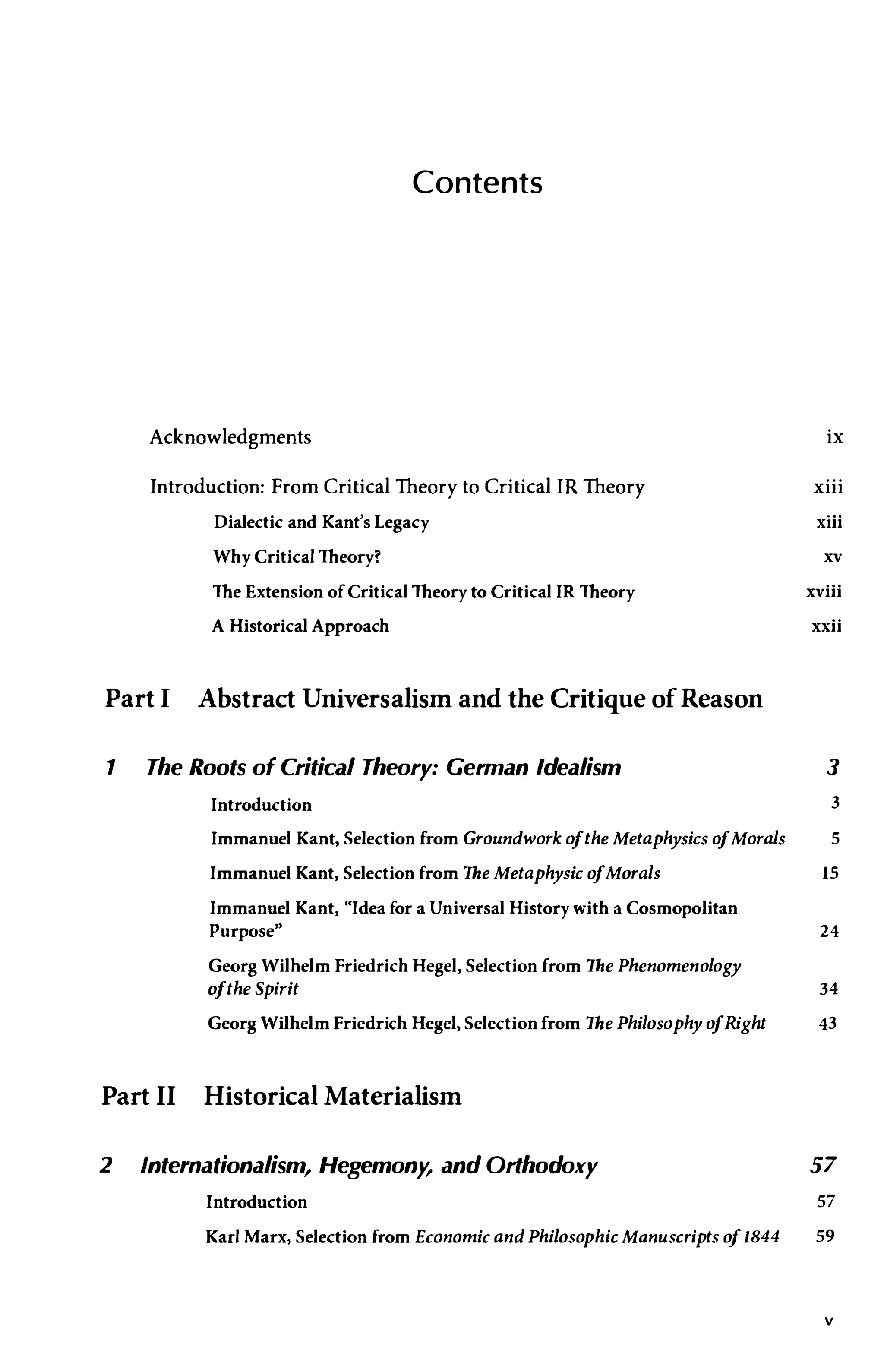
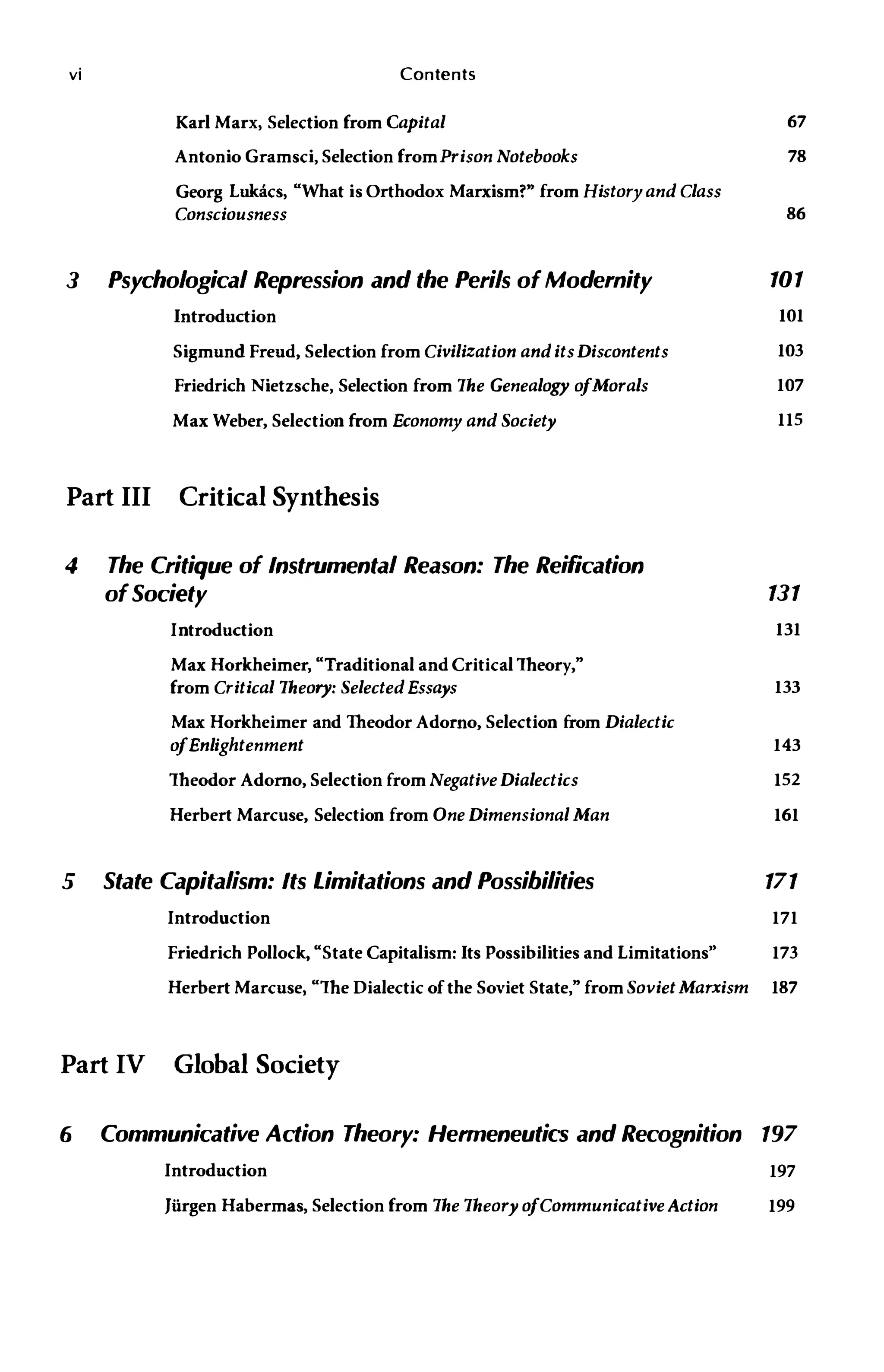
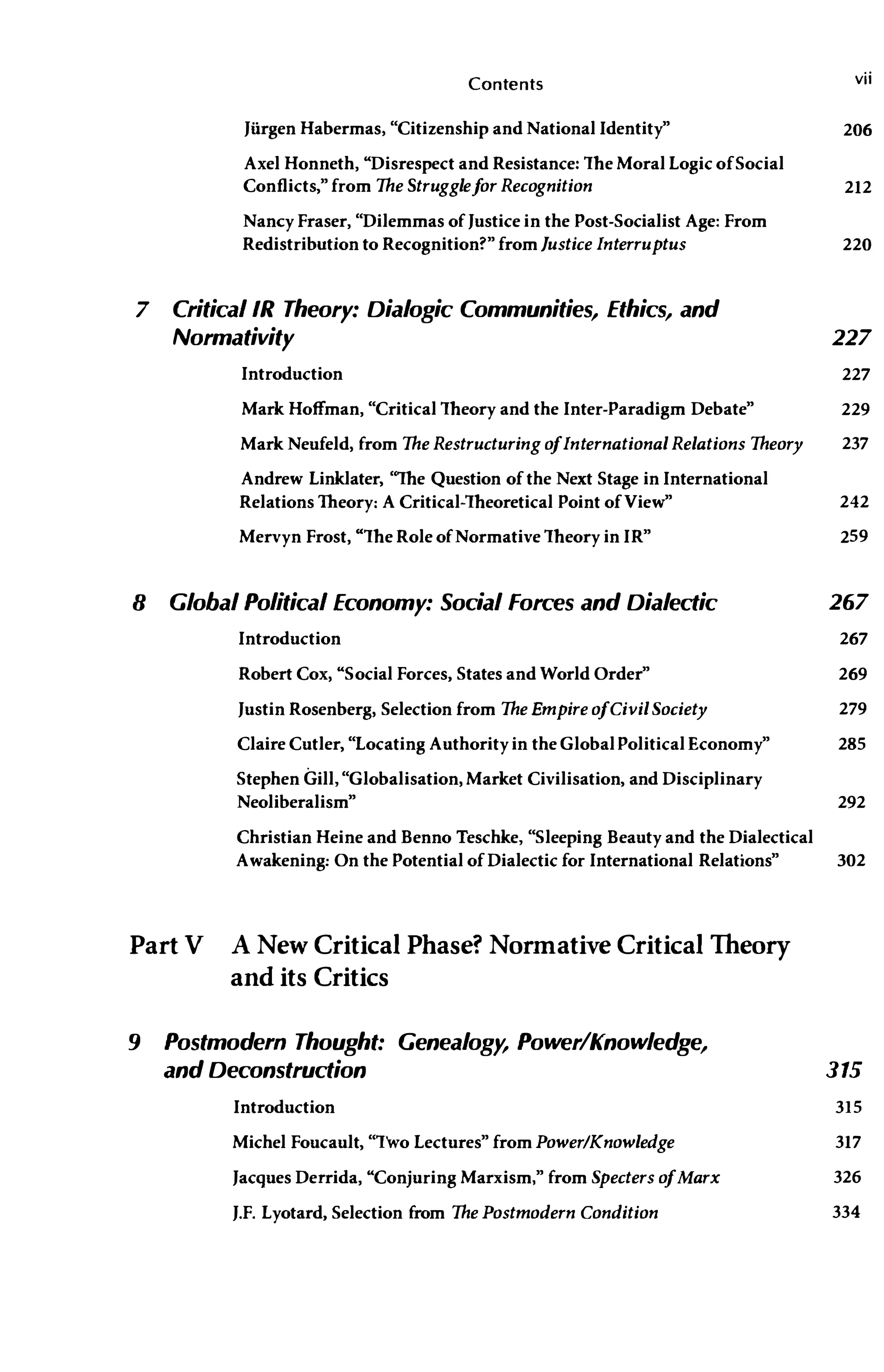
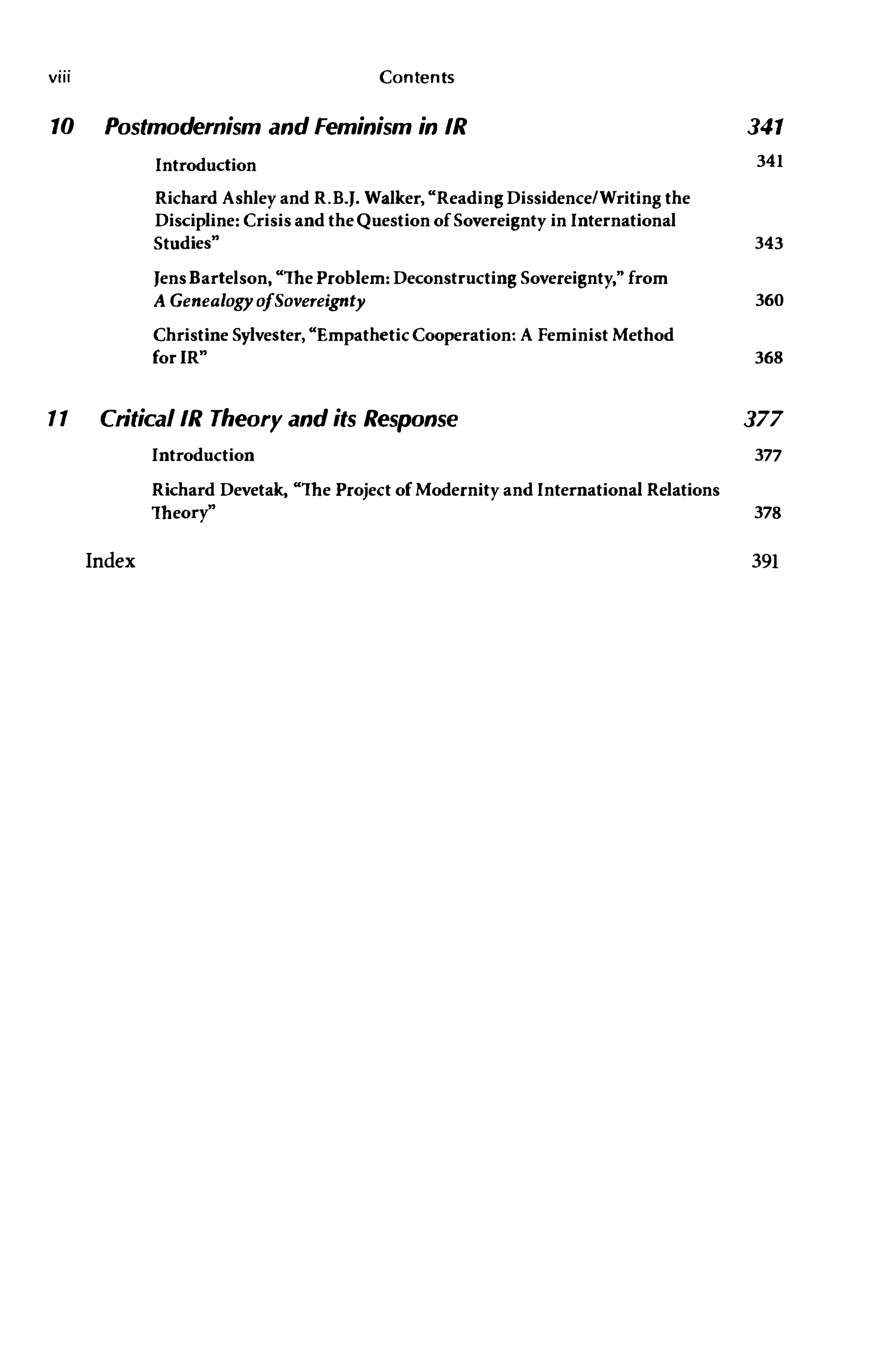

![Introduction: From Critica
l Theory
to Critica
llR Theory
Dialectic and Kant's Legacy
If critical social theory offers us a logical avenue for understanding social change,
then the term "dialectic" can be seen as the vehicle for maneuvering our understand
ing along this avenue. In modern critical social theory, dialectic serves as a scientific
and holistic method of analysis. Its purpose(s) is to investigate the social forces of
political order and transformation in terms of the relational oppositions and histori
cal contradictions between the individual and society and to examine the meaning
of reason (Vernunft) and rationality in the social context of ethical, economic, and
political struggles for justice and freedom. The dialectic in this sense is both inspired
byandderivedfrom the writings ofKant, Hegel, Marx, and Habermas, among others.
And, unlike ancient theory, which explores the dialectic as an "art of defining ideas
related to the method of determining the interrelation of ideas in the light of sin
gle principle," a modern conception of dialectic emphasizes the historical and social
(scientific) dimensions ofsocietal change. Thus, dialectic, as understood here, can be
employed in a variety ofways to explain societal transformation(s) in the contempo
raryworld, including the emergence ofhuman rights (gender and indigenous groups),
newinstitutionalnormsand f
ormsofcitizenship (EU), and global ethics.l As such, one
encounters different modern conceptions of dialectic, ranging from Marx's dialecti
cal materialism ("the progressive unification through the contradiction ofopposites")
and Habermas's hermeneutical dialectic (intersubjective interaction or communica
tive action) to Adorno's negative dialectics, which conceives dialectic as an inherently
subversive element ofreason and rationality.
In recent years, however, a pervasive skepticism has emerged concerning the dia
lectic and its role in advancing the emancipatory project ofmodernity (emancipation
that is gUided by the principles ofreason, rationality, justice, and societal and politi
cal integration). Such skepticism reflects what Richard Bernstein argues is a tension
between the modern and postmodern (Stimmung). As Bernstein notes, "[Stimmung]
is an amorphous, protean, and shifting [force] but which nevertheless exerts a power
ful influence on the ways in which we think, act, and experience.'" In his view, such
skepticism explains why postmodernist and modernist thinkers seek to address the
xiii](https://image.slidesharecdn.com/5101162-250530163122-0a4c766c/75/Critical-Theory-And-International-Relations-A-Reader-1st-Edition-Steven-C-Roach-16-2048.jpg)

![Introduction: From Critica
l Theory
to Critica
l IR Theory
Dialectic and Kant's Legacy
If critical social theory offers us a logical avenue f
or understanding social change,
then the term "dialectic" can be seen as the vehicle for maneuvering our understand
ing along this avenue. In modern critical social theory, dialectic serves as a scientific
and holistic method of analysis. Its purpose(s) is to investigate the social f
orces of
political order and transformation in terms of the relational oppositions and histori
cal contradictions between the individual and society and to examine the meaning
of reason (Vernunft) and rationality in the social context of ethical, economic, and
political struggles for justice and freedom. The dialectic in this sense is both inspired
byand derived from the writings ofKant, Hegel, Marx, and Habermas, among others.
And, unlike ancient theory, which explores the dialectic as an "art of defining ideas
related to the method of determining the interrelation of ideas in the light of sin
gle principle," a modern conception of dialectic emphasizes the historical and social
(scientific) dimensions ofsocietal change. Thus, dialectic, as understood here, can be
employed in a variety of ways to explain societal transformation(s) in the contempo
rary world, including the emergence ofhuman rights (gender and indigenous groups),
newinstitutional norms and forms ofcitizenship (EU), and global ethics.! As such, one
encounters different modern conceptions of dialectic, ranging from Marx's dialecti
cal materialism ("the progressive unification through the contradiction ofopposites")
and Habermas's hermeneutical dialectic (intersubjective interaction or communica
tiveaction) to Adorno's negative dialectics, which conceives dialectic as an inherently
subversive element ofreason and rationality.
In recent years, however, a pervasive skepticism has emerged concerning the dia
lectic and its role in advancing the emancipatory project ofmodernity (emancipation
that is guided by the principles ofreason, rationality, justice, and societal and politi
cal integration). Such skepticism reflects what Richard Bernstein argues is a tension
between the modern and postmodern (Stimmung). As Bernstein notes, "[Stimmung]
is an amorphous, protean, and shifting [force] but which nevertheless exerts a power
ful influence on the ways in which we think, act, and experience."3 In his view, such
skepticism explains why postmodernist and modernist thinkers seek to address the
xiii](https://image.slidesharecdn.com/5101162-250530163122-0a4c766c/75/Critical-Theory-And-International-Relations-A-Reader-1st-Edition-Steven-C-Roach-18-2048.jpg)
![Introduction: From Critical to CriticallR Theory xv
freedom as a way of transcending the irrationalism of the (political) passions. This
moral requirement might well explain Kant's paradoxical intellectual debt to David
Hume, the Scottish Enlightenment philosopher (empiricist skeptic) who, as Kant
remarked, had "interrupted my dogmatic slumber.''''
Hume, ofcourse, is not the onlyphilosopherwho deserves credit for inspiringKant's
modern formulation of dialectical criticism. Equally essential are the ancient philoso
phers, in particular, Plato, whose Meno dialogue addresses the dilemma ofhowwe can
know something ofwhich wehave no knowledge. What this problem (aporia) suggests
is that in acquiringknowledge ofsomething, we also fail to grasp its essence. Another
way ofputting this idea is to saythat our deeply embedded ethicalconvictionscan and
should always take the form ofthe following permanent questions about our political
existence: What is the role ofthe state? What are my moral duty and responsibility f
or
promoting civil society? Addressing these questions requires us to overcome the pre
sumption that there are permanent answers to life's greatest problems.
Inquiring, then, into the sources of authoritarianism constitutes one of the core
tasks of critical theory. Because political leaders can use their power to manipulate
the rules of institutions and the system, they can also subjugate the individual to the
state. Thus, the reason why speculative reason is so important in this respect is that
it stresses the immanent tensions between the state (society) and individual; it treats,
in other words, these tensions as existing, albeit changing constructs of our moral
understanding. In this way, speculative reason is predicated on the f
ollowing ques
tion: How do reason and dialectical thought enable us to challenge and overcome
dogmatism and barbarism?
Hegel's and Marx's answer to this question involved elaborate and systematic
attempts to historicize and materialize the dialectic. Hegel, for instance, conceived
the dialectic in terms of the historical unfolding of the absolute spirit and knowledge,
or the grand reconciliation between freedom and the state (Aufhebung); while Marx
built upon Hegel's dialectical project by theorizing about the class conflict between
the proletariat and bourgeoisie and how this conflict would be resolved through
the dissolution of capitalism (private property and the bourgeois state). In this way,
Marx, perhaps more than any other social theorist, revealed the practical qualities
of dialectical thought. His influence on the Frankfurt School's critical theory would
lead some to label the Frankfurt School as a "second stage of Marxism.'"
A central question for critical IR theorists, then, is how [an extended] critical
theory exposes the dogmatism and orthodoxy ofmilitant ideologies. Here, though,
we need to be careful about how we approach the word "extension." What exactly
are we extending? And how does the extension of dialectical criticism qualify the
international principles of justice or global forms of citizenship? To address these
questions, we need to examine the coreconcepts and aims ofcritical theory.
Why Critical Theory?
The Frankfurt Institute ofSocial Research (The Frankfurt School) officially coined
the term "critical theory" in 1937.' Its formulation of critical theory would incorpo
rate a wide range of ideas, including those of Kant, Marx, Hegel, Nietzsche, Freud,](https://image.slidesharecdn.com/5101162-250530163122-0a4c766c/75/Critical-Theory-And-International-Relations-A-Reader-1st-Edition-Steven-C-Roach-20-2048.jpg)


![1
The Roots of Critical Theory
German Idealism
Introduction
Thisfirst chapterfocuses on the foundations of critical theory (1800-1865). For many
writers at this time, the events of the French Revolution (1789-1799) served as a
reminder of the volatility of human passions, and the consequent failure to preserve
the ideals offreedom,justice, equality, reason, rationality and solidarity. Here,I have
included Kant's essays on the "Groundwork of the Metaphysics of Morals" (1785),
"The Metaphysics of Morals, Theory of Right (1797)" and "Idea for a Universal His
tory with a Cosmopolitan Purpose (1784)," as well as selections from Hegel's The
Phenomenology o
fSpirit (1807) and The Philosophy ofRight (1821).
Kant conceived politics in terms of the tension between human nature and the
civil laws of the state (social contract). It was this antagonism that constituted man's
asocialsociability, and represented, asKant states, "a great tendency to live as an indi
vidual, to isolate himself since he also encounters in himself the unsocial characteris
tic of wanting to direct everything in accordance with his own ideas."In his essay on
"The Metaphysics of Morals," Kant theorized that civil society (Civilis-Communitas)
reflected the balance of constitutional rules and state coercion, or "the harmoniza
tion of public wills." Here he situated the moral autonomy of the individual (the self
legislating individual) within the antinomies of practical (moral) and pure reason
(universal), and experience and understanding.In this way, our understanding was
not simply conditioned by passions (happiness and sympathy); it operated indepen
dently of the passions, that is, through our reasoned capacity to act in accordance
with universal maxims or imperatives.
Following Kant, Hegel showed how this tension could be transcended through
the absolutization of spirit. Here he conceptualized the dialectic in historical terms:
as the unfolding of absolute freedom or the immanent reconciliation between reason
and freedom (Aujhebung). In The Phenomenology of Spirit, Hegel theorized about
the self's struggle to become conscious of itself through various stages or historical
moments. The most important [stage] involved the struggle between Lordsman and
Bondsman, in which the slave's or bondsman's struggle for freedom became a con
crete metaphor for realizing the idea of freedom for and in itself.In The Philosophy of
Right, the historical struggle entailed the movement through and ultimately beyond
the civil society institutions of the German state to one in which the German state
3](https://image.slidesharecdn.com/5101162-250530163122-0a4c766c/75/Critical-Theory-And-International-Relations-A-Reader-1st-Edition-Steven-C-Roach-34-2048.jpg)
![6 Critical Theory and International Relations: A Reader
the subjective imperfection of the will of this or that rational being-for example, of
the human will.
[Classification of Imperatives]
All imperatives command eitherhypothetically orcategorically. Hypotheticalimpera
tives declare a possible action to be practically necessary as a means to the attain
ment of somethingelse that one wills (or that one may will). A categoricalimperative
would be one which represented an action as objectively necessaryinitself apartfrom
its relation to a further end.
Every practical law represents a possible action as good and therefore as necessary
for a subject whose actions are determined by reason. Hence allimperatives are for
mulae for determining an action whichis necessary in accordance with the principle
of a will in some sense good. If the action would be good solely as a means to some
thingelse, the imperative is hypothetical; if the action is represented as good in itself
and therefore as necessary, in virtue of its principle, for a will which of itself accords
with reason, then the imperative is categorical.
An imperative therefore tells me which of my possible actions would be good; and
it formulates a practical rule for a will that does not perform an actionstraightaway
because the action is good-whether because the subject does not always know that
it is good or because, even if he did know this, he might still act on maxims contrary
to the ob
jective principles of practical reason.
A hypotheticalimperativethus says only that an actionis goodfor some purpose or
other, eitherpossible oractual. Inthefirst case, itis aproblematic practicalprinciple; in the
second case, an assertoric practical principle. A categorical imperative, which declares
an action to be ob
jectively necessary in itself without reference to some purpose-that
is, even without any further end-ranks as an apodeictic practical principle.
Everything that is possible only through the efforts of some rational being can
be conceived as a possible purpose of some will; and consequently there are in fact
innumerable principles of action so far as action is thought necessary in order to
achieve some possible purpose which can be effected by it. All scienceshave a practi
cal part consisting of problems which suppose that some endis possible for us and of
imperatives which tell us how it is to be attained. Hence the latter can in general be
called imperatives of skill. Here there is absolutely no question about the rationality
or goodness of the end, but only about what must be done to attain it. A prescription
required by a doctor in order to cure his man completely and one required by a poi
soner in order to make sure of killing him are of equal value so far as each serves to
effect its purpose perfectly. Since in early youth we do not know what ends may pres
ent themselves to us in the course of life, parents seek above all to make their chil
dren learn things ofmany kinds; they provide carefully for skill in the use of means
to all sorts of arbitrary ends, none of which can they be certain that it could not in
the future become an actual purpose of their ward, while it is alwayspossible that he
might adopt it. Their care in this matter is so great that they commonly neglect on
this account to form and correct the judgement of their children about the worth of
the things which they might possibly adopt as ends.](https://image.slidesharecdn.com/5101162-250530163122-0a4c766c/75/Critical-Theory-And-International-Relations-A-Reader-1st-Edition-Steven-C-Roach-37-2048.jpg)
![f
e
11
y
e
If
:s
d
Y
It
y
,r
Ie
�s
It
n
:t
:0
i
)f
:y
,n
i
:0
s-
1-
IS
.n
Ie
on
)f
The Roots of Critical Theory 7
There is, however, one end that can be presupposed as actual in all rational beings
(so far as they are dependent beings to whom imperatives apply); and thus there is
one purpose which they not only can have, but which we can assume with certainty
that they all do have by a natural necessity-the purpose, namely, of happiness. A
hypothetical imperative which affirms the practical necessity of an action as a means
to the furtherance of happiness is assertoric. We may represent it, not simply as nec
essary to an uncertain, merely possible purpose, but as necessary to a purpose which
we can presuppose a priori and with certainty to be present in every man because it
belongs to his very being. Now skillin the choice of means to one's own greatest well
being can be called prudence in the narrowest sense. Thus an imperative concerned
with the choice of means to one's own happiness-that is, a precept of prudence-still
remains hypothetical: an action is commanded, not absolutely, but only as a means to
a further purpose.
Finally, there is an imperative which, without being based on, and conditioned by,
any further purpose to be attained by a certain line of conduct, enjoins this conduct
immediately. This imperative is categorical. It is concerned, not with the matter of
the action and its presumed results, but with its form and with the principle from
which it follows; and what is essentially good in the action consists in the mental
disposition, let the consequences be what they may. Thisimperative may be called the
imperative of morality.
Willing in accordance with these three kinds of principle is also sharply distin
gUished by a dissimilarity in the necessitation of the will. To make this dissimilarity
obvious, we should,I think, name these kinds of principle most appropriately in their
order if we said they were either rules of skill or counsels of prudence or commands
(laws) of morality. For only law carries with it the concept of an unconditioned, and
yet objective and so universally valid, necessity; and commands are laws which must
be obeyed-that is, must be followed even against inclination. Counsel does indeed
involve necessity, but necessity valid only under a subjective and contingent condi
tion-namely, if this or that man counts this or that as belonging to his happiness.
As against this, a categoricalimperative is limited by no condition and can quite pre
cisely be called a command, as being absolutely, although practically, necessary. We
could also callimperatives of the first kind technical (concerned with art); of the sec
ond kindpragmatic (concerned with well-being); of the third kind moral (concerned
with free conduct as such-that is, with morals).
[How are Imperatives Possible?]
The question now arises'How are all these imperatives possible?' This question does
not ask how we can conceive the execution of an action commanded by theimpera
tive, but merely how we can conceive the necessitation of the will expressed by the
imperative in setting us a task. How an imperative of skill is possible requires no
special discussion. Who wills the end, wills (so far as reason has decisive influence on
his actions) also the means which are indispensably necessary and in his power. So
far as willing is concerned, this propositionis analytic: for in my willing of an object
as an effect, thereis already conceived the causality of myselfas an acting cause-that](https://image.slidesharecdn.com/5101162-250530163122-0a4c766c/75/Critical-Theory-And-International-Relations-A-Reader-1st-Edition-Steven-C-Roach-38-2048.jpg)
![10 Critical Theory and International Relations: A Reader
[The Formula of Universal Law]
In this task we wish first to enquire whether perhaps the mere concept of a categorical
imperative may not also provide us with the formula containing the only proposi
tion that can be a categoricalimperative; for even when we know the purport of such
an absolute command, the question of its possibility will still require a special and
troublesome effort, which we postpone to the final chapter.
When I conceive a hypothetical imperative in general, I do not know beforehand
what it will contain-until its condition is given. But if I conceive acategorical imper
ative, I know at once what it contains. For since besides the law this imperative con
tains only the necessity that our maxim should conform to this law, while the law, as
we have seen, contains no condition to limit it, there remains nothing over to which
the maxim has to conform except the universality of a law as such; and it is this con
formity alone that the imperative properly asserts to be necessary.
There is therefore only a single categorical imperative and it is this: 'Act only on
that maxim through which you can at the same time will that it should become a uni
versal law.'
Now if all imperatives of duty can be derived from this one imperative as their
principle, then even although weleave it unsettled whether what we call duty may not
be an empty concept, we shall still be able to show at least what we understand by it
and what the concept means.
[The Formula of the Law of Nature]
Since the universality of the law governing the production of effects constitutes what
is properly called nature in its most general sense (nature as regards its form)-that is,
the existence of things so far as determined by universal laws-the universal impera
tive of duty may also run asfollows: 'Actas ifthe maxim ofyouraction were to become
throughyour will a universal law o
fnature.'
[Illustrations]
We will now enumerate a few duties, following their customary division into duties
towards self and duties towards others and into perfect and imperfect duties.
1. A man feels sick of life as the result of a series of misfortunes that has mounted
to the point of despair, but he is still so far in possession of his reason as to ask
himself whether taking his own life may not be contrary to his duty to himself. He
now applies the test 'Can the maxim of my action really become a universal law of
nature?' His maxim is 'From self-love I make it my principle to shorten my life if its
continuance threatens more evil than it promises pleasure.' The onlyfurther question
to ask is whether this principle of self-love can become a universal law of nature. It is
then seen at once that a system of nature by whose law the very same feeling whose
function (Bestimmung) is to stimulate the furtherance of life should actually destroy](https://image.slidesharecdn.com/5101162-250530163122-0a4c766c/75/Critical-Theory-And-International-Relations-A-Reader-1st-Edition-Steven-C-Roach-41-2048.jpg)
![12 Critical Theory and International Relations: A Reader
[The Formula of Autonomy]
This principle of humanity, and in general of every rational agent, as an end in itself
(a principle which is the supreme limitingcondition of every man's freedom of action)
is not borrowed from experience; firstly, because it is universal, applying as it does to
all rational beings as such, and no experience is adequate to determine universality;
secondly, because in it humanity is conceived, not as an end of man (subjectively)
that is, as an object which, as a matter of fact, happens to be made an end-but as an
objective end-one which, be our ends what they may, must, as a law, constitute the
supreme limiting condition of all subjective ends and so must spring from pure rea
son. That is to say, the ground for every enactment of practical law lies objectively in
the rule and in the form of universality which (according to our first principle) makes
the rule capable of being a law (and indeed a law of nature); subjectively, however, it
lies in the end; but(according to our second principle) the subject of all ends is tobe
found in every rational being as an end in himself. From this there now follows our
third practical principle for the will-as the supreme condition of the will's confor
mity with universal practical reason-namely, the Idea ofthe will o
f every rational
beingas a will which makes universal law.
By this principle all maxims are repudiated which cannot accord with the will's own
enactment of universal law. The will is therefore not merely subject to the law, but is so
subject that it must be considered as also making the law for itself and precisely on this
account asfirst of all subject to the law (of which it can regard itself as the author).
[The Exclusion of Interest]
Imperatives as formulated above-namely, the imperative enjoining conformity of
actions to universal law on the analogy of a natural order and that enjoining the uni
versal supremacy of rationalbeings in themselves as ends- did, by the mere fact that
they were represented as categorical, exclude from their sovereign authority every
admixture of interest as a motive. They were, however, merelyassumed to be categori
calbecause we were bound to make this assumption if we wished to explain the con
cept of duty. That there were practical propositions which commanded categorically
could not itself be proved, any more than it can be proved in this chapter generally;
but one thing could have been done-namely, to show that in willing for the sake of
duty renunciation of all interest, as the specific mark distinguishing a categorical
from a hypotheticalimperative, was expressed in the very imperativeitselfby means
of some determination inherent in it. This is whatis done in the present third formu
lation of the principle-namely, in theIdea of the will of every rationalbeing asa will
which makes universal law.
Once we conceive a will of this kind, it becomes clear that while a will which is
subject to law may be bound to this law by some interest, nevertheless a will which
is itself a supreme lawgiver cannot possibly as such depend on any interest; for a
will which is dependent in this way would itself require yet a further law in order to
restrict the interest of self-love to the condition that thisinterest shoulditself be valid
as a universal law.](https://image.slidesharecdn.com/5101162-250530163122-0a4c766c/75/Critical-Theory-And-International-Relations-A-Reader-1st-Edition-Steven-C-Roach-43-2048.jpg)
![f
)
�
e
n
,0
is
Jf
i
at
ry
'i
�
Iy
y;
of
al
ns
u-
ill
is
ch
a
to
id
The Roots of Critical Theory 13
Thus theprinciple that every human will is a will which by all its maxims enacts
universal law-provided only that it were right in other ways-would be well suited
to be a categorical imperative in this respect: that precisely because of the Idea of
making universal law, it is based on no interest and consequently can alone among all
possible imperatives be unconditioned, Or better still-to convert the proposition-if
there is a categorical imperative (that is, a law for the will of every rational being), it
can command us only to act always on the maxim of such a will in us as can at the
same time look upon itself as making universal law; for only then is the practical
principle and the imperative which we obey unconditioned, since it is wholly impos
sible for it to be based on any interest.
We need not now wonder, when we look back upon all the previous efforts that
have been made to discover the principle of morality, why they have one and all been
bound to fail. Their authors saw man as tied to laws by his duty, but it never occurred
to them that he is subj ect only to laws which are made by himselfand yet are univer
sal, and that he is bound only to act in conformity with a will which is his own but
has as nature's purpose for it the function of making universal law, For when they
thoughtof man merely as subject to a law (whatever it might be) , the law had to carry
withit someinterest in order to attract or compel, because it did not spring as a law
from his own will: in order to conform with the law, his will had to be necessitated
by somethingelse to act in a certain way, This absolutely inevitable conclusion meant
that all the labour spent in trying to find a supreme principle of duty was lost beyond
recall; for what they discovered wasnever duty, but only thenecessity of acting from a
certain interest, This interest might be one's own or another's; but on such a view the
imperative wasbound to be always a conditioned one and could not possibly serveas a
moral law.I will therefore call my principle the principle of theAutonomy of the will
in contrast with all others, whichI consequently class under Heteronomy.
[The Formula of the Kingdom of Ends]
The concept of every rational being as one who must regard himself as making
universal law by, all the maxims of his will, and must seek to judge himself and
his actions from this point of view, leads to a closely connected and very fruitful
concept-namely, that of a kingdom ofends.
I understand by a 'kingdom' a systematic union of different rational beings under
common laws. Now since laws determine ends as regards their universal validity, we
shall be able-if we abstract from the personal differences between rational beings,
and also from all the content of their private ends-to conceive a whole of all ends in
systematic conjunction (a whole both of rational beings as ends in themselves and also
of the personal ends which each may set before himself ); that is, we shallbe able to con
ceive a kingdom of ends which is possible in accordance with the above principles.
For rational beings all stand under the law that each of them should treat himself
and all others, never merely as a means, but always at the same time as an end in him
self. But by so doing there arises a systematic union of rational beings under common
objective laws-that is, a kingdom. Since these laws are directed precisely to the rela
tion of such beings to one another as ends and means, this kingdom can be called a
kingdom of ends (which is admittedly only anIdeal).](https://image.slidesharecdn.com/5101162-250530163122-0a4c766c/75/Critical-Theory-And-International-Relations-A-Reader-1st-Edition-Steven-C-Roach-44-2048.jpg)
![1 4 Critical Theory and International Relations: A Reader
A rational being belongs to the kingdom of ends as a member, when, although he
makes its universal laws, he is alsohimselfsubject to these laws. He belongs to it as its
head, when as the maker of laws, he ishimself subject to the will of no other.
A rational being must alwaysregard himself as making laws in a kingdom of ends
which is possible through freedom of the will-whether it be as member or as head.
The position of the latter he can maintain, not in virtue of the maxim of his will
alone, but only if he is a completely independent being, without needs and with an
unlimited power adequate to his will.
Thus, morality consists in therelation of all action to the making of laws whereby
alone a kingdom of ends is possible. This making of laws must be found in every
rational being himself and must be able to spring from his will. The principle of his
will is therefore never to perform an action except on a maxim such as can also be a
universal law, and consequently such that the will can regarditselfas at the same time
makinguniversal law by means ofits maxim. Where maxims arc not already by their
very nature in harmony with this objective principle of rational beings as makers of
universal law, the necessity of acting on this principle is practical necessitation-that
is, duty. Duty does not apply to the head in a kingdom of ends, but it does apply to
every member and to all members in equal measure.
Thepractical necessity ofacting on this principles-thatis, duty-isin no way based
on feelings, impulses, and inclinations, but only on the relation of rational beings to
one another, a relation in which the will ofa rational being must always beregarded as
makinguniversal law, because otherwise he could not be conceived as an end in him
self Reason thus relates every maxim of the will, considered as making universal law,
to every other will and also to every action towards oneself: it does so, not because of
any further motive or future advantage, but from the Idea of the dignity of a rational
being who obeys no law other than that which he at the same time enacts himself.
[The Dignity of Virtue]
In the kingdom of ends everything has either a price or a dignity. If it has a price,
something else can be put in its place as an equivalent; if it is exalted above all price
and so admits of no equivalent, then it has a dignity.
What is relative to universal human inclinations and needs has a market price;
what, even without presupposing a need, accords with a certain taste-that is, with
satisfaction in the mere purposeless play of our mental powers-has af
ancy price
(Affektionspreis); but that which constitutes the sole condition under which anything
can be an end in itself has not merely a relative value-that is, a price-but has an
intrinsic value-that is, dignity.
Now morality is the only condition under which a rational being can be an end in
himself; for only through thisisit possible to be a law-making member in a kingdom
of ends. Thereforemorality, andhumanity sofar asit is capable ofmorality, is the only
thing which has dignity. Skill and diligence in work have a market price; wit, lively
imagination, and humour have a fancy price; but fidelity to promises and kindness
based on principle (not on instinct) have an intrinsic worth. In default of these, nature
and art alike contain nothing to put in their place; for their worth consists, not in the](https://image.slidesharecdn.com/5101162-250530163122-0a4c766c/75/Critical-Theory-And-International-Relations-A-Reader-1st-Edition-Steven-C-Roach-45-2048.jpg)

![bark if the shoot from which the piece is taken has been properly
imbued with sap.[I] Look at the inner rind of the separated bark, to
see if that be entire; if there be a hole in it, the eye of the bud has
been pulled away with the wood, rendering the bud useless, which
throw away; if there be no hole, return to the stock, and with the
haft of the knife gently raise the bark on each side of the
perpendicular incision, opening the lips wide enough to admit the
prepared slip with the eye. If the slip is longer than the upright
incision in the stock, reduce the largest end. Stock and bud being
ready, keep the latter in its natural position, introduce it between the
bark and wood of the stock, pushing it gently downwards until it
reaches the bottom of the perpendicular incision. Let the eye of the
bud project through the centre of the lips; lay the slip with the bud
as smooth as possible, and press down the raised bark of the stock.
The bud being deposited, bind that part of the stock moderately
tight with bass, beginning a little below the incision, proceeding
upward so as to keep the eye uncovered, finishing above the
incision. In a month after the operation, examine whether the bud
has united with the stock. If it has succeeded, the bud will be full
and fresh; if not, it will be brown and contracted. When it has taken,
untie the bandage, that the bud may swell, and in a few days
afterwards cut the head of the stock off about six inches above the
inoculation, and prevent all shoots from growing by pinching them
off. This will forward the bud, which will push and ripen wood this
season; but it must be carefully tied as it grows to the remaining
head of the stock. Some do not head down the stock until the
following spring, thereby not encouraging the bud to grow, which if
winter sets in early is the safest method.
[I] We once budded three eyes of the white moss rose, after
they had by mistake been carried in the pocket of a coat three
days. The shoot was soaked six hours in water, and two of the
buds grew. From this we infer that shoots, if properly wrapped
up, may be carried very great distances, and grow successfully.
OF WATERING.](https://image.slidesharecdn.com/5101162-250530163122-0a4c766c/75/Critical-Theory-And-International-Relations-A-Reader-1st-Edition-Steven-C-Roach-63-2048.jpg)

![until they have begun to grow, protecting them entirely from the
sun, till that period, then take the opportunity of a cloudy day to
expose them. After this repotting, the following kinds are liable to
suffer from too much water: Pavonínum, Davey[)a]num, fúlgens,
ardens, citriodórum, rubéscens, florabùndum, ardèscens; with those
of a similar habit, and these species do not require so much
encouragement at the root as the strong growing sorts. The
tuberous rooted and deciduous species must be very moderately
supplied. Be careful when watering that the new soil does not
become saturated with water, as, though allowed to dry again, it will
not be so pure. When they shoot afresh, turn them regularly every
two weeks, to prevent them growing to one side.
ORANGES, LEMONS, &c.
As it is frequently very inconvenient to shift these trees into
larger tubs in the months of March and April, this month is a period
that is suitable both from the growth of the trees, and their being in
the open air. It would be improper to state the day or the week, that
depending entirely on the season. The criterion is easily observed,
which is when the first growth is over, these trees making another
growth in autumn. When they are large, they require great exertion,
and are frequently attended with inconvenience to get them shifted.
Where there is a quantity of them, the best plan that we have tried
or seen adopted is as follows: Have a strong double and a single
block trimmed with a sufficiency of rope; make it fast to the limb of
a large tree, or any thing that projects, and will bear the weight, and
as high as will admit of the plant being raised a few feet under it.
Take a soft bandage and put around the stem, to prevent the bark
from being bruised; make a rope fast to it, in which hook the single
block. Raise the plant the height of the tub, put a spar across the
tub, and strike on the spar with a mallet, which will separate the tub
from the ball. Then with a strong pointed stick probe a little of the
earth from amongst the roots, observing to cut away any that are
affected by dry-rot, damp, or mildew, with any very matted roots.](https://image.slidesharecdn.com/5101162-250530163122-0a4c766c/75/Critical-Theory-And-International-Relations-A-Reader-1st-Edition-Steven-C-Roach-69-2048.jpg)