1
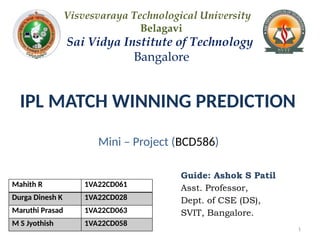
IPL MATCH WINNING PREDICTION
Guide: Ashok S Patil
Asst. Professor,
Dept. of CSE (DS),
SVIT, Bangalore.
Visvesvaraya Technological University
Belagavi
Mini – Project (BCD586)
Sai Vidya Institute of Technology
Bangalore
Mahith R 1VA22CD061
Durga Dinesh K 1VA22CD028
Maruthi Prasad 1VA22CD063
M S Jyothish 1VA22CD058
2
I would like to express my sincere thanks to The Trustees, and The
Principal Dr. M S Ganesha Prasad, Sai Vidya Institute of
Technology, Bangalore for giving permission to carry out our
Project
I express my sincere gratitude to Dr. Nagashree , Professor &
Head, Dept. of CSE (DS) and Project Coordinators, Prof.
Ashok S Patil , Asst. Professor, Dept. of CSE (DS) and Prof.
Amarnath Patil Asst. Professor, Dept. of CSE (DS) Sai Vidya
Institute of Technology, Bangalore for their technical support to
implement our mini Project.
Acknowledgement
3
I express my heartfelt sincere and genuine gratitude to our Guide
Ashok S Patil, Asst. Professor, Dept. of CSE (DS) Sai Vidya
Institute of Technology, Bengaluru, for his valuable guidance,
suggestions and motivation for our Mini Project.
Finally, I would like to thank all Professors of Department of CSE
(DS), Sai Vidya Institute of Technology, Bengaluru, for their
support.
Acknowledgement
4
Contents
1. INTRODUCTION
2. LITERATURE SURVEY
3. PROBLEM STATEMENT
4. OBJECTIVES
5. METHODOLOGY
6. APPLICATIONS
7. REFERENCES
5
Introduction
The Indian Premier League (IPL) is one of the most popular T20 cricket
tournaments globally, drawing millions of passionate fans and generating
intense excitement around each match. As interest in the league grows, so
does the challenge of accurately predicting match outcomes, which can
enhance the viewing experience and inform strategic decisions for analysts and
stakeholders. This project seeks to develop a robust predictive model that
leverages extensive historical data to forecast the winning teams in IPL
matches.
To achieve this, we will analyze various factors, including player statistics, team
performance metrics, and venue conditions. By employing advanced machine
learning techniques such as Logistic Regression, Random Forest, and Gradient
Boosting, the model will provide probabilistic insights into match outcomes.
Moreover, we will engage in feature engineering to extract critical information,
such as recent team form and head-to-head performance, ensuring that the
model captures the chances of the game.
6
Literature Survey
Paper 1:
• Paper title : Prediction of IPL Match Outcome Using Machine
Learning Techniques
• Problem Statement : Given IPL datasets of past 9 years, the
main objective of this paper is to predict the outcome of an
IPL match between two teams based on the analysis of
previously stored data using Machine Learning algorithms.
• Objectives : To Predict the outcome of a IPL Match
• Solution :
https://www.researchgate.net/publication/355061139_Prediction_
of_IPL_Match_Outcome_Using_Machine_Learning_Techniques
7
Literature Survey
Paper 2 :
• Paper title: PREDICTION ON IPL DATA USING MACHINE
LEARNING TECHNIQUES IN R PACKAGE
• Problem statement : Enactment and measuring the difference
between different algorithms in predicting the outcome of an
IPL match
• Objectives: Identify best algorithm predicting outcome of an
IPL Match
• Solution:
https://ictactjournals.in/paper/IJSC_Vol_11_Iss_1_Paper_2_2
199_2204.pdf
8
Literature Survey
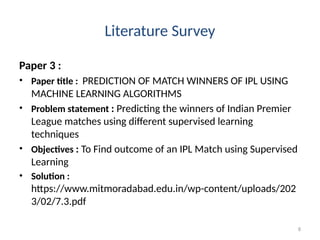
Paper 3 :
• Paper title : PREDICTION OF MATCH WINNERS OF IPL USING
MACHINE LEARNING ALGORITHMS
• Problem statement : Predicting the winners of Indian Premier
League matches using different supervised learning
techniques
• Objectives : To Find outcome of an IPL Match using Supervised
Learning
• Solution :
https://www.mitmoradabad.edu.in/wp-content/uploads/202
3/02/7.3.pdf
9
Literature Survey
Paper 4 :
• Paper title : IPL CRICKET SCORE AND WINNING PREDICTION
USING MACHINE LEARNING TECHNIQUES
• Problem statement : Predict the score of a match using linear
regression, lasso regression and ridge regression and winning
prediction using SVC classifier, decision tree classifier and
random forest classifier
• Objectives : Find the score and winner of an IPL match
• Solution :
https://www.irjmets.com/uploadedfiles/paper/volume3/issue_5_m
ay_2021/10362/1628083416.pdf
10
Literature Survey
Summary on the Literature Survey
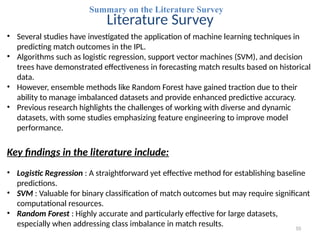
• Several studies have investigated the application of machine learning techniques in
predicting match outcomes in the IPL.
• Algorithms such as logistic regression, support vector machines (SVM), and decision
trees have demonstrated effectiveness in forecasting match results based on historical
data.
• However, ensemble methods like Random Forest have gained traction due to their
ability to manage imbalanced datasets and provide enhanced predictive accuracy.
• Previous research highlights the challenges of working with diverse and dynamic
datasets, with some studies emphasizing feature engineering to improve model
performance.
Key findings in the literature include:
• Logistic Regression : A straightforward yet effective method for establishing baseline
predictions.
• SVM : Valuable for binary classification of match outcomes but may require significant
computational resources.
• Random Forest : Highly accurate and particularly effective for large datasets,
especially when addressing class imbalance in match results.
11
Problem Statements
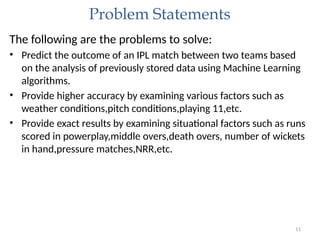
The following are the problems to solve:
• Predict the outcome of an IPL match between two teams based
on the analysis of previously stored data using Machine Learning
algorithms.
• Provide higher accuracy by examining various factors such as
weather conditions,pitch conditions,playing 11,etc.
• Provide exact results by examining situational factors such as runs
scored in powerplay,middle overs,death overs, number of wickets
in hand,pressure matches,NRR,etc.
12
Objectives of the Proposed System
The Major Objectives of the proposed system are:
1. Accurate Prediction
• Predict the likelihood of each team's victory based on historical and real-time data.
• Factor in both pre-match and in-game variables to improve accuracy.
2. Real-Time Decision Support
• Update predictions dynamically during the match based on the unfolding events,
such as player performance, wickets, or runs scored
3. Insightful Analysis
• Highlight the factors influencing the outcome, such as player form, team
composition, pitch conditions, or weather.
• Provide insights for stakeholders like team strategists, fans, or broadcasters.
4. Performance Evaluation
• Evaluate individual players' contributions and their impact on the game's outcome.
• Identify key moments or turning points in a match.
5. Scalability and Generalizability
• Build a model that works across different seasons, venues, and team compositions
while adapting to changes in rules or player dynamics.
13
Methodology
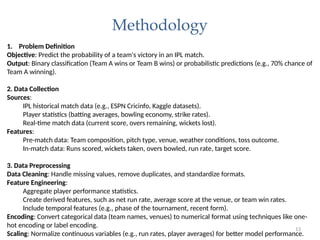
1. Problem Definition
Objective: Predict the probability of a team's victory in an IPL match.
Output: Binary classification (Team A wins or Team B wins) or probabilistic predictions (e.g., 70% chance of
Team A winning).
2. Data Collection
Sources:
IPL historical match data (e.g., ESPN Cricinfo, Kaggle datasets).
Player statistics (batting averages, bowling economy, strike rates).
Real-time match data (current score, overs remaining, wickets lost).
Features:
Pre-match data: Team composition, pitch type, venue, weather conditions, toss outcome.
In-match data: Runs scored, wickets taken, overs bowled, run rate, target score.
3. Data Preprocessing
Data Cleaning: Handle missing values, remove duplicates, and standardize formats.
Feature Engineering:
Aggregate player performance statistics.
Create derived features, such as net run rate, average score at the venue, or team win rates.
Include temporal features (e.g., phase of the tournament, recent form).
Encoding: Convert categorical data (team names, venues) to numerical format using techniques like one-
hot encoding or label encoding.
Scaling: Normalize continuous variables (e.g., run rates, player averages) for better model performance.
14
4. Exploratory Data Analysis (EDA)
• Analyze win-loss trends, player performance, and team dynamics.
• Identify significant factors influencing match outcomes (e.g., toss impact, venue effect).
• Visualize data using charts and heatmaps to find correlations.
5. Model Selection
Choose appropriate machine learning algorithms for classification:
• Logistic Regression: For baseline binary classification.
• Random Forest: For handling non-linear relationships and feature importance analysis.
• Gradient Boosting (e.g., XGBoost, LightGBM): For high accuracy in predictive tasks.
• Deep Learning: Neural networks for complex relationships and feature interactions.
• For real-time predictions, consider using Recurrent Neural Networks (RNN) or LSTMs to capture time-
series dynamics.
6. Model Training
• Train the selected models on the training data.
• Use appropriate evaluation metrics:
• Accuracy: For overall performance.
• Precision, Recall, F1-score: For imbalanced datasets.
• ROC-AUC Score: For probabilistic predictions.
• Apply cross-validation to ensure model generalization.
15
7. Deployment
• Deploy the model using cloud platforms (AWS, Google Cloud, Azure) or
frameworks like Flask/Django for APIs.
• Set up monitoring for model performance and retrain as needed with new data.
8. Evaluation and Continuous Improvement
• Test the model on unseen matches to validate performance.
• Gather user feedback and iteratively improve the model.
• Incorporate new data sources (e.g., player injuries, trading data) for better
predictions.
16
Applications
1. Fan Engagement
• Live Match Analysis: Display dynamic win probabilities during live matches, keeping fans
engaged with real-time insights
• Interactive Features: Offer fans prediction-based games, quizzes, or live polls to increase
their engagement during matches.
• Social Media Integration: Share dynamic predictions and trends to spark discussions among
fans and grow audience interaction
2. Broadcasting and Media
• Enhanced Viewer Experience: Display real-time winning probabilities, match insights, and
key turning points to engage viewers.
• Commentary Support: Provide live analytics for commentators to explain strategies, shifts in
momentum, and critical game moments.
• Highlight Creation: Identify pivotal moments from prediction swings for match recaps and
highlight reels.
3. Skill and Business
• Odds Calculation: Assist betting companies in offering dynamic and fair odds based on real-
time predictions.
• Risk Management: Enable real-time adjustment of odds to manage liabilities during critical
moments in a match.
17
References
• Research papers
• Chatgpt
• Websites
• Technical Documentation
18
Thank You

IPL match winning predicion using machine learnong

  • 1.
    1 IPL MATCH WINNINGPREDICTION Guide: Ashok S Patil Asst. Professor, Dept. of CSE (DS), SVIT, Bangalore. Visvesvaraya Technological University Belagavi Mini – Project (BCD586) Sai Vidya Institute of Technology Bangalore Mahith R 1VA22CD061 Durga Dinesh K 1VA22CD028 Maruthi Prasad 1VA22CD063 M S Jyothish 1VA22CD058
  • 2.
    2 I would liketo express my sincere thanks to The Trustees, and The Principal Dr. M S Ganesha Prasad, Sai Vidya Institute of Technology, Bangalore for giving permission to carry out our Project I express my sincere gratitude to Dr. Nagashree , Professor & Head, Dept. of CSE (DS) and Project Coordinators, Prof. Ashok S Patil , Asst. Professor, Dept. of CSE (DS) and Prof. Amarnath Patil Asst. Professor, Dept. of CSE (DS) Sai Vidya Institute of Technology, Bangalore for their technical support to implement our mini Project. Acknowledgement
  • 3.
    3 I express myheartfelt sincere and genuine gratitude to our Guide Ashok S Patil, Asst. Professor, Dept. of CSE (DS) Sai Vidya Institute of Technology, Bengaluru, for his valuable guidance, suggestions and motivation for our Mini Project. Finally, I would like to thank all Professors of Department of CSE (DS), Sai Vidya Institute of Technology, Bengaluru, for their support. Acknowledgement
  • 4.
    4 Contents 1. INTRODUCTION 2. LITERATURESURVEY 3. PROBLEM STATEMENT 4. OBJECTIVES 5. METHODOLOGY 6. APPLICATIONS 7. REFERENCES
  • 5.
    5 Introduction The Indian PremierLeague (IPL) is one of the most popular T20 cricket tournaments globally, drawing millions of passionate fans and generating intense excitement around each match. As interest in the league grows, so does the challenge of accurately predicting match outcomes, which can enhance the viewing experience and inform strategic decisions for analysts and stakeholders. This project seeks to develop a robust predictive model that leverages extensive historical data to forecast the winning teams in IPL matches. To achieve this, we will analyze various factors, including player statistics, team performance metrics, and venue conditions. By employing advanced machine learning techniques such as Logistic Regression, Random Forest, and Gradient Boosting, the model will provide probabilistic insights into match outcomes. Moreover, we will engage in feature engineering to extract critical information, such as recent team form and head-to-head performance, ensuring that the model captures the chances of the game.
  • 6.
    6 Literature Survey Paper 1: •Paper title : Prediction of IPL Match Outcome Using Machine Learning Techniques • Problem Statement : Given IPL datasets of past 9 years, the main objective of this paper is to predict the outcome of an IPL match between two teams based on the analysis of previously stored data using Machine Learning algorithms. • Objectives : To Predict the outcome of a IPL Match • Solution : https://www.researchgate.net/publication/355061139_Prediction_ of_IPL_Match_Outcome_Using_Machine_Learning_Techniques
  • 7.
    7 Literature Survey Paper 2: • Paper title: PREDICTION ON IPL DATA USING MACHINE LEARNING TECHNIQUES IN R PACKAGE • Problem statement : Enactment and measuring the difference between different algorithms in predicting the outcome of an IPL match • Objectives: Identify best algorithm predicting outcome of an IPL Match • Solution: https://ictactjournals.in/paper/IJSC_Vol_11_Iss_1_Paper_2_2 199_2204.pdf
  • 8.
    8 Literature Survey Paper 3: • Paper title : PREDICTION OF MATCH WINNERS OF IPL USING MACHINE LEARNING ALGORITHMS • Problem statement : Predicting the winners of Indian Premier League matches using different supervised learning techniques • Objectives : To Find outcome of an IPL Match using Supervised Learning • Solution : https://www.mitmoradabad.edu.in/wp-content/uploads/202 3/02/7.3.pdf
  • 9.
    9 Literature Survey Paper 4: • Paper title : IPL CRICKET SCORE AND WINNING PREDICTION USING MACHINE LEARNING TECHNIQUES • Problem statement : Predict the score of a match using linear regression, lasso regression and ridge regression and winning prediction using SVC classifier, decision tree classifier and random forest classifier • Objectives : Find the score and winner of an IPL match • Solution : https://www.irjmets.com/uploadedfiles/paper/volume3/issue_5_m ay_2021/10362/1628083416.pdf
  • 10.
    10 Literature Survey Summary onthe Literature Survey • Several studies have investigated the application of machine learning techniques in predicting match outcomes in the IPL. • Algorithms such as logistic regression, support vector machines (SVM), and decision trees have demonstrated effectiveness in forecasting match results based on historical data. • However, ensemble methods like Random Forest have gained traction due to their ability to manage imbalanced datasets and provide enhanced predictive accuracy. • Previous research highlights the challenges of working with diverse and dynamic datasets, with some studies emphasizing feature engineering to improve model performance. Key findings in the literature include: • Logistic Regression : A straightforward yet effective method for establishing baseline predictions. • SVM : Valuable for binary classification of match outcomes but may require significant computational resources. • Random Forest : Highly accurate and particularly effective for large datasets, especially when addressing class imbalance in match results.
  • 11.
    11 Problem Statements The followingare the problems to solve: • Predict the outcome of an IPL match between two teams based on the analysis of previously stored data using Machine Learning algorithms. • Provide higher accuracy by examining various factors such as weather conditions,pitch conditions,playing 11,etc. • Provide exact results by examining situational factors such as runs scored in powerplay,middle overs,death overs, number of wickets in hand,pressure matches,NRR,etc.
  • 12.
    12 Objectives of theProposed System The Major Objectives of the proposed system are: 1. Accurate Prediction • Predict the likelihood of each team's victory based on historical and real-time data. • Factor in both pre-match and in-game variables to improve accuracy. 2. Real-Time Decision Support • Update predictions dynamically during the match based on the unfolding events, such as player performance, wickets, or runs scored 3. Insightful Analysis • Highlight the factors influencing the outcome, such as player form, team composition, pitch conditions, or weather. • Provide insights for stakeholders like team strategists, fans, or broadcasters. 4. Performance Evaluation • Evaluate individual players' contributions and their impact on the game's outcome. • Identify key moments or turning points in a match. 5. Scalability and Generalizability • Build a model that works across different seasons, venues, and team compositions while adapting to changes in rules or player dynamics.
  • 13.
    13 Methodology 1. Problem Definition Objective:Predict the probability of a team's victory in an IPL match. Output: Binary classification (Team A wins or Team B wins) or probabilistic predictions (e.g., 70% chance of Team A winning). 2. Data Collection Sources: IPL historical match data (e.g., ESPN Cricinfo, Kaggle datasets). Player statistics (batting averages, bowling economy, strike rates). Real-time match data (current score, overs remaining, wickets lost). Features: Pre-match data: Team composition, pitch type, venue, weather conditions, toss outcome. In-match data: Runs scored, wickets taken, overs bowled, run rate, target score. 3. Data Preprocessing Data Cleaning: Handle missing values, remove duplicates, and standardize formats. Feature Engineering: Aggregate player performance statistics. Create derived features, such as net run rate, average score at the venue, or team win rates. Include temporal features (e.g., phase of the tournament, recent form). Encoding: Convert categorical data (team names, venues) to numerical format using techniques like one- hot encoding or label encoding. Scaling: Normalize continuous variables (e.g., run rates, player averages) for better model performance.
  • 14.
    14 4. Exploratory DataAnalysis (EDA) • Analyze win-loss trends, player performance, and team dynamics. • Identify significant factors influencing match outcomes (e.g., toss impact, venue effect). • Visualize data using charts and heatmaps to find correlations. 5. Model Selection Choose appropriate machine learning algorithms for classification: • Logistic Regression: For baseline binary classification. • Random Forest: For handling non-linear relationships and feature importance analysis. • Gradient Boosting (e.g., XGBoost, LightGBM): For high accuracy in predictive tasks. • Deep Learning: Neural networks for complex relationships and feature interactions. • For real-time predictions, consider using Recurrent Neural Networks (RNN) or LSTMs to capture time- series dynamics. 6. Model Training • Train the selected models on the training data. • Use appropriate evaluation metrics: • Accuracy: For overall performance. • Precision, Recall, F1-score: For imbalanced datasets. • ROC-AUC Score: For probabilistic predictions. • Apply cross-validation to ensure model generalization.
  • 15.
    15 7. Deployment • Deploythe model using cloud platforms (AWS, Google Cloud, Azure) or frameworks like Flask/Django for APIs. • Set up monitoring for model performance and retrain as needed with new data. 8. Evaluation and Continuous Improvement • Test the model on unseen matches to validate performance. • Gather user feedback and iteratively improve the model. • Incorporate new data sources (e.g., player injuries, trading data) for better predictions.
  • 16.
    16 Applications 1. Fan Engagement •Live Match Analysis: Display dynamic win probabilities during live matches, keeping fans engaged with real-time insights • Interactive Features: Offer fans prediction-based games, quizzes, or live polls to increase their engagement during matches. • Social Media Integration: Share dynamic predictions and trends to spark discussions among fans and grow audience interaction 2. Broadcasting and Media • Enhanced Viewer Experience: Display real-time winning probabilities, match insights, and key turning points to engage viewers. • Commentary Support: Provide live analytics for commentators to explain strategies, shifts in momentum, and critical game moments. • Highlight Creation: Identify pivotal moments from prediction swings for match recaps and highlight reels. 3. Skill and Business • Odds Calculation: Assist betting companies in offering dynamic and fair odds based on real- time predictions. • Risk Management: Enable real-time adjustment of odds to manage liabilities during critical moments in a match.
  • 17.
    17 References • Research papers •Chatgpt • Websites • Technical Documentation
  • 18.