‘-
1
IPFS: Interplanetary File Systems
‘-
2
Introduction
Think about this:
A blockchain is fundamentally a decentralized system.
Alternatively, a decentralized peer-to-peer system can be realized independent of a blockchain.
Interplanetary File System (IPFS) is a fine example of such a system..
IPFS is a decentralized model for file transfer in contrast to the centralized namespace and
transfer provided by the http family of protocols.
(HTTP operates in a centralized, hierarchical namespace: a web site is identified by
http://www.cse.buffalo.edu where each item is resolved hierarchically by the domain name
service (DNS).)
This peer-peer transfer of data is not new! It has been an age old quest. Recall or lookup the
Napster and Gnutella media sharing services. And the bittorrent services that is underlying
many of our current data services.
Juan Benet in the IPFS white paper describes it as a “Content Addressed, Versioned, P2P
Filesystem”.
In this lesson we will look into the details of IPFS, the alternative approach to file sharing, a
decentralized approach.
‘-
3
Learning Outcomes
On completion of this lesson, you will be able to,
--Discuss the architecture of IPFS
--Explain the operation of IPFS
--List the benefits over blockchain based solution
--Discuss IPFS + Blockchain solution
‘-
4
Key Ideas
Once again similar to how Bitcoin did, IPFS leverages and combines many successful peer-to-
peer system ideas.
1. Global distributed file system: IPFS is about “distribution” decentralization.
2. Content-based identification with secure hash of contents;Resolving locations using
Distributed Hash Table (DHT)
3. Block exchanges using popular Bittorrent peer-to-peer file distribution protocol
4. Incentivized block exchange using Bitswap protocol
5. Merkle DAG (Directed Acyclic Graph) version-based organization of files, similar Git
version control system
6. Self-certification servers for the storage nodes for security
‘-
5
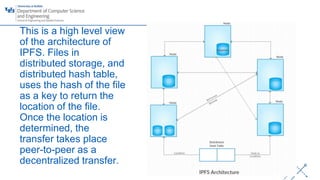
This is a high level view
of the architecture of
IPFS. Files in
distributed storage, and
distributed hash table,
uses the hash of the file
as a key to return the
location of the file.
Once the location is
determined, the
transfer takes place
peer-to-peer as a
decentralized transfer.
.
‘-
6
Distributed Nodes
The nodes are the computers that holds the decentralized data file objects that form the global
file system.
Nodes are identified by cryptographic hashes of public key. (Similar to our blockchain nodes).
They hold the objects that form the files to be exchanged. Objects are identified by a secure
hash and an object may contain sub objects each with its own hash that is used in the creation
of the root hash of the object. Recall our Merkle tree from course 1: Blockchain Basics.
‘-
7
Content Addressable
In the current world wide web protocol, we typically refer to a web resource or data by the
server on which they are stored on:
For example, https://www.coursera.org/ actually refers to the server on which the Coursera
page is hosted and to a particular directory and file on that server. This is a “centralized”
approach. What if the resource is available in numerous and dynamically variable number of
locations? IPFS offers a decentralized solution for this.
IPFS identifies the resources by what else, a hash of course. Instead of identifying the
resource by its location as in HTTP, IPFS identifies it by its content or by the secure hash of
its content.
In this case, the file is addressed by a universally unique identifier instead of by location.
Then how do you resolve the location? Just like you have a URL or link of a website, you
start with the hash identifier of the resource. You send around a request for anyone with a
resource with this identifier; on a successful response, access it peer-to-peer.
‘-
8
If content addressable, how do you resolve location of objects?
Routing part of the IPFS protocol maintains a DHT (Distributed Hash Table) for the locating
the nodes as well as for file objects.
A simple DHT hold the hash as the key and location as the value. Key can directly hash into
the location.
‘-
9
Now that we have located the node and the location of the
object how do we exchange the blocks of the file?
In a typical IPFS system, DHT resolves to the closest location to the key value. The peer
nodes holding the data blocks are incentivized by a protocol called BitSwap.
Peer nodes have a want_list and have_list and some form of a barter system is formed.
Any imbalance is noted in form of a BitSwap credit and debt; Bitswap protocol manages the
block exchanges involving the nodes accordingly. The nodes in the network thus have to
provide value in the form of blocks.
(Hmm...This could be an ideal usecase for a “digital token?”; if you send a block you get a
IPFS token that can be used when you need a block.)
The Bitswap protocol has provisions for handling exceptions such as free loading node, node
wanting nothing, node having nothing.
‘-
10
How are multiple versions of files maintained?
Multiple versions of a file are maintained using a Merkle Directed Acyclic Graph data structure
on top of the file system.
The basic elements of the block, list of blocks, tree of block representing an instance, and
commit that is snapshot of the tree.
This Merkle DAG also helps in checking any tampering and also in deduplication.
‘-
11
How are multiple versions of files maintained?
Multiple versions of a file are maintained using a Merkle Directed Acyclic Graph data structure
on top of the file system.
The basic elements of the block, list of blocks, tree of block representing an instance, and
commit that is snapshot of the tree.
‘-
12
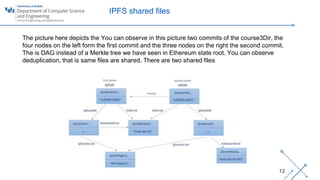
IPFS shared files
The picture here depicts the You can observe in this picture two commits of the course3Dir, the
four nodes on the left form the first commit and the three nodes on the right the second commit.
The is DAG instead of a Merkle tree we have seen in Ethereum state root. You can observe
deduplication, that is same files are shared. There are two shared files
‘-
13
Use cases and Relationship to Blockchain
IPFS can be a standalone decentralized file system.
It can be complementary to the existing HTTP based centralized system.
We discussed it in the context of blockchain systems because it can serve an important role of
decentralized storage for blockchain application that have a lot of data, but will store only the
hash on the blockchain.
In this case instead of a centralized store, IPFS can be the decentralized store that work in
tandem with the decentralized ledger technology of the blockchain to create a powerful
solution for many storage-rich business usecases.
‘-
14
Summarizing,
We discussed the details of a decentralized storage system that can be used
for storing the off-chain data for a blockchain application. It is used in many
genomic data applications for storing large genomic data and in dapps such
as Openlaw for document storage.
‘-
15
• Juan Bennet’s IPFS whitepaper:
https://ipfs.io/ipfs/QmR7GSQM93Cx5eAg6a6yRzNde1FQv7uL6X1o
4k7zrJa3LX/ipfs.draft3.pdf
• The Protocol Labs
• Filecoin crypto
References

IPFSNov5.pptx

  • 1.
  • 2.
    ‘- 2 Introduction Think about this: Ablockchain is fundamentally a decentralized system. Alternatively, a decentralized peer-to-peer system can be realized independent of a blockchain. Interplanetary File System (IPFS) is a fine example of such a system.. IPFS is a decentralized model for file transfer in contrast to the centralized namespace and transfer provided by the http family of protocols. (HTTP operates in a centralized, hierarchical namespace: a web site is identified by http://www.cse.buffalo.edu where each item is resolved hierarchically by the domain name service (DNS).) This peer-peer transfer of data is not new! It has been an age old quest. Recall or lookup the Napster and Gnutella media sharing services. And the bittorrent services that is underlying many of our current data services. Juan Benet in the IPFS white paper describes it as a “Content Addressed, Versioned, P2P Filesystem”. In this lesson we will look into the details of IPFS, the alternative approach to file sharing, a decentralized approach.
  • 3.
    ‘- 3 Learning Outcomes On completionof this lesson, you will be able to, --Discuss the architecture of IPFS --Explain the operation of IPFS --List the benefits over blockchain based solution --Discuss IPFS + Blockchain solution
  • 4.
    ‘- 4 Key Ideas Once againsimilar to how Bitcoin did, IPFS leverages and combines many successful peer-to- peer system ideas. 1. Global distributed file system: IPFS is about “distribution” decentralization. 2. Content-based identification with secure hash of contents;Resolving locations using Distributed Hash Table (DHT) 3. Block exchanges using popular Bittorrent peer-to-peer file distribution protocol 4. Incentivized block exchange using Bitswap protocol 5. Merkle DAG (Directed Acyclic Graph) version-based organization of files, similar Git version control system 6. Self-certification servers for the storage nodes for security
  • 5.
    ‘- 5 This is ahigh level view of the architecture of IPFS. Files in distributed storage, and distributed hash table, uses the hash of the file as a key to return the location of the file. Once the location is determined, the transfer takes place peer-to-peer as a decentralized transfer. .
  • 6.
    ‘- 6 Distributed Nodes The nodesare the computers that holds the decentralized data file objects that form the global file system. Nodes are identified by cryptographic hashes of public key. (Similar to our blockchain nodes). They hold the objects that form the files to be exchanged. Objects are identified by a secure hash and an object may contain sub objects each with its own hash that is used in the creation of the root hash of the object. Recall our Merkle tree from course 1: Blockchain Basics.
  • 7.
    ‘- 7 Content Addressable In thecurrent world wide web protocol, we typically refer to a web resource or data by the server on which they are stored on: For example, https://www.coursera.org/ actually refers to the server on which the Coursera page is hosted and to a particular directory and file on that server. This is a “centralized” approach. What if the resource is available in numerous and dynamically variable number of locations? IPFS offers a decentralized solution for this. IPFS identifies the resources by what else, a hash of course. Instead of identifying the resource by its location as in HTTP, IPFS identifies it by its content or by the secure hash of its content. In this case, the file is addressed by a universally unique identifier instead of by location. Then how do you resolve the location? Just like you have a URL or link of a website, you start with the hash identifier of the resource. You send around a request for anyone with a resource with this identifier; on a successful response, access it peer-to-peer.
  • 8.
    ‘- 8 If content addressable,how do you resolve location of objects? Routing part of the IPFS protocol maintains a DHT (Distributed Hash Table) for the locating the nodes as well as for file objects. A simple DHT hold the hash as the key and location as the value. Key can directly hash into the location.
  • 9.
    ‘- 9 Now that wehave located the node and the location of the object how do we exchange the blocks of the file? In a typical IPFS system, DHT resolves to the closest location to the key value. The peer nodes holding the data blocks are incentivized by a protocol called BitSwap. Peer nodes have a want_list and have_list and some form of a barter system is formed. Any imbalance is noted in form of a BitSwap credit and debt; Bitswap protocol manages the block exchanges involving the nodes accordingly. The nodes in the network thus have to provide value in the form of blocks. (Hmm...This could be an ideal usecase for a “digital token?”; if you send a block you get a IPFS token that can be used when you need a block.) The Bitswap protocol has provisions for handling exceptions such as free loading node, node wanting nothing, node having nothing.
  • 10.
    ‘- 10 How are multipleversions of files maintained? Multiple versions of a file are maintained using a Merkle Directed Acyclic Graph data structure on top of the file system. The basic elements of the block, list of blocks, tree of block representing an instance, and commit that is snapshot of the tree. This Merkle DAG also helps in checking any tampering and also in deduplication.
  • 11.
    ‘- 11 How are multipleversions of files maintained? Multiple versions of a file are maintained using a Merkle Directed Acyclic Graph data structure on top of the file system. The basic elements of the block, list of blocks, tree of block representing an instance, and commit that is snapshot of the tree.
  • 12.
    ‘- 12 IPFS shared files Thepicture here depicts the You can observe in this picture two commits of the course3Dir, the four nodes on the left form the first commit and the three nodes on the right the second commit. The is DAG instead of a Merkle tree we have seen in Ethereum state root. You can observe deduplication, that is same files are shared. There are two shared files
  • 13.
    ‘- 13 Use cases andRelationship to Blockchain IPFS can be a standalone decentralized file system. It can be complementary to the existing HTTP based centralized system. We discussed it in the context of blockchain systems because it can serve an important role of decentralized storage for blockchain application that have a lot of data, but will store only the hash on the blockchain. In this case instead of a centralized store, IPFS can be the decentralized store that work in tandem with the decentralized ledger technology of the blockchain to create a powerful solution for many storage-rich business usecases.
  • 14.
    ‘- 14 Summarizing, We discussed thedetails of a decentralized storage system that can be used for storing the off-chain data for a blockchain application. It is used in many genomic data applications for storing large genomic data and in dapps such as Openlaw for document storage.
  • 15.
    ‘- 15 • Juan Bennet’sIPFS whitepaper: https://ipfs.io/ipfs/QmR7GSQM93Cx5eAg6a6yRzNde1FQv7uL6X1o 4k7zrJa3LX/ipfs.draft3.pdf • The Protocol Labs • Filecoin crypto References

Editor's Notes

  • #3 Need references for Napster and Gnutella web services https://github.com/ipfs/faq/issues/47
  • #5 https://ipfs.io/ipfs/QmR7GSQM93Cx5eAg6a6yRzNde1FQv7uL6X1o4k7zrJa3LX/ipfs.draft3.pdf This forms a generalized Merkle DAG, a data structure upon which one can build versioned file systems, blockchains, and even a Permanent Web. IPFS combines a distributed hashtable, an incentivized block exchange, and a self-certifying namespace.
  • #6 This is a high level view of the architecture of IPFS. Files in distributed storage, and distributed hash table, uses the hash of the file as a key to return the location of the file. Once the location is determined, the transfer takes place peer-to-peer as a decentralized transfer.
  • #8 https://medium.com/@ConsenSys/an-introduction-to-ipfs-9bba4860abd0 This hash is the key in the <key, value> and the value is the “file” or the “resource”.
  • #9 Data to be stored on IPFS is hashed to create a unique key that will serve as The identifier for the data in the IPFS distributed file system.
  • #12 The picture here depicts the You can observe in this picture two commits of the course3Dir, the four nodes on the left form the first commit and the three nodes on the right the second commit. The is DAg instead of a Merkle tree we have seen in Ethereum state root. You can observe deduplication, that is same files are shared. There are two shared files
  • #14 https://medium.com/@ConsenSys/an-introduction-to-ipfs-9bba4860abd0