IPD CASE
STUDIES
AIA, AIA Minnesota, School of Architecture –
University of Minnesota
March 2012
This document incorporates case studies originally
documented in the 2010 publication, “Integrated Project
Delivery: Case Studies” by the AIA / AIA California Council
Table of Contents
About this Study
Introduction
Executive Summary
IPD Definition - AIA
IPD Definition - This Report
IPD Motivations
Survey Summary
Selection of Projects
Credits
Acknowledgements
Resources
Definition of Terms
National Map of IPD
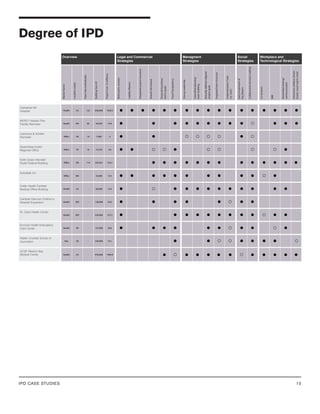
Degree of IPD
Case Studies
Cathedral Hill Hospital
MERCY Master Plan Facility Remodel
Lawrence & Schiller Remodel
SpawGlass Austin Regional Office
Edith Green Wendell Wyatt Federal Building Modernization
Autodesk Inc.
Sutter Health Fairfield Medical Office Building

Cardinal Glennon Children’s Hospital Expansion
St. Clare Health Center
Encircle Health Ambulatory Care Center
Walter Cronkite School of Journalism
UCSF Mission Bay Medical Center
IPD CASE STUDIES 1
About this Study
Introduction
This study is a revision of our report published in February 2011.
It advances the previous study with the inclusion of one new case
study (University of California San Francisco, UCSF), report
of the survey results and addition of the six cases documented
in the 2010 AIA/AIA-CC publication of “Integrated Project
Delivery: Case Studies.” Whereas previous case study efforts
were limited to the handful of projects executing IPD, this effort
is framed broadly, choosing projects of various program types,
sizes, team composition and locations. Additionally, this set of
case examples documents a wide range of team experience, from
teams with quite a bit of IPD experience to those who are using
their project as a learning experience. The level of experience of
the teams is shown graphically in the at-a-glance pages of the
matrix. Unique to this study is the opportunity to study projects
from early phases through completion. Following projects over
time, we hope to gain insight on the evolution of each project,
its collaborative culture and areas of success and challenge. This
document is focused on project activities that lay the foundation
for collaborative practices in IPD.
Executive Summary
IPD is being implemented in increasingly diverse settings,
allowing us to better understand where it is most effective. By
studying a range of projects, we can better understand how
IPD compares with traditional project delivery methods for
different project and team types and envision its continued
development. Documenting how IPD has been adapted and
applied to each of the projects in this study demonstrates that
IPD is a method that employs multiple strategies to achieve
high performing, collaborative teams and cannot be reduced to
a contractual structure or management formula. By comparing
this set of projects according to how they followed or adapted
IPD contractual and behavioral strategies, we can see how some
aspects of IPD have had greater impact than others. The degree
to which projects implemented IPD strategies, from contractual
terms to management, social, environmental and technological
strategies, is documented in a chart “Degree of IPD.”
Since IPD is a relatively new delivery model, it is not
surprising that participants have had less project experience
with IPD than with traditional or design-build delivery models.
Project participants with even one or two IPD experiences
can greatly influence the team. As one might expect, for first
time IPD teams, they are encountering a steep learning curve.
However, the curve can be made less steep by pre-existing
professional relationships and relatively straightforward projects.
For the relatively experienced teams, IPD continues to be fine
tuned and adjusted to meet specific project and team needs.
Survey results of 127 participants confirm some expected
hypotheses but also yielded some surprises. For example, as
expected, a more experienced team has stronger understanding
and value of IPD principles. However, while anecdotally, co-
location is strongly valued, it was not significant factor in the
perception of open and effective communication. This somewhat
contradictory evidence indicates that the future study is needed
to better understand which factors are most relevant to the
success of a collaborative project focused on the activities that lay
the foundation for
By juxtaposing AIA/AIA-CC 2010 cases to the projects
documented in 2011-12, we can see the rapid pace of change
from 2004 to 2012. Sutter’s Fairfield Medical Office Building,
begun in 2005, is considered one of the first “true” IPD projects
in America, and several others around that time are obviously
meeting the challenges of creating new strategies for what was
then a very new project delivery type. In spite of many years of
experience with collaborative or even integrated team delivery
(usually in the form of Design-Build but sometimes found even
in Design-Bid-Build settings), IPD in its pure form required
significant rethinking of many core processes.
The later projects, along with the rest of the building industry,
clearly benefitted from the early projects and their “lessons
learned.” Equally clearly, there is more room for learning and
current projects must adapt to meet new demands and project
specific challenges.
IPD Definition - AIA
It is becoming clear that there are very few “pure” IPD projects.
The survey response shows that the majority of projects
pursuing IPD are using custom IPD agreements. Even those
IPD CASE STUDIES 2
using standard multi-party agreements, such as the AIA C-191
Standard Form Multi-Party Agreement for IPD, customized the
contracts to eliminate certain aspects of liability or shared risk/
reward – components previously defined as critical to achieve
“pure” IPD. As the industry struggles to define IPD in the ideal
world, the messiness of the real world continues to shape our
understanding of integration and collaboration. We found that
although several of the case examples did not meet all of the
contractual principles listed below in Integrated Project Delivery
Defined: AIA/AIACC, 2010, they met all of the behavioral
principles and offered insights into the ways IPD can be adapted.
See also the graphic representation of the projects’ in “Degree of
IPD.”
Integrated Project Delivery Defined: AIA/AIACC, 2010
IPD is a method of project delivery distinguished by a
contractual arrangement among a minimum of owner,
constructor and design professional that aligns business interests
of all parties. IPD motivates collaboration throughout the design
and construction process, tying stakeholder success to project
success, and embodies the following contractual and behavioral
principles:
Contractual Principles
• Key Participants Bound Together as Equals
• Shared Financial Risk and Reward Based on Project 		
Outcome
• Liability Waivers between Key Participants
• Fiscal Transparency between Key Participants
• Early Involvement of Key Participants
• Jointly Developed Project Target Criteria
• Collaborative Decision Making
Behavioral Principles
• Mutual Respect and Trust
• Willingness to Collaborate
• Open Communication
IPD Definition - This Report
Through a workshop process led by Professor Paolo Tombesi,
Chair of Construction at the University of Melbourne and
Markku Allison, resource architect for AIA, we adapted the
contractual and behavioral principles above to more specifically
define IPD for this study. We rearranged the characteristics
to into two categories, IPD “markers” and IPD “strategies.”
This helps to distinguish between the characteristics unique
to IPD projects and the tactics or strategies employed, either
commercial, social, environmental or technological, to support
the IPD process.
For our study, we considered a project to be following IPD if
they embodied the markers listed below. Variations were seen in
strategies, tactics and contractual principles.
IPD Markers
• Relational Contracts
• Protection from litigation
• Aligned project goals (Jointly Developed Project Target
Criteria)
• Informed and balanced decision-making (Collaborative
Decision Making)
• Open Communication
• Risks Identified and Accepted Early
IPD Strategies
• Key Participants Bound Together as Equals (Multi-party
Agreement)
• Budget & create team for design intensive work
• Early contribution of expertise (Early Involvement of Key
Participants)
• Pre-existing relationships between parties
• Champion/ Facilitator (Leadership by All)
• Shared Financial Risk and Reward Based on Project
Outcome
• Liability Waivers between Key Participants
• Fiscal Transparency between Key Participants
• BIM - virtual rehearsal of construction and ongoing
constructability reviews
• Lean Construction processes
• Co-location
IPD Motivations
IPD offers many potential advantages over a tradition design-
bid-build delivery model, but each team needs to determine
why IPD is appropriate for them. The workshop also developed
a method to profile each case in terms of their motivations for
using IPD. As we follow-up with the second phase of this case
study effort, we may find that there are certain projects better
IPD CASE STUDIES 3
suited for IPD. For example the Technical Complexity of the
project might be high, therefore requiring earlier involvement of
trade expertise. Even in this early stage of the study, we have seen
teams find their initial reasons for choosing IPD are evolving as
they better understand IPD’s benefits and challenges. In some
cases, great value has been found in unanticipated areas.
Motivations for selecting IPD fall into five categories:
1) Market Advantage:
Choosing to use IPD can give market advantage. IPD may give
the firms valuable experience upon which to market themselves
as industry leaders. Improving the delivery may also be a market
advantage if measureable results can be attained. For serial
owners, savings on one project done in IPD can be leveraged
across many buildings. The healthcare sector trends show that
IPD may become an expected standard delivery method.
2) Cost Predictability:
All projects would like to meet budget, however, for some the
predictability of cost is a notably driving factor.
3) Schedule predictability: Similar to cost, all projects share the
goal of meeting their planned schedule, but for some projects this
is a major factor.
4)Risk Management:
Reducing or managing risk can be tied with cost or schedule, but
also may include transactional risk inherent to project type, site
or other conditions. If risk management is a critical factor, the
increased communication in IPD may be of particular advantage.
5) Technical Complexity:
A high degree of complexity will usually demand integration of
expertise and require a level of coordination that is achievable in
an IPD environment.
The tactics for achieving the goals in each of these areas may
or may not be exclusive to IPD, however, for projects that
have strong motivations in several categories, IPD may offer
an advantage over traditional delivery. Collaboration and
integration can occur in any project delivery method, however,
IPD sets up structures that make it more likely to occur than
not. In particular, study participants noted good collaboration
in design-build is raised to an even higher level in IPD. This
improvement can be credited to a variety of sources, but most
cited was the early involvement of a larger and more diverse set
of expertise areas, including trade contractors.
Several of the cases have developed metrics and have
preliminary results to measure. However, at this first phase of
the study, it is too early to begin to draw conclusions on the
successful results of any decisions related to IPD.
The earlier projects, originally documented by Jonathan
Cohen for AIA/AIA-CC, did not directly request information
regard motivation for selecting IPD. Our research team felt it
was helpful to have an IPD profile for all the cases in the matrix
and so, for the purposes of comparison, interpreted the interview
information to create profiles for those cases.
Study Summary
This report presents data collected from an electronic
questionnaire that surveyed five Integrated Project Delivery
(IPD) teams as part of the larger case study effort. The goal of
the questionnaire was to measure individual team members’
perception of how IPD tactics affected the desired behavioral and
relational characteristics.
Questionnaire Distribution and Response
The questionnaire was sent electronically to five teams in
October 2011: Cathedral Hill Hospital (n=64), Lawrence and
Schiller Remodel (n=6), SpawGlass Regional Office (n=9), Mercy
Medical Center (n=12), and Edith Green Wendell Wyatt Federal
Office Modernization (n=36). Team sizes varied; therefore
some projects may have a sample population too small to be
meaningful. Overall, the response rates were good, achieving at
least 50% on all of the projects.
Summary of Preliminary Findings
Highlights of the findings summarize initial trends. They are not
exhaustive, but focus on five primary areas of interest: effects
of 1) IPD contractual principles, 2) use of a Lean construction
system, 3) co-location, 4) use of team building facilitators, and
5) collaborative project delivery. The following reports findings
of hypotheses that were/were not supported; however, those
hypotheses that were not supported offer equally important data.
Further investigation is needed about both conditions.
1) IPD contractual principles (multi-party agreement):
IPD provides several benefits to participants. Based on
IPD CASE STUDIES 4
findings from analysis of projects, shared financial risk
and reward incentives, use of liability waivers, and fiscal
transparency had a positive effect on the teams’ perception of
trust and respect for project partners.
2) Use of a Lean construction system:
Overall, participants perceive that use of a Lean construction
system has a positive effect on several critical areas: sharing
project information with all team members, sharing ideas
and opinions with team members, and on project efficiency.
However, Lean did not seem to have an effect on respect of the
participants’ contributions indicated by listening and giving
fair consideration to the participants’ ideas.
3) Co-location:
Most surprisingly, an examination of co-location revealed
mixed results. Co-location was perceived as positively affecting
participants’ ability to communicate with team members
from other contracting parties, the efficiency of the work
process, and their direct interaction with team members
who work for the other contracting parties. However, co-
location had no effect on participants’ perception of open
and effective communication. Furthermore, participants did
not perceive that co-location (to any degree) had an effect on
indirect interaction with team members who work for other
contracting parties.
4) Use of team building facilitators:
An examination of use of facilitators revealed mixed results.
Team building facilitators triggered a positive effect on
participants’ perception of sharing of project information
with all team members equally, their understanding of team
members’ roles, and effective communication between team
members. However, participants did not perceive a positive
effect of a facilitator on how the participants share their ideas
and opinions with their team members, or team members’
respect of participants’ contributions by listening and giving
fair consideration to their ideas.
5) Collaborative project delivery:
The perception of a positive effect of collaborative project
delivery on project efficiency varied according to contract
party. All parties perceived it as having a positive effect,
however the contractors (general contractor/construction
manager) perceived collaborative delivery as significantly more
positive (Mean = 2.79, n=33) than engineers whop viewed
the effect only somewhat positively (Mean = 1.82, n=17). All
parties also perceived a positive effect of collaborative project
delivery on the quality of design - interestingly, the architects
rated this effect to a lesser degree (Mean=2.08, n=26) than
all other contract parties: contractor (general contractor/
construction manager) (Mean=2.63, n=32); contractor (trade)
(Mean=2.53, n=40); and engineer (Mean=2.13, n=16).
Limitations of the Study
The imbalance in sample populations (n) between projects within
this study and missing data could have skewed the study’s results,
compromising the findings. Also, the study’s sample size limits
generalization of the findings from one project to another within
the study; it also limits generalization of findings from this phase
of the study to projects outside this study.
Analysis of data was primarily descriptive (means, percentages)
Missing data were the result of some variation in the questions
asked of participants and can also indicate an issue with
understandability of the questions.
Project Specific Data
Detailed questionnaire results for each project can be found
within the matrix under the “Survey Data” category.
Selection of Projects
Case projects were selected after applying several filters to a
survey conducted by AIA in September 2010. The survey was
sent to all those who had downloaded the 2007 AIA/AIA-CC
publication, “Integrated Project Delivery: A Guide,” and asked
respondents to identify their use or likeliness to use a multi-party
or IPD agreement. Over 1,400 individuals responded, 25%
indicated they were using or intended to use IPD on a project.
This group was sent a second, more detailed survey asking
specific information about their project. Since this case study
effort was planned to have several phases, projects currently in
their early phases of delivery were chosen. A further selection
was made to ensure diversity of project profiles and a willingness
to share information for the study.
AIA/AIA-CC cases were chosen using a very different process
that reflects the extremely small number of projects that had
been completed when that report was begun. For that report,
projects were chosen that had been successfully completed,
balanced with a desire to have some diversity of geography and
project type.
IPD CASE STUDIES 5
Credits
University of Minnesota Research Team:
Renee Cheng, AIA, Principal Investigator
Katy Dale, Primary Author and Coordinator
Amanda Aspenson, Research Assistant
Kai Salmela, Research Assistant and Graphics
Caren S. Martin, PhD, Co-author of survey summary/data
Hye-Young Kim, PhD, Co-author of survey summary/data
AIA/AIA-California Council Study:
AIA/AIA-CC 2010 “Integrated Project Delivery: Case
Studies” was written by Jonathan Cohen, the six projects
documented in that publication have been adapted for inclusion
in this case study matrix.
Photo Credits:
Autodesk Inc. AEC Solutions Division Headquarters, photo by
Jonathan Cohen
Sutter Health Fairfield Medical Office Building,
photo by Vance Fox
Cardinal Glennon Children’s Hospital Expansion,
photo by Sam Fentress
St. Clair Health Center, left photo by Jonathan Cohen,
right photo courtesy of HGA Architects and Engineers
Encircle Health Ambulatory Care Center,
photo courtesy of HGA Architects and Engineers
Walter Cronkite School of Journalism, Arizona State University,
photo by Bill Timmerman
Acknowledgements
AIA:
Markku Allison, AIA, Resource Architect
AIA Minnesota:
Beverly Hauschild-Baron, Honorary AIA
IPD Case Study Advisory Board:
Bake Baker, AIA, McGough, Inc.
Steve Fiskum, AIA, HGA
Rick Hintz, AIA, Perkins & Will
Jerod Hoffman, MBJ Engineering
Karie Johnson, AIA, AEC Transformation
David Jordani, FAIA, David Jordani Consulting
Virginia Marquardt, DLR Group
Dan Murphy, MBJ Engineering
Dennis Mulvey, AIA, A&P
Pat O’Connor, Faegre & Benson
Tim Sessions, AIA, BWBR
University of Minnesota, College of Design:
Caren Martin, PhD, Associate Professor (survey consultant)
Hye-Young Kim, PhD, Assistant Professor (survey consultant)
SeonMi Choi , PhD, (survey data analysis)
University of Melbourne, Faculty of Architecture
Building & Planning:
Professor Paolo Tombesi (workshop consultant)
IPD Definition and Project Profile Workshop Participants:
Tu-Anh Bui, LHB
Allison Fritz, MS&R
Mike Hara, Target
Meredith Hayes Gordon, Perkins & Will
Nick Potts, HGA
Pauv Thouk, Julie Snow Architects
University of Minnesota Study Participants:
Cathedral Hill Hospital
Dave Kievet, Boldt
Paul Reiser, HerreroBoldt
Steve Peppler, SmithGroup
Andy Sparapani, HerreroBoldt
Baris Lostuvali, HerreroBoldt
MERCY Master Plan Facility Remodel
Paul Sieben, LeanTrak (owner’s representative)
Carl Davis, Array HFS
Christopher Trotta, Array HFS
Randall Von Ryan, Array HFS
Ray Corby, Array HFS
Patrick Canada, Donley’s
Dave Choinard, Osborn Engineering
IPD CASE STUDIES 6
Manny Gonzales, Mercy Community Health Partners
Chuck Caye, Smith & Obey
Kenneth Beck, Lake Erie Electrical
MacArthur Reyes, Lake Erie Electrical
Lawrence & Schiller Remodel
Lenae Liddiard, Canfield Business Interiors/ Innovative
Solutions Group
Mark Luke, Mark Luke Construction
Aaron Kruse, Mark Luke Construction
Jeremy Christopherson, RSArchitects
Dave Johnson, Baete Forseth HVAC
Randy Grotenhuis, Midwestern Mechanical
Tom Smithback, Electrical Supply Co.
SpawGlass Austin Regional Office
Patrick Williams, SpawGlass, Contractors
Bob Farmer, SpawGlass Contractors
Mark Harrington, SpawGlass Contractors
Tommy Kosarek, BGK Architects
Art Arredondo, BGK Architects
Rick Moore, BGK Architects
Edith Green Wendell Wyatt Federal Building Modernization
Pat Brunner, GSA Region 10
Don Eggleston, SERA Architects
Stuart Colby, SERA Architects
Jennifer Taylor, SERA Architects
Troy Dickson, Howard S. Wright
UCSF Mission Bay Medical Center
Stuart Eckblad, UCSF
Laurel Harrison, Stantec
Osman Chao, DPR
Ray Trebino, DPR
Durga Saripally, DPR
AIA-CC Study Participants:
Autodesk Inc. AEC Solutions Division Headquarters
Owner: Autodesk Inc., Architect: KlingStubbins, Builder: Tocci
Building Companies
Sutter Health Fairfield Medical Office Building
Owner: Sutter Regional Medical Foundation, Architect: HGA
Architects and Engineers, Builder: The Boldt Company
Cardinal Glennon Children’s Hospital Expansion
Owner: SSM Healthcare, Architect: Christner Inc., MEP
Engineer: McGrath Inc., Builder: Alberici Constructors, Inc.
St. Clare Health Center
Owner: SSM Healthcare, Architect: HGA Architects and
Engineers, Builder: Alberici Constructors
Encircle Health Ambulatory Care Center
Owner: Encircle Health, an LLC composed of ThedaCare and
independent physician groups, Architect: HGA Architects and
Engineers, Builder: The Boldt Company
Walter Cronkite School of Journalism, Arizona State University
Owner: City of Phoenix, User/Occupant: Arizona State
University, Design Architect: Ehrlich Architects, Executive
Architect: HDR Architecture, Builder: Sundt Construction
Resources
AIA/AIA California Council. (2007). Integrated Project Delivery:
A Guide. Retrieved from the American Institute of Architects
website: http://www.aia.org/contractdocs/AIAS077630
AIA California Council. (2007). Integrated Project
Delivery: A Working Definition. Retrieved from: http://ipd-ca.
net/IPD%20Definition.htm
Barnier, A. J., Sutton, J., Harris, B., & Wilson, R. (2007).
A conceptual and empirical framework for the social
distribution of cognitive systems. Cognitive Systems Research.
doi:10.1016/j.cogsys.2007.07.002
Cohen, J. (2010). Integrated Project Delivery: Case Studies.
(Report for AIA/AIA-California Council). Retrieved from the
American Institute of Architects website: http://www.aia.org/
about/initiatives/AIAB082049
Dossick, C.S., & Neff, G. (2010). Organizational Divisions
in BIM-Enabled Commercial Construction. Journal Of
Construction Engineering And Management, 136(4), 459-467.
doi: 10.1061/ASCECO.1943-7862.0000109
IPD CASE STUDIES 7
El Wardani, M. (2004). Comparing Procurement Methods for
Design-Build Projects. (Technical Report No. 46). Retrieved
from Penn State, Computer Integrated Construction Research
Program: http://www.engr.psu.edu/ae/cic/publications/
cic_reports.aspx?p=13
Giere, R., & Moffatt, B. (2003) Distributed Cognition: Where
the Cognitive and the Social Merge. Social Studies of Science.
33(2), 301-10.
Gutman, R. (2010). Architecture from the Outside In. New York:
Princeton Architectural Press.
Harness, S. (2008). 2008 AIA Documents Advance the Use
of BIM and Integrated Project Delivery. Retrieved from the
American Institute of Architects website: http://www.aia.org/
contractdocs/aiab081437
Herman Miller. (2004) Quantifying and Fostering Organizational
Effectiveness. Retrieved from: http://pdfbrief.com/quantifying-
and-fostering-organizational-effectiveness.html
NASFA, COAA, APPA, AGC and AIA. (2010). Integrated Project
Delivery for Public and Private Owners. Retrieved from the
American Institute of Architects website: http://www.aia.org/
about/initiatives/AIAS078435?dvid=&recspec=AIAS078435
Novitski, B.J. (2008) New AIA agreements support integrated
project delivery. Architectural Record, July. Retrieved
from: http://archrecord.construction.com/practice/
projdelivery/0807aia.asp
Qureshi, S., $ Keen, P. (2004). Activating Knowledge through
Electronic Collaboration: Vanquishing the Knowledge Paradox.
(ERIM Report Series ERS-2004-058-LIS).
Thomsen, C., Darrington, J., Dunne, D., & Lichtig, W.
(2010). Managing Integrated Project Delivery. (Report for
Construction Management Association of America CMAA).
Tombesi, P. (2008). Forum: Out of What? Locating the
Underpinnings of Theory. Building Research and Information.
36(6), 668-73.
Weigle, G. & Garbder, S. (2010). Integrated Project Delivery
(IPD) and Project Target Cost Estimate (PTCE) Relative to
Traditional Project Delivery and Guaranteed Maximum Price
(GMP). Facility Care. March/April. Retrieved from: http://
facilitycare.com/continuing_edu.shtml
Xiao, Y. (2005). Artifacts and Collaborative Work in Healthcare:
Methodological, Theoretical, and Technological Implications
of the Tangible. Journal of Biomedical Informatics. 38, 26-33.
doi:10.1016/j.jbi.2004.11.004
IPD CASE STUDIES 8
Definition of Terms
A3
A one-page (11x17) report form that guides problem solving
and decision making. The A3 includes the background, problem
statement, analysis, proposed corrective actions (and the action
plan), and the expected results, often with graphics.
Last Planner System
A collaborative, commitment-based planning system that
integrates multiple elements (pull planning, make-ready
look-ahead planning with constraint analysis, weekly work
planning based upon reliable promises, and learning) to produce
predictable work flow in construction and commissioning of
projects.
Lean Construction
Lean Construction extends from the objectives of a lean
production system– maximize value and minimize waste. It uses
specific techniques, such as the Last Planner System, Target Value
Design, and applies them in a building project delivery process.
Plan Percent Complete
Calculated as the “number of assignments completed on the day
stated” divided by the “total number of assignments made for the
week”.
Reliability Metric
The extent to which a plan is an accurate forecast of future events,
measured by Percent Plan Complete. Example: If your weekly
work plans have a 60% PPC, they accurately predict completion/
release of 60% of the tasks represented as weekly assignments.
Target Value Design
A disciplined management practice to be used from definition
through construction to assure that the facility is designed within
budget and meets the operational needs and values of the users.
The process goal is to increase value and eliminate waste (time,
money, human effort).
Visual Management
Production activities, plans, schedules, measures and
performance indicators are displayed in plain view. This assures
that the status of the system can be understood at a glance by
everyone involved and actions taken are in support of system
objectives.
Source for Definitions
Lichtig, W. and G. Howell. (2011). LCI Lean Project Delivery
Glossary. Lean Construction Institute: Building knowledge in
design and construction. Retrieved March 13,2012. From http://
www.leanconstruction.org/glossary.htm
Acronyms
AIA		 American Institute of Architects
BIM		 Building Information Modeling
CIFE		 Center for Integrated Facility Engineering
CM		 Construction Manager
GC		 General Contractor
GMP		 Guaranteed Maximum Price
LCI		 Lean Construction Institute
LPS		 Last Planner System
IPD		 Integrated Project Delivery
PPC		 Plan Percent Complete
TVD		 Target Value Design
VDC		 Virtual Design and Construction
Helpful Links
AIA Center for Integrated Practice
http://network.aia.org/centerforintegratedpractice/home/
AIA Programs & Initiatives: Integrate Practice – Integrated
Project Delivery
http://www.aia.org/about/initiatives/AIAS078435?dvid=&recspe
c=AIAS078435
Lean Construction Institute
http://www.leanconstruction.org/index.htm
Center for Integrated Facility Engineering
http://cife.stanford.edu/
IPD CASE STUDIES 9
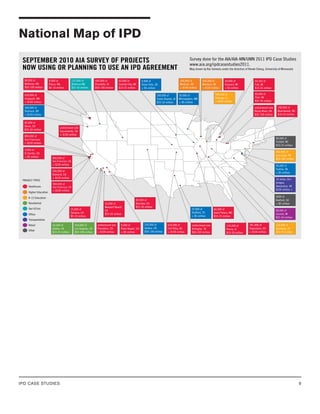
National Map of IPD
Healthcare
K-12 Education
Higher Education
Residential
Gov’t/Civic
Retail
Office
Transportation
Other
PROJECT TYPES
SEPTEMBER 2010 AIA SURVEY OF PROJECTS
NOW USING OR PLANNING TO USE AN IPD AGREEMENT
Survey done for the AIA/AIA-MN/UMN 2011 IPD Case Studies
www.aia.org/ipdcasestudies2011.
Map drawn by Kai Salmela under the direction of Renée Cheng, University of Minnesota
55,000 sf
Goleta, CA
$10-25 million
114,000 sf
Bamberg, SC
$10-25 million
63,000 sf
Central City, NE
$10-25 million
55,000 sf
Newport Beach,
CA
$25-50 million
9,000 sf
Pasco, WA
$5-10 million
14 miles; 50+
bridges
Alexandria, VA
$100 million +
undisclosed size
Arlington, TX
$50-100 million
100,000 sf
Beachwood, OH
$10-25 million
20,000 sf
Minneapolis, MN
< $5 million
80,000 sf
Flint, MI
$25-50 million
44,352 sf
Fint, MI
$10-25 million
450,000 sf
Pocatello, ID
$50-100 million
20,000 sf
Concord, MI
< $5 million
500,000 sf
Chicago, IL
> $100 million
4,000 sf
Sioux Falls, SD
< $5 million
10,000 sf
Stafford, TX
< $5 million
340,000 sf
Madison, WI
> $100 million
220,000 sf
Golden, CO
$50-100 million
undisclosed size
Rocky RIver, OH
$50-100 million
400,000 sf
Lancaster, PA
$50-100 million
6000 sf
Bedford, VA
< $5 million
80,000 sf
Bellevue, WA
$50-100 million
66,000 sf
Saint Peters, MO
$10-25 million
125,000 sf
Bellevue WA
$25-50 million
undisclosed size
Pasadena, CA
> $100 million
250,000 sf
Oakland, CA
> $100 million
900,000 sf
San Francisco, CA
> $100 million
undisclosed size
Sacramento, CA
> $100 million
68,000 sf
Carmel, IN
$25-50 million
80,000 sf
Fishkill, NY
$10-25 million
610,000 sf
Fort Riley, KS
> $100 million
300,000 sf
Madison, WI
> $100 million
781,000 sf
Owensboro, KY
> $100 million
26,000 sf
Fairfax, VA
< $5 million
15,000 sf
Tarzana, CA
$5-10 million
900,000 sf
San Francisco, CA
> $100 million
260,000 sf
Los Angeles, CA
$50-100 million
82,000 sf
Barstow, CA
$25-50 million
500,000 sf
Portland, OR
> $100 million
620,000 sf
Issaquah, WA
> $100 million
9,000 sf
Palm Desert, CA
< $5 million
82,000 sf
Davis, CA
$25-50 million
3,000 sf
El Cerrito, CA
< $5 million
800,000 sf
San Francisco
> $100 million
200,000 sf
Cedar Rapids, IA
$25-50 million
154,000 sf
Peoria, IL
$25-50 million
IPD CASE STUDIES 10
Degree of IPD
UCSF Mission Bay
Medical Center
Cathedral Hill
Hospital
MERCY Master Plan
Facility Remodel
Lawrence & Schiller
Remodel
SpawGlass Austin
Regional Office
Edith Green Wendell
Wyatt Federal Building
Autodesk Inc.
Sutter Health Fairfield
Medical Office Building
Cardinal Glennon Children’s
Hospital Expansion
St. Clare Health Center
Encircle Health Ambulatory
Care Center
Walter Cronkite School of
Journalism
Health CA - 878,000 1300.0
Legal and Commercial
Strategies
Overview Managment
Strategies
Social
Strategies
Workplace and
Technological Strategies
Market
Sector
Location
(state)
Team
Size
(individuals)
Building
Size
(sf)
Project
Cost
($
millions)
Multi-party
contract
Strong
Leadership
Integrated
project
insurance
Liability
Waivers
Networked
sharing
/
communication
Fiscal
Transparency
Early
Involvment
of
key
players
Intensified
planning/
team
building
Shared
risk/reward
Financial
Incentives
tied
to
goals
Co-location
Inegrated
team
structure
BIM
Mutually
defined/aligned
project
goals
Implementation
Tools
(i.e.
Lean)
Interactive
artifacts
(Smart
board,
visual
mgmt.
tools)
Collaborative
decision
making
Office TX 16 15,370 2.8
Office SD 10 7,000 .5
Health OH 60 94,439 19.4
Health CA 123 858,000 1028.5
Office OR 114 525,421 123.2
Office MA - 55,000 13.4
Health CA - 69,948 19.5
Health MO - 138,000 45.6
Health MO - 430,000 157.2
Health WI - 157,000 38.6
Edu AZ - 230,000 72.1
PROJECT
Cathedral Hill Hospital  
OWNER
California Pacific Medical Center
ARCHITECT
SmithGroup
CONTRACTOR
HerreroBoldt
11
Cathedral Hill
Hospital
PROJECT
Cathedral Hill Hospital  
OWNER
California Pacific Medical Center
ARCHITECT
SmithGroup
CONTRACTOR
HerreroBoldt
12
Overview
Project Description
Location San Francisco, California
Type		 Healthcare - New Construction
Contract		 Single Multi-party Contract – IFOA
Owner		 California Pacific Medical Center,
			 A Sutter Health Affiliate
Architect SmithGroup
Contractor HerreroBoldt – A Joint Venture
Project Start August 2007
Est. Completion March 2015
In 2000, California Pacific Medical Center (CPMC), an affiliate
of Sutter Health, hired the architecture firm, SmithGroup/SOM,
a joint venture, and SMWM to design the consolidation of two
acute care facilities on one of CPMC’s existing campuses. There
were concerns about maintaining operations during expansion,
so in 2002 when a property became available within the San
Francisco metro area that was well suited for a new medical
center, CPMC reconceived the project as a new hospital facility,
the Cathedral Hill Hospital. After several years of planning, the
project ran into budget and entitlement timing concerns and was
put on hold in 2005.
At this time, Sutter began to broadly address problems
of budget and schedule overruns occurring in many of their
projects, eventually adopting Integrated Project Delivery and
Lean Construction as their new method of project delivery.
In 2007, SmithGroup was invited to continue working with
CPMC to design the new 860,000 sf, 14 level hospital to house
555 beds, under the condition that they enter into Sutter’s version
of a multiparty contract, Integrated Form of Agreement (IFOA).
Although relatively new to IPD, SmithGroup, and several of
their design consultants, were interested in pursuing the project.
Shortly after SmithGroup committed, Sutter brought in the
contractor HerreroBoldt, and immediately thereafter, primary
trade contractors were engaged.
Construction was originally scheduled to begin in 2010,
however due to entitlement challenges with the city, construction
was put on hold. This added two years to the design phase; the
flexibility of IPD enabled the team to slow down the pace of
production without claims or added change orders to the owner.
Resources were shifted from an anticipated 40-50 detailers
to maintaining 16 detailers over a longer period of time. The
focused effort with fewer people actually resulted in a higher
productivity rate, likely due to the continuity of team members
and intimacy of the team, and avoided the inefficiencies of
coordinating within a large team. The additional time also
allowed the team to more fully coordinate the drawings prior
to agency approval, an opportunity anticipated to significantly
reduce field changes and subsequent agency review. At the time
of follow-up, construction was anticipated to begin in April 2012.
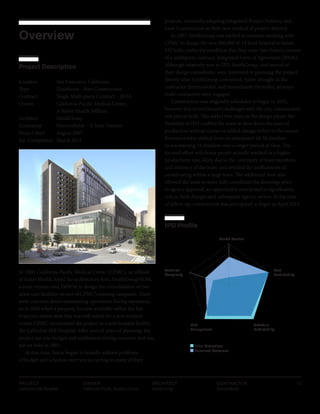
IPD Profile
Initial Motivations
Perceived Outcomes
Market Position
Cost
Predictability
Technical
Complexity
Schedule
Predictability
Risk
Management
PROJECT
Cathedral Hill Hospital  
OWNER
California Pacific Medical Center
ARCHITECT
SmithGroup
CONTRACTOR
HerreroBoldt
13
Market Position was not a motivator for the owner. However,
California Pacific Medical Center created a market by making
IPD a requirement for the commission. For the architect, this
project allowed them to enter the IPD arena. For the constructor,
a new joint venture was formed specifically for this project.
Perceived Outcome: Both the contractor and architect have
noticed increased market opportunities due to their experience
with IPD. The contractor started using principles of IPD and
Lean Construction prior to this project and had a hard time
selling it to customers. Now more owners are becoming aware
of IPD and looking for firms with the experience, benefiting
this contractor. For the architect, this was their first IPD
project and they have seen significant benefit from this project;
although most collaborative projects the firm has won since
this experience are smaller projects that employ only some IPD
tactics such as co-location and collaborative relationships.
Cost Predictability was Sutter’s primary driver for using IPD as
a company. Enterprise-wide they were highly motivated to keep
project costs reasonable.
Perceived Benefit: The team has tracked metrics and found that
the owner has earned a 400% ROI on the costs invested beyond
typical design to bring trades on early. They provided valuable
ongoing cost estimating as part of the Target Value Design
process.
Schedule Predictability was an important driver of using IPD
because of several critical variables bearing on the project.
California instated a 2013 deadline for meeting seismic and
seismic retrofit requirements (California State Senate Bill 1953
and 1661). The complexity of the building and permitting process
in San Francisco will make that deadline difficult to meet. Aging
current facilities for CPMC demand investment to keep them
functional, creating additional financial incentives to complete
the new facility quickly.
Perceived Benefit: This project is on hold due to entitlement
delays with the site and they are not in construction, this made
evaluation of this topic difficult. IPD has allowed the team to
design the production delivery. They are trying to make this
project as efficient as possible and anticipate it will significantly
reduce issues in the field and make the schedule much more
predictable
Reduced Risk was a major motivator for the owner to shift to
IPD. Sutter realized that their capital investments in construction
could be better protected from risk with IPD.
Perceived Benefit: IPD has significantly improved trust between
trades and eliminated contingencies.
Technical Complexity was not a primary motivator for the
owner to pursue IPD. Although a hospital is a complex building
type, the owner has experience achieving complex projects with
traditional delivery.
Perceived Benefit: IPD has allowed the team to design to a very
fine level of detail on a highly complex building type. IPD was a
change for the architects, who, on other delivery types would be
on the outside trying to defend the design from changes made
in detailing phases. The architect felt the technical aspects of the
project have benefited from the integration.
Survey Data
Owner - 3.1%
Contractor (GC/CM) - 32.8%
Architect - 4.7%
Engineer - 17.2%
Contractor (trade) - 40.6%
Developer - 0.0%
Other - 1.6%
Executive - 14.1%
Senior Manager - 18.8%
Project Manager - 23.4%
Associate Professional - 9.4%
Assistant Professional - 4.7%
Production/Technical Staff - 20.3%
Office/Administrative - 1.6%
Other - 7.8%
BIM Experience
BIM was implemented to an advanced degree, see BIM. Model
management was shared by the architect and the contractor.
Participants that interact with BIM in a technical way represent
39.1% of participants; the majority are contractors (trade,
52.0%; and GC or CM, 38%), followed by architects (12%).
Most were production/technical staff (40.0% this includes
detailers and trade coordinators) or project manages (36.0%).
The technical ability was evenly distributed between participants
self-identifying as expert ability, intermediate ability, and
fundamental ability.
Previous Experience
Participants overwhelmingly indicated (92.2%) that their
organizations had previous working experience with each other.
PROJECT
Cathedral Hill Hospital  
OWNER
California Pacific Medical Center
ARCHITECT
SmithGroup
CONTRACTOR
HerreroBoldt
14
Furthermore, 60.9% of individuals had previously worked
with other team members. This past experience was likely a
factor in organizations’ willingness to embark on an integrated,
collaborative delivery model, still a very new model with several
unknowns.
Multi-party Agreement
This project used a multi-party agreement, see Contract. While
60.9% of survey participants were aware their firms entered into
a multi-party agreement, 26.6% were unsure. Also important
to note, 12.5% responded incorrectly that the project did not
have a multi-party agreement. Of the 60.9% who were aware,
they perceived that the contract positively affected (Mean =
2.67, where 3=positive effect, -3=negative effect) their trust and
respect for project partners.
Of the 26.6% that were not sure if the project had a multi-
party agreement, 64.7% represent the contractor (trade) and
23.5% represent engineers. Generally those unsure were in lower
level positions including project production/technical staff
(41.2%) or field and labor managers (17.6%).
The 12.5% of participants that incorrectly answered
represented the contractor (trade; 75%). Surprisingly, of those
that incorrectly responded, 87.5% were at or above the project
management level (Executive 37.5%; Senior Manager 12.5%;
Project Manager 37.5%). Given that many represented trade
contractors, it could be that these representatives were not
included in the 9 party IFOA but there is no data to verify that
possible explanation.These findings may also indicate a lack
of communication to the larger team, particularly to the trade
contractors.
Risk/Reward
This team had a shared risk/reward pool on this project, see Risk/
Reward. An overwhelming majority of participants were aware
of this strategy, with 94.8% aware, only 5.2% not sure, and none
answered incorrectly. This indicates that this strategy was widely
and effectively communicated, more than any other contractual
term. Survey participants perceived that the shared risk/reward
incentives positively affected (Mean=2.4, where 3=positive effect,
-3=negative effect) their trust and respect for project partners.
Liability Waivers
This team had waivers on liability, see Liability. This strategy was
not well communicated to the team with 58.6% of participants
unsure and 10.3% incorrectly answering that there were no
limits on liability. Only 31% of participants were aware of this
strategy and were broadly distributed among contract parties.
They perceived that the liability waivers positively affected
(Mean=2.24, where 3=positive effect, -3=negative effect) their
trust and respect towards the other contracting parties.
The majority of participants (58.6%) were unsure of this
strategy and primarily represented the contractor (trade, 44.1%;
GC or CM, 32.4%), engineers (14.7%), and the owner (5.8%;
note this represents 100% of the owners surveyed). The 10.3%
of participants that incorrectly answered there was no limits to
liability represented the contractor (GC or CM, 50%; trade, 50%).
These results indicate these questions were unclear or the limits
to liability were not well understood among the participants,
regardless of contract party or job level.
Fiscal Transparency
This project was fiscally transparent between contracting parties,
see Transparency, and widely displayed visual metrics of cost
targets throughout the workplace, see Implementation. Survey
data indicated that 67.2% of participants were aware of the fiscal
transparency, while 27.6% were not sure and 5.2% answered
incorrectly that there was no fiscal transparency. Of the 67.2%
that were aware of the transparency, the majority represented the
contractor (GC or CM, 43.6%; trade, 38.5%) and they perceived
the strategy to have a positive effect (Mean = 2.34, where
3=positive effect, -3=negative effect) on their trust and respect
towards the other contracting parties.
Of the 27.6% of participants that were unsure of this strategy,
the majority represented the contractor (trade, 37.5%; GC or
CM, 25%), followed by engineers and architects (18.8% each).
Legal and Commercial
Strategies
Contract
Single Multi-party Contract
• Integrated Agreement for Lean Project Delivery
		 Between Owner, Architect & CM/GC – also referred as 		
		 Integrated Form of Agreement (IFOA)
PROJECT
Cathedral Hill Hospital  
OWNER
California Pacific Medical Center
ARCHITECT
SmithGroup
CONTRACTOR
HerreroBoldt
15
Contract Issued
• August 1, 2007
In 2007, California Pacific Medical Center (CPMC) made the
decision to use an Integrated Form of Agreement (IFOA) to
deliver the Cathedral Hill Hospital in San Francisco. By then,
Sutter was fairly experienced with IPD and Lean Construction
having completed the Fairfield Medical Office two years before.
On Fairfield, Sutter used an innovative IFOA agreement created
for them by attorney William A. Lichtig, see more in Sutter
Health Fairfield Medical Office Building. The IFOA used on
this project, Cathedral Hill Hospital, evolved compared to the
Fairfield agreement, particularly refining the definition of shared
risk/reward terms. Due to the entitlement delay, the IFOA was
renegotiated in late 2011, again revising the shared risk/reward
terms to reflect further evolution of Sutter’s IFOA, see Risk/
Reward.
The IFOA addressed collaborative commercial terms,
relational expectations, and the use of specific implementation
processes, such as Lean Project Delivery tools, to support the
relational expectations.
Commercial Terms
The Sutter IFOA included well-known collaborative commercial
terms such as: shared risk/reward, performance incentives,
compensation incentives, waiver of liability, and allowance for an
Owner Controlled Insurance Program (OCIP) or project specific
insurance.
Relational Expectations
The agreement included some soft language defining the
relational and behavioral expectations, for example Article
3.3 Trust states, “Parties shall work together in the spirit of
cooperation, collaboration, and mutual respect for the benefit of
the Project.”
Social Strategies
A large proportion of the IFOA defined tools and tactics to
achieve relational expectations and processes to perform the
design and preconstruction work. Many of the tools implemented
on this project were based on Lean Construction practices, such
as reliable promising, pull-based design production, Target
Value Design, and the Last Planner System. Meeting frequency
requirements were clearly defined for the Core Group, the
executive level leadership, as well as their responsibilities in terms
of developing work procedures for leading the Integrated Project
Delivery Team.
Goals
According to this team, one of the most critical components of
goal development and alignment on an integrated team is having
an actively involved owner.
Goals
The process started with the list of owner’s design goals:
• Excellence in clinical care
• Education
• Community service
• Patient satisfaction
• Family involvement with the patient
• Private rooms
As the project evolved, the owner identified several additional
items they wished to add, the team referred to these as Value
Added Items and tracked them on a separate budget line since
they were not planned or funded in the original program or
estimated maximum price. As the team reduced costs through
collaboration, innovation, and coordination, they were able to
include some of the value added items the owner desired, see
Culture for specific cost saving innovations.
Communication and Alignment
These goals were clearly communicated to the integrated team.
Active involvement from the owner helped to reiterate, on an
ongoing basis, what was of greatest value to them. Additional
reminders were printed at large scale for posting in prominent
locations around the co-located office. The posters acted as a
constant reminder of client expectation to the team.
Risk/Reward
The IFOA established a risk-pool that the architect, CM/GC,
primary design consultants and primary trade contractors were
bound to. In this case, the IPD team members participating in
the pool put a percentage of their profit at risk to partially fund
cost overruns or other project liabilities if any occurred. As a
positive incentive, this pool would provide payments if the team
achieved actual costs below the estimated maximum price.
PROJECT
Cathedral Hill Hospital  
OWNER
California Pacific Medical Center
ARCHITECT
SmithGroup
CONTRACTOR
HerreroBoldt
16
The architect and CM/GC placed 25% of their preconstruction
and construction fixed fee profits at risk. At the time the contract
was executed, the following additional parties were included in
the Risk Pool IPD Team:
Architect’s Consultants: Degenkolb Engineers (structural),
Silverman & Light Inc. (electrical), Ted Jacob Engineering
Group Inc. (M/P),
Trade Contractors: Rosendin Electric (electrical), Southland
Industries (mechanical), Charles Pankow Builders, Ltd.
(concrete)
In late 2011, the team went through a process of renegotiating
their IFOA to be consistent with changes Sutter had implemented
in recent IFOA projects. One of the revisions Sutter had made
to their standard IFOA was the elimination of risk sharing
and incentives for pre-construction. Instead of putting 25%
of preconstruction profits at risk, they shifted to a 100%
construction profits at risk model.
These revisions did not change the risk profile or actual
financial numbers much for the CM/GC. The architect, however,
is concerned that these changes will negatively affect the target
value design process. With the original model, the team was
incentivized to reduce costs below the estimated maximum price
during the design phase. The shift to construction-phase-only
incentives may result in the team holding onto cost savings ideas
until construction starts. At the same time, the architect believed
that the risk/reward incentives were not the primary motivator
for team members to successfully collaborate and take ownership
of the project. He felt the financial incentives primarily function
as “bait” for the firms at an executive or VP level.
Liability
Sutter’s IFOA Article 33.1 explicitly limits liability between all
Risk Pool IPD Team members (see Risk/Reward) and the owner.
Any liabilities that arise related to the agreement, work or project
would be satisfied exclusively from the At-Risk Pool Account.
Exceptions to these limitations contain specific insurance-
related conditions and include liabilities arising out of willful
misconduct or intentional abandonment.
Furthermore, the agreement protects the architect and
architect’s consultants if a government agency requires them to
over-stamp a sub-contractors equivalent of a shop drawing. The
contract states, “neither the Architect nor Architect’s Consultants
shall assume any responsibility and/or liability for authorship or
technical aspects of those documents.”
Dispute Resolution
Should any claim arise in connection with the agreement,
the Parties, including all consultants and sub-contractors, are
required to follow the dispute resolution procedure defined in
Article 41 of the IFOA. The dispute resolution procedure sets out
rigorous internal review processes following submittal of a Notice
of Potential Claim to the Core Group. First, the owner, architect
and CM/GC would hold a “Special Meeting” and attempt to
resolve the issue through reasonable negotiation. If unresolved,
the Claim would be elevated to the Core Group (made up of
senior members of each major stakeholder). If the Core Group
cannot reach resolution, the Claim elevates to the Senior
Executives of each respective organization, who would meet,
exchange information, discuss candidly and reach a reasonable
compromise. Before entering non-binding mediation, an
independent expert would be brought in to review the Claim, the
cost of which would be shared among the Core Group members.
Should the internal process not result in resolution, any party
has the option of initiating confidential and non-admissible
mediation procedures using a third party mediator. The cost of
such would be borne by only the parties in dispute. If the claim
reaches an “unresolved impasse,” the parties have the option of
pursuing the “legal and equitable remedies available to them.”
Insurance
At the time this case study was conducted, the Cathedral Hill
Hospital IPD Team was still determining how the project specific
insurance would be handled. This project will be one of the first
to use an insurance product designed specifically for Integrated
Project Delivery. Two major insurers visited the project site to
familiarize their understanding of the processes and will be
presenting IPD insurance options to the team in January 2011.
General Liability and Professional Liability insurance is
required for the architect and the architect’s consultants. The
contract requires standard CM/GC insurance, however as noted
above, the team will be using an IPD specific insurance product.
It is yet to be determined if this will be an owner or contractor
controlled policy.
PROJECT
Cathedral Hill Hospital  
OWNER
California Pacific Medical Center
ARCHITECT
SmithGroup
CONTRACTOR
HerreroBoldt
17
Management
Strategies
Leadership Organization
Champion
• Owner
• CM/GC
Team Structure
• Core Group
• Cluster Groups
California Pacific Medical Center (CPMC) is an affiliate of Sutter
Health, a large healthcare owner that has pioneered IPD since
2005 (see Contract). Sutter and Boldt have experience with IPD
and Lean Construction. Together they have been championing
the process on this project team, although the owner primarily
operates at the executive (Core Group) level.
Owner involvement is one of the key differences between
IPD and design-build, see Goals. The owner’s ongoing input was
critical to inform the team of items most valuable to them as
the team went through the process of Target Value Design (see
Implementation).
Team Structure
As defined in the Integrated Form of Agreement (IFOA),
the Core Group provides primary leadership. The Core
Group consisted of a senior representative from Sutter
Health (specifically from their division of Facility, Planning
and Development – referred to as the FPD), California
Pacific Medical Center (owner), SmithGroup (architect) and
HerreroBoldt (CM/GC). The Core Group was responsible for
project coordination, management and administration consistent
with principles of Lean Project Delivery. Sutter’s representative
from their FPD division facilitated and coordinated the activities
of the Core Group. CPMC’s representative was responsible for
coordinating activities between the project participants and
ensuring that decision makers on the owner’s side are available as
needed.The team discovered a deficiency in owner involvement
as they worked through the value added list (a list of items
identified as desirable by the owner but not previously budgeted).
The team realized they needed more input at the user group level,
specifically clinical operations, to better prioritize those items.
The owner addressed this by bringing a representative from
hospital operations onto the project team.
Leadership was further distributed into a series of Cluster
Groups, which are interdisciplinary groups comprised of
architects, engineers and trade partners. Cluster Groups were
assigned to specific design areas, for example, structural, exterior,
interior, and medical equipment. Each cluster was responsible
for designing their assigned segment within the Target Value (see
Implementation and
Early Involvement) using whatever resources required.
Champion
Each of the three parties, owner, architect and CM/GC,
championed the integrated delivery process in different ways.
Members of the Core Group occasionally dropped into Cluster
Group meetings to observe the process and offer suggestions.
In the beginning of the project, Sutter’s Facility, Planning, and
Development (FPD) representative regularly attended the Target
Value Design and Last Planner meetings to help coach people
through the cultural and behavioral expectations of IPD
and Lean.
After several years of working together, the team’s culture
did not need extensive oversight. However members of the
Core Group continued to engage the team to stay up to date of
progress and to observe team performance, making adjustments
and improvements when needed. For example, leaders noticed
that visual metrics were prevalent around the office, but metrics
and formats were not standard between cluster groups. In
preparation for construction, leadership requested cluster group
leaders coordinate one set of graphic conventions so that a viewer
could immediately comprehend the status of each team and the
project as a whole, a rule referred to as “30 seconds at 3 feet.”
Boldt, with their extensive experience and history with the
Lean Construction Institute and real commitment to continuous
learning, served as a mentor to educate the Integrated Project
Delivery Team on Lean. Specifically, Boldt appointed one
individual as the Value and Lean Process Manager, responsible
for incorporating Lean Construction practices into the IPD
Team. This individual trained team members in Lean practices
and task management tools through regular Study Action
Groups. All team members, regardless of experience level,
participated in these groups.
PROJECT
Cathedral Hill Hospital  
OWNER
California Pacific Medical Center
ARCHITECT
SmithGroup
CONTRACTOR
HerreroBoldt
18
Firm Selection
Architect
SmithGroup was one of the firms originally contracted with
California Pacific Medical Center (CPMC) for the original
Cathedral Hill Hospital design. That project was put on hold
and restarted 2 years later using Sutter’s Integrated Form of
Agreement (IFOA). Based on SmithGroup’s past experience with
CPMC, the architect and several of their consultants were invited
back to work on the restarted Cathedral Hill Hospital project.
The architect observed that SmithGroup has been trending
away from the traditional design-bid-build to alternative delivery
models. They discovered that the IPD arrangement used in this
project is far superior to the other delivery models and they
intend to identify appropriate clients who agree to work this
way in the future. They found that the team relationship formed
through the IPD process allows for a better design process.
Contractor (CM/GC)
Sutter and Boldt both studied IPD and Lean Construction for
over seven years and had formed key relationships through
that mutual interest. Furthermore, both entities have strong
relationships with the Lean Construction Institute and Glenn
Ballard. Given this shared history and mutual respect, Boldt was
well aligned with CPMC and Sutter’s values and goals for the
project.
HerreroBoldt is a joint venture firm between Herrero
Contractors Inc. and The Boldt Company. The two contractors
formed this partnership in response to the Cathedral Hill
RFP. Herrero Contractors is a local firm familiar with the San
Francisco market and Office of Statewide Health Planning and
Development (OSHPD) requirements, while Boldt is experienced
in large-scale healthcare projects and Lean Construction and had
a long-standing relationship with Sutter.
Design Consultants
Many of the design consultants working on the original
renovation project carried over to the Cathedral Hill Hospital
project. For consultants, previous experience in IPD or pre-
qualifying their ability to collaborate was secondary to the
continuity gained by building on previously established goals,
values and ideas. A few consultants were not comfortable with
the collaborative process set forth for Cathedral Hill and declined
to participate. All consultants that committed to the project went
through the Study Action Group training to educate them in the
philosophy of IPD and Lean Construction.
Trade/ Sub-Contractor
In contrast to the selection of the design consultants, trade
partners (or sub-contractors) were subject to a thorough
selection process specifically targeting their collaborative
experience or demonstrated ability to collaborate. Three
primary trade partners who had established relationships
with Boldt were brought onto the project very early. Each had
already incorporated Lean Construction practices into their
organizations and demonstrated willingness to pursue Integrated
Project Delivery.
An extensive and collaborative review process was used to
select additional trade partners. Cluster Groups generated the
initial list of potential trade partners and the CM/GC pre-
qualified the list before presenting to the Core Group. These pre-
qualified firms were required to respond to an RFP presenting
typical budget and profit margin information as well as their
experience with or willingness to be a part of an integrated
project delivery process. Shortlisted firms were interviewed by a
cross section of the IPD Team, including someone from the CM/
GC, design firm, design consultants, the owner and other trade
partners. These team members provided their recommendations
to the Core Group who made the final selection.
The most highly prized characteristic was the willingness to
collaborate. This was particularly critical for this project since
full participation by trades was required during the Target Value
Design process and there was no intention for any hard bid or
lump sum sub-contracts.
Team Selection
According to the contractor, the type of individuals they selected
were innovative thinkers with an entrepreneurial spirit and an
element of leadership. Because everyone on the team had the
ability to influence the design, confidence to offer input was
crucial. A “top down, central command approach does not
work on this project,” so along with the characteristics above, a
humble and collaborative style was just as important. In an IPD
project, there is a great deal of uncertainty and each individual
has to have the ability to adapt daily, sometimes following and
sometimes taking the lead.
The architect formed a team with a variety of experience
levels and technical abilities. They felt there was no special
experience or skill requirements unique to IPD since the process
provides excellent opportunities for mentorship and learning at
all phases. They did however observe that IPD was a challenge
PROJECT
Cathedral Hill Hospital  
OWNER
California Pacific Medical Center
ARCHITECT
SmithGroup
CONTRACTOR
HerreroBoldt
19
for individuals who have been practicing a certain way for many
years. Shifting their familiar roles and responsibilities to take
input from non-designers was uncomfortable for some.
Project Planning
Resources Referenced
• Experienced IPD Team Members (Owner Organization,
CM/GC Organization)
• Sutter Health IFOA
• Lean Construction Institute
Compared to a traditional project delivery, there is a great deal
more time spent planning out the process in IPD. Because IPD
was new for a large number of individuals on the team, the
project moved intentionally slow in the beginning. This allowed
team members to develop and learn new processes while getting
to know each other. There was a great deal of time spent on
planning before design work began.
Of great value to this project was past experience in IPD and
Lean Construction by Sutter, Boldt and many key individuals
of the IPD Team. The team leveraged their experience and
resources, which allowed them to further refine previously
developed IPD process, such as the Target Value Design plan and
the Last Planner Process, for the Cathedral Hill Hospital project
(see Implementation and
Early Involvement).
The strong relationship with the Lean Construction Institute
(LCI), who is partnered with UC Berkeley, was an asset for
this project. The project benefited from regular visits by Glenn
Ballard of LCI, an expert in Lean Project Delivery, and graduate
students who observed and reported their observations of the
project team. Students reported
on different areas of their practice, such as the Last Planner
System, change order processes, and accounting practicing,
which helped the team evaluate and improve their
own performance.
Budgeting Team Effort
Each organization has had to remain very fluid in terms of
staffing, especially given the delay due to entitlement challenges.
Additional time during preconstruction was compensated based
on time and materials, consistent with the terms of the IFOA.
Accurately budgeting for effort proved to be difficult for the
architect. SmithGroup anticipated additional effort, but assumed,
while it would be more than traditional delivery, it might be
similar to design-build. Based on the bell curves of effort often
cited for IPD projects, they expected most of their effort to be
expended during schematic design and design development
before handing off much of the work during construction
documents to the contractor and trade partners. With this IPD
project, effort required in the early phases was as expected, but
the biggest surprise was the sustained high level of effort required
during detail design. This was opposite of what they expected, as
the architect stated, “we are designing how we are going to build
the building.”
Late in the pre-construction phase, the team found that the
distinction between documentation and construction activities
was blurred. Documents are significantly more coordinated on
an IPD project than on traditional projects, and it is expected
that the architect’s involvement in the construction phase will be
less demanding than early phases. The architect also anticipates
that their increased involvement in the coordination activities
will lead to additional efficiency, reduced waste in the field and a
return to the risk pool.
Rethinking Staffing
Typically the architect would spend 75% of their fee producing
the documents for agency review, greatly reduce their staff
and then ramp back up to respond to comments. CA would
be completed with the fee remaining. In that scenario, there is
incredible pressure on the architects and consultants to put more
people on the job at the documentation production stage.
On this project however, the integrated team agreed, “the
best way to save money on this project is to spend money on the
architects and engineers and the rest of the team to be working
on those documents.” Team members observed that early and
continued involvement by consistent team members reduced
the number of handoff points, thereby maintaining project
knowledge and reducing disconnects between designers
and contractors.
Another difference on an integrated project is the investment
in process management staff. This project employed individuals
at multiple leadership levels to manage the integrated team
performance through education of
the team on information exchange and process management
tools, planning of design and production sequencing and
supporting continuous improvement ideas.
PROJECT
Cathedral Hill Hospital  
OWNER
California Pacific Medical Center
ARCHITECT
SmithGroup
CONTRACTOR
HerreroBoldt
20
Implementation
Tools
• Multiple Lean processes
• Target Value Design
• A3 and A4 Reports
• Choosing by Advantages (CBA)
• Co-location
• BIM
The Integrated Form of Agreement (IFOA) stipulates that the
IPD Team use the Last Planner System (a Lean Construction
tool) for planning and scheduling of design coordination and
implementation. As part of the Last Planner System, the IFOA
requires, at a minimum, the development of “a milestone
schedule, collaboratively created phase schedules, ‘make
ready’ look ahead plans, weekly work plans, and a method for
measuring, recording and improving planning reliability.” The
IFOA describes each one of these Last Planner System tools and
processes in detail.
To implement the design, the IPD team organized into
interdisciplinary Cluster Groups. These groups were separated
by design area, for example exterior architecture, interior
architecture, structural, medical equipment, etc. Each group was
responsible for coordinating their design area both internally and
between other Cluster Groups or design areas.
Work within each Cluster Group was facilitated using the
Last Planner System. The Last Planner system required each
group to work backward from the milestone and phase schedules
to develop their weekly work plan. Work plans in conjunction
with detailed weekly look-ahead schedules identified activities
required to meet schedule and any constraints in the way of those
activities. Activities were converted into commitments, which
were assumed by individuals who promised to fulfill them within
a week or two week time period. By tracking commitments,
groups were held accountable by a reliability metric that was
measured on a weekly basis. The Last Planner process not only
helped individuals become more reliable, it also improved their
ability to identify and communicate what they need to achieve
their commitments. The goal on the Cathedral Hill Project was
to maintain 90% reliability in each Cluster Group, a significant
improvement from the 50% average estimated by the CM/GC’s
project executive for a traditional delivery process.
Regular meetings were set up for formal cross-Cluster
coordination. These meetings occurred on bi-weekly basis during
the intense design phases and shifted to a weekly meeting as the
design was finalized. These meetings provided a forum for teams
to report on their Last Planner commitment status and score
each group’s reliability, helping hold Clusters accountable for
their goals and commitments.
Each Cluster Group also followed a Target Value Design
(TVD) process, which designates value, cost, schedule, and
constructability as basic components of the design criteria, see
Early Involvement for advantages of TVD. This process required
the CM/GC and trade contractors assigned to each Cluster
Group to provide ongoing cost information and estimating. This
input was intended to help shape the design, especially informing
system selection and detail development, thus ensuring the
design met the value targets established by the Core Group. This
is one of the key reasons owner involvement is critical, they
provide ongoing feedback to prioritize items of greatest value
to them. Target Value progress and target achievement was also
reported in the weekly IPD Team meetings, another tool that
helped hold each Cluster Group accountable for meeting
value targets.
Increased collaboration and coordination inherent to IPD
resulted in an increased number and frequency of meetings. This
fact made using tools such as BIM and the Last Planner System,
more critical to ensure meetings were effective, short, and
directed towards solutions.
Specific process tools were used to facilitate coordination
and decision-making among the IPD team members. An A3
report and the Choosing by Advantages (CBA) system was used
to formalize the project decision-making process, see detailed
information in the Decision Making section. An A4 report
embraced a similar strategy that assisted the BIM design and
detailing coordination, see BIM.
Lean was an integral part of this integrated project; it was
the organizing operating system. Once the design matured to
a level of certainty, the design detailing process embraced the
Lean production line philosophy. They employed ideas like the
workable backlog; if an issue caused the production line to halt,
they found ways for the majority of the team to continue working
on areas unaffected by that issue.
Lean tools such as Target Value Design were used in
conjunction with the budget flexibility provided by the IFOA
agreement. Cluster Groups could make trade-offs between
building systems, i.e. spend an additional $1 million on electrical
but save $5 million on mechanical. A non-integrated contract
would require contract renegotiation, reductions in scope, and
other time consuming obstacles.
PROJECT
Cathedral Hill Hospital  
OWNER
California Pacific Medical Center
ARCHITECT
SmithGroup
CONTRACTOR
HerreroBoldt
21
The use of BIM coupled with co-location facilitated informal
and formal Cluster Group interactions and had significant
positive impact on team relationships and design coordination
and implementation. BIM coordination happened in real time
and provided an accurate picture of each Cluster’s status and
co-location allowed many issues to be resolved within minutes.
SocialStrategies
Early Involvement
CM/GC			
• Validation (Feasibility/Programming)
Trade Contractors
• Validation (Feasibility/Programming)
The contract required the CM/GC, trade partners and suppliers
to provide input early, during the validation and preconstruction
phases of the project.
The owner, California Pacific Medical Center (CPMC) and
Sutter Health paid a premium for the early involvement of team
members to supplement the A/E team. Involving the contractor
and trade partners from the very beginning of the project
was a significant investment, but at the time this study was
conducted, had yielded measurable savings. According to the
contractor’s project executive, the owner had already achieved
a 200% return on investment (ROI) for the additional cost of
IPD pre-construction services. The return comes from savings
in project costs. The initial target cost developed by the team
early in the project was approximately 14% or $80 million below
market average. At the time of this report, the team estimates
an additional $22 million dollars will be saved below the market
average. The team is continuing to track this ROI throughout
the process.
These significant savings have been primarily attributed to
the Target Value Design (TVD) process. This process held all
team members accountable for designing the most value within
the target cost. Cost information was collaboratively developed
before the design was fixed, allowing cost to influence
design instead of applying value engineering to revise a
completed design.
Early involvement was essential to the Target Value Design
process. For example, each Cluster Group had an estimator who
provided cost feedback to designers on an ongoing basis. By
feeding information into an iterative design process, design ideas
can be tested against costs. Besides controlling costs, the TVD
provided an important benefit by placing control of design and
its cost with the architect; this ensured design ideas were not
unreasonably diluted or compromised.
Complementary to the Cluster Group estimators, trades
involved in early decisions brought detail and accuracy to the
design. Additionally, as trade partners became more familiar
with the project, they gained greater confidence in their ability
to estimate costs, helping to eliminate inflation of prices and
costly contingencies.
The team primarily focused on maximizing the value of the
design, however information gained through the involvement of
the trade partners brought a level of detail to the BIM model that
the team believes will reduce material waste and construction
time. The team cited a $400,000 savings gained by eliminating
continuous backing for handrails. The BIM model accurately
located each metal stud, so that backing was made redundant.
Team members noted that in a traditional delivery method, the
BIM model is rarely used to control construction costs at this
level of detail.
It’s important to note that while early involvement contributed
expertise, the structure of the risk pool, see risk/reward, provided
incentive for the IPD Team to reduce costs.
Transparency
All parties, including the architect, architect’s consultants, CM/
GC and trade partners were paid on a time and material’s basis
for the work performed during pre-construction services.
Profits were based on a fixed fee with 25% of the fee exposed in
the shared at-risk pool. This structure makes project finances
transparent and ensures that all estimates are based on cost.
According to the team, there have been no hidden contingencies
or hidden allowances.
Construction services will be paid on a fixed fee, based on an
agreed upon estimated amount of labor, to be determined in the
Work Plan.
PROJECT
Cathedral Hill Hospital  
OWNER
California Pacific Medical Center
ARCHITECT
SmithGroup
CONTRACTOR
HerreroBoldt
22
Decision Making
The primary vehicle used to formalize, document and evaluate
project decisions is called an A3 report, named after the size of
the piece of paper upon which it’s printed. The team borrowed
this tool from the car company, Toyota who uses it to evaluate
complex decisions. The standard form A3 facilitated consistent
problem identification, analysis, assessment and solutions. A3’s
could be initiated by anyone on the team and cover a range of
issues; the criteria for its use was intentionally left undefined to
give IPD Team members the ability to follow their own intuition
and take initiative.
Once an individual formally initiated an A3, the form was
submitted to the Core Group for review and final decision.
The benefit of A3 reporting is that it documents the problem,
records the involved parties, and establishes the assumptions
for consideration. This provided the Core Group with a holistic
understanding and created a consistent and effective format for
them to evaluate the situation and make a final decision.
At the time of this report, over 300 A3’s had been generated
and more than 200 had reached resolution. So effective has the
formal A3 process proven, Cluster Groups began to use informal
A3 processes to work through routine problems.
The team also implemented the Choosing by Advantages
(CBA) decision-making system. CBA a rigorous methodology
for evaluating complex decisions with multiple stakeholders
by identifying the relative advantages and importance of each
option. The CBA method complemented the Lean A3 tool.
Culture
A number of factors contributed to breaking down traditional
barriers and shifting traditional roles. The contractual
arrangement, management tools, early involvement and
co-location all contributed to the creation of a learning
environment. For example, the Cluster Groups create highly
collaborative interdisciplinary teams that might include two
plumbing trade detailers, one HVAC trade detailer, and a
technical architect – all sitting and working together. As the
contractor described it, “that is unique because that would never
happen on a traditional project.” The architect observed that IPD
allowed them design to a much higher level of detail than in a
traditional project. The process provided them greater knowledge
of construction assemblies and cost and thereby gave them more
control of the design outcomes.
In general, team members adapted easily to the collaborative
and integrated work style of IPD. Even though the team included
well over 100 people, the project executives could identify only a
handful of people who did not fit the culture and were removed
from the team. IPD is difficult for individuals who have worked a
certain way for many years and feel strongly that certain roles are
sacred. For these people, it was difficult to change and relinquish
some control. Given the nature of the Cluster Groups, those
individuals quickly became apparent and typically were removed.
While the learning curve varied, the vast majority of team
members found IPD to be a very different but very rewarding
way of working together.
At the time of this study, Boldt’s project executive observed
that after 3 years of co-location and collaborative working, the
cultural shift to collaboration, innovation, and integration had
become ingrained in the team’s work habits. He commented, “I
think people have just learned to work together. It has become
more of an enterprise here; it’s not separate companies as
much as it is an enterprise trying to build this project.” In his
experience, this has not been the case on smaller projects where
people go on and off the project at shorter time increments; they
require much more continued and sustained leadership and
guidance in the principles of IPD.
Benefit
One of outcomes of the integrated, collaborative culture was a
team that was willing to question almost anything. According to
the project architect, “you don’t have to listen to the people who
say, ‘you know we’ve never been able to do that so let’s not do it.
‘” An example of benefit from the interdisciplinary cluster group
approach was a new design for patient lifts. The owner decided
late in the project that they would like to have a patient lift in
every room, however this was not feasible given the structural
bracing, space and coordination requirements of the standard
system. A junior level project engineer from the contractor asked
why they couldn’t use the booms already required for the medical
monitoring devices. The boom manufacturer agreed it might
work and this solution is currently under study, illustrating the
team’s willingness to explore ideas from any member.
PROJECT
Cathedral Hill Hospital  
OWNER
California Pacific Medical Center
ARCHITECT
SmithGroup
CONTRACTOR
HerreroBoldt
23
Environmental
and Technological
Strategies
Workplace
Co-located – full time
At the time of this study, the team had been co-located for 3
years. They used space provided by California Pacific Medical
Center (CPMC), which was located in a former a bank building.
Given the previous use, the space had many cubicles that are not
ideal for the collaborative intentions of IPD. According to the
Boldt project executive, “people keep taking partitions down. We
don’t need them.”
The office space included an abundance of publicly shared
information to help communicate status, report on Last Planner
System metrics, identify process issues, and remind individuals
they are part of an Integrated Team (see Implementation and
Information Sharing). Information and educational materials
about Lean processes, learning resources, and Last Planner
metric reports by Cluster Group were posted along a main
central corridor within the office. Each Cluster Group was
provided pin up space where images, diagrams, outstanding
design issues and Target Value Design status were posted to help
inform other groups of their status or coordination items needed.
Other protocols and tools, such as decision-making pyramids,
were posted in multiple locations, such as conference rooms,
to keep team members aligned with the design and team
performance goals of the project. These visual reminders
encouraged the team to embrace the Lean Culture, facilitate the
integrated philosophy, and continue to serve as “advocates of the
client” when making project decisions.
Co-location, coupled with early involvement greatly
supported the relationship-building mission of IPD. These
strategies allowed the team to become quickly acquainted with
each other, build familiarity and trust that supported open
communication and transparency.
Information Sharing
Tools
• SMART Boards
• BIM
• Face-to-face exchange – co-location
• Autodesk Buzzsaw
• Shared server (at co-located site)
Many of these tools were leveraged by co-location.
See greater detail on how information was shared publicly
in workplace.
Meeting Frequency
• Weekly Core Group Meetings
• Bi-weekly/weekly IPD Team
		 (Cluster Group Coordination) Meetings
• Target Value Design
• Last Planner System
• Daily Cluster Group Meetings
• Detailer Meetings
• Specialized as needed
With the increased planning and collaboration required in IPD,
meeting frequency increased. It was important to incorporate
tools to maintain meeting efficiency and effectiveness, (see
Implementation).
BIM
Model Manager
• Shared between Architect (SmithGroup) and CM
		 (HerreroBoldt)
Management Protocol
• Custom Virtual Design and Construction (VDC)
		 – Issued November 12, 2010, replaced originally 		
		 developed BIM Standards Book
A custom Virtual Design and Construction (VDC) document
was developed that clearly articulated the procedures and
responsibilities for modeling, coordinating and sharing the
BIM model. BIM use was required of all IPD team members,
PROJECT
Cathedral Hill Hospital  
OWNER
California Pacific Medical Center
ARCHITECT
SmithGroup
CONTRACTOR
HerreroBoldt
24
including trades. Primary management and coordination of the
BIM was shared between the architect, SmithGroup and the CM/
GC, HerreroBoldt.
On this project, they set a goal to have the BIM fully describe
4D (time), enabling the IPD team to simulate the construction
process and virtually test construction alternatives to find an
optimal method. The team also used BIM for 5D quantity
take-offs on a weekly basis. The trades tracked their virtual
construction production and were able to compare their weekly
production in linear feet to their estimates.
Each company/trade participating on the IPD team was
responsible for modeling the scope of their work in BIM.
A Cluster Group assembled to manage BIM resources was
comprised of a BIM champion from each company. The role of
a BIM champion varied depending on the size and risk of each
company’s scope of work. For example, the BIM champion for a
large company with a major investment in the project would fill
a management role and delegate day to day execution to others,
while a smaller company could appoint a BIM champion to
serve as both manager and modeler. Each BIM champion was
responsible for training their respective organizations in the
Virtual Design and Construction (VDC) process.
The VDC document allowed each company to select the
software and authoring tools with which they were familiar, with
the caveat that their choices were clearly communicated to all
BIM champions and were compatible with Autodesk Navisworks
Manage. Any changes to BIM software were made following the
A3 decision-making process (see Implementation) and required
consensus of the BIM Champions.
Hardware selection was also addressed in the VDC. Before
any project-wide implementation of hardware or software, stress
tests were required. The stress test ran the systems loaded with an
equivalent amount of 3D objects and data as the intended scope.
The results of the test informed A3 decision making, provided
feedback to software vendors, and informed decisions on how the
model would be divided into specific design areas (e.g. exterior,
interior, floor level).
Frequent sharing of progress models was encouraged.
Progress models could be shared in their draft form as long as the
file content and degree of completion was articulated and a File
Sharing Checklist had been completed. Progress models could
be posted for use by other IPD team members without requiring
tedious “clean up.”
Design and detailing in the BIM was guided by a
Coordination Master Process. The goal of this process was
to create a detailing environment and workflow that ideally
eliminated all construction issues and conflicts before
construction. An important tool used in this process is called an
A4 report. The A4 is a standard one-page form that allowed the
BIM Cluster Group to identify and record the detailing issues,
identify the root cause of each issue in order to prevent future
problems, prioritize issues to maintain streamlined production,
and ultimately plot a path of resolution.
For each area of the building, a detailing schedule defined the
sequence that trades would add their information. Sequencing
trades to avoid model clashes required frequent progress updates
and communication between IPD team members to ensure
systems were populated in an orderly way. For example, the
team discovered the designed ceiling height in the cafeteria
and the size of the mechanical systems were in conflict. The
issue was resolved, but the BIM team realized that a change in
their process would have been allowed earlier discovery of the
problem. The initial BIM process started with the first trade
through a building area. The team revised the sequence to start
with ductwork and sloping systems, which are the largest systems
and ones which typically reveal conflicts with the architecture
immediately.
Detailing was executed in two phases. Phase 1 modeling was
done at a macro scale that followed a modeling sequence that
mirrored construction installation. Phase 2 was done at a micro
scale to meet the final construction level of detail (LOD). LOD
was defined in a matrix form, similar to the AIA E202 document.
The matrix identified the LOD of each building system or
component for Phase 1 and 2, the responsible party, and the
software platform used. Following a common LOD scale, most of
the building systems were specified to reach 400, defined as 3D
actual objects modeled for use in fabrication and assembly.
To ensure the Virtual Design and Construction (VDC)
process was followed, Sutter Health regularly reviewed the team.
Sutter had high expectations that this team address the virtual
design lessons learned from Sutter’s previous projects using BIM,
IPD and co-location.
PROJECT
MERCY Facility Master
Plan Remodel
OWNER
Mercy Health Partners
Regional Medical Center
ARCHITECT
Array HFS
CONTRACTOR
Donley’s Inc.
25
MERCY Master
Plan Facility
Remodel
PROJECT
MERCY Facility Master
Plan Remodel
OWNER
Mercy Health Partners
Regional Medical Center
ARCHITECT
Array HFS
CONTRACTOR
Donley’s Inc.
26
Overview
Project Description
Location Lorain, Ohio
Type		 Healthcare - Renovation
Contract		 Single Multi-party Contract – AIA C-191
Owner		 Mercy Health Partners Regional
			 Medical Center
Architect Array Healthcare Facilities Solutions, Inc.
Contractor Donley’s Inc.
Project Start February 2010
Est. Completion January 2013
In fall 2009, the architecture firm Array HFS submitted a
strategic facility master plan to Mercy Health Partners, a regional
healthcare provider. The plan included a series of renovation
projects within Mercy’s Regional Medical Center in Lorain, Ohio.
A short time after the plan was submitted, Mercy’s board voted
to proceed with the project and awarded the work to Array. After
receiving Board approval, Array proposed an Integrated Project
Delivery approach for the project. Mercy agreed to use IPD and
to accept Array’s recommendation of Donley’s as the General
Contractor. Array and Donley’s, worked together to develop a
custom IPD contract agreement to present to Mercy.
In spring of 2010, after several months of contract
negotiations, the owner acknowledged that their understanding
of IPD, particularly with regard to the legal terms, was not
aligned with the architect and contractor. To facilitate resolving
these differences, the owner brought in an IPD consultant. The
owner’s IPD consultant suggested using the recently released
AIA C-191 Standard Form Multi-Party Agreement for Integrated
Project Delivery as the basis for agreement. All parties felt the
AIA document represented the majority of what they were
trying to do with their custom agreement; however the contract
continued to be negotiated for an additional 8 months until
November 2010. During this negotiation period, the entire
integrated team, which included the owner, architect, contractor,
design consultants and first tier sub-contractors, was committed
to the IPD process, worked (and were compensated) as if there
was a contract in place.
IPD Profile
Market Position
Cost
Predictability
Technical
Complexity
Schedule
Predictability
Risk
Management
“I think in the end, the owner gets the most for their money.
They get long-term reliability. Maintenance issues are addressed
during construction that normally aren’t, so they get a building
that is more economical to maintain and get the features that
they truly need based on what their budget could afford.”
-Project Architect on the benefit of IPD to the owner
“There have been bigger projects, but this one is complex and we
are dealing with unforeseen conditions everyday. It is good to
have a team approach.”
PROJECT
MERCY Facility Master
Plan Remodel
OWNER
Mercy Health Partners
Regional Medical Center
ARCHITECT
Array HFS
CONTRACTOR
Donley’s Inc.
27
- Owner’s consultant
“Even though from a cost standpoint $20 million is not a
lot of money, we now realize we took on one of the toughest
projects for Integrated Project Delivery [due to the complexity
of renovating an older building]. The advantage is that we are
learning the most about IPD and had to do it well with this tough
project.”
– Principal Architect, Array
Market Position was important for all parties involved. Array
works exclusively in healthcare and recognized IPD was where
their market was headed. They made the strategic decision
to gear up their multiple offices and worked to prepare their
regional partners for the shift to IPD. They had been looking
for an opportunity to fully execute an IPD contract and Mercy
Health Partners was the first to agree. As a large healthcare
system, the owner has multiple healthcare facilities and was
interested in finding a project delivery method that would be
flexible, give them more control and better value.
Cost Predictability was not identified as an initial motivator
for selecting IPD, but the team has already recognized the cost
management advantages of the process. With a limited budget,
cost was of “paramount importance.” Having a team set up to
work collaboratively and solve problems creatively has given
everyone more control of cost containment.
Schedule Predictability was not identified as an initial motivator
for selecting IPD, but the team discovered the scheduling
advantages of having all the team members (owner, architect,
contractor) coordinating. Given that the project is within an
existing and operating facility, logistics and scheduling are
both complex and critical to maintain hospital operations. The
integrated nature of the team and close coordination with the
owner allowed all of the activities occurring on the medical
center campus, including activities internal and external to the
project, to be combined into the team’s construction schedule.
This allowed the team to accommodate all of the owner’s other
initiatives, avoid conflicts, and better achieve the owner’s goals
Reduced Risk was a long-term motivation for the owner. As a
healthcare system they wanted to find a better way to manage
projects. There was not necessarily a clear understanding of
this advantage going into IPD, but the team has discovered that
having an integrated and consistent team through the duration
of the project significantly reduces risk to the owner. This is
primarily due to the fact that the entire integrated team (owner,
architect, consultants, GC, and subs) is responsible for addressing
schedule, constructability, and cost; one discipline can’t deflect
issues to another. Positive or negative, the integrated team has to
solve problems together.
Design Complexity was not an initial motivator for selecting
IPD, but the team has recognized that the collaborative nature
of the process coupled with early involvement has been a
significant advantage, especially for a hospital remodel. Design
and construction were happening concurrently for a significant
portion of this project. With a 60+ year old medical center, there
were many unforeseen conditions discovered during renovations
that allowed the field team to provide detailed input to the design
team to make better design decisions and avoid issues in the field.
Legal and Commercial
Strategies
Contract
Contract Type:
• Single Multi-party Contract – AIA C-191 Standard Form
Multi-Party Agreement for Integrated Project Delivery
Contract Issued:
• October, 2010
Array completed a Master Plan for Mercy Hospital and received
approval to move forward with the project in fall 2009. Upon
approval to proceed, Array proposed to the owner to follow
an Integrated Project Delivery model, new for Mercy. After
several educational presentations, Mercy Health Partners agreed
that IPD was an appropriate delivery method for this project.
The owner asked the architect to propose a contract for IPD.
Array was inexperienced with IPD but had been researching
the method for some time. The contract Array proposed was
a custom agreement they developed based on other models,
such as Sutter’s Integrated Form of Agreement (IFOA). After
reviewing the agreement, the owner realized their expertise
PROJECT
MERCY Facility Master
Plan Remodel
OWNER
Mercy Health Partners
Regional Medical Center
ARCHITECT
Array HFS
CONTRACTOR
Donley’s Inc.
28
did not grant them a high level of comfort with the contract. In
spring 2010 Mercy hired an independent consultant, an architect
with experience in AIA contract documents and familiar with
Lean Construction. The IPD consultant recommended using
AIA C-191 Standard Form Multi-Party Agreement for Integrated
Project Delivery in lieu of the custom agreement proposed by
Array. All parties agreed the AIA document aligned well with
what they were trying to develop in their custom document, so
the owner opted to use the AIA C-191.
After the AIA C-191 was chosen, it took the owner, architect
and contractor almost 8 months to negotiate and revise the
document to develop an agreement with which all parties
were comfortable. This time period was difficult but the entire
integrated team, including the owner, architect, contractor,
design consultants, and first tier sub-contractors, remained
committed to IPD throughout the negotiations and continued
work without a contract in place.
As a standard form multi-party agreement, the AIA C-191
contract incorporates the common range of IPD strategies,
covering the areas of commercial terms, relational expectations,
and implementation tools. There were a number of changes that
had to be negotiated to reach consensus; most of these changes
were regarding the commercial terms.
Commercial Terms
The standard contract language on compensation, risk, and
reward incentives had to be modified to satisfy the owner,
architect and contractor, see more in Risk/Reward. Limitations
on liability were agreed to between the A/E and contractor, but
the owner did not agree to waive liabilities, (see Liability) The
insurance section was also edited; the owner wanted to follow a
more traditional bond approach with conventional professional
liability insurance for the architect and engineers. And finally the
ownership and use of documents had to be negotiated to reach a
compromise that protected both the architect and the owner.
Defining the contingencies was another significant addition
to the standard form contract. Contingencies were critical
on this project because they were operating with a very tight
budget and multiple risks due to the high number of unknown
conditions inherent to any renovation project. Two contingencies
were established as part of the Target Cost breakdown, a Design
and Construction Contingency and an Owner Contingency.
The Design and Construction Contingency would cover
“reasonable refinement” of design details within the original
scope of the contract documents, and changes required by code
officials. The Owner Contingency would cover owner scope
changes, extraordinary events or circumstances, and unforeseen
construction conditions that could not have been reasonably
determined prior to work.
For any issues caused by errors or omissions in the
documents, the team would be held responsible, but was given
the option to use their profit pool, pay out of pocket or to use
insurance proceeds.
Relational Expectations
There were also several modifications that redefined
responsibility for particular contract requirements from “Parties”
or “Team,” in the collective sense, to one party in particular,
such as the architect, contractor or owner. These modifications
may seem to compromise the collaborative intent of the contract
by putting in place traditional, isolated decision-making;
however, interviews with the team indicate that these contractual
definitions have not negatively affected collaboration.
Implementation Tools
The AIA C-191 includes several exhibits that help the team
collaborate and align goals such as the Target Criteria
Amendment and Target Cost. The agreement also recommends
the use of collaborative technologies such as BIM.
Goals
Process
Goals were established with collaborative input from the team.
The owner’s IPD consultant developed and led the process of
defining goals. Special effort was dedicated to this process,
because lessons learned from other IPD teams warned that a lack
of goal definition and alignment at the beginning of a project
caused serious problems later. Compared with the long and
difficult contract negotiation, consensus on goal definition was
very easily reached.
Goals
Six goal categories were developed. They were:
1. Cost
2. Schedule (early start/finish)
3. Quality (such as meeting hospital and accessibility codes and
standards, team performance, and zero complaints from
staff/patients)
4. Diversity (workforce firms to include minority, female and
local)
PROJECT
MERCY Facility Master
Plan Remodel
OWNER
Mercy Health Partners
Regional Medical Center
ARCHITECT
Array HFS
CONTRACTOR
Donley’s Inc.
29
5. Sustainability
6. Implementation (team responsiveness)
Communication and Alignment
From this list, a scorecard was created to measure achievement.
The architect’s profit and contractor’s fee earned were tied
to goal achievement. According to Article 4 of the contract,
Compensation, goals are to be reviewed at monthly increments
to determine what percent of profit would be paid.
All team members, including consultants and subcontractors,
were informed of the project goals and received a blank copy of
the scorecard to reiterate the goals and metrics for which they
would be held accountable.
Risk/Reward
One of the modifications made to the AIA C-191 was the
elimination of the Goal Achievement Compensation, which are
payments made to the team for achieving project goals developed
according to the Target Criteria Amendment process and are not
contingent on the actual costs of the project, even if they exceed
the target cost. According to the modified contract, the architect
and contractor waived the rights to the Goal Achievement
Compensation; however, revisions to Article 4, Compensation,
established a compensation structure similar to the Goal
Achievement Compensation, but puts the architect’s profit and
contractor’s fee at risk. Payment is contingent on points earned
for each goal as defined by collaboratively developed metrics,
tracked using the project goals scorecard. (Also see Goals).
The team agreed to the AIA C-191 standard Incentive
Compensation. This compensation is paid if the actual costs are
less than the target costs. As per contract, the owner would retain
50% of the cost differential with the architect and contractor each
receiving 25%. The project budget was incredibly tight and at the
time this case study was conducted, the team had not realized
any savings. They are closely tracking costs, taking advantage of
the open book transparency and ongoing cost estimating.
Liability
The standard AIA C-191 contract waives claims and liability
between all contracting parties under Article 8, Risk Sharing;
however, in this case the document was modified to waive
claims only between the architect and contractor and their
respective consultants and sub-contractors. The owner declined
to waive claims or liability. The waivers are general, but also
include specific waivers of claims for consequential damages and
subrogation. Other exceptions generally included issues arising
out of “willful misconduct,” unfulfilled warranty obligations, or
failure to procure insurance.
Dispute Resolution
Any claims permitted under Article 8, Risk Sharing are required
to follow procedures defined under Article 9, Dispute Resolution.
Should a dispute arise, the issue is first to be addressed by the
Project Executive Team or the Project Management Team.
If an agreement cannot be reached, the AIA C-191 standard
contract outlines internal resolution through mediation between
a predefined “Dispute Resolution Committee,” which would
be made up of a group of representatives from each party, and
a neutral party. However, in this case, the team intentionally
omitted the internal Dispute Resolution Committee and its
mediation process. The process described in Article A.15 of
the modified agreement resolves issues through “unanimous
decisions of the Project Executive Team or the Project
Management Team.” For any issues that cannot be resolved by
those teams, resolution would be reached through arbitration
with the American Arbitration Association, in accordance with
the Construction Industry Arbitration Rules.
Any claims permitted by the risk sharing and dispute
resolution articles are limited to “no more than 10 years after the
date of substantial completion.”
Insurance
The AIA C-191 standard contract, Article 7, Insurance and
Bonds, recommends hiring an insurance consultant to assist
in obtaining integrated insurance products. This might include
“Owner or Contractor Controlled Insurance Programs” or the
“individual insurance requirements for the Parties and other
Project Participants.”
In this case, the owner preferred to follow a conventional
insurance and contractor bond approach and struck the reference
above from the agreement. The architect and contractor carry
standard Professional Liability insurance, specifics of which were
attached in a detailed schedule of requirements.
PROJECT
MERCY Facility Master
Plan Remodel
OWNER
Mercy Health Partners
Regional Medical Center
ARCHITECT
Array HFS
CONTRACTOR
Donley’s Inc.
30
Management
Strategies
Leadership Organization
Champion
• Architect
• Owner’s Representative (IPD Consultant)
Team Structure
• Project Executive Team
• Project Management Team
• Implementation Team
The architecture firm Array championed the use of Integrated
Project Delivery from the start of the project. As Array and
the contractor, Donley’s, attempted to negotiate the terms of
the contract with the owner, the owner realized their company
needed internal support and expertise to help advise them
on IPD. The IPD consultant brought on board by the owner
was experienced with fast track projects, Lean Construction
techniques, and early involvement. The consultant became
integral to the project, coordinating with the owner’s legal team
through the contract negotiation as well as facilitating the IPD
process and eventually serving as the Owner’s Representative.
Team leadership occurs at three levels: Project Executive
Team, Project Management Team, and the Implementation
Team. As outlined in the AIA C-191 contract Article 2,
Management of the Project, the Executive team is responsible for
major decisions and is comprised of one high level representative
from each contracting party. The Project Management Team
is also made up of one representative from each party and is
responsible for execution of project decisions and directives
given by the executive team. The Implementation Team is the
group responsible for executing the design, documentation,
and fieldwork. The Project Management team was tasked with
educating, training and managing the Implementation team,
ensuring that the entire team adhered to the principles of
Integrated Project Delivery.
The owner’s IPD consultant led the process of forming and
coaching the Executive and Project Management teams. The
owner’s IPD consultant characterized the underlying values of
an integrated team as, “everyone steps up when they need to
step up; whether it is a foreman, project manager, estimator,
project engineer, or project architect.” Essentially, the Project
Management team needs to set up an environment that allows
team members to take leadership as needed and create a culture
of distributed leadership and ownership.
Firm Selection
Architect
Array was selected to do a facility master plan for Mercy Health
Partners and went through a conventional interview process; IPD
was not a consideration at that point. Once Array completed the
facility master plan, the hospital board elected to move forward
with Array as the architect for implementation, no additional
criteria or qualifications were required. It was after Array was
approved to move ahead on the project that they proposed using
an Integrated Project Delivery approach. Once the owner agreed
to try IPD, Array took the lead on the selection process for the
design consultants and contractors.
Contractor
The architect drove the selection of the contractor without much
participation by the owner. Array sent a Request for Qualification
(RFQ) to six general contractor firms requesting information
in the following categories: general company information,
regional experience, healthcare experience, and IPD knowledge
and experience. Array developed a scorecard that guided their
evaluation of each RFQ response to create a short list of firms.
Shortlisted firms were interviewed in detail on topics such as:
relational aspects of project delivery, budgeting process, and
logistical strategies specific to healthcare and IPD environments.
After the interview stage, Donley’s was selected. Donley’s and
Array had previous shared project experience, including a $30
million parking garage for a University hospital that was ongoing
during the selection process for this project. After going through
the RFQ evaluation, Array felt confident that Donley’s would be
good partners in a collaborative endeavor.
Design Consultants
Array put together an RFQ survey that they sent to a dozen
engineering companies. The survey questions related to the
PROJECT
MERCY Facility Master
Plan Remodel
OWNER
Mercy Health Partners
Regional Medical Center
ARCHITECT
Array HFS
CONTRACTOR
Donley’s Inc.
31
firm’s experience with and commitment to IPD, Revit/BIM
experience, general technological capabilities, and degree of
integration in house (i.e. number of disciplines under one
roof). Like in the contractor selection, Array used a scorecard
to guide their evaluation of the potential firms’ responses and
did an interview with shortlisted firms. Mercy Health Partners
and Donley’s also did independent reviews and gave their
top two recommendations to Array. Array maintained final
decision-making power since they were the party contracting
directly the selected firm. The owner and contractor agreed with
Array’s selection of the engineering firm Osborn. Osborn was
selected primarily because their firm housed all their engineering
disciplines in one location: structural, electrical, mechanical,
plumbing, fire protection, and technology and data. The co-
location of engineers was attractive for ease of communication
and coordination.
Subcontractors
The prime contractor went through a similar selection process
for the primary sub-contractors as the architect did for primary
consultants – an RFQ survey and interview. They broke the
project up into three main sub-contracting packages: interior
demo and finishes package, general trades package, and a MEP/
technology package. For each package, Donley’s selected 4-5
qualified companies that they had positive past work experience.
Qualified sub-contractors were sent a qualifications survey
that asked about experience with IPD, experience with other
technologies that would be used on the project, and financial
background. The architect and owner reviewed the survey
responses and provided feedback to Donley’s. The three major
sub-contractors were selected by Donley’s and brought on board
at the start of criteria design.
Team Selection
In general, team members were selected based on their past
ability to work collaboratively in a team environment. Individuals
who tended to push their point of view without considering
others were not selected for the team. Other criterion important
to selection included experience working in healthcare facilities
and experience with design-build.
In the case of Osborn, there were two key engineers that
the Executive Team identified as highly desirable for the team
and whose inclusion positively influenced the selection of their
firm. Osborn’s Mechanical Engineer had a hospital facilities
background and their IT professional had excellent experience
with certain technologies important to the project.
Early Planning
Resources Referenced
• Experienced IPD Team Member (Owner Consultant)
• Sutter Health IFOA
• Boldt Lean Construction Practices
• AIA C-191 Standard Form Multi-Party Agreement for
Integrated Project Delivery
• Various online resources
The team had a difficult time finding resources to help them
prepare documents and management strategies for the IPD
process. Without references, they had to invent new ways
of doing things. For example Array put a great deal of effort
into strategizing the RFQ process for selecting the engineer
consultant, which was different than their previous practices (see
Firm Selection). Jointly there was additional effort in developing
the metrics scorecard (see Goals) and embellishment of AIA
exhibits.
To supplement the scarcity of IPD resources, the owner’s
IPD consultant contacted other companies experienced with
healthcare and IPD. The contractor Boldt was willing to share
resources and advice based on their experience integrating
Lean Construction with IPD in the healthcare sector. Because
of conversations with Boldt and others, this project has
incorporated Lean Construction techniques, such as the Last
Planner System, in the belief that Lean helps to facilitate the IPD
process.
Team members struggled through the early planning process,
but felt the tools they invented and lessons learned through
conversations with others were good investments preparing for
future IPD projects.
Implementation
Tools
• Last Planner System (Lean Tool)
PROJECT
MERCY Facility Master
Plan Remodel
OWNER
Mercy Health Partners
Regional Medical Center
ARCHITECT
Array HFS
CONTRACTOR
Donley’s Inc.
32
The team adopted the Last Planner System to help facilitate
communication and track reliability of committed actions. Initial
training was required to encourage team members to be open
and transparent and to take initiative to raise issues. The Last
Planner System also helps to monitor the effectiveness of the
team. According to the owner’s IPD consultant, a University of
Pennsylvania study reported that a traditional project delivery
approach typically achieves 50% reliability of work completed
and that last measurement recorded for this IPD team was 80%.
For fieldwork, the team used a Lean tool called “daily
huddles.” Donley’s superintendant and project foreman led these
huddles. Participants included the trade workers, the owner’s
facility personnel, and sometimes hospital nurses and staff. These
short 15-20 minute meetings, held each morning, have been very
effective in communicating the daily activities and ensuring the
team is aligned in their goals for the day. This has been especially
valuable for daily logistics, coordinating security and scheduling
shutdowns, all critical to keep the hospital functioning during
construction.
SocialStrategies
Early Involvement
Early Involvement (early contribution of expertise)
CM/GC		 Criteria Design
Trades		 Criteria Design
The architect, engineers, and contractor were very experienced
with the design-build delivery approach, which typically involves
the contractor much earlier than in a traditional design-bid-build
model. Unique compared to the team’s previous design-build
experience was that sub-contractors were on board during
criteria design, only a month after the prime contractor was
brought on. With early involvement of both the contractor and
sub-contractors, everyone started when the project was still in
development; this allowed for creation of aligned goals, a sense
of ownership, and eliminated the knowledge disconnect during
project handoff points.
Early involvement helped build trusting and respectful
relationships between the designers, engineers and builders.
The sub-contractors expressed that they gained a much broader
perspective of the process by witnessing the challenges the
architects, engineers and prime contractor had to face in the
development of scope of work, schedule and budget. Sub-
contractors reported that they avoided getting wrapped up
in their own isolated issues because, by working closely with
other team members early on in the process, they were able to
see how each discipline was inter-dependant. This built respect
and helped motivate the team to be more responsive and better
support other disciplines.
In this case, one of the biggest benefits of having the sub-
contractors on board during criteria design was the information
gained through their access to the facility. They were able to look
behind ceilings and walls, discovering conditions that normally
would not have been known until construction. Having that
information early allowed the design team to make better design
decisions and develop strategic construction phasing solutions.
Sub-contractors also provided valuable feedback based on
their expertise. For example, there was a condition where the
mechanical engineer recommended the removal of a section
of the ceiling. Sub-contractors pointed out that removal would
require both an inspection and upgrade of the area to bring it up
to code. To avoid these additional costs and delays, an alternate
solution was found.
Another benefit of early involvement was an increased
accuracy in estimating. The sub-contractors had to revise their
typical estimating procedures because criteria design required
early estimation to be done without detailed information. But
because sub-contractors were involved in design decisions
that influenced cost and provided them with more intimate
knowledge of the project as it evolved, they were able to arrive at
more accurate estimates when establishing the Target Cost.
Responsiveness, enabled by early involvement, has provento
add significant value to the owner. Early involvement may
be particularly advantageous for renovation projects, where
unknown conditions are routinely discovered and benefit greatly
from fast collaborative response by an integrated team. As the
owner’s consultant commented, “there have been bigger projects,
but this one is complex and we are dealing with unforeseen
conditions everyday. It is good to have a team approach.”
Budgeting for Early Involvement.
For typical design and construction projects, the majority of fee
expenditures occur during the construction document phase; in
IPD the largest expenditure of fees occurs in the criteria design
phase (similar to schematic design phase in traditional project
delivery phasing). Based on their research, the team anticipated
PROJECT
MERCY Facility Master
Plan Remodel
OWNER
Mercy Health Partners
Regional Medical Center
ARCHITECT
Array HFS
CONTRACTOR
Donley’s Inc.
33
their effort to be front-loaded, however in spite of their planning,
fees exceeded estimates.
There were several factors that contributed to extra time
spent in criteria design. The first had to do with time required to
reduce the scope and achieve the $20 million budget (estimates
for the original scope was $40 million). The master plan project
consisted of 9 separate remodel projects, so establishing scope
and budget allocation was extraordinarily complex. Second, was
the nature of remodeling a 60+ year-old building. There were
renovations in the 1960s, 70s, and 80s that were not documented.
Unexpected early fee expenditures were triggered when
contractors in the field made discoveries and needed answers
quickly. The IPD process is beneficial in these situations because
the team is able to coordinate and develop solutions rapidly, but
it also requires time and effort.
Transparency
The AIA C-191 contract supports transparent sharing of all
project information.
Contract Section 2.4 Team Meetings, Communication and
Recordkeeping empower team members to share relevant project
information directly with one another, eliminating contractual
hierarchy and pre-defined communication channels. This allows
all team members, including design consultants, sub-contractors,
advisors and agents to communicate directly with one another.
Contract Section 4.6 Recordkeeping and Owner Audit Rights
requires that all parties maintain detailed accounting records of
all finances related to the cost of work. The contract language
was modified to specify that only the architect and contractor be
required to maintain these records, releasing the owner from this
obligation. The open book contract language gives the owner the
right to audit or review any information relating to accounting
records and business methods used to determine costs. The
contract excludes open book access for any agreed upon fixed
dollar amounts.
Decision Making
The Project Management and Implementation Teams have
met weekly for 3-4 hours since the project began. Meeting
efficiency has improved as the teams have learned how to have
the right people there at the right time. The meetings became
more effective by splitting the time into two halves. The first half
of the meeting includes the entire team and typically focuses
on the Last Planner Schedule, discussion of field issues, and
communicating relevant information to the foreman. The second
half of the meeting is only for those who need to be there and is
focused mostly on project costs, schedule and design progress
under review.
Communication and decision-making also occurred outside
the weekly meeting schedule. When team members judged an
issue arising in the field too urgent to wait for resolution at the
weekly Wednesday meeting, an ad-hoc conference call with the
integrated team members would be assembled. Simply having
a conversation among the diverse array of team members often
resulted in a quick decision. Another communication tool, a
SMART Board, was installed in a conference room within the
hospital but at the time of this study has not yet been put into
action. The Implementation Team believes the SMART Board
will facilitate remote communication by allowing review and
mark-up of photos or drawings that can be shared immediately
with the off-site team members.
Culture
For this team, the biggest change from a traditional delivery was
the elimination of silos. Team members observed that although
some of their colleagues initially tried to stay within familiar
roles, after a few meetings all team members became accustomed
to sharing information and communicating openly. The trade
contractors commented that IPD empowered them to work
directly with the engineers to develop solutions together. Instead
of just sending an RFI telling the designers and engineers to fix it,
sub-contractors used their experience to help suggest solutions.
According to one of the mechanical contractors, “typically
decisions are one-sided, but in this case we have a real reciprocal
working relationship.”
Early involvement, aligned goals, and transparency were the
primary contributing factors in creating an effective collaborative
culture. As the owner’s representative said, “The team worked
for months without a contract. The team got paid without a
contract. The commitment, collaboration and communication
were the outstanding pieces of this whole process.” The team
agreed that early involvement was one of the most important IPD
strategies for achieving collaborative attitudes across the board.
PROJECT
MERCY Facility Master
Plan Remodel
OWNER
Mercy Health Partners
Regional Medical Center
ARCHITECT
Array HFS
CONTRACTOR
Donley’s Inc.
34
The team refers to the resulting culture as, “everybody has some
skin in the game.”
Comments from several team members emphasize that
successful implementation of IPD requires flexibility, adaptability
to new roles, and evolution as an organization.
Architect
Infusing the IPD mindset throughout the organization was a
challenge for the architect. For example, many experienced
architects were accustomed to using “defensive detailing because
you know in a traditional method, if it is not in the drawings and
you go out for bid, you won’t get it.” Changing this behavior took
time and required a shift to the realization that everyone is part
of the same team. The architects also had to learn what level of
detail was actually needed to communicate information to the
integrated team members. Another challenge for team members
new to IPD was abandoning the “cover your ass(ets)” or CYA
mentality. For example in a traditional delivery method, if
something comes up such as a change order, all work stops until
the order is signed or a construction directive is given, but in this
process the team reacts immediately and collaboratively. Any
formal documentation is essentially done for recording purposes
rather than following CYA or requesting additional costs.
Contractor
The contractor observed that early involvement created the
biggest change, eliminating silos within the construction trades.
In a conventional project, the key sub-contractors would be
brought on late in the project through a competitive bid process.
Shortly after award, they would be expected to put the work
in place with limited time to familiarize themselves with the
documents. The conventional bid process for sub-contractors
often results in major challenges such as a significant breakdown
or disconnection in project knowledge and lack of team building.
The early involvement of key subs has had a tremendous impact
on the culture of the team – it helped build trust and respect
among team members, eliminated the knowledge transfer
disconnection and achieved buy-in from the entire team.
Owner
To become an equal member in the IPD team, the owner
had to adapt. As an organization, they had to transparently
acknowledge their own strengths and weaknesses. To ensure
qualified team members were present at the table, they modified
roles for existing personnel and hired an IPD consultant to act
as the Owner’s Representative. Changes also had to be made to
their in-house Quality Assurance and Quality Control (QAQC)
processes, redefining the intentions for QAQC to align with the
new delivery phases of IPD.
Some of the owner’s facility managers had reservations going
into IPD because it was new and required some changes in roles,
but they have now fully embraced IPD. Construction in any
working hospital environment has a significant impact on facility
operations. Working as part of a transparent team has created
the opportunity for the facility managers to provide input,
greatly reducing their stress compared to previous renovation
experiences, see Implementation for more information on Daily
Huddles. Transparency provides a higher level of awareness
and trust between the facility managers and the construction
team. Plus, the increase in communication allows the design and
construction team to plan work more intelligently and coordinate
work with the facility managers, giving them more time to
prepare the hospital staff for interruptions.
Environmental
and Technological
Strategies
Workplace
Not co-located - shared workspace available
The project team was not co-located. The option was discussed
but the team felt they could coordinate effectively through
regular team meetings. The team set up an easily accessible “hub”
within the hospital. The team uses this space to review and work
with documents and to conduct user meetings. The furniture is
laid out in a doughnut configuration with pin-up space on three
of the walls and a SMART Board, see Information Sharing, on
the fourth. Network connectivity is also provided for individual
laptops.
PROJECT
MERCY Facility Master
Plan Remodel
OWNER
Mercy Health Partners
Regional Medical Center
ARCHITECT
Array HFS
CONTRACTOR
Donley’s Inc.
35
Information Sharing
Tools
• SMART Board
• Conference calls
• Emails
• Networked Project Management Site
One of the new technologies the team will be implementing to
communicate with off-site team members and to conduct user
meetings is a SMART Board. A SMART Board is a large-scale
interactive tool that allows people in distant locations to look and
manipulate the same document in real time. There is one located
in the “hub,” a conference room at the hospital.
Meeting Frequency
• Daily Huddles (Implementation Team and Project Managers
as needed)
• Weekly Last Planner Meetings (Project Management &
Implementation Teams)
• Weekly Cost Review Meetings (Project Management &
Implementation Teams)
• Monthly Project Executive Meetings
• Conference calls as needed
When the team compared the project meetings for this project
against their previous experience with non-IPD projects, they
found a much more diverse group of people attended and the
information shared was at a higher level. They also noted that
project decisions were made immediately, whereas in their
previous experience issues raised in project meetings typically
took 2-3 days to resolve.
From the facilities management standpoint, the IPD
process has increased meeting frequency and interdisciplinary
communication. This has been incredibly valuable in terms
of increasing the construction team’s awareness of the special
requirements of constructing within an actively operational
healthcare environment. The daily huddles (see Implementation)
have been instrumental in facilitating effective communication
between the construction team, the facility manager, and hospital
staff in order to maintain uninterrupted and safe hospital
operations during construction.
BIM
Model Manager
• Architect (Array HFS)
Management Protocol
• AIA E202 Building Information Modeling Protocol Exhibit
AIA E202 BIM Protocol Exhibit was used in this project.
According to the AIA E202 document, the architect was assigned
as the manager of the model beginning at the inception of the
project. This made Array responsible for establishing protocols
for modeling standards, file storage, model access, and clash
detection. They were also responsible for ongoing model
management and maintenance.
For each project phase, the E202 requires the team to
assign a five-level progressive scale to determine the Level of
Development (LOD) of model elements. The scale moves from
LOD 100, which is general massing, up to LOD 500, which
requires accurately modeled construction assemblies. The team
hoped to achieve LOD 400, which would include fabrication,
assembly and detailing information. However, due to the lack
of accurate as-builts of the existing facility the team realized the
maximum they could achieve would be LOD 300. Therefore,
LOD 300 was the highest level they specified in the E202 to be
achieved by the Implementation Documents phase.
The team has spent a great number of hours modeling,
but is not confident their efforts will pay off in the end. Many
team members concluded that BIM may not be appropriate for
complex renovation projects and Revit was the wrong tool for
this project. They experienced difficulty accurately inputting
complex existing conditions and excess rework due to in situ site
discoveries. As the team struggled with BIM, they scaled back
their expectations for the model’s use. The model will be used
for 100% of Detail Design and Implementation Documents as
planned but other functions have been dropped. In particular,
the contractor’s use of the model for scheduling (4D) has become
less important and the goal of sharing the model with the entire
project team has been scaled back so that it is now only shared
between the architect, Array, and engineers at Osborn. The goal
of using the model for sub-contractor fabrication, LOD 400, has
been abandoned.
PROJECT
Lawrence &
Schiller Remodel
OWNER
Lawrence &
Schiller
ARCHITECT
RSArchitects
INTERIOR DESIGNER
Canfield Business Interiors
CONTRACTOR
Mark Luke Construction
36
Lawrence
& Schiller
Remodel
PROJECT
Lawrence &
Schiller Remodel
OWNER
Lawrence &
Schiller
ARCHITECT
RSArchitects
INTERIOR DESIGNER
Canfield Business Interiors
CONTRACTOR
Mark Luke Construction
37
Overview
Project Description
Location Sioux Falls, South Dakota
Type		 Office – Renovation
Contract		 Multiparty - Custom series of contracts
Owner		 Lawrence & Schiller
Interior Design Canfield Business Interiors
Architect RSArchitects
Contractor Mark Luke Construction
Trades		 Electric Supply, Midwest Mechanical
Project Start August 2010
Est. Completion Unknown
In spring 2010, Lawrence & Schiller, a marketing firm in Sioux
Falls South Dakota, was seeking interior design services for
the remodeling of their 7,000 square foot office. They had a
relationship with an interior design firm, Canfield Business
Interiors. Canfield identified the project as an ideal opportunity
to test out an integrated delivery approach with several long-time
collaborators. The project team partners that were assembled
by Canfield worked through a limited liability company (LLC)
company called Innovative Solutions Group (ISG) and together
they proposed an Integrated Project Delivery approach to
Lawrence & Schiller. The client agreed to support the team in
this IPD endeavor because as a marketing firm, they felt an
innovative, collaborative approach was well aligned with their
values and identity.
ISG is a Limited Liability Corporation. Typically in IPD, LLCs
are formed to join together the architect, contractor and owner
for short durations, or one specific project. In this case the LLC
is not project specific but rather a new company, formed and
solely owned by the owner of Canfield Business Solutions, Larry
Canfield. Lawrence & Schiller, the project owner, contracted
with ISG. The integrated team partners included: Canfield
Business Interiors (interior designers), RSArchitects, Mark
Luke Construction, Electric Supply (electrical contractor), and
Midwest Mechanical (mechanical contractor).
The Lawrence & Schiller remodel was the first IPD project for
all of the parties involved, however they had all been working
together for years following primarily design-build delivery.
IPD Profile
Market Position
Cost
Predictability
Technical
Complexity
Schedule
Predictability
Risk
Management
Because this is a delivery process there is no scale limitation [to
the size of project appropriate for IPD].
– Interior Designer, Canfield Business Interiors/ Alliance
Coordinator, ISG
Market Position was the critical driver for forming Innovative
Solutions Group (ISG) and proposing an Integrated Project
Delivery approach. In a tight economy, all parties determined
that gaining experience in this fast growing delivery process
would provide them a significant market advantage, allowing
them to deliver a better product to owners.
PROJECT
Lawrence &
Schiller Remodel
OWNER
Lawrence &
Schiller
ARCHITECT
RSArchitects
INTERIOR DESIGNER
Canfield Business Interiors
CONTRACTOR
Mark Luke Construction
38
Cost Predictability was a huge factor in deciding to try IPD
primarily because they needed to reduce the original design
estimate of $700k to $500k.
Schedule Predictability was not a critical driver of IPD. The
owner had a great deal of flexibility and pushed back some
deadlines. Finalizing the design was put on hold until after the
November 2010 elections. May 2011 is the critical path deadline
because that is when Lawrence & Schiller brings on new interns
that will need workspace.
Risk was not a motivating factor for the owner to agree to IPD.
Design complexity of the design, a 7,000 sf interior remodel was
not a driving motivator.
Legal and Commercial
Strategies
Contract
Contract Type:
• Multiparty - Custom series of contracts between Lawrence &
Schiller and Innovative Solutions Group, LLC
Contracts Issued:
• Phase 1 (Feasibility Study) – May, 2010
• Phase 2 (Design Development) – August, 2010
• Phase 3 (Construction) - TBD
On this project the contract did not play a central role in driving
the integrated process. The team considered a standard form IPD
contract, but for this scale of project and the clients they work
with, all of the currently available standard documents seemed
overly complex. According to the contractor, “the existing [AIA]
contract is 120 pages long, put that in front of a client and they
are going to laugh at you and walk away.” The team agreed they
are ideally looking for an IPD contract less than 20 pages.
On this project, in lieu of using a standard form agreement,
the team developed proposals for each phase of work, broken
down into three phases: 1) Feasibility; 2) Design Development;
and 3) Construction. The owner signed off on each phase
separately as the price became more defined. The team estimated
that they would have the Guaranteed Maximum Price established
at 75% DD and the signoff for Phase 3 Construction would occur
before 99% deliverables were issued. At the time this study was
conducted the final contract arrangement had not been decided.
Given the size of the project and abbreviated form of the custom
agreements, the terms of the IPD process were not extensively
defined.
Commercial Terms
The agreements for each project phase were between the owner
and Integrated Solutions Group (ISG), tying all collaborating
parties, except the owner, into one entity. The team proposed a
shared risk and incentive structure, but this was not well defined
in the agreements that had been issued at the date of this case
study (see Risk/Reward). There were no references to limitations
on liability or special insurance requirements.
Relational Expectations
The IPD approach was outlined in the Phase 1, Feasibility
proposal to the owner that stated that this project would use
“trust based relationships to design and Implement with better
outcomes for all parties involved.”
Implementation Tools
No unique collaborative tools were referenced in the custom
agreements.
Goals
Process and Alignment
The programmatic and design goals for the project were relatively
conventional compared to the innovation expected from an
integrated delivery process. Some innovation was apparent in
establishing project goals, through a collaborative programming
session between the owner and the entire ISG team. This
programming session included the GC and sub-contractors
and helped ensure that everyone on the team was aligned with
the owner’s desired outcomes. See more about this in the Early
Involvement section.
PROJECT
Lawrence &
Schiller Remodel
OWNER
Lawrence &
Schiller
ARCHITECT
RSArchitects
INTERIOR DESIGNER
Canfield Business Interiors
CONTRACTOR
Mark Luke Construction
39
Goals
The design goals for the project were to achieve a work
environment that supports creative collaboration and interaction
between the Lawrence & Schiller marketing teams and for
the aesthetics to reflect the identity of the owner as the “idea
company.”
Risk/Reward
Establishing the risk reward structure was the most challenging
aspect of IPD for this team. The Innovative Solutions Group
(ISG) Alliance Manager said, “as we are getting into the shared
risk/reward, we are all are scratching our head. What does
it mean and how far do we take it? We want to make sure we
are not making decisions that ultimately will make this an
unsuccessful project for us. There is no manual.”
The owner had very little involvement with the incentive layer.
ISG estimated their direct time and materials cost and put their
profits at risk. This pricing structure was outlined in their fee
proposal to Lawrence & Schiller. The proposal broke out each
party’s allowable cost (their direct compensation, materials and
direct burden costs), and an incentive compensation cost (their
profit). The fee structure was transparent; however metrics or
goals tied to the incentive payments were not established.
To clarify the cost benefits of this delivery method, the
contractor put together a cost analysis that estimated the owner
would save 10% using IPD instead of design-build delivery.
The contractor planned to validate these estimates as the
process unfolds. At the time this study was conducted, the team
attributed cost savings to the transparency gained through
early involvement of sub-contractors, who were able to better
understand the project and influence design and product/system
selection decisions. This allowed cost estimates to be more
accurate and product/system selection to be more thoroughly
considered in terms of design, installation, and operation. The
team expects this will reduce field coordination and construction
time that in the end eliminate “headache money” and provide the
owner better value.
The team anticipates that the completion of this project will
give them a better understanding of the cost savings and value
of IPD, which will help ISG better define a risk-reward structure
and incentive criteria for future clients.
Liability
The contracts did not include a “no sue” clause, however the
Phase 3 contract had yet to be developed at the time of this study.
Dispute Resolution
There was no Alternate Dispute Resolution procedure identified
in the custom agreements.
Insurance
No unique characteristics, standard professional liability
products used.
Management
Strategies
Leadership Organization
Champion
• Integrated Team (not including Owner)
Team Structure
• Integrated Team (Innovative Solutions Group, LLC)
Canfield Business Interiors promoted the idea of IPD. The owner
of Canfield, Larry Canfield, is involved with the collaborative
project delivery movement. He provided Rex Miller with input
for his book “The Commercial Real Estate Revolution,” which
became an influential resource for the ISG team. Canfield was
also responsible for establishing the Innovation Solutions Group
(ISG), LLC. The motivations for ISG were primarily from a
business strategy and marketing perspective to separate Canfield
Business Interiors, who are often referred to as the “furniture
people,” to a company that could manage the entire delivery
process. From there they selected partners from the design and
construction community in Sioux Falls to build the integrated
PROJECT
Lawrence &
Schiller Remodel
OWNER
Lawrence &
Schiller
ARCHITECT
RSArchitects
INTERIOR DESIGNER
Canfield Business Interiors
CONTRACTOR
Mark Luke Construction
40
team. See more in Firm Selection.
The Innovative Solutions Group (ISG) Alliance Manager was
responsible for facilitating the IPD process, however all members
agreed that it was truly a team effort with everyone fully engaged,
they speculated that this was perhaps because they were learning
about the process together.
ISG parties had been working together in a collaborative
capacity for six years and had done other projects as the entity
ISG, primarily following a design-build method. ISG proposed
the IPD process to several of their clients and Lawrence &
Schiller (L&S) was the first to agree to be “guinea pigs” and “ride
the ride” with them. Lawrence & Schiller is the marketing firm
for Canfield, so they were familiar with the business goals of
ISG and sympathetic to their philosophy. L&S was a seasoned
client, familiar with the design-bid-build delivery. Some of their
experiences had been successful and others not, so they were
very interested in testing this new approach to better manage cost
and schedule.
Firm Selection
Canfield Business Interiors and Innovative Solutions Group
(ISG) had conversations with various members of the design and
construction community in Sioux Falls. They selected partners
who were willing to read “The Real Estate Revolution,” embrace
the collaborative aspirations of ISG, and were passionate about
moving their respective practices in this collaborative and
integrated direction. All the partner members had previously
established professional and personal relationships.
Architect
The architect was selected because of an interest and
philosophical alignment with IPD. The individual architect is
employed at RSArchitects, but contracted separately with ISG
for this project. The owner of RSArchitects signed off on this
arrangement.
CM/GC
Mark Luke Construction was selected due to their pre-existing
relationship with Canfield Business Interiors and strong interest
in pursuing an integrated delivery philosophy.
Trades
Unique to the IPD process, the team selected sub-contractors
based on expertise rather than initial pricing. Selection also came
down to past working experience and trust.
Team Selection
Because the design and construction community in Sioux Falls
is small, there was overlap in criteria for Firm Selection and
individual team member selection (see Firm Selection).
In some cases individual team members were hand picked, for
example the architecture firm was not selected for participation,
but the individual architect within that firm working on the
project has independently committed to the process.
The team agreed that selected individuals had to have the
right attitude – one committed to change and learning from the
process. Canfield Business Interiors had unsuccessfully attempted
an IPD approach on other projects but found the team members
were not committed and reverted to business as usual.
Early Planning
Resources Referenced
• “The Commercial Real Estate Revolution”
• Discussions with IPD Experts
• Various online resources
The team considered education to be critical to prepare for the
IPD process. To define expectations of the process and align
motivations, all partners of Innovative Solutions Group (ISG)
were required to read “The Commercial Real Estate Revolution.”
Key members of the owner’s team were also given a copy of the
book.
To help the team better understand the process and discuss
the team’s comfort level with the project’s shared risk/reward
component, they held a round table discussion and brought in
an experienced IPD professional for advice. All team members
attended this meeting (the owner was invited but was not able to
attend).
The contractor also developed a cost analysis of IPD vs
Design-Build based on their experience over the past 8 years
in conceptual estimating. This analysis was used to better
understand the potential value of IPD and communicate with
the owner. The analysis will serve as a benchmark for the team
PROJECT
Lawrence &
Schiller Remodel
OWNER
Lawrence &
Schiller
ARCHITECT
RSArchitects
INTERIOR DESIGNER
Canfield Business Interiors
CONTRACTOR
Mark Luke Construction
41
to compare outcomes of the IPD process with anticipated
timesaving, reduction of rework, and increased efficiencies.
Implementation
There were no unique IPD tools used in this project to facilitate
collaborative behavior.
SocialStrategies
Early Involvement
Early Involvement (early contribution of expertise)
CM/GC		 Feasibility/ Programming
Trades		 Feasibility/ Programming
The team found that early involvement by key players created
enormous value. Cost model estimates indicating the integrated
process would save 10% over design-build were greeted with
skepticism since many felt the design-build delivery was equally
collaborative and effective as IPD. But, as savings appeared
attributable to earlier involvement of the subs, team members
became convinced of the value of IPD.
There are several benefits of early sub-contractor involvement
that translate to cost savings and better value for the owner.
First, bringing the subs in during programming meetings
helped them understand the goals of the owner and project. This
deeper understanding helped them fully engage in the project
and motivated them to work hard on reducing costs while still
achieving the aesthetic goals of the project. Second, during an
early programming meeting with the owner, the subs walked
through the space and identified potential issues that may have
previously been overlooked without their expertise. This made
them able to participate in early design discussions where they
asked questions and made suggestions to the designers that led
to cost savings in system selection and coordination. And third,
because the subs, who will be executing the construction, more
fully understand the project, they expect to reduce construction
time by 20%.
Officially there are constructability reviews at 40%, 75%
and 99% construction completion, but issues are flagged and
corrected on an ongoing basis within the team.
Transparency
The team operated in a very transparent manner, see Risk/
Reward.
Decision Making
The team felt that collaborative decision-making coupled with
early involvement of contractors created the most valuable
aspect of the IPD process: instilling buy-in from the team. As the
contractor said, “all parties own this project.”
Most decisions were made during the weekly design meeting.
The owner was brought into these meetings on an as needed basis
to ensure design decisions aligned with the owner’s priorities.
The process was more collaborative within the integrated team,
but owner involvement was not significantly different than
design-build projects the team had worked on previously.
Culture
The learning curve for the team was relatively conflict free,
however cultural shifts were required to break free of ingrained
roles and responsibilities. Some team members felt there was
attitude differences between generations, the older generation
wanted control and the younger generation recognized the
advantages of collaboration. As the Alliance Manager stated, “A
lot of times when you have been in the business for so long, you
want the easy button – and this is not the easy button.”
One of the most difficult cultural changes was to move away
from a hierarchical structure to a distributed structure where
experts are utilized to lead the process as needed. There is no
dictator, which has been a shift for team members accustomed
to having a project manager (PM) in design-build delivery.
Normally, the PM would identify conflicts, address complaints,
and dictate the course of action. In the integrated approach, the
team talks to each other and collectively identifies solutions.
PROJECT
Lawrence &
Schiller Remodel
OWNER
Lawrence &
Schiller
ARCHITECT
RSArchitects
INTERIOR DESIGNER
Canfield Business Interiors
CONTRACTOR
Mark Luke Construction
42
Periodically team members had to remind their colleagues
not to fall back into familiar roles. For example, there were
instances when team members had to be prevented from making
decisions in their individual silos apart from the team. Overall,
the team was very successful at coming to the table and making
suggestions.
Environmental
and Technological
Strategies
Workplace
Not co-located
The team was not co-located. Meetings were primarily held in
Canfield Business Interior’s conference room, which could be
reached within a 10 minutes drive for all the team members.
Information Sharing
Tools
• Email
• Face-to-face exchange – weekly meetings
• FTP site
The contractor, Mark Luke Construction, has an ftp site to
share plans, but most of the communication and coordination
happened through email, phone or in the weekly design
meetings.
Meeting Frequency
• Weekly design meetings
The project team was not very large, approximately 10 people
including the architects, interior designers, general contractors,
mechanical contractor and electrical contractor. Everyone knew
each other well and were comfortable communicating as needed,
often emailing in the middle of the night.
Formally, the team held a 2-hour weekly design meeting for
the Lawrence & Schiller remodel project. Early on, meetings were
formal with the Alliance Manager issuing an agenda and meeting
minutes, but this quickly developed into a more casual structure
with quick emails to notify the team of topics for which to be
prepared.
Given the relatively small size of the design and construction
community in Sioux Falls, team members often interacted three
or four times per week throughout the course of normal business,
providing many opportunities to discuss issues in-between the
regular meeting time.
BIM
Model Management
• Not Applicable
Management Protocol
• Not Applicable
The architect used BIM software on this project, but primarily for
executing work and visual communication with the owner, not as
a collaborative working tool.
BIM has not been widely adopted in the Sioux Falls market
and therefore, on this scale of project, it was cost prohibitive for
the entire team to implement the tool. Everyone on the team
recognized that this is where the industry is moving and are all
working on preparing to transition to this tool.
PROJECT
SpawGlass Austin
Regional Office
OWNER
SpawGlass Real Estate
ARCHITECT
Barnes Gromatzky Kosarek
CONTRACTOR
SpawGlass Contractors
43
SpawGlass
Austin Regional
Office
PROJECT
SpawGlass Austin
Regional Office
OWNER
SpawGlass Real Estate
ARCHITECT
Barnes Gromatzky Kosarek
CONTRACTOR
SpawGlass Contractors
44
Overview
Project Description
Location Austin, Texas
Type		 Office – New Construction
Contract		 Single Multi-party Contract – 			
			 ConsensusDOCS 300
Owner		 SpawGlass Real Estate
Architect Barnes Gromatzky Kosarek
Contractor SpawGlass Contractors
Project Start April 2010
Est. Completion Unknown
In early 2010, SpawGlass companies decided to build a new
regional office for SpawGlass Contractors in Austin, Texas. The
office was planned to be new construction and approximately
15,000 sf. SpawGlass Contractors acted as both the general
contractor and owner, on behalf of SpawGlass Real Estate. They
desired that the building have an “Austin feel” and began looking
for an architect. They considered several architecture firms in
the Austin area before awarding the design to Barnes Gromatzky
Kosarek (BGK). BGK Architect’s portfolio matched well with
project design goals and SpawGlass had a positive relationship
with BGK, based both on past professional and personal
experiences.
After BGK was selected, SpawGlass was approached by a
local attorney who introduced them to the concept of Integrated
Project Delivery (IPD). SpawGlass decided to use the project
as an opportunity to try IPD. They felt a completed IPD project
could position them as an industry leader. After research
comparing standard form IPD contracts, SpawGlass opted to
use ConsensusDOCS 300, a tri-party contract for collaborative
project delivery developed by the Associated General
Contractors of America (AGC) and partners.
IPD Profile
Market Position
Cost
Predictability
Technical
Complexity
Schedule
Predictability
Risk
Management
“You never feel like there is an issue or an adversarial side of this
process. Monetary rewards are fine, but at the end of the day,
the biggest lesson learned is that we went through this process
together. [We can] share the story and take away some ideas
on how to communicate, work together and strengthen that
[relationship].”
- Project Manager, SpawGlass
Market Position was the greatest motivator for SpawGlass to
push for IPD. The contractor desired to be on the cutting edge
with the “best tools, equipment and innovation.” They saw there
weren’t many IPD projects being done in the market and decided
they should explore the process on their own office building
because it was a low risk way to test IPD.
Cost Predictability was important but not a major driver in the
decision to try IPD.
Schedule Predictability was not a critical driver for this team to
pursue IPD.
PROJECT
SpawGlass Austin
Regional Office
OWNER
SpawGlass Real Estate
ARCHITECT
Barnes Gromatzky Kosarek
CONTRACTOR
SpawGlass Contractors
45
Reduced Risk was not a primary driver. Risk was relatively
low on this project because the owner and contractor were the
same entity. The owner already had a great deal of control of the
project.
Design Complexity of the design, a 15,000 sf single level office
building, was not a driving motivator in the selection of IPD.
Legal and Commercial
Strategies
Contract
Contract Type:
• Single Multi-party Contract – ConsensusDOCS 300
Contract Issued:
• April, 2010
SpawGlass chose to use the ConsensusDOCS 300, Standard Form
of Tri-party Agreement for Collaborative Project Delivery. They
considered the AIA multi-party contract, but found the language
in ConsensusDOCS more accessible. There was no negotiation or
customization of the contract, they went through the form and
checked the appropriate boxes. The contract was also used as the
primary resource for educating the team on the process of IPD.
As a standard form, multi-party IPD agreement, Consensus
Docs 300 includes the commonly references collaborative
characteristics of IPD summarized below into three categories:
commercial terms, relational expectations, and implementation
tools.
Commercial Terms
Collaborative commercial terms were present in the agreement,
such as shared risk reward, release from liability or “Safe Harbor
Decisions,” and the option to obtain project specific professional
liability insurance. The contracting parties did agree to the shared
risk/reward and release of liability, but opted to obtain traditional
professional liability insurance products.
Relational Expectations
The standard form contract contains some relatively soft
relational language under Article 3, Collaborative Principles.
The agreement required that each party commit to mutual trust,
good faith and fair judgment in their relationships with the other
contracting parties. Expectations were that each party cooperates
with each other to make decisions in the best interest of the
project.
Implementation Tools
Several process tools and strategies are referenced in the contract
such as Lean Project Delivery Strategies (Last Planner System)
and Target Value Design; however actual implementation of
these tools has yet to occur on this project.
Goals
Process
SpawGlass defined the goals of the project. Market positioning
drove the innovation goals for this project.
Goals
SpawGlass, as the owner and GC/CM, had a great deal of control
over this project, which made it an ideal opportunity to take
some risks and invest in learning industry innovations such as
IPD, Revit, and LEED.
SpawGlass would like to reach LEED Gold, but LEED Silver
was stated as the contractual goal. Innovative use of BIM was
another goal for the team because SpawGlass wanted to use this
project to develop a proprietary facility maintenance program
thats equipment maintenance and warranty information to the
project’s BIM model. They saw this as a product they would
be able to offer future clients that would set them apart in the
market place.
IPD became a goal for the team after the architect was
selected, see Firm Selection.
As typical of most building projects, meeting budget and
staying on schedule were goals for the owner.
Communication and Alignment
Some project goals were tied to financial incentives, intending to
align the interests of the contracting partners with the Owner’s
goals. Team performance was not tied to financial incentives.
Some additional education was needed to get the team on board
and familiar with the ConsensusDOCS requirements.
PROJECT
SpawGlass Austin
Regional Office
OWNER
SpawGlass Real Estate
ARCHITECT
Barnes Gromatzky Kosarek
CONTRACTOR
SpawGlass Contractors
46
Risk/Reward
ConsensusDOC’s Article 11 defined the Incentive and Risk
Sharing structure for the project and outlined the process for
establishing the budget, cost models and a Project Target Cost
Estimate (PTCE). The agreement required that the owner first
establish a Project Budget, based on the Design Budget and
Construction Budget as estimated by BGK Architects and
SpawGlass Contractors respectively. The team was then required
to use “diligent efforts to design the Project so that it may be
constructed without exceeding the Construction Budget.”
Achieving this required ongoing Target Value Pricing and Cost
Modeling by SpawGlass Contractors in collaboration with BGK
Architects. Cost models were to be reviewed on an ongoing
basis and when the models were not in conformance with the
Project budgets, the Management Group was to determine the
Collaborative Project Delivery (CPD) team’s course of action. The
PTCE was to be established “at such a time as the Management
Group determines that the project design is sufficiently
complete.”
Although the contract outlined a Project Target Cost Estimate,
the CPD actually followed more of a Guaranteed Maximum
Prices (GMP) costing structure. An unforeseen site condition
arose – too much fill on the site required mass amounts of
excavation. The team didn’t know how to adjust the PTCE
to account for this unforeseen condition and for the sake of
expediency, reverted to a more familiar cost model.
SpawGlass conducted regular cost reviews, providing the
architect immediate pricing feedback on design decisions.
The contract specified that the contractor should get cost
modeling input from the trade contractors in the “Preliminary
Cost Model,” “Schematic Design Cost Model” and the “Design
Development Cost Model,” however, the trades were not brought
onto the CPD team until Construction Documents. This is an
indication that the CPD did not take full advantage of early
involvement of expertise when feedback could have provided the
maximum cost savings.
Liability
As a standard form contract, ConsensusDOCS Article 21,
Indemnity, Insurance, Waivers and Bonds, includes provisions
that limit liability, or indemnity, between contracting parties
for claims that may arise in connection to the project, but “only
to the extent caused by the negligent acts or omissions of the
[owner, contractor, and designer] or anyone for whose acts or
omissions [the owner, contractor, or designer] may be liable.”
Dispute Resolution
Article 23, Dispute Resolution of the contract defines the
procedures for resolving disputes or claims that may arise in
connection with the project. The procedure follows four stages
of resolution: 1) Direct Discussion and engagement of the
project Management Group, 2) Mitigation with a Project Neutral
mitigator, 3) Mediation and lastly 4) Arbitration or Litigation.
The team opted out of litigation and agreed to arbitration should
any dispute reach level 4.
Insurance
No unique characteristics, standard professional liability
products used.
Management
Strategies
Leadership Organization
Champion
• Owner/GC
Team Structures
• Collaborative Project Delivery Team (CPD)
In this case the person advocating for IPD was the Regional
President of SpawGlass Contractors, who was periodically
involved in the process. There was no real need for an IPD team
facilitator or champion of the process as all parties felt their
collaborative relationships were already well established. As the
contractor’s PM stated, “I don’t know that there is one direct
PROJECT
SpawGlass Austin
Regional Office
OWNER
SpawGlass Real Estate
ARCHITECT
Barnes Gromatzky Kosarek
CONTRACTOR
SpawGlass Contractors
47
person that is heading the IPD concept; it is all of us just working
through it together.”
The architect did have to invest effort in educating their
consultants on IPD. Because of a lack of familiarity with the
contract “there was some hesitancy on their part.” Ultimately, the
architect got them to agree, primarily based on their previously
established relationships.
The Collaborative Project Delivery (CPD) team members did
little to no preparatory research to familiarize themselves with
the process, see Early Planning for more information.
Firm Selection
The firm selection process was not motivated by IPD. SpawGlass
had not decided to use IPD when they issued the RFQ for the
project. Although not motivated by IPD, the owner’s selection
of the architect was relationship-based, factoring their positive
past working experience and trust. Austin is a small design and
construction community and all parties assumed collaborative
process would be followed regardless of delivery method. As
described by the contractor’s PM, “In the end it became more
of a relationship thing than anything else; a comfort level with
someone we had worked with.”
SpawGlass discussed the BIM and LEED goals in the selection
process. IPD was not discussed.
Team Selection
Like the firm selection process, team member and consultant
selection was primarily based on familiarity and past working
experience. When the idea of using IPD was introduced, there
was some reluctance from the architect’s consultants, but
eventually everyone accepted this approach. The team held an all-
project team member kick-off meeting where they discussed IPD
and use of BIM. At that meeting all team members committed to
the goals of the project.
SpawGlass did not have any specific team member criteria
except to ensure their BIM manager was assigned to the project.
Early Planning
Resources Referenced
• ConsensusDOC 300 Agreement
• Discussion with IPD Attorney
A local attorney specializing in IPD introduced the idea of IPD
to SpawGlass and helped to spur the initial IPD interest. The
attorney offered to consult on the contract, but SpawGlass had
a strong relationship with the architect and felt comfortable
working through the contract with them without hiring an
attorney.
In general, the Collaborative Project Delivery (CPD) team did
not do any preparatory research to plan for differences in the IPD
process as compared to more familiar methods such as design-
build or design-bid-build. As one team member stated, “we did
not sit down and lay out a plan based on the contract. We all just
jumped in.”
The team did not consider any kind of redistribution of
project effort in anticipation of the IPD process. At the time
this study was conducted the team, especially the architect, had
found that more hours were required in schematic and design
development phases. It was difficult for anyone to distinguish
if the additional time and effort was attributable to IPD or
the implementation of BIM, which was relatively new to both
architect and contractor.
Implementation
Although the ConsensusDOC 300 makes reference to using Lean
Construction processes, such as the Last Planner System, this
team has not implemented unique IPD tools in this project to
facilitate collaborative behavior.
PROJECT
SpawGlass Austin
Regional Office
OWNER
SpawGlass Real Estate
ARCHITECT
Barnes Gromatzky Kosarek
CONTRACTOR
SpawGlass Contractors
48
SocialStrategies
Early Involvement
Early Involvement (early contribution of expertise)
CM/GC		 Feasibility/Programming
Trades		 Construction Documents
The owner/contractor and architect worked together from the
beginning of the project, with ongoing constructability and
cost estimating reviews. Constructability reviews were done
on a weekly basis with SpawGlass and BGK Architects from
schematic design phase through construction documentation.
Cost estimating occurred multiple times throughout the project
at major phase milestones.
The MEP consultants and contractors were not brought on
until construction documentation phase (CD), indicating that
in this project their involvement was similar to projects using
design-build delivery. However, unique to this IPD project,
SpawGlass eliminated the bid process for selection of the MEP
sub-contractors. The MEP consultants contracted during CDs
will carry the project through construction.
Both SpawGlass Construction and BGK Architects agreed
that in the future they would bring sub-contractors on earlier in
the process, before the CD phase.
Transparency
Contract section 8.2.8 Accounting Records required the
contractor and trade contractors to maintain cost accounting for
all work performed under unit cost, actual costs for labor and
materials. The agreement assured the Management Group access
to the records.
Decision Making
The Management Team met once a week. The team consisted of
two managers from SpawGlass, a manager and a principal from
BGK architects, and occasionally the Regional President from
SpawGlass who also makes decisions on behalf of the owner,
SpawGlass Real Estate. During the times when the owner’s rep
was not available for the weekly meeting, the team reports that
their decision making process is slowed. Depending on the
issues discussed, other consultants were brought into the weekly
meeting as needed. Because the owner and contractor were
essentially the same entity, most project decisions could be made
between the contractor and architect. SpawGlass had a Board of
Directors responsible for approving final costs.
Culture
Early and ongoing constructability reviews between SpawGlass
Contractors and BGK Architect provided opportunities for
team members to understand each other’s processes and
hold discussions more detailed than any they had previously
experienced. As the contractor’s PM stated, “it forces you to go
over ever little nook and cranny of what you are looking at to a
certain degree and figure things out together.”
Though the degree of interaction was intense, team members
agreed that traditional roles remained unchanged compared to
teams in conventional delivery methods.
Environmental
and Technological
Strategies
Workplace
Not co-located
The team was not co-located. The team used the weekly meeting
(see Decisions Making) for face-to-face interaction. Shared BIM
viewing was productive but limited by conventional arrangement
of individual computer screens and lack of co-location (see
Information Sharing).
PROJECT
SpawGlass Austin
Regional Office
OWNER
SpawGlass Real Estate
ARCHITECT
Barnes Gromatzky Kosarek
CONTRACTOR
SpawGlass Contractors
49
Information Sharing
Tools
• Email
• Conference Calls
• Networked Project Management Site (document sharing)
SpawGlass maintained a project ftp portal that gave everyone
access to the Revit model and information.
Meeting Frequency
• Weekly Team Meeting
• Topic meetings as required
In the weekly meeting, the team reviewed project drawings and
addressed other issues and concerns as needed. Weekly meetings
are not unique to the IPD process and the team commented
that these meetings would have occurred regardless of delivery
method. Some of the most valuable meetings were held around
the computer screen of the project architect, which allowed the
team to review in real time and assist with team design decisions.
In this project, similar to conventional projects,
documentation of the meetings and distribution of minutes and
action items was the responsibility of the architect. The weekly
meetings were the most formal means of Collaborative Project
Delivery (CPD) team interaction. Other interactions were
informally documented and consisted of phone calls and email
between all team members including design consultants.
BIM
Model Manager
• Contractor (SpawGlass)
Management Protocol
• ConsensusDOCs 301, Building Information Modeling (BIM)
This project used ConsensusDOCS 301, Building Information
Modeling (BIM) Addendum, to allocate BIM responsibilities
among the Collaborative Project Delivery (CPD) team.
SpawGlass Contractors was identified as the BIM Information
Manager, which made them responsible for regulating access to
the model anding together individual models into a Federated
Model. Each model provided to SpawGlass by consultants and
trades wereed to the base model but each maintained it’s own
identity and integrity. Each party was therefore responsible for
their individual contributions’ to the Federated Model.
The CPD team used Revit. SpawGlass had been using Revit in
exploratory ways in the 2 years preceding this project; this was
the first project that they fully incorporated BIM. BGK Architects
had used Revit on two projects before the SpawGlass Regional
Office.
The BIM Execution Plan (BEP) was developed as a separate
addendum as required by ConsensusDOCS 301, and it defined
the modeling protocols for the CPD team. The BEP defined
which models were needed and described their intended
use. Certain design models were chosen to serve as contract
documents, the expected level of detail (LOD) at various project
milestones was outlined, schedule and procedures for delivering
the models to the Information Manager were determined,
and dimensional accuracy requirements established. The CPD
worked through the development of the BIM Execution Plan
and collaboratively established responsibilities, protocols, and
deliverable requirements.
According to the team, the Federated Model will meet
construction needs. They intend to use the model in construction
for layout and the subs will use the model for production and
fabrication. However, according to the contract, the individual
model authors are not held to a certain level or accuracy and
states that the “model can be used for reference only and all
dimensions must be retrieved from the drawings.”
At the time this study was conducted, the team had found the
model to be most valuable for project visualization. It improved
team communication and ability to make design decisions
collaboratively. The team was not using the model for schedule,
quantity take-offs or cost estimating at the time of this study. The
CPD team planned to use the model for clash detection.
SpawGlass was also working to develop propriety building
management software to assist in building operation. They intend
for this project to be a test case they can use to demonstrate
this software to future clients. The software will the BIM model
to facility maintenance schedules, energy management, and
equipment information to assist in facility management.
PROJECT
Edith Green Wendell Wyatt
Federal Building Modernization
OWNER
General Services
Administration (GSA)
ARCHITECT
SERA Architects &
Cutler Anderson Architects
CONTRACTOR
Howard S Wright (HSW)
50
Edith Green
Wendell
Wyatt Federal
Building
Modernization
PROJECT
Edith Green Wendell Wyatt
Federal Building Modernization
OWNER
General Services
Administration (GSA)
ARCHITECT
SERA Architects &
Cutler Anderson Architects
CONTRACTOR
Howard S Wright (HSW)
51
Overview
Project Description
Location Portland, Oregon
Type		 Office - Renovation
Contract		 Multiple independent contracts – Custom 		
			 (modified P-100)
Owner		 General Services Administration (GSA)
Architect SERA Architects
Contractor Howard S Wright (HSW)
Project Start December 2009
Est. Completion May 2013
In 2003 GSA Region 10 hired SERA Architects for design
services on an extensive modernization of an existing 18 level
government building that houses 16 different federal tenant
groups. The modernization project consists of two packages
to be designed concurrently: 1) Base Building -Core/Shell and
2) Tenant Improvements. The original contract followed a
traditional design-bid-build delivery model, but the project was
not approved for funding and put on hold in 2007.
In 2009 the project was reinstated under the American
Recovery and Reinvestment Act (ARRA also known as Stimulus
Funding), which required the project be re-scoped to align with
the High Performance Green Building requirements. In order
to procure the ARRA funds, a Guaranteed Maximum Price
(GMP) was required by September 2010. GSA renewed their
contract with SERA Architects but to meet the 2010 deadline,
GSA recognized they would not be able follow their traditional
P100 contract process. SERA estimated it would take 27
months to use the P100, but a modified version using integrated
delivery processes could achieve the required time frame.
Howard S Wright Companies (HSW) was selected as the CMc
(Construction Manager as Constructor) and was awarded the
contract in December 2009, leaving approximately 8 months to
re-scope, re-design and establish the GMP.
IPD Profile
Market Position
Cost
Predictability
Technical
Complexity
Schedule
Predictability
Risk
Management
Initial Motivations
Perceived Outcomes
“What is missing in the IPD narrative today, in all literature, is
the whole issue of who is going to train people. The idea that you
can take on IPD and the whole elephant in day one is not going
to be successful. [We] have been talking about breaking down
IPD in a series of pieces and having the owner digest features
over a period of years because it is going to take a decade to get
used to all the tools and aspects of IPD. It is not just a pick it
up and go.”
– Architectural PM, SERA Architects
Market Position was a primary driver for GSA to implement
IPD on this project. GSA Region 10 is using this project to
measure the advantages of the process in order to transition their
organization to using IPD exclusively. There goal is to position
PROJECT
Edith Green Wendell Wyatt
Federal Building Modernization
OWNER
General Services
Administration (GSA)
ARCHITECT
SERA Architects &
Cutler Anderson Architects
CONTRACTOR
Howard S Wright (HSW)
52
themselves as long-term leaders of innovation within the
industry, helping to ensure that as the owner, they will have their
pick of the best teams in the market.
Perceived Outcomes: The outcome is mixed. The architect
experienced tremendous advantages in integrated practices such
as co-location, BIM, and collaborative working. The contractor
reports a continued lack of owners willing to pay for IPD, and
expects that the situation is unlikely to change in the current
market where some contractors are bidding well under the
actual cost of work. The owner felt that, as an agency, GSA is not
capitalizing on the value proposition of IPD. He is also concerned
that when the market rebounds, the best firms will refuse to do
fixed price contracts and GSA will be forced to work with second
tier firms on complex projects, putting them at higher risk.
Cost Predictability was an important motivator in general for
GSA to use IPD.
Perceived Outcomes: From the owner’s perspective, this is one
of the major benefits of IPD. Unlike fixed price contracts, IPD
merges change order risk with the GMP management. This
creates transparency where everyone has some “skin in the
game,” including the trades, giving the owner a clear view into
their production. This allows the owner to identify where they
are under-optimizing expensive resources, so adjustments can
be made to meet cost goals. Open books also allows the owner
access to internal contractor conversations related to the project.
This gives the owner confidence in the numbers that are reported
to him, and allows him to weigh in on cost decisions that affect
the project daily.
Schedule Predictability was the primary motivator to pursue
IPD in this project. The project needed to establish the
Guaranteed Maximum Price (GMP) within an 8-month period.
Achieving this required early input of expertise, including the
CM and trade contractors; this deadline would not have been
possible with a tradition GSA delivery approach.
Perceived Outcomes: Schedule is always important, but this
team felt integration and collaboration improved the scheduling
process significantly. The architect felt that with the accelerated
schedule, integrated practices were required to achieve the
schedule; the speed of work would not have been possible
following business as usual. For the contractor, IPD changed
the workplace culture; instead of pushing people out of the way
to meet schedule, everyone moved along together. Schedule
predictability remained important for the owner, meeting the
schedule meant they fulfilled funding requirements, and could
accurately coordinate tenant moves.
Risk Management was a primary motivator in general for GSA
to pursue IPD. As a large government system with multiple
facilities and building projects, implementing delivery processes
that can be applied across multiple projects to reduce their risk
exposure in terms of cost, schedule, and subcontractor claims is
well worth the investment in IPD.
Perceived Outcomes: All team members agreed there are major
benefits to managing risk on IPD due to the flexibility and
transparency of the team. Compared to traditional delivery, the
owner was more informed and aware of claims and change order
risk at all levels, from the prime contractor to the sub-contractor.
Technical Complexity was a factor but not the primary
motivator. As a modernization (renovation) of an existing
building, the additional coordination between designers and
trade contractors provided by IPD is considered a significant
advantage and helps address unknown field conditions before
construction.
Perceived Outcomes: The project benefited greatly from the
integrated team. Some challenges that arose in the field would
have been solved regardless of delivery type, however this team
was able to address them without major interruptions, costs, or
delays. The contractor felt integration made the most significant
difference on time sensitive issues. A major issue arose due to
ice concerns on the “reeds,” an important design feature on the
west façade of the building. The team had to redesign the west
façade in 7 weeks, and they accomplished it because all team
members were equally vested in the project and had to work
together, the owner supported them. The team felt strongly that
the outcome would have been much different (less successful) on
a non-integrated project.
PROJECT
Edith Green Wendell Wyatt
Federal Building Modernization
OWNER
General Services
Administration (GSA)
ARCHITECT
SERA Architects &
Cutler Anderson Architects
CONTRACTOR
Howard S Wright (HSW)
53
Survey Data
Owner - 11.1%
Contractor (GC/CM) - 16.7%
Architect - 47.2%
Engineer - 8.3%
Contractor (trade) - 16.7%
Developer - 0.0%
Other - 0.0%
Executive - 19.4%
Senior Manager - 11.1%
Project Manager - 25%
Associate Professional - 8.3%
Assistant Professional - 11.1%
Production/Technical Staff - 16.7%
Office/Administrative - 0.0%
Other - 8.3%
BIM Experience
According to interviews this project implemented BIM to a high
degree and used the project to create lessons learned for future
implementation, see details in BIM. The architect took the lead
role in managing the model. Participants of this survey that inter-
act with BIM in a technical way represent 30.6% of participants,
while 69.4% of participants do not. Of those who engaged with
BIM in a technical way, the majority were the architects (72.7%),
who were either production/technical staff (62.5%) or assistant
professionals (25%), which is consistent with their role as model
manager. The remaining participants represent the contrac-
tor (general contractor or construction manager; 18.2%). The
technical ability of BIM users is relatively high, with 45.5% self-
identifying as expert ability all of who were architects (100%),
36.4% as intermediate ability who were both architects (50%) and
contractors (GC or CM, 50%), and 18.2% as fundamental ability
or not familiar who were all at the executive level (100%) and
represented the owner (50%) and architect (50%).
Previous Experience
Participants overwhelmingly indicated (100%) that their or-
ganizations had previous working experience together. This
also carried over to individuals, with 63.9% that had previously
worked with other team members, although over a third (36.1%)
did not have previous experience. This past experience may have
been a factor in the organizations’ willingness to embark on an
integrated, collaborative delivery model, still a very new model
with several unknowns. These finding identify an opportunity for
future study.
Multi-party Agreement
This project did not use a multi-party agreement, see Contract.
Shared Risk/Reward
This team had incentives tied to the CMc, but did not have a
shared risk/reward pool on this project, see Risk/Reward. This
project was not asked if team members were aware of risk/reward
incentives. Survey participants perceived shared risk/reward to
have a somewhat positive effect (Mean=1.23, where 3=positive
effect, -3=negative effect) on their trust and respect for the other
contracting parties. This less positive perception is likely due to
the fact that there was not a risk/reward pool and only the CMc
had financial incentives. However, participants representing the
CMc perceived only a slightly positive effect (Mean=1, where
3=positive effect, -3=negative effect) on their trust and respect
for the other contracting parties.
Liability Waivers
Based on interviews and review of the contract, this team did not
have waivers on liability, see Liability.
Fiscal Transparency
This project was fiscally transparent between contract parties, see
Transparency. This project was not asked if they were aware of
fiscal transparency requirements. Overall, participants perceived
fiscal transparency as somewhat positive (Mean=1.55, where
3=positive effect, -3=negative effect). However there was varia-
tion in degree between contract parties where owners perceived
this measure to have a positive effect (Mean=2.25), architects
perceived a someone positive effect (Mean=1.93), and contrac-
tors (GC, CM) perceived there was only a slightly positive effect
(Mean=0.66) on their trust and respect for project partners.
PROJECT
Edith Green Wendell Wyatt
Federal Building Modernization
OWNER
General Services
Administration (GSA)
ARCHITECT
SERA Architects &
Cutler Anderson Architects
CONTRACTOR
Howard S Wright (HSW)
54
Legal and Commercial
Strategies
Contract
Contract Type
• Multiple independent contracts – Custom
		(modified P-100)
		
Contract Issued
• May 1, 2009 - Architect/Engineer Contract Re-issued
• December 11, 2009- CMc Contract
Procurement Method
CMc (Construction Manager as (General) contractor)
Guaranteed Maximum Price with Construction contingency
allowance and option shared savings.
As a federal organization, GSA has strict requirements that
all projects follow their standard P100 contract; this requirement
created additional work for this team to be able to adopt
an integrated approach. GSA issued separate A/E and CMc
contracts that were adapted from the standard P100 agreement to
include some reference to the integrated or collaborative process
under the Scope of Work sections.
Commercial Terms
GSA’s Contracting Officer feels strongly that tri-party
arrangements are not necessary for Integrated Project Delivery,
especially for public projects, which would require a change in
legislation to move away from existing contract structures. He
felt multi-party agreements are too much of a “quantum change”
and that the financial incentives recommended for IPD can
be done with existing contract forms by using award term and
milestone payments.
The A/E’s contract does not include any of the collaborative
commercial terms common to IPD projects such as shared risk/
reward, limited liability or special insurance requirements. The
CMc’s contract does however include financial incentives that
would entitle them to a percent of the difference between the
Cost of Performance (final sum of cost of the work and fee) and
the Guaranteed Maximum Price (GMP). See more in
Risk/Reward.		
The owner believed that the separation of architect and
contractor in this project provided a major benefit over design-
build contract because of the collaborative tension between the
architect and contractor. As separate entities, both the architect
and contractor can passionately explain their position on certain
decisions; this gave the owner the luxury of being the final
arbiter and overall a better understanding of the consequences of
decisions.
Relational Expectations
The A/E contract contains some softer language about the
collaborative philosophy and behavior expectations. The contract
describes the integrated process as relationship based as opposed
to transactional (paper) based and also explains the dynamic
nature of IPD, expecting parties to “redefine and reinvent the way
work is done.”
The CMc contract contains no reference to relational terms or
the dynamic nature of the delivery process.
Implementation Tools
The A/E Contract states that this project is a test case for GSA to
better understand integrated/collaborative delivery. The primary
collaborative strategies referred to included early involvement
of constructor (sub-consultants and sub-contractors) and
collaboration with constructor to review cost, schedule,
constructability and material selection. The contract also defines
decision-making criteria to be in the “best interest of the project”
and outlines tools for task management.
The CMc Contract, issued 7 months after the A/E
contract, has more specific language describing tasks and
commitments required, such as: attending bi-weekly design
review meetings, ongoing constructability reviews, input on
resolving issues identified through constructability reviews,
advanced determination of procurement packages, ongoing
value engineering, assistance with LEED certification, and
development of shared project team management processes
and protocols.
To more fully define the IPD process, a separate document
was developed by the IPD team, called “CMc+6 Delivery.” This
document was not referenced in the original contracts but
was adopted by the team in January 2010. To comply with the
P100 requirements, the integrated team developed a “P-100 2009
to CMc+ 6 Deliverable Crosswalk” that line-by-line translated
the P100 deliverable requirements to CMc+6 Integrated
Delivery Equivalent.
The CMc+6 Delivery document incorporates AIA’s definition
of IPD, “an approach that integrates people, systems, business
PROJECT
Edith Green Wendell Wyatt
Federal Building Modernization
OWNER
General Services
Administration (GSA)
ARCHITECT
SERA Architects &
Cutler Anderson Architects
CONTRACTOR
Howard S Wright (HSW)
55
structures and practices into a process that collaboratively
harnesses the talents and insights of all participants to
reduce waste and optimize efficiency through all phases of
design, fabrication and construction.” The “+6” refers to six
collaborative strategies:
1. GSA providing on-site management
2. First tier subcontractors being on the team before contract 		
documents are developed
3. Key first tier subcontractors were selected as part of the 		
CMc solicitation process
4. Integrated document development
5. Shared collocation facilities
6. Optimized building information modeling.
Goals
Process
GSA took a leadership role in clearly articulating project goals
and aligning team members with the goals.
The primary goals included both team and building
performance goals.
Goals
This project had many goals from schedule, budget and building
performance to federal contracting requirements and team
performance. One of the primary drivers for using IPD was
schedule in order to meet the March 2010 GMP deadline to
secure funds for the project. The team was able to compress the
schedule and achieve the schedule deadline, but were then faced
with the challenge to design from the original $145 million GMP
to a $125 million GMP.
The primary building performance goal was to address the
High Performance Green Building design principles. This goal
was clearly communicated during a two day High Performance
Building Workshop. Attendees included the A/E team, GSA
and interested contractors (workshop was held prior to CMc
selection).
As a federal organization, one of GSA’s public policy goals
is to engage small businesses that include small disadvantaged,
women-owned, HUBZone, veteran, and service-disabled
veteran-owned small businesses, at both the prime and
subcontracting levels. Integrated delivery allowed them to not
only exceed their baseline goal of $22 million in contracts by
$11 million, but also improved those agreements through strong
partnership.
The owner considers change orders as strictly overhead
expenses; so avoiding change orders was an important goal for
the owner. Congress funded the project based on 9% change
orders and 5% contingency costs. Late in the project, the owner
was confident they would come in almost 5% below those
estimates, which results in significant funds returned to the
owner. These savings are the result of designing within budget
and effectively managing scope growth.
Communication and Alignment
Because GSA Region 10 would like to move away from the P100
conventional methodology to an integrated delivery process,
specific measures were developed to track throughout the
process including: schedule, cost, constructability, document
accuracy and reduction of design overwork and rework. These
team performance goals were clearly articulated in the CMc+6
Document, see Contract and data will be used to both improve
the process and document the advantages in order to articulate
the benefits of this delivery method to congress.
Risk/Reward
Standard GSA contracts require quarterly performance
evaluation reports that assess approximately fifty elements of
effort. Coupling the performance evaluation with contract
administration allows GSA to monetize performance.
The A/E team did not have any financial incentives tied to
project metrics because the original design work was completed
under the conventional P100 process. GSA clarified that if they
could start this project from scratch they would have negotiated a
fixed fee reduction with matched risk reward. For example, if the
architect typically proposes a 15% fee, the owner would accept
7%, with 8% at risk. Incentive payments would be determined by
mutually determined performance goals, tracked and measured
throughout the delivery process.
Initially, the incentive structure for the CMc included a 1%
fee incentive that would be tied to both a base team performance
criteria as well as a percentage of their value added. Team
performance would be evaluated based on the existing federal
reporting criteria. Value added is based on the amount of value
engineering the CMc identifies throughout the process up to
a certain cap amount; typically this would be 25% of all value
PROJECT
Edith Green Wendell Wyatt
Federal Building Modernization
OWNER
General Services
Administration (GSA)
ARCHITECT
SERA Architects &
Cutler Anderson Architects
CONTRACTOR
Howard S Wright (HSW)
56
created up to a cap of one million dollars.
On follow-up with the team, they reported that the 1%
incentive fee was rolled into the CMc’s base fee and was not based
on the team performance or value added contributions. This was
done in recognition of the fact that the CMc absorbed a $1.2
million liability for unforeseen site conditions and other latent
defects without any additional funding from the owner. Their
ability to absorb those costs in large part was due to their ability
to manage the buy-out process, value engineer, and successfully
work with the architect to keep designed scope within budget.
Other incentive strategies common on GSA projects include
award term incentives and “Best in Class” recognition. The award
term incentive ties into the performance evaluations monitored
by the GSA representative. Anytime GSA initiates a change order
they have the right to re-contract, reminding the contractors
that they “have to earn their right to work.” Additionally, GSA is
currently developing a “Best in Class” sub-contractor process to
evaluate and catalog sub-contractors that work over a hundred
hours on the project and meet performance goals. The CMc does
these evaluations according to a formalized process establish by
GSA. The names of these companies are placed on a plaque in a
prominent and accessible location in the building and are noted
in their catalog, helping to secure future work with GSA.
Liability
There is no specific limit on liability or “no-sue” clause in
the contracts.
Dispute Resolution
Both the A/E and CMc contract specify use of Alternate Dispute
Resolution practices; these procedures include “negotiation,
facilitation, mediation, fact-finding mini-trial, arbitration or any
combination thereof.” This is standard to GSA projects, but is
similar the Dispute Resolution Processes required in standard
form IPD contracts such as the AIA C-191, ConsensusDOCS
300, and Sutter’s IFOA.
Insurance
No unique characteristics, standard professional liability
products used.
Management
Strategies
Leadership Organization
Champion
• Owner
Team Structure
• Executive Team (core team)
• Integrated Team
• Subject Matter Experts (SME)
GSA Region 10 (R10) is driven by the philosophy that that the
owner needs to set the value proposition, in other words, “this is
my project, my money, my problems and this is what I expect of
you.” The owner is ultimately responsible and therefore can’t sit
back in a typical role but needs to take an active role driving the
process and managing risk.
To be an active manager of the process, GSA R10 in particular,
believes the owner needs to be onsite, engaged in the integrative
process and forming relationships, as opposed to hiring agents
to be owner’s representatives. Often this is a challenge, especially
on the institution side where owners are operating in large
bureaucracies who by nature are often risk adverse. GSA’s officer
was officially only half time with this project although spent
closer to 75% time on site. He believes IPD should require the
owner to be on-site full time due to the resource intensive nature
of IPD. Investing in IPD is a strategic decision and the owner
needs to be prepared to provide the resources around it.
Team Structure
Direction flowed from the executive team whose members
consisted of very involved, high-level representatives and project
managers from the owner, architect and contractor. The executive
team has several lengthy meetings every week; project managers
broke out from those sessions and distributed the message to
the integrated team members. The implementation process
on this project relied on the Master Schedule (MS) and mini
Master Schedule (mMS) (see Implementation) to identify and
communicate the priority tasks. The MS process was based on
PROJECT
Edith Green Wendell Wyatt
Federal Building Modernization
OWNER
General Services
Administration (GSA)
ARCHITECT
SERA Architects &
Cutler Anderson Architects
CONTRACTOR
Howard S Wright (HSW)
57
an open source philosophy; everyone on the team had the ability
to contribute to the mMS subtask list and take ownership of an
item, effectively distributing leadership among the integrated
team. These distributed leaders were referred to as Subject Matter
Experts (SMEs) and ensured the person most qualified to bring
an item to resolution was empowered to do so.
The project did not employ cluster groups, as used on other
integrated, co-located projects (see Cathedral Hill Hospital
and UCSF Medical Center), but did have a very active meeting
schedule during design that focuses on specific sets of topics such
as exterior, landscape, MEP coordination, and so on. Integrated
representatives from all the primary contract parties as well
as relevant trades attended each meeting and a point person was
assigned to each topic so that first lines of communication
were clear.
Lessons Learned
The CMc noted that one of the keys to making integrated
delivery work is trust and continuity, particularly on the owner
side. In this case, GSA committed to keep a team in place for the
duration of the project. On the majority of the CMc’s other work,
the architect and consultants disappear from the project during
the construction phase, spending only part time responding
to field issues. This set up causes major latency risk for the
contractor. Because of the commitment by the owner to support
the project through it’s duration, the CMc was more willing to
partner with the architect and engineers to both prioritize work
and let some work shift later in the process because they were
confident the integrated team would be there “together feeling
the day to day pains and rewards,” for the duration of the project.
Firm Selection
Because of the start-stop-start history on this project and the
compressed schedule, the team selection process was different
than if GSA were starting the project from scratch. If GSA
were to begin a new project, they would have hired the A/E,
the builder and helped with the selection for the first tier sub
contractors at the same time. GSA’s methodology is to bring on
the subcontractors as early as practical, using best value select.
GSA is in the process of writing criteria for successful team
selection; they have identified a few they think are critical to IPD.
One is familiarity with each other and an instinctual dynamic.
Another is passion, a real desire and commitment to work
together, learn and innovate for the good of the project.
Architect
SERA with Cutler Anderson Architects was selected because they
had already done the initial design for GSA, had performed well
and were committed to GSA’s Integrated/Collaborative Delivery
goals.
CM/GC
An RFP soliciting contractors for the project was posted to
GSA’s FedBizOpps (fbo.gov) website in late April 2009. The
RFP invited contractors to attend the High Performance Green
Building re-scoping workshop in May 2009 and indicated that
the project would include a 9-month design phase contract with
bi-lateral option for a construction phase contract. Unique to
the RFP, contractors were required to submit recommendations
for the five first tier sub-contractors. Thirteen construction firms
participated in Early Exchange meetings with GSA Region 10
(R10) where they discussed the project history, design goals, and
various site, budget and schedule constraints. The integrated
delivery process was a key topic in the Early Exchange meetings;
it was made clear all applicants had to strongly support a
collaborative approach. The final selection of Howard S Wright
(HSW) was based on their high scores on technical factors
including qualifications, past performance, and key personnel.
GSA also considered their conceptual cost estimate and pricing
for design phase services.
Trades/Subs
HSW selected the five first tier sub-contracts, although GSA
R10 wanted as much input as possible in the selection and
had last right to refusal. GSA’s source selection team had
some reservations on HSW’s evaluation and selection process;
however, GSA awarded the contracts as recommended by HSW
conditional on re-evaluation during the design phase. Design
phase evaluation assured GSA that the subs selected offered the
best value and had the technical capacities to put the documents
together.
Benefit
One major benefits of integration that the team identified was
the flexibility it provided. There were alignment issues with a
primary design consultant; they did not understand the owner
expectations. The team leadership had to make a decision to keep
investing in a weak link or to let them go. The team decided to
keep the consultant for the core and shell portion, but shifted
the tenant build out scope to the contractor using a design-build
contract. Because of the integrated team, the relationships and
PROJECT
Edith Green Wendell Wyatt
Federal Building Modernization
OWNER
General Services
Administration (GSA)
ARCHITECT
SERA Architects &
Cutler Anderson Architects
CONTRACTOR
Howard S Wright (HSW)
58
technical support were in place to make this major change
without delaying or otherwise negatively impacting the project.
The team agreed that those challenges would have been
devastating in another delivery method, leaving the owner open
to claims risk, default and dispute.
Team Selection
The team observed that Integrated/Collaborative delivery is not
an environment for everyone. Selection of team members is
critical to IPD. For the architects, selected team members met
two important criteria beyond the designated skill set: an ability
to take input from multiple sources and individuals with an
open mind.
When team members did not fit in with the culture, project
leadership made the decision to replace them. GSA characterizes
integrated delivery as a dynamic process that is not about solving
one problem but rather a series of problems. “When issues
arise, the problem may be with scope of the project or could lie
within the team composition itself.” The leadership was very
deliberate in assessing team members and at the time this study
was conducted had replaced the electrical designer, mechanical
designer and landscape designer.
Technical Modeler Selection
BIM modeler team members needed to be technically adept;
less emphasis was put on relationship building skills. Based on
past experience, SERA found that modelers at different levels of
experience and techniques created problems so they have since
developed a bibliography of techniques and abilities required
for each member of the team. They supplemented the selection
process with training and orientation and developed rules and
guidelines to help guide this process.
Once the primary technical team was selected, they were
involved in selecting the partnering technical staff, ensuring
that modeling techniques and skill sets matched those of
the team.
Benefit
Some adjustments were required at the beginning of the project
because traditional roles changed. However, the younger team
members seemed to benefit greatly; co-location enabled them to
learn from everyone around them and the integration required
that younger staff really engage with other disciplines and forced
them to ask more questions. As a result they gained experience
more quickly than they would on a traditional project, they are
in higher demand for other projects within their firms than one
might expect for their experience level.
Project Planning
Resources Referenced
• Experienced IPD Team Member
		(Owner Representative)
• AIA IPD Resources
• Sutter Health IFOA
• Peer reviews of process by industry partners
GSA Region 10 (R10) has been maturing collaborative processes
for the past 10 years with much of the philosophy and strategies
rooted in process-based management, which focuses on
designing outcomes, making tradeoffs to optimize time, and uses
statistical quality control.
For this project, GSA R10 also incorporated IPD practices
based on lessons from AIA and Sutter as well as inviting informal
peer review. DLR and Mortenson were asked to review the team’s
practices and project execution, which infused the project team
with new process ideas.
As noted in the contract section, additional effort was
required up front to adapt the P100 process to align with this
integrated/collaborative process. This required the team to review
line-by-line the contract and identify conflicts in the contract and
changes that needed to be made.
Team Building
One of the most unique aspects of this project was the intensified
planning of the work and team orientation. GSA’s officer found it
challenging to get the team members (contractor, architect and
consultants) to slow down and build the team before beginning
the work. The team-building step was facilitated by the Master
Schedule process, (see Implementation), which began shortly
after SERA’s contract was reinstated. The MS process continued
for 4 months before the contractors were on board and 2 more
months while the contractors went through the orientation
phase. The six months of planning, identifying problems,
analyzing issues and clarifying the goals was “excruciating” for
some members of the team who wanted to begin designing
sooner. However, most agreed that the longer process allowed the
PROJECT
Edith Green Wendell Wyatt
Federal Building Modernization
OWNER
General Services
Administration (GSA)
ARCHITECT
SERA Architects &
Cutler Anderson Architects
CONTRACTOR
Howard S Wright (HSW)
59
right person to come in and be exceptionally effective at the right
time, reducing wasted effort. The GSA officer commented that
they “can get anybody to do the drawings” but they prefer to pay
for a high performing team – one that can define the problems,
find alternative solutions and affirm the owner’s requirements.
Budgeting Team Effort
One of the challenges for any IPD project is budgeting for
additional involvement and effort up-front. The IPD process is
far more dynamic than GSA’s typical projects. The conventional
P100 contract lists tasks that the architect estimates hours and
price for. GSA then has an impartial reviewer estimate following
the same process. The two estimates are compared and price
negotiated. IPD tasks and activities did not fit the P100 list and it
was unclear how to budget.
GSA adjusted their budgeting process by converting the basis
of the planning phases to time and materials (T&M) instead of
their typical fixed price. This increased the risk to the owner,
but since the technical requirements of the program were
not completely understood, this was a more equitable way to
budget. GSA increased meeting frequency to mitigate the team’s
performance risk. T&M reduced the team member risk since all
their time was compensated. This reduced risk and the detailed
Master Scheduling process allowed the team to develop very
accurate proposals for the fixed price agreements in the Design
Development and Implementation phases, ultimately reducing
risk to the owner.
The team did not have a metric for additional cost related to
increased team building activity, but each contract party felt the
value was high. The additional time resulted in more alignment
and trust, enabling the team to shorten the schedule, reduce
costs, and deliver better value to the owner.
Rethinking Staffing
Staffing must be considered for all phases including early
involvement during the design phase and during construction.
To best support integrated delivery and new technologies (like
BIM), investment in full time staffing for the duration of the
project was identified as a key shift required in the industry.
The architect called attention to the fact that on complex
building types as much as 50% of the architectural fee pays
for the consulting engineers. In most cases, the consultants’
business models do not support full time staffing on one project;
individuals typically work on multiple projects at the same
time, meaning only a small percent of their attention is focused
on your project. In that kind of model, problems that could be
resolved in a 20-minute, three person conversation can take days
or weeks to resolve. Another factor compounding that problem
is that priorities and issues can change at a rapid pace during
construction; if this is not effectively communicated to part time
consultants, they may waste time and produce solutions to the
wrong problem, requiring additional time and effort to resolve.
The architect also noted that after experiencing co-location, their
consultants now realize that they need to think differently about
staffing to increase full time and focused staff in the future.
Implementation
Tools
• Custom
		 - Master Schedule
		 - miniMaster Schedule
		 - Snap Shots
• Project Diary
• Co-location
• BIM
Central to process management this project was the Master
Schedule (MS). The MS was created through a structured
decision-making process that documented, sequenced and
prioritized all the work and team protocols required to execute
the project. Developing the MS also functioned as a team-
building tool. Working through MS items, the team learned to
cooperate with each other and gain a clear understanding of
the team dynamic the owner required. This additional planning
period provided the team the opportunity to work closely with
the owner and each other, developing enough confidence and
trust in the relationship to speak candidly about what was really
important to the project.
Initially, the MS was developed by the core team. It continued
to evolve through each design phase as the team further
identified and delineated all the major areas of work. GSA
recognized that identifying non-priority items was equally
critical to the team’s success as identifying priority items, because
no project has the resources to do everything. Through bi-weekly
review at the executive level, this tool helped the owner identify
items in which they were willing to “disinvest.”
From the Master Schedule a series of mini Master Schedules
(mMS) were developed that detailed out how each task would
be accomplished. After each MS meeting, the team reviewed
PROJECT
Edith Green Wendell Wyatt
Federal Building Modernization
OWNER
General Services
Administration (GSA)
ARCHITECT
SERA Architects &
Cutler Anderson Architects
CONTRACTOR
Howard S Wright (HSW)
60
the mMS to identify any missing items and prioritize work.
Developing the mMS created agendas for breakout meetings
or identifying items that required additional meetings to be
resolved. The MS and mMS were so effective in recording tasks
and responsibilities traditional meeting minutes were not needed.
Part of the mMS process that helped foster a sense of
ownership across the entire project team was the assignment an
individual team member to certain task items. These individuals
were identified as a Subject Matter Expert (SME) and were
responsible for resolving their items through whatever means
necessary. This created a system for decision-making and
responsibility that led to distributed leadership. Creating multiple
scales of project ownership ensured that healthy debate could
lead to decisions made in the best interest of the overall project.
To help the management team work through the MS they
developed a series of conventions such as a design issues log
that everyone working on the team can contribute to – a subtask
mMS.
Instead of traditional drawing packages (50% SD, 100% SD,
50% DD, etc.), drawing packages on this project were called Snap
Shots. Snap Shots were taken at specific moments during design
when the team literally printed drawing sets from the BIM. One
of the most unique aspects of this project was the alignment of
the Snap Shots with the CMc’s buyout strategy, made possible by
the back and forth coordination between the CMc and architect.
According to the owner, it was important that the entire team
acknowledge the purpose of the technical documents was to
validate owner intent and provide the information necessary
for the CMc to solicit subcontracts; the documents did not
need to be complete. This philosophy allowed the prioritization
within the design, delaying non-critical portions of design to
later phases; this helped keep the aggressive schedule on track.
It also helped focus the entire team on 1 or 2 priorities at a
time. Subcontractors embracing this process were awarded
design-build contracts so that trades who would build it,
designed it. Essentially, this allowed the architect to complete the
design through an “active listening process” engaging with the
trades; efficient compared to designing without input and later
reworking the design after the trades were on board.
Another tool implemented was a project diary which helped
record information and manage communication. The diary was
distributed weekly to the entire team, including all contract
parties and all job levels, and highlighted major decisions and
progress. The architect managed the diary, but the CMc and
owner also contributed content each week. Development of this
tool was partly in response to rumor control, see Workplace; the
purpose was to keep everyone on the same page.
Co-location and BIM worked in tandem with the
implementation process described above. Co-location of
the team provided significant coordination benefit, enabling
informal daily interactions. BIM, coupled with co-location,
facilitated design and real time coordination that allowed issues
to be resolved within a matter of minutes.
Lesson Learned
On this project there were no review standards in-place for the
Snap Shot packages, but GSA Region 10 (R10) intends to revise
this process for future projects to require a formalized “time out”
after a Snap Shot is taken. A formalized review period after each
Snap Shot would allow the team to focus on understanding the
documents that have been produced, determine if varying level
of completeness between disciplines will result in coordination
issues, review any outstanding engineering required for custom
elements, and take time to redefine deliverables for subsequent
Snap Shots.
SocialStrategies
Early Involvement
CM/GC
• Criteria Design
Trade Contractors
• Criteria Design
According to GSA’s officer, ”one of the real values of integrated
delivery is the ability to get each team member oriented and
saturated before we start building. The more we can front load
the schedule and the more we can allow team members to
influence the project when we are still on paper, the greater
impact we get as owners in terms of change control -- cost,
budget etc. Even the tradeoff we made, allowing HSW to pick
the first five subcontractors, the value of having those people
follow the same orientation track as our prime, we felt was a
legitimate tradeoff to waiting and hiring subcontractors.”
PROJECT
Edith Green Wendell Wyatt
Federal Building Modernization
OWNER
General Services
Administration (GSA)
ARCHITECT
SERA Architects &
Cutler Anderson Architects
CONTRACTOR
Howard S Wright (HSW)
61
The architect, SERA, was re-contracted almost 7 months
before the CMc was brought onto the project. The CMc, Howard
S Wright (HSW), was involved in early meetings and followed
the progress of the project prior to being contracted. Toward the
end of criteria design, HSW, along with five trades, were brought
onto the team, which allowed them to participate in detail design
and later phases. GSA appreciated the value of involving the
contractor early; eliminating the buy out effect of bidding gave
GSA better control over performance, cost and schedule risks.
They estimated that by bringing on the subcontractors early, over
60% of the owners cost exposure was known before construction
started.
Once the team was in place, GSA’s priority was to align
the team’s goals, build relationships and the team’s supporting
infrastructure. The GSA officer stated, “I am buying that
high performing team work.” GSA facilitated the orientation
and relationship building of the entire team by using several
strategies, many of which are rooted in process-based
management such as: designing outcomes, eliminating waste and
making the system as efficient as possible.
Benefits
There were several innovations attributed to early involvement
and the integrated make-up of the team. One example was the
idea to design a model unit for the 16 inbound tenant design
work. Because of the strong partnerships, the owner was open
to this idea, which significantly improved the team’s ability to
meet the building’s energy performance goals. The model unit
established a base design concept that optimized the building’s
energy profile and incorporated cost and constructability input
from the CMc. Armed with this information, the architects
could explain to the tenants the science behind the design and
the cost implications of design changes to the base design. In the
end, all the models were modified to meet each tenants’ specific
program requirements, but in general they followed the basic
layout concept because the tenants had a clear understanding
of the overall building goals, reasons behind the design, and
implications of change. It also eliminated the time consuming
and costly cycle of designing and redesigning.
Transparency
The CMc’s contract specified “open book” access to any and all
records maintained by the contractor relating to the project,
including all subcontracts. This also gave the GSA the right, but
not the obligation, to attend all project meetings.
GSA also followed a “reverse open books” strategy. GSA
showed their budget and planned allocation to the team. The
openness of this communication set an example for the transpar-
ency the owner expected from each team member and set a real-
istic view of where GSA expected the resources to be distributed.
Decision Making
GSA wanted roles and responsibilities to emerge through the
development of the Master Schedule, see Implementation. At
first, this caused confusion as team members tried to work in
their traditional roles. Core areas of responsibility were not
assigned until the Master Schedule was complete and scope was
clearer.
GSA followed the philosophy of “intentional maturation”
of the team. Team members who came on board with different
expectations based on the way they’ve done it previously had to
adapt and adjust to others; it required team calibration. It was
particularly difficult for those team members who have been in
the project management role, or sole decision maker, because the
integrated team was all about distributed decision making and
exploited multiple areas of expertise. Distribution of leadership
was facilitated by the Master Schedule process; team members
best suited for a particular task item or issue were assigned as
Subject Matter Experts (SMEs) and were responsible for bringing
the item to resolution and closure, see more in Leadership and
Implementation.
Owner involvement and early involvement of expertise
coupled with co-location (see Workplace) and clear expectations
(see Leadership) were key to quick decision-making and,
according to the owner, exponentially reduced latency. An
example is the successful resolution of an error in the fire system
identified by the electrical contractors. Because the issue was
brought to the owner immediately, a decision was made in 3 days
as opposed to months of debate. Changes only had to be made
to the first floor and incorporated in progress work, whereas in
a more traditional delivery method, the issue would not have
been identified until late and would have required rework to
all floors. Important to note, utilizing the integrated team for
quick and effective decision-making is dependent on the ability
of every team member to influence the outcome. This behavior
and willingness to engage was strongly influenced by clear
communication by the owner; everyone was expected to take
ownership of the project.
PROJECT
Edith Green Wendell Wyatt
Federal Building Modernization
OWNER
General Services
Administration (GSA)
ARCHITECT
SERA Architects &
Cutler Anderson Architects
CONTRACTOR
Howard S Wright (HSW)
62
Culture
In this project, the team believed that the IPD process reinvented
how they thought of the work and redefined their relationships to
create a team synergy. They concluded the goal and value of IPD
is innovation, which invigorated their team and kept the energy
level high.
The team commented that the best value comes out of IPD
when team members free themselves from their traditional roles
and responsibilities. To do this, the team requires at least one
member to bring energy and passion, breaking others out of old
routines and preventing them from slipping back in to traditional
roles. In this project, the owner filled that role, acting as a
champion for the IPD process. Because of the time committed
to team education and relationship building, GSA’s leadership
methods rubbed off on the entire executive team and create a
distributed network of champions throughout the project team.
Constant reminders were required to eliminate biases formed
by past experiences in the design and construction industry. To
establish new team norms, the owner create a controlled tension
that kept team members off guard.
GSA representatives understood that this way of working
required significantly more senior and highly qualified people
than would typically be used on a traditional project. These
staffing decisions did not lead to a scripted top-down project
but created an atmosphere where the team scripted the project
throughout the whole process. To facilitate the scripting process,
expertise needed to be gained incrementally, allowing the
members to evolve alongside the process.
The executive and management team used several
management and social strategies to achieve the value
proposition of IPD. See more about these under Leadership,
Implementation, and Early Involvement.
Environmental
and Technological
Strategies
Workplace
Co-located - full time
During design, the integrated team was co-located on the
project site, in existing offices of the federal building they
were modernizing. In order to assess the outcomes of co-
location, GSA periodically required that team members rate
their experience compared to previous projects and typical
work environments. Members rated: physical plant, team
spirit, professional development, productivity, innovation/
improvement, and integrated BIM.
Results from the first survey showed very positive evaluations
of co-location in terms of professional development, team
spirit, and the use of BIM. The majority of the team felt
innovation and improvement was equivalent to non co-located
experiences, though only 2% felt it was worse while 17% felt
co-location improved innovation. Productivity had the least
consensus, with 14% of team members ranking productivity in
the co-located office worse than non co-located experiences,
28% felt productivity was the same, and 18% felt it was better.
Consistently scoring low was the physical work environment
itself. The survey process also revealed that certain individuals
consistently evaluated their experience as worse. GSA speculated
that age and those coming from private office cultures might have
been factors indicating that some personnel do not thrive in a
co-located environment.
In general, the integrated team benefited from co-location,
however the team identified some nuances that need to be
considered regarding the co-located space. Because the team
took over existing office space, they had to work around the
existing layout and space available. This meant the CMc was
on one floor, the owner and major subs on another floor, both
mainly in private offices, and the modelers and engineers were
in one big space on another floor. One team member from the
architect felt having the team separated on different levels of the
PROJECT
Edith Green Wendell Wyatt
Federal Building Modernization
OWNER
General Services
Administration (GSA)
ARCHITECT
SERA Architects &
Cutler Anderson Architects
CONTRACTOR
Howard S Wright (HSW)
63
building hindered effective communication, he commented,
“at one point we were joking about starting a rumor smartsheet
so we could keep track of all the rumors that were or weren’t
happening. Getting everyone into a cohesive space gets you, at
least perception-wise, closer to feeling like you’re in the know.”
On the other hand, a representative from the CMc felt there
should be some departmentalization between contract parties
to help control the flow on information. Co-location increases
the amount of information available to team members, whereas
in a more traditional setting project managers would filter what
individuals needed to know. The increased flow of information
can be paralyzing for some roles; to help counter that effect, the
team emphasized the need for some protocols that provides some
guidance. On this project, the Snap Shots (see Implementation)
were evolved out of that need; they provided baselines for team
members to work from so that individuals did not have to adapt
to every new bit of information they heard.
Once construction started in October 2010, the CMc,
architect, owner and the electrical detailer relocated to office
space 1 block from the job site. The mechanical detailer worked
remotely from Seattle and the architect team significantly
reduced in size during construction but maintained key staff
members.
Benefits
The team felt that co-location was a significant factor in
avoiding change orders. As the architects worked on the design,
co-location gave the contractor “early line of sight” to what they
were working on. Early communication, estimating and budget
verification of the architects’ “fat line drawings” kept the team on
track, saved man hours in rework and ensured the design was
appropriate to the budget.
Co-location also played a significant role in reducing latency
on the project and helped eliminate rework, see Decision
Making. The owner commented, “by the end of the job, there
are thousands of decisions that need to be made, they need to be
made every week to continue progress.” The owner described an
experience on another job where the architect did not co-locate,
“one day a superintendent threw down his notebook in a meeting
and said, ‘I’m not in the position to schedule my problems’
and walked out of the room.” The owner felt this illustrated the
value of co-location well, because you can never predict all the
issues that will arise and not having the experts you need in the
room can be frustrating and slow down the ability of others to
perform. Co-location provides context and nuance to the project
and relationships. It helps each party understand how their
actions affect the other members of the team; it allows them to
read between the lines. The team felt the dependency and trust
established by co-location yields significant payback in latency
reduction.
Information Sharing
Tools
• BIM
• Face to face exchange – co-location
• Networked document management site
• SmartSheets (cloud based document sharing)
• Living Calendar
Meeting Frequency
• Weekly Coordination Meeting
• Monthly Clash Detection and Energy Model Verification
		Meetings
• Monthly Project Executive Meeting
• Monthly BIM Review Meetings through Criteria Design
• Daily BIM Meetings from Detail Design into
		Construction
• Daily Information Coordination Meetings
• Specialty Meetings as needed
BIM
Model Manager
• Architect (SERA)
Management Protocol
• Custom Building Information Modeling/
		Management (BIM/M)
GSA would like to push the use of Building Information
Modeling (BIM) to it’s fullest extent but actual implementation
lags behind expectations. The architect and contractor worked to
add the schedule dimension (4D) to BIM, however incorporating
knowledge from trades prefabrication schedule to cost models
proved difficult.
SERA took the lead role in putting the model together. They
spent a great deal of time working out the different deliverables
PROJECT
Edith Green Wendell Wyatt
Federal Building Modernization
OWNER
General Services
Administration (GSA)
ARCHITECT
SERA Architects &
Cutler Anderson Architects
CONTRACTOR
Howard S Wright (HSW)
64
for all the major disciplines, architecture, structural, mechanical,
electrical, plumbing. Hand off to the builder occurred at logical
points in the process. Because of the early involvement of many
trades, the architect only had to model enough to facilitate
normal conventions of coordination of shop drawings.
GSA is monitoring and measuring the advantages of BIM
and will continue to monitor change order reduction and
constructability issues throughout construction, see Goals. To
help make the case for IPD to congress, GSA Region 10 (R10)
has a target change order rate of less than 3%; typically congress
would fund a renovation project at a 9% change order rate.
BIM Use
This project used the BIM model for coordination, clash
detection, constructability reviews and scheduling. To advance
the use of the model in design and construction, GSA pushed
SERA to use it for tenant communication and virtualization and
HSW to use the model for layouts. Although more scheduling
power could be harnessed, this is the first project for GSA R10
to achieve 4D with BIM. Eventually, GSA would like HSW to
conduct cost estimates (5D) with the model and bill material
outputs to each subcontractor using it as a calibration tool.
The model was very effective at facilitating coordination
between the many disciplines and confirmation from those who
will build it. For example, there was a complex change request
from the owner to change the ceiling height from 9’ to 9’-6”. The
team was able to effectively communicate with all the affected
team members and made the change almost instantly. There were
major benefits to the owner just given the flexibility; however
currently there are also major vulnerabilities and risk due to the
various proprietary software used that become problematic when
the model is translated to the different trades. GSA is trying
to track those issues as they come up so that they can more
effectively predict these translation issues and mitigate risk in the
beginning of modeling for future projects.
The team found two primary challenges with using BIM
to create the implementation documents that became the
subcontractors’ coordination and fabrication drawings.
First was learning how to articulate design/model
requirements for the different disciplines. The team found
that they were being too literal with the requirements for each
discipline and phase. They found they couldn’t predict (or
expect) that mechanical or electrical follow the same design path
as structural or plumbing, and in some cases this was forcing
the architecture before the contractor needed it for buyout. To
address this and track each design path, the team used what they
called Snap Shots, literally taking pictures of design development
status, using Revit to print the 2D document set of exactly
what they had at certain points in time Implementation. Each
Snap Shot was a deliverable package, which looked similar to
traditional submissions, that got more specific by discipline
or building system as the project evolved to match what HSW
needed for procurement and buyout. This process would not
have been possible without the intense coordination made
possible by co-location and early contributions by the trade
contractors.
Second was determining the deliverables for the project.
Traditionally they would be providing GSA with a marked up
print; however in this case they are delivering a model that will
embed a great deal of information including construction photos
and digital survey information. Part of the problem is they are
“still making the sausage” and aren’t exactly sure what it will look
like in the end.
PROJECT
Autodesk Inc.
AEC Headquarters
OWNER
Autodesk Inc.
ARCHITECT
KlingStubbins
CONTRACTOR
Tocci Building Companies
65
Autodesk Inc.
PROJECT
Autodesk Inc.
AEC Headquarters
OWNER
Autodesk Inc.
ARCHITECT
KlingStubbins
CONTRACTOR
Tocci Building Companies
66
Overview
Project Description
Location Waltham, Massachusetts
Type		 Office - Interior Renovation
Contract		 Multi-party contract
Owner		 Autodesk Inc.
Architect KlingStubbins
Contractor Tocci Building Companies
Project Start May 2008
Year Completed January 2009
Autodesk Inc., a company that creates design software for
the AEC industry, wanted to highlight ways in which its own
technology could support Integrated Project Delivery (IPD),
Building Information Modeling (BIM), design-to-fabrication,
sustainability, and building performance analysis. The company
decided to put those goals forward with its own project. So
in spring of 2008, Autodesk sought an architect/builder team
to complete a 55,000 square foot, three-story interior tenant
improvement that uses all of the space in a new speculative
office building in Waltham, Massachusetts along Boston’s Route
128 technology corridor. Program elements included offices,
conference rooms, training facilities, a café, and a 5,000 square
foot customer briefing center featuring an electronic gallery of
design work done with the company’s products. Requirements
of the project included very high sustainability goals (LEED
Platinum for Commercial Interiors.)
Architect KlingStubbins and builder, Tocci Building
Companies, together responded to the RFP and were selected
for their qualifications and willingness to enter into a “pure”
IPD contract agreement, the first for both firms. Autodesk’s
first experiment with IPD was a 16,500 square foot customer
briefing center and 29,300 square foot office tenant improvement
in downtown San Francisco. The San Francisco project was
undertaken shortly before the Waltham project began. Both had
aggressive design and construction schedules -- 3 ½ months for
design, 6 months for construction. Unique to Waltham, several
major subcontractors were tied to the integrated contract and
incentive program from an early stage.
IPD Profile
Market Position
Cost
Predictability
Technical
Complexity
Schedule
Predictability
Risk
Management
* This motivation profile was created by our research team with input from
Jonathan Cohen, based on the January 2010 publication, “Integrated Project
Delivery: Case Studies,” written by Jonathan Cohen, FAIA. Project teams did not
have direct input to the profile scoring.
Market Position
Autodesk was motivated for unique reasons. As the primary
developer of software for the AEC industry, Autodesk was
motivated to select IPD as the delivery method to showcase how
their products support this emerging delivery method.
Cost Predictability
As with any project, cost predictability is important, but in this
case schedule and quality design were the driving forces.
PROJECT
Autodesk Inc.
AEC Headquarters
OWNER
Autodesk Inc.
ARCHITECT
KlingStubbins
CONTRACTOR
Tocci Building Companies
67
Schedule Predictability
Meeting the schedule was particularly important to the owner
because they had to vacate their existing facilities by a certain
date. The entire process of contract negotiation, design,
construction and move-in had to be accomplished in 8 1/2
months, a schedule that would not have been possible with
design-bid-build or CM-at-Risk, the delivery methods typically
used by Autodesk.
Risk Management
Autodesk is experienced with office build-outs and typically
followed either design-bid-build or CM at Risk delivery methods.
Given the aggressive schedule and demanding sustainable design
goals, they determined the only way to deliver the project in was
to use an IPD approach.
Technical Complexity
As an interior office build-out, this project was not complex;
however there were some complex design elements such as the
curved wood panels in the conference briefing center as well as a
late but major design change by the owner requiring the team to
cut a 3 story atrium through the existing space.
Survey Data
* This case was conducted by Jonathan Cohen, FAIA for the Janu-
ary 2010 publication, “Integrated Project Delivery: Case Studies.”
The questionaire developed by our research team for the 2011
Case Study report was not administred to these teams. No survey
data available.
Contract
Contract Type
• Integrated Project Delivery Agreement (IPDA)
		
The project was the first IPD experience for the design and
construction team. Autodesk had just completed its first IPD
project: a 45,000 square foot corporate office and customer
briefing center in San Francisco, also an interior fit-out. Autodesk
management wanted the design and build team to self-select;
they did not want to “mix and match” architects with builders.
Within KlingStubbins there was initial hesitation by partners
at the head office about using an untested IPD agreement, but the
desire to try something new and exciting overcame the doubts.
Commercial Terms
The Integrated Project Delivery Agreement (IPDA) is a three-way
contract between the owner, the architect and the builder. Each
party’s success is directly tied to the performance of the others.
Major subcontractors (mechanical/fire protection, electrical, and
drywall) were also brought in to the agreement, worked at cost,
and shared in the incentive program.
Relational Expectations
Distinct roles and responsibilities are delineated in contract
language and in a “responsibility matrix.”
Implementation Tools
Under IDP, programming and scoping were integrated into the
overall project process as design proceeded. Therefore, there
was no traditional “budget” for the project; a target cost was
developed and converted into contract cost. Traditional profit
targets originally set design budgets; this number includes all A/E
fees at direct cost, plus incentive payments as targeted.
Goals
The contract spelled out specific criteria that would be used to
judge success. These included schedule and budget, sustainability,
quality of craftsmanship, functionality, and design quality.
Owner, architect, and builder jointly selected three comparable
projects in the Boston area to serve as benchmarks against
which these goals would be measured. It was agreed – after some
hesitation from the team - that an independent evaluator (in
this case an architecture professor) would be the arbiter of how
successfully the project met the design quality criteria. There was
a scorecard and the process was made as objective as possible.
During the project, John Tocci, head of Tocci Construction,
was worried about whether the design quality criteria would be
met, and, in an interesting twist on what is usually expected from
a builder, went out of his way to make sure that sufficient budget
was allocated for quality materials and detailing. In the end,
the team received high marks from the evaluator for exceeding
design expectations and received the incentive money.
PROJECT
Autodesk Inc.
AEC Headquarters
OWNER
Autodesk Inc.
ARCHITECT
KlingStubbins
CONTRACTOR
Tocci Building Companies
68
Risk/Reward
The contract establishes an Incentive Compensation Layer
(ICL) in which the architects’ and builders’ anticipated profit
is put at risk. If specific goals are met, designers and builders
receive their normal profit, but jointly, not separately. If they
are exceeded in measurable ways the firms are eligible for
additional compensation. The ICL could adjust plus or minus
20% depending on whether project goals (see Goals) were met or
exceeded and was structured as follows:
• If the project cost is under budget, 60 percent of the
		 saving is added to the ICL.
• If the project is over budget, the excess comes out of
		 the ICL until it is exhausted.
• If the project runs over schedule, an amount per day is
		 deducted from the ICL.
• There was no bonus for beating the schedule since this
		 was of no value to the owner.
• The third-party quality assessment process balanced
		 cost and time considerations with design goals.
Lessons Learned
According to Autodesk executives, the contingency and incentive
structure on IPD projects need to be better defined and adapted
to achieve the desired behavioral goals from the team. Gail
Boettcher, Autodesk’s corporate real estate senior manager said,
“with IPD it’s a very dynamic process where you’re designing
and pricing in parallel - that creates challenges when you’ve got
a short term project to do.” Boettcher said she would be more
precise in defining “contingency” so that if money is left over
there is no dispute about what can be added to the project and
what can go into the incentive pool.
Furthermore, Phil Bernstein, Autodesk’s Vice President for
Industry Strategy and Relations, expounded that a lesson for
future projects is “to eliminate the contingency. The IPD design
and build team, because of the financial incentives, will want
to treat every change as a scope change and not an item to be
subtracted from the contingency. By doing that you create some
sense of discomfort, and that discomfort is the team’s obligation
to design to the target cost.” He felt that the financial incentives
were causing unwelcome changes in behavior. That doesn’t mean
he would drop the incentives – he believes they are essential to
support the right kind of performance. “I can see IPD projects in
the future where incentives are paid as an annuity based on long
term operational performance and user satisfaction.”
Liability
The parties waived all claims against each other except those
arising from fraud, willful misconduct or gross negligence.
Disputes were to be resolved by mediation or,
if necessary, arbitration.
Insurance
Each party was required to maintain typical insurance but
with the provision that policies be amended so that no right of
subrogation (the ability to gain the rights belonging to one party
against a third party who caused a loss) existed against the other
partners.
Leadership
Champion
• Owner
Team Structure
• Senior Management Team (SMT),
• Project Management Team (PMT),
• Project Implementation Team (PIT)
By contract, three levels of collaborative teams were established
to manage the project. A Project Implementation Team (PIT)
was set up to handle the day-to-day issues of the project. The
composition of the PIT included project participants whose work
at any given time could impact the project’s outcome. A Project
Management Team (PMT) with representation of the owner,
architect, and builder, was established to manage the project and
make decisions by consensus (see Decision Making). If issues
arose that could not be resolved by the PMT they were taken to
a higher level for final resolution: a Senior Management Team,
(SMT) again with representation of the three principal parties.
PROJECT
Autodesk Inc.
AEC Headquarters
OWNER
Autodesk Inc.
ARCHITECT
KlingStubbins
CONTRACTOR
Tocci Building Companies
69
Firm Selection
Autodesk management wanted the design and build team
to self-select; they did not want to “mix and match”
architects with builders. They conducted a selection process to
find an architect/builder team willing to try Integrated Project
Delivery.
The RFP clearly stated the owner’s direction in terms of
scope, budget, sustainability goals and the mandated form of
agreement. At first, another team was the front-runner but
their corporate leadership asked for fundamental changes in
the proposed IPD arrangement, which Autodesk declined.
In the end, KlingStubbins and Tocci were chosen because of
their qualifications, familiarity with the local market, BIM and
LEED sophistication, and willingness to abide by a “true” IPD
agreement. But another factor was their proposal to allocate
fees and incentives within the fixed project budget. Three major
subcontractors were also selected early and included in the risk/
reward structure.
Lesson Learned
On Autodesk’s first experiment with IPD, a 45,000sf corporate
office and briefing center in downtown San Francisco, there were
separate architects for the two major components. Anderson
Anderson was in charge of the 16,400sf briefing center and HOK
was responsible for the 29,300 sf office space. Both architects
worked with one builder, DPR Construction. Both DPR and
HOK were interested in “getting their feet wet” with IPD. One
of the “lessons learned” from San Francisco that was applied to
Waltham was that for a project of this scope and a schedule this
tight, it is preferable to find one architect to handle the entire
project. Autodesk corporate real estate senior manager Gail
Boettcher said, “With IPD it’s a very dynamic process where
you’re designing and pricing in parallel - that creates challenges
when you’ve got a short term project to do.” Marc H. Flax, HOK’s
principal-in-charge agreed, and said, “one of the lessons learned
is that with IPD it’s crucial to select your architect and builder as
a team. There’s a synergy that’s just got to be there.”
Team Selection
No information available regarding participant
selection characteristics.
Project Planning
According to Phil Bernstein, Autodesk’s Vice President for
Industry Strategy and Relations, one of the fundamental “first
steps [of IPD] should be a scoping exercise taken to the level of
conceptual design, in which everyone works at cost until a deep
understanding of the project and a level of comfort around the
program and budget is achieved by all parties. That’s one of the
lessons learned to apply to the next project.”
One major advantage of IPD for the builder is the ability to
enable early procurement of time- and cost-variable materials
and services. Jack Short, Tocci’s Director of Project Planning,
estimates that 55% of the project value was added by lean,
cost-plus subcontractors within the incentive compensation
layer agreement (see Risk/Reward) and 45% was traditionally
procured.
Another benefit of Tocci’s early involvement in planning and
local knowledge of the Waltham area made it possible to call on
relationships with building officials to insure that permitting and
inspections would not impede the schedule. Plan reviews that
typically took 4-5 weeks after submission were done in three.
(See also Risk/Reward and Early Involvement)
Implementation
There was a BIM execution plan that defined roles and
responsibilities for the model. No information available regarding
Lean or other custom tools in this project.
Early Involvement
Autodesk required in the RFP that the architect and contractor
“self-select,” therefore KlingStubbins and Tocci Building
Companies worked together from the very start of the project.
Additionally, several major subcontractors (mechanical/fire
protection, electrical, and drywall) were brought in to
the agreement early on, worked at cost, and shared in the
incentive program.
Another strategy to provide needed information to the
building team in a timely manner was the creation of a
Building Advisory Team that was assembled early on to provide
PROJECT
Autodesk Inc.
AEC Headquarters
OWNER
Autodesk Inc.
ARCHITECT
KlingStubbins
CONTRACTOR
Tocci Building Companies
70
programming input from building users. There was a bit of
struggle between Autodesk’s software engineers, who wanted
maximum privacy, and the goal of LEED Platinum, which can
only be achieved by allowing natural light to deeply penetrate
the space.
One of the major benefits of early and integrated partnering
was the flexibility it provided the owner. Scope changes, totaling
about 30% of the original budget, were added by the owner over
the course of the project. One was the build-out of 5,000 square
feet of shell space to accommodate personnel from a small
company Autodesk had just acquired as well as an upgrade to the
shell building’s mechanical systems.
Another scope change was purely design driven. Phil
Bernstein, Autodesk’s Vice President for Industry Strategy and
Relations, and himself an architect, decided that the design
lacked a distinctive feature that would show the company’s
commitment to good design. He wanted to create a dramatic
gesture by cutting a three-story atrium though the space.
The decision had to be made quickly so as not to upend the
schedule. KlingStubbins began modeling three alternatives and
concurrently Tocci studied the impact on cost and schedule.
Within a week the team presented the options, using BIM to
allow the owner to virtually “walk through” and get a feeling
for the space. Thus, the integrated team was able to quickly and
comprehensively address an owner request and provide enough
information to make an informed decision. It was decided that
Autodesk’s business objectives were better served with the atrium
and the team was instructed to proceed.
Transparency
Project finances were very transparent, which helped
enable the team to make innovative design and construction de-
cisions that improved design quality and saved time and money,
see Decision Making for detail.
Decision Making
The design and build team was held to an overall budget, but was
completely free to move money among line items. Money could
be taken from carpeting and added to design fees, for example.
The ability of the team to move money between line items also
meant that savings could be achieved by pooling resources. For
example, one lift could be used by multiple trades. Cleanup could
be done by lower wage workers at night rather than by highly
paid tradesmen during the work day. Savings from one line item
could be placed back into the project in another area.
Culture
No information available.
Workplace
Co-located – key project participants/part time
A BIM execution plan set ground rules for who modeled
what and when. Architect and builder both used Revit, but the
large file size – over 100 MB – made remote access possible but
slow. During design, Laura Handler, Tocci’s Virtual Construction
Manager, spent two days a week at KlingStubbins’ Cambridge
office. When the design reached the implementation phase the
model was moved from KlingStubbins’ to Tocci’s servers and
Sarah Vekasy, KlingStubbins’ project architect, moved to the
construction site.
Information Sharing
Tools
• BIM
• Face to face exchange
		 (part time co-locating for key project participants)
BIM
Model Manager
• Shared: Architect (KlingStubbins) during design phases
		 and CM (Tocci) during implementation documents and 		
		construction phases.
PROJECT
Autodesk Inc.
AEC Headquarters
OWNER
Autodesk Inc.
ARCHITECT
KlingStubbins
CONTRACTOR
Tocci Building Companies
71
Management Protocol
• Custom BIM Execution plan
A BIM execution plan set ground rules for who modeled what
and when. Architect and builder both used Revit, but the large
file size – over 100 MB – made remote access possible but slow
so co-location of key project participants was used to ensure the
model could progress with input from both the contractor and
architect as needed, (see Workplace). At-risk subcontractors were
all BIM-enabled. They provided detailed unit costs up front and
Tocci assumed responsibility for taking quantities off the model.
Although all the major players used BIM, “interoperability
of systems was a challenge,” said Chris Leary, KlingStubbins’
principal in charge, “because the mechanical, plumbing, and
millwork subcontractors used specialized design-to-fabrication
software rather than Revit.”
Design-to-fabrication was used for the customer-briefing
center’s distinctive wood panel ceiling; the curved elements
were described by a mathematical algorithm. They were shop
fabricated using computer numerical controlled (CNC) machines
driven by the design software. They arrived on site and fit
together perfectly, thanks to tight BIM coordination of above-
ceiling lighting and fire protection systems.
KlingStubbins learned that close collaboration with builders
(see Early Involvement) made redundant detailing unnecessary.
The process also freed architects to spend more time on site and
much less time reviewing RFIs and submittals. In many cases
shop drawings were eliminated altogether.
Part of the promise of IPD is to deliver to the owner, at
the end of the project, a comprehensive building model for
use in operations. Charles Rechtsteiner served as Autodesk’s
owner’s representative during design and construction. As
a self-described “operations guy” he would like all of the
building systems information to be more readily available
for facilities management. He would like the ability to track
actual performance versus specified, do real time energy
monitoring and maintenance scheduling as well as other facilities
management tasks enabled by BIM. A next step in BIM evolution
might enable greater interoperability among design models,
fabrication models, and facilities management systems.
PROJECT
Sutter Health Fairfield
Medical Office Building
OWNER
Sutter Regional Medical
Foundation, Sutter Health
ARCHITECT
HGA
CONTRACTOR
Boldt
72
Sutter Health
Fairfield
Medical Office
Building
PROJECT
Sutter Health Fairfield
Medical Office Building
OWNER
Sutter Regional Medical
Foundation, Sutter Health
ARCHITECT
HGA
CONTRACTOR
Boldt
73
Overview
Project Description
Location Fairfield, California
Type		 Healthcare - MOB
Contract		 Sutter IFOA
Owner		 Sutter Regional Medical Foundation
Architect HGA
Contractor Boldt
Year Begun 2005
Year Completed 2007
This project was the, or close to the, first “true” IPD project in
the country. In spring of 2005, Sutter Health, one of the largest
not-for-profit health care providers in Northern California, was
seeking an architect and builder to design and build a 70,000
square foot medical office building in Fairfield, California. HGA
Architects and Engineers won the job and almost immediately
was introduced to the builder, Boldt, to ensure each firm had
compatible cultures. The principals met and decided it was
good fit. Early on in the design process, Sutter, HGA and Boldt
collaboratively selected the main design-build subcontractors.
This project, a $19.4 million, three-story medical office
building housing primary care medical practices and
laboratories, was the first built component of a $6.5 billion
capital program. It was a relatively small project for Sutter and
as such, gave them the opportunity to test out a new process of
collaboratively designing and building facilities. Sutter worked
with the Lean Construction Institute to develop this new
collaborative delivery method and with attorney Will Lichtig,
whose Sacramento firm has represented Sutter for 50 years, to
draft the integrated, tri-party contract.
IPD Profile
Market Position
Cost
Predictability
Technical
Complexity
Schedule
Predictability
Risk
Management
* This motivation profile was created by our research team with input from
Jonathan Cohen, based on the January 2010 publication, “Integrated Project
Delivery: Case Studies,” written by Jonathan Cohen, FAIA. Project teams did not
have direct input to the profile scoring.
Market Position
As an organization that builds and owns multiple large and
complex facilities, Sutter Health had both short and long term
incentives to improve the delivery process and create better
buildings. In 2004, they hosted the Sutter Lean Summit with help
from the Lean Construction Institute. This three-day event set
forth a vision for transforming the way Sutter capital projects
would be designed and built. Sutter believes an integrated form
of agreement is the best way to do this, and by supporting
its development and adoption, has had a significant impact
on improving the capacity and quality of local design and
construction firms. This was one of the first projects completed
using the integrated delivery.
PROJECT
Sutter Health Fairfield
Medical Office Building
OWNER
Sutter Regional Medical
Foundation, Sutter Health
ARCHITECT
HGA
CONTRACTOR
Boldt
74
Cost Predictability
Reducing and managing costs while improving value was a
primary motivation for Sutter to use an integrated project
delivery method on this project and future projects.
Schedule Predictability
Schedule management was a primary motivation for Sutter to
invest in and test the IFOA contract and collaborative delivery
method. Although this project did not have particularly
challenging schedule requirements, Sutter believes this delivery
method can offer better predictability of schedule, which would
be critical for larger and more complex future projects where
schedule.
Risk Management
One of the primary reason Sutter developed an integrated project
delivery system was to reduce their exposure to unforeseen risk
and number of disputations. By using a shared risk structure,
they prevent risk from being shifted between contracting parties
and believe it can reduce overall project risk.
Technical Complexity
This project was small and simple compared to other healthcare
projects undertaken by the parties involved and therefore did
not require any special coordination to achieve the design and
technical goals. This project was selected to test this delivery
method because of its relative simplicity.
Survey Data
* This case was conducted by Jonathan Cohen, FAIA for the Janu-
ary 2010 publication, “Integrated Project Delivery: Case Studies.”
The questionaire developed by our research team for the 2011
Case Study report was not administred to these teams. No survey
data available.
Contract
Contract Type
• IFOA (Integrated Form of Agreement)
The IFOA is a three-way contract between the owner, the
architect and the builder. Each party is held accountable to each
other as equal partners. Architect and builder combine their
contingencies and are jointly responsible for construction errors
and design omissions. All books in regard to the project are open.
This contract was the first of its kind to be used by any of the
parties and may have been the first such agreement to be used on
a construction project in the USA.
Commercial Terms
Architect and builder combine their contingencies and are jointly
responsible for construction errors and design omissions. All
books in regard to the project are open. This contract was the
first of its kind to be used by any of the parties and may have
been the first such agreement to be used on a construction
project in the USA.
Relational Expectations
One of the most significant contract provisions has to do with
trust: “The Parties recognize that each of their opportunities to
succeed on the Project is directly tied to the performance of other
Project participants. The Parties shall therefore work together
in the spirit of cooperation, collaboration, and mutual respect
for the benefit of the Project, and within the limits of their
professional expertise and abilities.”
Implementation Tools
The contract creates a system of shared risk with the goal
of reducing overall project risk rather than shifting it between
parties. Contingency funds are jointly managed by the project
participants rather than at the owner’s discretion alone.
Goals
A finish date of December 2007 was set and benchmarking
of comparable medical office buildings was established. Sutter’s
internal budget of $19 million was based on a very generic
MOB project with little architectural amenity. Boldt’s first
estimate was $22,250,000. After an intense validation effort, a
guaranteed maximum price (GMP) of $19,573,000 was agreed
by the three parties. The final construction cost was $19,437,600,
which included $836,500 of value-added, owner initiated
scope additions.
PROJECT
Sutter Health Fairfield
Medical Office Building
OWNER
Sutter Regional Medical
Foundation, Sutter Health
ARCHITECT
HGA
CONTRACTOR
Boldt
75
Outcomes and Lessons
Sutter needed the building delivered in 25 months and that was
accomplished under budget despite a three-month delay for
reprogramming at the start of the project and with the addition
of extra scope. Overall, Sutter was very pleased with the building
and the process. Lessons learned from this pilot project have
been applied to larger and more complex projects Sutter is
currently undertaking, including California Pacific Medical
Center’s $1.7 billion, 555-bed Cathedral Hill Campus in San
Francisco and the $320 million Sutter Medical Center in Castro
Valley, California.
In subsequent Sutter projects, specific metrics called
Conditions of Satisfaction are negotiated for, among other things,
improving operations, improving space efficiency, reducing time
to build and reducing consumption of natural resources.
Risk/Reward
The early version of IFOA used for this project allowed for
a financial incentive plan but the participants elected not to
implement it. “It was all so new,” said Bonnie Walker of HGA,
“We were still in the mindset of business as usual.”
Boldt felt that financial incentives would have been a benefit
to this project, with the incentives flowing down to the trade
contractor level. All of the considerable project savings in this
case went only to the owner.
Dave Kievet, the Boldt Group’s president, thinks the
alignment of commercial interests is key. “By aligning the owner’s
commercial goals with those of the project team it is possible to
create a win-win situation where any incentive payment becomes
an acknowledgement of a job well done and not the driver of
it.” He believes the way to do that is to put profit in a separate
bucket from fee. ”One of the lessons learned is that the best
way to ensure commercial alignment is to completely separate
the cost of the work from the profit. That way, as the team
continues to drive down the cost, the partners’ actual return as
a percent of revenue goes up.” He would apply that thinking to
every input from design services to structural steel. By contrast,
Bonnie Walker of HGA is unsure whether the existence of an
incentive pool necessarily leads to project centered behavior. For
example, if the architect’s fee is a not-to-exceed amount based on
a planned number of hours, any savings from hours not used are
rolled into the incentive pool with the architect getting a smaller
percentage back. “I like having control of our fees,” she says, “I
believe that a lump-sum fee is a leaner approach. It doesn’t take
an incentive pool to get us to behave collaboratively.”
Subsequent Sutter IPD projects have used incentives funded
by project savings and pooled profits to reward designers and
builders for meeting and exceeding agreed project goals. In these
projects most consultants and trade contractors participate in the
pool as well.
Liability
There was not a “no-sue” clause. The parties agreed to use
alternative dispute resolution: first within the Core Team, then
by agreeing to rely on an expert third party for resolution, and if
necessary to mediation. The architect’s liability for consequential
damages was limited to the amount of its fee and the builder’s
liability for consequential damages was limited to an amount
equal to its fee plus general conditions.
Insurance
The owner, architect and builder agreed to indemnify each
other and to provide typical insurance, including architects’
professional liability insurance, at limits established in
the IFOA.
Leadership
Champion
• Owner
Team Structure
As an organization, Sutter Health paved the way for IPD. As an
owner of a large healthcare system, Sutter is a serial builder and
after having had its share of disputatious projects, was looking for
a better way to build facilities. It hosted the Sutter Lean Summit
in 2004, with help from the Lean Construction Institute. This
three-day event set forth a vision for transforming the way Sutter
capital projects would be designed and built. The Fairfield MOB
was the first Sutter Heath project to use a tri-party, integrated
form of agreement drafted by attorney Will Lichtig, as the basic
design and construction contract.
The project team was organized into three leadership levels.
PROJECT
Sutter Health Fairfield
Medical Office Building
OWNER
Sutter Regional Medical
Foundation, Sutter Health
ARCHITECT
HGA
CONTRACTOR
Boldt
76
An Integrated Project Team (IPT) composed of project manager
level representatives of Sutter, HGA, Boldt, and the major
subcontractors, Rosendin Electric and Southland Industries,
met weekly throughout design and construction; representatives
of other trade contractors and stakeholders augmented the
committee when appropriate.
A higher-level Core Team, consisting of a senior
representative each of Sutter, Boldt, and HGA met monthly to
resolve issues passed up from the IPT.
Any decisions that could not be unanimously agreed at this
level could be referred to an Executive Level committee with
higher-level representation from the three partners.
Firm Selection
Sutter issued an RFQ to select an architect in the Spring of 2005.
HGA interviewed and won the job, in part because of a successful
prior relationship with Sutter. Subsequently, Sutter asked HGA
to meet with Boldt to see if the firms’ cultures aligned. The firms
had previously worked together on traditional design-bid-build
projects in the Midwest. The principals met and decided it was
good fit. The tri-party contract called for the core team of owner,
architect, and builder to collaboratively select the main design-
build subcontractors very early in the design process. Smaller
sub-trades were competitively bid with lump sum prices.
Team Selection
No information available regarding participant
selection characteristics.
Project Planning
IPD requires a significant time commitment during Project
Planning stages. Participants, when asked if IPD was applicable
to all projects, felt that it is ideal for larger-scaled, complex
projects and perhaps does not have proportionate value in
smaller, simpler projects. This is perhaps more a reflection of the
up-front time it takes to establish IPD standards and procedures
rather than an issue of scale.
Subcontractors found that more intense effort is required up
front than in negotiated or design-assist projects, but the payback
comes later with rework almost completely eliminated. The
early commitment inherent in IPD allows them to devote these
resources to the preconstruction phase, (see Early Involvement).
Implementation
The Lean Construction Institute played an integral role in the
planning and implementation of the integrated process (see
Leadership). Several lean construction techniques such as, “Last
planner,” “reliable promises,” “pull scheduling,” and end-of-day
“huddles” were employed with success. Just-in-time materials
management, another lean process, was not used in this project,
in part because there were large areas available for staging.
One tool implemented on this project that helped document
and preserve programming decisions were ”room data sheets,”
(see also Decision Making). This tool helped identify special
requirements and verify the final outcomes met the needs
identified during programming.
Early Involvement
The initial project team consisted of Sutter Health (the overall
corporate entity), Sutter Regional Medical Foundation (the
local Sutter affiliate,) HGA and Boldt. This group, or Core
Team, together selected and brought on the main design-build
subcontractors very early in the design process, see
Project Planning.
Preconstruction design assist is vital for those trades that have
the biggest impact on other systems. Mechanical, electrical and
plumbing/fire protection certainly fall into that category, but
Boldt learned that exterior glazing and skin should also be one of
the trades selected early to fully engage early in design.
An example of the benefits of early involvement in
conjuncture with Building Information Modeling (BIM) is
evident from the number of issues identified before construction.
Live group modeling sessions around a projector were held every
other week. Steel structure was modeled along with duct runs,
cable trays, plumbing lines and sprinkler system. These sessions
enabled the IPT team to identify over 400 systems clashes that,
because they were discovered early, “provided significant cost
PROJECT
Sutter Health Fairfield
Medical Office Building
OWNER
Sutter Regional Medical
Foundation, Sutter Health
ARCHITECT
HGA
CONTRACTOR
Boldt
77
savings due to increased field productivity, tighter schedule,
more prefabricated work, and less redesign,” according to Boldt’s
Jay Harris.
Transparency
All books in regard to the project are open. Also see
Information Sharing.
Decision Making
Implementation tools, such as lean construction process, helped
provide a framework for the team to collaborate and make
decisions, (see Implementation). Room data sheets and narratives
were used to guide the team’s decision making to achieve the
detailed requirements for each room including equipment
needs, finishes, utilities and other special requirements. This
approach was used to document and preserve decisions made
by stakeholders during programming and ensure that the final
product met stated needs.
Consideration of change orders was limited to the following
categories:
1. Owner generated–requested by owner, owner’s 		
suppliers or consultants.
2. Unknown conditions–items that could not be anticipated
during design or which builder could not have anticipated
during pre-construction.
3. Design refinement–added value to the owner. Owner
would have paid for work if included in bid documents.
4. Construction revision–no added value to the owner.
Something had to be added, removed or reworked once it
was installed as a result of design error or omission.
5. Governing agency generated–the result of unforeseen
agency code interpretations, newly enacted codes or
policies being enforced which could not have been
anticipated during design or bidding.
6. Builder generated–the result of corrective work requiring
documentation to record the change, owner accepted
nonconforming work or builder-requested changes.
By the end of the project there were no change orders that had
not been initiated by the owner.
Lesson Learned
The owner must be kept engaged from earliest design and
throughout construction. In this case, during construction the
owner’s project manager was distracted with another, more
troublesome project and the team felt that this might have slowed
decision-making.
Culture
The ability of the design team to work directly and interactively
with subcontractors was appreciated by both sides and relieved
the general contractor of always having to be the hub of
information exchange.
Participants reported a feeling of being respected as equal
partners in a collaborative process in which everyone’s
opinion was valued. In addition to the efficiencies gained
from such a process, there was a sense of goodwill, trust and
professional satisfaction.
Workplace
No information available.
Information Sharing
Boldt’s project web site became the repository of project
information and the place where submittals were made and
processed electronically. The architect was able to process over
50% of the submittals without paper documentation.
The ability of the design team to work directly and
interactively with subcontractors was appreciated by both sides
and relieved the general contractor of always having to be the
hub of information exchange.
PROJECT
Sutter Health Fairfield
Medical Office Building
OWNER
Sutter Regional Medical
Foundation, Sutter Health
ARCHITECT
HGA
CONTRACTOR
Boldt
78
BIM
The extensive use of BIM was a new experience for architect,
builder and owner, although the MEP subcontractors had limited
prior experience.
BIM enabled the group to identify over 400 systems clashes
during design, providing increased accuracy and planning
ability for fieldwork and significant cost and schedule savings.
During construction, BIM was used with GPS measurement to
drop ductwork hangers into the metal decking before concrete
was placed. Layout that normally would have taken 2-3 weeks
was accomplished with greater accuracy in 2-3 days. The more
accurate hanger placement allowed for much larger sections of
prefabricated ductwork and less field labor. For casework, much
less detailing effort was needed from the architect – with no loss
of design and quality control.
Lessons Learned
In future projects Boldt intends to provide field superintendents
with BIM capability in the trailer. In this project, a few of the
subcontractors did not want their foremen attending the group
scheduling meetings. Boldt now makes this a
mandatory requirement.
PROJECT
Cardinal Glennon Children’s
Hospital Expansion
OWNER
SSM Healthcare
ARCHITECT
Christner, Inc.
CONTRACTOR
Alberici Constructors, Inc.
79
Cardinal
Glennon
Children’s
Hospital
Expansion
PROJECT
Cardinal Glennon Children’s
Hospital Expansion
OWNER
SSM Healthcare
ARCHITECT
Christner, Inc.
CONTRACTOR
Alberici Constructors, Inc.
80
Overview
Project Description
Location St. Louis, Missouri
Type		 Healthcare
Contract		 Multi-party contract
Owner		 SSM Healthcare
Architect Christner, Inc.
Contractor Alberici Constructors, Inc.
Year Begun 2004
Year Completed 2007
The project began in October 2004. SSM Healthcare assembled
a team including the architect Christner Inc., MEP engineer
McGrath Inc., and builder Alberici to design and build a 138,000
square foot, $45.5 million children’s hospital expansion. The
project delivery was not IPD to begin with, but in late 2004
SSM invited Greg Howell of the Lean Construction Institute
to conduct a two-day seminar with SSM and their project
partners. SSM Healthcare’s Executive Director of Design and
Construction, Donald E. Wojtkowski, who first learned of IPD
and lean construction by attending the Sutter Lean Summit
in 2004, initiated this event. After a long career developing
healthcare projects he was particularly attracted to the notion
of relational contracting. He felt that healthcare projects in
particular were not well served by the traditional design-bid-
build process due to their complexity, lengthy schedules and
the need for flexibility. He felt that the traditional process was
too much about risk-shifting to the detriment of project value.
Following the LCI workshop, a four party integrated contract was
put in place on this project.
IPD Profile
Market Position
Cost
Predictability
Technical
Complexity
Schedule
Predictability
Risk
Management
* This motivation profile was created by our research team with input from
Jonathan Cohen, based on the January 2010 publication, “Integrated Project
Delivery: Case Studies,” written by Jonathan Cohen, FAIA. Project teams did not
have direct input to the profile scoring.
Market Position
SSM Healthcare develops, owns, and operates many large-scale
facilities and therefore had a short and long term incentive to
improve the delivery process in their region. SSM Healthcare’s
Executive Director of Design and Construction, Donald E.
Wojtkowski, who first learned of IPD and lean by attending the
Sutter Lean Summit in 2004, brought the lessons back to their
region and began educating their local industry partners to
improve their market options.
Cost Predictability
IPD was implemented after the budget was set and therefore this
was not a primary motivator for SSM to implement IPD
and Lean.
PROJECT
Cardinal Glennon Children’s
Hospital Expansion
OWNER
SSM Healthcare
ARCHITECT
Christner, Inc.
CONTRACTOR
Alberici Constructors, Inc.
81
Schedule Predictability
IPD was implemented after the schedule was set and therefore
this was not a primary motivator for SSM to implement IPD
and Lean.
Risk Management
This was one of the primary motivations for SSM Healthcare to
more towards a collaborative delivery method. They felt strongly
that traditional design-bid-build models too often result in risk
shifting between contracting parties and felt IPD would help
eliminate this.
Technical Complexity
This project had a high level of technical complexity. All
parties seemed to agree that IPD is well suited for large,
complex projects.
Survey Data
* This case was conducted by Jonathan Cohen, FAIA for the Janu-
ary 2010 publication, “Integrated Project Delivery: Case Studies.”
The questionaire developed by our research team for the 2011
Case Study report was not administred to these teams. No survey
data available.
Contract
Contract Type
• Custom contract based on Sutter’s Integrated Form of
		Agreement (IFOA)
This project used a four-way IFOA contract among the owner,
architect, MEP engineer and builder; however this project did
not begin with this IPD contract. No information is available
regarding the state of the project at the time of the IFOA was
implemented. The contract also ties prime trade contractors,
including the ceiling framing and finish, and fire protection,
using a “Lean Pool” or risk/reward pool.
Commercial Terms
The contract is based on Sutter’s IFOA and includes a risk/reward
pool and open book accounting. The contract did not have
special insurance requirements and teams did not agree to limit
liability. The actual contract was not available for this summary,
and therefore we cannot comment on relational language.
Relational Expectations
Each party is held accountable to each other as equal partners.
Architect and builder combine their contingencies and are jointly
responsible for construction errors and
design omissions.
The owner felt that “relational” contracts based on the Sutter
model try too hard to dictate behavior. SSM felt that similar
results could be achieved through the use of standard contracts
but with addendums spelling out expectations with regard to
collaboration and lean methodologies.
Implementation Tools
No information available.
Goals
The budget and scope had been established by the same project
team as part of an earlier campus master plan. Since IPD was
implemented after the project was well into design, this criterion
does not strictly apply.
Risk/Reward
“Lean Partners” (parties inside the risk pool) included the
architect and contractor, but also extended to included MEP,
wall and ceiling framing and finish, and fire protection
subcontractors. Smaller pieces of the work were bid out with
fixed prices.
Sidebar Comment
With respect to incentive pools, attorney Will Lichtig observes,
“There will always be carrots and sticks in the way we deliver
projects. We can’t always be smart enough to know that what we
offer as a carrot or a stick will not have unintended consequences.
We want to make sure that whatever economic system we put in
place will not prevent a person from always doing what is best for
the project and not any individual participant.”
PROJECT
Cardinal Glennon Children’s
Hospital Expansion
OWNER
SSM Healthcare
ARCHITECT
Christner, Inc.
CONTRACTOR
Alberici Constructors, Inc.
82
Liability
There was not a “no-sue” clause in the IFOA.
Insurance
Each party carried typical general and professional
liability insurance.
Leadership
Champion
• Owner – SSM Healthcare
Team Structure
• Owner’s Management Team
• Core Team
• IPD Field Team
The IFOA established an IPD Field team and a Core Team to
manage the project. The Field Team brought together a rolling
cast of mid-level project participants at frequent
intervals to resolve routine issues. The Core Team, made up
of the owner, architect, engineer, and builder, plus the ”lean
partners” who had a stake in the incentive pool, met weekly
to resolve issues and make most decisions, (also see Decision
Making). Above the Core Team level, however, decisions were
made by the owner’s management team at their discretion,
albeit infrequently and with great restraint. Christner’s Tom Van
Landingham felt that the Core Team was highly motivated to
find the optimum solution for the project. “We supported each
other and looked out for each other. ‘I win-you lose’ was not an
acceptable outcome for this project.”
Lessons Learned
Christner is looking for the opportunity to use IPD again,
but according to Tom Van Landingham “You need scale and
sophisticated management. You need a self-selected team. You’re
challenging the owner to get deeper into their own project. In the
field of healthcare there is a nice synergy between lean operations
and IPD.”
Firm Selection
This was the first IPD experience for owner, architect,
MEP engineer and builder. The decision to use IPD was made
after architect, engineer, and builder were on board and design
work had begun. Christner , McGrath and Alberici had prior
working relationships with SSM and with each other. Christner
had designed the Phase I bed tower for the hospital. Structural
engineering was provided by Christner’s consultant.
Team Selection
No information available regarding participant
selection characteristics.
Project Planning
Donald E. Wojtkowski, SSM Healthcare’s Executive Director
of Design and Construction, first learned of IPD and lean
construction by attending the Sutter Lean Summit in 2004. After
a long career developing healthcare projects he was particularly
attracted to the notion of relational contracting. He felt that
healthcare projects in particular were not well served by the
traditional design-bid-build process due to their complexity,
lengthy schedules and the need for flexibility. He felt that the
traditional process was too much about risk-shifting to the
detriment of project value. To that end, in late 2004 he invited
lean construction advocate Greg Howell of UC Berkeley to
come to St. Louis for a two-day seminar involving SSM and its
partners, including architects, engineers, general and
specialty contractors.
Implementation
Lean processes were applied and the Lean Construction Institute
(LCI) institute participated in a 2 day planning event early in the
project. No detailed information regarding implementation tools
and strategies is available.
PROJECT
Cardinal Glennon Children’s
Hospital Expansion
OWNER
SSM Healthcare
ARCHITECT
Christner, Inc.
CONTRACTOR
Alberici Constructors, Inc.
83
Early Involvement
This project started using a traditional delivery method, however
all of the major players had previous working relationships and
the primary contractor was selected
early in design.
Transparency
All books with regard to the project were open.
Decision Making
The team structure and decision making process was set up to
be collaborative and transparent between the primary project
participants, which provided a great deal of flexibility while
working towards the best decisions for the project.
An example of how this collaborative decision making
process worked came up during concrete placement. The
builder proposed that concrete maturity testing (CMT) be used
to measure strength as opposed to the traditional method of
successively testing cylinder samples. With CMT, sensors are
embedded in the concrete and data is read from the outside. The
advantage is that forms can be stripped earlier and time saved.
Although this technique has long been used for pavement testing,
it was a relatively new concept in structural concrete. Owner,
architect, structural engineer, and builder discussed it, weighed
the benefits and risks and ultimately decided against it. As Tim
Gunn of Alberici said, “With this process, it’s important to reach
consensus. You just can’t push people beyond their
comfort level.”
One major challenge that arose during construction was
effectively managed by leveraging the flexibility provided by
open, transparent, and cooperative management. After the
first elevated floor deck was in place, the field crew discovered
a serious conflict between rebar in the flat slab and plumbing
sleeves that needed to penetrate the slab to serve the NICU
rooms. In the course of a “huddle” aimed at finding a solution
it was realized that the conflict could be avoided by shifting the
entire plan 3 ½” with respect to the column grid. “How likely are
architects and engineers going to volunteer to make that kind
of design change in the middle of construction?” asks Tom Van
Landingham. But because the designers were incentivized to
be part of the larger team they were able to make the necessary
design and coordination changes in just three days. In the end,
the project was occupied six weeks earlier than planned.
Culture
For the owner, there was no culture clash due to the move toward
IPD. SSM Healthcare as an organization was already committed
to Continuous Quality Improvement and it was a natural
transition to apply “lean operations” principles to its capital
programs.
Workplace
No information available.
Information Sharing
No information available.
BIM
BIM was not used extensively in design. In 2004, Christner and
McGrath were still working in 2D AutoCad. There was a desire to
use BIM to model building systems but there were incompatible
software platforms all around the table. Much of the coordination
was done by experienced field personnel and engineers poring
over light tables. In spite of the low-tech approach, the incentive
system gave the contractors nothing to lose and everything to
gain by finding and fixing clashes as early as possible.
Christner has since transitioned to BIM and expects it to
support future IPD projects.
The NICU project needed to transition from a 44-bed open
ward to 60 private patient rooms without increasing the existing
staff. Christner led a highly interactive process with NICU
staff to better understand the implications of this new nursing
configuration. The design team built a full-scale room mock-up
and simulated staff working conditions to be certain that
everything in the unit would function as planned.
PROJECT
St. Clare Health Center
OWNER
SSM Healthcare
ARCHITECT
HGA
CONTRACTOR
Alberici Constructors, Inc.
84
St. Clare
Health Center
PROJECT
St. Clare Health Center
OWNER
SSM Healthcare
ARCHITECT
HGA
CONTRACTOR
Alberici Constructors, Inc.
85
Overview
Project Description
Location Fenton, Missouri
Type		 Healthcare
Contract		 NA
Owner		 SSM Healthcare
Architect HGA
Contractor Alberici Constructors, Inc.
Year Begun 2005
Year Completed 2009
In 2005, SSM Healthcare assembled a team of architect, HGA,
and contractor, Alberici, to implement IPD and lean construction
on their St. Clare Health Center in Fenton, Missouri; a $157
million replacement hospital and medical campus. This project
just followed the completion of SSM’s Cardinal Glennon
Children’s Hospital, on which SSM and Alberici tested the
implementation of IPD and lean strategies, albeit late into the
project (see Cardinal Glennon Children’s Hospital Case Study
for details.)
SSM Healthcare had been actively engaged with Greg Howell
of the Lean Construction Institute. In late 2004, SSM invited
Howell to St. Louis and held a two-day Lean and IPD seminar
with their local industry partners. After having some success with
IPD and Lean on the Cardinal Glennon project, SSM decided to
implement IPD and lean construction from the beginning with
St. Clare. Advisors were brought in to help implement the Last
Planner system, a construction planning methodology developed
by the Lean Construction Institute.
This was SSM’s and Alberici’s first IPD project from
conception. HGA had prior IPD experience with Sutter Health
in California, but the process was new to HGA’s Milwaukee
office. Over time, however, the Milwaukee office became more
comfortable with this new way of working.
The project is comprised of a 430,000 square foot six-story,
154-bed inpatient tower, an 85,000 square foot medical office
building, and a 75,000 square foot ambulatory care center. The
campus also includes an emergency room and other diagnostic
and surgical components. SSM Healthcare sought to redefine
the patient experience and worked with HGA to organize the
program around a two story “main street,” with nodes that
evoke “marketplace,” “hotel,” “factory,” “healing garden,” and
“condominium.”
IPD Profile
Market Position
Cost
Predictability
Technical
Complexity
Schedule
Predictability
Risk
Management
* This motivation profile was created by our research team with input from
Jonathan Cohen, based on the January 2010 publication, “Integrated Project
Delivery: Case Studies,” written by Jonathan Cohen, FAIA. Project teams did not
have direct input to the profile scoring.
Market Position
SSM Healthcare develops, owns, and operates many large-scale
PROJECT
St. Clare Health Center
OWNER
SSM Healthcare
ARCHITECT
HGA
CONTRACTOR
Alberici Constructors, Inc.
86
facilities and therefore had both short and long term incentives
to improve the delivery process in their region. SSM Healthcare’s
Executive Director of Design and Construction, Donald E.
Wojtkowski, who first learned of IPD and lean by attending the
Sutter Lean Summit in 2004, brought the lessons back to their
region and began educating their local industry partners to
improve their market options.
Cost Predictability
The budget appeared to be flexible and therefore cost
predictability was not the primary reason for selecting IPD as
the delivery method. SSM Healthcare did not hold the team to a
GMP and compensated the primary project partners at cost plus
a fee. SSM felt releasing the contractor from financial risk was the
only way to ensure the team would truly change their behavior
and work towards the good of the project.
Schedule Predictability
No specific information available for interpretation.
Risk Management
This was one of the primary motivations for SSM Healthcare to
move towards a collaborative delivery method. They felt strongly
that traditional design-bid-build models too often result in risk
shifting between contracting parties and felt IPD would help
eliminate this.
Technical Complexity
This was one of SSM’s primary motivations for moving towards
IPD. They prioritized incentives that would shift the team’s
behavior and optimize team performance in order to achieve
high quality in a complex project. All parties seem to agree that
IPD is best suited for large, complex projects.
Survey Data
* This case was conducted by Jonathan Cohen, FAIA for the Janu-
ary 2010 publication, “Integrated Project Delivery: Case Studies.”
The questionaire developed by our research team for the 2011
Case Study report was not administred to these teams. No survey
data available.
Contract
Contract Type
• Custom tri-party based on IFOA
The tri-party IPD contract, based on the Integrated Form of
Agreement (IFOA) used by Sutter Health, was fashioned by
SSM’s local attorney for use as a model document for this and
future SSM projects.
Commercial Terms
By contract, each party is held accountable to the
others as equal partners. Architect and builder combine
their contingencies and are jointly responsible for construction
errors and design omissions. “Lean partners,” i.e. subcontractors
within the shared risk/reward circle, included MEP, wall and
ceiling framing and finish, and fire protection. Smaller pieces of
the work were bid out in the traditional way.
Relational Expectations
The owner felt that “relational” contracts based on the Sutter
model try too hard to dictate behavior. SSM’s Donald Wojkiowski
wondered if similar results could be achieved through the use of
standard contracts but with addendums spelling out expectations
with regard to collaboration and lean methodologies.
Goals
In this case the initial budget was established by a program
manager without the involvement of architect and builder.
Because this initial budget was not jointly validated, the
owner had to supplement it with additional funds to satisfy
programmatic goals for the project.
Besides schedule and budget, project goals included improved
operational productivity. Specific metrics were not set, but the
team was tasked with improving efficiency through design to the
greatest extent possible.
Had the budget and program been collaboratively set between
owner, architect, and builder at the beginning, it would likely
have not been necessary to go “back to the well” for additional
funds to square the budget with program. The owner thought
the process works very well for large and complex projects but
is perhaps not needed for smaller (under $5 million) projects,
PROJECT
St. Clare Health Center
OWNER
SSM Healthcare
ARCHITECT
HGA
CONTRACTOR
Alberici Constructors, Inc.
87
in part because SSM tends to assign those projects to smaller
builders, new firms, or firms without broad experience in
healthcare.
Risk/Reward
At the beginning, SSM felt that this project, with its significant
scope, had to have an enforceable GMP. As noted in the goals
section, the budget for the project had been set by a program
manager prior to the engagement of HGA and Alberici. When
the architect and builder began their work it quickly became
clear that the budget did not match SSM’s aspirations for the
project. The owner was willing to defer the setting of GMP until
the design was substantially complete and subcontractors were
comfortable enough with their prices that they could eliminate
most contingencies. But when all the subtrades’ GMPs were
totaled, the sum exceeded the overall budget. In the end no GMP
was set, the architects and builders worked collaboratively to
hold down costs but were not required to hold to a fixed price
and were paid cost plus a fee. Because the builders’ risk was
thereby almost eliminated, financial incentives were not deemed
by the owner to be necessary.
The owner learned from an earlier project, Cardinal Glennon,
that a release from GMP was preferred by the builders over
financial incentives. Donald E. Wojtkowski, SSM Healthcare’s
Executive Director of Design and Construction, said “The only
way you’re going to get the complex design and construction
resources needed for a project like St. Clare, to get them to
change their behavior, is to remove financial risk. Whenever you
have a GMP or stipulated sum, if you need to deviate from the
schedule for the good of the project, you’re going to get a change
order and be arguing about it for the rest of the project.”
Liability
There was not a “no-sue” clause. There was a limitation on
consequential damages.
Insurance
No information available.
Leadership
Champion
• Owner-SSM Healthcare
Team Structure
• Senior Leadership Team, Core Team, IPD Field Team
A tiered decision making structure was established by the IFOA.
The IPD Field Team, which included all participants active at a
given time, met daily to review routine matters. The Core Team,
with senior representation of the owner, architect, engineers, and
builder, met weekly to collaboratively discuss issues and make
the more difficult decisions. A senior Leadership Team convened
monthly to resolve issues when consensus could not be reached
in the Core Team. The Leadership Team included representatives
of the interested parties - including SSM, Alberici and HGA.
Firm Selection
This was SSM’s and Alberici’s first IPD project from conception.
HGA had prior IPD experience with Sutter Health in California.
But according to Wojtkowski, that previous experience didn’t
immediately transfer to the HGA office in Milwaukee. Over time,
however, the Milwaukee office became more comfortable with
this new way of working.
Team Selection
No information available regarding participant
selection characteristics.
Project Planning
In late 2004, Wojtkowski invited lean construction pioneer Greg
Howell to come to St. Louis for a two-day seminar involving
SSM and the partners with whom it did business, including
architects, engineers, builders, and specialty subcontractors.
SSM was encouraged to test the process on Cardinal Glennon
PROJECT
St. Clare Health Center
OWNER
SSM Healthcare
ARCHITECT
HGA
CONTRACTOR
Alberici Constructors, Inc.
88
Children’s, a project then already underway. After Cardinal
Glennon was completed, SSM decided to implement IPD and
lean construction from the beginning with St. Clare. Advisors
were brought in to help implement the Last Planner system,
a construction planning methodology developed by the Lean
Construction Institute.
Kevin Kerschbaum of HGA, who has now worked on several
IPD projects, feels that architectural work hours can be taken
from the construction administration phase and shifted to
schematic design. “There is an intense amount of work required
of the designers at the beginning of the process but the time
needed during construction to review RFIs, submittals, and
substitutions is greatly reduced.” There is no longer a defined
“bidding/negotiation phase” so that time gets pulled forward as
well. Kerschbaum learned that during construction more time is
freed to actually spend on the job site and much less “busy work”
is required in the office.
Implementation
The Lean Construction Institute (LCI) played a significant role in
implementing lean construction tools, such as the Last Planner
System, on the project from the very beginning.
Early Involvement
The core team of SSM, Alberici, and HGA was in place at the
start of the project. At the same time, a program manager was
also engaged. The program manager, who was not familiar with
IPD, advised SSM to establish a guaranteed maximum price
(GMP) as soon as possible, and push the risk of cost overruns
on to the builder and architect. He advocated using standard,
separate design and construction contracts but with addendums
mandating a lean construction process. HGA objected. Based
on the experience in California, IPD had to be implemented in
full for the process to work. “You could not cherry-pick some
items and leave out others,” said Kurt Spiering, HGA’s principal
in charge, “we’re either going to use the whole agreement or
none of the agreement.” Alberici seconded the motion, and SSM
subsequently agreed to move forward with an integrated form
of agreement and without a program manager. The mechanical,
electrical, and fire protection subcontractors were contracted to
Alberici and signed joining agreements prior to the start
of design.
A local MEP consulting engineering firm, KJWW, working
under the direction of HGA, developed 2D single line diagrams
showing duct sizes and locations as well as performance specs. At
the same time HGA was developing architectural and structural
designs in their Milwaukee office with early input from the
builders. Then all of this material was taken to the “Big Room”
where the architects and engineers could collaborate with the
design-build MEP detailers to model the design in real time
and in 3D using Architectural Desktop. The “Big Room” was a
triple-wide trailer set up on the site. Tim Gunn, Alberici’s Project
Director said “it was the first time for everyone with this kind
of a process. Some things went more smoothly than others. But
all the time spent up front in the Big Room was more than paid
back later with substantially fewer coordination errors and RFIs.”
Kevin Kerschbaum, HGA’s project manager said “We could have
drawn it all but we wouldn’t have known if there needed to be a
joint here or a piece of unistrut there. You have a much higher
degree of certainty that things will fit when the actual fabricator
is doing the modeling. Everything should be drawn and detailed
by the right person at the right time and then put together into
the overall model.” Virtually all systems including power, low
voltage, lighting, mechanical and fire protection were modeled
in detail.
Transparency
Books were open and audited.
Decision Making
One of the issues in hospital design is that, although designers
and builders want owners to make decisions and stick with them,
hospital operators always want their buildings to have the very
latest in equipment and reflect the most up to date thinking in
hospital operations and patient care. “There’s always the desire
to defer those decisions in case the next generation of cath lab or
MRI or articulated arm in the operating room is coming down
the road,” said Wojtkowski.
At St. Clare, the owner decided to switch from back-to-back
patient rooms to same-handed rooms even as structural steel
PROJECT
St. Clare Health Center
OWNER
SSM Healthcare
ARCHITECT
HGA
CONTRACTOR
Alberici Constructors, Inc.
89
was being erected. This decision came from studies showing that
same-handed rooms promote operational efficiency and reduce
the likelihood of medication errors. It was decided to make the
change even though it increased cost. Such a major change so
late in the process would have been extremely difficult for a
traditional, fragmented design and construction team to handle
efficiently, but the integrated team (see Early Involvement) was
able to meet the owner’s wishes because of its inherent flexibility.
The change was made without a major impact on cost or
schedule. Tim Gunn of Alberici said “We like the ability to let the
owner wait until the last responsible minute to make a decision,
and sometimes even beyond that.”
Culture
“Most of our problems came from design-build subcontractors
not having the patience to deal with the iterative nature of design.
They want all the answers way too early,” says Wojkowski. In this
project the consulting engineers were essentially in design assist
mode to the subcontractors instead of the other way around.
The owner felt this was backward. In addition, according to
Tim Gunn, “Our MEP/FP subcontractors struggled at times
with conceptual estimating. They sometimes fell back to the old
counting light fixtures, counting toilets mode.”
Workplace
Co-located part time – BIG Room
Each contracting party did their work in their respective offices
and would be brought together periodically in a co-located room,
or “Big Room,” for coordination and detailing in 3D.
The process worked like this; a local MEP consulting
engineering firm, KJWW, working under the direction of HGA,
developed 2D single line diagrams showing duct sizes and
locations as well as performance specs. At the same time HGA
was developing architectural and structural designs in their
Milwaukee office with early input from the builders. Then all of
this material was taken to the “Big Room” where the architects
and engineers could collaborate with the design-build MEP
detailers to model the design in real time and in 3D using
Architectural Desktop.
The “Big Room” was a triple-wide trailer set up on the site
and was augmented with a project management web site used
to share design progress with team members who could not
physically be present. Tim Gunn, Alberici’s Project Director said,
“it was the first time for everyone with this kind of a process.
Some things went more smoothly than others. But all the time
spent up front in the ‘Big Room’ was more than paid back later
with substantially fewer coordination errors and RFIs.”
Information Sharing
This project utilized BIM (3D Architectural Desktop), a web
enabled project management site, and a “Big Room.” See also
Workplace and BIM.
BIM
BIM was used extensively, not only to detect clashes between
systems but also to increase the proportion of prefabricated
assemblies with their greater tolerances and lower requirement
for field labor.
Utilizing the “Big Room” and early involvement of trade
contractors improved the efficiency and accuracy of the design
process. Kevin Kerschbaum, HGA’s project manager said “We
could have drawn it all but we wouldn’t have known if there
needed to be a joint here or a piece of unistrut there. You have
a much higher degree of certainty that things will fit when the
actual fabricator is doing the modeling. Everything should be
drawn and detailed by the right person at the right time and
then put together into the overall model.” Virtually all systems
including power, low voltage, lighting, mechanical and fire
protection were modeled in detail.
The owner felt that it was unnecessary to model every pipe
and conduit, and that in the future, modeling should be limited
to major systems. But he did acknowledge that he was left with
“one heck of a good set of as-builts.”
PROJECT
Encircle Health
Ambulatory Care Center
OWNER
Encircle Health
ARCHITECT
HGA
CONTRACTOR
Boldt
90
Encircle Health
Ambulatory
Care Center
PROJECT
Encircle Health
Ambulatory Care Center
OWNER
Encircle Health
ARCHITECT
HGA
CONTRACTOR
Boldt
91
Overview
Project Description
Location Appleton, Wisconsin
Type		 Healthcare
Contract		 NA
Owner		 Encircle Health
Architect HGA
Contractor Boldt
Year Begun 2006
Year Completed 2009
In 2006, Encircle Health selected architect, HGA, and contractor,
Boldt, to design and build a $38.6 million ambulatory care center
in Appleton, Wisconsin. Encircle Health is somewhat unique
in that they are an LLC, composed primarily of ThedaCare in
addition to several independent physician groups. ThedaCare,
the largest tenant, is a regional healthcare organization with
considerable construction experience and a focus on lean
operations and therefore took the primary role in managing
the project. They decided before selecting the design and
construction team to follow an integrated form of agreement
based on the Sutter Health contract model. ThedaCare, HGA
and Boldt all had worked together previously on projects in the
Midwest, which was a major factor when selecting the team for
this new delivery method. Encircle Health did not self-fund
the project, and so additional effort was required up front to
educated and persuade the bank providing lending that IPD was
a viable form of project delivery.
The Encircle Health project is a three-story, 156,000 square
foot ambulatory care center combining physician practices with
ancillary diagnostic services, including imaging, radiology,
endoscopy, pharmacy, and testing labs, each of which own
an equity stake in the building. It is not a typical medical
office building; the design is based on a “pod” concept, where
related practices share flexible space and equipment and use a
centralized reception office. The circulation system provides a
“front stage” and “back stage” whereby patients in gowns are not
exposed to public areas.
IPD Profile
No information available on the LLC’s motivation to select IPD.
There was no mention of particular limitations or challenges.
Survey Data
* This case was conducted by Jonathan Cohen, FAIA for the Janu-
ary 2010 publication, “Integrated Project Delivery: Case Studies.”
The questionaire developed by our research team for the 2011
Case Study report was not administred to these teams. No survey
data available.
Contract
Contract Type
• Custom Multi-Party Agreement based on
		 Sutter Health IFOA
An integrated form of agreement (IFOA) based on the Sutter
Health model was signed by owner, architect, and builder. Prior
to the start of schematic design, four of the major subtrades--
mechanical, electrical, plumbing/fire protection and exterior
glazing--signed joining agreements and participated in the
financial incentives scheme.
The project was not self-funded by ThedaCare; a bank
provided lending and it was necessary to persuade the lender and
PROJECT
Encircle Health
Ambulatory Care Center
OWNER
Encircle Health
ARCHITECT
HGA
CONTRACTOR
Boldt
92
its attorneys that IPD was a viable form of project delivery. “It
was unfamiliar territory for them,” said Albert Park, ThedaCare’s
Director of Facilities Planning, “but when it was explained to
them they agreed it made sense.”
Goals
Project goals, developed collaboratively by the core team,
included budget, schedule, and a requirement to attain LEED
Silver or higher, as mandated by ThedaCare’s system wide
sustainability initiative. At the time of this study the LEED
evaluation was not yet complete, but the team was confident of
achieving LEED Gold.
The overall schedule, as it was jointly prepared, did not change
during the project, although it was constantly and interactively
adjusted in detail during weekly meetings. The project was
completed from start to move-in in 18 months, including 13
months of construction. During five of those months, the
coldest winter in recent memory, compounded the difficulty
of achieving such a compressed schedule. The harsh weather
affected the typical sequencing of trades, but due to the just-in-
time design process and close collaboration between architect
and builder, the architects could fluidly shift effort to provide the
design information needed in the field (see Decision Making).
Furthermore, IPD leveraged the early involvement of trades to
more efficiently design the building systems, almost eliminating
duplication of work (see Early Involvement).
Risk/Reward
Architect and builder worked on a time-and-materials basis at a
reduced billing rate, with a portion of anticipated profits placed
at risk depending on project outcomes. The contract provides
for a performance contingency, consisting of at-risk profits, plus
typical contingencies, with a formula to split funds remaining
in the pot at the end of the project. A scaling factor was used
wherein the more that was saved, the higher the percentage of
compensation to the non-owner participants. Additionally, there
was an owner’s contingency that was not shared.
There was a general consensus that a more precise method
of distinguishing design refinements from scope changes from
contingency items was needed. Participants reported several
instances in which there was disagreement about which bucket
should pay for a particular item. But in the spirit of collaboration
and feeling of trust that prevailed these were resolved with
frank discussion and give-and-take. This supports the idea
that a rigorous programming phase in which requirements
are well defined, must be part of IPD (see also Goals and Early
Involvement).
Recent iterations of the Sutter model contract use “fee
pooling,” in which participants’ costs are separated from their
anticipated profit. Planned profits are placed in the “risk pool”
for those inside the IPD agreement. That way, everyone’s
individual success hinges on the project’s success. Profits
are protected even when work (done at cost) is increased or
decreased. Therefore no one is hurt if work is shifted from one
party to another for overall project benefit. If a $1 increase in
framing cost allows a $2 savings in HVAC, no one loses the
incentive to put the project first.
Liability
The contract did not contain a no-sue clause. It did contain a
limitation on total liability and consequential damages for the
architect and a mutual waiver of consequential damages between
the owner and the builder.
Insurance
Each entity maintained typical insurance.
Leadership
Team Structure
• LLC Board of Directors, Core Team,
		 Specialized Component Teams
This was the first IPD project for ThedaCare. The west coast
offices of the architect HGA, and builder, Boldt Construction,
had prior IPD experience working together with Sutter Health
in California. The three principal partners had worked together
previously, as did most of the major subtrades,
a factor that everyone believed contributed to the
project’s success.
PROJECT
Encircle Health
Ambulatory Care Center
OWNER
Encircle Health
ARCHITECT
HGA
CONTRACTOR
Boldt
93
A Core Team met weekly to resolve routine issues. The
composition of this team varied, sometimes including one or two
of the owner/physicians, sometimes including administrators,
but always with the owner, architect and builder represented.
Under the direction of the Core Team were specialized
component teams including building enclosure, MEP, interior
fit-out, and LEED compliance. The Core Team would resolve
issues that arose between the component teams on a continuing
basis. Above the Core Team was the Board of Directors of the
LLC, but very few issues were passed to that level. The ability to
perform to such a tight schedule required that decisions be made
and not revisited.
Firm Selection
ThedaCare, acting as owner and program manager, selected the
core project team based on existing relationships with HGA and
Boldt, and the IPD experience that both firms had acquired with
Sutter Health. Mechanical, electrical, plumbing/fire protection,
and glazing subcontractors were selected collaboratively by
the core team from a short list of three candidate firms in each
category. Selection was based on fee proposals and qualifications
of committed personnel. All of the firms considered had previous
working experience with Boldt. Each of the selected major
subcontractors entered into a “lean partner” relationship with the
core team through the use of joining agreements, and all were
in place at the start of schematic design (see Early Involvement).
Smaller subcontracts were procured in a traditional manner with
hard bids.
Team Selection
No information available regarding participant
selection characteristics.
Project Planning
No information available regarding project planning or
resources consulted.
Implementation
In this fully integrated project, the boundaries between the
phases of design sometimes became blurry. Just-in-time design
meant some aspects of the project were still in sketch mode while
others were already under construction. There was no traditional
SD-DD-CD issuance of design packages. Delivery of design
documents was continuous and directed at what the team felt
most needed attention at a particular moment in the process. In
addition, the severe weather during much of construction meant
that the usual sequence of sub trades couldn’t be followed and the
designers were able to adjust.
There is little direct reference to specific lean process tools that
were implemented on this project. The just-in-time strategy is a
lean tool, and there is reference to scheduling similar to the Last
Planner System, which records and track reliability of promises
to complete work by a given date. (see Culture).
Early Involvement
Prior to the start of schematic design, four of the major sub
trades--mechanical, electrical, plumbing/fire protection and
exterior glazing--signed joining agreements and participated
in the financial incentives scheme. These subcontractors all
provided design services and their engineers acted as the
engineers-of-record for their respective disciplines. HGA
provided full service architectural and structural design. These
at-risk parties accounted for more than 60% of
the work.
A thorough programming process was conducted by HGA,
consulting each of the tenant/owners on space and equipment
requirements. Boldt and the subcontractors were in attendance at
many of these meetings.
The design process was highly collaborative between designers
and builders. The design-build specialty subcontractors provided
design services and acted as the engineers-of-record for their
respective disciplines. HGA and its consultants designed systems
as single line diagrams plus performance criteria, which the
subcontractors used as a basis for their designs. All systems were
modeled in 3D (see BIM).
The shop drawing process became concurrent with design,
saving time and duplication of effort. Kevin Kerschbaum, HGA’s
project manager said, “We drew 30% fewer window details, for
PROJECT
Encircle Health
Ambulatory Care Center
OWNER
Encircle Health
ARCHITECT
HGA
CONTRACTOR
Boldt
94
example, because the curtain wall subcontractor was involved
from the get-go and their input was incorporated in the design
drawings.” Shop drawings were used for installation purposes
only. A similar situation occurred with millwork. The architect,
with the fabricator by his side, drew what was needed without
having to extensively detail. In that sense, the architect could
focus purely on design while allowing the fabricators to detail
exactly what they were going to build.
Transparency
The project team operated in a very transparent manner with
cost information available for designers to make better design
decisions early on, (see also Early Involvement and Decision
Making).
Decision Making
Although the overall budget was fixed, the flexible process
allowed money to be moved between line items, so that each
of the major subcontractors’ budgets was in constant flux and
decisions could be made based on what was best for the project.
During design the architects were given a detailed spreadsheet
of unit costs. They had the freedom to design knowing the real
cost of tradeoffs between, for example, using one material over
another in a particular space. Because cost information was
provided early, architects could make design decisions based on
reliable information and did not have to redesign later for
value engineering.
At a defined point in the process it was agreed that design
was finished. All parties and all stakeholders had been consulted
and signed off. After that point any significant design adjustment
was considered a scope change with an impact on the target
cost. Most costs were well predicted during design, but when the
inevitable small surprises happened, as materials and smaller
trades were bid, the team could easily adjust without adding
to the overall cost. Only in the rare cases when items had to be
subtracted from the performance contingency did it require a
decision from the Core Team. Because subcontractors were on a
fixed fee, but with flexible labor hours and materials at cost, there
was no concern if hours had to be taken from one trade and
assigned to another. That inspired some out-of the-box thinking
for the benefit of the overall project. Costs such as material lifts
and clean-up could be shared and those items could be taken
out of individual budgets and the savings put into the incentive
pool. This had the additional benefit of minimizing jobsite clutter
because redundant equipment
was reduced.
RFIs were essentially limited to documentation of decisions
already reached in the field. This freed the architect to be more
hands-on during construction because much of the tedious
paperwork and tracking was eliminated. Representatives in the
field were empowered to make decisions quickly.
Culture
Participants at all levels tended to ask questions with a range
of possible solutions in mind. It wasn’t “your design doesn’t
work, fix it.” The process tended to flatten the hierarchy and put
everyone on an equal footing, which was empowering for all and
a good stimulus toward creative problem-solving.
“With a traditional agreement the attitude is: if there is a
mismatch or a problem, I’m not going to come back and change
it – I’m done,“ said Boldt’s Trent Jezwinski. “Instead of just
looking out for your narrow business interest, people really act
for the good of the project.”
Several of the participants did comment that they wished the
major field foremen had been more completely integrated into
the process. As a rule these field workers were the most skeptical
of the new process. But according to Jezwinski, this project ran
significantly different than his past experience thanks to the
implementation of IPD culture and the Last Planner Process in
the field:
“I’ve never had a job run this smooth in 23 years. There wasn’t
any of that silo mentality – and to be able to move that feeling
into the construction site is huge. I’ve never seen a project work
as a team like this one did, from the top down and including
the installers and guys in the field. When you have a hand in
establishing the schedule and see how your trade fits into the whole
process, you tend to believe in it and act accordingly. Slack is greatly
reduced. The interactive scheduling process showed you the logic
of where everything had to go – you trusted it and had ownership
over it, and if you didn’t fulfill your promises you felt you had let
down the team. If you have partners who are willing to change
culturally then this process could work anywhere.”
PROJECT
Encircle Health
Ambulatory Care Center
OWNER
Encircle Health
ARCHITECT
HGA
CONTRACTOR
Boldt
95
Workplace
No information available.
Information Sharing
In addition to BIM, Boldt maintained a project web site for
information exchange open to all participants.
BIM
The primary computer model was held by Boldt. Each systems
subcontractor used its own preferred software platform, which
in the case of the sheet metal subcontractor, was used to directly
drive CNC fabrication equipment. Navisworks was used
extensively and interactively to detect clashes between systems.
By modeling everything, there was a much higher assurance
that things would fit and therefore tighter tolerances were
possible. Instead of a laborious shop drawing review process, the
subcontractors were able to model their own work and build it.
Trent Jezwinski , Boldt’s project manager said “The money spent
on building and maintaining the BIM was more than offset by
less rework caused by coordination errors.“
In some cases, the scheduling of trades such as fire protection
had to be adjusted because things were happening so much faster
than usual. Boldt has indicated that it will adjust its scheduling
practices to suit this new process.
PROJECT
Walter Cronkite
School of Journalism
OWNER
City of Phoenix
ARCHITECT
Ehrich Architects,
HDR Architecture
CONTRACTOR
Sundt Construction
96
Walter
Cronkite
School of
Journalism
PROJECT
Walter Cronkite
School of Journalism
OWNER
City of Phoenix
ARCHITECT
Ehrich Architects,
HDR Architecture
CONTRACTOR
Sundt Construction
97
Overview
Project Description
Location Phoenix, Arizona
Type		 Higher Education
Contract		 NA
Owner		 City of Phoenix
Architect Ehrich Architects, HDR Architecture
Contractor Sundt Constrution
Year Begun 2006
Year Completed 2008
In 2006, Arizona State University (ASU) in partnership with the
City of Phoenix had 24 months to complete the Walter Cronkite
School of Journalism on a downtown site in Phoenix, Arizona.
ASU had a long-term master lease for the site, however the City
owned the downtown campus. The downtown site, part of a
new ASU campus that will ultimately fill a nine-block area, is an
important component of the Phoenix redevelopment vision.
Plans based on another downtown site had fallen through,
leaving ASU and the City with only 24 months to complete the
project on a new site. The primary issue forcing an extremely
tight schedule was the “drop-dead” date for move-in prescribed
by the bond measure that financed project, which also limited the
budget. The Cronkite School was expected to set a high standard
of design quality given its significance to developing ASU
downtown campus and prominence within the city. Finding an
alternative project delivery method was essential to achieve the
design goals within the schedule and budget constraints; there
was no time for a design-bid-build scenario.
The City issued a public RFQ to select an architect and builder
together, purely on the basis of qualifications with no price
attached. ASU in its own capital programs had been exclusively
using CM-at-Risk for the previous five years, a delivery method
more closely aligned with IPD, however the city procurement
regulations dictated a two way owner/design-builder contract
structure. The selected team was a partnership between HDR
and Sundt, with Ehrlich Architects partnering with HDR as the
design architect.
Both HDR and Sundt are headquartered in Phoenix and
the opportunity to work for both the City and ASU was very
attractive to each of their firms. The two firms had previously
pursued work together but never landed a job, although key
individuals at HDR and Sundt had prior
working relationships.
HDR brought mechanical, electrical, and plumbing
engineering in house and Sundt’s preferred mechanical,
electrical, and glazing subcontractors were introduced to the
selection committee and began work simultaneously with
Ehrlich/HDR and Sundt. All of the disciplines needed for a
complete design were on board when the design
process began.
Although the team could not enter into a pure tri-party
IPD contract and were not able to make changes to the City’s
standard contract, the team agreed to follow IPD principles
for managing the project delivery, including strategies such as
early involvement of key participants, open books, and partial
co-location.
IPD Profile
Market Position
Cost
Predictability
Technical
Complexity
Schedule
Predictability
Risk
Management
PROJECT
Walter Cronkite
School of Journalism
OWNER
City of Phoenix
ARCHITECT
Ehrich Architects,
HDR Architecture
CONTRACTOR
Sundt Construction
98
* This motivation profile was created by our research team with input from
Jonathan Cohen, based on the January 2010 publication, “Integrated Project
Delivery: Case Studies,” written by Jonathan Cohen, FAIA. Project teams did not
have direct input to the profile scoring.
Market Position
This was not a primary motivation for ASU and the City.
Modifying their standard delivery methods was the result of
project specific constraints that did not fit well with traditional
delivery methods, see Cost and Schedule Predictability
below. HDR and Sundt also were primarily motivated by the
opportunity to gain work experience in general with the two
large entities for the possibility of future work, not specifically for
IPD experience.
Cost Predictability
The project costs were tightly fixed due to the bond funding
mechanism. The promise of flexibility offered by IPD was a major
factor in choosing this delivery method to achieve the desired
project within the budget constraint.
Schedule Predictability
The bond funding mechanism prescribed the project drop-dead
date for move-in, which created an inflexible and challenging
project schedule for the level of design quality required. Schedule
predictability was therefore a primary motivation for the team to
follow IPD principles, as early involvement of key trades was one
of the only ways to achieve the schedule.
Risk Management
With the schedule and budget constraints as well as the
expectations for high quality design, the team had an uphill
battle with many potential risks. IPD was seen as an opportunity
to reduce these risks due to the collaborative nature and
transparency of the IPD philosophy.
Technical Complexity
This project was critical component of ASU’s new downtown
campus. As a signature project, there were high expectations
for design and program for the building, adding another
challenge to the tight budget and schedule requirements. Given
this complexity, the team felt IPD was the only way to get the
right people in the rooms when decisions needed to be made to
achieve the design and program goals.
Survey Data
* This case was conducted by Jonathan Cohen, FAIA for the Janu-
ary 2010 publication, “Integrated Project Delivery: Case Studies.”
The questionaire developed by our research team for the 2011
Case Study report was not administred to these teams. No survey
data available.
Contract
Contract Type
• Design/build
The contract was a two-way owner/designer-builder contract as
prescribed by City procurement regulations; the contract was so
inflexible that even misspellings could not be corrected without
action by the city council.
Commercial Terms
As a public project, the team was not able to make changes to
the contract and so the contract did not include IPD specific
language. Nevertheless, many IPD features were implemented on
a non-contractual basis.
Relational Expectations
The participants decided collectively that the only way to
insure that the owner’s budget, schedule and programmatic
requirements could be met was to follow IPD principles in
managing project delivery. The team made a conscious decision
to sign the City’s design-build contract but not to let it dictate
behavior. Sundt’s project manager Terry Abair said: “The stuff
that’s written into the contract, such as submittal review times,
and so on, had we followed that we would never have been
successful.”
Implementation Tools
No information available.
PROJECT
Walter Cronkite
School of Journalism
OWNER
City of Phoenix
ARCHITECT
Ehrich Architects,
HDR Architecture
CONTRACTOR
Sundt Construction
99
Goals
Although the budget was fixed, the program was flexible.
However, early on in design it seemed clear that the budget
would not buy the entire program the University desired.
Additionally, both the City and University had sustainability
goals; the City wanted the project LEED certified and ASU
wanted it to be LEED Silver or higher.
ASU was able to find an additional $2 million from another
budget to partially fill the gap. Even then, it was expected that a
certain amount of space would be left as an unfinished shell. The
City and ASU challenged the team to give them the most they
could get for the money. A prioritized list of add-ons was agreed
to. Owner, architects, and builder were able to collaboratively
decide how to spend the funds for maximum gain.
In the end, efficiencies achieved during construction and
buyout, allowed the entire program to be achieved and all the
space to be finished without touching the extra $2 million.
Risk/Reward
The project was obliged to follow the standard City of Phoenix
design-build contract, which did not allow for a shared “pain and
gain” mechanism. Money saved through efficiencies was put back
into the project for value-add items.
Liability
The standard City of Phoenix contract contained a limitation
of consequential damages provision but there was not a
“no-sue” clause.
Insurance
No information available.
Leadership
Champion
• All primary project participants
Team Structure
• Executive Committee, rest unknown
An Executive Committee that consisted of high-level
representation of all participants and stakeholders managed
project oversight. This executive team met every other week
through the life of the project, even frquently including the Dean
of Journalism.
No other information regarding the project level organization
is available.
One important change to the leadership structure on an
IPD project that teams need to be aware of is the participation
required by owners. According to Michael Jackson of HDR,
“owners are not used to the level of commitment of taking
responsibility equally with architects and builders and accepting
some risk themselves. The owner has to be at the table.”
Firm Selection
The City issued a public RFQ to select an architect and builder
together, purely on the basis of qualifications with no price
attached. There were 13-15 responses received out of which
a short list of three teams was chosen. State law required that
an architect and builder be on the selection committee along
with representatives of the City of Phoenix and ASU. Teams
were selected on the basis of familiarity with the project type,
experience working with public agencies, and the prospect of
working well together.
HDR and Ehrlich applied together as a design team. They felt
that their combined talents and experience would be a good fit
for the project. The design team then partnered with Sundt in
response to the RFQ. The two firms had previously pursued work
together but never received a contract, although key individuals
at HDR and Sundt had prior working relationships.
The designers and builders were selected as one team. HDR
brought mechanical, electrical, and plumbing engineering in
house. The builder’s preferred mechanical, electrical, and glazing
subcontractors were introduced to the selection committee and
PROJECT
Walter Cronkite
School of Journalism
OWNER
City of Phoenix
ARCHITECT
Ehrich Architects,
HDR Architecture
CONTRACTOR
Sundt Construction
100
began work simultaneously with Ehrlich/HDR and Sundt.
Sundt chose its subcontractors in a qualifications-based
process, agreeing to fixed fees but with open book accounting of
costs. Subcontractors were required to use BIM and were selected
in part on a judgment of their preconstruction capabilities. All of
the disciplines needed for a complete design were on board as the
design process began.
Team Selection
No information available regarding participant
selection characteristics.
Project Planning
No information available regarding project planning or resources
consulted. While ASU was familiar with CM-at-risk, it is unclear
if any of the entities involved had previous IPD experience.
Lessons Learned
The team felt that although a hurry-up schedule can often be a
productivity advantage, in this case another month would have
been very useful. There was not enough time up front to engage
in the kind of team-building that is needed in such an
intense collaboration.
Participants felt that design-build subcontractors are typically
uncomfortable with the uncertainty and sometimes chaotic
nature of early design and the iterative process that designers
must follow to arrive at an appropriate solution. All felt this could
be overcome with additional training and experience.
Implementation
Most participants felt that some of the lean construction thinking
is doctrinaire and inflexible. While this indicates that lean
processes were used, there is no specific information as to exactly
what or how this was implemented.
Early Involvement
All of the disciplines needed for a complete design were on board
as the design process began. The architect and contractor were
selected as one team. Engineers and critical trades were also
brought on board immediately and participated in the design
process, (see Firm Selection).
Another strategy employed by the City to get the right
people involved to achieve the tight schedule was the creation
of a dedicated team of building inspectors for the downtown
ASU campus. The project still had to go through the City’s full
design review process and did not cut short review time, but
the City worked closely with the project team and committed
to reasonable turnaround times. A number of variances were
required, which extended the schedule with public review and
comment periods.
Transparency
The project operated very transparently with open books. Even
subcontractors were required to keep open book accounting
of costs. The project participants believed that their risk was
reduced due to the completely transparent way in which the
project was managed.
Decision Making
The tight schedule coupled with a lengthy review process
meant that aspects of the design had to be fast tracked and
accomplished out of normal sequence. Decisions were arrived
by consensus and very rarely did issues have to go to a higher
authority for resolution. This kind of collaborative, quick, and
final decision-making process was key to achieving such an
aggressive schedule.
One of the tenets of lean construction is “optimize the
project, not the pieces.” Thanks to the flexibility provided by
early involvement, transparency and collaborative decision-
making, several design decisions were made to optimize
the project within the schedule and budget constraints. For
example, a structural and foundation system was designed that
could flexibly accommodate ongoing design refinement. The
PROJECT
Walter Cronkite
School of Journalism
OWNER
City of Phoenix
ARCHITECT
Ehrich Architects,
HDR Architecture
CONTRACTOR
Sundt Construction
101
foundation may have been a bit overdesigned, but early design
enabled optimization of larger project goals. Flat, post-tensioned
slabs were used to maximize flexibility as the detailed design
proceeded.
Culture
“In order to be successful we had to change the behaviors we
were used to,” said Sundt’s Terry Abair. “If everyone had fallen
back on their normal behavior we never would have gotten
there.” Compromises had to be made to accommodate the
aggressive schedule.
According to Michael Jackson of HDR, “in the old fashioned
relationships we’re always thinking ‘How can I shift that risk
to the other two parties’ but it’s just pushing the shells around.”
Mathew Chaney of Ehrlich Architects pointed out they do not
provide quantity take-offs on design-bid-build projects, “but
in this project it was a daily occurrence. Because of the trust
established we weren’t afraid to get involved. We were constantly
using the BIM model to test the cost of different design ideas.”
Jackson concluded, “The reality is when you’re willing to take
responsibility and provide the builder with those materials
quantities the end result is the risk goes down for everybody.”
Workplace
A “Big Room” was set up at HDR’s office. Howard Shugar, HDR’s
project manager said “If you didn’t have the right people in the
room you couldn’t make the decisions when they needed to be
made.” The co-location of team members helped leverage the
benefits of BIM, (see BIM)
Michael Jackson, HDR principal in charge said, “Co-location
works because when you work that closely together you naturally
develop a relationship of trust. When everyone is in their own
office and using email and staying at arms’ length it doesn’t allow
that to happen.” Howard Shugar said, “we were really learning.
As architects we never sat in a general contractor’s office and
understood what they do.”
As a result of the success of this project HDR has built out a
new space in its office specifically for co-location.
Information Sharing
Every Monday the latest design ideas were published as a set of
20 or more 11”x17” sheets.
BIM
BIM was used extensively through programming, design and
construction, but there was no standardization of software
platforms. Ehrlich had extensive experience with Revit, and
discovered in the process of program validation that it was
also useful as an interactive 3D programming tool in live user
group meetings.
Ehrlich Architects began rapidly testing alternative schemes,
always working in 3D, and always with the full participation of
the builders. There were many constraints. For budget reasons
it was necessary to stay under a height of 75’, above which
expensive life safety requirements would be triggered. ASU
wanted about half the site to remain for a subsequent project.
And schedule constraints meant it was not possible to consider
major excavation even though elements of the program could
have worked well underground.
HDR’s engineers developed single-line diagrams of systems,
which were turned over to subcontractors for detailed modeling.
The transition from consulting engineers to design-build
subcontractors was almost completely seamless. The two sets
of engineers sat across from each other in the Big Room and
designed collaboratively, (see Workplace). Navisworks was used
to stitch together models created in various software packages.
The mechanical engineer led the clash-detection process.
Lessons Learned
When design began, Ehrlich was working in Revit. HDR, which
at the time was still using Architectural Desktop, determined
that there was insufficient time to train their personnel on new
software. Translating the models back and forth turned out to be
a cumbersome and problematic process and a major inefficiency.
HDR has since transitioned completely to Revit.
Building erection had to begin before all systems were fully
designed. Full BIM coordination was not possible until the
3rd floor was in place, and because old-fashioned paper-based
coordination had to be used some rework on lower floors was
necessary. Sundt now requires its major subcontractors to model
their systems in 3D as a condition of working together.
PROJECT
USCF Mission Bay
Medical Center
OWNER
USCF
ARCHITECT
Stantec (Anchen + Allen at
project start)
CONTRACTOR
DPR
102
CM ADVISOR
Cambridge CM, Inc.
USCF Mission
Bay Medical
Center
PROJECT
USCF Mission Bay
Medical Center
OWNER
USCF
ARCHITECT
Stantec (Anchen + Allen at
project start)
CONTRACTOR
DPR
103
CM ADVISOR
Cambridge CM, Inc.
Overview
Project Description
Location San Francisco, CA
Type		 Hospital
Contract		 Multiple Independent Contracts
Owner		 USCF
CM Advisor Cambridge CM, Inc.
Architect Stantec (Anshen + Allen at project start)
Contractor DPR
Project Start January 2007
Est. Completion August 2014
In late fall of 2006, UCSF began their search for an architect.
Stantec (at that time known as Anshen + Allen) was contracted
in early 2007 to design the large hospital complex. At $1.5
billion there are three buildings: the main hospital, an outpatient
building, and an energy center. The new medical center will
provide 289 patient beds and specialize in children, women, and
cancer patients.
The project began by following a traditional design
process, even as concurrently the UCSF Director of Design
and Construction was working to pursue an integrated
and collaborative delivery model. UC was able to adopt a
collaborative delivery process however contracts and contractual
relationships remained fairly traditional. DPR was selected as
Contractor and brought onto the team in August 2008 under a
GMP contract with UCSF. Following DPR’s selection, major trade
subcontractors were added to the team to assist in completing
the design.
Shortly after joining the project, the Contractor provided an
estimate that highlighted the overages to the established budget
and the focus for the pending target value design. Several subs,
including MEP, drywall and concrete contractors, provided
design assist services during the construction document phase.
The team co-located on site and collaboratively developed and
coordinated the construction documents. As the team expanded,
it remained co-located onsite for the duration of construction.
IPD Profile
Initial Motivations
Perceived Outcomes
Market Position
Cost
Predictability
Technical
Complexity
Schedule
Predictability
Risk
Management
Market Position
This was a primary driver for UCSF to opt for an IPD model. At
the time UCSF was initiating the project, there was tremendous
competition with several other large hospital projects underway
in the region. It was difficult for UCSF, a public organization
that typically does hard bid projects, to attract firms with the
capability to do a job of this size and complexity. In the end,
UCSF was successful in creating a project team interested in
creating a project with IPD characteristics.
Perceived Benefit: The owner was able to contract a tier 1 team,
they have performed as expected and the owner feels they are
getting good value from the IPD process. Although the contract
structure was not integrated, the collaborative experience
proved very valuable to the contractor and architect and they are
marketing their experience to win additional work.
PROJECT
USCF Mission Bay
Medical Center
OWNER
USCF
ARCHITECT
Stantec (Anchen + Allen at
project start)
CONTRACTOR
DPR
104
CM ADVISOR
Cambridge CM, Inc.
Cost Predictability
As with most large projects, budget was a significant factor and
was a major driver for UCSF to select an IPD delivery model.
The Director of Design and Construction, who had helped build
the alliance building program while at Kaiser, felt cost was most
predictable under the integrated model. The contractor was
confident it would provide more control as it had on past project
experience that also used a Target Value Design process.
Perceived Benefits: IPD and Target Value Design provide much
more control over cost. The team was able to price before the
design was drawn, allowing the team to optimize the design to
what the client could afford.
Schedule Predictability
Schedule predictability was a driver because UCSF was to
complete this project to satisfy the requirements of Senate Bill
1953.
Perceived Benefit: The team believes there are positive schedule
predictability benefits however the contractor attributes benefits
primarily to the Last Planner System, a Lean process tool.
Overall, compared to 2007 projections the project duration
was extended by two months, however most of the schedule
changes occurred during the design phase where additional effort
reduced the construction duration by 2 months. The owner noted
this equaled substantial savings.
Reduced Risk
Risk management was a major driver to selecting IPD. The
project was very large and complex with high risks. The project
director felt the project would have been at far greater risk if it
had been a hard bid job.
Perceived Benefit: The team felt there were significantly lower
risks due to the transparency and high functioning team
provided by the integrated delivery. The contractor in particular
noted, “you can only do so much as one company, having
an entire team that works collaboratively has demonstrated
significant risk reduction.”
Design Complexity
IPD was almost a necessity in order to build the team capable
of successfully completing a project of this size and complexity.
Many healthcare facilities provide primary care, while this
hospital will be at the tertiary care level. Furthermore, this project
is generating new care protocols that outpace typical healthcare
evolution, which is typically a 6-8 month rate. Firms identified by
the owner as capable, were unwilling to participate in a hard bid
procurement process. The owner believed successful completion
required the people who were going to build it to design it. The
architect noted benefits from contractor and trade input.
Perceived Benefit: The architect felt the integration gave them
the ability to react to the technical complexities, providing
more certainty and control to the owner. The project team felt
the project required IPD and co-location in order to meet the
OSHPD submittal dates, without it they estimate an additional 6
months would have been needed.
Survey Data
* The survey questionnaire was not given to the UCSF project.
Contract
Contract Type
• Multiple independent contracts
Contract Issued
• Architect – Standard Architectural contract,
		 issued January 2007
• Prime – GMP Phase 1-Preconstruction Services Contract,
		 issued August 2008
• Design Assist Subs – DA services,
		 issued March 2009 under the CM
• Construction contract-GMP Phase 2-
		 awarded late 2011
The UC system has not adopted multi-party agreements and so
this project uses a traditional contract structure. The architects
were contracted with UCSF using their standard contract
providing design services.
The Contractor was under a GMP contract with the owner.
This contract referenced collaborative behavior, but did not
extensively define those expectations. Contracted under the
Contractor were several major subs including MEP, concrete,
and drywall. They were brought on shortly after the Contractor
was contracted to provide design assist (DA) services. The DA
contracts included detailed descriptions of collaborative working
expectations. None of the DA contracts were directly tied to
UCSF, however the owner reviewed them.
UCSF also had separate contracts with equipment planners
and third party reviewers.
PROJECT
USCF Mission Bay
Medical Center
OWNER
USCF
ARCHITECT
Stantec (Anchen + Allen at
project start)
CONTRACTOR
DPR
105
CM ADVISOR
Cambridge CM, Inc.
Commercial Terms
No IPD commercial terms were included.
Relational Expectations
Collaboration was required by contract, but the specific
organizational structure to support it required development
once the majority of the team was in place. The team invested
in organizational and team building activities with outside
organizations and facilitators (see Early Planning), however the
decision to engage these methods was made collaboratively.
Implementation Tools
BIM modeling, clash detection, continuous cost modeling and
collaborative project management software were all explicit
requirements of the contract. The owner did not dictate
specific software vendors leaving flexibility until the major team
members were on board to develop the specification of the
process and software brand (see Implementation).
Goals
The owner created an incentive program, whereby the team
is rewarded for schedule performance, collaborative behavior,
safety performance, change order mitigation, quality control,
workforce collaboration and overall budget performance. The
majority of these incentives are awarded based on performance
to an established metric. The overall budget performance
is a shared savings incentive in which the Contractor and the
MEP subs with GMP subcontracts participate in a portion
of the savings acquired through successful execution of the
work under the budgeted cost. The Contractor believes these
incentive arrangements played a significant role in tying the subs
together, promoting open dialogue, and supporting the desired
collaborative behavior. The MEP trades recognized that if
they help their partners be more efficient, without significant
impact to their own scope of work, there was mutual benefit.
Conversely, if a situation caused a partner to lose money, it cost
everyone money.
Communication and Alignment
Several approaches were used to align the team and
communicate performance goals and behavioral expectations.
The first, and possibly most significant strategy, was to contract
the Center for Integrated Facility Engineering (CIFE) and an
independent team facilitator to work with, educate, and build
the team (see Project Planning). To reinforce and share those
lessons, project leadership continue to hold alignment meetings
to discuss how the team should work together to deliver the best
project possible. These meetings range in size from very tight
groups of representatives from each firm to a meeting including
several hundred people including the building trades.
Another approach taken by the project team, was to clearly
articulate goals, collaborative expectations, and incentives within
the design assist (DA) contracts. Using the contract ensured
subs understood expectations for meeting incentive requirements
from the beginning. Additionally, the Contractor found that
meeting with the superintendent and PM’s participating
in upcoming milestones was very effective at maintaining
alignment and proactively ensuring each participant had a clear
understanding of the relational behaviors needed to achieve
that goal. These meetings served as a reminder of shared
milestone goals.
The shared savings program is another alignment tool.
Subcontractors, who were tied to the shared savings plan, meet
monthly with the Contractor’s executives to discuss items and
issues affecting the entire project. The shared savings program
is an effective cultural tool that maintains give and take between
subs; after each executive meeting, individual participants spread
the message about the importance of interaction, noticeably
reinvigorating the larger team to work as one organization. One
of the project’s BIM coordinators commented, “Sometimes I
feel like there’s a lot of love in this room …people will say, ‘Oh
I’ll move.’ In the 2 years I’ve been doing coordination [for this
project], there are maybe 5 instances where people said, ‘No, I
cannot move.’”
Informal events, intended to maintain relationships,
collaboration, and alignment, are another strategy. Each quarter,
lunch is held for all the management on the project, close to
200 people. As an unstructured event, it gave everyone a chance
to slow down and check in with each other in a relaxed, social
environment to help maintain positive relationships.
A strategy implemented by the team to build and maintain trust
was a questionnaire and trust discussion (see more in Culture
under Market Impact). A questionnaire was sent to the entire
team, it asked individuals how they perceived each organization,
owner, architect, contractor, in terms of good and bad behaviors
or actions. Project leadership learned a great deal of information
by reviewing the results. An all hands meeting was held where
each organization committed to actions that would address the
concerns raised, demonstrating their willingness to change.
PROJECT
USCF Mission Bay
Medical Center
OWNER
USCF
ARCHITECT
Stantec (Anchen + Allen at
project start)
CONTRACTOR
DPR
106
CM ADVISOR
Cambridge CM, Inc.
For example, DPR adapted their communication style so that
factors other than cost (such as quality or sustainability) could be
acknowledged more readily. Another follow-up exercise enabled
team members to identify principles of trust that all individuals
should abide by. Those principles were recorded in a visual
format and displayed throughout the shared workspace as
daily reminders.
The time spent communicating team performance
expectations and maintaining the desired behavioral
characteristics sometime competed with demands of project
specific work. The leadership carefully considered the frequency
of all hands alignment meetings; continual adjustments were
made to balance time spent team building and that devoted to
project specific work.
Risk/Reward
There was no shared risk/reward pool on this project; no
fees were put at risk. Separate from the contract, there was
an incentive program tied to project milestones and team
performance metrics as well as a shared savings incentive for
MEP subs, see details under Goals.
Liability
No limits on liability were included in the contract.
Dispute Resolution
The dispute resolution process follows an “Alternative Dispute
Resolution model”. If an issue cannot be resolved within the
project leadership levels, it is elevated to the executives of each
company. If the executives cannot reach a resolution, the issue
goes through mediation or arbitration, and if those outlets have
failed, litigation.
The team has found non-contractual processes are most
critical to preventing escalation of an issue, time spent working
out the RFI and submittal processes helped to avoid major issues.
Insurance
Typical professional insurance was used, no project specific
insurance product.
Leadership
Champion
• Owner, Architect, Contractor
UCSF’s Director of Design and Construction had previous
experience with collaborative delivery models similar to IPD and
championed the process through the UC system. The architect,
Contractor and sub contractors fully supported the collaborative
goals of the owner. There were individuals from these firms who
had previous experience with IPD or similarly collaborative
models. Each party demonstrated this commitment by equally
sharing the costs of outside consultants and facilitators that
focused on integrated team building.
The team felt a major advantage of IPD over design build is
owner involvement. In this case, the owner dedicated significant
resources to the project and committed to being onsite for the
duration of the project. The team was relatively small during
design, but during construction, the owner’s team consists of a
total of 19 people. Eleven members of the owner’s team are with
Cambridge, the consulting PM/CM firm that provides support
in contract and construction administration, estimating and
project management. Other roles ranged from architectural
and interior project management, schedule and budget project
administration, public relations, information technology, finance,
and administrative. At peak construction, the owner’s team will
increase by 10 to include additional Inspectors of Record as
required by OSHPD-California’s state agency having jurisdiction
over hospital projects. In addition UCSF also hired an equipment
and logistics-planning consultant to handle the equipment
coordination and procurement.
Integrated Team Structure
Team Structure: Executive group, Captains/Project Solutions
Group, cluster groups, building production groups
The team structure consists- of three primary levels of
leadership groups: senior leadership or the executive level,
project leadership, and a third design and construction level
PROJECT
USCF Mission Bay
Medical Center
OWNER
USCF
ARCHITECT
Stantec (Anchen + Allen at
project start)
CONTRACTOR
DPR
107
CM ADVISOR
Cambridge CM, Inc.
that included cluster groups and production groups. The
executive team did not change significantly between design and
construction. The project level leaders called Captains during
design, were later reorganized into members of the Project
Solutions Group (PSG) during construction. The design and
construction level groups shifted as the team size grew and
detailing focuses evolved.
At the beginning of CDs, DA subs became involved, and
representatives from each organization participated in an event
led by the Center for Integrated Facility Engineering (CIFE) to
plan production team organization and group overlap strategy,
(also see Project Planning). As a result, team structure became
layered, with multiple teams interfacing horizontally and
vertically to ensure cross collaboration and coordination
between groups.
Hierarchically above the building groups were the cluster
groups, with representatives from each primary organization
including owner, architect, PM/CM, DPR and DA subs. The
cluster groups were broken up by system, such as mechanical,
electrical, plumbing, exterior skin, etc. to solve system-wide
problems. For example, if a mechanical issue came to the
mechanical cluster group, representatives would first talk to
mechanical leads from each building group, then develop
standardized solutions within and across all of the buildings.
Clusters were also broken down by non-building systems,
such as cost control, schedule, sustainability, quality, etc. These
non-building systems groups helped connect issues between the
system clusters and building groups. For example, the cost group
identified net project savings when changes allowed one group to
save $3 million even though those changes cost another group $1
million. They also evaluated decisions that would save cost, but
negatively affect schedule and sustainability.
All groups, at both the production and cluster level, identified
a lead individual responsible to coordinate with other groups.
Overlap and cross talk between groups enabled flexibility and
control of cost, schedule and quality.
Anticipating the shift from design to construction, a
small representative group was charged with redesigning
the organizational strategy to meet changing needs. Without
outside facilitators, the group built on the CIFE strategies and
their experiences during the design process, (see also Project
Planning). They took into consideration the schedule, DPR’s
strategy for tackling the work, and available personnel resources.
The work of the group was transparent, cycles of review and
feedback improved the new strategy and created buy in from
the team.
As the construction phase began, the design and construction
production group was re-organized by building: the main
hospital, the outpatient building, and energy center. Above the
cluster groups, at the project leadership level was the Project
Solutions Group. They were charged with resolving construction
issues as quickly as possible and to mediate between the
production and cluster groups as needed. Their primary objective
is to eliminate barriers for the subcontractors in the field, (see
details in Decision Making).
Firm Selection
There were pre-existing relationships at both the firm and
individual level for most of the participants, including major and
minor subs. The architect noted, “healthcare building is a pretty
small community. We do tend to know each other.” The owner
added, “that was true of many of the other firms we were
talking to.”
Architect
The selection of the architect followed a traditional path. In
the fall of 2006, five firms responded to the RFP and UCSF
shortlisted three that qualified. Part of the evaluation involved a
competition that required each firm to put together a preliminary
design. UCSF was interested in hearing each firm’s approach and
understanding of the site. Although not formally part of the RFP
or the selection consideration, there were discussions regarding
the collaborative aspirations of the project. The architect, at the
time Anshen + Allen (now Stantec) was awarded the contract
in January 2007. Once the architect was awarded the project,
they worked with UCSF to select their major design consultants.
Contractor
UCSF developed a questionnaire that could be administered
as part of UC’s best value selection process, which allows UC
to select contractors based on experience and expertise rather
than low bid. In the initial RFP, UCSF requested the contractor
assemble their entire team including the major subs. At that time,
the market for healthcare construction was highly competitive
and prime contractors were unable to assemble their ideal teams
for the RFP. In response, UCSF revised the RFP to focus on
selection of the prime contractor.
PROJECT
USCF Mission Bay
Medical Center
OWNER
USCF
ARCHITECT
Stantec (Anchen + Allen at
project start)
CONTRACTOR
DPR
108
CM ADVISOR
Cambridge CM, Inc.
Subcontractors
DPR with the owner’s and Cambridge’s participation, followed
UCSF’s best value selection process to evaluate firms based on
quality of experience. Unique to this project, bid documents
included a page that described expectations for teams relative
to the principles of IPD. Criteria were aligned to support
these goals; collaborative experience qualification was heavily
weighted. Several subs were actively engaged in their first
collaborative experiences. In these cases, DPR solicited
feedback from those projects regarding subs’ participation and
performance. The design assist services were paid as a lump sum.
Team Selection
There was no special consideration given to personality types or
collaborative skills when individual participants were selected for
the integrated team. However, both the architect and contractor
recognized that an individual’s preference for, or aversion to
large projects was key. The architect commented, “we are always
looking for a good dynamic and good fit, especially for a project
of this size and duration, but I don’t think it’s anything special
that came from the fact that this was integrated.”
The Contractor had an open office culture, so it was not a difficult
transition to the integrated, co-located work environment.
They observed that subcontractors who were used to closed-
door offices had difficulty adapting to the open environment;
everything worked on is visible, open and accessible to everyone.
On the positive side, most subcontractors (and the design
team) recognized the benefit to having so many resource people
available immediately; it saved time researching and eliminated
the need for drafting emails or leaving phone messages.
Project Planning
Resources Referenced:
• Center for Integrated Facility Engineering
• External facilitators
• Participant experience and expertise
The team focused a great deal of effort on non-contractual
methods of creating team alignment. Since a true multiparty IPD
contract was not possible in the UC system, non-contractual
means were used to establish relational expectations and
implementation details. Team building events and facilitation
were thoroughly documented and resulted in formal or informal
agreements between the owner, architect, Contractor, and DA
subs. Agreements covered topics such as: team organization,
collaborative working process, team performance metrics, and
behavioral objectives.
The first facilitator was Lou Bainbridge, of Lou Bainbridge
Consulting, LLC. Bainbridge got involved in August 2008,
after the CM was on board. He worked with the team over
approximately 3 months through the end of DD. He focused on
alignment of the then newly formed team by helping individuals
recognize and accept personality differences and facilitating a
culture of open dialogue.
Once the DA sub contracts were awarded in March 2009,
thirty team members participated in a weeklong boot camp
facilitated by the Center for Integrated Facility Engineering
(CIFE). CIFE is a center at Stanford University that specializes
in virtual design and construction (VDC) management practices
for building projects. This event was a significant investment
for the team; it took least 200 hours of preparation and 30-team
members attended for five full days. The boot camp started by
teaching some general team building lessons and describing the
growing pains teams typically experience before the team truly
gels. The attendees went through several exercises and scenarios
that demonstrated how a high functioning team produces better
results, leading to project specific strategies participants could
take back to the larger team.
At a firm level, DPR has several internal experts with research
expertise gained through PhD work and/or engagement with
research centers such as LCI or CIFE. These experts focus
on innovative process management tools and BIM practices;
they also disseminate information throughout the company,
supporting teams with new methods and techniques. During the
design phase of the project, two of DPR’s experts were on-site
part-time, training the BIM managers to facilitate detailer
coordination.
Budgeting Team Effort
Without industry experiential models, predicting time allocation
and resource intensity was difficult for the team. Added
complications were the traditional-integrated hybrid delivery
method required by the particular situation of this project and
late engagement of the contractors. The architects’ original
effort estimates were based on traditional contracts, document
deliverables and timescales. Once the CM and DA subs were
PROJECT
USCF Mission Bay
Medical Center
OWNER
USCF
ARCHITECT
Stantec (Anchen + Allen at
project start)
CONTRACTOR
DPR
109
CM ADVISOR
Cambridge CM, Inc.
on board, the integrated team had to recreate and revalidate the
schedule based on a collaborative plan. The revised schedule
added 5 months to the design phase and extended the overall
project schedule by 2 months. The additional design development
time can be attributed to several factors including transitional
time to educate and team build with late arriving contractor team
members, time to collectively reassess the project’s objectives
and milestones, and a potentially overly optimistic original time
estimate. Most saliently, the team spent time reducing costs to
fit within an aggressive budget and shifted the traditional shop
drawing process into the CD coordination phase. This resulted
in a highly integrated and coordinated set of CD documents, or
what AIA defines as Implementation Documents. Even with the
additional design and coordination time, ultimately the team
significantly reduced estimated costs and saved 5 months from
the construction schedule another major savings for the owner.
Rethinking Staffing
Managing the collaborative team changed effort distribution;
the resources were allocated differently. Processes that would
normally be completed end to end became overlapped. For
example, work that subs typically do in CA was shifted up
into the CD phase. Changes had to be made in staffing for the
architect and DPR. For the architect, the primary increase in
resources and staffing came from additional project leadership
required to support the new overlapping process flows. Overall
this increased the duration of certain team resources and
required more dedicated resources to the project. There was also
investment in team building efforts and workshops not typically
done in traditional or design build projects. Give and take
was needed to accommodate the costs for this different way of
working; team members shared costs for team building.
Implementation
Tools
• Multiple Lean processes
• Project Modification and Innovation or PMI (modified A3)
• Co-location
• BIM
• PSG
During design, the team developed a tool for capturing and
exploring innovation ideas that could optimize project results.
The tool, referred to as a Project Modification and Innovations
(PMI), (see more in Decision Making). A PMI is a mechanism
to allow everyone on the team to offer input, similar to the
Lean tool known as an A3 form. The process was introduced to
the team by Cambridge, the owner’s consultant. As a result of
the PMI process, the team was able to add back original scope
that had been deleted to meet budget under the traditional
design process of designing first and estimating second.
During construction, the team is using Lean process tools and
metrics, extensively tracked by weekly reviews. The contractor
implemented the Last Planner System managed by their
proprietary schedule software called “Our Plan.” The visual and
interactive format provided facilitated planning and serves as a
learning tool; it helped subcontractors more accurately predict
schedules and time commitments. To date, the project maintains
an average of 82% reliability for the majority of the construction
phase. The contractor noted they would have loved to get higher,
but they were cautious that “sandbagging” commitments to
reach a higher reliability would decrease willingness to pursue
aggressive goals.
Another valuable implementation tool was the daily huddle.
Huddles allowed the subs to meet early in the morning with the
architect and CM to identify items that may hold up their work
for the day, such as an RFI. This allowed the team to prioritize
work and decisions to avoid inefficiencies in the field. Decisions
that cannot be made in the daily huddle are sent to the Project
Solutions Group (PSG) for solution and or direction.
Early Involvement
A/E: Conceptual Design & Program Validation
Cambridge: Schematic Design
CM/GC: End of Design Development
Trade Contractors: Start of Construction Documents
The architect was contracted in January 2007. In August 2008,
late into the DD phase, the contractor DPR was brought on.
This timing was not considered ideal by either the UCSF project
management team or the architect team. UCSF had intended
that a GC and major trade subcontractors would participate
earlier in the DD phase. When DPR was brought on, they
evaluated the design and current estimate and found the project
was well over the established budget. In March 2009, 7 months
after the Contractor was contracted, DA subs were brought on
to participate in design and find options to bring the design
PROJECT
USCF Mission Bay
Medical Center
OWNER
USCF
ARCHITECT
Stantec (Anchen + Allen at
project start)
CONTRACTOR
DPR
110
CM ADVISOR
Cambridge CM, Inc.
within target. Participants agreed this was later than ideal but
also found that it was difficult to know what timing would have
been preferable. As a firm, DPR has been trying to determine
the ideal time to involve DA subs. Based on their experience, DA
involvement during SD may be too early, it can be unclear how
much value subs add when the design is still in its infancy and
pace of development may not warrant dedicated time of the
DA subs.
The project team has seen significant value added through
integrating subcontractors into the team. One of the biggest
advantages of the collaboration is the level of detail and reliability
of the BIM that was achieved. For example, the detailed
coordination of systems enabled shop welding of connections
between structural steel and pre-cast and curtain wall elements.
Welds were all shop welded by the structural steel sub, far more
efficient for the project than field welding by multiple subs.
This added some time to structural steel erection, but there
was a significant net savings of time and cost to the owner. This
would have been very difficult to achieve without IPD because it
required accelerated coordination to meet tight time constraints
for the steel fabrication submittals and full participation by the
architect to determine the location of curtain wall sooner
than expected.
Another example of integrated collaboration leading to
significant owner savings was an inventive cable support system.
The project originally specified expensive cable trays. J-hooks
are the less costly alternative, but were unacceptable since they
limited flexibility for UCSF’s facilities team. One of the team
members came up with a triangular hook configuration that
solved the flexibility issue yet remained low cost. The architects
reviewed the option and the electrical sub confirmed they
could easily install it, the idea was accepted, saving the project
significant cost while meeting user needs.
Transparency
Open books are an inherent part of GMP contracts, so the
project operated transparently financially.
The Contractor contract required the team to work
collaboratively, and the team agreed early on that in order to have
collaboration you must have transparent communication and
sharing of information. Although not explicitly stated in any of
the written contracts, transparency was discussed and the team
has understood that it was expected of everyone on the project
from the start.
Decision Making
One of the biggest differences between IPD and design build is
owner involvement. As an active part of the decision making
process, the owner had significant influence on the project
outcomes by offering valuable insight to the design and
construction team, especially with regard to operational issues.
Their perspective was critical to evaluating the true cost/benefit
tradeoffs. Co-location was a critical part of leveraging the benefit
of owner involvement. With everyone easily accessible, the
team was able to confer with the owner immediately before they
invested resources and time chasing down a user group request,
or exploring a solution that may not be desirable to the owner.
During design, the primary decision makers were the Captains,
representatives from every major firm involved at the time.
Captains played several roles and met as needed, at times daily,
sometimes every other day. The Captains group was responsible
for helping resolve issues at many levels, from team structure
and relationships to significant project decisions. Sometimes the
group would function as mediator if there were disagreements
at the cluster level. One of key roles they played was revising and
streamlining the Project Modification and Innovation (PMI)
process (see Implementation), which was a powerful tool for
harnessing the expertise of all team members in problem solving.
Most issues, including over 600 PMIs, went through the captain’s
group before going to the executive level. Their level of authority
evolved as the confidence level rose between the executives
and the Captains. In the beginning, every PMI was elevated to
the executive level because the executives wanted control over
decisions that may have significant impacts to construction.
After about a 5-month calibration period, the executives granted
the Captains power to make decisions with impacts up to
$50,000.
During the construction phase, the Captains group dissolved,
replaced by the Project Solutions Group (PSG). The PSG group
coordinates issues, evaluates solutions and provides direction
on issues that are not resolved in the daily huddles. The group
includes leaders from the owner, architect, and Contractor,
and PM consultant, often the same people who had served as
Captains during the design phase. Anyone on the integrated team
can bring an issue to the PSG group; items are tracked on a PSG
log. The individual that sponsors the issue, or a representative
from their respective organization, attends the meeting to present
the problem. This process enables - the project leadership to
respond very quickly. PSG meetings occurred daily during “office
PROJECT
USCF Mission Bay
Medical Center
OWNER
USCF
ARCHITECT
Stantec (Anchen + Allen at
project start)
CONTRACTOR
DPR
111
CM ADVISOR
Cambridge CM, Inc.
hours,” a time when no other meetings could be scheduled.
This ensures all team members are available to address any
urgent issues. PSG items are sorted daily and color coded to
help prioritize time critical items over issues that could be
addressed at a later time. The PSG log also tracked costs so
budget implications are known. Once a solution was identified,
the issue was relegated to the appropriate path typically (RFI,
field order, change order or submittal) for official resolution and
documentation.
Most decisions were made through the PSG, with the
exception of Elective Change Requests (ECR). Elective changes
are brought to the executive level decision makers who control
the elective contingency budget.
Culture
The team leadership observed team members generally had
positive attitudes and personal commitments to the project. As a
landmark project for one of the top ranked medical centers in
the country, there was awareness that it was important to
get it right. These attitudes may have enabled the successful
implementation of behavioral rules, even though they weren’t
contractually required.
Co-location was identified as one of the most critical factors in
creating the culture and relationships desired on the project, (see
also Workplace). Separate parties work face to face with a higher
degree of interaction compared to a non-integrated, non-co-
located project. In addition to facilitating work communication,
co-location supported social interactions outside of work hours,
such as going out to lunch. Team members note that the level of
social comfort carries over to work; people are more willing to
accommodate one another.
Architect
When the project began, many architects on the team were
hesitant to move from their home office to the site. Architecture
is very peer oriented and many were concerned about losing
touch with their peers. When the project started, the architect
stationed only 4 people on site with others based in the home
office. This split was not well received from the larger integrated
team, so they successfully adjusted by bringing more team
members to site. The architect observed the engineers struggled
most with culture change that affected traditional relationships
and hierarchies.
Contractor
As an organization, DPR has an open office culture, so the
transition to the co-located, integrated working environment was
smooth.
Cultural Change
According to the project leadership, the most noticeable cultural
shifts could be seen within the primary organizations -- Stantec,
DPR, and Cambridge (the owner’s consultant). Some degree of
change penetrated to the level of MEP subs, but to a lesser degree.
Team members speculated that the degree of culture change may
be related to the size of the group at the time a particular firm
joined. As the project shifted into the construction phase, new
team members were brought on and people redistributed. Team
members noted relationships formed during construction were
less close compared to earlier ones leading to more difficulty with
communication and less enforcement of behavioral principles. To
alleviate this disconnection, a team member from the architect
team created an orientation packet for new team members; it
outlined logistical information about the team as well as the team
charter (goals and expectations) of each particular group.
Contract
The contract did not appear to have much of an impact on the
culture of the team at large, although it might have had some
impact at the Captain/PSG level and above. Since the contract
was traditional, several individuals thought the contract might
have even been a barrier to the integrated and collaborative goals
of the project. Both the architect and contractor felt that although
they have been very successful in achieving the collaborative
culture without a multiparty agreement, there was an underlying
concern that should a dispute arise, firms would fall back on
traditional adversarial behaviors. For the most part though,
the team agreed the contract had more to do with the business
relationships than the behavior of the team.
Market Impact
The market crash of 2008 was the biggest obstacle to maintaining
a culture of trust on this project. The rumor of a hard bid
circulated throughout the local industry. Sub-contractors who
assumed that design assist would lead to construction contracts
were concerned that their trust had been abused. In fact, the
project did not switch to hard bid and the DA subs were awarded
contracts as anticipated,
In response to the tension, the project leadership took
action to restore the team relationships. They first developed
PROJECT
USCF Mission Bay
Medical Center
OWNER
USCF
ARCHITECT
Stantec (Anchen + Allen at
project start)
CONTRACTOR
DPR
112
CM ADVISOR
Cambridge CM, Inc.
a survey and distributed it to the entire team, giving everyone
the opportunity to share their concerns and make suggestions
for improvement (also see Goals under Communication &
Alignment). Questions focused on each organization, UCSF,
Stantec, and DPR. Once the results had been reviewed, an all
hands meeting were held to share the results and identify action
items that each organization could take to improve their standing
with the team. At the time of this study, the team was still in
the process of determining how frequently to follow-up on this
exercise, but improvements in team morale have been noted.
Workplace
• Co-located (full time)
In the design phase, the team, up to 105 individuals from 19
firms, co-located to a large (12,000 sf) trailer complex adjacent to
the building site. During construction, the complex more than
doubled (sf) in size to accommodate the larger number of project
engineers on the DPR and the subcontractor teams.
The team unanimously placed high value in co-location,
attributing to it many of the benefits achieved on the project and
the success of the collaborative relationships (also see Decision
Making, Culture, and BIM). However, the architect noted
that there are nuances to co-location, for example line of sight
seems to have played a larger factor than originally anticipated.
They noticed some of the relationships forged during design
disintegrated somewhat as team members shifted around and
were no longer located directly next to one another.
Most team members adapted well to the co-located and open
office environment, however the team recognized that not all
activities were well suited to the active and open environment. To
address this, they provided breakout rooms that gave individuals
a place to work quietly in order to have a conference call or if
they needed a private area to focus, think, and work out solutions
independently.
The team identified several benefits of full time co-location.
Co-location significantly reduced latency on the project.
The team discussed trying to measure this benefit and found
software that could do it, but did not see the purpose in trying
to document the time savings “of a ten second conversation with
thirty seconds trying to track it.” Even without official metrics,
the team felt latency was very minimal. Time was not wasted
drafting emails or waiting for responses. When there were delays,
most involved consultants not located on site. One factor that
likely optimized the benefit of co-location was that most team
members, including the owner, were full time on the project –
allowing all the resources to be immediately available.
Another significant benefit of co-location was the way it
leveraged integration for continuous coordination during the
BIM development process. The team was able to fully model and
coordinate the 878,000 SF building in 18 months. DPR remarked
that the speed and quality of the document production would not
have been possible without the integrated, co-located team.
Information Sharing
Tools
• CMiC (Networked collaborative
		 Project Management software)
• ProjectWise (Networked document repository software)
• BIM
• Smart Boards
• Face-to-face exchange/Co-location
• Lean tracking
• Visual Management Tools (publicly posted project metrics)
The team used several tools to make information available.
The Project Team tracked project metrics, such as Last Planner
reliability and project cost goals, which were publicly posted
throughout the workspace. One of the project’s BIM managers
noted that their particular combination of physical, cultural and
software tools created the advantages; for example, co-location
ensured the people critical to making decisions were present
and the project management software, CMiC, provided the
information when needed.
Meeting Frequency
• Weekly Report Out Meeting (building and system
		group reporting)
• Daily Project Solutions Group Meeting
• Weekly Change Order Meeting
• Weekly Work Plan Meeting (for each building and
		system group)
• Daily Huddles (for each building and system group)
Regular meetings were frequent, although some team
members felt the number of formal meetings may be less than
other projects due to co-location, where informal conversations
were common.
PROJECT
USCF Mission Bay
Medical Center
OWNER
USCF
ARCHITECT
Stantec (Anchen + Allen at
project start)
CONTRACTOR
DPR
113
CM ADVISOR
Cambridge CM, Inc.
BIM
Model Manager: Shared between Architect (Anshen + Allen,
now Stantec) through DD and Contractor (DPR) for duration.
Management Protocol: Team Charters developed during VDC
Training with the Center for Integrated Facility Engineering
(CIFE)
Custom MEP Coordination Process developed by DPR based on
owner requirements
UCSF requested the project team utilize Building Information
Modeling (BIM) tools to the greatest extent possible. This
meant using BIM for coordination purposes, quantity take-off,
estimating and for pre-fabrication. The focus of the coordination
effort was on the MEP systems. The team was expected to work
collaboratively within the Big Room onsite and follow Lean
construction principles to minimize waste and redundancy
through the coordination process.
The architect and engineer (ARUP) were responsible for
high-level coordination of the model through 100% DD. The
architecture model, built in ArchiCAD, served as the basis
for MEP coordination from an architectural perspective. The
engineers were required to use AutoCAD MEP 2008 for MEP
models and Autodesk Revit Structure 2009 for structural models.
Engineers were expected to coordinate software interoperability
and hand-off so MEP design assist (DA) subs could use the
engineers’ models to the greatest extent possible to produce
the coordinated CD set. At the transition from DD to CD, the
design team turned over MEP modeling responsibility to the
Contractor and DA subs. Most subs were able to provide the
detailers in-house, but some had to contract outside help. The
structural engineers (Rutherford and Chekene) were responsible
for modeling and coordinating the structural model through
both DD and CD phases.
The Contractor was responsible for managing the MEP
coordination process during the CD phase. The Contractor
appointed several BIM coordinators to manage the process;
they acted as a liaison between the design team and DA subs
and were responsible for creating the development schedule
and addressing technical logistics between software platforms.
Interoperability issues with multiple software platforms
resulted in some lost data, but all geometry was transferred
to the coordinated model. In addition to managing the BIM
coordination process, the Contractor modeled the drywall and
concrete portions to provide additional detail for coordination
and clash detection.
The goal was for the 100% CD model to be fully coordinated
and clash free for submission to OSHPD. The model was used
to extract the 2D drawings stamped by the design team and
submitted to OSHPD. Post OSHPD submittal, the models were
used for shop drawing and prefabrication documents. The owner
felt “it was critical to have the people who were going to build the
building, design the building” in order to leverage the model to
that extent.
A BIM matrix outlined detailed roles and responsibilities
by discipline; a format created by the Contractor based on past
hospital BIM experience. For the most part, the modeling and
coordination only included overhead, not in-wall. Some of the
subs went above and beyond, modeling additional detail or
in-wall systems because they saw benefits for construction. It also
allowed those who did model in-wall to claim space in the field.
When the DA subs first co-located, many only located one
detailer onsite. Quickly, more detailers were added as the
benefits, such as the decrease in latency, became apparent.
During the CD coordination process, the detailers were arranged
by building team, not by company. There was close interplay
between detailers, it was difficult to tell who worked for whom;
it all looked like one company. During construction, staff shifted
back to a more conventional arrangement by company to work
on specific needs with greater internal coordination. To ensure
continued cross collaboration, they held planning sessions every
other day and daily huddles in the field. The Contractor noted
that the relationships established in the cross-disciplinary teams
allowed strong communication even after the teams rearranged
along company lines.
One of the biggest challenges to the BIM coordination was
communicating changes to the entire team. A successful tool
was a map of design changes with modifications clouded by
the designers. Issues arose making sure other system changes
were fully distributed to the team. For example, structural
steel discoveries proved difficult to communicate to all systems
affected -- some just slipped through.
The team used ProjectWise, a shared, server based document
management system, to manage the models. All project
models were live, so everyone had access to the most current
information. The server-based system allowed team members
working remotely from other parts of the country to also work in
real time.
In addition to coordination, BIM was intended for use in
quantity take-offs, estimating and pre-fabrication. The team
was able to use the models for some quantity take-offs and
PROJECT
USCF Mission Bay
Medical Center
OWNER
USCF
ARCHITECT
Stantec (Anchen + Allen at
project start)
CONTRACTOR
DPR
114
CM ADVISOR
Cambridge CM, Inc.
prefabrication, but not for estimating. The team pulled quantities
for several key performance indicators, although the Contractor
was fairly certain the subs still manually verified quantities.
Overall, the software did not have the capacity for the team to
model everything efficiently. This was a major factor explaining
why cost estimating was not adopted, the information and data
required to use BIM for accurate estimating was not modeled.
The team added additional BIM functionality by linking the
model with “Our Plan,” the Contractor’s software program used
to track the Last Planner Schedule. The concept was to link
quantities to schedule commitments, and use the information
to validate field commitments. They were able to track how
long it took trades to complete certain scopes of work, so they
could better estimate future work durations. For example, when
planning the slab on deck work, they were able to identify areas
in the building with a higher number of inserts and adjusted the
duration of that piece of work appropriately. BIM was valuable in
helping trades visualize challenges to certain areas.

IPD_case_studies_VIP.pdf

  • 1.
    IPD CASE STUDIES AIA, AIAMinnesota, School of Architecture – University of Minnesota March 2012 This document incorporates case studies originally documented in the 2010 publication, “Integrated Project Delivery: Case Studies” by the AIA / AIA California Council
  • 2.
    Table of Contents Aboutthis Study Introduction Executive Summary IPD Definition - AIA IPD Definition - This Report IPD Motivations Survey Summary Selection of Projects Credits Acknowledgements Resources Definition of Terms National Map of IPD Degree of IPD Case Studies Cathedral Hill Hospital MERCY Master Plan Facility Remodel Lawrence & Schiller Remodel SpawGlass Austin Regional Office Edith Green Wendell Wyatt Federal Building Modernization Autodesk Inc. Sutter Health Fairfield Medical Office Building Cardinal Glennon Children’s Hospital Expansion St. Clare Health Center Encircle Health Ambulatory Care Center Walter Cronkite School of Journalism UCSF Mission Bay Medical Center
  • 3.
    IPD CASE STUDIES1 About this Study Introduction This study is a revision of our report published in February 2011. It advances the previous study with the inclusion of one new case study (University of California San Francisco, UCSF), report of the survey results and addition of the six cases documented in the 2010 AIA/AIA-CC publication of “Integrated Project Delivery: Case Studies.” Whereas previous case study efforts were limited to the handful of projects executing IPD, this effort is framed broadly, choosing projects of various program types, sizes, team composition and locations. Additionally, this set of case examples documents a wide range of team experience, from teams with quite a bit of IPD experience to those who are using their project as a learning experience. The level of experience of the teams is shown graphically in the at-a-glance pages of the matrix. Unique to this study is the opportunity to study projects from early phases through completion. Following projects over time, we hope to gain insight on the evolution of each project, its collaborative culture and areas of success and challenge. This document is focused on project activities that lay the foundation for collaborative practices in IPD. Executive Summary IPD is being implemented in increasingly diverse settings, allowing us to better understand where it is most effective. By studying a range of projects, we can better understand how IPD compares with traditional project delivery methods for different project and team types and envision its continued development. Documenting how IPD has been adapted and applied to each of the projects in this study demonstrates that IPD is a method that employs multiple strategies to achieve high performing, collaborative teams and cannot be reduced to a contractual structure or management formula. By comparing this set of projects according to how they followed or adapted IPD contractual and behavioral strategies, we can see how some aspects of IPD have had greater impact than others. The degree to which projects implemented IPD strategies, from contractual terms to management, social, environmental and technological strategies, is documented in a chart “Degree of IPD.” Since IPD is a relatively new delivery model, it is not surprising that participants have had less project experience with IPD than with traditional or design-build delivery models. Project participants with even one or two IPD experiences can greatly influence the team. As one might expect, for first time IPD teams, they are encountering a steep learning curve. However, the curve can be made less steep by pre-existing professional relationships and relatively straightforward projects. For the relatively experienced teams, IPD continues to be fine tuned and adjusted to meet specific project and team needs. Survey results of 127 participants confirm some expected hypotheses but also yielded some surprises. For example, as expected, a more experienced team has stronger understanding and value of IPD principles. However, while anecdotally, co- location is strongly valued, it was not significant factor in the perception of open and effective communication. This somewhat contradictory evidence indicates that the future study is needed to better understand which factors are most relevant to the success of a collaborative project focused on the activities that lay the foundation for By juxtaposing AIA/AIA-CC 2010 cases to the projects documented in 2011-12, we can see the rapid pace of change from 2004 to 2012. Sutter’s Fairfield Medical Office Building, begun in 2005, is considered one of the first “true” IPD projects in America, and several others around that time are obviously meeting the challenges of creating new strategies for what was then a very new project delivery type. In spite of many years of experience with collaborative or even integrated team delivery (usually in the form of Design-Build but sometimes found even in Design-Bid-Build settings), IPD in its pure form required significant rethinking of many core processes. The later projects, along with the rest of the building industry, clearly benefitted from the early projects and their “lessons learned.” Equally clearly, there is more room for learning and current projects must adapt to meet new demands and project specific challenges. IPD Definition - AIA It is becoming clear that there are very few “pure” IPD projects. The survey response shows that the majority of projects pursuing IPD are using custom IPD agreements. Even those
  • 4.
    IPD CASE STUDIES2 using standard multi-party agreements, such as the AIA C-191 Standard Form Multi-Party Agreement for IPD, customized the contracts to eliminate certain aspects of liability or shared risk/ reward – components previously defined as critical to achieve “pure” IPD. As the industry struggles to define IPD in the ideal world, the messiness of the real world continues to shape our understanding of integration and collaboration. We found that although several of the case examples did not meet all of the contractual principles listed below in Integrated Project Delivery Defined: AIA/AIACC, 2010, they met all of the behavioral principles and offered insights into the ways IPD can be adapted. See also the graphic representation of the projects’ in “Degree of IPD.” Integrated Project Delivery Defined: AIA/AIACC, 2010 IPD is a method of project delivery distinguished by a contractual arrangement among a minimum of owner, constructor and design professional that aligns business interests of all parties. IPD motivates collaboration throughout the design and construction process, tying stakeholder success to project success, and embodies the following contractual and behavioral principles: Contractual Principles • Key Participants Bound Together as Equals • Shared Financial Risk and Reward Based on Project Outcome • Liability Waivers between Key Participants • Fiscal Transparency between Key Participants • Early Involvement of Key Participants • Jointly Developed Project Target Criteria • Collaborative Decision Making Behavioral Principles • Mutual Respect and Trust • Willingness to Collaborate • Open Communication IPD Definition - This Report Through a workshop process led by Professor Paolo Tombesi, Chair of Construction at the University of Melbourne and Markku Allison, resource architect for AIA, we adapted the contractual and behavioral principles above to more specifically define IPD for this study. We rearranged the characteristics to into two categories, IPD “markers” and IPD “strategies.” This helps to distinguish between the characteristics unique to IPD projects and the tactics or strategies employed, either commercial, social, environmental or technological, to support the IPD process. For our study, we considered a project to be following IPD if they embodied the markers listed below. Variations were seen in strategies, tactics and contractual principles. IPD Markers • Relational Contracts • Protection from litigation • Aligned project goals (Jointly Developed Project Target Criteria) • Informed and balanced decision-making (Collaborative Decision Making) • Open Communication • Risks Identified and Accepted Early IPD Strategies • Key Participants Bound Together as Equals (Multi-party Agreement) • Budget & create team for design intensive work • Early contribution of expertise (Early Involvement of Key Participants) • Pre-existing relationships between parties • Champion/ Facilitator (Leadership by All) • Shared Financial Risk and Reward Based on Project Outcome • Liability Waivers between Key Participants • Fiscal Transparency between Key Participants • BIM - virtual rehearsal of construction and ongoing constructability reviews • Lean Construction processes • Co-location IPD Motivations IPD offers many potential advantages over a tradition design- bid-build delivery model, but each team needs to determine why IPD is appropriate for them. The workshop also developed a method to profile each case in terms of their motivations for using IPD. As we follow-up with the second phase of this case study effort, we may find that there are certain projects better
  • 5.
    IPD CASE STUDIES3 suited for IPD. For example the Technical Complexity of the project might be high, therefore requiring earlier involvement of trade expertise. Even in this early stage of the study, we have seen teams find their initial reasons for choosing IPD are evolving as they better understand IPD’s benefits and challenges. In some cases, great value has been found in unanticipated areas. Motivations for selecting IPD fall into five categories: 1) Market Advantage: Choosing to use IPD can give market advantage. IPD may give the firms valuable experience upon which to market themselves as industry leaders. Improving the delivery may also be a market advantage if measureable results can be attained. For serial owners, savings on one project done in IPD can be leveraged across many buildings. The healthcare sector trends show that IPD may become an expected standard delivery method. 2) Cost Predictability: All projects would like to meet budget, however, for some the predictability of cost is a notably driving factor. 3) Schedule predictability: Similar to cost, all projects share the goal of meeting their planned schedule, but for some projects this is a major factor. 4)Risk Management: Reducing or managing risk can be tied with cost or schedule, but also may include transactional risk inherent to project type, site or other conditions. If risk management is a critical factor, the increased communication in IPD may be of particular advantage. 5) Technical Complexity: A high degree of complexity will usually demand integration of expertise and require a level of coordination that is achievable in an IPD environment. The tactics for achieving the goals in each of these areas may or may not be exclusive to IPD, however, for projects that have strong motivations in several categories, IPD may offer an advantage over traditional delivery. Collaboration and integration can occur in any project delivery method, however, IPD sets up structures that make it more likely to occur than not. In particular, study participants noted good collaboration in design-build is raised to an even higher level in IPD. This improvement can be credited to a variety of sources, but most cited was the early involvement of a larger and more diverse set of expertise areas, including trade contractors. Several of the cases have developed metrics and have preliminary results to measure. However, at this first phase of the study, it is too early to begin to draw conclusions on the successful results of any decisions related to IPD. The earlier projects, originally documented by Jonathan Cohen for AIA/AIA-CC, did not directly request information regard motivation for selecting IPD. Our research team felt it was helpful to have an IPD profile for all the cases in the matrix and so, for the purposes of comparison, interpreted the interview information to create profiles for those cases. Study Summary This report presents data collected from an electronic questionnaire that surveyed five Integrated Project Delivery (IPD) teams as part of the larger case study effort. The goal of the questionnaire was to measure individual team members’ perception of how IPD tactics affected the desired behavioral and relational characteristics. Questionnaire Distribution and Response The questionnaire was sent electronically to five teams in October 2011: Cathedral Hill Hospital (n=64), Lawrence and Schiller Remodel (n=6), SpawGlass Regional Office (n=9), Mercy Medical Center (n=12), and Edith Green Wendell Wyatt Federal Office Modernization (n=36). Team sizes varied; therefore some projects may have a sample population too small to be meaningful. Overall, the response rates were good, achieving at least 50% on all of the projects. Summary of Preliminary Findings Highlights of the findings summarize initial trends. They are not exhaustive, but focus on five primary areas of interest: effects of 1) IPD contractual principles, 2) use of a Lean construction system, 3) co-location, 4) use of team building facilitators, and 5) collaborative project delivery. The following reports findings of hypotheses that were/were not supported; however, those hypotheses that were not supported offer equally important data. Further investigation is needed about both conditions. 1) IPD contractual principles (multi-party agreement): IPD provides several benefits to participants. Based on
  • 6.
    IPD CASE STUDIES4 findings from analysis of projects, shared financial risk and reward incentives, use of liability waivers, and fiscal transparency had a positive effect on the teams’ perception of trust and respect for project partners. 2) Use of a Lean construction system: Overall, participants perceive that use of a Lean construction system has a positive effect on several critical areas: sharing project information with all team members, sharing ideas and opinions with team members, and on project efficiency. However, Lean did not seem to have an effect on respect of the participants’ contributions indicated by listening and giving fair consideration to the participants’ ideas. 3) Co-location: Most surprisingly, an examination of co-location revealed mixed results. Co-location was perceived as positively affecting participants’ ability to communicate with team members from other contracting parties, the efficiency of the work process, and their direct interaction with team members who work for the other contracting parties. However, co- location had no effect on participants’ perception of open and effective communication. Furthermore, participants did not perceive that co-location (to any degree) had an effect on indirect interaction with team members who work for other contracting parties. 4) Use of team building facilitators: An examination of use of facilitators revealed mixed results. Team building facilitators triggered a positive effect on participants’ perception of sharing of project information with all team members equally, their understanding of team members’ roles, and effective communication between team members. However, participants did not perceive a positive effect of a facilitator on how the participants share their ideas and opinions with their team members, or team members’ respect of participants’ contributions by listening and giving fair consideration to their ideas. 5) Collaborative project delivery: The perception of a positive effect of collaborative project delivery on project efficiency varied according to contract party. All parties perceived it as having a positive effect, however the contractors (general contractor/construction manager) perceived collaborative delivery as significantly more positive (Mean = 2.79, n=33) than engineers whop viewed the effect only somewhat positively (Mean = 1.82, n=17). All parties also perceived a positive effect of collaborative project delivery on the quality of design - interestingly, the architects rated this effect to a lesser degree (Mean=2.08, n=26) than all other contract parties: contractor (general contractor/ construction manager) (Mean=2.63, n=32); contractor (trade) (Mean=2.53, n=40); and engineer (Mean=2.13, n=16). Limitations of the Study The imbalance in sample populations (n) between projects within this study and missing data could have skewed the study’s results, compromising the findings. Also, the study’s sample size limits generalization of the findings from one project to another within the study; it also limits generalization of findings from this phase of the study to projects outside this study. Analysis of data was primarily descriptive (means, percentages) Missing data were the result of some variation in the questions asked of participants and can also indicate an issue with understandability of the questions. Project Specific Data Detailed questionnaire results for each project can be found within the matrix under the “Survey Data” category. Selection of Projects Case projects were selected after applying several filters to a survey conducted by AIA in September 2010. The survey was sent to all those who had downloaded the 2007 AIA/AIA-CC publication, “Integrated Project Delivery: A Guide,” and asked respondents to identify their use or likeliness to use a multi-party or IPD agreement. Over 1,400 individuals responded, 25% indicated they were using or intended to use IPD on a project. This group was sent a second, more detailed survey asking specific information about their project. Since this case study effort was planned to have several phases, projects currently in their early phases of delivery were chosen. A further selection was made to ensure diversity of project profiles and a willingness to share information for the study. AIA/AIA-CC cases were chosen using a very different process that reflects the extremely small number of projects that had been completed when that report was begun. For that report, projects were chosen that had been successfully completed, balanced with a desire to have some diversity of geography and project type.
  • 7.
    IPD CASE STUDIES5 Credits University of Minnesota Research Team: Renee Cheng, AIA, Principal Investigator Katy Dale, Primary Author and Coordinator Amanda Aspenson, Research Assistant Kai Salmela, Research Assistant and Graphics Caren S. Martin, PhD, Co-author of survey summary/data Hye-Young Kim, PhD, Co-author of survey summary/data AIA/AIA-California Council Study: AIA/AIA-CC 2010 “Integrated Project Delivery: Case Studies” was written by Jonathan Cohen, the six projects documented in that publication have been adapted for inclusion in this case study matrix. Photo Credits: Autodesk Inc. AEC Solutions Division Headquarters, photo by Jonathan Cohen Sutter Health Fairfield Medical Office Building, photo by Vance Fox Cardinal Glennon Children’s Hospital Expansion, photo by Sam Fentress St. Clair Health Center, left photo by Jonathan Cohen, right photo courtesy of HGA Architects and Engineers Encircle Health Ambulatory Care Center, photo courtesy of HGA Architects and Engineers Walter Cronkite School of Journalism, Arizona State University, photo by Bill Timmerman Acknowledgements AIA: Markku Allison, AIA, Resource Architect AIA Minnesota: Beverly Hauschild-Baron, Honorary AIA IPD Case Study Advisory Board: Bake Baker, AIA, McGough, Inc. Steve Fiskum, AIA, HGA Rick Hintz, AIA, Perkins & Will Jerod Hoffman, MBJ Engineering Karie Johnson, AIA, AEC Transformation David Jordani, FAIA, David Jordani Consulting Virginia Marquardt, DLR Group Dan Murphy, MBJ Engineering Dennis Mulvey, AIA, A&P Pat O’Connor, Faegre & Benson Tim Sessions, AIA, BWBR University of Minnesota, College of Design: Caren Martin, PhD, Associate Professor (survey consultant) Hye-Young Kim, PhD, Assistant Professor (survey consultant) SeonMi Choi , PhD, (survey data analysis) University of Melbourne, Faculty of Architecture Building & Planning: Professor Paolo Tombesi (workshop consultant) IPD Definition and Project Profile Workshop Participants: Tu-Anh Bui, LHB Allison Fritz, MS&R Mike Hara, Target Meredith Hayes Gordon, Perkins & Will Nick Potts, HGA Pauv Thouk, Julie Snow Architects University of Minnesota Study Participants: Cathedral Hill Hospital Dave Kievet, Boldt Paul Reiser, HerreroBoldt Steve Peppler, SmithGroup Andy Sparapani, HerreroBoldt Baris Lostuvali, HerreroBoldt MERCY Master Plan Facility Remodel Paul Sieben, LeanTrak (owner’s representative) Carl Davis, Array HFS Christopher Trotta, Array HFS Randall Von Ryan, Array HFS Ray Corby, Array HFS Patrick Canada, Donley’s Dave Choinard, Osborn Engineering
  • 8.
    IPD CASE STUDIES6 Manny Gonzales, Mercy Community Health Partners Chuck Caye, Smith & Obey Kenneth Beck, Lake Erie Electrical MacArthur Reyes, Lake Erie Electrical Lawrence & Schiller Remodel Lenae Liddiard, Canfield Business Interiors/ Innovative Solutions Group Mark Luke, Mark Luke Construction Aaron Kruse, Mark Luke Construction Jeremy Christopherson, RSArchitects Dave Johnson, Baete Forseth HVAC Randy Grotenhuis, Midwestern Mechanical Tom Smithback, Electrical Supply Co. SpawGlass Austin Regional Office Patrick Williams, SpawGlass, Contractors Bob Farmer, SpawGlass Contractors Mark Harrington, SpawGlass Contractors Tommy Kosarek, BGK Architects Art Arredondo, BGK Architects Rick Moore, BGK Architects Edith Green Wendell Wyatt Federal Building Modernization Pat Brunner, GSA Region 10 Don Eggleston, SERA Architects Stuart Colby, SERA Architects Jennifer Taylor, SERA Architects Troy Dickson, Howard S. Wright UCSF Mission Bay Medical Center Stuart Eckblad, UCSF Laurel Harrison, Stantec Osman Chao, DPR Ray Trebino, DPR Durga Saripally, DPR AIA-CC Study Participants: Autodesk Inc. AEC Solutions Division Headquarters Owner: Autodesk Inc., Architect: KlingStubbins, Builder: Tocci Building Companies Sutter Health Fairfield Medical Office Building Owner: Sutter Regional Medical Foundation, Architect: HGA Architects and Engineers, Builder: The Boldt Company Cardinal Glennon Children’s Hospital Expansion Owner: SSM Healthcare, Architect: Christner Inc., MEP Engineer: McGrath Inc., Builder: Alberici Constructors, Inc. St. Clare Health Center Owner: SSM Healthcare, Architect: HGA Architects and Engineers, Builder: Alberici Constructors Encircle Health Ambulatory Care Center Owner: Encircle Health, an LLC composed of ThedaCare and independent physician groups, Architect: HGA Architects and Engineers, Builder: The Boldt Company Walter Cronkite School of Journalism, Arizona State University Owner: City of Phoenix, User/Occupant: Arizona State University, Design Architect: Ehrlich Architects, Executive Architect: HDR Architecture, Builder: Sundt Construction Resources AIA/AIA California Council. (2007). Integrated Project Delivery: A Guide. Retrieved from the American Institute of Architects website: http://www.aia.org/contractdocs/AIAS077630 AIA California Council. (2007). Integrated Project Delivery: A Working Definition. Retrieved from: http://ipd-ca. net/IPD%20Definition.htm Barnier, A. J., Sutton, J., Harris, B., & Wilson, R. (2007). A conceptual and empirical framework for the social distribution of cognitive systems. Cognitive Systems Research. doi:10.1016/j.cogsys.2007.07.002 Cohen, J. (2010). Integrated Project Delivery: Case Studies. (Report for AIA/AIA-California Council). Retrieved from the American Institute of Architects website: http://www.aia.org/ about/initiatives/AIAB082049 Dossick, C.S., & Neff, G. (2010). Organizational Divisions in BIM-Enabled Commercial Construction. Journal Of Construction Engineering And Management, 136(4), 459-467. doi: 10.1061/ASCECO.1943-7862.0000109
  • 9.
    IPD CASE STUDIES7 El Wardani, M. (2004). Comparing Procurement Methods for Design-Build Projects. (Technical Report No. 46). Retrieved from Penn State, Computer Integrated Construction Research Program: http://www.engr.psu.edu/ae/cic/publications/ cic_reports.aspx?p=13 Giere, R., & Moffatt, B. (2003) Distributed Cognition: Where the Cognitive and the Social Merge. Social Studies of Science. 33(2), 301-10. Gutman, R. (2010). Architecture from the Outside In. New York: Princeton Architectural Press. Harness, S. (2008). 2008 AIA Documents Advance the Use of BIM and Integrated Project Delivery. Retrieved from the American Institute of Architects website: http://www.aia.org/ contractdocs/aiab081437 Herman Miller. (2004) Quantifying and Fostering Organizational Effectiveness. Retrieved from: http://pdfbrief.com/quantifying- and-fostering-organizational-effectiveness.html NASFA, COAA, APPA, AGC and AIA. (2010). Integrated Project Delivery for Public and Private Owners. Retrieved from the American Institute of Architects website: http://www.aia.org/ about/initiatives/AIAS078435?dvid=&recspec=AIAS078435 Novitski, B.J. (2008) New AIA agreements support integrated project delivery. Architectural Record, July. Retrieved from: http://archrecord.construction.com/practice/ projdelivery/0807aia.asp Qureshi, S., $ Keen, P. (2004). Activating Knowledge through Electronic Collaboration: Vanquishing the Knowledge Paradox. (ERIM Report Series ERS-2004-058-LIS). Thomsen, C., Darrington, J., Dunne, D., & Lichtig, W. (2010). Managing Integrated Project Delivery. (Report for Construction Management Association of America CMAA). Tombesi, P. (2008). Forum: Out of What? Locating the Underpinnings of Theory. Building Research and Information. 36(6), 668-73. Weigle, G. & Garbder, S. (2010). Integrated Project Delivery (IPD) and Project Target Cost Estimate (PTCE) Relative to Traditional Project Delivery and Guaranteed Maximum Price (GMP). Facility Care. March/April. Retrieved from: http:// facilitycare.com/continuing_edu.shtml Xiao, Y. (2005). Artifacts and Collaborative Work in Healthcare: Methodological, Theoretical, and Technological Implications of the Tangible. Journal of Biomedical Informatics. 38, 26-33. doi:10.1016/j.jbi.2004.11.004
  • 10.
    IPD CASE STUDIES8 Definition of Terms A3 A one-page (11x17) report form that guides problem solving and decision making. The A3 includes the background, problem statement, analysis, proposed corrective actions (and the action plan), and the expected results, often with graphics. Last Planner System A collaborative, commitment-based planning system that integrates multiple elements (pull planning, make-ready look-ahead planning with constraint analysis, weekly work planning based upon reliable promises, and learning) to produce predictable work flow in construction and commissioning of projects. Lean Construction Lean Construction extends from the objectives of a lean production system– maximize value and minimize waste. It uses specific techniques, such as the Last Planner System, Target Value Design, and applies them in a building project delivery process. Plan Percent Complete Calculated as the “number of assignments completed on the day stated” divided by the “total number of assignments made for the week”. Reliability Metric The extent to which a plan is an accurate forecast of future events, measured by Percent Plan Complete. Example: If your weekly work plans have a 60% PPC, they accurately predict completion/ release of 60% of the tasks represented as weekly assignments. Target Value Design A disciplined management practice to be used from definition through construction to assure that the facility is designed within budget and meets the operational needs and values of the users. The process goal is to increase value and eliminate waste (time, money, human effort). Visual Management Production activities, plans, schedules, measures and performance indicators are displayed in plain view. This assures that the status of the system can be understood at a glance by everyone involved and actions taken are in support of system objectives. Source for Definitions Lichtig, W. and G. Howell. (2011). LCI Lean Project Delivery Glossary. Lean Construction Institute: Building knowledge in design and construction. Retrieved March 13,2012. From http:// www.leanconstruction.org/glossary.htm Acronyms AIA American Institute of Architects BIM Building Information Modeling CIFE Center for Integrated Facility Engineering CM Construction Manager GC General Contractor GMP Guaranteed Maximum Price LCI Lean Construction Institute LPS Last Planner System IPD Integrated Project Delivery PPC Plan Percent Complete TVD Target Value Design VDC Virtual Design and Construction Helpful Links AIA Center for Integrated Practice http://network.aia.org/centerforintegratedpractice/home/ AIA Programs & Initiatives: Integrate Practice – Integrated Project Delivery http://www.aia.org/about/initiatives/AIAS078435?dvid=&recspe c=AIAS078435 Lean Construction Institute http://www.leanconstruction.org/index.htm Center for Integrated Facility Engineering http://cife.stanford.edu/
  • 11.
    IPD CASE STUDIES9 National Map of IPD Healthcare K-12 Education Higher Education Residential Gov’t/Civic Retail Office Transportation Other PROJECT TYPES SEPTEMBER 2010 AIA SURVEY OF PROJECTS NOW USING OR PLANNING TO USE AN IPD AGREEMENT Survey done for the AIA/AIA-MN/UMN 2011 IPD Case Studies www.aia.org/ipdcasestudies2011. Map drawn by Kai Salmela under the direction of Renée Cheng, University of Minnesota 55,000 sf Goleta, CA $10-25 million 114,000 sf Bamberg, SC $10-25 million 63,000 sf Central City, NE $10-25 million 55,000 sf Newport Beach, CA $25-50 million 9,000 sf Pasco, WA $5-10 million 14 miles; 50+ bridges Alexandria, VA $100 million + undisclosed size Arlington, TX $50-100 million 100,000 sf Beachwood, OH $10-25 million 20,000 sf Minneapolis, MN < $5 million 80,000 sf Flint, MI $25-50 million 44,352 sf Fint, MI $10-25 million 450,000 sf Pocatello, ID $50-100 million 20,000 sf Concord, MI < $5 million 500,000 sf Chicago, IL > $100 million 4,000 sf Sioux Falls, SD < $5 million 10,000 sf Stafford, TX < $5 million 340,000 sf Madison, WI > $100 million 220,000 sf Golden, CO $50-100 million undisclosed size Rocky RIver, OH $50-100 million 400,000 sf Lancaster, PA $50-100 million 6000 sf Bedford, VA < $5 million 80,000 sf Bellevue, WA $50-100 million 66,000 sf Saint Peters, MO $10-25 million 125,000 sf Bellevue WA $25-50 million undisclosed size Pasadena, CA > $100 million 250,000 sf Oakland, CA > $100 million 900,000 sf San Francisco, CA > $100 million undisclosed size Sacramento, CA > $100 million 68,000 sf Carmel, IN $25-50 million 80,000 sf Fishkill, NY $10-25 million 610,000 sf Fort Riley, KS > $100 million 300,000 sf Madison, WI > $100 million 781,000 sf Owensboro, KY > $100 million 26,000 sf Fairfax, VA < $5 million 15,000 sf Tarzana, CA $5-10 million 900,000 sf San Francisco, CA > $100 million 260,000 sf Los Angeles, CA $50-100 million 82,000 sf Barstow, CA $25-50 million 500,000 sf Portland, OR > $100 million 620,000 sf Issaquah, WA > $100 million 9,000 sf Palm Desert, CA < $5 million 82,000 sf Davis, CA $25-50 million 3,000 sf El Cerrito, CA < $5 million 800,000 sf San Francisco > $100 million 200,000 sf Cedar Rapids, IA $25-50 million 154,000 sf Peoria, IL $25-50 million
  • 12.
    IPD CASE STUDIES10 Degree of IPD UCSF Mission Bay Medical Center Cathedral Hill Hospital MERCY Master Plan Facility Remodel Lawrence & Schiller Remodel SpawGlass Austin Regional Office Edith Green Wendell Wyatt Federal Building Autodesk Inc. Sutter Health Fairfield Medical Office Building Cardinal Glennon Children’s Hospital Expansion St. Clare Health Center Encircle Health Ambulatory Care Center Walter Cronkite School of Journalism Health CA - 878,000 1300.0 Legal and Commercial Strategies Overview Managment Strategies Social Strategies Workplace and Technological Strategies Market Sector Location (state) Team Size (individuals) Building Size (sf) Project Cost ($ millions) Multi-party contract Strong Leadership Integrated project insurance Liability Waivers Networked sharing / communication Fiscal Transparency Early Involvment of key players Intensified planning/ team building Shared risk/reward Financial Incentives tied to goals Co-location Inegrated team structure BIM Mutually defined/aligned project goals Implementation Tools (i.e. Lean) Interactive artifacts (Smart board, visual mgmt. tools) Collaborative decision making Office TX 16 15,370 2.8 Office SD 10 7,000 .5 Health OH 60 94,439 19.4 Health CA 123 858,000 1028.5 Office OR 114 525,421 123.2 Office MA - 55,000 13.4 Health CA - 69,948 19.5 Health MO - 138,000 45.6 Health MO - 430,000 157.2 Health WI - 157,000 38.6 Edu AZ - 230,000 72.1
  • 13.
    PROJECT Cathedral Hill Hospital OWNER California Pacific Medical Center ARCHITECT SmithGroup CONTRACTOR HerreroBoldt 11 Cathedral Hill Hospital
  • 14.
    PROJECT Cathedral Hill Hospital OWNER California Pacific Medical Center ARCHITECT SmithGroup CONTRACTOR HerreroBoldt 12 Overview Project Description Location San Francisco, California Type Healthcare - New Construction Contract Single Multi-party Contract – IFOA Owner California Pacific Medical Center, A Sutter Health Affiliate Architect SmithGroup Contractor HerreroBoldt – A Joint Venture Project Start August 2007 Est. Completion March 2015 In 2000, California Pacific Medical Center (CPMC), an affiliate of Sutter Health, hired the architecture firm, SmithGroup/SOM, a joint venture, and SMWM to design the consolidation of two acute care facilities on one of CPMC’s existing campuses. There were concerns about maintaining operations during expansion, so in 2002 when a property became available within the San Francisco metro area that was well suited for a new medical center, CPMC reconceived the project as a new hospital facility, the Cathedral Hill Hospital. After several years of planning, the project ran into budget and entitlement timing concerns and was put on hold in 2005. At this time, Sutter began to broadly address problems of budget and schedule overruns occurring in many of their projects, eventually adopting Integrated Project Delivery and Lean Construction as their new method of project delivery. In 2007, SmithGroup was invited to continue working with CPMC to design the new 860,000 sf, 14 level hospital to house 555 beds, under the condition that they enter into Sutter’s version of a multiparty contract, Integrated Form of Agreement (IFOA). Although relatively new to IPD, SmithGroup, and several of their design consultants, were interested in pursuing the project. Shortly after SmithGroup committed, Sutter brought in the contractor HerreroBoldt, and immediately thereafter, primary trade contractors were engaged. Construction was originally scheduled to begin in 2010, however due to entitlement challenges with the city, construction was put on hold. This added two years to the design phase; the flexibility of IPD enabled the team to slow down the pace of production without claims or added change orders to the owner. Resources were shifted from an anticipated 40-50 detailers to maintaining 16 detailers over a longer period of time. The focused effort with fewer people actually resulted in a higher productivity rate, likely due to the continuity of team members and intimacy of the team, and avoided the inefficiencies of coordinating within a large team. The additional time also allowed the team to more fully coordinate the drawings prior to agency approval, an opportunity anticipated to significantly reduce field changes and subsequent agency review. At the time of follow-up, construction was anticipated to begin in April 2012. IPD Profile Initial Motivations Perceived Outcomes Market Position Cost Predictability Technical Complexity Schedule Predictability Risk Management
  • 15.
    PROJECT Cathedral Hill Hospital OWNER California Pacific Medical Center ARCHITECT SmithGroup CONTRACTOR HerreroBoldt 13 Market Position was not a motivator for the owner. However, California Pacific Medical Center created a market by making IPD a requirement for the commission. For the architect, this project allowed them to enter the IPD arena. For the constructor, a new joint venture was formed specifically for this project. Perceived Outcome: Both the contractor and architect have noticed increased market opportunities due to their experience with IPD. The contractor started using principles of IPD and Lean Construction prior to this project and had a hard time selling it to customers. Now more owners are becoming aware of IPD and looking for firms with the experience, benefiting this contractor. For the architect, this was their first IPD project and they have seen significant benefit from this project; although most collaborative projects the firm has won since this experience are smaller projects that employ only some IPD tactics such as co-location and collaborative relationships. Cost Predictability was Sutter’s primary driver for using IPD as a company. Enterprise-wide they were highly motivated to keep project costs reasonable. Perceived Benefit: The team has tracked metrics and found that the owner has earned a 400% ROI on the costs invested beyond typical design to bring trades on early. They provided valuable ongoing cost estimating as part of the Target Value Design process. Schedule Predictability was an important driver of using IPD because of several critical variables bearing on the project. California instated a 2013 deadline for meeting seismic and seismic retrofit requirements (California State Senate Bill 1953 and 1661). The complexity of the building and permitting process in San Francisco will make that deadline difficult to meet. Aging current facilities for CPMC demand investment to keep them functional, creating additional financial incentives to complete the new facility quickly. Perceived Benefit: This project is on hold due to entitlement delays with the site and they are not in construction, this made evaluation of this topic difficult. IPD has allowed the team to design the production delivery. They are trying to make this project as efficient as possible and anticipate it will significantly reduce issues in the field and make the schedule much more predictable Reduced Risk was a major motivator for the owner to shift to IPD. Sutter realized that their capital investments in construction could be better protected from risk with IPD. Perceived Benefit: IPD has significantly improved trust between trades and eliminated contingencies. Technical Complexity was not a primary motivator for the owner to pursue IPD. Although a hospital is a complex building type, the owner has experience achieving complex projects with traditional delivery. Perceived Benefit: IPD has allowed the team to design to a very fine level of detail on a highly complex building type. IPD was a change for the architects, who, on other delivery types would be on the outside trying to defend the design from changes made in detailing phases. The architect felt the technical aspects of the project have benefited from the integration. Survey Data Owner - 3.1% Contractor (GC/CM) - 32.8% Architect - 4.7% Engineer - 17.2% Contractor (trade) - 40.6% Developer - 0.0% Other - 1.6% Executive - 14.1% Senior Manager - 18.8% Project Manager - 23.4% Associate Professional - 9.4% Assistant Professional - 4.7% Production/Technical Staff - 20.3% Office/Administrative - 1.6% Other - 7.8% BIM Experience BIM was implemented to an advanced degree, see BIM. Model management was shared by the architect and the contractor. Participants that interact with BIM in a technical way represent 39.1% of participants; the majority are contractors (trade, 52.0%; and GC or CM, 38%), followed by architects (12%). Most were production/technical staff (40.0% this includes detailers and trade coordinators) or project manages (36.0%). The technical ability was evenly distributed between participants self-identifying as expert ability, intermediate ability, and fundamental ability. Previous Experience Participants overwhelmingly indicated (92.2%) that their organizations had previous working experience with each other.
  • 16.
    PROJECT Cathedral Hill Hospital OWNER California Pacific Medical Center ARCHITECT SmithGroup CONTRACTOR HerreroBoldt 14 Furthermore, 60.9% of individuals had previously worked with other team members. This past experience was likely a factor in organizations’ willingness to embark on an integrated, collaborative delivery model, still a very new model with several unknowns. Multi-party Agreement This project used a multi-party agreement, see Contract. While 60.9% of survey participants were aware their firms entered into a multi-party agreement, 26.6% were unsure. Also important to note, 12.5% responded incorrectly that the project did not have a multi-party agreement. Of the 60.9% who were aware, they perceived that the contract positively affected (Mean = 2.67, where 3=positive effect, -3=negative effect) their trust and respect for project partners. Of the 26.6% that were not sure if the project had a multi- party agreement, 64.7% represent the contractor (trade) and 23.5% represent engineers. Generally those unsure were in lower level positions including project production/technical staff (41.2%) or field and labor managers (17.6%). The 12.5% of participants that incorrectly answered represented the contractor (trade; 75%). Surprisingly, of those that incorrectly responded, 87.5% were at or above the project management level (Executive 37.5%; Senior Manager 12.5%; Project Manager 37.5%). Given that many represented trade contractors, it could be that these representatives were not included in the 9 party IFOA but there is no data to verify that possible explanation.These findings may also indicate a lack of communication to the larger team, particularly to the trade contractors. Risk/Reward This team had a shared risk/reward pool on this project, see Risk/ Reward. An overwhelming majority of participants were aware of this strategy, with 94.8% aware, only 5.2% not sure, and none answered incorrectly. This indicates that this strategy was widely and effectively communicated, more than any other contractual term. Survey participants perceived that the shared risk/reward incentives positively affected (Mean=2.4, where 3=positive effect, -3=negative effect) their trust and respect for project partners. Liability Waivers This team had waivers on liability, see Liability. This strategy was not well communicated to the team with 58.6% of participants unsure and 10.3% incorrectly answering that there were no limits on liability. Only 31% of participants were aware of this strategy and were broadly distributed among contract parties. They perceived that the liability waivers positively affected (Mean=2.24, where 3=positive effect, -3=negative effect) their trust and respect towards the other contracting parties. The majority of participants (58.6%) were unsure of this strategy and primarily represented the contractor (trade, 44.1%; GC or CM, 32.4%), engineers (14.7%), and the owner (5.8%; note this represents 100% of the owners surveyed). The 10.3% of participants that incorrectly answered there was no limits to liability represented the contractor (GC or CM, 50%; trade, 50%). These results indicate these questions were unclear or the limits to liability were not well understood among the participants, regardless of contract party or job level. Fiscal Transparency This project was fiscally transparent between contracting parties, see Transparency, and widely displayed visual metrics of cost targets throughout the workplace, see Implementation. Survey data indicated that 67.2% of participants were aware of the fiscal transparency, while 27.6% were not sure and 5.2% answered incorrectly that there was no fiscal transparency. Of the 67.2% that were aware of the transparency, the majority represented the contractor (GC or CM, 43.6%; trade, 38.5%) and they perceived the strategy to have a positive effect (Mean = 2.34, where 3=positive effect, -3=negative effect) on their trust and respect towards the other contracting parties. Of the 27.6% of participants that were unsure of this strategy, the majority represented the contractor (trade, 37.5%; GC or CM, 25%), followed by engineers and architects (18.8% each). Legal and Commercial Strategies Contract Single Multi-party Contract • Integrated Agreement for Lean Project Delivery Between Owner, Architect & CM/GC – also referred as Integrated Form of Agreement (IFOA)
  • 17.
    PROJECT Cathedral Hill Hospital OWNER California Pacific Medical Center ARCHITECT SmithGroup CONTRACTOR HerreroBoldt 15 Contract Issued • August 1, 2007 In 2007, California Pacific Medical Center (CPMC) made the decision to use an Integrated Form of Agreement (IFOA) to deliver the Cathedral Hill Hospital in San Francisco. By then, Sutter was fairly experienced with IPD and Lean Construction having completed the Fairfield Medical Office two years before. On Fairfield, Sutter used an innovative IFOA agreement created for them by attorney William A. Lichtig, see more in Sutter Health Fairfield Medical Office Building. The IFOA used on this project, Cathedral Hill Hospital, evolved compared to the Fairfield agreement, particularly refining the definition of shared risk/reward terms. Due to the entitlement delay, the IFOA was renegotiated in late 2011, again revising the shared risk/reward terms to reflect further evolution of Sutter’s IFOA, see Risk/ Reward. The IFOA addressed collaborative commercial terms, relational expectations, and the use of specific implementation processes, such as Lean Project Delivery tools, to support the relational expectations. Commercial Terms The Sutter IFOA included well-known collaborative commercial terms such as: shared risk/reward, performance incentives, compensation incentives, waiver of liability, and allowance for an Owner Controlled Insurance Program (OCIP) or project specific insurance. Relational Expectations The agreement included some soft language defining the relational and behavioral expectations, for example Article 3.3 Trust states, “Parties shall work together in the spirit of cooperation, collaboration, and mutual respect for the benefit of the Project.” Social Strategies A large proportion of the IFOA defined tools and tactics to achieve relational expectations and processes to perform the design and preconstruction work. Many of the tools implemented on this project were based on Lean Construction practices, such as reliable promising, pull-based design production, Target Value Design, and the Last Planner System. Meeting frequency requirements were clearly defined for the Core Group, the executive level leadership, as well as their responsibilities in terms of developing work procedures for leading the Integrated Project Delivery Team. Goals According to this team, one of the most critical components of goal development and alignment on an integrated team is having an actively involved owner. Goals The process started with the list of owner’s design goals: • Excellence in clinical care • Education • Community service • Patient satisfaction • Family involvement with the patient • Private rooms As the project evolved, the owner identified several additional items they wished to add, the team referred to these as Value Added Items and tracked them on a separate budget line since they were not planned or funded in the original program or estimated maximum price. As the team reduced costs through collaboration, innovation, and coordination, they were able to include some of the value added items the owner desired, see Culture for specific cost saving innovations. Communication and Alignment These goals were clearly communicated to the integrated team. Active involvement from the owner helped to reiterate, on an ongoing basis, what was of greatest value to them. Additional reminders were printed at large scale for posting in prominent locations around the co-located office. The posters acted as a constant reminder of client expectation to the team. Risk/Reward The IFOA established a risk-pool that the architect, CM/GC, primary design consultants and primary trade contractors were bound to. In this case, the IPD team members participating in the pool put a percentage of their profit at risk to partially fund cost overruns or other project liabilities if any occurred. As a positive incentive, this pool would provide payments if the team achieved actual costs below the estimated maximum price.
  • 18.
    PROJECT Cathedral Hill Hospital OWNER California Pacific Medical Center ARCHITECT SmithGroup CONTRACTOR HerreroBoldt 16 The architect and CM/GC placed 25% of their preconstruction and construction fixed fee profits at risk. At the time the contract was executed, the following additional parties were included in the Risk Pool IPD Team: Architect’s Consultants: Degenkolb Engineers (structural), Silverman & Light Inc. (electrical), Ted Jacob Engineering Group Inc. (M/P), Trade Contractors: Rosendin Electric (electrical), Southland Industries (mechanical), Charles Pankow Builders, Ltd. (concrete) In late 2011, the team went through a process of renegotiating their IFOA to be consistent with changes Sutter had implemented in recent IFOA projects. One of the revisions Sutter had made to their standard IFOA was the elimination of risk sharing and incentives for pre-construction. Instead of putting 25% of preconstruction profits at risk, they shifted to a 100% construction profits at risk model. These revisions did not change the risk profile or actual financial numbers much for the CM/GC. The architect, however, is concerned that these changes will negatively affect the target value design process. With the original model, the team was incentivized to reduce costs below the estimated maximum price during the design phase. The shift to construction-phase-only incentives may result in the team holding onto cost savings ideas until construction starts. At the same time, the architect believed that the risk/reward incentives were not the primary motivator for team members to successfully collaborate and take ownership of the project. He felt the financial incentives primarily function as “bait” for the firms at an executive or VP level. Liability Sutter’s IFOA Article 33.1 explicitly limits liability between all Risk Pool IPD Team members (see Risk/Reward) and the owner. Any liabilities that arise related to the agreement, work or project would be satisfied exclusively from the At-Risk Pool Account. Exceptions to these limitations contain specific insurance- related conditions and include liabilities arising out of willful misconduct or intentional abandonment. Furthermore, the agreement protects the architect and architect’s consultants if a government agency requires them to over-stamp a sub-contractors equivalent of a shop drawing. The contract states, “neither the Architect nor Architect’s Consultants shall assume any responsibility and/or liability for authorship or technical aspects of those documents.” Dispute Resolution Should any claim arise in connection with the agreement, the Parties, including all consultants and sub-contractors, are required to follow the dispute resolution procedure defined in Article 41 of the IFOA. The dispute resolution procedure sets out rigorous internal review processes following submittal of a Notice of Potential Claim to the Core Group. First, the owner, architect and CM/GC would hold a “Special Meeting” and attempt to resolve the issue through reasonable negotiation. If unresolved, the Claim would be elevated to the Core Group (made up of senior members of each major stakeholder). If the Core Group cannot reach resolution, the Claim elevates to the Senior Executives of each respective organization, who would meet, exchange information, discuss candidly and reach a reasonable compromise. Before entering non-binding mediation, an independent expert would be brought in to review the Claim, the cost of which would be shared among the Core Group members. Should the internal process not result in resolution, any party has the option of initiating confidential and non-admissible mediation procedures using a third party mediator. The cost of such would be borne by only the parties in dispute. If the claim reaches an “unresolved impasse,” the parties have the option of pursuing the “legal and equitable remedies available to them.” Insurance At the time this case study was conducted, the Cathedral Hill Hospital IPD Team was still determining how the project specific insurance would be handled. This project will be one of the first to use an insurance product designed specifically for Integrated Project Delivery. Two major insurers visited the project site to familiarize their understanding of the processes and will be presenting IPD insurance options to the team in January 2011. General Liability and Professional Liability insurance is required for the architect and the architect’s consultants. The contract requires standard CM/GC insurance, however as noted above, the team will be using an IPD specific insurance product. It is yet to be determined if this will be an owner or contractor controlled policy.
  • 19.
    PROJECT Cathedral Hill Hospital OWNER California Pacific Medical Center ARCHITECT SmithGroup CONTRACTOR HerreroBoldt 17 Management Strategies Leadership Organization Champion • Owner • CM/GC Team Structure • Core Group • Cluster Groups California Pacific Medical Center (CPMC) is an affiliate of Sutter Health, a large healthcare owner that has pioneered IPD since 2005 (see Contract). Sutter and Boldt have experience with IPD and Lean Construction. Together they have been championing the process on this project team, although the owner primarily operates at the executive (Core Group) level. Owner involvement is one of the key differences between IPD and design-build, see Goals. The owner’s ongoing input was critical to inform the team of items most valuable to them as the team went through the process of Target Value Design (see Implementation). Team Structure As defined in the Integrated Form of Agreement (IFOA), the Core Group provides primary leadership. The Core Group consisted of a senior representative from Sutter Health (specifically from their division of Facility, Planning and Development – referred to as the FPD), California Pacific Medical Center (owner), SmithGroup (architect) and HerreroBoldt (CM/GC). The Core Group was responsible for project coordination, management and administration consistent with principles of Lean Project Delivery. Sutter’s representative from their FPD division facilitated and coordinated the activities of the Core Group. CPMC’s representative was responsible for coordinating activities between the project participants and ensuring that decision makers on the owner’s side are available as needed.The team discovered a deficiency in owner involvement as they worked through the value added list (a list of items identified as desirable by the owner but not previously budgeted). The team realized they needed more input at the user group level, specifically clinical operations, to better prioritize those items. The owner addressed this by bringing a representative from hospital operations onto the project team. Leadership was further distributed into a series of Cluster Groups, which are interdisciplinary groups comprised of architects, engineers and trade partners. Cluster Groups were assigned to specific design areas, for example, structural, exterior, interior, and medical equipment. Each cluster was responsible for designing their assigned segment within the Target Value (see Implementation and Early Involvement) using whatever resources required. Champion Each of the three parties, owner, architect and CM/GC, championed the integrated delivery process in different ways. Members of the Core Group occasionally dropped into Cluster Group meetings to observe the process and offer suggestions. In the beginning of the project, Sutter’s Facility, Planning, and Development (FPD) representative regularly attended the Target Value Design and Last Planner meetings to help coach people through the cultural and behavioral expectations of IPD and Lean. After several years of working together, the team’s culture did not need extensive oversight. However members of the Core Group continued to engage the team to stay up to date of progress and to observe team performance, making adjustments and improvements when needed. For example, leaders noticed that visual metrics were prevalent around the office, but metrics and formats were not standard between cluster groups. In preparation for construction, leadership requested cluster group leaders coordinate one set of graphic conventions so that a viewer could immediately comprehend the status of each team and the project as a whole, a rule referred to as “30 seconds at 3 feet.” Boldt, with their extensive experience and history with the Lean Construction Institute and real commitment to continuous learning, served as a mentor to educate the Integrated Project Delivery Team on Lean. Specifically, Boldt appointed one individual as the Value and Lean Process Manager, responsible for incorporating Lean Construction practices into the IPD Team. This individual trained team members in Lean practices and task management tools through regular Study Action Groups. All team members, regardless of experience level, participated in these groups.
  • 20.
    PROJECT Cathedral Hill Hospital OWNER California Pacific Medical Center ARCHITECT SmithGroup CONTRACTOR HerreroBoldt 18 Firm Selection Architect SmithGroup was one of the firms originally contracted with California Pacific Medical Center (CPMC) for the original Cathedral Hill Hospital design. That project was put on hold and restarted 2 years later using Sutter’s Integrated Form of Agreement (IFOA). Based on SmithGroup’s past experience with CPMC, the architect and several of their consultants were invited back to work on the restarted Cathedral Hill Hospital project. The architect observed that SmithGroup has been trending away from the traditional design-bid-build to alternative delivery models. They discovered that the IPD arrangement used in this project is far superior to the other delivery models and they intend to identify appropriate clients who agree to work this way in the future. They found that the team relationship formed through the IPD process allows for a better design process. Contractor (CM/GC) Sutter and Boldt both studied IPD and Lean Construction for over seven years and had formed key relationships through that mutual interest. Furthermore, both entities have strong relationships with the Lean Construction Institute and Glenn Ballard. Given this shared history and mutual respect, Boldt was well aligned with CPMC and Sutter’s values and goals for the project. HerreroBoldt is a joint venture firm between Herrero Contractors Inc. and The Boldt Company. The two contractors formed this partnership in response to the Cathedral Hill RFP. Herrero Contractors is a local firm familiar with the San Francisco market and Office of Statewide Health Planning and Development (OSHPD) requirements, while Boldt is experienced in large-scale healthcare projects and Lean Construction and had a long-standing relationship with Sutter. Design Consultants Many of the design consultants working on the original renovation project carried over to the Cathedral Hill Hospital project. For consultants, previous experience in IPD or pre- qualifying their ability to collaborate was secondary to the continuity gained by building on previously established goals, values and ideas. A few consultants were not comfortable with the collaborative process set forth for Cathedral Hill and declined to participate. All consultants that committed to the project went through the Study Action Group training to educate them in the philosophy of IPD and Lean Construction. Trade/ Sub-Contractor In contrast to the selection of the design consultants, trade partners (or sub-contractors) were subject to a thorough selection process specifically targeting their collaborative experience or demonstrated ability to collaborate. Three primary trade partners who had established relationships with Boldt were brought onto the project very early. Each had already incorporated Lean Construction practices into their organizations and demonstrated willingness to pursue Integrated Project Delivery. An extensive and collaborative review process was used to select additional trade partners. Cluster Groups generated the initial list of potential trade partners and the CM/GC pre- qualified the list before presenting to the Core Group. These pre- qualified firms were required to respond to an RFP presenting typical budget and profit margin information as well as their experience with or willingness to be a part of an integrated project delivery process. Shortlisted firms were interviewed by a cross section of the IPD Team, including someone from the CM/ GC, design firm, design consultants, the owner and other trade partners. These team members provided their recommendations to the Core Group who made the final selection. The most highly prized characteristic was the willingness to collaborate. This was particularly critical for this project since full participation by trades was required during the Target Value Design process and there was no intention for any hard bid or lump sum sub-contracts. Team Selection According to the contractor, the type of individuals they selected were innovative thinkers with an entrepreneurial spirit and an element of leadership. Because everyone on the team had the ability to influence the design, confidence to offer input was crucial. A “top down, central command approach does not work on this project,” so along with the characteristics above, a humble and collaborative style was just as important. In an IPD project, there is a great deal of uncertainty and each individual has to have the ability to adapt daily, sometimes following and sometimes taking the lead. The architect formed a team with a variety of experience levels and technical abilities. They felt there was no special experience or skill requirements unique to IPD since the process provides excellent opportunities for mentorship and learning at all phases. They did however observe that IPD was a challenge
  • 21.
    PROJECT Cathedral Hill Hospital OWNER California Pacific Medical Center ARCHITECT SmithGroup CONTRACTOR HerreroBoldt 19 for individuals who have been practicing a certain way for many years. Shifting their familiar roles and responsibilities to take input from non-designers was uncomfortable for some. Project Planning Resources Referenced • Experienced IPD Team Members (Owner Organization, CM/GC Organization) • Sutter Health IFOA • Lean Construction Institute Compared to a traditional project delivery, there is a great deal more time spent planning out the process in IPD. Because IPD was new for a large number of individuals on the team, the project moved intentionally slow in the beginning. This allowed team members to develop and learn new processes while getting to know each other. There was a great deal of time spent on planning before design work began. Of great value to this project was past experience in IPD and Lean Construction by Sutter, Boldt and many key individuals of the IPD Team. The team leveraged their experience and resources, which allowed them to further refine previously developed IPD process, such as the Target Value Design plan and the Last Planner Process, for the Cathedral Hill Hospital project (see Implementation and Early Involvement). The strong relationship with the Lean Construction Institute (LCI), who is partnered with UC Berkeley, was an asset for this project. The project benefited from regular visits by Glenn Ballard of LCI, an expert in Lean Project Delivery, and graduate students who observed and reported their observations of the project team. Students reported on different areas of their practice, such as the Last Planner System, change order processes, and accounting practicing, which helped the team evaluate and improve their own performance. Budgeting Team Effort Each organization has had to remain very fluid in terms of staffing, especially given the delay due to entitlement challenges. Additional time during preconstruction was compensated based on time and materials, consistent with the terms of the IFOA. Accurately budgeting for effort proved to be difficult for the architect. SmithGroup anticipated additional effort, but assumed, while it would be more than traditional delivery, it might be similar to design-build. Based on the bell curves of effort often cited for IPD projects, they expected most of their effort to be expended during schematic design and design development before handing off much of the work during construction documents to the contractor and trade partners. With this IPD project, effort required in the early phases was as expected, but the biggest surprise was the sustained high level of effort required during detail design. This was opposite of what they expected, as the architect stated, “we are designing how we are going to build the building.” Late in the pre-construction phase, the team found that the distinction between documentation and construction activities was blurred. Documents are significantly more coordinated on an IPD project than on traditional projects, and it is expected that the architect’s involvement in the construction phase will be less demanding than early phases. The architect also anticipates that their increased involvement in the coordination activities will lead to additional efficiency, reduced waste in the field and a return to the risk pool. Rethinking Staffing Typically the architect would spend 75% of their fee producing the documents for agency review, greatly reduce their staff and then ramp back up to respond to comments. CA would be completed with the fee remaining. In that scenario, there is incredible pressure on the architects and consultants to put more people on the job at the documentation production stage. On this project however, the integrated team agreed, “the best way to save money on this project is to spend money on the architects and engineers and the rest of the team to be working on those documents.” Team members observed that early and continued involvement by consistent team members reduced the number of handoff points, thereby maintaining project knowledge and reducing disconnects between designers and contractors. Another difference on an integrated project is the investment in process management staff. This project employed individuals at multiple leadership levels to manage the integrated team performance through education of the team on information exchange and process management tools, planning of design and production sequencing and supporting continuous improvement ideas.
  • 22.
    PROJECT Cathedral Hill Hospital OWNER California Pacific Medical Center ARCHITECT SmithGroup CONTRACTOR HerreroBoldt 20 Implementation Tools • Multiple Lean processes • Target Value Design • A3 and A4 Reports • Choosing by Advantages (CBA) • Co-location • BIM The Integrated Form of Agreement (IFOA) stipulates that the IPD Team use the Last Planner System (a Lean Construction tool) for planning and scheduling of design coordination and implementation. As part of the Last Planner System, the IFOA requires, at a minimum, the development of “a milestone schedule, collaboratively created phase schedules, ‘make ready’ look ahead plans, weekly work plans, and a method for measuring, recording and improving planning reliability.” The IFOA describes each one of these Last Planner System tools and processes in detail. To implement the design, the IPD team organized into interdisciplinary Cluster Groups. These groups were separated by design area, for example exterior architecture, interior architecture, structural, medical equipment, etc. Each group was responsible for coordinating their design area both internally and between other Cluster Groups or design areas. Work within each Cluster Group was facilitated using the Last Planner System. The Last Planner system required each group to work backward from the milestone and phase schedules to develop their weekly work plan. Work plans in conjunction with detailed weekly look-ahead schedules identified activities required to meet schedule and any constraints in the way of those activities. Activities were converted into commitments, which were assumed by individuals who promised to fulfill them within a week or two week time period. By tracking commitments, groups were held accountable by a reliability metric that was measured on a weekly basis. The Last Planner process not only helped individuals become more reliable, it also improved their ability to identify and communicate what they need to achieve their commitments. The goal on the Cathedral Hill Project was to maintain 90% reliability in each Cluster Group, a significant improvement from the 50% average estimated by the CM/GC’s project executive for a traditional delivery process. Regular meetings were set up for formal cross-Cluster coordination. These meetings occurred on bi-weekly basis during the intense design phases and shifted to a weekly meeting as the design was finalized. These meetings provided a forum for teams to report on their Last Planner commitment status and score each group’s reliability, helping hold Clusters accountable for their goals and commitments. Each Cluster Group also followed a Target Value Design (TVD) process, which designates value, cost, schedule, and constructability as basic components of the design criteria, see Early Involvement for advantages of TVD. This process required the CM/GC and trade contractors assigned to each Cluster Group to provide ongoing cost information and estimating. This input was intended to help shape the design, especially informing system selection and detail development, thus ensuring the design met the value targets established by the Core Group. This is one of the key reasons owner involvement is critical, they provide ongoing feedback to prioritize items of greatest value to them. Target Value progress and target achievement was also reported in the weekly IPD Team meetings, another tool that helped hold each Cluster Group accountable for meeting value targets. Increased collaboration and coordination inherent to IPD resulted in an increased number and frequency of meetings. This fact made using tools such as BIM and the Last Planner System, more critical to ensure meetings were effective, short, and directed towards solutions. Specific process tools were used to facilitate coordination and decision-making among the IPD team members. An A3 report and the Choosing by Advantages (CBA) system was used to formalize the project decision-making process, see detailed information in the Decision Making section. An A4 report embraced a similar strategy that assisted the BIM design and detailing coordination, see BIM. Lean was an integral part of this integrated project; it was the organizing operating system. Once the design matured to a level of certainty, the design detailing process embraced the Lean production line philosophy. They employed ideas like the workable backlog; if an issue caused the production line to halt, they found ways for the majority of the team to continue working on areas unaffected by that issue. Lean tools such as Target Value Design were used in conjunction with the budget flexibility provided by the IFOA agreement. Cluster Groups could make trade-offs between building systems, i.e. spend an additional $1 million on electrical but save $5 million on mechanical. A non-integrated contract would require contract renegotiation, reductions in scope, and other time consuming obstacles.
  • 23.
    PROJECT Cathedral Hill Hospital OWNER California Pacific Medical Center ARCHITECT SmithGroup CONTRACTOR HerreroBoldt 21 The use of BIM coupled with co-location facilitated informal and formal Cluster Group interactions and had significant positive impact on team relationships and design coordination and implementation. BIM coordination happened in real time and provided an accurate picture of each Cluster’s status and co-location allowed many issues to be resolved within minutes. SocialStrategies Early Involvement CM/GC • Validation (Feasibility/Programming) Trade Contractors • Validation (Feasibility/Programming) The contract required the CM/GC, trade partners and suppliers to provide input early, during the validation and preconstruction phases of the project. The owner, California Pacific Medical Center (CPMC) and Sutter Health paid a premium for the early involvement of team members to supplement the A/E team. Involving the contractor and trade partners from the very beginning of the project was a significant investment, but at the time this study was conducted, had yielded measurable savings. According to the contractor’s project executive, the owner had already achieved a 200% return on investment (ROI) for the additional cost of IPD pre-construction services. The return comes from savings in project costs. The initial target cost developed by the team early in the project was approximately 14% or $80 million below market average. At the time of this report, the team estimates an additional $22 million dollars will be saved below the market average. The team is continuing to track this ROI throughout the process. These significant savings have been primarily attributed to the Target Value Design (TVD) process. This process held all team members accountable for designing the most value within the target cost. Cost information was collaboratively developed before the design was fixed, allowing cost to influence design instead of applying value engineering to revise a completed design. Early involvement was essential to the Target Value Design process. For example, each Cluster Group had an estimator who provided cost feedback to designers on an ongoing basis. By feeding information into an iterative design process, design ideas can be tested against costs. Besides controlling costs, the TVD provided an important benefit by placing control of design and its cost with the architect; this ensured design ideas were not unreasonably diluted or compromised. Complementary to the Cluster Group estimators, trades involved in early decisions brought detail and accuracy to the design. Additionally, as trade partners became more familiar with the project, they gained greater confidence in their ability to estimate costs, helping to eliminate inflation of prices and costly contingencies. The team primarily focused on maximizing the value of the design, however information gained through the involvement of the trade partners brought a level of detail to the BIM model that the team believes will reduce material waste and construction time. The team cited a $400,000 savings gained by eliminating continuous backing for handrails. The BIM model accurately located each metal stud, so that backing was made redundant. Team members noted that in a traditional delivery method, the BIM model is rarely used to control construction costs at this level of detail. It’s important to note that while early involvement contributed expertise, the structure of the risk pool, see risk/reward, provided incentive for the IPD Team to reduce costs. Transparency All parties, including the architect, architect’s consultants, CM/ GC and trade partners were paid on a time and material’s basis for the work performed during pre-construction services. Profits were based on a fixed fee with 25% of the fee exposed in the shared at-risk pool. This structure makes project finances transparent and ensures that all estimates are based on cost. According to the team, there have been no hidden contingencies or hidden allowances. Construction services will be paid on a fixed fee, based on an agreed upon estimated amount of labor, to be determined in the Work Plan.
  • 24.
    PROJECT Cathedral Hill Hospital OWNER California Pacific Medical Center ARCHITECT SmithGroup CONTRACTOR HerreroBoldt 22 Decision Making The primary vehicle used to formalize, document and evaluate project decisions is called an A3 report, named after the size of the piece of paper upon which it’s printed. The team borrowed this tool from the car company, Toyota who uses it to evaluate complex decisions. The standard form A3 facilitated consistent problem identification, analysis, assessment and solutions. A3’s could be initiated by anyone on the team and cover a range of issues; the criteria for its use was intentionally left undefined to give IPD Team members the ability to follow their own intuition and take initiative. Once an individual formally initiated an A3, the form was submitted to the Core Group for review and final decision. The benefit of A3 reporting is that it documents the problem, records the involved parties, and establishes the assumptions for consideration. This provided the Core Group with a holistic understanding and created a consistent and effective format for them to evaluate the situation and make a final decision. At the time of this report, over 300 A3’s had been generated and more than 200 had reached resolution. So effective has the formal A3 process proven, Cluster Groups began to use informal A3 processes to work through routine problems. The team also implemented the Choosing by Advantages (CBA) decision-making system. CBA a rigorous methodology for evaluating complex decisions with multiple stakeholders by identifying the relative advantages and importance of each option. The CBA method complemented the Lean A3 tool. Culture A number of factors contributed to breaking down traditional barriers and shifting traditional roles. The contractual arrangement, management tools, early involvement and co-location all contributed to the creation of a learning environment. For example, the Cluster Groups create highly collaborative interdisciplinary teams that might include two plumbing trade detailers, one HVAC trade detailer, and a technical architect – all sitting and working together. As the contractor described it, “that is unique because that would never happen on a traditional project.” The architect observed that IPD allowed them design to a much higher level of detail than in a traditional project. The process provided them greater knowledge of construction assemblies and cost and thereby gave them more control of the design outcomes. In general, team members adapted easily to the collaborative and integrated work style of IPD. Even though the team included well over 100 people, the project executives could identify only a handful of people who did not fit the culture and were removed from the team. IPD is difficult for individuals who have worked a certain way for many years and feel strongly that certain roles are sacred. For these people, it was difficult to change and relinquish some control. Given the nature of the Cluster Groups, those individuals quickly became apparent and typically were removed. While the learning curve varied, the vast majority of team members found IPD to be a very different but very rewarding way of working together. At the time of this study, Boldt’s project executive observed that after 3 years of co-location and collaborative working, the cultural shift to collaboration, innovation, and integration had become ingrained in the team’s work habits. He commented, “I think people have just learned to work together. It has become more of an enterprise here; it’s not separate companies as much as it is an enterprise trying to build this project.” In his experience, this has not been the case on smaller projects where people go on and off the project at shorter time increments; they require much more continued and sustained leadership and guidance in the principles of IPD. Benefit One of outcomes of the integrated, collaborative culture was a team that was willing to question almost anything. According to the project architect, “you don’t have to listen to the people who say, ‘you know we’ve never been able to do that so let’s not do it. ‘” An example of benefit from the interdisciplinary cluster group approach was a new design for patient lifts. The owner decided late in the project that they would like to have a patient lift in every room, however this was not feasible given the structural bracing, space and coordination requirements of the standard system. A junior level project engineer from the contractor asked why they couldn’t use the booms already required for the medical monitoring devices. The boom manufacturer agreed it might work and this solution is currently under study, illustrating the team’s willingness to explore ideas from any member.
  • 25.
    PROJECT Cathedral Hill Hospital OWNER California Pacific Medical Center ARCHITECT SmithGroup CONTRACTOR HerreroBoldt 23 Environmental and Technological Strategies Workplace Co-located – full time At the time of this study, the team had been co-located for 3 years. They used space provided by California Pacific Medical Center (CPMC), which was located in a former a bank building. Given the previous use, the space had many cubicles that are not ideal for the collaborative intentions of IPD. According to the Boldt project executive, “people keep taking partitions down. We don’t need them.” The office space included an abundance of publicly shared information to help communicate status, report on Last Planner System metrics, identify process issues, and remind individuals they are part of an Integrated Team (see Implementation and Information Sharing). Information and educational materials about Lean processes, learning resources, and Last Planner metric reports by Cluster Group were posted along a main central corridor within the office. Each Cluster Group was provided pin up space where images, diagrams, outstanding design issues and Target Value Design status were posted to help inform other groups of their status or coordination items needed. Other protocols and tools, such as decision-making pyramids, were posted in multiple locations, such as conference rooms, to keep team members aligned with the design and team performance goals of the project. These visual reminders encouraged the team to embrace the Lean Culture, facilitate the integrated philosophy, and continue to serve as “advocates of the client” when making project decisions. Co-location, coupled with early involvement greatly supported the relationship-building mission of IPD. These strategies allowed the team to become quickly acquainted with each other, build familiarity and trust that supported open communication and transparency. Information Sharing Tools • SMART Boards • BIM • Face-to-face exchange – co-location • Autodesk Buzzsaw • Shared server (at co-located site) Many of these tools were leveraged by co-location. See greater detail on how information was shared publicly in workplace. Meeting Frequency • Weekly Core Group Meetings • Bi-weekly/weekly IPD Team (Cluster Group Coordination) Meetings • Target Value Design • Last Planner System • Daily Cluster Group Meetings • Detailer Meetings • Specialized as needed With the increased planning and collaboration required in IPD, meeting frequency increased. It was important to incorporate tools to maintain meeting efficiency and effectiveness, (see Implementation). BIM Model Manager • Shared between Architect (SmithGroup) and CM (HerreroBoldt) Management Protocol • Custom Virtual Design and Construction (VDC) – Issued November 12, 2010, replaced originally developed BIM Standards Book A custom Virtual Design and Construction (VDC) document was developed that clearly articulated the procedures and responsibilities for modeling, coordinating and sharing the BIM model. BIM use was required of all IPD team members,
  • 26.
    PROJECT Cathedral Hill Hospital OWNER California Pacific Medical Center ARCHITECT SmithGroup CONTRACTOR HerreroBoldt 24 including trades. Primary management and coordination of the BIM was shared between the architect, SmithGroup and the CM/ GC, HerreroBoldt. On this project, they set a goal to have the BIM fully describe 4D (time), enabling the IPD team to simulate the construction process and virtually test construction alternatives to find an optimal method. The team also used BIM for 5D quantity take-offs on a weekly basis. The trades tracked their virtual construction production and were able to compare their weekly production in linear feet to their estimates. Each company/trade participating on the IPD team was responsible for modeling the scope of their work in BIM. A Cluster Group assembled to manage BIM resources was comprised of a BIM champion from each company. The role of a BIM champion varied depending on the size and risk of each company’s scope of work. For example, the BIM champion for a large company with a major investment in the project would fill a management role and delegate day to day execution to others, while a smaller company could appoint a BIM champion to serve as both manager and modeler. Each BIM champion was responsible for training their respective organizations in the Virtual Design and Construction (VDC) process. The VDC document allowed each company to select the software and authoring tools with which they were familiar, with the caveat that their choices were clearly communicated to all BIM champions and were compatible with Autodesk Navisworks Manage. Any changes to BIM software were made following the A3 decision-making process (see Implementation) and required consensus of the BIM Champions. Hardware selection was also addressed in the VDC. Before any project-wide implementation of hardware or software, stress tests were required. The stress test ran the systems loaded with an equivalent amount of 3D objects and data as the intended scope. The results of the test informed A3 decision making, provided feedback to software vendors, and informed decisions on how the model would be divided into specific design areas (e.g. exterior, interior, floor level). Frequent sharing of progress models was encouraged. Progress models could be shared in their draft form as long as the file content and degree of completion was articulated and a File Sharing Checklist had been completed. Progress models could be posted for use by other IPD team members without requiring tedious “clean up.” Design and detailing in the BIM was guided by a Coordination Master Process. The goal of this process was to create a detailing environment and workflow that ideally eliminated all construction issues and conflicts before construction. An important tool used in this process is called an A4 report. The A4 is a standard one-page form that allowed the BIM Cluster Group to identify and record the detailing issues, identify the root cause of each issue in order to prevent future problems, prioritize issues to maintain streamlined production, and ultimately plot a path of resolution. For each area of the building, a detailing schedule defined the sequence that trades would add their information. Sequencing trades to avoid model clashes required frequent progress updates and communication between IPD team members to ensure systems were populated in an orderly way. For example, the team discovered the designed ceiling height in the cafeteria and the size of the mechanical systems were in conflict. The issue was resolved, but the BIM team realized that a change in their process would have been allowed earlier discovery of the problem. The initial BIM process started with the first trade through a building area. The team revised the sequence to start with ductwork and sloping systems, which are the largest systems and ones which typically reveal conflicts with the architecture immediately. Detailing was executed in two phases. Phase 1 modeling was done at a macro scale that followed a modeling sequence that mirrored construction installation. Phase 2 was done at a micro scale to meet the final construction level of detail (LOD). LOD was defined in a matrix form, similar to the AIA E202 document. The matrix identified the LOD of each building system or component for Phase 1 and 2, the responsible party, and the software platform used. Following a common LOD scale, most of the building systems were specified to reach 400, defined as 3D actual objects modeled for use in fabrication and assembly. To ensure the Virtual Design and Construction (VDC) process was followed, Sutter Health regularly reviewed the team. Sutter had high expectations that this team address the virtual design lessons learned from Sutter’s previous projects using BIM, IPD and co-location.
  • 27.
    PROJECT MERCY Facility Master PlanRemodel OWNER Mercy Health Partners Regional Medical Center ARCHITECT Array HFS CONTRACTOR Donley’s Inc. 25 MERCY Master Plan Facility Remodel
  • 28.
    PROJECT MERCY Facility Master PlanRemodel OWNER Mercy Health Partners Regional Medical Center ARCHITECT Array HFS CONTRACTOR Donley’s Inc. 26 Overview Project Description Location Lorain, Ohio Type Healthcare - Renovation Contract Single Multi-party Contract – AIA C-191 Owner Mercy Health Partners Regional Medical Center Architect Array Healthcare Facilities Solutions, Inc. Contractor Donley’s Inc. Project Start February 2010 Est. Completion January 2013 In fall 2009, the architecture firm Array HFS submitted a strategic facility master plan to Mercy Health Partners, a regional healthcare provider. The plan included a series of renovation projects within Mercy’s Regional Medical Center in Lorain, Ohio. A short time after the plan was submitted, Mercy’s board voted to proceed with the project and awarded the work to Array. After receiving Board approval, Array proposed an Integrated Project Delivery approach for the project. Mercy agreed to use IPD and to accept Array’s recommendation of Donley’s as the General Contractor. Array and Donley’s, worked together to develop a custom IPD contract agreement to present to Mercy. In spring of 2010, after several months of contract negotiations, the owner acknowledged that their understanding of IPD, particularly with regard to the legal terms, was not aligned with the architect and contractor. To facilitate resolving these differences, the owner brought in an IPD consultant. The owner’s IPD consultant suggested using the recently released AIA C-191 Standard Form Multi-Party Agreement for Integrated Project Delivery as the basis for agreement. All parties felt the AIA document represented the majority of what they were trying to do with their custom agreement; however the contract continued to be negotiated for an additional 8 months until November 2010. During this negotiation period, the entire integrated team, which included the owner, architect, contractor, design consultants and first tier sub-contractors, was committed to the IPD process, worked (and were compensated) as if there was a contract in place. IPD Profile Market Position Cost Predictability Technical Complexity Schedule Predictability Risk Management “I think in the end, the owner gets the most for their money. They get long-term reliability. Maintenance issues are addressed during construction that normally aren’t, so they get a building that is more economical to maintain and get the features that they truly need based on what their budget could afford.” -Project Architect on the benefit of IPD to the owner “There have been bigger projects, but this one is complex and we are dealing with unforeseen conditions everyday. It is good to have a team approach.”
  • 29.
    PROJECT MERCY Facility Master PlanRemodel OWNER Mercy Health Partners Regional Medical Center ARCHITECT Array HFS CONTRACTOR Donley’s Inc. 27 - Owner’s consultant “Even though from a cost standpoint $20 million is not a lot of money, we now realize we took on one of the toughest projects for Integrated Project Delivery [due to the complexity of renovating an older building]. The advantage is that we are learning the most about IPD and had to do it well with this tough project.” – Principal Architect, Array Market Position was important for all parties involved. Array works exclusively in healthcare and recognized IPD was where their market was headed. They made the strategic decision to gear up their multiple offices and worked to prepare their regional partners for the shift to IPD. They had been looking for an opportunity to fully execute an IPD contract and Mercy Health Partners was the first to agree. As a large healthcare system, the owner has multiple healthcare facilities and was interested in finding a project delivery method that would be flexible, give them more control and better value. Cost Predictability was not identified as an initial motivator for selecting IPD, but the team has already recognized the cost management advantages of the process. With a limited budget, cost was of “paramount importance.” Having a team set up to work collaboratively and solve problems creatively has given everyone more control of cost containment. Schedule Predictability was not identified as an initial motivator for selecting IPD, but the team discovered the scheduling advantages of having all the team members (owner, architect, contractor) coordinating. Given that the project is within an existing and operating facility, logistics and scheduling are both complex and critical to maintain hospital operations. The integrated nature of the team and close coordination with the owner allowed all of the activities occurring on the medical center campus, including activities internal and external to the project, to be combined into the team’s construction schedule. This allowed the team to accommodate all of the owner’s other initiatives, avoid conflicts, and better achieve the owner’s goals Reduced Risk was a long-term motivation for the owner. As a healthcare system they wanted to find a better way to manage projects. There was not necessarily a clear understanding of this advantage going into IPD, but the team has discovered that having an integrated and consistent team through the duration of the project significantly reduces risk to the owner. This is primarily due to the fact that the entire integrated team (owner, architect, consultants, GC, and subs) is responsible for addressing schedule, constructability, and cost; one discipline can’t deflect issues to another. Positive or negative, the integrated team has to solve problems together. Design Complexity was not an initial motivator for selecting IPD, but the team has recognized that the collaborative nature of the process coupled with early involvement has been a significant advantage, especially for a hospital remodel. Design and construction were happening concurrently for a significant portion of this project. With a 60+ year old medical center, there were many unforeseen conditions discovered during renovations that allowed the field team to provide detailed input to the design team to make better design decisions and avoid issues in the field. Legal and Commercial Strategies Contract Contract Type: • Single Multi-party Contract – AIA C-191 Standard Form Multi-Party Agreement for Integrated Project Delivery Contract Issued: • October, 2010 Array completed a Master Plan for Mercy Hospital and received approval to move forward with the project in fall 2009. Upon approval to proceed, Array proposed to the owner to follow an Integrated Project Delivery model, new for Mercy. After several educational presentations, Mercy Health Partners agreed that IPD was an appropriate delivery method for this project. The owner asked the architect to propose a contract for IPD. Array was inexperienced with IPD but had been researching the method for some time. The contract Array proposed was a custom agreement they developed based on other models, such as Sutter’s Integrated Form of Agreement (IFOA). After reviewing the agreement, the owner realized their expertise
  • 30.
    PROJECT MERCY Facility Master PlanRemodel OWNER Mercy Health Partners Regional Medical Center ARCHITECT Array HFS CONTRACTOR Donley’s Inc. 28 did not grant them a high level of comfort with the contract. In spring 2010 Mercy hired an independent consultant, an architect with experience in AIA contract documents and familiar with Lean Construction. The IPD consultant recommended using AIA C-191 Standard Form Multi-Party Agreement for Integrated Project Delivery in lieu of the custom agreement proposed by Array. All parties agreed the AIA document aligned well with what they were trying to develop in their custom document, so the owner opted to use the AIA C-191. After the AIA C-191 was chosen, it took the owner, architect and contractor almost 8 months to negotiate and revise the document to develop an agreement with which all parties were comfortable. This time period was difficult but the entire integrated team, including the owner, architect, contractor, design consultants, and first tier sub-contractors, remained committed to IPD throughout the negotiations and continued work without a contract in place. As a standard form multi-party agreement, the AIA C-191 contract incorporates the common range of IPD strategies, covering the areas of commercial terms, relational expectations, and implementation tools. There were a number of changes that had to be negotiated to reach consensus; most of these changes were regarding the commercial terms. Commercial Terms The standard contract language on compensation, risk, and reward incentives had to be modified to satisfy the owner, architect and contractor, see more in Risk/Reward. Limitations on liability were agreed to between the A/E and contractor, but the owner did not agree to waive liabilities, (see Liability) The insurance section was also edited; the owner wanted to follow a more traditional bond approach with conventional professional liability insurance for the architect and engineers. And finally the ownership and use of documents had to be negotiated to reach a compromise that protected both the architect and the owner. Defining the contingencies was another significant addition to the standard form contract. Contingencies were critical on this project because they were operating with a very tight budget and multiple risks due to the high number of unknown conditions inherent to any renovation project. Two contingencies were established as part of the Target Cost breakdown, a Design and Construction Contingency and an Owner Contingency. The Design and Construction Contingency would cover “reasonable refinement” of design details within the original scope of the contract documents, and changes required by code officials. The Owner Contingency would cover owner scope changes, extraordinary events or circumstances, and unforeseen construction conditions that could not have been reasonably determined prior to work. For any issues caused by errors or omissions in the documents, the team would be held responsible, but was given the option to use their profit pool, pay out of pocket or to use insurance proceeds. Relational Expectations There were also several modifications that redefined responsibility for particular contract requirements from “Parties” or “Team,” in the collective sense, to one party in particular, such as the architect, contractor or owner. These modifications may seem to compromise the collaborative intent of the contract by putting in place traditional, isolated decision-making; however, interviews with the team indicate that these contractual definitions have not negatively affected collaboration. Implementation Tools The AIA C-191 includes several exhibits that help the team collaborate and align goals such as the Target Criteria Amendment and Target Cost. The agreement also recommends the use of collaborative technologies such as BIM. Goals Process Goals were established with collaborative input from the team. The owner’s IPD consultant developed and led the process of defining goals. Special effort was dedicated to this process, because lessons learned from other IPD teams warned that a lack of goal definition and alignment at the beginning of a project caused serious problems later. Compared with the long and difficult contract negotiation, consensus on goal definition was very easily reached. Goals Six goal categories were developed. They were: 1. Cost 2. Schedule (early start/finish) 3. Quality (such as meeting hospital and accessibility codes and standards, team performance, and zero complaints from staff/patients) 4. Diversity (workforce firms to include minority, female and local)
  • 31.
    PROJECT MERCY Facility Master PlanRemodel OWNER Mercy Health Partners Regional Medical Center ARCHITECT Array HFS CONTRACTOR Donley’s Inc. 29 5. Sustainability 6. Implementation (team responsiveness) Communication and Alignment From this list, a scorecard was created to measure achievement. The architect’s profit and contractor’s fee earned were tied to goal achievement. According to Article 4 of the contract, Compensation, goals are to be reviewed at monthly increments to determine what percent of profit would be paid. All team members, including consultants and subcontractors, were informed of the project goals and received a blank copy of the scorecard to reiterate the goals and metrics for which they would be held accountable. Risk/Reward One of the modifications made to the AIA C-191 was the elimination of the Goal Achievement Compensation, which are payments made to the team for achieving project goals developed according to the Target Criteria Amendment process and are not contingent on the actual costs of the project, even if they exceed the target cost. According to the modified contract, the architect and contractor waived the rights to the Goal Achievement Compensation; however, revisions to Article 4, Compensation, established a compensation structure similar to the Goal Achievement Compensation, but puts the architect’s profit and contractor’s fee at risk. Payment is contingent on points earned for each goal as defined by collaboratively developed metrics, tracked using the project goals scorecard. (Also see Goals). The team agreed to the AIA C-191 standard Incentive Compensation. This compensation is paid if the actual costs are less than the target costs. As per contract, the owner would retain 50% of the cost differential with the architect and contractor each receiving 25%. The project budget was incredibly tight and at the time this case study was conducted, the team had not realized any savings. They are closely tracking costs, taking advantage of the open book transparency and ongoing cost estimating. Liability The standard AIA C-191 contract waives claims and liability between all contracting parties under Article 8, Risk Sharing; however, in this case the document was modified to waive claims only between the architect and contractor and their respective consultants and sub-contractors. The owner declined to waive claims or liability. The waivers are general, but also include specific waivers of claims for consequential damages and subrogation. Other exceptions generally included issues arising out of “willful misconduct,” unfulfilled warranty obligations, or failure to procure insurance. Dispute Resolution Any claims permitted under Article 8, Risk Sharing are required to follow procedures defined under Article 9, Dispute Resolution. Should a dispute arise, the issue is first to be addressed by the Project Executive Team or the Project Management Team. If an agreement cannot be reached, the AIA C-191 standard contract outlines internal resolution through mediation between a predefined “Dispute Resolution Committee,” which would be made up of a group of representatives from each party, and a neutral party. However, in this case, the team intentionally omitted the internal Dispute Resolution Committee and its mediation process. The process described in Article A.15 of the modified agreement resolves issues through “unanimous decisions of the Project Executive Team or the Project Management Team.” For any issues that cannot be resolved by those teams, resolution would be reached through arbitration with the American Arbitration Association, in accordance with the Construction Industry Arbitration Rules. Any claims permitted by the risk sharing and dispute resolution articles are limited to “no more than 10 years after the date of substantial completion.” Insurance The AIA C-191 standard contract, Article 7, Insurance and Bonds, recommends hiring an insurance consultant to assist in obtaining integrated insurance products. This might include “Owner or Contractor Controlled Insurance Programs” or the “individual insurance requirements for the Parties and other Project Participants.” In this case, the owner preferred to follow a conventional insurance and contractor bond approach and struck the reference above from the agreement. The architect and contractor carry standard Professional Liability insurance, specifics of which were attached in a detailed schedule of requirements.
  • 32.
    PROJECT MERCY Facility Master PlanRemodel OWNER Mercy Health Partners Regional Medical Center ARCHITECT Array HFS CONTRACTOR Donley’s Inc. 30 Management Strategies Leadership Organization Champion • Architect • Owner’s Representative (IPD Consultant) Team Structure • Project Executive Team • Project Management Team • Implementation Team The architecture firm Array championed the use of Integrated Project Delivery from the start of the project. As Array and the contractor, Donley’s, attempted to negotiate the terms of the contract with the owner, the owner realized their company needed internal support and expertise to help advise them on IPD. The IPD consultant brought on board by the owner was experienced with fast track projects, Lean Construction techniques, and early involvement. The consultant became integral to the project, coordinating with the owner’s legal team through the contract negotiation as well as facilitating the IPD process and eventually serving as the Owner’s Representative. Team leadership occurs at three levels: Project Executive Team, Project Management Team, and the Implementation Team. As outlined in the AIA C-191 contract Article 2, Management of the Project, the Executive team is responsible for major decisions and is comprised of one high level representative from each contracting party. The Project Management Team is also made up of one representative from each party and is responsible for execution of project decisions and directives given by the executive team. The Implementation Team is the group responsible for executing the design, documentation, and fieldwork. The Project Management team was tasked with educating, training and managing the Implementation team, ensuring that the entire team adhered to the principles of Integrated Project Delivery. The owner’s IPD consultant led the process of forming and coaching the Executive and Project Management teams. The owner’s IPD consultant characterized the underlying values of an integrated team as, “everyone steps up when they need to step up; whether it is a foreman, project manager, estimator, project engineer, or project architect.” Essentially, the Project Management team needs to set up an environment that allows team members to take leadership as needed and create a culture of distributed leadership and ownership. Firm Selection Architect Array was selected to do a facility master plan for Mercy Health Partners and went through a conventional interview process; IPD was not a consideration at that point. Once Array completed the facility master plan, the hospital board elected to move forward with Array as the architect for implementation, no additional criteria or qualifications were required. It was after Array was approved to move ahead on the project that they proposed using an Integrated Project Delivery approach. Once the owner agreed to try IPD, Array took the lead on the selection process for the design consultants and contractors. Contractor The architect drove the selection of the contractor without much participation by the owner. Array sent a Request for Qualification (RFQ) to six general contractor firms requesting information in the following categories: general company information, regional experience, healthcare experience, and IPD knowledge and experience. Array developed a scorecard that guided their evaluation of each RFQ response to create a short list of firms. Shortlisted firms were interviewed in detail on topics such as: relational aspects of project delivery, budgeting process, and logistical strategies specific to healthcare and IPD environments. After the interview stage, Donley’s was selected. Donley’s and Array had previous shared project experience, including a $30 million parking garage for a University hospital that was ongoing during the selection process for this project. After going through the RFQ evaluation, Array felt confident that Donley’s would be good partners in a collaborative endeavor. Design Consultants Array put together an RFQ survey that they sent to a dozen engineering companies. The survey questions related to the
  • 33.
    PROJECT MERCY Facility Master PlanRemodel OWNER Mercy Health Partners Regional Medical Center ARCHITECT Array HFS CONTRACTOR Donley’s Inc. 31 firm’s experience with and commitment to IPD, Revit/BIM experience, general technological capabilities, and degree of integration in house (i.e. number of disciplines under one roof). Like in the contractor selection, Array used a scorecard to guide their evaluation of the potential firms’ responses and did an interview with shortlisted firms. Mercy Health Partners and Donley’s also did independent reviews and gave their top two recommendations to Array. Array maintained final decision-making power since they were the party contracting directly the selected firm. The owner and contractor agreed with Array’s selection of the engineering firm Osborn. Osborn was selected primarily because their firm housed all their engineering disciplines in one location: structural, electrical, mechanical, plumbing, fire protection, and technology and data. The co- location of engineers was attractive for ease of communication and coordination. Subcontractors The prime contractor went through a similar selection process for the primary sub-contractors as the architect did for primary consultants – an RFQ survey and interview. They broke the project up into three main sub-contracting packages: interior demo and finishes package, general trades package, and a MEP/ technology package. For each package, Donley’s selected 4-5 qualified companies that they had positive past work experience. Qualified sub-contractors were sent a qualifications survey that asked about experience with IPD, experience with other technologies that would be used on the project, and financial background. The architect and owner reviewed the survey responses and provided feedback to Donley’s. The three major sub-contractors were selected by Donley’s and brought on board at the start of criteria design. Team Selection In general, team members were selected based on their past ability to work collaboratively in a team environment. Individuals who tended to push their point of view without considering others were not selected for the team. Other criterion important to selection included experience working in healthcare facilities and experience with design-build. In the case of Osborn, there were two key engineers that the Executive Team identified as highly desirable for the team and whose inclusion positively influenced the selection of their firm. Osborn’s Mechanical Engineer had a hospital facilities background and their IT professional had excellent experience with certain technologies important to the project. Early Planning Resources Referenced • Experienced IPD Team Member (Owner Consultant) • Sutter Health IFOA • Boldt Lean Construction Practices • AIA C-191 Standard Form Multi-Party Agreement for Integrated Project Delivery • Various online resources The team had a difficult time finding resources to help them prepare documents and management strategies for the IPD process. Without references, they had to invent new ways of doing things. For example Array put a great deal of effort into strategizing the RFQ process for selecting the engineer consultant, which was different than their previous practices (see Firm Selection). Jointly there was additional effort in developing the metrics scorecard (see Goals) and embellishment of AIA exhibits. To supplement the scarcity of IPD resources, the owner’s IPD consultant contacted other companies experienced with healthcare and IPD. The contractor Boldt was willing to share resources and advice based on their experience integrating Lean Construction with IPD in the healthcare sector. Because of conversations with Boldt and others, this project has incorporated Lean Construction techniques, such as the Last Planner System, in the belief that Lean helps to facilitate the IPD process. Team members struggled through the early planning process, but felt the tools they invented and lessons learned through conversations with others were good investments preparing for future IPD projects. Implementation Tools • Last Planner System (Lean Tool)
  • 34.
    PROJECT MERCY Facility Master PlanRemodel OWNER Mercy Health Partners Regional Medical Center ARCHITECT Array HFS CONTRACTOR Donley’s Inc. 32 The team adopted the Last Planner System to help facilitate communication and track reliability of committed actions. Initial training was required to encourage team members to be open and transparent and to take initiative to raise issues. The Last Planner System also helps to monitor the effectiveness of the team. According to the owner’s IPD consultant, a University of Pennsylvania study reported that a traditional project delivery approach typically achieves 50% reliability of work completed and that last measurement recorded for this IPD team was 80%. For fieldwork, the team used a Lean tool called “daily huddles.” Donley’s superintendant and project foreman led these huddles. Participants included the trade workers, the owner’s facility personnel, and sometimes hospital nurses and staff. These short 15-20 minute meetings, held each morning, have been very effective in communicating the daily activities and ensuring the team is aligned in their goals for the day. This has been especially valuable for daily logistics, coordinating security and scheduling shutdowns, all critical to keep the hospital functioning during construction. SocialStrategies Early Involvement Early Involvement (early contribution of expertise) CM/GC Criteria Design Trades Criteria Design The architect, engineers, and contractor were very experienced with the design-build delivery approach, which typically involves the contractor much earlier than in a traditional design-bid-build model. Unique compared to the team’s previous design-build experience was that sub-contractors were on board during criteria design, only a month after the prime contractor was brought on. With early involvement of both the contractor and sub-contractors, everyone started when the project was still in development; this allowed for creation of aligned goals, a sense of ownership, and eliminated the knowledge disconnect during project handoff points. Early involvement helped build trusting and respectful relationships between the designers, engineers and builders. The sub-contractors expressed that they gained a much broader perspective of the process by witnessing the challenges the architects, engineers and prime contractor had to face in the development of scope of work, schedule and budget. Sub- contractors reported that they avoided getting wrapped up in their own isolated issues because, by working closely with other team members early on in the process, they were able to see how each discipline was inter-dependant. This built respect and helped motivate the team to be more responsive and better support other disciplines. In this case, one of the biggest benefits of having the sub- contractors on board during criteria design was the information gained through their access to the facility. They were able to look behind ceilings and walls, discovering conditions that normally would not have been known until construction. Having that information early allowed the design team to make better design decisions and develop strategic construction phasing solutions. Sub-contractors also provided valuable feedback based on their expertise. For example, there was a condition where the mechanical engineer recommended the removal of a section of the ceiling. Sub-contractors pointed out that removal would require both an inspection and upgrade of the area to bring it up to code. To avoid these additional costs and delays, an alternate solution was found. Another benefit of early involvement was an increased accuracy in estimating. The sub-contractors had to revise their typical estimating procedures because criteria design required early estimation to be done without detailed information. But because sub-contractors were involved in design decisions that influenced cost and provided them with more intimate knowledge of the project as it evolved, they were able to arrive at more accurate estimates when establishing the Target Cost. Responsiveness, enabled by early involvement, has provento add significant value to the owner. Early involvement may be particularly advantageous for renovation projects, where unknown conditions are routinely discovered and benefit greatly from fast collaborative response by an integrated team. As the owner’s consultant commented, “there have been bigger projects, but this one is complex and we are dealing with unforeseen conditions everyday. It is good to have a team approach.” Budgeting for Early Involvement. For typical design and construction projects, the majority of fee expenditures occur during the construction document phase; in IPD the largest expenditure of fees occurs in the criteria design phase (similar to schematic design phase in traditional project delivery phasing). Based on their research, the team anticipated
  • 35.
    PROJECT MERCY Facility Master PlanRemodel OWNER Mercy Health Partners Regional Medical Center ARCHITECT Array HFS CONTRACTOR Donley’s Inc. 33 their effort to be front-loaded, however in spite of their planning, fees exceeded estimates. There were several factors that contributed to extra time spent in criteria design. The first had to do with time required to reduce the scope and achieve the $20 million budget (estimates for the original scope was $40 million). The master plan project consisted of 9 separate remodel projects, so establishing scope and budget allocation was extraordinarily complex. Second, was the nature of remodeling a 60+ year-old building. There were renovations in the 1960s, 70s, and 80s that were not documented. Unexpected early fee expenditures were triggered when contractors in the field made discoveries and needed answers quickly. The IPD process is beneficial in these situations because the team is able to coordinate and develop solutions rapidly, but it also requires time and effort. Transparency The AIA C-191 contract supports transparent sharing of all project information. Contract Section 2.4 Team Meetings, Communication and Recordkeeping empower team members to share relevant project information directly with one another, eliminating contractual hierarchy and pre-defined communication channels. This allows all team members, including design consultants, sub-contractors, advisors and agents to communicate directly with one another. Contract Section 4.6 Recordkeeping and Owner Audit Rights requires that all parties maintain detailed accounting records of all finances related to the cost of work. The contract language was modified to specify that only the architect and contractor be required to maintain these records, releasing the owner from this obligation. The open book contract language gives the owner the right to audit or review any information relating to accounting records and business methods used to determine costs. The contract excludes open book access for any agreed upon fixed dollar amounts. Decision Making The Project Management and Implementation Teams have met weekly for 3-4 hours since the project began. Meeting efficiency has improved as the teams have learned how to have the right people there at the right time. The meetings became more effective by splitting the time into two halves. The first half of the meeting includes the entire team and typically focuses on the Last Planner Schedule, discussion of field issues, and communicating relevant information to the foreman. The second half of the meeting is only for those who need to be there and is focused mostly on project costs, schedule and design progress under review. Communication and decision-making also occurred outside the weekly meeting schedule. When team members judged an issue arising in the field too urgent to wait for resolution at the weekly Wednesday meeting, an ad-hoc conference call with the integrated team members would be assembled. Simply having a conversation among the diverse array of team members often resulted in a quick decision. Another communication tool, a SMART Board, was installed in a conference room within the hospital but at the time of this study has not yet been put into action. The Implementation Team believes the SMART Board will facilitate remote communication by allowing review and mark-up of photos or drawings that can be shared immediately with the off-site team members. Culture For this team, the biggest change from a traditional delivery was the elimination of silos. Team members observed that although some of their colleagues initially tried to stay within familiar roles, after a few meetings all team members became accustomed to sharing information and communicating openly. The trade contractors commented that IPD empowered them to work directly with the engineers to develop solutions together. Instead of just sending an RFI telling the designers and engineers to fix it, sub-contractors used their experience to help suggest solutions. According to one of the mechanical contractors, “typically decisions are one-sided, but in this case we have a real reciprocal working relationship.” Early involvement, aligned goals, and transparency were the primary contributing factors in creating an effective collaborative culture. As the owner’s representative said, “The team worked for months without a contract. The team got paid without a contract. The commitment, collaboration and communication were the outstanding pieces of this whole process.” The team agreed that early involvement was one of the most important IPD strategies for achieving collaborative attitudes across the board.
  • 36.
    PROJECT MERCY Facility Master PlanRemodel OWNER Mercy Health Partners Regional Medical Center ARCHITECT Array HFS CONTRACTOR Donley’s Inc. 34 The team refers to the resulting culture as, “everybody has some skin in the game.” Comments from several team members emphasize that successful implementation of IPD requires flexibility, adaptability to new roles, and evolution as an organization. Architect Infusing the IPD mindset throughout the organization was a challenge for the architect. For example, many experienced architects were accustomed to using “defensive detailing because you know in a traditional method, if it is not in the drawings and you go out for bid, you won’t get it.” Changing this behavior took time and required a shift to the realization that everyone is part of the same team. The architects also had to learn what level of detail was actually needed to communicate information to the integrated team members. Another challenge for team members new to IPD was abandoning the “cover your ass(ets)” or CYA mentality. For example in a traditional delivery method, if something comes up such as a change order, all work stops until the order is signed or a construction directive is given, but in this process the team reacts immediately and collaboratively. Any formal documentation is essentially done for recording purposes rather than following CYA or requesting additional costs. Contractor The contractor observed that early involvement created the biggest change, eliminating silos within the construction trades. In a conventional project, the key sub-contractors would be brought on late in the project through a competitive bid process. Shortly after award, they would be expected to put the work in place with limited time to familiarize themselves with the documents. The conventional bid process for sub-contractors often results in major challenges such as a significant breakdown or disconnection in project knowledge and lack of team building. The early involvement of key subs has had a tremendous impact on the culture of the team – it helped build trust and respect among team members, eliminated the knowledge transfer disconnection and achieved buy-in from the entire team. Owner To become an equal member in the IPD team, the owner had to adapt. As an organization, they had to transparently acknowledge their own strengths and weaknesses. To ensure qualified team members were present at the table, they modified roles for existing personnel and hired an IPD consultant to act as the Owner’s Representative. Changes also had to be made to their in-house Quality Assurance and Quality Control (QAQC) processes, redefining the intentions for QAQC to align with the new delivery phases of IPD. Some of the owner’s facility managers had reservations going into IPD because it was new and required some changes in roles, but they have now fully embraced IPD. Construction in any working hospital environment has a significant impact on facility operations. Working as part of a transparent team has created the opportunity for the facility managers to provide input, greatly reducing their stress compared to previous renovation experiences, see Implementation for more information on Daily Huddles. Transparency provides a higher level of awareness and trust between the facility managers and the construction team. Plus, the increase in communication allows the design and construction team to plan work more intelligently and coordinate work with the facility managers, giving them more time to prepare the hospital staff for interruptions. Environmental and Technological Strategies Workplace Not co-located - shared workspace available The project team was not co-located. The option was discussed but the team felt they could coordinate effectively through regular team meetings. The team set up an easily accessible “hub” within the hospital. The team uses this space to review and work with documents and to conduct user meetings. The furniture is laid out in a doughnut configuration with pin-up space on three of the walls and a SMART Board, see Information Sharing, on the fourth. Network connectivity is also provided for individual laptops.
  • 37.
    PROJECT MERCY Facility Master PlanRemodel OWNER Mercy Health Partners Regional Medical Center ARCHITECT Array HFS CONTRACTOR Donley’s Inc. 35 Information Sharing Tools • SMART Board • Conference calls • Emails • Networked Project Management Site One of the new technologies the team will be implementing to communicate with off-site team members and to conduct user meetings is a SMART Board. A SMART Board is a large-scale interactive tool that allows people in distant locations to look and manipulate the same document in real time. There is one located in the “hub,” a conference room at the hospital. Meeting Frequency • Daily Huddles (Implementation Team and Project Managers as needed) • Weekly Last Planner Meetings (Project Management & Implementation Teams) • Weekly Cost Review Meetings (Project Management & Implementation Teams) • Monthly Project Executive Meetings • Conference calls as needed When the team compared the project meetings for this project against their previous experience with non-IPD projects, they found a much more diverse group of people attended and the information shared was at a higher level. They also noted that project decisions were made immediately, whereas in their previous experience issues raised in project meetings typically took 2-3 days to resolve. From the facilities management standpoint, the IPD process has increased meeting frequency and interdisciplinary communication. This has been incredibly valuable in terms of increasing the construction team’s awareness of the special requirements of constructing within an actively operational healthcare environment. The daily huddles (see Implementation) have been instrumental in facilitating effective communication between the construction team, the facility manager, and hospital staff in order to maintain uninterrupted and safe hospital operations during construction. BIM Model Manager • Architect (Array HFS) Management Protocol • AIA E202 Building Information Modeling Protocol Exhibit AIA E202 BIM Protocol Exhibit was used in this project. According to the AIA E202 document, the architect was assigned as the manager of the model beginning at the inception of the project. This made Array responsible for establishing protocols for modeling standards, file storage, model access, and clash detection. They were also responsible for ongoing model management and maintenance. For each project phase, the E202 requires the team to assign a five-level progressive scale to determine the Level of Development (LOD) of model elements. The scale moves from LOD 100, which is general massing, up to LOD 500, which requires accurately modeled construction assemblies. The team hoped to achieve LOD 400, which would include fabrication, assembly and detailing information. However, due to the lack of accurate as-builts of the existing facility the team realized the maximum they could achieve would be LOD 300. Therefore, LOD 300 was the highest level they specified in the E202 to be achieved by the Implementation Documents phase. The team has spent a great number of hours modeling, but is not confident their efforts will pay off in the end. Many team members concluded that BIM may not be appropriate for complex renovation projects and Revit was the wrong tool for this project. They experienced difficulty accurately inputting complex existing conditions and excess rework due to in situ site discoveries. As the team struggled with BIM, they scaled back their expectations for the model’s use. The model will be used for 100% of Detail Design and Implementation Documents as planned but other functions have been dropped. In particular, the contractor’s use of the model for scheduling (4D) has become less important and the goal of sharing the model with the entire project team has been scaled back so that it is now only shared between the architect, Array, and engineers at Osborn. The goal of using the model for sub-contractor fabrication, LOD 400, has been abandoned.
  • 38.
    PROJECT Lawrence & Schiller Remodel OWNER Lawrence& Schiller ARCHITECT RSArchitects INTERIOR DESIGNER Canfield Business Interiors CONTRACTOR Mark Luke Construction 36 Lawrence & Schiller Remodel
  • 39.
    PROJECT Lawrence & Schiller Remodel OWNER Lawrence& Schiller ARCHITECT RSArchitects INTERIOR DESIGNER Canfield Business Interiors CONTRACTOR Mark Luke Construction 37 Overview Project Description Location Sioux Falls, South Dakota Type Office – Renovation Contract Multiparty - Custom series of contracts Owner Lawrence & Schiller Interior Design Canfield Business Interiors Architect RSArchitects Contractor Mark Luke Construction Trades Electric Supply, Midwest Mechanical Project Start August 2010 Est. Completion Unknown In spring 2010, Lawrence & Schiller, a marketing firm in Sioux Falls South Dakota, was seeking interior design services for the remodeling of their 7,000 square foot office. They had a relationship with an interior design firm, Canfield Business Interiors. Canfield identified the project as an ideal opportunity to test out an integrated delivery approach with several long-time collaborators. The project team partners that were assembled by Canfield worked through a limited liability company (LLC) company called Innovative Solutions Group (ISG) and together they proposed an Integrated Project Delivery approach to Lawrence & Schiller. The client agreed to support the team in this IPD endeavor because as a marketing firm, they felt an innovative, collaborative approach was well aligned with their values and identity. ISG is a Limited Liability Corporation. Typically in IPD, LLCs are formed to join together the architect, contractor and owner for short durations, or one specific project. In this case the LLC is not project specific but rather a new company, formed and solely owned by the owner of Canfield Business Solutions, Larry Canfield. Lawrence & Schiller, the project owner, contracted with ISG. The integrated team partners included: Canfield Business Interiors (interior designers), RSArchitects, Mark Luke Construction, Electric Supply (electrical contractor), and Midwest Mechanical (mechanical contractor). The Lawrence & Schiller remodel was the first IPD project for all of the parties involved, however they had all been working together for years following primarily design-build delivery. IPD Profile Market Position Cost Predictability Technical Complexity Schedule Predictability Risk Management Because this is a delivery process there is no scale limitation [to the size of project appropriate for IPD]. – Interior Designer, Canfield Business Interiors/ Alliance Coordinator, ISG Market Position was the critical driver for forming Innovative Solutions Group (ISG) and proposing an Integrated Project Delivery approach. In a tight economy, all parties determined that gaining experience in this fast growing delivery process would provide them a significant market advantage, allowing them to deliver a better product to owners.
  • 40.
    PROJECT Lawrence & Schiller Remodel OWNER Lawrence& Schiller ARCHITECT RSArchitects INTERIOR DESIGNER Canfield Business Interiors CONTRACTOR Mark Luke Construction 38 Cost Predictability was a huge factor in deciding to try IPD primarily because they needed to reduce the original design estimate of $700k to $500k. Schedule Predictability was not a critical driver of IPD. The owner had a great deal of flexibility and pushed back some deadlines. Finalizing the design was put on hold until after the November 2010 elections. May 2011 is the critical path deadline because that is when Lawrence & Schiller brings on new interns that will need workspace. Risk was not a motivating factor for the owner to agree to IPD. Design complexity of the design, a 7,000 sf interior remodel was not a driving motivator. Legal and Commercial Strategies Contract Contract Type: • Multiparty - Custom series of contracts between Lawrence & Schiller and Innovative Solutions Group, LLC Contracts Issued: • Phase 1 (Feasibility Study) – May, 2010 • Phase 2 (Design Development) – August, 2010 • Phase 3 (Construction) - TBD On this project the contract did not play a central role in driving the integrated process. The team considered a standard form IPD contract, but for this scale of project and the clients they work with, all of the currently available standard documents seemed overly complex. According to the contractor, “the existing [AIA] contract is 120 pages long, put that in front of a client and they are going to laugh at you and walk away.” The team agreed they are ideally looking for an IPD contract less than 20 pages. On this project, in lieu of using a standard form agreement, the team developed proposals for each phase of work, broken down into three phases: 1) Feasibility; 2) Design Development; and 3) Construction. The owner signed off on each phase separately as the price became more defined. The team estimated that they would have the Guaranteed Maximum Price established at 75% DD and the signoff for Phase 3 Construction would occur before 99% deliverables were issued. At the time this study was conducted the final contract arrangement had not been decided. Given the size of the project and abbreviated form of the custom agreements, the terms of the IPD process were not extensively defined. Commercial Terms The agreements for each project phase were between the owner and Integrated Solutions Group (ISG), tying all collaborating parties, except the owner, into one entity. The team proposed a shared risk and incentive structure, but this was not well defined in the agreements that had been issued at the date of this case study (see Risk/Reward). There were no references to limitations on liability or special insurance requirements. Relational Expectations The IPD approach was outlined in the Phase 1, Feasibility proposal to the owner that stated that this project would use “trust based relationships to design and Implement with better outcomes for all parties involved.” Implementation Tools No unique collaborative tools were referenced in the custom agreements. Goals Process and Alignment The programmatic and design goals for the project were relatively conventional compared to the innovation expected from an integrated delivery process. Some innovation was apparent in establishing project goals, through a collaborative programming session between the owner and the entire ISG team. This programming session included the GC and sub-contractors and helped ensure that everyone on the team was aligned with the owner’s desired outcomes. See more about this in the Early Involvement section.
  • 41.
    PROJECT Lawrence & Schiller Remodel OWNER Lawrence& Schiller ARCHITECT RSArchitects INTERIOR DESIGNER Canfield Business Interiors CONTRACTOR Mark Luke Construction 39 Goals The design goals for the project were to achieve a work environment that supports creative collaboration and interaction between the Lawrence & Schiller marketing teams and for the aesthetics to reflect the identity of the owner as the “idea company.” Risk/Reward Establishing the risk reward structure was the most challenging aspect of IPD for this team. The Innovative Solutions Group (ISG) Alliance Manager said, “as we are getting into the shared risk/reward, we are all are scratching our head. What does it mean and how far do we take it? We want to make sure we are not making decisions that ultimately will make this an unsuccessful project for us. There is no manual.” The owner had very little involvement with the incentive layer. ISG estimated their direct time and materials cost and put their profits at risk. This pricing structure was outlined in their fee proposal to Lawrence & Schiller. The proposal broke out each party’s allowable cost (their direct compensation, materials and direct burden costs), and an incentive compensation cost (their profit). The fee structure was transparent; however metrics or goals tied to the incentive payments were not established. To clarify the cost benefits of this delivery method, the contractor put together a cost analysis that estimated the owner would save 10% using IPD instead of design-build delivery. The contractor planned to validate these estimates as the process unfolds. At the time this study was conducted, the team attributed cost savings to the transparency gained through early involvement of sub-contractors, who were able to better understand the project and influence design and product/system selection decisions. This allowed cost estimates to be more accurate and product/system selection to be more thoroughly considered in terms of design, installation, and operation. The team expects this will reduce field coordination and construction time that in the end eliminate “headache money” and provide the owner better value. The team anticipates that the completion of this project will give them a better understanding of the cost savings and value of IPD, which will help ISG better define a risk-reward structure and incentive criteria for future clients. Liability The contracts did not include a “no sue” clause, however the Phase 3 contract had yet to be developed at the time of this study. Dispute Resolution There was no Alternate Dispute Resolution procedure identified in the custom agreements. Insurance No unique characteristics, standard professional liability products used. Management Strategies Leadership Organization Champion • Integrated Team (not including Owner) Team Structure • Integrated Team (Innovative Solutions Group, LLC) Canfield Business Interiors promoted the idea of IPD. The owner of Canfield, Larry Canfield, is involved with the collaborative project delivery movement. He provided Rex Miller with input for his book “The Commercial Real Estate Revolution,” which became an influential resource for the ISG team. Canfield was also responsible for establishing the Innovation Solutions Group (ISG), LLC. The motivations for ISG were primarily from a business strategy and marketing perspective to separate Canfield Business Interiors, who are often referred to as the “furniture people,” to a company that could manage the entire delivery process. From there they selected partners from the design and construction community in Sioux Falls to build the integrated
  • 42.
    PROJECT Lawrence & Schiller Remodel OWNER Lawrence& Schiller ARCHITECT RSArchitects INTERIOR DESIGNER Canfield Business Interiors CONTRACTOR Mark Luke Construction 40 team. See more in Firm Selection. The Innovative Solutions Group (ISG) Alliance Manager was responsible for facilitating the IPD process, however all members agreed that it was truly a team effort with everyone fully engaged, they speculated that this was perhaps because they were learning about the process together. ISG parties had been working together in a collaborative capacity for six years and had done other projects as the entity ISG, primarily following a design-build method. ISG proposed the IPD process to several of their clients and Lawrence & Schiller (L&S) was the first to agree to be “guinea pigs” and “ride the ride” with them. Lawrence & Schiller is the marketing firm for Canfield, so they were familiar with the business goals of ISG and sympathetic to their philosophy. L&S was a seasoned client, familiar with the design-bid-build delivery. Some of their experiences had been successful and others not, so they were very interested in testing this new approach to better manage cost and schedule. Firm Selection Canfield Business Interiors and Innovative Solutions Group (ISG) had conversations with various members of the design and construction community in Sioux Falls. They selected partners who were willing to read “The Real Estate Revolution,” embrace the collaborative aspirations of ISG, and were passionate about moving their respective practices in this collaborative and integrated direction. All the partner members had previously established professional and personal relationships. Architect The architect was selected because of an interest and philosophical alignment with IPD. The individual architect is employed at RSArchitects, but contracted separately with ISG for this project. The owner of RSArchitects signed off on this arrangement. CM/GC Mark Luke Construction was selected due to their pre-existing relationship with Canfield Business Interiors and strong interest in pursuing an integrated delivery philosophy. Trades Unique to the IPD process, the team selected sub-contractors based on expertise rather than initial pricing. Selection also came down to past working experience and trust. Team Selection Because the design and construction community in Sioux Falls is small, there was overlap in criteria for Firm Selection and individual team member selection (see Firm Selection). In some cases individual team members were hand picked, for example the architecture firm was not selected for participation, but the individual architect within that firm working on the project has independently committed to the process. The team agreed that selected individuals had to have the right attitude – one committed to change and learning from the process. Canfield Business Interiors had unsuccessfully attempted an IPD approach on other projects but found the team members were not committed and reverted to business as usual. Early Planning Resources Referenced • “The Commercial Real Estate Revolution” • Discussions with IPD Experts • Various online resources The team considered education to be critical to prepare for the IPD process. To define expectations of the process and align motivations, all partners of Innovative Solutions Group (ISG) were required to read “The Commercial Real Estate Revolution.” Key members of the owner’s team were also given a copy of the book. To help the team better understand the process and discuss the team’s comfort level with the project’s shared risk/reward component, they held a round table discussion and brought in an experienced IPD professional for advice. All team members attended this meeting (the owner was invited but was not able to attend). The contractor also developed a cost analysis of IPD vs Design-Build based on their experience over the past 8 years in conceptual estimating. This analysis was used to better understand the potential value of IPD and communicate with the owner. The analysis will serve as a benchmark for the team
  • 43.
    PROJECT Lawrence & Schiller Remodel OWNER Lawrence& Schiller ARCHITECT RSArchitects INTERIOR DESIGNER Canfield Business Interiors CONTRACTOR Mark Luke Construction 41 to compare outcomes of the IPD process with anticipated timesaving, reduction of rework, and increased efficiencies. Implementation There were no unique IPD tools used in this project to facilitate collaborative behavior. SocialStrategies Early Involvement Early Involvement (early contribution of expertise) CM/GC Feasibility/ Programming Trades Feasibility/ Programming The team found that early involvement by key players created enormous value. Cost model estimates indicating the integrated process would save 10% over design-build were greeted with skepticism since many felt the design-build delivery was equally collaborative and effective as IPD. But, as savings appeared attributable to earlier involvement of the subs, team members became convinced of the value of IPD. There are several benefits of early sub-contractor involvement that translate to cost savings and better value for the owner. First, bringing the subs in during programming meetings helped them understand the goals of the owner and project. This deeper understanding helped them fully engage in the project and motivated them to work hard on reducing costs while still achieving the aesthetic goals of the project. Second, during an early programming meeting with the owner, the subs walked through the space and identified potential issues that may have previously been overlooked without their expertise. This made them able to participate in early design discussions where they asked questions and made suggestions to the designers that led to cost savings in system selection and coordination. And third, because the subs, who will be executing the construction, more fully understand the project, they expect to reduce construction time by 20%. Officially there are constructability reviews at 40%, 75% and 99% construction completion, but issues are flagged and corrected on an ongoing basis within the team. Transparency The team operated in a very transparent manner, see Risk/ Reward. Decision Making The team felt that collaborative decision-making coupled with early involvement of contractors created the most valuable aspect of the IPD process: instilling buy-in from the team. As the contractor said, “all parties own this project.” Most decisions were made during the weekly design meeting. The owner was brought into these meetings on an as needed basis to ensure design decisions aligned with the owner’s priorities. The process was more collaborative within the integrated team, but owner involvement was not significantly different than design-build projects the team had worked on previously. Culture The learning curve for the team was relatively conflict free, however cultural shifts were required to break free of ingrained roles and responsibilities. Some team members felt there was attitude differences between generations, the older generation wanted control and the younger generation recognized the advantages of collaboration. As the Alliance Manager stated, “A lot of times when you have been in the business for so long, you want the easy button – and this is not the easy button.” One of the most difficult cultural changes was to move away from a hierarchical structure to a distributed structure where experts are utilized to lead the process as needed. There is no dictator, which has been a shift for team members accustomed to having a project manager (PM) in design-build delivery. Normally, the PM would identify conflicts, address complaints, and dictate the course of action. In the integrated approach, the team talks to each other and collectively identifies solutions.
  • 44.
    PROJECT Lawrence & Schiller Remodel OWNER Lawrence& Schiller ARCHITECT RSArchitects INTERIOR DESIGNER Canfield Business Interiors CONTRACTOR Mark Luke Construction 42 Periodically team members had to remind their colleagues not to fall back into familiar roles. For example, there were instances when team members had to be prevented from making decisions in their individual silos apart from the team. Overall, the team was very successful at coming to the table and making suggestions. Environmental and Technological Strategies Workplace Not co-located The team was not co-located. Meetings were primarily held in Canfield Business Interior’s conference room, which could be reached within a 10 minutes drive for all the team members. Information Sharing Tools • Email • Face-to-face exchange – weekly meetings • FTP site The contractor, Mark Luke Construction, has an ftp site to share plans, but most of the communication and coordination happened through email, phone or in the weekly design meetings. Meeting Frequency • Weekly design meetings The project team was not very large, approximately 10 people including the architects, interior designers, general contractors, mechanical contractor and electrical contractor. Everyone knew each other well and were comfortable communicating as needed, often emailing in the middle of the night. Formally, the team held a 2-hour weekly design meeting for the Lawrence & Schiller remodel project. Early on, meetings were formal with the Alliance Manager issuing an agenda and meeting minutes, but this quickly developed into a more casual structure with quick emails to notify the team of topics for which to be prepared. Given the relatively small size of the design and construction community in Sioux Falls, team members often interacted three or four times per week throughout the course of normal business, providing many opportunities to discuss issues in-between the regular meeting time. BIM Model Management • Not Applicable Management Protocol • Not Applicable The architect used BIM software on this project, but primarily for executing work and visual communication with the owner, not as a collaborative working tool. BIM has not been widely adopted in the Sioux Falls market and therefore, on this scale of project, it was cost prohibitive for the entire team to implement the tool. Everyone on the team recognized that this is where the industry is moving and are all working on preparing to transition to this tool.
  • 45.
    PROJECT SpawGlass Austin Regional Office OWNER SpawGlassReal Estate ARCHITECT Barnes Gromatzky Kosarek CONTRACTOR SpawGlass Contractors 43 SpawGlass Austin Regional Office
  • 46.
    PROJECT SpawGlass Austin Regional Office OWNER SpawGlassReal Estate ARCHITECT Barnes Gromatzky Kosarek CONTRACTOR SpawGlass Contractors 44 Overview Project Description Location Austin, Texas Type Office – New Construction Contract Single Multi-party Contract – ConsensusDOCS 300 Owner SpawGlass Real Estate Architect Barnes Gromatzky Kosarek Contractor SpawGlass Contractors Project Start April 2010 Est. Completion Unknown In early 2010, SpawGlass companies decided to build a new regional office for SpawGlass Contractors in Austin, Texas. The office was planned to be new construction and approximately 15,000 sf. SpawGlass Contractors acted as both the general contractor and owner, on behalf of SpawGlass Real Estate. They desired that the building have an “Austin feel” and began looking for an architect. They considered several architecture firms in the Austin area before awarding the design to Barnes Gromatzky Kosarek (BGK). BGK Architect’s portfolio matched well with project design goals and SpawGlass had a positive relationship with BGK, based both on past professional and personal experiences. After BGK was selected, SpawGlass was approached by a local attorney who introduced them to the concept of Integrated Project Delivery (IPD). SpawGlass decided to use the project as an opportunity to try IPD. They felt a completed IPD project could position them as an industry leader. After research comparing standard form IPD contracts, SpawGlass opted to use ConsensusDOCS 300, a tri-party contract for collaborative project delivery developed by the Associated General Contractors of America (AGC) and partners. IPD Profile Market Position Cost Predictability Technical Complexity Schedule Predictability Risk Management “You never feel like there is an issue or an adversarial side of this process. Monetary rewards are fine, but at the end of the day, the biggest lesson learned is that we went through this process together. [We can] share the story and take away some ideas on how to communicate, work together and strengthen that [relationship].” - Project Manager, SpawGlass Market Position was the greatest motivator for SpawGlass to push for IPD. The contractor desired to be on the cutting edge with the “best tools, equipment and innovation.” They saw there weren’t many IPD projects being done in the market and decided they should explore the process on their own office building because it was a low risk way to test IPD. Cost Predictability was important but not a major driver in the decision to try IPD. Schedule Predictability was not a critical driver for this team to pursue IPD.
  • 47.
    PROJECT SpawGlass Austin Regional Office OWNER SpawGlassReal Estate ARCHITECT Barnes Gromatzky Kosarek CONTRACTOR SpawGlass Contractors 45 Reduced Risk was not a primary driver. Risk was relatively low on this project because the owner and contractor were the same entity. The owner already had a great deal of control of the project. Design Complexity of the design, a 15,000 sf single level office building, was not a driving motivator in the selection of IPD. Legal and Commercial Strategies Contract Contract Type: • Single Multi-party Contract – ConsensusDOCS 300 Contract Issued: • April, 2010 SpawGlass chose to use the ConsensusDOCS 300, Standard Form of Tri-party Agreement for Collaborative Project Delivery. They considered the AIA multi-party contract, but found the language in ConsensusDOCS more accessible. There was no negotiation or customization of the contract, they went through the form and checked the appropriate boxes. The contract was also used as the primary resource for educating the team on the process of IPD. As a standard form, multi-party IPD agreement, Consensus Docs 300 includes the commonly references collaborative characteristics of IPD summarized below into three categories: commercial terms, relational expectations, and implementation tools. Commercial Terms Collaborative commercial terms were present in the agreement, such as shared risk reward, release from liability or “Safe Harbor Decisions,” and the option to obtain project specific professional liability insurance. The contracting parties did agree to the shared risk/reward and release of liability, but opted to obtain traditional professional liability insurance products. Relational Expectations The standard form contract contains some relatively soft relational language under Article 3, Collaborative Principles. The agreement required that each party commit to mutual trust, good faith and fair judgment in their relationships with the other contracting parties. Expectations were that each party cooperates with each other to make decisions in the best interest of the project. Implementation Tools Several process tools and strategies are referenced in the contract such as Lean Project Delivery Strategies (Last Planner System) and Target Value Design; however actual implementation of these tools has yet to occur on this project. Goals Process SpawGlass defined the goals of the project. Market positioning drove the innovation goals for this project. Goals SpawGlass, as the owner and GC/CM, had a great deal of control over this project, which made it an ideal opportunity to take some risks and invest in learning industry innovations such as IPD, Revit, and LEED. SpawGlass would like to reach LEED Gold, but LEED Silver was stated as the contractual goal. Innovative use of BIM was another goal for the team because SpawGlass wanted to use this project to develop a proprietary facility maintenance program thats equipment maintenance and warranty information to the project’s BIM model. They saw this as a product they would be able to offer future clients that would set them apart in the market place. IPD became a goal for the team after the architect was selected, see Firm Selection. As typical of most building projects, meeting budget and staying on schedule were goals for the owner. Communication and Alignment Some project goals were tied to financial incentives, intending to align the interests of the contracting partners with the Owner’s goals. Team performance was not tied to financial incentives. Some additional education was needed to get the team on board and familiar with the ConsensusDOCS requirements.
  • 48.
    PROJECT SpawGlass Austin Regional Office OWNER SpawGlassReal Estate ARCHITECT Barnes Gromatzky Kosarek CONTRACTOR SpawGlass Contractors 46 Risk/Reward ConsensusDOC’s Article 11 defined the Incentive and Risk Sharing structure for the project and outlined the process for establishing the budget, cost models and a Project Target Cost Estimate (PTCE). The agreement required that the owner first establish a Project Budget, based on the Design Budget and Construction Budget as estimated by BGK Architects and SpawGlass Contractors respectively. The team was then required to use “diligent efforts to design the Project so that it may be constructed without exceeding the Construction Budget.” Achieving this required ongoing Target Value Pricing and Cost Modeling by SpawGlass Contractors in collaboration with BGK Architects. Cost models were to be reviewed on an ongoing basis and when the models were not in conformance with the Project budgets, the Management Group was to determine the Collaborative Project Delivery (CPD) team’s course of action. The PTCE was to be established “at such a time as the Management Group determines that the project design is sufficiently complete.” Although the contract outlined a Project Target Cost Estimate, the CPD actually followed more of a Guaranteed Maximum Prices (GMP) costing structure. An unforeseen site condition arose – too much fill on the site required mass amounts of excavation. The team didn’t know how to adjust the PTCE to account for this unforeseen condition and for the sake of expediency, reverted to a more familiar cost model. SpawGlass conducted regular cost reviews, providing the architect immediate pricing feedback on design decisions. The contract specified that the contractor should get cost modeling input from the trade contractors in the “Preliminary Cost Model,” “Schematic Design Cost Model” and the “Design Development Cost Model,” however, the trades were not brought onto the CPD team until Construction Documents. This is an indication that the CPD did not take full advantage of early involvement of expertise when feedback could have provided the maximum cost savings. Liability As a standard form contract, ConsensusDOCS Article 21, Indemnity, Insurance, Waivers and Bonds, includes provisions that limit liability, or indemnity, between contracting parties for claims that may arise in connection to the project, but “only to the extent caused by the negligent acts or omissions of the [owner, contractor, and designer] or anyone for whose acts or omissions [the owner, contractor, or designer] may be liable.” Dispute Resolution Article 23, Dispute Resolution of the contract defines the procedures for resolving disputes or claims that may arise in connection with the project. The procedure follows four stages of resolution: 1) Direct Discussion and engagement of the project Management Group, 2) Mitigation with a Project Neutral mitigator, 3) Mediation and lastly 4) Arbitration or Litigation. The team opted out of litigation and agreed to arbitration should any dispute reach level 4. Insurance No unique characteristics, standard professional liability products used. Management Strategies Leadership Organization Champion • Owner/GC Team Structures • Collaborative Project Delivery Team (CPD) In this case the person advocating for IPD was the Regional President of SpawGlass Contractors, who was periodically involved in the process. There was no real need for an IPD team facilitator or champion of the process as all parties felt their collaborative relationships were already well established. As the contractor’s PM stated, “I don’t know that there is one direct
  • 49.
    PROJECT SpawGlass Austin Regional Office OWNER SpawGlassReal Estate ARCHITECT Barnes Gromatzky Kosarek CONTRACTOR SpawGlass Contractors 47 person that is heading the IPD concept; it is all of us just working through it together.” The architect did have to invest effort in educating their consultants on IPD. Because of a lack of familiarity with the contract “there was some hesitancy on their part.” Ultimately, the architect got them to agree, primarily based on their previously established relationships. The Collaborative Project Delivery (CPD) team members did little to no preparatory research to familiarize themselves with the process, see Early Planning for more information. Firm Selection The firm selection process was not motivated by IPD. SpawGlass had not decided to use IPD when they issued the RFQ for the project. Although not motivated by IPD, the owner’s selection of the architect was relationship-based, factoring their positive past working experience and trust. Austin is a small design and construction community and all parties assumed collaborative process would be followed regardless of delivery method. As described by the contractor’s PM, “In the end it became more of a relationship thing than anything else; a comfort level with someone we had worked with.” SpawGlass discussed the BIM and LEED goals in the selection process. IPD was not discussed. Team Selection Like the firm selection process, team member and consultant selection was primarily based on familiarity and past working experience. When the idea of using IPD was introduced, there was some reluctance from the architect’s consultants, but eventually everyone accepted this approach. The team held an all- project team member kick-off meeting where they discussed IPD and use of BIM. At that meeting all team members committed to the goals of the project. SpawGlass did not have any specific team member criteria except to ensure their BIM manager was assigned to the project. Early Planning Resources Referenced • ConsensusDOC 300 Agreement • Discussion with IPD Attorney A local attorney specializing in IPD introduced the idea of IPD to SpawGlass and helped to spur the initial IPD interest. The attorney offered to consult on the contract, but SpawGlass had a strong relationship with the architect and felt comfortable working through the contract with them without hiring an attorney. In general, the Collaborative Project Delivery (CPD) team did not do any preparatory research to plan for differences in the IPD process as compared to more familiar methods such as design- build or design-bid-build. As one team member stated, “we did not sit down and lay out a plan based on the contract. We all just jumped in.” The team did not consider any kind of redistribution of project effort in anticipation of the IPD process. At the time this study was conducted the team, especially the architect, had found that more hours were required in schematic and design development phases. It was difficult for anyone to distinguish if the additional time and effort was attributable to IPD or the implementation of BIM, which was relatively new to both architect and contractor. Implementation Although the ConsensusDOC 300 makes reference to using Lean Construction processes, such as the Last Planner System, this team has not implemented unique IPD tools in this project to facilitate collaborative behavior.
  • 50.
    PROJECT SpawGlass Austin Regional Office OWNER SpawGlassReal Estate ARCHITECT Barnes Gromatzky Kosarek CONTRACTOR SpawGlass Contractors 48 SocialStrategies Early Involvement Early Involvement (early contribution of expertise) CM/GC Feasibility/Programming Trades Construction Documents The owner/contractor and architect worked together from the beginning of the project, with ongoing constructability and cost estimating reviews. Constructability reviews were done on a weekly basis with SpawGlass and BGK Architects from schematic design phase through construction documentation. Cost estimating occurred multiple times throughout the project at major phase milestones. The MEP consultants and contractors were not brought on until construction documentation phase (CD), indicating that in this project their involvement was similar to projects using design-build delivery. However, unique to this IPD project, SpawGlass eliminated the bid process for selection of the MEP sub-contractors. The MEP consultants contracted during CDs will carry the project through construction. Both SpawGlass Construction and BGK Architects agreed that in the future they would bring sub-contractors on earlier in the process, before the CD phase. Transparency Contract section 8.2.8 Accounting Records required the contractor and trade contractors to maintain cost accounting for all work performed under unit cost, actual costs for labor and materials. The agreement assured the Management Group access to the records. Decision Making The Management Team met once a week. The team consisted of two managers from SpawGlass, a manager and a principal from BGK architects, and occasionally the Regional President from SpawGlass who also makes decisions on behalf of the owner, SpawGlass Real Estate. During the times when the owner’s rep was not available for the weekly meeting, the team reports that their decision making process is slowed. Depending on the issues discussed, other consultants were brought into the weekly meeting as needed. Because the owner and contractor were essentially the same entity, most project decisions could be made between the contractor and architect. SpawGlass had a Board of Directors responsible for approving final costs. Culture Early and ongoing constructability reviews between SpawGlass Contractors and BGK Architect provided opportunities for team members to understand each other’s processes and hold discussions more detailed than any they had previously experienced. As the contractor’s PM stated, “it forces you to go over ever little nook and cranny of what you are looking at to a certain degree and figure things out together.” Though the degree of interaction was intense, team members agreed that traditional roles remained unchanged compared to teams in conventional delivery methods. Environmental and Technological Strategies Workplace Not co-located The team was not co-located. The team used the weekly meeting (see Decisions Making) for face-to-face interaction. Shared BIM viewing was productive but limited by conventional arrangement of individual computer screens and lack of co-location (see Information Sharing).
  • 51.
    PROJECT SpawGlass Austin Regional Office OWNER SpawGlassReal Estate ARCHITECT Barnes Gromatzky Kosarek CONTRACTOR SpawGlass Contractors 49 Information Sharing Tools • Email • Conference Calls • Networked Project Management Site (document sharing) SpawGlass maintained a project ftp portal that gave everyone access to the Revit model and information. Meeting Frequency • Weekly Team Meeting • Topic meetings as required In the weekly meeting, the team reviewed project drawings and addressed other issues and concerns as needed. Weekly meetings are not unique to the IPD process and the team commented that these meetings would have occurred regardless of delivery method. Some of the most valuable meetings were held around the computer screen of the project architect, which allowed the team to review in real time and assist with team design decisions. In this project, similar to conventional projects, documentation of the meetings and distribution of minutes and action items was the responsibility of the architect. The weekly meetings were the most formal means of Collaborative Project Delivery (CPD) team interaction. Other interactions were informally documented and consisted of phone calls and email between all team members including design consultants. BIM Model Manager • Contractor (SpawGlass) Management Protocol • ConsensusDOCs 301, Building Information Modeling (BIM) This project used ConsensusDOCS 301, Building Information Modeling (BIM) Addendum, to allocate BIM responsibilities among the Collaborative Project Delivery (CPD) team. SpawGlass Contractors was identified as the BIM Information Manager, which made them responsible for regulating access to the model anding together individual models into a Federated Model. Each model provided to SpawGlass by consultants and trades wereed to the base model but each maintained it’s own identity and integrity. Each party was therefore responsible for their individual contributions’ to the Federated Model. The CPD team used Revit. SpawGlass had been using Revit in exploratory ways in the 2 years preceding this project; this was the first project that they fully incorporated BIM. BGK Architects had used Revit on two projects before the SpawGlass Regional Office. The BIM Execution Plan (BEP) was developed as a separate addendum as required by ConsensusDOCS 301, and it defined the modeling protocols for the CPD team. The BEP defined which models were needed and described their intended use. Certain design models were chosen to serve as contract documents, the expected level of detail (LOD) at various project milestones was outlined, schedule and procedures for delivering the models to the Information Manager were determined, and dimensional accuracy requirements established. The CPD worked through the development of the BIM Execution Plan and collaboratively established responsibilities, protocols, and deliverable requirements. According to the team, the Federated Model will meet construction needs. They intend to use the model in construction for layout and the subs will use the model for production and fabrication. However, according to the contract, the individual model authors are not held to a certain level or accuracy and states that the “model can be used for reference only and all dimensions must be retrieved from the drawings.” At the time this study was conducted, the team had found the model to be most valuable for project visualization. It improved team communication and ability to make design decisions collaboratively. The team was not using the model for schedule, quantity take-offs or cost estimating at the time of this study. The CPD team planned to use the model for clash detection. SpawGlass was also working to develop propriety building management software to assist in building operation. They intend for this project to be a test case they can use to demonstrate this software to future clients. The software will the BIM model to facility maintenance schedules, energy management, and equipment information to assist in facility management.
  • 52.
    PROJECT Edith Green WendellWyatt Federal Building Modernization OWNER General Services Administration (GSA) ARCHITECT SERA Architects & Cutler Anderson Architects CONTRACTOR Howard S Wright (HSW) 50 Edith Green Wendell Wyatt Federal Building Modernization
  • 53.
    PROJECT Edith Green WendellWyatt Federal Building Modernization OWNER General Services Administration (GSA) ARCHITECT SERA Architects & Cutler Anderson Architects CONTRACTOR Howard S Wright (HSW) 51 Overview Project Description Location Portland, Oregon Type Office - Renovation Contract Multiple independent contracts – Custom (modified P-100) Owner General Services Administration (GSA) Architect SERA Architects Contractor Howard S Wright (HSW) Project Start December 2009 Est. Completion May 2013 In 2003 GSA Region 10 hired SERA Architects for design services on an extensive modernization of an existing 18 level government building that houses 16 different federal tenant groups. The modernization project consists of two packages to be designed concurrently: 1) Base Building -Core/Shell and 2) Tenant Improvements. The original contract followed a traditional design-bid-build delivery model, but the project was not approved for funding and put on hold in 2007. In 2009 the project was reinstated under the American Recovery and Reinvestment Act (ARRA also known as Stimulus Funding), which required the project be re-scoped to align with the High Performance Green Building requirements. In order to procure the ARRA funds, a Guaranteed Maximum Price (GMP) was required by September 2010. GSA renewed their contract with SERA Architects but to meet the 2010 deadline, GSA recognized they would not be able follow their traditional P100 contract process. SERA estimated it would take 27 months to use the P100, but a modified version using integrated delivery processes could achieve the required time frame. Howard S Wright Companies (HSW) was selected as the CMc (Construction Manager as Constructor) and was awarded the contract in December 2009, leaving approximately 8 months to re-scope, re-design and establish the GMP. IPD Profile Market Position Cost Predictability Technical Complexity Schedule Predictability Risk Management Initial Motivations Perceived Outcomes “What is missing in the IPD narrative today, in all literature, is the whole issue of who is going to train people. The idea that you can take on IPD and the whole elephant in day one is not going to be successful. [We] have been talking about breaking down IPD in a series of pieces and having the owner digest features over a period of years because it is going to take a decade to get used to all the tools and aspects of IPD. It is not just a pick it up and go.” – Architectural PM, SERA Architects Market Position was a primary driver for GSA to implement IPD on this project. GSA Region 10 is using this project to measure the advantages of the process in order to transition their organization to using IPD exclusively. There goal is to position
  • 54.
    PROJECT Edith Green WendellWyatt Federal Building Modernization OWNER General Services Administration (GSA) ARCHITECT SERA Architects & Cutler Anderson Architects CONTRACTOR Howard S Wright (HSW) 52 themselves as long-term leaders of innovation within the industry, helping to ensure that as the owner, they will have their pick of the best teams in the market. Perceived Outcomes: The outcome is mixed. The architect experienced tremendous advantages in integrated practices such as co-location, BIM, and collaborative working. The contractor reports a continued lack of owners willing to pay for IPD, and expects that the situation is unlikely to change in the current market where some contractors are bidding well under the actual cost of work. The owner felt that, as an agency, GSA is not capitalizing on the value proposition of IPD. He is also concerned that when the market rebounds, the best firms will refuse to do fixed price contracts and GSA will be forced to work with second tier firms on complex projects, putting them at higher risk. Cost Predictability was an important motivator in general for GSA to use IPD. Perceived Outcomes: From the owner’s perspective, this is one of the major benefits of IPD. Unlike fixed price contracts, IPD merges change order risk with the GMP management. This creates transparency where everyone has some “skin in the game,” including the trades, giving the owner a clear view into their production. This allows the owner to identify where they are under-optimizing expensive resources, so adjustments can be made to meet cost goals. Open books also allows the owner access to internal contractor conversations related to the project. This gives the owner confidence in the numbers that are reported to him, and allows him to weigh in on cost decisions that affect the project daily. Schedule Predictability was the primary motivator to pursue IPD in this project. The project needed to establish the Guaranteed Maximum Price (GMP) within an 8-month period. Achieving this required early input of expertise, including the CM and trade contractors; this deadline would not have been possible with a tradition GSA delivery approach. Perceived Outcomes: Schedule is always important, but this team felt integration and collaboration improved the scheduling process significantly. The architect felt that with the accelerated schedule, integrated practices were required to achieve the schedule; the speed of work would not have been possible following business as usual. For the contractor, IPD changed the workplace culture; instead of pushing people out of the way to meet schedule, everyone moved along together. Schedule predictability remained important for the owner, meeting the schedule meant they fulfilled funding requirements, and could accurately coordinate tenant moves. Risk Management was a primary motivator in general for GSA to pursue IPD. As a large government system with multiple facilities and building projects, implementing delivery processes that can be applied across multiple projects to reduce their risk exposure in terms of cost, schedule, and subcontractor claims is well worth the investment in IPD. Perceived Outcomes: All team members agreed there are major benefits to managing risk on IPD due to the flexibility and transparency of the team. Compared to traditional delivery, the owner was more informed and aware of claims and change order risk at all levels, from the prime contractor to the sub-contractor. Technical Complexity was a factor but not the primary motivator. As a modernization (renovation) of an existing building, the additional coordination between designers and trade contractors provided by IPD is considered a significant advantage and helps address unknown field conditions before construction. Perceived Outcomes: The project benefited greatly from the integrated team. Some challenges that arose in the field would have been solved regardless of delivery type, however this team was able to address them without major interruptions, costs, or delays. The contractor felt integration made the most significant difference on time sensitive issues. A major issue arose due to ice concerns on the “reeds,” an important design feature on the west façade of the building. The team had to redesign the west façade in 7 weeks, and they accomplished it because all team members were equally vested in the project and had to work together, the owner supported them. The team felt strongly that the outcome would have been much different (less successful) on a non-integrated project.
  • 55.
    PROJECT Edith Green WendellWyatt Federal Building Modernization OWNER General Services Administration (GSA) ARCHITECT SERA Architects & Cutler Anderson Architects CONTRACTOR Howard S Wright (HSW) 53 Survey Data Owner - 11.1% Contractor (GC/CM) - 16.7% Architect - 47.2% Engineer - 8.3% Contractor (trade) - 16.7% Developer - 0.0% Other - 0.0% Executive - 19.4% Senior Manager - 11.1% Project Manager - 25% Associate Professional - 8.3% Assistant Professional - 11.1% Production/Technical Staff - 16.7% Office/Administrative - 0.0% Other - 8.3% BIM Experience According to interviews this project implemented BIM to a high degree and used the project to create lessons learned for future implementation, see details in BIM. The architect took the lead role in managing the model. Participants of this survey that inter- act with BIM in a technical way represent 30.6% of participants, while 69.4% of participants do not. Of those who engaged with BIM in a technical way, the majority were the architects (72.7%), who were either production/technical staff (62.5%) or assistant professionals (25%), which is consistent with their role as model manager. The remaining participants represent the contrac- tor (general contractor or construction manager; 18.2%). The technical ability of BIM users is relatively high, with 45.5% self- identifying as expert ability all of who were architects (100%), 36.4% as intermediate ability who were both architects (50%) and contractors (GC or CM, 50%), and 18.2% as fundamental ability or not familiar who were all at the executive level (100%) and represented the owner (50%) and architect (50%). Previous Experience Participants overwhelmingly indicated (100%) that their or- ganizations had previous working experience together. This also carried over to individuals, with 63.9% that had previously worked with other team members, although over a third (36.1%) did not have previous experience. This past experience may have been a factor in the organizations’ willingness to embark on an integrated, collaborative delivery model, still a very new model with several unknowns. These finding identify an opportunity for future study. Multi-party Agreement This project did not use a multi-party agreement, see Contract. Shared Risk/Reward This team had incentives tied to the CMc, but did not have a shared risk/reward pool on this project, see Risk/Reward. This project was not asked if team members were aware of risk/reward incentives. Survey participants perceived shared risk/reward to have a somewhat positive effect (Mean=1.23, where 3=positive effect, -3=negative effect) on their trust and respect for the other contracting parties. This less positive perception is likely due to the fact that there was not a risk/reward pool and only the CMc had financial incentives. However, participants representing the CMc perceived only a slightly positive effect (Mean=1, where 3=positive effect, -3=negative effect) on their trust and respect for the other contracting parties. Liability Waivers Based on interviews and review of the contract, this team did not have waivers on liability, see Liability. Fiscal Transparency This project was fiscally transparent between contract parties, see Transparency. This project was not asked if they were aware of fiscal transparency requirements. Overall, participants perceived fiscal transparency as somewhat positive (Mean=1.55, where 3=positive effect, -3=negative effect). However there was varia- tion in degree between contract parties where owners perceived this measure to have a positive effect (Mean=2.25), architects perceived a someone positive effect (Mean=1.93), and contrac- tors (GC, CM) perceived there was only a slightly positive effect (Mean=0.66) on their trust and respect for project partners.
  • 56.
    PROJECT Edith Green WendellWyatt Federal Building Modernization OWNER General Services Administration (GSA) ARCHITECT SERA Architects & Cutler Anderson Architects CONTRACTOR Howard S Wright (HSW) 54 Legal and Commercial Strategies Contract Contract Type • Multiple independent contracts – Custom (modified P-100) Contract Issued • May 1, 2009 - Architect/Engineer Contract Re-issued • December 11, 2009- CMc Contract Procurement Method CMc (Construction Manager as (General) contractor) Guaranteed Maximum Price with Construction contingency allowance and option shared savings. As a federal organization, GSA has strict requirements that all projects follow their standard P100 contract; this requirement created additional work for this team to be able to adopt an integrated approach. GSA issued separate A/E and CMc contracts that were adapted from the standard P100 agreement to include some reference to the integrated or collaborative process under the Scope of Work sections. Commercial Terms GSA’s Contracting Officer feels strongly that tri-party arrangements are not necessary for Integrated Project Delivery, especially for public projects, which would require a change in legislation to move away from existing contract structures. He felt multi-party agreements are too much of a “quantum change” and that the financial incentives recommended for IPD can be done with existing contract forms by using award term and milestone payments. The A/E’s contract does not include any of the collaborative commercial terms common to IPD projects such as shared risk/ reward, limited liability or special insurance requirements. The CMc’s contract does however include financial incentives that would entitle them to a percent of the difference between the Cost of Performance (final sum of cost of the work and fee) and the Guaranteed Maximum Price (GMP). See more in Risk/Reward. The owner believed that the separation of architect and contractor in this project provided a major benefit over design- build contract because of the collaborative tension between the architect and contractor. As separate entities, both the architect and contractor can passionately explain their position on certain decisions; this gave the owner the luxury of being the final arbiter and overall a better understanding of the consequences of decisions. Relational Expectations The A/E contract contains some softer language about the collaborative philosophy and behavior expectations. The contract describes the integrated process as relationship based as opposed to transactional (paper) based and also explains the dynamic nature of IPD, expecting parties to “redefine and reinvent the way work is done.” The CMc contract contains no reference to relational terms or the dynamic nature of the delivery process. Implementation Tools The A/E Contract states that this project is a test case for GSA to better understand integrated/collaborative delivery. The primary collaborative strategies referred to included early involvement of constructor (sub-consultants and sub-contractors) and collaboration with constructor to review cost, schedule, constructability and material selection. The contract also defines decision-making criteria to be in the “best interest of the project” and outlines tools for task management. The CMc Contract, issued 7 months after the A/E contract, has more specific language describing tasks and commitments required, such as: attending bi-weekly design review meetings, ongoing constructability reviews, input on resolving issues identified through constructability reviews, advanced determination of procurement packages, ongoing value engineering, assistance with LEED certification, and development of shared project team management processes and protocols. To more fully define the IPD process, a separate document was developed by the IPD team, called “CMc+6 Delivery.” This document was not referenced in the original contracts but was adopted by the team in January 2010. To comply with the P100 requirements, the integrated team developed a “P-100 2009 to CMc+ 6 Deliverable Crosswalk” that line-by-line translated the P100 deliverable requirements to CMc+6 Integrated Delivery Equivalent. The CMc+6 Delivery document incorporates AIA’s definition of IPD, “an approach that integrates people, systems, business
  • 57.
    PROJECT Edith Green WendellWyatt Federal Building Modernization OWNER General Services Administration (GSA) ARCHITECT SERA Architects & Cutler Anderson Architects CONTRACTOR Howard S Wright (HSW) 55 structures and practices into a process that collaboratively harnesses the talents and insights of all participants to reduce waste and optimize efficiency through all phases of design, fabrication and construction.” The “+6” refers to six collaborative strategies: 1. GSA providing on-site management 2. First tier subcontractors being on the team before contract documents are developed 3. Key first tier subcontractors were selected as part of the CMc solicitation process 4. Integrated document development 5. Shared collocation facilities 6. Optimized building information modeling. Goals Process GSA took a leadership role in clearly articulating project goals and aligning team members with the goals. The primary goals included both team and building performance goals. Goals This project had many goals from schedule, budget and building performance to federal contracting requirements and team performance. One of the primary drivers for using IPD was schedule in order to meet the March 2010 GMP deadline to secure funds for the project. The team was able to compress the schedule and achieve the schedule deadline, but were then faced with the challenge to design from the original $145 million GMP to a $125 million GMP. The primary building performance goal was to address the High Performance Green Building design principles. This goal was clearly communicated during a two day High Performance Building Workshop. Attendees included the A/E team, GSA and interested contractors (workshop was held prior to CMc selection). As a federal organization, one of GSA’s public policy goals is to engage small businesses that include small disadvantaged, women-owned, HUBZone, veteran, and service-disabled veteran-owned small businesses, at both the prime and subcontracting levels. Integrated delivery allowed them to not only exceed their baseline goal of $22 million in contracts by $11 million, but also improved those agreements through strong partnership. The owner considers change orders as strictly overhead expenses; so avoiding change orders was an important goal for the owner. Congress funded the project based on 9% change orders and 5% contingency costs. Late in the project, the owner was confident they would come in almost 5% below those estimates, which results in significant funds returned to the owner. These savings are the result of designing within budget and effectively managing scope growth. Communication and Alignment Because GSA Region 10 would like to move away from the P100 conventional methodology to an integrated delivery process, specific measures were developed to track throughout the process including: schedule, cost, constructability, document accuracy and reduction of design overwork and rework. These team performance goals were clearly articulated in the CMc+6 Document, see Contract and data will be used to both improve the process and document the advantages in order to articulate the benefits of this delivery method to congress. Risk/Reward Standard GSA contracts require quarterly performance evaluation reports that assess approximately fifty elements of effort. Coupling the performance evaluation with contract administration allows GSA to monetize performance. The A/E team did not have any financial incentives tied to project metrics because the original design work was completed under the conventional P100 process. GSA clarified that if they could start this project from scratch they would have negotiated a fixed fee reduction with matched risk reward. For example, if the architect typically proposes a 15% fee, the owner would accept 7%, with 8% at risk. Incentive payments would be determined by mutually determined performance goals, tracked and measured throughout the delivery process. Initially, the incentive structure for the CMc included a 1% fee incentive that would be tied to both a base team performance criteria as well as a percentage of their value added. Team performance would be evaluated based on the existing federal reporting criteria. Value added is based on the amount of value engineering the CMc identifies throughout the process up to a certain cap amount; typically this would be 25% of all value
  • 58.
    PROJECT Edith Green WendellWyatt Federal Building Modernization OWNER General Services Administration (GSA) ARCHITECT SERA Architects & Cutler Anderson Architects CONTRACTOR Howard S Wright (HSW) 56 created up to a cap of one million dollars. On follow-up with the team, they reported that the 1% incentive fee was rolled into the CMc’s base fee and was not based on the team performance or value added contributions. This was done in recognition of the fact that the CMc absorbed a $1.2 million liability for unforeseen site conditions and other latent defects without any additional funding from the owner. Their ability to absorb those costs in large part was due to their ability to manage the buy-out process, value engineer, and successfully work with the architect to keep designed scope within budget. Other incentive strategies common on GSA projects include award term incentives and “Best in Class” recognition. The award term incentive ties into the performance evaluations monitored by the GSA representative. Anytime GSA initiates a change order they have the right to re-contract, reminding the contractors that they “have to earn their right to work.” Additionally, GSA is currently developing a “Best in Class” sub-contractor process to evaluate and catalog sub-contractors that work over a hundred hours on the project and meet performance goals. The CMc does these evaluations according to a formalized process establish by GSA. The names of these companies are placed on a plaque in a prominent and accessible location in the building and are noted in their catalog, helping to secure future work with GSA. Liability There is no specific limit on liability or “no-sue” clause in the contracts. Dispute Resolution Both the A/E and CMc contract specify use of Alternate Dispute Resolution practices; these procedures include “negotiation, facilitation, mediation, fact-finding mini-trial, arbitration or any combination thereof.” This is standard to GSA projects, but is similar the Dispute Resolution Processes required in standard form IPD contracts such as the AIA C-191, ConsensusDOCS 300, and Sutter’s IFOA. Insurance No unique characteristics, standard professional liability products used. Management Strategies Leadership Organization Champion • Owner Team Structure • Executive Team (core team) • Integrated Team • Subject Matter Experts (SME) GSA Region 10 (R10) is driven by the philosophy that that the owner needs to set the value proposition, in other words, “this is my project, my money, my problems and this is what I expect of you.” The owner is ultimately responsible and therefore can’t sit back in a typical role but needs to take an active role driving the process and managing risk. To be an active manager of the process, GSA R10 in particular, believes the owner needs to be onsite, engaged in the integrative process and forming relationships, as opposed to hiring agents to be owner’s representatives. Often this is a challenge, especially on the institution side where owners are operating in large bureaucracies who by nature are often risk adverse. GSA’s officer was officially only half time with this project although spent closer to 75% time on site. He believes IPD should require the owner to be on-site full time due to the resource intensive nature of IPD. Investing in IPD is a strategic decision and the owner needs to be prepared to provide the resources around it. Team Structure Direction flowed from the executive team whose members consisted of very involved, high-level representatives and project managers from the owner, architect and contractor. The executive team has several lengthy meetings every week; project managers broke out from those sessions and distributed the message to the integrated team members. The implementation process on this project relied on the Master Schedule (MS) and mini Master Schedule (mMS) (see Implementation) to identify and communicate the priority tasks. The MS process was based on
  • 59.
    PROJECT Edith Green WendellWyatt Federal Building Modernization OWNER General Services Administration (GSA) ARCHITECT SERA Architects & Cutler Anderson Architects CONTRACTOR Howard S Wright (HSW) 57 an open source philosophy; everyone on the team had the ability to contribute to the mMS subtask list and take ownership of an item, effectively distributing leadership among the integrated team. These distributed leaders were referred to as Subject Matter Experts (SMEs) and ensured the person most qualified to bring an item to resolution was empowered to do so. The project did not employ cluster groups, as used on other integrated, co-located projects (see Cathedral Hill Hospital and UCSF Medical Center), but did have a very active meeting schedule during design that focuses on specific sets of topics such as exterior, landscape, MEP coordination, and so on. Integrated representatives from all the primary contract parties as well as relevant trades attended each meeting and a point person was assigned to each topic so that first lines of communication were clear. Lessons Learned The CMc noted that one of the keys to making integrated delivery work is trust and continuity, particularly on the owner side. In this case, GSA committed to keep a team in place for the duration of the project. On the majority of the CMc’s other work, the architect and consultants disappear from the project during the construction phase, spending only part time responding to field issues. This set up causes major latency risk for the contractor. Because of the commitment by the owner to support the project through it’s duration, the CMc was more willing to partner with the architect and engineers to both prioritize work and let some work shift later in the process because they were confident the integrated team would be there “together feeling the day to day pains and rewards,” for the duration of the project. Firm Selection Because of the start-stop-start history on this project and the compressed schedule, the team selection process was different than if GSA were starting the project from scratch. If GSA were to begin a new project, they would have hired the A/E, the builder and helped with the selection for the first tier sub contractors at the same time. GSA’s methodology is to bring on the subcontractors as early as practical, using best value select. GSA is in the process of writing criteria for successful team selection; they have identified a few they think are critical to IPD. One is familiarity with each other and an instinctual dynamic. Another is passion, a real desire and commitment to work together, learn and innovate for the good of the project. Architect SERA with Cutler Anderson Architects was selected because they had already done the initial design for GSA, had performed well and were committed to GSA’s Integrated/Collaborative Delivery goals. CM/GC An RFP soliciting contractors for the project was posted to GSA’s FedBizOpps (fbo.gov) website in late April 2009. The RFP invited contractors to attend the High Performance Green Building re-scoping workshop in May 2009 and indicated that the project would include a 9-month design phase contract with bi-lateral option for a construction phase contract. Unique to the RFP, contractors were required to submit recommendations for the five first tier sub-contractors. Thirteen construction firms participated in Early Exchange meetings with GSA Region 10 (R10) where they discussed the project history, design goals, and various site, budget and schedule constraints. The integrated delivery process was a key topic in the Early Exchange meetings; it was made clear all applicants had to strongly support a collaborative approach. The final selection of Howard S Wright (HSW) was based on their high scores on technical factors including qualifications, past performance, and key personnel. GSA also considered their conceptual cost estimate and pricing for design phase services. Trades/Subs HSW selected the five first tier sub-contracts, although GSA R10 wanted as much input as possible in the selection and had last right to refusal. GSA’s source selection team had some reservations on HSW’s evaluation and selection process; however, GSA awarded the contracts as recommended by HSW conditional on re-evaluation during the design phase. Design phase evaluation assured GSA that the subs selected offered the best value and had the technical capacities to put the documents together. Benefit One major benefits of integration that the team identified was the flexibility it provided. There were alignment issues with a primary design consultant; they did not understand the owner expectations. The team leadership had to make a decision to keep investing in a weak link or to let them go. The team decided to keep the consultant for the core and shell portion, but shifted the tenant build out scope to the contractor using a design-build contract. Because of the integrated team, the relationships and
  • 60.
    PROJECT Edith Green WendellWyatt Federal Building Modernization OWNER General Services Administration (GSA) ARCHITECT SERA Architects & Cutler Anderson Architects CONTRACTOR Howard S Wright (HSW) 58 technical support were in place to make this major change without delaying or otherwise negatively impacting the project. The team agreed that those challenges would have been devastating in another delivery method, leaving the owner open to claims risk, default and dispute. Team Selection The team observed that Integrated/Collaborative delivery is not an environment for everyone. Selection of team members is critical to IPD. For the architects, selected team members met two important criteria beyond the designated skill set: an ability to take input from multiple sources and individuals with an open mind. When team members did not fit in with the culture, project leadership made the decision to replace them. GSA characterizes integrated delivery as a dynamic process that is not about solving one problem but rather a series of problems. “When issues arise, the problem may be with scope of the project or could lie within the team composition itself.” The leadership was very deliberate in assessing team members and at the time this study was conducted had replaced the electrical designer, mechanical designer and landscape designer. Technical Modeler Selection BIM modeler team members needed to be technically adept; less emphasis was put on relationship building skills. Based on past experience, SERA found that modelers at different levels of experience and techniques created problems so they have since developed a bibliography of techniques and abilities required for each member of the team. They supplemented the selection process with training and orientation and developed rules and guidelines to help guide this process. Once the primary technical team was selected, they were involved in selecting the partnering technical staff, ensuring that modeling techniques and skill sets matched those of the team. Benefit Some adjustments were required at the beginning of the project because traditional roles changed. However, the younger team members seemed to benefit greatly; co-location enabled them to learn from everyone around them and the integration required that younger staff really engage with other disciplines and forced them to ask more questions. As a result they gained experience more quickly than they would on a traditional project, they are in higher demand for other projects within their firms than one might expect for their experience level. Project Planning Resources Referenced • Experienced IPD Team Member (Owner Representative) • AIA IPD Resources • Sutter Health IFOA • Peer reviews of process by industry partners GSA Region 10 (R10) has been maturing collaborative processes for the past 10 years with much of the philosophy and strategies rooted in process-based management, which focuses on designing outcomes, making tradeoffs to optimize time, and uses statistical quality control. For this project, GSA R10 also incorporated IPD practices based on lessons from AIA and Sutter as well as inviting informal peer review. DLR and Mortenson were asked to review the team’s practices and project execution, which infused the project team with new process ideas. As noted in the contract section, additional effort was required up front to adapt the P100 process to align with this integrated/collaborative process. This required the team to review line-by-line the contract and identify conflicts in the contract and changes that needed to be made. Team Building One of the most unique aspects of this project was the intensified planning of the work and team orientation. GSA’s officer found it challenging to get the team members (contractor, architect and consultants) to slow down and build the team before beginning the work. The team-building step was facilitated by the Master Schedule process, (see Implementation), which began shortly after SERA’s contract was reinstated. The MS process continued for 4 months before the contractors were on board and 2 more months while the contractors went through the orientation phase. The six months of planning, identifying problems, analyzing issues and clarifying the goals was “excruciating” for some members of the team who wanted to begin designing sooner. However, most agreed that the longer process allowed the
  • 61.
    PROJECT Edith Green WendellWyatt Federal Building Modernization OWNER General Services Administration (GSA) ARCHITECT SERA Architects & Cutler Anderson Architects CONTRACTOR Howard S Wright (HSW) 59 right person to come in and be exceptionally effective at the right time, reducing wasted effort. The GSA officer commented that they “can get anybody to do the drawings” but they prefer to pay for a high performing team – one that can define the problems, find alternative solutions and affirm the owner’s requirements. Budgeting Team Effort One of the challenges for any IPD project is budgeting for additional involvement and effort up-front. The IPD process is far more dynamic than GSA’s typical projects. The conventional P100 contract lists tasks that the architect estimates hours and price for. GSA then has an impartial reviewer estimate following the same process. The two estimates are compared and price negotiated. IPD tasks and activities did not fit the P100 list and it was unclear how to budget. GSA adjusted their budgeting process by converting the basis of the planning phases to time and materials (T&M) instead of their typical fixed price. This increased the risk to the owner, but since the technical requirements of the program were not completely understood, this was a more equitable way to budget. GSA increased meeting frequency to mitigate the team’s performance risk. T&M reduced the team member risk since all their time was compensated. This reduced risk and the detailed Master Scheduling process allowed the team to develop very accurate proposals for the fixed price agreements in the Design Development and Implementation phases, ultimately reducing risk to the owner. The team did not have a metric for additional cost related to increased team building activity, but each contract party felt the value was high. The additional time resulted in more alignment and trust, enabling the team to shorten the schedule, reduce costs, and deliver better value to the owner. Rethinking Staffing Staffing must be considered for all phases including early involvement during the design phase and during construction. To best support integrated delivery and new technologies (like BIM), investment in full time staffing for the duration of the project was identified as a key shift required in the industry. The architect called attention to the fact that on complex building types as much as 50% of the architectural fee pays for the consulting engineers. In most cases, the consultants’ business models do not support full time staffing on one project; individuals typically work on multiple projects at the same time, meaning only a small percent of their attention is focused on your project. In that kind of model, problems that could be resolved in a 20-minute, three person conversation can take days or weeks to resolve. Another factor compounding that problem is that priorities and issues can change at a rapid pace during construction; if this is not effectively communicated to part time consultants, they may waste time and produce solutions to the wrong problem, requiring additional time and effort to resolve. The architect also noted that after experiencing co-location, their consultants now realize that they need to think differently about staffing to increase full time and focused staff in the future. Implementation Tools • Custom - Master Schedule - miniMaster Schedule - Snap Shots • Project Diary • Co-location • BIM Central to process management this project was the Master Schedule (MS). The MS was created through a structured decision-making process that documented, sequenced and prioritized all the work and team protocols required to execute the project. Developing the MS also functioned as a team- building tool. Working through MS items, the team learned to cooperate with each other and gain a clear understanding of the team dynamic the owner required. This additional planning period provided the team the opportunity to work closely with the owner and each other, developing enough confidence and trust in the relationship to speak candidly about what was really important to the project. Initially, the MS was developed by the core team. It continued to evolve through each design phase as the team further identified and delineated all the major areas of work. GSA recognized that identifying non-priority items was equally critical to the team’s success as identifying priority items, because no project has the resources to do everything. Through bi-weekly review at the executive level, this tool helped the owner identify items in which they were willing to “disinvest.” From the Master Schedule a series of mini Master Schedules (mMS) were developed that detailed out how each task would be accomplished. After each MS meeting, the team reviewed
  • 62.
    PROJECT Edith Green WendellWyatt Federal Building Modernization OWNER General Services Administration (GSA) ARCHITECT SERA Architects & Cutler Anderson Architects CONTRACTOR Howard S Wright (HSW) 60 the mMS to identify any missing items and prioritize work. Developing the mMS created agendas for breakout meetings or identifying items that required additional meetings to be resolved. The MS and mMS were so effective in recording tasks and responsibilities traditional meeting minutes were not needed. Part of the mMS process that helped foster a sense of ownership across the entire project team was the assignment an individual team member to certain task items. These individuals were identified as a Subject Matter Expert (SME) and were responsible for resolving their items through whatever means necessary. This created a system for decision-making and responsibility that led to distributed leadership. Creating multiple scales of project ownership ensured that healthy debate could lead to decisions made in the best interest of the overall project. To help the management team work through the MS they developed a series of conventions such as a design issues log that everyone working on the team can contribute to – a subtask mMS. Instead of traditional drawing packages (50% SD, 100% SD, 50% DD, etc.), drawing packages on this project were called Snap Shots. Snap Shots were taken at specific moments during design when the team literally printed drawing sets from the BIM. One of the most unique aspects of this project was the alignment of the Snap Shots with the CMc’s buyout strategy, made possible by the back and forth coordination between the CMc and architect. According to the owner, it was important that the entire team acknowledge the purpose of the technical documents was to validate owner intent and provide the information necessary for the CMc to solicit subcontracts; the documents did not need to be complete. This philosophy allowed the prioritization within the design, delaying non-critical portions of design to later phases; this helped keep the aggressive schedule on track. It also helped focus the entire team on 1 or 2 priorities at a time. Subcontractors embracing this process were awarded design-build contracts so that trades who would build it, designed it. Essentially, this allowed the architect to complete the design through an “active listening process” engaging with the trades; efficient compared to designing without input and later reworking the design after the trades were on board. Another tool implemented was a project diary which helped record information and manage communication. The diary was distributed weekly to the entire team, including all contract parties and all job levels, and highlighted major decisions and progress. The architect managed the diary, but the CMc and owner also contributed content each week. Development of this tool was partly in response to rumor control, see Workplace; the purpose was to keep everyone on the same page. Co-location and BIM worked in tandem with the implementation process described above. Co-location of the team provided significant coordination benefit, enabling informal daily interactions. BIM, coupled with co-location, facilitated design and real time coordination that allowed issues to be resolved within a matter of minutes. Lesson Learned On this project there were no review standards in-place for the Snap Shot packages, but GSA Region 10 (R10) intends to revise this process for future projects to require a formalized “time out” after a Snap Shot is taken. A formalized review period after each Snap Shot would allow the team to focus on understanding the documents that have been produced, determine if varying level of completeness between disciplines will result in coordination issues, review any outstanding engineering required for custom elements, and take time to redefine deliverables for subsequent Snap Shots. SocialStrategies Early Involvement CM/GC • Criteria Design Trade Contractors • Criteria Design According to GSA’s officer, ”one of the real values of integrated delivery is the ability to get each team member oriented and saturated before we start building. The more we can front load the schedule and the more we can allow team members to influence the project when we are still on paper, the greater impact we get as owners in terms of change control -- cost, budget etc. Even the tradeoff we made, allowing HSW to pick the first five subcontractors, the value of having those people follow the same orientation track as our prime, we felt was a legitimate tradeoff to waiting and hiring subcontractors.”
  • 63.
    PROJECT Edith Green WendellWyatt Federal Building Modernization OWNER General Services Administration (GSA) ARCHITECT SERA Architects & Cutler Anderson Architects CONTRACTOR Howard S Wright (HSW) 61 The architect, SERA, was re-contracted almost 7 months before the CMc was brought onto the project. The CMc, Howard S Wright (HSW), was involved in early meetings and followed the progress of the project prior to being contracted. Toward the end of criteria design, HSW, along with five trades, were brought onto the team, which allowed them to participate in detail design and later phases. GSA appreciated the value of involving the contractor early; eliminating the buy out effect of bidding gave GSA better control over performance, cost and schedule risks. They estimated that by bringing on the subcontractors early, over 60% of the owners cost exposure was known before construction started. Once the team was in place, GSA’s priority was to align the team’s goals, build relationships and the team’s supporting infrastructure. The GSA officer stated, “I am buying that high performing team work.” GSA facilitated the orientation and relationship building of the entire team by using several strategies, many of which are rooted in process-based management such as: designing outcomes, eliminating waste and making the system as efficient as possible. Benefits There were several innovations attributed to early involvement and the integrated make-up of the team. One example was the idea to design a model unit for the 16 inbound tenant design work. Because of the strong partnerships, the owner was open to this idea, which significantly improved the team’s ability to meet the building’s energy performance goals. The model unit established a base design concept that optimized the building’s energy profile and incorporated cost and constructability input from the CMc. Armed with this information, the architects could explain to the tenants the science behind the design and the cost implications of design changes to the base design. In the end, all the models were modified to meet each tenants’ specific program requirements, but in general they followed the basic layout concept because the tenants had a clear understanding of the overall building goals, reasons behind the design, and implications of change. It also eliminated the time consuming and costly cycle of designing and redesigning. Transparency The CMc’s contract specified “open book” access to any and all records maintained by the contractor relating to the project, including all subcontracts. This also gave the GSA the right, but not the obligation, to attend all project meetings. GSA also followed a “reverse open books” strategy. GSA showed their budget and planned allocation to the team. The openness of this communication set an example for the transpar- ency the owner expected from each team member and set a real- istic view of where GSA expected the resources to be distributed. Decision Making GSA wanted roles and responsibilities to emerge through the development of the Master Schedule, see Implementation. At first, this caused confusion as team members tried to work in their traditional roles. Core areas of responsibility were not assigned until the Master Schedule was complete and scope was clearer. GSA followed the philosophy of “intentional maturation” of the team. Team members who came on board with different expectations based on the way they’ve done it previously had to adapt and adjust to others; it required team calibration. It was particularly difficult for those team members who have been in the project management role, or sole decision maker, because the integrated team was all about distributed decision making and exploited multiple areas of expertise. Distribution of leadership was facilitated by the Master Schedule process; team members best suited for a particular task item or issue were assigned as Subject Matter Experts (SMEs) and were responsible for bringing the item to resolution and closure, see more in Leadership and Implementation. Owner involvement and early involvement of expertise coupled with co-location (see Workplace) and clear expectations (see Leadership) were key to quick decision-making and, according to the owner, exponentially reduced latency. An example is the successful resolution of an error in the fire system identified by the electrical contractors. Because the issue was brought to the owner immediately, a decision was made in 3 days as opposed to months of debate. Changes only had to be made to the first floor and incorporated in progress work, whereas in a more traditional delivery method, the issue would not have been identified until late and would have required rework to all floors. Important to note, utilizing the integrated team for quick and effective decision-making is dependent on the ability of every team member to influence the outcome. This behavior and willingness to engage was strongly influenced by clear communication by the owner; everyone was expected to take ownership of the project.
  • 64.
    PROJECT Edith Green WendellWyatt Federal Building Modernization OWNER General Services Administration (GSA) ARCHITECT SERA Architects & Cutler Anderson Architects CONTRACTOR Howard S Wright (HSW) 62 Culture In this project, the team believed that the IPD process reinvented how they thought of the work and redefined their relationships to create a team synergy. They concluded the goal and value of IPD is innovation, which invigorated their team and kept the energy level high. The team commented that the best value comes out of IPD when team members free themselves from their traditional roles and responsibilities. To do this, the team requires at least one member to bring energy and passion, breaking others out of old routines and preventing them from slipping back in to traditional roles. In this project, the owner filled that role, acting as a champion for the IPD process. Because of the time committed to team education and relationship building, GSA’s leadership methods rubbed off on the entire executive team and create a distributed network of champions throughout the project team. Constant reminders were required to eliminate biases formed by past experiences in the design and construction industry. To establish new team norms, the owner create a controlled tension that kept team members off guard. GSA representatives understood that this way of working required significantly more senior and highly qualified people than would typically be used on a traditional project. These staffing decisions did not lead to a scripted top-down project but created an atmosphere where the team scripted the project throughout the whole process. To facilitate the scripting process, expertise needed to be gained incrementally, allowing the members to evolve alongside the process. The executive and management team used several management and social strategies to achieve the value proposition of IPD. See more about these under Leadership, Implementation, and Early Involvement. Environmental and Technological Strategies Workplace Co-located - full time During design, the integrated team was co-located on the project site, in existing offices of the federal building they were modernizing. In order to assess the outcomes of co- location, GSA periodically required that team members rate their experience compared to previous projects and typical work environments. Members rated: physical plant, team spirit, professional development, productivity, innovation/ improvement, and integrated BIM. Results from the first survey showed very positive evaluations of co-location in terms of professional development, team spirit, and the use of BIM. The majority of the team felt innovation and improvement was equivalent to non co-located experiences, though only 2% felt it was worse while 17% felt co-location improved innovation. Productivity had the least consensus, with 14% of team members ranking productivity in the co-located office worse than non co-located experiences, 28% felt productivity was the same, and 18% felt it was better. Consistently scoring low was the physical work environment itself. The survey process also revealed that certain individuals consistently evaluated their experience as worse. GSA speculated that age and those coming from private office cultures might have been factors indicating that some personnel do not thrive in a co-located environment. In general, the integrated team benefited from co-location, however the team identified some nuances that need to be considered regarding the co-located space. Because the team took over existing office space, they had to work around the existing layout and space available. This meant the CMc was on one floor, the owner and major subs on another floor, both mainly in private offices, and the modelers and engineers were in one big space on another floor. One team member from the architect felt having the team separated on different levels of the
  • 65.
    PROJECT Edith Green WendellWyatt Federal Building Modernization OWNER General Services Administration (GSA) ARCHITECT SERA Architects & Cutler Anderson Architects CONTRACTOR Howard S Wright (HSW) 63 building hindered effective communication, he commented, “at one point we were joking about starting a rumor smartsheet so we could keep track of all the rumors that were or weren’t happening. Getting everyone into a cohesive space gets you, at least perception-wise, closer to feeling like you’re in the know.” On the other hand, a representative from the CMc felt there should be some departmentalization between contract parties to help control the flow on information. Co-location increases the amount of information available to team members, whereas in a more traditional setting project managers would filter what individuals needed to know. The increased flow of information can be paralyzing for some roles; to help counter that effect, the team emphasized the need for some protocols that provides some guidance. On this project, the Snap Shots (see Implementation) were evolved out of that need; they provided baselines for team members to work from so that individuals did not have to adapt to every new bit of information they heard. Once construction started in October 2010, the CMc, architect, owner and the electrical detailer relocated to office space 1 block from the job site. The mechanical detailer worked remotely from Seattle and the architect team significantly reduced in size during construction but maintained key staff members. Benefits The team felt that co-location was a significant factor in avoiding change orders. As the architects worked on the design, co-location gave the contractor “early line of sight” to what they were working on. Early communication, estimating and budget verification of the architects’ “fat line drawings” kept the team on track, saved man hours in rework and ensured the design was appropriate to the budget. Co-location also played a significant role in reducing latency on the project and helped eliminate rework, see Decision Making. The owner commented, “by the end of the job, there are thousands of decisions that need to be made, they need to be made every week to continue progress.” The owner described an experience on another job where the architect did not co-locate, “one day a superintendent threw down his notebook in a meeting and said, ‘I’m not in the position to schedule my problems’ and walked out of the room.” The owner felt this illustrated the value of co-location well, because you can never predict all the issues that will arise and not having the experts you need in the room can be frustrating and slow down the ability of others to perform. Co-location provides context and nuance to the project and relationships. It helps each party understand how their actions affect the other members of the team; it allows them to read between the lines. The team felt the dependency and trust established by co-location yields significant payback in latency reduction. Information Sharing Tools • BIM • Face to face exchange – co-location • Networked document management site • SmartSheets (cloud based document sharing) • Living Calendar Meeting Frequency • Weekly Coordination Meeting • Monthly Clash Detection and Energy Model Verification Meetings • Monthly Project Executive Meeting • Monthly BIM Review Meetings through Criteria Design • Daily BIM Meetings from Detail Design into Construction • Daily Information Coordination Meetings • Specialty Meetings as needed BIM Model Manager • Architect (SERA) Management Protocol • Custom Building Information Modeling/ Management (BIM/M) GSA would like to push the use of Building Information Modeling (BIM) to it’s fullest extent but actual implementation lags behind expectations. The architect and contractor worked to add the schedule dimension (4D) to BIM, however incorporating knowledge from trades prefabrication schedule to cost models proved difficult. SERA took the lead role in putting the model together. They spent a great deal of time working out the different deliverables
  • 66.
    PROJECT Edith Green WendellWyatt Federal Building Modernization OWNER General Services Administration (GSA) ARCHITECT SERA Architects & Cutler Anderson Architects CONTRACTOR Howard S Wright (HSW) 64 for all the major disciplines, architecture, structural, mechanical, electrical, plumbing. Hand off to the builder occurred at logical points in the process. Because of the early involvement of many trades, the architect only had to model enough to facilitate normal conventions of coordination of shop drawings. GSA is monitoring and measuring the advantages of BIM and will continue to monitor change order reduction and constructability issues throughout construction, see Goals. To help make the case for IPD to congress, GSA Region 10 (R10) has a target change order rate of less than 3%; typically congress would fund a renovation project at a 9% change order rate. BIM Use This project used the BIM model for coordination, clash detection, constructability reviews and scheduling. To advance the use of the model in design and construction, GSA pushed SERA to use it for tenant communication and virtualization and HSW to use the model for layouts. Although more scheduling power could be harnessed, this is the first project for GSA R10 to achieve 4D with BIM. Eventually, GSA would like HSW to conduct cost estimates (5D) with the model and bill material outputs to each subcontractor using it as a calibration tool. The model was very effective at facilitating coordination between the many disciplines and confirmation from those who will build it. For example, there was a complex change request from the owner to change the ceiling height from 9’ to 9’-6”. The team was able to effectively communicate with all the affected team members and made the change almost instantly. There were major benefits to the owner just given the flexibility; however currently there are also major vulnerabilities and risk due to the various proprietary software used that become problematic when the model is translated to the different trades. GSA is trying to track those issues as they come up so that they can more effectively predict these translation issues and mitigate risk in the beginning of modeling for future projects. The team found two primary challenges with using BIM to create the implementation documents that became the subcontractors’ coordination and fabrication drawings. First was learning how to articulate design/model requirements for the different disciplines. The team found that they were being too literal with the requirements for each discipline and phase. They found they couldn’t predict (or expect) that mechanical or electrical follow the same design path as structural or plumbing, and in some cases this was forcing the architecture before the contractor needed it for buyout. To address this and track each design path, the team used what they called Snap Shots, literally taking pictures of design development status, using Revit to print the 2D document set of exactly what they had at certain points in time Implementation. Each Snap Shot was a deliverable package, which looked similar to traditional submissions, that got more specific by discipline or building system as the project evolved to match what HSW needed for procurement and buyout. This process would not have been possible without the intense coordination made possible by co-location and early contributions by the trade contractors. Second was determining the deliverables for the project. Traditionally they would be providing GSA with a marked up print; however in this case they are delivering a model that will embed a great deal of information including construction photos and digital survey information. Part of the problem is they are “still making the sausage” and aren’t exactly sure what it will look like in the end.
  • 67.
    PROJECT Autodesk Inc. AEC Headquarters OWNER AutodeskInc. ARCHITECT KlingStubbins CONTRACTOR Tocci Building Companies 65 Autodesk Inc.
  • 68.
    PROJECT Autodesk Inc. AEC Headquarters OWNER AutodeskInc. ARCHITECT KlingStubbins CONTRACTOR Tocci Building Companies 66 Overview Project Description Location Waltham, Massachusetts Type Office - Interior Renovation Contract Multi-party contract Owner Autodesk Inc. Architect KlingStubbins Contractor Tocci Building Companies Project Start May 2008 Year Completed January 2009 Autodesk Inc., a company that creates design software for the AEC industry, wanted to highlight ways in which its own technology could support Integrated Project Delivery (IPD), Building Information Modeling (BIM), design-to-fabrication, sustainability, and building performance analysis. The company decided to put those goals forward with its own project. So in spring of 2008, Autodesk sought an architect/builder team to complete a 55,000 square foot, three-story interior tenant improvement that uses all of the space in a new speculative office building in Waltham, Massachusetts along Boston’s Route 128 technology corridor. Program elements included offices, conference rooms, training facilities, a café, and a 5,000 square foot customer briefing center featuring an electronic gallery of design work done with the company’s products. Requirements of the project included very high sustainability goals (LEED Platinum for Commercial Interiors.) Architect KlingStubbins and builder, Tocci Building Companies, together responded to the RFP and were selected for their qualifications and willingness to enter into a “pure” IPD contract agreement, the first for both firms. Autodesk’s first experiment with IPD was a 16,500 square foot customer briefing center and 29,300 square foot office tenant improvement in downtown San Francisco. The San Francisco project was undertaken shortly before the Waltham project began. Both had aggressive design and construction schedules -- 3 ½ months for design, 6 months for construction. Unique to Waltham, several major subcontractors were tied to the integrated contract and incentive program from an early stage. IPD Profile Market Position Cost Predictability Technical Complexity Schedule Predictability Risk Management * This motivation profile was created by our research team with input from Jonathan Cohen, based on the January 2010 publication, “Integrated Project Delivery: Case Studies,” written by Jonathan Cohen, FAIA. Project teams did not have direct input to the profile scoring. Market Position Autodesk was motivated for unique reasons. As the primary developer of software for the AEC industry, Autodesk was motivated to select IPD as the delivery method to showcase how their products support this emerging delivery method. Cost Predictability As with any project, cost predictability is important, but in this case schedule and quality design were the driving forces.
  • 69.
    PROJECT Autodesk Inc. AEC Headquarters OWNER AutodeskInc. ARCHITECT KlingStubbins CONTRACTOR Tocci Building Companies 67 Schedule Predictability Meeting the schedule was particularly important to the owner because they had to vacate their existing facilities by a certain date. The entire process of contract negotiation, design, construction and move-in had to be accomplished in 8 1/2 months, a schedule that would not have been possible with design-bid-build or CM-at-Risk, the delivery methods typically used by Autodesk. Risk Management Autodesk is experienced with office build-outs and typically followed either design-bid-build or CM at Risk delivery methods. Given the aggressive schedule and demanding sustainable design goals, they determined the only way to deliver the project in was to use an IPD approach. Technical Complexity As an interior office build-out, this project was not complex; however there were some complex design elements such as the curved wood panels in the conference briefing center as well as a late but major design change by the owner requiring the team to cut a 3 story atrium through the existing space. Survey Data * This case was conducted by Jonathan Cohen, FAIA for the Janu- ary 2010 publication, “Integrated Project Delivery: Case Studies.” The questionaire developed by our research team for the 2011 Case Study report was not administred to these teams. No survey data available. Contract Contract Type • Integrated Project Delivery Agreement (IPDA) The project was the first IPD experience for the design and construction team. Autodesk had just completed its first IPD project: a 45,000 square foot corporate office and customer briefing center in San Francisco, also an interior fit-out. Autodesk management wanted the design and build team to self-select; they did not want to “mix and match” architects with builders. Within KlingStubbins there was initial hesitation by partners at the head office about using an untested IPD agreement, but the desire to try something new and exciting overcame the doubts. Commercial Terms The Integrated Project Delivery Agreement (IPDA) is a three-way contract between the owner, the architect and the builder. Each party’s success is directly tied to the performance of the others. Major subcontractors (mechanical/fire protection, electrical, and drywall) were also brought in to the agreement, worked at cost, and shared in the incentive program. Relational Expectations Distinct roles and responsibilities are delineated in contract language and in a “responsibility matrix.” Implementation Tools Under IDP, programming and scoping were integrated into the overall project process as design proceeded. Therefore, there was no traditional “budget” for the project; a target cost was developed and converted into contract cost. Traditional profit targets originally set design budgets; this number includes all A/E fees at direct cost, plus incentive payments as targeted. Goals The contract spelled out specific criteria that would be used to judge success. These included schedule and budget, sustainability, quality of craftsmanship, functionality, and design quality. Owner, architect, and builder jointly selected three comparable projects in the Boston area to serve as benchmarks against which these goals would be measured. It was agreed – after some hesitation from the team - that an independent evaluator (in this case an architecture professor) would be the arbiter of how successfully the project met the design quality criteria. There was a scorecard and the process was made as objective as possible. During the project, John Tocci, head of Tocci Construction, was worried about whether the design quality criteria would be met, and, in an interesting twist on what is usually expected from a builder, went out of his way to make sure that sufficient budget was allocated for quality materials and detailing. In the end, the team received high marks from the evaluator for exceeding design expectations and received the incentive money.
  • 70.
    PROJECT Autodesk Inc. AEC Headquarters OWNER AutodeskInc. ARCHITECT KlingStubbins CONTRACTOR Tocci Building Companies 68 Risk/Reward The contract establishes an Incentive Compensation Layer (ICL) in which the architects’ and builders’ anticipated profit is put at risk. If specific goals are met, designers and builders receive their normal profit, but jointly, not separately. If they are exceeded in measurable ways the firms are eligible for additional compensation. The ICL could adjust plus or minus 20% depending on whether project goals (see Goals) were met or exceeded and was structured as follows: • If the project cost is under budget, 60 percent of the saving is added to the ICL. • If the project is over budget, the excess comes out of the ICL until it is exhausted. • If the project runs over schedule, an amount per day is deducted from the ICL. • There was no bonus for beating the schedule since this was of no value to the owner. • The third-party quality assessment process balanced cost and time considerations with design goals. Lessons Learned According to Autodesk executives, the contingency and incentive structure on IPD projects need to be better defined and adapted to achieve the desired behavioral goals from the team. Gail Boettcher, Autodesk’s corporate real estate senior manager said, “with IPD it’s a very dynamic process where you’re designing and pricing in parallel - that creates challenges when you’ve got a short term project to do.” Boettcher said she would be more precise in defining “contingency” so that if money is left over there is no dispute about what can be added to the project and what can go into the incentive pool. Furthermore, Phil Bernstein, Autodesk’s Vice President for Industry Strategy and Relations, expounded that a lesson for future projects is “to eliminate the contingency. The IPD design and build team, because of the financial incentives, will want to treat every change as a scope change and not an item to be subtracted from the contingency. By doing that you create some sense of discomfort, and that discomfort is the team’s obligation to design to the target cost.” He felt that the financial incentives were causing unwelcome changes in behavior. That doesn’t mean he would drop the incentives – he believes they are essential to support the right kind of performance. “I can see IPD projects in the future where incentives are paid as an annuity based on long term operational performance and user satisfaction.” Liability The parties waived all claims against each other except those arising from fraud, willful misconduct or gross negligence. Disputes were to be resolved by mediation or, if necessary, arbitration. Insurance Each party was required to maintain typical insurance but with the provision that policies be amended so that no right of subrogation (the ability to gain the rights belonging to one party against a third party who caused a loss) existed against the other partners. Leadership Champion • Owner Team Structure • Senior Management Team (SMT), • Project Management Team (PMT), • Project Implementation Team (PIT) By contract, three levels of collaborative teams were established to manage the project. A Project Implementation Team (PIT) was set up to handle the day-to-day issues of the project. The composition of the PIT included project participants whose work at any given time could impact the project’s outcome. A Project Management Team (PMT) with representation of the owner, architect, and builder, was established to manage the project and make decisions by consensus (see Decision Making). If issues arose that could not be resolved by the PMT they were taken to a higher level for final resolution: a Senior Management Team, (SMT) again with representation of the three principal parties.
  • 71.
    PROJECT Autodesk Inc. AEC Headquarters OWNER AutodeskInc. ARCHITECT KlingStubbins CONTRACTOR Tocci Building Companies 69 Firm Selection Autodesk management wanted the design and build team to self-select; they did not want to “mix and match” architects with builders. They conducted a selection process to find an architect/builder team willing to try Integrated Project Delivery. The RFP clearly stated the owner’s direction in terms of scope, budget, sustainability goals and the mandated form of agreement. At first, another team was the front-runner but their corporate leadership asked for fundamental changes in the proposed IPD arrangement, which Autodesk declined. In the end, KlingStubbins and Tocci were chosen because of their qualifications, familiarity with the local market, BIM and LEED sophistication, and willingness to abide by a “true” IPD agreement. But another factor was their proposal to allocate fees and incentives within the fixed project budget. Three major subcontractors were also selected early and included in the risk/ reward structure. Lesson Learned On Autodesk’s first experiment with IPD, a 45,000sf corporate office and briefing center in downtown San Francisco, there were separate architects for the two major components. Anderson Anderson was in charge of the 16,400sf briefing center and HOK was responsible for the 29,300 sf office space. Both architects worked with one builder, DPR Construction. Both DPR and HOK were interested in “getting their feet wet” with IPD. One of the “lessons learned” from San Francisco that was applied to Waltham was that for a project of this scope and a schedule this tight, it is preferable to find one architect to handle the entire project. Autodesk corporate real estate senior manager Gail Boettcher said, “With IPD it’s a very dynamic process where you’re designing and pricing in parallel - that creates challenges when you’ve got a short term project to do.” Marc H. Flax, HOK’s principal-in-charge agreed, and said, “one of the lessons learned is that with IPD it’s crucial to select your architect and builder as a team. There’s a synergy that’s just got to be there.” Team Selection No information available regarding participant selection characteristics. Project Planning According to Phil Bernstein, Autodesk’s Vice President for Industry Strategy and Relations, one of the fundamental “first steps [of IPD] should be a scoping exercise taken to the level of conceptual design, in which everyone works at cost until a deep understanding of the project and a level of comfort around the program and budget is achieved by all parties. That’s one of the lessons learned to apply to the next project.” One major advantage of IPD for the builder is the ability to enable early procurement of time- and cost-variable materials and services. Jack Short, Tocci’s Director of Project Planning, estimates that 55% of the project value was added by lean, cost-plus subcontractors within the incentive compensation layer agreement (see Risk/Reward) and 45% was traditionally procured. Another benefit of Tocci’s early involvement in planning and local knowledge of the Waltham area made it possible to call on relationships with building officials to insure that permitting and inspections would not impede the schedule. Plan reviews that typically took 4-5 weeks after submission were done in three. (See also Risk/Reward and Early Involvement) Implementation There was a BIM execution plan that defined roles and responsibilities for the model. No information available regarding Lean or other custom tools in this project. Early Involvement Autodesk required in the RFP that the architect and contractor “self-select,” therefore KlingStubbins and Tocci Building Companies worked together from the very start of the project. Additionally, several major subcontractors (mechanical/fire protection, electrical, and drywall) were brought in to the agreement early on, worked at cost, and shared in the incentive program. Another strategy to provide needed information to the building team in a timely manner was the creation of a Building Advisory Team that was assembled early on to provide
  • 72.
    PROJECT Autodesk Inc. AEC Headquarters OWNER AutodeskInc. ARCHITECT KlingStubbins CONTRACTOR Tocci Building Companies 70 programming input from building users. There was a bit of struggle between Autodesk’s software engineers, who wanted maximum privacy, and the goal of LEED Platinum, which can only be achieved by allowing natural light to deeply penetrate the space. One of the major benefits of early and integrated partnering was the flexibility it provided the owner. Scope changes, totaling about 30% of the original budget, were added by the owner over the course of the project. One was the build-out of 5,000 square feet of shell space to accommodate personnel from a small company Autodesk had just acquired as well as an upgrade to the shell building’s mechanical systems. Another scope change was purely design driven. Phil Bernstein, Autodesk’s Vice President for Industry Strategy and Relations, and himself an architect, decided that the design lacked a distinctive feature that would show the company’s commitment to good design. He wanted to create a dramatic gesture by cutting a three-story atrium though the space. The decision had to be made quickly so as not to upend the schedule. KlingStubbins began modeling three alternatives and concurrently Tocci studied the impact on cost and schedule. Within a week the team presented the options, using BIM to allow the owner to virtually “walk through” and get a feeling for the space. Thus, the integrated team was able to quickly and comprehensively address an owner request and provide enough information to make an informed decision. It was decided that Autodesk’s business objectives were better served with the atrium and the team was instructed to proceed. Transparency Project finances were very transparent, which helped enable the team to make innovative design and construction de- cisions that improved design quality and saved time and money, see Decision Making for detail. Decision Making The design and build team was held to an overall budget, but was completely free to move money among line items. Money could be taken from carpeting and added to design fees, for example. The ability of the team to move money between line items also meant that savings could be achieved by pooling resources. For example, one lift could be used by multiple trades. Cleanup could be done by lower wage workers at night rather than by highly paid tradesmen during the work day. Savings from one line item could be placed back into the project in another area. Culture No information available. Workplace Co-located – key project participants/part time A BIM execution plan set ground rules for who modeled what and when. Architect and builder both used Revit, but the large file size – over 100 MB – made remote access possible but slow. During design, Laura Handler, Tocci’s Virtual Construction Manager, spent two days a week at KlingStubbins’ Cambridge office. When the design reached the implementation phase the model was moved from KlingStubbins’ to Tocci’s servers and Sarah Vekasy, KlingStubbins’ project architect, moved to the construction site. Information Sharing Tools • BIM • Face to face exchange (part time co-locating for key project participants) BIM Model Manager • Shared: Architect (KlingStubbins) during design phases and CM (Tocci) during implementation documents and construction phases.
  • 73.
    PROJECT Autodesk Inc. AEC Headquarters OWNER AutodeskInc. ARCHITECT KlingStubbins CONTRACTOR Tocci Building Companies 71 Management Protocol • Custom BIM Execution plan A BIM execution plan set ground rules for who modeled what and when. Architect and builder both used Revit, but the large file size – over 100 MB – made remote access possible but slow so co-location of key project participants was used to ensure the model could progress with input from both the contractor and architect as needed, (see Workplace). At-risk subcontractors were all BIM-enabled. They provided detailed unit costs up front and Tocci assumed responsibility for taking quantities off the model. Although all the major players used BIM, “interoperability of systems was a challenge,” said Chris Leary, KlingStubbins’ principal in charge, “because the mechanical, plumbing, and millwork subcontractors used specialized design-to-fabrication software rather than Revit.” Design-to-fabrication was used for the customer-briefing center’s distinctive wood panel ceiling; the curved elements were described by a mathematical algorithm. They were shop fabricated using computer numerical controlled (CNC) machines driven by the design software. They arrived on site and fit together perfectly, thanks to tight BIM coordination of above- ceiling lighting and fire protection systems. KlingStubbins learned that close collaboration with builders (see Early Involvement) made redundant detailing unnecessary. The process also freed architects to spend more time on site and much less time reviewing RFIs and submittals. In many cases shop drawings were eliminated altogether. Part of the promise of IPD is to deliver to the owner, at the end of the project, a comprehensive building model for use in operations. Charles Rechtsteiner served as Autodesk’s owner’s representative during design and construction. As a self-described “operations guy” he would like all of the building systems information to be more readily available for facilities management. He would like the ability to track actual performance versus specified, do real time energy monitoring and maintenance scheduling as well as other facilities management tasks enabled by BIM. A next step in BIM evolution might enable greater interoperability among design models, fabrication models, and facilities management systems.
  • 74.
    PROJECT Sutter Health Fairfield MedicalOffice Building OWNER Sutter Regional Medical Foundation, Sutter Health ARCHITECT HGA CONTRACTOR Boldt 72 Sutter Health Fairfield Medical Office Building
  • 75.
    PROJECT Sutter Health Fairfield MedicalOffice Building OWNER Sutter Regional Medical Foundation, Sutter Health ARCHITECT HGA CONTRACTOR Boldt 73 Overview Project Description Location Fairfield, California Type Healthcare - MOB Contract Sutter IFOA Owner Sutter Regional Medical Foundation Architect HGA Contractor Boldt Year Begun 2005 Year Completed 2007 This project was the, or close to the, first “true” IPD project in the country. In spring of 2005, Sutter Health, one of the largest not-for-profit health care providers in Northern California, was seeking an architect and builder to design and build a 70,000 square foot medical office building in Fairfield, California. HGA Architects and Engineers won the job and almost immediately was introduced to the builder, Boldt, to ensure each firm had compatible cultures. The principals met and decided it was good fit. Early on in the design process, Sutter, HGA and Boldt collaboratively selected the main design-build subcontractors. This project, a $19.4 million, three-story medical office building housing primary care medical practices and laboratories, was the first built component of a $6.5 billion capital program. It was a relatively small project for Sutter and as such, gave them the opportunity to test out a new process of collaboratively designing and building facilities. Sutter worked with the Lean Construction Institute to develop this new collaborative delivery method and with attorney Will Lichtig, whose Sacramento firm has represented Sutter for 50 years, to draft the integrated, tri-party contract. IPD Profile Market Position Cost Predictability Technical Complexity Schedule Predictability Risk Management * This motivation profile was created by our research team with input from Jonathan Cohen, based on the January 2010 publication, “Integrated Project Delivery: Case Studies,” written by Jonathan Cohen, FAIA. Project teams did not have direct input to the profile scoring. Market Position As an organization that builds and owns multiple large and complex facilities, Sutter Health had both short and long term incentives to improve the delivery process and create better buildings. In 2004, they hosted the Sutter Lean Summit with help from the Lean Construction Institute. This three-day event set forth a vision for transforming the way Sutter capital projects would be designed and built. Sutter believes an integrated form of agreement is the best way to do this, and by supporting its development and adoption, has had a significant impact on improving the capacity and quality of local design and construction firms. This was one of the first projects completed using the integrated delivery.
  • 76.
    PROJECT Sutter Health Fairfield MedicalOffice Building OWNER Sutter Regional Medical Foundation, Sutter Health ARCHITECT HGA CONTRACTOR Boldt 74 Cost Predictability Reducing and managing costs while improving value was a primary motivation for Sutter to use an integrated project delivery method on this project and future projects. Schedule Predictability Schedule management was a primary motivation for Sutter to invest in and test the IFOA contract and collaborative delivery method. Although this project did not have particularly challenging schedule requirements, Sutter believes this delivery method can offer better predictability of schedule, which would be critical for larger and more complex future projects where schedule. Risk Management One of the primary reason Sutter developed an integrated project delivery system was to reduce their exposure to unforeseen risk and number of disputations. By using a shared risk structure, they prevent risk from being shifted between contracting parties and believe it can reduce overall project risk. Technical Complexity This project was small and simple compared to other healthcare projects undertaken by the parties involved and therefore did not require any special coordination to achieve the design and technical goals. This project was selected to test this delivery method because of its relative simplicity. Survey Data * This case was conducted by Jonathan Cohen, FAIA for the Janu- ary 2010 publication, “Integrated Project Delivery: Case Studies.” The questionaire developed by our research team for the 2011 Case Study report was not administred to these teams. No survey data available. Contract Contract Type • IFOA (Integrated Form of Agreement) The IFOA is a three-way contract between the owner, the architect and the builder. Each party is held accountable to each other as equal partners. Architect and builder combine their contingencies and are jointly responsible for construction errors and design omissions. All books in regard to the project are open. This contract was the first of its kind to be used by any of the parties and may have been the first such agreement to be used on a construction project in the USA. Commercial Terms Architect and builder combine their contingencies and are jointly responsible for construction errors and design omissions. All books in regard to the project are open. This contract was the first of its kind to be used by any of the parties and may have been the first such agreement to be used on a construction project in the USA. Relational Expectations One of the most significant contract provisions has to do with trust: “The Parties recognize that each of their opportunities to succeed on the Project is directly tied to the performance of other Project participants. The Parties shall therefore work together in the spirit of cooperation, collaboration, and mutual respect for the benefit of the Project, and within the limits of their professional expertise and abilities.” Implementation Tools The contract creates a system of shared risk with the goal of reducing overall project risk rather than shifting it between parties. Contingency funds are jointly managed by the project participants rather than at the owner’s discretion alone. Goals A finish date of December 2007 was set and benchmarking of comparable medical office buildings was established. Sutter’s internal budget of $19 million was based on a very generic MOB project with little architectural amenity. Boldt’s first estimate was $22,250,000. After an intense validation effort, a guaranteed maximum price (GMP) of $19,573,000 was agreed by the three parties. The final construction cost was $19,437,600, which included $836,500 of value-added, owner initiated scope additions.
  • 77.
    PROJECT Sutter Health Fairfield MedicalOffice Building OWNER Sutter Regional Medical Foundation, Sutter Health ARCHITECT HGA CONTRACTOR Boldt 75 Outcomes and Lessons Sutter needed the building delivered in 25 months and that was accomplished under budget despite a three-month delay for reprogramming at the start of the project and with the addition of extra scope. Overall, Sutter was very pleased with the building and the process. Lessons learned from this pilot project have been applied to larger and more complex projects Sutter is currently undertaking, including California Pacific Medical Center’s $1.7 billion, 555-bed Cathedral Hill Campus in San Francisco and the $320 million Sutter Medical Center in Castro Valley, California. In subsequent Sutter projects, specific metrics called Conditions of Satisfaction are negotiated for, among other things, improving operations, improving space efficiency, reducing time to build and reducing consumption of natural resources. Risk/Reward The early version of IFOA used for this project allowed for a financial incentive plan but the participants elected not to implement it. “It was all so new,” said Bonnie Walker of HGA, “We were still in the mindset of business as usual.” Boldt felt that financial incentives would have been a benefit to this project, with the incentives flowing down to the trade contractor level. All of the considerable project savings in this case went only to the owner. Dave Kievet, the Boldt Group’s president, thinks the alignment of commercial interests is key. “By aligning the owner’s commercial goals with those of the project team it is possible to create a win-win situation where any incentive payment becomes an acknowledgement of a job well done and not the driver of it.” He believes the way to do that is to put profit in a separate bucket from fee. ”One of the lessons learned is that the best way to ensure commercial alignment is to completely separate the cost of the work from the profit. That way, as the team continues to drive down the cost, the partners’ actual return as a percent of revenue goes up.” He would apply that thinking to every input from design services to structural steel. By contrast, Bonnie Walker of HGA is unsure whether the existence of an incentive pool necessarily leads to project centered behavior. For example, if the architect’s fee is a not-to-exceed amount based on a planned number of hours, any savings from hours not used are rolled into the incentive pool with the architect getting a smaller percentage back. “I like having control of our fees,” she says, “I believe that a lump-sum fee is a leaner approach. It doesn’t take an incentive pool to get us to behave collaboratively.” Subsequent Sutter IPD projects have used incentives funded by project savings and pooled profits to reward designers and builders for meeting and exceeding agreed project goals. In these projects most consultants and trade contractors participate in the pool as well. Liability There was not a “no-sue” clause. The parties agreed to use alternative dispute resolution: first within the Core Team, then by agreeing to rely on an expert third party for resolution, and if necessary to mediation. The architect’s liability for consequential damages was limited to the amount of its fee and the builder’s liability for consequential damages was limited to an amount equal to its fee plus general conditions. Insurance The owner, architect and builder agreed to indemnify each other and to provide typical insurance, including architects’ professional liability insurance, at limits established in the IFOA. Leadership Champion • Owner Team Structure As an organization, Sutter Health paved the way for IPD. As an owner of a large healthcare system, Sutter is a serial builder and after having had its share of disputatious projects, was looking for a better way to build facilities. It hosted the Sutter Lean Summit in 2004, with help from the Lean Construction Institute. This three-day event set forth a vision for transforming the way Sutter capital projects would be designed and built. The Fairfield MOB was the first Sutter Heath project to use a tri-party, integrated form of agreement drafted by attorney Will Lichtig, as the basic design and construction contract. The project team was organized into three leadership levels.
  • 78.
    PROJECT Sutter Health Fairfield MedicalOffice Building OWNER Sutter Regional Medical Foundation, Sutter Health ARCHITECT HGA CONTRACTOR Boldt 76 An Integrated Project Team (IPT) composed of project manager level representatives of Sutter, HGA, Boldt, and the major subcontractors, Rosendin Electric and Southland Industries, met weekly throughout design and construction; representatives of other trade contractors and stakeholders augmented the committee when appropriate. A higher-level Core Team, consisting of a senior representative each of Sutter, Boldt, and HGA met monthly to resolve issues passed up from the IPT. Any decisions that could not be unanimously agreed at this level could be referred to an Executive Level committee with higher-level representation from the three partners. Firm Selection Sutter issued an RFQ to select an architect in the Spring of 2005. HGA interviewed and won the job, in part because of a successful prior relationship with Sutter. Subsequently, Sutter asked HGA to meet with Boldt to see if the firms’ cultures aligned. The firms had previously worked together on traditional design-bid-build projects in the Midwest. The principals met and decided it was good fit. The tri-party contract called for the core team of owner, architect, and builder to collaboratively select the main design- build subcontractors very early in the design process. Smaller sub-trades were competitively bid with lump sum prices. Team Selection No information available regarding participant selection characteristics. Project Planning IPD requires a significant time commitment during Project Planning stages. Participants, when asked if IPD was applicable to all projects, felt that it is ideal for larger-scaled, complex projects and perhaps does not have proportionate value in smaller, simpler projects. This is perhaps more a reflection of the up-front time it takes to establish IPD standards and procedures rather than an issue of scale. Subcontractors found that more intense effort is required up front than in negotiated or design-assist projects, but the payback comes later with rework almost completely eliminated. The early commitment inherent in IPD allows them to devote these resources to the preconstruction phase, (see Early Involvement). Implementation The Lean Construction Institute played an integral role in the planning and implementation of the integrated process (see Leadership). Several lean construction techniques such as, “Last planner,” “reliable promises,” “pull scheduling,” and end-of-day “huddles” were employed with success. Just-in-time materials management, another lean process, was not used in this project, in part because there were large areas available for staging. One tool implemented on this project that helped document and preserve programming decisions were ”room data sheets,” (see also Decision Making). This tool helped identify special requirements and verify the final outcomes met the needs identified during programming. Early Involvement The initial project team consisted of Sutter Health (the overall corporate entity), Sutter Regional Medical Foundation (the local Sutter affiliate,) HGA and Boldt. This group, or Core Team, together selected and brought on the main design-build subcontractors very early in the design process, see Project Planning. Preconstruction design assist is vital for those trades that have the biggest impact on other systems. Mechanical, electrical and plumbing/fire protection certainly fall into that category, but Boldt learned that exterior glazing and skin should also be one of the trades selected early to fully engage early in design. An example of the benefits of early involvement in conjuncture with Building Information Modeling (BIM) is evident from the number of issues identified before construction. Live group modeling sessions around a projector were held every other week. Steel structure was modeled along with duct runs, cable trays, plumbing lines and sprinkler system. These sessions enabled the IPT team to identify over 400 systems clashes that, because they were discovered early, “provided significant cost
  • 79.
    PROJECT Sutter Health Fairfield MedicalOffice Building OWNER Sutter Regional Medical Foundation, Sutter Health ARCHITECT HGA CONTRACTOR Boldt 77 savings due to increased field productivity, tighter schedule, more prefabricated work, and less redesign,” according to Boldt’s Jay Harris. Transparency All books in regard to the project are open. Also see Information Sharing. Decision Making Implementation tools, such as lean construction process, helped provide a framework for the team to collaborate and make decisions, (see Implementation). Room data sheets and narratives were used to guide the team’s decision making to achieve the detailed requirements for each room including equipment needs, finishes, utilities and other special requirements. This approach was used to document and preserve decisions made by stakeholders during programming and ensure that the final product met stated needs. Consideration of change orders was limited to the following categories: 1. Owner generated–requested by owner, owner’s suppliers or consultants. 2. Unknown conditions–items that could not be anticipated during design or which builder could not have anticipated during pre-construction. 3. Design refinement–added value to the owner. Owner would have paid for work if included in bid documents. 4. Construction revision–no added value to the owner. Something had to be added, removed or reworked once it was installed as a result of design error or omission. 5. Governing agency generated–the result of unforeseen agency code interpretations, newly enacted codes or policies being enforced which could not have been anticipated during design or bidding. 6. Builder generated–the result of corrective work requiring documentation to record the change, owner accepted nonconforming work or builder-requested changes. By the end of the project there were no change orders that had not been initiated by the owner. Lesson Learned The owner must be kept engaged from earliest design and throughout construction. In this case, during construction the owner’s project manager was distracted with another, more troublesome project and the team felt that this might have slowed decision-making. Culture The ability of the design team to work directly and interactively with subcontractors was appreciated by both sides and relieved the general contractor of always having to be the hub of information exchange. Participants reported a feeling of being respected as equal partners in a collaborative process in which everyone’s opinion was valued. In addition to the efficiencies gained from such a process, there was a sense of goodwill, trust and professional satisfaction. Workplace No information available. Information Sharing Boldt’s project web site became the repository of project information and the place where submittals were made and processed electronically. The architect was able to process over 50% of the submittals without paper documentation. The ability of the design team to work directly and interactively with subcontractors was appreciated by both sides and relieved the general contractor of always having to be the hub of information exchange.
  • 80.
    PROJECT Sutter Health Fairfield MedicalOffice Building OWNER Sutter Regional Medical Foundation, Sutter Health ARCHITECT HGA CONTRACTOR Boldt 78 BIM The extensive use of BIM was a new experience for architect, builder and owner, although the MEP subcontractors had limited prior experience. BIM enabled the group to identify over 400 systems clashes during design, providing increased accuracy and planning ability for fieldwork and significant cost and schedule savings. During construction, BIM was used with GPS measurement to drop ductwork hangers into the metal decking before concrete was placed. Layout that normally would have taken 2-3 weeks was accomplished with greater accuracy in 2-3 days. The more accurate hanger placement allowed for much larger sections of prefabricated ductwork and less field labor. For casework, much less detailing effort was needed from the architect – with no loss of design and quality control. Lessons Learned In future projects Boldt intends to provide field superintendents with BIM capability in the trailer. In this project, a few of the subcontractors did not want their foremen attending the group scheduling meetings. Boldt now makes this a mandatory requirement.
  • 81.
    PROJECT Cardinal Glennon Children’s HospitalExpansion OWNER SSM Healthcare ARCHITECT Christner, Inc. CONTRACTOR Alberici Constructors, Inc. 79 Cardinal Glennon Children’s Hospital Expansion
  • 82.
    PROJECT Cardinal Glennon Children’s HospitalExpansion OWNER SSM Healthcare ARCHITECT Christner, Inc. CONTRACTOR Alberici Constructors, Inc. 80 Overview Project Description Location St. Louis, Missouri Type Healthcare Contract Multi-party contract Owner SSM Healthcare Architect Christner, Inc. Contractor Alberici Constructors, Inc. Year Begun 2004 Year Completed 2007 The project began in October 2004. SSM Healthcare assembled a team including the architect Christner Inc., MEP engineer McGrath Inc., and builder Alberici to design and build a 138,000 square foot, $45.5 million children’s hospital expansion. The project delivery was not IPD to begin with, but in late 2004 SSM invited Greg Howell of the Lean Construction Institute to conduct a two-day seminar with SSM and their project partners. SSM Healthcare’s Executive Director of Design and Construction, Donald E. Wojtkowski, who first learned of IPD and lean construction by attending the Sutter Lean Summit in 2004, initiated this event. After a long career developing healthcare projects he was particularly attracted to the notion of relational contracting. He felt that healthcare projects in particular were not well served by the traditional design-bid- build process due to their complexity, lengthy schedules and the need for flexibility. He felt that the traditional process was too much about risk-shifting to the detriment of project value. Following the LCI workshop, a four party integrated contract was put in place on this project. IPD Profile Market Position Cost Predictability Technical Complexity Schedule Predictability Risk Management * This motivation profile was created by our research team with input from Jonathan Cohen, based on the January 2010 publication, “Integrated Project Delivery: Case Studies,” written by Jonathan Cohen, FAIA. Project teams did not have direct input to the profile scoring. Market Position SSM Healthcare develops, owns, and operates many large-scale facilities and therefore had a short and long term incentive to improve the delivery process in their region. SSM Healthcare’s Executive Director of Design and Construction, Donald E. Wojtkowski, who first learned of IPD and lean by attending the Sutter Lean Summit in 2004, brought the lessons back to their region and began educating their local industry partners to improve their market options. Cost Predictability IPD was implemented after the budget was set and therefore this was not a primary motivator for SSM to implement IPD and Lean.
  • 83.
    PROJECT Cardinal Glennon Children’s HospitalExpansion OWNER SSM Healthcare ARCHITECT Christner, Inc. CONTRACTOR Alberici Constructors, Inc. 81 Schedule Predictability IPD was implemented after the schedule was set and therefore this was not a primary motivator for SSM to implement IPD and Lean. Risk Management This was one of the primary motivations for SSM Healthcare to more towards a collaborative delivery method. They felt strongly that traditional design-bid-build models too often result in risk shifting between contracting parties and felt IPD would help eliminate this. Technical Complexity This project had a high level of technical complexity. All parties seemed to agree that IPD is well suited for large, complex projects. Survey Data * This case was conducted by Jonathan Cohen, FAIA for the Janu- ary 2010 publication, “Integrated Project Delivery: Case Studies.” The questionaire developed by our research team for the 2011 Case Study report was not administred to these teams. No survey data available. Contract Contract Type • Custom contract based on Sutter’s Integrated Form of Agreement (IFOA) This project used a four-way IFOA contract among the owner, architect, MEP engineer and builder; however this project did not begin with this IPD contract. No information is available regarding the state of the project at the time of the IFOA was implemented. The contract also ties prime trade contractors, including the ceiling framing and finish, and fire protection, using a “Lean Pool” or risk/reward pool. Commercial Terms The contract is based on Sutter’s IFOA and includes a risk/reward pool and open book accounting. The contract did not have special insurance requirements and teams did not agree to limit liability. The actual contract was not available for this summary, and therefore we cannot comment on relational language. Relational Expectations Each party is held accountable to each other as equal partners. Architect and builder combine their contingencies and are jointly responsible for construction errors and design omissions. The owner felt that “relational” contracts based on the Sutter model try too hard to dictate behavior. SSM felt that similar results could be achieved through the use of standard contracts but with addendums spelling out expectations with regard to collaboration and lean methodologies. Implementation Tools No information available. Goals The budget and scope had been established by the same project team as part of an earlier campus master plan. Since IPD was implemented after the project was well into design, this criterion does not strictly apply. Risk/Reward “Lean Partners” (parties inside the risk pool) included the architect and contractor, but also extended to included MEP, wall and ceiling framing and finish, and fire protection subcontractors. Smaller pieces of the work were bid out with fixed prices. Sidebar Comment With respect to incentive pools, attorney Will Lichtig observes, “There will always be carrots and sticks in the way we deliver projects. We can’t always be smart enough to know that what we offer as a carrot or a stick will not have unintended consequences. We want to make sure that whatever economic system we put in place will not prevent a person from always doing what is best for the project and not any individual participant.”
  • 84.
    PROJECT Cardinal Glennon Children’s HospitalExpansion OWNER SSM Healthcare ARCHITECT Christner, Inc. CONTRACTOR Alberici Constructors, Inc. 82 Liability There was not a “no-sue” clause in the IFOA. Insurance Each party carried typical general and professional liability insurance. Leadership Champion • Owner – SSM Healthcare Team Structure • Owner’s Management Team • Core Team • IPD Field Team The IFOA established an IPD Field team and a Core Team to manage the project. The Field Team brought together a rolling cast of mid-level project participants at frequent intervals to resolve routine issues. The Core Team, made up of the owner, architect, engineer, and builder, plus the ”lean partners” who had a stake in the incentive pool, met weekly to resolve issues and make most decisions, (also see Decision Making). Above the Core Team level, however, decisions were made by the owner’s management team at their discretion, albeit infrequently and with great restraint. Christner’s Tom Van Landingham felt that the Core Team was highly motivated to find the optimum solution for the project. “We supported each other and looked out for each other. ‘I win-you lose’ was not an acceptable outcome for this project.” Lessons Learned Christner is looking for the opportunity to use IPD again, but according to Tom Van Landingham “You need scale and sophisticated management. You need a self-selected team. You’re challenging the owner to get deeper into their own project. In the field of healthcare there is a nice synergy between lean operations and IPD.” Firm Selection This was the first IPD experience for owner, architect, MEP engineer and builder. The decision to use IPD was made after architect, engineer, and builder were on board and design work had begun. Christner , McGrath and Alberici had prior working relationships with SSM and with each other. Christner had designed the Phase I bed tower for the hospital. Structural engineering was provided by Christner’s consultant. Team Selection No information available regarding participant selection characteristics. Project Planning Donald E. Wojtkowski, SSM Healthcare’s Executive Director of Design and Construction, first learned of IPD and lean construction by attending the Sutter Lean Summit in 2004. After a long career developing healthcare projects he was particularly attracted to the notion of relational contracting. He felt that healthcare projects in particular were not well served by the traditional design-bid-build process due to their complexity, lengthy schedules and the need for flexibility. He felt that the traditional process was too much about risk-shifting to the detriment of project value. To that end, in late 2004 he invited lean construction advocate Greg Howell of UC Berkeley to come to St. Louis for a two-day seminar involving SSM and its partners, including architects, engineers, general and specialty contractors. Implementation Lean processes were applied and the Lean Construction Institute (LCI) institute participated in a 2 day planning event early in the project. No detailed information regarding implementation tools and strategies is available.
  • 85.
    PROJECT Cardinal Glennon Children’s HospitalExpansion OWNER SSM Healthcare ARCHITECT Christner, Inc. CONTRACTOR Alberici Constructors, Inc. 83 Early Involvement This project started using a traditional delivery method, however all of the major players had previous working relationships and the primary contractor was selected early in design. Transparency All books with regard to the project were open. Decision Making The team structure and decision making process was set up to be collaborative and transparent between the primary project participants, which provided a great deal of flexibility while working towards the best decisions for the project. An example of how this collaborative decision making process worked came up during concrete placement. The builder proposed that concrete maturity testing (CMT) be used to measure strength as opposed to the traditional method of successively testing cylinder samples. With CMT, sensors are embedded in the concrete and data is read from the outside. The advantage is that forms can be stripped earlier and time saved. Although this technique has long been used for pavement testing, it was a relatively new concept in structural concrete. Owner, architect, structural engineer, and builder discussed it, weighed the benefits and risks and ultimately decided against it. As Tim Gunn of Alberici said, “With this process, it’s important to reach consensus. You just can’t push people beyond their comfort level.” One major challenge that arose during construction was effectively managed by leveraging the flexibility provided by open, transparent, and cooperative management. After the first elevated floor deck was in place, the field crew discovered a serious conflict between rebar in the flat slab and plumbing sleeves that needed to penetrate the slab to serve the NICU rooms. In the course of a “huddle” aimed at finding a solution it was realized that the conflict could be avoided by shifting the entire plan 3 ½” with respect to the column grid. “How likely are architects and engineers going to volunteer to make that kind of design change in the middle of construction?” asks Tom Van Landingham. But because the designers were incentivized to be part of the larger team they were able to make the necessary design and coordination changes in just three days. In the end, the project was occupied six weeks earlier than planned. Culture For the owner, there was no culture clash due to the move toward IPD. SSM Healthcare as an organization was already committed to Continuous Quality Improvement and it was a natural transition to apply “lean operations” principles to its capital programs. Workplace No information available. Information Sharing No information available. BIM BIM was not used extensively in design. In 2004, Christner and McGrath were still working in 2D AutoCad. There was a desire to use BIM to model building systems but there were incompatible software platforms all around the table. Much of the coordination was done by experienced field personnel and engineers poring over light tables. In spite of the low-tech approach, the incentive system gave the contractors nothing to lose and everything to gain by finding and fixing clashes as early as possible. Christner has since transitioned to BIM and expects it to support future IPD projects. The NICU project needed to transition from a 44-bed open ward to 60 private patient rooms without increasing the existing staff. Christner led a highly interactive process with NICU staff to better understand the implications of this new nursing configuration. The design team built a full-scale room mock-up and simulated staff working conditions to be certain that everything in the unit would function as planned.
  • 86.
    PROJECT St. Clare HealthCenter OWNER SSM Healthcare ARCHITECT HGA CONTRACTOR Alberici Constructors, Inc. 84 St. Clare Health Center
  • 87.
    PROJECT St. Clare HealthCenter OWNER SSM Healthcare ARCHITECT HGA CONTRACTOR Alberici Constructors, Inc. 85 Overview Project Description Location Fenton, Missouri Type Healthcare Contract NA Owner SSM Healthcare Architect HGA Contractor Alberici Constructors, Inc. Year Begun 2005 Year Completed 2009 In 2005, SSM Healthcare assembled a team of architect, HGA, and contractor, Alberici, to implement IPD and lean construction on their St. Clare Health Center in Fenton, Missouri; a $157 million replacement hospital and medical campus. This project just followed the completion of SSM’s Cardinal Glennon Children’s Hospital, on which SSM and Alberici tested the implementation of IPD and lean strategies, albeit late into the project (see Cardinal Glennon Children’s Hospital Case Study for details.) SSM Healthcare had been actively engaged with Greg Howell of the Lean Construction Institute. In late 2004, SSM invited Howell to St. Louis and held a two-day Lean and IPD seminar with their local industry partners. After having some success with IPD and Lean on the Cardinal Glennon project, SSM decided to implement IPD and lean construction from the beginning with St. Clare. Advisors were brought in to help implement the Last Planner system, a construction planning methodology developed by the Lean Construction Institute. This was SSM’s and Alberici’s first IPD project from conception. HGA had prior IPD experience with Sutter Health in California, but the process was new to HGA’s Milwaukee office. Over time, however, the Milwaukee office became more comfortable with this new way of working. The project is comprised of a 430,000 square foot six-story, 154-bed inpatient tower, an 85,000 square foot medical office building, and a 75,000 square foot ambulatory care center. The campus also includes an emergency room and other diagnostic and surgical components. SSM Healthcare sought to redefine the patient experience and worked with HGA to organize the program around a two story “main street,” with nodes that evoke “marketplace,” “hotel,” “factory,” “healing garden,” and “condominium.” IPD Profile Market Position Cost Predictability Technical Complexity Schedule Predictability Risk Management * This motivation profile was created by our research team with input from Jonathan Cohen, based on the January 2010 publication, “Integrated Project Delivery: Case Studies,” written by Jonathan Cohen, FAIA. Project teams did not have direct input to the profile scoring. Market Position SSM Healthcare develops, owns, and operates many large-scale
  • 88.
    PROJECT St. Clare HealthCenter OWNER SSM Healthcare ARCHITECT HGA CONTRACTOR Alberici Constructors, Inc. 86 facilities and therefore had both short and long term incentives to improve the delivery process in their region. SSM Healthcare’s Executive Director of Design and Construction, Donald E. Wojtkowski, who first learned of IPD and lean by attending the Sutter Lean Summit in 2004, brought the lessons back to their region and began educating their local industry partners to improve their market options. Cost Predictability The budget appeared to be flexible and therefore cost predictability was not the primary reason for selecting IPD as the delivery method. SSM Healthcare did not hold the team to a GMP and compensated the primary project partners at cost plus a fee. SSM felt releasing the contractor from financial risk was the only way to ensure the team would truly change their behavior and work towards the good of the project. Schedule Predictability No specific information available for interpretation. Risk Management This was one of the primary motivations for SSM Healthcare to move towards a collaborative delivery method. They felt strongly that traditional design-bid-build models too often result in risk shifting between contracting parties and felt IPD would help eliminate this. Technical Complexity This was one of SSM’s primary motivations for moving towards IPD. They prioritized incentives that would shift the team’s behavior and optimize team performance in order to achieve high quality in a complex project. All parties seem to agree that IPD is best suited for large, complex projects. Survey Data * This case was conducted by Jonathan Cohen, FAIA for the Janu- ary 2010 publication, “Integrated Project Delivery: Case Studies.” The questionaire developed by our research team for the 2011 Case Study report was not administred to these teams. No survey data available. Contract Contract Type • Custom tri-party based on IFOA The tri-party IPD contract, based on the Integrated Form of Agreement (IFOA) used by Sutter Health, was fashioned by SSM’s local attorney for use as a model document for this and future SSM projects. Commercial Terms By contract, each party is held accountable to the others as equal partners. Architect and builder combine their contingencies and are jointly responsible for construction errors and design omissions. “Lean partners,” i.e. subcontractors within the shared risk/reward circle, included MEP, wall and ceiling framing and finish, and fire protection. Smaller pieces of the work were bid out in the traditional way. Relational Expectations The owner felt that “relational” contracts based on the Sutter model try too hard to dictate behavior. SSM’s Donald Wojkiowski wondered if similar results could be achieved through the use of standard contracts but with addendums spelling out expectations with regard to collaboration and lean methodologies. Goals In this case the initial budget was established by a program manager without the involvement of architect and builder. Because this initial budget was not jointly validated, the owner had to supplement it with additional funds to satisfy programmatic goals for the project. Besides schedule and budget, project goals included improved operational productivity. Specific metrics were not set, but the team was tasked with improving efficiency through design to the greatest extent possible. Had the budget and program been collaboratively set between owner, architect, and builder at the beginning, it would likely have not been necessary to go “back to the well” for additional funds to square the budget with program. The owner thought the process works very well for large and complex projects but is perhaps not needed for smaller (under $5 million) projects,
  • 89.
    PROJECT St. Clare HealthCenter OWNER SSM Healthcare ARCHITECT HGA CONTRACTOR Alberici Constructors, Inc. 87 in part because SSM tends to assign those projects to smaller builders, new firms, or firms without broad experience in healthcare. Risk/Reward At the beginning, SSM felt that this project, with its significant scope, had to have an enforceable GMP. As noted in the goals section, the budget for the project had been set by a program manager prior to the engagement of HGA and Alberici. When the architect and builder began their work it quickly became clear that the budget did not match SSM’s aspirations for the project. The owner was willing to defer the setting of GMP until the design was substantially complete and subcontractors were comfortable enough with their prices that they could eliminate most contingencies. But when all the subtrades’ GMPs were totaled, the sum exceeded the overall budget. In the end no GMP was set, the architects and builders worked collaboratively to hold down costs but were not required to hold to a fixed price and were paid cost plus a fee. Because the builders’ risk was thereby almost eliminated, financial incentives were not deemed by the owner to be necessary. The owner learned from an earlier project, Cardinal Glennon, that a release from GMP was preferred by the builders over financial incentives. Donald E. Wojtkowski, SSM Healthcare’s Executive Director of Design and Construction, said “The only way you’re going to get the complex design and construction resources needed for a project like St. Clare, to get them to change their behavior, is to remove financial risk. Whenever you have a GMP or stipulated sum, if you need to deviate from the schedule for the good of the project, you’re going to get a change order and be arguing about it for the rest of the project.” Liability There was not a “no-sue” clause. There was a limitation on consequential damages. Insurance No information available. Leadership Champion • Owner-SSM Healthcare Team Structure • Senior Leadership Team, Core Team, IPD Field Team A tiered decision making structure was established by the IFOA. The IPD Field Team, which included all participants active at a given time, met daily to review routine matters. The Core Team, with senior representation of the owner, architect, engineers, and builder, met weekly to collaboratively discuss issues and make the more difficult decisions. A senior Leadership Team convened monthly to resolve issues when consensus could not be reached in the Core Team. The Leadership Team included representatives of the interested parties - including SSM, Alberici and HGA. Firm Selection This was SSM’s and Alberici’s first IPD project from conception. HGA had prior IPD experience with Sutter Health in California. But according to Wojtkowski, that previous experience didn’t immediately transfer to the HGA office in Milwaukee. Over time, however, the Milwaukee office became more comfortable with this new way of working. Team Selection No information available regarding participant selection characteristics. Project Planning In late 2004, Wojtkowski invited lean construction pioneer Greg Howell to come to St. Louis for a two-day seminar involving SSM and the partners with whom it did business, including architects, engineers, builders, and specialty subcontractors. SSM was encouraged to test the process on Cardinal Glennon
  • 90.
    PROJECT St. Clare HealthCenter OWNER SSM Healthcare ARCHITECT HGA CONTRACTOR Alberici Constructors, Inc. 88 Children’s, a project then already underway. After Cardinal Glennon was completed, SSM decided to implement IPD and lean construction from the beginning with St. Clare. Advisors were brought in to help implement the Last Planner system, a construction planning methodology developed by the Lean Construction Institute. Kevin Kerschbaum of HGA, who has now worked on several IPD projects, feels that architectural work hours can be taken from the construction administration phase and shifted to schematic design. “There is an intense amount of work required of the designers at the beginning of the process but the time needed during construction to review RFIs, submittals, and substitutions is greatly reduced.” There is no longer a defined “bidding/negotiation phase” so that time gets pulled forward as well. Kerschbaum learned that during construction more time is freed to actually spend on the job site and much less “busy work” is required in the office. Implementation The Lean Construction Institute (LCI) played a significant role in implementing lean construction tools, such as the Last Planner System, on the project from the very beginning. Early Involvement The core team of SSM, Alberici, and HGA was in place at the start of the project. At the same time, a program manager was also engaged. The program manager, who was not familiar with IPD, advised SSM to establish a guaranteed maximum price (GMP) as soon as possible, and push the risk of cost overruns on to the builder and architect. He advocated using standard, separate design and construction contracts but with addendums mandating a lean construction process. HGA objected. Based on the experience in California, IPD had to be implemented in full for the process to work. “You could not cherry-pick some items and leave out others,” said Kurt Spiering, HGA’s principal in charge, “we’re either going to use the whole agreement or none of the agreement.” Alberici seconded the motion, and SSM subsequently agreed to move forward with an integrated form of agreement and without a program manager. The mechanical, electrical, and fire protection subcontractors were contracted to Alberici and signed joining agreements prior to the start of design. A local MEP consulting engineering firm, KJWW, working under the direction of HGA, developed 2D single line diagrams showing duct sizes and locations as well as performance specs. At the same time HGA was developing architectural and structural designs in their Milwaukee office with early input from the builders. Then all of this material was taken to the “Big Room” where the architects and engineers could collaborate with the design-build MEP detailers to model the design in real time and in 3D using Architectural Desktop. The “Big Room” was a triple-wide trailer set up on the site. Tim Gunn, Alberici’s Project Director said “it was the first time for everyone with this kind of a process. Some things went more smoothly than others. But all the time spent up front in the Big Room was more than paid back later with substantially fewer coordination errors and RFIs.” Kevin Kerschbaum, HGA’s project manager said “We could have drawn it all but we wouldn’t have known if there needed to be a joint here or a piece of unistrut there. You have a much higher degree of certainty that things will fit when the actual fabricator is doing the modeling. Everything should be drawn and detailed by the right person at the right time and then put together into the overall model.” Virtually all systems including power, low voltage, lighting, mechanical and fire protection were modeled in detail. Transparency Books were open and audited. Decision Making One of the issues in hospital design is that, although designers and builders want owners to make decisions and stick with them, hospital operators always want their buildings to have the very latest in equipment and reflect the most up to date thinking in hospital operations and patient care. “There’s always the desire to defer those decisions in case the next generation of cath lab or MRI or articulated arm in the operating room is coming down the road,” said Wojtkowski. At St. Clare, the owner decided to switch from back-to-back patient rooms to same-handed rooms even as structural steel
  • 91.
    PROJECT St. Clare HealthCenter OWNER SSM Healthcare ARCHITECT HGA CONTRACTOR Alberici Constructors, Inc. 89 was being erected. This decision came from studies showing that same-handed rooms promote operational efficiency and reduce the likelihood of medication errors. It was decided to make the change even though it increased cost. Such a major change so late in the process would have been extremely difficult for a traditional, fragmented design and construction team to handle efficiently, but the integrated team (see Early Involvement) was able to meet the owner’s wishes because of its inherent flexibility. The change was made without a major impact on cost or schedule. Tim Gunn of Alberici said “We like the ability to let the owner wait until the last responsible minute to make a decision, and sometimes even beyond that.” Culture “Most of our problems came from design-build subcontractors not having the patience to deal with the iterative nature of design. They want all the answers way too early,” says Wojkowski. In this project the consulting engineers were essentially in design assist mode to the subcontractors instead of the other way around. The owner felt this was backward. In addition, according to Tim Gunn, “Our MEP/FP subcontractors struggled at times with conceptual estimating. They sometimes fell back to the old counting light fixtures, counting toilets mode.” Workplace Co-located part time – BIG Room Each contracting party did their work in their respective offices and would be brought together periodically in a co-located room, or “Big Room,” for coordination and detailing in 3D. The process worked like this; a local MEP consulting engineering firm, KJWW, working under the direction of HGA, developed 2D single line diagrams showing duct sizes and locations as well as performance specs. At the same time HGA was developing architectural and structural designs in their Milwaukee office with early input from the builders. Then all of this material was taken to the “Big Room” where the architects and engineers could collaborate with the design-build MEP detailers to model the design in real time and in 3D using Architectural Desktop. The “Big Room” was a triple-wide trailer set up on the site and was augmented with a project management web site used to share design progress with team members who could not physically be present. Tim Gunn, Alberici’s Project Director said, “it was the first time for everyone with this kind of a process. Some things went more smoothly than others. But all the time spent up front in the ‘Big Room’ was more than paid back later with substantially fewer coordination errors and RFIs.” Information Sharing This project utilized BIM (3D Architectural Desktop), a web enabled project management site, and a “Big Room.” See also Workplace and BIM. BIM BIM was used extensively, not only to detect clashes between systems but also to increase the proportion of prefabricated assemblies with their greater tolerances and lower requirement for field labor. Utilizing the “Big Room” and early involvement of trade contractors improved the efficiency and accuracy of the design process. Kevin Kerschbaum, HGA’s project manager said “We could have drawn it all but we wouldn’t have known if there needed to be a joint here or a piece of unistrut there. You have a much higher degree of certainty that things will fit when the actual fabricator is doing the modeling. Everything should be drawn and detailed by the right person at the right time and then put together into the overall model.” Virtually all systems including power, low voltage, lighting, mechanical and fire protection were modeled in detail. The owner felt that it was unnecessary to model every pipe and conduit, and that in the future, modeling should be limited to major systems. But he did acknowledge that he was left with “one heck of a good set of as-builts.”
  • 92.
    PROJECT Encircle Health Ambulatory CareCenter OWNER Encircle Health ARCHITECT HGA CONTRACTOR Boldt 90 Encircle Health Ambulatory Care Center
  • 93.
    PROJECT Encircle Health Ambulatory CareCenter OWNER Encircle Health ARCHITECT HGA CONTRACTOR Boldt 91 Overview Project Description Location Appleton, Wisconsin Type Healthcare Contract NA Owner Encircle Health Architect HGA Contractor Boldt Year Begun 2006 Year Completed 2009 In 2006, Encircle Health selected architect, HGA, and contractor, Boldt, to design and build a $38.6 million ambulatory care center in Appleton, Wisconsin. Encircle Health is somewhat unique in that they are an LLC, composed primarily of ThedaCare in addition to several independent physician groups. ThedaCare, the largest tenant, is a regional healthcare organization with considerable construction experience and a focus on lean operations and therefore took the primary role in managing the project. They decided before selecting the design and construction team to follow an integrated form of agreement based on the Sutter Health contract model. ThedaCare, HGA and Boldt all had worked together previously on projects in the Midwest, which was a major factor when selecting the team for this new delivery method. Encircle Health did not self-fund the project, and so additional effort was required up front to educated and persuade the bank providing lending that IPD was a viable form of project delivery. The Encircle Health project is a three-story, 156,000 square foot ambulatory care center combining physician practices with ancillary diagnostic services, including imaging, radiology, endoscopy, pharmacy, and testing labs, each of which own an equity stake in the building. It is not a typical medical office building; the design is based on a “pod” concept, where related practices share flexible space and equipment and use a centralized reception office. The circulation system provides a “front stage” and “back stage” whereby patients in gowns are not exposed to public areas. IPD Profile No information available on the LLC’s motivation to select IPD. There was no mention of particular limitations or challenges. Survey Data * This case was conducted by Jonathan Cohen, FAIA for the Janu- ary 2010 publication, “Integrated Project Delivery: Case Studies.” The questionaire developed by our research team for the 2011 Case Study report was not administred to these teams. No survey data available. Contract Contract Type • Custom Multi-Party Agreement based on Sutter Health IFOA An integrated form of agreement (IFOA) based on the Sutter Health model was signed by owner, architect, and builder. Prior to the start of schematic design, four of the major subtrades-- mechanical, electrical, plumbing/fire protection and exterior glazing--signed joining agreements and participated in the financial incentives scheme. The project was not self-funded by ThedaCare; a bank provided lending and it was necessary to persuade the lender and
  • 94.
    PROJECT Encircle Health Ambulatory CareCenter OWNER Encircle Health ARCHITECT HGA CONTRACTOR Boldt 92 its attorneys that IPD was a viable form of project delivery. “It was unfamiliar territory for them,” said Albert Park, ThedaCare’s Director of Facilities Planning, “but when it was explained to them they agreed it made sense.” Goals Project goals, developed collaboratively by the core team, included budget, schedule, and a requirement to attain LEED Silver or higher, as mandated by ThedaCare’s system wide sustainability initiative. At the time of this study the LEED evaluation was not yet complete, but the team was confident of achieving LEED Gold. The overall schedule, as it was jointly prepared, did not change during the project, although it was constantly and interactively adjusted in detail during weekly meetings. The project was completed from start to move-in in 18 months, including 13 months of construction. During five of those months, the coldest winter in recent memory, compounded the difficulty of achieving such a compressed schedule. The harsh weather affected the typical sequencing of trades, but due to the just-in- time design process and close collaboration between architect and builder, the architects could fluidly shift effort to provide the design information needed in the field (see Decision Making). Furthermore, IPD leveraged the early involvement of trades to more efficiently design the building systems, almost eliminating duplication of work (see Early Involvement). Risk/Reward Architect and builder worked on a time-and-materials basis at a reduced billing rate, with a portion of anticipated profits placed at risk depending on project outcomes. The contract provides for a performance contingency, consisting of at-risk profits, plus typical contingencies, with a formula to split funds remaining in the pot at the end of the project. A scaling factor was used wherein the more that was saved, the higher the percentage of compensation to the non-owner participants. Additionally, there was an owner’s contingency that was not shared. There was a general consensus that a more precise method of distinguishing design refinements from scope changes from contingency items was needed. Participants reported several instances in which there was disagreement about which bucket should pay for a particular item. But in the spirit of collaboration and feeling of trust that prevailed these were resolved with frank discussion and give-and-take. This supports the idea that a rigorous programming phase in which requirements are well defined, must be part of IPD (see also Goals and Early Involvement). Recent iterations of the Sutter model contract use “fee pooling,” in which participants’ costs are separated from their anticipated profit. Planned profits are placed in the “risk pool” for those inside the IPD agreement. That way, everyone’s individual success hinges on the project’s success. Profits are protected even when work (done at cost) is increased or decreased. Therefore no one is hurt if work is shifted from one party to another for overall project benefit. If a $1 increase in framing cost allows a $2 savings in HVAC, no one loses the incentive to put the project first. Liability The contract did not contain a no-sue clause. It did contain a limitation on total liability and consequential damages for the architect and a mutual waiver of consequential damages between the owner and the builder. Insurance Each entity maintained typical insurance. Leadership Team Structure • LLC Board of Directors, Core Team, Specialized Component Teams This was the first IPD project for ThedaCare. The west coast offices of the architect HGA, and builder, Boldt Construction, had prior IPD experience working together with Sutter Health in California. The three principal partners had worked together previously, as did most of the major subtrades, a factor that everyone believed contributed to the project’s success.
  • 95.
    PROJECT Encircle Health Ambulatory CareCenter OWNER Encircle Health ARCHITECT HGA CONTRACTOR Boldt 93 A Core Team met weekly to resolve routine issues. The composition of this team varied, sometimes including one or two of the owner/physicians, sometimes including administrators, but always with the owner, architect and builder represented. Under the direction of the Core Team were specialized component teams including building enclosure, MEP, interior fit-out, and LEED compliance. The Core Team would resolve issues that arose between the component teams on a continuing basis. Above the Core Team was the Board of Directors of the LLC, but very few issues were passed to that level. The ability to perform to such a tight schedule required that decisions be made and not revisited. Firm Selection ThedaCare, acting as owner and program manager, selected the core project team based on existing relationships with HGA and Boldt, and the IPD experience that both firms had acquired with Sutter Health. Mechanical, electrical, plumbing/fire protection, and glazing subcontractors were selected collaboratively by the core team from a short list of three candidate firms in each category. Selection was based on fee proposals and qualifications of committed personnel. All of the firms considered had previous working experience with Boldt. Each of the selected major subcontractors entered into a “lean partner” relationship with the core team through the use of joining agreements, and all were in place at the start of schematic design (see Early Involvement). Smaller subcontracts were procured in a traditional manner with hard bids. Team Selection No information available regarding participant selection characteristics. Project Planning No information available regarding project planning or resources consulted. Implementation In this fully integrated project, the boundaries between the phases of design sometimes became blurry. Just-in-time design meant some aspects of the project were still in sketch mode while others were already under construction. There was no traditional SD-DD-CD issuance of design packages. Delivery of design documents was continuous and directed at what the team felt most needed attention at a particular moment in the process. In addition, the severe weather during much of construction meant that the usual sequence of sub trades couldn’t be followed and the designers were able to adjust. There is little direct reference to specific lean process tools that were implemented on this project. The just-in-time strategy is a lean tool, and there is reference to scheduling similar to the Last Planner System, which records and track reliability of promises to complete work by a given date. (see Culture). Early Involvement Prior to the start of schematic design, four of the major sub trades--mechanical, electrical, plumbing/fire protection and exterior glazing--signed joining agreements and participated in the financial incentives scheme. These subcontractors all provided design services and their engineers acted as the engineers-of-record for their respective disciplines. HGA provided full service architectural and structural design. These at-risk parties accounted for more than 60% of the work. A thorough programming process was conducted by HGA, consulting each of the tenant/owners on space and equipment requirements. Boldt and the subcontractors were in attendance at many of these meetings. The design process was highly collaborative between designers and builders. The design-build specialty subcontractors provided design services and acted as the engineers-of-record for their respective disciplines. HGA and its consultants designed systems as single line diagrams plus performance criteria, which the subcontractors used as a basis for their designs. All systems were modeled in 3D (see BIM). The shop drawing process became concurrent with design, saving time and duplication of effort. Kevin Kerschbaum, HGA’s project manager said, “We drew 30% fewer window details, for
  • 96.
    PROJECT Encircle Health Ambulatory CareCenter OWNER Encircle Health ARCHITECT HGA CONTRACTOR Boldt 94 example, because the curtain wall subcontractor was involved from the get-go and their input was incorporated in the design drawings.” Shop drawings were used for installation purposes only. A similar situation occurred with millwork. The architect, with the fabricator by his side, drew what was needed without having to extensively detail. In that sense, the architect could focus purely on design while allowing the fabricators to detail exactly what they were going to build. Transparency The project team operated in a very transparent manner with cost information available for designers to make better design decisions early on, (see also Early Involvement and Decision Making). Decision Making Although the overall budget was fixed, the flexible process allowed money to be moved between line items, so that each of the major subcontractors’ budgets was in constant flux and decisions could be made based on what was best for the project. During design the architects were given a detailed spreadsheet of unit costs. They had the freedom to design knowing the real cost of tradeoffs between, for example, using one material over another in a particular space. Because cost information was provided early, architects could make design decisions based on reliable information and did not have to redesign later for value engineering. At a defined point in the process it was agreed that design was finished. All parties and all stakeholders had been consulted and signed off. After that point any significant design adjustment was considered a scope change with an impact on the target cost. Most costs were well predicted during design, but when the inevitable small surprises happened, as materials and smaller trades were bid, the team could easily adjust without adding to the overall cost. Only in the rare cases when items had to be subtracted from the performance contingency did it require a decision from the Core Team. Because subcontractors were on a fixed fee, but with flexible labor hours and materials at cost, there was no concern if hours had to be taken from one trade and assigned to another. That inspired some out-of the-box thinking for the benefit of the overall project. Costs such as material lifts and clean-up could be shared and those items could be taken out of individual budgets and the savings put into the incentive pool. This had the additional benefit of minimizing jobsite clutter because redundant equipment was reduced. RFIs were essentially limited to documentation of decisions already reached in the field. This freed the architect to be more hands-on during construction because much of the tedious paperwork and tracking was eliminated. Representatives in the field were empowered to make decisions quickly. Culture Participants at all levels tended to ask questions with a range of possible solutions in mind. It wasn’t “your design doesn’t work, fix it.” The process tended to flatten the hierarchy and put everyone on an equal footing, which was empowering for all and a good stimulus toward creative problem-solving. “With a traditional agreement the attitude is: if there is a mismatch or a problem, I’m not going to come back and change it – I’m done,“ said Boldt’s Trent Jezwinski. “Instead of just looking out for your narrow business interest, people really act for the good of the project.” Several of the participants did comment that they wished the major field foremen had been more completely integrated into the process. As a rule these field workers were the most skeptical of the new process. But according to Jezwinski, this project ran significantly different than his past experience thanks to the implementation of IPD culture and the Last Planner Process in the field: “I’ve never had a job run this smooth in 23 years. There wasn’t any of that silo mentality – and to be able to move that feeling into the construction site is huge. I’ve never seen a project work as a team like this one did, from the top down and including the installers and guys in the field. When you have a hand in establishing the schedule and see how your trade fits into the whole process, you tend to believe in it and act accordingly. Slack is greatly reduced. The interactive scheduling process showed you the logic of where everything had to go – you trusted it and had ownership over it, and if you didn’t fulfill your promises you felt you had let down the team. If you have partners who are willing to change culturally then this process could work anywhere.”
  • 97.
    PROJECT Encircle Health Ambulatory CareCenter OWNER Encircle Health ARCHITECT HGA CONTRACTOR Boldt 95 Workplace No information available. Information Sharing In addition to BIM, Boldt maintained a project web site for information exchange open to all participants. BIM The primary computer model was held by Boldt. Each systems subcontractor used its own preferred software platform, which in the case of the sheet metal subcontractor, was used to directly drive CNC fabrication equipment. Navisworks was used extensively and interactively to detect clashes between systems. By modeling everything, there was a much higher assurance that things would fit and therefore tighter tolerances were possible. Instead of a laborious shop drawing review process, the subcontractors were able to model their own work and build it. Trent Jezwinski , Boldt’s project manager said “The money spent on building and maintaining the BIM was more than offset by less rework caused by coordination errors.“ In some cases, the scheduling of trades such as fire protection had to be adjusted because things were happening so much faster than usual. Boldt has indicated that it will adjust its scheduling practices to suit this new process.
  • 98.
    PROJECT Walter Cronkite School ofJournalism OWNER City of Phoenix ARCHITECT Ehrich Architects, HDR Architecture CONTRACTOR Sundt Construction 96 Walter Cronkite School of Journalism
  • 99.
    PROJECT Walter Cronkite School ofJournalism OWNER City of Phoenix ARCHITECT Ehrich Architects, HDR Architecture CONTRACTOR Sundt Construction 97 Overview Project Description Location Phoenix, Arizona Type Higher Education Contract NA Owner City of Phoenix Architect Ehrich Architects, HDR Architecture Contractor Sundt Constrution Year Begun 2006 Year Completed 2008 In 2006, Arizona State University (ASU) in partnership with the City of Phoenix had 24 months to complete the Walter Cronkite School of Journalism on a downtown site in Phoenix, Arizona. ASU had a long-term master lease for the site, however the City owned the downtown campus. The downtown site, part of a new ASU campus that will ultimately fill a nine-block area, is an important component of the Phoenix redevelopment vision. Plans based on another downtown site had fallen through, leaving ASU and the City with only 24 months to complete the project on a new site. The primary issue forcing an extremely tight schedule was the “drop-dead” date for move-in prescribed by the bond measure that financed project, which also limited the budget. The Cronkite School was expected to set a high standard of design quality given its significance to developing ASU downtown campus and prominence within the city. Finding an alternative project delivery method was essential to achieve the design goals within the schedule and budget constraints; there was no time for a design-bid-build scenario. The City issued a public RFQ to select an architect and builder together, purely on the basis of qualifications with no price attached. ASU in its own capital programs had been exclusively using CM-at-Risk for the previous five years, a delivery method more closely aligned with IPD, however the city procurement regulations dictated a two way owner/design-builder contract structure. The selected team was a partnership between HDR and Sundt, with Ehrlich Architects partnering with HDR as the design architect. Both HDR and Sundt are headquartered in Phoenix and the opportunity to work for both the City and ASU was very attractive to each of their firms. The two firms had previously pursued work together but never landed a job, although key individuals at HDR and Sundt had prior working relationships. HDR brought mechanical, electrical, and plumbing engineering in house and Sundt’s preferred mechanical, electrical, and glazing subcontractors were introduced to the selection committee and began work simultaneously with Ehrlich/HDR and Sundt. All of the disciplines needed for a complete design were on board when the design process began. Although the team could not enter into a pure tri-party IPD contract and were not able to make changes to the City’s standard contract, the team agreed to follow IPD principles for managing the project delivery, including strategies such as early involvement of key participants, open books, and partial co-location. IPD Profile Market Position Cost Predictability Technical Complexity Schedule Predictability Risk Management
  • 100.
    PROJECT Walter Cronkite School ofJournalism OWNER City of Phoenix ARCHITECT Ehrich Architects, HDR Architecture CONTRACTOR Sundt Construction 98 * This motivation profile was created by our research team with input from Jonathan Cohen, based on the January 2010 publication, “Integrated Project Delivery: Case Studies,” written by Jonathan Cohen, FAIA. Project teams did not have direct input to the profile scoring. Market Position This was not a primary motivation for ASU and the City. Modifying their standard delivery methods was the result of project specific constraints that did not fit well with traditional delivery methods, see Cost and Schedule Predictability below. HDR and Sundt also were primarily motivated by the opportunity to gain work experience in general with the two large entities for the possibility of future work, not specifically for IPD experience. Cost Predictability The project costs were tightly fixed due to the bond funding mechanism. The promise of flexibility offered by IPD was a major factor in choosing this delivery method to achieve the desired project within the budget constraint. Schedule Predictability The bond funding mechanism prescribed the project drop-dead date for move-in, which created an inflexible and challenging project schedule for the level of design quality required. Schedule predictability was therefore a primary motivation for the team to follow IPD principles, as early involvement of key trades was one of the only ways to achieve the schedule. Risk Management With the schedule and budget constraints as well as the expectations for high quality design, the team had an uphill battle with many potential risks. IPD was seen as an opportunity to reduce these risks due to the collaborative nature and transparency of the IPD philosophy. Technical Complexity This project was critical component of ASU’s new downtown campus. As a signature project, there were high expectations for design and program for the building, adding another challenge to the tight budget and schedule requirements. Given this complexity, the team felt IPD was the only way to get the right people in the rooms when decisions needed to be made to achieve the design and program goals. Survey Data * This case was conducted by Jonathan Cohen, FAIA for the Janu- ary 2010 publication, “Integrated Project Delivery: Case Studies.” The questionaire developed by our research team for the 2011 Case Study report was not administred to these teams. No survey data available. Contract Contract Type • Design/build The contract was a two-way owner/designer-builder contract as prescribed by City procurement regulations; the contract was so inflexible that even misspellings could not be corrected without action by the city council. Commercial Terms As a public project, the team was not able to make changes to the contract and so the contract did not include IPD specific language. Nevertheless, many IPD features were implemented on a non-contractual basis. Relational Expectations The participants decided collectively that the only way to insure that the owner’s budget, schedule and programmatic requirements could be met was to follow IPD principles in managing project delivery. The team made a conscious decision to sign the City’s design-build contract but not to let it dictate behavior. Sundt’s project manager Terry Abair said: “The stuff that’s written into the contract, such as submittal review times, and so on, had we followed that we would never have been successful.” Implementation Tools No information available.
  • 101.
    PROJECT Walter Cronkite School ofJournalism OWNER City of Phoenix ARCHITECT Ehrich Architects, HDR Architecture CONTRACTOR Sundt Construction 99 Goals Although the budget was fixed, the program was flexible. However, early on in design it seemed clear that the budget would not buy the entire program the University desired. Additionally, both the City and University had sustainability goals; the City wanted the project LEED certified and ASU wanted it to be LEED Silver or higher. ASU was able to find an additional $2 million from another budget to partially fill the gap. Even then, it was expected that a certain amount of space would be left as an unfinished shell. The City and ASU challenged the team to give them the most they could get for the money. A prioritized list of add-ons was agreed to. Owner, architects, and builder were able to collaboratively decide how to spend the funds for maximum gain. In the end, efficiencies achieved during construction and buyout, allowed the entire program to be achieved and all the space to be finished without touching the extra $2 million. Risk/Reward The project was obliged to follow the standard City of Phoenix design-build contract, which did not allow for a shared “pain and gain” mechanism. Money saved through efficiencies was put back into the project for value-add items. Liability The standard City of Phoenix contract contained a limitation of consequential damages provision but there was not a “no-sue” clause. Insurance No information available. Leadership Champion • All primary project participants Team Structure • Executive Committee, rest unknown An Executive Committee that consisted of high-level representation of all participants and stakeholders managed project oversight. This executive team met every other week through the life of the project, even frquently including the Dean of Journalism. No other information regarding the project level organization is available. One important change to the leadership structure on an IPD project that teams need to be aware of is the participation required by owners. According to Michael Jackson of HDR, “owners are not used to the level of commitment of taking responsibility equally with architects and builders and accepting some risk themselves. The owner has to be at the table.” Firm Selection The City issued a public RFQ to select an architect and builder together, purely on the basis of qualifications with no price attached. There were 13-15 responses received out of which a short list of three teams was chosen. State law required that an architect and builder be on the selection committee along with representatives of the City of Phoenix and ASU. Teams were selected on the basis of familiarity with the project type, experience working with public agencies, and the prospect of working well together. HDR and Ehrlich applied together as a design team. They felt that their combined talents and experience would be a good fit for the project. The design team then partnered with Sundt in response to the RFQ. The two firms had previously pursued work together but never received a contract, although key individuals at HDR and Sundt had prior working relationships. The designers and builders were selected as one team. HDR brought mechanical, electrical, and plumbing engineering in house. The builder’s preferred mechanical, electrical, and glazing subcontractors were introduced to the selection committee and
  • 102.
    PROJECT Walter Cronkite School ofJournalism OWNER City of Phoenix ARCHITECT Ehrich Architects, HDR Architecture CONTRACTOR Sundt Construction 100 began work simultaneously with Ehrlich/HDR and Sundt. Sundt chose its subcontractors in a qualifications-based process, agreeing to fixed fees but with open book accounting of costs. Subcontractors were required to use BIM and were selected in part on a judgment of their preconstruction capabilities. All of the disciplines needed for a complete design were on board as the design process began. Team Selection No information available regarding participant selection characteristics. Project Planning No information available regarding project planning or resources consulted. While ASU was familiar with CM-at-risk, it is unclear if any of the entities involved had previous IPD experience. Lessons Learned The team felt that although a hurry-up schedule can often be a productivity advantage, in this case another month would have been very useful. There was not enough time up front to engage in the kind of team-building that is needed in such an intense collaboration. Participants felt that design-build subcontractors are typically uncomfortable with the uncertainty and sometimes chaotic nature of early design and the iterative process that designers must follow to arrive at an appropriate solution. All felt this could be overcome with additional training and experience. Implementation Most participants felt that some of the lean construction thinking is doctrinaire and inflexible. While this indicates that lean processes were used, there is no specific information as to exactly what or how this was implemented. Early Involvement All of the disciplines needed for a complete design were on board as the design process began. The architect and contractor were selected as one team. Engineers and critical trades were also brought on board immediately and participated in the design process, (see Firm Selection). Another strategy employed by the City to get the right people involved to achieve the tight schedule was the creation of a dedicated team of building inspectors for the downtown ASU campus. The project still had to go through the City’s full design review process and did not cut short review time, but the City worked closely with the project team and committed to reasonable turnaround times. A number of variances were required, which extended the schedule with public review and comment periods. Transparency The project operated very transparently with open books. Even subcontractors were required to keep open book accounting of costs. The project participants believed that their risk was reduced due to the completely transparent way in which the project was managed. Decision Making The tight schedule coupled with a lengthy review process meant that aspects of the design had to be fast tracked and accomplished out of normal sequence. Decisions were arrived by consensus and very rarely did issues have to go to a higher authority for resolution. This kind of collaborative, quick, and final decision-making process was key to achieving such an aggressive schedule. One of the tenets of lean construction is “optimize the project, not the pieces.” Thanks to the flexibility provided by early involvement, transparency and collaborative decision- making, several design decisions were made to optimize the project within the schedule and budget constraints. For example, a structural and foundation system was designed that could flexibly accommodate ongoing design refinement. The
  • 103.
    PROJECT Walter Cronkite School ofJournalism OWNER City of Phoenix ARCHITECT Ehrich Architects, HDR Architecture CONTRACTOR Sundt Construction 101 foundation may have been a bit overdesigned, but early design enabled optimization of larger project goals. Flat, post-tensioned slabs were used to maximize flexibility as the detailed design proceeded. Culture “In order to be successful we had to change the behaviors we were used to,” said Sundt’s Terry Abair. “If everyone had fallen back on their normal behavior we never would have gotten there.” Compromises had to be made to accommodate the aggressive schedule. According to Michael Jackson of HDR, “in the old fashioned relationships we’re always thinking ‘How can I shift that risk to the other two parties’ but it’s just pushing the shells around.” Mathew Chaney of Ehrlich Architects pointed out they do not provide quantity take-offs on design-bid-build projects, “but in this project it was a daily occurrence. Because of the trust established we weren’t afraid to get involved. We were constantly using the BIM model to test the cost of different design ideas.” Jackson concluded, “The reality is when you’re willing to take responsibility and provide the builder with those materials quantities the end result is the risk goes down for everybody.” Workplace A “Big Room” was set up at HDR’s office. Howard Shugar, HDR’s project manager said “If you didn’t have the right people in the room you couldn’t make the decisions when they needed to be made.” The co-location of team members helped leverage the benefits of BIM, (see BIM) Michael Jackson, HDR principal in charge said, “Co-location works because when you work that closely together you naturally develop a relationship of trust. When everyone is in their own office and using email and staying at arms’ length it doesn’t allow that to happen.” Howard Shugar said, “we were really learning. As architects we never sat in a general contractor’s office and understood what they do.” As a result of the success of this project HDR has built out a new space in its office specifically for co-location. Information Sharing Every Monday the latest design ideas were published as a set of 20 or more 11”x17” sheets. BIM BIM was used extensively through programming, design and construction, but there was no standardization of software platforms. Ehrlich had extensive experience with Revit, and discovered in the process of program validation that it was also useful as an interactive 3D programming tool in live user group meetings. Ehrlich Architects began rapidly testing alternative schemes, always working in 3D, and always with the full participation of the builders. There were many constraints. For budget reasons it was necessary to stay under a height of 75’, above which expensive life safety requirements would be triggered. ASU wanted about half the site to remain for a subsequent project. And schedule constraints meant it was not possible to consider major excavation even though elements of the program could have worked well underground. HDR’s engineers developed single-line diagrams of systems, which were turned over to subcontractors for detailed modeling. The transition from consulting engineers to design-build subcontractors was almost completely seamless. The two sets of engineers sat across from each other in the Big Room and designed collaboratively, (see Workplace). Navisworks was used to stitch together models created in various software packages. The mechanical engineer led the clash-detection process. Lessons Learned When design began, Ehrlich was working in Revit. HDR, which at the time was still using Architectural Desktop, determined that there was insufficient time to train their personnel on new software. Translating the models back and forth turned out to be a cumbersome and problematic process and a major inefficiency. HDR has since transitioned completely to Revit. Building erection had to begin before all systems were fully designed. Full BIM coordination was not possible until the 3rd floor was in place, and because old-fashioned paper-based coordination had to be used some rework on lower floors was necessary. Sundt now requires its major subcontractors to model their systems in 3D as a condition of working together.
  • 104.
    PROJECT USCF Mission Bay MedicalCenter OWNER USCF ARCHITECT Stantec (Anchen + Allen at project start) CONTRACTOR DPR 102 CM ADVISOR Cambridge CM, Inc. USCF Mission Bay Medical Center
  • 105.
    PROJECT USCF Mission Bay MedicalCenter OWNER USCF ARCHITECT Stantec (Anchen + Allen at project start) CONTRACTOR DPR 103 CM ADVISOR Cambridge CM, Inc. Overview Project Description Location San Francisco, CA Type Hospital Contract Multiple Independent Contracts Owner USCF CM Advisor Cambridge CM, Inc. Architect Stantec (Anshen + Allen at project start) Contractor DPR Project Start January 2007 Est. Completion August 2014 In late fall of 2006, UCSF began their search for an architect. Stantec (at that time known as Anshen + Allen) was contracted in early 2007 to design the large hospital complex. At $1.5 billion there are three buildings: the main hospital, an outpatient building, and an energy center. The new medical center will provide 289 patient beds and specialize in children, women, and cancer patients. The project began by following a traditional design process, even as concurrently the UCSF Director of Design and Construction was working to pursue an integrated and collaborative delivery model. UC was able to adopt a collaborative delivery process however contracts and contractual relationships remained fairly traditional. DPR was selected as Contractor and brought onto the team in August 2008 under a GMP contract with UCSF. Following DPR’s selection, major trade subcontractors were added to the team to assist in completing the design. Shortly after joining the project, the Contractor provided an estimate that highlighted the overages to the established budget and the focus for the pending target value design. Several subs, including MEP, drywall and concrete contractors, provided design assist services during the construction document phase. The team co-located on site and collaboratively developed and coordinated the construction documents. As the team expanded, it remained co-located onsite for the duration of construction. IPD Profile Initial Motivations Perceived Outcomes Market Position Cost Predictability Technical Complexity Schedule Predictability Risk Management Market Position This was a primary driver for UCSF to opt for an IPD model. At the time UCSF was initiating the project, there was tremendous competition with several other large hospital projects underway in the region. It was difficult for UCSF, a public organization that typically does hard bid projects, to attract firms with the capability to do a job of this size and complexity. In the end, UCSF was successful in creating a project team interested in creating a project with IPD characteristics. Perceived Benefit: The owner was able to contract a tier 1 team, they have performed as expected and the owner feels they are getting good value from the IPD process. Although the contract structure was not integrated, the collaborative experience proved very valuable to the contractor and architect and they are marketing their experience to win additional work.
  • 106.
    PROJECT USCF Mission Bay MedicalCenter OWNER USCF ARCHITECT Stantec (Anchen + Allen at project start) CONTRACTOR DPR 104 CM ADVISOR Cambridge CM, Inc. Cost Predictability As with most large projects, budget was a significant factor and was a major driver for UCSF to select an IPD delivery model. The Director of Design and Construction, who had helped build the alliance building program while at Kaiser, felt cost was most predictable under the integrated model. The contractor was confident it would provide more control as it had on past project experience that also used a Target Value Design process. Perceived Benefits: IPD and Target Value Design provide much more control over cost. The team was able to price before the design was drawn, allowing the team to optimize the design to what the client could afford. Schedule Predictability Schedule predictability was a driver because UCSF was to complete this project to satisfy the requirements of Senate Bill 1953. Perceived Benefit: The team believes there are positive schedule predictability benefits however the contractor attributes benefits primarily to the Last Planner System, a Lean process tool. Overall, compared to 2007 projections the project duration was extended by two months, however most of the schedule changes occurred during the design phase where additional effort reduced the construction duration by 2 months. The owner noted this equaled substantial savings. Reduced Risk Risk management was a major driver to selecting IPD. The project was very large and complex with high risks. The project director felt the project would have been at far greater risk if it had been a hard bid job. Perceived Benefit: The team felt there were significantly lower risks due to the transparency and high functioning team provided by the integrated delivery. The contractor in particular noted, “you can only do so much as one company, having an entire team that works collaboratively has demonstrated significant risk reduction.” Design Complexity IPD was almost a necessity in order to build the team capable of successfully completing a project of this size and complexity. Many healthcare facilities provide primary care, while this hospital will be at the tertiary care level. Furthermore, this project is generating new care protocols that outpace typical healthcare evolution, which is typically a 6-8 month rate. Firms identified by the owner as capable, were unwilling to participate in a hard bid procurement process. The owner believed successful completion required the people who were going to build it to design it. The architect noted benefits from contractor and trade input. Perceived Benefit: The architect felt the integration gave them the ability to react to the technical complexities, providing more certainty and control to the owner. The project team felt the project required IPD and co-location in order to meet the OSHPD submittal dates, without it they estimate an additional 6 months would have been needed. Survey Data * The survey questionnaire was not given to the UCSF project. Contract Contract Type • Multiple independent contracts Contract Issued • Architect – Standard Architectural contract, issued January 2007 • Prime – GMP Phase 1-Preconstruction Services Contract, issued August 2008 • Design Assist Subs – DA services, issued March 2009 under the CM • Construction contract-GMP Phase 2- awarded late 2011 The UC system has not adopted multi-party agreements and so this project uses a traditional contract structure. The architects were contracted with UCSF using their standard contract providing design services. The Contractor was under a GMP contract with the owner. This contract referenced collaborative behavior, but did not extensively define those expectations. Contracted under the Contractor were several major subs including MEP, concrete, and drywall. They were brought on shortly after the Contractor was contracted to provide design assist (DA) services. The DA contracts included detailed descriptions of collaborative working expectations. None of the DA contracts were directly tied to UCSF, however the owner reviewed them. UCSF also had separate contracts with equipment planners and third party reviewers.
  • 107.
    PROJECT USCF Mission Bay MedicalCenter OWNER USCF ARCHITECT Stantec (Anchen + Allen at project start) CONTRACTOR DPR 105 CM ADVISOR Cambridge CM, Inc. Commercial Terms No IPD commercial terms were included. Relational Expectations Collaboration was required by contract, but the specific organizational structure to support it required development once the majority of the team was in place. The team invested in organizational and team building activities with outside organizations and facilitators (see Early Planning), however the decision to engage these methods was made collaboratively. Implementation Tools BIM modeling, clash detection, continuous cost modeling and collaborative project management software were all explicit requirements of the contract. The owner did not dictate specific software vendors leaving flexibility until the major team members were on board to develop the specification of the process and software brand (see Implementation). Goals The owner created an incentive program, whereby the team is rewarded for schedule performance, collaborative behavior, safety performance, change order mitigation, quality control, workforce collaboration and overall budget performance. The majority of these incentives are awarded based on performance to an established metric. The overall budget performance is a shared savings incentive in which the Contractor and the MEP subs with GMP subcontracts participate in a portion of the savings acquired through successful execution of the work under the budgeted cost. The Contractor believes these incentive arrangements played a significant role in tying the subs together, promoting open dialogue, and supporting the desired collaborative behavior. The MEP trades recognized that if they help their partners be more efficient, without significant impact to their own scope of work, there was mutual benefit. Conversely, if a situation caused a partner to lose money, it cost everyone money. Communication and Alignment Several approaches were used to align the team and communicate performance goals and behavioral expectations. The first, and possibly most significant strategy, was to contract the Center for Integrated Facility Engineering (CIFE) and an independent team facilitator to work with, educate, and build the team (see Project Planning). To reinforce and share those lessons, project leadership continue to hold alignment meetings to discuss how the team should work together to deliver the best project possible. These meetings range in size from very tight groups of representatives from each firm to a meeting including several hundred people including the building trades. Another approach taken by the project team, was to clearly articulate goals, collaborative expectations, and incentives within the design assist (DA) contracts. Using the contract ensured subs understood expectations for meeting incentive requirements from the beginning. Additionally, the Contractor found that meeting with the superintendent and PM’s participating in upcoming milestones was very effective at maintaining alignment and proactively ensuring each participant had a clear understanding of the relational behaviors needed to achieve that goal. These meetings served as a reminder of shared milestone goals. The shared savings program is another alignment tool. Subcontractors, who were tied to the shared savings plan, meet monthly with the Contractor’s executives to discuss items and issues affecting the entire project. The shared savings program is an effective cultural tool that maintains give and take between subs; after each executive meeting, individual participants spread the message about the importance of interaction, noticeably reinvigorating the larger team to work as one organization. One of the project’s BIM coordinators commented, “Sometimes I feel like there’s a lot of love in this room …people will say, ‘Oh I’ll move.’ In the 2 years I’ve been doing coordination [for this project], there are maybe 5 instances where people said, ‘No, I cannot move.’” Informal events, intended to maintain relationships, collaboration, and alignment, are another strategy. Each quarter, lunch is held for all the management on the project, close to 200 people. As an unstructured event, it gave everyone a chance to slow down and check in with each other in a relaxed, social environment to help maintain positive relationships. A strategy implemented by the team to build and maintain trust was a questionnaire and trust discussion (see more in Culture under Market Impact). A questionnaire was sent to the entire team, it asked individuals how they perceived each organization, owner, architect, contractor, in terms of good and bad behaviors or actions. Project leadership learned a great deal of information by reviewing the results. An all hands meeting was held where each organization committed to actions that would address the concerns raised, demonstrating their willingness to change.
  • 108.
    PROJECT USCF Mission Bay MedicalCenter OWNER USCF ARCHITECT Stantec (Anchen + Allen at project start) CONTRACTOR DPR 106 CM ADVISOR Cambridge CM, Inc. For example, DPR adapted their communication style so that factors other than cost (such as quality or sustainability) could be acknowledged more readily. Another follow-up exercise enabled team members to identify principles of trust that all individuals should abide by. Those principles were recorded in a visual format and displayed throughout the shared workspace as daily reminders. The time spent communicating team performance expectations and maintaining the desired behavioral characteristics sometime competed with demands of project specific work. The leadership carefully considered the frequency of all hands alignment meetings; continual adjustments were made to balance time spent team building and that devoted to project specific work. Risk/Reward There was no shared risk/reward pool on this project; no fees were put at risk. Separate from the contract, there was an incentive program tied to project milestones and team performance metrics as well as a shared savings incentive for MEP subs, see details under Goals. Liability No limits on liability were included in the contract. Dispute Resolution The dispute resolution process follows an “Alternative Dispute Resolution model”. If an issue cannot be resolved within the project leadership levels, it is elevated to the executives of each company. If the executives cannot reach a resolution, the issue goes through mediation or arbitration, and if those outlets have failed, litigation. The team has found non-contractual processes are most critical to preventing escalation of an issue, time spent working out the RFI and submittal processes helped to avoid major issues. Insurance Typical professional insurance was used, no project specific insurance product. Leadership Champion • Owner, Architect, Contractor UCSF’s Director of Design and Construction had previous experience with collaborative delivery models similar to IPD and championed the process through the UC system. The architect, Contractor and sub contractors fully supported the collaborative goals of the owner. There were individuals from these firms who had previous experience with IPD or similarly collaborative models. Each party demonstrated this commitment by equally sharing the costs of outside consultants and facilitators that focused on integrated team building. The team felt a major advantage of IPD over design build is owner involvement. In this case, the owner dedicated significant resources to the project and committed to being onsite for the duration of the project. The team was relatively small during design, but during construction, the owner’s team consists of a total of 19 people. Eleven members of the owner’s team are with Cambridge, the consulting PM/CM firm that provides support in contract and construction administration, estimating and project management. Other roles ranged from architectural and interior project management, schedule and budget project administration, public relations, information technology, finance, and administrative. At peak construction, the owner’s team will increase by 10 to include additional Inspectors of Record as required by OSHPD-California’s state agency having jurisdiction over hospital projects. In addition UCSF also hired an equipment and logistics-planning consultant to handle the equipment coordination and procurement. Integrated Team Structure Team Structure: Executive group, Captains/Project Solutions Group, cluster groups, building production groups The team structure consists- of three primary levels of leadership groups: senior leadership or the executive level, project leadership, and a third design and construction level
  • 109.
    PROJECT USCF Mission Bay MedicalCenter OWNER USCF ARCHITECT Stantec (Anchen + Allen at project start) CONTRACTOR DPR 107 CM ADVISOR Cambridge CM, Inc. that included cluster groups and production groups. The executive team did not change significantly between design and construction. The project level leaders called Captains during design, were later reorganized into members of the Project Solutions Group (PSG) during construction. The design and construction level groups shifted as the team size grew and detailing focuses evolved. At the beginning of CDs, DA subs became involved, and representatives from each organization participated in an event led by the Center for Integrated Facility Engineering (CIFE) to plan production team organization and group overlap strategy, (also see Project Planning). As a result, team structure became layered, with multiple teams interfacing horizontally and vertically to ensure cross collaboration and coordination between groups. Hierarchically above the building groups were the cluster groups, with representatives from each primary organization including owner, architect, PM/CM, DPR and DA subs. The cluster groups were broken up by system, such as mechanical, electrical, plumbing, exterior skin, etc. to solve system-wide problems. For example, if a mechanical issue came to the mechanical cluster group, representatives would first talk to mechanical leads from each building group, then develop standardized solutions within and across all of the buildings. Clusters were also broken down by non-building systems, such as cost control, schedule, sustainability, quality, etc. These non-building systems groups helped connect issues between the system clusters and building groups. For example, the cost group identified net project savings when changes allowed one group to save $3 million even though those changes cost another group $1 million. They also evaluated decisions that would save cost, but negatively affect schedule and sustainability. All groups, at both the production and cluster level, identified a lead individual responsible to coordinate with other groups. Overlap and cross talk between groups enabled flexibility and control of cost, schedule and quality. Anticipating the shift from design to construction, a small representative group was charged with redesigning the organizational strategy to meet changing needs. Without outside facilitators, the group built on the CIFE strategies and their experiences during the design process, (see also Project Planning). They took into consideration the schedule, DPR’s strategy for tackling the work, and available personnel resources. The work of the group was transparent, cycles of review and feedback improved the new strategy and created buy in from the team. As the construction phase began, the design and construction production group was re-organized by building: the main hospital, the outpatient building, and energy center. Above the cluster groups, at the project leadership level was the Project Solutions Group. They were charged with resolving construction issues as quickly as possible and to mediate between the production and cluster groups as needed. Their primary objective is to eliminate barriers for the subcontractors in the field, (see details in Decision Making). Firm Selection There were pre-existing relationships at both the firm and individual level for most of the participants, including major and minor subs. The architect noted, “healthcare building is a pretty small community. We do tend to know each other.” The owner added, “that was true of many of the other firms we were talking to.” Architect The selection of the architect followed a traditional path. In the fall of 2006, five firms responded to the RFP and UCSF shortlisted three that qualified. Part of the evaluation involved a competition that required each firm to put together a preliminary design. UCSF was interested in hearing each firm’s approach and understanding of the site. Although not formally part of the RFP or the selection consideration, there were discussions regarding the collaborative aspirations of the project. The architect, at the time Anshen + Allen (now Stantec) was awarded the contract in January 2007. Once the architect was awarded the project, they worked with UCSF to select their major design consultants. Contractor UCSF developed a questionnaire that could be administered as part of UC’s best value selection process, which allows UC to select contractors based on experience and expertise rather than low bid. In the initial RFP, UCSF requested the contractor assemble their entire team including the major subs. At that time, the market for healthcare construction was highly competitive and prime contractors were unable to assemble their ideal teams for the RFP. In response, UCSF revised the RFP to focus on selection of the prime contractor.
  • 110.
    PROJECT USCF Mission Bay MedicalCenter OWNER USCF ARCHITECT Stantec (Anchen + Allen at project start) CONTRACTOR DPR 108 CM ADVISOR Cambridge CM, Inc. Subcontractors DPR with the owner’s and Cambridge’s participation, followed UCSF’s best value selection process to evaluate firms based on quality of experience. Unique to this project, bid documents included a page that described expectations for teams relative to the principles of IPD. Criteria were aligned to support these goals; collaborative experience qualification was heavily weighted. Several subs were actively engaged in their first collaborative experiences. In these cases, DPR solicited feedback from those projects regarding subs’ participation and performance. The design assist services were paid as a lump sum. Team Selection There was no special consideration given to personality types or collaborative skills when individual participants were selected for the integrated team. However, both the architect and contractor recognized that an individual’s preference for, or aversion to large projects was key. The architect commented, “we are always looking for a good dynamic and good fit, especially for a project of this size and duration, but I don’t think it’s anything special that came from the fact that this was integrated.” The Contractor had an open office culture, so it was not a difficult transition to the integrated, co-located work environment. They observed that subcontractors who were used to closed- door offices had difficulty adapting to the open environment; everything worked on is visible, open and accessible to everyone. On the positive side, most subcontractors (and the design team) recognized the benefit to having so many resource people available immediately; it saved time researching and eliminated the need for drafting emails or leaving phone messages. Project Planning Resources Referenced: • Center for Integrated Facility Engineering • External facilitators • Participant experience and expertise The team focused a great deal of effort on non-contractual methods of creating team alignment. Since a true multiparty IPD contract was not possible in the UC system, non-contractual means were used to establish relational expectations and implementation details. Team building events and facilitation were thoroughly documented and resulted in formal or informal agreements between the owner, architect, Contractor, and DA subs. Agreements covered topics such as: team organization, collaborative working process, team performance metrics, and behavioral objectives. The first facilitator was Lou Bainbridge, of Lou Bainbridge Consulting, LLC. Bainbridge got involved in August 2008, after the CM was on board. He worked with the team over approximately 3 months through the end of DD. He focused on alignment of the then newly formed team by helping individuals recognize and accept personality differences and facilitating a culture of open dialogue. Once the DA sub contracts were awarded in March 2009, thirty team members participated in a weeklong boot camp facilitated by the Center for Integrated Facility Engineering (CIFE). CIFE is a center at Stanford University that specializes in virtual design and construction (VDC) management practices for building projects. This event was a significant investment for the team; it took least 200 hours of preparation and 30-team members attended for five full days. The boot camp started by teaching some general team building lessons and describing the growing pains teams typically experience before the team truly gels. The attendees went through several exercises and scenarios that demonstrated how a high functioning team produces better results, leading to project specific strategies participants could take back to the larger team. At a firm level, DPR has several internal experts with research expertise gained through PhD work and/or engagement with research centers such as LCI or CIFE. These experts focus on innovative process management tools and BIM practices; they also disseminate information throughout the company, supporting teams with new methods and techniques. During the design phase of the project, two of DPR’s experts were on-site part-time, training the BIM managers to facilitate detailer coordination. Budgeting Team Effort Without industry experiential models, predicting time allocation and resource intensity was difficult for the team. Added complications were the traditional-integrated hybrid delivery method required by the particular situation of this project and late engagement of the contractors. The architects’ original effort estimates were based on traditional contracts, document deliverables and timescales. Once the CM and DA subs were
  • 111.
    PROJECT USCF Mission Bay MedicalCenter OWNER USCF ARCHITECT Stantec (Anchen + Allen at project start) CONTRACTOR DPR 109 CM ADVISOR Cambridge CM, Inc. on board, the integrated team had to recreate and revalidate the schedule based on a collaborative plan. The revised schedule added 5 months to the design phase and extended the overall project schedule by 2 months. The additional design development time can be attributed to several factors including transitional time to educate and team build with late arriving contractor team members, time to collectively reassess the project’s objectives and milestones, and a potentially overly optimistic original time estimate. Most saliently, the team spent time reducing costs to fit within an aggressive budget and shifted the traditional shop drawing process into the CD coordination phase. This resulted in a highly integrated and coordinated set of CD documents, or what AIA defines as Implementation Documents. Even with the additional design and coordination time, ultimately the team significantly reduced estimated costs and saved 5 months from the construction schedule another major savings for the owner. Rethinking Staffing Managing the collaborative team changed effort distribution; the resources were allocated differently. Processes that would normally be completed end to end became overlapped. For example, work that subs typically do in CA was shifted up into the CD phase. Changes had to be made in staffing for the architect and DPR. For the architect, the primary increase in resources and staffing came from additional project leadership required to support the new overlapping process flows. Overall this increased the duration of certain team resources and required more dedicated resources to the project. There was also investment in team building efforts and workshops not typically done in traditional or design build projects. Give and take was needed to accommodate the costs for this different way of working; team members shared costs for team building. Implementation Tools • Multiple Lean processes • Project Modification and Innovation or PMI (modified A3) • Co-location • BIM • PSG During design, the team developed a tool for capturing and exploring innovation ideas that could optimize project results. The tool, referred to as a Project Modification and Innovations (PMI), (see more in Decision Making). A PMI is a mechanism to allow everyone on the team to offer input, similar to the Lean tool known as an A3 form. The process was introduced to the team by Cambridge, the owner’s consultant. As a result of the PMI process, the team was able to add back original scope that had been deleted to meet budget under the traditional design process of designing first and estimating second. During construction, the team is using Lean process tools and metrics, extensively tracked by weekly reviews. The contractor implemented the Last Planner System managed by their proprietary schedule software called “Our Plan.” The visual and interactive format provided facilitated planning and serves as a learning tool; it helped subcontractors more accurately predict schedules and time commitments. To date, the project maintains an average of 82% reliability for the majority of the construction phase. The contractor noted they would have loved to get higher, but they were cautious that “sandbagging” commitments to reach a higher reliability would decrease willingness to pursue aggressive goals. Another valuable implementation tool was the daily huddle. Huddles allowed the subs to meet early in the morning with the architect and CM to identify items that may hold up their work for the day, such as an RFI. This allowed the team to prioritize work and decisions to avoid inefficiencies in the field. Decisions that cannot be made in the daily huddle are sent to the Project Solutions Group (PSG) for solution and or direction. Early Involvement A/E: Conceptual Design & Program Validation Cambridge: Schematic Design CM/GC: End of Design Development Trade Contractors: Start of Construction Documents The architect was contracted in January 2007. In August 2008, late into the DD phase, the contractor DPR was brought on. This timing was not considered ideal by either the UCSF project management team or the architect team. UCSF had intended that a GC and major trade subcontractors would participate earlier in the DD phase. When DPR was brought on, they evaluated the design and current estimate and found the project was well over the established budget. In March 2009, 7 months after the Contractor was contracted, DA subs were brought on to participate in design and find options to bring the design
  • 112.
    PROJECT USCF Mission Bay MedicalCenter OWNER USCF ARCHITECT Stantec (Anchen + Allen at project start) CONTRACTOR DPR 110 CM ADVISOR Cambridge CM, Inc. within target. Participants agreed this was later than ideal but also found that it was difficult to know what timing would have been preferable. As a firm, DPR has been trying to determine the ideal time to involve DA subs. Based on their experience, DA involvement during SD may be too early, it can be unclear how much value subs add when the design is still in its infancy and pace of development may not warrant dedicated time of the DA subs. The project team has seen significant value added through integrating subcontractors into the team. One of the biggest advantages of the collaboration is the level of detail and reliability of the BIM that was achieved. For example, the detailed coordination of systems enabled shop welding of connections between structural steel and pre-cast and curtain wall elements. Welds were all shop welded by the structural steel sub, far more efficient for the project than field welding by multiple subs. This added some time to structural steel erection, but there was a significant net savings of time and cost to the owner. This would have been very difficult to achieve without IPD because it required accelerated coordination to meet tight time constraints for the steel fabrication submittals and full participation by the architect to determine the location of curtain wall sooner than expected. Another example of integrated collaboration leading to significant owner savings was an inventive cable support system. The project originally specified expensive cable trays. J-hooks are the less costly alternative, but were unacceptable since they limited flexibility for UCSF’s facilities team. One of the team members came up with a triangular hook configuration that solved the flexibility issue yet remained low cost. The architects reviewed the option and the electrical sub confirmed they could easily install it, the idea was accepted, saving the project significant cost while meeting user needs. Transparency Open books are an inherent part of GMP contracts, so the project operated transparently financially. The Contractor contract required the team to work collaboratively, and the team agreed early on that in order to have collaboration you must have transparent communication and sharing of information. Although not explicitly stated in any of the written contracts, transparency was discussed and the team has understood that it was expected of everyone on the project from the start. Decision Making One of the biggest differences between IPD and design build is owner involvement. As an active part of the decision making process, the owner had significant influence on the project outcomes by offering valuable insight to the design and construction team, especially with regard to operational issues. Their perspective was critical to evaluating the true cost/benefit tradeoffs. Co-location was a critical part of leveraging the benefit of owner involvement. With everyone easily accessible, the team was able to confer with the owner immediately before they invested resources and time chasing down a user group request, or exploring a solution that may not be desirable to the owner. During design, the primary decision makers were the Captains, representatives from every major firm involved at the time. Captains played several roles and met as needed, at times daily, sometimes every other day. The Captains group was responsible for helping resolve issues at many levels, from team structure and relationships to significant project decisions. Sometimes the group would function as mediator if there were disagreements at the cluster level. One of key roles they played was revising and streamlining the Project Modification and Innovation (PMI) process (see Implementation), which was a powerful tool for harnessing the expertise of all team members in problem solving. Most issues, including over 600 PMIs, went through the captain’s group before going to the executive level. Their level of authority evolved as the confidence level rose between the executives and the Captains. In the beginning, every PMI was elevated to the executive level because the executives wanted control over decisions that may have significant impacts to construction. After about a 5-month calibration period, the executives granted the Captains power to make decisions with impacts up to $50,000. During the construction phase, the Captains group dissolved, replaced by the Project Solutions Group (PSG). The PSG group coordinates issues, evaluates solutions and provides direction on issues that are not resolved in the daily huddles. The group includes leaders from the owner, architect, and Contractor, and PM consultant, often the same people who had served as Captains during the design phase. Anyone on the integrated team can bring an issue to the PSG group; items are tracked on a PSG log. The individual that sponsors the issue, or a representative from their respective organization, attends the meeting to present the problem. This process enables - the project leadership to respond very quickly. PSG meetings occurred daily during “office
  • 113.
    PROJECT USCF Mission Bay MedicalCenter OWNER USCF ARCHITECT Stantec (Anchen + Allen at project start) CONTRACTOR DPR 111 CM ADVISOR Cambridge CM, Inc. hours,” a time when no other meetings could be scheduled. This ensures all team members are available to address any urgent issues. PSG items are sorted daily and color coded to help prioritize time critical items over issues that could be addressed at a later time. The PSG log also tracked costs so budget implications are known. Once a solution was identified, the issue was relegated to the appropriate path typically (RFI, field order, change order or submittal) for official resolution and documentation. Most decisions were made through the PSG, with the exception of Elective Change Requests (ECR). Elective changes are brought to the executive level decision makers who control the elective contingency budget. Culture The team leadership observed team members generally had positive attitudes and personal commitments to the project. As a landmark project for one of the top ranked medical centers in the country, there was awareness that it was important to get it right. These attitudes may have enabled the successful implementation of behavioral rules, even though they weren’t contractually required. Co-location was identified as one of the most critical factors in creating the culture and relationships desired on the project, (see also Workplace). Separate parties work face to face with a higher degree of interaction compared to a non-integrated, non-co- located project. In addition to facilitating work communication, co-location supported social interactions outside of work hours, such as going out to lunch. Team members note that the level of social comfort carries over to work; people are more willing to accommodate one another. Architect When the project began, many architects on the team were hesitant to move from their home office to the site. Architecture is very peer oriented and many were concerned about losing touch with their peers. When the project started, the architect stationed only 4 people on site with others based in the home office. This split was not well received from the larger integrated team, so they successfully adjusted by bringing more team members to site. The architect observed the engineers struggled most with culture change that affected traditional relationships and hierarchies. Contractor As an organization, DPR has an open office culture, so the transition to the co-located, integrated working environment was smooth. Cultural Change According to the project leadership, the most noticeable cultural shifts could be seen within the primary organizations -- Stantec, DPR, and Cambridge (the owner’s consultant). Some degree of change penetrated to the level of MEP subs, but to a lesser degree. Team members speculated that the degree of culture change may be related to the size of the group at the time a particular firm joined. As the project shifted into the construction phase, new team members were brought on and people redistributed. Team members noted relationships formed during construction were less close compared to earlier ones leading to more difficulty with communication and less enforcement of behavioral principles. To alleviate this disconnection, a team member from the architect team created an orientation packet for new team members; it outlined logistical information about the team as well as the team charter (goals and expectations) of each particular group. Contract The contract did not appear to have much of an impact on the culture of the team at large, although it might have had some impact at the Captain/PSG level and above. Since the contract was traditional, several individuals thought the contract might have even been a barrier to the integrated and collaborative goals of the project. Both the architect and contractor felt that although they have been very successful in achieving the collaborative culture without a multiparty agreement, there was an underlying concern that should a dispute arise, firms would fall back on traditional adversarial behaviors. For the most part though, the team agreed the contract had more to do with the business relationships than the behavior of the team. Market Impact The market crash of 2008 was the biggest obstacle to maintaining a culture of trust on this project. The rumor of a hard bid circulated throughout the local industry. Sub-contractors who assumed that design assist would lead to construction contracts were concerned that their trust had been abused. In fact, the project did not switch to hard bid and the DA subs were awarded contracts as anticipated, In response to the tension, the project leadership took action to restore the team relationships. They first developed
  • 114.
    PROJECT USCF Mission Bay MedicalCenter OWNER USCF ARCHITECT Stantec (Anchen + Allen at project start) CONTRACTOR DPR 112 CM ADVISOR Cambridge CM, Inc. a survey and distributed it to the entire team, giving everyone the opportunity to share their concerns and make suggestions for improvement (also see Goals under Communication & Alignment). Questions focused on each organization, UCSF, Stantec, and DPR. Once the results had been reviewed, an all hands meeting were held to share the results and identify action items that each organization could take to improve their standing with the team. At the time of this study, the team was still in the process of determining how frequently to follow-up on this exercise, but improvements in team morale have been noted. Workplace • Co-located (full time) In the design phase, the team, up to 105 individuals from 19 firms, co-located to a large (12,000 sf) trailer complex adjacent to the building site. During construction, the complex more than doubled (sf) in size to accommodate the larger number of project engineers on the DPR and the subcontractor teams. The team unanimously placed high value in co-location, attributing to it many of the benefits achieved on the project and the success of the collaborative relationships (also see Decision Making, Culture, and BIM). However, the architect noted that there are nuances to co-location, for example line of sight seems to have played a larger factor than originally anticipated. They noticed some of the relationships forged during design disintegrated somewhat as team members shifted around and were no longer located directly next to one another. Most team members adapted well to the co-located and open office environment, however the team recognized that not all activities were well suited to the active and open environment. To address this, they provided breakout rooms that gave individuals a place to work quietly in order to have a conference call or if they needed a private area to focus, think, and work out solutions independently. The team identified several benefits of full time co-location. Co-location significantly reduced latency on the project. The team discussed trying to measure this benefit and found software that could do it, but did not see the purpose in trying to document the time savings “of a ten second conversation with thirty seconds trying to track it.” Even without official metrics, the team felt latency was very minimal. Time was not wasted drafting emails or waiting for responses. When there were delays, most involved consultants not located on site. One factor that likely optimized the benefit of co-location was that most team members, including the owner, were full time on the project – allowing all the resources to be immediately available. Another significant benefit of co-location was the way it leveraged integration for continuous coordination during the BIM development process. The team was able to fully model and coordinate the 878,000 SF building in 18 months. DPR remarked that the speed and quality of the document production would not have been possible without the integrated, co-located team. Information Sharing Tools • CMiC (Networked collaborative Project Management software) • ProjectWise (Networked document repository software) • BIM • Smart Boards • Face-to-face exchange/Co-location • Lean tracking • Visual Management Tools (publicly posted project metrics) The team used several tools to make information available. The Project Team tracked project metrics, such as Last Planner reliability and project cost goals, which were publicly posted throughout the workspace. One of the project’s BIM managers noted that their particular combination of physical, cultural and software tools created the advantages; for example, co-location ensured the people critical to making decisions were present and the project management software, CMiC, provided the information when needed. Meeting Frequency • Weekly Report Out Meeting (building and system group reporting) • Daily Project Solutions Group Meeting • Weekly Change Order Meeting • Weekly Work Plan Meeting (for each building and system group) • Daily Huddles (for each building and system group) Regular meetings were frequent, although some team members felt the number of formal meetings may be less than other projects due to co-location, where informal conversations were common.
  • 115.
    PROJECT USCF Mission Bay MedicalCenter OWNER USCF ARCHITECT Stantec (Anchen + Allen at project start) CONTRACTOR DPR 113 CM ADVISOR Cambridge CM, Inc. BIM Model Manager: Shared between Architect (Anshen + Allen, now Stantec) through DD and Contractor (DPR) for duration. Management Protocol: Team Charters developed during VDC Training with the Center for Integrated Facility Engineering (CIFE) Custom MEP Coordination Process developed by DPR based on owner requirements UCSF requested the project team utilize Building Information Modeling (BIM) tools to the greatest extent possible. This meant using BIM for coordination purposes, quantity take-off, estimating and for pre-fabrication. The focus of the coordination effort was on the MEP systems. The team was expected to work collaboratively within the Big Room onsite and follow Lean construction principles to minimize waste and redundancy through the coordination process. The architect and engineer (ARUP) were responsible for high-level coordination of the model through 100% DD. The architecture model, built in ArchiCAD, served as the basis for MEP coordination from an architectural perspective. The engineers were required to use AutoCAD MEP 2008 for MEP models and Autodesk Revit Structure 2009 for structural models. Engineers were expected to coordinate software interoperability and hand-off so MEP design assist (DA) subs could use the engineers’ models to the greatest extent possible to produce the coordinated CD set. At the transition from DD to CD, the design team turned over MEP modeling responsibility to the Contractor and DA subs. Most subs were able to provide the detailers in-house, but some had to contract outside help. The structural engineers (Rutherford and Chekene) were responsible for modeling and coordinating the structural model through both DD and CD phases. The Contractor was responsible for managing the MEP coordination process during the CD phase. The Contractor appointed several BIM coordinators to manage the process; they acted as a liaison between the design team and DA subs and were responsible for creating the development schedule and addressing technical logistics between software platforms. Interoperability issues with multiple software platforms resulted in some lost data, but all geometry was transferred to the coordinated model. In addition to managing the BIM coordination process, the Contractor modeled the drywall and concrete portions to provide additional detail for coordination and clash detection. The goal was for the 100% CD model to be fully coordinated and clash free for submission to OSHPD. The model was used to extract the 2D drawings stamped by the design team and submitted to OSHPD. Post OSHPD submittal, the models were used for shop drawing and prefabrication documents. The owner felt “it was critical to have the people who were going to build the building, design the building” in order to leverage the model to that extent. A BIM matrix outlined detailed roles and responsibilities by discipline; a format created by the Contractor based on past hospital BIM experience. For the most part, the modeling and coordination only included overhead, not in-wall. Some of the subs went above and beyond, modeling additional detail or in-wall systems because they saw benefits for construction. It also allowed those who did model in-wall to claim space in the field. When the DA subs first co-located, many only located one detailer onsite. Quickly, more detailers were added as the benefits, such as the decrease in latency, became apparent. During the CD coordination process, the detailers were arranged by building team, not by company. There was close interplay between detailers, it was difficult to tell who worked for whom; it all looked like one company. During construction, staff shifted back to a more conventional arrangement by company to work on specific needs with greater internal coordination. To ensure continued cross collaboration, they held planning sessions every other day and daily huddles in the field. The Contractor noted that the relationships established in the cross-disciplinary teams allowed strong communication even after the teams rearranged along company lines. One of the biggest challenges to the BIM coordination was communicating changes to the entire team. A successful tool was a map of design changes with modifications clouded by the designers. Issues arose making sure other system changes were fully distributed to the team. For example, structural steel discoveries proved difficult to communicate to all systems affected -- some just slipped through. The team used ProjectWise, a shared, server based document management system, to manage the models. All project models were live, so everyone had access to the most current information. The server-based system allowed team members working remotely from other parts of the country to also work in real time. In addition to coordination, BIM was intended for use in quantity take-offs, estimating and pre-fabrication. The team was able to use the models for some quantity take-offs and
  • 116.
    PROJECT USCF Mission Bay MedicalCenter OWNER USCF ARCHITECT Stantec (Anchen + Allen at project start) CONTRACTOR DPR 114 CM ADVISOR Cambridge CM, Inc. prefabrication, but not for estimating. The team pulled quantities for several key performance indicators, although the Contractor was fairly certain the subs still manually verified quantities. Overall, the software did not have the capacity for the team to model everything efficiently. This was a major factor explaining why cost estimating was not adopted, the information and data required to use BIM for accurate estimating was not modeled. The team added additional BIM functionality by linking the model with “Our Plan,” the Contractor’s software program used to track the Last Planner Schedule. The concept was to link quantities to schedule commitments, and use the information to validate field commitments. They were able to track how long it took trades to complete certain scopes of work, so they could better estimate future work durations. For example, when planning the slab on deck work, they were able to identify areas in the building with a higher number of inserts and adjusted the duration of that piece of work appropriately. BIM was valuable in helping trades visualize challenges to certain areas.