IP Network Stack in Ada 2012 and
the Ravenscar Profile
Stéphane Carrez Ada Europe 2017
https://github.com/stcarrez/ada-enet 2
Ada Embedded Network Stack
● Project Presentation
● Implementation Details
● EtherScope use case
● Difficulties and solutions with Ravenscar profile
https://github.com/stcarrez/ada-enet 3
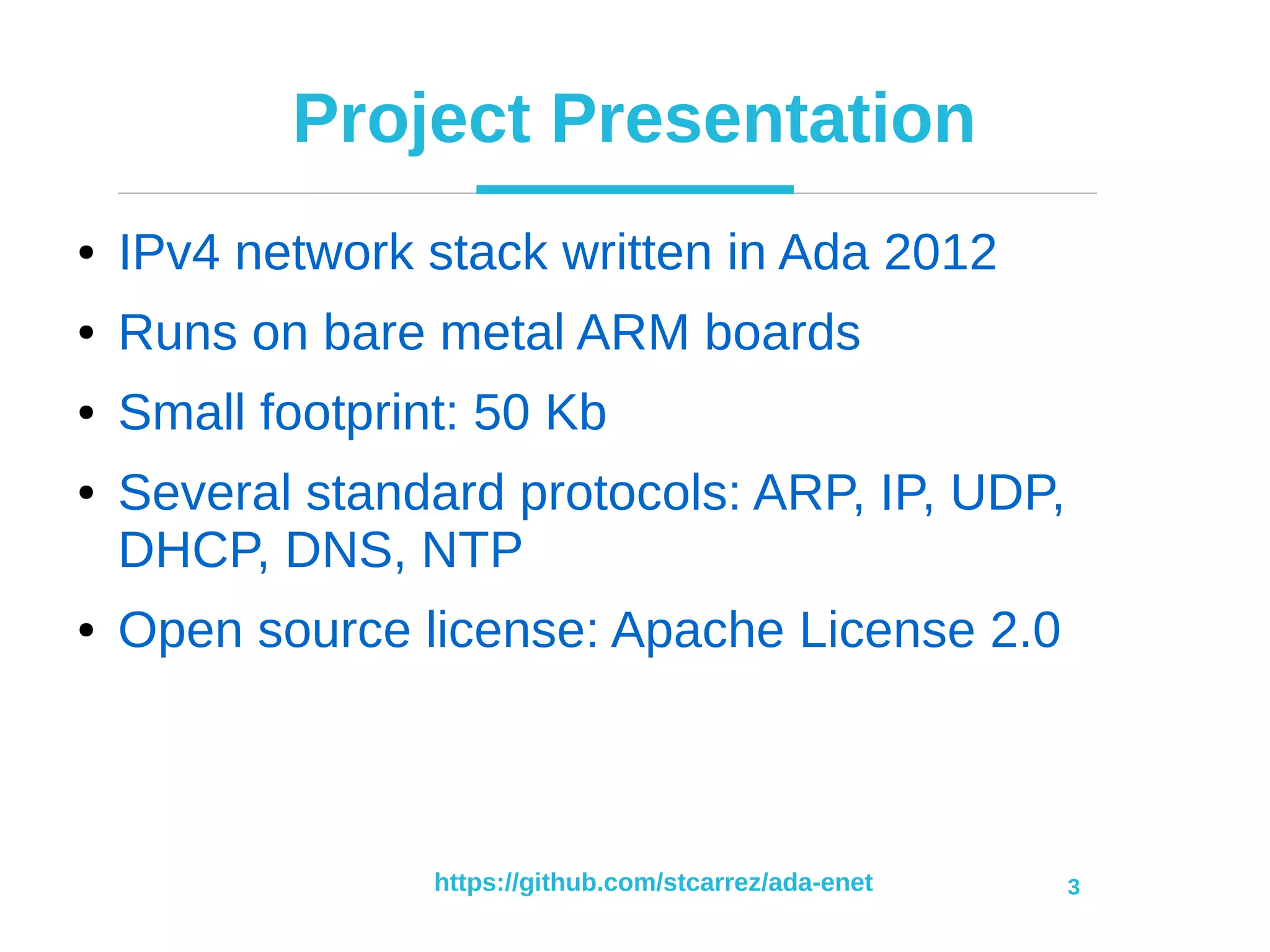
Project Presentation
● IPv4 network stack written in Ada 2012
● Runs on bare metal ARM boards
● Small footprint: 50 Kb
● Several standard protocols: ARP, IP, UDP,
DHCP, DNS, NTP
● Open source license: Apache License 2.0
https://github.com/stcarrez/ada-enet 4
Motivations
● Boards need to interact with the network
● Objects have to be connected
● Get a reliable, safe and secure network stack
● Created for the EtherScope MakeWithAda
project
https://github.com/stcarrez/ada-enet 5
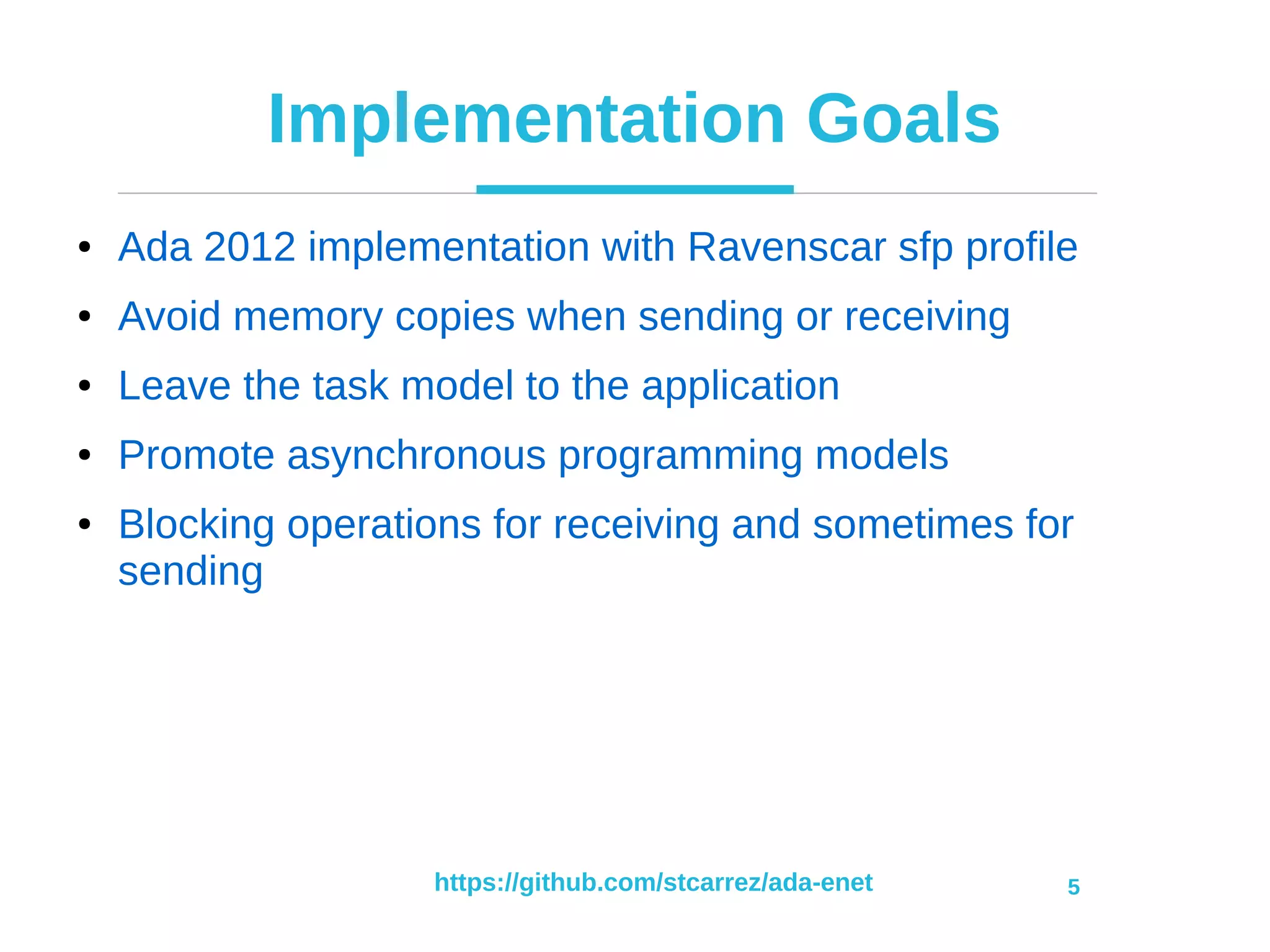
Implementation Goals
● Ada 2012 implementation with Ravenscar sfp profile
● Avoid memory copies when sending or receiving
● Leave the task model to the application
● Promote asynchronous programming models
● Blocking operations for receiving and sometimes for
sending
https://github.com/stcarrez/ada-enet 6
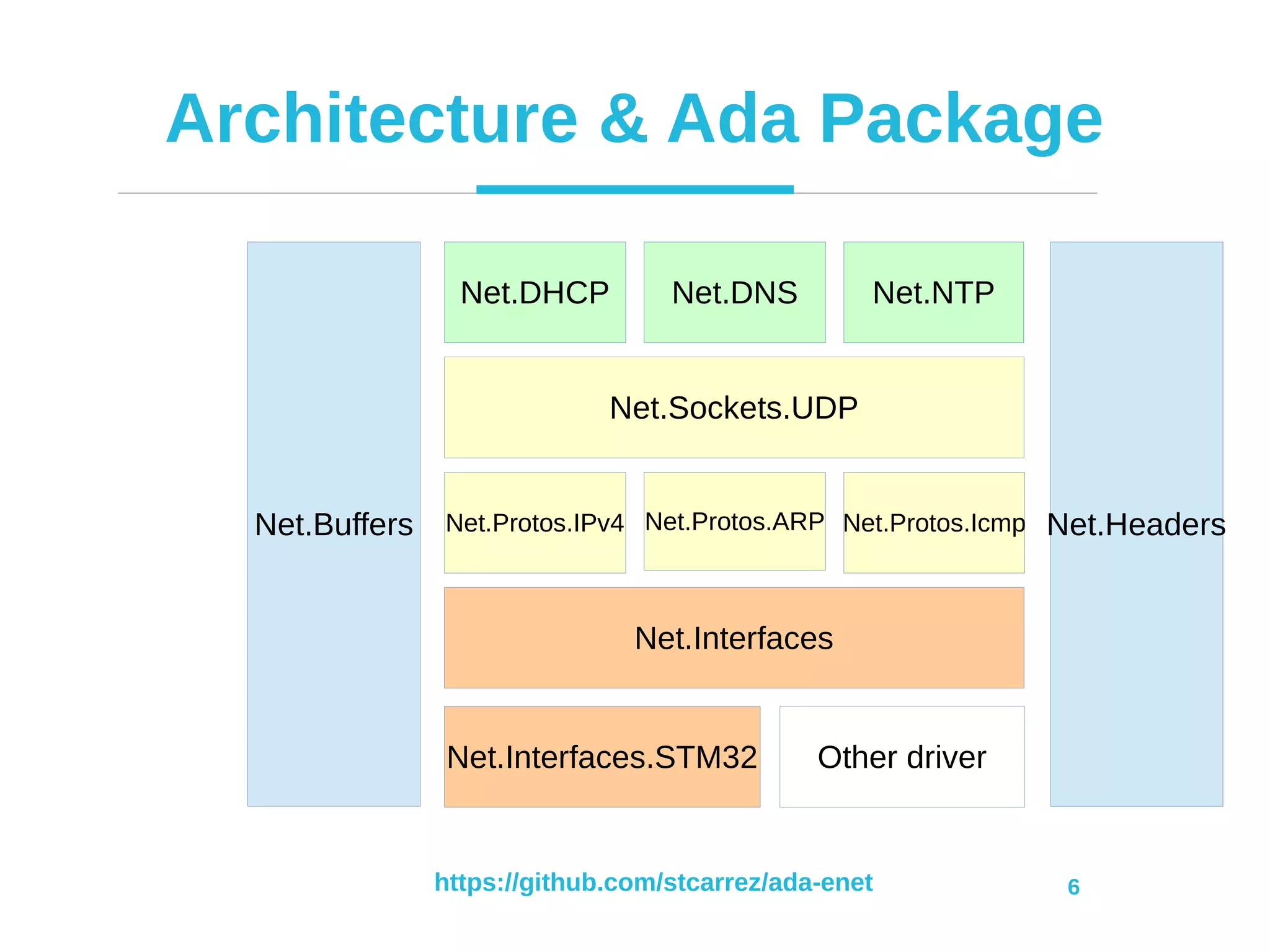
Architecture & Ada Package
Net.DHCP Net.DNS
Net.Sockets.UDP
Net.Protos.IPv4 Net.Protos.ARP
Net.Interfaces
Net.Buffers Net.Protos.Icmp
Net.NTP
Net.Interfaces.STM32 Other driver
Net.Headers
https://github.com/stcarrez/ada-enet 7
Sending a packet
Net.DHCP Net.DNS
Net.Sockets.UDP
Net.Protos.IPv4 Net.Protos.ARP
Net.Interfaces
Net.Buffers Net.Protos.Icmp
Net.NTP
Net.Interfaces.STM32 Other driver
Net.Headers
[1] Allocate
[2] Send
[6] Release
[3] Send
[5] Send
[4] Resolve
https://github.com/stcarrez/ada-enet 8
Receiving a packet
Net.DHCP Net.DNS
Net.Sockets.UDP
Net.Protos.IPv4 Net.Protos.ARP
Net.Interfaces
Net.Buffers Net.Protos.Icmp
Net.NTP
Net.Interfaces.STM32 Other driver
Net.Headers
[1] Allocate
[5] Receive
[3] Receive
[2] Receive
Application
Receive
Task
[4] Receive
https://github.com/stcarrez/ada-enet 9
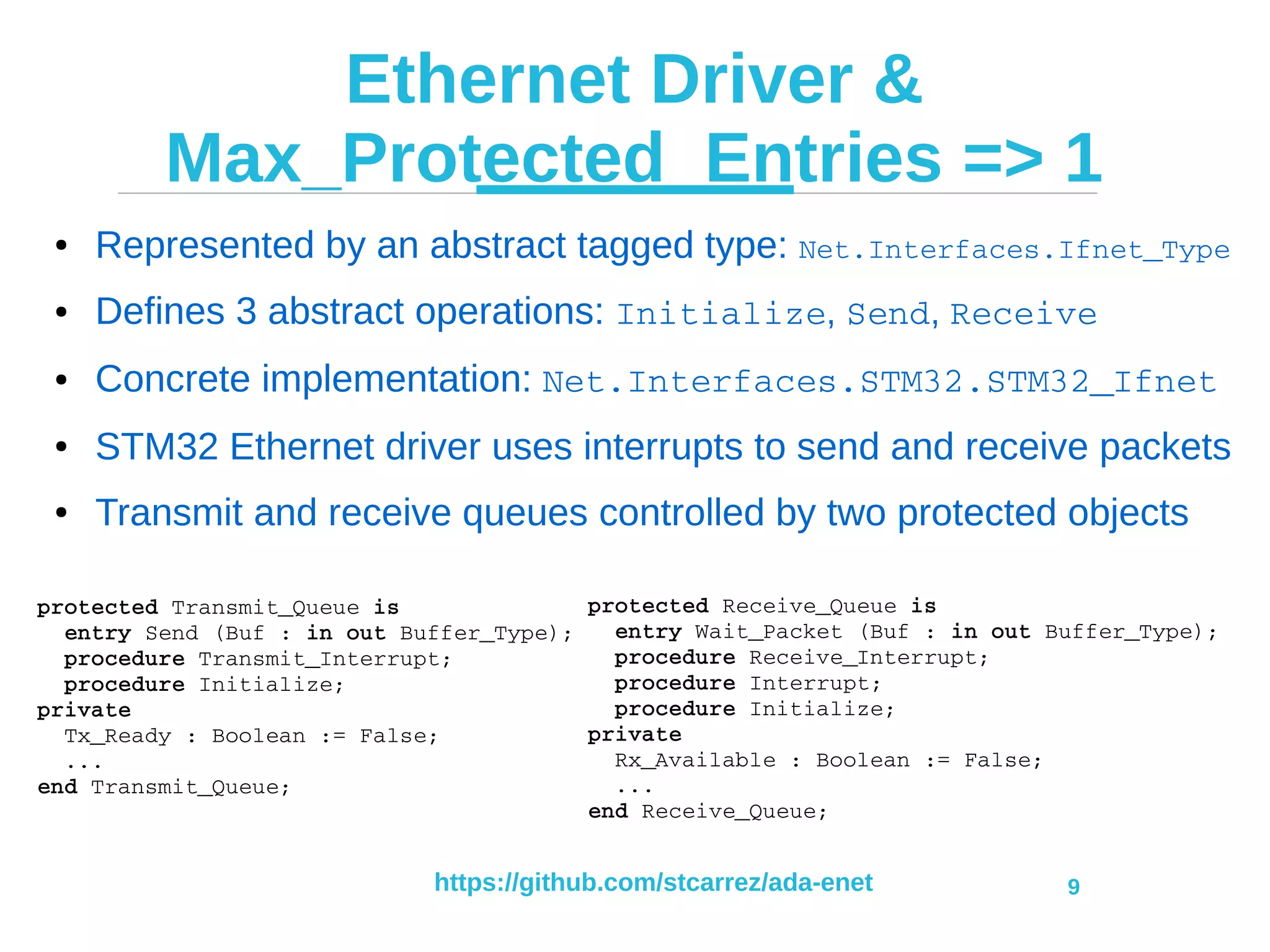
Ethernet Driver &
Max_Protected_Entries => 1
● Represented by an abstract tagged type: Net.Interfaces.Ifnet_Type
● Defines 3 abstract operations: Initialize, Send, Receive
● Concrete implementation: Net.Interfaces.STM32.STM32_Ifnet
● STM32 Ethernet driver uses interrupts to send and receive packets
● Transmit and receive queues controlled by two protected objects
protected Transmit_Queue is
  entry Send (Buf : in out Buffer_Type);
  procedure Transmit_Interrupt;
  procedure Initialize;
private
  Tx_Ready : Boolean := False;
  ...
end Transmit_Queue;
protected Receive_Queue is
  entry Wait_Packet (Buf : in out Buffer_Type);
  procedure Receive_Interrupt;
  procedure Interrupt;
  procedure Initialize;
private
  Rx_Available : Boolean := False;
  ...
end Receive_Queue;
https://github.com/stcarrez/ada-enet 10
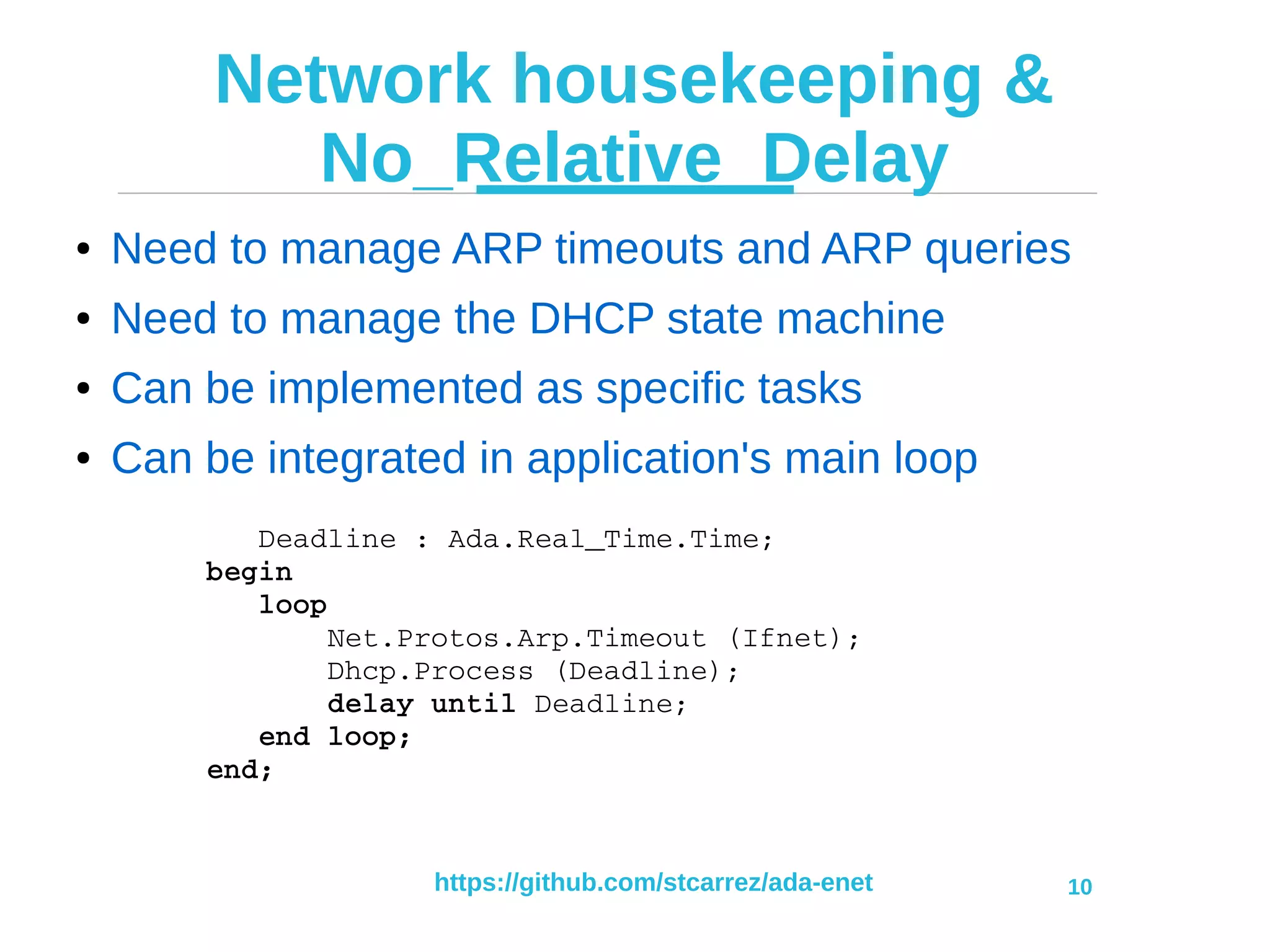
Network housekeeping &
No_Relative_Delay
● Need to manage ARP timeouts and ARP queries
● Need to manage the DHCP state machine
● Can be implemented as specific tasks
● Can be integrated in application's main loop
   Deadline : Ada.Real_Time.Time;
begin
   loop
       Net.Protos.Arp.Timeout (Ifnet);
       Dhcp.Process (Deadline);
       delay until Deadline;
   end loop;
end;
https://github.com/stcarrez/ada-enet 11
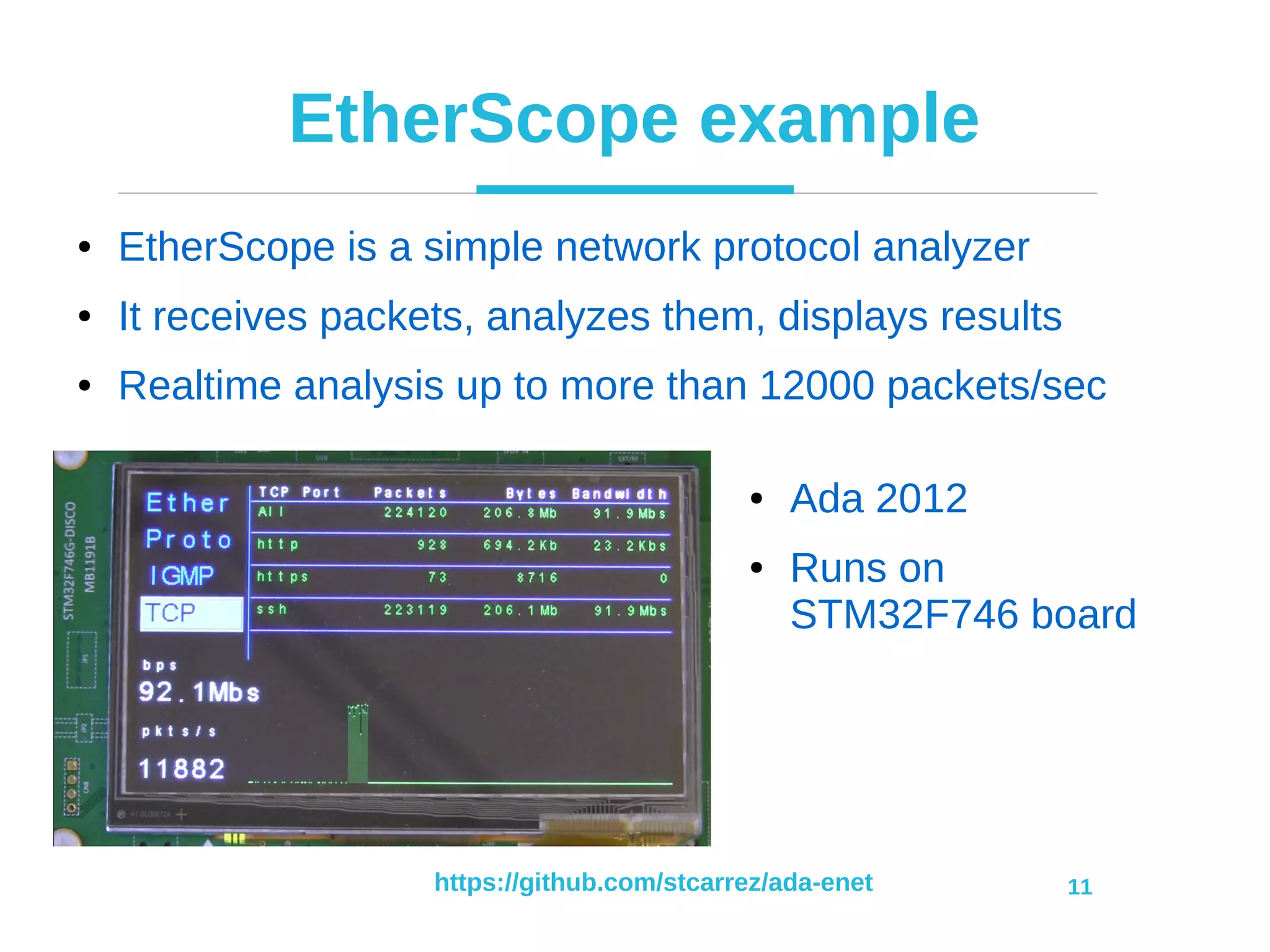
EtherScope example
● EtherScope is a simple network protocol analyzer
● It receives packets, analyzes them, displays results
● Realtime analysis up to more than 12000 packets/sec
● Ada 2012
● Runs on
STM32F746 board
https://github.com/stcarrez/ada-enet 12
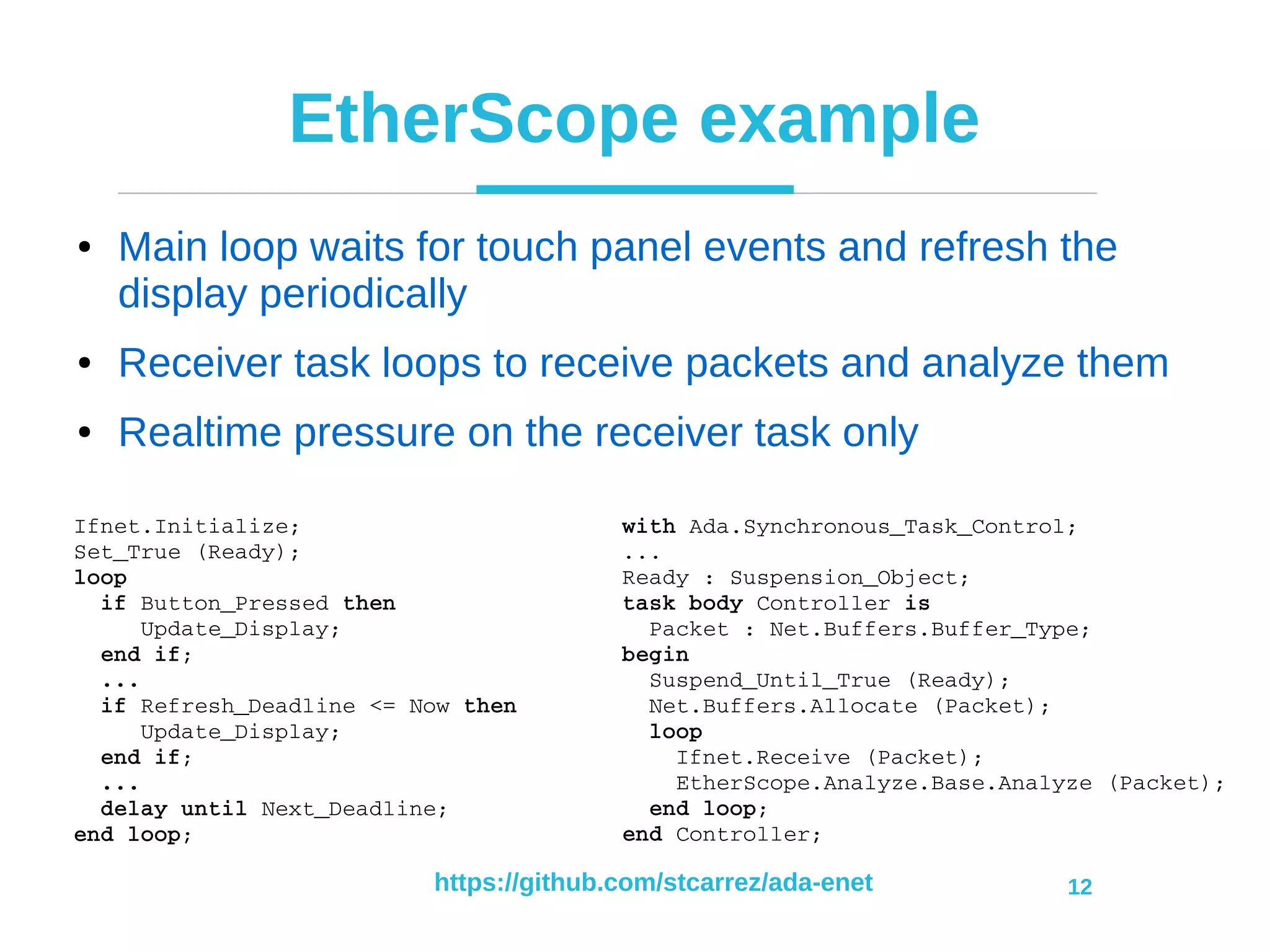
EtherScope example
● Main loop waits for touch panel events and refresh the
display periodically
● Receiver task loops to receive packets and analyze them
● Realtime pressure on the receiver task only
with Ada.Synchronous_Task_Control;
...
Ready : Suspension_Object;
task body Controller is
  Packet : Net.Buffers.Buffer_Type;
begin
  Suspend_Until_True (Ready);
  Net.Buffers.Allocate (Packet);
  loop
    Ifnet.Receive (Packet);
    EtherScope.Analyze.Base.Analyze (Packet);
  end loop;
end Controller;
Ifnet.Initialize;
Set_True (Ready);
loop
  if Button_Pressed then
     Update_Display;
  end if;
  ...
  if Refresh_Deadline <= Now then
     Update_Display;
  end if;
  ...
  delay until Next_Deadline;
end loop;
https://github.com/stcarrez/ada-enet 13
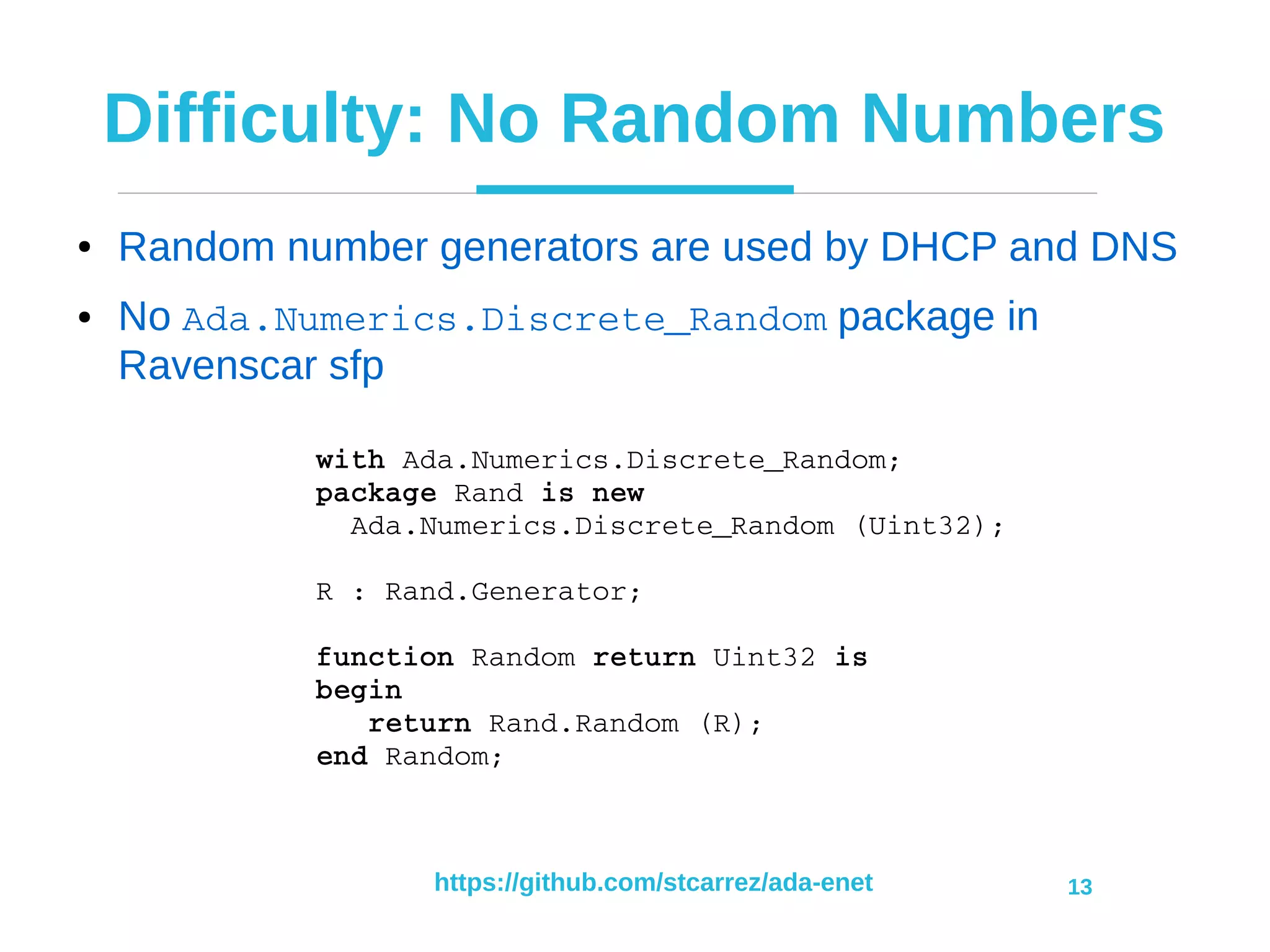
Difficulty: No Random Numbers
● Random number generators are used by DHCP and DNS
● No Ada.Numerics.Discrete_Random package in
Ravenscar sfp
with Ada.Numerics.Discrete_Random;
package Rand is new
  Ada.Numerics.Discrete_Random (Uint32);
R : Rand.Generator;
function Random return Uint32 is
begin
   return Rand.Random (R);
end Random;
https://github.com/stcarrez/ada-enet 14
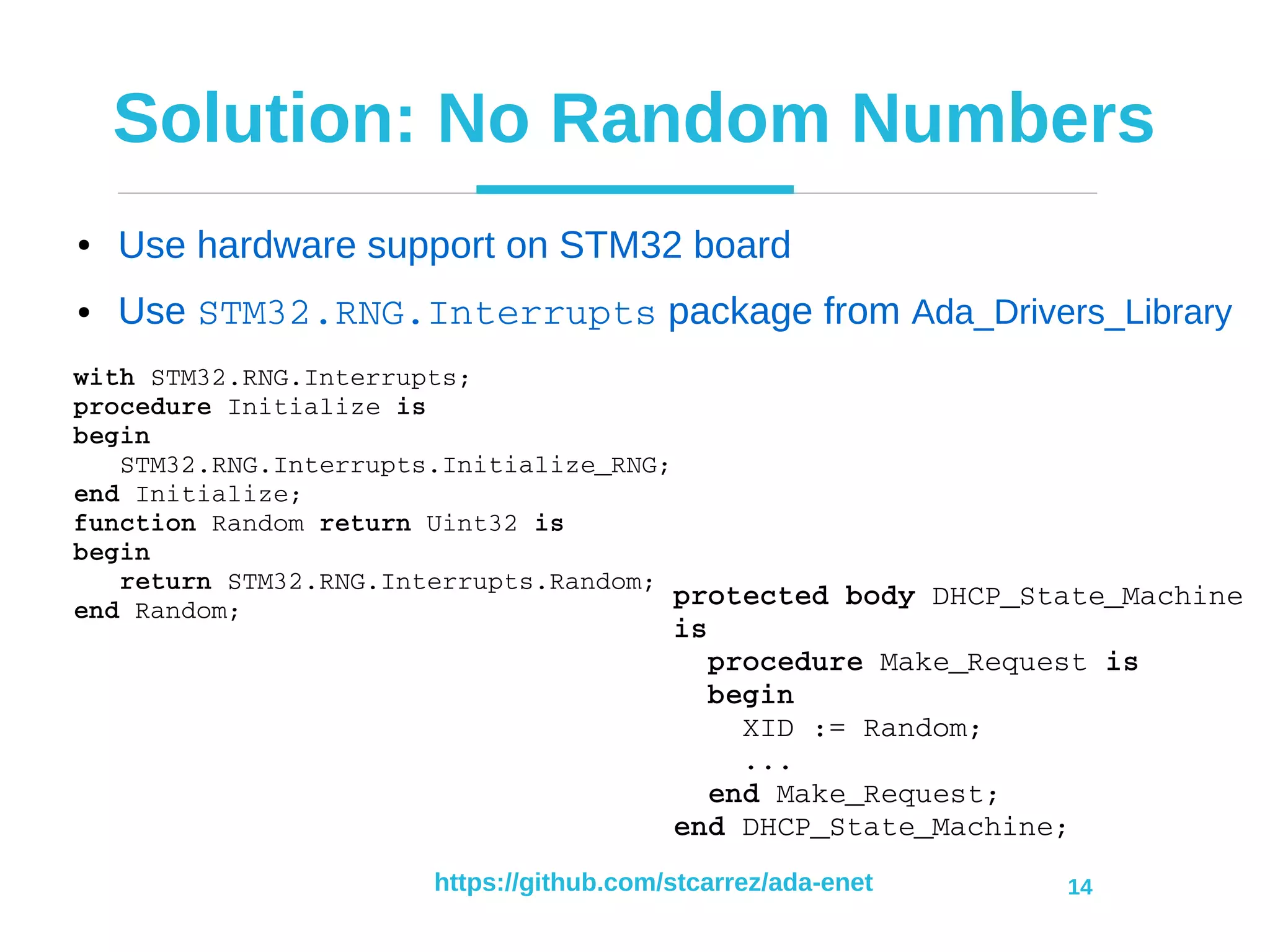
Solution: No Random Numbers
● Use hardware support on STM32 board
● Use STM32.RNG.Interrupts package from Ada_Drivers_Library
with STM32.RNG.Interrupts;
procedure Initialize is
begin
   STM32.RNG.Interrupts.Initialize_RNG;
end Initialize;
function Random return Uint32 is
begin
   return STM32.RNG.Interrupts.Random;
end Random;
protected body DHCP_State_Machine 
is
  procedure Make_Request is
  begin
    XID := Random;
    ...
  end Make_Request;
end DHCP_State_Machine;
https://github.com/stcarrez/ada-enet 15
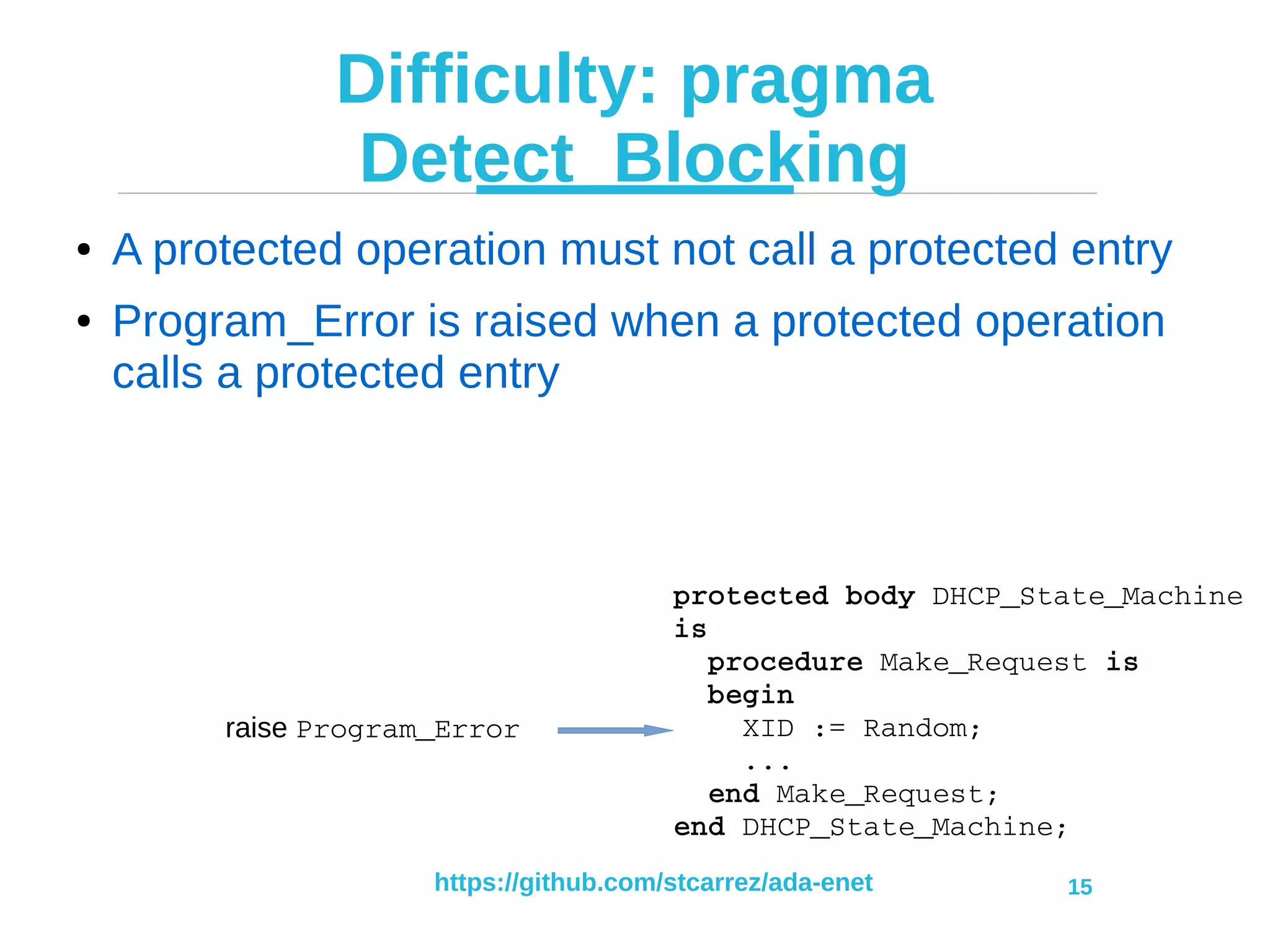
Difficulty: pragma
Detect_Blocking
● A protected operation must not call a protected entry
● Program_Error is raised when a protected operation
calls a protected entry
raise Program_Error
protected body DHCP_State_Machine 
is
  procedure Make_Request is
  begin
    XID := Random;
    ...
  end Make_Request;
end DHCP_State_Machine;
https://github.com/stcarrez/ada-enet 16
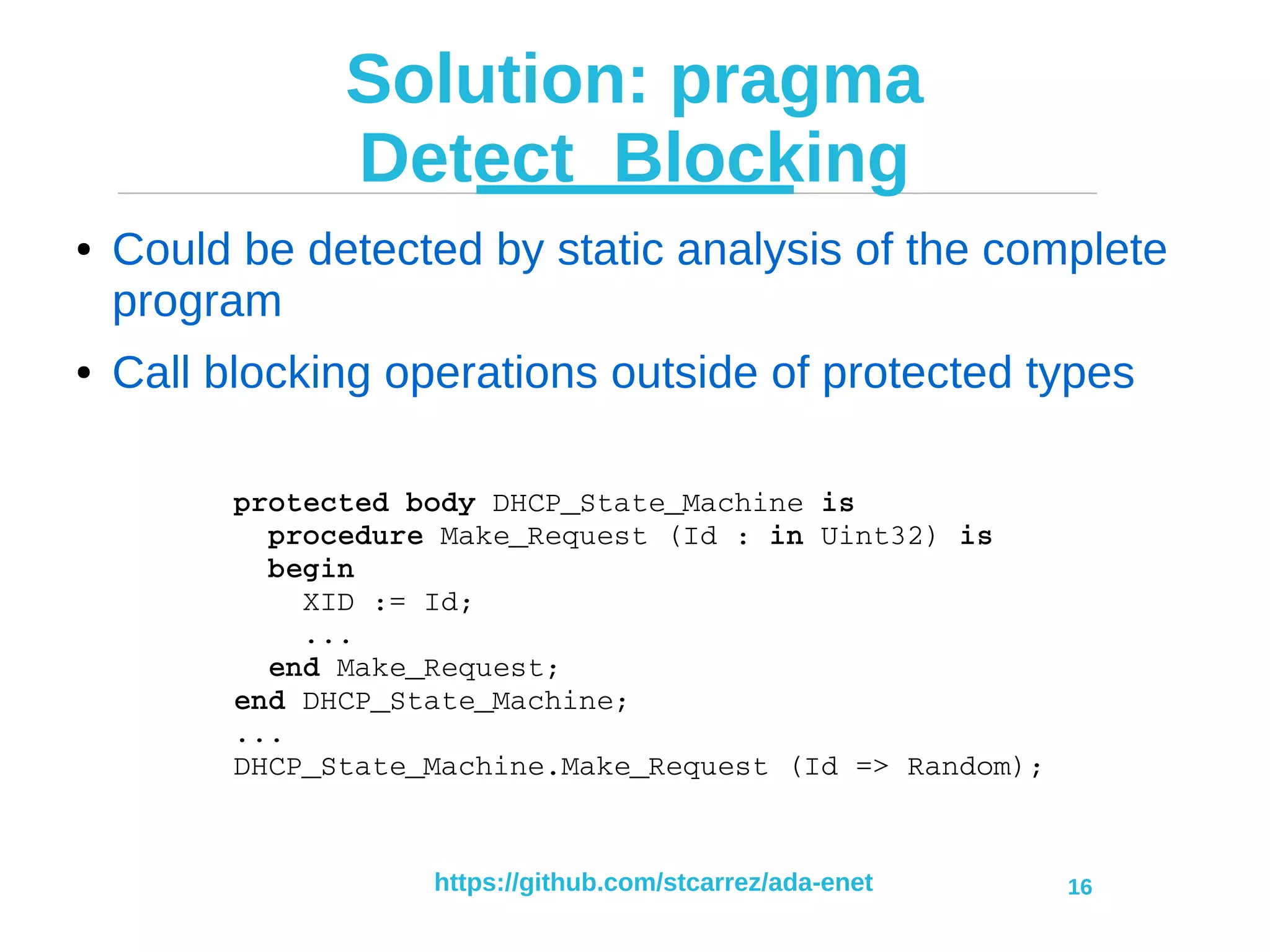
Solution: pragma
Detect_Blocking
● Could be detected by static analysis of the complete
program
● Call blocking operations outside of protected types
protected body DHCP_State_Machine is
  procedure Make_Request (Id : in Uint32) is
  begin
    XID := Id;
    ...
  end Make_Request;
end DHCP_State_Machine;
...
DHCP_State_Machine.Make_Request (Id => Random);
https://github.com/stcarrez/ada-enet 17
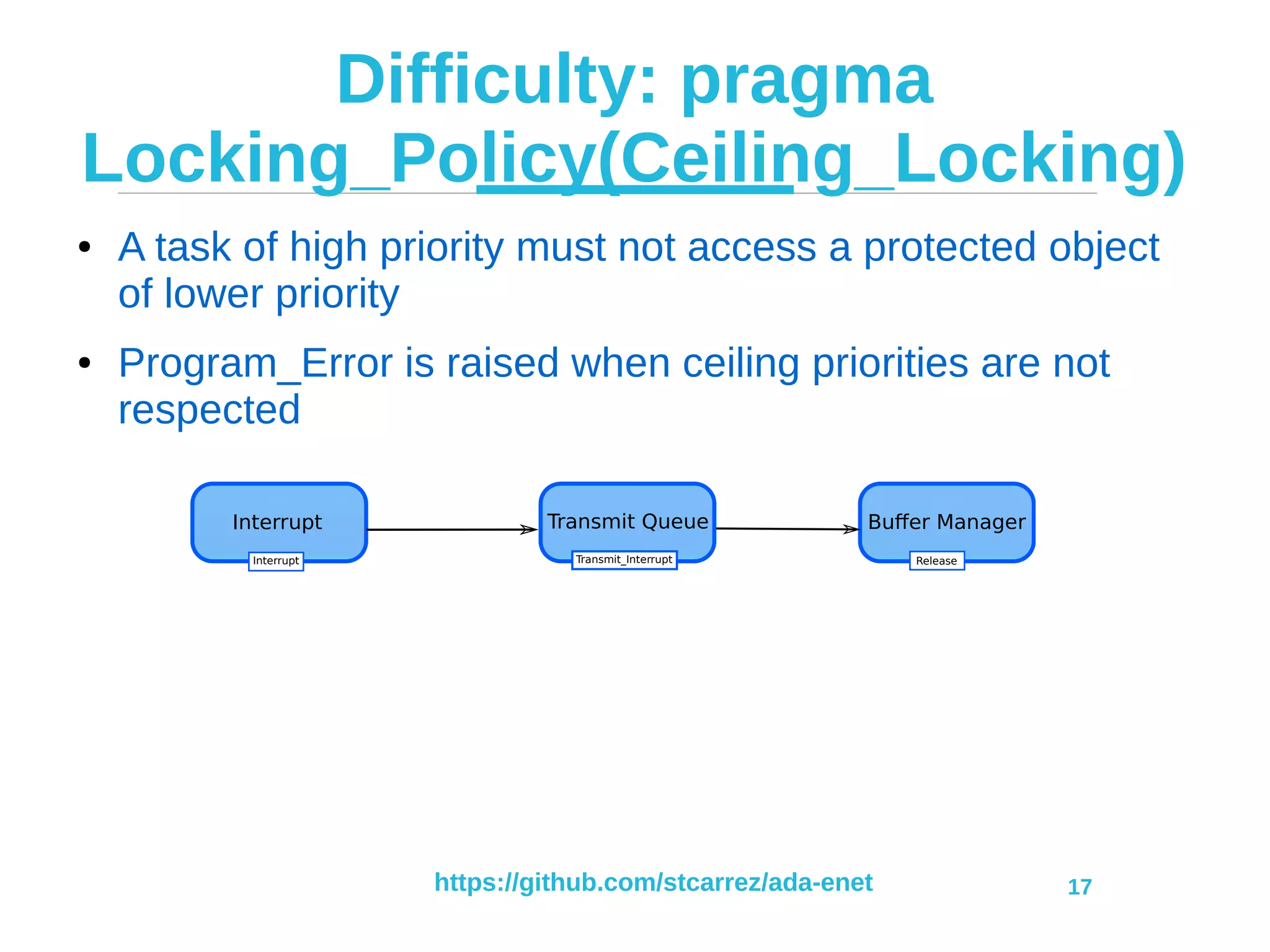
Difficulty: pragma
Locking_Policy(Ceiling_Locking)
● A task of high priority must not access a protected object
of lower priority
● Program_Error is raised when ceiling priorities are not
respected
Transmit Queue
Transmit_Interrupt
Buffer Manager
Release
Interrupt
Interrupt
https://github.com/stcarrez/ada-enet 18
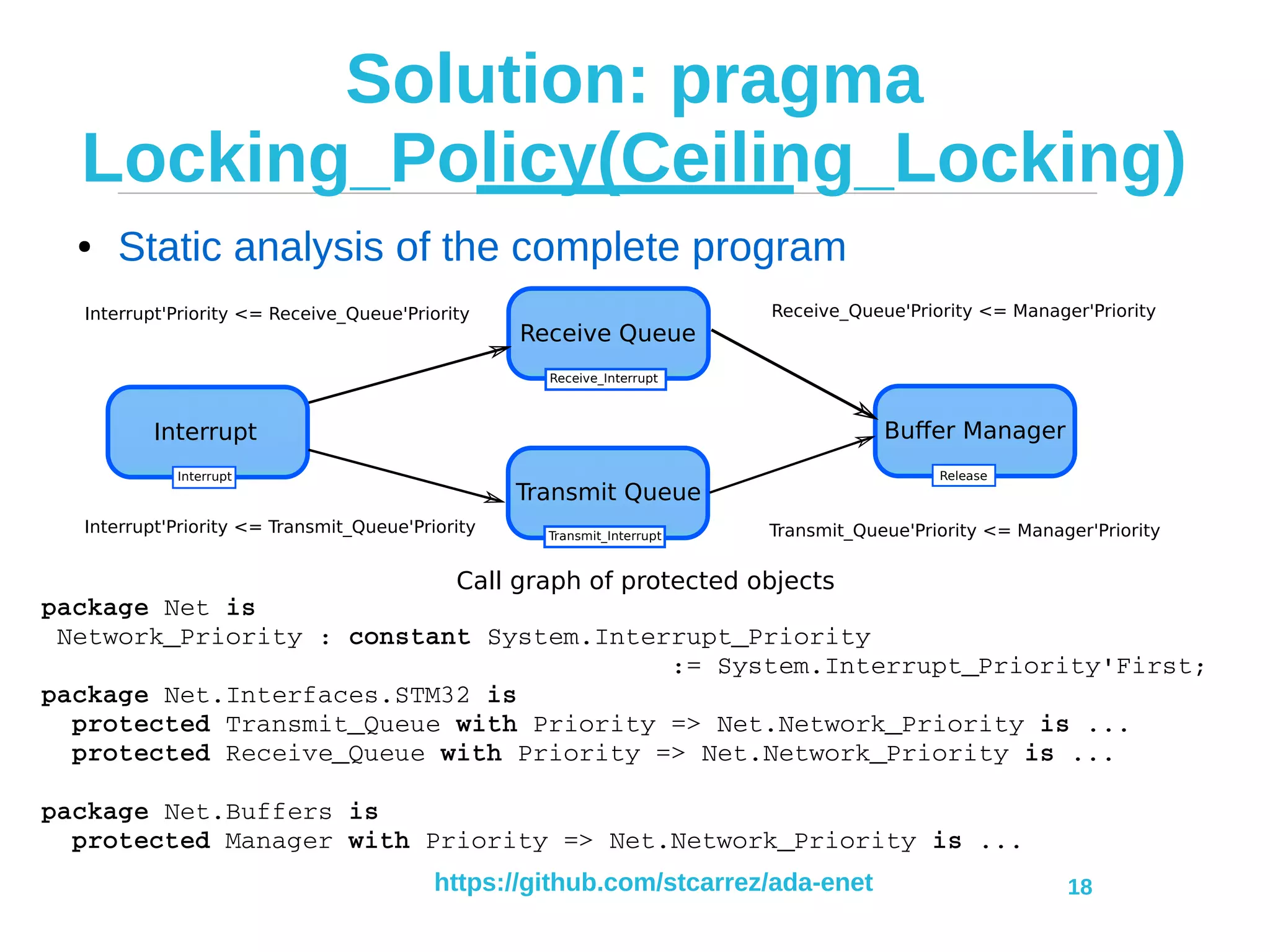
Solution: pragma
Locking_Policy(Ceiling_Locking)
● Static analysis of the complete program
package Net is
 Network_Priority : constant System.Interrupt_Priority
                                         := System.Interrupt_Priority'First;
package Net.Interfaces.STM32 is
  protected Transmit_Queue with Priority => Net.Network_Priority is ...
  protected Receive_Queue with Priority => Net.Network_Priority is ...
package Net.Buffers is
  protected Manager with Priority => Net.Network_Priority is ...
Receive Queue
Transmit Queue
Transmit_Interrupt
Buffer Manager
Release
Transmit_Queue'Priority <= Manager'PriorityInterrupt'Priority <= Transmit_Queue'Priority
Receive_Queue'Priority <= Manager'Priority
Interrupt
Interrupt
Interrupt'Priority <= Receive_Queue'Priority
Receive_Interrupt
Call graph of protected objects
https://github.com/stcarrez/ada-enet 19
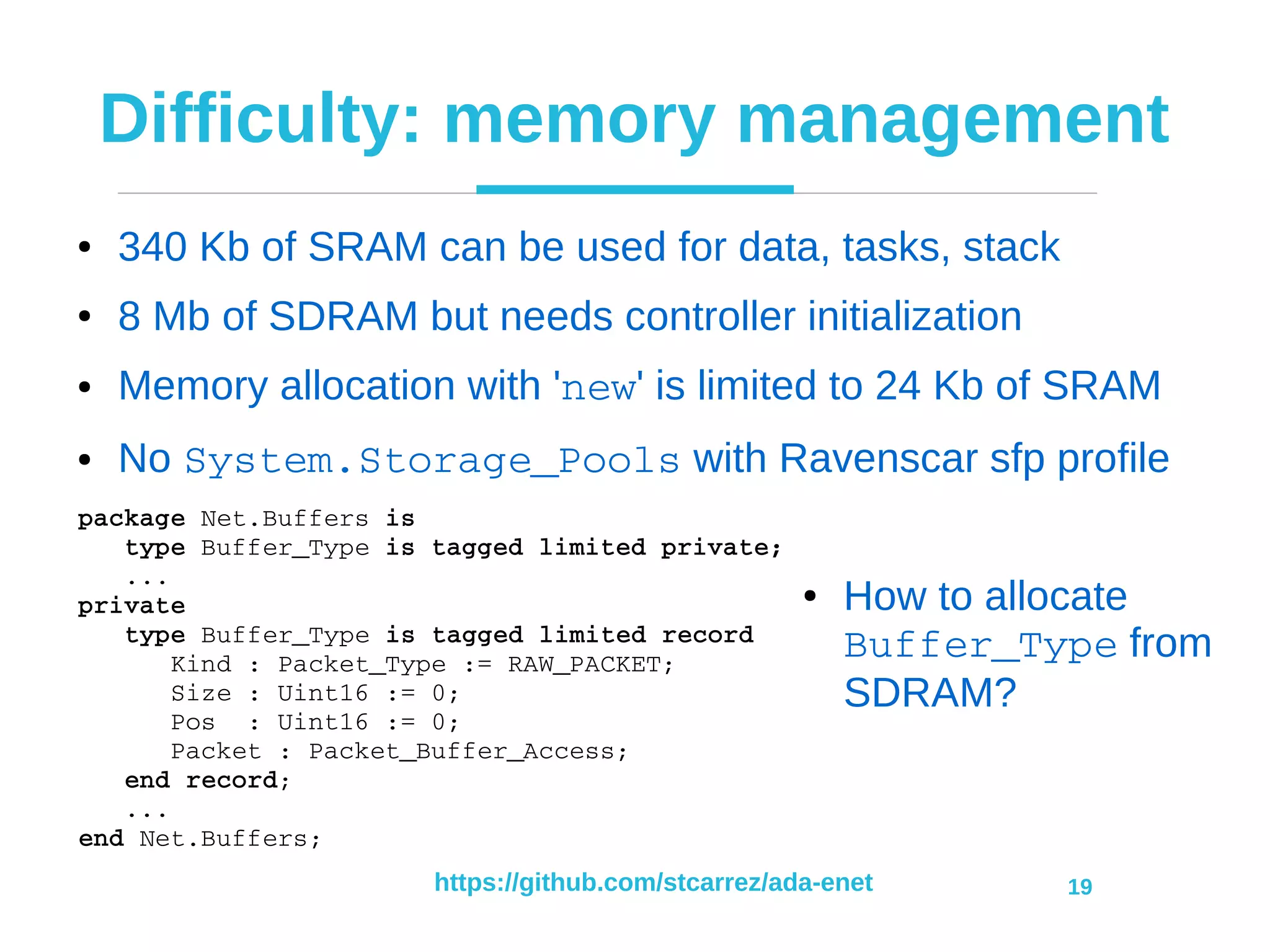
Difficulty: memory management
● 340 Kb of SRAM can be used for data, tasks, stack
● 8 Mb of SDRAM but needs controller initialization
● Memory allocation with 'new' is limited to 24 Kb of SRAM
● No System.Storage_Pools with Ravenscar sfp profile
package Net.Buffers is
   type Buffer_Type is tagged limited private;
   ...
private
   type Buffer_Type is tagged limited record
      Kind : Packet_Type := RAW_PACKET;
      Size : Uint16 := 0;
      Pos  : Uint16 := 0;
      Packet : Packet_Buffer_Access;
   end record;
   ...
end Net.Buffers;
● How to allocate
Buffer_Type from
SDRAM?
https://github.com/stcarrez/ada-enet 20
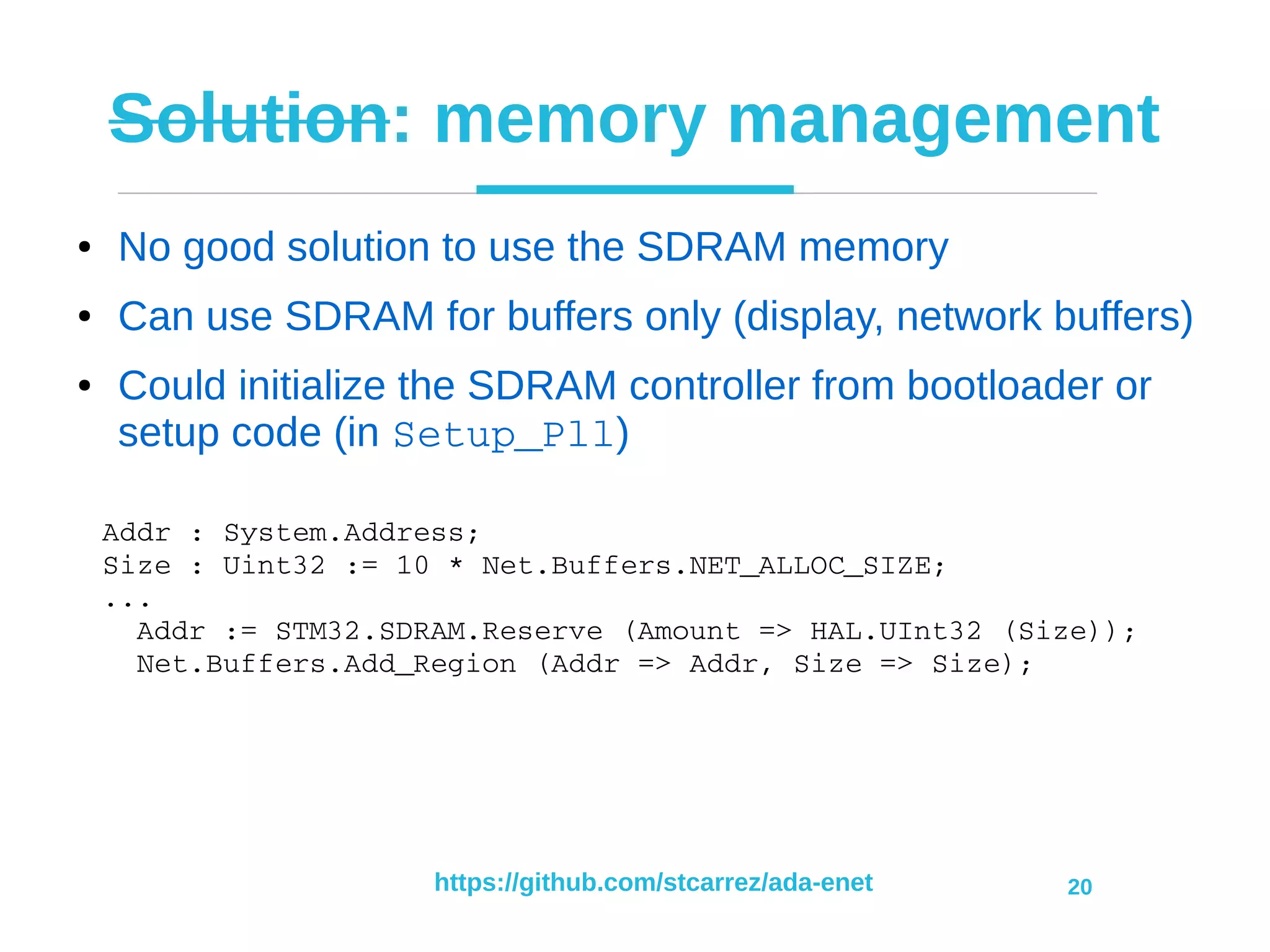
Solution: memory management
● No good solution to use the SDRAM memory
● Can use SDRAM for buffers only (display, network buffers)
● Could initialize the SDRAM controller from bootloader or
setup code (in Setup_Pll)
Addr : System.Address;
Size : Uint32 := 10 * Net.Buffers.NET_ALLOC_SIZE;
...
  Addr := STM32.SDRAM.Reserve (Amount => HAL.UInt32 (Size));
  Net.Buffers.Add_Region (Addr => Addr, Size => Size);
https://github.com/stcarrez/ada-enet 21
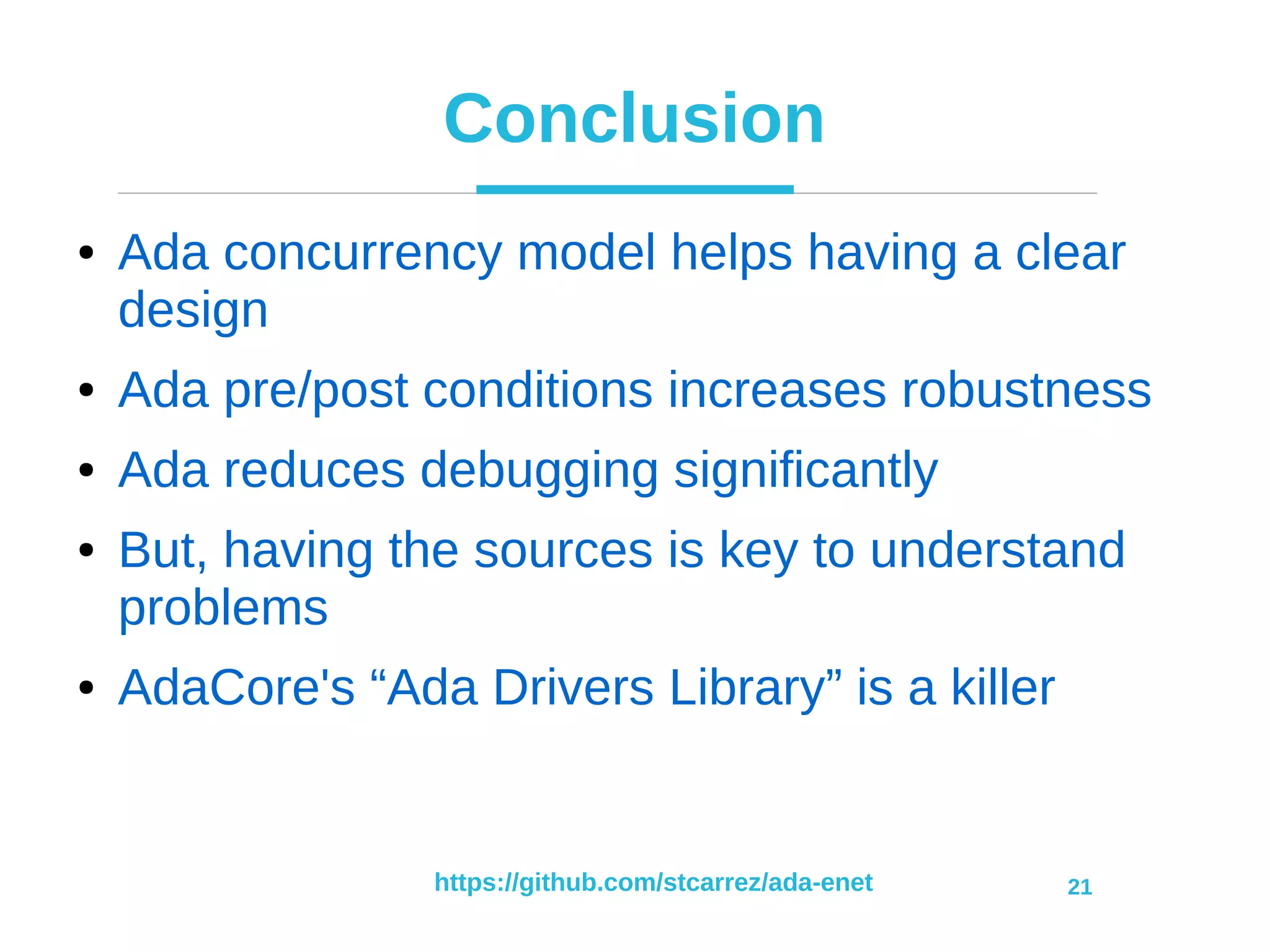
Conclusion
● Ada concurrency model helps having a clear
design
● Ada pre/post conditions increases robustness
● Ada reduces debugging significantly
● But, having the sources is key to understand
problems
● AdaCore's “Ada Drivers Library” is a killer

IP Network Stack in Ada 2012 and the Ravenscar Profile

  • 1.
    IP Network Stackin Ada 2012 and the Ravenscar Profile Stéphane Carrez Ada Europe 2017
  • 2.
    https://github.com/stcarrez/ada-enet 2 Ada EmbeddedNetwork Stack ● Project Presentation ● Implementation Details ● EtherScope use case ● Difficulties and solutions with Ravenscar profile
  • 3.
    https://github.com/stcarrez/ada-enet 3 Project Presentation ●IPv4 network stack written in Ada 2012 ● Runs on bare metal ARM boards ● Small footprint: 50 Kb ● Several standard protocols: ARP, IP, UDP, DHCP, DNS, NTP ● Open source license: Apache License 2.0
  • 4.
    https://github.com/stcarrez/ada-enet 4 Motivations ● Boardsneed to interact with the network ● Objects have to be connected ● Get a reliable, safe and secure network stack ● Created for the EtherScope MakeWithAda project
  • 5.
    https://github.com/stcarrez/ada-enet 5 Implementation Goals ●Ada 2012 implementation with Ravenscar sfp profile ● Avoid memory copies when sending or receiving ● Leave the task model to the application ● Promote asynchronous programming models ● Blocking operations for receiving and sometimes for sending
  • 6.
    https://github.com/stcarrez/ada-enet 6 Architecture &Ada Package Net.DHCP Net.DNS Net.Sockets.UDP Net.Protos.IPv4 Net.Protos.ARP Net.Interfaces Net.Buffers Net.Protos.Icmp Net.NTP Net.Interfaces.STM32 Other driver Net.Headers
  • 7.
    https://github.com/stcarrez/ada-enet 7 Sending apacket Net.DHCP Net.DNS Net.Sockets.UDP Net.Protos.IPv4 Net.Protos.ARP Net.Interfaces Net.Buffers Net.Protos.Icmp Net.NTP Net.Interfaces.STM32 Other driver Net.Headers [1] Allocate [2] Send [6] Release [3] Send [5] Send [4] Resolve
  • 8.
    https://github.com/stcarrez/ada-enet 8 Receiving apacket Net.DHCP Net.DNS Net.Sockets.UDP Net.Protos.IPv4 Net.Protos.ARP Net.Interfaces Net.Buffers Net.Protos.Icmp Net.NTP Net.Interfaces.STM32 Other driver Net.Headers [1] Allocate [5] Receive [3] Receive [2] Receive Application Receive Task [4] Receive
  • 9.
    https://github.com/stcarrez/ada-enet 9 Ethernet Driver& Max_Protected_Entries => 1 ● Represented by an abstract tagged type: Net.Interfaces.Ifnet_Type ● Defines 3 abstract operations: Initialize, Send, Receive ● Concrete implementation: Net.Interfaces.STM32.STM32_Ifnet ● STM32 Ethernet driver uses interrupts to send and receive packets ● Transmit and receive queues controlled by two protected objects protected Transmit_Queue is   entry Send (Buf : in out Buffer_Type);   procedure Transmit_Interrupt;   procedure Initialize; private   Tx_Ready : Boolean := False;   ... end Transmit_Queue; protected Receive_Queue is   entry Wait_Packet (Buf : in out Buffer_Type);   procedure Receive_Interrupt;   procedure Interrupt;   procedure Initialize; private   Rx_Available : Boolean := False;   ... end Receive_Queue;
  • 10.
    https://github.com/stcarrez/ada-enet 10 Network housekeeping& No_Relative_Delay ● Need to manage ARP timeouts and ARP queries ● Need to manage the DHCP state machine ● Can be implemented as specific tasks ● Can be integrated in application's main loop    Deadline : Ada.Real_Time.Time; begin    loop        Net.Protos.Arp.Timeout (Ifnet);        Dhcp.Process (Deadline);        delay until Deadline;    end loop; end;
  • 11.
    https://github.com/stcarrez/ada-enet 11 EtherScope example ●EtherScope is a simple network protocol analyzer ● It receives packets, analyzes them, displays results ● Realtime analysis up to more than 12000 packets/sec ● Ada 2012 ● Runs on STM32F746 board
  • 12.
    https://github.com/stcarrez/ada-enet 12 EtherScope example ●Main loop waits for touch panel events and refresh the display periodically ● Receiver task loops to receive packets and analyze them ● Realtime pressure on the receiver task only with Ada.Synchronous_Task_Control; ... Ready : Suspension_Object; task body Controller is   Packet : Net.Buffers.Buffer_Type; begin   Suspend_Until_True (Ready);   Net.Buffers.Allocate (Packet);   loop     Ifnet.Receive (Packet);     EtherScope.Analyze.Base.Analyze (Packet);   end loop; end Controller; Ifnet.Initialize; Set_True (Ready); loop   if Button_Pressed then      Update_Display;   end if;   ...   if Refresh_Deadline <= Now then      Update_Display;   end if;   ...   delay until Next_Deadline; end loop;
  • 13.
    https://github.com/stcarrez/ada-enet 13 Difficulty: NoRandom Numbers ● Random number generators are used by DHCP and DNS ● No Ada.Numerics.Discrete_Random package in Ravenscar sfp with Ada.Numerics.Discrete_Random; package Rand is new   Ada.Numerics.Discrete_Random (Uint32); R : Rand.Generator; function Random return Uint32 is begin    return Rand.Random (R); end Random;
  • 14.
    https://github.com/stcarrez/ada-enet 14 Solution: NoRandom Numbers ● Use hardware support on STM32 board ● Use STM32.RNG.Interrupts package from Ada_Drivers_Library with STM32.RNG.Interrupts; procedure Initialize is begin    STM32.RNG.Interrupts.Initialize_RNG; end Initialize; function Random return Uint32 is begin    return STM32.RNG.Interrupts.Random; end Random; protected body DHCP_State_Machine  is   procedure Make_Request is   begin     XID := Random;     ...   end Make_Request; end DHCP_State_Machine;
  • 15.
    https://github.com/stcarrez/ada-enet 15 Difficulty: pragma Detect_Blocking ●A protected operation must not call a protected entry ● Program_Error is raised when a protected operation calls a protected entry raise Program_Error protected body DHCP_State_Machine  is   procedure Make_Request is   begin     XID := Random;     ...   end Make_Request; end DHCP_State_Machine;
  • 16.
    https://github.com/stcarrez/ada-enet 16 Solution: pragma Detect_Blocking ●Could be detected by static analysis of the complete program ● Call blocking operations outside of protected types protected body DHCP_State_Machine is   procedure Make_Request (Id : in Uint32) is   begin     XID := Id;     ...   end Make_Request; end DHCP_State_Machine; ... DHCP_State_Machine.Make_Request (Id => Random);
  • 17.
    https://github.com/stcarrez/ada-enet 17 Difficulty: pragma Locking_Policy(Ceiling_Locking) ●A task of high priority must not access a protected object of lower priority ● Program_Error is raised when ceiling priorities are not respected Transmit Queue Transmit_Interrupt Buffer Manager Release Interrupt Interrupt
  • 18.
    https://github.com/stcarrez/ada-enet 18 Solution: pragma Locking_Policy(Ceiling_Locking) ●Static analysis of the complete program package Net is  Network_Priority : constant System.Interrupt_Priority                                          := System.Interrupt_Priority'First; package Net.Interfaces.STM32 is   protected Transmit_Queue with Priority => Net.Network_Priority is ...   protected Receive_Queue with Priority => Net.Network_Priority is ... package Net.Buffers is   protected Manager with Priority => Net.Network_Priority is ... Receive Queue Transmit Queue Transmit_Interrupt Buffer Manager Release Transmit_Queue'Priority <= Manager'PriorityInterrupt'Priority <= Transmit_Queue'Priority Receive_Queue'Priority <= Manager'Priority Interrupt Interrupt Interrupt'Priority <= Receive_Queue'Priority Receive_Interrupt Call graph of protected objects
  • 19.
    https://github.com/stcarrez/ada-enet 19 Difficulty: memorymanagement ● 340 Kb of SRAM can be used for data, tasks, stack ● 8 Mb of SDRAM but needs controller initialization ● Memory allocation with 'new' is limited to 24 Kb of SRAM ● No System.Storage_Pools with Ravenscar sfp profile package Net.Buffers is    type Buffer_Type is tagged limited private;    ... private    type Buffer_Type is tagged limited record       Kind : Packet_Type := RAW_PACKET;       Size : Uint16 := 0;       Pos  : Uint16 := 0;       Packet : Packet_Buffer_Access;    end record;    ... end Net.Buffers; ● How to allocate Buffer_Type from SDRAM?
  • 20.
    https://github.com/stcarrez/ada-enet 20 Solution: memorymanagement ● No good solution to use the SDRAM memory ● Can use SDRAM for buffers only (display, network buffers) ● Could initialize the SDRAM controller from bootloader or setup code (in Setup_Pll) Addr : System.Address; Size : Uint32 := 10 * Net.Buffers.NET_ALLOC_SIZE; ...   Addr := STM32.SDRAM.Reserve (Amount => HAL.UInt32 (Size));   Net.Buffers.Add_Region (Addr => Addr, Size => Size);
  • 21.
    https://github.com/stcarrez/ada-enet 21 Conclusion ● Adaconcurrency model helps having a clear design ● Ada pre/post conditions increases robustness ● Ada reduces debugging significantly ● But, having the sources is key to understand problems ● AdaCore's “Ada Drivers Library” is a killer