
IPR PROTECTION IN INDIA VIJAY PAL DALMIA HEAD IP & IT LAWS DIVISION  VAISH ASSOCIATES ADVOCATES
  Comprises of the following Laws:- Laws relating to Trade Marks / Brands (Trade Marks Act,  1999), Property Marks  Laws relating to Copyright (Copyright Act, 1957) Artistic Work, Literary Work, Audio Video Records and Software Laws relating to Industrial Designs (Designs Act, 2000) INTELLECTUAL PROPERTY LAW INTRODUCTION
Laws relating to Patents (The Patent Act, 1970) Laws relating to Geographical Indications. The geographical Indications of (Registration and Protection) Act, 1999  Laws relating to Internet, Web and Information Technology (Information Technology Act, 2000) Domain Names
INFRINGEMENT WHEN AN  IPR IS  REGISTERED i.e.Trade Mark , Patent  Industrial Designs , Geographical Indications  Copyright  INFRINGEMENT OF IPR  AND LEGAL REMEDIES
Passing off is a common law tort which can be used to enforce unregistered trademark rights. Passing off essentially occurs where the reputation of party A is misappropriated by party B, such that party B misrepresents this reputation and damages the goodwill of party A. The law of passing off prevents one person from misrepresenting his or her goods or services as being the goods and services of the plaintiff, and also prevents one person from holding out his or her goods or services as having some association or connection with the plaintiff when this is not true. PASSING OFF
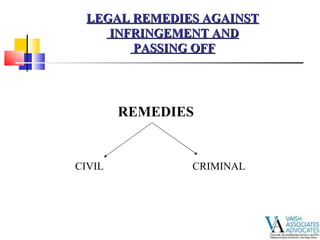
REMEDIES LEGAL REMEDIES AGAINST INFRINGEMENT AND PASSING OFF CIVIL CRIMINAL
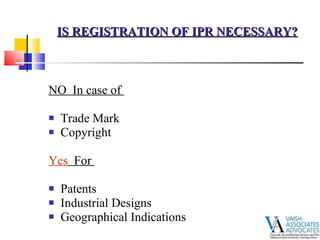
NO  In case of  Trade Mark Copyright  Yes   For  Patents  Industrial Designs  Geographical Indications  IS REGISTRATION OF IPR NECESSARY?
COPYRIGHT: - Registration of Copyright w.r.t any logo / trade mark is not necessary or compulsory under the provisions of the Indian Copyright Act, 1957.  Automatic protection is available to an artistic work, form the date when the artistic work / logo was designed. Copyright Comes in to existence when the concept in mind is put in to some tangible form or crated  HOW COPYRIGHT COMES IN TO EXISTENCE !
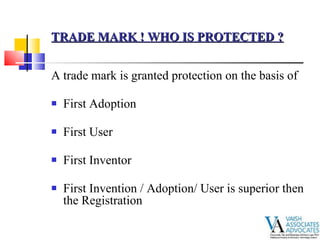
A trade mark is granted protection on the basis of  First Adoption  First User First Inventor  First Invention / Adoption/ User is superior then the Registration   TRADE MARK ! WHO IS PROTECTED ?
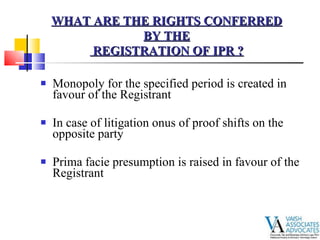
Monopoly for the specified period is created in favour of the Registrant In case of litigation onus of proof shifts on the opposite party  Prima facie presumption is raised in favour of the Registrant WHAT ARE THE RIGHTS CONFERRED BY THE REGISTRATION OF IPR ?
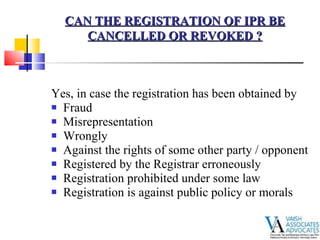
Yes, in case the registration has been obtained by Fraud  Misrepresentation  Wrongly  Against the rights of some other party / opponent  Registered by the Registrar erroneously  Registration prohibited under some law  Registration is against public policy or morals   CAN THE REGISTRATION OF IPR BE CANCELLED OR REVOKED ?
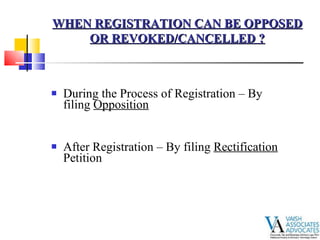
During the Process of Registration – By filing  Opposition   After Registration – By filing  Rectification  Petition  WHEN REGISTRATION CAN BE OPPOSED OR REVOKED/CANCELLED ?
There are two ways to compare similarities between two trade marks :- PHONETIC Similarity  OCULAR Similarity  Other tests for comparison are :- WHAT IS THE TEST OF COMPARISON IN  CASE OF VIOLATION OF IPR ?
Likely hood of confusion and deception  From the angle of a prudent person of ordinary intelligence  No microscopic comparison  No actual confusion or deception is required  Actual loss or damage not necessary  OTHER TESTS OF COMPARISON
Injunction/stay  Damages  Accounts and handing over of profits Appointment of local commissioner by the court for custody/sealing of infringing material/accounts Interim Injunction: Ex-Parte After Hearing   CIVIL REMEDIES
Filing of plaint with supporting evidence at the time of filing of the suit Filing of application under Order 39 Rule 1 & 2 read with sec. 151 of the Code of Civil Procedure, for grant of ex-parte ad-interim; Filing of application under Order 26 of the Code of Civil Procedure for appointment of a local commissioner, to make inventory and/or to take possession of the infringing material form the premises of the defendants, their agents, retailers and distributors etc. Hearing of arguments by court on application for grant of ex-parte injunction and appointment of local commissioner; The court may, if satisfied, grant ex-parte and interim injunction and appoint a local commissioner. PROCEDURE & PROCESS FOR A CIVIL CASE
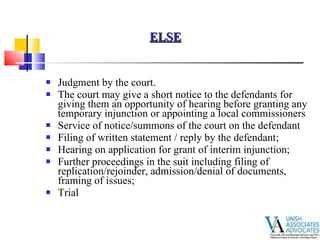
Judgment by the court. The court may give a short notice to the defendants for giving them an opportunity of hearing before granting any temporary injunction or appointing a local commissioners Service of notice/summons of the court on the defendant Filing of written statement / reply by the defendant; Hearing on application for grant of interim injunction; Further proceedings in the suit including filing of replication/rejoinder, admission/denial of documents, framing of issues; Trial ELSE
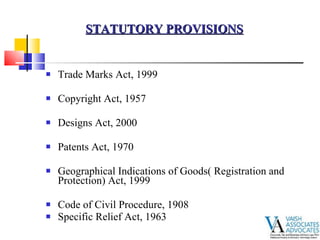
Trade Marks Act, 1999 Copyright Act, 1957 Designs Act, 2000 Patents Act, 1970 Geographical Indications of Goods( Registration and Protection) Act, 1999 Code of Civil Procedure, 1908 Specific Relief Act, 1963 STATUTORY PROVISIONS
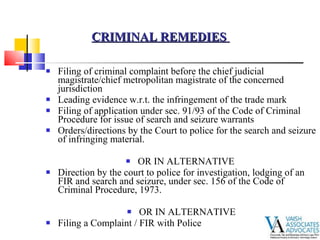
Filing of criminal complaint before the chief judicial magistrate/chief metropolitan magistrate of the concerned jurisdiction Leading evidence w.r.t. the infringement of the trade mark Filing of application under sec. 91/93 of the Code of Criminal Procedure for issue of search and seizure warrants Orders/directions by the Court to police for the search and seizure of infringing material. OR IN ALTERNATIVE  Direction by the court to police for investigation, lodging of an FIR and search and seizure, under sec. 156 of the Code of Criminal Procedure, 1973. OR IN ALTERNATIVE Filing a Complaint / FIR with Police CRIMINAL REMEDIES
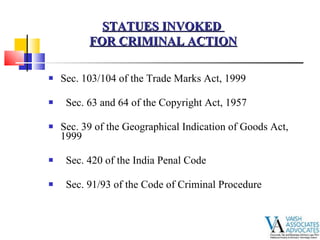
Sec. 103/104 of the Trade Marks Act, 1999 Sec. 63 and 64 of the Copyright Act, 1957 Sec. 39 of the Geographical Indication of Goods Act, 1999 Sec. 420 of the India Penal Code Sec. 91/93 of the Code of Criminal Procedure  STATUES INVOKED  FOR CRIMINAL ACTION
In India, the jurisdiction for the purposes of filing a civil suit, will depend upon following facts, and subject to the following conditions:- Where the cause of action has accrued; Where the part of the cause of action has accrued; Where the properties / violations are taking place; Where the defendants reside or work for gain; In brief, the jurisdiction for the purposes of filing a case would depend upon the place of business of the defendants. IN WHICH COURT A CIVIL CASE CAN  BE FILED AGAINST VIOLATION OF IPR ?
In India a suit may be instituted in any Court of original jurisdiction, subject to its pecuniary & territorial jurisdiction.  The designation of the lowest court is “District & Sessions Judge”.  Such cases can also be directly filed in the High Court, if such High Court is vested with original jurisdiction, e.g. Delhi High Court. The Jurisdiction of High Court could be invoked, subject to the payment of Court fees. The structure of Court fees vary from state to state. COMPETENT COURT FOR CIVIL ACTION
Yes, if the artwork, get up, design, color combination of a trade mark/ label/ packing material is similar and / or deceptively similar, the provisions of the Copyright Act, 1957, can also be invoked along with the Trade Marks Act, 1959, and this course of action is always preferable, as under the provisions of the Copyright Act, 1957, the offence becomes COGINIZABLE, and police can, on its own directly initiate Criminal proceedings after registration of an FIR. CAN LEGAL ACTION UNDER THE TRADE MARKS ACT, 1999 AND THE COPYRIGHT  ACT, 1957 , BE COMBINED ?
Criminal Complaint in the Court of competent jurisdiction; Pre summoning Evidence, for satisfying the court on the basis of the evidence placed on record, that the  allegations by complainant are prima facie maintainable; Issue of General/ specific Search and Seizure Warrants, along with directions to police; PROCEDURE FOR FILING A  CRIMINAL COMPLAINT
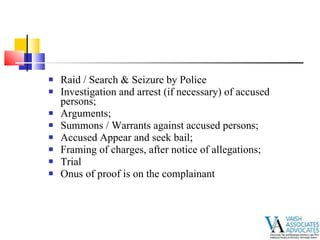
Raid / Search & Seizure by Police Investigation and arrest (if necessary) of accused persons; Arguments; Summons / Warrants against accused persons; Accused Appear and seek bail; Framing of charges, after notice of allegations; Trial Onus of proof is on the complainant
Flat No 903, Indra Prakash, 21, Barakhamba  Road, New Delhi 110001 (India) Phone: +91 11 42492532 (Direct) Phone: +91 11 42492525 Ext 532 Mobile :- 9810081079 Fax: +91 11 23320484 email:-  [email_address]   Intellectual Property & Information Technology Laws Division

Ip Law Introduction In India

  • 1.
    IPR PROTECTION ININDIA VIJAY PAL DALMIA HEAD IP & IT LAWS DIVISION VAISH ASSOCIATES ADVOCATES
  • 2.
    Comprisesof the following Laws:- Laws relating to Trade Marks / Brands (Trade Marks Act, 1999), Property Marks Laws relating to Copyright (Copyright Act, 1957) Artistic Work, Literary Work, Audio Video Records and Software Laws relating to Industrial Designs (Designs Act, 2000) INTELLECTUAL PROPERTY LAW INTRODUCTION
  • 3.
    Laws relating toPatents (The Patent Act, 1970) Laws relating to Geographical Indications. The geographical Indications of (Registration and Protection) Act, 1999 Laws relating to Internet, Web and Information Technology (Information Technology Act, 2000) Domain Names
  • 4.
    INFRINGEMENT WHEN AN IPR IS REGISTERED i.e.Trade Mark , Patent Industrial Designs , Geographical Indications Copyright INFRINGEMENT OF IPR AND LEGAL REMEDIES
  • 5.
    Passing off isa common law tort which can be used to enforce unregistered trademark rights. Passing off essentially occurs where the reputation of party A is misappropriated by party B, such that party B misrepresents this reputation and damages the goodwill of party A. The law of passing off prevents one person from misrepresenting his or her goods or services as being the goods and services of the plaintiff, and also prevents one person from holding out his or her goods or services as having some association or connection with the plaintiff when this is not true. PASSING OFF
  • 6.
    REMEDIES LEGAL REMEDIESAGAINST INFRINGEMENT AND PASSING OFF CIVIL CRIMINAL
  • 7.
    NO Incase of Trade Mark Copyright Yes For Patents Industrial Designs Geographical Indications IS REGISTRATION OF IPR NECESSARY?
  • 8.
    COPYRIGHT: - Registrationof Copyright w.r.t any logo / trade mark is not necessary or compulsory under the provisions of the Indian Copyright Act, 1957. Automatic protection is available to an artistic work, form the date when the artistic work / logo was designed. Copyright Comes in to existence when the concept in mind is put in to some tangible form or crated HOW COPYRIGHT COMES IN TO EXISTENCE !
  • 9.
    A trade markis granted protection on the basis of First Adoption First User First Inventor First Invention / Adoption/ User is superior then the Registration TRADE MARK ! WHO IS PROTECTED ?
  • 10.
    Monopoly for thespecified period is created in favour of the Registrant In case of litigation onus of proof shifts on the opposite party Prima facie presumption is raised in favour of the Registrant WHAT ARE THE RIGHTS CONFERRED BY THE REGISTRATION OF IPR ?
  • 11.
    Yes, in casethe registration has been obtained by Fraud Misrepresentation Wrongly Against the rights of some other party / opponent Registered by the Registrar erroneously Registration prohibited under some law Registration is against public policy or morals CAN THE REGISTRATION OF IPR BE CANCELLED OR REVOKED ?
  • 12.
    During the Processof Registration – By filing Opposition After Registration – By filing Rectification Petition WHEN REGISTRATION CAN BE OPPOSED OR REVOKED/CANCELLED ?
  • 13.
    There are twoways to compare similarities between two trade marks :- PHONETIC Similarity OCULAR Similarity Other tests for comparison are :- WHAT IS THE TEST OF COMPARISON IN CASE OF VIOLATION OF IPR ?
  • 14.
    Likely hood ofconfusion and deception From the angle of a prudent person of ordinary intelligence No microscopic comparison No actual confusion or deception is required Actual loss or damage not necessary OTHER TESTS OF COMPARISON
  • 15.
    Injunction/stay Damages Accounts and handing over of profits Appointment of local commissioner by the court for custody/sealing of infringing material/accounts Interim Injunction: Ex-Parte After Hearing CIVIL REMEDIES
  • 16.
    Filing of plaintwith supporting evidence at the time of filing of the suit Filing of application under Order 39 Rule 1 & 2 read with sec. 151 of the Code of Civil Procedure, for grant of ex-parte ad-interim; Filing of application under Order 26 of the Code of Civil Procedure for appointment of a local commissioner, to make inventory and/or to take possession of the infringing material form the premises of the defendants, their agents, retailers and distributors etc. Hearing of arguments by court on application for grant of ex-parte injunction and appointment of local commissioner; The court may, if satisfied, grant ex-parte and interim injunction and appoint a local commissioner. PROCEDURE & PROCESS FOR A CIVIL CASE
  • 17.
    Judgment by thecourt. The court may give a short notice to the defendants for giving them an opportunity of hearing before granting any temporary injunction or appointing a local commissioners Service of notice/summons of the court on the defendant Filing of written statement / reply by the defendant; Hearing on application for grant of interim injunction; Further proceedings in the suit including filing of replication/rejoinder, admission/denial of documents, framing of issues; Trial ELSE
  • 18.
    Trade Marks Act,1999 Copyright Act, 1957 Designs Act, 2000 Patents Act, 1970 Geographical Indications of Goods( Registration and Protection) Act, 1999 Code of Civil Procedure, 1908 Specific Relief Act, 1963 STATUTORY PROVISIONS
  • 19.
    Filing of criminalcomplaint before the chief judicial magistrate/chief metropolitan magistrate of the concerned jurisdiction Leading evidence w.r.t. the infringement of the trade mark Filing of application under sec. 91/93 of the Code of Criminal Procedure for issue of search and seizure warrants Orders/directions by the Court to police for the search and seizure of infringing material. OR IN ALTERNATIVE Direction by the court to police for investigation, lodging of an FIR and search and seizure, under sec. 156 of the Code of Criminal Procedure, 1973. OR IN ALTERNATIVE Filing a Complaint / FIR with Police CRIMINAL REMEDIES
  • 20.
    Sec. 103/104 ofthe Trade Marks Act, 1999 Sec. 63 and 64 of the Copyright Act, 1957 Sec. 39 of the Geographical Indication of Goods Act, 1999 Sec. 420 of the India Penal Code Sec. 91/93 of the Code of Criminal Procedure STATUES INVOKED FOR CRIMINAL ACTION
  • 21.
    In India, thejurisdiction for the purposes of filing a civil suit, will depend upon following facts, and subject to the following conditions:- Where the cause of action has accrued; Where the part of the cause of action has accrued; Where the properties / violations are taking place; Where the defendants reside or work for gain; In brief, the jurisdiction for the purposes of filing a case would depend upon the place of business of the defendants. IN WHICH COURT A CIVIL CASE CAN BE FILED AGAINST VIOLATION OF IPR ?
  • 22.
    In India asuit may be instituted in any Court of original jurisdiction, subject to its pecuniary & territorial jurisdiction. The designation of the lowest court is “District & Sessions Judge”. Such cases can also be directly filed in the High Court, if such High Court is vested with original jurisdiction, e.g. Delhi High Court. The Jurisdiction of High Court could be invoked, subject to the payment of Court fees. The structure of Court fees vary from state to state. COMPETENT COURT FOR CIVIL ACTION
  • 23.
    Yes, if theartwork, get up, design, color combination of a trade mark/ label/ packing material is similar and / or deceptively similar, the provisions of the Copyright Act, 1957, can also be invoked along with the Trade Marks Act, 1959, and this course of action is always preferable, as under the provisions of the Copyright Act, 1957, the offence becomes COGINIZABLE, and police can, on its own directly initiate Criminal proceedings after registration of an FIR. CAN LEGAL ACTION UNDER THE TRADE MARKS ACT, 1999 AND THE COPYRIGHT ACT, 1957 , BE COMBINED ?
  • 24.
    Criminal Complaint inthe Court of competent jurisdiction; Pre summoning Evidence, for satisfying the court on the basis of the evidence placed on record, that the allegations by complainant are prima facie maintainable; Issue of General/ specific Search and Seizure Warrants, along with directions to police; PROCEDURE FOR FILING A CRIMINAL COMPLAINT
  • 25.
    Raid / Search& Seizure by Police Investigation and arrest (if necessary) of accused persons; Arguments; Summons / Warrants against accused persons; Accused Appear and seek bail; Framing of charges, after notice of allegations; Trial Onus of proof is on the complainant
  • 26.
    Flat No 903,Indra Prakash, 21, Barakhamba  Road, New Delhi 110001 (India) Phone: +91 11 42492532 (Direct) Phone: +91 11 42492525 Ext 532 Mobile :- 9810081079 Fax: +91 11 23320484 email:- [email_address] Intellectual Property & Information Technology Laws Division