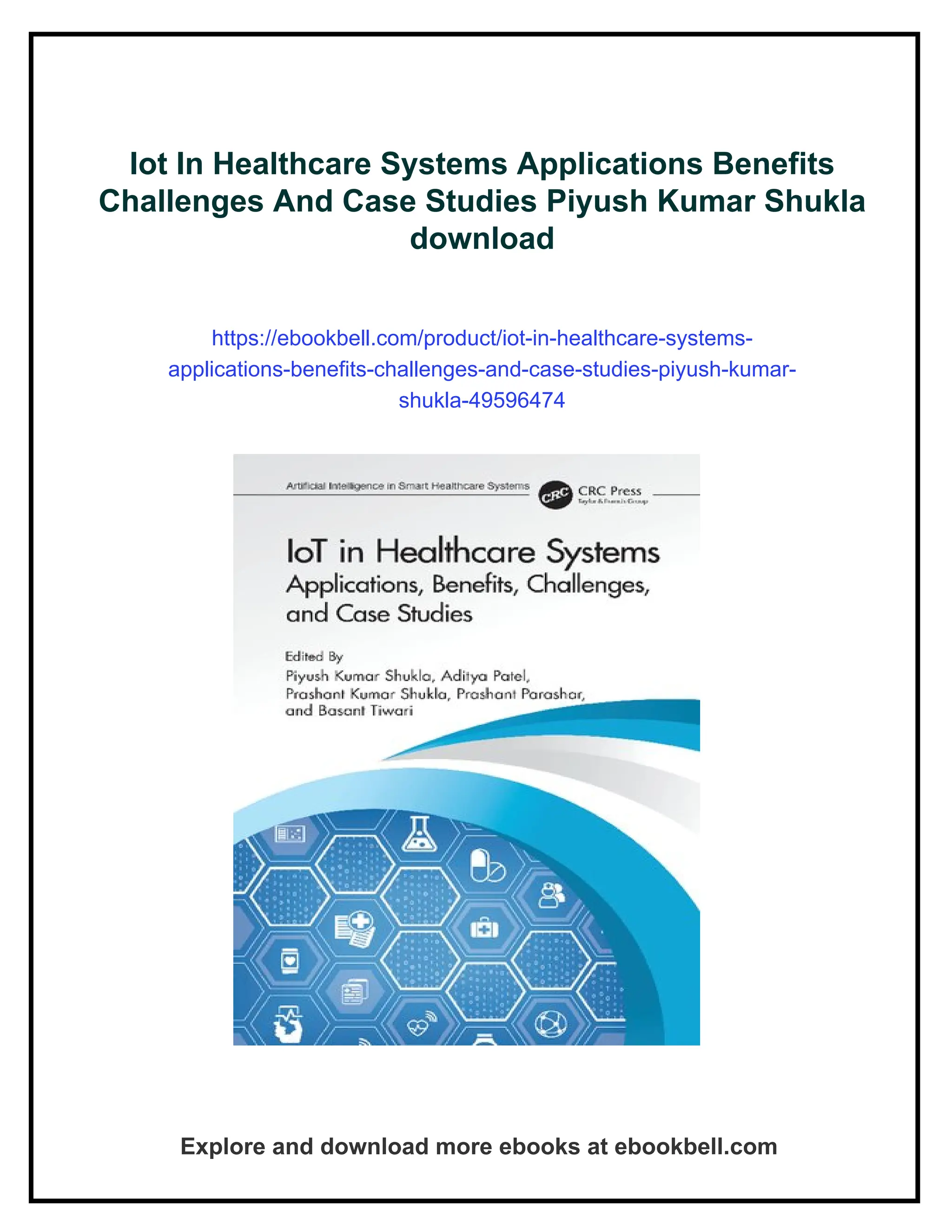
Iot In Healthcare Systems Applications Benefits
Challenges And Case Studies Piyush Kumar Shukla
download
https://ebookbell.com/product/iot-in-healthcare-systems-
applications-benefits-challenges-and-case-studies-piyush-kumar-
shukla-49596474
Explore and download more ebooks at ebookbell.com
Here are some recommended products that we believe you will be
interested in. You can click the link to download.
Deep Learning And Iot In Healthcare Systems Paradigms And Applications
1st Edition
https://ebookbell.com/product/deep-learning-and-iot-in-healthcare-
systems-paradigms-and-applications-1st-edition-35471892
Hybrid Artificial Intelligence And Iot In Healthcare Intelligent
Systems Reference Library 209 1st Ed 2021 Akash Kumar Bhoi Editor
https://ebookbell.com/product/hybrid-artificial-intelligence-and-iot-
in-healthcare-intelligent-systems-reference-library-209-1st-
ed-2021-akash-kumar-bhoi-editor-33789854
Iot In Healthcare And Ambient Assisted Living 1st Ed 2021 Gonalo
Marques
https://ebookbell.com/product/iot-in-healthcare-and-ambient-assisted-
living-1st-ed-2021-gonalo-marques-232956000
Artificial Intelligence Big Data Iot Block Chain In Healthcare From
Concepts To Applications 1st Edition Yousef Farhaoui
https://ebookbell.com/product/artificial-intelligence-big-data-iot-
block-chain-in-healthcare-from-concepts-to-applications-1st-edition-
yousef-farhaoui-58964310
Emerging Technologies In Healthcare 40 Ai And Iot Solutions 1st
Edition Alokkumar Srivastav
https://ebookbell.com/product/emerging-technologies-in-
healthcare-40-ai-and-iot-solutions-1st-edition-alokkumar-
srivastav-230373532
Emerging Technologies In Healthcare 40 Ai And Iot Solutions Dr Alok
Kumar Srivastav Dr Priyanka Das
https://ebookbell.com/product/emerging-technologies-in-
healthcare-40-ai-and-iot-solutions-dr-alok-kumar-srivastav-dr-
priyanka-das-230087320
Emerging Technologies In Healthcare 40 Ai And Iot Solutions 1st
Edition Srivastav Alokkumar
https://ebookbell.com/product/emerging-technologies-in-
healthcare-40-ai-and-iot-solutions-1st-edition-srivastav-
alokkumar-230087218
Immersive Virtual And Augmented Reality In Healthcare An Iot And
Blockchain Perspective Rajendra Kumar
https://ebookbell.com/product/immersive-virtual-and-augmented-reality-
in-healthcare-an-iot-and-blockchain-perspective-rajendra-
kumar-51707660
Blockchain Technology In Healthcare Concepts Methodologies And
Applications Applied Artificial Intelligence In Data Science Cloud
Computing And Iot Frameworks Kamila
https://ebookbell.com/product/blockchain-technology-in-healthcare-
concepts-methodologies-and-applications-applied-artificial-
intelligence-in-data-science-cloud-computing-and-iot-frameworks-
kamila-54979184
i
IoT in Healthcare Systems
Implementing new information technologies into the healthcare sector can provide
alternatives to managing patients’ health records, systems, and improving the quality
of care received. This book provides an overview of Internet of Things (IoT) technolo-
gies related to the healthcare field and covers the main advantages and disadvantages
along with industry case studies.
This edited volume covers required standardization and interoperability initiatives,
various Artificial Intelligence and Machine Learning algorithms, and discusses how
health technology can meet the challenge of improving quality of life regardless of
social and financial status, gender, age, and location. The book presents real-​
time
applications and case studies in the fields of engineering, computer science, IoT, and
healthcare and provides many examples of successful IoT projects.
The target audience for this edited volume includes researchers, practitioners,
students, as well as key stakeholders involved in and working on healthcare engin-
eering solutions.
ii
Artificial Intelligence in Smart Healthcare Systems
Series Editors: Vishal Jain and Jyotir Moy Chatterjee
The progress of the healthcare sector is incremental as it learns from associations
between data over time through the application of suitable big data and Internet
of Things (IoT) frameworks and patterns. Many healthcare service providers are
employing IoT-​
enabled devices for monitoring patient healthcare, but their diagnosis
and prescriptions are instance-​
specific only. However, these IoT-​
enabled healthcare
devices are generating volumes of data (Big-​
IoT Data) that can be analyzed for more
accurate diagnosis and prescriptions. A major challenge in the above realm is the
effective and accurate learning of unstructured clinical data through the application
of precise algorithms. Incorrect input data leading to erroneous outputs with false
positives shall be intolerable in healthcare as patients’ lives are at stake. This new
book series addresses various aspects of how smart healthcare can be used to detect
and analyze diseases, the underlying methodologies, and related security concerns.
Healthcare is a multidisciplinary field that involves a range of factors like the finan-
cial system, social factors, health technologies, and organizational structures that
affect the healthcare provided to individuals, families, institutions, organizations,
and populations. The goals of healthcare services include patient safety, timeliness,
effectiveness, efficiency, and equity. Smart healthcare consists of m-​
health, e-​
health,
electronic resource management, smart and intelligent home services, and medical
devices. The IoT is a system comprising real-​
world things that interact and com-
municate with each other via networking technologies. The wide range of potential
applications of IoT includes healthcare services. IoT-​
enabled healthcare technologies
are suitable for remote health monitoring, including rehabilitation, assisted ambient
living, etc. In turn, healthcare analytics can be applied to the data gathered from
different areas to improve healthcare at a minimum expense.
This new book series is designed to be a first choice reference at university libraries,
academic institutions, research and development centres, information technology
centres, and any institutions interested in using, design, modelling, and analysing
intelligent healthcare services. Successful application of deep learning frameworks
to enable meaningful, cost-​
effective personalized healthcare services is the primary
aim of the healthcare industry in the present scenario. However, realizing this goal
requires effective understanding, application, and amalgamation of IoT, big data, and
several other computing technologies to deploy such systems in an effective manner.
This series shall help clarify the understanding of certain key mechanisms and tech-
nologies helpful in realizing such systems.
Designing Intelligent Healthcare Systems, Products, and Services Using Disruptive
Technologies and Health Informatics
Teena Bagga, Kamal Upreti, Nishant Kumar, Amirul Hasan Ansari, and
Danish Nadeem
Next Generation Healthcare Systems Using Soft Computing Techniques
D. Rekh Ram Janghel, Rohit Raja, and Korhan Cengiz
iii
IoT In Healthcare Systems
Applications, Benefits, Challenges,
and Case Studies
Edited by
Piyush Kumar Shukla, Aditya Patel,
Prashant Kumar Shukla, Prashant Parashar,
and Basant Tiwari
iv
Designed cover image: © Shutterstock
First edition published 2023
by CRC Press
6000 Broken Sound Parkway NW, Suite 300, Boca Raton, FL 33487-​
2742
and by CRC Press
4 Park Square, Milton Park, Abingdon, Oxon, OX14 4RN
CRC Press is an imprint of Taylor & Francis Group, LLC
© 2023 Taylor & Francis Group, LLC
Reasonable efforts have been made to publish reliable data and information, but the author and publisher
cannot assume responsibility for the validity of all materials or the consequences of their use. The authors
and publishers have attempted to trace the copyright holders of all material reproduced in this publication
and apologize to copyright holders if permission to publish in this form has not been obtained. If any
copyright material has not been acknowledged please write and let us know so we may rectify in any future
reprint.
Except as permitted under U.S. Copyright Law, no part of this book may be reprinted, reproduced,
transmitted, or utilized in any form by any electronic, mechanical, or other means, now known or hereafter
invented, including photocopying, microfilming, and recording, or in any information storage or retrieval
system, without written permission from the publishers.
For permission to photocopy or use material electronically from this work, access www.copyri​ght.com or
contact the Copyright Clearance Center, Inc. (CCC), 222 Rosewood Drive, Danvers, MA 01923, 978-​
750-​
8400. For works that are not available on CCC please contact mpkbookspermissions@tandf.co.uk
Trademark notice: Product or corporate names may be trademarks or registered trademarks and are used
only for identification and explanation without intent to infringe.
Library of Congress Cataloging‑in‑Publication Data
Names: Shukla, Piyush Kumar, 1976– editor. | Patel, Aditya, editor. |
Shukla, Prashant Kumar, editor.
Title: IoT in healthcare systems : applications, benefits, challenges and case studies /
edited by Piyush Kumar Shukla, Aditya Patel and Prashant Kumar Shukla.
Description: First edition. | Boca Raton : CRC Press, 2023. |
Series: Artificial intelligence in smart healthcare systems |
Includes bibliographical references and index.
Identifiers: LCCN 2022047379 | ISBN 9780367702144 (hardback) |
ISBN 9780367702151 (paperback) | ISBN 9781003145035 (ebook)
Subjects: LCSH: Internet of things. | Internet in medicine. |
Medical informatics–Technological innovations. |
Artificial intelligence–Medical applications.
Classification: LCC RC859.7.I58 I58 2023 |
DDC 610.285/63–dc23/eng/20230202
LC record available at https://lccn.loc.gov/2022047379
ISBN: 978-​0-​367-​70214-​4 (hbk)
ISBN: 978-​0-​367-​70215-​1 (pbk)
ISBN: 978-​1-​003-​14503-​5 (ebk)
DOI: 10.1201/​9781003145035
Typeset in Times
by Newgen Publishing UK
v
v
Contents
About the Editors......................................................................................................vii
Chapter 1 Artificial Intelligence-​
Based Smart Medical Services..........................1
Dhanasekaran Arumugam, Christopher Stephen,
Vishnupriyan Jegadeesan, Ajay John Paul,
Arunpillai Viswanathan Harish, Krishna S., and Gunalan K.
Chapter 2 Securing IoT Devices for Healthcare Systems Using
Optimization-​Based Approaches.........................................................27
Ankur Khare, Rajendra Gupta, and Piyush Shukla
Chapter 3 Internet of Everything-​
Based Advanced Big Data Journey
for the Medical Industry......................................................................49
Piyush Gupta, Bhupendra Verma, and Mahesh Pawar
Chapter 4 IoT in Smart Rehabilitation.................................................................59
Meena Gupta, Ruchika Kalra, and Prakash Kumar
Chapter 5 Internet of Things in Smart and Intelligent Healthcare Systems.........77
Puja Gupta, Mukul Shukla, Neeraj Arya, and Upendra Singh
Chapter 6 Energy Harvesting for IoT Networks in Smart and Intelligent
Networks.............................................................................................91
Yogita Thareja, Kamal Kumar Sharma, and Parulpreet Singh
Chapter 7 IoT Healthcare Applications..............................................................105
Shifa Manihar and Tasneem Bano Rehman
Chapter 8 Applications, Opportunities, and Current Challenges in the
Healthcare Industry...........................................................................121
Veena A. and Gowrishankar S.
vi Contents
vi
Chapter 9 Internet of Things-​
Healthcare System Architectures to Enhance
the Healthcare Industry.....................................................................149
Anil Audumbar Pise and Sangiwe Moyo
Chapter 10 An IoT-​
Based Moving Vehicle Healthcare Service...........................177
Vandana Roy, Hemant Amhia, Shailja Shukla, and
A. K. Wadhwani
Chapter 11 DDoS Attack Detection Using Predictive Machine
Learning (ML) Algorithms in Wireless Body Area
Network Environments......................................................................191
Bachu Taye Welteji, Basant Tiwari, Solomon D. Kebede,
Shailendra Gupta, and Vivek Tiwari
Index.......................................................................................................................217
vii
vii
About the Editors
Piyush Kumar Shukla isAssociate Professor in the Department of Computer Science
and Engineering at the University Institute of Technology, Rajiv Gandhi Proudyogiki
Vishwavidyalaya (Technological University of Madhya Pradesh), India. He has
15 years of experience in teaching and research. He completed a Post Doctorate
Fellowship under the Information Security Education and Awareness Project Phase
II funded by the Ministry of Electronics and Information Technology, SVNIT Surat,
India. His research interests include white-box cryptography, information security
and privacy, cyber security, dynamic wireless networks, machine learning, the
Internet of Things, image processing, and Blockchain. In addition to publishing more
than 15 Indian patents and around 10 papers in international journals, he was awarded
Best Researcher of theYear 2019 for Outstanding Research Contribution. Shukla is a
senior life member of the IEEE.
Aditya Patel is Assistant Professor in the Department of Computer Science and
Engineering, Lakshmi Narain College of Technology Bhopal. He has worked on
more than 50 websites and software and has four years of teaching experience in
various reputed technical colleges and universities along with two years of industry
experience. His current research areas are machine learning, deep learning, and the
Internet of Things.
Prashant Kumar Shukla is Assistant Professor and Research Coordinator in Jagran
Lakecity University, India. His research interests include machine learning, deep
learning, computer vision, the Internet of Things, software engineering, computer
networking, mobile computing, information security, Python, and Java program-
ming. He has 13 patents and has published and presented more than 17 research
papers in various national and international journals and conferences. He received
the Innovative Teacher award from GISR Foundation and the American College
of Dubai. He also was awarded Best Researcher by ESN Publications. He is also
associated with two start-ups.
Prashant Parashar is an experienced information security professional with around
16 years of experience in the information security domain. He is Security Analyst
at Betfair, UK. His experience includes Align IT security governance, information
security management, auditing and compliance, information security metrics, devel-
opment and implementation of information security policy, and procedures and ISMS
implementation in line with ISO 27001 requirements.
viii About the Editors
viii
Basant Tiwari is Assistant Professor in the Computer Science and Engineering
Department at Hawassa University, Ethiopia. His area of research is pervasive com-
puting in healthcare and the Internet of Things and information and network security.
He is a senior member of IEEE, a senior member of ACM, and a life member of CSI
and IACSIT. He also chairs at iMPLab situated at Bhopal, India. Tiwari has organized
various national and international conferences, delivered talks, and chaired technical
sessions.
newgenprepdf
1
1
DOI: 10.1201/9781003145035-1
Artificial Intelligence-​
Based Smart Medical
Services
Dhanasekaran Arumugam,1
Christopher Stephen,2
Vishnupriyan Jegadeesan,1
Ajay John Paul,3
Arunpillai Viswanathan Harish,1
Krishna S.,1
and Gunalan K.1
1
Chennai Institute of Technology, Madras, India
2
Dr. Sagunthala R&D Institute of Science and Technology,
Chennai, India
3
Kyungpook National University, Daegu, South Korea
CONTENTS
1.1 Introduction........................................................................................................2
1.2 Classification of Smart Healthcare.....................................................................4
1.3 Artificial Intelligence..........................................................................................6
1.3.1 Process of AI..........................................................................................6
1.3.1.1 Learning Processes...................................................................6
1.3.1.2 Reasoning Processes................................................................6
1.3.1.3 Self-​Correction Processes........................................................6
1.3.2 Types of AI.............................................................................................7
1.4 The Healthcare Industry.....................................................................................7
1.4.1 The Elements of Healthcare Industries..................................................7
1.4.1.1 Hospitals and Clinics...............................................................7
1.4.1.2 The Pharmaceutical Industries.................................................8
1.4.1.3 The Medical Insurance Agencies.............................................8
1.4.1.4 Pathology and Lab Tests..........................................................8
1.4.2 The Need for AI in the Healthcare Industry...........................................8
1.4.2.1 Optimizing Cost Plans and Structures.....................................9
1.4.2.2 Supply Chain Efficiencies for Pharmaceutical
Companies................................................................................9
1.4.2.3 Healthcare Insurance Market...................................................9
1.4.2.4 The Fitness Industry.................................................................9
1.4.2.5 The Government....................................................................10
1.5 Applications of AI in Medicine Today.............................................................10
1.5.1 Diagnose Diseases................................................................................10
1
2 IoT in Healthcare Systems
2
1.5.2 Faster Drug Development.....................................................................11
1.5.2.1 Identify Targets for Intervention............................................11
1.5.2.2 Discover Drug Candidates.....................................................11
1.5.2.3 Speed Up Clinical Trials........................................................12
1.5.2.4 Find Biomarkers for Diagnosing the Disease........................12
1.5.3 Personalize Treatment..........................................................................13
1.5.4 Improve Gene Editing..........................................................................13
1.6 Clinical Applications........................................................................................13
1.6.1 Cardiovascular......................................................................................13
1.6.2 AI Application in Stroke......................................................................14
1.6.2.1 Early Diagnosis......................................................................14
1.6.2.2 Treatment...............................................................................14
1.6.3 Dermatology.........................................................................................15
1.6.4 Gastroenterology..................................................................................15
1.6.5 Infectious Diseases...............................................................................15
1.6.6 Oncology..............................................................................................16
1.6.7 Pathology..............................................................................................16
1.6.8 Primary Care........................................................................................17
1.6.9 Psychiatry.............................................................................................17
1.6.10 Radiology.............................................................................................17
1.7 Case Studies.....................................................................................................18
1.8 Current Applications of AI in Medical Diagnostics.........................................21
1.9 Conclusion........................................................................................................21
1.1 INTRODUCTION
A healthcare system allows patients and doctors to communicate with each other
and remotely exchange information that is monitored, collected, and analysed from
patients’ daily activities via the Internet of Things. Smart healthcare is defined as
the integration of patients and doctors onto a common platform for intelligent health
monitoring through the analysis of daily human activities [1].
Due to the massive rise in population, traditional healthcare is unable to meet
everyone’s demands. Medical services are not accessible or expensive despite having
excellent infrastructure and cutting-​
edge technologies [2]. Further, in healthcare ser-
vice delivery, resource shortages and uneven allocation can put additional strain on
already overburdened providers. Smart healthcare is emerging as a critical strategy
for addressing these issues and personalizing healthcare.
The main objective of smart healthcare is to assist consumers by informing them
about their medical conditions and keeping them informed about their health. Smart
healthcare allows people to handle various emergency circumstances on their own.
It focuses on increasing the user’s quality of life and experience. Smart healthcare
is the integration of disparate healthcare delivery mechanisms; it employs electronic
patient records and streamlines processes with the goal of improving people’s lives
by lowering health risks and increasing well-​
being. Patient-​
centric services, such as
remote monitoring and checks, can be tailored to the patient’s specific requirements
and have a broader reach, improving access to healthcare. Because of the ageing
population’s increased life expectancy and the rise in chronic diseases, effective
3
Artificial Intelligence-Based Smart Medical Services
3
remote monitoring of health conditions and the adoption of smart healthcare products
are gaining traction [3].
Smart healthcare enables the most efficient use of available resources, remote
patient monitoring, lowers the cost of treatment for the user, and enables the med-
ical professionals to expand their services across geographical barriers. With the
growing trend toward smart cities, an effective smart healthcare system ensures that
its residents live a healthy lifestyle. In general, connected health refers to any digital
healthcare solution that can operate remotely, and it is a catch-​
all term for subsets
like telemedicine and mobile-​
health, but with the addition of continuous health
monitoring, emergency detection, and automatically alerting appropriate individuals.
The objective of connected health is to improve the quality and efficiency of healthcare
by allowing self-​
care and supplementing it with remote care. Its roots can be traced back
to the telemedicine era, when users were educated about their health and given feedback
as needed. Smart healthcare refers to solutions that can run totally on their own, whereas
connected healthcare refers to systems that allow consumers to receive feedback from
clinicians. Figure 1.1 shows a typical framework of a smart healthcare system.
To maintain consistent internet connectivity and sustain large data traffic in a
hospital setting where a healthcare network is maintained, Wi-​
Fi and ground cables
are essential. On-​
body sensors and stationary medical devices are two types of med-
ical equipment used to achieve smart healthcare. Biosensors that are attached to the
human body for physiological monitoring are known as on-​
body sensors. In-​
vitro
FIGURE 1.1 Typical framework of smart healthcare system [4].
4 IoT in Healthcare Systems
4
and in-​
vivo sensors are two different types of sensors. In-​
vitro sensors are externally
attached to the human body, decreasing the need for lab or hospital facilities
in healthcare. In-​
vivo sensors are implantable devices that are inserted inside the
body after meeting all sterilizing regulations and standards. Figure 1.2 depicts the
four major components of healthcare systems: identification, location, sensing, and
connectivity. Emergency services, smart computing, sensors, remote monitoring,
wearable devices, connectivity devices, and big data are all used to implement smart
healthcare [5].
1.2 
CLASSIFICATION OF SMART HEALTHCARE
Smart healthcare can be divided into functional requirements and non-​
functional
requirements as shown in Figure 1.3. Functional requirements address specific cri-
teria, such as the range of operation of the thermistor/​
thermometer, data collection
method, and frequency of operation of a temperature monitoring system. Hence,
functional requirements vary depending on the application of each component in the
healthcare system. Non-​
functional requirements are characteristics that can be used
to assess the quality of a healthcare system and can be further divided into perform-
ance criteria and ethical requirements. Performance criteria can be further split into
software and hardware requirements [6].
The criteria for an efficient smart healthcare system are lower power, small form
factor, reliability, quality in service, enriched user experience, higher efficiency,
ability to interoperate across different platforms, ease of deployment, scalability of
the system to upgrade to newer versions and technologies, and ample connectivity.
FIGURE 1.2 Components of a smart healthcare system.
5
Artificial Intelligence-Based Smart Medical Services
5
The requirements of smart healthcare are shown in Figure 1.4.
Sensors or actuators, computing devices, data-​
storage elements, and networking
components can be used to categorise smart healthcare system components. A sensor
is an analytical device and when it combines with a biological element it produces
a signal for recognition of events [7]. Sensors and actuators differ depending on the
monitoring system. The most common sensors used in smart healthcare are tempera-
ture sensors, electrocardiogram (ECG), blood pressure, blood glucose, electromyo-
gram, heart rate, oxygen saturation, gyroscope, motion sensors, and accelerometers.
Computing devices range from smartphones, tablets, and personal digital assistants to
complex and advanced devices such as supercomputers and servers. Memory is cru-
cial in smart healthcare because storing information is the most important function of
these systems. The data-​
storage components in the smart healthcare network span a
broader spectrum, including embedded memory on sensing devices and large servers
used for big-​
data analytics.
FIGURE 1.4 The requirements in smart healthcare.
FIGURE 1.3 Classification of smart healthcare.
6 IoT in Healthcare Systems
6
Link sensors, routers, and base stations are all examples of networking components.
The sophistication of the components varies according to the severity of the problem
being addressed.A smart healthcare network is built on wireless technologies.Various
wireless technologies such as Wi-​
Fi, Bluetooth, 6LoWPAN, and RFID play critical
roles in exchanging information among the various physical elements that comprise
the healthcare network.
The most important system designs required for a smart healthcare system are
app oriented, things oriented, and semantics oriented. App-​
oriented architectures
must ensure reliable transmission between smartphone applications and sensors,
create a personalised network between the sensors and the user’s computing
device, and secure the data. Things-​
oriented architectures must be adaptable based
on the application, provide real-​
time monitoring, on-​
time delivery, greater sensi-
tivity, maintain higher efficiency at lower power dissipation, and engage in intelli-
gent processing. Semantic-​
oriented systems should be able to develop behavioural
patterns based on previously acquired information, use natural-​
language pro-
cessing techniques to improve user experience, and be capable of ubiquitous com-
puting. [8].
1.3 ARTIFICIAL INTELLIGENCE
The simulation of human intelligence processes by machines, particularly com-
puter systems, is known as Artificial Intelligence (AI). Expert systems, natural lan-
guage processing, speech recognition, and machine vision are some of the specific
applications of AI. Humans are being replaced by machines, robots, and similar
innovations with the use of AI. AI uses a huge amount of data to process a task and
makes accurate and desired results.
1.3.1 
Process of AI
AI programming focuses on three cognitive skills: learning, reasoning, and
self-​correction.
1.3.1.1 Learning Processes
Learning process focuses on acquiring data and creating rules to create the data into
actionable information. The rules, which are named as algorithms, provide computing
devices with step-​
by-​
step instructions to complete a specific task.
1.3.1.2 Reasoning Processes
Reasoning process focuses on selecting the right algorithm to obtain a desired
outcome.
1.3.1.3 Self-​Correction Processes
Self-​
correction processes are designed to continually refine the algorithms to
enable to provide the most accurate outcome [9]. The process of AI is shown in
Figure 1.5.
7
Artificial Intelligence-Based Smart Medical Services
7
1.3.2 
Types of AI
AI is often classified in the following categories:
• Reactive AI, which relies on real-​
time data to make decisions.
• Limited Memory AI, which relies on stored data to make decisions.
• Theory of Mind AI, which considers subjective elements such as user intent
when making decisions.
• Self-​
Aware AI, which possesses a human-​
like consciousness that is capable of
independently setting goals and using data to decide the best way to achieve an
objective.
The basic components of anyAI are learning, reasoning, problem solving, perception,
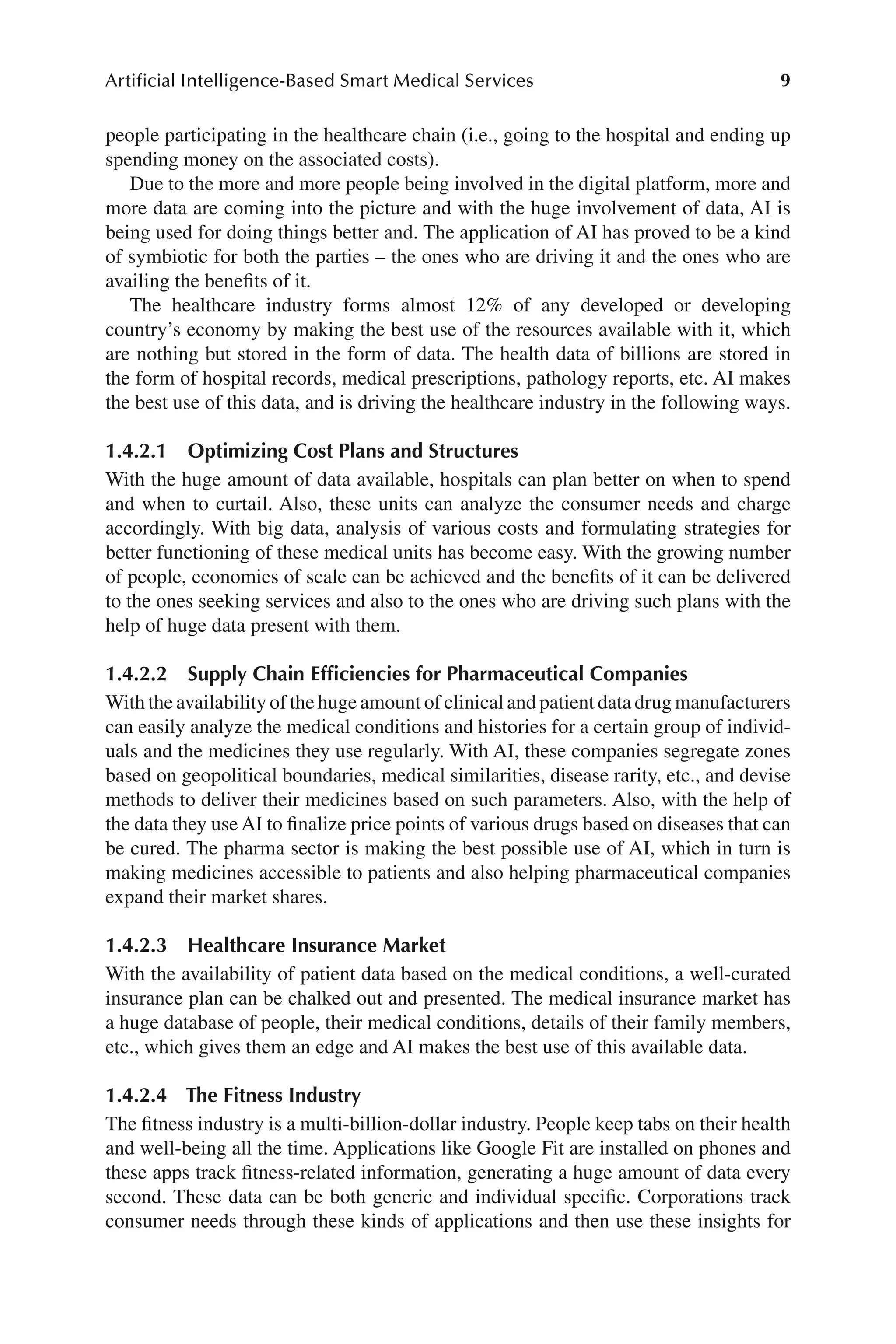
and using language. Figure 1.6 shows some of the components of typical AI [10].
1.4 
THE HEALTHCARE INDUSTRY
The world today is driven by data. Data has become essential in all sectors of the
economy, such as in consumer goods, real estate, healthcare, manufacturing, or any
other industry. With more and more applications of data, the world is moving towards or
to be more precise undergoing the biggest economic and technological transformations
of all time. The healthcare industry is huge and is made up of the following elements.
1.4.1 
The Elements of Healthcare Industries
1.4.1.1 
Hospitals and Clinics
Hospitals and clinics are the infrastructural components of any healthcare industry
that act as a starting point for all kinds of medical needs. They recommend a certain
number of tests and medicines, which are paving towards all the other elements of the
healthcare industry. People who are frequent hospital visitors or are health-​
oriented
are also driven towards the medical insurance industry.
FIGURE 1.5 The process of AI.
8 IoT in Healthcare Systems
8
1.4.1.2 
The Pharmaceutical Industries
The pharmaceutical industries are one of the most important elements of the healthcare
industry. They produce drugs and medicines and decide a price point of the drug
depending on various factors like demand, rarity, etc.
1.4.1.3 
The Medical Insurance Agencies
The human body is always exposed to medical uncertainties. The fear of spending
more when a crisis creeps in acts as a bait for these companies to bring in customers.
Individuals invest in medical insurances by paying a premium amount in installments
and hence saving a huge amount when a medical emergency kicks in. Today private
companies also provide medical insurances to their employees and family members,
which drives huge revenues for companies working in the medical insurance domain.
1.4.1.4 
Pathology and Lab Tests
The medical test market is huge. From blood tests to large CT scans, people visit
these labs and get their tests done regularly, which makes it a need of the hour. Most
people get their tests done to keep up with their general well-​
being. Thus, these labs
are an important element of the healthcare industry.
1.4.2 
The Need for AI in the Healthcare Industry
AI is the cutting-​
edge technology of all the economic sectors. The healthcare industry
is one of the major sections of the economy and is growing swiftly. This growth
translates to more people concerned about their health, which translates into more
FIGURE 1.6 Components of typical AI.
9
Artificial Intelligence-Based Smart Medical Services
9
people participating in the healthcare chain (i.e., going to the hospital and ending up
spending money on the associated costs).
Due to the more and more people being involved in the digital platform, more and
more data are coming into the picture and with the huge involvement of data, AI is
being used for doing things better and. The application of AI has proved to be a kind
of symbiotic for both the parties –​the ones who are driving it and the ones who are
availing the benefits of it.
The healthcare industry forms almost 12% of any developed or developing
country’s economy by making the best use of the resources available with it, which
are nothing but stored in the form of data. The health data of billions are stored in
the form of hospital records, medical prescriptions, pathology reports, etc. AI makes
the best use of this data, and is driving the healthcare industry in the following ways.
1.4.2.1 
Optimizing Cost Plans and Structures
With the huge amount of data available, hospitals can plan better on when to spend
and when to curtail. Also, these units can analyze the consumer needs and charge
accordingly. With big data, analysis of various costs and formulating strategies for
better functioning of these medical units has become easy. With the growing number
of people, economies of scale can be achieved and the benefits of it can be delivered
to the ones seeking services and also to the ones who are driving such plans with the
help of huge data present with them.
1.4.2.2 
Supply Chain Efficiencies for Pharmaceutical Companies
With the availability of the huge amount of clinical and patient data drug manufacturers
can easily analyze the medical conditions and histories for a certain group of individ-
uals and the medicines they use regularly. With AI, these companies segregate zones
based on geopolitical boundaries, medical similarities, disease rarity, etc., and devise
methods to deliver their medicines based on such parameters. Also, with the help of
the data they use AI to finalize price points of various drugs based on diseases that can
be cured. The pharma sector is making the best possible use of AI, which in turn is
making medicines accessible to patients and also helping pharmaceutical companies
expand their market shares.
1.4.2.3 
Healthcare Insurance Market
With the availability of patient data based on the medical conditions, a well-​
curated
insurance plan can be chalked out and presented. The medical insurance market has
a huge database of people, their medical conditions, details of their family members,
etc., which gives them an edge and AI makes the best use of this available data.
1.4.2.4 
The Fitness Industry
The fitness industry is a multi-​
billion-​
dollar industry. People keep tabs on their health
and well-​
being all the time. Applications like Google Fit are installed on phones and
these apps track fitness-​
related information, generating a huge amount of data every
second. These data can be both generic and individual specific. Corporations track
consumer needs through these kinds of applications and then use these insights for
10 IoT in Healthcare Systems
10
providing tailor-​
made solutions and hence making money. With the help of AI, the
healthcare industry is operating digitally and successfully.
1.4.2.5 The Government
The government makes use of this health data to develop various schemes.With the help
of AI, the government can also track the performance of the healthcare industry, which
translates into an economic indicator of growth and progress. The government also uses
this huge amount of data to keep a constant tab on the number of hospitals in a particular
area, the medical supplies needed on a regular basis, availability of doctors and nurses
in a particular area, outbreak of various calamities and communicable diseases, eradi-
cation of serious diseases like polio, malaria, dengue, etc. With the help of this data, the
government educates a lot of people and helps them in the upkeep of their well-​
being.
With AI coming into play, the healthcare industry has drastically evolved. The
whole industry has been taken away by the wave of digitization and companies
aiming to track information and bring in data points every minute. Real-​
time informa-
tion can be tracked with the help of AI. Hospitals are getting more efficient, planning
out their staff better, becoming more available for people so that they can reap the
best possible outcomes.
Pharma companies can generate huge revenues by supplying medicines to coun-
tries where there is demand and hence channelizing their supplies and revenue
streams. The insurance market is becoming bigger and better. The availability of data
is being translated into sales and revenues every hour. The healthcare industry and the
amount of data involved in this industry surprised the whole world. Also, the money
involved in such industry for data and AI is insane. Will AI prove to be a boon or a
bane is the debate of the future but right now it is making the world fast and the health
space small and close [11].
1.5 
APPLICATIONS OF AI IN MEDICINE TODAY
1.5.1 Diagnose Diseases
In order to correctly diagnose illnesses years of medical training is required. The
diagnostics processes are lengthy and time-​
consuming, which puts doctors under a
lot of pressure, and it frequently causes life-​
saving patient diagnoses to be delayed.
Machine Learning, particularly deep learning algorithms, have recently made huge
advances in automatically diagnosing diseases, making diagnostics cheaper and more
accessible.
Machine Learning algorithms can learn to recognise patterns in the same way
as doctors do. But, the algorithms involved in ML require a large number of actual
instances and therefore, the information should be digitized for accurate results.
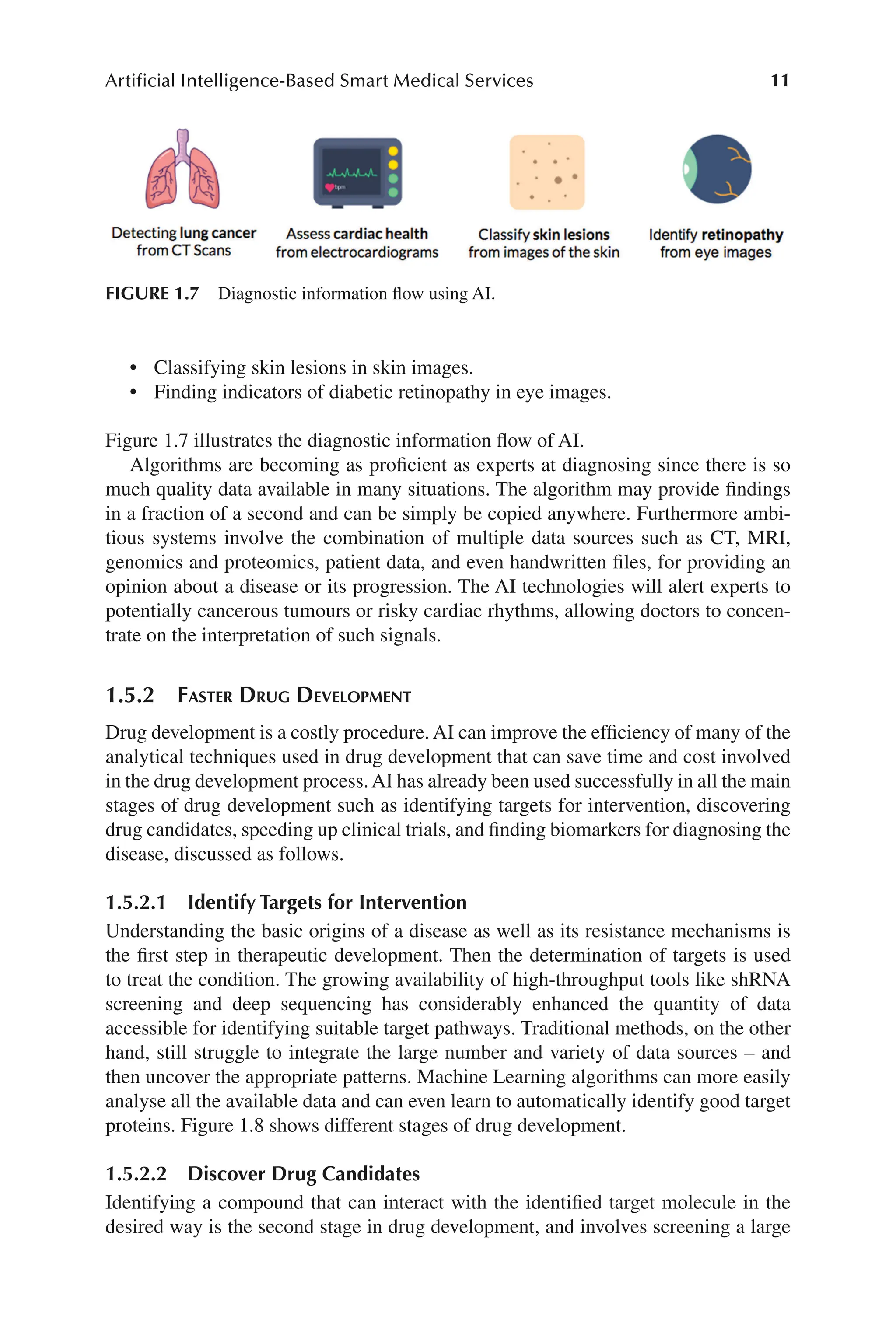
Machine Learning is particularly helpful in areas where the diagnostic information a
doctor examines is already digitized such as:
• CT scans can be used to detect lung cancer or strokes.
• Using electrocardiograms and cardiac MRI scans to assess the risk of sudden
cardiac death or other heart disorders.
11
Artificial Intelligence-Based Smart Medical Services
11
• Classifying skin lesions in skin images.
• Finding indicators of diabetic retinopathy in eye images.
Figure 1.7 illustrates the diagnostic information flow of AI.
Algorithms are becoming as proficient as experts at diagnosing since there is so
much quality data available in many situations. The algorithm may provide findings
in a fraction of a second and can be simply be copied anywhere. Furthermore ambi-
tious systems involve the combination of multiple data sources such as CT, MRI,
genomics and proteomics, patient data, and even handwritten files, for providing an
opinion about a disease or its progression. The AI technologies will alert experts to
potentially cancerous tumours or risky cardiac rhythms, allowing doctors to concen-
trate on the interpretation of such signals.
1.5.2 Faster Drug Development
Drug development is a costly procedure. AI can improve the efficiency of many of the
analytical techniques used in drug development that can save time and cost involved
in the drug development process.AI has already been used successfully in all the main
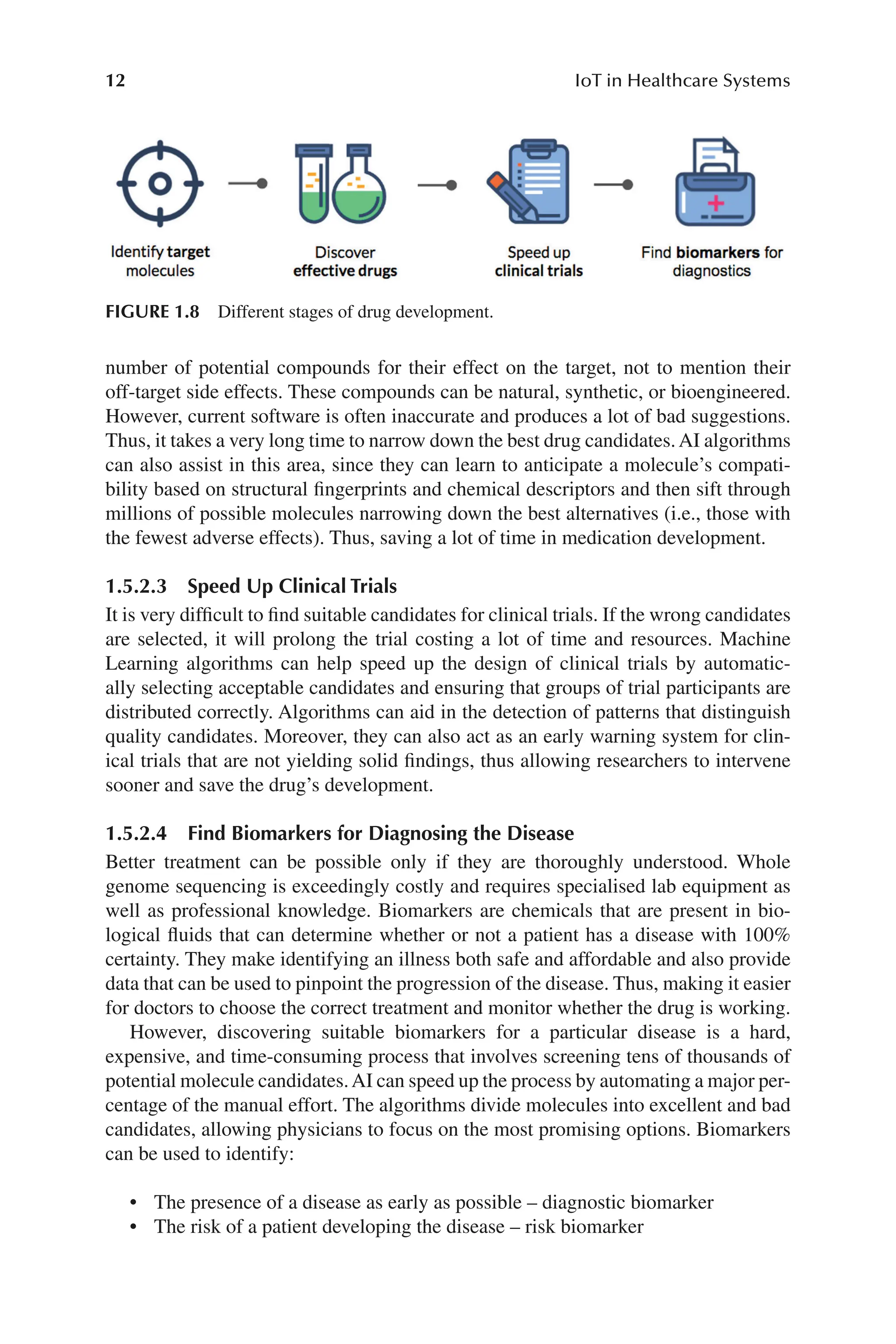
stages of drug development such as identifying targets for intervention, discovering
drug candidates, speeding up clinical trials, and finding biomarkers for diagnosing the
disease, discussed as follows.
1.5.2.1 
Identify Targets for Intervention
Understanding the basic origins of a disease as well as its resistance mechanisms is
the first step in therapeutic development. Then the determination of targets is used
to treat the condition. The growing availability of high-​
throughput tools like shRNA
screening and deep sequencing has considerably enhanced the quantity of data
accessible for identifying suitable target pathways. Traditional methods, on the other
hand, still struggle to integrate the large number and variety of data sources –​and
then uncover the appropriate patterns. Machine Learning algorithms can more easily
analyse all the available data and can even learn to automatically identify good target
proteins. Figure 1.8 shows different stages of drug development.
1.5.2.2 
Discover Drug Candidates
Identifying a compound that can interact with the identified target molecule in the
desired way is the second stage in drug development, and involves screening a large
FIGURE 1.7 Diagnostic information flow using AI.
12 IoT in Healthcare Systems
12
number of potential compounds for their effect on the target, not to mention their
off-​
target side effects. These compounds can be natural, synthetic, or bioengineered.
However, current software is often inaccurate and produces a lot of bad suggestions.
Thus, it takes a very long time to narrow down the best drug candidates.AI algorithms
can also assist in this area, since they can learn to anticipate a molecule’s compati-
bility based on structural fingerprints and chemical descriptors and then sift through
millions of possible molecules narrowing down the best alternatives (i.e., those with
the fewest adverse effects). Thus, saving a lot of time in medication development.
1.5.2.3 
Speed Up Clinical Trials
It is very difficult to find suitable candidates for clinical trials. If the wrong candidates
are selected, it will prolong the trial costing a lot of time and resources. Machine
Learning algorithms can help speed up the design of clinical trials by automatic-
ally selecting acceptable candidates and ensuring that groups of trial participants are
distributed correctly. Algorithms can aid in the detection of patterns that distinguish
quality candidates. Moreover, they can also act as an early warning system for clin-
ical trials that are not yielding solid findings, thus allowing researchers to intervene
sooner and save the drug’s development.
1.5.2.4 
Find Biomarkers for Diagnosing the Disease
Better treatment can be possible only if they are thoroughly understood. Whole
genome sequencing is exceedingly costly and requires specialised lab equipment as
well as professional knowledge. Biomarkers are chemicals that are present in bio-
logical fluids that can determine whether or not a patient has a disease with 100%
certainty. They make identifying an illness both safe and affordable and also provide
data that can be used to pinpoint the progression of the disease. Thus, making it easier
for doctors to choose the correct treatment and monitor whether the drug is working.
However, discovering suitable biomarkers for a particular disease is a hard,
expensive, and time-​
consuming process that involves screening tens of thousands of
potential molecule candidates.AI can speed up the process by automating a major per-
centage of the manual effort. The algorithms divide molecules into excellent and bad
candidates, allowing physicians to focus on the most promising options. Biomarkers
can be used to identify:
• The presence of a disease as early as possible –​diagnostic biomarker
• The risk of a patient developing the disease –​risk biomarker
FIGURE 1.8 Different stages of drug development.
13
Artificial Intelligence-Based Smart Medical Services
13
• The likely progress of a disease –​prognostic biomarker
• Whether a patient will respond to a drug –​predictive biomarker
1.5.3 
Personalize Treatment
Diverse patients have different reactions to medications and therapy regimens.
As a result, tailored therapy has huge potential to extend patients’ lives. However,
determining the characteristics that influence therapy selection is difficult. Machine
Learning can help to determine the variables to suggest that a patient will have a
certain reaction to a given treatment by automating this complex statistical work.
As a result, the algorithm can forecast a patient’s likely reaction to a given therapy.
The system learns this by cross-​
referencing similar patients and comparing their
treatments and outcomes. The resulting outcome predictions make it much easier for
doctors to design the right treatment plan.
1.5.4 
Improve Gene Editing
Clustered Regularly Interspaced Short Palindromic Repeats (CRISPR), specifically
the CRISPR-​
Cas9 system for gene editing, is a big leap forward toward editing DNA
cost effectively and precisely, like a surgeon. Short guide RNAs (sgRNA) can be used
in this approach to target and edit a specific place on the DNA. However, the guide
RNA can suit several DNA sites, which might result in unexpected consequences.
A key bottleneck in the use of the CRISPR technology is the careful selection of
guide RNA with the fewest hazardous side effects. When it comes to forecasting the
degree of both guide-​
target interactions and off-​
target effects for a particular sgRNA,
machine learning models have been shown to yield the best outcomes. This might
hasten the synthesis of guide RNA for every segment of human DNA [12].
1.6 CLINICAL APPLICATIONS
Improvements in computing power resulting in faster data collection and data pro-
cessing, growth of genomic sequencing databases, widespread implementation of
electronic health record systems, and improvements in natural language processing
and computer vision, enabling machines to replicate human perceptual processes,
have all occurred during this half-​
century period, enabling the growth of healthcare-​
related applications of AI. Some of the clinical applications of AI are as follows.
1.6.1 Cardiovascular
AI algorithms have demonstrated promising results in accurately diagnosing and risk
stratifying patients with coronary artery disease, indicating their utility as an initial
triage tool [13, 14] despite the fact that few studies have directly compared machine
learning model accuracy to clinician diagnostic ability [15].
Other algorithms have been used to predict patient mortality, medication effects, and
adverse events after acute coronary syndrome treatment. Internet-​
based technologies
have also demonstrated the ability to monitor patients’ cardiac data points, increasing
14 IoT in Healthcare Systems
14
the amount of data and the various settings AI models can use and potentially enabling
earlier detection of cardiac events that occur outside of the hospital [16].
Another area of growing interest is the use of AI in classifying heart sounds and
diagnosing valvular disease [17].
The limited data available to train machine learning models, such as limited data
on social determinants of health as they relate to cardiovascular disease, has been one
of the challenges of AI in cardiovascular medicine [18].
1.6.2 
AI Application in Stroke
The occurrence of a stroke, which affects over 500 million individuals worldwide, is
a very common and frequently seen disease. In Middle Asia, it is the leading cause
of death, while in North America, it is one of the leading causes. As a result, research
into stroke prevention and treatment is extremely beneficial. AI techniques can assist
in three fundamental categories of stroke care:
• Predicting a stroke and detecting it in advance
• Treating it if diagnosed
• Prediction of outcomes and assessment of prognosis
1.6.2.1 Early Diagnosis
When blood flow to the brain is poor, cells die, resulting in a stroke, which is fre-
quently triggered by thrombus build-​
up in vessels, hence the term cerebral infarction.
Many patients have been unable to receive timely treatment due to late recognition
of stroke symptoms. Villar et al. created a device that detects movement and predicts
the onset of a stroke. It is based on the principles of two well-​
known Machine
Learning algorithms: PCA (principal component analysis) and genetic fuzzy finite
state machine. The recognition of movement patterns is used in the detecting pro-
cedure. When movement patterns deviate from normal, it signals a stroke warning that
should be investigated as soon as feasible. For disease evaluation, such as in the case
of stroke diagnosis, neuroimaging procedures such as CT scan and MRI are required.
Machine Learning approaches have been used by researchers to analyse neuroimaging
data. When applied to a CT scan, Machine Learning methods aid in the detection
of free-​
floating intraluminal thrombus in carotid plaque. To keep track of the possi-
bilities of strokes, Rehme et al. used a well-​
known Machine Learning programme
called support vector machine, or SVM. In this situation, SVM had an accuracy rate of
roughly 87%. Griffs et al. used Bayes classification in the stroke identification method.
The computer-​
assisted method produced results that were extremely similar to those
obtained by human specialists. In multimodal brain MRI, Kamnitsas et al. used 3D
CNN for lesion segmentation. Rondina et al. performed the Gaussian method regres-
sion on few sample MRI data to find a convincing result of predicted features.
1.6.2.2 Treatment
The visualisation and survival rate are linked to the result of intravenous thrombolysis
as a serious activity of crisis measurement. Patients receiving tPA treatment by CT scan
15
Artificial Intelligence-Based Smart Medical Services
15
were studied to see if they experienced symptomatic cerebral bleeding. Whole-​
brain
scans were used as input for SVM, and the results beat traditional radiology-​
based
approaches. Predicting the outcome and determining the prognosis Multiple factors
influence stroke prognosis and illness mortality. When compared to traditional methods,
machine learning algorithms have shown to be more accurate. Zhang et al. created a
model to support the process of clinical decision-​
making by utilising logistic regres-
sion and analysing physiological indicators for a time period of 48 hours following
the incidence of stroke in order to predict the outcome of three-​
month period. Asadi
and colleagues compiled a database that included 107 patients who had intra-​
arterial
therapy for acute posterior or anterior circulation stroke. The authors used SVM and a
simulated neural system to analyse the data and attained a precision of over 70%. They
also employed machine learning to identify characteristics that influence the outcome
of brain arteriovenous contortion, which may be treated with endovascular emboliza-
tion. A standard regression inquiry model could only get a precision ratio of 43 percent,
but their tactics performed admirably with a precision of 97.5 percent [19].
1.6.3 Dermatology
Dermatology is an imaging-​
rich specialty, and the evolution of deep learning has been
closely linked to image processing. As a result, dermatology and deep learning are a
natural fit [20]. In dermatology, there are three types of imaging: contextual images,
macro images, and micro images. Deep learning demonstrated significant progress
in each modality [21]. Han et al. showed keratinocytic skin cancer detection from
face photographs [22]. Esteva et al. demonstrated dermatologist-​
level classification
of skin cancer from lesion images [23], Noyan et al. demonstrated a convolutional
neural network that achieved 94% accuracy at identifying skin cells from microscopic
Tzanck smear images [24]. Recent advances have suggested that artificial intel-
ligence (AI) could be used to describe and evaluate the outcome of maxillo-​
facial
surgery or the assessment of cleft palate therapy in terms of facial attractiveness or
age appearance [25,26] An artificial intelligence system can detect skin cancer more
accurately. Human dermatologists correctly identified 86.6% of skin cancers from
images, compared to 95% for the CNN machine [27].
1.6.4 Gastroenterology
AI has the potential to play a role in many aspects of gastroenterology. Endoscopic
procedures such as esophagogastroduodenoscopies (EGD) and colonoscopies rely on
the detection of abnormal tissue in a short period of time. By incorporating AI into
these endoscopic procedures, clinicians can more quickly identify diseases, assess
their severity, and visualise blind spots. Early trials of AI detection systems for early
gastric cancer revealed sensitivity comparable to that of expert endoscopists [28].
1.6.5 
Infectious Diseases
AI has demonstrated promise in both the laboratory and clinical settings of infec-
tious disease medicine. As the novel coronavirus wreaks havoc around the world,
16 IoT in Healthcare Systems
16
the United States is expected to invest more than $2 billion in AI-​
related healthcare
research by 2025, more than four times what was spent in 2019. Neural networks
have been developed to detect a host response to COVID 19 from mass spectrometry
samples in a timely and accurate manner [29]. Other applications include antimicro-
bial resistance detection using support vector machines, machine learning analysis
of blood smears to detect malaria, and improved point-​
of-​
care Lyme disease testing
based on antigen detection. AI has also been studied for improving meningitis, sepsis,
and tuberculosis diagnosis, as well as predicting treatment complications in hepatitis
B and hepatitis C patients [30].
1.6.6 Oncology
AI has been studied for its potential applications in cancer diagnosis, risk stratifica-
tion, tumour molecular characterization, and cancer drug discovery. The ability to
accurately predict which treatment protocols will be best suited for each patient based
on their individual genetic, molecular, and tumor-​
based characteristics is a particular
challenge in oncologic care that AI is being developed to address [31]. AI has been
trialled in cancer diagnostics with the reading of imaging studies and pathology slides
due to its ability to translate images to mathematical sequences [32]. In January 2020,
researchers demonstrated an AI system based on a Google DeepMind algorithm that
outperformed human breast cancer detection experts [33,34]. It was reported in July
2020 that an AI algorithm developed by the University of Pittsburgh achieves the
highest accuracy in identifying prostate cancer to date, with 98 percent sensitivity and
97 percent specificity [35,36].
1.6.7 
Pathology
Pathological analysis of cells and tissues is widely regarded as the gold standard for
disease diagnosis in many cases. Artificial intelligence-​
assisted pathology tools have
been developed to aid in the diagnosis of a variety of diseases, including hepatitis
B, gastric cancer, and colorectal cancer. AI has also been used to forecast genetic
mutations and disease outcomes. [37]. AI is well-​
suited for use in low-​
complexity
pathological analysis of large-​
scale screening samples, such as colorectal or breast
cancer screening, alleviating pathologists’ workload and allowing for faster sample
analysis turnaround [38]. Several deep learning and artificial neural network models
have demonstrated accuracy comparable to that of human pathologists, and a study
of deep learning assistance in diagnosing metastatic breast cancer in lymph nodes
revealed that the accuracy of humans with the assistance of a deep learning pro-
gramme was higher than that of humans alone or the AI programme alone [39]. The
implementation of digital pathology is expected to save a university centre more
than $12 million over the course of five years, though the savings attributed to AI
specifically have not yet been widely researched [40]. Since the areas of concern
can be highlighted on a pathology sample and present them in real-​
time to a path-
ologist for more efficient review, augmented and virtual reality could be a stepping
stone to wider implementation of AI-​
assisted pathology. The lack of prospective,
17
Artificial Intelligence-Based Smart Medical Services
17
randomised, multi-​
center-​
controlled trials in determining the true clinical utility of
AI for pathologists and patients is one of the major current barriers to widespread
implementation of AI-​
assisted pathology tools, highlighting a current area of need in
AI and healthcare research [41]. AI has also demonstrated the ability to identify histo-
logical findings at levels beyond what the human eye can see, as well as the ability to
use genotypic and phenotypic data to more accurately detect the tumour of origin in
metastatic cancer [42].
1.6.8 
Primary Care
Primary care has emerged as a critical development area for AI technologies [43, 44].
In primary care, artificial intelligence has been used to aid decision making, predictive
modelling, and business analytics [45]. Despite rapid advances in AI technologies,
general practitioners’ perspectives on the role of AI in primary care are very limited,
focusing primarily on administrative and routine documentation tasks [46,47].
1.6.9 
Psychiatry
AI applications in psychiatry are still in the proof-​
of-​
concept stage [48]. Predictive
modelling of diagnosis and treatment outcomes, chatbots, conversational agents that
mimichumanbehaviourandhavebeenstudiedforanxietyanddepressionareexamples
of areas where the evidence is rapidly expanding [49, 50]. One challenge is that many
applications in the field are developed and proposed by private corporations, such as
Facebook’s screening for suicidal ideation in 2017 [51]. Outside of the healthcare
system, such applications raise a number of professional, ethical, and regulatory
concerns [52]. Another issue that arises frequently is the model’s validity and inter-
pretability. Small training datasets contain bias that the models inherit, jeopardising
their generalizability and stability. Such models may also be discriminatory toward
minority groups that are underrepresented in samples [53].
1.6.10 Radiology
Artificial intelligence (AI) is being researched in the field of radiology to detect and
diagnose diseases using Computerized Tomography (CT) and Magnetic Resonance
(MR) Imaging [54]. It may be especially useful in situations where the demand for
human expertise exceeds the supply of human experts, or where data is too complex
to be efficiently interpreted by human readers [55]. Several deep learning models
have demonstrated the ability to be roughly as accurate as healthcare professionals
in identifying diseases through medical imaging, though few studies reporting these
findings have been externally validated [56]. AI can also benefit radiologists in ways
other than interpretation, such as reducing image noise, producing high-​
quality
images with lower doses of radiation, improving MR image quality, and automat-
ically assessing image quality [57]. Further research into the application of AI in
nuclear medicine focuses on image reconstruction, anatomical landmarking, and the
ability to use lower doses in imaging studies [58].
18 IoT in Healthcare Systems
18
1.7 CASE STUDIES
The Breast Cancer Wisconsin Diagnostic Data Set was used in this study. The
Machine Learning Repository at the University of California, Irvine (UCI) has
made this dataset freely available. It is made up of the properties, or features, of cell
nuclei extracted from breast tumours using fine-​
needle aspiration (FNA), a popular
oncology diagnostic method. From January 1989 to November 1991, clinical samples
were collected for this collection. Relevant features from digitised images of the FNA
samples were extracted. An example of one of the digitised images from an FNA
sample is given in Figure 1.9 [59].
The primary purpose of illness diagnosis is to determine whether or not a patient is
suffering from a disease. Diagnosis may be defined as a “pre-​
existing set of categories
agreed upon by the medical profession to indicate a specific ailment” or as a “process
or categorization agreed upon by the medical profession to name a specific illness.”
The whole diagnostic process is a sophisticated and “patient-​
centered, collabora-
tive activity that incorporates information collecting and clinical reasoning with
the purpose of diagnosing a patient’s health condition,” according to the American
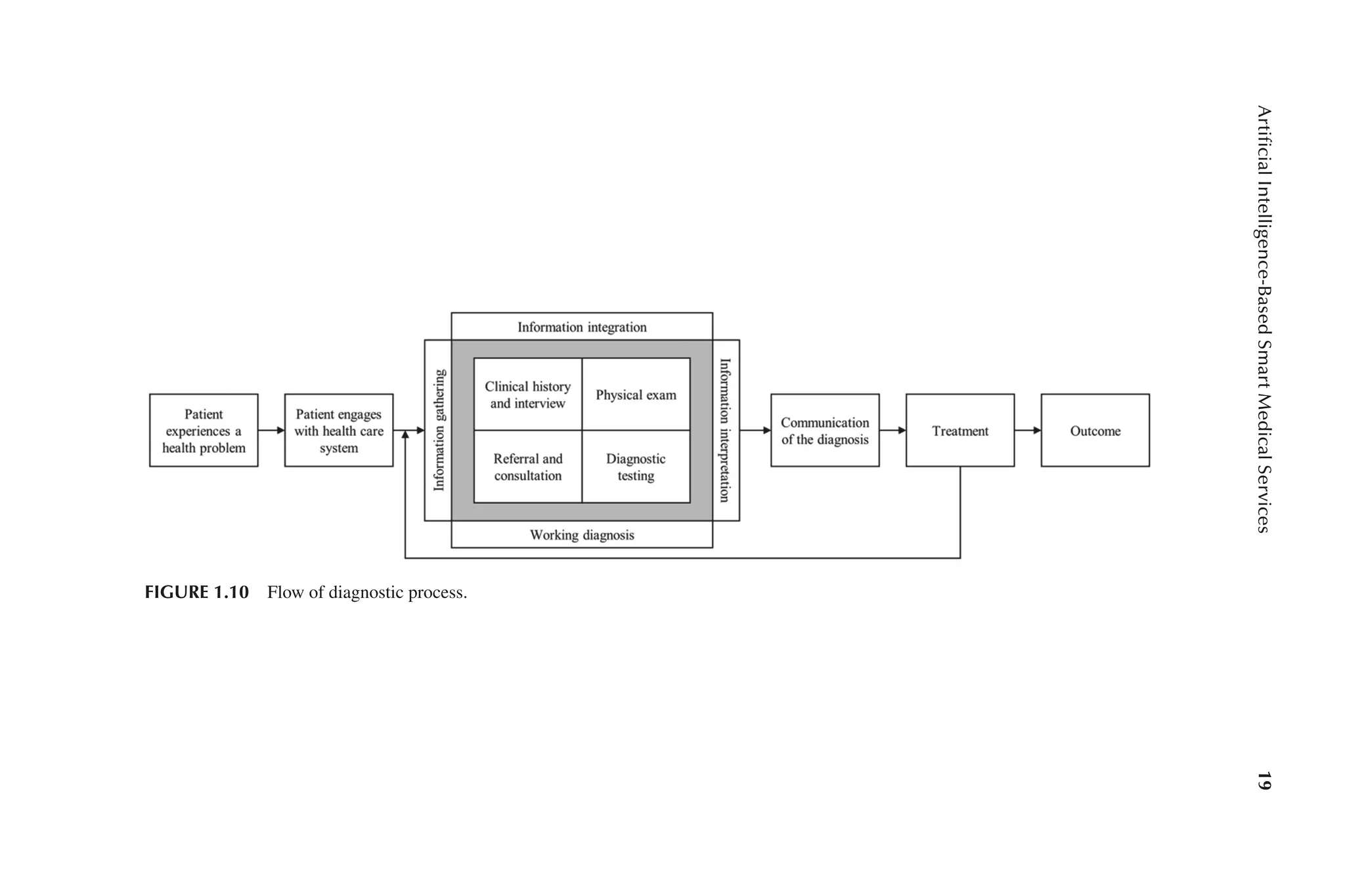
College of Physicians. To better understand the diagnostic process, the Committee on
Diagnostic Error in Health Care established a conceptual model. The patient first has
a health problem connected to the individual’s symptoms, which leads to the emer-
gence of the illness. individual to contact the healthcare system, where enough infor-
mation is gathered through a study of the patient’s clinical history and an interview, a
physical exam and diagnostic tests, and referral and consultation with additional med-
ical professionals. Gathering, integrating, and interpreting data, as well as producing
a functioning diagnosis—​
for example, a single or differential diagnosis-​
represent a
continuous process that may be done several times. The working diagnosis and an
explanation of it are shared with the patient, and appropriate treatment is planned.
Finally, this process results in an outcome for patients and the healthcare system,
such as learning from errors or a timely diagnosis [60]. Figure 1.10 shows the flow
of diagnostic process.
FIGURE 1.9 An image of a breast mass from which dataset features were obtained.
19
Artificial
Intelligence-Based
Smart
Medical
Services
19
FIGURE 1.10 Flow of diagnostic process.
newgenrtpdf
20
20 IoT in Healthcare Systems
Machine learning techniques are increasingly being used in healthcare, allowing
for more effective estimation and prediction of health outcomes from vast admin-
istrative data sets. The study’s major goal was to create a general machine learning
method for estimating diabetes incidence based on the number of reimbursements
during the previous two years. A final data set was picked from a population-​
based
epidemiological cohort (CONSTANCES) connected to the French National Health
Database (i.e. SNDS). We used a supervised machine learning method to create
this algorithm. The following steps were performed: (i) selection of final data set;
(ii) target definition; (iii) Coding variables for a given window of time; (iv) split
final data into training and test data sets; (v) variables selection; (vi) training model;
(vii) validation of model with test data set; and (viii) Selection of the model. We
used the area under the receiver operating characteristic curve (AUC) to select the
best algorithm. The final data set used to develop the algorithm included 44,659
participants from CONSTANCES. Out of 3468 variables which were similar to the
SNDS and CONSTANCES, cohort were coded and 23 variables used to train mul-
tiple algorithms. The final technique for estimating diabetes incidence was a Linear
Discriminant Analysis model based on the number of reimbursements for specified
variables such as biological testing, medications, medical actions, and hospitalisation
without a procedure over the previous two years. This algorithm has a 62% sensi-
tivity, a 67% specificity, and a 67% accuracy. [95% CI: 0.66–​
0.68] [61].
Dataset is a significant percentage of data since the literature study ofAI is gathered
during the diagnosis stage of a clinical dataset from electro-​
diagnosis, diagnosis
imaging, and genetic testing. Topol and Jha, for example, encouraged radiologists
to use AI technologies to analyse the massive amounts of data retrieved from diag-
nostic images. There are two additional main data sources: notes taken during phys-
ical examinations and results gained from executing lab procedures.
Images, electrophysiological, and genomic datasets can be used to identify
physical examination notes and clinical laboratory results since they contain a
large number of clinical notes that cannot be analysed directly. As a result, the
AI system’s primary goal is to turn these unstructured documents into machine-​
understandable electronic medical data. On the basis of dataset, AI systems are split
into two major types. Machine learning techniques are used in the first category
to analyse structured data directly. The second group, on the other hand, works
on unstructured data utilising natural language processing approaches to improve
structured data. For example, in the medical field, machine learning algorithms
focus on patient characteristics to cluster them or predict the likelihood of a specific
disease, whereas natural language processing aims to convert unstructured data to
structured data. Despite growth in the literature on AI in healthcare, the majority
of research is focused on a few key illness types such as cancer, cardiovascular
disease, and neurological disease. AI in healthcare is still mostly focused on a few
diseases, such as cancer, neurological diseases, and cardiovascular disease. These
diseases have a significant role in global mortality and require early diagnosis and
treatment. Improved analysis procedures are used in this. AI has been used to treat
diseases other than the three major ones. Long et al. used ocular imaging data to
diagnose congenital cataract illness, and Gulshan et al. used pictures of the retina
fundus to detect diabetic retinopathy.
21
Artificial Intelligence-Based Smart Medical Services
21
1.8 
CURRENT APPLICATIONS OF AI IN MEDICAL DIAGNOSTICS
A sizable portion of today’s machine learning analytic applications appears to fit into
these categories:
1. Chatbot companies are deploying AI-​
chatbots with speech recognition
features that can discover patterns through symptoms as expressed by the
patient in order to draw a possible conclusion, avert disease, and also advise
an appropriate course of action.
2. Oncology researchers are attempting to identify malignant tissues using deep
learning techniques at a level equivalent to that of a skilled doctor, allowing
for detection of cancer in its early stages.
3. Pathology is a vital field that, if covered by AI systems, can be extremely
beneficial. It is the science or study of illness origin, nature, and progression
as determined by laboratory testing of physiological fluids such as sputum,
blood, and urine, as well as tissue analysis. Traditional techniques of diag-
nosis require the use of a microscope, which can be time-​
consuming and
error-​
prone. AI technology such as machine learning and machine vision
approaches tend to improve pathologists’ traditional procedures.
1.9 CONCLUSION
There has been a shift in doctor behaviour from traditional methods to the use of AI
chatbots, which areAI versions of doctors. Through the fast-​growing fields of machine
learning and big data analytics, AI is gaining traction in medical services and is in
the process of evolving traditional approaches to diagnosing and treating illnesses.
The key to achieving better success in the treatment of disease is early detection. All
of this will be impossible to achieve without massive amounts of data, a recognition
that AI will complement rather than replace jobs, and a substantial investment in the
technology itself. AI is already helping us more efficiently diagnose diseases, develop
drugs, personalize treatments, and even edit genes. But this is only the start. The more
we digitize and integrate our medical data, the more AI can assist us in identifying
useful patterns –​patterns that can be used to make correct, cost-​
effective judgments
in complicated analytical procedures.
REFERENCES
1. www.igi-​glo​bal.com/​dic​tion​ary/​smart-​hea​lthc​are/​76574.
2. S. P. Mohanty, U. Choppali and E. Kougianos, “Everything you wanted to know about
smart cities: The Internet of things is the backbone,” IEEE Consumer Electronics
Magazine, vol. 5, no. 3, pp. 60–​
70, July 2016.
3. www.tuv​sud.com/​en/​digi​tal-​serv​ice/​smart-​hea​lthc​are.
4. http://​anyk.com/​case_​v​iew.aspx?Typ​eId=​116Id=​442FId=​t4:116:4.
5. Kashif Hameed, Imran Sarwar Bajwa, Shabana Ramzan, Waheed Anwar and Akmal
Khan, An Intelligent IoT Based Healthcare System Using Fuzzy Neural Networks,
Scientific Programming, Volume 2020, Article ID 8836927.
22 IoT in Healthcare Systems
22
6. Prabha Sundaravadivel, Elias Kougianos, Saraju P. Mohanty, and Madhavi K.
Ganapathiraju, Everything You wanted to know about smart healthcare, IEEE con-
sumer electronics magazine, January 2018.
7. S. P. Mohanty, Nanoelectronic Mixed-​
Signal System Design. New York: McGraw-​
Hill, 2015.
8. A. Bader, H. Ghazzai, A. Kadri, and M. S. Alouini, “Front-​
end intelligence for large-​
scale application-​
oriented internet-​
of-​
things,” IEEE Access, vol. 4, pp. 3257–​
3272,
June 2016, A. Banerjee and S. K. S. Gupta, “Analysis of smart mobile applications for
healthcare under dynamic context changes,” IEEE Trans. Mobile Comput., vol. 14, no.
5, pp. 904–​
919, May 2015.
9. https://​sea​rche​nter​pris​eai.tec​htar​get.com/​def​init​ion/​AI-​Art​ific​ial-​Intel​lige​nce-
Date-​19.10.2021.
10. www.visio​nmon​day.com/​busin​ess/​resea​rch-​and-​stats/​arti​cle/​new-​benchm​ark-​uspto-​
study-​finds-​ai-​in-​us-​pate​nts-​rose-​by-​more-​than-​100-​perc​ent-​since-​2002-​Dat​e19.
11. www.mygr​eatl​earn​ing.com/​blog/​how-​ai-​can-​impr​ove-​hea​lthc​are-​indus​try.
12. www.data​reve​nue.com/​en-​blog/​art​ific​ial-​intel​lige​nce-​in-​medic​ine.
13. Wang, Hong; Zu, Quannan; Chen, Jinglu; Yang, Zhiren; Ahmed, Mohammad Anis
(October 2021). “Application ofArtificial Intelligence inAcute Coronary Syndrome:A
Brief Literature Review”. Advances in Therapy. 38 (10): 5078–​
5086.
14. Infante, Teresa; Cavaliere, Carlo; Punzo, Bruna; Grimaldi, Vincenzo; Salvatore,
Marco; Napoli, Claudio (December 2021). “Radiogenomics and Artificial Intelligence
Approaches Applied to Cardiac Computed Tomography Angiography and Cardiac
Magnetic Resonance for Precision Medicine in Coronary Heart Disease: A Systematic
Review”. Circulation. Cardiovascular Imaging. 14 (12): 1133–​
1146.
15. Stewart, Jonathon; Lu, Juan; Goudie, Adrian; Bennamoun, Mohammed; Sprivulis,
Peter; Sanfillipo, Frank; Dwivedi, Girish (2021). “Applications of machine learning to
undifferentiated chest pain in the emergency department: A systematic review”. PLOS
ONE. 16 (8): e0252612.
16. Sotirakos, Sara; Fouda, Basem; Mohamed Razif, Noor Adeebah; Cribben, Niall;
Mulhall, Cormac; O’Byrne, Aisling; Moran, Bridget; Connolly, Ruairi (February
2022). “Harnessing artificial intelligence in cardiac rehabilitation, a systematic
review”. Future Cardiology. 18 (2): 154–​
164.
17. Chen, Wei; Sun, Qiang; Chen, Xiaomin; Xie, Gangcai; Wu, Huiqun; Xu, Chen (2021).
“Deep Learning Methods for Heart Sounds Classification: A Systematic Review”.
Entropy. 23 (6): 667.
18. Zhao, Yuan; Wood, Erica P.; Mirin, Nicholas; Cook, Stephanie H.; Chunara, Rumi
(October 2021). “Social Determinants in Machine Learning Cardiovascular Disease
Prediction Models: A Systematic Review”. American Journal of Preventive Medicine.
61 (4): 596–​
605.
19. Gayathri P, Gopichand G, Geraldine Bessie Amali, Santhi H, A Case Study on
Artificial Intelligence Application in Medical Diagnostics, World Wide Journal of
Multidisciplinary Research and Development.
20. Hibler, Brian P.; Qi, Qiaochu; Rossi, Anthony M. (March 2016). “Current state of
imaging in dermatology”. Seminars in Cutaneous Medicine and Surgery. 35 (1): 2–​
8.
21. Chan, Stephanie; Reddy, Vidhatha; Myers, Bridget; Thibodeaux, Quinn; Brownstone,
Nicholas; Liao, Wilson (2020). “Machine Learning in Dermatology: Current
Applications, Opportunities, and Limitations”. Dermatology and Therapy. 10
(3): 365–​386.
22. Han, Seung Seog; Moon, Ik Jun; Lim, Woohyung; Suh, In Suck; Lee, Sam Yong; Na,
Jung-​
Im; Kim, Seong Hwan; Chang, Sung Eun (2020). “Keratinocytic Skin Cancer
23
Artificial Intelligence-Based Smart Medical Services
23
Detection on the Face Using Region-​
Based Convolutional Neural Network”. JAMA
Dermatology. 156 (1): 29–​
37.
23. Esteva, Andre; Kuprel, Brett; Novoa, Roberto A.; Ko, Justin; Swetter, Susan M.; Blau,
Helen M.; Thrun, Sebastian (February 2017). “Dermatologist-​
level classification of
skin cancer with deep neural networks”. Nature. 542 (7639): 115–​
118.
24. Noyan, Mehmet Alican; Durdu, Murat; Eskiocak, Ali Haydar (2020). “TzanckNet: a
convolutional neural network to identify cells in the cytology of erosive-​vesiculobullous
diseases”. Scientific Reports. 10 (1): 18314.
25. Patcas R, Bernini DA, Volokitin A, Agustsson E, Rothe R, Timofte R (January 2019).
“Applying artificial intelligence to assess the impact of orthognathic treatment on facial
attractiveness and estimated age”. International Journal of Oral and Maxillofacial
Surgery. 48 (1): 77–​
83.
26. Patcas R, Timofte R, Volokitin A, Agustsson E, Eliades T, Eichenberger M, Bornstein
MM (August 2019). “Facial attractiveness of cleft patients: a direct comparison
between artificial-​intelligence-​based scoring and conventional rater groups”. European
Journal of Orthodontics. 41 (4): 428–​
433.
27. “Computer learns to detect skin cancer more accurately than doctors”. The Guardian.
29 May 2018.
28. Cao, Jia-​
Sheng; Lu, Zi-​
Yi; Chen, Ming-​
Yu; Zhang, Bin; Juengpanich, Sarun; Hu, Jia-​
Hao; Li, Shi-​
Jie; Topatana, Win; Zhou, Xue-​
Yin; Feng, Xu; Shen, Ji-​
Liang (2021).
“Artificial intelligence in gastroenterology and hepatology: Status and challenges”.
World Journal of Gastroenterology. 27 (16): 1664–​
1690.
29. COVID-​
19 Pandemic Impact: Global RD Spend for AI in Healthcare and
Pharmaceuticals Will Increase US$1.5 Billion By 2025“. Medical Letter on the CDC
 FDA. May 3, 2020 –​via Gale Academic OneFile.
30. Tran, Nam K.; Albahra, Samer; May, Larissa; Waldman, Sarah; Crabtree, Scott;
Bainbridge, Scott; Rashidi, Hooman (2021). “Evolving Applications of Artificial
Intelligence and Machine Learning in Infectious Diseases Testing”. Clinical Chemistry.
68 (1): 125–​
133.
31. Bhinder, Bhavneet; Gilvary, Coryandar; Madhukar, Neel S.; Elemento, Olivier (April
2021). “Artificial Intelligence in Cancer Research and Precision Medicine”. Cancer
Discovery. 11 (4): 900–​
915.
32. Majumder,Anusree; Sen, Debraj (October 2021). “Artificial intelligence in cancer diag-
nostics and therapy: current perspectives”. Indian Journal of Cancer. 58 (4): 481–​
492.
33. Kobie N (1 January 2020). “DeepMind’s new AI can spot breast cancer just as well as
your doctor”. Wired UK. Wired.
34. McKinney SM, Sieniek M, Godbole V, Godwin J, Antropova N, Ashrafian H, et al.
(January 2020). “International evaluation of an AI system for breast cancer screening”.
Nature. 577 (7788): 89–​
94.
35. Artificial intelligence identifies prostate cancer with near-​
perfect accuracy. EurekAlert
27 July 2020.
36. Pantanowitz L, Quiroga-​
Garza GM, Bien L, Heled R, Laifenfeld D, Linhart C, et al.
(1 August 2020). “An artificial intelligence algorithm for prostate cancer diagnosis in
whole slide images of core needle biopsies: a blinded clinical validation and deploy-
ment study”. The Lancet Digital Health. 2 (8): e407–​
e416.
37. Cao, Jia-​
Sheng; Lu, Zi-​
Yi; Chen, Ming-​
Yu; Zhang, Bin; Juengpanich, Sarun; Hu, Jia-​
Hao; Li, Shi-​
Jie; Topatana, Win; Zhou, Xue-​
Yin; Feng, Xu; Shen, Ji-​
Liang (2021).
“Artificial intelligence in gastroenterology and hepatology: Status and challenges”.
World Journal of Gastroenterology. 27 (16): 1664–​
1690.
24 IoT in Healthcare Systems
24
38. Försch, Sebastian; Klauschen, Frederick; Hufnagl, Peter; Roth, Wilfried (March
2021). “Artificial Intelligence in Pathology”. Deutsches Ärzteblatt International. 118
(12): 199–​204.
39. Steiner, David F.; MacDonald, Robert; Liu, Yun; Truszkowski, Peter; Hipp, Jason D.;
Gammage, Christopher; Thng, Florence; Peng, Lily; Stumpe, Martin C. (December
2018). “Impact of Deep Learning Assistance on the Histopathologic Review of Lymph
Nodes for Metastatic Breast Cancer”. The American Journal of Surgical Pathology. 42
(12): 1636–​1646.
40. Ho, Jonhan; Ahlers, Stefan M.; Stratman, Curtis; Aridor, Orly; Pantanowitz, Liron;
Fine, Jeffrey L.; Kuzmishin, John A.; Montalto, Michael C.; Parwani, Anil V. (2014).
“Can digital pathology result in cost savings? A financial projection for digital path-
ology implementation at a large integrated health care organization”. Journal of
Pathology Informatics. 5 (1): 33.
41. Försch, Sebastian; Klauschen, Frederick; Hufnagl, Peter; Roth, Wilfried (March
2021). “Artificial Intelligence in Pathology”. Deutsches Ärzteblatt International. 118
(12): 199–​204.
42. Jurmeister, Philipp; Bockmayr, Michael; Seegerer, Philipp; Bockmayr, Teresa;
Treue, Denise; Montavon, Grégoire; Vollbrecht, Claudia; Arnold, Alexander;
Teichmann, Daniel; Bressem, Keno; Schüller, Ulrich (2019). “Machine learning
analysis of DNA methylation profiles distinguishes primary lung squamous cell
carcinomas from head and neck metastases”. Science Translational Medicine. 11
(509): eaaw8513.
43. Mistry P (September 2019). “Artificial intelligence in primary care”. The British
Journal of General Practice. 69 (686): 422–​
423.
44. Blease C, Kaptchuk TJ, Bernstein MH, Mandl KD, Halamka JD, DesRoches CM
(March 2019). “Artificial Intelligence and the Future of Primary Care: Exploratory
Qualitative Study of UK General Practitioners’ Views”. Journal of Medical Internet
Research. 21 (3): e12802.
45. Liyanage H, Liaw ST, Jonnagaddala J, Schreiber R, Kuziemsky C, Terry AL, de
Lusignan S (August 2019). “Artificial Intelligence in Primary Health Care: Perceptions,
Issues, and Challenges”. Yearbook of Medical Informatics. 28 (1): 41–​
46.
46. Blease C, Kaptchuk TJ, Bernstein MH, Mandl KD, Halamka JD, DesRoches CM
(March 2019). “Artificial Intelligence and the Future of Primary Care: Exploratory
Qualitative Study of UK General Practitioners’ Views”. Journal of Medical Internet
Research. 21 (3): e12802.
47. KocaballiAB, Ijaz K, Laranjo L, Quiroz JC, Rezazadegan D,Tong HL, et al. (November
2020). “Envisioning an artificial intelligence documentation assistant for future pri-
mary care consultations: A co-​
design study with general practitioners”. Journal of the
American Medical Informatics Association. 27 (11): 1695–​
1704.
48. Graham S, Depp C, Lee EE, Nebeker C, Tu X, Kim HC, Jeste DV (November 2019).
“Artificial Intelligence for Mental Health and Mental Illnesses: An Overview”. Current
Psychiatry Reports. 21 (11): 116.
49. Chekroud, Adam M.; Bondar, Julia; Delgadillo, Jaime; Doherty, Gavin; Wasil, Akash;
Fokkema, Marjolein; Cohen, Zachary; Belgrave, Danielle; DeRubeis, Robert; Iniesta,
Raquel; Dwyer, Dominic (2021). “The promise of machine learning in predicting
treatment outcomes in psychiatry”. World Psychiatry. 20 (2): 154–​
170.
50. Fulmer R, Joerin A, Gentile B, Lakerink L, Rauws M (December 2018). “Using
Psychological Artificial Intelligence (Tess) to Relieve Symptoms of Depression and
Anxiety: Randomized Controlled Trial”. JMIR Mental Health. 5 (4): e64.
25
Artificial Intelligence-Based Smart Medical Services
25
51. Coppersmith G, Leary R, Crutchley P, Fine A (January 2018). “Natural Language
Processing of Social Media as Screening for Suicide Risk”. Biomedical Informatics
Insights. 10: 1178222618792860.
52. Brunn M, Diefenbacher A, Courtet P, Genieys W (August 2020). “The Future is
Knocking: How Artificial Intelligence Will Fundamentally Change Psychiatry”.
Academic Psychiatry. 44 (4): 461–​
466.
53. Rutledge, Robb B; Chekroud, Adam M; Huys, Quentin JM (2019). “Machine
learning and big data in psychiatry: toward clinical applications”. Current Opinion in
Neurobiology. Machine Learning, Big Data, and Neuroscience. 55: 152–​
159.
54. PisarchikAN, MaksimenkoVA, HramovAE (October 2019). “From Novel Technology
to Novel Applications: Comment on “An Integrated Brain-​
Machine Interface Platform
with Thousands of Channels” by Elon Musk and Neuralink”. Journal of Medical
Internet Research. 21 (10): e16356.
55. Hosny A, Parmar C, Quackenbush J, Schwartz LH, Aerts HJ (August 2018). “Artificial
intelligence in radiology”. Nature Reviews. Cancer. 18 (8): 500–​
510.
56. Liu, Xiaoxuan; Faes, Livia; Kale, Aditya U; Wagner, Siegfried K; Fu, Dun Jack;
Bruynseels, Alice; Mahendiran, Thushika; Moraes, Gabriella; Shamdas, Mohith;
Kern, Christoph; Ledsam, Joseph R (2019). “A comparison of deep learning perform-
ance against healthcare professionals in detecting diseases from medical imaging: a
systematic review and meta-​
analysis”. The Lancet Digital Health. 1 (6): e271–​
e297.
57. Richardson, Michael L.; Garwood, Elisabeth R.; Lee, Yueh; Li, Matthew D.; Lo, Hao
S.; Nagaraju, Arun; Nguyen, Xuan V.; Probyn, Linda; Rajiah, Prabhakar; Sin, Jessica;
Wasnik, Ashish P. (September 2021). “Noninterpretive Uses of Artificial Intelligence
in Radiology”. Academic Radiology. 28 (9): 1225–​
1235.
58. Seifert, Robert; Weber, Manuel; Kocakavuk, Emre; Rischpler, Christoph; Kersting,
David (March 2021). “Artificial Intelligence and Machine Learning in Nuclear
Medicine: Future Perspectives”. Seminars in Nuclear Medicine. 51 (2): 170–​
177.
59. Jenni A. M. Sidey-​
Gibbons1 and Chris J. Sidey-​
Gibbons, Machine learning in medi-
cine: a practical introduction, BMC Medical Research Methodology (2019) 19:64.
60. Milad Mirbabaie, Stefan Stieglitz, Nicholas R. J. Frick, Artificial intelligence in dis-
ease diagnostics: A critical review and classification on the current state of research
guiding future direction, Health and Technology (2021) 11:693–​
731.
61. Romana Haneef, Sofiane Kab, Rok Hrzic, Sonsoles Fuentes, Sandrine Fosse-​
Edorh,
Emmanuel Cosson and Anne Gallay, Use of artificial intelligence for public health sur-
veillance: a case study to develop a machine Learning-​
algorithm to estimate the inci-
dence of diabetes mellitus in France, Haneef et al. Archives of Public Health (2021)
79:168.
26
27
27
DOI: 10.1201/9781003145035-2
Securing IoT Devices
for Healthcare Systems
Using Optimization-​
Based Approaches
Ankur Khare,1
Rajendra Gupta,1
and Piyush Shukla2
1
Rabindra Nath Tagore University, Raisen, Bhopal,
Madhya Pradesh, India
2
Rajiv Gandhi Technical University, Bhopal, Madhya
Pradesh, India
CONTENTS
2.1 Introduction......................................................................................................27
2.2 IoT-​
Based Wireless Sensor Networks..............................................................29
2.2.1 Structure of IoT-​
WSNs.........................................................................29
2.2.2 Characteristics of IoT-​
WSNs................................................................30
2.2.3 Challenges of IoT-​
WSNs......................................................................30
2.2.4 Security Concerns in IoT-​
WSNs..........................................................31
2.3 Types of Attacks on IoT-​
WSNs........................................................................32
2.3.1 Denial of Service (DoS) Attacks..........................................................33
2.3.2 Cryptographic Attacks..........................................................................33
2.3.3 Routing Attacks....................................................................................34
2.4 Optimization Techniques and Functions..........................................................35
2.5 Explanation of Approaches and Optimization Methods for Node
Capture Attacks................................................................................................35
2.6 Conclusions and Future Directions..................................................................41
2.1 INTRODUCTION
WSN (Wireless sensor network) is an amalgamation of numerous tiny nodes known
as IoT devices, having sensors that are emerging in a 5G environment area that
is easily affected by malicious users. Sensors are basically small devices with the
ability to sense, record and process the information. Sensor networks are present
everywhere [58]. They are meant for measuring physical parameters like pressure,
sound, temperature, chemical composition, etc. Each sensor contains components
2
28 IoT in Healthcare Systems
28
like transceiver, microcontroller, external memory, power source, etc. Due to
ease of deployment and inexpensive nature of sensor nodes, WSN is utilized in
many important applications like armed forces and security applications, seismic
monitoring, health monitoring, industrialized automation, robust monitoring, etc.
The healthcare WSN is considered as a broad area of research because many crit-
ical applications in healthcare settings directly or indirectly depend upon sensor
networks [22]. IoT devices communicate through various routing protocols. Nodes
with sensing capacity may be itinerant and motionless. Itinerant sensor nodes
can communicate through MANETs (Mobile Ad-​
hoc Networks). IoT devices are
disseminated in an area communicating through multiple hops with each other by
forwarding data packets in MANETs [39].
Due to the increase in the dependability of sensor networks, there is a decrease
in the security of medical data. Sensor networks are easily affected by attackers as
they have fewer security mechanisms [27]. Security is a major concern as any mali-
cious user can misuse critical information by launching dangerous types of attacks
like passive attack [18], routing attack [18], active attack [18], denial of service
attack [3], node replication attack, spoofing attack, etc. Thus, there is a need to equip
sensor networks with security mechanisms instruct to ensure discretion, veracity, and
authenticity of medical information in IoT environments [33].
Main features of this technology includes: a few or large number of nodes having
asymmetric data surge commencing nodes to a instruct node having sensing cap-
ability and communication is initiated by actions in 5G. Every node performs broad-
cast message passing if there is sufficient power capability [27]. All IoT devices have
sensing capability but not all are globally identified for worldwide communication.
The network architecture depends on the application deploying the IoT WSN. For
example, some IoT devices are linked directly to the sink without passing via former
nodes. Other layers might go through other nodes to forward the data to the sink [12].
The small-​
sized nodes have inherent limitations and thus privacy is a crucial con-
cern in IoT WSNs. Such networks are insecure due to malicious and substantial
attacks by means of transmission, untrusted communication, and neglected scenery
[12]. The sensors in IoT devices have inadequate strength; therefore it is very exigent
to offer security to IoT devices with storage, energy, and computation requirement.
Consequently, several enhancements in IoT WSN like epidemic methodology [52],
UML (unified modelling language) methods [56, 57], vulnerability evaluations, and
probabilistic analysis have been developed to overcome the limitations of sensor IoT
devices to resist against the node capture attack. In certain modelling methods, the
attacker randomly captures node to compromise in the communication of a whole
sensor network. However, vulnerability evaluation approach has been formalized
whereby an attacker can select a node intelligently to compromise the network using
vulnerability metric [11]. The main objective of this chapter is to discuss different
types of attacks and security issues and the optimization approaches used to resist
node capture attacks on IoT devices in healthcare environments. Another objective is
to describe how to enhance the optimization approaches based on security, toughness
and running time for military and medical applications. This chapter also explains
how to increase the privacy of IoT devices [16].
29
Securing IoT Devices for Healthcare Systems
29
2.2 IOT-​BASED WIRELESS SENSOR NETWORKS
Wireless sensor networks (WSNs) are one of the most fundamental technologies of
the Internet of Things (IoT) for sensing, communicating and reputing among nodes.
Therefore, numerous fields utilize WSN for medication, transportation, agriculture,
process management and ecological discipline [26]. In fact, the world looks forward
to simplifying complex problems than just operating the thermostat through mobile.
Smart homes, smart buildings, smart cities, smart agriculture, and supply chain man-
agement are just a few of the areas that the wireless sensor networks will dramatically
impact. The distinguishing traits of WSN have a straight brunt on structural node`s
model with few levels: command resource, processor, communication structure, and
sensors [35, 57].
2.2.1 Structure of IoT-​
WSNs
WSNs are an emerging area that consists of multiple IoT devices (either mobile or
static), a sink station, wireless medium, and a base station (task manager) in IoT
environments [12, 16]. The components of IoT-​
WSN are described in the following
and shown in Figure 2.1:
• Sensor field: A sensor field is like a coverage area such as a forest, ocean,
home, etc., in which sensors are deployed in a distributed manner [16].
• Sensor node: This is a miniature machine or IoT device that contains four
components: transceiver, power source, microcontroller, sensing unit, and
processor. IoT devices collect, process, and record all the data traffic that is
communicated through the whole network [21, 23].
• Sink: The sink is the point where every IoT device forwards the collected
healthcare data, which is later aggregated in order to start communication with
the sink station [12].
FIGURE 2.1 Structure of IoT-​
WSNs.
30 IoT in Healthcare Systems
30
• Base station: This is the edge point between the end users and the network. It
provides all the services to the user according to their requirements. It manages
all the communication tasks between the sensor nodes or IoT devices. Thus, it
is also called the task manager [14].
2.2.2 Characteristics of IoT-​
WSNs
The important characteristics of IoT-​
WSNs are as follows:
• Scalability: Sensor networks possess dynamic topology in which we can either
increase or decrease the number of sensor nodes (IoT devices). Thus, 5G-​WSNs
are scalable enough to handle a large number of sensors [2].
• Resilience: IoT-​
WSNs are highly resilient and provide an immediate service
if any fault or node failure occurs within the network. They have the ability to
cope with all the structural changes that do not affect the normal operation of
IoT devices [18].
• Self-​organized: The randomly deployed IoT devices can adjust easily and
work in a cooperative manner. IoT devices may be mobile or static depending
upon whether we are using an ad-​
hoc network or not. They tend to communi-
cate with each other by forwarding the data packets of healthcare systems in an
organized way from one hop to another [9, 18].
• Multi-​hop communication: Sensor nodes (IoT devices) transmit the data
packets of healthcare systems through the multiple hops present among sources
and destinations. In this way, every IoT device checks the authenticity of the
medical data packet and then forwards it to the subsequent hop until the data
packet reaches to its destination node securely [39].
• Application-​oriented: Due to its very nature, IoT-​
WSNs can be effectively
used for application-​
oriented problems. The deployment of the IoT devices
done accordingly and its behaviour vary from application to application
[54, 55].
2.2.3 Challenges of IoT-​
WSNs
The major challenges of IoT-​
WSNs are as follows:
• Real-​time operation: Most critical applications of IoT-​
WSNs deal with real-​
time environments. Successful transmission of medical data packets in real
time is somewhat difficult. Message loss by intermediate nodes, congestion,
disturbing noise, and other transmission problems delay the operation of IoT
devices. Thus, the delivery of packets cannot be done in time, which is the main
challenge in WSNs [18].
• Security: Maintaining the security in WSNs is the biggest challenge. IoT
networks are developed in an environment where they can easily be affected
by malicious activities. There should be security methods associated with every
sensor node [19].
31
Securing IoT Devices for Healthcare Systems
31
• Unreliable communication: All the medical data packets are broadcasted
through multiple hops with connectionless routing protocols for large distances.
In this way communication between nodes is not reliable. Thus, there is a need
to use connection-​
oriented protocols [9].
• Energy: Maintaining the overall energy of a sensor network is a big challenge.
Every sensor node has its own energy, which is consumed when the node
transmits the medical data packets. If there are large numbers of sensors,
then more energy is required [18]. There may be the case when regular power
becomes low or negligible. Thus, there should be technology that works in the
area of energy utilization of IoT-​
WSNs [1].
2.2.4 Security Concerns in IoT-​
WSNs
WSNs are prone to attacks and the broadcast nature of broadcast standards makes
them vulnerable to attacks [18]. While talking about security, we need to talk about
the following security concerns (Figure 2.2):
• Data authentication: This is the procedure of identification and verification
of a system’s users and the IoT device that checks the authenticity of users
[54]. It is provided a document validation and verification utilizing the digital
credentials. It can be used to identify in the IoT WSN whether healthcare infor-
mation is coming from an authenticated user or not [29, 38].
• Data flexibility: Data is flexible for all users in a network providing full
access and control on medical data information flowing among IoT devices
Security Concern in
IoT-WSN
Data
Authentication
Secure
Localization
Data Integrity
Robust
Survivability
Data
Confidentiality
Data Flexibility
Self
Organization
Time
Syncrhonization
Data
Availability
Data Freshness
FIGURE 2.2 Security concerns in 5G-​
WSN.
32 IoT in Healthcare Systems
32
in IoT-​
WSNs [54]. Data flexibility provides facilities to users to interchange,
submit and retrieve their documents easily in IoT-​
WSN.
• Self-​organization: IoT devices are structured and controlled by their own set
of rules and regulations. Self-​
organized IoT devices communicate with each
other in IoT-​
WSNs and perform functions like synchronization, routing, power
consumption, and secure message passing [1, 18].
• Securelocalization:AttackersaimtocaptureunknownIoTdevicesthatarelocated
in IoT-​
WSNs. Secure localization is provided to unknown IoT devices to protect
them from attackers. Localization is becoming very important in secure medical
and military applications to ensure authenticated positions of all IoT devices [18].
• Time synchronization: IoT devices are synchronized with each other to allow
communication in a secure IoT-​
WSN. This is also necessary for well utilization
of all active and passive IoT devices and for monitoring, hustle assessment,
intention tracking, and incident exposure [18].
• Data integrity: It is surety of exact information transmission, which is not
modified or altered by attacker when medical information is passing through
medium. It is obtained using authentication because wrong healthcare data
creates confusion and generates the harmful effects on data transmission with
false decisions [1, 38].
• Data availability: Data availability in IoT devices is intended to provide acces-
sibility of data at all times without regarding network disruptions due to influ-
ence levels, machine drops, and machine modification, etc. It also provides
resistance against several attacks. Public data availability is more important to
resist against node capture attacks [1, 18].
• Robust survivability: WSNs is survivable against attacks such as node capture
threat, key compromise, etc. If single or multiple IoT devices are controlled
by an attacker then whole IoT-​
WSN is survivable or not destroyed. Machine
survivability is the strength to complete its tasks, in sensible approach in the
occurrence of failures, active and passive attacks [18].
• Data confidentiality: Healthcare information is confidentially transmitted to
the receiver, and the message is received by the actual receiver not other nodes.
It is achieved by encrypting the information using a public key of receivers so
encrypted message is decrypted by using receiver’s private key. This maintains
the secrecy of medical information [1, 18].
• Data freshness: Data freshness is directly related to the latest medical infor-
mation, which is updated and modified in real time. The fresh data is provided
to the IoT devices for time synchronization (strong freshness) and sensing pro-
cedure (weak freshness) in IoT-​
WSNs [1, 38].
2.3 
TYPES OF ATTACKS ON IOT-​
WSNS
Healthcare information is transferred over IoT-​
WSNs using broadcasting, which
provides an easy way to seize or interrupt information transmission among IoT
devices [3]. The attacker generates the interruptions in the services of IoT-​
WSN.
Attacks are classified and discussed in the following and shown in basis (Figure 2.3).
33
Securing IoT Devices for Healthcare Systems
33
2.3.1 Denial of Service (DoS) Attacks
IoT devices or the whole IoT-​
WSN is shut down or crashed due to heavy traffic
sent by the attacker in a DoS attack. The banking sector, government organizations,
finance companies, and share markets are mainly targeted in this type of attack [3].
Secret medical information and cost-​
related data are the main targets. Flooding and
crashing are two basic types of DoS attack. A lot of traffic coming from clients’ IoT
devices to the server is targeted in a flooding attack, so the speed of the server is slow
and the server can crash. This results in the loss of private and important healthcare
information from the server. In crashing, the attacker uses the vulnerabilities of IoT
devices, including bugs and weak points. Another type of DoS attack is called a
SYN flood in which the attacker rapidly initiates a connection without finalizing the
connection [3].
A DDoS (Distributed Denial of Service) attack is a specific category of DoS attack
in which several IoT devices devise a harmonized DoS attack on a particular object
[32]. In this type of attack the attacker attacks from various positions rather than
a single position. The attacker can utilize numerous IoT devices to accomplish the
attack. The attacker position is also complicated to discover because of arbitrarily
allocated IoT devices in IoT-​
WSNs [32].
2.3.2 Cryptographic Attacks
Cryptographic attacks are usually characterized as active and passive depending upon
the attacker exploitation [18].
• Passive attacks are usually initiated to steal information by unauthorized
access to IoT devices. They do not modify or alter the information and commu-
nication medium. They are more dangerous than other attacks because the user
does not get informed about the attack [1].
• Active attacks are usually used to update or alter data by unauthorized access
to IoT devices. The attacker controls the user IoT device and modifies or deletes
important information from it [18].
Classification of Attacks
in WSN
Denial of Service
Attacks
Cryptographic Attacks Routing Attacks
FIGURE 2.3 Classification of attacks.
34 IoT in Healthcare Systems
34
There is further characterization of cryptographic attacks on the basis of attacking
manner, methodology, or structure. The main aim of a cryptographic attack is to dis-
cover encryption keys and plaintext from cipher text as well [59].
• Cipher text only attack –​an attack in which attackers have several cipher texts
to find out the keys and plain text [59].
• Known plaintext attack –​an attack in which attackers have only a few plain
texts to evaluate the encryption keys and remaining plain text from cipher
text [59].
• Chosen plaintext attack –​an attack in which attackers choose arbitrary
plaintext and its corresponding ciphertext to acquire the secret encryption key
for next cipher text for future transmission [59].
• Brute force attack –​an attack in which the attackers apply all possible com-
binations of keys. It means the total possible combinations of keys are 65536
for 16-​
bit long keys (216
=​65536) [3].
• Timing attack –​an attack in which the attacker identifies the manner of com-
putation. Thus if the encryption key size is larger, the encryption process is
longer [7, 43].
• Power analysis attack –​an attack that uses power expenditure for utilizing
encryption to generate useful information for attackers [18].
2.3.3 Routing Attacks
Routing attacks are network layer attacks in which the router is injected with mali-
cious codes when information is transferred among IoT devices in WSN [18]. Some
of the most common router attacks generally include:
• Black-​hole attack: In this type of attack, a malicious device (black hole) attack
the entire traffic having smallest route in IoT-​
WSN. When a black hole receives
a request packet from its neighbour’s then malicious message is sent by black
hole to know about the route of packets transmission [30]. Thus, neighboring
IoT devices are modified their routing tables with black hole details.
• Wormhole attack: In this type of attack, the attacker captures the packets or
bits of packets at one place and forwards the packet to another malicious node
at the other end of the network through a tunnel. As a result the other nodes in
the network can be tricked into believing that they are near to other nodes which
can cause problems in the routing algorithm [49].
• Grey-​hole attack: In this type of attack, a malicious node may constantly or
randomly drop packets and therefore reduce the efficiency of the networking
system. [48].
• Node capture attack: In this type of attack, an intruder captures the IoT
devices and controls the entire IoT-​
WSN [24]. The intruder takes out the
necessary information such as encryption keys and routing procedures from
the IoT devices in the IoT-​
WSNs. Two IoT devices are communicated with
each other if they used some common keys in their transmission ranges
[10, 11]. It is difficult to determine which IoT devices are controlled by the
35
Securing IoT Devices for Healthcare Systems
35
attacker due to the large of IoT-​
WSNs. The various properties of IoT devices
such as mobility, location, energy, and contribution are utilized to obtain
the optimal nodes controlling in IoT-​
WSN [18]. On the basis of these prop-
erties the attacker determines the nodes to be attacked to compromise the
IoT-​WSN.
2.4 OPTIMIZATION TECHNIQUES AND FUNCTIONS
Optimization is a process of obtaining the optimal solution from the set of the possible
solutions on the basis of some specific condition. Objective functions are functions
that minimize or maximize the overall function value based on some constraints in
place of some solution [8, 28]. Further optimization generates the most appropriate
function value surrounded by a specified area. Optimization is a tactic, proceed or pro-
cedure or of creating incredible as copious ideal, useful, or effectual as feasible [17].
The simplification of optimization assumption and approaches to further
examinations comprises a huge region of functional arithmetic. Further, optimization
adds obtaining best possible standards of objective function agreed a distinct province
(constraints group), examining a multiplicity of unusual characteristics of objective
functions and diverse categories of region [8, 34].
The optimization problem has the following major elements:
• Objective function: one or more elements (variables) are combined to form a
single or multi-​
objective function to generate a minimum or maximum value
with few constraints [53]. Different elements are not attuned with each other or
given distinct results, so some weight factors are combined with these elements
to form objective functions to provide optimal results [6, 8].
• Variables: one or more unknown elements necessary for the objective
function are denoted as variables. Variables are utilized to explain a single
or multi-​
objective function and attain some specific conditions and service-
able requirements. They are continuous or discrete based on the problems and
constraints [7, 17].
• Constraints: they are the set of specific rules that provide particular values
to the variables which prevents us from going forever in certain directions.
Generally there are some situations in which the objective function is generated
with the help of variables. Objective function, variables, and constraints are
merged to describe the optimization problem [8, 42].
2.5 
EXPLANATION OF APPROACHES AND OPTIMIZATION
METHODS FOR NODE CAPTURE ATTACKS
The security of WSNs can be compromised by attackers which gain control of IoT
devices and communication mediums and generate interruptions in packet delivery
like updating or deleting the packets. A sensor device broadcasts HELLO packets
to all other devices for establishing communication. Thus, there is a greater chance
to attack these flooding packets among devices. This type of attack is known as the
HELLO flood attack. It is defended against using bidirectional verification between
36 IoT in Healthcare Systems
36
two neighboring nodes sharing some protocol. The protocol provides secure com-
munication between two IoT devices excluding all other devices in the WSN. This
process can be adopted for IoT devices in WSNs to provide resistance against the
HELLO flood attack [31]. Another threat to WSNs is known as the Denial of Service
(DoS) attack, which is initiated against IoT devices to capture and destroy the net-
work. The attacker sends several connection requests to the server to slow it down
and eventually stop it. A deep learning methodology using a neural network has been
designed and applied to detect DoS attack and reduce its effects [37]. The DoS attack
is easily launched in distributed WSN which is complicated to identify and tough
to protect. It is a Distributed DoS (DDoS) attack in which a clone node or attacker
node sends various requests through the clients to the server. The server receives
these requests and keeps busy on replying the clients and leaves the main process.
The speed of the server is slowly reduced and the server may crash after some time.
A Fuzzy Guard is a fuzzy inference system to detect and prevent against DDoS attack
by utilizing autonomous routing mechanism. Several possible inhibition levels are
applied consequently to compact with flood of attack to economically decrease the
attack collision on WSN in IoT environment. The Fuzzy Guard approach could be
prevented the packet flooding in attacking level and defended against DDoS attack
with less communication overhead and resource expenditure [32].
A sensor IoT node is good or bad; it is decided by its trust value which is evaluated
on the basis of historical medical information about misbehavior of that sensor node
in IoT-​
WSN. The attacker nodes are detected using an O2Trust method to provide
the trust value for every node, so the good nodes are selected for communication
rather than the bad nodes. This helps for future selection of sensor nodes based on
trust value with On-​
Off attack improvement [36]. The misbehavior of sensor nodes
is also shown by selective forwarding attack, which can be accurately detected using
an E-​
watchdog method with minimum energy expenditure. The strength of attack
detection is enhanced effectively due to selection of detector nearest the attacker.
False information coming from attacker node is exempted by an election process to
decrease the forged detection rate and enhance the strength of detection with min-
imum power expenditure [47].
Another selective forwarding attack is grey-​
hole attack, which is a specific kind
of DoS attack. The grey-​
hole attack affects secrecy, integrity, and accessibility of
data in WMNs and damages the whole network by destroying sensitive informa-
tion. A specific technique called FADE (Forwarding Assessment-​
based Detection)
was developed to fight grey-​
hole attack. Furthermore, FADE preserves coexistence
with existing connection protection approaches. The optimal recognition threshold
is examined to reduce the forged positive and negative rate of FADE with corrupted
medium quality in WMNs [48]. The attacker changes the traffic from one portion to
another in WSNs by adding a minimum cost channel between two portions. This kind
of attack is known as a wormhole attack. A DIDS (Distributed Intrusion Detection
System) is introduced to watch and detect wormhole attacks in WSNs. The attacked
channel is detected using an intrusion system based on criteria like minimum energy
and cost [49].
Various real-​time applications like UnmannedAerialVehicles (UAVs), IoT devices,
and automatic cars use an ROS (Robot Operating System). Robotic camera photos
37
Securing IoT Devices for Healthcare Systems
37
can be flown without security. This privacy is generated by using some assessment
on security and the uneven flow of unsecure information is detected by intrusion
detection system. Image comparisons are performed and abnormal data flows can
be detected by ROS. The image comparison experiments are performed on robotic
cameras in automatic cars [55]. The intruder introduces an attack to obtain replicas
of IoT sensor nodes in IoT-​
WSN; this is known as a node replication attack. It is very
complex and tough to find these replicas in networks due to high mobility of sensor
nodes. In view of the restrictions of centralized recognition methods for stationary
WSN, some dispersed methodologies have been developed to find replication attacks.
Movable nodes ID and various positions are used for hybrid local and comprehen-
sive recognition approaches. Local recognition is applied in local fields and global
recognition is initiated in global fields to enhance selection of malicious nodes with
replicas [60].
Another hybrid approach based on Danger Theory (DT) is combining the
centralized and distributed approach to detect and prevent replication attack in WSNs.
The several steps performed to detect replication attack in DT are.; firstly the nature
of nodes examine, after that power examine and at last information provide to WSN
[51]. The efficiency of this hybrid approach is analyzed in terms of power, time,
and delay of detection, overhead, and false negatives. This approach combines all
the features and overcomes the disadvantages of centralized and distributed detec-
tion methods [20]. The purposes of WSN illustration study is to determine the small
dimensional sensor node generation that confine grid organization and are helpful
for resolving various problems. Still, regardless of the explosion of these approaches
there is presently nothing to describe robustness to adversarial attacks. The vulner-
ability examination is broadly used arbitrary walks for attacker perturbations [4].
WSNs are susceptible to node capture attacks due to development of IoT devices
in communication environment unattended,. Formerly intruder seizes nodes and
compromises theWSN by attacking through node capture attacks. Consequently, node
capture attacks are perilous and ought to be detected in minimum time to decrease the
damage done by attacker. A sequential analysis is applied to detect this type of attack
[25]. The identification of node capture attack is extremely difficult in heterogeneous
wireless ad hoc networks. Some of the traditional adversarial approaches have been
found to be inappropriate for attacks due to overhead cost of capturing and mobility
of sensor IoT devices. The low cost and high probabilistic detection of node cap-
ture attack is performed by using integer programming concepts based on attacker`s
knowledge descriptions and some greedy heuristics approaches applied for minimum
power expenditure to identify the limit of network compromise. Individual sensor
node memory modification is used to diminish the consequences of attacks using
security keeping protocols [39].
The attacker model for finding the node capture attack in WSN yielding the min-
imum cost can be formulated as an integer-​
programming minimization problem.
Various constraint matrices are introduced in some decomposition methods for node
capture attack protection models [41]. In meticulous, an imperative difficulty in the
extremely dispersed and reserve inhibited situation is node capture by intruder for
modification and stealing the information of sensor nodes.Although widespread effort
has been made toward manipulative approaches for protecting and hindrance node
38 IoT in Healthcare Systems
38
compromise or sensible recognize and rescind captured sensor nodes. Stimulated
by newly arrived attacks scattering over atmosphere interfaces, epidemic theory is
utilized to detect node compromise in WSNs. The pairwise key approach and topo-
logical distinctiveness is well formed for defense strategies against large-​
scale node
capture attack [44].
The node capture attack is not completely removed from the WSN, but it is
minimized to reduce the impact. The maximum node density and neighborhood con-
tribution are influencing factors to form vulnerabilities in WSN. These vulnerabilities
are used by intruders for attacking the network and misusing the secret information
of IoT devices. A probabilistic model with hash chain approach is applied on the
network to reduce the chance of attack and also to detect the compromised nodes at
a higher level. Each node has a hash chain to evaluate the misbehavior of that node,
which provides information on whether the node is compromised or not [45]. Some
researchers have also developed a few approaches to enhance the efficiency and per-
formance of node capture attack with minimum resource consumption. It has been
achieved by developing a GNRMK (Greedy Node capture based on Route Minimum
Key set) approach, which evaluates the number of keys in every route to generate a
key-​
route association with higher flow in a WSN. The node is captured on the basis of
key-​
route association value with higher overlapping. GNRMK determines the lowest
number of nodes to compromise entire WSN [19].
Table 2.1 gives a comparative analysis of various research works.
RA (RandomAttack) is used to select the sensor nodes randomly in every repetition
[13, 15]. The number of keys is used for detecting nodes to be captured; it is known
as MKA (Maximum Key Attack) [13, 46]. The number of links among sensor nodes
is used to discover the probable captured sensor nodes; it is called MLA (Maximum
Link Attack) [14, 15]. Similarly the compromised traffic ratio is used to obtain the
possible compromised sensor nodes, which is known as MTA (Maximum Traffic
Attack) [13, 15]. GNAVE (Greedy Node capture Approximation using Vulnerability
Evaluation) is another way to use vulnerabilities of IoT-​
WSNs to identify probable
captured nodes [14, 40]. Another approach implemented to enhance the efficiency
of node capture attack is Matrix Algorithm (MA), which is an attacker model with
minimum resource consumption and higher reliability. The relationship among keys
and paths in WSNs are evaluated and then path-​
key association is obtained. At last
both are combined to form node-​
path association. The cost of every sensor node
is evaluated on the basis of direct and indirect association among nodes and paths.
Finally the nodes can be captured based on the node cost. MA shows the minimum
nodes captured with the maximum compromised traffic and minimum resource con-
sumption in the most effective time over WSN as compared to the RA, MKA, MKA,
MTA and GNAVE [14].
An enhanced form of MA has been developed with minimum resource con-
sumption, which is known as MREA (Minimum Resource Expenditure node cap-
ture Attack). A NP-​
Hard problem is obtained by converting the set covering to the
Hamiltonian cycle problem to find the shortest path for reducing the transferring cost
in IoT-​
WSNs. MREA has generate improved results due to evaluation of the shortest
path with less resource consumption [13]. Attacking efficiency with minimum exe-
cution time is further enhanced by introducing another approach called FGA (Full
39
39
Securing
IoT
Devices
for
Healthcare
Systems
TABLE 2.1
Comparative Analysis of Various Works of Researchers
Authors Node Selection Method Network Type Type of Attack Advantages Remark
A. Bojchevski et.al. [4] Eigenvalue perturbation
theory
Mobile Centralized Poisoning Attack Minimum Memory
Complexity
Maximum
Communication
expenditure
A. Khare et.al. [5] GWOA multi-​objective
function
Mobile Centralized Node Capture Attack Minimum
Communication
Overhead
Enhanced Detection rate
A. Khare et.al. [6] DOA multi-​objective
function
Mobile Centralized Node Capture Attack Balanced Throughput Single Point Failure
C. Lin et.al. [13] MREA Static Centralized Node Capture Attack Minimum Overhead Appropriate for mobile
WSN
C. Lin et.al. [14] MA Static Distributed Node Capture Attack Minimum Memory
Complexity
Enhanced Detection rate
C. Lin et.al. [15] PCA and OGA Mobile Centralized Node Capture Attack Balanced Throughput Maximum Detection rate
G. Wu et.al. [19] GNRMK Mobile Distributed Node Capture Attack Average Memory
Overhead
Minimum Resource
Expenditure
H. R. Shaukat et.al. [20] Multi-​
level replica detection
using danger theory
Static Distributed Clone Attack Minimum Memory
Complexity
Maximum Detection rate
J. W. Ho [25] SPRT Mobile Distributed Node Capture Attack Minimum Delay, Highly
Secure
Average Detection
Possibility
M. A. Hamid et.al. [31] Probabilistic secret
sharing protocol with
bidirectional verification
Mobile Centralized HELLO Flood Attack Minimum
Communication
Overhead
Reduce Vulnerability
M. Huang et.al. [32] Fuzzy Guard Mobile Distributed DDoS attack Minimum Overhead Minimum Resource
Expenditure
N. Labraoui et.al. [36] O2
Trust Mobile Distributed On-​Off Attack Maximum Detection
Possibility
Enhanced detection rate
(continued)
newgenrtpdf
40
IoT
in
Healthcare
Systems
40
O. Brun et.al. [37] Deep Learning Statically Centralized DoS Attack Average Memory
Overhead
Single Point Failure
P. Tague et.al. [39] Greedy Heuristic Approach Mobile Centralized Node Capture Attack Minimum Overhead Single Point Failure
P. Tague et.al. [41] Heuristic Algorithm Static Centralized Node Capture Attack Maximum Security Enhanced detection rate
P. K. Shukla et.al. [42] PSO and GA multi-​
objective
function
Mobile Distributed Node Capture Attack Maximum Security Average Detection
Possibility
P. De et.al. [44] Epidemic Theory Mobile Distributed Node Capture Attack Minimum
Communication
Overhead
Reduce Vulnerability
P. Ahlawat et.al. [45] Hash Chain Method Static Centralized Node Capture Attack Minimum Delay, Highly
Secure
Average Detection
Possibility
Q. Zhang et.al. [47] E-​watchdog Mobile Distributed Forwarding Attack Maximum Security Enhanced Detection rate
Q. Liu et.al. [48] FADE Mobile Distributed Grey Hole Attack Average Memory
Overhead
Maximum Detection rate
R. D. Graaf et.al. [49] Distributed Intrusion
detection System
Mobile Centralized Wormhole Attack Minimum
Communication
Overhead
Reduce Vulnerability
R. Bhatt et.al. [50] FFOA multi-​objective
function
Static Centralized Node Capture Attack Average Memory
Overhead
Appropriate for mobile
WSN
S. Lagraa et.al. [55] ROS Mobile Distributed Real-​time Attack Minimum Memory
Complexity
Maximum Detection rate
Z. wang et.al. [60] Hybrid Detection Method Mobile Distributed Node Replication
Attack
Minimum
Communication
Overhead
Reduce Vulnerability
TABLE 2.1 (Continued)
Comparative Analysis of Various Works of Researchers
Authors Node Selection Method Network Type Type of Attack Advantages Remark
newgenrtpdf
41
Securing IoT Devices for Healthcare Systems
41
Graph Attack), which captures the sensor nodes on the basis of destructiveness
degree of nodes. Additionally the efficiency of FGA is increased by using optimiza-
tion approaches such as OGA (Opti-​
Graph Attack) and PCA (Path Covering Attack).
The graph of a FGA is optimized using OGA and the shortest path is evaluated using
PCA. The energy expenditure and attacking times are reduced and attacking effi-
ciency is increased for OGA, PCA and FGA as compared to other approaches [15].
The only energy is not suitable for selection of nodes to be captured; other factors
like node contribution and key utilization are also utilized to compromise the sensor
IoT nodes in WSNs. Multiple objectives such as energy cost, participation of sensor
nodes, and key utilization are combined to evaluate the nodes’ importance values.
After that an optimization approach such as FiRAO-​
PG (Finding Robust Assailant
Optimization Particle swarm optimization and Genetic algorithm) is applied on
this multi-​
objective function to obtain optimal value for selection of compromised
sensor nodes. The features of PSO (Particle Swarm Optimization) and GA (Genetic
Algorithm) are combined to generate the optimal value of the multi-​
objective function,
which is further utilized for selection of probable captured sensor nodes. FiRAO-​
PG
shows higher attacking efficiency than MA in terms of compromised traffic fraction
[42]. FFOA (Fruit Fly Optimization Algorithm) is another popular optimization tech-
nique that is applied using the multi-​
objective function that combines the sensor node
and key participation and resource expenditure to identify optimal sensor nodes in
WSNs. It will manipulate a comprehensive device to knock down utmost division of
theWSN beside by way of effectual cost and greatest offensive competence. The FFOA
generates improved efficiency in terms of fraction compromised traffic, attacking time,
and cost of energy over WSNs compared to GA and other approaches [50].
A GWOA (Grey Wolf Optimization Algorithm) was developed to determine
the sensor nodes with the greatest opportunity of being attacked in WSN. GWOA
implements an multi-​
objective function combining several factors such as stability
and participation of sensor nodes. The stability is evaluated on the basis of velocity
and location of sensor nodes. Sensor node participation is evaluated on the basis of
neighborhood degree (number of neighbors of sensor nodes). GWOA shows superior
competence in terms of attacking rounds, power cost, and traffic compromised against
ACO (Ant Colony Optimization) and other approaches [5]. A DOA (Dragonfly
Optimization Algorithm) is implemented to identify the sensor nodes that have the
best chance of being attacked in WSN. DOA uses a multi-​
objective function that
merges various factors such as power cost, key utilization, and node velocity. Power
cost is calculated using direct and indirect association of sensor nodes. Key utilization
calculates the number of keys for each sensor node.Velocity is directly associated with
mobility of sensor nodes. DOA shows the superior competence based on attacking
rounds, energy cost, and compromised fraction against PSO and other techniques [6].
Table 2.2 gives a comparative analysis of several node capture approaches.
2.6 
CONCLUSIONS AND FUTURE DIRECTIONS
IoT-​
WSNs are self-​
organizing, self-​
repairing, and operate a dynamic topology in
the multi-​
hop environment, which faults tolerance and vulnerability to malicious
attacks. IoT devices have stored the information by using sensors on them. The
Random documents with unrelated
content Scribd suggests to you:
more than once my success as a
journalist at this time was due entirely to
Fiam, but for pity’s sake don’t mention it
to any one.
He often left his post of observation on
the battlement, and came down onto my
necktie, which he called “the silk
waterfall.” There he read what I wrote
and gave me his opinion with a frankness
that would have made me very angry if I
hadn’t been so fond of him. Sometimes in
the midst of a sentence I would hear his
little voice shrieking:
“Oh, what stupidity! What have you
written? Throw it away. I can’t understand
a word of it.”
At this interruption I would stop writing
and say:
“What is that?”
And he would go on: “Rub out that
nonsense. I will tell you what to say, and
you can put quotation marks.”
“Don’t you want to sign it, too?” I
asked, laughing.
But I agreed to what he proposed, and was always satisfied with
what he did. In the end I accepted his services absolutely.
“Fiam,” I would sometimes say, “I am tired. I don’t feel like
thinking. Tell me what to write.”
And he would shout at me: “Lazy fellow, if I weren’t here what
would you do? Well, just this once” ... and he would dictate page
after page.
Dear little Fiam, how good he was!
Fiam Goes to the War
CHAPTER VIII
FIAM GOES TO THE WAR
Fiam had been with me about a month when I was ordered to go
to the war.
You know, this was just the time when a great war had broken out
between Japan and another empire, and I was ordered to go out
and describe what I saw there. While writing up the important
events that sent two armies to the front I couldn’t stop to narrate
the adventures of my little friend, and so I never put a word about
Fiam in any of my writings. Besides, grown people are so
incredulous!
The war took place in a part of China called Manchuria. In order to
get there you have first to travel by railroad to a seaport, then on a
ship to China, then on horseback or afoot, crossing plains and
mountains for about a hundred miles, and so to the field of battle.
In telling his story Fiam had shown so much fear of war that I
hadn’t dared to tell him where we were going. He fairly flooded me
with questions.
“Why do we travel so much?” he asked me one day in the train
when I had put him up on my collar so that he could see the country
out of the window. I made him look at it well so that he could give
me a description of it, as, in fact, he did.
“We are traveling to amuse ourselves,” I replied.
“Beautiful amusement,” he grumbled,
“to be carried by this monster spitting out
smoke. It seems to me like going back to
that great house where I was split up and
cut to pieces. Look up there,” he added
after a few moments. “What lovely
country! See the roof of that temple
through the trees, and that wonderful
field of flowers. Let us stop here.”
“We can’t.”
“Why not, if we are traveling to amuse
ourselves?”
“Yes, but the amusement will come
further on.”
Fiam gave a soft whistle—it was his
way of sighing. Then he crept down on
my shirt to find the silk waterfall and rest
a while in a fold; but he couldn’t find any
tie. I was wearing a kind of uniform
similar to that of the soldiers.
“Why are you dressed this way?” he
asked in a surprised tone, tapping me on
my chin.
“It is the fashion in my country.”
He whistled again, and going down
from button to button he reached my knees.
“Why do you wear these great boots?” he said, looking down at
my feet, stretching himself out cautiously as if he were an Alpine
climber hanging over a precipice.
“It is the fashion in my country.”
Postage Stamps
CHAPTER IX
POSTAGE STAMPS
The train stopped at a large station. A dozen officers entered the
car all talking, threw their bags into their racks, took off their swords
and placed them near the window, seated themselves and lighted
their cigarettes. There was a perfect slaughter of matches. Poor
Fiam was so frightened that he hurried under my waistcoat and,
creeping near a buttonhole, hid his head under a button.
Outside of the train there was the noise of a great crowd. We
could hear the tread of the troops as they went to their places in the
cars prepared for them. We heard shouted commands, the rattle of
cartridges in their boxes at the belts of the soldiers, and the guns
dropping to the ground all at once sounded like falling iron. In the
distance hundreds of people kept shrieking and repeating:
“Sayonara!” which means good-bye. “Banzai,” hurrah. “Come back
victorious! Destroy the enemy! Glory!” and other similar cries.
One of the officers in my compartment asked:
“What are we waiting for?”
“They are attaching the cars of guns,” replied another.
“There will be lots of guns needed in this war!” exclaimed a third.
“It is going to be the greatest war of our country,” a fourth added
complacently.
Some one began to hum a tune. The others joined in the chorus.
The train started. I felt Fiam, who had taken his head from under
the button, climb along the waistcoat and
crawl into his little box, which was in an
inside pocket. The box had been used so
much that it was all broken on one side,
so that Fiam had learned to come and go
through the hole by himself.
He didn’t appear until late at night,
when every one was asleep, swaying with
the motion of the train, and the car only
dimly lighted by a covered lamp. I was
awakened by his little voice. He had
climbed up on my shoulder near my ear
and was calling to me. In the dazed
condition of a person half awake I
thought it was the singing of a mosquito
and put up my hand to catch him.
“It is I,” he said. “I am Fiammiferino.”
“Oh! good-morning. Aren’t you asleep?”
“No, I never sleep. I am not a man.”
“Then if you will excuse me, allow me
to sleep. I am a man.”
“First tell me—from the conversation I
have overheard I judge there is war; is it true?”
“Yes, perfectly true.”
“And are we going there?”
“Does it displease you?”
“No, but it displeases me that you haven’t been frank with me. Am
I not your friend?”
“I believe so.”
“Well, I forgive you; don’t say anything more. I will go anywhere
with you. They talked of war in my country. If I could only do
something to help them to conquer.”
“You!” I exclaimed laughing. “Then aren’t you afraid?”
“No. I am afraid of nothing but fire; and you will protect me.”
“Yes, of course.”
“And you will always tell me the truth?”
“I promise you.”
“That’s all. Good-night.”
I could have kissed him if it were only possible to kiss a match. He
disappeared. At that moment some one shook me. It was one of the
officers who looked into my eyes.
“Are you awake?” he asked me.
“Yes,” I replied, sitting up.
“Are you feeling sick? I am the army surgeon; my name is Tasa.
Let me feel your pulse.”
“But I am perfectly well.”
“No, you are talking to yourself, and must have something the
matter with your head.”
“I assure you I am perfectly well.”
“Show me your tongue.”
“Not if I know myself,” I replied irritated.
“All right,” concluded Dr. Tasa; “calm yourself. I see you are
armed. I think it would be best for you to give me your revolver, and
for you to put a little ice on your head.”
“But I am not in the least crazy.”
“Well, well,” and his little yellow face wrinkled up as if to say,
“Who knows?”
“I wasn’t talking to myself,” I said in order to convince him.
“With whom were you talking?”
“With Fiam....” I didn’t finish, for I remembered my promise not to
reveal his presence to any one.
“Humph, humph!” He shook his head and murmured, “Quiet
yourself, and don’t think anything more about Fiam. Go to sleep; we
shall see to-morrow.”
The next morning I pretended to leave the train, and changed
cars in order to escape the watchfulness of Dr. Tasa.
The journey went on without incident. I didn’t dare to have Fiam
come out during the day, as I was never alone. But at night he took
a walk on my shoulders, and we held whispered conversations.
On board the steamer on our way to China we had more liberty,
and often conferred together. After our work was put away in an
envelope, Fiammiferino began looking for a postage stamp in the
depths of the portfolio. He went in and traveled all about the leather,
explored the little pockets, and came out with amazing dexterity. He
had a passion for putting on postage stamps after I had wet them.
He walked over them, carefully pressing the edges flat with his feet
to be sure they would stick fast to the envelope; when he had
finished this operation, which he did as carefully as an upholsterer
laying a carpet, he always danced a ballet to express his satisfaction
in his completed work.
Fiammiferino Has a Bath
CHAPTER X
FIAMMIFERINO HAS A BATH
One evening—it was the night before we were to land—the
officers with us were polishing their swords, trying to make them like
mirrors. In order to enjoy themselves while they worked they had
had saki brought, and invited me to drink with them. As they drank
they sang. Then they put their swords in their scabbards and went
to sleep. I was about to follow their example when I felt Fiam
moving.
He had come out of his box, and was walking energetically about
on my chest. I unbuttoned a button on my waistcoat and called to
him: “Fiam!” I forgot to tell you that sometimes he didn’t like this
nickname that I had adopted. He felt as if he had lost half his name,
and would show his disapproval by completing the word.
“Fiam!”
“Miferino!” he added.
“What do you want?”
“What do I want?” he replied excitingly, stepping outside with an
agility I had never observed in him before. “What do I want? How
delightful! I smell saki, and you left me shut up in the box.”
“Well, what of it?”
“Saki, sakii, sakiii,” he began to sing, dancing around on my
shoulder.
He was beside himself with excitement.
“Be careful,” I said, “or you will fall off.” I had never seen him so
lively.
If Fiam had one fault it was that of being melancholy. Sometimes I
scolded him for it.
“In this world you must be resigned,” I would say. “It is true you
are no longer a beautiful willow in the woods, and I am sorry for
you, but that is no reason for being so sad, and for grumbling all the
time about everything and everybody.”
FIAM BEGAN TO DANCE
“But you don’t understand, my good friend,” he said now, “that
the odor of saki, this delicious perfume, reminds me of the most
delightful time of my life. When Prince Funato came with his court
every year they poured saki on my trunk. I loved it. It made me
want to dance. It is more than a hundred years since I smelled this
marvelous odor. I beg you to put me near the cup.”
I did so. The cup of saki from which I had
drunk was as small as a doll’s cup. It was
beautiful blue china with white dragons and
was still half full of the good warm liquor
which was something like Marsala wine.
Fiam began to dance around on the brim
as children do on the edges of fountains in
gardens. Then he leaned over and stirred
the liquid. I could hear him singing in his
mosquito voice.
Unfortunately the dry wood of Fiam’s arms absorbed the saki,
which rose through the fibres till it reached his head. Then he
indulged in the craziest antics. At last he took a little run and,
turning a magnificent somersault, plunged into the cup.
I realized it all too late. I was perfectly distracted when I heard
Fiam splashing in the saki, spinning around quite like a top. I drew
him out and held him between two fingers to dry, but I couldn’t keep
him still. He was so wet he slipped away and skipped about, leaving
drops of liquid everywhere, and if I held him tight he pricked me on
the nails and kicked desperately.
Taking a good hold I raised him up so as to look at him near by.
The phosphorus on his head had melted and shone palely through
my fingers.
“What have you done?” I said. “A little more
and you would have been drowned.”
“Who are you?” he answered, trying to
make his voice heavy. “Who dares to place
mortal hands on the body of a god? Let me
down, barbarian,” and he twisted around. “Let
me go or my vengeance will annihilate you!
You are a coward! I will try the effect of my
divine power! Tremble....”
I saw now what was the matter and
whispered:
“Fiam, be good.”
“Shame on you! I am a Haji.”
“Yes, but you are also acting disgracefully.
Let me put you in your box and to-morrow
you will thank me.”
“You want to lock me up. You want to make
me a prisoner. You aren’t satisfied to have me
for a servant to carry around with you
everywhere. You are the cause of all my woes,
but my power is infinite. At a call from me all
the animals in the world will come and tear
you to pieces. My friend To, the Stork, will
come and eat your eyes out. The Prince
Funato will come and cut your head off with his sword.”
“Fiam, keep still; you are not used to wine. Don’t you see that if I
were really your enemy I should light you, and burn you to the tips
of your toes? I think I will now smoke a cigarette....”
These words quieted him, and in a little while I put him in his box
and placed that in my pocket.
A Curious Costume
CHAPTER XI
A CURIOUS COSTUME
The day after that we arrived in China.
Far out at sea we spied the land—all green hills with pagodas
everywhere.
In the morning, not feeling Fiam move, I looked for him in his box,
but it was empty, and he had disappeared. I was very anxious.
There was no trace anywhere of my little friend except an odor of
saki. I was afraid he had fallen on the ground and that some one
had picked him up. Every time I saw a lighted pipe or cigarette my
heart beat and I ran to see if the burning match could be Fiam. I
couldn’t bear to leave the ship until I had found him. I actually
ransacked my pockets ten times in succession. I looked in every
corner of my valise, all over the floor and in every crack of the deck
and in my slippers—nothing. I was afraid he had run away and I
could have cried from grief.
“What have you lost?” asked one of the stewards, seeing me
bending over searching on the floor and stairs.
“I am looking for a match,” I answered.
“Here is one.”
Startled, I turned quickly, but he handed me an entirely fresh box
of matches.
“No, thank you,” I said. “Mine is double.”
He gazed at me in amazement and left me. If he had been the
doctor he might, perhaps, have ordered ice on the head; but as he
was only the steward he returned soon and gave me the bill for my
meals.
I drew out my purse to pay him, and on opening it I saw a lot of
papers. I looked between them feverishly. Just guess! Fiam was
among the postage stamps, but in what a state!
While still wet with saki he had left his box and, without knowing
what he was doing, had crept among the stamps, because that way
was familiar to him. Of course, the glue on the stamps had stuck to
him, and the more he struggled to free himself the stickier he
became. Then the saki had dried, leaving him all covered by a
collection of stamps. Think how he looked! On his legs he had two
blue five-cent stamps and three red one-cent each; on his chest
there were two red and one yellow. On his arm was another of one
cent.
He was dreadfully humiliated, and asked me to help him get rid of
them.
I carefully stripped off those on his back, but he begged me to
leave some pieces on rather than scrape them off with my penknife.
So from this time Fiam wore a garment as gay as a clown’s. All over
him you could recognize little pieces of the face of the Emperor
whose likeness is on all Japanese stamps.
Fiam was very proud of this costume on account of those
fragments of the Imperial face.
“With this protection,” he said, “I can accomplish wonders.”
“Look out,” I told him. “Your suit has cost me more than twenty
cents. What if I should wipe your coat off and put on a Chinese
stamp to punish you?”
At this he was very angry. And when he was angry he had a queer
way of getting even with me. He would say:
“All that I told you to write is false, absurd and stupid; it is exactly
opposite to the pure and simple truth.” After that he wouldn’t speak
for two hours. You can see that he was really dreadfully provoked.
Fiam as a Mountain Climber
CHAPTER XII
FIAM AS A MOUNTAIN CLIMBER
Twice more during that long journey I thought I had lost Fiam.
Each time it was on account of that hole in his box through which he
crawled out to ramble, and which he couldn’t always find on his way
back.
One morning in a Chinese village, where I had passed the night,
just as I was mounting my horse to ride out to the army I discovered
that Fiam had disappeared.
I looked everywhere, especially among my postage stamps, but
couldn’t find him.
In the afternoon as I lay under a tree in the stillness of a deserted
field I thought I heard his little voice.
“Fiam! Fiam!” I called.
I could make out the response distinctly:
“Miferino! Miferino!”
As I was warm I had taken off my waistcoat to use as a pillow as I
lay stretched out. The voice came from that.
I fumbled around until I found him shut in between the lining and
the cloth. I pulled him out and greeted him effusively.
“How did you ever get there?”
“I have a habit of going out at night.”
“A very bad one.”
“Well, what do you expect me to do? I don’t sleep. Last night I
went out as usual. Your watch near my house made such an
abominable noise, tic, tac! It was like a blacksmith’s forge. Never
mind. I went out and took a trip over your clothes.”
“Over my clothes?”
“Exactly; you had thrown them on the floor, and they made a
beautiful landscape.”
“A landscape?”
“Surely. All in a heap they looked like mountains and valleys,
ravines, plains, precipices and grottoes—all kinds of things. It was a
great pleasure to travel all over it. I climbed up and slid down. I sat
on round things like immense tubes.”
“They were folds.”
“I know it, but your folds are gigantic to me. As I went around I
discovered the entrance to a cave. I went in. It was a long tunnel
where I had to crawl on all fours. When I got half-way in I wanted to
turn around; but I couldn’t, for my hands and feet got caught in the
folds, so I had to go forward.”
“I see; you were in one of the sleeves.”
“When I came out from the tunnel, I discovered a great opening
with a shed over it. I entered and found a cavern full of paper.”
“It was a pocket.”
“I traveled around until I found a little hole I could scarcely
squeeze through.”
“Ah, yes! My pocket is a little ripped.”
“I was now in a large and empty, wearisome place, and when I
wanted to get back I couldn’t find the hole through which I entered.
Imagine my suffering! After a while I felt you take up the clothes
and put them on. I screamed as loud as I could, but you didn’t hear
me. I knew that you were looking for me, but I could do nothing.
But, at last, you heard me and I am saved.”
“I say, Fiam....”
“Miferino!”
“You ought to promise me not to go out at night or I shall be
obliged to make you an iron house and shut you up for a hundred
years. Just think, if I lose you the first person who finds you will
burn you up without giving you time to say, ‘Ouch!’”
He promised. But a few days later he was gone again.
A Change of Residence
CHAPTER XIII
A CHANGE OF RESIDENCE
This time I was sure I should never find him. I went three whole
days without seeing him. Every evening I shook my clothes,
uselessly repeating my search. I would have given ten years of my
life, and paid a large sum of money, to have found him. I blamed
myself for not having looked thoroughly; perhaps I had left him on
the ground among the coarse Chinese mats of the house in which I
had passed the night.
On the third evening, having a little spare time, I started to
develop some instantaneous photographs that I had taken during
the journey.
To my immense surprise Fiam appeared in every picture, or rather
his shadow, thrown across each landscape. It was evident that Fiam
was shut up inside of the camera. I opened it and called inside:
“Fiam!” holding it near my ear.
“For pity’s sake help me!” It was his little voice beseeching. “Take
me out of this!” He was so desperate that he had forgotten his usual
correction of “Miferino.”
“Come out yourself.”
“I can’t. They are holding me by the leg.”
“Who are?”
“I don’t know who; please help me.”
I looked and saw my friend held by one foot caught in the spring
of the box. It was not easy to get him out. His foot was broken, and
when I put him on the table he limped.
“What were you doing in there?”
“That awful place,” he whined.
“But how did you get in there?”
“You left the door open and I wanted to see what it was like. I
went in.... What a horrible place! Pitch dark, and every now and
then a deafening noise and blinding flash, then grinding wheels. I
had to look out or I should have been completely crushed. There
wasn’t a safe corner. At last my foot was caught.”
“Now,” I said seriously, “you can’t live any longer in your little
house. It is for your good. You may live inside of this.” I showed him
my silver cigarette case. “You will be comfortable and live like a lord.
You see the inside is all decorated.”
When he saw the decoration he was resigned, and wanted to see
how he felt in his new home which he called the imperial tomb.
To make up for depriving him of his liberty at night, I found him a
good place to spend his days when he was near me. I put him in the
ribbon of my hat; only his little black head stuck outside. He saw
everything at enormous distances, and always told me what he had
discovered as if he were watching from the bridge of a ship.
“There is a city,” he called one day.
“How far off?”
“Twenty miles.”
“Is it large?”
“Yes, and full of soldiers.”
Then I knew we had reached the army, and were getting into the
region of the fighting.
Fiam had a passion for the top of my hat, which he called the
cupola. When I was alone, traveling on foot through the country,
observing the position of the armies from a distance, he asked me to
let him walk on the brim, which he called the balcony, and then he
went around, keeping near the crown so as not to fall off.
Fiam Overlooks the Battle
Welcome to our website – the perfect destination for book lovers and
knowledge seekers. We believe that every book holds a new world,
offering opportunities for learning, discovery, and personal growth.
That’s why we are dedicated to bringing you a diverse collection of
books, ranging from classic literature and specialized publications to
self-development guides and children's books.
More than just a book-buying platform, we strive to be a bridge
connecting you with timeless cultural and intellectual values. With an
elegant, user-friendly interface and a smart search system, you can
quickly find the books that best suit your interests. Additionally,
our special promotions and home delivery services help you save time
and fully enjoy the joy of reading.
Join us on a journey of knowledge exploration, passion nurturing, and
personal growth every day!
ebookbell.com

Iot In Healthcare Systems Applications Benefits Challenges And Case Studies Piyush Kumar Shukla

  • 1.
    Iot In HealthcareSystems Applications Benefits Challenges And Case Studies Piyush Kumar Shukla download https://ebookbell.com/product/iot-in-healthcare-systems- applications-benefits-challenges-and-case-studies-piyush-kumar- shukla-49596474 Explore and download more ebooks at ebookbell.com

  • 2.
    Here are somerecommended products that we believe you will be interested in. You can click the link to download. Deep Learning And Iot In Healthcare Systems Paradigms And Applications 1st Edition https://ebookbell.com/product/deep-learning-and-iot-in-healthcare- systems-paradigms-and-applications-1st-edition-35471892 Hybrid Artificial Intelligence And Iot In Healthcare Intelligent Systems Reference Library 209 1st Ed 2021 Akash Kumar Bhoi Editor https://ebookbell.com/product/hybrid-artificial-intelligence-and-iot- in-healthcare-intelligent-systems-reference-library-209-1st- ed-2021-akash-kumar-bhoi-editor-33789854 Iot In Healthcare And Ambient Assisted Living 1st Ed 2021 Gonalo Marques https://ebookbell.com/product/iot-in-healthcare-and-ambient-assisted- living-1st-ed-2021-gonalo-marques-232956000 Artificial Intelligence Big Data Iot Block Chain In Healthcare From Concepts To Applications 1st Edition Yousef Farhaoui https://ebookbell.com/product/artificial-intelligence-big-data-iot- block-chain-in-healthcare-from-concepts-to-applications-1st-edition- yousef-farhaoui-58964310
  • 3.
    Emerging Technologies InHealthcare 40 Ai And Iot Solutions 1st Edition Alokkumar Srivastav https://ebookbell.com/product/emerging-technologies-in- healthcare-40-ai-and-iot-solutions-1st-edition-alokkumar- srivastav-230373532 Emerging Technologies In Healthcare 40 Ai And Iot Solutions Dr Alok Kumar Srivastav Dr Priyanka Das https://ebookbell.com/product/emerging-technologies-in- healthcare-40-ai-and-iot-solutions-dr-alok-kumar-srivastav-dr- priyanka-das-230087320 Emerging Technologies In Healthcare 40 Ai And Iot Solutions 1st Edition Srivastav Alokkumar https://ebookbell.com/product/emerging-technologies-in- healthcare-40-ai-and-iot-solutions-1st-edition-srivastav- alokkumar-230087218 Immersive Virtual And Augmented Reality In Healthcare An Iot And Blockchain Perspective Rajendra Kumar https://ebookbell.com/product/immersive-virtual-and-augmented-reality- in-healthcare-an-iot-and-blockchain-perspective-rajendra- kumar-51707660 Blockchain Technology In Healthcare Concepts Methodologies And Applications Applied Artificial Intelligence In Data Science Cloud Computing And Iot Frameworks Kamila https://ebookbell.com/product/blockchain-technology-in-healthcare- concepts-methodologies-and-applications-applied-artificial- intelligence-in-data-science-cloud-computing-and-iot-frameworks- kamila-54979184
  • 6.
    i IoT in HealthcareSystems Implementing new information technologies into the healthcare sector can provide alternatives to managing patients’ health records, systems, and improving the quality of care received. This book provides an overview of Internet of Things (IoT) technolo- gies related to the healthcare field and covers the main advantages and disadvantages along with industry case studies. This edited volume covers required standardization and interoperability initiatives, various Artificial Intelligence and Machine Learning algorithms, and discusses how health technology can meet the challenge of improving quality of life regardless of social and financial status, gender, age, and location. The book presents real-​ time applications and case studies in the fields of engineering, computer science, IoT, and healthcare and provides many examples of successful IoT projects. The target audience for this edited volume includes researchers, practitioners, students, as well as key stakeholders involved in and working on healthcare engin- eering solutions.
  • 7.
    ii Artificial Intelligence inSmart Healthcare Systems Series Editors: Vishal Jain and Jyotir Moy Chatterjee The progress of the healthcare sector is incremental as it learns from associations between data over time through the application of suitable big data and Internet of Things (IoT) frameworks and patterns. Many healthcare service providers are employing IoT-​ enabled devices for monitoring patient healthcare, but their diagnosis and prescriptions are instance-​ specific only. However, these IoT-​ enabled healthcare devices are generating volumes of data (Big-​ IoT Data) that can be analyzed for more accurate diagnosis and prescriptions. A major challenge in the above realm is the effective and accurate learning of unstructured clinical data through the application of precise algorithms. Incorrect input data leading to erroneous outputs with false positives shall be intolerable in healthcare as patients’ lives are at stake. This new book series addresses various aspects of how smart healthcare can be used to detect and analyze diseases, the underlying methodologies, and related security concerns. Healthcare is a multidisciplinary field that involves a range of factors like the finan- cial system, social factors, health technologies, and organizational structures that affect the healthcare provided to individuals, families, institutions, organizations, and populations. The goals of healthcare services include patient safety, timeliness, effectiveness, efficiency, and equity. Smart healthcare consists of m-​ health, e-​ health, electronic resource management, smart and intelligent home services, and medical devices. The IoT is a system comprising real-​ world things that interact and com- municate with each other via networking technologies. The wide range of potential applications of IoT includes healthcare services. IoT-​ enabled healthcare technologies are suitable for remote health monitoring, including rehabilitation, assisted ambient living, etc. In turn, healthcare analytics can be applied to the data gathered from different areas to improve healthcare at a minimum expense. This new book series is designed to be a first choice reference at university libraries, academic institutions, research and development centres, information technology centres, and any institutions interested in using, design, modelling, and analysing intelligent healthcare services. Successful application of deep learning frameworks to enable meaningful, cost-​ effective personalized healthcare services is the primary aim of the healthcare industry in the present scenario. However, realizing this goal requires effective understanding, application, and amalgamation of IoT, big data, and several other computing technologies to deploy such systems in an effective manner. This series shall help clarify the understanding of certain key mechanisms and tech- nologies helpful in realizing such systems. Designing Intelligent Healthcare Systems, Products, and Services Using Disruptive Technologies and Health Informatics Teena Bagga, Kamal Upreti, Nishant Kumar, Amirul Hasan Ansari, and Danish Nadeem Next Generation Healthcare Systems Using Soft Computing Techniques D. Rekh Ram Janghel, Rohit Raja, and Korhan Cengiz
  • 8.
    iii IoT In HealthcareSystems Applications, Benefits, Challenges, and Case Studies Edited by Piyush Kumar Shukla, Aditya Patel, Prashant Kumar Shukla, Prashant Parashar, and Basant Tiwari
  • 9.
    iv Designed cover image:© Shutterstock First edition published 2023 by CRC Press 6000 Broken Sound Parkway NW, Suite 300, Boca Raton, FL 33487-​ 2742 and by CRC Press 4 Park Square, Milton Park, Abingdon, Oxon, OX14 4RN CRC Press is an imprint of Taylor & Francis Group, LLC © 2023 Taylor & Francis Group, LLC Reasonable efforts have been made to publish reliable data and information, but the author and publisher cannot assume responsibility for the validity of all materials or the consequences of their use. The authors and publishers have attempted to trace the copyright holders of all material reproduced in this publication and apologize to copyright holders if permission to publish in this form has not been obtained. If any copyright material has not been acknowledged please write and let us know so we may rectify in any future reprint. Except as permitted under U.S. Copyright Law, no part of this book may be reprinted, reproduced, transmitted, or utilized in any form by any electronic, mechanical, or other means, now known or hereafter invented, including photocopying, microfilming, and recording, or in any information storage or retrieval system, without written permission from the publishers. For permission to photocopy or use material electronically from this work, access www.copyri​ght.com or contact the Copyright Clearance Center, Inc. (CCC), 222 Rosewood Drive, Danvers, MA 01923, 978-​ 750-​ 8400. For works that are not available on CCC please contact mpkbookspermissions@tandf.co.uk Trademark notice: Product or corporate names may be trademarks or registered trademarks and are used only for identification and explanation without intent to infringe. Library of Congress Cataloging‑in‑Publication Data Names: Shukla, Piyush Kumar, 1976– editor. | Patel, Aditya, editor. | Shukla, Prashant Kumar, editor. Title: IoT in healthcare systems : applications, benefits, challenges and case studies / edited by Piyush Kumar Shukla, Aditya Patel and Prashant Kumar Shukla. Description: First edition. | Boca Raton : CRC Press, 2023. | Series: Artificial intelligence in smart healthcare systems | Includes bibliographical references and index. Identifiers: LCCN 2022047379 | ISBN 9780367702144 (hardback) | ISBN 9780367702151 (paperback) | ISBN 9781003145035 (ebook) Subjects: LCSH: Internet of things. | Internet in medicine. | Medical informatics–Technological innovations. | Artificial intelligence–Medical applications. Classification: LCC RC859.7.I58 I58 2023 | DDC 610.285/63–dc23/eng/20230202 LC record available at https://lccn.loc.gov/2022047379 ISBN: 978-​0-​367-​70214-​4 (hbk) ISBN: 978-​0-​367-​70215-​1 (pbk) ISBN: 978-​1-​003-​14503-​5 (ebk) DOI: 10.1201/​9781003145035 Typeset in Times by Newgen Publishing UK
  • 10.
    v v Contents About the Editors......................................................................................................vii Chapter1 Artificial Intelligence-​ Based Smart Medical Services..........................1 Dhanasekaran Arumugam, Christopher Stephen, Vishnupriyan Jegadeesan, Ajay John Paul, Arunpillai Viswanathan Harish, Krishna S., and Gunalan K. Chapter 2 Securing IoT Devices for Healthcare Systems Using Optimization-​Based Approaches.........................................................27 Ankur Khare, Rajendra Gupta, and Piyush Shukla Chapter 3 Internet of Everything-​ Based Advanced Big Data Journey for the Medical Industry......................................................................49 Piyush Gupta, Bhupendra Verma, and Mahesh Pawar Chapter 4 IoT in Smart Rehabilitation.................................................................59 Meena Gupta, Ruchika Kalra, and Prakash Kumar Chapter 5 Internet of Things in Smart and Intelligent Healthcare Systems.........77 Puja Gupta, Mukul Shukla, Neeraj Arya, and Upendra Singh Chapter 6 Energy Harvesting for IoT Networks in Smart and Intelligent Networks.............................................................................................91 Yogita Thareja, Kamal Kumar Sharma, and Parulpreet Singh Chapter 7 IoT Healthcare Applications..............................................................105 Shifa Manihar and Tasneem Bano Rehman Chapter 8 Applications, Opportunities, and Current Challenges in the Healthcare Industry...........................................................................121 Veena A. and Gowrishankar S.
  • 11.
    vi Contents vi Chapter 9Internet of Things-​ Healthcare System Architectures to Enhance the Healthcare Industry.....................................................................149 Anil Audumbar Pise and Sangiwe Moyo Chapter 10 An IoT-​ Based Moving Vehicle Healthcare Service...........................177 Vandana Roy, Hemant Amhia, Shailja Shukla, and A. K. Wadhwani Chapter 11 DDoS Attack Detection Using Predictive Machine Learning (ML) Algorithms in Wireless Body Area Network Environments......................................................................191 Bachu Taye Welteji, Basant Tiwari, Solomon D. Kebede, Shailendra Gupta, and Vivek Tiwari Index.......................................................................................................................217
  • 12.
    vii vii About the Editors PiyushKumar Shukla isAssociate Professor in the Department of Computer Science and Engineering at the University Institute of Technology, Rajiv Gandhi Proudyogiki Vishwavidyalaya (Technological University of Madhya Pradesh), India. He has 15 years of experience in teaching and research. He completed a Post Doctorate Fellowship under the Information Security Education and Awareness Project Phase II funded by the Ministry of Electronics and Information Technology, SVNIT Surat, India. His research interests include white-box cryptography, information security and privacy, cyber security, dynamic wireless networks, machine learning, the Internet of Things, image processing, and Blockchain. In addition to publishing more than 15 Indian patents and around 10 papers in international journals, he was awarded Best Researcher of theYear 2019 for Outstanding Research Contribution. Shukla is a senior life member of the IEEE. Aditya Patel is Assistant Professor in the Department of Computer Science and Engineering, Lakshmi Narain College of Technology Bhopal. He has worked on more than 50 websites and software and has four years of teaching experience in various reputed technical colleges and universities along with two years of industry experience. His current research areas are machine learning, deep learning, and the Internet of Things. Prashant Kumar Shukla is Assistant Professor and Research Coordinator in Jagran Lakecity University, India. His research interests include machine learning, deep learning, computer vision, the Internet of Things, software engineering, computer networking, mobile computing, information security, Python, and Java program- ming. He has 13 patents and has published and presented more than 17 research papers in various national and international journals and conferences. He received the Innovative Teacher award from GISR Foundation and the American College of Dubai. He also was awarded Best Researcher by ESN Publications. He is also associated with two start-ups. Prashant Parashar is an experienced information security professional with around 16 years of experience in the information security domain. He is Security Analyst at Betfair, UK. His experience includes Align IT security governance, information security management, auditing and compliance, information security metrics, devel- opment and implementation of information security policy, and procedures and ISMS implementation in line with ISO 27001 requirements.
  • 13.
    viii About theEditors viii Basant Tiwari is Assistant Professor in the Computer Science and Engineering Department at Hawassa University, Ethiopia. His area of research is pervasive com- puting in healthcare and the Internet of Things and information and network security. He is a senior member of IEEE, a senior member of ACM, and a life member of CSI and IACSIT. He also chairs at iMPLab situated at Bhopal, India. Tiwari has organized various national and international conferences, delivered talks, and chaired technical sessions. newgenprepdf
  • 14.
    1 1 DOI: 10.1201/9781003145035-1 Artificial Intelligence-​ BasedSmart Medical Services Dhanasekaran Arumugam,1 Christopher Stephen,2 Vishnupriyan Jegadeesan,1 Ajay John Paul,3 Arunpillai Viswanathan Harish,1 Krishna S.,1 and Gunalan K.1 1 Chennai Institute of Technology, Madras, India 2 Dr. Sagunthala R&D Institute of Science and Technology, Chennai, India 3 Kyungpook National University, Daegu, South Korea CONTENTS 1.1 Introduction........................................................................................................2 1.2 Classification of Smart Healthcare.....................................................................4 1.3 Artificial Intelligence..........................................................................................6 1.3.1 Process of AI..........................................................................................6 1.3.1.1 Learning Processes...................................................................6 1.3.1.2 Reasoning Processes................................................................6 1.3.1.3 Self-​Correction Processes........................................................6 1.3.2 Types of AI.............................................................................................7 1.4 The Healthcare Industry.....................................................................................7 1.4.1 The Elements of Healthcare Industries..................................................7 1.4.1.1 Hospitals and Clinics...............................................................7 1.4.1.2 The Pharmaceutical Industries.................................................8 1.4.1.3 The Medical Insurance Agencies.............................................8 1.4.1.4 Pathology and Lab Tests..........................................................8 1.4.2 The Need for AI in the Healthcare Industry...........................................8 1.4.2.1 Optimizing Cost Plans and Structures.....................................9 1.4.2.2 Supply Chain Efficiencies for Pharmaceutical Companies................................................................................9 1.4.2.3 Healthcare Insurance Market...................................................9 1.4.2.4 The Fitness Industry.................................................................9 1.4.2.5 The Government....................................................................10 1.5 Applications of AI in Medicine Today.............................................................10 1.5.1 Diagnose Diseases................................................................................10 1
  • 15.
    2 IoT inHealthcare Systems 2 1.5.2 Faster Drug Development.....................................................................11 1.5.2.1 Identify Targets for Intervention............................................11 1.5.2.2 Discover Drug Candidates.....................................................11 1.5.2.3 Speed Up Clinical Trials........................................................12 1.5.2.4 Find Biomarkers for Diagnosing the Disease........................12 1.5.3 Personalize Treatment..........................................................................13 1.5.4 Improve Gene Editing..........................................................................13 1.6 Clinical Applications........................................................................................13 1.6.1 Cardiovascular......................................................................................13 1.6.2 AI Application in Stroke......................................................................14 1.6.2.1 Early Diagnosis......................................................................14 1.6.2.2 Treatment...............................................................................14 1.6.3 Dermatology.........................................................................................15 1.6.4 Gastroenterology..................................................................................15 1.6.5 Infectious Diseases...............................................................................15 1.6.6 Oncology..............................................................................................16 1.6.7 Pathology..............................................................................................16 1.6.8 Primary Care........................................................................................17 1.6.9 Psychiatry.............................................................................................17 1.6.10 Radiology.............................................................................................17 1.7 Case Studies.....................................................................................................18 1.8 Current Applications of AI in Medical Diagnostics.........................................21 1.9 Conclusion........................................................................................................21 1.1 INTRODUCTION A healthcare system allows patients and doctors to communicate with each other and remotely exchange information that is monitored, collected, and analysed from patients’ daily activities via the Internet of Things. Smart healthcare is defined as the integration of patients and doctors onto a common platform for intelligent health monitoring through the analysis of daily human activities [1]. Due to the massive rise in population, traditional healthcare is unable to meet everyone’s demands. Medical services are not accessible or expensive despite having excellent infrastructure and cutting-​ edge technologies [2]. Further, in healthcare ser- vice delivery, resource shortages and uneven allocation can put additional strain on already overburdened providers. Smart healthcare is emerging as a critical strategy for addressing these issues and personalizing healthcare. The main objective of smart healthcare is to assist consumers by informing them about their medical conditions and keeping them informed about their health. Smart healthcare allows people to handle various emergency circumstances on their own. It focuses on increasing the user’s quality of life and experience. Smart healthcare is the integration of disparate healthcare delivery mechanisms; it employs electronic patient records and streamlines processes with the goal of improving people’s lives by lowering health risks and increasing well-​ being. Patient-​ centric services, such as remote monitoring and checks, can be tailored to the patient’s specific requirements and have a broader reach, improving access to healthcare. Because of the ageing population’s increased life expectancy and the rise in chronic diseases, effective
  • 16.
    3 Artificial Intelligence-Based SmartMedical Services 3 remote monitoring of health conditions and the adoption of smart healthcare products are gaining traction [3]. Smart healthcare enables the most efficient use of available resources, remote patient monitoring, lowers the cost of treatment for the user, and enables the med- ical professionals to expand their services across geographical barriers. With the growing trend toward smart cities, an effective smart healthcare system ensures that its residents live a healthy lifestyle. In general, connected health refers to any digital healthcare solution that can operate remotely, and it is a catch-​ all term for subsets like telemedicine and mobile-​ health, but with the addition of continuous health monitoring, emergency detection, and automatically alerting appropriate individuals. The objective of connected health is to improve the quality and efficiency of healthcare by allowing self-​ care and supplementing it with remote care. Its roots can be traced back to the telemedicine era, when users were educated about their health and given feedback as needed. Smart healthcare refers to solutions that can run totally on their own, whereas connected healthcare refers to systems that allow consumers to receive feedback from clinicians. Figure 1.1 shows a typical framework of a smart healthcare system. To maintain consistent internet connectivity and sustain large data traffic in a hospital setting where a healthcare network is maintained, Wi-​ Fi and ground cables are essential. On-​ body sensors and stationary medical devices are two types of med- ical equipment used to achieve smart healthcare. Biosensors that are attached to the human body for physiological monitoring are known as on-​ body sensors. In-​ vitro FIGURE 1.1 Typical framework of smart healthcare system [4].
  • 17.
    4 IoT inHealthcare Systems 4 and in-​ vivo sensors are two different types of sensors. In-​ vitro sensors are externally attached to the human body, decreasing the need for lab or hospital facilities in healthcare. In-​ vivo sensors are implantable devices that are inserted inside the body after meeting all sterilizing regulations and standards. Figure 1.2 depicts the four major components of healthcare systems: identification, location, sensing, and connectivity. Emergency services, smart computing, sensors, remote monitoring, wearable devices, connectivity devices, and big data are all used to implement smart healthcare [5]. 1.2  CLASSIFICATION OF SMART HEALTHCARE Smart healthcare can be divided into functional requirements and non-​ functional requirements as shown in Figure 1.3. Functional requirements address specific cri- teria, such as the range of operation of the thermistor/​ thermometer, data collection method, and frequency of operation of a temperature monitoring system. Hence, functional requirements vary depending on the application of each component in the healthcare system. Non-​ functional requirements are characteristics that can be used to assess the quality of a healthcare system and can be further divided into perform- ance criteria and ethical requirements. Performance criteria can be further split into software and hardware requirements [6]. The criteria for an efficient smart healthcare system are lower power, small form factor, reliability, quality in service, enriched user experience, higher efficiency, ability to interoperate across different platforms, ease of deployment, scalability of the system to upgrade to newer versions and technologies, and ample connectivity. FIGURE 1.2 Components of a smart healthcare system.
  • 18.
    5 Artificial Intelligence-Based SmartMedical Services 5 The requirements of smart healthcare are shown in Figure 1.4. Sensors or actuators, computing devices, data-​ storage elements, and networking components can be used to categorise smart healthcare system components. A sensor is an analytical device and when it combines with a biological element it produces a signal for recognition of events [7]. Sensors and actuators differ depending on the monitoring system. The most common sensors used in smart healthcare are tempera- ture sensors, electrocardiogram (ECG), blood pressure, blood glucose, electromyo- gram, heart rate, oxygen saturation, gyroscope, motion sensors, and accelerometers. Computing devices range from smartphones, tablets, and personal digital assistants to complex and advanced devices such as supercomputers and servers. Memory is cru- cial in smart healthcare because storing information is the most important function of these systems. The data-​ storage components in the smart healthcare network span a broader spectrum, including embedded memory on sensing devices and large servers used for big-​ data analytics. FIGURE 1.4 The requirements in smart healthcare. FIGURE 1.3 Classification of smart healthcare.
  • 19.
    6 IoT inHealthcare Systems 6 Link sensors, routers, and base stations are all examples of networking components. The sophistication of the components varies according to the severity of the problem being addressed.A smart healthcare network is built on wireless technologies.Various wireless technologies such as Wi-​ Fi, Bluetooth, 6LoWPAN, and RFID play critical roles in exchanging information among the various physical elements that comprise the healthcare network. The most important system designs required for a smart healthcare system are app oriented, things oriented, and semantics oriented. App-​ oriented architectures must ensure reliable transmission between smartphone applications and sensors, create a personalised network between the sensors and the user’s computing device, and secure the data. Things-​ oriented architectures must be adaptable based on the application, provide real-​ time monitoring, on-​ time delivery, greater sensi- tivity, maintain higher efficiency at lower power dissipation, and engage in intelli- gent processing. Semantic-​ oriented systems should be able to develop behavioural patterns based on previously acquired information, use natural-​ language pro- cessing techniques to improve user experience, and be capable of ubiquitous com- puting. [8]. 1.3 ARTIFICIAL INTELLIGENCE The simulation of human intelligence processes by machines, particularly com- puter systems, is known as Artificial Intelligence (AI). Expert systems, natural lan- guage processing, speech recognition, and machine vision are some of the specific applications of AI. Humans are being replaced by machines, robots, and similar innovations with the use of AI. AI uses a huge amount of data to process a task and makes accurate and desired results. 1.3.1  Process of AI AI programming focuses on three cognitive skills: learning, reasoning, and self-​correction. 1.3.1.1 Learning Processes Learning process focuses on acquiring data and creating rules to create the data into actionable information. The rules, which are named as algorithms, provide computing devices with step-​ by-​ step instructions to complete a specific task. 1.3.1.2 Reasoning Processes Reasoning process focuses on selecting the right algorithm to obtain a desired outcome. 1.3.1.3 Self-​Correction Processes Self-​ correction processes are designed to continually refine the algorithms to enable to provide the most accurate outcome [9]. The process of AI is shown in Figure 1.5.
  • 20.
    7 Artificial Intelligence-Based SmartMedical Services 7 1.3.2  Types of AI AI is often classified in the following categories: • Reactive AI, which relies on real-​ time data to make decisions. • Limited Memory AI, which relies on stored data to make decisions. • Theory of Mind AI, which considers subjective elements such as user intent when making decisions. • Self-​ Aware AI, which possesses a human-​ like consciousness that is capable of independently setting goals and using data to decide the best way to achieve an objective. The basic components of anyAI are learning, reasoning, problem solving, perception, and using language. Figure 1.6 shows some of the components of typical AI [10]. 1.4  THE HEALTHCARE INDUSTRY The world today is driven by data. Data has become essential in all sectors of the economy, such as in consumer goods, real estate, healthcare, manufacturing, or any other industry. With more and more applications of data, the world is moving towards or to be more precise undergoing the biggest economic and technological transformations of all time. The healthcare industry is huge and is made up of the following elements. 1.4.1  The Elements of Healthcare Industries 1.4.1.1  Hospitals and Clinics Hospitals and clinics are the infrastructural components of any healthcare industry that act as a starting point for all kinds of medical needs. They recommend a certain number of tests and medicines, which are paving towards all the other elements of the healthcare industry. People who are frequent hospital visitors or are health-​ oriented are also driven towards the medical insurance industry. FIGURE 1.5 The process of AI.
  • 21.
    8 IoT inHealthcare Systems 8 1.4.1.2  The Pharmaceutical Industries The pharmaceutical industries are one of the most important elements of the healthcare industry. They produce drugs and medicines and decide a price point of the drug depending on various factors like demand, rarity, etc. 1.4.1.3  The Medical Insurance Agencies The human body is always exposed to medical uncertainties. The fear of spending more when a crisis creeps in acts as a bait for these companies to bring in customers. Individuals invest in medical insurances by paying a premium amount in installments and hence saving a huge amount when a medical emergency kicks in. Today private companies also provide medical insurances to their employees and family members, which drives huge revenues for companies working in the medical insurance domain. 1.4.1.4  Pathology and Lab Tests The medical test market is huge. From blood tests to large CT scans, people visit these labs and get their tests done regularly, which makes it a need of the hour. Most people get their tests done to keep up with their general well-​ being. Thus, these labs are an important element of the healthcare industry. 1.4.2  The Need for AI in the Healthcare Industry AI is the cutting-​ edge technology of all the economic sectors. The healthcare industry is one of the major sections of the economy and is growing swiftly. This growth translates to more people concerned about their health, which translates into more FIGURE 1.6 Components of typical AI.
  • 22.
    9 Artificial Intelligence-Based SmartMedical Services 9 people participating in the healthcare chain (i.e., going to the hospital and ending up spending money on the associated costs). Due to the more and more people being involved in the digital platform, more and more data are coming into the picture and with the huge involvement of data, AI is being used for doing things better and. The application of AI has proved to be a kind of symbiotic for both the parties –​the ones who are driving it and the ones who are availing the benefits of it. The healthcare industry forms almost 12% of any developed or developing country’s economy by making the best use of the resources available with it, which are nothing but stored in the form of data. The health data of billions are stored in the form of hospital records, medical prescriptions, pathology reports, etc. AI makes the best use of this data, and is driving the healthcare industry in the following ways. 1.4.2.1  Optimizing Cost Plans and Structures With the huge amount of data available, hospitals can plan better on when to spend and when to curtail. Also, these units can analyze the consumer needs and charge accordingly. With big data, analysis of various costs and formulating strategies for better functioning of these medical units has become easy. With the growing number of people, economies of scale can be achieved and the benefits of it can be delivered to the ones seeking services and also to the ones who are driving such plans with the help of huge data present with them. 1.4.2.2  Supply Chain Efficiencies for Pharmaceutical Companies With the availability of the huge amount of clinical and patient data drug manufacturers can easily analyze the medical conditions and histories for a certain group of individ- uals and the medicines they use regularly. With AI, these companies segregate zones based on geopolitical boundaries, medical similarities, disease rarity, etc., and devise methods to deliver their medicines based on such parameters. Also, with the help of the data they use AI to finalize price points of various drugs based on diseases that can be cured. The pharma sector is making the best possible use of AI, which in turn is making medicines accessible to patients and also helping pharmaceutical companies expand their market shares. 1.4.2.3  Healthcare Insurance Market With the availability of patient data based on the medical conditions, a well-​ curated insurance plan can be chalked out and presented. The medical insurance market has a huge database of people, their medical conditions, details of their family members, etc., which gives them an edge and AI makes the best use of this available data. 1.4.2.4  The Fitness Industry The fitness industry is a multi-​ billion-​ dollar industry. People keep tabs on their health and well-​ being all the time. Applications like Google Fit are installed on phones and these apps track fitness-​ related information, generating a huge amount of data every second. These data can be both generic and individual specific. Corporations track consumer needs through these kinds of applications and then use these insights for
  • 23.
    10 IoT inHealthcare Systems 10 providing tailor-​ made solutions and hence making money. With the help of AI, the healthcare industry is operating digitally and successfully. 1.4.2.5 The Government The government makes use of this health data to develop various schemes.With the help of AI, the government can also track the performance of the healthcare industry, which translates into an economic indicator of growth and progress. The government also uses this huge amount of data to keep a constant tab on the number of hospitals in a particular area, the medical supplies needed on a regular basis, availability of doctors and nurses in a particular area, outbreak of various calamities and communicable diseases, eradi- cation of serious diseases like polio, malaria, dengue, etc. With the help of this data, the government educates a lot of people and helps them in the upkeep of their well-​ being. With AI coming into play, the healthcare industry has drastically evolved. The whole industry has been taken away by the wave of digitization and companies aiming to track information and bring in data points every minute. Real-​ time informa- tion can be tracked with the help of AI. Hospitals are getting more efficient, planning out their staff better, becoming more available for people so that they can reap the best possible outcomes. Pharma companies can generate huge revenues by supplying medicines to coun- tries where there is demand and hence channelizing their supplies and revenue streams. The insurance market is becoming bigger and better. The availability of data is being translated into sales and revenues every hour. The healthcare industry and the amount of data involved in this industry surprised the whole world. Also, the money involved in such industry for data and AI is insane. Will AI prove to be a boon or a bane is the debate of the future but right now it is making the world fast and the health space small and close [11]. 1.5  APPLICATIONS OF AI IN MEDICINE TODAY 1.5.1 Diagnose Diseases In order to correctly diagnose illnesses years of medical training is required. The diagnostics processes are lengthy and time-​ consuming, which puts doctors under a lot of pressure, and it frequently causes life-​ saving patient diagnoses to be delayed. Machine Learning, particularly deep learning algorithms, have recently made huge advances in automatically diagnosing diseases, making diagnostics cheaper and more accessible. Machine Learning algorithms can learn to recognise patterns in the same way as doctors do. But, the algorithms involved in ML require a large number of actual instances and therefore, the information should be digitized for accurate results. Machine Learning is particularly helpful in areas where the diagnostic information a doctor examines is already digitized such as: • CT scans can be used to detect lung cancer or strokes. • Using electrocardiograms and cardiac MRI scans to assess the risk of sudden cardiac death or other heart disorders.
  • 24.
    11 Artificial Intelligence-Based SmartMedical Services 11 • Classifying skin lesions in skin images. • Finding indicators of diabetic retinopathy in eye images. Figure 1.7 illustrates the diagnostic information flow of AI. Algorithms are becoming as proficient as experts at diagnosing since there is so much quality data available in many situations. The algorithm may provide findings in a fraction of a second and can be simply be copied anywhere. Furthermore ambi- tious systems involve the combination of multiple data sources such as CT, MRI, genomics and proteomics, patient data, and even handwritten files, for providing an opinion about a disease or its progression. The AI technologies will alert experts to potentially cancerous tumours or risky cardiac rhythms, allowing doctors to concen- trate on the interpretation of such signals. 1.5.2 Faster Drug Development Drug development is a costly procedure. AI can improve the efficiency of many of the analytical techniques used in drug development that can save time and cost involved in the drug development process.AI has already been used successfully in all the main stages of drug development such as identifying targets for intervention, discovering drug candidates, speeding up clinical trials, and finding biomarkers for diagnosing the disease, discussed as follows. 1.5.2.1  Identify Targets for Intervention Understanding the basic origins of a disease as well as its resistance mechanisms is the first step in therapeutic development. Then the determination of targets is used to treat the condition. The growing availability of high-​ throughput tools like shRNA screening and deep sequencing has considerably enhanced the quantity of data accessible for identifying suitable target pathways. Traditional methods, on the other hand, still struggle to integrate the large number and variety of data sources –​and then uncover the appropriate patterns. Machine Learning algorithms can more easily analyse all the available data and can even learn to automatically identify good target proteins. Figure 1.8 shows different stages of drug development. 1.5.2.2  Discover Drug Candidates Identifying a compound that can interact with the identified target molecule in the desired way is the second stage in drug development, and involves screening a large FIGURE 1.7 Diagnostic information flow using AI.
  • 25.
    12 IoT inHealthcare Systems 12 number of potential compounds for their effect on the target, not to mention their off-​ target side effects. These compounds can be natural, synthetic, or bioengineered. However, current software is often inaccurate and produces a lot of bad suggestions. Thus, it takes a very long time to narrow down the best drug candidates.AI algorithms can also assist in this area, since they can learn to anticipate a molecule’s compati- bility based on structural fingerprints and chemical descriptors and then sift through millions of possible molecules narrowing down the best alternatives (i.e., those with the fewest adverse effects). Thus, saving a lot of time in medication development. 1.5.2.3  Speed Up Clinical Trials It is very difficult to find suitable candidates for clinical trials. If the wrong candidates are selected, it will prolong the trial costing a lot of time and resources. Machine Learning algorithms can help speed up the design of clinical trials by automatic- ally selecting acceptable candidates and ensuring that groups of trial participants are distributed correctly. Algorithms can aid in the detection of patterns that distinguish quality candidates. Moreover, they can also act as an early warning system for clin- ical trials that are not yielding solid findings, thus allowing researchers to intervene sooner and save the drug’s development. 1.5.2.4  Find Biomarkers for Diagnosing the Disease Better treatment can be possible only if they are thoroughly understood. Whole genome sequencing is exceedingly costly and requires specialised lab equipment as well as professional knowledge. Biomarkers are chemicals that are present in bio- logical fluids that can determine whether or not a patient has a disease with 100% certainty. They make identifying an illness both safe and affordable and also provide data that can be used to pinpoint the progression of the disease. Thus, making it easier for doctors to choose the correct treatment and monitor whether the drug is working. However, discovering suitable biomarkers for a particular disease is a hard, expensive, and time-​ consuming process that involves screening tens of thousands of potential molecule candidates.AI can speed up the process by automating a major per- centage of the manual effort. The algorithms divide molecules into excellent and bad candidates, allowing physicians to focus on the most promising options. Biomarkers can be used to identify: • The presence of a disease as early as possible –​diagnostic biomarker • The risk of a patient developing the disease –​risk biomarker FIGURE 1.8 Different stages of drug development.
  • 26.
    13 Artificial Intelligence-Based SmartMedical Services 13 • The likely progress of a disease –​prognostic biomarker • Whether a patient will respond to a drug –​predictive biomarker 1.5.3  Personalize Treatment Diverse patients have different reactions to medications and therapy regimens. As a result, tailored therapy has huge potential to extend patients’ lives. However, determining the characteristics that influence therapy selection is difficult. Machine Learning can help to determine the variables to suggest that a patient will have a certain reaction to a given treatment by automating this complex statistical work. As a result, the algorithm can forecast a patient’s likely reaction to a given therapy. The system learns this by cross-​ referencing similar patients and comparing their treatments and outcomes. The resulting outcome predictions make it much easier for doctors to design the right treatment plan. 1.5.4  Improve Gene Editing Clustered Regularly Interspaced Short Palindromic Repeats (CRISPR), specifically the CRISPR-​ Cas9 system for gene editing, is a big leap forward toward editing DNA cost effectively and precisely, like a surgeon. Short guide RNAs (sgRNA) can be used in this approach to target and edit a specific place on the DNA. However, the guide RNA can suit several DNA sites, which might result in unexpected consequences. A key bottleneck in the use of the CRISPR technology is the careful selection of guide RNA with the fewest hazardous side effects. When it comes to forecasting the degree of both guide-​ target interactions and off-​ target effects for a particular sgRNA, machine learning models have been shown to yield the best outcomes. This might hasten the synthesis of guide RNA for every segment of human DNA [12]. 1.6 CLINICAL APPLICATIONS Improvements in computing power resulting in faster data collection and data pro- cessing, growth of genomic sequencing databases, widespread implementation of electronic health record systems, and improvements in natural language processing and computer vision, enabling machines to replicate human perceptual processes, have all occurred during this half-​ century period, enabling the growth of healthcare-​ related applications of AI. Some of the clinical applications of AI are as follows. 1.6.1 Cardiovascular AI algorithms have demonstrated promising results in accurately diagnosing and risk stratifying patients with coronary artery disease, indicating their utility as an initial triage tool [13, 14] despite the fact that few studies have directly compared machine learning model accuracy to clinician diagnostic ability [15]. Other algorithms have been used to predict patient mortality, medication effects, and adverse events after acute coronary syndrome treatment. Internet-​ based technologies have also demonstrated the ability to monitor patients’ cardiac data points, increasing
  • 27.
    14 IoT inHealthcare Systems 14 the amount of data and the various settings AI models can use and potentially enabling earlier detection of cardiac events that occur outside of the hospital [16]. Another area of growing interest is the use of AI in classifying heart sounds and diagnosing valvular disease [17]. The limited data available to train machine learning models, such as limited data on social determinants of health as they relate to cardiovascular disease, has been one of the challenges of AI in cardiovascular medicine [18]. 1.6.2  AI Application in Stroke The occurrence of a stroke, which affects over 500 million individuals worldwide, is a very common and frequently seen disease. In Middle Asia, it is the leading cause of death, while in North America, it is one of the leading causes. As a result, research into stroke prevention and treatment is extremely beneficial. AI techniques can assist in three fundamental categories of stroke care: • Predicting a stroke and detecting it in advance • Treating it if diagnosed • Prediction of outcomes and assessment of prognosis 1.6.2.1 Early Diagnosis When blood flow to the brain is poor, cells die, resulting in a stroke, which is fre- quently triggered by thrombus build-​ up in vessels, hence the term cerebral infarction. Many patients have been unable to receive timely treatment due to late recognition of stroke symptoms. Villar et al. created a device that detects movement and predicts the onset of a stroke. It is based on the principles of two well-​ known Machine Learning algorithms: PCA (principal component analysis) and genetic fuzzy finite state machine. The recognition of movement patterns is used in the detecting pro- cedure. When movement patterns deviate from normal, it signals a stroke warning that should be investigated as soon as feasible. For disease evaluation, such as in the case of stroke diagnosis, neuroimaging procedures such as CT scan and MRI are required. Machine Learning approaches have been used by researchers to analyse neuroimaging data. When applied to a CT scan, Machine Learning methods aid in the detection of free-​ floating intraluminal thrombus in carotid plaque. To keep track of the possi- bilities of strokes, Rehme et al. used a well-​ known Machine Learning programme called support vector machine, or SVM. In this situation, SVM had an accuracy rate of roughly 87%. Griffs et al. used Bayes classification in the stroke identification method. The computer-​ assisted method produced results that were extremely similar to those obtained by human specialists. In multimodal brain MRI, Kamnitsas et al. used 3D CNN for lesion segmentation. Rondina et al. performed the Gaussian method regres- sion on few sample MRI data to find a convincing result of predicted features. 1.6.2.2 Treatment The visualisation and survival rate are linked to the result of intravenous thrombolysis as a serious activity of crisis measurement. Patients receiving tPA treatment by CT scan
  • 28.
    15 Artificial Intelligence-Based SmartMedical Services 15 were studied to see if they experienced symptomatic cerebral bleeding. Whole-​ brain scans were used as input for SVM, and the results beat traditional radiology-​ based approaches. Predicting the outcome and determining the prognosis Multiple factors influence stroke prognosis and illness mortality. When compared to traditional methods, machine learning algorithms have shown to be more accurate. Zhang et al. created a model to support the process of clinical decision-​ making by utilising logistic regres- sion and analysing physiological indicators for a time period of 48 hours following the incidence of stroke in order to predict the outcome of three-​ month period. Asadi and colleagues compiled a database that included 107 patients who had intra-​ arterial therapy for acute posterior or anterior circulation stroke. The authors used SVM and a simulated neural system to analyse the data and attained a precision of over 70%. They also employed machine learning to identify characteristics that influence the outcome of brain arteriovenous contortion, which may be treated with endovascular emboliza- tion. A standard regression inquiry model could only get a precision ratio of 43 percent, but their tactics performed admirably with a precision of 97.5 percent [19]. 1.6.3 Dermatology Dermatology is an imaging-​ rich specialty, and the evolution of deep learning has been closely linked to image processing. As a result, dermatology and deep learning are a natural fit [20]. In dermatology, there are three types of imaging: contextual images, macro images, and micro images. Deep learning demonstrated significant progress in each modality [21]. Han et al. showed keratinocytic skin cancer detection from face photographs [22]. Esteva et al. demonstrated dermatologist-​ level classification of skin cancer from lesion images [23], Noyan et al. demonstrated a convolutional neural network that achieved 94% accuracy at identifying skin cells from microscopic Tzanck smear images [24]. Recent advances have suggested that artificial intel- ligence (AI) could be used to describe and evaluate the outcome of maxillo-​ facial surgery or the assessment of cleft palate therapy in terms of facial attractiveness or age appearance [25,26] An artificial intelligence system can detect skin cancer more accurately. Human dermatologists correctly identified 86.6% of skin cancers from images, compared to 95% for the CNN machine [27]. 1.6.4 Gastroenterology AI has the potential to play a role in many aspects of gastroenterology. Endoscopic procedures such as esophagogastroduodenoscopies (EGD) and colonoscopies rely on the detection of abnormal tissue in a short period of time. By incorporating AI into these endoscopic procedures, clinicians can more quickly identify diseases, assess their severity, and visualise blind spots. Early trials of AI detection systems for early gastric cancer revealed sensitivity comparable to that of expert endoscopists [28]. 1.6.5  Infectious Diseases AI has demonstrated promise in both the laboratory and clinical settings of infec- tious disease medicine. As the novel coronavirus wreaks havoc around the world,
  • 29.
    16 IoT inHealthcare Systems 16 the United States is expected to invest more than $2 billion in AI-​ related healthcare research by 2025, more than four times what was spent in 2019. Neural networks have been developed to detect a host response to COVID 19 from mass spectrometry samples in a timely and accurate manner [29]. Other applications include antimicro- bial resistance detection using support vector machines, machine learning analysis of blood smears to detect malaria, and improved point-​ of-​ care Lyme disease testing based on antigen detection. AI has also been studied for improving meningitis, sepsis, and tuberculosis diagnosis, as well as predicting treatment complications in hepatitis B and hepatitis C patients [30]. 1.6.6 Oncology AI has been studied for its potential applications in cancer diagnosis, risk stratifica- tion, tumour molecular characterization, and cancer drug discovery. The ability to accurately predict which treatment protocols will be best suited for each patient based on their individual genetic, molecular, and tumor-​ based characteristics is a particular challenge in oncologic care that AI is being developed to address [31]. AI has been trialled in cancer diagnostics with the reading of imaging studies and pathology slides due to its ability to translate images to mathematical sequences [32]. In January 2020, researchers demonstrated an AI system based on a Google DeepMind algorithm that outperformed human breast cancer detection experts [33,34]. It was reported in July 2020 that an AI algorithm developed by the University of Pittsburgh achieves the highest accuracy in identifying prostate cancer to date, with 98 percent sensitivity and 97 percent specificity [35,36]. 1.6.7  Pathology Pathological analysis of cells and tissues is widely regarded as the gold standard for disease diagnosis in many cases. Artificial intelligence-​ assisted pathology tools have been developed to aid in the diagnosis of a variety of diseases, including hepatitis B, gastric cancer, and colorectal cancer. AI has also been used to forecast genetic mutations and disease outcomes. [37]. AI is well-​ suited for use in low-​ complexity pathological analysis of large-​ scale screening samples, such as colorectal or breast cancer screening, alleviating pathologists’ workload and allowing for faster sample analysis turnaround [38]. Several deep learning and artificial neural network models have demonstrated accuracy comparable to that of human pathologists, and a study of deep learning assistance in diagnosing metastatic breast cancer in lymph nodes revealed that the accuracy of humans with the assistance of a deep learning pro- gramme was higher than that of humans alone or the AI programme alone [39]. The implementation of digital pathology is expected to save a university centre more than $12 million over the course of five years, though the savings attributed to AI specifically have not yet been widely researched [40]. Since the areas of concern can be highlighted on a pathology sample and present them in real-​ time to a path- ologist for more efficient review, augmented and virtual reality could be a stepping stone to wider implementation of AI-​ assisted pathology. The lack of prospective,
  • 30.
    17 Artificial Intelligence-Based SmartMedical Services 17 randomised, multi-​ center-​ controlled trials in determining the true clinical utility of AI for pathologists and patients is one of the major current barriers to widespread implementation of AI-​ assisted pathology tools, highlighting a current area of need in AI and healthcare research [41]. AI has also demonstrated the ability to identify histo- logical findings at levels beyond what the human eye can see, as well as the ability to use genotypic and phenotypic data to more accurately detect the tumour of origin in metastatic cancer [42]. 1.6.8  Primary Care Primary care has emerged as a critical development area for AI technologies [43, 44]. In primary care, artificial intelligence has been used to aid decision making, predictive modelling, and business analytics [45]. Despite rapid advances in AI technologies, general practitioners’ perspectives on the role of AI in primary care are very limited, focusing primarily on administrative and routine documentation tasks [46,47]. 1.6.9  Psychiatry AI applications in psychiatry are still in the proof-​ of-​ concept stage [48]. Predictive modelling of diagnosis and treatment outcomes, chatbots, conversational agents that mimichumanbehaviourandhavebeenstudiedforanxietyanddepressionareexamples of areas where the evidence is rapidly expanding [49, 50]. One challenge is that many applications in the field are developed and proposed by private corporations, such as Facebook’s screening for suicidal ideation in 2017 [51]. Outside of the healthcare system, such applications raise a number of professional, ethical, and regulatory concerns [52]. Another issue that arises frequently is the model’s validity and inter- pretability. Small training datasets contain bias that the models inherit, jeopardising their generalizability and stability. Such models may also be discriminatory toward minority groups that are underrepresented in samples [53]. 1.6.10 Radiology Artificial intelligence (AI) is being researched in the field of radiology to detect and diagnose diseases using Computerized Tomography (CT) and Magnetic Resonance (MR) Imaging [54]. It may be especially useful in situations where the demand for human expertise exceeds the supply of human experts, or where data is too complex to be efficiently interpreted by human readers [55]. Several deep learning models have demonstrated the ability to be roughly as accurate as healthcare professionals in identifying diseases through medical imaging, though few studies reporting these findings have been externally validated [56]. AI can also benefit radiologists in ways other than interpretation, such as reducing image noise, producing high-​ quality images with lower doses of radiation, improving MR image quality, and automat- ically assessing image quality [57]. Further research into the application of AI in nuclear medicine focuses on image reconstruction, anatomical landmarking, and the ability to use lower doses in imaging studies [58].
  • 31.
    18 IoT inHealthcare Systems 18 1.7 CASE STUDIES The Breast Cancer Wisconsin Diagnostic Data Set was used in this study. The Machine Learning Repository at the University of California, Irvine (UCI) has made this dataset freely available. It is made up of the properties, or features, of cell nuclei extracted from breast tumours using fine-​ needle aspiration (FNA), a popular oncology diagnostic method. From January 1989 to November 1991, clinical samples were collected for this collection. Relevant features from digitised images of the FNA samples were extracted. An example of one of the digitised images from an FNA sample is given in Figure 1.9 [59]. The primary purpose of illness diagnosis is to determine whether or not a patient is suffering from a disease. Diagnosis may be defined as a “pre-​ existing set of categories agreed upon by the medical profession to indicate a specific ailment” or as a “process or categorization agreed upon by the medical profession to name a specific illness.” The whole diagnostic process is a sophisticated and “patient-​ centered, collabora- tive activity that incorporates information collecting and clinical reasoning with the purpose of diagnosing a patient’s health condition,” according to the American College of Physicians. To better understand the diagnostic process, the Committee on Diagnostic Error in Health Care established a conceptual model. The patient first has a health problem connected to the individual’s symptoms, which leads to the emer- gence of the illness. individual to contact the healthcare system, where enough infor- mation is gathered through a study of the patient’s clinical history and an interview, a physical exam and diagnostic tests, and referral and consultation with additional med- ical professionals. Gathering, integrating, and interpreting data, as well as producing a functioning diagnosis—​ for example, a single or differential diagnosis-​ represent a continuous process that may be done several times. The working diagnosis and an explanation of it are shared with the patient, and appropriate treatment is planned. Finally, this process results in an outcome for patients and the healthcare system, such as learning from errors or a timely diagnosis [60]. Figure 1.10 shows the flow of diagnostic process. FIGURE 1.9 An image of a breast mass from which dataset features were obtained.
  • 32.
  • 33.
    20 20 IoT inHealthcare Systems Machine learning techniques are increasingly being used in healthcare, allowing for more effective estimation and prediction of health outcomes from vast admin- istrative data sets. The study’s major goal was to create a general machine learning method for estimating diabetes incidence based on the number of reimbursements during the previous two years. A final data set was picked from a population-​ based epidemiological cohort (CONSTANCES) connected to the French National Health Database (i.e. SNDS). We used a supervised machine learning method to create this algorithm. The following steps were performed: (i) selection of final data set; (ii) target definition; (iii) Coding variables for a given window of time; (iv) split final data into training and test data sets; (v) variables selection; (vi) training model; (vii) validation of model with test data set; and (viii) Selection of the model. We used the area under the receiver operating characteristic curve (AUC) to select the best algorithm. The final data set used to develop the algorithm included 44,659 participants from CONSTANCES. Out of 3468 variables which were similar to the SNDS and CONSTANCES, cohort were coded and 23 variables used to train mul- tiple algorithms. The final technique for estimating diabetes incidence was a Linear Discriminant Analysis model based on the number of reimbursements for specified variables such as biological testing, medications, medical actions, and hospitalisation without a procedure over the previous two years. This algorithm has a 62% sensi- tivity, a 67% specificity, and a 67% accuracy. [95% CI: 0.66–​ 0.68] [61]. Dataset is a significant percentage of data since the literature study ofAI is gathered during the diagnosis stage of a clinical dataset from electro-​ diagnosis, diagnosis imaging, and genetic testing. Topol and Jha, for example, encouraged radiologists to use AI technologies to analyse the massive amounts of data retrieved from diag- nostic images. There are two additional main data sources: notes taken during phys- ical examinations and results gained from executing lab procedures. Images, electrophysiological, and genomic datasets can be used to identify physical examination notes and clinical laboratory results since they contain a large number of clinical notes that cannot be analysed directly. As a result, the AI system’s primary goal is to turn these unstructured documents into machine-​ understandable electronic medical data. On the basis of dataset, AI systems are split into two major types. Machine learning techniques are used in the first category to analyse structured data directly. The second group, on the other hand, works on unstructured data utilising natural language processing approaches to improve structured data. For example, in the medical field, machine learning algorithms focus on patient characteristics to cluster them or predict the likelihood of a specific disease, whereas natural language processing aims to convert unstructured data to structured data. Despite growth in the literature on AI in healthcare, the majority of research is focused on a few key illness types such as cancer, cardiovascular disease, and neurological disease. AI in healthcare is still mostly focused on a few diseases, such as cancer, neurological diseases, and cardiovascular disease. These diseases have a significant role in global mortality and require early diagnosis and treatment. Improved analysis procedures are used in this. AI has been used to treat diseases other than the three major ones. Long et al. used ocular imaging data to diagnose congenital cataract illness, and Gulshan et al. used pictures of the retina fundus to detect diabetic retinopathy.
  • 34.
    21 Artificial Intelligence-Based SmartMedical Services 21 1.8  CURRENT APPLICATIONS OF AI IN MEDICAL DIAGNOSTICS A sizable portion of today’s machine learning analytic applications appears to fit into these categories: 1. Chatbot companies are deploying AI-​ chatbots with speech recognition features that can discover patterns through symptoms as expressed by the patient in order to draw a possible conclusion, avert disease, and also advise an appropriate course of action. 2. Oncology researchers are attempting to identify malignant tissues using deep learning techniques at a level equivalent to that of a skilled doctor, allowing for detection of cancer in its early stages. 3. Pathology is a vital field that, if covered by AI systems, can be extremely beneficial. It is the science or study of illness origin, nature, and progression as determined by laboratory testing of physiological fluids such as sputum, blood, and urine, as well as tissue analysis. Traditional techniques of diag- nosis require the use of a microscope, which can be time-​ consuming and error-​ prone. AI technology such as machine learning and machine vision approaches tend to improve pathologists’ traditional procedures. 1.9 CONCLUSION There has been a shift in doctor behaviour from traditional methods to the use of AI chatbots, which areAI versions of doctors. Through the fast-​growing fields of machine learning and big data analytics, AI is gaining traction in medical services and is in the process of evolving traditional approaches to diagnosing and treating illnesses. The key to achieving better success in the treatment of disease is early detection. All of this will be impossible to achieve without massive amounts of data, a recognition that AI will complement rather than replace jobs, and a substantial investment in the technology itself. AI is already helping us more efficiently diagnose diseases, develop drugs, personalize treatments, and even edit genes. But this is only the start. The more we digitize and integrate our medical data, the more AI can assist us in identifying useful patterns –​patterns that can be used to make correct, cost-​ effective judgments in complicated analytical procedures. REFERENCES 1. www.igi-​glo​bal.com/​dic​tion​ary/​smart-​hea​lthc​are/​76574. 2. S. P. Mohanty, U. Choppali and E. Kougianos, “Everything you wanted to know about smart cities: The Internet of things is the backbone,” IEEE Consumer Electronics Magazine, vol. 5, no. 3, pp. 60–​ 70, July 2016. 3. www.tuv​sud.com/​en/​digi​tal-​serv​ice/​smart-​hea​lthc​are. 4. http://​anyk.com/​case_​v​iew.aspx?Typ​eId=​116Id=​442FId=​t4:116:4. 5. Kashif Hameed, Imran Sarwar Bajwa, Shabana Ramzan, Waheed Anwar and Akmal Khan, An Intelligent IoT Based Healthcare System Using Fuzzy Neural Networks, Scientific Programming, Volume 2020, Article ID 8836927.
  • 35.
    22 IoT inHealthcare Systems 22 6. Prabha Sundaravadivel, Elias Kougianos, Saraju P. Mohanty, and Madhavi K. Ganapathiraju, Everything You wanted to know about smart healthcare, IEEE con- sumer electronics magazine, January 2018. 7. S. P. Mohanty, Nanoelectronic Mixed-​ Signal System Design. New York: McGraw-​ Hill, 2015. 8. A. Bader, H. Ghazzai, A. Kadri, and M. S. Alouini, “Front-​ end intelligence for large-​ scale application-​ oriented internet-​ of-​ things,” IEEE Access, vol. 4, pp. 3257–​ 3272, June 2016, A. Banerjee and S. K. S. Gupta, “Analysis of smart mobile applications for healthcare under dynamic context changes,” IEEE Trans. Mobile Comput., vol. 14, no. 5, pp. 904–​ 919, May 2015. 9. https://​sea​rche​nter​pris​eai.tec​htar​get.com/​def​init​ion/​AI-​Art​ific​ial-​Intel​lige​nce- Date-​19.10.2021. 10. www.visio​nmon​day.com/​busin​ess/​resea​rch-​and-​stats/​arti​cle/​new-​benchm​ark-​uspto-​ study-​finds-​ai-​in-​us-​pate​nts-​rose-​by-​more-​than-​100-​perc​ent-​since-​2002-​Dat​e19. 11. www.mygr​eatl​earn​ing.com/​blog/​how-​ai-​can-​impr​ove-​hea​lthc​are-​indus​try. 12. www.data​reve​nue.com/​en-​blog/​art​ific​ial-​intel​lige​nce-​in-​medic​ine. 13. Wang, Hong; Zu, Quannan; Chen, Jinglu; Yang, Zhiren; Ahmed, Mohammad Anis (October 2021). “Application ofArtificial Intelligence inAcute Coronary Syndrome:A Brief Literature Review”. Advances in Therapy. 38 (10): 5078–​ 5086. 14. Infante, Teresa; Cavaliere, Carlo; Punzo, Bruna; Grimaldi, Vincenzo; Salvatore, Marco; Napoli, Claudio (December 2021). “Radiogenomics and Artificial Intelligence Approaches Applied to Cardiac Computed Tomography Angiography and Cardiac Magnetic Resonance for Precision Medicine in Coronary Heart Disease: A Systematic Review”. Circulation. Cardiovascular Imaging. 14 (12): 1133–​ 1146. 15. Stewart, Jonathon; Lu, Juan; Goudie, Adrian; Bennamoun, Mohammed; Sprivulis, Peter; Sanfillipo, Frank; Dwivedi, Girish (2021). “Applications of machine learning to undifferentiated chest pain in the emergency department: A systematic review”. PLOS ONE. 16 (8): e0252612. 16. Sotirakos, Sara; Fouda, Basem; Mohamed Razif, Noor Adeebah; Cribben, Niall; Mulhall, Cormac; O’Byrne, Aisling; Moran, Bridget; Connolly, Ruairi (February 2022). “Harnessing artificial intelligence in cardiac rehabilitation, a systematic review”. Future Cardiology. 18 (2): 154–​ 164. 17. Chen, Wei; Sun, Qiang; Chen, Xiaomin; Xie, Gangcai; Wu, Huiqun; Xu, Chen (2021). “Deep Learning Methods for Heart Sounds Classification: A Systematic Review”. Entropy. 23 (6): 667. 18. Zhao, Yuan; Wood, Erica P.; Mirin, Nicholas; Cook, Stephanie H.; Chunara, Rumi (October 2021). “Social Determinants in Machine Learning Cardiovascular Disease Prediction Models: A Systematic Review”. American Journal of Preventive Medicine. 61 (4): 596–​ 605. 19. Gayathri P, Gopichand G, Geraldine Bessie Amali, Santhi H, A Case Study on Artificial Intelligence Application in Medical Diagnostics, World Wide Journal of Multidisciplinary Research and Development. 20. Hibler, Brian P.; Qi, Qiaochu; Rossi, Anthony M. (March 2016). “Current state of imaging in dermatology”. Seminars in Cutaneous Medicine and Surgery. 35 (1): 2–​ 8. 21. Chan, Stephanie; Reddy, Vidhatha; Myers, Bridget; Thibodeaux, Quinn; Brownstone, Nicholas; Liao, Wilson (2020). “Machine Learning in Dermatology: Current Applications, Opportunities, and Limitations”. Dermatology and Therapy. 10 (3): 365–​386. 22. Han, Seung Seog; Moon, Ik Jun; Lim, Woohyung; Suh, In Suck; Lee, Sam Yong; Na, Jung-​ Im; Kim, Seong Hwan; Chang, Sung Eun (2020). “Keratinocytic Skin Cancer
  • 36.
    23 Artificial Intelligence-Based SmartMedical Services 23 Detection on the Face Using Region-​ Based Convolutional Neural Network”. JAMA Dermatology. 156 (1): 29–​ 37. 23. Esteva, Andre; Kuprel, Brett; Novoa, Roberto A.; Ko, Justin; Swetter, Susan M.; Blau, Helen M.; Thrun, Sebastian (February 2017). “Dermatologist-​ level classification of skin cancer with deep neural networks”. Nature. 542 (7639): 115–​ 118. 24. Noyan, Mehmet Alican; Durdu, Murat; Eskiocak, Ali Haydar (2020). “TzanckNet: a convolutional neural network to identify cells in the cytology of erosive-​vesiculobullous diseases”. Scientific Reports. 10 (1): 18314. 25. Patcas R, Bernini DA, Volokitin A, Agustsson E, Rothe R, Timofte R (January 2019). “Applying artificial intelligence to assess the impact of orthognathic treatment on facial attractiveness and estimated age”. International Journal of Oral and Maxillofacial Surgery. 48 (1): 77–​ 83. 26. Patcas R, Timofte R, Volokitin A, Agustsson E, Eliades T, Eichenberger M, Bornstein MM (August 2019). “Facial attractiveness of cleft patients: a direct comparison between artificial-​intelligence-​based scoring and conventional rater groups”. European Journal of Orthodontics. 41 (4): 428–​ 433. 27. “Computer learns to detect skin cancer more accurately than doctors”. The Guardian. 29 May 2018. 28. Cao, Jia-​ Sheng; Lu, Zi-​ Yi; Chen, Ming-​ Yu; Zhang, Bin; Juengpanich, Sarun; Hu, Jia-​ Hao; Li, Shi-​ Jie; Topatana, Win; Zhou, Xue-​ Yin; Feng, Xu; Shen, Ji-​ Liang (2021). “Artificial intelligence in gastroenterology and hepatology: Status and challenges”. World Journal of Gastroenterology. 27 (16): 1664–​ 1690. 29. COVID-​ 19 Pandemic Impact: Global RD Spend for AI in Healthcare and Pharmaceuticals Will Increase US$1.5 Billion By 2025“. Medical Letter on the CDC FDA. May 3, 2020 –​via Gale Academic OneFile. 30. Tran, Nam K.; Albahra, Samer; May, Larissa; Waldman, Sarah; Crabtree, Scott; Bainbridge, Scott; Rashidi, Hooman (2021). “Evolving Applications of Artificial Intelligence and Machine Learning in Infectious Diseases Testing”. Clinical Chemistry. 68 (1): 125–​ 133. 31. Bhinder, Bhavneet; Gilvary, Coryandar; Madhukar, Neel S.; Elemento, Olivier (April 2021). “Artificial Intelligence in Cancer Research and Precision Medicine”. Cancer Discovery. 11 (4): 900–​ 915. 32. Majumder,Anusree; Sen, Debraj (October 2021). “Artificial intelligence in cancer diag- nostics and therapy: current perspectives”. Indian Journal of Cancer. 58 (4): 481–​ 492. 33. Kobie N (1 January 2020). “DeepMind’s new AI can spot breast cancer just as well as your doctor”. Wired UK. Wired. 34. McKinney SM, Sieniek M, Godbole V, Godwin J, Antropova N, Ashrafian H, et al. (January 2020). “International evaluation of an AI system for breast cancer screening”. Nature. 577 (7788): 89–​ 94. 35. Artificial intelligence identifies prostate cancer with near-​ perfect accuracy. EurekAlert 27 July 2020. 36. Pantanowitz L, Quiroga-​ Garza GM, Bien L, Heled R, Laifenfeld D, Linhart C, et al. (1 August 2020). “An artificial intelligence algorithm for prostate cancer diagnosis in whole slide images of core needle biopsies: a blinded clinical validation and deploy- ment study”. The Lancet Digital Health. 2 (8): e407–​ e416. 37. Cao, Jia-​ Sheng; Lu, Zi-​ Yi; Chen, Ming-​ Yu; Zhang, Bin; Juengpanich, Sarun; Hu, Jia-​ Hao; Li, Shi-​ Jie; Topatana, Win; Zhou, Xue-​ Yin; Feng, Xu; Shen, Ji-​ Liang (2021). “Artificial intelligence in gastroenterology and hepatology: Status and challenges”. World Journal of Gastroenterology. 27 (16): 1664–​ 1690.
  • 37.
    24 IoT inHealthcare Systems 24 38. Försch, Sebastian; Klauschen, Frederick; Hufnagl, Peter; Roth, Wilfried (March 2021). “Artificial Intelligence in Pathology”. Deutsches Ärzteblatt International. 118 (12): 199–​204. 39. Steiner, David F.; MacDonald, Robert; Liu, Yun; Truszkowski, Peter; Hipp, Jason D.; Gammage, Christopher; Thng, Florence; Peng, Lily; Stumpe, Martin C. (December 2018). “Impact of Deep Learning Assistance on the Histopathologic Review of Lymph Nodes for Metastatic Breast Cancer”. The American Journal of Surgical Pathology. 42 (12): 1636–​1646. 40. Ho, Jonhan; Ahlers, Stefan M.; Stratman, Curtis; Aridor, Orly; Pantanowitz, Liron; Fine, Jeffrey L.; Kuzmishin, John A.; Montalto, Michael C.; Parwani, Anil V. (2014). “Can digital pathology result in cost savings? A financial projection for digital path- ology implementation at a large integrated health care organization”. Journal of Pathology Informatics. 5 (1): 33. 41. Försch, Sebastian; Klauschen, Frederick; Hufnagl, Peter; Roth, Wilfried (March 2021). “Artificial Intelligence in Pathology”. Deutsches Ärzteblatt International. 118 (12): 199–​204. 42. Jurmeister, Philipp; Bockmayr, Michael; Seegerer, Philipp; Bockmayr, Teresa; Treue, Denise; Montavon, Grégoire; Vollbrecht, Claudia; Arnold, Alexander; Teichmann, Daniel; Bressem, Keno; Schüller, Ulrich (2019). “Machine learning analysis of DNA methylation profiles distinguishes primary lung squamous cell carcinomas from head and neck metastases”. Science Translational Medicine. 11 (509): eaaw8513. 43. Mistry P (September 2019). “Artificial intelligence in primary care”. The British Journal of General Practice. 69 (686): 422–​ 423. 44. Blease C, Kaptchuk TJ, Bernstein MH, Mandl KD, Halamka JD, DesRoches CM (March 2019). “Artificial Intelligence and the Future of Primary Care: Exploratory Qualitative Study of UK General Practitioners’ Views”. Journal of Medical Internet Research. 21 (3): e12802. 45. Liyanage H, Liaw ST, Jonnagaddala J, Schreiber R, Kuziemsky C, Terry AL, de Lusignan S (August 2019). “Artificial Intelligence in Primary Health Care: Perceptions, Issues, and Challenges”. Yearbook of Medical Informatics. 28 (1): 41–​ 46. 46. Blease C, Kaptchuk TJ, Bernstein MH, Mandl KD, Halamka JD, DesRoches CM (March 2019). “Artificial Intelligence and the Future of Primary Care: Exploratory Qualitative Study of UK General Practitioners’ Views”. Journal of Medical Internet Research. 21 (3): e12802. 47. KocaballiAB, Ijaz K, Laranjo L, Quiroz JC, Rezazadegan D,Tong HL, et al. (November 2020). “Envisioning an artificial intelligence documentation assistant for future pri- mary care consultations: A co-​ design study with general practitioners”. Journal of the American Medical Informatics Association. 27 (11): 1695–​ 1704. 48. Graham S, Depp C, Lee EE, Nebeker C, Tu X, Kim HC, Jeste DV (November 2019). “Artificial Intelligence for Mental Health and Mental Illnesses: An Overview”. Current Psychiatry Reports. 21 (11): 116. 49. Chekroud, Adam M.; Bondar, Julia; Delgadillo, Jaime; Doherty, Gavin; Wasil, Akash; Fokkema, Marjolein; Cohen, Zachary; Belgrave, Danielle; DeRubeis, Robert; Iniesta, Raquel; Dwyer, Dominic (2021). “The promise of machine learning in predicting treatment outcomes in psychiatry”. World Psychiatry. 20 (2): 154–​ 170. 50. Fulmer R, Joerin A, Gentile B, Lakerink L, Rauws M (December 2018). “Using Psychological Artificial Intelligence (Tess) to Relieve Symptoms of Depression and Anxiety: Randomized Controlled Trial”. JMIR Mental Health. 5 (4): e64.
  • 38.
    25 Artificial Intelligence-Based SmartMedical Services 25 51. Coppersmith G, Leary R, Crutchley P, Fine A (January 2018). “Natural Language Processing of Social Media as Screening for Suicide Risk”. Biomedical Informatics Insights. 10: 1178222618792860. 52. Brunn M, Diefenbacher A, Courtet P, Genieys W (August 2020). “The Future is Knocking: How Artificial Intelligence Will Fundamentally Change Psychiatry”. Academic Psychiatry. 44 (4): 461–​ 466. 53. Rutledge, Robb B; Chekroud, Adam M; Huys, Quentin JM (2019). “Machine learning and big data in psychiatry: toward clinical applications”. Current Opinion in Neurobiology. Machine Learning, Big Data, and Neuroscience. 55: 152–​ 159. 54. PisarchikAN, MaksimenkoVA, HramovAE (October 2019). “From Novel Technology to Novel Applications: Comment on “An Integrated Brain-​ Machine Interface Platform with Thousands of Channels” by Elon Musk and Neuralink”. Journal of Medical Internet Research. 21 (10): e16356. 55. Hosny A, Parmar C, Quackenbush J, Schwartz LH, Aerts HJ (August 2018). “Artificial intelligence in radiology”. Nature Reviews. Cancer. 18 (8): 500–​ 510. 56. Liu, Xiaoxuan; Faes, Livia; Kale, Aditya U; Wagner, Siegfried K; Fu, Dun Jack; Bruynseels, Alice; Mahendiran, Thushika; Moraes, Gabriella; Shamdas, Mohith; Kern, Christoph; Ledsam, Joseph R (2019). “A comparison of deep learning perform- ance against healthcare professionals in detecting diseases from medical imaging: a systematic review and meta-​ analysis”. The Lancet Digital Health. 1 (6): e271–​ e297. 57. Richardson, Michael L.; Garwood, Elisabeth R.; Lee, Yueh; Li, Matthew D.; Lo, Hao S.; Nagaraju, Arun; Nguyen, Xuan V.; Probyn, Linda; Rajiah, Prabhakar; Sin, Jessica; Wasnik, Ashish P. (September 2021). “Noninterpretive Uses of Artificial Intelligence in Radiology”. Academic Radiology. 28 (9): 1225–​ 1235. 58. Seifert, Robert; Weber, Manuel; Kocakavuk, Emre; Rischpler, Christoph; Kersting, David (March 2021). “Artificial Intelligence and Machine Learning in Nuclear Medicine: Future Perspectives”. Seminars in Nuclear Medicine. 51 (2): 170–​ 177. 59. Jenni A. M. Sidey-​ Gibbons1 and Chris J. Sidey-​ Gibbons, Machine learning in medi- cine: a practical introduction, BMC Medical Research Methodology (2019) 19:64. 60. Milad Mirbabaie, Stefan Stieglitz, Nicholas R. J. Frick, Artificial intelligence in dis- ease diagnostics: A critical review and classification on the current state of research guiding future direction, Health and Technology (2021) 11:693–​ 731. 61. Romana Haneef, Sofiane Kab, Rok Hrzic, Sonsoles Fuentes, Sandrine Fosse-​ Edorh, Emmanuel Cosson and Anne Gallay, Use of artificial intelligence for public health sur- veillance: a case study to develop a machine Learning-​ algorithm to estimate the inci- dence of diabetes mellitus in France, Haneef et al. Archives of Public Health (2021) 79:168.
  • 39.
  • 40.
    27 27 DOI: 10.1201/9781003145035-2 Securing IoTDevices for Healthcare Systems Using Optimization-​ Based Approaches Ankur Khare,1 Rajendra Gupta,1 and Piyush Shukla2 1 Rabindra Nath Tagore University, Raisen, Bhopal, Madhya Pradesh, India 2 Rajiv Gandhi Technical University, Bhopal, Madhya Pradesh, India CONTENTS 2.1 Introduction......................................................................................................27 2.2 IoT-​ Based Wireless Sensor Networks..............................................................29 2.2.1 Structure of IoT-​ WSNs.........................................................................29 2.2.2 Characteristics of IoT-​ WSNs................................................................30 2.2.3 Challenges of IoT-​ WSNs......................................................................30 2.2.4 Security Concerns in IoT-​ WSNs..........................................................31 2.3 Types of Attacks on IoT-​ WSNs........................................................................32 2.3.1 Denial of Service (DoS) Attacks..........................................................33 2.3.2 Cryptographic Attacks..........................................................................33 2.3.3 Routing Attacks....................................................................................34 2.4 Optimization Techniques and Functions..........................................................35 2.5 Explanation of Approaches and Optimization Methods for Node Capture Attacks................................................................................................35 2.6 Conclusions and Future Directions..................................................................41 2.1 INTRODUCTION WSN (Wireless sensor network) is an amalgamation of numerous tiny nodes known as IoT devices, having sensors that are emerging in a 5G environment area that is easily affected by malicious users. Sensors are basically small devices with the ability to sense, record and process the information. Sensor networks are present everywhere [58]. They are meant for measuring physical parameters like pressure, sound, temperature, chemical composition, etc. Each sensor contains components 2
  • 41.
    28 IoT inHealthcare Systems 28 like transceiver, microcontroller, external memory, power source, etc. Due to ease of deployment and inexpensive nature of sensor nodes, WSN is utilized in many important applications like armed forces and security applications, seismic monitoring, health monitoring, industrialized automation, robust monitoring, etc. The healthcare WSN is considered as a broad area of research because many crit- ical applications in healthcare settings directly or indirectly depend upon sensor networks [22]. IoT devices communicate through various routing protocols. Nodes with sensing capacity may be itinerant and motionless. Itinerant sensor nodes can communicate through MANETs (Mobile Ad-​ hoc Networks). IoT devices are disseminated in an area communicating through multiple hops with each other by forwarding data packets in MANETs [39]. Due to the increase in the dependability of sensor networks, there is a decrease in the security of medical data. Sensor networks are easily affected by attackers as they have fewer security mechanisms [27]. Security is a major concern as any mali- cious user can misuse critical information by launching dangerous types of attacks like passive attack [18], routing attack [18], active attack [18], denial of service attack [3], node replication attack, spoofing attack, etc. Thus, there is a need to equip sensor networks with security mechanisms instruct to ensure discretion, veracity, and authenticity of medical information in IoT environments [33]. Main features of this technology includes: a few or large number of nodes having asymmetric data surge commencing nodes to a instruct node having sensing cap- ability and communication is initiated by actions in 5G. Every node performs broad- cast message passing if there is sufficient power capability [27]. All IoT devices have sensing capability but not all are globally identified for worldwide communication. The network architecture depends on the application deploying the IoT WSN. For example, some IoT devices are linked directly to the sink without passing via former nodes. Other layers might go through other nodes to forward the data to the sink [12]. The small-​ sized nodes have inherent limitations and thus privacy is a crucial con- cern in IoT WSNs. Such networks are insecure due to malicious and substantial attacks by means of transmission, untrusted communication, and neglected scenery [12]. The sensors in IoT devices have inadequate strength; therefore it is very exigent to offer security to IoT devices with storage, energy, and computation requirement. Consequently, several enhancements in IoT WSN like epidemic methodology [52], UML (unified modelling language) methods [56, 57], vulnerability evaluations, and probabilistic analysis have been developed to overcome the limitations of sensor IoT devices to resist against the node capture attack. In certain modelling methods, the attacker randomly captures node to compromise in the communication of a whole sensor network. However, vulnerability evaluation approach has been formalized whereby an attacker can select a node intelligently to compromise the network using vulnerability metric [11]. The main objective of this chapter is to discuss different types of attacks and security issues and the optimization approaches used to resist node capture attacks on IoT devices in healthcare environments. Another objective is to describe how to enhance the optimization approaches based on security, toughness and running time for military and medical applications. This chapter also explains how to increase the privacy of IoT devices [16].
  • 42.
    29 Securing IoT Devicesfor Healthcare Systems 29 2.2 IOT-​BASED WIRELESS SENSOR NETWORKS Wireless sensor networks (WSNs) are one of the most fundamental technologies of the Internet of Things (IoT) for sensing, communicating and reputing among nodes. Therefore, numerous fields utilize WSN for medication, transportation, agriculture, process management and ecological discipline [26]. In fact, the world looks forward to simplifying complex problems than just operating the thermostat through mobile. Smart homes, smart buildings, smart cities, smart agriculture, and supply chain man- agement are just a few of the areas that the wireless sensor networks will dramatically impact. The distinguishing traits of WSN have a straight brunt on structural node`s model with few levels: command resource, processor, communication structure, and sensors [35, 57]. 2.2.1 Structure of IoT-​ WSNs WSNs are an emerging area that consists of multiple IoT devices (either mobile or static), a sink station, wireless medium, and a base station (task manager) in IoT environments [12, 16]. The components of IoT-​ WSN are described in the following and shown in Figure 2.1: • Sensor field: A sensor field is like a coverage area such as a forest, ocean, home, etc., in which sensors are deployed in a distributed manner [16]. • Sensor node: This is a miniature machine or IoT device that contains four components: transceiver, power source, microcontroller, sensing unit, and processor. IoT devices collect, process, and record all the data traffic that is communicated through the whole network [21, 23]. • Sink: The sink is the point where every IoT device forwards the collected healthcare data, which is later aggregated in order to start communication with the sink station [12]. FIGURE 2.1 Structure of IoT-​ WSNs.
  • 43.
    30 IoT inHealthcare Systems 30 • Base station: This is the edge point between the end users and the network. It provides all the services to the user according to their requirements. It manages all the communication tasks between the sensor nodes or IoT devices. Thus, it is also called the task manager [14]. 2.2.2 Characteristics of IoT-​ WSNs The important characteristics of IoT-​ WSNs are as follows: • Scalability: Sensor networks possess dynamic topology in which we can either increase or decrease the number of sensor nodes (IoT devices). Thus, 5G-​WSNs are scalable enough to handle a large number of sensors [2]. • Resilience: IoT-​ WSNs are highly resilient and provide an immediate service if any fault or node failure occurs within the network. They have the ability to cope with all the structural changes that do not affect the normal operation of IoT devices [18]. • Self-​organized: The randomly deployed IoT devices can adjust easily and work in a cooperative manner. IoT devices may be mobile or static depending upon whether we are using an ad-​ hoc network or not. They tend to communi- cate with each other by forwarding the data packets of healthcare systems in an organized way from one hop to another [9, 18]. • Multi-​hop communication: Sensor nodes (IoT devices) transmit the data packets of healthcare systems through the multiple hops present among sources and destinations. In this way, every IoT device checks the authenticity of the medical data packet and then forwards it to the subsequent hop until the data packet reaches to its destination node securely [39]. • Application-​oriented: Due to its very nature, IoT-​ WSNs can be effectively used for application-​ oriented problems. The deployment of the IoT devices done accordingly and its behaviour vary from application to application [54, 55]. 2.2.3 Challenges of IoT-​ WSNs The major challenges of IoT-​ WSNs are as follows: • Real-​time operation: Most critical applications of IoT-​ WSNs deal with real-​ time environments. Successful transmission of medical data packets in real time is somewhat difficult. Message loss by intermediate nodes, congestion, disturbing noise, and other transmission problems delay the operation of IoT devices. Thus, the delivery of packets cannot be done in time, which is the main challenge in WSNs [18]. • Security: Maintaining the security in WSNs is the biggest challenge. IoT networks are developed in an environment where they can easily be affected by malicious activities. There should be security methods associated with every sensor node [19].
  • 44.
    31 Securing IoT Devicesfor Healthcare Systems 31 • Unreliable communication: All the medical data packets are broadcasted through multiple hops with connectionless routing protocols for large distances. In this way communication between nodes is not reliable. Thus, there is a need to use connection-​ oriented protocols [9]. • Energy: Maintaining the overall energy of a sensor network is a big challenge. Every sensor node has its own energy, which is consumed when the node transmits the medical data packets. If there are large numbers of sensors, then more energy is required [18]. There may be the case when regular power becomes low or negligible. Thus, there should be technology that works in the area of energy utilization of IoT-​ WSNs [1]. 2.2.4 Security Concerns in IoT-​ WSNs WSNs are prone to attacks and the broadcast nature of broadcast standards makes them vulnerable to attacks [18]. While talking about security, we need to talk about the following security concerns (Figure 2.2): • Data authentication: This is the procedure of identification and verification of a system’s users and the IoT device that checks the authenticity of users [54]. It is provided a document validation and verification utilizing the digital credentials. It can be used to identify in the IoT WSN whether healthcare infor- mation is coming from an authenticated user or not [29, 38]. • Data flexibility: Data is flexible for all users in a network providing full access and control on medical data information flowing among IoT devices Security Concern in IoT-WSN Data Authentication Secure Localization Data Integrity Robust Survivability Data Confidentiality Data Flexibility Self Organization Time Syncrhonization Data Availability Data Freshness FIGURE 2.2 Security concerns in 5G-​ WSN.
  • 45.
    32 IoT inHealthcare Systems 32 in IoT-​ WSNs [54]. Data flexibility provides facilities to users to interchange, submit and retrieve their documents easily in IoT-​ WSN. • Self-​organization: IoT devices are structured and controlled by their own set of rules and regulations. Self-​ organized IoT devices communicate with each other in IoT-​ WSNs and perform functions like synchronization, routing, power consumption, and secure message passing [1, 18]. • Securelocalization:AttackersaimtocaptureunknownIoTdevicesthatarelocated in IoT-​ WSNs. Secure localization is provided to unknown IoT devices to protect them from attackers. Localization is becoming very important in secure medical and military applications to ensure authenticated positions of all IoT devices [18]. • Time synchronization: IoT devices are synchronized with each other to allow communication in a secure IoT-​ WSN. This is also necessary for well utilization of all active and passive IoT devices and for monitoring, hustle assessment, intention tracking, and incident exposure [18]. • Data integrity: It is surety of exact information transmission, which is not modified or altered by attacker when medical information is passing through medium. It is obtained using authentication because wrong healthcare data creates confusion and generates the harmful effects on data transmission with false decisions [1, 38]. • Data availability: Data availability in IoT devices is intended to provide acces- sibility of data at all times without regarding network disruptions due to influ- ence levels, machine drops, and machine modification, etc. It also provides resistance against several attacks. Public data availability is more important to resist against node capture attacks [1, 18]. • Robust survivability: WSNs is survivable against attacks such as node capture threat, key compromise, etc. If single or multiple IoT devices are controlled by an attacker then whole IoT-​ WSN is survivable or not destroyed. Machine survivability is the strength to complete its tasks, in sensible approach in the occurrence of failures, active and passive attacks [18]. • Data confidentiality: Healthcare information is confidentially transmitted to the receiver, and the message is received by the actual receiver not other nodes. It is achieved by encrypting the information using a public key of receivers so encrypted message is decrypted by using receiver’s private key. This maintains the secrecy of medical information [1, 18]. • Data freshness: Data freshness is directly related to the latest medical infor- mation, which is updated and modified in real time. The fresh data is provided to the IoT devices for time synchronization (strong freshness) and sensing pro- cedure (weak freshness) in IoT-​ WSNs [1, 38]. 2.3  TYPES OF ATTACKS ON IOT-​ WSNS Healthcare information is transferred over IoT-​ WSNs using broadcasting, which provides an easy way to seize or interrupt information transmission among IoT devices [3]. The attacker generates the interruptions in the services of IoT-​ WSN. Attacks are classified and discussed in the following and shown in basis (Figure 2.3).
  • 46.
    33 Securing IoT Devicesfor Healthcare Systems 33 2.3.1 Denial of Service (DoS) Attacks IoT devices or the whole IoT-​ WSN is shut down or crashed due to heavy traffic sent by the attacker in a DoS attack. The banking sector, government organizations, finance companies, and share markets are mainly targeted in this type of attack [3]. Secret medical information and cost-​ related data are the main targets. Flooding and crashing are two basic types of DoS attack. A lot of traffic coming from clients’ IoT devices to the server is targeted in a flooding attack, so the speed of the server is slow and the server can crash. This results in the loss of private and important healthcare information from the server. In crashing, the attacker uses the vulnerabilities of IoT devices, including bugs and weak points. Another type of DoS attack is called a SYN flood in which the attacker rapidly initiates a connection without finalizing the connection [3]. A DDoS (Distributed Denial of Service) attack is a specific category of DoS attack in which several IoT devices devise a harmonized DoS attack on a particular object [32]. In this type of attack the attacker attacks from various positions rather than a single position. The attacker can utilize numerous IoT devices to accomplish the attack. The attacker position is also complicated to discover because of arbitrarily allocated IoT devices in IoT-​ WSNs [32]. 2.3.2 Cryptographic Attacks Cryptographic attacks are usually characterized as active and passive depending upon the attacker exploitation [18]. • Passive attacks are usually initiated to steal information by unauthorized access to IoT devices. They do not modify or alter the information and commu- nication medium. They are more dangerous than other attacks because the user does not get informed about the attack [1]. • Active attacks are usually used to update or alter data by unauthorized access to IoT devices. The attacker controls the user IoT device and modifies or deletes important information from it [18]. Classification of Attacks in WSN Denial of Service Attacks Cryptographic Attacks Routing Attacks FIGURE 2.3 Classification of attacks.
  • 47.
    34 IoT inHealthcare Systems 34 There is further characterization of cryptographic attacks on the basis of attacking manner, methodology, or structure. The main aim of a cryptographic attack is to dis- cover encryption keys and plaintext from cipher text as well [59]. • Cipher text only attack –​an attack in which attackers have several cipher texts to find out the keys and plain text [59]. • Known plaintext attack –​an attack in which attackers have only a few plain texts to evaluate the encryption keys and remaining plain text from cipher text [59]. • Chosen plaintext attack –​an attack in which attackers choose arbitrary plaintext and its corresponding ciphertext to acquire the secret encryption key for next cipher text for future transmission [59]. • Brute force attack –​an attack in which the attackers apply all possible com- binations of keys. It means the total possible combinations of keys are 65536 for 16-​ bit long keys (216 =​65536) [3]. • Timing attack –​an attack in which the attacker identifies the manner of com- putation. Thus if the encryption key size is larger, the encryption process is longer [7, 43]. • Power analysis attack –​an attack that uses power expenditure for utilizing encryption to generate useful information for attackers [18]. 2.3.3 Routing Attacks Routing attacks are network layer attacks in which the router is injected with mali- cious codes when information is transferred among IoT devices in WSN [18]. Some of the most common router attacks generally include: • Black-​hole attack: In this type of attack, a malicious device (black hole) attack the entire traffic having smallest route in IoT-​ WSN. When a black hole receives a request packet from its neighbour’s then malicious message is sent by black hole to know about the route of packets transmission [30]. Thus, neighboring IoT devices are modified their routing tables with black hole details. • Wormhole attack: In this type of attack, the attacker captures the packets or bits of packets at one place and forwards the packet to another malicious node at the other end of the network through a tunnel. As a result the other nodes in the network can be tricked into believing that they are near to other nodes which can cause problems in the routing algorithm [49]. • Grey-​hole attack: In this type of attack, a malicious node may constantly or randomly drop packets and therefore reduce the efficiency of the networking system. [48]. • Node capture attack: In this type of attack, an intruder captures the IoT devices and controls the entire IoT-​ WSN [24]. The intruder takes out the necessary information such as encryption keys and routing procedures from the IoT devices in the IoT-​ WSNs. Two IoT devices are communicated with each other if they used some common keys in their transmission ranges [10, 11]. It is difficult to determine which IoT devices are controlled by the
  • 48.
    35 Securing IoT Devicesfor Healthcare Systems 35 attacker due to the large of IoT-​ WSNs. The various properties of IoT devices such as mobility, location, energy, and contribution are utilized to obtain the optimal nodes controlling in IoT-​ WSN [18]. On the basis of these prop- erties the attacker determines the nodes to be attacked to compromise the IoT-​WSN. 2.4 OPTIMIZATION TECHNIQUES AND FUNCTIONS Optimization is a process of obtaining the optimal solution from the set of the possible solutions on the basis of some specific condition. Objective functions are functions that minimize or maximize the overall function value based on some constraints in place of some solution [8, 28]. Further optimization generates the most appropriate function value surrounded by a specified area. Optimization is a tactic, proceed or pro- cedure or of creating incredible as copious ideal, useful, or effectual as feasible [17]. The simplification of optimization assumption and approaches to further examinations comprises a huge region of functional arithmetic. Further, optimization adds obtaining best possible standards of objective function agreed a distinct province (constraints group), examining a multiplicity of unusual characteristics of objective functions and diverse categories of region [8, 34]. The optimization problem has the following major elements: • Objective function: one or more elements (variables) are combined to form a single or multi-​ objective function to generate a minimum or maximum value with few constraints [53]. Different elements are not attuned with each other or given distinct results, so some weight factors are combined with these elements to form objective functions to provide optimal results [6, 8]. • Variables: one or more unknown elements necessary for the objective function are denoted as variables. Variables are utilized to explain a single or multi-​ objective function and attain some specific conditions and service- able requirements. They are continuous or discrete based on the problems and constraints [7, 17]. • Constraints: they are the set of specific rules that provide particular values to the variables which prevents us from going forever in certain directions. Generally there are some situations in which the objective function is generated with the help of variables. Objective function, variables, and constraints are merged to describe the optimization problem [8, 42]. 2.5  EXPLANATION OF APPROACHES AND OPTIMIZATION METHODS FOR NODE CAPTURE ATTACKS The security of WSNs can be compromised by attackers which gain control of IoT devices and communication mediums and generate interruptions in packet delivery like updating or deleting the packets. A sensor device broadcasts HELLO packets to all other devices for establishing communication. Thus, there is a greater chance to attack these flooding packets among devices. This type of attack is known as the HELLO flood attack. It is defended against using bidirectional verification between
  • 49.
    36 IoT inHealthcare Systems 36 two neighboring nodes sharing some protocol. The protocol provides secure com- munication between two IoT devices excluding all other devices in the WSN. This process can be adopted for IoT devices in WSNs to provide resistance against the HELLO flood attack [31]. Another threat to WSNs is known as the Denial of Service (DoS) attack, which is initiated against IoT devices to capture and destroy the net- work. The attacker sends several connection requests to the server to slow it down and eventually stop it. A deep learning methodology using a neural network has been designed and applied to detect DoS attack and reduce its effects [37]. The DoS attack is easily launched in distributed WSN which is complicated to identify and tough to protect. It is a Distributed DoS (DDoS) attack in which a clone node or attacker node sends various requests through the clients to the server. The server receives these requests and keeps busy on replying the clients and leaves the main process. The speed of the server is slowly reduced and the server may crash after some time. A Fuzzy Guard is a fuzzy inference system to detect and prevent against DDoS attack by utilizing autonomous routing mechanism. Several possible inhibition levels are applied consequently to compact with flood of attack to economically decrease the attack collision on WSN in IoT environment. The Fuzzy Guard approach could be prevented the packet flooding in attacking level and defended against DDoS attack with less communication overhead and resource expenditure [32]. A sensor IoT node is good or bad; it is decided by its trust value which is evaluated on the basis of historical medical information about misbehavior of that sensor node in IoT-​ WSN. The attacker nodes are detected using an O2Trust method to provide the trust value for every node, so the good nodes are selected for communication rather than the bad nodes. This helps for future selection of sensor nodes based on trust value with On-​ Off attack improvement [36]. The misbehavior of sensor nodes is also shown by selective forwarding attack, which can be accurately detected using an E-​ watchdog method with minimum energy expenditure. The strength of attack detection is enhanced effectively due to selection of detector nearest the attacker. False information coming from attacker node is exempted by an election process to decrease the forged detection rate and enhance the strength of detection with min- imum power expenditure [47]. Another selective forwarding attack is grey-​ hole attack, which is a specific kind of DoS attack. The grey-​ hole attack affects secrecy, integrity, and accessibility of data in WMNs and damages the whole network by destroying sensitive informa- tion. A specific technique called FADE (Forwarding Assessment-​ based Detection) was developed to fight grey-​ hole attack. Furthermore, FADE preserves coexistence with existing connection protection approaches. The optimal recognition threshold is examined to reduce the forged positive and negative rate of FADE with corrupted medium quality in WMNs [48]. The attacker changes the traffic from one portion to another in WSNs by adding a minimum cost channel between two portions. This kind of attack is known as a wormhole attack. A DIDS (Distributed Intrusion Detection System) is introduced to watch and detect wormhole attacks in WSNs. The attacked channel is detected using an intrusion system based on criteria like minimum energy and cost [49]. Various real-​time applications like UnmannedAerialVehicles (UAVs), IoT devices, and automatic cars use an ROS (Robot Operating System). Robotic camera photos
  • 50.
    37 Securing IoT Devicesfor Healthcare Systems 37 can be flown without security. This privacy is generated by using some assessment on security and the uneven flow of unsecure information is detected by intrusion detection system. Image comparisons are performed and abnormal data flows can be detected by ROS. The image comparison experiments are performed on robotic cameras in automatic cars [55]. The intruder introduces an attack to obtain replicas of IoT sensor nodes in IoT-​ WSN; this is known as a node replication attack. It is very complex and tough to find these replicas in networks due to high mobility of sensor nodes. In view of the restrictions of centralized recognition methods for stationary WSN, some dispersed methodologies have been developed to find replication attacks. Movable nodes ID and various positions are used for hybrid local and comprehen- sive recognition approaches. Local recognition is applied in local fields and global recognition is initiated in global fields to enhance selection of malicious nodes with replicas [60]. Another hybrid approach based on Danger Theory (DT) is combining the centralized and distributed approach to detect and prevent replication attack in WSNs. The several steps performed to detect replication attack in DT are.; firstly the nature of nodes examine, after that power examine and at last information provide to WSN [51]. The efficiency of this hybrid approach is analyzed in terms of power, time, and delay of detection, overhead, and false negatives. This approach combines all the features and overcomes the disadvantages of centralized and distributed detec- tion methods [20]. The purposes of WSN illustration study is to determine the small dimensional sensor node generation that confine grid organization and are helpful for resolving various problems. Still, regardless of the explosion of these approaches there is presently nothing to describe robustness to adversarial attacks. The vulner- ability examination is broadly used arbitrary walks for attacker perturbations [4]. WSNs are susceptible to node capture attacks due to development of IoT devices in communication environment unattended,. Formerly intruder seizes nodes and compromises theWSN by attacking through node capture attacks. Consequently, node capture attacks are perilous and ought to be detected in minimum time to decrease the damage done by attacker. A sequential analysis is applied to detect this type of attack [25]. The identification of node capture attack is extremely difficult in heterogeneous wireless ad hoc networks. Some of the traditional adversarial approaches have been found to be inappropriate for attacks due to overhead cost of capturing and mobility of sensor IoT devices. The low cost and high probabilistic detection of node cap- ture attack is performed by using integer programming concepts based on attacker`s knowledge descriptions and some greedy heuristics approaches applied for minimum power expenditure to identify the limit of network compromise. Individual sensor node memory modification is used to diminish the consequences of attacks using security keeping protocols [39]. The attacker model for finding the node capture attack in WSN yielding the min- imum cost can be formulated as an integer-​ programming minimization problem. Various constraint matrices are introduced in some decomposition methods for node capture attack protection models [41]. In meticulous, an imperative difficulty in the extremely dispersed and reserve inhibited situation is node capture by intruder for modification and stealing the information of sensor nodes.Although widespread effort has been made toward manipulative approaches for protecting and hindrance node
  • 51.
    38 IoT inHealthcare Systems 38 compromise or sensible recognize and rescind captured sensor nodes. Stimulated by newly arrived attacks scattering over atmosphere interfaces, epidemic theory is utilized to detect node compromise in WSNs. The pairwise key approach and topo- logical distinctiveness is well formed for defense strategies against large-​ scale node capture attack [44]. The node capture attack is not completely removed from the WSN, but it is minimized to reduce the impact. The maximum node density and neighborhood con- tribution are influencing factors to form vulnerabilities in WSN. These vulnerabilities are used by intruders for attacking the network and misusing the secret information of IoT devices. A probabilistic model with hash chain approach is applied on the network to reduce the chance of attack and also to detect the compromised nodes at a higher level. Each node has a hash chain to evaluate the misbehavior of that node, which provides information on whether the node is compromised or not [45]. Some researchers have also developed a few approaches to enhance the efficiency and per- formance of node capture attack with minimum resource consumption. It has been achieved by developing a GNRMK (Greedy Node capture based on Route Minimum Key set) approach, which evaluates the number of keys in every route to generate a key-​ route association with higher flow in a WSN. The node is captured on the basis of key-​ route association value with higher overlapping. GNRMK determines the lowest number of nodes to compromise entire WSN [19]. Table 2.1 gives a comparative analysis of various research works. RA (RandomAttack) is used to select the sensor nodes randomly in every repetition [13, 15]. The number of keys is used for detecting nodes to be captured; it is known as MKA (Maximum Key Attack) [13, 46]. The number of links among sensor nodes is used to discover the probable captured sensor nodes; it is called MLA (Maximum Link Attack) [14, 15]. Similarly the compromised traffic ratio is used to obtain the possible compromised sensor nodes, which is known as MTA (Maximum Traffic Attack) [13, 15]. GNAVE (Greedy Node capture Approximation using Vulnerability Evaluation) is another way to use vulnerabilities of IoT-​ WSNs to identify probable captured nodes [14, 40]. Another approach implemented to enhance the efficiency of node capture attack is Matrix Algorithm (MA), which is an attacker model with minimum resource consumption and higher reliability. The relationship among keys and paths in WSNs are evaluated and then path-​ key association is obtained. At last both are combined to form node-​ path association. The cost of every sensor node is evaluated on the basis of direct and indirect association among nodes and paths. Finally the nodes can be captured based on the node cost. MA shows the minimum nodes captured with the maximum compromised traffic and minimum resource con- sumption in the most effective time over WSN as compared to the RA, MKA, MKA, MTA and GNAVE [14]. An enhanced form of MA has been developed with minimum resource con- sumption, which is known as MREA (Minimum Resource Expenditure node cap- ture Attack). A NP-​ Hard problem is obtained by converting the set covering to the Hamiltonian cycle problem to find the shortest path for reducing the transferring cost in IoT-​ WSNs. MREA has generate improved results due to evaluation of the shortest path with less resource consumption [13]. Attacking efficiency with minimum exe- cution time is further enhanced by introducing another approach called FGA (Full
  • 52.
    39 39 Securing IoT Devices for Healthcare Systems TABLE 2.1 Comparative Analysisof Various Works of Researchers Authors Node Selection Method Network Type Type of Attack Advantages Remark A. Bojchevski et.al. [4] Eigenvalue perturbation theory Mobile Centralized Poisoning Attack Minimum Memory Complexity Maximum Communication expenditure A. Khare et.al. [5] GWOA multi-​objective function Mobile Centralized Node Capture Attack Minimum Communication Overhead Enhanced Detection rate A. Khare et.al. [6] DOA multi-​objective function Mobile Centralized Node Capture Attack Balanced Throughput Single Point Failure C. Lin et.al. [13] MREA Static Centralized Node Capture Attack Minimum Overhead Appropriate for mobile WSN C. Lin et.al. [14] MA Static Distributed Node Capture Attack Minimum Memory Complexity Enhanced Detection rate C. Lin et.al. [15] PCA and OGA Mobile Centralized Node Capture Attack Balanced Throughput Maximum Detection rate G. Wu et.al. [19] GNRMK Mobile Distributed Node Capture Attack Average Memory Overhead Minimum Resource Expenditure H. R. Shaukat et.al. [20] Multi-​ level replica detection using danger theory Static Distributed Clone Attack Minimum Memory Complexity Maximum Detection rate J. W. Ho [25] SPRT Mobile Distributed Node Capture Attack Minimum Delay, Highly Secure Average Detection Possibility M. A. Hamid et.al. [31] Probabilistic secret sharing protocol with bidirectional verification Mobile Centralized HELLO Flood Attack Minimum Communication Overhead Reduce Vulnerability M. Huang et.al. [32] Fuzzy Guard Mobile Distributed DDoS attack Minimum Overhead Minimum Resource Expenditure N. Labraoui et.al. [36] O2 Trust Mobile Distributed On-​Off Attack Maximum Detection Possibility Enhanced detection rate (continued) newgenrtpdf
  • 53.
    40 IoT in Healthcare Systems 40 O. Brun et.al.[37] Deep Learning Statically Centralized DoS Attack Average Memory Overhead Single Point Failure P. Tague et.al. [39] Greedy Heuristic Approach Mobile Centralized Node Capture Attack Minimum Overhead Single Point Failure P. Tague et.al. [41] Heuristic Algorithm Static Centralized Node Capture Attack Maximum Security Enhanced detection rate P. K. Shukla et.al. [42] PSO and GA multi-​ objective function Mobile Distributed Node Capture Attack Maximum Security Average Detection Possibility P. De et.al. [44] Epidemic Theory Mobile Distributed Node Capture Attack Minimum Communication Overhead Reduce Vulnerability P. Ahlawat et.al. [45] Hash Chain Method Static Centralized Node Capture Attack Minimum Delay, Highly Secure Average Detection Possibility Q. Zhang et.al. [47] E-​watchdog Mobile Distributed Forwarding Attack Maximum Security Enhanced Detection rate Q. Liu et.al. [48] FADE Mobile Distributed Grey Hole Attack Average Memory Overhead Maximum Detection rate R. D. Graaf et.al. [49] Distributed Intrusion detection System Mobile Centralized Wormhole Attack Minimum Communication Overhead Reduce Vulnerability R. Bhatt et.al. [50] FFOA multi-​objective function Static Centralized Node Capture Attack Average Memory Overhead Appropriate for mobile WSN S. Lagraa et.al. [55] ROS Mobile Distributed Real-​time Attack Minimum Memory Complexity Maximum Detection rate Z. wang et.al. [60] Hybrid Detection Method Mobile Distributed Node Replication Attack Minimum Communication Overhead Reduce Vulnerability TABLE 2.1 (Continued) Comparative Analysis of Various Works of Researchers Authors Node Selection Method Network Type Type of Attack Advantages Remark newgenrtpdf
  • 54.
    41 Securing IoT Devicesfor Healthcare Systems 41 Graph Attack), which captures the sensor nodes on the basis of destructiveness degree of nodes. Additionally the efficiency of FGA is increased by using optimiza- tion approaches such as OGA (Opti-​ Graph Attack) and PCA (Path Covering Attack). The graph of a FGA is optimized using OGA and the shortest path is evaluated using PCA. The energy expenditure and attacking times are reduced and attacking effi- ciency is increased for OGA, PCA and FGA as compared to other approaches [15]. The only energy is not suitable for selection of nodes to be captured; other factors like node contribution and key utilization are also utilized to compromise the sensor IoT nodes in WSNs. Multiple objectives such as energy cost, participation of sensor nodes, and key utilization are combined to evaluate the nodes’ importance values. After that an optimization approach such as FiRAO-​ PG (Finding Robust Assailant Optimization Particle swarm optimization and Genetic algorithm) is applied on this multi-​ objective function to obtain optimal value for selection of compromised sensor nodes. The features of PSO (Particle Swarm Optimization) and GA (Genetic Algorithm) are combined to generate the optimal value of the multi-​ objective function, which is further utilized for selection of probable captured sensor nodes. FiRAO-​ PG shows higher attacking efficiency than MA in terms of compromised traffic fraction [42]. FFOA (Fruit Fly Optimization Algorithm) is another popular optimization tech- nique that is applied using the multi-​ objective function that combines the sensor node and key participation and resource expenditure to identify optimal sensor nodes in WSNs. It will manipulate a comprehensive device to knock down utmost division of theWSN beside by way of effectual cost and greatest offensive competence. The FFOA generates improved efficiency in terms of fraction compromised traffic, attacking time, and cost of energy over WSNs compared to GA and other approaches [50]. A GWOA (Grey Wolf Optimization Algorithm) was developed to determine the sensor nodes with the greatest opportunity of being attacked in WSN. GWOA implements an multi-​ objective function combining several factors such as stability and participation of sensor nodes. The stability is evaluated on the basis of velocity and location of sensor nodes. Sensor node participation is evaluated on the basis of neighborhood degree (number of neighbors of sensor nodes). GWOA shows superior competence in terms of attacking rounds, power cost, and traffic compromised against ACO (Ant Colony Optimization) and other approaches [5]. A DOA (Dragonfly Optimization Algorithm) is implemented to identify the sensor nodes that have the best chance of being attacked in WSN. DOA uses a multi-​ objective function that merges various factors such as power cost, key utilization, and node velocity. Power cost is calculated using direct and indirect association of sensor nodes. Key utilization calculates the number of keys for each sensor node.Velocity is directly associated with mobility of sensor nodes. DOA shows the superior competence based on attacking rounds, energy cost, and compromised fraction against PSO and other techniques [6]. Table 2.2 gives a comparative analysis of several node capture approaches. 2.6  CONCLUSIONS AND FUTURE DIRECTIONS IoT-​ WSNs are self-​ organizing, self-​ repairing, and operate a dynamic topology in the multi-​ hop environment, which faults tolerance and vulnerability to malicious attacks. IoT devices have stored the information by using sensors on them. The
  • 55.
    Random documents withunrelated content Scribd suggests to you:
  • 56.
    more than oncemy success as a journalist at this time was due entirely to Fiam, but for pity’s sake don’t mention it to any one. He often left his post of observation on the battlement, and came down onto my necktie, which he called “the silk waterfall.” There he read what I wrote and gave me his opinion with a frankness that would have made me very angry if I hadn’t been so fond of him. Sometimes in the midst of a sentence I would hear his little voice shrieking: “Oh, what stupidity! What have you written? Throw it away. I can’t understand a word of it.” At this interruption I would stop writing and say: “What is that?” And he would go on: “Rub out that nonsense. I will tell you what to say, and you can put quotation marks.” “Don’t you want to sign it, too?” I asked, laughing. But I agreed to what he proposed, and was always satisfied with what he did. In the end I accepted his services absolutely. “Fiam,” I would sometimes say, “I am tired. I don’t feel like thinking. Tell me what to write.” And he would shout at me: “Lazy fellow, if I weren’t here what would you do? Well, just this once” ... and he would dictate page
  • 57.
    after page. Dear littleFiam, how good he was!
  • 58.
    Fiam Goes tothe War
  • 59.
    CHAPTER VIII FIAM GOESTO THE WAR Fiam had been with me about a month when I was ordered to go to the war. You know, this was just the time when a great war had broken out between Japan and another empire, and I was ordered to go out and describe what I saw there. While writing up the important events that sent two armies to the front I couldn’t stop to narrate the adventures of my little friend, and so I never put a word about Fiam in any of my writings. Besides, grown people are so incredulous! The war took place in a part of China called Manchuria. In order to get there you have first to travel by railroad to a seaport, then on a ship to China, then on horseback or afoot, crossing plains and mountains for about a hundred miles, and so to the field of battle. In telling his story Fiam had shown so much fear of war that I hadn’t dared to tell him where we were going. He fairly flooded me with questions. “Why do we travel so much?” he asked me one day in the train when I had put him up on my collar so that he could see the country out of the window. I made him look at it well so that he could give me a description of it, as, in fact, he did. “We are traveling to amuse ourselves,” I replied.
  • 60.
    “Beautiful amusement,” hegrumbled, “to be carried by this monster spitting out smoke. It seems to me like going back to that great house where I was split up and cut to pieces. Look up there,” he added after a few moments. “What lovely country! See the roof of that temple through the trees, and that wonderful field of flowers. Let us stop here.” “We can’t.” “Why not, if we are traveling to amuse ourselves?” “Yes, but the amusement will come further on.” Fiam gave a soft whistle—it was his way of sighing. Then he crept down on my shirt to find the silk waterfall and rest a while in a fold; but he couldn’t find any tie. I was wearing a kind of uniform similar to that of the soldiers. “Why are you dressed this way?” he asked in a surprised tone, tapping me on my chin. “It is the fashion in my country.” He whistled again, and going down from button to button he reached my knees. “Why do you wear these great boots?” he said, looking down at my feet, stretching himself out cautiously as if he were an Alpine climber hanging over a precipice. “It is the fashion in my country.”
  • 61.
  • 62.
    CHAPTER IX POSTAGE STAMPS Thetrain stopped at a large station. A dozen officers entered the car all talking, threw their bags into their racks, took off their swords and placed them near the window, seated themselves and lighted their cigarettes. There was a perfect slaughter of matches. Poor Fiam was so frightened that he hurried under my waistcoat and, creeping near a buttonhole, hid his head under a button. Outside of the train there was the noise of a great crowd. We could hear the tread of the troops as they went to their places in the cars prepared for them. We heard shouted commands, the rattle of cartridges in their boxes at the belts of the soldiers, and the guns dropping to the ground all at once sounded like falling iron. In the distance hundreds of people kept shrieking and repeating: “Sayonara!” which means good-bye. “Banzai,” hurrah. “Come back victorious! Destroy the enemy! Glory!” and other similar cries. One of the officers in my compartment asked: “What are we waiting for?” “They are attaching the cars of guns,” replied another. “There will be lots of guns needed in this war!” exclaimed a third. “It is going to be the greatest war of our country,” a fourth added complacently. Some one began to hum a tune. The others joined in the chorus. The train started. I felt Fiam, who had taken his head from under
  • 63.
    the button, climbalong the waistcoat and crawl into his little box, which was in an inside pocket. The box had been used so much that it was all broken on one side, so that Fiam had learned to come and go through the hole by himself. He didn’t appear until late at night, when every one was asleep, swaying with the motion of the train, and the car only dimly lighted by a covered lamp. I was awakened by his little voice. He had climbed up on my shoulder near my ear and was calling to me. In the dazed condition of a person half awake I thought it was the singing of a mosquito and put up my hand to catch him. “It is I,” he said. “I am Fiammiferino.” “Oh! good-morning. Aren’t you asleep?” “No, I never sleep. I am not a man.” “Then if you will excuse me, allow me to sleep. I am a man.” “First tell me—from the conversation I have overheard I judge there is war; is it true?” “Yes, perfectly true.” “And are we going there?” “Does it displease you?” “No, but it displeases me that you haven’t been frank with me. Am I not your friend?” “I believe so.”
  • 64.
    “Well, I forgiveyou; don’t say anything more. I will go anywhere with you. They talked of war in my country. If I could only do something to help them to conquer.” “You!” I exclaimed laughing. “Then aren’t you afraid?” “No. I am afraid of nothing but fire; and you will protect me.” “Yes, of course.” “And you will always tell me the truth?” “I promise you.” “That’s all. Good-night.” I could have kissed him if it were only possible to kiss a match. He disappeared. At that moment some one shook me. It was one of the officers who looked into my eyes. “Are you awake?” he asked me. “Yes,” I replied, sitting up. “Are you feeling sick? I am the army surgeon; my name is Tasa. Let me feel your pulse.” “But I am perfectly well.” “No, you are talking to yourself, and must have something the matter with your head.” “I assure you I am perfectly well.” “Show me your tongue.” “Not if I know myself,” I replied irritated. “All right,” concluded Dr. Tasa; “calm yourself. I see you are armed. I think it would be best for you to give me your revolver, and for you to put a little ice on your head.” “But I am not in the least crazy.” “Well, well,” and his little yellow face wrinkled up as if to say, “Who knows?” “I wasn’t talking to myself,” I said in order to convince him. “With whom were you talking?”
  • 65.
    “With Fiam....” Ididn’t finish, for I remembered my promise not to reveal his presence to any one. “Humph, humph!” He shook his head and murmured, “Quiet yourself, and don’t think anything more about Fiam. Go to sleep; we shall see to-morrow.” The next morning I pretended to leave the train, and changed cars in order to escape the watchfulness of Dr. Tasa. The journey went on without incident. I didn’t dare to have Fiam come out during the day, as I was never alone. But at night he took a walk on my shoulders, and we held whispered conversations. On board the steamer on our way to China we had more liberty, and often conferred together. After our work was put away in an envelope, Fiammiferino began looking for a postage stamp in the depths of the portfolio. He went in and traveled all about the leather,
  • 66.
    explored the littlepockets, and came out with amazing dexterity. He had a passion for putting on postage stamps after I had wet them. He walked over them, carefully pressing the edges flat with his feet to be sure they would stick fast to the envelope; when he had finished this operation, which he did as carefully as an upholsterer laying a carpet, he always danced a ballet to express his satisfaction in his completed work.
  • 67.
  • 68.
    CHAPTER X FIAMMIFERINO HASA BATH One evening—it was the night before we were to land—the officers with us were polishing their swords, trying to make them like mirrors. In order to enjoy themselves while they worked they had had saki brought, and invited me to drink with them. As they drank they sang. Then they put their swords in their scabbards and went to sleep. I was about to follow their example when I felt Fiam moving. He had come out of his box, and was walking energetically about on my chest. I unbuttoned a button on my waistcoat and called to him: “Fiam!” I forgot to tell you that sometimes he didn’t like this nickname that I had adopted. He felt as if he had lost half his name, and would show his disapproval by completing the word. “Fiam!” “Miferino!” he added. “What do you want?” “What do I want?” he replied excitingly, stepping outside with an agility I had never observed in him before. “What do I want? How delightful! I smell saki, and you left me shut up in the box.” “Well, what of it?” “Saki, sakii, sakiii,” he began to sing, dancing around on my shoulder. He was beside himself with excitement.
  • 69.
    “Be careful,” Isaid, “or you will fall off.” I had never seen him so lively. If Fiam had one fault it was that of being melancholy. Sometimes I scolded him for it. “In this world you must be resigned,” I would say. “It is true you are no longer a beautiful willow in the woods, and I am sorry for you, but that is no reason for being so sad, and for grumbling all the time about everything and everybody.”
  • 70.
    FIAM BEGAN TODANCE “But you don’t understand, my good friend,” he said now, “that the odor of saki, this delicious perfume, reminds me of the most delightful time of my life. When Prince Funato came with his court every year they poured saki on my trunk. I loved it. It made me want to dance. It is more than a hundred years since I smelled this marvelous odor. I beg you to put me near the cup.” I did so. The cup of saki from which I had drunk was as small as a doll’s cup. It was beautiful blue china with white dragons and was still half full of the good warm liquor which was something like Marsala wine. Fiam began to dance around on the brim as children do on the edges of fountains in gardens. Then he leaned over and stirred the liquid. I could hear him singing in his mosquito voice. Unfortunately the dry wood of Fiam’s arms absorbed the saki, which rose through the fibres till it reached his head. Then he indulged in the craziest antics. At last he took a little run and, turning a magnificent somersault, plunged into the cup. I realized it all too late. I was perfectly distracted when I heard Fiam splashing in the saki, spinning around quite like a top. I drew him out and held him between two fingers to dry, but I couldn’t keep him still. He was so wet he slipped away and skipped about, leaving drops of liquid everywhere, and if I held him tight he pricked me on the nails and kicked desperately. Taking a good hold I raised him up so as to look at him near by. The phosphorus on his head had melted and shone palely through my fingers.
  • 71.
    “What have youdone?” I said. “A little more and you would have been drowned.” “Who are you?” he answered, trying to make his voice heavy. “Who dares to place mortal hands on the body of a god? Let me down, barbarian,” and he twisted around. “Let me go or my vengeance will annihilate you! You are a coward! I will try the effect of my divine power! Tremble....” I saw now what was the matter and whispered: “Fiam, be good.” “Shame on you! I am a Haji.” “Yes, but you are also acting disgracefully. Let me put you in your box and to-morrow you will thank me.” “You want to lock me up. You want to make me a prisoner. You aren’t satisfied to have me for a servant to carry around with you everywhere. You are the cause of all my woes, but my power is infinite. At a call from me all the animals in the world will come and tear you to pieces. My friend To, the Stork, will come and eat your eyes out. The Prince Funato will come and cut your head off with his sword.” “Fiam, keep still; you are not used to wine. Don’t you see that if I were really your enemy I should light you, and burn you to the tips of your toes? I think I will now smoke a cigarette....”
  • 72.
    These words quietedhim, and in a little while I put him in his box and placed that in my pocket.
  • 73.
  • 74.
    CHAPTER XI A CURIOUSCOSTUME The day after that we arrived in China. Far out at sea we spied the land—all green hills with pagodas everywhere. In the morning, not feeling Fiam move, I looked for him in his box, but it was empty, and he had disappeared. I was very anxious. There was no trace anywhere of my little friend except an odor of saki. I was afraid he had fallen on the ground and that some one had picked him up. Every time I saw a lighted pipe or cigarette my heart beat and I ran to see if the burning match could be Fiam. I couldn’t bear to leave the ship until I had found him. I actually ransacked my pockets ten times in succession. I looked in every corner of my valise, all over the floor and in every crack of the deck and in my slippers—nothing. I was afraid he had run away and I could have cried from grief. “What have you lost?” asked one of the stewards, seeing me bending over searching on the floor and stairs. “I am looking for a match,” I answered. “Here is one.” Startled, I turned quickly, but he handed me an entirely fresh box of matches. “No, thank you,” I said. “Mine is double.”
  • 75.
    He gazed atme in amazement and left me. If he had been the doctor he might, perhaps, have ordered ice on the head; but as he was only the steward he returned soon and gave me the bill for my meals. I drew out my purse to pay him, and on opening it I saw a lot of papers. I looked between them feverishly. Just guess! Fiam was among the postage stamps, but in what a state! While still wet with saki he had left his box and, without knowing what he was doing, had crept among the stamps, because that way was familiar to him. Of course, the glue on the stamps had stuck to him, and the more he struggled to free himself the stickier he became. Then the saki had dried, leaving him all covered by a collection of stamps. Think how he looked! On his legs he had two blue five-cent stamps and three red one-cent each; on his chest there were two red and one yellow. On his arm was another of one cent.
  • 76.
    He was dreadfullyhumiliated, and asked me to help him get rid of them. I carefully stripped off those on his back, but he begged me to leave some pieces on rather than scrape them off with my penknife. So from this time Fiam wore a garment as gay as a clown’s. All over him you could recognize little pieces of the face of the Emperor whose likeness is on all Japanese stamps. Fiam was very proud of this costume on account of those fragments of the Imperial face. “With this protection,” he said, “I can accomplish wonders.” “Look out,” I told him. “Your suit has cost me more than twenty cents. What if I should wipe your coat off and put on a Chinese stamp to punish you?”
  • 77.
    At this hewas very angry. And when he was angry he had a queer way of getting even with me. He would say: “All that I told you to write is false, absurd and stupid; it is exactly opposite to the pure and simple truth.” After that he wouldn’t speak for two hours. You can see that he was really dreadfully provoked.
  • 78.
    Fiam as aMountain Climber
  • 79.
    CHAPTER XII FIAM ASA MOUNTAIN CLIMBER Twice more during that long journey I thought I had lost Fiam. Each time it was on account of that hole in his box through which he crawled out to ramble, and which he couldn’t always find on his way back. One morning in a Chinese village, where I had passed the night, just as I was mounting my horse to ride out to the army I discovered that Fiam had disappeared. I looked everywhere, especially among my postage stamps, but couldn’t find him. In the afternoon as I lay under a tree in the stillness of a deserted field I thought I heard his little voice. “Fiam! Fiam!” I called. I could make out the response distinctly: “Miferino! Miferino!” As I was warm I had taken off my waistcoat to use as a pillow as I lay stretched out. The voice came from that. I fumbled around until I found him shut in between the lining and the cloth. I pulled him out and greeted him effusively. “How did you ever get there?” “I have a habit of going out at night.” “A very bad one.”
  • 80.
    “Well, what doyou expect me to do? I don’t sleep. Last night I went out as usual. Your watch near my house made such an abominable noise, tic, tac! It was like a blacksmith’s forge. Never mind. I went out and took a trip over your clothes.” “Over my clothes?” “Exactly; you had thrown them on the floor, and they made a beautiful landscape.” “A landscape?” “Surely. All in a heap they looked like mountains and valleys, ravines, plains, precipices and grottoes—all kinds of things. It was a great pleasure to travel all over it. I climbed up and slid down. I sat on round things like immense tubes.” “They were folds.” “I know it, but your folds are gigantic to me. As I went around I discovered the entrance to a cave. I went in. It was a long tunnel where I had to crawl on all fours. When I got half-way in I wanted to turn around; but I couldn’t, for my hands and feet got caught in the folds, so I had to go forward.” “I see; you were in one of the sleeves.” “When I came out from the tunnel, I discovered a great opening with a shed over it. I entered and found a cavern full of paper.”
  • 81.
    “It was apocket.” “I traveled around until I found a little hole I could scarcely squeeze through.” “Ah, yes! My pocket is a little ripped.” “I was now in a large and empty, wearisome place, and when I wanted to get back I couldn’t find the hole through which I entered. Imagine my suffering! After a while I felt you take up the clothes and put them on. I screamed as loud as I could, but you didn’t hear me. I knew that you were looking for me, but I could do nothing. But, at last, you heard me and I am saved.” “I say, Fiam....” “Miferino!” “You ought to promise me not to go out at night or I shall be obliged to make you an iron house and shut you up for a hundred years. Just think, if I lose you the first person who finds you will burn you up without giving you time to say, ‘Ouch!’” He promised. But a few days later he was gone again.
  • 82.
    A Change ofResidence
  • 83.
    CHAPTER XIII A CHANGEOF RESIDENCE This time I was sure I should never find him. I went three whole days without seeing him. Every evening I shook my clothes, uselessly repeating my search. I would have given ten years of my life, and paid a large sum of money, to have found him. I blamed myself for not having looked thoroughly; perhaps I had left him on the ground among the coarse Chinese mats of the house in which I had passed the night. On the third evening, having a little spare time, I started to develop some instantaneous photographs that I had taken during the journey. To my immense surprise Fiam appeared in every picture, or rather his shadow, thrown across each landscape. It was evident that Fiam was shut up inside of the camera. I opened it and called inside: “Fiam!” holding it near my ear. “For pity’s sake help me!” It was his little voice beseeching. “Take me out of this!” He was so desperate that he had forgotten his usual correction of “Miferino.” “Come out yourself.” “I can’t. They are holding me by the leg.” “Who are?” “I don’t know who; please help me.”
  • 84.
    I looked andsaw my friend held by one foot caught in the spring of the box. It was not easy to get him out. His foot was broken, and when I put him on the table he limped. “What were you doing in there?” “That awful place,” he whined. “But how did you get in there?” “You left the door open and I wanted to see what it was like. I went in.... What a horrible place! Pitch dark, and every now and then a deafening noise and blinding flash, then grinding wheels. I had to look out or I should have been completely crushed. There wasn’t a safe corner. At last my foot was caught.” “Now,” I said seriously, “you can’t live any longer in your little house. It is for your good. You may live inside of this.” I showed him my silver cigarette case. “You will be comfortable and live like a lord. You see the inside is all decorated.” When he saw the decoration he was resigned, and wanted to see how he felt in his new home which he called the imperial tomb. To make up for depriving him of his liberty at night, I found him a good place to spend his days when he was near me. I put him in the
  • 85.
    ribbon of myhat; only his little black head stuck outside. He saw everything at enormous distances, and always told me what he had discovered as if he were watching from the bridge of a ship. “There is a city,” he called one day. “How far off?” “Twenty miles.” “Is it large?” “Yes, and full of soldiers.” Then I knew we had reached the army, and were getting into the region of the fighting. Fiam had a passion for the top of my hat, which he called the cupola. When I was alone, traveling on foot through the country, observing the position of the armies from a distance, he asked me to let him walk on the brim, which he called the balcony, and then he went around, keeping near the crown so as not to fall off.
  • 86.
  • 87.
    Welcome to ourwebsite – the perfect destination for book lovers and knowledge seekers. We believe that every book holds a new world, offering opportunities for learning, discovery, and personal growth. That’s why we are dedicated to bringing you a diverse collection of books, ranging from classic literature and specialized publications to self-development guides and children's books. More than just a book-buying platform, we strive to be a bridge connecting you with timeless cultural and intellectual values. With an elegant, user-friendly interface and a smart search system, you can quickly find the books that best suit your interests. Additionally, our special promotions and home delivery services help you save time and fully enjoy the joy of reading. Join us on a journey of knowledge exploration, passion nurturing, and personal growth every day! ebookbell.com