1
PROFESSIONAL EDUCATION SERIES
INVESTIGATIONS & DUTY TO ACT
2015
Innovation
MRP
Plattsburgh
Investigations
2
 What are the Business Reasons?
 If a manager makes a decision regarding behavior
they observed, or heard about through an
employee complaint without investigating the
matter properly; the employee may feel unfairly
treated and/or any conclusions may be wrong.
 A manager should investigate before
making any decision to be Fair and
Accurate.
Investigations/Duty to Act
3
 What are the Business Reasons?
 Your duty to act is important because -
 When you choose to ignore a possible violation, it suggests that the
organization agreed with your inaction.
 When you do not enforce policies, or when you are inconsistent in
acting on policy, you create an unfair work environment.
 If you fail to take action, you risk allowing the inappropriate behavior
to continue. You also risk the possibility of other employees receiving
the same inappropriate treatment.
 A manager’s “Duty to Act” is a legal requirement.
Whenever you are unsure of your Duty to Act - Get Help
from HR.
When do I have a Duty to Act?
4
 A managers Duty to Act is not limited to situations
involving harassment. Inappropriate conduct involving
race, religion, color, disability, national origin, or other
personal characteristics also trigger your Duty to Act.
 When managers are aware of conduct suggesting a violation
of organizational policy, safety regulations, or the law, they
have a Duty to Act. Duty to Act arises through:
 Direct Complaints from employees, Direct Observations of
a possible violation, or Third Party reports.
When is an Investigation Appropriate?
5
 A company should investigate whenever an
employee brings forward a complaint of safety
concerns, policy or law violations, or whenever the
employer discovers such a complaint.
 Or
 Management observes inappropriate conduct
or hears rumors of such; even when the suspected
victim does not consent to the investigation.
(video) What’s On Your Mind? Pt I, Jury ,II
Duty to Act…..
6
 Inappropriate conduct directed at employees while on the
job is conduct that the organization must investigate and
stop.
 If you are unsure how to investigate or handle the
situation, Get Help from HR.
 Get Help and address the situation when you first gain
knowledge of it. By doing so, you minimize liability to the
organization.
 There is short-term discomfort when discussing
inappropriate behavior with an employee, customer, or
vendor, but the long term benefit to you, the employee, and
the organization is valuable.
How do I carry out my Duty to Act?.
7
 Immediately stop any behavior or activity that suggests a violation.
 Get Help - Consult with HR or Management, to ensure consistent
decisions. Realize that getting help and acting may be mandatory
under your organization's policy.
 Make sure the organization investigates before deciding consequences.
The organization should be consistent with any consequences it
implements.
 Weigh the circumstances of any business problem. Use common sense.
Gauge your response.
 Document the investigation and any resulting decisions, even if the
violation isn't valid. Make an electronic copy.
How Should I Gauge my Response?
8
 Responding appropriately and matching the level
of your response to the seriousness of the situation
is critical.
 Over reacting can cause more harm to all the
individuals involved.
 On the other hand, not giving a situation the
necessary attention may lead employees to believe
that complaints are not taken seriously which,
could destroy your credibility and/or employee’s
willingness to bring forward concerns.
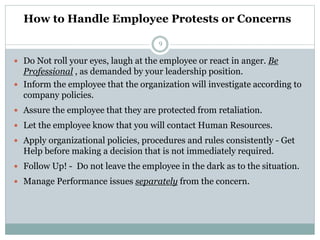
How to Handle Employee Protests or Concerns
9
 Do Not roll your eyes, laugh at the employee or react in anger. Be
Professional , as demanded by your leadership position.
 Inform the employee that the organization will investigate according to
company policies.
 Assure the employee that they are protected from retaliation.
 Let the employee know that you will contact Human Resources.
 Apply organizational policies, procedures and rules consistently - Get
Help before making a decision that is not immediately required.
 Follow Up! - Do not leave the employee in the dark as to the situation.
 Manage Performance issues separately from the concern.
What to do Before an Investigation
10
 Before you begin an investigation. Review
company policy and seek assistance.
 Documents and policies relevant to the
situation should be reviewed and a plan for
investigation is required.
 Determine - What are the issues?, Who are the
participants?, and Order of witnesses, and a
method reviewing of documentation.
Who Should Investigate?
11
 Investigation processes vary from company to company
 Normally HR conducts all investigations , or at the
minimum provides guidance to area managers for
completion of the tasks.
 Two Management employees should be present at
all interviews. Determination of the participants is
suggested by HR and Executive Management.
 Preliminary fact gathering, a review of company policy,
and communication with HR and Executive Management
must be completed prior to any official investigation.
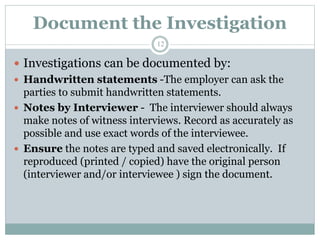
Document the Investigation
12
 Investigations can be documented by:
 Handwritten statements -The employer can ask the
parties to submit handwritten statements.
 Notes by Interviewer - The interviewer should always
make notes of witness interviews. Record as accurately as
possible and use exact words of the interviewee.
 Ensure the notes are typed and saved electronically. If
reproduced (printed / copied) have the original person
(interviewer and/or interviewee ) sign the document.
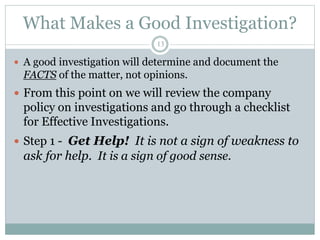
What Makes a Good Investigation?
13
 A good investigation will determine and document the
FACTS of the matter, not opinions.
 From this point on we will review the company
policy on investigations and go through a checklist
for Effective Investigations.
 Step 1 - Get Help! It is not a sign of weakness to
ask for help. It is a sign of good sense.
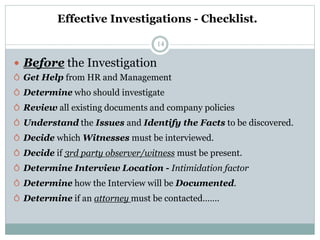
Effective Investigations - Checklist.
14
 Before the Investigation
Ô Get Help from HR and Management
Ô Determine who should investigate
Ô Review all existing documents and company policies
Ô Understand the Issues and Identify the Facts to be discovered.
Ô Decide which Witnesses must be interviewed.
Ô Decide if 3rd party observer/witness must be present.
Ô Determine Interview Location - Intimidation factor
Ô Determine how the Interview will be Documented.
Ô Determine if an attorney must be contacted…….
During an Investigation
15
 Interview the complainant ( if applicable )
 Interview the party against whom the complaint was made ( if
applicable)
 Interview all parties involved in the situation ( separately )
 Document the interviews with detailed notes.
 Documentation - Start a new page for each witness. Note the name
of the witness, date and time of the interview, name of the
interviewer, name and title of all people present, and name of the
person taking notes.
 Inform the interviewees that the investigation is confidential and they
cannot discuss any part of the interview with others.
 Inform the interviewees that your job is to find out the facts of the
matter and stress the importance of truth.
During an Investigation..cont
16
Ý Inform the participants that they will not be retaliated
against for participating.
Ý Listen to - and Record the Facts.
Ý Ask each interviewee to identify other possible witnesses
Ý Ask the interviewee if they have documents that may
pertain to the issue at hand and ask for permission to make
copies.
During an Investigation..cont
17
o Ask Neutral Open-Minded questions during the interview.
o Do not ask Leading Questions.
 What is a leading question and why should they be
avoided?
 Leading- “Leroy said Ken punched him yesterday, what
did you see?” or “Didn’t you see Leroy punch Ken
yesterday?”
 Neutral - “There was an incident in the bathroom
yesterday. What if anything did you see?”
During an Investigation..cont
18
At the end of each interview, review your notes
with the witness to confirm accuracy.
Ask the interviewees if there is anything you should
know about - that they have not stated.
Thank them for their cooperation and walk them to
the door.
After the Investigation.
19
 Review and finalize your notes as soon as possible.
 If you “improve” your documents - for instance - type your
handwritten notes - keep your originals safeguarded or hand off
to HR. Note the date and time you transferred the notes from
handwritten to electronic form.
 Keep all drafts in a secure and confidential place. HR Office
is the recommend location.
 Conclude your investigation with a Report of Findings.
 Communicate the Results of the Investigation with HR and
Executive Management.
 Communicate to all others, that need to know, and
implement appropriate corrective action as needed.
How long to complete an Investigation ?
20
 There are no deadlines.
 Complete the process as promptly as possible with
no unreasonable delay.
 NOTE: Courts have repeatedly stated that
investigations should commence and conclude as
reasonably as possible. Typically, an investigation that
begins on the same days as the complaint was made will be
considered as started “promptly. “ A court will treat an
employer’s unreasonable delay as tolerance for the hostile
work environment, harassment, or discrimination.
Suspend or Separate Employees?
21
 Suspension is common. While not legally required, for someone
accused of behavior that could warrant termination; companies often
suspend the accused ( with or without pay) pending completion of the
investigation.
 Judges and Juries frown on employers that permit the
situation to continue after a complaint has been made.
Accordingly - many employers proceed with suspension during the
investigation.
 Before suspension review the facts with HR, Executive Management
and Counsel, if required.
 If physical violence occurs or bodily injury threats are made -
suspend immediately and notify authorities.
 It is safer and easier to suspend with pay and remedy the
volatile situation immediately, than risk escalation.
Suspend or Separate Employees?
22
 If the company later discovers the alleged harasser
was falsely accused, the organization should
reinstate the suspended employee.
 As long as the company acted reasonably, it should
not be liable for suspending the falsely accused
employee because the company took reasonable
action that is was legally required to take.
(ensuring the harassment did not continue)
Separation as an Option.
23
 If the accused is not suspended - some employers will
separate the alleged harasser and the harassed pending
conclusion of the investigation.
 Separation should ensure that no further contact between
the parties occurs, or contact occurs only when others are
present. The circumstances of the situation will dictate
what is appropriate.
 Under most circumstances, the party who complained
should not be transferred if the transfer could be perceived
as unlawful retaliation. Get Help.
What is Retaliation?
24
 Retaliation occurs when an employee is disciplined, fired,
or their employment is adversely affected because they
raised a complaint or took legal action. Employee
complaints are protected by state and federal law.
 Assignment of undesirable tasks
 Shift Change
 Co-Worker ostracism
 Harassment and intimidation
 Discipline of corrective action
 Termination
Refusal to Cooperate
25
 In most states, employees have a “duty of loyalty”
which requires them to cooperate with reasonable
investigations. Get Help.
 Depending upon the decision by counsel or senior
management, the witness could face disciplinary
action for failure to cooperate.
 Ensure discipline is in line with previous practice
and company policy.
Complainant Refuses to Cooperate
26
 Sometimes the person who makes the complaint will tell
the manager to do nothing while he/she seeks a
remedy on their own. (video reference)
 Courts may - WILL - disapprove when a company does not
take immediate action and allows an employee to handle a
hostile work environment or discrimination situation alone.
 Managers should inform the employee that the
company has a duty to all employees to conduct a discrete
investigation.
 Follow Company Policy - Get Help.
Accused Refuses to Cooperate
27
 If the accused refuses to cooperate, explain to them
that the investigation is being conducted to discover the
truth, and that this is their opportunity to respond to the
allegations.
 If the person continues to refuse - Get Help.
 In many cases, the company will tell the person who refuses
to cooperate that if necessary, it will conclude the
investigation and make a decision without their input.
 Ensure that you document the refusal to
cooperate.
Additional Information….
28
 Conduct the investigation as discretely and
confidentially as possible. Only necessary
information should be communicated to the
interviewees.
 Get Help to determine if identities should be
revealed during the investigation. This is a
company decision and once determined normally
sets a precedent for future investigations.
Additional Information….
29
 What is a leading question and why should they be
avoided?
 Leading- “Leroy said Ken punched him yesterday,
what did you see?” or Didn’t you see Leroy punch
Ken yesterday?”
 Neutral - “There was an incident in the bathroom
yesterday. What if anything did you see?”
Final Documentation
30
 Normally the Manager of Human Resources will
prepare a document containing the facts discovered
and the organization’s conclusion.
 Because this document may be used during
litigation, the manager should Get Help before
creating it.
Inconclusive Results….
31
 This is when the company does not have
evidence to reasonably conclude that the
conduct did or did not occur.
 In such a case - Get Help - from Human Resources
and Executive Management.
 Human Resources or Executive Management will
seek counsel if needed.
 In any case Document any conversations and
steps that are taken during this conclusion.
Conclusive Results...
32
 If the investigation concludes that the
conduct did not occur, and a bad faith
complaint was made, then appropriate disciplinary
action, consistent with company policy, should be
taken against the complainant. Get Help.
 However, this situation normally requires HR or
Executive Management consulting legal counsel
as the discipline may be considered retaliation
against the complainant.
Conclusive Results...
33
 Investigation shows that inappropriate
behavior likely occurred.
 It is then the employer’s duty to take prompt
action and ensure that the behavior is
stopped.
 Courts expect employers to take appropriate
corrective action as soon as reasonable possible.
 The corrective action should reflect the severity of
the conduct, prior disciplinary action of the
offender, and consistency with company policy
and past practice.
Follow Up….
34
 The Manager or Human resources should follow up
with the complainant to ensure that the
inappropriate behavior has stopped.
 Failure of the company to follow up with the
complainant, and the harassment continues,
exposes the company to liability for failing to take
action against improper behavior that it “should
have known” about.
Cases…..
35
 Juares v. Ameritech Communications (7th Cir.
Court 1995.) Upon receiving a complaint of harassment,
the employer suspended the accused harasser and
investigated the allegations. When the employee who
complained sued, the lawsuit was dismissed based on the
employer’s prompt action and investigation.
 Kolnicki v. Ford Motor Company ( July 1995.) The
company succeeded in having the case dismissed because
the employer had a policy which prohibits harassment and
thoroughly investigated reports inappropriate behavior
each time the plaintiff complained.
Case….
36
 Weeks v. Baker & McKenzie (Cal. Superior Court.
1994.) A legal secretary alleged she was harassed by one of
the partners during the 25 days that she worked at the firm.
At trial, evidence showed that several people in the firm
knew of separate instances of harassment by this partner,
but not a single person knew of all the instances. The
firm’s failure to conduct a thorough, centralized
investigation resulted in a jury verdict of 7 million
dollars, later reduced to 3 million dollars, with approx..
250K being aid by the offender.

Investigations august2012vpt

  • 1.
    1 PROFESSIONAL EDUCATION SERIES INVESTIGATIONS& DUTY TO ACT 2015 Innovation MRP Plattsburgh
  • 2.
    Investigations 2  What arethe Business Reasons?  If a manager makes a decision regarding behavior they observed, or heard about through an employee complaint without investigating the matter properly; the employee may feel unfairly treated and/or any conclusions may be wrong.  A manager should investigate before making any decision to be Fair and Accurate.
  • 3.
    Investigations/Duty to Act 3 What are the Business Reasons?  Your duty to act is important because -  When you choose to ignore a possible violation, it suggests that the organization agreed with your inaction.  When you do not enforce policies, or when you are inconsistent in acting on policy, you create an unfair work environment.  If you fail to take action, you risk allowing the inappropriate behavior to continue. You also risk the possibility of other employees receiving the same inappropriate treatment.  A manager’s “Duty to Act” is a legal requirement. Whenever you are unsure of your Duty to Act - Get Help from HR.
  • 4.
    When do Ihave a Duty to Act? 4  A managers Duty to Act is not limited to situations involving harassment. Inappropriate conduct involving race, religion, color, disability, national origin, or other personal characteristics also trigger your Duty to Act.  When managers are aware of conduct suggesting a violation of organizational policy, safety regulations, or the law, they have a Duty to Act. Duty to Act arises through:  Direct Complaints from employees, Direct Observations of a possible violation, or Third Party reports.
  • 5.
    When is anInvestigation Appropriate? 5  A company should investigate whenever an employee brings forward a complaint of safety concerns, policy or law violations, or whenever the employer discovers such a complaint.  Or  Management observes inappropriate conduct or hears rumors of such; even when the suspected victim does not consent to the investigation. (video) What’s On Your Mind? Pt I, Jury ,II
  • 6.
    Duty to Act….. 6 Inappropriate conduct directed at employees while on the job is conduct that the organization must investigate and stop.  If you are unsure how to investigate or handle the situation, Get Help from HR.  Get Help and address the situation when you first gain knowledge of it. By doing so, you minimize liability to the organization.  There is short-term discomfort when discussing inappropriate behavior with an employee, customer, or vendor, but the long term benefit to you, the employee, and the organization is valuable.
  • 7.
    How do Icarry out my Duty to Act?. 7  Immediately stop any behavior or activity that suggests a violation.  Get Help - Consult with HR or Management, to ensure consistent decisions. Realize that getting help and acting may be mandatory under your organization's policy.  Make sure the organization investigates before deciding consequences. The organization should be consistent with any consequences it implements.  Weigh the circumstances of any business problem. Use common sense. Gauge your response.  Document the investigation and any resulting decisions, even if the violation isn't valid. Make an electronic copy.
  • 8.
    How Should IGauge my Response? 8  Responding appropriately and matching the level of your response to the seriousness of the situation is critical.  Over reacting can cause more harm to all the individuals involved.  On the other hand, not giving a situation the necessary attention may lead employees to believe that complaints are not taken seriously which, could destroy your credibility and/or employee’s willingness to bring forward concerns.
  • 9.
    How to HandleEmployee Protests or Concerns 9  Do Not roll your eyes, laugh at the employee or react in anger. Be Professional , as demanded by your leadership position.  Inform the employee that the organization will investigate according to company policies.  Assure the employee that they are protected from retaliation.  Let the employee know that you will contact Human Resources.  Apply organizational policies, procedures and rules consistently - Get Help before making a decision that is not immediately required.  Follow Up! - Do not leave the employee in the dark as to the situation.  Manage Performance issues separately from the concern.
  • 10.
    What to doBefore an Investigation 10  Before you begin an investigation. Review company policy and seek assistance.  Documents and policies relevant to the situation should be reviewed and a plan for investigation is required.  Determine - What are the issues?, Who are the participants?, and Order of witnesses, and a method reviewing of documentation.
  • 11.
    Who Should Investigate? 11 Investigation processes vary from company to company  Normally HR conducts all investigations , or at the minimum provides guidance to area managers for completion of the tasks.  Two Management employees should be present at all interviews. Determination of the participants is suggested by HR and Executive Management.  Preliminary fact gathering, a review of company policy, and communication with HR and Executive Management must be completed prior to any official investigation.
  • 12.
    Document the Investigation 12 Investigations can be documented by:  Handwritten statements -The employer can ask the parties to submit handwritten statements.  Notes by Interviewer - The interviewer should always make notes of witness interviews. Record as accurately as possible and use exact words of the interviewee.  Ensure the notes are typed and saved electronically. If reproduced (printed / copied) have the original person (interviewer and/or interviewee ) sign the document.
  • 13.
    What Makes aGood Investigation? 13  A good investigation will determine and document the FACTS of the matter, not opinions.  From this point on we will review the company policy on investigations and go through a checklist for Effective Investigations.  Step 1 - Get Help! It is not a sign of weakness to ask for help. It is a sign of good sense.
  • 14.
    Effective Investigations -Checklist. 14  Before the Investigation Ô Get Help from HR and Management Ô Determine who should investigate Ô Review all existing documents and company policies Ô Understand the Issues and Identify the Facts to be discovered. Ô Decide which Witnesses must be interviewed. Ô Decide if 3rd party observer/witness must be present. Ô Determine Interview Location - Intimidation factor Ô Determine how the Interview will be Documented. Ô Determine if an attorney must be contacted…….
  • 15.
    During an Investigation 15 Interview the complainant ( if applicable )  Interview the party against whom the complaint was made ( if applicable)  Interview all parties involved in the situation ( separately )  Document the interviews with detailed notes.  Documentation - Start a new page for each witness. Note the name of the witness, date and time of the interview, name of the interviewer, name and title of all people present, and name of the person taking notes.  Inform the interviewees that the investigation is confidential and they cannot discuss any part of the interview with others.  Inform the interviewees that your job is to find out the facts of the matter and stress the importance of truth.
  • 16.
    During an Investigation..cont 16 ÝInform the participants that they will not be retaliated against for participating. Ý Listen to - and Record the Facts. Ý Ask each interviewee to identify other possible witnesses Ý Ask the interviewee if they have documents that may pertain to the issue at hand and ask for permission to make copies.
  • 17.
    During an Investigation..cont 17 oAsk Neutral Open-Minded questions during the interview. o Do not ask Leading Questions.  What is a leading question and why should they be avoided?  Leading- “Leroy said Ken punched him yesterday, what did you see?” or “Didn’t you see Leroy punch Ken yesterday?”  Neutral - “There was an incident in the bathroom yesterday. What if anything did you see?”
  • 18.
    During an Investigation..cont 18 Atthe end of each interview, review your notes with the witness to confirm accuracy. Ask the interviewees if there is anything you should know about - that they have not stated. Thank them for their cooperation and walk them to the door.
  • 19.
    After the Investigation. 19 Review and finalize your notes as soon as possible.  If you “improve” your documents - for instance - type your handwritten notes - keep your originals safeguarded or hand off to HR. Note the date and time you transferred the notes from handwritten to electronic form.  Keep all drafts in a secure and confidential place. HR Office is the recommend location.  Conclude your investigation with a Report of Findings.  Communicate the Results of the Investigation with HR and Executive Management.  Communicate to all others, that need to know, and implement appropriate corrective action as needed.
  • 20.
    How long tocomplete an Investigation ? 20  There are no deadlines.  Complete the process as promptly as possible with no unreasonable delay.  NOTE: Courts have repeatedly stated that investigations should commence and conclude as reasonably as possible. Typically, an investigation that begins on the same days as the complaint was made will be considered as started “promptly. “ A court will treat an employer’s unreasonable delay as tolerance for the hostile work environment, harassment, or discrimination.
  • 21.
    Suspend or SeparateEmployees? 21  Suspension is common. While not legally required, for someone accused of behavior that could warrant termination; companies often suspend the accused ( with or without pay) pending completion of the investigation.  Judges and Juries frown on employers that permit the situation to continue after a complaint has been made. Accordingly - many employers proceed with suspension during the investigation.  Before suspension review the facts with HR, Executive Management and Counsel, if required.  If physical violence occurs or bodily injury threats are made - suspend immediately and notify authorities.  It is safer and easier to suspend with pay and remedy the volatile situation immediately, than risk escalation.
  • 22.
    Suspend or SeparateEmployees? 22  If the company later discovers the alleged harasser was falsely accused, the organization should reinstate the suspended employee.  As long as the company acted reasonably, it should not be liable for suspending the falsely accused employee because the company took reasonable action that is was legally required to take. (ensuring the harassment did not continue)
  • 23.
    Separation as anOption. 23  If the accused is not suspended - some employers will separate the alleged harasser and the harassed pending conclusion of the investigation.  Separation should ensure that no further contact between the parties occurs, or contact occurs only when others are present. The circumstances of the situation will dictate what is appropriate.  Under most circumstances, the party who complained should not be transferred if the transfer could be perceived as unlawful retaliation. Get Help.
  • 24.
    What is Retaliation? 24 Retaliation occurs when an employee is disciplined, fired, or their employment is adversely affected because they raised a complaint or took legal action. Employee complaints are protected by state and federal law.  Assignment of undesirable tasks  Shift Change  Co-Worker ostracism  Harassment and intimidation  Discipline of corrective action  Termination
  • 25.
    Refusal to Cooperate 25 In most states, employees have a “duty of loyalty” which requires them to cooperate with reasonable investigations. Get Help.  Depending upon the decision by counsel or senior management, the witness could face disciplinary action for failure to cooperate.  Ensure discipline is in line with previous practice and company policy.
  • 26.
    Complainant Refuses toCooperate 26  Sometimes the person who makes the complaint will tell the manager to do nothing while he/she seeks a remedy on their own. (video reference)  Courts may - WILL - disapprove when a company does not take immediate action and allows an employee to handle a hostile work environment or discrimination situation alone.  Managers should inform the employee that the company has a duty to all employees to conduct a discrete investigation.  Follow Company Policy - Get Help.
  • 27.
    Accused Refuses toCooperate 27  If the accused refuses to cooperate, explain to them that the investigation is being conducted to discover the truth, and that this is their opportunity to respond to the allegations.  If the person continues to refuse - Get Help.  In many cases, the company will tell the person who refuses to cooperate that if necessary, it will conclude the investigation and make a decision without their input.  Ensure that you document the refusal to cooperate.
  • 28.
    Additional Information…. 28  Conductthe investigation as discretely and confidentially as possible. Only necessary information should be communicated to the interviewees.  Get Help to determine if identities should be revealed during the investigation. This is a company decision and once determined normally sets a precedent for future investigations.
  • 29.
    Additional Information…. 29  Whatis a leading question and why should they be avoided?  Leading- “Leroy said Ken punched him yesterday, what did you see?” or Didn’t you see Leroy punch Ken yesterday?”  Neutral - “There was an incident in the bathroom yesterday. What if anything did you see?”
  • 30.
    Final Documentation 30  Normallythe Manager of Human Resources will prepare a document containing the facts discovered and the organization’s conclusion.  Because this document may be used during litigation, the manager should Get Help before creating it.
  • 31.
    Inconclusive Results…. 31  Thisis when the company does not have evidence to reasonably conclude that the conduct did or did not occur.  In such a case - Get Help - from Human Resources and Executive Management.  Human Resources or Executive Management will seek counsel if needed.  In any case Document any conversations and steps that are taken during this conclusion.
  • 32.
    Conclusive Results... 32  Ifthe investigation concludes that the conduct did not occur, and a bad faith complaint was made, then appropriate disciplinary action, consistent with company policy, should be taken against the complainant. Get Help.  However, this situation normally requires HR or Executive Management consulting legal counsel as the discipline may be considered retaliation against the complainant.
  • 33.
    Conclusive Results... 33  Investigationshows that inappropriate behavior likely occurred.  It is then the employer’s duty to take prompt action and ensure that the behavior is stopped.  Courts expect employers to take appropriate corrective action as soon as reasonable possible.  The corrective action should reflect the severity of the conduct, prior disciplinary action of the offender, and consistency with company policy and past practice.
  • 34.
    Follow Up…. 34  TheManager or Human resources should follow up with the complainant to ensure that the inappropriate behavior has stopped.  Failure of the company to follow up with the complainant, and the harassment continues, exposes the company to liability for failing to take action against improper behavior that it “should have known” about.
  • 35.
    Cases….. 35  Juares v.Ameritech Communications (7th Cir. Court 1995.) Upon receiving a complaint of harassment, the employer suspended the accused harasser and investigated the allegations. When the employee who complained sued, the lawsuit was dismissed based on the employer’s prompt action and investigation.  Kolnicki v. Ford Motor Company ( July 1995.) The company succeeded in having the case dismissed because the employer had a policy which prohibits harassment and thoroughly investigated reports inappropriate behavior each time the plaintiff complained.
  • 36.
    Case…. 36  Weeks v.Baker & McKenzie (Cal. Superior Court. 1994.) A legal secretary alleged she was harassed by one of the partners during the 25 days that she worked at the firm. At trial, evidence showed that several people in the firm knew of separate instances of harassment by this partner, but not a single person knew of all the instances. The firm’s failure to conduct a thorough, centralized investigation resulted in a jury verdict of 7 million dollars, later reduced to 3 million dollars, with approx.. 250K being aid by the offender.