Investing in Spain 2015
Margarida Crous Peraferrer
Foreing investments´ Spanish regulated
sectors are:
 National defense
 Broadcasting
 Telecommunications
 Air transport
 Gaming and betting
TAX PAYERS CLASSIFICATION:
Classifications of tax payers under Spanish tax Rules:
 Tax residents:
Taxable base: Worldwide income (Double taxation applicable
under Tax Treaty conditions)
 Non tax-residents.
Taxable base: Only Income obtained in Spain.
ESTABLISHING IN SPAIN
BRANCH/SUBSIDIARY FOR TAX PURPOSES:
 Branch: Considered a permanent establishment for tax
purposes subject to Non-resident regulations
 Subsidiary: Considered a resident company for tax purposes
entirely subject to Spanish Tax regulations.
 Individuals who spend 183 days during a tax year in
Spain are normally deemed tax resident .
 Or, “centre of vital interests” is in Spain,
 Or, your spouse lives in Spain eventhough spend less
than 183 days per year in Spain
SPANISH TAX RESIDENCE CRITERIA FOR
INDIVIDUALS:
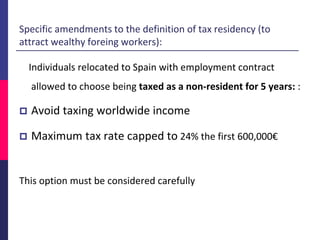
Individuals relocated to Spain with employment contract
allowed to choose being taxed as a non-resident for 5 years: :
 Avoid taxing worldwide income
 Maximum tax rate capped to 24% the first 600,000€
This option must be considered carefully
Specific amendments to the definition of tax residency (to
attract wealthy foreing workers):
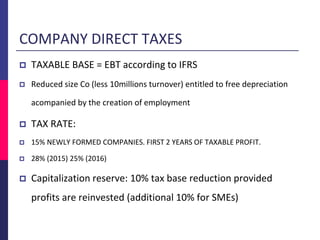
COMPANY DIRECT TAXES
 TAXABLE BASE = EBT according to IFRS
 Reduced size Co (less 10millions turnover) entitled to free depreciation
acompanied by the creation of employment
 TAX RATE:
 15% NEWLY FORMED COMPANIES. FIRST 2 YEARS OF TAXABLE PROFIT.
 28% (2015) 25% (2016)
 Capitalization reserve: 10% tax base reduction provided
profits are reinvested (additional 10% for SMEs)
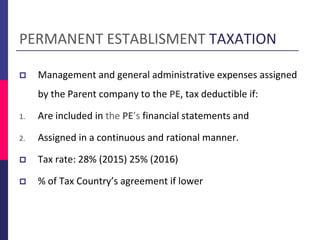
PERMANENT ESTABLISMENT TAXATION
 Management and general administrative expenses assigned
by the Parent company to the PE, tax deductible if:
1. Are included in the PE’s financial statements and
2. Assigned in a continuous and rational manner.
 Tax rate: 28% (2015) 25% (2016)
 % of Tax Country’s agreement if lower
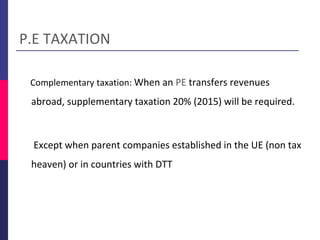
Complementary taxation: When an PE transfers revenues
abroad, supplementary taxation 20% (2015) will be required.
Except when parent companies established in the UE (non tax
heaven) or in countries with DTT
P.E TAXATION
REAL ESTATE INVESTMENTS
 TAXATION OF PROPERTY OWNED BY NON RESIDENTS:
 RENTED PROPERTY: Rental income is taxable but expenses are
not deductible except in case of EU residents.
 NON RENTED PROPERTY: Imputed income tax is
payable. The idea is that you could rent out your
property if you wished.
VAT
 VAT applicable when transaction takes place in the Spanish
territory according to VAT rules.
 VAT tax rate: 21%
 Reduced Tax rate: 10% for certain products, including food
 Super reduced tax rate: 4% for a short list of products
considered to be basic necessities (milk, eggs, flour, books,
etc.)
Real estate transactions VAT Rules
 New property sales (residential): 10% VAT
 Commercial properties: 21%
 Secondhand property sales not subject to VAT but
subject to Transfer tax (tax ceded to 17 autonomous regions)
NON RESID.-SALE OF SPANISH PROPERTY
 3% of property’s sale price must be retained by the buyer and
paid to Spanish tax authorities as a contribution to Non-
resident Income Tax regarding capital gains tax (20%). May
be tax will need to be refunded.
NEW EXIT TAX
 NEW 2015:
 An exit tax is established on unrealized capital gains of shares
for taxpayers that lose the status of tax resident in Spain
 The value of their stake in their company exceeds €4 million
or when they own more than 25% of a business and its value
is more than €1 million
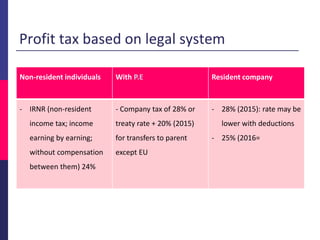
Profit tax based on legal system
Non-resident individuals With P.E Resident company
- IRNR (non-resident
income tax; income
earning by earning;
without compensation
between them) 24%
- Company tax of 28% or
treaty rate + 20% (2015)
for transfers to parent
except EU
- 28% (2015): rate may be
lower with deductions
- 25% (2016=
Canary Islands
 REASON:
Canary Islands is an ultra-peripheral region of the EU, it has its
own Economic and Fiscal System (REF)
Fully approved by the EU in which double-taxation and fiscal-
transparency treaties apply
Advantages of Canary Special Zone (ZEC)
 The effective period of the ZEC legislation ends 31 December
2026 although they can be extended with prior authorization
from the European Commission
Advantages of Canary Special Zone (ZEC)
 Requirements for companies that wish to register in the ZECs:
 Newly incorporated company with domicile located within ZEC
 At least one of members of board of directors resident in Canary I.
 Create 5 jobs in Gran Canarias or Tenerife, 3 in the other islands
within the first 6 months and maintain an average workforce during
the period in which company is registered as ZEC
 Activities allowed in the ZEC
 Submission of descriptive report
Advantages of Canary Special Zone (ZEC)
 4% Corporate tax rate (currently in Spain: 28%)
 Dividends distributed to parent companies exempt from
withholding tax (application of parent-subsidiary agreements
and double tax treaties)
 Exemption from general Canary Island tax (IGIC-equivalent to
VAT) in transactions inside the ZEC and imports
Advantages of Canary Special Zone (ZEC)
 Note: only useful for partners or transactions outside Spain
because If the parent company of the ZEC entity is a Spanish
company, it will not qualify for the tax credit for double
taxation of dividends or capital gains generated within Spain
(fiscal transparency will be applicable)
Alternatives when ZEC formalities are not
accomplished
• Applicable to all types of companies, including PE of non-
resident companies
 90% Corporate tax reduction applicable to non-distributed
profits reinvested in the Canary Islands
 “Archipielago Canario” is on the off-shore invests top list.
 Only Madrid has received more funds thant the Canary
Islands in 2014.
Golden Visa-Residence VISA for investors
• Residence visa to reside for at least 1year.
• Residence authorization for 2 years that can be renewed:
− If investment is maintained and
− If at least one visit to Spain has been made during the
residency period.
• To apply for the initial residence authorization, the person
must hold an investment visa.
Golden Visa
• Who can apply for it?
• Investors who make a significant investment in Spain:
− Real estate investment threshold: €500,000
− Shares or bank deposits (€1,000,000)
− Public debt (€2,000,000)
− Business projects in Spain considered to be of general interest
The visa can be obtained without requiring actual residency in
Spain, understood to be above 183 days.
It is only necessary to visit Spain once during the residency
period.
• Joint application for authorization of spouse and children.
Golden Visa
 The visa does not include a work permit (except in the case of
business projects) and also does not require residing in Spain,
although it is necessary to visit the country once a year and
freedom of unlimited travel allowed within the Schengen area
 A recent Draft-Law expects to expand benefits by including a
work visa and expanding the family members that can be
included (grandparents and representatives)
Golden Visa
Invertir en españa 2015 (ENG)

Invertir en españa 2015 (ENG)

  • 1.
    Investing in Spain2015 Margarida Crous Peraferrer
  • 2.
    Foreing investments´ Spanishregulated sectors are:  National defense  Broadcasting  Telecommunications  Air transport  Gaming and betting
  • 3.
    TAX PAYERS CLASSIFICATION: Classificationsof tax payers under Spanish tax Rules:  Tax residents: Taxable base: Worldwide income (Double taxation applicable under Tax Treaty conditions)  Non tax-residents. Taxable base: Only Income obtained in Spain.
  • 4.
    ESTABLISHING IN SPAIN BRANCH/SUBSIDIARYFOR TAX PURPOSES:  Branch: Considered a permanent establishment for tax purposes subject to Non-resident regulations  Subsidiary: Considered a resident company for tax purposes entirely subject to Spanish Tax regulations.
  • 5.
     Individuals whospend 183 days during a tax year in Spain are normally deemed tax resident .  Or, “centre of vital interests” is in Spain,  Or, your spouse lives in Spain eventhough spend less than 183 days per year in Spain SPANISH TAX RESIDENCE CRITERIA FOR INDIVIDUALS:
  • 6.
    Individuals relocated toSpain with employment contract allowed to choose being taxed as a non-resident for 5 years: :  Avoid taxing worldwide income  Maximum tax rate capped to 24% the first 600,000€ This option must be considered carefully Specific amendments to the definition of tax residency (to attract wealthy foreing workers):
  • 7.
    COMPANY DIRECT TAXES TAXABLE BASE = EBT according to IFRS  Reduced size Co (less 10millions turnover) entitled to free depreciation acompanied by the creation of employment  TAX RATE:  15% NEWLY FORMED COMPANIES. FIRST 2 YEARS OF TAXABLE PROFIT.  28% (2015) 25% (2016)  Capitalization reserve: 10% tax base reduction provided profits are reinvested (additional 10% for SMEs)
  • 8.
    PERMANENT ESTABLISMENT TAXATION Management and general administrative expenses assigned by the Parent company to the PE, tax deductible if: 1. Are included in the PE’s financial statements and 2. Assigned in a continuous and rational manner.  Tax rate: 28% (2015) 25% (2016)  % of Tax Country’s agreement if lower
  • 9.
    Complementary taxation: Whenan PE transfers revenues abroad, supplementary taxation 20% (2015) will be required. Except when parent companies established in the UE (non tax heaven) or in countries with DTT P.E TAXATION
  • 10.
    REAL ESTATE INVESTMENTS TAXATION OF PROPERTY OWNED BY NON RESIDENTS:  RENTED PROPERTY: Rental income is taxable but expenses are not deductible except in case of EU residents.  NON RENTED PROPERTY: Imputed income tax is payable. The idea is that you could rent out your property if you wished.
  • 11.
    VAT  VAT applicablewhen transaction takes place in the Spanish territory according to VAT rules.  VAT tax rate: 21%  Reduced Tax rate: 10% for certain products, including food  Super reduced tax rate: 4% for a short list of products considered to be basic necessities (milk, eggs, flour, books, etc.)
  • 12.
    Real estate transactionsVAT Rules  New property sales (residential): 10% VAT  Commercial properties: 21%  Secondhand property sales not subject to VAT but subject to Transfer tax (tax ceded to 17 autonomous regions)
  • 13.
    NON RESID.-SALE OFSPANISH PROPERTY  3% of property’s sale price must be retained by the buyer and paid to Spanish tax authorities as a contribution to Non- resident Income Tax regarding capital gains tax (20%). May be tax will need to be refunded.
  • 14.
    NEW EXIT TAX NEW 2015:  An exit tax is established on unrealized capital gains of shares for taxpayers that lose the status of tax resident in Spain  The value of their stake in their company exceeds €4 million or when they own more than 25% of a business and its value is more than €1 million
  • 15.
    Profit tax basedon legal system Non-resident individuals With P.E Resident company - IRNR (non-resident income tax; income earning by earning; without compensation between them) 24% - Company tax of 28% or treaty rate + 20% (2015) for transfers to parent except EU - 28% (2015): rate may be lower with deductions - 25% (2016=
  • 16.
    Canary Islands  REASON: CanaryIslands is an ultra-peripheral region of the EU, it has its own Economic and Fiscal System (REF) Fully approved by the EU in which double-taxation and fiscal- transparency treaties apply
  • 17.
    Advantages of CanarySpecial Zone (ZEC)  The effective period of the ZEC legislation ends 31 December 2026 although they can be extended with prior authorization from the European Commission
  • 18.
    Advantages of CanarySpecial Zone (ZEC)  Requirements for companies that wish to register in the ZECs:  Newly incorporated company with domicile located within ZEC  At least one of members of board of directors resident in Canary I.  Create 5 jobs in Gran Canarias or Tenerife, 3 in the other islands within the first 6 months and maintain an average workforce during the period in which company is registered as ZEC  Activities allowed in the ZEC  Submission of descriptive report
  • 19.
    Advantages of CanarySpecial Zone (ZEC)  4% Corporate tax rate (currently in Spain: 28%)  Dividends distributed to parent companies exempt from withholding tax (application of parent-subsidiary agreements and double tax treaties)  Exemption from general Canary Island tax (IGIC-equivalent to VAT) in transactions inside the ZEC and imports
  • 20.
    Advantages of CanarySpecial Zone (ZEC)  Note: only useful for partners or transactions outside Spain because If the parent company of the ZEC entity is a Spanish company, it will not qualify for the tax credit for double taxation of dividends or capital gains generated within Spain (fiscal transparency will be applicable)
  • 21.
    Alternatives when ZECformalities are not accomplished • Applicable to all types of companies, including PE of non- resident companies  90% Corporate tax reduction applicable to non-distributed profits reinvested in the Canary Islands  “Archipielago Canario” is on the off-shore invests top list.  Only Madrid has received more funds thant the Canary Islands in 2014.
  • 22.
    Golden Visa-Residence VISAfor investors • Residence visa to reside for at least 1year. • Residence authorization for 2 years that can be renewed: − If investment is maintained and − If at least one visit to Spain has been made during the residency period. • To apply for the initial residence authorization, the person must hold an investment visa.
  • 23.
    Golden Visa • Whocan apply for it? • Investors who make a significant investment in Spain: − Real estate investment threshold: €500,000 − Shares or bank deposits (€1,000,000) − Public debt (€2,000,000) − Business projects in Spain considered to be of general interest
  • 24.
    The visa canbe obtained without requiring actual residency in Spain, understood to be above 183 days. It is only necessary to visit Spain once during the residency period. • Joint application for authorization of spouse and children. Golden Visa
  • 25.
     The visadoes not include a work permit (except in the case of business projects) and also does not require residing in Spain, although it is necessary to visit the country once a year and freedom of unlimited travel allowed within the Schengen area  A recent Draft-Law expects to expand benefits by including a work visa and expanding the family members that can be included (grandparents and representatives) Golden Visa