RT 115
ULTRASONOGRAPHY
COURSE DESCRIPTION:
Chapter I:
Introduction to
Ultrasound
AUDIBLE SOUND
• Sound is a form of energy which causes
vibration of molecules within a medium.
• In order to be transmitted, sound requires a
medium containing molecules, and therefore
cannot through a vacuum.
• The production of sound requires a vibration
object.
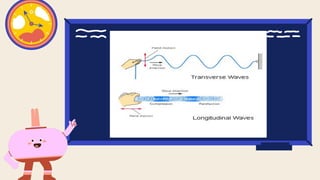
2 Types of UTZ Waves:
• Longitudinal or Compression
Waves
2. Transverse Waves or Shear
Waves
Ultrasound
Above 20,000
Hz or Above 20
kHz
• Diagnostic
• Therapeutic
• Surgery
• Industrial
• Military
• 1-10 MHz
• 0.7-1.0 MHz
• 1-5 MHz
• 25-400 kHz
• 20-50 kHz
Audible Sound
16 Hz to 20,000
Hz or 16 Hz to
20 kHz
• Air
• Water
• Solid
• Air - 331
• Water - 1532
• Solid - 5200
Infra Sound
Below 16 Hz • Earhquakes
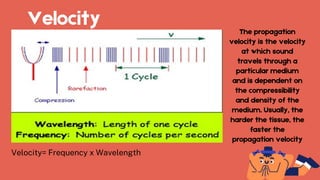
The phase of wave when the
molecules are pushed together is
called compression , and when apart
is rarefaction.
Ultrasound
• Ultrasound is the name given to high
frequency sound waves, which are
above the human hearing range.
• Acoustic vibration of frequencies higher
than 20 kHz, non audible by human ear.
• Non-ionizing radiation.
Acoustic Variables
• Period
• Wavelength
• Amplitude
• Frequency
• Velocity
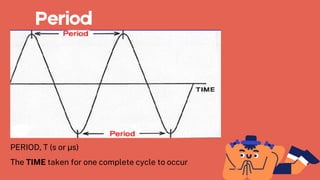
Period
PERIOD, T (s or µs)
The TIME taken for one complete cycle to occur
Wavelength
WAVELENGTH (λ), (m or mm)
Length of space over which one cycle occurs
Amplitude
The maximum displacement that occurs in an
acoustic variable. (depth, height)
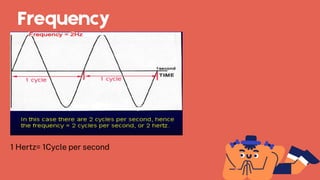
Frequency
1 Hertz= 1Cycle per second
Velocity
Velocity= Frequency x Wavelength
The propagation
velocity is the velocity
at which sound
travels through a
particular medium
and is dependent on
the compressibility
and density of the
medium. Usually, the
harder the tissue, the
faster the
propagation velocity
THE HISTORY
OF
ULTRASOUND
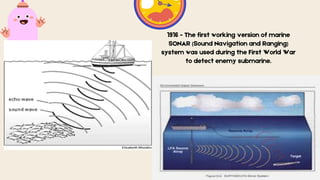
1916 - The first working version of marine
SONAR (Sound Navigation and Ranging)
system was used during the First World War
to detect enemy submarine.
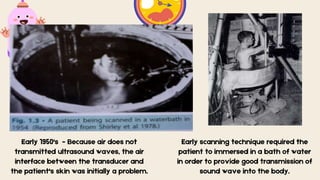
Early 1950's - Because air does not
transmitted ultrasound waves, the air
interface between the transducer and
the patient's skin was initially a problem.
Early scanning technique required the
patient to immersed in a bath of water
in order to provide good transmission of
sound wave into the body.
Late 1950's - the first contact
compound B-Scanner (using olive oil
as a lubricant) was developed. This
equipment used an articulating arm
to produce static images.
• Water
• Saline
• Baby Oil
1970's - gray scale imaging was
introduced, enabling the display of
a wide range of echo amplitudes.
Mid 1970's - real-time scanning
systems were introduced.
Dynamic Sonograhic Information
was available for the first time.
1980's - Doppler Technique is used.
Importance of
Ultrasound in
Diagnosis of
Diseases
Ultrasound exams can help diagnose a variety
if conditions and assess organ damage
following an illness.
Doctors used Ultrasound to evaluate:
• Pain
• Swelling
• Infection
Ultrasound is a useful way of examining many of the
body's internal organs, including but not limited to the:
• Heart and blood vessels, including the abdominal aorta
and its major branches
• Liver
• Gallbladder
• Spleen
• Pancreas
• Kidneys
• Bladder
• Uterus, Ovaries, and Unborn Child in Pregnant Patients
• Thyroid
• Scrotum
• Brain in Infants
Ultrasound is also used to:
• Guide procedures such as needle biopsies, in
which needles remove cells from an
abnormal area for laboratory testing.
• Image the breasts and guide biopsy of
breast cancer.
• Diagnose a variety of heart conditions,
including valve problems and congestive
heart failure, and to assess damage after a
heart attack. Ultrasound of the heart is
commonly called an "echocardiogram" or
"echo" for short.
Doppler Ultrasound helps the Doctor to see and
evaluate:
• Blockages to blood flow (such as clots)
• Narrowing of vessels
• Tumors and Congenital Vascular
Malformations
• Reduced or absent blood flow to various
organs, such as the testes or ovary
• Increased blood flow, which may be a sign of
infection.
Chapter II:
The Piezoelectric
Effect
PIEZOELECTRIC EFFECT
• Piezo - is a Greek word "PIEZEN" that means to
"press or pressure" , therefore piezoelectric
describes the manner in which some
substances become electrically polarized when
stressed.
• This is the ability of a material to generate an
electrical charge in response to applied
pressure.
• When a piece of
piezoelectric materials is
compressed a potential
difference is generated
across opposite faces- the
one side becomes positive,
the other becomes
negative.
Piezoelectric
Materials:
• Quartz - naturally occuring
crystals
• Lead Zirconate Titanate - man
made ceramic
Piezoelectric Materials
Natural
• Quartz
• Tourmaline
• Rochelle Salt
Synthetic
• Lead Zirconate Titanate
• Barium Titanate
• Lead Metaniobate
• Ammonium Dihydrogen
Phosphate
• Lithium Sulfate
• Piezoelectric Materials are
cystalline materials composed
of dipolar molecules, which are
positive one end and negative
at the other.
• Normally these dipolar
molecules have a random
arrangement within the
material and they are unable to
align themselves with an
applied electric field.
• However, if the
materials are heated
above the Curie
Temperature in
presence of an electric
field, the molecules align
themselves with that
field.
• Piezoelectricity was discovered in 1880
by two brothers and French Scientists,
Jacques and Pierre Curie.
The Piezoelectric Crystal as
Transmitter of Sound
Piezoelectric materials are used in the
production of ultrasound by converting :
Electrical Energy into Mechanical Energy
(Sound)
The Piezoelectric Crystal as
Receiver of Sound
Piezoelectric materials are used in the
detection of ultrasound by converting :
Mechanical Energy (Sound) into Electrical
Energy
Note:
• As the crystal diameter decreases,
the beam divergence increases.
• As the crystal diameter increases, the
beam divergence decreases.

Intro-to-Ultrasound.pptx

  • 1.
  • 2.
  • 3.
  • 4.
    AUDIBLE SOUND • Soundis a form of energy which causes vibration of molecules within a medium. • In order to be transmitted, sound requires a medium containing molecules, and therefore cannot through a vacuum. • The production of sound requires a vibration object.
  • 6.
    2 Types ofUTZ Waves: • Longitudinal or Compression Waves 2. Transverse Waves or Shear Waves
  • 8.
    Ultrasound Above 20,000 Hz orAbove 20 kHz • Diagnostic • Therapeutic • Surgery • Industrial • Military • 1-10 MHz • 0.7-1.0 MHz • 1-5 MHz • 25-400 kHz • 20-50 kHz
  • 9.
    Audible Sound 16 Hzto 20,000 Hz or 16 Hz to 20 kHz • Air • Water • Solid • Air - 331 • Water - 1532 • Solid - 5200
  • 10.
    Infra Sound Below 16Hz • Earhquakes
  • 11.
    The phase ofwave when the molecules are pushed together is called compression , and when apart is rarefaction.
  • 12.
    Ultrasound • Ultrasound isthe name given to high frequency sound waves, which are above the human hearing range. • Acoustic vibration of frequencies higher than 20 kHz, non audible by human ear. • Non-ionizing radiation.
  • 13.
    Acoustic Variables • Period •Wavelength • Amplitude • Frequency • Velocity
  • 14.
    Period PERIOD, T (sor µs) The TIME taken for one complete cycle to occur
  • 15.
    Wavelength WAVELENGTH (λ), (mor mm) Length of space over which one cycle occurs
  • 16.
    Amplitude The maximum displacementthat occurs in an acoustic variable. (depth, height)
  • 17.
  • 18.
    Velocity Velocity= Frequency xWavelength The propagation velocity is the velocity at which sound travels through a particular medium and is dependent on the compressibility and density of the medium. Usually, the harder the tissue, the faster the propagation velocity
  • 19.
  • 20.
    1916 - Thefirst working version of marine SONAR (Sound Navigation and Ranging) system was used during the First World War to detect enemy submarine.
  • 21.
    Early 1950's -Because air does not transmitted ultrasound waves, the air interface between the transducer and the patient's skin was initially a problem. Early scanning technique required the patient to immersed in a bath of water in order to provide good transmission of sound wave into the body.
  • 22.
    Late 1950's -the first contact compound B-Scanner (using olive oil as a lubricant) was developed. This equipment used an articulating arm to produce static images. • Water • Saline • Baby Oil
  • 23.
    1970's - grayscale imaging was introduced, enabling the display of a wide range of echo amplitudes.
  • 24.
    Mid 1970's -real-time scanning systems were introduced. Dynamic Sonograhic Information was available for the first time. 1980's - Doppler Technique is used.
  • 25.
  • 26.
    Ultrasound exams canhelp diagnose a variety if conditions and assess organ damage following an illness. Doctors used Ultrasound to evaluate: • Pain • Swelling • Infection
  • 27.
    Ultrasound is auseful way of examining many of the body's internal organs, including but not limited to the: • Heart and blood vessels, including the abdominal aorta and its major branches • Liver • Gallbladder • Spleen • Pancreas • Kidneys • Bladder • Uterus, Ovaries, and Unborn Child in Pregnant Patients • Thyroid • Scrotum • Brain in Infants
  • 28.
    Ultrasound is alsoused to: • Guide procedures such as needle biopsies, in which needles remove cells from an abnormal area for laboratory testing. • Image the breasts and guide biopsy of breast cancer. • Diagnose a variety of heart conditions, including valve problems and congestive heart failure, and to assess damage after a heart attack. Ultrasound of the heart is commonly called an "echocardiogram" or "echo" for short.

  • 29.
    Doppler Ultrasound helpsthe Doctor to see and evaluate: • Blockages to blood flow (such as clots) • Narrowing of vessels • Tumors and Congenital Vascular Malformations • Reduced or absent blood flow to various organs, such as the testes or ovary • Increased blood flow, which may be a sign of infection.
  • 30.
  • 31.
    PIEZOELECTRIC EFFECT • Piezo- is a Greek word "PIEZEN" that means to "press or pressure" , therefore piezoelectric describes the manner in which some substances become electrically polarized when stressed. • This is the ability of a material to generate an electrical charge in response to applied pressure.
  • 33.
    • When apiece of piezoelectric materials is compressed a potential difference is generated across opposite faces- the one side becomes positive, the other becomes negative.
  • 34.
    Piezoelectric Materials: • Quartz -naturally occuring crystals • Lead Zirconate Titanate - man made ceramic
  • 35.
    Piezoelectric Materials Natural • Quartz •Tourmaline • Rochelle Salt Synthetic • Lead Zirconate Titanate • Barium Titanate • Lead Metaniobate • Ammonium Dihydrogen Phosphate • Lithium Sulfate
  • 36.
    • Piezoelectric Materialsare cystalline materials composed of dipolar molecules, which are positive one end and negative at the other. • Normally these dipolar molecules have a random arrangement within the material and they are unable to align themselves with an applied electric field.
  • 37.
    • However, ifthe materials are heated above the Curie Temperature in presence of an electric field, the molecules align themselves with that field.
  • 38.
    • Piezoelectricity wasdiscovered in 1880 by two brothers and French Scientists, Jacques and Pierre Curie.
  • 39.
    The Piezoelectric Crystalas Transmitter of Sound Piezoelectric materials are used in the production of ultrasound by converting : Electrical Energy into Mechanical Energy (Sound)
  • 40.
    The Piezoelectric Crystalas Receiver of Sound Piezoelectric materials are used in the detection of ultrasound by converting : Mechanical Energy (Sound) into Electrical Energy
  • 41.
    Note: • As thecrystal diameter decreases, the beam divergence increases. • As the crystal diameter increases, the beam divergence decreases.