Mrs. Aillen C. Cornero
VE / Religion L1.2
Basic Bible Information /
Reading the Bible
• Distinguish between the Old and New Testaments of the Bible
and identify at least three major sections within each,
demonstrating knowledge of the Bible's structure
• Apply biblical principles and teachings to real-life situations,
demonstrating an understanding of how the Bible informs
Christian beliefs and practices
 Develop the ability to pronounce the word/words in the bible
correctly and recite them fluently.
 Participate and lead in the daily morning prayers and other
religious activities by reading the bible and sharing reflection.
Objectives:
Unlock the terms:
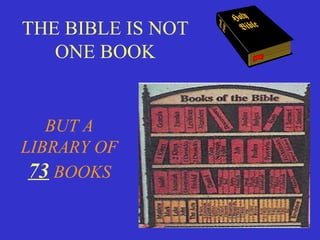
THE BIBLE IS NOT
ONE BOOK
BUT A
LIBRARY OF
73 BOOKS
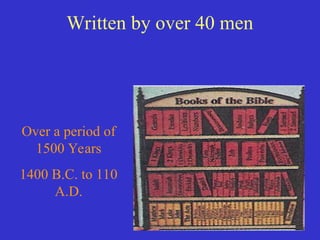
Written by over 40 men
Over a period of
1500 Years
1400 B.C. to 110
A.D.
The Forty Writers of the Bible
Were
• Shepherds
• Kings
• Fishermen
• Peasants
• Doctors
• Tax-collectors
From
• Rome
• Jerusalem
• Babylon (Iraq)
• Persia (Iran)
• Greece
• Turkey
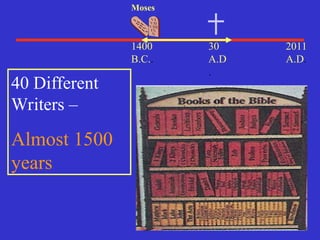
30
A.D
.
40 Different
Writers –
Almost 1500
years
2011
A.D.
Moses
1400
B.C..
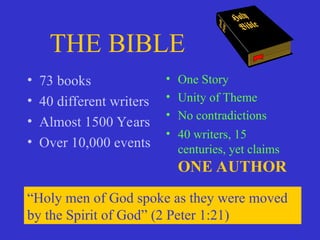
THE BIBLE
• 73 books
• 40 different writers
• Almost 1500 Years
• Over 10,000 events
• One Story
• Unity of Theme
• No contradictions
• 40 writers, 15
centuries, yet claims
ONE AUTHOR
“Holy men of God spoke as they were moved
by the Spirit of God” (2 Peter 1:21)
30
A.D
.
2011
A.D.
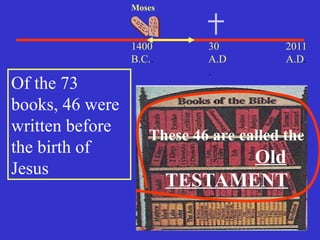
1400
B.C..
Moses
Of the 73
books, 46 were
written before
the birth of
Jesus
These 46 are called the
Old
TESTAMENT
30
A.D
.
2011
A.D.
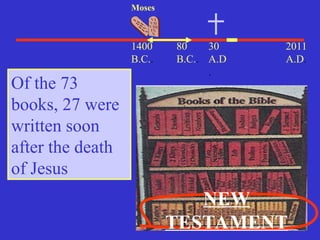
1400
B.C..
Moses
Of the 73
books, 27 were
written soon
after the death
of Jesus
NEW
TESTAMENT
80
B.C..
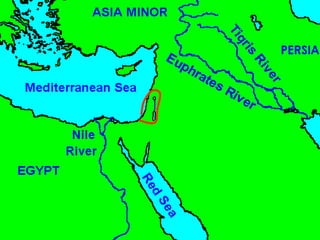
The Old Testament – 46 books
• All written before Jesus came.
• 1400-80 B.C.
• “Testament” means “covenant or
agreement”
• The Old Covenant is an agreement that God
made with the nation of Israel
• The Old Testament was written in Hebrew
– the language of Israel
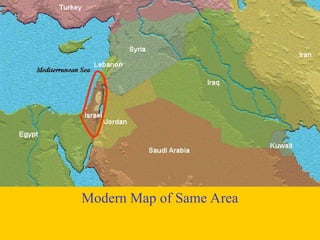
Modern Map of Same Area
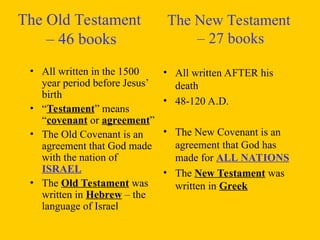
The Old Testament
– 46 books
• All written in the 1500
year period before Jesus’
birth
• “Testament” means
“covenant or agreement”
• The Old Covenant is an
agreement that God made
with the nation of
ISRAEL
• The Old Testament was
written in Hebrew – the
language of Israel
• All written AFTER his
death
• 48-120 A.D.
• The New Covenant is an
agreement that God has
made for ALL NATIONS
• The New Testament was
written in Greek
The New Testament
– 27 books
30
A.D
.
2011
A.D.
1400
B.C..
Moses
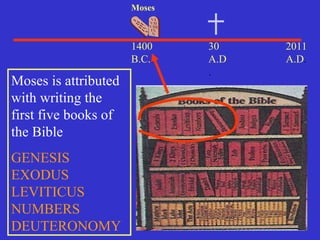
Moses is attributed
with writing the
first five books of
the Bible
GENESIS
EXODUS
LEVITICUS
NUMBERS
DEUTERONOMY
30
A.D
.
2011
A.D.
1400
B.C..
Moses
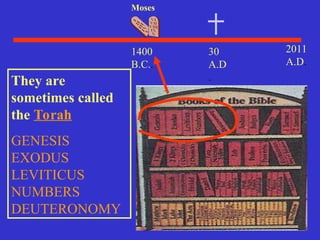
They are
sometimes called
the Torah
GENESIS
EXODUS
LEVITICUS
NUMBERS
DEUTERONOMY
30
A.D
.
2011
A.D.
1400
B.C..
Moses
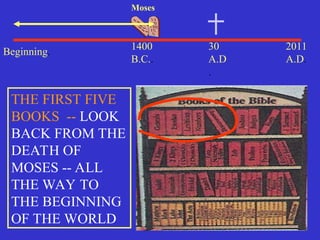
THE FIRST FIVE
BOOKS -- LOOK
BACK FROM THE
DEATH OF
MOSES -- ALL
THE WAY TO
THE BEGINNING
OF THE WORLD
Beginning.
30
A.D
.
2011
A.D.
1400
B.C..
Moses
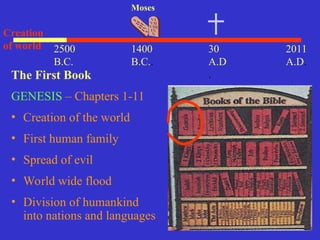
The First Book
GENESIS – Chapters 1-11
• Creation of the world
• First human family
• Spread of evil
• World wide flood
• Division of humankind
into nations and languages
Creation
of world 2500
B.C.
30
A.D
.
2000
A.D.
1400
B.C..
Moses
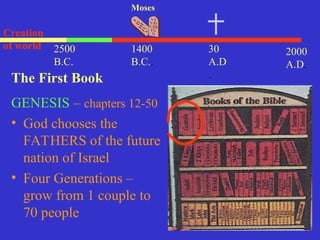
The First Book
GENESIS – chapters 12-50
• God chooses the
FATHERS of the future
nation of Israel
• Four Generations –
grow from 1 couple to
70 people
Creation
of world 2500
B.C.
30
A.D
.
2000
A.D.
1400
B.C..
Moses
Creation
of world 2500
B.C.
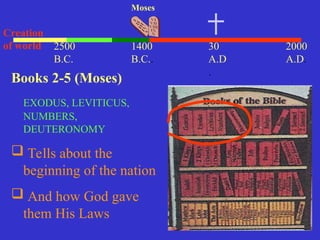
Books 2-5 (Moses)
EXODUS, LEVITICUS,
NUMBERS,
DEUTERONOMY
 Tells about the
beginning of the nation
 And how God gave
them His Laws
30
A.D
.
2011
A.D.
1400
B.C..
Moses
Creation
of world 2500
B.C.
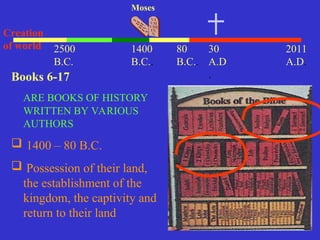
Books 6-17
ARE BOOKS OF HISTORY
WRITTEN BY VARIOUS
AUTHORS
 1400 – 80 B.C.
 Possession of their land,
the establishment of the
kingdom, the captivity and
return to their land
80
B.C..
30
A.D
.
2011
A.D.
1400
B.C..
Moses
Creation
of world 2500
B.C.
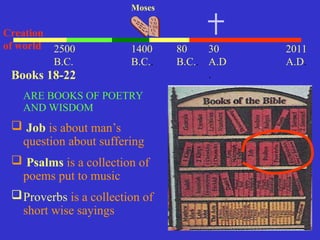
Books 18-22
ARE BOOKS OF POETRY
AND WISDOM
 Job is about man’s
question about suffering
 Psalms is a collection of
poems put to music
Proverbs is a collection of
short wise sayings
80
B.C..
30
A.D
.
2011
A.D.
1400
B.C..
Moses
Creation
of world 2500
B.C.
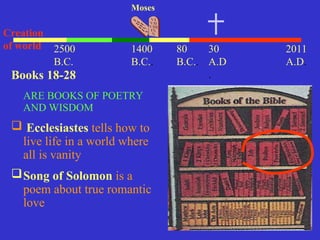
Books 18-28
ARE BOOKS OF POETRY
AND WISDOM
 Ecclesiastes tells how to
live life in a world where
all is vanity
Song of Solomon is a
poem about true romantic
love
80
B.C..
30
A.D
.
2011
A.D.
1400
B.C..
Moses
Creation
of world 2500
B.C.
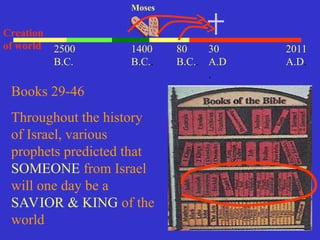
Books 29-46
Throughout the history
of Israel, various
prophets predicted that
SOMEONE from Israel
will one day be a
SAVIOR & KING of the
world
80
B.C..
30
A.D
.
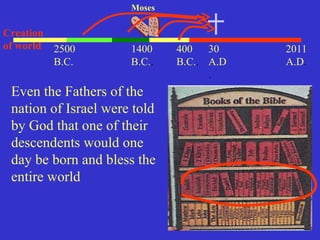
Even the Fathers of the
nation of Israel were told
by God that one of their
descendents would one
day be born and bless the
entire world
2011
A.D.
1400
B.C..
Moses
Creation
of world 2500
B.C.
400
B.C..
THE STORY OF THE OLD
TESTAMENT
was
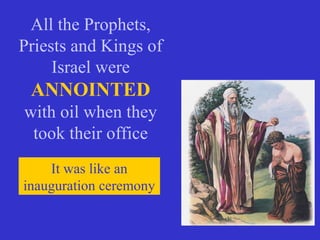
All the Prophets,
Priests and Kings of
Israel were
ANNOINTED
with oil when they
took their office
It was like an
inauguration ceremony
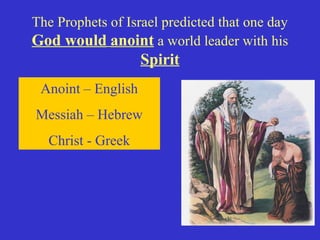
The Prophets of Israel predicted that one day
God would anoint a world leader with his
Spirit
Anoint – English
Messiah – Hebrew
Christ - Greek
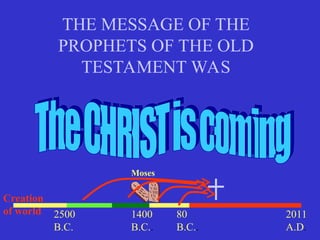
THE MESSAGE OF THE
PROPHETS OF THE OLD
TESTAMENT WAS
2011
A.D.
1400
B.C..
Moses
Creation
of world 2500
B.C.
80
B.C..
30
A.D
.
2011
A.D.
1400
B.C..
Moses
80
B.C..
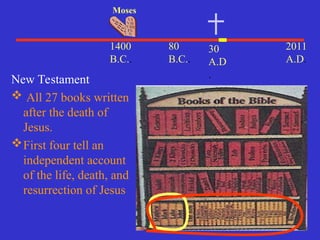
New Testament
 All 27 books written
after the death of
Jesus.
First four tell an
independent account
of the life, death, and
resurrection of Jesus
The New Testament
The First Four Books
• Called the four gospels (gospel is a Greek
word for “good news”)
• Named after the authors – Matthew, Mark,
Luke, John. Three were eyewitnesses, Luke
knew many of the eyewitnesses.
• Jesus lived & died in 30 A.D., all 27 New
Testament books were written while
eyewitnesses were alive
30
A.D
.
2011
A.D.
1400
B.C..
Moses
80
B.C..
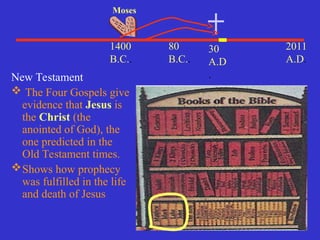
New Testament
 The Four Gospels give
evidence that Jesus is
the Christ (the
anointed of God), the
one predicted in the
Old Testament times.
Shows how prophecy
was fulfilled in the life
and death of Jesus
The Four Gospels
Matthew, Mark, Luke, John
• Tell the purpose of Jesus’ coming
• Reveal his perfect life and service
• Gives the true source of his teaching
• Gives evidence that he is the Son of God
and deserves our worship
• Help us understand why his own nation
killed him
The Four Gospels
Matthew, Mark, Luke, John
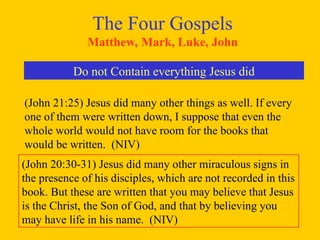
Do not Contain everything Jesus did
(John 21:25) Jesus did many other things as well. If every
one of them were written down, I suppose that even the
whole world would not have room for the books that
would be written. (NIV)
(John 20:30-31) Jesus did many other miraculous signs in
the presence of his disciples, which are not recorded in this
book. But these are written that you may believe that Jesus
is the Christ, the Son of God, and that by believing you
may have life in his name. (NIV)
30
A.D
.
2011
A.D.
1400
B.C..
Moses
80
B.C..
New Testament
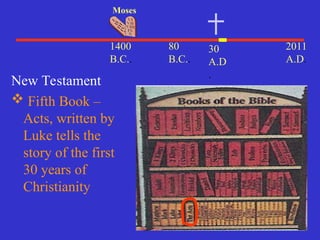
 Fifth Book –
Acts, written by
Luke tells the
story of the first
30 years of
Christianity
30
A.D
.
2011
A.D.
1400
B.C..
Moses
80
B.C..
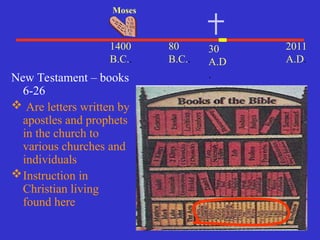
New Testament – books
6-26
 Are letters written by
apostles and prophets
in the church to
various churches and
individuals
Instruction in
Christian living
found here
30
A.D.
2011
A.D.
1400
B.C..
Moses
80
B.C..
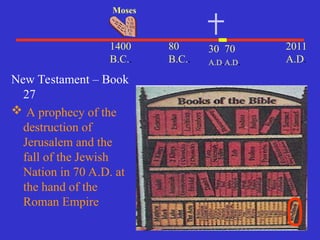
New Testament – Book
27
 A prophecy of the
destruction of
Jerusalem and the
fall of the Jewish
Nation in 70 A.D. at
the hand of the
Roman Empire
70
A.D.
30
A.D
.
2000
A.D.
1400
B.C..
Moses
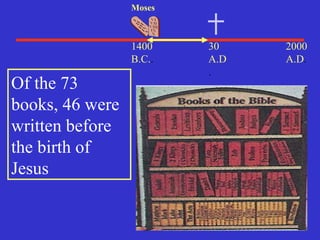
Of the 73
books, 46 were
written before
the birth of
Jesus
30
A.D
.
2011
A.D.
1400
B.C..
Moses
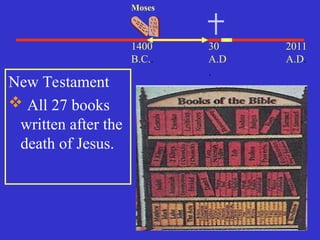
New Testament
 All 27 books
written after the
death of Jesus.
Explain
Select a short passage (e.g., Psalm 23, John 3:16)
and guide students through a close reading:

Read the passage aloud.

Identify key themes and messages.

Discuss the historical and cultural context of the
passage.

Interpret the meaning of the passage for
contemporary life.
Elaborate

Summarize the passage.

Identify key themes and
messages.

Discuss its relevance to modern-
day issues or personal
experiences.

How does understanding the
Bible contribute to understanding
Christianity?

What insights did you gain from
analyzing the passages?

How might you apply what
you've learned to your own lives?
Assignment
Read a specific chapter
or story from the Bible
and write a short
reflection on its meaning
and relevance.

Introduction-to-the-Bible-Powerpoint.ppt

  • 1.
    Mrs. Aillen C.Cornero VE / Religion L1.2 Basic Bible Information / Reading the Bible
  • 2.
    • Distinguish betweenthe Old and New Testaments of the Bible and identify at least three major sections within each, demonstrating knowledge of the Bible's structure • Apply biblical principles and teachings to real-life situations, demonstrating an understanding of how the Bible informs Christian beliefs and practices  Develop the ability to pronounce the word/words in the bible correctly and recite them fluently.  Participate and lead in the daily morning prayers and other religious activities by reading the bible and sharing reflection. Objectives:
  • 3.
  • 4.
    THE BIBLE ISNOT ONE BOOK BUT A LIBRARY OF 73 BOOKS
  • 5.
    Written by over40 men Over a period of 1500 Years 1400 B.C. to 110 A.D.
  • 6.
    The Forty Writersof the Bible Were • Shepherds • Kings • Fishermen • Peasants • Doctors • Tax-collectors From • Rome • Jerusalem • Babylon (Iraq) • Persia (Iran) • Greece • Turkey
  • 7.
    30 A.D . 40 Different Writers – Almost1500 years 2011 A.D. Moses 1400 B.C..
  • 8.
    THE BIBLE • 73books • 40 different writers • Almost 1500 Years • Over 10,000 events • One Story • Unity of Theme • No contradictions • 40 writers, 15 centuries, yet claims ONE AUTHOR “Holy men of God spoke as they were moved by the Spirit of God” (2 Peter 1:21)
  • 9.
    30 A.D . 2011 A.D. 1400 B.C.. Moses Of the 73 books,46 were written before the birth of Jesus These 46 are called the Old TESTAMENT
  • 10.
    30 A.D . 2011 A.D. 1400 B.C.. Moses Of the 73 books,27 were written soon after the death of Jesus NEW TESTAMENT 80 B.C..
  • 11.
    The Old Testament– 46 books • All written before Jesus came. • 1400-80 B.C. • “Testament” means “covenant or agreement” • The Old Covenant is an agreement that God made with the nation of Israel • The Old Testament was written in Hebrew – the language of Israel
  • 13.
    Modern Map ofSame Area
  • 14.
    The Old Testament –46 books • All written in the 1500 year period before Jesus’ birth • “Testament” means “covenant or agreement” • The Old Covenant is an agreement that God made with the nation of ISRAEL • The Old Testament was written in Hebrew – the language of Israel • All written AFTER his death • 48-120 A.D. • The New Covenant is an agreement that God has made for ALL NATIONS • The New Testament was written in Greek The New Testament – 27 books
  • 15.
    30 A.D . 2011 A.D. 1400 B.C.. Moses Moses is attributed withwriting the first five books of the Bible GENESIS EXODUS LEVITICUS NUMBERS DEUTERONOMY
  • 16.
    30 A.D . 2011 A.D. 1400 B.C.. Moses They are sometimes called theTorah GENESIS EXODUS LEVITICUS NUMBERS DEUTERONOMY
  • 17.
    30 A.D . 2011 A.D. 1400 B.C.. Moses THE FIRST FIVE BOOKS-- LOOK BACK FROM THE DEATH OF MOSES -- ALL THE WAY TO THE BEGINNING OF THE WORLD Beginning.
  • 18.
    30 A.D . 2011 A.D. 1400 B.C.. Moses The First Book GENESIS– Chapters 1-11 • Creation of the world • First human family • Spread of evil • World wide flood • Division of humankind into nations and languages Creation of world 2500 B.C.
  • 19.
    30 A.D . 2000 A.D. 1400 B.C.. Moses The First Book GENESIS– chapters 12-50 • God chooses the FATHERS of the future nation of Israel • Four Generations – grow from 1 couple to 70 people Creation of world 2500 B.C.
  • 20.
    30 A.D . 2000 A.D. 1400 B.C.. Moses Creation of world 2500 B.C. Books2-5 (Moses) EXODUS, LEVITICUS, NUMBERS, DEUTERONOMY  Tells about the beginning of the nation  And how God gave them His Laws
  • 21.
    30 A.D . 2011 A.D. 1400 B.C.. Moses Creation of world 2500 B.C. Books6-17 ARE BOOKS OF HISTORY WRITTEN BY VARIOUS AUTHORS  1400 – 80 B.C.  Possession of their land, the establishment of the kingdom, the captivity and return to their land 80 B.C..
  • 22.
    30 A.D . 2011 A.D. 1400 B.C.. Moses Creation of world 2500 B.C. Books18-22 ARE BOOKS OF POETRY AND WISDOM  Job is about man’s question about suffering  Psalms is a collection of poems put to music Proverbs is a collection of short wise sayings 80 B.C..
  • 23.
    30 A.D . 2011 A.D. 1400 B.C.. Moses Creation of world 2500 B.C. Books18-28 ARE BOOKS OF POETRY AND WISDOM  Ecclesiastes tells how to live life in a world where all is vanity Song of Solomon is a poem about true romantic love 80 B.C..
  • 24.
    30 A.D . 2011 A.D. 1400 B.C.. Moses Creation of world 2500 B.C. Books29-46 Throughout the history of Israel, various prophets predicted that SOMEONE from Israel will one day be a SAVIOR & KING of the world 80 B.C..
  • 25.
    30 A.D . Even the Fathersof the nation of Israel were told by God that one of their descendents would one day be born and bless the entire world 2011 A.D. 1400 B.C.. Moses Creation of world 2500 B.C. 400 B.C..
  • 26.
    THE STORY OFTHE OLD TESTAMENT was
  • 27.
    All the Prophets, Priestsand Kings of Israel were ANNOINTED with oil when they took their office It was like an inauguration ceremony
  • 28.
    The Prophets ofIsrael predicted that one day God would anoint a world leader with his Spirit Anoint – English Messiah – Hebrew Christ - Greek
  • 29.
    THE MESSAGE OFTHE PROPHETS OF THE OLD TESTAMENT WAS 2011 A.D. 1400 B.C.. Moses Creation of world 2500 B.C. 80 B.C..
  • 30.
    30 A.D . 2011 A.D. 1400 B.C.. Moses 80 B.C.. New Testament  All27 books written after the death of Jesus. First four tell an independent account of the life, death, and resurrection of Jesus
  • 31.
    The New Testament TheFirst Four Books • Called the four gospels (gospel is a Greek word for “good news”) • Named after the authors – Matthew, Mark, Luke, John. Three were eyewitnesses, Luke knew many of the eyewitnesses. • Jesus lived & died in 30 A.D., all 27 New Testament books were written while eyewitnesses were alive
  • 32.
    30 A.D . 2011 A.D. 1400 B.C.. Moses 80 B.C.. New Testament  TheFour Gospels give evidence that Jesus is the Christ (the anointed of God), the one predicted in the Old Testament times. Shows how prophecy was fulfilled in the life and death of Jesus
  • 33.
    The Four Gospels Matthew,Mark, Luke, John • Tell the purpose of Jesus’ coming • Reveal his perfect life and service • Gives the true source of his teaching • Gives evidence that he is the Son of God and deserves our worship • Help us understand why his own nation killed him
  • 34.
    The Four Gospels Matthew,Mark, Luke, John Do not Contain everything Jesus did (John 21:25) Jesus did many other things as well. If every one of them were written down, I suppose that even the whole world would not have room for the books that would be written. (NIV) (John 20:30-31) Jesus did many other miraculous signs in the presence of his disciples, which are not recorded in this book. But these are written that you may believe that Jesus is the Christ, the Son of God, and that by believing you may have life in his name. (NIV)
  • 35.
    30 A.D . 2011 A.D. 1400 B.C.. Moses 80 B.C.. New Testament  FifthBook – Acts, written by Luke tells the story of the first 30 years of Christianity
  • 36.
    30 A.D . 2011 A.D. 1400 B.C.. Moses 80 B.C.. New Testament –books 6-26  Are letters written by apostles and prophets in the church to various churches and individuals Instruction in Christian living found here
  • 37.
    30 A.D. 2011 A.D. 1400 B.C.. Moses 80 B.C.. New Testament –Book 27  A prophecy of the destruction of Jerusalem and the fall of the Jewish Nation in 70 A.D. at the hand of the Roman Empire 70 A.D.
  • 38.
    30 A.D . 2000 A.D. 1400 B.C.. Moses Of the 73 books,46 were written before the birth of Jesus
  • 39.
    30 A.D . 2011 A.D. 1400 B.C.. Moses New Testament  All27 books written after the death of Jesus.
  • 40.
    Explain Select a shortpassage (e.g., Psalm 23, John 3:16) and guide students through a close reading:  Read the passage aloud.  Identify key themes and messages.  Discuss the historical and cultural context of the passage.  Interpret the meaning of the passage for contemporary life.
  • 41.
    Elaborate  Summarize the passage.  Identifykey themes and messages.  Discuss its relevance to modern- day issues or personal experiences.
  • 42.
     How does understandingthe Bible contribute to understanding Christianity?  What insights did you gain from analyzing the passages?  How might you apply what you've learned to your own lives?
  • 43.
    Assignment Read a specificchapter or story from the Bible and write a short reflection on its meaning and relevance.

Editor's Notes

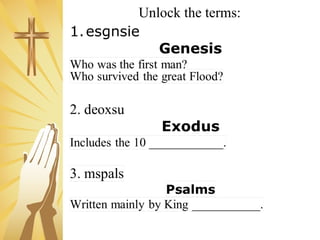
  • #3 Adam is the name given in Genesis 1–5 to the first human. Adam is the first human-being aware of God, and features as such in various belief systems  Noah and his family are saved because they were able to build an ark or kawila Exodus 20: The Ten Commandments. Written mainly by King David.
  • #41 Divide students into small groups. Assign each group a different Bible passage (prepared in advance) to analyze: Each group presents their findings to the class.