SLIDESMANIA.C
Learning Competencies:
explain thecore concepts in cookery
recognize the relevance of cookery
in daily life and in the industry
identify potential career
opportunities in cookery and the
food service sector
3.
SLIDESMANIA.C
Learning Competencies:
understand andassess one’s Personal
Entrepreneurial Competencies (PECs)
recognize factors in the business
environment that affect cookery-related
businesses
identify viable business opportunities in
cookery
SLIDESMANIA.C
Introduction to
Cookery
Cookery isdefined as a "chemical process"
mixing of ingredients; the application and
withdrawal of heat to raw ingredients to
make it more easily digestible, palatable and
safe for human consumption. Cookery is
considered to be both an art and science.
SLIDESMANIA.C
Did you know?
The"how of cooking" can be considered
to be the art and the "why of cooking"
could be the science. Balancing the art
and science must be the goal of every
professional chef.
8.
SLIDESMANIA.C
Aims and objectivesof cooking food
1.Cooking partly sterilizes food
2.Cooking helps to make the food
more digestible
3.Cooking increases the palatability
of various dishes
9.
SLIDESMANIA.C
Aims and objectivesof cooking food
4. Cooking makes the food more
attractive in appearance, and hence
more appetizing
5. Cooking introduces variety
6. Cooking helps to provide a balanced
meal
SLIDESMANIA.C
A2: Using aVenn
diagram, discuss the
concept of cookery
during the ancient
time and modern
time. Use drawings
and be creative.
15.
SLIDESMANIA.C
Sometimes it onlytakes
one image...
...to tell the story...
In a pan, draw
a concept of a
career
opportunity in
cookery.
Explain briefly.
SLIDESMANIA.C
Group Activity:
Divide theclass into 4–5 small groups and
provide each with these prompts:
“Where is cooking applied in
society?”
• At Home
• In Schools
• In the Community
• In Business
• In Culture/Traditions
18.
SLIDESMANIA.C
Food in:
Nutrition:
●Food providesthe nutrients necessary for growth,
development, and overall health.
●Adequate nutrition is crucial for infant, child, and
maternal health, strong immune systems, and
reducing the risk of non-communicable diseases.
●Food systems play a vital role in ensuring access
to safe and nutritious food for all.
19.
SLIDESMANIA.C
Food in:
Livelihood:
●Food production,processing, and distribution
create jobs and livelihoods for millions of people
worldwide.
●Agriculture, in particular, is a major source of
employment and income for many communities.
●Food systems can contribute to economic growth
and poverty reduction, especially in developing
countries.
20.
SLIDESMANIA.C
Food in:
Culture:
●Food isdeeply embedded in cultural traditions
and practices.
●Food choices, preparation methods, and eating
rituals vary across cultures.
●Food can symbolize social status, religious beliefs,
and cultural identity.
●Food is often shared and celebrated, reinforcing
social bonds and cultural heritage.
21.
SLIDESMANIA.C
Interconnections:
●Nutritional well-being isclosely tied to livelihood
opportunities and cultural practices.
●Food systems can be designed to promote both healthy
diets and sustainable livelihoods.
●Cultural understanding is essential for designing
effective food-based interventions and policies.
●Changes in food systems, such as increased reliance on
processed foods, can impact both nutrition and cultural
practices
22.
SLIDESMANIA.C
Traditional Careers inFood
A chef is a professional cook and tradesperson
who is proficient in all aspects of food
preparation, often focusing on a particular
cuisine.
23.
SLIDESMANIA.C
Traditional Careers inFood
A baker typically works with a wider range of
items, including bread, rolls, pies, and cakes,
while a pastry artist (or pastry chef)
specializes in desserts, confectionery, and
intricate pastry work. Pastry chefs often have a
more artistic and design-oriented approach to
their creations.
24.
SLIDESMANIA.C
Traditional Careers inFood
A restaurant manager oversees the daily
operations of a restaurant, ensuring a smooth
and efficient service while maximizing
profitability and customer satisfaction. They
are responsible for managing staff, handling
finances, maintaining quality control, and
addressing customer concerns.
25.
SLIDESMANIA.C
Traditional Careers inFood
A Hospitality Manager oversees the daily
operations of establishments in the hospitality
industry, such as hotels, resorts, and
restaurants, ensuring smooth operations and
excellent customer experiences. They manage
staff, handle customer service, and maintain
budgets and financial records.
26.
SLIDESMANIA.C
Traditional Careers inFood
A Hospitality Manager oversees the daily
operations of establishments in the hospitality
industry, such as hotels, resorts, and
restaurants, ensuring smooth operations and
excellent customer experiences. They manage
staff, handle customer service, and maintain
budgets and financial records.
27.
SLIDESMANIA.C
Unique Careers
Bed &Breakfast Owner
(B&B) Food writers write about food
and drink. They may report on
food- or cooking-related events,
interview chefs or other
food/cooking personalities,
review recipes or restaurants, or
simply write about a specific
food or product..
manages a small lodging
establishment that provides
overnight accommodation
and breakfast. They are
typically responsible for all
aspects of the business,
from guest relations and
hospitality to administrative
and financial tasks.
Cookbook Author
28.
SLIDESMANIA.C
Unique Careers
Food
Entrepreneur Afood forager is most
known as a person who
goes into the forest and
other natural settings to
find foods that are grown in
the wild.
someone who starts and
manages a business in the
food and beverage industry.
This can encompass a wide
range of ventures, from
restaurants and cafes to
food trucks, catering
businesses, and even online
food platforms.
Professional Food
Forager
29.
SLIDESMANIA.C
Unique Careers
Research Chef
responsiblefor developing a
good brand image for a
restaurant, making its
presence known, and
"putting out fires" in the
event of any negative
attention
come up with new foods
and dishes for food-
manufacturing companies,
restaurants, and other food-
based businesses. They
often have their hands in
areas related to research,
product development,
marketing, and sales.
Restaurant Publicist
30.
SLIDESMANIA.C
Unique Careers
Manufacturing &Food
Science
support scientists in
research, development,
and testing related to
agriculture and food
production
involves various roles
focused on food production,
processing, safety, and
nutrition. These roles can
range from developing new
food products and
improving existing ones, to
ensuring food safety,
quality, and compliance with
Agricultural or Food
Science Technician
31.
SLIDESMANIA.C
Unique Careers
Food Scientistor
Technologist
follow recipes in
order to cook
large batches of
food
responsible for determining
the nutritional content of
products, researching new
ingredients, or enforcing
government food
regulations
Food batchmakers
32.
SLIDESMANIA.C
Mini-Profile Creation
Let eachstudent choose one cookery career and make a short
profile in their notebook or a mini-poster:
• Job title Would you like to
pursue
• Job description this career?
Why or
• Needed skills/traits why not?
SLIDESMANIA.C
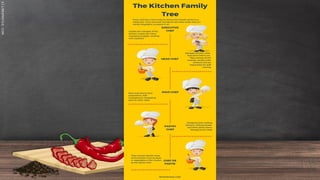
The kitchen brigadesystem, also
known as brigade de cuisine, is a
hierarchical structure used in
professional kitchens to organize
and delegate tasks.
35.
SLIDESMANIA.C
Georges Auguste Escoffier
createdthe kitchen brigade
system. After serving in the
French army, he brought
his military hierarchy
experience to a hotel
kitchen in the 1800s to
establish a kitchen
hierarchy. The goal of the
system was to streamline
the kitchen duties and
facilitate in the prevention
of chaos.
SLIDESMANIA.C
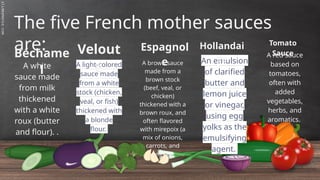
The five Frenchmother sauces
are:
Béchame
l
A light-colored
sauce made
from a white
stock (chicken,
veal, or fish)
thickened with
a blonde
flour.
Velout
é
A brown sauce
made from a
brown stock
(beef, veal, or
chicken)
thickened with a
brown roux, and
often flavored
with mirepoix (a
mix of onions,
carrots, and
celery).
Espagnol
e An emulsion
of clarified
butter and
lemon juice
or vinegar,
using egg
yolks as the
emulsifying
agent.
Hollandai
se
Tomato
Sauce
A white
sauce made
from milk
thickened
with a white
roux (butter
and flour). .
A red sauce
based on
tomatoes,
often with
added
vegetables,
herbs, and
aromatics.
38.
SLIDESMANIA.C
Elaborate: “The Entrepreneurin You”
What trait is shown in the given scenario?
Persistence
Anna continues her home-
based baking business
even after several failures.
39.
SLIDESMANIA.C
Elaborate: “The Entrepreneurin You”
What trait is shown in the given scenario?
resourcefulness
A cook is preparing a cake
for a special occasion, but
realizes they are out of
baking powder.
adaptability
Problem-solving
patience
40.
SLIDESMANIA.C
Elaborate: “The Entrepreneurin You”
What trait is shown in the given scenario?
resourcefulness
A cook has planned a meal for
two, but an unexpected guest
arrives, requiring an increase in
the quantity of food.
adaptability
efficiency
planning
41.
SLIDESMANIA.C
Elaborate: “The Entrepreneurin You”
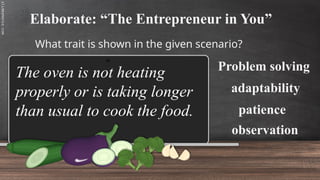
What trait is shown in the given scenario?
Problem solving
The oven is not heating
properly or is taking longer
than usual to cook the food.
adaptability
patience
observation
42.
SLIDESMANIA.C
Elaborate: “The Entrepreneurin You”
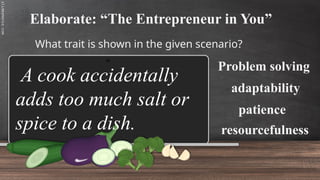
What trait is shown in the given scenario?
Problem solving
A cook accidentally
adds too much salt or
spice to a dish.
adaptability
patience
resourcefulness
43.
SLIDESMANIA.C
Trait-to-Life Reflection
Choose twotraits from the list and write in their
notebooks:
• Why is this trait important in a cookery-related
business?
• Do I have this trait? How can I improve it?
SLIDESMANIA.C
Business Environment
Factors
Customer Needsand
Trends:
Understanding what customers want
and how their preferences are
evolving is crucial. This includes
analyzing demographics, buying
patterns, and adapting products and
services to meet their needs.
SLIDESMANIA.C
“Food Business Pitch
Challenge”
GroupBrainstorming (20–30 mins)
In groups (3–5 members), students develop a simple food
business idea using the following guide:
• Business name
• Type of food/product
• Target market
• Estimated cost and pricing
• Unique selling point (What makes it different?)
• Location or delivery method.
53.
SLIDESMANIA.C
“Food Business Pitch
Challenge”
BusinessPitch Presentation
Encourage use of visual aids like posters, props, or
digital slides.
Presentations should include:
✅ Introduction of product
✅ Why it fits the community's needs
✅ Price and profit strategy
✅Why it can succeed
Editor's Notes
#1 provides an overview of basic concepts in cookery. It defines cookery as a chemical process that involves mixing ingredients and applying/withdrawing heat to make raw foods more digestible, palatable, and safe. Cooking food aims to partly sterilize it, make it more digestible, increase palatability, make it more attractive, introduce variety, and help provide a balanced meal. The document also discusses the relevance of cookery courses and career opportunities in traditional food jobs like being a chef, baker, or restaurant manager.
#2 The importance of cookery as a course in Technology and Livelihood Education under the K to 12 Curriculum has always been emphasized. Cookery not only includes developing skills in cooking and in poultry, meat and fish cookery, but also provides students knowledge and develop skills that will transform their lives toward productive ends. In TLE cookery, skills in doing some chores like developing responsible parenthood to have a happy family relationship are developed, underscoring the many ways and this things stadent need for their future. With the advent of globalization, TLE cookery and its components like cooking, food processing, food handling and even restaurant management has been very vital for students.
#3 In Cookery Grade 9, basic concepts include understanding the fundamentals of food preparation, utilizing kitchen tools and equipment, and applying various cooking methods. Students learn about food safety, hygiene, and the importance of following recipes and measuring ingredients accurately. They also explore different types of dishes like appetizers, salads, sandwiches, and desserts, along with basic cooking techniques for each.
#5 The art of cooking is ancient. The first cook was a primitive man, who had put a chunk of meat close to the fire, which he had lit to warm himself. He discovered that the meat heated in this way was not only tasty but it was also much easier to masticate. From this moment, in unrecorded past, cooking has evolved to reach the present level of sophistication. Humankind in the beginning ate to survive. Now also we still eat to survive, however efforts have been made to make the food more enjoyable like cooking meats and vegetables in different ways to make them more easily caten, digestible and to make them more attractive, palatable and to have wider choice.
#6 What did you notice about how the kitchen was organized?
What kinds of tools and equipment did you see?
What did the chefs or staff do to maintain cleanliness?
How did they communicate with each other?
#7 This is the art associated with the preparation of food. However, it is not solely the artful manipulation and combination of food which results in good tasting products. Nutritional aspects, the effects of combining various foodstuffs and the use of modern technology can be considered the science of cooking.
#8 Aims and objectives of cooking food
Cooking partly sterilizes food Above 40°C (140°F) The growth of bacteria falls off rapidly and in general it ceases above 45°C (113°F). Non-sporing bacteria are killed at temperatures above 60°C (140°F) for varying periods of time. For example, to make milk safe for consumption, it is pasteurized at 63°C (145°F) for 30 minutes or at 72°C (161F°) fir 15 seconds. Boiling kills living cells with the exception of spores, within a few seconds. Spore bearing bacteria take about 4 to 5 hours of boiling to be destroyed (Higher the temperature shorter the time required to destroy them).
Cooking helps to make the food more digestible Complex foods are often split into simpler substances during cooking. This helps the body to absorb and utilize the food more readily than in the raw form.
Cooking increases the palatability of various dishes
#9 Aims and objectives of cooking food
Cooking makes the food more attractive in appearance, and hence more appetizing
5. Cooking introduces variety Many different types of dishes can be prepared using the same ingredient
6. Cooking helps to provide a balanced meal Different ingredients of different nutritive values combined together in one dish makes it easier to provide a balanced meal (eg. a combination of cereals and pulses together gives a complete balanced meal.
#10 In cookery, basic concepts include understanding different cooking methods, heat transfer, and the importance of food safety. It's about preparing food through various techniques to improve its taste, appearance, and digestibility while ensuring it's safe to eat.
1. Cooking Methods:
Dry Heat: Uses air or fat to cook food, examples include grilling, baking, and roasting.
Moist Heat: Uses water or steam, examples include boiling, steaming, and braising.
Combination Cooking: Uses both dry and moist heat methods.
#11 Heat Transfer:
Conduction:
Heat transfer through direct contact, like when a pan heats up on a stovetop.
Convection:
Heat transfer through the movement of fluids (liquids or gases), like the circulation of hot air in an oven.
Radiation:
Heat transfer through electromagnetic waves, like the heat from a microwave.
#12 Food Safety:
Proper Handling: Washing hands, using separate cutting boards for raw and cooked foods, and storing food at the correct temperatures.
Cooking Temperatures: Ensuring food is cooked to a safe internal temperature to kill harmful bacteria.
Cross-contamination: Preventing the transfer of harmful bacteria from raw food to cooked food.
#16 n Cookery moving forward, varied and relevant activities and opportunities are provided to demonstrate a student's understanding of concepts and core competencies as prescribed in TESDA Training Regulation in Cookery and provides quality foods and services to target clients. This will also be a venue for teachers to assess students and identify aspects of business that they need to strengthen and safeguard before they become a part of the workforce. Today in the world of work, the number of available jobs is scarce and the Department of Education is revitalizing its resources to lead the young minds and to prepare them skillfully as future Chef. It is in honing the skills that learners can assure to have an edge of surviving the daily needs of oneself and of others. It seeks to provide the learners with the knowledge, attitude, values and skills in the field of Cookery.
“Where is cooking applied in society?”
#17 Each group will brainstorm where and how cooking is applied in each category. |
| Sharing (10–15 mins) | Each group shares their ideas in class.
Example: Home: meal preparation, budgeting, nutrition
Groups post their outputs. The class walks around and reads each group’s ideas. Each student picks their "top 3 most interesting applications of cooking" and explains why in their notebooks.
Lead a reflective discussion using these questions:
What surprised you about where cooking is used?
Why is cooking important beyond just feeding ourselves?
How can learning cookery now help you in the future?
#18 Food is intricately linked to nutrition, livelihoods, and culture. It provides essential nutrients for physical health and development, is a source of income and economic activity, and plays a vital role in shaping cultural identity and traditions.
#22 When most people think about beginning a career in food, they automatically come up with the more traditional occupations. These include positions like chef, baker, and restaurant manager. Below we have covered some of the common positions so that you can get an idea of the opportunities that these kinds of jobs can offer.
A chef is a professional cook and tradesperson who is proficient in all aspects of food preparation, often focusing on a particular cuisine. t is an exciting time to become a chef. Some of the hottest trends in food include a shift toward cating ingredients that are grown locally or sustainably, prepared more naturally, and include ethnic spices and flavors. Fresh and house-made ingredients are also appealing to today's consumers, as well as street food and food trucks. There are many opportunities to pursue your creative culinary passion, regardless of whatever your specific interests may be. Whether you want to run a kitchen in a local boutique restaurant or become a top chef for a major franchise, one of your best bets for beginning your career is to obtain a culinary arts education. It can give you a solid foundation from which you can start building your career as a chef. Average salary $52,160 Top-end salary $81,150 or more Projected job growth and yearly openings 11 percent, 20,700
#23 Baker or Pastry Artist
If you love the idea of sharing delicious breads or delectable desserts with the masses, then becoming a baker or pastry artist could be an ideal choice for you. There is a real know-how and science behind crafting perfectly baked goods. You may be wise to begin mastering your skills in a baking or pastry arts program. It can give you the footing needed to grab attention in the baking world. With carefully fine-tuned skills, you could be ready to do just about anything, whether you want to set up your own specialty pastry shop, prepare artisanal breads for local grocers and markets, or create a variety of mouthwatering treats in a large commercial bakery
#24 Restaurant Manager
You could embark on a culinary career that focuses on operations. With jobs like restaurant, kitchen, or catering manager, a food service management position is a great option for individuals who possess both a strong business sense and a love for culinary arts. And there are a number of restaurant management schools that can help aspiring professionals like you enter the industry. Depending on the size of establishment you work for, you could secure a management position that focuses on the front of house, back of house, or both. Front-house managers focus on the serving and bartending staff. They ensure that customer service standards are being met and that food and drinks are coming out as expected. Back-house managers, on the other hand, are responsible for the kitchen and food preparation staff. They oversee the kitchen, check on portion quality and size, and make sure that health and safety standards are upheld. Most management positions will also require you to be involved in areas like staffing and scheduling. You could be responsible for interviewing, hiring, training, and ensuring that each shift is staffed adequately. You could also oversee areas like ordering, inventory management, and costing. It really depends on the type of business and the scope of your role. Average salary $58,960 Top-end salary $92,410 or more Projected job growth and yearly openings-11 percent, 46,900
#25 Hospitality Manager
This position is sometimes similar to that of a food service manager except that it includes the addition of overseeing accommodations. Hospitality managers, also known as lodging managers, typically oversee entire facilities that include both accommodations and food services, like hotels and resorts. They tend to focus on overall guest experiences and ensure that the business is organized and profitable. Hospitality managers can be involved in many areas of financial, human resources, and operations management. If you like the sound of this interesting career path, then you may want to consider attending a hospitality management school. You could find a program that prepares you to work for all types and sizes of lodging establishments, from small inns to large corporate resorts.
Average salary $62,270
Top-end salary $102,410 or more
Projected yearly openings 5,500
#26 Hospitality Manager
This position is sometimes similar to that of a food service manager except that it includes the addition of overseeing accommodations. Hospitality managers, also known as lodging managers, typically oversee entire facilities that include both accommodations and food services, like hotels and resorts. They tend to focus on overall guest experiences and ensure that the business is organized and profitable. Hospitality managers can be involved in many areas of financial, human resources, and operations management. If you like the sound of this interesting career path, then you may want to consider attending a hospitality management school. You could find a program that prepares you to work for all types and sizes of lodging establishments, from small inns to large corporate resorts.
Average salary $62,270
Top-end salary $102,410 or more
Projected yearly openings 5,500
#27 When you research unique career possibilities in the food industry, you can come up with hundreds of ideas. There are multiple niche areas popping up in food service and production. Take a look at a few of these exciting possibilities below to see if any of them appeal to you.
5. Bed & Breakfast Owner
Many bed and breakfast (B&B) owners would tell you that their work is a labor of love. You need to enjoy meeting and engaging with people of all backgrounds, providing memorable hospitality in your home, and serving your guests delicious food. And there are good opportunities in the B&B industry. In fact, revenue for the bed and breakfast industry grew at a yearly rate of 4.4 percent from 2014 to 2019.
Cookbook Author Whether as an avid home cook or a culinary professional, becoming a cookbook author could be the food career that you are after. A good first step is to develop a theme for your cookbook. Then you would likely want to contact potential publishers to get an idea of their interest. Another option is to look into crowdfunding platforms like Kickstarter that can enable you to obtain funding without the backing of a publisher. Once you have come up with a viable idea and a means to get it to the market, you can work on perfecting and compiling your best tried-and-true recipes and accompanying them with beautiful photos. You will want to write a book that is both on-trend with consumers and has a look that grabs their attention. And it is worth noting that many cookbook authors garner attention by food blogging as a supplement to their publications. A food blog can be a great way to gain followers and create publicity for your book before it has hit the shelves. You may even want to check out some writing schools that could help you acquire authoring skills that can enhance the content of your blogs or books.
#28 Food Entrepreneur
The food industry has led to all kinds of niche markets. As a result, many people have become food entrepreneurs. These people have usually built successful businesses based on one or two specialty products that they have developed in their own kitchens. And with the explosion of the Internet, food entrepreneurs are able to reach markets that were previously hard to access. If you make a to-die-for BBQ sauce, mouthwatering salsa, or other prepared food that could be commercially successful, then you may want to become a food entrepreneur. With solid business skills, (which you could acquire at an entrepreneur school) and one or more quality products, you could be on your way to creating a successful business. You'll need to become familiar with areas related to food labeling, permitting, regulations, and health and safety. And you'll also want to enhance your sales efforts by making contacts with food distributors and connecting with local retailers that could sell your products. Because entrepreneurs are self-employed, salary and job outlook data is not available. Your earnings and potential growth of your business rests upon your product mix, pricing, and promotions. If you are offering a product that appeals to a large market segment, and you work hard to establish your business. then you could make a good living while being able to pursue your passion.
Food forager
However, a new career field is emerging for professional food foragers who search through farmers' markets and other local businesses in order to source food for restaurants...
Chefs do not typically have the time to source ingredients like locally grown produce or artisanal products, so they hire professional food foragers to do it for them. Foragers source the ingredients and sometimes even educate the chefs and restaurant staff as to the origin of the items. Since this is a relatively new field, earning and job growth data is not readily available. However, eco-friendly food and locally sourced ingredients are hot trends in the food industry. So as more restaurants tap into this trend, it's likely that professional food foraging services will become more in-demand.
#29 Research chefs
Most individuals working in this field are professionally trained chefs who also possess backgrounds in food science. Many research chefs report that their days offer a lot of variety. They can be found doing anything from conducting research on the newest food trends and attending industry trade shows to developing ingredients or dishes in kitchens and engaging with customers and focus groups. Careers in the food industry of this nature can take several years to achieve. You may want to consider obtaining culinary arts training to get started. Then, while you gain experience in a professional kitchen, you can take food science courses that could support your goal of becoming a research chef.
Average salary $55,540 Top-end salary $89,720 or more
Restaurant Publicist
This is a great career option if you have a love of food and excel in communicating and building relationships with all types of people. As a restaurant publicist, you are responsible for developing a good brand image for a restaurant, making its presence known, and "putting out fires" in the event of any negative attention. With more than one million restaurants operating in the U.S., the work of a restaurant publicist is becoming increasingly important. You have to understand your clients' customers and the best platforms to reach them. Some restaurants may have a client base that is best targeted through traditional mediums like print and radio ads, whereas other restaurants may need more of a focus on online mediums. You also have to possess a good understanding of restaurant operations since you may need to assist with training staff, setting service standards, and even designing and writing menus. These aspects all contribute to a restaurant's image. Restaurant publicists usually work for a public relations firm rather than one individual restaurant. However, some of the larger restaurant chains may employ in-house publicists. And although there is not just one clear educational path that leads to this career, training in communication studies or public relations can be a great first step. Average salary $49,540 Top-end salary $77,800 or more Projected job growth 11.5 percent
#30 When looking at your options within the food industry, careers in manufacturing and processing may be of interest to you. It is an intriguing time to work in the sector. Important shifts are taking place in food manufacturing as consumers are moving toward healthier eating and are more often seeking foods that possess organic and non-GMO (i.c., not genetically modified) ingredients. And many potential food-labeling laws, like ones that would require GMO foods to be labeled, are currently making their way through Congress. Another growing concern is nutritional quality. More and more consumers want products with less sugar, preservatives, and processed ingredients. What all of this means is that interesting changes are taking place in the food-manufacturing industry, and they may result in reshaping the roles of workers from food scientists to sales reps. The food-manufacturing sector requires professionals from all backgrounds, including business, information technology, and the skilled trades. While these professions tend to be higher-paying, it isn't expected that they'll have a lot of job growth within the food-manufacturing sector. However, it is expected that careers in food science, as well as other jobs that are related to the actual manufacturing processes, will grow. Some of these occupations are detailed
This occupation can involve working in all aspects of agricultural processing. Food science technicians often focus on arcas like health and safety, process and technology improvements, distribution, preservation, and quality control. They may also study crops and plants in order to improve yields and enhance certain attributes of the plants. Most positions require a bachelor's degree in food science or a related field. Average salary $44,170 Top-end salary $64,020 or more Projected job growth and yearly openings-6 percent, 3,800
#31 Food Scientist or Technologist A food scientist is typically involved in researching, developing, and improving food products and manufacturing processes. Most scientists tend to specialize in a specific area such as processing, quality assurance, or research. Like food science technicians, food scientist jobs usually require at least a bachelor's degree in a related discipline
ood Batchmakers
This is one of many different entry-level positions found in food-manufacturing facilities. You could be responsible for measuring ingredients, monitoring and operating a variety of equipment, adjusting cooking temperatures, conducting quality-control tests, and cleaning and sterilizing equipment. Although most training takes place on the job, you could opt for an education in an area that interests you, like electrical or mechanical engineering. That way, you have more opportunities to progress your career within the food-manufacturing sector.
Which of these careers interest you most and why?
What skills do you think are needed for each job?
Are there opportunities for these careers in your local area?
#33 During the 1800s grand sized hotels started to become popular, requiring grand sized kitchens to feed all the patrons. Without organization of the larger staff, chaos might have ensued. Escoffier created a hierarchical system to aid in the daily production of food. Every station in the restaurant was identified and cooks were put in each place.
#34 This system assigns specific roles and responsibilities to each kitchen staff member, creating a well-defined chain of command.
#35 Over the years, kitchens and budgets have gotten smaller, and labor prices are much higher. Escoffier's system supports scaling to match any kitchen's needs.
#36 The system establishes a clear hierarchy with different levels of chefs and cooks, each responsible for specific tasks.
Specialization:
It emphasizes specialization, with different cooks focusing on specific areas like sauces, meats, vegetables, or pastries.
Efficiency:
By assigning roles and responsibilities, the system aims to streamline operations, reduce errors, and improve overall efficiency.
Examples of roles:
Common roles include Executive Chef, Sous Chef, Chef de Partie (Station Chef), and Commis (Line Cook).
Modern relevance:
While the full brigade system might be more common in fine dining, the core principles of specialization and defined roles are still widely used in various types of restaurants.
#37 These sauces serve as the staring point for most sauces
#38 “What do you think makes a successful food entrepreneur?”
On the board, collect students’ answers.
Provide a set of scenario cards that describe real-life cookery situations.
Example:
“Anna continues her home-based baking business even after several failures.”
Students match each scenario to a trait (e.g., Persistence).
Have them justify their answers to the class.
#39 Resourcefulness: The cook must quickly find a substitute (baking soda and an acid like lemon juice or vinegar) or adjust the recipe accordingly to compensate for the missing ingredient.
Adaptability: They need to be able to modify the recipe on the fly and adjust the cooking time to ensure the cake still rises and bakes properly.
Problem-solving: The cook needs to think critically about how to achieve the desired outcome (a well-risen cake) despite the missing ingredient.
Patience: The cook may need to experiment to find the right balance of substitutes and cooking time.
#40 Adaptability: The cook needs to quickly adjust the recipe or find ways to stretch the existing ingredients to accommodate the extra person.
Efficiency: They need to work quickly and efficiently to prepare the additional food without compromising the quality of the meal.
Planning: The cook may need to think ahead about what dishes can be easily doubled or modified.
Resourcefulness: They may need to use what's available in the pantry or fridge to supplement the meal.
#41 Problem-solving: The cook needs to figure out the cause of the problem (e.g., oven temperature is off, heating element is faulty) and find a solution (adjusting cooking time, using a different cooking method).
Patience: The cook needs to be patient and not get discouraged when the oven is not cooperating.
Adaptability: They might need to switch to other cooking methods like stovetop cooking or grilling if the oven is not reliable.
Observation: The cook needs to closely observe the food to ensure it is cooking properly, even with the oven issues.
#42 Resourcefulness: The cook might try to dilute the dish with liquid (water, broth), add a starch (rice, potatoes), or balance the flavors with other ingredients (sugar, lemon juice).
Adaptability: They must be able to adjust the dish to compensate for the over-seasoning, potentially adding more of other ingredients.
Patience: It takes patience to find the right balance and not give up on the dish.
Problem-solving: They must identify the source of the problem (too much seasoning) and find a way to mitigate it.
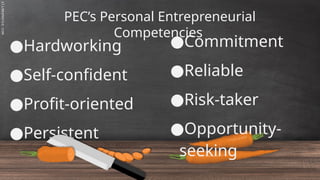
#44 are the key characteristics, skills, and qualities that successful entrepreneurs possess. These competencies are often grouped into clusters like achievement, planning, and power, and include things like opportunity seeking, persistence, and risk-taking.
Hardworking: Diligently working towards goals.
Self-confident: Believing in one's abilities and making decisions with confidence.
Profit-oriented: Having a keen interest in generating income and building a profitable business.
Persistent: Remaining patient and striving to achieve goals despite challenges.
Commitment: Having a major priority in one's life and being dedicated to the business.
Reliable and has integrity: Being honest, trustworthy, and dependable.
Risk-taker: Being willing to take calculated risks in order to seize opportunities.
Opportunity-seeking: Identifying and pursuing profitable business ventures.
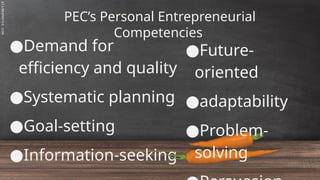
#45 Demand for efficiency and quality: Striving to deliver excellent products or services in a timely and efficient manner.
Systematic planning: Developing and following well-thought-out plans.
Goal-setting: Setting clear goals and targets for the business.
Information-seeking: Gathering and using information to make informed decisions.
Persuasion and networking: Building relationships and using persuasion to advance the business.
Future-oriented: Having a long-term vision for the business and planning for the future.
Adaptability: Being able to adjust to changing circumstances and market conditions.
Problem-solving: Identifying and resolving issues that arise in the business.
#46 Creativity: Generating innovative ideas and solutions.
Taking initiative: Being proactive and taking action without being prompted.
Willing to listen: Being open to feedback and advice from others.
#47 The business environment is shaped by various internal and external factors that significantly influence a company's success. Key factors include customer needs and trends, competition, resources, location, and capital. These factors can create opportunities or pose threats, requiring businesses to adapt and strategize accordingly.
#48 The business environment is shaped by various internal and external factors that significantly influence a company's success. Key factors include customer needs and trends, competition, resources, location, and capital. These factors can create opportunities or pose threats, requiring businesses to adapt and strategize accordingly.
#49 The business environment is shaped by various internal and external factors that significantly influence a company's success. Key factors include customer needs and trends, competition, resources, location, and capital. These factors can create opportunities or pose threats, requiring businesses to adapt and strategize accordingly.
#50 The business environment is shaped by various internal and external factors that significantly influence a company's success. Key factors include customer needs and trends, competition, resources, location, and capital. These factors can create opportunities or pose threats, requiring businesses to adapt and strategize accordingly.
#51 These factors, both internal and external, can create opportunities or pose threats to a business. For example, understanding customer trends can lead to innovation and new product development (opportunity), while intense competition can make it challenging to gain market share (threat). Adapting to the business environment requires ongoing analysis, strategic planning, and a willingness to adjust to changing circumstances.